The Nature of Foxes

User avatar
blindpig
Posts: 14788
Joined: Fri Jul 14, 2017 5:44 pm
Location: Turtle Island
Contact:

Re: The Nature of Foxes

Post by blindpig » Mon Oct 20, 2025 2:28 pm

Image

US Politics Is Just Nonstop Fake Revolutions Now

They get everyone fighting a fake revolution so that nobody thinks about fighting a real one.

Caitlin Johnstone
October 20, 2025


It’s so silly how American politics is just nonstop fake revolutions now.

Millions flooded the US streets for the “No Kings” protests over the weekend to oppose a monarchy which does not exist without making a single tangible demand. Power was not challenged in any meaningful way. The status quo wasn’t disrupted in the slightest. People held up some signs saying the president is orange and that if Kamala were president they would be at brunch, and then went home.

The whole thing was just one big pep rally for the Democratic Party, designed to accomplish nothing beyond getting American liberals excited about the prospect of someday voting for Gavin Newsom. A bunch of boomers showed up to dance around and hold signs and feel as though they are fighting the power in their feely bits, while drumming up support for the same status quo which gave rise to Trump in the first place.


You see the same fake revolutionary astroturf zeitgeist on the Republican side. American rightists are constantly pretending they’re fighting some kind of populist rebellion against an oppressive establishment even while their party controls every branch of the US government. They act like Trump is ending the wars and fighting the Deep State even as he stomps out free speech on behalf of Israel, rolls out a Palantir surveillance system, pours weapons into facilitating Israel’s genocidal atrocities, bombs Iran and Yemen, ramps up for war with Venezuela, and perpetuates the horrific proxy war in Ukraine.

It’s two plutocrat-owned warmongering imperialist parties whipping their respective bases into the mass delusion that they are participating in a heroic act of revolutionary defiance by voting Democrat or Republican. They get everyone fighting a fake revolution so that nobody thinks about fighting a real one.

It didn’t used to be this way, for the record. The US has been a murderous and tyrannical oligarchic bloodbath for its entire existence as a nation, but up until fairly recently its politics looked more or less like the politics of other western nations. Politicians had campaigns where they’d try to argue that they have the best policies, there’d be an election, and then they’d spend their time in office philandering and pretending to make themselves useful. There wasn’t this constant LARPing about how voting for one of the two mainstream parties is participating some kind of a courageous insurgency against monarchy or communism or the Deep State or whatever.

Image

That’s changing because public discontent with the status quo is soaring to all-time highs as Americans get poorer and everything gets shittier. The establishment order is no longer accepted and people are starting to push for real change, so their outrage needs to be harnessed and corralled into politically safe directions.

Donald Trump’s entire political career has been all about this. He introduced a new WWE-style kayfabe theatrics into American politics where both Democrats and Republicans feel as though they are fighting the power in a very important and relevant way — Republicans because they believe Trump is a populist rebel and Democrats because they believe Trump is an unprecedented threat to freedom and democracy. Really his whole thing is about protecting the status quo of the US empire, but both mainstream factions are duped into seeing the exact opposite.

Now you’ve got the two main strands of American political thought falling all over themselves to be the first in line to support the establishment, all while being told that they are fighting the power. They remain mollified because they think they are doing something, and the powerful get to keep everything they’ve stolen.

It’s truly a brilliant scam. Evil, destructive and tyrannical, to be sure, but you’ve got to admire the skill with which this psyop has been pulled off.

https://caitlinjohnstone.com.au/2025/10 ... tions-now/

If Trump is worried about "protecting the status quo of the US empire" it is only because he profits, if most of his peers 'lost their shirts' it would only prove his brilliance.....

The guy is a personified caricature of capitalism. He reveals the class Id of his peers in ways that embarrass them, thus the animosity of those who'd rather not be outed as the pigs that they are.


******

Who’s Profiting off of the Criminalization of Homelessness?
Posted on October 20, 2025 by Conor Gallagher

From the Trump administration to Democrats in California, responses to the homeless crisis in the US continue to ignore the main drivers of the problem and aim to make the unhoused magically disappear. Like so many of the faux social policies in the US, this one increasingly looks designed for big private players to profit off the disappearing. .

Let’s first look at the main tenets of the US response at both the state and federal level before examining how such ruthless policy offers opportunities for economic elite to cash in on the added layers of cruelty.

Trump’s July executive order frames the country’s homelessness crisis as the sole product of mental illness and drug addiction and helps make it easier to arrest and involuntarily commit the homeless. This is a continuation of a years-long effort by American elites to redirect attention away from the root causes of homelessness. According to a study from UCSF’s Benioff Homelessness and Housing Initiative last year (one of the deepest dives into California’s crisis in decades), the number one problem that is fueling the homelessness crisis is the increasing precariousness of the working poor.

Trump’s order largely copies plans that California Democrat Governor Gavin Newsom has rolled out in a Democrat super majority state in recent years. (There’s always plenty of bipartisanship when it comes to wars or kicking the poor). Unsurprisingly, California’s efforts have done nothing to bring down the number of people sleeping on the streets. Neither has the criminalization wave across the country—although it could potentially be contributing to the rebound in the US’ exceptional prison population:
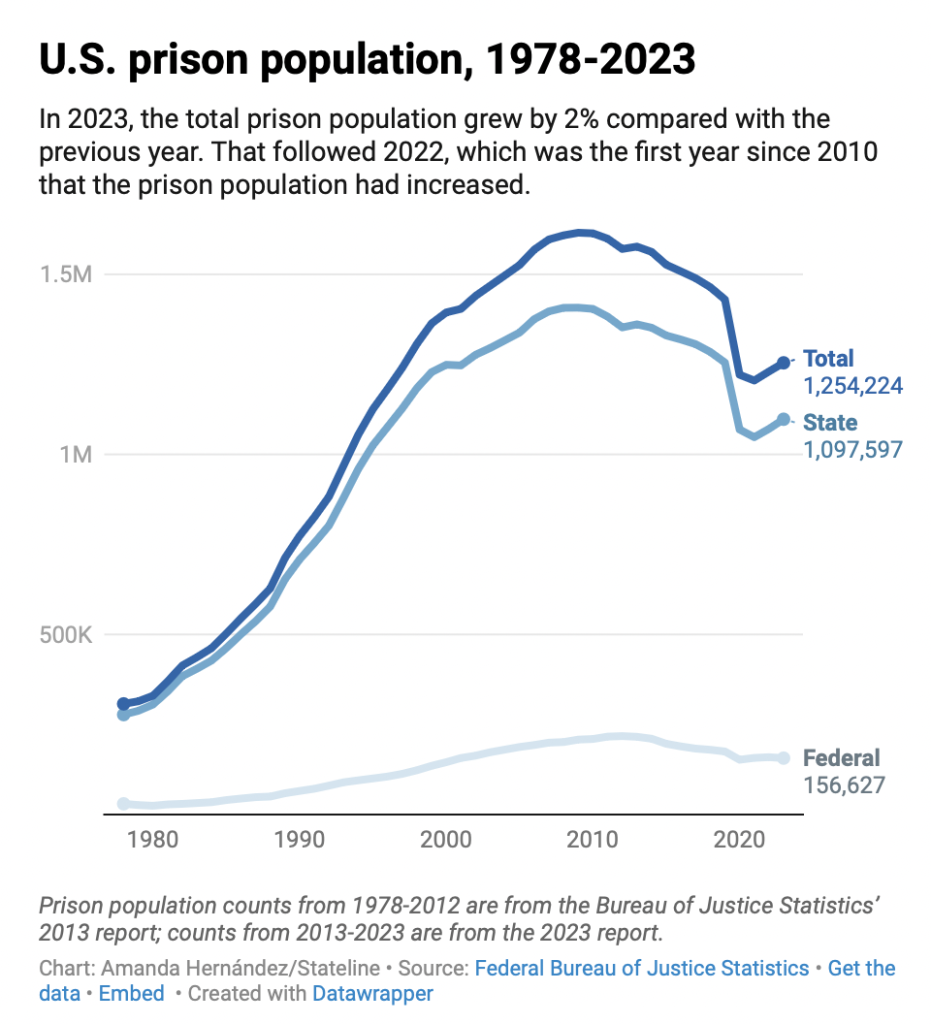
Image

At the same time, homelessness numbers continue to skyrocket, increasing 18 percent, to 771,480 people during the 2024 “point in time” census, which is widely believed to be a massive undercount.

A primary reason why criminalization efforts don’t bring down the number of homeless is that even if the state is arresting and committing people, that does nothing about economic conditions driving people onto the streets. So one person arrested might be replaced by three more who just succumbed to American rapaciousness, such as poverty wages that can’t keep up with astronomical rents (thanks corporate landlord collusion and homebuilder cartels constraining supply!), the explosion of vacation rentals, a healthcare system in which we pay for insurance that denies us care and bankrupts the unlucky, social security payments that don’t keep up with rising rents, and virtually no social safety net.

We can see that many of these conditions help corporations profit off of housed Americans, but the cashing in doesn’t stop once individuals are squeezed out of their home. Once Americans are evicted, there are vultures there every step of the way—from extended stay hotels and rehab facilities to mental health providers and prisons. Private equity plays a role in nearly all of them, such as owning the apartments doing the evicting and then the extended stay hotels which those who are evicted often turn to as an expensive last resort shelter. Here they are sucked dry of their remaining dollars before being thrown onto the streets. Private equity is then involved in potential “solutions” to this homelessness, such as mental health treatment and prison healthcare—its dream setup of virtually no oversight, a captive audience, and steady revenue stream.

Into this system enters Trump 2.0, a par excellence partner-in-crime administration to the private equity vampires. Policies enacted by Trump thus far promise to increase the number of homeless, as well as up ineffective but profitable state intervention while simultaneously doing away with the entire concept of “housing first”—the ONE effective strategy working at the national and local level to get people into stable homes.

Is the government getting it so wrong by accident? Or is it getting very right for its benefactors?

The Criminalization of Homelessness. Cui Bono?

There isn’t any data (that I can find) on the number of homeless arrested since the Supreme Court City of Grant Pass v. Johnson decision, which upheld a ban that criminalizes sleeping in public places.

The result has often been law enforcement simply tearing down homeless encampments, trashing individual’s belongings, and telling them to move along. Where exactly they are supposed to go remains a mystery.

But by adding to the reasons someone experiencing homelessness can be arrested, it does help intensify the homelessness-incarceration complex. Here’s what we already know, courtesy of the University of Cincinnati Law Review:

People experiencing homelessness are 11 times more likely to be arrested than those who are housed…These individuals face increased barriers with respect to court appearances, inability to pay bail, citations, and fines, elevating their risk of conviction.[28] The system is set up to criminalize a person’s status of homelessness rather than helping to address the root causes…

Criminal justice involvement in this issue perpetuates a negative cycle of homelessness and jail, further complicating an individual’s chance of breaking that cycle.[29] Once released from jail, individuals experiencing homelessness prior to jail often return to the streets, only this time facing increased difficulty in finding stable housing.[30] The presence of a criminal record greatly complicates an individual’s chance of securing gainful employment, as many employers may outright disqualify applicants or discourage application by requiring disclosure of criminal history.[31] Additionally, homeless individuals lack access to reliable transportation, suitable clothing, and identification documents to secure employment, making it increasingly difficult to successfully navigate the labor market and break the vicious cycle.

Failure to appear in court or pay low-level citations for quality-of-life offenses associated with homelessness, such as camping outside, public urination, or loitering, can often “indirectly result in arrest and jail time.”

So naturally the prison industry is one of the biggest beneficiaries of the eviction-to-prison pipeline. And in the US, that can sprinkle benefits around to the overlords.

Worth Rises’ The Prison Industry: Corporate Database exposes over 4,000 corporations and investors that profit off mass incarceration. Peruse the list and you’ll notice plenty of familiar names—from big Trump backers like private prison operators, as well as corporations that use forced prison labor.

Healthcare to prisoners is also a major opportunity. With the Los Angeles County jail system the largest “mental health care provider” in the country, those who profit off the police state are more than happy to market themselves as mental health providers, as the Prison Policy Initiative explains:

Jails and prisons are often described as de facto mental health and substance abuse treatment providers, and corrections officials increasingly frame their missions around offering healthcare. But the reality is quite the opposite: people with serious health needs are warehoused with severely inadequate healthcare and limited treatment options. Instead, jails and prisons rely heavily on punishment, while the most effective and evidence-based forms of healthcare are often the least available.

Private equity plays a major role in the private prison healthcare industry, which was estimated to be a $9.3bn business in 2022.

The Guardian recently looked into two of the largest behemoths in the prison health industry – Wellpath and Corizon – which are both backed by private equity investors. What they found wasn’t pretty but expected when you combine private equity with captive customers. It’s like healthcare horror stories from across the country, but on steroids inside prison walls, including:

Staff shortages.
Delays in care.
Severe negligence.
Preventable deaths.

One 57-year-old woman with a perforated stomach, for example, was given tylenol and left alone in a cell where she died. Colleen Grogan, a professor at University of Chicago’s school of social work, tells the Guardian that the reason for Wellpath and Corizon’s continued existence, despite facing scrutiny, is simple: “These private equity firms have a ton of political power, and prisoners are the most vulnerable. The political power dynamics are about the worst they can be.”

That political power has also bought them extra room to profit off of abuse:

And private equity firms have another layer of protection from liability, according to [Brendan Ballou, former special counsel to the Department of Justice’s anti-trust division and author of the book, Plunder: Private Equity’s Plan to Pillage America]. Past court rulings make it difficult to hold private contractors liable for wrongdoing in prisons, and “corporate veil piercing law”, which protects private equity firms from being held responsible for the actions of their investments, makes it very difficult for victims to go after the firms behind the prison health companies that allegedly hurt them. So private equity firms know that even if their prison health investments face a lot of liability, they can remain relatively untouched.

Rehab and Mental Health Service Profiteers

Rehab and mental health treatment might sound like a sound strategy to help individuals who are homeless. After all, drug use and mental health problems are common—although, again, it’s important to stress that those are not believed to be the drivers behind homelessness. In many cases these issues arose or were worsened after becoming homeless. It’s not hard to understand why. Even the threat of losing one’s shelter—let alone it actually happening—can be an enormously stressful experience.

The UCSF study found that many succumb to drugs as a way to numb the pain of being chewed up and discarded by American society. It is also well-established that poverty and homelessness can lead to or worsen physical and mental health. For example, a recent study published in the Journal of Psychiatric and Mental Health Nursing finds that food insecurity is linked to mental illness. And studies have shown PTSD is common after losing one’s home.

Still, rehab and mental health treatment couldn’t possibly hurt, right? But when you start to remember what a pile of steaming fraud and abuse the American healthcare system is, it starts to look less like an avenue of assistance and more of a way to cash in on despair.

Here’s the Wall Street Journal a few weeks back on drug rehab centers that lure in patients to bilk their insurance before leaving them on the street:

Fraud has become a multimillion-dollar problem in America’s booming rehab industry, according to state officials, lawsuits filed by insurers and former clients, and federal indictments and convictions.

The rehabs are often in locations that people might be tempted to travel to, such as beachside cities in Florida. It’s become especially prevalent in California, where operators have discovered a steady stream of revenue by luring people with addiction from across the country and billing their private insurance. Lawsuits and federal cases allege that rehabs can charge insurance hundreds of thousands of dollars for a few months’ stay, but offer little in the way of treatment.

Oftentimes, illicit drugs are common at the run-down facilities patients are shuttled between. Recruiters help patients purchase plans under the Affordable Care Act that include federal subsidies and oftentimes no out-of-pocket costs for individuals below a certain income level.

What happens when the insurance money runs out? Patients who are sometimes now far from home are dumped on the streets without even a referral, potentially with a worse drug habit than when they began “rehab,” where they join the swelling ranks of the homeless.

“They’re just churned like cattle until they’re dead or homeless on the streets,” Dan Kreitman, who ran the special investigations unit at insurer Centene, told the WSJ.

Other profiteers have sunk their teeth into mental health, which might use a different strategy than rehab center recruiters, the results are the same: making it even more difficult for those who need help.

The Trump administration and states turn to forced institutionalization happens to coincide with private equity spreading its tentacle through the mental health care industry, largely driven by Affordable Care Act provisions requiring coverage of such care for as long as patients need it. From a recent ProPublica investigation:

More than 40% of inpatient mental health beds were operated by for-profit entities as of 2021, according to unpublished data from Morgan Shields, an assistant professor at Washington University in St. Louis who studies quality in behavioral health care. That’s up from about 13% in 2010.

And with that trend comes the usual degradation of services. ProPublica found that more than 90 psychiatric hospitals violated the Emergency Medical Treatment and Labor Act in the past 15 years. Roughly 80% of them are owned by for-profit corporations, and only a few have faced even meaningless fines. In most cases the U.S. Centers for Medicare and Medicaid Services and the inspector general of the Department of Health and Human Services simply ignore the law breaking.

Chief among the violations are efforts to increase profits by denying care to patients without insurance or with lower-paying forms of insurance and turning away more complicated patients who might require more staffing and other costs.

Outside of these schemes, wait times to access services can be excruciatingly long. From the Vera Institute:

In the United States, people must wait an average of 48 days to access mental health or substance use services, and many struggle to afford needed services that are inaccessible without insurance.

This is the poison pill in Trump, as well as Democrat plans to “treat” the homeless. They want to blame mental health and addiction, but don’t want to spend the massive amounts of money that would be required to effectively provide services. They’re effectively bypassing the simpler, cheaper, and more humane solutions of affordable housing and accessible voluntary care to the most expensive and most invasive—without providing the funding for it.

In Oregon, for example, it costs about $321,000 to commit one person at the state hospital for six months. You can do the math from there.

And even if the US had the capacity to forcibly treat people as Trump’s plan prescribes, studies show that coerced treatment is not effective —and as evidenced by Newsom’s “CARE Courts” in California, judges are reluctant to force people into a broken state conservatorship system and shoddy facilities.

The fact that these forced treatment policies are designed to fail make them appear as a smokescreen for the real plan. The one area that does keep receiving plenty of funding, though, is prisons—thanks to the bipartisan tough-on-crime consensus. And so what ends up happening is that everything gets funneled into the criminal justice system. Again from the Vera Institute:

While waiting lists for community-based psychiatric and mental health services grow longer, jails and prisons fill up with people experiencing treatable mental health conditions. Nonviolent behaviors associated with mental illness that could be avoided with adequate support—like loitering, disorderly conduct, and trespassing—are criminalized, resulting in the incarceration of people who need treatment, not punishment.

It’s an unmitigated disaster on all fronts. Let’s review:

Attention is being intentionally diverted away from the real drivers of homelessness.
This ensures more will lose housing and end up on the streets.
That experience can lead to or worsen addiction or mental health problems.
Legitimate treatment is hard to access.
Scams are common, making homeless individuals less likely to accept treatment.
Coerced treatment is ineffective, and the funding isn’t there to even do it.
And in the end, the eviction to prison pipeline keeps churning faster.

It’s failure every step of the way and ones that are being doubled down on. Barring some sort of international intervention, it’s hard to see it getting any better. This is bipartisan policy.

Democrats already have their Silicon Valley-pleasing “Abundance” teed up for 2026 and 2028. This neoliberal philosophical retread promises to cut red tape and give more power to Wall Street and Silicon Valley, which already dominate what passes as social planning in the US.

And if that power continues to accumulate in these eugenicist centers, there are plenty of even more dystopian possibilities, as detailed here:

Image

As of now, the Trump administration is doing everything it can to accelerate the problem. Here are a few examples:

It is cutting mental health programs.
It is decimating services for people with developmental disabilities.
It just ended federal support for disabled Americans facing homelessness.
Does it get any clearer than trying to increase the number disabled who are unhoused while simultaneously criminalizing homelessness?

Wait, there’s more. Mass firings have begun at the Department of Housing and Urban Development (HUD). The ultimate goal there is believed to be the stripping of some four million people of federal housing assistance. Here’s ProPublica on the yet-to-be-published rules:

The rules would pave the way for a host of restrictions long sought by conservatives, including time limits on living in public housing, work requirements for many people receiving federal housing assistance and the stripping of aid from entire families if one member of the household is in the country illegally.

Should the rules take effect, it would mean roughly half of the eight million-plus individuals receiving federal housing support could lose it. Who are they? According to HUD, the majority are elderly, disabled or children. The average family that lives in public housing or receives housing vouchers already has a family member that works, but they make less than $20,000 annually.

Many of those who might lose assistance would likely become homeless as a result.

And HUD’s own analysis shows that many public housing units may initially be left vacant as a result of the proposed rules.

Perhaps investors can snap them up at bargain prices.

Image

To end with a hint of optimism, at least we know what works, at least it’s clear what is causing the rise in homelessness—even if elected officials pretend otherwise. And we also know what works to get people back into housing—even if elected officials are killing these programs.

Housing First has proven effective. HUD and the US Department of Veterans Affairs were finding major success getting veterans into permanent housing with this approach.

And if the eviction to prison pipeline is shut down, real progress could be made in ending the national disgrace of hundreds of thousands of Americans sleeping on the streets. Unfortunately there is almost zero discussion of this by either of the two parties we’re gifted with in the “greatest democracy in the history of the world.”

To fill that void some Americans are just maybe starting to organize to do something about it themselves. We’ll look at those efforts next week.

https://www.nakedcapitalism.com/2025/10 ... sness.html
"There is great chaos under heaven; the situation is excellent."

User avatar
blindpig
Posts: 14788
Joined: Fri Jul 14, 2017 5:44 pm
Location: Turtle Island
Contact:

Re: The Nature of Foxes

Post by blindpig » Fri Oct 24, 2025 1:33 pm

Scheme
October 24, 8:51

Image

Scheme.

Image

1. We support jihadists to fight the Soviet Union in Afghanistan and declare them freedom fighters.
2. We use the Muslim Brotherhood to destabilize autocratic regimes in the Middle East and North Africa.
3. After using them, we declare the former "freedom fighters" to be terrorist organizations.
4. We invade the country where we previously supported the "freedom fighters" and seize power there, installing a puppet regime.
5. At the same time, not a single terrorist group that was a "freedom fighter" has been completely destroyed.

Image

1. We support drug cartels in Latin America to fight communist influence in the region and call them "fighters against communism."
2. We use drug cartels to destabilize local socialist regimes and guerrilla factions of Marxist and Maoist persuasions.
3. After using them, we declare the former "fighters against communism" to be drug cartels and criminals.
4. We invade countries where we previously supported "anti-communist fighters," seize power, and install puppet regimes.
5. I think you understand what will happen after such "anti-drug" invasions.

https://colonelcassad.livejournal.com/10147329.html

Google Translator
"There is great chaos under heaven; the situation is excellent."

User avatar
blindpig
Posts: 14788
Joined: Fri Jul 14, 2017 5:44 pm
Location: Turtle Island
Contact:

Re: The Nature of Foxes

Post by blindpig » Thu Oct 30, 2025 2:18 pm

The United States will resume nuclear testing.
October 30, 10:45

Image

Trump announced today that the United States will resume nuclear testing.

The time and location of the nuclear tests will be announced later. This is a request to dismantle the Treaty Banning Nuclear Tests in All Environments, given the ongoing modernization of nuclear bombs.
Russia's position on this matter is simple: Russia will not be the first to violate this treaty, and if the US actually conducts nuclear tests (and not just a simple computer simulation of nuclear explosions), Russia will do so as well.

Image

The test site on Novaya Zemlya is fully prepared for this, and even after the start of the Joint Military Operation, work was underway to prepare it for the eventuality of a political decision to conduct nuclear tests. Back in November of last year, the Russian Ministry of Defense announced that the nuclear test site on Novaya Zemlya was ready for nuclear tests.

Image

P.S. A Nevada congresswoman hysterically stated that she will not allow Trump to conduct nuclear tests on state soil. Nevada is home to one of the oldest nuclear test sites in the US. There will be attempts to block the tests through the US Congress.

https://colonelcassad.livejournal.com/10158402.html

Google Translator

*****

Exclusive: Three-star general pushed out amid tensions with Hegseth
By CNN Expansion DC - November 2021, Shoot ID: 1089822 , 11/15/2021, Natasha Bertrand
Natasha Bertrand

Image
Then-Maj. Gen. Joe McGee, outgoing commander of the 101st Airborne Division (Air Assault), delivers remarks during the division Change of Command ceremony at Fort Campbell, Ky., July 20, 2023. Sgt. Andrea Notter/101st Airborne Division/DVIDS

A three-star general serving on the Pentagon’s Joint Staff has been pushed out of his position following months of sustained tensions with Secretary of Defense Pete Hegseth, according to people familiar with the matter. The general’s stalled promotion also contributed to his early retirement, the sources said.

Lt. Gen. Joe McGee, the director for Strategy, Plans, and Policy on the Joint Staff, left his position earlier this month, the sources said. They added that McGee had frequently “pushed back” against Hegseth and Chairman of the Joint Chiefs of Staff Dan Caine on issues ranging from Russia and Ukraine to military operations in the Caribbean. The sources noted that McGee was nominated by former President Joe Biden nearly a year ago for a promotion to serve as director of the Joint Staff but was never renominated by the current administration.

McGee’s primary responsibility in the role was to advise Caine on long-term military strategy including weighing the risks of potential actions and planning for crisis contingencies.

“He has had a target on his back for a while now,” one of the sources said of McGee. Two other sources said there were discussions internally as far back as the spring about pushing out McGee.


Caine and Hegseth also got frustrated with McGee at times because they believed he moved too slowly, one of the sources said.

At the same time, some in the Office of the Secretary of Defense saw McGee as too close to the “old guard” of the Pentagon, particularly former Chairman of the Joint Chiefs Gen. Mark Milley and former Secretary of Defense Lloyd Austin, one of the sources said.

McGee did not immediately respond to a request for comment.

Chief Pentagon spokesman Sean Parnell said in a statement that “General McGee is retiring, and the war department is grateful for his service.” He denied CNN reporting that Hegseth and McGee had clashed.


“Lt Gen. JP McGee will retire after nearly three years of outstanding leadership and service on the Joint Staff. We are grateful for his 35 years of honorable and dedicated service to the Nation,” a Joint Staff spokesperson told CNN. “We owe him a great debt for his service and it is regrettable anonymous sources would put the focus anywhere else.”

Hegseth has pushed out more than a dozen senior military officials since taking office in January, including the Chairman of the Joint Chiefs CQ Brown, the Chief of Naval Operations, the directors of the National Security Agency and Defense Intelligence Agency, and the top uniformed lawyers for the Army and Air Force.

All were suspected of being insufficiently aligned with Hegseth’s agenda, CNN has reported.

(More at link.)

https://us.cnn.com/2025/10/29/politics/ ... r-tensions

The US military professionals ain't nothin' to write home about and while their replacements will probably be even more incompetent they will probably be christo-fascist ideologues too. Not good.
"There is great chaos under heaven; the situation is excellent."

User avatar
blindpig
Posts: 14788
Joined: Fri Jul 14, 2017 5:44 pm
Location: Turtle Island
Contact:

Re: The Nature of Foxes

Post by blindpig » Sat Nov 08, 2025 2:58 pm

People Still Lose The Sight ...

... of the issue. No, it doesn't have to be in the US Dollars.


The ONLY dominating reason for the primacy of the US Dollar (aka Petrodollar) in the hydrocarbons trade was not some magical financial BS, albeit not without it, no--the main reason was a perception that the US CAN enforce the use of a US Dollar by means of its grossly exaggerated military power. Period, everything else was secondary. Now, suddenly, US has been exposed as a military paper tiger and the world took a note. Can US enforce anything with China? Of course not, not to mention the gargantuan scale and diversification of Chinese economy which dwarfs that of the US. Can the US enforce anything against Russia? Well, unlike US military academies and Pentagon, military people around the world actually DO study real military science and operations. They also study REAL military history and they know the score, especially against the background of SMO. Soooo .... ?

You get the picture, right? The US zenith as global economic power is over, if you doubt it--go to Walmart or COSTCO. The main issue now is how to preserve remaining American industrial capacity and expertise. Expansion? Seriously? Military-wise, you all know by now what it all turned out to be--a simulacrum, a projection by Hollywood primarily and by Wehrmacht. US military is obsessed with Wehrmacht as happens with impressionable and obsessive child who endows some adult person with qualities this child desperately wants to posses, not understanding that this adult is just average and lacks those qualities. It is called projection. Read it, read it attentively--it implicitly answers the question why Sarah Paine is "moron with Ph.D." and why the US military is primarily a figment of imagination of people like her. I speak about it in my video today and about how Epistemic Closure looks like. Here is a simpler explanation:

The term "epistemic closure" has been used in an unrelated sense in American political debate to refer to the claim that political belief systems can be closed systems of deduction, unaffected by empirical evidence. This use of the term was popularized by libertarian blogger and commentator Julian Sanchez in 2010 as an extreme form of confirmation bias.

Emphasis on empirical evidence. That is why the US lost all of its wars and lost its grossly exaggerated status as a preeminent global power.

http://smoothiex12.blogspot.com/2025/11 ... sight.html
"There is great chaos under heaven; the situation is excellent."

User avatar
blindpig
Posts: 14788
Joined: Fri Jul 14, 2017 5:44 pm
Location: Turtle Island
Contact:

Re: The Nature of Foxes

Post by blindpig » Sat Nov 15, 2025 3:42 pm

US Inequality Is Way Past Revolution Time
November 14, 2025

New Report: The rich are richer than the Gilded Age and half of all U.S. children live in poverty, writes Lee Camp.

Image
Tents on West Madison Street, Phoenix, near homeless shelter services. (Thayne Tuason, CC BY 4.0, Wikimedia Commons)

By Lee Camp
Lee Camp & Dangerous Ideas

One would think that perhaps the greatest benefit of being a cog in the wheel of a bloodthirsty, predatory, wholly unaccountable, rapacious global empire is being rich. Not rich in an Elon Musk/Monopoly Guy kinda way but rich in a not languishing in poverty kinda way.

But this is not true. A large percentage of Americans never get to touch the spoils of hegemony.

“Over 40% of the U.S. population—including 48.9% of children—is considered poor or low income.”

You read that right. According to a new Oxfam report, half of all American children live in poor or low-income homes. … HALF.

When mapped out clearly for all to see, US inequality levels show that the country is way past revolution time. … Sorry, let me rephrase that. It’s waaaaaaaaaaaay past revolution time.

Let your brain try to make sense of these other stats from the Oxfam report:

“In the past year, the 10 richest U.S. billionaires gained nearly $700 billion…”

Fun fact: If you make $60,000 a year after taxes, in order to make $700 Billion, you’d need to work for nearly 12 million years.

“The richest 1% own half the stock market (49.9%), while the bottom half of the U.S. owns just 1.1% of the stock market.”

“The richest 0.0001% control a greater share of wealth than in the Gilded Age, an era of U.S. history defined by extreme inequality.”


Image

So we’ve surpassed the Gilded Age. I guess no one should be shocked that Donald Trump (the first billionaire president) unironically held a Great Gatsby-themed party a few weeks ago at Mar-a-Lago. Parasites are rarely bashful or timid. They don’t say “excuse me” and they don’t ask permission. They just latch on and suck.

And of course any analysis of inequality tends to also have a race factor, or rather a racism factor, seeing as much poverty in America connects in one way or another to our systemic racism.

“Black and Hispanic/Latin households hold 5.8% of U.S. wealth but make up an estimated one-third of the population…”

Image
Seattle, 2011. (Joe Lauria)

But wealth, or lack thereof, always strikes me as a vague measure until it’s connected to things like health and struggle and death. The report helps us do that too:

“Looking at the 10 largest economies in the Organization for Economic Co-operation and Development (OECD), the U.S. has the highest rate of relative poverty, the second-highest rate of child poverty and infant mortality, and the second-lowest life expectancy.”

Poverty kills. That’s the cold truth. Poverty is not just the inability to purchase the latest video game you really want. It’s not just your car bumper being held on with duct tape or your adult toy no longer vibrating properly but still being used because you can’t afford the new model. Poverty actually kills. In fact, poverty is the fourth leading cause of death in America.

When this data is all taken together, it becomes clear the US has long surpassed revolution time.

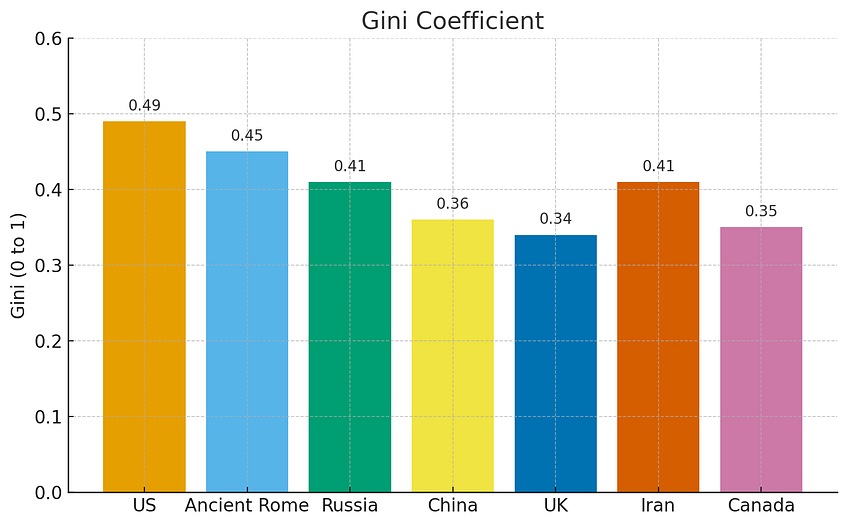
The Gini Coefficient is a measure of inequality in a society where 0 represents perfect equality and a score of 1 represents perfect inequality. Although there’s no hard-and-fast rule, when it gets over a certain point, revolution becomes highly likely. Well, hang on to your pantaloons — the U.S. currently has a Gini Coefficient worse than Ancient Rome before its collapse.

Image
(Lee Camp)

Further pantaloon-tugging knowledge: Studies have shown a correlation between a high Gini Coefficient and revolution or revolt.

The Gilded Age ended with the New Deal, which “saved capitalism,” for a time. The richest people in America realized — thanks largely to the Bolshevik Revolution — that they needed to decrease inequality in the US or the people, who were being treated with all the love and humanity one shows a toilet brush, would revolt and put the gilded men’s bulbous heads on gilded pikes.

Capitalism, when left unattended, eats itself, the society, the world. Capitalism is cancer. With loads of radiation or chemo, you can often keep cancer at bay for a while. But with capitalism, no cure or remission is ever possible without revolution and revolutionary ideas. Outside of that, we all just wait to see how long it will take before there are no more trees, or water, or fish.

https://consortiumnews.com/2025/11/14/u ... tion-time/

'waaaaaaaaaaaay past revolution time', indeed. We can complain about the multitude of mind fucks inflicted upon the citizenry to keep the vast majority docile, but fact is there is no pushback at scale. There is no Party that seems capable of leading our class, there are no leaders willing to take responsibility and LEAD. And put away that infantile anti-authoritarian/hierarchy bullshit, Bakunin would slap Abbie Hoffman silly(Leave the real arguments for later). Organization is the ONLY means for our class to overcome the Owners. Time really is wasting.
"There is great chaos under heaven; the situation is excellent."

User avatar
blindpig
Posts: 14788
Joined: Fri Jul 14, 2017 5:44 pm
Location: Turtle Island
Contact:

Re: The Nature of Foxes

Post by blindpig » Mon Dec 01, 2025 3:19 pm

Revolution on Our Mind: Two Hundred Fifty Years Since the Declaration of Independence

Next year will mark 250 years since the “official” date assigned to the rebellion against British sovereignty in its North American colony, popularly known as the “American Revolution.” In early July of 1776, a number of prominent figures and leaders of colonial resistance to the authority of the English Crown met in the port city of one of the English colonies and signed a resolution and an audacious document declaring independence. The impressively crafted and innovative document drew an administrative and military response from English authorities in both London and the colonies and forced the colonies to plan their next defiant move. If Philadelphia was the cradle of the revolution, the Declaration of Independence was its founding document.

As with past celebrations of the revolution, there will be reenactments, speeches, and other self-congratulatory virtue-signaling. Politicians will compete to ascribe their own views to the founding principles. Every opportunity will be taken to commercialize the event from Ken Burns’ calculated-to-be-unchallenging televised take (already underway!) on the colonial uprising to meaningless flyovers of outdoor events and endless volleys of fireworks.

Anniversaries, like next year’s, understandably bring out a reconsideration, a reevaluation, and a renewed search for the meaning of the widely regarded event. And given the fractures in US politics, the conclusions will be contested between diverse perspectives and hostile ideologies. For many, if not most, the US is at a crossroads and understanding its past is likely a crucial determinant of the way forward.

One must begin with the account of the revolution foisted on young minds in the mandatory American History classes of the US public high schools. While these courses may stop short of the extreme fabulism of Founding Father sainthood, they reproduce the mythology of the liberation of a “discovered” land marching through history as a virtuous exception to the greed and malice of the old world and a benevolent friend to those seeking to escape oppression and backwardness. Unfortunately, these classes too often stamp an indelible, lingering impression on those who suffer this miseducation.

The venerated writers, Charles and Mary Beard, in their now-neglected 1927 classic, The Rise of American Civilization, sharply dismiss the crudest contending myths:

The oldest hypothesis, born of the conflict on American soil, is the consecrated story of school textbooks: the Revolution was an indignant uprising of a virtuous people, who loved orderly and progressive government, against the cruel, unnatural, and unconstitutional acts of King George III. From this same conflict arose, on the other side, the Tory interpretation: the War for Independence was a violent outcome of lawless efforts on the part of bucolic clowns, led by briefless pettifoggers and smuggling merchants, to evade wise and moderate laws broadly conceived in the interest of the English-speaking empire. Such were the authentic canons of early creeds.

With the flow of time appeared some doubts about the finality of both these verdicts.

The Beards, like many others, especially those in the Marxist tradition, understood the role of both class and economic interests in the unfolding of the revolution. Their work joins with the account of the equally underappreciated Marxist scholar, Herbert Morais, in stressing the importance of English mercantilism in generating the contradiction between England and its colonies. In The Struggle for American Freedom (1944), Morais recognizes the tension between merchants and manufacturers in England and the New World, especially in New England:

While the southern provinces could be made to fit into the English mercantile system, the New England colonies could not. The simple reason for this was that they produced practically nothing which the mother country wanted. Their farm products-- wheat, rye, barley, and oats-- were like those in England. Their fisheries served only to draw away profits from English fishermen and to hamper the growth of the English fishing fleet. The rapidly developing industries of New England acted as a direct threat to the prosperity of English manufacturers who considered the colonies an outlet for their goods. New England shipping drained off English seamen and competed with English traders for the commerce of the West Indies, the Wine Islands, and the Mediterranean.

While the southern colonies did indeed enjoy strong trade with the “motherland” -- tobacco, indigo, rice-- their perpetual debt to English financiers gave reason to coalesce with Northern resistance.

For Morais, this contradiction-- especially in the shadow of England’s Glorious Revolution of 1688-- soured “imperial-colonial relations”:


English control over America was extended by converting proprietary and corporate colonies into royal provinces, a move which was obviously dictated by the mercantilistic interests of the English ruling classes. In all of the royal colonies dual power existed: the governor representing the external authority and the colonial assembly the internal. Throughout the provincial period (1689-1763), these two forces struggled for supremacy, the fundamental issue at stake being: Who was to rule over America?

Is Morais likening the period of dual power in the colonies to the dual power between the Soviets and the Duma before the 1917 October Revolution in Russia? Is he suggesting that economic friction between two class hierarchies-- one in England, one over three thousand miles away-- led to an unsustainable dual power, resolved by revolution?

For Morais, the colonial agency for this struggle for power came from two class bases: the aggrieved “merchant and planter classes” and the working classes-- farmers, mechanics, artisans, and day laborers. These classes united under the banner of revolution, but pursued two distinct struggles: “...the struggle for self-government and national independence and the struggle among the American people themselves for a more democratic order.”

Herbert Aptheker, a Marxist historian and admirer of Morais, writing in The American Revolution 1763-1783 (1960) accepted Morais’ two struggles, and added a third current:

The American Revolution was the result of the interpenetration of three currents: the fundamental conflict of interest between the rulers of the colonizing power and the vast majority of the colonists [Morais’ struggle for national independence]; the class stratification within the colonies themselves and the resulting class struggles that marked colonial history which almost always found the British imperial power as a bulwark of the reactionary or the conservative interests in such struggles [Morais’ struggle for a more democratic order]; and the developing sense of American nationality, transcending class lines, which resulted from the varied origins of the colonies’ peoples, their physical separation from England, the different fauna and flora and climate of their surroundings, their different problems and interests, their own developing culture and psychology and even language, their common history, and from their own experience of common hostility-- varying in degree and place and time--- towards the powers-that-be in England.

Aptheker’s third current assumes a more fully developed “American” identity than evidence permits. Many historians note that inhabitants of the colonies maintained a closer identification with their specific colony-- Massachusetts, Virginia, etc.-- than with the entire largely English-speaking North American project. Moreover, nearly all concede that the population was divided deeply between Patriots, neutrals, and Tories (Richard Bell calculates that roughly 40% of colonists were Patriots, 40% were indifferent, and 20% Tories, in his excellent The American Revolution and the Fate of the World (2025)). With these divisions, the revolutionary era was hardly fertile soil for a widely accepted national identity.

In fact, Aptheker may be confusing cause with effect; the revolution created a national identity, rather than being the cause of it.

Aptheker reminds us that V.I. Lenin, in his Letter to American Workers (1918) famously wrote that:

The history of modern, civilised America opened with one of those great, really liberating, really revolutionary wars of which there have been so few compared to the vast number of wars of conquest which, like the present imperialist war, were caused by squabbles among kings, landowners or capitalists over the division of usurped lands or ill-gotten gains. That was the war the American people waged against the British robbers who oppressed America and held her in colonial slavery, in the same way as these “civilised” bloodsuckers are still oppressing and holding in colonial slavery hundreds of millions of people in India, Egypt, and all parts of the world. [my emphasis]

The highlighted area is often cited without reference to Lenin’s comparison with the mindless, bloody clashes of empires, fought not over any liberatory cause, but from personal or ruling-class interest. It is sometimes overlooked that Lenin goes on to laud with equal or greater enthusiasm “...the immense, world-historic, progressive and revolutionary significance of the American Civil War of 1863-65!”. It reminds us that Lenin always ascribes “revolutionary significance” in the context of time and place. The “greatness” of the American Revolution draws its greatness from the context of an original, successful, and unlikely national liberation. Yes, it is a national liberation tarnished by the original sin of aboriginal displacement and genocide and stained by the national embrace of chattel slavery.

For some, the “greatness” of the American Revolution is a challenging reach. Marxist Eric Hobsbawm, comparing the US colonial revolution with the French Revolution, observes in his Echoes of the Marseillaise (1990):

Indeed, the comparatively modest international influence of the American Revolution itself-- must strike the observer. As a model for changing social and political systems it was absorbed, as it were, and replaced by the French Revolution, partly because reformers or revolutionaries in European societies could recognize themselves more readily in the ancien régime of France than in the free colonists and slave-holders of North America. Also, the French Revolution saw itself, far more than the American had, as a global phenomenon, the model and pioneer of the world’s destiny.

Some might point to Hobsbawm’s reference to “reformers or revolutionaries in European societies” as reflecting a narrow Eurocentric view of the impact of the US revolution, noting that a vastly influential Asian revolutionary like Ho Chi Minh cited the Declaration of Independence as enormously influential to the Vietnamese struggle for independence. Moreover, Richard Bell’s recent book-- cited above-- argues persuasively that the revolution’s reach was global and profound:

…winning independence required a world war in all but in name. What began as a domestic dispute over taxes, trading rights, and home rule soon metastasized into something much bigger and broader, pulling in enslaved people as well as Native people and French and Spanish speakers living along the length of the Mississippi River. And it kept expanding outward, reverberating across every habitable continent and spreading tumult, uncertainty, and opportunity in all directions.

Marxist William Z. Foster would largely agree, though he would place the US revolution in the context of a long period of “hemispheric revolution,” stretching for about sixty years: “The several national political upheavals constituted one general hemispheric revolution. Taken together, they were by far the broadest revolutionary movement the world had known up to that period.”

For Foster, in his Outline Political History of the Americas (1951), “The heart of this great movement was a revolutionary attack against the feudal system. It was the broad all-American bourgeois, i.e., capitalist, revolution.”

The broad hemispheric revolution may be made to fit revolutions against feudal relations to some extent, if we view Spanish and Portuguese domination as imposing the mother countries’ feudal system on their colonies. But surely England was not imposing feudalism on its colonies, since both the 1640 revolution and the so-called “glorious” revolution of 1688 had liberated England from nearly all but the ceremonial grip of feudal absolutism. And the quasi-feudal slavocracy of the Southern states was left largely untouched by the rebellion against England.

Perhaps Foster meant to take the US revolution as a rebellion against the vestiges of feudalism-- the imperious reign of the monarch, George III-- existing in a country well on its way toward bourgeois domination. Or maybe Foster saw the frequent royal granting of vast tracts of land to favored absentees or expatriates as an expression of feudal grants, though they did not result in classic feudal manorial relations.

Leftist historian, Greg Grandin, would agree that the rebellion in the North American colonies had an impact far beyond that sliver of coastline: “And so Spain joined France [in supporting the colonial cause] escalating a provincial rebellion into an imperial world war: Charles and Louis against George.” In his ambitious and insightful America, América: A New History of the New World, Grandin shows that the “hemispherical revolutions” while sharing much, also differed radically in their fundamental assumptions. In the English-speaking North, there was a privileged sense of destiny, of self-righteousness, while the Southern rebellion sought dignity and independence. Grandin expressed the difference through the voices of leading intellectuals:

Compare… Venezuela’s independence manifesto… to [the] Declaration of Independence. History barely gets a tug from Jefferson. All is nature, freed from the burden of society. All the New World’s evils are placed at the feet of King George. The original settlers and their heirs who claimed the land and drove off its original inhabitants did no wrong. They only suffered wrongs. For John Adams, North America was “not a conquered, but discovered country.”

In contrast, [for Jefferson’s Venezuelan counterparts], the New World wasn’t discovered, but “conquered.” They knew that America was a stolen continent. The Conquest hovers over their independence manifesto, an event so vile it set the course for centuries of human events.

How these differences play out over a century of conflict, mistrust, and intervention between North and South is the subject of Grandin’s 2025 book, where he recounts their different trajectories-- framed by discovery or conquest-- and how those differing ideas shaped the world.

We gain much in understanding the historical limitations of the US rebellion by comparing its foundations with that of the other national liberation movements in the Americas.

Important Left historian, Gerald Horne, casts further shade over the eighteenth-century uprising by declaring it not a revolution, but a counter-revolution against the anticipated outlawing of slavery in England. Horne’s provocative thesis in The Counter-Revolution of 1776: Slave Resistance and the Origins of the United States of America (2014) argues that the avowed high-minded principles of the revolution’s elites were overshadowed by the interests of the slaveholding planters (the majority of the Declaration’s signers were slave-owners). While indisputable evidence of the so-called Founding Fathers’ ultimate motivation would be hard to come by, their material interests are certainly relevant. By reminding us of those slaveholding interests, Horne is rendering a service, just as Charles Beard did with his An Economic Interpretation of the Constitution (1913), by serving as a reminder of the racial and class interests of the revolution’s leaders and the Constitution's authors. Yet both limit the meaning of the revolution and the Constitution to those narrow interests and deny the role of the broader masses on determining the revolution’s fate and impact.

Arguably the most well-known left account of the revolution is found in Howard Zinn’s widely influential A People's History of the United States (1980). Zinn-- an active participant in the post-Red Scare US New Left-- takes a radically different tactic from Horne and others influenced by Marx. For Zinn, elites were constantly seeking to tame, to restrain, to channel the direction of energized masses away from revolution, away from decisive action. Drawing from the history-from-below school of historical studies and adhering to the 1960s student-left ideology of radical democracy, he stresses the spontaneity and self-motivation of common folk. One might say that his analysis of 1776 foretells the Occupy movement of our time:

Mechanics were demanding political democracy in the colonial cities: open meetings of representative assemblies, public galleries in the legislative halls, and the publishing of roll-call votes, so that the constituents could check on representatives. They wanted open-air meetings where the population could participate in making policy, more equitable taxes, price controls, and the election of mechanics and other ordinary people to government posts.

Rebellion is natural and instinctive for Zinn, as he experienced it with 1960s youth. The danger is perceived as conservative elements, elites, authoritarians, fear-mongers, or others obstructing the wave of spontaneous social change. It is an appealing, though romantic view, and one that continues to seduce many who obstinately resist the necessity of planning and organization in social change.

For each interpretation of the US revolution discussed here and many others unmentioned, there are sets of particular circumstances-- like those of Zinn-- that shaped that interpretation to a greater or lesser extent. Each writer wrote at a time and place that shaped how they would think about the revolution.

Charles and Mary Beard's thinking was undoubtedly influenced by their knowledge of populist risings of the late nineteenth century that brought class questions to the fore. They looked at the revolution through that lens.

Hobsbawm’s negative view of the significance of the US revolution came at a time of the collapse of socialism in Eastern Europe that surely added to his growing skepticism about revolutionary change. Only the iconic French Revolution remained of historic significance to him.

Aptheker, writing with the popular front to his back and facing a hell of McCarthyite red-baiting and repression, understandably stressed the political innovations of the US revolution, especially its rejection of official oppression and its call for liberty.

For Grandin, his long engagement supporting solidarity movements with Central and South America unsurprisingly influenced his circumspection regarding the US revolution.

And Horne’s reinterpretation came amidst growing frustration with officially tolerated, if not encouraged, violence and murder of Black people. Its coincidence with the Black Lives Matter movement gave it greater relevance. And undoubtedly, it gave inspiration to the New York Times 1619 Project, which commanded attention in the struggle against racism.

Whether we like it or not, next year's orgy of celebration will conjure a myriad of interpretations of the “American Revolution” with a myriad of claims about their significance for today. The entire political spectrum will offer lessons of the revolution for those seeking an exit from the profound crises of this moment. In reality, much can be learned from a study of the period, making participation in the discussion worthwhile and necessary.

In that regard, consider the observations of the then-Soviet scholar, Vladimir Sogrin. In Founding Fathers of the United States (1988), he wrote:

The historical situation, the unique natural conditions and geographical position were propitious for the development of the progressive social system in the United States. It emerged as a bourgeois state, bypassing all the preceding socio-historical formations, so that American capitalism did not have to destroy feudal foundations, a process which took other countries scores and even hundreds of years to complete. This enabled the bourgeois socio-economic system to advance with seven-league strides, and speeded up the establishment in the country of republican and other progressive principles inscribed on the banner of the Enlightenment…

Acknowledgement of the progressive nature of the transformations effected by the American Revolution and the American Republic gives no grounds for their idealization. American liberal historians’ attempts to prove that an “empire of reason”, which the European enlighteners dreamed about, was established in North America under the impact of the revolution is to me an example of an apologetic interpretation. The ideals of the Enlightenment were by far not realized, like, for instance, its fundamental principle of equal legal and political rights for all, as it did not embrace the blacks, Indians, women and indigent white men…

The US War of Independence ushered in, rather than completed, the era of bourgeois revolutions in North America.

We should ponder whether today--nearly two hundred and fifty years later-- the US is ripe for another revolution, a revolution that would take us well beyond the revolution conjured by the fifty-six lawyers, merchants, planters, and elites who gave us the original Declaration. May the next one be for independence from capitalism.

Greg Godels

zzsblogml@gmail.com

https://zzs-blg.blogspot.com/2025/11/re ... ndred.html
"There is great chaos under heaven; the situation is excellent."

User avatar
blindpig
Posts: 14788
Joined: Fri Jul 14, 2017 5:44 pm
Location: Turtle Island
Contact:

Re: The Nature of Foxes

Post by blindpig » Wed Dec 03, 2025 3:49 pm

The Former Israeli Spies Overseeing US Government Cyber Security
Nate Bear
Dec 03, 2025

Image

A company with deep ties to Israeli intelligence oversees cyber security across more than seventy US government agencies, including the Department of Defense and Homeland Security.

Axonius was founded by former spies in Israel’s Unit 8200 and its software, which allows an operator ‘visibility and control over all types and number of devices,’ collects and analyses the digital data of millions of US federal employees.

The stated aim of the Axonius platform is to centralise IT tools to identity and fix security breaches. As a product of Israeli intelligence, however, the scale of Axonius’s use across the US government raises serious questions.

Axonius was founded and is currently run by Israelis Dean Sysman, Ofri Shur and Avidor Bartov, who met in the 2010s while working on the same team within Israel’s Unit 8200 spy service. On his LinkedIn profile, Sysman offers few details of their work for the IDF, describing it simply as having ‘far-reaching implications.’

Image

Sysman left the IDF in 2014 after five years and set up a cyber hacking outfit, while Shur and Bartov stayed on until 2017, a period which encompassed Israel’s 2014 war of aggression against Gaza, during which the IDF murdered more than two thousand Palestinian civilians.

Axonius was established with curious speed. After leaving the IDF in 2017, Shur and Bartov teamed back up with Sysman and immediately received $4 million in seed funding from Yoav Leitersdorf, a San Francisco-based Israeli-American and fellow Unit 8200 veteran, to start Axonius. Leitersdorf, the managing partner at US-Israeli venture capital firm YL Ventures, is a prolific early-stage investor in Unit 8200 cyber start-ups.

The same year Sysman, Shur and Bartov also received millions in seed financing from Israeli firm Vertex Ventures which is run by veterans of Israel’s spy units. Tami Bronner, a partner at Vertex, spent four years in Israeli military intelligence.

Following this early financing from investors close to Israel’s intelligence establishment, the company went on to receive hundreds of millions in investment from a network of US venture capital firms with intelligence links to Israel.

These include Palo Alto-based Accel Partners, which has invested in more than thirty Israeli tech companies, including another Unit 8200 cyber spin-out, Oasis. Nir Blumberger, an Israeli who served in the IDF, was recruited by Accel from Facebook to open its Tel Aviv office in 2016.

Other Axonius backers include San Francisco-headquartered Bessemer Venture Partners which employs former Israeli intelligence operatives in a Tel Aviv office led by Adam Fisher. An American who emigrated to Israel in 1998, Fisher has acted as an intermediary between Zionists in Silicon Valley and the IDF, and during the genocide gave a presentation on how Israel can win the online war. Israeli Amit Karp, a partner at Bessemer Ventures and another former Israeli intelligence officer, sits on the Axonius board.

Menlo Park-based Lightspeed Venture Partners, which has backed Axonius with around $200 million over numerous funding rounds, also has significant ties to Israeli spy units. Yonit Wiseman, a partner at Lightspeed, spent six years in Israeli military intelligence, leaving in 2018. Her colleague, Tal Morgenstern, was a special forces commander in the IDF.

Given the evidence that Axonius is an Israeli intelligence cut-out, the scale of its penetration within the US federal government structure is extraordinary.

The company says its platform is ‘deployed in more than 70 federal organizations’ and is used by four of the five major US Department of Defense service agencies. The US federal government contract award website shows Axonius awards for the Army, Navy, Air Force and Marine Corps, which in itself means millions of personnel and their devices.

In November 2024, the company was selected by the Department of Homeland Security to modernise its cybersecurity abilities by centralising ‘data coming from hundreds of separate data sources residing across dozens of federal, civilian, and executive branch agencies.’ Just a month later, in December 2024, the company was contracted by the Department of Defense to upgrade its system of 24/7 surveillance which oversees all on-site and off-site DoD computers and IT networks, a capability known as ‘continuous monitoring and risk scoring.’ And in April this year Axonius obtained authorisation for any US federal agency to use its cloud-based cyber surveillance system.

Other federal departments integrating Axonius software include energy, transportation, the US Treasury and many others. Data from the US spending awards site shows the US Defence Logistics Agency, responsible for managing America’s global weapons supply chain, is the single largest Axonius customer, spending $4.3 million in 2023 alone. The Department of Agriculture has paid nearly $2 million for Axonius tools and the Department of Health and Human Services has spent $1.3 million since 2021.

Axonius is commonly described as an American company. While its headquarters and administrative functions are in New York, its founders, senior executives, and its primary financiers are all Israeli, and, critically, its software and engineering functions are based in Tel Aviv. Axonius has more than eight-hundred employees, and a search of LinkedIn profiles confirms that a majority of Axonius’s engineers in Tel Aviv have a background in Israeli military intelligence.

The pitch for the Axonius system is that it centralises data from all the security and IT tools an organisation uses into one place for easier analysis, control and fixes. And that place is Tel Aviv, where the hundreds of former Israeli spies working as engineers for Axonius have unprecedented access and visibility into the habits and movements of millions of US federal government employees.

With this visibility an Axonius operator can connect individual devices with individual IDs as well as seeing all login/logoff data and website usage. An operator can also order an account to be disabled, a device to be quarantined, or a user to be removed from a group.

In addition to this, Axonius has a separate R&D division within the company known as AxoniusX, a skunkworks unit focused on developing new cyber tools, run by another Unit 8200 spook, Amit Ofer.

Perhaps none of this matters, and Axonius is simply indicative of the sleazy, symbiotic nature of the relationship between the US and its colonial outpost.

This would be a fair argument if it wasn’t for Israel’s long history of espionage in the United States. From recruiting Hollywood producers who ran front companies that stole nuclear technologies, to selling bugged software to foreign governments, spying (especially cyber spying), has been central to Israel’s foreign policy. Robert Maxwell, the father of Ghislaine Maxwell, was a spy for Israel, and a significant amount of circumstantial evidence suggests Jeffrey Epstein was also an Israeli military intelligence asset. More recently, during Trump’s first term, Israel planted miniature spying devices around the White House and other US government buildings in Washington DC to monitor US officials.

US authorities, then, have allowed former spies from a country with a known history of espionage within the United States to establish a framework of cyber intelligence access across almost the entire federal government apparatus.

To put it another way, the US has effectively subcontracted its federal-level cyber security infrastructure to Israeli intelligence.

Whether Axonius has used, or has any intent to use its unprecedented access maliciously, is impossible to know. For anyone with knowledge of Israel’s history of spying, however, the embedding of cyber software made by former Israeli spies within the US federal computer system network should raise serious alarms.

More broadly, Axonius shows how a militarised Israeli state takes billions in American funding every year to build its digital architecture of apartheid and genocide, and then sells these capabilities back to the US. American taxpayers, then, effectively pay Israel twice. And when the US buys back the technologies their taxpayers funded in the first place, they are inviting in trojan horse capabilities and making Israeli war criminals rich in the process.

The good news is that millions of ordinary Americans are wising up to the reality that Israel is not the great deal for the US that political leaders have, for so long, sold it as.

The Axonius story confirms, once again, just how bad this deal is.

https://www.donotpanic.news/p/the-forme ... overseeing
"There is great chaos under heaven; the situation is excellent."

User avatar
blindpig
Posts: 14788
Joined: Fri Jul 14, 2017 5:44 pm
Location: Turtle Island
Contact:

Re: The Nature of Foxes

Post by blindpig » Thu Dec 04, 2025 2:31 pm

The US Strategy Is Becoming Clearer & Clearer

The Result Of A Bunch Of Tactical Compromises
Roger Boyd
Dec 04, 2025

Image
From GoMagic

The US oligarchy is slowly coming to terms with its inability to subjugate Russia and Iran, and to knee-cap the further technological development of China. Both Russia and Iran were to serve as new spatial fixes to the ongoing US (and Western) organic crisis; but that has now failed. At the same time, Chinese corporations are increasingly both taking Chinese domestic market share from Western brands and challenging them in one foreign market after another. The great historical spatial fix of China is being diminished and the other 1990s unipolar moment spatial fixes are being degraded by Chinese competition and foreign governments with the leverage of a challenger to Western governments and corporations.

The above threatens a profitability crisis for US capitalism and the capitalist oligarchy. The short to medium term strategic framework that has been stumbled upon through one tactical compromise after another seems to be:

Intensify capitalist extraction at home

Force the imperial vassal states of Europe, North America, Asia and Australasia to pay increasing levels of tribute to the US. Of course, this will end up significantly weakening the vassals and therefore weakening the US Empire; it is a mark of imperial decline.

Europe cut off from cheap Russian hydrocarbons and now buying much more expensive hydrocarbons from the US

Increased vassal defence spending, much of which will end up in the pockets of the US Military Industrial Complex

Increased tribute through unequal trade treaties

Movement of the productive forces of Europe, Japan and South Korea to the US, through the unequal trade treaties, higher energy costs, and US domestic subsidies

Subjugate the “back yard” of Central America, South America and the Caribbean into opening itself up to much greater levels of US extraction and into reducing trade linkages with China. Can US interference turn back the economic tide in a South America where China is the largest trading partner, but the US and Europe dominate foreign direct investment inflows?

Economic and financial interference to keep Miles in power in Argentina

Support for the right-wing regimes in Bolivia, Peru, Ecuador, El Salvador etc.

Attempt to interfere in Brazilian juridical proceedings

Next Brazilian elections in October 2026. Lula only beat Bolsonaro in 2022 by 1.8%, Bolsonaro’s conviction takes him out of the running for 2026. Trump’s interference has only bolstered the ratings for Lula against all possible opponents. But Lula is a “soft” neoliberal and the legislature is dominated by the right wing.

Current regime change operation against Venezuela

Interference in Honduran elections

Pressure on Colombian president (elections in May 2026)

Staged “opposition” demonstrations in Mexico, but the president extremely popular and next election not until mid 2027.

Step away from the financial support of Ukraine, while attempting to maintain a simmering conflict between Russia and Europe and to stop the increasing Russian gains on the ground. Have Europe pay for US MIC weapons for Ukraine. Instigate anti-Russia changes in the Caucasus and Central Asia.

Accept a temporary halt to conflict with China, given the evidence of Chinese economic and financial strength, while fostering increased tensions between Japan, South Korea, the Philippines, and Taiwan on one side and China on the other.

The failed coup in South Korea was designed to trigger actual conflict between North and South Korea, both to undermine North Korea’s role in aiding Russia and to poison China-South Korea relations. The new president is much more conciliatory toward China, and elections are five years away in 2030.

The extremely aggressive orientation of the newly elected Japanese PM toward China speaks to this move. The recall vote against the Taiwanese opposition that has a majority in the legislature failed earlier this year, but the DPP president is still trying to ramp up aggression. Next Japanese and Taiwanese elections not until 2028.

The Filipino vassal president is fully on board with this approach, and does not face a new election until 2028.

Subjugate India into being a US ally/vassal against China

The Trump administration’s very obvious and blunt instrument bullying has failed so far, with India remaining in a balancing position between China and the West. India is a weak middle power, which desperately needs China’s aid to kick start its industrialization drive.

Within unequal trade treaties, especially with South East Asian nations, embed clauses that will cause significant issues for Chinese trade and/or foreign direct investment.

The agreement with Malaysia is a very good example, where the US is demanding first dibs on Malaysian resource development which will cause significant issues for planned Chinese investments. Such attempts will cause severe domestic pushback in the targeted nations, as is being seen in Malaysia. The Trump administration is risking quite significant blowback from over-reaching.

The unequal trade treaties will encourage ASEAN nations to reduce their trade with the US and increase trade with other nations, including China. The probability of US overreach is very evident here.

Control the Middle East oil and gas region, and block Chinese-Russian-Iranian progress in region, through an expanding Israel and compliant Turkey.

The relationship between an expansive supremacist settler colonial nation, emboldened by its ability to carry out an open genocide and attacks upon its neighbours, and an expansive Turkey will be a hard one to manage for the US. Issues between the two nations in Syria are already becoming apparent. And the US international reputation has been severely degraded due to its ongoing support for Israel.

If China successfully reduces its oil and gas import dependency, along with falling oil demand in Europe and EV penetration in ASEAN etc., the Middle East may become a less and less important region of the world over the next decade.

The above is the new strategic framework into which the US has somewhat stumbled as the previous strategy has been failing on a number of fronts; still a global war for supremacy but with a hint of a more realistic assessment of the world. The US oligarchy has arrived at this framework through a whole series of tactical maneuvers and corrections, rather than being part of a well thought out long term strategy. It may be somewhat delusional, internally inconsistent, and may very significantly fail, but each move can be understood within this overall framework.

In the next weeks and months I will look deeper into each element of this strategic framework and the inconsistencies, delusions and contradictions embedded within it. The Russians and Iranians are playing a much more careful game given their relative strength with respect to the US Western Empire, while China is playing a completely different game on a much longer timeframe. Separately, I will look at China’s strategy and how it interacts with that of the US.

https://rogerboyd.substack.com/p/the-us ... ng-clearer
"There is great chaos under heaven; the situation is excellent."

User avatar
blindpig
Posts: 14788
Joined: Fri Jul 14, 2017 5:44 pm
Location: Turtle Island
Contact:

Re: The Nature of Foxes

Post by blindpig » Sat Dec 06, 2025 3:48 pm

New U.S. National Security Strategy – Fortress America, Compete China, Strangle Europe, Forget The Rest

The White House has released the new National Security Strategy of the United States (NSS) (pdf, 33 pages).

It is quite different from the last one released in 2022 under the Biden administration.

The new NSS marks the end of the rather infamous Wolfowitz doctrine:

The “Wolfowitz Doctrine” is an unofficial name given to the initial version of the Defense Planning Guidance for the 1994–1999 fiscal years (dated February 18, 1992). As the first post-Cold War DPG, it asserted that the United States had become the world’s sole remaining superpower following the dissolution of the Soviet Union at the end of the Cold War, and declared that its principal objective was to preserve that status.

The memorandum, drafted under the direction of Under Secretary Paul Wolfowitz, generated considerable controversy and was subsequently revised in response to public criticism.

In contrast to the Wolfowitz doctrine the introduction to the new NSS asserts:

After the end of the Cold War, American foreign policy elites convinced themselves that permanent American domination of the entire world was in the best interests of our country. Yet the affairs of other countries are our concern only if their activities directly threaten our interests.

The NSS is based on different consideration:

The questions before us now are: 1) What should the United States want? 2) What are our available means to get it? and 3) How can we connect ends and means into a viable National Security Strategy?

It next lays out principals, priorities and global regions.

The most remarkable point in the new NSS is, in my view, the acceptance of China as a (near) equal competitor.

As Twitter commentator summarized the paper:

“Trump Corollary” to Monroe Doctrine is now the core pillar.
China downgraded from existential threat to economic competitor.
Taiwan deterrence = “ideal” but conditional on allies paying up.
Indo-Pacific secondary, Western Hemisphere + homeland first.
No more democracy crusades, no value imposition abroad.
Tariffs quietly admitted as failure, focus shifts to multilateral pressure.
Biggest shift since 1945: from global cop to fortified hemisphere power.
Allies will be asked to foot the bill while US rebuilds at home.
Fortress America is back.


The reviving of the Monroe doctrine, which implies to counter all foreign influence in North and South America, is bad news for the countries in that region. They will have to fend off U.S. interventions and invasions. For the rest of the world it is good news as the U.S. will be decreasing its capabilities for global interventions.

Asia is seen important with regards to the economy. The military aspect is reduced to deterrence. The U.S. will try to recruit its allies – Japan, South-Korea, Europe – to compete with China economically as well as to ‘ideally’ upkeep the status quo around Taiwan.

With regards to Europe the NSS is contradicting itself. Its Principals say:

We seek good relations and peaceful commercial relations with the nations of the world without imposing on them democratic or other social change that differs widely from their traditions and histories. We recognize and affirm that there is nothing inconsistent or hypocritical in acting according to such a realistic assessment or in maintaining good relations with countries whose governing systems and societies differ from ours even as we push like-minded friends to uphold our shared norms, furthering our interests as we do so.

But in its chapter on Europe the NSS is promoting U.S. intervention against the European Union:

The larger issues facing Europe include activities of the European Union and other transnational bodies that undermine political liberty and sovereignty, migration policies that are transforming the continent and creating strife, censorship of free speech and suppression of political opposition, cratering birthrates, and loss of national identities and self-confidence.

American diplomacy should continue to stand up for genuine democracy, freedom of expression, and unapologetic celebrations of European nations’ individual character and history. America encourages its political allies in Europe to promote this revival of spirit, and the growing influence of patriotic European parties indeed gives cause for great optimism.

Our goal should be to help Europe correct its current trajectory. We will need a strong Europe to help us successfully compete, and to work in concert with us to prevent any adversary from dominating Europe.


The remarks on the war in Ukraine demonstrates the U.S. hostility towards the current crop of warmongering west-European leaders:

It is a core interest of the United States to negotiate an expeditious cessation of hostilities in Ukraine, in order to stabilize European economies, prevent unintended escalation or expansion of the war, and reestablish strategic stability with Russia, as well as to enable the post-hostilities reconstruction of Ukraine to enable its survival as a viable state.

The Ukraine War has had the perverse effect of increasing Europe’s, especially Germany’s, external dependencies. Today, German chemical companies are building some of the world’s largest processing plants in China, using Russian gas that they cannot obtain at home. The Trump Administration finds itself at odds with European officials who hold unrealistic expectations for the war perched in unstable minority governments, many of which trample on basic principles of democracy to suppress opposition. A large European majority wants peace, yet that desire is not translated into policy, in large measure because of those governments’ subversion of democratic processes. This is strategically important to the United States precisely because European states cannot reform themselves if they are trapped in political crisis.


The bureaucrats in Brussels will not like these priorities which sum up to heavy interventions in internal EU processes:

Our broad policy for Europe should prioritize:

Reestablishing conditions of stability within Europe and strategic stability with Russia;
Enabling Europe to stand on its own feet and operate as a group of aligned sovereign nations, including by taking primary responsibility for its own defense, without being dominated by any adversarial power;
Cultivating resistance to Europe’s current trajectory within European nations;
Opening European markets to U.S. goods and services and ensuring fair treatment of U.S. workers and businesses;
Building up the healthy nations of Central, Eastern, and Southern Europe through commercial ties, weapons sales, political collaboration, and cultural and educational exchanges;
Ending the perception, and preventing the reality, of NATO as a perpetually expanding alliance; and
Encouraging Europe to take action to combat mercantilist overcapacity, technological theft, cyber espionage, and other hostile economic practices.


The Middle East, with less than 1 1/2 pages in the NSS, is no longer seen as priority:

[T]he days in which the Middle East dominated American foreign policy in both long-term planning and day-to-day execution are thankfully over—not because the Middle East no longer matters, but because it is no longer the constant irritant, and potential source of imminent catastrophe, that it once was. It is rather emerging as a place of partnership, friendship, and investment—a trend that should be welcomed and encouraged.

Africa, which is covered in a mere 1/2 page, is only mentioned under economic aspects.

The new National Security Strategy is a stark break from the last 30 years of U.S. policies dominated by neo-conservatives and liberal interventionists. It is moving from ideological intervention and competition towards the prioritization of economic relations.

The U.S. is concentrating on the ‘western hemisphere’, de-emphasizing military hostility towards Chine to economic competition. It foresees intervention in the internal affairs of Europe while the Middle East and Africa are downgraded to mere side shows.

Some people, especially European Atlanticists, will hope that a future U.S. government will rescind the new NSS and help Europe’s aggressive efforts against Russia.

But that view ignores the bi-partisanship of U.S. policies. The Wolfowitz doctrine was followed by Republicans as much as by Democrats. The new National Security Strategy will likewise be furthered by both parties.

Posted by b on December 5, 2025 at 15:51 UTC | Permalink

https://www.moonofalabama.org/2025/12/n ... -rest.html

******

2025 US National Security Strategy

Retrenchment In The Face Of Reality
Roger Boyd
Dec 06, 2025

Image
Xinhuanet

The Trump administration has now published its National Security Strategy, and it aligns very much with my previous piece on the evolving US strategy. It states that “as the United States rejects the ill-fated concept of global domination for itself, we must prevent the global, and in some cases regional, domination of others”. This is a major step back from the Bush-era strategy of “global primacy” which was implicitly followed by the interventionist Obama through less expensive means (Libya, Syria, 2010 Kyrgyzstan colour revolution, 2014 Ukrainian Euromaidan, a massive drone killing program etc.), and would have been ramped up under a Hillary Clinton presidency. It aligns somewhat with Trump’s first national security strategy document of 2017, which stated that “we will compete with all tools of national power to ensure that regions of the world are not dominated by one power”, while explicitly rejecting a US strategy of global domination. Closer to a policy of “offshore balancing” where the US will use its vassals and regional alliances to stop any other nation (i.e. China & Russia) becoming regionally dominant. Put even more bluntly elsewhere in the document:

After the end of the Cold War, American foreign policy elites convinced themselves that permanent American domination of the entire world was in the best interests of our country. Yet the affairs of other countries are our concern only if their activities directly threaten our interests.

Our elites badly miscalculated America’s willingness to shoulder forever global burdens for which the American people saw no connection to the national interest. They overestimated America’s ability to fund, simultaneously, a massive welfare-regulatory-administrative state alongside a massive military, diplomatic, intelligence and foreign aid complex. They placed hugely misguided and destructive bets on globalism and so-called “free trade” that hollowed out the very middle class and industrial base on which American economic and military preeminence depend. They allowed allies and partners to offload the cost of their defense onto the American people … In sum, not only did our elites pursue a fundamentally undesirable and impossible goal, in doing so they undermined the very means necessary to achieve that goal: the character of our nation upon which its power, wealth and decency were built.

This is very much a statement accepting imperial overreach in the face of the rising power of the China-Russia alliance, now partnered more closely with North Korea and Iran. The inability to subjugate China leading to “free trade” no longer working in the US favour, with the Chinese spatial fix becoming toxic. The need to downsize the imperial ambitions, push the burden of empire more onto the vassals and regional alliances, and to increase the contributions of the vassals to the imperial core. Also, notably taking aim at the US welfare-regulatory-administrative state. In the principles section, in the sub-section balance of power, the document states:

The United States cannot allow any nation to become so dominant that it could threaten our interests … This does not mean wasting blood and treasure to curtail the influence of all the world’s great and middle powers. The outsized influence of larger, richer and stronger nations is a timeless truth of international relations. This reality sometimes entails working with partners to thwart ambitions that threaten our joint interests.

A very clear statement of an offshore balancing strategy. Trump’s first term was very much stymied by an across the board attack from the competing parts of the oligarchy, their political and administrative courtiers, and by some of his own personnel choices. For example, the retreat from Afghanistan after the wastage of US$2 trillion had to wait until the Biden presidency and Trump was unable to remove all US troops from Syria. We see Trump taking a much more aggressive approach in his second term, aided by an oligarch consensus which is much closer to his position than it previously was.

Another notable difference between the 2017 and 2025 documents is the utter lack of the extensive sections that both deemed China and Russia explicitly to be challengers to US power and used extremely negative and insulting language with respect to those nations. In the 2025 document, Russia and China are never mentioned as threats or enemies and the propagandist ideological language is utterly missing. The “core vital national interests” are listed in the following order:

Western Hemisphere

“Trump Corollary to the Monroe Doctrine”, US preeminence in the Western Hemisphere. The statements about the Western Hemisphere are quite aggressive statements of the US plan to establish dominance and preferential treatment for US capital in the other countries of the region; greater levels of exploitation and extraction to make up for other lost spatial fixes.

Indo-Pacific (keeping “free and open” with reliable supply chains)

Info-Pacific half of world GDP at PPP, fastest growing area so the US must keep China from dominating

Japan and South Korea need to spend 5% on defence

Attempts to gain preferential access for US capital vis a vis Chinese capital

Supporting Allies in Europe

Ending the Ukraine War, but keeping up the myth of the “Russian threat”so Europe needs to spend 5% on defence while not aligning with Russia

Preferential access for US capital, and actions taken against anything that limits US oligarch profit making

Middle East Oil & Gas, but avoiding “forever wars”

Shift burdens, build peace (using Israel and Turkey as proxies)

US lead in technology and standards

This is very much the US “circling the wagons” in the Western Hemisphere while attempting to move the burden of limiting Chinese and Russian (and Iranian and North Korea) power onto its vassals, together with regional alliances and trade agreements that advantage the US over China.

The following priorities are listed:

Border security, ending mass migration

Protection of core rights and liberties, including with respect to the vassals

“We will oppose elite-driven, anti-democratic restrictions on core liberties in Europe, the Anglosphere, and the rest of the democratic world, especially among our allies”. This of course actually means restrictions upon the US oligarchy to further their interests.

Burden Sharing and Burden Shifting

Moving the “burden” of NATO onto allies, the 5% of GDP target

Realignment Through Peace

Trump the great “peace maker”

Economic Security

“Balanced” trade (i.e. unequal trade agreements that favour the US)

Access to critical supply chains and raw materials

The US pushing for control of “their” resources that just happen to be under other nations’ soils. But China’s advantage is in the processing stage where they are at least a decade ahead.

Reindustrialization

A pipe dream, most especially with the US rentier oriented financial oligarchy.

Reviving the defence industrial base

Another pipe dream, made even worse by the utter corruption and profiteering of the US MIC.

Energy dominance (i.e. “drill baby drill”)

Preserving financial sector dominance

Maintaining financial dominance with the US$.

All aligned with a retreat from imperial overreach, together with placing greater burdens on the vassals and focusing on rebuilding and protecting the domestic bases of US power. The implicit acknowledgement of the inability to knee-cap the development of China in Trump’s first term, Biden’s term, and the beginning of Trump’s second term, Also, the inability to subjugate Russia into being the new spatial fix and ally against China together with the blowback of Russia deepening its linkages with China, North Korea and Iran.

Can this strategy work? Of course not, especially with the rentier nature of the US oligarchy and courtier class which are singularly unsuited to a rebuilding of the US productive forces. As the Australian Strategic Policy Institutes Critical Technology Tracker (China leads in 66 out of 74, and second in the other 8) and the Nature Index (9 of the ten top global research institutions are Chinese, the other one is Harvard; 5 of the next 10 are Chinese, 2 for Germany and the US each and 1 for France; 6 of the next 10, with 2 UK, 1 US, 1 Japan) can attest to. The US has already lost the technology leadership competition to China, with Trump’s xenophobic policies and statements only serving to drive away the very technologists that the US relies so much upon. China also dominates many of the critical supply chains (through a lead in processing technologies more than access to raw materials) and it would take a decade or two for the US to re-industrialize and rebuild its defence industrial base even if the oligarchy were ready to accept the sacrifices required and legions of competent administrators, builders and engineers were in place. And the US MIC was less utterly corrupt and profiteering.

The document represents a step along the journey of the US accepting the new reality of a multipolar world and China as the “first among equals”, driven by one tactical failure after another. In this respect, the Trump administration seems to have travelled further down this path than its vassals and the remaining globalist sections of the US oligarchy (as represented by the Democratic Party and the remaining RINOs [Republicans in Name Only]). As China continues to accelerate past the US and a “peace with honour” proves to be an unrealistic goal in the Ukraine War, further progress along that journey may be forced upon the US oligarchy. It will be a long and painful learning process, that deconstructs the Western elite’s basic ontological security (faith and certainty in its own world view of supremacy).

The US administration is still having to learn that outright bullying, of the kind it has recently used on Brazil and India, can backfire. Putin’s state visit to India is very much the latter signalling to the US that it has its own national interests which it will not compromise on, i.e. its strategic balancing between the East and the West. The US still needs to learn a lot about finesse and diplomacy from the Chinese and Russians. The days of gunboat diplomacy are over, apart from perhaps in the Western Hemisphere.

The greatest burden for the progress of the US oligarchy along the learning curve to reality will be born by the US domestic population (greater levels of extraction), the other Western Hemisphere nations (Trump’s new Monroe Doctrine), the imperial vassals (“burden sharing” and “fair trade”), and the Middle East (Greater Israel and Greater Turkey). The document also notes a shift from aid to trade and investment for Africa; less aid and more attempted exploitation; China and Russia will look even more alluring in comparison.

https://rogerboyd.substack.com/p/2025-u ... y-strategy

It is as John Helmer has it: 'when faced with stout opposition Trump retreats'. I might then add that then he strikes out at a weaker victim that he might salve his wounded ego. Good for the Eastern hemisphere, bad for the Western Hemisphere. If 'TACO Man fits, wear it...

Image

Retrenchment may be the beginning of wisdom for US foreign policy but only the beginning, Monroe Doctrine gotta go!
"There is great chaos under heaven; the situation is excellent."

Post Reply