The crisis of bourgeois economics

User avatar
blindpig
Posts: 15306
Joined: Fri Jul 14, 2017 5:44 pm
Location: Turtle Island
Contact:

Re: The crisis of bourgeois economics

Post by blindpig » Wed Dec 24, 2025 3:09 pm

Image
Dmitry Moor, Death of International Imperialism, 1919 (via Wikimedia).

Apropos ‘Western Civilization’
By Prabhat Patnaik (Posted Dec 01, 2025)

Originally published: People's Democracy (more by People's Democracy)

According to a report in the Times of India (November 23), the United States has asked European countries to restrict immigration in order to preserve “Western Civilization.” Many in the Third World would find the term “Western Civilization” laughable, especially if it is used in the sense of denoting something precious and worth preserving. The atrocities committed by Western imperialist countries against people all over the world over the last several centuries have been so horrendous that using the term “civilization” to cover such behavior appears grotesque. From British colonialism’s unleashing of famines in India that killed millions in its rapacious bid to raise revenue from hapless peasants, to Belgium’s King Leopold’s unspeakable brutality against the people of what used to be called the Congo, to German extermination camps in Namibia that wiped out whole tribes, it is a tale of horrible cruelty inflicted on innocent people for no reason other than sheer greed. It is not surprising in this context that Gandhiji, when asked by a journalist what he thought of “Western Civilization,” wryly quipped, “that would be a very good idea.”

But let us ignore all this cruelty and focus only on the material advance achieved by the West. This material advance itself has been achieved on the basis of an exploitative relationship that the Western imperialist countries had developed vis-à-vis the Third World, a relationship that left the latter in such a state that its inhabitants today are desperate to escape it. Western prosperity is not a separate and independent state achieved through Western diligence alone; it has been achieved through a process of decimation of the economies of countries from which the immigrants are fleeing. What is even more striking is that Western imperialism not only wants to stop the inflow of immigrants; it wants to prevent, even through armed intervention, any change in the societal structure in the immigrants’ home countries that could usher in development that stops this inflow of immigrants.

My argument might of course would be dismissed as hyperbole. After all, Western economies have been characterized by the introduction of remarkable innovations that have dramatically raised labor productivity, which in turn has made possible an increase in real wages and the real incomes of Western populations. It is this innovativeness that distinguishes the West and that is lacking in the Third World; it constitutes the differentia specifica between the two parts of the world, the root cause of their divergent economic performances owing to which migrants are seeking to move from one part to another.

Two things about innovations, however, must be noted. First, innovations are typically introduced when the market for the commodity that would come out of the innovation is expected to expand, which is why innovations do not get introduced during depressions. Second, innovations do not on their own raise real wages; they do so only when there is a tightness in the labor market that arises for independent reasons. For a very long period in history, the expectation about market expansion for Western products was generated by the seizure of Third World markets. The Industrial Revolution in Britain which started the era of industrial capitalism could not have been sustained if colonial markets had not been available where local craft production could be replaced by the new machine-made goods. The other side of Western innovativeness therefore was deindustrialization of colonial economies that created massive labor reserves there.

Even in countries where innovations were introduced, labor reserves were also created because of technological progress, but these reserves got reduced owing to large scale migration of labor to the temperate regions of settlement abroad, such as Canada, the United States, Australia, New Zealand, and South Africa, where settlers massacred and displaced the local tribes from the land they had occupied, and then cultivated this land. Within the innovating countries, therefore, tightness was introduced into the labor market through such large-scale emigration, because of which real wages could increase alongside innovations that raised labor productivity.

The labor reserves created in the colonies and semi-colonies, however, could not migrate to the temperate regions; they were kept confined to the tropical and subtropical regions, trapped within a syndrome of low wages, through tight immigration laws that continue till today. If capital from the metropolis could have flowed in to take advantage of their low wages to produce goods for the world market with the new technologies, then the wage differential could have disappeared. But that did not happen. Despite their low wages, capital from the temperate regions did not come into these economies except to primary commodity-producing sectors; and manufactured goods produced by local producers, using this low-paid labor and adopting the new technologies, could not enter temperate region markets owing to high tariffs. Western innovativeness, in short, produced material prosperity in the metropolis, because it was complemented by a segmented structure of the world economy.

That is not all. The diffusion of capitalism occurred within this segmented structure: along with labor from Europe migrating to the temperate regions like North America, Australia, New Zealand, and South Africa, capital from Europe too started getting invested in these new lands as a complement to labor migration. This capital however was extracted from the tropical and subtropical colonies and semi-colonies by impounding gratis their foreign exchange earnings from the world, making up a large part of their economic surplus, a process that has come to be known as the “drain” of surplus.

The diffusion of capitalism in the “long nineteenth century” from Britain to Continental Europe, Canada, and the United States took the form of keeping British markets open for the goods of these regions and making capital exports to them at the same time; that is, of Britain having both a current account and a capital account deficit vis-à-vis these regions. The total deficit, taking both current and capital accounts together, of Britain vis-à-vis these three most prominent regions in 1910 was 120 million pounds. Half of this amount, according to the estimates of economic historian S. B. Saul, was settled at the expense of India, through Britain’s appropriation of India’s entire export surplus vis-à-vis the rest of the world, and also India’s payment for deindustrializing imports from Britain in excess of the primary commodities it sold to Britain. If we take Continental Europe and the United States alone, then Britain’s total deficit was 95 million pounds, of which almost two-thirds was settled in this manner at the expense of India.

Thus the entire development of capitalism historically occurred through the creation of a segmented world. The innovativeness that is supposed to underlie the material prosperity of the West also occurred through this segmentation. It is not innovativeness therefore that explains why the West became prosperous while the Third World stagnated and declined, but this fact of segmentation. After all, even theories like Joseph Schumpeter’s, that emphasize innovations as the cause of material prosperity, show all workers to be benefitting from innovations. But if some workers alone are the beneficiaries (apart from the capitalists, of course) while others belonging to a different region are excluded from these benefits, then the cause for this divergence must lie elsewhere, not in the fact of innovativeness being confined to only one region. The essence of this segmentation was the deliberate exclusion of one region from the process of material development, through the imposition of tariff barriers against its products, through not permitting it to impose tariff barriers of its own against the products of the metropolitan region, and through the latter’s acquisition gratis of a part of its produced economic surplus.

The days of colonialism are over; what is more, capital from the metropolis now is willing to flow into the Third World to produce goods for the world market using local low-paid labor and new technology; why then does the poverty of the Third World continue to remain in this new situation? We go back here to the proposition that innovations as such do not raise real wages; theories like Schumpeter’s that claim the contrary, by assuming a spontaneous tendency under capitalism to use up labor reserves and move to full employment, are simply wrong. Technological progress in the third world through the spread of innovations, whether under the aegis of metropolitan capital or of local capital, which tends typically to be labor-saving, does not therefore reduce the relative size of its labor reserves, and hence of the relative magnitude of poverty. Third World labor has no scope for migrating anywhere to the temperate regions.

Two factors are going to worsen this situation in the coming days: one is Trump’s tariffs that seek to export unemployment from the United States to the rest of the world, especially the Third World; and the other is the introduction of artificial intelligence within the framework of capitalism.

https://mronline.org/2025/12/01/apropos ... ilization/
"There is great chaos under heaven; the situation is excellent."

User avatar
blindpig
Posts: 15306
Joined: Fri Jul 14, 2017 5:44 pm
Location: Turtle Island
Contact:

Re: The crisis of bourgeois economics

Post by blindpig » Mon Dec 29, 2025 3:45 pm

Status of the US Dollar as Global Reserve Currency: USD Share Drops to Lowest Since 1994
Posted on December 27, 2025 by Yves Smith

Yves here. This Wolf Richter provides some important context on the status of the dollar. Recall that 1994 was just after the fall of the USSR and hence during peak US hegemony, at least militarily. And independent of the Trump Administration’s considerable self-inflicted wounds, the position of the dollar as reserve currency should be expected to diminish over time as US share of global GDP falls.

By Wolf Richter, editor at Wolf Street. Originally published at Wolf Street

The share of USD-denominated assets held by other central banks dropped to 56.9% of total foreign exchange reserves in Q3, the lowest since 1994, from 57.1% in Q2 and 58.5% in Q1, according to the IMF’s new data on Currency Composition of Official Foreign Exchange Reserves.

USD-denominated foreign exchange reserves include US Treasury securities, US mortgage-backed securities (MBS), US agency securities, US corporate bonds, and other USD-denominated assets held by central banks other than the Fed.

Excluded are any central bank’s assets denominated in its own currency, such as the Fed’s Treasury securities or the ECB’s euro-denominated securities.

Image

It’s not that foreign central banks dumped US-dollar-denominated assets, such as Treasury securities. They did not. They added a little to their holdings. But they added more assets denominated in other currencies, particularly a gaggle of smaller currencies whose combined share has surged, while central banks’ holdings of USD-denominated assets haven’t changed much for a decade, and so the percentage share of those USD assets continued to decline.

As the dollar’s share declines toward the 50% line, the dollar would still be by far the largest reserve currency, as all other currencies combined would weigh as much as the dollar. But it does have consequences.

Why Is Having the Top Reserve Currency Important for the US?

Foreign central banks buying USD-denominated assets, such as Treasury securities, helps push up prices and push down yields of those assets. Being the dominant reserve currency had the effect of helping the US borrow more cheaply to fund its huge twin deficits – the trade deficit and the budget deficit – and thereby has enabled the US to run those huge twin deficits for decades. At some point, this continued decline as a reserve currency, as it reduces demand for USD debt, would make the trade deficit and the budget deficit more difficult to sustain.

The dollar’s share had already been below 50% before, in 1990 and 1991, after a long plunge from the peak in 1977 (share of 85.5%). This plunge accompanied a deep crisis in the US with sky-high inflation and interest rates, and four recessions over those years, including the nasty double-dip recession. Central banks lost confidence in the Fed’s willingness or ability to do what it takes to get this inflation under control that had washed over the US in three ever larger waves.

The dotted line in the chart below indicates the 50%-share. The dollar’s share bottomed out at 46% in 1991, by which time the Fed had brought inflation under control, and soon, central banks began loading up on dollar-assets.

Then came the euro, which turned into the next set-back for the dollar, but not nearly as much as European politicians had promised when pushing the euro through the system; they were talking about parity with the dollar. That talk ended with the Euro Debt Crisis that began in 2009.

Then, over the past 10 years, came dozens of smaller “non-traditional reserve currencies,” as the IMF calls them.

The chart shows the dollar’s share at the end of each year, except 2025 where it shows the share in Q3:

Image

But They Didn’t Actually Dump USD-Denominated Securities

Foreign central banks increased their holdings of USD-denominated assets by a hair in Q3 to $7.4 trillion, the third increase in a row.

Since mid-2014, despite some sharp ups and downs, their holdings of USD-assets have remained essentially flat.

So, what has caused the percentage share of USD assets to decline over the years is the growth of foreign exchange reserves denominated in other currencies, particularly many smaller currencies, as central banks have been diversifying their growing pile of foreign exchange assets.

The chart below shows foreign central banks’ holdings of USD-denominated assets – US Treasury securities, US MBS, US agency securities, US corporate bonds, etc. – in trillions of dollars:

Image

The Top Foreign Exchange Reserves by Currency
Central banks’ holdings of foreign exchange reserves in all currencies, and expressed in USD, rose to $13.0 trillion in Q3.

Top holdings, expressed in USD:

USD assets: $7.41 trillion
Euro assets (EUR): $2.65 trillion
Yen assets (YEN): $0.76 trillion
British pound assets (GBP): $0.58 trillion
Canadian dollar assets (CAD): $0.35 trillion
Australian dollar assets (AUD): $0.27 trillion
Chinese renminbi (RMB) assets: $0.25 trillion

The euro’s share, #2, has been around 20% since 2015. Before the Euro Debt Crisis, it was on an upward trajectory and had already risen to nearly 25%.

The rest of the reserve currencies are the colorful spaghetti at the bottom of the chart (more in a moment). Combined, they have gained share over the years, at the expense of the dollar, while the euro’s share has remained roughly stable since 2015.

Image

The rise of the “non-traditional” reserve currencies

The chart below takes a magnifying glass to the colorful spaghetti at the bottom of the chart above.

The soaring red line shows the combined surge of assets denominated in dozens of smaller “nontraditional reserve currencies,” as the IMF calls them. Combined, they reached a share of 5.6%, just below the yen-denominated assets (5.8%).

But the share of the RMB (yellow) has been declining since Q1 2022, and its share is now back where it had been in 2019, amid ongoing capital controls, convertibility issues, and a slew of other issues.

In other words, the USD and the RMB both have given up share to the “non-traditional reserve currencies” as other central banks have been diversifying away from assets denominated in USD and RMB.

Image

In case you missed my update on a slightly less ugly situation: US Government Interest Payments to Tax Receipts, Average Interest Rate on the Debt, and Debt-to-GDP Ratio in Q3 2025

https://www.nakedcapitalism.com/2025/12 ... -1994.html
"There is great chaos under heaven; the situation is excellent."

User avatar
blindpig
Posts: 15306
Joined: Fri Jul 14, 2017 5:44 pm
Location: Turtle Island
Contact:

Re: The crisis of bourgeois economics

Post by blindpig » Sat Jan 03, 2026 2:41 pm

Roger Boyd
3d
Geopolitics And Climate Change

“The Enshittifinancial Crisis” https://www.wheresyoured.at/the-enshitt ... al-crisis/

A colossal level of malinvestment that is the AI bubble, that has infested ridiculous corporate valuations and bank lending practices. Waiting for its pin. The article is a long read but chock full of insight. Some highlights:

“It’s times like this where it’s necessary to make the point that there is absolutely “enough money” to end hunger or build enough affordable housing or have universal healthcare, but they would be “too expensive” or “not profitable enough,” despite having a blatant and obvious economic benefit in that more people would have happier, better lives and — if you must see the world in purely reptilian senses — enable many more people to have disposable income and the means of entering the economy on even terms.

By contrast, investments in AI do not appear to be driving much economic growth at all, other than in the revenue driven to NVIDIA from selling these GPUs, and the construction of data centers themselves. Had Microsoft, Google, Meta and Amazon sunk $776 billion into building housing and renting it out, the world would be uneven, we would have horrible new landlords, and it would still be a great deal better than one where nearly a trillion dollars is being wasted propping up a broken, doomed industry, all because the people in charge are fucking idiots obsessed with growth.”

“There is also a brewing bullshit crisis in Private Equity, which is heavily invested in data centers.”

“The AI bubble is an inflation of capital and egos, of people emboldened and outright horny over the prospect of millions of people’s livelihoods being automated away. It is a global event where we’ve realized how the global elite are just as stupid and ignorant as anybody you’d meet on the street — Business Idiots that couldn’t think their way out of a paper bag, empowered by other Business Idiots that desperately need to believe that everything will grow forever.”

https://substack.com/@rogerboyd/note/c- ... ail-digest
"There is great chaos under heaven; the situation is excellent."

User avatar
blindpig
Posts: 15306
Joined: Fri Jul 14, 2017 5:44 pm
Location: Turtle Island
Contact:

Re: The crisis of bourgeois economics

Post by blindpig » Wed Jan 28, 2026 2:17 pm

The year of the turning point
January 28, 3:01 PM

Image

The year of the turning point

The Dollar – a Wounded Hegemon: How the World Stands on the Brink of a Currency Transformation

Just a couple of days ago, the spot price of gold hovered around $5,100 per troy ounce. Today, it's heading toward $5,300 and will likely break through.

This meteoric rise isn't just a figure on a chart, but a worrying symptom of a profound shift. The global financial system, built for decades on the unshakable hegemony of the dollar, is bursting at the seams. The world is frozen in anticipation of a painful transformation that threatens to split it into separate currency zones, while the United States desperately tries to cling to its elusive global leadership.

Gold is a barometer of panic. These records are a direct response by investors to two key factors of uncertainty. First, the geopolitical conflagration surrounding Iran, where protests and the risk of a clash with the United States are forcing capital to seek a classic safe haven. Secondly, there's the internal struggle surrounding the Federal Reserve, whose independence is in question due to pressure from the administration and investigations. Expectations of a Fed rate cut amid political turbulence are hurting the dollar's appeal, pushing the world toward alternatives.

But gold is only a symptom. Deeper down, there's a systemic crisis of the global reserve currency itself. The dollar, the "wounded hegemon," as it's known on Wall Street, is under triple attack: financial markets are betting record-breaking rates on its decline, unpredictable domestic US policy is adding a risk premium, and externally, the BRICS countries' moves to create alternative systems and transition to settlements in national currencies are slowly but surely undermining the foundations.

Seeking to maintain control, the US has chosen an aggressive strategy, which in itself is accelerating change. The policy of trade wars and pressure on the Fed, aimed at short-term dollar weakening and protecting the domestic market, is having a paradoxical effect.

On the one hand, it genuinely stimulates "reshoring"—the return of manufacturing. A weakened dollar and high tariffs make domestic production profitable. A quiet revolution is underway in the factories of Ohio and Texas, with billions of dollars invested in robotics. On the other hand, this same policy is undermining trust in the US as a stable core of the system, pushing even allies to seek ways to move away from dollar dependence.

The world finds itself in a transitional phase. While the financial architecture falters, the real sector of the US economy could undergo a painful restructuring aimed at strengthening its own industrial potential, including at the expense of its allies.

Who will the US cannibalize? The EU is first in line. Seeking to rid itself of Russia, EU elites have fallen into a new geopolitical trap: the share of American gas in EU imports has grown from 5% in 2021 to 23% in 2025 and could reach 30% in 2026, making the European economy extremely vulnerable to any decisions by the Trump administration. There are no alternatives: gas from Qatar is going to the Asian market.

Economists warn that even a partial supply disruption could trigger stagflation—a combination of stagnation and rising prices. This has long been clear to European businesses. Disrupting the Nord Stream pipeline was beneficial to everyone but the EU. Therefore, the transfer of technology and industry to the United States is now inevitable.

Analysts predicting the now-fantastic $10,000 gold price are essentially speaking of a fundamental loss of faith in paper currencies and the old system. The world, apparently, is moving not toward an immediate collapse of the dollar, but toward its gradual displacement from entire segments of global trade and finance.

A world divided into currency zones is emerging on the horizon: the dollar (which will shrink), the euro, and the growing influence of the yuan and, possibly, collective currencies of blocs like BRICS. Each such zone will rely on its own payment systems, its own reserves, and its own centers of power. This means there will be wars.

2026 is becoming a turning point. It will show whether the US will be able to maintain the dollar's hegemony or whether the global fragmentation into financial and political blocs will become irreversible. Gold, an ancient symbol of value, continues to silently record the death throes of the old order.

(c) S. Shilov

https://t.me/bayraktar1070/6642 - zinc

Trends are being read, and events are accelerating. We will pass through several bifurcation points this year.
Investments in gold and other precious metals will remain highly profitable for a long time to come, amid growing economic instability caused by the collapse of the old world order.

https://colonelcassad.livejournal.com/10332861.html

Google Translator
"There is great chaos under heaven; the situation is excellent."

User avatar
blindpig
Posts: 15306
Joined: Fri Jul 14, 2017 5:44 pm
Location: Turtle Island
Contact:

Re: The crisis of bourgeois economics

Post by blindpig » Thu Jan 29, 2026 3:22 pm

The Destruction Of The US$ Reserve Currency Status

Roger Boyd
Jan 29, 2026

The United States, through the role of the US$ as the reserve currency that has not been linked to an underlying hard asset (e.g. gold) since the early 1970s, has been able to simply print money and exchange that money for foreign goods. The need for foreign central banks to hold US$s to facilitate foreign exchange transactions such as paying for imports, provides an ongoing bid for US Treasury bonds that would not otherwise be there; keeping US interest rates lower than they otherwise would be. Restricted in what US dollar assets they can buy, exporters to the US have tended to recycle their dollars into US Treasury bonds. As have the monarchies of the Gulf Cooperation Council with their oil and gas earnings, plus purchasing US weaponry, to gain “protection” from the Western imperial core.

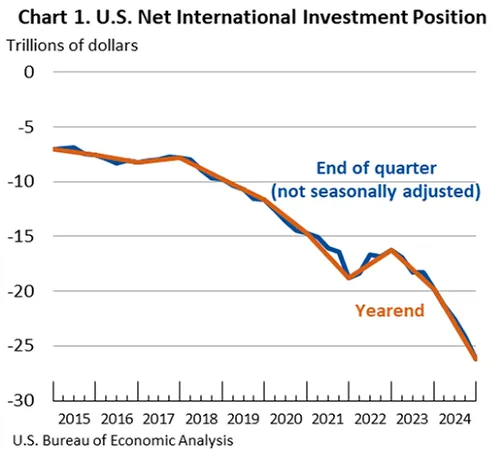
After decades of such munificent benefits it has been easy for the US to abuse the reserve currency status. Running never-ending current account deficits that turned the country into a net external debtor in 1985, with a net investment position in 2025 of -US$27.6 trillion (liabilities US$68.89T vs assets of US$41.27T), not far from the size of the US economy at US$30.6 trillion. This negative net asset position has grown rapidly in recent years, from only US$14T in 2020 and only about US$7T in 2015; heavily driven by the large US government deficits.

Image

But because those foreign asset holders have been so heavily pushed into buying low yielding US Treasuries, while US foreign assets tend to be higher yielding, the US primary income (earned income) was pretty much in balance in Q3 2025! The secondary income balance was a net negative of US$53.6 billion, reflecting the cost of US military and other state spending abroad. A net capital inflow of US$400 billion, as other nations recycled US$s back into US assets, more than offset the current account balance of US$249.2 billion.

As the US government continues to stoke US consumption with large government budget deficits, and low interest rates which the Trump administration is looking to drive down even further, the current account deficit will continue; perhaps with some decrease due to the new tariffs (or not if the Supreme Court rules against the across-the-board tariff increases of the Trump administration). Without the reserve currency, the US would be the subject of the kind of “structural adjustment” programs that the US Treasury has forced upon so many other nations.

On March 17th, 2012, the US bullied the Belgium based SWIFT (US-centric international payments system) to cut off Iranian access to the system. Suddenly, Iran could not make payments for imports, or receive payments for its exports. Instead, it had to make other arrangements that took many years to put in place and did not fully make up for the loss of SWIFT access. The US state also assigned extra-territoriality to its sanctions regimes by considering that any US$ payment, anywhere in the world, was subject to its sanctions. The US$ payments system was being weaponized, but it was only Iran and the odd other small country that was affected.

The came the Ukrainian proxy war in 2022, and all of the Russian US$ (and Euro) central bank assets were frozen stolen, together with Russian banks being cut off from SWIFT (and Euroclear). The theft of the central bank assets of one of the biggest economies in the world was unprecedented, marking a large escalation in the weaponization of the US$ financial system. The US had shown that any nation’s assets, denominated in US$ (and Euros), could be stolen.

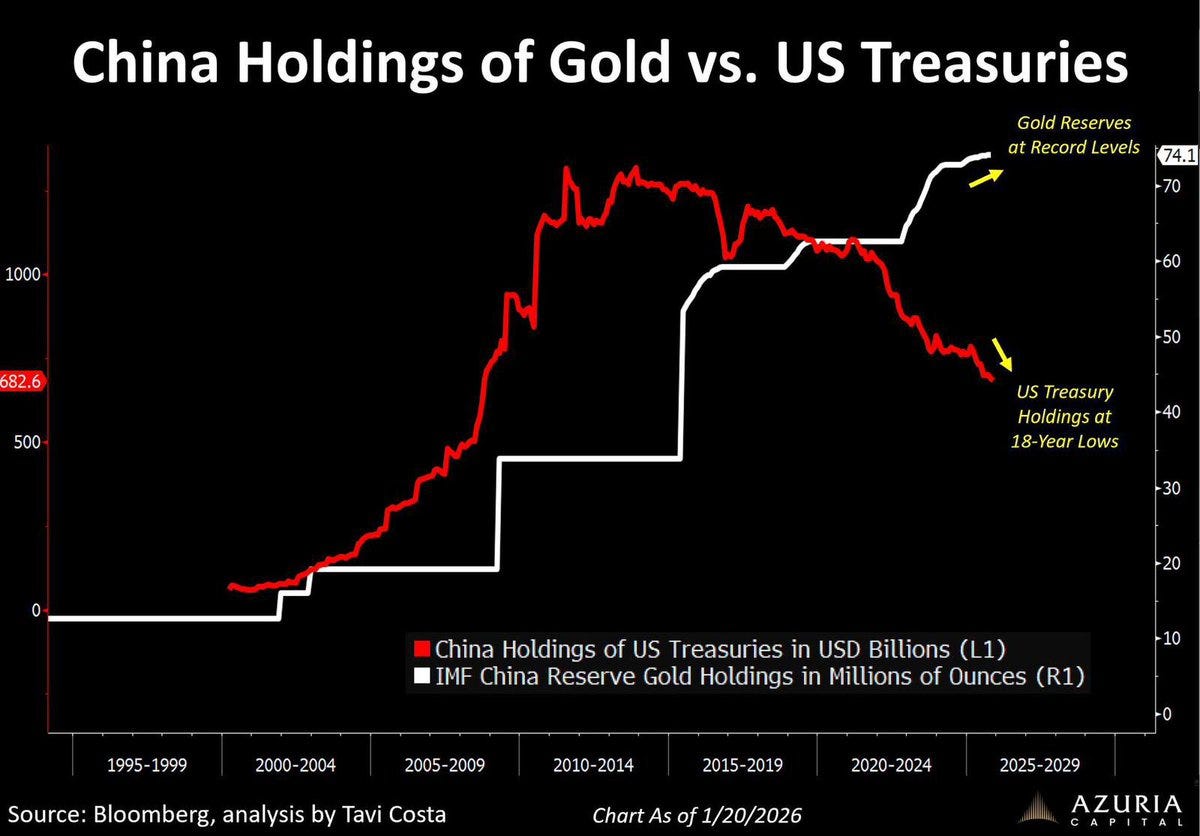
China’s holdings of US Treasury bonds had risen steadily up to a total of US$1.3T in 2011, reflecting its ongoing trade surpluses with the US and other nations. They stayed at around that level until the middle of 2016. In 2017, the first Trump administration came into power and started imposing harsher and harsher financial sanction on Venezuela, while also stealing Venezuelan state assets in the US (the Bank of England did the same with the Venezuelan gold reserves). At the same time, that administration started to escalate technology sanctions against China. From mid-2017, Chinese holdings of US Treasuries started to fall in earnest, to only US$618.2 billion by November 2025. A continuous measured divestment, designed not to create a financial crisis while reducing Chinese exposure to the US financial system. Also in November 2025, China’s official state gold holdings had increased to US$310 billion. As China’s trade with the US is falling, due to the second Trump administration tariff war, a continuing reduction in its US Treasury holdings can be expected.

Image

Jacob King on Twitter

China is also continuously working to reduce the role of the US$ in its international payments and receipts, through bilateral trading agreements and the facilitation of Yuan-based foreign loans. With the Yuan used for a greater share of Chinese inbound and outbound trade than the US$ in 2025, a trend that will certainly continue. With Russia, North Korea and Iran not having access to the US$ financial system, and China consciously moving away from it, continental Asia is becoming less and less dependent upon the US$ and the US financial system.

Then came the utter lawlessness of the second Trump administration, with the even more open and enthusiastic support for the Gazan genocide, the tariff bullying of friend and foe alike, the kidnapping of a head of state, and now the attempted blackmailing of the Danish government to hand over Greenland to the US. If supposed allies vassals can be treated with such disdain, how should other nations react? The logical approach would be to diversify trade relations to reduce dependency upon the US and seek alternative payment mechanisms and reserve assets to the US$. Over the past few years we have already seen a turn around in the central banks of the world from net sellers of gold to increasing purchasers of gold; its not just the Chinese central bank.

The European elites are too co-opted, weak and spineless to even just stop buying any more US treasury bonds, but other nations can see the writing on the wall. The US oligarchy has gone into full empire mode as its power has declined relative to BRINCISTAN (Belarus, Russia, Iran, North Korea, China, Iraq and the “Stans”), with the US$ payments system, tariffs and sanctions being the go to weapons of choice. While at the same time, the Trump administration maneuvers to take complete control of the Federal Reserve and drive down short term US interest rates while musing about even more deficit spending on such things as the US military. The only positive balancing item that the US has is the AI bubble that has sucked in foreign capital due to the higher (for now) stock returns than those available in other markets. But what happens if that gets popped, as looks increasingly certain?

The Trump administration is running the US into a massive financial crisis with its fiscal, monetary and foreign policies; combined with an utter lack of any substantive regulation of the US financial markets. Such a crisis could rapidly become self-feeding as even just a slowdown in investment flows weakens the dollar and leads to higher long term interest rates, which may then then pop the AI bubble leading to investment outflows and a lower dollar. The timing of this crisis cannot be definitively arrived at, but the Trump administration is pushing harder and harder on the door that says “do not enter”. The increased buying of the precious metals points to central banks and some investors starting to hedge against such a crisis; added to in the case of silver by ongoing supply deficits. Whether it be later this year, in 2027 or even 2028 that crisis is coming and with it quite likely the loss of US$ hegemony, and with that a much reduced US imperial centre.

https://rogerboyd.substack.com/p/the-de ... us-reserve
"There is great chaos under heaven; the situation is excellent."

User avatar
blindpig
Posts: 15306
Joined: Fri Jul 14, 2017 5:44 pm
Location: Turtle Island
Contact:

Re: The crisis of bourgeois economics

Post by blindpig » Fri Jan 30, 2026 3:56 pm

Is the dollar losing its luster?
January 29, 2026 , 2:20 pm .

Image
The depreciation is not solely due to normal macroeconomic cycles, but to a growing loss of confidence in the global financial model centered on the greenback (Photo: Archive)

The US dollar has experienced accelerated depreciation during the last weeks of January, reaching levels not seen since March 2021. The dollar index (DXY), which measures the value of the greenback against a basket of six major currencies, has fallen below 97 points, approaching four-year lows against the euro and the British pound. This weakness represents the culmination of a structural erosion process that has seen the dollar lose approximately 10% of its value over the past twelve months.

This depreciation is not solely due to typical macroeconomic cycles, but rather to a growing loss of confidence in the global financial model centered on the US dollar. An analysis by Zero Hedge states that "gold's movement is a vote of no confidence in the entire global financial architecture." More than a safe haven, the currency has become a risky asset in the face of the aggressive monetary policy pursued by the Trump administration and Washington's increasing fiscal fragility.

This constitutes a systemic loss of confidence. As Erik Bethel, former director of the World Bank, pointed out , the artificial demand for dollars that sustains the US economy stems from the fact that 60% of the world's central banks hold reserves in this currency. When that demand disappears because global actors no longer want to use the dollar, the system suffers: "All that artificial demand for dollars disappears and we sink," warned Bethel, who anticipates scenarios of massive inflation or even hyperinflation if the trend continues.

2026: Convulsive onset as a symptom of a structural shift
The past few weeks have been marked by extreme volatility in currency and commodity markets . The Japanese yen has experienced sharp movements that have disrupted global stability, and in response, on January 23, the U.S. Treasury Department conducted a rate check to assess a possible intervention in the foreign exchange market and curb the yen's decline against the dollar. This episode, initiated by the Federal Reserve Bank of New York, reveals the level of nervousness among U.S. authorities regarding the destabilization of Japanese bond markets.

Yields on Japan's 10-year Treasury bonds (JGB) rose 4.5 basis points, reversing recent gains, as the yen weakened under inflationary pressure (CPI at 2.1%) and five consecutive trade deficits. Some analysts warn that Tokyo may need a US bailout, creating a paradox: who saves the savior?

Meanwhile, precious metals have experienced a historic rally . Gold surpassed $5,100 per ounce on January 26, marking a new all-time high. During 2025, the yellow metal appreciated between 60% and 71%, its best annual performance since 1979. Edu Estallo explains that "gold is the asset that historically wins when stock market valuations are stretched too far and confidence in the fiat system falters."

The S&P 500/gold ratio has touched an overvaluation line that has historically preceded major crises: 1929 (Great Depression), 1968 (the stagflation of the 1970s), 2000 (the dot-com bubble), and 2011. On each occasion, gold outperformed equities for years afterward. Estallo warns that this is the fourth time since 1880 that this pattern has repeated itself, indicating a structural cyclical shift where gold is regaining ground against overvalued equity assets.

Image
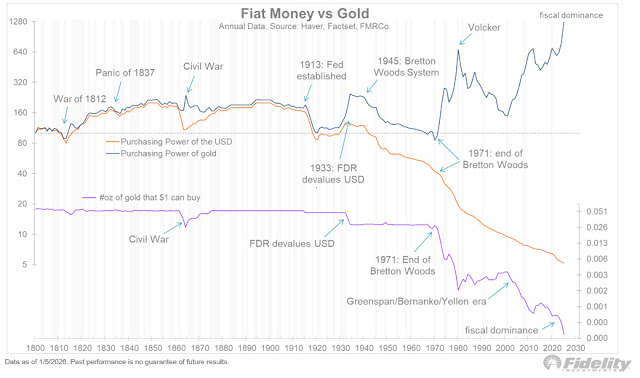
The orange line represents the purchasing power of the dollar, and the blue line represents the purchasing power of gold (Photo: Fidelity Investment)
Silver, meanwhile, has exceeded 161% gain in 2025, driven by supply and demand constraints linked to artificial intelligence and photovoltaic solar panels, trading between $107 and $110 per ounce.

This shift towards physical metals is a sign of the aforementioned "vote of no confidence against the entire global financial architecture." Copper and other industrial metals have also shown strength and reflected a structural rotation of capital towards tangible assets in the face of the deterioration of fiduciary instruments.

Debt vs. gold: A tectonic rupture
2025 has been a dismal year for the US dollar, with the DXY index plummeting by over 9%, its worst performance since 2017. This made it the weakest currency among 17 major global currencies. Such weakness occurred despite the Trump administration's promises to strengthen the dollar and transform the United States into a "Bitcoin superpower."

The recent weakness of the dollar is explained by a confluence of monetary, political, and strategic factors. On the one hand, the Federal Reserve maintained interest rates in a range of 3.5%–3.75% after a series of cuts scheduled to conclude in December 2025, reducing the relative attractiveness of dollar-denominated assets. At the same time, the deteriorating US fiscal situation is eroding the currency's credibility, while, for example, the government struggles to contain the yield on 10-year Treasury bonds, which increases the cost of servicing the debt, already exceeding military spending.

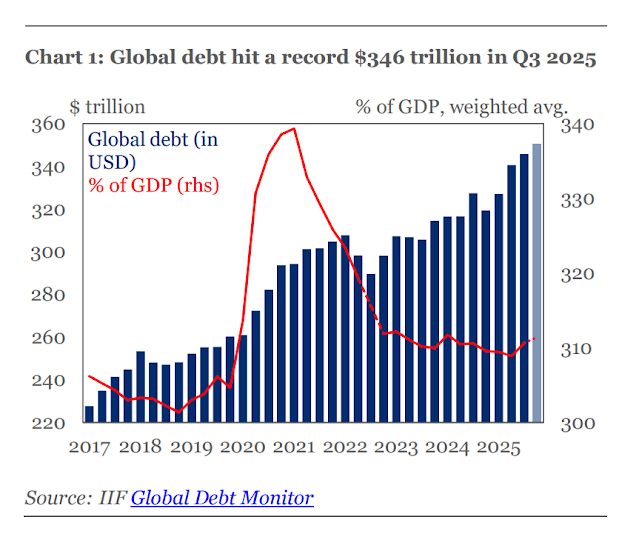
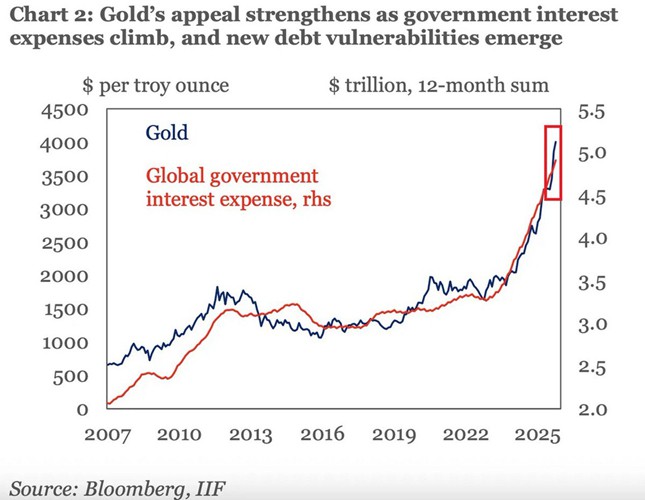
The macroeconomic context that explains this decline is an unprecedented debt crisis. According to The Kobeissi Letter, global public debt interest payments reached $4.9 trillion in 2025, an increase of $1.6 trillion in just three years. Total global debt climbed to $346 trillion, rising by $55 trillion over the same period, and for every dollar of global GDP growth in 2025, ten dollars of new debt were generated. During these three years, while debt expanded, gold appreciated by 142%.

Image
In blue, the growth of global debt and in red the percentage of global GDP corresponding to debt (Photo: Global Debt Monitor)

The United States adds $ 1 trillion to its debt every 150 days and, according to warnings from Bethel, pays more than $1 trillion annually in debt interest alone, exceeding the War Department's budget. This debt spiral has eroded confidence in fiat currency and was financed through printing money, which expanded the M2 money supply by approximately 40% between 2020 and 2022, according to data from the Mises Institute.

The dollar's share of central bank reserves has fallen from 66% a decade ago to 56.92% in the third quarter of 2025, according to IMF data. These institutions have accumulated 9,500 tons of gold since 2010, of which 3,700 tons represent unofficial, undeclared purchases, which have accelerated since the start of the conflict in Ukraine in 2022.

Countries such as Russia, China, and members of the BRICS are diversifying their reserves into physical gold, especially after the freezing of Russian assets in 2022. Basel III, a set of internationally agreed measures to be implemented in 2025 to strengthen the regulation, supervision, and risk management of banks, recognized physical gold as a Tier 1 asset, equating it with Treasury bonds, which has legitimized its role as a pillar of financial stability.

Image
Gold's appeal is growing as US government interest payments rise and new debt-related vulnerabilities emerge (Photo: Bloomberg)
the struggle for resources and the industrial dependence of the Global North

The decline of the dollar standard coincides with a structural crisis in the supply of critical raw materials. The International Energy Agency warns, in its 2025 annual report , that China dominates the refining of 19 of the 20 key strategic minerals, with an average market share of nearly 70%. In the battery sector, Chinese control exceeds 85% of global capacity and reaches 95% in anode manufacturing.

This geographic concentration creates systemic vulnerabilities on the other side of the planet. More than half of strategic minerals are subject to export controls, and the restrictions imposed by Beijing in 2025 on rare earth elements and battery components have highlighted the fragility of Western supply chains. A 10% disruption in rare earth magnet exports could affect the production of 6.2 million cars, one million industrial motors, and 230,000 civilian aircraft, according to IEA estimates.

In Europe, primary aluminum production has collapsed by 25% since 2010, leaving the continent with a structural deficit of 93% between domestic consumption and production. Slovalco, one of the most technically advanced plants, remains closed because high energy prices make smelting mathematically impossible, as it requires between 13 and 15 megawatt-hours per ton.

Ray Dalio, founder of Bridgewater Associates, has pointed out that we are witnessing the simultaneous collapse of the fiat monetary order, the domestic political order, and the international geopolitical order, placing us "on the brink of war." Peter Schiff, for his part, anticipates that this crisis will be deeper than that of the 1980s: "This time it won't be the United States abandoning the gold standard, but the world abandoning the dollar standard."

The struggle for natural resources—evidenced by tensions over Greenland and trade sanctions or tariffs—is set against this backdrop of growing scarcity. The United States, far from being immune, exhibits a critical dependence on imports of processed minerals and advanced manufactured goods that its domestic supply chains cannot replace. The collapse of European aluminum production and China's control of critical minerals leave the Western bloc in a position of structural vulnerability as it attempts to maintain its monetary hegemony.

The combination of unsustainable debt, trade wars, resource scarcity, and geopolitical fragmentation presents extreme scenarios, including the possibility of internal conflicts in the United States, as some analyses suggest. The question that emerges is not whether the system will change, but how profound the transformation will be and which actors will define the new monetary order emerging from the decline of the fiat dollar.

The military attack against Venezuela demonstrates how the destructive influence of the United States is the only political tool left to a deindustrialized economy that has fallen into such a massive external debt that it now threatens to end the dominant and lucrative monetary role of the dollar.

Or is this an opportunity to reinforce the dollar's hegemony? A deliberate depreciation of the dollar can operate as a tool of structural power. By weakening, the United States pressures the central banks of other countries to intervene in foreign exchange markets to prevent excessive appreciation of their own currencies. This intervention typically takes the form of massive purchases of Treasury bonds, which in turn reduces the yields on these assets. The end result is cheaper financing of the US fiscal deficit, externalized to the rest of the world and free from domestic political costs.

It only remains for the world to finally understand this and decide to break the chains of subordination and permanent transfer of resources towards a fictitious capital that constantly needs artificial respiration to survive imperially.

https://misionverdad.com/globalistan/ac ... -su-brillo

Google Translator
"There is great chaos under heaven; the situation is excellent."

Post Reply