The Long Ecological Revolution

User avatar
blindpig
Posts: 15306
Joined: Fri Jul 14, 2017 5:44 pm
Location: Turtle Island
Contact:

Re: The Long Ecological Revolution

Post by blindpig » Wed Nov 26, 2025 1:51 pm

China's Major Energy Moves

Roger Boyd
Nov 25, 2025

China’s major energy moves over the next decade may drastically reduce its dependence upon the fossil fuel imports from the Gulf Cooperation Council (GCC) states as well as Australia and North America. While also possibly turning China into a major coal exporter and reducing its need for iron ore imports. Such major changes will have large impacts on global fossil fuel and other commodity markets, while also greatly increasing China’s energy security.

At the same time, China will gain a reputation as the Green Energy and Climate Change Action global champion; supporting a discourse of China as “the future” and the West as “the past”. Most especially among non-Western nations with populations not extensively propagandized by the Western media.

The Trump administration’s aggressive moves against China, and its attempts to force it to reduce its trade with Russia, have fully rebounded as China strives even more to gain greater energy security while continuing to support its ally Russia.

Oil
In 2024, China imported 11.1 million barrels per day (mbpd); 25% of global oil imports. With domestic production of 4.3 mbpd. As I have detailed separately, China is capable of very significantly reducing its oil consumption in the next 5-10 years through transport electrification, by 2.4 mbpd by 2030 and 6 mbpd by 2035. All of that reduction would be taken by imports, which would fall from 11.1 mbpd to 5.1 mbpd. For geopolitical reasons, China would not reduce its imports from Russia, Central Asia, or Iran and Venezuela (via Malaysia); and perhaps even increase them. These countries accounted for 4 mbpd of imports in 2024, so by 2035 China could be in a position of having no oil imports except from those nations, and oil imports would only fall further in future years.

This would completely remove China’s energy security risks related to the Persian Gulf (Iran has an oil export terminal on the Gulf of Oman), and also perhaps leading to it having little interest in the affairs of the Middle East apart from Iran and the Red Sea link to the Suez Canal. Especially when it may not need any natural gas supplies from the region either.

With oil consumption continuing to decline in Europe, and on a plateau in the US, the Chinese reductions could offset increases in other regions; resulting in falling global oil demand. Especially if cheap Chinese EVs start to make an increasing impact in other nations outside the West (e.g. Southeast Asia, South America and Africa). And that’s with a good few mbpd of production being held off the market by OPEC+, Western sanctions (Iran, Venezuela) and conflict (e.g. Libya).

The global oil supply is highly price inelastic, so even a relatively small drop in demand can have a very large effect on price, an effect that would be secular rather than short term; an existential threat to the Gulf Cooperation Council monarchies that need vast oil revenues to stay in power.


Natural Gas
In 2024, China consumed 435 billion cubic metres (bcm) of natural gas. With 246 bcm coming from domestic production and the balance from imports. With the signing of the memorandum of understanding (MOU) on the Siberia 2 pipeline with Russia, and the increase in supplies through the Siberia 1 pipeline, together with increases in the capacity of the Central Asia gas pipelines, China may be in a position within a decade to meet its gas consumption needs from domestic production (which is still growing) and pipeline gas only:

Siberia 1: 44 bcm/yr

Central Asia: 85 bcm/yr

Sakahalin: 10 bcm/yr

Siberia 2: 50 bcm/yr

Domestic production: 246 bcm in 2024 and growing 5% per year (projected to be 262 bcm in 2025).

China is also replacing natural gas powered heating with heat pumps etc., LNG in trucks with electric vehicles, and fossil fuels in energy generation. So future demand may actually be lower than current demand, although demand is currently still growing. In addition, China’s domestic gas production is growing at a rate of 7% per year; a ten year doubling rate.


The supply of all domestic consumption with domestic production and pipeline imports would completely remove the need for LNG imports; including from Australia and Qatar. As with the reductions in oil supplies, this would remove Chinese dependency upon the Persian Gulf; specifically Qatar. Also, it removes dependency on the US vassal Australia.

With huge amounts of new LNG supply coming on line in the next few years, a drop in Chinese demand could significantly drop prices; a glut is already being predicted without any foreseen reduction in Chinese demand. Very negative for countries such as Qatar and also all of the US and Australian LNG export terminals, but very good news for Europe.

Coal
In 2024, China consumed 4.9 billion tonnes of coal, of which 500 million tonnes were imported; with Indonesia as the biggest import source of thermal coal and Mongolia the biggest import source of coking coal (used for iron and steel production). With the probable rapid reduction in coal consumption over the next decade, China could become a major thermal coal exporter; negatively affecting global coal export prices. Its scale of production would easily overwhelm the non-Chinese global coal industry, even pushing out domestic coal production in other consuming nations and delivering a massive price and volume shock to nations such as India, Indonesia, Russia, the United States and Australia.

The longer-term threat to coking coal is the revolutionary new technique for producing iron and steel that does not require coking coal, produced by Chinese scientists; “flash” iron making. A team in Sweden is also developing a process which replaces coking coal with hydrogen. The Chinese process also utilizes much lower grades of iron ore, which China has in abundance. In contrast to the higher grades that have to be imported from Australia and Brazil. So China would then not just remove the need for coking coal imports, but also for iron ore imports; especially from US vassal Australia.


“Clean Energy Giant” Soft Power
If China successfully executes the moves above, it will be markedly reducing its greenhouse gas emissions year over year, gaining the title of not just Clean Energy Giant but also as the leading nation combating anthropogenic climate change. Compared to a West lead by a US that is doubling down on fossil fuels, together with both Canada and Australia. This will be as part of a large discoursal change as China is seen more and more as “the future”, the position that the US enjoyed in the post-WW2 era, and the West seen as “the past”. Such a change has huge implications for Chinese and Western international soft power and for the success of their brands in foreign markets.


Trade Boost
In 2024, China’s imports of oil were 11.1 mbpd. At an average price of US$60 per barrel, that’s US$243 billion (China’s current account surplus in 2024 was US$424 billion). Compared to China’s GDP of US$18.74 trillion at market exchange rates; 1.7% of GDP (with a greater GDP impact when multiplier effects taken into account). China also spent about US$65 billion on natural gas imports, and about US$35 billion on imported coal.

So, China’s clean energy shift will provide a modest boost to GDP through the trade account in addition to the one-off growth from the installations of wind and solar generation facilities. It will also free up over US$100 billion in the current account that could be used to increase none fossil fuel imports from other nations; amounts which may be significant to many of China’s non-Western trading partners.

https://rogerboyd.substack.com/p/chinas ... ergy-moves

******

AI’s water problem is worse than we thought
A new investigation reveals how Amazon is amplifying Oregon’s nitrate pollution crisis.
Emily Atkin
Nov 25, 2025

Image
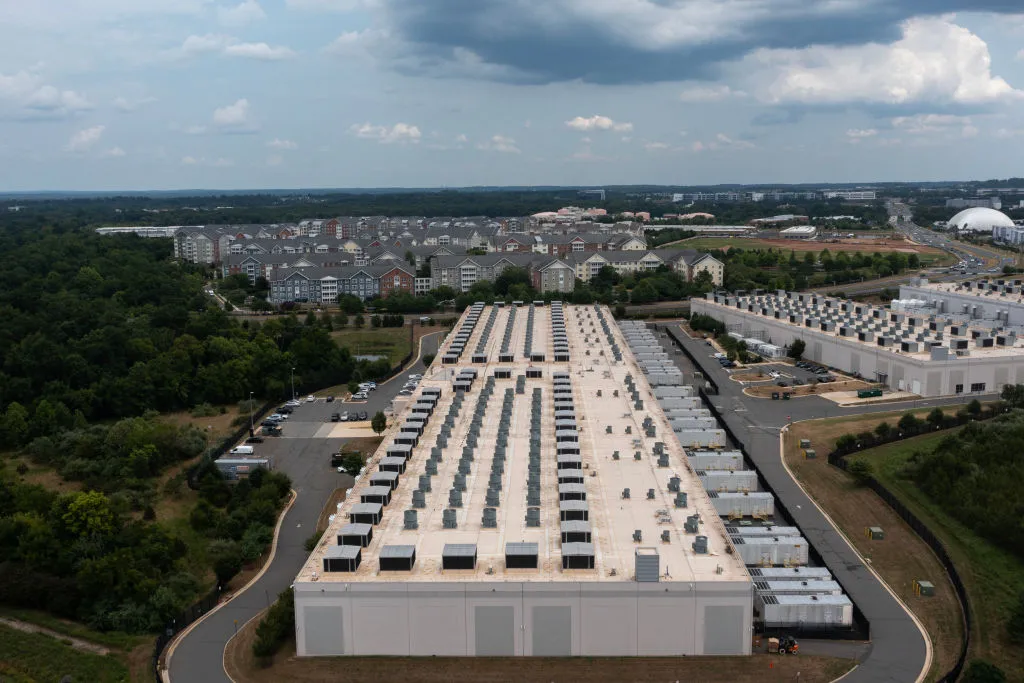
Amazon has built seven cloud computer data centers—like this one in Ashburn, Virginia—in Morrow County, Oregon since 2011. Photo by Nathan Howard/Getty Images.

Everyone knows data centers use a lot of water. What’s less known is how they can poison the drinking water that remains.

It’s already happening in eastern Oregon, according to a new bombshell investigation from Rolling Stone and the Food and Environment Reporting Network. (FERN is an independent, nonprofit news organization that seeks to make the food system more sustainable and equitable).

Image
The headline of FERN and Rolling Stone’s new investigation likens the water crisis resulting from the data center boom to the next Flint, Michigan.

Here’s the gist: At its data centers in Morrow County, Amazon is using water that’s already contaminated with industrial agriculture fertilizer runoff to cool down its ultra-hot servers. When that contaminated water hits Amazon’s sizzling equipment, it partially evaporates—but all the nitrate pollution stays behind. That means the water leaving Amazon’s data centers is even more concentrated with pollutants than what went in.

After that extra-contaminated water leaves Amazon’s data center, it then gets dumped and sprayed across local farmland in Oregon. From there, the contaminated water soaks straight into the aquifer that 45,000 people drink from.

The result is that people in Morrow County are now drinking from taps loaded with nitrates, with some testing at 40, 50, even 70 parts per million. (For context: the federal safety limit is 10 ppm. Anything above that is linked to miscarriages, kidney failure, cancers, and “blue baby syndrome.”)

FERN and Rolling Stone’s new investigation thoroughly explains that process of contamination, follows the people living with that fallout, and exposes the political machinery that enabled all this: namely, a decades-old network of local power brokers who residents literally referred to as “the mafia.”

It’s a remarkable piece of public service journalism that gives a preview of what could happen as data centers multiply across rural America to fuel the artificial intelligence boom, often in places with scarce water, weak oversight, and political systems easily overpowered by Big Tech money. I highly recommend setting aside some time to give it a read.

https://heated.world/p/data-centers-are ... dium=email

*****

Blandine Sankara: “Agroecology is a form of resistance and decolonization”

Founded by Thomas Sankara’s sister, Yelemani Association inspires the fight against desertification in Burkina Faso.

November 25, 2025 by Pedro Stropasolas
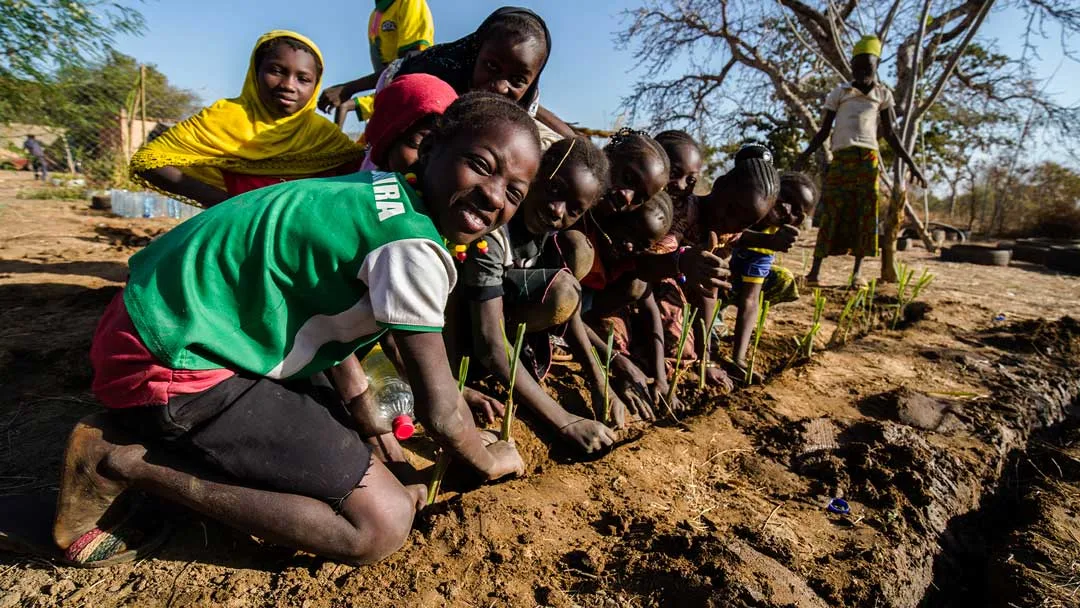
Image
Yelemani Association works towards food sovereignty in Burkina Faso. Photo: BdF

In Burkina Faso, agroecology flourishes as an act of resistance. In a country where more than 80% of the active population makes their living off agriculture, peasant movements and social organizations have defended the production of healthy food and food self-sufficiency as a path to liberation from the wounds left by French neocolonialism.

Leading this effort is the Yelemani Association, founded in 2009 by Blandine Sankara, sister of revolutionary leader and former president Thomas Sankara, who governed the country from 1983 to 1987, when he was assassinated.

The word Yelemani means “change” or “transformation” in the Dyula language, the second most spoken language in Burkina Faso. The name summarizes the organization’s proposal: to change the relationship between people, land, and food, valuing local resources and restoring the dignity of the peasant world.

At the center of this project is agroecology, seen not only as a production technique, but as an anticolonial instrument. For Blandine, cultivating in an agroecological way is resisting the dominant economic model that puts profit above human life.

“We really see these two concepts, food sovereignty and agroecology, as forms of resistance to the economic model, and also as a form of decolonization,” states Sankara.
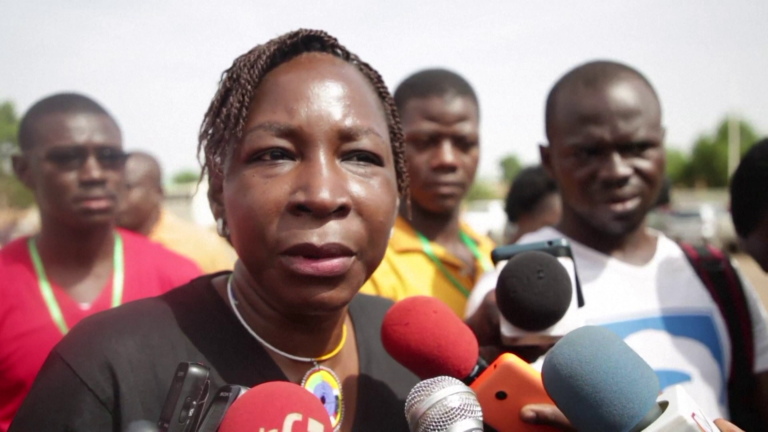
Image
Blandine Sankara in a protest against the presence of multinationals in Burkina Faso in 2018.

Based on four pillars: production, valorization of local products, training, and political advocacy, Yelemani has become a reference in the country. It has recovered degraded lands, created a peasant seed bank, trained hundreds of farmers and students, and has been at the forefront of national mobilizations against GMOs and foreign corporations, such as Monsanto and the Bill Gates Foundation.

In an interview with Brasil de Fato, Blandine Sankara talks about the trajectory of the Yelemani Association, the results achieved, and the challenges faced by agroecology in the Sahel country.

“What I have to say is that agroecology is increasingly at the center of agriculture and policies. I’ll talk about agricultural policies in Burkina Faso because today we have a national strategy. This is rare. A country that has a national strategy in the field of agroecology,” she reflects.

Check it out:

Brasil de Fato: Blandine, can we start by talking a bit about how agroecology entered your life and how the Yelemani Association came about?

Blandine Sankara: First of all, it’s important to say that the Yelemani Association was created in 2009. And especially that Yelemani means “change” or “transformation” in the second most spoken language of Burkina Faso, Dyula.

And what does this change mean? For us, it’s the valorization of local resources, to guarantee the dignity of the peasant world and build our daily well-being. It’s not just about peasants. It’s about the dignity of the peasant, on one hand, but also about building the well-being of every Burkinabe citizen.

This is the first explanation about the name Yelemani. The organization focuses on agriculture and food. Our work is directed toward these two fields, which are broad, because they touch all aspects of life, after all, they concern all of us. And in a country like ours, where more than 80% of the active population works in agriculture, this is a central field, because food concerns everyone.

Parallel to change through valorization of local resources and the peasant world, we speak of a transformation of mentality and behaviors. Even though in agroecology we work to produce healthy food and teach cultivation techniques alongside peasants, if there isn’t a change in the mentality of consumers, of all of us, we don’t advance.

This change is also a change of behavior and deconstruction of prejudiced ideas about our own products. So there are two transformations we seek: one in production and another in mentalities.

Here at Yelemani, we promote food sovereignty and the practice of agroecology. It’s clear that with the rejection of the use of GMOs, chemical fertilizers and pesticides. This is our work. Promoting food sovereignty through agroecology and refusing the chemical model.

We see all of this as a form of resistance to the economic model that puts profit above human life. This is the guiding thread of our activities and our daily life. It’s our vision. We really see these two concepts, food sovereignty and agroecology, as forms of resistance to the economic model, and also as a form of decolonization.
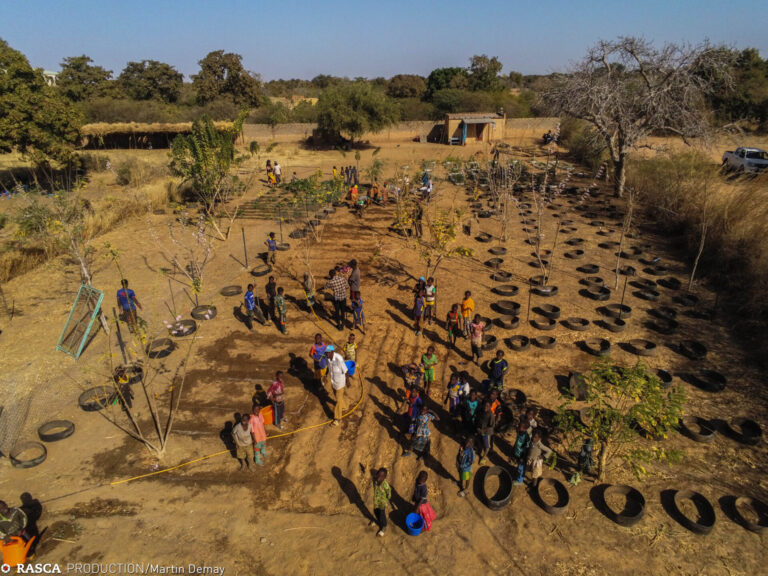
Image
Aerial view of Sítio Yelemani shows educational work carried out with local children. Photo: Martin Demay/Rasca Production

Not only of what is on our plates and on our lands, the seeds, but also of our spirits. Because, as I usually say, there has been a colonization of mentalities, a kind of violation of our own power to act. To resist is also to refuse that our fields, markets and kitchens are invaded by imported products, hybrid seeds, pesticides and even by flavors and norms that are not ours.

This is Yelemani’s fight, its mark among the organizations that work for food sovereignty and agroecology in Burkina Faso.

At a certain point in our lives, we lived through the Revolution in Burkina Faso in the 1980s, an experience that deeply marked us. Those who were young at the time, students or even pupils, participated in or witnessed what was at stake in the country.

In my case, I studied sociology and had many opportunities to go to villages and regions of Burkina, which made me understand the realities of the peasant world. Later, in Geneva, during my development studies, I deepened this understanding. It was the era of globalization, of economic partnership agreements, and we closely followed the debates.

Another important factor was the period from 2008 to 2011, when we lived through what was called the “high cost of living crisis”, with the surge in prices of basic products worldwide, linked to the increase in oil barrel prices. There were protests in Ouagadougou and several cities across the country against the increase in food prices.

All of this led us to the conclusion that it was necessary to move toward food sovereignty. Not just as a concept, but as practice. We began experimenting with this in 2009, and it was especially from 2012 that we effectively began our activities.

BdF: What can you tell us about the activities you’ve been developing at Yelemani since 2009 and their results?

BS: We work on four main areas. First, the production and transformation of agroecological fruits and vegetables in Lumbila, which is about 30 km from Ouagadougou. There, there are three plots with production, and it’s mainly women who work. Internally displaced women. What we call internally displaced are people who were expelled from their homes due to terrorism.

The second is the valorization and promotion of local food products. Because it’s not enough to produce, we must value what is ours, this is part of the fight for food decolonization.

Then, there’s education and training on agroecology and food sovereignty, because we think that even if we do good work in terms of production and transformation to offer healthy products and everything else, if the consumer, especially young people, aren’t sensitized, we won’t have results. It won’t be a profound change. So, this is the third axis and we’re working in schools.

But it’s also necessary to work on policies, so we added the fourth area, which is advocacy with political decision-makers so they decide to take agroecology into account.

Image
Work at Yelemani generates income opportunities for women displaced by terrorism. Photo: Yelemani Association/Press Release

Among the results, the first was the recovery of abandoned soil in Lumbila, considered unproductive. In one year, we managed to regenerate the land with agroecological practices. We also created a local products market and, since 2023, a peasant seed bank, where farmers can withdraw seeds and return double after harvest, without commercial transactions.

Another important result is the production of pedagogical material. Since 2015 we’ve developed training modules on agroecology and food sovereignty (12 in total) and trained farmers, students, and teachers.

We also had political victories, such as the expulsion of Monsanto in 2015, after a national mobilization against GMOs, and in 2018, a campaign that managed to block the “Target Malaria” project, funded by the Bill Gates Foundation, which planned to release genetically modified mosquitoes.

In 2019, during FESPACO (Pan-African Film Festival of Ouagadougou), we managed to break the monopoly of a French company that prevented the sale of local juices at the event. After popular pressure, a decree authorized local producers to sell their beverages.

But the greatest result for us remains the recovery of abandoned and unproductive land in Lumbila, a symbol of what agroecology can achieve.

BdF: With the end of the revolution in the 1980s, there was a rupture in the path of food self-sufficiency developed by Thomas Sankara. Multinational companies, mainly French ones, and global agribusiness, recovered their presence, developing a form of agriculture that doesn’t collaborate and, in a way, aggravates the problem of desertification in the Sahel. How do you see the effects of colonization on the agrarian question in your country?

BS: It must be said that it was really during colonization that capitalism penetrated the traditional agricultural sector, forcing the modernization of an agriculture considered backward and subsistence, which was forced to evolve into commercial and mechanized agriculture. At that moment, emphasis was placed on crops destined for export, what were called cash products and cash crops.

Therefore, in Burkina’s case, it was peanuts, but especially cotton and, to a lesser extent, also green beans. When we look at the country today, there’s a large area of land, thousands of hectares of land that were destroyed by the use of these chemical inputs for production mainly of cotton. These are thousands of hectares that today need to be recovered. They need to be restored.

The richest zones, the most fertile lands, were used for cotton cultivation, with excessive use of chemicals to produce more and sell more. Therefore, it was really for export, they were export products to other continents, mainly to France.

There are also floods caused by rains, with the loss of seeds, which forces farmers to go into debt to buy new seeds. Therefore, there were many consequences because of this export culture.

In the 2000s, cotton cultivation was done with great support from Monsanto, which I mentioned earlier, the American company. It made producers believe that the harvest would be more profitable with transgenic cotton, without additional insecticide and with better yield.

We can even say that there was an agricultural and food colonization, and that it never ended. The great powers and multinationals continue to exploit the same mechanisms.

That’s what they told our producers. In 2009, this cotton was profitable in the first three years, but very quickly farmers had to go back to using insecticides because the quality of cotton deteriorated and the quantity was also not as expected, it wasn’t up to standard. And that’s not all. It also destroys neighboring crops, not just cotton, but crops that were alongside, like sesame, for example, which was totally destroyed.

And all of this in conditions of climate degradation in Burkina. Therefore, the application of these policies in the agricultural sector led to the total loss of our food autonomy and local knowledge, and even food security increased with the devaluation of food crops for the benefit of these crops.

This knowledge was lost because we turned to these export crops, and yet we know that our production systems developed ancestrally over 40 years and millennia before receiving the name of agroecology.

Therefore, we knew there were practices, like what we today call half-moons, planting certain trees, which were known by our peasants, a diversity of these forms of small-scale production. And all of this was changed in favor of these crops to sell and have more money.

Agroecology goes against this logic, because it proposes that the farmer first produce to feed his family and his community. It’s a question of sovereignty. As long as we’re dependent on inputs, seeds and standards coming from outside, we won’t be free.

BdF: And how do you see the role of the current government today in this decolonization process? Is there any effective support for agroecology or food sovereignty?

BS: What I have to say is that agroecology is increasingly at the center of agriculture and policies. I’ll talk about agricultural policies in Burkina Faso because today we have a national strategy. This is rare. A country that has a national strategy in the field of agroecology.

A country that has this within the ministry, it’s really very, very strong. Therefore, increasingly, we have actors in agroecology, people who commit themselves, structures that commit themselves and I believe that, at the political level, we’re interested, we’re really closely analyzing the issue of agroecology.

In any case, research from institutes has shown that, until 2050, yields, even with the boost of technical and ecological means, will fall 30%. There will be a drop with climate changes, with good years and bad years.

But this data really comes from private agricultural research institutes that have nothing to do with ecology. With agroecological practices, yields are lower than current yields, this must be said from the beginning, they are lower. But yields balance out at a certain point, they become equal. What does this mean? It simply means that when we put agroecology on one side and the use of agrochemicals to produce on the other, at the beginning, it’s true, we’ll have lower yields with agroecology compared to the other. But over time, gradually, this balances out, reaching the same yield level, but with the difference that agroecology is constant in its yields year after year.

And this allows farmers to be more resilient. They know what they’re going to have next year. This allows them to organize and be more resilient. This is a fact, it’s a reality.

Agriculture, whose supply and flow of goods depend on large supranational markets and, therefore, on some financial actors, whose capital is concentrated in the hands of few people, is not good at all for farmers.

Therefore, the more agriculture industrializes and creates an economic model of supply and sales, the more workers, that is, peasants, farmers and the environment are excluded.

It’s true that the logic of the production chain allowed the development of some regions. This cannot be denied. The logic of the production chain allowed some regions, even in Burkina Faso, to develop. But they also became true deserts when these same markets oriented themselves toward other activities or sectors considered more lucrative.

When Monsanto’s cotton made Burkina Faso’s market fall, because the cotton fiber shortened and, at the global level, no one wanted to buy our cotton anymore, what did we do? What could farmers do with cotton? Nothing, because you don’t eat cotton. We’re not going to eat cotton. And before, when it worked, they could sell it and buy cereals to eat. But since they couldn’t sell, there were people who committed suicide, producers.
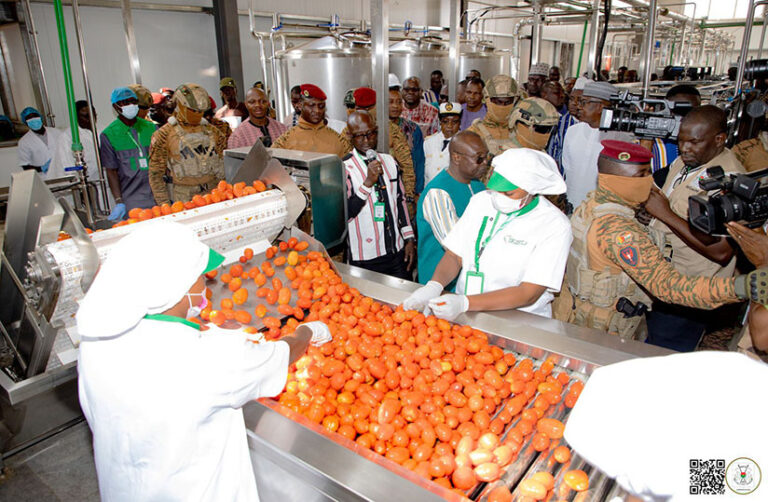
Image
The opening of the tomato pulp factory in Bobo Dioulasso was celebrated across the country. Photo: Presidency of Burkina Faso

So, these are the realities we lived through. If we consider the case of green beans in the 80s, for political reasons, because there was the revolution here, a landlocked country, without access to the sea, and everything was done by plane. Therefore, it was necessary to export by air. For political reasons, the plane that was supposed to come pick up the green beans from Burkina Faso farmers in Ouagadougou didn’t come, leaving tons of beans at the airport.

And what did we do at the time? The government forced people to buy, especially public servants, each employee had to buy a box, two boxes, and they cut from their salary at the end of the month to be able to pay the farmers, because otherwise, what were we going to tell the farmers, that for political reasons we couldn’t take their beans to Europe, it wasn’t possible.

I don’t want to get into political considerations, but I want to say that there’s a global complexity at the moment. And therefore, Yelemani faces this challenge. The climate crises that everyone in agriculture has been facing for years, the loss of biodiversity, the various conflicts, terrorism in our country and all of this causes an increasingly greater food insecurity, it must be said.

Therefore, these realities threaten our agricultural systems, our health, our autonomy and, fundamentally, our dignity. It’s human dignity.

However, there are solutions, as I said earlier, there are ecological agroecological solutions and others are still to be developed. We can still advance toward agroecology, which has already proven its value.

BdF: Blandine, you had a visit from MST militants in 2018 to Yelemani. How was the experience of meeting the MST and how can it inspire the struggle of peasants in Burkina Faso?

BS: I must say that Latin America fascinates me. It fascinates me in its struggle, in its work, since ancient times and permanently. I had the opportunity this year to go to Ecuador and I was able to meet groups and even young people, and that’s what fascinated me most, the ability to understand where the problem comes from. And that’s it, it’s not just about land recovery, it’s not just about recovering your roots, it’s about breaking the system.

And I think the MST, at least when they came here to Yelemani, that’s what they said, that it’s the system that needs to be broken. This ability of theirs to understand this fascinates me and I would like us to work a lot on this in Africa, at least on the issue of agroecology. It’s more than agroecological practices, which are quite advanced, but it’s the political side, the political aspect of saying that, in the end, we must go against the logic.

Today there’s a logic that is concentrated in the hands of some lobbies. And we must face this. Otherwise, we risk getting stuck in practices, and without understanding that all of this leads to nothing, if we don’t work, in my view, to break this system. It’s this system. When the MST was at our house, we understood well that, in the end, we fight against the same enemy. Burkina Faso and Africa must also fight, because they are the same ones who exploit Latin American countries. Therefore, we have no other choice.

I think we could unite to work, at a level of helping each other, of supporting each other in taking the struggle to a political level, to something bigger. Because I’m not talking only about agroecology, because sometimes we have environments that are very different. And agroecology is based on what exists locally in your territory. Even within the same country, territories are not the same.

What I’m emphasizing, from my small experience, whether with the MST when they passed through Yelemani, or through the discussions I had in Ecuador, is that I really could see how Latin America, which is advancing on these issues, can support us in terms of animating peasant groups, animating youth groups. They certainly have tools that can help us. And even the experiences, how they proceeded to manage to reach this level. I would like to see here peasants who have no complex in speaking before enemies, before authorities. I would like to see young people assert themselves, speak and say what they think.

Especially young people from rural villages. Because this is a complex issue in our case. I can’t speak for all of Africa, because Africa is very large, but I speak, for example, of our Francophone countries. There’s a great complexity that causes many barriers between city people and country people, between those who went to school and those who didn’t go to school.

Therefore, there are many differences like this that make everything more complicated, but we must work to deconstruct all of this. It’s a long path, of course. But it’s the path to walk toward food sovereignty. Those who are in the city, those who had the chance, like us, to go to school, to go far, to know other things, like the MST, here we can, together with Latin American movements, read and analyze so that we can improve.

It’s for our parents, after all, our peasant parents. Because in Burkina that’s it, right? Everyone has their village, everyone comes from a village. So, everyone is proud to say: “This is my village, I come from this village.” And in the village, our parents who stayed, our uncles, our aunts, are farmers. More than 80% of Burkinabes live from agriculture.

Therefore, agriculture is at the center. And, for me, it’s at this level that it’s about joining hands, about how to develop this reflection movement. And how they can support us to improve things.

We’re also working to value what we have today and, with current policy, we’re valued as Burkinabes. And this must be said and praised.

https://peoplesdispatch.org/2025/11/25/ ... onization/

******

Image

COP 30: It’s no joke
By Michael Roberts (Posted Nov 26, 2025)

Originally published: Counterfire on November 24, 2025 (more by Counterfire) |

The usual joke about the United Nations Climate Change Conferences (COPs) is that each one is a ‘cop-out’. Each time there is a failure to agree on ending fossil fuel production as the source of energy, even though it is now well established that carbon and other greenhouse gas emissions come mainly from the use of fossil fuels. Each time there is a failure to agree to significant planned and implemented reductions in emissions from all sources, production, transport, wars etc. Each time, there is a failure to agree any significant reversal of unending deforestation, the polluting of the seas and the accelerating extinction of species and diversity.

The joke of saying it is a ‘cop-out’ has now worn thin to the bone. COP30 was no joke, even if the ‘agreement’ reached was one. Time has run out. The world is hotting up to the point of tipping into irreversible damage to humanity, other species and the planet itself.

Image

Harjeet Singh of the Satat Sampada Climate Foundation, said: “Cop30 will go down in history as the deadliest talkshow ever produced.” Negotiators at Belem, Brazil “spent days discussing what to discuss and inventing new dialogues solely to avoid the actions that matter: committing to a just transition away from fossil fuels and putting money on the table.” But the core issue of a “transition away from fossil fuels” was dropped as the fossil fuel nations and most of the Western powers blocked it. Even the weak watered down idea of a ‘roadmap’ to a transition was opposed.

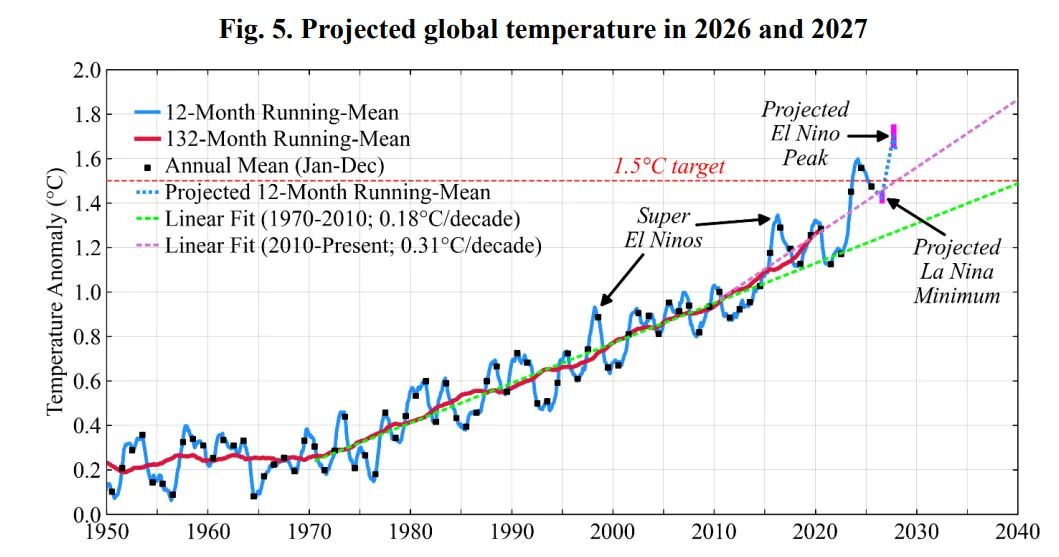
Also at stake was the question of how countries should respond to the fact that current national climate plans, known as nationally determined contributions (NDCs), would lead to about 2.5°C of global temperature above preindustrial levels, far above the 1.5C limit target set by the 2015 Paris COP agreement. The COP30 ‘agreement’ was to “continue talking about” the large gap between countries’ targets and the carbon emission cuts necessary to stay within 1.5C.

The climate scientists at COP30 made it clear—yet again. Emissions must start to bend next year, they say, and then continue to fall steadily in the decades ahead: “We need to start, now, to reduce CO2 emissions from fossil-fuels, by at least 5% per year. This must happen in order to have a chance to avoid unmanageable and extremely costly climate impacts affecting all people in the world.” Emission reductions need to be accelerated:

We need to be as close as possible to absolute zero fossil fuel emissions by 2040, the latest by 2045. This means globally no new fossil fuel investments, removing all subsidies from fossil fuels and a global plan on how to phase in renewable and low-carbon energy sources in a just way, and phase out fossil fuels quickly.

The scientists added that finance—from developed to developing countries—is essential for the credibility of the 2015 Paris Agreement aimed at keeping the rise in global temperature no higher than 1.5C. “It must be predictable, grant-based and consistent with a just transition and equity,” they said. “Without scaling and reforming climate finance, developing countries cannot plan, cannot invest and cannot deliver the transitions needed for a shared survival.” COP30 got an agreement to increase funding from the rich countries to the poor—but the increased funding would be spread over the next ten years, not five years as before!

Image

Instead , global oil and gas demand is set to rise for the next 25 years if the world does not change course, according to the International Energy Agency in its latest report. Greenhouse gas emissions are still rising despite ‘exponential’ growth of renewables. Coal use hit a record high around the world last year despite efforts to switch to clean energy.

Image

So global CO2 emissions will rise, not fall. Annual global energy-related CO2 emissions will rise slightly from current levels and approach 40 gigatonnes of carbon dioxide per year in the early 2030s, remaining around this level through to 2050. Emissions may fall in advanced economies, most substantially in Europe, and also decline in China from 2030 onwards, but they increase elsewhere.

And it’s not just carbon emissions. Methane is a greenhouse gas 80 times more powerful than carbon dioxide, and is responsible for about a third of the warming recently recorded. At previous ‘cop-outs’ it was agreed to a cut in methane emissions of 30% by 2030. Yet methane emissions have continued to increase. Collectively, emissions from six of the biggest signatories—the U.S., Australia, Kuwait, Turkmenistan, Uzbekistan and Iraq—are now 8.5% above the 2020 level.

Image

So the world is getter hotter. This year and the last two years were the three hottest years in 176 years of records, And the past 11 years, back to 2015, will also be the 11 warmest years on record. Tipping points (irreversible) are being reached: glaciers melting; forests disappearing; wildfires, floods and droughts increasing. The world is heading for 2.8°C warming, as the latest UN report reveals climate pledges are ‘barely moving the needle’.

The UNEP’s ‘Emissions Gap Report 2025: Off Target’ finds that available new climate pledges under the Paris Agreement have only slightly lowered the pace of the global temperature rise over the course of the 21st century, leaving the world heading for a serious escalation of climate risks and damages. Fewer than a third of the world’s nations (62 out of 197) have sent in their climate action plans, known as nationally determined contributions (NDCs) under the Paris agreement. The U.S., the country that is the biggest emitter per person, has abandoned the process—the U.S. did not turn up at COP30. Europe has also failed to deliver. None of the 45 global climate indicators analyzed are on track for 2030.

Image

Levels of carbon dioxide in the atmosphere soared by a record amount in 2024 to hit another high, UN data show. The global average concentration of the gas surged by 3.5 parts per million to 424ppm in 2024, the largest increase since modern measurements started in 1957, according to the report by the World Meteorological Organization.

Several factors contributed to the leap in CO2, including another year of unrelenting fossil fuel burning. Another factor was an upsurge in wildfires in conditions made hotter and drier by global heating. Wildfire emissions in the Americas reached historic levels in 2024, which was the hottest year yet recorded. Climate scientists are also concerned about a third factor: the possibility that the planet’s carbon sinks are beginning to fail. About half of all CO2 emissions every year are taken back out of the atmosphere by being dissolved in the ocean or being sucked up by growing trees and plants. But the oceans are getting hotter and can therefore absorb less CO2 while on land hotter and drier conditions and more wildfires mean less plant growth.

Reductions to annual emissions of 35 per cent and 55 per cent, compared with 2019 levels, are needed in 2035 to align with the Paris Agreement 2°C and 1.5°C pathways, respectively. Given the size of the cuts needed, the short time available to deliver them and a challenging political climate, a permanently higher rise in global temperature is unavoidable before the end of this decade. The Paris target is as dead as the people and species dying from climate change.

Image

Indeed, rising global heat is now killing one person a minute around the world, a major report on the health impact of the climate crisis has revealed. The report says the rate of heat-related deaths has surged by 23% since the 1990s, even after accounting for increases in populations, to an average of 546,000 a year between 2012 and 2021. In the past four years, the average person has been exposed to 19 days a year of life-threatening heat and 16 of those days would not have happened without human-caused global heating, the report says. Overall, exposure to high temperatures resulted in a record 639bn hours of lost labour in 2024, which caused losses of 6% of national GDP in the least developed nations.

The continued burning of fossil fuels not only heats the planet but also produces air pollution, causing millions of deaths a year. Wildfires, stoked by increasingly hot and dry conditions, are adding to the deaths caused by smoke, with a record 154,000 deaths recorded in 2024, the report says. Droughts and heatwaves damage crops and livestock and 123 million more people endured food insecurity in 2023, compared with the annual average between 1981 and 2010.

Why are the targets for reducing emissions not being met or now even agreed? The answer is money. Despite the harm, the world’s governments provided $956bn in direct fossil fuel subsidies in 2023. This dwarfed the $300bn a year pledged at the UN climate summit Cop29 in 2024 to support the most climate-vulnerable countries. The UK provided $28bn in fossil fuel subsidies in 2023 and Australia allocated $11bn. Fifteen countries including Saudi Arabia, Egypt, Venezuela and Algeria spent more on fossil fuel subsidies than on their national health budgets.

The world’s 100 largest fossil fuel companies increased their projected production in the year up to March 2025, which would lead to carbon dioxide emissions three times those compatible with the Paris climate agreement target of limiting heating to 1.5C above preindustrial levels, the report says. Commercial banks are supporting this expansion, with the top 40 lenders to the fossil fuel sector collectively investing a five-year high of $611bn in 2024. Their ‘green sector’ lending was lower at $532bn.

Image

The reason for expanding fossil fuel production is that it is just much more profitable than switching to renewables. The problem is that governments are insisting that private investment should lead the drive to renewable power. But private investment only takes place if it is profitable to invest.

Profitability is the problem—in two ways. First, average profitability globally is at low levels and so investment growth in everything has similarly slowed. Prices of renewables have fallen sharply in the last few years. Ironically, lower renewables prices drag down the profitability of such investments. Solar panel manufacturing is suffering a severe profit squeeze, along with operators of solar farms. This reveals the fundamental contradiction in capitalist investment between reducing costs through higher productivity and slowing investment because of falling profitability.

Brett Christophers in his book, The Price is Wrong—why capitalism won’t save the planet, argues that it is not the price of renewables versus fossil fuel energy that is the obstacle to meeting the investment targets to limit global warming. It is the profitability of renewables compared to fossil fuel production. Christophers shows that in a country such as Sweden, wind power can be produced very cheaply. But the very cheapening of the costs also depresses its revenue potential. This contradiction has increased the arguments of fossil fuel companies that oil and gas production cannot be phased out quickly. Peter Martin, Wood Mackenzie’s chief economist, explained it another way: “the increased cost of capital has profound implications for the energy and natural resource industries”, and that higher rates “disproportionately affect renewables and nuclear power because of their high capital intensity and low returns.”

As Christophers points out, the profitability of oil and gas has generally been far higher than that of renewables and that explains why, in the 1980s and 1990s, the oil and gas majors unceremoniously shuttered their first ventures in the renewables almost as soon as they had launched them.

The same comparative calculus equally explains why the same companies are shifting to clean energy at no more than a snail’s pace today.

Christophers quotes Shell’s CEO Wael Sawan, in response to a question about whether he considered renewables’ lower returns acceptable for his company:

I think on low carbon, let me be, I think, categorical in this. We will drive for strong returns in any business we go into. We cannot justify going for a low return. Our shareholders deserve to see us going after strong returns. If we cannot achieve the double-digit returns in a business, we need to question very hard whether we should continue in that business. Absolutely, we want to continue to go for lower and lower and lower carbon, but it has to be profitable.

For these reasons, JP Morgan bank economists conclude that “The world needs a “reality check” on its move from fossil fuels to renewable energy, saying it may take “generations” to hit net-zero targets. JPMorgan reckons changing the world’s energy system “is a process that should be measured in decades, or generations, not years”. That’s because investment in renewable energy “currently offers subpar returns”.

The only way humanity has a chance of avoiding a climate disaster will be through a global plan based on common ownership of resources and technology that replaces the capitalist market system. Meanwhile, the cop-out continues.

https://mronline.org/2025/11/26/cop-30-its-no-joke/

******

Chemical pollution drives prostate cancer, falling sperm counts
November 25, 2025

Pesticides, microplastics and PFAS are causing a precipitous decline in male reproductive health

Image

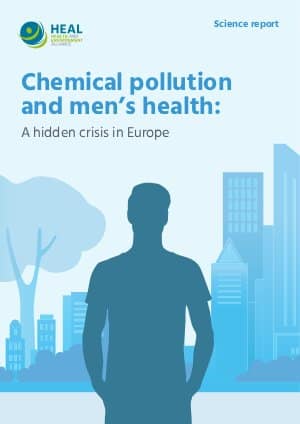
(Beyond Pesticides, November 25, 2025) Chemical pollution is having a profound impact on men’s overall health and reproductive function. Endocrine-disrupting chemicals—which prominently include pesticides—are a major factor. The Health and Environment Alliance (HEAL) a European organization funded by the European Union (EU) and several private foundations, has issued a strong call for attention to – and action on – the precipitous decline in male reproductive health owing to chemical exposures, including pesticides.
Image
The author of Chemical pollution and men’s health: A hidden crisis in Europe, Rosaella Cannarella, M.D., PhD, and the founder and director of HEAL, Génon Jensen, will be speaking at the Forum, The Pesticide Threat to Environmental Health: Advancing Holistic Solutions Aligned with Nature, on December 4. Registration is free. Click image to register

In a new report, Chemical pollution and men’s health: A hidden crisis in Europe, the group states, “The scientific evidence is clear. The costs of chemical pollution – human and economic – are mounting. The solutions exist. What we need now is the political will to act.” The report was written by Rosaella Cannarella, M.D., PhD, an endocrinologist at the Division of Endocrinology, Metabolic Diseases and Nutrition, University of Catania (Italy).

HEAL’s report details alarming indications of catastrophe in male reproductive health: prostate cancer, testicular cancer, crashing sperm counts, and numerous developmental problems including cryptorchidism, urogenital malformations, and hypospadias. The report highlights pesticides, microplastics, phthalates, bisphenols, PFAS and heavy metals as the likely environmental sources of the crisis. There is evidence that all of these endocrine disrupting chemicals (EDCs) adversely affect male reproductive function.

There are 330,000 cases of prostate cancer in the EU. It is the third most-diagnosed cancer in men. Beyond Pesticides has documented research showing that pesticides have been linked to higher risk of prostate cancer, including, specifically, pyrethroid insecticides. See also Beyond Pesticides’ analysis of the positive association between exposure to 22 pesticides and prostate cancer occurrence and as a cause of death. In the EU, testicular cancer has jumped 25% since 2014, and is now the most common cancer in men 15 to 44, according to the HEAL report. Sperm counts declined by more than 50% between 1973 and 2018. Prostate cancer is the most common cancer in men in the U.S., with an estimated 34,780 new cases in 2025, one in eight men will get the disease, which has been increasing at a rate of 3.0% a year.

Chemical exposures to both parents can harm male offspring’s reproductive health. The HEAL report cites EU research that has found strong connections between maternal exposure during pregnancy to phthalates, BPA and pesticides and cryptorchidism, urogenital malformations, hypospadias and testicular cancer in their sons. Paternal exposure to EDCs, such as many pesticides, can have transgenerational effects. Both EDCs and microplastics can cause epigenetic changes in sperm and in genes crucial to development, thus potentially affecting ensuing generations’ reproductive health. These changes mean that the reproductive capacity of offspring can already be impaired even before conception has occurred.

The weed killer glyphosate is a prominent example of an endocrine disrupting pesticide. A recent study of glyphosate exposure in zebrafish by Italian researchers finds that at the acceptable daily intake level, glyphosate “impaired germ cell differentiation and triggered cell-specific changes in histone acetylation within the male germline.” Histone acetylation is an epigenetic process that regulates the activation and deactivation of genes, in this case those involving male reproductive structures and processes. At the higher “no observed adverse effect level,” glyphosate “induced metabolomic and proteomic disruptions linked to impaired steroidogenesis, DNA damage in germ cells, and alterations in testicular architecture, culminating in reduced reproductive capacity.” These differing effects at different doses suggest that glyphosate has a non-monotonic dose-response curve, contradicting the toxicological dogma that the “dose makes the poison.” Further, it suggests that these so-called protective exposure measures are nothing of the kind.

Microplastics are emerging as a potentially severe and intractable contributor to male reproductive dysfunction. A literature review of over 90 scientific articles in Agriculture documents microplastics’ (MPs) increase the bioavailability, persistence, and toxicity of pesticides used in agriculture. According to the HEAL report, studies in Europe, the U.S. and China have found microplastics in 100% of human testicular tissue sampled. They may interfere with sperm formation, disrupt testosterone production, and trigger inflammation in reproductive organs. Microplastics have been found in the olfactory bulb in the brain and there is evidence that they can also reach the brain across the blood-brain barrier.

Both pesticides and microplastics have profound effects on the brain, which is inextricably involved with reproductive development and function. The gut-brain axis is involved in testosterone synthesis and circulation, and microplastics may affect it through interactions with gut microbes. Glyphosate and organophosphates disrupt another important system, the hypothalamic-pituitary-gonadal axis (HPG) in animals, according to the HEAL report. Two of these three hormonal axis elements are in the brain. The HPG axis affects testosterone synthesis, the development of testes, and behavior after sexual maturation. There is also a great deal of interaction between microplastics and pesticides, as detailed in Beyond Pesticides’ March 22, 2024 news brief, illustrating the kinds of overlap that can occur among the chemicals the HEAL report considers. These interactions in the brain and throughout the endocrine system need further research.

The HEAL report also demonstrates the deleterious effects on male reproductive health of other environmental toxicants. Prenatal exposure to phthalates is associated with “reduced semen quality, DNA fragmentation, and lower testosterone levels,” the HEAL authors state. Similarly, the report cites research showing that some EU countries had detectable bisphenol A (BPA) in 100% of study participants, and many exceeded the EU’s acceptable daily intake. BPA is linked to reduced sperm concentration, altered motility and morphology along with altered testosterone levels. A biomonitoring study in the Flemish region of Belgium found PFAS in upwards of 95% of the population. PFAS exposure is associated with delayed puberty, poor sperm quality and low testosterone in young men. The heavy metals lead, cadmium and mercury are associated with sperm abnormalities including poor motility and morphology. Lead exposure altered sperm epigenetics in battery and recycling workers. Mercury is an endocrine disruptor and impairs fertility.

Thus, the HEAL report brings together the cumulative impact of all these chemical depredations on male reproductive health, demonstrating the simultaneous and interactive consequences of exposure to the suite of insults everyone is now trying to cope with.

The HEAL report also elucidates the varying costs of male reproductive disorders–direct medical costs, indirect costs of lost productivity and disability, and intangible costs of emotional distress and stigma. The direct costs alone are massive: Treating prostate cancer costs 9 billion Euros ($10.4 billion) annually; male infertility affects a twelfth of European couples and costs 3-4.5 billion Euros ($3.5-$5 billion) a year. A 2015 analysis cited in the report estimated the costs of EDC-related male reproductive health disorders at 15 billion Euros ($17 billion) annually, a figure that is surely much higher now.

“The mounting evidence linking chemical exposure to serious men’s health outcomes—infertility, cancer, hormonal disorders—demands an urgent policy response. While Europe has made important progress in identifying and regulating hazardous substances, human biomonitoring data and public health trends indicate that the current regulatory mechanisms remain insufficient to protect male reproductive health,” the HEAL report states. This position reflects HEAL’s intent to press the European Commission (EC) just as it prepares to adopt a revision of its landmark 2007 Registration, Evaluation, Authorisation and Restriction of Chemicals (REACH) legislation.

The EC has stated an intent to release the revision by the end of the fourth quarter of 2025, but the revision has dropped from the Commission’s final agenda for the year and it appears its current text is not publicly available. According to wca-environment.com, a chemical industry consultancy, the revision will add increasingly stringent criteria for persistent, mobile and toxic chemicals along with an EDC assessment and a mixture assessment factor to the REACH chemical safety assessment. The new REACH will reportedly also introduce a definition of, and compliance guidelines for, nanomaterials.

HEAL is advocating for more focused health measures, including:

Group-based chemical bans – restricting entire groups such as all bisphenols and all phthalates at once rather than piecemeal regulation of individual chemical group members.
Mandatory mixture toxicity assessment to account for combined exposures.
More human biomonitoring data collection.
Regulation of microplastics, to address their toxicity and not just their size.
Regulation of polymers and additives.

Unsurprisingly, the chemical industry has created significant undertow to the momentum of REACH revision. The EC is advised by a Regulatory Scrutiny Board (RSB) that reviews proposed legislation, provides impact assessments, and evaluates revisions to existing laws. In October the RSB issued a “negative opinion” on the impact of proposed REACH revisions. The actual RSB opinion text does not appear to be publicly available, so details are sketchy. According to Enviresearch, a chemical industry consultancy, the opinion says the EC needs to review information on critical hazard classes, uses and exposure and unaddressed risks from polymers. But it also notes concerns that new restrictions would slow the regulatory process, enforcement is inconsistent across member states, and imports, especially from online sales, do not comply with REACH requirements. These concerns reflect industry’s focus on economic values.

An analysis by the Society of Environmental Toxicology and Chemistry (SETAC) notes that “According to chemicals policy experts, the RSB’s negative opinion reflects concerns that the proposal lacks coherence with current political priorities….The changing regulatory environment has created tensions between protecting public health and environmental standards while addressing industry competitiveness concerns.” [Emphasis added.]

Against the counterproductive political priorities and industry economic motives, HEAL executive director Génon K. Jensen writes in the report’s preface, “This report is a call to action. For the health of men today and the generations to come, we cannot afford to wait.”

https://climateandcapitalism.com/2025/1 ... rm-counts/

"There is great chaos under heaven; the situation is excellent."

User avatar
blindpig
Posts: 15306
Joined: Fri Jul 14, 2017 5:44 pm
Location: Turtle Island
Contact:

Re: The Long Ecological Revolution

Post by blindpig » Fri Nov 28, 2025 2:25 pm

Image

Declaration of the Peoples’ Summit Towards COP30

Originally published: Defend Democracy Press on November 23, 2025 by Defend Democracy Press Staff (more by Defend Democracy Press) | (Posted Nov 27, 2025)

We, the Peoples’ Summit, gathered in Belém do Pará, in the Brazilian Amazon, from 12 to 16 November 2025, declare to the peoples of the world what we have accumulated in struggles, debates, studies, exchanges of experiences, cultural activities and testimonies, over several months of preparation and during these days gathered here.

Our process brought together more than 70,000 people who make up local, national, and international movements of indigenous and traditional peoples, peasants, indigenous peoples, quilombolas, fishermen, extractivists (traditional peoples who live from sustainable forest extraction), shellfish gatherers, urban workers, trade unionists, homeless people, babassu coconut breakers, terreiro peoples, women, the LGBTQIAPN+ community, young people, Afro-descendants, the elderly, and peoples from the forest, the countryside, the peripheries, the seas, rivers, lakes, and mangroves. We have taken on the task of building a just and democratic world, with buen vivir/bem viver/good living for all. We are unity in diversity.

The advance of the extreme right, fascism and wars around the world exacerbates the climate crisis and the exploitation of nature and of peoples. The countries of the global North, transnational corporations, and the ruling classes bear the main responsibility for these crises. We salute the resistance and stand in solidarity with all peoples who are being cruelly attacked and threatened by the forces of the US empire, Israel and their allies in Europe. For more than 80 years, the Palestinian people have been victims of genocide perpetrated by the Zionist state of Israel, which has bombed the Gaza Strip, forcibly displaced millions of people and killed tens of thousands of innocent people, mostly children, women and the elderly. We totally repudiate the genocide perpetrated against Palestine. We offer our support and solidarity to the people who bravely resist, and to the Boycott, Divestment and Sanctions (BDS) movement.

At the same time, in the Caribbean Sea, the United States is intensifying its imperial presence. It is doing so by expanding joint operations, agreements and military bases, in collusion with the extreme right, under the pretext of combating drug trafficking and terrorism, as with the recently announced “Southern Spear” operation. Imperialism continues to threaten the sovereignty of peoples, criminalising social movements and legitimising interventions that have historically served private interests in the region. We stand in solidarity with the resistance of peoples under imperialist or resource-grabbing attacks in Venezuela, Cuba, Haiti, Ecuador, Panama, El Salvador, Colombia, the Democratic Republic of Congo, Mozambique, Nigeria, Sudan, and with the emancipatory popular projects of the peoples of the Sahel, Nepal and around the world.

There is no life without nature. There is no life without the ethics and the work of care. That is why feminism is central to our political project. We place the work of reproducing life at the centre, which is what radically differentiates us from those who want to preserve the logic and dynamics of an economic system that prioritises profit and the private accumulation of wealth.

Our worldview is guided by popular internationalism, with exchanges of knowledge and wisdom that build bonds of solidarity, struggle and cooperation among our peoples. True solutions are strengthened by this exchange of experiences, developed in our territories and by many hands. We are committed to stimulating, convening and strengthening these processes. Therefore, we welcome the announcement of the construction of the International Movement of People Affected by Dams, Socio-Environmental Crimes and the Climate Crisis.

We began our People’s Summit by navigating the rivers of the Amazon, which, with their waters, nourish the entire body. Like blood, they sustain life and feed a sea of encounters and hopes. We also recognise the presence of enchanted beings and other fundamental beings in the worldview of indigenous and traditional peoples, whose spiritual strength guides paths, protects territories and inspires struggles for life, memory and a world of good living.

After more than two years of collective construction and holding the People’s Summit, we affirm:

1)The capitalist mode of production is the main cause of the growing climate crisis. The main environmental problems of our time are a consequence of the relations of production, circulation, and disposal of goods, under the logic and domination of financial capital and large capitalist corporations.
2)Peripheral communities are the most affected by extreme weather events and environmental racism. On the one hand, they face a lack of infrastructure and adaptation policies. On the other hand, they face a lack of justice and reparations, especially for women, young people, impoverished people, and people of colour.
3)Transnational corporations, in collusion with governments in the global North, are at the centre of power in the capitalist, racist and patriarchal system, being the actors that most cause and benefit from the multiple crises we face. The mining, energy, arms, agribusiness and Big Tech industries are primarily responsible for the climate catastrophe we are experiencing.
4)We oppose any false solutions to the climate crisis, including in climate finance, that perpetuate harmful practices, create unpredictable risks, and divert attention from transformative solutions based on climate justice and the justice of peoples in all biomes and ecosystems. We warn that the TFFF, being a financialised programme, is not an adequate response. All financial projects must be subject to criteria of transparency, democratic access, participation and real benefit for affected populations.
5)The failure of the current model of multilateralism is evident. Environmental crimes and extreme weather events that cause death and destruction are becoming increasingly common. This demonstrates the failure of countless global conferences and meetings that promised to solve these problems but never addressed their structural causes.
6)The energy transition is being implemented under capitalist logic. Despite the expansion of renewable sources, there has been no reduction in greenhouse gas emissions. The expansion of energy production sources has also become a new space for capital accumulation.
7)Finally, we affirm that the privatisation, commodification and financialisation of common goods and public services are directly contrary to the interests of the people. In this context, laws, state institutions and the vast majority of governments have been captured, shaped and subordinated to the pursuit of maximum profit by financial capital and transnational corporations. Public policies are needed to advance the recovery of states and tackle privatisation.

In the face of these challenges, we propose:

1)Confronting false market solutions. Air, forests, water, land, minerals, and energy sources cannot remain private property or be appropriated, because they are common goods of the people.
2)We demand the participation and leadership of peoples in the construction of climate solutions, recognising ancestral knowledge. The multidiversity of cultures and worldviews carries ancestral wisdom and knowledge that states must recognise as references for solutions to the multiple crises afflicting humanity and Mother Nature.
3)We demand the demarcation and protection of the lands and territories of indigenous peoples and other local peoples and communities, as they are the ones who guarantee the survival of the forest. We demand that governments implement zero deforestation, end criminal burning, and adopt state policies for ecological restoration and recovery of areas degraded and affected by the climate crisis.
4)We demand the implementation of popular agrarian reform and the promotion of agroecology to guarantee food sovereignty and combat land concentration. Peoples produce healthy food to feed the people, in order to eliminate hunger in the world, based on cooperation and access to techniques and technologies under popular control. This is an example of a real solution to confront the climate crisis. There is no climate justice without land back in the hands of peoples.
5)We demand the fight against environmental racism and the construction of fair cities and living peripheries through the implementation of environmental policies and solutions. Housing, sanitation, water access and use, solid waste treatment, afforestation, and access to land and land regularisation programmes must consider integration with nature. We want investment in quality public and collective transport policies with zero fares. These are real alternatives for tackling the climate crisis in peripheral territories around the world, which must be implemented with adequate funding for climate adaptation.
6)We advocate direct consultation, participation, and popular management of climate policies in cities to confront real estate corporations that have advanced the commodification of urban life. The city of climate and energy transition should be a city without segregation that embraces diversity. Finally, climate financing should be conditional on protocols that aim at housing permanence and, ultimately, fair compensation for people and communities with guaranteed land and housing, both in the countryside and in cities.
7)We demand an end to wars, we demand demilitarisation. That all financial resources allocated to wars and the war industry be redirected to the transformation of this world. That military spending be directed towards the repair and recovery of regions affected by climate disasters. That all necessary measures be taken to prevent and pressure Israel, holding it accountable for the genocide committed against the Palestinian people.
8)We demand fair and full compensation for the losses and damages imposed on peoples by destructive investment projects, dams, mining, fossil fuel extraction, and climate disasters. We also demand that those guilty of economic and socio-environmental crimes that affect millions of communities and families around the world be tried and punished.
9)The work of reproducing life must be made visible, valued, understood for what it is – work – and shared by society as a whole and with the state. This work is essential for the continuity of human and non-human life on the planet. It also guarantees the autonomy of women, who cannot be held individually responsible for care, but whose contributions must be taken into account: our work sustains the economy. We want a world with feminist justice, autonomy and participation of women.
10)We demand a just, sovereign and popular transition that guarantees the rights of all workers, as well as the right to decent working conditions, freedom of association, collective bargaining and social protection. We consider energy to be a common good and advocate for the overcoming of poverty and energy dependence. Neither the energy model nor the transition itself can violate the sovereignty of any country in the world.
11)We demand an end to the exploitation of fossil fuels and call on governments to develop mechanisms to ensure the non-proliferation of fossil fuels, aiming for a just, popular and inclusive energy transition with sovereignty, protection and reparation for territories, particularly in the Amazon and other sensitive regions that are essential for life on the planet.
12)We fight for public financing and taxation of corporations and the wealthiest individuals. The costs of environmental degradation and losses imposed on populations must be paid by the sectors that benefit most from this model. This includes financial funds, banks, and corporations in agribusiness, hydrobusiness, aquaculture and industrial fishing, energy, and mining. These actors must also bear the necessary investments for a just transition focused on the needs of the people.
13)We demand that international climate financing not go through institutions that deepen inequality between North and South, such as the IMF and the World Bank. It must be structured in a fair, transparent, and democratic manner. It is not the peoples and countries of the global South that should continue to pay debts to the dominant powers. It is these countries and their corporations that need to begin to pay off the socio-environmental debt accumulated through centuries of imperialist, colonialist and racist practices, through the appropriation of common goods and through the violence imposed on millions of people who have been killed and enslaved.
14)We denounce the ongoing criminalisation of movements, the persecution, murder and disappearance of our leaders who fight in defence of their territories, as well as political prisoners and Palestinian prisoners who fight for national liberation. We demand the expansion of protection for human and socio-environmental rights defenders in the global climate agenda, within the framework of the Escazú Agreement and other regional regulations. When a defender protects the territory and nature, they protect not only an individual, but an entire people, benefiting the entire global community.
15)We call for the strengthening of international instruments that defend the rights of peoples, their customary rights and the integrity of ecosystems. We need a legally binding international instrument on human rights and transnational corporations, which is built on the concrete reality of the struggles of communities affected by violations, demanding rights for peoples and rules for corporations. We also affirm that the Declaration on the Rights of Peasants and Other People Working in Rural Areas (UNDROP) should be one of the pillars of climate governance. The full implementation of peasants’ rights returns people to their territories, directly contributing to their food security, soil care and the cooling of the planet.

Finally, we believe that it is time to unite our forces and face our common enemy. If the organisation is strong, the struggle is strong. For this reason, our main political task is to organise the peoples of all countries and continents. Let us root our internationalism in each territory and make each territory a trench in the international struggle. It is time to move forward in a more organised, independent and unified way, to increase our awareness, strength and combativeness. This is the way to resist and win.

“Peoples of the world: Unite”

https://mronline.org/2025/11/27/declara ... rds-cop30/

******

Corporate capture undermines progress at COP30

COP30 was met with considerable criticism, including for its failure to meaningfully address the dangers the climate crisis poses to health.

November 27, 2025 by Ana Vračar

Image
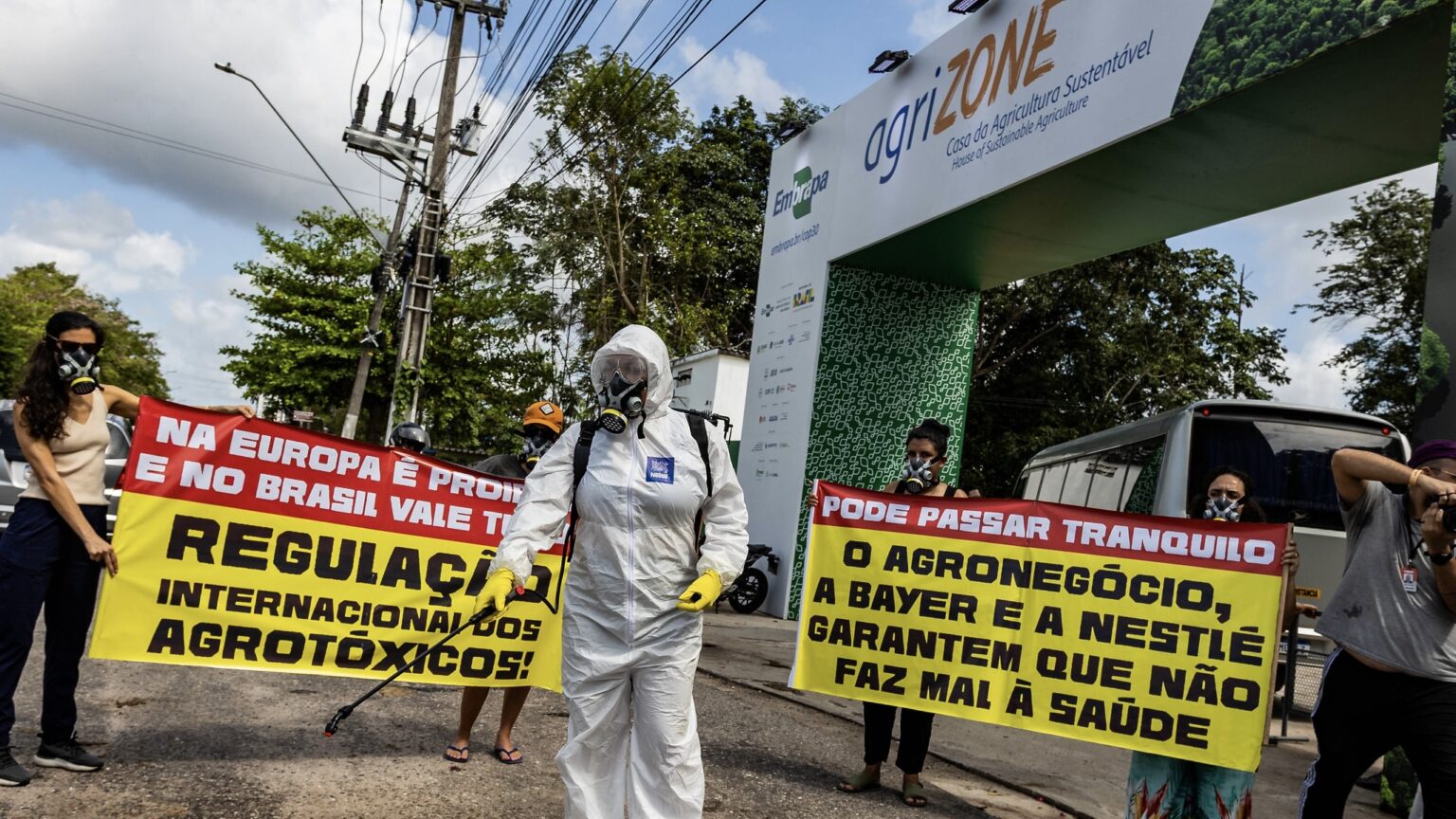
Protesters denounced the contamination of the Cerrado by pesticides at the entrance to COP30's Agrizone. More than 70% of the pesticides used in Brazil are used in the Cerrado, many of which are banned in Europe. Photo: Oliver Kornblihtt / Mídia NINJA

This year’s COP30 was met with considerable criticism, including for its failure to meaningfully address the dangers the climate crisis poses to health. At the same time, major food and agro-industry corporations – playing a central role in the erosion of both health and environment – were present at the forum. Many activists and Indigenous communities sounded the alarm, especially considering these companies continue to threaten people’s health and livelihoods through land grabs, pesticide use, and the marketing of ultra-processed foods (UPFs).

Together with new attempts by Global North governments to avoid taking financial responsibility for their contributions to the climate crisis, concerns over corporate participation and capture left many observers with the impression that COP30 fell far short of what is needed. The hope in Belém rested instead with grassroots initiatives.

UPF and agroindustry giants at COP

Reporters from the Brazilian media project O Joio e o Trigo documented the influence exerted by agribusiness throughout both the preparation and implementation of COP30. They noted that some key documents intended to outline a more sustainable agricultural vision were, in reality, heavily influenced by industry actors. One of the documents, for example, proposed that today’s agro-industrial model is capable of ending world hunger without harming communities or the planet. These claims, the reporters argue, are deeply misleading, not least because they sidestep the most urgent dangers arising from industrial agriculture.

One of the most glaring omissions in this context was the impact of pesticide use in Brazil’s agricultural sector. “If pesticides are ignored, then the harms they cause are ignored as well; that silence is deafening at a time when evidence of communities harmed by pesticide exposure, and growing suspicion about its link to rising cancer rates, is rapidly accumulating,” O Joio e o Trigo warned.

Companies with documented histories of undermining human and planetary health were present front and center at COP30. Bayer and Nestlé, for example, hosted flashy booths. Nestlé apparently drew visitors by offering free coffee and chocolate drinks. This coincided almost perfectly with the publication of a new series in The Lancet, which singled out the company as a major actor in global food industry networks working to derail public health regulations that aim to mitigate the consequences of UPF consumption. The environmental footprint of producing UPFs alone could be reason enough to treat such corporate participation with skepticism, yet similar companies still manage to position themselves as legitimate participants in discussion on climate change.

A radically different vision came from the tens of thousands who participated in alternative events and marches outside COP30 official spaces. Many, including activists from the People’s Health Movement (PHM), assembled through the People’s Summit. The meeting’s declaration identifies actors such as Big Food as central drivers of the climate crisis. “Transnational corporations, in collusion with governments in the Global North, are at the center of power in the capitalist, racist and patriarchal system, being the actors that most cause and benefit from the multiple crises we face,” the document states.

Activists argue that a genuine shift in addressing the climate crisis can only be achieved by placing grassroots movements at the center. “If today, here in Belém do Pará, international politics, the environment, and climate change are under debate, those who are most affected by these climate shifts must be at the forefront,” physiotherapist and parliamentarian Vivi Reis told Outra Saúde.

“It’s already clear that, in practice, COPs have had little influence in the fight against climate change, and that real answers and alternatives are actually built by those on the ground,” Reis said.

Unlike corporations, whose so-called solutions rely on fossil fuels, land devastation, and extractivism, grassroots movements are advancing models rooted in social justice and ancestral knowledge. “Peoples produce healthy food to feed the people, in order to eliminate hunger in the world, based on cooperation and access to techniques and technologies under popular control,” the People’s Summit declaration states. “This is an example of a real solution to confront the climate crisis,” it adds, emphasizing the need for popular agrarian reform and agroecology.

The declaration also names connections between other ongoing trends in the Global North, namely militarism, and the climate crisis, emphasizing again that a meaningful transition must be comprehensive and address all sources of injustice. “We demand an end to wars, we demand demilitarization,” it reads. “That all financial resources allocated to wars and the war industry be redirected to the transformation of this world. [We demand] that military spending be directed towards the repair and recovery of regions affected by climate disasters.”

https://peoplesdispatch.org/2025/11/27/ ... -at-cop30/

******

Plastic pollution is worsened by climate change
November 27, 2025

Warmer climate increases plastics’ toxicity, disproportionately poisoning large mammals

Image

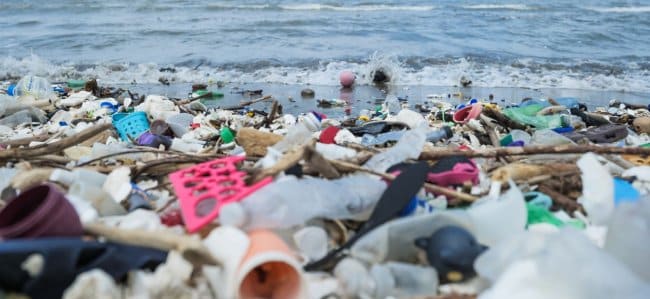
A new review published in Frontiers in Science says climate change conditions turn plastics into more mobile, persistent, and hazardous pollutants. This is done by speeding up plastic breakdown into microplastics — microscopic fragments of plastic — spreading them considerable distances, and increasing exposure and impact within the environment.

This is set to worsen as both plastic manufacturing and climate effects increase. Global annual plastic production rose 200-fold between 1950 and 2023.

The authors, from Imperial College London, urge eliminating non-essential single-use plastics (which account for 35% of production), limiting virgin plastic production, and creating international standards for making plastics reusable and recyclable.

“Plastic pollution and the climate are co-crises that intensify each other. They also have origins—and solutions—in common,” said lead author Prof Frank Kelly, from Imperial’s School of Public Health. “We urgently need a coordinated international approach to stop end-of-life plastics from building up in the environment.”

Joint crises

The researchers conducted a comprehensive review of existing evidence that highlights how the climate crisis worsens the impact of plastic pollution.

Rising temperatures, humidity, and UV exposure all boost the breakdown of plastics. Furthermore, extreme storms, floods, and winds can increase fragmentation as well as dispersal of plastic waste — with six billion tons and rising — into landfill, aquatic and terrestrial ecosystems, atmospheric environments, and food webs.

There are growing concerns about the persistence, spread, and accumulation of microplastics that can disturb nutrient cycles in aquatic ecosystems, reduce soil health, and crop yields. They also adversely affect feeding, reproduction, and the behavior of organisms that are capable of ingesting them, should levels exceed safe thresholds.

Microplastics can also act as ‘Trojan horses’ to transfer other contaminants like metals, pesticides, and PFAS ‘forever chemicals’. Climatic conditions may also enhance the adherence and transfer of these contaminants, as well as the leaching of hazardous chemicals such as flame retardants or plasticizers.

There is also historical plastic to consider. When ice forms in the sea, it takes up microplastics and concentrates them, removing them from the water. However, as sea ice melts under warming conditions, this process could reverse and become a major additional source of plastic release.

“There’s a chance that microplastics — already in every corner of the planet — will have a greater impact on certain species over time. Both the climate crisis and plastic pollution, which come from society’s over-reliance on fossil fuels, could combine to worsen an already stressed environment in the near future,” said co-author Dr Stephanie Wright from Imperial’s School of Public Health.

Apex predators particularly vulnerable

Combined impacts when both stressors occur together are particularly apparent across many marine organisms. Research into corals, sea snails, sea urchins, mussels and fish shows that microplastics can make them less able to cope with the rising temperatures and ocean acidification.

Filter-feeding mussels can concentrate microplastics extracted from the water, transferring this pollution to predators: effects like this can increase levels of microplastics higher in the food chain.

Species at these higher trophic levels are often already vulnerable to a host of other stressors, whose effects may be amplified by plastics. For instance, a recent study found that microplastic-induced mortality in fish quadrupled with a rise in water temperature. Another study showed that increased ocean hypoxia, which is also driven by warming, caused cod to double their microplastic intake.

Apex predators such as orcas may be particularly susceptible to the double hit of microplastics and climate change. These long-lived mammals are likely to experience significant microplastic exposure over the course of their lifetime.

The potential loss of keystone species that shape the functioning of the wider ecosystem could have far-reaching implications.

“Apex predators such as orcas could be the canaries in the coal mine, as they may be especially vulnerable to the combined impact of climate change and plastic pollution,” said co-author Prof Guy Woodward from Imperial’s Department of Life Sciences. Microplastics are also known to affect ecosystems on land, but these interactions are even more complex and harder to predict than for aquatic life.

Urgent action required on microplastics

The evidence showing increased amounts, spread, and harm of microplastics adds further impetus to calls for urgent action on plastic pollution.

The researchers say we must rethink the whole approach towards using plastics in the first place. “A circular plastics economy is ideal. It must go beyond reduce, reuse, and recycle to include redesign, rethink, refuse, eliminate, innovate, and circulate — shifting away from the current linear take–make–waste model,” said co-author Dr Julia Fussell from Imperial’s School of Public Health.

This review also demonstrates that integrating interactive effects of plastic pollution and climate stressors offers a way to steer, coordinate and prioritize research and monitoring, along with policy and action.

According to Wright: “The future will not be free of plastic, but we can try to limit further microplastic pollution. We need to act now, as the plastic discarded today threatens future global-scale disruption to ecosystems.”

“Solutions require systemic change: cutting plastic at source, coordinated global policy such as the UN Global Plastics Treaty, and responsible, evidence-based innovation in materials and waste management,” said Kelly.

https://climateandcapitalism.com/2025/1 ... te-change/
"There is great chaos under heaven; the situation is excellent."

User avatar
blindpig
Posts: 15306
Joined: Fri Jul 14, 2017 5:44 pm
Location: Turtle Island
Contact:

Re: The Long Ecological Revolution

Post by blindpig » Thu Dec 04, 2025 3:09 pm

The Earth Is Unhappy with the Capitalist Climate Catastrophe: The Forty-Ninth Newsletter (2025)

As Global North countries fail to meet their climate finance obligations, the recent COP30 exposed the importance of class struggle in winning binding commitments for climate justice.

4 December 2025

Image
Nazgol Ansarinia (Iran), Dissolving Substances, 2020.

Dear friends,

Greetings from the desk of Tricontinental: Institute for Social Research.

During the closing plenaries of the 30th Conference of the Parties to the United Nations Framework Convention on Climate Change (COP30) in Belém do Pará in the Brazilian Amazon, United Nations Climate Change Executive Secretary Simon Stiell gave a rousing speech. Stiell, from Grenada, came to his post after a long career in the corporate sector and then as his country’s environment and climate resilience minister under the pro-corporate New National Party. In his speech he said that ‘denial, division, and geopolitics [have] dealt international cooperation some heavy blows this year’. He nevertheless insisted that ‘climate cooperation is alive and kicking, keeping humanity in the fight for a liveable planet with a firm resolve to keep 1.5°C within reach’. When I heard Stiell’s speech I thought he was talking about another planet.

In May 2025, the World Meteorological Organisation released a report warning that there is an 86% chance that global mean near-surface temperature will exceed 1.5°C above the pre-industrial (1850–1900) average – the threshold set in the Paris Agreement in 2015 – in at least one year between 2025 and 2029; it also warned of a 70% chance that the five-year mean for 2025–2029 will exceed 1.5°C above that average. In late October 2025, just weeks before COP30, the American Institute of Biological Sciences published The 2025 State of the Climate Report: A Planet on the Brink, which found that ‘the year 2024 set a new mean global surface temperature record, signalling an escalation of climate upheaval’ and that ‘22 of 34 planetary vital signs are at record levels’. To be fair to Stiell, he did not imply that one should be complacent. ‘I’m not saying we’re winning the climate fight’, he said. ‘But we are undeniably still in it, and we are fighting back’.

On that, we agree.

Image
Su Yu (China), Iceberg Melting, 2022.

That same month the United Nations Environmental Programme (UNEP) published an alarming report titled Adaptation Gap Report 2025: Running on Empty. The report paints a picture not merely of insufficient climate finance from the Global North but of systematic abandonment of the Global South; it describes a world ‘gearing up for climate resilience – without the money to get there’. The issue of money is key. Promises to fund the climate transition first came at COP3 (Kyoto, 1997) through the Clean Development Mechanism, then at COP7 (Marrakech, 2001) through the Least Developed Countries Fund and the Special Climate Change Fund. But the breakthrough moment came at COP15 (Copenhagen, 2009), when the wealthy countries of the North pledged to mobilise $100 billion per year in climate finance for developing countries by 2020. Even the Copenhagen promises were hollow: there was no treaty obligation on the wealthier nations to meet this $100 billion goal, no enforcement mechanism to force those who made promises to follow up on their pledges, and most of the money that was pledged came as loans and not grants.

The $100 billion per year pledge from Copenhagen was reaffirmed at COP21 (Paris, 2015) and extended to 2025. At COP26 (Glasgow, 2021) the wealthier nations admitted that they had not met their goals and recommitted themselves to the $100 billion per year target. UNEP’s report provides a severe account of the missed pledges and false statements. Three points are essential to grasp:

Developing countries will require between $310 billion and $365 billion per year by 2035 for climate adaptation alone (setting aside mitigation as well as loss and damage). If inflation is taken at 3% per year, then real adaptation needs will reach between $440 billion and $520 billion annually by 2035.
In 2023 adaptation finance flows from developed to developing countries were just $26 billion, less than in 2022, and 58% of the money came through debt instruments and not through grants – a kind of green structural adjustment. The countries that are least responsible for the climate catastrophe are the ones that are driven to borrow in order to cope with the impact of the looming disasters.
By a simple calculation, needs are twelve to fourteen times larger than current flows, producing an adaptation finance gap of $284 billion to $339 billion per year.

Image
Nor Tijan Firdaus (Malaysia), Just Scan It, 2021.

One of the great tragedies of the entire debate around the climate catastrophe is that 172 countries – mostly the poorer nations – have already developed national adaptation plans, policies, and strategies. But as UNEP’s report points out, one fifth of these plans are outdated due to weak institutional frameworks, limited technical capacity, lack of access to climate data, and funding that is both unpredictable and delayed. For the poorer nations, the obstacle is less political apathy than resource constraints. Even when they try to prepare for the worst, they cannot secure the resources needed to do the work properly. This chronic underfunding reduces the whole process to a hollow ritual: documents are produced for compliance.

As climate debt is put on the table, claims are made that green finance will attract private capital. But this, too, is a myth. UNEP’s report shows that private sector investment in adaptation is less than $5 billion, and that even in the best-case scenario private capital will not raise more than $50 billion a year for adaptation (far less than what is needed). In practice, private financiers only enter adaptation projects when public funds are used to guarantee or subsidise their returns – so-called ‘innovative finance’ or ‘blended finance’ mechanisms designed to ‘de-risk’ private investment. So, in the end, the cost is borne by the treasuries of the poorer nations, whose governments effectively underwrite the money they borrow to fund adaptation projects that private investors consider too risky without such guarantees. As we argued in dossier no. 93 (October 2025), The Environmental Crisis Is a Capitalist Crisis, this model of green finance entrenches rather than resolves the climate debt owed to the Global South.

Image
Tapas Das (India), Suffocated Life, 2021.

This year, members of our institute went to Belém for COP30. They took part in the People’s Summit Towards COP30 – held from 12 to 16 November 2025 to confront the official conference – where they shared the findings of dossier no. 93. After the summit – which brought together over 25,000 participants and more than 1,200 organisations – our Nuestra América office asked Bárbara Loureiro of Brazil’s Landless Workers’ Movement (MST) to write a newsletter on COP30. In her letter she wrote that the ‘invisible general’ of the proceedings was the Brazilian agribusiness industry, which sought to greenwash its practices, expand its access to public funds, and shift the debate from mitigation to rebranding.

Watching the proceedings inside the hall of the official COP nevertheless raises a simple question: is it worth being part of the process or should we just let the COP regime die? There are three key reasons why it is important to continue to engage with the COP process:

COP provides a global stage where the Global South can demand reparations, loss and damage finance, and adaptation support. It is at COP that the argument can be made against climate debt finance and against voluntary targets. COP is not a site of salvation, but it can still be a site of struggle.
COP allows the Global South to maintain the principle of ‘common but differentiated responsibilities’ established in the Rio Declaration at the United Nations Conference on Environment and Development (1992).
COP forces the wealthy states to negotiate in the open rather than retreat to backrooms, where climate governance would be taken fully into the hands of private capital and the informality of the rich. The fight over the meaning of climate finance (either as debt or as reparations) can remain in the open.
After COP30 I asked Asad Rehman of Friends of the Earth why he thought it was worth fighting in the streets outside the halls of the COP. For Asad the first battle is to convince the climate movement to accept that the fight is not about fossil fuel use alone but about a crisis in our economies and societies, which must be transformed. At the same time, he told me, ‘There is actually some hope’. This is because the climate movement is saying that the problem is not a lack of finance but a lack of political will. The finance is available (as the UN Conference on Trade and Development argues in a new report, All Roads Lead to Reform: A Financial System Fit to Mobilise $1.3 Trillion for Climate Finance). While COP30 was taking place there was a meeting in Nairobi, Kenya, of the United Nations Framework Convention on International Tax Cooperation, where the richest countries blocked progress on a fair corporate tax that would make polluters pay for the environmental damage they cause. If implemented, such a tax could raise $500 billion per year, a good start toward climate reparations. Yet just as the Global North insists that there is no money for climate finance, NATO countries agree to increase military spending to 5% of GDP – even as there is clear evidence that militarism is a major driver of greenhouse gas emissions. ‘To see the climate movement arguing for debt cancellation, for wealth taxes, and for reforming the trade rules is a positive move’, Asad said. ‘Now, the climate movement is beginning to understand that this is an economic question. This is a paradigm shift’.

Image
Joan Miró (Spain), La masia (The Farm), 1921–1922.

In her letter for our Nuestra América office the MST’s Loureiro described COP30 as a mirror with two sides: ‘on one side, the celebration of the so-called “market solutions” and financial decarbonisation; on the other… the growing strength of the popular movement, which made Belém a territory for denunciation, internationalist solidarity, and the construction of real alternatives’. In her conclusion she calls on us to understand the climate catastrophe as a site of class struggle, one that can only be overcome beyond capitalism:

There is no real way out of the climate crisis without a rupture with the capitalist model, and there is no possible rupture without popular organisation, without collective struggle, and without confronting the structures that profit from devastation.

Warmly,

Vijay

https://thetricontinental.org/newslette ... tastrophe/

******

Cuba Aims for Energy Independence By 2035

Image
X/@BrunoRguezP.

November 28, 2025 Hour: 2:03 pm

The most advanced solar park has a capacity of 21.8 MWp.

On Thursday, the Cuban Energy Ministry announced the ‘National Energy Transition Strategy’ at the Havana International Fair (FIHAV) 2025. This proposal aims for energy independence by 2035 and 100% renewable energy by 2050.

The plan is to achieve 24% renewable electricity from solar and biomass sources, then 40% by 2035 with energy independence, through adding 2,000 megawatts of solar power and 500 megawatts of bioelectric and wind power, while maintaining 60% from heavy oil and domestic gas.

The final phase projects fully renewable electricity generation by 2050, since thermoelectric plants built between 1970 and 1990 are operating at only 40% capacity, dependent on imported diesel, fuel oil, and insufficient development of renewable energy sources.

On Nov. 19, Vietnam donated four photovoltaic solar parks to Cuba, which will be installed in Mayabeque province. The goal is to expand the use of renewable energy and strengthen the national energy matrix, according to the National Electric System (SEN).


Solar parks contribute a minimal fraction of energy consumption and lack backup power at night or on cloudy days. At the moment, the most advanced project is the ‘La Lucila’ solar park in Pinar del Rio province, with a capacity of 21.8 megawatts peak (MWp). It has already been synchronized with the SEN and is in the commissioning phase.

The installation reached a power output of 20.55 MWp during initial testing, and Yosleiby Izquierdo, energy specialist at the Pinar del Rio Electric Company, explained that inverters, concentrator boxes, and solar panels are being verified.

Izquierdo noted that, although the assembly is being carried out rigorously, only synchronization allows for verification of the correct operation. The process seeks to ensure that the new infrastructure provides stable and secure energy to the Cuban electrical system.

https://www.telesurenglish.net/cuba-aim ... e-by-2035/

******

Profitable Poisons
November 30, 2025
Beginning a series of articles on the deadly chemicals that capitalism spreads worldwide

Image

by Ian Angus

“The most alarming of all man’s assaults upon the environment is the contamination of air, earth, rivers, and sea with dangerous and even lethal materials. This pollution is for the most part irrecoverable; the chain of evil it initiates not only in the world that must support life but in living tissues is for the most part irreversible.” — Rachel Carson[1]

One of capitalism’s fundamental characteristics is a drive to innovate, to find new ways to generate profits and accumulate capital, as quickly as possible. The system’s defenders typically present that as an unalloyed good, but different is not the same as better. All too often those profitable new products have deadly side effects that are only discovered (or only made public) after they are in widespread use.

As the Marxist philosopher István Mészáros wrote, capitalism is “capable of adopting corrective measures only after the damage has been done; and even such corrective measures can only be introduced in a most limited form.”[2]

This problem has accelerated in the 20th and 21st centuries, as industrial laboratories have developed ever more chemicals, compounds and products that have no natural counterparts. In most cases, we have no idea what damage they might do in the short- or long-term, or in combination with other substances, because they’ve never been properly tested, if they’ve been tested at all.

How many might there be? We don’t know. There is no international database that lists all chemicals currently in commercial production, or what they all do — and the various national databases have different requirements for registration and for the information provided.

A study published in 2020 found over 350,000 different chemicals and mixtures of chemicals in 22 government inventories in 19 North American and European countries. Of those, the chemical identities of over 50,000 registered substances are claimed as trade secrets, and in another 70,000 cases the information provided was insufficient.[3] So we know nothing about the possible effects of more than a third of the commercially registered chemicals!

Those figures don’t include Asia, where total chemical production is 2.5 times larger than in Europe and North America.[4] Even allowing for a great deal of duplication between regions, there might be over half a million different chemicals in active production, and there is little or no public information about most of them.

How likely is it that those numbers include chemicals that are dangerous to life? It’s absolutely certain.

In the first place, the registered chemicals include thousands of pesticides, which by definition kill living organisms. In the United States alone, about 390,000 kilograms of pesticides are applied to farms, lawns and elsewhere, every year.[5] You don’t have to actually use them to be at risk: in 2023, the US Department of Agriculture found pesticide residues in over 60 percent of the food samples it tested.[6] The UN estimates that 200,000 people die from acute pesticide poisoning every year, almost all of them in poor countries where regulation is weak or non-existent.[7]

Pesticides aren’t the only registered chemical killers. In the U.S., the Toxic Substances Control Act requires industries to register any substances they make, distribute, use or dispose of that “may present an unreasonable risk of injury to health or the environment.” In 2025 the registry included 86,862 such substances of which half— 42,578 substances—are known to be currently in use by U.S. companies.”[8]

That’s far too many to track, but at least those substances have been registered. Even more frightening is an unofficial category that may be much larger: substances that present an unknown or deliberately concealed risk of injury to health or the environment.

To be continued in Part 2: The Devil’s Piss

Notes

[1] Rachel Carson, Silent Spring (Hughton Mifflin, 1962), 6.

[2] István Mészáros, The Challenge and Burden of Historical Time (Monthly Review Press, 2008), 383.

[3] Zhanyun Wang et al., “Toward a Global Understanding of Chemical Pollution: A First Comprehensive Analysis of National and Regional Chemical Inventories,” Environmental Science and Technology, January 2020.

[4] UNEP, Global Chemicals Outlook II: From Legacies to Innovative Solutions, United Nations Environment Program, 2019.

[5] Pesticides, US Geological Survey, https://www.usgs.gov/centers/ohio-kentu ... pesticides.

[6] USDA, Pesticide Data Program Annual Summary Calendar Year 2023, U.S. Department of Agriculture Agricultural Marketing Service, 2024, 19.

[7] Report of the Special Rapporteur on the right to food, UN Human Rights Council, 2017.

[8] U.S. Environmental Protection Agency, “Now Available: Latest Update to the TSCA Inventory,” press release, August 14, 2025.

https://climateandcapitalism.com/2025/1 ... e-poisons/

******

Report Shows How Recycling Is Largely a ‘Toxic Lie’ Pushed by Plastics Industry
Posted on December 4, 2025 by Yves Smith

Yves here. Although the Greenpeace report discussed below no doubt has more detail, yours truly has long been frustrated by vendors of supposedly healthy products, such as “organic” or “natural” cleaners, who use plastic packaging. My rough and ready understanding was that only clear or white containers could be recycled (and that of course assumes collection and trucking to recycling centers) when I see just about none like that. Why is it so hard to use a clear vessel with a colored label? Or as one company does, an outer cardboard sheath with a paper label and one hopes a clear inner liner?

This recap of the Greenpeace report does not discuss the energy cost of recycling, which is another offset to supposed benefit .

More generally, our former and much appreciated writer Jerri-Lynn Scofield covered the (not successful) war on plastics. She traveled regularly to India, and pointed out that the use of plastic packaging was vastly lower there than in the US. That demonstrated that vastly more could be done to reduce plastic waste by not using as much in the first place. But don’t ask Americans to give up on their vaunted convenience.

By Brett Wilkins, staff writer at Common Dreams. Originally published at Common Dreams

A report published Wednesday by Greenpeace exposes the plastics industry as “merchants of myth” still peddling the false promise of recycling as a solution to the global pollution crisis, even as the vast bulk of commonly produced plastics remain unrecyclable.

“After decades of meager investments accompanied by misleading claims and a very well-funded industry public relations campaign aimed at persuading people that recycling can make plastic use sustainable, plastic recycling remains a failed enterprise that is economically and technically unviable and environmentally unjustifiable,” the report begins.

“The latest US government data indicates that just 5% of US plastic waste is recycled annually, down from a high of 9.5% in 2014,” the publication continues. “Meanwhile, the amount of single-use plastics produced every year continues to grow, driving the generation of ever greater amounts of plastic waste and pollution.”

Among the report’s findings:

Only a fifth of the 8.8 million tons of the most commonly produced types of plastics—found in items like bottles, jugs, food containers, and caps—are actually recyclable;
Major brands like Coca-Cola, Unilever, and Nestlé have been quietly retracting sustainability commitments while continuing to rely on single-use plastic packaging; and
The US plastic industry is undermining meaningful plastic regulation by making false claims about the recyclability of their products to avoid bans and reduce public backlash.

“Recycling is a toxic lie pushed by the plastics industry that is now being propped up by a pro-plastic narrativeemanating from the White House,” Greenpeace USA oceans campaign director John Hocevar said in a statement. “These corporations and their partners continue to sell the public a comforting lie to hide the hard truth: that we simply have to stop producing so much plastic.”

“Instead of investing in real solutions, they’ve poured billions into public relations campaigns that keep us hooked on single-use plastic while our communities, oceans, and bodies pay the price,” he added.

Greenpeace is among the many climate and environmental groups supporting a global plastics treaty, an accord that remains elusive after six rounds of talks due to opposition from the United States, Saudi Arabia, and other nations that produce the petroleum products from which almost all plastics are made.

Honed from decades of funding and promoting dubious research aimed at casting doubts about the climate crisis caused by its products, the petrochemical industry has sent a small army of lobbyists to influence global treaty negotiations.

In addition to environmental and climate harms, plastics—whose chemicals often leach into the food and water people eat and drink—are linked to a wide range of health risks, including infertility, developmental issues, metabolic disorders, and certain cancers.

Plastics also break down into tiny particles found almost everywhere on Earth—including in human bodies—called microplastics, which cause ailments such as inflammation, immune dysfunction, and possibly cardiovascular disease and gut biome imbalance.

A study published earlier this year in the British medical journal The Lancet estimated that plastics are responsible for more than $1.5 trillion in health-related economic losses worldwide annually—impacts that disproportionately affect low-income and at-risk populations.

As Jo Banner, executive director of the Descendants Project—a Louisiana advocacy group dedicated to fighting environmental racism in frontline communities—said in response to the new Greenpeace report, “It’s the same story everywhere: poor, Black, Brown, and Indigenous communities turned into sacrifice zones so oil companies and big brands can keep making money.”

“They call it development—but it’s exploitation, plain and simple,” Banner added. “There’s nothing acceptable about poisoning our air, water, and food to sell more throwaway plastic. Our communities are not sacrifice zones, and we are not disposable people.”

Writing for Time this week, Judith Enck, a former regional administrator at the US Environmental Protection Agencyand current president of the environmental justice group Beyond Plastics, said that “throwing your plastic bottles in the recycling bin may make you feel good about yourself, or ease your guilt about your climate impact. But recycling plastic will not address the plastic pollution crisis—and it is time we stop pretending as such.”

We have all been duped into play-acting our roles in the blue-bin fantasy that plastics recycling is real. It’s not.https://t.co/KacqPvAiQJ

— Sheldon Whitehouse (@SenWhitehouse) December 2, 2025


“So what can we do?” Enck continued. “First, companies need to stop producing so much plastic and shift to reusable and refillable systems. If reducing packaging or using reusable packaging is not possible, companies should at least shift to paper, cardboard, glass, or metal.”

“Companies are not going to do this on their own, which is why policymakers—the officials we elected to protect us—need to require them to do so,” she added.

Although lawmakers in the 119th US Congress have introduced a handful of bills aimed at tackling plastic pollution, such proposals are all but sure to fail given Republican control of both the House of Representatives and Senate and the Trump administration’s pro-petroleum policies.

https://www.nakedcapitalism.com/2025/12 ... ustry.html
"There is great chaos under heaven; the situation is excellent."

User avatar
blindpig
Posts: 15306
Joined: Fri Jul 14, 2017 5:44 pm
Location: Turtle Island
Contact:

Re: The Long Ecological Revolution

Post by blindpig » Sat Dec 06, 2025 3:17 pm

Image

On Becoming The First Species To Go Extinct From Politeness

Gonna follow the dinosaurs out the door because it was too uncomfortable and confrontational to tell a few billionaires and empire managers to fuck off.

Caitlin Johnstone
December 5, 2025

We’re on track to become the first species to go extinct due to politeness. Gonna follow the dinosaurs out the door because it was too uncomfortable and confrontational to tell a few billionaires and empire managers to fuck off.

As Howard Zinn put it:

“As soon as you say the topic is civil disobedience, you are saying our problem is civil disobedience. That is not our problem…. Our problem is civil obedience. Our problem is the numbers of people all over the world who have obeyed the dictates of the leaders of their government and have gone to war, and millions have been killed because of this obedience. And our problem is that scene in All Quiet on the Western Front where the schoolboys march off dutifully in a line to war. Our problem is that people are obedient all over the world, in the face of poverty and starvation and stupidity, and war and cruelty. Our problem is that people are obedient while the jails are full of petty thieves, and all the while the grand thieves are running the country. That’s our problem.”

Or as Utah Phillips put it, “The earth is not dying, it is being killed. And the people who are killing it have names and addresses.”

They have names and addresses, but we don’t stop them. We let them wave armageddon weapons around for global power agendas and let them destroy our biosphere for profit, and who knows where they’re headed with all this AI stuff with zero regulations or accountability. They just get to play games with the lives of every organism on this planet, completely unimpeded.

We don’t allow this for any good reason. We just don’t want to be rude. Stopping them would feel like a bit much, you know? A bit too much shrill woke-policing. Nobody likes a humorless scold.

What a ridiculous reason for the world to end.


I like to think about the Fermi paradox sometimes. You know, the apparent contradiction between the fact that we can’t detect any signs of extraterrestrial life in our galaxy and the fact that the Drake equation suggests we should be seeing some due to the sheer number of stars in the Milky Way.

People have come up with all kinds of theories to resolve this paradox. Maybe the ETs are keeping signs of their existence hidden from us for some reason. Maybe there has been life on other planets many times throughout our galaxy’s history, but whenever life advances up to a certain level of intelligence it always self-destructs by cannibalizing its own biosphere or annihilating itself with nuclear weapons.

One theory I like to contemplate is the possibility that there is life on other planets and that those life forms will one day evolve high levels of intelligence, but we’re not seeing any signs of extraterrestrial technology because humans are the first life forms to arrive at this stage.

Isn’t that trippy to imagine? If WE’RE the grown-ups here? If we are the eldest sibling in our galactic family? The aliens never came to rescue us with technologies from a civilization millions of years more advanced than ours because there ARE no civilizations more advanced than ours. We got here first.

Imagine how silly it would be if we went extinct due to politeness, and then other civilizations came here millions of years later and found out that’s what happened to their galaxy’s firstborn intelligent life. If they showed up and found a bunch of ruins on a poisoned planet, with a sign that says “Sorry, we tried to stay alive but we didn’t feel entitled enough to make Sam Altman stop being a dick.”

What an embarrassment that would be. We’d be the laughing stock of the Milky Way. Whole insults would be made out of us.

“Someone needs to put a stop to this nonsense, but I don’t want to make a scene.”

“Ah, quit being such a little homo sapiens!”

What a dopey legacy for a species to leave behind.

Let’s turn things around before it comes to that, shall we?

https://caitlinjohnstone.com.au/2025/12 ... oliteness/

Thirty years ago public radio had environmental programming which did just that: called out specific environmental criminals. Then came Newt Gingrich's 'Contract on America' which largely defunded public broadcasting and turned your radio station into a begging machine completely beholden to capitalists. Surprise, that sort of thing disappeared, replaced by individualistic feel-good palp. It was far from what was needed, you cannot expect public broadcasting to endorse revolution, but it did raise awareness and stoke anger.

******

The Point of No Return for the Warm Water Atlantic Current Is Coming Up Fast
Posted on December 5, 2025 by Yves Smith

Yves here. It seems that due climate change signs coming in generally at the bad end of the range of forecasts, the timing for reaching various tipping points is coming sooner than earlier warnings indicated. One example is the slowdown of the Atlantic Meridional Overturning Circulation, which could kick in as soon as ten years from now.

By Thomas Neuburger. Originally published at God’s Spies


Image
A simplified animation showing the overturning circulation. Red lines are surface currents, blue are underwater. NASA/Goddard Space Flight Center Scientific Visualization Studio (source)

We will probably pass the tipping point for an AMOC shutdown in the next ten to twenty years or so.
—Climate scientist Stefan Rahmstorf

Does death make our lives less sweet? For most of us, no.
—Yours truly

Time for a climate update. Tipping points are approaching. To present this information this systematically, consider the following:

• Bad things are already happening, and they’ll continue.
• Over not much time, the bad things will also get worse.
• Then tipping points will be reached, after which the worst is baked in.
• Some years after that, the worst arrives in full.

This process is true in a great many areas: sea level rise, for example, and coastal destruction.

The seas are already rising, due partly to ocean expansion (warm water takes up more space than cold water), but due mainly to melting ice in Greenland and Antarctica. Once the tipping point for glacial melt has been reached, all ice will be guaranteed gone at some future time, and a full sea level rise disaster is bound to occur.

What will that look like? Greenland ice melt will cause 24 feet of sea level rise; Antarctica ice melt, 230 feet. The world’s coastal cities, where 15% of world population lives, will erode with the shores and be drowned. In the U.S., 45% of GDP will be lost.

The point to remember: this all occurs in stages. First, pain. Then greater pain. Then a tipping point, which may not be marked by an event, but which nonetheless guarantees, at some future time, complete collapse of the system under discussion.

For most of our systems, we’re at the first point now, or possibly the second — a point of considerable pain. Yet tipping points silently lurk, some quite nearby.

The ‘AMOC’, Europe’s Personal Heat Pump

With that, let’s look at one system under threat, the system of oceanic Atlantic currents that keeps northern Europe from freezing like Canada.

Image
Winter in Montreal (source)

Europe’s personal heat pump is the Atlantic Meridional Overturning Circulation, or AMOC — what most of us call the “Gulf Stream,” though those two are not quite the same. The AMOC is part of the world-ocean circulatory system that takes warm water from Equatorial zones and moves it across oceanic surfaces to the north and south, where it cools and sinks, then returns as deep water currents (see image above).

The part Europeans care about is the part that runs from the Gulf of Mexico to very near Scotland. Paris, for example is three degrees latitude closer to the North Pole than Montreal, and Scotland is closer still. Yet northern Europe is warmed by the AMOC, while Canada is not.

Image
Northern Europe is warmed by the AMOC, while Canada is not. The two pins above are cities on the same latitude line. (Image source)

Now consider the video below. In it, notable (very notable) climate physicist Stefan Rahmstorf discusses in scientific terms the future of AMOC. The whole thing is just 15 minutes, but you can start, if you like, at 12:43 to hear his tipping point prediction.


Rahmstorf’s bottom line: “We will probably pass the tipping point for an AMOC shutdown in the next ten to twenty years or so.” In other words, sometime between 2035 (ish) and 2050.

We won’t see it happen, most likely, that tipping point passed. But it will be passed nonetheless.

A Note for Skeptics

I understand that some readers here are climate skeptics. These are, after all, projections, and models can err. (Most of our climate models, in fact, have erred already, but on the side of complacence.)

These doubts don’t trouble me. No one’s optimism will change the future; nor will anyone’s doubt. Things will be what they are — decent or rough — regardless of anyone’s thoughts.

I will say this briefly, though, to the skeptically inclined: Watch your local environment for signs of increasing pain: diminishing water supplies; long and deep droughts; more costly insurance; bigger, more frequent hurricanes, storms and fires; fewer insects (sorry, that’s already here); more frequently canceled sporting events perhaps.

If you see these signs, prepare, regardless of what you believe to be the cause. Protect yourself. And if it turns out you’re right after all, I’ll be among the first to celebrate with you.

A Note for Believers

It’s easy to look at all this and become depressed. After all, this represents a kind of death, if not of ourselves as individuals, of the future the stories we constantly tell ourselves is certain to come — a future that’s somehow continuous with our own.

Consider our films and novels. Most stories that are set ahead some number of years ignore the climate and focus on new technology. Makes for a great film. But the climate — whose kingship is certain so long as we’re ruled by our current pathological lords — will kill off our tech. The wave of smart-phone delights that has given such joy is due to recede, and won’t return, perhaps, for a thousand years.

The way to stay centered is this: We all understand we will die, a personal destruction, yet most live unbowed by that weight — we eat, watch sports, fall in love, mourn losses, cheer gains, hug children, meet friends; in general we still attempt to live happy lives.

Does death make our lives less sweet? For most of us, no. Though death can’t be stopped; we don’t let it drag us down.

Same here. If you think the destruction of our climate and way of life, which the arrogant and greedy are dead-on determined to cause, can’t be stopped, then think of it as you do your personal future loss, and try to live well anyway. That choice is no different than the one you faced yesterday.

And if you think of a way to stop those pathological souls, those less-than-a-thousand folks who have charge of our lives, then do it. There’s joy in that too.

https://www.nakedcapitalism.com/2025/12 ... -fast.html

It's not that "less than a thousand" but the ten percent next on the wealth pyramid too and the system which made and sustains the ruling class.

******

PFAS: The Devil’s Piss
December 5, 2025
Part Two of a series on the poisons that capitalism spreads worldwide examines deadly ‘forever chemicals’

Image
Graphic: https://pfas.co

[Part One] [Part Two]

by Ian Angus

On June 26, 2025, eleven chemical company executives were sentenced to up to 17 years in prison, for poisoning water and soil in Italy’s Veneto region. The convicted men include three executives from the Japan-based multinational Mitsubishi, which owned the Italian company that polluted an aquifer that provides water to more than 30 municipalities, home to 350,000 people.

The pollutants involved were part of large family of synthetic chemicals called PFAS—per- and polyfluorenealkyl substances—often called forever chemicals because under normal conditions they break down either extremely slowly or not at all. As a result, they accumulate in living organisms and the environment, posing serious threats to health and environmental stability.

Groundwater tests in Veneto in 2013 had found concentrations of PFAS that were up to 1000 times above recognized safety levels. The affected communities installed filters to remove the chemicals from drinking water, only to learn that vegetables and fruit grown in the area were absorbing the toxins from the soil. A 2024 study found that the chemicals caused 3,890 excess deaths in the affected area between 1985 and 2018.[1]

These were the first executives to be jailed for PFAS pollution. If justice is served, they won’t be the last.

+ + + + +

PFAS is the umbrella term for a vast alphabet soup of chemicals with jawbreaking scientific names—PFOS (Perfluorooctane sulfonic acid), PFOA (Perfluorooctanoic acid), PFTE (Polytetrafluoroethylene), PCFTE (Polychlorotrifluoroethylene), and many more, each with somewhat different properties. What they have in common is fluorine and carbon atoms linked in some of the tightest bonds known to science. They are extremely long-lasting and extremely slippery—nothing breaks them, they repel water and grease and resist heat. The simple versions of the molecules last virtually forever, while more complex versions eventually degrade into the simple ones.

PFAS didn’t exist at all until the 1930s, when they were accidentally created in very small amounts in a Dupont Company laboratory. As with many other synthetics, the demands of war took PFAS from lab curiosity to practical application. Producing plutonium for atomic bombs used chemicals that were so corrosive that no container could hold them for any length of time. Millions of dollars of military research developed techniques to mass produce corrosion-proof PFAS containers. Mass production of PFAS for the Manhattan Project began during the war, in a Dupont factory in New Jersey.

This was dangerous stuff. In a 2025 interview, historian Mariah Blake, author of They Poisoned the World, outlined some of the hidden history she uncovered.

“It was clear from the beginning that these were dangerous chemicals. So, the plants where they were produced commonly had fires and explosions. Workers who worked in these plants were constantly being hospitalized with breathing problems and chemical burns. And in fact, Manhattan Project inspectors warned their supervisors that the fear of injury was causing unrest at these plants and that people in other parts of the DuPont facility had come to fear an assignment to this, to the fluorocarbon or PFAS production, as an exile to devil’s island.

“But it wasn’t just workers who were affected…. around 1943, farmers downwind of this plant in New Jersey began to complain that their peach crops were burning up, that their cows were so crippled, they couldn’t stand. They had to graze by crawling on their bellies. And in some cases, farmers were also falling ill after eating the produce that they picked.”[2]

By 1947, Manhattan Project scientists knew that the chemicals were toxic and that they accumulated in the blood of people who had contact with them—but when most records of the Manhattan Project were made public in the late 1940s, information about medical research and area pollution was not included, on the grounds that they would harm the government’s prestige and lead to lawsuits.[3]

In a deal that was supposed to prevent war profiteering, DuPont had agreed that patents on PFAS production would belong to the US government. Shortly after the war the government sold those patents to a small company called Minnesota Mining and Manufacturing, later renamed 3M—and it partnered with DuPont to develop commercial PFAS products.

The best known of those are Dupont’s Teflon, used in nonstick cookware, and 3M’s Scotchguard, a stain-repellant for clothing and furniture, but there are many more. PFAS of various kinds are used in lubricants, pesticides. raincoats, dental floss, cosmetics, food packaging, paints, ski waxes, and firefighting foams, not to mention uncounted industrial applications. No one knows how many kinds of PFAS there are—over 15,000 is a good guess—or how many products contain them.

What we do know is that the fluorine-carbon bond is so tight that although one type of PFAS may change into another, they don’t go away—every gram ever made is still in the global environment somewhere. Because they were first mass marketed in the 1950s and last so long, some scientists have suggested that their presence could be used as a marker for the beginning of the Anthropocene.[4]

“One of the reasons for the current notoriety of PFAS is the ease with which they spread through water: today they are widespread in the surface waters of lakes and rivers, have been widely detected in ocean waters from the equator to the poles, and are now spreading deep below ground, into our groundwater resources. So, one part of their legacy will be as an eternally shifting, long-lasting haze, ever more diluted within the fluid envelope that surrounds the Earth….

“Only a few materials can chemically break the super-tough carbon-fluorine bonds of the large but simple PTFE [Teflon] molecule, such as pure sodium or potassium (so reactive that they are not found by themselves in nature) and, at higher temperatures, pure magnesium and aluminium metal (both vanishingly rare in nature). This is a chemical compound, therefore, that looks set to persist within strata over geological timescales—and this time not as an invisible chemical signature that needs sophisticated chemical analysis to reveal it, but as a solid plastic-like material. Indeed, when a non-stick frying pan fossilizes, the metal itself might dissolve away over millions of years underground, but the PTFE film should persist, more or less unchanged, as a thin flexible film.”[5]

Mass-produced chemicals that can last millions of years and that travel easily in water are bound to become ubiquitous in the Earth System. As a 2025 Canadian government report says:

“Globally, PFAS can be found in virtually all environmental compartments, including air, surface and groundwater, oceans, soils, and biota, as well as in wastewater influent and effluent, landfill leachate, sewage sludge, and biosolids. The highest reported concentrations are typically in proximity to known sources of PFAS that may be released into the environment, such as contaminated sites where concentrations of PFAS may occur at levels which can pose negative human health and/or environmental effects. PFAS are also routinely reported in locations far removed from these sources. Similarly, although the highest concentrations of PFAS in organisms have been noted in proximity to known releases, their ubiquitous presence has been noted in tissue samples collected from organisms worldwide.”[6]

PFAS have been found in falling rain in Antarctica and Tibet, and in up to 98% of humans tested in multiple studies.

In factories that make or use PFAS, workers can absorb them through breath or skin. Elsewhere, exposure is most often in food or drink that contains PFAS from soil or water or packaging material.[7] The pollution most commonly originates in areas around PFAS factories; in areas near military airports where PFAS-based firefighting foam was used; in areas near landfills where PFAS from commercial and residential waste has leached into groundwater; and in areas where wastewater treatment does not include filters for removing PFAS from sewage.

A PFAS source of growing concern is the sewage sludge that is used as a fertilizer on as much as 28.3 million hectares (70 million acres) of agricultural land in the United States. The Environmental Working Group, an NGO that focuses on environmental health and agriculture, says this creates “a toxic pipeline from sludge to food.”

“Industrial discharges of PFAS, along with PFAS-laden waste from residential areas, flow into wastewater treatment plants. The wastewater treatment process separates liquids and solids, creating sewage sludge as a byproduct.

“But this process doesn’t remove PFAS, so the chemicals end up in both the solid sludge and also the treated liquid, which can contaminate drinking water supplies. And federal rules limiting pathogens and metals in sludge do not apply to PFAS.

“After the treatment process, the utility can then choose to put the sludge in a landfill, incinerate it or sell it to farmers who use it as fertilizer on their land. The sale of sludge is in some cases completed through third-party companies who are responsible for managing the sludge.

“There are no national requirements to test biosolids for the presence of PFAS or warn farmers they could be using contaminated sludge on their crops….

“Once PFAS-contaminated sludge is applied as a fertilizer, the forever chemicals can leach into food crops, and crops of animal feed, such as corn and hay. Then it can also be absorbed by animals that eat these feed crops.”[8]

No one knows how many highly contaminated areas exist. A 2023 study in Europe found 23,000 sites that are definitely PFAS hotspots and another 21,500 that are probably contaminated.[9] In the United States in 2025, the Environmental Working Group found 9,552 sites with “detectable levels of PFAS” in the U.S., but that figure is low, because many communities have not been tested.[10]

Our bodies have not evolved metabolic systems to deal with these chemicals, so the PFAS we absorb through water, food and air accumulate in our organs, particularly the liver, kidney and thyroid, faster than the body can excrete them. They can even move across the barriers that normally keeps foreign substances from passing from blood to brain and from placenta to fetus.

In 2025, a comprehensive review of the known effects of PFAS on human health found:

“PFAS exposure is associated with adverse health risks such as cancer, steroid hormone disruption, infertility, lipid and insulin dysregulation, higher cholesterol levels, liver and kidney disease, altered immunological and thyroid function, and cardiovascular effects. In infants and children, PFAS exposure can cause adverse effects on infants and premature babies and can lead to reduced growth parameters, lower visual motor skills and attention-deficit/hyperactivity disorder (ADHD) in childhood, lower levels of antibody concentrations against mumps and rubella, reduced lung and respiratory function, along with increased levels of glucocorticoids, progestogens, and uric acid.”[11]

Only a dozen or so of the thousands of PFAS have been studied in depth, so the actual list of health problems caused by this large family of chemicals is likely much longer. And because these chemicals are found in everything from drinking water to rain to house dust to clothing, it is pretty much impossible to avoid them. As the host of a U.S. television report on PFAS said, “the world is basically soaked in the devil’s piss.”[12]

They Knew

The executives jailed in Italy were not convicted just for polluting soil and groundwater, although that should have been sufficient cause, but for doing so knowing that the chemicals were toxic to human beings.

As we’ve seen, PFAS pollution is by no means limited to a small manufacturer in rural Italy. The largest manufacturers of PFAS, the chemical giants 3M and DuPont, knew for decades that the substances are toxic. Their executives have not faced criminal charges, but series of civil lawsuits, beginning in 1999, have forced the release of previously secret documents that reveal what those companies knew, and when. In 2023 a peer-reviewed study of those documents concluded:

“The two largest manufacturers of PFAS, DuPont (makers of Teflon) and 3M (makers of Scotchguard), were aware of the hazards of PFAS long before the public health community ….

“[C]ompanies knew PFAS was “highly toxic when inhaled and moderately toxic when ingested” by 1970, forty years before the public health community. Further, the industry used several strategies that have been shown common to tobacco, pharmaceutical and other industries to influence science and regulation—most notably, suppressing unfavorable research and distorting public discourse.”[13]

That confirms what the Environmental Working Group found in industry documents that it obtained and released in 2019.

“For nearly 70 years, chemical companies like 3M and DuPont have known that the highly fluorinated chemicals called PFAS build up in our blood. They’ve known for almost that long that PFAS chemicals have a toxic effect on our organs….

As far back as 1950, studies conducted by 3M showed that PFAS chemicals could build up in our blood.
By the 1960s, animal studies conducted by 3M and DuPont revealed that PFAS chemicals posed health risks.
By the mid-1970s, 3M knew that PFAS was building up in Americans’ blood.
In the 1980s, both 3M and DuPont linked PFAS to cancer and found elevated cancer rates among their own workers.”[14]
Despite that knowledge, the PFAS makers continued to reap profits from manufacturing and selling those chemicals, without warning anyone of the dangers. And since the facts have became public, they have spent hundreds of millions of dollars fighting legal liability in court, and on lobbying to block regulation of PFAS production.

In Europe, two of the deadliest forever chemicals—PFOA and PFOS—have been banned. Denmark, Germany, the Netherlands, Norway, and Sweden have jointly proposed a Europe-wide ban on all forms of PFAS, but a multi-million dollar lobbying campaign by the chemical industry seems to have derailed the plan: In August 2025, the Commission responsible announced that it will not make a decision until the end of 2026, and will not even consider restrictions on PFAS use in printing, sealing, machinery, explosives, military, technical textiles, broader industrial uses, and medical applications.

Similar lobbying in the United States has led to effective capitulation by the Environmental Protection Agency, which in May 2025 announced that it would give water utilities until 2031 to remove PFOA and PFOS from public water systems, and would soon eliminate restrictions on most other PFAS in drinking water. In November, it approved ten pesticide products that contain isocycloseram, a PFAS developed by Syngenta, for use in agriculture, lawn maintenance and indoor pest control. The EPA’s own documents show that it gives rise to 24 other forever chemicals, 11 of which pose known health threats in drinking water.[15]

So much for the myth of environmentally and socially responsible corporations. Abetted by the agencies that are supposed to police them, corporate poisoners are successfully defending their right to spread the devil’s piss everywhere.

To be continued.

Notes

[1] Annibale Biggeri et al., “All-cause cardiovascular disease and cancer mortality in the population of a large Italian area contaminated by perfluoroalkyl and polyfluoroalkyl substances (1980–2018),” Environmental Health, April 2024.

[2] Mariah Blake, Interviewed by Amy Goodman, Democracy Now, August 25, 2025. Transcript: https://www.democracynow.org/2025/8/8/forever_chemicals

[3] Mariah Blake, They Poisoned the World: Life and Death in the Age of Forever Chemicals, (Penguin Random House, 2025), 67.

[4] June Breneman, “Global Reach: Visiting scientist taps NRRI expertise,” news release, University of Minnesota Natural Resources Research Institute, July 6, 2023.

[5] Sarah Gabbott and Jan Zalasiewicz, Discarded: How Technofossils Will Be Our Ultimate Legacy (Oxford University Press, 2025), 183, 184.

[6] State of Per- and Polyfluoroalkyl Substances (PFAS) Report, Environment and Climate Change Canada and Health Canada, March 2025. publications.gc.ca/pub?id=9.947283&sl=0

[7] Shelia Zahm et al., “Carcinogenicity of perfluorooctanoic acid and perfluorooctanesulfonic acid,” The Lancet Oncology, January 2024.

[8] Jared Hayes, “‘Forever chemicals’ in sludge may taint nearly 70 million farmland acres,” Environmental Working Group, January 14, 2025.

[9] Forever Pollution Project, https://foreverpollution.eu/map/dataset-and-maps/.

[10] PFAS contamination in the U.S. (August 14, 2025), Environmental Working Group, https://www.ewg.org/interactive-maps/pf ... amination/.

[11] Csilla Mišl’anová and Martina Valachovičová, “Health Impacts of Per- and Polyfluoroalkyl Substances (PFASs): A Comprehensive Review,” , April 2025.

[12] John Oliver, Last Week Tonight, HBO, October 3, 2021.

[13] Nadia Gaber, Lisa Bero, and Tracey J. Woodruff, “The Devil they Knew: Chemical Documents Analysis of Industry Influence on PFAS Science,” Annals of Global Health, June 2023.

[14] Jared Hayes and Scott Faber, “For Decades, Polluters Knew PFAS Chemicals Were Dangerous But Hid Risks From Public,” Environmental Working Group, August 28, 2019.

[15] Submission to the EPA from the Center for Food Safety, June 10, 2025. Isocycloseram meets the OECD’s definition of PFAS, which the EPA has decided is too restrictive.

https://climateandcapitalism.com/2025/1 ... vils-piss/
"There is great chaos under heaven; the situation is excellent."

User avatar
blindpig
Posts: 15306
Joined: Fri Jul 14, 2017 5:44 pm
Location: Turtle Island
Contact:

Re: The Long Ecological Revolution

Post by blindpig » Fri Dec 19, 2025 3:21 pm

COP30 entrenches the crisis of climate politics
December 6, 2025

The Belem climate summit was yet another a ‘safety valve’ for capital, offering illusions and no real action

Image
Indigenous leaders in Brazil call for bold climate action ahead of COP30

by Brian Ashley
Amandla, November 25, 2025

As the dust settles after COP30 in Belém, the scale of the failure becomes impossible to ignore. The world is on a path toward catastrophic warming, ecological systems are collapsing, and millions across the Global South face annihilation, not in the distant future, but today. The world’s political and economic elites arrived in the Amazon to negotiate when the 1.5°C target had already slipped out of reach, and they left with little more than symbolic gestures. No binding emissions cuts. No serious plan to phase out fossil fuels. No meaningful climate finance for adaptation. No accountability for the destruction already unleashed.

The gap between official international climate policy and the lived reality of a warming world has never been wider. In Belém, that gap became a chasm.

The world is heading towards roughly 2.8°C of warming by the end of the century. This is not a scenario compatible with human dignity — or even, for many, with life itself. Rising seas, extreme heat, drought, and flooding are eroding food security, displacing communities, and driving inequality to historic heights. The economic costs of climate disasters are skyrocketing, but the social and human costs are immeasurable: lives lost, livelihoods shattered, ecosystems irreversibly damaged.

These worsening crises play out in a world shaped by neoliberal austerity and debt dependency. Countries battling climate shocks are forced to cut social spending, privatise public goods, and surrender sovereignty to creditors. Governments continue pouring billions into militaries, fossil fuel subsidies, and the enrichment of corporate elites. The current political economy accelerates both warming and war.

The growing irrelevance of the COP

COP30 offered no mechanisms for enforcement, no firm deadlines, and no clear pathways to keep warming below 1.5°C. Nor did it include a fossil-fuel phase-out; oil-producing nations blocked binding language, and the final deal focused on voluntary road maps instead. What it did offer was an expanded space for corporate actors, carbon traders, and mining interests seeking to greenwash extractivist projects.

What is staring society in the face — and what too few scientists are willing to acknowledge — is that the climate-crisis regime cannot be separated from the logic of capitalism. So-called “green transitions” simply open new arenas for profit while remaining embedded in the same global system of accumulation. Renewable energy may be expanding, but it does not replace fossil fuels; it merely adds to an energy expansion rather than driving a real transition.

Climate summits have become a “safety valve” for capital. They offer the illusion of action, while allowing the core exploitative relations to continue. For workers and communities already suffering climate breakdown, it is indisputable that the COP has failed them.

The Just Transition heist

COP 30 adopted the Belem Action Mechanism for a Global Just Transition (BAM) —a proposed new institutional arrangement under the UNFCCC designed to address the current fragmentation and inadequacy of global just transition efforts. Trade unionists and workers should have no illusions about this mechanism. It has no finances or concrete plans to protect workers and communities affected by energy and other decarbonising initiatives. There are no resources for a re-industrialisation in harmony with the protection of nature. So workers and other vulnerable sectors will simply be left behind. Words and policies in COP statements are a dime a dozen. Reality is harsher.

Why mass movements matter — and why institutions don’t

If COP30 cannot deliver the mechanisms for decarbonisation or social protection, then the hope must lie in movements of people: workers, peasants, indigenous people, women, youth, and the urban poor. Outside of a global mass movement rooted in national realities, the necessary steps to confront the climate crisis will not occur. Yet such a movement cannot be built if it fails to address the immediate needs of the working classes and the poor. The fight for climate protection and ecological justice must therefore begin with the fight for life itself — for clean water, decent housing, jobs, food, and security against the elements.

Right-wing climate denialists exploit the desperation of the poor to drive a wedge between ordinary people and climate action. They present environmentalism as a threat to livelihoods rather than the path to survival. To win the majority, our movement must link ecological transformation with social justice. We must demand the redistribution of wealth and power away from the billionaire class, big tech, and ruling elites who plunder the planet for profit.

https://climateandcapitalism.com/2025/1 ... -politics/

Deadly heatwaves will intensify for 1,000 years after net zero
December 10, 2025
Study shows that the hotter climate regime will last centuries, not decades

Image

Deadly hotter and longer heatwaves, which worsen in severity the longer it takes to reach net zero carbon emissions, will become the norm. New climate research, published last month in Environmental Research: Climate, challenges the general belief that after net zero conditionswill begin to improve for future generations.

The researchers used climate modelling and supercomputers to understand how heatwaves will respond over the next 1,000 years, after the world reaches net zero carbon emissions. They found:

“Heatwaves are systematically hotter, longer and more frequent the longer net zero is delayed and reach their highest values when net zero is delayed until 2060. Moreover, most regional trends show no decline over the entire 1000 years of each simulation, indicating that heatwaves do not start to revert to preindustrial conditions. Some regions even display significantly increasing millennial-scale trends when net zero occurs by 2050 or later. Furthermore, the longer net zero is delayed, the more occurrences of historically rare and extreme heatwave events.”

This is particularly problematic for countries nearer the equator, which are generally more vulnerable, and where a heatwave event that breaks current historical records can be expected at least once every year or more often if net zero is delayed until 2050 or later. Heatwaves may even be exacerbated by long-term warming in the Southern Ocean even after net zero is reached.

Most trends in the data showed no decline over the entire 1,000 years of each simulation, indicating that heatwaves do not start to revert towards preindustrial conditions even when net zero is reached, for at least a millennium. Some regions even displayed heatwaves of significantly increasing severity when net zero occurs by 2050 or later.

Co-author Andrew King of the University of Melbourne says the study proves the need for immediate action on reducing emissions and planning for adaptation. “Investment in public infrastructure, housing, and health services to keep people cool and healthy during extreme heat will very likely look quite different in terms of scale, cost and the resources required under earlier versus later net zero stabilisation. This adaptation process is going to be the work of centuries, not decades.”

https://climateandcapitalism.com/2025/1 ... -net-zero/

*****

Argentina’s Environmental Rollback Through Law and Budget

Argentina’s proposed glacier law reform and 2026 budget signal a sharp rollback in environmental protections, according to environmental and legal organizations.

Image
Andean glacier in Argentina, a strategic freshwater reserve potentially affected by proposed legal reforms and budget cuts. Photo: @CBA_Hoy

December 17, 2025 Hour: 6:50 am

Argentina is entering 2026 amid mounting concern over environmental governance, as the national government advances a reform of the Glacier Protection Law while proposing a federal budget that significantly reduces funding for environmental protection and related public sectors.

The bill amending the Glacier Law is currently before the Senate and is expected to be debated this week in Congress through extraordinary committees. In parallel, the proposed 2026 national budget introduces deep cuts to environmental, education, health, science and cultural programs, measures whose impacts, according to specialists, would extend well beyond the coming year.

Once considered a landmark piece of legislation with international relevance, the Glacier Protection Law is now being revised under what the government describes as a need for “regulatory order.” Environmental organizations argue that this framing conceals a substantial weakening of water protections at a time of accelerating climate impacts.

¡Grave retroceso ambiental en Tierra del Fuego-Argentina !

Tras fuerte influencia del gobierno de Milei, ayer 16 de diciembre de 2025, la Legislatura provincial aprobó la modificación de la Ley 1355, que desde 2021 prohibía la salmonicultura industrial en mares y lagos para… pic.twitter.com/vGWm3QMYct

❗️Defendamos Patagonia❗️ (@DefendamsChiloe) December 16, 2025


The Argentine Association of Environmental Lawyers and the Ecosocial Justice Action Collective warned that the reform represents a serious setback for water protection in a context of climate crisis, rapid glacier retreat and increasing water stress across the country. According to these organizations, the proposal removes the law’s current automatic protection of glaciers and replaces it with a discretionary system. Under this framework, a simple declaration by a provincial authority could exclude a glacier from legal protection, enabling extractive activities.

The draft legislation also eliminates the explicit ban on mining in periglacial environments and removes national minimum environmental standards, which currently guarantee a baseline level of protection across Argentina. Environmental advocates stress that, instead of strengthening safeguards for water resources in response to climate change, the government is weakening the only regulation that clearly limits the expansion of large-scale mining at river headwaters.

Budget policy reinforces these concerns. The proposal submitted by the presidency allocates 9.5 percent of total spending to debt payments, while funding linked to the right to a healthy environment falls by as much as 92.8 percent. The government of President Javier Milei also plans to maintain tax exemptions for mining and subsidies for the hydrocarbons sector.

The Foundation for Environment and Natural Resources criticized the approach, stating that “this limited perspective does not incorporate preventive or adaptive principles in line with the current climate crisis.” Ariel Slipak, research coordinator at the foundation, said that “it is essential for Congress to promote a broad, participatory and informed debate capable of correcting the setbacks posed by the current bill. Argentina needs a budget that strengthens public institutions, reduces inequalities and affirms a clear commitment to the fulfillment of human and environmental rights.”

📌Las noticias sobre el cuidado ambiental no son las mejores para este 2026 en #Argentina🇦🇷: el proyecto de Ley de Glaciares está en el Senado, mientras que el Presupuesto 2026 trae fuertes recortes ambientales que podrán sufrirse en años.

🔴Una reforma a una ley de avanzada… pic.twitter.com/rofKK0TaSM
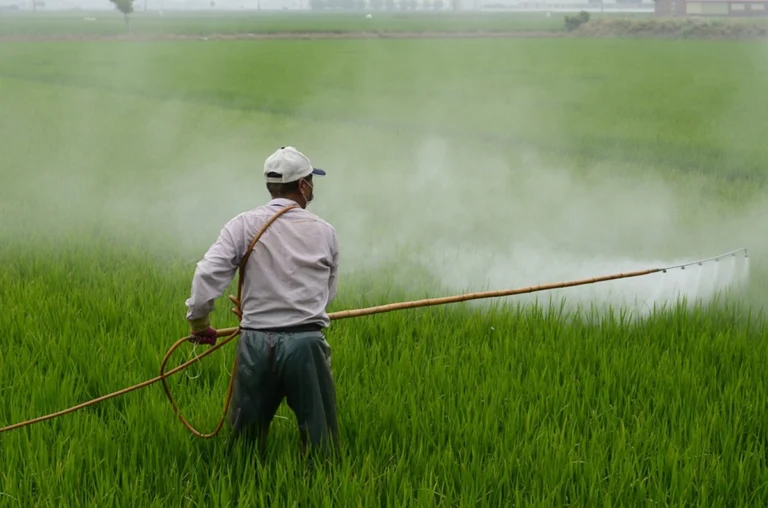
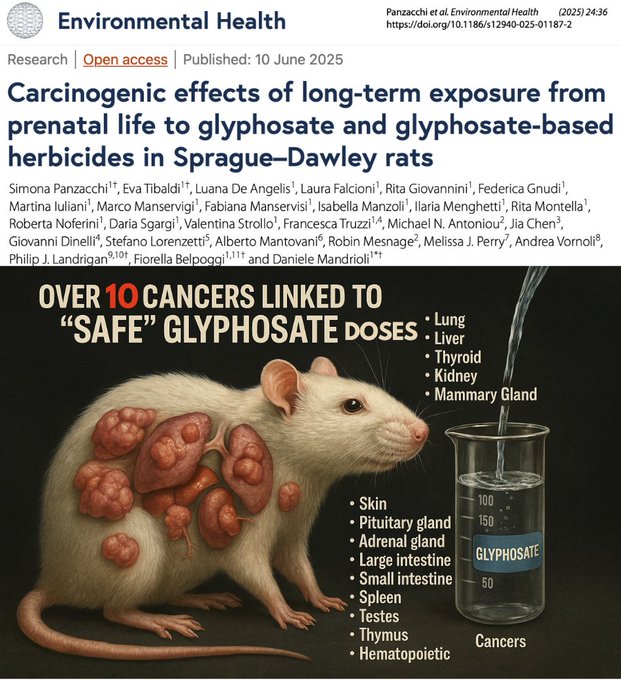
— teleSUR TV (@teleSURtv) December 17, 2025


According to the budget bill, environmental programs would receive 51.506 billion pesos in 2026, a real-term decrease of 33.8 percent compared to 2025 and 79.5 percent compared to 2023, the last year with an approved national budget. Funding for the National Fire Management Service would total 20.131 billion pesos, representing a real decrease of 69 percent compared to 2023 and 53.6 percent compared to 2025.

As Congress prepares to debate both the glacier reform and the budget, environmental organizations warn that the combined legislative and fiscal changes risk undermining water protection and climate resilience at a critical moment for Argentina.

https://www.telesurenglish.net/argentin ... nd-budget/

Scientists Urge Mexico to Ban Glyphosate

Image
Mexican farmer uses pesticides on crops. Photo: Gob MX.

December 17, 2025 Hour: 9:47 am

In 2024, the market for this herbicide reached US$352 million in this country.
Experts urged Mexico to ban glyphosate herbicide after discovering flaws in an article that served as an excuse for the agribusiness sector for 25 years. The article lacks scientific rigor, which raises alarms about its safety for human health.

Transnational corporations such as Bayer-Monsanto, Syngenta, and DuPont market glyphosate, which the World Health Organization (WHO) classified as a possible carcinogen in 2015. Used in Mexico since 1980, this herbicide is commonly applied to crops such as corn, citrus, sorghum, cotton, sugar cane, avocado, soybeans, and agave.

Producers use it for weed control to reduce costs, as well as for cleaning rural roads, which increases their economic dependence. Silvia Ribeiro, research coordinator for the Biodiversity Alliance, remarked that the most cited study was false and that Mexico should ban the herbicide immediately.

While researchers at the University of Guadalajara found toxic residues in water and people’s urine, more than a thousand scientific studies document kidney, liver, nervous system, and reproductive damage associated with glyphosate use.

In 2005, during the presidency of Vicente Fox, the Biosafety Law for Genetically Modified Organisms, known as the “Monsanto Law,” was passed, which favored genetically modified seeds for large corporations.

Andres Manuel Lopez Obrador attempted to gradually ban glyphosate through two presidential decrees, but failed due to pressure from the agribusiness sector and a lack of proven substitutes.

Image

In 2022, Senators Ana Lilia Rivera and Margarita Valdez proposed reforms to gradually ban pesticides. While Morena Party legislators Fernando Espino and Nancy Sanchez proposed extending the restriction for another three years.

However, the Supreme Justice Court has upheld the suspension of genetically modified corn crops, to which Bayer-Monsanto corporations sought to halt the presidential decree through legal injunctions.

The government of President Claudia Sheinbaum banned 35 pesticides in September, but it excluded glyphosate. The Secretary of Agriculture and Rural Development (SADER) indicated that this was the first of three phases, with further bans planned for 2026, though it avoided providing detailed information.

The Environment Secretariat informed that 86,449 tons of glyphosate were imported in 2019 by five companies that controlled 84% of the Mexican herbicide market and were consolidating their commercial dominance.

In 2024, the Mexican glyphosate market reached US$352 million. Peter Rosset, a former professor from El Colegio de la Frontera Sur, stated that banning the herbicide would be “an economic blow” and set an international example.

https://www.telesurenglish.net/scientis ... lyphosate/
"There is great chaos under heaven; the situation is excellent."

User avatar
blindpig
Posts: 15306
Joined: Fri Jul 14, 2017 5:44 pm
Location: Turtle Island
Contact:

Re: The Long Ecological Revolution

Post by blindpig » Fri Dec 26, 2025 3:41 pm

These 15 Coal Plants Would Have Retired. Then Came AI and Trump.
Posted on December 21, 2025 by Conor Gallagher

By Joe Fassler, a writer and journalist whose work on climate and technology appears in outlets like The Guardian, The New York Times, and Wired. His novel, The Sky Was Ours, was published by Penguin Books. Cross posted from DeSmog.

Since the second Trump administration took power in January, at least 15 coal plants have had planned retirements pushed back or delayed indefinitely, a DeSmog analysis found.

That’s mostly due to an expected rise in electricity demand, a surge largely driven by the rise of high-powered data centers needed to train and run artificial intelligence (AI) models. But some of the plants have been ordered to stay open by the U.S. Department of Energy (DOE), despite significant environmental and financial costs. Energy Secretary Chris Wright, a former fracking executive, has frequently cited “winning the AI race” as a rationale for re-investing in coal.

The fossil fuel facilities are located in regions across the country, from Maryland to Michigan and Georgia to Wyoming. Together, their two dozen coal-fired generators emitted more than 68 million tons of carbon dioxide in 2024. That’s more than the total emissions of Delaware, Maryland, and Washington, D.C. combined.

Nearly 75 percent of the coal plants were on track to shutter in the next two years.

The delays buck the overall trend in the U.S., where coal’s importance as an energy source has diminished rapidly over the past two decades. Coal’s critics say this broad-based phaseout is an urgent matter of public and environmental health. Often called the “dirtiest fossil fuel,” coal creates more climate emissions per gigawatt-hour of electricity than any other power source. And the human impacts of its pollution have been profound: A 2023 study in Science attributed 460,000 extra U.S. deaths between 1999 and 2020 to sulfur dioxide particulate pollution belched out by coal plants.

Cara Fogler, managing senior analyst for the Sierra Club, called the recent spate of delayed closures “unacceptable.”

“We know these coal plants are dirty, they’re uneconomic, they’re costing customers so much money, and they’re polluting the air,” said Fogler, who co-authored a report showing many utilities have backtracked on climate commitments, including coal phaseouts, often citing data centers as a cause. “They need to be planned for retirement, and it’s really concerning to see utilities becoming so much more hesitant to take those steps.”

DeSmog identified the 15 plants by examining changes to the planned retirement dates listed by the U.S. Energy Information Administration (EIA), a DOE agency that compiles data on energy providers, as well as public statements from utilities and the Trump administration. Some of the voluntary delays appear to directly contradict previous net-zero pledges made by several companies.

Neither the Department of Energy nor American Power, a trade association representing the U.S. coal fleet, responded to requests for comment.

What Led to Coal’s Decline?

Not long ago, coal really did keep the lights on. In 2005, it provided roughly half of America’s electricity, making it by far the dominant power source nationwide. But in the past two decades, coal’s market share has rapidly waned. No new coal plants have come online since 2013. These days, its footprint has dwindled, with just 16 percent of the overall energy mix.

In March 2017, President Trump appeared to blame environmental regulations for coal’s poor fortunes — a trend he promised to reverse.

“The miners told me about the attacks on their jobs and their livelihoods,” Trump said at U.S. Environmental Protection Agency (EPA) headquarters. “I made them this promise … My administration is putting an end to the war on coal.”

But environmental regulations didn’t kill coal. Instead, its demise became inevitable mostly thanks to the rise of a competing fossil fuel: natural gas.

Gas has both economic and technological advantages over coal, said David Lindequist, an economist at Miami University who co-authored a recent paper on the environmental impacts of the shale gas boom.

As new fracking technologies helped to flood the U.S. market with cheap gas in the mid-2000s, utilities began a broad coal-to-gas pivot that’s still underway today. Abundant, often less expensive gas flowed into power plants that operate more efficiently and nimbly than coal plants. This combination of price, efficiency, and flexibility made ditching coal an easy calculation for many utilities.

“The fact that we were able to so successfully phase out coal in the U.S. would never have happened without the fracking boom,” Lindequist said.

Today, coal is at an even greater disadvantage, as renewable energies continue to make economic and technological inroads. The International Renewable Energy Agency found that, in 2024, solar and wind routinely delivered electricity more cheaply than fossil sources of energy. That dynamic has helped solar in particular become the fastest-growing source of power in the U.S.

Meanwhile, America’s newest coal plant — the Sandy Creek plant near Waco, Texas, built way back in 2013 — is currently sitting idle after another catastrophic failure. It isn’t set to resume operations until 2027. The average U.S. coal plant is more than 40 years old, a factor that’s contributed to their decreasing reliability.

“These [coal] plants are so old that at this point there’s very little that could really revive the fleet,” said Michelle Solomon, manager in the electricity program at the nonpartisan think tank Energy Innovation. “I’ve been using the analogy of an old car: Nothing is going to bring my car that has 200,000 miles on it back to being a brand new, efficient car.”

During the Biden years, as technological advancements and historic subsidies made renewables even more attractive, observers broadly believed that coal’s days were numbered. The “writing was on the wall” for coal, Lindequist said.

“Coal may retain a grip in U.S. politics, but its actual role in the generation system is shrinking annually,” researchers for the Institute for Energy Economics and Financial Analysis wrote in a 2024 report. “It is a trend we believe is irreversible.”

Yet even before Biden left office, a new dynamic began emerging: As tech companies started proposing billions in data center build-outs to feed the AI frenzy, utilities started to take a fresh look at their coal plants.

Data Centers Changed Coal’s Trajectory

In 2020, Dominion Energy, a utility that provides electricity to millions of customers across Virginia, North Carolina, and South Carolina, announced non-binding plans to retire the Clover Power Station by 2025. Running the plant — an 877 megawatt (MW) coal-fired facility near Randolph, Virginia — would be uneconomical under any future scenario, the company found. It just didn’t make financial sense to keep it going.

It reversed course just three years later. Under its 2023 plan, Dominion projected that its energy demand from data centers would nearly quadruple by 2038. That’s an astonishing rise, considering that Virginia already leads the U.S. in data center development by a wide margin. Known as Data Center Alley, the state is home to more than one-third of the world’s largest-scale data centers. Today, Dominion says it doesn’t anticipate retiring any of its existing coal plants — including Clover — until at least 2045, the year that Virginia law stipulates its economy must be carbon-free.

Dominion wasn’t the only utility to cite data center growth as it backtracked on coal. In an August 2024 earnings call, executives of the Wisconsin-based utility Alliant Energy said that the company was “proactively working to attract” data center projects. A few months later, Alliant announced it would delay retiring the Columbia Energy Center, a coal-fired plant near Madison, from 2026 to 2029. The plant’s retirement had already been pushed back once.

Image

Utilities have delayed the retirements of at least 15 U.S. coal plants since President Trump took office in January 2025. Data source: U.S. Energy Information Administration. Credit: Joe Fassler/DeSmog

The trend became notable enough to attract the attention of analysts at Frontier Group, an environmental think tank. In January 2025, Frontier analyst Quentin Good published a white paper showing that utilities had already cited data center growth as a rationale for delaying the phaseout of seven fossil fuel power plants across the U.S.

“We were concerned about the potential for all of this new electricity demand from data centers to slow down the transition to clean energy,” he told DeSmog. “In that report, we discovered it was basically happening already.”

But two other dynamics also began playing out in January: AI hype started to reach new levels of intensity, and power changed hands in Washington.

AI Hype Highs, New Coal Lows

Data centers aren’t the only reason for the recent upswing in electricity demand. Building electrification, industrial growth, and increased electric vehicle ownership all play roles, too. But nothing has quite caught utilities’ attention like data center projects, which are cropping up with highly localized impacts across the U.S. at a historic rate. Filled with stacks of high-powered computing equipment, the facilities are projected to account for about half of new electricity growth between 2025 and 2030.

On January 21, 2025 — one day after President Trump’s second inauguration — he revealed a new AI infrastructure joint venture involving ChatGPT parent company OpenAI called the Stargate Project, which would spend up to $500 billion on data center build-outs in the next four years. Tech executives announced the initiative’s details alongside Trump during the unveiling at a White House event.

Days later, Meta CEO Mark Zuckerberg said he planned to spend $65 billion on data center build-outs in 2025 alone, including one project “so large it would cover a significant portion of Manhattan.” These announcements followed a similar one from Microsoft in January: a pledge to spend $80 billion on data centers this calendar year.

As the world’s largest tech companies raced to outdo each other, a wave of delayed coal plant retirements followed.

On January 31, Southern Company, a utility serving over 9 million customers across 15 states, announced plans to delay the retirement of generators at two of the largest coal plants in the U.S., both in Georgia. The massive, coal-fired units — two at the Bowen Steam Plant outside Euharlee, and one at the Robert W. Scherer Power Plant in Juliette — had been scheduled to go offline between 2028 and 2035. Under its revised plan, the company pushed retirement back to as late as January 1, 2039(though both plants would be 40 percent co-fired with natural gas by 2030 in that scenario).

In legal documents and public statements, company spokespeople point to data centers as a key rationale for the delays. Last month, at an industry conference in Las Vegas, Southern Company CEO Chris Womack cited data center growth as a key factor keeping fossil energy online, according to the trade publication Data Center Dynamics.

“We’re going to extend coal plants as long as we can because we need those resources on the grid,” he reportedly said.

Next door in Mississippi, Southern Company also delayed the closure of a 500 MW generator at the Victor J. Daniel coal plant in Jackson County. It pushed the retirement back from 2028 until “the mid 2030s.” In documents filed with Mississippi’s Public Service Commission, the state’s utility regulator, Southern appeared to cite a 500 MW Compass Datacenters project as a reason for the change. Southern has pledged to be net-zero by 2050.

As the months passed, the same dynamic unfolded in other states. Alarmed, Good, the Frontier Group analyst, started to track the delays. By October, he published an update to Frontier’s report that found data centers had pushed back at least 12 coal plant closures in the past few years.

“The data center boom has shown no signs of abating,” he wrote. “Even more fossil fuel plants that had been scheduled to retire have been given a new lease on life.”

In its own analysis, DeSmog found that at least 15 coal plant retirements have been delayed since January 2025 alone. Together, those plants emitted nearly 1.5 percent of America’s total energy-related carbon dioxide emissions from 2024.

This comes at a time when the world’s nations need to cut their climate emissions roughly in half to avoid the worst impacts of global heating, according to a recent United Nations report.

But not all the delays can be attributed directly to data center growth. Some have stayed open for a different reason: top-down orders from the Trump administration.

The Department of Energy Steps in

The J.H. Campbell Generating Plant, a 1.5 gigawatt coal plant in Ottawa County, Michigan, was scheduled to close May 31. The plant even held public tours to give a rare, behind-the-scenes look at aging fossil infrastructure, before it shut its doors for good.

“Now we know cleaner, renewable ways to generate electricity,” a Campbell employee told members of the public on a September 2024 tour.

But just eight days before scheduled to shutter, Department of Energy Secretary Chris Wright ordered Campbell to stay open another 90 days, citing an “emergency” shortage of energy in the Midwest.

Keeping the plant open cost its owner, Consumers Energy, almost $30 million in just five weeks, the company said. Though the plant’s closure was projected to save ratepayers more than $650 million by 2050, Campbell was costing more than $615,000 a day as of September. Yet Wright has since extended his order twice. Campbell now is scheduled to stay open until at least February 2026.

“The costs to operate the Campbell plant will be shared by customers across the Midwest electric grid region,” including customers serviced by other utilities, Matt Johnson, a Consumers Energy spokesperson told DeSmog by email.

Michigan Attorney General Dana Nessel is challenging DOE’s order to keep Campbell open, calling the orders “arbitrary.”

“DOE is using outdated information to fabricate an emergency, despite the fact that the truth is publicly available for everyone to see,” Nessel said in a November 20 press release. “DOE must end its unlawful tactics to keep this coal plant running when it has already cost millions upon millions of dollars.”

Meanwhile, DOE is telling a very different story.

“Beautiful, clean coal will be essential to powering America’s reindustrialization and winning the AI race,” Wright said in September, as the Department of Energy announced $350 million in funding for coal plant upgrades, along with other incentives.

Energy Innovation’s Solomon called the funding “a waste of taxpayer dollars.”

“We’ve been calling it a ‘cash for clunkers’ program where you don’t trade in the clunker,” she said. “Trying to build a modern electricity system using the most expensive and least reliable source of power is really not the answer.”

However, the Trump administration said in September that it plans to feed the AI boom — with an estimated 100 gigawatts of capacity in the next five years — by keeping more old coal plants open. “I would say the majority of that coal capacity will stay online,” Wright said.

Executives from Colorado’s Tri-State Generation and Transmission Association confirmed to DeSmog that they also expect an order to keep a 421 MW coal-fired generator at Craig Station open past its December 2025 decommissioning date.

In late October, Colorado Congressman Jeff Hurd sent a letter to the Trump administration, urging it to extend the life of a 400 MW coal generator at the Comanche Power Station near Pueblo as the owner, Xcel Energy, works to repair the plant’s chronically troubled main reactor. The smaller unit was slated to go offline in December — but, in its case, the administration never needed to act. Last month, Xcel, with the help of Colorado Governor Jared Polis, began to lobby to keep it open at least another 12 months. The state utility regulator appears to have granted that request, according to an agreement with Xcel and other stakeholders.

This delay wasn’t just due to data centers, though their numbers are growing in Colorado. Xcel spokesperson Michelle Aguayo said the delay was “due to a convergence of issues,” including rising electricity demand, “supply chain challenges,” and the continued outage at the main generator. “We continue to make significant progress towards our emission reduction goals approved by the state which would require us to retire our coal units by 2030,” she said.

Delaying the Inevitable

Whether the data center boom will play out as projected is still a matter of speculation.

Last month, power consulting firm Grid Strategies reported that utilities may be overestimating electricity demand from data centers by as much as 40 percent. That’s due in part to the many hypothetical projects, and a widespread practice of double- and triple-counting. Tech companies tend to pitch utilities in multiple regions as they shop around for incentives, creating the appearance of demand from many more data hubs than actually will be built.

Experts have a name for this growing phenomenon: “phantom data centers.”

At the same time, a growing chorus of critics are warning of an AI bubble, arguing that runaway costs can’t justify the kinds of investment being floated. Even the head of Google’s parent company has acknowledged the “irrationality” of the boom.

Critics also say contradictory actions taken by the Trump administration — citing an “energy emergency” while canceling billions in funding for renewable projects — are making the problem worse.

Yet even with all the unknowns, one thing’s certain: Coal’s role in America’s power push can be extended, but it can’t last forever.

Seth Feaster, an IEEFA analyst, says even AI hasn’t changed the big picture: Eventually, coal will die, and it will be killed by other, cheaper forms of energy.

He called the current phenomenon a “period of pause and delay.” In his view, the technological and economic rationales for quitting coal remain undeniable.

“The policy changes here may have a delaying effect on the decline of coal, but they are certainly not changing the direction of coal’s future,” he told DeSmog.

The questions for now are, how long the delays will continue — and at what cost.

https://www.nakedcapitalism.com/2025/12 ... trump.html

******

Near-Term Climate News and Other Tall Tales

When our grandkids are adults, gathered around 2110 fires, what tales they will tell!
Thomas Neuburger
Dec 19, 2025

Image

“We project a global temperature record of +1.7°C in 2027, which will provide further confirmation of the recent global warming acceleration.”
—James Hansen


Climate: You’re Soon To Be Here
For those who wish to stay informed, here’s Jim Hansen’s climate latest (available here). Emphasis mine below.

Abstract. Global temperature in 2025 declined 0.1°C from its El Nino-spurred maximum in 2024, making 2025 the second warmest year. The 2023-2025 mean is +1.5°C relative to 1880-1920. The 12-month running-mean temperature should decline for the next few months, reaching a minimum about +1.4°C. Later in 2026, we expect the 12-month running-mean temperature to begin to rise, as dynamical models show development of an El Nino. We project a global temperature record of +1.7°C in 2027, which will provide further confirmation of the recent global warming acceleration.

No tipping points showing yet, but acceleration confirmed. Elsewhere in the paper he says that the “accelerated rate” is “0.31°C per decade.” If that rate stays stable (i.e., no further acceleration), it yields the following in the next few decades:

2035 — +1.81 °C
2045 — +2.12 °C
2055 — +2.43 °C
2065 — +2.84 °C
Remember, that’s not based on models. It just takes today’s rate of change and sees where it leads — and assumes no further acceleration.

As you’re reading this, ask:

What will a +3 degrees warmer world look like?

Will you be alive in 2065 or so?

The ten-year-olds in my family will be 50 by then. The middle of their lives. Not good.

(My prediction for ppm CO2, similarly accelerated, is here. Hint: 2050 tops 500 ppm. Ouch.)

https://neuburger.substack.com/p/near-t ... -and-other

******

Image
A boutique hotel by the Mutianyu section of the Great Wall of China. It is located in Beigou, a village that has transformed from being a garbage-strewn, smoggy backwater to a magnet for city slickers in search of bucolic downtime. (Photo: Pallavi Aiyar)

How Beijing’s severe pollution turned into clear blue skies over a few years
Originally published: The Wire on September 14, 2025 by Pallavi Aiyar (more by The Wire) | (Posted Dec 24, 2025)

I wake up and still groggy, check my weather app. It’s not the temperature that causes me to gasp, but the AQI (air quality index). It’s at 13, the kind of reading you might (if lucky) expect in the European countryside. But I am in Beijing. When I last lived here, between 2002-2009, pollution monitors were, on occasion, unable to even record the AQI, it was so high (think 700s and beyond).

Returning to China after 16 years away is like a fever dream—there is much that is familiar, but bent into off-kilter shapes, and much that would simply have been unimaginable then. I feel a child’s sense of wonder as I walk around, trying to process the old-new contours of my once-upon-a home.

Nothing is a greater surprise than Beijing’s skyline. I am not referring to the futuristic urbanscape of the Central Business District with its architectural glitz. Shiny skyscrapers in gravity-defying shapes were already in the making a decade and a half ago. My wonderment is at what lies beyond the city skyline—cerulean punctuated by the sweep of rolling hills.

The Western Hills flank one end of the capital city and are less than 20 kilometers from the center. Yet, they had been entirely invisible through the thick, almost corporeal, air in the not-so-distant past, when Beijing ranked amongst the most polluted cities in the world.

For people suffering the smog of Indian cities, China’s clean air—the Beijing AQI has been about 50 on average over the last month- evoke a reaction equivalent to what its six-lane highways used to engender: shock and awe. What magic wand did Beijing wave to accomplish it?

In 2017, when it was not yet evident to a global audience just how much cleaner Chinese skies were getting, I published a book, Choked: Everything You Were Afraid to Know About Pollution,’ in which I argued that for Indian cities, China was the model to follow on cleaning the skies.

I outlined how China’s experience with industrialisation and fighting pollution demonstrated how blue skies entailed a tough, long slog that required, among other elements, government capacity, civil society activism, commercial compliance and bureaucratic incentives. There were no magic bullets. But neither was air pollution a fait accompli. It is a man-made problem, with man-made solutions.

Image
The clear blue skyline in China. (Photo: Pallavi Aiyar)

Measure to fight pollution take years to pay off. China had in fact been battling bad air for decades before cleaner skies became tangible. By the 2008 Olympic Games, pollution abatement equipment had been mandated and installed on the vast majority of its thermal power plants. This was technology that removed up to 95 percent of Sulphur Dioxide emissions. Nitrogen oxide-removing tech was next to become widely installed.

Through a combination of closing or upgrading coal-fired brick kilns and other polluting industries, enforcing strict vehicular emissions standards, transitioning to cleaner energy sources like natural gas and renewables, and promoting electric vehicles (EVs), Beijing’s air was gradually, not suddenly, cleaned.

In 2014, China updated its environmental protection law to give local authorities the power to detain company bosses who failed to complete environmental impact assessments. The law also removed limits on the fines that firms could be subject to for breaching pollution quotas.

Finally, China also learned quickly enough that to tackle bad air required coordination between cities within an air shed—the region within which air circulates. The wind does not obey city boundaries, an inconvenient fact that necessitates joint action across entire regions. Beijing’s measures to clean the skies came to nought, until it began to work in conjunction with neighbouring Tianjin and Hebei to coordinate policies to address all major sources of pollution—industrial, vehicular and domestic.

Today, China is as a leading producer of pollution-abatement equipment, electric vehicles, solar panels and wind turbines. The country’s power consumption in the single month of July this year, a record-breaking 1.02 trillion kWh, exceeded that of Japan’s annual equivalent. It marked the first time any country’s monthly power usage surpassed this threshold and was an 8.6 percent increase compared to July 2024.

Staggering statistics, but given China’s size, superlatives are par for the course. What truly blew my mind was that wind, solar, and biomass power generation accounted for nearly a quarter of this. In fact, over the first six months of 2025, renewable energy sources met not just all new electricity demand, but exceeded it—meaning wind and solar generation growth surpassed total electricity consumption growth. It’s a true milestone, with renewables displacing existing fossil fuel generation rather than simply meeting incremental demand. China’s CO2 emissions are beginning to decline.

As we drove into the city from the airport when we landed last month, the number of cars with the green license plates that mark them out as electric vehicle, was overwhelming. In China, electric and hybrid cars accounted for about 51% of new car sales in July 2025, marking a tipping point where they represent the majority of the market. Recent trends indicate that electric car penetration in major cities like Beijing exceeds 60-70% for new registrations, fueled by air quality mandates and incentives.

Last weekend, I spent a night with my family at a boutique hotel by the Mutianyu section of the Great Wall of China. The hotel, Brickyard Retreat, was formerly a tile factory with nine chimneys that belched out smoke at the height of production. It was shuttered as part of the drive to cut down on pollution, before being reborn in 2010, as a charming example of industrial chic. The hotel features exposed brick and is dotted with artifacts made from the kind of colourful glazed tiles it used to produce.

This new lease on life is symbolic of the broader fortunes of Beigou, the village it is located in. From a garbage-strewn, smoggy backwater, Beigou is now a magnet for city slickers in search of bucolic downtime.

Unexpectedly, the front office manager of the hotel was an Indian. We chatted for a while, and he told me his story. Nitin Ganesh Chand Kala was born in Nausari, Gujarat. He studied hospitality at a college in Mumbai but was curious about what the wider world could offer him. In 2017, a former professor helped him to secure a job as a restaurant manager at an Indian restaurant in Beijing where he worked for several years. Once the COVID pandemic hit, he used the downtime to learn Chinese. This proved to be a skill that made him valuable to hotels that required someone who could communicate with both local and foreign guests. He said that he plans to stay in the country for as long as he can.

“I love India and I miss the food, but the thinking here is more mature. People understand how to behave. Look at the roads here,” he said pointing into the horizon.

The village roads are better than the ones in Mumbai.

Later, while walking about the village, we met the owner of a local homestay, who moonlights as a DiDi—the Chinese equivalent of Uber- driver. He offered to take us back to the city the following day. When he drove up to the hotel to pick us up, it was in a spanking new electric Nissan.

He said he’d bought it a month ago for 300,000 RMB (around 40,000 USD). “Not bad, right? Not bad for a ‘laobaixing,’” he chuckled using a term that refers to an ordinary person, a peasant, a commoner. Not bad at all, I thought.

https://mronline.org/2025/12/24/how-bei ... w-years-2/

*****

Cuba Makes Landmark Decision to Conserve Coral Reefs

Image
X/@MirtaGranda.

December 26, 2025 Hour: 10:23 am

Corals face damage from rising temperatures, ocean acidification, pollution, invasive species, storms, and groundings.
Cuba has adopted a landmark decision to conserve coral reefs, vital ecosystems that protect coastlines, support commercial biodiversity, and generate sand to maintain the archipelago’s beaches.

Since reefs face accelerated degradation globally due to climate change and environmental pressures, Cuba is promoting marine protected areas, scientific research, and community participation to foster a “sustainable relationship” with the sea.

The document, soon to be approved by the Council of Ministers, proposes informed decisions and effective management with community participation, which consolidates a responsible framework for protecting this strategic habitat.

The plan, led by Patricia Gonzalez, a scientist at the Center for Marine Research, incorporates the work of scientists and conservationists who have dedicated years to the matter. It also aligns with ‘Task Life’, the Government’s program against climate change.

Descubre un universo de belleza inexplorada…

Cuba te invita a sus más de 500 zonas de buceo con paisajes, cuevas y corales espectaculares.

📷 @PrensaLatina_cu pic.twitter.com/16DwSrAJo3

— CubaPLUS Magazine (@CubaPLUSMag) December 8, 2025


The text reads, “Discover a universe of unexplored beauty. Cuba invites you to its more than 500 dive sites with spectacular landscapes, caves, and coral reefs.”

A key milestone was the “Circumnavigation of Cuba” in 2023, a scientific expedition with international participation that allowed a comprehensive assessment of the reefs and provided the foundation for a conservation roadmap.

The presentation of the roadmap embodies the historical vision of Commander Fidel Castro, who called for Cuba “not to turn its back on the sea.” Coral reefs contribute thousands of dollars in recreation and tourism, provide habitat for fish, and offer coastal protection.

Although reefs have an economic value of US$10 trillion annually worldwide, corals face damage from rising temperatures, ocean acidification, pollution, invasive species, storms, and groundings, factors that have led to the loss from 30% to 50% of reefs.

Saving the reefs requires a multifaceted local-to-global approach, with more resources and efficiency in restoration, as well as rapid progress to achieve a positive ecosystem impact.

https://www.telesurenglish.net/cuba-mak ... ral-reefs/
"There is great chaos under heaven; the situation is excellent."

User avatar
blindpig
Posts: 15306
Joined: Fri Jul 14, 2017 5:44 pm
Location: Turtle Island
Contact:

Re: The Long Ecological Revolution

Post by blindpig » Thu Jan 08, 2026 4:03 pm

Image
Photos: Horseshoe Bend, Arizona, December 2019. (Photo: waterdesk.org)

Corporate interests are driving Colorado River to near-collapse
Originally published: Liberation News on December 28, 2025 by Tina Landis (more by Liberation News) | (Posted Jan 03, 2026)

The Colorado River is on the verge of collapse, potentially threatening the water supply of 40 million people. But recent negotiations held by the seven U.S. states that rely on this water supply once again failed to reach an agreement to address the chronic overconsumption of water resources. These negotiations were attempting to implement a new round of sustainability measures that are set to expire in 2026. The meager measures that Lower Basin states agreed to in a 2023 deal was for a reduction of 1 million acre feet per year. This agreement fell far short of the Bureau of Reclamation’s annual goal of 2 to 4 million acre feet reductions to avoid “dead pool” in the major reservoirs of Lake Mead and Lake Powell. Reaching “dead pool” means that water within the reservoirs will be trapped behind dams and downstream communities will be cut off from water and hydropower supply.

As of April 2022, these two major reservoirs were around 150 feet above dead pool levels. Today, Lake Mead is at 33% full capacity and Lake Powell is at 28%—only 50 feet above dead pool levels.

In the most recent negotiations in November, the Upper Basin states of Wyoming, Colorado, New Mexico and Utah refused any mandatory cuts to their water rights, stating that they have never used the full amount allocated to them in the original 1922 Colorado River Compact, while the Lower Basin states of California, Arizona and Nevada have consistently consumed more than their allotment. The federal government has given states the new deadline of Feb. 14, 2026, to come to an agreement. If they fail, the Bureau of Reclamation, which has jurisdiction over the hydropower infrastructure at risk of dead pool, will step in and implement pre-2007 annual guidelines for states, which poses challenges to long term planning by state and local government agencies.

While the depletion of surface waters within the basin is alarming, groundwater in the region is being pumped at an even more alarming rate—which is not covered in these negotiations. Aquifers in general are being depleted far faster than they can recharge, which can take thousands of years in the case of deep aquifers. Pumping of groundwater is unregulated and has resulted in 28 million acre-feet being pumped within the basin since 2003, around double the amount consumed from surface waters within the same period.

Around 79% of water resources within the Colorado River Basin go to agriculture, 90% of which irrigates crops to feed cattle. Water-intensive crops like alfalfa, other cattle feed, and cotton, in addition to water needed for direct consumption by cattle, are the largest drains on basin waters. Any serious negotiations would be focusing on drastically curtailing the largest drain on above and below ground water resources through direct funding for small farmers and strict regulations on Big Agribusiness to shift to environmentally sustainable practices.

Instead of repeating these deadlocked negotiations on water rights, states instead should hold discussions with regional farmers’ associations on how to build a sustainable agriculture system in the region since that is the root cause of the problem. But that would challenge the capitalist model of commodity food production where what is produced is what is most profitable.

Restructuring the agriculture system to grow crops and raise livestock that thrive in a drier climate is the first logical step to reducing water consumption. There are many crops that thrive in the dry climate of the West that don’t rely on irrigation, such as food crops native to the region, as well as millet, quinoa, several legume species, tomatoes, and squash, among others. Perennial grains, like Kernza, that do not need to be replanted each year, could replace annual wheat crops. Kernza’s ten-foot deep root system—like other perennial species—improves soil health and soil water retention, supplying water for plants with shallower roots to access. Perennials are also a tool for climate change mitigation through their ability to sequester carbon.

Cattle are not native to North America and consume much more water than native grazing species. While implementing sustainable grazing methods for cattle can reduce water usage, bison, which are native to the grassland ecosystems of North America, consume much less water. As a keystone species, bison are also beneficial to soil health and overall biodiversity, and enable groundwater recharge through the wallows that they dig—essentially acting as bioswales where rainwater can pool and seep into aquifers.

Shifting to regenerative organic agriculture and using dry farming and no till methods would also greatly reduce water consumption, improve soil health and aid in carbon sequestration. Many small farmers are already shifting to these methods, but Big Agribusiness profits determine much of what is grown in the region.

Another issue that negotiations should address is evaporation, which is increasing as the climate warms. Evaporation of water held in reservoirs throughout the basin accounts for 11% of water usage within the basin. Globally 7% of freshwater resources held in reservoirs are lost to evaporation. Naturally flowing rivers greatly reduce freshwater loss to evaporation. Dam removal within the Colorado River Basin would resolve the issue of evaporation and would improve biodiversity, water quality and climate resilience in the region. Any loss of energy production from hydropower could be replaced with solar and wind energy systems, which are the lowest cost and quickest to implement with the lowest environmental impact of any energy source. One can look to the success of a Native-led, decades-long struggle for dam removal along the Klamath River in northern California for what is possible. Just days after the final dam was removed, salmon returned to the river, signaling that ecological health was rebounding.

Another issue that should be discussed in water rights negotiations is the massive influx of thirsty data centers being built or proposed throughout the region. Forty percent of existing and proposed data centers are in areas already facing freshwater scarcity. Twenty-four of the largest data centers and 379 smaller ones are located within the seven Colorado River Basin states. Large data centers can consume up to five million gallons of freshwater per day, equaling the water usage of a 10,000 to 50,000 person town.

The Trump administration’s recent executive orders on AI and data centers seek to override any state regulations or restrictions on new data center construction. But communities are fighting back and successfully blocking data center construction around the country. These struggles will inevitably continue to emerge against Big Tech’s theft of water resources, skyrocketing energy costs, and climate catastrophe that will result from the unregulated rollout of AI.

Capitalist production—from agriculture to data centers to energy—will continue to undermine a livable future for humanity due to the prioritization of profits over all else. The system is unable to address root causes of the crises we face, because the causes point to the very nature of the system itself. Only a socialist planned economy that uses the resources and common wealth of society to meet the needs of the people and planet can overcome chronic problems like water scarcity that are seemingly unsolvable under the current system.

As we continue to organize against all the attacks on our communities, we must connect the dots between struggles and demand real solutions that inspire a mass movement for a livable future.

https://mronline.org/2026/01/03/corpora ... -collapse/

Image
Poverty caused by factors including climate change can make children more vulnerable to Violence. (Photo:UNICEF/Sukhum Preechapanich)

How climate change is threatening human rights
Originally published: United Nations on December 26, 2025 by Pooja Yadav (more by United Nations) | (Posted Jan 06, 2026)

UN High Commissioner for Human Rights Volker Türk echoed this message in Geneva earlier this year and posed a question before the Human Rights Council:

Are we taking the steps needed to protect people from climate chaos, safeguard their futures and manage natural resources in ways that respect human rights and the environment?

His answer was very simple: we are not doing nearly enough.

“In this regard, the impacts of climate change must be understood not only as a climate emergency, but also as a violation of human rights”, Professor Joyeeta Gupta told UN News recently.

She is the co-chair of the international scientific advisory body Earth Commission and one of the United Nations’ high-level representatives for science, technology, and innovation for the Sustainable Development Goals (SDGs).

Who suffers the most?
Professor Gupta said that the 1992 climate convention never quantified human harm.

She noted that when the Paris Agreement was adopted in 2015, the global consensus settled on limiting warming to 2° Celsius, later acknowledging 1.5° Celsius as a safer goal.

But for small island States, even that was a compromise forced by power imbalance, and “for them, two degrees was not survivable,” said Professor Gupta.

“Rising seas, saltwater intrusion, and extreme storms threaten to erase entire nations. When wealthy countries demanded scientific proof, the Intergovernmental Panel on Climate Change (IPCC) was tasked with studying the difference between 1.5° Celsius and 2° Celsius,” she continued.

She said that the results were clear that 1.5° Celsius is significantly less destructive but still dangerous.

In her own research published in Nature, she argues that one degree Celsius is the just boundary, because beyond that point, the impacts of climate change violate the rights of more than one per cent of the global population, around 100 million people.

The tragedy, she noted, is that the world crossed one degree in 2017, and it is likely to breach 1.5° Celsius by 2030.

She underscored that the promises of cooling later in the century ignore irreversible damage, including melting glaciers, collapsing ecosystems, and lost lives.

“If Himalayan glaciers melt,” she said,

they won’t come back. We will be living with the consequences forever.

A man helps a woman after her car is stranded in waist deep water Globally rains are being more extreme due to impacts of climate change
A man helps a woman after her car is stranded in waist-deep water. Globally rains are being more extreme due to impacts of climate change. (Photo: WMO/Teguh Prihatna)

A question of responsibility
Climate justice and development go hand in hand. Every basic right—from water and food to housing, mobility, and electricity—requires energy.

“There is a belief that we can meet the Sustainable Development Goals without changing how rich people live. That doesn’t work mathematically or ethically,” Professor Gupta explained.

Her research shows that meeting basic human needs has a significant emissions footprint.

The research also highlights that since the planet has already crossed safe limits, wealthy societies must reduce emissions far more aggressively, not only to protect the climate, but to create carbon space for others to realise their rights.

“Failing to do so turns inequality into injustice.” she underlined.

Climate change and displacement
Displacement is one of the most obvious effects of climate injustice. Yet international law still does not recognise ‘climate refugees.’

Professor Gupta explains the progression clearly.

“Climate change first forces adaptation for example, shifting from water-intensive rice to drought-resistant crops. When adaptation fails, people absorb losses: land, livelihoods, security. When survival itself becomes impossible, displacement begins,” she said.

“If land becomes too dry to grow crops and there is no drinking water,” she said,

people are forced to leave.

She added that the most climate displacement today occurs within countries or regions, not across continents.

“Moving is expensive, dangerous, and often unwanted. The legal challenge lies in proving causation: Did people leave because of climate change, or because of other factors like poor governance or market failures?

“This is where attribution science becomes crucial. New studies now compare decades of data to show when and how climate change alters rainfall, heat, health outcomes, and extreme events. As this science advances, it may become possible to integrate climate displacement into international refugee law,” she noted.

“That,” she said,

will be the next step.

Children in Africa are among the most at risk of the impacts of climate change
Children in Africa are among the most at risk of the impacts of climate change. (Photo: UNICEF/Raphael Pouget)

A broken legal framework
Professor Gupta said that climate harms have been quite difficult to address through human rights law due to the fragmented architecture of international law.

“This fragmentation allows States to compartmentalise responsibility…They can say, “I agreed to this here, but not there,” she said.

“Environmental treaties, human rights conventions, trade agreements, and investment regimes operate in parallel worlds. Countries may sign climate agreements without being bound by human rights treaties, or protect investors while ignoring environmental destruction,” she added.

She asserted that this is why invoking climate change as a human rights violation at the global level has been so difficult. Until recently, climate harm was discussed in technical terms—parts per million of carbon dioxide, temperature targets, emission pathways—without explicitly asking: What does this do to people?

Only recently has this begun to change.

In a landmark advisory opinion, the International Court of Justice (ICJ) clarified that climate change cannot be assessed in isolation. Courts and governments, the ICJ said, must consider climate obligations together with human rights and other environmental agreements.

For Professor Gupta, this legal shift is long overdue but vital.

It finally tells governments: you cannot talk about climate without talking about people.

Climate change is transboundary
Assigning responsibility for climate change is exceptionally complex because its impacts cross borders, she said.

“For instance, a Peruvian farmer sued a German company in a German court for damages caused by climate change. The court acknowledged that foreign plaintiffs can bring such cases, but proving the link between emissions and harm remains a major challenge. This case highlights the difficulties of holding states or companies accountable for transboundary climate-related human rights harms,” she added.

Professor Gupta said that attribution science is making it possible to link emissions to specific harms.

The ICJ has now affirmed that continued fossil fuel use may constitute an internationally wrongful act. States are responsible not only for their emissions, but for regulating companies within their borders.

“Different legal strategies are emerging, from corporate misrepresentation lawsuits in the U.S. to France’s corporate vigilance law,” she added

Vehicle emissions diesel generators the burning of biomass and garbage have all contributed to poor air quality in Lagos Lagoon in Nigeria file 2016
Vehicle emissions, diesel generators, the burning of biomass and garbage have all contributed to poor air quality in Lagos Lagoon in Nigeria. (file 2016) (Photo: UNICEF/Bindra)

Climate stability as a collective human right
Rather than framing climate as an individual entitlement, Professor Gupta argues for recognising a collective right to a stable climate.

She explained that climate stability sustains agriculture, water systems, supply chains, and everyday predictability, and without it, society cannot function.

“Climate works through water,” she said.

And water is central to everything.

Courts around the world are increasingly recognising that climate instability undermines existing human rights even if climate itself is not yet codified as one.

This thinking is now echoed at the highest levels of the UN.

Erosion of fundamental rights
Speaking at the Human Rights Council in Geneva in June of this year, UN High Commissioner Volker Türk warned that climate change is already eroding fundamental rights, especially for the most vulnerable.

But he also framed climate action as an opportunity.

“Climate change can be a powerful lever for progress,” he said, if the world commits to a just transition away from environmentally destructive systems.

“What we need now,” he stressed,

is a roadmap to rethink our societies, economies and politics in ways that are equitable and sustainable.”

Political will, power, and responsibility
“The erosion of multilateralism symbolised by repeated U.S. withdrawals from the Paris Agreement has weakened global trust. Meanwhile, 70 per cent of new fossil fuel expansion is driven by four wealthy countries: the U.S., Canada, Norway, and Australia,” said Professor Gupta.

She argues that neoliberal ideology focused on markets, deregulation, and individual freedom cannot solve a collective crisis.

“Climate change is a public good problem,” she said.

It requires rules, cooperation, and strong States.

Developing countries face a dilemma: wait for climate finance while emissions rise, or act independently and seek justice later. Waiting, she warns, is suicidal.

As the UN High Commissioner concluded in Geneva, a just transition must leave no one behind.

“If we fail to protect lives, health, jobs and futures,” Volker Türk warned,

we will reproduce the very injustices we claim to fight.

https://mronline.org/2026/01/06/how-cli ... an-rights/

******

A planet poisoned by plastic
January 3, 2026
Part Three of a series. Plastics are a delivery system for 16,000 potentially toxic chemicals.

Image

[Part One] [Part Two] [Part Three]
by Ian Angus

Synthetic plastics made from fossil fuels scarcely existed in 1950, when the Anthropocene began. Today they are everywhere. They’ve been found on the top of Mount Everest and at the bottom of the Marianas Trench, the deepest part of the ocean. They are in the food we eat, the water we drink, and the air we breathe. Every person on earth has microscopic plastic fragments in their blood and organs.

Karl Marx compared capitalism to an evil god that demands human sacrifices as the price of progress.[1] The plastics industry is an extreme example of that.

+ + + +

The first synthetic plastic, bakelite, was patented in 1909. Polystyrene, polyvinyl chloride, polyethylene, and nylon were invented in the 1930s, but it wasn’t until after 1950 that the combination of cheap oil and new technology kickstarted decades of spectacular growth, outpacing any other manufactured material: 2 million tons in 1950, 4 million tons in 1955, 8 million tons in 1960.[2]

After 75 years, those numbers seem small. 504 million tons were produced in 2025 and the OECD predicts that 1260 million tons of raw plastics will be made in 2060.[3]

Today 8% of all petroleum and natural gas goes into making plastic—half for raw material, half for energy. Huge, highly automated factories break fossil fuels into a variety of hydrocarbon molecules with distinct physical characteristics that make them appropriate for different uses from plastic bags to construction materials. Beginning in the 1950, Susan Freinkel writes, “In product after product, market after market, plastics challenged traditional materials and won, taking the place of steel in cars, paper and glass in packaging, and wood in furniture.”[4] Today, plastics are truly ubiquitous, deeply embedded in every part of the capitalist economy and in our daily lives.

The benefits of plastics are undeniable. Many life-saving medical procedures would be impossible without plastic devices. The electronic devices which are so much a part of daily life are largely made from plastics. The list of examples could go on.

But there is a dark side, a realm of extreme environmental and health damage that counters the benefits. A study published in The Lancet in 2025 pulls no punches: plastics today pose “a grave, growing, and under-recognised danger to human and planetary health.”

“The world is in a plastics crisis. This crisis has worsened alongside the other planetary threats of our time and is contributing to climate change, pollution, and biodiversity loss. Long unseen and unaddressed, the magnitude of the plastics crisis is now widely recognised, and its implications for both human and planetary health are increasingly clear.”[5]

Plastics can be, and some are, used to make strong products that hold their shape for decades or even centuries. But capitalist enterprises quickly learned that bigger profits could be made from disposable products — commodities that had to be purchased again and again and again. Plastic products designed for long term use—primarily building and construction materials—comprise only 17% of the 8 billion tons of plastic produced since 1950. The rest, over 6 billion tons, were specifically designed to be used and discarded.[6] Of that,

50% is buried in landfills;
19% is incinerated;
9% is recycled;
22% is loose in the environment somewhere.[7]
Historian Alexander Clapp writes,

“For every human being alive right now there exists slightly more than one ton of discarded plastic out there somewhere, scattered on land or layered in the ground or adrift at sea; there is little question that most of it will outlive our own planetary presence by thousands, possibly hundreds of thousands, of years. In the ocean alone, per every human, there exist 21,000 pieces of plastic, a net mass of shopping bags and six-pack rings and bottle caps that by 2050 will exceed the weight of all fish put together and is expected to double every six years for the foreseeable future. Meanwhile, in just the minute it took you to read this paragraph, another million plastic bottles have been discarded and another garbage truck full of plastic has entered the seas.”[8]

Much public and environmental concern about plastics has focused on the visible presence of plastic waste in the environment, especially in the oceans, and the harm it inflicts on marine life. At least 52 million tons of plastic waste escapes into the environment every year and a large part of that is carried by wind and water to the oceans,[9] where it kills millions of birds and animals every year. Over 1300 marine species, including every seabird family, marine mammal family and sea turtle species ingest plastic, mistaking it for food.

In 2025, a large-scale study of sea animals that died in the wild found that about 35% of the seabirds, 50% of the sea turtles, and 12% of the seals, sea lions, dolphins and porpoises had plastic lodged in their digestive tracts, causing internal injuries or preventing them from digesting actual food. Just six pea-sized pieces of rubber is enough to kill a seagull, and an accumulation half the size of a baseball can kill a Loggerhead turtle.[10]

That study focused on pieces large enough to be easily seen, but after 75 years of plastic pollution a large percentage has been broken into much smaller pieces by wind, sun, and waves. The great majority of plastics in the environment today are microplastics, smaller than a pencil eraser. Billions of pieces smaller than a human hair originate as fragments shed by the synthetic fabrics used in most clothing. They are not visible pollution, but they pose much greater threats to animal and human health. Small, strong, and very light, they are carried everywhere by wind and water and are easily consumed by animals and plants at the bottom of the food pyramid and then accumulate in the bodies of those above.

A 2024 study found microplastics in 88% of protein products purchased in US food stores, including beef, chicken, pork and plant-based samples. The authors estimate that an average US adult could ingest 3.8 million plastic particles a year, from proteins alone.[11] The air we breathe also pollutes our bodies: a 2025 study in France found that adults inhale about 71,000 plastic particles of various sizes every day, in their homes and cars.[12]

A summary of recent research says that plastic particles “have been found in the human brain, heart, blood, lungs, veins, colon, liver, placenta, penis, testicles, and amniotic fluid. They are found on human skin and hair. They have also been detected in breast milk, stool—including meconium, a baby’s first fecal matter—mucus, saliva, and semen samples.”[13]

The extensive physical presence of plastic in the bodies of humans and other animals poses serious concerns, but an even bigger threat is posed by the thousands of toxic chemicals they leak into their surroundings and our bodies.

Plastics are composed primarily of polymers, very large molecules made up of many identical units called monomers. They exist in nature—cellulose is a common one—but almost all plastics are based on synthetic polymers made from petroleum, natural gas or coal. Alone, they don’t make good plastic products—some deteriorate in sunlight, others burn easily, or lose shape and stability, and so are inferior to the glass, metal, and other materials they are supposed to replace. The solution, which the petrochemical industry discovered 70 years ago, is to add other chemicals that impart the features required for various applications.

“Virtually all plastics-based products contain a wide range of chemical additives, often in very large quantities. … Depending on the product, additives can comprise 5%–50% by weight of manufactured plastics. Most additives do not form strong chemical bonds with the polymer matrix. They can therefore leach from plastic to contaminate air, water, and soil and expose humans.”[14]

How serious is this? There is no central registry of the chemicals that plastic makers use, but a recent comprehensive study of existing public databases identified an astonishing 16,325 different chemicals that are used in plastic production. Many of them are “chemicals of concern,” meaning that they are known to have intrinsic properties that pose health hazards.[15] They include known carcinogens, endocrine disruptors, forever chemicals (PFAS) and other proven threats to human health. Each of the nine major types of polymers used in synthetic plastics is associated with more than 400 chemicals of concern.

A summary of this research identifies seven key findings.

Over 4,200 or 25% of plastic chemicals are of concern because they are hazardous to human health and the environment.
Half of the chemicals marketed for use in plastics are classified as of concern.
Less than 1% of plastic chemicals may be classified as non-hazardous. However, a complete hazard assessment is lacking, implying that their safety cannot be determined conclusively.
3,651 plastic chemicals of concern are not regulated globally. These chemicals require most attention, and further granularity may be added by considering information on use, production, and regulatory status.
Fifteen groups of plastic chemicals have been identified as of major concern. These groups contain a high number of chemicals of concern.
Over 1,800 chemicals of concern are known to be present in plastics. This includes more than 500 chemicals of concern that are released from plastic materials and products, indicating potential for human and environmental exposure.
Each major polymer type contains at least 400 chemicals of concern. Rubber, polyurethanes, polycarbonates, and PVC are most likely to contain such compounds.[16]
The Lancet’s 2025 report summarizes the latest research on plastics and health. Of plastic chemicals, the authors wrote:

“Most plastic chemicals, including additives, are not chemically bound to polymer matrices. Instead, they are physically blended into polymers and can be released from plastics and into the surrounding environment by leaching, volatilisation, and abrasion. These chemicals can then enter the human body via ingestion, inhalation, and dermal absorption.

“Human exposure to plastic chemicals is extensive. National biomonitoring surveys detect measurable levels of several hundred synthetic chemicals, including plastic chemicals, in people of all ages, including newborn infants exposed in utero, across all global regions….

“[A recent umbrella review] found consistent evidence for multiple health effects at all stages of human life for many plastic chemicals. Infants in the womb and young children are especially at-risk. These effects include impaired reproductive potential (eg, polycystic ovary syndrome and endometriosis), perinatal effects (eg, miscarriage, reduced birthweight, and malformations of the genital organs), diminished cognitive function (eg, intelligence quotient loss), insulin resistance, hypertension and obesity in children, and type 2 diabetes, cardiovascular disease, stroke, obesity, and cancer in adults.”[17]

The evidence of plastics as killers mounts daily. In April 2025, researchers reported that in one year, 349,113 deaths from cardiovascular failure were caused by one chemical, di-2-ethylhexylphthalate, that leached from one type of plastic, polyvinylchloride.[18]

A handful of giant petrochemical companies are responsible for almost all plastic production. As we will see, they are fighting hard for protect their right to spread poison around the world.

(To be continued)

Notes

[1] Karl Marx, “The Future Results of British Rule in India,” MECW, vol. 12, 222.

[2] Hannah Ritchie, Veronika Samborska, and Max Roser. “Plastic Pollution,” Our World in Data, https://ourworldindata.org/plastic-pollution.

[3] Global Plastic Outlook: Policy Scenarios to 2060, (OECD. 2025), 10.

[4] Susan Freinkel, Plastics: A Toxic Love Story (Henry Holt, 2011), 4.

[5] Philip J. Landrigan et al., “The Lancet Countdown on Health and Plastics,” Lancet, August 2025, 1044, 1056.

[6] Paul Stegmann et al., “Plastic futures and their CO2 emissions,” Nature, December 2022.

[7] Victoria Heath, “What actually happens to plastic?” Geographical, January 24, 2025.

[8] Alexander Clapp, Waste Wars: The Wild Afterlife of Your Trash, (Little, Brown, 2025), 18.

[9] Joshua W. Cottom, et al., “A local-to-global emissions inventory of macroplastic pollution,” Nature, September 2024.

[10] Erin L. Murphy et al., “A quantitative risk assessment framework for mortality due to macroplastic ingestion in seabirds, marine mammals, and sea turtles,” Proceedings of the National Academy of Sciences, November 2025.

[11] Madeleine H. Milne, et al., “Exposure of U.S. adults to microplastics from commonly-consumed proteins,” Environmental Pollution, February 15, 2024.

[12] Nadiia Yakovenko et al., “Human exposure to PM10 microplastics in indoor air,” PLOS One, July 30, 2025

[13] “Microplastic Deluge: How These Small Plastic Particles Harm Our Health and the Environment,” Fact Sheet, Natural Resources Defense Council, June 2025.

[14] Philip J. Landrigan et al., “The Minderoo-Monaco Commission on Plastics and Human Health,” Annals of Global Health, March 2023, 78.

[15] L. Monclús et al., “Mapping the chemical complexity of plastics,” Nature, July 9, 2025. The term “chemicals of concern” refers to substances that have one or more of the following characteristics. Persistence: Survives for long periods in air, water, soil, or organisms. Mobility: Spreads easily in water and air. Bioaccumulation: Remains and accumulates in animals and/or humans. Toxicity: Causes harm to living organisms.

[16] Martin Wagner et al., State of the science on plastic chemicals – Identifying and addressing chemicals and polymers of concern. (PlastChem, 2024) https://doi.org/10.5281/zenodo.10701705

[17] Landrigan et al., “The Lancet Countdown,” 1049.

[18] Sara Hyman et al., “Phthalate exposure from plastics and cardiovascular disease: global estimates of attributable mortality and years life lost,” eBioMedicine, July 2025.

https://climateandcapitalism.com/2026/0 ... y-plastic/

*****

Image

The politics of life
By Andreas Malm (Posted Jan 08, 2026)

Originally published: Salvage on November 3, 2025 (more by Salvage)

In early November 2024, something historic happened in Spain.

The story starts with the violence of climate change. We all saw the scenes of sudden apocalyptic inundation in Valencia: the streets turned into roaring rivers, the people floating away, the piles of automobile carcasses. More than two hundred people died in the disaster. Then, on 9 November, more than 100,000 locals marched through Valencia in protest against the authorities, and the most enraged bloc clashed with the police. This was the first climate change riot in the global North, the first time an episode of destruction fuelled by fossil fuel combustion directly precipitated militant confrontations in the streets—the first time, but not the last.

Protesters accused the authorities of having killed the flood victims. There is substance to this allegation, because the first thing the coalition of the right and the far-right did when it came to power in Valencia last year was to close down an emergency response unit, formed by the previous red-green coalition to coordinate relief efforts in the event of a flood or heatwave, or other extreme weather event. The climate denialist right considered that a waste of money.

There will be more protests of this nature: against governments that fail to protect their citizens against the blows from climate breakdown.

But at some point, such protests must also make the leap to a higher level: the next riots, in a country like Spain, should target Repsol, the Spanish oil and gas giant, one of the world’s most aggressive investors in fossil fuels. Because renewables generate so little profit, Repsol continues to pour capital back into the expanded reproduction of oil and gas fields around the globe. As long as companies like Repsol remain in business, disasters of the kind we saw in Valencia will multiply—this is an immutable iron law. It follows that as long as protests stay on the frontline of adaptation, as long as they do not also cross over into the field of mitigation, we are destined to experience ever-worsening catastrophe. As Wim Carton and I argue in our forthcoming book, The Long Heat: Climate Politics When It’s Too Late, challenging the dominant classes for maladaptation as we saw in Valencia is henceforth an inevitable part of our struggle, but there can be no fair and just and meaningful adaptation if fossil fuel combustion does not stop. No cities, however well-governed, will be safe from inundation if the likes of Repsol keep pumping oil and gas out of the ground. No shields will be strong enough to withstand the ever-stronger blows from business-as-usual.

For that necessary hope, we must shift our gaze from Valencia to Colombia. For the first time in its history, Colombia has a left-wing government. The country has long been utterly dependent on producing and exporting fossil fuels, which account for more than half of its exports. Colombia is the third largest producer of such fuels in Latin America. When Gustavo Petro ran for president in 2022, he posited what he called a ‘politics of life’ against the prevailing ‘politics of death’: he promised to end all exploration for fossil fuels if he won, and in the two years of his presidency, not a single new exploration deal has been signed for any of the three fossil fuels.

Oil and gas production can be sustained only if new fields are located and opened, once the old have been depleted; if drilling is banned, the business will naturally come to an end; and so now Colombia is on track to terminate oil and gas extraction in its entirety sometime during the next decade, possibly as early as 2031.

After Petro won the presidency, he took direct control of the state-owned oil company, appointed his campaign manager as its CEO and instructed it to turn down offers of deals with foreign partners (most recently: Occidental Petroleum, one of the most aggressive oil and gas corporations in the US) even if such deals promised massive profits. The CEO of Occidental replied by denouncing Petro as ‘anti-oil, anti-gas, anti-fracking and anti-United States’, as if these were slurs. Coal is going the same way: open-pit mining is slated for shutdown.

None of this is happening because there is no more oil and gas and coal left in the ground: all of it is happening because Colombia is governed by people determined to leave them in the ground untouched. As Petro has said, there is a weapon of mass destruction in the Colombian subsoil.

We should be clear about just how exceptional this is. No other fossil-fuel producing country in the world has a government of anything like this mindset; no one else is actively trying to phase out the fuels of death and destruction and liquidate primitive fossil capital; none is ruled by a president—a former guerilla fighter—who reads contemporary Marxist theory and is himself working on ‘a book that will explore whether capitalism can address the climate crisis.’ In a recent profile in Time, Petro said of addressing the climate crisis: ‘If capitalism cannot, because it lacks planning capacity, then humanity will overcome capitalism on a global scale because the alternative is that humanity will die with capitalism.’ The president of a significant fossil-fuel producing country uttering words such as these is not a situation we are spoiled with often, and so we should appreciate it all the more.

This is not a matter of Petro alone: at least as important is the Minister of the Environment, Susana Muhamad. She recently unveiled a public investment plan worth $40 billion to get the transition going. Like so many other countries in the global South, Colombia has enormous potentials for producing solar and wind that remain untapped; the plan is to massively expand their production. Colombia is now on track to generate all its electricity by renewable means—going further, it aims to export such electricity. Muhamed and Petro want to shift from sending fossil fuels around the world to dispatching electricity from solar and wind through a pan-American grid. This, of course, is the essence of an energy transition: shutting down fossil fuels and replacing them with fully scaled-up solar and wind.

Colombia demonstrates that such a transition is possible, it is eminently feasible, and the obstacles to it are not technological but political. What determines whether such a transition takes place or not is exclusively the political balance of forces. This balance seems nowhere and never to be to our advantage, and in Colombia itself, powerful forces are stacked against the transitional project. Against that backdrop, the Colombian experiment is a model of what should be done. It is a model of the kind of heterodox ecological Leninism some of us on the left have wanted for years. A mass uprising on the streets—the revolt of 2019—20, with its mixture of student rallies, indigenous protests, workers’ strikes and militant confrontations with the police—was converted into an electoral campaign that won control over part of the state apparatus and targeted fossil capitalists as enemies of subaltern life.

Colombia is also a model of the contradictions such a project encounters. The country is facing a foreign investment strike. It has a deep state at one with the dominant class, both working to obstruct the Marxists in nominal charge at every step. The opposition has made strides recently, in parliament and elsewhere. Some promises remain unfulfilled: the expansion of wind-power has not been sufficiently enforced, for example. Perhaps most importantly, Colombia illustrates not only the impossibility of socialism—ecological or otherwise—in one country, but also the futility of attempts at energy transition in one country. The uniqueness of the Colombian experiment is its greatest weakness: all other major energy producers in Latin America—Brazil, Venezuela, Guyana, Mexico—are throwing themselves into the global frenzy for fossil fuels and accelerating production as fast as possible, even if governed by parties and presidents nominally of the left. As long as this remains the case, as long as Colombia is an isolated anomaly, there will be no progress, and Colombia itself is likely to slide back into business-as-usual. The left might then struggle to justify forgoing fossil profits as the planet heats regardless, while the right targets electoral gains by opposing climate action pursued alone. Such is the prisoners’ dilemma of our time. Capital and the nation form are twin obstacles to a politics of life, now as in Lenin’s 1914.

Nonetheless, we are so starved of positive examples, we are so unfamiliar with the living experience of a left seizing power that we should savour even the evanescent taste of it. We should talk about the Colombian experiment, learn more about it, see what could be done to internationalise it, because the politics of death and destruction rules supreme in this world. The darkness is nearly total, and so we should cherish even the smallest sparks of light.

The darkness is nowhere as concentrated as in Palestine. One is here tempted to see it as more than a coincidence that the foremost attempt at a politics of life, on the other side of the world, is spearheaded by a Palestinian woman: Colombian Environment Minister Susana Muhamad is of Palestinian descent. It is certainly not a coincidence that the Colombian government has also pursued a consistent policy of boycott: on 1 May, Petro announced the termination of all diplomatic ties with the Zionist entity. In August, he banned all export of coal to that state. Before this decree, Colombia was the number one supplier of coal to the occupation: now it sends nothing. Keep the coal in the ground, and start by not selling anything to the state of Israel—this is the politics of life in the twenty-first century. Netanyahu consequently denounced Petro as an ‘antisemitic supporter of Hamas’, while actually existing Hamas published another of its brilliant statements praising Colombia as a model for the rest of the world to follow. ‘We call on all countries to sever the relations with this fascist entity and to work by all means to boycott, isolate, impose sanctions on it, and prosecute its leaders’, said Hamas—as with the transition, an option that can be pursued. What everyone knows is to be done can be done.

On the ground in Palestine, the political situation is qualitatively different from the one in Colombia, or anywhere else, because the forces of destruction are unleashed in Palestine without any inhibitions, with an intensity that consummates the unity of genocide and ecocide: a systematic shattering and levelling of all possibilities for life in Gaza, and beyond. But Palestine is exceptional only because it crystallises the general forces in motion in this world. Among other spectres, Palestine prefigures the endpoint of global warming: a world with nothing left but ashes and smoking rubble. This is already the case from Jabaliya to Rafah, but it will also ultimately be the case on Earth as a whole, if the politics of death is not defeated and the forces of destruction are not themselves destroyed.

It is a serious political imperative, then, to pay tribute to the resistance: to those who cherish life sufficiently to confront the forces of destruction, treating a politics of life not as the thin pacifism that declaims violence now and to hell with the consequences. Rather, resistance entails understanding the struggles required now to hand life and freedom to those who come after us.

We leftists can start with the left. We should talk much more about the Jabha Shabbiye li-Tahrir Falastin, the Popular Front for the Liberation of Palestine, because at this point of intense destruction, the PFLP is present and puts up resistance to the best of its ability. This is not a left in government—this is a left that fights from the position of the most extreme powerlessness and exposure to the most overwhelmingly powerful forces of destruction, and precisely for this reason it deserves special respect and appreciation. When in early November 2024, the occupation carried out a sweep of abductions in the West Bank and Lebanon, the mission specifically targeted the Front and arrested more than 60 of its militants—an index of the threat it is perceived to pose.

The Front has offered martyrs on every Palestinian frontline of Toufan al-Aqsa. Consider the following tiny sample of examples. Abed Tahani, a comrade of the Front, journalist, founder of the independent media network Taqadomy (‘Progressive’) was killed in Jabaliya alongside his brother Abdelfattah, fighter in the Abu Ali Mustafa Brigades, ten days after October 7. As the Front wrote in a tribute to Abed Tahani: ‘Abed banged on the walls of the tank, as did Gaza’s resistance on October 7’. That phrase banging on the walls of the tank is a reference to Ghassan Kanafani’s Men in the Sun. I have argued previously in Salvage that this image paints the most striking picture of resistance in a world on fire.

Suleiman Abdul Karim al-Ahmed, a field commander of the Abu Ali Mustafa Brigades on the northern battlefield, was martyred a year after October 7 on the border with Palestine while resisting the invasion of Lebanon. Mohammed Abdel Aaal, head of security for the Front, a novelist, organiser, military operative, was assassinated in Beirut in autumn 2024. He was singled out for his role in building cells of the Abu Ali Mustafa Brigades in the West Bank—when I visited Beirut in April, his brother Marwan, leader of the PFLP in Beirut, could still receive me openly in party offices in mukhayam Mar Elias; he has since been forced underground but he sent out a communique mourning his martyred brother:

The heart gets lost in the chaos of war. Even the evening news for the whole family is about war—the destruction of homes, missile strikes, the levelling of neighbourhoods, the burning of refugee tents. We cannot remove war from our lives. We didn’t learn its arts; rather, it imposes itself on our daily lives and teaches us its lessons, so that we may survive erasure and extermination, and remain alive for the name that Palestine deserves.

Continuing the resistance against all this destruction is now an affirmation of the very possibility of life itself. Abdaljawad Omar, who has become a major interpreter of the resistance in this moment and who appears in this issue of Salvage, recently captured the point in an interview with Jewish Currents: ‘resistance is less about achieving a specific endpoint and more about affirming a presence, a refusal to be erased’.

We should pay tribute, then, to the comrades of the Front who have given their lives in this resistance; but none of its martyrs—as the Front itself would be the first to recognise—have come close to the epic heroism of Yahiya Sinwar, Abu Ibrahim, the leader of the politburo, who did not keep the captives as human shields; who did not hide behind civilians; who refused the offer of safe passage to exile; whom the enemy could never find—but who found the enemy.

He donned a military vest and a keffiyeh and took up position in a house in Rafah. He threw two hand grenades against the soldiers of the genocidal occupation; making them run for their lives; making them shell the house from a distance and send in a drone like cowards. You have seen the pictures: Yahiya Sinwar, again, as after the war in 2021, sitting like the king of rubble in a chair, only now with one of his hands blown off, and when the drone comes closer, he throws a stick at it—all around him, rubble as far as the eye can see, everything pulverised by the machinery of death and destruction: and yet there he is, resisting, even when it is too late, even after everything is lost, banging on the walls of the tank.

This is the spirit we will need in the years ahead: in the second Trump presidency and in the coming decades of catastrophe.

https://mronline.org/2026/01/08/the-politics-of-life/

If capitalism is not negated soon the politics of life will be the politics of the deed.
"There is great chaos under heaven; the situation is excellent."

User avatar
blindpig
Posts: 15306
Joined: Fri Jul 14, 2017 5:44 pm
Location: Turtle Island
Contact:

Re: The Long Ecological Revolution

Post by blindpig » Sat Jan 17, 2026 4:09 pm

Image

‘Poisoning the Well’ authors Sharon Udasin and Rachel Frazin on PFAS contamination and why it ‘has not received the attention it deserves’
Originally published: EcoWatch on July 8, 2025 by Craig Thompson (more by EcoWatch) | (Posted Jan 12, 2026)

In the introduction to Sharon Udasin and Rachel Frazin’s new book, Poisoning The Well: How Forever Chemicals Contaminated America, the authors cite an alarming statistic from 2015 that PFAS (per- and polyfluoroalkyl substances) are present in the bodies of an estimated 97% of Americans. How did we ever get to this point? Their book is an attempt to explain that history, and to highlight those resisting the seeming inevitability of PFAS.

“I think we have the corporate cover-up and awareness on both the corporations’ and government’s part for decades upon decades,” said Udasin.

But we also see the power of regular people to effect change, to really bring about what politicians are not necessarily willing to do.

The book tells stories of people deeply affected by ingesting PFAS, and the saga of how companies have been able to continue to churn out hundreds of different chemicals under the banner of PFAS, despite the risks and harms to human health. It is estimated that there may be at least 15,000 types of PFAS.

Image

“These products are useful–waterproof stuff is nice to have, and there are other uses like medical and military uses that are very important,” said Frazin.

You know, preventing jet fuel fires is essential. But the price that we pay for all of that is the contamination in these communities.

Udasin and Frazin, both reporters for The Hill, fanned out into four communities in the U.S.—in Alabama, Colorado, Maine and North Carolina. In Alabama, they found people ingesting industrial PFAS emanating from the very locations that employed them. In Maine, PFAS-contaminated sludge was spread over farmland.

Image
High levels of PFAS contamination have been detected in Fountain Creek in Fountain, Colorado, seen on Feb. 14, 2019. Joe Amon / The Denver Post

“Colorado is a story of military contamination, in which area installations released PFAS-laden firefighting foam into the environment, enabling the chemicals to make their way into groundwater and then in the faucets of unsuspecting residents,” said Udasin.

In Alabama, Udasin said, “The death was so visible.” A key figure in the book is Brenda Hampton, an Alabama native who developed life-threatening illnesses that doctors suspected could be linked to toxic chemical exposure. “Brenda’s ‘death tour’ through the tiny twin towns of Courtland and North Courtland was particularly striking to me, because the extent of the damage was visible in such a compact space,” Udasin said.

Image

Udasin’s reporting also helped reveal the ugly underside to rural areas of New England.

“Seeing the livelihoods of farmers ripped apart in the deceptively beautiful landscape of South and Central Maine allowed me to connect with both the people and natural beauty of that place–a place teeming with chemical contamination beneath its historic New England charm,” she said.

Image
Land across the street from Songbird Farm that the owners leased to grow vegetables in Unity, Maine on Tuesday, March 22, 2022. Adam Nordell and Johanna Davis, who bought the farm seven years ago, found out in late 2021 that their land and water, as well as the leased land across the street, is contaminated with incredibly high levels of Per- and Polyfluoroalkyl substances, or PFAS. (Photo by Brianna Soukup/For The Washington Post via Getty Images / EcoWatch)

Alongside local reporting, the authors pored through documents looking for what Frazin called “needles in the haystack,” to unearth moments when companies—or the government—were aware of the potential toxic effects of PFAS but debated how to release that information.

“I believe we did have some original finds, including a document I dug up at the National Archives,” Frazin said, “where a doctor told the FDA that one of his patients who worked with Teflon was experiencing ‘angina-like’ symptoms. This document says the patient’s foreman told him the symptoms were caused by Teflon and that they all know about it.

“The corporations definitely had evidence of the adverse health impacts and ubiquity of PFAS for decades and still manufactured and sold PFAS-containing products,” she added.

Finds like these are highlighted throughout the book and tell the long and complicated story of the expansion of these “forever chemicals” into the world. The stories of death and illness are heartbreaking. But what Udasin and Frazin also discovered was that the crusade to break the hold of PFAS has become an ad-hoc national movement.

“I do think it’s become a grassroots national movement,” Udasin said,

because even all these local activists, they all know each other now, and they have created the National PFAS Coalition.

When Brenda had her latest health incident, they were all from different sides of the country, getting together to check on her because they have created a national activist movement.


Drinking water standards vary widely from state-to-state, which “creates an environmental justice issue, in which certain communities are less protected than others, through no fault of their own,” Udasin noted.

The U.S. Environmental Protection Agency has currently issued PFAS drinking water regulations. Frazin said that “this rule is a massive deal that is likely to lead many communities to filter out PFAS from their drinking water. It would not be subject to enforcement yet because the rule first required water utilities to test for PFAS and then to install filters if it found levels of one of a few PFAS above a certain threshold.”

On top of this, Frazin noted that the Trump administration has reduced the types of PFAS that will be covered by this rule and that implementation will be delayed until 2031. Which, as Udasin noted, puts the onus more on states,

given the Trump administration’s decision to rescind and reconsider existing rules on drinking water standards.

Image

But the movement to improve drinking water standards–and decrease threats to human health–persists.

“I think that what I see is maybe the biggest difference between this movement and some of the other historical examples like movements on climate change or tobacco,” said Frazin,

is the media attention and the level of awareness. And so that’s what we’re trying to do—we’re trying to bring that attention to this issue. This issue has not received the attention it deserves.

And Udasin noted that science might one day break the “unbreakable” chemical bonds that make up PFAS and perhaps reduce their toxic impact.

“I have a lot of hope in the science and technology that are actually currently being developed,” she said.

There are these brilliant scientists all over the world right now who in their laboratories are actually breaking apart the PFAS. A few of them are starting to be at commercial scale, or at least pilot-level commercial scale. So that gives me some hope that at least there may be a solution to getting rid of these at some point. And it’s not in the too-distant future.


https://mronline.org/2026/01/12/poisoni ... -deserves/

******

Image
Moniruzzaman Sazal / Climate Visuals Countdown, via Wikimedia Commons.

16 biggest environmental problems of 2026

Originally published: Earth.org on January 9, 2026 by Deena Robinson and Martina Igini (more by Earth.org) | (Posted Jan 14, 2026)

The world is grappling with a host of pressing environmental challenges that demand immediate attention and action. From climate change-induced disasters, biodiversity loss and plastic pollution to the rise of artificial intelligence, the 16 biggest environmental problems of 2026 paint a stark picture of the urgent need for climate change mitigation and adaptation.

1. Global Warming From Fossil Fuels
Another year marked by record-breaking heatwaves and catastrophic extreme weather events has just concluded, with 2025 set to be among the three warmest on record. This wraps up more than a decade of unprecedented heat globally fuelled by human activities, with each of the past 11 years (2015-2025) being one of the ten warmest years on record. Currently, 2024 tops the ranking, followed by 2023.

Image

Undoubtedly among the biggest environmental problems of our lifetime is the rise in greenhouse gas emissions, which trap heat the sun’s heat in the atmosphere, raising Earth’s surface temperature and leading to longer and hotter heatwaves. Atmospheric concentrations of all three major planet-warming gases—carbon dioxide (CO2), methane, and nitrous oxide—have never been so high. Because of these gases’ extremely long durability in the atmosphere, the world is now committed to “more long-term temperature increase,” Ko Barret, Deputy Secretary-General of the World Meteorological Organization, said last month.

“The heat trapped by CO2 and other greenhouse gases is turbo-charging our climate and leading to more extreme weather. Reducing emissions is therefore essential not just for our climate but also for our economic security and community well-being,” Barrett added.

Increased emissions of greenhouse gases have led to a rapid and steady increase in global temperatures, which in turn is causing catastrophic events all over the world—from Australia and the U.S. experiencing some of the most devastating bushfire seasons ever recorded and locusts swarming decimating crops across parts of Africa, the Middle East and Asia to a heatwave in Antarctica that saw temperatures rise above 20C for the first time.

Scientists are constantly warning that the planet has crossed a series of tipping points that could have catastrophic consequences, such as advancing permafrost melt in Arctic regions, the Greenland ice sheet melting at an unprecedented rate, accelerating sixth mass extinction and increasing deforestation in the Amazon rainforest.

The climate crisis is causing tropical storms and other weather events such as tropical cyclones(better known as hurricanes and typhoons), heatwaves and flooding to be more intense and frequent than seen before.

Even if all greenhouse gas emissions were halted immediately, global temperatures would continue to rise in the coming years. That is why it is absolutely imperative that we start now to drastically reduce emissions, invest in renewable energy sources, and phase our fossil fuels as fast as possible.

2. Politicization of the Climate Crisis
The undeniable reality of the climate crisis failed to prevent its politicization. Particularly in more recent years, what was once just a scientific issue has been turned into a partisan battleground where views often align with political ideology, fueled by misinformation campaigns, economic interests tied to fossil fuels, and differing views on government intervention, making consensus difficult and hindering action.

This has been particularly true in countries like the U.S., which under President Donald Trump has backpedaled tremendously on climate action. Since taking office in January 2025, Trump has implemented significant rollbacks of environmental policies and regulations, abandoned international organizations and climate treaties, dismantled climate research and sought to bring back destructive practices, from deep ocean mining and logging to fossil fuel production.

Image
A group of coal miners clap as President Donald Trump signs executive orders on the coal industry on April 8, 2025. (Photo: The White House/Flickr.)

Dozens of companies, from social media platforms and energy companies to investment firms, airlines, big banks and even philanthropic organizations, have also backtracked on their environmental pledges to fall in line with the Trump administration’s anti-climate agenda.

The US’s example reflects a broader change in the priority that governments around the world assign to climate change. The European Union is another good example of this, having recently backtracked on its climate agenda, which was once regarded as the world’s most ambitious plan to tackle the climate crisis.

Globally, recent climate conferences have been criticized for failing to achieve anything meaningful as fossil fuel influence grows larger and more powerful. Last November’s COP30 ended without a mention of fossil fuels, despite pressure from more than 80 countries to include a phase out plan in the final agreement. One in 25 attendees (some 1,600 people) represented the fossil fuel industry.

More on the topic: How the U.S. Overturned Years of Climate Progress

3. Biodiversity Loss
The past 50 years have seen a rapid growth of human consumption, population, global trade and urbanisation, resulting in humanity using more of the Earth’s resources than it can replenish naturally.

A 2020 WWF report found that the population sizes of mammals, fish, birds, reptiles and amphibians have experienced a decline of an average of 68% between 1970 and 2016. The report attributes this biodiversity loss to a variety of factors but mainly land-use change, particularly the conversion of habitats, like forests, grasslands and mangroves, into agricultural systems. Animals such as pangolins, sharks and seahorses are significantly affected by the illegal wildlife trade, and pangolins are critically endangered because of it.

More broadly, a 2021 analysis has found that the sixth mass extinction of wildlife on Earth is accelerating. More than 500 species of land animals are on the brink of extinction and are likely to be lost within 20 years; the same number were lost over the whole of the last century. The scientists say that without the human destruction of nature, this rate of loss would have taken thousands of years.

In Antarctica, climate change-triggered melting of sea ice is taking a heavy toll on emperor penguins and could wipe out entire populations by as early as 2100, according to 2023 research.

Under the 2022 Kunming-Montreal Global Biodiversity Framework, countries have pledged to protect and conserve at least 30% of the world’s land and water by 2030 (also known as the “30 by 30” target). Global protection currently falls short of this goal, with only 9.6% of the ocean effectively protected.

And yet it is not all doom and gloom. Around the world, governments, civil society organizations and communities made meaningful strides to protect the natural world, preserving precious ecosystems, strengthening legislation and taking destructive industries to court.

Last year, Morocco became the 60th country to ratify the High Seas Treaty, meeting the ratification threshold for its entry into force. The treaty establishes a legal framework to create networks of marine protected (MPAs) areas in international waters—a critical step, given that protecting national waters alone will not be sufficient to meet the 30 by 30 goal. And last year, many countries including Australia and Argentina, Portugal, Colombia and São Tomé and Príncipe, French Polynesia, Spain and Pakistan took a step in the right direction.

On terra firma, governments also stepped up to expand protections. While 17.6% of land is protected globally, announcements made in 2025 suggest that momentum is building towards the 30 by 30 target. Colombia, for example, designated a first-of-its-kind territory to protect an uncontacted Indigenous group. Spanning over 1 million hectares, the new area prohibits all economic development and forced human contact, protecting both the Yuri-Passé people and the rich biodiversity who call it their home.

More on the topic: Beyond the Headlines: Defining Policy Wins for Nature in 2025

4. Plastic Pollution
In 1950, the world produced more than 2 million tons of plastic per year. By 2015, this annual production swelled to 419 million tons and exacerbating plastic waste in the environment.

Currently, roughly 14 million tons of plastic make their way into the oceans every year, harming wildlife habitats and the animals that live in them. Research found that if no action is taken, the plastic crisis will grow to 29 million metric tons per year by 2040. If we include microplastics into this, the cumulative amount of plastic in the ocean could reach 600 million tons by 2040.

Image
Plastic waste on a beach on Lamma Island, Hong Kong, in July 2025. (Photo: Martina Igini.)

Some 91% of all plastic that has ever been made is not recycled, making it only one of the biggest environmental problems of our lifetime. Considering that plastic takes 400 years to decompose, it will be many generations until it ceases to exist. There is no telling what the irreversible effects of plastic pollution will have on the environment in the long run.

To address the issue, the UN in 2022 initiated a process to create a legally binding international treaty aimed at curbing plastic pollution. It was supposed to culminate in a meeting in Busan, South Korea in November 2024, though negotiators walked away without a deal. A subsequent meeting in Geneva, Switzerland, in August 2025, also failed to produce a much needed treaty. It remains unclear when and how the negotiations will continue.

Image
Campaigners at the second part of the fifth session of the Intergovernmental Negotiating Committee on plastic pollution, including in the marine environment (INC-5.2) in Geneva, Switzerland. (Photo: UNEP via Flickr)

5. Deforestation
Every hour, forests the size of 300 football fields are cut down. By the year 2030, the planet might have only 10% of its forests; if deforestation is not stopped, they could all be gone in less than a century.

The three countries experiencing the highest levels of deforestation are Brazil, the Democratic Republic of Congo and Indonesia. The Amazon, the world’s largest rainforest—spanning 6.9 million square kilometres (2.72 million square miles) and covering around 40% of the South American continent—is also one of the most biologically diverse ecosystems and is home to about three million species of plants and animals.

Despite efforts to protect forest land, legal deforestation is still rampant, and about one-third of global tropical deforestation occurs in Brazil’s Amazon forest, amounting to 1.5 million hectares each year.

Image
An aerial view of a deforested zone in “Ñembi Guasu” conservation area in Bolivia, South America. (Photo: Marcelo Perez del Carpio/Climate Visuals Countdown)

Agriculture is the leading cause of deforestation, another one of the biggest environmental problems appearing on this list. Land is cleared to raise livestock or to plant other crops that are sold, such as sugar cane and palm oil. Besides for carbon sequestration, forests help to prevent soil erosion, because the tree roots bind the soil and prevent it from washing away, which also prevents landslides.

COP30, which took place in the heart of the Amazon, delivered little on forest protection. Although Brazil’s Environment Minister Marina Silva pushed for strong language, the final agreement failed to mention deforestation.

6. Air Pollution
Among the biggest environmental problems today is also air pollution. According to the World Health Organization (WHO), an estimated 4.2 to 7 million people die from air pollution worldwide every year and nine out of ten people breathe air that contains high levels of pollutants. In Africa, 258,000 people died as a result of outdoor air pollution in 2017, up from 164,000 in 1990, according to UNICEF.

Causes of air pollution mostly comes from industrial sources and motor vehicles, as well as emissions from burning biomass and poor air quality due to dust storms.

Image
Heavy traffic during morning commuting hours in Jakarta, Indonesia on November 22, 2023. Millions of residents of Jakarta have for the past several months suffered from some of the worst air pollution in the world. (Photo: Aji Styawan/Climate Visuals)

According to a 2023 study, air pollution in South Asia—one of the most polluted areas in the world—cuts life expectancy by about five years. The study blames a series of factors, including a lack of adequate infrastructure and funding for the high levels of pollution in some countries. Most countries in Asia and Africa, which together contribute about 92.7% of life years lost globally due to air pollution, lack key air quality standards needed to develop adequate policies. Moreover, just 6.8% and 3.7% of governments in the two continents, respectively, provide their citizens with fully open-air quality data.

Recent research linked nearly 280,000 deaths across the European Union in 2023 to exposure to air pollution concentrations exceeding levels deemed safe. Some 95% of Europeans are exposed to unsafe levels of air pollution, according to the European Environment Agency, which conducted the study. Meanwhile in the U.S., researchers found that air pollution from the oil and gas industries are attributable to 91,000 premature deaths, 10,350 preterm births and 216,000 childhood-onset asthma and 1,610 cancer cases every year in the country.

7. Food Waste
A third of the food intended for human consumption—around 1.3 billion tons—is wasted or lost. This is enough to feed 3 billion people. Food waste and loss account for approximately one-quarter of greenhouse gas emissions annually; if it was a country, food waste would be the third-largest emitter of greenhouse gases, behind China and the U.S.

Image
Food production accounts for around one-quarter (26%) of global greenhouse gas emissions. Our World in Data.

Food waste and loss occur at different stages in developing and developed countries; in developing countries, 40% of food waste occurs at the post-harvest and processing levels, while in developed countries, 40% of food waste occurs at the retail and consumer levels.

At the retail level, a shocking amount of food is wasted because of aesthetic reasons; in fact, in the U.S., more than 50% of all produce thrown away in the U.S. is done so because it is deemed to be “too ugly” to be sold to consumers- this amounts to about 60 million tons of fruits and vegetables.

8. Melting Ice Caps and Sea Level Rise
The climate crisis is warming the Arctic more than twice as fast as anywhere else on the planet. Today, sea levels are rising more than twice as quickly as they did for most of the 20th century as a result of increasing temperatures on Earth.

Image
Sea level rise (1993-2025). Image: NASA’s Goddard Space Flight Center.

Seas are now rising an average of 3.2 mm per year globally and they will continue to grow up to about 0.7 metres by the end of this century. In the Arctic, the Greenland Ice Sheet poses the greatest risk for sea levels because melting land ice is the main cause of rising sea levels.

Representing one the biggest of the environmental problems our planet faces today, this is made all the more concerning considering that temperatures during the 2020 summer triggered the loss of 60 billion tons of ice from Greenland, enough to raise global sea levels by 2.2 mm in just two months.

According to satellite data, the Greenland ice sheet lost a record amount of ice in 2019: an average of a million tons per minute throughout the year. If the entire Greenland ice sheet melts, sea level would rise by six metres.

Meanwhile, the Antarctic continent contributes about 1 millimeter per year to sea level rise, which is one-third of the annual global increase. According to 2023 data, the continent has lost approximately 7.5 trillion tons of ice since 1997. Additionally, the last fully intact ice shelf in Canada in the Arctic recently collapsed, having lost about 80 square kilometres—or 40%—of its area over a two-day period in late July, according to the Canadian Ice Service.

Image
Antarctica has lost approximately 7.5 trillion tons of ice since 1997.

Sea level rise will have a devastating impact on those living in coastal regions: according to research and advocacy group Climate Central, sea level rise this century could flood coastal areas that are now home to 340 million to 480 million people, forcing them to migrate to safer areas and contributing to overpopulation and strain of resources in the areas they migrate to. Bangkok (Thailand), Ho Chi Minh City (Vietnam), Manila (Philippines), and Dubai (United Arab Emirates) are among the cities most at risk of sea level rise and flooding.

9. Ocean Acidification
Global temperature rise has not only affected the surface but it is also the main cause of ocean acidification. Our oceans absorb about 30% of carbon dioxide that is released into the Earth’s atmosphere. As higher concentrations of carbon emissions are released thanks to human activities such as burning fossil fuels as well as effects of global climate change such as increased rates of wildfires, so do the amount of carbon dioxide that is absorbed back into the sea.

The smallest change in the acidity scale can have a significant impact on the acidity of the ocean. Ocean acidification has devastating impacts on marine ecosystems and species, its food webs, and provoke irreversible changes in habitat quality. Once acidity (pH) levels reach too low, marine organisms such as oysters, their shells and skeleton could even start to dissolve.

However, one of the biggest environmental problems from ocean acidification is coral bleaching and subsequent coral reef loss. This phenomenon occurs when rising ocean temperatures disrupt the symbiotic relationship between the reefs and algae that lives within it, driving away the algae and causing coral reefs to lose their natural vibrant colours. Some scientists have estimated coral reefs are at risk of being completely wiped by 2050. Higher acidity in the ocean would obstruct coral reef systems’ ability to rebuild their exoskeletons and recover from these coral bleaching events.

10. Traditional Agriculture
Studies have shown that the global food system is responsible for up to one-third of all human-caused greenhouse gas emissions, of which 30% comes from livestock and fisheries. Crop production releases greenhouse gases such as nitrous oxide through the use of fertilizers.

Image
A 28-member farming group in Machakos, Kenya farms a 4-acre plot where they grow oranges, avocado, vegetables, maize. (Photo: Wikimedia Commons)

60% of the world’s agricultural area is dedicated to cattle ranching, although it only makes up 24% of global meat consumption.

Agriculture not only covers a vast amount of land but it also consumes a vast amount of freshwater, another one of the biggest environmental problems on this list. Arable lands and grazing pastures cover one-third of Earth’s land surfaces and together, they consume three-quarters of the world’s limited freshwater resources.

Scientists and environmentalists have continuously warned that we need to rethink our current food system; switching to more sustainable farming methods and a more plant-based-oriented diet would dramatically reduce the carbon footprint of the conventional agriculture industry.

11. Soil Degradation
Organic matter is a crucial component of soil as it allows it to absorb carbon from the atmosphere. Plants absorb CO2 from the air naturally and effectively through photosynthesis and part of this carbon is stored in the soil as soil organic carbon (SOC). Healthy soil has a minimum of 3-6% organic matter. However, almost everywhere in the world, the content is much lower than that.

According to the United Nations, about 40% of the planet’s soil is degraded. Soil degradation refers to the loss of organic matter, changes in its structural condition and/or decline in soil fertility and it is often the result of human activities, such as traditional farming practices including the use of toxic chemicals and pollutants. If business as usual continued through 2050, experts project additional degradation of an area almost the size of South America. But there is more to it. If we do not change our reckless practices and step up to preserve soil health, food security for billions of people around the world will be irreversibly compromised, with an estimated 40% less food expected to be produced in 20 years’ time despite the world’s population projected to reach 9.3 billion people.

12. Food and Water Insecurity
Rising temperatures and unsustainable farming practices have resulted in increasing water and food insecurity.

Globally, more than 68 billion tonnes of top-soil is eroded every year at a rate 100 times faster than it can naturally be replenished. Laden with biocides and fertiliser, the soil ends up in waterways where it contaminates drinking water and protected areas downstream.

Furthermore, exposed and lifeless soil is more vulnerable to wind and water erosion due to lack of root and mycelium systems that hold it together. A key contributor to soil erosion is over-tilling: although it increases productivity in the short-term by mixing in surface nutrients (e.g. fertiliser), tilling is physically destructive to the soil’s structure and in the long-term leads to soil compaction, loss of fertility and surface crust formation that worsens topsoil erosion.

With the global population expected to reach 9 billion people by mid-century, the Food and Agriculture Organization of the United Nations (FAO) projects that global food demand may increase by 70% by 2050. Around the world, more than 820 million people do not get enough to eat.

As UN Secretary-General António Guterres remarked at a high-level virtual meeting in 2020, “Unless immediate action is taken, it is increasingly clear that there is an impending global food security emergency that could have long term impacts on hundreds of millions of adults and children.” Guterres urged for countries to rethink their food systems and encouraged more sustainable farming practices.

In terms of water security, only 3% of the world’s water is freshwater, and two-thirds of that is tucked away in frozen glaciers or otherwise unavailable for our use. As a result, some 1.1 billion people worldwide lack access to water, and a total of 2.7 billion find water scarce for at least one month of the year. By 2025, two-thirds of the world’s population may face water shortages.

13. Fast Fashion and Textile Waste
The fashion industry accounts for 10% of global carbon emissions, which makes it one of the biggest environmental problems of our time. Fashion alone produces more greenhouse gas emissions than both the aviation and shipping sectors combined, and nearly 20% of global wastewater, or around 93 billion cubic metres from textile dyeing, according to the UN Environment Programme.

What’s more, the world generates an estimated 92 million tonnes of textiles waste every year, a number that is expected to soar up to 134 million tonnes a year by 2030. Discarded clothing and textile waste, most of which is non-biodegradable, ends up in landfills, while microplastics from clothing materials such as polyester, nylon, polyamide, acrylic and other synthetic materials is leeched into soil and nearby water sources.

Monumental amounts of clothing textile are also dumped in developing countries, as seen in Chile’s Atacama Desert. Millions of tons of clothes arrive annually from Europe, Asia, and the Americas. In 2023, 46 million tons of discarded clothes were dumped and left to rotten there, according to Chilean customs statistics.

Image
Garment factory in the Philippines. (Photo: ILO Asia-Pacific/Flickr)

This rapidly growing issue is only exacerbated by the ever-expanding fast fashion business model, in which companies relies on cheap and speedy production of low quality clothing to meet the latest and newest trends. While the United Nations Fashion Industry Charter for Climate Action sees signatory fashion and textile companies commit to achieving net zero emission by 2050, a majority of businesses around the world have yet to address their roles in climate change.

14. Artificial Intelligence
In the World Economic Forum’s 2025 Global Risks report, climate change and risks related to artificial intelligence (AI) topped the chart for the top 10 global risks in the coming decade. The report also points to the interconnections of economic, geopolitical, societal risks with environmental and technological risks.

2025 has seen a tremendous growth of AI technologies around the world, which are benefiting climate fields from weather forecasting and conservation to disaster risk reduction. But the technology comes with serious environmental and ethical implications, fueling concerns about its largely unregulated growth.

The environmental impacts of AI stem from energy consumption in training the AI models, inference from daily use of AI tools, water usage to cool the data centres that power it, and hardware carbon footprint. OpenAI CEO Sam Altman recently revealed that just saying “please” and “thank you” to ChatGPT adds tens of millions in computing costs due to higher energy use.

Open AI reportedly consumed some 1,287 MWh of electricity to train its GPT-3 model—the equivalent to the energy needed to power over 120 U.S. homes for a year. Due to the sheer volume of queries processed daily, inference accounts for over 60% of AI’s total carbon footprint.

A study on the water footprint of AI highlighted that depending on when and where AI is deployed, GPT-3 consumes a 500ml bottle of water for roughly 10-50 medium-length response. The same study also found that the water withdrawal from global usage of AI is projected to reach 4.2-6.6 billion cubic meters in 2027, exceeding the total annual water withdrawal from Denmark by 4-6 times.

Despite these impacts, there is still no standardized method to measure AI-related emissions due to the lack of transparency from providers, variability in the carbon intensity of local power grids, and the diversity of AI tools in use. So, while the allure of AI’s potential is undeniable, we must confront its negative impact head-on.

15. Overfishing
Over three billion people around the world rely on fish as their primary source of protein. About 12% of the world relies upon fisheries in some form or another, with 90% of these being small-scale fishermen—think a small crew in a boat, not a ship, using small nets or even rods and reels and lures not too different from the kind you probably use. Of the 18.9 million fishermen in the world, 90% of them fall under the latter category.

Most people consume approximately twice as much food as they did 50 years ago and there are four times as many people on Earth as there were at the close of the 1960s. This is one driver of the 30% of commercially fished waters being classified as being “overfished.” This means that the stock of available fishing waters is being depleted faster than it can be replaced.

Overfishing comes with detrimental effects on the environment, including increased algae in the water, destruction of fishing communities, ocean littering as well as extremely high rates of biodiversity loss.

As part of the United Nations’ Sustainable Development Goal number 14 (SDG 14), the UN and FAO are working towards maintaining the proportion of fish stocks within biologically sustainable levels. This, however, requires much stricter regulations of the world’s oceans than the ones already in place.

In July 2022, the World Trade Organization banned fishing subsidies to reduce global overfishing in a historic deal. Indeed, subsidies for fuel, fishing gear, and building new vessels, only incentivise overfishing and represent thus a huge problem.

16. Cobalt Mining
Cobalt is quickly becoming the defining example of the mineral conundrum at the heart of the renewable energy transition. As a key component of battery materials that power electric vehicles (EVs), cobalt is facing a sustained surge in demand as decarbonisation efforts progress. The world’s largest cobalt supplier is the Democratic Republic of Congo (DRC), where it is estimated that up to a fifth of the production is produced through artisanal miners.

Cobalt mining, however, is associated with dangerous workers’ exploitation and other serious environmental and social issues. Southern regions of the DRC are not only home to cobalt and copper but also large amounts of uranium. In mining regions, scientists have made note of high radioactivity levels. In addition, mineral mining, similar to other industrial mining efforts, often produces pollution that leaches into neighbouring rivers and water sources. Dust from pulverised rock is known to cause breathing problems for local communities as well.

https://mronline.org/2026/01/14/16-bigg ... s-of-2026/

******

The Domestic Global South and The Need for Climate and Environmental Internationalism
Anthony Karefa Rogers-Wright 14 Jan 2026

Image
Flares and smoke released from fossil fuel and petrochemical plants in the wake of Hurricane Ida in August 2021 in Louisiana’s Cancer Alley © 2021 Julie Dermansky

True environmental liberation demands south-to-south solidarity against racial capitalism, linking the struggles of oppressed communities from Palestine to Louisiana under a shared framework of People(s)-Centered Human Rights.

The Global South is a Preposition and a Position

References to the so-called Global South too often primarily connotes the idea of Latin American and Caribbean nations to the geographic south of the United States, as well as African Union nations and a select few in the Middle East, including the Republic of Yemen. While this notion is a factual articulation of the “Global South” parlance, it also carries an Anglo-centric lens that doesn’t consider the fact that the “Global South” is both a preposition and a position in the larger social order of racial capitalism.

The Global South is a position in the sense that there are myriad examples that vindicate the assertion of author and scholar Robert L. Allen that Black America is a semi-colony or what he refers to as domestic colonialism. I would also add to Mr. Allen’s analysis that the idea of domestic colonialism can also be extended to working class and, especially, poor folk of all races and ethnicities who are also subjected to a denial of their People(s) Centered Human Rights (PCHR) and otherwise viewed by the bourgeois as a surplus population that is otherwise disposable. Environmental conditions of poor and working-class people, and, specifically, Black and Indigenous people, provide some of the more profound examples of the notion of domestic colonialism and the idea of the “Global South” as a position.

Take Flint, Michigan, where we witnessed a concerted, conscious, and intentional decision to taint the water of its majority Black and poor residents with a pollutant so poisonous that even Trump’s Environmental Protection Agency maintains that its maximum contaminant level (MCL) - that is, “The highest level of a contaminant that is allowed in drinking water” is zero. To be clear, there is no known cure for lead contamination, meaning that the estimated 99,000 residents of Flint who were afflicted by lead exposure will carry the associated deleterious health impacts for the rest of their lives. It was not until last year, nearly 10 years after the health impacts were first reported, that most of the lead pipes in Flint were replaced. This denial of PCHR resulted in no criminal charges against the culprits, including former Michigan Governor, Rick Snyder, who is now the CEO of a cybersecurity company and even sits on the Board of Directors for the Michigan Chapter of the environmental group, The Nature Conservancy. Democratic Attorney General Dana Nessel chose to drop any charges and Snyder and others went unpunished. It should be noted that former President Obama demonstrated similar disregard for Flint with his sip and dip event in which he speciously attempted to reassure residents that the water was safe to drink while they were still in the midst of the crisis.

As egregious as the dehumanization of Flint residents remains, there perhaps is no better example of domestic colonialism and denial of PCHRs in the United States than the situation in Cancer Alley, a sobriquet for an 85-mile stretch of land between Baton Rouge and New Orleans, Louisiana. This majority Black and poor community of Louisiana is surrounded by nearly 200 fossil fuel and petrochemical plants. In fact, an estimated 25% of all petrochemical products in the United States are processed in Cancer Alley. The result of exposure to toxic air, land, and water is that residents of the area experience the highest risk of cancer from industrial air pollution in the U.S. and more than seven times the national average. Moreover, a recent report from Johns Hopkins University asserts that the risks to human health in Cancer Alley have actually been “significantly underestimated.” Compounding the denial of humanity and PCHRs of Cancer Alley residents, former President Biden’s EPA ended a civil rights investigation of two Louisiana state agencies believed to be actively exercising discrimination, and, more recently, Trump’s EPA dismissed a lawsuit against a Japanese-owned rubber company that was allegedly responsible for cancer risk rates in the area. Cancer Alley is particularly germane in the current moment as it’s believed that oil resources illegally stolen from the Bolivarian Republic of Venezuela would largely be refined and processed in Cancer Alley, as well as other majority-poor Black communities situated in the Gulf Coast of the United States.

The COVID pandemic offers another example of the conditions of domestic colonialism in the U.S. It’s well documented that Black, other people of color, and the poor were subjected to higher rates of morbidity at the height of the pandemic. For instance, according to the Brookings Institute:

In Michigan, Blacks make up 15% of the state population but represented 35% of people diagnosed with COVID-19 and accounted for 40% of all deaths statewide;
In Louisiana, Blacks represent about one-third of the state population but 70% of COVID-19 deaths; and
Blacks in Milwaukee County, Wisconsin, represent roughly 45% of diagnoses and over 70% of deaths related to COVID-19
Among the reasons for the disproportionate morbidity rates, Brookings, in part, concluded, “Climate also creates challenges in the Black community. Predominately Black neighborhoods are more likely to be exposed to pollutants and toxins. A study conducted by the National Library of Medicine concurs with the Brookings analysis, noting, “In the United States, blacks are far more likely to experience adverse housing conditions, crowded living environments, diminished access to health-promoting resources (eg, health care and healthy food options), use of public transportation, be employed in sectors requiring close interactions with others (eg, food and service industries, sanitation, and public transportation), and also increased exposure to air pollution.”

Numerous examples of domestic colonialism also exist in Western Europe, according to a report released by European Network Against Racism entitled, THE CLIMATE CRISIS IS A (NEO)COLONIAL CAPITALIST CRISIS: Experiences, responses and steps towards decolonising climate action. The report specifically notes, “While impoverished communities in the Global South are undoubtedly hardest hit by the climate crisis as we have seen with droughts in Sudan and hurricanes in the Caribbean, racialised communities in Europe are also specifically and disproportionately impacted.” It adds, “From Roma communities across Europe, to the Indigenous Sámi in Northern Europe and refugees on the Greek islands, racialised communities are increasingly exposed to warming temperatures, changes in weather patterns, in biodiversity and other examples of climate disruption.”

Militarism Here, Militarism There, Militarism Everywhere

The confluence of the U.S. military’s recent invasion of the Bolivarian Republic of Venezuela with the recent invasion of federal agents representing Immigration Custom Enforcement (ICE), Customs and Border Protection (CBP), and others in cities including, but not limited to, Los Angeles, New Orleans, Memphis, Minneapolis, and Washington, D.C. also sheds light on the concept of domestic colonialism. And the more recent murder of Heather Good in Minneapolis at the hands of ICE offers more evidence that the U.S. empire will do everything it needs to maintain its hegemony over both the international and domestic iterations of the “Global South.”

Far too many environmental groups articulate militarism more as a function of emissions and profligate use of fossil fuels and less as a general affront on PCHRs. This has consequences, including a failure to comprehend that execrable environmental conditions of the Global South, internationally and domestically, like militarism, establish conditions for increased instances of genocide and ecocide. We need look no further than Palestine for proof of this assertion. At the same time, from Flint, to Cancer Alley, to the numerous cities and states subjected to inhumane environmental conditions and domestic militarism, vis-à-vis overpolicing, the same conditions of for genocide are profoundly apparent.

As discussed in the aforementioned European Network Against Racism report, environmental groups consistently miss the mark in making the connections of the value systems of Western colonial nations of Europe and North America, which is to say racial capitalism, and the conditions for the Global South as a position, “There is an increasing acceptance among more mainstream climate organisations and climate discourse that larger capitalist forces are to fault for the climate crisis, as large oil companies extract the earth’s oil reserves. This produces massive emissions to line the pockets of their executive suite, meanwhile the communities living near the reserves are left deprived of the wealth generated. However, the (neo) colonial, racist roots of capitalism have gone unnoticed, or are actively ignored.” Equally ignored is how militarism, domestically and internationally, is utilized to maintain domestic and global orders of racial capitalism through imperialism, fascism, and neocolonialism.

Breaking the Cycle with a Renaissance of Environmental Justice Principles

While the concept of PCHRs is newer to many people who purport to be active members of the global human rights network, it is an especially nascent concept for many in the environmental and climate justice network. This was not always the case - in fact, oppressed and subjugated communities in the United States grasped the concept of domestic colonialism and the need for PCHRs as a function of climate and environmental liberation in the early 1990s. The 1991 Principles of Environmental Justice (“the Principles”) confirm this. The preamble of the Principles includes a commitment, “to begin to build a national and international movement of all peoples of color to fight the destruction and taking of our lands and communities…” Further, the Principles reference, in part, the root causes of the environmental and climate crises, as well as the conditions that engender instances of genocide by calling on colonized and oppressed people domestically and globally, “to secure our political, economic and cultural liberation that has been denied for over 500 years of colonization and oppression, resulting in the poisoning of our communities and land and the genocide of our peoples…”

It can be argued that we have not seen an offering from the mainstream U.S. or global networks that articulates the intersection of colonialism, genocide, and exposure to the impacts of environmental degradation since the release of the Principles. Further, no offering from this network of so-called Civil Society Organizations has called for or implied the need for a PCHRs approach to the interlinked crises of climate change, rising fascism, genocide and ecocide. Consider the following elements of the Principles:

Environmental justice affirms the fundamental right to political, economic, cultural and environmental self-determination of all peoples;
Environmental justice demands the right to participate as equal partners at every level of decision-making, including needs assessment, planning, implementation, enforcement and evaluation;
Environmental justice considers governmental acts of environmental injustice a violation of international law, the Universal Declaration On Human Rights, and the United Nations Convention on Genocide;
Environmental justice opposes the destructive operations of multi-national corporations; and
Environmental justice opposes military occupation, repression and exploitation of lands, peoples and cultures, and other life forms.
Here we see not only a firm understanding of the axiomatic nexus between racial capitalism, militarism, colonialism and the conditions that allow for the proliferation of genocide, but also the need for more south to south solidarity and collaboration as a function of self-determination through a lens of PCHRs. The most recent offering that demonstrates a comprehension of the need for climate and environmental internationalism as a function of South to South solidarity and collaboration, it would be the Declaration of the People’s Summit Towards COP 30 released last November.

For instance, the declaration affirms, “Our worldview is guided by popular internationalism, with exchanges of knowledge and wisdom that build bonds of solidarity, struggle and cooperation among our peoples. True solutions are strengthened by this exchange of experiences, developed in our territories and by many hands.” And the conclusion of the declaration demonstrates that the necessary renaissance of the Environmental Justice Principles is in motion. “Finally, we believe that it is time to unite our forces and face our common enemy. If the organisation is strong, the struggle is strong. For this reason, our main political task is to organise the peoples of all countries and continents. Let us root our internationalism in each territory and make each territory a trench in the international struggle. It is time to move forward in a more organised, independent and unified way, to increase our awareness, strength and combativeness. This is the way to resist and win.”

It is incumbent upon the masses to grasp the idea of domestic colonialism as part of the process of understanding how the global order operates while also resisting reactionary liberal and petit-bourgeois forces that attempt to discount the full material conditions of this moment in history, the forces who attempt to obfuscate the need for more exercises of dialectical materialism, and the forces who would have us believe that we need only reform and tinker with the current global order and racial capitalism to achieve collective liberation. Instead, we must embrace the analysis of those like Allen who remind us, “Peaceful coexistence is impossible if the contradictions are too great. It is precisely this possibility, nay, the profitability of conflict, and fear of its consequences, which motivate some to discount any talk of domestic colonialism and imperialism.”

We must reject those who discount the enormity of this moment, just as we must reject the agents of liberal humanitarianism through a collective south-to-south project through a lens of PCHRs, such that we can dispatch of enemies of and impediments to collective liberation of all poor, oppressed, and colonized people by any and all means necessary.

No Compromise

No Retreat

https://blackagendareport.com/domestic- ... ationalism
"There is great chaos under heaven; the situation is excellent."

User avatar
blindpig
Posts: 15306
Joined: Fri Jul 14, 2017 5:44 pm
Location: Turtle Island
Contact:

Re: The Long Ecological Revolution

Post by blindpig » Fri Jan 30, 2026 3:46 pm

Air pollution denial is now EPA policy

Dirty air may kill people, but Trump's EPA won't count the bodies.
Emily Atkin
Jan 13, 2026

Image
Source: Getty Images

Did you know? Air pollution regulations actually do more harm than good if you ignore all the lives they save.

That sentence sounds deranged because it is. But it’s also the honest-to-God logic behind the Trump administration’s new approach to regulating air pollution, which kills more Americans every year than car accidents.

On Monday, the New York Times reported that the EPA plans to judge all future air pollution rules solely by their costs to industry—not by the number of hospitalizations, chronic illnesses, and deaths they prevent. Maxine Joselow reports:

Under President Trump, the EPA plans to stop tallying gains from the health benefits caused by curbing two of the most widespread deadly air pollutants, fine particulate matter and ozone, when regulating industry, according to internal agency emails and documents reviewed by The New York Times. …

The change could make it easier to repeal limits on these pollutants from coal-burning power plants, oil refineries, steel mills and other industrial facilities across the country, the emails and documents show. That would most likely lower costs for companies while resulting in dirtier air.


“Dirtier air” may sound dangerous. But if you don’t acknowledge what it actually does to people, it’s really nothing to worry about—at least according to Trump’s EPA.

The Trump administration insists this is not what’s happening. Carolyn Holran, an EPA spokeswoman, told the Times in an email that the agency is still weighing the health effects of PM2.5 and ozone; it just won’t be assigning them a dollar value in cost-benefit analyses. “Not monetizing does not equal not considering or not valuing the human health impact,” she said.

But functionally, that’s exactly what it equals. In regulatory cost-benefit analysis, monetization is how harms are weighed, compared, and justified. If the EPA refuses to assign a dollar value to the illnesses and deaths caused by air pollution, those harms cannot influence the outcome of the rule. And if they cannot influence the outcome, they may as well not exist for policy purposes.

Make no mistake: this is air pollution denial, a phenomenon the Trump administration has been advancing since 2017. It’s taken different forms over the years: Attacking the science linking particulate pollution to premature death, minimizing the harms, arguing the evidence was too uncertain to justify federal policy. But the goal was always the same: to stop regulatory agencies from treating air pollution as a public health problem. The Trump EPA has now reached that endpoint.

You don’t ever need to pay for HEATED—it’s free. But if you’re in a position to help us sustain our ad-free, paywall-free business model, a paid subscription would mean a lot.

The first casualty: nitrogen oxide limits for gas plants
The EPA’s new approach to air pollution regulations is already being used to justify allowing the fossil fuel industry to pollute more.

In 2024, the Biden EPA proposed strict limits on nitrogen oxide and sulfur dioxide emissions from new gas-fired power plants. To justify the rule, Biden’s EPA estimated that reducing this pollution would save anywhere from $27 million to $92 million per year in avoided doctor visits, hospitalizations, and deaths. (Nitrogen oxide and sulfur dioxide form PM2.5 and ozone—the main ingredients of smog—which damage lungs, hearts, and brains).

Trump’s EPA is, of course, trying to weaken this rule. And on Monday, the Trump EPA posted a cost-benefit analysis of its proposal. Instead of updating the math on how many illnesses and deaths the rule would prevent (which would have been alarming, because it would have been a lot less) the agency just… did not count those health benefits at all. It only counted how much the new rule would cost the fossil fuel industry. Turns out, it was a lot less!

The EPA says it’s doing this because they disagree with the Biden administration’s methodology for calculating the health benefits of reducing deadly air pollutants. And this is, for the record, a longstanding partisan fight. For decades, Republicans have argued that Democrats overvalue health benefits to justify regulation, while Democrats have argued that Republicans undervalue health benefits to make regulation look unnecessary.

But even amid those fights, both sides have always agreed that the EPA has to make some calculation of health benefits—because the agency’s mission is literally to “protect human health and the environment.” In the past, there has had to be some semblance of adhering to that mission, no matter which party held power.

That is what makes the Trump administration’s approach so stark. Rather than argue over how to calculate the health benefits of reducing pollution, it has chosen not to calculate them at all. In a way, it’s almost refreshing; at least they’re not pretending the EPA works for anyone but the industries who funded Trump’s campaign.

But mostly, it’s horrifying. Air pollution causes more than 200,000 early deaths each year in America. It drives up rates of asthma, heart disease, and stroke. It disproportionately harms children, low-income communities, and communities of color—the people who have the least structural power to fight the industries doing the polluting.

Those harms remain real whether or not the EPA bothers to count them. And the decision to stop counting them tells you everything you need to know about who is in charge.

But hey, at least we’re frying french fries in beef tallow again.

https://heated.world/p/air-pollution-de ... dium=email

*****

Data Center Boom, Corporate Extraction, and the Obfuscation of the Land Question in the U.S.
Austin Cole 28 Jan 2026

Image
In the back of a crowded town hall meeting on December 10, 2025 Dekalb County resident Sandra Holmes made her opposition to data centers clear with a sign. Credit: Amanda Andrews / GPB News

The grassroots resistance against data centers is about more than zoning. It is the latest front in America’s war against the people over land, sovereignty, and who controls the future.

The years 2024 and 2025 saw a massive upswing in the number of data centers planned and constructed in the United States and globally as part of the race to develop computing infrastructure for “Artificial Intelligence” technologies. 2025 also witnessed a massive increase in protests, lawsuits, and movements against data center construction throughout the U.S., with at least 25 data center projects cancelled across the United States (four times the number in 2024) in 2025, and up to 25 more canceled in the first three weeks of 2026.

Communities, organizations, and movements of all forms and demographics have risen up to fight the imposition of hyperscale data centers in their neighborhoods and municipalities. These struggles have largely focused on opposing the depletion of water resources, pollution of air and land, increase in strain on electrical utilities and costs of electricity and water, as well as the granting of tax exemptions to corporate entities who already pay small amounts or nothing at all despite their large profits. Most of these projects were stopped or delayed through municipal processes based on zoning laws, "community benefit" agreements, or local legislative body votes (e.g. city councils). These developments have been unambiguously positive and progressive, but they have two major weaknesses.

First, corporate actors and the U.S. government are intent on building data centers and accompanying energy infrastructure. Denying them in one municipality typically only motivates those charged with developing the sites to search for less politically powerful or organized, more economically vulnerable communities to choose as their targets. These tend to be areas with more Black/African, working class, poor, and immigrant populations, and/or rural and post-industrial cities, towns and neighborhoods. In short, people and places already facing environmental and economic injustice become targets for extractive capitalist projects.

Second, and the focus for the rest of this piece, is that this reactive fight against individual data center construction takes as a given the political, economic, and social status quo around land use, and ignores questions of economic democracy and popular self-determination. Instead of understanding the fight against booming data center construction as one of widespread local frustrations and tinkering with municipal codes or tax incentives, we must embrace this local, regional, and national crisis as one about land and collective self-determination. Doing so would allow the working classes and oppressed peoples in the United States to not only fight against violations of their self-determination and human dignity but also make strides toward resolving more fundamental forms of social, political, and economic oppression that have long denied us the realization of our human rights and the promise of legitimate democracy.

Data Centers & The Land Question

In a recent article entitled "The Land Question," Panashe Chigumadzi describes how in post-apartheid South Africa, the crimes of apartheid are recounted in the mainstream as racial discrimination and segregation, instead of the more violent truth of "the historical crime of settler colonialism, indigenous land dispossession, and the loss of sovereignty." The implication of this in modern South Africa, and neighboring other nations, is that liberal solutions focused on overcoming "racism" have won favor in mainstream politics but left the material impacts of white supremacy and colonial relationships in place. Similarly, in countries such as Brazil, local and national movements like MST (the Landless Workers Movement) have long understood the struggle against state and corporate land grabs as one for land and popular sovereignty, against colonial forms of domination and extraction.

This should sound familiar in the U.S., as the legacies of genocide and displacement of Indigenous peoples, enslavement of kidnapped Africans, betrayal and dismantling of Radical Reconstruction, the establishment of Jim Crow and accompanying white supremacist terror and discrimination nationwide had everything to do with land, popular sovereignty, and collective self-determination; or rather, the denial of these to African/Black, Indigenous, and all oppressed peoples in the U.S. As worker-organizer-intellectual Harry Haywood laid out in Negro Liberation (1948), the question of racism and the subjugation of African/Black people in the U.S. has been seen as primarily a social one, when in fact it has always been intimately tied up in the issue of land, the persistence of plantation economies, and the failure to undertake radical agrarian and land reform. In the intermittent 78 years, the question of land and freedom for oppressed peoples in the U.S. has only become more complex, but that complexity cannot continue to obscure the reality that resolving the question of community control over land and collective economic self-determination remains a core challenge of justice, democracy, and liberation for all oppressed peoples in the United States.

Enter the data center boom. Though data centers have been a necessary digital infrastructure, the recent surge is propelled by Big Tech companies who will use the data center largely as capacity for the infrastructure of the so-called 'Fourth Industrial Revolution' that focuses on Artificial Intelligence, Cloud Computing, Big Data, and other "advancements" in digital technologies. Also cashing in on this trend are investment and asset managers (like banks, hedge funds and private equity companies), utility companies and energy providers, and construction firms and real estate developers – most of whom are also dedicated to the continuation of a destructive fossil fuel-driven economy and energy system. Aggressive estimates expect investment in global data center construction to be as high as between $3 trillion and $6.7 trillion over the next five years (Moody’s, McKinsey).

The battle around accelerating data center construction and similar large-scale projects revolves not around municipal codes but the long-unresolved land question. A.I. and hyperscale data centers, as well as quantum computing centers and similar mega-project developments, have been proposed across the country and featured as key fissures in some of 2025's state and local elections, most prominently in Virginia’s race for governor. These projects typically take away hundreds of acres that could be used for growing food, building housing, developing local environmental resilience, or other socially beneficial activities, with little to no benefit for the local communities. They also require massive water and electricity inputs, produce limited numbers of permanent jobs (normally less than 200-250, and even fewer ‘good jobs’), and contribute to air, noise, and light pollution. This is a part of a relatively consistent pattern of large-scale capital-intensive projects being forced or coerced onto communities based on the interests of monopoly capital. This process is not new or unique to data centers, but rather the status quo of "economic development" across the nation, particularly in municipalities outside of the largest, wealthiest metropolises that are told they must compete for the possibility to escape economic stagnation. These are neocolonial patterns of domestic occupation, extraction, and divide-and-rule.

When communities do fight against such developments, they are inevitably encouraged to seek zoning reforms that can deny industrial projects in certain areas, create "community benefits" agreements that extract concessions from corporate actors, or push local governments to veto individual projects. The current local and national pushback against such megaprojects is well-meaning but ultimately unsustainable against the force of monopoly capital. We already see certain corporate actors trying to maintain their ability to construct data centers as they see fit, with Microsoft recently releasing a "Community-First" AI plan that co-opts social justice language and makes data center construction seem inevitable.

Make no mistake, this is no more than an attempt to cheaply buy off communities and organizers. Microsoft is not incorrect in naming that data centers are a fundamental infrastructure required for the “Fourth Industrial Revolution”, but given the conditions of the U.S., that “revolution” is set to almost exclusively benefit the class of already wealthy and powerful corporate, political, and military elites. This is the story of most corporate economic development and accompanying "benefit" promises. Microsoft is not the first and will not be the last -- we need only remember the frenzy around Amazon HQ 2.0 that became a race to the bottom for competing municipalities and further entrenched Amazon's growing monopoly power. What makes this repeated pattern possible is a complete lack of democratic community control of land and resources, a denial of our rights to collective self-determination that is baked into local, state, and national economic and environmental policymaking in the U.S..

The connection between data center construction and territorial sovereignty also extends globally. In Latin America, such construction is increasing rapidly, deepening existing patterns of displacement, resource scarcity, and corporate capture of politics. In Ethiopia, the newly inaugurated "Grand Ethiopian Renaissance Dam" directs much of its energy production toward cryptocurrency mining and other computing processes, instead of community needs. And in Greenland, the Trump administration and Big Tech corporate vultures have set their sights on the territory to build data centers and create a libertarian "AI hub".

Such land grabs and corporate subversion are possible because of an uninterrupted history of "Western" capitalist ruling class occupation and control of land and resources. Thus, understanding the data center boom and the struggles against it as inherently a result of the unresolved land question in the U.S. and ongoing global (neo)colonialism allows us to see that our movements and policy fights must center around struggling for urban and rural land reform, community control over economic development and land use, and climate and environmental liberation. All of this must be part of a broader social revolution and radical reconstruction.

Organized Popular Resistance

In the face of this land question and the specter of further corporate occupation and extraction against our livelihoods and community resources, what is to be done? In his 1967 speech against the "Three Evils of Society" in the United States, the Rev. Dr. Martin Luther King Jr. recalled the hypocritical legacy of the U.S. that provided land, employment, and public benefits to European settlers of the Midwest, West, and South, while denying formerly enslaved Africans rights to land or employment after Emancipation. For King, undoing this and other injustices required a "revolution of values"; the "transfer of power and wealth into the hands of residents of the ghetto so that they may in reality control their own destinies"; and the defeat of the evils of racism, economic exploitation, and militarism.

Today, we might refer to King's message as being one rooted in people(s)-centered human rights (PCHRs), "those non-oppressive rights that reflect the highest commitment to universal human dignity and social justice that individuals and collectives define and secure for themselves and Collective Humanity through social struggle." These are rights that are won through coordinated, bottom-up, grassroots struggle of oppressed peoples, not granted (and applied arbitrarily) by liberal political institutions who have no desire to see true democracy and self-determination of all peoples. Fulfilling these PCHRs means developing solutions rooted in grassroots organization and popular power for the most oppressed in society. It means renewing and creating approaches rooted in a radical praxis that refuse co-optation by the ruling class and that commit to building sustained organized resistance to corporate extraction, capitalist exploitation, and imperialist domination.

We see examples of such approaches in grassroots coalitions fighting data centers like in Prince George’s County, Maryland and Memphis, Tennessee; in struggles that are connecting data center occupation to the broader fight for tribal sovereignty, Land Back for Indigenous peoples and the development of data sovereignty in service of the people; and in the many Southern-rooted organizations, like the Lowcountry Action Committee in South Carolina, which are building off of the legacy of Fannie Lou Hamer, the Freedom Farms Cooperative, and the African/Black working class-led freedom struggle in Mississippi that aimed to put plantation farmland under democratic community control. These struggles must also commit to radical internationalism and support national liberation struggles against monopoly capital, in particular throughout the Americas, which the current Trump administration and corporate ruling class want to turn into a fortress for the U.S.-led imperialist capital.

To begin to address the land question inherent in the battle around the data center boom, these and other forms of resistance should be coordinated locally, regionally, and nationally and encouraged to develop forms of grassroots economic and environmental planning that can birth alternatives based in self-determination, human dignity, and climate and environmental liberation. Without such coordination and anti-imperialist grassroots organization, we will never move toward resolving the land question in a manner that supports the livelihoods of the masses of oppressed peoples in the United States, and we will doom ourselves to a legacy of pyrrhic victories in the face of neo-fascist, imperialist domination domestically and globally.

Fortunately, in the case of opposition to the data center boom, there is momentum, but we cannot allow it to be suppressed or co-opted by the corporate and political classes that care little for our collective well-being. The time is now to strike a blow against capitalist-imperialist domination, connect our local-national-global struggles against Big Tech's neocolonial impositions, and fight for our land and freedom.

https://blackagendareport.com/data-cent ... uestion-us

*****

Image
A man looks for goods to retrieve in a dumping area near plastic trash-filled floodwaters following heavy rains, in Durres, Albania on January 13, 2026. (Photo by Adnan Beci/AFP via Getty Images / Common Dreams)

Lancet study warns plastics could cost humanity 83 million years of healthy life
Originally published: Common Dreams on January 27, 2026 by Jessica Corbett (more by Common Dreams) | (Posted Jan 29, 2026)

A study published Tuesday in the Lancet Planetary Health highlights how humanity’s continued reliance on plastics—which are primarily derived from planet-heating fossil fuels—is expected to harm global health over the next couple of decades.

“Plastics life cycles emit a range of gases and pollutants that contribute to the global burden of disease, including greenhouse gases that drive climate change, air pollutants linked to respiratory illnesses, and hazardous chemicals associated with cancers and other noncommunicable diseases,” the study explains.

“These emissions occur across all stages of the plastics value chain: from oil and gas extraction, which provides the feedstocks for more than 90% of global plastics; to polymer production and product manufacturing, global transportation, recycling, and formal or informal waste management and mismanagement; to the gradual degradation of plastics in the environment,” the publication continues.

Researchers from the London School of Hygiene and Tropical Medicine (LSHTM) and University of Exeter in the United Kingdom, as well as France’s University of Toulouse, modeled various scenarios of plastics production, consumption, and disposal from 2016-40.

“The study is the first of its kind to assess the number of healthy years of life lost (‘disability-adjusted life years’ or ‘DALYS’—a measure of harm) due to greenhouse gases, air pollutants, and toxic chemicals emitted across the life cycle of plastics at a global scale,” according to LSHTM.

The team estimated that without any changes in global plastics policies and practices, annual health impacts would soar from 2.1 million DALYs in 2016 to 4.5 million DALYs by 2040—with a total of 83 million healthy years of life lost over the full study period. Under a business-as-usual scenario, 40% of the health harms would be tied to rising temperatures, nearly a third to air pollution, and over a quarter to toxic chemicals.

Because of limited data—particularly on the use stage of plastics and the chemicals they contain—lead author Megan Deeney of LSHTM told Agence France-Presse that “this is undoubtedly a vast underestimate of the total human health impacts.”


Still, the researchers were able to offer some insight into the adverse health impacts—thanks to their repurposing of modeling methods typically used to evaluate the environmental footprint of individual products and technologies.

These methods “are an increasingly important tool to tackle sustainability questions at a much larger scale,” study co-author and Exeter professor Xiaoyu Yan said in a statement.

Our study shows that this approach can help uncover the massive impacts of plastics on human health throughout the life cycle. We now need urgent action to reduce the impacts of plastics on the environment and ultimately human health.

Deeney stressed that such action can’t be restricted to consumers. As she put it,

Our research shows that the adverse health impacts of plastics stretch far beyond the point at which we buy a plastic product or put plastic items in a recycling bin.

In the U.S. alone, government data suggests that just 5% of plastic waste is recycled annually, according to a Greenpeace report published last month. The advocacy group also noted that only a fifth of the 8.8 million tons of the most commonly produced types of plastics are even recyclable.

“Often the blame is put on us as individual consumers of plastics to solve the problem, but while we all have an important role to play in reducing the use of plastics, our analysis shows systemic change is needed ‘from the cradle to the grave’ of plastic production, use, and disposal,” Deeney said Tuesday.

Much more ambitious action from governments and industry transparency is needed to curb this growing global plastics public health crisis.

The lead author said that the most effective measure is slashing the production of “unnecessary” plastic. She also pointed out that lack of data doesn’t just impact studies like this one:

Industry nondisclosure and inconsistent reporting of plastics’ chemical composition is severely limiting the ability of life cycle assessments (LCAs) to inform effective policy to protect humans, ecosystems, and the environment.

The study comes after the latest round of global plastics treaty negotiations stalled in August—which environmentalists called an “abject failure” that should be blamed on the Trump administration, Saudi Arabia, and other major governments opposed to curbing production.

“The inability to reach an agreement in Geneva must be a wake-up call for the world: Ending plastic pollution means confronting fossil fuel interests head-on,” Greenpeace USA’s Graham Forbes said at the time.

The vast majority of governments want a strong agreement, yet a handful of bad actors were allowed to use process to drive such ambition into the ground.

https://mronline.org/2026/01/29/lancet- ... lthy-life/
"There is great chaos under heaven; the situation is excellent."

Post Reply