Footnotes from the Ukrainian "Crisis"; New High-Points in Cynicism Part IV

User avatar
blindpig
Posts: 14793
Joined: Fri Jul 14, 2017 5:44 pm
Location: Turtle Island
Contact:

Re: Footnotes from the Ukrainian "Crisis"; New High-Points in Cynicism Part IV

Post by blindpig » Wed Jul 05, 2023 12:28 pm

Notes on the front
POSTED BY @NSANZO ⋅ 07/05/2023

Image

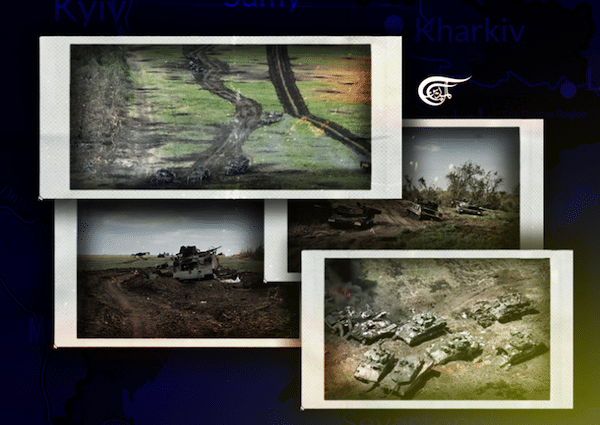
One month after the start of the offensive, and with results that do not correspond to the expectations created by the Zelensky government itself, the Ukrainian troops seem to be adapting their tactics to an apparently stiffer Russian resistance than Kiev expected. Attacks with large armored columns, in which Ukraine suffered significant losses, have disappeared and there has been a relative reduction in fighting on the front lines for several days, which now seems to be picking up again. The objectives remain the same, although secondary directions appear with which Ukraine aspires to disperse the Russian forces in order to achieve some local success to present to its partners next week at the NATO summit.

Original Article: Voennaya Kronika

The Armed Forces of Ukraine have again gone on the offensive on the Zaporozhye front. What can you expect from it? At the moment, their main efforts are concentrated in the direction of the town of Rabodino, where the units of the Armed Forces of the Russian Federation maintain the defense. However, movements are gradually taking place in other sectors of the front as well.

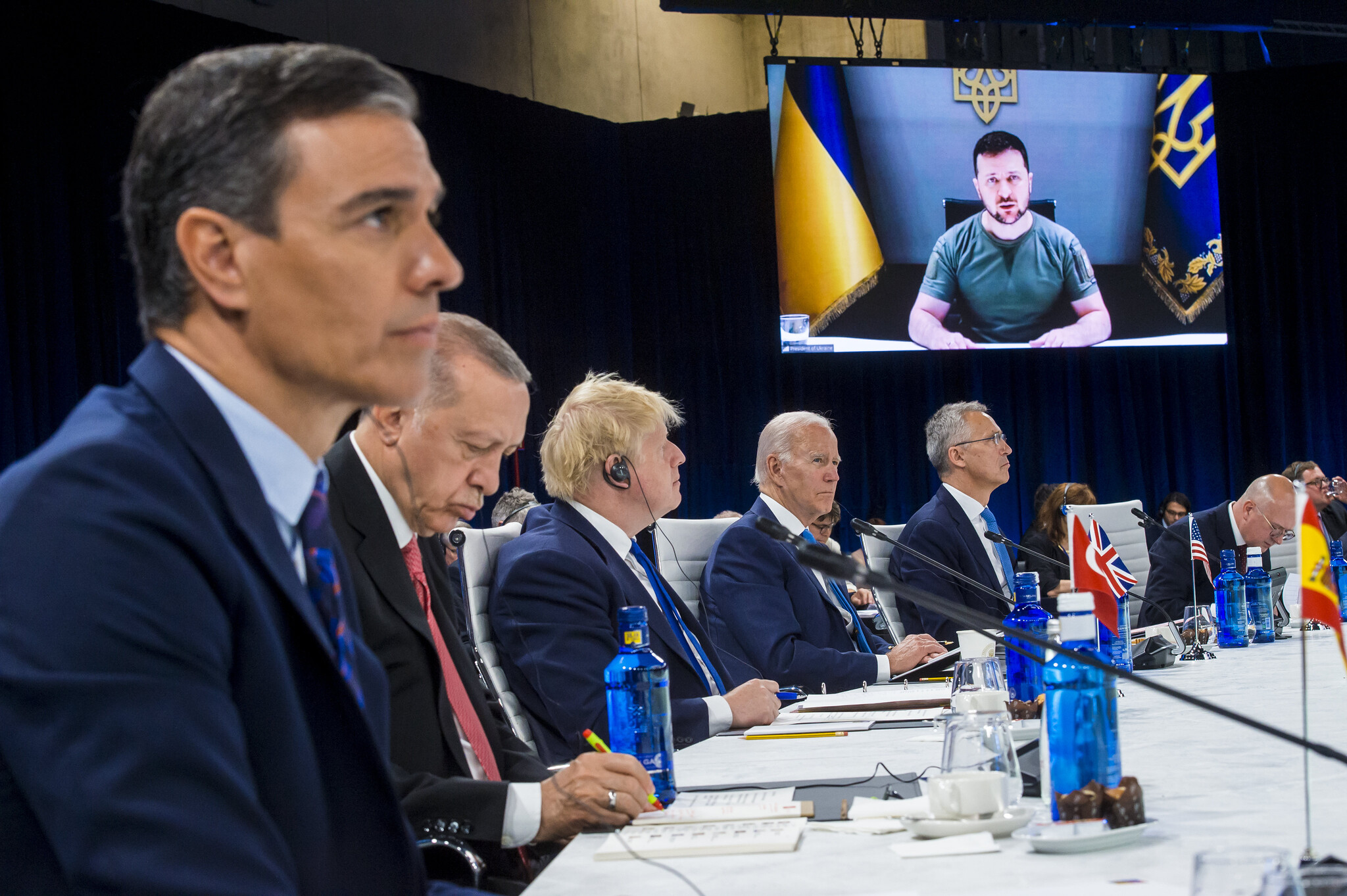
kyiv cannot stop the offensive on Zaporozhye and south of Donetsk now. Its importance is too high, so all the forces that can be found are moving to this area. The Ukrainian Armed Forces have been attacking for a month now, but activity is likely to increase markedly in the coming days before the start of the NATO summit, which begins on July 11. For the start of the summit, the Ukrainian army needs to show at least minimal results on the battlefield. If this does not happen, the level and parameters of military assistance may be revised and questions will begin to appear for the command of the Armed Forces of Ukraine and the country's authorities.

Despite the heavy losses and the entry into the fight of a significant part of the strategic reserves, there are still around six brigades that the Ukrainian army has not used. Some units have been withdrawn from other areas, such as Krasny Liman, Kherson or Kupyansk.

In parallel with the intensification of hostilities in a number of areas in the Zaporozhye region over the past week, unusual activity by the Armed Forces of Ukraine has also been registered in other sectors of the front. Specifically, there have been attacks with small groups in the Soledar area and an attempt to land on the left bank of the Dnieper river in the area of ​​the Antonovsky bridge [destroyed last summer to make Russian logistics as difficult as possible, which ultimately led to the withdrawal of Russian troops without raising a battle for the city of Kherson- Ed]. There have been several attempts that have not led to substantial changes on the front, but have received attention. Judging by the fact that no large troop movements have been detected in those two directions, it is most likely that both episodes are simply a diversionary maneuver or actions that would only be carried out if they were met with initial success.

The main task of the Ukrainian command may be another, and it is possible that diversionary actions are being carried out along the entire front for this. It is possible that the Armed Forces of Ukraine will risk organizing a raid in the Energodar area and the Zaporozhye nuclear power plant. Hence, an important part of the efforts of the Russian troops are dedicated to carrying out simulation maneuvers of military operations [a drill has recently been produced, supposedly for a reaction to the terrorist attack that Zelensky affirms that Russia is preparing against the plant under its control , an imaginary accusation that, at the very least, heralds the resumption of bombardments in the area- Ed ] to initiate an operation whose principle requires secrecy.

https://slavyangrad.es/2023/07/05/notas ... more-27667


Google Translator

*********

Chronicle of the special military operation for July 4, 2023
July 4, 2023
Rybar

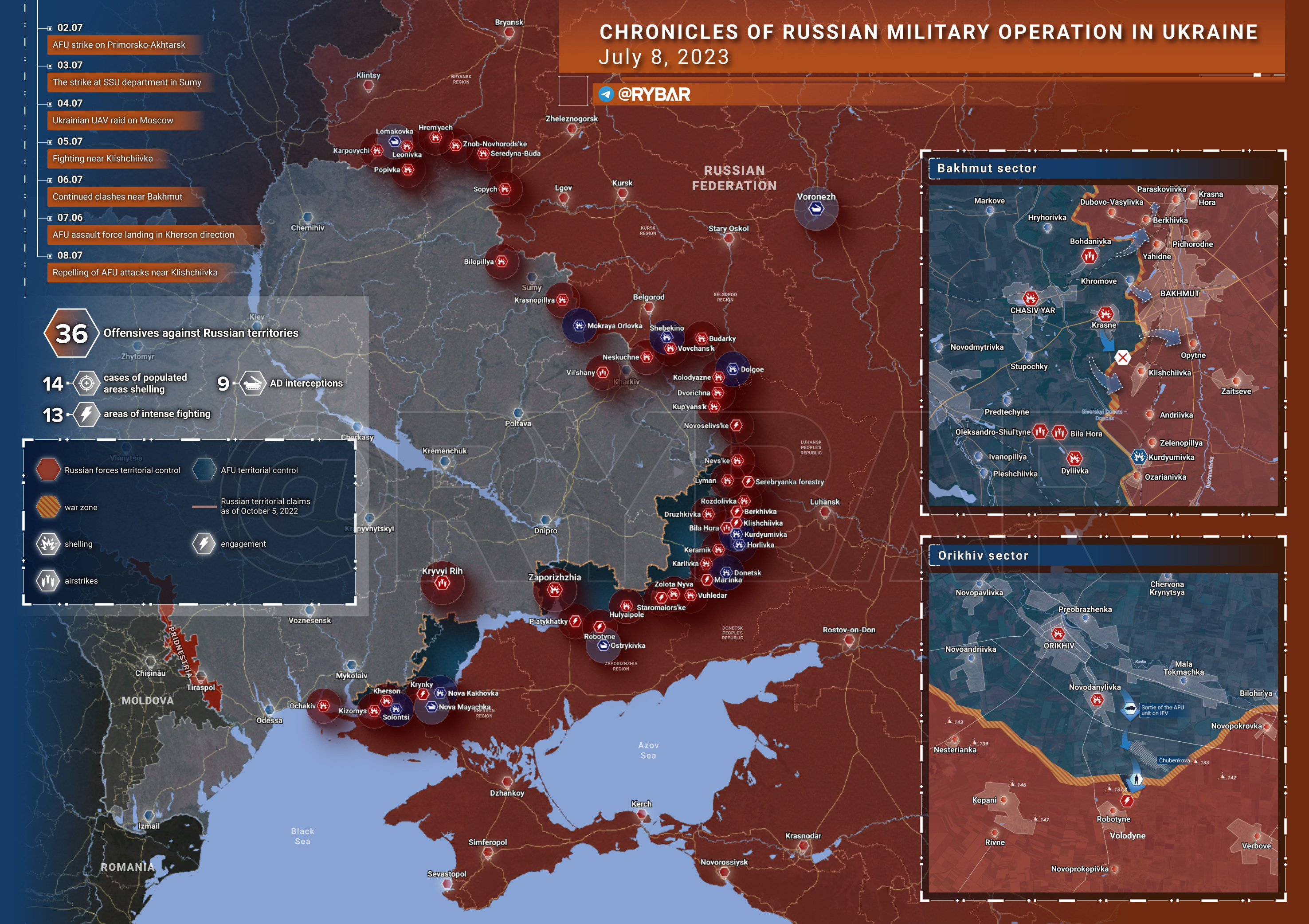
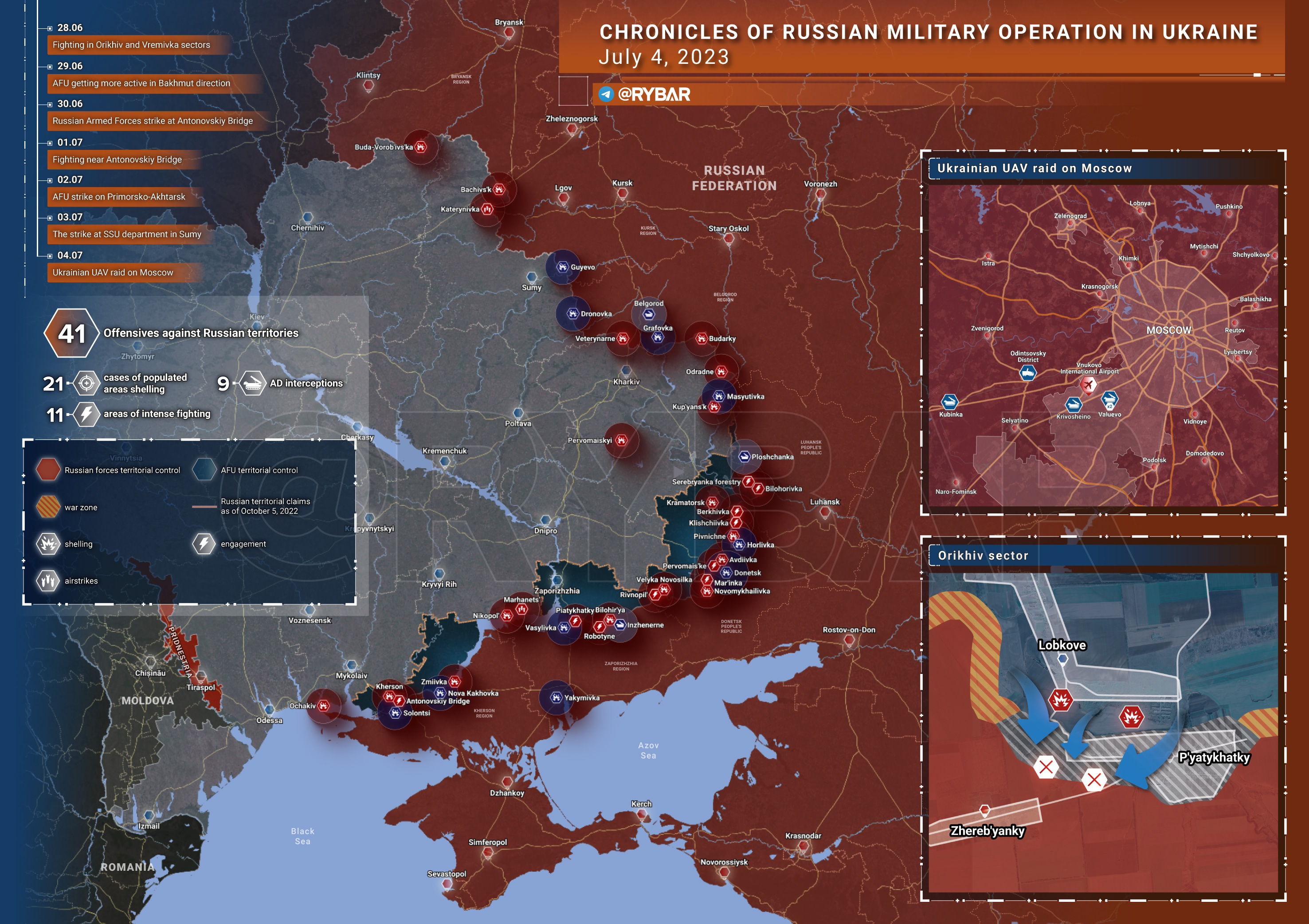
This morning, Ukrainian formations again used drones to attack the Moscow agglomeration . Russian air defense crews and electronic warfare units neutralized all devices: no damage or casualties.

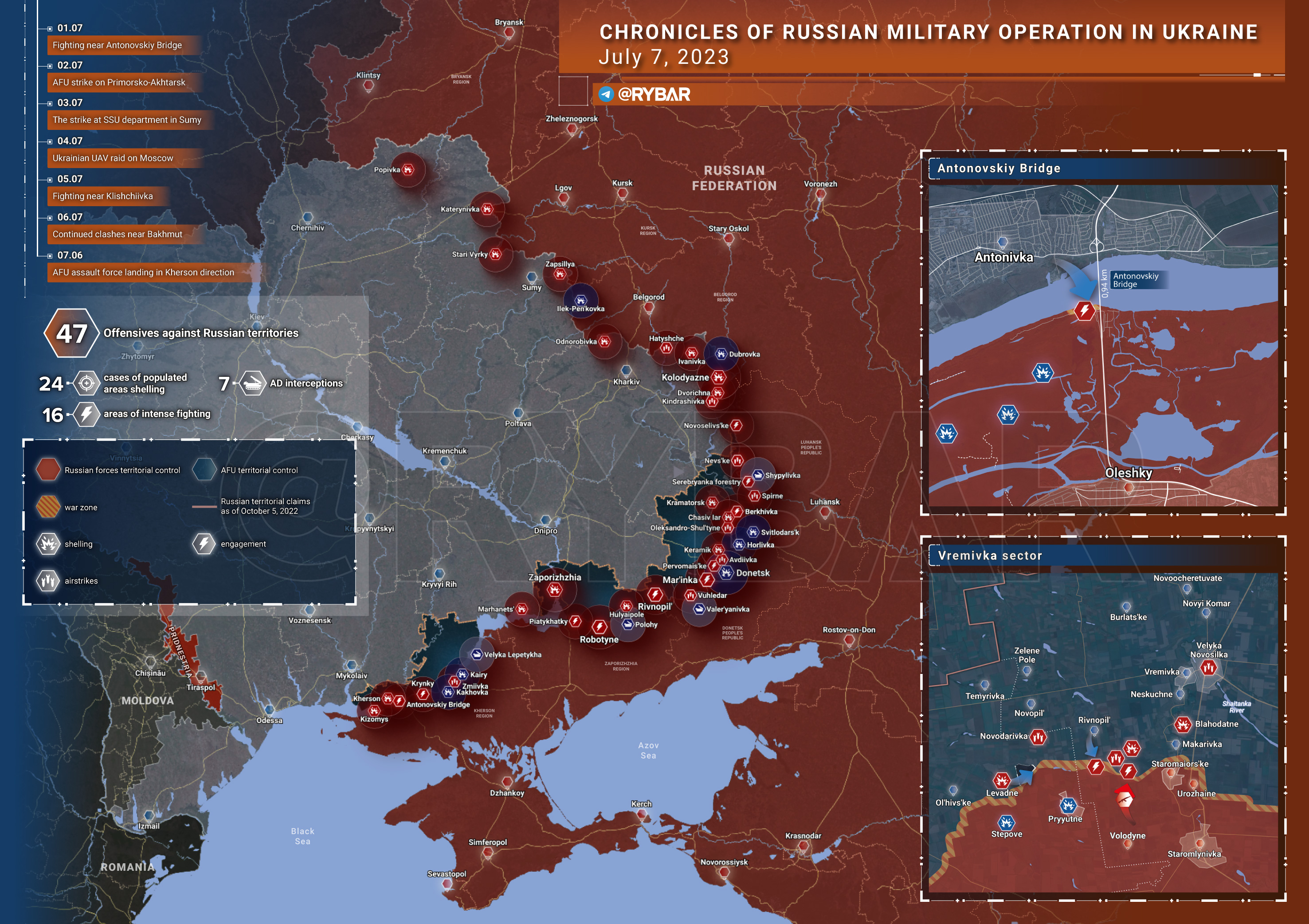
At the same time, the enemy continues to make attempts to break through the Russian defenses in several sectors of the front: during today, the most fierce battles took place in the Soledar and Zaporozhye directions .

In addition, in the afternoon, the RF Armed Forces attacked Pervomaisky in the Kharkiv region : a rocket hit the place where the personnel of the national battalion "Kraken" mustered to hold a commemoration for a member of the unit, Oleg Fadeenko. At the moment, the number of liquidated militants is unknown.

In turn, the Ukrainian formations dealt a massive blow to the front-line settlements of Russia: according to the latest information, two civilians were killed and 15 more were injured.

At night, the enemy fired rockets from the HIMARS MLRS at the Chervonogvardeisky district of Makeevka : residential buildings, hospitals and schools were damaged. There is no exact information about the dead and injured.
Image

Ukrainian UAV raid on New Moscow

This morning, the Armed Forces of Ukraine once again tried to strike with drones on the Moscow agglomeration . In total, according to the statements of the Russian Ministry of Defense, four UAVs were shot down and one was suppressed by electronic warfare.

Image
Two drones were destroyed near the village of Valuevo , one fell on a garage in Krivosheino , another UAF was going to hit a military unit in Kubinka , and an EW crew planted a UAV somewhere in the Odintsovo district . The problem of Ukrainian drones leaking deep into Russian territory has not gone away. There have been and will be attempts to strike at the capital - this must be understood and saturate the air defense.

There is no strategic sense in this raid, as in previous times - this will not change the situation at the front. The Ukrainian authorities are simply trying to keep the population in constant tension and divert attention from the lack of visible success on the battlefield. Judging by the direction, the purpose of the raid, in addition to the military unit in Kubinka , was Vnukovo International Airport . This may be due to the regular flights of Iranian military transport workers. Or maybe the usual desire to sow panic among civilians.


Today at about 13:30 Russian troops attacked Pervomaisky in the Kharkov region . The rocket hit the parking lot in front of the house number 11 in the 6th microdistrict. According to official figures, 43 people received minor and moderate injuries.

The Ukrainian media, as expected, accused the Russian Armed Forces of shelling civilian infrastructure, but the choice of target was not accidental. Parked cars stood in front of the non-working Zodiac cafe: a meeting of personnel of the national battalion Kraken was planned there for the commemoration of a member of the unit, Oleg Fadeenko, who was liquidated a few days ago near Bakhmut.

It is characteristic that Konstantin Nemichev, the chief of staff of the Kraken, wrote about the farewell ceremony planned in Pervomaisky two days ago. The choice of a place for the commemoration is also quite logical: a closed cafe in a residential building on the outskirts of the city does not attract attention, especially against the background of the recent effective strike of the RF Armed Forces on a restaurant in Kramatorsk. However, information about the meeting, apparently, nevertheless became the property of Russian intelligence.

According to eyewitnesses, all the surviving Kraken vehicles almost immediately left the arrival area to create a picture of an “attack of civilians”. However, on several frames you can see the burnt-out skeleton of the Mitsubishi L200 SUV and minivans, which are actively used as military vehicles.

The situation on the front line and the fighting
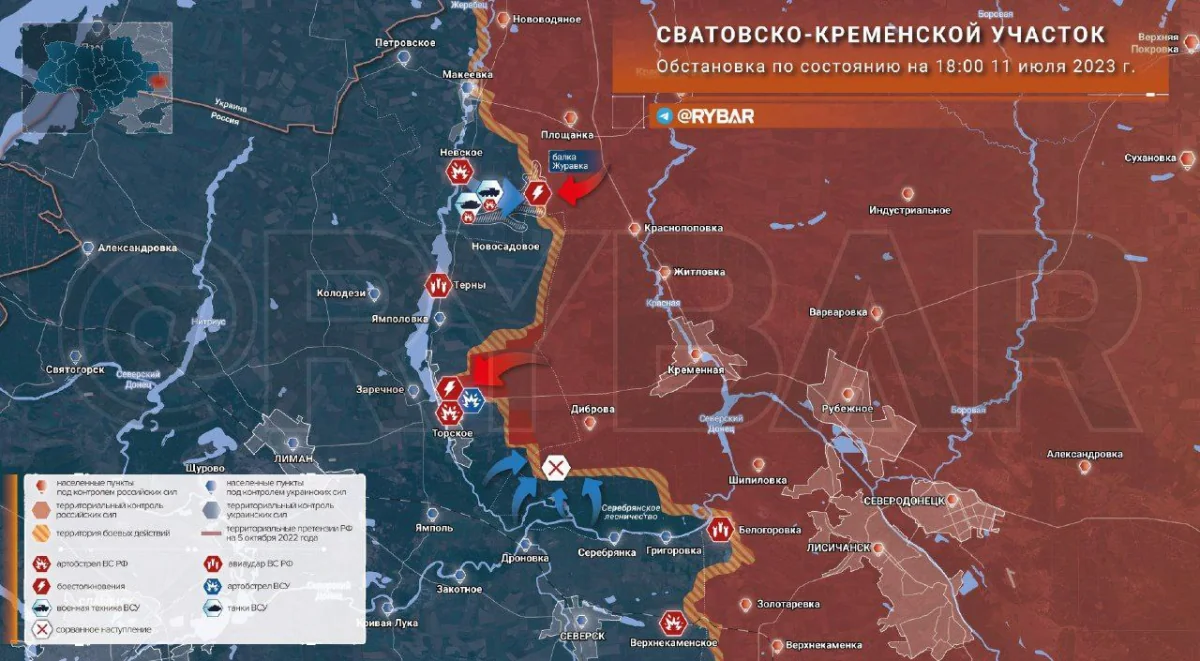
In the Starobelsk direction, Russian units of the airborne troops continue to fight near Kremennaya . Russian artillery strikes at the enemy, preventing him from evacuating disabled equipment.

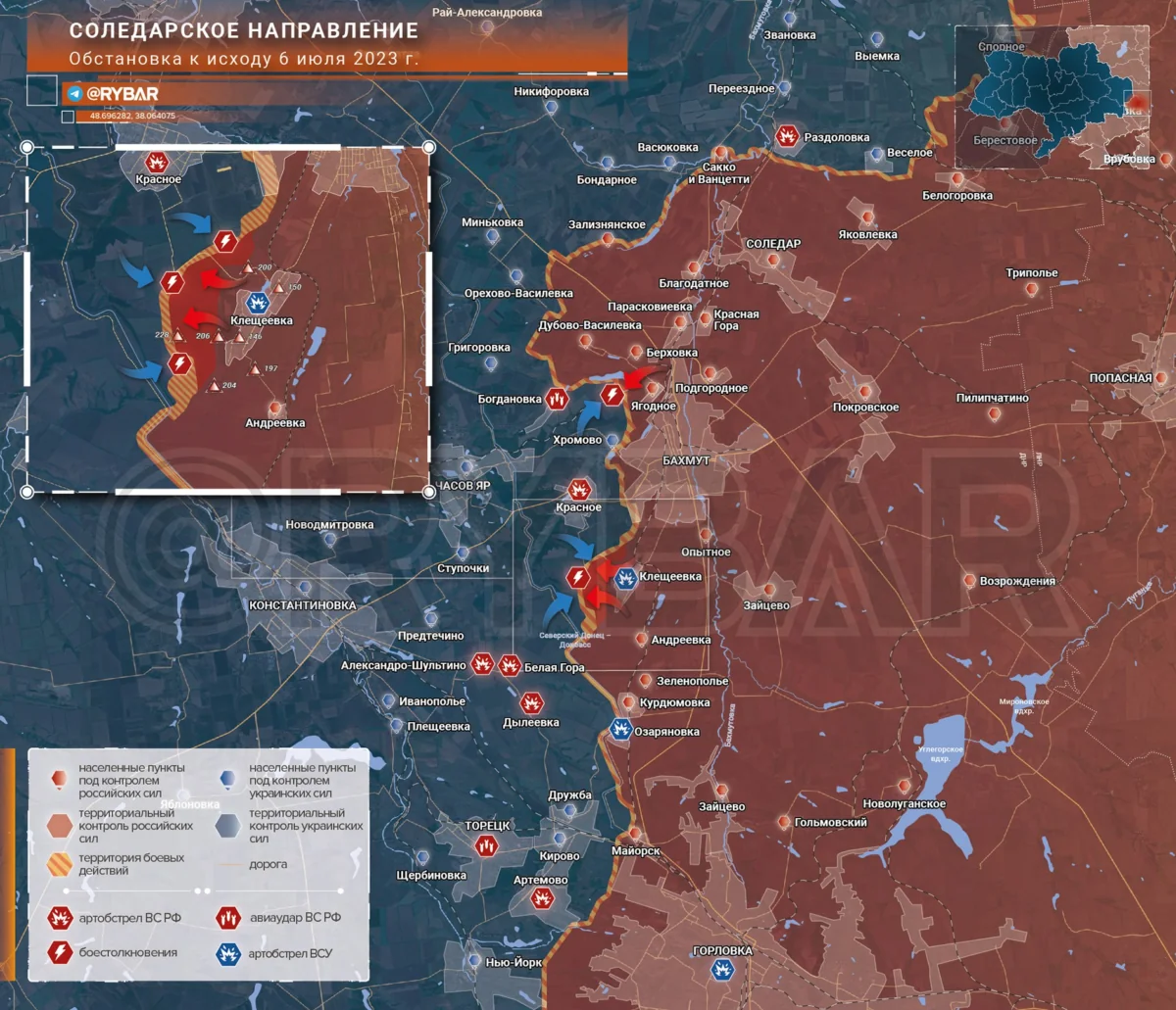
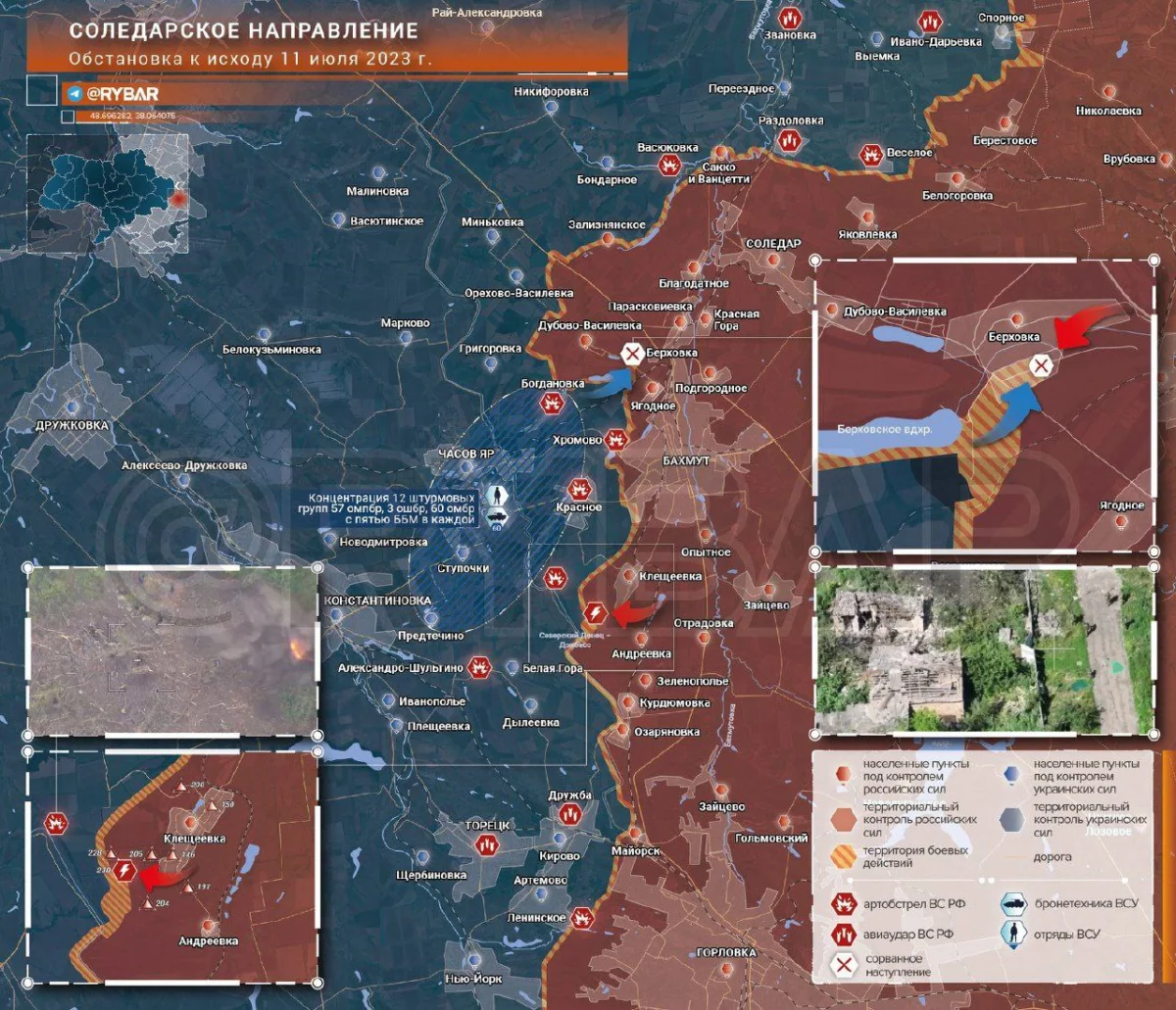
The situation in the Soledar direction is stably difficult. Despite the reflection of the attacks of the Armed Forces of Ukraine, the forces of the defenders are also worn down. The enemy advances from Orekhovo - Vasilevka in the direction of Paraskovievka . In the area of ​​Berkhovka and Dubovo - Vasilevka, the Armed Forces of Ukraine are gradually pushing through the defense. Fighting continues in the Kleshcheevka area , where the situation is especially difficult. In addition, Ukrainian formations are attempting to blockade Kurdyumivka from the south.

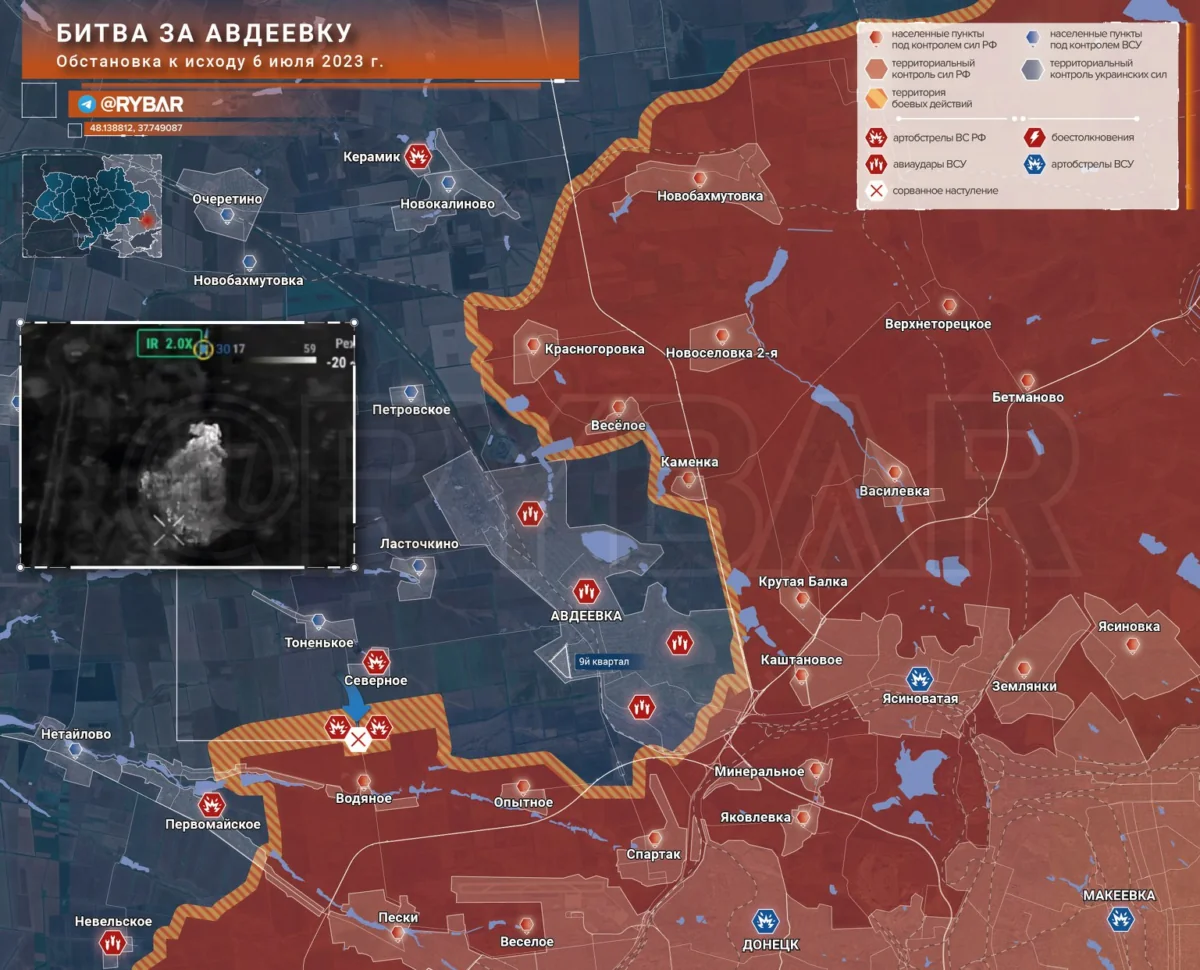
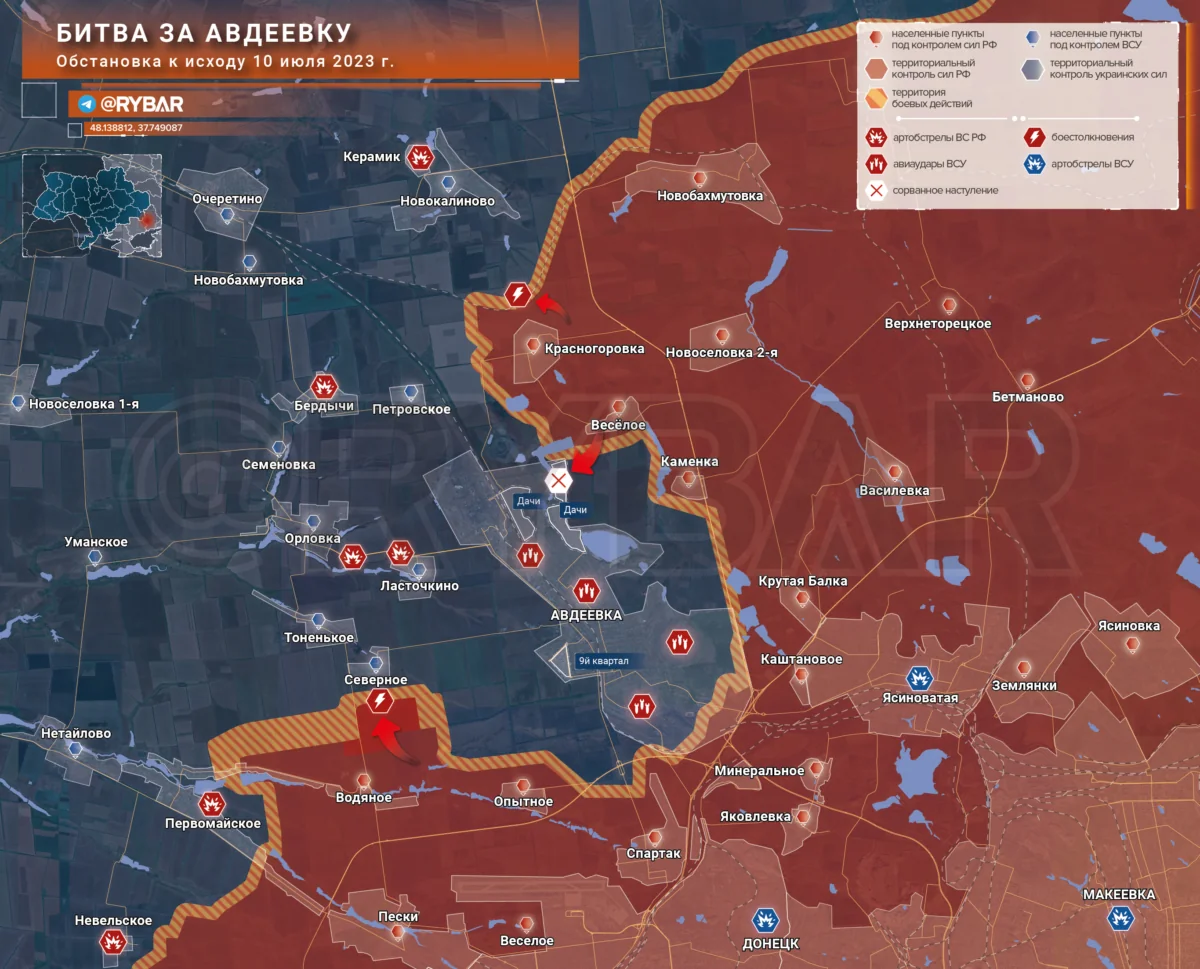
In the Donetsk direction, clashes between the parties do not subside. On the Avdiivka site, the situation has not changed significantly; positional battles continue. Russian kamikaze drone operators successfully hit several enemy strongholds.

In Marinka, fierce clashes continue in a residential area on the western outskirts. All buildings are almost completely destroyed, forcing the enemy to hide in basements and dugouts, Russian UAV operators use FPV drones to deliver pinpoint strikes on enemy positions. The work of attack aviation of the Armed Forces of Ukraine on the positions of the Armed Forces of the Russian Federation in the city is noted, and the enemy is also actively using attack drones, trying to slow down our offensive. Due to the virtual absence of shelters in the city, the enemy moved his artillery to rear positions, which makes it difficult to strike at it.

Image
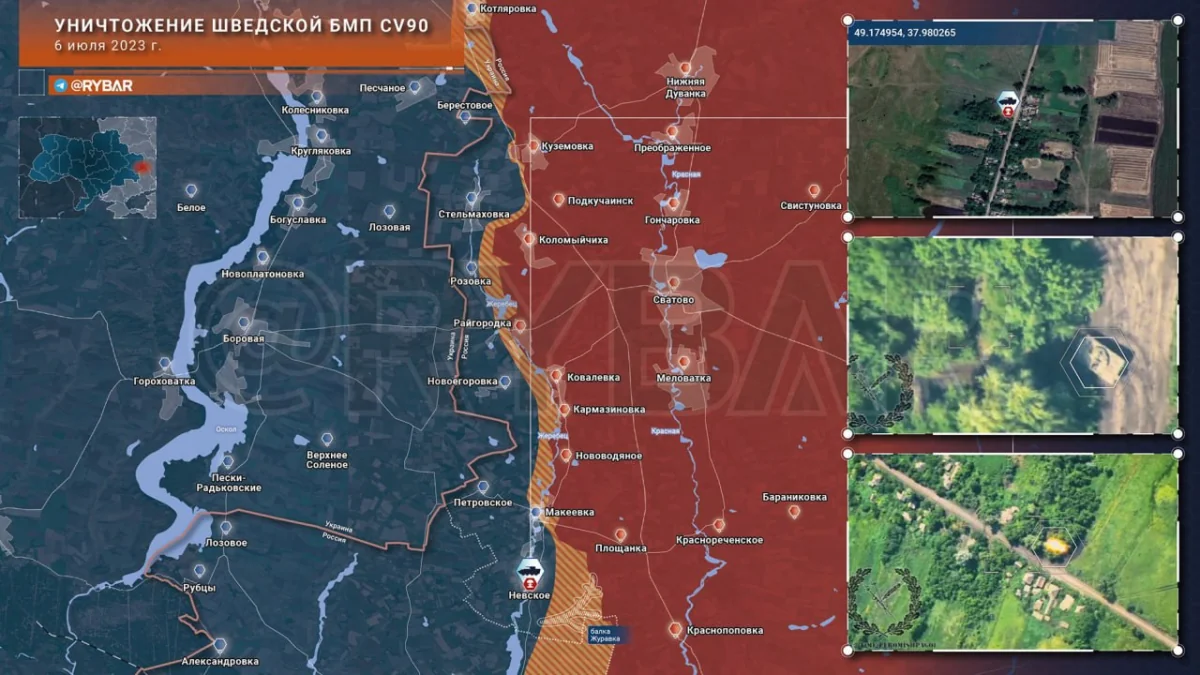
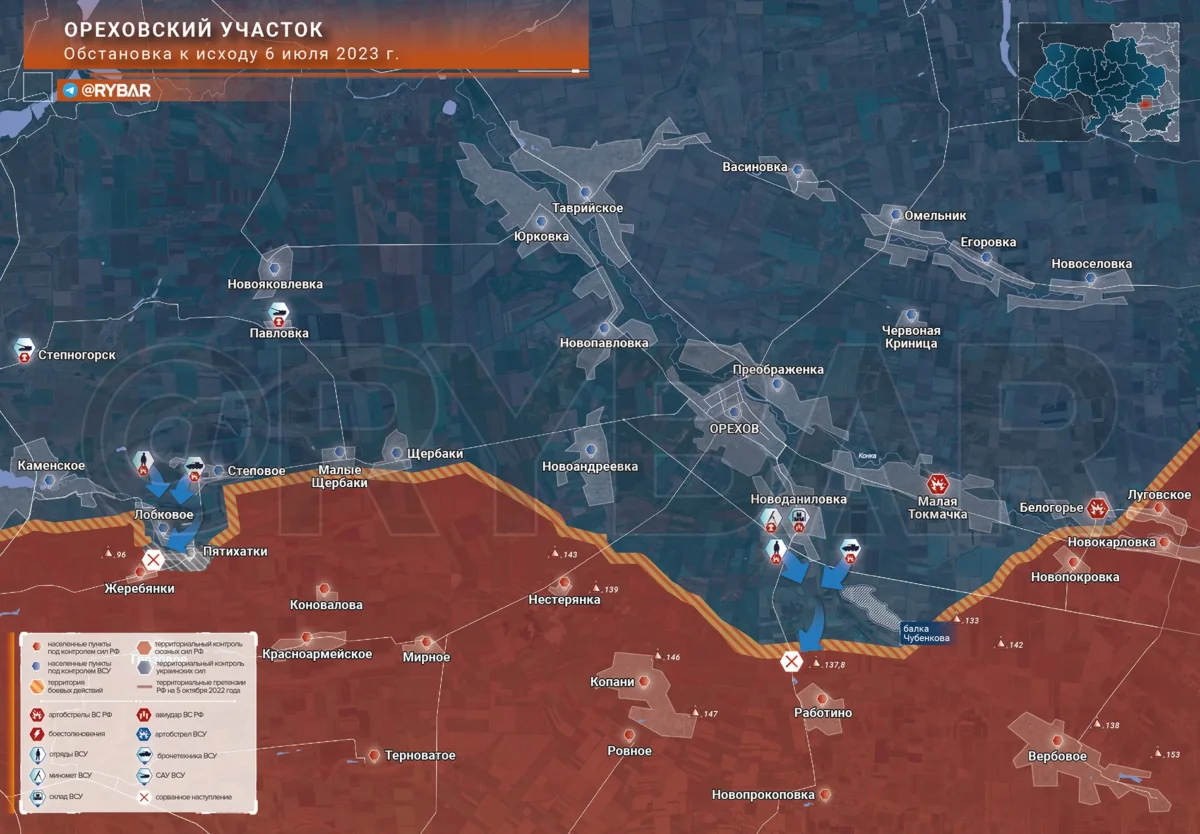
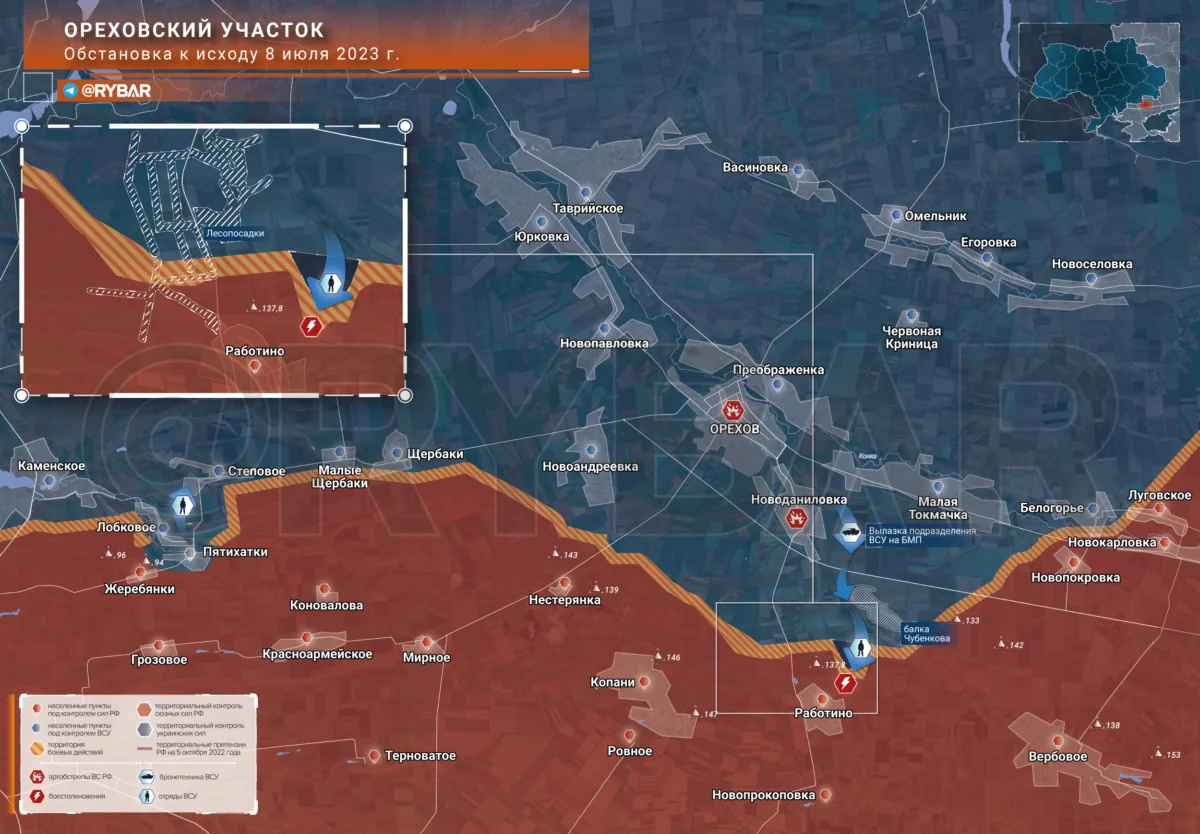
In the Zaporozhye direction, the enemy again tried to advance in the Kamensky sector . Several assault groups, under the cover of artillery and forest plantations, advanced to Pyatikhatki and Zherebyanki from Lobkove . Formations of the Armed Forces of Ukraine tried to go from the north to Zherebyanki, supporting the strike from the east along the road from Pyatikhatki. At the same time, as in previous times, the Ukrainian formations operated without armored vehicles. The attack was repulsed.

Artillery works along the front line. The Russian Armed Forces are hitting enemy concentration areas and observation posts, disrupting potential offensive operations. Counter-battery work is underway, FPV drones are being used against enemy armored vehicles.


In addition, a Russian air defense crew intercepted a Storm Shadow cruise missile in the Zaporozhye region. The surviving parts of the downed ammunition were found and handed over to specialists for study.

In the Kherson direction, the Ukrainian command continues to send landing groups to the area of ​​the Antonovsky bridge . The enemy was hit by guided bombs, rocket artillery is operating, preventing the enemy from re-creating a stable foothold on the left bank of the Dnieper, and FPV drones are attacking enemy watercraft, destroying enemy personnel.

Shelling of rear territories and residential areas

Image
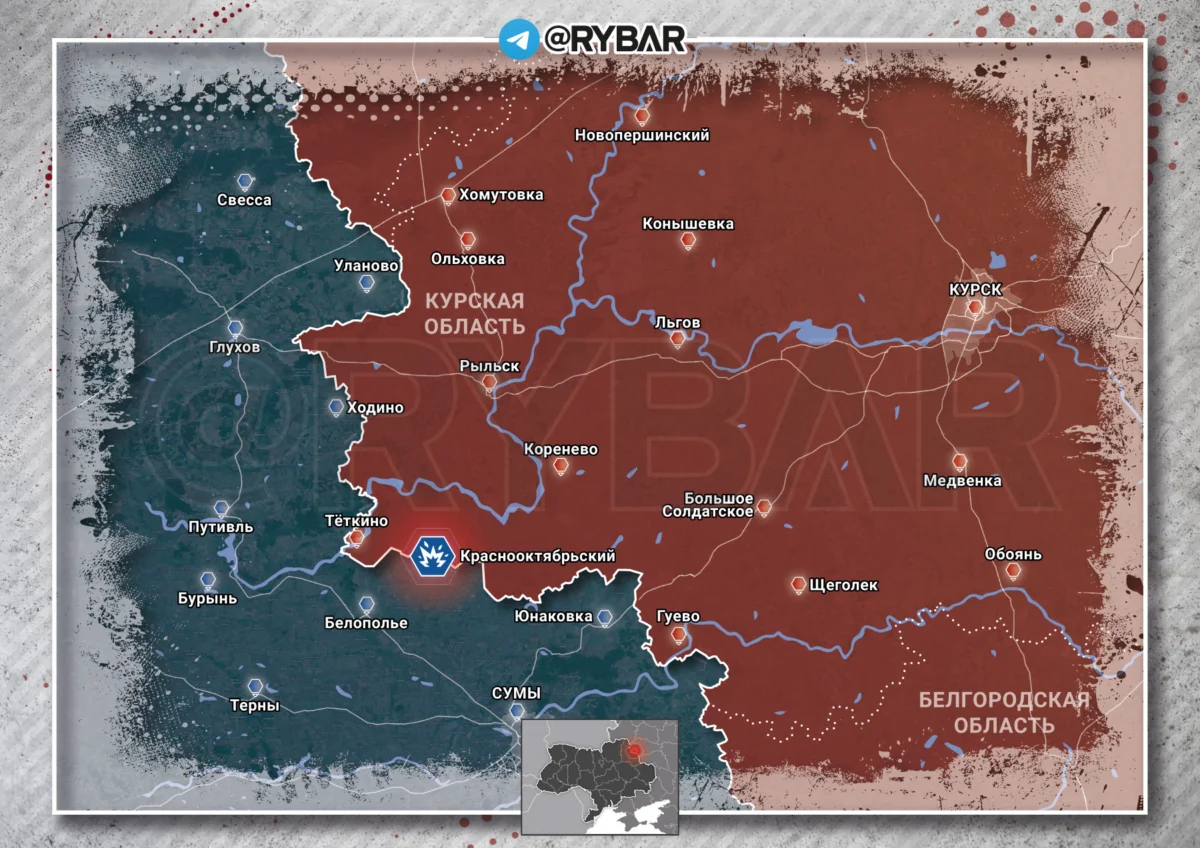
For the second day in a row, the Armed Forces of Ukraine are shelling the border Sudzhansky district of the Kursk region : shells hit the border checkpoint " Sudzha ", as well as the outskirts of the villages of Guevo and Gornal . Residential buildings and roads were damaged. Civilians were not hurt.

Image

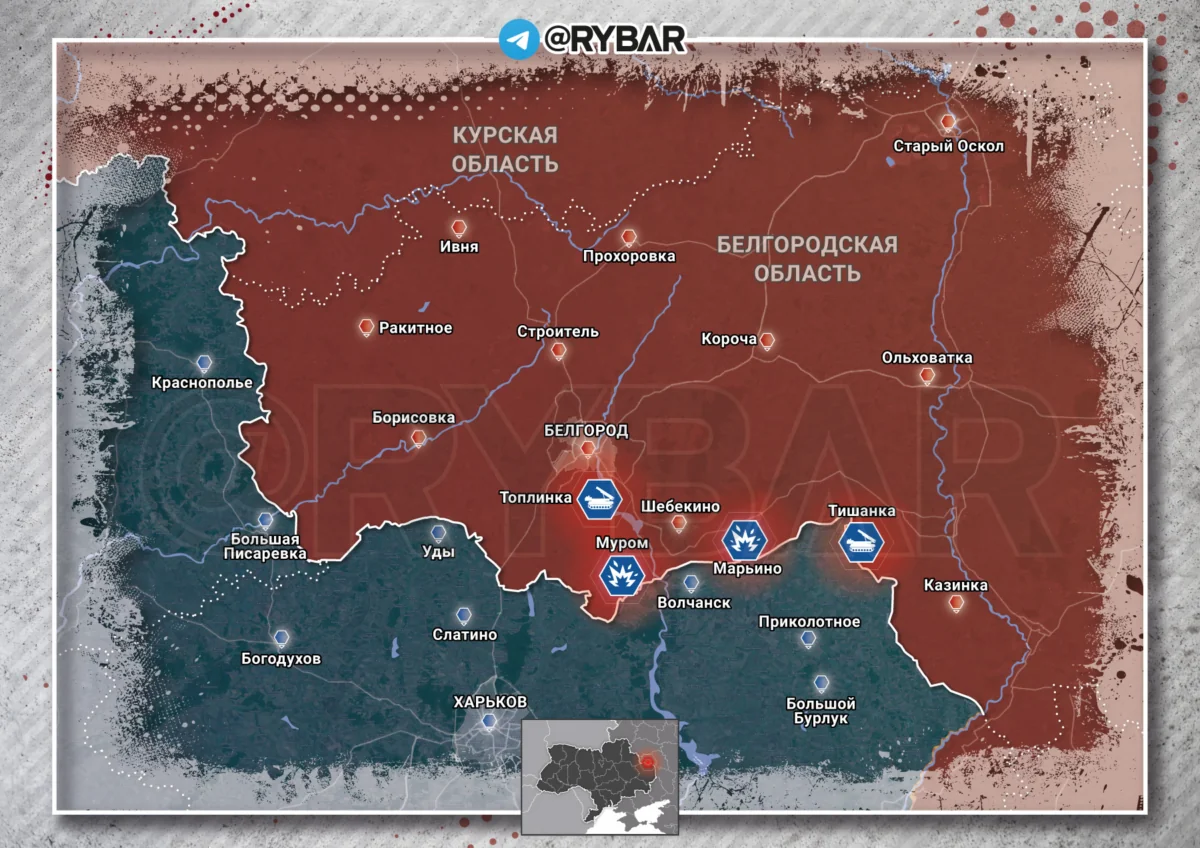
Ukrainian formations continue to strike at the border areas of the Belgorod region . In the Graivoronsky urban district, the villages of Dronovka and Novostroevka - Vtoraya were shelled : one of the shells hit a residential building, power lines and a gas pipeline were also damaged. In addition, the enemy fired ammunition at the village of Grafovka in the Shebekinsky city district : at the moment there is no information about the presence of damage and casualties. Over the past day, at least 130 arrivals were recorded in the entire region : residential buildings were damaged, civilians were not injured. At night, Russian air defense systems also worked over Belgorodand the area: according to preliminary data, there were no casualties or damage.

Image
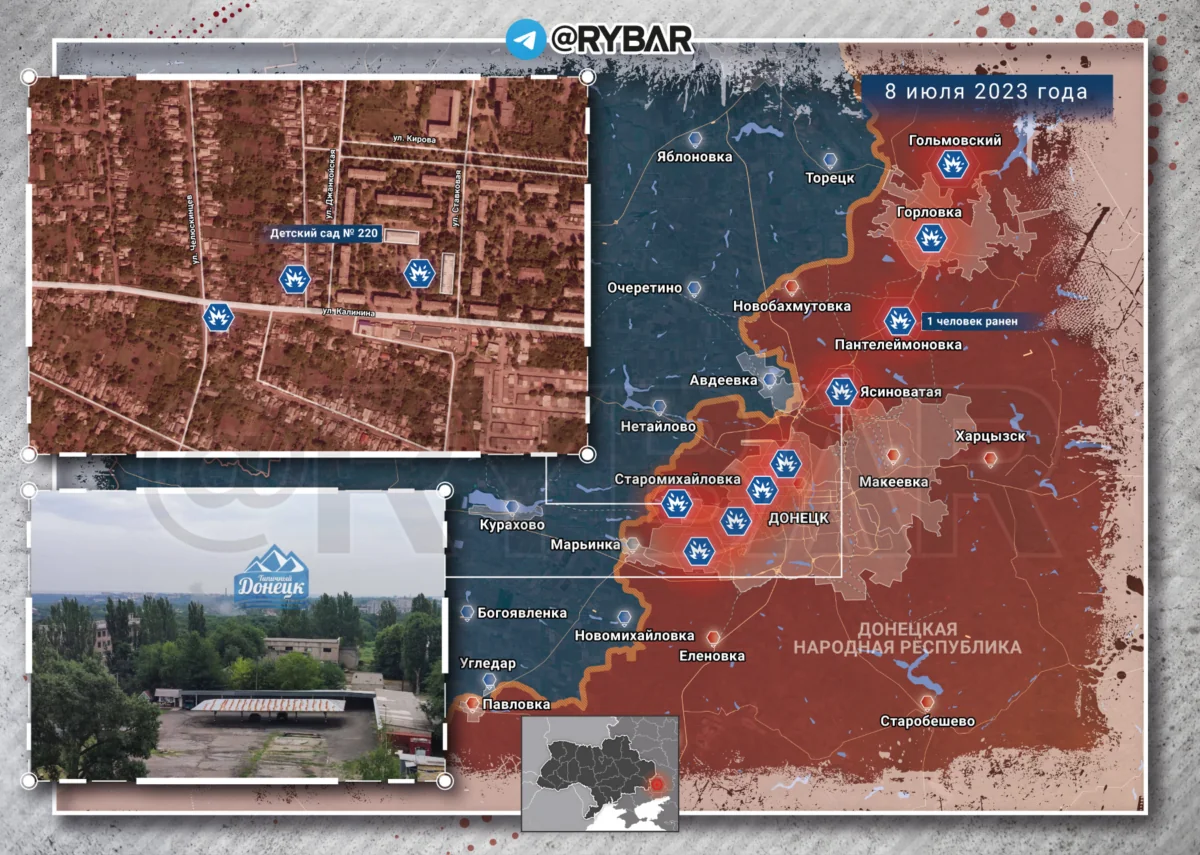
Throughout the day, Ukrainian formations have been attacking the civilian infrastructure of the Donetsk agglomeration . Residential buildings in Petrovsky , Kirovsky , Kievsky and Kuibyshev regions were damaged in the capital of the republic . In addition, the Armed Forces of Ukraine shelled Gorlovka , Shirokaya Balka, Aleksandrovka and Makeyevka . According to the latest data, two people were killed, nine more , including a child, were injured.

In addition, at night there was a powerful explosion in Makiivka , over the place of which a huge column of black smoke rose. Local residents reported that windows were shattered in several houses from the blast. Hospital and school buildings were also damaged. The trembling of the earth was felt at a considerable distance from the scene.

Image
The Armed Forces of Ukraine continue to fire at civilian objects in the settlements of the Zaporozhye region . Around 8 am, the enemy fired ammunition from the Grad MLRS at Vasilievka : two civilians were injured - both were hospitalized. Two hours later, Akimovka was under fire : shells hit the medical warehouse, four volunteers were injured, two of them are in serious condition.

Ukrainian formations continue the targeted destruction of civilian infrastructure on the left bank of the Dnieper in the Kherson region . During the night, the enemy fired over thirty shells at Novaya Kakhovka , Solontsy , Kakhovka and Peschanovka .

Political events
On the situation around the Kiev-Pechersk Lavra


A commission of the Ministry of Culture of Ukraine came to the Kiev-Pechersk Lavra to seal the buildings in the lower Lavra. A total of five constructions must be sealed. By order of the court, the monks must leave the shrine until tomorrow, this time the believers are unlikely to be able to defend it. The Belarusian diocese of the ROC MP has already declared its readiness to accept them.

On the supply of F-16s for the needs of the Armed Forces of Ukraine

The head of the NATO military committee, Admiral Rob Bauer , said that pilot training for US fighters, as well as the preparation of maintenance areas and training of personnel, will take longer than previously expected, so the planes will not be able to help Ukraine in a widely publicized “counteroffensive”.

In turn, Ukrainian Foreign Minister Dmitry Kuleba pointed out that despite the assurances of Western partners, Ukrainian pilots did not start training on the F-16 in June. This will shift the delivery dates from the beginning of 2024 to a later period.

https://rybar.ru/hronika-speczialnoj-vo ... 2023-goda/

Google Translator

(Other images at link.)

**********

What are the Russians saying?
July 4, 2023

What you will not read in today’s New York Times but need to know before heading for a bomb shelter

Yesterday I had the pleasure of chatting for some 20 minutes with Natali Morris, who hosts an interview program called “Redacted” that is widely viewed on youtube.com. The starting point for our virtual meeting was her recent discovery of my 2015 book Does Russia Have a Future?, which surprised her for the prescience of some of the essays in the book warning about a U.S.-NATO confrontation with Russia such as is now playing out before our eyes.

I explained to Natali, and now to you, that I never sought to take the mantle of Cassandra, that over the past eight years I have not been walking the streets wearing a sign-board declaring that “the end of the world is nigh.” However, at moments that I have considered critical, I have periodically sounded the alarm. We are in the midst of such a critical moment, as you know.

When the interview is posted, I will add a link to the bottom of this essay.

*****

Russian state television does not broadcast news worth repeating on this platform every day. And for that reason I do not take the time of readers until and unless there is something they should know. Today is such a day. What I am about to share is news and analysis that I harvested on the morning edition of Sixty Minutes (there is also an early evening edition) and on the 14.00 o’clock Vesti program.

One featured item was the latest news from the front lines about the status of the Ukrainian counter-offensive, which has become very active in recent days and is likely to further increase in intensity in the course of the week remaining before the start of the NATO gathering in Vilnius on the 12th. Kiev’s receiving further substantial military and financial aid from its Western sponsors depends directly on the regime’s ability to demonstrate that the investment made so far has paid off handsomely and that it can push the Russians out of the territory they occupy if given sufficient resources.

As reported today, the Ukrainian forces continue to gain no ground and to lose enormous numbers of personnel and military hardware. They are now going well beyond exploratory moves of small number of troops such as characterized the first two weeks of their counter-offensive and are fielding at least on one location of the front in the south of Donbas a force numbering 6,000.

The Russian fighters interviewed by state television war correspondents and backed up by video footage explain that they are able to repel all Ukrainian efforts to achieve a breakthrough on their lines thanks to heavy support from artillery and now from fighter jets. We were shown clips of these jets hugging the terrain at a height of 25 meters off the ground while flying at 1,000 km per hour, delivering lethal strikes against armored personnel carriers, tanks and trenches occupied by Ukrainian infantry. The results of their work are recorded by reconnaissance drones. In sum, the Russians maintain that the loss ratio for Ukraine is an order of magnitude higher, meaning 10 times higher on the Ukrainian side in the present fighting.

They claim to have destroyed all of the Leopard-2 tanks delivered in recent weeks to Ukraine by Portugal and Finland. And, the Russian journalists comment that replacement tanks from Germany, announced yesterday by Minister of Defense Pistorius, will be of a still older and less capable generation, the Leopard 1. They will fall easy prey to Russian artillery and tanks in the field.

This being the case , the Russians see no possibility that the Ukrainians can win anything remotely described as military gains on the battlefield to show off in Vilnius next week or in the weeks that follow. And this is precisely why things could soon get out of hand, as Kiev tries to achieve by terrorism what it cannot achieve by conventional warfare.

Even today Ukrainian “terrorism” was denounced by Russian Ministry of Foreign Affairs spokeswoman Maria Zakharova. Five drones were shot down or disoriented by electronic means in the greater Moscow metropolitan area today. Vnukovo airport was clearly their assigned target area and the airport’s operations this morning had to be suspended for security considerations. I am not surprised: it was just a question of time before the Ukrainians would start targeting such infrastructure and putting air passengers in danger. Vnukovo is the air base used by a number of foreign carriers, including Turkish Airlines and Egypt Air. An attack on the airport can thus easily become an international scandal and/or catastrophe.

But, of course, the greater threat remains a Ukrainian missile strike on the Zaporozhie nuclear power plant, which Kiev would claim to have been perpetrated by the Russians. The logic of such a strike would be to create a threat of nuclear contamination reaching into Western Europe and justifying NATO intervention in the war.

The Russians have publicly and loudly denounced such a pending false flag operation, but in this hour of near desperation the Kiev authorities cannot be trusted to play by normal rules or normal logic.

If this or something similarly dastardly is perpetrated by the Zelensky regime in the coming days before the NATO summit, then indeed you should look for a bomb shelter. The Russian response to risk of imminent NATO attack “in retaliation” for the false flag tragedy may be an escalation that will shock us all.

*****

Happily, today’s harvest of news on Russian television was not entirely grim. The other featured news item was today’s summit meeting of member states of the Shanghai Cooperation Organization (SCO). This periodic event was coordinated from New Delhi and was held in virtual format.

Indian Prime Minister Indira Modi appeared to be in top form and clearly enjoyed his privileged position as “host.” Watching his performance and his proposal that the SCO be further strengthened to combat terrorism we may conclude that the hope of US Secretary of State Blinken to wrest India away from its close relations with SCO founding member Russia is purely delusional.

Vladimir Putin used his time before the camera primarily to persuade fellow member states that Russia is rock solid, that its society has consolidated behind the constitutional order and that the threat posed by the armed rebellion of the Wagner Group has been entirely neutralized.

President Xi of China had some topics of broader interest to put on the table. He suggested that the SCO members should cooperate in support of a world order based on international law, that they should oppose imposition of unilateral sanctions against any member states and that they should trade in national currencies. If I may be permitted to decode these points by the Chinese leader, they all are directed against the United States and its bullying foreign policy which seeks to enforce a ‘rules based order’ that it alone dictates.

This SCO summit was notable for the first time presence of Iran as a fully qualified member. Meanwhile we are told that Egypt has put its hat in the ring as a potential future member, which would mark the first expansion of the SCO beyond the Eurasian land mass, where its members now account for more than two-thirds of the territory and for one half of the world’s total population. Another 14 countries are said to have put their names on the list as candidates for future admission to the club.

On the sidelines of the Shanghai Cooperation Organization summit, Russian state television tells us that Russian-Chinese trade is now being conducted in yuan and rubles at the level of 85%.

Russia’s senior delegate to the SCO, appearing on Sixty Minutes, said that pending its expansion the Organization is in need of reforms to its charter. These might include raising the powers and the visibility of its general director so that he can interact more effectively with other institutions of global governance and also creating a permanent body to coordinate the fight against narcotics trafficking.

One hour ago, I had an opportunity to discuss the aforementioned aspects of the SCO summit during a brief interview on India’s WION television channel. When the link becomes available, I will post it below as s postscript.

©Gilbert Doctorow, 2023

https://gilbertdoctorow.com/2023/07/04/ ... ns-saying/

******

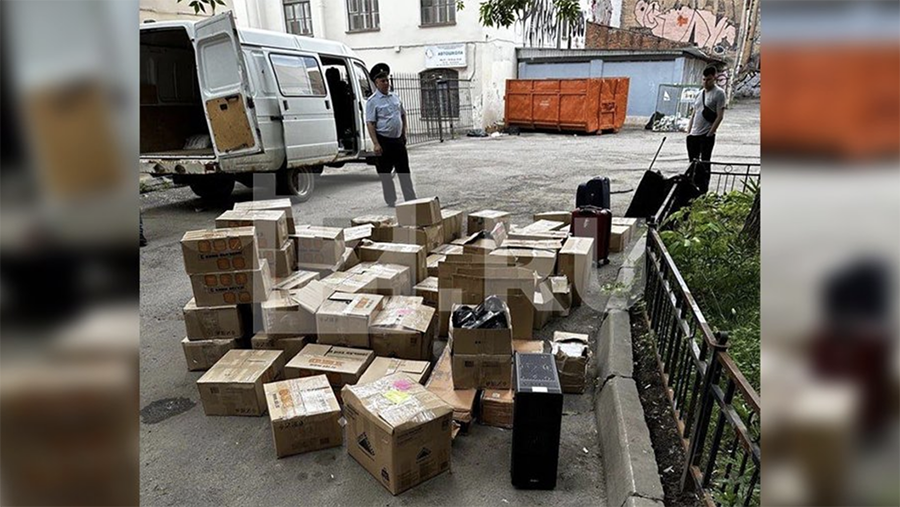
Boxes returned
July 4, 15:00

Image

1. St. Petersburg media report that Prigozhin was returned 10 billion rubles in cash, which were seized during the searches.
Iosif Prigozhin's claims for money from the Gazelle did not pass.

2. Part of Prigozhin's structures will continue to fulfill government contracts. Some reorganizations and a formal change of leadership are possible.

3. The reason for the preservation is simple - over many years of work, Prigozhin's structures have become so rooted in the state fabric that cutting them out at once without serious damage to the state is fraught with serious problems. That is, you can cut it, but the consequences will be serious.

4. Therefore, Prigozhin's opportunities were seriously limited (the Patriot media group was liquidated, problems began at Concorde, etc.), but they were not nullified.

5. PMC "Wagner" continues to busily settle in Belarus. According to a number of reports, the process of training the Belarusian military and the transfer of combat experience gained by Wagner on the battlefields has already begun.

6. Damage to the road transport system of Rostov as a result of Prigozhin's actions amounted to 92.5 million rubles.

https://colonelcassad.livejournal.com/8468015.html

Ukrainian boxing champion captured
July 5, 9:59 am

Image

Ukrainian boxing champion captured

The Russian military, located in the zone of the special military operation, captured the boxing champion of Ukraine Andriy Prikhodko, who fought in the Kraken unit. The athlete was taken prisoner in the Artyomovsky direction, when the fighters of the Armed Forces of Ukraine went on the offensive from the village of Chasov Yar. A video with the interrogation of a Ukrainian athlete was published on the RIA Novosti Telegram channel.

Prikhodko said that he is the champion of Ukraine and the champion of the Ukrainian Cup. The boxer is also a master of sports. According to him, he went to serve after a misunderstanding with the coach. He noted that in order to get a decent job in Ukraine, you need to have a military ID.

“From Chasov Yar we transferred to the BMP-1 - 4 vehicles - and arrived directly at the Russian positions. We landed, and in the first minutes of the landing, they killed my squad leader, and we began to roll back, moved away from the positions, since the area was open. We spent the night in the bushes, and as a result wounded our combat medic. We spent the night under shelling, under firefights, and the next morning we moved to the evacuation group,” Prikhodko said.

Prikhodko said that the Ukrainian militants again went to the positions of the Russian Armed Forces after they got lost. According to the boxer, during the battle with the Russian troops, he was wounded and taken prisoner.

“We have three - 200 (killed) at the place where I was taken prisoner, one - the 300th (wounded), but he came out. I don’t know where the rest of the guys are, ”added the prisoner.

https://www.gazeta.ru/sport/news/2023/0 ... 9766.shtml - zinc

https://colonelcassad.livejournal.com/8469989.html

Google Translator

********

From the Telegram account of Slavyangrad:

Slavyangrad
The enemy is preparing for an offensive on the morning of 5 July.

According to the latest information, the enemy is transferring forces from the 116th brigade of up to a tank battalion to the area of Stepnogorsk to attack our positions in the area of the defence line of the 19th Motorized Rifle Division at about 5 am on July 5.
At the same time the enemy forces started to eliminate mine-bombs on the line between Kopani and Rabotino, which indirectly indicates the intention of the enemy to start offensive actions in this direction.

Thus, as we pointed out earlier, the enemy is expected to launch a large-scale offensive in the direction of the main strike at Stepovoye-Zherebyanki, and a flank strike at Novodanilovka-Rabotino.

***

Slavyangrad
‼️🇺🇦🏴‍☠️The price of the counteroffensive: 2 brigades of the Armed Forces of Ukraine lost 60% of their personnel, - Khodakovsky
Deputy Head of the Russian Guard for the DPR on preparing an enemy offensive on the Vremevsky ledge at the junction of Zaporozhye and the DPR:
"As an illustration of my previous publication: two brigades of the Armed Forces of Ukraine, which since the beginning of the counteroffensive, have torpedoed our sector, are being withdrawn for replenishment. According to information, no more than forty percent of the personnel remained in one of them. Of course, those who were caught on streets. Here it is the price of the counteroffensive and the result of our difficult perseverance. Yes, we also get it - but what I said works: if we fight, we don’t run, the enemy dies."

***

Slavyangrad
🐷 #контрнахрюк

Summing up the results of the counter-oink for the month, from June 5 to July 5, 2023.

The map shows a powerful blow to the Sea of ​​Azov. Joking aside, the biggest advance of the Armed Forces of Ukraine was on the Vremevsky ledge, the advance was about 8 km, while the average advance is 1.5 km.

In fact, we withdrew our units from the advanced positions. For a month of fighting, the Armed Forces of Ukraine could not reach the first line of the "Surovikin defense", which they cheerfully overcame at the training grounds in May.

***

Slavyangrad
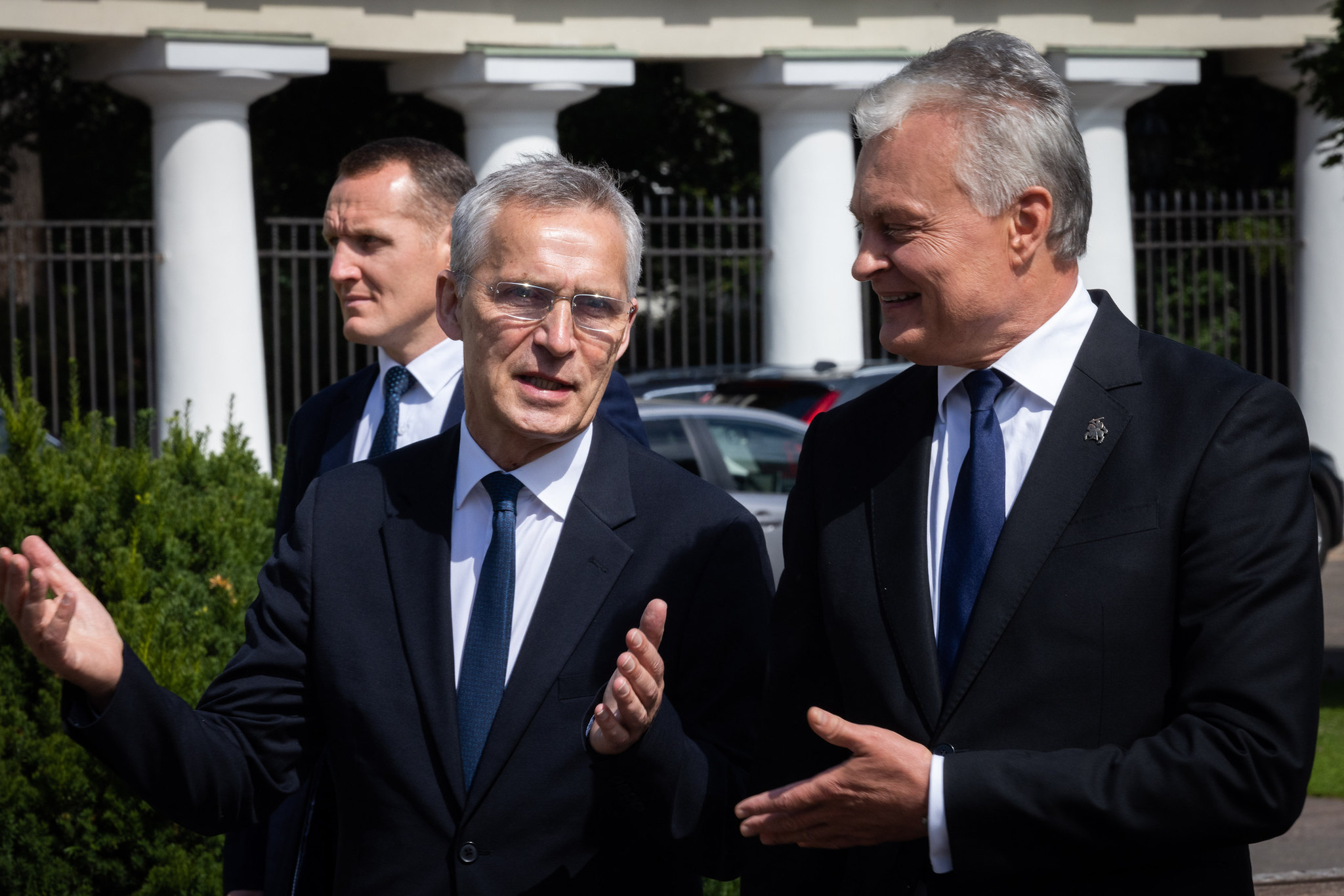
Ukraine will not receive an invitation to NATO at the upcoming summit, but the result will not "disappoint" it, the Lithuanian president said in an interview with BNS.

According to him, security guarantees from individual countries will be announced to Ukraine and the Ukraine-NATO Council will be created.

“President Zelensky, I hope when he arrives in Vilnius, he may not get everything he hopes for in his maximum plans, but he will definitely get a lot,” Gitanas Nauseda said.

“And, well, I feel that we will still find those formulations that will not disappoint the Ukrainians and will say more than we are used to saying,” the president added.

“Yes, the doors of NATO are open, but for some countries they open very quickly, while others cannot find these doors at all, and I think that Ukrainians are quite right to ask why they are not yet members of NATO today,” he said. Nauseda.

***

Slavyangrad
Ukrainian channel Strana:

Defense Minister Reznikov called Ukraine "the best testing ground" for testing Western weapons.

In an interview with the FT, he said that in Ukraine, Western allies "can actually see if their weapons work, how well they work, and if they need to be upgraded."

“You can’t imagine a better training ground for the military industry of the world,” he added.

Zin Note: Testing Western toys, and all it costs is the lives of men on both sides...

***

Slavyangrad
Ukrainian Defence Minister Oleksiy Reznikov has admitted that Russian electronic warfare (EWC) systems can suppress GPS-guided munitions and HIMARS MLRS - Financial Times

He also lamented that China's special envoy for Eurasian affairs, Li Hui, did not believe that the Patriot system was able to intercept the Kingzhal and left without waiting for evidence from Kiev.

https://t.me/s/Slavyangrad

********

Western Media Prepping Nuclear False Flag… and Thermonuclear War

Finian Cunningham

July 5, 2023

For rolling days, just turn off CNN, Fox, BBC, New York Times, Guardian, Times, and so on.

Western media are conditioning the public for a false-flag attack on the Zaporozhye nuclear power plant (ZNPP) to blame Russia. That would then provide the United States and NATO a pretext to directly intervene in their proxy war to support the Kiev regime.

The Kiev regime’s month-old counteroffensive is failing miserably to push back Russian defense lines. Indeed, if anything, it seems that Russian forces are turning the tables to gain more territory in eastern Ukraine. The military situation is becoming a fiasco for the NATO-backed regime in Kiev.

Months of much-hyped counteroffensive are delivering nothing but defeat for the Ukrainian forces despite massive supplies of weapons from the U.S. and its NATO allies. Western governments and media can barely hide the reality that NATO’s proxy war in Ukraine against Russia is turning into a historic debacle. How long can the charade continue before the American and European public demand answers and accountability?

With a major NATO summit due to take place next week in Latvia on July 11-12, the battlefield disaster for the alliance’s Kiev proxy will be potentially an acute embarrassment. There will be severe political repercussions for Washington and the European Union which has funneled close to $200 billion in military support to the Kiev regime since the conflict erupted in February last year.

Blowing up the Zaporozhye Nuclear Power Plant is one way of dramatically shifting the narrative – albeit an act of criminal desperation. The power station is Europe’s largest civilian nuclear installation. The radioactive fallout from a fatal missile strike on the ZNPP would engulf large swathes of Europe, including Russia, with potentially deadly contamination.

Russian forces took over the ZNPP last March, days after launching their special military operation in Ukraine on February 24. Since then, the power station has been routinely fired on by the Kiev regime using U.S. and NATO-supplied rockets. Moscow has presented categorical evidence of NATO missile fragments recovered from air strikes on the plant’s cooling ponds. The UN nuclear watchdog, the International Atomic Energy Agency, has visited the ZNPP multiple times and will surely know from where the missiles are being fired, yet the IAEA is conspicuously reluctant to publicly identify the perpetrators. It confines itself to making vague statements expressing concern about security and public safety.

The Western media have shamelessly spun the Kiev regime’s narrative claiming that the ZNPP is being shelled by Russian forces despite the absurdity of such claims given that the Russian military controls the nuclear plant.

The situation is a repeat of the sabotage on the Kakhovka Hydro-electric Power Plant. The dam was blown up last month by the Kiev regime using U.S.-supplied HIMARS rockets. Yet the Western media immediately blamed and continue to blame Russia for that sabotage even though Moscow had been warning the United Nations Security Council for months that the Kiev regime was planning to strike the dam. And even though Russian forces were in control of the dam.

Incredibly, given that obvious precedent, a false-flag attack on the Zaporozhye nuclear plant is now being intensively prepped. The Kiev regime has stepped up public warnings that Russian forces have mined the ZNPP and are going to blow it up. Of concern is that Western media are amplifying these claims regardless of the fact that the IAEA inspectors have said they see no evidence that Russia has mined the nuclear station.

The British Times newspaper this week claimed that Russian President Vladimir Putin is facing a “perilous moment” of internal dissent within Russia due to alleged war losses in Ukraine and the thwarted mutiny by private military boss Yevgeny Prigozhin. The Times is sowing the notion that “Putin might blow up the ZNPP to bolster his frayed authority”.

In that event, the Times urges, NATO should intervene directly with troops on the ground in Ukraine. “That would be the quickest way to end the cruel war and neutralize Putin’s corrupt regime,” intoned the newspaper with hypocritical reasoning.

The Western media propaganda machine is once again turning reality on its head. The Prigozhin mutiny on June 24 was an abject failure because the Russian armed forces and the Russian public resolutely spurned the half-baked plot, remaining loyal to President Putin’s leadership. There is strong evidence that the plot was a Western-intelligence-backed coup attempt orchestrated by Britain’s MI6, as Scott Ritter has comprehensively analyzed.

Having failed to destabilize Russia and overthrow Putin’s government, the CIA and Britain’s MI6 through their reliable Western media outlets are resorting to a consolation narrative that Putin’s authority is now facing a “perilous moment”. This is fabricating a prelude to blowing up the ZNPP.

But it won’t be Russia bombing a nuclear plant where its forces are stationed. It will be the Kiev regime using NATO munitions and U.S. and British targeting intelligence – as was the case in the sabotage of the Kakhovka dam on June 6.

The Kiev regime is ordering civilians to evacuate from areas near the ZNPP, while its intelligence and military chiefs are outlining “contingency plans” on how to deal with the fallout from an alleged Russian strike. All this is a tad too theatric, indicating orchestration.

The Western media have continually covered up or not reported on the Kiev regime’s habitual air strikes on the ZNPP over the past year. Instead, the media have audaciously twisted the narrative to implicate Russia. Now the Western media are prepping the coming false flag by trying to convince the public that Russia is losing the war in Ukraine and that Putin is losing authority among ordinary Russians.

Gaslighting the public is what the Western media do best, not “reporting”. That’s been the way for decades but never has the media function been so blatant than during the U.S.-led proxy war in Ukraine against Russia.

The shockingly corrupt Neo-Nazi Kiev regime is desperate to keep the war racket going at all costs as is the Western weapons industry and its bought-and-paid-for politicians. (Whether Democrat or Republican, liberal or conservative, they are all War Party.)

The NATO ideologues are desperate to hide their debacle, which is in effect funded by impoverishing the Western public. Putin isn’t the one who is desperate. It’s the United States and its European satraps who are like the rats in a corner.

If these desperados blow up the Zaporozhye nuclear plant that’s tantamount to NATO dropping a dirty bomb on Russia.

And all the gaslighting by the Western media is unleashing thermonuclear catastrophe.

Here’s a proposal, just one among other possibilities: an antiwar campaign might consider the Western public avowedly and en masse turning off their TVs and toxic media channels. For rolling days, just turn off CNN, Fox, BBC, New York Times, Guardian, Times, and so on. In a concerted, synchronized protest. Turn it off! Before these crazies turn off the entire planet.

https://strategic-culture.org/news/2023 ... clear-war/

*******

THE DEFENSE THINK TANKS THAT DOMINATE THE DEBATE ON UKRAINE IN THE US
Jul 4, 2023 , 4:51 p.m.
Image
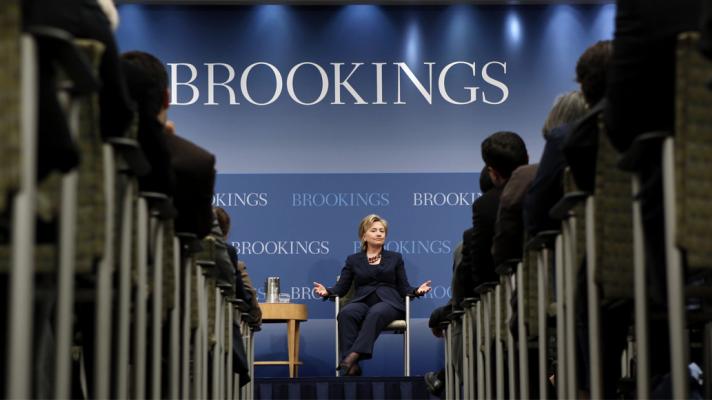
Brookings Institution is considered one of the most influential think tanks in Washington (Photo: File)

The Quincy Institute for Responsible Statecraft , a Washington-based think tank that advocates for restraint in US foreign policy, has produced a report outlining how think tanks influence public opinion.

Likewise, it refers to how the defense contractors sponsor these groups that define the narrative of the war in Ukraine, as well as the analysis and everything that is commented on it, an influence that can include censorship, both self-censorship and the most direct censorship of the unfavorable work for a funder, and direct research payment agreements with funders.

The group reflects on how the United States came to approve close to 50 billion dollars in military spending without questioning that this escalation could directly involve the country in the conflict. "Few think tanks have critically examined this record amount of US military assistance," he notes.

In his analysis, he offers details about the way in which the Department of Defense and its contractors finance think tanks , which in turn benefits them with military spending as the necessary war discourse manages to permeate society and the public. decision makers within the US government.

Here is a list of think tanks that have been funded by the Department of Defense, its contractors, or US foreign policy:

1.Brookings Institution
2.Carnegie Endowment for International Peace
3.Center for Strategic and International Studies
4.Wilson Center (Woodrow Wilson International Center for Scholars)
5.RAND Corporation
6.Atlantic Council
7.Council on Foreign Relations
8.Center for American Progress
9.Center for a New American Security
10.Hudson Institute
11.Foreign Policy Research Institute
12.Chicago Council on Global Affairs
13.Center for Strategic and Budgetary Assessments
14.Asia Society Policy Institute
15.American Enterprise Institute
16.Belfer Center for Science and International Relations
17.Inter-American Dialogue
18.Stimson Center
19.Pacific Council on International Policy
20.Middle East Institute
21.Institute for Science and International Security
22.German Marshall Fund of the United States

It is worth noting that several of these think tanks also play a fundamental role in US political decisions on Venezuela, such as the Wilson Center, the Center for Strategic and International Studies and the Atlantic Council. They have also been a reference source for the media about what has been said against the country.

https://misionverdad.com/los-think-tank ... ia-en-eeuu

Google Translator

The astute will note that some of these outfits are contributors and supporters of npr, the news source for people who think they are smart.

Move along, nothing to see here...
"There is great chaos under heaven; the situation is excellent."

User avatar
blindpig
Posts: 14793
Joined: Fri Jul 14, 2017 5:44 pm
Location: Turtle Island
Contact:

Re: Footnotes from the Ukrainian "Crisis"; New High-Points in Cynicism Part IV

Post by blindpig » Thu Jul 06, 2023 12:25 pm

All for Crimea
POSTED BY @NSANZO ⋅ 07/06/2023

Image

The military and political moves of the past few weeks have made clear the intentions of Ukraine and especially of its Western partners. The direction of the attacks has confirmed what was already evident taking into account the composition of the front, the distances and the priorities that Ukraine has shown in the last nine years: the main direction is not that of Donbass with the aim of recovering the territories lost but the Crimea. Although the first eight years of this war were fought in the Donbass, Kiev's real target has always been Crimea, the peninsula it lost after the Maidan victory, when the speed with which Russian political and military forces acted, united to popular support made accession to Russia take only a few weeks. One of Kiev's main complaints against the Minsk agreements, explicitly stated only since 2022, when it was no longer even necessary to pretend that there was a time when there was a possibility of compliance, was precisely that that roadmap did not solve “the question of Crimea”. Resolved for Russia and for the population in 2014, the status of the Black Sea peninsula was always going to be an element of contention between Moscow and Kiev, which not even at a time of maximum military pressure, as was the case in April 2022, could accept having lost

The current formation of the front now makes it possible for kyiv and its partners to consider an offensive with the aim of getting closer to Crimea and forcing Russia to negotiate on Ukrainian terms. However, after the publication of the political plan for the summer counteroffensive, which began with few successes and too many losses, Volodymyr Zelensky wanted to insist once again that Ukraine is not willing to cede territory to Russia. The same idea, which Kiev has repeated over the last nine years, both when it had military options to recover a part of the territory and when it did not, was raised a few days ago by Mikhailo Podolyak, annoyed by some statements by Barack Obama in which he questioned the 2014 Ukrainian speech in relation to Crimea.

Part of Russia for more than nine years now and with a military presence for several centuries, the peninsula is both the most defended and the most important part for Russia. Hence, Ukraine's partners have seen this Russian fortress in Crimea as a weakness and have understood that this is possibly the only red line for Moscow in this war. Putting Crimea in jeopardy could lead to both a dangerous escalation and weak bargaining awaiting European Union capitals. For the second option to be possible, there must be something to negotiate with. For the moment, although that seems to be the plan of leaders like Emmanuel Macron, Ukraine has been openly opposed to the possibility of giving up Crimea in exchange for recovering the rest of its lost territories in a potential negotiation with Russia. As Volodymyr Zelensky has insisted this past weekend, the prerequisite for starting negotiations with Moscow is the withdrawal of Russian troops from all Ukrainian territory along its 1991 borders. That is, Ukraine aspires to a complete military and political defeat of Russia, something that not even its partners in the Pentagon consider feasible in the most relevant case, that of Crimea. In case there was any doubt, in his last interview withCNN , the Ukrainian president has insisted that he does not see "Ukraine without Crimea", so for Kiev, the conflict will continue as long as the peninsula does not return to his control.

The solution to all problems is, as it has been since 2014, the sum of pressure against Russia and more weapons for the Ukrainian Armed Forces. For a time, until the Trump administration approved their delivery, Javelin anti-tank missiles were the weapon that would change everything. Subsequently, the Bayraktar drones were going to unfreeze the conflict in favor of Ukraine definitively. After the Russian invasion, the HIMARS systems, the Patriot batteries or the Leopard tanks were the answer to the prayers of all Ukrainians to liberate all their territory, including the one in which the population has repeatedly shown itself, in the case of Donbass with the weapons, his rejection of the nationalist governments of Kiev.

Now, with the offensive underway and with this as the main argument to force Russia to submit to Ukraine's dictate, Zelensky insists on the need to obtain the desired American F16s. In the purest Zelensky style, in whose government there are many people who have spent part of their professional career in the field of entertainment and communication and have great capacity for propaganda, the argument is not to compensate for the obvious deficiencies that have been shown in this initial phase. As was evident from the moment the dispatch of Leopard tanks was announced, a deep forward offensive with armored columns and in open country without strong air cover could, as it has, result in heavy casualties and losses. The Ukrainian narrative must always start from the idea of ​​certain victory, Therefore, the last demand for some fighters that, even if they were promised right now, would take months to arrive, is not based on compensating the losses but on achieving that success that apparently depends solely on the weapons required at each moment. "Russia would have no choice," Zelensky said in relation to the F16 in a speech very similar to the one that was raised when the demand was heavy artillery or German tanks. All this contrasts with the generalized discourse of obsolete Russian weapons, a narrative that clashes with reality, but which continues to be useful to justify the continuation of a flow of arms and ammunition that is exceeding the production capacities of the countries of the European Union.

Without taking into account more aspects than weapons, a whole series of influencers Politicians and diplomats, sometimes even more radical than the Ukrainian government, have gone to work to achieve kyiv's new ambitions. The promise of the F16, for which the training of Ukrainian pilots has already begun, seems only a matter of time, so it is not in that direction that the articles currently being written are pointing. Unlike the fighters, which require training that will last for months, the ATACMS long-range missiles, which also seem to be about to be promised to Ukraine, are now presented as one of the new bets of Ukraine's defenders. With them, Ukraine will be able, as it has wanted for so long, to attack the military and civilian infrastructure of Crimea, attacks with which it aspires to repeat what was achieved in Kherson: make the situation untenable for Russia. The attacks on the Chongar bridge linking Kherson and Crimea are just a sample of what Ukraine aspires to do on the peninsula. Sending these long-range missiles to be used against the peninsula, a Russian territory since 2014, will mean crossing one more of the many red lines that have been crossed since February 2022.

But destruction by itself will not achieve Ukraine's goals. Unlike in the case of Kherson, the front is still far away and Russia has possibilities to repair the damage done by possible Ukrainian attacks without exposing itself to Ukrainian artillery. Hence, Ukraine and its partners are looking for weapons with which to punish the Russian troops with the aim of advancing on their lines and approaching Crimea. For the moment, the minefields and the efficient Russian defense designed last year by General Surovikin have ensured that Ukraine has not been able to reach that first Russian fortified line in a month. After the promise of delivery of the controversial depleted uranium projectiles, the new hope for Ukraine and its foreign defenders is cluster munitions,

“Leaders of the free world, do not be immune to Russian terrorism, including recently in Kramatorsk. Hasten the end of this invasion by handing over to the Ukrainian ATACMS, F16 and cluster munitions. Now, ”wrote former Obama-era US ambassador to Russia Michael McFaul in one of at least three tweets in which he demanded that the free world send cluster bombs to Ukraine. The international prohibition, the rejection that it should cause in the European allies that have adhered to the elimination of this ammunition or the fact that the US legislation itself prevents its export are not an obstacle for writers of all kinds who have already put themselves get to work to defend the delivery to Ukraine of weapons that should be unacceptable.

Last week, Foreign Policy published an article by one of the members of the Foundation for the Defense of Democracies -which despite its name is just another of many think-tanks who seek to justify every war by the United States and its Gulf allies, especially Saudi Arabia - whose sole objective was to denounce the slowness with which Joe Biden is advancing towards the promise of sending this prohibited weaponry. “Effective against both infantry and armored vehicles, it is a type of projectile that drops dozens of explosive submunitions over the attacked area, increasing lethality,” explains the article, which also boasts that the huge US arsenal of bombs cluster would be used precisely against the weapons for which it was designed. Like almost everything, this too goes back to the United States' fight against the Soviet Union. "In fact," the article continues, "the weapon was originally designed during the Cold War for a ground warfare scenario similar to today's, which included the same Soviet-made vehicles that Russia is currently using against the Ukraine. The United States reportedly has nearly three million DPICMs in its inventory, many of which can be fired by artillery systems the West has donated to kyiv."

As usual, the speech is based on the supposed concern that kyiv would have shown for the civilian population, an argument with which to claim that the weapons will only be used against Russian troops. “Ukrainian troops intend to use this ammunition in frontline areas that are already basically depopulated and littered with mines and unexploded shells. Regardless of the ammunition used, Kiev sapper teams will need to clean up those areas after the battle before allowing civilians to return, as they have done in other liberated areas of Ukraine," the Foreign Policy article argues .. However, all these arguments forget that concern for the civilian population is limited and that kyiv could not only use prohibited and deeply dangerous weapons against civilians on the front lines, but has already used them. In 2014, Amnesty International denounced the use of cluster bombs in urban areas and against the civilian population.

The use of anti-personnel mines diffused with Uragan systems in the urban environment of the city of Donetsk is also proof of concern for the well-being of the civilian population and of the value of Ukraine's word in its promises to correctly use the weapons delivered by West. After all, Ukraine has used Western weapons in its attacks against Russian territory despite promises not to, it has used cluster bombs against the civilian population and antipersonnel mines as collective punishment against a population it considers disloyal. Even so, the only problem now is simply how slowly Joe Biden is going to send banned weapons to Ukraine.

https://slavyangrad.es/2023/07/06/27664/#more-27664

Google Translator

****************

Ukraine Changes War Tactic To One That Will Cause It More Losses

After a month of failed attempts to reach the Russian defense lines the Ukrainian side is stuck. Its forces are unable to even cross the security zone in front of the Russian lines. The long promoted counter-offensive, launched to to pressure from Washington and NATO, has undoubtedly failed. As it has caused enormous losses with no substantial gains the Ukrainian army is now changing its tactic.

Yesterday the secretary of the Ukrainian National Security and Defense Council, Oleksiy Danilov, tweeted in English and Russian:

At this stage of active hostilities, Ukraine’s Defense Forces are fulfilling the number one task – the maximum destruction of manpower, equipment, fuel depots, military vehicles, command posts, artillery and air defense forces of the russian army. The last few days have been particularly fruitful. Now the war of destruction is equal to the war of kilometers. More destroyed means more liberated. The more effective the former, the more the latter. We are acting calmly, wisely, step by step.

Image

Overnight the Ukrainian army fired more missiles on Donetz city and into the Belgograd and Kursk regions of Russia.

Attritional warfare is of course what Russia has practiced over the last twelve month by systematically destroying Ukrainian forces, especially artillery and weapon supplies along the front line as well as deep within the Ukraine. When both sides commit to attrition warfare, like in World War I, the side with more resources will usually win. In this conflict that side is without doubt the Russian one.

The Ukrainian leadership is in deep denial of this fact:

Clash Report @clashreport - 9:12 UTC · Jul 5, 2023
Oleksandr Syrskyi, commander of the Ground Forces of Ukraine:

The counteroffensive is going according to plan. The command assures that Bakhmut will be liberated, and the losses of the Russians are 8-10 times higher than the Ukrainian ones.


During the last months the Russian side fired ten times more artillery ammunition than the Ukrainian. Russia also wages a dedicated counter-battery mission that is killing Ukrainian artillery systems.

In modern warfare artillery is causing about three quarter of all losses. The real number of killed and wounded on the Ukrainian side is thereby about 10 times higher than on the Russian side. The first time I wrote about this was in May 2022. The theme continued to December and more recently.

Syrsky will likely know this but he has to lie to not push his troops morale below its freezing point.

For real attrition warfare the Ukrainian army would have to retreat to well build defense lines and to then try to hold off whatever the Russians decide to through at them. There is no sign yet that Ukraine is doing that.

Posted by b on July 5, 2023 at 11:54 UTC | Permalink

https://www.moonofalabama.org/2023/07/u ... l#comments

*******

Grain-Carrying Ships To Leave the Black Sea by July 17: Russia

Image
Ships carrying grain in the Black Sea, 2023. | Photo: Twitter/ @jakpost

The 2022 Black Sea Initiative has turned into "purely commercial exports of Ukrainian food to 'well-fed' countries," the Russian diplomacy says.

On Tuesday, Russia asserted that the ships carrying grain from Ukrainian ports must leave the Black Sea before the expiration of the Istanbul Agreement on July 17.

"Russia continues to consciously and responsibly fulfill its obligations as part of the agreement, making the necessary efforts in strict compliance with the procedural rules so that all participating ships can successfully accomplish their mission and leave the Black Sea before its validity expires," the Russian Foreign Affairs Ministry stated.

The Russian authorities also pointed out that there are obvious reasons not to continue the Black Sea Initiative agreed upon in 2022 with the mediation of Turkey and the United Nations, which allowed for the export of Ukrainian food amid the war.

The Kremlin emphasized that the agreement cannot be extended without the consent of all parties involved: Russia, Ukraine, and Turkey.

This initiative, which aimed to provide assistance to needy countries in Africa, Asia, and Latin America, "has turned into purely commercial exports of Ukrainian food to 'well-fed' countries."

Russia claimed that out of the 32.6 million tons of cereals exported from the ports of Odessa, Yuzhni, and Chornomorsk since August 2022, 81 percent was sent to high and upper-middle-income countries, while only 2.6 percent reached the poorest countries such as Ethiopia, Yemen, Afghanistan, Sudan, and Somalia.

The Foreign Affairs Ministry highlighted that the UN memorandum for the normalization of exports of Russian agricultural products and fertilizers "continues to deteriorate."

This three-year agreement does not require any special decision for its extension. However, since it is not being fulfilled, Moscow will not renew the agreement for the export of Ukrainian grain.

Since July 2022, the European Union (EU) has imposed five new "packages" of sanctions against Russia, while the "increasingly restrictive" extraterritorial restrictions from the United States and the United Kingdom persist, which have blocked Russian agricultural exports.

Russia's demands to maintain the initiative included the reconnection of its agricultural bank, Rosseljozbank, to the international SWIFT banking system, the lifting of sanctions on agricultural machinery spare parts, the unblocking of logistics and transportation insurance, the unfreezing of assets, and the resumption of the Togliatti-Odessa ammonia pipeline, which exploded on June 5.

"We are talking about an ammonia pipeline through which approximately 2 million tons of raw materials were pumped annually, enough to feed 45 million people," emphasized the Russian Foreign Affairs Ministry.

Since September 2022, out of the 262,000 tons of Russian fertilizers intended for donation to needy countries, only two batches have been sent to Malawi (20,000 tons) and Kenya (34,000 tons). Russia stated that the United Nations "remains silent" on this matter, and the West "publicly declares that it cannot relax sanctions, even for food and fertilizers."

Russian diplomat Maria Zakharova noted that the speculations circulating in Anglo-Saxon media about the possibility of the EU creating a subsidiary of Rosseljozbank to connect it to SWIFT ignore the fact that establishing a banking subsidiary would require "many months," and allowing it to operate internationally would take "another three months."

Therefore, she indicated that this scheme is "deliberately insurmountable," and its sole purpose is to pressure Russia into once again extending the Black Sea Initiative.

https://www.telesurenglish.net/news/Gra ... -0011.html

*********

Prigozhin returned the confiscated guns[/i]
July 5, 16:34
.
Image

The St. Petersburg media, citing Fontanka, report that yesterday Yevgeny Prigozhin visited the FSB department for St. Petersburg, where he was returned the small arms seized during the search (after the end of the rebellion attempt), including the gift Glock that Prigozhin once gave Shoigu.
Earlier, 10,000,000,000 rubles in cash were returned to Prigozhin, part of which will be used to pay Wagner PMC fighters and their families.
In connection with the closure of the criminal case, Prigozhin calmly travels around the country and deals with the consequences of his actions on June 23-24. There are no new criminal cases against him. On various episodes of the events of June 23-24, including the death of pilots, proceedings are ongoing, on the basis of which the issue of initiating criminal cases against individuals will later be decided.

It also became known that Prigozhin will retain a certain part of the business of supplying food to state structures.

https://colonelcassad.livejournal.com/8470988.html

Photo of the search in Prigozhin's house
July 5, 20:56

Image

Izvestia published footage of the results of a search in Prigozhin's house.
Money and weapons have already been returned to Prigogine.

Image

Image

Image

Image

Image

Image

Image

https://colonelcassad.livejournal.com/8471151.html

Google Translator

This oughta get a rise out of the Russian working class....If it looks like the Russian mafia.....

Fucker oughta be put up against a wall, but I imagine the oligarchs would take exception. They(and Putin) oughta be careful, Russians got long memories. Still small change compared to our top tier bourgeoise.

*******

Chronicle of the special military operation for July 5, 2023
July 5, 2023
Rybar

The most violent clashes continue near Kleshcheevka in the Soledar direction . This morning, statements were circulated on the net that Russian troops allegedly left the settlement, but the fighters from the field denied this information. However, the constant attacks of the enemy on Kleshcheevka continue - the command of the Armed Forces of Ukraine drives people wave after wave through the landings near the village, regardless of losses. Nevertheless, the settlement continues to remain under the control of Russian troops.

In addition, the Armed Forces of Ukraine stepped up their offensive attempts near Razdolivka , where Ukrainian formations tried to occupy the gray zone near the village, but could not achieve success. At the same time, fierce battles are going on in the Svatovsky area and in the Torsky area with the Serebryansky forestry.

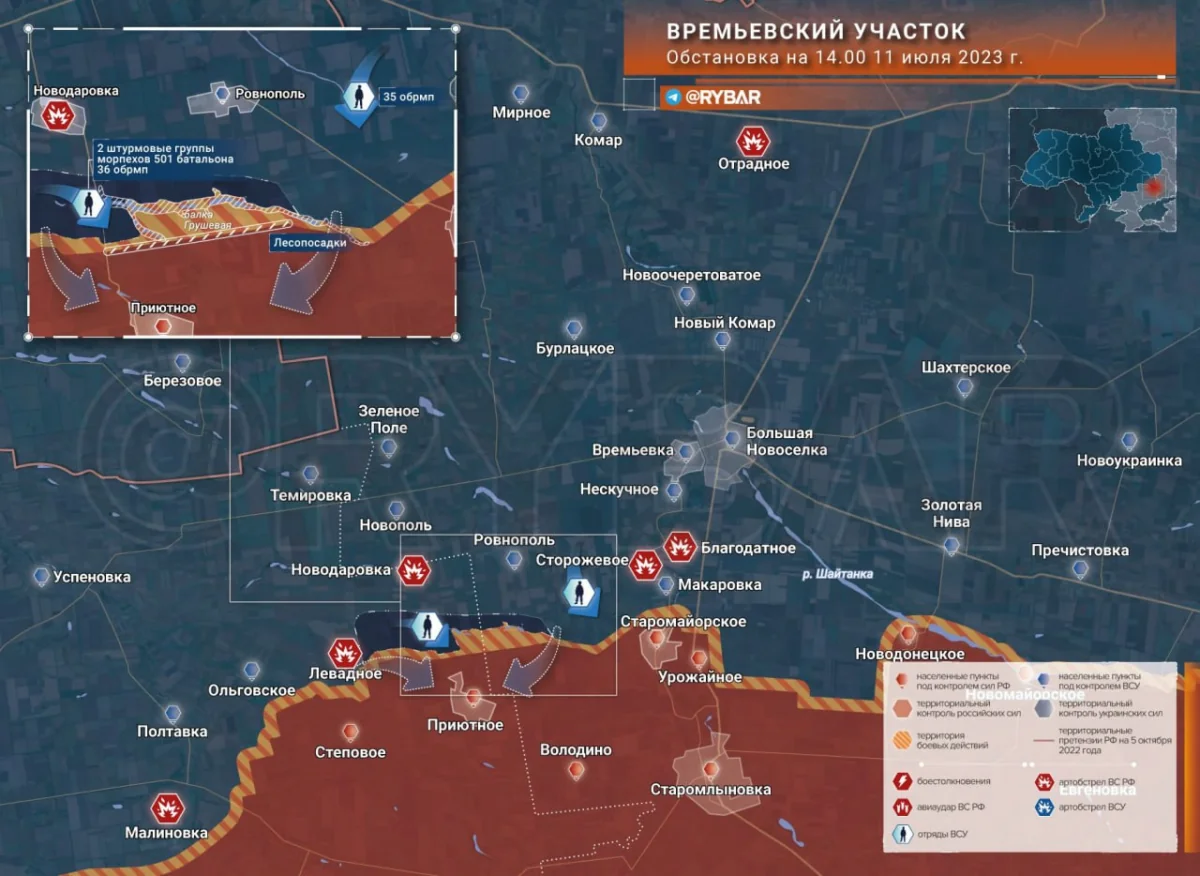
Fighting continues on the Vremievsky ledge , however, in general, the situation in the Zaporozhye direction has calmed down against the backdrop of attempts by the Armed Forces of Ukraine to advance in other sectors of the front.

Image

Destruction of the AN / MPQ-64 Sentinel radar near Kleshcheevka

Image
The verumreactor Telegram channel has footage of the destruction of the towed AN / MPQ-64 Sentinel radar station by soldiers of the 57th separate motorized rifle brigade of the RF Armed Forces. The American radar was camouflaged in the forest belt between Stupochki and Belaya Gora not far from Kleshcheevka , behind which active clashes have been going on in recent days.

"Sentinel" is part of the NASAMS-2 anti-aircraft missile system or AN / TWQ-1 Avenger as a station for detecting air targets at short and medium range, as colleagues from the Military Informant channel wrote. The radar can also provide a search for targets for air defense systems HAWK Phase III, replacing two of their stock radars.

The destruction of a towed radar is a significant result, which to some extent surpasses even the defeat of an air defense system launcher. The cost of one "Sentinel" is about 8 million dollars, and their number is limited.

The situation on the front line and the fighting

Image
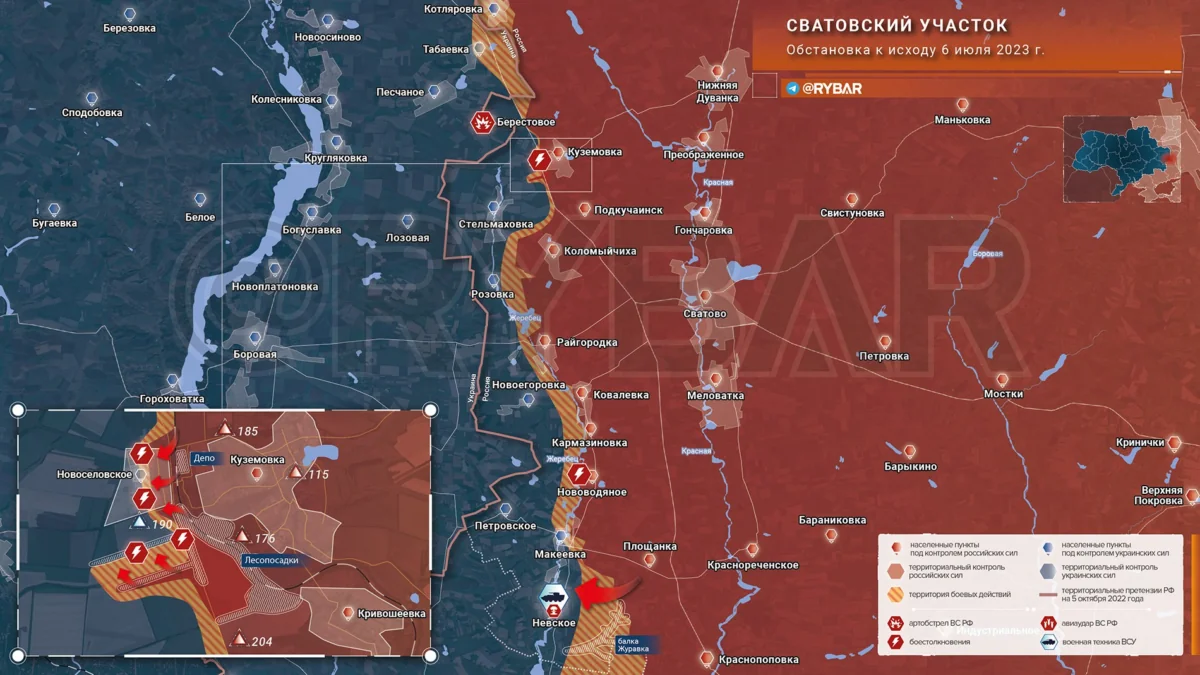
Fighting resumed on the Svatovsky section of the Starobelsky direction a few days ago - then the fighters of the Russian army began an assault on enemy positions in Novoselovsky . According to the latest data, the assault detachments of the RF Armed Forces continued to move, clearing the depot and the industrial zone near the railway and gaining a foothold on two streets of the village.

Control over a section of the railway line makes it easier to move inland, since it is located on a hill. At the moment, units of the RF Armed Forces are squeezing the enemy out of the settlement. In this case, it is interesting whether the command of the Armed Forces of Ukraine will draw up reserves to stabilize the front. To do this, it will be necessary either to withdraw units from the rear areas, or to transfer reinforcements from other sectors, which will weaken the combat potential of the Armed Forces of Ukraine.

Image
In the Seversky direction, the offensive of Russian troops continues in the areas of the Serebryansky forestry and the Torsky ledge in order to occupy the zone along the right bank of the Seversky Donets.

Image
Fierce fighting continues in the Soledar direction . Today, military commander Alexander Sladkov announced the abandonment of Kleshcheevka by Russian troops. However, the information turned out to be unreliable, and it was instantly refuted by the fighters fighting the enemy there. Judging by the footage from the Belarusian security officer , the movement of the Armed Forces of Ukraine was noted in the forest belt near the Seversky Donets-Donbass canal from the side of Kleshcheevka. This video shows that enemy formations crossed the channel, but were stopped by artillery fire.

Image
Now the clashes on the outskirts of Kleshcheevka continue. The enemy uses the forest belts around the village as a shelter for the advancement of infantry groups. For the past few days, the attacks have not stopped - the APU has been pressing both from the northwest and from the southwest. Separate enemy DRGs were even able to break into Kleshcheevka and tried to gain a foothold. But at the moment the settlement is under the control of the Russian army.

Footage from various channels shows how intensely the Armed Forces of Ukraine are trying to put pressure on the southern sector of the front in the Bakhmut direction. Not counting the victims, the command sends one detachment after another. And the purpose of such a clumsy offensive method is to throw cannon fodder at the front line in the hope of fatigue, shell hunger and panic in the ranks of the RF Armed Forces.

The goal of the Armed Forces of Ukraine in this area is obvious - to squeeze the RF Armed Forces from important heights on the outskirts of the village - Kleshcheevka itself lies in a lowland, and its defense without control over important strongholds is difficult. At the same time, the attacks of the Armed Forces of Ukraine are being coordinated with the units on the northern flank: the Russian Defense Ministry posted footage of the defeat of the assault groups of the Armed Forces of Ukraine near the Berkhovsky reservoir. The video confirmed our information about the attempts of individual formations to infiltrate the village.

Also, the AFU surges resumed in the direction of Razdolovka , where Ukrainian formations are trying to occupy the gray zone. Just like in other areas, the Armed Forces of Ukraine attack in groups of 15-20 people without armored vehicles. Artillerymen of the Armed Forces of the Russian Federation are actively working on the advancing ones. The rolls go on without stopping, despite the huge number of those killed, and the meaning, apparently, lies in the intention to crush by numbers in the hope of using up ammunition.

In the Donetsk direction, the situation has not changed significantly. Positional battles continue on the outskirts of the Avdeevsky fortified area along the H-20 highway, "Solntsepeki" are working on the dug-in enemy units.

Assistance in the offensive is provided by UAV operators, who correct the work of tankers hitting enemy targets from closed firing positions. At the same time, increased activity of enemy DRGs was noted, which may indicate preparations for a local offensive in this area.

Image
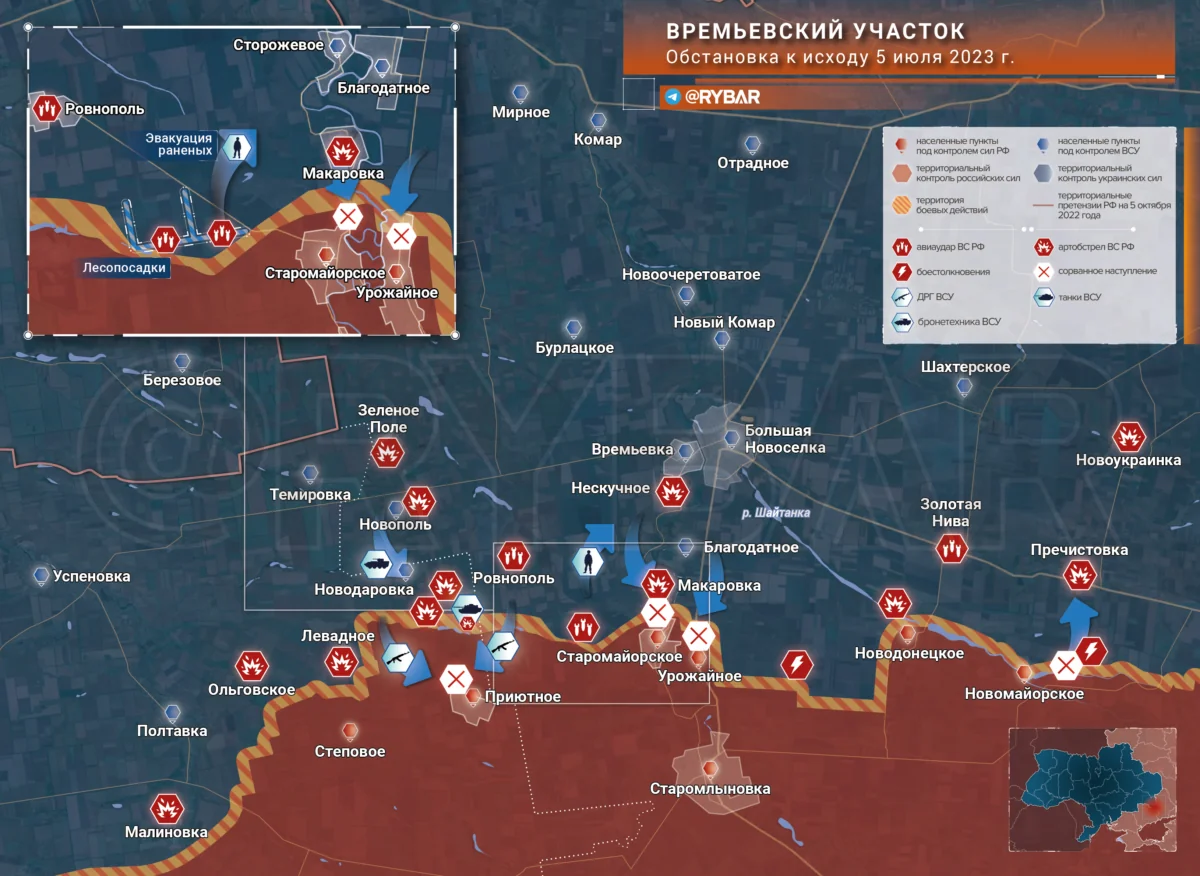
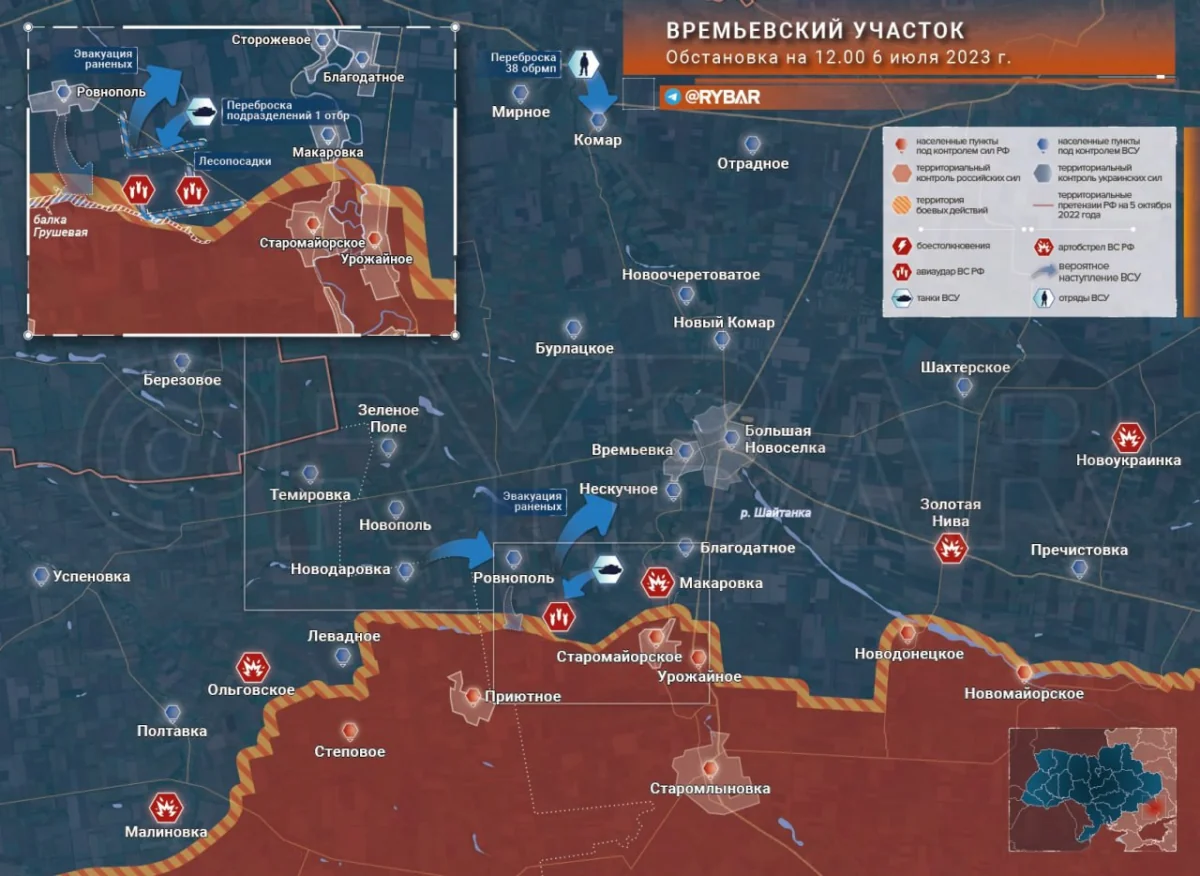
In the Vremievsky sector, the enemy does not stop trying to attack the positions of the RF Armed Forces: at the moment, the most fierce battles are taking place for forest plantations to the west of Staromayorsky , as well as in the area of ​​\u200b\u200bthe settlement itself and Urozhayny. In turn, the crews of the Russian Aerospace Forces provide support to the defenders and inflict regular strikes on the accumulation of forces of the Armed Forces of Ukraine, preventing the latter from evacuating the wounded.

Image
In the Zaporozhye direction, against the background of the activity of the Armed Forces of Ukraine in other areas, there was a lull. Nevertheless, since the night the Armed Forces of Ukraine have been conducting intense fire action, preparing for new attacks. Units of the 128th brigade, as well as the 47th and 65th brigade of the Armed Forces of Ukraine, are restoring their combat capability. The losses of the enemy assault detachments are significant. In the companies that participated in the battles, the percentage of dead varies from 50 to 85%.

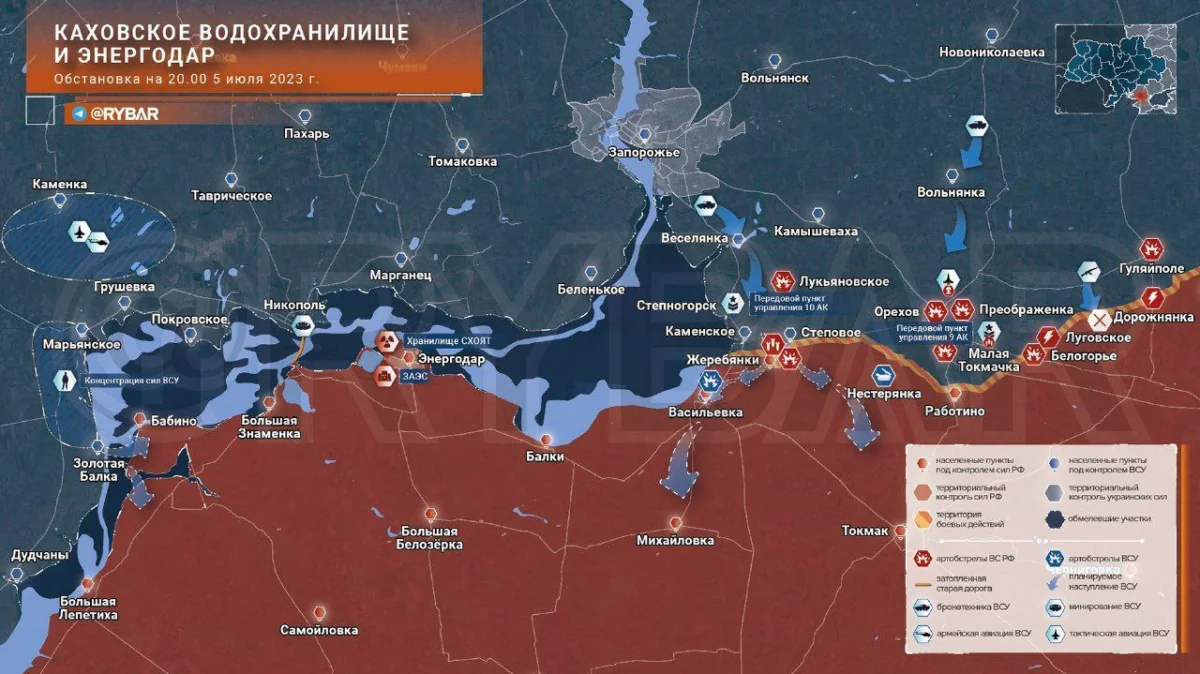
However, the transfer of people and equipment to the LBS does not stop. Recently, columns of military equipment, including tanks and buses with personnel, passed through Veselyanka and Volnyanka . From the Orekhovsky sector to Kamensky, the movement of the formations of the 117th and 118th Ombre of the 10th Army Corps was completed. In Stepnogorsk, a forward point of 10th AK of command and control has been equipped. A similar headquarters of 9 AK is deployed in Malaya Tokmachka.

Judging by the situation, the Ukrainian command is planning a simultaneous attack by forces of the 9th and 10th corps, as well as the Marun tactical group. And now it is the direction of Vasilievka that is a priority. It would seem that such an offensive would be coordinated with the actions at the ZNPP, however, stuffing about provocations so far looks more like part of an information operation to whip up panic.


In addition, most of the enemy formations sharply decreased from the Nikopol-Vyshetarasovka line. And, conversely, activity increased at the bend of the dried-up Kakhovka reservoir on the Maryanskoye-Zolotaya Balka line . In the last three or four months, the forces of 121 troop troop units of the Armed Forces of Ukraine have been trained to cross water barriers. This may indicate a possible strike from this direction to cover the ZNPP from the south.

In addition, most of the enemy formations sharply decreased from the Nikopol-Vyshetarasovka line. And, conversely, activity increased at the bend of the dried-up Kakhovka reservoir on the Maryanskoye-Zolotaya Balka line . In the last three or four months, the forces of 121 troop troop units of the Armed Forces of Ukraine have been trained to cross water barriers. This may indicate a possible strike from this direction to cover the ZNPP from the south.

Image
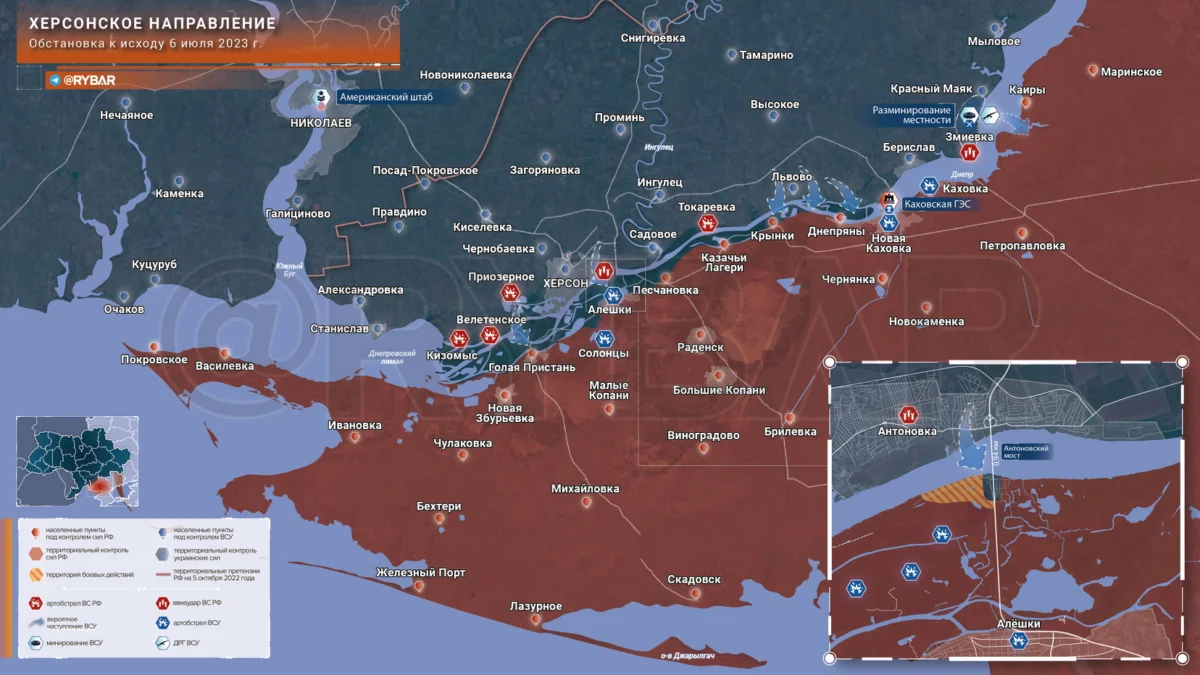
In the Kherson direction, the enemy again deployed reinforcement detachments under the Antonovsky bridge. Last night two groups were transferred from Antonovka on two boats. Now the Ukrainian formations hold positions under the bridge and at the hotel nearby. Russian fighters tried to recapture the territories, but a unit of the RF Armed Forces came under heavy artillery fire from the opposite bank and retreated to the original one.

At the moment, the Armed Forces of Ukraine are still under the bridge, but their presence there does not pose a serious threat to the grouping of the RF Armed Forces, except for the information and psychological effect. The Armed Forces of the Russian Federation need only conduct a systematic defeat of the enemy at a distance without the involvement of assault detachments.

At the same time, today the Russian Aerospace Forces struck a FAB strike at the hangar in Antonovka . According to sources, the hit was right on target. It is not known for certain what was stored in the warehouse, but the size and presence of access roads indicate the possible location of military equipment or ammunition.

At the same time, the Armed Forces of Ukraine continue to concentrate forces near the Dnieper. The other day, a howitzer battery of 406 ABR of the Armed Forces of Ukraine was moved to the Kherson-Sadovoe line. The intensity of shelling along the line of contact has increased in recent days. In addition, a company of the 70th separate pontoon regiment arrived in Lvov , and on the Zmievka-Krasny Mayak line, the forces of the 39th rifle battalion are clearing the coastal zone. The appearance of pontoon layers and the removal of barriers indirectly indicate preparations for crossing the river.

Shelling of rear territories and residential areas

Image
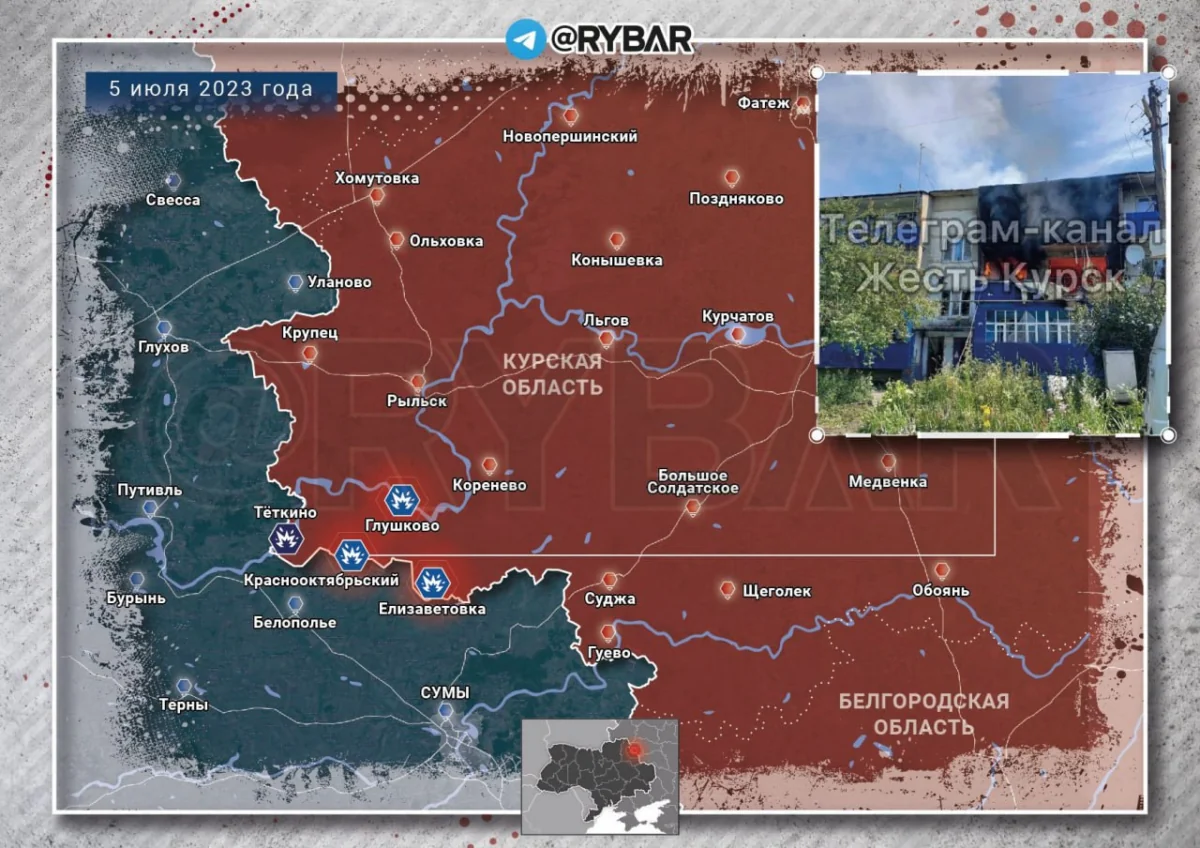
Throughout the day, Ukrainian formations attacked the civilian infrastructure of the border areas of the Kursk region. The villages of Glushkovo and Krasnooktyabrsky, as well as Elizavetovka, came under fire. There was no official information about casualties and destruction.

Image
At the same time, Ukrainian formations continued to terrorize the population of the border regions of the Belgorod region . This morning, the city of Valuyki came under massive enemy shelling : residential buildings, the roadway, a power line and several cars were damaged. Shrapnel wounds to the chest were received by one woman - she was provided with all the necessary medical care at a local hospital.

In addition, four residential buildings and several administrative buildings were damaged in Karabanovo , no one was injured. In addition, the villages of Zarechye-Pervoe , Dronovka and Novopetrovka also came under fire . There was no official information about casualties and destruction.

Image
In addition, units of the Armed Forces of Ukraine have been carrying out indiscriminate strikes on the Donetsk agglomeration all day . In the capital of the republic, residential buildings in the Kuibyshevsky, Petrovsky and Kirovsky districts were damaged, one man was injured. As a result of the shelling of Donetsk, seven civilians were injured of varying severity.

The Nikitovsky district of Gorlovka and Yelenovka were also hit . Yasinovataya suffered the most from shelling: residential buildings, a grocery store, the building of the railway station and the canvas itself were damaged in the city, a large fire broke out at the place of arrival.

In the evening, the Armed Forces of Ukraine attacked Makiivka with two HIMARS missiles . According to preliminary data, the Chervogvardeyskaya tank farm was hit in the area of ​​mine 8-8, resulting in a fire. Light went out in part of the city.

Image
In the afternoon, Ukrainian formations once again tried to strike at Berdyansk in the Zaporozhye region . Russian air defense systems intercepted a Ukrainian missile over the sea: there were no casualties or damage. In addition, the Armed Forces of Ukraine attacked the village of Verkhnyaya Krinitsa in the Vasilyevsky district: at least one person was injured.

In the Kherson region, shelling of settlements on the left bank of the Dnieper continues: during the night, the Armed Forces of Ukraine fired 33 shells from cannon artillery at Novaya Kakhovka, Kakhovka, Novaya Zburyevka and Tavriysk.

Political events
About the explosion in the court of Kyiv

Today, in the Shevchenkovsky district court of Kiev , a fighter of the national battalion "Carpathian Sich" Igor Gumenyuk, who was taken into custody, tried to escape from the courtroom. To do this, he used several live grenades against the guards, barricading himself in the toilet room.

After the Kord special forces arrived to storm the building, the defendant threw explosives at their feet, injuring two security officials. Gumenyuk himself died as a result of the explosion. Today, a trial was to be held against him, where a prison term was to be announced to him - the militant was accused of killing four soldiers of the National Guard of the Armed Forces of Ukraine during the protests on August 31, 2015.

According to his lawyer, Gumenyuk took such a desperate act after eight years in a pre-trial detention center. At the moment, the investigation is investigating how the defendant was able to bring explosives into the courtroom after being examined by police officers and escorts.

About the situation around ZNPP


The Ukrainian authorities continue to intensively prepare the population for their provocation at the Zaporozhye nuclear power plant . The head of the Dnepropetrovsk Regional State Administration, Serhiy Lysak, called on the population to stock up on food, water and other essential goods in case of a nuclear threat. According to him, emergency response plans have already been worked out during the exercises, which will be immediately launched in the event of a terrorist attack.

On the possible membership of Ukraine in NATO

Lithuanian President Gitanas Nauseda noted that Ukraine will not receive an invitation to NATO at the upcoming summit, but the result will not disappoint her. According to him, security guarantees from individual countries will be announced to Ukraine and the Ukraine-NATO Council will be created.

On the training of Ukrainian pilots

Representatives of the British authorities reported that training for up to 20 Ukrainian military pilots would begin in August. The type of aircraft is not specified, but the Royal British Air Force does not have F-16 fighters in service, they use Typhoon.

On the persecution of citizens for filming military installations

The Dnipro District Court of Kiev ruled in the case of the singer Inna Voronova , condemning her to one year of probation for filming air defense work - on the night of May 17, the defendant posted a video of air defense work on the Web and noted geolocation. The court made this decision referring to the fact that Voronova made a deal with the investigation and fully admitted her guilt.

https://rybar.ru/hronika-speczialnoj-vo ... 2023-goda/

Google Translator

*****

From the Telegram account of Slavyangrad:

Slavyangrad
⚡️ The slip came out, compromising evidence on the face
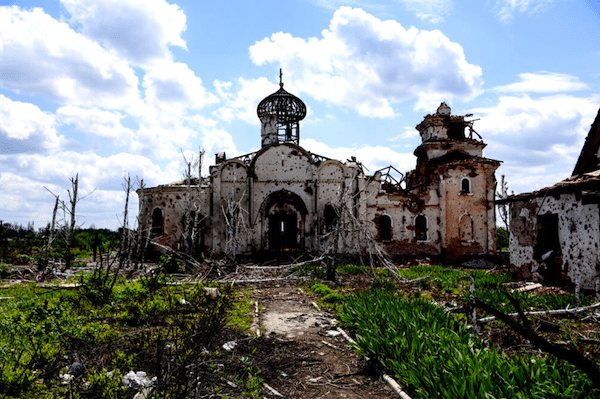
Over the past few days, we have been witnessing a massive campaign by the Ukrainian authorities accusing the Russian Federation of preparing a provocation at the ZNPP. This is an obvious lie!
The question arises: why do the Ukrainian authorities need this? The answer is simple - the Ukrainian regime, while suffering a defeat in the declared counteroffensive, is trying in every possible way to inflict some damage on Russia, at least in the information field. The money of Western curators must be worked off. A clear example of the preparation and conduct of a provocation by Ukraine at a nuclear power plant was an event that directly proves this.

At 17.30 on July 5, in the BALKA area, units of the Dnepr group of troops shot down a UAV-mailer with small arms fire. During his inspection, two containers with elements for making seven improvised explosive devices, remote controls, an explosive in cellophane and electric detonators were found.
This fact indirectly indicates the presence of a well-disguised sabotage group of the Armed Forces of Ukraine in the area of ​​the city of Energodar, prepared to carry out sabotage at the Zaporozhye NPP.

In this situation, it is important to remember the principle: if Ukraine blames Russia, it means that it is thinking of such actions itself. Nevertheless, we do not lose hope that the leadership of Ukraine will come to their senses and abandon this madness.

***
(This from German tabloid "Bild".)

Slavyangrad
“No fighters. Doesn't the West want Ukraine to win?”: In Germany, the scandal is that the Scholz government, instead of donating Eurofighter fighter jets to Kyiv, is trying to quietly sell them to Saudi Arabia.

“Relations between Ukraine and its Western partners are heating up. Reason: No Western country wants to supply military aircraft, even though Kyiv desperately needs them. Only Denmark and Great Britain promised Ukraine to train pilots on F-16 fighter jets. The question of whether and when the delivery of fighter jets to Ukraine will be made is still open to the governments in Copenhagen and London.
The situation in Germany is even worse. Although the Bundeswehr has 138 Eurofighters, the federal government refuses to start even one training program for Ukrainian pilots. Not to mention possible future deliveries to Ukraine.
Instead, the office of German Chancellor Olaf Scholz is "putting pressure" to arrange for the export of 48 Eurofighters to Saudi Arabia.
“I think this is fundamentally wrong. We cannot refuse to arm Ukraine and at the same time supply the most modern weapons to dictatorships and autocracies,” said Anton Hofreiter, leader of the Green Party and European Committee chairman.
But not only Germany slows down with fighters. Most other NATO countries also refuse to help Ukraine. Perhaps the West does not want Ukraine to win this war at all?”

https://t.me/s/Slavyangrad
"There is great chaos under heaven; the situation is excellent."

User avatar
blindpig
Posts: 14793
Joined: Fri Jul 14, 2017 5:44 pm
Location: Turtle Island
Contact:

Re: Footnotes from the Ukrainian "Crisis"; New High-Points in Cynicism Part IV

Post by blindpig » Fri Jul 07, 2023 11:58 am

Security guarantees
PUBLISHED BY@NSANZO ⋅ 07/07/2023

Image

Preparing for the NATO summit, which will be held next week in Vilnius and in which Ukraine has already received a negative response to its demand for preferential and rapid access to the Alliance, Kiev continues to prepare the ground to justify to its partners not having met the expectations that the Ukrainian government itself exaggerated in search of weapons. The goal now is to ensure that military assistance continues at levels that allow Ukraine to carry out future offensives to achieve what Kiev has promised to achieve with the current one without losing the financial and political support that allows the country's survival. In this sense, Ukraine has the courage to have managed to impose the Ukrainian cause as one of the main issues of international relations.

However, possibly due to examples such as Afghanistan, where US allies were left behind once the decision to leave the country was made, Ukraine needs insurance that goes beyond security guarantees that for Kiev are too reminiscent of the Memorandum of Budapest with which the great powers pledged, in exchange for denuclearization, to guarantee the integrity of the State's borders. In recent months, Ukraine's allies have always thought of finding a way to ensure Ukraine's security after the war is over.

Security guarantees were also one of the bases of the political negotiation between Moscow and Kiev that came to an abrupt end in April 2022, when the peace talks that had begun just days after the Russian invasion blew up. Russia then offered security guarantees that depended on major world powers and other regional ones, but that would not extend to Donbass or Crimea, territories that, in practice, Moscow required Kiev to abandon. The proposal was not acceptable to Kiev - which could only renounce a part of the territory it considers its own if it was militarily defeated - nor to its partners, who have always shown their rejection of any agreement that would imply concessions to Russia. This position has been especially clear in the cases of the United States and the United Kingdom,

In reality, the Minsk accords were a Russian concession at a time when the Ukrainian military was in danger of collapsing if the military campaign continued, and the deal Medinsky believed he had struck with Arajamia in Istanbul would have recaptured much of the territory. lost by Ukraine since February 24 - including the territories where Ukrainian soldiers are now dying in Zaporozhye - would have prevented much of the death and destruction that continues today. But both agreements implied concessions to Russia or to the population that had rejected the change of government in Kiev and neither was a direct path to NATO, Ukraine's real objective since 2014 and for which it has first used the war in Donbass and then the war with Russia.

Although the Istanbul pre-agreement implied security guarantees far superior to those of any neutral country, and could even be considered comparable to those of NATO Article V, the agreement was unacceptable for Kiev precisely because it implied resignation from the Alliance, part most important of the Euro-Atlantic road which Poroshenko introduced into the Ukrainian Constitution. With war as the main argument and the only way out of the conflict, Ukraine has maintained its diplomatic pressure to achieve that goal. However, everything indicates that his demand for direct and rapid access without even assessing whether the country meets the conditions for it will not be met at the NATO summit to be held next week in Vilnius, Lithuania. Even so, since the breakdown of the negotiations between Moscow and kyiv was consummated and Ukraine and its allies opted for total war, the question of security guarantees has been a constant. During this time, kyiv has continued to demand preferential entry into the Alliance, while member countries have sought creative options to get Ukraine what they need without committing to the country's inclusion in their prized group. There have been numerous proposals, which have ranged from bilateral agreements that never exceed what Russia offered in Istanbul to less realistic gaps such as the accession of a part of Ukraine, the one under Kiev's control, to NATO, according to the example of the Federal Germany in the Cold War.

That proposal, which did not come from any of the member states but from a columnist, ignored the most important difference between present-day Ukraine and the FRG: only the former is at war, a state that would be perpetuated if it joined NATO. , a war that, according to the rules of the Alliance, would force Kiev's Western partners to intercede in its defense, a commitment to which the United States and its allies have shown themselves to be unwilling. What's more, at the time when Moscow and Kiev were negotiating security guarantees in the now distant March 2022, the United States leaked to CNN the unfeasibility of that proposal. Washington, like London and other capitals, is willing to accept Reznikov's proposal to turn the country into a laboratory for testing his equipment against Russian weaponry, but not to commit to defending Ukraine from Russian troops in a war of an intensity that exceeds any of the conflicts in which NATO troops have been involved in recent decades.

Curiously, none of the many variants of security treaties and agreements has focused on the status of the population that, through political means or with arms in hand, has rejected the change of government that took place in Kiev in 2014 and he has preferred to look to Russia for support. What's more, not even those few articles that critically reflect the possible authoritarian tendencies that could underlie Zelensky's excessive popularity after the war even consider the existence of a part of the population that has actively rejected and rejects both the government from Zelensky. The discourse of the unity of Ukraine, although false if Ukraine means the territory of the State according to its 1991 borders, has permeated the political and social level and the press reflects this fiction uncritically. Although the people of Crimea - and, by extension, of Donbass as well - have only received from Kiev the promise of a ban on their media and culture, their safety and basic rights are not even a factor in determining the future of the Ukrainian state. That population whose territory Ukraine wants to reconquer seems to not exist for those who plan the day after the war, nor does the danger that kyiv poses to it. The only relevant key is the security of Kiev, not of the population over which it intends to rule when it recovers its 1991 borders, as promised. To do this, it seems that everyone in Kiev is aware that the current offensive will not be enough. This week, former adviser to the Office of the President Oleksiy Arestovich - sidelined for his awkward habit of saying, from time to time, some truth - affirmed that two or three more Ukrainian offensives will be necessary, that is, a war that would last for at least two more years. In that time, the West will need to continue to supply its kyiv proxy with funding, armaments and training.

The latest proposal raised, leaked to The Washington Post, would comply with those demands, while avoiding committing to Ukraine through the country's NATO membership. The outlet, which states that the proposal should not be considered "a consolation prize." This would be a similar status to Israel in which Ukraine would have ample funding and delivery of weapons beyond the war, with the ability to create a powerful army to deter future Russian attacks. Such an approach would imply certain guarantees for Ukraine, although not a mandatory defense commitment on the part of its partners, something to which they have never wanted to commit, and would give the United States a flexibility to act that Kiev can hardly satisfy.

It cannot be overlooked either that the example of Israel is being used, a country that Zelensky has mentioned several times precisely as an example. With a constant economic and arms flow from the United States, hypermilitarized and with the capacity to carry out antiterrorist operationsagainst the population residing in the territory under its military control, it is not surprising that Tel Aviv is an example for Ukraine. It is also not surprising that those who have allowed and made decades of occupation of Gaza and the Bank possible have not the slightest concern for the rights - including the right to life - of the people of Crimea or Donbass, whom Kiev possibly aspires to treat the same way that Israel treats the Palestinian people. The population of Donbass and Crimea, like the Palestinians, does not deserve security guarantees, reserved only for partners for actors considered as useful tools in international relations such as Israel or Ukraine.

https://slavyangrad.es/2023/07/07/garan ... more-27676

GoogleTranslator

*********

Image
May 18, 2015: Remains of an Eastern Orthodox church after shelling by the Ukrainian Army near Donetsk International Airport. Eastern Ukraine. (Mstyslav Chernov. CC BY-SA 4.0, Wikimedia Commons)

Ukraine timeline tells the story
Originally published: Consortium News on June 30, 2023 by Joe Lauria (more by Consortium News) | (Posted Jul 06, 2023)

The way to prevent understanding of the Ukraine war is to suppress its history.

A cartoon version says the conflict began in February 2022 when Vladimir Putin woke up one morning and decided to invade Ukraine.

There was no other cause, according to this version, other than unprovoked, Russian aggression against an innocent country.

Please use this short, historical guide to share with people who still flip through the funny pages trying to figure out what’s going on in Ukraine.

The mainstream account is like opening a novel in the middle of the book to read a random chapter as though it’s the beginning of the story.

Thirty years from now historians will write of the context of the Ukraine war: the coup, the attack on Donbass, NATO expansion, rejection of Russian treaty proposals–without being called Putin puppets. It will be the same way historians write of the Versailles Treaty as a cause of Nazism and WWII, but aren’t called Nazi-sympathizers.

Providing context is taboo while the war continues in Ukraine, as it would have been during WWII. Journalists have to get with the program of war propaganda while the war continues. Long after the war, historians are free to sift through the facts.

Journalists are clearly not afforded the same liberties as historians.

For our efforts to provide real-time context in Ukraine, which you can find encapsulated below, we’ve had PropOrNot, PayPal and NewsGuard try to hinder us, and Hamilton 68 put CN‘s editor on its disinformation “dashboard.” Consortium News has been undeterred, thanks to its readers’ generous support.

THE UKRAINE TIMELINE
World War II–Ukrainian national fascists, led by Stepan Bandera, at first allied with the German Nazis, massacre more than a hundred thousands Jews and Poles.

1950s to 1990–C.I.A. brought Ukrainian fascists to the U.S. and worked with them to undermine the Soviet Union in Ukraine, running sabotage and propaganda operations. Ukrainian fascist leader Mykola Lebed was taken to New York where he worked with the C.I.A. through at least the 1960s and was still useful to the C.I.A. until 1991, the year of Ukraine’s independence. The evidence is in a U.S. government report starting from page 82. Ukraine has thus been a staging ground for the U.S. to weaken and threaten Moscow for nearly 80 years.

November 1990: A year after the fall of the Berlin Wall, the Charter of Paris for a New Europe (also known as the Paris Charter) is adopted by the U.S., Europe and the Soviet Union. The charter is based on the Helsinki Accords and is updated in the 1999 Charter for European Security. These documents are the foundation of the Organization for Security and Co-operation in Europe. The OSCE charter says no country or bloc can preserve its own security at another country’s expense.

Dec. 25, 1991: Soviet Union collapses. Wall Street and Washington carpetbaggers move in during ensuing decade to asset-strip the country of formerly state-owned properties, enrich themselves, help give rise to oligarchs, and impoverish the Russian, Ukrainian and other former Soviet peoples.

1990s: U.S. reneges on promise to last Soviet leader Gorbachev not to expand NATO to Eastern Europe in exchange for a unified Germany. George Kennan, the leading U.S. government expert on the U.S.S.R., opposes expansion. Sen. Joe Biden, who supports NATO enlargement, predicts Russia will react hostilely to it.

1997: Zbigniew Brzezinski, former U.S. national security adviser, in his 1997 book, The Grand Chessboard: American Primacy and Its Geostrategic Imperatives, writes:

Ukraine, a new and important space on the Eurasian chessboard, is a geopolitical pivot because its very existence as an independent country helps to transform Russia. Without Ukraine, Russia ceases to be a Eurasian empire. Russia without Ukraine can still strive for imperial status, but it would then become a predominantly Asian imperial state.

New Year’s Eve 1999: After eight years of U.S. and Wall Street dominance, Vladimir Putin becomes president of Russia. Bill Clinton rebuffs him in 2000 when he asks to join NATO.

Putin begins closing the door on Western interlopers, restoring Russian sovereignty, ultimately angering Washington and Wall Street. This process does not occur in Ukraine, which remains subject to Western exploitation and impoverishment of Ukrainian people.

Feb. 10, 2007: Putin gives his Munich Security Conference speech in which he condemns U.S. aggressive unilateralism, including its illegal 2003 invasion of Iraq and its NATO expansion eastward.
He said:

We have the right to ask: against whom is this [NATO] expansion intended? And what happened to the assurances our western partners made after the dissolution of the Warsaw Pact? Where are those declarations today? No one even remembers them.


Putin speaks three years after the Baltic States, former Soviet republics bordering on Russia, joined the Western Alliance. The West humiliates Putin and Russia by ignoring its legitimate concerns. A year after his speech, NATO says Ukraine and Georgia will become members. Four other former Warsaw Pact states join in 2009.

2004-5: Orange Revolution. Election results are overturned giving the presidency in a run-off to U.S.-aligned Viktor Yuschenko over Viktor Yanukovich. Yuschenko makes fascist leader Bandera a “hero of Ukraine.”

April 3, 2008: At a NATO conference in Bucharest, a summit declaration “welcomes Ukraine’s and Georgia’s Euro-Atlantic aspirations for membership in NATO. We agreed today that these countries will become members of NATO”. Russia harshly objects. William Burns, then U.S. ambassador to Russia, and presently C.I.A. director, warns in a cable to Washington, revealed by WikiLeaks, that,

Foreign Minister Lavrov and other senior officials have reiterated strong opposition, stressing that Russia would view further eastward expansion as a potential military threat. NATO enlargement, particularly to Ukraine, remains ‘an emotional and neuralgic’ issue for Russia, but strategic policy considerations also underlie strong opposition to NATO membership for Ukraine and Georgia. In Ukraine, these include fears that the issue could potentially split the country in two, leading to violence or even, some claim, civil war, which would force Russia to decide whether to intervene. … Lavrov stressed that Russia had to view continued eastward expansion of NATO, particularly to Ukraine and Georgia, as a potential military threat.
A crisis in Georgia erupts four months later leading to a brief war with Russia, which the European Union blames on provocation from Georgia.
November 2009: Russia seeks new security arrangement in Europe. Moscow releases a draft of a proposal for a new European security architecture that the Kremlin says should replace outdated institutions such as NATO and the Organization for Security and Cooperation in Europe (OSCE).


The text, posted on the Kremlin’s website on Nov. 29, comes more than a year after President Dmitry Medvedev first formally raised the issue. Speaking in Berlin in June 2008, Medvedev said the new pact was necessary to finally update Cold War-era arrangements.

“I’m convinced that Europe’s problems won’t be solved until its unity is established, an organic wholeness of all its integral parts, including Russia,” Medvedev said.
2010: Viktor Yanukovich is elected president of Ukraine in a free and fair election, according to the OSCE.

2013: Yanukovich chooses an economic package from Russia rather than an association agreement with the EU. This threatens Western exploiters in Ukraine and Ukrainian comprador political leaders and oligarchs.

February 2014: Yanukovich is overthrown in a violent, U.S.-backed coup (presaged by the Nuland-Pyatt intercept), with Ukrainian fascist groups, like Right Sector, playing a lead role. Ukrainian fascists parade through cities in torch-lit parades with portraits of Bandera.

Image
Protesters clash with police in Kiev, Ukraine, February 2014. (Wikimedia Commons)

March 16, 2014: In a rejection of the coup and the unconstitutional installation of an anti-Russian government in Kiev, Crimeans vote by 97 percent to join Russia in a referendum with 89 percent turn out. The Wagner private military organization is created to support Crimea. Virtually no shots are fired and no one was killed in what Western media wrongly portrays as a “Russian invasion of Crimea.”

May 2, 2014: Dozens of ethnic Russian protestors are burnt alive in a building in Odessa by neo-Nazi thugs. Five days later, Luhansk and Donetsk declare independence and vote to leave Ukraine.

April 12, 2014: Coup government in Kiev launches war against anti-coup, pro-democracy separatists in Donbass. Openly neo-Nazi Azov Battalion plays a key role in the fighting for Kiev. Wagner forces arrive to support Donbass militias. U.S. again exaggerates this as a Russian “invasion” of Ukraine. “You just don’t in the 21st century behave in 19th century fashion by invading another country on completely trumped up pre-text,” says U.S. Secretary of State John Kerry, who voted as a senator in favor of the U.S. invasion of Iraq in 2003 on a completely trumped up pre-text.

Sept. 5, 2014: First Minsk agreement is signed in Minsk, Belarus by Russia, Ukraine, the OSCE, and the leaders of the breakaway Donbass republics, with mediation by Germany and France in a Normandy Format. It fails to resolve the conflict.

Feb. 12, 2015: Minsk II is signed in Belarus, which would end the fighting and grant the republics autonomy while they remain part of Ukraine. The accord was unanimously endorsed by the U.N. Security Council on Feb. 15. In December 2022 former German Chancellor Angela Merkel admits West never had intention of pushing for Minsk implementation and essentially used it as a ruse to give time for NATO to arm and train the Ukraine armed forces.

2016: The hoax known as Russiagate grips the Democratic Party and its allied media in the United States, in which it is falsely alleged that Russia interfered in the 2016 U.S. presidential election to get Donald Trump elected. The phony scandal serves to further demonize Russia in the U.S. and raise tensions between the nuclear-armed powers, conditioning the public for war against Russia.

May 12, 2016: U.S. activates missile system in Romania, angering Russia. U.S. claims it is purely defensive, but Moscow says the system could also be used offensively and would cut the time to deliver a strike on the Russian capital to within 10 to 12 minutes.

June 6, 2016: Symbolically on the anniversary of the Normandy invasion, NATO launches aggressive exercises against Russia. It begins war games with 31,000 troops near Russia’s borders, the largest exercise in Eastern Europe since the Cold War ended. For the first time in 75 years, German troops retrace the steps of the Nazi invasion of the Soviet Union across Poland.

German Foreign Minister Frank Walter-Steinmeier objects. “What we shouldn’t do now is inflame the situation further through saber-rattling and warmongering,” Steinmeier stunningly tells Bild am Sontag newspaper.

Whoever believes that a symbolic tank parade on the alliance’s eastern border will bring security is mistaken.

Instead Steinmeier calls for dialogue with Moscow. “We are well-advised to not create pretexts to renew an old confrontation,” he says, adding it would be “fatal to search only for military solutions and a policy of deterrence.”

December 2021: Russia offers draft treaty proposals to the United States and NATO proposing a new security architecture in Europe, reviving the failed Russian attempt to do so in 2009. The treaties propose the removal of the Romanian missile system and the withdrawal of NATO troop deployments from Eastern Europe. Russia says there will be a “technical-military” response if there are not serious negotiations on the treaties. The U.S. and NATO reject them essentially out of hand.

February 2022: Russia begins its military intervention into Donbass in the still ongoing Ukrainian civil war after first recognizing the independence of Luhansk and Donetsk.

Before the intervention, OSCE maps show a significant uptick of shelling from Ukraine into the separatist republics, where more than 10,000 people have been killed since 2014.

Image
Ukrainian troops in the Donbass region, March 2015. (OSCE Special Monitoring Mission to Ukraine, CC BY 2.0, Wikimedia Commons)

March-April 2022: Russia and Ukraine agree on a framework agreement that would end the war, including Ukraine pledging not to join NATO. The U.S. and U.K. object. Prime Minister Boris Johnson flies to Kiev to tell Ukrainian President Volodymyr Zelensky to stop negotiating with Russia. The war continues with Russia seizing much of the Donbass.

March 26, 2022: Biden admits in a speech in Warsaw that the U.S. is seeking through its proxy war against Russia to overthrow the Putin government.

September 2022: Donbass republics vote to join Russian Federation, as well as two other regions: Kherson and Zaporizhzhia.

May 2023: Ukraine begins counter-offensive to try to take back territory controlled by Russia. As seen in leaked documents earlier in the year, U.S. intelligence concludes the offensive will fail before it begins.

June 2023: A 36-hour rebellion by the Wagner group fails, when its leader Yevegny Prigoshzin takes a deal to go into exile in Belarus. The Wagner private army, which was funded and armed by the Russian Ministry of Defense, is absorbed into the Russian army.

The timeline clearly shows the aggressive Western intent towards Russia, and how the tragedy could have been avoided if NATO would not allow Ukraine to join; if the Minsk accords had been implemented; and if the U.S. and NATO negotiated a new security arrangement in Europe, taking Russian security concerns into account.

https://mronline.org/2023/07/06/ukraine ... the-story/

*******

Russia seeks to reconnect to SWIFT payments
By REN QI in Moscow | China Daily Global | Updated: 2023-07-06 09:19

Image
Photo taken on March 10, 2022 shows the Kremlin in Moscow, Russia. [Photo/Xinhua]

Russia on Tuesday restated its demand that its state agricultural bank be reconnected to the global SWIFT payments system to avert the collapse of the Black Sea grain deal, and said it would not accept a reported compromise proposal.

The Russian Foreign Ministry said Moscow sees no basis for renewing the Black Sea grain deal. The statement comes less than two weeks before the deal expires. The deal has allowed Ukraine to ship grain out of its Black Sea ports.

With 13 days remaining until the expiry of the deal, which has allowed Ukraine to export grain despite Russia's special military operation, Moscow said there had been no progress on any of its key demands, including the banking issue.

In mid-May, Russia agreed to renew the deal for two months. But after that, it has repeatedly said it sees no basis for extending the deal again.

The Financial Times reported on Monday that the European Union was considering a proposal to allow Russia's Rosselkhozbank to set up a subsidiary that could connect to SWIFT.

But Russian Foreign Ministry spokeswoman Maria Zakharova dismissed the idea as "deliberately unworkable", saying it would take many months to set up such a unit and another three months to connect to SWIFT.

The ministry also rejected a United Nations' attempt to create an alternative payment channel between Rosselkhozbank and United States bank JP Morgan.

"There is no real replacement for SWIFT, and cannot be," Zakharova said in a statement.

In the statement, the ministry said the Black Sea initiative had delivered Ukrainian grain to "well-fed" countries but failed to help those that needed it most in Africa, Asia and Latin America.

In the latest developments on drone attacks, Moscow said Ukrainian drone attacks on Russian territory would "not be possible" without US and NATO help, escalating its rhetoric after reporting it had downed five drones near the capital on Tuesday.

Moscow said the West had enabled Ukraine to carry out the drone attacks, after earlier condemning what it called a "terrorist act".

"These attacks would not be possible without the help provided to the Kyiv regime by the US and its NATO allies," the Russian foreign ministry said, claiming the West was "training drone operators and providing the necessary intelligence to commit such crimes".

It marks the latest in a series of recent drone attacks, including on the Kremlin and Russian towns near the border with Ukraine, that Moscow has blamed on Kyiv.

http://global.chinadaily.com.cn/a/20230 ... 6d882.html

*********

Wagner Leader Prigozhin is Not in Belarus: Lukashenko

Image
Wagner leader Yevgeny Prigozhin, 2023. | Photo: Twitter/ @inmoogle

The issue of relocation and deployment of the Wagner military group in Belarus has not been resolved and it depends on the decision of Russia and the Wagnerites themselves.

On Thrusday, Belarusian President Alexander Lukashenko said that Yevgeny Prigozhin, head of the Wagner military group, is not in Belarus.

"As far as I am informed, the fighters of the Wagner PMC are in those camps where they were after the withdrawal from the front for recovery," Lukashenko said.

"As for Yevgeny Prigozhin, he is in St. Petersburg. Where is he this morning? Maybe he went to Moscow, maybe somewhere else, but he is not in Belarus," he added.

Lukashenko mentioned that he sees no risks for Belarus from the deployment of the Wagner fighters in the country, noting that "the Armed Forces of Belarus are very combat-ready units, not inferior to Wagner."


"The Wagner PMC can give our Armed Forces military experience. I will figure out later whether they are in Belarus and how many of them. I will keep my promise to receive them," Lukashenko said.

The issue of relocation and deployment of the Wagner military group in Belarus has not been resolved and it depends on the decision of Russia and the Wagnerites themselves.

"We are not building camps. We offered them several former military camps that were used in wartime," Lukashenko said, expressing his belief that the situation involving the Wagner military group in Russia won't be repeated in Belarus.

"I do not think that the Wagner PMC will rise up somewhere and turn its gun against Belarus," Lukashenko said.

https://www.telesurenglish.net/news/Wag ... -0006.html

(He ain't no 'leader', he hires them. He just the owner of the company, a rich asshole.)

*******

NEWSWEEK: DETAILS ON THE CIA'S WORK IN THE UKRAINE WAR
Jul 6, 2023 , 1:26 p.m.

Image
The CIA constantly operates in Ukraine, but its activities are strictly regulated and the number is limited, according to a source to Newsweek (Photo: Sputnik)

A Newsweek investigation claims the CIA is actively involved in the Ukraine war without violating the Biden administration's central promise that the US military will not be directly involved in the conflict, a claim that has been shown to be false.

He says that both the White House and kyiv agree to limit their actions, but it is up to the United States to enforce those promises. “It all depends on the quality of our intelligence,” another Biden intelligence source said, adding that “there is a clandestine war, with clandestine rules, underlying everything that is happening in Ukraine.”

He also points out that both Russia and the United States have experience in this type of clandestine warfare, so the CIA must fulfill the fundamental role of being the main spy, intelligence provider, logistician, as well as manager of a network of delicate relations with NATO. .

Here are some facts about the CIA's work in Ukraine according to Newsweek 's investigation :

CIA officers are constantly in Ukraine, but their activities are strictly regulated and their numbers are limited.
His tasks include working with weapons, communicating with the Ukrainian special services, monitoring that "the situation does not go beyond certain limits."
The CIA oversees significant amounts of US military assistance to kyiv, which is kept secret.
The secret service is working not only to help Ukraine (mainly by passing intelligence), but also trying to find out the real plans of Zelensky (yes, the Ukrainian president) and Putin.

Google Translator

*******


Chronicle of the special military operation for July 6, 2023
July 6, 2023
Rybar

On the border of the Belgorod and Sumy regions, representatives of Russia and Ukraine conducted another exchange of prisoners of war, this time according to the formula "45 to 45" . All those released were taken to medical facilities of the RF Ministry of Defense in Moscow.

Clashes continue along the entire line of contact. In the Bakhmut area , Russian units took up previously lost positions, and near Avdiivka repulsed all the attacks of the Armed Forces of Ukraine. Fighting does not subside in the Zaporozhye direction , including in the areas of the villages of Zherebyanka and Rabotino .

The first Swedish BMP CV90 was destroyed near Svatovo . In total, about 50 units were handed over, and earlier they did not shine at the front. According to Western experts, these machines are considered among the best in their category, however, as practice has shown, they can and should be destroyed.

Barbaric shelling of the Donetsk agglomeration continues . Massive strikes have been going on for the third day. During this period, five civilians were killed, and at least 92 more were injured of varying severity. Two people died today , six more were injured, including one child.

Image

POW exchange

[youtube]http://rybar.ru/wp-content/uploads/2023/07/img_7546.mov[/youtube]
Today, representatives of Russia and Ukraine carried out another exchange of prisoners of war in the border area , this time according to the formula "45 to 45" .

The Ministry of Defense of the Russian Federation reported that all the released were provided with all the necessary medical and psychological assistance. Later they were delivered to the department's medical facilities in Moscow.

Ukraine was given 41 privates and sergeants, two officers, one employee of the "Territorial Defense" and a certain employee of "Azovstal". Most of them surrendered last spring in Mariupol , as well as in the Kharkov , Bakhmut and Zaporizhia directions .

The previous exchange took place almost a month ago, on June 11 : then 94 Russian servicemen returned to their homeland , and 95 members of Ukrainian formations departed in the opposite direction.

The first destroyed Swedish BMP CV90 in Ukraine

Image
In the Telegram channel, with a pen and a sword @peromishpagoi, they posted footage of the destruction of Ukrainian armored vehicles in Nevsky on the territory of the Luhansk People's Republic occupied by the Armed Forces of Ukraine .

Judging by the visual outlines and the location of the hatch, the video is indeed a Swedish CV90 or Strf 90 infantry fighting vehicle. Just recently, we published footage of the movement of trains with Swedish armored vehicles through Slovakia.

And now the first confirmed destruction of one of these vehicles by Russian fighters has appeared. In total, about 50 units were transferred. Swedish infantry fighting vehicles are considered among the best in their category, at least that's how they were promoted in the West.

The defeat of the CV90 once again confirms one truth: no matter how modern and modernized equipment is delivered to the enemy, it can be destroyed with the coordinated interaction of intelligence, UAV operators and strike units.

The situation on the front line and the fighting
Russian troops again delivered a massive blow to military facilities on the territory of Ukraine , including in Lvov . Local authorities announced the defeat of a critical infrastructure facility. At the same time, according to the Ministry of Defense of the Russian Federation, warehouses of military equipment and places of deployment of the Armed Forces of Ukraine were also hit in the city.

Image
At the Svatovsky site, Russian units continue to assault the positions of the Armed Forces of Ukraine in the Novoselovsky area . After establishing control over the depot, the RF Armed Forces entrenched themselves on Second Street and shifted their efforts to the surrounding area.

Soldiers of the RF Armed Forces storm strongholds south of the village. As a result of the fighting, Russian servicemen occupied several forest belts near the railway, including to the west of the railway line.

Now the assault detachments of the RF Armed Forces are trying to advance to the landing adjacent to Novoselovsky. Behind it is an important height of 190 meters, due to which movement from the south is complicated.

Also today, information appeared about the successful attack of Russian troops at the turn of Makeevka - Nevsky . However, this area is covered by the fog of war, and there is no reliable data on what is happening, except for the destruction of CV90.

Nevertheless, an offensive with limited targets is quite logical, since it will allow stretching the defense of Ukrainian formations along the front against the backdrop of intensification both in the area of ​​the Torsk ledge and Novoselovsky .

Image
Fighting continues on the flanks of Bakhmut-Artemovsk. The Russian Armed Forces were able to push back the previously advanced Ukrainian attack aircraft from the occupied forest plantations in the area of ​​the Berkhovsky reservoir and Kleshcheevka . The Armed Forces retreated, suffering losses.

Image
The enemy is undertaking attacks north of Vodyany , but he is unable to reach the northern outskirts of the settlement. This is a rather old fortified area, where the fields and the route are relatively well visible from the landings, along which the 53rd Ombr of the Armed Forces of Ukraine rolls into the positions of the Russian forces.

Image
On the Vremievsky ledge yesterday, Ukrainian formations were recuperating their strength after massive attacks by Russian aircraft and artillery on the positions of the Armed Forces of Ukraine in the forest belts northwest of Staromayorsky .

Losses in the 35th infantry regiment and 128th detachment of the TRO are so high that now reinforcements from the 1st rifle battalion of the 1st detachment of the Armed Forces of Ukraine have been deployed in the landing to strengthen the defense. ATGM and MANPADS crews are located at the strongholds.

To the west, preparations are also underway for the assault on the positions of the Russian army in the area of ​​\u200b\u200bthe Grusheva beam . Reinforcements of the 31st brigade and 36th brigade of the Armed Forces of Ukraine were moved from Novodarovka to Rivnopol . It is likely that enemy attacks will resume in the near future.

In addition, a large convoy of military equipment arrived in Komar . Presumably, the marines of the new 38th infantry regiment from the Nikolaev region arrived in the direction. The brigade is armed with T-72EA and BBM Viking tanks.

Komar itself in recent months has been a testing ground for coordinating dissimilar formations, as well as a transshipment point before being transferred to the Vremievsky or Ugledarsky sections.

Image
In the Zaporozhye direction, units of the Armed Forces of Ukraine do not stop making sorties in the area of ​​​​the villages of Pyatikhatki and Zherebyanka . Russian troops confidently hold the defense and promptly suppress all attempts to break through it. Every day, the enemy's surges cost him significant losses in manpower and equipment. Nevertheless, the Ukrainian command is ready to ignore losses in order to achieve local success in this sector of the front.

Image
In the Kherson direction, the situation near the Antonovsky bridge remains tense. Despite periodic strikes by Russian aircraft, the Armed Forces of Ukraine continue to transfer forces to the other side of the Dnieper. In addition, Sergei Kiriyenko, First Deputy Head of the Presidential Administration of Russia, visited the Russian fighters at the site today, expressing gratitude to them for their dedication and heroism.

At the same time, the Ukrainian command plans to carry out a mass landing in several areas, and then to transport the main forces either in the area of ​​the Kakhovka reservoir or through the Dnieper estuary .

Shelling of rear territories and residential areas

Image
Once again, the Donetsk agglomeration is under a massive artillery strike . Under the fire of barrel and rocket artillery, the western regions of Donetsk , Gorlovka , Ozeryanovka and Yasinovataya . Damage was received by private and multi-apartment residential buildings, outbuildings. Part of Gorlovka is de-energized.

At the moment, eight victims are known, including a child born in 2019 . In Gorlovka, a female doctor's leg was torn off in front of her own house, and the doctor could not be saved. Another man died after being blown up by a GP. Late in the evening, Yasinovataya , as well as Petrovsky and Kuibyshevsky districts of Donetsk , came under fire from the Armed Forces of Ukraine : residential buildings and civilian infrastructure were damaged. Over the past three days, the settlements of the DPR have been under regular massive enemy shelling. During this period, five civilians were killed, and at least 92 more were injured of varying severity.

In the Kherson region, Ukrainian formations continue to shell the front-line settlements on the left bank of the Dnieper . Every day, the enemy fires dozens of shells, causing damage to residential buildings and civilian infrastructure.

Political events
On the situation with the Kiev-Pechersk Lavra

The Ukrainian authorities continue to seize the Kiev - Pechersk Lavra : law enforcement officers seal the buildings and clash with dissatisfied parishioners. Due to the blockade of the Lavra, dozens of believers could not get to the liturgy, the priests were forced to give communion to the faithful right through the fence.

At the same time, after today's illegal eviction of monks from the buildings of the Kiev-Pechersk Lavra, portraits of Emperor Nicholas II and his wife were found there. Against this background, accusations of clergy of betrayal and treason spread in the Ukrainian media.

In turn, the Russian Foreign Ministry called on international human rights organizations to come out in defense of the canonical UOC against the backdrop of the situation around the Kiev-Pechersk Lavra.

On the visit of the Ukrainian President to Bulgaria

Volodymyr Zelenskyy arrived in Bulgaria on a visit and signed a declaration with Prime Minister Nikolai Denkov expressing Sofia's official support for Ukraine's entry into NATO "as soon as it becomes possible." The parties also discussed the defense assistance that Bulgaria provides to Ukraine, in particular, the specific details of the transfer of the current defense package.

About the claim of the SBU to the blogger Shariy

The SBU charged blogger Anatoly Shariy in absentia with a new charge of high treason because of a video with Ukrainian prisoners of war, now he faces life imprisonment in the country. The blogger himself denied all the accusations, criticizing the security officers.

https://rybar.ru/hronika-speczialnoj-vo ... 2023-goda/

Google Translator

(Other Images at link.)

********

From the Telegram account of Donbass Decides:

Donbass decides
1:05
Glass was falling down, smoke was standing in a column

. Natalia, a resident of Donetsk , recalls the massive shelling by the Armed Forces of Ukraine in the Petrovsky district of Donetsk.

“ As soon as I returned from the store, there was a deafening crack. The roof is destroyed, the windows are broken in almost the entire house ,” she said.

***

Donbass decides
0:32
It's impossible to live here after yesterday's shelling,

said a resident of the Petrovsky district of Donetsk. Her apartment was hit by a Ukrainian shell.

“ I was thrown back by the blast. The closet was overturned, the windows were torn out ... ”, she recalls.

***

Donbass decides
0:53
Church of the Archangel Michael , which is being built in Mariupol, promises to be more beautiful than before.

It was just getting ready for painting when it was destroyed by the Armed Forces of Ukraine.

"Last year, the Kadyrov Foundation offered its help. Vladyka gave his blessing, noting how the Chechens rebuilt their churches in Grozny. Everything is done according to Orthodox canons and they ask our advice," Father Alexei, rector of the church, said .

***

Donbass decides
❗️The Armed Forces of Ukraine fired twice at the Kuibyshevsky district of Donetsk in ten minutes, firing a total of 12 shells of 155 mm caliber

https://t.me/s/donbassr

Google Translator

(I highly recommend this site, it's emphasis is on Donbass and it's people. one of the two major reasons for this conflict. I have been watching from afar for nine years now. The people of the USA will probably never know that the nazi-backed government their taxes support intend to at least ethnically cleanse Donbass, if not even worse.

*******
"There is great chaos under heaven; the situation is excellent."

User avatar
blindpig
Posts: 14793
Joined: Fri Jul 14, 2017 5:44 pm
Location: Turtle Island
Contact:

Re: Footnotes from the Ukrainian "Crisis"; New High-Points in Cynicism Part IV

Post by blindpig » Sat Jul 08, 2023 11:47 am

depending on the victim
POSTED BY @NSANZO ⋅ 07/08/2023

Image
Far-right protests against the decentralization law in August 2015.

The reality of war, which gives almost exclusive prominence to what happens at the front, makes us forget that the life of a country is not limited to the day-to-day combat. On July 5, the news of several explosions in a court in the Shevchenko district of the Ukrainian capital went practically unnoticed and although it was picked up by the international press, for which any news from Ukraine is now considered a priority, it was published with the usual decontextualization. . That day, a man, Ihor Humeliuk, died after blowing himself up with a grenade during a break in the trial in which he was the defendant. The breaking news published by the international agencies simply mentioned “explosions” in a court in the city of kyiv in response to which the authorities of the Ministry of Interior had acted.

Later, the death of Humeliuk was confirmed and also that the deceased was being tried for an accusation from 2015. The explosions were not directly related to what is happening at the moment on the front line, although they were with the conflict, especially with the idea of ​​war against Russia that Ukrainian nationalism has tried to impose since 2014. Long before groups linked to the Ukrainian diaspora in North America and the Azov movement launched the "no to capitulation" movement against Zelensky against any advance in the In the Minsk accords, Svoboda, at the time still the country's main far-right nationalist party, sought to threaten the legislature against any move it viewed as a concession to Russia.

On August 31, 2015 and led by Oleh, Tyahnibok, the third man of the trio who accompanied Victoria Nuland in the Maidan photos when the United States was planning what the Ukrainian government would be once President Viktor Yanukovych was overthrown, supporters and supporters of Svoboda surrounded the Rada, the Ukrainian Parliament, to demand that deputies and deputies vote against a legislative measure. That day the approval of the special status for Donbass that kyiv had promised to grant with its signature in the Minsk agreements in February of that year was voted in first reading.

Although that special status that was debated and later voted by the Rada in no way complied with the letter or the spirit of the Minsk agreements, whose fundamental logic was to resume relations between Donbass and Kiev, the law was considered by the most extreme right as an unacceptable concession to which Ukraine should not agree. Contrary to what was required by the signed agreements, this special status that would never enter into force was not going to be introduced into the Ukrainian Constitution nor had it been negotiated and agreed with the People's Republics and as Victoria Nuland openly stated, its approval was nothing more than a procedure to claim to have complied with the Minsk roadmap. Months later, Donald Trump's envoy, Kurt Volker, would repeat the protocol and allege the same arguments as his predecessor:

It mattered little then, and even less now, when the Minsk agreements are simply a bad memory that both Ukraine and its partners prefer to forget, that Ukraine had made clear its intention never to comply with the political points of the treaty. Despite the protests of Svoboda, which on August 31, 2015 accused the Rada of all kinds of sins such as submission to Russia, not even the Minsk agreements were the victor's peace imposed by Moscow nor was the special status that was voted a concession to Donbass. On the contrary, the form and substance of that law, approved in the first reading but never confirmed in the second, was further proof that Ukraine was only seeking to let time pass and carry out a simulation of activity to continue demanding unilateral concessions from Russia. Kiev, as it already affirmed then and it was verified throughout the seven years that the Minsk process lasted, never had the intention of negotiating politically with Donetsk and Lugansk, of granting amnesty to the participants in the war or of accepting the celebration of local elections to be held under the conditions of existence of the People's Republics. The approval of a special status that kyiv had no intention of enforcing did not fool anyone in Donbass. In reality, these cynical political moves in Ukraine only fooled an extreme right that did not understand the dramatic theater involved in the law, its vote and the general performance of the Ukrainian delegation in Minsk during all the years of the process.

Having lost the prominence it had acquired during the revolution of dignity , when the militants linked to Svoboda, at that time the group with the greatest capacity for mobilization, became the shock troops of the Maidan, the Tyahnibok party wanted to use the concession to Russia that supposed the approval of a law that by definition was never going to enter into force. Party supporters and veterans of the Donbass war seconded the call for Oleh Tyahnibok, which, like his party, had already lost much of its public relevance. Unlike a year earlier, when Svoboda was at the forefront of the country's most extreme nationalism, much of his postulates had been adopted by theoretically more focused parties., making the party and its political figures irrelevant. With the throwing of grenades against the Rada, the leader of Svoboda would leave what little credibility he could maintain before the post-Maidan political class, for which he was only important as long as the muscle provided by groups such as the Praviy Sektor or the battalion was needed. Yes.

The latter was a member of Ihor Humeniuk, one of the many arrested that day, when the nationalist right in Svoboda attacked a Rada dominated by a slightly different but equally extreme nationalist right. By then, Yatseniuk's party had already adopted Svoboda's main demand: the elimination of the Russian language in the public sphere and its replacement with the Ukrainian language. Three years later, then-President Poroshenko would use the slogan "Faith-Army-Ukrainian Language" as his campaign slogan for re-election. With more respectable parties defending the same postulates and without the need for more muscle than the one that Arsen Avakov had already included in the troops of the Ministry of the Interior, Svoboda had returned to irrelevance. Although with the victory of having imposed his previously marginal ideas as part of the establishment , the images of Tyahnibok facing off against Arsen Avakov's troops showed the end of the road for the aspiring politician and for the party.

In the almost eight years that have elapsed since that day in August, Ukraine has not stopped walking to the right, officially adopting a large part of the ideas that until 2014 were only raised by Svoboda and considered extremist by the rest of the political and social forces. Acts like the one in 2015 did not restore Svoboda's lost relevance to the parties that adopted his nationalist postulates, nor will the death of Ihor Humeniuk. However, this case and its dramatic end are an indication of the priorities of post-Maidan Ukraine. Imprisoned and about to stand trial for an act that cost lives, Humeniuk's case stands in stark contrast to the treatment of other Donbass war veterans accused, and in this case convicted, of horrific crimes. Unlike Humeniuk,defending the homeland on the front lines despite being guilty of crimes so serious that they were not even granted the amnesty prepared ad hoc by the Poroshenko administration to guarantee impunity for Ukrainian militants in the war. The convictions for looting, murder, torture or rape of the population of Donbass were not an obstacle for the soldiers to return to the same front where they committed their crimes.

Humeniuk's example is also an example of the priorities of the justice system in post-Maidan Ukraine, which has openly delayed or simply forgotten legal processes against people who committed crimes it does not want to convict. This is the case of the Odessa massacre, where only the victims were tried -and acquitted after several years of unjustified preventive detention- or the murder of the journalist Oles Buzina. As in the case of Humeniuk, the two suspects who shot the journalist outside his house hours after the Mirotvorets website published his personal information and identified him as an enemy were also known in that murder. In today's Ukraine, it is not the violent act that marks the arrest, prosecution,

https://slavyangrad.es/2023/07/08/27682/#more-27682

Google Translator

***************

Ukraine - Biden Again Escalates

The Washington Post says that the U.S. will now give cluster munition to Ukraine.

Biden approves cluster munition supply to Ukraine

President Biden has approved the provision of U.S. cluster munitions for Ukraine, with drawdown of the weapons from Defense Department stocks due to be announced Friday.

The munition will be 155mm grenades, Dual Purpose Improved Conventional Munitions (DPICM), that can be fired by 'western' provided artillery.

Image

The decision, likely illegal, was made because the U.S. and its allies have run out of other 155mm munitions:

The move, which will bypass U.S. law prohibiting the production, use or transfer of cluster munitions with a failure rate of more than 1 percent, comes amid concerns about Kyiv’s lagging counteroffensive against entrenched Russian troops and dwindling Western stocks of conventional artillery.
It is accompanied by false statements that Russia has used such ammunition in Ukraine:

It follows months of internal administration debate over whether to supply the controversial munitions, which are banned by most countries in the world.
Cluster weapons explode in the air over a target, releasing dozens to hundreds of smaller submunitions across a wide area.

More than 120 countries have joined a convention banning their use as inhumane and indiscriminate, in large part because of high failure rates that litter the landscape with unexploded submunitions that endanger both friendly troops and civilians, often for decades after the end of a conflict. The United States, Ukraine and Russia — which is alleged to have used them extensively in Ukraine — are not parties to the convention. Eight of NATO’s 31 members, including the United States, have not ratified the convention.


It is well documented, by Human Rights Watch and others, that the Ukrainian military has used cluster munitions. There is nothing to support a claim that Russia has done so. The Pentagon has rejected claimed evidence of Russian cluster munition attacks:

Commenting on videos depicting alleged Russian cluster munition use, DOD officials stated during a March 1, 2022 press conference that “we’ve seen the same video that you have but we have not assessed that it is definitive with respect to the use of cluster munitions. So we are not in a position to confirm the use of cluster munitions at this time.” In a similar manner, a DOD official stated during March 3, 2022, press conference that DOD was still unable to confirm Russia’s use of cluster munitions.

Cluster munition are banned by most countries because they often fails to explode on impact and thereby leave a lot of unexploded mines on the ground:

The principal weapon under consideration, an M864 artillery shell first produced in 1987, is fired from the 155mm howitzers the United States and other Western countries have provided Ukraine. In its last publicly available estimate, more than 20 years ago, the Pentagon assessed that artillery shell to have a “dud” rate of 6 percent, meaning that at least four of each of the 72 submunitions each shell carries would remain unexploded across an area of approximately 22,500 square meters — roughly the size of 4½ football fields.

Last year the Congressional Research Service found that the real dud rate is higher than what the Pentagon claims:

There appear to be significant discrepancies among failure rate estimates. Some manufacturers claim a submunition failure rate of 2% to 5%, whereas mine clearance specialists have frequently reported failure rates of 10% to 30%. A number of factors influence submunition reliability. These include delivery technique, age of the submunition, air temperature, landing in soft or muddy ground, getting caught in trees and vegetation, and submunitions being damaged after dispersal, or landing in such a manner that their impact fuzes fail to initiate.

The Pentagon claims that the ammunition it will provide has a lower dud rate. But it never produced data from tests that would support its claims.

By agreeing to provide the munition Biden is circumventing or breaking the law:

There is no waiver provision in the 1 percent limit Congress has placed on cluster munition dud rates, written into Defense Department appropriations for the last seven years. Biden would bypass it and Congress, according to a White House official, drawing down the munitions from existing defense stocks under a rarely used provision of the Foreign Assistance Act, which allows the president to provide aid, regardless of appropriations or arms export restrictions, as long as he determines that it is in the vital U.S. national security interest.

Unfortunately neither Congress nor the courts are likely to intervene.

The cluster ammunition, like the Uranium tank ammunition the U.S. and Britain have sent to Ukraine, will make large parts of the country inhabitable and unusable for agricultural purposes. It will also make attacks and retreats through affected areas difficult for military forces on both sides.

Cluster ammunition was made during the cold war for defending against large scale armored attacks. They are imprecise area attack weapons. Their usefulness against the small unit attacks with a handful of tanks which we have often seen during this war is doubtful.

As the U.S. has run out of other ammunition what will it provide to Ukraine after the DPICM fail to turn around the fate of the Ukrainian army?

Chemical weapons? Nukes?

Posted by b on July 7, 2023 at 14:02 UTC | Permalink

https://www.moonofalabama.org/2023/07/u ... .html#more

*******

Biden to Announce Shipment of Cluster Bombs to Ukraine

Image
A cluster bomb containing dozens of grenades. | Photo: Twitter/ @thejournal_ie

Published 7 July 2023 (9 hours 50 minutes ago)

Many of cluster boms fail to detonate, creating a long-term security problem for civilians.


U.S. President Joe Biden, has approved the supply of controversial cluster bombs from the Pentagon's arsenals to Ukraine and is set to make an official announcement on Friday.

The decision, which circumvents the existing legal prohibition on the production, use, and supply of these types of weapons, comes after human rights defenders urged the Biden administration not to supply cluster bombs.

The move comes at a time when Ukrainians are experiencing a decrease in their stockpiles of conventional artillery ammunition supplied by the West. Concerns are also growing about the slow Ukrainian counteroffensive against Russian troops.

"The 'human rights activists' are launching an aggressive lobbying campaign... not to expel Russia from the United Nations but to undermine the supply of weapons to Ukraine," said Mikhailo Podoliak, an advisor to the Ukrainian Presidency.

The United States continues to arm its Ukrainian army. The future of Ukraine, thanks to such "help", is a lifeless desert.

The Pentagon said it would send Kiev "the safest cluster bombs": Today the US plans to announce the supply of cluster munitions to Ukraine. It is… pic.twitter.com/A6eMihb886

— Victor vicktop55 (@vicktop55) July 7, 2023
The North Atlantic Treaty Organization (NATO) Secretary Jens Stoltenberg stated that "it is up to individual allies to make decisions about the delivery of weapons and military supplies to Ukraine, and it will be up to governments to decide, not NATO as an Alliance."

Cluster bombs explode in the air above a target, releasing dozens of smaller explosives over a wide area, many of which fail to detonate, creating a long-term security problem for the civilian population.

"In previous conflicts, cluster munitions have had a high dud rate, which meant that thousands of the smaller unexploded bomblets remained behind and killed and maimed people decades later," outlet Aljazeera recalled.

"The United States last used its cluster munitions in Iraq in 2003, and decided not to continue using them as the conflict shifted to more urban environments with denser civilian populations," it added.

https://www.telesurenglish.net/news/Bid ... -0011.html.

UN Rejects Continued Use of Cluster Bombs

Image
United Nations (UN) Secretary-General António Guterres. Jul. 7, 2023. | Photo: Twitter/@GarciaFreitas4

Published 7 July 2023

Humanitarian groups have raised alarm over their potential to indiscriminately affect civilians.

On Friday, United Nations (UN) Secretary-General António Guterres rejected the continued use of cluster bombs in the wake of the U.S. government's announcement that it will supply Ukraine with such weaponry.

An international convention banning the use of cluster bombs has been in place for 15 years, Guterres' spokesman Farhan Haq said at his daily press briefing.

The secretary-general supports the Convention on Cluster Munitions and wants countries to comply with the terms contained in this treaty, the spokesman said.

"Accordingly, (Guterres) does not want cluster bombs to continue to be used on the battlefield," Farhan Haq added.

123 countries adopted the convention in 2008; 111 nations are parties to the agreement, while only 12 are signatories. The U.S., Ukraine, Russia, China, and Israel did not join the treaty.

Le secrétaire général des Nations Unies Antonio Guterres se refuse à voir une utilisation continue des armes à sous-munitions, a déclaré vendredi Farhan Haq, son porte-parole adjoint. https://t.co/n21YLKeJ5B pic.twitter.com/x4GDryV6Ma

— Chine Nouvelle (@XHChineNouvelle) July 7, 2023
United Nations Secretary-General Antonio Guterres refuses to see continued use of cluster munitions, Farhan Haq, his deputy spokesman, said on Friday.

U.S. President Joe Biden today confirmed the shipment of cluster bombs as part of a new military aid package to Ukraine valued at $800 million.

National Security Advisor Jake Sullivan recognized during a press conference at the White House that "cluster munitions create a risk of harm to civilians from unexploded ordnance." However, he said that the delivery of this weaponry is "critical" in the context of arms support to Kiev.

The quantities of cluster munitions to be delivered to Ukraine have not been disclosed. Humanitarian groups have raised alarms about their potential to indiscriminately affect civilians.

Cluster bombs, first used during World War II, consist of a container that opens in the air, scattering many mini-bombs over a wide area, between 200 and 400 meters in radius. One-fifth or more of these bombs may detonate if disturbed or tampered with years after being dropped.

https://www.telesurenglish.net/news/UN- ... -0018.html

****************

Communist Activists Aleksander and Mikhail Kononovich Are Facing Death Threats in Ukraine
JULY 6, 2023

Image
Aleksander Kononovich and Mikhail Kononovich appear for trial. Photo: via Facebook.

Communist youth leaders Aleksander Kononovich and his brother Mikhail, who are under house arrest in Ukraine, have said they are facing death threats. Left and progressive organizations across the world have condemned the persecution of the activists

Various communist and progressive youth groups have denounced the death threats and other forms of intimidation against communist youth leaders Aleksander Kononovich and his brother Mikhail Kononovich. The duo is currently under house arrest in Ukraine. Earlier this week, the Kononovich brothers, in an appeal, stated that President Volodymyr Zelensky’s regime was trying to assassinate them. They alleged that a police officer, Yevgen Kravchuk, had repeatedly come to their home and threatened to murder them. The same officer also made a Facebook post issuing a public call for their murder and revealing the address of their house. In the wake of such threats, various groups including the World Federation of Democratic Youth (WFDY), Communist Party of Greece (KKE), and Communist Youth of Greece (KNE) have reiterated the demand for the immediate release of the brothers.

According to a report by 902.gr, a KKE delegation led by MEP Lefteris Nikolaou-Alavanos, along with KNE leaders, will visit the Ukrainian embassy in Athens on July 6 to deliver a resolution “protesting against the ongoing threats against the lives of the two young communists.”

Following the onset of the Russia-Ukraine war, the Security Service of Ukraine (SBU) arrested the Kononovich brothers, leaders of the Leninist Communist Youth Union of Ukraine (LKSMU), from the capital Kiev on March 6, 2022, and put them in jail. The SBU accused them of being propagandists holding pro-Russian and pro-Belarusian views with the goal of destabilizing the internal situation in Ukraine and creating a “necessary information picture” for Russian and Belarusian channels. The arrest triggered widespread protests from progressive and communist groups in Europe and abroad, who denounced the move as part of the purge initiated by EU-NATO-backed Zelensky against communists, socialists, and other critics of his regime in the name of national security. Later, in July 2022, a show trial of the Kononovich brothers started in the Solomensky District Court in Kiev. The court sessions were continually delayed and postponed and the brothers were put under house arrest. July 5 marked 486 days since their arrest.

During their trial, the brothers stated that “our case is completely fabricated from start to finish. What are we charged with? Pro-Belarussian views are being charged. We are being tried for our views. What kind of democracy can we talk about?”

In its statement on July 5, WFDY said, “We reiterate our demand for their immediate release and an end to the political persecution. We call upon the anti-imperialist youth all over the world to redouble the struggle to defend the life and freedom of our comrades. Because wherever there is a case of repression, we will not leave them behind.”

Even before the war began, the post-Euromaidan regime in Ukraine had started decommunization attempts and persecution of communists. The Communist Party of Ukraine (KPU), led by Petro Symonenko, was banned from contesting elections in 2015. Its publication Rabochaya Gazeta was banned and its leaders and members faced police repression and assaults from far-right groups. Braving all these difficulties, members of the KPU and LKSMU continued to organize protests against decommunization, pro-corporate land reforms, government support to neo-Nazi groups, the rise in electricity and water prices, and NATO expansionism. They also organized campaigns calling for a peaceful resolution to the Russia-Ukraine conflict. The Eighth Administrative Court of Appeal in Lviv, Ukraine, on July 5, 2022, upheld the ban on the KPU and ordered the state to seize the property of the party.

Regarding the ban on KPU, Mykhail Kononovich had told Peoples Dispatch in an interview in February 2021, “I emphasize that the communist ideology, the idea, cannot be banned by any laws. So it is impossible to ban common sense and science. It is simply impossible to ban the Communist Party of Ukraine (KPU) because we are a party with more than a hundred years of history, a party that has an experience of subterranean struggles. We, communists, have fought and will continue to fight for the benefit of our people!”

https://orinocotribune.com/communist-ac ... n-ukraine/

**********

Image

Ukraine destroyed the Kakhovka dam: a forensic assessment
Originally published: Thomas Palley Blog on July 4, 2023 by Thomas Palley (more by Thomas Palley Blog) (Posted Jul 06, 2023)

The Kakhovka dam was a massive two-mile-long structure that dammed the Dnieper River which bisects Ukraine. It was built by the Soviet Union in 1956 and raised the Dnieper by 16 meters (52 feet), creating the Kakhovka Reservoir. The dam was destroyed on 6 June 2023, resulting in massive flooding downstream on both sides of the river which created a social and environmental disaster. The city of Kherson, located near the river’s mouth with the Black Sea, was also flooded.

Both Ukraine and Russia deny blowing up the dam and blame the other. At this stage, all the evidence is circumstantial and conjectural, but a forensic assessment of that evidence overwhelmingly suggests Ukraine destroyed the dam. Despite that, U.S. and Western European politicians and media have uniformly sought to implicate Russia as the perpetrator.

In multiple ways, the dam’s destruction echoes the 2022 destruction of the Russian-owned Nord Stream 2 pipeline. That pipeline was a piece of civilian infrastructure; was destroyed by an explosion; its destruction caused a massive environmental disaster; Ukraine denies any role; many European governments claimed Russia had blown up its own pipeline; and Western media either explicitly claimed Russia had done it (Time) or tendentiously sought to implicate Russia (New York Times, Guardian).

The evidence: a forensic assessment
The evidence regarding the dam’s destruction is circumstantial, conjectural, and multi-dimensional. The best starting point is motive.

(1) The main argument against Russia is it blew up the dam to disrupt Ukraine’s pre-announced counter-offensive and gain military advantage. That argument is easily dismissed.

The dam’s destruction flooded both sides of the Dnieper. Ukraine’s forces were stationed far in the rear, out of range of Russian artillery. In contrast, Russian forces were dug in on the east bank in anticipation of Ukraine’s offensive. The Guardian recently reported: “The explosion—which Kyiv and Western governments say Moscow carried out—washed away Russian frontline positions….. The hydroelectric dam explosion has made crossing the river easier after water levels receded leaving behind a sandy plain.” Indeed, Ukraine has now established a small bridgehead on the east bank of the river, near the destroyed Antonivskyi bridge.

Russia was undoubtedly aware that flooding would be militarily counter productive. Thus, The Moscow Times (which is highly critical of President Putin) reported back in November 2022 that:

(T)errain levels mean the flooding would likely be worse on the Russian-held left bank of the Dnipro, making a detonation of the explosives on the dam an unlikely move for Moscow. ‘[Destroying the dam] would mean Russia essentially blowing off its own foot’ military analyst Michael Kofman said on the War on the Rocks podcast last month. ‘(I)t would flood the Russian-controlled part of Kherson [region]… much more than the western part Ukrainians are likely to liberate’.

(2) Another reason why Russia would not destroy the dam (and Ukraine would) is Crimea’s water supply. The Kakhovka resevoir is a major source of water supply to the parched Crimea peninsula via the North Crimea canal. Ukraine cut off that supply in 2014. On capturing the Kakhovka dam in early 2022, Russia immediately restored supply, showing its high priority. Russia destroying the dam would be a self-inflicted wound. Ukraine destroying it would fit with Ukrainian aspirations to disrupt and recapture Crimea.

(3) Prior Ukrainian attacks on the dam show Ukraine’s willingness to destroy it. In November 2022, during its Kherson counter-offensive, Ukraine shelled and damaged the dam in an unsuccessful attempt to cut-off Russia’s retreat across road and rail lines on top of the dam. Moreover, President Zelinsky publicly warned that Russia had mined the dam’s generating room, so Ukraine was aware of that. In keeping with its practices, Ukraine denied those attacks–as if Russia were shelling its own troops, cutting-off its line of retreat, and risking flooding its positions in Kherson which were then on both sides of the river.

Even more damning, The Washington Post (December 29, 2022) reports Ukraine’s General Andriy Kovalchuk, commander of the southern front, acknowledged using high precision U.S.-supplied HIMARS missiles to attack the dam in November 2022:

Kovalchuk considered flooding the river. The Ukrainians, he said, even conducted a test strike with a HIMARS launcher on one of the floodgates at the Nova Kakhovka dam, making three holes in the metal to see if the Dnieper’s water could be raised enough to stymie Russian crossings but not flood nearby villages. The test was a success, Kovalchuk said….

(4) The silence of U.S. and UK military intelligence suggests Ukraine did it. The U.S. and UK are deeply involved in the war and committed to discrediting and indicting Russia. Yet, neither country’s intelligence services have released official pronouncements that Russia blew up the dam. The reason is if they made such pronouncements, they would have to provide evidence which they either do not have or (more likely) shows Ukraine did it. Silence can be revealing, as in the Sherlock Holmes story in which the decisive clue is the dog that did not bark.

(5) The timing of the destruction makes no sense from a Russian standpoint. Russia has held the dam since early 2022. It did not destroy it when Russian forces were retreating from Kharkiv in September 2022, and nor did it destroy the dam when Russian forces withdrew from western Kherson in November 2022. Now, the tide of war has turned in Russia’s favor as evidenced by the capture of Bakhmut and the failing Ukrainian counter-offensive; Ukraine’s calls for both additional and more advanced weaponry; and calls by by former NATO Secretary General Anders Rasmussen to put Polish troops in Ukraine. Those circumstances speak to why Ukraine had a military incentive to blow the dam now, and not Russia.

(6) Lastly, Kherson is a heavily ethnically Russian region which would discourage Russia from flooding it and encourage Ukraine to do so. Throughout the conflict, demographic considerations have been almost entirely neglected by Western media. The war has been fought in the Donbas and Kherson regions which are almost exclusively ethnically Russian. Concern for the safety of ethnic Russians is a high priority for Moscow, which explains why Russia has evacuated locales in advance of conflict. In contrast, Ukraine is controlled by Azov/Bandera forces which are committed to extinguishing the ethnic Russian presence. That was evident in the battle for Mariupol in which occupying Azov forces used the civilian population as a human shield. It is also evident in Ukraine’s on-going purge of Russian culture, prohibition of the Russian language, and banning of political rights for ethnic Russians. Given those attitudes, the destruction of ethnically Russian centers suits Ukraine and helps explain its psychological willingness to commit a crime of such proportions.

How was the dam destroyed?
The above evidence points to Ukraine’s culpability. However, there remains the question of how the dam was destroyed. Two possibilities suggest themselves.

The first possibility is Ukraine again targeted the Kokhovka dam gates with HIMARS missiles, as it had done in November 2022. This time the dam gave way owing to accumulated structural weakness from lack of maintenance and abnormal operating procedures. That explanation would account for both the explosion signatures that were seismographically detected and the infra-red heat signatures that were detected by U.S. spy satellites. It is also consistent with the structural collapse argument made by the Conflict Intelligence Team (CIT), which is an anti-Putin organization that monitors Russia’s global military activity.

The second possibility is Ukraine fired HIMARS missiles at a detonator mechanism that was atop the dam. The dam was mined for miltary purposes, as would-be all bridges and crossings. Ukraine knew that and photos have surfaced showing a car packed with explosives and wired into the structure of the dam. That explanation would be consistent with an explosion from within the dam. It would also be consistent with the detected seismic and infra-red signatures, and the CIT explanation would also be relevant as the dam was vulnerable owing to inappropriate wear-and-tear.

Consequences
There are important consequences to Ukraine’s probable destruction of the Kakhovka dam and the West’s complicitous concealment thereof.

First, President Zelensky and Western leaders have accused Russia of ecocide and a war crime. If it is now shown that Ukraine is responsible, that makes Ukraine guilty of those crimes. If HIMARS missiles were used in the attack, that would make the U.S. an accessory, at least in spirit. If British Sorm Shadow missiles were used, the UK would be an accessory. The extent of U.S. or British personnel involvement is an unknown.

Second, the West’s concealment of Ukraine’s probable attack renders it complicit and carries dangerous consequences. Letting Ukraine get away with it promises to further embolden Ukrainian recklessness. There have long been fears Ukraine would attack the Zaporizhzia nuclear plant and claim Russia had done so. The Kakhovka dam attack can be viewed as a trial run, and President Zelensky has already begun stepping up the Zaporizhzia nuclear rhetoric.

An attack on Zaporizhzia would be a catastrophe for all Eastern Europe, Central Europe, and even Western Europe. Beyond that is the risk Russia interprets such an attack as akin to a dirty bomb and responds in kind. Complicity has its consequences.

Third, the West’s concealment of the probable Ukrainian Kakhovka dam attack resonates with other coverage regarding the war, and it threatens Western democracy. Mendacity about foreign affairs does not stay outside. Instead, it bleeds inward and affects the domestic body politic.

https://mronline.org/2023/07/06/ukraine ... ssessment/

********

Putin wins – anyway

Pepe Escobar

July 7, 2023

When History's lightning bolt strikes, it's best to get down to business in our first draft.

Here we go.

After the extraordinary events in Russia during the Longest Day, President Putin wins anyway.

Amongst other feats, he has turned – once again – absolute intergalactic asses out of the entire Western MSM collective.

Putin rallied virtually all Russians to end the Special Military Operation faster – or “near war” according to some business circles.

Putin and the FSB assembled a formidable list of traitors and fifth columnists and sixth columnists who will be dealt with in due course.

Putin now enjoys unlimited freedom to actually launch a Counter-Terrorism Operation (CTO) and martial law applications.

Just as Putin helped the perennial Lukashenko in August 2020 by preventing regime change in Belarus, and now good old Lukashenko prevented Russia from slipping into civil war in June 2023.

Currently, a complex, far-reaching operation is taking place in Moscow and beyond, while a wide range of Western sub-zoos are amazed, stunned and confused: Wasn't Putin about to meet Tsar Nicholas II?

A first look at the board indicates that all the pieces seem to be in their correct place.

Prigozhin got a golden parachute in Belarus, Shoigu would be close to being fired, and perhaps even Gerasimov (actually there are deeply dysfunctional layers within the Defense Ministry. Wagner musicians will be incorporated into a regular army corps. They could continue to do business. in Africa: The demand is huge.

So what really happened after The Longest Day? Abundant CIA funds will have changed hands. But in the end the "coup" turned out to be the Greatest Harassment of the West Ever.

The mother of all maskirovskas

Once again, the facts on the ground show that Putin is the undisputed champion of Russia. After keeping a strategic silence for a few hours, his intervention captured the full support of part of the civilian population, the FSB, the Chechens, the communists, everyone.

The exact terms of the deal between Lukashenko and Prigozhin with the help of Tula region governor Alexey Dyumin are still unclear.

Prigozhin stated that he was satisfied with the terms. Peskov confirmed the agreement that a criminal charge against Prigozhin would be dropped. A key demand from Prigozhin was the double resignation of Defense Minister Shoigu and Chief of General Staff Gerasimov. That may or may not happen in the immediate future.

And that leads us to the still fascinating possibility that this was the Mother of All Maskirovkas. Prigozhin rides this whole circus just to get a meeting in Moscow with Shoigu and Gerasimov.

Talk about going overboard just to keep an appointment.

The Mother of All Maskirovskas scenario also involves a move worthy of a 5D chess game.

On Saturday Wagner was 200 kilometers from Moscow.

And on Sunday Wagner was a hundred kilometers from kyiv.

Next level up, Sun Tsu's Art of War anyone?

Between Sovereignty and Betrayal

Alexander Dugin rightly points out how this turned out to be an exercise of sovereignty: “Only the sovereign Lukashenko together with the sovereign Putin himself confronted (Prigozhin). It turned out that many can square the president and the people who act in the shadows and pretending to do so on his behalf but saving themselves that the Homeland in a critical situation is not his specialty."

The corollary is that Russia needs a "sovereign elite" otherwise everything will repeat itself.

As for the stunned and confused Western constituency, especially the NATO-Kiev junta, with all of them instantly branding Wagner from "terrorist" to "freedom fighter" getting stuck in their own quagmire which is the art where they They are excellent.

The corporate media with its proverbial “Western officials” were “caught off guard” by the riot. That, depending on the amount of funds that changed hands and in which direction, during the preparations.

The Special Military Operation (SMO) now Counter-Terrorism Operation (CTO) continue to operate. The undaunted Russian army continues its fight. The “counteroffensive” continues to teeter on the edge of the precipice, ready to kiss the black void.

Putin winning in every way involves the entire civilian and military population, committed to preserving him and Russian institutions, as well as perfecting them. There is absolutely no nation anywhere in the collective West where we can find that level of citizen support.

Russian politics is a special entity. It works at the highest level and also at the grassroots level – unlike in the West where deep hatred between the elites and the people is the norm.

Of course it should always be stressed that it is the less patriotic Russian oligarchs who are on the run every time something like The Longest Day happens.

For a few hours, the West was betting heavily on the dismemberment of Russia. Not now. And not in the foreseeable future.

The succession is already being prepared by the Putin Team and selected patriotic oligarchs. Among the contenders there is a secret name that will amaze everyone when it is revealed. It is still invisible in terms of public opinion and works in the shadows. His name must remain secret in the meantime.

As it is, what matters is that Russia as a whole emerged even stronger after the Longest Day. The man and the woman on the street once again showed themselves to be true patriots, ready to defend the Motherland at any cost.

There was no confrontation between those who are for the Russian institutions and those who are pro Wagner. Actually, the people support both.

The people considered Wagner as the "polite green man" who helped to peacefully retake Crimea in 2014. In front of him there was not a single policeman or soldier.

Thus, Putin is now stronger than ever. But we must all always keep in mind that the only thing he cannot forgive is betrayal.

https://strategic-culture.org/news/2023 ... s-maneras/

**********

Chronicle of the special military operation for July 7, 2023
July 7, 2023
Rybar

In the Starobelsky direction, Ukrainian formations undertook several sorties along the Svatovo - Belogorovka front line , however, units of the RF Armed Forces stopped all attacks with small arms and artillery fire.

In the Soledar direction , despite the spread of rumors about the surrender of Kleshcheevka by Russian troops , the village and tactical heights continue to remain under the control of the RF Armed Forces. On the northern flank of Bakhmut, the Ukrainian command took a tactical pause to build up forces and deploy reinforcements to the combat zone.

In the Zaporozhye direction, all attempts to break through the Russian defenses turned out to be losses for the Armed Forces of Ukraine and a retreat to their original positions. At the same time, enemy DRGs landed in the Kherson direction near the village of Krynki and in the area of ​​​​the Antonovsky bridge - the military personnel of the Russian Armed Forces are working to destroy the Ukrainian landing force.

Image

Attack on the APU cluster in Razdolovka

Image
After several days of active attacks by the Armed Forces of Ukraine from Razdolovka to the lines of the Russian army north of Yakovlevka, the situation has stabilized. Now there is practically no activity of Ukrainian formations in this area.

The calm that has arisen may indicate some adjustment of the original plan of the Armed Forces of Ukraine to reach Soledar and Bakhmut from the northeast. At the same time , enemy infantry is still in Razdolovka .

Given the lack of any movement after the strike, the hit had to be exactly on the enemy's cluster. This once again confirms the effectiveness of a bunch of drones with artillery.

The situation on the front line and the fighting

Image
In the Starobelsky direction, the Armed Forces of Ukraine carried out several attacks, trying to push through the defense of the RF Armed Forces. Unlike other areas, in the forests of the LPR, Ukrainian formations advanced in large groups under the cover of several armored combat vehicles. In the Svatovsky sector, units of the 66th mechanized brigade of the Armed Forces of Ukraine pressed on the positions of the 30th and 15th motorized brigade of the RF Armed Forces at the Krasnorechenskoye - Karamzinovka line . A little to the south, an assault detachment of the 66th Ombre of the Armed Forces of Ukraine tried to recapture the areas lost the day before during an attack from Nevsky .


To the south, near the Torsky ledge, mechanized groups of the 21st and 63rd Ombr of the Armed Forces of Ukraine intended to penetrate the defense line of the RF Armed Forces from several sides with the task of cutting off Russian fighters from supplies from Kremennaya - for this, the Armed Forces of Ukraine tried to occupy a section of the route. A little to the south, paratroopers of the 95th "elite" airborne infantry brigade of Ukraine again stormed the strongholds of the RF Armed Forces south of Dibrov, hiding behind forest plantations in Serebryansky forestry.

A similar and almost simultaneous attack by formations of 42 ombr and 81 oambr took place near Belogorovka and in the direction of Shipilovka , where some time ago the fighters of the RF Armed Forces were able to knock out enemy forces from several positions. All attempts to break through were repulsed. There is no data on exact losses, since there is not as much news from this direction as from other areas. However, recent footage of the capture of Ukrainian paratroopers of the 95th Airborne Brigade and the destruction of armored vehicles in the forests near Kremennaya confirms that the RF Armed Forces are holding the line.

Image
Fighting continues in the Soledar direction near Kleshcheevka . Units of the 5th oshbr do not stop rolling from Krasnoye , trying to occupy important tactical heights near the village and use small groups to storm the strongholds of the RF Armed Forces. At the same time, enemy activity around Bakhmut decreased. The number of shelling and sorties of the Armed Forces of Ukraine has become many times less. There are attacks by the Armed Forces of Ukraine, but they are carried out by detachments of three to five people. The movement of the enemy is monitored by reconnaissance, and they are struck. A similar situation is developing with armored vehicles - if it appears on the horizon, then they strike at it, as fighters of the 98th airborne division and 11th airborne brigade report. Near GorlovkaUkrainian formations tried to attack Russian positions in the vicinity of the Maiorskaya station . The Armed Forces of Ukraine did not have success and retreated after the loss of several armored vehicles.

In the direction of Donetsk, Ukrainian formations are attempting to attack Russian positions south and north of Avdiivka . Russian Armed Forces subdivisions stop all attacks with concentrated artillery and small arms fire. At the same time, today Russian troops attacked the positions of the Armed Forces of Ukraine at the Avdiivka Coke Plant.

Image
In the area of ​​the Vremyevsky ledge yesterday, Russian aviation and artillery carried out a massive shelling of Ukrainian strongholds in a landing northwest of Staromayorsky . Immediately after, assault detachments of the 1st battalion of the 136th brigade of the RF Armed Forces attacked the positions of the Armed Forces of Ukraine, knocking out the Ukrainian formations and eliminating several people, including several foreign mercenaries.


Now the engineer-sapper groups of the 1st brigade and the 35th brigade of the Armed Forces of Ukraine are strengthening their positions in the forest belt, as well as clearing the approaches to resume attacks on Staromayorskoye. At the same time, to the north near Bogatyr, the presence of the 38th detachment of the Ukrainian Navy was noted. Units of the 31st brigade and 36th brigade of the Armed Forces of Ukraine are conducting a creeping attack on the Grushevaya gully from the direction of Levadny and Rivnopol , with the support of artillerymen of the 72nd brigade of the Armed Forces of Ukraine, trying to take the Russian servicemen in a semicircle along the natural barrier.


Fighting continues along the front line, a reconnaissance group of Ukrainian formations has been eliminated in the Dorozhnyanka area . Near Rabotino , as a result of a counter-battery fight, a mortar crew was destroyed. Aviation is actively working, inflicting missile and bomb strikes in the area of ​​the village of Zherebyanki , where the enemy does not leave attempts to break through.

Minefields are still actively used. Footage appeared on the Web in which the enemy assault group was allowed to occupy a trench, which was heavily mined. After the stunned enemy is covered with artillery fire.

Image
In the Kherson direction, the enemy continues to cling to the bridgehead under the Antonovsky bridge . After massive air and artillery strikes on the embankment and the surrounding area, although the Armed Forces of Ukraine suffered losses, they are still transferring reinforcements. In addition, a second point of tension appeared. The enemy transferred the DRG in the Krynok area by boats . The saboteurs were localized and met with battle.

Shelling of rear territories and residential areas

Image
The Armed Forces of Ukraine continue to strike at the border settlements of the Belgorod region . In the Valuisky urban district, residential buildings in the farms of Leonovka and Dubrovka , as well as the village of Kaznacheevka , came under fire . In the Krasnoyaruzhsky district, a power line in Ilek - Penkovka was damaged . According to preliminary data, no victims.

Image
Ukrainian formations continue to strike from cannon and rocket artillery on the settlements of the Donetsk People's Republic . Once again, shelling did not do without casualties: in the Kuibyshevsky district of Donetsk , two people received shrapnel wounds.

In addition, residential buildings, as well as hospital and post office buildings were damaged. In addition to the capital of the republic, arrivals were recorded in Gorlovka and Makeevka .

Image
In the evening, Ukrainian formations attacked Svetlodarsk . Residential buildings and the roadway were damaged, at least two people were injured.

Image
Ukrainian formations continue to fire dozens of shells every day at settlements on the left bank of the Kherson region . Last night Novaya Kakhovka , Kakhovka , Peschanovka , Bolshaya Lepetikha and Cairo were under enemy fire . The shelling continued in the morning.

At the same time, the Armed Forces of Ukraine do not stop attacking forests in the region: yesterday, as a result of such shelling, a forest in the Golopristan district caught fire , the fire was stopped and nearby settlements were not affected. Similar tactics are used by Ukrainian troops in the Zaporozhye region , regularly firing shells at agricultural fields. All this happens during hot weather, the air temperature at which is kept around 35 degrees Celsius. Nevertheless, this only encourages the Armed Forces of Ukraine to carry out such acts of aggression.

Political events
About Zelensky's visit to Turkey

President of Ukraine Volodymyr Zelensky arrived in Turkey , where he met with Recep Tayyip Erdogan . The Ukrainian leader called the meeting important negotiations and thanked for "support for the territorial integrity and sovereignty of Ukraine."

On new deliveries of weapons to the Armed Forces of Ukraine

The Pentagon has announced a new $ 800 million arms package for Ukraine . Ukrainian formations will be supplied with 32 Bradley AFVs and 32 Stryker AFVs, air-to-air missiles, ammunition for Patriot and HIMARS, artillery shells, ATGMs, UAVs, vehicles, small arms and ammunition.

Among the declared deliveries are cluster munitions. The United States stated that it ordered Ukraine to record the use of this type of ammunition so that Ukrainian formations would not fire on the civilian population.
Separately, it was noted that concern about the consequences of the use of cluster bombs on civilians does not outweigh concerns about Russia's victory in the conflict. And US President Joe Biden even said that cluster munitions are designed to ensure the success of the Ukrainian offensive.

https://rybar.ru/hronika-speczialnoj-vo ... 2023-goda/

Google Translator

Same locations every day....while there might be a little movement it is of little consequence. The Russians are hanging tough, and they do not seem to be rotating fresh formations in to spell the hard workers but are introducing replacements piecemeal. This might indicate that they are holding back, especially mechanized formations, for when the Ukes have shot their wad. The principle of 'last side with cavalry reserves wins' is not restricted to medieval warfare.

*************

About the tactics of the Armed Forces of Ukraine
July 7, 13:08

Image

Translation of a comment from the West Point Academy Veterans Forum about UAF tactics.

About the tactics of the Armed Forces of Ukraine

Since the Ukrainians show amazing insensitivity to human losses, I consider today's change in tactics of the Ukrainian command as a justified approach in the search for a "key" to the Russian defense. Classical attacks according to our combat manuals involve the preliminary suppression and destruction of the enemy's defensive positions by artillery and aircraft, as well as the simultaneous destruction of his combat command and control organs to the depth of the defense zone and the prevention of the approaches of his reserves. Since the Ukrainians have practically no aviation and they are significantly inferior to the Russians in the amount of artillery, classical attacks lead to nothing but the mass loss of expensive military equipment on the way to Russian positions, disorganization and demoralization of the attackers, followed by a retreat.

Under these conditions, our guys, together with the Ukrainian commanders, developed the tactics of "mosquito" advance - continuous attacks on Russian positions by small tactical groups of Ukrainian infantry. The Russians, who are much more sensitive to losses in manpower, try to avoid close (“contact”) battles and, when the Ukrainians reach their trenches, they retreat, leaving the artillery to destroy the enemy. This usually succeeds - Ukrainians die or retreat. But this tactic has a positive effect. Several of these attacks almost completely destroy the Russian position, moreover, most often with their own fire, after which the Russians are forced to retreat to a new line, where this tactic is repeated. That is how, in two weeks, the Russians were pushed three miles away from the strategically important position of Makarovka. And this tactic is constantly being improved. Our people believe that, with the continued pace of such advance, in two weeks the Ukrainians will be able to overcome the Russian security zone and begin to storm their main line of defense, while maintaining the offensive potential of their strongest brigades. Perhaps this is what our Milli had in mind when he said yesterday about the ten weeks of the Ukrainian offensive.

This tactic has another important effect. To repel such "mosquito" attacks, the Russians are forced to spend more artillery shells, the stocks of which they replenish more slowly than they use up. And in two weeks of such battles, they may well approach the depletion of their reserves. Of course, this leads to heavy losses of the Ukrainians, but, as I said at the beginning, they are not very sensitive to the death of their soldiers. In addition, although small, but the advance is the best excuse for their death than unsuccessful attacks. And here, it must be admitted that the Russians today are much closer to the armies of Western countries than the Ukrainians - they take care of their soldiers ...

http://vott.ru/entry/629949 - zinc

A classic of corpse-filling.

https://colonelcassad.livejournal.com/8474625.html

Spending of strategic reserves of the Armed Forces of Ukraine
July 7, 17:53

Image

A month after the start of the offensive, the Armed Forces of Ukraine had already used up half of their strategic reserve brigades without achieving significant operational results.

Spending the strategic reserves of the Armed Forces of Ukraine

More and more new units are thrown into the offensive, which were so carefully accumulated and prepared by the Armed Forces of Ukraine. The offensive of our forces near Kupyansk and Kremennaya forced the use of new brigades there. Also, the futile butting of a handful of brigades for 2 months around the shallow Kleshcheevka forced them to send a fresh brigade there (but not to say that this radically changed the course of the battles).

Comparing with the so-called "leaked report" (you can see the approximate equipment of the brigades), which allegedly revealed the plans of the Armed Forces of Ukraine for the offensive - the image shows all the new brigades and which of them are already involved (the location can be viewed on the map https://map-own . rf ).

Offensive in the south

🟩33 mech. brigade
🟩37 brigade of marines
🟩47 fur. brigade
🟩21 brigade
🟩47 art brigade
🟩32 mech. brigade
🟩31 mech. brigade
🟩23 mech.

Avdiivka brigade 🟥142 Kleshcheevka

brigade 🟥22 Kremennaya bigad 🟥42 brigade 🟥21 brigade 🟥32 Kupyansk brigade 🟥88 brigade ☑️June 10 was involved 1/3 (past infographic) ☑️1/2 of all involved brigades - sent not to the Zaporozhye direction. ✅Accordingly, at the moment, the Armed Forces of Ukraine have involved about 1/2 of the new brigades. https://t.me/z_arhiv/23063 - zinc At the current rate of expenditure of manpower and equipment, the enemy has an offensive potential for 3-4 weeks.
https://colonelcassad.livejournal.com/8475470.html

Google Translator
"There is great chaos under heaven; the situation is excellent."

User avatar
blindpig
Posts: 14793
Joined: Fri Jul 14, 2017 5:44 pm
Location: Turtle Island
Contact:

Re: Footnotes from the Ukrainian "Crisis"; New High-Points in Cynicism Part IV

Post by blindpig » Sat Jul 08, 2023 8:58 pm

"Lotos" about the future of PMC "Wagner"
July 7, 20:42

Image

One of the commanders of the Wagner PMC gave an interview about the future of the PMC. "Lotos" - a former airborne officer, a hero of the Russian Federation. Led the assault on Soledar.
In short, until August, "Wagner" on vacation, and then we'll see. There will be rotation in the southern countries + relocation to Belarus. They do not want to contract with the RF Ministry of Defense.
Apparently, those who leave for Belarus will not fight in Ukraine at the current stage. Only those who will go on a contract with the Russian Defense Ministry will continue.

Exclusive interview with Lotos: what awaits PMC "Wagner"

Today, going into one of the cafes in the south of Russia, I met a familiar "musician", sat down and chatted. Suddenly, an unexpected surprise came in - Anton Elizarov, the same Lotus, who is one of the key commanders of the Wagner PMC. We chatted, talked about the situation in Ukraine, remembered some stories. I asked him a question that worries, perhaps, everyone:

- Anton, what are you going to do next?

- We were all dismissed on vacation before the beginning of August, there are many tasks ahead that have to be solved, so Evgeny Viktorovich decided to let everyone go to rest. Personally, I have not been to the sea with my family for 5 years, other guys are also now immersed in family issues with their heads. To give everyone an opportunity to rest before the big work that we have to do, such a decision was made by the council of commanders.

- And what's next with PMC "Wagner"?

- In the short term, as I said, we have a lot of work to do. First, we need to rotate the guys in our distant directions, infuse new blood. The second and most difficult thing is access to Belarus. We have to prepare bases, training grounds, coordinate with local governments and administrations, organize interaction with the law enforcement agencies of Belarus and establish logistics. There is a lot of work and the tasks are not easy, but the more difficult the task, the more interesting it is. I think we'll manage.

— And what about Ukraine? Are you worried about what's going on there?

I am following the situation in Ukraine, and, of course, I am worried about what is happening there. But when they don’t hear you, they ignore all proposals and ways to resolve issues, even when you talk about it to the whole world, then it’s probably better sometimes to step aside and watch what is happening from the outside. Although it is damn insulting and painful when there are ready-made proposals and opportunities for solving the problem, they are brushed aside... As our wise ancestors used to say, let's wait and see. And we step aside and silently look. But our armored train is on a siding, and we are ready to come to the aid of our Motherland and our people when our Russian people call us.

- In the light of recent events, is there an attack on PMC "Wagner"?

- There is no collision by law enforcement agencies, the President guaranteed this to us. As for society and ordinary people, you can see for yourself: the girls walk around with chevrons, which they lured from our guys, most likely for kisses. The boys wear T-shirts and caps with our symbols, the boys play war games, as the Germans at the bottom of the dill, and as the fighters of the Red Army - the fighters of the Wagner PMC.

- And what is happening in the media now, where they pour mud on Prigozhin?

- In my opinion, by biting the Director, all journalists are simply fulfilling the order of Shoigu and Gerasimov, trying to separate the Wagner PMC from its creator. In my opinion, this is just a raider seizure by the Russian Defense Ministry of the most effective military formation in the world. Shoigu tried to create his own PMC "Redoubt" and other small companies, but he did not succeed. So, probably, they decided that it was better to pick up the finished one. But they do not take into account that PMC "Wagner" is not just a structure that unites people, it is an ideology. Have you heard the story about King Arthur and the Knights of the Round Table? So, all the commanders of the Wagner PMC are knights, and our leader is the Director. We cannot be divided, all decisions are made jointly, at the council of commanders. Thus, a structure devoid of a corruption component has been created. All decisions are made on the board and instantly implemented, without delay and delay, and this is the secret of the effective management of Wagner PMC units and the successful completion of the tasks assigned to the units. Therefore, PMC "Wagner" cannot be divided, we are strong as long as we are together. Without this, we will disperse to the corners, and the Wagner PMC will cease to exist altogether. As for the desire to divide us from the inside, this will not work. Each of us has become what he is, thanks to Sergei Petrovich and the company he created - Wagner PMC. He brought us together when the state did not need us, he united us and infected us with his ideology of kindness with his fists. and PMC "Wagner" will cease to exist altogether. As for the desire to divide us from the inside, this will not work. Each of us has become what he is, thanks to Sergei Petrovich and the company he created - Wagner PMC. He brought us together when the state did not need us, he united us and infected us with his ideology of kindness with his fists. and PMC "Wagner" will cease to exist altogether. As for the desire to divide us from the inside, this will not work. Each of us has become what he is, thanks to Sergei Petrovich and the company he created - Wagner PMC. He brought us together when the state did not need us, he united us and infected us with his ideology of kindness with his fists.

It's not a secret that most of us were thrown out of the army due to non-compliance with the terms of the contract by generals and colonels-sycophants. For example, I was accused of stealing an apartment received under a social contract, and according to the law, I am entitled to housing from the state. But I was convicted, and those who tried me received regular titles. I am now a Hero of Russia, but the Ministry of Defense is still strenuously trying to evict me from the only housing, throw me out on the street, and they do not care about my merits. And after that they think that I will betray the company and its leader, for the sake of mythical social guarantees I will sign a contract with them? If these people think so, they are definitely out of their minds. This is not only my opinion, this is the opinion of the majority. Okay, I've got to go, I've probably said too much anyway. So far, glad to see you.

Interviewed by Timofey Ermakov.

https://telegra.ph/EHksklyuzivnoe-inter ... gner-07-07 - zinc

https://colonelcassad.livejournal.com/8475877.html

Google Translator

Looks like CYA to me.This guy is full of himself, and if many or most of the 'Wagners' are of similar mind that outfit should be disbanded, post haste. Wagner should be shrunk to an overseas 'special circumstances' op. the rest absorbed into the army or discharged. Heavy weapons and aircraft should certainly be returned to the state, seriously doubt they were paid for.

The kid glove treatment that distempered basset hound has gotten is no doubt a reflection of the power and considerations of the oligarchy in general, which is loath to see one of it's number expropriated without compensation, which is certainly deserved. But it ain't over....

Needless to say, I am one with Nikki M. on the matter of mercenaries.

*******

CIA Running Ukraine Blows Biden’s Bluster About No U.S. Boots on the Ground

July 7, 2023

Ukraine is ground zero for the CIA’s fascist origins

The American magazine Newsweek published a big “exclusive” report this week purporting to reveal the extent of CIA involvement in the Ukraine proxy war against Russia. It hardly merits the billing of “exclusive” since it is well known that the U.S. spy agency is up to its neck in orchestrating the conflict.

In truth, the CIA’s nefarious role in Ukraine goes back decades to the end of World War Two. More on that further down.

Nevertheless, the Newsweek article provides a useful admission that Washington is recklessly – and criminally – fueling hostilities towards Russia, the world’s biggest nuclear power in terms of its arsenal. The Biden administration and its military-intelligence apparatus are risking an escalation of the proxy war to an all-out nuclear conflagration.

The Newsweek report remarks on the “contradiction” between President Joe Biden’s public vow to not put American boots on the ground and the undeniable heavy presence of U.S. clandestine forces in Ukraine helping (more precisely, directing) the war effort. Instead of “contradiction”, a plainer, more fitting word is “lie”.

Recall, too, Biden previously said he doesn’t want to “start World War Three” with Russia. That’s about as believable as an alcoholic saying he doesn’t want another drink.

The Biden administration is engaged in gross deception of the American public by absurdly pretending that U.S. military personnel are not in Ukraine and that Washington is not directing a war against Russia. Biden’s policy of pumping weapons into Ukraine ($40 billion so far) is inexorably leading the United States and its NATO allies deeper into an all-out war against Russia. Yet this mentally challenged president somehow maintains “there are no U.S. boots on the ground” and that the U.S.-led NATO alliance is not at war with Russia. Such blatant lies should be grounds for his impeachment.

Apart from the admission that the Newsweek article provides, the otherwise banal reporting is a whitewash of the CIA’s pivotal and pernicious role in the Ukraine conflict.

Laughably, the article portrays the CIA as “trying to ensure the war does not spin out of control”. Thus, the agency is presented as a moderating, restraining influence on the Kiev regime and its military conduct. The reader is led to believe that Washington is endeavoring to prevent the Ukrainian military from launching direct attacks on Russia. It is claimed that the CIA is “struggling” to control the operations of the Kiev regime which has at times gone rogue against Biden’s “rules of engagement”. Examples of rogue conduct, it is claimed, are the Nord Stream pipeline sabotage, the bombing of the Kerch Bridge to Crimea, drone attacks on Moscow and several “mysterious assassinations” of Russian public figures.

This is risible disinformation from the CIA courtesy of Newsweek. Alternative, reliable investigative reporting by Seymour Hersh and others has exposed the Biden administration’s direct responsibility for the blowing up of the Nord Stream gas pipeline under the Baltic Sea last September.

It is also credibly asserted by Moscow that none of the other deep attacks on Russia could have been carried out by Ukrainian forces without the logistical involvement of the CIA and other NATO covert military agencies, primarily Britain’s MI6.

Since the conflict erupted in February last year, the Biden administration and its NATO partners have stoked the war with stepwise increases in ever-more lethal weaponry, from long-range missiles to battlefield tanks to promised delivery of F-16 fighter jets. This week Biden has reportedly green-lighted the supply of banned cluster munitions, which the Kiev regime will doubtless use against civilians in Russia’s Donbass region – under instruction from CIA advisors.

A crucial historical background for understanding the conflict in Ukraine is the involvement of the CIA in orchestrating the coup d’état in Kiev in 2014. That coup ousted a democratically elected president, Viktor Yanukovich, and ushered in the Neo-Nazi junta that persists today – headed by the nominally Jewish comedian figure Vladimir Zelensky.

Zelensky and his inveterate corrupt cabal are nothing more than puppets and playthings for the CIA and MI6. Their useful-idiot function is to front a colossal arms racket and a U.S.-led proxy war to undermine Russia geopolitically, with regime change in Moscow as the ultimate objective, as well as to facilitate Washington’s agenda of subjugating Europe as a vassal colony for American capital for the purpose of propelling the next American war against China.

The CIA and its British counterparts are running the Neo-Nazi cesspit that Ukraine has been turned into. Even while trying to whitewash the CIA’s criminal role in Ukraine, the Newsweek article cited above admits that the agency has multiple bases located across that pathetic country and that CIA operatives are overseeing “massive networks” of arms running.

But what is particularly disturbing about the disinformation is the attempt to hoodwink the American public and others into thinking that the CIA and the Biden administration are somehow bystanders to the war. A war that is escalating despite their supposed noble efforts at “restraining”.

The American public is being drugged with lies and blandishments, misled as if sleepwalking towards a catastrophic world war with nuclear-armed Russia.

The conflict in Ukraine could be stopped immediately, as Russian national security advisor and former president Dmitry Medvedev pointed out again this week, if the United States simply stopped supplying weapons to Ukraine. However, the Biden administration has spurned all diplomatic efforts to negotiate a political-security settlement. U.S. media reports this week of “back channel” communications with Russia are not credible when Washington is giving full throttle to the war effort with the sinister hand of the CIA.

It should be remembered, too, that the CIA was borne out of the Office of Strategic Services (OSS) at the end of World War Two. One of its first postwar tasks was recruiting Ukrainian fascists and mass killers who had collaborated with the Nazi Reich in its genocidal Final Solution against Slavs, Jews, Poles and others. (These fascists like Stepan Bandera and Mykola Lebed are held up as national heroes by today’s Kiev regime, including Jewish Mr Zelensky.) Washington deliberately recruited and deployed those terrorists to attack the Soviet Union in order to advance U.S. imperialist hegemonic ambitions in Europe.

Not much has changed. Ukraine is ground zero for the CIA’s fascist origins. Not only are American boots on the ground in Ukraine in large numbers. They have been there for decades – paired with jackboots – for the very objective of fomenting the present dangerous crisis that has now culminated.

Newsweek and other U.S. mainstream media are a profanity to public service and truth. One can discern between the lines, if sufficiently aware, but generally, those media outlets are tantamount to acting like soporific drugs. They should be obliged to carry a doctor’s warning on their frontage banners: consuming this product can induce stupidity resulting in disaster.

https://strategic-culture.org/news/2023 ... on-ground/

*******

Canadian ‘Aid’ Program Set the Table for Post-Maidan Coup Land Privatization Drive
Posted by INTERNATIONALIST 360° on JULY 7, 2023
Aidan Jonah

Image
A screenshot taken from an ATIP cited in this The Canada Files investigation. Image credit: Aidan Jonah/Editor-in-Chief of The Canada Files.

The pre-Maidan coup times

In Peter Korotaev’s article for The Canada Files about Canada’s influence in Ukraine, Korotaev said: “The west’s desire to assert control over Ukraine’s court system is such a priority because plenty of Ukrainian judges have their own conception of Ukraine’s interests, which diverge sharply from that of the west.”

A legacy of the Ukrainian Soviet Socialist Republic is the amount of communal or state-owned land which the Ukrainian people are the ultimate masters of. One may think that the wave of privatization that swept over former Eastern Bloc nations would’ve fully consumed Ukraine as well, but this is not the case. Naturally, capitalism in Ukraine saw privatization over several governments, but even coming into the 2010s, the West and Ukrainian capitalists had failed to obtain near absolute privatization of communal and state-owned land.

A Canadian aid program, funded by the Canadian International Development Agency, and administered by the National Judicial Institute (NJI), began a project to ‘modernize’ elements of Ukraine’s legal system in 2012, while elected President Victor Yanukovych was still in power. Documents obtained by The Canada Files reveal that two previously unknown focuses of the project existed: to develop courses for Ukraine’s judge school which included sections on “property rights with a focus on Land Law and Statutory Interpretation” and to break down judicial resistance to privatizing communal and state-owned land.

The NJI admits openly in these documents, that it met between one to two times a month with a USAID funded group, the Fair, Accountable, Independent, and Responsible (FAIR) Judiciary Program, and had quarterly meetings with them “to exchange relevant project documentation and information, review candidate judge involvement, project progress, strategic planning plans and activities and address other coordination and implementation issues as they arise.”

The NJI had gripes with Ukrainian judges and their decisions on the “application of property laws,” claiming that “at the level of the judiciary, the application of property laws continues to be fragmented and inconsistent, and judges require substantive and skills-oriented education in the area of land and property rights, and interpretation and application of the current body of laws relating to this subject area.”

Going further, the NJI admits that it was seeking to ‘encourage’ judges to have an “emphasis on logic rather than intuitive interpretations of statutes (the latter of which has been the case in Ukraine)”. Since as Korotaev notes, “plenty of Ukrainian judges have their own conception of Ukraine’s interests, which diverge sharply from that of the west”, the West has worked to pressure judges to drop their conceptions of Ukraine’s interests which come from “intuitive interpretations of statues”, which have gotten in the way of land privatization.

The training that the NJI led the development of, proposed a course module for land law that explicitly backs up what this author stated above:

“Module 1: Acquisition of Rights to Land by Citizens and Legal Entities including production of the materials such as the Framework for Granting State-Owned and Communal Lands to Individuals and Legal Entities. “

One of the core focuses of this program, though the NJI would never admit it, was breaking down resistance to privatization of communal and state-owned land. Since even the NJI admitted that there was a risk that “Ukrainian judges reject all or some of the new ideas/approaches being introduced”, developing a course which would shape future Ukrainian judges to be sympathetic to the Western ideas about Ukrainian land law and privatization, would be an effective way to get around resistance from active judges.

The documents showcase the veracity of this idea:

“[Redacted] also suggested that, in outreach activities, we target young judges. Other judges in other regions have to be made aware of this practice. It is a rather small detail in the scheme of court processes and procedures, but it has the potential to yield great results and make a significant impact on caseflow, reduce the caseload and increase trust in the system.”

The NJI’s attitude towards the Ukrainian judges school, which it needed to follow through and teach the land law segments of courses the NJI was developing, can be summed up in this way: “You (Ukrainian judges school) are being led by us (Canada), we are in charge. The section on “Progress Towards Results During Reporting Period” makes this clear:

“The Canadian expert team drafted recommendations for the NSJ (the National School of Judges of Ukraine [NSJ]). Both Ukrainian partner will be required to confirm and to identify areas for improvement, gather improvement, gather institutional performance data and assess performance.”

The documents also hinted at a willingness to go after the Ukrainian government led by President Yanukovych, if it took steps to oppose the secretive push to open the door for a land privatization drive, stating that: “CIDA to work with other donors to businesses promote with appropriate Ukrainian government officials the necessity of building an independent judiciary”.

A post-Maidan Ukraine: The West’s privatization drive in progress

After the violent Maidan coup overthrew the elected Ukrainian government in 2014, a Nazi-filled pro-Western government was installed into power by the US, with their preferred choice Arseniy Yatsenyuk conveniently becoming the first post-coup president.

The NJI noticed that there was significant distrust in the new Ukrainian government and the judiciary which they could shape, stating that “JEEG [the name of the program the NJI was in charge of] observes that public confidence [in the judiciary] is affected by the fall of the government and judicial system that was associated with it.”

The West was quick to take advantage of its coup in Ukraine, with the NJI cooperating with “the USAID-funded Agrolnvest project,” that was supporting development “of a manual on the history of land law[8] that will be utilized as a core resource for this [the NJI led] course”. The documents show that “The Manual is anticipated to be included as a resource in the piloting of the Land Law course at a regional branch of the NSJ in early 2015.” The long-term desire to privatize more Ukrainian land couldn’t be more clear.

The secretive efforts to enable a future privatization drive would pay off under a complaint Western puppet government of Ukraine, with the ProZorro project focused on streamlining purchases of communal and state-owned land being introduced in May 2014, only two months after the Maidan coup had succeeded. Korotaev notes that ProZorro was created by “George Soros’ Transparency International”, but takes 60 per cent of its funding from foreign affairs departments of Western nations including Canada. Prozorro wasn’t even controlled by the Ukrainian government until mid-2019, rather by Transparency International Ukraine.

Korotaev notes that in addition to communal and state-owned land, “ProZorro is also used to auction off agricultural land. Since this land is the collateral of bankrupt banks, it can be sold in large quantities without being impacted by Ukrainian restrictions on buying and selling land. ProZorro uses a peculiar mechanism in auctioning off this land.”

Prozorro’s stated purpose is to “that any business can have a clear process of pricing and transfer of state, municipal and big corporates’ ownership.” But the reality of the program is far different than what it claims to be. Korotaev noted that “Maksym Nefyodov, [former Ukrainian] deputy minister of economic development and trade, boasted that ProZorro is one of “many services already present in Ukraine to help Canadian сompanies do business here and thrive”.

Ukrainian journalist Roman Gubrienko found that “through ProZorro, prime plots of land are sold for far lower than the normal price.” Gubrienko noiced that extreme discounts for land were common, with the “average estimated price of each plot of land” being “valued at over 1 million hryvnias, while the actual selling price was only 80 000 to 100 000 hryvnias (around $3,000 to 4,000 USD).”

Prozorro mostly operates by ‘Dutch auction’, which works in this way: “The starting price of the lot during the entire auction is gradually reduced from 100 per cent to 20 per cent at certain intervals in automatic mode. The reduction will continue until one of the players ‘gets nervous’ and presses the ‘buy’ button.” The excuse for using this system is when “it is different to determine the minimum market price of the lot”, which Gubrienko denounces, and says was used to sell off “prime agricultural land close to the capital of Kyiv” for dirt cheap.

Korotaev explained that “Gubrienko’s research reveals that many of these dramatically discounted land deals went to affiliates of Soros’ business network, as well as to other western capitalists.”

Canada did its very best to ensure ProZorro’s use spread across Ukraine. A $19 million Canadian ‘aid’ project (Partnership for Local Economic Development and Democratic Governance), lasting between 2015 and 2021, managed to get ProZorro implemented in 16 Ukrainian cities. Global Affairs Canada doesn’t like awareness of the program though, deleting the record of the program on CIDA’s search portal for aid projects soon after The Canada Files filed ATIP requests into the aid project, on August 17, 2022. Something they’d want to hide perhaps?

The reasoning around the long-term western plot to conduct a mass privatization drive of Ukrainian land, and the sneaky machinations of the Canadian judge training ‘aid’ program to target younger judges-in-training for complaint adjudicators of land law, was to overcome the ‘risk’ of Ukrainian judges being opposed to Western styling rulings around land law. That ‘risk’ is showcased by a 2020 court battle, explained by Korotaev:

“This battle in the court system has been particularly stark the fight to privatize Ukrainian agriculture. In late 2020, the constitutional court accepted an appeal by 48 Ukrainian parliamentarians to investigate whether the privatization of agricultural land pushed through by Zelensky was unconstitutional. They cited Ukraine’s constitution, which states that ‘Land is the main national wealth, which is under special concern of the State’. A representative of the constitutional court stated in an interview that the court could take the decision to recognize Zelensky’s privatization of land as unconstitutional. Regarding the constitutional court and the privatization of agricultural land, Zelensky’s minister of agricultural policy, Roman Leshchenko stated:

‘The Constitutional Court is not a problem. If the Constitutional Court cancels the law, I give you my word that the Verkhovna Rada will vote for it again. The reason is that the process is irreversible. The right to own land will come to be. ….we have the requirements of the European Court of Human Rights – the decision in the case of Zelenchuk and Tsyutsyura v. Ukraine, where the European organization requires Ukraine to ensure the implementation of the European Convention on Human Rights regarding the right to own land by 7 million of our fellow citizens’

An impressive crystallization of the logic whereby capitalist reforms in Ukraine are ‘irreversible’. No matter what Ukraine’s constitutional court says, what Europe says about the right to own property is more important.”

The National Judicial Institute emphasized the need to be prepared to pressure the Ukrainian government to ensure judicial independence, back in 2012, and CIDA was tasked with this responsibility soon after the Maidan coup (though the risk of no judicial independence was removed from the risks section at this point, but still mentioned as a concern).

Yet, Canada didn’t care in the slightest about this example of the Ukrainian government’s mockery of its constitutional court, which faced another assault in 2020, after “the constitutional court began investigating whether the west’s ‘anti-corruption reforms’ (which are generally used to prevent Ukrainian state economic intervention and maintain neoliberalism) contradict Ukraine’s constitution”.

Korotaev explained that after this process began, “Zelensky officially asked parliament to give him the right to fire all of the constitutional judges. Unsurprisingly, the constitutional court described this as an attempt to stage an anti-constitutional coup. While his plan did not work at the time, throughout 2022 under cover of wartime most of the ‘problematic’ constitutional judges have since left – or fled – their posts, with Zelensky old enemy Aleksandr Tupitsky (the head of the constitutional court) declared under arrest in May 2022.”

Now constitutional judges are selected by “a committee of six juridicial experts: three of which are ‘independent experts’ (ie. domestic western lackeys), and the remaining are selected by the government, parliament, and other judges,” according to Korotaev.

Canada couldn’t care less about Ukrainians

Canada was greasing the wheels for a privatization drive all the way back in 2012, while elected Ukrainian President Yanukovych was still in office. Simply put, this privatization drive would’ve been combatted and likely crushed by Ukrainian judges who dared to put Ukraine’s interest and its constitution as top priority, as evidenced by the Ukrainian constitutional court’s resistance to land privatization and the Western imposed ‘anti-corruption reforms’ even in 2020, six years after the Maidan coup saw the imposition of a Western puppet government and puppet ‘civil society’.

Ukrainians were not desperate for privatization and complete Western control of their nation, but Canada still helped enable the Western coup in Ukraine, and has exploited Ukraine for maximum value, yet claims to be a friend of Ukraine. As Peter Korotaev explained, this is a bald-faced Canadian lie.

One has to ask the question, did the Western planning for the coup truly only begin in Fall 2013, when Yanukovych rejected a trade deal with the EU in favour of a stronger Russian offer that ensured the maintenance of lower energy costs for Ukrainian citizens? Or did this planning begin earlier into President Yanukovych’s term, with Canada’s ‘aid’ program working to influence Ukrainian judges’ interpretation of land law, being just one part of a plot to grease the wheels for desired Western changes made to Ukrainian law after a coup?

We don’t know at present, but frankly, the question should be asked.

https://libya360.wordpress.com/2023/07/ ... ion-drive/

Shifting Standards: Western Media and the Ukrainian ‘Myrotvorets’ Hit List
Posted by INTERNATIONALIST 360° on JULY 7, 2023

Image

Stavroula Pabst
As war rages, Ukrainian blacklist Myrotvorets, which means “Peacemaker” in Ukrainian, continues to add to its website the names of activists, politicians, journalists, and even children, who’ve spoken critically about Ukraine or the current conflict. In addition to intimidating those on the list by branding them as terrorists or publishing their personal information, threatening the free flow of information about the ongoing war, however, many also suspect the blacklist is a kind of hit or kill list.

Founded in late 2014, Myrotvorets’ blacklist has expanded to include the likes of former US Representative Tulsi Gabbard, Irish MEP Clare Daly, Journalist Glenn Greenwald, and comedian Jimmy Dore. But while media and a myriad of press freedom organizations reported and widely condemned Myrotvorets’ 2016 mass leaks of journalists’ personal info, which was followed by a slew of targeted online and in person harassment, and even violence against journalists and others on the list, few in the mainstream are speaking out about Myrotvorets in wartime, ignoring and even downplaying the list’s severity on a number of occasions. As I aim to demonstrate, the media’s hawkish bias appears to be the reason for its conspicuous silence.

Why Many Suspect Myrotvorets is a Kill List

While the mainstream media currently downplays assertions that Myrotvorets threatens or otherwise intimidates those on its list, a visit to its website means certain exposure to aggressive, threatening language. Gory photos of deceased and even decomposing persons, presumably Russian soldiers, are posted on the front page of the Myrotvorets website, and two of the front-page captions translate into English as “It is necessary to exterminate the occupants on Ukrainian soil like rabid cattle!” and “RUSSIANS AND OTHER ENEMIES SHOULD BE KILLED AND [NO ONE SHOULD] BE AFRAID TO DO SO!”

Troublingly, Myrotvorets has labeled deceased persons on the list, including the daughter of Russian Philosopher Alexander Dugin and Russian journalist Darya Dugina, and Italian journalist Andrea Rochelli, as “ЛИКВИДИРОВАН,” or “LIQUIDATED,” and the private information Myrotvorets has published about journalists has been followed by threats, harassment, and fatal shootings. Journalist Oles Buzina and legislator Oleh Kalashnikov, for example, were shot days after their personal information, including home addresses, were published on Myrotvorets in April 2015. Even former Italian Prime Minister Silvio Berlusconi, who had been critical of Zelensky, has been marked as “ЛИКВИДИРОВАН” on Myrotvorets since his recent passing.

While the choice to label deceased persons’ photos as “liquidated” alone does not prove Myrotvorets’ involvement in any individual’s death, the tactic at best intimidates others on the list, and at worst communicates that the website is taking credit for, or otherwise bragging about, the deaths: all possibilities are abhorrent.

Myrotvorets’ Suspected Ties With the Ukrainian Government, NATO, and the United States

While disturbing in its own right, Myrotvorets’ activities become more unsettling when one considers its likely ties with both the Ukrainian government and the West.

Ukrainian officials appear to be involved: there are suspicions, in fact, that Ukrainian official and former Ukrainian Member of Parliament Anton Gerashchenko founded or has managed Myrotvorets in some capacity. A 2019 Al Jazeera article, in fact, describes him as the founder, and he has publicly praised the list in the past. Interior Minister Arsen Avakov, further, also seemingly approved of Myrotvorets’ 2016 journalist info leaks, writing on Facebook that “[a] friend sincerely fighting [apparently referring to Myrotvorets’ actions] is more important for me than opinions of liberals and latent separatists who think too much of themselves.”

Dr. David Miller investigated Myrotvorets’ Ukrainian and Western ties for MintPress News, finding that the website was previously hosted on NATO’s servers in Brussels. He reports that Myrotvorets is a project of InformNapalm, which claims to be a volunteer initiative to provide information to the public, but is actually a “special project” of Ukraine’s Ministry of Defense according to a leaked 2015 government powerpoint. A US State Department report on Ukraine also explains that Myrotvorets “reportedly maintains close ties to the country’s security services.”

In lieu of a Ukraine-based address, moreover, Myrotvorets lists Warsaw, Poland and CIA metonym Langley, Virginia, as its locations on its front page. While the reasons for the Langley, Virginia location are unclear, the address listing forces speculations as to Myrotvorets’ potential US intelligence connections. As Miller concludes in his MintPress News report: “It seems likely a key reason why the Nazi kill list remains online is that it is protected by the regime, the U.S. government and NATO.”

Media Voices Take Myrotvorets’ 2016 Journalist Info Leaks Seriously

Before the current war in Ukraine, Myrotvorets was controversial amongst the mainstream media, especially due to its leaking of thousands of journalists’ private information in 2016, and the following mass harassment and even journalists’ deaths.

A multitude of press freedom organizations publicly responded to the 2016 leaks, with European Federation of Journalists President Mogens Blicher Bjerregaard saying, “We know that some journalists on the list already faced threats. We call on Ukrainian authorities to guarantee the safety of all journalists in Ukraine. They should not be harassed just for doing their job.”

Likewise, the Committee to Protect Journalists’ Executive Director asked Ukraine’s then President, Petro Poroshenko, to condemn Myrtovorets’ activities in a press release, and “to clarify publicly that the Ukrainian Interior Ministry is dedicated to protecting journalists and apprehending the people responsible for threatening them, in contrast to Interior Minister Avokov’s previous statements” supporting Myrotvorets.

Myrotvorets’ 2016 leaks also garnered mainstream press coverage. Covering the list in a New York Times article, for example, reporter and Myrotvorets listee Andrew Kramer discusses the personal fears that come with being on such a list, even one holding little weight outside a Ukraine notorious for corruption:

When my name recently appeared on a “terrorist” list of journalists published by a website with close ties to the Ukrainian government, I viewed it with a mix of trepidation and sarcasm. Trepidation because it suggested powerful people in Ukraine, a democracy that aspires to the free flow of information, were going after me and others on the list for simply doing our jobs: reporting both sides of the war, including the pro-Russian rebel side. And sarcasm because, this being Ukraine, the list was not likely to have much credibility elsewhere.

Washington Post Reporter Andrew Rother further elucidated how Myrotvorets’ activities at the time directly jeopardized journalist lives:

Myrotvorets, which also publishes the names and addresses of pro-separatist fighters, has been accused of providing targets for violent reprisals. Two days before the pro-Russian journalist Oles Buzina was shot dead in Kiev last year, his name and home address were published on Myrotvorets. The leak prompted a sharp backlash. An open letter signed by 38 Ukrainian and international correspondents said that some of them had received threatening phone calls and e-mails.

Considering the Washington Post’s efforts to highlight controversies surrounding Myrotvorets in 2016, wartime Washington Post’s choice to simply describe Myrotvorets as an NGO assisting the war effort is a jarring one.

Ultimately, 2016 coverage of Myrtovorets’ activities demonstrates mainstream media and adjacent organizations’ awareness of the organization and the larger dangers it harbors towards journalism and free speech. If this awareness exists amongst the same groups today, it is being suppressed at a critical time.

Wartime Media Reporting and Fact Checking Downplay Myrotvorets’ Potential For Harm

Despite mainstream outrage over and condemnation of Myrotvorets in response to its 2016 information leaks, wartime conventional coverage of Myrotvorets is rare and, when it does occur, frequently glosses over the organization’s true origins and nature. The skimpy coverage of the alleged hit list persists despite the frequent addition of new names to Myrotvorets’ blacklist and the ongoing war in Ukraine, which requires critical news coverage and reporting.

A Fall 2022 Rolling Stone article aiming to smear Pink Floyd’s Roger Waters, for example, briefly touches on Myrotvorets. After Waters explains that he’s on a “kill list,” Rolling Stone reporter James Ball downplays Waters’ concerns in his description of the list and the organization behind it:

Waters’ claim [about a kill list] isn’t true, but it isn’t completely false, either. There is a list maintained by a far-right Ukrainian organization that contains hundreds of thousands of enemies of Ukraine, from alleged members of the Wagner private military company to journalists accused of cooperating with puppet governments in the Donbas region. The site, which has been roundly internationally condemned — but not taken down by the Ukrainian government itself — claims not to be a kill list but rather “information for law enforcement authorities and special services.

In a 2022 fact check, Newsweek similarly calls Roger Waters’ assertion he is on kill list “misleading,” concluding the following:

Mirotvorets does not advocate violence against those on its database, and there is no conclusive evidence that it’s ever been used as a “kill list,” as Waters claims. Also, while the list has been used by Ukrainian authorities and agencies to keep track of those whom they suspect of undermining Ukraine’s sovereignty or promoting the Kremlin’s agenda, it has no known or official links to the Ukrainian government.

And a 2022 disinfowatch article, finally, attempts to debunk Myrotvorets’ potential as a kill list, claiming that the “kill list” framing is about undermining the organization’s, and Ukraine’s, credibility:

Publicly exposing the private details of individuals and groups on the list may indeed expose them to certain risks. However, the website is not connected to the Ukrainian government nor is it a “kill list.” the founder of the OSINT group, Bellingcat, Eliot Higgins himself recently criticized those who continue to misidentify Myrotvorets.

Notably, disinfowatch, which purports to be a “leading Canadian foreign disinformation monitoring and debunking platform,” partners with organizations including EU Eastern Stratcom/EUvsDisinfo, NATO StratCom Center Of Excellence, the United States Department of State Global Engagement Center and the US Embassy of Canada. In the quote, further, it cites intelligence proxy Bellingcat as an authority source despite increasing public skepticism surrounding the organization’s ties and reliability. At best, disinfowatch’s Western affiliations mean the website cannot purport to be neutral on issues surrounding international relations; at worst, its existence, in tandem with the existence of similar groups like EUvsDisinfo, perhaps suggests the development of a Western “anti-disinformation” infrastructure or network that actually works to smear dissenting viewpoints and perspectives.

Functioning as “limited hangouts,” the articles above ultimately leave out or minimize information central to claims alleging Myrotvorets is a hit list or otherwise intimidates journalists and others, such as the website’s threatening language, gory imaging choices, and the previous incidents whereby Myrotvorets’ published information was followed by cases of harassment or harm to those on the list. In fact, readers voice concerns about reporting quality in the comment section of Newsweek’s fact-check article on Myrotvorets, where one reader responds, “This is a travesty. Daria Dugina’s photo has ‘liquidated’ pasted over her face on the [Myrotvorets] website, which is … awash with graphic and violent images. What you call ‘fact-checking’ is fact-concealing.”

Critically, the articles above also incorrectly or disingenuously report on Myrotvorets, downplaying the websites’ threatening demeanor, language choices, and imagery. While the Newsweek and disinfowatch articles assert that Myrotvorets has no relationship with the Ukrainian government, further, information from several sources and publications, including MintPress News, Al Jazeera, and even the US Department of State, demonstrates a clear affiliation between the two, as I’ve previously highlighted. And to provide evidence that Myrotvorets is not a kill list, the articles all highlight Myrotvorets’ own claims that it is no such thing, as if the organizations’ claims about itself can be taken at face value.

Save for rare episodes such as the International Press Institute’s complaint that Serbian journalist Aljosa Milenkovic was listed on Myrotvorets, CPJ’s call to protect journalists after Ukrainian journalists Sevgil Musaieva and Sonia Lukashova were placed on the list, and UNICEF’s late 2022 demand that Myrotvorets remove the personal information of minors on its website, wartime complaints from press freedom and adjacent organizations about Myrotvorets remain rare and limited in scope, despite uproar regarding the 2016 Myrotvorets’ journalist info leak going mainstream. Today’s relative silence on Myrotvorets, despite the apparent hit list’s growth, means the organization goes unscrutinized at a critical period, making reporting or commenting on Ukrainian affairs without fear of retribution a difficult task.

Left Unchecked, Myrotvorets’ Activities Threaten Critical Journalism

Ultimately, the news reportage on Myrotvorets in 2016 and in wartime appear as night and day. Despite negative press surrounding Myrotvorets’ mass leaks of journalists’ personal information in years past, the mainstream media currently downplays growing concerns about Myrotvorets’ questionable ties and threatening disposition in wartime.

Portraying uncritical, indefinite support of Ukraine as the only solution to the conflict, the mainstream media’s pro-war bias has manifested inconsistent misreporting on modern Ukrainian affairs, including radio silence on Ukraine’s Nazi ties and largely Ukrainian-instigated violence killing over 14,000 people in the Donbass region before the war. When it comes to Myrotvorets, this pro-war bias appears once again to have hampered the media’s collective ability to tackle a critical story.

Unless the current status-quo changes and Myrotvorets is properly investigated by the press or other relevant investigative bodies internationally, the organization’s practices threaten critical journalism about the war in Ukraine and in general, scaring dissident voices into silence out of fear from intimidation and even harm.

https://libya360.wordpress.com/2023/07/ ... -hit-list/

*******

“Fake News” from NBC on US-Russian talks about an ‘off ramp’ to the Ukraine war in April 2023 that never took place
July 6, 2023 3 Minutes

News portals in Ukraine and elsewhere in Europe were quick to pick up a feature item today on NBCNews.com entitled “Former U.S. officials have held secret Ukraine talks with prominent Russians.” The subtitle goes on: “The aim of the discussions is to lay the groundwork for potential negotiations to end the war, people briefed on the talks tell NBC News.”

The very notion that such talks could have taken place elicited disparaging comments from the usual suspects who would not miss a chance to be in the public eye: former U,S. ambassador to Russia, Michael McFaul, and Matt Dimmick, a former Russia and Eastern Europe director at the National Security Council. Said comments form part of the NBC report.

This news item also surfaced on Russian state television in the early evening edition of Sixty Minutes under the heading “Fake News.” Their panel discussion opened with an announcement from the RF Ministry of Foreign Affairs, responding to what is said in the second paragraph in the NBC article, which reads:

“In a high-level example of the back-channel diplomacy taking place behind the scenes, Russian Foreign Minister Sergey Lavrov met with members of the group for several hours in April in New York, four former officials and two current officials told NBC News.”

Per Lavrov, no such meeting ever took place and there are no back channels.

And then the Sixty Minutes panel was off to the races, as we say.

They listed the former U.S. officials who were said to have taken part in the meeting – Charles Kupchan, Richard Haass, and Thomas Graham, all members of the Foreign Relations Council and, as they stressed with truculent humor, all are decidedly very former. Their heyday was decades ago and today none of them holds a rank that would justify Lavrov’s spending any time with them, let alone discussing the basic principles for some negotiated settlement of the Russia-Ukraine war. They are just a bunch of old academics who get together to reminisce about the arms control negotiations of the distant past and similar issues long ago laid to rest.

After breaking its fake news story, NBC spent the greater part of its article talking about how back channel communications, dubbed Track Two talks, function and what utility they have in general.

To be sure, backchannels have served a constructive purpose in U.S. – Russian relations in the not too distant past, though I doubt that journalist Josh Lederman has a clue about this. Thomas Graham’s former mentor and associate, Henry Kissinger, had been an important initiator of such an outreach back in the summer-early autumn of 2008 when he, too was a former, not active political actor. But then Kissinger was and is Kissinger, not some flunky. That was in the time just after the Russia-Georgia war, when relations between the two countries were very tense, almost as seriously as today. And, most importantly, at the time Kissinger’s was not the only backchannel operating. In parallel there was another channel headed by a couple of members of the U.S. Senate. The end result was a paper on steps to improve bilateral relations that became known as the ‘re-set’ in the early days of the first Obama administration. Whether that initiative was creative enough to go beyond atmospherics and set the groundwork for a real change in the relationship is a different matter. The answer to that, of course, is ‘no.’

The likes of Kupchan, Haass and Graham cannot be compared to the operators of the 2008 backchannel and it was no wonder that the Sixty Minutes panel thumbed its noses at them. I, for one, have in the past taken the measure of two of these three as thinkers and found that Haass and Kupchan are muddle headed and their writings are mired in contradictions. Supposedly what they write and publish in the house organ Foreign Affairs magazine is peer vetted, but it helps not a whit. When everyone is aligned and no one disagrees, when there are no debates, only back slappers, then the quality of thinking sinks.

See my critique of Kupchan’s article ‘Nato’s final frontier: Why Russia should join the Atlantic Alliance” in Stepping out of Line (2012) pp. 199 -208 and my piece “Richard Haass: the Absent Voice at Valdai-Sochi” in Does Russia Have a Future (2015) pp 259-262

©Gilbert Doctorow, 2023

https://gilbertdoctorow.com/2023/07/06/ ... ook-place/

*********

#FREEKONONOVICH: We will not leave you behind
July 7, 2023 Struggle - La Lucha

As we approach 500 days since the kidnapping of our comrades Mikhail and Aleksander Kononovich by the Security Service of the reactionary regime of Ukraine, their situation continues to worsen.

In the last hours, we have been informed that the threats against their physical integrity, including death threats, are escalating. A clear example of this situation is the posts of the Ukrainian police officer, Yevgeny Kravchul, on his social media instigating to escalate the repression of our comrades and their murder. Considering that since they have been under house arrest fascist groups are hovering around their home, this is an added risk to their lives.

As we have been denouncing since their kidnapping in March 2022, not only the reactionary regime in Ukraine is responsible for their situation, but its imperialist allies such as the USA, the EU and NATO are equally responsible for what happens to our comrades. We reiterate our demand for their immediate release and an end to the political persecution. We call upon the anti-imperialist youth all over the world to redouble the struggle to defend the life and freedom of our comrades. Because wherever there is a case of repression, we will not leave them behind. Their repression will not stop our struggle against capitalism in its imperialist stage; to build a world free of exploitation and all kinds of oppression.

Image

Source: World Federation of Democratic Youth

https://www.struggle-la-lucha.org/2023/ ... ou-behind/
"There is great chaos under heaven; the situation is excellent."

User avatar
blindpig
Posts: 14793
Joined: Fri Jul 14, 2017 5:44 pm
Location: Turtle Island
Contact:

Re: Footnotes from the Ukrainian "Crisis"; New High-Points in Cynicism Part IV

Post by blindpig » Sun Jul 09, 2023 12:17 pm

Diplomacy before the summit
POSTED BY @NSANZO ⋅ 07/09/2023

Image

As was the case in the days prior to his participation in the G7 summit, Volodymyr Zelensky has carried out important diplomatic work prior to the NATO summit to be held next week in Vilnius, Lithuania. In recent days, the Ukrainian president has visited Slovakia, Bulgaria and Turkey, countries where he has sought diplomatic support to obtain more weapons but, above all, support for his preferential candidacy for NATO membership. Zelensky received a mixed result on inquiries from him. Faced with the support shown by Slovakia, a country that has always positioned itself on the hard wing of the defenders of the war to the end, the Ukrainian president had to face the open rejection of President Radev of Bulgaria, not only the accession of Kiev to NATO, but even to sending weapons to war, a position much less common in the belligerent European ruling class. However, the most notable phase for the Ukrainian narrative has been Zelensky's visit to Turkey, where the Ukrainian leader managed to extract from Erdoğan a statement in which the Turkish president stated that "Ukraine has the right to join NATO".

Those words are important to Ukraine and its propaganda, especially coming from the president of Turkey, a country that has refused to join the West's anti-Russian sanctions and has sought to play all sides to benefit politically and economically from the situation. However, it is Washington that determines which countries are invited to start the path of access to the Alliance and this week Joe Biden has been clear. Although it must be understood from Jens Stoltenberg's words that Ukraine will receive future accession promises that will have to be fulfilled or not - they have not yet done so in the case of Georgia, which, like Ukraine, received similar words at the 2008 summit - a once the war ended.

Despite the certainty that Kiev will not receive a firm commitment to accession, an action plan or a specific time frame this week, and the subtext will remain that, in reality, everything will depend on the outcome of the war and the talks with which After the Ukrainian political space is reconfigured, Ukraine has launched its heavy artillery over the past few days. To the tour in search of support for President Zelensky, we must add the work of lobbyists at the service of his Government, people like Anders Fogh Rasmussen, who have spent the whole week launching the Ukrainian speech to the Western media, always receptive to the speech anti-Russian speech of the former NATO Secretary General. In this context, words like Erdoğan's, that although they are not going to involve any concrete act, they are a propaganda victory for Kiev, they fulfill the objectives set by the Zelensky administration, especially since, in this war, the narrative achievements are almost as important as the real ones. Proof of this is Volodymyr Zelensky's speech yesterday on Snake Island, the scene of one of the first legends of the Russo-Ukrainian war.

Highlighting the presence of the Ukrainian president on the island, the press yesterday insisted on the resistance and defiance of Russia shown by the Ukrainian military stationed there. Faced with the choice between certain death and surrender, the Ukrainian garrison on the island rejected the option of surrender in favor of the heroic death that Zelensky and his circle epically highlighted. The myth was created and the fact that all this was false was not going to destroy it. After initial resistance, the garrison surrendered, was captured by Russian troops, transferred to the Crimea, and later exchanged as prisoners of war. Even so, the epic of the island of Serpents has been one of the bases of Ukrainian discourse, always willing to use half-truths or artistic creations to build its myths and legends,

That narrative increases in importance especially at times when circumstances on the front lines do not match hopes and expectations. Yesterday, the United States once again admitted that the Ukrainian offensive is not being as fast as expected, a confirmation that, although it cannot be said that the offensive has failed -Ukraine still has weapons and personnel to continue attacking Russian troops in the rear and trying to break the front in Zaporozhye or some areas of Donbass - things are not going according to plan. In this context, international forums and Zelensky's participation in summits such as NATO take on key narrative importance to counter the news about casualties at the front and Ukraine's difficulties in advancing on Russian positions.

As is customary before major summits, the United States this week announced a new package of military assistance to Ukraine. The flow of weapons and ammunition from the West to Ukraine is continuous and will continue to be so until the Ukrainian troops are militarily defeated, both sides are completely exhausted and unable to continue fighting, or Ukraine achieves the minimum result that its Western partners deem acceptable to be able to initiate a negotiation process.

In this sense, the news that has been known this week and that has been published by the American network NBC is representative . According to the outlet, “a group of former high-level US national security officials held secret talks with prominent Russian people close to the Kremlin and, on at least one occasion, with the country's head of diplomacy with the aim of to lay the groundwork for negotiations to end the war in Ukraine." The media cites as a source "half a dozen people informed of the conversations" who, as usual in this type of information, remain anonymous.

As on every occasion when a piece of news appears that implies communication between the parties, be it between Russia and Ukraine or between Russia and the United States, the most optimistic have wanted to see a possibility of resuming the political process broken more than a year ago with the Ukrainian and Western rejection of an agreement that would imply the neutrality of Ukraine and the loss of some territories of the importance of Crimea. The conversations, in which relevant figures and members of the Council on Foreign Relations participated, an entire institution in the field of international relations of the United States, took place last April and are proof that the communication channels remain open and that that the break is not complete. However, The context in which these contacts took place and the development of events since then remind us of the limits of diplomacy at the moment. During this time, not only has the conflict not abated, but the Ukrainian offensive has begun, which will soon have one more aid: the cluster bombs for whose export Joe Biden has already given permission and with which the US president hopes to compensate the ammunition losses caused by the intensity of the war.

Both Ukraine and its Western partners have already shown their iron stance: the war will continue as long as Ukraine does not achieve results that the European and North American capitals consider sufficient. In the three months since those talks in Moscow, the West has again accelerated the flow of weapons to make up for ammunition losses Ukraine is suffering due to the intensity of the war. No contact has managed to prevent the counteroffensive with which kyiv wants to recover the lost territory. And although the idea of ​​peace negotiations is beginning to be explored by the Western political class, this process is always subject to the results and to a position of weakness on the part of Moscow that will not be such if the Russian troops maintain the front line, as they have up to now. relatively stable. However,

https://slavyangrad.es/2023/07/09/27689/#more-27689

Google Translator

*******

Chronicle of the special military operation for July 8, 2023
July 8, 2023
Rybar

There is relative calm on the line of combat contact. The sides are exchanging artillery strikes, sabotage groups are actively working. The most "hot" is the Zaporozhye direction. Ukrainian formations left Pyatikhatki , leaving corpses and equipment, but tried to break through towards Rabotino , taking one of the landings, from where they were knocked out by the Russian Armed Forces.

The event of the day was the return to Ukraine of the "Azovites" captured in Mariupol . Another violation of the agreements by Turkey caused the natural indignation of the Russian public. In turn, the press secretary of the President of the Russian Federation, Dmitry Peskov , announced a violation of the initial agreements, but noted that the NATO bloc was exerting great pressure on Turkey.

At the same time, Ukrainian formations continued to attack the frontline and rear settlements of Russia . Air defense systems intercepted enemy drones in the Bryansk and Voronezh regions, and the Belgorod and Kherson regions , as well as the DPR , again found themselves under massive artillery fire from the Armed Forces of Ukraine .

Image

The return of the commanders of "Azov"

Image
The event of the day was another gift from respected partners. Five high-ranking "Azovites" returned to Ukraine , which contradicts the agreements with Turkey , where members of the organization banned in the Russian Federation were supposed to be.

It was extremely easy to avoid the situation - not to arrange very, very cunning schemes last year with the transfer of prisoners to a third country, which, all the more so, had never been noticed in allied sympathies for Russia.

You can, of course, blame Erdogan for his non-compliance with the agreements. And we will offer to recall Syria with the now-familiar “de-escalation zone agreement in Idlib” of 2020, which Ankara (like many other promises) is in no hurry to fulfill to this day. Against this background, what is happening today can be characterized simply: what you sow, so you reap.

Someone is now pointing out that such actions of the Turkish leader are connected with the impending withdrawal of Russia from the “grain deal”, which is extremely beneficial for him, which has recently been often discussed in cabinets. We will not deny such a development of events, although against the backdrop of repeated extensions of the initiative, we will not be surprised to the contrary.

Well, it doesn’t matter how glad the Azov commanders themselves are to change the golden cage for the clear prospect of participating in the “meat assault” near Bakhmut or Orekhovo : in this case, they are just chips in a chopped forest.

The situation on the front line and the fighting
Fighting continues in the forest area near Kremennaya and in the area of ​​the Torsk salient . The Russian Armed Forces are pushing through the enemy defenses in forest plantations, artillery is actively working.

In the area of ​​Dibrova , the enemy launches infantry attacks supported by light armored vehicles. In addition, from the side of Yampolovka , a group of infantry of the 67th Ombr, supported by a tank and infantry fighting vehicles, tried to break through, but the enemy was met with heavy fire, after which he retreated.

Artillery and aviation also operate on enemy rear points. Identified shelters and ammunition depots are destroyed almost immediately after discovery.

To the north of Bakhmut, attempts by Ukrainian formations to break through the defense line of the Russian Armed Forces continue. Enemy actions are stopped by artillery and aviation strikes, tanks are working. In the Berkhovka area , after several unsuccessful attacks, the Armed Forces of Ukraine reduced their offensive activity. To the south, near Kleshcheevka , a stably tense situation persists. The enemy does not leave plans to take the dominant heights, artillery is working on the positions of the Russian army.

Fighting continues on the flanks of the Avdeevsky fortified area . The Russian Armed Forces are treating enemy strongholds in the Krasnogorovka area with artillery, and airstrikes are carried out on Avdeevka itself . In turn, the enemy is pressing from Severny on Vodyanoye , trying to reach the advanced positions of the RF Armed Forces by landing. The efforts of the Armed Forces of Ukraine do not go unnoticed - the equipment and accumulations of the enemy are covered with artillery, the infantry who has taken refuge in the landings are attacked from UAVs equipped with drop systems.


In the Vremievsky sector, the enemy continues to make attempts to break through the Russian defenses in the area of ​​Staromayorsky and the Grushevaya gully . Massive artillery and aviation fire is being conducted on Ukrainian units, which does not allow them not only to successfully conduct offensive operations, but also to evacuate the wounded.

Image
In the Zaporozhye direction, in the early morning, the enemy landed an assault group with an armored combat vehicle in a forest belt northeast of Rabotino . The Ukrainian detachment swooped down on the junction of the defense of the regiments of the RF Armed Forces and was able to break through to the advanced strongholds. Now the fighting is going on for the positions of the 7th company of the 71st motorized rifle regiment of the Russian army.

At the same time , the Zaporozhye Front @ZA_FROHT reports that today it was raining heavily for several hours, because of which the roads and approaches were completely washed out. The Ukrainian assault group entered the front line, but remained cut off from supplies and reinforcements. Shooting battles continue. And to the west of the Armed Forces of Ukraine, significant units were withdrawn from the Pyatikhatok area . The maneuver is not yet entirely clear, but it should not be associated with a retreat. Most likely there is a rotation and replenishment of forces.

In the Kherson direction, Russian troops continue to conduct concentrated fire on sabotage and reconnaissance groups of the Armed Forces of Ukraine that landed near the village of Krynki and in the area of ​​​​the Antonovsky bridge. At the moment, it is not possible to eliminate the enemy on the left bank of the Dnieper.

Shelling of rear territories and residential areas

Image
In the Belgorod region, Ukrainian formations attacked Shebekino at night from the Grad MLRS. Shells hit the territory of the central market and a vegetable warehouse, a fire broke out, one man was injured. Emergency services quickly worked out on the spot. After that, it was decided to suspend for two days the work on the restoration of the city and the return of residents from TAPs. In addition, the villages of Mokraya Orlovka , Dolgoe and Murom also came under enemy fire .

Image
Ukrainian formations have been shelling the front-line settlements of the Donetsk agglomeration throughout the day . Under enemy fire were civilian objects in the northwestern districts of Donetsk , Staromikhailivka , Yasinovataya , Gorlovka and Panteleymonovka . Four civilians were injured , one person died.

Ukrainian formations continue to terrorize the civilian infrastructure of the left bank of the Dnieper. Over the past day, the enemy fired more than a hundred rounds of ammunition at the settlements of the Kherson region . Today, Novaya Kakhovka , Kakhovka and Solontsy were under fire from the Armed Forces of Ukraine .

Political events
On Turkish-Ukrainian agreements

Ukraine and Türkiye signed a memorandum on the development of UAV production in Ukraine. The document is aimed at promoting cooperation in strategic industries and technologies between Ukrainian and Turkish companies, as well as supporting the implementation of existing and creation of new projects in these areas. In addition, it became known that the Armed Forces of Ukraine will receive T-155 Firtina self-propelled artillery mounts from Turkey.

On Zelensky's meeting with Patriarch Bartholomew

President of Ukraine Volodymyr Zelensky announced his visit to Istanbul and meeting with Patriarch Bartholomew of Constantinople, head of the Ecumenical Patriarchate. Zelensky took part in the memorial service for the dead Ukrainians, and during the meeting with Bartholomew he discussed the “peace formula”.

At the same time, the Ukrainian media indicate that the visit to Turkey and the meeting with Bartholomew took place against the background of rumors around the Kiev-Pechersk Lavra. So, according to a number of sources, the Lavra can be transferred to the direct control of the Ecumenical Patriarch. Such plans have not been officially confirmed.

On the supply of cluster munitions to Ukraine

Ukrainian Defense Minister Oleksiy Reznikov said that the Armed Forces of Ukraine will not use cluster munitions for strikes on the territory of the Russian Federation. According to him, they will not be used in cities, but will be used only in areas where Russian troops are concentrated to break through the defense line. At the same time, Ukraine undertakes to keep a strict record of the use of these weapons and the local zones where they will be used. They promise to inform partners about the use of these munitions in a timely manner.

https://rybar.ru/hronika-speczialnoj-vo ... 2023-goda/

Google Translator

There's cursing aplenty in Donbass tonight, Those scum oughta be hanged.

*******

Attempt to attack the Crimean bridge 07/09/2023
July 9, 13:07

Image

In the morning, the enemy tried to attack in the Kerch region (presumably, he was aiming at the Crimean bridge).
The air defense forces successfully worked out the target, a cruise missile was shot down (the type has not yet been identified). There were up to 6 launches of anti-aircraft missiles.
The bridge is temporarily closed to traffic. Will resume by noon.

The attack was preceded by a statement by the Armed Forces of Ukraine, which claimed responsibility for last year's terrorist attack on the Crimean bridge.

https://colonelcassad.livejournal.com/8479485.html

Google Translator

************

Türkiye’s Support for Ukraine’s NATO Membership Outlines a Dangerous Scenario Worldwide
Posted by INTERNATIONALIST 360° on JULY 8, 2023
Yoselina Guevara López

Image

On July 7, President Recep Tayyip Erdogan said “we are the country that has made the most important efforts to end the war through negotiations based on international law” between Moscow and Kiev, adding “Ukraine deserves to join NATO”. These statements of the Turkish leader were made during a press conference on the occasion of the visit of the Ukrainian President Volodymyr Zelensky in Istanbul.

Reaction from the Russian Federation

The official Russian presidential spokesman, Dmitry Peskov, affirmed that the communications between the Russian and Türkiye leaders are normal, have not been interrupted, they talk often and regularly. He also noted that at the moment, there are no prospects for talks between Russia and Ukraine adding that the use of political and diplomatic instruments are not on the table because of “the denial of such a possibility by the Kiev regime and the clear lack of such an inclination, first of all, by Washington, which has direct influence on the Kiev regime and directs it directly.” Finally Peskov reported that from the Kremlin they had followed “very closely” the talks this July 7 between Ukrainian President Volodymyr Zelensky and Turkish leader Recep Tayyip Erdogan and value “constructive relations with Ankara.”

Turkey, NATO and Russia

In recent years, there has been a deterioration in relations between Türkiye and several other NATO members, which has negatively affected the compactness of the Alliance. From Washington to Berlin, many NATO capitals have expressed growing concern over Türkiye’s drift away from the West and towards Russia. It has also been a recurring theme in the Western press to describe Erdogan as a power-hungry autocrat who has abandoned his pro-Western orientation in favor of neo-Ottoman ambitions and the consolidation of closer ties with Moscow.

Evidently this frontal approach of Türkiye to Ukraine through NATO is part of a strategy to improve Ankara’s relations with the West which for some time now have not been at their best. While problems with individual NATO members have become evident, these are differences that cannot go unnoticed with the entire Alliance and by extension with the NATO dominator, the United States.

Dangerous Ukraine’s entry into NATO

On the other hand, it is interesting that these declarations of support for Ukraine by President Erdogan are made just a few days before the NATO Summit to be held on July 11 in Vilnius, Lithuania. This summit is crucial at the global level because it should delineate the course of the Russia-Ukraine conflict, from NATO’s perspective. In any case, the Atlantic Alliance will arrive at the Vilnius Summit divided among the members seeking an acceleration of the confrontation with Kiev’s entry into NATO; aligned in this bloc are Great Britain, Poland, Italy, the Eastern European countries and now Türkiye. Opposing Ukraine’s entry into the Alliance are France, Germany and the ambiguous position of the United States, with a senile president whose statements lack authority.

The reading of Kiev’s accession to NATO raises the possibility of a scenario that Russia has always declared as a potential “casus belli” with the Atlantic Alliance and the imminent outbreak of a world war that would force all the countries of the orb to take positions.

At this point it is evident that the much-trumpeted “Ukrainian counter-offensive” has not yielded the results expected by Kiev, which is why they have resorted to terrorist attacks such as the one on the Kakhovka dam. It is necessary to point out that Kiev’s failed counter-offensive has not only caused the loss of human lives, but has also dragged behind it the loss of millions of dollars in the provision, purchase and shipment of armaments, which come from the taxes paid by both European and American citizens. Hence, the alternatives for Kiev are few; to continue bombing hospitals, residential areas, or even the Zaporiyia Nuclear Power Plant, in order to build false flag attacks to feed the Russophobia of the Western media, or to press for joining NATO to expand the conflict to global dimensions.

The danger is becoming more and more latent, although the United States seems to have achieved one of its objectives, to align almost all the member countries of the European Union in a bloc enemy of the Russian Federation and as an aggregate of the People’s Republic of China; it cannot be predicted with certainty whether this will curb the northern hegemon’s lust for power. Let us hope that reason prevails, although there is little hope.

https://libya360.wordpress.com/2023/07/ ... worldwide/

*******

THE RETREAT FROM SAIGON, AGAIN – WHAT THE CIA, US THINK TANKS, REPUBLICAN HOPEFULS ARE DOING TO AVOID THE WORST BATTLEFIELD DEFEAT THE US HAS SUFFERED

Image

By John Helmer, Moscow @bears_with

There’s no American anti-war movement in the Vietnam War, Syrian War or Afghan War sense of the term. That’s because there is a genuine US strategic interest at stake in fighting Russia to the last Ukrainian, and further. No comparable strategic stake existed in the earlier wars.

The stake in the war against Russia is the preservation of the US occupation of Germany and the empire in Europe and the UK, together with the credibility of US weapons which must be sold worldwide at prices to match their reputations in combat. Losing the war on the Ukrainian battlefield and in the sanctions war against Russia means a worldwide defeat for the US, its military power, its commercial and financial dominance, along with its command-and-control systems, subsidiaries, and retainers.

The substitute for an anti-war movement in Washington is faction-fighting over what means, what terms can be devised to get the US out of the Ukraine before the Ukrainian army capitulates, Vladimir Zelensky flees for his life and fortune, and with them the collapse of the US alliance called NATO.

The apprehension of the allies in Europe was revealed a few days ago when Jacques Attali answered a telephone call he thought was from former Ukrainian president Petro Poroshenko, but which came instead from the Russian pranksters Vovan and Lexus. Attali, French presidential adviser, US retainer, and ex-head of the European Bank for Reconstruction and Development, said he knew French President Emmanuel Macron well and that Macron was afraid the US would abandon the Ukrainians to save itself. There was the same fear among the Germans and British, Attali added. “The weak point is what happens in Washington.”

“[This is] a nightmare scenario. That would be the US saying, well, enough is enough. We are not going to help Ukraine more. You have to go to negotiations, to the negotiating table. And that’s it. … Neither France, Germany or the UK can do that. But the US could arm-twist your [Poroshenko’s] government and your country [Ukraine] to say we want a ceasefire whatever it costs and stop [the war]. The most important thing is to avoid that.”

“There is no other way than a total win and to get rid of Putin…We have to take all risks for that. No compromise is possible, no compromise.”

This is the European allies’ last stand, their backs to the wall at the Dnieper River. It is the rationale for desperate measures on the battlefield, and at the NATO summit on July 11.

Listen to the hour-long discussion in TNT Radio’s War of the Worlds broadcast on July 8.

Image
Source: https://tntradiolive.podbean.com/

Follow up the points of discussion, the official statements, and the evidence of what they mean:

Russian Ministry of Defense battlefield bulletin as of July 7. Killed in action on the day, 820.
The Ukrainian Army’s shift to the mosquito attack tactic.

Image
Source: https://askeptic.substack.com/

*US cluster munitions for the Ukraine; Russian, Ukrainian, and Turkish equivalents already used on the battlefield; and the technical characteristics – lethality, range, dud rate, etc.
*Fact, fiction and the way the wind has been blowing from the Zaporozhye Nuclear Power Plant, click to read.
*President Tayyip Recep Erdogan’s statement that the Ukraine “deserves NATO membership” following his meeting with Zelensky in Istanbul on July 8, as reported in the Turkish press.

Image
Source: https://www.hurriyetdailynews.com/

The Voice of America footage failed to record a grin or a smile on the face of either president from beginning to end of their meeting. The longer record from Turkish public television broadcaster TRT also shows each man reading his statements from pre-prepared paper scripts with almost no conversation visible between them.

For background on the Black Sea grain trade deal, read this. The most recent statement from the Russian Foreign Ministry was given on July 6 by spokesman Maria Zakharova: “There is no optimism here. Regarding contacts in Geneva, we posted a comment on June 10, 2023, noting that, on June 9, 2023, Geneva had hosted another round of consultations involving Deputy Foreign Minister Sergey Vershinin, the concerned Russian agencies and companies, as well as a UN delegation headed by United Nations Conference on Trade and Development Secretary-General Rebeca Grynspan. After that, we repeatedly provided our assessments during our contacts with our foreign partners. We have posted the relevant reports and materials on our website stating that the deal has become purely commercial and lacks any humanitarian content. Moreover, the Ukrainian side is behaving like a real terrorist regime. In particular, it has blown up an ammonia pipeline [Togliatti-Odessa]. In effect, they are destroying the civilian infrastructure that was part of this deal. No one has condemned this. The main parameters of the deal are not working and have failed. Consequently, there is no reason to be optimistic.”
The terms of the United Nations agreement with Russia, signed in Istanbul on July 21, 2020, have never been implemented, leaving Russian shipments of fertilizers to the global market blocked, stocks still under arrest at European ports, and the SWIFT system for grain trade payments between banks unrelieved. Note that in the deal, UN Secretary-General Antonio Guterres “agrees to continue efforts to facilitate the transparent unimpeded access of food and fertilizers, including the raw materials required to produce fertilizers (including ammonia), originating from the Russian Federation to the world markets. This includes impediments that may arise in the sectors of finance, insurance and logistics.” Guterres has done nothing of the sort.
Desperation measures in Washington, part 1 – Richard Haas (Council on Foreign Relations), Charles Kupchan (National Security Council), and Thomas Graham (Kissinger Associates, State Department ) meet Foreign Minister Sergei Lavrov and other unidentified Russians.

Image
Source: https://www.nbcnews.com/

Desperation measures in Washington, part 2 – the CIA publishes a lengthy alibi in Newsweek:

Image
Source: https://www.newsweek.com/

Not a single factual or operational claim reported by Arkin, including the Polish farm missile hit of last November, has not been fully exposed in the public record already.

The 9th anniversary of the shoot-down of Malaysia Airlines Flight MH17 and the fall of of Dutch Prime Minister Mark Rutte. For the book on the Dutch government plan to send a military intervention force into eastern Ukraine after the shootdown, the coverup of the lack of US satellite evidence of a Russian role in the shootdown; concealment of the forensic evidence from the autopsies of the aircraft cockpit crew; and the management of the two-year show trial with evidence from the Ukrainian Security Service (SBU), read the book.

Mark Ruttte (right), Dutch prime minister since 2010, is the principal Dutch fabricator of the MH17 lies and of the policy of waging war against Russia. He was forced to resign on July 8. In the coming election, the polls show Rutte is almost certain to be defeated by an opposition coalition led by the new Dutch party known as the Farmer Citizen Movement (BBB). For a discussion of the war against Russia from the Dutch perspective, listen to Alfred Vierling on War of the Worlds.
For the latest evidence uncovered by Russian prosecutors and police of the business operations of Yevgeny Prigozhin and the more than 600 company entities he has used to receive and transfer military budget funds, read this compilation of Russian publications and official leaks. This corroborates the earlier calculation of Prigozhin’s 2 trillion rouble take from the state budget over 12 years which appeared here. Missing from these reports so far, according to a Moscow source, are calculation of state bank borrowings by the Prigozhin companies, secured by the budget contracts; offshore transfers; and the share which Prigozhin himself and his closest associates received from the contract cashflow. The source claims Prigozhin was not receiving the lion’s share of the earnings and profit, as has been widely believed; and this was one of his grievances against the Defense Ministry. Prigozhin’s well-known public accusation that the General Staff was withholding ammunition supplies from Wagner units at Bakhmut is also false and camouflage – claims an uncorroborated Moscow source — for an attempt Prigozhin was making to take control of the upstream munition production line; this cannot be verified.
According to retired Swiss colonel and NATO specialist on small and light arms, Jacques Baud, “Russian forces had reduced their consumption of artillery projectiles to 20,000 rounds per day. Difficult to verify, but this could be explained by preparations—on both sides of the front line—for the major Ukrainian counter-offensive in the spring. At this stage, the Russian army was aiming at spreading its capabilities, which were concentrated in the Donbass region, all along the front line. In response to these allegations, the Russian Ministry of Defense stated that it had allocated 1660 rockets for multiple rocket launchers and 10171 artillery shells to Wagner for two days (February 18 to 20). That’s over 800 rockets and 5,000 shells per day. In other words, Wagner would have had more artillery ammunition per day in the Bakhmut sector alone than the entire Ukrainian army had in the whole theatre of operations! Prigozhin’s accusations therefore appeared to be unfounded—there was no indication whatsoever that the Russian Ministry of Defense intended to harm Wagner.”
This is the table of ranks in the traditional US mafia organization.

Image
Source: https://en.wikipedia.org/wiki/American_Mafia

Russian military sources are reporting that Dmitry Utkin, who has been identified as Prigozhin’s leading deputy and the leading military planner and operational commander of the Wagner forces in the Ukraine, has broken with Prigozhin; did not participate in the mutiny of June 23-24; and has disappeared.

The new evidence on the Nord Stream pipeline bombing, produced by the independent Swedish engineer Erik Andersson and corroborated by others, can be followed in Englsh here; in German here.

The commencement of Russian war crimes trials in Rostov, Lugansk and Donetsk was announced by the Russian Foreign Ministry on July 6. “The Investigative Committee of the Russian Federation will investigate every crime that has been committed. Rostov-on-Don is the venue for trials of Ukrainian militants, including members of the Azov nationalist regiment (an organisation banned in Russia), involved in mistreating and killing the residents of the new Russian regions. These trials are based on evidence that has been collected. Courts in the Donetsk and Lugansk people’s republics have already sentenced over 30 Ukrainian nationalists for crimes against the civilian population; some of them will spend the rest of their lives in prison. This week, the courts sentenced several militants, including A. Petrenko who killed a civilian in Mariupol using a sniper rifle. Two others, A. Pinkovsky and A. Bardash, tossed hand grenades inside private homes in Lisichansk and Popasnaya, seriously injured an elderly woman and destroyed the properties. We are warning all current ‘guardians’ of the terrorist Kiev regime, who are involved in its activities, who implement the criminal orders of Vladimir Zelensky and who draft these orders, that every criminal acting for the benefit of the Nazi regime and its Western patrons will be severely punished in line with the law.”

https://johnhelmer.net/the-retreat-from ... more-88304
"There is great chaos under heaven; the situation is excellent."

User avatar
blindpig
Posts: 14793
Joined: Fri Jul 14, 2017 5:44 pm
Location: Turtle Island
Contact:

Re: Footnotes from the Ukrainian "Crisis"; New High-Points in Cynicism Part IV

Post by blindpig » Mon Jul 10, 2023 12:06 pm

The return of the "heroes"
POSTED BY @NSANZO ⋅ 07/10/2023

Image

On May 16, 2022, after several weeks of battle in the city, members of the Azov regiment and other entrenched Ukrainian units in Azovstal surrendered to Donetsk People's Republic troops who had spent days guarding the perimeter waiting for for events to come to their logical end. In a meeting with the Defense Minister, Russian President Vladimir Putin had rejected the operation proposed by Sergey Shoigu for a final assault to finish off that still numerous garrison that survived underground, protected by the Soviet factory facilities, amply prepared to endure a war The risk of such an operation was excessive and would have involved a high number of own casualties that Russia could not afford. By then, kyiv understood that, With a front extended over a thousand kilometers, managing to retain Russian units -or in this case Republicans- in one place favored their defense in other areas given the shortage of troops that Russia was beginning to show. The weeks of the siege of Azovstal prevented the deployment of these units in other areas at a time when Russian troops were still advancing on several fronts. However, the delay in the deployment of these units was preferable to their loss, something practically guaranteed according to the operation proposed by Shoigu.

Russian and republican troops waited until the final surrender took place, in which, with a previous agreement apparently negotiated with Denis Prokopenko, Redis , the Azov military leader who had already obtained his title of Hero of Ukraine, Azov soldiers and Ukrainian army units turned themselves in and were evacuated to different prisons in the DPR and in Russia. At the time, Ukraine, in need of moral victories, called the operation a success and claimed that the Ukrainian authorities had evacuated the soldiers according to a prior agreement. Only that last part corresponded to reality, as could be verified months later. The commanders captured in Azovstal would not be tried as Russia had promised during the battle, but would eventually be transferred to a third country as Denis Prokopenko and Svyatoslav Palamar, Kalina , demanded in the last days of their resistance .in the basement of the steel factory owned by the oligarch Rinat Akhmetov. However, before that great prisoner exchange took place which would free part of the Azovstal garrison and send Redis, Kalina and other higher profile figures into Turkish semi-exile, an artillery attack cost the lives of fifty of Azovstal prisoners.

On July 30, several explosions in the Elenovka prison, a DPR town that, with the Russian advance, had ceased to be in the middle of the front line, cost the lives of fifty prisoners of war held there. Moscow claimed that the attack had been carried out using the HIMARS systems delivered by the United States to Kiev, while Ukraine, in its usual line of accusing Russia of bombing its own cities and the nuclear power plant under its control, revived the idea of ​​self-importance that so common had it been during the war years in Donbass.

In September, in a four-way negotiation involving Russia, Ukraine, the United Arab Emirates and Turkey, Moscow and Kiev exchanged dozens of prisoners of war, including, for the first time, a large contingent of prisoners captured in Azovstal . Dozens of soldiers returned to Russia and the People's Republics, among them several pilots captured by Ukraine, but also the Ukrainian politician Viktor Medvedchuk. Under house arrest for months, accused in the same criminal case as Petro Poroshenko, who could move around Ukraine and Europe without much difficulty, the politician was arrested, subjected to media harassment and finally exchanged as a prisoner in a war in which he had only participated in mediating, in favor of Kiev, when it comes to recovering prisoners of war captured by the Republics of Donbass. Despite the fact that Medvedchuk, a person considered very close to the Russian president, was only one of the exchanged prisoners, Ukraine used his abilities to impose the media discourse and installed in the collective consciousness that the Azov commanders and dozens of Azovstal prisoners had exchanged for only one man: Viktor Medvedchuk. Although dozens of Russian and Republican soldiers returned home, this is how that exchange that Russia, with its lousy communication strategy, never managed to explain, continues to be remembered.

In September 2022, a part of the contingent captured in Azovstal returned to Ukraine. Earlier, Russia had begun returning bodies recovered from the Mariupol steel plant to Ukraine. A part of the enormous number of prisoners of war captured at Azovstal would continue, and continue to this day, in Russian prisons. The battle for Mariupol gave Russia a large number of prisoners of war that is not comparable to the number of Russian or Republican prisoners that Ukraine has, hence not all of them have been exchanged yet.

From the moment of the surrender negotiation, Denis Prokopenko was treated differently from other prisoners. Unlike Kalina , whose surrender could be seen in some images published days after the events, there were never any images of the Ukrainian hero.being captured, transferred or imprisoned. The first images of Prokopenko after the defeat of Azov in Mariupol occurred in September 2022, when according to the agreement to four, the commanders of the regiment and other units of the Ukrainian army were sent to Turkey, where according to the agreement between the two countries, Russia and Turkey were to remain until the end of the war. As the war has tended to become a conflict whose end seems increasingly distant, the possibility of Prokopenko and other members of Azov and the Ukrainian Armed Forces remaining in Turkey for the long term has been greatly reduced.

The ten months that the Ukrainian prisoners have been held - in good conditions, but not free - in Turkey have allowed Ukraine and also the Azov movement to perpetuate the idea of ​​the heroes of Azovstal. The epic and the creation of myths has been one of the bases of the information strategy of Ukraine, which has worked and continues to work perfectly. Azov, twice described by the United States Congress as a neo-Nazi and white supremacist, had already been integrated into the troops of the Ministry of the Interior in 2014 and the laundering of its members and its structure in general is prior to 2022, but it was with the battle for Mariupol when Ukraine and its Western allies decided to make heroes out of the soldiers of the group that was born for the glory of Andriy Biletsky as one of the heirs of the far-right Patriot of Ukraine movement, from which also came the Christian Taliban Korchinsky , the social-nationalist Parubiy or the radical Tyahnibok. Azov has carried out propaganda and support-seeking campaigns in Europe, in Israel and in the United States, all of them exploiting the feat of the Azovstal resistance - it was the factory that protected Azov, not the other way around - and the martyrdom of captivity of Prokopenko and his companions.

On Saturday, with a promotional video and a massive event in Lviv, the most nationalist of the Ukrainian cities, which received Hitler's troops as liberators, which in a few days massacred its Jewish population and which proclaimed the independence of Ukraine "under the auspices of the Führer”, the heroes of Azovstal They returned to Ukraine. The return comes hours after Volodymyr Zelensky's visit to his Turkish counterpart, just a few days before the start of the NATO summit and at a time when Ukraine needs media victories to make up for the lack of success in the front and the foreseeable refusal of NATO to accept the country through the preferential and immediate path that the Kiev government demands. At the moment, neither Erdoğan nor Zelensky have explained the reasons or given details about the possible negotiations that have made the Ukrainian president present his heroes to the public .

Image

“We have a lot to say in this war,” Denis Prokopenko said in Lviv. "That's why we've come back," he said. The Azov leader will be able to join the new units organized by Maksym Zhoryn, his former commander in the Borodach Division, whose emblem is a Totenkopf modified to add the beard that gave the unit its name, and who have been fighting on the front lines for months . Prokopenko could also take over from the first commander of Azov, Andriy Biletsky himself, who, according to recent Western media reports, now as a colonel of the Ukrainian Armed Forces, commands the Third Separate Assault Brigade that was fighting in the surrounding area a few weeks ago. from Artyomovsk.

Russia, which was unable to explain why it had handed over to Turkey, thus losing control of events, its most valuable POWs at its disposal, has not, for the moment, been able to explain how easily which Erdoğan has broken an agreement between the two countries. Dmitry Peskov, spokesman for the Russian president, has only confirmed that Russia was not notified of the imminent handover of the prisoners and that, indeed, it violates the terms under which they were transferred to Turkey. The timing of the delivery is even more compromised for Russia, which must decide in the coming days if it agrees to extend the grain export agreement in which it has to collaborate with both Ukraine and Turkey,

https://esslavyangrad.files.wordpress.c ... aanqks.png

Google Translator

*******

Chronicle of the special military operation for July 9, 2023
July 10, 2023
Rybar

Image
Ukrainian formations again tried to attack rear targets on Russian territory with modernized missiles from the S-200 complex: air defense crews intercepted targets in the Bryansk and Rostov regions , as well as over the waters of the Sea of ​​\u200b\u200bAzov near the Crimean bridge .

Image
In the Svatovsky section, clashes continue in the vicinity of Novoselovsky : after the regrouping, Russian troops concentrated their efforts on occupying a hill south of the village, which would allow them to establish fire control over the settlement.

Image

Attempted strike on the Crimean bridge

Ukrainian formations once again tried to attack the Crimean bridge in the Republic of Crimea . Anti-aircraft gunners of the 31st Air Defense Division of the Russian Armed Forces intercepted a missile north of Taman . No damage or casualties, debris fell into the Sea of ​​Azov. The last time the Armed Forces of Ukraine tried to attack the peninsula was in the middle of last month: then, thanks to the well-coordinated work of air defense crews and electronic warfare units, 11 drones were landed and shot down.

The type of missile that was hit is unknown at this time. The head of Crimea, Sergei Aksyonov , said that it was a cruise missile, but even with a maximum range of 300 km, Ukrainian aircraft would have to launch near the front line, which is dangerous due to the actions of our air defense. It is most likely that a modernized missile from the S-200 complex was used for the attack, which was converted for strikes along a ballistic trajectory. This range is about 400 km .

And in this situation, it is curious that the Armed Forces of Ukraine hit exactly after the official recognition of the organization of the terrorist attack on October 8 on the Crimean bridge, which to some extent may indicate intentions to intensify attacks on an important logistics facility. This strike is similar to part of a strategic information operation, the purpose of which is to raise the moral and psychological state of the members of the Armed Forces of Ukraine before a new phase of the offensive.

It's no secret that the losses of the units of the Armed Forces of Ukraine that participated in the battles on the front line are huge. Some of those that were in the Zaporizhzhya direction had already been sent for re-staffing with mobilized ones. These strikes should convince both Ukrainian units and mercenary units that they are allegedly winning and having success at the front. This, as planned, should make them go on the offensive, and not scatter in panic from the front lines, seeing the futility of what is happening for Ukraine.

Such drone raids or missile launches will only increase in the coming days, since Ukrainian formations will not drive themselves to storm strongholds without a push from outside.

The situation on the front line and the fighting

On the Svatovsky site in the vicinity of Novoselovsky to the westFighting continues Kuzemovka . After several attacks in Novoselovskoye and clearing two streets, the Russian servicemen withdrew to positions near the railway, concentrating their efforts on the southern outskirts.

Assault detachments of the RF Armed Forces are advancing in the landing area, trying to break through to an important tactical hill of 190 meters. The path to it runs through the forest belt, half of which has already been cleared, and the other is in the gray zone.

This height will provide a safer exit to the village than an assault in a frontal attack. This will save the lives of the personnel and will keep the approaches to Novoselovsky and the settlement itself under fire control.


In the Kremensk direction, the assault detachments of the RF Armed Forces have been continuing their offensive against Ukrainian positions in the area of ​​the Torsky ledge and the forests of the Serebryansky forestry for several weeks now .

As a result of fierce fighting in areas with low visibility, Russian fighters managed to knock out the enemy from more than a dozen strongholds. The units of the Armed Forces of Ukraine that defended the site suffered heavy losses and were partially withdrawn for recovery.

At the moment, the Armed Forces of the Russian Federation are fixed on the site. Artillery cannonade does not subside along the line of contact. Near Yampol area , a Ukrainian self-propelled gun was hit by an aimed shot. Both sides are inflicting massive strikes on advanced fortified areas, providing support to sabotage groups using the thicket of the forest as cover.

As a result of one of the targeted strikes of the RF Armed Forces at the place of deployment of Ukrainian formations, 31 members of the Armed Forces of Ukraine were liquidated, and two were injured. The understaffing of the infantry company was carried out at the expense of the personnel of the artillery crew.

However, now along the Svatovsky and Kremensky sections there is an accumulation of enemy forces. So far, they have kept their distance from the front lines, taking up positions in the rear. But, judging by the concentration of armored vehicles and personnel on the Liman-Izyum-Volosskaya Balakleya line , the Armed Forces of Ukraine are preparing for an attack in the coming days.

On the western approaches to Bakhmut , heavy clashes continue. Key heights near Kleshcheevka and positions in the area of ​​the Seversky Donets-Donbass canal on the approaches to Kurdyumovka are under the control of the RF Armed Forces, aircraft and ATGM operators are actively working, destroying enemy infantry units. The enemy is trying to roll over the Russian trenches, but our troops, supported by artillery, inflict heavy damage on the Armed Forces of Ukraine, forcing them to retreat.

To the west of the Avdeevsky fortified area on the Severnoye-Tonenkoe line , an enemy unit was hit by fire, which was trying to occupy a stronghold in the gray zone. At night, heavy flamethrower systems operate on the positions of the Armed Forces of Ukraine, hitting the living force of the enemy.

In the Vremievsky sector , Ukrainian formations continue to attack Russian positions in small groups at the Staromayorskoye - Priyutnoye line . Artillery and aviation are constantly firing at enemy units, however, the Ukrainian command continues to send its fighters to “meat assaults”.

In the Zaporizhzhia direction, the Armed Forces of Ukraine made several attempts to break through the defense of the RF Armed Forces in the Rabotino area : all attacks were thwarted by concentrated artillery and small arms fire. In the vicinity of Pyatikhatki, the situation has not changed much: individual enemy units continue to leave the village, falling under the fire of Russian artillery. At the same time, the Ukrainian command is deploying additional forces to the front line, seeking to achieve local successes on the eve of the NATO summit.

In the Kherson direction, units of the Russian Armed Forces continue to fight with the Ukrainian landing force that landed in the coastal zone. At the same time, the cannonade does not subside along the entire line of contact. Russian troops identify enemy firing points on the opposite bank and inflict massive strikes on them. In addition, on the opposite bank of the bridge, UAV operators hit an enemy M-777 howitzer near Kherson Airport with a kamikaze drone .

Shelling of rear territories and residential areas

Image
In the Bryansk region, Russian air defense systems intercepted two Ukrainian missiles over the village of Bytosh . Fragments of ammunition fell on the local sawmill and destroyed it, civilians were not injured.

Image
Explosions also took place in Donetsk in the Rostov region : Russian air defense systems intercepted a Ukrainian missile near the city. Fragments of the downed ammunition scattered across different areas of the settlement - local residents are actively sharing them on social networks. According to the head of the city administration Roman Kuraev , Russian anti-aircraft gunners fired from Kamensk . There were no casualties, the roof of several buildings was damaged. It is likely that the modified anti-aircraft missile of the S-200 complex was used for the attack by the Ukrainian formations.

Ukrainian formations continue to destroy the civilian infrastructure of the Donetsk agglomeration , inflicting indiscriminate strikes on a residential area. In the Kiev and Kuibyshevsky districts of Donetsk , several houses were damaged as a result of the shelling. At the same time, Gorlovka and Yasinovataya came under attack - there was no information about casualties and destruction.

Image
In the Zaporozhye region, local residents reported at least three explosions in the Melitopol region. Russian air defense systems intercepted several air targets. There were no victims or injured.

Ukrainian formations also continue to strike at the settlements of the Kherson region: Novaya Kakhovka , Kakhovka and the vicinity of Gola Pristan are regularly under fire : the enemy fired at least 28 shells.

Ukrainian formations also continue to strike at the settlements of the Kherson region: Novaya Kakhovka , Kakhovka and the vicinity of Gola Pristan are regularly under fire : the enemy fired at least 28 shells.

Political events
On deliveries of Polish Mi-24s to Ukraine

Ukraine's allies continue to dispose of stocks of military equipment in order to re-equip the army with Western models. Mi-24 helicopters , which the Poles secretly supplied to the Armed Forces of Ukraine, were to be written off, as well as all their weapons: they are old and do not fit into NATO standards.

The Mi-24 in the Polish army should be replaced by American Apaches , of which almost 100 pieces should be in service with Poland. So far, however, the Poles have not received a single copy . Even the eight used cars promised by Washington in May as a bonus. Probably, they decided to provide them as a discount for a serious delay in the supply of F-35A Lightning II fighters.

When the Apache does get to Poland, they plan to transfer them to the 18th mechanized division, which is responsible for the defense of the Suwalki corridor .

On the supply of weapons for the needs of the Armed Forces of Ukraine

French Foreign Minister Catherine Colonna said that at the moment the country is working on a new package of military assistance to Ukraine, which should include, among other things, artillery and air defense systems.

On the meeting of Volodymyr Zelenskyy and Andrzej Duda in Lutsk

The Presidents of Ukraine and Poland deliberately honored the memory of the victims of the Volyn massacre and the Holocaust, and also discussed further coordination in the framework of the interaction of the Ukrainian state with NATO. Zelensky announced that at the upcoming summit of the military bloc in Vilnius , the Ukrainian and Polish sides will present a common action plan for Ukraine's entry into the North Atlantic Alliance.

Rybar

https://rybar.ru/hronika-speczialnoj-vo ... 2023-goda/

(Other images at link.)

On the delayed consequences of strikes on the energy system of Ukraine
July 9, 2023
Rybar

In recent days, Ukrenergo has increasingly urged the population of Ukraine, due to high temperatures, not to use air conditioners and powerful electrical appliances during the evening maximum. All of these messages are nothing more than echoes and delayed effects of winter strikes on energy infrastructure.

During the summer period, scheduled repairs of power equipment are always carried out in preparation for winter. To do this, overhead lines, power transformers and autotransformers are turned off, power units at stations are stopped. However, this year the situation for Ukrainian power engineers is much more complicated.

What problems does the energy system of Ukraine face?
The planned launch of transformers and autotransformers of 330kV and above for repair is complicated by the lack of a reserve of equipment - a large number of them were destroyed by massive strikes by Russian troops on Ukrainian energy infrastructure facilities, the last of which took place on March 9, 2023.

Image

In such cases, it is necessary to transfer electrical energy through lines of lower voltage, which have a much lower capacity, which imposes significant restrictions on the possibilities of supplying consumers with electricity.

Where a reserve can be allocated, the load on them is almost limiting, and any increase in power leads to an overload of already worn-out equipment.

What about power plants?
The use of all reserves of hydro and nuclear generation in the spring, when after a series of strikes on thermal power plants, the energy system simply did not have enough capacity by the summer, led to the need to urgently bring power units for repairs, as they had exhausted their overhaul life.

As a result, part of the power units at Ukrainian nuclear power plants was stopped. Repairs at damaged thermal power plants cannot be quick, and there is simply nothing to replace the destroyed equipment.

Autotransformers transported from the EU countries are not able to replace the needs of Ukraine, since in Europe there is no electrical equipment with a voltage class of 330 kV, which is common in Ukraine.

The maximum they can help is 400kV equipment, which is limited to distribution only in the west of the country. The situation is complicated by hot weather, which leads to an increase in electricity consumption.

But what is characteristic is that Ukrenergo's appeal indirectly confirms that the main consumers of electricity are now household, and not industrial, as it was before.

In the current situation, it remains only to express regret that the strikes on energy facilities were curtailed and not brought to their logical end. But even this damage has had a very serious delayed effect on the entire economy of Ukraine , which will manifest itself for a long time in the form of a shortage of capacities in the energy system.

https://rybar.ru/ob-otlozhennyh-posleds ... e-ukrainy/

Google Translator

*******

Surrender in exchange for the withdrawal of the Americans
July 9, 16:39

Image

"Volyn" confirmed that the American military was indeed sitting on "Azovstal" and the surrender of the garrison occurred after the United States agreed with the Russian Federation on the exchange of surrender of the Armed Forces of Ukraine in exchange for the evacuation of the Americans. He also complained that during the month of sitting at Azovstal, hundreds of Armed Forces officers had died senselessly.

The capitulation of Azovstal was exchanged for the withdrawal of the American military from the territory of the plant.

- I would like to start preparing replenishment. My combat experience is limited to the defense of Mariupol, and since then military affairs have moved forward a lot. All this needs to be mastered. I don't want to go straight to the front. Perhaps this would be important for propaganda, but we have already been kept for almost a month in the catacombs under Azovstal, where we senselessly lost hundreds of our soldiers . And, probably, almost everyone would have died there if not for the intervention of the Americans, who agreed with the Russians to withdraw their high-ranking officers from the facility in exchange for the surrender of the garrison ... (c) "

Volyn" in an interview with Turkish media

By "sitting for propaganda," Volyn means Zelensky's order, which is an order not to hand over Azovstal until May 9, in order "not to give rise to an additional holiday." As a result, the remnants of the garrison stayed until May 9, after which they began to gradually surrender a week after the holiday.

https://colonelcassad.livejournal.com/8479913.html

On June 29, Putin met with Prigozhin
colonelcassad
July 10, 13:34

Image


On June 29, Putin met with Prigozhin and the commanders of the Wagner PMC detachments. There were 35 people in total. We were engaged in debriefing on June 23-24.

1. At the meeting, Putin assessed the actions of the PMC "Wagner" in the course of the JMD and on June 24;

2. The President listened to the explanations of the commanders and offered them further employment and application of their skills;

3. The commanders themselves presented their version of what happened and emphasized that they are staunch supporters and soldiers of the head of state and are ready to continue to fight for the Motherland;

4. The meeting lasted 3 hours.

PS. This is official information from the Kremlin.
Yesterday there was already a leak about this meeting, which was allegedly also attended by the head of the National Guard, Zolotov, and the director of the Foreign Intelligence Service, Naryshkin.
Apparently, Peskov's comment about the fact and content of the communication is aimed at stopping rumors about this meeting.

https://colonelcassad.livejournal.com/8481430.html

Google Translator

******

Image

Failed ‘counteroffensive’ in Ukraine as NATO prepares for summit, pressures Global South to toe a pro-war line
Originally published: Al Mayadeen on July 5, 2023 by Dmitri Kovalevich (more by Al Mayadeen) | (Posted Jul 08, 2023)

Yellow school buses full of conscripted AFU soldiers pass by me almost daily on the streets of a Ukrainian city. They are heading east, to the war zone facing the Russian military. Some soldiers are transported in open trucks where all that is visible are their hands clasping the side of the truck as it bounces over potholes and bumps. Occasionally, the frightened eyes of military conscripts headed to slaughter are visible.

Passersby either turn away, as though the soldiers in view are already considered dead, or they speak with regret of the young lives being ruined. In contrast to previous months, fewer numbers of mobile military weapons such as tanks and anti-aircraft systems are seen on the roads of central Ukraine. Occasionally, the military convoys consist of little more than pickup trucks with machine guns mounted on them.

Coffins travel in the opposite direction. In every Ukrainian city, there are daily services for soldiers that have died, and not just in ones or twos. Services may be for four or five Ukrainian servicemen who have died.

Suicidal frontal attacks against Russian defenses by Ukraine
In the month of June, NATO finally managed to press the Ukrainian military into launching suicidal ‘counteroffensives’ running directly into the heavily fortified Russian defense lines in the Donbass region. Ukrainian authorities had been putting this off since last year. Surely, NATO officials were aware of the futility and the possibility of high casualties of these latest efforts. But a country such as Ukraine which has allowed itself to become completely dependent on Western loans and military supplies is in no position to determine its own military strategy and tactics.

Officials in Washington warned the authorities in Kyiv, who operate according to U.S. and NATO directives, that they needed to make major advances on the battlefield in the near future. Politico Europe reported this in mid-June. It wrote,

The worry here [in Ukraine] is that falling short of expectations might lead to a reduction in international military assistance and renewed, often oblique, pressure to engage with Moscow in negotiations.

The publication reported that Ukraine officials are concerned about greatly inflated expectations by Western governments of Ukraine’s ‘counteroffensive’. It cites Ukrainian Minister of Defense Oleksii Reznikov saying that Western expectations of Ukrainian military advances in Donbass are “definitely overheated”.

Russian military correspondent Alexander Sladkov writes how the West is literally pushing Kiev into offensive operations.

The Armed Forces of Ukraine are in a hopeless position. Biden wants results. He has drained Europe of its finances and its weapons. He has given the command ‘Forward!’, and the Ukrainian military is marching.

The chosen main route was southward and eastward from Zaporozhye, towards the small cities of Tokmak and Rabotino. These lie on the shortest route to the large city of Melitopol, directly south of Zaporozhye. The goal was to split Russia’s east-west defensive front, which stretches inland and parallel to the coast of the Sea of Azov. In so doing, the Ukrainian military went up against the exact locations where the Russian military has been building three lines of fortifications day and night for the past half year. And they didn’t even reach the first line of line of defense properly.


Melitopol lies app. 60 km south of the Russian-controlled south bank of the Dnieper River and 40 km north of the Sea of Azov coastline.

According to Sladkov, at the very beginning of the AFU counterattack heading south and east of the Dnieper, Russian minefields prevented the AFU mobile forces from maneuvering. Ukrainian armored columns followed narrow routes carved out of the earth by huge, lumbering de-mining vehicles. But these columns were highly visible targets. Videos of graveyards of destroyed Western equipment soon appeared on social media.

As tanks and other armored vehicles became bogged down, Ukrainian soldiers were driven to attack on foot. These quickly became suicide attacks, writes Sladkov, who observed the military clashes from the positions of Russian troops and from drones. Heavy bombers destroyed the AFU’s rear lines, while frontline Russian aviation directed ‘smart bombs’ at targets. The Russian army’s attack helicopters struck tanks and armored vehicles while drones struck AFU artillery and air defense systems. The fields alongside the chosen directions of the main AFU strikes are now littered with dead Ukrainian servicemen and burnt-out, armored vehicles such as the U.S.-supplied ‘Bradleys’ and German-manufactured Leopard tanks.

A Ukrainian prisoner of war captured by Russian forces during one of the failed counterattacks explains on the Telegram channel that the AFU has management problems and a lack of cohesion between its units. Its soldiers are suffering low morale and refusing to go on the attack having seen the destruction of so many Leopard tanks.

Captured Ukrainian soldiers also complain about poor intelligence. Rank-and-file soldiers are simply not given a real picture of the situation they are being sent into. Their officers give false information underestimating Russian capabilities in order to deflect their soldiers’ fears.

Another Ukrainian captive named Yaroslav Andriyash says that out of 500 men in his battalion, only some 150 remain alive. The battalion’s much-lauded American ‘M113’ armored personnel carriers supplied by the U.S. are largely broken or malfunctioning.

Not all Ukrainians voluntarily agree to go to the front. Every day, border guards detain dozens of Ukrainian men trying to break through the border and flee the country. Some respond to the written summons to military service by throwing stones at those trying to hand them out.

Against this background, total military mobilization of all men under 60 years of age (and women possessing special training required by the AFU) are being announced in some regions of Ukraine. Since mid-June in the Ivano-Frankivsk region of western Ukraine, medical personnel has been forbidden to perform scheduled operations on potential male conscripts without first contacting and seeking approval from the military enlistment office. As a result, many males are refusing to seek medical assistance, rightly believing that the chances of surviving self-medication are higher than surviving at the front.

However, despite the huge losses in armed forces personnel, the Secretary of the National Security and Defense Council of Ukraine, Oleksiy Danilov, stated on June 19 that the counterattack by the AFU (the details of which are known by few outside of the two clashing militaries) is proceeding according to plan.

By the end of June, the Ukrainian counteroffensive had turned into a retreat. Russian troops launched a surprise offensive in the Luhansk direction, reports the military analyst Julian Röpke in the German newspaper Bild on June 20.

To be honest, not many people counted on [the Ukraine counterattack] because it was believed that the Russians were under pressure in the south and had moved its reserves there.

The terrorist attack by the AFU against the Kakhovka dam
Röpke expects a counterattack by the AFU south and eastward across the Dnieper River. Following the crippling by Ukraine of the dam across the river upstream from the Kakhovka Hydroelectric Power Plant during the night of June 6, the region south and east of the Dnieper was flooded for weeks. But now the floodwaters have receded, making the river much narrower. “The drying up of the Kakhovka Reservoir has led to a dramatic change in the strategic situation in southern Ukraine,” he writes.

For both the Russian Ukrainian armies there are new opportunities, but also new dangers.

The width of the reservoir now ranges from 7 to 30 km. According to Röpke’s estimates, Ukrainian soldiers and possibly tracked equipment can already pass over the dried reservoir bottom. This explains why the Ukrainian military blew up the dam in the first place, even though it caused an environmental and humanitarian catastrophe.

Ukrainian authorities and their Western allies have accused the Russian Federation of striking the dam, even if this absolutely contradicts logic. The Russian military was earlier, similarly accused of attacking the Nord Stream gas pipeline under the Baltic Sea in September 2022 and the new Crimea (Kerch) Bridge the following month. During Ukraine’s eight-year war against the people of Donbass beginning in 2014, Ukrainian authorities kept telling the media that the self-defense forces in Donetsk and Lugansk were “shelling themselves”.

Anyone in Ukraine doubting the logic and reasonableness of such accusations was, quite literally, met with racist arguments by media and government officials. ‘Russians act irrationally and undermine their own cause because they are mentally incompetent,’ This is how Ukrainian propaganda covers ups Ukraine’s attacks and are used to reinforce racist stereotypes against all things Russian.

The dominance of Western stereotypes and propaganda in the tightly restricted Ukrainian media is a consequence of how the United States government deals with its historic military defeat in Vietnam decades earlier, its failed invasion of Ira in 2003, and its recent, military defeat in Afghanistan. The aforementioned military correspondent and analyst Alexander Sladkov writes,

Today, they can perpetrate another My Lai Massacre and then declare it to be Russian propaganda. Or just cover it up.

Biden would remember well the state of American society during the Vietnam War era, specifically the shift in public sentiment against the war that was waged by the U.S. in Vietnam. This was the beginning of his fast-paced political career, and he clearly learned lessons from that period. Yes, in the end, Lieutenant William Calley [a key participant in the massacre in which U.S. soldiers killed hundreds of men, women and children in the village of My Lai] was convicted, but his followers in today’s Ukrainian are publicly praised and rewarded.


Pressure on African and Asian countries in the interests of white masters
On the foreign policy front in June, Kiev continued its attempts to attract countries of the Global South to its side in its conflict with Russia. In so doing, it is acting as a tool to bring former colonies back into the orbit of Western colonial countries. This occurs as Kiev has steadily rejected all peace initiatives voiced by China, Brazil, Indonesia, Turkiye, and African countries.

In mid-June, the head of the presidential office of Volodymyr Zelensky, Andrei Yermak, told an interview with the Wall Street Journal that he wants to swing countries like Brazil and India behind Zelensky’s peace plan, which calls for Russian troops to withdraw from Russia’s territories in Donbass and Crimea and pay financial reparations. Indian Prime Minister Narendra Modi’s visit to the U.S. on June 22 could mark a milestone in this plan.

Because of countervailing diplomatic pressures on India and Brazil to recognize Russia’s security concerns with Ukraine, Zelensky appointed new ambassadors to both these countries in June. One of those is Deputy Minister of Foreign Affairs of Ukraine, Andrei Melnyk. He was ambassador to Germany from of Ukraine until October 2022 and is remembered for his many harsh statements and even outright undiplomatic rudeness towards the German government leadership for not acting aggressively enough against Russia, including with more military aid to the regime he represented. Now he is going to Brazil.

India, too, will now host a new Ukraine ambassador ‘out of the ordinary’, in the person of Deputy Minister of Defense of Ukraine Oleksandr Polishchuk. Both new ambassadors are expected to talk and act tough against the two countries where they are now stationed, including outright threats to ‘put them in their place’.

A commentary by the Ukrainian website Klymenko-Time reports on Melnyk’s appointment to Brazil.

For Ukrainian diplomacy, which Vladimir Zelensky described as ‘brazen’ long before the outbreak of the big war with Russia, Melnyk’s behavior towards Germany is recognized as exemplary. It seems he went too far in these comments and was eventually obliged to leave his ambassadorial post. But in the end, Germany has, indeed, significantly changed its stance on military support of Ukraine. It now supplies the AFU with a huge range of weapons: from air defense systems to tanks. Some of this is due to Melnyk’s past efforts.

In June, a delegation of leaders from seven African countries brought a proposed peace plan and sought a discussion on guarantees of shipments of grain and fertilizers from Ukraine’s ports. But the visit ended in failure with no positive results. Zelensky had already rejected one month earlier the African leaders’ peace plan, which envisaged a mutual cease-fire in the first stage. Ukraine’s ambassador to South Africa spoke on this at the end of May. However, the delegation was welcomed to Kiev because the West has set Zelensky the task of luring Third World countries to its side. Zelensky’s regime put on a show for the African delegation when it arrived in Kiev by sounding air-raid sirens, although there were no missile or fighter aircraft attacks by Russia during the visit.

Ukrainian political analyst Oleg Yasinsky, who lives in Chile, considers the visit of the African leaders unusual for Ukraine since Kyiv has looked exclusively to the West for support in recent years, turning its back on African and Asian countries. “The entire foreign policy of the state itself, which long ago lost the last signs of national sovereignty, is oriented to white masters in the West, precisely those who in their own economic model specialized in plundering and exploiting Africa, Latin America, and Asia as poor and dependent semi-colonial countries,” Yasinsky writes.

According to him, over the past few years, there was no other world for Ukraine’s authorities except Western Europe and North America, which they called “the entire world community”. They maintain exemplary obedience toward that area of the world; indeed, there is a real competition among Ukrainian rulers to be the most obedient.

All this takes place amidst a background of numerous racist statements by Ukraine’s officials and regular beatings on the streets of the country by neo-Nazi groups against foreign students, writes Yasinsky.

Many Ukrainian soldiers on the streets of cities and on the front lines are indeed wearing chevrons sporting the flags of the United States, Britain, and Canada. Many also wear chevrons with Nazi symbols from the time of the Third Reich. They truly believe that they are fighting on behalf of the interests of the world’s “powers that be”. This should guarantee success, they believe, regardless of what Russia’s defenses, military strength and military numbers may be.

American economist and conservative David Sachs warned the other day in a published essay that the U.S. may soon do to its supporters in Ukraine as it did earlier to its proxies in Afghanistan. He writes,

It’s worth recalling that the American public was assured for two decades that we were winning in Afghanistan. All of that reporting was revealed as a pack of lies when the Afghan army that we were supposedly helping to ‘stand up’ collapsed within a matter of weeks. At that point, the media stopped reporting on Afghanistan, just like it had earlier stopped reporting on Iraq, instead of holding anyone accountable. Unfortunately, it looks like we’re headed for a similar kind of outcome in Ukraine.

I believe the current leaders of Ukraine are well aware of all this. They are sending soldiers to die on the Russian defense lines. They are postponing their crisis and looming collapse for at least another month or two in order to receive and launder through their corrupt schemes a few billion more in assistance from the West.

The rebellion by leaders of the ‘Wagner ‘military service
In the dying days of June, Russia’s government and military faced a rebellion by the officers leading the ‘Wagner’ private military force in Russia. Perhaps as many as 8,000 soldiers were led into a very short-lived rebellion that had no clear program or objective. The rebellion stemmed from a simple dispute prompted by the Russian government’s and military’s announced intention to bring the Wagner force under closer control and direction.

The rebellion ended peacefully within 24 hours. Wagner combatants have been offered military contracts to formally join the Russian Armed Forces. Its main leader lives in exile in Belarus and has turned down such an offer.

Wagner is more than a military force; it is a business enterprise that earns a lot of its income from supplying the Russian armed forces with food and other essentials. The group was founded in 2014 by former GRU officer Dmitry Utkin and businessman Yevgeny Prigozhin. (The GRU is Russia’s military intelligence agency). Wagner is greatly respected by many Russians for the heroism of its soldiers in dislodging Ukrainian forces from their years-long occupation of the strategic city of Artymovosk (‘Bakhmut’) in May 2023 as well as its earlier work in defending the people of Donbass from the war launched against them by Ukraine in 2014.

https://mronline.org/2023/07/08/failed- ... -war-line/
"There is great chaos under heaven; the situation is excellent."

User avatar
blindpig
Posts: 14793
Joined: Fri Jul 14, 2017 5:44 pm
Location: Turtle Island
Contact:

Re: Footnotes from the Ukrainian "Crisis"; New High-Points in Cynicism Part IV

Post by blindpig » Tue Jul 11, 2023 11:54 am

Wagner after the riot
POSTED BY @NSANZO ⋅ 07/11/2023

Image

Two weeks after the failed mutiny staged by the private army of businessman Evgeny Prigozhin, there are still more questions than answers. Wagner's troops, some of which were already in Rostov, which explains the ease with which the group apparently presented itself in the center of the capital of the Southern Military District, advanced towards Moscow without encountering any obstacles other than the VKS, Russian aviation, the only sector that truly suffered the consequences of the mutiny. In the vicinity of Moscow, the troops of the Ministry of Defense were preparing to face Wagner at the height of the Oka River. That defense was not necessary and Wagner's columns, which by no means numbered the 25,000 soldiers Prigozhin implied, returned to their bases before reaching that point,

The few details confirmed by the authorities have come from Belarusian President Alexander Lukashenko, the visible face of negotiations that lasted all day and in which Evgeny Prigozhin passed, according to Meduza, from avoiding contact with the Russian president to trying to contact Vladimir Putin too late, when he no longer intended to negotiate directly. According to the opposition media, the Kremlin chief of staff Anton Vaino, the president of the Russian Security Council Nikolai Patrushev and the Russian ambassador to Belarus Boris Gryzlov participated in the negotiations. In the first hours, the important role of the governor of Tula, Alexey Diumin, was discussed, but the interested party himself wanted to insist on denying that participation. Finally, faced with the apparent need to give an official and high-profile touch to the agreement, the Belarusian president was the one who grabbed the headlines and was presented as the head of the negotiations.

As on the day of the mutiny itself, when there was not a single unit of the regular army to support Wagner, the situation at the front has remained stable, without Wagner's withdrawal having had major consequences. The company's soldiers were no longer on the front line, so the mutiny could only cause added problems if the supply routes were cut, something that could only happen if the situation persisted over time, or that part of the army sided with Prigozhin and against his superiors in the Ministry of Defense and the General Staff. None of this happened nor did he have the possibility of doing so.

In these two weeks, there has been much speculation about the whereabouts of Prigozhin and until yesterday, it was not even mentioned where Dmitry Utkin was or could be, Wagner, who in addition to giving the company its name, is the military leader of this private army. Unlike the formal owner of the network of companies, including Wagner, who has no real military experience, Utkin, with a GRU past, has experience of the two wars in Chechnya and has also gone through all kinds of Russian private military companies such as the Moran Security Group or the Slavic Corps, a Moran affiliate that organized a disastrous operation in Syria that ended in a heavy defeat and several arrests in Moscow in 2013. It was after that fiasco that Utkin joined Prigozhin to form what, in time, would be known as Wagner.

In his first communication after his departure from Rostov, Evgeny Prigozhin insisted that his "freedom march" was a fight "against traitors and to mobilize society" and, claiming to need more support now than ever, insisted that he had had success in your goals. Only Prigozhin, and possibly Utkin, who is credited with the action plan for the June mutiny that managed to move virtually unhindered in the direction of Moscow, really knows what the real goals were, though it seems clear that Wagner's anger was directed at Sergey Shoigu and Valery Gerasimov, who remain in their posts to this day. Shoigu could be seen over the weekend reviewing the preparation of the troops in the rear. Yesterday, Some images published by the Ministry of Defense of the Russian Federation showed Valery Gerasimov at the head of the General Staff. Gerasimov's appearance doing his usual job comes just a few hours after heThe Telegraph, citing sources from The Moscow Times , claimed that Gerasimov had been relieved of commanding the war effort. For the moment, and despite the rumours, the Prigozhin mutiny has not caused any personnel changes.

What's more, in reality, the changes caused by the Prigozhin mutiny are limited. Wagner was no longer on the front line, so no unusual rotation was required. And despite the agreement to transfer Prigozhin to Belarus and those troops who refuse to withdraw or individually join the troops of the Ministry of Defense, neither the owner of the company nor his soldiers of fortune are still in the country. For the moment, the contingent of troops has not left their bases either and despite the images of the construction of a temporary base - there are no barracks but tents - which is supposed to house some 8,000 Wagner members, the place remains empty. Everything indicates that Prigozhin,

Last week, Alexander Lukashenko confirmed that Prigozhin was not in Belarusian territory. At that time, the Kremlin claimed not to know or want to know his whereabouts. However, what was published last Friday by Liberation has forced the Kremlin to confirm that Vladimir Putin met, not just with Prigozhin, but with Wagner's commanders. The meeting occurred on June 29, just five days after the failed riot. According to the few details that the Kremlin spokesman wanted to share, the Russian president presented to the group of around 35 people his point of view on what happened in Rostov on June 24, as well as the possibilities to continue "defending the homeland". Although the Russian president's spokesman did not mention any names, the Telegram channel Gray Zone, linked to Wagner, wanted to make it known that Dmitry Utkin, the person who, due to his political ideas and Nazi tattoos, is undoubtedly the most controversial of people linked to Wagner, was one of the participants in the meeting. denazification _What Russia says it is looking for in Ukraine does not extend to its own troops.

The meeting must be understood in the context of the negotiation on the way in which Wagner's soldiers will have to integrate into the troops of the Ministry of Defense if they wish to continue fighting in the Ukraine and especially how the relationship between the company owned by Progozhin and the state after Vladimir Putin accused those who participated in the riot of treason.

The Kremlin has also wanted to insist that Wagner's commanders showed their willingness to continue "defending the homeland" and showed themselves as "soldiers of the head of state", a message with which Russia seeks to reaffirm the loyalty of Wagner's troops be Vladimir Putin and not Evgeny Prigozhin. This is why one of the images from the registry of the Wagner owner's mansion published by the Russian press was a decalogue of the company's rules of conduct dated May 1, 2014 and signed by Utkin and Prigozhin. Among the points made, in addition to aspects such as the imposition of the "dry law", Utkin and Prigozhin imposed the obligation to never act "against the Russian people" or "against VVP", Vladimir Vladimirovich Putin.

Before Wagner's meeting with the Russian president became known, one of the company commanders, Anton Yelizarov, Lotus, broke the silence and confirmed the intentions of the group to move to Belarus, although his words implied that the details of what will be the future of Wagner, and possibly that of Prigozhin, are still being negotiated. He remains to know what Wagner's role will be in Belarus, a country that in the past has not hesitated to act against the group. It must be remembered that, in 2020, 33 Wagner members were detained in Belarus during an air connection on their way to a mission abroad. Finally, after the intervention of the Russian Government, the detainees were released in a confusing episode and in which it has also been stated that Belarus was, in reality,

At the moment, according to the words of Lotus Wagner has given his troops a vacation until the beginning of August. The question of what his role will be in the future will be resolved from August, when according to current information the size of Prigozhin's army contingent in Belarus should be perceptible and enough time will have passed to also observe the changes around the business empire of the Wagner's owner. At the moment, it seems clear that his media activities are being blocked, although not necessarily other activities. Russia made it clear from the beginning that Wagner's contracts in African countries are alien to the Russian government, a way of giving Wagner permission to continue providing security services in countries such as the Central African Republic or Mali where they represent a form of Russian presence that has not existed until now. .

The images published by the Russian press in recent days, together with the blocking of the activities of Patriot Media, Prigozhin's media arm and the basis of his communication and propaganda, indicated that the Russian government is trying to discredit Wagner's owner, not necessarily the company itself, something that is confirmed by the meeting held in the Kremlin, in which, according to the information available, a way has been sought for the company's soldiers to continue working at the service of the Russian State. The acts of the Russian state also show the attempt to separate the image of Wagner from that of Prigozhin, whose control over the soldiers it seeks to reduce.

Evgeny Prigozhin has based his public persona on presenting himself as a person far from the elites, a man willing to personally serve Vladimir Putin or his highest-profile guests despite not being the waiter but the businessman. The videos of him, using vulgar and street language far removed from the formalities of the political class, sought the same objective: to present himself as a man in the street capable of acting against the corruption of the elites. In this sense, Prigozhin sought, although from Russian nationalism, to play a role like the one played by Alexey Navalny from pro-Western liberalism. The images published last week by the Russian press intentionally break with that image. Beyond the photographs of Prigozhin dressed up in all kinds of wigs, the wealth and ostentation of his St. Petersburg mansion clash with the idea of ​​a man who wants to fight corruption. These images may weigh more on Prigozhin's credibility with the public than the soldiers of him advancing to threaten the Russian capital. However, the shortcomings of the Russian state and the need to preserve Wagner's troops as a unit, not just as individual soldiers, makes it difficult for even Prigozhin, who led an armed mutiny, to be set aside as a leading figure at the head of a whole network of military or paramilitary companies that, annoying or not for the State or part of it, continue to be necessary for the interests of the Kremlin.

https://slavyangrad.es/2023/07/11/27701/#more-27701

Google Translator

*******

Chronicle of the special military operation for July 10, 2023
July 10, 2023
Rybar

Under Bakhmut, Ukrainian formations do not stop making attempts to capture tactical heights near Kleshcheevka . Despite significant losses, the Armed Forces of Ukraine attack Russian positions over and over again, trying to break through the southern flank of the city's defenses.

In the Avdiivka sector, units of the Russian Armed Forces during the offensive occupied an important landing south of the village of Severnoye and moved further towards the settlement - this made it possible to establish fire control over the last safe supply route for the Ukrainian group in Avdiivka .

In the Orekhovsky sector, the assault groups of the Armed Forces of Ukraine, with the support of armored vehicles, managed to penetrate the Russian defenses northeast of Rabotino . Subdivisions of the RF Armed Forces fire at the enemy and carry out a counterattack, trying to force him back to the starting lines.

To the west, Ukrainian formations tried to re-enter Pyatikhatki , but retreated after targeted artillery strikes. The settlement continues to be in the gray zone.

Image

Increasing the intensity of shelling of front-line regions of opponents
Over the past week, Ukrainian formations have again increased the intensity of shelling of the frontline regions of Russia: the number of fired ammunition in the Belgorod region more than doubled, in the Donetsk agglomeration - by a quarter, and in the Kherson region remained approximately in the same range.

At the same time, there were a significant number of victims and victims. The most difficult situation has developed in the DPR : seven civilians were killed as a result of shelling by the Armed Forces of Ukraine , and at least 103 more were injured of varying severity.

At the same time, in recent days, Ukrainian troops have made several attempts to attack rear facilities in the Voronezh , Rostov and Bryansk regions , as well as on the Crimean peninsula . Thanks to the well-coordinated work of air defense crews, casualties and significant damage were avoided.

The Ukrainian command continues its attempts to provoke panic in the frontline zone against the backdrop of preparations for the second phase of the offensive. By such actions, the enemy also intends to raise the moral and psychological state of the bloodless units before sending them into battle.

The situation on the front line and the fighting

Image
In the Kupyansky section of the RF Armed Forces, they continue to hit strongholds and places of concentration of Ukrainian formations. The 14th brigade of the Armed Forces of Ukraine suffered serious losses after the restoration of combat capability - as a result of one of the strikes, 75 people were injured. To strengthen the grouping, units of the 41st mechanized brigade of the Armed Forces of Ukraine without a tank battalion were transferred to Kupyansk and its environs, which were coordinated at the training ground in Shirokiy Lana . In total , about 2,800 people, 94 MaxxPRO armored vehicles, as well as four Grad MLRS and 25 field artillery and mortars arrived in Kupyansk , Golubovka and Kucherovka .

Image
The forces of the 32nd mechanized brigade of the Armed Forces of Ukraine are concentrated in the Svatovsky sector in the vicinity of Borovaya . Part of the formation has already taken up the positions of the 92nd Ombre, which departed for the Soledar direction . To the south, members of the 518th battalion of the 1st arr of special forces 9 AK arrived at the section of the Zhuravka beam, and three more battalions were stationed in the south of the Kharkov region. Previously, 1 brigade operated on the border with Belgorod Oblast .

Units of the 44th brigade of the Armed Forces of Ukraine from the Chernihiv region arrived at Liman . About 2,600 people for 50 Wolverine AFVs, 20 Valuk AFVs, and five BTR-4s are in the reserve of the Liman APU group. In the past few days, the activity of the Armed Forces of Ukraine in this area has increased. After several reconnaissances in combat, the situation stabilized slightly, but the strengthening along the LPR indicates an imminent intensification of hostilities.

Image
In the Soledar direction around Bakhmut, the activity of Ukrainian formations has somewhat decreased. But this is due to preparations for new larger-scale attacks with the aim of encircling the Bakhmut garrison of the RF Armed Forces. Nevertheless, the UAF surges in Kleshcheevka to the south-west practically do not stop due to the presence of important tactical heights near the village. Control over them will make it possible to push Russian troops almost to Experienced, so the emphasis of the Armed Forces of Ukraine here is not accidental.

Image
Stubborn fighting continues in the Avdiivka sector . Yesterday, Ukrainian units tried to occupy a forest belt north of Vodyanoye , but the enemy was stopped by artillery fire from a howitzer battalion of 1453 SMEs of the RF Armed Forces. Taking advantage of the withdrawal of the Armed Forces of Ukraine and the regrouping, the Russian assault detachments launched a counterattack. Argonauts of the 1453 regiment @argo1453 report that as a result of a successful offensive, the RF Armed Forces took an important landing south of the village of Severnoye and moved further towards the settlement.

The Armed Forces of Ukraine have already tried to attack our positions to regain control, but the fighters of the RF Armed Forces repelled the attack. The northward advance allowed the road from Orlovka to Lastochkino to be brought under fire control , jeopardizing Avdiivka's supplies along that route. To the north of Avdiivka, rifle battles are taking place north of Krasnogorovka , where Russian troops were able to penetrate the defense of the Armed Forces of Ukraine near the railway. To the south, the RF Armed Forces tried to storm the area of ​​​​Avdeevsky dachas, but to no avail.

Image
In the area of ​​the Vremievsky ledge, the Armed Forces of Ukraine, after several sorties, switched to positional advancement. The infantry, under the cover of artillery, is trying to gain a foothold at the Grusheva gully . In recent days, the artillerymen of the 72nd brigade, transferred to the 36th brigade, as well as three tanks of the 1st detachment of the Armed Forces of Ukraine, have been firing continuously from the Novodarovka - Rovnopol line at the advanced strongholds of the RF Armed Forces south of the beam, in Priyutny and Staromayorsky .


Also, new assault detachments of the 35th brigade of marines of the Ukrainian Navy arrived from the rear areas to Makarovka and Rovnopol . In addition, in the radio intercepts of the Armed Forces of Ukraine, they talk about the arrival of the formation of 79 odshbr. The tactics of the "creeping" offensive, chosen by the Armed Forces of Ukraine, made it possible to cling to the front lines. Despite the huge losses (a unit of the 31st brigade departed from Berezovoe to Novomoskovsk for restoration), a foothold there is necessary for a further assault on the Priyutnoye - Staromayorskoye line .

Image
On the Orekhovsky sector northeast of Rabotino , assault detachments of the 47th brigade in the amount of 25 people, with the support of the Bradley infantry fighting vehicle, wedged 500 meters into the depth of defense of the 71st motorized rifle regiment of the RF Armed Forces. In the morning, the enemy transferred an additional group, as well as one tank and several infantry fighting vehicles, trying to completely close the section of the road to Verbovoye . The tank was hit by the "Grad" crew - the shell flew right on target. Now assault detachments 47, as well as attached groups of 33 ombr, are trying to gain a foothold, rolling in waves northeast of the village. Later, Russian troops regrouped and counterattacked: at the moment, the fighting continues.

At the same time, the destruction of equipment supplied by Western countries to the Armed Forces of Ukraine continues, including today alone the enemy has lost at least ten Bradley infantry fighting vehicles.

In Pyatikhatki this morning, a group of 128th brigade entered the village, where almost immediately they were covered by artillery fire. The surviving members of the 128th brigade retreated to their original lines. Also, journalists from the American edition of The New York Times arrived in Tavriyskoye , who plan to film a report on the actions of Ukrainian units as part of the assault on Russian positions.

Artillery duels and the fight against Ukrainian DRGs, from time to time landing on the islands and the coastal zone, continue in the Kherson direction . Russian artillery is actively working on the identified enemy groups, as well as firing points on the opposite bank. In the area of ​​Veletensky , Antonovka and the suburbs of Kherson , the RF Armed Forces inflicted fire damage on the accumulation of enemy manpower.

Shelling of rear territories and residential areas

Image
The Armed Forces of Ukraine continue to strike at the border regions of the Bryansk region . In the village of Kurshanovichi , Klimovsky district, a power line, two residential buildings, as well as buildings of a kindergarten, a shop and a post office were damaged. Civilians were not hurt. The Sevsky district also came under fire from the Armed Forces of Ukraine : in the village of Podyvot , one civilian was injured - he was provided with all the necessary medical assistance. Fixed damage to a residential building and outbuildings.

Image
Ukrainian formations continue indiscriminate shelling of the civilian infrastructure of the border settlements of the Kursk region . At least eight shells fell on the village of Tetkino : power lines and ten residential buildings were damaged, there were no casualties. Also, the village of Elizavetovka and the village of Troitskoye , Korenevsky district, were hit . As a result of the attack, three residential buildings and power lines were damaged in the latter.

Image
The enemy does not stop striking at the border Valuysky urban district of the Belgorod region: local residents reported shelling of Karabanovo and Dolgoy , but the authorities of the region left the incidents without comment.

Ukrainian formations again randomly fired at the settlements of the Donetsk People's Republic : damage was recorded in Donetsk , Makeevka , Yasinovataya , Gorlovka and Staromlinovka . Two women were injured.

On the left bank of the Kherson region, Ukrainian formations continue to strike daily. The civilian infrastructure of Novaya Kakhovka , Kakhovka , Staraya Zburyevka , Radensk and Sag was under fire .

Political events
On Ukraine's accession to NATO

Secretary General of the North Atlantic Alliance Jens Stoltenberg announced the comprehensive support for Ukraine on the way to membership in the bloc. It will include a program of practical support, the creation of a single coordinating council Ukraine-NATO and the abolition of the so-called Membership Action Plan, which will mean a simplified procedure for the country to enter the alliance. However, at the moment, some countries oppose the adoption of this decision. It is possible that the final document with the support plan itself will be repeatedly edited.

On the supply of cluster munitions to Ukraine

According to White House national security adviser Jake Sullivan , the Ukrainian government allegedly provided a written assurance to the United States that it would not use cluster munitions on Russian territory, against the supply of which some congressmen in the US Senate and EU countries oppose.

Nevertheless, in their recent attacks on the Belgorod region, the Vyrus and members of the Ukrainian formations actively used weapons and ammunition supplied by the West. And it is not worth expecting that the enemy will abandon such a practice.

About the murder of Stanislav Rzhitsky in Krasnodar

Stanislav Rzhitsky , deputy head of the city department for mobilization work, was shot dead in Krasnodar . The deceased went jogging in the morning, he was guarded near the Olimp sports complex by an unknown person who shot four times in the back and chest, after which he fled the scene. Earlier, the Ukrainian media accused Rzhitsky of launching missiles on the territory of Ukraine.

Such terrorist activities of the structures of the Kyiv regime will continue in any case, regardless of the situation at the front: now it is one of the foundations of the Ukrainian state. The question in this case is only about ways to deal with this threat.

https://rybar.ru/hronika-speczialnoj-vo ... 2023-goda/

Google Translator

(Other images at link.)

*******

Damage Control
July 10, 16:24

Image

Damage control.

Today it’s a little funny to see bewilderment from reports of a meeting between Putin and Prigozhin, they say, how is it that he called Prigozhin a rebel, and then meets with him.

1. From a legal point of view, Prigozhin is no longer a rebel, since the criminal case on the fact of the rebellion was closed, and no new ones were opened. Accordingly, the state has no new formalized legal claims against Prigozhin or so far (interviews of witnesses and the study of materials on the facts of the death of pilots continue). Therefore, there are no legal barriers to such meetings.

2. From a political and historical point of view, the fact of the rebellion has not gone away, and in the history books they will write about Prigozhin's rebellion on June 23-24. But from a political point of view, the meeting between Putin and Prigozhin is desirable to close many issues that were not discussed during the agreements on June 24 with the participation of Lukashenka and Bortnikov, where Prigozhin was given general security guarantees, but there were questions about the future of Wagner PMC, Prigozhin’s business and his personal affairs. It turned out that the state in a number of issues was very dependent on Prigozhin’s structures and their simultaneous destruction would lead to serious damage from the state, therefore, the formats of work with Prigozhin’s structures are being revised, which allows the state to gently replace Prigozhin’s structures in a number of areas, and Prigozhin to keep part of the business .

3. Putin, after the events of June 23-24, solves the problem of minimizing the consequences of what happened, avoiding scenarios that are obviously disastrous for the state with concessions to the rebels or mass bloodshed in Rostov and in the Moscow region. Of all the available options at that time, the least detrimental to the common cause was chosen, when the losses were minimized (although no one would return the dead pilots), the threat of a rebellion was removed, and the state retained the ability to use the personnel of the Wagner PMC in its own interests, but on different terms. Hence the dissatisfaction of those who did not wait for the mixing of Wagner with the National Guard in Rostov and the Moscow region. Of the options available at that time, this was the most acceptable, which required various compromises within the framework of political expediency.

4. Therefore, PMC "Wagner" is not liquidated, but restructured, which I wrote about on June 25th. For the same reasons, Prigozhin moves freely around the country, he will keep part of his business in Russia, and his weapons and money have been returned to him. And at the same time, he is subjected to obstruction in the state media (in order to bring down the level of popularity of Prigozhin and the Wagner PMC among the masses, which is raised to a great height again by the efforts of the state media), the Patriot media holding is taken away from him (in fact, they are liquidated, depriving most of media opportunities in domestic politics and nullify Prigozhin’s political ambitions) and some contracts, including fat contracts with the Ministry of Defense.

5. Gerasimov and Shoigu will not be fired under pressure, and even if Putin decides to make reshuffles at the top for some reason, they will be done only when it does not look like the reshuffles are due to Prigozhin's rebellion. I do not remember cases when Putin fired someone under pressure from outside. Therefore, Shoigu and Gerasimov demonstratively appear in the media, which demonstrates that no reshuffles are planned now and they continue to fulfill their duties. There are still some questions about the future of Surovikin, but I think everything will be fine with him.

6. Part of the Wagner personnel will leave for Belarus, part will go on a contract with the Ministry of Defense, part will leave. The process is already underway. Heavy weapons will be handed over according to the inventory to the Ministry of Defense, which provided the very weapons of the Wagner PMC. All money matters regarding fighters and their families will be closed. The return of cash to Prigozhin is aimed, among other things, at paying off planned payments to Wagner soldiers and commanders.

In general, there is a planned "damage control". The fact that Putin's meeting with Prigozhin was a surprise for many only speaks of the cost of many "insiders" regarding the leadership's strategy to overcome the consequences of Prigozhin's rebellion.

https://t.me/boris_rozhin/91764 - zinc

PS. Toward the end of this week and next week there will be more news on the future of Wagner PMC, including in connection with Belarus and Africa.

https://colonelcassad.livejournal.com/8481965.html

Comic about the benefits of undermining the Kakhovskaya hydroelectric power station
July 11, 11:17

Image

Ukrainian comics, which tells about the benefits and necessity of destroying the dam

"Nothing, then everything will dry up" (c)

https://colonelcassad.livejournal.com/8482736.html

(JFC propaganda of the extent of that here but with the subtlety of a meat hammer.)

Google Translator

*******

NATO Summit, a Theater of the Absurd
Posted by INTERNATIONALIST 360° on JULY 10, 2023
Scott Ritter

Image
NATO Secretary General Jens Stoltenberg and the President of Lithuania, Gitanas Nauseda, on June 26. (NATO)

The unfulfilled goals and objectives from last year’s meeting in Madrid loom over the Atlantic military alliance. When the membership meets in Vilnius this week, normalizing failure might best describe the most that can be accomplished.


The leaders of NATO’s 31 constituent member states have begun to assemble in Vilnius, the capital of Lithuania, for the alliance’s 33rd summit, an event that has come to symbolize the military organization’s increasingly difficult task of transforming political will into tangible reality.

Since the Wales Summit of 2014, when NATO made Russia a top priority in the aftermath of the Russian annexation of Crimea, and the Warsaw Summit of 2016, when NATO agreed to deploy “battlegroups” on the soil of four NATO members (Latvia, Estonia, Lithuania and Poland) in response to perceived Russian “aggression” in the region, Russia has dominated the NATO agenda and, by extension, its identity.

The Vilnius summit promises to be no different in this regard.

One of the major issues confronting the NATO leadership is that the Vilnius summit operates under the shadow of last year’s Madrid summit, convened in late June in the aftermath of Russia’s initiation of military operations against Ukraine.

The Madrid summit came on the heels of Boris Johnson’s deliberate sabotage of a Ukrainian-Russian peace agreement that was supposed to be signed on April 1, 2023, in Istanbul, and the decision by the United States in May 2023 to extend to Ukraine military assistance exceeding $45 billion as part of a new “lend lease” agreement.

In short, NATO had opted out of a peaceful resolution to the Russia-Ukraine conflict and instead chose to wage war by proxy — with Ukrainian manpower being married with NATO equipment — designed to achieve what U.S. Ambassador to NATO Julianne Smith, in May 2022, called the “strategic defeat” of Russia in Ukraine.

The Madrid summit generated an official NATO statement which declared that “Russia must immediately stop this war and withdraw from Ukraine,” adding that “Belarus must end its complicity in this war.”

When it came to Ukraine, the Madrid statement was equally firm. “We stand in full solidarity with the government and the people of Ukraine in the heroic defense of their country,” it read.

“We reiterate our unwavering support for Ukraine’s independence, sovereignty, and territorial integrity within its internationally recognized borders extending to its territorial waters. We fully support Ukraine’s inherent right to self-defense and to choose its own security arrangements. We welcome efforts of all Allies engaged in providing support to Ukraine. We will assist them adequately, recognizing their specific situation.”

Confidently Seeking a ‘Strategic Defeat’

Image
Ukraine’s President Volodymyr Zelensky joins NATO meeting in Madrid in June 2022 via video link. From left at table: Spain’s Prime Minister Pedro Sánchez, Turkey’s President Recep Tayyip Erdogan; Boris Johnson, then U.K. prime minister, U.S. President Joe Biden and NATO Secretary General Jens Stoltenberg. (President of Ukraine)

NATO, it seemed, was supremely confident in its ability to achieve the outcome it so very much wanted — the strategic defeat of Russia.

What a difference a year makes.

NATO assistance to Ukraine resulted in a successful counteroffensive which compelled Russia to withdraw from territory around the city of Kharkov, as well as abandon portions of the Kherson Oblast located on the right bank of the Dnieper River. Once the Russian defenses solidified and the Ukrainian attack stalled, NATO and Russia both began preparing for the next phase of the conflict.

NATO began a months-long effort to equip and train nine Ukrainian army brigades to NATO standards by providing them with NATO tanks, armored vehicles, artillery and training them in NATO-style combined arms warfare.

For its part, Russia conducted a partial mobilization of both its manpower (calling up some 300,000 reservists while recruiting an additional 150-200,000 volunteers) and its defense industry (dramatically increasing its production of tanks, missiles and artillery ammunition). Moreover, Russia prepared hardened defensive positions in accordance with a military doctrine that had been updated to consider the lessons of the first year of the Special Military Operation in Ukraine.

NATO had placed high hopes on the Ukrainian army being able to carry out a counteroffensive against Russia which would achieve discernable results both in terms of territory re-captured and casualties inflicted on the Russian army. The results, however, have been dismal to date — tens of thousands of Ukrainian casualties and thousands of destroyed vehicles while failing to breach even the first line of the Russian defenses.

One of the challenges NATO will face in Vilnius is the question of how to recover from this setback. Many NATO countries are starting to exhibit “Ukraine fatigue” as they see their armories stripped bare and their coffers emptied in what, by every measurement, appears to be a losing cause.

The scope and scale of the Ukrainian military defeat is such that the focus of many NATO members appears to be shifting from the unrealistic goal of strategically defeating Russia to a more realistic objective of bringing about a cessation to the conflict that preserves Ukraine as a viable nation state.

Ukrainian President Volodymyr Zelensky will attend the NATO summit. However, his demands for NATO membership will not be met — U.S. President Joe Biden himself has weighed in on the matter, saying this would not be possible while Ukraine is at war with Russia.

Face-Saving Gestures

There will be face-saving gestures from NATO, such as the creation of a NATO-Ukraine Council and talk of eventual post-conflict security guarantees. But the reality is Zelensky’s presence will do Ukraine more harm than good, since it will only accentuate the internal disagreement within NATO on the issue of Ukrainian membership and highlight NATO’s impotence when it comes to doing anything that can meaningfully alter the current trajectory on the battlefield, which is heading toward a strategic defeat for both Ukraine and NATO.

The vision of the Madrid summit was that of NATO capitalizing on its strategic victory against Russia to further expand its ranks in Europe (both Finland and Sweden were invited), and to push its influence into the Pacific Ocean. While NATO’s Pacific partners (Australia, New Zealand, Japan and South Korea) have been invited to Vilnius, the hopes that their presence would coincide with the announcement of the opening of a NATO liaison office in Japan have been quashed by France, which objects to an alliance ostensibly focused on North Atlantic security becoming involved in the Pacific.

While Finland has joined NATO, Sweden has not, and its membership is becoming increasingly problematic given Turkey’s opposition. Turkish President Recep Erdogan’s recent announcement that Turkey will agree to Swedish NATO membership when the European Union admits Turkey appears to be a poison pill that permanently scutters Sweden’s membership hopes, since the European Union is not inclined to admit Turkey.

The Vilnius summit will most likely be defined by these issues, and by the inability of the alliance to reach a meaningful consensus on how best to address them.

One can expect a plethora of rhetorical spin and posturing by the NATO membership, but the fact is the real mission of the Vilnius summit is how best to achieve a soft landing from the unfulfilled goals and objectives laid out last year in Madrid.

Normalizing failure might best describe the best that NATO can accomplish in Vilnius.

Any failure to try to stop the accumulation of debacles that represent the current NATO policy toward Ukraine will result in further collapse of the military situation in Ukraine, and the political situation in Europe, which, in their totality, push NATO closer to the moment of its ultimate demise.

This prospect does not bode well for those whose task it is to put as positive a spin as possible on reality. But NATO has long ago stopped dealing with a fact-based world, allowing itself to devolve into a theater of the absurd where actors fool themselves into believing the tale they are spinning, while the audience stares in dismay.

https://libya360.wordpress.com/2023/07/ ... he-absurd/

*******

JULY 9, 2023 BY M. K. BHADRAKUMAR
Russia, US exchange glances as Prigozhin heads for Moscow

Image
Wagner chief Yevgeny Prigozhin leaves the Hqs. of Russia’s Southern Military District, Rostov-on-Don, June 24, 2023.

Sometimes one wishes Winston Churchill had left behind an evergreen quote in regard of Russian diplomacy as well, similar to his epic one on Russian politics, which still remains unbeatable — “Kremlin political intrigues are comparable to a bulldog fight under a rug. An outsider only hears the growling, and when he sees the bones fly out from beneath it is obvious who won.”

Renegade Wagner chief Yevgeny Prigozhin’s defiance of the regime in Russia has apparently turned into a bulldog fight. The last we heard is that the oligarch is back in Russia and possibly heading for Moscow. The loquacious Russian commentators have fallen silent.

This coincides, strangely, with a sensational disclosure by NBC News regarding Track-2 diplomacy between the Americans and Russians over the Ukraine war. The media leak in Washington coincided with a conciliatory Kremlin statement that Moscow is open to a prisoner exchange involving Wall Street Journal journalist Evan Gershkovich. Russian authorities allowed the American ambassador to visit Gershkovich in the prison for the first time on Friday.

The US National Security Advisor Jake Sullivan has since responded that “we are prepared to do hard things in order to get our citizens home, including getting Evan home.” Prisoner exchanges traditionally created a “feel-good” sensation in the Russian-American relationship and provided setting for serious business to be transacted.

But Russian rhetoric remains hot. In the immediate downstream of Prigozhin’s actions, on June 27, an erstwhile Kremlin pundit Professor Sergey Karaganov, honorary chairman of Russia’s Council on Foreign and Defense Policy, penned a provocative article titled A Difficult but Necessary Decision in Russia in Global Affairs arguing that the best way of forcing the West to back off will be for Moscow to restore the fear of atomic escalation! Karaganov has a dialectical mind, as anyone who has known him would testify.

On the other hand, a week later, Ivan Timofeev, a rising star among Kremlin-linked foreign policy experts, stepped in to moderate Karaganov’s chilling words. In an article featured by Kremlin-funded RT, titled Why Russia and the US will never go back to the pre-2022 state of affairs, Timofeev recalled that if the present crisis in Russia-US relations culminated over time in today’s crisis, that is to be primarily attributed to“Vladimir Putin’s active diplomacy to build constructive relations with the US and the EU on all fronts” — which was predicated on his hope that “the area of the ex-USSR would remain a neutral field of cooperation.” Putin’s hope withered away as “it gradually became clear that there would be less and less inclusiveness (by the West) towards Russia.”

However, what took the breath away is an article on July 2 in the Russian government daily Rossiyskaya Gazeta, titled The Era of Confrontation penned by none other than Dmitry Medvedev, former president and the deputy chairman of the Security Council (post-Soviet Politburo.) Medvedev is anything but a one-dimensional man, as his presidency and his amiable dealings with western leaders showed. Medvedev concluded his essay as follows:

“Indeed, we are ready to look for reasonable compromises, as the President of Russia has repeatedly said. They are possible, but with the understanding of several fundamental points. Firstly, our interests should be taken into account to the maximum extent: there should be no more anti-Russia in principle, otherwise everything will end very badly sooner or later. The Kiev Nazi regime must be annihilated… What will replace it, we do not know, as well as what will remain of the former Independent (Ukraine.) But the West will have to accept this.

“Secondly, all the hard-won results of the total confrontation should be consolidated in a new document such as the Helsinki Act (1975) … Thirdly, it is likely that a careful reassembly of the UN and other international organisations will be required. It is possible only with full respect for the rights of permanent members of the Security Council…”

The signal from Medvedev’s essay is that the Russian mood is swinging wildly. There seems to be pulls and counter-pulls by interest groups. The “X” factor today is how far the Prigozhin affair will impact the mood swing. (Sullivan gave an intriguing response when asked about it on Friday: “With respect to the question of whether the recent actions by Prigozhin and the fallout from that creates new openings or opportunities: I can’t say that I have perceived that directly, but, of course, this is a story that continues to be written day by day. So we will have to see how things continue to play out in Moscow.”)

Track-2 diplomacy

According to the disclosure by NBC News, Russian Foreign Minister Sergey Lavrov met a group of former senior U.S. national security officials in April in New York for several hours “with the aim of of laying the groundwork for negotiations to end the war inUkraine.”

The report said, “On the agenda were some of the thorniest issues in the war in Ukraine, like the fate of Russian-held territory that Ukraine may never be able to liberate and the search for an elusive diplomatic off-ramp that could be tolerable to both sides… the discussions have taken place with the knowledge of the Biden administration but not at its direction.”

With an eye on the domestic audience, perhaps, Jake Sullivan, while confirming Lavrov’s meeting in New York, added the caveat that the “meeting did not include participation from the United States government. The United States government did not pass messages through that meeting. The United States government did not seek to pursue diplomacy — direct, indirect, or otherwise — through that meeting, period.”

Sullivan’s White House briefing on Friday ahead of Biden’s trip to Europe to attend the NATO summit (July 11-12) in Vilnius was discernibly “diplomatic” in both tone and content, its salience being that the summit will not “be a milestone, but Ukraine still has further steps it needs to take before membership in NATO.”

On NATO giving security guarantees to Ukraine, Sullivan parried, “I don’t think Vilnius is going to be the place where we put the final storyline down. It will continue to evolve as we go forward.” Essentially, Sullivan signalled that President Biden is yet to flesh out a thought that he aired during a White House interview with Fareed Zakaria of CNN on Friday (to be broadcast today.)


From available details, Biden apparently made it clear that Ukraine is far from ready for NATO membership; nor is there any unanimity among NATO allies about whether or not to bring Ukraine into the family in the middle of a war. Biden pondered that even as Ukraine becomes qualified for NATO membership, which is a lengthy process in itself, one of the things that the US can do is to provide security to Ukraine to defend itself, as it does for Israel — ie., “if there is a peace agreement, if there’s a ceasefire, if there’s a peace agreement.”

The US is in a quandary, as the Ukrainian offensive on which so much hope was placed, failed to take off. Russian military has successfully thwarted the Ukrainian attacks, inflicting very heavy casualties. At no point during the month-long offensive could the Ukrainian forces get anywhere near the layered Russian fortifications. Around 20,000 Ukrainian soldiers have died so far and a significant portion of the weaponry Kiev received from the West has been destroyed.

Hundreds of thousands of Russian troops with huge quantities of armour have taken position just across the border with Ukraine, ready for a massive offensive. A big concentration of Russian troops near the northern Kharkov region is ominous. In effect, there is nothing stopping Moscow from vanquishing the Ukrainian military and creating new facts on the ground.

That may explain the reassuring words of Sullivan at the press briefing: “The President has been very clear from the very beginning of this conflict about two things that have been unwavering. First, the United States is not going to war with Russia in Ukraine. And second, the United States is not providing weapons to Ukraine to attack Russia. We do not encourage or enable attacks on Russian territory from Ukraine… (these) “two fundamental precepts have been true from the start, they remain true today, and they will be true tomorrow as well.”

However, there is no consensus within the alliance about the way forward. Indeed, the despondency is showing, as recriminations amongst NATO allies are surfacing. Biden vetoed the candidacy of British Defence Secretary Ben Wallace as the next NATO secretary-general. The UK’s hawkish line causes uneasiness in Washington. (See Biden to walk diplomatic tightrope at NATO summit but it’s getting more complicated, Politico, July 8, 2023)

Elsewhere, embittered Ukrainian officials are complaining that they have been had. The US’ Baltic allies and Poland are in distress, too, while western Europe is descending into crisis. The turbulence in France may spread.

For Biden personally also, the uncertainties are very acute, as his candidacy for re-election is not jelling in the domestic opinion and the Democratic Nomination Committee has an unenviable job of coordinating a strategy to establish a winning “party brand.” Clearly, Biden’s priority is somehow or the other to keep the proxy war going till November 2024. Which means, Russia should not be allowed to win the war and put to sudden death the transatlantic alliance system; Ukraine should not lose the war lest an Afghanistan-like debacle ensues; and, most important, achieve all this without putting “boots on the ground” which the American people will never approve.

Moscow senses that Jake Sullivan, being Biden’s de facto election manager, has a crucial role to ensure that the Ukraine war remains on an even keel. But then, the 2024 elections in Russia (in May) and the US (November) are generating comparable pressures, constraints and obligations for both leaderships. Which should have been a good thing to happen ideally but that’s far from the case here.

To be sure, Putin can hear the grating roar of public opinion in Russia demanding an all-out military push to end the war on Moscow’s terms. The attritional war has reached its logical end. This also happens to be a key demand by Prigozhin.

https://www.indianpunchline.com/russia- ... or-moscow/

*******

Ukraine SitRep: 'Mosquito' Tactics - S-200 Land Attacks

The U.S./NATO doctrine, as it had been taught to the Ukrainian units that were prepared for the counter-offensive, has failed.

As a comment allegedly made on a forum of veterans of the West Point Academy describes it:

Classic attacks under our combat regulations involve the preliminary suppression and destruction of enemy defensive positions by artillery and aircraft, as well as the simultaneous destruction of its combat controls to the depth of the defense zone and the prevention of the approaches of its reserves. Since Ukrainians have almost no aviation and they are significantly inferior to the Russians in the amount of artillery, classic attacks lead to nothing but a massive loss of expensive military equipment on the way to Russian positions, disorganization and demoralization of attackers with subsequent retreat. Almost three weeks of such attacks could not break through the Russian support band, in addition, as I was told by the G-3 from USAR EUR-AF in Stuttgart, they lost up to a quarter of our Bradleys, and they are now forced to urgently send two companies of Bradleys and a large quantity of other equipment to replenish and restore the combat readiness of two brigades of the Ukrainian strike unit.
When I was in officer school, pre-1991, NATO was less dependent on air-superiority than it is today. We also had some good air defense systems. Our artillery was not superior to the Soviet one but was well layered - from short, medium to long ranged systems - and would have created very significant damages. We also had good pioneer equipment that allowed for the crossing rivers and ditches as well as serious mine fields.

All this changed after the 1991 Gulf war in which U.S. air superiority and tank fist destroyed the Iraqi defense forces. That war was misconstrued as a big win when it in fact was simply the effect of a by far superior professional force over a unmotivated conscript army with old and often defunct weapons.

As an effect of the first Gulf war and later operations in Serbia, Afghanistan and again in Iraq the believe in NATO air-land doctrine was reinforced. Air superiority was the holy grail while the strong land force capabilities atrophied. An emphasis on guerilla suppression and on vehicles that could withstand simple improvised explosive devices (IEDs) in Iraq and Afghanistan further unbalanced the force.

It explains why the Ukrainian troops were miss-trained and miss-equipped for a counter-offensive even when the opposing force was a much harder to crack one than some goat herders from Helmand, Afghanistan.

The Ukrainian combined-arms-warfare units, without air-support and little artillery, were defeated. Western mining equipment failed to clear real 20 kilogram anti-tank mines from the heavy Ukrainian grounds. Armored Ukrainian troops were destroyed in mine fields (video) well before they could reach their targets.

Seeing that the tank heavy concept was failing the Ukrainians switched to a much older and more bloody technic:

In these conditions, our guys, together with Ukrainian commanders, developed tactics of “mosquito” promotion: continuous attacks of Russian positions by small tactical groups of Ukrainian infantry. The Russians, who are much more sensitive to losses in manpower, try to prevent close (“contact”) battles and retreat when Ukrainians reach their trenches, allowing artillery to destroy the enemy. This usually succeeds: Ukrainians die or retreat. But this tactic has a positive effect. Several such attacks almost completely destroy the Russian position, most often with their own fire, after which the Russians are forced to retreat to a new line, where this tactic is repeated. That’s how in two weeks the Russians were pushed back three miles from Makarov’s strategically important position. And this tactic is constantly improving. Our side believe that, at the continuing pace of such progress, in two weeks Ukrainians will be able to overcome the Russian support band and start storming their main line of defense, while maintaining the offensive potential of their strongest brigades. Perhaps that’s what General Milley meant yesterday about the ten weeks of the Ukrainian offensive.
This tactical technique has another important effect. Russians are forced to spend more artillery shells to repel such “mosquito” attacks, the stocks of which they replenish more slowly than they spend. And in two weeks of such battles, they may well approach the depletion of their stocks. Of course, this leads to great losses of Ukrainians but, as I said at the beginning, they are not sensitive to the death of their soldiers. In addition, advances however small are a better justification for their death than unsuccessful attacks. And here, we must admit that the Russians today are much closer to the armies of Western countries than the Ukrainians are in this respect: the Russians take care of their soldiers ...

The "mosquito" technic replaces losses in armored vehicles will more heavy losses of infantry. The 128th Mountain Assault Brigade, which had led the fight on the western part of the Zaporozhia front, has just been pull back from the front line because it had lost too many of its soldiers.

After the Russian lost a few trenches to storming Ukrainian troops that did not care for their own losses they modified their own tactic. Its troops still leave the forward trenches when under pressure but they now booby-trap those before taking off. These videos show how Ukrainian troops jump into an empty Russian trench only to be blown up by several small explosions. The Russian's need no artillery to do that. The trenches are kept intact but for a number Ukrainian corpses that can easily be moved aside.

A few days ago the Austrian Colonel Markus Reisner said in an interview (in German) that Ukraine had deployed all but four of its twelve reserve brigades that were supposed to be the armored counter-offensive fist that would defeat Russian defenses. Since than the 116th, 117th, and 118th Mechanized Brigades, part of last reserve, have been deployed near the Zaparozhia front. They will replace the 128th and other units that were mostly destroyed while gaining only a few kilometer in the sparsely inhabited countryside. Half of Milley's ten weeks of counter-offensive operations have passed with no relevant gains for the Ukrainian side. The next five weeks will likely destroy the rest of the battle ready Ukrainian forces.

Another change has been made in long range fire capabilities on the Ukrainian side. Yesterday it launched several S-200 missiles against the Kerch bridge and other Russian targets. The Russian side says that all these attacks were defeated by its air-defense forces.

The S-200 is an air-defense missile first deployed in the mid 1960s. Unlike the Nike-Hercules and S-300 it does not have inherent land attack capabilities. Its original targeting system is unable to steer it towards certain points on the map:

The missile uses radio illumination mid-course correction to fly towards the target with a terminal semi-active radar homing phase.
The Ukrainians, likely with some foreign help, must have developed and tested a completely new targeting system to give the S-200 some land attack capability. Its maximum range of about 300 kilometer is sufficient to attack strategic targets on the Russian side. But even standard Russian air-defenses have no problem with it.

That this was even tried, shows again the hybris of western military thinking. Like 80 years ago there is still a believe that Russia is, economically and militarily, incapable of defending itself. Please read Conor Gallagher's latest piece on this:

Underestimate Russia at Your Own Risk: A Comparison of Hubris by Germany During WWII and Today’s Collective West

NATO's doctrine is still depending on air-superiority. It lacks infantry and good tanks. It constantly underestimates Russian capabilities.

How would the real fight look if it had to overcome the superior Russian air-defenses while depending itself on system like the very expensive Patriot with a poor record of hitting anything but its own forces?

Posted by b on July 10, 2023 at 14:56 UTC | Permalink
"There is great chaos under heaven; the situation is excellent."

User avatar
blindpig
Posts: 14793
Joined: Fri Jul 14, 2017 5:44 pm
Location: Turtle Island
Contact:

Re: Footnotes from the Ukrainian "Crisis"; New High-Points in Cynicism Part IV

Post by blindpig » Tue Jul 11, 2023 10:23 pm

“DAMAGE CONTROL” — INTERPRETING THE KREMLIN MEETING WITH YEVGENY PRIGOZHIN AND HIS MEN

Image

Translated from Colonel Cassad, with afterword by John Helmer, Moscow @bears_with

Damage control

Today it’s a little funny to see the bewilderment from reports of Putin’s meeting with Prigozhin, because, they say, Putin had called Prigozhin a rebel, and then meets with him.

Image
Source: https://t.me/s/boris_rozhin -- posted on July 10 at 15:08.

1. From a legal point of view, Prigozhin is no longer a rebel, since the criminal case on the evidence of the rebellion has been closed, and no new cases have been opened. Accordingly, the state has no new legal claims against Prigozhin, or not yet — interviews of witnesses and the study of evidence on the deaths of the pilots continue. Therefore, there are no legal obstacles to such meetings.

2. From a political and historical point of view, the fact of the mutiny has not gone away, and the history books will write about the Prigozhin mutiny on June 23-24. But from a political point of view, a meeting between Putin and Prigozhin is desirable to close many of the issues which were not discussed during the June 24 negotiations with the participation of [Belarus President Alexander] Lukashenko and [Director of the Federal Security Service Alexander] Bortnikov, where Prigozhin was given general security guarantees, but when there remained questions about the future of the Wagner PMCs [private military companies], Prigozhin’s business and his personal affairs. It turned out that the state was very dependent on Prigozhin’s structures in a number of areas, and their simultaneous destruction would lead to serious damage for the state. And so the frameworks operating with Prigozhin’s structures are being revised, which allows the state to gently replace Prigozhin’s structures in a number of areas, and Prigozhin to keep part of his business.

3. After the events of June 23-24, Putin solves the problem of minimizing the consequences of what happened, avoiding scenarios that are obviously disastrous for the state with concessions to the rebels or mass bloodshed in Rostov and in the Moscow region. Of all the available options at that time, the least detrimental to the common cause was chosen, when losses were minimized (although no one can return the dead pilots); the threat of mutiny was removed; and the state retained the ability to use the personnel of the Wagner PMCs in its own interests, but on different terms. Hence there is discontent among those who did not anticipate how the the interaction of Wagner with the Rosgvardiya in Rostov and the Moscow region would turn out. Of the options available at that time, this is the most acceptable; it has required various compromises within the framework of political expediency.

4. Therefore, the Wagner PMC is not being liquidated, but it is being restructured, as I wrote about on June 25. For the same reasons, Prigozhin moves freely around the country; he will keep part of his business in Russia; and weapons and money have been returned to him. And at the same time, he is being blocked in the state media in order to bring down the level of popularity of Prigozhin and the Wagner PMCs among the masses, which had been promoted to a great height earlier by the efforts of the state media. The Patriot media holding is being taken away from him – in fact, it is being liquidated, depriving Prigozhin of most of his media opportunities in domestic politics and nullifying his political ambitions – along with part of his contracts, including the fat contracts with the Ministry of Defense.

5. No one will dismiss [Chief of the General Staff General Valery] Gerasimov and [Defense Minister Sergei] Shoigu under pressure. Even if Putin decides to make permutations at the top for any reason, they will be done only when it does not look like the shifts are due to Prigozhin’s rebellion. I don’t recall any cases when Putin fired someone under pressure from outside. Therefore, Shoigu and Gerasimov defiantly appear in the media, which demonstrates that no changes are planned for the time being, and Shoigu and Gerasimov continue to fulfill their duties. There are still some questions about [General Sergei] Surovikin’s future, but I think he will be fine.

Image
Left to right: Sergei Shoigu; Valery Gerasimov; Vladimir Putin; Sergei Surovikin.

6. Some of the Wagner personnel will leave for Belarus; some will enter into a contract with the Ministry of Defense; some will quit. This process is already underway. Heavy weapons will be returned to the inventory of the Ministry of Defense, which provided these weapons to the Wagner PMCs in the first place. All money issues concerning the fighters and their families will be finalized. The return of cash to Prigozhin is aimed, among other things, at paying off the scheduled payments to the fighters and commanders of Wagner.

In general, what is planned is a damage control operation. The fact that Putin’s meeting with Prigozhin came as a surprise to many only shows what many ‘insiders’ were worth regarding the leadership’s strategy for overcoming the consequences of Prigozhin’s rebellion.


Note: Boris Rozhin’s “Colonel Cassad” is one of Russia’s leading military correspondents, and an unacknowledged source for most US military commentators, battlefield news aggregators, and military situation reporters. This Rozhin report, translated verbatim, was posted in the afternoon of Monday, July 10. It followed a French newspaper reporting from “western intelligence sources” three days earlier, on July 7, that the meeting had taken place on July 1 with Putin, Victor Zolotov, head of the National Guard (Rosgvardiya), and Sergei Naryshkin, head of the Foreign Intelligence Service. The date of the meeting was in fact June 29, according to the confirmation from Kremlin spokesman, Dmitry Peskov, answering questions from reporters on Monday morning, July 10. Peskov said Prigozhin and 35 Wagner group commanders had attended. Peskov didn’t identify by name the Wagner commanders or other Russian officials at the meeting, claiming the “details are unknown.”

Until now, the Kremlin record for June 29 had disclosed Putin’s presence at midday making a speech to a conference in Moscow on “Strong Ideas for our Time” . Two hours earlier, Putin had issued this message: “This is a great honour in recognition of your special service, huge heroism and courage, fortitude and bravery in defending the Fatherland and the state interests of Russia. Skilful and resolute actions of the regiment’s personnel during the special military operation serve as an example of fulfilling one’s military duty, bravery, selflessness and high professionalism. I am convinced that you, Guard soldiers, will remain loyal to your oath of allegiance, that you will honourably serve the Fatherland and reliably guarantee the safety and peaceful life of Russian citizens.” This message was addressed by the President to the 237th Guards Air Assault Torun Regiment, not to the Wagner group.

There is a US precedent for the engagement of mercenary units and their leader in wartime. In early 1943, ahead of Operation Husky, the US naval landings in Sicily and campaign against the German forces in Italy, a deal was negotiated with Charles Lucky Luciano, head of the US mafia then in a New York state prison. Luciano agreed to mobilize the Sicilian mafia bosses and their soldiers to assist the US forces in attacking German units. In exchange, Luciano received a pardon and prison release in 1946; he did not ask for meetings with Presidents Franklin Roosevelt and Harry Truman, or with New York Governor Thomas Dewey. That story has been told here.

https://johnhelmer.net/damage-control-i ... more-88332

*********

Underestimate Russia at Your Own Risk: A Comparison of Hubris by Germany During WWII and Today’s Collective West
Posted on July 10, 2023 by Conor Gallagher

In honor of the NATO summit July 11 and 12, this is a comparison of how the Nazi leadership in World War Two and today’s collective West similarly underestimated Russia and overestimated their capabilities.

Despite Russia’s overwhelming upper hand in Ukraine, Western officials and media continue to largely pump sunshine and weave stories of Russian collapse.

There are increasing breaks in the fever, and it looks like maybe, hopefully the acceptance of the loss is gaining traction in Washington.


Meanwhile, the unwillingness or inability for hardliners to objectively assess efforts against Russia occurs today just as it did during Operation Barbarossa. As Seymour Hersh writes:

There is an enormous gap between the way the professionals in the American intelligence community assess the situation and what the White House and the supine Washington press project to the public by uncritically reproducing the statements of Blinken and his hawkish cohorts.

This too is reminiscent of the Nazi offensive against the Soviet Union when the failure was hidden from the German public. Adding to the similarities is the fact that both the Third Reich command and today’s officials in the West simultaneously downplay Russia’s military capabilities while endlessly hyping the threat from Moscow.

Hitler, similar to so many Western “experts” and officials today, mocked Russia’s supposed backwardness while also hyping the threat “Slavic Bolshevism” posed to the West. The progression of his comments show him seesawing between a reluctant acceptance and desperate hope as his miscalculations of Russia slowly dawn on him. It’s a path today’s governments in the West are still discovering.

On the other hand, Goebbel’s diary entries are faster to admit that Operation Barbarossa was a disaster.

Prior to the operation, he writes how there is no way the USSR could hope to oppose “the strongest army in all of history” and adds that “I consider the Russian military force to be very weak, even weaker than the Fuhrer believes. If anything is a sure thing, it is this.”

Indeed, German high command anticipated a quick collapse of Soviet resistance along the lines of the Blitzkrieg in Poland, but within a few weeks of the launch of the German offensive, it’s clear that Berlin underestimated the Russians. And the winter of 1941-42 saw the Nazi war machine stopped 12 miles short of Moscow and then driven back. It was all downhill from there.

Despite evidence that Russian resistance was much more capable than anticipated, Hitler continues to talk of Russian inferiority and a breakup of the country for months before a realization of the situation begins to set in. Read in tandem with Goebbels’ more honest diary entries, it calls to mind today’s battle within the Blob between the realists and anti-Russian fanatics.

We’ll start with Hitler and Goebbels followed by a sampling of miscalculations by today’s West.

The following quotes from Hitler and Goebbels are from “Hitler’s Table Talk 1941-1944” and “Tagebücher 1924-1945,” respectively.

Goebbels, July 2, 1941:

…the fighting is hard and stubborn. We can in no way speak of a walk in the park. The red regime mobilized the people.

Goebbels, August 1:

In the Fuhrer’s headquarters it’s also openly admitted that they were somewhat mistaken in their evaluation of the Soviet military force. The Bolsheviks reveal a greater resistance than we had suspected; in particular, the material resources available to them were greater than we thought.

Goebbels, August 19:

Privately, the Fuhrer is very irritated with himself for having been misled to such an extent – regarding the strength of the Bolsheviks – by the reports [by German agents] coming from the Soviet Union. In particular, the underestimation of the enemy’s armored vehicles and planes caused us many problems. He suffers a lot because of this. We’re dealing with a grave crisis…

Goebbels, September 16:

We have totally underestimated the strength of the Bolsheviks.

October 17, 1941. Hitler speaking to Reich Minister Dr. Todt and Gauleiter Sauckel:

We shall have to settle down to the task of rebuilding the Russian track, to restore it to the normal gauge. There’s only one road that, throughout all these last months of campaigning, was of any use to the armies on the central front—and for that I’ll set up a monument to Stalin. Apart from that, he preferred to manufacture chains of mud rather than to build roads !

What a task awaits us! We have a hundred years of joyful satisfaction before us.

Hitler, November 12, 1941:

It’s a huge relief for our Party to know that the myth of the Workers’ Paradise to the East is now destroyed. It was the destiny of all the civilised States to be exposed to the assault of Asia at the moment when their vital strength was weakening.

…From the point of view of their value as combatants, the armies of Genghiz Khan were not inferior to those of Stalin (provided we take away from Bol- shevism what it owes to the material civilisation of the West).

…We shall give the natives all they need: plenty to eat, and rot-gut spirits. If they don’t work, they’ll go to a camp, and they’ll be deprived of alcohol.

Hitler, October 25, 1941:

I never saw anybody so amazed as that Russian ambassador, the engineer, who came to me one evening to thank me for not having put any obstacles in the way of a visit he paid to some Germanfactories. AtfirstIaskedmyselfifthemanwasmad! 1 supposed it was the first time he saw things as they are, and I imagine he sent his Government an indiscreet note on the subject.

Hitler, Night of January 5-6, 1942.

A few days before our entry into Russia, I told Goering that we were facing the severest test in our existence. Goering fell off his perch, for he’d been regarding the campaign in Russia as another mere formality.

What confirmed me in my decision to attack without delay was the information brought by a German mission lately re- turned from Russia, that a single Russian factory was producing by itself more tanks than all our factories together. I felt that this was the ultimate limit. Even so, if someone had told me that the Russians had ten thousand tanks, I’d have answered : “You’re completely mad!”

The Russians never invent anything. All they have, they’ve got from others. Everything comes to them from abroad—the engineers, the machine-tools. Give them the most highly perfected bombing-sights. They’re capable of copying them, but not of inventing them. With them, working-technique is simplified to the uttermost. Their rudimentary labour-force compels them to split up the work into a series of gestures that are easy to perform and, of course, require no effort of thought.

They eat up an incredible number of tractors, for they’re incapable of performing the slightest repair.

Hitler, January, 1942:

Stalin pretends to have been the herald of the Bolshevik revolution. In actual fact, he identifies himself with the Russia of the Tsars, and he has merely resurrected the tradition of Pan-Slavism. For him Bolshevism is only a means, a disguise designed to trick the Germanic and Latin peoples. If we hadn’t seized power in 1933, the wave of the Huns would have broken over our heads. All Europe would have been affected, for Germany would have been powerless to stop it. Nobody suspected it, but we were on the verge of catastrophe.

Hitler, February 6, 1942.

There’s one thing that Japan and Germany have absolutely in common—that both of us need fifty to a hundred years for purposes of digestion: we for Russia, they for the Far East.

Hitler, February 19, 1942:

I’ve always detested snow; Bormann, you know, I’ve always hated it. Now I know why. It was a presentiment.

Hitler, February 22, 1942:

The Russian, as an individual fighting man, has always been our inferior. Russians exist only en masse, and that explains their brutality.

Hitler, April 19, 1942:

In short, our policy in the wide Russian spaces should be to encourage any and every form of dissension and schism.

Hitler, July 19, 1942:

Just when the difficulties of the eastern winter campaign in the East had reached their height, some imbecile pointed out that Napoleon, like ourselves, had started his Russian campaign on 22nd June. Thank God, I was able to counter that drive with the authoritative statement of historians of repute that Napoleon’s campaign did not, in fact, begin until 23rd June!

Hitler, July 22, 1942:

For at the same time as they were trying by Communist Party terrorism, by strikes, by their press, and by every other means at their disposal to ensure the triumph of pacifism in our country, the Russians were building up an enormous army. Disregarding the namby-pamby utterances about humanitarianism which they spread so assiduously in Germany, in their own country they drove their workers to an astonishing degree, and the Soviet worker was taught by means of the Stakhanov system to work both harder and longer than his counterpart in either Germany or the capitalist States. The more we see of conditions in Russia, the more thankful we must be that we struck in time. In another ten years there would have sprung up in Russia a mass of industrial centres, in- accessible to attack, which would have produced armaments on an inexhaustible scale, while the rest of Europe would have degenerated into a defenceless plaything of Soviet policy.

It is very stupid to sneer at the Stakhanov system. The arms and equipment of the Russian armies are the best proof of its efficiency in the handling of industrial man-power. Stalin, too, must command our unconditional respect. In his own way he is a hell of a fellow ! He knows his models, Genghiz Khan and the others, very well, and the scope of his industrial planning is exceeded only by our own Four Year Plan. And there is no doubt that he is quite determined that there shall be in Russia no unemployment such as one finds in such capitalist States as the United States of America.

Hitler, July 26, 1942:

One must give the Russians their due and admit that, in this respect, they have succeeded in limiting the power of monopolies and eliminating private interests. As a result, they are now in a position to prospect throughout their territory for oil, whose position and probable extension are studied by experts with the assistance of very large-scale maps. In this way, they have not only been able to trace the course of the oil-veins, but have also verified their facts and extended their knowledge by test borings carried out at the expense of the State. There is a lot we can learn from them.

Hitler, August 26, 1942:

If Stalin had been given another ten or fifteen years, Russia would have become the mightiest State in the world, and two or three centuries would have been required to bring about a change. It is a unique phenomenon! He has raised the standard of living—of that there is no doubt; no one in Russia goes hungry any more. They have built factories where a couple of years ago only unknown villages existed—and factories, mark you, as big as the Hermann Goring Works. They have built railways that are not yet even on our maps. In Germany we start quarrelling about fares before we start building the line !

Hitler, August 28, 1942:

As regards the Russians, their powers of resistance are inimitable, as they proved in the Russo-Japanese War. This is no new characteristic which they have suddenly developed. If anything happens to Stalin, this great Asiatic country will collapse. As it was formed, so it will disintegrate.

The concentration of effort in the defence of Stalingrad is a grave mistake on the part of the Russians. The victor in war is he who commits the fewest number of mistakes, and who has, also, a blind faith in victory.

***

A sampling of similar miscalculations from today’s collective West:

5 Ways the Russian Military Is Falling Apart Business Insider August 10, 2015

The Intellectual Failures Behind Russia’s Bungled Invasion Royal United Services Institute. April 1, 2022. “…we might consider an alternative explanation: that Russia’s failures reflect a series of long-standing erroneous assumptions about modern warfare that are held by wide segments of the military.”

The collapse of the Russian military machine GIS Reports. May 2, 2022

A closer look at some of Russia’s military failures in the war on Ukraine NPR. May 3, 2022

How Putin’s War in Ukraine Has Ruined Russia Journal of Democracy. May 10, 2022

Prepare for the disappearance of Russia The Hill. May 13, 2022

Russian forces stunned after commander sends vodka instead of reinforcements Daily Express. May 16, 2022

Inside Russia’s military collapse in Ukraine The Spectator. May 21, 2022

RUSSIA’S POTEMKIN ARMY Modern War Institute at West Point. May 23, 2022

NOT BUILT FOR PURPOSE: THE RUSSIAN MILITARY’S ILL-FATED FORCE DESIGN War on the Rocks. June 2, 2022

The New Russian Offensive Is Intended to Project Power It Cannot Sustain TIME. June 6, 2022

Russian Troops’ Embarrassing Drunkfest in Ukraine Prompts Alcohol Bans Daily Beast. July 6, 2022

The Strategy Against Russia Is Working and Must Continue European Union External Action (“The Diplomatic Service of the European Union”). September 14, 2022

Putin’s Russian Empire is collapsing like its Soviet predecessor Atlantic Council. September 17, 2022

Panic, protests follow Putin’s ‘partial mobilization’ Deutsch Welle. September 21, 2022

Putin can call up all the troops he wants, but Russia can’t train or support them CNN September 22, 2022.

Russian military showing increased frailty in Ukraine war -British military chief Reuters. September 30, 2022

‘Precipice of collapse’: Putin facing ‘irreversible’ defeat as troops abandon ship Washington Examiner. October 3, 2022.

Ukraine’s victory “almost a done deal”: Military expert on how Russia’s invasion imploded Salon. October 11, 2022. “…despite the Russian military’s efforts at modernization, it remains largely guided by Stalin’s famous diktat that “quantity has a quality all its own.” That may have been true when it came to defending the Soviet Union against Hitler in 1941, but the realities of warfare in the 21st century have greatly complicated that statement.”

Dozens of mobilised Russian troops brawl in the street after getting drunk on vodka because ‘they face doom’ at Ukraine frontline Daily Mail. November 6, 2022

Blowing Hot and Cold: Russia’s military collapse is accelerating. Now what? Center for European Policy Analysis. November 20, 2022. “In the past, General Winter was Russia’s great ally. But now the cold months are helping Ukraine. Its soldiers are better equipped, better trained, better led, better treated, and therefore more highly motivated. Russians, by contrast, are paying the price for their system’s endemic incompetence and corruption.”

Putin’s Russia ‘could fall apart at the seams in next five years’ Yahoo UK. November 25, 2022. “General Sir Richard Shirreff, a retired senior British Army officer and former Nato deputy supreme allied commander in Europe, said Putin’s grip on Russia is in ‘jeopardy’ as Ukrainian advances continue and he is seen to have lost the war. Sir Richard, asked on Times Radio where Russia goes from here, said: ‘Putin has lost this war and it’s going to take time for him for a penny to drop. Where does Russia go? I think downhill all the way.'”

Putin’s War. The deck: ‘A Times investigation based on interviews, intercepts, documents and secret battle plans shows how a “walk in the park” became a catastrophe for Russia.’ New York Times. December 16, 2022. “Russian soldiers go into battle with little food, few bullets and instructions grabbed from Wikipedia for weapons they barely know how to use. They plod through Ukraine with old maps like this one from the 1960s, recovered from the battlefield, or no maps at all. They speak on open cellphone lines, revealing their positions and exposing the incompetence and disarray in their ranks. This is the inside story of historic Russian failures.”

Almost half of top foreign-policy experts think Russia will become a failed state or break up by 2033, according to a new survey Business Insider. January 9, 2023

Transcript: World Stage: Ukraine with Victoria Nuland Washington Post. February 23, 2023. “I think that the terrifically horrible Russian military planning and the hubris that underlay it–you know, you remember in those first weeks, 20-, 30-kilometer convoys of Russian trucks just sitting in Ukraine, you know, with–in the open air, sitting ducks for Ukrainian attack, but also the fact that Putin has been willing to sacrifice so much of his country’s future for this imperial ambition, for this dream of conquest. You know, in some categories, he’s lost almost half of his military arsenal, ground forces in particular, but also aviation, that, you know, he’s–a million people, mostly men, have fled Russia rather than fight for him, that 200,000 Russians are killed or wounded. So, you know, that is an enormous commitment for a country that already had not lived up to its European potential.”

Consequences of the War in Ukraine: A Bleak Outlook for Russia RAND Corporation. February 28, 2023. “Russia’s biggest problems have been its strategic miscalculations, incoherent tactical execution, and poor quality of Russian soldiering. The shortcomings inherent in absolutist rule explain the miscalculations. Russia’s endemic corruption may lie at the heart of many of its shortcomings, down to the behavior of its officer corps. Their performance in the field reveals inadequate planning, inadequate training, and a remarkable disregard for the well-being of Russia’s soldiers, who are treated as little more than cannon fodder. A further problem in the Russian army is the fear of taking the initiative. The Soviet military saying, “The initiative punishes the initiator” is still relevant in the Russian army.”

Russia Losing Troops So Fast, They May ‘Collapse’ by Year’s End: Ex-General Newsweek. March 17, 2023. “Ben Hodges, a retired U.S. Army officer who served as commanding general in the United States Army Europe, predicted Russian forces might ‘collapse’ before the end of the year, succumbing to the battle of attrition in Ukraine.”

The total collapse and break-up of Putin’s Russia has already begun and the West needs to be ready to deal with the aftermath, top Zelensky official predicts Daily Mail. April 4, 2023. “Oleksiy Danilov, the secretary of Ukraine’s National Security and Defense Council, said the West must be on high alert, having in the past failed to be ready for the collapse of the Soviet Union. He said Kyiv believes Russia is going to fall apart in ‘spectacular’ fashion within the next few years.”

EXCLUSIVE: Russian soldiers will be ‘shaking with fear’ at the UK’s decision to supply Ukraine with Storm Shadow missiles, US colonel says Daily Mail May 12, 2023.

Speech by Secretary Blinken: “Russia’s Strategic Failure and Ukraine’s Secure Future.” June 2, 2023. “Today, what I want to do is set out this and the many other ways Putin’s war of aggression against Ukraine has been a strategic failure, greatly diminishing Russia’s power, its interests, and its influence for years to come.”

Putin looked into the abyss Saturday — and blinked David Ignatius, Washington Post. June 24, 2023. “The speed with which Putin backed down suggests that his sense of vulnerability might be higher even than analysts believed. Putin might have saved his regime Saturday, but this day will be remembered as part of the unraveling of Russia as a great power — which will be Putin’s true legacy.”

https://www.nakedcapitalism.com/2023/07 ... -west.html

*******

NATO’s Scorched Earth in Ukraine
JULY 8, 2023

Image
Lithuania's President Gitanas Nauseda (left) and NATO Secretary General Jens Stoltenberg (right). Photo: The Economic Times.

By Tony Kevin – Jul 5, 2023

The forthcoming NATO Summit in Vilnius on July 11-12 seems already infected by a strange policy fatalism, writes Tony Kevin.

Hope of a policy breakthrough in Vilnius, Lithuania towards peace in Ukraine, spearheaded by the war-weary East Europeans, seems to have drained away.

There is general acceptance in NATO that the Ukrainian summer offensives in Zaporizhie and again now in Bakhmut have failed to dent Russian defences, with horrific mortality in Ukrainian manpower and enormous destruction of Western-supplied equipment.

The West seems content to let Zelensky go on wasting Ukraine’s increasingly scarce military-age men in a process described by writer Raúl Ilargi Meijer as NATO’s assisted suicide of the Ukrainian nation.

The NATO unspoken strategy seems to be: we know Russia is inevitably winning in Ukraine, but we will make sure we and our Kiev proxies destroy as much as possible of Ukraine’s manpower and national wealth before Russia takes control of the country.

The Kakhovka dam is gone, and what is left of Zaporizhie Nuclear Power Plant seems increasingly at risk of West-assisted Ukrainian sabotage. These two huge assets were the pivots of Ukraine’s industrial and agricultural potential and wealth.

When Russia wins political control over the ruined land of Ukraine, and after it repudiates Western carpetbagging claims to asset ownership there, it will face a huge rebuilding job, comparable to the situation the Soviet Union faced in Ukraine after the 1944-45 vengeful scorched-earth actions by the retreating Nazi divisions.

Meanwhile, Germany under its supine Scholz leadership is de-industrializing, following the loss of cheap Russian gas after the U.S.-conducted sabotage of the Baltic pipelines. German industrialists are taking their capital, management skills and intellectual property elsewhere. France is riven by serious rioting. The EU is distracted and aimless. Western Europe is shrinking in global influence.

NATO Secretary General Jens Stoltenberg (left) with German Chancellor Olaf Scholz (right) in Berlin, January 18, 2021. Photo: NATO/Flickr.
In the U.S., only the military-industrial-information complex is doing well. Infrastructure continues to decay. The middle class is eroding and confused. The Democrats are the party of liberal imperialism and the Republicans are still riven between warmongers and America-first nationalist Trumpians. Who knows who will be the next U.S. president, and if he or she can arrest America’s relative decline.

Russia steadily makes reputational headway in what it now describes as the Global Majority (what used to be the Global South). There is an increasingly long queue of governments seeking to join BRICS and the Shanghai Cooperation Organisation (SCO).

The Russia-China strategic alliance is the linchpin of this growing robust and intellectually confident ideology of multipolarity which is attracting the attention of serious governments around the world.

Russia’s task is to win in Ukraine, as it is doing, but without destroying its reputation with China and the Global Majority.

Russia is bringing down the curtain on 320 years since Peter the Great began trying to make Russia a member of the European-Anglophone Club. Russia will never trust the West again.

The history of Western diplomatic treachery during the last 32 years since the 1991 end of Soviet Communism has shown Russians that the U.S.-U.K. agenda was always about much more than defeating Communism: it was about expanding American global hegemony and breaking up Russia as a competing world civilisational state.

There is enough evidence now to satisfy the Global Majority that U.S. regime change and controlling operations in Ukraine since 2013 have been above all cynically aimed at weakening and destabilising Russia. Remembering their own viciously exploited colonial history, the Global Majority are glad these Western efforts are failing.

The Vilnius NATO meeting will produce no new miracles of salvation for the doomed Kiev regime. There will be a lot of tired rhetoric about continuing to defend democratic Ukraine.

Nobody – speakers or listeners – will believe it.

https://orinocotribune.com/natos-scorch ... n-ukraine/

*******

CIA Director Affirms U.S. Regime Change Strategy in Russia in Address at British Foundation
By Jeremy Kuzmarov - July 10, 2023 1

Image
[Source: ditchley.com]

Advances the Fantasy that the U.S. is Winning the Ukraine War and that Putin Will Soon Fall

As the Ukrainian counteroffensive continues to sputter, CIA Director William J. Burns delivered a talk at the British Ditchley Foundation on July 1, affirming the U.S. strategy of regime change in Russia.

The talk, titled “A World Transformed and the World of Intelligence,” is available here.

The Ditchley Foundation, a force of British intelligence, was founded in 1958, in Oxfordshire to promote Anglo-American working relationships, and has connections to the British monarchy.

Burns stated in the talk that “disaffection with the [Ukraine] war will continue to gnaw away at the Russian leadership beneath the steady diet of state propaganda and practiced repression. That disaffection creates a once-in-a-generation opportunity for us at CIA—at our core a human intelligence service. We’re not letting it go to waste….”

These comments make clear that the CIA is actively trying to capitalize on disaffection with the Ukraine war in Russia to recruit new Agency assets among the anti-Putin opposition and to ramp up its efforts at regime change.

Image
[Source: bnn.network]

In March 2022, President Biden admitted in a speech in Warsaw that the U.S. was seeking through its proxy war against Russia to overthrow the Putin government.

In 2021, the National Endowment for Democracy (NED), a CIA offshoot that has helped mobilize opposition groups to carry out color revolutions designed to install pro-Western/pro-NATO leaders in Eastern European countries, provided nearly $12 million in grants to anti-Putin forces in Russia and to support anti-Putin propaganda—up from the $10.67 million in 2020.

In the past, the NED financed an organization employing Alexei Navalny, an opposition figure who supports regional separatist movements that would weaken Russia; the Russian-Chechen Friendship Society, whose director was convicted in 2008 of incitement to ethnic or racial hatred; and a Crimean Tatar leader, Mustafa Dzhemilev, whom Russia accused of helping to coordinate an energy and food blockade of Crimea after it voted to rejoin Russia in March 2014 following a U.S.-backed coup in Ukraine.

Image
NED Director Carl Gershman awarding Mustafa Dzhemilev (center) with Democracy Service Medal in 2018. [Source: ned.org]

A Russian prosecutor referred to the legislative body of the Crimean Tatars, of which Dzhemilev was part, as “puppets in the hands of big Western puppeteers who used the Crimean Tatar people as pawns in their game.”

The CIA’s current game, as Burns in his speech made clear, is to use Ukraine as a proxy and tool for trying to destabilize and undermine the Putin government.

This is to be achieved by bogging it down in a quagmire—like with the Soviets in Afghanistan in the 1980s—and ratcheting up sanctions that could cripple Russia’s economy. Disaffection is to be further sown by repeatedly vilifying Putin while glorifying his adversaries.

Putin has been targeted because he has tried to revitalize Russian power following the collapse of the Soviet Union and has begun to reassert Russian control over its economy after a period of looting and foreign economic penetration under Boris Yeltsin (1991-2000).

Yeltsin had forged a strong relationship with President Bill Clinton in the 1990s at a time when he was transforming Russia into basically a neo-colony of the West.

Image
Boris Yeltsin and Bill Clinton were especially close. Yeltsin served U.S. interests by privatizing Russia’s economy and acquiescing to NATO expansion, breeding criticism that he had sold out the Russian people. [Source: history.com]

U.S. elites saw an incredible opportunity after the collapse of the Soviet Union to dominate the Eurasian region, which Zbigniew Brzezinski depicted in his influential book, The Grand Chessboard, as the key to global domination.

Image
[Source: youtube.com]

When Putin began thwarting these plans, and took measures to strengthen Russia’s military and economy, he became public enemy #1.

Burns in his speech highlighted his intense interest in the Prighozin/Wagner mutiny, which evidence suggests was indirectly, or possibly directly, fomented by either the Ukrainian intelligence service or British MI6, which both work in close collaboration with the CIA.

Burns was overly optimistic in his assessment regarding the success of U.S. strategy overall.

Despite the disaffection that he spoke about, the CIA is well aware that Putin’s popularity has increased since the Special Military Operation in Ukraine began.

Most Russians believe that the U.S. and Ukraine provoked the war and that Russia had to look out for its own security interests and defend the beleaguered Russian-speaking population of eastern Ukraine that was being subjected to bombings and invasion following the 2014 Maidan coup.


People in Donetsk demanding Russian intervention to save population from brutal attacks by the Ukrainian army, which were backed by the United States since the Maidan coup in February 2014. [Source: eu.eot.su]
What Burns sees as a once-in-a-generation opportunity to recruit Agency assets and advance regime change is really chimerical as such.

It is part and parcel of a fantasy embraced by Anglo-American elites who cannot see that times have changed and that the era of Anglo-American hegemony is over.

https://covertactionmagazine.com/2023/0 ... oundation/

*******

US deepens Ukraine conflict by promising cluster bombs, which target civilians
Stephanie PavlickJuly 11, 2023 52 3 minutes read

Image
2008 Stop cluster bombs march. Photo by pxkls, commons.wikimedia.org.

The United States has escalated the Ukraine conflict once again by announcing on July 7 that it will send cluster bombs to Ukrainian forces. Deeply controversial for their track record of killing civilians, cluster bombs are illegal under the Convention on Cluster Munitions. This international treaty prohibits all use, transfer or stockpiling of cluster weapons. More than 120 different states, including many NATO members, have signed the convention. The United States has not.

Since February 2022, the U.S. has sent over $76 billion in aid to Ukraine, with $46.6 billion of that amount going to military. The shipment of cluster bombs is estimated to cost over $800 million. Despite the amount of aid provided, western governments have not been able to replenish Ukrainian forces’ munitions as quickly as the munitions are being used. So the Biden administration is sending cluster bombs to keep the war running.

That some NATO members’ outlaw cluster bombs means the United States is sending these weapons independently rather than through the auspices of NATO. The reality of the Ukraine war is that it is a U.S. proxy conflict meant to weaken Russia.

International human rights groups have long fought to ban the use of cluster bombs, which immediately threaten civilians. These bombs became well-known internationally after the United States’ war against Vietnam in Southeast Asia, when the Pentagon rained down over 270 million cluster bombs over Laos alone, 80 million of which failed to explode. Undetonated cluster bomblets dropped by the Pentagon in the 1960s in Laos, Cambodia, and Vietnam continue to kill or maim civilians to the present day.

One cluster bomb is really a shell containing up to 2,000 smaller bombs. These bomblets can scatter over a wide area once released, resulting in potentially massive civilian death tolls over time, and killing indiscriminately. Cluster bombs have anywhere from a 2% to 40% failure rate, depending on the sub-variety. Undetonated cluster bomblets can lay undisturbed for years or decades before detonating, adding to the human death toll of a war for decades after it officially ends.

Many of those who are severely injured or killed by cluster bombs are children who mistake the small and often brightly colored bomblets for toys.

Israel’s 2006 war on Lebanon provided momentum for the campaign to ban cluster bombs. Four million cluster munitions, supplied by the U.S., were dropped on a country the size of Rhode Island during the last days of the 2006 Israeli war on Lebanon. Most targeted the tiny area of southern Lebanon. Approximately one million did not explode. To this day these bomblets are maiming and killing farmers, their families, hikers and others. It is even hard to know which areas are clear as, over the years, the tiny weapons shift positions in soft soil.

That the United States is providing Ukraine with widely condemned cluster weapons like cluster bombs is another example that increased brutality and destruction is U.S. imperialism’s response to the fact that it no longer monopolizes the global economy.

The U.S. capitalist class ‘s attempt to weaken Russia is also an attack on the rising BRICS nations, which have a combined GDP that recently surpassed that of the most developed capitalist countries (the U.S., the UK, France, Italy, Canada, Germany and Japan, often called the G7). Additionally, the BRICS bloc, comprising Brazil, Russia, India, China and South Africa, have been moving towards de-dollarization, i.e., using alternate currencies to conduct international trade rather than only the U.S. dollar. The U.S. sees this bloc as a serious threat to its economic hegemony.

The shipment of cluster bombs is only the latest in a series of inhumane provocations made by the U.S., resulting in enormous death tolls for Ukrainian and Russian forces and civilians. As war goes on, the U.S. continues to escalate it, and to get more and more directly involved. Meanwhile it is the working class here in the United States that is forced to pay the extremely high price tag for U.S. military aid in the form of social service cuts and increased taxes.

https://www.liberationnews.org/us-deepe ... rationnews

*******

Türkiye Gives Green Light to Sweden’s NATO Accession

Image
Turkish President Recep Tayyip Erdoğan (left), NATO Secretary-General Jens Stoltenberg (center) and Swedish Prime Minister Ulf Kristersson (right). Jul. 11, 2023. | Photo: Twitter/@ChronicleLK

Published 11 July 2023 (6 hours 42 minutes ago)

"...Sweden and Türkiye have worked closely together to address Türkiye's legitimate security concerns..."


On Monday, a day before the alliance's summit in the Lithuanian capital, NATO Secretary-General Jens Stoltenberg announced that Türkiye agreed to advance Sweden's accession to the North Atlantic Treaty Organization (NATO).

After a three-party meeting with Turkish President Recep Tayyip Erdoğan and Swedish Prime Minister Ulf Kristersson, Stoltenberg said at a press conference that Türkiye has agreed to forward Sweden's accession protocol to the parliament as soon as possible and ensure its ratification.

According to Stoltenberg, since the 2022 NATO summit, Sweden and Türkiye have worked closely together to address Türkiye's legitimate security concerns.

"Sweden has amended its constitution, changed its laws, significantly expanded its counter-terrorism cooperation against the PKK, and resumed arms exports to Türkiye, all steps set out in the Trilateral Memorandum agreed in 2022," Stoltenberg said.

Earlier on Monday, before leaving for Vilnius, Erdoğan said that his country would support Sweden's joining NATO if the European Union (EU) revived membership talks with Ankara, an unexpected move that some media claimed would "rock the alliance's unity."


According to Stoltenberg, the two countries agreed to continue their cooperation under the Trilateral Permanent Joint Mechanism within the framework of the Trilateral Memorandum, and also under "a new bilateral Security Compact that will meet annually at ministerial level and create working groups as appropriate."

Sweden's NATO membership has been a key focus at the Vilnius summit. Ahead of the alliance's meeting, several organizations in Sweden have stepped up to voice their objections to the country's joining of the alliance.

Türkiye eventually lifted its objection to Finland's NATO accession earlier this year after Helsinki took "concrete steps" against such organizations. In April, Finland became NATO's 31st member state. However, Ankara continued to block Sweden's NATO bid.

https://www.telesurenglish.net/news/Tur ... -0002.html

******

NATO unity faces test over cluster munitions
China Daily | Updated: 2023-07-11 06:57

Image
A NATO flag is seen in Brussels, Belgium, in this file photo. [Photo/Agencies]

China urges dialogue as nations oppose 'irresponsible' weapons plan for Ukraine

As the Russia-Ukraine conflict continues with no end in sight, NATO's much-celebrated unity faces fresh strains when leaders gather for their annual summit this week in Vilnius, Lithuania.

It comes days after the United States decided to send cluster bombs — banned by more than 120 countries — to Ukraine. The munitions have spurred opposition around the globe and have been questioned by many US lawmakers, citing the danger they pose to civilians.

The administration of US President Joe Biden said on Friday it would supply Kyiv with the bombs as part of a new $800 million security package that brings total US military aid to Ukraine to more than $40 billion since the conflict began.

China's Foreign Ministry spokeswoman Mao Ning said on Monday that China has noted the US decision has raised global attention, and quite a few countries have voiced their opposition.

Irresponsible transfer of cluster bombs can easily cause humanitarian issues, Mao said, stressing the need to strike a balance between humanitarian concerns and legitimate military and security needs, and to stay cautious and restrained over the transfer.

"China has always believed that dialogue and negotiations are the only way out for the Ukraine crisis. Relevant parties should not make the crisis worse by fueling the fire and escalating tensions," Mao said.

Russia's Foreign Ministry said on Saturday that Washington's decision is an "act of desperation" that will, in no way, affect Moscow's special military operation.

Calling it "another miracle weapon", ministry spokeswoman Maria Zakharova said in a statement that Washington and Kyiv are counting on it without considering its grave consequences.

Biden arrived in Britain, where he met with King Charles III and Prime Minister Rishi Sunak on Monday.

Sunak has not directly criticized Biden, but on Saturday he said the United Kingdom was one of 123 countries that have signed the Convention on Cluster Munitions, an international treaty that bans the production or use of these weapons.

Other US allies have gone further. NATO partner nation New Zealand said on Sunday the munitions could cause "huge damage to innocent people". Over two-thirds of NATO members have banned the weapon because it has a track record of causing huge civilian casualties.

Disapproval from allies

Canada said on Saturday it is against the use of cluster munitions, reiterating its commitment to the treaty. "We do not support the use of cluster munitions and are committed to putting an end to the effects cluster munitions have on civilians — particularly children," the Canadian government said in a statement.

Other allies, Germany, Italy and Spain, and the United Nations have all expressed their opposition to the US sending cluster munitions to Ukraine.

In Washington, Democratic Representative Barbara Lee and Democratic Senator Tim Kaine expressed concerns over the shipment of the controversial weapons.

"Cluster bombs should never be used. That's crossing a line," Lee told CNN, adding the US "would risk losing our moral leadership".

The main part of Biden's Europe trip will be the Western summit on Tuesday and Wednesday, during which the Ukraine crisis will be the priority.

Despite Ukrainian President Volodymyr Zelensky voicing hope for the "best possible result" as he is pressing for his country's admission into the military alliance, Biden said in an interview aired on Sunday with CNN that this cannot happen until the conflict is over. Bringing Ukraine in now would mean NATO is at war with Russia, Biden said.

Cluster munitions typically release large numbers of smaller bomblets that can kill indiscriminately over a wide area. Those that fail to explode pose a danger for decades after a conflict ends.

Cambodia underwent pain from US cluster munitions dropped in the Southeast Asian country half a century ago, the country's Prime Minister Samdech Techo Hun Sen said on Sunday.

"It will be the worst danger for the Ukrainians for decades or even centuries if those cluster bombs are used," Hun Sen said in a statement.

According to Yale University, between 1965 and 1973, the US dropped some 230,516 bombs on 113,716 sites in Cambodia.

http://global.chinadaily.com.cn/a/20230 ... 15962.html

******

IN FIGURES: NATO MILITARY SPENDING IN 2022
Jul 11, 2023 , 10:06 a.m.

Image
The NATO and Ukrainian flags fly in Vilnus, Lithuania (Photo: Petras Malukas/Getty Images)

On July 11 and 12, a summit with the member countries of the North Atlantic Treaty Organization (NATO) will take place in Vilnius, the Lithuanian capital. The members of the alliance plan to establish the Ukraine-NATO Council to strengthen political ties and agree on a multi-year aid program for Ukraine. The possibility of increasing military spending will also be studied.

According to data from the Stockholm International Institute for Peace Research, more than 80 countries increased their military spending in 2022. The countries with the highest military spending are the United States (876.9 billion dollars), China (292 billion) and Russia (86 thousand 400 million).

Meanwhile, the United States is the leader in military spending among NATO member countries. The alliance's defense spending accounts for half of all global military spending and exceeds $1.2 trillion. Within the bloc, the countries that allocate the most funds to the military sector are Great Britain, Germany, France and Italy.

Image

In 2022, Ukraine's military spending increased sevenfold over the previous year, to reach $43.98 billion. According to estimates by the Russian news agency TASS , NATO member countries financed the Ukrainian army worth $38.6 billion during that period, or 1.6% of the alliance's total military spending.

The Baltic states of Estonia, Latvia and Lithuania provided aid to Ukraine amounting to between 15% and 40% of its military spending, while the Czech Republic lent $2.1bn in aid, or almost half of its military budget. .

The TASS infographic reveals the entire military spending of NATO and how much aid the organization's member countries give to Ukraine.

https://misionverdad.com/en-cifras-el-g ... an-en-2022

Google Translator
"There is great chaos under heaven; the situation is excellent."

User avatar
blindpig
Posts: 14793
Joined: Fri Jul 14, 2017 5:44 pm
Location: Turtle Island
Contact:

Re: Footnotes from the Ukrainian "Crisis"; New High-Points in Cynicism Part IV

Post by blindpig » Wed Jul 12, 2023 11:36 am

The CIA at war
POSTED BY @NSANZO ⋅ 07/12/2023

Image

Since the beginning of the special military operation in Ukraine, and even since the beginning of the anti-terrorist operation in Donbass, the idea that the conflict went beyond relations between Moscow and Kiev has been a constant. With time and the relentless flow of weapons, ammunition, and real-time intelligence, the concept of proxy warfare it has ceased to be something repeated only by the press and the Russian authorities. Moreover, Ukraine itself has exploited and actively exploits the idea of ​​having become the army of NATO and the European Union in a collective war against Russia that it presents as the struggle between East and West, civilization and barbarism, democracy and authoritarianism. . That has been since 2014 the way in which kyiv has sought to maintain the first political, diplomatic and economic support and now also the military support of its Western partners.

In that war, which is not only being fought in the fields of Zaporozhye, the cities of Donbass or the border villages of Belgorod, the flow of arms is the basis on which indirect Western participation is based. However, perhaps as important as the number of artillery or tank systems sent by Germany or the United States is the constant supply and bilateral cooperation of intelligence. This real-time information, provided mainly by the United States, but also by the United Kingdom, is going more unnoticed, but it is equally key when it comes to detecting Russian plans and operating the necessary machinery to maintain the Ukrainian and Western war effort. .

An extensive article published last week by Newsweek breaks down a part of that US intelligence effort and its meaning. Clearly, intelligence work involves shadow work, misinformation, and hiding the most important details. However, what has been published is enough to confirm some trends that have been seen throughout the months and years that the conflict has lasted. First, the finding that Western intelligence work in Ukraine predates February 24, 2022 highlights the importance the country had acquired long before Russian troops crossed the border.

The start of the Russo-Ukrainian war has meant a fundamental change for Western countries, as the previously ignored war in Ukraine has become central to the continent's political, diplomatic and military agenda. This is especially notable in the case of Poland, which has become strong as a logistics hub, receiving place for weapons shipped by NATO countries, and also as a base for US intelligence work.

The Newsweek article Possibly the tip of the iceberg of US intelligence work in Ukraine, which can only highlight a few aspects, it shows something that has been evident over the past year and a half: one of the goals of US diplomacy and intelligence is avoid a direct confrontation between the United States and Russia. The publication mentions as an example what happened last year, when Ukraine tried to present the impact of a Ukrainian anti-aircraft missile in Poland - which killed two civilians - as a deliberate attack by Russia on a NATO country. In a somewhat crude way and without much chance of achieving their goal, the Kiev government and Zelensky personally tried to activate NATO's Article V to start a direct confrontation between the United States and Russia, an irresponsible act that was not reciprocated by Washington, which quickly put in place the mechanisms to reduce tensions. The American media mentions, in relation to this case, the meeting held in Turkey between the intelligence chiefs of the United States and Russia, Burns and Narishkin respectively, which coincided with that episode.

That communication, which has not been broken during the war, began before Russian troops became directly involved in the Ukrainian conflict. Newsweek refers to Burns's visit to Moscow before the start of the Russo-Ukrainian war, in which the CIA director was able to communicate directly with Vladimir Putin. Media sources attribute to this visit the ability of the parties to mark the red lines and make clear the unwritten rules precisely to avoid direct confrontation, something that Washington and Moscow seem to agree on. “Both countries have been able to accept the proven rules of the road. The United States would not directly fight or seek regime change as committed by the Biden administration. And Russia would limit its assault on Ukraine and act in accordance with the unwritten but well-known rules for covert operations,” the outlet writes, reflecting exactly what has happened on the ground.

The number of US military and intelligence personnel in Ukraine has also been a recurring theme since February 24, 2022. In its bid to avoid any direct confrontation with Russia, Washington has wanted to make it clear that there are no "boots on the ground." , that is, US military personnel in a combat situation. Beyond the doubt as to whether there is a limited group of advisers who coordinate or manipulate some Western weapons systems, the outlet speaks of a very limited number of personnel, mainly for the security of the embassy. However, the article does mention a greater presence of the CIA both in the territory of Ukraine, around a hundred, and in Polish territory.

Newsweek openly states that the CIA's job is to "routinely go where the US military can't go." This is how we talk about working in the gray zone and black special operations, that is, work even more clandestine than the already generally dirty intelligence work in a war context. One of the tasks of these operations seems to be managing the delivery of everything, whatever it is, that Washington wants to hide from public opinion or perhaps from its partners. "Now, more than a year after the invasion, the United States maintains two massive networks, one public and one clandestine," writes the American media. “Ships deliver products to Belgian, Dutch, German and Polish ports and those supplies are moved by truck, train and by air to Ukraine. However, clandestinely, a commercial fleet (the "grey fleet") crosses central and eastern Europe carrying weapons and supporting CIA operations.

Finally, the third main major task that the CIA is willing to admit in a relatively public way is the control of the arms delivered and their use by Ukraine. This work, which has lost relevance - or perhaps effectiveness if we are to believe that Washington is really trying to uphold the imposed rules - over the months, especially as Ukraine has taken significant steps to renege on what it had supposedly promised its American teachers, fundamentally not to use the weapons received to attack Russian territory. "This is why the CIA seeks to distance itself from anything that suggests a direct attack on Russia," Newsweek states., which specifically mentions the drone attack on the Kremlin, the attack on the Crimean bridge and the Nord Stream explosions. This last case is especially relevant, since it is an act of international terrorism committed against Russia, but also against Germany, an ally of both the United States and Ukraine and a member of NATO. This is where the argument of the CIA, which on the one hand claims to know everything Ukraine is doing, but which is trying to distance itself from an attack it accuses its ally in Kiev of, runs the risk of falling into a meaningless contradiction. For the moment, European countries have maintained discipline and have not raised their voices against kyiv or Washington, and the long time that has elapsed since the events suggests that they have no intention of doing so. However, As time progresses and Ukraine crosses red lines drawn by its own allies and does so with complete impunity, these acts may be repeated, increase in number and worsen in intensity. The eternal question is what will be, if it exists, the red line whose crossing European countries are not willing to accept.

https://slavyangrad.es/2023/07/12/la-ci ... more-27710

Google translator

******

JULY 11, 2023 BY M. K. BHADRAKUMAR
What to expect from NATO Summit 2023

Image
Britain’s King Charles (L) welcomed US President Joe Biden to Windsor Castle with pomp and pageantry, UK, July 10, 2023

The trajectory of the Ukraine war hangs in the balance. All eyes are on the US President Joe Biden’s arrival in Vilnius for the NATO summit meeting (June 11-12.) Biden got a big boost already from Turkish President Recep Erdogan’s commitment to transmit the Accession Protocol for Sweden to Türkiye’s Grand National Assembly for swift ratification.

That this commitment was forthcoming ahead of Biden’s one-on-one meeting with Erdogan in Vilnius has great optics too, which will inevitably strengthen his hands to forge a NATO consensus on the way forward in the Ukraine war.

Biden’s statement said, “I stand ready to work with President Erdogan and Turkiye on enhancing defence and deterrence in the Euro-Atlantic area.” The wording skirts the Ukraine war specifically, but is indicative of Erdogan returning to the NATO fold like a prodigal son having struck a far-reaching deal for his country — Erdogan had mentioned the resumption of Turkiye’s accession process with the EU as the West’s price to pay. Indeed, Turkey’s course correction (away from the SCO and BRICS) will impact the balance of forces in the Black Sea, which is critical to future Russian military offensives.

However, the big picture is to be sought in the National Security Advisor Jake Sullivan’s press gaggle on Sunday en route to London, the first leg of Biden’s European tour that will take him to Vilnius and Helsinki. In atmospherics, simply put, Sullivan eschewed any form of a belligerent tone toward Russia — no threats, no challenging propositions, no defaming of Russia or demonising President Vladimir Putin personally. In fact, it is no longer “Putin’s war”! Even on the vexed issue of Wagner chief Yevgeny Prigozhin, Sullivan simply shrugged off saying he had “no update” on it.

Of course, the White House had already got wind of the meeting that Putin took in the Kremlin on June 29 with the Wagner commanders and Prigozhin. The Kremlin spokesman Dmitry Peskov confirmed yesterday that a meeting did take place, saying, “He [Putin] invited 35 people — all the squad commanders and the leadership of the [Wagner] company, including Prigozhin. The meeting took place in the Kremlin on June 29 and lasted for nearly three hours.

“We are unaware of the details, but the one thing we can say is that the president gave his assessment of the [Wagner] company’s actions on the frontline during the special military operation and the June 24 events.

“Putin listened to explanations from [Wagner] commanders and offered them further options for employment and further use in combat. The commanders themselves shared their version of what happened, they emphasised that they are staunch supporters and soldiers of the head of state and the supreme commander-in-chief, and also said that they are ready to continue fighting for the Fatherland.”

Peskov concluded meaningfully, ”This is all we can say about this meeting.” Presumably, much more would have transpired at that 3-hour closed-door Kremlin meeting, which assumes the nature of an epilogue to the epic story of the daylong failed coup attempt in Russia on June 24.

Conceivably, Washington would deduce that it was a “truth and reconciliation” meeting that Putin presided over. And some important decisions would have been taken so that the Kremlin can keep both its eyes fully and optimally on the ball on the Ukraine front.

Now, this will virtually put out the flicker of hope among the NATO Allies about political uncertainties within Russia hampering the Kremlin’s war effort. Quite obviously, there are no “cracks” to be seen anywhere on the Kremlin wall. Putin remains firmly in charge and the military operations to scatter the month-long Ukrainian offensive are succeeding beyond expectations.

Correspondingly, there is bound to be a greater sense of realism amongst the NATO Allies. Alas, momentous political decisions concerning European security were riveted on flawed intelligence.

The Americans had no idea about the capability of Russian weaponry or of the country’s defence industry, its seamless capacity to mobilise for a continental war, the mood of the Russian people, Putin’s strong power base with a consistent rating at 80% (more than double that of Biden), the Russian economy’s resilience to withstand sanctions, or the blowback from sanctions that eventually would devastate the European economies.

Kremlin took Beijing into confidence

Again, to digress somewhat, all available indications are that China was in the loop as to what the Wagner affair was about. Probably, China was the only country that the Kremlin took into confidence. This will also not have gone unnoticed in the NATO capitals.

To recap, when asked by the AFP at the Chinese foreign ministry press briefing on June 26 whether President Xi Jinping had the opportunity yet to speak personally with Putin regarding the Wagner incident, Mao Ning, spokesperson, responded as follows:

“The Wagner Group incident is Russia’s internal affair. As Russia’s friendly neighbour and comprehensive strategic partner of coordination for the new era, China supports Russia in maintaining national stability and achieving development and prosperity, and we believe in Russia’s ability to do so. Our two countries have stayed in close and sound communication at various levels. As to your question about specific telephone conversations, I have nothing to share. [Emphasis added.]

Curiously, a commentary in the Global Times on June 26 had already drawn the conclusion within forty-eight hours of the dramatic happenings in Russia that the US officials were simply “badmouthing the Russian government” as usual with the agenda to “to amplify some of the internal problems in Russia to achieve a goal of continuing weakening the country and causing damage to the military morale of Russian soldiers, as part of the cognitive warfare launched by the US-led West against Russia.”

The commentary titled China supports and believes Russia in maintaining national stability noted that the Wagner eruption “has been quelled in a short time with limited impact on Putin’s authority. Rather than defining it as a real rebellion, it should be seen as a power struggle, as Prigozhin has not brought up any anti-Putin slogans or targeted Putin’s authority.”

Indeed, the Kremlin meeting between Putin and the Wagner commanders and Prigozhin took place just 2 days later. The Chinese side knew exactly what was happening — and what was to be expected!

Meanwhile, the continuity of the strategic communication between Beijing and Moscow was remarkable. On June 25, China’s State Councilor and Foreign Minister Qin Gang met in Beijing with Russian Deputy Minister of Foreign Affairs Rudenko Andrey Yurevich; on July 3, China’s defence minister Li Shangfu met with the head of the Russian navy, Admiral Nikolai Yevmenov, in Beijing; on July 10, President Xi received the visiting speaker of the Russian Senate Valentina Matviyenko at the Great Hall of the People.

In the context of the NATO Summit, Xi Jinping’s meeting with Matviyenko (a career diplomat by profession and No. 2 in the Russian political hierarchy after Putin) is timely and hugely significant. It made the top headline in People’s Daily today.

According to a Xinhua report, “During my state visit to Russia in March this year, President Putin and I reached new and important consensus on deepening bilateral comprehensive strategic coordination and practical cooperation in various fields,” Xi said, noting that the development of China-Russia relations is a strategic choice that the two countries have made based on the fundamental interests of their respective countries and peoples.

“China will continue to work with Russia to develop a comprehensive strategic partnership of coordination for a new era, featuring mutual assistance, in-depth integration, innovation and win-win outcomes for all, so as to boost the development and revitalisation of the two countries and promote the construction of a prosperous, stable, fair and just world, Xi said.”

A security guarantee for Ukraine

There couldn’t be a stronger affirmation of support for Putin’s leadership from Beijing. Suffice to say, the NATO summit will factor in the geopolitical reality, howsoever unpalatable, that the war in Ukraine has far from isolated Russia but on the contrary, helped invigorate and expand Moscow’s orbit of diplomatic and political influence in the vast majority of the world community.

At the same time, on the military front too, the delusional hopes of NATO countries defeating Russia have withered away and the Vilnius summit’s decisions will reckon with this ground reality.

Already, the Biden Administration admitted that the Pentagon has run out of ammunition to supply Ukraine and the industrial capacity will have to be strengthened. But that is a medium term objective whilst the war has its immediate requirements. And to meet the current requirements, Biden has decided to instead supply Ukraine with cluster bombs, a dirty weapon that is banned under international law by the UN.

Thus, it is slowly emerging that there shall not be a NATO membership for Ukraine — now or ever. Yesterday, Richard Haas, president of the council of Foreign Relations and a hugely influential opinion maker of the US foreign policy establishment, wrote in Project Syndicate (with an eye on the European audience) a forceful critique titled Ascending the Vilnius Summit: “Offering NATO membership in principle, as was done when NATO leaders met in Bucharest in 2008, seems hollow…”

Haas elaborated that the NATO countries can instead bilaterally “extend a security commitment to defend Ukraine’s right to exist… without reference to precise territory…comparable to what the US has long done for Israel.”

Haas believes that such a formal, open-ended commitment backed up with “the arms, intelligence, and training it requires” would signal that America “will not allow any entity to threaten” Ukraine’s existence, but without linking it “to any specific map” of the territory of Ukraine.

Interestingly, when asked about it during the press gaggle on Sunday, Sullivan also confirmed that such a concept is on the table whereby the US, its allies and partners “within a multilateral framework, will negotiate bilateral security commitments with Ukraine for the long term… to provide various forms of military assistance, intelligence and information sharing, cyber support and other forms of material support so that Ukraine can both defend itself and deter future aggression.”

The bottom line is that the Vilnius summit will sound the bugle to let the manor know that an orderly NATO pullback from Ukraine is in the cards. Unlike in Afghanistan, the US will no doubt keep the allies in the loop, since this primarily concerns European security — and importantly, it should not turn out to be another chaotic retreat that Kabul or Saigon witnessed in yesteryears. That, in turn, demands absolute NATO unity.

Thus, Biden thoughtfully touched down in London en route to Vilnius to mollify the UK that Ukraine cannot be the battleground of its “Global-Britain” dream. King Charles stepped in to smoothen the ruffled feathers in the US-UK “special relationship.” Biden had earlier vetoed Britain’s recommendation of Defence Secretary Ben Wallace, an inveterate hawk on Russia, as NATO’s next secretary-general.

Evidently, the nuts and bolts of an orderly withdrawal will need to be painstakingly worked out within the framework of a ceasefire in the war. This means engaging with Russia in a near future and discouraging it from pressing ahead forthwith with any major offensive to end the war conclusively in its favour.

Meanwhile, according to the grapevine in Kiev, the commander-in-chief of armed forces General Valeri Zaluzhny has recommended to his president Zelensky that the current month-old Ukrainian military offensive is simply not sustainable against the overwhelmingly powerful Russian forces and should be called off.

https://www.indianpunchline.com/what-to ... mmit-2023/

*******

What happened to Ukraine’s spring offensive?

Despite sending ever more powerful weapons to Ukraine, the only thing the imperialists have achieved is the death of more Ukrainians.
Lalkar writers

Saturday 8 July 2023

Image
It has been estimated that 120,000 Ukrainian men were thrown into the struggle for Bakhmut. What was intended by Kiev as a trap to stop the progress of the Russian resistance turned into a killing ground for their own troops.

With Kiev smarting from the loss of Artemovsk (aka Bakhmut) to Russian forces, the long anticipated counteroffensive by Ukraine began on 5 June. In the first few days Ukrainian forces launched attacks all along the front line and there are reports of towns being taken, lost and taken again, but to date there have been no significant inroads into Russia’s core echelon defences.

Doubts are multiplying across the collective west about Kiev’s ability to deliver a decisive blow against Russia, or even to keep the pot boiling sufficiently to avoid an outright rout of Ukrainian forces.

The problem for Kiev is that every day that passed, delaying the grand opening of the fabled offensive, gave Moscow another day to further degrade Kiev’s reserves, hobbling the offensive before a shot was fired. Russia has conducted a targeted bombing campaign against arms caches, military warehouses and operational planning centres.

What happened in the case of Artemovsk should serve as a warning to western politicians and generals to stop swallowing their own war propaganda. The operation to uproot the Ukrainian forces from Artemovsk lasted for 224 days, prolonged by Kiev’s policy of drafting in fresh forces, sending more and more young men to premature graves without ever altering the strategic outcome.

It has been estimated that 25 Ukrainian brigades, nine battalions and five regiments, totalling not less than 120,000 men, were thrown into the struggle. What was intended by Kiev as a trap to arrest the progress of the Russian resistance turned into a killing ground for Ukrainians.

Perhaps it was the disaster in Artemovsk, combined with the realisation that the collective west was not going to guarantee the indefinite supply of advanced weapon systems, that was enough to tip Ukraine into ordering the long-awaited counteroffensive.

Ukrainian puppet actor-president Volodymyr Zelensky had repeatedly upbraided the west for its supposed tardiness in supplying weapons, in particular tanks and fighter jets, suggesting that the west would be to blame for delays in the so-called ‘spring’ offensive. The offensive could go ahead without the west delivering the goods, he said, but only at an intolerable price in casualties.

But his recent whistle-stop visit to European Union member states gave little indication that this attempt at moral blackmail was going to pay off significantly, given that their economies are being torn asunder by the sanctions war initiated by their American ‘ally’, and given that their own arsenals are already drained to levels which could compromise their own national defence requirements.

Meanwhile, the White House is wary of challenging Russia directly by supplying enough air cover to secure Ukrainian skies from attack.

Under the immediate impact of the loss of Artemovsk, US president Joe Biden mumbled that the USA would be “launching some new joint efforts with our partners to train Ukrainian pilots on a fourth-generation fighter aircraft like the F-16”. However, when asked if the USA had changed its mind about supplying F-16s to Ukraine, the White House denied any change.

The EU’s leaders are walking the same tightrope, expressing a readiness to train Ukrainian pilots to fly the coveted F-16s but refusing to be pinned down about actually sending any of the planes for them to fly. Zelensky’s dream of forming a “coalition of jets” looks like a dead duck.

It should be noted here that Britain went out on a limb, not only equipping the Challenger tanks supplied to Kiev with deadly depleted uranium warheads, but also conspiring with the Ukrainian air force to bolt British manufactured Storm Shadow cruise missiles onto existing SU-24 warplanes. The good news is that the SU-24s have proved to be prone to getting shot down by Russian air defences, with 17 written off in 15 months.

Whilst the west strives to maintain the polite fiction that it is merely giving arm’s-length support to Ukraine in its little local conflict with Russia (all in the name of freedom and democracy, of course), it is becoming clearer every day that the proxy Ukrainian war was but an opening salvo in a war instigated by the USA against Russia.

It is no accident that Nato, the backbone of that war, is just about to launch a mammoth ‘training exercise’ in June. One report tells us that “The upcoming Nato exercise codenamed Air Defender 23 (12-23 June) will be the most significant military exercise ever carried out over the European skies and the most extensive deployment exercise of air forces in the history of the western alliance — involving 25 Nato countries, 10,000 military personnel and approximately 220 aircraft.” (Post-Bakhmut scenario in Ukraine war by MK Bhadrakumar, Indian Punchline, 28 May 2023)

The reality is that to date the ‘counteroffensive’, taking the form of desultory skirmishes across a wide area, has so far delivered nothing to herald a shift in the balance of forces in Kiev’s (or Nato’s) favour.

https://thecommunists.org/2023/07/08/ne ... offensive/

*******

Cluster Bomb Strategy Will Be Cluster-f*** for Ukraine and NATO
Martin Jay
July 10, 2023

Dumping tonnes of this particularly cruel explosive on the Ukrainian army seems like a good sticking plaster for what is in reality a gaping wound.

The news that NATO, or rather that the U.S., has decided to offload its aging stock of cluster bombs shouldn’t really come as a surprise to those following the Ukraine War. From day one, western elites have been confused about what they are doing, what their objectives are and what the end game should be. NATO has shifted the goalposts so many times, in terms of unwritten rules, that it is becoming quite hard to see a clear picture. Even Stoltenberg himself seems flustered at a press conference when he is tackled on the nuts ‘n bolts of the latest plans.

Cluster bombs are now to be used against Russian forces in particular to stop tanks. The reason why this decision has been taken is clear though: the West needs to buy time for EU countries in particular to build up their military stocks which are running dangerously low. The West needs at least six months before it can even think about preparing Ukraine for a new “offensive” and so dumping tonnes of this particularly cruel explosive on the Ukrainian army seemed like a good sticking plaster for what is in reality a gaping wound.

But are these the same cluster bombs which most of NATO members signed a treaty to ban? Are these the same bombs that the west used to take the high moral ground with when accusing Russia of using them against Ukrainian forces? The hypocrisy, or rather desperation is stunning but it underlines a point which keeps raising its ugly head. The more time that passes with no change to the fortified line, the more Russia wins and the more the West loses. And NATO bosses and perhaps Biden knows this and so the initiative of cluster bombs to me personally, as a journalist who has witnessed what they do in war zones, is a measured strategy of a side which knows it’s losing and wants to slow down the speed of its own demise on the battlefield.

What people don’t tell you about cluster bombs is their remarkable ability to kill civilians – usually children – rather than change the course of history on a battlefield. And what most western journalists won’t mention in their copy is that America has been using such dirty bombs since the Vietnam war, when, during the late sixties 270 million of these tiny “submunitions” were dropped in Laos which still kill children to this day who find them in fields and play with them.

But it’s no game for the soldiers who on the Ukrainian side are expected to feel better now that the howitzers, HIMARS, Javelins not to mention the Bradleys have all stopped being supplied. Now, they are supposed to have their spirits lifted by the imminent arrival of the cluster bombs which I would doubt very much will be used to attack Russian forces on the Russian side of the fortified line. No, what is much more likely is that they will be used in a defensive capacity when the Russians decide the penetrate the line and enter the Ukrainian side and make a move on cities like Odessa. The cluster bombs will be used against the Russian tanks and used in such copious amounts that thousands of these little explosives will be left in rural areas hidden under the soil for children in decades to come to discover. On the battlefield, the pictures of civilians being blown apart by them as well as soldiers, will be ubiquitously distributed no doubt by the Kiev propaganda unit – the same unit which helps British journalists with their salacious stories about Russian bombs being “seen” on the sides of the Zaporizizhya nuclear power plant, as just one example.

NATO has a crisis on many levels. Not only does it not believe it can defeat the Russians, it also has a financial problem which its secretary general hinted at recently in a press conference. It is hoping for more of its members to spend more on defence or at least reach the 2% GDP threshold but it’s as though Stoltenberg knows that with EU economies flat broke – the German central bank so broke that it needs to ask for a bailout from the ECB – that it is hard to imagine that the levels of military aid are going to be anything like before. The cluster bomb initiative is so desperate and so pathetic on so many levels that Zelensky needs to see where the future lies. The best-case scenario for him is that the conflict halts for an indefinite period of time in what analysts are calling a “freeze” although this seems unlikely on the Russian side. But even with a freeze, the credibility of NATO crumbles as more and more western citizens wake up to a reality that NATO itself does not own hardware. Its member states who own this and contribute it when it can. But now this supply line is rapidly drying up and what we are witnessing now at Vilnius with the offer of a Ukraine NATO council is just smoke and mirrors. Just more delaying tactics while Joe Biden scratches his head and works out his next move, which will probably involve private contractors fighting for the West which the U.S. president will just have to hope that Russia doesn’t treat as NATO soldiers. There are rumours that retired air force pilots are being approached in America and being asked if they would fly F16s in Ukraine. If Zelensky is about to turn on the west and issue ultimatums, this is what he will probably ask for. Again, shifting goal posts. The only strategy in Ukraine which has any consistency.

https://strategic-culture.org/news/2023 ... aine-nato/

******

Shoigu about the offensive of the Armed Forces of Ukraine 04.06-11.07.2023
July 11, 18:53

Image

Shoigu about the offensive of the Armed Forces of Ukraine from 06/04/2023 to 07/11/2023.

1. The irretrievable losses of the Armed Forces of Ukraine amounted to 26 thousand people and 3000 units of various equipment and weapons.

2. Losses of the Armed Forces of Ukraine in technology:

Tanks and AFVs - 1244, including 17 Leopards.
Artillery - 43 M777 howitzers, 46 M109 self-propelled guns, "Crab", "Caesar".
Aircraft - 21
Helicopters - 5
UAVs - 483
Cruise missiles - 27

3. The enemy failed to achieve any results on any of the offensive directions.

4. The Armed Forces of the Russian Federation launched a counteroffensive in the Krasnolimansky direction. On the front of 2 km, the advance was up to 1.5 km in depth (this is about the advance to Torsky, which the military correspondents reported today).

5. In case of deliveries of American cluster munitions to Ukraine, Russia will start using similar munitions against the Armed Forces of Ukraine. At the moment, Russia refrains from using them. Russia has more than enough such ammunition.

https://colonelcassad.livejournal.com/8484295.html

Destruction of two tanks "Leopard 2"
July 11, 14:55

Image

Do you remember the times when there were competitions, who will be the first to destroy the Leopard or the Bradley ...

Now it's already a routine. The defeat of two "Leopards" by ATGM operators in the Zaporozhye direction. Over the past 24 hours, the enemy has lost 3 Leopards and up to 8 Bradley infantry fighting vehicles.

(Video at link.)

Remained "Abrams" and "Challengers".
"Strikers" have already been destroyed by 2 pieces, but so far without high-quality videos.

https://colonelcassad.livejournal.com/8483365.html

(Not much of a post but that photoshop cracks me up.)

Google Translator

*****

Chronicle of the special military operation for July 11, 2023
July 11, 2023
Rybar

Fighting continues on the front line. In the Starobelsky direction, the RF Armed Forces were able to advance in the Zhuravka beam area and the vicinity of Torsky , and also stopped a massive attack near Dibrova. Near Bakhmut, Russian troops carried out a counterattack in the Kleshcheevka area , and also repelled an enemy attack in the vicinity of Berkhovsky .

Fierce clashes are taking place in the Vremievsky sector - Ukrainian marines are trying to advance in the area of ​​​​Priyutnoye and the Grusheva beam , where they had previously managed to gain a foothold in the landings. At Rabotino, the enemy unsuccessfully attacked north of the settlement, losing armored vehicles supplied by the West.

In the Kherson direction , Russian units continue to fight Ukrainian saboteurs who landed on the islands and under the Antonovsky bridge . According to some reports, a railway bridge was blown up north of Alyosheki .

The artillery terror of the regions of Russia continues. If there were few strikes in the border area today, then the enemy hit the DPR and the Kherson region with the usual frequency. In the Zaporozhye region, Berdyansk was fired with Storm Shadow rockets , and Tokmak was hit twice by artillery strikes, the second time by cluster munitions.

Image

Event of the day

French President Emmanuel Macron officially announced the transfer to Ukraine of SCALP-ER cruise missiles, an analogue of the Storm Shadow previously delivered to the Ukrainian Armed Forces. Both types of ammunition have an identical layout, engine, inertial navigation system and other components.

However, French missiles can be equipped with a rather unusual payload - MIFF / MUSPA anti-tank and anti-personnel mines. They can also carry special KRISS runway demolition munitions and concrete-piercing charges.

According to some reports, France plans to supply 50 cruise missiles: some have already been delivered and were even used to attack the Chongar bridge in June. On their own, SCALPs are clearly a threat, but Russian troops are gradually learning to shoot down such targets.

Similarly, the RF Armed Forces have previously adapted to HIMARS: a change in approaches to dispersal and camouflage, as well as the work of SAM operators, greatly reduced the damage from American MLRS compared to the moment they appeared in Ukraine last summer.

The situation on the front line and the fighting

Image
In the Svatovsky sector, assault detachments of the 21st motorized rifle brigade of the RF Armed Forces swooped down, with the support of artillery and army aviation, occupied a height in the Zhuravka Balka area , after which they began to gain a foothold on it.

The enemy tried to recapture an important position by starting a massive shelling of strongholds from the Grad MLRS and Krab self-propelled howitzers, and then launched a counterattack with three tanks and six infantry fighting vehicles.

According to the Armed Forces of Ukraine, the artillery battalion of the 21st brigade worked out, firing more than 400 large-caliber shells. The Ukrainian formations were never able to get close to the height, while losing two tanks and three infantry fighting vehicles.

To the south, in the area of ​​the Torsky ledge, footage of Ukrainian artillery strikes on the outskirts of the village appeared. According to several channels, Russian fighters broke through to the village, starting a fight there. There is no more concrete data on the situation in the village at the moment.

In the Serebryansky forestry , Ukrainian units launched five attacks on the positions of the heterogeneous forces of the Russian army southwest of Dibrov , but to no avail - the fighters of the RF Armed Forces repelled all attempts.

However, to the west, in the part of the forests controlled by the Armed Forces of Ukraine, engineering formations are constructing new positions. To do this, construction equipment has been transferred to this area, and strong points are being equipped with concrete fortifications, which, in theory, will complicate a further assault in this area.

Image
In the Soledar direction, Russian servicemen, after several days of active defense near Kleshcheevka , launched a counterattack. According to VerumReactor , in the south of the village, the Russian Armed Forces took an enemy detachment by surprise and captured at least seven people.

To the west and north-west of Kleshcheevka , units of the Russian army pushed out the formations of the 3rd brigades of the Armed Forces of Ukraine from the outskirts of the settlement, clearing important tactical heights from the enemy - strongholds under the control of the Armed Forces of the Russian Federation.

On the northern flank of the Bakhmut direction, assault detachments of the 57th armored brigade of the Armed Forces of Ukraine broke through to the outskirts of Berkhovka . A massive artillery strike was inflicted on the attackers, and after that the paratroopers of the 98th Airborne Division of the RF Armed Forces cleared the village.

However, the fact of the enemy's breakthrough to Berkhovka itself indicates an increase in the onslaught of the Armed Forces of Ukraine on the defense of the RF Armed Forces near the reservoir. If earlier the enemy was stopped at the reservoir, now the rolls are going to the settlement.

In the Donetsk direction, Russian troops retain control over part of the supply routes for the AFU grouping in Avdiivka . All enemy attempts to change the situation are successfully suppressed by concentrated artillery and small arms fire. At the same time, footage of the successful destruction of Ukrainian equipment in the city area appeared.

Image
On the Vriemevsky ledge, the Ukrainian command transferred the marines of the 501st battalion of the 36th infantry regiment to the area north of Priyutnoye , just south of Balka Grusheva . Now the forward detachments are digging in in the forest belt.

The appearance of Ukrainian marines indicates that the Armed Forces of Ukraine were still able to gain a foothold at Balka. Over the past few days, assault detachments, regardless of losses from artillery strikes of the RF Armed Forces, have been moving from Levadnoe along the LBS under the cover of artillerymen of the 72nd Ombre.

A little to the east, detachments of the 31st brigade and 36th brigade took up landings on the other side of the Grusheva Balka. Marines of the 35th brigade also arrived there to secure the site. Russian artillerymen work on arrivals.

There is no exact information about the configuration of the front, but it is most likely that the Russian fighters occupied the defensive lines north of Priyutnoye near the landings parallel to Grusheva in order to avoid a blow to the flank from Levadnoe.

Now enemy engineering groups are equipping positions north of Priyutnoye. And, given the concentration of forces around the settlement, this area should be considered the main direction of the UAF strike.

Image
In the Zaporozhye direction, for the past two days, assault detachments of the 47th Ombre of the Armed Forces of Ukraine have attacked the positions of the RF Armed Forces in the north-east of Rabotino . As a result of a successful sortie, the enemy was able to gain a foothold for some time and transfer armored vehicles to the outskirts of the village.

In the course of the ensuing battle, the attack was stopped by the joint efforts of fighters from various units of the RF Armed Forces. Now the servicemen of the Russian Army are recapturing the lost positions. According to some reports, the Armed Forces of Ukraine were practically knocked out of the captured strongholds.

In this attack, attention should be paid to the fact that the Armed Forces of Ukraine again hit the junction of defense between the units of the RF Armed Forces. First, the infantry entrenched , and then the American Bradleys were pulled up to secure on the road to Verbovoe and storm Rabotino.

But for this, the formations of the 47th Ombre again had to go through open areas in full view of the calculations of artillery, anti-tank systems, as well as operators of FPV drones of the RF Armed Forces. This led to the destruction of six Bradley infantry fighting vehicles .

This sortie once again demonstrates the importance of the correct installation of minefields - the APU hit exactly where there were not enough mines. This caused a short-term loss of control over positions.

Image
On the Kherson direction in the area of ​​​​the Antonovsky bridge, the Armed Forces of Ukraine continue to hold a bridgehead. On the night of July 10, from Antonovka , two groups of 124th SRW were transferred on high-speed boats under the bridge. The cover is provided by artillery and mortar crews from Sadovoye and Kherson .

At the same time, enemy DRGs landed west of the railway bridge on Alekseevsky Island . To support the infantry, two Su-25 attack aircraft hit the positions of the RF Armed Forces near the Dnieper. And one of them was shot down by the calculation of the Verba MANPADS near Tyaginka .

Also, the units of visual observation of the territorial defense of the Armed Forces of Ukraine, operating in Pridneprovsky , reported that an undermining of the railway bridge north of Alyoshek was recorded early in the morning . However, there is no confirmation of this.

To the north of Novaya Kakhovka, the territorial defense units of the Armed Forces of Ukraine are preparing for the arrival of the commander of the TRO, Major General Tantsyura, to the front lines. During the visit, he will visit the Tyaginka-Red Mayak line .

There is also information that at least one more combat aircraft of the Ukrainian Air Force was shot down over Osokorovka .

Shelling of rear territories and residential areas

Image
In the Kursk region, the Armed Forces of Ukraine fired at the border village of Krasnooktyabrsky . There is no information about casualties and destruction.

Image
In the Belgorod region, Ukrainian formations fired at Murom and the farm of Maryino from cannon artillery. In addition, according to Shot, the enemy tried to use UAVs for attacks. One was shot down by small arms fire near the village of Tishanka , Volokonovsky district, and the second, an aircraft type, was shot down by an air defense crew near Toplinka .

Image
Ukrainian formations continue to strike at civilian targets in the settlements of the Donetsk agglomeration . Residential buildings in Donetsk , Makiivka , Gorlovka and Yelenovka were damaged . According to the latest reports, one woman was injured.

Image
The Armed Forces of Ukraine continue to strike at the settlements of the Zaporozhye region . In the morning, Vasilievka was under fire : fragments of a downed UAV damaged a gas pipe in a private house, a garage caught fire. The enemy fired Storm Shadow cruise missiles several times at targets near the port of Berdyansk : Russian air defense systems intercepted most of the targets. One hit was recorded on the territory of a city enterprise. Also, the Armed Forces of Ukraine fired from MLRS HIMARS Tokmak : thanks to the successful work of Russian anti-aircraft gunners, significant damage was avoided.

Later it became known that Ukrainian formations fired again at Tokmak in the Zaporozhye region, this time with cluster munitions: hits fell on the poultry farm area and on the outskirts of the city in the direction of Vasilyevka . According to Goodwill Revenge , the Armed Forces of Ukraine first launched one package, then waited until the rubble was sorted out, and then struck again. At the moment, there is no information about the victims and destruction.

The enemy continues to destroy civilian infrastructure on the left bank of the Dnieper. Residential buildings and infrastructure of Novaya Kakhovka , Solontsev , Sag , Radensk and Kakhovka were under attack , in total the Armed Forces of Ukraine fired over 30 shells. In addition, in Aleshki , as a result of a direct hit by a Ukrainian shell on a residential building, two people died on the spot, and another one is in serious condition.

Political events
On the prospects for Ukraine's accession to NATO

Today, the first day of the NATO summit took place in Vilnius , at which Jens Stoltenberg announced a simplified procedure for joining the alliance for Ukraine. The Secretary General added that so far they cannot accept her, since the Ukrainian side is in a state of armed conflict, otherwise, if it becomes a member of NATO right now, this will mean the beginning of full-scale hostilities with Moscow, which in the USA and Europe not yet ready .

Stoltenberg added that the Ukrainian side still has to go through the path of reforms and fulfill certain requirements before the country is ready to join the bloc. In return, Ukraine was promised continued military support , announced the creation of a Ukraine-NATO military council, and announced a comprehensive assistance package of $500 million a year.

Zelensky was surprised that the NATO summit was not ready to accept Ukraine into the alliance right now. In his opinion, it is "unprecedented and absurd when there is no time frame for both the invitation and Ukraine's membership." Zelensky is expected to speak tomorrow at a joint meeting with NATO.

On military assistance for the Armed Forces of Ukraine

Defense Minister of Ukraine Oleksiy Reznikov and French Defense Minister Sebastien Lecornu signed an agreement on the establishment of a joint venture that will produce spare parts and repair foreign military equipment transferred to the balance of the Armed Forces of Ukraine.

In addition, France is additionally allocating 170 million euros as part of the next military aid package.

At the same time, Germany promised to provide Ukraine with a new military assistance package worth more than 700 million euros , Puma infantry fighting vehicles, two Patriot batteries, 25 Leopard 1A5 tanks and 40 Marder armored personnel carriers with shells for them.

And Norway proposed a five-year plan to support Ukraine, increasing the country's military aid fund to $900 million .

Rybar

https://rybar.ru/hronika-speczialnoj-vo ... 2023-goda/

Google Translator
"There is great chaos under heaven; the situation is excellent."

Post Reply