Russia today

User avatar
blindpig
Posts: 14788
Joined: Fri Jul 14, 2017 5:44 pm
Location: Turtle Island
Contact:

Re: Russia today

Post by blindpig » Wed Oct 29, 2025 3:11 pm

Lukashenko & Lavrov at Minsk International Conference on Eurasian Security

An essential but rather long read
Karl Sanchez
Oct 28, 2025

Image

It’s the end of October and time for another Minsk International Conference on Eurasian Security, this being the third. The hall was filled with those who came to participate as the topic’s importance continues growing. As President Lukashenko noted in his speech, EU/NATO tried to keep interested people from attending, which begs the question why—isn’t there enough room in Eurasia for more than one annual (Munich) security conference? The Gym has rarely featured President Lukashenko’s speeches, which makes it difficult for readers to learn and comprehend his unique manner of speaking. The transcript editors have helped in most instances, although a few challenges remain. Both speeches occurred earlier today and the Conference ends tomorrow. Many others will speak. This year 48 nations are represented, which is an improvement, but more need to attend. Lukashenko speaks about that, and Lavrov echoes some of his key points. So, first comes President Lukashenko’s speech:
Dear participants of the conference!

Thank you for inviting me to speak at our conference. First of all, I would like to welcome you to the Belarusian capital for the third international conference on Eurasian security. The conference was awaited not only by us, the participants, but also, of course, by our opponents, who are closely watching Minsk today. Not everyone was supposed to get to Minsk today. This is the goal pursued by some of our neighbors when they pulled off this crazy scam with the closure of borders. And they came up with an absurd reason. Balloons. Even for such a small country as Lithuania, this is small.

Well, the “greatest” are already demanding apologies from us. I received similar information in the morning. You know, if you are guilty, you must always apologize. And if we are convinced that we are guilty, we will be convinced of this (they are trying to convince us now), we are ready to publicly discuss it, we will apologize. That’s for sure. But if some balloons with cigarettes or something else fly there, I believe that this issue should be resolved there. They didn’t just fly to who knows where. Someone has accepted them or is taking them there. Someone is interested in this. It is necessary to find and nip such things in the bud. Well, this is just out of spite, because I am sure that you have tracked this issue.

I responsibly declare that there is no question of any extraordinary smuggling. But this says a lot about the political potential of our conference, if they are trying to block it.

The so-called civilized world has come to its end. That’s for sure. The actions not only of our neighbours, but also of Europe and other forces as a whole (we should not flatter ourselves about the United States of America) are the same element of hybrid warfare as the recent closure of the border by Warsaw. Well, what did it lead to? The People’s Republic of China, together with Russia, has found workarounds, as they say. The movement of goods along the Northern Sea Route has increased, and as a result of this, there have been huge losses - not only in Belarus (we earned something on transit), but also in Poland. She earned 65-70% from this transit of Chinese (I’m talking only about Chinese). The rest - the movement of goods in Kazakhstan, Russia and through Belarus - 30-35% - accounted for our countries. Who lost from this? It is clear who. Now they are trying to find a way out of this situation. Unlikely. You know what China is, and you know their approaches in this regard.

This is the XXI century: closed skies, barbed wire, complete rejection of dissent. And this is just the beginning. They are afraid that an alternative point of view will be heard here. They are afraid of all of us, of you, of your analytics, of your knowledge of the situation, of being able to convey it to people, of your voice. And you, in spite of everything, I am grateful to you for this, came to Minsk. We are always glad to see you in Minsk.

Every year the conference is becoming more and more in demand, and has already taken its place in the calendar of international events. Today, representatives of 48 countries are participating, last year there were 38. Why?

Firstly. Where else can fundamental security issues on our common continent be openly and honestly discussed? In Munich? It’s possible. But they want to see and hear only those who have gone through the “ideological sieve”, of which we are reproached.

If they had their will, next year, probably, based on what we saw at the last conference, the Americans would not have been allowed there. Suddenly they will again tell the truth about the “European garden”: about lost values, dependency, hypocrisy, censorship and double standards.

Secondly. In the field of security, unfortunately, there are still a huge number of problems that need to be discussed, and most importantly, to find solutions.

Recently, we have managed to reach solutions (I very much hope long-term ones) to several long-standing conflicts: Azerbaijan and Armenia signed a peace agreement, and the two-year war in Gaza stopped. But this is just the beginning. We hope that it will be a good start.

In the rest of the hot spots, there is no glimmer of hope. At the last conference, I gave an example that there are about 50 armed conflicts of varying intensity in the world. The maximum number since the end of World War II! Well, it is not surprising that Trump allegedly prevented six or seven conflicts and wars. 50 is coming! Not so much (stopped by Donald Trump - Ed.).

The bitterness, the number of victims, refugees, and economic losses are growing. A separate challenge is the supposedly spontaneous revolutions of Generation Z (remember Bangladesh, Nepal, Madagascar?).

And the main reason for the lack of progress in global de-escalation is the consistent disregard for the principle of indivisible security.

As a result, international relations today have to be characterized not in terms of trust and cooperation, but in terms of kilometers of new barriers and megatons of lethal weapons. Behind such dangerous mathematics - the fate of not individual people, but the fate of all mankind as a whole!

Ignoring the simple truth that the security of one state cannot be built at the expense of another is a tragic mistake, if not fatal. The dramatic events in Ukraine and the Middle East are direct confirmation of this.

Western politicians are still confident that they can force everyone to follow their interests. And those who do not bend are isolated. But they do not want to understand and accept today’s reality.

Their policy of illegal sanctions and new dividing lines—be it ideological barriers, the closure of the border, the sky—is a direct road to self-isolation from the world we seek. A world that has taken a step forward, in which the understanding of the need for conflict-free coexistence, tolerance and respect for differences comes to the fore. In a word, a world in which the Global Majority has realized that it is a full-fledged and full-fledged participant. I am sure that this process will continue.

But the countries in the Eurasian space have everything to contribute to each other’s development. This is a huge market, rich resources, high technology and invaluable human potential! We need to look for solutions to problematic moments. Openly, with a focus on results, but taking into account our interests.

Let’s be honest, since we are here. Here we say: the global majority, the Eurasian continent—we can do a lot, we can do a lot, we can do a lot. This is true. But the biggest problem is that we are not only doing nothing in this direction; we are moving very weakly in this direction. We all understand that we can’t walk with our knees bent all the time and bend to one country or one person. We understand this very well.

By imposing sanctions today... Okay, sanctions. How many of these sanctions have already been imposed recently. But we have already reached the point of stealing, which is what we have always been pushed to. Take the gold and foreign exchange reserves of Russia, Belarus, maybe someone else. But they (Western countries. - Ed.) have always been in favor of us storing our gold and foreign exchange reserves where? If we have gold and foreign exchange reserves at home, it is not gold and foreign exchange reserves. It is necessary to take it somewhere to first-class banks, to reputable states. Took. So what? They have already reached the point that they began to take this money as their own without a twinge of conscience and direct it where they see fit.

There is still a small game going on: ah, Belgium wants something or does not want something, the United States of America... “What if we take these reserves (read: Russian) - international law will crumble.” God be with you, it has long since crumbled. It’s just a game going on. They are trying to stupefy us (we are impossible, we are enlightened people) and people in the world. This issue has long been resolved. Banditry and theft.

I say this because we need to react to this somehow. I spoke about this, I think, at a large SCO conference in China and other countries. We need to react to this. If the Americans do not want us to use their dollar (and they live well on it), well, then we need to move towards creating an alternative currency.

If we see that today they are fighting all together (someone is also playing there and so on), but their goal is clear (those who have studied history understand this), that sooner or later they will still come to the policy that they have always pursued.

I am very afraid that the position of the Americans towards Russia on the Ukrainian conflict is also a play being played. The latest data on this is more and more so. I would not like to. I would like us to end this war as we should. And there can be no game here. Because, as the same Trump says, many people are dying. But this is talk.

We all understand that these sanctions may be against other countries today. If India does not listen and will continue to buy oil in the wrong place - they can impose sanctions against it. More than one and a half billion people! Everyone understands that tomorrow they can put pressure by military means (look at Venezuela). Everyone understands that we can come to this. Well, let’s unite, let’s create some kind of alternative, starting from calculations and ending with a certain demonstration of our capabilities. And they are.

There are such opportunities, but we do not do it. We are all waiting for them to deal with us one by one. Therefore, nodding to the West, we must conclude that we are not always good in this regard, and we do not do what needs to be done today. And if we don’t do it today, tomorrow it will be too late. Perhaps it’s too late.

Dear participants of the conference!

We are very keen to be optimistic about the future of European and, more broadly, Eurasian security. But the actual processes and phenomena that we observe do not yet provide serious grounds for this. Rather.

We have repeatedly warned that the common space of trust cannot be shared with impunity. Now everyone has to reap the benefits of such a short-sighted policy. Interstate bridges that have been created for decades are collapsing. Markets that used to feed entire regions are disappearing. Interpersonal ties that seemed stronger than the disagreements of politicians are being broken.

And when states lose the reliable contractual foundations of security and confidence-building measures do not work, the role of instruments, including nuclear deterrence, increases. After all, it is impossible to ensure your security if its legal and political guarantees are trampled underfoot, if neighboring countries seek to build up their military potential so that it is many times greater than your own. And they do not hesitate in aggressive rhetoric.

The question is: why? I have only one answer: unfortunately, so that society gets more and more used to the idea of war.

Recently, we and Russia have been reproached that, here, “tomorrow, tomorrow, tomorrow...” Well, if we don’t chop off Poland, and maybe the Baltic States, or maybe all together... Well, at least, we will break through the Suwalki Corridor, as they often say. I hear this as long as I have been working as President. I work for a long time and I hear it all. Complete nonsense. We would like to deal with the problems, frankly speaking, that we have. We are not aimed anywhere, we do not need any Europe, Paris and London. Even Lithuania and Poland, even Vilnius and Warsaw. We don’t need them. We do not need this escalation.

Then why do Poles spend up to 5% of GDP on weapons? And even Lithuania (we see what internal processes are taking place there) - they increase the already meager budget, tear it away for armament. What for? The first question.

The second question is: why all this rhetoric? Probably, they are preparing for this themselves. Therefore, I tell you frankly and honestly. I have said this to the President of Russia and other leaders of friendly states.

We are preparing for war every day so that it does not happen. At the same time, if Poland and the Baltic states want to cooperate with us—humanely... Not because three balloons flew in or drones (as it turned out, Ukrainian), about which we warned the Poles. We could not destroy them all—there was little time, and it is always difficult. We informed them. They hit their homes with their missile. At first, they blamed us and Russia, and then (thanks to the Americans) they said that no, this is apparently not a Russian missile. We found that it was not Russian.

This is how the escalation goes. And the question always arises: why are you doing this, why are you escalating? I have answered this question.

The Treaty on Security Assurances signed last year within the framework of the Union State provides for the use of any types of weapons, including nuclear weapons. For protection! I would like to emphasise once again that this step is purely defensive in nature and has been taken in strict compliance with international law and the provisions of the Treaty on the Non-Proliferation of Nuclear Weapons.

Another issue that excites some rabid politicians is the deployment of the Oreshnik medium-range missile system in Belarus. No aggressiveness! No!

To prove it. Let’s recall history. 1987: The USSR and the United States, after long negotiations, signed the Treaty on the Elimination of Intermediate-Range and Shorter-Range Missiles. This document became the most important element of the system to prevent the mutual destruction of the opposing blocs at that time. However, in 2019, the United States withdrew from it. A tragic step back was taken.

Six years ago, speaking in this hall at an international conference, I proposed the drafting of a multilateral political declaration on the non-deployment of intermediate-range and shorter-range missiles in Europe and making it open to accession by all interested States. Unfortunately, they simply did not want to hear the proposal of Belarus. And it is clear why. Also, maybe because “well, what is Belarus...” This is not China, not India, not the right resources, probably not the right value. We still think in these categories.

A number of European countries have already announced their intention to deploy medium-range missile systems. Why reproach us? And this is one of the most dangerous types of weapons! Flight time: minutes. In case of a mistake or provocation, there will simply be no time to figure it out.

So, the deployment of these weapons in Belarus is nothing more than a response to the escalation of the situation in the region and modern threats. Please: let’s move away from this, and talk about “Hazel” will stop. But they don’t want to. We do not threaten anyone, we only ensure, as I said, our security. Moreover, we are always open to constructive dialogue and mutual steps to reduce tensions. If our partners in the West are ready for this, I am convinced that neither we nor Russia will remain in debt.

But so far, it seems that Europe does not need peace. Politicians have forgotten the horrors of World War II. They believed that the build-up of military potential would protect them. No, no and again no! This is a road to nowhere, another step on the ladder of escalation.

Despite all our appeals, there is no dialogue with European countries on security, arms control and confidence-building measures. The example of the Open Skies Treaty is eloquent. They put forward far-fetched claims to us about non-compliance with the document, but at the same time they completely refuse any cooperation.

Okay, they abandoned the Protestant ethic for the sake of LGBT people, but where is the notorious Western rationality? Do they really not understand that arms control and confidence-building measures are incomparably more profitable and cheaper than the arms race? And the historical choice is simple - détente or escalation. Therefore, let’s immediately choose détente. The sooner we do this, the better it will be for us and for future generations.

In addition, the West, in the familiar logic of double standards, is trying to artificially accuse Belarus of using migration as a weapon. I clearly and unequivocally declare: we are not and are not going to engage in the use of migration processes in any form.

And let’s call a spade a spade. Migration is primarily a consequence of crises, a consequence of destroyed economies, broken social ties and destroyed state institutions in Africa, the Middle East, and a number of other countries as a result of the irresponsible policy of the same collective West.

When you destabilize and bomb other countries, siphon off their resources, and jeopardize their future, what do you expect? That people will be left on the ruins of their homes? No, they will go to a place where, as they hope, there is at least relative safety for them and their children. And tell these unfortunates that they have no right to do so.

I want to ask a question: tell me at least one reason why Belarus should protect the European Union, Europe from migrants. Well, why?

First, in the face of comprehensive sanctions pressure, we have neither extra resources nor moral obligations to solve the problems of those who imposed these sanctions. Listen, we are being strangled with sanctions and told: “Protect us!”

But we were honest. As soon as they imposed sanctions and broke off relations with us on migration issues, I honestly and frankly told them: “That’s it, guys, we will not catch anyone here and we will not protect them.” No, we will not help anyone: people will find their way on their own to where they were called.

Secondly, the entire infrastructure, all cross-border cooperation projects were unilaterally curtailed by our western neighbors.

Thirdly, in the West, they (migrants. - Ed.) were invited there. Do you remember the statement of the second or third economy in the world? Angela Merkel (ex-chancellor of Germany. - Ed.): “Come, there is no one to work!”

Well, if they come to you (migrants also come to us), you create equal conditions for them with your people. You need to see people in them. That’s what we do. Those who come to us—it doesn’t matter if they moved from our native Russia (they are not even migrants), from Kazakhstan (also our people), from Armenia, other countries, or from Afghanistan, Uzbekistan and further—we create all the conditions for them, as in Belarus. Free education at the expense of the budget--your children study together with ours in the same school and for free. At the expense of the budget, health care in Belarus. And you are the same. Have you ever heard that migrants have committed some crimes in our country? They appreciate the attitude that is developing in Belarus towards them.

Who prevents rich Europe (as they said, garden or what) from doing this? You just need to do it. And then they will work on your “Volkswagen” or “Mercedes”, assemble and build cars, and there may be no problems. But they invited and wanted to make slaves out of them. Well, we get it!

How can we take seriously the demands of the European Union to us (as they say, “solve the problem with migrants”) when Brussels and Poland and the Baltic states have defiantly torn up all previously reached agreements and refuse to maintain simple communication even on current issues?

Well, somehow we and the Poles not only agreed, but also, probably, the mood in Poland—the Polish people are not bad--forced the authorities to pay attention to migration and try to figure it out. Listen, bandit groups have been created all the way to Germany, which suck these migrants out (and are happy about it) from Belarus and send them there, to Germany. That’s the problem! The Germans are silent. It is clear why they are silent. But when they meet with German officials, when we start talking about migration and Poland, they turn a blind eye. They know what’s going on.

The logic is simple: if you destroy bridges, do not demand that we build crossings. We will not protect you with a noose around our neck. Sanctions are a noose around the neck of the Belarusian people, and you demand that we protect you. This will not happen!

(Applause.)

Dear participants of the conference!

I am convinced that security cannot be built on threats and ultimatums. It’s just a dead end. Without trust, cooperation, and justice, any security system will remain an extremely fragile construct.

Why is this topic so important for Belarus? The answer is obvious. We are not just observers, but direct participants in geopolitical processes in the very center of Europe.

And we are not naïve. We understand that attempts to create overwhelming military superiority on our borders (which I spoke about), undermine our economy and constantly provoke social upheavals are ways to subordinate Minsk to someone else’s will. We will answer as best we can. We have our own capabilities. We have support in the face of fraternal Russia. We have the support of the Global Majority countries.

But we are not looking for confrontation on principle. Belarus’ repeated calls for the restoration of dialogue are an attempt to return common sense to international relations, in which they are trying to replace it with force.

Only the rejection of confrontation can save Eurasia. The value of our continent lies in its interconnectedness. Therefore, it cannot be endlessly and with impunity divided into warring camps.

I am sure that the idea of peaceful joint development is the very strategic guideline, the goal that we must strive for. It is on these principles that such powerful structures as the SCO, BRICS, EAEU and the CIS are built.

I have already spoken about the unifying initiatives of Russia and China, about the new, sober view of the Americans (God grant that this is so, and not a performance). This does not mean that I am trying to artificially exclude Europe from this process. It’s impossible!

In the emerging multipolar world order, the European Union must occupy a crucial place. A strong European Union. We are convinced of this, and we have repeatedly called for this. This is one of the pillars, the foundations of our system--the planetary system on which the world rests.

But whether the European Union will be able to take such a place is still a question. Today, the European Union is clearly in crisis. The reasons are clear. At first, it took decades to build a system of internal regulation of everything and everything. Built. Business began to run away.

Then they abandoned normal interaction with neighbors in the East, with Russia above all. Fences have been erected on the border. Soon they will be completely mined. And how much energy is there now, for example, in the European Union? Are there any funds left to stay at the forefront of innovation?

But I am afraid that Brussels and a number of capitals have chosen not to solve the problem on the merits, but to cover up a future war. Do they really expect that the transition of the economy to a war footing will guarantee growth?

For a couple of years, some floundering at the same level, perhaps, will provide. Fat has been accumulated since colonial times. But then you will have to deal with the catastrophic consequences.

What did you get? Euroscepticism is growing. Sparks in domestic politics. Contradictions between individual EU states are intensifying. Bombs are being planted under the future of the whole of Greater Europe, and perhaps of Eurasia as a whole.

I say openly and directly: if they are strategically aimed at normal coexistence and you do not try to remake us, and we will not be you.

We have our own mentality, our own culture, our own historical stage in the development of society. We do not accept ideological, like any other, aggression. And you have created tense external conditions for us. They are also conducting subversive activities. They bought a dozen or two Russian and Russian fugitives with their guts and paint them the image of almost the legitimate authorities in Belarus and Russia. And then they shout: “Dictatorship! Putin, Lukashenka are co-aggressors.” Survive.

Now it seems that Europe is not yet ready for a realistic conversation with Minsk. They do not see the negotiating positions that a number of other countries have, such as natural resources. But we have common sense, endurance and also the resource of a strategic position and the ability to be a bridge, as it has always been, between the West and the East. I want to proceed from the conviction that at least peaceful coexistence lies in the interests of Europeans. If this is not so, if you do not want it, then we will transfer the discussion to the plane of completely different arguments.

We do not consider ourselves to be guilty of the deterioration of relations with the West and its individual countries. But we stretch out our hand. This is not the hand of the one who asks. It is the hand of a dignified partner who offers to work together sincerely for peace for our children and grandchildren.

Dear participants of the conference!

This year marks the 80th anniversary of the United Nations. “Helsinki”, Final Act, 50. The topic of reforming key international institutions has been discussed for decades, and the problems are not being solved.

Belarus’ commitment to peace is not empty rhetoric, but an objective necessity. And not only we, but the entire Eurasian continent is committed to this. Except for the West.

What do we offer?

First. With regard to food and medicine, a ban on the imposition of any sanctions, including secondary ones, is needed. Because this is associated with huge losses, the death of people.

The result of brandishing this club is visible to everyone: the economic crisis, the aggravation of social contradictions, the provocation of internal and international conflicts.

Second. Protection of critical international infrastructure: gas and oil pipelines, Internet cables, nuclear power plants.

The prohibition of actions against these objects should be unequivocal. And all countries of the world are interested in this, even those that today interpret the undermining of the gas pipeline as a feat. In any situation, it is necessary to exchange data, ensure its physical integrity and uninterrupted operation.

Third. Overcoming the migration crisis. It must dealt with by resolving what the West has done in the countries of origin.

As for the consequences. We are ready to work in the format that has long ensured control over the situation for both sides.

It is necessary to agree, for example, within the framework of a global deal. President Trump’s all-for-all approach [which seems to be just more theatre] can be discussed with the United States and Europe like any other country.

It is obvious that there is a need for a unified system for checking migrants, strengthening the fight against criminal groups of human traffickers, and speeding up the procedures for deporting violators.

Fourth. Artificial intelligence. A growing problem. An uncontrollable race in this area turns it from a useful resource into a weapon. In the future - mass destruction.

We proposed to neighboring countries to create a belt of digital good-neighbourliness. It is time to unite all of Eurasia with this belt and take into account the principles of digital sovereignty and neutrality in our future Charter of Multipolarity and Diversity in the current century.

Dear friends!

We need dialogue. You can’t look at each other through the sight of a machine gun. Under no circumstances. You always have to talk. When they don’t talk, then the war is closer. We need this dialogue.

We need to stop the arms race. We all say, “No, no, we’re not going to get caught up in it.” Yes, we have long been drawn into this arms race. And, seeing what the world is like today, states will spend their last money in order to ensure their security. And if they cannot fight with a potential aggressor, like Belarus, (they will try. - Ed.) to inflict unacceptable damage on this enemy.

Once again, dear friends, I thank you for making it to the capital of Belarus in spite of everything.

I am sure that today we will hear many sensible ideas that we need so much today.

But even more necessary for us is action in connection with the ideas that you have been expressing for a long time. It is simply impossible to allow verbiage and the transformation of our conversations into nothing. After that, there should be actions. Today is such a period that we must be focused on this.

Thank you once again, dear friends, for inviting me. I wish you all productive work.
And now for Mr. Lavrov’s speech:
Co-Chairs,

Ladies and gentlemen,

Friends

It is a pleasure to once again receive an invitation to speak from this rostrum. The conference, which has been held for the third year in a row (1, 2) at the initiative of President of Belarus Alexander Lukashenko, has become the leading international platform for discussing key security issues for the Eurasian space, as my friend and colleague, Minister of Foreign Affairs and Trade of Hungary Peter Szijjártó has just said.

The fact that Eurasia today is the geopolitical centre of the emerging multipolar world, I think, is obvious to everyone. The processes unfolding here have a decisive impact on the prospects of international relations. I am referring, first of all, to the strengthening of several independent civilisational centres on the Eurasian continent that represent the world majority. As President Vladimir Putin has repeatedly noted in his speeches, it is they who set the tone in world affairs today. They set the tone and thereby accelerate the world’s liberation from the rudiments of the past, primarily in the field of security and economic development.

We see that the overwhelming majority of NATO and EU countries refuse to recognise the objective fact of the end of Western domination and the onset of a new historical era. This is their fundamental difference from Russia, our partners in the CIS, China, India, Iran, North Korea and all those Eurasian states that are convinced that the key to the stability and well-being of our continent is strict observance of the principles of sovereign equality and indivisibility of security for all, and not just a select few who consider themselves above the law and beyond morality.

It is not the fault of Russia and our allies that in recent years international agreements in the field of arms control have been undermined and then “buried”. NATO expansion does not stop for a minute, despite the assurances given to the Soviet leaders not to move “an inch” to the east. This is being done contrary to the political commitments made within the OSCE at the highest level not to strengthen one’s own security at someone else’s expense and not to seek regional and, of course, global domination.

The planned and provoked conflict in Ukraine led to the final collapse of the Euro-Atlantic security model based on NATO, the OSCE and the European Union, which over the past eight years has turned into a Euro-Atlantic “component” of this “bundle”. Now some in Europe are suggesting that it is necessary to think about a new system of European security, but immediately add that it should not provide for the participation of Russia and Belarus.

Suffice it to mention French President Emmanuel Macron’s initiative on a “European political community,” to which they deliberately and publicly refused to invite Russia and Belarus, thereby creating something like the European part of the OSCE minus two countries whose policies are rejected by the West. President of Belarus Alexander Lukashenko spoke about this in detail and convincingly today.

Nor do they conceal the preparations being made to the west of the Union State, the preparations for a new great European war. They combine coalition building with this goal.

In July of this year, France and Britain agreed on coordination between their nuclear forces and created a kind of “Entente” to develop missile systems. The Germans had signed an agreement with the British, in fact, on military cooperation, and now the other day voices began to be heard from London about giving this military Anglo-German cooperation a nuclear dimension. The militarization of European countries is gaining momentum: funding for the military-industrial complex is increasing, large-scale exercises are being held, logistics are being improved for the transfer of troops to the “eastern front” using the infrastructure of countries that are not members of the North Atlantic Alliance.

We cannot but be concerned about the plans to step up NATO’s activities in the Arctic, which we (I am convinced that most sensible countries) would like to see as a territory of peace and cooperation. This is what was once agreed within the framework of the Arctic Council, but since then the West has been trying to isolate Russia from this structure as well.

In Ukraine, it is the European members of NATO that are prolonging the armed conflict, pumping the Kyiv regime with weapons and providing it with financial and political support. The leadership of most European countries is doing its best to convince the US administration to abandon the idea of a settlement in Ukraine by eliminating the root causes of the conflict at the negotiating table. We hope that US President Donald Trump will continue to sincerely seek a solution to the Ukrainian crisis and will remain committed to the principles that were developed at the Anchorage summit and developed on the basis of American proposals.

In Europe, Russia is indiscriminately accused of planning an “invasion” of NATO and the European Union. European leaders have invented this nonsense themselves and are repeating it, deliberately deceiving their own people. By whipping up anti-Russian hysteria on the principle that “the war will write everything off” (as we say), they are trying to shift the responsibility for the mistakes they have made, including a huge number of mistakes and failures in the Ukrainian direction, to Moscow.

I would like to ask: do Europeans feel safer when their elites uncover the “hatchet”? I think the answer is obvious. We have repeatedly said that we did not and do not intend to attack any country from among the current members of NATO and the European Union. We are ready to consolidate this position in future security guarantees for this part of Eurasia, which EU leaders are avoiding on a truly collective basis, proudly declaring that after the Ukrainian crisis, there should be security guarantees not with Russia’s participation, but against Russia. Here is a pattern of thinking.

It is also worrying that NATO is artificially extending its area of responsibility far beyond the Euro-Atlantic area. To this end, the thesis was put forward about the indivisibility of its security and the “Indo-Pacific region”. When we ask how this relates to NATO’s Washington Treaty, we are told that the organization is still a purely defensive alliance and exists to repel threats to the territories of member states. But, they say, these threats now come from everywhere - and even from the waters of the South China Sea and the Taiwan Strait. The North Atlantic Alliance is seeking to stake out a place for itself in the Pacific, undermining the very foundations of the regional security architecture, which for decades has been built around the central role of ASEAN. And this is done with the obvious goal of containing China, isolating Russia and confronting the DPRK.

NATO does not “deprive” its attention to other regions of Eurasia - the Middle East, the South Caucasus, Central and South Asia. Moreover, these subregions are “worked” individually, and not in the context of concern for continental, pan-Eurasian interests. Everywhere they are trying to gain a foothold and influence these processes, and this influence is in most cases extremely negative due to the aggressive policy of the alliance. A reasonable question arises: if this is the general trend, then do we want our entire vast and beautiful continent to be turned into a “fiefdom” of NATO? We cannot agree with this.

In the new conditions, when all countries, their economies and overall stability are interdependent, what is needed is not the bloc thinking of the Cold War era, but a fundamentally different philosophy of interstate interaction. Life itself pushes us to engage in a new arrangement of our geographical space in the spirit of multipolarity and multilateralism.

Russia has taken its first steps. Back in 2015, at the Russia-ASEAN summit, Vladimir Putin proposed the formation of the Greater Eurasian Partnership, which provides for the creation of a continent-wide contour of equal and mutually beneficial cooperation through the expansion of trade and economic ties and the harmonisation of integration processes, including those that are unfolding within the framework of the CIS, the SCO, the EAEU, the Union State, ASEAN and the GCC and other structures. A little over a year ago, President of Russia Vladimir Putin put forward an initiative [14 June 2024 address to Foreign Ministry] to build the architecture of Eurasian security on the basis of the principle of its indivisibility.

We see this as a constructive alternative to the “bankrupt” institutions that served the Euro-Atlantic model, in which “colleagues” from the other side of the Atlantic Ocean played an excessively significant role. We will not and are not going to indicate who should cooperate with whom, but we put the question in a different way: why not think about creating a continent-wide architecture open to all countries and associations located in Eurasia.

There are many subregional, integration, military-political associations, just like in Africa and Latin America, where, in addition to subregional organizations, there are pan-continental forums, such as the African Union and the Community of Latin American and Caribbean States. In Eurasia, there is no “umbrella” association that would provide a platform for a frank and equal exchange of views. I think it is very important that President of Belarus Alexander Lukashenko’s initiative is moving in this direction. It seems to me that this is a very promising undertaking. I am sure that he has a good future.

Truly collective security cannot be limited to serving the interests of a narrow group of “chosen ones.” We have already talked about this. Security will either be universal or there will be no security at all. Everyone will be for themselves.

Russia advocates that each state should be recognized as having an equal right to choose ways to ensure its security, from military-political neutrality to participation in alliances. But this right of choice cannot be exercised in isolation from another, no less important rule, which President of Belarus Alexander Lukashenko also spoke about today: no one can strengthen their security at the expense of others. No single country, group of countries, or organization should claim regional dominance. Unfortunately, this is exactly what NATO is doing.

Promoting the basic postulates of Eurasian security at multilateral venues, Russia seeks to put them into practice through the conclusion of bilateral agreements. Among the latest examples are our treaties on security guarantees with Belarus, a comprehensive strategic partnership with the DPRK and the Islamic Republic of Iran. Another important area is the promotion of interaction between the various associations on our common continent.

In this work, as far as security factors are concerned, we attach particular importance to the CSTO and the SCO, which have accumulated extensive experience in ensuring military-political stability and combating new challenges and threats. The CIS has good potential, which strengthens ties with the CSTO and the SCO, and recently, at the suggestion of President of Kazakhstan Kassym-Jomart Tokayev, it was decided to create a new unifying format – CIS Plus.

We also support another initiative of Kazakhstan – to transform the Conference on Interaction and Confidence-Building Measures in Asia into a full-fledged organisation – namely, a pan-Eurasian organisation.

The topic of security in Eurasia occupies one of the central places in our dialogue with China. First of all, we rely on the fact that Russia’s vision of the future security architecture in Eurasia is harmoniously combined with the Global Initiative of the President of the People’s Republic of China in the field of security, which enshrines the need to identify and eliminate the root causes of any conflicts as a permanent principle. It is important that this principle be applied in practice, including in Ukraine and the Palestinian territories.

As for the specific problems of the Eurasian continent, we pay special attention to the tasks of preventing military scenarios on the Korean Peninsula, helping to stabilise the situation in Afghanistan and along the perimeter of its borders, a fair settlement of the Palestinian problem, and normalising relations between Iran and the Arab world, which is the goal of Russia’s initiative to establish a collective security system in the Persian Gulf.

We firmly support the preservation of ASEAN’s central role in uniting the efforts of Southeast Asian countries and their partners from various regions on the principles of equality and openness. ASEAN-centric structures have accumulated solid experience in collective work to counter common challenges and threats. Deepening partnership in such formats will, in our opinion, contribute to the formation of an inseparable space of equal and indivisible security. We consider deepening cooperation between ASEAN, the SCO and the CIS to be a promising area.

The Belarusian initiative to develop the Eurasian Charter for Diversity and Multipolarity in the 21st Century is called upon to play a consolidating role. I mentioned it. President of Belarus Alexander Lukashenko reaffirmed in detail his initiatives and the need to move towards the practical implementation of the principles that are largely shared by many countries. We support this promising idea. We are actively involved in its promotion.

We are ready for substantive discussions to consider all constructive initiatives and proposals for further strengthening Eurasianism while making the most effective use of our continent’s comparative advantages (they are enormous) for the benefit of all the states located here. This also applies to Europeans. They are our neighbors and also live in Eurasia. I am glad to welcome the participation of representatives of European countries, the European Union, NATO and others in today’s conference.

Another thing is that the current “elites” of the EU and the North Atlantic Alliance have taken a course to isolate anyone who wants to pursue an independent policy based on national interests and common sense. As a result, the prospects for a meaningful dialogue with most of them are not visible. The Brussels bureaucracy needs to abandon its arrogant pretensions to exceptionalism and its hostile course towards many other Eurasian states, including Russia and Belarus. We do not rule out that in the future we will have to think about a new model of relations in Europe in the field of security, but as part of the pan-Eurasian architecture.

In conclusion, I would like to emphasise that we consider the formation of equal and indivisible Eurasian security as an objective historical process that contributes to the sovereign development of the participating countries. Agreeing on generally acceptable security guarantees, including against external threats emanating from outside the Eurasian continent, will make our common space free of conflicts and favourable for mutually beneficial and productive cooperation.

I welcome the fact that the Minsk Forum has already established itself as an annual event. I wish all of us successful work.
There’s some additional context that needs to be added to all the above, and that’s the information circulating that Trump’s been told by his masters to cease his attempt at ending the Outlaw US Empire’s war on Ukraine and Russia. This was teased out during yesterday’s Crooke/Napolitano chat—start at the 11:00 minute mark to 18:00. What that tells me is those crazed elites are doubling down yet again forcing Trump to rebuild his persona in Asia. Trump’s being told to back-off is a victory for the EU crazies. It appears Exceptionalism will need to be slain with the sword. And that’s why Lukashenko’s admonition that Eurasia must stand as one is more important than ever. And there’s one other point-of-reference Lavrov made: Putin’s speech to the Foreign Ministry on 14 June 2024 where he didn’t just lay down Russia’s victory and negotiating terms but made it clear who the enemy is and the peril faced by all. Here are two of the more important paragraphs that relate to the Minsk Conference:

Ultimately, the selfishness and arrogance of Western states have led to the current extremely dangerous state of affairs. We have come unacceptably close to the point of no return. Calls to inflict a strategic defeat on Russia, which has the largest arsenals of nuclear weapons, demonstrate the extreme adventurism of Western politicians. They either do not understand the scale of the threat they are posing, or they are simply obsessed with the belief in their own impunity and in their own exceptionalism. Both can turn into a tragedy.

Clearly, we are witnessing the collapse of the Euro-Atlantic security system. Today it simply does not exist. It actually needs to be created anew. All this requires us, together with our partners, with all interested countries, and there are many of them, to work out our own options for ensuring security in Eurasia, and then propose them for broad international discussion.


Putin’s address is as important today as it was 16 months ago since so little has actually changed geopolitically. Yes, Trump alienated India, but the West Asian situation is still extremely poor and there’s little sign of greater Eurasian solidarity being shown by the GCC. And the Color Revolutions Lukashenko mentioned also show the Outlaw’s ability to disrupt, and we shouldn’t forget what occurred in Bangladesh, then the conflict between Cambodia and Laos followed by the eruption between Pakistan and Afghanistan. The Arc of Instability will continue to be used as much as possible to destabilize multipolar coalition building. We also need to watch the Philippines’ efforts to ruin ASEAN.

This year’s Minsk Conference should have a positive outcome given the rising levels of seriousness and concern. IMO, there needs to be a better scheduling of events since the ASEAN Summits and APEC are all jammed together with Minsk.

https://karlof1.substack.com/p/lukashen ... ernational

******

Fair Figwam
October 28, 7:03 PM

Image

"Bold" political campaigning from Mironov's "A Just Russia."
It's especially funny when you remember that "A Just Russia" was once cobbled together by the Surkov-era Administration to siphon off votes from the Communist Party of the Russian Federation (CPRF) as a pseudo-socialist spoiler, much like the "New People" party was later cobbled together to absorb the votes of urban moderate liberals left without traditional parties. As the saying goes, "We found him, so to speak, in the trash, washed him, cleaned him up—and now he's giving us figs!" And that's without even mentioning how Mironov and Levichev ran around with white ribbons in 2011, for which they were later forgiven.
Overall, it's a funny performance, given the background of "A Just Russia" and Mironov.

P.S. Where is the CPRF and where is totalitarianism?

https://colonelcassad.livejournal.com/10155511.html

Porridge and cutlets
October 28, 9:04 PM

Image

In Azov, a school principal was fired for dividing children into groups labeled "Low-Income" and "Children of SVO Participants," demonstratively, with signs.
Even assuming the school receives additional funding for meals for SVO participants' children, such a demonstration of social stratification (where SVO participants and their families constitute a significant segment of Russian society) was clearly not intended, but it turned out the way it did.

Image

The war continues, in part, to ensure a bright future for our country. This applies to both the children of SVO participants and the poor.
Of course, the poor don't just appear in society; they're a product of capitalism. At the same time, many children of SVO participants have effectively moved up from the low-income stratum thanks to the enormous sums paid to SVO participants (and, effectively, their families). As a result, poverty in the country has truly decreased. But in any case, demonstrating the superiority of some children over others is clearly not what society and the state need.

P.S. I understand that the children of low-income children are fed some kind of milk porridge (rice or oatmeal), while the children of SVO participants are fed mashed potatoes with a cutlet. Compote, jam, and bread seem to be the same.
Basically, we were fed something similar at school. At school, I would have chosen cutlets, of course, but now I'm more likely to eat rice porridge, if it's cooked properly.

https://colonelcassad.livejournal.com/10155532.html

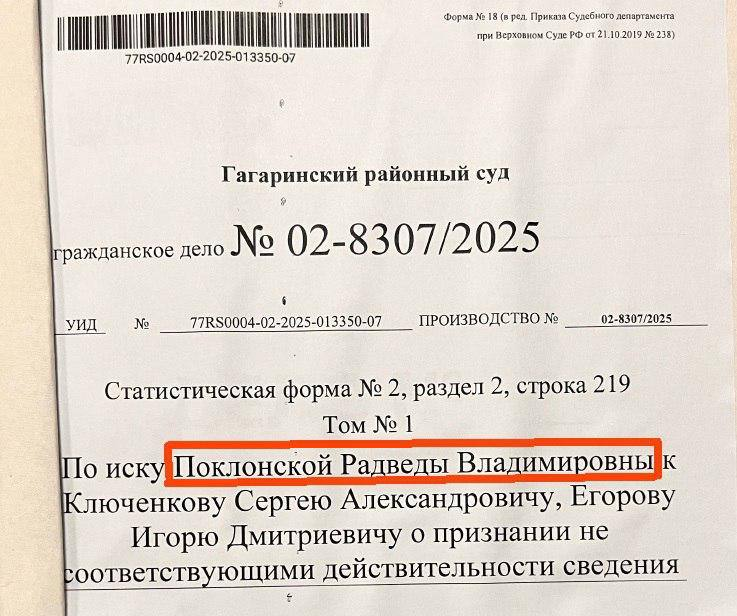
Radveda Poklonskaya
October 29, 9:05
Image

Former Crimean prosecutor Natalia Poklonskaya is reported to have changed her name to Radveda.
She had previously expressed an interest in Slavic paganism and effectively broken with Christianity, which also caused considerable controversy.

Some believe that paganism is also a temporary stop, as was previously the case with ostentatious monarchism and Christianity.
This is more of a news story about Volochkova and other celebrities.

But ultimately, everyone has the right to change their name. Just as they have the right to choose their own name. So there's nothing criminal about it. As Tony Bullet in His Teeth used to say, call her Suzanne...

https://colonelcassad.livejournal.com/10156233.html

(You may not remember, she was a hero in the early days of the Donbass revolt, then she 'changed shoes'.)

Science through the eyes of Russians
October 29, 12:55

Image

The popularity of working as a scientist is gradually returning.
But the main obstacle remains low salaries, even though much has changed in the defense sector since the war.
I have a good friend who studied quantum chemistry but ultimately decided against pursuing a career in that field because of the low salary.
Science undoubtedly requires funding. And cutting-edge science requires significant funding.

https://colonelcassad.livejournal.com/10156724.html

Google Translator

******

Putin’s Offer To Extend The New START Is A Goodwill Gesture To Trump
Andrew Korybko
Oct 29, 2025

Image

Goodwill gestures are meant to make the recipient trust whoever does them with the expectation that they’ll then be reciprocated for improving their relations.

Putin offered in late September to extend the New START, which is the last arms control pact between Russia and the US, for another year following its expiry in early February. He then reaffirmed his proposal in early October, emphasizing that there’s still time to extend this crucial agreement if the US has the political will, which appears to be the case given Trump’s recent praise of it as “a good idea”. Regardless of whatever happens, Putin’s offer is a goodwill gesture to Trump, which will now be explained.

For background, Putin announced Russia’s suspension of the New START in February 2023 in response to NATO’s involvement in Ukraine’s drone attacks against his country’s strategic aviation bases several months prior, which was analyzed here as the right thing to do at the right time. Nearly a year later in January 2024, Foreign Minister Sergey Lavrov then declared that talks on this issue won’t resume till the Ukrainian Conflict ends, arguing that doing otherwise would put Russia at a disadvantage.

With that in mind, it was expected at the start of the year that “Mutual Interest In Resuming Arms Control Talks Can Speed Up The Ukrainian Peace Process”, yet that didn’t come to pass with Russian-US tensions escalating shortly after mid-August’s Anchorage Summit. Nevertheless, Putin still publicly praised Trump for working towards peace and proposed extending New START for another year, thus representing a change in Russia’s position as articulated by Lavrov over 18 months earlier.

Goodwill gestures are meant to make the recipient trust whoever does them with the expectation that they’ll then be reciprocated for improving their relations. That doesn’t always happen though as proven by Russia’s goodwill gesture of withdrawing from Kiev during spring 2022’s peace talks being seen as weakness by Ukraine, the UK, and Poland, the last two of which then convinced Ukraine to keep fighting. The possibility thus exists that Trump might perceive Putin’s latest goodwill gesture in the same way.

It’s crucial to mention that Putin reassured his people that Russia can ensure its national security even in the absence of extending New START and that any unilateral moves by the US to further upset the strategic balance between their countries would render this pact null and void. What he probably had in mind was Trump’s “Golden Dome” initiative, previously known as the “Iron Dome”, for reviving Reagan’s “Star Wars” plan for space-based interceptors and likely secret space-based offensive missiles too.

Taking his trade deals as precedent, he always wants the US to maintain the dominant position in any “compromise”, so he might either insist on continuing to build the “Golden Dome” despite this ruining any New START extension or secretly continuing to do so even if he says he won’t. If the CIA assesses that Russia might transfer cutting-edge nuclear weapons technology to China and/or North Korea in that case, and that this would in turn jeopardize US national security interests, then he might reconsider.

Putin’s goodwill gesture to Trump of offering to extend New START is therefore a pivotal moment in their ties since it’ll allow Russia to learn whether the US is serious about compromising. If Trump doesn’t ditch the “Golden Dome” or dupes Putin about freezing work on it, then even though the new Burevestnik missile could still piece through it, Russia might still opt to transfer this tech to its nuclear-armed allies in order to raise the costs to the US of rejecting Russia’s proposal so that it doesn’t reject future ones too.

https://korybko.substack.com/p/putins-o ... -new-start

*****

Russia Conducts Test of Nuclear-Powered Drone Submarine
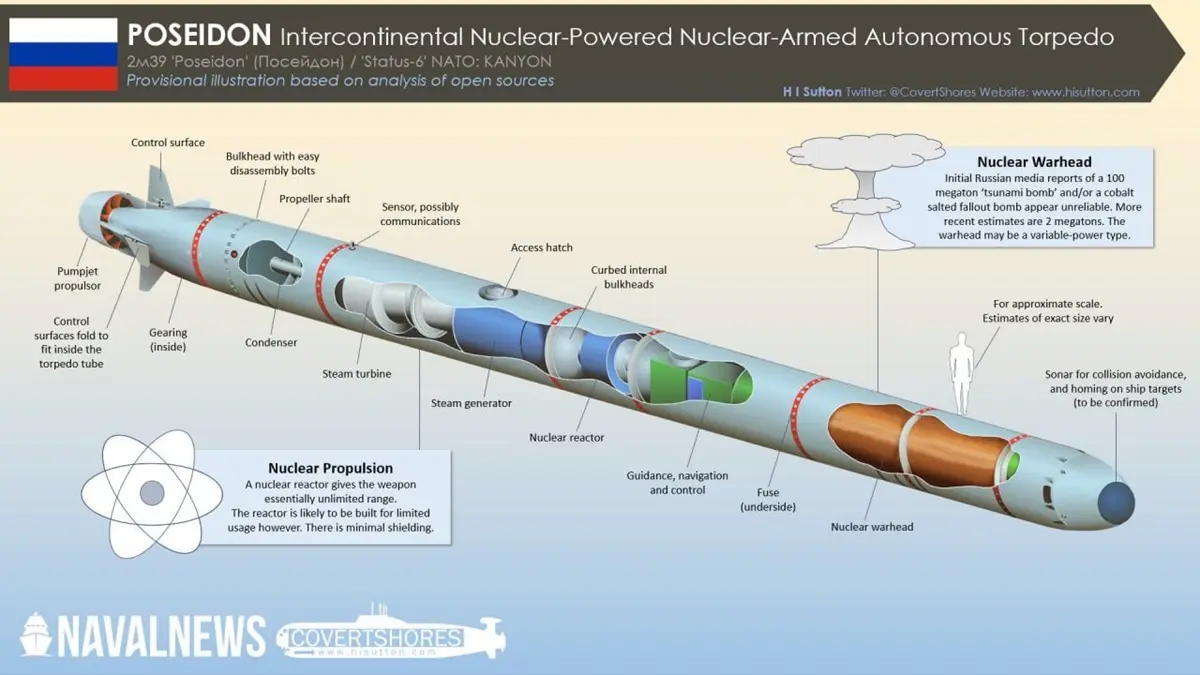
Image
X/ @fabio1971121971

October 29, 2025 Hour: 9:17 am

This drone was tested just days after Russia launched a nuclear-propelled cruise missile.
On Wednesday, Russian President Vladimir Putin announced the successful test of the nuclear-powered unmanned submarine Poseidon, a little more than a week after a trial of the nuclear-propelled cruise missile Burevestnik.

“Yesterday we carried out a new test of another promising system, the unmanned submarine Poseidon, also nuclear-powered,” he said during a meeting with soldiers wounded in the war in Ukraine.

“For the first time, it was possible not only to launch it from a carrier submarine using an auxiliary engine but also to activate its nuclear propulsion system, which enabled the vehicle to navigate for a certain period of time,” Putin stated.

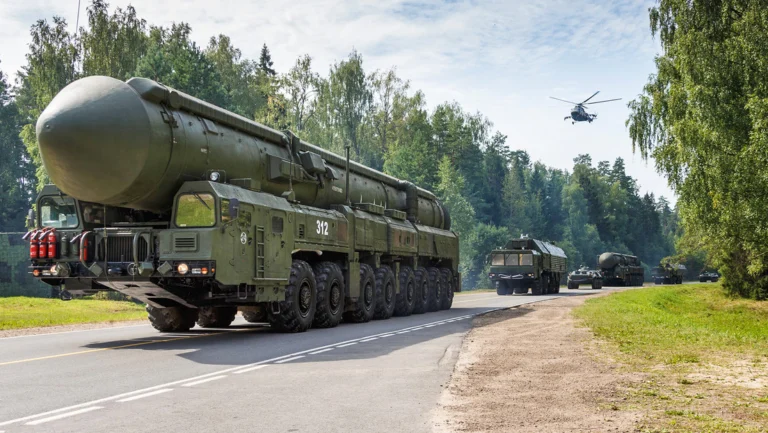
He emphasized that the power of the Poseidon significantly exceeds that of the intercontinental ballistic missile Sarmat, which is capable of carrying 10 to 15 individually guided nuclear warheads and will soon enter service with Russia’s strategic forces.

🇷🇺 Putin announced that Russia yesterday conducted tests of the domestically produced nuclear submarine torpedo "Poseidon".

▪️ According to him, "Poseidon" is equipped with a nuclear "reactor" that is 1,000 times more powerful than the power plant of the intercontinental cruise… pic.twitter.com/ceXxb7DfKi

— The Battlefield (@teoshengelia29) October 29, 2025


“In terms of speed and the depth at which it operates, this device has no analogues in the world and is unlikely to have any in the near future,” Putin asserted.

The Russian president described the test as a “huge success” and highlighted as one of its main advantages that the Poseidon’s nuclear propulsion unit is “one hundred times smaller” than a submarine reactor.

The test of the nuclear-powered unmanned submarine followed the October 21 launch of the Burevestnik cruise missile, also nuclear-propelled and said to have unlimited range.

https://www.telesurenglish.net/russia-c ... submarine/

Goodbye US fleet aircraft carriers...
"There is great chaos under heaven; the situation is excellent."

User avatar
blindpig
Posts: 14788
Joined: Fri Jul 14, 2017 5:44 pm
Location: Turtle Island
Contact:

Re: Russia today

Post by blindpig » Thu Oct 30, 2025 4:05 pm

NO GDP GROWTH, NO INFLATION, NO WAR BY 2028 — CENTRAL BANK GOVERNOR NABIULLINA FOLLOWS US, NATO, IMF

Image

By John Helmer, Moscow @bears_with

The four-term (2013-2027) Governor of the Central Bank of Russia (CBR), Elvira Nabiullina, has assured the State Duma this week that the biggest enemy Russia faces is not the combined military and economic forces of the US and NATO, but over-heating in the domestic economy as it mobilizes to defend itself.

That, Nabiullina said, is not the impact of drone, missile, and bomb attacks on Russian targets inside the country, at sea, and along Russia’s international oil and gas pipelines; nor of the sanctions aimed at destroying Russian exports of energy, Russian tankers, and the fleet’s access to world markets through the Danish Straits, the Suez Canal, and the Bosphorus.

In Nabiullina’s report of her strategy for 2026-2028, drafted last month and released on October 27, the words “war” and “defence” are not mentioned. The only “geopolitical conditions” the CBR report acknowledges are “deglobalisation processes” and “new sanctions and second-round effects of enacted sanctions”. About them, Nabiullina and her advisors have concluded that the Trump Administration’s “tighter sanctions will lead to an increase in the discount for Russian exports as well as a moderate decline in oil production and exports. Oil prices will notably drop in 2026 and will not bounce back to the level of the baseline scenario even by the end of the forecast horizon.”

The forecast of the CBR, the report says, is that “if the world economy faces a financial crisis in 2026 and sanction pressure increases, the Russian economy’s potential and its growth rates will both decline. GDP will be contracting during two years. A significant decline in supply will be fuelling inflation. Fiscal policy is assumed to prop up the economy owing to a structural primary deficit. To offset a reduction in oil and gas revenues, the economy will be extensively using the resources of the National Wealth Fund, which involves the risk of depletion of its liquid part as of the end of 2026.” Nabiullina’s response, the report concludes, will be to fight the sanctions war by raising the Central Bank’s key rate from 16.5%, as it was fixed last week, to between 18% and 20%. “To prevent inflation from spiralling out of control, the Bank of Russia will be forced to pursue tighter monetary policy in 2026–2027. This will decelerate inflation to 4.0–4.5% in 2028.”

This is Nabiullina’s Trojan Horse for the Russian economy at war. The CBR projection is for two years of recession from now through 2026 and 2027; that is, close to zero growth this year to be followed by negative growth rates predicted from minus 2% to minus 3.5%.

Nabiullina admits that “considering its actual dynamics, we have lowered the GDP growth forecast for 2025 to 0.5–1.0%.” This, Russian economists point out, is within the standard margin for statistical error from zero.

Nabiullina doesn’t admit that the recession forecast in the Bank’s risk scenario for 2026-2027 is the consequence of the CBR’s key rate policy. But she does blame other government policies, including military spending, the budget deficit, and increased taxes. “Significant pro-inflationary risks have materialised since the previous meeting,” Nabiullina claims. “They are primarily associated with an increase in the budget deficit in 2025 and higher fuel prices. In September, a decline in underlying inflation measures paused. The expected increase in taxes will help bring inflation down over the medium-term horizon, but will also lead to a one-off rise in prices in the short term. We have factored this into our decision, first, by reducing the pace of monetary policy easing, and, second, by revising upward the projected key rate path required to bring inflation back to 4%.”

“As these [state spend and tax] factors fade, disinflation will continue. This will be supported by tight monetary conditions. The upward deviation of the Russian economy from a balanced growth path is narrowing.” This last sentence is the CBR euphemism for squeezing the economy with a high key rate at the same time as the government increases the tax burden. For zero to negative GDP, for growth to recession, Nabiullina’s euphemisms are “slowdown” and “cooldown”. “‘All decisions on the key rate,’ she told the State Duma this week, are based on the need to end the period of high price growth as quickly as possible while preventing the economy from overcooling. A hasty reduction in the key rate would undo all the progress achieved. ‘We would have to start all over again,’ Nabiullina said.”

Nabiullina’s promotion of “necessary recession” to cure inflation has triggered widespread but silent dismay – silent because it is understood she is protected by President Vladimir Putin.

Last month, in a session with government ministers Putin repeated Nabiullina’s line. “Last year we agreed,” the President said, “there was need to take the necessary measures to curb inflation and to strengthen macroeconomic stability. We agreed that this would inevitably cool the economy and, as we said back then, ensure its soft landing. The general opinion was also that we must walk this sharp edge and not to undermine the macroeconomic policy, not to overcool the economy, and not to freeze it.”

Putin then defended the outcome. “According to the Ministry of Economic Development, in July, gross domestic product added 0.4 percent in annual terms and in the seven months of this year GDP grew by 1.1 percent. The question is whether this is enough. Is that what we wanted? Are we succeeding in achieving the goal that we set for ourselves? Or, do we need to act differently at a faster pace, naturally, while ensuring macroeconomic, inflationary stability and taking into account the balanced policy of the Central Bank. The inflation trend is quite clear: in July, consumer prices grew by 8.8 percent and in August by 8.1 percent. The inflation drop trajectory is below the forecasts provided by the Government and the Bank of Russia. In other words, the efforts to lower inflation are effective. It is very important for moderate prices to have a positive impact on business and investment activity, allowing for more dynamic and sustainable growth.”

Vocal criticism has come from economists in the opposition seats in parliament. They say Nabiullina’s policy is stimulating financial speculation on the rouble, stocks, and commodity trade futures, boosting bank profits to record highs but crushing the real economy, and increasing poverty. According to Mikhail Delyagin, a well-known critic and deputy head of the Duma Committee on Economic Policy, the Central Bank is deliberately following the policy of Russia’s enemies, starting with the US-controlled International Monetary Fund (IMF).

“The IMF continues to act as the senior management structure for the Russian Central Bank,” Delyagin reported this month. “The Central Bank regularly — and very clumsily — tries to declare that this control is purely formal. However, these attempts are refuted by the regulatory documents of the Central Bank itself (https://t.me/EvPanina/15113 )…It turns out that a high-ranking official of the globalist structure, which oversees the Central Bank of Russia, is actively lobbying for the confiscation of Russian assets. Which has been the work of the Central Bank of Russia! The [CBR reserves] have ended up exactly where they can now be removed. An amazing coincidence…Everything is going to be fine for those who serve the West against Russia.”

TRACKING THE CBR INTEREST RATE, INFLATION AND ROUBLE EXCHANGE RATE
Image
Image
Source: top, https://www.cbr.ru/eng/about_br/publ/on ... 2026_2028/ ; bottom, https://tradingeconomics.com/russia/currency

CBR FORECASTS FOR GDP GROWTH, INFLATION, KEY RATE
Image

Image

Image

Image
Source: https://www.cbr.ru/eng/about_br/publ/on ... 2026_2028/

The critics argue that Nabiullina’s policy benefits only short-term speculation by the country’s bankers. “There is simply no one,” Delyagin has warned, “understanding this basic truth in the liberal crowd ruling our economy – that is, the crowd serving financial speculators.”
“The public has the right to be negative,” Delyagin said this week. “But from the point of view of the administration of the country, everything is fine, as the goal of economic policy is being achieved successfully. If you remember, about a year ago, when GDP was growing by a little more than 4 percent, it was explained to us that this was unacceptably high economic growth, that development at a rate that exceeded the rate of statistical error was absolutely unacceptable for a variety of reasons…The objective of the economic policy, which was proclaimed and implemented by the liberal financial managers, was to slow down economic growth. This was called ‘cooling the economy.’ The statements of a number of gentlemen attest to this task, and it has been successfully accomplished: GDP growth has slowed by about 4 times. It was 4.2−4.3 percent, and now in the first seven months of this year — 1.1 percent.”

“At the same time, it is not especially well concealed that inflation was just an excuse. After all, if someone had been concerned about it, then probably there would not have been the irrational increase in [state] tariffs for housing and communal services and the natural monopolies. At least we would have conducted an audit of the natural monopolies first – this is not difficult…But under the guise of talking about inflation in conditions of money starvation, which is artificially created in our country and has nothing to do with the dynamics of the money supply, the economy has been strangled very badly.”


Mikhail Khazin is another public economist on the attack. A member of the now defunct Anti-Crisis Expert Council, the Khazin backfile of his economic critiques of state policy can be read here. As a Yeltsin Administration economic policymaker in the 1990s, Khazin clashed with superiors Yegor Gaidar, Anatoly Chubais and Alexei Kudrin over their corruption. Khazin’s target now is their protégé, Nabiullina.

“The problem for Nabiullina is that any rate cut will mean that the Central Bank’s monetary policy is
untenable and destructive to the state’s economy, although it brings huge profits to banks, primarily the largest ones. This is evidenced by a comparison of the dynamics of the key rate and inflation. The Central Bank raised the rate from 16% in December 2023 with inflation at 7.43% with its downward trend. As a result, it accelerated to 9.64% in October 2024, and the regulator introduced 21%. What is the outcome? The rate of inflation growth has not changed. They are still far from the 4% that the regulator has been promising for many years. What was the point and calculation of organizing a race with the key rate? After all, the price that the real sector of the economy has paid for this is very high.”

“The drop in the GDP growth rate from 4.5% to (at best) 1.5% is equivalent to 6 trillion rubles. Sequestration of financing of national projects in 2025 is estimated at 3-4 trillion rubles. This means approximately 1 trillion in taxes unreceived by the budget from industrial facilities which were not commissioned as planned. Civil sector output fell by individual industry year-on-year in the range from 2.8% to 16.9%. The harvest in 2025 is under threat due to the sharply increased cost of fuel and agricultural machinery. And so on. The only winner is the banking system, which still has high profits and is aiming for 4 trillion rubles (+200 billion rubles YoY). According to the laws of economics, these and other factors will further speed up the flywheel of inflation. The country pays dearly for the banking and financial combinations of the incompetent and biased leadership of the Central Bank.”


Sergei Gavrilov a leading economist in the Communist Party (KPFR) faction in parliament, has attacked the new CBR report and forecasts for 2026-28, claiming that each one of the policy-making scenarios assumes increasing inflation, continuing the high key rate, and triggering the cycle of lossmaking throughout the economy, with falling tax revenues, larger budget deficits, and accelerating inflation.

“The rigidity of the regulatory approaches in relation to large investment projects threatens that the economy itself will begin to reproduce losses and additional inflationary pressures. Therefore, it is necessary to ease regulations and lower the key rate, otherwise the regions where manufacturing industry forms the basis of growth will be in the most vulnerable position…the pro-inflationary scenario, on the contrary, is based on increased sanctions pressure and protectionist barriers. This means that supply will not cover demand; imports will turn out to be more expensive; and inflation expectations will decrease more slowly. So then the rate will be kept higher – 14-16% in 2026 and only by 2028 will it fall below 10%…The risk scenario reflects a severe deterioration in the external environment, a jump in inflation to 10%-12% and the need for a sharp tightening of [monetary] policy, which threatens to lead to an economic downturn. But the [CBR] itself estimates the probability of its implementation as low… In order for the [CBR] rate to be below 10% by 2027, we need not only favourable macro conditions, but also decisive steps: fixing inflation at 4%, lowering inflation expectations, meeting the parameters of the budget rule; and supporting large investment projects through easing restrictions… The main issue here is not just to keep inflation on target, but to prevent the excessive rigidity of the monetary policy from becoming itself a source of new risks.”

Gennady Zyuganov, the KPFR leader since 1993, has announced the key rate “’should be a maximum of 7%-8%. I listened carefully to the press conference of [Central Bank Chairman Elvira] Nabiullina and her assistant. She was asked how the industry would develop if the rate was 12%. They began to explain that everyone would run for loans, that they would go to the market to buy goods, but there were too few goods. But if you have such a rate as today, there will be no goods at all, because it is unprofitable to produce them. The inflation crisis is being overcome by the output of mass–produced goods of good quality at an affordable price,’ stressed the Chairman of the Central Committee of the Communist Party of the Russian Federation. Earlier, Gennady Zyuganov said that the Communist Party of the Russian Federation would abstain from voting on the federal budget for 2026-2028.”

Counting the number of seats and votes in the State Duma, the KPRF is politically impotent. The government bloc backing Nabiullina for as long as Putin supports her totals 337 seats of 450 – a majority of three-quarters. The KPRF holds just 57 seats; Delyagin’s faction, Just Russia – For Truth (SZRP), 28.

Outside parliament, the recession warnings from the CBR and from the critics have so far failed to put a dent in public confidence that the country is moving in the right direction, according to new polling by the Levada Centre of Moscow.

Image
Source: https://www.levada.ru/2025/10/03/rejtin ... ov-vlasti/
This optimism contrasts with the growing public expectation, recorded by Levada in August, of worsening economic conditions for households already and rising unemployment ahead.

At the same time, when Levada last polled Russians across the country on the issues troubling them most, inflation outpolled the war by a large margin, 58% to 33%.

In public opinion and in the mainstream media, Nabiullina is not registered as an influential figure. Russian public confidence toward the country’s banks is primarily in the large state and commercial banks, not the Central Bank. This trust was measured last month at 46% — roughly half the trust level which Russians express toward the President and the Army. On the other hand, public confidence in the banking system has been growing steadily more positive over the past decade as the bank default and fraud history of the Yeltsin Administration is forgotten.

Image

https://johnhelmer.net/no-gdp-growth-no ... more-92663

(Fire her sorry ass and diminish any oligarchs who disagree)

******

Putin Explains Burevestnik and Poseidon During Hospital Visit

Visit to the Central Military Clinical Hospital named after P.V. Mandryk
Karl Sanchez.
Oct 29, 2025

Image

During the visit, Putin thanked the servicemen of the 127th Separate Reconnaissance Brigade for their birthday gift—icons with traces of shrapnel and bullets.

A well-organized visit to one of the hospitals caring for those wounded in the SMO allowed Putin to directly thank some members of the brigade that sent him a very unique birthday present that we now get to see. As you see, the visit allowed comrades to provide cheer to one of their own.

Image

Putin too provided a few uplifting items to junior sergeant Ruslan Kolyvanov.

Image

The photo gallery has 21 total images, many depicting the scene of the soldiers’s interaction with Putin. It appears Putin likes to frame certain announcements while conversing with service people and this was no exception as the following will show:
V.Putin: We will still go [to the ward of Ruslan Kolyvanov], we will communicate with him, they will bring him tea too. God willing, he will recover quickly.

The doctor just said that all of you have injuries. I want to emphasize that I have already said this many times, and I say it consciously and with full justification: everyone who is in the special military operation zone, on the front lines, in the war, is behaving heroically. You understand that anything can happen at any moment.

But still, assault units, special forces, and military intelligence–-people like you–-this still requires special training, it requires a special character. These are obvious things, just obvious. And I am very pleased to note that we have people like you. Thank you very much.

You know that your efforts are not in vain. The overall situation in the special military operation zone is favorable for us, and your comrades are advancing and acting actively in all areas. As you know, we have already publicly announced that the enemy has been encircled in two locations: the cities of Kupyansk and Krasnoarmeysk.

By the way, I have discussed this issue with the commanders of the relevant groups, and they do not object, Andrey Removich [Belousov], to allowing representatives of the media, foreign journalists, and Ukrainian journalists to enter the encircled areas of the enemy, so that they can see with their own eyes what is happening there. They will be able to witness the state of the encircled Ukrainian troops, so that the Ukrainian political leadership can make appropriate decisions regarding the fate of their citizens and military personnel. This is similar to what they did at Azovstal.

The only thing that concerns us is that there should be no provocations on the Ukrainian side. We are ready to stop the fighting for a certain period of time–-for a few hours, two hours, three hours, or six hours–-so that groups of journalists can enter these settlements, see what is happening there, talk to the Ukrainian military personnel, and leave. We are ready to bring them to specific locations, so that the Ukrainian military personnel can receive them.

The most important thing is to avoid provocations from the Ukrainian side, so that no drones fly over and no journalists get hurt, and then they try to blame us for the incident. We don’t need that. On the contrary, we are ready to do everything as I am saying. The only question is whether the Ukrainian side is ready for this. This is the first thing I wanted to say.

It is obvious that you are fighting bravely in your sector, but I think it is also important for you to know what is happening on the front line. And here is the situation.

What you are doing, what your comrades-in-arms, our soldiers, and officers are doing, is the most important thing that the country is currently doing: ensuring its own security and the security of our people for the long term. However, it is equally important that we do not forget to improve and strengthen our strategic capabilities while addressing these critical current issues.

You’ve probably heard that a new, state-of-the-art unlimited-range nuclear-powered missile has recently been tested. It has significant advantages, and we can be proud of the achievements of our scientists, specialists, engineers, and workers who have contributed to this development.

The advantages are that this small nuclear propulsion system, which has a comparable power output to, say, the nuclear reactor on a nuclear submarine, is a thousand times smaller than the nuclear reactor on a submarine–-a thousand times smaller! But the most important thing is not even that–-the most important thing is that while a conventional nuclear reactor takes hours or days or weeks to start, this nuclear reactor can be started in minutes or seconds. This is a huge achievement.

And we will be able to use this in the national economy, and we will be able to use it in the future when solving the problem of energy security in the Arctic, and we will use it in the lunar program. And even now, radiation-protected electronics used in the Burevestnik rocket are already being used in space programs, so this is a breakthrough not only in the field of increasing the country’s defense capabilities, but also in science and the national economy of the future.

But that’s not all, you should know that yesterday we conducted another test of another promising complex–-the Poseidon unmanned underwater vehicle, also with a nuclear power plant. For the first time, we were able not only to launch it from a carrier submarine using a launch engine, but also to launch the nuclear power plant, which allowed the vehicle to travel for a certain amount of time.

This is a huge success, because in addition to all the advantages I mentioned about the Burevestnik, it also has minimal dimensions. If it is a thousand times smaller than an atomic reactor on a submarine, it is a hundred times smaller than an atomic reactor on a submarine. However, Poseidon’s power significantly exceeds that of even our most advanced intercontinental missile, the Sarmat. There is no such missile in the world like the Sarmat, and it is not yet on duty in Russia.

But Poseidon is significantly more powerful than Sarmat. In addition, there is nothing in the world that can match the speed and depth of this unmanned vehicle, and it is unlikely that anything will appear in the near future.

It seems to me that this is also important for you: you are fighting on the front lines, risking your lives, and of course, you are thinking about why you are doing this, how much the country will be able to support what you are doing, risking your lives and health to protect your homeland, and how much it will be able to move forward, strengthen its defense capabilities, and generally strengthen itself. These are also elements related to this work.

Thank you again. If anyone has anything to say, please do so. If not, we will ask the camera to leave and then we will have a heart-to-heart conversation.

I. Leksin: Comrade Supreme Commander-in-Chief, allow me to address you!

Group commander, Ensign Ivan Lyoksin.

My question concerns the continuity of the traditions of serving Russia. In my family, my parents named me after my grandfather, Ivan Grigorievich Leksin, and my father was a military officer who served in Mongolia. I am continuing their traditions.

V. Putin: Did you serve in the Airborne Forces?

I. Leksin: That’s right. He served his first year in Lithuania, in Alytus, and then in the Ryazan Airborne School. So I’m continuing their traditions.

When we have free time, we try to tell our soldiers about the feats of our grandfathers, who defended our homeland during the Great Patriotic War, and how they fought on the territory of Ukraine.

I especially remember the feat of our scouts–-a native of the Tambov region, who was one of the scouts in the group. [They] were among the first to cross to the right bank of the Dnieper. Sergey Mitrokhin was in this group. Thanks to his active and competent actions–-he cleared the way to the German trench–-they took up positions, defended these positions. The battle lasted for three hours, until the main infantry forces arrived. Thanks to his competent actions, he became a Hero of the Soviet Union at the age of 20.

The feats of our grandfathers have been widely reflected in cinema and literature. I would like to see the feats of our modern-day intelligence officers, special forces soldiers, and other military specialists also reflected in cinema and literature, specifically regarding the topic of the special military operation. This is because we will eventually be replaced by the younger generation.

V.Putin: You are absolutely right. The first, and I will say two words about this, thank you for bringing it up, I am not sure that you knew in detail how your grandfather fought, is it? It was recently brought from the archives?

I. Leksin: Thanks to the Minister of Defense, I was able to...

V. Putin: Look, I didn’t know that my grandfather fought like this, but you fight just like your grandfather.

I. Leksin: I’m trying.

V. Putin: Yes, but what does it say? It’s in our genes, you know? Without even knowing... I just recently read about my uncle, who fought during the war. When I was in Primorye, the governor got it from the archives. I didn’t know that it was in Primorye. I saw how others fought there. I saw how my grandfather wrote to his son on the front. I didn’t know any of this.

You know, we have it. We have it, and it’s not going anywhere. But you’re absolutely right that we need to know this history. This heroic story of our ancestors strengthens us, and we need to talk about it.

You’ve just mentioned various movies and TV shows, and I agree with you. I’ve watched one of your battles under the bridge. If everything is as described, and I believe it is, you had to crawl for over a kilometer and clear mines in front of you, right?

I. Leksin: Yes, exactly, at the height.

V. Putin: Can you imagine! This is already a plot, to be honest, for a blockbuster, for a good movie, for a good story. Well, it is.

Those icons that you gave me, the ones that were hit by a bullet and saved your life, that’s also a story for a movie, for anything. And how many stories like that do we have? You’re sitting here, we’re all sitting at the same table, but you know, the guys are fighting, and we have a lot of units like that, right?

I hope they can all hear us now. We can’t all be at the same table, but we know about their combat work, we know and remember, and the country needs to know. And I fully agree with you: we will definitely do this, and we will definitely focus our people who are engaged in creative work on this.

But I’ll tell you, you’ve probably seen the same journalists and war correspondents, who are also walking under bullets and suffering casualties, and these people will certainly do what you’ve just said, from the bottom of their hearts. And they will.

S. Velkin: Junior Sergeant Velkin, Deputy Commander of the Special Forces Group.

Vladimir Vladimirovich, our brigade is relatively young: it was formed in the summer of 2014. Since the beginning of the special military operation, the entire command staff and the rank-and-file personnel have shown themselves to be courageous and selfless in carrying out their combat missions. As a result, you have seen this particular aspect of our mission.

During the Great Patriotic War and in the post-war years, many special reconnaissance units, reconnaissance units and units were awarded the title of Guards. Among us, not all, but most served in units with the honorary title of Guards.

We would be very happy and proud if you would consider granting our 127th Separate Intelligence Brigade the honorary title of “Guards.”

V. Putin: Okay, we’ll do that.

S. Velkin: Thank you.
]

Ah, to know what was said once the camera was turned off. I looked at the sentence about Sarmat—Такой в мире нет, как «Сармат», и у нас он ещё на дежурстве не стоит – скоро появится на дежурстве—and ran it through two different translations, while a third said this: “and we still have it on duty If not, he will soon appear on duty.” I was under the impression that Sarmat was already deployed to combat units, but this is clearly ambiguous. Now the advance with the very small, quick starting, nuclear reactor and shielded electronics will benefit Russia commercially as Putin explained. Putin didn’t mention it, but Poseidon is also recoverable. Guidance systems for both will not be revealed for obvious reasons.

Putin’s show of mercy is clearly aimed at the Global Majority and puts Zelensky in a huge bind. The ploy might be connected to a larger project since it’s clear Russian strategy aims at creating many more cauldrons when the LOC is closely examined. In that regard and for what that larger project might be, I highly suggest reading this sitrep from Marat Khairullen’s substack. The larger project relates to the SMO’s endgame and what the remnant of Ukraine will consist of a year from now when it ought to be close to over.

A closing note about how Poseidon might be employed. It could be detonated underneath an Outlaw US Empire carrier task force and capsize all its ships, including the carrier. From what I understand, the warhead'‘s power can vary from massively destructive to something capable of the above action. Both new weapons are clearly aimed at deterring the Outlaw US Empire and its UK appendage. Meanwhile, Trump’s government shutdown impacts the readiness of the Empire’s strategic nuclear forces and a whole lot more.

https://karlof1.substack.com/p/putin-ex ... d-poseidon

*****

A monument to Lenin has been restored in Krasnogorsk.
October 29, 6:59 PM

Image

The monument to Vladimir Ilyich Lenin was restored in Krasnogorsk City Park as part of the ongoing park renovation.
Sculptures of "Border Guard," "Pilot," "Female Pilot," "Hockey Player," and "Middle Eastern Girl" were also installed.

Image

Image

The 1930s-style sculptures still look cool. They should look great against the greenery in summer.
And the monument to Ilyich is pretty good, better than the standard ones. If you're going to erect such monuments, they should be beautiful and original, not just for show.

Photo: "Typical Krasnogorsk" https://t.me/Tipichniy_Krasnogorsk/23037

https://colonelcassad.livejournal.com/10157374.html

To the volunteers of the SVO from grateful Russia
October 30, 3:05 PM

Image

A monument to the SVO volunteers who transport various supplies to help the army and residents of frontline areas was recently unveiled in Rostov

Image

This is the first monument to humanitarian workers in Russia since the beginning of the Second World War. They continue to play a significant role in supplying warring forces, complementing the state's efforts.

https://colonelcassad.livejournal.com/10159018.html

Cut off from grants
October 30, 5:02 PM

Image

Cut off from grants

Tightening Russian laws on foreign agents and undesirable organizations has seriously complicated the lives of grant-eaters of all stripes. Those accustomed to the bliss of Western generosity have found themselves cut off. Under current conditions, it's harder to get thirty pieces of silver, but human rights activists are in no hurry to get off the payroll and are adapting as best they can. The most clueless representatives of the foreign agent underground, such as Elena Shakhova ( https://www.facebook.com/evshakhova/ ) from Civil Control and Anna Sharogradskaya ( https://www.facebook.com/asharogr/ ) from the Institute of Regional Press, are like Ostap Bender, barging through the Romanian border and carrying precious cash from sponsors in suitcases from the EU ( https://t.me/underside_org/119 ). Some, like Maria Kanevskaya ( https://mka-spb.ru/vash_advokat/vibor_advokata/516 ) from HRRC ( https://t.me/underside_org/117 ), ( https://t.me/underside_org/117 ) relocated abroad, setting up a financial hub, and continue to operate in Russia, but from abroad and through subcontractors. All of this is adaptation, a change in financial tactics.

We'll tell you about the real strategists (by the standards of the foreign agent serpentarium), who laid down straw for themselves back in 2016, long before the real heat started to come, in our new investigation. At the center of it is the Swiss company Willow Association. The key figure is the financial director, Red Cross alumnus Michael Khambatta (we previously reported ( https://underside.today/2021/12/28/coming-out/ ) that the Red Cross branch in St. Petersburg was involved in a Foreign Office project to rehabilitate and support illegal migrants in Russia). The management includes former Swiss politicians and diplomats, all solid credentials. For a modest 4% of the contract amount, this Swiss association applies for foreign grants, including from international organizations. Then comes the contract with this very foreign agent. Full responsibility for the grant's implementation lies with the receiving party.

By all indications, the Willow Association is a distilled financial shell that helps subversive human rights activists disguise their sources of funding. There is, however, one "BUT." The Swiss association was created by employees of the Russian destructive NGO Crew against Torture (CAT, formerly the Committee Against Torture ( https://underside.today/2021/12/23/451_degree/ ) ) . Among the organizers of the scheme are the so-called human rights activists Olga Sadovskaya ( https://www.facebook.com/olga.sadovskaya ), ( https://www.facebook.com/olga.sadovskaya ) Igor Kalyapin (https://www.facebook.com/sparta13101967 ) and Sergey Babinets ( https://www.facebook.com/babinetssergey ). ( https://www.facebook.com/babinetssergey ) To receive funds from the Russian side, these activists established special organizations, in particular, OOO "Lyudi" (People) and OOO "Forpost" (Forpost).

Thus, the advocates of the "other Russia" continue to receive foreign grants and implement the subversive projects of unfriendly states in the Russian Federation. Among the Willow Association's most lucrative donors are our old acquaintances: the Oak Foundation, Amnesty International, the European Endowment for Democracy, as well as the EU-Russia Civil Society Forum and Civil Rights Defenders.

The CAT shell company circulates considerable sums of money. In 2016–2021 alone, donors sent 73 payments totaling €6.3 million through the Willow Association. The main supporters of the Swedish shell company include NED (1, ( https://t.me/underside_org/81 ) 2, ( https://t.me/underside_org/101 ) 3, ( https://t.me/underside_org/107 ) 4 ( https://t.me/underside_org/109) ), the sponsor ( https://t.me/underside_org/107 ) of the foreign agency publication Chronicle.Media, the Prague Center for Civil Society, and the Norwegian Helsinki Committee (1, ( https://t.me/underside_org/107 ) 2 ( https://t.me/underside_org/57) ). It's important to note that Western sponsors use Four Percent Mike's services to funnel money not only into Russia, but also into Ukraine, Serbia, Egypt, India, Pakistan, and Bangladesh. CAT activists didn't forget about themselves either: through the Willow Association, human rights activists channeled funds under more than 30 contracts from 2016 to 2023. The largest contract exceeded €860,000. Incidentally, CAT's 2022 budget, according to internal documentation, exceeded €1 million. Moreover, unlike the Committee Against Torture, its reincarnation, operating under the guise of the "Team Against Torture," has still not been designated a foreign agent.

A new investigation begins here. ( https://underside.today/2025/10/30/willow-association/ )

https://t.me/underside_org/120 - zinc

How will we live without these wonderful people? After all, they wanted the best for Russia, didn't they? Or...
As we can see, even the end of USAID funding doesn't mean the end of these grant-eaters, as there are other grant troughs where they feed, including with European money. Yes, there's less money, so there's a scramble to prove that this grant-eater is a champion of democracy, while that one has sold out to Putin and the FSB. This isn't a new picture, of course, but for the sake of a grant, competitors have to be driven to the ground.

https://colonelcassad.livejournal.com/10159205.html

Google Translator
"There is great chaos under heaven; the situation is excellent."

User avatar
blindpig
Posts: 14788
Joined: Fri Jul 14, 2017 5:44 pm
Location: Turtle Island
Contact:

Re: Russia today

Post by blindpig » Fri Oct 31, 2025 3:38 pm

Russia's Greater Eurasian Partnership Initiative & The Joint Vision of the Eurasian Charter for Diversity and Multipolarity in the 21st Century

Two very important documents forming the basis for future Eurasian Security
Karl Sanchez
Oct 29, 2025

Image

These two documents are key to understanding what was discussed at the Minsk Conference and continues throughout the year in other fora. ““Russia’s Greater Eurasian Partnership Initiative” is first followed by the “Statement by the Russian Federation and the Republic of Belarus on a Joint Vision of the Eurasian Charter for Diversity and Multipolarity in the 21st Century.” The header image hasn’t appeared for quite some time and denotes the article’s contents are documents. The archive has several such images for those bold enough to surf through it to see what’s there.

Russia’s Greater Eurasian Partnership initiative
The Greater Eurasian Partnership (GEP) is a concrete, practical initiative of the President of the Russian Federation Vladimir Putin, put forward in his address to the Federal Assembly in 2015 in order to form a broad integration contour on the Eurasian continent. At the heart of the envisaged collective efforts with interested partners is the desire to promote the construction of a fair polycentric world order, which implies the development of equal, multi-speed and mutually beneficial economic cooperation across the entire range of pressing problems. Progress in this direction will be carried out on a voluntary basis, be open and contribute to the tightest possible integration of all relevant structures, mechanisms and tools in this area.

General approaches to the principles of the GEP operation are set out in key strategic planning documents affecting the international activities of the Russian Federation.

These primarily include the 2021 National Security Strategy and the 2023 Foreign Policy Concept. It means that the BEP, the core of which may be the EAEU, SCO, ASEAN, also uses the capabilities of such complementary formats as the Chinese infrastructure initiative BRI, can create the necessary prerequisites for turning Eurasia into a “single continent-wide space of peace, stability, mutual trust, development and prosperity.”

The work of the BEP will emphasize that proper consideration will be given to the specificities of the organization of production processes, technological patterns and market conditions. At the same time, the key tasks are to strengthen regulatory and physical interconnectivity, simplify trade operations and investments, and eliminate unjustified barriers that impede the effective establishment of supply chains and economic ties.

In terms of the sectoral structure, the BEP could include the following components:

- Network of international trade and investment agreements;

- Common transport space;

- A single network of economic corridors and development zones;

- Digital measurement;

- Energy space;

- Financial measurement;

One of the key players in the field of the GEP will be the EAEU. Particular emphasis will be placed on the conclusion of multilateral and bilateral free trade agreements. Such work is already being actively carried out through the EAEU. There is an FTA with Serbia and Vietnam, the prospects for signing similar documents with Egypt, Indonesia, the UAE, India, Iran are being considered (as of today, a temporary FTA Agreement is in force with Iran).

The task of forming the Greater Eurasian Partnership is reflected in the Strategic Directions for the Development of Eurasian Economic Integration until 2025, approved at the meeting of the Supreme Eurasian Economic Council (SEEC) on December 11, 2020.

In 2005, a Memorandum of Understanding was signed between the SCO and ASEAN secretariats. The possibility of establishing mutually beneficial cooperation between the EAEU, ASEAN and the SCO was supported by the ASEAN ten countries at the Russia-ASEAN summit in May 2016 in Sochi. On the sidelines of the Russia-ASEAN Summit in Singapore on November 14, 2018, a Memorandum of Understanding was signed between the Eurasian Economic Commission (EEC) and ASEAN. The cooperation program between the EAEU and ASEAN has been extended until 2025 During the meeting of the SCO Council of Heads of State on November 10, 2020, it was decided to sign a Memorandum of Understanding between the SCO Secretariat and the EEC. The corresponding memorandum was signed on the sidelines of the meeting of the SCO Council of Heads of State in Dushanbe on September 16-17, 2021.

An intensive dialogue has been established with China since 2015. As part of the implementation of this agreement, in May 2018, a non-preferential Agreement on Trade and Economic Cooperation was signed between the EAEU and its Member States, on the one hand, and the PRC, on the other hand, which entered into force on October 25, 2019.

In continuation of these efforts, in February 2023, a Plan (Roadmap) for the development of trade and economic cooperation between the EAEU and China was adopted. The document is aimed at intensifying trade and economic cooperation in the practical plane and consists of three sections: digitalization of transport corridors; establishment of dialogues on foreign trade policy; conducting a joint scientific study to study the effects of various scenarios for deepening trade and economic cooperation between the EAEU and the PRC.

The transport sector invariably appears as a priority of the BEP. The transport system is the backbone of any economy for increasing foreign trade flows. Russia, which occupies 1/7 of the world’s land area and is located along the entire Eurasian continent, is able to offer a wide range of competitive air, road, rail and sea routes by all modes of transport. Systematic work is underway to develop transport infrastructure in the East-West and North-South directions. The importance of developing these projects was especially emphasized by almost all the heads of the SEEC member states at the last meeting on May 25, 2023.

There is close cooperation with all constructive international partners on the issue of supporting the GEP initiative. In addition to China, such dynamic and attractive economies as Vietnam, India, Iran, Indonesia, Pakistan, etc., also declare a positive perception of the BEP in one form or another.

Within the framework of such significant international platforms as SPIEF and EEF, thematic sessions and round tables are regularly held on various aspects of the construction of Greater Eurasia and the GEP.

Currently, the Ministry of Foreign Affairs of Russia is updating the concept of the BEP in an interdepartmental format, which will be supplemented with practical tools: an action plan at the level of economic authorities and sectoral applied projects.
**** The format doesn’t allow for block quote treatment:
SHARED VISION

of the Eurasian Charter for Diversity and Multipolarity in the 21st Century

We, the representatives of the Russian Federation and the Republic of Belarus, proceed from the recognition of the following key realities of our time:

1.DIVERSITY AS THE BASIS OF PEACE – Peace has always been characterized by a diversity of life, civilizations, cultures, traditions, features of historical development, value systems, and with the formation of the state as the main element of international relations, a variety of forms of state political structure and models of internal socio-economic, cultural and humanitarian development.

2.RESPECT for the full spectrum of diversity has traditionally served healthy competition and the overall progress of humanity, while the neglect of this key phenomenon of public life by states has led to interstate wars and conflicts and various crises.

3.DIVERSITY IN TODAY’S WORLD – The essence and importance of diversity are becoming clearer and the need to respect this phenomenon is especially needed in today’s world in light of the rapid development of digital technologies, which greatly expand the knowledge of all people on the planet.

4.PARADIGM CHANGE – In the modern world, objective and irreversible profound transformations are taking place in international relations, caused by accelerated tectonic changes in various fields, which have a huge impact on all participants in international life.

5.MULTIPOLARITY ON THE HORIZON – The world is inexorably moving towards a state of multipolarity, which is a consequence of its primordial diversity. This represents an opportunity to build a just and inclusive democratic world order and peaceful coexistence for the security and common prosperity of all States in the long term, based on mutually beneficial cooperation and genuine multilateralism.

6.SLOWING DOWN FACTORS – At the same time, the evolutionary movement of the whole world towards multipolarity and a polycentric model that meets the interests of the World Majority slows down if the fact of the diversity of civilizations, cultures, traditions, features of historical development, value systems, forms of state structure and models of internal development is ignored, and the norms and principles of international law are violated.

7.PECULIARITY OF EURASIA – Eurasia is the geographical center and material foundation of the emerging multipolar world, ancient civilizations are located here, around which states, integration associations, regional organizations and centers of power have been formed.

8.THE IMPORTANCE OF EURASIA – The Eurasian continent, due to its geographical location, size, population and resource potential, has historically played and continues to play an important role in international relations, acting as a locomotive of global development as a whole. It is in Eurasia that the main contribution to the progressive growth of the world economy is ensured, and independent development centers are being strengthened.

9.FUTURE OF EURASIA – Effective interaction between all subjects of the Eurasian space, harmonization of relations between the centers of development in Eurasia, are indispensable conditions for the consolidation of the continent in the interests of all states located on it, which in the end will also serve the goal of building a just world order on a multipolar basis.

10.COMMON GLOBAL INTEREST – In the context of the important role of Eurasia, the achievement of the goals of peace, security, stability and prosperity in this space meets the interests not only of the states of the continent, but also of all countries of the world.

In this regard, we commit to:

11.RELY ON INTERNATIONAL LAW – Be guided in their actions by the norms of international law, based on the UN Charter in its entirety and interrelated, and other international legally binding documents.

12.RESPECT DIVERSITY – Recognize and respect the diversity and equality of civilizations, cultures, traditions, historical features and systems of universal values, the diversity of forms of state political structure and models of internal socio-economic development of the countries of the world, oppose exceptionalism and double standards in international politics.

13.CREATE A MULTIPOLAR WORLD – Contribute to the speedy construction of a multipolar world and a just global order.

14.IMPLEMENT INITIATIVES – Implement initiatives that contribute to the recognition by all countries of the world of the diversity of development paths, the establishment of a dialogue among civilizations, a dialogue on the topic of global security, the formation of a new type of international relations in the interests of creating a cohesive community of states, the development of regional economic processes and partnerships in Eurasia, the implementation of mutually beneficial pan-Eurasian projects, including including in order to form the Greater Eurasian Partnership and strengthen cultural and humanitarian cooperation.

15.STRENGTHEN SECURITY - To form a new continent-wide architecture of cooperation in the field of security, based on the principles of indivisibility of security, justice, legitimacy, sustainability and joint contribution of the participants.

16.RESTORE THE ROLE OF THE UNITED NATIONS - To promote the restoration and strengthening of the central coordinating role of the United Nations in world affairs and the effective use of the mechanisms of the UN system to overcome common global challenges and threats, to strengthen the voice of the countries of the World Majority in the Organization.

17.STRENGTHEN EURASIA - Work to consolidate the Eurasian space to ensure peace, stability and common prosperity on the continent in the interests of all its states.

18.TO COOPERATE IN THE AREAS - To contribute to the processes of strengthening practical cooperation on the Eurasian continent in the fields of security, economy, culture and other spheres on the basis of openness, broad inclusion, equality and mutual benefit.

19.USE EURASIAN MECHANISMS - To use multilateral cooperation mechanisms operating on the Eurasian continent, including the EAEU, CSTO, CIS, SCO, ASEAN, CICA, LAS, GCC, Union State, to implement this task. To promote cross-platform interaction between them, the implementation of joint initiatives.

20.PREVENT INTERFERENCE - Counteract attempts by external forces to interfere in the affairs of the Eurasian states and pursue a policy aimed at undermining the processes of consolidation and cooperation on the continent, to impose their own development models, ideological attitudes and alien spiritual and moral values.

21.ESTABLISH EXTERNAL PARTNERSHIPS - Interact and interface with regional economic processes taking place on other continents.

We, the representatives of the Russian Federation and the Republic of Belarus, invite all Eurasian states to join the dialogue on a set of issues affecting the principles of interaction in the multipolar era and related to the continental architecture of security, cooperation and development, with a view to developing, taking into account the provisions of this document, the “Eurasian Charter for Diversity and Multipolarity in the 21st Century”.
****

I think most will agree these are very progressive documents providing an excellent basis for extensive discussions. The big question: Can the West overcome its addiction to hegemony and exceptionalism to enter into the dialog and improve the world?

https://karlof1.substack.com/p/russias- ... artnership

******

Image

Leaks expose collapse of EU/US-backed Belarusian ‘opposition’
Kit Klarenberg·October 29, 2025

Sviatlana Tsikhanouskaya was hailed by Western governments and media as the savior and rightful leader of Belarus. But leaked emails reveal her increasingly unpopular campaign for power in Minsk nearly collapsed under the weight of corruption scandals and infighting.
When Belarusian opposition figure Sviatlana Tsikhanouskaya declared herself “President” of an alternative government in 2020, she was enthusiastically embraced – and showered with funding – by the Western governments which yearned to depose the longtime leader of her country, Alexander Lukashenko, and remove Russia’s closest regional ally from the geopolitical chessboard. The New York Times set the tone by lionizing Tsikhanouskaya as a modern-day Joan of Arc.

However, a wave of public scandals have prompted Tsikhanouskaya’s foreign sponsors to gradually abandon her unpopular crusade to topple the government of Lukashenko. In August, it was revealed she had secretly taken thousands of euros from Minsk’s KGB in August 2020, a payoff for publicly pleading with protesters to stop their action in the streets, before she fled the country. Tsikhanouskaya had kept this agreement a closely guarded secret until it was exposed, and has attempted to evade it ever since.

Leaked documents and emails obtained by The Grayzone reveal that Tsikhanouskaya’s once-vaunted Belarusian “government in exile” nearly collapsed under the weight of corruption, fantastical ambition, gross incompetence, and infighting.

After claiming victory in Belarus’ August 2020 presidential election, the previously unknown Tsikhanouskaya became a darling of the West. After fleeing for Lithuania, where she claimed to be the legitimately elected leader of her country, her crusade for regime change began to lose momentum. Following the Russian invasion of Ukraine in February 2022, her backers in Washington and Brussels turned their focus toward propping up the government in Kiev.

Hoping to reclaim some of the Western spotlight, Tsikhanouskaya formed a so-called United Transitional Cabinet (UTC) in August 2022. It was a government-in-waiting, primed to take power if Lukashenko was toppled, banking on crippling Western sanctions imposed over Minsk’s “military support for Russia” to turn the tide.

Image

In the meantime, Tsikhanouskaya and her motley retinue continued to reap hundreds of millions of dollars in Western contributions. Yet none of their efforts brought her closer to power in Belarus or contributed to any material change on the ground. All they achieved was the promotion of Tsikhanouskaya’s personal brand to Western audiences.

Despite her dimming hopes in Minsk, leaked material reviewed by The Grayzone reveals that Brussels and Washington were convinced Tsikhanouskaya could still seize power, and pumped significant resources into a variety of initiatives to promote her UTC.

For example, the European Endowment for Democracy issued a secret 12-month grant for “increased recognition and legitimacy” of UTC as “the ‘Alternative Government’ by the end of 2024 among Belarusian citizens and the international community.” The EED was proudly “named after and inspired by” the US government’s National Endowment for Democracy, which awarded Tsikhanouskaya with its Democracy Service Medal in 2024.

Leaked records of the EED grant show the Endowment’s clandestine project to bring Tsikhanouskaya to power focused on first establishing a parallel exile government structure. This included producing a “new national passport… with international recognition” which would be administered by UTC, and removing Minsk from its role in supporting Russia’s war with Ukraine and the West. These moves were intended to lay foundations for “a future democratic Belarus” led by UTC.

Image

Tsikhanouskaya’s cabinet was also to construct a “comprehensive strategy for democratic transition” in Belarus, outlining “a clear roadmap for transferring power from the current regime to a democratic government, including specific actions and protocols for various stages of the transition.”

Tsikhanouskaya’s clan planned to extend its influence by establishing a “permanent presence” in Kiev, “demonstrating solidarity with Ukraine in the face of Russian aggression” and firmly planting them in the West’s anti-Moscow camp.

The leaks spell out in extraordinary detail how UTC tore itself apart failing to achieve these far-reaching objectives. While Tsikhanouskaya satisfied her Western sponsors by adopting a stridently pro-EU stance and belligerent tone on Russia, her radical shift set the stage for her public undoing.

UTC commits political suicide with anti-Russia, pro-EU push
In early August 2023, Tsikhanouskaya’s United Transitional Cabinet convened a summit in Warsaw, Poland on the subject of “New Belarus.” It was a prize opportunity for the president-in-waiting and her UTC acolytes to regain visibility and sympathy among Western audiences.

Leaked records of the conference show UTC took advantage of the moment to lay out a bold set of proposals.

There, Tsikhanouskaya’s self-styled shadow administration committed to a “European perspective for Belarus,” including EU membership, and the creation and recognition of a separate “national passport of New Belarus” which would provide visa-free travel across the bloc for dissidents. UTC’s proclamation struck a viscerally anti-Russian tone, calling for the “withdrawal of Belarus” from any and all “alliances” with Moscow, and the removal of Russian military installations, weapons, and troops from the country.

Image

Image

After securing Lukashenko’s ouster, UTC pledged to back “Belarusian volunteers in Ukraine” fighting Russian forces, support “pro-Ukrainian initiatives and campaigns,” and end what it called Minsk’s “complicity in Russia’s war.” While expedient for European and US political and public consumption, these positions accelerated the erosion of Tsikhanouskaya’s already negligible popularity at home. Western polls consistently show, if push comes to shove, most Belarusians of all ages favor greater integration with Russia, not Brussels.

These longstanding pro-Moscow sympathies may explain why Tsikhanouskaya avoided advocating overtly Russophobic policies during her 2020 presidential run. That year, Tsikhanouskaya’s opposition ‘Coordination Council’ passed a resolution declaring that Minsk would not reorient away from Russia if she took power, and the country’s “constitutional order and foreign policy” would remain unchanged.

In keeping with many European liberals, her foreign policy calculus altered radically following the Ukraine proxy war’s eruption. However, while the August 2023 conference generated some positive headlines for Tsikhanouskaya, openDemocracy offered a withering appraisal of UTC’s abrupt pro-Western shift.

The outlet declared Tsikhanouskaya’s aggressive push for EU membership and suddenly bellicose stance on Russia demonstrated how she and her clique were “out of touch” with opposition elements within Belarus and the wider public, who felt UTC was “increasingly detached from their concerns.” In any event, openDemocracy noted Tsikhanouskaya et al had “little influence” in the country itself by this point, and their exiled supporters were more disillusioned than ever with UTC’s prospects. By embracing the West, the outlet warned Tsikhanouskaya risked becoming “an irrelevance.”

Undeterred by their growing isolation, Tsikhanouskaya and her UTC doubled down. The “New Belarus” passport became a core component of their crusade. Initially, the initiative elicited significant media interest, and European parliamentarians called on EU member states to recognise the documents as legitimate.

However, the passport stunt quickly triggered internal feuds over funding and responsibility for the project, eventually prompting the resignation of a founding member of Tsikhanouskaya’s “government-in-exile.”

‘New Belarus’ parallel passport – fiasco or fraud?
At the start of June 2024, a longtime Belarusian opposition activist serving as Deputy Head and Representative for Foreign Affairs for UTC, Valery Kavaleuski, initiated a testy email exchange with Tsikhanouskaya over the progress of the “New Belarus” passport – or complete lack thereof. Weeks earlier, the Western-funded Belarusian Investigative Center had revealed a Lithuanian printing company tapped to produce the documents was linked to Viktor Shevtsov, a Belarusian businessman known as “Lukashenko’s wallet” due to his close affiliation with the President.

In the leaked correspondence, Kavaleuski expressed relief that the revelations emerged before a contract was signed with the printing company. “We were truly lucky… we would have been torn to shreds,” he wrote. Moreover, he noted the firm’s draft design was fraught with “blunders,” such as referring to the “Republic of Belarus” rather than “simply Belarus” and the Lithuanian border in its internal map being “drawn incorrectly,” with the country’s territory transferred to Minsk. Kavaleuski remarked, “good that printing had not started yet.”

However, the passport project had floundered in other ways over the preceding 10 months. The emails show several countries, including Iceland and Lithuania, offered to serve as issuing authorities but then “reversed course.” Furthermore, Kavaleuski seemingly had little understanding of the project’s inner workings despite his putative role as its director.

Tsikhanouskaya informed him “there are no separate funds allocated specifically for the passport project,” and his “every expense, every item” had to be “approved individually” by UTC donors. Kavaleuski responded with bewilderment, stating “that contradicts the original information about the Soros grant, which I also worked on.” Under the terms of this publicly undisclosed grant, “there was money for materials” for the passport’s production specifically designated, he asserted.

A flummoxed Kavaleuski reminded Tsikhanouskaya how he was told the passport project would be “financed from Belarusian funds, so that you can keep your grant for yourself as much as possible.” He derided this idea as “so ridiculous,” and “not a state approach at all.” Elsewhere, he objected that “money should not disappear into ‘coordination’ beyond my knowledge and control.” The leaked European Endowment for Democracy grant stipulated the passport as just one dedicated “output,” suggesting other funds earmarked for the project may have also been pocketed by Tsikhanouskaya.

Tsikhanouskaya heaped blame on Kavaleuski for the catastrophe, pointing to his unfulfilled promises to launch crowdfunding campaigns to support the initiative, and his failure to build appropriate infrastructure, including an “issuing office, before hiring professionals to produce and certify the “New Belarus” passport. A clearly offended Kavaleuski fired back, “thank you for the sarcasm — I was running low on toxins in my system.”

Read a translation of the full email exchange between Tsikhanouskaya (highlighted in yellow) and Kavaleuski (highlighted in gray) here.

‘Tired’ of ‘ultimatums’, Tsikhanouskaya loses deputy
Kavaleuski made one last bid at salvaging the passport initiative, proposing to hire a “Swiss expert” who “brings not only experience and expertise but also a name and connections — when in an hour or a day he can solve a task that would otherwise take us a month.” This followed multiple attempts to source passport specialists for the project over its 10-month-long span, only for each to hit a dead end.

Kavaleuski also requested restoration of his leadership on the project, allowing him to make “decisions on hiring managers, financial decisions at the stage of forming the issuing authority, hiring lawyers, and communications,” and for a dedicated budget that he could spend on the initiative. He warned, “if you reject all these proposals or even one of them, I will have to withdraw from the role of person responsible for the passport project.”

Kavaleuski appeared justified in taking such a hard line. A day before, Tsikhanouskaya ordered him to “stop any public communication” on the passport project and leave it purely to her, claiming, “people are already laughing to your face [sic].” She “refused to name these people,” while consistently failing to answer his questions “about progress on the passport, the investigation, the crisis situation, our next steps.” In subsequent emails, Tsikhanouskaya remained dismissive and passive aggressive toward her colleague.

The UTC chief suggested Kavaleuski was already “responsible and in charge” and “had all the necessary authority” to get the project off the ground, but had only created “conflicts with everyone who tries to help.” Tsikhanouskaya was also unmoved by his threat to quit if his requests were not satisfied, grousing, “I am already tired of reacting to your ultimatums.” She invited him to “write precisely” a description of his role – “which areas you can be responsible for, and which you can actually carry.”

“I understand that you have too many tasks, and I believe in your sincere attempts to organize the work despite all the difficulties. But it seems to me that you’re trying to take too much on yourself,” Tsikhanouskaya wrote. “The passport project requires full-time involvement, and you simply don’t have that time. A lot of energy also goes into internal conflicts. That’s what you call being ‘responsible’ — a whole year wasted, and then you remove responsibility from yourself.”

On June 26 2024, Kavaleuski made good on his ultimatum, privately informing his “colleagues and partners” of his resignation from UTC. Adopting a diplomatic tone, he declared it was “an honor to serve the people of Belarus in the team of Sviatlana Tsikhanouskaya,” and thanked recipients for their “genuine support,” which helped UTC “realize many bold foreign policy initiatives, some of them unprecedented.” He looked ahead to Belarusians “[prevailing] in restoring sovereignty and preserving independence of our nation [sic],” signing off, “Long Live Belarus!”

Image

Less than an hour later, an apparently confused National Endowment for Democracy President and CEO Damon Wilson responded to Kavaleuski’s resignation: “Thanks for letting me know. Would be keen to understand better. Any plans to come through DC?”

Image

The NED leader’s quizzical reply suggested UTC’s internal workings were a mystery to its Western backers. Wilson’s email came just weeks after NED presented Tsikhanouskaya with its annual Democracy Service Medal. It remains unknown just how much money the NED gifted her which wound up disappearing “into ‘coordination.’”

KGB collaboration sinks Tsikhanouskaya?
This January, a “New Belarus” passport was finally issued. However, not a single country recognizes the document as legitimate, nor can it be used for travel or other official purposes anywhere on the planet. Even authorities in Tsikhanouskaya’s adopted home reject its legality, with Remigijus Motuzas, chair of the Lithuanian parliament’s Foreign Affairs Committee, noting Belarusian exiles have traditionally relied on other established means of acquiring local identification documents. He nonetheless suggested the alternative “passports” could still be purchased for “symbolic” purposes.

Whatever victory Tsikhanouskaya could claim from the non-passport’s issuance was rapidly extinguished by a series of grave scandals over subsequent months. In June, the Norwegian Helsinki Committee published a damning audit of Belarusian opposition aid provider BY Help, which is closely linked to UTC. The probe uncovered major financial irregularities including forged and missing receipts, consistent failure to fulfil stated obligations, risible reporting standards, and haphazard data protection, leading to a massive leak of internal information. BY_Help neglected to notify affected parties, in breach of basic protocol.

Not long after, a closely related Belarusian ‘aid’ group called BYSOL was similarly thrust into a storm of controversy after multiple female volunteers and staffers accused the organization’s chief Andrey Stryzhak of sexual harassment. Stryzhak threatened to financially punish and smear his victims as KGB agents if they dared speak out. In September, BYSOL reduced Stryzhak’s responsibilities, but kept him on the job.

A month earlier, footage surfaced of Tsikhanouskaya secretly accepting €15,000 from Belarusian security services in August 2020 following Minsk’s Presidential election. In return, she agreed to record a video urging protesters to cease clashing with police, and received safe passage to Lithuania. In the clip, she appeared perfectly happy and composed, joking with KGB officers and discussing her departure to Vilnius.

The film’s content contrasted starkly with Tsikhanouskaya’s account of her forced flight from the country, as told in a June 2025 BBC interview entitled, “I was a stay-at-home mum until I stood for the presidency.” During that program, she claimed the KGB blackmailed and intimidated her into fleeing, threatening she would be imprisoned and permanently separated from her children, with the prospect of them suffering abuse in government-run orphanages.

Tsikhanouskaya went on to claim to the British state broadcaster that she refused to bend for many hours, but her “inner mother won the fight,” and she agreed to leave under duress, given only 20 minutes to stuff a few personal belongings into a backpack before deportation. In reality, her children had been safely extracted to Vilnius months earlier.

Tsikhanouskaya’s deceitful self-mythologizing over her exit from Belarus elicited harsh condemnation from local opposition elements. Some claim she hadn’t even wanted to be in Minsk during the election, and had sought to flee the country in advance. It’s unclear whether these damning disclosures played any role in the recent decision by Lithuanian authorities to downgrade her state protection.

Since 2020, Vilnius has squandered roughly €1 million annually safeguarding the would-be President, with round-the-clock security locally and abroad, escort cars, maintenance of a freely-provided lavish property, and an array of lucrative perks. Hundreds of thousands of euros were spent on VIP lounges where Tsikhanouskaya entertained foreign guests.

The presidential pretender now has until November to vacate her state-provided luxury residence in Vilnius. Meanwhile, relations between Minsk and Washington have miraculously thawed since the September release of prisoners in return for sanctions relief. Belarusian diplomats have made overtures to their European counterparts, seeking further easing of economic restrictions, and a restoration of diplomatic ties.

The stage is now set for a total collapse of Tsikhanouskaya’s Western-bankrolled house of cards. It is unclear, however, if her demise will result in accountability for the EU and US wasting untold sums of money on boosting her impotent personality cult while undercutting the authentic Belarusian opposition movement.

https://thegrayzone.com/2025/10/29/leak ... pposition/

Is there an "authentic Belarusian opposition movement"?

******

Cut off from grants
October 30, 5:02 PM

Image

Cut off from grants

Tightening Russian laws on foreign agents and undesirable organizations has seriously complicated the lives of grant-eaters of all stripes. Those accustomed to the bliss of Western generosity have found themselves cut off. Under current conditions, it's harder to get thirty pieces of silver, but human rights activists are in no hurry to get off the payroll and are adapting as best they can. The most clueless representatives of the foreign agent underground, such as Elena Shakhova ( https://www.facebook.com/evshakhova/ ) from Civil Control and Anna Sharogradskaya ( https://www.facebook.com/asharogr/ ) from the Institute of Regional Press, are like Ostap Bender, barging through the Romanian border and carrying precious cash from sponsors in suitcases from the EU ( https://t.me/underside_org/119 ). Some, like Maria Kanevskaya ( https://mka-spb.ru/vash_advokat/vibor_advokata/516 ) from HRRC ( https://t.me/underside_org/117 ), ( https://t.me/underside_org/117 ) relocated abroad, setting up a financial hub, and continue to operate in Russia, but from abroad and through subcontractors. All of this is adaptation, a change in financial tactics.

We'll tell you about the real strategists (by the standards of the foreign agent serpentarium), who laid down straw for themselves back in 2016, long before the real heat started to come, in our new investigation. At the center of it is the Swiss company Willow Association. The key figure is the financial director, Red Cross alumnus Michael Khambatta (we previously reported ( https://underside.today/2021/12/28/coming-out/ ) that the Red Cross branch in St. Petersburg was involved in a Foreign Office project to rehabilitate and support illegal migrants in Russia). The management includes former Swiss politicians and diplomats, all solid credentials. For a modest 4% of the contract amount, this Swiss association applies for foreign grants, including from international organizations. Then comes the contract with this very foreign agent. Full responsibility for the grant's implementation lies with the receiving party.

By all indications, the Willow Association is a distilled financial shell that helps subversive human rights activists disguise their sources of funding. There is, however, one "BUT." The Swiss association was created by employees of the Russian destructive NGO Crew against Torture (CAT, formerly the Committee Against Torture ( https://underside.today/2021/12/23/451_degree/ ) ) . Among the organizers of the scheme are the so-called human rights activists Olga Sadovskaya ( https://www.facebook.com/olga.sadovskaya ), ( https://www.facebook.com/olga.sadovskaya ) Igor Kalyapin (https://www.facebook.com/sparta13101967 ) and Sergey Babinets ( https://www.facebook.com/babinetssergey ). ( https://www.facebook.com/babinetssergey ) To receive funds from the Russian side, these activists established special organizations, in particular, OOO "Lyudi" (People) and OOO "Forpost" (Forpost).

Thus, the advocates of the "other Russia" continue to receive foreign grants and implement the subversive projects of unfriendly states in the Russian Federation. Among the Willow Association's most lucrative donors are our old acquaintances: the Oak Foundation, Amnesty International, the European Endowment for Democracy, as well as the EU-Russia Civil Society Forum and Civil Rights Defenders.

The CAT shell company circulates considerable sums of money. In 2016–2021 alone, donors sent 73 payments totaling €6.3 million through the Willow Association. The main supporters of the Swedish shell company include NED (1, ( https://t.me/underside_org/81 ) 2, ( https://t.me/underside_org/101 ) 3, ( https://t.me/underside_org/107 ) 4 ( https://t.me/underside_org/109) ), the sponsor ( https://t.me/underside_org/107 ) of the foreign agency publication Chronicle.Media, the Prague Center for Civil Society, and the Norwegian Helsinki Committee (1, ( https://t.me/underside_org/107 ) 2 ( https://t.me/underside_org/57) ). It's important to note that Western sponsors use Four Percent Mike's services to funnel money not only into Russia, but also into Ukraine, Serbia, Egypt, India, Pakistan, and Bangladesh. CAT activists didn't forget about themselves either: through the Willow Association, human rights activists channeled funds under more than 30 contracts from 2016 to 2023. The largest contract exceeded €860,000. Incidentally, CAT's 2022 budget, according to internal documentation, exceeded €1 million. Moreover, unlike the Committee Against Torture, its reincarnation, operating under the guise of the "Team Against Torture," has still not been designated a foreign agent.

A new investigation begins here. ( https://underside.today/2025/10/30/willow-association/ )

https://t.me/underside_org/120 - zinc

How will we live without these wonderful people? After all, they wanted the best for Russia, didn't they? Or...
As we can see, even the end of USAID funding doesn't mean the end of these grant-eaters, as there are other grant troughs where they feed, including with European money. Yes, there's less money, so there's a scramble to prove that this grant-eater is a champion of democracy, while that one has sold out to Putin and the FSB. This isn't a new picture, of course, but for the sake of a grant, competitors have to be driven to the ground.

https://colonelcassad.livejournal.com/10159205.html

Construction of a bridge to North Korea. October 14, 2025.
October 30, 7:03 PM

Image

The enemy is publishing satellite images of a large road bridge under construction from Russia to North Korea across the Tumannaya River. Taken on October 14, 2025,
it is being built next to the old railway bridge over which Korean leaders traveled to Russia on an armored train.
Given the rapid development of Russian-Korean relations, this bridge is absolutely necessary and will seamlessly complement rail and sea transport from the DPRK to Russia, some of which consists of military cargo (weapons and ammunition). Much will also be transported in the opposite direction.

Image

Image

Image

Image

Border warehouses next to the railway. Convenient for accumulating cargo shipped to Russia.

According to official statements, the new bridge to North Korea will be completed in 2026. We're waiting.

https://colonelcassad.livejournal.com/10159400.html

Russia is fully prepared to conduct nuclear tests at any time.
October 31, 1:23 PM

Image

Shoigu stated that the Russian Defense Ministry's test sites are fully prepared to conduct nuclear tests at any time.
The Russian Defense Ministry stated back in 2023-2024 that it was prepared to conduct nuclear tests if necessary, and the Novaya Zemlya test site was fully prepared for this. Relevant work has been carried out at the test site since the start of the war.

Of course, Russia has the capability to conduct nuclear tests. This is currently a largely political issue. If the country's military-political leadership gives the go-ahead, the tests will be conducted on schedule. If not, the nuclear testing train will continue to sit on the siding. Russia has repeatedly stated that it will not be the first to withdraw from the Nuclear Test Ban Treaty. But if the United States withdraws, then Russia will too. Trump's chatter about the US withdrawing from the treaty (which was partially disavowed in the US Congress yesterday, as if it wasn't meant to be right now) is sufficient reason for us to warm up this issue.

If the US does indeed destroy this treaty in the near future, then I assume our response with testing will not be delayed, and Russia will also conduct a nuclear test explosion. I suspect it could be underground.

P.S. In the US, Democrats are calling for the prevention of nuclear tests in Nevada and their resumption.

https://colonelcassad.livejournal.com/10160646.html

Russians perceive foreign agents as enemies
October 31, 4:55 PM

Image

Russians perceive foreign agents as enemies

In recent years, the term "foreign agent" has become firmly established not only in the political lexicon but also in the public sphere of modern Russia. For Russians, the concept of a "foreign agent" is based on negative connotations; primarily, on the image of an enemy and a spy, which combines Soviet markers (spy, infiltrator, planted Cossack) with modern political and legal elements (fifth column). For most, this word connotes "foreign" and "dangerous," not simply someone with different views, but a traitor, an enemy, someone acting against the country. This label doesn't so much describe a fact as it expresses an emotional boundary (fear, mistrust, irritation), as well as perceptions through repressive measures (to jail, to expel, to destroy). The term "foreign agent" is clearly stigmatized; positive, neutral associations, or alternative interpretations are rare, but a small group of people who perceive foreign agents through dissent, opposition, and the fight for truth does exist.

Over the past three years, Russians have become somewhat more familiar with the issues surrounding the foreign agent law. While awareness has increased only slightly, the willingness to approve of the designation of foreign agents has increased significantly. Public consensus in favor of the law is evident (54% in 2022, 65% in 2025), while the share of those opposed to the designation has decreased by half since 2022. Moreover , support for the law is evident across all age groups. This is likely influenced not only by the routinization of the practice of designating foreign agents but also by support for the government's fight against the "external enemy" amid the confrontation with the West.

In recent years, the image of the foreign agent has become more recognizable. Those aware of foreign agent designations have begun to recall those assigned the status more frequently. Moreover, the perception of this designation is personalized and focused on celebrities, rather than legal or public organizations. The list is dominated by artists, musicians, and bloggers, not politicians or human rights activists. What does this indicate? Firstly, the concept of foreign agents has been successfully "mediatized"; it is no longer so much a legal term as a "label" for certain public figures (and since the list also includes non-foreign agent individuals, it apparently also serves as a marker of public censure); secondly, it has firmly entered the cultural sphere, gaining an even stronger foothold there than in the political arena.

The top three recognizable foreign agents were M. Galkin*, A. Makarevich*, and Morgenstern* (A. Pugacheva ranks second, but the prima donna has not been granted foreign agent status); among organizations, Dozhd* was mentioned most often (all foreign agents are marked with an asterisk). At the same time, there remains a fairly large proportion of those who, although they've heard about the law, can't name any foreign agents.

(c) VTsIOM.

An old poster from Arkhangelsk is becoming more and more relevant over the years.
It's also worth noting that after the start of the Second World War and the enemy's active sabotage and terrorist activities on our territory, the country's residents began to understand much better the need for repression and the fight against enemies of the people. Previously, it was easy to mock the paranoid Stalin and his "fictitious Polish spies." But then the real war began, and it was no longer funny.

https://colonelcassad.livejournal.com/10161366.html

Google Translator
"There is great chaos under heaven; the situation is excellent."

User avatar
blindpig
Posts: 14788
Joined: Fri Jul 14, 2017 5:44 pm
Location: Turtle Island
Contact:

Re: Russia today

Post by blindpig » Sun Nov 02, 2025 6:54 pm

The Communist Party of the Russian Federation proposed reinstating the November 7 celebration.
November 1, 6:54 PM

Image

Regarding the ongoing discussion regarding the CPRF's proposal to return the official celebration of the anniversary of the Great October Socialist Revolution to November 7.

Actually, I celebrate the holiday without official prompting, but if they bring it back officially (which is currently unlikely), it would be a welcome change, considering that it was November 7th that marked the beginning of the reassembly of Russia after the collapse of the Russian Empire (it was finally destroyed by the Februaryists in September 1917), leading to the creation of the Soviet Union. The Russian Federation is the legal successor to this union.

Just under 30 years after November 7th, 1917, the USSR became not only the first state of workers and peasants but also a superpower, victorious in the most terrible war in our history.
We still enjoy the fruits of these victories (especially after the collapse of the 1980s and 1990s and the consequences of the march to the West). Indeed, the Great October Socialist Revolution is one of the central events of the 20th century, and in its consequences, it even surpasses those of the French Revolution.

Regarding the celebration of the revolution's date, France still celebrates the anniversary of the French Revolution (even with Macron's Bonapartist tendencies). China, meanwhile, celebrates the anniversary of the Xinhai Revolution, which ended the monarchy in China and led to the creation of a republic, which was later, after a civil war, reassembled into the modern People's Republic of China. Meanwhile, the regime in Taiwan also dates its history back to that same 1911 revolution and also celebrates it. So the practice of celebrating revolutions is quite widespread. And whining about the consequences, which, frankly, were also far from sweet in China and France, doesn't particularly bother anyone there. In France, for example, you can bring flowers to Bonaparte and his marshals, Robespierre and Danton, or Louis XVI and Marie Antoinette.

https://colonelcassad.livejournal.com/10163018.html

Protasevich is an agent of the Belarusian special services.
October 31, 7:08 PM

Image

Lukashenko revealed details of the case against Protasevich, who, according to Batka, is an agent of the Belarusian special services.

I won't go into detail. Protasevich is an agent of our intelligence. Should we have detained him? But the question is, why did they (the Ryanair flight) fly to Vilnius, and not land there, but turned around and flew to Minsk? They landed after a call that they had some kind of explosives on board... Well, land, you were flying to Vilnius, you were over Vilnius—land. They turned around and flew to Minsk. Landed in Minsk. I say, "Well, carry out the operation. He was working undercover for these fugitives. Carry out the operation properly.

We had to carry out an operation to detain him. Although we didn't need to detain him. He came to Greece, they summoned him there, he reported everything we were interested in to the intelligence officers, received an assignment, and flew back. To where he worked, via Vilnius. We were accused of detaining an opposition figure. But he's not our opposition figure. We didn't detain an opposition figure. Now they imposed sanctions. (c) Lukashenko


Outmaneuvered and destroyed.
Now we're watching Tikhanovsky's exploits.

Image

Do you think he looks like an undercover KGB agent?

https://colonelcassad.livejournal.com/10161643.html

304 years of the Russian Empire
November 2, 12:59

Image

304 years ago, Tsar Peter I assumed the title of Emperor. The history of the Russian Empire began, and the Tsar himself became Peter the Great.

Peter's role is in many ways identical to that of Ivan the Terrible for the Muscovite Tsardom and Stalin for the USSR. Therefore, all three are extremely disliked by the liberal public. Yet all three are crucial figures in the history of our country's state-building in all its incarnations—tsarist, imperial, and Soviet.

Peter the Great, with his victories and achievements that made Russia an empire, is undoubtedly one of the most outstanding military and political figures in our history.

It is noteworthy that Ivan the Terrible and Peter the Great received widespread publicity under Stalin, where their state-building efforts were celebrated, even though Stalin criticized Peter for "excessive liberalism" and "indulging in foreigners."

Overall, for me, despite all their obvious shortcomings, these figures are positive figures in Russian history, where the percentage of their achievements outweighs the number of mistakes. Moreover, part of their historical legacy is still with us. Isn't that a sign of historical greatness?

https://colonelcassad.livejournal.com/10164176.html

The KGB is to blame for the Armenian genocide in the Ottoman Empire
November 2, 4:22 PM

Image

The Russian Foreign Ministry noted that Pashinyan justifies the failures of his policies by claiming that the KGB is to blame for the problems of Turks and Armenians.

Of course, the KGB has nothing to do with the problems of the Turkish-Armenian interethnic conflict, as these problems arose long before the creation of the KGB and even before the Soviet Union. In fact, the massacres of Armenians took place on the territory of the Ottoman Empire. But since Pashinyan is now busy surrendering Armenia's national interests to Turkey and Azerbaijan (we also surrendered them under Gorbachev and Yeltsin), he is actively glossing over the Armenian Genocide and openly declaring that it weighs heavily on him. That's why accusations against the USSR have emerged, to divert attention from the Armenian Genocide in the Ottoman Empire.

You can read about how Armenia became a Soviet Republic here:
https://colonelcassad.livejournal.com/6233960.html
It clearly shows how the "Pashinyans" of that time, 100+ years ago, screwed everything up. Today's Pashinyans are following the same path.

https://colonelcassad.livejournal.com/10164641.html

Google Translator

******

Belarus activates defensive shield: ‘Oreshnnik’ missile to enter combat service

Belarusian leader Alexander Lukashenko hardens his position vis-à-vis the West by confirming the imminent deployment of the Russian-developed medium-range missile system

Image
In December 2024, the Belarusian president asked his Russian counterpart to deploy novel Oreshnik intermediate-range missiles on his territory. Photo: EFE

October 31, 2025 Hour: 5:46 pm

Belarusian President Alexander Lukashenko confirmed that the “Oreshnnik” medium-range missile system will be put into combat service in the country in December, a strategic move that further strains the geopolitical standoff with the West.

During a working visit to the Vitebsk region, Belarusian President Alexander Lukashenko made the announcement, calling “Oreshnnik” a “terrible weapon” and sending a clear warning message to his “opponents abroad.” The decision, which will be taken jointly with Russian President Vladimir Putin, seeks to establish a military counterweight in a context of escalation in the region.

The Belarusian leader stressed that the deployment of the system is not an act of aggression, but a deterrence measure. “We can strike if things get ugly,” Lukashenko said, advising his opponents “not to get into trouble.” This stance underlines the perception of threat that Minsk and Moscow have with respect to the Eurasian security dynamics, using the conflict in Ukraine as a backdrop.

Lukashenko recalled that the peace agreements reached in Minsk on Ukraine were allegedly undermined by the opposition, who opted for “deception”, which led to the current situation in Eastern Europe. According to the president, the genesis of the military operation in Ukraine lies in the oppression and persecution of the Russian-speaking population in Donbas, a central argument in the rhetoric of Belarus and Russia.


The “Oreshnnik” missile system gained notoriety last year when Russia used it in an attack on a major Ukrainian military-industrial facility in Dnepropetrovsk. The missile stands out for its ability to cause devastating damage; When used in groups, its impact is comparable to that of nuclear weapons, without being classified as a weapon of mass destruction.

The decision to deploy the “Oreshnnik” in Belarus has been brewing since last year, when Lukashenko formally asked Putin to station the last Russian weapons in the republic. After the Russian announcement of the start of serial production and the delivery of the first model to the troops, the question of its supply to Belarus was finalized, with experts already selecting strategic locations for its installation on Belarusian territory

https://www.telesurenglish.net/belarus- ... t-service/

******

The International Environmental Agenda: Russia's Approach to the Water Issue

A rare Saturday meeting between Putin and Presidential Aide Ruslan Edelgeriyev
Karl Sanchez
Nov 01, 2025

Assistant to the President Ruslan Edelgeriyev

Environmental issues are now discussed within Russia’s Security Council which is a way of measuring the level of importance they have for the Russian government. Recently, we read about how the issue of externalities was being attacked, and the annual problems of wildfires and flooding are discussed periodically. In this short chat, we get to learn how Russia approaches environmental issues on the international level and how it views the Western approach. First, the Kremlin’s synopsis:

The meeting focused on international regulation of water resources. The importance of promoting domestic environmental norms and standards was emphasized, taking into account the interests of Russian citizens.

Now the full chat:
R. Edelgeriev: Dear Vladimir Vladimirovich!

Today, water issues are an unquestionable component of all climate negotiations. Just like all issues related to the water problem, they all intersect with the fight against climate change and are closely interconnected.

These trends have intensified especially since 2023, when the institutionalization of this entire agenda began to take shape. I would like to explain the situation in a few words.

All issues are initially placed on the international agenda under a plausible pretext. However, as we can see, the “collective West” often ends up filling other nation’s prerogatives. Direct rules are introduced that discredit global trade through unilateral measures and under the guise of environmental protection. This is already evident during the negotiation process, where we examine all the negotiation tracks in detail and consider every phrase that may conceal hidden meanings.

For example, the preparation for the next event is full of all sorts of formulations that, at first glance, when you read them, absolutely belong to the formats of the environmental track. But when you look further...

V. Putin: ... where is it leading to, where is it leading to.

R. Edelgeriev: Yes, we see that these measures often lead to the restriction of state sovereignty, especially in developing countries. Especially in countries that have extensive access to fishing resources, other resources, and subsoil. The issues of the [continental] shelf, cross-border regulation of internal watercourses, and interstate rivers, which are the natural borders of states, are currently being institutionalized.

At the same time, we see that there is an urgent need to implement certain elements in our country, so that, like the climate agenda, we do not have to adapt to the methods and mechanisms created by Western countries.

V. Putin: Without taking our interests into account.

R. Edelgeriev: Yes, absolutely.

For example, in Madrid, the ministers of the OECD countries met with the agenda “Global Water Justice”. At the same time, no [other] countries were invited to this meeting. Therefore, these elements that are currently being developed on water resources should not be ignored.

I suggest that at the initial stage, during their formation, we should offer our own methods, which we fortunately also have, and our own mechanisms of interaction. We could start with the transboundary rivers and watercourses that we use together. These include our large lakes, seas, and rivers, which I believe need a thorough review in order to establish the parameters of the ecological flow of rivers at the very beginning, and then we need to influence our partners to ensure proper monitoring.

V. Putin: Because we have to take into account our own interests and think about it in advance, choose a dialogue option that would be acceptable to our partners, but also protect our own interests at the current level, taking into account the requirements of the environmental agenda in general. But without forgetting about the interests of our citizens. The well-being of millions of Russian families depends on compliance with environmental regulations. We must not forget about this.

The problem of water resources is becoming more and more acute, and for us – we are fine, thank God, but for our surroundings, for the CIS countries, it is a very acute [issue]. We have certain competitive advantages here, and we must use them effectively.
As expected, Russia is very wary of Western intentions, particularly in the environmental field where those nations still believe themselves to be leaders and agenda drivers when in fact they are a minority that rarely looks at the interests of other nations. The OECD for example has only 38 member nations out of 192. I would argue that Russia’s approach should be followed by all nations to evaluate their own national interests regarding ecology while remaining environmentally aware at the international level. As noted above, one of the major issues is diktats being issued to developing nations without their having any input into processes that impinge on their interests. In some cases, developing nations may not have the expertise and/or the financial resources to properly assess their interests, which of course is another issue. There are indeed water problems fueling conflict in several regions of Africa and Eurasia, some having existed well before changes in climate became an international problem. History shows that solutions to those conflicts are rarely easy, and in some cases cause new conflict. The Soviet Era saw conflict in the Central Asian region caused by arbitrary border drawing that ignored the interests of the people. And of course, that’s not the only example.

https://karlof1.substack.com/p/the-inte ... tal-agenda

******

Azerbaijani line
November 1, 2025
Rybar

"in Pashinyan's party and the EU"

The Armenian authorities have once again proven that they are not interested in the fate of the Armenians who were forced to leave Nagorno-Karabakh.

In Yerevan, at a session of the Euronest Parliamentary Assembly , which brings together members of the European Parliament and the EU's Eastern Partnership countries , a draft resolution demanding that the Azerbaijani authorities ensure the right to safe return of internally displaced persons to Karabakh was voted down .

At the same time, opposition MP Artur Khachatryan reported that it was the members of parliament from the ruling Civil Contract party who , behind the scenes, persuaded members of the European Parliament to vote down the resolution .

The situation has once again demonstrated that the Armenian authorities, represented by Nikol Pashinyan and his party, are completely subservient to the will of the Azerbaijani authorities and are prepared to comply with any demands for capitulation , primarily to preserve their own power.

The threat of Azerbaijani resettlement in Armenia no longer seems far-fetched, given the humility with which Yerevan is making concessions. However, this would lead to a demographic collapse for the Armenian nation . This is despite the fact that Pashinyan's government has failed to integrate the Karabakh Armenians into society, leading them to decide to leave the region altogether.

https://rybar.ru/azerbajdzhanskaya-liniya/

Google Translator

*****

The West Is Posing New Challenges To Russia Along Its Entire Southern Periphery
Andrew Korybko
Nov 02, 2025

Image

The question arises of why Russia’s regional partners are going along with this in the first place.

Russian Foreign Minister Sergey Lavrov warned last week that “NATO and the EU are building their own dialogues and interaction frameworks with Central Asia and South Caucasus. I don’t think anyone can see hidden agendas in that except when, as we are now witnessing, the West is seeking to use these ties to pull these countries away from the Russian Federation rather than to establish mutually beneficial cooperation.” This comes ahead of Trump’s meeting with Central Asian leaders in DC next week.

The larger context concerns the “Trump Route for International Peace and Prosperity” (TRIPP) that the US brokered between Armenia and Azerbaijan in August, which is expected to result in NATO-member Turkiye injecting more Western influence into all the states along Russia’s southern periphery. Even if Azerbaijani President Ilham Aliyev agrees not to allow TRIPP to be used for military purposes amidst his incipient rapprochement with Putin, it’ll still tie those two regions much more closely with the West.

These observations raise the question of why Russia’s regional partners are going along with this. After all, they have agency and could therefore rebuff the West’s outreaches, yet not a single one of them has done so. To the contrary, the Armenian and Azerbaijani leaders let the US broker an arguably game-changing deal between them, while their Central Asian counterparts are about to pay pilgrimage there. Valdai Club Programme Director Timofei Bordachev tried to answer this question for RT in early July:

“Russia knows that solving regional disputes by force is usually against its own interests. But it cannot assume neighbours see Moscow in the same way. Other states inevitably judge Russia by its history, its scale, and its power – and a great power can always be tempted by simple solutions…Russia’s neighbours have open borders in many directions and constant opportunities to hedge their positions. It is only natural they look for friends elsewhere to calm their fears.


Great powers must understand their neighbours’ fears but not surrender to them. Russia should neither abandon its influence nor expect to be loved for it. Instead, it should manage the consequences of its size and power, and treat neighbourly fear as part of the price of being a giant. That is the task before Russian diplomacy – and a test of its ability to balance strength with responsibility in an ever more unstable world.”


Bordachev is basically acknowledging the limits of Russia’s influence along its entire southern periphery, which are due not only to the perceived fear of it that he touched upon in a nod to the Constructivist school of International Relations, but are also connected to perceptions of the special operation. While it’s veritably impressive that Russia is holding its own in an over 3,5-year-long improvised war of attrition with the West, its regional partners might still perceive it as relatively weakened and newly distracted.

Accordingly, partially driven by the aforesaid fear that they have of Russia, they might have conceivably assessed – whether on their own, through consultations with one another, and/or with the assistance of the West – that a window of opportunity has opened to maximally “hedge their positions.” TRIPP is the logistical means for doing so, which would be complemented by the planned PAKAFUZ railway between “Major Non-NATO Ally” Pakistan and Central Asia if Afghan-Pakistani ties ever improve like Trump wants.

The shared development that Putin proposed during the Second Russia-Central Asia Summit in early October shows that his country recognizes these new challenges and is ready to compete with the West. Nevertheless, it might not suffice for preemptively averting the security threats that could materialize as a result of Turkiye spearheading the spread of Western military influence into this region. Russia’s brightest minds like Bordachev should therefore prioritize the formulation of a supplementary policy.

https://korybko.substack.com/p/the-west ... challenges
"There is great chaos under heaven; the situation is excellent."

User avatar
blindpig
Posts: 14788
Joined: Fri Jul 14, 2017 5:44 pm
Location: Turtle Island
Contact:

Re: Russia today

Post by blindpig » Mon Nov 03, 2025 4:12 pm

THE THREE PAPER TIGERS EARN THEIR STRIPES – THE NEW REASON2RESIST PODCAST MEASURES WORDS AGAINST DEEDS

Image

by John Helmer, Moscow @bears_with

Question: Did a new RAND report recommending the US moderate its escalating conflict with China influence President Donald Trump’s backdown in Busan? Answer: No.

Question: Does the Russian escalation of words in defence of Venezuela and the Chinese silence deter Trump from launching his plan to kill Nicolás Maduro? Answer: not much.

Question: Do the hacked emails between Jeffrey Epstein and former Israeli prime minister and defense minister Ehud Barak reveal untold influence on the Kremlin? Answer: Not likely.

Question: Does Russian Central Bank Governor Elvira Nabiullina hold President Vladimir Putin’s purse strings to finance the war? Answer: Yes.

In this week’s opener on Reason2Resist, Dimitri Lascaris and I elaborate on these answers. Click to watch and listen: https://www.youtube.com/watch?v=P6_RVBieQ6A

Image
Source: https://www.youtube.com/watch?v=P6_RVBieQ6A

Three junior American academics with next to no government, diplomatic, intelligence or military experience have been paid by the family money of David Richards and his son Peter Richards to read Chinese official and academic papers. The RAND think tank in California, which employs the three authors and has taken the Richards money for their “generous support of this research” have just published a 115-page outcome; here it is in full.

Their conclusion: “The RAND project staff and other U.S. participants are deeply aware of China’s hostile, predatory, and sometimes aggressive actions, and that it is imperative for the United States to stand up to specific forms of bullying and manipulation. Our focus is not on ways to transcend or overcome the essential geopolitical disagreement at the core of the rivalry. Even short of transformation, we did not assume that a comprehensive agenda for coexistence—shifting the rivalry to a much less intense form of competition—was plausible at this stage. Our goal in developing an agenda of stabilization was limited. We do not believe that collaborative coexistence is possible today. Nonetheless, reducing the risk of crises, preventing unnecessary cascading of competitive moves, and preserving limited areas for coordination can benefit both sides.”

Image
Image
Source: https://www.rand.org/content/dam/rand/p ... 4107-1.pdf

Russia, China and Venezuela

Question: On October 27, President Vladimir Putin signed a law ratifying a strategic partnership treaty with Venezuela. In line with that agreement, what will be Russia’s reaction to Washington’s threat now being demonstrated to Caracas?

Maria Zakharova: The Treaty on Strategic Partnership and Cooperation between the Russian Federation and the Bolivarian Republic of Venezuela, signed by our presidents on May 7 in Moscow, establishes a solid and reliable framework for the long-term development of our multifaceted bilateral ties. It covers a wide range of areas – political, trade, economic, and cultural – and includes defence cooperation under existing agreements, which are aimed at strengthening the defence capabilities and security of both nations. The treaty will also facilitate the conclusion of new contracts.

We stand in solidarity with the Venezuelan leadership as it safeguards its national sovereignty amid a complex international and regional situation. We maintain close contact with our partners and are willing to respond to their requests with due regard to existing or potential threats. We will continue to work shoulder-to-shoulder with Venezuela, looking to the future with confidence. We have faced such challenges before and are prepared for any developments.

Question: (Telesur) Considering the U.S. yesterday announced attack on another fishing vessel near Venezuela’s coast, which reportedly left six dead, along with the deployment of U.S. warships and a nuclear submarine in the Caribbean Sea, and Venezuela’s activation of new integral defense zones, how does the Chinese government assess the risk of potential attacks also announced by the U.S. in Venezuelan territory, and what is China’s position regarding unilateral military actions carried out without United Nations authorization?

Lin Jian: China opposes the threat or use of force in international relations and opposes external interference in Venezuela’s domestic affairs under any pretext. China supports the Proclamation of Latin America and the Caribbean as a Zone of Peace and the Declaration of Member States of the Agency for the Prohibition of Nuclear Weapons in Latin America and the Caribbean, and stands against moves that undermine peace and stability in Latin America and the Caribbean.

China supports the effort of combating cross-border crimes through stronger international cooperation, opposes the U.S. unilateral and excessive “enforcement operations” against other countries’ vessels, and calls on the U.S. to engage in normal law enforcement and judicial cooperation through bilateral and multilateral legal frameworks. 

Lin made this statement on October 15 – three weeks ago. There have been daily press conferences by the spokesmen of the Foreign Ministry in Beijing since then. The latest official Chinese response on US warmaking against Venezuela came on October 28:

Question (China News Service): Recently, ten former leaders from Caribbean Community (CARICOM) member states, including former Prime Minister Patterson of Jamaica and former President Ramotar of Guyana, issued a joint statement expressing deep concern over military operations by a certain country in the Caribbean Sea. They reaffirmed the region’s status as a Zone of Peace for over 50 years, and pointed out that the United States should combat drug trafficking within the framework of the rule of law, rather than greenlighting extrajudicial executions. Prior to this, experts of the Human Rights Council’s Special Procedures and Caribbean media commentators also argued that U.S. military actions constitute the crime of extrajudicial execution. What is China’s comment on this?

Guo Jiakun: We noted relevant statement. We hope that the U.S. side will listen to the strong call of Caribbean nations and the international community, cease actions that undermine the peace and stability of the Caribbean region, and return to the path of conducting normal law enforcement and judicial cooperation within bilateral and multilateral legal frameworks.

There have been no mentions of Venezuelan President Maduro in these briefings.

Image
Source: https://www.mfa.gov.cn/irs-c-web/search ... =venezuela

The Jeffrey Epstein hustle to turn influence into Russian money which failed

It was Oscar Wilde, who knew a thing or two about paedophilia, once warned: “Everything in the world is about sex except sex. Sex is about power.” The US financier Jeffrey Epstein and the Israeli official Ehud Barak knew it too – as the public disclosure of the emails they exchanged between 2013 and 2015 now demonstrate. Read them here.

Re-reading their correspondence now, however, illustrates how powerless politically — impotent sexually (religiously too) – the combination of Epstein and Barak turned out to be. Every one of their joint schemes failed, including the meetings Barak, Epstein and Russian go-betweens arranged in 2015 with President Putin, Foreign Minister Lavrov, Central Bank Governor Elvira Nabiullina and others.

Image
Source: https://www.dropsitenews.com/p/jeffrey- ... pose-assad A search of the Dropsite reports of the hacked emails, of the Handala archive published in August 2025 by “Distributed Denial of Secrets” and of the Epstein documents released by the US Government this year has failed to reveal whom Barak and Epstein meant by the codename SS in this email. See: https://www.independent.co.uk/news/worl ... 06666.html

https://johnhelmer.net/the-three-paper- ... nst-deeds/

*****

A monument to Ivan the Terrible was erected in Vologda.
November 3, 9:01

Image

The installation of a monument to Ivan the Terrible began yesterday in Vologda. Governor Filimonov had previously promised to erect monuments to Stalin and Ivan the Terrible in Vologda. Stalin's monument has already been erected, and now it's Ivan the Terrible's turn. So to speak, it's all said and done.

There are no questions about Ivan the Terrible himself; he was a worthy tsar, under whom Russia expanded significantly in territory, though not everything went smoothly during his reign. But the good outweighed the bad. So Ivan Vasilyevich is well-deserving of a monument. The monument will be unveiled on November 4th.

While you're at it, I recommend watching Eisenstein's now-classic film. (Videos at link.)

It's worth noting that while Stalin liked the first episode, he disliked the second. It earned a disparaging comment:

"Or another Eisenstein film, 'Ivan the Terrible,' the second episode. I don't know if anyone's seen it, but I have—it's disgusting! The man has completely detached himself from history. He's portrayed the oprichniks as the last scoundrels, degenerates, something like the American Ku Klux Klan. Ivan the Terrible was a man of will, of character, while in Eisenstein he's some kind of weak-willed Hamlet." (c) Stalin, 1946

This passage clearly demonstrates Stalin's attitude toward Ivan the Terrible as a strong figure, not a tragic one like Eisenstein's.

https://colonelcassad.livejournal.com/10165741.html

Google Translator
"There is great chaos under heaven; the situation is excellent."

User avatar
blindpig
Posts: 14788
Joined: Fri Jul 14, 2017 5:44 pm
Location: Turtle Island
Contact:

Re: Russia today

Post by blindpig » Wed Nov 05, 2025 3:59 pm

Dmitry Trenin: This is what Trump’s diplomacy is all about
November 4, 2025 natyliesb
By Dmitry Trenin, RT, 10/28/25

Over the past year, Russian analysts have effectively become Trumpologists. Every statement from the US president, often several a day, is dissected and debated in real time. Since Donald Trump’s remarks frequently contradict one another, following his train of thought can feel like a virtual roller coaster ride – dizzying, unpredictable – yet impossible to ignore.

But one should not get carried away by the spectacle. Trump’s tactics are straightforward. He can be abrasive and threatening one moment, charming and conciliatory the next. At times he presents himself as “one of us,” at others as “one of them.” The real question is whether there is a coherent strategy behind this chaos. Nine months into his second term, there is enough evidence to draw some cautious conclusions.

First, Trump’s ultimate goal is personal glory. He wants to go down as the greatest president in US history – the man who restored America’s dominance and reshaped global politics. His strategic vision begins and ends with his own legacy.

Second, he is determined to suppress America’s economic rivals. In this, his policies are blunt but consistent: tariffs, trade wars, and the repatriation of production to US soil. For Trump, global competition is not about mutual gain but national survival.

Third, and most relevant for Russia, Trump wants to be seen as a global peacemaker. But in his vocabulary, “peace” really means truce. He is not interested in complex negotiations or long-term settlements. His aim is to get all sides into one room, stage a handshake, declare victory, and move on. Once the cameras are gone, the details, and the responsibility, are left to others. Should conflict resume, Trump can say he brought peace; it was others who spoiled it.

This formula does not work with Russia. Moscow has tried to explain to the US president the real origins of the Ukrainian crisis – and that Russia’s conditions for peace are not “maximalist” demands but the minimum basis for a lasting settlement. Trump, however, is uninterested in history or nuance. His focus is always the immediate result, the headline moment. After eight months of dialogue, progress remains intermittent at best.

There are also external limits to Trump’s freedom of action. For all his bluster, he is neither “the king of America” nor “the emperor of the West.” He cannot ignore Washington’s entrenched anti-Russian consensus, shared by Democrats and many in his own Republican Party. Nor can he completely disregard US allies in Europe, however little he may respect them. Despite his self-image as a political maverick, Trump is still constrained by the machinery of the American establishment.

Even so, the “special diplomatic operation” – Moscow’s direct dialogue with the Trump administration – has served its purpose. It has demonstrated to Russia’s partners that Moscow is genuinely committed to a fair and durable peace. It has shown Russia’s soldiers and citizens that their leadership continues to pursue the declared objectives of the Ukraine military operation. And it has clarified for the Kremlin the limits of Trump’s real power.

The talks may have slowed, but communication continues along two channels – Lavrov-Rubio and Dmitriev-Witkoff. Yet diplomacy, as ever, is not a substitute for strength. Its purpose is to consolidate what has been achieved on the battlefield. A diplomatic operation can assist, but it cannot replace, a military one.

This article was first published in Kommersant, and was translated and edited by the RT team:

https://www.kommersant.ru/doc/8158919

(Graft, don't forget the graft. And if ya think Trump is charming then you're a sucker for any salesman.)

*******

The New Reality of War - Russian Think Tank Analysis
Simplicius
Nov 04, 2025

Russian geopolitical journal Global Affairs has published a new military-strategic piece co-authored by General Yuri Baluyevsky, who was Russia’s Chief of General Staff—Gerasimov’s current position—from 2004 to 2008. He famously stepped down after having opposed the controversial “Serdyukov reforms” which transformed—or gutted, depending on whom you ask—the Russian Armed Forces in the 2008-2012 era.

The piece is called “Digital War - A New Reality”:


Image
https://globalaffairs.ru/articles/czifr ... kij-puhov/

As seen by the subheading, the piece urges for Russia to adapt to this ‘new reality’ as soon as possible. The urgency stems from the stated thesis that drone tech capabilities will increase faster than the effective means of countering them:

It is unlikely that there will be an expert who denies the revolutionary changes in military affairs – the “unmanned revolution” or the “drone war revolution.” Perhaps, in a broader sense, it could be called the “digital war.” There is every reason to believe that this process will continue to expand and deepen, as the potential for increasing the “drone war” exceeds the ability to effectively counter this type of weapon.

The authors go on to elaborate that drones are getting progressively cheaper and smaller while increasing their range. In the near future, they note, the tactical rear will become a total “zone of extermination”—which it has essentially already become according to many frontline reports.

The tactical battlefield and the rear, tens of kilometers away from the line of contact, will essentially become a “zone of extermination.” Naturally, countering these threats will be a top priority. As a result, the armed struggle will primarily focus on gaining “drone supremacy” in the air. Consequently, the organization of military forces must align with the goals and objectives of achieving such supremacy in the air and space.

In light of the above, here is an interesting breakdown from a Russian channel on the Pokrovsk direction, describing just how the situation has evolved in terms of logistics and putting units in positions.

We continue our difficult work to supply our assault units in the Pokrovsk direction. This month, the main focus was on the assault units and their communication and survival on the battlefield.

First, we need to explain what the line of contact looks like in this direction, and in general, in general, now-on the entire front.
First, military personnel assembled and ready to perform their combat tasks are brought to the assembly point 20-25 km from the front line.
Then they wait for the command. They are loaded at the beginning of the next segment and dropped off at a point approximately 10-13 km from the LBS (line of contact), where they can stay for some time - from several hours to several days. This is a nearby evacuation point from which you can almost guarantee to escape and survive.

Then there is the next drop-off at a point 5-7 km from the LBS - it is not possible to drive any further. All drops-offs and movements across the terrain among minefields and open areas are carried out by guides.
Then, on foot, they reach the point from which the assault may begin. From there, they approach the positions. As a rule, only half of them reach the positions, while the rest are injured or killed by drone strikes.

A pair of stormtroopers who have reached the ruins of a house usually travel in pairs, hiding in the ruins and basements. They do not venture outside unnecessarily. From there, they must maintain communication with their commander to stay informed about what is happening outside, coordinate their actions with their neighbors, provide assistance, and engage in assaults. They may spend a week, a month, or two in the ruins.

If the weather is bad: fog, rain, snowfall, then losses are sharply reduced. FPV drones almost do not fly in the rain - droplets stick to the camera. The water curtain strongly jams the signal at 5.8 Ghz. However, the enemy artillery begins to work more actively.
The wiring of any armored group is usually noticed by the enemy 10-15 km before the LBS. By the time it reaches the initial positions for the attack, there are already dozens of enemy FPV drones in the sky and dozens more ready to launch. All of this then falls on the armored group and the paratroopers. Yes, it’s difficult for our troops, and there are casualties, but we are still able to drop paratroopers and advance. Our main losses are in the form of wounded soldiers.


As per the description above, the 25km-from-LoC zone has already become extremely dicey, where dispersion is necessary for survival. Then from 5-7km onward, it essentially becomes the ‘death zone’, to borrow mountaineering terminology.

Baluyevsky and his co-author state that the chief development of the modern battlefield is the total doing-away with the ‘fog of war’, initiating an era of complete battlefield transparency. The main danger lies in the further development and cross-coordination of space assets with that of other digital and drone technologies:

The improvement of surveillance tools, sensors, computing power, information networks, data transmission and processing methods, and AI is creating a unified global terrestrial, air, and space information environment (the “information battle space”) that provides and increasingly expands unified tactical, operational, and strategic transparency.

On this note, there is a brief but interesting digression from another recent Russian report. It describes how the latest ‘digital unification’ of the ‘informational battlespace’ has brought with it some undesirable side effects from commanders who’ve been endowed with too much informational control such that they often lapse into micro-managing or hyper-focusing on a tactically irrelevant task or target, to the detriment of the main tactical or operational objective:

(Paywall with free option.)

https://simplicius76.substack.com/p/the ... sian-think

******

Belorussian ‘Regime Changer’ Roman Protasevich Was An Intelligence Asset

This blog had diligently followed the case of the Belorussian regime changer Roman Protasevich and his Ryanair flight to Minsk. Last week the case reappeared but the quite sensational news of it caught little attention.

To recap a summary of the case as published here in May 2023:

Two years ago a Ryanair flight from Athens to Lithuania was diverted after the Belorussian flight control informed the pilot that it had received an email which said that the plane carried a bomb and would explode during landing in Lithuania.

The plane diverted to Minsk. All passengers stepped off board and where bused to the terminal. When they passed through passport control the immigration officers found that two of the passengers had outstanding arrest warrants against them. These were one Roman Protasevich and his Russian girlfriend and co-worker Sofia Sapega.

The ‘western’ media and politicians were up in arms over the ‘unprecedented’ incident. But the event was far from unprecedented.

Western media also failed to report that Roman Protasevich had been a western government financed neo-nazi who had fought with the fascist Ukrainian Azov battalion before working for U.S. sponsored regime change media in Poland. He was one of the persons who had directed the failed 2020 color-revolution in Belarus.

Belarus had handled the airplane incident by the book. During the following days claims were made that Belarus received the terror threat email after the plane was informed – i.e. the whole thing was a setup. However, Belarus has claimed that it received the threat email twice, once before it notified the pilots and another copy later.

Moon of Alabama has followed the case throughout. Those interested in the details of the original incident can find them in our June 2 2021 post. For a wider political view of the ‘color revolution’ business in east Europe see this piece by Kit Klarenberg. Links to all MoA posts about the case are listed at the end of this piece.

A week after the incident, during a long TV interview, Protasevich spilled the beans about the whole regime operation. He also says that he has come to believe that one of his regime changer colleagues had sent the bomb threat email to get him arrested.

A few weeks later Roman Protasevich and Sofia Sapega were released and put under house arrest. A trial followed and, in early May of this year, he was sentenced to eight years in prison.


Only a week or two after receiving his prison sentence Roman Protasevich was pardoned. A few days later his girl friend and partner in crime Sofia Sapega was also released. Little was heard of either of them since.

Until on October 31 the President of Belarus Aleksandr Lukashenko let the cat out of the bag. He said that Protasevich had all along been a spy for his country.

As TASS summarizes:

Belarusian President Alexander Lukashenko revealed that Roman Protasevich, considered an opposition figure, is in fact a Belarusian intelligence officer.

“I won’t go into detail. Protasevich is an agent of our intelligence service,” the BelTA news agency quoted him as saying.

According to the Belarusian president, Protasevich posed as a representative of the “fugitive” Belarusian opposition. Before his “detention” at Minsk Airport, where his plane landed due to a bomb threat, Protasevich was on a mission from Greece.

“They turned around and flew to Minsk. They landed in Minsk. I said: ‘Well, carry out the operation properly, he was working undercover for these fugitives. Conduct the operation correctly,’” Lukashenko said.

In Greece, he added, Protasevich met with intelligence service representatives. “He was summoned there. He provided everything we were interested in to the intelligence officers. Then, he received his assignment and flew back. He flew back to where he worked via Vilnius,” he added.


This opens a new perspective on the whole issue.

The rerouting of the Ryanair flight to Minks was caused by a mysterious email. There was strong suspicion that it had been sent by someone in the expatriate Belorussian opposition movement who had a quarrel with Protasevich.

Or someone had found that he was a spy and sent the email to reroute the flight to expose him?

I wonder if we will ever find out …


Previous coverage of the case published on Moon of Alabama:

Lukashenko’s Revenge (Served Cold) – May 24, 2021
Roman Protasevich – Arrested In Belarus – Is A Western Government Financed Neo-Nazi – May 26, 2021
By The Book – What Really Happened With The Ryanair Flight In Belarus – May 27, 2021
Ryanair Incident – Email Warning Received Before Plane Entered Belorussian Airspace – May 28, 2021
How ProtonMail Lost The Public Trust It Needs To Do Business – May 29, 2021
‘Like An Amoral Infant’ – How ProtonMail Contributes To False Media Claims About Belarus – May 30, 2021
Ryanair Bomb Threat In Belarus – ‘Western’ Media Narrative Disagrees With The Facts – May 31, 2021
Timeline, Narrative Control And Consequences Of The Ryanair Incident In Belarus – June 2, 2021
Roman Protasevich, Casualty Of The Ryanair Incident In Belarus, Is Spilling The Beans – June 4, 2021
Putin Teaching A Journalist And Other New Bits Around Ryanair Flight 4978 – June 15, 2021
U.S., UK Information Warfare Behind Regime Change Drive In Belarus by Kit Klarenberg – June 15, 2021
ICAO Report – Ryanair Plane That Landed in Minsk Was NOT Forced Down – January 22, 2022
Closing The Case Of Regime Changer Roman Protasevich And His Ryanair Flight To Minsk – May 26, 2023
After Pardon Given To Regime Changer Roman Protasevich His Girlfriend Gets Released Too – Jun 8, 2023

Posted by b on November 3, 2025 at 17:30 UTC | Permalink

https://www.moonofalabama.org/2025/11/b ... asset.html

******

Ivan the Terrible in Vologda
November 4, 10:48

Image

Monument to Ivan the Terrible erected in Vologda.

Image

Not bad.
The grand opening will take place today.

https://colonelcassad.livejournal.com/10167654.html

Day of Unity against the Poles
November 4, 7:02 PM
79c934e850a2524b3ab0c42fa86254c2.jpg

Day of Unity against the Poles
( Collapse )

Regarding the date associated with the Time of Troubles, which is being celebrated today, I'd like to point out that while the Poles like to whine about how the Russian Empire partitioned Poland with the Germans (as many as three times), and the Soviet Union installed a communist government there, they certainly don't like to remember how, during the Time of Troubles, they sent False Dmitrys to stir up trouble and ruin the state, how they took Smolensk, and installed a garrison in the Kremlin.

They don't like to recall the deeds of Sigismund III, especially since they ultimately failed to place Prince Vladislav on the Russian throne. And eventually, the Poles had to pay for all their debts, both under Catherine the Great and under Stalin.

Poland, however, was a friendly country/territory when the boot of an imperial or Soviet soldier stood on its territory. In all other cases, it was a hostile state. Under the tsars, the emperors, the Bolsheviks, and today's presidents. This also applies to Germany.

This significance of the events of the early 17th century should not be forgotten. Because even 400+ years later, Poland remains a hostile state to us. And the militia was raised precisely to combat the Polish threat. Our "National Unity" movement was then aimed precisely at the Poles, in case anyone has forgotten whose garrison was in the Kremlin and who was hanging around in the Moscow region. And from whom we later had to long and painfully recapture Smolensk and other cities.

https://colonelcassad.livejournal.com/10168638.html

Surprisingly, I learned about this period in highschool from a filmstrip presented by an otherwise dodgy instructor. Perhaps there was more to Mr Slight than met the eye... The Polish ruling class has always been fools it seems.

It is advisable to begin preparations for nuclear tests
November 5, 5:03 PM

Image

Russian Defense Minister Beloussov stated that he considers it appropriate to immediately begin preparations for full-scale nuclear tests.
Chief of the General Staff of the Russian Armed Forces Gerasimov also supported the resumption of nuclear testing.
Beloussov also reported that the United States conducted an exercise in October rehearsing a preemptive nuclear missile strike against Russia. "

Should we fire it?" The Novaya Zemlya test site awaits.

Putin instructed the Russian Foreign Ministry, the Defense Ministry, the intelligence services, and civilian agencies to submit proposals on the feasibility of preparing for nuclear weapons tests.

https://colonelcassad.livejournal.com/10170355.html

Google Translator
"There is great chaos under heaven; the situation is excellent."

User avatar
blindpig
Posts: 14788
Joined: Fri Jul 14, 2017 5:44 pm
Location: Turtle Island
Contact:

Re: Russia today

Post by blindpig » Thu Nov 06, 2025 4:06 pm

Russian Security Council Discusses Trump's Vow to Test Nukes
Karl Sanchez
Nov 05, 2025

Image

Russian Security Council met in person instead of the recent video format—telling.

That Russia’s Security Council met wasn’t surprising; what was surprising was for Mr. Volodin, the Duma Head, to request the agenda be postponed and the issue of Trump’s vow to resume testing nuclear weapons be discussed since it’s of great concern as you’ll read. And then the most surprising point was the publication of the entire discussion, which was certainly an act of signal sending. As one might presume, the Russians are far better informed about the Outlaw US Empire’s nuclear program than the Empire’s citizens are. The Gym’s American readers ought to pay close attention to what Team Trump has planned and note the primary meme this will fall under—Peace Through Strength. Now for the discussion:
V. Putin: Dear colleagues, good afternoon!

As you know, our government delegation has just returned from a trip to the People’s Republic of China. Mikhail Vladimirovich [Mishustin] has reported to me in detail about the results of this work. I believe that it was very timely, informative, and highly useful. After the main issues have been addressed, I would like to ask Mikhail Vladimirovich to inform all our colleagues about this.

The main issue we are discussing today is transport safety. The speaker is Andrey Sergeevich Nikitin, Minister of Transport.

V. Volodin: Vladimir Vladimirovich, can we skip the agenda?

V. Putin: Yes, please, I ask you.

V. Volodin: Given that Trump recently literally stated that the United States of America is resuming nuclear weapons testing, the deputies are asking a question and are generally concerned about the situation. Because it is clear where the world can be pushed.

Therefore, based on the fact that two years ago, you said that if the United States returns to testing nuclear weapons, Russia has every right to do the same. Can you explain what steps and actions we will take on this topic, which is of great concern to almost every member of parliament? Given that this is an extremely important issue, especially since the President of the United States has expressed his opinion on it.

V.Putin: Yes, indeed, this is a serious issue. Let’s listen to our colleagues.

The floor is now given to the Minister of Defence, Andrey Removich [Belousov]. Please, I ask you.

A. Belousov: Dear Vladimir Vladimirovich! Dear colleagues!

We should certainly focus not only on the statements and remarks of political figures and American officials, but primarily on the actions of the United States of America. These actions clearly indicate Washington’s active development of strategic offensive weapons.

First, the White House has consistently withdrawn from long-standing arms reduction and limitation treaties. In 2002, it withdrew from the Anti-Ballistic Missile Treaty, in 2019, it withdrew from the Intermediate-Range Nuclear Forces Treaty, and in 2020, it withdrew from the Open Skies Treaty. Therefore, a possible U.S. withdrawal from the nuclear test moratorium could be a logical step towards dismantling the global strategic stability system.

The second is that the United States is carrying out a forced modernization of its strategic offensive weapons. Work is underway to create a new intercontinental ballistic missile, the Sentinel, with a new nuclear warhead. It will have a range of 13,000 kilometers. Work is also underway on a new strategic nuclear submarine, the Columbia, to replace the Ohio. A new heavy bomber, the B-21 Raider, is being developed. A nuclear-armed cruise missile is being developed, and so on. It is planned to reopen 56 launchers on 14 Ohio-class submarines, I want to emphasize, namely de-mothballing, they’re fully loaded with Trident II ballistic missiles. Preparations are also underway for the reverse conversion of 30 B-52H strategic bombers into nuclear weapons carriers.

Third, the Americans have begun implementing the Golden Dome program, which includes both missile interception and pre-launch destruction of Russian and Chinese missiles.

Fourth, the United States plans to adopt the new Dark Eagle medium-range missile system with hypersonic missiles with a range of 5,500 kilometers at the end of this year. This system is planned to be deployed in Europe and the Asia-Pacific region. The flight time from Germany, where this missile system is planned to be deployed, to central Russia is estimated to be around six to seven minutes.

Fifth, Washington regularly conducts exercises for strategic offensive forces. The last such exercise, Global Thunder 2025, which focused on the preemptive use of nuclear missiles against Russian territory, took place in October of this year.

In general, this is a single set of measures that includes possible US plans for conducting nuclear tests, which significantly increase the level of military danger for Russia.

This means that we must maintain our nuclear capabilities in a state of readiness to respond to any unacceptable damage caused by the enemy, and we must act appropriately in response to Washington’s actions to ensure the security of our country.

Taking into account the above, I consider it expedient to begin preparations for full-scale nuclear tests immediately. The readiness of the forces and facilities of the Central Test Site in the Novaya Zemlya archipelago allows for their implementation in a short timeframe.

V. Putin: Thank you. I have invited the Chief of the General Staff to participate in the work on the first issue, the main issue. Since this issue has arisen, I would like to ask Valery Vasilyevich to also speak on this topic, please.

V. Gerasimov: Comrade Supreme Commander-in-Chief!

The fact that the American side has not provided any official explanations for President Trump’s statement regarding the resumption of nuclear tests does not suggest that the United States will not begin preparing for and conducting nuclear tests in the near future.

The American side may continue to avoid giving official explanations, but this does not change the situation, because if we do not take appropriate measures now, we will miss out on the opportunity to respond to the United States’ actions in a timely manner, as it takes several months to several years to prepare for nuclear tests, depending on their type.

We are aware of statements made by a number of high-ranking American officials about the resumption of nuclear testing in the United States, and an analysis of these statements indicates that Washington is focused on preparing and conducting such tests.

V. Putin: As for the clarifications, many of my colleagues have received a telegram from our ambassador in Washington from the Ministry of Foreign Affairs on this topic.

Sergey Evgenievich, do you have this?

S.Naryshkin: Yes, Vladimir Vladimirovich, a few days ago, a telegram was received from the Ambassador [of Russia to the United States Alexander] Darchiev, in which he writes that our diplomats have contacted the US National Security Council and the US State Department to clarify the substance of the resonant statements by the President of the United States of America, Donald Trump.

Our diplomatic colleagues asked what exactly was meant by the statement made the day before about the President of the United States instructing the Pentagon to immediately proceed with nuclear weapons tests, and they requested clarification from the National Security Council and the State Department. However, both the White House and the U.S. Department of State declined to provide a specific response, stating that they would report the information to their superiors and contact the Russian side if it was deemed necessary to provide clarification on the issues raised by the Russian diplomats.

V.Putin: Sergey Kuzhugetovich, I know that the Security Council has also dealt with this issue and has analysed what is happening in this regard in the ruling circles, as we say, of the United States itself. Do you have anything to explain on this matter?

S. Shoigu: Yes, Vladimir Vladimirovich, certainly.

Both before and after our ambassador’s address, various statements were made, primarily aimed at achieving the same goal. Following the President’s extreme statement on November 3, he gave a lengthy interview in which he repeatedly asserted that the United States would resume nuclear weapons testing, accusing both Russia and China of conducting such tests.

Following or preceding him, Secretary of Defense Hegseth has already reported that the Pentagon is promptly carrying out the American President’s order to resume nuclear weapons testing. Vice President Vance has further stated that sometimes the nuclear arsenal needs to be tested to ensure its proper functioning. This is echoed by Speaker of the House Johnson, who asserts that the resumption of testing is a demonstration of the necessary strength to maintain peace and deter Russia and China.

The head of the Ministry of Energy, Wright, who is actually responsible for nuclear testing in the United States, said that the testing would be of new systems, and it would be non-nuclear explosions. The head of the Senate Intelligence Committee, Cotton, in turn, noted that this was not about large-scale tests with “nuclear mushrooms” in the desert or the South Pacific, but rather about small controlled underground explosions, which are essentially such tests of nuclear weapons. This will allow the United States, I quote, to test both long-standing and promising nuclear weapons systems.

Based on the analysis of all these statements and all these declarations, we are not entirely clear about the further actions and steps taken by the United States of America regarding the testing or non-testing of nuclear weapons.

V. Putin: Alexander Vasilyevich, your service deals with the problems of countering foreign intelligence services on the territory of the Russian Federation, but there is also a part of your work related to the activities of special services abroad.

What is your opinion on this matter?

A. Bortnikov: Vladimir Vladimirovich, of course, the situation is very difficult. And I agree that this should be taken very seriously, but there are many questions that need to be answered in order to make a specific decision.

In this regard, Vladimir Vladimirovich, I ask you to give us time to thoroughly investigate this matter and prepare appropriate proposals.

V. Putin: All right.

I have marked some of your statements and opinions, and I would like to note that Russia has always strictly adhered to its obligations under the Comprehensive Nuclear-Test-Ban Treaty, and we have no plans to deviate from these obligations.

However, in my Address to the Federal Assembly in 2023, I stated that if the United States or other states participating in the relevant Treaty conduct such tests, Russia will also have to take appropriate retaliatory measures.

In this regard, I instruct the Ministry of Foreign Affairs, the Ministry of Defense of the Russian Federation, the special services, and the relevant civilian agencies to do everything possible to collect additional information on this issue, analyze it at the Security Council, and make coordinated proposals on the possible start of preparations for nuclear weapons testing.

Let’s proceed from this. I am waiting for your report.

Let’s move on to the main issue on today’s agenda.
The Outlaw US Empire was clearly stated as “the enemy,” which IMO is very important. Now what Mr. Volodin has as an answer to his Duma colleagues seems to be that preparations for testing are being made while a further investigation into the enemy’s intentions is being conducted. I note that no specific time was mentioned regarding the entry into operation of the Dark Eagle hypersonic missile, nor is there any time-table associated with the Trident refurbishment, which IMO has the biggest threat to Russia. IMO, it’s clear to me that Deep State actors were shocked by the appearance of the Poseidon and Burevestnik and have generated a knee-jerk response to their technological backwardness. That Golden Dome is to have some form of offensive capability is also a new bit of info about it. But as most of us know, those vaunted new Outlaw US Empire weapon systems face production delays and cost overruns that also contribute to the knee-jerk reaction: Oh my god, what can we do to show our claims to parity are valid? And IMO this reaction also spells the death of New Start when it fails to be renewed this February.

Oh, and Russia launched another Poseidon carrier a few days ago, the second of five planned, each of which carry six Poseidons and other weapons. Since one is already at sea, it can be assumed that it has a full complement of Poseidons. Plus given its propulsion mode, Poseidon doesn’t need a sub as a launch platform as it could be launched from a Russian port.

So, it’s clear the testing of Russia’s newest strategic weapon systems has generated a response within the Outlaw US Empire. How that response pans-out given the decrepit state of the Empire’s nuclear weapons forces and its woefully incompetent Military Industrial Complex remains to be seen. IMO, Russia’s actions are very reasonable and are what one ought to expect. I’m sure this topic will be revisited soon.

https://karlof1.substack.com/p/russian- ... -discusses

******

In Order For Me ...

... not to repeat hundred times and answer the same question over and over again--directly from the Boss himself about Burevestnik, yesterday.


MOSCOW, November 4. /TASS/. Russia is working on a new generation of nuclear-powered cruise missiles - in the future they will become hypersonic. This was stated by Russian President Vladimir Putin at the award ceremony for the developers of Burevestnik and Poseidon. The head of state drew attention to the powerful ultra-small nuclear reactors of the Burevestnik. Start-up is measured in seconds, whereas conventional reactors take hours and even a day."On the basis of such power plants, a new generation of types of weapons is already being created. Moreover, the development of the next generation of nuclear-powered cruise missiles has begun. Their speed will be more than three times the speed of sound, and in the future they will become hypersonic," the Russian leader said. "We recently discussed this with some of our colleagues in this hall," Putin added.

So, I think that explains the issue. It also means that highly likely the hypersonic prototype does exist and I don't have to repeat strategic ramifications of all these developments--it is a full revolution, not just in military affairs, but technologically.

(More at link.)

http://smoothiex12.blogspot.com/2025/11 ... or-me.html

*****

How to achieve blogging success
November 6, 12:11

Image

Remember that "blogger" from Irkutsk who publicly declared she wished death on Russian military personnel and their families. That's not counting the police officer she bit. And this despite a history of being fined for discrediting the Russian Armed Forces and causing grievous bodily harm, for which she received a three-year suspended sentence.

Image

Then she tried to escape in a funny way, but it didn't work.
Today, she was sentenced to two years and seven months in a penal colony. It took her a long time to achieve success, and finally, she did.

https://colonelcassad.livejournal.com/10171302.html

Google Translator
"There is great chaos under heaven; the situation is excellent."

User avatar
blindpig
Posts: 14788
Joined: Fri Jul 14, 2017 5:44 pm
Location: Turtle Island
Contact:

Re: Russia today

Post by blindpig » Fri Nov 07, 2025 4:18 pm

Dr. Matt Bivens: Notes from a Recent Visit to Russia
November 6, 2025
By Matt Bivens MD, Racket News, 10/23/25

A guest essay from friend-of-Racket and former “Moscow Times” editor Matt Bivens, who writes at The 100 Days.

A big noise was heard in the dark forest,
and a roar echoed.
All the animals ran
to the boyar, the Bear.
Large animals came.
Small ones came.
Captain wolf came,
showing his sharp wicked teeth,
and greedy eyes.

Then came the beaver, that visiting merchant.
He, the beaver with the fat tail.
The noble weasel arrived.
Little princess-squirrel arrived.
Came the church clerk-fox, that treasurer.
Then the filthy peasant-rabbit,
poor rabbit, grey rabbit.
The hedgehog-tax collector came,
all huddled up, how he bristles …

All to the bear then bowed,
and the bear told his story, crying:
Judge how I have been wronged!
I had an old shoe, of woven basket, torn,
for many years it lay unused.
Gray geese flew over it one day,
they took it and tore it to shreds,
then scattered the pieces in the open field.

How am I to endure this bitter wrong?
Who will comfort my brave heart?
Aren’t we going to declare a war on birds?

And they went to war, and went to war,
and bravely led the army.
That’s fighting there in the distance!


— from Rimsky-Korsakov’s Opera “The Tsar of Saltan”, playing this fall in St. Petersburg’s Mariinsky Theater

MOSCOW — The U.S. State Department said not to come here. They have a Level 4 warning against Russia travel, which is the fastest they can hyperventilate.

The warning cites free-floating peril associated with the war in not-so-distant Ukraine, “the risk of harassment or wrongful detention,” and the American government’s “limited ability to help” if you get in trouble. It concludes in bold-face:

Do not travel to Russia for any reason.

Seventeen grim-sounding bullet points follow. If you do go to Russia, State says, you should, among other things:

Prepare a will …
Discuss a plan with loved ones regarding care and custody of children, pets … funeral wishes, etc.
Leave DNA samples with your medical provider …
Make funeral arrangements!

I seriously doubt a primary care doctor would know what to do with my “pre-travel DNA samples.”

Image
State Department’s travel advisory scale.

‘Do not travel to Russia for any reason.’

But Americans are traveling here every day. There are no direct flights anymore, and international sanctions have closed European and American airspace to Russian airlines. But Turkish Air among others has stepped up eagerly, and Istanbul Airport is humming with activity.

We had many reasons to travel to Russia. We needed to reconnect with friends and loved ones, and tend to various family matters. My older daughter wanted her fiancé to meet her Ukrainian-Russian grandparents, and to see the places she remembered fondly from her kindergarten days, when I worked in Russia as a journalist (before I came to my senses and went to medical school).

As a card-carrying member of International Physicians for the Prevention of Nuclear War, I also wanted to meet with like-minded international physicians, to discuss, yes — nuclear war, the prevention of. And I wanted to take Russia’s temperature. It’s a place I know well but hadn’t visited for some years.

There were downsides to such a trip. One was leaving coastal Massachusetts at my favorite time of year. (Sailboat season!) Another was anxiety among family and friends, who have a media-nurtured fear of all things Russian. When I telephoned my father about our planned trip, I could hear my mother in the background call out, “Don’t get captured!”

Don’t get captured? Did we need to worry about that?

Amnesty International does say more than 20,000 ordinary Russians have been arrested and fined, and many dozens at least have received long prison terms for voicing anti-war criticism. We were just tourists visiting family, not anti-government activists. But there are no guarantees: Two years ago, a young woman from Los Angeles — a ballerina from Siberia, with American-Russian dual citizenship (just like my wife and daughters) — went for a visit home to Russia, and at passport control was interrogated about her views. Her phone was searched, and she was charged with treason (!) over a Venmo donation of $51.80 to a New York-based charity raising money for Ukraine. She was convicted, and sentenced to 12 (!) years. (She was released in April as part of a prisoner swap.)

Then there were the drone attacks. All summer, there were multiple Ukrainian-sponsored drone attacks on St. Petersburg’s Pulkovo Airport — the same airport we’d fly in and out of. One day after I left in September, Pulkovo was shut down for a full day by another large drone attack. My wife followed a few weeks later — the same day Russia shot down 46 drones headed for Moscow alone.

The only difference between these drones and terrorist car bombs are that the drones fly, and are apparently guided to target by sleeper agents of Operation Goldfish, who were trained by the CIA and spread throughout Russia.

(As an aside: imagine if American airports, residential buildings and other infrastructure were attacked by flying car bombs, month after month — even as, say, Iran bragged publicly about having secret “Operation Goldfish” sleeper agents spread through our country to guide the bombs to their targets. Would our government also start locking people up over $51 Venmo donations to the wrong people?)

This was all context for our planned trip, and it gave us pause. But by late summer, the geopolitics, which had been awful for years, looked cautiously promising. Vladimir Putin and Donald Trump had just met cordially in Alaska. It seemed a window for safe and hassle-free travel.

Since we were introducing the fiancé to Russia — and also don’t know what the future holds — we decided to treat ourselves to the full tourist experience. We would attend the Rimsky-Korsakoff Opera mentioned above, a meandering collection of Alexander Pushkin’s fairytales that revolves around the imaginary city of Tmutarakan. We’d go mushroom hunting in the woods outside of St. Petersburg, indulge in a full-day Russian banya (steam sauna) complete with the traditional massage-by-whackings-with-oak branches, ride the elegant overnight sleeping car train to Moscow, explore the Tretyakov and Hermitage museums, and have feast after feast — in fancy Russian restaurants, in Georgian restaurants, and best of all at home with the in-laws, where everyone oohed and aahed and took photos of the home-cooked Ukrainian fare, from borshch to blini.

Image
Shashlyk (a.k.a. shish kebob) and Georgian wine at my in-laws’ dacha (country house). Photo by Matt Bivens.

Spoiler alert, it was a wonderful trip, and no one was “captured.” I won’t bore you with most of it. Instead, I hope to reacquaint you with ordinary Russian people at this moment in time. As I pondered this idea, I remembered a 1949 classic by the novelist John Steinbeck, “A Russian Journal.” I occasionally thought of this slim book as we took our Red Square selfies, or struggled to talk politics over dinners with friends. Then, on the last day of our trip, with a pleasant jolt of recognition, I saw my own long-lost copy on my father-in-law’s bookshelf.

Image

I took it down, and read Steinbeck’s opening account of how he and his photographer colleague Robert Capa conceived their collaboration in the late 1940s, while sitting in a New York hotel bar drinking absinthe-and-crème de menthe cocktails, and complaining about the sad state of international affairs:

Willy, the bartender, who is always sympathetic, suggested a Suissesse, a drink which Willy makes better than anybody else in the world. We were depressed, not so much by the news but by the handling of it. …

Willy set the two pale green Suissesses in front of us and we began to discuss what there was left in the world that an honest and liberal man could do. In the papers every day there were thousands of words about Russia … by people who had not been there, and whose sources were not above reproach. And it occurred to us that there were some things that nobody wrote about Russia, and they were the things that interested us most of all. What do the people wear there? What do they serve at dinner? Do they have parties? What food is there? How do they make love, and how do they die? What do they talk about?

Good questions then and today.

For anyone skeptical about a non-hostile examination of Russia amidst the carnage of Ukraine: Steinbeck the author, Willy the bartender, and many others were open to such an inquiry in 1949 — when the Soviet Union was ruled by Josef Stalin (!), had just taken over Czechoslovakia in a surprise coup, had blockaded West Berlin, and had detonated its first atomic bomb; while the Chinese Communist Party had just driven the nationalists out to Taiwan, and Senator Joseph McCarthy’s Red Scare and the U.S. war in Korea were just a year away.

For anyone still indignant, and angrily aware that far more than 1 million young men on all sides have been killed or maimed in a war Russia alone chose to launch; or, for that matter, that Russia’s recent drone attacks on the Ukrainian power grid have imposed nationwide blackouts; I can only say that I deplore the suffering everywhere — we have family on all sides of the conflict — and the war could end tomorrow if Lockheed Martin and RTX (Raytheon) America stopped fueling it and negotiated a NATO-free Ukrainian future.

https://natyliesbaldwin.com/2025/11/dr- ... to-russia/

******

Lavrov Exposed The US’ Double Standards Towards Resolving The Levantine & Ukrainian Conflicts
Andrew Korybko
Nov 06, 2025

Image

He wasn’t just aiming to score soft power points but to hint at creative ways in which recent US-endorsed Levantine solutions could be applied to Ukraine in the interests of consistency.

Russian Foreign Minister Sergey Lavrov gave an informative interview to Kommersant in mid-October. Russian international media mostly focused on his remarks about ties with the US, concerns about its potential transfer of Tomahawk cruise missiles to Ukraine, and the special operation, but he also importantly exposed the US’ double standards towards resolving the Levantine and Ukrainian Conflicts. Here’s exactly what he said, which will then be analyzed in terms of its practical relevance:

“[The Trump Declaration for Enduring Peace and Prosperity] emphasizes that the protection of human rights, ensuring security, respect for the dignity of both Israelis and Palestinians, as well as tolerance and equal opportunities for all regions, are the keys to the sustainability of the agreement (this declaration). The declaration calls for the eradication of extremism and radicalism in all forms. Golden words. But for some reason, this applies to Palestinians and Israelis, but not to Russians in Ukraine.

More recently, regarding another part of the Middle East, Syria, US Special Representative for Syria (and also US Ambassador to Turkey) Thomas Barrack said that the Syrian Arab Republic needs a system close to a federation that would preserve the culture and language of all ethnic and religious groups in society. This is precisely what the Minsk agreements were about. For some reason, the West is ready to apply these principles everywhere, but in Ukraine, it is ‘not ready.’”


Beginning with the first part, Russia demands Ukraine’s denazification, which requires “the eradication of extremism and radicalism” in all forms there through hybrid kinetic-legal means. The kinetic ones are being advanced through attacks against fascist-inspired Ukrainian militiamen like the Azov Brigade while the legal ones are envisaged as part of the lasting political solution that Putin wants. A similarly symbolic multilateral call as Trump’s declaration could be the first step to that end amidst ongoing negotiations.

As for the second part, Russia won’t cede to Ukraine the disputed regions under its control after their people voted to join Russia in September 2022, but it could demand sub-federative cultural-linguistic rights for the Russians who remain in the Ukrainian-controlled parts if the frontline freezes. To be clear, Russia officially insists that it’ll liberate the entirety of the disputed regions, but the aforesaid Minsk- and Syrian-inspired proposal could facilitate a grand compromise if all sides have the political will.

The relevance of exposing the US’ double standards towards resolving the Levantine and Ukrainian Conflicts therefore isn’t just to score soft power points, but to hint at creative ways in which the aforesaid US-endorsed Levantine solutions could be applied to Ukraine in the interests of consistency. This assumes that the US is interested in policy consistency, but whether right or wrong, it doesn’t detract from Lavrov’s motives in bringing up the policy precedents that the US itself just established.

Realistically speaking, Trump doesn’t seem interested over half a year since the start of his talks with Putin in suddenly acceding to Russia’s proposals on Ukraine since he would have already pressured Zelensky if he was, not escalated his rhetoric and contemplated a military escalation too. Nevertheless, Russia’s continued on-the-ground gains and the predictable failure of Ukraine’s next potential US-backed offensive might get him to reconsider, in which case Lavrov’s implied proposals would become relevant.

https://korybko.substack.com/p/lavrov-e ... -standards
"There is great chaos under heaven; the situation is excellent."

User avatar
blindpig
Posts: 14788
Joined: Fri Jul 14, 2017 5:44 pm
Location: Turtle Island
Contact:

Re: Russia today

Post by blindpig » Sat Nov 08, 2025 3:56 pm

Sarah Lindemann-Komarova: Life During Special Military Operation, Time in Siberia: Part I – Economics
November 7, 2025
By Sarah Lindemann-Komarova, Substack, 10/23/25

Many Western economists and pundits have concluded that the future prospects for the Russian economy are grim. Unimpressed by Russia’s resilience in the face of “bone crushing sanctions”, impending economic collapse is seen as a way to strengthen the Ukrainian hand at the negotiating table. To some, it is a strategic victory that will lead to regime change and, if all their dreams come true, the breakup of the Russian Federation.

Pers Hogan used an apt anecdote to frame his negative forecast. Clinton asks Yeltsin to describe the Russian economy in one word and he responds “Good/Khorosho”. When asked to expand on that, Yeltsin says “Not good/Ne Khorosho”.

The “not good” is foreboding. It includes lackluster GDP growth (but still in the plus column), daunting interest rates (even with recent tweaks downward), inflation (even with slight improvements), and disastrous demographics (despite massive incentives to have babies). Then, the doomsday recipe of economic isolation, military support at the expense of social, and limited economic diversification.

Image
3 of 4 cars Chinese in this courtyard

The “good”, not much, but drafting off of the “not good” catastrophic worker shortage, there has been a dramatic increase in salaries. This is true even in poorer regions like the Altai Republic that went from $405 in March 2022 to $831 in July 2025.

To bolster an argument for a more nuanced vision of Russia’s future, it is helpful to apply a “yes, but” addendum. This is justified by the Russian character that is rooted in patience and a predilection to perezhit (live through it). Closing in on four emotionally hard and costly years of the SMO, the key “yes, but” is that for the first time in post-Soviet Russia real money is going to the regions (home to 91% of the population). This includes private investment (the money the West rejected) and Federal government support.

Image
Manzherok Skate Park

Some Federal support is related to National Projects that predate the SMO. However, there is an increased emphasis on accountability and results. In July, Prime Minister Mishustin announced that President Putin was expanding the Altai Republic’s Federal social-economic development plan until 2030 providing over $12 million annually for schools, medical facilities etc.

Incentives for people to enlist are so impressive that in depressed regions like Altai they are economic development drivers. Signing bonuses are 1,460,000 r. (almost 2 years of the new, improved local avg. monthly salary). Those in the battle zone receive a minimum of 210,000 r a month (over 3 times the avg. salary). In addition, their children receive free and guaranteed places in kindergarten, free school lunch, university tuition, and no credit or tax payments while serving. Plots of land are waiting for those who return and need them.

The following is an example of other economic activity and its impact on Manzherok, a Village in the Altai Republic. Located in Southern Siberia bordering Mongolia and China, the Republic is home to 200,000 people, 1/3 of them are Altai. Famous for its natural beauty, it has been referred to as the Switzerland of Russia and some believe it is a gateway to the Buddist/Hindu spiritual kingdom Shambhala. (Full disclosure, I live in Manzherok)

Image
Sunset fishing on the Katun River

This case requires an asterisk because Manzherok, pop. 2,000, is the epicenter for the development of domestic tourism in Russia. The foundation for this began over a decade ago when Sberbank (the largest bank in Russia) took over a failing ski resort project. German Gref, Sber CEO, described his epiphany, “The Manzherok project is a poor asset we inherited and we tried to sell for eight years. We couldn’t.. We could create a new growth point in our country…and create a highly competitive resort, making it the best resort in the world.”

Image
More attractions….More Impressions Manzherok Resort

At a Sber investors conference Gref expressed his plan to repatriate $10 Billion that Russians spend at ski resorts abroad, “While Europe is closed, we will name Courchevel Manzherok and everyone will come to us”. Thus, a massive public private partnership was formed with the Russian Government.

Image
Sber Resort at night

Limited diversification

Domestic tourism is not much of a thing in Russia. The Russian summer vacation tradition is the dacha, visiting relatives, or staying home. According to the Levada Center in 2018 only 12% of respondents visited a Russian destination as a tourist, in 2024 it was 19%. Better, but money and lack of infrastructure, beyond Moscow, St. Petersburg, and Sochi, continue to be constraints.

Image
Hikers on their way to Sofyski Glacier

Despite terrible roads and no hotels, the Altai Republic was a summer destination for neighboring Siberian regions. The season was short from the middle of June to the end of July. It attracted nature lovers who were fine sleeping in tents so they could raft down the Katun River, climb the Belukha Mountain and take long hikes to pristine glaciers, waterfalls, and lakes for cold water plunges. University students never forgot their days exploring the Ukok Plateau and other ancient wonders marking home to some of the Earths first people.

Image
Archeologists lifting the legendary Princess of Ukok, a 5th Century BC Mummy

Manzherok’s celebrity pre-dated Sberbank marketing. Surrounded by mountains and overlooking the Katun River rapids, it is home to the only warm water lake in the Republic. it was immortalized in two films by director/ writer Vasily Shukshin and by pop star Edita Piekha’s 1966 hit “Friendship is Manzherok” honoring the 1966 Soviet-Mongol Friendship Festival that took place there.

At the dawn of the 21st century, only abandoned buildings remained of the furniture factory that once supported most of the villagers. There was no indoor plumbing. Andrei, a young man in his early 20’s who lived with his mother in a beautiful spot on the river bank, was the first to invite tourists to stay in a primitive shed in 2000. The other villagers were shocked and against, one sued but Andrei fought back and won.

Image
Abandoned Manzherok Furniture Factory. It is now a Sber Resort Headquarters

Today, the majority of villagers have some form of housing on their property to generate income. Others provide banya or driving services, sell fresh produce from their gardens or souvenirs. Some work at the Sber Resort or in an ever expanding number of stores and restaurants. A small but growing group have opened stores or restaurants.

In addition to 5 and 3 star hotels, the Sber “Manzherok” Resort now has 13 chalets. Each one was designed to reflect the art and culture of a neighboring Central Asian country. During peak season the chalets are listed for up to $5,700 a night. There are currently six ski lifts, 50 km of trails, night skiing, and a panorama restaurant on top of the mountain.

Image
Manzherok Resort Phase Two

Gref recently described his vision forward, “It will be the largest ski resort in Russia with 250 km of trails. There are 870 snow-making guns, 100% of the trails are covered with snow. The ski season will be 151 days with 2.5 million cubic meters of snow = 1.5-2 m of snow on each trail. That means in April girls can ski in bikinis.” Sber has already spent $1.5 Billion and Gref expects they will at least double that number to realize their future plans that include an amusement park (Siberian Disneyland).

The government is an essential partner in this process. Prime Minister Mishustin has been the point man for two major projects. Sber is primary financer for the small airport to expand into an international airport capable of accommodating 1.2 million passengers (it was built to accommodate 100,000 and is currently handling 400,000). The government will fund 20 km of four lane highway leading to and through the Village to the Resort. Both of these projects are scheduled for completion by 2028.

Image
Camp Coffee Manzherok’s first coffee shop started by 2 women from Moscow

Economic Isolation

July, peak tourist season and the month critical to many of the new small business owners, messages started to appear in the Village chat. The Resort was closing for a week and the only road in and out was closing for two days from the North and one day to the South. A day later came an announcement that the Internet may break down so you better get cash in case you need to buy something. Subsequent messages scolded everyone to clean up their yards and take pride in our fine Village. Hunker down and explain all this to the tourists staying in your guest house or mini hotel. Government at all levels was buzzing, excited, and honored and expected residents to feel the same.

Image
Residents and tourists dunk in the Katun River

The Resort was hosting the International Ecology Forum, the first such event in Russia. Why Manzherok? Sber’s Deputy Chairman of the Board explained that respecting the environment was a key aspect of their development plan. It was also clear from his explanation, “It’s here that you can experience pristine nature, which has a unique energy and allows you to recharge your batteries”, that inviting five Prime Ministers and two high ranking officials from Central Asian countries, Byelorussia, and Armenia was a great marketing strategy. Mishustin served as Russian host.

Several days before the event an army of security personnel descended on the Village and were posted on every dusty road. One day a sidewalk was closed until a bomb squad could check out an abandoned blue plastic bag that turned out to be garbage.

Image
The highway through downtown Manzherok

The dignitary’s airport arrivals were live-streamed. They traveled along the empty highway in black limousines through the middle of the Village and up the hill to the Resort. Beyond the devasting reports presented, important discussions and cooperation agreements were made targeting specific issues such as animal, water, and tree preservation. One example, Kazakhstan will help restore Manzherok Lake.

The importance of what they were talking about up on the mountain made it possible to appreciate the helicopter circling the Village throughout the night and forget the inherent contradiction of a ski resort location for an environmental conference. A rare evening of hope for the environment and a reminder that Altai has some street cred fighting to defend it.

Image
A helicopter circling during the Forum

It was in Altai that the perestroika environmental movement was born when locals stood in front of the tractors to stop the Soviet government from building the Katun Hydroelectric Dam. More recently, the Power of Siberia 2 pipeline, that was announced at the September Shanghai Cooperation Organization meeting, was originally supposed to transit through the sacred Altai Ukok Plateau, a UNESCO heritage site. It was rerouted in response to local and international protests.

Villagers

No one in the Village is against development but they expected to be the caretakers of their land. Tension between local people and a big corporation moving in are to be expected. In this situation the problem was exacerbated when Gref gave an interview and said “Today, everything related to Manzherok zone is under our control.” And worse, he referred to people’s homes as “Shanghai” (the old scruffy, poverty ridden Shanghai) and “kibitki” (gypsy tents).

Image
Villagers are replacing their ancestral homes (2 “kibitki”)

A former Sber manager became Mayor and spent most of his time trying to push local deputies to support Sber’s wish list for the Village General Plan for development. The pot kept getting sweetened with gifts like a garbage truck, playgrounds, school bus, skate park etc. Everybody drove a hard bargain but in the end Sber got a lot of land but the Villagers got what they needed which was to save the last local wild place and outlawing 5 story buildings.

Image

Another card was played at the Federal Level establishing zones equivalent to eminent domain (complex territorial development-KRT) in the US. But, so far, they appear to know where the lines are. Both KRT and the four lane highway construction have been designed to avoid all houses. Beyond a few million dollar buyouts on the mountain everyone has been assured their property rights will be respected. No one feels assured and even if the homes are safe, it is clear that beyond a few horses, cows, and goats that continue to roam the riverbank, the Village of Manzherok, as it was long loved, is gone.

Image
A neighbor and her goat

The Governor has made creating a welcoming business and investment climate the number one priority. This is shared by some of the people moving in. It is called progress. A non-resident who is in charge of land issues explained, “There is going to be development, there are going to be tall buildings, tile, cement, lights that’s development, you can’t stop it. You are going to have to get used to noise, and lights, and tons of people.” Change is hard and the bar keeps getting raised. The Ministry of Finance RF is pitching the idea of making the Republic a gambling zone. The Governor thinks it is a good idea, “I understand all the concerns of our residents. But the days when the gambling business was synonymous with crime…are long gone. Now it’s a civilized part of the entertainment industry generating significant budget revenue.”

Conclusion

How quickly and smoothly Russia can reorient its economy and how desperate the West is to hinder this process are the key questions. The transition for the automobile market has been stunningly fast with China going from 2% of the market in 2019 to 60% in 2024.

Image
A Villagers first time on skates at the Sber Resort

Developing domestic tourism is a long term process. There is currently an import substitution project for ski resort equipment since the first generation of the Resort’s ski lifts came from Europe. Not only does it require building massive amounts of infrastructure that has been catastrophically ignored in the regions, but you must change habits and inspire people to vacation beyond the dacha. Another challenge for the Manzherok ski resort is that 300 km away there is Sheregesh that has legendary snow, a hip vibe, has had girls skiing in bikinis for years, and they are also building an airport.

Image
The view from the Sber Hotel Restaurant

Still, early indicators are promising. In the first 8 months of 2025 domestic tourism was up 5% in Russia. In Manzherok, growth with a 55% increase in winter visitors to the Resort (327,000). For the Republic overall, also good news. In the first 6 months of 2023 income from accommodations was $22,825,000 and in 2025 it was $56,087,500. This is only what is officially reported. You hear complaints from hosts that they have fewer people this year but competition is fierce with dozens of new guests houses, motels, and hotels springing up.


The Governor is pleased, in the first eight months the tourist business generated 1.5 billion rubles in taxes, two times greater than last year. The Republic’s budget revenue increased by 2.2 billion rubles in September. Still, the whole thing is a huge bet with a lot of moving parts beyond sanctions. How much marketing do you need to do to get Moscovites and foreigners excited about spending their holiday in Siberia?

No one expects the sanctions to end when the shooting does. No one expects the world to go back to where it was in that millisecond shared post-Soviet euphoria when a peace dividend was assumed. Living through it is no longer enough, the people in Manzherok and beyond want to thrive and they have enough skin in the game to want to be part of the development process. No one is sacrificing for the status quo.

https://natyliesbaldwin.com/2025/11/sar ... economics/

Yeah, sorta reads like 'promotional literature', nonetheless, the Russia you didn't know.

*****

Populovsky received a 10-year prison sentence.
November 8, 12:58

Image

Populovsky received a 10-year prison sentence.

Ivan Populovsky, the former head of the Russian Ministry of Defense's military representative office, received a 10-year sentence in a maximum-security penal colony. In 2021, the Russian Ministry of Defense signed contracts with two companies for the supply of cable products worth over 1.2 billion rubles.

Populovsky was supposed to oversee the quality of contract execution. However, from 2021 to 2024, he and his subordinate, Grigory Zorin, accepted bribes from representatives of commercial entities for protection during the acceptance of knowingly defective products. The total amount of proven bribes exceeded 11 million rubles.

It's worth noting that, so far, none of the high-ranking corrupt officials and fraudsters from the Russian Ministry of Defense leadership, who were caught and imprisoned for their dealings, have been released to the SVO. Although such an option formally exists, the state clearly doesn't believe that those who stole from the army can atone for their guilt in this way.

https://colonelcassad.livejournal.com/10174661.html

Google Translator

See, if only he'd had a 'revolving door' he wouldn't have had to steal so crudely. The US is more sophisticated in all the wrong things: graft, propaganda, phony democracy...
"There is great chaos under heaven; the situation is excellent."

User avatar
blindpig
Posts: 14788
Joined: Fri Jul 14, 2017 5:44 pm
Location: Turtle Island
Contact:

Re: Russia today

Post by blindpig » Sun Nov 09, 2025 6:15 pm

Ted Galen Carpenter: Washington’s Long Road to Alienating Russia
November 8, 2025
By Ted Galen Carpenter, The American Conservative, 10/21/25

An especially damaging example of Washington’s lack of strategic empathy or even basic consideration regarding another major country has been its belligerent display of power and contempt toward Russia since the dissolution of the Soviet Union. Most analysts who examine the onset of this “second cold war” have concentrated on the rising Russian–Western tensions over Ukraine, especially since that country’s U.S.-backed Maidan Revolution in 2014.

The focus on Ukraine during the post-2014 period is understandable, given that a full-scale proxy war between NATO and Russia over Ukraine’s geopolitical status is now taking place and alarming threats are being hurled from various capitals. But the deterioration of relations with Moscow on the part of the United States and its key European allies began long before 2014 and has involved issues not directly related to Ukraine. Moreover, policymakers in Washington deserve most of the blame for the onset of the second cold war, an outcome that is doubly tragic because it was so unnecessary.

Moscow’s acceptance not only of Germany’s reunification but of a united Germany’s membership in NATO signaled the potential for an entirely new era in Russian–Western relations. The dissolution of the Warsaw Pact military alliance confirmed the Kremlin’s new, much less aggressive political and security orientation. Any lingering doubt about the possibility of warmer relations should have vanished at the end of 1991, when the USSR itself dissolved and a noncommunist Russia became the principal successor state.

Robert M. Gates, who served as secretary of defense in both George W. Bush’s administration and Barack Obama’s administration, candidly describes in his 2014 book, Duty: Memoirs of a Secretary at War, some of the serious U.S. policy missteps. Gates recalled that in one of his early reports to Bush, “I shared with him my belief that from 1993 onward, the West, and particularly the United States, had badly underestimated the magnitude of Russian humiliation in losing the Cold War and then in the dissolution of the Soviet Union….” In an even more candid comment, Gates added: “What I didn’t tell the president was that I believed the relationship with Russia had been badly mismanaged after Bush 41 [George H. W. Bush] left office in 1993.”

Saying the bilateral relationship had been “mismanaged” is putting matters gently. Indeed, even during the elder Bush’s tenure, hawkish elements within the U.S. policy hierarchy worked hard to sabotage a Western rapprochement with Russia. The elder Bush’s secretary of defense, Dick Cheney, suggested that the United States not be content with the collapse of the Soviet Union, but work to fragment Russia. Fortunately, the president and some other key advisers, most notably Secretary of State James Baker and National Security Advisor Brent Scowcroft, opposed such an openly confrontational approach. Instead, they soothed Moscow and led Kremlin leaders to believe that Washington would not make any move to expand NATO beyond the eastern border of a united Germany. How sincere they were about easing Moscow’s security concerns remains uncertain to this day.

In any case, President Bill Clinton’s administration adopted a noticeably less accommodating stance toward Russia. This phase of Washington’s Russia policy was characterized by a lack of strategic empathy and tone deafness. Key policymakers, such as Secretary of State Warren Christopher, Deputy Secretary of State Strobe Talbott, and Czech-born U.S. Ambassador to the United Nations Madeleine Albright, were thoroughly marinated in the Cold War era’s anti-Soviet conventional wisdom. They transferred their ingrained hostility toward the USSR to a newly democratic Russia with scarcely any hesitation.

Albright and her supporters were exceptionally receptive to requests from anti-Russia figures in Poland, the Baltic republics, and other Eastern European countries to join NATO—especially after she became Secretary of State in 1997. It was hardly a secret that Boris Yeltsin’s administration (and most other Russians) would regard NATO expansion into Central and Eastern Europe as an extremely hostile act. Indeed, Yeltsin warned Clinton about the danger of a negative reaction from both his country’s population and political elite during a private summit discussion.

Instead of heeding Yeltsin’s warning, Clinton submitted a treaty to the U.S. Senate approving the addition of Poland, the Czech Republic, and Hungary to the alliance. NATO expansion was underway. Meanwhile, Washington and its European allies also were beating up on Serbia, Moscow’s principal remaining political ally in Eastern Europe. As former U.S. ambassador to Moscow Jack Matlock points out, Russian public opinion shifted from being strongly favorable toward the United States to being strongly hostile during the 1990s because of such actions.

Clinton’s successor, George W. Bush, endorsed subsequent phases of NATO expansion, ultimately bringing the rest of the former Warsaw Pact countries into a U.S.-led, blatantly anti-Russia military alliance. There were other, more mundane military measures that also antagonized Moscow. Gates specifically stated that “U.S. agreements with the Romanian and Bulgarian governments to rotate troops through bases in those countries” constituted a “needless provocation.” Indeed, the “rotations” soon were so continuous as to constitute de facto permanent U.S. garrisons in those two countries—something that U.S. officials had repeatedly assured Moscow informally was not Washington’s intention.

Not content with the level of provocation that the multiple rounds of NATO expansion had caused by incorporating former Warsaw Pact members and establishing an ongoing U.S. military presence in those new Eastern European members, Bush then proposed to offer Georgia and Ukraine membership in NATO. By that time, though, Moscow’s objections to U.S. policy were becoming loud and emphatic. Even some longtime key U.S. allies, most notably France and Germany, balked at adding corrupt and politically volatile Georgia to NATO. They also argued that it was at the very least premature to suggest bringing Ukraine into the fold. Indeed, Russian President Vladimir Putin’s February 2007 address to the Munich Security Conference should have made it quite clear that the Kremlin would not tolerate NATO membership for either Georgia or Ukraine.

Moscow then exploited a clumsy bid in August 2008 by Washington’s Georgian client regime to suppress the de facto independence of two secessionist entities: South Ossetia and Abkhazia. Russia responded to Georgia’s ill-advised military offensive by sending Russian troops pouring into that country. The Kremlin’s action was a milestone confirming that Moscow would no longer passively accept further NATO expansion. Putin’s use of force in Georgia should have made it clear to all concerned that his warnings were not a bluff.

Instead, the United States and its NATO allies continued to ignore or dismiss such indicators. Recklessly, they next proceeded to assist anti-Russia factions in Ukraine to overthrow the elected, pro-Russia government in Kiev and install an obedient pro-NATO replacement. Russia responded by seizing the strategically crucial Crimea peninsula from Ukraine and supporting separatist Russian speaking populations in Ukraine’s Donbas region. Moscow also sent a modest contingent of its own troops into the Donbas to back the secessionist factions. The Western powers embraced an escalatory strategy of their own, both by imposing severe economic sanctions on Russia and by supporting Kiev’s increasingly brutal crackdown on the Donbas rebels.

Russian–Western relations gradually but inexorably deteriorated thereafter and then utterly plunged in February 2022 when Russia expanded its invasion of Ukraine, while NATO members began to give huge quantities of military hardware and economic aid to Kiev. The confrontation between Russia and NATO took the form of a proxy war with disturbing potential for escalation into a direct conflict, making the second cold war even more dangerous and volatile than the original.

Examining the early stages of the West’s post-Cold War confrontation with Russia underscores how easily it could have been—and should have been—avoided. Policymakers in the Clinton, George W. Bush, and Obama administrations deserve history’s harshest judgement for sheer ineptitude in the arena of foreign affairs. [Not sure why the Biden administration was not included in this list for dismissing Russia’s last ditch attempt at avoiding war by requesting negotiation with Washington and NATO on Russia’s legitimate security concerns in December of 2021. – Natylie]

https://natyliesbaldwin.com/2025/11/ted ... ng-russia/

(Since when is a referendum 'seizure'? And I followed events in Donbass closely starting in 2014 , Russian volunteers, yes, Russian regulars, no. And information coming loose in recent years indicate that Moscow was not at all happy about those volunteers and that 'Strelkov' and his rightist backers were stirring the pot.)

*****

Russia is not currently testing nuclear weapons.
November 9, 5:01 PM

Image

Peskov stated that neither Russia nor China is testing nuclear weapons.
There is no order yet for testing on Novaya Zemlya. The issue is being worked on by the Ministry of Defense, the Ministry of Foreign Affairs, and the intelligence agencies, at Putin's direction.
( Collapse )

There are no discrepancies here – neither Russia nor China have violated the Nuclear Test Ban Treaty. They are only testing various delivery systems without nuclear warheads. This is largely a consequence of US policy, which since the 2000s has been consistently dismantling the existing architecture of international treaties that restrained the nuclear arms race.

Essentially, three fundamental treaties remain: the Nuclear Test Ban Treaty, the Treaty on the Ban of Nuclear Weapons, and the expiring Strategic Offensive Arms Reduction Treaty. Russia officially calls for adherence to these treaties and their preservation in the future. The US, however, has officially remained silent on proposals to extend the New START Treaty for another year, amid Trump's chatter about how much he loves peace.

Russia's stated position is quite clear: if the US adheres to the Nuclear Test Ban Treaty and extends the New START Treaty, then Russia will also refrain from conducting nuclear tests and will continue to adhere to the New START Treaty. If the US continues to thwart everything (which is likely), Russia will undoubtedly begin conducting its own nuclear tests (technically, everything is ready, and a political decision is already being developed) and will not hold back in developing strategic offensive weapons. US actions will clearly demonstrate who is truly seeking strategic escalation and a new nuclear arms race.

And there's no doubt that we will be able to detonate a nuclear device on Novaya Zemlya (most likely underground) on command.

https://colonelcassad.livejournal.com/10176985.html

Anniversary metro map in St. Petersburg
November 9, 1:13 PM

Image

Anniversary metro map in St. Petersburg

Anniversary map of the St. Petersburg metro from "Soviet Heraldry " (http://t.me/sov_gerald)

For the 70th anniversary of the St. Petersburg metro, I drew my version of the underground line map.

Image

Image

Image

Image

I tried to get rid of vertical lines and also to minimize the number of axes used (I managed to get by with six).
I decided to make the central transfer hub in the form of a triangle, roughly preserving the proportions of the street layout of this area.

Overall, I tried to bring the map closer to the actual location of lines and stations on the map, which will allow for its revision during the further development of the Northern Capital metro.

Thanks to Michman Ptichkin ( http://t.me/rusfleet ) for checking the map and important corrections.

The map was designed using the fonts "TD Afisha" by Dmitry Tektov ( http://t.me/tektov_dmitry/ ) and "ST Nauchfilm" by Alexander Shimanov ( http://t.me/shimanovpro/ ).

Hi-Res on a white background (click here ( https://disk.yandex.ru/i/poa9qQYgDIneMg) ).
Hi-Res on a black background (click here ( https://disk.yandex.ru/i/YOxAWHjk4Tcxxw) ).

https://t.me/sov_gerald/3026 - zinc

https://colonelcassad.livejournal.com/10176397.html

Google Translator
"There is great chaos under heaven; the situation is excellent."

Post Reply