Blues for Europa

User avatar
blindpig
Posts: 14798
Joined: Fri Jul 14, 2017 5:44 pm
Location: Turtle Island
Contact:

Re: Blues for Europa

Post by blindpig » Fri Aug 23, 2024 1:43 pm

The damage to German industry has been irreparable.
August 21, 19:08

The damage to German industry has been irreparable.

▪️A full recovery of German industry after the collapse during the pandemic and the energy crisis amid anti-Russian sanctions is impossible. The damage to Germany's manufacturing sector has been irreparable, Bloomberg reports

▪️“A cyclical recovery in industry should be expected as monetary policy eases and demand returns, but there will be no return to pre-2019 norms,” said Martin Ademmer, an economist at Bloomberg Economics

▪️The annual growth rate of potential gross value added in Germany's manufacturing sector fell to 0.5% last year from 1.5% in 2019. The slowdown is expected to leave a capacity shortage of 3.5% compared with a simple extrapolation of the 2015-2019 trend

▪️“The German central bank forecasts economic growth of 0.3% this year, saying the economic recovery is “continuing.” However, the recovery in the manufacturing sector remains sluggish, and recent data showed a decline in industrial production and factory orders, which failed to dispel fears about its recovery," Bloomberg emphasizes in conclusion.

"CRYSTAL ROSTA" previously reported that, according to German Finance Minister Christian Lindner, the German economy is no longer competitive

PS. The US has successfully achieved its goal.

https://colonelcassad.livejournal.com/9334812.html

Google Translator

*****

Sunderland and Middlesbrough Race Riots and Anti-Fascist Resistance
21/08/2024
By Sophia Alderson

Unlike previous years, where the English Defence League had a stronghold over Sunderland, these protests appeared to not be organised by any known white supremacist organisation. ‘Unite the right north east’, which is a mostly defunct Facebook page that posts news articles of local sex offenders and drug dealers with the odd racist slogan, shared a post on the morning of Wednesday 29th of July that they’d apparently been asked to share:

Right everyone enough is enough let’s get this country back to normal and STOP PLAYING THE LOTTERY WITH OUR CHILDREN LIVES!!! so on Friday the 2nd off august we will be doing a protest at 7.00pm outside Sunderland city hall let’s round everyone up and stand our ground. And let’s get the country back… BRING A ENGLAND FLAG LETS MAKE A STAND

I asked around to see if there was a planned counter protest; groups like Stand Up To Racism claim to be active in the city, but there was nothing planned. The North East Anarchist Group put a call out alongside the recently decamped Newcastle student encampment for people to attend the mosques in Sunderland. And the local anti fascist group said they should be there. Other small groups of locals planned to be out on the streets, not to act as any sort of anti fascist action but to bear witness to whatever was going to happen.

I told my partner that night that we were going to the mosque on Friday night, as mosques had already been targeted in other towns and I knew the character of the local fascists well enough to know they’d probably end up there. What the two of us planned to do when we got there, we didn’t know. We were underprepared, but we didn’t just want to sit at home either.

Days before the riot, posts circulated on Facebook that showed gaudy AI lions next to crying children draped in the Union Jack. Calls to ‘save our children’, to ‘wake up the lion’, were posted alongside statements about taking our country back. I instantly unfriended the people I knew who shared them, having left my Facebook argument days back in 2018 after far too many unproductive arguments with people who would rather repeat whatever lie they’d read.

On the second of August, the day of the Sunderland riot, I got a message from a friend from Newcastle; he and a group of around 15 anti-fascists also from Newcastle were already at a mosque well before the planned kick off time of 7pm. I asked which mosque and he said they didn’t know. Both mosques are only 10 minutes walk apart from one another, so I waited for my partner to finish work and we headed to Sunderland, parking up a few streets away from the central mosque. We stopped at the Asian supermarket for a bottle of water, and as we were browsing they turned some other customers away. They were in the middle of closing the shutters when we paid and left.

Pages on social media were tracking the beginning of the protest, and children and young people headed to City Hall in the early afternoon as the summer holiday gave them freedom to roam the city. From around 5pm onwards people descended on the town; people turned up on foot, coming from the newly built train station and descending from coaches, before they gathered in Keel Square just opposite the City Hall building which was also recently built. Young girls in shorts and vests congregated with boys in balaclavas, mixing with adults in equally mismatched summer clothes and black tracksuits with their hoods up and their faces covered. What was striking was the amount of children. Not just teenagers but actual children: 11, 12 year olds with skinny arms and legs clutching energy drinks.

Chaos began almost immediately, as people carrying four-packs of lager confronted police and the crowds built up to an estimated 600. Police lined up in their normal hi vis uniforms and blue bib officers mingled in the crowd, chatting with men on mobility scooters.

Not even 10 minutes after the proposed meeting time of 7pm, as soon as the crowd had built up, we got word that large groups of people had headed to the Masjid e Anwaar e Madinah, one of two mosques in Sunderland, excluding the one connected to the university.

Live streams were available on social media, TikTok, YouTube and Facebook, showing gangs of people standing outside of the Madinah Mosque with flares of red smoke chanting things like ‘stop the boats’. Police armed with shields stood in formation in the gateway and riot vans lined the street, as men, women and children armed with not long emptied cans, stones and other assorted rubbish faced the mosque.

A loud chugging filled the air and a police helicopter rose above us, and with that we could track the movements of the crowds around us, moving between the town centre and the Madinah Mosque.

Our group of anti-fascists was invited into the Central Mosque by the Imam, who wanted to bring us inside to safety and away from potential threats, but instead I sat across from the mosque with two others, keeping watch for any groups that might be approaching. A comrade tried to encourage us into the mosque, stating that we didn’t have enough fighters to be facing off with the incoming crowd. Plans changed quickly as our group grew and we lined the walls of the building. Younger Muslim men began to pull over in their cars at the masjid, and the crowd eventually grew to around 100. While the crowd was still small, a white man in round rimmed glasses with a large camera approached and I thought we had another ally. His brown trousers and dress shirt seemed like an interesting choice of outfit but at least his heart was in the right place. I later realised this man was a journalist when the lens of his camera pointed directly at my face.

The group of anti-fascists discussed whether to stay at the Central Mosque or move to the Madinah Mosque. We remarked that our group was nowhere near adequate to face off with the mob, although a few of us broke off to make the 10 minute walk toward the other mosque which had become surrounded. Arguments broke out between some of the uncles, some wanting to stay and defend their mosque and others saying we were bringing more attention to the mosque by being there. Some were worried about our welfare and didn’t want their young people to get into fights or end up getting arrested. It was uncomfortable as an outsider: we wanted to respect the communities wishes but we didn’t want to go home and do nothing either. As the crowd of mostly Muslim young men didn’t shift, we decided not to either.

At one altercation between the older men in the mosque, the police rushed over from their resting place at a junction opposite the mosque. They told us we should go home, as we couldn’t hope to defend the building against 600. I asked why they weren’t facing up against the mob, and they said there was no way they could. They mentioned that they had the riot gear in the car and I asked why they didn’t have it on. They went back to their cars across the road.

Every so often a fascist swaggered past, and one man was muttering something about the EDL under his breath. No one on the side of the road where the mosque was could even hear him, and he tottled home with his blue bag. White people filed past us from the direction of the destruction in town, and some glared and some ignored us completely. The odd spotter could be seen in the trees in the direction of the second mosque. A stampede of police horses came past and the helicopter kept circling overhead. Various anti-fascists in the mosque were watching live streams from Keel Square, and some had come right from the thick of it. Most people passing were filming the mosque on their phones and for that reason we expected the mob to appear at any minute.

It started to get dark and looking back across the town into the city we could see black smoke. Through the livestreams and social media posts we could see that a car had been flipped and set on fire, a vape shop had been looted and the Citizens Advice Bureau had been completely destroyed and burnt. It got to around 10pm and the Imam came back and passed on a message, asking us to go home. So we headed back, and we drove past the other mosque to see if there was much damage. The crowds had left and luckily there didn’t seem to be anything but superficial damage, though there was lots of rubbish and debris.

The day after Sunderland – Saturday – I travelled to Middlesbrough, a city that is a 45 minute drive from Sunderland, to do some writing. I parked behind Linthorpe Road to set up in a late night cafe. The area is diverse and there are a range of businesses on that road, from pubs and restaurants to dessert shops and cafes that are open late to serve the Muslim community. I headed to the Main Street to decide which of the Chai spots to go to, and as soon as I stepped onto the path I saw a skinny white man in joggers. He seemed drunk, and was being chased out of an Asian supermarket as he was shouting something about the EDL. He followed it up by saying ‘you’d be scared to walk ‘round my town,’ directed at the brown men on the street. He added that he was from near Bradford, which seemed ironic to me as Bradford is another northern town known for being ethnically diverse.

I had heard that there was another riot planned for Sunday, this time in Middlesbrough, though it wasn’t clear whether anything was going to happen as I hadn’t seen any posts online yet. I ordered a latte in the café and started writing down what I’d seen in Sunderland the night before. A white woman in a blue polo shirt walked into the cafe with a lit cigarette, and even though I was close by I couldn’t hear exactly what she said but I did notice the girls behind the counter take a step back towards the kitchen looking quite confused. She walked back out and walked up to a man in a wheelchair with one leg. I would see the man in the wheelchair the next day, although I didn’t know it yet.

When I was finished, I left and headed back on to Linthorpe Road where the drunk man from earlier was lingering around outside the shops, muttering under his breath. At the same moment I walked past him, a car drove down the road and shouted something out of the window on the opposite side of the road, and whatever was shouted enraged the shop workers and they stormed out on the path, beckoning the driver to return so they could confront them. The drunk man cheered. The energy was dark, and I called a friend because of how unsafe I felt, and I headed back to the car.

I drove to Stockton, the next town over, roughly 10 minutes away by car, pulling over to a nearby pub where my partner was meeting friends. As I picked up my phone to let him know I was there, some children running up and down the path caught my eye, as they came from a restaurant where their family were all in traditional dress. They looked to be in good spirits, so I assumed it was a wedding. I opened Instagram as I had posted back in Middlesbrough to encourage people to counter the far right. A local had commented that there had been an acid attack on a brown woman earlier that day and my heart sank. I looked back up at the kids. We decided we would attend Middlesbrough the next day, despite there being no organised counter demo.

We got back to Middlesbrough the next day at around 1:30pm. I parked in the same place behind Linthorpe Road on a quiet street, and together my partner and I headed towards the designated meeting place: the cenotaph at the end of Linthorpe Road. All the shops’ shutters were either being pulled down or down already as the shop workers lined the streets watching white residents walk towards the meeting point, some with bags of cans, again, some with balaclavas, lots with England flags. I felt distinctly uncomfortable as I noticed the racialised antagonism immediately in front of us, and, selfishly, I didn’t want to be considered as part of the group we were following. I pulled my partner’s hand to slow down, and we ended up at a crossroads with traffic lights in front of the cenotaph.

The night before, I had looked at the main organiser’s Facebook page and he had been arrested on the night of the Sunderland riot for suspicion of possession of a firearm. That drove the situation home, as we tend to head out unprepared for what we could come into contact with. Guns, knives, fists. This man’s posts swore it was only a protest that was going to be peaceful, that there was going to be a vigil, and that there would be a collection bucket for money to go to the families of the Southport murders. Unlike one of the organisers of the Sunderland riots, this man had his comments open and was arguing with people who were trying to convince him away from holding the gathering of fascists. He was speaking to Asian and Muslim locals who pointed out what had happened in Sunderland just two days before. He didn’t care.

The fascists were supposed to meet at 2pm and by that time there were hundreds of them. By 2:30pm, there were what seemed like a thousand people there. Police vans lined the streets, and there were small groups of police, in shields and helmets, but not typical riot gear from North Yorkshire and the surrounding local areas. We stood away from the main square on the street opposite with a mix of supporters, onlookers, people of colour and around three anti-fascists I recognised from other actions. The organiser I had been reading up on the night before arrived and stood on a wall among the crowd of fascists. Before he arrived, the area was strangely static; there was no chanting, no speakers. I saw the man in the wheelchair from the day before amongst the crowd. There was clearly no organisation or point to the meeting. When the organiser held up his megaphone, the policeman next to us got on the radio and told the teams to start making formations – as when the speech and the vigil took place, he suspected the group would be on the move. The megaphone didn’t work, so people started moving. No two-minute silence as promised, no chants or speeches either.

The mob began spilling out into the road, and the policeman next to us frantically asked his team to get in formation. A line of police came out into the road in front of the mob and tried to stop them. This lasted a couple of minutes, and then disgruntled fascists shouted different demands to move forward and they began to march back up Linthorpe Road to the centre of town. Here, I got my phone out to record whatever I could – faces, chants, violence. The police were shouting at each other to stay in front, to stay in formation and to slow down the crowd. The group moved quickly, heading down the Main Street at a quick pace. The chants were similar to those we heard in Sunderland: ‘stop the boats’, ‘we want our country back’. The chants got more explicitly racist with people shouting, ‘black cunts’ and ‘p*ki bastards.’

Luckily, the shops had all shut – but for the unlucky ones without shutters, windows were immediately put through with bricks and stones. Terrified people in cars watched hundreds upon hundreds of angry fascists spitting expletives as they walked past them, and from what I saw these cars remained unscathed. Police tried to prevent groups from splitting off down back alleys and side streets, but they couldn’t hold groups for very long. The odd person began to be arrested and marchers mobbed the police. Women screamed ‘two tier policing’ and referenced Black Lives Matter and Palestine, which had become a popular fascist talking point that supposed that they were victims and that the police let those on the left get away with everything. I laughed, having been involved in both Black Lives Matter and Palestine actions and knowing that the police were far more organised and acted far more brutally towards us.

On two occasions walking down Linthorpe Road, homemade explosives were detonated. They weren’t bombs in the obvious sense, they didn’t cause damage, but the noise was very loud and emboldened the crowd. All around us people were getting more and more riled up, and the police helicopter hovered in the sky above us. The crowd broke through the police’s pathetic attempts to kettle them, overwhelming them in an instant. People with small children broke through the formation, as did children and teens and people who brought their dogs too. Police vans were being kicked and punched and the crowd made its way down towards the town hall, putting out windows of every council owned building they saw. I was still filming, and no one seemed to care – fascists pulled out their own phones and recorded their own crimes without a care in the world.

We turned around a corner and children and teens were attacking a police Matrix van with anything they could get their hands on. This went on for what felt like 10 minutes and no police entered the area. Eventually they moved on towards the MIMA, the Middlesbrough Institute of Modern Art, and young people started throwing rocks at the windows that wrapped around the building – shouting about the ‘LGBT agenda’ as there were Progress Pride flags in the windows. A fascist leading the group came over and tried to tell the boys to stop, saying ‘there are better targets’ as multiple men around us mentioned the mosque. Everyone stood aimlessly for a while, unsure of which direction the mosque was. The group ended up passing a small mosque by chance, and someone hurtled a rock through its top window but the reinforced metal gate made sure no one could get beyond its outer boundaries.

At one point, two men looked at us and I heard ‘there’s that woman’. They came up very close behind us, following us for around five minutes. I kept filming and kept quiet, and they eventually got distracted and moved to film someone smashing up a car. At this point, no car went unscathed and fascist teens started running up bonnets and stamping on windscreens, using metal bars to smash in windows. Homes very quickly became targets, both empty developments and homes where families could be seen peeking through curtains. We followed the group up a residential street, and we realised my car had also been done in. As we approached it I saw my windscreen had been stamped on, and some people were busy having a go at the other windows. My partner tackled them to the ground as I screamed at them, and we were quickly circled by fascists. Both young people and adults gathered around us shouting ‘it’s just a car’ and ‘they’re just kids’. I exploded and blew whatever cover we thought we had. Face to face with god knows how many of them, I pushed them away from the car while my partner held off some more from another side.

A woman with fried yellow-white peroxide hair started screaming in my face about how I shouldn’t shout at the kids as they’re just young and don’t know any better. We exchanged some choice words; she called me a slag and moved on. Eventually the masked man who gathered the crowd at the MIMA came over and asked me to leave it, and I told him I’d punch him if he didn’t get out of my face. Another anti-fascist who had been observing the mob got involved and the crowd eventually kept moving, heading back to Linthorpe Road. A man in shorts and a polo shirt who brought his tiny boy child was the last person to scream at us, and after a few minutes he moved on too.

We didn’t follow them any further; instead I was wondering now what exactly you do when your car gets smashed in by a fascist riot. We sat for a while as the street quietened down and residents came to speak to us. An Eastern European family came to ask if we were okay – the husband was visibly angry while the mother, seemingly unphased, clutched her children. Three young people in balaclavas who had been left behind by the crowd were further back down the road, and we didn’t notice the kerfuffle until a tiny older white lady came storming out of her house and chased them up the road, shouting that they were trying to break into the cars. Her husband followed them, putting his shirt on as he followed them all up the street. ‘Go on lass’, I shouted as I was on the phone to the police to get a crime reference number in the hopes that my car insurance would cover the damage. Some residents started passing us now – lots of middle-aged brown men stopped to ask if we were okay, and white residents who stopped to chat about how awful it was.

It became clear that the disorder was not orchestrated by people who lived in the centre of town. The older white man who followed his wife to beat some balaclavas clad children eventually returned and stopped to chat with us too. He said he’d lived there for a very long time and had no problem with his neighbours and couldn’t understand why people were smashing up their own city. More neighbours arrived and advised us to move the car away from the town centre, as riots were moving back around town and now they were burning cars. An older African neighbour came past with a busted out back windscreen and said he was happy – that usually everyone blames black people for crime and disorder, and now everyone will be able to see who really causes the majority of problems. We laughed together before I sat in the glass covered drivers' seat to leave.

We chuntled slowly down the road as more and more residents lined the street, talking with each other. Eventually we pulled over at a closed tyre warehouse so we could assess what to do next. Countless police cars and vans drove past us and the drivers actively looked away. I looked behind and black smoke was billowing from behind buildings. It looked like a scene from a film. A police car pulled over at the side of the road, also observing the smoke.

Elsewhere across the city, hundreds of local residents came out to defend one of the mosques and later videos emerged of altercations between groups of white fascists and brown boys and men defending their community. Police celebrated 48 arrests and announced the next morning that Middlesbrough was now safe as people came out to take part in the clean up.

With fascists feeling emboldened after the country-wide panic, having watched the events of the past weekend unfold, people were hyper aware of potential fascist actions. A post circulated on social media claiming that fascists were planning to attend immigration centres and refugee charities in towns and cities across the country. The post read:

WEDNESDAY NIGHT LADS

THEY WONT STOP COMING UNTIL YOU TELL THEM…

NO MORE IMMIGRATION

8PM

MASK UP

SPREAD THIS AS FAR AND WIDE AS YOU CAN

Immediately counter protests were organised and Newcastle saw a mobilisation of around a thousand local residents. Three friends and I decided to attend the Sunderland protest as it was closest to us and we knew there would be very little opposition if anything materialised. We threw on some inconspicuous clothes and headed to Sunderland and waited close by the North of England Refugee Service building, the location listed as a target on social media. In the hours we waited, we saw maybe four or five people heading to the building and three riot vans and two cop cars. We walked towards the building and there were people milling around with no clear plan. Journalists with huge cameras sat looking bored on the steps of neighbouring buildings. The number of police and journalists clearly outnumbered the attendees. We stood back from the building to watch, and within minutes we were approached by two police officers who told us that a Section 14 Public Order Act dispersal notice, which had apparently been in place since 2pm. I asked to see the paperwork and the officers told me they didn’t need to provide any. We moved away and back towards where we had parked the car. As we left we saw two women refusing to move at the request of the police. There must have been 10 attendees in total. I’m not entirely sure they were all fascists – there were no flags, no masks and no chants – and some people looked as though they were there to be nosy. The two women who refused to leave walked past us later as we were heading back to the car, and they told us that the dispersal order wasn’t legal but that ‘no kick-offs’ were going to happen tonight. I’m not sure what they meant by that, or what their motive was.

By contrast, the fascist mobilisation in Newcastle was confronted by various groups like Stand Up to Racism and hundreds of proud geordies lined Newgate Street, carrying brightly coloured signs declaring that Newcastle was an anti-racist city. Fewer than 50 fascists turned up, carrying union jacks and one fascist carrying a black Celtic cross flag. Speakers on the anti-fascist side gave rousing speeches about the importance of anti-racist work, drawing on historical movements of anti-fascism from the ‘70s and ‘80s. Fascists were stopped and searched, and I saw from a post a friend had made that a member of the Revolutionary Communist Group had been arrested by the police for protesting the attendance of a Labour party councillor at the demonstration. The eye-witness account stated that someone from Stand Up to Racism had handed the activist over to the police.

The demonstration in Newcastle was inspiring to see, and a much needed salve for the violence of the riots, but the presence on the ground was in stark contrast to cities like Sunderland and Middlesbrough. They are forgotten about until they’re in the news for almost voting in UKIP and Reform MPs, or there are white supremacist race riots, but the threat doesn’t go away when it’s ignored. We must confront fascism head-on in the places it operates. I could attempt a material analysis of Sunderland and why fascism thrives here and not Newcastle, a city 20 minutes away by car: the poverty, the lack of opportunities and the wider government policies towards these cities must be addressed, but there must also be organisation by anti-fascists. No communist groups are organising in Sunderland. There is no anti-fascist underground organisation. Not even the Socialist Workers Party bother here anymore. There are groups of liberals but liberalism cannot win this fight. People in safer cities must endeavour to organise wherever fascism rears its head.

https://www.ebb-magazine.com/essays/sun ... resistance

******

What the hell is happening in Trieste?

Lorenzo Maria Pacini

August 21, 2024

To answer this question, bearing in mind the subject of the closed-door meeting, a few words are enough: the next theatre of war.

A few days ago, a secret meeting was held in Trieste, attended by authorities of various kinds: members of NATO, members of the Atlantic Council, members of the Hungarian think tank Danube linked to Viktor Orbán, members of Donald Trump’s entourage, members of the Italian Armed Forces and Police force, representatives of the city government and representatives of the local Freemasonry. You will not find this information elsewhere. The topic of the meeting was the militarisation of the port of Trieste. Which is the reason?

The strategic role of Trieste in the Trimarium doctrine

The year was 1942: a book destined to become a cornerstone of American maritime strategic science was published in the United States of America. It was entitled America’s Strategy in World Politics and was written by the academic geographer Nicholas John Spykman, one of the fathers of maritime geopolitics and a spiritual pupil of Sir Halford Mackinder. Apparently, the book in question was not a success with the general public, while it became a veritable bible of ‘sea route’ strategy for all powerful thalassocrats, introducing the Rimland concept that we use in geopolitics today.

There is a small chapter in the text devoted to a particular topic: the Trimarium doctrine, today better known by its modernized name of Three Seas Initiative (3SI or TSI). It is a strategy that will become the golden rule for maintaining American power on the continent of Europe. The 3SI, also known as the Baltic, Adriatic and Black Sea doctrine, is today regarded as a strategic initiative in which 13 member states participate, namely Austria, Bulgaria, Croatia, the Czech Republic, Estonia, Hungary, Lithuania, Latvia, Poland, Romania, Slovakia and Slovenia, plus 2 de facto added states that are Moldova and Ukraine, and was officially launched as a project in 2015 by Polish President Andrzej Duda and Croatian President Kolinda Grabar-Kitarovič under the careful coordination of the U.S. State Department.

A coincidence? Definitely not.

When the Americans came to Europe during WWII, having no intention of simply taking a summer holiday but rather of staying and establishing a lasting power, they had to devise a way to keep the continent under control, not only militarily – which they succeeded in doing thanks to the huge number of American military bases spread over all European countries – but also financially and commercially, as well as politically. At that time, Europe was in a phase of division between East and West, between Atlantic and Soviet influence. Central Europe or, more precisely, Mitteleurope, was the geographical fulcrum on which to establish the exercise of this power. A way had to be found to control the continent in a stable and lasting manner, a need that had become pressing at the end of the First World War and with the disintegration of the Habsburg Empire, a veritable geopolitical buffer that had cushioned not a few frictions and claims between Russians, Ottomans and Germans. The political geography that had taken shape with the 14 points of Woodrow Wilson’s programme was not enough to guarantee governability. Even Winston Churchill was well aware of the need for a solid bloc that was impenetrable by the powers to the east.

The idea was therefore launched, in agreement between Churchill and the successor Franklin Delano Roosevelt, to find a geo-economic solution: With the help of three Federal Clubs, the Club of London, the Club of Paris and the Club of Rome, the Intermarium Charter was published in 1945, a document based on the theorizations of the American Spykman, which proposed the union of all the peoples from the lower Adriatic Sea (Aegean Sea in particular) to the North European Seas, with the conviction that stability in the region was of paramount importance for lasting peace throughout Europe.

In particular, it was necessary to hold in check a number of ports of enormous importance, such as Hamburg in Germany and Constance in Romania, and the port of Trieste in particular. Since then, the Trimarium doctrine has been pursued with consistency and determination, through various multilateral international agreements involving trade routes, banking institutions, investment funds and the strategic sector. All this was facilitated by the collapse of the USSR, which meant a significant weakening of the political entities of the countries involved in the heart of Eastern Europe.

If we think about it, the Trimarium geographically creates a kind of triangle in the East, running close to the border with the Russian Federation. Exactly what NATO has been doing for 75 years, namely expanding eastwards to provoke and attack Russia. The practice has been consistent with the doctrine. In fact, it’s an instrument of control for the entire Balkan macro-region, which is the subject of speculation, military missions and constant political and social problems, deliberately kept under check and instability.

The new name of Three Seas Initiative does not change the strategic geometry of the old Trimarium: the ports involved have been increased and the American military presence has been implemented in the areas of interest, among which the most important and continuously under U.S. attention is still Trieste. How come?

The Free Port of Trieste and the Free Territory of Trieste

Not many people are familiar with the legal status of Trieste, which is indeed singular and deserving of in-depth study (which we will not carry out in this article, perhaps later). After WWII, the Triestine area was designated to be a free space that was to guarantee a balance of power between the contending Powers, as a demilitarized and neutral space, endowed with an autonomous government and coexistence between the various ethnic groups present. In 1947, the Treaty of Paris was signed, in which peace was established and divisions of influence between the victorious and defeated countries were allocated. With the 16th resolution, the Free Territory of Trieste (Territorio Libero di Trieste – TLT) was established. In 1954 the London Memorandum entrusted the provisional civil administration of Zone A to Italy and Zone B to Yugoslavia. In 1975, however, with the Treaty of Osimo, Italy and Yugoslavia established a border between territories they did not own, violating the autonomy of the TLT and the Treaty of Paris. With the collapse of Yugoslavia and the subsequent division of the land into several states, the TLT found itself divided between three countries – Italy, Slovenia and Croatia – which occupied it illegitimately, violating previous treaties and triggering disputes, political and judicial struggles, scandals and protests that continue to this day.

What is most interesting is the Italian approach. Trieste is placed under administrative and military occupation, as there are possibly armed and police forces of the Italian Republic … and American, as Italy is a colony of the USA under military occupation, as evidenced by the more than 120 U.S. bases all over the territory. Precisely in Trieste, the Americans have placed the UN intelligence school and a special police control, including the Eurogendfor, which keeps not only the city but also the trade routes under persistent military control.

The port of Trieste, which is supposed to be an international free port, is the port par excellence that allows Mitteleuropa access to the Mediterranean Sea, which opens to the East and Africa, with a 73% convenience compared to other European ports. Its location is strategic in every respect. That is why the Americans wanted to take control of it to implement the Trimarium doctrine. To govern Trieste and its port is to govern Southern and Eastern Europe. From Trieste to the Baltic, a straight line is created that defines an imaginary ‘iron curtain’, but also a north-south corridor in terms of gas and oil pipelines, overland trade routes and the unique military administration of territories.

All this violates the sovereignty of the TLT and the international agreements by which it was established, committing a double act of violence.

In the meantime, China and Russia have also intervened in Trieste, the former with important investments, heavily slowed down with Italy’s demotion from the Silky Way in the spring of 2024, the latter already present since the Soviet period and now, after years of investments, blocked due to European sanctions from 2022.

The Cotton Way passes through Trieste

Let us return to the secret meeting a few days ago. The topic was the militarization of the port, which is already under de facto military control, but which would be totally put under siege when Italy starts the Via del Cotone – The Cotton Way. This is an alternative trade route from the Silk Road, realized through a partnership between the USA, India, Saudi Arabia, the Arab Emirates, Israel, Jordan, and the European Union, consisting of two links, one rail and one port, with funds from the Global Infrastructure and Investment created by the G7 in 2002 and the European Union’s Global Gateway. The aim is to compete with China and, in general, the Eurasian partnerships and the BRICS+, from which European countries are excluded by virtue of Anglo-American subjugation.

In this economic corridor between India, the Middle East and Europe, Italy will participate by virtue of the memorandum signed in September 2023 precisely through the port of Trieste.

It is a pity that the geopolitical situation in Europe – not to mention the economic situation, which is totally disastrous for all states on the continent – is not exactly favourable: the Russian-Ukrainian conflict is lasting longer than NATO had foreseen and this is causing great instability within the very Trimarium triangle – where Ukraine has been added in 2023, under the pretext of strengthening its military independence -; the situation in the Middle East is an epoch-making disaster; the war economy has not favored the recovery of European countries, on the contrary, it has thrown them one after the other into a long winter of inflation; international support has failed with the advent of an eastern-led multipolar world, crumbling day after day, agreement after agreement, the American hegemony throughout the world.

What to do with the Trimarium and Trieste then?

The militarization of an international free port appears to be a well-conceived provocation. In violation of international law and with the overbearing use of force, the Atlantic bloc wants to raise its voice against Russia and China, trying to limit their interests in the occupied territories. But even more likely, what they are trying to do is to consolidate that ‘iron curtain’ from the Mediterranean to the North Seas, so that they can manage (or almost manage) the eventual geographical misalignment of the Russian-Ukrainian conflict.

Let us try to imagine the following scenario: Ukraine falls, NATO and its proxy known as the European Union, forced to fight a suicidal proxy war, do not let go and agree to extend the conflict into the heart of Europe. Where would they go to fight? Taking a conventional conflict approach as valid, the most optimal territories would be Poland and Germany, via Hungary. Reaching as far as Germany already, however, would mean collapsing the Deutsche Bank, in terrible crisis yet, which is the primary source of money flow for the European Central Bank, and this is unacceptable because it would implode the EU political system and the Euro as a currency, with disastrous consequences for the already battered dollar. We must therefore repel the enemy and keep it beyond a certain border. From Trieste to the North, therefore, by clamping down on Mitteleuropa with the help of Moldavia and Romania, it is possible to establish a circumscribed and manageable theatre of battle, one that has already been dense with NATO military presence for decades and has been steadily increasing in recent years, with exercises and war schools in Poland, Hungary, Bulgaria and Romania that are preparing soldiers for the clash with Russia. Bear in mind that Croatia has reintroduced compulsory conscription and that Italy will soon do so, as has already been under discussion in Parliament for months.

What on earth is happening in Trieste? To answer this question, bearing in mind the subject of the closed-door meeting, a few words are enough: the next theatre of war.

And they certainly won’t come asking us for permission to start it.

https://strategic-culture.su/news/2024/ ... n-trieste/
"There is great chaos under heaven; the situation is excellent."

User avatar
blindpig
Posts: 14798
Joined: Fri Jul 14, 2017 5:44 pm
Location: Turtle Island
Contact:

Re: Blues for Europa

Post by blindpig » Fri Aug 30, 2024 2:23 pm

[/b]Labour gets ready to implement the ‘Liz Truss’ (Jeremy Corbyn) lock[/b]

It is not unpopular leaders that worry our ruling class, but the possibility of a genuinely popular intervention in the country’s political life.

Image
Calling the new rule after a short-lived Tory PM does nothing to change the substance of the proposed change in Labour party rules. The powers that be are determined to make sure no accident like the Corbyn leadership ever takes place again.
Proletarian writers

Wednesday 28 August 2024

The leadership of Sir Keir Starmer’s Labour party – the same people who scuttled Labour’s electoral campaigns in 2017 and 2019 to prevent their own party leader Jeremy Corbyn becoming prime minister – have a new plan.

They are calling it the “Liz Truss lock”. But this should fool no one. What they are actually talking about is a ‘Jeremy Corbyn lock’.

It’s strange that they remain so terrified that Labour might be subverted from its imperialist mission by the mild-mannered social democrat, after such an abundance of evidence to the contrary.

But it seems that the British bourgeoisie, troubled by their political, financial and military crises; troubled by the mass opposition among Britain’s workers to their genocide in Palestine; troubled by the crumbling of Nato’s power, can get no sleep.

Perhaps Keir Starmer is after all wracked by a guilty conscience? He seems to feel at some level that the wrongs he did to his former ‘comrade’ in the process of usurping his place will have some consequences. ‘The left’ will surely rise and oust him.

There is, of course, no ‘Labour left’.

The Labour party has been carefully crafted to ensure that this is so. It is a well-tuned machine that ensures the production of impeccably imperialist ministers and administrations. Anyone claiming the contrary is part of the problem, not the solution. The entire Corbyn project amply demonstrates this.

Or perhaps Labour’s leaders are more mindful of the fraud they have played on the British electorate than they like to let on. Just 18 percent of UK adults went to vote for Starmer and his party on 4 July 2024, in an election characterised by a derisory turn out and a general vote of no confidence in the existing order.

The vote for Labour and Tory combined was its lowest since the first world war, in fact. And, given the monopoly of the capitalist class over our press and mass media, what are the other choices on offer? Yet this meagre harvest of ‘support’ gave Labour its much trumpeted “landslide” – a “democratic mandate” to put the boot into the working class at home and oppressed nations abroad on behalf of the billionaire elite.

It is not difficult to see that any really popular vote would judge Starmer or his successor most harshly, and with the Tory party in disarray could trigger yet another crisis for the capitalist class, exposing them even as their entire system – the British constitutional democracy as well as the tottering imperialist economic order it serves – is being hollowed out and exposed in the minds of the workers and the eyes of the world.

So let us hear about this ‘Liz Truss lock’:

“Labour could strip members of vote in future leadership contests,” reads the headline in the London Times.

“‘There’s a plan to bring a constitutional reform to conference that would cut out the membership for electing a leader when we’re in government, and only allow the MPs to decide,’ said a senior Labour source.’

“‘This is seen as the last reform that needs doing to syphon off any threat from the left,’ they added. A second said: ‘It’s known as the “Liz Truss lock”. The Tories compounded the country’s misery by letting their members put someone in No 10 the parliamentary party wouldn’t work with [!] So we need to make sure that can’t happen again.’”

Earlier, the author states: “Those behind the move also believe the timing is right for Starmer to use his first party conference as prime minister to tighten the centre-left [!] wing’s grip on the party.

“They are confident that conference delegates this year are tilted in the ‘moderate’ [!] wing’s favour and would pass the proposal if it were put to a vote.” (Aubrey Allegretti, 25 August 2024)

Incredibly, there are still those in the revisionist and Trotskyite swamp that passes for a socialist and communist movement in Britain who believe that, no matter how much evidence it furnishes to the contrary, Labour is the ‘party of the working class’, and will form the centre of a future socialist government.

All without challenging the underlying economic order or the property rights of the oldest capitalist class on earth. (“Forward to the ‘united front’”!!)

We are not among their deluded number.

Join us to fight for the working class.

https://thecommunists.org/2024/08/28/ne ... rbyn-lock/

*****

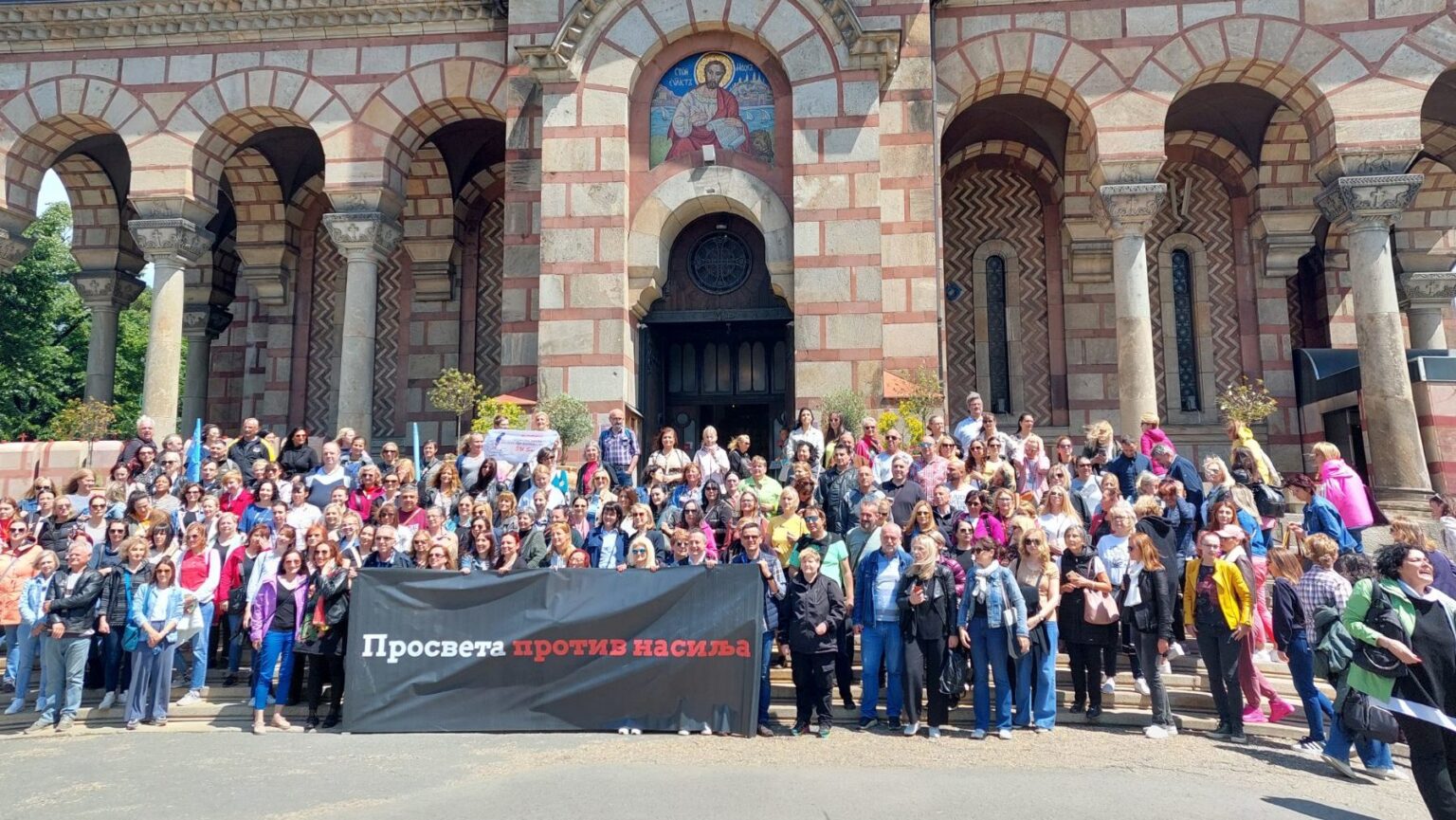
Violence and low salaries drive Serbian teachers to protest at the beginning of new school year

Education workers in Serbia are planning industrial action as the new school year begins, driven by widespread violence and unresolved income disputes

August 29, 2024 by Ana Vračar

Image
Education workers during a protest against violence, May 2024. Source: Independent Union of Education Workers of Serbia (NSPRS)/X

Education workers in Serbia are preparing for the start of the new school year, but this time by planning industrial action to highlight long-standing concerns that remain unaddressed by the government. Barring unexpected changes in discussions with the relevant ministries, members of the Independent Union of Education Workers of Serbia (NSPRS) will begin the school year with a slowdown, protesting issues of violence and security affecting school staff.

For years, education workers have faced violence from students and parents, often over grade disputes. This violence has ranged from administrative harassment, such as anonymous and false reports to inspections, to physical attacks, including incidents where teachers have been assaulted and been exposed to school shootings. One such event occurred in May 2023, when a 13-year-old student killed nine children and a caretaker in one of Belgrade’s schools, sparking nationwide protests against violence.

Trade unions are now demanding that the government address the culture of violence that has permeated Serbian schools, primarily by amending the criminal code to ensure that attacks on school staff are more adequately punishable, allowing teachers to suspend particularly violent students, and ending the practice of anonymous reporting. The Ministry of Education has acknowledged these demands for some time, yet, according to the unions, no progress has been made in implementing them.

Given that grades are the main trigger of violence against school staff, NSPRS members plan not to grade students’ work until mid-October as part of their slowdown. If no concrete reassurances are received by that time, they will proceed by giving all students top marks. “At least no one punches teachers who give out straight A’s,” NSPRS President Dušan Kokot told media outlet Vreme.

“With this action, we are trying to make the state consider the situation in which educators find themselves. This is the cry of educators that some things must change,” he said.

Uncertainties persist over necessary salary increases
Other trade unions have announced potential industrial action over income levels in the education sector. The Confederation of Unions of Education Workers’ Union of Serbia (USPRS), for instance, has stated that the delay in addressing necessary salary increases has gone on for too long. If this situation does not change, the Ministry might face full-blown strikes in the coming months. Mirjana Čašić of USPRS told local media that to meet previously agreed terms with the ministry, education workers’ salaries should increase by up to 25%. However, she noted that there is still no information on how this will be implemented.

While the trade unions have chosen different paths for their actions, they are ultimately aiming for the same result: an improvement in the overall conditions in schools and other parts of the education system, which will benefit teachers, students, and parents alike. Because of this, Kokot expressed hope that their slowdown will be met with support from students’ families.

https://peoplesdispatch.org/2024/08/29/ ... hool-year/

******

Ben Aris: Germany cancels future funds for Ukraine’s war effort
August 29, 2024
By Ben Aris, Intellinews, 8/18/24

First it was the Americans that ran out of money for Ukraine leading to a disastrous six month hiatus in supplies that allowed Russia to destroy 90% of Ukraine’s non-nuclear electricity generation capacity. Now it is the Germans turn: Berlin has frozen all additional military aid to Ukraine due to budget constraints, the Frankfurter Allgemeine Zeitung (FAZ) reported on August 18.

The decision, backed by Chancellor Olaf Scholz, was ordered by Finance Minister Christian Lindner and limits new funding for Ukraine’s military needs to aid packages that have already been announced. No additional funds will be allocated for the coming years, despite ongoing military conflicts in Ukraine.

Bankova (Ukraine’s equivalent of the Kremlin) quickly posted a message on social media saying that financial aid to Ukraine by Germany would not be suspended.

Some commentators have pointed out that the final decision lies with Bundesrat, the parliament, which has not yet made a decision. It already approved additional funds last year, contrary to the government’s draft budget, so a work around may still be found.

However, recent revelations that a Ukrainian diving instructor was behind the destruction of the Nord Stream 1&2 gas pipelines that belonged to Germany and was the major source of energy to the country, may complicate matters. German prosecutors have issued a warrant for his arrest, but, with Polish complicity, he fled to Ukraine.

Ukraine has been worried that the mounting Ukraine fatigue will reduce the support it gets from its Western allies. Eventually the US passed a new $61bn aid package on April 20, but that package is widely seen as the last big financial package the US will contribute to the war effort.

The EU also approved a four-year €50bn support package in February and is taking over as Ukraine’s main source of funds. In addition, a $50bn loan agreed by the G7 countries in July that will be serviced by interest payments from the $300bn of frozen Central Bank of Russia (CBR) reserves was approved, but as bne IntelliNews reported Ukraine is running out of men, money and materiel and the loan money is not expected until the autumn at the earliest.

This year the Ukrainian budget calls for a record $43bn deficit, but there is already a $12bn hole that needs to be filled, and the government is mulling making spending cuts, raising taxes and, as a last resource, turning the printing presses back on to cover the shortfall. Moreover, the outlook is for the situation to get worse; Ministry of Finance (MinFin) forecasts it will receive some $37bn this year from international donors, increasingly in the form of loans, but that will fall to $19bn by 2026.

Ukraine has already technically defaulted on its outstanding Eurobonds, after it was unable to start repayments at the start of August and was forced to restructure the debt, giving investors a 60% haircut, but offering them potentially lucrative GDP warrants as compensation. Under the deal some of the world’s biggest investors, including BlackRock, Amundi and Amia Capital, will write off a large part of $23.4bn by exchanging their bonds for new ones that will have maturities of as much as 12 years.

Germany’s decision comes at the worst time for Ukraine, which is slowly losing ground to the advancing Armed Forces of Russia (ARR) on the frontline inside Ukraine, but has also launched a bold attack on Russian soil in the Battle for Kursk and needs more money and arms than ever.

In a letter obtained by FAZ, Lindner outlined that future aid to Ukraine should be financed through the $50bn package recently agreed upon by the G7. However, the $50bn loan remains bogged down in wrangling over how the money will be distributed by the contributing countries and German has objected to participating saying that it has already contributed €37bn to Ukraine’s war budget and points out it is already the biggest contributor to the four-year €50bn package agreed at the start of this year.

One immediate impact of the decision is the inability to finance an IRIS-T fire unit that had been offered for immediate delivery by Germany’s Diehl Defence. The unit became available after another customer opted to defer their delivery to aid Ukraine following a devastating Russian missile attack on a children’s hospital in Kyiv in July. Despite the urgency, the funds were not approved, against the wishes of Defence Minister Boris Pistorius, but Norway has stepped in to provide the system.

The freeze on new military aid has reportedly led to significant tensions within the German government. Ministries led by Defence Minister Pistorius, Foreign Minister Annalena Baerbock, and Vice Chancellor and Minister for Economic Affairs Robert Habeck were strongly opposed to the lockdown. Sources told FAZ there was a major dispute within the government following the announcement.

FAZ reported that the funds for military aid in 2024 have already been fully allocated, with the planned €4bn for 2025 already overbooked.

The Federal Government itself has denied the FAZ report. The only reason aid to Ukraine was capped at €4bn in the budget is because there will be additional aid from another budget, the Chancellery said.

There was also no comment on how many weapons were currently being delivered, as this is usually only announced once the weapons, tanks and air defence systems have arrived in Ukraine .

The financial planning for subsequent years looks grim, with only €3bn earmarked for 2026 and a mere €500mn for both 2027 and 2028. Unless new money is found, the financial outlook for Ukraine is grim and that no new military aid pledges to Ukraine will be possible in the near future.

As a result, the $50bn G7 loan becomes a crucial source of funding for Kyiv.

Behind Germany’s budget problem is the November 15, ruling by the Federal Constitutional Court, which declared the second supplementary budget unconstitutional. The federal government had earmarked structural EU funds that it intended to use for the green transition, but the court ruled that the €60bn in question could not be reassigned under Germany’s so-called debt-brake rules, leaving a significant hole in the budget plans.

The federal government and the 16 federal states are obliged to balance their books, making taking out new loans very difficult. No other G7 country has such strict limits on new borrowing and the rules are enshrined in the German constitution. The debt brake became legally binding for the federal government in 2016 and for the states in 2020. Federal Finance Minister Wolfgang Schäuble (CDU) was then able to present the first “black zero” balanced budget in 45 years in 2014. The only wiggle room the federal government has – regions have none — is it is allowed to borrow up to a maximum of 0.35% of GDP, or around €13bn in additional debt.

The debt brake can be suspended, “for natural disasters or unusual emergency situations beyond governmental control and substantially harmful to the state’s financial capacity,” categories the war in Ukraine do not fall into.

https://natyliesbaldwin.com/2024/08/ben ... ar-effort/

******

European Union to Telegram, We’re Coming to Get You
August 29, 2024

Image
Person holding a phone with the Telegram logo on the screen, in the background several logos of the Telegram social media platform. Photo: Natalia Seliverstova/Sputnik.

By Pepe Escobar – Aug 27, 2024

The Pavel Durov saga is a gift that will keep on giving for a long time to come. This is what hot information war is all about. So let’s attempt to connect several loose ends.

A high-level Russian analyst makes the case that Durov’s arrest is connected with “anti-French protests in its former colonies, withdrawal from its traditional ‘sphere of influence’ where Telegram infrastructure was used to push anti-colonial and anti-Macronist narratives.”

Add to it an “attempt to influence narratives on Ukraine both in Russian and the international media field, which is highly dependent on Telegram infrastructure.”
Paris is indeed desperate to make itself relevant when it comes to psy ops and influencing/special warfare in Ukraine.

However, as the analyst notes, the French don’t have the tech means to accomplish it. So this may have led to Macron deciding to “exercise a personal pressure campaign against Durov himself. French authorities must be rather desperate in trying to keep their heads in the game of global politics. And Telegram today is (his italics) global politics.”

Paris was just waiting for a big break. When the pilot of Durov’s Embraer private jet submitted his flight plan, there was no warrant for his arrest in France. Only when the jet was on its way to Le Bourget, Paris filed the warrant in haste. Durov was clueless all along.

In a nutshell: Paris got a fateful heads up he was flying into France – could have been via Durov’s Dubai-based, post-obsessive, social climbing girlfriend – and laid out the trap in a flash.


An eminence in jail
There’s a myth that the FSB in the past asked Durov for Telegram’s encryption keys. False. The FSB wanted Telegram to provide top access on investigations of serious crimes, on a case-by-case basis. That’s an enormous difference compared to what the US Government does with Meta or Twitter/X via their totally open backdoors.

Durov though got drunk on NATOstan’s “freedom and democracy” propaganda, rebuffed Russia, and left.

And that brings us to President Putin.

Putin had better things to do than to meet Durov in Baku, and the Kremlin has gone on the record to deny the meeting. Durov was doing a tour of Central Asia and the Caucasus, they happened to cross their paths in Azerbaijan.

There’s one thing that Putin never tolerates: betrayal of Russia. And that applies to the letter to Durov.

When Durov went to the US, the Americans, predictably, demanded Telegram’s backdoors to surveil everybody. So he set up shop in Dubai and later applied for French citizenship.

Durov became a French citizen only 3 years ago – significantly, before the launch of the SMO – via a special “eminent foreigner” program set up by the Ministry of Foreign Affairs. Very few are eligible; only a “French-speaking foreigner who contributes through their eminent action to the influence of France and the prosperity of its international economic relations.”

Well, no “eminent action” was enough to keep him away from a French slammer.

How to get those keys
The European Commission (EC) in Brussels can be summarily described as a notorious bunch of EUrocrat cowards and/or psychopaths cheerfully praising “our values.”

Predictably, the EC refuses to comment on Durov’s arrest, saying it’s a “national investigation.”

An “investigation” which happens to have been “encouraged” by the US Deep State, carried out since July 8 by vassal Macronist police, to the benefit of NATO and… the European Commission itself.

The charges against Durov revealed by France’s Prosecutor of the Republic should be destroyed in court by any crack legal team. Essentially, the claims are that Durov himself is responsible for those abusing Telegram. He is “complicit” of every misdeed under the sun – from organized fraud to drug-trafficking – all the way to a hazy accusation of providing encrypted services without a “certified declaration.”

The accusations about Telegram’s lack of moderation are false. For instance, Telegram actively censors correspondence inside the EU; EU residents cannot access countless chats and channels. Moreover, Telegram is not concerned by the recent, hardcore neo-Orwellian EU law against mega social networks, because it harbors less than 45 million European users a day.


Now let’s focus on motive.

The current liberal-totalitarian Euro-gulag, or EuroLag, is a massive power bloc that does not have access to Telegram’s content.

Telegram maintains its own servers around the world, and routing goes via Amazon, Cloudfare and Google. Since the start of Telegram, US intel/surveillance has the means to easily block it – if they feel like it.

The EU is a different ball game. So here we have Brussels, via Paris, trying to acquire at least some control over Telegram – and social networks in general. A crucial reminder – which could be billed under the Pathetic Tech department: Europe has no (italics mine) social networks.

Hence the non-stop threats against Twitter/X and the neo-Orwellian Digital Services Act over the responsibility of platforms in terms of content, which applies to all of them, and not only Telegram.

The EU and France desperately want what the hegemonic power already has, in droves: access to everything, right here, right now, with no legal documentation whatsoever.

The key question now is: will they get it by applying pressure over Pavel Durov? There’s no evidence he has Telegram’s encryption keys. What if they got the wrong guy?

Nikolai Durov, Pavels’ ultra-discreet brother, is the prime genius architect of Telegram: math master, two PhDs, gold medals in the International Mathematical Olympiad. The French would rather cut a deal – thus the extended interrogation: but that would imply breaking Pavel so he would influence Nikolai to hand over those fabled keys.

Why now? And who profits?
Predictably, Durov’s interrogation goes on with zero transparence. France is an excruciatingly secretive society, prone to absolute silence on serious matters, nerve-wracking slow, punctuated by rare formal declarations. It’s all about procedure – and the bureaucracy is stultifying.

Yet French bureaucracy may have given a precious hint on what really bothers them. They simply cannot accept that anyone uses – or provides – the means of “obfuscation” in terms of financial transactions, bypassing censorship and bypassing surveillance.


So this may go way beyond the obsession to get some or all of Telegram’s encryption keys. The French bureaucratic apparatus wants to go no holds barred to suppress any possibility of any bypassing – while retaining the power to punish anyone.

If the saga goes on and on, leading to a trial and eventually a 20-year prison sentence, that means Durov would not be broken facing the bureaucratic apparatus, and he will always remain “an accomplice”.

Hardly likely. Bye bye to unlimited glitz and glamour, in exchange for a daily stale baguette in a French gaol?

Two more inevitable questions. Why now? Because the EU needs it, badly. And who profits? The leading candidates are the “esprit de corps” of ultra-regimented French bureaucracy and their Franco-European oligarch connections. Envy is also in the cards. Durov is Russian, an outsider, and Telegram – with a billion users worldwide – is a resounding success.

Anything can happen further on down the road – including the blocking of Telegram in France and the EU. The Global Majority could not care less. Meanwhile, multitudes marvel at how a narcissist tech globalist could be so naïve to believe that liberal totalitarianism would ever protect his freedom.

https://orinocotribune.com/european-uni ... o-get-you/

Two Months After Elections, Macron Refuses to Nominate Progressive Prime Minister
August 29, 2024

Image
NFP representatives ahead of talks with President Macron, Paris, France, August 2024. Photo: X/@LucieCastets.

By Ana Vračar – Aug 27, 2024

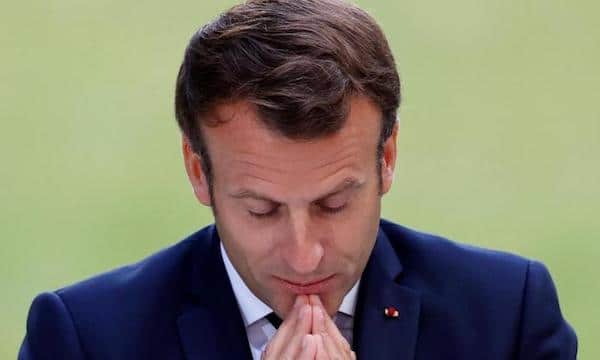
Emmanuel Macron continues to block the formation of a New Popular Front-led government, sparking outrage over his disregard for democratic processes

Almost two months have passed since the snap election in France, and President Emmanuel Macron is still avoiding to nominate a new prime minister. His behavior has sparked outrage, particularly in left and progressive circles, who accuse him of usurping power and showing a gross lack of respect for democratic processes.

Following consultations with representatives of all parliamentary parties between August 23 and 26, Macron refused to nominate Lucie Castets, the candidate put forward by the New Popular Front (NFP), claiming he is acting to preserve “institutional stability.”

The NFP emerged as the group with the largest number of parliamentary seats in the election, despite not securing an absolute majority. This lack of an absolute majority has been exploited by political opponents, ranging from Macron’s liberals to the far-right led by Marine Le Pen and Jordan Bardella, who argue that there was no clear election winner and seek to block a progressive government from taking office.

Both liberals and right-wing factions have vowed to block an NFP-led government, especially if it includes ministers from the left-wing party France Unbowed (LFI). However, these threats have been denounced by NFP representatives as attempts to prevent the coalition from implementing its program, which aims to break with the neoliberal policies championed by the liberals and supported by the right.

“Emmanuel Macron understands that our priority, as the French people expect, will be to reverse his unfair pension reform and restore public services,” said Lucie Castets. “He is looking for excuses to prevent us from doing so.”

The President’s latest statements have been described as “a disgrace” and “lunatic” by leaders of the parties united in the NFP. “The President of the Republic has just created a situation of exceptional gravity,” summarized Jean-Luc Mélenchon, announcing that LFI will be calling for Macron’s impeachment.

“Anger. That is what millions of us are feeling this morning. Emmanuel Macron is telling us that elections are worthless. So, does democracy mean nothing to the President? That’s extremely dangerous,” Castets pointed out in an interview.

Meanwhile, Macron continues to insist that the only way forward is to find a candidate for prime minister who enjoys cross-party support, raising questions about the purpose of elections in the first place. According to the President, an NFP government would face an immediate vote of no confidence from the liberals and the right wing, leaving it completely ineffectual. Instead, he announced another round of conversations with parliamentary groups to define a way forward—talks that the NFP has already declared they will not attend, deeming them illegitimate.

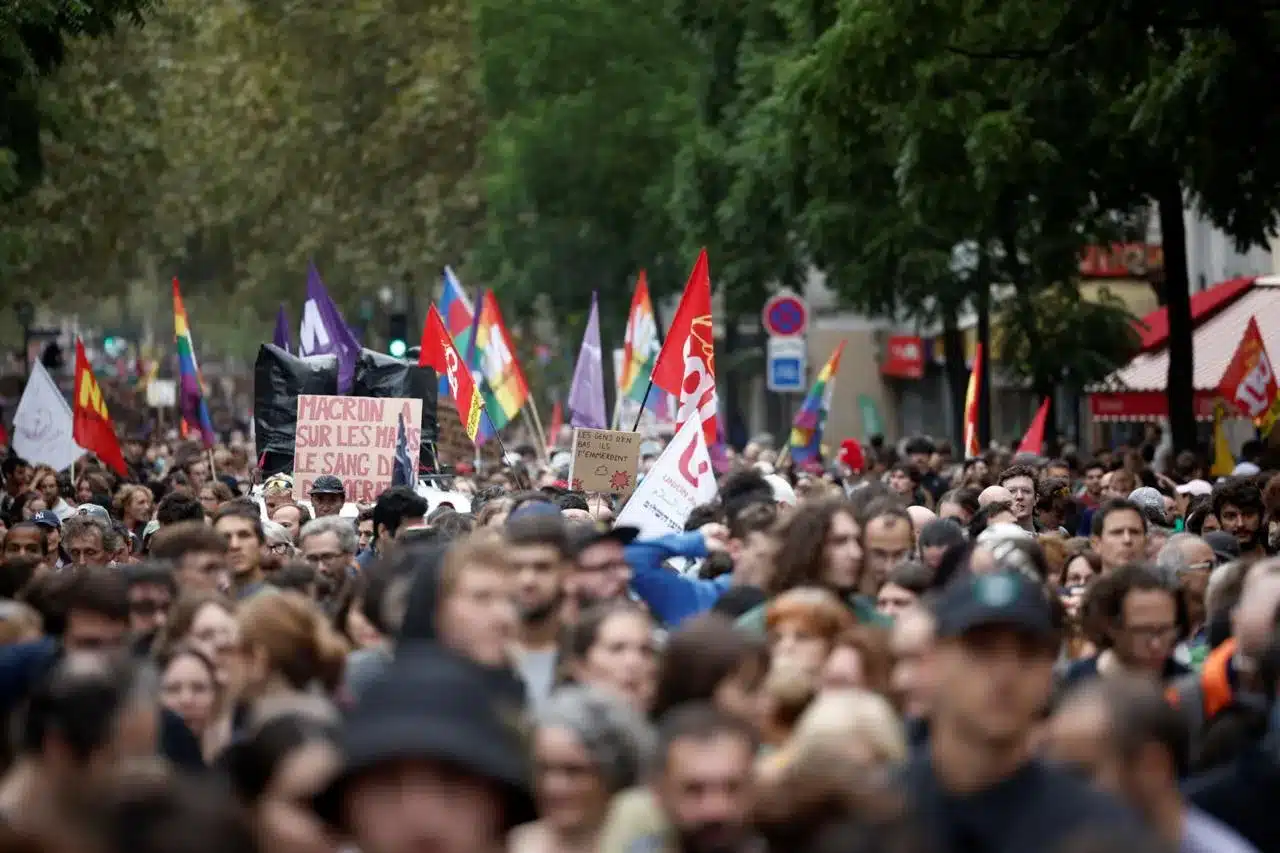
“The gravity of the moment calls for a firm response from French society against the incredible abuse of power to which it is being subjected,” LFI said in a press statement. As a first step, the left party, along with student organizations and unions, has called for protests on September 7.

https://orinocotribune.com/two-months-a ... -minister/
"There is great chaos under heaven; the situation is excellent."

User avatar
blindpig
Posts: 14798
Joined: Fri Jul 14, 2017 5:44 pm
Location: Turtle Island
Contact:

Re: Blues for Europa

Post by blindpig » Mon Sep 02, 2024 2:47 pm

Kuleba Equated Ukraine’s Genocide Of Poles With Poland’s Forcible Resettlement Of Ukrainians

Andrew Korybko
Aug 31, 2024

Image

This can set into motion a discussion about Polishness as part of the Polish elite’s plans to reshape popular perceptions thereof with a view towards justifying mass Ukrainian migration into their country in furtherance of geopolitical and economic goals.

Ukrainian Foreign Minister Kuleba sparked a scandal during his latest visit to Poland when he compared Ukraine’s World War II-era genocide of Poles to Poland’s forcible resettlement of Ukrainians afterwards. He was asked about when the remains of that genocide’s victims can finally be exhumed in light of all that Poland has done for Ukraine, but instead of answering clearly, he deflected by bringing up Warsaw’s post-war “Operation Vistula”. Here are his exact words as reported by Polish media:

“You are aware of what Operation Vistula was and you know that all those Ukrainians were forcibly expelled from Ukrainian territories to live, among others, in Olsztyn. But I'm not talking about that. If we started digging into history today, the quality of the conversation would be completely different and we could go very deep into history and reminisce about the bad things that Poles did to Ukrainians and Ukrainians did to Poles.

We have no problem with continuing the exhumation.

We only have a request to the government in Poland to also commemorate the Ukrainians. We want it to be bilateral. And if our relationship were to be dominated by emotions, we would find ourselves in a place where Russia would win. There are provocations in the area of ​​history, which are organized by Russia. So I think: let's leave history to historians, and let's build the future together. Let the future be for you.”

His Polish counterpart Sikorski lent credence to this comparison in an interview after their meeting:

“Over the course of several hundred years, the calculus of wrongs between neighbors is never ‘one-sided’. So we have a choice: either we can deal with the past, which is important, our victims deserve a Christian burial, but unfortunately we are not able to bring them back to life.

Or we can focus on building a common future, so that the demons do not speak in our societies and so that the common enemy does not threaten us in the future. I prefer the second approach. [The exhumation issue] is a problem in our relations, which I hope Ukraine will solve in a spirit of gratitude for the help that Poland provides it.”

Before analyzing this scandal, it’s important to share some background briefings:

* 6 August 2023: “Kiev’s Prediction Of Post-Conflict Competition With Poland Bodes Ill For Bilateral Ties”

* 4 June 2024: “Does Poland Fear That Ukraine Might One Day Make Irredentist Claims Against It?”

* 10 July 2024: “Polish-Ukrainian Security Pact”

* 20 August 2024: “Why’s Poland Reopening Its Investigation Into The Post-War Resettlement Of Ethnic Ukrainians?”

* 30 August 2024: “Poland Finally Maxed Out Its Military Support For Ukraine”

The above insight will now be summarized in order to swiftly bring unaware readers up to speed.

Ukraine has begrudgingly become Poland’s “junior partner”, but it hopes to restore at least the perception of equality through various means. To that end, it’s demanded more arms from Poland as well as an air-defense bubble over its westernmost regions. Ukraine also arguably demanded that Poland revise the “Institute of National Remembrance’s” (IPN) conclusion that “Operation Vistula” wasn’t a crime as part of their new security pact’s clause about standardizing historical narratives.

It’s this last-mentioned detail that’s most relevant to Kuleba’s scandalous comparison of the Volhynia Genocide with “Operation Vistula” since he’s clearly playing hardball in the sense of Ukraine refusing to budge on the former unless Poland commemorates the latter with the same solemnity. The difference though is that over 100,000 Poles were killed on the basis of their identity during the first while around 140,000 ethnic Ukrainians and Poles alike were resettled for security-related reasons during the second.

Even if one considers “Operation Vistula” to be an act of “ethnic cleansing”, which is a contentious conclusion to be sure but nevertheless what Ukrainians believe, that still isn’t comparable to the Volhynia Genocide for obvious reasons: the first resettled people while the second killed them. There’s no equivalence between killing people and resettling them, yet Kuleba and even Sikorski to an extent want everyone to believe that there is in order to bury the hatchet per the spirit of their new pact.

The IPN will now likely conclude that “Operation Vistula” was a “crime”, after which its ethnic Ukrainian “victims” will be solemnly commemorated so as to facilitate the exhumation of the Volhynia Genocide’s victims’ remains. The first’s ethnic Polish “victims” might not be mentioned at all though since that could “provoke” Kiev into thinking that Warsaw is “whitewashing” this “ethnic cleansing”, thus impeding progress on the aforesaid, but both “victims” were Polish citizens and thus equal in the eyes of the law.

In any case, Poland’s false equivalence between Ukraine’s Volhynia Genocide and its own “Operation Vistula” risks legitimizing Kiev’s tacit revival of the short-lived “Ukrainian People’s Republic’s” territorial claims, which also extended into eastern and southeastern Poland. After all, Kuleba just described those regions as “Ukrainian territories” from which “Ukrainians were forcibly expelled”, and the IPN’s likely recognition of “Operation Vistula” as a “crime” can delegitimize Poland’s control over those lands.

That’s not to imply that Kiev would then formally lay claim to them, but just that this predictable sequence of events could embolden Ukrainian ultra-nationalists in both countries to carry out disturbances – including acts of sabotage and terrorism – in support of their erstwhile entity’s claims. On the Polish side, this could be exploited by the elite to generate a discussion about national identity with the intent of deconstructing it in order to then justify mass Ukrainian migration.

To explain, the IPN’s likely conclusion that “Operation Vistula” was a “crime” will legitimize Kuleba’s description of eastern and southeastern Poland as “Ukrainian territories”, thus raising the question of what it means to be Polish since those people and their land are now integral parts of Poland. In connection with this, some might also mention that parts of modern-day northeastern Poland used to be controlled by the Grand Duchy of Lithuania, which complements the preceding question.

The predetermined answer is that “Lithuanians” (which historically also referred to the majority-Slavic and -Orthodox inhabitants of the eponymous Grand Duchy from today’s Belarus) and “Ukrainians” (the descendants of ancient Kievan Rus’ heartland) can “turn into Poles”. Famous interwar nationalist Roman Dmowski believed that only Polish-speaking Catholics should be considered Polish while his rival Marshal Jozef Pilsudski promoted the liberal view of including all eastern people of the former Commonwealth.

Dmowski eventually won after World War II although he didn’t live to see it, but now Pilsudski’s school of thought which represented the interwar Second Polish Republic’s official position for most of its brief existence is back on the upswing following the mass migration of Ukrainians to Poland since 2022. This summer’s security pact represents the long-planned modern-day partial manifestation of Pilsudski’s “Intermarium” vision which aimed to restore the Commonwealth in current conditions.

In furtherance of this goal, the Polish elite – both the ruling liberal-globalist coalition and the prior (very imperfect) conservative-nationalist government – wants to implement Pilsudski’s liberal model of Polishness for these geopolitical ends but also economic ones related to “replacement migration”. The preceding hyperlinked analysis elaborates more on the second dimension, but the point is that Poles have to welcome Ukrainians into their society in order to achieve these two interconnected objectives.

That’ll be a challenge though since a whopping 40% of Poles see Ukrainian migrants as a threat compared to just 27% who see them as an opportunity according to the European Council on Foreign Relations’ survey from January 2024. If they came to embrace Pilsudski’s liberal model of Polishness upon the deconstruction of their identity brought about the predictable sequence of events described in this analysis, however, then their elites’ geopolitical and economic goals can more easily be achieved.

Therein lies the real importance of Kuleba equating Ukraine’s Volhynia Genocide with Poland’s “Operation Vistula”, which Sikorski lent credence to afterwards, since it’s all about catalyzing the process of reshaping Poles’ perception of Polishness in furtherance of the abovementioned goals. It can also backfire though if it’s pushed upon them too aggressively, in which case these plans would have to be shelved for some time before trying again, but there’s also a decent chance of success as well.

https://korybko.substack.com/p/kuleba-e ... s-genocide

Serbia’s French Warplane Deal Discredits Vucic’s Earlier Color Revolution Claim

Andrew Korybko
Sep 02, 2024

Image

He wouldn’t have gone through with this $3 billion deal if he really thought that the West was trying to overthrow him like he claimed less than a month ago.

Serbian President Aleksandar Vucic surprised observers when he announced during a meeting with his French counterpart in Belgrade last week that he agreed to a $3 billion deal to buy 12 Rafale warplanes. The reason why this was so unexpected is because his government had recently accused the West of orchestrating an ultimately failed Color Revolution against him in early August that he claimed Russia had also warned him about right beforehand.

It was explained here at the time why “The Serbian Government Is Inadvertently Responsible For The Latest Color Revolution Intrigue”, which drew attention to the legitimate grievances that some patriotic members of its population have against him. These include taking steps that can be interpreted as de facto recognition of Kosovo’s “independence”, voting against Russia at the UN, and allegedly arming Ukraine. Nevertheless, the West still wants a fully compliant puppet, not someone with semi-autonomy.

The last-mentioned observation accounts for why they still kindle Color Revolution unrest in Serbia, though Vucic’s French warplane deal suggests that he doesn’t take it as seriously as he makes it seem. After all, if he was really concerned about being overthrown through weaponized protests like Slobodan Milosevic before him, then he’d have presumably pulled Serbia out of large-scale military talks with the West like the ones that it was engaged in with France up until now.

That never happened as is known so the natural conclusion is that he hyped up the latest Color Revolution threats for the politically self-serving reason of discrediting those patriotic members of the population who gathered to peacefully protest against him in early August. To be sure, nefarious elements were indeed part of those protests, hence why Russia reportedly passed along warnings to him. The point, however, is that they weren’t actually capable of overthrowing him.

His intelligence services would have known this much better than Russia’s, and Vucic might have publicly disclosed their alleged warnings in order to reinforce the false perception that those patriots who participated in the protests are supposedly anti-Russian even though they’re actually Russophiles. If that’s what he was thinking, then it would show how much he fears the patriotic opposition and suggest that he might also even be scared that Russia could one day support them through various means.

To be clear, Russia doesn’t meddle in Serbia, but Vucic might have become paranoid after hobnobbing with the West over the years so it can’t be ruled out that he doesn’t have such suspicions. What can be known with confidence though is that he isn’t worried about the West toppling him even though some hawks still harbor this fantasy as was previously explained. If it was otherwise, then he wouldn’t have let Serbia continue its military-technical talks with France, which culminated in this major deal.

Looking forward, observers shouldn’t take any of his future Color Revolution warnings all that seriously, though that’s not to imply that there isn’t any such threat. It’ll always remain so long as he refuses to sanction Russia and continues behaving semi-autonomously instead of fully complying with their demands. He’s not expected to budge on this matter and the West doesn’t really care all that much since he already does a lot of what they want anyhow so they don’t have an urgent reason to overthrow him.

https://korybko.substack.com/p/serbias- ... discredits

*****

Image

| Macron wounded but still eyeing austerity | MR Online
Macron refuses to name New Popular Front to French government
Originally published: World Socialist Web Site (WSWS) on August 29, 2024 by Alex Lantier (more by World Socialist Web Site (WSWS)) | (Posted Sep 01, 2024)
Culture, Movements, StrategyEurope, FranceNewswire
After President Emmanuel Macron finished a round of talks with leaders of France’s parliamentary parties on Monday, he refused to select a prime minister to try to assemble a majority in parliament. Instead, the Elysée présidential palace issued a communiqué stating that Macron would not name a prime minister from the New Popular Front (NFP) led by Jean-Luc Mélenchon, which won a plurality in the July 7 elections.

Macron’s trampling on the election results has exposed the intractable crisis of French democracy and his own deep ties to neo-fascism. His refusal to allow the election winners to try to assemble a majority in parliament has left France without a government for nearly two months. To explain this position, however, the Elysée stated that the NFP is unacceptable to legislators from the far-right National Rally (RN) and Macron’s own Ensemble coalition, pledging that they would band together to bring down any government the NFP formed:

A government based only on the program and the parties proposed by the alliance with the most legislators, the New Popular Front, would be immediately censured by all the other groups represented in the National Assembly. Such a government would thus immediately have a majority of over 350 deputies against it, effectively blocking it from acting. Given the views of the political leaders that were consulted, the institutional stability of our country therefore compels us not to take this option.

Macron’s pledge to work with the RN to block an NFP government is setting into motion an explosive confrontation with the working class. Macron is despised among workers for ruling against the people, after pushing through pension cuts last year, sending riot police to assault mass protests and strikes against the cuts. Fully 91 percent of French people reject Macron’s cuts, and a similar proportion oppose his call to send French troops to Ukraine for war with Russia.

The constant diversion of social wealth by the capitalist class towards imperialist war and massive bank bailouts in the face of deep popular opposition, above all, in the working class, is leading to a breakdown of democratic forms of rule.

Outgoing Prime Minister Gabriel Attal’s caretaker government has reportedly begun preparing an austerity budget to freeze social spending. Since caretaker governments traditionally cannot take budgetary decisions, this only underscores the illegitimacy of the Macron regime. It will provoke bitter opposition in the working class against austerity, global imperialist war, and French and NATO backing for the Israeli regime’s genocide in Gaza.

A debate is raging in the French ruling class over what coalition government to assemble to try to suppress and politically strangle this opposition. In the run-up to the July 7 elections, Macron carried out extensive discussions with the far-right RN to prepare for the installation of a far-right government. However, the elections led not to a victory of the RN but of the NFP, as millions of workers, particularly in the major cities, voted for the NFP to block the neo-fascists.

The Elysée communiqué issued an appeal to Mélenchon’s allies in the NFP—primarily, the big business Socialist Party (PS) and its traditional allies, the Stalinist French Communist Party (PCF) and the Greens. It called upon them to split the NFP, abandon Mélenchon and join the parties of Macron’s coalition in a governmental alliance backed by the traditional right. Imploring the PS, PCF and Greens to “cooperate with other political forces,” the communiqué stated:

Discussions with the LIOT group and the EPR, MoDem, Horizons, Radicals and UDI sketched a path towards a coalition and possible collaboration between different political sensibilities. These groups have made clear they are open to supporting a government led by a personality that would not come from their own ranks.

But for now, the PS and its allies have rejected Macron’s appeal and denounced his refusal to let the entire NFP form a government. The PS attacked Macron’s “intolerable” policy as a “coup” and “the rejection of a left-wing government, because he rejects and has contempt for its program.” Green Party leader Marine Tondelier denounced Macron’s “dangerous democratic irresponsibility” as a “shame,” pledging to “keep fighting for the will of the French people: three-quarters of them want to break with the Macron regime.”

PCF National Secretary Fabien Roussel said he would only meet publicly with Macron “to build a broad government led by Lucie Castets,” the 37-year-old Finance Ministry bureaucrat Mélenchon has approved as the NFP’s proposed prime minister.

Mélenchon for his part repeated the threats made by his France Unbowed (LFI) party to present a motion in the National Assembly to impeach Macron. “The popular and political response must be rapid and firm,” he tweeted, pledging: “The motion for impeachment will be presented.”

Tuesday, the Union of University Students (UE) and the National High School Students Union (UNL) called for nationwide protests “against Emmanuel Macron’s autocracy.” Shortly afterwards, LFI issued a call to join the UE-UNL protests. For now, the PS has not issued a statement of support or a call for participation in the UE-UNL protests, however, which are called for September 7.

A powerful movement must be built among the youth and, above all, to mobilize the working class to bring down Macron’s police-state dictatorship. The military aggression abroad and class war at home waged by Macron in France and the governments of all his NATO allies must be stopped. A critical warning must however be addressed to the workers and youth: This cannot be done on a national perspective of building a capitalist government led by the NFP and, in particular, by the PS, a bourgeois party deeply hostile to socialism and the working class.

For all of the proclamations of unbridgeable differences between various political parties that are supposedly blocking the formation of a government, the differences of policy separating these different parties are in fact relatively minor. The NFP has endorsed in its program calls to send troops to Ukraine and to build up the military police and intelligence services at home. On the basic agenda of imperialist war abroad and class war at home, the PS and Mélenchon do not represent a fundamentally different policy than Macron.

Moreover, despite Mélenchon’s threats to impeach Macron, and Macron’s insistence that he will not accept a NFP government, the basic form of the government they are proposing is also similar.

The NFP has 193 of the 577 seats in the National Assembly. Under these conditions, Mélenchon’s threatened impeachment motion is set to fail, as have repeated censure motions LFI submitted against Macron earlier in his presidency. Moreover, whatever government the NFP might form, even if it included LFI and Mélenchon, would depend on reaching an agreement with Macron and the raft of small, right-wing parties allied to him—as Macron is currently proposing.

Indeed, by offering to back a PS-led government in which LFI would have no ministers, Mélenchon has signaled that he is open to a compromise on the issue most clearly separating Macron from the NFP: whether Mélenchon and his party would participate in the government.

Because they do not have fundamental differences with Macron, Mélenchon and the NFP have refused until now to call protests or strikes against Macron’s trampling of the election results. As protests against Macron begin again, the critical question is for youth and workers to take control of their own struggle away from the NFP bureaucracies. The protests and strikes of the recent period against the Gaza genocide, pension cuts and wage austerity must be developed into a movement of the international working class against imperialist war and for socialism.

https://mronline.org/2024/09/01/macron- ... overnment/

*****

Germany’s AfD Wins First-Ever State Election in Thuringia

Image
AfD rally in Germany. Photo: X/ @CwwOffcial

September 2, 2024 Hour: 8:23 am

The far-right party’s triumph comes amidst growing discontent with the current federal government.
In a significant political shift, German right-wing Alternative for Germany (AfD) party secured its first-ever victory in a state election on Sunday.


According to preliminary results released on Sunday night, the party garnered 32.8 percent of the vote in East Germany’s state of Thuringia, becoming the strongest force in the state parliament.

The AfD’s triumph comes amidst growing discontent with the current federal government, a coalition of the Social Democratic Party, the Greens, and the Free Democratic Party.

Trailing behind the AfD in Thuringia was the conservative Christian Democratic Union (CDU) with 23.6 percent of the vote. However, the AfD’s path to forming a government is difficult. Other major parties have ruled out any possibility of collaboration with AfD.


The AfD demonstrated similar strength in Saxony, where elections were also held on Sunday, narrowly trailing the CDU. Additionally, the newly formed Sahra Wagenknecht Alliance (BSW) came third in both Thuringia and Saxony. Most of the BSW’s founding members had belonged to the Left Party.

Another eastern German state, Brandenburg, is scheduled to hold state elections later this month. Polls indicate that the AfD is currently leading as well.

Nevertheless, the established “firewall” against cooperating with the AfD maintained by other parties suggests that the subsequent coalition negotiations in these states will likely be fraught with complexities.

https://www.telesurenglish.net/germanys ... thuringia/
"There is great chaos under heaven; the situation is excellent."

User avatar
blindpig
Posts: 14798
Joined: Fri Jul 14, 2017 5:44 pm
Location: Turtle Island
Contact:

Re: Blues for Europa

Post by blindpig » Thu Sep 05, 2024 2:02 pm

What’s Next for Germany After Sunday’s Elections Show Major Backlash Against Status Quo?
Posted on September 4, 2024 by Conor Gallagher

In some of the most unsurprising recent election news, Germany’s ruling coalition parties got hammered in state elections in Thuringia and Saxony on Sunday. The biggest beneficiaries were two parties — Alternative for Germany and the Sahra Wagenknecht Alliance (BSW) — that oppose Project Ukraine and are therefore labeled along the lines of “Putin apologists” and “a threat to our democracy.”

Those warnings from a discredited establishment are increasingly falling on deaf ears. That’s because working class Germans have been seeing their living standards decline for the past two years while the government remains preoccupied with Ukraine and presides over the national humiliation that is the ongoing Nord Stream affair.

The ethnonationalist, anti-EU AfD, which has its share of Nazi admirers, took first place in Thuringia, with just under 33 percent. The pro-war, conservative flavor of neoliberalism Christian Democratic Union (CDU) came in second at 24 percent, while BSW — an essentially one-woman party that formed just eight months ago, came in third in both states — was third at 16 percent.


In Saxony, the CDU was first at 32 percent, AfD second with 30.6 percent, and BSW third with 11.8 percent. Die Linke, the former class-based party on the left that in recent years shifted more to pro-war identity politics, saw Wagenknecht abandon it last year, and the voters followed.

Compared to 2019, it lost 18 percent of the vote in Thuringia and six percent in Saxony.

The results are similar to the European elections in June — although on more fertile ground for the AfD and BSW — and polls showing record unpopularity for the ruling coalition of the Greens, Social Democratic Party of Germany, and Free Democratic Party What else is to be expected when the government seemingly does all it can to tank the economy while telling voters it does not care about their concerns (apologies, I use this video a lot but it’s so illuminating):


That has been the attitude of the government, and polls have consistently shown that voters want to give a raised middle finger to the coalition — increasingly voting for the parties the coalition fear and despise: AfD and the BSW.

And so they did — again. Similar results are expected in a third east German state, Brandenburg, on September 22.

I’m not going to write here about the dangers of the AfD. It’s a topic that is thoroughly — and with rampant blaming of voters — covered inaccurately across every German, European, and US mainstream news outlet. The AfD has been discussed at great length here at NC. See here, here, and here. As has the BSW (see here and here).

Instead of again separating fact and fiction in the endless warnings about the AfD and debunking claims that Wagenknecht is a “far-right Putin apologist” I’d like to use the election results as an opportunity to ask one question and then examine four potential paths forward for Germany. First, to the question:

Is the AfD More Dangerous than Germany’s — and the EU’s — Political “Center”?

I don’t include the BSW in this question because claims the party is something menacing are really too ridiculous to take seriously — despite serious people making serious arguments that Wagenknecht is a 21st century version of Benito Mussolini. What Wagenknecht is doing is attempting to rebuild a German left for the working class and destroy the current finance-centered political economy that is welded to the politics of recognition. It is essentially an attempt to return the left to what it once was, and in that mission she is being helped by the fake left neoliberals so discrediting themselves over the past few years.

The AfD, on the other hand, was originally more of an anti-EU party and refuge for neo-Nazis, which has been able to ride the wave of backlash against disastrous government policies for working people — from the war in Ukraine and a lost economic war to disastrous energy policies that hit poorer people the hardest and a large increase in immigration at the same time standards of living decline. The current government belatedly acknowledge this reality and has recently made a show of trimming Ukraine support and taking away the welcome mat from refugees, but it was too little too late as the AfD is now seen by some of its supporters as a party that will “save” Germany and return the country to fondly remembered days – whether 10 years ago or 85.

The good news is the AfD is a sovereignist party; the bad news is its idea of sovereignty favors ethno-nationalist, national oligarchy, climate change rejection, and despite increasing support of the working class, a lack of policy proposals that would benefit workers.

What of the “center” though?

While the media is up in arms about the AfD’s first state election victory, the German-NATO-EU permanent state made up of spooks, neoliberal bureaucrats, Atlaticist think tanks, and the military-industrial complex is leading a neoliberal return to serfdom, mass censorship, and an increasingly reactionary foreign policy that rehabilitates Nazis and supports proxy wars and genocide.

Maybe the “far right” being voted into power shouldn’t be the only outcome to worry about here. We’ve already seen an extinguishing of the left, and the center becoming authoritarian, and goal is now to crush the sovereignists. In my humble opinion, the larger fear is not just the center, but that it uses the ethno-nationalist right to deflect criticism of the neoliberal and Atlanticist pro-war policies that a have Europe where it is today. Under such an “arrangement” the latter abandons anti-EU and NATO stances in order to be welcomed into the halls of power but maintains the ethno-nationalism, militarization, anti-labor positions. Call it a strengthening of the European uniparty or the Ukrainization of Europe.

Under such a scenario, bargains between the “center” and far-right do nothing to rock the neoliberal economic boat nor the EU’s slavish Atlanticism, but with the center as the modern fascist leadership and the ethnonationalist right as its Schutzstaffel, immigrants will be scapegoated for economic problems caused by the financialization of everything, and attacks on anyone resisting neoliberal policies or war will increase.

We’ve already seen this happen to a small degree with Giorgia Meloni and the Brothers of Italy. We can also see the center rehabilitate Nazis. And we can see Ukraine’s thriving democracy.

With that being said, what lies in store for the German political landscape? Here are four possibilities.

1. Muddle Along

After getting walloped in European elections, polls routinely showing it’s the most unpopular post- WWII government and now another embarrassment in Sunday’s elections, one might think the government would step aside. There are no signs that is going to happen. Chancellor Olaf Scholz is sticking to the bit, telling Reuters the following about the elections:

“Our country cannot and must not get used to this. The AfD is damaging Germany. It is weakening the economy, dividing society and ruining our country’s reputation.”

The stated plan is that the AfD “firewall” — a pact by other German parties not to work with the AfD — will hold. In the meantime, the current government will continue down the same path of more censorship and crackdown on dissent.

A grand coalition excluding the AfD and BSW and led by the CDU and former Blackrock executive Friedrich Merz can then continue such policies following national elections towards the end of next year.

There are a few problems with this strategy, however. For one, many write-ups of Sunday’s state elections note that these East German states were fertile ground for the AfD and BSW. That’s fair, but it should also be noted that support for them is likely to continue growing as there is no end in sight to Germany’s economic woes. Here’s where the polls stand right now:

Image

But the national elections are more than a year away. Meanwhile, the country’s manufacturing base continues to erode with the recession deepening in August, and the signs increasinging that it is permanent. Here’s Dr. Cyrus de la Rubia, Chief Economist at Hamburg Commercial Bank, talking about all the bad news in the latest German PMI survey:

“The recession in Germany’s manufacturing sector is dragging on way longer than anyone expected [if you read NC, you know that’s not true].August saw an even steeper drop in incoming orders, killing off any hope for a quick bounce back. The HCOB PMI shows that the downturn has been going on since mid-2022, which is unusually long. Normally, over the last 30 years, the industry has managed to recover within a maximum of 20 months of a recession starting. But this time, things are different…

Order backlogs for German companies have been shrinking since the middle of 2022, as shown by the HCOB PMI data. While Eurostat data echoes this trend, it doesn’t quite capture the full picture. What often gets missed is that companies can be struggling despite having order books filled to the brim. This happens when the prices agreed upon for those orders no longer cover rising production costs. In the worst-case scenario, these companies may face bankruptcy, but until that point, the stock of orders data can misleadingly inflate the health of business conditions.”

This would be bad news anywhere, but especially in Germany where manufacturing still accounts for nearly a quarter of the German economy and employs 20 percent of the German workforce.

While German industry would likely be facing difficulties these days one way or the other due to its decades-long reliance on the wage suppression model, a lack of investment, and the rise of Chinese manufacturing, the loss of cheap and reliable Russian energy caused an abrupt shock. Here’s the German Chamber of Industry and Commerce last month noting its ongoing effects, which is probably a mix of truth and scapegoating for German industry missteps:

“The high energy prices also affect companies’ investment activities and thus their ability to innovate. More than a third of industrial companies say that they are currently able to invest less in core operational processes due to the high energy prices. A quarter say they can engage in climate protection with fewer resources, and a fifth of industrial companies have to postpone investments in research and innovation.”

Right on the heels of Sunday’s state elections, Volkswagen announced it is considering closing factories in Germany for the first time in its 87-year history due to falling profits and rising costs. The company has already shifted a significant amount of production to Mexico and is considering moving more out of Germany.

Elsewhere, the ZEW Economic Sentiment Index, which gauges the expectations of financial experts, fell off a cliff from 41.8 points in July to just 19.2 points in August. That’s the biggest drop since the beginning of the Covid pandemic.

German real wages have been ticking up in recent months, but have yet to recover from their record decline from the end of 2021 to mid-2023, which crashed them back to the level of 2015. This happened while German corporations were banking near-record profits. Germany has for decades followed a wage-suppression model and has no plans to deviate from it, but the rate of erosion coupled with inflation driven by the war against Russia, a housing crisis, and record immigration have upended society.

With the current government refusing to acknowledge voters’ concerns, people are understandably turning to alternatives, including the AfD. While the party might be enemy number one of the respectable center, let’s just say there are doubts as to whether it’s truly on the side of workers. The party did, after all, receive its seed money from a reclusive billionaire descendant of prominent Nazis and is led by a former Goldman Sachs investment banker.

2. Bring the AfD into the Fold

I’ve written in the past and still maintain that should the AfD come around on its opposition to Ukraine/Russia and the EU, all impediments to its holding power would melt away.

Those are the real problems the “center” has with the AfD.

If you have any doubts, let’s look at what the other German parties are now embracing even as they warn about the AfD.

They are brutally cracking down on any protests against Germany’s support for genocide in Gaza. They are expanding police powers to round up asylum seekers, including giving the state more powers to enter homes, making the suspicion enough to deport people, and criminalizing certain activities by aid workers who assist asylum seekers punishable with up to ten years in prison. They support neo Nazis in Ukraine and across the former USSR states in bids to hurt Russia. The Zietenwende is funneling more money to the military while slashing social programs and removing formerly cultural taboos on the celebration of the military. They want to tear up the part of the German constitution that forbids university research and science from being put at the service of private arms manufacturers. US long range weapons capable of reaching Moscow are coming to Germany until the country develops its own. They criticize striking workers as “far-right” and use their paid-off co-managers and company security forces to shut down most worker actions.

The AfD wants more militarism — albeit independent of the US — favors restrictions on the right to strike, wants welfare work requirements, and lower taxes for the rich.

3. Cross the Rubicon

The German establishment finds some pretext to ban the AfD. The smarter approach would be to bring the AfD into the fold, but a ban would theoretically cement the neoliberal, Atlanticist’s absolute control over Germany. It would also mean that whatever is left of democracy in Germany is dead and likely to lead to Weimar-esque levels of upheaval.

If you look around at the collapsing democracies across the West, a ban would fit right in with the jamboree of bridge burnings — from Macron’s “soft” coup and Starmer’s authoritarianism to the ongoing spook takeover in the US. And let’s not forget the West’s support for genocide, neo-Nazis, and its general belligerence towards most of the world.

Any ban of the AfD would almost certainly be just be the beginning. Next it would be Wagenknecht or anyone who opposes the neoliberal center. That’s likely why we’ve seen a year’s worth of articles describing Wagenknecht — despite all evidence to the contrary — as far right. These are so, for lack of a better word, stupid, but one benefit could be to lay the groundwork for a potential ban. Remember, Wagenknecht just formed her party eight months ago. She still has a ways to go, but her support might have the most room for growth.

4. Something Unexpected

I think we can safely say we’re in a volatile period and it’s hard to discount much of anything. What say you readers? What other potential futures lie in store for Germany?

https://www.nakedcapitalism.com/2024/09 ... s-quo.html

******

Kosovo’s Unknown Genocide
September 4, 2024

Image
Kosovo Serbs in the village of Gracka e Vjeter/Staro Gracko hold the annual wheat harvest to mourn their relatives murdered by Kosovo Liberation Army terrorists during the wheat harvest season in July 1999. Photo: The Srpska Times.

By Kit Klarenberg – Sep 1, 2024

June 9 marked a little-known anniversary. On that day in 1999, Yugoslavia’s army withdrew from Kosovo, following 78 consecutive days of NATO bombing. In return for ceasing its criminal campaign, the US-led military alliance was permitted unimpeded, unchallenged freedom of movement and action throughout the province. The Yugoslav military’s exit instantly opened the floodgates for a genocide of the province’s Serb population to erupt, under the watchful eye of NATO and UN peacekeepers. To this day, the region lives with the cataclysm’s destructive consequences.

NATO’s March – June 1999 aerial assault on Yugoslavia was ostensibly waged to prevent an impending mass slaughter of Albanians in Kosovo. Yet, as a May 2000 British parliamentary committee concluded, all purported abuses of Albanian citizens occurred after the bombing began. Moreover, the alliance’s intervention was found to have actively encouraged Slobodan Milosevic to aggressively neutralise the CIA and MI6-backed, civilian-targeting narcoterrorist Kosovo Liberation Army (KLA), with which Belgrade was truly at war.

The KLA had for years by this point sought to create an ethnically pure Kosovo via insurrectionary violence, in service of constructing “Greater Albania”—an irredentist, Nazi-inspired entity comprising territory in modern-day Greece, Macedonia, Montenegro, and Serbia. Yugoslavia’s military departing the province at last provided the Al Qaeda-linked terror group with a grand window of opportunity to achieve that mephitic goal. There was a gap of several days before thousands of NATO and UN “peacekeepers”—known as KFOR—arrived in Kosovo, on June 12, 1999.


By the time they reached Pristina, scores of Serbs had already been murdered or fled Kosovo, their homes and property stolen or destroyed. Despite its official mission being to ensure a “safe and secure environment” in the province, KFOR’s presence did nothing to quell the bloody chaos. Dubbed Operation Joint Guardian, an eponymous account of the effort authored by US military historian Cody R. Phillips records:

Ethnic Albanians, consumed with hatred … initiated a wave of destruction. Anything Serbian was destroyed or vandalized—even abandoned houses and churches. Much of the violence was clearly organized and deliberate. Each day … American soldiers confronted new expressions of hatred … Radical groups of ethnic Albanians were committed to violence in Kosovo, with the ultimate goal of achieving complete independence from Serbia and bringing along as well bits of territory in Serbia and Macedonia dominated by ethnic Albanians … Chaos dominated as Operation Joint Guardian began in earnest.

Phillips reports that KFOR had not “anticipated the level of violence and lawlessness,” and was poorly-prepared, ill-equipped and undermanned to deal with the barbarous, province-wide crimewave they’d stepped into. “Murder, assault, kidnapping, extortion, burglary, and arson were reported daily” in Kosovo, the victims invariably Serbs. And these were merely incidents “significant” enough for KFOR to report. Typically, culprits were never identified—“no one saw anything” was “a standard refrain.” Drive-by shootings were commonplace. Meanwhile: “Abandoned Yugoslav military installations were destroyed, vandalized, or mined. Even grave sites were booby-trapped. Electricity was intermittent, clean water was almost nonexistent. The absence of order and public services was total.”

On a daily basis, Serbs “were attacked throughout the province … routinely … accosted in public buildings, or on the street, then robbed, beaten, or ‘arrested’ and detained in jails” by rampaging gangs of armed Albanian militants. In one Kosovo community, an estimated 5,000 Roma were expelled from their homes, “which were then looted and burned.” Albanians and Bosniaks who remained in Kosovo during the war, perceived by the KLA as loyal to Yugoslavia, “were harassed … some of them also disappeared.”

Image

“Bad guys”
Not long after Joint Guardian’s launch, a US Marine patrol responded to a series of arson attacks on homes in Zegra, “a town almost evenly split between Serbian and Albanian families.” Arriving “too late to stop the violence,” their entry to the area was moreover hindered by a flurry of fire from Albanian militants. “Every Serbian home had been put to the torch,” the local Orthodox church had been destroyed, a nearby cemetery vandalized. Almost 600 Serbs were ultimately forced to leave.

Per Phillips, before Joint Guardian’s first week was over, “dozens of Serbs had been abducted by the KLA.” They were never seen again, their bodies never found. Elsewhere, a Serb school official “who had protected an Albanian home and family” during NATO’s bombing campaign, and his wife, were murdered, their “bodies [left] hanging in the town square.” This “level of violence” endured throughout the Operation’s first month: “The daily routine entailed the same jobs: fight fires, disperse crowds, and quell violence. Caches of weapons and ammunition usually were found every day. Wounded Serbs were treated regularly by Army medics or evacuated to local US medical facilities. The episodes seemed constant and blended into an endless stream.”

There was also a routine “predictability” to how Serbs were “bullied” into leaving Kosovo—“remote villages were especially sensitive to the unofficial pattern.” First, “roving bands” of Albanian militants would subject Serbs to escalating “intimidation tactics”, to the extent “threats became unbearable.” If these activities “failed to achieve the desired end … thugs would break into selected homes and beat the occupants, and one or two token victims would be killed.” The process was “very effective” in forcing Serbs to abandon the province.

Image

In July, remaining Serb families in the town of Vitina were falsely blamed by Albanian militants for an explosive attack that injured over 30 Serbs, then harassed out of the area. Before leaving, they “gave their houses and remaining property to their Albanian neighbors in gratitude for their friendship and kindness.” Within hours, those houses and their contents were ablaze. According to Phillips, this incident prompted a KFOR commander to lament, “the hatred is so intense and irrational it is unbelievable.”

Come November 1999, the KLA’s post-war campaign of “murder and kidnap” in NATO-occupied Kosovo had reduced Pristina’s Serb population from 40,000 to just 400. Then, “the killings continued throughout 2000.” Serbs of all ages were regularly shot in the street. One Serb preparing to depart for Belgrade “was killed by an Albanian masquerading as a potential buyer” for his home.

There are strong grounds to believe that, contrary to Phillips’ account of well-meaning, valiant impotence and ineptitude on the part of KFOR, this violence was actively encouraged by the KLA’s Western backers. In December 2010, a British “peacekeeper” posted to Kosovo during this time attributed Pristina’s modern day status as “an impoverished, corrupt and ethnically polarised backwater” to NATO’s “unwillingness to control KLA gangsters.” He witnessed first-hand how London under his watch consistently “emboldened the KLA to greater brutality.”

Whenever his KFOR team captured the terror group’s fighters on the streets, heavily armed and “intent on murder and intimidation,” his superiors in London ordered them to be freed:

The violence meted out by the KLA shocked even the most hardened of paratroopers. The systematic murder of Serbs, who were often shot in front of their families, was commonplace. After nightfall, gangs of KLA thugs wielding AK47s, knuckledusters and knives terrified residents of Serbian apartment blocks. Many Serbs fled and their homes were taken by the KLA. The Blair government’s spin machine wanted moral simplicity….The Serbs were the ‘bad guys’, so that must make Kosovo Albanians the ‘good guys’.

“Bastard army”
Come 2001, “both smuggling and signs of an insurgent campaign were escalating in the province, particularly in the mountainous and heavily wooded border areas that separated Macedonia and Kosovo,” where KFOR did not patrol. Contraband entering Kosovo was “not confined to illicit drugs or tax-free cigarettes”—“all too common were firearms and ordnance.” Along the way, “random terror attacks continued,” with hand grenades the “weapon of choice.” Grenades “were both plentiful and inexpensive,” costing about $7 each—“less than the price of a pound of coffee.”

Simultaneously, the KLA’s brutal struggle for Greater Albania continued, with London and Washington’s active support. KFOR stood idly by while KLA insurgents pushed past a five-kilometre-wide “exclusion zone” into neighbouring Macedonia, armed with mortars, and other lethal weapons. This dark handshake was openly condemned by other Western powers. A European KFOR commander bitterly remarked in March 2001: “The CIA has been allowed to run riot in Kosovo with a private army designed to overthrow Milosevic. Now he’s gone the US State Department seems incapable of reining in its bastard army.”

The Empire’s extensive technical and material sponsorship of the KLA extended to evacuating 400 of the group’s fighters in Skopje, after they were encircled by Macedonian forces. This backing was pivotal to the terror group occupying and controlling almost a third of the country’s territory, by August 2001. At that point though, due to European pressure, the US rescinded all assistance to the KLA. Local leaders duly inked a peace deal on August 13, 2001.

Image
Macedonian artillerymen prepare to fire on KLA positions, May 2001.

In return for constitutional and administrative changes ensuring equal rights for Albanians in Macedonia, KLA insurgents stopped fighting and handed in many of their weapons to NATO, while receiving amnesty from prosecution. Mere weeks later, the9/11 attacks took place. Ayman al-Zawahiri, Al Qaeda’s cofounder and Osama bin Laden’s deputy, has been fingered as “the person who [could] do the things that happened” on the fateful day. Coincidentally, one KLA unit was led by his brother.

https://orinocotribune.com/kosovos-unknown-genocide/

******

Germany reeling in the wake of AfD election victories

Robert Bridge

September 4, 2024

Whether the coalition government last that long is a question many Germans are anxiously pondering today.

The German residents of Saxony and Thuringia awoke on Monday to a radical new political landscape as the Alternative for Germany, or Alternative für Deutschland (AfD), received more than double as many votes as the three parties which make up the federal coalition government — the center-left Social Democrats (SPD), environmentalist Greens and neoliberal Free Democrats (FDP) — combined.

This marks the first in any German state since Nazi rule.

The results represent a major setback to Chancellor Olaf Scholz’s struggling coalition government and demonstrate the increasing breakup of the political landscape and surge in popularity of anti-establishment parties across the continent.

Scholz labelled the losses for his government “bitter” and called upon mainstream parties to build governments without “right-wing extremists”.

The AfD, which, as an “extremist” group, falls under the official surveillance of the German domestic intelligence agency, was founded in 2013 as an offshoot of the CDU. It advertises itself as a right-wing movement that is critical of the European Union’s policies but supportive of German membership. Since its founding, the party has moved further to the political right and shifted its attention to immigration and Islam.

The party is most powerful in the formerly communist east Germany, which is less wealthy than the country’s west.

Björn Höcke, 52, the leader of Thuringia, has been convicted of knowingly using a Nazi slogan at political events, a conviction he is appealing. A court in the eastern city of Halle fined the history teacher turned politician for using the prohibited phrase “Everything for Germany”, or “Alles für Deutschland” in German. The slogan was etched on weapons used by Nazi paramilitary officers. Germany has harsh laws against the use of phrases and symbols linked to the Nazi party.

In the last nationwide election, for the European Parliament in June, the AfD attracted 16 percent of the vote. In other words, not exactly a nationwide nationalist takeover. Moreover, with just over 2 million people out of a national population of more than 80 million, Thuringia ranks as one of the smallest of Germany’s 16 states. At the same time, Saxony’s population stands at just 4 million.

Nevertheless, it is rather astonishing, and worrisome, that about one in three voters in these two states cast their vote for a party that the states’ own intelligence agencies have declared to be ‘extremist’.

Factors that have led to support for the AfD in eastern Germany include deep dissatisfaction with the national government, anti-immigration sentiment and opposition to any further German military aid for Ukraine. And despite the government’s rapid reaction to the deadly knife attack in Solingen, in western Germany, shortly before the elections failed to result in a change of opinion. Four out of five German voters have expressed discontent with the work of the federal government, a sentiment that has lasted a long time.

The AfD rightly views itself as having established a deep support base. The state elections brought “historic” success for their party, AfD co-leader Alice Weidel said on Sunday, calling for the federal government to stand down.

“It is also a punishment for the federal government, it is a requiem for this coalition,” she said. “The government in Berlin should ask itself if it can even continue to govern. This question of fresh elections should be posed at least following the [upcoming] election in Brandenburg, because things cannot carry on like this.”

Now the government of Olaf Scholz is attempting to recalibrate its positions, moving further to the right to counter the AfD’s respectable gains. Looking down the road to the immigration debate during the electoral campaigns, the federal government last week announced harsher migration and security policies, and made an unexpected move to deport 28 asylum-seekers who had committed criminal offenses to Afghanistan.

Now, all eyes are now focused on the eastern German state of Brandenburg, where elections are scheduled for September 22. The coalition of the SPD, Greens and FDP are nervously anticipating this vote as the German population is increasingly demanding new blood in the halls of power. If early nationwide elections were to be held today, current polling shows they would no longer get a majority.

The victors would be their competitors the AfD and the Conservative Union of the Christian Democrats (CDU) and their Bavarian counterparts, the Christian Social Union (CSU). The Union, which comprises the largest opposition bloc in the Bundestag, has long called for the government to step down.

Therefore, the SPD will be campaigning extra hard leading up to election day, because the vote will be crucial for them. The party has led the government in Brandenburg since 1990. “I expect that everyone will make even more of an effort than ever before,” said SPD co-leader Lars Klingbeil on Sunday evening in Berlin. The party needed to work together to win back votes, he said. “Everyone now needs to play their part so that things improve.”

In the event that Brandenburg’s state premier of 11 years, Dietmar Woidke, fails to be reelected, this could set in motion some serious power moves in the country. There is even the possibility that Defense Minister Boris Pistorius, who polls higher than Scholz among Germans, could become the chancellor candidate for the federal election in September 2025.

Will the coalition government last that long? That’s a question many Germans are anxiously pondering today amid the rise of far-right ideology, which is beginning to reverberate across the country. Whether that will turn into a political earthquake remains to be seen.

https://strategic-culture.su/news/2024/ ... victories/

*****

Ukraine’s Volhynia Genocide Dispute With Poland Is Once Again A Problem In Their Ties

Andrew Korybko
Sep 05, 2024

Image

Poles fear that their elite will sell out the Volhynia Genocide victims to Ukraine for hubristic geopolitical and economic reasons that’ll result in whitewashing this World War II-era crime.

Ukraine has no realistic chance of joining the EU anytime soon since it doesn’t meet the bloc’s criteria, but another obstacle has unexpectedly emerged, and that’s the Volhynia Genocide dispute with Poland. Kiev refuses to recognize the World War II-era slaughter of over 100,000 ethnic Poles in that region and Eastern Galicia as genocide and has dragged its feet on exhuming the victims’ remains. This issue catapulted back to the forefront of their ties after its Foreign Minister’s provocative comments last week.

“Kuleba Equated Ukraine’s Genocide Of Poles With Poland’s Forcible Resettlement Of Ukrainians” when attempting to deflect from a question about this, which provoked the indignation of so many Poles that their German-backed Ukrainophile Prime Minister felt forced to condemn what he said. Tusk described it as “unequivocally negative” and pledged that “Ukraine, one way or another, will have to meet Poland’s expectations” on this issue.

The irony though is that Tusk oversaw the signing of a Polish-Ukrainian security pact over the summer that included a controversial clause about standardizing their historical curricula, which was analyzed at the time as implying that Poland planed to whitewash the genocide that it commemorates yearly. The only reason why he’s now demanding historical justice is because he fears that trying to sweep the issue under the rug after Kuleba’s comments could harm his party ahead of next year’s presidential elections.

Sejm Speaker Holownia, whose party forms part of the ruling liberal-globalist coalition, said what Tusk is unable to for the aforesaid ‘politically correct’ reasons by declaring that Ukraine should still become a member of the EU even without first resolving the Volhynia Genocide dispute. He instead proposed that they continue talks on this “in the safe ecosystem of the European Union.” His views are unpopular and represent the Ukrainophile fringe, though this force has nonetheless become very influential since 2022.

Ukraine is unlikely to comply with Poland’s demands after Zelensky decided earlier this year to tacitly revive the short-lived “Ukrainian People’s Republic’s” territorial claims as part of an ultra-nationalist push amidst growing resistance to forcible conscription and continued losses in Donbass. Although this was with the intent of rallying the population against Russia, that erstwhile entity also laid claim to the modern-day Polish territory from which its co-ethnics were later forcibly resettled as explained here.

“Operation Vistula” was also referenced by Kuleba in his earlier cited deflection when being asked about the Volhynia Genocide. The historical memory of Ukraine’s claims to those territories within Poland’s post-World War II borders is now fresh in its people’s minds, and having “accepted” the “ethnic cleansing” of their people there (as they see it), they’re now less likely to “accept” responsibility for the Volhynia Genocide. Doing so would amount to a refutation of contemporary Ukrainian nationalism.

The radical school of thought that predominates considers the “Organization of Ukrainian Nationalists” and their “Ukrainian Insurgent Army” to be “freedom fighters”, but Poland considers them to be a terrorists due to their crimes during the interwar period and the Second World War. From Kiev’s perspective, however, they fought for “freedom from Polish occupation” after Warsaw came to control the “West Ukrainian People’s Republic” and northwestern part of the “Ukrainian People’s Republic”.

Poland obtained these territories after the Polish-Bolshevik War and regarded them as rightfully its own due to seeing itself the heir of the Polish-Lithuanian Commonwealth that used to lord over them. The result of these diverging viewpoints was that some Ukrainians resorted to terrorism in the name of “national liberation” while the Second Polish Republic responded with a forcible “pacification” campaign. These developments then set the stage for the Volhynia Genocide during World War II.

Accordingly, each side’s perspective on this has become an integral part of their modern-day national identities, thus making it a zero-sum dispute since one side must surrender in order to resolve it. No middle ground is possible, and while Poland holds all the cards and is therefore able to indefinitely perpetuate this dispute until Ukraine gives in to its demands, hubristic geopolitical and economic considerations will likely influence its elite to give in to Ukraine’s demands instead.

Therein lies the reason why many Poles are concerned about this issue catapulting back to the forefront of their relations since they fear that their elite will sell out the Volhynia Genocide victims for these reasons. Tusk is talking tough right now while everyone is so enraged, but the previously mentioned clause that he agreed to include in this summer’s Polish-Ukrainian security pact about standardizing their historical curricula suggests that he isn’t serious about keeping Ukraine out of the EU over this issue.

As was written in the introduction, that country has no realistic chance of joining the bloc anytime soon, but this debate and popular suspicions about their elite’s possibly impending betrayal of the Volhynia Genocide victims speaks to how sensitive this issue is within Polish society at large. Tusk isn’t entirely to blame for this though since his (very imperfect) conservative-nationalist predecessors could have made military and economic aid to Ukraine contingent on first resolving this dispute on Poland’s terms.

They never even considered that though since they were blinded by hubristic geopolitical and economic considerations just like their liberal-globalist successors are despite the latter now feigning patriotism solely due to domestic pressure ahead of next year’s presidential elections. The Polish people therefore can’t depend on either of their country’s two leading parties to defend historical justice in the Volhynia Genocide dispute, which Ukraine is keenly aware of and is why it might ultimately end up getting its way.

https://korybko.substack.com/p/ukraines ... de-dispute
"There is great chaos under heaven; the situation is excellent."

User avatar
blindpig
Posts: 14798
Joined: Fri Jul 14, 2017 5:44 pm
Location: Turtle Island
Contact:

Re: Blues for Europa

Post by blindpig » Fri Sep 06, 2024 2:20 pm

Why’s Poland Talking Tough About Possibly Shooting Down Russian Missiles Over Ukraine?

Andrew Korybko
Sep 06, 2024

Image

The sequence of events that would have to transpire in order to turn this into a reality are that: the next NATO leader and his team end up being hawkish on this issue; Polish policymakers overcome their differences and agree that it’s worth the risks; and the US gives them the greenlight.

Polish Foreign Minister Radek Sikorski told the Financial Times in an interview earlier this week that “Membership in Nato does not trump each country’s responsibility for the protection of its own airspace — it’s our own constitutional duty. I’m personally of the view that, when hostile missiles are on course of entering our airspace, it would be legitimate self-defence [to strike them] because once they do cross into our airspace, the risk of debris injuring someone is significant.”

Foreign Ministry spokesman Pawel Wronski clarified that these was Sikorski’s own personal views and don’t reflect Poland’s official ones, elaborating that “If we have the capability and Ukraine agrees, then we should consider it. But ultimately, this is the minister's personal opinion.” Nevertheless, their comments still suggested that this scenario might once again be in the cards under certain conditions despite having earlier been rebuffed by the US, UK, and NATO. Here are three background briefings:

* 17 April: “It Would Be Surprising If Polish Patriot Systems Were Used To Protect Western Ukraine”

* 18 July: “Ukraine Likely Feels Jaded After NATO Said That It Won’t Allow Poland To Intercept Russian Missiles”

* 30 August: “Poland Finally Maxed Out Its Military Support For Ukraine”

The last of these three included Zelensky’s most recent demand at the time to shoot down Russian missiles over Ukraine. He said that “We have talked a lot about this and we need, as I understand it, the support of several countries. Poland ... hesitates to be alone with this decision. It wants the support of other countries in NATO. I think this would lead to a positive decision by Romania.” That same analysis also cited Defense Minister Wladyslaw Kosiniak-Kamysz’s response to him too.

In his words, “No country will make such decisions individually. I have not seen any supporters of making this decision in NATO. I am not surprised that President Zelensky will appeal for this because this is his role. But our role is to make decisions in line with the interests of the Polish state. And that is what we are making today.” This aligns with what outgoing NATO Deputy Secretary Mircea Geona told the Financial Times in response to Sikorski’s opinion on this issue.

That Romanian official said that “We have to do whatever we can to help Ukraine and do whatever we can to avoid escalation. And this is where the line of Nato is consistent from the very beginning of the war. Of course we respect every ally’s sovereign right to deliver national security. But within Nato, we always consult before going into something that could have consequences on all of us — and our Polish allies have always been impeccable in consulting inside the alliance.”

This context confirms that Sikorski was only speaking in a personal capacity and that neither the Polish state as a whole nor Romania (which Zelensky suggested could take part in this as well) is seriously interested in shooting down Russian missiles over Ukraine. The question therefore arises about what he thought that he’d achieve by sharing his opinion on this seeing as how it’s unlikely to lead to anything. Several explanations exist for why he did so.

The first is that he wanted to placate Ukraine after Poland failed to fulfill its pledge from this summer’s security pact to “continue their bilateral dialogue and dialogues with other partners, aimed at examining rationale and feasibility of possible intercepting in Ukraine’s airspace missiles and UAVs fired in the direction of territory of Poland, following necessary procedures agreed by the States and organisations involved.” Talking tough on this issue shows Kiev that there are still policymakers in favor of this scenario.

The second is he’s trying to craft the narrative that some in Poland want to do more to help Ukraine win but are being held back by rival policymakers and the West, which might be designed to deflect criticism from Warsaw in the event that Kiev suffers major battleground setbacks in the near future. Sikorski has deep lifelong ties to the Anglo-American Axis and is a proud Ukrainophile so he might seriously believe that it serves Polish interests to exaggerate its willingness to do everything possible for Kiev.

And finally, the last explanation – none of which are mutually exclusive – is that he’s presenting himself as the public face of much more powerful forces that plan to vigorously lobby for this scenario upon former Dutch Prime Minister Mark Rutte becoming NATO’s next Secretary-General next month. While the logic behind the bloc’s reluctance to approve such an unprecedented escalation in their proxy war with Russia will remain, some incoming officials might be even more hawkish than their predecessors.

Observers likely don’t have to worry about NATO approving Sikorski’s proposal for Poland shooting down Russian missiles over Ukraine this month since Jens Stoltenberg (who’s against this) is still in office, but they’d do well to closely monitor all the related remarks of his successor and the latter’s team. Even if they openly advocate for that happening, Poland will still informally require US approval before going through with this, and that’s presupposing that its policymakers finally get on the same page about it.

The sequence of events that would therefore have to transpire in order to turn this into a reality are that: Rutte and his team end up being hawkish on this issue; Polish policymakers overcome their differences and agree that it’s worth the risks; and the US gives them the greenlight. Even if the first two are in place, nothing will probably happen unless the third is as well since Poland is unlikely to feel comfortable acting unilaterally without knowing for sure that the US has its back.

It’s here where the on-the-ground dynamics of the Ukrainian Conflict and the outcome of the US’ presidential elections could play decisive roles in determining whether or not the US gets on board. As for the first, the possibility of a Russian military breakthrough upon its capture of Pokrovsk could prompt Western panic and make this scenario appear more attractive to decisionmakers. It could also, however, make them even more reluctant to escalate and risk a hot war with Russia by miscalculation.

Regarding the second, the Democrats might want to sabotage Trump’s promised peace efforts if he wins by carrying out the aforementioned escalation as vengeance irrespective of the conflict’s on-the-ground dynamics. If he loses and there isn’t a Russian military breakthrough, then the Democrats might stay the course with their policy of gradual escalations instead of resorting to a sudden radical one like approving the proposal of Poland shooting down Russian missiles over Ukraine with all the risks that it could entail.

Seeing as how these supplementary variables are beyond observers’ control, as is the sequence of events was detailed several paragraphs before, nobody can say with confidence that the US will ultimately approve Sikorski’s proposal. Like was written earlier, the logic behind their reluctance to escalate in such an unprecedented way will remain, and more Russian on-the-ground gains could reinforce this sentiment. The coming months will show whether these calculations change or not.

https://korybko.substack.com/p/whys-pol ... t-possibly

Poland’s Official Story About An Alleged Airspace Violation Doesn’t Add Up

Andrew Korybko
Sep 06, 2024

Image

The authorities’ story doesn’t add up since they still maintain that at least three radiolocation stations recorded a violation, but they also claim at the same time that no such violation ever occurred.

Major General Maciej Klisz announced that Poland’s ten-day search for physical evidence of last month’s recorded airspace violation came up empty-handed. According to him, “As a result of this process and the undertaken analysis, I can say that with high likelihood the air space of the Republic of Poland was not breached on August 26…(but the) data has not changed, what changed is our assessment of the situation.”

For comparison’s sake, here’s what he said on that same day late last month: “We are probably dealing with the entry of an object on Polish territory. The object was confirmed by at least three radiolocation stations. It is clear from its characteristics that the object is not a missile, it is not a hypersonic, ballistic or guided missile.” Foreign Minister Radek Sikorski then started talking tough about Poland possibly shooting down Russian missiles over Ukraine, the subject of which was analyzed here.

Returning to Klisz’s remarks, it’s notable that he insisted that the “data has not changed”, thus meaning that Poland still maintains that at least three radiolocation stations recorded an airspace violation on 26 August, but they couldn’t discover any physical evidence inside of country. Nevertheless, he also flip-flopped by now concluding that Polish airspace wasn’t breached in the first place, which is contradictory. Notice that he’s not even speculating that a drone might have crossed in and out of Polish airspace.

If what he’s saying is true, then this means that Poland’s radiolocation stations are either malfunctioning or that Russia is somehow able to manipulate their signals, both scenarios of which are very concerning from the perspective of Polish national security. Another possibility is that debris from a Ukrainian air defense missile fell inside of Poland, but the authorities want to cover it up in order to not worsen bilateral relations and/or create a situation where more citizens sour on Polish aid to Ukraine.

The media should hold Klisz’s feet to the fire by pressing him and other officials to elaborate on his contradiction. They’re unlikely to get an answer, or whatever they receive might not directly address this, but it’s important that it’s not swept under the rug given the national security stakes involved. Poles and their NATO allies deserve to know whether Poland’s radiolocation stations are malfunctioning or being manipulated, or if a wayward Ukrainian air defense missile or its debris once again fell inside of Poland.

As it stands, this incident is already hugely embarrassing. Coming up empty-handed despite a ten-day search that covered 3,200 square kilometers from the air, 250 square kilometers on the ground, and analyzed satellite images of an area of 310 square kilometers where the object was likely to fall according to reports suggests that the full truth isn’t being shared. It also needlessly provoked panic among people who were duped into thinking that a Russian object supposedly violated Polish airspace.

Sikorski’s tough talk about possibly shooting down Russian missiles over Ukraine is also revealed to have been political opportunism that was advanced on what’s now officially considered to be a false pretext. The authorities’ story doesn’t add up though since they still maintain that at least three radiolocation stations recorded a violation, but they also claim at the same time that no such violation occurred. It’s therefore incumbent on truly independent members of the press to get down to the bottom of this.

https://korybko.substack.com/p/polands- ... an-alleged

*****

East German election trimmings: Berlin Bulletin No. 225, September 5, 2024
By Victor Grossman (Posted Sep 05, 2024)

"Shock!“ was a most common reaction. Yet the two elections in eastern Germany were not all that surprising, just somewhat better or worse than expected, depending on which side you were on.

In Thuringia there was a clear victory, with 32,8 percent, for the Alternative for Germany (AfD), its first such victory in all of Germany! This gives it first choice in forming a state government to replace the ten-year rule of a LINKE; Bodo Ramelow. But since every other party has rejected all ties to AfD—thus far—it will hardly succeed, and the Christian Democrats (CDU) with 23.6 percent, will then get their turn at squaring the circle. For years the CDU ruled out any coalitions “with far right or left” but except for a thin Social Democrat remnant (7.3 percent), the AfD, the Sahra Wagenknecht Alliance (BSW) and the LINKE are all that is left to deal with. Some resolves will have to crumble. But which?

Is the AfD a fascist party? Björn Höcke, its boss in Thuringia, one of its three best-known national leaders and its main rabble-rouser, has never concealed his admiration for Germany’s days of swastika glory. He was recently fined for shouting the forbidden Nazi storm trooper slogan “”Alles für Deutschland” to a mob of tough-looking supporters. So at his next rally he shouted only ”Alles für…” and let them add the missing word. Openly racist and viciously anti-immigrant, his party pushed most other parties in a similar direction—to keep their voters. But it kept on growing, despite countless organized anti-AfD rallies and marches.

Historians recall that one hundred years ago, in 1924, Germany’s first basically fascist party gained government seats in Thuringia (under another name, since Hitler’s party had been briefly forbidden). In January 1930, three years before it’s all-German take-over, two Nazi Party men joined in a Thuringian coalition cabinet. Several Jewish leaders were forced to resign, the famous Bauhaus art school had to leave Weimar, Communist teachers and mayors were expelled, books banned, and Nazification of the police force was begun. Can history repeat itself?

In neighboring Saxony the AfD came in second on Sunday, only narrowly beaten—31.9 to 30.6 -by the conservative Christian Democrats (CDU)), rather like pre-Trump Republicans in the USA. It was no great new victory; they have held first place in Saxony ever since 1990 when—with all the other lucky East Germans—they got “reunited” with West Germany. Yet somehow there are many ungrateful folk these days who do not fully appreciate their luck, and while the CDU just managed to end up with its nose ahead, its erstwhile partners all took dives. The Greens barely squeezed past the 5 percent dividing line in Saxony and can thus remain, feebly, in the state parliament. They failed to reach that line in Thuringia, with only 3,2 percent. The Social Democrats lost feathers like any molting pigeons, getting measly single digit results in both votes. And the big-biz-buddy Free Democrats (FDP), never ever properly appreciated in East German regions, failed to reach even two percent in both states and can now be written off. completely. It is exactly those three loser parties which now rule the roost nationally in a so-called “traffic-light” coalition (the red-green-yellow party colors). It is currently judged to be the least popular in recent history. People everywhere are dissatisfied or disgusted.

But now both states face the staggering task of forming a majority government; trying to fit the remaining pieces together like a badly-kept jigsaw puzzle. Minority governments involving less than half the deputies and “tolerated” by other parties are permissible. But they risk constant blackmailing by the tolerators and are shaky as a last leaf in autumn, threatening to fall with every stronger breeze. In both states, therefore, CDU conservatives, lacking votes from the “moderate” partners they often despise on a national level but now dearly miss, may be forced to rely on far worse partners, the kind they loved to hate. Think George W. Bush teaming up with Elizabeth Warren or Bernie Sanders!

Thus, aside from the far-far right AfD, which—at least thus far and despite many shared genes–only a few already dare to openly embrace, they find almost only the LINKE party and the Sahra Wagenknecht Alliance, which broke away from it last January. The CDU—despite almost intestinal pain and anger—may now feel itself compelled to alter or ignore troublesome taboos and offer cabinet seats to those horrible LINKE “extremists” or even local Sahra adherents.

But there are questions and problems among them too. Firs of all, the LINKE is in miserable shape. From a national highpoint of 11.9 percent in 2009 its popularity has sagged lower and lower ever since, with a sad 4.9 percent in 2021, and now less than 3 percent, close to an electoral vanishing point. Its main strength always used to come from the former GDR areas. Now even this advantage is in tatters, only partly because old GDR enthusiasts are dying out. In its stronghold Thuringia, where it once won 28 percent of the voters, somehow even having its Bodo Ramelow as the state’s prime minister for the past ten years didn’t prevent it on Sunday from dropping to fourth place with 13.2 percent.

It was far worse in Saxony, where the LINKE dropped from 10.4 to a pitiful 4.5. That number, less than 5, would have kept it from getting even a single seat in the state legislature in Dresden. But thanks to a lucky state rule, if a party elects two or more delegates directly in their own districts then it gets the number of seats based on its total percentage. Since just exactly two did win out, the party stays in with six seats. Both are from less reactionary Leipzig. The very controversial Julia Nagel, 45, has long been a popular leader in her large, very leftist young people’s neighborhood. The other, Nam Duy Nguyen, 38, is the son of two Vietnamese contract workers who chose to stay in eastern Germany after their jobs were lost during unification and now run a food kiosk . He won thanks to his team campaign knocking on over 40,000 doors, speaking to people about their problems and wishes, also his playing in the local soccer team, and his pledge to take only € 2500 of his income as deputy, contributing the rest to worthy causes. He received an amazing 40 percent of the vote, well ahead of all opponents! Just those two lone victories changed the line-up in the legislature and makes them possible choices for a new coalition!

Far more decisive in electoral terms was the rise of Sahra Wagenknecht’s young alliance, which celebrated an even more jubilant victory than the AfD. Many, many people on the left rejoiced! In less than eight months the Alliance (or Bündnis Sahra Wagenknecht, hence BSW) had achieved two-digit results, almost twenty percent in Thuringia, over thirteen percent in Saxony, putting them in a remarkable third place in both, making it impossible to ignore them and leading perhaps to invitations to join one or both new state governments. The media is obsessively occupied with analyzing this sudden new force in German politics, no easy job for anyone, with many sparks.

Last year the LINKE, heading towards oblivion, was torn by internal debate about NATO’s and Putin’s role in the Ukraine war, about sending armaments to Zelensky, even about taking a clear position on the war in Gaza. Many members were dismayed at seeing LINKE leaders bow to media and government pressures on these issues and, aside from expectable demands for social improvements, failing to really oppose the frightening rush toward a wartime military, economy and psychology. The Linke’s proud repute as Germany’s only “party of peace” was being diluted and compromised, they felt, and this was a major cause of its decline. Nor, it was said, had the leaders abandoned their hopes of getting accepted as respectable participants in reform measures instead of challenging the status quo social system. The criticism of these clearly suicidal tendencies led some of the best LINKE leaders and many members to applaud Wagenknecht’s move to start a militant new party.

Now she and her dozen or so co-founders could stress opposition to sending arms shipments to warring nations, especially Zelensky-Ukraine and Netanyahu-Israel. While carefully condemning Putin’s military invasion they also condemned NATO’s decade-long policy of increasingly dangerous expansion and provocation and demanded pressure for a negotiated end to the Ukraine war, followed by a search for a new peaceful Europe, including Russia, and renewing trade and détente.

Such positions have been viewed as almost high treason for the past two years, and are still squelched in many ways, especially because, in a seeming paradox, the AfD also demands similar pressure for peace in Ukraine. This made it easier to demonize the BSW and AfW as allied “Putin-lovers.” Wagenknecht’s statement that the BSW would only join coalitions with parties which, like hers, demanded the weapon-sales stop and withdrawal of American long-range missiles and atomic weapons from Germany, which made it the likely first (or second) victim of a war started by an attack or a human error, with only six-minutes for clarification or correction. These BSW conditions, basically correct but politically very difficult, are not making the formation of new governments any easier, while simple arithmetic still pressures the CDU to r combine either with the AfD or one or both leftist parties.

The AfD is not a “peace party.” Its leaders support NATO growth, a bigger arms build-up in Germany, a renewal of military conscription as well as presenting the monopolies, with those making armaments in the lead, with magnanimous tax advantages worth many millions. But its call for negotiations and peace in the Ukraine, for whatever reasons, possibly purely pragmatic ones in the hunt for votes, may explain, at least in part, why it and the BSW were the only two winners in these East German states—where friendship with the USSR and demands for peace were once so intrinsic in all forms and levels of GDR education, culture and media attention It is possible that this still retains some effect, even though GDR generations are dying out. And while officials, politicians and pundits fear and hate just such unwanted feelings, Wagenknecht enthusiasts admire her peace demands above all else, crucial as they are in a world balancing on the edge of total atomic annihilation.

Nevertheless, some questions about the BSW are arising on other matters. Most frequently, they regard her views on immigration, currently a subject of huge angry attention, with almost hysterical rabble-rousing, spread most extensively by Das Bild, the daily rag published by the Axel Springer company. The matter was greatly worsened by the killing of three people during annual festivities in the Rheinland town of Solingen by a young Syrian asylum-seeker long marked for expulsion. The follow-up: increased calls to keep “unwanted foreigners out of our Germany,” for tighter, tougher border controls, purposely unfriendly red tape, fenced-in camps for those in waiting, less pocket money or even medical assistance for asylum-seekers or “economic immigrants.” The tougher the better, with the AfD in the lead, the two “Christian” parties close behind, and the government parties forced to keep more or less in step to plug up further voter leakage. The frightening atmosphere was at times almost reminiscent of Hitlerian scape-goat anti-Semitism.

Unlike the solitary resistant LINKE, Sahra Wagenknecht joined in. Though in cooler, more civilized tones, she too echoed basically similar “The boat is full” reasoning and supported cooperation with the police against “foreign felons.” Her policy was originally justified as an attempt to win uncertain voters away from the fascistic AfD. It may indeed have won some voters—but not many from AfD ranks, who rarely switched leftwards. (More, however, from previously non-voter ranks.) But some critics felt that a stress less on stricter regulations than on internationalism and solidarity with workers of all ethnic backgrounds might be a better leftist response, even if it won less votes.

Also worrisome for some is her lack of stress on the active working-class struggles they expected with the party split. Not only varied reforms and improvements, necessary as they are, but real fights directed not against a few monopolists, especially American ones, but against a monopoly system. Indeed, Sahra has seemed to want a return to the “good old days” in West Germany of the 1960s, with the generally “fair treatment” of smaller enterprises and the middle-class-before some monopolists took over. But weren’t they really dominant all along—and remain largely dominant? Daimler and Siemens were pulling in millions then. Now, above all firms like Rheinmetall, which makes Panther tanks, they are reckoning in billions! But should or can they really be controlled? Must they not be taken over and turned upside down? Completely? What are Sahra’s goals?

And finally there are questions about naming a party for its one leader, for failing as yet to recruit—or accept—new members, or to hold a first congress and adopt a program until after the Bundestag elections in September 2024. Sahra seems to enjoy leadership, and is popular nationally for about 9 percent in the polls, more in the East as the elections demonstrated (and commonly at the cost of the LINKE). More than half the BSW election posters showed her attractive face—although she was not a candidate in Thuringia or Saxony. How much will other voices in the BSW be heard? What real actions will her party take, especially if it joins coalitions, possibly in the state of Brandenburg as well, which votes on September 22nd? There are many questions.

Some questions were indeed asked by those members of the LINKE, including a number of conscious Marxists, who opposed Sahra’s split. Despite their defeat at recent party congresses by those they often viewed as opportunists, pragmatists, “reformers”—or worse—they urged sticking it out and staying in the LINKE. There are signs that the catastrophic downhill slide of the party, leading straight to oblivion (with all that means, not only politically but also forthe entire party structure, with its offices, jobs, financial support), has finally forced a change in thinking. With the catastrophe so close, few in the party leadership could deny any longer the need for a profound change. Was a last chance in sight?

The two co-chairpersons, Wissler and Schirdevan, despite doubtless good intentions, proved fully unsuccessful in the role of rescuing cavalry officers. They surprised nearly everyone, shortly before the elections, by announcing they would not run for re-election at the party congress in Halle on October 18-20. Three candidates have thrown their hats in the ring. If their words can be materialized and their expressed hopes realized there may really be a genuine, sharp change in course. Is a rescue possible? Will the two leftist parties damage or complement one another? Is it possible, singly or doubly, to revive a struggle against the millionaires and billionaires in Germany and beyond, against war-hungry generals, manufacturers and corrupted politicians, and to promote new thinking and above all new action in the direction of a social system without greedy profiteering, without further exploitation of the poor and hungry—and, above all, without further war or threat of war. A big peace demonstration is planned for October 3rd. Its hopeful effect, a new start at the LINKE congress, positive developments in a good-sized BSW, may help bring first, limited successes against powerful, increasingly dangerous German expansion and provocation. One way or another, positive or negative, will Germany certainly exert great influence–on Europe and the world.

But first let us see what voters in the pleasant towns, lakes, pine woods (and some shut-down pit mines and factories) of Brandenburg may decide at their election on September 22nd.

https://mronline.org/2024/09/05/east-ge ... in-no-225/

******

Macron faces protest over appointment of right-wing PM

After nearly two months of delay, Emmanuel Macron has appointed conservative Michel Barnier as Prime Minister, sparking outrage among progressives

September 05, 2024 by Ana Vračar

Image
Michel Barnier. Source: European Parliament/Flickr

French President Emmanuel Macron has finally nominated a new Prime Minister. However, his choice is not someone from the New Popular Front (NFP), the left-progressive alliance that won the most seats in the recent snap election. Instead, Macron opted for Michel Barnier, a conservative former EU official and Brexit negotiator, igniting yet more anger among left and progressive circles in France.

Barnier comes from the ranks of The Republicans, a Gaullist party that garnered approximately 6% of the vote in the recent election. The French president has described him as a choice that will be able to build stability and communication among most parties. Before nominating Barnier, Macron refused to admit that the NFP had essentially won the election and discarded the possibility of nominating the coalition’s choice for prime minister, Lucie Castets.

Read more: Two months after elections, Macron refuses to nominate progressive prime minister
Macron’s latest decision, which many on the left see as complete disregard for the will of the people, has inspired calls for mass protests. Student organizations were already building a mass mobilization for September 7, planning to protest Macron’s delay in responding to the election results. As a result of Barnier’s nomination, the number of demonstrations announced has grown to 150, and an impeachment initiative against Macron has gained additional momentum, surpassing 200,000 signatures.

Dozens of left leaders have denounced Macron’s behavior. Mathilde Panot, head of France Unbowed’s parliamentary group, called the president a “capricious autocrat” and accused him of undermining democracy. “Macron’s choice of Barnier as Prime Minister is in direct contradiction to the popular vote,” Panot said, urging the public to mobilize.

NFP delegates have already announced they would vote against Barnier’s nomination in parliament, accusing Macron of colluding with the far-right National Rally to install a government more favorable to his neoliberal agenda. Marine Le Pen, leader of the National Rally, has suggested that her party might support Barnier’s nomination if they find his program acceptable, pointing to a potential emerging alliance between the liberals and the far-right.

“The French people mobilized to oppose the extreme right,” said Manuel Bompard, coordinator of France Unbowed. Instead of respecting their will, Bompard said, the president has essentially appointed a Macron-Le Pen government in an “unbearable denial of democracy.”

Read more: No middle ground: New Popular Front to face National Rally in French election
Barnier’s appointment is seen by many as a continuation of the unpopular policies that have defined Macron’s presidency—policies that have led to protests over pension reform, rising cost of living, and cuts to public services. Barnier’s own political career is in line with this trend. He has supported extremely regressive immigration measures, and also voted against essential health policies, such as securing public funding for abortion care, and the protection of human rights for specific groups, including opposing the decriminalization of homosexuality in 1981.

During his time as an EU official, Barnier advocated for policies that favored austerity and benefited the wealthy, despite strong public opposition in France. His record stands in stark contrast to the NFP’s platform, which is based on a rupture with Macron’s neoliberalism and the building of strong public services, fair wages, and social justice—policies that resonated with millions of French voters in the last election.

With Barnier preparing himself to take the PM seat, it is unlikely that the controversial pension reform will be overturned or that the economic pressures on citizens will ease. Thus, Macron’s decision to nominate him is perceived as yet another example of his administration’s disregard for the public’s desire for true change.

https://peoplesdispatch.org/2024/09/05/ ... t-wing-pm/
"There is great chaos under heaven; the situation is excellent."

User avatar
blindpig
Posts: 14798
Joined: Fri Jul 14, 2017 5:44 pm
Location: Turtle Island
Contact:

Re: Blues for Europa

Post by blindpig » Sun Sep 08, 2024 5:56 pm

France Protests Against Macron’s Coup, Calls for Impeachment
September 8, 2024

Image
Protest in Paris against French President Emmanuel Macron's refusal to name a prime minister from the left-wing New Popular Front coalition despite being the largest parliamnetary bloc, September 7, 2024. Photo: Benoit Tessier/Reuters.


Hundreds of thousands of people took to the streets of several French cities on Saturday, September 7 to protest against what has been dubbed as “electoral theft” committed by President Emmanuel Macron who appointed far-right Michel Barnier as the prime minister of the country despite the fact that Barnier’s party won on;y 5% of the vote in the latest general elections.

The protests were called by the center-left coalition New Popular Front (NFP) in more than 150 cities across France.

The protests were organized in opposition to Macron ‘s appointment of Les Républiques party’s Michel Barnier as prime minister, a decision that has been widely criticized by the French left, which has called it a coup against the people’s will, as it was the NFP that had received the maximum number of seats in the July 7 parliamentary elections but had failed to win an absolute majority.

Michel Barnier, 73, is a veteran of French and European politics, historically associated with the right-wing Les Républiques party. With a career spanning more than four decades, Barnier has held senior positions both in France and Brussels (European Union).

Demonstrations have been going on in several cities across the country. In Paris, the iconic Bastille Square has been the epicentre of the protests, from where thousands marched towards the Place de la Nation.

Il y a déjà beaucoup de monde place de la Bastille contre le coup d’état de Macron et ses copains voleurs.
🎥@CharliB97783485 #MacronDestitution pic.twitter.com/Gh0WdPyxwT
— Marcel (@realmarcel1) September 7, 2024

“We will not give up until he is removed from office,” said Andy Kerbrat, a member of parliament for the NFP, who took part in a huge rally in Nantes, a city in western France.

Although the protest is supported by La France Insoumise (LFI), the French Communist Party (PCF) and the ecologists, the Socialist Party (PS) has decided not to officially participate. However, some local sections of the party have joined the demonstrations.

The General Confederation of Labour (CGT) has also distanced itself from this mobilization, concentrating its efforts on a labor strike planned for October.

In addition to the protests, the NFP has launched impeachment proceedings against Macron in parliament, arguing that Barnier’s appointment does not recognize the results of the legislative elections, where the NFP emerged as the largest bloc with 182 seats.


Macron’s party came in second with 168 seats, and Marine Le Pen’s far-right National Rally won 143.

The discontent is emerging in a context of deep polarization in France. Latest opinion polls show that 74% of the French population believes that Macron has not respected the will of the people expressed in the ballots.

Amid political uncertainty, new Prime Minister Michel Barnier faces the challenge of forming a government and presenting a finance bill before October, all under the threat of censure by the opposition. The next few weeks will be decisive for France’s political future.

https://orinocotribune.com/france-prote ... peachment/

******

Dumb as they come: Scholz and Pistorius on procurement of new missile defense systems

For well over a year, we have known that Germany’s Minister of Foreign Affairs Annalena Baerbock is a disgrace to the government she serves. The lady is not smart enough to flip hamburgers at McDonalds let alone sit in the federal cabinet and make pronouncements bearing on war and peace. She will never live down her remark that Vladimir Putin must change his course by 360 degrees.

However, I had always thought of Chancellor Olaf Scholz as a wily fox. Of course, I believed that he is an out and out coward, a sell-out to American interests at the expense of his own nation. His silence on the sabotage of the Nord Stream I pipeline was proof positive. But stupid?

What he and his Defense Minister Boris Pistorius were saying these past two days on the sidelines of the Ramstein gathering of donors to the Ukrainian war effort leave little doubt that he is also a damned fool.

I have in mind Scholz’s announcement that Germany will now budget for new procurement of air defense capabilities for itself and will join other European countries in their plans to build what might be called an iron dome, if we may borrow from the Israeli lexicon, to describe an impenetrable screen against incoming airborne attack.

If such an announcement might have appeared to be patriotic and an investment in the security of his nation, say, a week ago, the events of the past week have trashed all such thoughts. Following the successful Russian missile attacks on Poltava, on Lviv, on Krivoy Rog and on several other towns in Ukraine where there were large concentrations of NATO officers, high level advisers and instructors, the notion that there is any defense whatsoever against Russian hypersonic missiles was disproved beyond any doubt.

The Russians say that their attack on the communications institute in Poltava, which may have killed 200 and sent to hospital with grievous wounds another 500, was executed with a variant of the Iskander missile, which has a maximum speed of Mach 6.

If we concede that Poltava may not have enjoyed very good protection from anti-missile defense, the situation was precisely the opposite in Lviv, which was protected by an American Patriot system plus additional systems manufactured in Germany, Italy and elsewhere within NATO. For this hardened target, the Russians used their Kinzhal missile which travels at Mach 10. If this were not enough, they also have the Avangard family of missiles which reach Mach 20. There is absolutely no known air defense which can protect against these missiles now in the Russian arsenal, and we may well assume that by the time the Germans will actually acquire and set up what they now are thinking of buying, the Russians will have still more advanced attack missiles that remain invincible.

As for the long range nuclear armed missiles that the United States is planning to deliver to Germany in 2026 with the consent of Mr. Scholz, that only has the effect of painting a very big bulls-eye on his country. Moreover, it is a provocation that could prompt a preemptive strike from Russia.

Would it not make more sense for the German leadership to face up to the facts: namely that Russia’s ability to destroy their country is for the foreseeable future beyond their own ability to protect themselves, with or without American help. That admission should lead them to do the obvious: sit down with the Russians and come to terms over a new security architecture for Europe that everyone, EVERYONE can live with.

I close with a couple of further observations about what the Russians were doing this week. In Lviv, they not only killed numerous NATO personnel but destroyed a newly arrived train from Poland carrying a large amount of advanced weaponry for Ukraine. By choosing as targets installations in various cities where NATO officers are living, the Kremlin was delivering an unmistakable message to the Alliance, to its main decision maker, the United States, that it has the will and the wherewithal to take on NATO directly wherever and whenever it believes that its ‘red lines’ are being crossed. It may well be that even in Washington this message was received …and understood. To my knowledge, Zelensky’s bleating at Ramstein for permission to use long-range NATO supplied missiles to attack the Russian heartland fell on deaf ears.

©Gilbert Doctorow, 2024

https://gilbertdoctorow.com/2024/09/07/ ... e-systems/

******

Interpreting Sikorski’s Proposal For Poland To Protect Ukrainian Nuclear Power Plants

Andrew Korybko
Sep 08, 2024

Image

This is nothing but a false pretext for justifying the open deployment of Western troops in Ukraine.

Polish Foreign Minister Radek Sikorski told the BBC late last week that “It’s my personal view that legally we would have the right to self-defense” in helping Ukraine shoot down Russian missiles that allegedly threaten the three nuclear power plants (NPPs) that are still under Kiev’s control. This comes after he told the Financial Times earlier in the week that Poland has the right to intercept Russian missiles in Ukraine if they appear to be approaching the Polish border.

It was analyzed here that he was speaking in a personal capacity exactly as Foreign Ministry spokesman Pawel Wronski subsequently clarified and that one of his intentions might have been to present himself as the public face of much more powerful forces that plan to vigorously lobby for this scenario. That interpretation was lent further credence after his latest interview with the BBC in which he explicitly clarified that “It’s my personal view” in order to avoid a repeat of last week’s scandal.

Incoming NATO Secretary-General Mark Rutte and his team might be more hawkish on Russia, while the Democrats might either retain the presidency in November or allied elements of the US’ “deep state” could provoke an escalation with Russia in Ukraine as revenge if Trump wins. This uncertainty appears to have emboldened Sikorski and the Western anti-Russian hawks who he publicly represents into proactively making the case for openly deploying Western troops to Ukraine in a limited capacity.

The pretext that they’ve decided to promote is protecting the three NPPs that are still under Kiev’s control, which are located in Rivne, Khmelnitsky, and Mikolaev Regions, all of which are west of the Dnieper. The first is in proximity to Poland and occupies territory that used to be under the control of the Second Polish Republic, the second is approximately equidistant between Poland and Romania (but closer to Poland), while the third is closer to Romania.

The NPP in Rivne is barely within the maximum range of Poland’s Patriot missiles if they’re placed on the extreme edge of its border, but it would be better defended through the deployment of those systems in Western Ukraine, while the remaining two would definitely require that. Since Poland doesn’t have any spare equipment left to give Ukraine per its Defense Minister’s candid admission in late August, it would thus be sacrificing on ensuring its minimum national security needs if Sikorski gets his way.

These could either be transferred to Ukrainian ownership or remain under Polish control, the latter of which seems to be what Sikorski was suggesting, ergo why he described it as “self-defense” and justified it on the pretext of preventing a Chernobyl-like disaster that could affect all of Europe. Further evidence of this being his intent can be seen from the fact that Romania agreed to donate one of its Patriots to Ukraine last week, yet Sikorski still insisted to the BBC that Poland should defend Ukraine’s NPPs.

Zelensky also proposed late last month that Poland and Romania shoot down Russian missiles in Ukraine, adding that Polish agreement “would lead to a positive decision by Romania.” Keeping in mind what Sikorski just suggested about Poland defending Ukrainian NPPs, which as was shown above would require the dispatch of more Patriots would likely remain under Polish control, he and Zelensky seem to be colluding to this end in order to obtain US approval for this mission that could then involve Romania.

They and those powerful hawkish forces who they publicly represent realized that few Westerners would support this if it’s only about downing stray drones or missiles that might land in Poland as per the scandal that erupted after Sikorski’s earlier mentioned remarks last week to the Financial Times. Accordingly, they decided to revise their narrative to make it about preventing a Chernobyl-like disaster that could affect all of Europe, hoping that this could imbue their proposal with a fresh sense of urgency.

The objective is to cross another of Russia’s “red lines” by openly deploying Western troops to Ukraine on the pretext of this being about “nuclear security”, after which any attacks against them could be spun as “nuclear terrorism” and exploited to justify deploying more troops and systems to “defend them”. The geography in which the initial deployment would take place only concerns the Western Ukrainian hinterland, but it could expand to approach the Dnieper and then cross it as part of “mission creep”.

This sequence of events would amount to playing a dangerous game of nuclear chicken with Russia due to the lack of trust between it and NATO, neither of which understands the other’s true intentions nor believes whatever their counterpart officially claims them to be. Each suspects the other of aggressive and expansionist plans, which is why the likely outbreak of even initially low-level kinetic warfare between them upon the possibly open deployment of Western troops to Ukraine could easily escalate.

NATO and the US are well aware of these risks, which is why they’ve thus far declined to do what Sikorski and Zelensky have proposed, but their calculations could change for the previously mentioned reasons related to the first’s new incoming leadership at the second’s domestic political developments. There’s also the chance that Russia achieves a breakthrough in Donbass following its potential capture of Pokrovsk, which could prompt panic in the West and thus make a conventional intervention more likely.

While such a scenario might be aimed at securing Western Ukraine or at most bolstering Kiev’s defenses in order to prevent Russia from steamrolling through Eastern Ukraine, it could spiral out of control into World War III as was explained would therefore only be done out of desperation and panic. It remains to be seen whether this will unfold, and whether it’ll be done under the pretext of defending of Ukraine’s NPP, but Sikorski’s lobbying shows that some powerful forces are working very hard to have this happen.

https://korybko.substack.com/p/interpre ... oposal-for
"There is great chaos under heaven; the situation is excellent."

User avatar
blindpig
Posts: 14798
Joined: Fri Jul 14, 2017 5:44 pm
Location: Turtle Island
Contact:

Re: Blues for Europa

Post by blindpig » Mon Sep 09, 2024 2:55 pm

Image
Michel Barnier, EU Brexit negotiator. now French Prime Minister. (Photo: European Parliament / cropped from original / CC BY 2.0)

Resistance takes off as Macron ignores elections
By John Mullen (Posted Sep 09, 2024)

Originally published: Counterfire on September 6, 2024 (more by Counterfire) |

Just like Trump, Macron has little respect for democracy. After the victory of the left against the right and against the fascists in June, and faced with a parliament where the left alliance, the New Popular Front, won the biggest grouping of MPs at the elections, the president has appointed a prime minister from the losing side! This is because the left had promised to reverse his attacks on pensions and raise the minimum wage, among many other things.

After eight weeks of refusing to name a prime minister, the French president has chosen old, right-wing hack, Michel Barnier. The fact that he is old (73) is no real surprise. The job is a bit of a poisoned chalice, so required someone who no longer had a career to risk (previous PM, Gabriel Attal, was a youthful 35).

Barnier is known for having voted against the legalisation of male homosexuality in 1981 and having been top negotiator with the UK over some treaty a few years back. He was also minister of Agriculture and Foreign Secretary in the time of conservative president, Nicolas Sarkozy. A few years ago, his proposal for draconian, racist immigration control surprised those who had thought of him as a moderate. He comes from a party, Les Républicains, which got 6.6% of the votes in the first round of the June elections, and has fifty MPs in the National Assembly (the New Popular Front has 160).

Sophie Binet, leader of the influential trade union confederation, the CGT, said that Barnier’s appointment showed ‘contempt for the choice of the voters’. Thomas Portes, Member of Parliament of La France Insoumise, a railway worker well-known for his involvement in the Palestine solidarity movement, commented: ‘the political compass of Michel Barnier is his hatred of the people.’ Barnier seemed to confirm his elitism today claiming he would take into account ‘the people below’.

He was not Macron’s first choice by a long way. If the left alliance had split and a social-liberal Socialist Party PM had got enough support from the right to manage to survive, this would have been easier for Macron. However, the divided Socialist Party leadership narrowly voted last week against accepting a government led by Bernard Cazeneuve, who had left the Socialist Party two years ago but remained within its traditions. Without an immediate prospect of splitting the left alliance, Macron has preferred to go for an openly right-wing character. Barnier immediately announced his priorities were law and order, and cutting immigration. He also said there would be ‘changes and breaks’ but whether to the left or to the far right he did not specify.

A long crisis
The appointment opens up a new phase in the deep political crisis here, but this is far from the last one. Barnier will have tremendous difficulty getting a majority in parliament for any legislation, and may rapidly lose a vote of confidence once parliament reassembles on 3 October.

The media are presenting him as having ‘the politics of consensus’. In fact, he will be hoping that the votes of the 140 or so far-right MPs will help him survive, so he is bound to be brandishing fantasies about French identity being under threat from immigration etc. This may well not work: Marine Le Pen is not ready to play junior partner to a discredited president, though for the moment she is declaring a ‘wait and see’ attitude. All the components of the New Popular Front have declared they will propose a motion of no confidence as soon as parliament reassembles.

Departing Macronite prime minister, Gabriel Attal, commented, ‘French politics is sick, but there is a cure, providing we move away from sectarianism’. By ‘sectarianism’ he means wanting real change, higher wages, taxes for the wealthy and fighting racism and Islamophobia.

The resistance is getting organised. La France Insoumise (France in Revolt) and a series of youth organisations have called over 150 demonstrations across the country to defend democracy on Saturday 7 September. After Barnier’s appointment, the Green Party has also called to join these demonstrations, although the Socialist Party has refused to join the mobilisation.

It is impossible to characterise the politics and priorities of the New Popular Front without looking at the parties which make it up, which have in no way merged. La France Insoumise is the most radical, dynamic and determined of the four parties in the NPF. It has launched a campaign to have Macron impeached because he has not respected the results of the elections. The Communist Party, Socialist Party and the Greens are not supporting this.

The French constitution forbids repeat parliamentary elections before next June, so this will be a long crisis. Encouraged by the massive vote in June for the NPF programme, which included reversing attacks on pensions and unemployment benefits, papers for undocumented migrant workers, and wage rises for low-paid workers, trade union leaders are announcing days of action for the beginning of October. To force the implementation of the dozens of excellent reforms in the NFP programme, workers’ resistance will have to go far beyond what the national union leaders have in mind.

There is no need artificially to oppose electoral and parliamentary activity with resistance in the streets and workplaces. Of course, in the final analysis, the latter is more crucial. However, it is because of the electoral alliance and the massive people’s campaign against voting Le Pen that we do not have a fascist government in France today. And parliamentary activity can matter. The success of the parliamentary left in keeping fascists off the House Affairs committee has its importance. The left-dominated House Affairs committee will not be suspending MPs for displaying Palestinian flags in the assembly, as was the case last year. The fewer fascists in institutional positions the better.

If Macron gets away with ignoring the election results without a mass fightback, Le Pen will be much reinforced in her struggle to replace democracy with something much more sinister. Anti-capitalists must vigorously defend the very limited democracy parliament gives us. We must demand a left government since the left came out first in the elections. And the campaign to impeach Macron because of his contempt for democratic procedures must be supported.

https://mronline.org/2024/09/09/resista ... elections/

Image
French far-right leader Marine Le Pen answers reporters at the Elysee Palace after a meeting with French President Emmanuel Macron who is holding talks with key political players in a bid to form a new government, August 26, 2024 in Paris.

The Macron-Le Pen alliance and its lessons for the left elsewhere
Originally published: Morning Star Online on September 6, 2024 by Morning Star Online Editorial (more by Morning Star Online) | (Posted Sep 09, 2024)

THE new French government exists by courtesy of Marine Le Pen’s far-right National Rally, and will dance to its tune.

President Emmanuel Macron’s determination to overrule July’s parliamentary election results brings Europe closer to catastrophe.

His refusal to appoint Lucie Castets, candidate of the first-placed New Popular Front, prime minister is a political choice. His claim that it would immediately fall because it lacks a majority applies even more so to all the other, smaller electoral blocs, and Michel Barnier’s Republicans–who came fourth–are no exception.

Had the NPF formed a government, it would not have been able to enact its whole programme: but, as NPF MP Sylvie Ferrer explains in tomorrow’s interview with the Morning Star, it could have built support for parts of it, including reversing Macron’s hated raise to the retirement age. It is not because the NPF would fail to legislate that the president has denied its election win: it is because he fears it would succeed.

So instead he has opted for the far right.

Not Barnier, though the politician best known to Britain as the EU’s Brexit negotiator is himself a hard-line rightwinger, a man who voted against the decriminalisation of homosexuality and ran for president on a platform of banning all immigration from outside Europe for five years.

But Barnier by grace of Le Pen. Two other candidates approached first were rejected: Bernard Cazeneuve for suggesting adopting some of the left’s policies, and Xavier Bertrand–because Le Pen vetoed him.

The president has been phoning the fascist leader to seek her support. Barnier’s ministry rests on it, and Le Pen can topple it whenever she wants. The French far right has been given control of when and why the government falls, a huge risk.

The alternative is for the left to force the government out instead. The NPF has, so far, resisted Establishment pressure to divide it, partly because of mass mobilisation from below. Wavering deputies on its right wing are aware the grassroots and the unions are watching.

It has called protests this weekend, and is pushing for Macron’s impeachment. Le Pen’s “kingmaker” status becomes a weakness: the supposedly anti-Establishment National Rally are exposed propping up a despised president.

There are lessons here for the left everywhere.

The liberal centre is no bulwark against the far right. Macron, with his authoritarianism and Islamophobia, has prepared the ground for a Le Pen government for years; now he brings one closer in order to salvage neoliberal attacks on the welfare state.

The far right’s anti-Establishment rhetoric is for show. It is acting to support the French ruling class’s war on working-class living standards, and the left now has an opportunity to highlight that. This will be crucial in Britain too, where smashing Reform UK’s appeal in deprived areas means exposing its commitment to the exact Thatcherite policies that have impoverished them: Jean-Luc Melenchon’s quip that the National Rally in power would be “Macron, but worse” transfers neatly over here to Nigel Farage.

And the left’s strength derives from mass mobilisation and a refusal to submit to neoliberal economics preached by politicians in power on both sides of the Channel.

Had Macron’s initial gambit worked, and the left been reduced to propping up a government of cuts for fear of the fascists, Le Pen could pose as the champion of ordinary people against the elite: that will be much harder now.

In Britain, a Chancellor whose fiscal rules dictate spending cuts risks continuing the ruinous economic course of the Tories; and a labour movement that acquiesces in that risks allowing the fascist thugs who rioted across Britain in August to keep preying on communities’ despair.

This places obligations on our movement as it meets for the Trades Union Congress to warn Labour that its economic policy needs to change–or it will face political and industrial resistance.

https://mronline.org/2024/09/09/the-mac ... elsewhere/

******

Polish Foreign Minister Volunteers Country to Fight Russia
Posted on September 9, 2024 by Conor Gallagher

This is Naked Capitalism fundraising week. 444 donors have already invested in our efforts to combat corruption and predatory conduct, particularly in the financial realm. Please join us and participate via our donation page, which shows how to give via check, credit card, debit card, PayPal, Clover, or Wise. Read about why we’re doing this fundraiser, what we’ve accomplished in the last year, and our current goal, continuing our expanded Links.

***

Poland’s foreign minister, Radek Sikorski, who’s married to DC swamp creature Anne Applebaum, is one of more belligerent voices in Europe. He’s now making the rounds talking about trying to shoot down Russian missiles over Ukraine. First it was an interview with the Financial Times in which he claimed that Warsaw must do so in case the missiles are heading towards Poland. Later in the week, he told the BBC it would be to protect nuclear power plants in Ukraine. The idea of bringing Poland into the conflict has long been floated, but Sikorski’s comments are one of the biggest endorsement yet by a high-ranking Polish official.

Are his comments sincere or are they part of Polish efforts to position itself as a role model in the US vision for the ongoing reinvention of Europe?

Let’s first look at Poland’s lead role in the US plan to drag Germany further into the New Cold War morass and current efforts to pressure Berlin into ponying up for militarization efforts in Europe, and then circle back to Sikorski’s comments.

The New Tip of the Spear?

If Germany is often criticized for not pulling its weight in NATO, Poland is the opposite. It’s the poster boy for what Washington wants in Europe.

It’s obedient, fervently anti-Russian, and has a large military, which is now the third-largest force in NATO with 216,100 personnel, behind only the US (1.3 million) and Turkiye (481,000). Most importantly, Warsaw isn’t hesitant to throw money at the US military industrial complex. In August, the government approved a draft budget that will see nearly five percent of its GDP go to defense in 2025 — tops in NATO.

“Poland will hopefully be [an] inspiration for others,” says Michal Baranowski, a Warsaw-based defense and NATO expert at the German Marshall Fund.

No doubt. Problem is that Poland is also still a middle income country that doesn’t have the economic clout to assume a political leadership role in Europe. But with friends in high places and allies in like-minded Eastern European states it’s pushing more than ever for the as-of-now-still-wealthy Western Europe states to keep up the belligerence towards Russia with ever more financial commitments.

On three issues the Baltic countries, Poland, the Czech Republic, and Romania, largely agree: double down on the New Cold War and increasingly finance it on the back of Germany in order to stay in the good graces of Washington.

These are all countries that lead the way in the EU in the percentage of GDP given to Ukraine in financial aid, as well as percentage of GDP spent on defense. From the US perspective, they’re role models. Now they need to show Germany the way — particularly to pony up for the proposed EU defense bonds.

Sikorski was probably previously best known for his quickly-deleted public thank you card to the US for the destruction of the Nord Stream pipelines:


Presumably with help from Applebaum, the other member of the power couple, Sikorski is now a leading voice on how Europe should go about cementing the transatlantic relationship no matter who’s elected president in November.

Kaja Kallas from Estonia is now EU defense minister who is proposing a €100 billion eurobond issue to pay for more buildup against Russia.

Wojciech Przybylski, an analyst with think tank Visegrad Insights, told Politico the following: “Kallas forms the link between Poland, the Baltic basin and the Nordics — Denmark, Sweden, Finland…From a Central European perspective, she is the best we could imagine.”

Poland is led by Donald Tusk, another politician rolled off the Atlanticist assembly line and who knows his way around Brussels having served as the President of the European Council from 2014 to 2019.

He’s very close to European Commission President Ursula von der Leyen. If she has a plan on how deal with Russia and Ukraine if/when the Americans walk away, she’s playing her cards tight to the vest. More likely is she hasn’t a clue other than pressing for more money and hoping that will lead to some happy outcome.

Poland might also be getting additional input over a whole lot of EU money. Piotr Serafin, a Tusk confidant and Poland’s European commissioner in Brussels, looks likely to be in charge of the EU Commission budget portfolio, one of the most powerful positions as the bloc is set to sort out its seven-year spending plans. Expect more schemes to get around the ban on the EU budget funding defense purchases and less money to more traditional items like agriculture and regional development.

All this means that Tusk, Serafin, and Sikorsky (and Applebaum?) are going to play a major role in EU defense policy and are likely going to push harder for what the US wants the EU to do regarding Russia.

Another thing this group has in common is that they belong more to the Davos crowd and it’s doubtful they’d have qualms about offering up Poland as the next sacrifice on the altar to dethrone Putin and theoretically usher in an era of Western plunder in Russia.

They’re also getting more confident in pushing back against the EU power center in Berlin.

When some in Germany began piping up again about the multi-billion-dollar Nord Stream pipeline that was destroyed in the Baltic Sea harming the country’s economy, Tusk insisted it was in fact German backers of the pipeline who should “apologize and keep quiet.”

Berlin also opposed Kallas’ nomination as EU foreign minister, but Tusk threatened to torpedo the candidacies of other European Council position hopefuls supported by Berlin, and Germany quickly backed down.

Now the Polish-Baltic contingent, supported by Washington, is pushing for EU defense bonds. Germany has long opposed common EU borrowing (despite making an exception for Covid recovery funds), but will it stick?

Germany’s 360-Degree Turn

Chancellor Olaf Scholz’s much-hyped Zeitenwende was supposed to herald a new era of Germany leading European defense, but the government wrongly assumed it would be a breeze. Instead the economy is in recession, the country’s debt brake rules mean increased military spending means cuts in other areas, and when that’s coming on the back of record immigration numbers it’s not a recipe for public support.

Germany’s ruling coalition is essentially a lame duck government already (elections aren’t for another year). Insurgent parties opposed to Germany leading a remilitarized Europe are surging, and the government is being forced to retreat back to a pre-Zeitenwende position where it pleads with its US masters that it’s doing enough.

In this case, Foreign Minister Annalena Baerbock would be correct to describe the Zeitenwende as a 360-degree turn. Berlin is back to hyping its military expenses in an attempt to convince the inconvincible in Washington and Eastern Europe that it’s doing enough.

While Russia and Asian countries were meeting at the at the Eastern Economic Forum in Vladivostok to discuss more connectivity via trade corridors, investment, and trade settlement agreements, Germany was hosting the Ukraine Defense Contact Group. Scholz and his defense minister Boris Pistorius talked up the country’s plans to budget for what amounts to an iron dome — despite, as Gilbert Doctorow points out, would be hunks of worthless air defense metal with billion dollar price tags against Russia’s hypersonic missiles.


The EU has been so worried about Russia, but it has completely turned over the EU henhouse to the US foxes. It is now clearer than ever that the EU is a vehicle of US foreign policy in order to ensure Russia is bordered by unfriendly states to its West and in the Caucasus (although the US and EU are finding limited success there).

The EU is the economic appendage to NATO, and it will be mostly Germany that must pick up the tab for weapons procurement and economic support to ensure that anti-Russian governments in former USSR states remain safely in power. Dealing with a deindustrializing economy in recession? Tough luck. Time for Germans to get over their aversion to debt.

As the Council on Foreign Relations notes, “…many countries, such as Poland and the Baltic states, are more willing to entrust their security to the United States than to their European allies.” And so they do as they’re told by Washington, welcome in US missiles and bases, and are more than happy to band together in efforts to cajole Germany into sacrificing for US imperial interests.

While the German ruling coalition is beset by infighting, and the road ahead looks bumpy, representatives from Poland and the Baltic and Nordic states are reportedly gathering to align their positions before meetings of EU leaders in Brussels. Their alignment is driven by three issues: Russians out, Americans in, and bleed Germany dry by getting it to pay for more and more of it.

Von der Leyen and company are all too happy to go along as long as it means more centralized power. EU purse string tools that used to be applied in an attempt to enact Brussels’ uniform liberal order across the bloc are now more about disciplining states that stray from Washington’s imperial orders. That’s why money originally withheld from a country like Hungary over allegations of corruption, lack of an independent judiciary, and other violations was recently used as a bribe to gain Budapest’s temporary support on Ukraine. And it’s why politicians of any stripe are welcomed into the mythical “center” in Europe as long as they pledge fealty to NATO.

Yet, the alliance’s unifying force in an unwinnable war against Russia is already struggling to paper over the fallout in the form of declining living standards and the increasing authoritarianism necessary to hold the line.

As evidenced by Germany’s position in which it is stuck between the demands of its own citizens on one hand and those of other EU countries and the imperial capital on the other, there are no easy ways out of the corner Europe has backed itself into. And it’s likely to tear the bloc apart (not such a bad outcome) — if the US doesn’t use it as cannon fodder against Russia first (not such a great outcome).

Like so much of recent European history, it’s largely going to be decided in Germany. Two members of Sahra Wagenknecht’s surging antiwar party (BSW) lay out the stakes:

There is no feasible military option for the Europeans…With the Ukraine resolution and the nomination of Kallas as the EU’s chief diplomat, the European Union now appears to be replacing the USA as the dominant pro-war bloc in the Ukraine war. However, this will further isolate the EU in terms of foreign policy.

Above all, the USA will try to pass on the enormous costs of this war – and peace could become even more expensive – to Europe.

While European voters increasingly favor a settlement to the war — which was never all that popular to begin with — and a less bellicose policy overall towards Russia, they are increasingly ignored. In Germany, with each successive election two parties (the BSW and Alternative for Germany) who favor an end to hostilities with Russia are getting too popular to ignore. And yet Berlin is preoccupied with keeping them out of power at all costs. This is the overriding concern even as the US and the Atlanticists in Europe drive the clown car over a cliff.

Sikorski’s Comments — Bluster or Foreshadowing?

Back to the comments from Sikorski who unsurprisingly did not volunteer for the front lines after Poland’s “duty” to start shooting at Russia would inevitably lead to the country at war.

Any military implications of such a move are above my pay grade (maybe some readers can comment), but the main area of fighting in Eastern Ukraine is far away (Pokrosk, for example, is roughly 1,300 kilometers from the Polish border). Would Polish involvement make much of a difference anyways? Trying to shoot down Russian missiles wouldn’t provide more men — unless it’s just a prelude to wider involvement — or make up for lack of military industrial capacity in the West.

Other officials in Warsaw have also said that Sikorski’s comments do not reflect the position of the government, and NATO currently opposes such a move. So why is Sikorski making these comments and why now? A few possibilities:

Domestic Politics. The Polish armed forces response to an unidentified object — probably a military drone — entering Polish airspace from Ukraine last week is being widely criticized for potentially exposing the country to a foreign air attack. They were apparently prevented from shooting it down because they could not identify it, and the military must verify an object before downing it to avoid accidentally hitting civilian objects. If Sikorski’s comments were meant for domestic consumption, however, why deliver the news in interviews with the Financial Times and BBC?

“Hold Me Back, Bruh,” i.e., Post-Project Ukraine Positioning. Sikorski’s comments could be seen as preparation for the inevitable Ukraine loss with demands that Europe, i.e., Germany must do more. As Poland aligns itself more closely with the Baltic states, Romania, and the Czech Republic in a bid to pressure Germany into okaying joint EU defense bonds, it could be they are preparing to blame Berlin for not going far enough.

As Ukraine creates a stab-in-the-back narrative, maybe Sikorski also wants to make sure its neo-Nazi groups don’t blame him and Poland.

Deterrence. Sikorski’s comments could be seen as a rather humorous attempt to dissuade Russia from going all the way to Lviv, as some in Moscow like Russia’s former president Dmitry Medvedev support.

Escalation. Sikorski’s comments could be a sign that some neocon Atlanticists want Poland to get involved in the conflict in a desperate attempt to stave off Ukrainian defeat and continue to extend Russia. His connection to Applebaum and neocon circles in Washington make it more likely that the comments are part of some harebrained plot to keep the show on the road. Sikorski’s comments come at the same time that The Blob breathes new life into Russiagate theories by accusing Russian news media of meddling in US elections. If not designed to condition Americans for war, it sets up a potential Trump administration for round two of discredited Russiagate. Any move by Poland to exacerbate the conflict would also go a long way towards locking a Trump or Harris administration into it.

In the minds of people like Applebaum and the Kagan-Nuland Family Industrial Complex behind the Institute for the Study of War, the crackdown on alleged Russian disinformation operations and escalating the war are one in the same:


The most frightening part of this is that these people might really believe this and won’t be convinced otherwise until the nukes start flying — if that would even convince them that reality is not a Russian psyop.

It’s clear that this Applebaum-ISW neocon crowd doesn’t want to give up no matter how dire the outlook, which has been clear with the recent debate over allowing Ukraine to send long range missiles into Russia Some neocons like Biden’s national security adviser Jake Sullivan and at the Pentagon seem to be throwing in the towel, admitting that Russian military assets are out of range of ATACMS and giving Kiev the green light would only invite more blowback. The ISW is saying “not so fast” with an August 27 report listing “hundreds of known Russian military objects in range of ATACMS.”

A closer look at Sikorski’s comments raises some interesting questions. In the FT he was talking about the need to shoot down objects flying towards Poland that have not yet reached Polish skies, and the BBC reported him saying that Russian missiles could accidentally hit one of Ukraine’s three nuclear power plants.

Importantly, he said that Poland has a “duty” to shoot down such objects despite NATO opposition to it doing so.

“Membership in NATO does not trump each country’s responsibility for the protection of its own airspace — it’s our own constitutional duty,” he said.

There’s almost no way that Poland would take such a step without the go-ahead from Washington, but it’s possible to envision a scenario where Warsaw moves ahead despite public disapproval from NATO with Sikorski and Polish actors working with tacit support from factions of the Blob, potentially timed to make it that much more difficult for a future president to extricate the US from an expanding war with Russia.

https://www.nakedcapitalism.com/2024/09 ... ussia.html

******

Orban’s Latest Ceasefire Proposal Won’t Amount To Anything For Now

Andrew Korybko
Sep 09, 2024

[img]https://substackcdn.com/image/fetch/w_1 ... 0.jpeg[img]

A cessation of hostilities is impossible so long as Ukraine continues occupying part of Kursk.

Hungarian Prime Minister Viktor Orban told the press during his trip to Italy that “communication is number one, followed by a ceasefire, and only after that can we start talks about a peace agreement” between Russia and Ukraine. He also added that the EU is against all three steps since it’s counterproductively pursuing a pro-war policy in that conflict. Here are three briefings about Orban’s peace trip over the summer for those who might have forgotten about it since then:

* 7 July: “Orban Shared Some Detailed Insight Into His Mediation Efforts”

* 20 July: “Orban’s Peace Mission Report To The EU Isn’t Anywhere As Scandalous As Some Might Think”

* 2 August: “Orban’s Insight Into The Global Systemic Transition & Hungarian Grand Strategy Is Worth Reading”

He’s therefore sincere with his ceasefire proposal, but it won’t amount to anything for now. A cessation of hostilities is completely out of the question for Russia so long as Ukraine continues occupying part of Kursk. Other “goodwill gestures” are still possible as is now known after Lavrov revealed that Russia was on the brink of reviving the grain deal this spring, but only because those are envisaged as costless means to the end of politically resolving this conflict. Here are three briefings on these calculations:

* 25 May: “Russia Is Open To Compromise But Won’t Agree To A Ceasefire That Doesn’t Meet Its Interests”

* 15 June: “What’s Really Behind Putin’s Generous Ceasefire Proposal?”

* 2 September: “Lavrov Revealed That Russia Was On The Brink Of Reviving The Grain Deal This Spring”

Considering this, the only chance for a ceasefire is if Ukraine agrees to the “goodwill gesture” of withdrawing from Kursk, though that’s unlikely after Zelensky confirmed prior speculation that his forces plan to indefinitely hold it. No progress on Orban’s proposal is therefore expected until Russia first pushes the Ukrainians out of Kursk, but there’s no telling how long that’ll take. Here are three briefings on this dimension of the conflict, which is now in its second month:

* 8 August: “Five Lessons For Russia To Learn From Ukraine’s Sneak Attack Against Kursk Region”

* 14 August: “Analyzing Putin’s Assessment Of Ukraine’s Incursion Into Kursk”

* 21 August: “Don’t Expect A Radical Response From Russia To The US’ Involvement In Ukraine’s Invasion Of Kursk”

Russia’s capture of Pokrovsk could compel Ukraine to withdraw from Kursk so as to prevent the collapse of the front lines, but there’s no guarantee that it won’t turn that city into the next Artyomovsk (Bakhmut), Avdeevka, or Mariupol, which could lead to it holding Kursk for a little longer. This sequence of events could revive interest in a ceasefire, but it might not unfold, or one side might still refuse to silence the guns even if it does. For that reason, nobody should expect a ceasefire anytime soon.

https://korybko.substack.com/p/orbans-l ... e-proposal
"There is great chaos under heaven; the situation is excellent."

User avatar
blindpig
Posts: 14798
Joined: Fri Jul 14, 2017 5:44 pm
Location: Turtle Island
Contact:

Re: Blues for Europa

Post by blindpig » Wed Sep 11, 2024 2:41 pm

France protests against macron’s coup, calls for impeachment
September 10, 2024 Orinoco Tribune

Image
Protest in Paris against French President Emmanuel Macron’s refusal to name a prime minister from the left-wing New Popular Front coalition despite being the largest parliamnetary bloc, September 7, 2024.

Hundreds of thousands of people took to the streets of several French cities on Saturday, September 7 to protest against what has been dubbed as “electoral theft” committed by President Emmanuel Macron who appointed far-right Michel Barnier as the prime minister of the country despite the fact that Barnier’s party won on;y 5% of the vote in the latest general elections.

The protests were called by the center-left coalition New Popular Front (NFP) in more than 150 cities across France.

The protests were organized in opposition to Macron ‘s appointment of Les Républiques party’s Michel Barnier as prime minister, a decision that has been widely criticized by the French left, which has called it a coup against the people’s will, as it was the NFP that had received the maximum number of seats in the July 7 parliamentary elections but had failed to win an absolute majority.

Michel Barnier, 73, is a veteran of French and European politics, historically associated with the right-wing Les Républiques party. With a career spanning more than four decades, Barnier has held senior positions both in France and Brussels (European Union).

Demonstrations have been going on in several cities across the country. In Paris, the iconic Bastille Square has been the epicentre of the protests, from where thousands marched towards the Place de la Nation.

“We will not give up until he is removed from office,” said Andy Kerbrat, a member of parliament for the NFP, who took part in a huge rally in Nantes, a city in western France.

Although the protest is supported by La France Insoumise (LFI), the French Communist Party (PCF) and the ecologists, the Socialist Party (PS) has decided not to officially participate. However, some local sections of the party have joined the demonstrations.

The General Confederation of Labour (CGT) has also distanced itself from this mobilization, concentrating its efforts on a labor strike planned for October.

In addition to the protests, the NFP has launched impeachment proceedings against Macron in parliament, arguing that Barnier’s appointment does not recognize the results of the legislative elections, where the NFP emerged as the largest bloc with 182 seats.

Macron’s party came in second with 168 seats, and Marine Le Pen’s far-right National Rally won 143.

The discontent is emerging in a context of deep polarization in France. Latest opinion polls show that 74% of the French population believes that Macron has not respected the will of the people expressed in the ballots.

Amid political uncertainty, new Prime Minister Michel Barnier faces the challenge of forming a government and presenting a finance bill before October, all under the threat of censure by the opposition. The next few weeks will be decisive for France’s political future.

https://www.struggle-la-lucha.org/2024/ ... peachment/

*****

Donald Tusk Made Three Solid Points About Germany’s Decision To Reimpose Border Controls

Andrew Korybko
Sep 11, 2024

Image

This move will inhibit the free movement of people and goods to and from the EU’s largest economy, the AfD’s recent electoral successes have shocked the establishment into implementing a stricter policy towards illegal immigration, and Poland’s eastern border is more secure than ever.

Polish Prime Minister Donald Tusk is known for his pro-German policies, which readers can learn more about here, which is why it was surprising that he lashed out at its decision to temporarily reimpose border controls with all of its neighbors. He predicted that it’ll result in the “de facto suspension of Schengen on such a large scale” and assessed that “it is the internal political situation in Germany that is causing these more stringent steps, and not our policy towards illegal immigration on our borders.”

He's right on all three counts: this move will inhibit the free movement of people and goods to and from the EU’s largest economy; the AfD’s recent electoral successes have shocked the establishment into implementing a stricter policy towards illegal immigration; and Poland’s eastern border is more secure than ever. This last point is certainly known to the German government after Tusk invited that country to assume partial control over Poland’s eastern border while speaking next to Scholz in early July.

This followed their “military Schengen” pact from the beginning of the year that allows German weapons and troops to freely transit through Poland to Berlin’s new base in Lithuania. Interspersed between these developments was Poland bolstering its border security in ways that go far beyond stopping migrants as part of the US’ policy of pressuring Russia. Although this worsened New Cold War tensions, it had the effect of halving illegal immigrant crossings from Belarus within three weeks to less than 2,000.

Objectively speaking, Germany’s migrant crisis is already almost a decade old and the direct result of its liberal-globalist elite’s policy of encouraging “replacement migration” from the Global South, not due to Poland’s supposedly super porous border with Belarus. Tusk has also comprehensively subordinated Poland to Germany, which was explained in the analysis that was hyperlinked to in the introduction, so Germany isn’t turning on its Polish proxy and publicly punishing it for disobedience.

While some suspect that the latest reports about Polish complicity in the Nord Stream terrorist attack played a role in Germany’s calculations, these latest measures harm people and businesses on both sides of the border, not the Polish government (neither in whole nor in part). If anything, it gave Tusk a pretext to finally stand up to Germany ahead of next year’s presidential elections in an attempt to dispel opposition leader Jaroslaw Kaczynski’s accusation from late last year that he’s “a German agent”.

For as loudly as he’s complaining, however, Tusk is unlikely to temporarily withdraw Poland from the “military Schengen” and thus impede the free movement of German weapons and troops to and from its new base in Lithuania like Germany just impeded the free movement of people and goods to and from Poland. That would be a proper symmetrical response, but Poland would then be accused of “hampering the Western war effort” against Russia, which it won’t dare risk.

Circling back to the real motive behind this, Tusk was right in hinting that the AfD’s recent electoral successes are responsible for this policy, which is being implemented by the German elites out of desperation considering the far-reaching economic and political consequences. The takeaway is that the establishment truly fears this group’s growth across the coming future and is therefore willing to risk weakening European unity and their newfound hegemony over Poland in order to remain in power.

https://korybko.substack.com/p/donald-t ... lid-points

*****

Consequences of the "traffic light" economic policy for Germany
September 11, 12:57

Image

Manufacturing in Germany: Losses, Layoffs, Dying

The German automaker Volkswagen ( https://t.me/kanzlerdaddy/14381 ) is not the only one to suffer from the crisis raging in Germany. Let's run through the list ( https://focus.de/finanzen/boerse/vw-ist ... 95170.html ) of once glorious Deutsche companies:

- auto supplier ZF Friedrichshafen by 2028 ( https://www.focus.de/finanzen/boerse/vw ... 95170.html ) will cut 14 thousand jobs in Germany - it is cheaper and more convenient to produce abroad. Employees have already taken to the streets in protest;
- technology concern Bosch plans to lay off 3 thousand employees;
— chemical company BASF is closing production in its native Ludwigshafen and building a huge complex in China;
— chemical concern Bayer has already cut 1.5 thousand jobs;
— all 27 thousand workers of steelmaker Thyssenkrupp are worried about their fate;
— for dessert: Swedish battery manufacturer Nothvolt ( https://www.merkur.de/wirtschaft/robert ... 90251.html ), building a plant in Germany (boldly!), is also cutting costs and jobs. How many of the 6.5 thousand people will go out into the cold is a secret. The

"German economic miracle" of the new era.

@kanzlerdaddy - zinc

And then they are seriously surprised why the masses of Germans vote for the AfD and the Wagenknecht party.

P.S. Today in Duisburg there was a massive fire at a chemical plant. We are waiting for the search for a Russian trace.

https://colonelcassad.livejournal.com/9376129.html

Google Translator
"There is great chaos under heaven; the situation is excellent."

User avatar
blindpig
Posts: 14798
Joined: Fri Jul 14, 2017 5:44 pm
Location: Turtle Island
Contact:

Re: Blues for Europa

Post by blindpig » Sat Sep 21, 2024 1:57 pm

Ukraine’s Refusal To Exhume & Properly Bury The Volhynia Genocide’s Victims Enrages Poles

Andrew Korybko
Sep 20, 2024

Image

Poles are waking up to the dark reality of contemporary Ukrainian nationalism.

Casual observers might be surprised that a World War II-era genocide of over 100,000 Poles by Ukrainian fascists has become a major problem in these two countries’ contemporary relations. It happened several generations ago and they nowadays closely coordinate against Russia. Nevertheless, Ukraine has thus far refused to exhume and properly bury the remains of the Volhynia Genocide’s victims, which has enraged Poles and forced their government to escalate these demands for the following reasons:

----------

1. Ukraine Is Behaving In An Incredibly Ungrateful & Disrespectful Way Towards Poland

Polish President Andrzej Duda recently confirmed that his country spent 3.3% of its GDP (approximately $25 billion) on multidimensional aid for Ukraine, yet it was then reported that Zelensky angrily rejected Foreign Minister Radek Sikorski’s Volhynia-related requests soon thereafter. Poles regard this behavior as incredibly ungrateful and disrespectful after all that they’ve done for Ukraine, whose stance shockingly suggests that it doesn’t consider the victims to be innocent, but that they deserved to be murdered.

2. Its Double Standards Towards Bucha Imply That Only Ukrainians Are Ever Victims

The aforesaid perception is reinforced by Ukraine’s double standards towards Bucha, which Kiev claims was a genocide despite the circumstances being much murkier, the number of victims much smaller, and their deaths much less grotesque than the Volhynia Genocide’s. The innuendo is that Ukraine believes in a hierarchy of victimhood within which its people are placed much higher than Poles, who can only be described as victims of genocide if they were killed by Russians, not Ukrainians.

3. Poles Have A Very Strong Sense Of Historical Justice Towards All World War II-Era Crimes

Polish historical memory can be divided into the pre-partition, post-partition, and independence eras, with all the crimes committed against Poles in the latter still weighing heavily on their national psyche. They accordingly feel strongly about historical justice, which includes detailed investigations into every such event and holding the perpetrators to account. Germany already apologized for World War II and Russia for Katyn, but Ukraine has never apologized for Volhynia, which is unacceptable to Poles.

4. There’s A Lingering Feeling That They’re Living Out The Frog & Scorpion Fable With Ukraine

The frog and scorpion fable comes to Poles’ minds when reflecting on their relationship with Ukraine, with many now having the lingering feeling that they’re the frog helping the scorpion cross the river only to be stabbed in the back by it halfway through because the scorpion couldn’t help itself. Poles believe that Ukraine is backstabbing them by refusing to comply with their Volhynia Genocide requests after all they’ve done for it, which they see as proof of most Ukrainians’ treasonous and self-destructive nature.

5. The Dark Reality Of Contemporary Ukrainian Nationalism Is Finally Dawning On Poles

And finally, Poles are waking up to the dark reality of contemporary Ukrainian nationalism, which still considers them subhuman and no better than the Russians who some Poles also hate. They naively thought that the ethno-religious hatred that was responsible for Ukrainians genociding Poles during Khmelnitsky’s Insurrection, the “koliszczyzna”, and other such slaughters throughout the centuries was a thing of the past, but they’re now discovering that most Ukrainians’ views towards them never changed.

----------

Casual observers should now better understand how emotive Poland’s Volhynia Genocide dispute with Ukraine is for a growing number of Poles after reviewing the five points that were enumerated above. They’ve successfully pressured their government to once again raise this issue at the highest levels with Ukraine, which is partially being done with cynical political considerations in mind ahead of next year’s presidential elections but is nonetheless the morally right thing to do, albeit long overdue.

https://korybko.substack.com/p/ukraines ... d-properly

The Latest Polish-Ukrainian Dispute Is Manageable But Will Still Toxify Mutual Perceptions

Andrew Korybko
Sep 20, 2024

Image

The lesson is that giving Ukraine what it wants never leads to appreciation and respect, but is always taken for granted and seen as a sign of weakness, which reaffirms Ukrainians’ belief in being superior to their benefactors.

Polish Foreign Minister Radek Sikorski’s latest trip to Kiev was disastrous. Polish journalist Witold Jurasz reported that Zelensky accused Poland of withholding military aid after Defense Minister Wladyslaw Kosiniak-Kamysz declared late last month that his country maxed out everything that it could give to Ukraine. Zelensky reportedly didn’t believe Sikorski either when he told him that NATO would have to approve Poland intercepting Russian missiles over Ukraine like Sikorski himself has lobbied for.

Jurasz also wrote that Zelensky accused Sikorski of exploiting the Volhynia Genocide for domestic political purposes and disagreed with the Polish Foreign Minister that exhuming the victims’ remains and giving them a proper burial would be a Christian gesture that Poles would appreciate. In that journalist’s words, "Some people present at the conversation told Onet that at one point the atmosphere was so bad that it could be described as a scandal.” The Ukrainians then blamed the Poles for these tensions.

An unnamed source described as “close to the Polish government” confirmed a few days later in comments to publicly financed TVP that “the atmosphere at the talks in Kyiv was chilly.” They added that the “single request (for the exhumation and burial of the Volhynia Genocide victims as a Christian gesture) was not accepted by the Ukrainian side, which in turn issued a list of demands it expected Poland to meet.” Ukraine also reportedly shared a false understanding of what’s required to join the EU.

The source elaborated that “Ukraine imagines the negotiations to join the bloc are some sort of a compromise and that it can meet in the middle with Brussels. That is not the case when joining the EU. Ukraine must meet all the conditions to join.” Shortly afterwards, Polish journalist Marcin Terlik reported that Poland is planning to use its rotating six-month presidency of the EU next year to pressure Ukraine into complying with its demands to exhume and properly bury the Volhynia Genocide victims’ remains.

He quoted his own inside source who told him that “Sikorski was trying to persuade Zelenskyy to settle historical issues with Poland now, as he would pay a lower price for them than during the accession negotiations. This did not reach Zelenskyy.” On the subject of their dispute over Ukraine’s EU membership, Terlik reported that Poland considers Ukraine’s demand to open up all negotiating chapters at the same time to be “unprecedented and very complicated.”

His source reassured him though that “Kyiv needs Warsaw's commitment to accession. And this is where there is room for conversation. We will help them if they help us…(but) military and defence issues will not be a bargaining chip.” Reflecting on these three interconnected reports, it’s clear that Poland are Ukraine are once again embroiled in a series of political disputes just like they were one year ago, but this time it’s much more manageable since the border is still open and arms are still flowing.

Nevertheless, it’ll still serve to toxify mutual perceptions since the issues at the center of this latest dispute are extremely sensitive for both sides. While it was earlier thought that the clause from this summer’s security pact about standardizing historical narratives would lead to Poland whitewashing the Volhynia Genocide, it now turns out that public pressure succeeded in making this a major issue. Sikorski is therefore compelled to demand that Ukraine finally resolves this part of their dispute in Poland’s favor.

All that he’s asking for is to exhume the victims’ remains and give them a proper burial, not for Ukraine to condemn Hitler’s local collaborators who carried out this war crime and then went on to be celebrated by the state as “national heroes”. Zelensky is reluctant to do that though since even tacit acknowledgement that the over 100,000 Polish civilians who were slaughtered by Ukrainian fascists were victims of a war crime could be exploited by the perpetrators’ modern-day successors to discredit him.

It's beyond the scope of this analysis to elaborate on, but contemporary Ukrainian nationalism is informally divided into two schools, the first of which obsesses over differences with their neighbors and fiercely hates them while the second prioritizes socio-economic cooperation with them over all else. The former is clearly ruling the roost nowadays, and their thugs are willing to resort to force for intimidating civil society and the state alike into complying with their radical interpretations of history and identity.

This thinking also expands into the sphere of economic cooperation as proven by Ukraine ridiculously demanding that Poland unprecedentedly open all negotiation chapters at the same time in order to speed up its membership in the EU. The ruling Ukrainian nationalist school is averse to compromise of any sort, which it considers a sign of weakness, especially whenever this concerns a compromise with its neighbors who they despise and consider inferior.

The failure to get what they want from them leads to extreme rudeness and sometimes even implied threats, the overall attitude of which shocked the Polish delegation during Sikorski’s latest trip to Kiev. It shouldn’t have surprised them though since this approach is well known, but that just goes to show how misguided their perceptions were up until then. In a cynical sense, it’s actually a good thing that Zelensky and his team disrespected Sikorski and his since this might finally sober the second up.

Judging by what’s been reported in Polish media over the past few days, Tusk’s Ukrainophilic government is finally waking up a bit to the reality of today’s Ukraine, which arrogantly considers itself to be Poland’s senior partner and therefore feels no obligation to comply with its junior partner’s requests. In fact, it’s actually offensive to Ukraine’s ruling ultra-nationalists to ask that they exhume and properly bury the Volhynia Genocide’s victims since they consider them to be subhumans who deserved to be slaughtered.

From their perspective, they were the descendants of Polish conquerors who colonized eternally Ukrainian lands, so genociding them was justified since they should have left on their own in shame. To even remotely hint that they were victims, let alone to give their remains a proper burial as a Christian gesture, is to question the ultra-nationalist claim of these lands eternally being Ukrainian. From there, it’s easier to question everything about Ukraine’s “national heroes”, especially its World War II-era ones.

Poles are becoming aware of how Ukrainians really view them, and it’s an eye-opener for many that Zelensky and his team disrespected Sikorski’s and his in such a manner during their latest meeting since they expected that Tusk’s Ukrainophilic government would be treated much better. The lesson is that giving Ukraine what it wants never leads to appreciation and respect, but is always taken for granted and seen as a sign of weakness, which reaffirms Ukrainians’ belief in being superior to their benefactors.

As was earlier cited by one of those journalists’ sources, “military and defence issues will not be a bargaining chip” in these disputes over the Volhynia Genocide’s victims and Ukraine’s EU membership, so the fallout will remain limited to the political and soft power realms. Even so, these outcomes are still extremely disadvantageous for Ukraine since they risk turning one of the most supportive populations in the world decisively against them, which could have unforeseen cascading consequences with time.

https://korybko.substack.com/p/the-late ... an-dispute

******

Europe’s authoritarian, unelected ruler, Ursula von der Leyen, in a growing dispute with NATO leadership

In his farewell event on Thursday hosted by the German Marshal Fund in Brussels, NATO Secretary General Jens Stoltenberg came as close to denouncing European Commission chief Ursula von der Leyen as you can in Euro-speak before journalists whom he knew would be weighing his every word.

As The Financial Times put it, Stoltenberg made ‘blunt remarks’ as he condemned the build-up of competences, personnel and budgets for EU command structures and planned rapid response force, fearing that this will divert resources from NATO.

See “Nato chief warns EU against setting up ‘competing’ force” by Henry Foy in yesterday’s FT.

If this is what Stoltenberg is saying in public, you can well imagine that the NATO-EU fight for the lead role in Europe’s defense is running at a fever pitch behind closed doors. It is a contest that has been gathering force for a good many months now. We saw it discussed in a Politico article back in April: “Who’s the boss when it comes to defense: NATO or the EU?” by Stuart Lau and Jacopo Barigazzi.

What we are witnessing is an intertwining of personal and institutional ambitions. In this regard, it is all classic material for an opera as they were composed in the golden years of Verdi.

The personal ambition part relates to Ursula von der Leyen, whose continuing at the head of the Commission had been in some doubt earlier this year. In those circumstances, the lady had put her name in the running to replace Jens Stoltenberg at the head of NATO.

Rumors spread. The Daily Mail in the UK said at the time that she had the backing of Joe Biden. Whether that is true or not, it was not enough to win her the appointment to NATO. Instead, she pursued another term as head of the Commission and, thanks to the decent electoral results in the spring of the Center Right European People’s Party, of which her own native country Germany is the largest member, von der Leyen succeeded in holding onto her post. Not only that, but she has by general consensus of observers, consolidated her power in every way. This is set out in some detail by The Financial Times in its article “Ursula von der Leyen, the politician tightening her grip on Brussels,” also by their Brussels-based journalist Henry Foy. He describes the delicately balanced ‘matrix’ of her cabinet, which he quotes one observer as calling ‘The Ursula Show.’

Foy’s article on von der Leyen is generally complimentary, calling out that ‘she’s the hardest working’ person in the EU institutions. He acknowledges that critics say she ‘routinely overstretches her powers and bypasses proper due process.’ But he grants her that in the spirit of ‘you can’t make an omelet without breaking eggs.’ So he concludes what is supposed to be a well-rounded appreciation of von der Leyen, saying that ‘admirers, including many EU leaders, revere her ability to get things done by cutting through the byzantine layers of European bureaucracy.’ It is entirely fitting that Foy avoids calling this approach what it might otherwise be called: authoritarian.

What is missing from this piece of seemingly balanced journalism from the FT is what we opened this essay with: von der Leyen’s ongoing duplication of NATO functions. This is self-aggrandizing as it expands her powers. It is also changing the European Union from a peace project, as it was originally conceived, into a war project. In this regard, all the instruments that von der Leyen has deployed to ensure her degree of control over the Commission that Foy describes also infuse the Commission and the EU Institutions more generally with the war agenda of the New Europe (as Donald Rumsfeld described the former Warsaw Pact countries) that is directed against Russia. Here we find the unifying mission of both EU and NATO institutions.

One of the obvious ways that von der Leyen intends to control the EU is through her closest coordination with the commissioners drawn from the Baltic States and extending into the other member states of Eastern Europe. These commissioners are all, by definition, much easier for the Commission president to dominate than are commissioners put up by the large member states like France, Italy and Germany. They have been given heavy responsibility portfolios out of all proportion to the political, economic, demographic weight of the countries they represent. This is why the utterly shallow prime minister of Estonia, which has a population of 1.3 million, was chosen by von der Leyen to head the key portfolio of foreign relations as the EU’’s spokesperson to the world.

Of course, Kaja Kallas, who herself had been a contender to succeed Stoltenberg at NATO, was and is one of the most aggressive Russophobes in the EU. Several weeks ago, the lady said that the objective of the EU should be “to bring Russia to its knees” by inflicting a humiliating defeat on the Kremlin in its war on Ukraine. Needless to say, the other Eastern European commissioners, for example, from Lithuania, are also warriors against the supposed barbarians populating Russia.

For those of us who have been around for a while and knew the EU institutions when they were erected by men of great stature like Jacques Delors, it is painful to see how the project has been reduced to a War Project by people of much lower moral standing and vision for the future.

©Gilbert Doctorow, 2024

https://gilbertdoctorow.com/2024/09/21/ ... eadership/
"There is great chaos under heaven; the situation is excellent."

User avatar
blindpig
Posts: 14798
Joined: Fri Jul 14, 2017 5:44 pm
Location: Turtle Island
Contact:

Re: Blues for Europa

Post by blindpig » Mon Sep 23, 2024 2:17 pm

A wave of bankruptcies among large industrial enterprises is growing in Germany
September 23, 9:44

Image

A wave of bankruptcies among large industrial enterprises is growing in Germany

The collapse of the German auto industry, including VW's plans to close its German plants, has triggered a wave of bankruptcies among companies serving the automotive sector, according to ( https://www.merkur.de/wirtschaft/insolv ... 13169.html ) German Merkur.de

Klein GmbH & Co. KG (WKW), the oldest manufacturer of automotive parts and components, founded in 1940 in Wuppertal, has filed for bankruptcy. The company worked with automotive giants including VW, BMW and Mercedes. More than 3,000 people are at risk of layoffs.

Erwin Lutz, a major manufacturer of springs and springs, which has been operating since 1966, has filed for bankruptcy. The company's employees have already received layoff notices.

1,200 employees of four companies of the large aluminum parts manufacturer AE Group, which also filed for bankruptcy, were affected. The company was founded in 1980.

The trend will only worsen in the long term, the wave of bankruptcies will grow. The main reason for the dire situation of German companies was the energy crisis and the drop in demand against the backdrop of the economic crisis, - Merkur.de emphasizes in its conclusion.

"CRYSTAL ROSTA" previously reported ( https://t.me/crystal_book/7653 ) that, according to Biznes Alert, two crushing blows - political and economic - put Germany on the brink of collapse

https://t.me/crystal_book/7717?single - zinc

As a result, a series of "traffic light" failures in the elections. In yesterday's elections in the Social Democratic stronghold of Brandenburg, the SPD was only able to beat the Alternative for Germany, which gained more than 29%, by 1%. Third place went to Sahra Wagenknecht's party again. Before that, the "traffic light" suffered painful defeats in Saxony and Thuringia.
Next year, Germany will have a new chancellor, although dependence on the USA will certainly not disappear, so the above-described trends in industry will continue.

https://colonelcassad.livejournal.com/9398795.html

Google Translator

******

Atlanticism or Sovereignty? Fight in Germany Continues With Latest State Election
Posted on September 23, 2024 by Conor Gallagher

Last week the European Parliament passed a resolution that calls for Western countries to strike inside Russia with long range missiles, the confiscation of Russian assets, and ever tougher sanctions against Moscow. It received the support from 425 MEPs — a slight decrease from the parliament’s first document adopted after the June elections, which called for Ukraine support for as long as it takes was supported by 495 MEPs out of 720.

In Germany, the sputtering engine of the EU, voters are making it increasingly difficult to keep up with the chutzpah of the European Parliament. The biggest Russia war cheerleaders like Foreign Minister Annalena Baerbock aren’t quite as vocal as they used to be following the beating voters delivered to them in June’s European elections and recent state votes.

Yesterday’s state election in Brandenburg, which encircles Berlin, provided a temporary respite for Chancellor Olaf Scholz’s beleaguered Social Democratic Party (SPD), which came in first with 30.7 percent.

The sovereignist, enthno-nationalist Alternative for Germany placed second with 29.5 percent.

The Sahra Wagenknecht Alliance (BSW), another sovereignist party that focuses on antiwar and working class issues, came in third at 13.5 percent.

The SPD’s first-place finish isn’t as impressive as it would seem. The party, which has ruled Brandenburg since German reunification, saw its support decline from 31.9 percent in the last election in 2019, and the Christian Democratic Union (CDU) was likely sacrificed in order to get it there.

The CDU plummeted from 23 in 2019 to 12 percent with many voters throwing their support behind the SPD.

Crucially, the Greens fell below the five percent threshold, which means they will not be have any seats in the state parliament. That rule in Germany, intended to prevent gridlock, now looks more likely to help produce it.

The initial results mean that the SPD will have to form a coalition with either the AfD or BSW. Regardless, the AfD will have 30 out of 88 seats, which due to the “firewall” pact among parties not to work with the AfD, means it will have the ability to block decisions and elections that require a two-thirds majority, such as the election of constitutional judges.

There is just one more state election on the calendar (a March vote in Hamburg, an SPD stronghold) before next fall’s national elections.

While all three September state elections (Brandenburg, Saxony, and Thuringia) took place on fertile ground for the AfD and BSW, the results are still striking in a Germany known for its cherished stability.

The results in Brandenburg mean that the AfD took home two silvers and one gold.The BSW, essentially a one-woman party that formed only nine months ago, came in third in all three races.

The two insurgent parties took everything the establishment could throw at them, and voters still made them serious challengers in the political battle over Germany’s future that is just beginning.

US Colony or Sovereign State?

In an effort to halt the rise of the AfD and BSW, all of the major centrist parties are now supporting much stricter immigration control. One can see why as immigration has consistently topped voters’ list of concerns — unsurprisingly when the record levels of immigrants coincides with a retracting economy, a housing crisis, and social spending cuts.

Despite the endless warnings against the dangers of the AfD’s anti-immigrant positions, all of the center parties were quick to throw the immigrant welcome mat overboard when the AfD and BSW started attracting more voters.

They have not been willing to touch the broader issue of vassalage to the US and a self-defeating Russia policy, however. They might be forced to.

It is going to be impossible for the center parties to govern in the three eastern states without Wagenknecht’s party (or without giving up on the AfD firewall). And what does Wagenknecht want in return?

She’s looking for the CDU to make concessions on support for Project Ukraine and even more importantly when looking to the future, the stationing of US long range missiles in Germany.

And it’s possible that similar coalition math could be in play after next year’s national elections if the AfD and BSW can continue to peel away voters from the Atlanticist center. Here’s the current state of polling:

Image

As of now, this would mean only 5 parties in the Bundestag, and the CDU would be forced to side with its fellow Atlanticists, the SPD and the hated Greens, or forget the firewall and team up with the AfD.

But a year is a long time.

The major problem for the three parties of the ruling traffic light coalition (SPD, Greens and Free Democratic Party) is that all signs point to the economy continuing to tank and their support will likely continue sink along with it.

Border controls to keep out immigrants won’t do anything to keep industry in. Companies that rely on cheap and reliable energy continue to leave the country due to Germany’s Russia policy.

As long as Berlin is working more for Atlanticist interests rather than national ones, it will be almost impossible to turn the economy around, as well.

Germany is now under pressure to get rid of its China dependency the same way it did with Russia. The consequences like loss of access to critical minerals, which China increasingly controls, are rarely considered. And so here’s Germany provocatively sending its Navy ships through the Taiwan Strait. Nobody is too sure what this achieves other than showing Berlin’s commitment to Washington’s goals.

Or maybe the government in Germany is just a glutton for punishment. Aside from Ukraine, no one has been hurt more than Germany by war against Russia.

The loss of Russian natural gas drove the final nail through the coffin of Germany’s economic model, the reverberations of which are still being felt. Here we are 2.5 years later and Berlin is now struggling to phase out coal.

All the economic news out of the country is an endless stream of bad to worse. Intel just canceled a planned microchip manufacturing center. Volkswagen is looking at closing some operations. And many other crown jewels of German industry are doing the same. This would be bad news anywhere, but especially in Germany where manufacturing still accounts for nearly a quarter of the German economy and employs 20 percent of the German workforce.


If the destruction of the Nord Stream pipelines (and ensuing damage to the German economy) severed the relationship between Moscow and Berlin, the plan to station US long range missiles in Germany starting in 2026 is an attempt to guarantee it remains severed.

A more sovereign Germany would not be “supporting” Ukraine, the state that was behind the Nord Stream bombings according to Germany’s own investigation. Berlin would be working to get the gas flowing again. And it certainly wouldn’t agree to host US missiles aimed at Moscow.

The centrist Atlanticists of course endorsed that latter move while the AfD and BSW opposed it. From DW:

“Chancellor Scholz is not acting in Germany’s interest,” said Tino Chrupalla, co-leader of the AfD, which continues to oppose German arms deliveries to Ukraine.

“He is allowing Germany’s relationship with Russia to be permanently damaged, and we are falling back into the pattern of the East-West conflict,” Chrupalla said, adding that the US missile deployment would make “Germany a target.”

And that’s the point. It locks Germany into a self-destructive role on the frontlines of the New Cold War.

That’s a position that already requires hundreds of billions to in support for the German economy. The German business association BDI just released a study claiming that 20 percent of industrial value creation in the country is under threat. At the top of the list of causes is high energy prices and it says Germany needs about $1.55 trillion of investment by 2030.

Businesses looking for help covering the self-imposed energy crisis aren’t the only ones looking for more money from Berlin.

As Project Ukraine reaches its inevitable conclusion there is no sign that the hostility towards Russia will abate (see the European Parliament vote above), and Germany is also facing pressure from all sides to pony up for common EU debt that would be used to purchase more expensive and less reliable US liquified natural gas and fund military purchases by the bloc.

The hits are likely to keep coming for Germany as the economy continues to slide, social spending is cut further, military spending increases, and even more pressure is piled on to “derisk” from China.

All that means that the newfound concern about immigration likely ain’t going to cut it with voters, and the Atlanticists are going to have an increasingly difficult time keeping up the hardline Russia positions as the AfD and BSW continue to increase their support.

Looking Forward to 2025

From the German sovereignist side, there was some hope that the CDU might be consumed by infighting ahead of the 2025 national elections the same way they were in 2021, which could open the door to further AfD and BSW gains. CDU chief Friedrich Merz and the head of Bavaria’s conservatives, Markus Soeder, recently buried the hatchet, however, and Merz will be the undisputed CDU candidate for chancellor.

The CDU remains at the top of national polls and is fortunate to be out of power as the economy worsens. Merz, however, is also a former Blackrock executive and is not well-liked. As of now, Merz fully supports Atlanticist positions like continuing to support Project Ukraine and the sationing of the US long range missiles in Germany.

Can Wagenknecht force a change there through government-forming negotiations in East Germany states? We’ll see.

There is ongoing talk of Chancellor Scholz stepping aside ala Biden, but the election results in Brandenburg yesterday likely bought him more time. While the SPD didn’t completely embarrass itself like it did in the June European elections and the two state elections earlier this month, Scholz’s chancellorship is still on life support. He remains historically unpopular, and the party’s win in Brandenburg likely had to do more with the governor’s popularity as well as the strategic shift in support from the center-right CDU to the center-left SPD in order to prevent an AfD win.

It would still be surprising to see Scholz as the SPD candidate next year.

Defense minister Boris Pistorius who has been pounding the table for endless military spending ever since he was plucked from the obscure position as the Lower Saxony State Minister of the Interior and Sports is the man who’s always named as Scholz’s likely replacement. He continues to be the most popular politician in Germany. Why? Well, at least one recent poll shows that a clear majority of Germans support more national defense spending.

It wouldn’t make much sense to promote him to chancellor now as that would mean he’d start to receive the blame for the slow economic collapse. Best to switch out Scholz closer to the 2025 election and present Pistorius as the face of change.

Habeck is already slated to be the Green candidate. The party somewhat inexplicably still polls around 10 percent, but then again the party is also sometimes described as a cult.

National AfD support has leveled off in recent months, but it might still have the chance to become the CDU’s junior partner in the next government. Would that mean the AfD caves on some of anti-NATO and German sovereignty positions or does the CDU continue to move towards the AfD as it has on immigration?

And then there’s Wagenknecht, head of the party that bears her name and one that is still building itself out after launching nine months ago. How much higher of a ceiling does she have? Her broad appeal suggests a decent amount more — if she can continue to connect her antiwar stance to the dire straits of the economy.

The AfD voter is typically younger, male, less well-educated, and working class, and the CDU is more heavily supported by older, wealthier voters. Wagenknecht, on the other hand, draws voters more evenly from across social demographic groups.

Despite all the media efforts to lump Wagenknecht and the AfD together as Kremlin-controlled, anti-democratic far-right threats, the fact is the parties are polar opposites. Just a few examples:

BSW proposes a fairer tax system that benefits the working class, such as the demand for an excess profits tax in the industrial sector. The AfD wants to slash taxes across the board, including those that are progressive and serve to redistribute wealth, such as the inheritance tax
BSW believes in global warming and wants to continue to take climate action but work to soften the economic blow to the working class. The AfD rejects climate science. In its EU election manifesto, it says that the “claim of a threat through human-made climate change” is “CO2 hysterics,” and it would do away with climate laws that reduce prosperity and freedoms.
BSW wants to strengthen the social safety net. The AfD stresses the limits of the state’s role.
Unlike the ruling coalition, Wagenknecht has been careful not to criticize AfD supporters, and unlike other parties, Wagenknecht says she will work with the AfD on issues where there is overlap, i.e., Russia and NATO, since that’s about the only area of common vision.

The simultaneous surge from the AfD and Wagenknecht is putting the CDU between a rock and a hard place. Either uphold the firewall against the AfD and form alliances with BSW after making concessions to Wagenknecht on long range missiles and general Russia policy. Or bring the AfD, which has been dubbed the second coming of Hitler for years now, into power and potentially dent CDU support in the process.

Either way, the post-WWII German “consensus” of stable center coalitions is quickly coming to an end. Considering how much damage the current government has done to Germany, it can’t come soon enough.

The problem is that even if — and it’s a big if — the AfD and/or BSW can succeed it making Berlin work for German interests again, the world isn’t standing still while Berlin tries to sort itself out. Russia’s economy, unlike Germany’s, wasn’t dependent on the Nord Stream pipelines as it is simply redirecting supplies towards China, India, and others as part of its Eurasian integration.

Russian officials including President Vladimir Putin still insist that they’ll turn on the gas in the one Nord Stream pipeline that is still operational. Germany hasn’t taken them up on the offer.

While German industry would likely be facing difficulties these days one way or the other due to its decades-long reliance on the wage suppression model, a lack of investment, and the rise of Chinese manufacturing, the loss of cheap and reliable Russian energy made it so all these problems are now weighing on Germany simultaneously.

The Greens’ insistence that Germany close its remaining nuclear power plants only made the situation more dire.

In the meantime, things could always get worse before they get better. Vice Chancellor Robert Habeck is today hosting representatives from Germany’s once-powerful automobile industry at a “car summit” to determine a way forward. With Habeck’s track record, it wouldn’t be surprising to see the steady flow of industry out of the country turn into a stampede for the exits following the meeting.

https://www.nakedcapitalism.com/2024/09 ... ction.html

******

France’s New Conservative Government Revealed Despite Left-Wing Winning Legislatives

Image
Prime Minister Michel Barnier, Sept. 22, 2024. X/ @PolitsturmInter

September 23, 2024 Hour: 5:43 am

‘The government has neither legitimacy nor a future. It will be necessary to get rid of it as soon as possible,’ Melanchon said.
On Sunday evening, French Prime Minister Michel Barnier announced the formation of his government with 39 members coming from center and right-wing parties. Among the 17 ministers, seven come from President Emmanuel Macron’s centrist alliance and three from Barnier’s conservative party The Republicans (Les Republicains).[/b]

Jean-Noel Barrot was nominated to replace Stephane Sejourne as Minister for Europe and Foreign Affairs. The 41-year-old Barrot was an economist and served as Minister Delegate for Europe in the former government.

Bruno Retailleau was appointed to be the Minister of Interior, which the French daily Le Figaro considered as a “symbol of firmness” to restore public order in France. Retailleau, a member of the Barnier’s party, promised, on his social media platform X account, to “restore order to ensure harmony” and reaffirmed his support for the police.

The position of Minister of Economy and Finance was given to Antoine Armand who is only 33 years old. He now has to help Barnier submit France’s 2025 budget draft bill to the National Assembly while trying to keep France’s debt under control as mandated by the European Union. However, the list of members of the new government lacks candidates from the left-wing and far-ring wing parties, two relative winners of the snap legislative elections.


Barnier’s government immediately received criticism from left-wing parties. The leader of the Socialist Party Olivier Faure denounced Barnier’s decision to form a center-right government, saying that his decision “gives the finger” to democracy.

Leader of the far-left-wing party, La France Insoumise, the main party of the left-wing parties alliance during the latest legislative elections, Jean-Luc Melanchon, said that the government was formed with “losers of the legislative elections.” The government “has neither legitimacy nor a future. It will be necessary to get rid of it as soon as possible,” he said.

The left-wing parties already vowed to launch a vote of no confidence against the government in the National Assembly where they do not hold an absolute majority. They need to count on the far-right wing party, the National Rally’s support.

As for the far-ring wing party, the National Rally (RN), its former leader Marine Le Pen expressed her disappointment over the new government. She said that Barnier’s government was “transitional” and called for a “major change.” For her, the government announced on Saturday evening was rather a reshuffled former government than a newly formed one.

Macron nominated on Sept. 5 Barnier, former Brexit negotiator, as the new prime minister. Barnier has announced that he intended to address “the challenges, the anger, the suffering, and the sense of abandonment and injustice” that the country is currently experiencing. After forming a government, Barnier’s urgent mission now remains to complete a draft budget for 2025 before Oct. 1 and submit it for voting in the National Assembly.

https://www.telesurenglish.net/frances- ... islatives/
"There is great chaos under heaven; the situation is excellent."

Post Reply