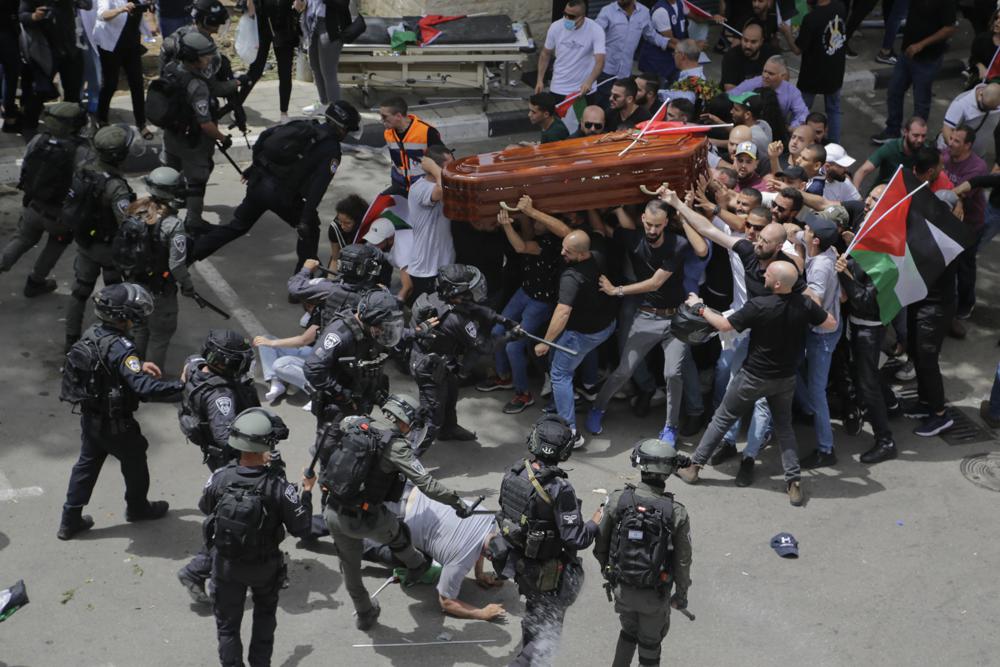
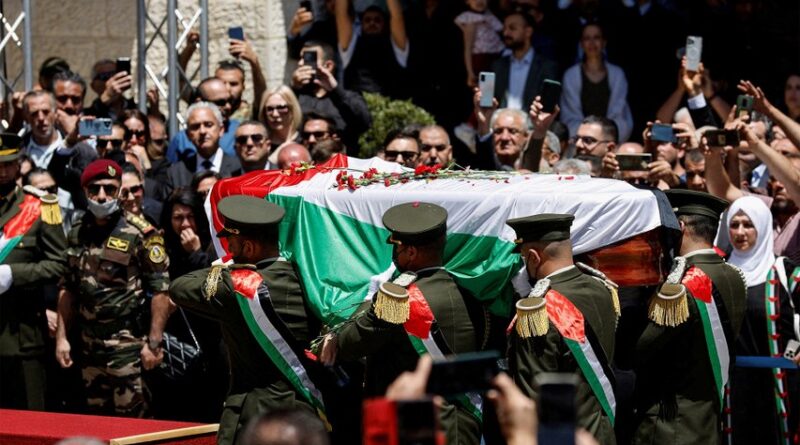
Israel Killed Reporter Abu Akleh—but US Media Disguised the Facts
ROBIN ANDERSEN

Mondoweiss report (5/11/22) on Shireen Abu Akleh’s killling.
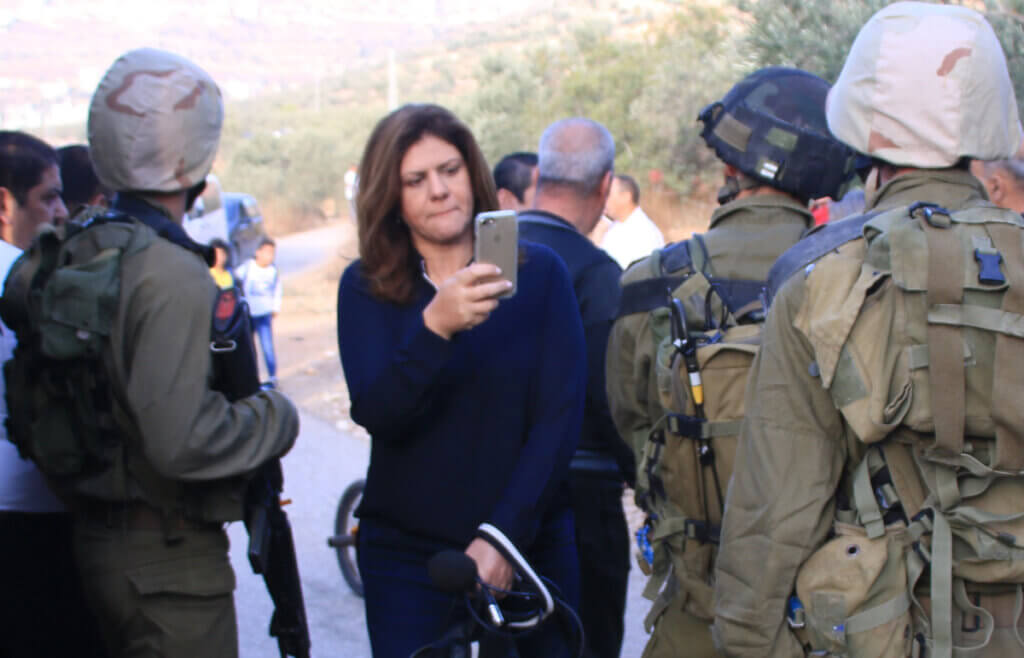
Palestinian-American journalist Shireen Abu Akleh, a well-known and much-loved Al Jazeera reporter who covered Palestine for two decades, was shot and killed by an Israeli sniper May 11 while documenting an Israeli raid on the Jenin refugee camp in the Occupied West Bank.
Footage of the moments after her death show Abu Akleh, still wearing her press vest and helmet, lying face down on the ground below a tree, as Shatha Hanaysha, another Palestinian journalist and writer for Mondoweiss, sits by her side and attempts to reach out to her. Writing for Mondoweiss (5/11/22), Yumna Patel described the video:
A young Palestinian man is then seen jumping over a wall behind Abu Akleh and Hanaysha. When he attempts to retrieve Abu Akleh’s body, another round of sniper fire can be heard, and he quickly takes cover behind the tree.
No armed combatants are there. Journalists are shouting for an ambulance. The young man tries a second time to remove Abu Akleh, but fails. He manages to help a shaken Hanaysha hide behind the tree. The footage is harrowing.

Shatha Hanaysha crouches near her slain colleague Shireen Abu Akleh—both wearing jackets that clearly identify them as press.
The Qatar-based news network interrupted its broadcast (5/10/22) with breaking news reporting that “an Al Jazeera correspondent has been shot by Israeli forces” and killed in Jenin. The network called it “deliberate,” adding that the killing of Abu Akleh was a “heinous crime which intends to only prevent the media from conducting their duty.”
Reporter Nida Ibrahim, on the phone from Ramallah, recounted the announcement of Abu Akleh’s death by the Palestinian Health Ministry, saying she was shot in the head. Her voice broke up as she talked about Abu Akleh’s dedication, her long experience covering Palestine, and the grief Ibrahim and her fellow journalists were experiencing. She carried on, saying, “This is the reality of Palestinian journalists covering the news”; unfortunately, they find “themselves part of the story.”
Outpourings of grief
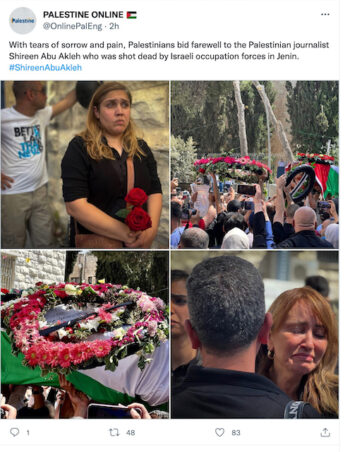
Twitter (5/12/22)
News of Abu Akleh’s death spread across the world at the speed of the internet, with outpourings of grief, tributes, and international condemnation for her killing. Journalists who have covered the Israeli occupation of Palestine provided context, hitting Twitter with art, videos, eyewitness testimony and images from Palestinian activists, advocacy groups and press critics, among many others. Clips of Al Jazeera footage were prominent.
Late Wednesday, the Israeli military posted an online video and an implausible scenario to deflect blame for the murder, a denial that, with a few notable exceptions, corporate media would assiduously repeat. Yet the documentation and eyewitness accounts continued to mount.
Mondoweiss‘s Hanaysha told Al Jazeera (5/11/22):
The [Israeli] occupation army did not stop firing even after she collapsed. I couldn’t even extend my arm to pull her, because of the shots. The army was adamant on shooting to kill.
Electronic Intifada (5/11/22) included the Twitter post of another Palestinian-American journalist—Dena Takruri, host of Al Jazeera‘s Direct From—who said, “Shireen was shot near her ear, where the helmet didn’t cover. This was a shot of extreme precision.”
Abu Akleh was taken in a private vehicle to a hospital in Jenin, where she was declared dead. The shot to the head killed her instantly. An Al Jazeera producer, Ali Samoudi, was also shot in the back by an Israeli gunman, but will recover.
At the hospital, Samoudi told reporters, “We were covering the raid of the Israeli occupation forces when they suddenly opened fire at us; the first bullet hit me and the other killed Shireen.” He went on to say, “They killed her in cold blood.”
WSWS (5/11/22) also reported that Samoudi confirmed that “there was no Palestinian military resistance at all at the scene.”
“We pledge to prosecute the perpetrators legally, no matter how hard they try to cover up their crime, and bring them to justice,” the Qatar-based network said in a statement (NBC, 5/11/22).
The Israeli response

The Israeli prime minister offered video of a Palestinian fighter firing a weapon as evidence that Israel’s military did not kill Abu Akleh.
The video the Israeli military posted online depicted a lone Palestinian resistance fighter shooting down an alleyway, purportedly evidence that the Al Jazeera team were victims of Palestinian gunfire. In a series of statements on Twitter (Mondoweiss, 5/11/22), the office of Israeli Prime Minister Naftali Bennett said:
According to the information we have gathered, it appears likely that armed Palestinians—who were firing indiscriminately at the time — were responsible for the unfortunate death of the journalist.
Israel’s claim was refuted by a number of sources, in addition to other eyewitness testimony. The Israeli human rights group B’Tselem’s field researcher in Jenin documented the location of the Palestinian gunman depicted in the Israeli government video. “According to B’Tselem, the location of the video is in a completely separate location than where Abu Akleh was killed,” Mondoweiss (5/11/22) reported, and “cannot be the gunfire that killed the journalist.”
NBC’s Raf Sanchez’s reporting from Jenin corroborated B’Tselem’s. He posted on Twitter (5/11/22) that NBC researcher Matthew Mulligan “has geolocated the Al Jazeera video” and found that the “area doesn’t match the alleyways shown in the video being put out by the Israeli government.”
A thorough debunking by human rights groups, witnesses and journalists aired on Al Jazeera (5/12/22) also exposed the online video as Israeli military fabrication. Using a map of the occupied West Bank, the network illustrated how occupation forces had a direct line of fire to where Abu Akleh was shot, while the Palestinian resistance fighter shown was too far away to have shot her, blocked as he was by alleyways and buildings.
Hagai El Ad, executive director of B’Tselem, told viewers that the Israeli version of events is based “on a false narrative designed to protect the perpetrators.” He explained the “impossible logistics” of the Israeli scenario, adding that he recognized this as a “trick” often used for the “blanket impunity that Israel provides for itself.” He went on to say that
Israel has a track record of not punishing its soldiers who have committed crimes against Palestinians, and it has never jailed one of its soldiers for the killing of a journalist.
Though it provides another point of evidence, the geolocation data is hardly necessary, as simply looking at the videotapes and listening to corroborating journalistic and eyewitness testimony renders Abu Akleh’s death at the hands of the occupation forces beyond dispute.
Attacks on journalists

Intercept (4/5/22): “The journalist will be told that the reports he posts on Facebook are considered incitement—and although he is only reporting news, the fact that that news is made public is tantamount to incitement.”
Many independent news outlets provided context by including numbers and details of journalists killed and wounded by Israeli forces. Though well-documented, the numbers may be different due to different criteria and the difficulty of recording.
Cross Currents (5/12/22) reported that since 1972, the Amman-based Center for Defending Freedom of Journalists, “has documented 103 deaths of Palestinian journalists and nearly 7,000 injuries, plus many detentions and imprisonments.”
According to the Palestinian Journalists Syndicate (Mondoweiss, 5/11/22):
Abu Akleh is the 86th Palestinian journalist to be killed by Israel since the occupation of the West Bank, East Jerusalem and Gaza in 1967. And since 2000, more than 50 Palestinian journalists have been killed, including six in the past two years.
In April, the Intercept (4/5/22) revealed the ongoing harassment, jailing, repeated interrogations and threats against Palestinian journalists, so severe that many abandoned the work of journalism. The primary charge against them was ‘incitement.’” Vice reporter Hind Hassan posted a string of horrific videos on Twitter (5/12/22) documenting Israeli attacks on journalists. One dated April 15, 2022, shows an Israeli police officer run across the Al Aqsa Mosque compound in a surprise attack, breaking the arm of journalist Alaa Sous with a baton smash (Mondoweiss, 4/22/22).
‘Armed with cameras’
The Middle East Eye (5/11/22) reported Israeli military spokesperson Ran Kochav telling Army Radio that even if soldiers shot at someone, “this happened in battle, during a firefight,” so “this thing can happen.” Kochav went on to say Abu Akleh was “filming and working for a media outlet amidst armed Palestinians. They’re armed with cameras, if you’ll permit me to say so.”
Numerous press advocates responded to this statement. Reporting on a tribute for Abu Akleh held at the National Press Club in Washington, DC, Cross Currents (5/12/22) called the accusation “an outrageous and egregious claim by any standard.” Reporters Without Borders has condemned Israel’s disproportionate use of force against journalists, saying under no circumstances should they “be treated as parties to the armed conflict.”
Vox (5/11/22) noted that if Abu Akleh’s was killed by the IDF, her death “will fit into a larger pattern of attacks on the press in Palestine and in the systemic violence against Palestinians more broadly.” It called the “armed with cameras” assertion “a not-subtle comparison between the work of journalism and that of violence.”
Viewing cameras as weapons, together with the history of escalating attacks on reporters and charges of “incitement” for bearing witness to Israeli attacks, makes clear that the Israeli government considers journalists to be the enemy, and by extension suitable targets for snipers. Because journalists document the actions of Israeli occupation forces against the Palestinians, they jeopardize the military’s continued ability to act with impunity. Repressing press freedom in the Occupied West Bank seems to now be part of the state’s increasingly militarized strategy.
Calling for investigation

Anadolu Agency (5/11/22) reported on Rep. Rashida Tlaib’s moment of silence for Shireen Abu Akleh.
The Turkish international news outlet Anadolu Agency (5/11/22) covered Rep. Rashida Tlaib’s moment of silence for the slain journalist on the floor of the House of Representatives, including Tlaib’s opening that quoted President Biden at the White House Correspondents’ Dinner:
We honor journalists killed, missing, imprisoned, detained and tortured covering war, exposing corruption and holding leaders accountable. The free press is not the enemy of people, far from it; at your best, you are the guardians of the truth.
Though she is a Palestinian American like Abu Akleh, no US corporate news outlet used Rashida Tlaib as a source for covering the slain journalist.
Tlaib also called on the US government to investigate the killing, saying that Washington should not allow “the same people committing those war crimes to do the investigation.” (Al Jazeera, 5/11/22). The International Criminal Court launched an investigation last year into possible Israeli war crimes (AP, 3/3/21).
In an interview between MSNBC news host Ayman Mohyeldin and on-the-ground reporter Raf Sanchez (5/13/22), Sanchez explained why the Palestinians don’t trust the Israelis to investigate Abu Akleh’s death. In 2018, he said:
I was in Gaza; an Israeli sniper killed a young Palestinian journalist called Yaser Murtaja. He, like Shireen Abu Akleh, was wearing a vest that clearly showed he was a member of the press. That was four years ago. The Israeli military said they were investigating then, and I asked them today to give me the report…. They sent me a very short statement saying that they had looked into the incident, they had determined that there was no criminal activity by any Israeli soldiers, and they had closed the case. That gives you a sense of why Palestinians feel that they are unlikely to get the full story out of the Israeli military.
Murtaja’s story also appears in the Intercept (4/9/18).
Palestinian rights advocates in the United States have called on the Biden administration to demand an independent probe into the killing of Abu Akleh, saying that Israel should not be allowed to investigate itself. Ahmad Abuznaid, executive director of the US Campaign for Palestinian Rights, said investigations are “empty gestures” if the probe is to be left for Israel (Al Jazeera, 5/11/22).
Addressing reporters at UN headquarters in New York, Palestine’s UN Ambassador Riyad Mansour (Al Jazeera, 5/11/22) said:
The story of the Israeli side does not hold water, it is fictitious, and it is not in line with reality, and we do not accept to have an investigation on this issue with those who are the criminals in conducting this event itself.
He said what is needed is an investigation that is “internationally credible.”
House Democrats demanded an independent investigation. Though US Department of State spokesperson Ned Price (Reuters, 5/11/22) called for a “thorough investigation and full accountability,” when asked whether the US would support an international investigation, Price repeated: “Israel has the wherewithal to conduct a thorough investigation.”
Al Jazeera reported the calls by US sources for an independent investigation, while most US corporate news repeated Israel’s demand to control any investigation.
US corporate coverage
The context of escalating Israeli attacks on freedom of the press and on journalists in the Occupied Territories did not enter the frame of most US news coverage. Instead, many used a back-and-forth blame frame for reporting the murder of a veteran war correspondent who knew well how to negotiate crossfire in the field of battle. This was acknowledged by Ali Samoudi, who said from his hospital bed, if there had been crossfire, they wouldn’t have been there.
Amidst the debunking of the Israeli messaging, by late Wednesday some news outlets, including NBC (5/11/22), noted that Israel “appeared to step back from that claim” that Abu Akleh may have been killed by Palestinian gunmen.
Yet most big media would continue to include Israeli messaging in their reporting, while failing to disclose any of the factchecking done on the Israeli video. They “balanced” on-the-ground testimony with Israeli statements, keeping the propaganda story alive.

CBS News (5/11/22) carefully avoided attributing responsibility to Israeli forces.
The second sentence of the CBS report (5/11/22) from Jerusalem said, “The broadcaster and a reporter who was wounded in the incident blamed Israeli forces, while Israel said there was evidence the two were hit by Palestinian gunfire.” The opening set the tone for a long series of opposing claims, in which every fragmented aspect about Israel and Palestine becomes a tedious set of contentions, rendering the truth incomprehensible.
The story included the “camera as weapon” comment, followed with the unrelated, “CBS News correspondent Imtiaz Tyab knew Abu Akleh personally,” adding more laudable details about the slain journalist. It continued, “Israelis have long been critical of Al Jazeera‘s coverage, but authorities generally allow its journalists to operate freely”—presented not as a requirement for democracy, but as a generous act of tolerance.
CBS said that the relationship between Israeli forces and Palestinian journalists “is strained,” and ended with a series of toned-down examples of Israeli attacks on journalists, without one unifying critical comment. It even included the killing of three Palestinian journalists, including AP (12/21/18) reporter Rashed Rashid in 2018, followed by: “The military has never acknowledged the shooting.” It failed to connect that history to Palestinian demands for an independent, international investigation into Abu Akleh’s murder.
The most disingenuous comments, which revolved around the investigation, were included early on. CBS offered fragments of truth—saying, for example, that US Ambassador Tom Nides called for “a thorough investigation into the circumstances of her death,” without saying by whom. It stated uncritically, “Israel said it had proposed a joint investigation and autopsy with the Palestinian Authority, which refused the offer,” with no explanation as to why.
The reporting illustrated how “balance” and fragments of disjointed “facts” have become a stylistic method to confuse and obliterate meaningful connections that drain compassion, outrage and demands for justice for the victims of state violence.

The New York Times (5/11/21) ran a home-page headline that could have run if Abu Akleh had died of natural causes.
In a similar manner, the New York Times (5/11/22) attributed Abu Akleh’s death to “gunfire” in the second paragraph. A second article posted later that day was more definitively structured by false balance: “The network and Palestinian authorities blamed Israeli troops for the killing. Israel said the blame could lie with Palestinian gunmen.”
ABC News (5/12/22) presented the same style of decontextualized back-and-forth, referring to a proposed Israeli investigation in the lead paragraph: “The head of the Palestinian Authority blamed Israel for her death and rejected Israeli calls for a joint investigation.” It evoked the “angry Arab” lexicon, saying, “Palestinian President Mahmoud Abbas angrily rejected that proposal,” while “Israeli Prime Minister Naftali Bennett accused the Palestinians of denying Israel “access to the basic findings required to get to the truth.” No mention was made of past Israeli failures to investigate the killing of journalists.
ABC dismissed the investigation into Israeli war crimes with one phrase: “Israel has rejected that probe as being biased against it.”
An end in sight?
When the Al Jazeera news anchor (5/10/22) asked Nida Ibrahim what could be done now, the reporter answered that a “powerful military occupation has been targeting journalists for years,” and if no one is brought to justice, “there will be no end to this.” She explained that Palestinian journalists are targeted by the IDF because “part of what we do is uncover the crimes,” or what the Israeli army doesn’t want to be shown. “Palestinian journalists will show you injuries where they’ve been shot by the Army or settlers,” she noted.
Responding to Representative Tlaib’s statement on the House floor, the New York Post (5/12/22) called it an “anti-Israel tirade,” charging that Tlaib was only interested in “slamming the Middle East’s only true democracy as it defends itself against terrorists.”

Chris Hedges (Consortium News, 5/17/22): “The execution of Abu Akleh was not an accident. She was singled out for elimination.”
Writing for Consortium News (5/17/22), former New York Times reporter Chris Hedges called Abu Akleh’s death an execution. “Assassination” may be a better word for her killing, but she did not simply “die,” as the New York Times reported. As the Chicago Sun Times (5/14/22) pointed out, “Palestinian Journalist Dies” is an “especially egregious” New York Times headline, “blatantly ignoring” that Abu Akleh “was struck by a bullet.”
That the state of Israel can continue to be labeled a “true democracy” after years of human rights violations, the repression of press freedoms and the extreme of killing journalists outright—not to mention that approximately 30% of the population under its control not allowed to participate in national elections—attests to the strength of the dominant narratives that have long guided US news coverage of Israel, recently identified by writer Greg Shupak in The Wrong Story: Palestine, Israel & the Media. The misleading and distorted frames of “both sides,” and “Israel’s right to defend itself” even as they are aggressors, are presented in a manner that benefits Israel.
Yet with the targeted killing of the globally prominent Al Jazeera reporter, as global calls for accountability mount (The Nation, 5/18/22), a crack seems to have appeared in the media armor of the Israeli military. Some US corporate media, most notably NBC, have shown a willingness to follow on-the-ground truth instead of Israeli fabrications. Other outlets, however, seem resigned to repeat increasingly implausible, transparently incoherent reporting that fails the basic test of decent journalism practices.
https://fair.org/home/israel-killed-rep ... the-facts/
*************************************
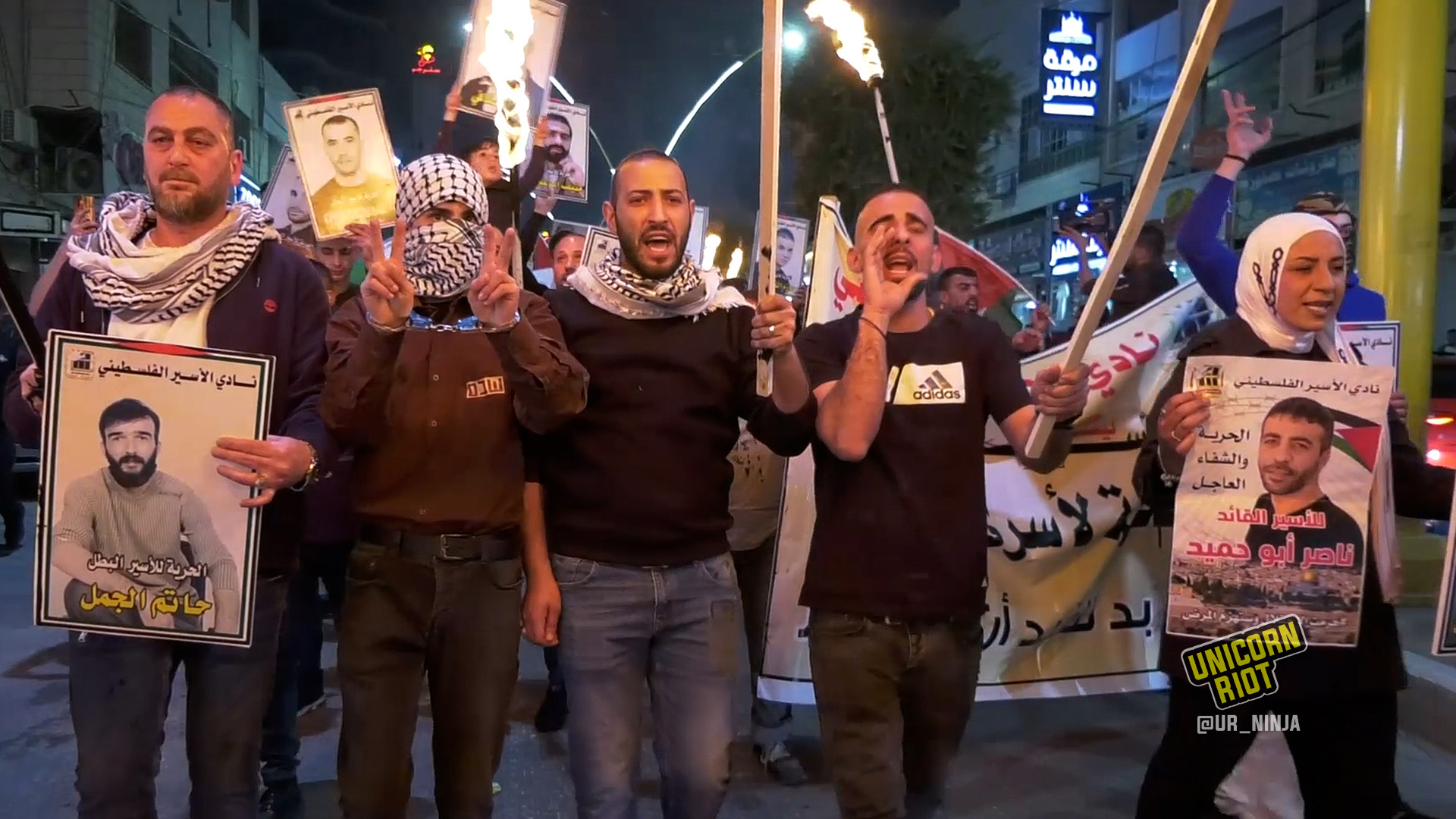
Israel records 1,200 Palestinians arrested in April

The information ensures that the number of Palestinian prisoners in Israeli prisons reached about 4,700 until the end of last April, including 32 women and 170 minors. | Photo: The Palestine Project
Published May 23, 2022 (23 hours 0 minutes ago)
The figure would include 165 minors and 11 women, in the midst of the holy month of Ramadan and the increase in Zionist evictions.
Some 1,228 Palestinians were imprisoned by the Israeli occupying forces during the month of April, according to figures released Monday by various non-governmental organizations led by the Wadi Hilweh Information Center in Jerusalem.
In the count, in which the Committee on Prisoners and Ex-Prisoners Affairs, the Palestinian Prisoners Club and the Addameer Foundation for the Care of Prisoners and Human Rights also participated, there are 165 minors and 11 women victims of Zionist imprisonment during the month of April.
According to these institutions related to prisoners' affairs reported that the Israeli authorities launched a massive campaign of arrests during the last month, which is the highest rate of arrests since the beginning of this year.
The statement indicated that the highest rate of arrests was recorded by the city of Jerusalem, where it registered 793 arrests, including 139 minors. According to the statement, Israel has issued 154 administrative detention orders (without charge), including 68 new orders and 86 detention extension orders.
Likewise, the communication indicated that the arrests were accompanied by "serious violations against the detainees and their families, as well as after their transfer to investigation and detention centers, in addition to the record of various injuries, including serious among the detainees, shot by the Israelis. ". army."
The set of institutions indicated that "the Israeli authorities fired on the detainees, in addition to using the policy of collective punishment that affected the majority of their families through vandalism and destruction of homes, and the use of police dogs and other methods. ”.
Finally, the information ensures that the number of Palestinian prisoners in Israeli prisons reached about 4,700 until the end of last April, including 32 women and 170 minors, while the number of administrative detainees reached about 600.
https://www.telesurtv.net/news/israel-p ... -0010.html
Google Translator
**********************************
Israeli academics and activists demand criminal probe into sale of Pegasus to Ghana
A former speaker of Israel’s parliament along with academics and activists in Israel have requested an investigation into the sale of the Pegasus software to Ghana in 2016 through a private reseller in a transaction that was judged as illegal and corrupt by the High Court in Ghana’s capital Accra in 2020
May 23, 2022 by Pavan Kulkarni
A criminal investigation has been demanded in Israel, six years after the NSO group sold its Pegasus spyware to Ghana, through a private Reseller to whom the responsibility of ensuring compliance with Ghana’s laws and human rights obligations was allegedly illegally outsourced.
On behalf of Israeli parliament’s former speaker, Avrum Burg, prominent sociologist Eva Illouz and 51 other academics and human rights activists, Advocate Eitay Mack wrote to the Attorney General (AG) of Israel, Gali Baharav-Miara, on Sunday, May 22, seeking a probe.
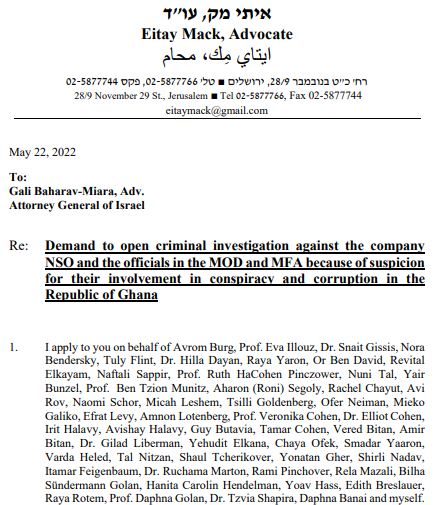
The complaint addressed to the AG asks her “to open a criminal investigation” into the allegedly illegal sale of the defense equipment by NSO to Ghana’s National Communications Authority (NCA) in 2016, through a Ghana-registered private company called Infralocks Development Limited (IDL).
Already under scrutiny in Israel and accused by journalists and activists across several continents of aiding violations of privacy and human rights, the NSO maintains that all its contracts with customers have clauses obliging compliance with all applicable laws – including those to protect human rights and privacy. In the case of Ghana, however, a reading of the contracts of this USD $8 million deal reveals that the NSO had actually placed these obligations, not on the NCA, but on IDL.
This little known private company based in Ghana’s capital Accra did not even possess the license to handle the export of Pegasus, according to the complaint. It further states that neither the NSO nor the officials in the Israeli Ministry of Defense (MOD) and Ministry of Foreign Affairs (MFA), who were involved in approving this sale, had verified whether this company was actually authorized by Ghana’s NCA.
When the equipment was exported to Ghana, set-up and demonstrated by NSO’s engineers in mid-2016, it was not installed in any premises of the NCA, but in a private residence. Yet, no investigation has been conducted by Israeli authorities, the complaint points out.
Years later, in May 2020, Accra High Court ruled that this purchase of Pegasus was corrupt, illegal and unauthorized. Two senior NCA officials involved in the illegal purchase – along with the then National Security Coordinator (NSC) at whose behest the former two had acted – were convicted and imprisoned by this judgment. Noting that the purchase, which had not been budgeted for, had caused significant losses to the state, the court had also ordered the seizure of US$3 million worth of assets from the convicted government officials.
Earlier this year, Channel 13 ‘Hamakor’ report aired footage of the Pegasus equipment in Ghana, along with testimonies of NSO’s engineers who had installed the equipment at the private residence, set-up the software and trained the local staff in operating it. However, no heads have rolled in Israel.
“It is shameful that the former Attorney General, Avichai Mandelblit, did not open an investigation on his own initiative,” Mack stated in the letter. He has asked the AG on behalf of the complainants “to open criminal investigation against the company NSO and the officials in the MOD and MFA because of suspicion for their involvement in conspiracy and corruption in the Republic of Ghana.”
Recounting that in an earlier complaint he had filed in 2018 “on exports to Guatemala, the MOD [had] refused to provide relevant documents to the Ministry of Justice”, Mack has sought measures to prevent concealment of evidence and “disruption of investigation”.
He has asked the AG “to order the immediate seizure of all existing documents in the offices of the MOD and MFA, and in the office of NSO, about the export license to Ghana, the minutes from the discussions that preceded the approval of the license, the transfer and physical assembly of the system in Ghana, and the training and day-to-day services that NSO workers gave for operating the system.”
No contract between NSO and its customer
Central to this case for criminal investigation is the fact the NSO did not enter into a contract with Ghana’s NCA, the end-user to whom Pegasus was being sold. Instead, on December 17, 2015, the NSO’s group’s sales manager Ori Magal signed a contract with IDL’s Director of Business Development, George Oppong. IDL was recognized as the reseller in this contract. IDL in turn signed another end-user contract with Ghana’s NCA. As a result, there was no direct contract between NSO and NCA.
As per the Israeli Defense Export Control Law, 5766-2007, IDL was required to procure an interim-user license to handle export of such equipment. “There is no doubt that the Pegasus system is considered defense equipment as defined in section 2 of the Control Law,” Mack argues. The contract with NSO, however, does not require IDL to procure such a license.
“There is no plausible explanation as to why the agreement does not state that NSO must also require an interim-user license for IDL,” the complaint explains. “This reinforces the wonder why a reseller company was required in the first place and encourages suspicion that it was convenient for NSO company and the officials in the MOD and MFA that the IDL will not be part of the official chain of licenses.”
It further states, “Even assuming there was some (unknown) reason to use IDL as a reseller and not directly sign a contract with the NCA, encouraging suspicion, NSO company and the officials in the MOD and MFA did not condition the export of the Pegasus system by IDL” on the confirmation of IDL’s authorization to make representations on behalf of Ghana’s NCA.
In the second contract IDL’s Oppong signed with Ghana NCA’s Director General William Tevie, the NCA did not validate, or even refer to, these representations. For instance, Section 17.5 of the contract between NSO and IDL states:
“The Reseller (IDL) hereby represents that under an agreement to be entered into with the End-User (NCA), the End-User will warrant that it and its respective employees and agents shall: (i) fully comply with all applicable privacy and national security related laws and regulation that are applicable to the use of the System, including by the way of obtaining consents and/or decrees to the extent required by law, and (ii) use the System only for prevention and investigation of crimes and will not be used for human rights violations.”
There is no such commitment made by the NCA in its contract with IDL. Despite the fact that this failure of the NCA to make such a commitment in its contract with the IDL is a contravention of the contract between NSO and IDL, the NSO went ahead with the sale.
This is also a contravention of NSO’s stated position that its clients commit in their contracts with NSO to use Pegasus only for the “legitimate and lawful prevention and the investigation of serious crimes and terrorism”. Its Transparency and Responsibility Report (TRR) of 2021 and Human Rights Policy 2019 reiterate that all its contracts with customers have obligations to not use Pegasus in a manner that violates any of the domestic or other applicable laws, human rights and rights to privacy.
However, as explained before, NSO did not even enter into a contract with its customer in Ghana. The contract its customer had was only with the reseller of its equipment. And no such obligations are placed on the customer in this contract.
“Are private resellers involved in the sale of Pegasus to other countries’ government bodies as well?”, was among the questions Peoples Dispatch had asked the NSO’s spokesperson in an email on April 10. Despite follow-up mails and several calls and messages, NSO’s spokesperson has not provided any response.
The absence of commitment to human rights, privacy rights etc in NCA’s contract with IDL is not the only irregularity, which should have stopped NSO from making the sale. Section 17.1 of the contract between NSO and IDL states:
“Reseller (IDL) hereby represents and warrants that the execution and delivery of this Agreement and the fulfillment of its terms: (i) will not constitute a default under or conflict with any agreement or other instrument to which the End-User (NCA) is a party or by which it is bound; and (ii) other than as specifically set forth in this Agreement, does not require any further consent of any person or entity.”
NSO accepted assurances from unauthorized private businessman
The NCA never gave the aforementioned assurances in its contract with the IDL. The May 2020 judgment of Accra High Court established that all claims made in these representations by IDL on behalf of NCA were false. However, IDL’s Oppong, who made these representations, was the only accused to be acquitted in this case.
The reason stated for his acquittal in the judgment was that he was “not a public servant but a private businessman” who was only “engaged as a reseller of the equipment.. (and) was not in a position to know the internal processes and procedures that NCA had undertaken before NCA embarked on the quest to procure the cyber equipment.”
This line of reasoning that a private businessman cannot be expected to know the internal processes of a government body is fairly obvious. “How do you explain the fact that the NSO had accepted the assurances given by a private businessman regarding a government body which he neither heads, nor is a part of?,” was another question the NSO did not answer.
In case the contract between NSO and IDL is terminated “for any reason”, it is this private businessman who is required by Section 9 to “cause the End-User (NCA) to return to the Company (NSO), all Confidential Information, including all records, products and samples received, and any copies thereof, whether in its possession or under its control”. NSO has not answered on what grounds it had convinced itself that a private businessman will be able to “cause” a government body to do so.
Despite the two contracts contradicting each other and NSO’s stated policy on imposing contractual obligations on its customers, NSO went ahead with the sale, with the evident approval of the MOD.
“Even after we have completed our internal human rights processes, we are closely regulated by export control authorities in the countries from which we export our products: Israel, Bulgaria and Cyprus,” NSO’s TRR states, implying that, in case of violations, the buck does not stop at its doorstep.
“The Defense Export Controls Agency (DECA) of the Israeli Ministry of Defense strictly restricts the licensing of Pegasus, conducting its own analysis of potential customers from a human rights perspective,” it adds.
The complaint addressed to the AG on Friday states “an investigation is needed against the director of the Defense Exports Control Agency (DECA) in the Ministry of Defense, and the head of the defense exports unit in the Ministry of Foreign Affairs, who were together responsible on regulating the export of the Pegasus system to Ghana.”
MOD’s regulatory authority is also recognized in Section 5.1 of both contracts, which subject fulfillment of the contract to several conditions, including “the approval of the IMOD for the provision of the License, System and the Services [to NCA] as set forth herein (the “Approval”)”. Section 5.2 adds. “For the avoidance of any doubt, no products, licenses, equipment or services shall be provided.. until.. the Approval is obtained.”
A six months-leeway is provided in the same section, which explains that if the Approval is not obtained within six months of signing, or if the Approval is denied, canceled or suspended, NSO retains the right to terminate the agreement. Before the end of these six months, on June 10, 2016, in a “Letter of Confirmation” to EcoBank Ghana Limited and to the NSO (written to fulfill a requirement for the processing of the payment of second installment of US$3 million to NSO), NCA stated:
“…as of June 10, 2016, the following terms were fully completed and accomplished:
1.The Hardware Equipment was delivered to the End-User’s site and installed on premises.
2.The Company (NSO) performed the Deployment, provided software set-up, installation and configuration services (the “Software Services”).
3.The Company (NSO) presented to the End User, on site, the capabilities of the system on a sample of two devices per each Operating System (i.e Android, IOS and Blackberry)”.
This letter, read in conjunction with the section 5.1 and 5.2 of the two contracts, indicates that since “products, licenses, equipment or services” were provided to the End-User, the MOD did give the Approval.
In an email on April 10, Peoples Dispatch asked the MOD to explain why it had given the Approval despite all the above stated irregularities. While assuring a response on follow-up phone calls, a month and half since the email, Peoples Dispatch is yet to receive a response. The article will be updated to reflect the same when and if responses are provided.
Was technical equipment operated in Ghana?
The letter and the contracts have come to public domain because, later in December that year, the ruling National Democratic Congress (NDC), which had signed the contract to purchase this spyware a year before election, was voted out. The new government formed by the New Patriotic Party (NPP) initiated an investigation in 2017, since when the matter had been brought before the Accra High Court, which gave its order in May 2020.
A five year jail term was handed to Salifu Osman, the National Security Coordinator at the time, and to William Tevie, who signed the contract with IDL’s Oppong as NCA’s Director General. NCA board’s chairman at the time of the purchase, Eugene Baffoe-Bonnie, who had profited US$200,000 from the deal, was given a prison sentence of six years.
Subsequently, when NSO’s spokesperson was contacted by Channel 13 before publishing their report in January 2022, his initial response was “NSO has never operated systems in Ghana.” The complaint points out that only after realizing that Channel 13 was in possession of footage, the NSO updated its response with:
“The chain of events in Ghana illustrates well the strict implementation of the ethics and human rights policy that the company has enshrined in its banner. After receiving all legal permits, the company installed the technical equipment in Ghana without operating it. A few months later, during the training for the client, significant questions arose from the Israeli training team regarding the ethics and manner of Ghana’s future use of the system. After the inspection, it was decided in an unusual manner not to allow the customer to operate the system.”
However, this claim that the technical equipment was never operated contradicts the letter on July 10, 2016, in which NCA confirmed otherwise to Eco Bank and to NSO. The Accra High Court’s judgment also established the fact that the equipment had been operated, by noting that the second installment of US$3 million, to process which the July 2016 letter was sent, was to be made only after Eco Bank receives:
“written confirmation signed by the end user confirming that the hardware equipment had been delivered together with assurance that NSO had performed the deployment, software set-up, installation and configuration services.”
After these conditions were met by NSO, the NCA paid USD $3 million to IDL, and IDL initiated the payment of the same to NSO. However, Ecobank did not process the payment. It sought more documentation to be in compliance with the Foreign Exchange Act. While this was being sorted with back and forth correspondences between the bank and the NSO, the government changed and investigation began.
“Contrary to the NSO response that it stopped its services in Ghana because of its ‘strict ethics’, according to the convicting ruling, it is clear that even after NSO realized that there was a problem transferring the balance of payments to its bank account and that its system was installed in a private apartment, the company and the officials in the IMOD and IMFA did not report to the Ghanaian authorities that they suspect something was wrong,” the complaint states.
“NSO’s decision to discontinue its services appears to have been only due to the cessation of payments, and in any case since it chose not to file in its own initiative a complaint and to conceal its suspicions, there is an impression that NSO preferred that no investigation be opened into a transaction in which it was involved,” adds the complaint filed by Mack on behalf of the parliament’s former speaker Avrum Burg and 52 other academics.
It is to be noted, however, that this discontinuity in services does not necessarily imply that Pegasus is presently not in use in Ghana.
Where is the Pegasus equipment now?
Ghana Business News reported in January 2022 that among those potentially targeted with the spyware in Ghana last year was Stanislav Dogbe, former aide to president John Mahama, under whose NDC-led government Pegasus was purchased in 2016. Others potential targets named in this report were NDC General Secretary’s son, Kweku Asiedu-Nketia, and David Tamakloe, editor in chief of Whatsup News, whom the report describes as “a known sympathizer of the NDC”.
Emmanuel Dogbevi, chief editor of the news portal and author of this report confirmed to Peoples Dispatch that all three had received an Apple alert notification, titled “State Sponsored attackers may be targeting your iPhone” in November 2021. Attempts to collect more information from Dogbe and Tamakloe in February have not been successful.
Several journalists and activists Peoples Dispatch spoke to are of the opinion that the Pegasus remains in use in Ghana. However, many opined, there is a sort of an omerta – a vow of silence – on the question of what happened to the equipment after the investigation and whether it is in use. Because the ruling NPP, which is reportedly using it against the opposition, as well as the largest opposition party NDC, under whose former government Pegasus was illegally purchased, are both now in the same boat. Rocking it is not in the interest of either.
Peoples Dispatch had also contacted Ghana’s NCA in February to inquire under whose authority or control is the Pegasus equipment currently placed, and whether NCA has any existing contracts with the NSO. Nana Badu, Director of Consumer and Corporate Affairs of NCA, replied, “The NCA respectfully refrains from responding to the questions.”
Section 9 of both agreements require that in case the agreement is terminated, the Pegasus equipment, along with any data gathered using it, should be returned to the NSO, and any copies made of this data should be erased. Neither the NSO nor the NCA has confirmed that the equipment has been returned.
If the Attorney General of Israel orders the criminal investigation demanded in this complaint, it could cause further trouble to NSO which is already under scrutiny. Prime Minister Naftali Bennett had said in February that the Deputy Attorney General was “looking quickly into” the well-documented allegations that police in Israel are using this military grade spyware on its own citizens, without securing any court order. Public security minister, Omer Barlev, also said that he would open an inquiry.
A complaint was filed in France in April by French-Palestinian human rights defender Salah Hammouri, whose phone was illegally infiltrated with this spyware. The International Federation for Human Rights (FIDH) and the Ligue desdroits de l’homme (LDH) are his fellow-complainants in this case.
Reporters Without Borders (RSF), along with two French-Moroccan journalists, Omar Brouksy and Maati Monjib, who had been facing persecution by the Moroccan government also filed a case in France last year.
“Other complaints will follow in other countries. The scale of the violations that have been revealed calls for a major legal response,” RSF secretary-general Christophe Deloire had said at the time. 17 other targeted journalists from seven countries including India, Mexico, Spain, Hungary, Azerbaijan, Morocco and Togo subsequently joined this complaint. The RSF has also referred all these cases to the UN.
https://peoplesdispatch.org/2022/05/23/ ... -to-ghana/