Blues for Europa

User avatar
blindpig
Posts: 14827
Joined: Fri Jul 14, 2017 5:44 pm
Location: Turtle Island
Contact:

Re: Blues for Europa

Post by blindpig » Tue Nov 26, 2024 2:38 pm

Correction of the EU trade rate
November 21, 10:44

Image

Changes in the EU trade balance after the start of the NWO.
In fact, one of the reasons for unleashing the war in Ukraine is the desire of the US to change the extremely negative trajectory for them. Ukraine is nothing more than a tool here. The war in Taiwan will be unleashed, among other things, to limit China's economic expansion in Europe.

https://colonelcassad.livejournal.com/9508222.html

Misconceptions about war
November 20, 20:07

Image

Misconceptions about war

In Latvia, the National Electronic Mass Media Council (NEPLP) has blocked access to five more websites that spread Russian propaganda, the official publication Latvijas Vēstnesis reports, LETA writes.

Access has been blocked to the websites voennoedelo.com, government.ru, e1.ru, km.ru and vesti-kaliningrad.ru, which publish materials that support and justify Russia's invasion of Ukraine and the annexation of its territories by Russia.

It is noted that the information posted on these websites "may create a false impression of the war unleashed by Russia in Ukraine, as well as contribute to the justification of war crimes committed by Russia in Latvian society."

NEPLP has decided to block access to the domain names and IP addresses of these websites, as well as their mirrors. Users of these resources will be redirected to the website nelegalssaturs.lv.

Previously, NEPLP made similar decisions to block websites that spread Russian propaganda.

https://press.lv/post/mogut-sozdavat-lo ... ih-sajtov/ - zinc

Excellent motivation. Purely Orwellian. You must have a "correct idea", which you will be additionally informed about.
And they are not even embarrassed to say that information does not create, but "can create". In fact, this is a thought crime.

https://colonelcassad.livejournal.com/9507794.html

Google Translator

******

European movements demand an end to US blockade on Cuba

European movements call for an end to the US-imposed blockade on Cuba, condemning disinformation campaigns that hinder the progress of the socialist project on the Caribbean island

November 25, 2024 by Ana Vračar

Image
Source: ICAP/X

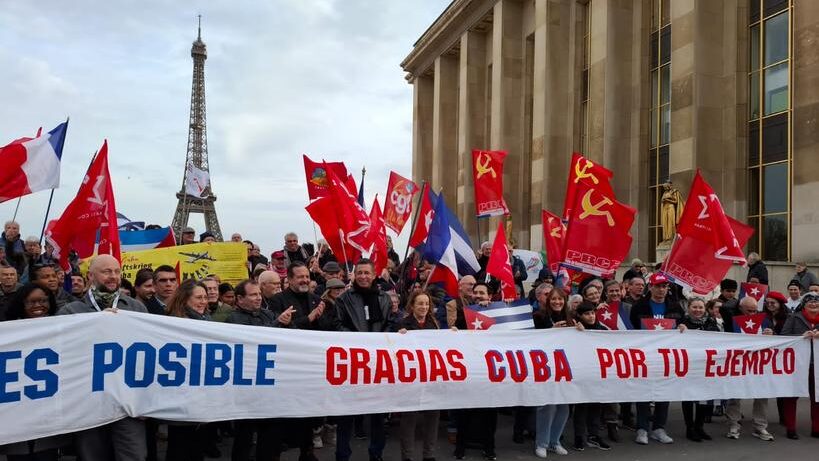
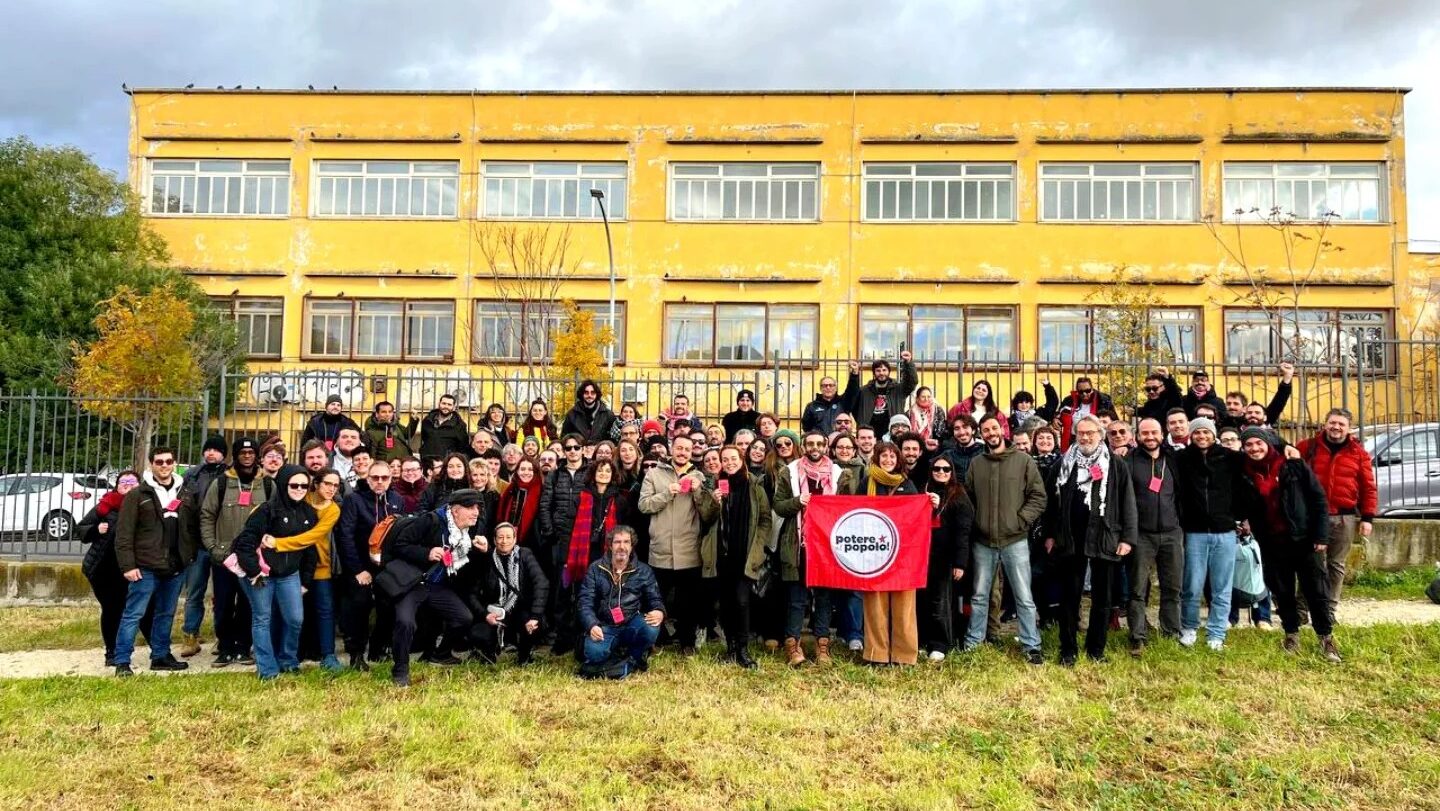
As Cuba continues to face the challenges of a US-imposed blockade and widespread disinformation campaigns, over 300 representatives of social movements, trade unions, and political organizations gathered in Paris during the weekend of November 22-24 for the 19th European Continental Meeting of Solidarity with Cuba. The delegates focused on strengthening ties between the Caribbean island and European countries, addressing the economic consequences of the blockade and everyday realities of life under these pressures.

The meeting produced a declaration outlining guidelines for European networks to counter mainstream defamation of Cuba, such as a campaign to end the country’s classification as a state sponsor of terrorism. In direct contrast to the stance of European leaders who align with the US-imposed blockade, participants expressed “unconditional support for the Cuban Revolution and its right to build the socialist project chosen by the majority of the people,” the Cuban Institute of Friendship with Peoples (Instituto Cubano de Amistad con los Pueblos, ICAP) reported in a statement.

According to Rodrigo Suñe from the International Peoples’ Assembly, the declaration “reaffirms unconditional support for Cuba’s right to continue building its path to socialism in a sovereign manner.” This, Suñe explains, will be achieved by “gradually and collectively” strengthening political solidarity with Cuba’s struggle against attacks led by successive US administrations.

Among these attacks, Suñe highlights the US-imposed blockade, designed to strangle the Cuban economy, and a “permanent media war” aimed at spreading manipulation and misinformation. He emphasizes that those in solidarity with Cuba must actively denounce and counter these campaigns. To achieve this it is essential to raise awareness and exchange information about the everyday realities of life in Cuba under the blockade. Reflecting this priority, part of the meeting focused on analyzing the blockade’s impact on Cuba’s economy, trade, and financial systems.

“We left the meeting with a mission to strengthen material solidarity by financing and implementing new cooperation projects, as well as promoting and organizing campaigns to send priority donations,” says Suñe. “To achieve this, it will be crucial to involve young people and expand their participation in building solidarity.”

On the final day of the conference, participants staged a protest in central Paris, reaffirming their call for solidarity with Cuba and urging European countries to radically change their approach. Currently, European Union member states continue to follow US policy on Cuba, a stance that, according to ICAP, does not reflect the interest – or the will – of the peoples of Europe. As part of the meeting’s conclusions, an appeal was launched for the EU to break away from US interference and remove the obstacles hampering its relations with Cuba, Rodrigo Suñe told Peoples Dispatch.

This work is particularly important given the escalating crises at a global level. “We are facing a very complex situation, with the deepening of the capitalist crisis, wars, and the rise of the far-right and its neofascist ideals. This is why we need to improve the quality of our articulation of internationalist solidarity,” explains Suñe.

The commitment to strengthening solidarity between Europe and Cuba will remain a key focus for ICAP and other organizations as they prepare for the next meeting, scheduled to take place in Turkey in 2026. Leading up to that event, Suñe says, the movements involved will focus on building a unified strategy to strengthen both political and material solidarity with Cuba, addressing the challenges discussed during their meeting in Paris.

https://peoplesdispatch.org/2024/11/25/ ... e-on-cuba/

******

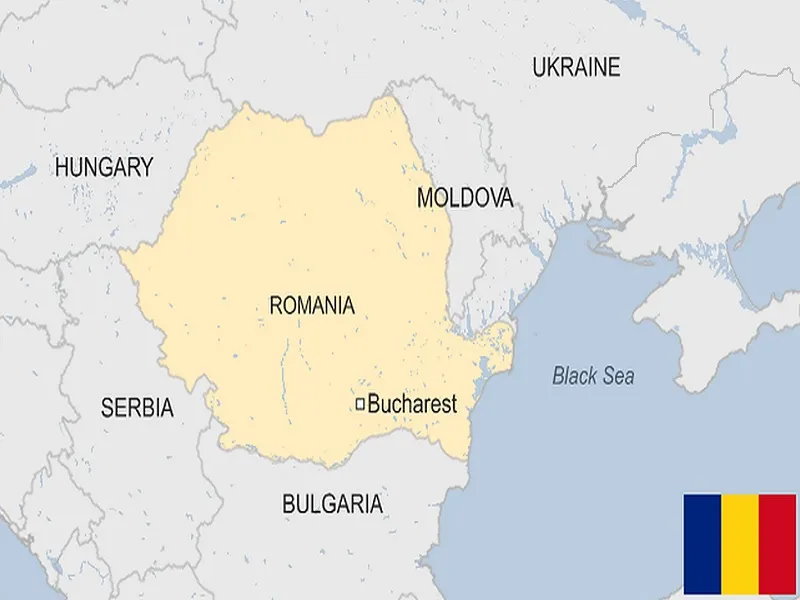
The Outcome Of Romania’s Presidential Election Could Spoil The US’ Potential Escalation Plans

Andrew Korybko
Nov 26, 2024

Image

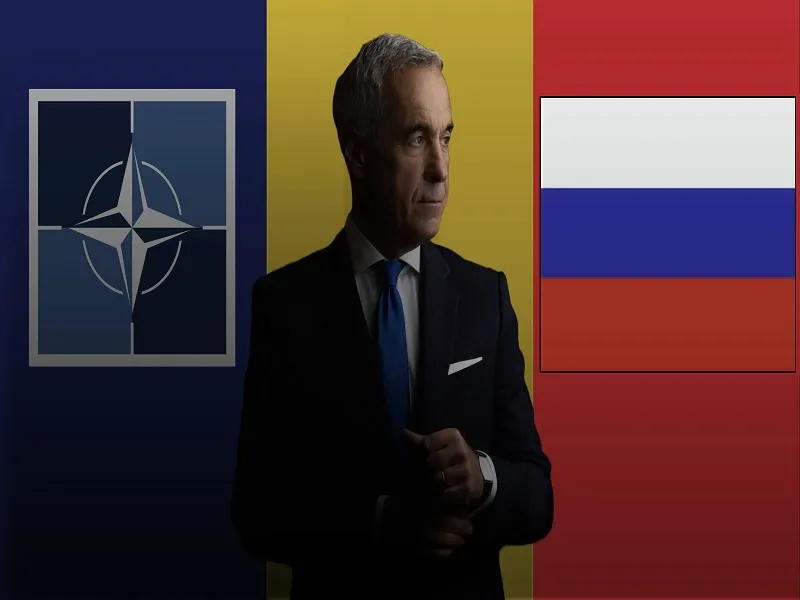
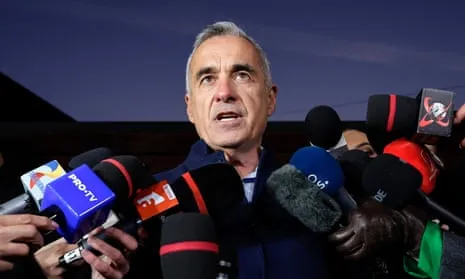
The populist conservative-nationalist frontrunner might refuse to allow NATO troops to transit through Romania as part of a conventional intervention in Ukraine if he wins the second round next month.

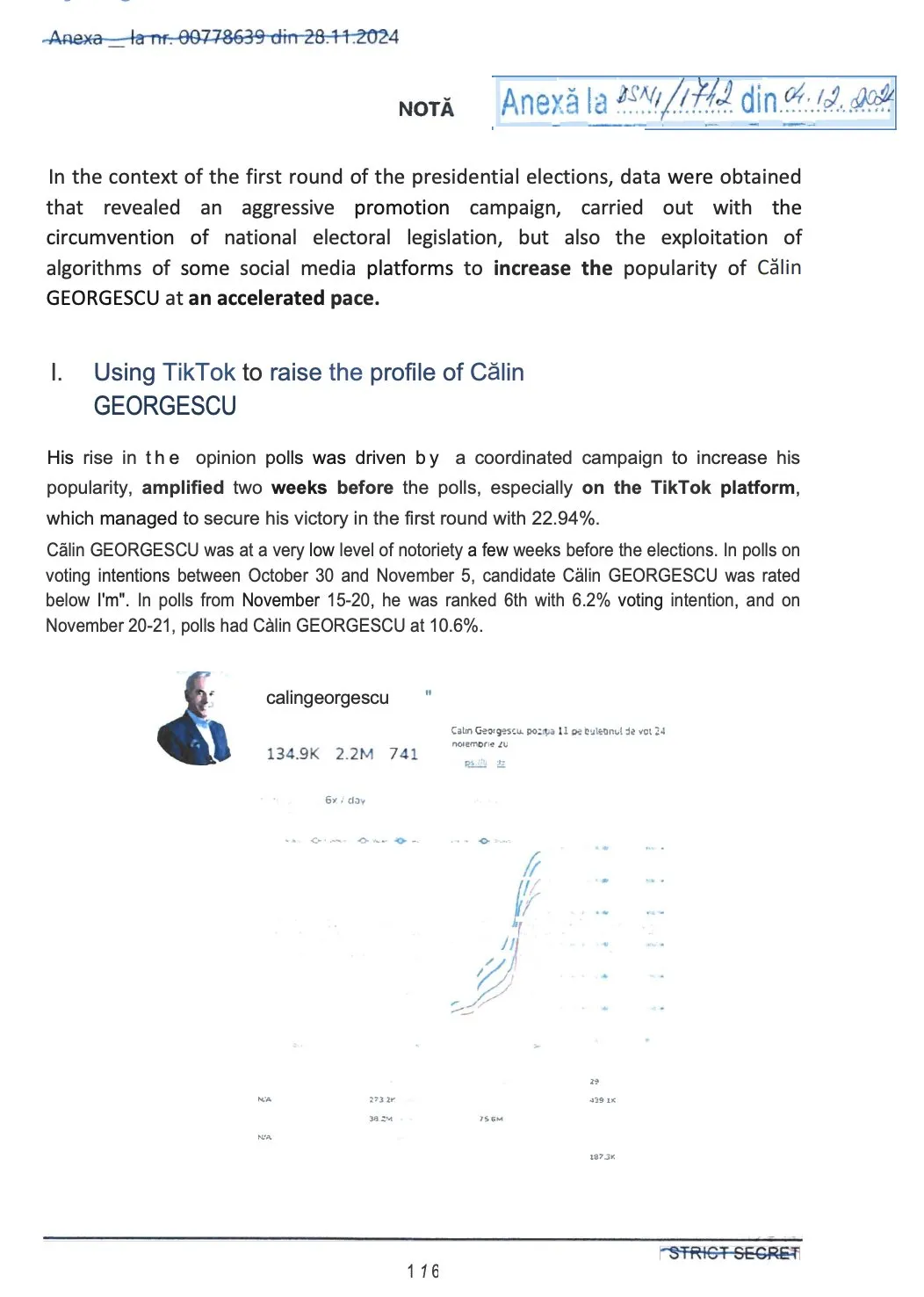
The surprise victory of populist conservative-nationalist Calin Georgescu in the first round of Romania’s presidential election gives this heterodox outsider the chance to enter into office next month. The Mainstream Media is apoplectic since he criticized Romania’s hosting of the US’ missile defense infrastructure and is against perpetuating NATO’s proxy war on Russia through Ukraine. He’s also a devout Orthodox Christian and praised some of his country’s most controversial World War II-era figures.

Interestingly, he was also the diaspora’s favorite, with the added twist being that more in Western Europe voted for him than those in Eastern Europe. This suggests that his appeal is also due to the hope that he’ll bring long-overdue accountability to his infamously corrupt country and finally help its people improve their living standards through more effective economic, financial, and developmental policies. Foreign policy is important, but local issues and economics far outweigh the former for average voters.

If Georgescu becomes President of Romania, he’s therefore much more likely to try to change his country’s internal workings than he is to radically transform its foreign policy, but it also can’t be ruled out that his potential victory could adversely affect NATO’s proxy war on Russia through Ukraine. Those who voted for him dislike how Ukrainian grain flooded their domestic market to local farmers’ detriment and also aren’t pleased with the government financially supporting Ukrainian refugees.

Additionally, the latest military-strategic developments in this conflict raised worries among many about the spectre of World War III, in which case Romania would be directly involved due to its hosting of the previously mentioned US missile defense infrastructure. Their country also plays an important logistical role in arming Ukraine and its newly built “Moldova Highway” could facilitate the deployment of NATO troops there if the bloc or a “coalition of the willing” therein decides to conventionally intervene.

Even if Romania doesn’t dispatch troops, the transit role that it could play in others’ intervention there could put a Russian target on its back, especially if this leads to direct NATO-Russian hostilities. For this reason and keeping in mind his criticism of NATO’s proxy war on Russia through Ukraine, he as Supreme Commander might not approve of these plans. After all, he’s a populist conservative-nationalist who prioritizes what he sincerely believes to be national interests, which this scenario is contradictory to.

If he wins, then he’ll assume office on 21 December, which could therefore make it impossible for the US to rely on Romania in the abovementioned respect from there on out. That would be significant, provided that Georgescu has the political will to implement such a policy, since it means that the outgoing Biden Administration might thus only have less than a month to do this if it wants to. After all, even if Trump decides to “escalate to de-escalate” through such means, he too might not be able to.

There’s always the possibility that Poland might serve as the only route through which conventional NATO troops could enter Ukraine, even if it doesn’t dispatch its own, but neither the outgoing conservative-nationalist president nor his liberal-globalist rivals in the ruling coalition might allow this. The reason is that both want to appeal to Ukro-skeptical voters ahead of next year’s presidential election, the first in order to keep the second in check while the second wants to finally be unrestrained.

That’s why each have been trying to outdo the other in populist rhetoric, with the ruling coalition even going as far as to trump the former conservative-nationalist government of which the outgoing president is a part by taking an even harder line towards Ukraine. To that end, they demanded that it exhume and properly bury the Volhynia Genocide victims’ remains like it earlier did for 100,000 Wehrmacht troops, and it’s now only offering more military aid in exchange for a loan and no longer for free.

In fact, one of the Deputy Prime Ministers went as far as accusing Zelensky of wanting to provoke a Polish-Russian War in Ukraine, which powerfully signals that the ruling liberal-globalist coalition isn’t really interested in facilitating a conventional NATO intervene there and thus can’t be relied on for this. If Romania is ruled out in this respect too should Georgescu win, assume office next month, and promulgate the proposed policy, then the US might therefore be more willing to cut a deal with Russia.

Therein lies the most globally significant consequence if this populist conservative-nationalist becomes President of Romania since it could greatly limit the ways in which the US – whether under the outgoing Biden Administration or the incoming Trump one – could “escalate to de-escalate” on more of its terms. By removing the likelihood of a conventional NATO intervention, the odds might then greatly increase for Russia ending this conflict on more of its own terms instead, which could lead to a more lasting solution.

https://korybko.substack.com/p/the-outc ... esidential

*******

German Steelmaker Thyssenkrupp to Cut 11,000 Jobs

Image
A Thyssenkrupp Steel Europe plant in Germany. X/ @FT


November 26, 2024 Hour: 7:04 am

The company cited weak demand in the steel industry and intensified competition as the primary reasons for the move.

On Monday, Germany’s largest steelmaker, ThyssenKrupp Steel, announced plans to cut 5,000 jobs by 2030 and an additional 6,000 through transfers to external service providers or the sale of business activities.

The sweeping restructuring plan will reduce its workforce from around 27,000 to 16,000 employees in response to rising costs and declining competitiveness. The company cited weak demand in the steel industry and intensified competition as the primary reasons for the move, and aims to lower labor costs by an average of 10 percent over the coming years to achieve competitive cost levels.

“We take our responsibility very seriously and want to create long-term prospects for as many of our employees as possible,” said Dennis Grimm, the company’s CEO. He emphasized the need for overall capacity reductions alongside cost-cutting measures to adapt to evolving market conditions.

As part of the restructuring, ThyssenKrupp is set to decrease its production capacity from the current 11.5 million tonnes to around nine million tonnes. This reduction aligns with the company’s shipment levels from the previous year and reflects future market expectations. The closure of its processing site in Kreuztal-Eichen is also part of the restructuring plan.

🇩🇪 – Germany is going through deep industrial crisis
• Country's industrial production has shrunk by around 5% over past ten years, with no recovery in sight
• High energy prices, labour shortages and increasing EU-China tensions are among main reasons for crisis pic.twitter.com/kjYwdzBLxX

— Agathe Demarais (@AgatheDemarais) November 25, 2024


Despite these changes, the company reaffirmed its commitment to a green transformation, including plans to complete the first direct reduction plant in Duisburg and explore the use of an electric arc furnace to further reduce carbon emissions.

Hendrik Wuest, minister-president of North Rhine-Westphalia state — where Thyssenkrupp Steel’s headquarters is located — described the job cuts as a shock to thousands of families and a significant blow to Germany’s industrial sector.

In an interview with the German newspaper Rheinischen Post, he urged the company to take its social responsibility seriously and work towards a fair agreement with social partners.

Germany’s Economy Minister Robert Habeck called for stronger support for the country’s steel industry in light of the announcement, according to the German Press Agency.

https://www.telesurenglish.net/german-s ... 1000-jobs/
"There is great chaos under heaven; the situation is excellent."

User avatar
blindpig
Posts: 14827
Joined: Fri Jul 14, 2017 5:44 pm
Location: Turtle Island
Contact:

Re: Blues for Europa

Post by blindpig » Wed Nov 27, 2024 3:15 pm

Wage disparities for healthcare assistants deepen Europe’s workforce crisis

Healthcare assistants across Europe face pronounced wage disparities, both internationally and between public and private sectors, exacerbating the ongoing health workforce crisis

November 26, 2024 by Ana Vračar

Image
Nurses’ protest at the Christiansborg Castle Square, Copenhagen in 2021 demanding pay rises. The strike was one of several which have occurred across Europe in recent years to protest conditions in the sector. (Photo: via Danish Nurses' Organization)

Healthcare assistants are a crucial part of Europe’s health systems, yet their wages remain among the lowest in the sector. A new report by the European Federation of Public Service Unions (EPSU) reveals alarming disparities in pay, with wages falling behind inflation amid skyrocketing living costs. Combined with increasing workloads and task shifting, this creates an extremely precarious situation for workers.

In a comparison of 15 European countries, EPSU’s researchers found worrying disparities in healthcare assistants’ salaries, with wages varying by as much as four times between different countries. In Germany, an assistant’s median hourly wage is approximately €20. In Romania, it is less than €5. Romania stands out as an extreme case, with the report noting that even degree-qualified nurses earn, on average, 22% less than the national median wage. This wage gap offers a clear illustration of the reasons behind Romania’s struggle with health worker brain drain.

The issue is not just the international disparities in wages. Salaries for healthcare assistants often fall well below average and median national incomes. In some cases, such as in England, Ireland, and Spain, some workers are paid as little as the national minimum wage. Despite this, they are tasked with important responsibilities, including assisting with patients’ personal hygiene, helping with meals, and even monitoring vital parameters.

Many of these responsibilities were originally part of nurses’ workloads but have been transferred to assistants as part of a broader trend toward “task shifting.” Mainstream health policy analysts often view task shifting as a way to redistribute workloads within a decimated workforce. However, when it comes to employers and policymakers, task shifting appears to be equated with the expectation that workers will take on more tasks with significantly less training and pay than before. For example, in England, healthcare assistant training can take as little as one month, compared to the three years required to become a nurse.

According to Can Kaya from EPSU, there is another important aspect of task shifting that cannot be overlooked when discussing health workers’ rights. While it is often presented as a technical solution to a real problem, in practice, it frequently ends up becoming a measure to cut corners – and costs – when developing health workforce plans. “It means shifting tasks to lower-paid workers in order to save expenses,” Kaya explains. As a result, healthcare assistants find themselves trapped at the intersection of workforce shortages and austerity.

The presence of trade unions can help in this situation, addressing both salary levels and workloads across sectors. If unions are present, even in the private sector, the wage gap tends to get less pronounced, explains Can Kaya. For instance, the situation is different between select Scandinavian countries, where solid unionization rates in private institutions help narrow wage gaps, and Italy, where trade unions are still stronger in the public sector.

In some cases, healthcare assistants in the public sector can earn 30% or more than their counterparts in private institutions, which are spreading across Europe. The largest differences between public and private wages are observed, in addition to Italy, in Ireland, Spain, and Cyprus. This highlights another factor contributing to wage disparities, as Kaya explains: “The private sector is a business, with the goal of maximizing profit, which it achieves by paying workers less. Commercialization is a driver of lower wages.”

The situation faced by healthcare assistants today highlights the failures in Europe’s health workforce strategy. “The current staffing crisis is a national as well as a European crisis,” says Kaya. While national governments have a responsibility to protect the health and care sectors, Kaya emphasizes that the European Union must also take action, including revising its fiscal rules. “Austerity will only exacerbate the existing staffing crisis,” he warns. More decisive action and investment at all levels of European governance are essential to stop staff shortages and ensure safe staffing levels.

https://peoplesdispatch.org/2024/11/26/ ... ce-crisis/

******

EU Nears Finish Line on Trade Deal With South American Bloc in an Effort to Deal Blow to China
Posted on November 27, 2024 by Conor Gallagher

The French at least are making their opposition to the proposed EU-Mercosur trade deal abundantly clear, and for once French President and World Economic Forum lackey Emmanuel Macron is listening.

French farmers protests are always laced with interesting strategies; here french farmers are covering Govt offices with manure ! pic.twitter.com/3FR8mFOmSr

— Ramandeep Singh Mann (@ramanmann1974) November 21, 2024


Macron is no stranger to being slapped and hit with eggs by the French, and potentially fearing what the manure protest tactic augurs for his future he continues to voice strong opposition to the EU-Mercosur trade deal.

The problem is that Paris doesn’t look to have enough bloc support to derail the deal, which is sailing towards approval next week.Let’s take a look at the proposed deal, what it means for the average European, and why the EU is so eager to get it finished.

What Is the EU-Mercosur Trade Deal?

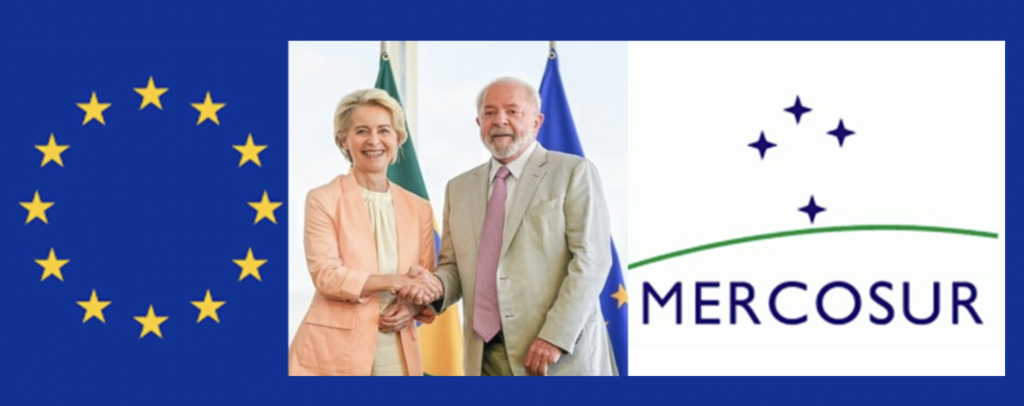
Chief negotiators from the EU and the Brazilian-led South American bloc of Mercosur countries are meeting in Brasília this week for final talks on their trade agreement that’s been under discussion for a quarter century. The big push from Brussels to get a deal done now is purportedly to help counter China’s influence in South America. Mercosur also includes Argentina, Paraguay, Uruguay and Bolivia as members.

The talks seek to establish one of the world’s biggest free trade zones that would cover about 750 million people and about one-fifth of the global economy. Here’s Euronews with more:

The FTA aims to remove tariffs on 100% of all industrial goods imported by the EU from the South American bloc. Meanwhile, Mercosur would remove tariffs on 90% of industrial goods imported from the EU, including cars, machinery, IT equipment, textiles, chocolate, spirits and wine.

“The tariffs on cars and car parts to Mercosur are currently 35%, which is very high. Machinery around 14%-20%, chemicals around 18%,” said Li. “So that’s why then countries like Germany will be very happy to see some of those tariffs go down.”

As the country is battling one of its worst crises, German Chancellor Olaf Scholz has repeatedly called for closing the deal saying that: “The Mercosur agreement is groundbreaking for diversifying and strengthening the resilience of our economy.”

It most certainly would strengthen the ailing German automotive industry, including struggling Volkswagen, BMW and Mercedes-Benz, as well as the German chemicals industry with companies like Bayer.

There’s reason to believe that the trade deal will not be a panacea for German industry. Aside from the country’s energy disadvantages due its Russia policy, China already has a heavy presence in South American auto market that appears poised to grow. From the Buenos Aires Times:

Chinese vehicle makers have pushed pedal to the metal in recent years. With multiple brands that combine price and quality they have managed to conquer the Latin American market, rising ahead of the United States and Brazil. In the last five years, China has quadrupled sales to the region. In 2019 it sold US$2.18 billion of cars, in 2023 it hit US$8.56 billion and 20 percent of the market to become the main supplier to Latin America, according to the ITC International Trade Centre.

The United States, which boasted the first position in 2021, reached 17 percent, whereas Brazilian vehicles dropped from 14 to 11 percent of the market last year.

In the budding market of electric vehicles, the dominance is even greater: 51 percent of sales in the region were from the Asian giant, while practically all electric buses are Chinese.

France is leading the opposition to the deal, and demanding that Mercosur farmers be subject to the same requirements as their EU peers. Much like its EU counterpart Germany, which opposed the EU tariffs on Chinese-made EVs, Paris knows its stance is largely symbolic as it doesn’t likely have the votes to shut the deal down.

“The government says publicly that they are opposed, but behind the scenes, they acknowledge they don’t have the strength and pretend to fight,” said Manon Aubry, an anti-Mercosur French MEP from the France Unbowed movement.

The reason France and other countries against the agreement are stuck is due to some clever maneuvering from the Ursula von der Leyen-led European Commission. Under normal circumstances, the deal would need to be ratified by all 27 EU member states, the European Parliament and all bloc national parliaments before taking effect.

The Commission, however, is splitting the deal into two parts: a broad cooperation agreement and a trade pact. This apparently allows it to skate through with a qualified majority of at least 15 member states to approve the agreement.

Image

And according to political watchers, Paris lacks the ability to pull together the qualified minority — representing at least 35 percent of the EU population — that it would need to block the deal when it finally goes to a vote among member countries.

Supporters and Ursula’s Commission are saying the deal needs to get done posthaste. Because if not the Mercosur countries will turn their backs on the EU and march down the aisle with China instead.

“If we don’t do a trade agreement with [Mercosur], then this void will be filled really by China,” incoming EU foreign affairs chief Kaja Kallas said recently.

The European Commission and Mercosur countries aim to conclude their long-running negotiations on a trade accord at a Mercosur summit next week, according to Politico.

Agriculture Risks

European farmers are sounding the alarm about the dangers in the deal not just to their economic well being but the general well-being of all Europeans.

That includes European food safety, animal welfare, and environmental standards and pay higher wages compared to that of the Southern American farmers.

European agricultural organizations are pointing to the lax standards of Mercosur exports compared to EU regulations. From Tri-State Livestock News:

DG SANTE’s audit highlighted significant gaps in Brazil’s ability to trace hormone use in its cattle exports to the EU, particularly estradiol 17β, a growth hormone widely used in Brazil but banned in the EU for over 40 years due to its potential cancer risks.

Despite these findings, the EU Commission has allowed Brazilian authorities to implement a ‘self-ban’ until they can guarantee hormone-free beef exports to Europe.

This decision has raised serious concerns about the adequacy of oversight and the reliability of Brazil’s self-regulation, especially considering the recent ‘Carne Fraca’ scandal which exposed severe regulatory failures in the Brazilian meat industry.

In addition to the livestock, there a major concerns about the safety of arable products:

Recurring difficulties in Brazil restricting the use of hazardous plant protection products and the increasing differences in terms of phytosanitary standards between Brazil and in the EU, makes the situation unsustainable and unacceptable for EU farmers.

For example, a forthcoming CEPM study shows that 52% of the active substances authorized for use on maize in Brazil and Argentina had been banned in the EU, some of them, such as atrazine, for over 15 years.

As far as sugar beet is concerned, there are around 30 active substances authorized in sugar cane in Brazil that are no longer authorized for use in sugar beet in the EU.

These differences cannot be explained only by different conditions such as climate, soil, or mitigation measures. EU farmers say an active substance considered dangerous for health or for the environment in the EU should also be considered dangerous in Mercosur countries.

No matter, Politico tells farmers to “calm down.” It’s no big deal says the outlet owned by Axel Springer, which excludes Politico employees from the requirement at its other media outlets to sign a mission statement expressing support for Israel transatlanticism:

…the tariff-free quotas Brussels has afforded the South Americans are low. For beef, these account for 1.6 percent of Europeans’ annual consumption by volume and a smidge more by value. It’s even less for poultry and sugar, which by volume weigh in at 1.4 percent and 1.2 percent respectively. Rice is below the single digit.

This of course ignores the fact that multinationals can easily absorb while already-struggling small scale farms could be sunk by even a small increase in unfair competition, which is precisely what free trade agreements do and thereby aid corporate concentration at the expense of small and medium enterprises. And I’m sure they’d never try to increase the quotas.

The deal is a big win for the evermore globally concentrated Big Ag. According to SOMO, “in the last three years, the profits of the five biggest traders in agricultural commodities tripled compared to the years before. Together, ADM, Bunge, Cargill, COFCO and Louis Dreyfuss Company (ABCCD) hold a monopoly position on the global market.”

It’s soon to get even worse. That’s because the EU and Ursula, who loves her tools, isn’t a fan of utilizing the competition policy toolkit. From SOMO:

…since the start of the EU Merger Regulation in 1990, only 88 out of 9243 notified mergers have been stopped. That is less than 1 per cent. Sixty cases that European regulators considered – and approved – involved the ABCCD agricultural commodity traders, including the 34-billion-dollar deal [inked this year and set to close in 2025] between agricultural giants Bunge and Viterra.

On the South American side, there are strong reasons to believe that the deal will lead to the following:

More fires and deforestation in the Amazon.
Escalation of invasion of indigenous territories, land-grabbing and violent attacks.
A disruption of local food production.
Increased use of dangerous pesticides.
Why Does the EU Ruling Class Want the Deal?

Trade between the two blocks is relatively small. European Commission data shows that in 2023 the EU’s exports to the four Mercosur countries was 55.7 billion euros while Mercosur exported 53.7 billion euros worth of goods to the EU.

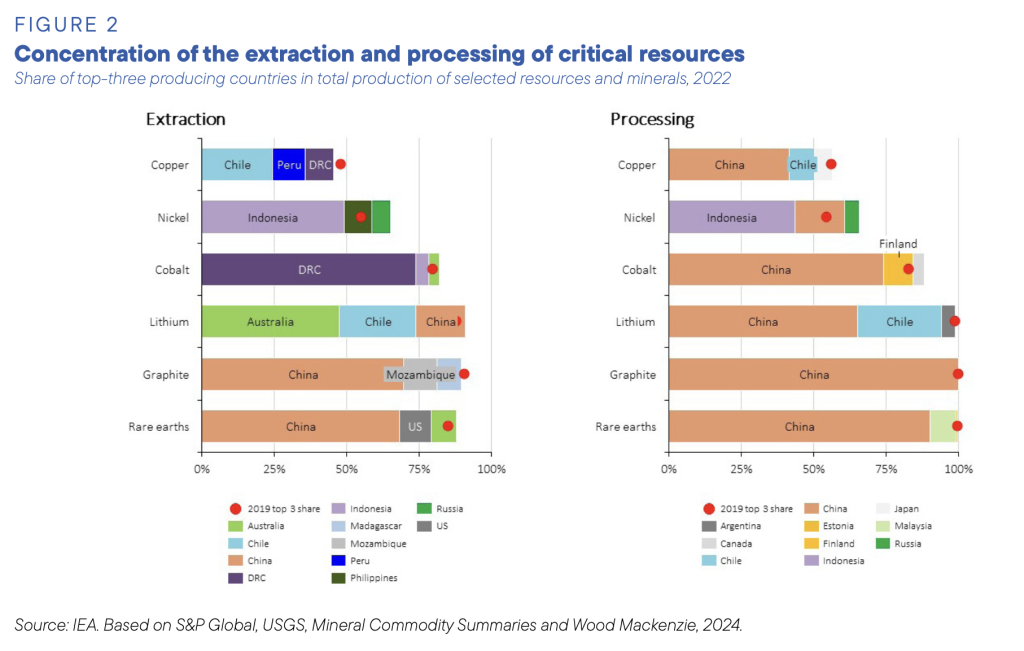
European farmers are in effect being asked to sacrifice supposedly for the EU — and America’s — strategic goals. The strategic aspect revolves around China and critical minerals.

While agriculture products are the largest slice of the Mercosur exports to the EU (32.4 percent), mineral products are second at 29.6 percent. The South American countries have plenty of what the EU is looking for, including lithium, graphite, nickel, manganese, and rare earth elements. The EU is currently almost completely reliant on China for minerals needed for EV batteries, solar panels, wind energy, and green hydrogen — all part of the bloc’s flailing green transition.

Image

Even if the EU is able to secure more critical minerals from Mercosur with this trade deal, who will do the processing? There’s still no clear answer. Von der Leyen likes to tout her tools like the bloc’s Net-Zero Industry Act (NZIA), which aims for the EU to process 40 percent of the strategic raw materials it uses by 2030. The NZIA allows projects to bypass many environmental and social impact reviews, but there’s no budget, and the policies do nothing to change Europe’s disadvantages, which include a lack of subsidies compared to the US and China and much higher energy costs thanks to their “de-risking” away from Russian energy.

Yet the “de-risking” — code for the EU’s eager role as a US proxy in the fight against Russia and China — continues.

Thus far, it’s mostly been a disaster on every level — strategically, economically, and environmentally.

The EU has yet to halt the rise of China (and Russia) with its derisking efforts. Far from it as both are likely stronger than before. Meanwhile, the EU is now wholly reliant on the US economically, militarily, and energy-wise.

Everyday brings worse economic news from across the bloc. The Swedish battery developer and manufacturer, Northvolt, last week filed for bankruptcy.

More frequently the bad news comes from the EU’s economic engine: Germany. Thyssenkrupp, the country’s largest steelmaker, proposed on Monday to cut 5,000 jobs and outsource another 6,000 is just the latest example.

The 2024 European Commission State of the Energy Union report touts that “With the Net-Zero Industry Act (NZIA) and the Critical Raw Materials Act, the EU took action to strengthen the competitiveness and the supply chain resilience of its clean energy technologies manufacturers.”

It offers no examples but amazingly notes that it “has swiftly acted by strengthening its international partnerships…but also by inviting strategic reflections of Mario Draghi and Enrico Letta.”

Over to you Signore Draghi. His much-anticipated September report managed to obfuscate the biggest reason the EU is suffering from a competitiveness crisis: its decision to cut itself from pipeline Russian gas. And his solution is not to rethink that choice but to double down on it while also gutting labor laws and embracing AI and more concentration.

On the green front, well, it’s anything but. The EU derisked from Russian pipeline gas, which plays a major role in the economic disaster currently hitting the bloc, and in the process dramatically increased its reliance on liquefied natural gas (LNG). According to the Institute for Energy Economics and Financial Analysis, “since the beginning of 2022, Europe has increased its LNG import capacity by 23%, or 58 billion cubic metres.” Much of it comes from the US.

Here’s the problem: the planet-heating pollution from American LNG exports is worse than that of coal. That’s because the production of shale gas, as well as liquefaction to make LNG and transport it by tanker, is energy-intensive.

Somehow these derisking plans always seem to screw over European workers while simultaneously failing to achieve any of the other goals, but the wealthiest continue to make off like bandits. It’s almost like that’s the point.

It’ll be the same with any EU-Mercosur deal.

That’s a small price to pay, according to the DC-based Center for Strategic & International Studies (CSIS), a think tank funded by the likes of the Charles Koch Foundation, Bank of America Corporation, Northrop Grumman Corporation, BP, Citigroup, Facebook, Johnson & Johnson, Microsoft, Raytheon Company, Amazon, Apple, IBM, and Disney. Here’s Lauri Tähtinen, a non-resident senior associate at CSIS, discarding any concerns with the trade deal and gifting us with his wisdom:

At a higher plane, both parties should wish for the conclusion of an agreement and so should the United States, as it shares an interest in the orientation of both EU and Mercosur countries away from China. This is because the rapid decline of U.S. trade in South America (in both absolute terms and relative to China) has also contributed to democratic backsliding. This does not mean that, in the world of diplomacy, the United States has an easy time advocating for two parties to reach an agreement that it is unwilling to arrive at with either party. In the world of trade diplomacy, it is also clear that some lobbies within the United States will be marginal losers if an EU-Mercosur deal is concluded.

This is why the role of trade diplomacy needs to be placed within a broader context. When Washington itself no longer looks to conclude trade deals, their broader benefits should be sought by proxy, as happened when a Japan-led coalition saved the Trans-Pacific Partnership (TPP). In the case of EU-Mercosur, both blocs have demonstrated that they remain capable of arriving at free trade agreements (FTAs), at least, with the correct, smaller counterparty.

So take comfort, European readers, as your standard of living continues to decline or if your farm goes bankrupt or if the imported agricultural products you ingest give you cancer. You simply don’t understand how trivial your concerns are because you’re not on “a higher plane.”

https://www.nakedcapitalism.com/2024/11 ... china.html
"There is great chaos under heaven; the situation is excellent."

User avatar
blindpig
Posts: 14827
Joined: Fri Jul 14, 2017 5:44 pm
Location: Turtle Island
Contact:

Re: Blues for Europa

Post by blindpig » Fri Nov 29, 2024 2:43 pm

General Strike of Transporters in Spain: Demands for Improvement of Labor and Early Retirement

Image
The demands of transport operators focus not only on better working conditions but also on the possibility of early retirement—a topic that has become relevant in a sector that requires high levels of physical and mental effort. Nov 28, 2024 Photo: EFE

November 28, 2024 Hour: 10:16 pm

The workers in the sector have stated that if their demands are not met, they will resume unemployment strikes initially on December 5 and 9, with the threat of an indefinite strike starting on December 23. Despite the broad mobilization, the trade union landscape shows internal divisions.

This Wednesday, Spanish carriers began a general strike that has paralyzed much of the sector, demanding improvements in labor conditions and the possibility of accessing early retirement before the age of 60.

The protest, led by the General Confederation of Labour (CGT) and supported by Workers’ Commissions (CCOO), has focused on urban buses and intercity buses, strategically choosing Thursday and Friday to maximize impact due to high passenger volume on these dates.

The workers in the sector have stated that if their demands are not met, they will resume unemployment strikes initially on December 5 and 9, with the threat of an indefinite strike starting on December 23. Despite the broad mobilization, the trade union landscape shows internal divisions.


The General Workers’ Union (UGT) and the Free Transport Union (SLT) have decided not to participate in the strike, arguing that they have reached an agreement with employers. However, CGT and CCOO criticize this agreement, pointing out that it does not guarantee the effective fulfillment of labor claims nor does it set clear deadlines for its implementation.

The situation is especially critical in Barcelona, where, according to sources from Transportes Metropolitanos de Barcelona (TMB), only 65% of buses are operational. This has led to thousands of travelers facing delays and cancellations, affecting both freight and passenger transport across the country.

The demands of transport operators focus not only on better working conditions but also on the possibility of early retirement—a topic that has become relevant in a sector that requires high levels of physical and mental effort.

The workers argue that the nature of their work, combined with long hours and constant pressure, justifies the need for earlier retirement than is currently mandated by law.

https://www.telesurenglish.net/general- ... etirement/

Sinn Fein Tests Its Power in Irish Elections

Image
Mary Lou McDonald cast her ballot on Nov. 29, 2024. X/ @MaryLouMcDonald

November 29, 2024 Hour: 8:45 am

During the campaign, the left-wing party proposed holding a referendum on Irish reunification before 2030.
On Friday, approximately 3.7 million Irish citizens are participating in general elections, where the leftist Sinn Féin (SF), the Christian Democratic Fine Gael (FG), and the centrist Fianna Fáil (FF) parties are locked in a tight race.


After years of coalition government involving centrists, Christian Democrats, and Greens, voters will elect 174 deputies from a pool of 686 candidates, 248 of whom are women. Among them is SF leader Mary Lou McDonald, competing against political figures such as FG leader Simon Harris and FF member Micheál Martin.

According to polls, all three parties are polling around 20 percent support, likely forcing them to seek agreements with one another and/or other smaller parties. Both Harris and Martin have expressed willingness to renew the coalition pact from the previous legislature if necessary, while categorically ruling out cooperation with Sinn Féin.

In this scenario, McDonald would need to gather support from the broader left—a strategy that failed in 2020 despite Sinn Féin winning the popular vote. That outcome led to the historic coalition between FF and FG, longstanding rivals since the Irish Civil War (1922–1923), who have alternated in power ever since.

Ireland's 3 main parties are almost neck and neck in the polls ahead of Friday's general election.

Unusually large numbers of immigrants have transformed the country lately.

In the small Irish town of #Ballaghaderreen, this has put a historic welcoming attitude to the test. pic.twitter.com/fcLGmE1EWk

— InfoMigrants (@InfoMigrants) November 28, 2024
The three leaders could also turn to the independent bloc, which polls at around 20 percent support, while smaller parties such as Labor, the Social Democrats, and the Greens, polling between 4 and 6 percent, present themselves as potential coalition partners.

During the campaign, Christian Democrats and centrists emphasized the strong performance of the economy and called for votes to maintain financial stability in a prosperous nation struggling with a severe housing crisis, deteriorating public services, and rising immigration.

Meanwhile, Sinn Féin centered its platform on addressing these issues in an attempt to replicate its electoral success from five years ago, adding a plan to hold a referendum on Irish reunification before 2030.

Polling stations will close today at 10:00 PM GMT, but the counting of votes from 43 constituencies will not begin until Saturday at 9:00 AM. Preliminary results may emerge by mid-afternoon, but final results could take days due to the complexity of Ireland’s single transferable vote electoral system.

https://www.telesurenglish.net/sinn-fei ... elections/

Leaked Document Forces Resignation of FDP Secretaries in Germany

Image
Bijan Djir-Sarai, 2024. X/ @pizz4lov3r

November 29, 2024 Hour: 8:14 am

The Free Democratic Party group planned to leave the governing coalition before Chancellor Olaf Scholz ended it.

On Friday, Bijan Djir-Sarai, the Secretary General of Germany’s Free Democratic Party (FDP), resigned after the revelation of a document indicating that his party had planned to exit the governing coalition before Chancellor Olaf Scholz ended it. Previously, Djir-Sarai had denied the existence of such plans and dismissed media reports on the matter as “outrageous.”

The document, published by the FDP itself and attributed to the party’s executive secretary, Carsten Reymann—who also announced his resignation on Friday—outlined a plan to leave the coalition. It detailed various communication strategy options and explicitly used the term “D-Day.”

In a brief press appearance lasting less than a minute, during which Djir-Sarai refused to take questions, he apologized for providing inaccurate information about an internal party document he claimed not to have seen beforehand.

For his part, Reymann stated that he had submitted his resignation to FDP leader Christian Lindner because he wanted the party to renew itself ahead of the snap elections on February 23. “The FDP is facing an important general election that will decide Germany’s direction. During the campaign, the FDP must go full throttle and avoid personnel debates that could hinder it,” he said.

Latest plot twist in Berlin: the FDP's Bijan Djir-Sarai exits stage left following the publication of the explosive "D-Day" paper. The document revealed FDP plans to break up the government coalition. pic.twitter.com/WDYpXRnoWH

— DW Politics (@dw_politics) November 29, 2024


The FDP was the smallest partner in the governing coalition formed over the past three years with the Social Democratic Party (SPD) and the Greens. The FDP’s distancing from its coalition partners had already pointed to an impending end, which accelerated after Chancellor Scholz dismissed Lindner as Finance Minister.

Following that decision, the FDP attempted to blame Scholz for the coalition’s collapse, but reports began to emerge suggesting that the liberals had a plan to leave the government. The published FDP document included a draft announcement of their departure from the coalition and considered several potential dates for making the move public.

In most recent voter intention polls, the FDP is currently below the 5% threshold, which would leave the party out of the Bundestag, the lower house of parliament.

The FDP has long played the role of a “kingmaker” party in German politics. It was an ally of the conservative bloc formed by the Christian Democratic Union (CDU) and the Christian Social Union (CSU) during the administrations of Konrad Adenauer and Ludwig Erhard. Later, it became part of the “social-liberal coalition” led consecutively by Chancellors Willy Brandt and Helmut Schmidt.

In 1982, the FDP turned its back on that coalition, supporting a constructive vote of no confidence initiated by the CDU/CSU, which brought Helmut Kohl to power. Since then, the FDP—having been in government throughout Kohl’s 16-year tenure—has been viewed as the natural partner of the CDU/CSU. Its entry into Scholz’s government was therefore regarded with skepticism from the outset.

https://www.telesurenglish.net/leaked-d ... n-germany/
"There is great chaos under heaven; the situation is excellent."

User avatar
blindpig
Posts: 14827
Joined: Fri Jul 14, 2017 5:44 pm
Location: Turtle Island
Contact:

Re: Blues for Europa

Post by blindpig » Tue Dec 03, 2024 2:56 pm

Poland’s Rotating Council Of The EU Presidency Is A Chance To Rebalance Relations With Ukraine

Andrew Korybko
Dec 03, 2024
Image

Tusk will likely remain a Europhile with pro-German tendencies at heart, but he might feel pressured to keep aping conservative-nationalist policies towards Ukraine up to the point of actually implementing them if he hopes to keep his political career.

Poland became Ukraine’s junior partner over course of the NATO-Russian proxy war instead of the inverse due to its politicians declining to leverage their country’s position as its neighbor’s lifeline for coercing economic and political concessions in exchange for aid. This naïve approach began to change in summer 2023 after the former (very imperfect) conservative-nationalist government complained about how the influx of cheap Ukrainian grain on the domestic market harmed Polish farmers.

The liberal-globalist coalition that then replaced them surprisingly continued this policy and even built upon it by then demanding that Ukraine exhume and properly bury the Volhynia Genocide victims’ remains as well as declaring that more military aid will only be given on credit and no longer for free. This last-mentioned policy followed Poland being excluded from the Ukrainian endgame after it wasn’t invited to mid-October’s Berlin Summit between the American, British, French, and German leaders.

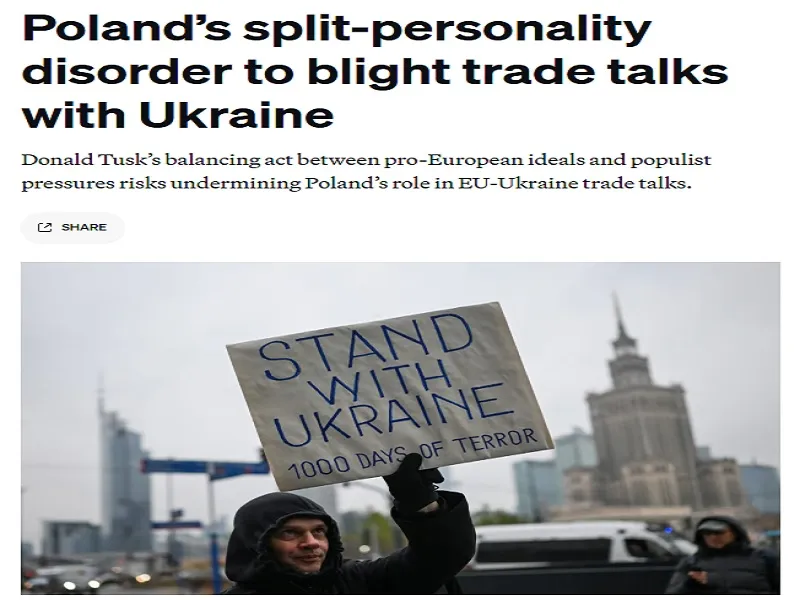
Returning Prime Minister Tusk is a Europhile with very pro-German tendencies, but he’s also an astute politician who knows that his party might not replace outgoing conservative-nationalist President Duda during next year’s election if it doesn’t at least make a show of putting Polish national interests first. This observation wasn’t lost on German-owned Politico, which published an unexpectedly critical piece on Monday about how “Poland’s split-personality disorder to blight trade talks with Ukraine”.

The gist is that Eurocrats should temper their expectations for a breakthrough in trade and other relations with Ukraine during Poland’s rotating Council of the EU presidency, which’ll last half a year from January to June 2025, due to the aforementioned domestic political reasons. They candidly explain how this is attributable to his balancing act that aims to keep the conservative-nationalist opposition at bay, but it’s still portrayed negatively in terms of the bigger picture.

One of the reasons for that is because the German-led EU doesn’t want Ukraine to make any economic or political concessions to Poland since that would reverse the state of strategic affairs whereby the former has become the latter’s senior partner over nearly the past three years. The problem from their perspective is that Tusk might feel coerced by domestic political circumstances into keeping up the tough guy act ahead of next year’s presidential election, which could further worsen Polish-Ukrainian ties.

In that event, seeing as how Poland is the geographic gateway to Ukraine, Warsaw might more assertively leverage its position as Kiev’s lifeline to either get what it wants or punish its neighbor. This could also impede third parties’ ties with Ukraine, in particular Germany’s post-conflict military aid and economic reconstruction plans, which could gradually rebalance Polish-Ukrainian relations. That outcome would be at the expense of what Germany envisages to be its hegemonic role over both.

There’s also the possibility that Tusk’s efforts are ultimately for naught and the conservative-nationalist opposition’s candidate for president beats the ruling liberal-globalist coalition’s, which could make it much more difficult for him to walk back his government’s newly hardline policy even if he wants to. Moreover, it could also create a fait accompli whereby this same approach continues for reasons of inertia, which could then characterize his government’s stance till the 2027 parliamentary elections.

After all, even if his party doesn’t win the presidency, it might not want to risk losing its coalition’s control over parliament by that time if he drops the tough guy act after the next election till then seeing as how fed up Poles are becoming with Ukraine. From the viewpoint of Germany’s hegemonic interests over Poland and its aspiring such ones over Ukraine, it’s better for Tusk to throw the presidential election by backing Kiev to the hilt over the next half-year than trying to help his own party win instead.

Tusk will likely remain a Europhile with pro-German tendencies at heart, but he might feel pressured to keep aping conservative-nationalist policies towards Ukraine up to the point of actually implementing them if he hopes to keep his political career as explained, which could lead to a startling transformation. In fact, this liberal-globalist has already overseen more conservative-nationalist policies in this regard than his predecessors from that ideologically opposite camp, which no one foresaw a year ago.

It's therefore possible that he continues being pushed in that direction for self-serving domestic political reasons, albeit imperfectly because there will probably remain some issues like abortion that he still feels strongly enough about to not change his policy, also calculating that it’ll help him win elections. On Ukraine, however, he’s already transformed into more of a conservative-nationalist than the opposition, and this opportunism is starting to scare the Eurocrats as evidenced by Politico’s latest piece about him.

https://korybko.substack.com/p/polands- ... -of-the-eu

******

Is Fear of Hybrid War With Russia Making Cash Great (Or At Least, Necessary) Again in Europe?
Posted on December 3, 2024 by Nick Corbishley

As unintended consequences go, this could be a big one.

Demand for cash around the world is at a 20-year low, according to De La Rue, the company that prints Britain’s banknotes. But fear of war with Russia as well as other unintended consequences of driving cash out of the economy is prompting some of Europe’s most cashless economies to rapidly reverse course.

A few days ago, The Daily Telegraph published an article warning that “Going Cashless Risks Playing Straight into Putin’s Hands.” As its title suggests, the article’s premise is that the West’s accelerating shift from physical money to digital transactions “may be leaving nations exposed to Russian cyber-attacks”:

Swedish families have this week received an ominous yellow leaflet. The cover shows an illustration of a female soldier with an assault rifle. In big black letters it says: “If crisis or war comes”.

The leaflet contains information on everything from how to deal with anxiety, how to staunch a bleeding wound and what to do if an air raid alarm sounds.

It also urges inhabitants to keep enough cash on hand for a week of essentials “preferably in different denominations” and to “use cash occasionally”.

The Swedish Civil Contingencies Agency, which is behind the brochure, says it will increase citizens’ “emergency preparedness”. Norway, Finland and Denmark have published similar guidance in recent months.

It is a significant shift for a group of countries that were on the cusp of going totally cashless.

Russia’s invasion of Ukraine has brought the threat of cyber attacks, sabotage and outright war closer to home in the Nordics. Payments networks could be a potential target.

Stash Cash in Case of a “Crisis or War”

Back in 2018, the then-deputy governor of Sweden’s central bank, Cecilia Skingsley, predicted that Sweden would probably be fully cashless by 2025. We are now less than a month from the start of that year yet rather than pulling the plug on cash, Sweden’s central bank is instead warning about the unintended consequences of driving cash out of the economy.

Those unintended consequences include exposing the country’s payments system to heightened risk of cyber attacks and cyber fraud. In response, the Riksbank is advising Swedish citizens to have at home at least 2,000 krona ($181) in cash in case of a “crisis or war”. In its 2024 payments report, the central bank also warned of “serious fraud problems that could undermine trust in the payment system.”

Sweden’s near-total abandonment of cash has unleashed a digital crime wave, prompting calls from the central bank to strengthen cash’s role in the economy. After playing more than a bit-part role in the wholesale removal of cash from Sweden’s economy, the Riksbank is now trying to reverse some of the damage it has caused. It is even considering bolstering legislation to force shops that sell government-deemed “essential” goods to accept cash.

The findings of the report may offer a cautionary tale at a time when the dominant narrative around cash — as espoused by senior bankers, central bankers, big tech and fintech executives, politicians and economists, and of course, their ever-faithful servants in the media — is that its demise is all but inevitable, even in countries where cash is still King (Germany, Spain, Austria, Mexico, Thailand, Japan…).

Sweden’s more or less equally cashless Nordic neighbours, Norway and Finland, are in a similar bind. Finland’s economy was until recently forecast to become totally cashless by 2029, but its central bank and government are also having second thoughts, particularly after the government’s decision to join NATO last year, placing it squarely on the front line of NATO’s war with Russia. A couple of weeks ago, Finland hosted its first ever NATO exercises.

In 2022, the Bank of Finland recommended that the use of cash payments be guaranteed by law and urged citizens to have at least three days worth of cash on hand in case of emergency. It’s not only the central bank that appears to be re-evaluating its approach toward cash: so, too, is the general public, with 95% of citizens considering it crucial for cash to continue serving as a valid payment method alongside digital alternatives, according to a 2023 survey by IRO Research for Nosto ATMs.

The war in Ukraine and Finland’s recent membership of NATO appear to have played a role in this shift. According to the survey, the conflict in Ukraine and concerns about supply security have affected the attitude of nearly one-third (28%) of Finns towards cash.

In Norway, where just 3% of in-store purchases involve cash, the government has gone even further by introducing legislation to protect citizens’ rights to use cash. In April, a press release from the Ministry of Justice and Public Security highlighted the importance of cash as an “always on” payment option, ensuring Norway’s economy will not be rendered completely inaccessible in the event of “prolonged power outages, system failure or digital attacks against payment systems and banks”.

Fomenting Fears of Russian Cyber Attacks

Perhaps unsurprisingly, the Daily Telegraph article focuses almost exclusively on the Nordic economies’ vulnerability to a Russian cyber attack, which is only one of the potential threats their payments systems face. The others include power failures and IT outages, neither of which get a mention in the article — perhaps because their inclusion would indicate that the fragility of cashless systems is a broad systemic issue that extends far beyond the risks of a Russian cyber attack.

The Telegraph, like most Anglo-American media, has been fomenting public fears about the risk of a Russian cyber attack since the very first day of Russia’s Special Military Operation in Ukraine. In the third month of the war (April, 2022), cybersecurity authorities from the “Five Eye” nations (US, UK, Australia, Canada and New Zealand) released a joint statement warning that more malicious cyber activity is on the way.

The statement was, above all, an exercise in projection. Both the US and the UK have significant offensive cyber war capabilities of their own, and the US has shown no qualms about using them. US intelligence agencies, at Obama’s behest, have already drawn up a list of potential overseas targets for cyber attacks. They presumably include Venezuela’s electricity grid, which, according to the Maduro government, has twice been the target of a US cyber attack — in 2019 at the height of the attempted Guaidó coup and just a few months ago, in the days following Venezuela’s contested elections.

On both sides of the Ukraine conflict, cyber operations appear to have had a constant but broadly muted impact. Even the Telegraph piece concedes that “Putin’s track record suggests a direct attack is unlikely”. The doomsday predictions of the world’s first ever “cyberwar” have so far not materialised, thankfully. But that hasn’t stopped the constant churn of warnings about Russia’s potential cyber threat. Just last week, the Chancellor of the Duchy of Lancaster Pat McFadden, whose role includes responsibility for national security, told a Nato meeting that the Kremlin could target British businesses and leave millions without power.

The threat is, of course, real: Russia has both the capability and the motive to launch a barrage of cyber attacks against Western targets. As long as NATO continues to escalate its missile attacks on Russia, the motives will grow. That said, European citizens should probably be more worried about what their own governments and central banks are capable of doing to them in a fully cashless economy. Even as Nordic central banks encourage citizens to begin using cash again, the European-wide push for digital public infrastructure continues regardless.

After quietly making digital identity a legal reality across the EU’s 27 economies this year, the EU Commission and the ECB now have their sights set on launching a digital euro in the coming years. Once that happens (assuming it does), it is unclear what kind of role euro cash will have in the Euro Area, but early indications suggest it will be at a disadvantage to the newly launched CBDC. Meanwhile in the UK, there is no telling just how dystopian a Starmer-led Britain could become given it is only in its fifth month. In that brief time, the government has:

*Proposed to create a dedicated digital ID office. Just as his mentor Tony Blair has recommended for years (and as we warned before the election), Starmer is prioritising the implementation of digital ID legislation. Speaking at a conference hosted by his Tony Blair Institute for Global Change (TBI) in central London in July, Blair conceded that the British public will need “a little persuading” to embrace digital ID, a suggestion that elicited rapturous applause and laughter from the audience. My guess is that the British public, like the 350 million citizens of the Euro Area, will have very little say in the matter.
*Unveiled plans to further expand the use of live facial recognition technology,
*Resurrected old Tory plans to grant inspectors at the Department of Work and Pensions increased powers to snoop on claimants’ bank accounts.
*Announced plans to pilot a Central Bank Digital Currency by 2025, carrying on Rishi Sunak’s controversial Digital Pound plans, with a “blueprint” expected by Christmas.
*Launched an unprecedented crackdown on lawful speech. According to a recent expose by Matt Taibbi and Paul Thacker, this crackdown extends far beyond British shores. The ultimate goal is purportedly to destroy Elon Musk’s X platform. The Starmer government is also using powers it already has — namely the UK’s anti-terror laws — to arrest and intimidate pro-Palestinian journalists and activists while participating directly in Israel’s genocide of Gaza.
*Called for the creation of digital health passports for NHS patients (another Blair proposal), prompting a backlash over concerns about digital privacy and the safety of patient data. The recent alleged cyber attacks on hospitals in the North West of England, causing chaos across in-patient and out-patient services, seriously challenges the wisdom of digitising all patient health data. To quote Prof. Sandra Watcher, a data ethics expert at the Oxford Internet Institute, “The idea of a data breach is not a question of if, it’s a question of when.”

Self-Inflicted Outages

The irony is that the worst payments outages of the past decade have been a result not of hostile acts from foreign adversaries but rather botched internal processes by banks, payment processers or third-party IT firms. In 2018, Visa’s Western European card network went down for over 10 hours on a Friday afternoon, plunging the UK and other European countries into chaos as millions of consumers were unable to use their Visa debit or credit cards at points of sale. The credit card company blamed the outage on a “degradation” in its processing system.

In July this year, the world suffered arguably its biggest ever IT outage after a content update by the cyber-security firm CrowdStrike caused millions of Microsoft systems around the world to crash, bringing the operating systems of banks, payment card firms, airlines, hospitals, NHS clinics, retailers and hospitality businesses to a standstill. Businesses were faced with a stark choice: go cash-only, or close until the systems came back online.

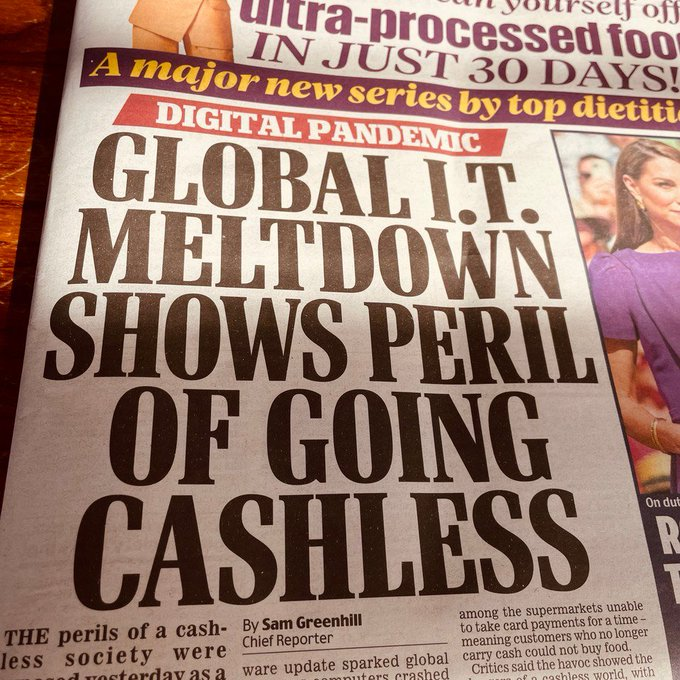
Such was the scale of the resulting disruption that even stalwart British media outlets like The Sun, The Times, The Guardian and The Mail ran articles on how the global IT outage had underscored the fragility of a cashless society. The Daily Mail plastered the message across its front page:
Image

The payment outages didn’t stop there. Over the weekend, Italy suffered a prolonged payment outage after construction on gas roadworks damaged payments company Worldline’s network connection. The outage hampered (apologies) sales during Black Friday, costing merchants around $106 million, according to a Reuters report.

On September 12, 250,000 card terminals in Germany — the equivalent of one-in-four of the country’s devices — stopped working, according to FAZ. Once again, the cause of the outage appears to be a software glitch, this time affecting the payment service provider Telecash. On the same day, outages were also reported in the Netherlands. It was the third large payment outage the Netherlands has suffered in just 15 months.

In late October, the Dutch National Bank (DNB) flagged the rising threat posed to the financial system by artificial intelligence, surging cybercrime and system outages. Cyberattacks against the financial sector account for roughly one-quarter of all attacks and can, in extreme cases, “make financial services temporarily unavailable” across the country’s entire financial system, the central bank wrote in its financial stability report.

“You have to take into account that you may not be able to pay by debit card for a longer period of time,” said DNB director Olaf Sleijpen. “Then you have to have cash under the mattress, or be able to pay with QR codes.”

One country that will not be advising citizens to prepare in this way is the UK (quelle surprise!). Although the Head of Britain’s armed forces, Sir Tony Radakin, recently told the Berlin Security Conference that the UK should take a leaf out of Sweden’s book, the Starmer government, like the Sunak government before it, has shown no interest in encouraging cash usage. Its official emergency preparedness guidance advises people to assemble an emergency kit of essentials to survive in the event of disruption – but they do not include cash.

A government spokesman told The Telegraph: “The UK has robust plans in place for a range of potential emergencies that have been developed, refined and tested over many years.” And that, I’m sure, will put our UK-based readers’ concerns at rest.

https://www.nakedcapitalism.com/2024/12 ... urope.html

*****

Lithuania slammed for expulsion of diplomats

Nation's 'persona non grata' declaration further frays bilateral ties, ministry says
By ZHAO JIA | China Daily | Updated: 2024-12-03 09:38


China on Monday strongly condemned and firmly rejected Lithuania's designation of some Chinese diplomatic personnel as "persona non grata", urging the country to abide by the one-China principle and foster conditions for the normalization of bilateral ties.

Without any explanation, Lithuania's Foreign Ministry declared on Friday some personnel working in the Office of the Charge d'Affaires of China in Lithuania "persona non grata" and demanded they leave the country within a designated time period, according to a statement released by China's Foreign Ministry.

Calling the decision wanton and provocative, China's Foreign Ministry spokesperson said in a statement that because of actions taken by Lithuania regarding Taiwan in recent years, the Baltic state is already in serious violation of the one-China principle and in breach of the political commitment it has made in the communique on the establishment of China-Lithuania diplomatic relations. "This has caused severe difficulty for bilateral ties," the statement added.

Beijing downgraded diplomatic relations with Vilnius to the level of charge d'affaires after the Baltic state allowed Taiwan authorities to set up a "Taiwanese Representative Office" on its soil in 2021.

"Three years on since the downgrading of bilateral ties with China, Lithuania has again taken detrimental action that further exacerbates the relations," the statement said.

Beijing called on Lithuania to immediately stop undermining China's sovereignty and territorial integrity, and stop creating difficulty for bilateral relations, the spokesperson said, vowing that China reserves the right to take countermeasures against the nation.

Foreign ministry spokesperson, Lin Jian, told a news conference on Monday that China has noticed that Lithuania is preparing to form a new government and many politicians have expressed their desire to improve relations with China.

He expressed the hope that the new government will adhere to the one-China principle and put bilateral relations back on the right track.

In another development, Lin reiterated China's firm opposition to any form of official interactions between the United States and Taiwan, and warned Washington against meddling in China's internal affairs.

Lin made the remarks as Taiwan region leader Lai Ching-te on Sunday discussed so-called China's military threats toward the island in a call with former US House Speaker Nancy Pelosi during his "stopover "in Hawaii on his way to the South Pacific.

He emphasized that the Taiwan question is at the core of China's core interests, and is the foremost red line that cannot be crossed in China-US relations.

He also urged the US to see the separatist nature of Lai and the Democratic Progressive Party authorities, and fully understand the grave damage that "Taiwan independence" activities do to cross-Strait peace and stability.

Separately, Lin encouraged Paraguay to establish a correct and comprehensive perception of the one-China principle, and make decisions that genuinely align with the fundamental and long-term interests of its people.

His comments at the news briefing came after Paraguay's Foreign Minister Ruben Dario Ramirez Lezcano visited the island on Friday, saying that Paraguay was open to establishing diplomatic, consular or commercial relations with China without conditions, but would not be willing to break its so-called ties with the island.

Paraguay is the only country in South America and one of 12 countries in the world that have so-called diplomatic ties with Taiwan.

"The one-China principle is a universally recognized consensus of the international community and a fundamental norm of international relations, which also serves as the political foundation and essential prerequisite for China to develop bilateral relations with other countries," Lin said.

He stressed the one-China principle concerns China's sovereignty and territorial integrity, leaving no room for "negotiation or compromise".

http://global.chinadaily.com.cn/a/20241 ... d0bc0.html


European elites are destroying Europe – again

November 29, 2024

The tragedy of Europe is not something mysterious or ill-fated. It is the direct result of elitist rulers who have assiduously conducted policies that harm European citizens.

One would think that having suffered two world wars only decades apart, European politicians might be more cautious about starting another one. Incredibly, however, the countries of Europe are being plunged into another conflagration.

Not much has changed over a century, it seems. War is still the result of imperialist intrigue and no accountability to the masses of citizens by arrogant politicians aided by relentless media propaganda lies.

European elitist rulers are a treasonous clique who are destroying Europe because of their abject servility to U.S.-led Western imperialism.

To put it crudely, Europe is being abused like a bondage plaything for the Washington and European elites. Shudder the thought of Ursula von der Leyen and Kaja Kallas in dominatrix garb or Keir Starmer, Emmanuel Macron and Olaf Scholz as the gimps. But sometimes, the truth can be stranger than fiction.

Russian President Vladimir Putin nailed it this week when he slammed European political heads who are “dancing to the tune of the Americans.” In an address to the Collective Security Treaty Organization summit in Kazakhstan, Putin said the crisis over Ukraine showed that European so-called leaders have no independence or autonomy. They are non-entities as far as serving the democratic interests of their nations is concerned.

Instead of pushing for a diplomatic solution to the worst conflict on the European continent since World War Two, European political elites are slavishly going along with Washington’s criminal proxy war against Russia, which is in danger of spiraling into a nuclear Armageddon.

This week the buffoonish former British Prime Minister Boris Johnson openly admitted that the conflict in Ukraine was a proxy war against Russia. But that didn’t give Johnson pause for thought or shame. He urged the Europeans to send more weapons to Ukraine. Nor did his crass candidness elicit any outcry or condemnation. Johnson, the imbecile, was, in effect, confirming what Russia has been warning is the essence of the conflict in Ukraine – a U.S.-led war using Ukrainian cannon fodder.

Then, we had the chief of Britain’s intelligence agency MI6, “Sir” Richard Moore, holding forth to an audience in Paris that Russia’s Putin was causing “staggeringly reckless sabotage” across Europe. The British spymaster claimed that Russia was threatening the continent with nuclear weapons to weaken NATO support for Ukraine. He omitted the glaring fact that the U.S., Britain, and France have dramatically escalated the conflict by supplying a NeoNazi regime in Ukraine with long-range missiles to strike Russia.

Meanwhile, the governments in Germany and Nordic countries are issuing dire public warnings for people to “get ready for war” by building bomb shelters in their homes and stocking up on non-perishable foods.

You could hardly make this insanity up except in the dystopian novels of George Orwell. The continent is being led by the nose to disaster by politicians and corporate-controlled media who have lost their minds. They long ago lost any self-respect or independence and are simply acting as the most pathetic surrogates for U.S.-led imperialism.

Even without the ultimate catastrophe of war, Europe has been brought to ruination by elitist politicians who have unquestioningly followed the American agenda of trying to strategically defeat Russia through a proxy war.

Central to this U.S. strategic objective is vanquishing decades of mutually beneficial energy trade between Europe and Russia. The sanctions imposed on the Nord Stream gas pipelines by Trump during his first administration, followed by the blowing up of the pipes by the Biden administration in September 2022, are testimony to that bigger picture. None of the European governments or their news media properly investigated that huge crime of state-sponsored terrorism.

The proxy war and sanctions on Russian energy that the European leaders happily went along with have caused the European economies to implode. Critical commentators talk about the deindustrialization of Europe.

Even the Financial Times, in a recent in-depth report on Germany’s “broken economy”, sounded aghast at “the most pronounced downturn in Germany’s postwar history.” The report surveys auto, chemical and engineering sectors crucial to the German economy and cites “high energy costs” as the detrimental factor.

However, the Western media, even in supposed “in-depth reports” like the Financial Times, are careful not to spell out the obvious cause of Europe’s economic collapse: the U.S.-led proxy war in Ukraine and the consequent damage in Europe’s relations with Russia.

Media reports deplore a “jobs massacre” in Germany’s industrial giants like Volkswagen and Thyssenkrupp without explaining the cause as if the calamity is somehow random misfortune.

As if that is not bad enough, the incoming Trump administration is lining up heavy tariffs on exports from Europe as well as China, Canada, and Mexico. That will be a coup de grâce for the European economies delivered by its American ally.

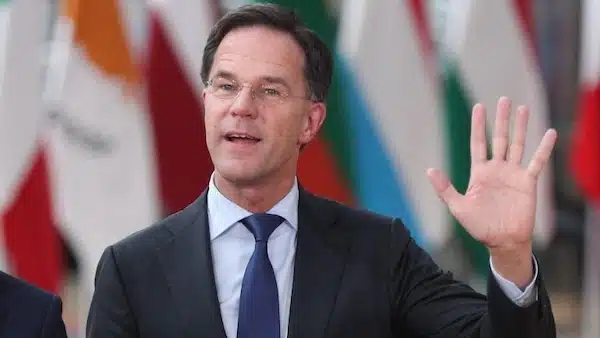
Europe is in this appalling predicament – facing economic ruin amid a potential military conflagration – all because it has been misled by people like Ursula von der Leyen, Josep Borrell, France’s Macron, Germany’s Scholz (and Angela Merkel before him), and Netherlands former premier Mark Rutte, who is now the gung-ho head of NATO calling for more European weapons to Ukraine. Many others can be named from the Nordic countries, Poland, and the Baltic states. Rather fittingly, the European elitist political class has a long and vile history of Russophobia, going back to collaboration with Nazi Germany in its genocidal aggression against the Soviet Union.

The tragedy of Europe is not something mysterious or ill-fated. It is the direct result of elitist rulers who have assiduously conducted policies that harm European citizens. These charlatan leaders are shameless in their Russophobia and surrogacy for U.S.-led Western imperialism – even to the point of killing their own people through economic devastation or worse – world war.

The conflict in Ukraine is solvable through negotiations and dialogue that acknowledges the historical causes. From Russia’s point of view that pertains to NATO’s treacherous expansionism since the end of the Cold War.

But this is the deep dilemma facing Europe. Not one of the politicians (apart from a few honorable exceptions) is capable of thinking or acting independently because they are ideological slaves.

Rational diplomacy and respect for democracy and peace are beyond these political degenerates. Their complicity in a bankrupt system of Western imperialism makes them incapable of doing the right thing for humanity. That’s why the vile history of wars keeps repeating. They and their corrupt, warmongering system must be swept aside.

https://strategic-culture.su/news/2024/ ... ope-again/

Josep Borrell’s double standard

Eduardo Vasco

November 30, 2024

While defending the competing approach in Ukraine, Borrell has been a strong critic of Israel’s extermination of Palestinians in Gaza.

At the beginning of November, the European Union’s High Representative for Foreign Affairs and Security Policy, Josep Borrell, went to Kiev to signal that the Europeans will continue their strong support for the Ukrainian armed forces in the war against Russia.

The visit took place shortly after Donald Trump’s victory in the U.S. – who has indicated numerous times that he intends to disengage his country from the conflict. “We have supported Ukraine from the beginning and today we are sending the same message: we support it in every way we can,” the diplomat said on the 9th.

When Borrell was in Kiev, the Institute of the World Economy in Kiel, Germany, calculated that the European Union had already allocated 125 billion dollars to the government of President Vladimir Zelensky since the beginning of the Russian intervention in February 2022. This is more than the amount sent by the U.S. (90 billion dollars).

While defending the competing approach in Ukraine, Borrell has been a strong critic of Israel’s extermination of Palestinians in Gaza. He has called the situation in the Palestinian enclave, where more than 44,000 people have been killed by Israel, a “human tragedy” and “the greatest humanitarian crisis since World War II.”

He has also indicated that Israel could be committing war crimes and, in November, he intended to suspend talks between the European Union and Israel due to violations of human rights and international law in Gaza.

Despite adopting a critical stance on Tel Aviv’s actions, it is absurd to consider the positions of the head of European diplomacy as anti-Semitic – something that Benjamin Netanyahu’s office has done. In 2022, he famously declared that the extermination of 5 million Jews by German Nazis in World War II was “the greatest tragedy in the history of humanity.”

A photo taken by Reuters reporter Gleb Garanich, however, helps shed light on the double standard behind Borrell’s apparent humanitarianism. While visiting an exhibition of military equipment used by Ukrainians in the conflict, he passed a tank covered in graffiti and drawings made by the military. These indicate that the tank belonged to the infamous Azov Battalion, as it had a drawing of its shield, with a Ƶ, next to a swastika.

The Ƶ , inside the Azov shield, is a Wolfsangel, one of the many emblems used by the German Nazis. And the swastika – well, the swastika…

The Azov Battalion is one of the most notorious participants on the Ukrainian side in the war. In fact, it was instrumental in starting the war. It was founded in 2014 by neo-Nazi elements who formed the shock troops of Euromaidan, a color revolution that overthrew the then Ukrainian government and replaced it with a junta influenced by far-right groups that, like Azov, have since become prominent in Ukrainian politics. The Azov coup was at the forefront of the new regime’s drive to suppress the uprisings in Donbass against the coup d’etat, which led to the conflict we see to this day.

“LGBT people and foreign embassies say that there were not so many Nazis who participated in the Maidan, that only about 10% were ideological [militants],” Evgeni Karas, leader of C14, a neo-Nazi militia, said in early 2022. “If it weren’t for these 8%, the effectiveness [of Euromaidan] would have fallen by 90%,” he commented, adding that without this, Euromaidan would have been nothing more than a “gay parade” – this kind of recognition only the most blatant extremists have the courage to make.

The movement that led to the overthrow of then-president Viktor Yanukovych and the rise of far-right organizations was sparked by the European Union’s dissatisfaction with the Ukrainian president’s stance, which preferred to maintain Ukraine’s neutral status by refusing to sign a free trade agreement with the bloc. One of Borrell’s predecessors as head of EU diplomacy, Catherine Ashton, soon traveled to Ukraine with Victoria Nuland, assistant secretary at the U.S. Department of State, where they met with representatives of neo-Nazi groups. The supposedly democratic façade of the protests, the NGOs, had been heavily funded by the European Union and the U.S. for many years before Euromaidan.

The triumphant members of Pravy Sektor and Svoboda – other neo-Nazi groups – took up positions in the judiciary, the Ministry of Defense and national security agencies. Six of the new governors imposed by the new regime were members of Svoboda, which until 2004 was called the National Socialist Party of Ukraine. In 2018, C14, the former youth wing of Svoboda, signed an agreement with the Kiev mayor’s office to patrol the city’s streets, meaning it was incorporated into the official forces.

Under Zelensky’s term, it was Azov’s turn to be incorporated into the National Guard as a regiment. Its militia, which guarded the streets, was placed under the supervision of the Ministry of the Interior and sent to operate throughout the country in conjunction with the national police. In late 2021, Dmytro Yarosh, former leader of Pravy Sektor between 2013 and 2015, became an advisor to the commander-in-chief of the Ukrainian armed forces.

In 2020, the Ukrainian parliament established the birthdays of seven notorious collaborators of the German occupation of Ukraine during World War II as official commemorative dates. Meanwhile, Azov members helped Zelensky persecute opponents. In 2019, they raided Viktor Medvedchuk’s house, and a year later, the regime’s main opponent was arrested for “treason,” according to Zelensky.

Neo-Nazis continued to receive awards and high-ranking government positions. In December 2021, the president awarded a leader of Pravy Sektor the title of “Hero of Ukraine.” This indicates the prestige of these sectors within the regime, but also a reward for their decisive actions on the battlefield.

Neo-Nazi groups have been on the front lines of the war since its beginning. Residents of Donbass still tell horrific stories of the horrors committed by Ukrainian infantry during the harshest period of the war, between 2014 and 2015. In Lugansk, where I was in the first half of 2022, the most barbaric were the Aidar Battalion. Another organization of neo-Nazi fighters, Aidar – like Azov – received funding from the oligarch Igor Kolomoisky, Zelensky’s main sponsor. Residents of villages in Luhansk will never forget, for example, the shooting of 18 people near the Novosvetlovska church, or the shelling of the church itself, where dozens of people were taking shelter. Soon after the Russian intervention, Zelensky appointed a former commander of the Aidar battalion as the new general administrator of the Odessa oblast.

Just like the front NGOs that paved the way for neo-Nazism to take power in Ukraine, these parties and armed militias were also – and continue to be – funded by the U.S. and the European Union. In 2016, some of the weapons sent by the Pentagon were sent to Azov. In late 2017, U.S. military officers provided field advice to the group. The Azov also received instructors and British grenade launchers from NATO countries shortly after the Russian intervention, as did the Pravy Sektor.

A report by the Institute for European, Russian and Eurasian Studies at George Washington University published in September 2021 indicated that the “Centuria” group, also of neo-Nazi orientation and formed by officers of the Ukrainian army, participated in joint military exercises between France, Germany, Poland, the United Kingdom, Canada and the United States.

Simultaneously with the takeover of state institutions by the fascist far-right, Ukraine has been falling apart economically. This is not only due to the war, but also to the high price paid by Kiev for its informal integration into the European Union: the transfer of public assets to private hands, whether of national oligarchs or foreign businessmen and banks. These are the “reforms” that a subservient government makes to adapt to the will of its guardians.

“Ukraine continues to advance with fundamental reforms to become a member of the EU, while at the same time fighting a war of aggression,” Borrell said in October, when presenting the annual report on the expansion of the European Union. He also said the bloc would “continue to support Ukraine on both fronts.” The European Union has already supplied more than 980,000 rounds of ammunition to Ukraine’s war with Russia, and Borrell has promised to supply a million by the end of the year. Around 15,000 civilians have been killed in Donbass since 2014 thanks to such support.

https://strategic-culture.su/news/2024/ ... -standard/

The first-round “surprise” in Romania’s elections: What does the Georgescu-Lasconi race mean?

Erkin Oncan

November 30, 2024

The roughly 350,000-vote difference between Georgescu and his closest competitor underscores the growing appeal of right-wing populist skepticism toward Europe.

Romania held its presidential elections last Sunday, with 13 candidates competing in a race where most polling predictions were proven wrong. Among these candidates, the most notable was Calin Georgescu, who ran as an independent.

Georgescu emerged victorious in the first round, where voter turnout was recorded at 52%. He secured over 22% of the vote, making him the frontrunner of the elections.

Elena Lasconi of the Save Romania Union Party (USR), representing liberal conservatives, came in second place. Meanwhile, current Prime Minister Marcel Ciolacu narrowly fell to third place behind Lasconi.

One of the notable candidates, former NATO Deputy Secretary General Mircea Geoană, announced his retirement from politics after his defeat. Geoană expressed concerns in an interview with Romanian media, stating:

“The level of disappointment and anger is pushing society toward a more radical choice.”

A shocking win in Western Media

Georgescu’s victory was described in Western media with terms like “surprise,” “shock,” and “earthquake.” This sentiment stems from Georgescu’s reputation as a relatively unpopular politician known for his anti-NATO and anti-Ukraine statements.

As he highlighted in one of his interviews, Georgescu conducted his entire campaign on TikTok. This unconventional strategy led many Romanian analysts to dub him a “product of TikTok.”

Who is Calin Georgescu?

Calin Georgescu, a 62-year-old right-wing populist, holds degrees from the University of Agricultural and Veterinary Sciences and the National Defense College in Bucharest.

Starting his career as a university lecturer, he later worked at the Ministry of Environment and served as Romania’s representative for the UN Environment Program.

This election is not Georgescu’s first political endeavor. In 2020 and 2021, the far-right Alliance for the Union of Romanians (AUR) nominated him for the position of Prime Minister. However, his candidacy was revoked following his praise for controversial historical figures, including pro-Nazi dictator Ion Antonescu and Zelea Codreanu, founder of the anti-Semitic Iron Guard. Georgescu even faced a criminal investigation for glorifying war criminals.

In a 2022 interview with Antena 3, Georgescu referred to these figures as “heroes” and claimed that “the Romanian nation lives through these heroes.”

“NATO base is a diplomatic disgrace”

Georgescu is also known for his anti-NATO rhetoric. He has labeled NATO’s ballistic missile defense system in Deveselu, Romania, as a “diplomatic disgrace” and argued that the alliance would not protect its members in the event of a Russian attack.

Speaking to Romanian journalist Mihai Tatulici, Georgescu advocated for Romania’s neutrality in the Ukraine war, saying:

“It is clear that the situation in Ukraine is being manipulated. The conflict is being orchestrated to serve the interests of the U.S. military-industrial complex. As a nation, our priority should be to remain neutral in any conflict. What happens there is not our concern.”

A vision for a sovereign Romania

Georgescu has openly criticized the European Union (EU), calling it a failed project that seeks to enslave Romania. He outlined his vision for the country as follows:

“The peace strategy must take precedence. This includes both external and internal peace. Everything begins here. Nobody has ever built anything through war. I can summarize my vision with three clear principles: First, our people’s genius lies in remaining 100% neutral in any conflict. Second, I want a sovereign state, one that is independent and uninvolved. Third, we must learn how to utilize our national resources independently.”

In another interview with Antena 3, Georgescu stated:

“We do not have a state. Without a state, people are nothing more than a herd, and the only entity capable of serving the nation is a state. Yet, this has nearly disappeared.”

Liberal-conservative candidate Lasconi

Elena Lasconi, Georgescu’s opponent in the second round, is a former journalist and mayor. She strongly supports Romania’s alliance with Ukraine. On the 1,000th day of the war in Ukraine, she posted on Facebook:

“1,000 days of courage, sacrifice, and the fight for freedom. Romania must continue to stand by Ukraine. I promise to ensure this steadfast support as President. This is not just Ukraine’s fight; it is a struggle for the stability and democracy of the entire region.”

Lasconi also expressed her strong support for NATO. In an interview with Radio Free Europe’s Romanian service, she emphasized the deterrent power of NATO troops:

“I believe it would be wonderful if we had more foreign troops in Romania because countries with well-trained NATO forces have never been attacked.”

A clash of ideologies

Georgescu’s arguments reflect a broader European trend among right-wing populists: emphasizing strong state authority, national revival, and economic self-sufficiency, alongside an anti-war stance. This approach has led many to label him as “Kremlin’s man.”

In contrast, Lasconi embodies a pro-European leader aligned with the current needs of NATO and the EU.

The political polarization in Romania mirrors that of other nations like Moldova, pre-war Ukraine, Serbia, and Georgia. On one side stands a Europe-skeptic right advocating for national sovereignty and strong state policies; on the other, a liberal-conservative faction deeply tied to Atlanticist structures.

While accusations of “Russian influence” often dominate these elections, it’s clear that the economic challenges, political instability, and heightened militarization driving voter concerns are far more tangible than alleged Kremlin meddling.

The roughly 350,000-vote difference between Georgescu and his closest competitor underscores the growing appeal of right-wing populist skepticism toward Europe, marking it as the West’s rising trend. However, Western analysts will need more than just “Kremlin narratives” to fully understand this shift.

https://strategic-culture.su/news/2024/ ... race-mean/

"There is great chaos under heaven; the situation is excellent."

User avatar
blindpig
Posts: 14827
Joined: Fri Jul 14, 2017 5:44 pm
Location: Turtle Island
Contact:

Re: Blues for Europa

Post by blindpig » Fri Dec 06, 2024 3:08 pm

Macron to Appoint New Prime Minister Following Barnier’s Resignation

Image
Macron announced that a special law to ensure the continuity of public services and life in the country will be presented to Parliament before mid-December, with a view to budget options for 2024 and 2025. Dec 5, 2024 Photo: EFE


December 5, 2024 Hour: 9:44 pm

“I fully hope that a majority can emerge to approve it in Parliament,” the president stressed, reaffirming his commitment to the functioning of public services and support for mayors.

In a recent speech from the Palais de l’Elysée, French President Emmanuel Macron confirmed that he will appoint a new prime minister in the coming days, following the resignation of Michel Barnier.

This announcement marks a crucial moment for the French government, which is seeking to stabilize its administration and strengthen governance in a complex political context. Macron stressed the importance of the new prime minister forming a government of general interest that represents all political forces.

“I urge you to form a government that can participate in it or at least commit not to censor it,” said the president. This statement suggests an intention to seek a broad consensus and collaboration between different parties, which could facilitate the implementation of key policies.

Adresse aux Français. https://t.co/irpXQN9qfN

— Emmanuel Macron (@EmmanuelMacron) December 5, 2024


The new premier’s priority will be budget management, a critical issue for the current administration.

Macron announced that a special law to ensure the continuity of public services and life in the country will be presented to Parliament before mid-December, with a view to budget options for 2024 and 2025.

“I fully hope that a majority can emerge to approve it in Parliament,” the president stressed, reaffirming his commitment to the functioning of public services and support for mayors.

To facilitate this process, Macron has scheduled meetings on December 6 with representatives of various political parties, including the Socialist Party and Les Républicains, with the aim of building consensus on the new prime minister’s candidacy.

Consultations will begin with parties on their side, including formations such as Renaissance and MoDem, before addressing opposition leaders.

This change in government leadership reflects not only the need to adapt to current political dynamics but also Macron’s desire to build a united front in the face of the challenges facing France.

As the new prime minister’s appointment approaches, the focus will be on how this leader can navigate a fragmented political landscape and work towards effective governance that benefits all French citizens.

https://www.telesurenglish.net/macron-t ... signation/

******

Why Did the French Government Fall and What Happens Next?
Posted on December 6, 2024 by Yves Smith

Yves here. When the French government just past was formed, experts anticipated that it would be weak and unstable, and that France might even prove to be “ungovernable.” Marine LePen’s Rassemblement National won a plurality in the first round of parliamentary elections. Its opponents worked together to have candidates withdraw in key districts so as to increase the odds that Rassemblement National would not win enough seats to form a government. But the increasingly unpopular Emmanuel Macron is a not-dislodgeable President, in office until May 2027, and lacks the political capital to make any messy coalition succeed.

Hopefully France-savvy readers will weigh in on this piece. One obvious lapse is its failure to mention military spending as a big part of France’s budget problems, which was the immediate trigger for the budget collapse. Even Professor John Mearshimer, hardly a France expert, saw fit in a recent talk that the obvious way to alleviate the budget fight would be cut arms expenditures, since lowering social spending would trigger more third-rail reactions. Rassemblement National and some of the leftist parties are NATO/Ukraine war skeptics. It seems highly likely that French voters generally would prefer lowering weapons spending first. But the US and NATO have succeeded in capturing many key political figures, starting with Macron, as well as a disproportionate share of the pundit-sphere.

This piece argues that Barnier forced the crisis by the way he formulated the question that led the government to fall, and put the ball in the Rassemblement National and leftist parties’ court. But that is not how the Twittersphere sees this. They put the blame squarely on Macron, as in he owns the crisis.

France will run on caretaker basis, with Barnier still in place. But no new legislation can be enacted until a new government is formed. It took Macron nearly two months to identify Barnier as an acceptable PM and get him approved.

So in a worst-case scenario, is Macron so selfish that he would refuse to resign to allow early Presidential elections and keep France limping in caretaker mode? The Parliament seems bloody-minded about forcing Macron out.

This is over my pay grade, but it seems if this stalemate persisted for much more than a month, at most two, Barnier might decide it is too unseemly to keep propping up this corpse. I would assume if the standoff continued and Barnier were to resign, Macron’s position would become untenable. But could he still hang on without even a caretaker PM?

By Simon Toubeau, Associate Professor, School of Politics and International Relations, University of Nottingham. Originally published at The Conversation

France’s shortest-lived government has fallen in a vote of no confidence triggered by a dispute over now-departing prime minister Michel Barnier’s budget.

The vote was led by the leftwing populists La France Insoumise and was supported by vote from the far-right Rassemblement National (RN) in an act that Barnier called a “conjunction of opposites”.

As Barnier warned, the situation is grave: France faces a difficult financial reality, and government instability and institutional paralysis will only exacerbate the problem. As President Emmanuel Macron moves to replace Barnier, everyone involved, from government to opposition, should consider how they arrived at this situation.

It was the persistence of the competitive and majoritarian instincts of France’s politicians that engendered this crisis. They should now accept that only a change in this kind of culture will help France out of its predicament.

These instincts were evident from the moment Macron dissolved the National Assembly and called early parliamentary elections in June, following his party’s poor showing at the European Parliament elections.

Anticipating that the RN might win an outright majority in the National Assembly, based on its results in the first round of elections (where it secured 32% of the vote), rival parties devised a joint strategy to stop it. They created a “republican front” that brought together parliamentarians from the far left, the centrists that make up Macron’s base and the centre right.

Parties in the alliance entered an electoral pact between the first and second rounds of voting, withdrawing their candidates where it would enable another to prevent the RN from winning the seat.

It was this tactic that meant that, after years of steady growth in support, the RN narrowly missed being in office for the first time. It also deprived France of a majority and created three political clusters in the parliament of roughly equal size, each one incapable of governing alone.

But while Macron’s group was content to partner with the others to keep the RN out of power, these noble sentiments evaporated when it came to governing. The economic ideology of each party was too different for them to find common ground. The centrists instead formed a minority government, a manoeuvre made possible by Macron’s centrists pleading with the RN to abstain during the government’s vote of investiture to ease its path.

Brinkmanship

While the RN enjoyed its new role as kingmaker, it didn’t hesitate to maintain its own competitive instincts when dealing with the ratification of the government’s budget – the cause of the current crisis.

The budget Barnier presented to the parliament was tough: €60 billion (£50 billion) needed to be found to correct a yawning deficit and to tackle a colossal public debt. To the government’s credit, it tried to spread the pain evenly (though not equally) across the board through a mix of tax increases and spending cuts.

To pass the budget, a compromise would have to be forged between the government and the RN. But here again, a strict majoritarian logic was at play.

The RN felt it wasn’t being listened to, and accused the government of being closed to dialogue. In that respect, the RN was correct. Barnier himself claimed to be willing to listen but not to negotiate.

Knowing it was the key to ratifying the budget, the RN drew its red lines and issued its demands, focusing on the measures that would be most immediately felt by voters. It wanted to suspend the re-introduction of taxes on electricity, and a U-turn on proposed cuts to reimbursements for medical prescriptions. It also called for an immediate indexation of pension payments.

The government conceded, first over the electricity prices, then over prescriptions, until Barnier finally decided that was enough. The government could not go further without derailing its plans to restructure public spending, and without losing face to blackmail.

And this is essentially what the whole exchange was about. The RN’s demands were also an act of retribution against the centrists and a reminder of its past threats to bring the government down.

Barnier is a seasoned politician with an acute sense of the game to which he was being subjected. So rather than put the budget to a vote in the National Assembly, he chose to make the vote one about the “responsibility of the government”. To do so, he cited a clause in the constitution that allows the government to pass a law without a parliamentary vote.

He did this knowing that the opposition parties’ only option to stop him would be to call a vote of confidence and bring down the government. Such a motion was brought forward by the leftwing New Popular Front group and supported by the RN.

Why would Barnier imperil the survival of the government in this way? It was a continuous display of the competitive and majoritarian logic, to put the ball back in the RN’s court and force it to confront the risks that its own behaviour carries.

What Happens Next?

The RN now has to navigate the unchartered waters into which it has pushed the country. The government has fallen, but fresh elections can’t take place until July. A technocratic caretaker government will take over in the meantime, leading to paralysis in the French political system.

But this paralysis has rattled credit markets and increased the price of borrowing for the French government. This is a problem for the government but it is also a problem for the RN if the electorate perceives it to be responsible.

Many of the RN’s core supporters have an anti-system attitude. They oppose the government and always will because it is part of an establishment.

But the RN will never win office, and certainly not the presidency, by relying solely on this core base. It needs support from moderate centre-right voters, including those with economically liberal inclinations, who prize economic stability above all. Alienating them is not an option.

As Barnier had intended, the budget dispute has highlighted these internal tensions and harmed the RN’s prospects.

The RN’s most likely tactic in response is to try to shift the blame back onto the government in the hope that Macron can do nothing else but resign. Marine Le Pen is waiting in the wings.

https://www.nakedcapitalism.com/2024/12 ... -next.html

******

Majdanek and the New Normal
December 5, 21:09

Image

Majdanek and the New Normal

In the neighboring barracks there is a warehouse of half-rotted shoes of dead prisoners from many countries: fashionable women's shoes, children's boots, patent leather ankle boots of city dandies, winter boots. Visitors freeze in front of them, unable to utter a word, women often have hysterics. Now the exhibition has been reduced - in 2010, one of the barracks burned down for unknown reasons (including suspected arson), and 7,000 pairs of shoes were lost in the fire. Even I, with my experience, feel uneasy in the barracks, where light bulbs glow, wrapped in balls of barbed wire, and a prayer is heard - people in all the languages ​​of Europe ask for their lives to be spared. I wait for the prayer in Russian, listen to it, and go out - I need to catch my breath. After standing in the fresh air for a while, I continue along the path.

"They will say - this was a resort"

... Everywhere there are endless strings of barbed wire. In two rows, at one time it was electrified, and people threw themselves at the fence, wanting to end their suffering. SS guard towers made of wood blackened by time. And a crematorium, into whose ovens the ashes of the prisoners burned inside were eaten away. There are always fresh flowers at the memorial inside the crematorium, and it is there that mandatory school excursions are taken. I have seen different reactions in various museums on the site of SS concentration camps - from laughter (yes, there was such a thing) to tears. Here - indifference. Children are not interested in why they were brought here, and what they are trying to show. At the Nuremberg Trials, they named figures - 1.5 million people passed through Majdanek, 360,000 of them died. Since 1991, such documents have been declared "Soviet propaganda", and the number of victims was first reduced to 200,000, then to 100,000. In 2017, new data was announced - 80,000, and now - 78,000. These, they say, are prisoners whose names are listed in the archives of the Reich. Evidence that many prisoners were brought to Majdanek without passports and killed on the same day is no longer an argument for historians of a Poland free from socialism. "Every year the number of victims is reduced," journalist Maciej Wisniewski is indignant. "It will come to the point that they will announce that Majdanek was a resort with mineral baths, people were treated here, not killed. It is shameful and monstrous to look at the outright lie, the distortion of history."

…After the liberation of Majdanek, the Red Army found boxes of human ashes in the concentration camp – the SS guards were preparing them for disposal. The ashes were buried in a huge mausoleum built next to the crematorium, where the ashes of thousands of people were placed. The phrase “Our fate is a reminder to you” is inscribed on the mausoleum. On August 28, 1944, the American Life magazine published a report from Majdanek, where the reporter first told about the crematorium, gas chambers and mass extermination of people. He also noted the merit of the Red Army, whose soldiers sacrificed their lives to stop the crimes of the Nazis. In 1947, by decision of the Polish government, a museum was officially opened on the territory of the concentration camp and a monument was built. 80 years later, Americans are glorified in this place, afraid to mention the role of Soviet soldiers who stopped the furnaces of Majdanek. But a third of those killed in Majdanek were Poles. It's getting ridiculous - the persistent hushing up of the topic of Soviet liberators makes tourists conclude that the death camp was liberated by "unknown well-wishers." Such behavior is disgusting, cowardly, and unworthy of adults. But apparently, in modern Poland it has long been considered the norm.

© Zotov

https://t.me/darkzotovland/4003 - zinc

This is the new European norm. There is no need to be embarrassed anymore. They have already rewritten history for themselves.

https://colonelcassad.livejournal.com/9536512.html

Google Translator
"There is great chaos under heaven; the situation is excellent."

User avatar
blindpig
Posts: 14827
Joined: Fri Jul 14, 2017 5:44 pm
Location: Turtle Island
Contact:

Re: Blues for Europa

Post by blindpig » Mon Dec 09, 2024 3:12 pm

My road to Romania

Operation Barbarossa: 1941-2022. The Toad World festival in Kamenets-Podilsky. Coked-up Romanian restauranteur in wartime Kiev. The Fuhrer and the Conducător.

Events in Ukraine
Dec 09, 2024

60% earn 300 euros or less. 10% earn 50 euros or less. Foreign companies love Romania – Romanians don’t. All the foreigners come here.

These were some of Dan’s first words to me, a truck driver I met at a Bucharest cafe. But first, how I got there, which might take some time.

Today’s a bit of a travelogue. From Kiev at the dawn of war to sleepy west Ukraine with its toad festivals and Operation Barbarossa cosplays. Then I get side-tracked by Romania’s in Odessa, October 1941. Hopefully we’ll get to modern-day Romania in the end, which was meant to be the topic, and is meant to be topical at the moment. In any case, something seems to have been pulling me towards Romania, past and present.

February 27, 2022
When the war started I was in Kiev, and three days in I ended up in the car park of a large upscale apartment block nearby. I’d seen an African milling around the shop not long before curfew, and started chatting to him - some Africans in Kiev didn’t know there was a war going on, because of the language barrier, at least on the first day. I wrote here a while ago about my Zimbabwean friend, Ralph.

Anyway, the Ghanan guy was one of the relatively wealthy west Africans in Ukraine - himself a music producer, his wife a Chinese loan shark. She said she came to Ukraine because her company charged interest rates illegal in China.

Soon the conversation became much livelier when a man bearing a bouquet of expensive cheeses and salami burst into the abandoned carpark:

I’m Romanian but I’m the most patriotic man left, everyone else has left the building but I’ve been sitting up in the penthouse doing coke and watching the missiles fly!

I found this restauranteur very interesting. I forget his name, let’s say Cristian. I went up to his penthouse, filled with empty bottles and white powder. A beautiful view of the city, where the previous night a Russian tank column made an adventurous but unsuccessful march down ‘Victory Prospect’, the vast highway the penthouse overlooked.


Image
This took place on February 26, see here

Cristian said he was off to take some western journalists to the frontline again. We had some entertaining chats amidst the general paranoia and confusion. He was full of amusing stories and hyperactive energy.

He told of how a Ukrainian rival in the restaurant business sent the secret services against his restaurant a few years ago - they tried to extort him with the classic ‘sponsor of pro-Russian separatist terrorism’ charges.

‘But I’m Romanian, I know how to deal with corruption’

At this point the city was essentially surrounded by the Russian military, and I was pondering the prospects of a Mariupol scenario. At one point we were having a cigarette on the balcony, and I asked him whether he realized we were about to die in a hyper-mediatized siege of Mosul. That we might enjoy the honor of having our deaths broadcast on CNN as ‘foreign citizens killed by Putler’.

Cristian switched off and agreed. Then he showed me all the death threats he’d received that day from an instagram story calling for a ceasefire.

Train, Operation Barbarossa 2.0
Sometime around the end of February we got out of Kiev on a train. It took 6 hours or so of waiting at the capital’s main train station.

Image
“Press”

My partner’s friend’s mother took a liking to me, advising me to ‘be as aggressive as you can pushing through these crowds, these babushkas will push you in front a train if necessary’. I didn’t take her advice, but I do remember one middle-aged woman screaming at a young man trying to get on an evacuation train - ‘my son is defending the city, and you parasite are trying to escape!’

On the positive side, I also remember a group of Vietnamese who kept together amidst the chaos, guided by a small red flag:

Image

Image

Image

Here’s another photo I took. Who knows what the smoke was from

Image

Eventually we managed to get on a train, where I promptly collapsed and slept on the aisle. The past week of telegram addiction and 3 hours of sleep a night had taken its toll. After a couple hours of being walked over, I woke up to be force fed a disgusting egg-chicken sandwich by my new foster mother. She then proceeded to explain in great detail the military exploits of her male lineage - herself from Donetsk, her father had been a Soviet naval officer in Sevastopol, and her grandfather had played a significant role in the Tsarist army, as well as being a member of the landed gentry, as well as….

We eventually got to the west Ukrainian town of Kamenets-Podilsky. I’d visited it once or twice over the years with friends. Like all of west Ukraine, very poor but with a strange mix of imperial genealogies.

Image
St George Cathedral, 2017

Image
The town centre, 2017

Image
The town market, 2022. ‘Jaguar, first floor’

When we got to the station at 11pm, it was long past curfew, and the masked men with large automatic weapons were fairly bemused at our attempts to lie in Ukrainian that we had family about to pick us up (we actually had a taxi waiting to take us to an apartment we found online, but our host had instructed us to call her our aunt for curfew-reasons). When we called ‘our aunt’, one of them wryly commented ‘are you sure she’s your aunt’.

We eventually got to the apartment, dodging potholes that seemed like they had come from artillery shells (they hadn’t). The taxi driver said something about the need for peace. The apartment host turned out to be entertaining to the point of schizophrenia, rattling off to my girlfriend some incomprehensible story about a woman from Kharkov (east Ukraine) who suspected the host was a killer/scammer, who then retorted that she usually had a gun, but not today.

Anyway, the woman from Kharkov might’ve been right, since we paid about 5 times more for a shabby room than it should’ve cost.

The thing I remember most from Kamenets-Podilsky were two posters. First, an ad for the ‘TOAD WORLD’, a festival taking place in the Jubilee shopping centre from October 25 to November 7:

Image

HARLEQUIN QUACKERS, FROGS, TOADS, HORNED FROGS, WEB-FOOTED FROGS, FIRE-BELLIED TOADS, BULLFROGS, DART FROGS
Another poster was a historical adaptation:

SUPPORT THE ARMED FORCED OF UKRAINE

IN THE STRUGGLE AGAINST NEO-BOLSHEVISM

Image

I knew the original, from 1941, Lithuania.

FIGHT BOLSHEVISM!

A COMMON FIGHT - A COMMON VICTORY!

Image

At the summit of the Romanian rock

We decided to go to Romania. Closer, and not as packed as the Poland crossings. I remember taking a photograph of the grey farmland as the radio played the latest updates on ‘killed orcs’, but sadly the photo seems to be missing.

The crossing itself was fairly uneventful. Stood in a line for a couple hours. One interesting thing that happened was accidentally captured in a selfie - visible behind us is a well-known trans Ukrainian vlogger (an apolitical Ukrainian, not Ashton-Cirillo). She was first refused crossing because her passport showed a man, which my partner found out on instagram. But then, by however means, she was across the border the next day. I’m not a citizen of Ukraine so I had no such issues, though funnily enough I had been considering acquiring citizenship for whatever reason on the eve of the war.

I’d entered a country with a great deal of history. Dacians, Romans, Ottomans, there’s no doing justice to it. But they also played a major role in Operation Barbarossa. Romanian troops occupied a huge swathe of Ukraine. Then-dictator of Romania, Ion Antonescu, had this to say on 26 August 1941:

Image
The Fuhrer, left. The ‘Conducător’, right.

National Socialism will give Europe a long epoch of peace, longer than the Pax Romana. The Führer and Germany have demolished the prejudices and the obstacles . . . . For 2,000 years we have been crushing every wave of invasion. For centuries the Slav masses could not reach the summit of the Romanian rock in their marauding waves . . . . It is my wish for the National Socialist future and for the great Führer that they can unite and elevate the whole of Europe with their grand creative and innovative ideas.

— Dennis Deletant: Ion Antonescu, Hitler’s Forgotten Ally

Not without a great deal of losses (and German derision), they occupied Odessa after a two month siege:

Soviet casualties were estimated at over 20,000. On the Romanian side, their losses since crossing the Dniester rose to over 98,000 (almost 19,000 dead, 68,000 wounded and more than 11,000 missing).

Image
Romanian soldiers analyze the sign to Odessa, August 1941. Understanding Cyrillic would be the least of their problems.

As wikipedia laconically conveys, During the first week of Romanian occupation of Odessa, the city lost about 10% of its inhabitants.

Here’s a fragment from the Deletant book on the October 1941 Odessa massacre:

On the evening of 22 October 1941, the former NKVD headquarters in Odessa on Engels Street, where General Ioan Glogojanu, the Romanian military commander of the city had set up his base, was blown up by Soviet agents. Romanian records show that there were 61 victims, including General Glogojanu, 16 officers, 35 soldiers and 9 civilians. Four German naval officers and two interpreters were also among the dead. No trial of the suspects was considered; Antonescu went straight ahead and ordered swift and indiscriminate reprisals:

a) For every Romanian and German officer killed in the explosion, 200 communists were to be hanged; for every soldier, 100 communists; the executions will take place today; b) all the Communists in Odessa will be taken hostage; similarly, one member of each family of Jews. They will be informed of the reprisals ordered as a result of the act of terrorism and will be warned, they and their families, that if a second similar act takes place they will all be executed.

The order was transmitted to the military authorities in Odessa during the early morning of 23 October, and over the next 48 hours several hundred Jews and Communists – one source puts the number at 41734 – were hanged or shot.35 In addition, many thousands of Jews were force-marched to Dalnyk, a few kilometres outside the city. On the intervention of Odessa’s mayor, Gherman Pântea, and the acting military commander, General Nicolae Macici, the column was sent back to Odessa, but not before those Jews at the head of the column were herded into four large sheds and machine-gunned to death, after which the sheds were set on fire. How many Jews were killed in this way is not known, but a figure of 20,000 was mentioned at Macici’s trial in May 1945. This is close to the figure in a German officer’s report that ‘on the morning of the 23 October, about 19,000 Jews were shot on a square in the port, surrounded by a wooden fence. Their corpses were doused with gasoline and burned.

Image
Odessa’s Jews are led away, October 1941

Image
Romanian soldiers in Odessa

Image
Romanian-occupied Odessa, November 1941

I don’t know what the Romania of 1941 looked like. The best book I read on the Romania of the time was ‘the Green Shirts and the Others’, by Nagy-Talavera. Based on that, probably not too different from the present. Less concrete and fewer storeys - more mud huts and Jews - but the same vibe. The present will have to wait for the next installment of this series.

Image
Bucharest, 2022

https://eventsinukraine.substack.com/p/ ... to-romania

*****

Le Monde Diplomatique: Nord Stream: hide-and-seek deep under the Baltic sea
December 8, 2024
By Fabian Scheidler, Le Monde Diplomatique, November 2024

n 26 September 2022 four explosions shook the seabed near the Danish island of Bornholm. For several days, huge quantities of methane pumped into the Baltic from three damaged sections of the Nord Stream 1 and 2 pipelines, which connected Russia to Germany. Europe quickly felt the impact, with energy prices rising sharply, particularly in Germany. Nord Stream, which cost more than €10bn to build, was not exclusively owned by Russia’s Gazprom; it also had shareholders in Germany (E.ON and Wintershall), the Netherlands (Gasunie) and France (Engie), all entitled to seek compensation.

The pipeline attack was the largest act of sabotage in recent European history as well as an environmental disaster. But in spite of its scope and significance, two years on, official investigations have been marked by a notable lack of urgency. To date, there have been no arrests, and no interrogations of, or charges against, suspects.

In early June, German prosecutors issued a European arrest warrant for Volodymyr Zhuravlov, a Ukrainian citizen resident in Poland. But Warsaw’s unwillingness to provide administrative assistance enabled Zhuravlov to escape without even being interviewed (1). Showing uncharacteristic casualness about counterterrorism, Poland’s prime minister Donald Tusk, darling of European liberals, took the German authorities to task on 17 August on X: ‘To all the initiators and patrons of Nord Stream 1 and 2. The only thing you should do today about it is apologise and keep quiet.’

Soon after the explosions, the Swedish and Danish authorities took the view that only a state actor could have pulled off such an attack, but later they unexpectedly closed their investigations without publishing any results. Immediately after the attack, the US also announced it was launching investigations, which seemed particularly promising as their intelligence services have comprehensive oversight of the Baltic. Yet they too have divulged no findings.

At the same time, Western countries have systematically declined Russia’s repeated offers to participate in the investigation. Germany’s investigations are ongoing, but in response to parliamentary questions, the government has said any disclosure of information would be detrimental to the ‘wellbeing of the state’ (Staatswohl) – a coded way of intimating that friendly countries or intelligence services might be implicated.

A wall of silence
Investigative journalists and members of the German parliament have said that their inquiries have encountered a wall of silence. Holger Stark, from the weekly Die Zeit, spoke of ‘brutal pressure on all authorities not to talk to any journalists’ (2). In an interview with Le Monde diplomatique, Social Democratic deputy Ralf Stegner expressed surprise that two years on from such a serious crime, committed in one of the world’s most closely monitored seas, investigations have produced so little information. And Andrej Hunko of the Sahra Wagenknecht Alliance (BSW) has spoken of a ‘provocative disinterest in shedding light on’ what happened.

There are three theories about who carried out the attack. In the immediate aftermath, some government politicians and leading Western media blamed Russia. ‘They’re the only ones with a motive who’re capable of doing it,’ France Inter’s geopolitics specialist Pierre Haski said on the country’s most-listened-to radio station (28 September 2022). However, the German and Swedish authorities have repeatedly stated that they have no evidence corroborating Russian involvement. CIA director William Burns, who is unlikely to give Moscow the benefit of the doubt, agrees, as did the Washington Post after a lengthy investigation (3). Among the obscure motives that might have driven Russia to destroy a costly infrastructure project in which it holds a 51% stake, the suggestion that Moscow might have been trying to avoid penalties for suspended deliveries is unconvincing: given the sanctions and seized Russian assets, it’s unlikely to have paid up.

If Russia invades again, then there will no longer be a Nord Stream 2. We will bring an end to it. I promise we canJoe Biden

A second theory was put forward on 8 February last year by journalist Seymour Hersh, known for his revelations about US war crimes in Vietnam and Iraq. Hersh posted a detailed article on Substack blaming the US and Norway; according to his single source, the Biden administration commissioned the attack (4).

A month later, on 7 March, the New York Times presented a third theory, based on anonymous testimony from ‘US officials who have been briefed on … classified intelligence and matters of sensitive diplomacy’ (5): the sabotage was the work not of the US but of a ‘pro-Ukrainian group’. Simultaneously, a consortium of German media led by Die Zeit dug deeper, taking as their starting point information from Germany’s federal prosecutor among others. Their investigation identified a yacht allegedly chartered by the saboteurs. Since then, major Western media publications have almost exclusively focused on this narrative: the 15-metre Andromeda supposedly set sail from the German port of Rostock in September 2022 with five men and one woman on board, heading towards Bornholm. There, the divers supposedly mined the pipelines at a depth of 80 metres. German investigators reported that in January 2023 they had detected residues of the explosive HMX – a substance also found at the site of the explosion – on the yacht’s table, which the crew had failed to clean.

When this story broke, it immediately raised questions: could such a small vessel have carried out an operation on this scale and transported the tonnes of explosives that initial expert reports said would have been needed? Wouldn’t diving so deep have required a decompression chamber, which the Andromeda could not accommodate? Since then, a private expedition to the scene of the attack by Swedish engineer Erik Andersson and journalist Jeffrey Brodsky (6) has answered some of these questions.

Answers… and still more questions
First, analysis of detailed underwater photographs shows it might have needed less than 50 kilos of explosive to destroy the pipeline. Second, highly trained professionals could undertake such dives without a decompression chamber, though this would make it a riskier and lengthier operation. But why, Brodsky wondered, would divers without a decompression chamber choose to mine the pipes at a depth of 80 metres when a nearby section of Nord Stream lies at less than 40 metres? And why was one of the explosive devices placed 75km from the other three (7)? Despite many remaining unanswered questions, the Andromeda cannot be ruled out of involvement in the operation.

But whether due to diabolical ingenuity on the part of the culprits or a European desire not to know, traces of the presumed saboteurs are still lost in the fog. False passports used to rent the Andromeda led to a Ukrainian soldier and a Polish shell company funded by a Ukrainian entrepreneur known as Rustem A. Other leads point to Ukrainian diving instructor Volodymyr Zhuravlov and other suspects. But none have been questioned, and German investigators have not requested judicial cooperation from Ukraine.

Worse still, the German authorities even indirectly facilitated the suspect’s escape by failing to add his name to the Schengen register, which lists individuals subject to European arrest warrants. ‘Polish border guards neither had the information nor the reason to arrest him since he was not listed as wanted,’ a spokesperson for the Polish prosecutor’s office said (8).

According to a CIA report quoted in the Washington Post (11 November 2023), the pipeline attack was masterminded by Ukrainian special operations officer Roman Chervinsky and former commander-in-chief of the Ukrainian armed forces Valerii Zaluzhnyi, currently Ukraine’s ambassador to the UK. This document emphasised that President Zelensky was unaware of the project. However, this August the Wall Street Journal, using anonymous Ukrainian sources, reported that Zelensky had given his approval before attempting – unsuccessfully – to stop the operation in response to US pressure (9).

The West’s lack of concern over whether Ukraine, armed and financed by the US and Europe, might have launched a terrorist attack against one of its own allies raises questions: are political forces stalling the investigations for fear they might reach geopolitically unpalatable conclusions that could weaken support for Ukraine?

One step further
James Bamford, a renowned American investigative reporter and intelligence specialist, has taken this line of reasoning one step further. He believes it’s almost inconceivable that such a complex operation could be carried out without the knowledge of the US intelligence services (10). First, because the US and Ukrainian services are just as closely intertwined as their military structures. And second, because the US maintains comprehensive surveillance of the Baltic Sea through the Integrated Undersea Surveillance System (IUSS), set up in tandem with Sweden. The National Security Agency’s signals intelligence system (SIGINT) closely monitors Ukrainian military and government communications. Despite announcing its own investigation, Washington has so far provided no data.

According to Die Welt (14 December 2023), US citizens – presumably working for the intelligence services – took part in the inspection of the Andromeda by local border guards during a stopover in Kòlbrzég, Poland, on 19 September 2022. The Polish authorities have refused to say more and claim that surveillance footage from the port no longer exists. The lack of cooperation from Poland, a staunch opponent of Nord Stream, raises questions about whether it’s actively involved in a cover-up or even took part in operation planning.

According to the Washington Post (6 June 2023), the CIA knew about Ukraine’s plan to blow up the pipelines as early as June 2022 and informed some of its European partners, including Germany. If these sources are reliable, Western governments knowingly concealed from the public that their ally was the prime suspect in the largest act of industrial sabotage in recent history. The Wall Street Journal (14 June 2023) cites anonymous US officials alleging the CIA tried at the time to dissuade Ukraine.

No independent source supports this claim. Andersson sees it as an attempt by Washington to establish so-called ‘plausible deniability’. He and Brodsky believe that if the Andromeda was indeed involved in the crime, the US gave the green light for the operation at very least; otherwise, the Ukrainian saboteurs would have run too great a risk of being detected by US surveillance – with potentially disastrous consequences for relations with the West. Andersson and Brodsky do not rule out active US participation in the planning. Previous plots to blow up the pipelines, dating back to 2014 and allegedly involving ‘Western experts’, according to the Wall Street Journal (14 August 2024), seem to support their view.

The question of the role the US might have played brings us back to the second theory, put forward by Hersh. In December 2021, he claims, US president Joe Biden tasked the CIA with developing a plan to destroy the pipelines in the event of Russia invading Ukraine. In June 2022, his theory goes, specialist US Navy divers placed explosives, using the annual NATO manoeuvres in the Baltic (Baltops) as cover. In September, Biden allegedly gave the order to detonate the devices remotely by acoustic signal.

After its publication in February 2023, Hersh’s article was either ignored or dismissed as a conspiracy theory by the Western press. The main criticism levelled by the few journalists who bothered to assess it was that it relied on a single anonymous source – like most of his major revelations. In the case of Nord Stream, he was even able to present a key piece of testimony: on 7 February 2022 President Biden told a joint White House press conference with Germany’s chancellor Olaf Scholz that ‘if Russia invades again, then there will be no longer a Nord Stream 2. We will bring an end to it.’ He added with a smile, ‘I promise you we will be able to do it.’ And after the attacks, US Under-Secretary of State Victoria Nuland told a Senate hearing, ‘The US government is very gratified to know that Nord Stream 2 is now … a hunk of metal at the bottom of the sea’ (11).

US interest in disabling the pipelines
Both geopolitically and economically, it’s beyond doubt that Washington had an interest in putting these pipelines out of action. The US disapproved of increasing Eurasian integration, especially the liaison between Germany’s high-tech industries and Russia’s vast resources. Furthermore, according to Hersh, Washington was concerned that Russia could use the natural gas as leverage to restrict German support for Ukraine. The sabotage was intended to remove that option. On the economic front, the US had long been pressuring the Europeans to buy liquefied US gas instead of Russian gas.

Some politicians and Western media blamed Russia for the attack. ‘They’re the only ones with a motive for doing it,’ says Pierre Haski

But is there any evidence supporting Hersh’s narrative? It was specifically to answer this question that Andersson undertook his expedition. While he at first subscribed to Hersh’s theory, he now finds the Andromeda hypothesis equally plausible, though he has not ruled out that Hersh may ultimately be proved right. Andersson’s detailed analysis of open-source intelligence (OSINT), for example, discovered that the positions of US warships and aircraft were consistent with Hersh’s account (12), contrary to earlier OSINT analyses. Andersson also rejects the accusation that Hersh was wrong about the type of explosive. The C-4 explosive mentioned by Hersh can actually contain the chemical derivative HMX in addition to the main component RDX. Hersh’s theory that two bombs were placed on each tube – a total of eight – might also be confirmed: in their legal dispute with the Nord Stream AG consortium, the insurers Lloyd’s and Arch argue that a fifth explosion took place in addition to the four previously known blasts (13). This could indicate that there were actually two bombs on each tube, contrary to previous assumptions, but only five of them went off (14).

Even though Hersh’s theory has not been disproved, Holger Stark, who heads Die Zeit’s investigation team, believes he is wrong, as no investigation results have so far corroborated his claims. Investigative journalist Jeremy Scahill, co-founder of news platforms The Intercept and Drop Site News, has suggested two possible links between Hersh’s scenario and the Andromeda one. First, Hersh’s source may have known of a plan that was ultimately abandoned and replaced by another – a theory that Andersson also considers plausible. Another possibility: the Andromeda’s journey was part of a complex diversion operation. Steven Aftergood, who led the Federation of American Scientists’ research programme on covert US government operations from 1991 to 2021, calls the dissemination of false narratives to mask an operation an ‘established practice in military operations and intelligence activities, where it is often known as “cover and deception” ’ (15).

The intent to deceive?
Scahill notes that leaving explosive residue on the table is ‘either unbelievably sloppy tradecraft, evidence of total amateurism, or an intentional “clue” left with the intent to deceive’. That the perpetrators of the attack didn’t have time to erase their traces from the boat, as Stark supposed, seems unlikely given that its voyage lasted several weeks. And the Andromeda had not been used for four months before it was examined by investigators, long enough to erase clues – or plant them. But at this stage, there’s no tangible evidence supporting the ‘cover and deception’ hypothesis, which is also defended by Hersh.

The Nord Stream attack thus remains an unsolved crime. This being so, German parliamentarians from Die Linke and other parties are demanding an independent commission of inquiry, which could operate under the auspices of the UN Security Council. However, a resolution calling for this, presented by Russia with backing from China and Brazil, failed to gain the support of the US and its partners. Germany and Sweden have consistently rejected the idea of such a commission, purportedly so as not to interfere with ongoing investigations. Their desire to avoid disclosure is understandable: if evidence established that the Ukrainian president or even the US government was responsible for the attack, the geopolitical consequences would be unpredictable and potentially disastrous, including for NATO. And so the game of hide-and-seek around the most explosive criminal act of our time goes on.

Fabian Scheidler

https://natyliesbaldwin.com/2024/12/le- ... altic-sea/

******

It’s time to stop blaming Russia for Europe’s woes

Ian Proud

December 7, 2024

Europe is falling apart at the seams and sowing the seeds of its own implosion.

In Georgia, the Americans and Europeans are actively sponsoring an attempt to unseat the democratically elected Georgia Dream government, in circumstances that are genuinely baffling. Having frozen indefinitely the EU accession process for Georgia in July of this year, Europeans are up in arms at the Georgian government’s decision to confirm a freezing of talks until 2028 (which is much sooner than indefinite). Georgia’s ruling President, in fact a French Diplomat, seems determined to stay in office to see through the regime change, despite her constitutionally allotted term coming to an end. She is roundly applauded in EU capitals and in Washington as a modern-day Joan of Arc.

From the very start of the war, it has always been clear that, absent direct NATO involvement in the fight, Ukraine could never win. Setting aside the immense human cost in lives lost, injuries suffered, and cities destroyed since the war started in 2022, Ukraine’s economy has suffered immense damage as the U.S. and Europeans leaders nonetheless encouraged Zelensky to fight to the last Ukrainian. Past his constitutionally allotted time as President, Zelensky clings to power, lauded a hero by his many admiring, so-called democratic fans in the west.

In France, the government of Prime Minister Michel Barnier is falling apart because he is trying to steer a deeply unpopular budget, that would require a painful mix of tax increases and spending cuts, through parliament without a vote. In one of the great ironies, his imminent failure is rooted in the anti-democratic tendencies of his previous employer, the European Commission. But it also talks to the rising popularity of the far-right National Front on Marine Le Pen, and a pan-European rise in populist parties fed-up with the failure of the moralising, yet mendacious, mainstream.

In Germany, the Rainbow Coalition of Olaf Scholz has turned a dirty brown, as irreconcilable tensions about spending and huge financial and military support for Ukraine have erupted. The tough fiscal backdrop that Germany faces is linked to its underperforming economy, which is less competitive than the U.S. and the Eurozone average. A huge increase in energy prices in Germany hasn’t helped; it’s an article of economic insanity to buy American Liquefied Natural Gas at a 30-40% markup on piped Russian gas. Car giant Volkswagen has announced plans to close at least three factories in Germany and lay off ten thousand staff. It’s all Russia’s fault, apparently, although the considered view is that a combination of U.S. and Ukrainian actors blew up the NordStream gas pipeline.

Inevitably, Russia is the common denominator in all of these situations. Eastern European countries shifting to nationalist mavericks, that must be Russia’s fault too. Even President Yoon Suk Yeol’s bizarre failed attempt to impose martial law on an open, democratic and modern South Korea was blamed tangentially on Russia, given its strategic cosying up to North Korea. President Putin’s influence is everywhere!

A relentless avalanche of state propaganda casts President Putin, as the baddest baddies of all time. The British Foreign Office set up its own propaganda unit in 2014 specifically to fill the airwaves with stories about how Putin was wrong, and we were right. Every propaganda campaign needs a clearly defined enemy, after all. Hard-pressed European citizens must therefore accept economic hardship, democratic backsliding (a western liberal term) and an increased risk of nuclear immolation at the alter of defeating Vlad the Terrible.

And yet, Europe feels less safe now than it has since the Cold War, not because of what is happening in Russia, but because of what is happening in Europe itself. Anyone who thinks Germany in industrial decline, facing a growth in far-right sentiment, and with a lack of clear political leadership is basically fine, should cast their minds back to the Thirties. The fundamental, intellectual flaw in Macron’s internationalism, is that he only wants to engage with foreigners who act like coiffured Brussels bureaucrats. European leaders have lost the ability to look at the strategic landscape in a clear and dispassionate way that put’s Europe’s interests first.

Ever since 2014, European elites have tethered themselves inescapably to a U.S. democratic party obsession with defeating Russia because they don’t like dealing with Putin. That has led to an almost complete, and self-destructive severing of economic ties between Europe and Russia. That split in economic relations has undoubtedly contributed to the rise in nationalism and political tension across Europe as citizens struggle to pay their bills and ask why they are being sucked into an unnecessary war. As I have said many times before, peace in mainland Europe after World War II emerged in large part as previously warring counties sought to deepen economic ties, to create reasons to live in harmony. We are progressively, and dangerously, throwing away that legacy of hard-earned peace.

The greatest irony, although, perhaps, not the biggest surprise, is that European discord and war has only benefitted the U.S. economy. I remember well the efforts by the U.S. as far back as 2014, to prevent Russia from building new gas pipelines into Europe as the American fracking revolution was taking off. U.S. Republican Senator Lindsey Graham has recently made it clear that America wants to benefit through access to trillions of dollars of rare and precious minerals in Ukraine, as a deluded justification to pump billions of dollars of weapons into a losing war. Graham also vowed to ‘crush’ European economies that sought to enforce the International Criminal Court arrest warrant against Israeli Prime Minister, Benjamin Netanyahu.

The only reason I think Trump may be a marginally better U.S. president than the disastrous Biden, is that he might finally make Zelensky agree a peace deal. However, it is also clear that Trump has no deeper sympathy towards Europe beyond stopping the needless injection of U.S. billions into Ukraine. He has, after all, promised across the board tariffs of 10-20% on goods from Europe and to ‘crush’ (a popular term of U.S. statecraft these days) any country that supports development of a BRICS currency.

Europe is falling apart at the seams and sowing the seeds of its own implosion. Too many Europeans have bought into the lie that if we cut off all relations with Russia it would make us safe. In fact, it drags us ever closer to World War III. And for that, I blame the U.S. far more than I blame Russia.

https://strategic-culture.su/news/2024/ ... rope-woes/

******

The Polish Opposition Just Challenged The Ruling Coalition To Prove Its Nationalist Credentials

Andrew Korybko
Dec 09, 2024

Image

They have to decide whether or not to pass the newly proposed legislation banning the glorification of Bandera, which could entail hefty political consequences regardless of whatever they ultimately do.

Poland’s ruling liberal-globalist coalition has recently taken a much more hardline approach towards Ukraine than the conservative-nationalist opposition did during its time in power for the reasons that were explained here. In a nutshell, the liberal-globalists want to appeal to patriotic sentiment ahead of next year’s presidential election since they hope to replace the outgoing conservative-nationalist leader with one of their own. This can only realistically happen by playing the Ukrainian card.

The opposition just challenged them to prove their nationalist credentials, however, by submitting a bill banning the glorification of Bandera by making it just as illegal as it currently is to glorify Nazism, fascism, and communism. Readers can learn more about the specifics here. Seeing as how they don’t control parliament, the only way for this bill to pass is if members of the ruling liberal-globalist coalition support it. There are compelling arguments for why they might or might not do so.

As for why they might go along with this, it would reinforce the perception of their newfound nationalist credentials that they’re carefully cultivating ahead of next year’s presidential election. Passing this bill into law could also bolster their demand that Ukraine exhume and properly bury the Volhynia Genocide victims’ remains as the requirement for Poland advancing its neighbor’s EU membership bid. It could also preclude the quid pro quo that Kiev is implying for Warsaw to protect OUN “memorials” in Poland.

On the other hand, they might oppose this out of concern that it’ll irreparably ruin relations with Ukraine and thus create space for Germany to speed up the replacement of Poland’s increasingly lost influence there. Another reason not to vote for it is that the EU might resume its pressure upon Poland, which the ruling coalition was able to relieve over the past year, on the “human rights” pretext that Bandera-glorifying Ukrainian refugees could be deported for “exercising their freedom of speech”.

Their calculations therefore come down to whether they consider it worth risking worse ties with Ukraine and the EU in exchange for giving themselves a boost ahead of next year’s presidential election and further pressuring Kiev into finally complying with their Volhynia Genocide demand. It’s definitely a dilemma and one in which the conservative-nationalist opposition masterfully placed their liberal-globalist opponents since the former benefits no matter what the latter ultimately decides to do.

If their opponents go along with this bill, then they can claim credit for introducing it, while opposing it would dispel the illusion that the ruling coalition is sincere with their newfound nationalist credentials. Whatever consequences either decision leads to, such as a worsening of ties with Ukraine and the EU if it’s approved or Ukraine remaining calcitrant on resolving the Volhynia Genocide dispute on Poland’s terms if it fails, would also be blamed entirely on the liberal-globalists instead of the opposition.

It remains to be seen what the liberal-globalists will do, but the conservative-nationalists unexpectedly forced them to decide how far they’ll go with playing the Ukrainian card and whether they’re willing to face the possible consequences of taking the truly patriotic stance on this. The only reason why this is coming up now is because of next year’s presidential election, but it’s better for this policy to be promulgated even for such politically self-serving reasons than not to be promulgated at all.

https://korybko.substack.com/p/the-poli ... challenged
"There is great chaos under heaven; the situation is excellent."

User avatar
blindpig
Posts: 14827
Joined: Fri Jul 14, 2017 5:44 pm
Location: Turtle Island
Contact:

Re: Blues for Europa

Post by blindpig » Fri Dec 13, 2024 2:50 pm

Image
Romania National tricolor flag on clear Bucharest. (Photo: Rikitza – DeviantArt)

A NATO coup just took place in Romania
Originally published: Defend Democracy Press on December 11, 2024 by Thomas Fazi (more by Defend Democracy Press) | (Posted Dec 13, 2024)

I wrote for Compact about the Romanian Constitutional Court’s extraordinary and unprecedented decision to nullify the election results based on unfounded allegations of Russian interference–and why it signals a chilling escalation in the EU-NATO establishment’s increasingly open war on democracy:

The ruling sets a terrifying precedent. If vague accusations of foreign interference can nullify election results, any future electoral outcome that threatens entrenched elites could similarly be overturned. Unfortunately, what happened in Romania isn’t an outlier. It is an escalation in an all-too-familiar trend now afflicting Western societies, whereby unpopular and delegitimized elites resort to increasingly brazen methods—such as media manipulation, cognitive warfare, censorship, lawfare, economic pressure, and surveillance and intelligence operations—to influence electoral outcomes and suppress challenges to the status quo. Consider that in the United States, the security apparatus and its media allies spent almost the entirety of Donald Trump’s first term attempting to undo the outcome of the 2016 election via the #Russiagate hoax.

In other words, actual disinformation and electoral interference tactics are deployed by the establishment to counter alleged (and often fabricated) disinformation and foreign interference campaigns, usually claimed to be coming from Russia to the benefit of domestic populist politicians and parties. However, such tactics are proving powerless to manufacture consensus and are, in fact, beginning to backfire, which is why even the formal elements of democracy—including elections—are now being called into question.


I also explain how this decision can only be understood in the context of Romania’s key role as a critical NATO garrison:

It is no coincidence that these measures are employed most aggressively in those countries with particular strategic value for NATO. Romania is a case in point. The country has been instrumental in providing military aid to Ukraine. Additionally, it is at Romania’s 86th Air Base where Ukrainian pilots receive training on F-16 fighter jets. This facility serves as a regional hub for NATO allies and partners. Moreover, the Mihail Kogălniceanu Air Base, on the Black Sea coast, is undergoing significant development to become the largest NATO base in Europe. This expansion aims to support NATO operations and strengthen the alliance’s presence in the Black Sea region and its control of Russia’s “near abroad”. The Western Alliance clearly can’t afford to allow mere popular sovereignty to jeopardize Romania’s role as a NATO garrison.

No wonder, then, that the U.S. State Department supported the court decision on the grounds that “Romanians must have confidence that their elections reflect the democratic will of the Romanian people”. It’s also highly unlikely that the EU-NATO establishment wasn’t involved in some way or another in the judicial coup against Georgescu. The measures employed to undermine Georgescu are indicative of a broader willingness to erode democratic norms in pursuit of geopolitical objectives. For the same reason, the same powers are attempting to foment a Ukraine-style violent overthrow of the government in Georgia, where the pro-peace ruling party recently won the elections.


How long before the same measures are deployed against core NATO countries in Western Europe that stray from the alliance’s prescribed path?

https://mronline.org/2024/12/13/a-nato- ... n-romania/

******

Political Turmoil in France Could Worsen Europe’s Energy Problems
Posted on December 10, 2024 by Yves Smith

Yves here. The crisis triggered by Macron triggering early parliamentary elections and the resulting failure to form a coalition could, remarkably, intensify expected European energy woes. Winter is coming and this one is expected to be cold.

By Tsvetana Paraskova, a writer for Oilprice.com with over a decade of experience writing for news outlets such as iNVEZZ and SeeNews. Originally published at OilPrice

Political instability in France, Europe’s top electricity exporter, raises concerns about reduced power exports and exacerbates the energy crisis.
Rising natural gas prices and depleting storage threaten European industry competitiveness this winter, potentially leading to production cuts.
Europe’s energy woes highlight the continent’s vulnerability in the global energy market, particularly with the looming end of Russian gas supplies.
Europe’s natural gas and power prices are rallying again as the proper heating season begins, adding to concerns that a new energy crisis is brewing.

The political turmoil in the top European electricity exporter and second-largest economy, France, certainly is not helping.

A prolonged government crisis after the ousting of Prime Minister Michel Barnier last week could result in reduced electricity exports from France to its interconnected markets, including Germany and Italy, Reuters market analyst Gavin Maguire argues.

This would be another layer of energy shock for European markets, which have been grappling with rising electricity and natural gas prices in recent weeks.

The rising budget deficit and the possibility of a no budget for 2025 could lead to politicians in France looking to curb the high French electricity exports, according to Reuters’s Maguire.

Considering that France is Europe’s top exporter of electricity, this would have repercussions on the power markets and prices across Europe.

With the fall of the government, any improvement of France’s public finances will now be postponed until a new government is formed, ING analysts said last week.

As a state-owned firm, France’s electricity giant EDF has contributed to the country’s piling public debt.

But EDF’s large nuclear reactor fleet that provides around 70% of France’s power and the rebound in hydropower generation have allowed France to boost its electricity exports this year.

“Buoyed by strong nuclear and hydroelectric output, France has exported record amounts of electricity to neighboring countries this year, despite limitations on eastern interconnections that restricted exports in the spring,” energy firm Engie said in its semi-annual briefing on the European energy market in September.

Electricity demand in France remains below 2020 levels, partly due to a loss of industrial output and competitiveness and consumer energy-saving efforts, Engie said, noting that demand has rebounded more quickly in Germany, the UK, Belgium, and the Netherlands.

France’s net exports of electricity are set to hit a record high in 2024, data from French grid operator RTE shows. That’s because maintenance on many nuclear reactors has been completed, and hydropower generation has rebounded.

There is no imminent threat to France’s huge power exports. Yet, the political instability in Europe’s largest net electricity exporter makes the European power markets even more nervous.

Europe’s industry is set to lose further competitiveness as high energy prices, rising natural gas prices, and concerns about gas supply this winter are increasing uncertainty about factory utilization amid rising costs.

European benchmark natural gas prices are hovering around a one-year high hit last month as cold snaps in November dashed hopes and prayers of a third relatively mild winter in a row.

In recent weeks, Europe has been depleting its natural gas stocks at the fastest pace since 2016 as demand has increased with the colder temperatures.

This adds to the looming end of Russian pipeline gas supply to Europe via Ukraine after December 31 and growing competition for spot LNG supply with Asia for winter demand.

This winter could inflict more pain on industries relying on natural gas and force curtailments in production, analysts and industry executives have told Reuters.

The much higher energy costs in Europe are putting its industries at a disadvantage compared to the U.S., Asia, or the Middle East.

For example, the current Dutch hub price is almost five times higher than the benchmark U.S. natural gas price at Henry Hub.

The highest spot-based electricity prices in Europe since February 2023 threaten industrial production in key economies and loom large over business sentiment.

Amid rising energy prices and fast-depleting natural gas inventories, European energy markets are more anxious than usual as the governments of the two biggest economies, Germany and France, have now collapsed.

https://www.nakedcapitalism.com/2024/12 ... blems.html
"There is great chaos under heaven; the situation is excellent."

User avatar
blindpig
Posts: 14827
Joined: Fri Jul 14, 2017 5:44 pm
Location: Turtle Island
Contact:

Re: Blues for Europa

Post by blindpig » Mon Dec 16, 2024 2:40 pm

Potere al Popolo dares to dream of a more equitable future for Italy

Activists from the left movement Potere al Popolo are shaping a new bold political and action program, set to build an Italy centered on participation, equity, and care

December 13, 2024 by Ana Vračar

Image
Source: Potere al Popolo/Facebook

On December 7 and 8, Potere al Popolo (Power to the People, PaP) convened 180 delegates at the Social Center “Intifada” in Rome to outline programmatic guidelines aimed at shaping a radically different society. Over the two days, participants built upon six years of the organization’s activity, discussing key issues and defining PaP’s future direction.

Delegates addressed PaP’s organizational structure and its approach to three key themes: labor and immigration, wealth redistribution, and ecology. These discussions were informed by regional consultations, ensuring grassroots input into the new program, which is set to be finalized in 2025. “This is because our program must be able to give concrete solutions to concrete problems and show a new model of society,” the organization stated.

Against the backdrop of relentless attacks on labor rights and solidarity under Meloni’s far-right government, the assembly sought to envision a society rooted in participation, equity, and care. PaP described a vision of a society that could be “wonderful,” adding: “If only socially produced wealth were distributed and enjoyed socially, if only war and environmental devastation were replaced by cooperation and care for the ecosystem and life itself.”

Over the past years, PaP has consistently supported workers’ struggles across Italy, points out the organization’s spokesperson Giuliano Granato. This includes a recent strike organized by the trade union USB (Unione Sindacale di Base) in multiple sectors on December 13. As with previous demonstrations since Giorgia Meloni became prime minister, trade unions and activists rallied against divisive and racist policies eroding solidarity and unity in the country. The Meloni government has introduced measures that undermine migrants’ basic human rights, deepen existing socioeconomic inequalities between northern and southern Italy, and aim to impose severe restrictions on the right to protest.

In response, a key priority for the left in Italy is to unmask and counter the far-right administration’s agenda. But PaP’s ambitions go beyond preserving the status quo, according to Granato. “We need to look up, transform our organizations into forces for change, rather than merely preserving the existing situation,” he told Peoples Dispatch.

“We are living in a time when workers are generating unprecedented wealth, offering the potential to free up more time. Yet, we remain oppressed by capital and its relentless logic. This is what we must overturn, placing the world back in the hands of those who sustain it every single day,” says Granato.

As PaP activists develop their program rooted in concrete experiences, they remain tenacious enough to envision the possibilities that could emerge from successful labor and solidarity struggles. “Lenin spoke of the need to dare to dream,” Granato concludes. “Dreams rooted in reality, constantly confronting observation of reality. Dreams that serve because when ideas take hold of human beings they themselves become a material force for changing the balance in our societies.”

https://peoplesdispatch.org/2024/12/13/ ... for-italy/

******

Poland doesn’t want Ukraine to join the EU, and neither do other subsidized EU states

Ian Proud

December 12, 2024

Ukraine is too poor to join Europe on equal terms, Ian Proud writes.

Since late 2013, when the Ukraine crisis first erupted, the British government has insisted that we need to support Ukrainian people in making a ‘European choice’.

Setting aside the irony that the UK chose to leave the EU in 2016, many Brits might still consider it a good choice. I’m pro-European, possibly because I grew up in Germany during the height of the cold war, the son of a working-class British soldier. In my view, Britain gained considerable economic, social and cultural benefit, as a sovereign nation, within a wider peaceable European community of five hundred million people.

What has never been clear to me is why, in ‘choosing’ Europe, Ukraine should cut its ties with Russia. When Britain joined the European Economic Community in 1971, our country was not asked to cut off our relationship with the USA. We could be friends with Europeans and Americans.

I don’t think most people in Ukraine, whether they are native Ukrainian or Russian speakers, would have chosen to lose half a million men and women to death or injury in a war with Russia. Or twenty percent of their land, or seventy percent of their power generation and most of their heating during bitterly cold winters. Or for the Ukrainian economy to be smaller than it was in 2008 and unlikely to return to pre-war levels until after 2030.

At the heart of this so-called European choice is a simple, unavoidable reality.

Ukraine is too poor to join Europe on equal terms. Yet western leaders continue to press Ukraine to choose Europe and not Russia or, indeed, a balanced relationship with both (even better).

In theory at least, there are good economic reasons why Ukraine might want to join the EU because it is significantly poorer than European member states. If Ukraine could match European economic development, it would undoubtedly be a good thing, you’d think.

The problem is that the EU project is built on the rich countries subsidizing the poorer countries (and, actually, subsidizing some of the richer countries too).

When only poor countries join the EU, the system needs to create more money to subsidize them, which means the rich countries pay even more to keep the club together. That’s one reason, as well as geography, that you don’t find rich countries queuing up to join the EU. If they did, the balancing effect would make it easier for poor countries like Ukraine to join.

Ukrainian membership of the EU would throw everything into the air and inevitably force some countries that currently benefit from EU funding, to start paying in. Ukraine’s size and fecundity is its economic curse, when it comes to Europe. With a large, well-educated, pre-war population of forty-one million people, Ukraine would become Europe’s fourth largest country. It would have by far the largest area of agricultural land, which is also the most fertile in Europe, and account for over twenty percent of EU farmland. The Financial Times assessed in 2023 that it would cost the EU €196bn to bring Ukraine into the EU, on the same terms as other Member countries. That’s because Ukraine is so much poorer than the rest of the EU, with income just 13% of the EU average. Size matters when it comes to EU funding; the poorer you are, the more you get. Which seems fair.

Unfortunately, that money would have to come out of the pockets of richer EU countries, actually, every EU country. Czechia, Estonia, Lithuania, Malta, Slovenia and Cyprus would between them lose around €11.2bn each year in cohesion funding alone if Ukraine joined on the current arrangement. Across the board, EU farmers would see twenty percent cuts in income from agricultural subsidies.

The violent demonstrations by Polish farmers in March 2024 at the flood of cheap Ukrainian grain imports, would pale in comparison to unrest across the whole of the EU, should open access be granted to Ukraine’s farms. That’s why, just weeks after war in Ukraine started, French President Macron said that it would ‘take decades’ for Ukraine to join the EU; he understands precisely the social upheaval that would erupt among French farmers, by far the largest recipient of Common Agricultural Policy funds, at the prospect of big cuts to their incomes.

While affluent Britain was an EU member, the issue of our net contributions to the European budget bedevilled a succession of governments until Brexit was forced upon us. It is my view that Ukrainian membership of the EU would stoke support for nationalist parties like the National Rally in France, Alternative für Deutschland and Bündnis Sahra Wagenknecht in Germany, not to mention the Law and Justice Party in Poland and elsewhere.

So, Ukraine’s EU membership pathway (much like its NATO membership aspiration), is a big can of worms that is routinely kicked down the road by European states. Perhaps the biggest roadblock, ironically, would be Poland, one of the most steadfast countries in providing support to Ukraine since the war started. Poland’s economy has boomed since it joined the EU in 2004.

Like Ukraine, Poland is big, and bountiful, yet its population is smaller than Ukraine’s by around 5 million and it possesses just a third of the agricultural land. Its income is below the EU average yet still five times higher than Ukraine’s. Poland receives by far the largest payouts from the EU in the form of grants and agricultural subsidies of around €16bn each year. Of this, Poland receives so much EU cohesion funding (almost €11bn each year) that it soaks up a quarter of the total, way ahead of its closest rivals Czechia and Romania.

Poland would lose most of its EU funding if Ukraine joined the EU and may even creep into net-contributor territory. Poland would literally be paying for Ukraine to join the EU. Little wonder Poland’s war-hungry Foreign Minister Radek Sikorski was so keen for Ukraine to keep fighting Russia, long after it became obvious that Ukraine could not win. Poland doesn’t want Ukraine to join the EU and neither do other heavily subsidised EU Member States.

https://strategic-culture.su/news/2024/ ... eu-states/

*****

Romania’s Constitutional Coup Is Meant To Buy More Time For NATO In Ukraine

Andrew Korybko
Dec 15, 2024

Image

Western democracy is just a process for legitimizing elite interests, and these same elites sometimes repeat the process until they get their desired result.

It was assessed late last month that “The Outcome Of Romania’s Presidential Election Could Spoil The US’ Potential Escalation Plans” if then-frontrunner Calin Georgescu, a populist conservative-nationalist that’s critical of NATO’s proxy war on Russian in Ukraine, had won the second round on 8 December. His first-round victory was annulled by the Constitutional Coup in a move that he condemned as a coup, however, on the pretext that his pre-election support on TikTok might have been due to foreign backing.

Nothing like this has ever happened before. Nobody alleges that the electoral process itself was fraudulent. The only claim is that classified evidence supposedly exists allegedly suggesting that the popularization of Georgescu’s content on TikTok might have been inorganic. When all was said and done, however, more voters still chose him over anyone else. This means that speculative degrees of separation between them and a foreign actor via social media was enough to annual the election.

This is a disturbing precedent that can easily be exploited by the West the next time that a populist conservative-nationalist with “politically incorrect” foreign policy views wins an election. At the time of writing, a redo hasn’t yet been scheduled, but it’s expected after the new pro-Western parliament convenes on 20 December. About that, their elections were held after the first presidential round, but no accusations of foul play followed. This is obviously due to the West receiving its desired result.

It remains unclear who’ll serve as Commander-in-Chief until the next one is elected, but whoever it is, nobody should anticipate them implementing any radical policies like Georgescu’s. Accordingly, more time has been bought for NATO to organize its reportedly planned peacekeeping mission in Ukraine, even if it’s carried out under a non-NATO mandate. Had Georgescu won the second round and been inaugurated later this month, he could have ruled out his country’s participation in this possible plan.

Romania isn’t as indispensable for NATO’s military logistics to Ukraine as Poland is, but it still borders Ukraine’s western and southwestern regions that are of strategic importance for the bloc. Even if Romania wouldn’t directly participate in any such mission, regardless of whether it’s carried out under the peacekeeper pretext, it could still let the alliance’s troops and equipment transit through its territory to Odessa for example. Georgescu, however, could have cut that off and greatly complicated their plans.

Keeping him out of office or at least delaying his victory, if he’s even allowed to run again that is (and the results aren’t annulled again or defrauded like they were in neighboring Moldova), is therefore of supreme Western importance in order to keep their military logistics options open. Even if they succeed, there are still “10 Obstacles To Trump’s Reported Plan For Western/NATO Peacekeepers In Ukraine” that he’d have to overcome, which readers can learn about from the preceding hyperlinked analysis.

It might therefore turn out that all of this meddling was for naught if no such peacekeeping mission follows or if Romania doesn’t play a significant role therein. In any case, that’s the cost that the West was willing to pay simply to keep such options maximally open, thus showing how its leaders really feel about the democratic process. At the end of the day, Western democracy is just a process for legitimizing elite interests, and these same elites sometimes repeat the process until they get their desired result.

https://korybko.substack.com/p/romanias ... p-is-meant

******

Poles Begin To Suspect Something.

As Polish WNP writes:

Ukraine is losing more land. At the moment, our neighbors do not have enough potential to defend themselves. They have to negotiate, but they have weak cards in their hands. President Putin holds the aces.
At the same time, the determination of Ukrainians to defend their own state has been exhausted. The mistakes made by the government are taking revenge.
Observers point out that without Donald Trump's energetic commitment, nothing will come out of the negotiations. And he is spinning scenarios that are dangerous for Ukraine, but also for Polish and Europe.


Generally, there are no good scenarios for the combined West in general, and for Poland in particular, if it decides to go Macron's way. But looks like Poles made a right decision when told Macron to shove his laughable idea of "peacekeepers" where he, most likely, enjoys shoving. Per Trump "spinning"--he has 35 days to decide if he wants to make this 404 clusterfuck a purely Biden's thing or he will step into it and will experience his own and America's impotence in a historic defeat for his administration.

(more)

http://smoothiex12.blogspot.com/2024/12 ... thing.html
"There is great chaos under heaven; the situation is excellent."

User avatar
blindpig
Posts: 14827
Joined: Fri Jul 14, 2017 5:44 pm
Location: Turtle Island
Contact:

Re: Blues for Europa

Post by blindpig » Wed Dec 18, 2024 4:57 pm

Pax Romania, Para-mania

Georgescu and the split in Romania's secret services. Anti-Atlanticist sentiment among Romanian migrant workers. Boomer-zoomer alliance against millennials. Sniper martyrology: Ro 1989 and Ukr 2014.

Events in Ukraine
Dec 17, 2024

The rule-based international order is in danger! All Romanian euro-patriots, to the trenches! Russia has tested out a new experimental hybrid warfare wunderwaffen!

Luckily, we have some of our own NATO defensive technologies…

Sometimes you need to respond to hypersonic missiles with old-fashioned concrete. And in Romania, they responded to nefarious election-meddling by cancelling elections results.

On December 4, the Romanian constitutional court ruled to annul the results of the first round of the presidential elections. This came after Calin Georgescu won the first round - a NATO skeptical politician with incorrect views on the war in Ukraine. No date has been announced for any pesky second round. Romania’s ‘pro-European’ parties - who lost the election - are in the process of forming a coalition government. The more parties in government, the more democracy.

Image
Calin Georgescu

The Free World is in danger
But what are these futuristic new Russian political technologies? How do they keep getting away with subverting elections in the Free World? First Drumpf, and now Georgescu? Surely the Mueller report should have definitively exposed and neutralized these despicable tactics?

Image
Romania’s urban liberals offer their take on the real source of Georgescu’s success

Luckily, Romanian law enforcement has conducted an exhaustive investigation and produced a conclusive answer - TikTok.

Image

Arnaud Bertrand summarized it as follows:

They document a social media campaign supporting Călin Georgescu that involved around 25,000 TikTok accounts coordinated through a Telegram channel, paid influencers, and coordinated messaging.

First of all, looking at it rationally, this is actually a relatively small number of TikTok accounts for a national presidential campaign, and the documents provide limited data about actual impact - they mention around 130 TikTok accounts generated between 1,000 and 500,000 views per video, but don't show comprehensive engagement statistics or evidence of significant voter influence.

Also, importantly, everything described in these documents could just as easily be interpreted as legitimate digital marketing. The documents don't provide concrete proof of foreign state involvement or manipulation - they merely suggest the campaign "correlates with a state actor's operating mode" and draws parallels to alleged Russian operations in Ukraine and Moldova.

The payment rates mentioned (400 lei per 20,000 followers, 1,000 euros per promotional video) are actually standard market rates for influencer marketing, though the documents do allege some payments were made illegally after the campaign period (the guy targeted by these allegations, a Romanian crypto entrepreneur called Bogdan Peschir, denies these allegations:). The campaign coordination through Telegram channels with specific posting guidelines is exactly how modern political campaigns operate.

What's notably missing from these documents is any concrete proof of foreign state involvement or manipulation. There's no technical evidence of artificial amplification, no proof the accounts were fake rather than real supporters, and no clear distinction between coordinated campaign activity (which is normal) and malicious manipulation.


Other Romanian euro-patriots have come out with their own justifications. Elena Lasconi, one of the presidential candidates, posted the following letter to x.com. She directed her letter to Trump, probably following rumours Georgescu was supported by Trump ally RFK Jr. Canceling the elections, however questionable, had to be put in the context of the fact that ‘My opponent’s candidacy was about putting Romania in the Russian corner.’

The letter even includes some ruminations on her ‘terror’ before ‘the cyclical nature of history’. Maybe she should read my substack on the topic. But her take seems more like the usual east European liberal lament about the incurable degeneracy of most of their compatriots. They find it quite paradoxical that the more liberal economic reforms, the less enthusiastic their fellow citizens about euro-atlantic integration.

Image

The stakes

Of course, Romanian officials have been calling in response to ban Tik Tok. But what is the big deal with Georgescu? An alarmist Guardian article on the topic gives a rather clear answer:

Nato has particular reason to worry. Earlier this year the alliance announced a $2.7bn expansion at its Mihail Kogalniceanu base in Constanta, on the Black Sea coast. When complete, it will be the largest Nato military base in Europe. Its presence underscores Romania’s vital role in maintaining supply routes to Ukraine, facilitating Kyiv’s grain exports, and holding the frontline in the west’s deepening confrontation with Vladimir Putin’s Russia.

Yet if he has his way, Georgescu would cut aid to Ukraine and limit Romania’s collaboration with Nato, which he believes makes the country a target. He is critical of the deployment of US anti-missile batteries at Deveselu, in southern Romania, which he deems unnecessarily provocative of Moscow.[/i]

Indeed, Romania has played a major role in 21st century tensions between Russia and NATO. It was NATO’s construction of long-range missile bases in Romania and Poland that so soured Russian relations with NATO throughout the 2000s. While the majority of Poles opposed these plans in the 2000s, no matter. Claiming, quite ridiculously, that the bases were merely aimed at Iran, NATO paid no heed to the constant Russian criticisms. Georgescu, by the way, stated in 2021 that he saw NATO’s Romanian military base Deveselu as a “shame of diplomacy”.

Image
The Deveselu NATO base

If you look at Russian think tanks and government discourse about the origins of their current conflict with NATO, much attention is paid to these bases. They are seen as part of NATO plans to place Russia in a militarily hopeless encirclement, leaving it no option other than agreeing to all western demands. The following is from a 2018 Russian ministry of foreign affairs statement:

NATO's military activities increasingly involve Sweden, Finland, and other partner countries. Advanced command and staff units are being established, and decisions have been made to create new joint coalition force commands – in Norfolk (USA) to ensure the security of transport corridors in the North Atlantic and Arctic regions, and in Ulm (Germany) for management, planning, and logistics to organize military transport operations in Europe. The Pentagon has announced plans for the forward storage of military equipment in Central and Eastern European (CEE) and Baltic countries. Naval groupings patrolling the Baltic Sea have been strengthened. The number and duration of visits by the navies of non-Black Sea alliance states, primarily the United States, to the Black Sea have increased. NATO naval forces continue to patrol Baltic airspace with reinforced contingents, conducting “interception” sorties even when no violations have been committed by Russia. A missile defense system has been deployed in Romania. A similar facility is planned to become operational in Poland in 2020. Particularly concerning are plans for the permanent deployment of U.S. troops in that country and recent agreements to increase the American contingent there, which threatens the 1997 NATO-Russia Founding Act, one of the few remaining documents intended to ensure military stability in Europe.

Gradually but systematically, the previously effective architecture of European security and the norms of international law are being dismantled. The abandonment of key agreements that ensure military restraint, with the silent acquiescence of most alliance members – the situation surrounding the INF Treaty is a clear example – threatens to trigger a new arms race and a return to the principles of the confrontation era.

Naturally, such NATO military preparations cannot remain without our appropriate response.


In fact, Romania and Ukraine have much more in common.

By February 17, 2014, the euromaidan movement in Kiev was on its last legs. The official opposition, under pressure from Old Europe (Germany and France) was coming to an agreement with the Yanukovych government. There would be no armed overthrow of the ‘pro-Russian’ government. Many in the country were becoming bored of the movement and returning to normal life.

But then the shootings began. Protestors died, police died. Snipers, apparently. It all came to a climax on February 20, where over 50 people were killed. After that, the maidan hardliners said, there was no going back - Yanukovych had to go. And go he did, fleeing under threat of his life. Maidan won, and its enemies were branded as inhuman mass murderers.

No one ever explained why the Yanukovych government saw fit to go on a killing spree right as it was about to come to a peaceful agreement with the opposition. A killing spree which, naturally, destroyed Yanukovych’s chances of holding onto power. I wrote about the timeline of the events here.

The maidan square became a sort of open mausoleum to the ‘heavenly hundred’, as the martyrs of the snipers became known. Of course, this only included the protestors. Not the police, who for some reason were killed by the mysterious snipers. And then it started emerging that many of those included in the ‘heavenly hundred’ didn’t even die at maidan square.

Image
Berkut riot police officers in maidan square, 2014. Many were killed by shooters that maidan forces blamed on the government Berkut itself was defending.

Then the official investigation wasn’t able to find anyone guilty for it. And it kept on uncovering uncomfortable evidence that people on the wrong side of the barricades were responsible for shooting at all sides. Then these same ‘heroes of maidan’ started boasting about how they started shooting at the police. All this has been analyzed in detail on the basis of open-source material and court documents by professor Ivan Katchanovski. Even the Atlantic Council had to admit that things were very fishy in 2020.

Image

But all this already happened in Romania. In December 1989, communist president Nicolae Ceaușescu was overthrown. Originally called a glorious revolution, a triumph of popular power against dictatorship, it was quickly clear that something else had happened.

With Ceaușescuand his wife executed after a one minute 44 second trial, he was replaced by Ion Iliescu, top communist party functionary. In 2018, a legal case was put forward against Iliesco for crimes against humanity during the ‘revolution’, but it was dismissed. In 2023 it resumed. There’s general agreement in Romania that nothing will be known until after the ex-president’s death.

Image
Romanian army forces on the streets during the mysterious events of December 1989

What really happened in December 1989? On December 17, snipers appeared in the capital, Bucharest. Over a thousand people were killed by mysterious groups over the course of December 17-25. But Ceaușescu had already fled the city on December 22, and was executed on the 25th. Reports of unidentified ‘sniper groups’ became particularly common after Ceaușescu’s departure. Just like in Ukraine, no one has ever been brought to justice for the killings.

A radio announcer reported it to the country as ‘The antichrist has been executed on Christmas Day’. But who was behind it? The man responsible for killing Ceaușescu - now filled with remorse - was a Romanian elite paratrooper, acting on orders from above:

For two years, in the late 1980s, Cirlan had been a member of an elite paratroop commando unit. On the morning of Christmas Day 1989 his unit was told that volunteers were needed for a "special mission" categorised Zero Degrees - "which signified that one did not know that one was going to return". Eight commandos were flown in two helicopters, "commando style", says Cirlan, "at 150kph, but only 15-30 metres above the ground, so as to fly below radar, and in a zig-zag motion." The destination was a stretch of land near the Steaua Bucharest football stadium. "We were met by a convoy of an APC [armoured personnel carrier] and several cars carrying senior officials and General Victor Stanculescu, whom I knew from the TV was the revolutionary deputy minister of defence, and whom I had seen on television as part of the National Salvation Front."

….

Ceaușescu arrived at the court and, according to Cirlan, he panicked: "He didn't know who we were. 'Are you Romanian?' he asked. 'We are with the general,' I answered. We had to stand guard outside the trial, but could hear perfectly well. When the sentence was read, it was a terrible moment. 'Appeal in 10 days,' said the voice, 'sentence to be carried out immediately.' I was about to kill the president, but I told myself to act without thinking, especially from any judicial point of view. General Stanculescu took a stand. He ordered us to tie them up, take them to the wall, shoot him and then her."


Image
Ceaușescu immediately after his execution, as broadcast across the country

68% of Romanians believe that the trial of the Ceaușescu couple was unfair. 71% believe the verdict was wrong. It’s hard not to get that impression, reading the account of the killings given by the executioner:

Then the Ceaușescus appeared. "They were whining like children," Cirlan remembers. "'We can't be killed like dogs!' he cried, and looked at us. 'We're going to be killed like dogs!' It was a hard moment for all of us. Then she said: 'If you are going to kill us, then out of respect for our love for each other, don't kill him and make me watch. At least let me die along with my husband.' And the general ordered: 'Take her to the wall with him.'"

At one point, Cirlan said, "It was so hard to look at them, we turned away. They were placed against the wall. We knew who they were, but I suddenly saw this human face - he looked so puzzled by it all. Then he looked straight into my eyes and shouted: 'Long live the socialist republic of Romania! History will avenge me!' And he started singing a fragment of the 'Internationale'. That is when the order came, and all three of us fired, from the hip. We shot him while he was singing. We shot them from a distance of one metre, maybe even 50cm. We'd only emptied half the magazines before they were pinned to the wall, dead. The impact of bullets into her was so strong that she went like this..." and Cirlan, seated until now, gets up to demonstrate how Elena Ceaușescu was blown diagonally and upwards against the wall. He then returns to the black faux-leather sofa.


Image
In December 1989, Bucharest became a warzone. Now it is plastered with McDonalds and betting advertisements. My photo, 2022.

And what about the results of this glorious revolution? In a 2014 poll, only 33% believed that life was better for Romanians today than before 1989. 40% believed life was worse now. In a 2023 poll, 48% answered that the socialist period was a good thing for Romania. Even some of the elite agree that the revolution wasn’t all it was cracked up to be.

The corruption results not only from the falsehood of the "revolution", says Mattei Paulin, an investment banker raised abroad but who repatriated after 1989, but in "the west's complicity in the privatisations" that followed. "Before 1989, there were various factions within the communist system," Paulin told me. "Now, after what I call a 'regicide' rather than a coup d'état, let alone a revolution, those same factions exist in what appears to be a market system, but is in reality a rotten state which sold off such assets as the national bank and Petrom [the state oil company] and its substantial drilling interests for a fraction of their value, to companies from France, Austria and other countries, simply to protect their own political positions. The western powers and corporations happily and knowingly played along."

Image
If there’s one thing modern Romania doesn’t lack, it’s gambling houses and the sex trade - just like Ukraine. My photo, 2022.

There are so many theories on what actually happened in Romania that fateful December that I won’t even try to come to a conclusion on the particular groups responsible. In another poll, 78% of Romanians answered that they did not know the truth about the 1989 events. Only 17% felt they knew.

Honestly, one comes with a clearer impression on what actually happened after reading Katchanovski’s work on Ukraine’s mysterious snipers - that it was committed by elements in the euromaidan protestors as a way to guarantee the total victory of the revolution and eliminate any compromise solutions. But with Romania, too many questions remain - why was it necessary to kill so many once it was already very clear that Ceaușescu had been overthrown?

One of my favorite threads is the links with Gorbachev’s USSR. After the ‘National Salvation Front’ won elections, formed almost entirely out of communist functionaries, Romania was described in local newspapers as ‘Gorbachev's dream, the confirmation of communist rule in free elections’. Ceaușescu was critical of Gorbachev’s economic liberalization and abandonment of communist solidarity. Ceaușescu supported Marxism-Leninism, as opposed to Gorbachev’s free market eurocentrism.

And when the Romanian leader got got, he was replaced by Iliescu, a known ally of Gorbachev. In the 2000s, more interesting evidence emerged when a Russian dissident leaked documents from the Gorbachev Foundation’s archive, purportedly demonstrating the presence of embedded KGB agents in the ‘revolution’.

In both Romania 1989 and Ukraine 2014, what took place was a coup against the government by a fraction of the elite. In both cases, the goal was to integrate with transnational, western capital, and the ultimate protagonists were members of the politico-economic establishment frustrated with excessive centralization of resources by the leadership. While communist figures like Iliescu benefitted in Romania, there were just as important traitors within the Yanukovych elite in Ukraine - particularly Sergei Lyovochkin, as I wrote here.

But it isn’t enough to simply change the government - blood must be spilled to christen the new regime. The antichrist had been killed, crowed Romanian television. But the people, too, had to die - a heavenly hundred had to be created. Or rather, a heavenly thousand. When the aims and the results of the revolution are obviously anti-popular and predatory, martyrology is essential. And you can’t create martyrs out of thin air, just as sniper bullets don’t fly without commands.

A spooky interlude

Back to Georgescu. As you can tell, Romania is a country where the communist-era secret services, or Securitate, continue to rule the roost. So how does Georgescu fit in?

To begin with, it’s worth noting that Georgescu isn’t as much of an outsider as it might seem. The list of his international roles is truly impressive - senior advisor at the UNDP on sustainable development, President of the European Research Centre of the Club of Rome…

And according to my good friend in Romania, Georgescu represents a split within the Romanian intelligence community. On the one side is the SRI, the Romanian domestic intelligence services - they are fully pro-EU. On the other side is the SIE, the foreign intelligence services, who have had much less control since 89. My friend believes that the SIE is behind Georgescu.

While the SIE has made an effort to be part of the anti-Georgescu campaign, there is interesting cause for doubt. Primarily, the fact that members of the French Foreign Legion were responsible for guarding Georgescu. According to my source, Romanian entry to the Foreign Legion is entirely managed by the SIE. And on December 9, Horaţiu Potra was arrested, the most eminent among these Legionnaire Georgescu guards. And he was released soon after, possibly indicating he has some protection up above.

Image
I can’t help but remark on his likeness to a certain St Petersburg restauranteur…

According to Radio Free Europe, there were quite a few Foreign Legion fighters in Georgescu’s entourage. The official investigation against Georgescu I went into at the start of this article is claiming that these Legionnaires were in kahoots, of course, with Russia.

Their background gives some interesting clues. One of them is called Marin Burcea also known as "The Sniper” (…). He served in French Guiana and Brazil.

Image
Burcea and Georgescu

Another is Romeo Mihai Anechitei, who worked in Congo with the Foreign Legion from 2003 to 2008. Not to lean too heavily into the ‘Russian agent’ angle, but could it not have been possible for them to have linked up with like-minded Russian military contractors in the distant jungles of Africa? Eugen Sechila, who is apparently Georgescu’s advisor, claims he served for 16 years in Sub-Saharan Africa. He also organizes events ‘promoting anti-communist fighters’ (read: 1940s mystical fascism).

Image

Am I saying that nefarious Russian hybrid warfare is to blame? To begin with, I fail to see how hiring some military contractors who might have hung out with a Wagner guy in the Congo directly translates into winning elections.

But I do think it is possible to assume that the networking and activities conducted by Romania’s foreign intelligence services has led to differing ideological views among its personnel, as compared to domestic intelligence. And given general political discontent, why wouldn’t the more ‘geopolitically realist’ intel branch (as my Romanian friend put it) seize the chance to advertise its audience to the masses and take power from its domestic competitor?

NATO anti-fascism

And a note about fascism in Romania. Many critics of Georgescu are loudly pointing to his supposed love for fascist collaborators like Antonescu and Codreanu (the former was Hitler-allied leader of Romania in the 40s, the latter was a mystical fascist with a large popular following, whose organization ‘the Iron Guard’ was at times repressed by Antonescu). I myself don’t have any opinion on Georgescu as a politician - he simply represents a protest vote against Romania’s post-socialist present - but I do have something to say on the matter of Romanian fascism.

First of all, that supporting Antonescu or Codreanu is hardly uncommon in Romania. A 2007 TV poll found that Antonescu was the sixth most popular Romanian - and this after the host harangued the audience at length as to why they should not vote for ‘the Conductor’. Fascism didn’t last particularly long in Romania, meaning that plenty of discontent with liberalism can easily be transposed onto it. And anyway, the generalized anti-communist discourse of the post-socialist period has made heroization of figures like Antonescu and Codreanu relatively accepted.

Which brings me to my next point - the insincerity of ‘anti-fascist’ critics of Georgescu. The fact is that most Romanian pro-NATO liberals have at least neutral views at least on Antonescu, and often also on Codreanu - they see them as brave fighters against communism and the Russians. If you’re unlucky enough to follow Romanian NAFO accounts, like I do, you will have noticed this. But they manage to be shameless enough to mix that up with ‘sincere’ threads about the threat of Georgescu’s fascism.

In fact, Romanian fascism has an illustrious history of cooperation with NATO. Much of the Iron Guard spent its post-war exile working with Ukrainian nationalists and other CIA pets in the Anti-Bolshevik Bloc of Nations - see Russ Bellant’s classic work on the topic.

Image

My opinion regarding Georgescu is simple. I’m a believer in democracy - I think people should be able to choose their governments. Even if they’re fascists. If you try to deny their choice, that’ll just make them hunker down in their support. Unless you give them some really good reasons to love their new foreign occupiers. Just have a look at Afghanistan, where NATO spent decades trying to convince Afghans that they shouldn’t trust the retrograde Taliban.

Politics only really evolves at the national scale. Attempts to transplant it internationally don’t work. If fascism is such a bad idea, which I tend to think it is, particularly given how self-destructive it has historically proven, then the country in question needs to learn that through experience.

But I don’t really see the point in scaremongering about Georgescu. The guy is a dime-a-dozen east European populist eccentric. By cancelling elections, the EU has simply proven to Romanians yet again that their opinion about their own country doesn’t matter.

Whence Georgescu
So why did they vote for Georgescu? When I came to Romania, I was somewhat surprised, not that I should have been. In Ukraine, joining the EU is equated to entering the garden of Eden. But Romania is far from that. According to the World Bank, 29% of rural Romanians have access to piped water, and only 10% have a flush toilet. Nationwide, the figure stands at 71% and 61%, respectively.

Image
I highly recommend visiting Bucharest. It feels like you’re in Blade Runner

Romania isn’t the flagship of the eastern EU - that honor goes to Poland. Poland was also the largest recipient of EU budget funds, receiving far more than Romania ever did. The west always needs some appealing models, but there’s limited space - see my old article on the Ukraine-South Korea comparison (fantasy).

And anyway, Poland benefits a great deal from its neighbour’s situation. Warsaw was always the strongest supporter of Ukraine’s euro-atlantic aspirations, and it has been rewarded - fleeing deindustrialization, millions of Ukrainians were forced to work in Poland for a pittance, often in slavery-like conditions. According to Poland’s national bank, 11% of GDP growth after 2014 is thanks to Ukrainian migrant labourers.

But while not a utopia, Romania does represent all the contradictions I write so much about in Ukraine. Most of all, that between the disempowered, exploited majority, and the English-speaking liberal urbanites. The former scrub toilets in England, clean up after the elderly in Italy, get trapped in sex slavery in Germany, or work at Austrian car factories in Romania. The latter get EU democracy promotion grants. There aren’t many of them left in Romania anyway.

You’ll never hear from the former, and the image of Romania in the media is formed entirely by the latter - so naturally, the general conception is that Romanians are eternally grateful for EU membership.

Image
Ferentari, a famous area in Bucharest, sometimes called a slum. Built as a model proletarian neighborhood in the socialist era, capitalist deindustrialization ruined it. Western youtubers enjoy filming its open rubbish tips and Roma-inhabited apartment blocs.

But luckily, I managed to talk with some ordinary Romanians. Here is Dan, a truck driver who struck up conversation with me at a Bucharest cafe. Our conversation was conducted in a strange mix of Russian, Ukrainian, English and Romanian, so keep that in mind when it comes to lexical characteristics. But hopefully it gives the reader a clue as to why Georgescu’s anti-atlanticist message was most popular among Romanians living abroad in the EU - where he got 43% of the vote.

Me - What is life like for Romanians after entering the EU?

Dan - 60% of us earn 300 euros or less. 10% earn 50 euros or less. Foreign companies love Romania. Romanians don’t. All the foreigners come here.

Me - Have people’s incomes risen after joining the EU?

Dan - In Romania, democracy comes after this. Everyone wants money. For money, go to another place for working. Your family is here. You must take two families: you abroad and your family here. And you work ten years and coming home, and look, you have a great house, ten rooms, two beds. Staying here, I can’t pay the water, the gas. You can’t pay for it.

Me - How many people leave the country?

Dan - In 1990 Romania was 22 million, now it’s 14 million. Look, in my family three persons are in Romania, one is out, the son is working in England. He is now a citizen of England, no coming back. Why, for me, no, he is not coming back.

Me - What work is there in Romania today?

Dan - You can find something here. But it is necessary much time to find something. Tomorrow go to working but it is necessary time. People work everywhere. Some people say in Romania you can give 2000 euros, it is not necessary university. The problem is finish university but study not important. People finish university but it doesn’t help. IT is very popular. But you go to work in construction. Working for maximum 3 thousand euros a month, but you working, you know, hard. But driver is not driver in Romania, in Europe it is necessary the drivers. Nobody wants to go to drive. I go a month, I go to Romania, I go from voyage in Syria, Jordan, everything. Go a month and back. I have money. No young want go. My son work morning. After 10 he comes home. 5 days a week. He makes 3000 pounds a month in England. But he must pay the house, car, house, electric. For him is not interesting.

Image

The grand Ceaușescu-era House of the People, now the Palace of the Parliament. Inspired by the ideas of Juche, it is the heaviest and most expensive administrative building on earth.
Me - What do you think of Ceaușescu?

Dan - In your country military service obligatory? In my country military service not obligatory. You want to go drink, you can. I love my country, I am patriotic. Now there is no reason to love this country. For a young country – why? You go. When I was young I could go to drink, to theatre. When you were young I was patriotic, I love the flag, in Ceaușescu time. Everyone say they patriotic, but it’s not real. They wave flag but not real, they want to go England, Austria. You have a good tractor, in 1 month, give army 2 milliard dollars. Now. Now spend a lot on military, but not much on people. This park is Ceaușescu. Now there is nothing again. Only changed the park theatre. My wife say you must go to theater, national, but it’s expensive to enter. It’s expensive. Much money. 1 ticket to movie cinema 6 lei. For young, student, 1 lei. In Ceaușescu. Now, haha. You have 2 child, you and your wife go to Cinematronic. Is only for enter 100 lei. 20 euro for enter. No for chips, for drink, only for enter.

Image
A Romanian pawn shop, so ubiquitous in post-socialist eastern Europe

Me - What did patriotism mean under Ceaușescu?

Dan - Because education, this is why patriotic. Country give you education, is patriotic. But in this patriotic education, put the party. And say no, for not necessary say this. In school I have philosophy. In college I have constitution. I have everything. In this moment, there is nothing, they give sexual education.

Me - What are the government priorities now?

Dan - You have 40 thousand military people, that 100 euro a day for each. Romania give 2.5% of budget to NATO. Not for army, for NATO. Constitution say you must pay 6% to education. And give in reality 3% education. Everything is only for government, for parliament, for police, for army, for service secretary. For everything, no. NATO is expensive, not necessary.

Then he started telling me about his experience getting cancer treatment:

Dan - Is good you have money. Your father have no money is bad. Maybe I speak stupidity, but it’s my vision. I working, I working, I working, I finish, I say. This is life. Everywhere is life. In this modern life. You working and finish. I not lying. Are lying working for it. And one day he said, say ok. And family say OK, I am going. Don’t lie and die because no eat. He have conscience. I say no, much leave. Go fix you can move, you stay in bed. He say revolutionary treatment look at TV and say I have revolutionary treatment. You see the revolutionary treatment on the TV, but it’s only on TV and only in the US, costs much money.


Image

Past, future and present

Interesting things are happening in Romania. Back in 2022, I met up with a young man in a Saddam Hussein t-shirt. He is a communist streamer - so popular that he was even recognized by fans in the metro who asked for his autograph. He describes current events in Romania and the world to his young online audience.

He told me about the current generational divide in Romania - based boomers and zoomers versus the liberals. The first category, as you saw with Dan, have quite warm memories about socialism. My friend confirmed, by the way, Dan’s stories about how popular the cheap socialist cinema was. Apparently it’s a popular topic.

Next, the millennials, those born in the late 80s or 90s - they only saw the worst of austerity socialism and the economic devastation of the 90s. For them, entering the EU was an upgrade, and it also became easier to leave the country. This generation is totally Fukuyamite in its views. I also met a few of them.

Finally, the zoomers. They grew up in post-socialist, euro-atlantic Romania - and they don’t have much reason to like it. Ideologically, they are more heterogenous than the other generations, but liberalism is certainly less popular than its competitors. All in all, a common story not just in eastern Europe, but around the world.

I’ll end with a photo I took in Bucharest. This was in the center of the city, amidst restaurants and tourist hotspots. A child of around 10 years walked through this door, holding a plastic bag for huffing glue. Such a scene for me is generally associated with 90s and 2000s Ukraine or Russia. The end of history never ended in Romania.

Image

https://eventsinukraine.substack.com/p/ ... para-mania

This is excellent work.
"There is great chaos under heaven; the situation is excellent."

User avatar
blindpig
Posts: 14827
Joined: Fri Jul 14, 2017 5:44 pm
Location: Turtle Island
Contact:

Re: Blues for Europa

Post by blindpig » Thu Dec 19, 2024 2:29 pm

Patrick Lawrence: The Center the Centrists Can’t Hold
December 17, 2024

What is unfolding now in France and Germany is happening one or another way across the Western powers that form the walls of the neoliberal fortress.

Image
Michel Barnier at the European People’s Party conference in Rotterdam, June 2022. (European People’s Party, Wikimedia Commons, CC BY 2.0)

By Patrick Lawrence
in London
ScheerPost

“Turning and turning in the widening gyre

The falcon cannot hear the falconer;

Things fall apart; the centre cannot hold;

Mere anarchy is loosed upon the world…”


A lot of us are familiar with these lines from Yeats’s thoroughly anthologized and often-quoted “The Second Coming.” How can they not come to mind as the French government of Emmanuel Macron, the centrist par excellence, falls in a heap of high-handed hubris?

Everyone in Paris is blaming everyone since the Macron government’s energized opposition in the National Assembly forced Premier Michel Barnier from office with a vote of no confidence last week. The truth is that Barnier is a casualty of his own political camp — an arrogant “center” that is not, in fact, the center of anything.

It is composed of neoliberal ideologues who hold themselves as high as falcons above voters, refuse to hear them and wage war to remain in power even when they are voted out of it.

What is unfolding now in France is happeninging one or another way across those Western powers that form the walls of the neoliberal fortress. You see variants in Germany, Britain and, understood properly, in the United States. The center is not holding, but the center insists on holding.

Neoliberalism, after decades during which it has prevailed without effective challenge, is now critically threatened on all sides. And its defenders are fighting a ferocious battle to preserve its ideological primacy.

In effect, the Emmanuel Macrons and Michel Barniers of the Atlantic world are destroying what remains of democracy in the name of defending it.

It is important to understand this in the clearest possible terms, given what is at stake. It cannot lead anywhere other than some form of authoritarianism unless the Macrons, the Barniers and their kind are turned back or otherwise subdued.

Isn’t this already evident? It can lead, to look at the question another way, to what could easily turn into political anarchy, and this will not be so “mere” as Yeats imagined a century and a few years ago.

Macron, a former merchant banker, “president of the rich” as the French call him, is a laboratory specimen for his imperious insistence on the neoliberal orthodoxies.

He decided to risk snap elections last summer after his Renaissance Party was trounced in European Parliament polls. Marine Le Pen’s Rassemblement National won 30 seats, with 31 percent of the vote. La France Insoumise, France Unbowed, Macron’s leftist challenger, took nine more seats. Renaissance went home with 13 seats, 14.6 percent.

Macron, ever out-of-touch, had calculated that snap legislative elections would restore the balance of power in his favor.

In the National Assembly elections last June and July, Macron was outdone once again. The Nouveau Fronte Populaire, a leftist alliance formed just weeks before the polls, won 188 seats, Le Pen’s National Rally 142 and Macron’s centrist alliance 161.

In sum, no party had the 289 seats required to achieve a legislative majority in the 577–seat Assembly. The leftist front was the surprise winner, and National Rally had the most votes of any single party. Both then demanded, altogether rightfully, the president name a new premier from their ranks.

So began Macron’s anti-democratic defense of French democracy — or continue, more pointedly. He refused for two months to name anyone to Matignon, the prime minister’s residence and office. And his eventual choice of Barnier, a conservative dedicated to neoliberal austerity and the European Union’s technocracy, was an in-your-face rejection of last summer’s election results.

It is interesting to consider what Macron charged Barnier with accomplishing. In the Assembly he faced hostility to Macron’s centrist regime over both shoulders — from the left (the Nouveau Fronte Populaire) and from the populist right (Le Pen’s Rassemblement).

Barnier’s job was to navigate this stony political terrain while sustaining Macron’s neoliberal economics. I would have called this a mission impossible, a fool’s errand, given the two opposition blocs held 330 seats between them. But it is difficult to overstate the arrogance of a president who operates with so profound an indifference to his electorate.

The inevitable moment of truth came when Barnier had to present a budget. He did so on Oct. 10. After a lot of performative bargaining with his left-side, right-side adversaries, during which he, Barnier, made a few minor compromises that left intact what was a budget obviously hostile to the Assembly’s majority.

It called for — past tense here, as the proposal is now dead — €60 billion in tax increases (70 percent of the total) and spending cuts (30 percent), most of which would fall on working people and the French middle class.

Barnier’s efforts to dress up these aggressive numbers are worth noting if only as a case study in the kind of political chicanery we all know well. He drew the direst possible picture of France’s finances before presenting the budget — a tiresome resort to “There is no alternative,” the ruse Margaret Thatcher made famous.

And he prettified the figures by including in them €12 billion in taxes on corporations and wealthy individuals — but with the proviso these fair-at-first-glance levies were temporary and would be cut in the course of the 2026–27 fiscal year, at which point bingo, ordinary French men and women would bear all the burden of fiscal adjustments favoring said corporations and the wealthy.

National Debacle

Image
The Palais Bourbon in Paris, where the National Assembly meets. (Dinkum, CC0, Wikimedia Commons)

The interesting thing about the Macron–Barnier standoff with … with the majority of French voters is that everyone knew well in advance that their budget would not pass. And everyone knew in advance that Barnier would then push it through the Assembly without a vote, a legal peculiarity in the French system but one that usually prompts outrage when invoked.

And everyone knew Barnier would then face a vote of no confidence, lose it and be forced to resign. And now all sides condemn the other side for this national debacle.

Le Pen described Barnier’s budget as “violent, unjust, inefficient,” which holds up well to scrutiny. In a widely dismissed speech last week, Macron charged his opponents with “choosing disorder,” which holds up well only if you are an orthodox centrist who equates order with neoliberal primacy.

“I will never shoulder the irresponsibility of others,” the grossly irresponsible Macron saith.

The French case is easy to read for the openly belligerent conduct of its protagonists. Macron is a remote figure who speaks to the French public with dignity but whose contempt for the people to whom he speaks rarely fails to come through by way of the various “reforms” he imposes or attempts to impose.

These may be a rise in the retirement age, cuts in the health care system, increased fuel charges, or higher taxes: It is always the same. France’s fiscal position is weak, but the burden of repair must fall on the electorate, not the various elites above them.

Macron the centrist, to put this point another way, is at bottom a “trickle-down” man, a Reaganesque supply-sider.

Image
Macron, center, with Finland’s President Alexander Stubb, on left, and German Chancellor Olaf Scholz, NATO summit in Washington in July. (NATO/Flickr, CC BY-NC-ND 2.0)

And what unfolds in France as we speak — Macron says he will shortly name a new premier — is a variant of what we witness across the neoliberal world, if I can suggest this term.

Democratic process is to be sacrificed at the altar of power.

The German Dynamic

In Germany, Olaf Scholz’s centrist coalition took a beating in state elections last summer, and his government collapsed on Monday when he lost a no-confidence vote. Snap elections will be held on Feb.23. The nation’s two insurgent parties are an approximate parallel of France’s: There is AfD, Alternativ für Deutschland, on the right and on the other side BSW, Bündnis Sahra Wagenknecht, the party Wagenknecht, the dynamic leftist from the former East Germany, recently founded and named for herself.

It is political sport among the centrists to cast these two as neo–Nazis on one hand and Communists on the other — and both as dangerous Kremlin sympathizers. This is not democratic politics: This is self-indulgent smear on the part of insecure ideologues who cannot survive in the context of democratic politics.

In the Anglosphere you see something different but the same. British centrists effectively colonized the Labour Party as it became clear that Jeremy Corbyn, its leader from 2015 to 2020, would restore it as an institution worthy of its name. Corbyn was forced out by way of crude, conjured-from-nothing charges of anti-Semitism.

Keir Starmer, Corbyn’s successor, is a neoliberal in sheep’s clothing. As this dawned on the British electorate, which did not take long, his approval rating after he became prime minister last July fell by 49 percentage points, a record in British political history, and now stands at –38.

Centrist Extremists

Image
Starmer at the U.N. climate gathering in Baku, Azerbaijan, in November. (Simon Dawson / No 10 Downing Street, Flickr, CC BY 2.0)

To keep the ledger tidy, Scholz’s approval rating is 18 percent and Macron’s — this before the Barnier mess — 17 percent. Both leaders have set records of their own, but neither plans to go anywhere. Scholz still intends to stand for reelection on Feb. 23, and Macron insists he will serve out the two years remaining in his term despite mounting calls for his resignation.

We should think about the U.S. in this context. It was the centrists who corrupted one national institution after another in the cause of subverting Donald Trump’s first presidential term, and centrists who, for years, kept the senile Joe Biden in office as the most certain strategy for holding on to power.

It was the centrists, of course, who tried to sell Americans Kamala Harris when the Biden strategy failed. Now we must watch closely, for there are already signs aplenty that the centrist elites in Washington intend to do to Trump’s second terms what they so disgracefully did to his first.

Corrupting Machinations

There is something important to consider as we witness the corrupting machinations of the Atlantic world’s collective and tightly knit centrists. Two things, actually.

In 1937, Mao, while living in the Yan’an caves at the Long March’s end, wrote an essay distinguishing primary and secondary contradictions. The former are the most pressing antagonisms and require those who may have differences to unite.

The differences, secondary contradictions, can be addressed after the primary contradiction is resolved. There is nothing too complicated here. Roosevelt and Churchill allied with Stalin to defeat the Reich. Facing Stalin came later.

This thought is pertinent as we consider the doings of entrenched centrist elites across the West. You may not care for AfD or Le Pen’s Rassemblement National; on the other hand you may not care for the French popular front or Sarah Wagenknecht’s BSW.

The important thing is to understand these matters as, for the moment, secondary contradictions. The primary contradiction is the destruction of what remains of the Western democracies at the hands of centrist regimes struggling to remain in power. This is what makes them dangerous and, so, what must be opposed.

This question caused all manner of confusion during Trump’s first term. There were any number of reasons not to support Donald Trump, just as there are many reasons not to support him now. But there was a greater threat than Trump, as I and a few others argued.

This was the rampant abuse of government institutions — the Justice Department, the F.B.I. and so on — and the despoliation of public discourse altogether in the cause of subverting a duly elected president. You got called all manner of names for taking this position back then. There is yet less room to repeat this error now.

The second matter to consider reads straight out of the first. I have done a fair amount of traveling around Europe these past few months. And I find here and there, especially but not only in Germany, a new givenness to set aside the old distinctions between left and right (such as these may be any longer of use) in favor of drawing together to confront centrist regimes on questions of common opposition.

Immigration, the war in Ukraine and relations with Russia are three such questions. It is not clear how far this kind of thinking will go, but it is to be watched and encouraged — this on both sides of the Atlantic.

American liberals have lost their way over the course of many years, and Europeans of similar political stripes have followed them. This is a complex topic, and for now I will keep the thought simple.

The old liberalism of possibility — the sort one knew in the 1960s, the sort you find Kennedy’s best-known speeches, let’s say — gave way to a liberalism of resignation.

An emancipatory liberalism that entertained visions of a different, better future evolved into a liberalism with no vision or promise other than an eternally extended present. Nothing new could be imagined. Nothing else was possible in the world as we had made it.

“The primary contradiction is the destruction of what remains of the Western democracies at the hands of centrist regimes struggling to remain in power.”

I was struck by a headline atop a piece in UnHerd the other day: “Keir Starmer has no dream.” How perfectly to the point. None of the centrist leaders holding desperately onto power has a dream, any kind of vision.

They offer empty slogans and adjustments at the margin — “an opportunity economy,” lower grocery prices and so on — but nothing in the way of authentic change of the kind electorates are telling them at the polls they want. The UnHerd essay was a critical review of Starmer’s “Programme for Change.” Expect none that makes any difference was the theme.

We call these kinds of leaders neoliberals now. Theirs is a liberalism of no possibility, one whose enemy is any suggestion of possibility. They ally with conservatives whenever genuine liberals assert themselves effectively.

Their grail is “stability” — Macron uses this term frequently these days. Stability can be a fine thing, but it is not universally and always desirable. Stability is a very wrong thing when change — radical or reformist can be debated — is the necessary thing, as it is now.

In March 1962, President John F. Kennedy gave one of those speeches to which I just made reference. “Those who make peaceful revolution impossible,” he said, “make violent revolution inevitable.” It is a famous sentence now. Kennedy lived amid a revolutionary era, when dozens of new nations arose out of the long-reigning colonial regimes.

Our time is something different, but we can draw a lesson from President Kennedy’s remarkable rhetoric. What centrist figures such as Macron mean when they speak of stability is that they must remain in power. All alternatives must be rendered impossible.

And so have they made the rise of alternative parties and ideologies inevitable. So do they lose elections. So does their cause require, at this point, immense damage to the polities in whose interests they pretend to act.

https://consortiumnews.com/2024/12/17/p ... cant-hold/

******

A Surprising Percentage Of Ukrainians Have Begun To Sour On Poles & Poland

Andrew Korybko
Dec 18, 2024

Image

Poland and Poles aren’t seen as enemies like Russia and Russians are, but they’re no longer seen as allies, just as mostly reliable neighbors with shared interests.[

Poland’s publicly financed Mieroszewski Centre just released the results of its latest survey on “Poland and Poles as seen by Ukrainians 2024”, which showed that a surprising percentage of Ukrainians have begun to sour on Poles and Poland. 16% of them claimed that their opinion about Poles worsened since 2022, though only 5% now have negative opinions about them. Even so, just 41% have positive opinions about Poles compared to 83% in 2022, with most (53%) now having neutral opinions.

Negative connotations also spontaneously come to mind among 12% of Ukrainians when they think of Poland. 15% expect that Poland will stop supporting their country’s EU integration and 9% suspect that it’ll stop supporting them against Russia. 20% of Ukrainians now believe that Poland considers part of their country as its own, which is up from 11% last year. On a related note, 34% think that it’s either true (4%) or there might be some truth (30%) to the claim that Poland plans to occupy Western Ukraine.

What’s interesting about the preceding data points is that the percentage of Ukrainians with negative opinions about Poles (5%) and to whom negative connotations spontaneously come to mind when they think of Poland (12%) is much lower than those who suspect Poland of plotting against Ukraine (34%). Moreover, only a little less than half of them (45%) think that serious disputes exist in their bilateral ties, which breaks down to 26% and 19% when it comes to the grain and Volhynia Genocide disputes.

The Mieroszewski Centre assessed that this pair of disputes is most responsible for Ukrainians no longer have an overwhelmingly positive opinion about Poles and shifting towards what they described as a more “pragmatic” one instead. About that, 70% now consider Poles to just be neighbors compared to 54% in 2022, while just 31% consider them to be allies compared to 52% in 2022. Readers should note that the authors clarified that some tallies surpass 100% due to rounding and multiple answers.

Something else to consider is that only 23% of Ukrainians think that Poland helped their country more than any other European one, which is behind the UK (34%) and Germany (29%) in spite of 46% of them considering Poland to be the neighbor with whom they’re culturally closest. Nevertheless, 49% of Ukrainians want either an alliance (27%) or confederation (22%) with Poland, while 49% just want good neighborly relations without any foreign policy consultations.

The aforesaid data suggests that even the over one-third (34%) of Ukrainians who suspect Poland of plotting against their country still want normal relations with it, as do the nearly half of them (45%) who believe that the grain and Volhynia Genocide disputes are serious issues afflicting their bilateral ties. The same holds true for those who expect that it’ll stop supporting Ukraine’s EU integration (15%) and aiding them against Russia (9%). As the survey’s authors assessed, this is indeed a “pragmatic” stance.

It can be explained by the fact that Poland is Ukraine’s gateway to the West, without which their country would be economically and militarily doomed, so it follows that they’re averse to worsening relations with Poland since the power dynamics are too lopsided for them to gain anything from doing so. There’s a lot of love lost between them over the past nearly three years since the majority no longer feel fondly about Poles and Poland, but this souring hasn’t led to radical anti-Polish sentiment, at least not yet.

This observation suggests that even those who suspect Poland of plotting against their country don’t hate it or Poles, though that could instantly change if Poland deploys peacekeepers there. For the time being, Ukrainians’ hatred is directed almost exclusively against Russians, likely due to the ongoing hostilities and associated state propaganda. Poland and Poles aren’t seen as enemies like Russia and Russians are, but they’re no longer seen as allies, just as mostly reliable neighbors with shared interests.

----------

Readers might be interested in comparing this survey with prior ones about Poles’ attitudes towards Ukraine and Ukrainians:

* 21 February: “A Top EU Think Tank’s Poll Proved That Polish Views Towards Ukraine Are Noticeably Shifting”

* 27 March: “What Do The Latest Surveys Say About Poles’ Attitudes Towards Ukraine & The Farmers’ Protests?”

* 8 July: “Interpreting A Top EU Think Tank’s Latest Survey On Polish Attitudes Towards Ukraine”

* 22 October: “The Latest Survey Shows That Poles Are Getting Fed Up With Ukrainian Refugees & The Proxy War”

What they’ll discover is that Poles are souring on Ukraine and Ukrainians much more than Ukrainians are souring on them and Poland.

https://korybko.substack.com/p/a-surpri ... ukrainians

*****

Macron and Rutte, the most dangerous European lackeys

Finian Cunningham

December 18, 2024

Macron and Rutte are striving to get NATO and Europe more involved in the Ukraine war because of their spineless toadying to Trump.

President-elect Donald Trump seems willing to find a peaceful resolution to the three-year war in Ukraine. The horrible irony, however, is that the conflict may be entering its most dangerous phase with only weeks before Trump moves into the White House.

The danger is heightened because of European lackeys. Tragically, it is weak and unscrupulous European politicians bending over backward to please Trump, who could ignite the proxy war against Russia into a full-blown conflagration.

Step up French President Emmanuel Macron and former Dutch Prime Minister Mark Rutte as Europe’s two most abject – and treacherous – politicians.

Both are posturing as “Trump whisperers” – that is, as the European figures that will work best with the new American president. Or, in other words, the two European politicians who will be most toadying and obsequious in trying to win Trump’s favor.

We saw this when Macron invited Trump to join other world leaders to attend the reopening of Notre Dame Cathedral in Paris last week. The French leader posed with Trump and Ukraine’s Vladimir Zelensky in a separate parley – as if Macron was speaking for the whole of Europe. It seems Macron is pandering to Trump by offering European troops to bolster his peace initiative.

Days later, Macron was in Warsaw to push his idea of sending European troops as “peacekeepers” to Ukraine – if Trump manages to negotiate a much-touted peace deal between Moscow and Kiev. Macron says that Europe must be part of any settlement and not just leave it to Washington. This is aimed at ingratiating with Trump, who is always trying to transact cost savings for America.

Earlier this year, the French leader sparked controversy and alarm by calling for large numbers of NATO troops to deploy in Ukraine. Special forces from France and other members of the alliance are already in Ukraine covertly fighting against Russian forces, but Macron advocated that troop brigades deploy openly.

Such a move would turn the proxy conflict against Russia into an open war between nuclear-armed powers. When Macron announced his idea, there was push-back from other European leaders who saw it as a reckless escalation.

Now Macron is at it again, but this time calling European NATO troops “peacekeepers” who will supposedly enforce Trump’s potential peace deal.

Trump’s peace initiative for Ukraine is unlikely to gain traction despite his appointment of retired General Keith Kellogg as an envoy for the task. Trump seems to be genuinely concerned about preventing an escalation of the war. He has been scathing of the Joe Biden administration’s permission for Ukraine to launch long-range missile strikes inside Russia with American and NATO weapons.

Nevertheless, according to reports, Trump’s ideas for achieving peace are superficial and ignorant about the depth of Russia’s historic security stipulations. Moscow will not accept a “frozen conflict” as Trump’s team is proposing. The Kremlin has repeatedly stated it will continue its military operation until the NATO-Kiev regime is defeated and dismantled.

The idea of a Cold War-style partition of Ukraine with NATO troops on one side facing Russian soldiers on the other – even if they are called “peacekeepers” – is a non-starter. That would in effect mean the retrenchment of the anti-Russian Kiev regime, with all its odious Nazi affiliations, as a NATO protectorate, which would threaten Russia’s security into perpetuity. That is exactly why Russia launched its special military operation in February 2022.

Instead of achieving peace, Trump may end up exacerbating the proxy war if he insists on promoting a half-baked “resolution” that does not address the real causes of the war – NATO’s expansionism.

The danger is all the more increased because of Macron, whose creepy and craven desire is to be seen as Trump’s best European friend. The deeply unpopular French leader is unscrupulously offering European troops as a gift to please Trump’s transactional predilections.

In so doing, Macron is unleashing the gates of hell in Europe.

The other treacherous lackey in Europe is Mark Rutte who became the NATO secretary general in October.

Rutte gave his first major public speech as head of the alliance last week. It was a chilling call for war with Russia. What was particularly chilling was the cynical and deceptive claims made by the former Dutch prime minister. The speech was a lie-filled tirade accusing Russian President Vladimir Putin of “trying to crush our freedom and way of life.”

Rutte urged all European nations to spend far more on their military to get ready for war with Russia. He said that European governments were not spending enough even though they have collectively forked out an estimated total of $600 billion in additional military spending over that last decade. How much more money do warmongers want? And yet Rutte had the weird nerve in his speech to comment that “defense” (that is, war) was a moral imperative and “not like illicit drugs or pornography.” Therein speaks a war-addicted pervert.

With the sincerity of a concentration camp kapo, Rutte said Europeans need to invest more in NATO military to “defend security and democracy.” He brazenly urged cutting state spending on social welfare, pensions and public services, and redirecting funds to the military – all in the name of going to war with Russia.

In a subsequent interview for the BBC, headlined “NATO must switch to a wartime mindset, warns secretary general,” Rutte lavished praise on Trump for getting Europe to allocate more of its state finances to military spending. He said Trump was “totally right” to insist on bigger NATO budgets.

Macron and Rutte are striving to get NATO and Europe more involved in the Ukraine war because of their spineless toadying to Trump. The irony is that Trump’s instincts are to bring the conflict in Ukraine to an end, but the European lackeys are so pathetic in their servility, that they are making the danger of all-out war all the more imminent.

https://strategic-culture.su/news/2024/ ... n-lackeys/

*******

Image
France’s Assemblée Nationale, the national parliament, in Paris (PHOTO: Supplied)

On the fall of France’s government
Originally published: Red Flag on December 9, 2024 by D. Taylor (more by Red Flag) | (Posted Dec 18, 2024)

These French governments just fly past, don’t they? Under the presidency of Emmanuel Macron, the expected lifespan of a prime minister has gone from three years to three months. Michel Barnier, the latest PM to fall victim to the rolling political, social and constitutional crisis that is the Macron presidency, was appointed in September and kicked out in time to spend Christmas with his family. His predecessor, Gabriel Attal, lasted a comparatively Methuselean six months. Projecting this rate of decline forward, some online statisticians estimate that the duration of the next French government will be somewhere below zero weeks, potentially triggering a crisis in the space-time continuum on top of the political disorder.
Macron called a midyear snap election to disorganise the left-wing opposition. The move backfired. Support for Macron’s coalition collapsed. An increase in support for the far-right National Rally was outpaced by anti-fascist and anti-neoliberal sentiment, the election bringing a surprise victory for the left-wing Popular Front coalition.

In response, Macron carried out a typically high-handed anti-democratic stunt. Claiming that “nobody had won” the election, he spent weeks locking the various parties into “consultations”. Finally, he appointed as his new prime minister an aged operative of the right-wing Republican Party—a party that had just won 3.8 percent of the vote.

Michel Barnier’s new government was completely dependent on far-right support. He had previously distinguished himself in politics by endorsing some of the most extreme and unconstitutional anti-migrant politics of the far right, including a five-year moratorium on immigration. Marine Le Pen, leader of the quasi-fascist National Rally party, noted approvingly that the new PM was “respectful” of National Rally and its supporters. Her offsider, Jordan Bardella, noted with pleasure that the Barnier government would operate “under surveillance” from the far right, who could bring it down at any moment.

For the fascists, the Barnier government provided a means to implement aspects of their anti-immigrant, pro-cop agenda while remaining unsullied by formal collaboration with Macron. For Macron, Barnier’s main qualification seemed to be that, unlike most other candidates for the prime ministerial post, he would retain Macron’s hated neoliberal pension reforms. Barnier embodied the symbiotic relationship between Macron’s neoliberal authoritarians and the French far right, for all that those forces denounce each other demagogically.

France’s broad reformist left is unusual: its most influential and biggest part is also the most left wing. Jean-Luc Mélenchon’s pugnacious electoral outfit, France Unbowed, is the main force on the French left. It drags behind it the Greens and France’s ancient, decrepit Socialist Party, whose leaders are constantly tormented by the desire to break with the coalition and return to “respectable” centre politics. When Barnier’s appointment proved Macron’s desire to completely ignore popular concerns, protests broke out throughout France. The left spoke in strong terms: France Unbowed, and others around its region of the left, called the move a “coup against democracy”.

But the reformist left did not rise to the level of its own rhetoric. The midyear elections proved there is strong social support, especially in the big cities, for a left-wing, anti-racist political program. The entire Macron presidency has proven the willingness of workers, students and the oppressed to mobilise in protests, occupations and serious, prolonged strike movements. France faces the real prospect of fascist governments and presidencies. The left-reformist coalition, and particularly France Unbowed, have articulated a pretty coherent anti-racist, left-reformist program, and backed it up with impressive speech making and disruptive parliamentary operations. They have helped cohere and shape a left-wing current in French society that is in better health than what is found in many other imperialist countries. They have scored important victories—including the electoral defeat of the far right this year. But speech making and parliamentary interventions are not sufficient to confront a growing fascist menace in a country experiencing what is effectively a permanent political crisis.

France Unbowed’s main response to the Barnier government was to move repeated no-confidence motions, exposing his dependence on the far right each time the National Rally voted to keep him in power. Now, after Barnier proposed an austerity budget, the far right have decided to bring him down.

Time after time in France, as social struggles are converted into parliamentary crises, the initiative has passed to the far right. This was true even of the electoral mobilisations, where mass support for a left-wing government was in part defused by Macron’s long procrastination in nominating a new government. It is even more true of the strikes and protests that have been a recurring feature of Macron’s presidency. Both Macron and Le Pen tend to passively wait out the big eruptions of social struggle. It is much easier for right-wing forces—both of the neoliberal and far-right variety—to get away with their political tricks when the streets are empty of protesters, strikers have gone back to work, and the only path to resolve social problems seems to be the state.

The causes of the crisis are not hard to understand. Macron’s commitment to neoliberal austerity politics is confronting a population that consistently rejects his program. Macron’s refusal to back down requires him to engage in more daring experiments with the anti-democratic provisions of the French constitution, and with racist scapegoating. This has fuelled the rise of the far right along with the revival of a social-democratic left. None of these currents can claim a complete social majority. The best weapon of the left is its capacity to mobilise workers and the oppressed in joint struggle, regardless of the rhythm and schedule of elections, and in defiance of the law and constitution if necessary. A significant national strike against Barnier’s austerity budget—a strike that continued even after Barnier had resigned—shows the capacity for resistance to develop and grow remains.
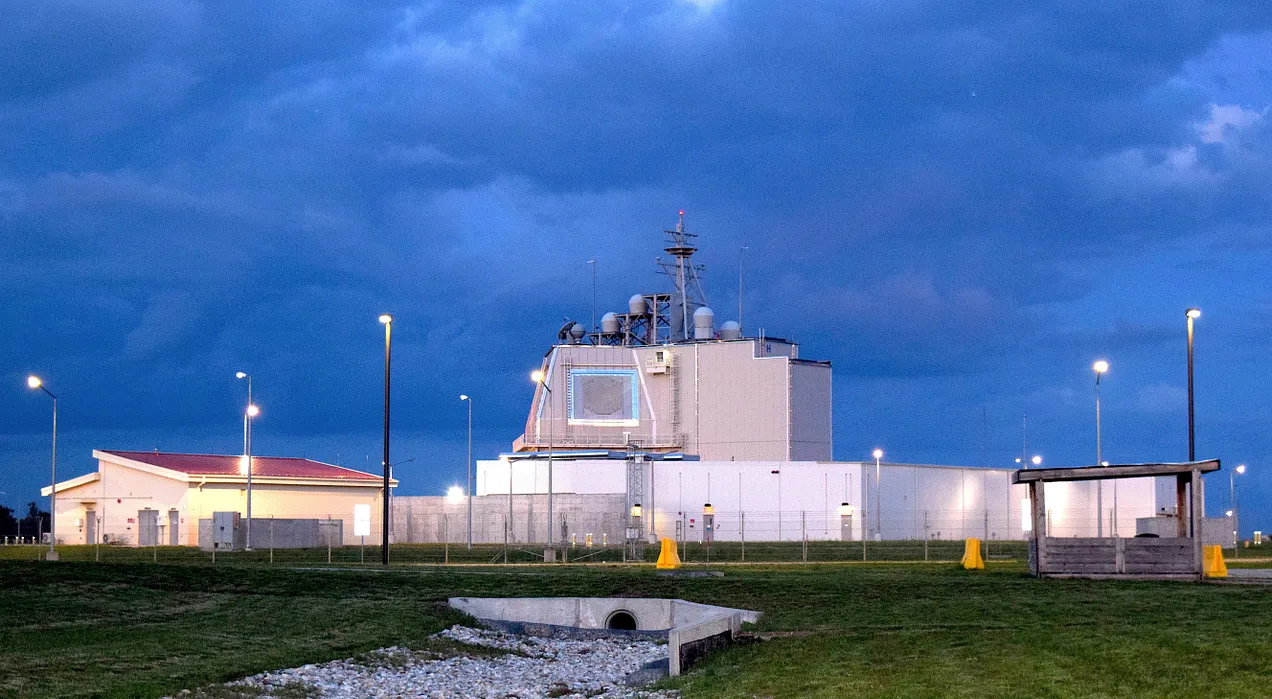
The crisis is likely to deepen. France’s economy is under serious pressure, and not only from the familiar effects of neoliberalism. Last year, the fascist Eric Zemmour, interviewed on Le Grand Jury, analysed the French economy from a different perspective: “France has managed to bring its artillery production from 1,000 to 3,000 shells per month”, he explained.
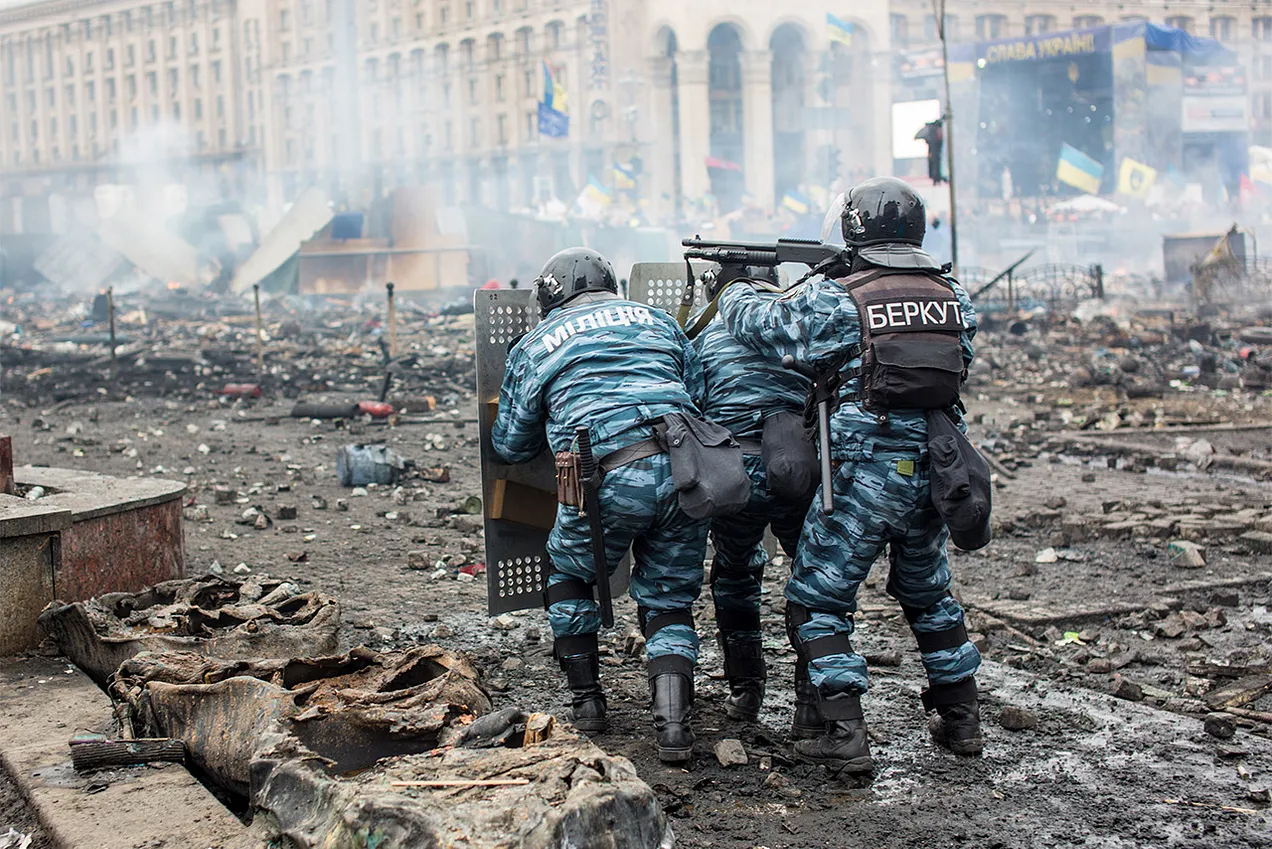
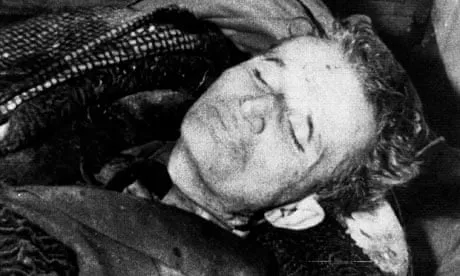
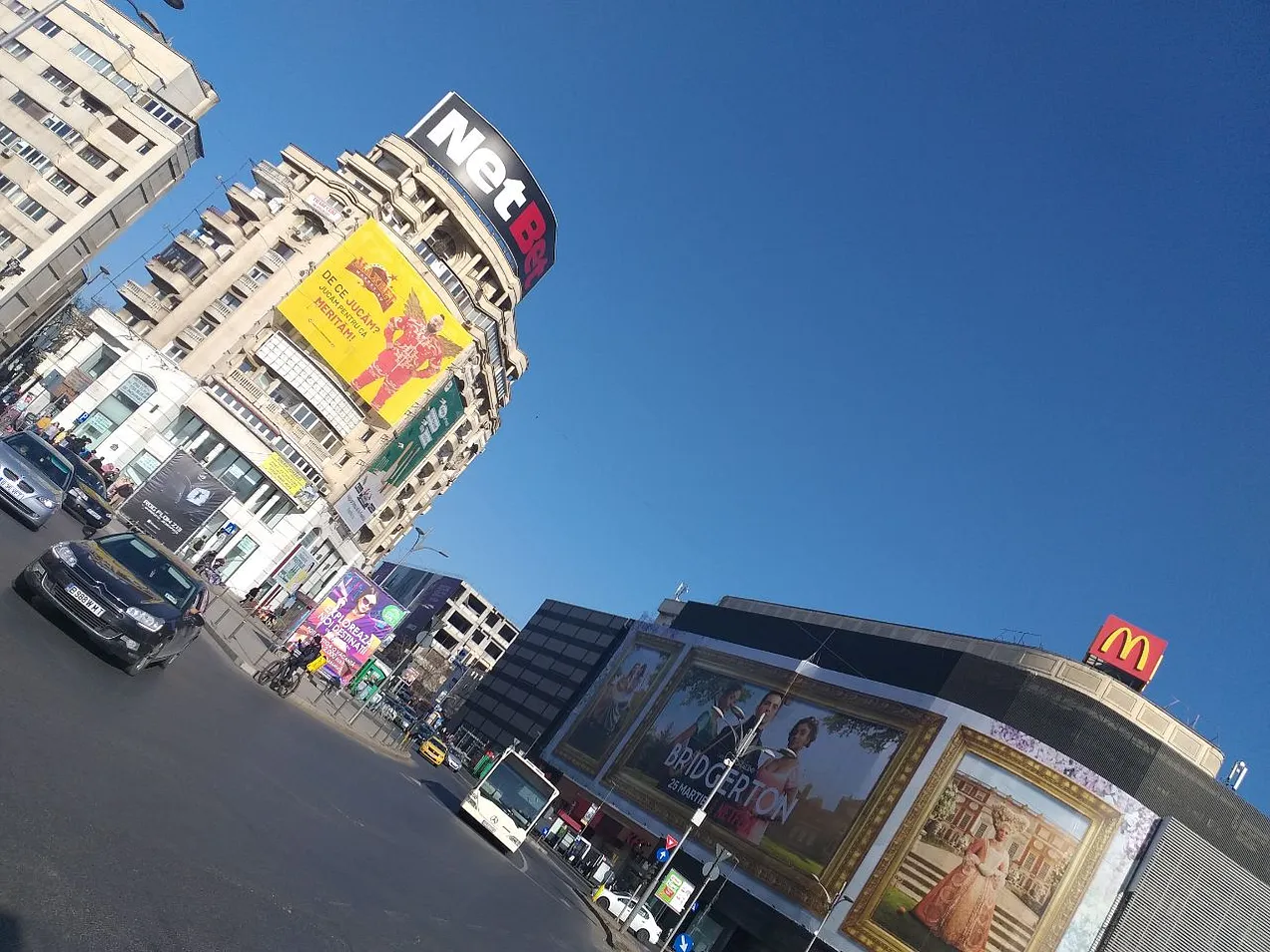
You must know that Ukraine consumes 5,000 shells a day, and that the Russians produce a million shells a year. Voilà: the balance of forces.

Macron, the military-industrial hawk of Europe, sees things in similar terms. Late last year, he spoke of the need for a “long-term war economy” in France. France aims to triple its annual manufacturing of 155mm shells; Russia produces more of its equivalent than all the EU combined. Macron’s project of bringing down the debt and deficit while ramping up military production will require economic sacrifices.

“We have rediscovered what great nations can do: realise the impossible”, Macron said at the reopening of the Notre Dame Cathedral. The ceremony did not necessarily provide the symbolic moment of optimism and hopefulness that was intended. Barnier’s government had fallen, and no replacement had been appointed. Macron’s audience included firefighters and priests. It also included President-elect Donald Trump, whose concept of a “great nation” is largely shared by France’s far right and may define future French governments. With him was Volodymyr Zelenskyy; his besieged nation’s need for artillery shells and air defence systems foreshadows how imperialist war is likely to reshape world politics in the coming years.

https://mronline.org/2024/12/18/on-the- ... overnment/

******

Germany: PM Kretschmer Re-Elected in Saxony

Image
Saxon Prime Minister Michael Kretschmer (R). 2024. X/ @SachsenDe

December 18, 2024 Hour: 8:40 am

He is the third prime minister elected following the regional elections held in September.

On Wednesday, the Prime Minister of Saxony, conservative Michael Kretschmer, was re-elected with the support of his party, the Christian Democratic Union (CDU).

He also secured votes from his coalition partner, the Social Democratic Party (SPD), and from The Left, enabling him to defeat the far-right Alternative for Germany (AfD), which came in second in the regional elections.

Kretschmer is set to lead a minority government with the SPD as his sole ally after failed negotiations to bring another party, the Alliance Sarah Wagenknecht (BSW), into the coalition, as well as a fallout with the Greens. The BSW is a newly formed party named after its founder, resulting from a split within The Left.

The CDU’s principle of excluding coalitions or cooperation with both the AfD and The Left makes Kretschmer’s election with support from The Left particularly notable.

Kretschmer was elected in a second round of voting after failing to secure an absolute majority in the first. While only a simple majority was required in the second round, he managed to achieve a result exceeding an absolute majority.


The AfD had nominated its regional leader, Jörg Urban, as a candidate, but he received just one vote. The majority of the AfD parliamentary group instead voted for the candidate from the Free Voters (FW), Mathias Berger.

Kretschmer secured 69 votes, Berger 39, Urban 1, with 11 abstentions. The covert support from the AfD for Berger’s candidacy echoes events in Thuringia five years ago, when far-right votes led to the election of the liberal Thomas Kemmerich, who was forced to resign just days later.

In the first round of voting, Kretschmer had received 55 votes—short of the 61 needed for an absolute majority—while Urban received 40 votes, Berger 6, with 12 abstentions and 7 invalid votes.

Kretschmer is the third prime minister elected following the regional elections held in September in eastern Germany, which produced results that complicated the formation of government majorities.

In Brandenburg—where the AfD was also the second most-voted party, as in Saxony—Social Democrat Dietmar Woidke was elected after forming a coalition with the BSW. In Thuringia—where the AfD was the most-voted party—Christian Democrat Mario Voigt was elected to lead a coalition with the SPD and BSW.

https://www.telesurenglish.net/germany- ... in-saxony/

******

Image
NATO Secretary-General Mark Rutte. (Photo: Peoples Dispatch)

NATO Chief calls for Cold War-level military spending
By Dave DeCamp (Posted Dec 19, 2024)

Originally published: Defend Democracy Press on December 12, 2024 (more by Defend Democracy Press) |

On Thursday, NATO Secretary-General Mark Rutte called for the alliance to significantly increase military spending up to Cold War levels and adopt a “wartime mindset.”

“It is true that we spend more on defense now than we did a decade ago. But we are still spending far less than during the Cold War. Even though the threats to our freedom and security are just as big–if not bigger,” Rutte said in a speech in Brussels.

During the Cold War, Europeans spent far more than 3% of their GDP on defense.

Rutte, a former Dutch prime minister, suggested Europe could increase military spending by making cuts from pensions and health services.

“I know spending more on defense means spending less on other priorities. But it is only a little less,” Rutte said.

On average, European countries easily spend up to a quarter of their national income on pensions, health and social security systems. We need a small fraction of that money to make our defenses much stronger and to preserve our way of life.

Rutte said Europeans should tell their “banks and pension funds it is simply unacceptable that they refuse to invest in the defense industry. Defense is not in the same category as illicit drugs and pornography.”

The NATO chief framed his demand for an increase in military spending as a way to prevent war and claimed Russia, China, Iran, and North Korea are “hard at work to try to weaken North America and Europe.”

Rutte, who replaced Jens Stoltenberg as the head of NATO in October, is also determined to continue the proxy war in Ukraine, saying recently that there should be less talk of peace and more focus on shipping weapons into the conflict.

https://mronline.org/2024/12/19/nato-ch ... -spending/
"There is great chaos under heaven; the situation is excellent."

Post Reply