Blues for Europa

User avatar
blindpig
Posts: 14829
Joined: Fri Jul 14, 2017 5:44 pm
Location: Turtle Island
Contact:

Re: Blues for Europa

Post by blindpig » Tue Mar 11, 2025 5:28 pm

Protests Erupt in Romania After Anti-NATO Candidate Barred from Elections
March 10, 2025

Image
Supporters of Calin Georgescu react during a protest after Romania's electoral body rejected his candidacy in the presidential election rerun in Bucharest, Romania, Sunday, March 9, 2025. Photo: Andreea Alexandru/AP.

Mass protests and clashes with police erupted in Bucharest on Sunday, March 9, after Romanian electoral authorities banned Calin Georgescu, a leading anti-NATO candidate, from running in the upcoming presidential elections set for May 2024.

Georgescu, who won the first round of the presidential vote in November 2023 before the results were annulled, condemned the decision as a “direct blow to the heart of world democracy.” In a fiery statement, he warned, “If democracy in Romania falls, the entire democratic world will fall! This is just the beginning.” He further declared, “Europe is now a dictatorship; Romania is under tyranny!”

Election controversy an[/img]d allegations
The controversy began after Georgescu’s surprise victory in the November 2023 elections, which opponents claimed was marred by pro-Russian bias and alleged Moscow-backed interference. By December, the results were overturned, and Romanian authorities launched investigations into Georgescu, culminating in his arrest in late February. He was later released on parole with movement restrictions.


The Romanian National Tax Administration Agency dismissed claims of Russian meddling, stating there was no evidence to support the allegations.

Anti-NATO stance sparks backlash
Georgescu, a vocal NATO critic, has accused the alliance of exploiting Romania as a “gateway” to escalate tensions with Russia into a Third World War. His campaign rhetoric and opposition to Western military alliances fueled accusations of Kremlin-aligned sympathies from rivals.


Public outcry
Sunday’s protests saw demonstrators decry the ban as politically motivated. “This isn’t just about Calin—it’s about freedom itself,” said one protester, echoing widespread frustration over perceived government overreach.

Authorities have yet to comment on the unrest, but the decision has drawn international scrutiny, with critics labeling it a test of Romania’s democratic integrity.

https://orinocotribune.com/protests-eru ... elections/

******

800 billion euros of delusional promises

Hugo Dionísio

March 11, 2025

One of two things must happen: either the EU is prepared to increasingly repress the natural social struggles against the degradation of living and working conditions, or it bets on a more socially and demographically sustainable economy.

Von der Leyen has accustomed us to her grandstanding nihilism and disconnection from reality. Listening to her, one might sometimes get the impression that she sees herself as a kind of a god of creation, capable of transforming everything into matter with the mere power of her words. But of course, this is not true! The Russian economy has not collapsed in “tatters”; in fact, it has shown remarkable resilience, with wages growing at their highest rate in 16 years (a 21.6% increase compared to March of last year, and an 11.3% real growth after inflation—a dream for any Portuguese citizen), with the average wage expected to reach $1,113 by 2025, while everything remains cheaper than in any EU country.

It is also not true that the Russians have been stripping semiconductors from washing machines, nor is it true that the G7 has blocked Russian oil exports with their oil caps. In fact, Russia has never exported as much oil as it does today. The broker Ursula von der Leyen was also wrong when she claimed that the U.S. had the cheapest LNG—why would Trump want to lower prices now?—urging European countries to buy more shale gas, in violation of the European corporate sustainability directive, which requires suppliers to comply with environmental sustainability rules. As is well known, shale gas is extracted through fracking, a method highly damaging to the environment and banned in the EU. It seems that for the unelected president of the European Commission, directives are applied according to her whims.

But the latest delusion from the European Commission president is the announcement of a “massive boost”—as she loves these Americanized propaganda slogans with supposed creative power—to European military spending, which has already been increasing over time, but now she proposes to raise it by an additional 840 billion euros. It’s worth noting that she was Germany’s Defense Minister, during the scandal involving the sale of Trident submarines to Portugal, a deal that led to the imprisonment of several intermediaries. During that time too, von der Leyen, when investigated about several businesses, said that she lost the cellphone which helped her avoid jail. Similarly, during her time at the European Commission, she was involved in the vaccine procurement scandal. Certain character traits never disappear, and it’s a pity that these are the traits that determine who gets chosen for such positions. To our detriment.

Of course, the European Commission president could have proposed, instead, a massive diplomatic effort, a vigorous and mobilizing movement for world peace, a series of proposals for disarmament and the reduction of military stockpiles. Would it have worked? Maybe not, but as a leader of a vast population and the guardian of the keys that unlock the doors to death, it was her duty, first and foremost, to make every effort to negotiate not just peace, but a relationship of unity and cooperation across Europe, promoting prosperity and improving the living conditions of its people. Wouldn’t this be expected of any leader who claims to be democratic, humanistic, and a lover of freedom? The first step should never be to deepen the war.

She could even blame Vladimir Putin, demonizing him to unimaginable levels, but always keeping her feet on the ground and acknowledging the enormous responsibility she claims to bear: the guardian of the free world. A “guardian of the free world” is expected to make every effort to preserve that freedom. Instead, von der Leyen has done everything to erode and erase it from the map. Instead of setting an example of elevating and exalting our civilizational values, the European Commission and all the actors parading around the European Council have chosen to adopt a rigid, backward, isolationist, and sectarian stance. “I won’t move from here,” “I won’t talk to them,” “I won’t even think about them!” The EU is the only bloc today that behaves this way, except for Israel with the Palestinians. This should give us much to think about.

But this isn’t even the biggest problem with von der Leyen’s proposal. I’m not even talking about the arbitrariness of a commission composed of unelected bureaucrats proposing draconian rearmament plans, which the Council approves almost unanimously, without criticism, except for Orban. It’s more than that. Von der Leyen doesn’t have the authority to approve such a thing, nor can she force member states to spend this money, or compel them to approve eurobonds that would allow such a magnitude of debt.

I’ve mentioned in other articles that by 2026, with a military budget exceeding 600 billion euros, the EU and its member states will already be close to spending 3-4% of GDP on armaments, as Trump desires—the same Trump they claim not to align with. With this increase proposed by von der Leyen, 5% of GDP would be guaranteed.

The truth, however, is that when we look at the proposals, we see that what’s on the table is a line of credit, available to member states, worth 150 billion euros, with the remaining amount coming not from the “European Union,” but from the member states themselves. To facilitate this, the EU will discuss proposals to exclude military spending from the limits imposed by the Stability and Growth Pact, allowing increased investment in armaments to not count toward deficit or public debt limits. In other words, if it’s for weapons, states can borrow as much as they want.

The contradiction with past rhetoric is absolutely baffling. When it came to mitigating the effects of the “sovereign debt crisis,” preventing Western loan sharks from eroding the fundamental rights of European citizens to health, education, and housing, the European Commission made no exceptions. According to Durão Barroso, we were all living beyond our means and had to pay everything back, and quickly. So, it didn’t matter that Portugal had a Portuguese president of the European Commission. What mattered was the German Finance Minister’s desire to save, above all, Deutsche Bank.

But when it comes to buying weapons and allowing this investment to diminish the quality of essential public services, the EU is ready to create exceptions to borrowing rules. It doesn’t matter that António Costa is on the European Council. Every time a Portuguese has held a prominent position in the EU, the Portuguese—and Europeans—have had good reason to complain. Is this the fault of the Portuguese? Of course not! The problem lies with the type of people the oligarchy chooses for these positions—always spineless individuals or, like von der Leyen or Kaja Kallas, fanatical missionaries acting as a faction.

If von der Leyen’s proposal was already madness, it becomes even more insane when we realize that she can’t force member states to spend this money, nor can she spend it herself. The funds from the multiannual Community Funds cannot be spent on weapons, except for a small portion from the European Defense Fund. They can be used for dual-use technologies, research, and development, but that’s it. And that’s not insignificant, as seen with the facial recognition technology developed in Israel with European funds, which helped kill children and women in Gaza.

Moreover, it is up to the member states to decide whether or not to spend the aforementioned amount on weapons. Since this money will come from state budgets, it will be up to the respective governments and parliaments to decide. This raises legitimate suspicions about who António José Seguro (a putative candidate for Prime Minister from the “Socialist” Party) was trying to please when he said he wanted state budgets to be approved “in Brussels.” Look at what awaits us with these people! So democratic, aren’t they?

Finally, the European Commission president cannot force governments to shift funds from social programs to defense, especially since, according to the Treaty establishing the European Union, the EU’s competences in social matters are only subsidiary and complementary, never able to replace or override national policies. Thus, this announcement is mere desperate propaganda and extremist fanaticism from someone who still wants to show the world that she has some importance, when in fact she has little.

But if the disconnect between this proposal and European and national rules is serious; if the betrayal of the true values of democracy and freedom, rooted in peace and stability, shows the true face of these people; even more serious is the disconnect between the proposal and the productive reality of the European Union itself.

The European Union has an annual industrial growth rate post-COVID-19 of around 1-2%, with industrial production indices in decline, especially after the 2008 financial crisis. This decline in industrial production, also associated with weak industrial growth, is exacerbated by European policies such as the Green Transition, Decarbonization, and, more recently, the energy crisis caused by the Ukrainian adventure.

Adding to this the fact that the EU faces a severe shortage of skilled labor for the industry it still has, with an aging workforce, an increasingly deregulated labor market, and an economic culture that treats children as obstacles to individual success and career advancement, the European Union can only overcome this with even more emigration. But excessive emigration, combined with disinvestment in public services, creates enormous social contradictions and widespread discontent.

One of two things must happen: either the EU is prepared—as I believe it is—to increasingly repress the natural social struggles against the degradation of living and working conditions, or it bets on a more socially and demographically sustainable economy. The latter would take more than two generations to yield tangible results. Such a delay does not seem to align with the urgency demonstrated by these European “leaders.” Their anxiety is short-term, nothing more.

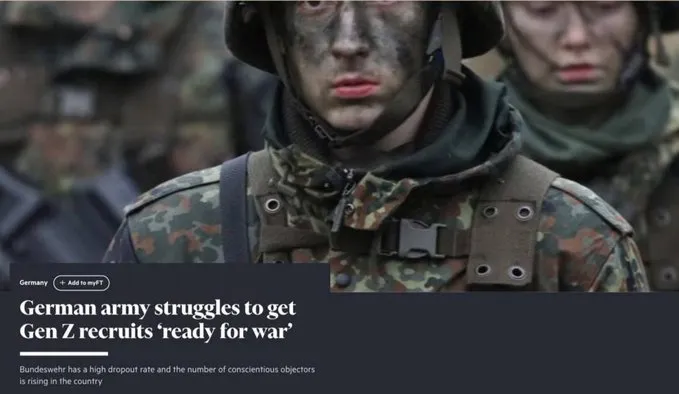
The demographic problem also brings another issue: who will take up arms? Von der Leyen’s and António Costa’s children? I don’t think so. Either they change the rules of military service from voluntary to compulsory, or they will have to build armies of mercenaries, who are usually defeated by those fighting for a cause.

If this isn’t enough to understand von der Leyen’s delusion, it’s important to note that, in any case, the EU does not have the industrial, human, economic, or political capacity to handle such an increase in military spending, unless the goal is to pay even more for weapons that, as seen in Ukraine, are as expensive as they are ineffective. This might also be a pleasing solution for those simply waiting for another jackpot. The capital markets already show that the stocks of European military companies are rising in value, which must also be the objective.

In conclusion, with this announcement, the European Commission gives us yet another proof of its proverbial disconnection from reality, its harmfulness to the European people, and its service to obscure powers that directly clash with the interests of European and global populations. And what are these obscure powers? Beyond those linked to the arms industry and the military-industrial complex, they are the powers that seek to prolong and extend the conflict in Ukraine as much as possible, to avoid admitting their mistake, their defeat, or both. It’s also possible that they have spent the 300 billion euros of Russian reserves or used them as collateral for loans, leaving them hostage to a situation that could implode the entire European financial system. After all, their predictions—always wrong—were based on a long-term, perhaps generational, conflict. Trump, for all his reasons—none of them rooted in a genuine desire for peace—ended up disrupting the plan.

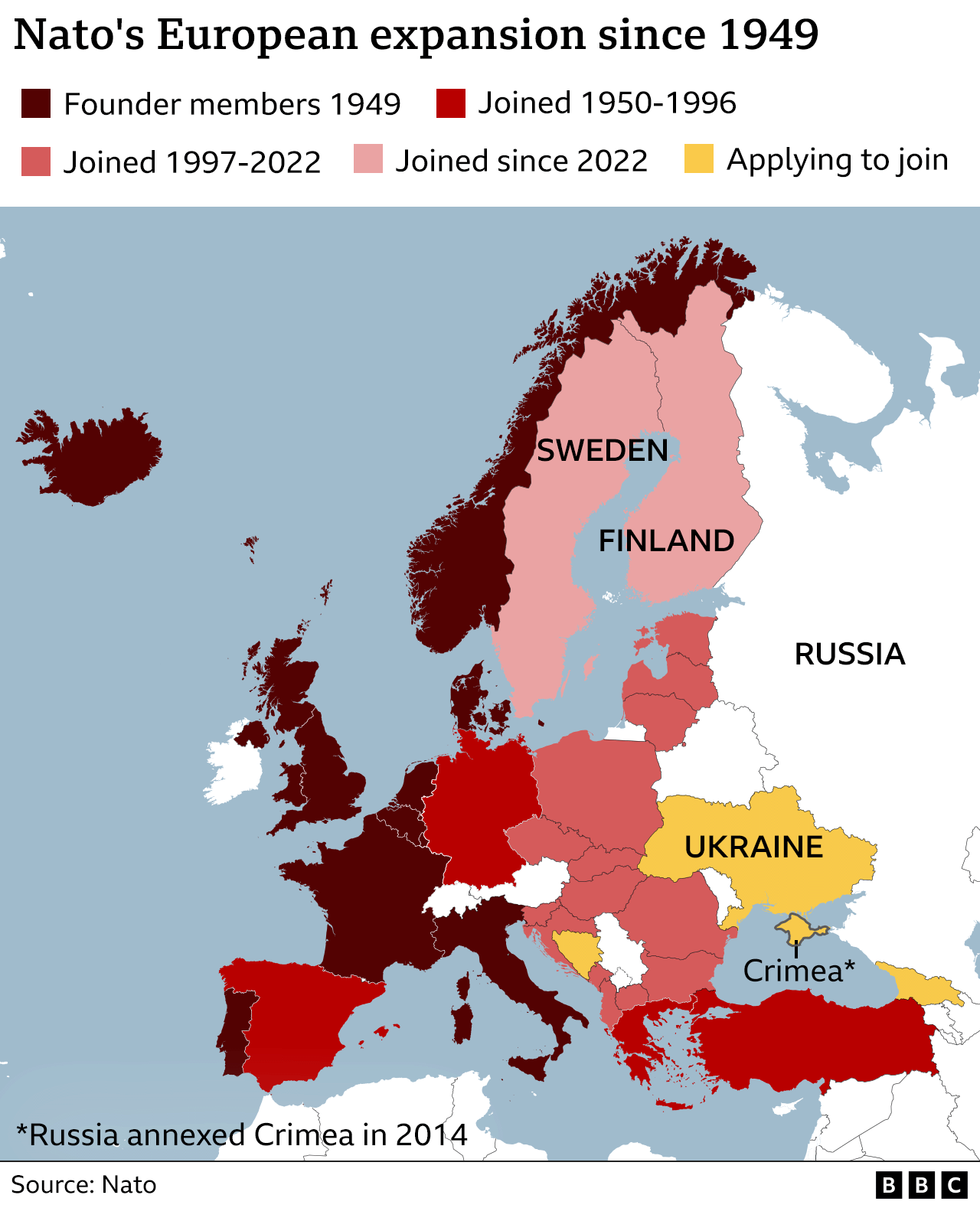
Whether it’s one or all of these reasons, this whole circus aims to push through another 150-billion-euro loan, which will undoubtedly end up in Zelensky’s Ukraine. How would Europeans react if the “Brussels youth” said, “While some are trying to end the conflict, we want to send another 150 billion euros to the war!” It wouldn’t look good, would it? And, put that way, it would even be incomprehensible. Incomprehensible is also the idea that all of this is for a “strong peace,” a propaganda construct aimed at presenting a resounding defeat as something more palatable to save face for this gang of spoiled children. There is, however, something they can no longer hide with their show of “strength”: the total discrediting of NATO and the European Union itself. While the former may face existential threats in the short term, we cannot dismiss the idea of the EU’s implosion in the medium term. All because a pan-European organization has turned into a mere extension of NATO, with its cohesion determined by the interests of Washington.

So, they come up with a generic, propagandistic pretext to hide the purpose of continuing to divert money that is desperately needed by the European people to feed one of the most corrupt regimes in the world. On the other hand, not knowing how to exit the quagmire they’ve created with dignity, the European “leaders” are betting everything on a leap into the abyss. Once in a hole they dug themselves, instead of turning toward the light, these political “leaders” decide to keep digging deeper, hoping someone will come to save them or bury them for good.

Meanwhile, they bury us in the problems they create with their incompetence. It remains too easy to fight and “support” this conflict with the money and lives of the children of those who work and pay their taxes.

Until all those who work realize this, the blade of World War III will remain suspended over our necks.

https://strategic-culture.su/news/2025/ ... -promises/
"There is great chaos under heaven; the situation is excellent."

User avatar
blindpig
Posts: 14829
Joined: Fri Jul 14, 2017 5:44 pm
Location: Turtle Island
Contact:

Re: Blues for Europa

Post by blindpig » Fri Mar 14, 2025 2:16 pm

Collapsing Empire: ‘NATO is Dead’
Posted by Internationalist 360° on March 12, 2025
Kit Klarenberg

Image

On March 3rd, Timothy Ash of elite British state-connected ‘defence’ think tank Chatham House made a series of startling proclamations in an interview with Bloomberg. His topline message was stark – “NATO is dead.” He spoke following the very public February 28th Oval Office fallout between Volodomyr Zelensky and Donald Trump. The impact of that debacle reverberates today, with questions abounding over continued US aid and intelligence sharing with Kiev, pending the Ukrainian leader’s signoff on a White House-endorsed minerals for security agreements deal.

Branding the catastrophic summit an “ambush”, Ash declared that Trump and his deputy J.D. Vance had “laid out very clearly” that the military alliance was to all intents and purposes moribund, with no hope of recovery. He noted other comments made by the US President at the Oval Office meeting indicated a clearly reticence by Washington to intervene military to protect the Baltic states should they end up at war with Russia, in seeming breach of NATO’s Article 5:

“It should be crystal clear now to European leaders that NATO is dead, we can’t rely on US security guarantees, they’ve come and spelled it out to us…NATO is more or less dead already…Even raising doubts about whether America would stand behind some NATO states says it all…We cannot rely on the Americans any more. We have to move on, we have to think about our own national interests, our own security, we have a very difficult transition period.”

Ash’s analysis is evidently echoed by European leaders. A day later, EU Commission President Ursula von der Leyen outlined a €800 billion plan to “rearm” the bloc. Many member state chiefs reportedly “largely endorse” the plan, which calls for Europe to “become more sovereign, more responsible for its own defence and better equipped to act and deal autonomously with immediate and future challenges and threats.” Nonetheless, polls indicate European citizens oppose increased defence spending, and contractors warn this grand scheme will “take time” to realise.

If NATO truly is dead, it represents another long-overdue nail in the Empire’s coffin. It is also yet further confirmation that the US-dominated unipolar order, which has wrought untold death, destruction and misery over the past quarter century, is no more, and never to return. Residents of the Global South can breathe a collective sigh of relief – meanwhile, in a bitter irony, the same Western states that aided and abetted Washington’s unchallenged hegemony now find themselves defenceless.

‘Riot Squad’

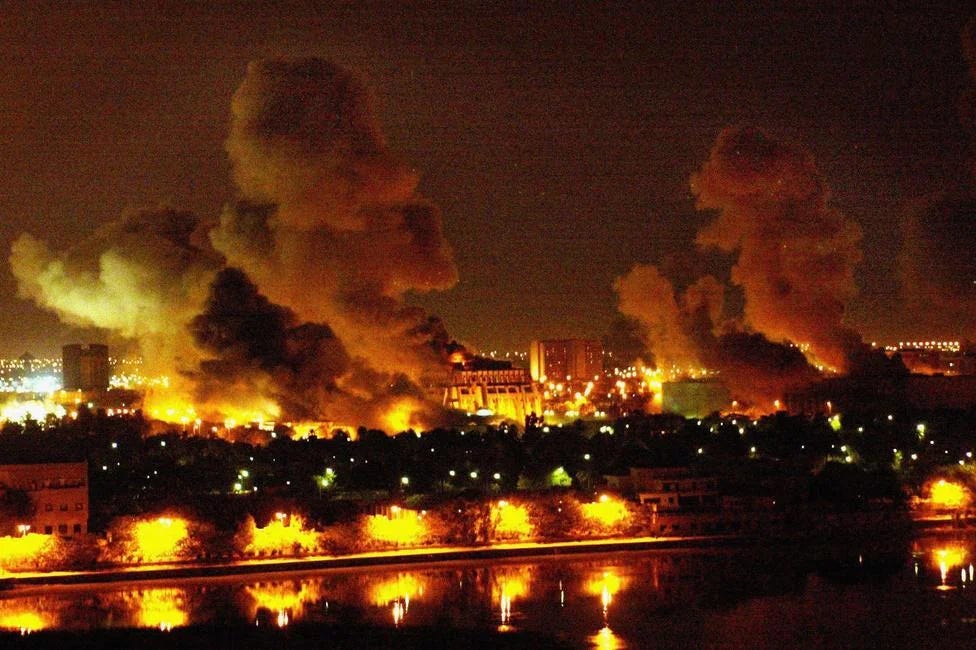
The unipolar world was forged in an incendiary baptism of airstrikes and atrocity propaganda in Yugoslavia, March – June 1999. For 78 straight days, NATO relentlessly blitzed civilian, government, and industrial infrastructure throughout the country, killing untold innocent people – including children – and violently disrupting daily life for millions. While the US oversaw the ruinous campaign, both publicly and privately, British Prime Minister Tony Blair was an ardent advocate of even greater belligerence against non-military targets, despite the grave concerns and warnings of government legal advisors.

Then again, NATO’s assault was in itself completely illegal, conducted without UN Security Council approval. Such an intervention would’ve been unthinkable during the prior decade. Throughout the 1990s, Washington carefully constructed the chimera of a world united behind US leadership by ensuring UN backing for all its overt imperial actions across the globe. The bombing of Yugoslavia represented an unprecedented, highly controversial break with this strategy, specifically intended to serve as an exemplar thereafter.

An eerily prescient April 1999 New Statesman article noted NATO’s unauthorised bombing was no “one off”, but “just the beginning” of a “brave new world”, in which the military alliance acted autonomously as a worldwide “riot squad”. In this context, whenever China and/or Russia could plausibly use their Security Council vetoes to block US intervention overseas, NATO would simply invoke the UN Charter’s self defence clause to strike whenever and wherever its members perceived a “threat”, without hindrance or any consideration for international law:

“The threat doesn’t come in the shape of main battle tanks…but from the fear of huge refugee flows, terrorism and weapons of mass destruction: bags of anthrax spores or phials of nerve gases which can’t be seen, can’t be verified and may or may not exist. But as long as there are rogue states out there with a grudge against the West and a location near oil reserves, the US will be ready to face down the threat.”

As the New Statesman correctly prophesied, the implications of this paradigm shift were “enormous”, with “the potential to undermine the entire postwar international security system,” and fatally subvert “UN legitimacy.” The outlet went on to record how NATO’s longstanding members had been successfully railroaded into agreeing “to the principle of out-of-area operations”, due to fears “the US could unilaterally conclude its own military agreements with Eastern European states” outside the military alliance’s established “framework” if they resisted.

In return for serving as the Empire’s dependable, unquestioning dogsbodies, protecting US economic interests abroad, and purchasing all Washington’s exorbitantly-priced, barely functional military equipment, European governments were granted a sense of invincibility courtesy of NATO’s Article 5. In the meantime, their armies and industrial bases could be left to rot, safe in the delusion America and newer alliance allies would come to the rescue and do the fighting and dying for them if they were ever attacked. As George Soros wrote in November 1993:

“Through NATO…the US would not be called upon to act as the policeman of the world. When it acts, it would act in conjunction with others…The combination of manpower from Eastern Europe with the technical capabilities of NATO would greatly enhance the military potential…because it would reduce the risk of body bags for NATO countries, which is the main constraint on their willingness to act.”

Image

‘Shiny Deals’

The Ukraine proxy war has brought this suicidal upshot of the unipolar world into sharp relief. Despite the Trump administration’s determination to end the conflict, European leaders show no sign of backing down, desperately scrambling to make up the vast shortfall in financial and military assistance abruptly created by the cessation of Washington’s aid. As yet, no credible solution to this glaring deficit between rhetoric and reality has been proposed. Even Ukrainian leaders admit “nobody can replace the US when it comes to military support.[/img]

This hazardous disconnect was writ large in Timothy Ash’s Bloomberg interview. Despite his urgent calls for European governments to get to grips with the fact they “cannot rely on the Americans any more,” he contrarily acknowledged Europe suffers from acute issues around “military production”, and “we have to rely on the Americans” to stump up the materiel necessary to keep the proxy war grinding on. Ash suggested Europe simply pool its collective “cash” to purchase the requisite arms for Ukraine:

“I don’t think it’s beyond our abilities to put together a finance package…we still have $330 billion in Russian assets in our bank accounts that our governments haven’t done anything about…What we should be doing is pitching to the Americans…Trump likes big shiny deals, we should go to the Yanks and we should say ‘we want to commit over a 10 year period to buy between $500 billion to a trillion of kit from you guys’…Trump would not say no to that.”

Fond of “big shiny deals” Trump may be, but Ash assumes Washington has the ability to supply Europe anything at all, irrespective of the profits involved. As a July 2024 investigation by Pentagon-funded RAND concluded, “extraordinary” levels of “consumption and demand” for US-made ammunition, vehicles, and weapons in the proxy war have already rendered the country’s existing stockpiles threadbare. This, combined with a ravaged “defense industrial base”, means America is “unable to meet” its own “equipment, technology, and munitions needs”, let alone furnish its allies.

RAND’s dire conclusions were echoed on March 3rd by White House national security advisor Mike Waltz. In slamming Zelensky’s failure to accept Trump’s peace plan, he cautioned “the time to talk is now,” as US “stockpiles and munitions are not unlimited.” This unambiguous message apparently remains unreceived in Brussels, Paris, and London, with deranged schemes to halt Russia’s inexorable battlefield advance continuing to issue daily. Perhaps European leaders think NATO, and the unipolar world it enforced, can be resuscitated, with themselves at the helm?

https://libya360.wordpress.com/2025/03/ ... o-is-dead/

*******

Image

Romania, a captured state: How democracy was stolen before our eyes
Originally published: Defend Democracy Press on March 10, 2025 by Cimpoi Adrian (more by Defend Democracy Press) | (Posted Mar 12, 2025)

The decision of the Central Electoral Bureau (BEC) to invalidate Călin Georgescu’s candidacy marks a turning point for Romanian democracy. This was not just an unprecedented act, but what followed—media manipulation, infiltration of protests by provocateurs, and brutal intervention by security forces—proves that Romania is no longer a democratic state, but one captured by an oligarchic elite imposing its will through force and deception.

This is not just another episode in a dirty electoral game. It is a direct attack on the fundamental right of Romanians to elect and be elected, on the very concept of national sovereignty. We are no longer dealing with a rule-of-law state, but with a regime that is increasingly authoritarian, eliminating any political adversary through methods that have nothing to do with law or democracy.

BEC’s decision is illegal: A direct violation of the constitution
The ruling by the Central Electoral Bureau to block Călin Georgescu’s candidacy is not only immoral but profoundly illegal. This decision was not based on legal arguments but was instead dictated by a political majority, completely disregarding democratic norms and the constitutional rights of citizens.

A violation of the fundamental right to vote and be elected
The BEC decision represents a direct attack on the fundamental principles of democracy, violating two essential rights guaranteed by the Romanian Constitution:

The right of citizens to freely choose their representatives
The right of any citizen who meets legal conditions to run for office and be elected

This ruling was not the result of a fair legal debate but rather a political execution, designed to prevent an inconvenient candidate from participating. Călin Georgescu is the victim of repeated abuses by a captured state, which acts against its own citizens to protect the interests of a privileged few.

A captured state, supported by the european bureaucracy
Even worse, this attack on Romanian democracy does not stop at the national level. Over time, it has become clear that the European bureaucracy supports the oligarchy in Bucharest, even when it acts against the interests of its own people.

Brussels does not intervene to correct abuses in Romania; on the contrary, it tacitly validates them. This raises a fundamental question: Who really governs Romania? Is it the Parliament and Government elected by the people, or the power groups pulling the strings behind closed doors, with the blessing of the European Union?

This complicity between Bucharest’s political elites and the European bureaucracy nullifies any notion of national sovereignty and deprives Romanians of their right to determine their own future. When real power is not in the hands of the people but controlled by obscure groups imposing rules through force and manipulation, we are no longer talking about democracy but about an entrenched oligarchic system, sustained by foreign influence.

Protests and the system’s response: Terror, Repression, and Diversion
Romanians immediately reacted to this attack on democracy, taking to the streets in multiple cities across the country. In Bucharest, Timișoara, Cluj, Iași, and Brașov, people chanted “Liberty!” “Down with the Dictatorship!” “Down with the Communists!”, demanding the annulment of BEC’s decision and respect for their democratic rights.

But, as expected, the system could not allow the revolt to grow. The diversion plan was quickly activated: provocateurs were infiltrated into the crowds to create chaos and justify the brutal intervention of the riot police.

As in previous protests, groups of unknown individuals began creating incidents, provoking the police, and escalating tensions. Within moments, riot police received the order to attack protesters with tear gas.

Riot police turn against their own brothers and parents
One of the most outrageous aspects of the repression in the streets is that riot police were ordered to fire tear gas at their own fellow citizens—at their own families, their own parents and siblings.

Faced with such images, the question is simple: Who do these security forces really serve? Are they protecting the people, or are they enforcing the will of an elite that has seized control of the country and is eliminating any form of opposition?

“They are gassing us without mercy! How can you attack your own brothers and parents? Who are you fighting for, if not for the Romanian people?” shouted a protester, his eyes burning from the tear gas.

This brutal attack on peaceful citizens shows exactly who truly fears the people. Instead of dialogue and democracy, the authorities chose force and terror.

https://mronline.org/2025/03/12/romania ... red-state/#

******

Donald Trump Reiterates Interest in Annexing Greenland During NATO Meeting

Image
Mar 13, 2025 Photo: EFE

March 13, 2025 Hour: 10:21 pm

Donald Trump reiterates his interest in annexing Greenland during a NATO meeting with Mark Rutte. Learn about the geopolitical implications and the future of U.S.-Denmark relations.

In a recent meeting with NATO Secretary General Mark Rutte, U.S. President Donald Trump once again expressed his intention to annex Greenland, a territory belonging to Denmark. This statement has reignited debates over the island’s sovereignty and the geopolitical implications of such a move.

During the meeting, Trump questioned the legitimacy of Denmark’s claim to Greenland, stating that the European country is “extremely distant” from the island. “A ship arrived there 200 years ago or something like that. They say they have rights to the territory,” commented the U.S. leader. Despite his claims, Greenland remains an integral part of the Kingdom of Denmark.

Trump also suggested the possibility of sending U.S. troops to Greenland, noting that there is already a military presence on the island. “It’s possible that more and more military personnel will be moving there,” he added.

#ÚLTIMAHORA | Donald Trump insiste en que Groenlandia es fundamental para la seguridad nacional de Estados Unidos y dice que su país debe lograr la anexión del territorio autónomo danés. pic.twitter.com/Pdj0W7jRJ3

— EFE Noticias (@EFEnoticias) March 13, 2025
The text reads: “Donald Trump insists that Greenland is fundamental to the national security of the United States and says that his country must achieve the annexation of the autonomous territory of Denmark”.
When asked about the potential annexation, Trump appeared optimistic, stating that he is confident it “will happen” and that it would benefit “international security.”

The U.S. president emphasized the importance of his relationship with Rutte, suggesting it could be key to advancing his plans. This meeting comes amid rising tensions, as Greenland recently held elections amidst rumors of U.S. interest in acquiring the territory—a topic that has shifted from being a joke to a real aspiration.

Donald Trump’s statements on Greenland highlight a significant shift in U.S. foreign policy and raise questions about international dynamics in the region. As relations between the United States and Denmark evolve, the future of Greenland remains uncertain and a subject of ongoing debate.

https://www.telesurenglish.net/donald-t ... o-meeting/

Trump Cannot Annex Greenland: Danish PM Rasmussen

Image

March 14, 2025 Hour: 7:29 am

‘We must stay united in situations like this,” said the Demokraatit party leader Nielsen.

On Friday, Danish Foreign Minister Lars Løkke Rasmussen responded to U.S. President Donald Trump by rejecting the possibility of the United States annexing Greenland.

“You cannot annex an allied country or any other country—that would go against international law. It’s clear,” Rasmussen said in Copenhagen.

Trump, who has repeatedly expressed interest in the Arctic island in recent months, insisted yesterday that acquiring Greenland is essential for U.S. national security and that Washington must secure its annexation.

“We have to do it. We really need it for national security,” the U.S. president stated during an appearance in the Oval Office alongside NATO Secretary General Mark Rutte.

Rutte said that he is not in a position to engage in discussions about whether Greenland should become part of the U.S. or not—a statement that Rasmussen downplayed on Friday.

“We have no doubt about the support we have in Europe. There was an informal meeting of government and state leaders in early February, where a very clear signal was sent,” Rasmussen declared, emphasizing European support for Denmark in the face of Trump’s threats, as the U.S. president has hinted at possibly using force or imposing sanctions against Copenhagen.


On Tuesday, Greenland held autonomous elections, in which Demokraatit, a liberal opposition party advocating for moderate independence—like most political forces on the island—emerged victorious. The party most in favor of a rapid separation from Denmark, Naleraq, was the second most voted.

“I don’t see any indication from the Greenlandic elections that they want to leave the Commonwealth of the Kingdom (which also includes the Faroe Islands) to become American,” Rasmussen said. However, he defended the need to “renew” and “modernize” that model to boost the island’s economy.

All Greenlandic parliamentary forces reject becoming part of the U.S., although Naleraq wants to sign a free association treaty with Washington, as does 85% of the population, according to a poll conducted a month and a half ago.

“We must stand together. Trump’s statements are inappropriate and once again show that we must stay united in situations like this,” said the leader of Demokraatit, Jens-Frederik Nielsen, last night.

Acting Greenlandic President Mute B. Egede accused Trump of “disrespecting” Greenlanders, called for a stronger “rejection” of the U.S. president, and stated that “enough is enough.” He convened the leaders of all Greenlandic parties for a crisis meeting to discuss the issue, which is expected to take place on Friday.

https://www.telesurenglish.net/trump-ca ... rasmussen/
"There is great chaos under heaven; the situation is excellent."

User avatar
blindpig
Posts: 14829
Joined: Fri Jul 14, 2017 5:44 pm
Location: Turtle Island
Contact:

Re: Blues for Europa

Post by blindpig » Mon Mar 17, 2025 3:00 pm

Boots-on-Ground Theater Conceals Raging Impotence of Toothless Euro-Prats
Simplicius
Mar 16, 2025

We’re starting to glimpse the contours of the European deep state plan to stop Russia from taking over Ukraine. Macron and Starmer are now desperate to push through the ‘boots-on-ground’ initiative in a deliberately obfuscating way. They are haranguing about it like it’s something meant to occur only at such time that an agreement on the conflict’s full cessation is reached. But in reality, it increasingly looks like they mean to jam through the troops at the earliest opportune moment, in order to ‘checkmate’ Russia from being able to advance any further.

As such, we’re meant to believe the much-ballyhooed “30-day ceasefire” is supposed to be some kind of good-faith purity test for Russia to ‘prove’ its commitment to ending the conflict. In actuality, it seems to be a trick designed to ram through European troops to immediately secure Ukraine’s most sensitive zones, and dissuade Russia from further advancement.

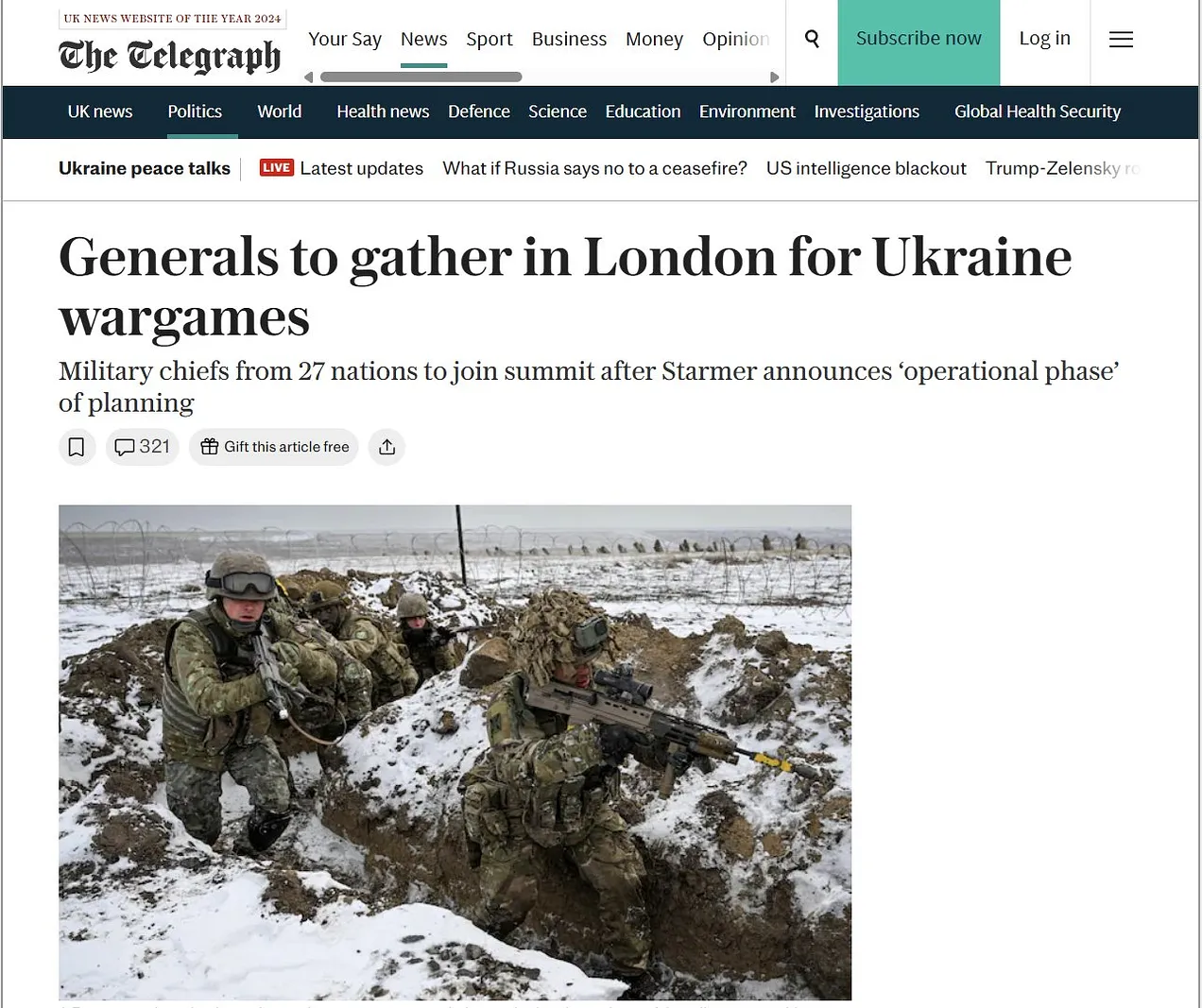
Starmer kicked it off this week with his announcement that the troop deal has reached an “operational phase” of discussion: (Video at link.)
Image

U.K. Prime Minister Keir Starmer has announced that European defense and military leaders will meet in London on Thursday, as planning for a peacekeeping mission in Ukraine enter an “operational phase” with over a dozen countries having agreed to participate in such a mission.

Macron then took the ball and built on the impotent threat-making:
Image

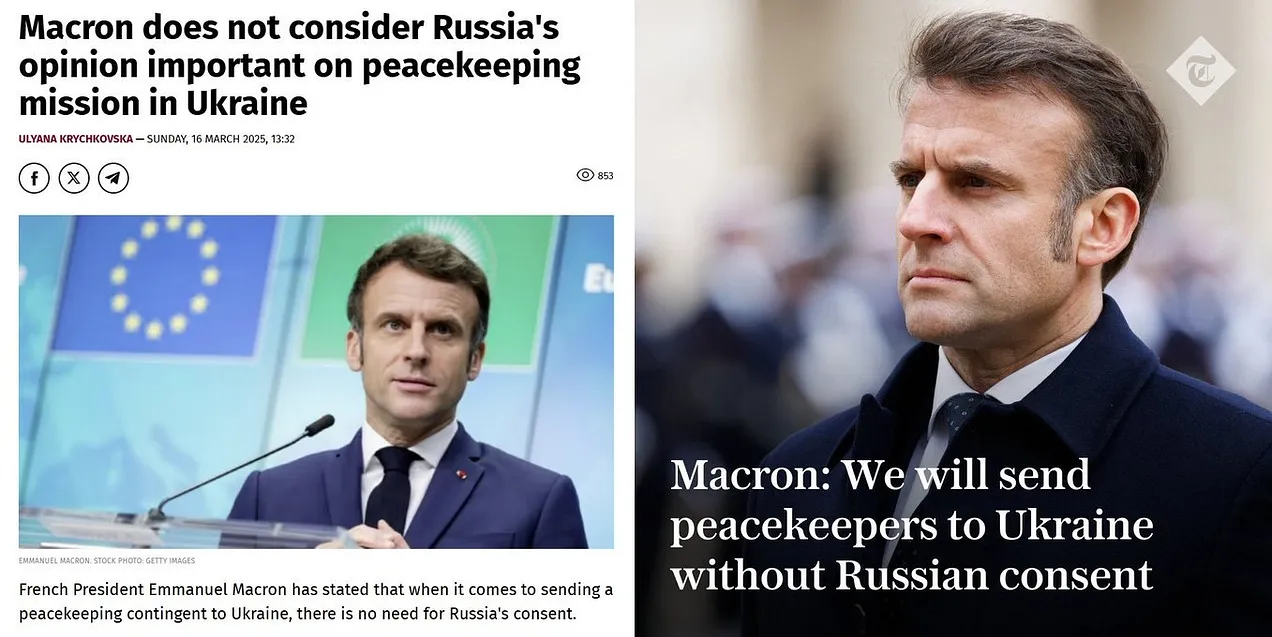
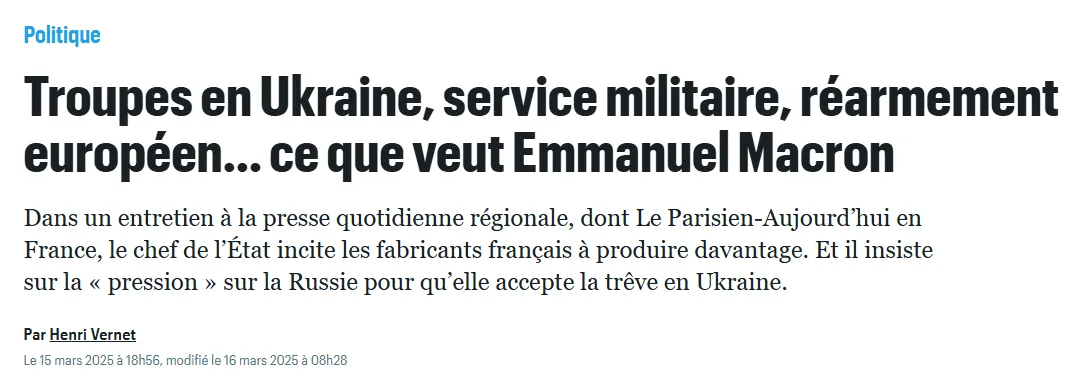
European countries that agree to send a military contingent to Ukraine, allegedly for an observation mission, can do so without Russia's consent, French President Emmanuel Macron said in an interview with Le Parisien.

"Ukraine is a sovereign country. If it asks for allied troops to be present on its territory, it is not up to Russia to decide whether to agree or not," he said.

According to the newspaper, the Franco-British plan to send so-called peacekeepers to Ukraine is in the final stages of being agreed upon.


In an interview with Le Parisien, Macron seemed to give the game away by implying small groups of troops would be inserted into key cities with or without Russia’s permission, as long as Ukraine ‘asks for them’:
Image
https://www.leparisien.fr/politique/tro ... BLN4EA.php

Macron told Le Parisien that Europe could send troops to Ukraine without Russia’s consent. The Franco-British plan already interests several countries. The goal isn’t a mass of soldiers but a few thousand for training in Kyiv, Odesa, Lviv. It’s our support. Ukraine is sovereign, and Putin has no say, he stressed.

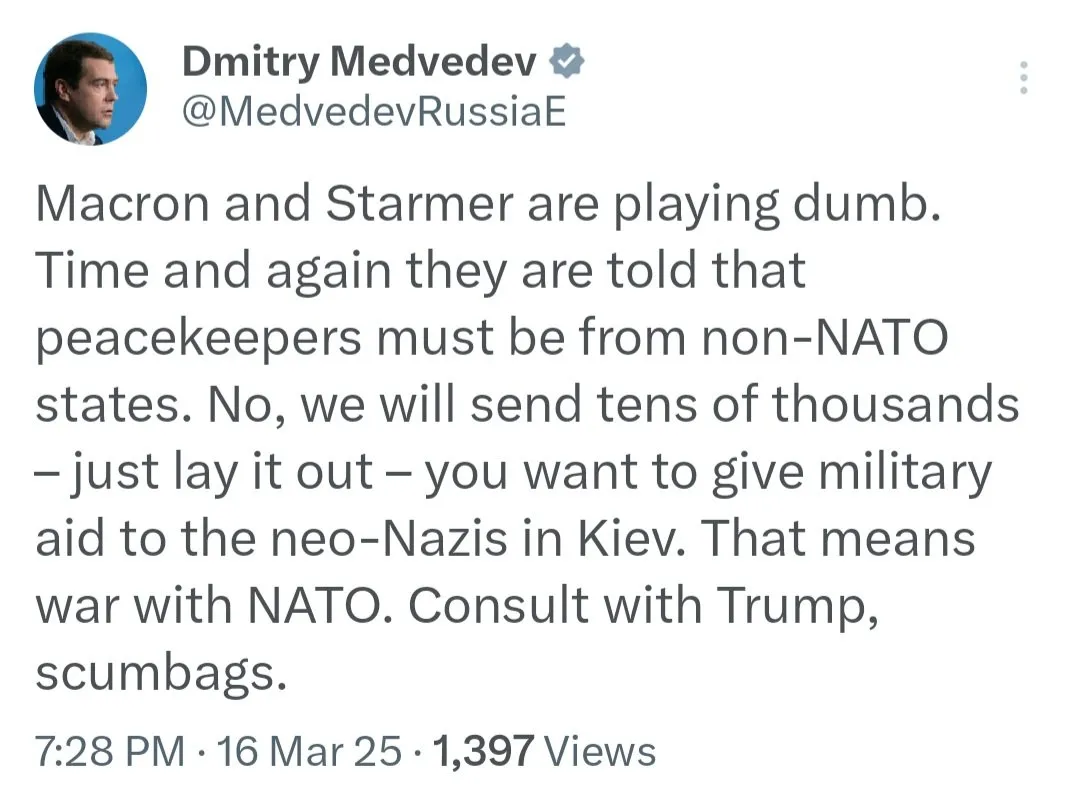
Note the deliberate ambiguity—neither Starmer or Macron are explicitly mentioning during which ‘ceasefire’, precisely, this coalition would be activated. Macron merely implies it would be if “Ukraine asks for it”. The implication is, if Ukraine happens to “ask” for these troops even during the initial 30-day ‘good faith’ ceasefire, the Europeans plan to have contingents ready to be dropped in. This looks particularly likely given the case that Zelensky has gone on record yesterday complaining that the 30 days is in fact too short and, owing to the amount of involvement from other European nations, a longer initial ‘ceasefire’ is ideal.
Image

Again, it is clear that the bogus 30-day ceasefire is meant to be a trap for Russia, designed to immediately pump up Ukraine with weapons and potentially European troops—if a consensus can be reached in time.

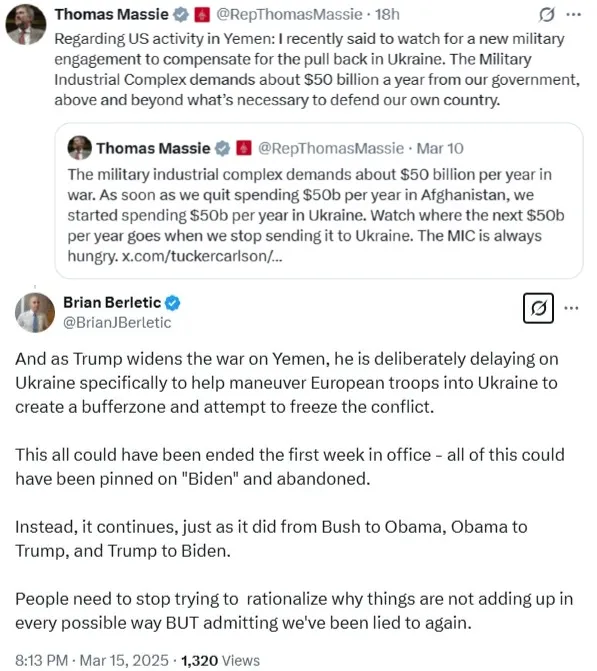
This is all par for the course for any long-time readers, as we predicted here as far back as 2023 that the conclusion of the war would go precisely along this mode. But the sudden urgency does lend an interesting angle, as it seems to suggest that Ukraine’s situation is more dire than is being let on. Recall all the talk of summer-time collapse: it’s possible the Europeans know that a new round of Russian spring-to-summer offensives could be the final straw on the exhausted Ukrainian camel’s back.

Not one nation thus far has even logically explained what the purpose of the “30-day ceasefire” is. Does anyone know, or even care to pretend at knowing? In Gaza, at least, such things followed a practical line, with thousands of civilians trapped and without food. In Ukraine, the only ones currently trapped are alleged to be thousands of Ukrainian troops somewhere in Kursk, which again implies the ceasefire’s purpose is to save Ukraine.
Image

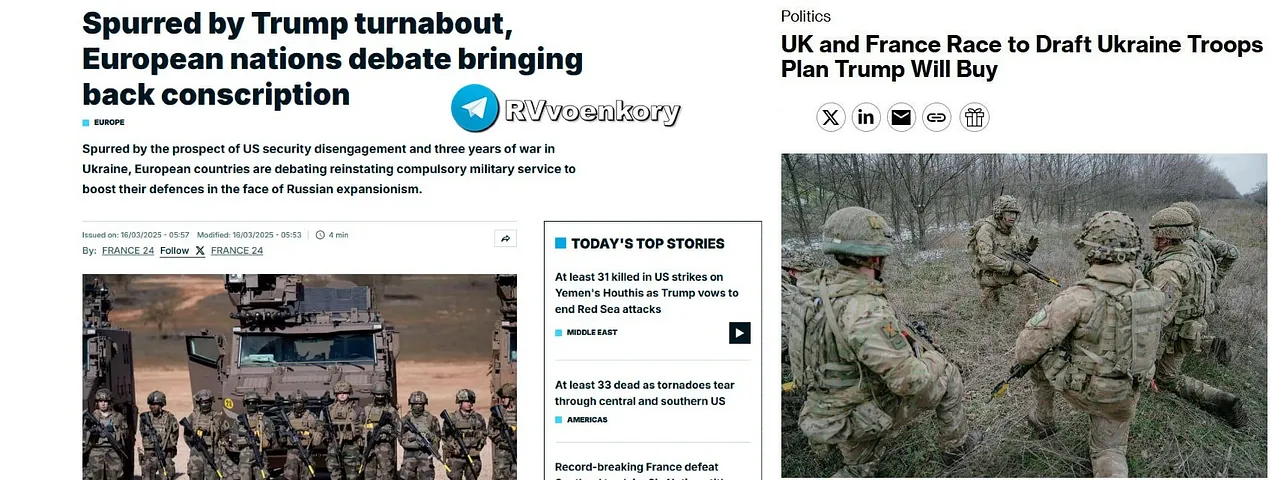
In general, the bellicose saber-rattling and threats have reached peak proportions, as European countries do everything in their power to fear-monger citizens into signing up for WWIII:
Image
https://archive.ph/kQWOQ

Image

Image

Starmer supercharged the rhetoric by snowing the plebs with absurd lies about Russia already “menacing the UK’s skies, waters, and streets”: (Video at link.)

But I once again contend that these are nothing more than “effete posturing” from panicked globalists with no real power, desperate to maintain an image of ‘control’, and taking the lead to counteract their otherwise failing regimes.

Case in point:
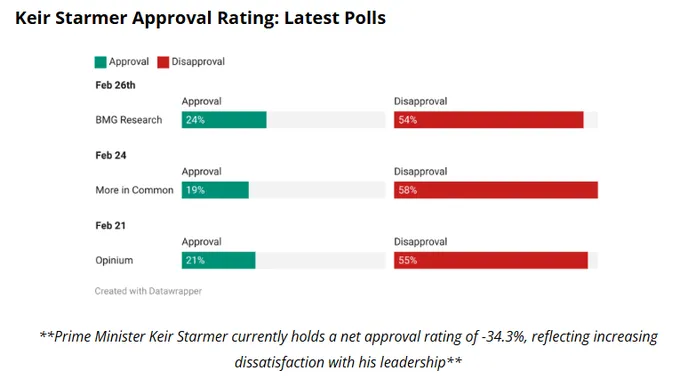
Image

It’s the same old classic “fake it til you make it” act: they are merely trying to turn the ‘prophecy’ into a self-fulfilling one by treating it as if it were real. But there is no real consensus, and their plan has little chance of conjuring it from thin air, particularly given that the US has already counted itself out of any troop involvement.

Both the French and British know how politically risky the move is—if their troops begin coming home in body bags from Russian strikes, and there’s no Mommy US to back them up, their fragile political regimes would crumble from public outrage, especially since they’re already hanging on by a tenuous thread.

The West has a Sunk Cost problem: they’ve invested everything not only into the Ukraine war itself, but now into the image of their own strength and ability to manifest peace at will. In other words, they told the world Russia was weak, and that they had the global clout to bring Putin to the table anytime they saw fit.

Instead, the rampaging bear has not slowed, and Western puppet leaders are panickedly fighting the narrative current, pushing inertia for its own sake to signal faux-strength and leadership on global issues. They continue pretending that negotiations are drawing ever-nearer in a comic rendition of Zeno’s Paradox, all the while Russia cajoles them with the ol’ snickering wink as it pushes inexorably forward.

(More at link.)

https://simplicius76.substack.com/p/boo ... r-conceals

******

Why the EU Is Failing

Posted on March 17, 2025 by Kevin Kirk
The Democratic Deficit is one reason why the EU is perceived to be failing; but there are others such as too much power being concentrated in one unelected institution and a lack of transparency

On the face of it, the European Union is a good idea. A large market, filled with well educated industrious workers and a subsequent significant GDP. Coupled with the free passage of goods and people and customs-less borders make for the potential to become an economic super power. And now, all of that is draining away.

So, What Went Wrong?

If we look at the structural underpinnings of a stable Federal Republic, like the United States, we see the following: an Executive, that will undertake the tasks assigned to it via laws passed by the legislative and fund allocation body (Congress) and agreed to or amended by the deliberative body (the Senate) with a legal system that will tease out meaning from any acts that are passed and ensure they comply with the constitution. This tripod of executive, elected representatives and judiciary is very stable, with each branch being able to direct and control the desired outcomes. It’s easy to understand and it works.

Now look at the structure of the EU: Under Article 13 of the Treaty on European Union: instead of a simple tri-partite structure there are seven principal decision-making bodies of the European Union:

1.European Court of Auditors: Founded in 1975 and consisting of one member from each of the EU states (27 in all) and supported by a staff of around 800 people, it is responsible for auditing the whole of the EU (since the Maastricht Treaty) and its institutions. Its principal responsibility is to ensure that the EU budget has been implemented correctly and that EU funds have been spent legally with good managerial oversight. They compile a report (the one for 2023 is here) outlining expenditures (and problems – usually in the form of unauthorized and/or suspect payments) in the previous year.
2.European Central Bank: The ECB Governing Council makes monetary policy for the Eurozone and the European Union, administers the foreign exchange reserves of EU member states, engages in foreign exchange operations and defines the intermediate monetary objectives and key interest rate of the EU. The governing board are appointed by the European Council.
3.Court of Justice of the European Union: The court acts as an administrative and constitutional court between the other EU institutions and the Member States and can annul or invalidate unlawful acts of EU institutions, bodies, offices and agencies.
4.Council of the European Union (of member state ministers, a council for each area of responsibility), is one of two legislative bodies and together with the European Parliament serves to amend and approve, or veto, the proposals of the European Commission, which holds the right of initiative (i.e it can request, but not propose, new laws except in certain areas like foreign relations, economic and monetary union and security policies). It is the only EU institution that represents the views of the various countries of the EU, represented by a minister (rather than the EU itself or the people of the EU).
5.European Council: is a collegiate body of people who define the overall political direction and priorities of the EU. It is widely considered as being part of the executive of the EU along with the European Commission as it has the power of appointing the commission. It is composed of the heads of state (i.e King or President) or of government (for example, the Prime Minister) of each of the EU member states.
6.European Parliament: is one of the two legislative bodies of the European Union and one of its seven institutions. Together with the Council of Ministers, it adopts European legislation, following a proposal by the European Commission. The Parliament is current composed of 720 MEPs (Members of the European Parliament).
7.European Commission: is the primary executive arm of the EU. It operates as a cabinet style government, who represent the EU and not the individual commissioner’s home countries (they swear an oath to that effect), with a number of Commissioners (currently 27 including the President) roughly corresponding to two thirds of the number of member states unless the European Council unanimously decides to alter this number. It controls an administrative body of about 32,000 European civil servants. The commission is divided into departments (known as Directorate Generals and are analogous to ministries) that are each headed by a Director-General who is responsible to a Commissioner. It is the Commission that currently holds the overwhelming amount of executive power over the European Union.
The Treaty of Lisbon changed the expression of the executive power of the EU, which was previously exercised by the Council, to the Commission, which exercises its powers purely by virtue of the various treaties. Only in a few areas, like foreign and security policies, is the power actually held by the Council of the European Union and the European Council.

Not only does the Commission exercise almost complete control over the executive power over the EU but it is the only body that can propose legislation. This was done in order to “ensure coordinated and coherent drafting of EU law”, which is purely an administrative function, to ensure the rights of smaller member countries of the EU and to further the interests of the EU as a whole. The Council and Parliament may request the commission to draft legislation, though the Commission does have the power to refuse to do so and EU citizens are also able to request the commission to legislate in an area via a petition carrying one million signatures (from at least 7 countries), but this is not binding.

The Commission’s powers in proposing law have historically centered on economic regulation. However, it has put forward a large number of regulations based on a “precautionary principle”; for example, if there is a credible hazard to the environment or human health. One example is where the Commission has committed EU member states to carbon neutrality by 2050. As opposed to most regulations, where the effects on the economy are factored in prior to legislation, these regulations do not take the economic impacts into consideration and the laws are often stricter than those enacted by individual governments. In addition, the commission has moved into enacting Criminal Law. It was challenged in the European Court of Justice but upheld. If the EU passes a law it has supremacy over national laws.

These expanding powers have often come at the expense of laws existing within members states. For example, back in 1964, the European Court of Justice decided in Costa v ENEL that Union law should take precedence over conflicting national law. This meant that national governments could not sidestep what had been agreed at a European level by enacting conflicting domestic measures or by already having in place conflicting national legislation, but it also potentially meant that the EU legislator could legislate unhindered by the restrictions imposed by fundamental rights provisions enshrined in the constitutions of member states.

The form of regulations/laws include binding regulations, directives, decisions, and non-binding recommendations (which are not binding on member states but are used to encourage member states to include them within their national laws) and opinions (essentially a warning to member states to implement EU directives or laws – usually within 60 days):

A regulation is a law which is binding in its entirety and directly applicable in all Member States without needing national implementation.
A directive is addressed to the Member States as a framework for their legislation. It is “binding as to the result to be achieved”, but Member States can choose their own form of implementation.
A decision is a law that addresses a specific issue. Addressees may challenge a decision via a judicial review.
Legislative acts are enacted via the legislative procedure, initiated by the Commission, and ultimately adopted by both the Council and European Parliament.

Non-legislative acts include implementing and delegated acts, such as those adopted by the Commission in pursuance of policy, which often involve so-called comitology committees.

As stated previously, any new law must be proposed and drafted by the Commission. This will then get passed to the European Council and the EU Parliament for ratification. Either of these bodies may send the proposal back to the Commission for amendments. In the case of the parliament, it just needs a simple majority (50% + 1) to pass; whereas, the Council needs a Qualified Majority (54% of Governments, representing 64% of the EU’s citizens) in order to pass. If 4 or more countries’ representatives (irrespective of the size of their populations) vote against the proposal then it will be passed back to the Commission for amendment or it may not be passed at all.

This may be one reason why there has been so much effort in undermining Georgescu’s Presidential bid in Romania. Already, the EU has 2 “problematic” ministers in the Council (Robert Fico of the Slovak Republic and Victor Orban of Hungary) and they previously had a 3rd, with the “right wing” government in Poland (who were defeated in their General Election). Giorgia Meloni of Italy also posed a threat of being too far from what the Commission wanted, particularly when she railed against Brussels’ bureaucrats and the LGBT lobby, so she was threatened with “tools” to bring her into line by Ursula Van Der Leyen. Which, in fairness, seemed to have worked as Meloni does not go against the wishes of the Commission, but the fear is she could stray if another “Far Right” President (such as Georgescu) were to take power.

In addition, Fico was the subject of an attempted assassination and both he and Orban have been the victims of smear campaigns and attempted “Color Revolutions” against their governments. They also had their gas (and in Hungary’s case its oil) cut off by the Zelensky regime in Kiev, seemingly at the behest of the Commission, and they have had funds, that they are legally entitled to, withheld by the Commission because they voted against continuing to supply arms and cash to the Zelenskyy regime. This prompted Orban to release a list of his Government’s demands:

We demand a Europe of nations.

We demand equality before the law for all Member States.
Restore the competences1 unlawfully taken from nations.
National sovereignty and a strong veto for national governments.
Expel Soros agents from the Commission and remove corrupt lobbyists from the Parliament.
Do not mortgage our grandchildren’s future, eliminate the Union’s debt.
Do not obstruct our national guard from protecting our borders. Do not bring in migrants, and remove those who have arrived illegally.
Corrupt dollars and euros must not flow into Member States.
Ban the unnatural re-education of our children.
Protect Europe’s Christian heritage.
We demand peace in Europe.
A Union, but without Ukraine.
Taxes and Other Revenue

The EU has no tax raising powers of its own; instead, it obtains its revenue from the following four sources:

GNI-based own resources: comprising a percentage of each member state’s gross national income (GNI).
VAT-based own resources: comprising a percentage of Member State’s value added tax (VAT) base.
Original resources: Customs duties on imports from outside the EU and levies collected on behalf of the EU.
Other revenue: including taxes from EU staff salaries, bank interest, fines and contributions from third countries.
This is likely to be the next area of friction between the Commission and the member states. The Commission wants its own tax raising powers and has tried, stealthily, to raise money during COVID and now via their war frenzy (note, they avoided discussing the €700+ Billion for European re-armament and arming Ukraine until after the German election to avoid the wrong result). The EU proposed to raise the €750bn for their COVID recovery fund on the capital markets repayable over 30 years. It then proposes to service that debt with the introduction of four new “own resources” (aka “EU controlled taxes”). These taxes are listed as:

Extension of the Emissions Trading System based own resources to the maritime and aviation sectors to generate €10 billion per year.
Tax or income stream based on operations of companies, that draw huge benefits from the EU single market, which, depending on its design, could yield around €10 billion per year.
Carbon border adjustment mechanism to raise €5 billion to €14 billion per year.
Digital tax on companies with a global annual turnover of above €750 million to generate up to €1.3 billion per year.
There is also an EU Tax Policy Focus already in existence and under it the EU aims to:

Support the smooth functioning of the single market.
Harmonize taxation to reduce obstacles to cross-border economic activity.
Combat tax evasion, avoidance, and fraud.
Promote cooperation between tax administrations.
Ensure that national tax policies support wider EU policy objectives.
The role of the EU Commission is to propose new EU laws and policies in the area of taxation and to monitor the implementation of these laws and policies. And the role of Member States is to introduce, remove, or adjust taxes within their own jurisdictions under a tax system they deem most appropriate, provided it complies with EU rules and they have the responsibility to collect taxes and decide how the collected revenue is spent; again, as long as it complies with EU rules. You can read, in detail, about EU tax laws and how they are evolving here.

Meanwhile, here are some examples of EU Tax Policy Initiatives:

Energy Tax Directive: The Commission is working on reforms to the Energy Tax Directive to promote a carbon-neutral continent by 2050. Note, the link is to the new revisions that include, aligning the taxation of energy products with EU energy and climate policies, the promotion of clean technologies and the removal of outdated exemptions and reduced rates that currently encourage the use of fossil fuels.
Anti-Tax Avoidance Directive: This directive aims to create a minimum level of protection against corporate tax avoidance in the EU.
VAT Directive: The EU VAT Directive allows Member States to apply reduced VAT rates or grant VAT exemptions for certain products.
FASTER Directive: This directive aims to make withholding tax procedures in the EU more efficient and secure.
In addition, bonds, such as the “Green Bonds” are also issued to fund Commission initiatives. For example, the European Investment Bank issued €13.15bn of Climate Awareness Bonds in 2023 and the European Commission issued €12.46bn NextGenerationEU Green Bonds in 2023.

The Commission may also act quasi-judicially in settling matters relating to certain EU laws, a power defined in Article 101 and Article 102 of the Treaty on the Functioning of the European Union. One such case was in the area of personal data protection.

The Democratic Deficit

Many of the problems that Europe is now facing have come about since the implementation of the Lisbon Treaty, where the overall power within the EU was taken from the Council and handed to the unelected Commission (the Council members were elected as part of their national elections). This has, in effect, meant that the Commission can exert power across the EU without any apparent checks and balances. Particularly so, when the Commission grants itself more and more competences at the expense of the member states’ freedom to act in certain areas (immigration being a prime example).

And, according to Nigel Farage (during his documentary on his last day in Strasbourg – worth watching if you have 10 minutes free), the commission is unelected, unaccountable and impossible to remove. The Commission President could be removed by the Parliament and the Council, but is unlikely to happen, as Farage explains, most MEPs go native once they are ensconced in the Parliament and would not want to jeopardize their significant perks (it is not unknown for the EU to smear or campaign against any awkward MEPs so they lose their seats – for example: Mick Wallace & Clare Daly):

MEPs get €10,337 a month in salary (the typical ordinary worker salary in the EU, according to Eurostat, is €2,944 a month)
monthly expenditure allowance of €4,950 to manage office costs in their home constituency.
MEPs can claim a flat-rate allowance of €350 per day, intended to cover accommodation, food, and other costs while in Brussels or Strasbourg – but that doesn’t cover weekends or non-sitting days. According to the Parliament’s calendar, there are political, committee or plenary events for around 150 days per year, making this worth around €4,400 per month on average.
MEPs are allowed to have second jobs (such as work at lobbying firms), and the average MEP earns €12,000 extra per year.
MEPs also get a monthly budget allocation of €29,557 to pay their assistants’ salaries, benefits and other associated costs.
They also get €4,886 a year for travel and accommodation, in addition to when they are in Brussels or Strasbourg, where they have access to parliament’s own fleet of chauffeur driven vehicles (usually a Mercedes). MEPs are also refunded for travel to and from the European Parliament itself, which includes business-class air travel, first-class rail, or refunds for car journeys. An MEP driving from Toulouse to Strasbourg, for example, could claim back €580 per trip.
MEPs continue to draw an allowance even after they leave office – for instance if they aren’t re-elected. It’s worth the same as their monthly salary, and they continue to draw it for a transitional period that depends on their length of service. For example, an MEP who served five full terms could thus earn €124,000 per year.
MEPs also qualify for a pension when they turn 63. It’s worth as much as 70% of their salary – accruing at 3.5% of salary for each year they served.
The Parliament is the only EU institution that is directly elected by EU citizens; all the others are appointed (with the exception of the Council which have a mandate granted to them by their national elections). MEPs are generally elected using either Proportional Representation on a nationwide basis or via a single transferable vote. This means that a European citizen does not have an MEP representing them (which raises the question of why they should have a constituency office – see 2 above – as they don’t actually have a constituency), but instead they are represented by a party.

But even this notion of representation is not generally followed as most MEPs put aside their party upon being elected and join one of the EU parties (the supposedly center-right EPP is currently the top party in the Parliament – they were instrumental in backing the appointment of Ursuala von der Leyen both in her first term and in her second). It is this lack of citizen participation that distinguishes the EU from other federal republics (like the USA). It means that the governing body of the EU and its dependencies run the risk of becoming decoupled from the needs of the general population leading to accusations of authoritarianism and in only catering to the needs and desires of a small part of the citizenry (i.e. people inside the Brussels bubble).

Another issue is lack of a unified structure from the outset. For example, the Council only came into existence in the 1990s, meaning that prior to that there was no political control or guidance within the EU. Partly, this was due to the fact that the EU was conceived as a technocracy, such as the French model, where highly skilled bureaucrats administer the community for the benefit of the citizens. The School of Administration in Strasburg (France), founded by Charles de Gaulle in 1945, was supposed to be the blueprint for how bureaucrats were to be trained but since the rapid increase in membership of the Union and the need to employ citizens from all member states, many of which do not offer schools or even courses on public administration at a high level, the standards have slipped.

And it is not just the administrators. It also applies to the executive. Many of the Commissioners are ex-politicians whose careers have been curtailed by being voted out or “promoted” because they couldn’t deal with the portfolio they were given at home. Ursula von der Leyen is a perfect example; she was previously the German Defense Minister and under her watch the German Armed Forces were short of every type of equipment, including rifles (German troops has to carry broomsticks painted black and shout “bang” during a NATO exercise) and there was evidence of corruption in the ministry as to how contracts were awarded (something that has resurfaced while she has been the EU President for how COVID vaccines were sourced – so far she has managed to avoid any investigations into the affair). Her greatest strength was that she was an unflinching supporter of Angela Merkel who subsequently lobbied hard for von der Leyen to get the EU’s top job.

Regarding her management style, current and former aides describe her management style as distant and defensive, she surrounds herself with a small group of aides who kept tight control on the flow of information. You can read more about her career here (it’s a good read). Former European Parliament President Martin Schulz put it best when he said: “Von der Leyen is our weakest minister. That’s apparently enough to become Commission president.”

In summary the EU is suffering from the following:

An unwieldy structure
Poorly trained bureaucrats
A weak parliament
A poor-quality unelected leadership
A lack of consensus
The EU Should Be a Confederation Not a Federation

In order to become a successful federal republic a group of states need certain traits and values:

A common language
A common currency (some EU countries haven’t adopted the Euro)
A common history and underlying culture
A common voting system (there is still no voting method in place across the whole of the EU)
Citizen participation, through elections, at all levels of the federation
A simple, understandable federal structure
A common foreign policy
A common tax code with most taxes being administered at a federal level
Elected representatives that are accessible to the public and to whom grievances may be addressed
A constitution that upholds citizen’s rights, not the rights of the executive
National pride
Given those constraints, why are EU politicians hell-bent on enacting a federal republic when the citizens are so obviously against it and when a confederation of strong nation states, with an EU bureacracy (not a decision making body) administering it on their behalf, would better serve the needs of the citizens of Europe?

FAQs

EU Sanctions

EU sanctions are adopted unanimously by a Council decision in the field of the Common Foreign and Security Policy (CFSP), which is binding in its entirety for all Member States. If the decision provides for the reduction or interruption of all or part of the economic and financial relations with a third country, an EU regulation shall be adopted by qualified majority (see below) upon a joint proposal from the Commission and the High Representative of the Union for Foreign Affairs and Security Policy.

Qualified Majority Votes

As mentioned previously, these require a > 54% of governments representing >64% of citizens (and subject to the >4 state veto). The areas covered by QMV are as follows: Administrative cooperation, Asylum, Border checks, Citizens initiative regulations, Civil protection, Committee of the Regions, Common defense policy, Crime prevention incentives, Criminal judicial cooperation, Criminal law, Culture, Diplomatic and consular protection, Economic and Social Committee, Economic and Social Committee, Emergency international aid, Energy, EU budget, Eurojust, European Central Bank, European Court of Justice, Europol, Eurozone external representation, Foreign Affairs High Representative election, Freedom of movement for workers, Freedom to establish a business, Freedom, security and justice – cooperation and evaluation, Funding the Common Foreign and Security Policy, General economic interest services, Humanitarian aid, Immigration, Initiatives of the High Representative for Foreign Affairs, Intellectual property. Organization of the Council of the European Union, Police cooperation, President of the European Council election, Response to natural disasters or terrorism, Rules concerning the European Defense Agency, Self-employment access rights, Social security, Space, Sport, Structural and Cohesion Funds, Tourism, Transport, Withdrawal of a member state.

_____

1 A competence is the power to control and legislate on a particular subject. Currently, the EU has exclusive competence in areas like the customs union, competition rules, monetary policy for Eurozone countries, the common commercial policy, and the conservation of marine biological resources. It also has shared competences with member states, and can support, coordinate, or supplement actions in certain areas. Here’s a more detailed breakdown:

EU exclusive Competences:

Customs Union.
Establishing a common customs policy, including tariffs and trade barriers.
Competition Rules. The EU sets and enforces competition rules within the single market, ensuring fair competition and preventing monopolies.
Monetary Policy in the Eurozone, in setting monetary policy, including interest rates and the exchange rate of the Euro.
Common Commercial Policy. The EU negotiates and implements trade agreements with other countries, setting common standards for trade and investment.
Conservation of Marine Biological Resources. The EU has exclusive competence in managing and conserving marine resources, including fisheries, under the Common Fisheries Policy.
Education and training.
Shared Competences (with member states):

Environmental Policy: Both the EU and member states can enact environmental regulations, but the EU can act when it’s necessary to achieve a common objective that cannot be achieved effectively by individual member states.
Economic, Social, and Territorial Cohesion (Regional Policy). This includes the promotion of economic, social, and territorial cohesion, including regional development and structural reforms.
Agriculture and Fisheries (except in the conservation of marine biological resources).
Areas related to freedom, security, and justice, including border controls, asylum, and immigration. However, the EU alone has the authority to establish the conditions for entry and legal residence in a Member State, including for family-reunification purposes, applicable to nationals of non-EU countries.
Supporting, Coordinating, or Supplementing Actions:

The EU can support, coordinate, or supplement the actions of the Member States in areas such as culture, tourism, and research and development.
Climate Action: The EU and Member States can enact climate policies, but the Member States can do so only where the EU has not exercised its competence or has explicitly ceased to do so.
You can read a scholarly review of the ‘Competences Problem’ here.

https://www.nakedcapitalism.com/2025/03 ... iling.html

Bureaucracy, in and of itself, will always be a problem requiring at least constant supervision. But when that bureaucracy is directly tied to big capital then it is truly a dictatorship. And this seems to be the desire of the leading capitalists' who tire of the window dressing which might in any way infringe upon their 'liberty'(Roman patrician definition).

******

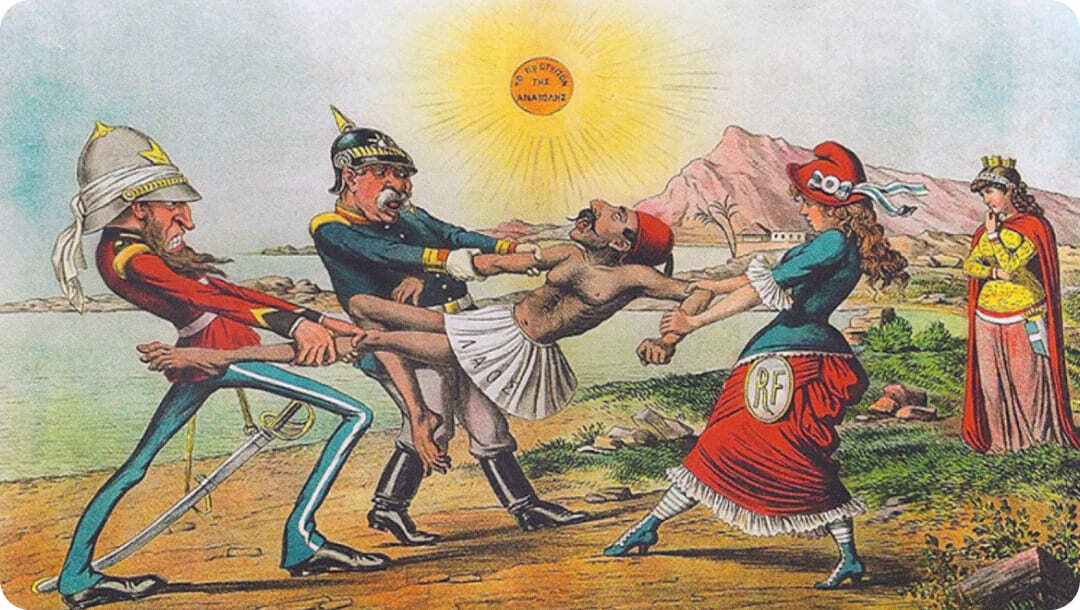
The Sick Man of Europe
March 16, 22:51
Image

Türkiye took great pleasure in returning to Europe the old insult of the "Sick Man of Europe".

Erdogan's adviser calls EU a sick man of our time with a colonialist complex
The European Union is hypocritical and insincere towards Turkey and has no right to teach Ankara democracy , said Erdogan's senior adviser Mehmet Ucum.
The European Union is a sick man of our time. Those who speak on behalf of this sick man should first look at themselves. The sick man of the EU cannot teach Turkey democracy and law; let them deal with their own crisis of democracy and law.

This was a reaction to the report by the rapporteur on Turkey in the European Parliament, Nacho Amor, who said that the EU is set to expand defense cooperation with Ankara, but Turkey has no prospects for membership in the union.
According to Ucum, it is unacceptable for the EU to view Turkey only from the point of view of meeting security needs. In his opinion, the statements of the European rapporteur are "evidence of complete misunderstanding and arrogance, the result of a colonialist mentality."


https://t.me/turan_express/20265 - zinc

Anyone can offend Europe now.

https://colonelcassad.livejournal.com/9728792.html

Google Translator

"There is great chaos under heaven; the situation is excellent."

User avatar
blindpig
Posts: 14829
Joined: Fri Jul 14, 2017 5:44 pm
Location: Turtle Island
Contact:

Re: Blues for Europa

Post by blindpig » Wed Mar 19, 2025 2:29 pm

Militarising Europe: The EU Defence Spending Bug
March 17, 2025

Image
European Commission President Ursula von der Leyen. Photo: File photo.

By Binoy Kampmark – Mar 14, 2025

We live in dangerous times, and politicians are happy to be cheerleaders of that supposed fact. They do not care to reassure; they merely care to strike fear into hearts and feed the sort of pernicious despondency that encourages conflict. Hope is not a political currency worth trading. These days, fear is the bankable asset, easily cashed at a moment’s notice.

The March 6 meeting of the Special European Council was a chance for 27 leaders of the European Union to make that point. It was time to cash in on the Russia threat and promote a strategic vision that spoke of elevated dangers. It was, in other words, a good time to be throwing money at the militaries of the various member states.

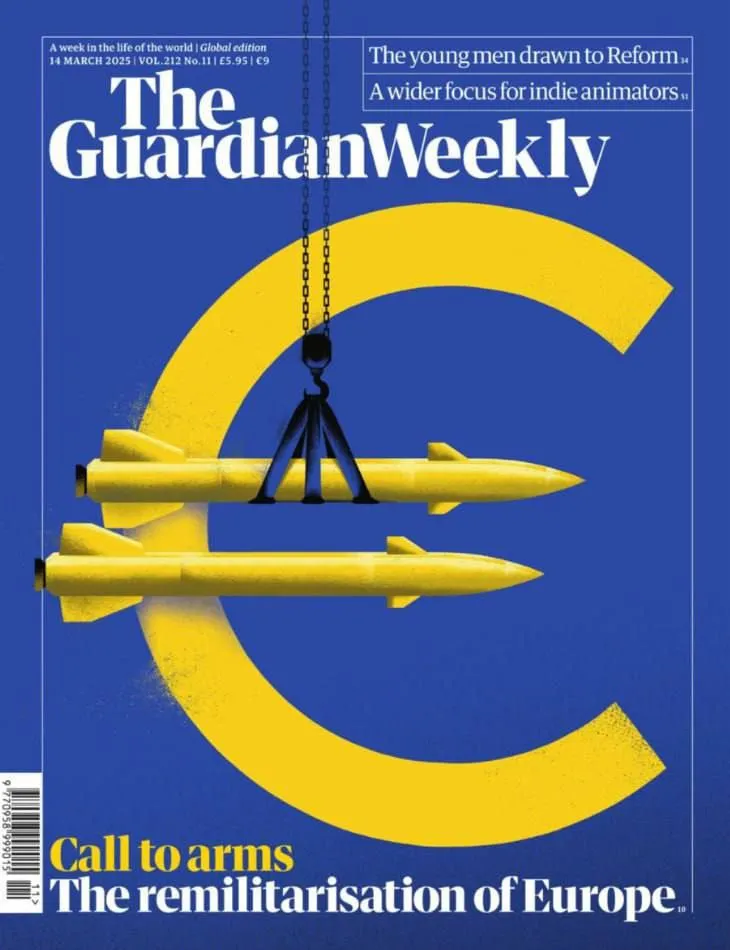
The language was clear from the European Commission President Ursula von der Leyen, a figure who has become increasingly hawkish in pushing the barrow of the military-industrial complex. Announced on March 4, her ReArm Europe plan entails various measures intended to free up to EUR 800 billion in defence funding. A notable one is enabling member states to use the escape clause of the Stability and Growth Pact to bypass the Excessive Deficit Procedure. Without giving too much by way of details, von der Leyen claims that EUR 650 billion of “fiscal space” could be created were EU countries to increase defence spending by 1.5% of GDP. So much, it would seem, for the bloc’s emphasis on fiscal frugality.

Another measure involves the provision of EUR 150 billion of loans to member states under Article 122 of the Treaty on the Functioning of the European Union (TFEU) that will go into such defence initiatives as air and missile defence, artillery, missiles, armed drones and anti-drone systems, and cyber security. But this is not all: this initiative is not only intended for European defence but aiding Ukraine and, it follows, prolonging the war.

Vague suggestions are also on the table. Von der Leyen babbles about “cohesion policy programmes” that might be used to increase military expenditure, with money drawn from the EU budget. Private capital will also be raised through the Savings and Investment Union and the European Investment Bank.

The five-point agreement that emerged from the summit was approved by 26 of the 27 members. (Hungary did not disappoint in vetoing the leaders’ statement). It spoke to such compulsory conditions as Ukrainian participation in peace talks, and European involvement on matters touching upon its security. “Ukraine’s, Europe’s, transatlantic and global security,” the statement pompously reads, “are intertwined”. EU funding in the order of EUR 30.6 billion was also promised for 2025.

The move brings some unwanted attention to the workings of EU policy. Of interest here is the issue of using Article 122, an emergency provision that is non-legislative in nature and has been previously used in responding to the COVID pandemic and Russia’s invasion of Ukraine. In other words, it is an executive pathway that purposely bypasses the European Parliament.


Resorting to the article in this instance did not impress Manfred Weber, who leads the European People’s Party (EPP) group in the Parliament. “Bypassing Parliament with Article 122 is a mistake,” opined Weber to his colleagues in the Strasbourg plenary. “Europe’s democracy stands on two pillars: its citizens and its member states, (and) we need both for our security.”

European Parliament president Roberta Metsola also urged EU leaders at the March 6 summit that, “Working through the European Parliament, especially on decisions of this magnitude, is a way of fostering trust in our union.” While “swift action” was needed, “acting together is the only way of ensuring broad and deep public backing.”

In a non-legislative resolution, 419 MEPs encouraged member states to, amongst other matters, increase defending expenditure by at least 3% of GDP, create a bank for defence, security and resilience and pursue a system by which European defence bonds might be used to pre-finance military investment. While these approving members thought Europe was “facing the most profound military threat to its territorial integrity since the end of the Cold War”, 204 chose to vote against it, with 46 deciding to abstain.

In the process of reaching the final resolution, it is worth noting that certain MEPs from The Left and The Greens/EFA attempted to include an amendment that was rejected by 444 votes. “The Parliament,” it read, “deplores the choice to use Art. 122 […] for the new EU instrument meant to support members states defence capabilities; expresses deep concern for being excluded from decisional process”.

While the March summit suggested a new turn towards bellicose militarism, the trend is unmistakable and troublingly inexorable: Europe is spending more on defence, and was doing so even before the return of Donald Trump to the White House. In 2024, military budgets increased by 11.7% in real terms, with a number of countries reaching the target of 2% of GDP expenditure agreed by NATO members in 2014. Throughout Europe, the merchants of death, an eloquent, accurate term coined in the 1930s, can only be crowing.

https://orinocotribune.com/militarising ... nding-bug/

******

GAS WARFARE IN GERMANY – IS A TRUMP DEAL ON NORD STREAM POSSIBLE, OR IS IT ANOTHER MAGA HUSTLE?

Image

by John Helmer, Moscow @bears_with

At the beginning of this month, Bild, the German media sensationalist, claimed to have discovered “incredible developments between [Presidents] Trump and Putin. And they affect Germany! Bild research reveals secret talks between the US and Russia in Switzerland. It’s about an explosive gas deal for Germany! At the centre of the affair: once again the Baltic Sea pipeline Nord Stream 2.”

The Bild story alleged that Trump’s envoy for special missions, Richard Grenell, made several visits for negotiations at the headquarters of Nord Stream 2 AG — the Baltic seabed pipeline’s operator, wholly owned by Russia’s sanctioned Gazprom — in Steinhausen, in the Swiss canton of Zug. Grenell has denied the story.

The Kremlin spokesman, Dmitry Peskov, added there was no point in his commenting on Bild’s claims because Grenell “has already denied it. And so the Americans have denied it. Also, there is a lot of information [in the Bild publication] that is not true.”

The Bild report followed just hours after a report appeared in London by the Financial Times maintaining that “a former spy and close friend of Vladimir Putin has been engineering a restart of Russia’s Nord Stream 2 gas pipeline to Europe with the backing of US investors, a once unthinkable move that shows the breadth of Donald Trump’s rapprochement with Moscow. The efforts on a deal, according to several people aware of the discussions, were the brainchild of Matthias Warnig, an ex-Stasi officer in East Germany who until 2023 ran Nord Stream 2’s parent company for the Kremlin-controlled gas giant Gazprom.”

The anonymous sources told the newspaper “Warnig’s plan involved outreach to the Trump team through US businessmen as part of back-channel efforts to broker an end to the war in Ukraine while deepening economic ties between the US and Russia. Some prominent Trump administration figures are aware of the initiative to bring in US investors, according to officials in Washington, and they see it as part of the push to rebuild relations with Moscow.”

Warnig told the FT he was “not involved in any discussions with any American politicians or business representatives.”

Stephen Lynch, a well-known arbitrageur between Russian and US asset buyers and sellers following the Yukos oil company’s nationalization between 2004 and 2007, was reportedly behind some of the fresh media leaks, according to which “one US-led consortium of investors has drawn up the outlines of a post-sanctions deal with Gazprom, according to one person with direct knowledge of talks who declined to disclose the identity of the prospective investors.” For Lynch’s record, including his attempt at a hostile takeover of gas assets of Ukrainian oligarch Dmitry Firtash in 2016, click to read the archive.

While Lynch has been promoting a Nord Stream takeover for his own commercial reasons, the planting of the story in Bild and the FT may have been an attempt by European officials to kill it.

“Senior EU officials,” according to the London newspaper, “became aware of the Nord Stream 2 discussion in recent weeks. Leaders of several European countries are concerned and have discussed the matter, according to several officials with knowledge of the discussions…The latest plan would in theory give the US unparalleled sway over energy supplies to Europe, the people said, after EU countries moved to end their dependence on Russian gas in the aftermath of the invasion.”

Russian analysis of these purported dealmakers and their targets has been compiled in this new piece, published on March 18 by the Moscow business weekly, Expert. In its assessment of the German and British claims, Expert concludes that American speculators are being attracted to the potential profit in schemes for buying low-priced Russian assets currently under sanctions; lobbying the Trump Administration to lift the sanctions as part of an end-of-war settlement in the Ukraine; and then reselling the assets if and when business with Russia revives and the Russian asset prices return to pre-war market levels. Lobbying the Trump Administration is the polite term for this.

According to Expert, a scheme to dismantle the current sanctions and refill the single, undamaged pipe of Nord Stream 2 with Gazprom gas for Germany is between improbable and impossible. However, an alternative with better chances for speculators is a buyout of Rosneft’s German oil refinery at Schwedt.

Image
Left, Matthias Warnig; right, Richard Grenell.

Image
Source: https://www.ft.com/content/dc9c51ab-03c ... c4deed9b50

The sabotage of September 26, 2022, struck both pipes A and B of the older Nord Stream 1 pipeline; however, only pipe B of Nord Stream 2 was hit, leaving pipe A capable of operation. It has a capacity of 27.5 billion cubic metres of natural gas per year. This is almost comparable to the now suspended Russian gas pipeline across Ukraine, whose annual capacity is 29.5 billion cubic metres. For background, click.

Image
Source: https://www.wsj.com/

However, this interest of a private investor from the United States is not enough for the deal, Alexei Belogoryev, research director at the Institute of Energy and Finance, told Expert: “I don’t see any political forces in Germany which would support the sale of the Nord Streams. Not counting the Alternative for Germany and the far left, which are on the periphery. Restoring gas supplies has been a political problem for Germany until 2022, and even more so now.”

For such a deal and the launch of supplies, would require, in addition to the political will of Germany, the approval of the European Commission, as well as of Denmark, through whose waters the pipeline runs, because the pipeline needs to be certified.

According to Alexander Frolov, an expert at the Infotech Analytical Center, the restoration of Russian gas exports to Germany is unlikely. Among the potential problems, he cites a decrease in gas consumption in Europe — from 2021 to 2024, consumption in the European Union decreased from 415 billion to 332.5 billion cubic metres per year; taking into account UK consumption, the reduction has amounted to about 100 billion cubic metres. Lack of political will in Germany, which is unlikely to be influenced by the United States, and there are as well issues with Gazprom’s “liabilities” claimed against the company by its former European purchasers. “As soon as German companies would receive Russian gas again, if this happens, they would immediately requisition the revenues to pay off these debts,” Frolov is sure.

Belogoryev says that the US interest in Nord Stream is totally incomprehensible: “The United States has declared that it would annually introduce 15-20 million tonnes of new gas liquefaction capacity — they would need to place this volume somewhere. It will be necessary to increase supplies to Europe and squeeze out LNG from other countries, including the Russian. The pipeline gas would become a direct competitor to these new volumes. In addition, it is also a threat of lower prices. It is important for any player to sell not only more, but also more expensive gas.” He acknowledges that for Russia it would be beneficial to restore the supply of any energy resources.

Kirill Dmitriev, the head of the Russian Direct Investment Fund (RDIF), speaking on the sidelines of the March 18 Congress of the Russian Union of Industrialists and Entrepreneurs, was evasive in answering a question from journalists about negotiating with the United States to involve US companies in Russian pipeline gas supply projects. “After all, the political issues are now a higher priority. The resolution of these issues is now at the forefront. At the same time, various economic areas are being discussed where dialogue can be established, from the Arctic to cooperation on the climate agenda and other sectors, such as energy. It is still very early to talk about any specific projects — there is a lot of speculation in the press. Many people who are enemies of Russia are deliberately trying to float dubious stories in order, on the contrary, to prevent dialogue. An economic dialogue is underway, but it is not in the format of specific, short-term projects. It is currently in the format of various areas where we could be useful to each other.”

Image
Kirill Dmitriev, left, at the Riyadh round of talks on a Ukraine settlement with the US on February 19. He was then promoted in a presidential decree to be President Putin’s special representative for business negotiations with the Trump Administration and US companies. For more detail, read this.

Rosneft Oil Refinery in Germany
Both experts call the possible entry of Americans into the capital of the Rosneft refinery in Germany a more likely scenario. We are talking about the refinery in Schwedt (where Rosneft owns 54.17%), as well as the plants MiRO GmbH & Co (24%) and Bayernoil (28.57%). “If everything is shaky and fragile with regard to gas, and the number of ambiguities is so great that it is not even clear how to begin to resolve this issue, then there is no such burden and frenzy with regard to Rosneft’s infrastructure,” admits Frolov. Rosneft, according to him, has invested about €5 billion in the modernization of its refineries in Germany and supplied oil there via Druzhba, some of which was never paid for.

MAP OF ROSNEFT’S MAIN ASSETS IN GERMANY
Image

For background on Rosneft’s fight to retain its German assets, read this report from February 2024: https://johnhelmer.net/

“This debt could well be the subject of negotiations: either the company recovers its refineries and the payment for its oil, or receives compensation if the refineries are bought by another company. Formally, the assets have neither been nationalized nor transferred to another owner. There is something to talk about here: you can decide on your fate, on the possibility of compensation,” says Frolov.

According to Belogoryev, Russian Urals oil does not compete with American export grades — they have different chemical properties. It will also be easier for Germany to agree to such a deal, since “it is outside the field of the main political discussion”. “Finally, it is not essential ry to supply Russian oil to these refineries; it is possible to combine Russian with Kazakh. The United States may be interested in this purely financially — these refineries process a large volume of oil, these are good assets. It will be beneficial for us if the sale is accompanied by the restoration of at least part of the oil supply.”

Currently, the Schwedt plant is supplied with oil from the world market: from the German Baltic port of Rostock, through the Polish port of Gdansk, and from Kazakhstan via the Druzhba. “Attempts to strengthen the security of the domestic German market of petroleum products — under this pretext, Russian oil supplies were stopped — turned out to be rather a decrease in energy security, a decrease in operational stability. The Germans have to negotiate with several companies instead of one. It is the stability of supplies that suffers,” Frolov says, identifying another argument in favor of the deal.

Expert contacted the press services of the Ministry of Energy, Gazprom and Rosneft and Deputy Prime Minister Alexander Novak for comments. By the time of publication of this text, no responses had been received from any of these structures.


Earlier, Alexander Novak told Reuters that at the moment negotiations on the resumption of Russian oil supplies to Germany via the Druzhba pipeline are not underway, and the restoration of gas supplies via Nord Stream 2 is “off the agenda.”[/quote]

https://johnhelmer.net/gas-warfare-in-g ... ga-hustle/

******

Image

How U.S. plans to bleed Europe dry while waging war on China
Originally published: Struggle-La Lucha on March 14, 2025 by Sharon Black (more by Struggle-La Lucha) | (Posted Mar 19, 2025)

The theatrical events of the previous week between Volodymyr Zelensky, Donald Trump, and JD Vance have been grist for all manner of bourgeois media lies designed to obfuscate events. Trump has been touted as pro-Putin. On the other hand, in some so-called anti-imperialist circles he is being hailed as a peace hero.

There is nothing further from the truth on both counts. As of this writing, there are no details of a final peace agreement. Trump’s deal at this date looks more like a 30-day stall (giving Ukraine’s troops a rest and time to resupply arms), rather than a long-term peace agreement that Russia is looking for. What has happened is that the U.S. has resumed sending weapons to Zelensky and that there are continuing talks on how to plunder Ukraine, i.e.,

the rare earth mineral deal.

It would be important to remind readers that behind Trump are the Pentagon generals and that no recent shifts in tactics or strategy would have been undertaken without their agreement.

Pivot to China
Despite baseless hope that the U.S. has chosen “peace” over the pursuit of imperialist interests–U.S. Secretary of Defense Pete Hegseth in Brussels on February 12 (reading off policy drawn from Project 2025), laid out a division of labor in which Europe would continue Washington’s proxy war on Russia while the U.S. pivots to another war of aggression with China in the Asia-Pacific.

Hegseth’s exact words regarding China:

We also face a peer competitor in the Communist Chinese with the capability and intent to threaten our homeland and core national interests in the Indo-Pacific. The U.S. is prioritizing deterring war with China in the Pacific, recognizing the reality of scarcity, and making the resourcing trade-offs to ensure deterrence does not fail.

This turn of policy has as its backdrop the disintegration of Ukraine’s internal situation, which was based on severe losses on the battlefront. The fact that Ukraine could not win the war was known for some time by the U.S. ruling class and laid out in a RAND Corporation position paper commissioned by the Pentagon.

Expanding arms industry in Europe
U.S. imperialism has for the time being unilaterally dumped the Ukraine war on its European counterparts to focus on war with China. This has prompted rushed action among European leaders who have followed Washington, lock, stock, and barrel, for the last three years.

The chest-beating in Europe is likely staged to convince the working class of Europe that more sacrifice and suffering is needed and inevitable.

Again, in Hegseth’s own words at the same Brussels meeting, before the uproar swept the press:

Expanding your defense industrial base is important, leveling with your citizens about the threat facing Europe. Part of this is speaking frankly with your people about how this threat can only be met by spending more on defense. Two percent is not enough; President Trump has called for 5%, and I agree.

The European Union and Germany
In response to Washington’s dictates, Europe’s counterparts quickly scrambled to increase military spending. The European Investment Bank lifted rules barring lending for military use, which will also give the green light to other private-sector bankers and bond lenders. Ursula von der Leyen, President of the European Commission, announced an 800 billion euros war fund over the next four years.

Friedrich Merz, Germany’s new conservative Chancellor-in-waiting, pushed sweeping plans to revive its armed forces with the massive borrowing of over 500 billion euros aimed at upping weapons manufacturing. Germany is the largest European economy.

Germany’s economy in contraction
It’s important to note that Germany’s economy has been in severe contraction for the last two years, marked by declining manufacturing. This has resulted in layoffs, including at Volkswagen, which cut 35,000 jobs and shifted some production to Mexico.

The general capitalist decline unleashed in 2008 impacted the world capitalist system and was exacerbated by the COVID-19 crisis and the war on Russia. Before the war, European countries depended on cheap gas and mineral imports from Russia and on exports of cars, machinery, equipment, and consumer goods to Russia.

Both sanctions and the destruction of the Nord Stream pipeline, widely attributed to the U.S. Pentagon, have caused scarcity and inflation, which have been borne by Europe’s working class.

The big winners are U.S. weapons manufacturers
Any increase in weapons manufacturing on European soil will be negligible compared to the European NATO countries’ dependence on U.S. weapons manufacturers.

Arms imports have more than doubled in the last five years, with 60% from the U.S. This includes almost 500 combat aircraft and other weapons still on order.

Italy and Britain also bought U.S.- made F-35 fighter jets and Patriot anti-air defense systems. Below is a graph that highlights the U.S.’s position on weapons exports.

Arms Dealers

The banks and bond market will be the biggest winners, outside of war manufacturers. The German and European working classes will be the losers.

Workers must fight back
Every bit of this “rearmament” will cost the working class dearly in the form of greater poverty, cuts in services, higher prices, and slashed wages. Workers’ lives will be at risk if the ruling elite succeeds in the reintroduction of compulsory military service and sending troops to Ukraine.

The next chapter must be aimed at stopping imperialist war, turning it around to fight the global billionaire class.

https://mronline.org/2025/03/19/how-u-s ... -on-china/

Stop that! There is no 'billionaire class', there is the bourgeoise. There are millions of seriously rich ready to step into their shoes if capitalism is intact with just a few tall heads chopped off.
"There is great chaos under heaven; the situation is excellent."

User avatar
blindpig
Posts: 14829
Joined: Fri Jul 14, 2017 5:44 pm
Location: Turtle Island
Contact:

Re: Blues for Europa

Post by blindpig » Fri Mar 21, 2025 2:52 pm

The Baltic States’ & Poland’s Withdrawal From The Ottawa Convention Won’t Change Much
Andrew Korybko
Mar 20, 2025

Image

Russia isn’t a signatory nor does it plan to invade any of those four countries.

The Baltic States’ and Poland’s Defense Ministers issued a joint statement on Tuesday announcing that their countries are withdrawing from the Anti-Personnel Mine Ban Convention (Ottawa Convention) in response to what they portrayed as new threats from Russia. Neither Russia, the US, China, nor India, et al. are signatories to this pact banning the use of these munitions. Ukraine, despite being a signatory, received anti-personnel mines from the Biden Administration in late November.

This week’s development follows Polish Prime Minister Donald Tusk declaring earlier in the month that his country “must reach for the most modern capabilities also related to nuclear weapons and modern unconventional weapons”, the latter of which includes anti-personnel mines. It also came less than a week after the European Parliament “stresse[d] that the East Shield and Baltic Defence Line should be the flagship EU projects for fostering deterrence and overcoming potential threats from the East”.

The preceding hyperlinked analysis discusses those complementary defense projects that’ll run along their borders with Russia and Belarus, which are expected to play a key role in the EU’s planned militarization program. Only a fraction of the €800 billion that European Commission President Ursula Van der Leyen announced will likely be spent on this border defense megaproject, but it’ll nonetheless embody the bloc’s plans and function as a new Iron Curtain between the EU and Russia.

The Baltic States’ and Poland’s societies have largely been convinced by their governments that Russia might invade them in the future for no reason at all other than imperial bloodlust, but they also fear that the US might hang them out to dry, ergo why they’re now prioritizing their border defenses. In line with that goal, they decided to withdraw from the Ottawa Convention in order to legitimize their obtainment of anti-personal mines for deterrence purposes, at least from their perspective vis-à-vis Russia.

Seeing as how Russia has no interest in testing the US’ adherence to Article 5, let alone in occupying foreign populations that literally hate it and whose countries have nothing that it needs anyhow, their border defense megaproject (bolstered by anti-personnel mines) won’t change much. The only practical consequence of them building those fortifications and laying those munitions around them is the opportunity cost of investing public finances into these endeavors instead of socio-economic ones.

That’s a domestic issue though, and for however much their prioritization of defense issues over socio-economic ones might upset some foreign observers, their people don’t seem all that opposed to it except perhaps for the Baltic States’ ethnic Russian minorities and maybe a handful of Polish dissidents. The fact of the matter is that these policies are popular at home, their people are mostly willing to pay the attendant opportunity costs, and this makes their societies as a whole feel safer in their own way.

Likewise, Russia and Belarus might also do something similar along the Union State’s borders with those four and Ukraine, namely developing their own border defense megaproject that could also be bolstered by anti-personnel mines too (though Belarus would have to withdraw from the Ottawa Convention first). From the perspective of their interests, NATO used Ukraine as its proxy for trying to inflict a strategic defeat on Russia that would have then forced Belarus into vassalhood, which they might try to do again.

Even though the nascent Russian-US “New Détente” inspires cautious optimism from Moscow, it can’t be ruled out that their proxy war in Ukraine might either continue indefinitely or resume some years from now, with the worst-case scenario being that NATO wages a direct war on Russia. The latter might remain below the nuclear threshold due to the concept of “mutually assured destruction”, in which case conventional means would predominate, thus making the Union State’s border defenses invaluable.

Although any NATO-Russian hot war is likely to go nuclear shortly after starting, of the two scenarios that were discussed in this analysis (Russia invading NATO and NATO invading Russia but both resultant conflicts remaining conventional), only the second is semi-plausible while the first is far-fetched. That’s because NATO already has a track record of continuing to expand towards Russia’s border at the expense of the latter’s legitimate national security interests and then provoking a proxy war with it in Ukraine.

By contrast, Russia’s military footprint in Belarus is much smaller than NATO’s regional one and also began to assume its latest form long after NATO reached Russia’s borders, so the historical record accordingly testifies to NATO’s aggressive intentions, not Russia’s. In any case, neither Poland and the Baltics States’ defense plans nor Russia and Belarus’ speculative ones in response will change much, with the latest development only showing how tense this front of the New Cold War has become.

https://korybko.substack.com/p/the-balt ... withdrawal

Poles’ Growing Doubts About Trump’s Reliability Are A Double-Edged Sword For The US
Andrew Korybko
Mar 21, 2025

Image

On the one hand, this trend has sped up Poland’s efforts to assume a leading role in NATO amidst the US’ planned “Pivot (back) to Asia”, but it’s also led to Poland relying more on France to rebalance relations with the US and could turn into a full-blown pivot with far-reaching strategic consequences.

A survey that was commissioned by the Polish newspaper Rzeczpospolita in early March revealed that a significant share of Poles doubt Trump’s reliability as an ally. 46.3% think that the US is now an unreliable guarantor of their country’s security, the view of which is shared by 56% of people with a higher education, 49% of women, 42% of men, and 52% of people over 50. Meanwhile, 32.7% still consider it reliable, while 20.39% have no opinion. This data was derived from polling 800 random internet users.

It's connected to the nascent Russian-US “New Détente”, which has seen Trump signal his interest in entering into a series of pragmatic compromises with Putin aimed at restoring their countries’ relations, including at the expense of Ukraine’s interests from the Polish perspective. The results also suggest that Poland remains divided along partisan lines since the 46.3% of Poles who now consider the US to be an unreliable ally broadly reflects the share that supports the ruling liberal-globalist coalition.

This trend is a double-edged sword for the US. On the one hand, it’s sped up Poland’s efforts to assume a leading role in NATO amidst the US’ planned “Pivot (back) to Asia”, which will see the US disengage from the bloc. The US can therefore delegate more regional security responsibilities to Poland knowing that its expectations will be met. On the other hand, Poland is also now relying more on France to rebalance relations with the US, and a full-blown pivot can’t be ruled out. Here are five background briefings:

* 19 February: “Poland Is Once Again Poised To Become The US’ Top Partner In Europe”

* 6 March: “France, Germany, & Poland Are Competing For Leadership Of Post-Conflict Europe”

* 14 March: “France’s Next Quarterly Nuclear Drills Might Become Prestige-Building Exercises With Poland”

* 15 March: “Poland’s Talk About Obtaining Nukes Is Likely A Misguided Negotiation Tactic With The US”

* 16 March: “The European Parliament Confirmed Poland’s Centrality To The Bloc’s Eastern Security Strategy”

From the standpoint of Trump 2.0’s interests, it’s best to reassure Poland in some symbolic way so that it doesn’t drift any closer to France in the security sense, which could take the form of declaring that no US troops will be withdrawn from Poland and that some from Germany might even be redeployed there too. Russia might predictably dislike that, but it’s arguably better from the perspective of its own interests that a newly friendly US retains its influence over Poland instead of a rogue France replacing it.

On that topic, France’s interests rest in elbowing Germany out of the competition for leadership of post-conflict Europe by aligning with Poland prior to turning it into a junior partner, albeit on better terms than Poland’s junior partnership with Germany that Prime Minister Tusk brought into being last year. As for Poland’s interests, these are understood differently by the ruling liberal-globalist coalition and the conservative and populist opposition, which aren’t one in the same but largely agree on this issue.

The liberals want to pivot towards France while the conservatives and populists are either content with relying on it to pragmatically rebalance relations with the US or remaining the US’ stalwart ally. The outcome of May’s presidential election, which will likely go to a second round on 1 June, will therefore greatly determine which scenario it ultimately pursues. The US has an interest in ensuring that the liberals lose, but if it lobbies too strongly for this, then they might rally the electorate around them.

https://korybko.substack.com/p/poles-gr ... out-trumps

I seriously doubt that Russia would be OK with any, much less more US troop on their border. What e hell was this abut anyway? Andy is desperate to pull Russia West, away from the 'commie yellow peril'.

******

The EU’s new army. The final nail in the project’s coffin?

Martin Jay

March 20, 2025

The EU army idea is actually more complicated than you might think, Martin Jay writes.

It used to be quite a common thing for people in polite society to say “imagine if women ran the world…we would certainly have less wars, right?”. Wrong. Women are running the world, well, at least the EU world. Three women to be precise. Ursula von der Leyen, EU commission boss, Annalena Baerbock, Germany’s foreign minister and of course, last but not least, the EU’s own foreign affairs chief, Kaja Kallas. And what do all three of these women have in common, apart from having names which sound like sexually transmitted diseases? They all want war.

In line with spectacularly poor decision making right from the beginning of the Ukraine war, with probably Russian sanctions at the top of the list of stupid ideas, the EU has only one way forward in Ukraine. At whatever cost, it must come out at least not looking like it lost. The EU project is very much like an old man on a bike moving very slowly along a Dutch cyclists’ path. The fear from the elites in the EU is that if he falls off the bike, he will never get back on. The constant worry from top EU figures is that if the EU loses its momentum with press coverage and relevance in general, then a pause – any pause – could be devastating. This, you might be surprised to hear, is what EU officials themselves confided in me when I was based in the Belgian capital. Such an expression gives you an idea of how little confidence the EU has in itself as a worthy, stable long-term project.

And so the madness escalates now to such a point where we are actually looking at draining the wallets and purses of our own very poorest people to fund the ultimate EU sex toy going: an EU army.

The idea of an EU army is not new. As a notion, it’s as old as the hills as hard core federalists in Brussels have been arguing for the EU to have its own army for at least twenty years, but until now failed. The main reason for the idea not getting off the ground is that it created too many new, worrying political problems for the EU to wrangle with. In a nutshell, there was always a risk of a new political crisis that an EU army would create as member states argue over which country gets to run it, which nationality is its head, where it would be based and how politically would it be run, based on what decision making structure? (existing EU council, EU commission, member states themselves in a new set up via defence ministries). The concern was always that Germany would have too much power and then this would open an old wound about the country re-arming and rekindling memories of 1939. And we all know where that led.

The EU army idea is actually more complicated than you might think. One of the reasons why it never got off the ground despite several serious attempts is that both the EU and member states are both confused and lack confidence about such a bold plan. They are literally concerned the idea could blow up in their faces. It’s what Americans call ‘blowback’. No, that’s nothing to do with the German foreign minister or even innuendo. It’s a military term for when a gun throws back energy in your face when it discharges and wounds whoever is holding the weapon.

For a long time the EU itself wanted the army to be very much controlled by Brussels but knew that the big guns would not wear that. And so, for them, like those in the European Commission it was about giving power away to a new body, a new layer of EU power, as though there aren’t enough institutions in Brussels which already sap away power from member states. The attitude was somewhat self-defeating. ‘If we (the commission) don’t create this entity, then Germany may well do it on their own anyway, and then we will lose the power’ is the mentality in Brussels. Indeed, Germany for at least a decade has been toying with the idea of having its own EU army, which creates a real headache for Brussels as it gives crucial power to one member state who many would argue already wields quite enough in the first place. The German parliament a few years ago leaked a document suggesting a new international army which Germany would run, which would be sent to troubled hotspots around the world and would be joined by a few allies who would play a supporting role. The problem with this is twofold. One, a good number of Germans would be very unhappy about his and believe that Germany should never be allowed to return to its former military power of the 1930s. Secondly, under such a set-up, the EU would suffer considerably as it would throw a spotlight on its own weakness and underline how ineffective Brussels is, given that it has no military edge and that one member state has gone rogue with a geo-military policy. And so two scenarios present themselves: Germany being the main player in an EU army created and apparently run from Brussels – at least in appearance or Berlin running its own EU army which isn’t called an EU army but the rest of the world will consider it to be one. Neither of these scenarios really does the EU any favours.

But it would seem this is what these three ladies have their eye on. Which is why they have put so much emphasis on 800 billion euros being found among EU member states contributions, so that it will have an EU badge and its centre of power would be Brussels. France, Germany, Italy, Poland and the UK would be part of such a new, shiny EU pillar of NATO. And yet, it is Britain’s role, considered crucial, which will dilute the EU dream of it being entirely a Brussels wet dream project. In many ways, the reaction from these three women follows last year’s conference set up by Macron to create a coalition of EU member states, plus the UK, for big foreign policy ideas which would run parallel to the EU’s foreign thingy in Brussels. Defence spending and sending an EU army – which included the UK and Turkey – to places where the EU felt it could confidently flex its muscles was part of the whole plan.

For these three wicked witches to conjure up such a Macbethian plan to slay Macron and his big idea is worrying on a Shakespearian level, to say the least. It’s hard to say at the moment of writing whether it’s a real plan, as it’s already been blocked by the Netherlands, or it’s a plan on paper designed to impress Trump at a critical moment of negotiations. Does the EU believe that these talks could go on for months, perhaps even a year or more and so therefore to send a few hundred tanks to Kiev would only bolster both Zelenksy’s and the EU’s credibility as players when neither are actually even sitting on the reserves’ bench? Possibly. Have the tanks even been built? Nope.

One witty pundit for RT, a former anchor, opined quite amusingly about the role of the UK, suggesting that London’s ability to be a global military player is out of touch with reality.

“The British defense secretary claims that the need for a weapons shopping spree actually comes from a place of deep, inner hippie-ness” Rachel Marsden wrote. “The Ukrainians want peace. We all want peace. And as defense ministers, we have been discussing and we are working to strengthen the push for peace, John Healey said, probably itching to get back home to squeeze into some bell bottoms and smash the bongo drums”.

It reminded me of the 1980s satire puppet show in the UK called ‘Spitting Images’ which cruelly depicted Ronald Reagan muttering “We want peace…a piece of Nicaragua, a piece of El Salvador”.

And what’s wrong with bell bottoms?

https://strategic-culture.su/news/2025/ ... ct-coffin/

“We want peace…a piece of Nicaragua, a piece of El Salvador” was lifted from a Three Stooges satire of Hitler's Germany in the early Thirties, before Chaplin. 'We want peace! A piece of this, a piece of that.'

European Union is the reign of incoherence

Hugo Dionísio

March 21, 2025

Will there ever be a time when Europe starts thinking for itself? Or will it be incapable of doing so?

Macron came to warn Vladimir Putin that HE “must accept the ceasefire”. Meanwhile, von der Leyen says she is pleased with Ukraine’s receptiveness to the ceasefire, while Scholz also has no doubts in classifying the proposal as part of the process towards a more solid agreement. They all echoed, appropriated, copied, and forwarded Marc Rubio’s statement when he said, “the ball is in Russia’s court.”

Everything would be fine, if it weren’t for the fact that these same leaders previously said the opposite of what they are now repeating. There is no shortage of statements from these same “leaders” saying, just a few months ago, that it was not yet time for peace negotiations, particularly stating that there was no purpose in negotiating with Vladimir Putin, or that only Zelensky could negotiate on behalf of Ukraine.

The fundamental conclusion is that we cannot trust these people in the slightest. If before Trump’s victory the slogan was “peace through strength” and “until the last Ukrainian,” immediately after Trump’s victory, the order was that it had to be Zelensky to negotiate with the Russians. Now, Macron is the first to say that the negotiated ceasefire, not by Zelensky but by the U.S., is effectively to be implemented. The chorus of adult children occupying the top positions in European politics quickly made themselves heard, repeating the cue to exhaustion. If they said the opposite before, they should not have taken it seriously.

It is no wonder, therefore, that these fervent defenders of Euro-Atlanticism and the European Union have themselves, through the twists and turns in their behavior, endangered what they claimed to love so much: NATO and the EU. The political leaders of the EU and the majority of its member states have done very little to defend the “Euro-Atlantic” nature of the Ukrainian project, not demanding that the U.S. assume its responsibilities in the matter.

Thus, it was not merely as passive observers—almost like the rest of us—that they witnessed the entire strategy of the Trump administration to distance the U.S., or at least Trump himself, from the Ukrainian project. They behaved like good students when Trump announced that the U.S. would no longer pour money into Ukraine and that it would be up to the Europeans to assume the responsibilities from now on. Not once did they remember who dragged Europe into this confrontation, nor the alleged importance of the military dependence of the European Union on NATO and its existence. They repeatedly sold us the idea that without the U.S., Europe could not defend itself, hence the NATO bases on European soil.

Thus, taking as true the statements that the European Union needed a “friend” across the Atlantic to defend itself, we could all see that the Europeans showed very little concern for our collective defense. Contradictory? Not at all. After the announcement of the U.S. withdrawal from the Ukrainian project and the meeting in Brussels attended by Peter Hegseth, who demanded that Europe spend more on defense and assume itself as capable of defending itself, as mechanically as disciplined, Von Der Leyen immediately announced a “massive boost” in defense spending.

On the surface, this “massive” increase may fulfill many present and future objectives, but it does not free the EU and the UK from the discursive contradiction they have fallen into: if the Russian threat is current, immediate, and even imminent, then the actions of von der Leyen, António Costa, Kaja Kallas, Macron, or Starmer do not in the least resolve this problem. Nothing that has been announced resolves anything regarding the allegedly “imminent” Russian threat. Not even throwing 150 billion euros into the fire of Ukrainian corruption, as we have all seen that twice that amount did not prevent Kiev’s defeat. Nor the additional 600 billion euros accumulating on top of the more than 400 billion to be spent in 2025 and the more than 600 billion in 2026.

Therefore, either the Russian threat is not as “imminent” or evident as they tried to sell us, or if what they sold us is true—that Europe could not defend itself alone against the Russian Federation, and that, for this reason, NATO was more important than ever—the U.S. withdrawal from the Ukrainian project and the transfer of the necessary effort to compensate for it to the European countries should have provoked, on the part of the European “leaders,” an attitude contrasting with the immediate acceptance of the challenge posed by Peter Hegseth, Trump, Marc Rubio, or JD Vance.

One would expect, from the European leaders, a deeply divergent attitude from the one taken, as they should have demanded that Trump assume his responsibilities as U.S. president, obliging him to honor the commitments established with previous administrations. And they should have done so, not only for reasons of discursive coherence but for reasons related to the protection of the European peoples themselves, at least considering everything they have told us, repeatedly and exhaustively, over time. And the fact is that the European leaders had at their disposal the tools to demand such behavior from Trump.

If the Russian threat is indeed real, above all else, we are witnessing a level of brutal irresponsibility, as the EU leaves the European people unprotected against such a threat. After all, although the EU has been increasing defense spending at a very high rate, the intention to build an entire European military-industrial complex and produce the weapons necessary for a joint defense strategy runs into fundamental and inexorable obstacles: first, the time it takes to set all this up does not align with the discourse of urgency and immediacy that is being sold, both concerning the need to organize the entire necessary apparatus and related to the urgency with which the U.S. wants to abandon the Ukrainian project; in addition to the time that would normally be necessary to build a complex of this nature, strong enough to face one of the two best armies in the world, the EU needs workers, something it has fewer and fewer of, and also energy and raw materials in quantity and at low cost. Something it also does not possess.

Time, and scarcity of resources, associated with their high cost, would lead, if the entire strategy were to materialize, to insufficient output, based on extremely expensive weapons and in low numbers. Which, however, would not fail to constitute a huge military jackpot. All done under immense social pressure, which would be felt if the Russian Federation began annexing EU countries like dominoes. Something that, to believe, requires a lot of faith. But whose pressure would play into the narrative that has taken over the mainstream news media.

In addition to the irresponsibility of not protecting the security interests of the European Union by demanding a different behavior from Trump, they did not spare the European social model, the way of life and the conditions of the people of the European community. I am well aware that the Brussels bureaucracy is not elected, but demanding that the U.S. assume its responsibilities would be the attitude that would show the most coherence concerning the entire repeated discourse.

As I said earlier and contrary to what is thought, the EU would have all the tools at its disposal. First, it should have suggested that the U.S. withdraw or reduce its military bases from the European continent since their maintenance is no longer considered necessary, given that the Trump administration intends to transfer the responsibilities for its defense to Europe; second, if the existence of NATO itself is based on the assumption that Europe cannot defend itself alone, since the objective is to overcome this gap, then we must question what NATO is for; third, the EU should have exerted pressure, wielding the intention not to buy weapons from the U.S., preventing Trump’s U.S. from profiting from the rearmament of the EU, which would be a huge blow to the supposed strategy of recovery of the North American industry.

But, in addition to these demands, which, by themselves, would already be no small thing and would make Trump and his associates rethink the entire strategy, the EU, faced with the contingency of having to face a period during which the European population, supposedly and taking as true the discourse of the European “leaders”—who would never lie, right?—would have to remain unprotected against the Russian threat, what else would be demanded of the representatives of the European Union, if they had the well-being of the European peoples in mind and possessed a backbone? The supposed would be that they would threaten with an approach—even if tactical and temporary—to the Russian Federation, as a way to mitigate such danger and, considering it true, would take the initiative in negotiating a peace agreement in Europe and a new security regime on this continent.

With an attitude of this kind, not only would the European “leaders” demand that Trump come to the table and show his cards—using Trumpist terminology—but they would also force him to reveal to what extent he was, in fact, in favor of peace in Europe, or if, instead, he was only in favor of the possible normalization of U.S./Russian Federation relations, but keeping the EU away from this solution. That is, the U.S. would be forced to reveal that what they want is a kind of two-in-one: normalized relations with the Russian Federation and strained relations between the EU and the Kremlin, ensuring that the purchases of gas, oil, and weapons continue at even higher rates.

If all this were not enough and the U.S. remained intransigent, the EU would play its final card: it would threaten to join the Belt and Road Initiative (New Silk Road) of the People’s Republic of China, promising to deepen relations between the two blocs, thus achieving all the desired objectives: reindustrialization; mitigation of the Russian threat given the connection between the Russian Federation and China; economic recovery; creation of effective conditions for a more sustainable, effective, and efficient joint defense policy. And it would do all this while protecting what should be considered most important in a supposed democracy: the living conditions of the population. Such a move would leave Washington and the Trump administration disconcerted.

But why did the European “leaders” not defend the security model that guaranteed peace in most countries for 80 years and the status quo of the European social model?

If the discourse of the European “leaders” and Trump’s intentions are true, the European Union could never allow such a distancing of the U.S. and the creation of a temporal security vacuum, during which the EU member states would be, allegedly, vulnerable to their main threat. If it is true that Vladimir Putin intends to invade the EU, then, at this stage when the Russian army is rolling over Ukraine and asserting itself as a powerful war machine, what would stop him now from continuing his march to at least the Danube?

If the U.S. distances itself from the defense of Europe, it does so for an obvious reason: the need to face an increasingly powerful and prominent China in all areas. Given the immensity of the task, Trump made a tactical decision to hand over the defense against the Russian Federation to the European Union, not caring, for this, to cause operational disruptions in Ukrainian defense. To be able to direct the U.S. to the Pacific and “defend” Taiwan, Trump is willing to let Ukraine fall, handing the burden to the Europeans.

This situation is extremely difficult for the Europeans because if Trump is in a position to abandon Ukraine without major damage to the U.S., the same is not true for the European Union. After three years of Russophobia, censorship of the Russian press, persecution of Russian citizens, banned elections, and many sanctions, how to suddenly back down? After all, unlike the EU, Trump always said that, with him, there would be no war in Ukraine. An exceptional tactical decision, which now allows the U.S. to leave another trail of destruction behind, without being held minimally accountable and even fattening their coffers with the spoils provided to Blackrock, Monsanto, and others.

The truth is that this position of the EU is, apparently advantageous for the U.S.: 1. It allows the U.S. an elegant exit from the hole they got into, leaving the European Union in their place as the harasser of the Russian Federation; 2. It guarantees the acceleration of the increase in military spending, as Trump had demanded; 3. It keeps the EU with its back turned to the Russian Federation, to the point that even Germany wants to prevent the return of gas via Nord Stream; 4. For now, no European “leader” has questioned NATO, allowing the U.S. to maintain its strategic supremacy on the European continent.

Moreover, since the EU/U.S. strategy now involves freeing up U.S. military forces for the Pacific endeavor, this reality ends up putting the European Union in a very precarious situation. At the same time it needs investment, components, and cheap finished products, at least to maintain a certain level of economic proficiency, such investment and materials can only come from China, a country that is already feeling greater pressure from the U.S., a strategy in which the EU is also a part. It is as if the European Union were harvesting fruits from a tree and, at the same time, cutting its roots, ensuring that, shortly, it will starve to death. What it has been doing, in fact, with the Russian Federation.

Therefore it’s not enough to witness the European discourse constantly change, according to the interlocutor in the White House, as we are witnessing a total incapacity of the supposed politicians we elected to defend what is called the European way of life.

If they so easily give up on their beliefs and objectives, not using the political tools at their disposal, how can we sleep peacefully knowing that we are governed by people without any principles? Will there ever be a time when Europe starts thinking for itself? Or will it be incapable of doing so?

https://strategic-culture.su/news/2025/ ... coherence/
"There is great chaos under heaven; the situation is excellent."

User avatar
blindpig
Posts: 14829
Joined: Fri Jul 14, 2017 5:44 pm
Location: Turtle Island
Contact:

Re: Blues for Europa

Post by blindpig » Sat Mar 22, 2025 2:43 pm

London Metropolitan police review of Harpal Brar’s book on zionism

‘It’s an ill wind that blows nobody any good’ was not my favourite proverb at school, but I’ve recently come to fully appreciate its meaning.
Ranjeet Brar

Friday 21 March 2025

Image
The history of police interest in our party’s pamphlet on zionism reveals the persistent involvement of British zionist organisations as the unofficial but increasingly influential political police in Britain. These unaccountable groups are largely invisible to the general public, but they are active on social media and on the streets, looking for activists for the police and other state and professional institutions to target for supposed ‘antisemitism’ and ‘terrorism’ offences – ie, for their opposition to Anglo-American imperialism’s settler-colonial project in the middle east.

From the August 2018 police report (recently released to me by the General Medical Council):

“Ranjeet Brar was completely supportive of officers being there and offered to assist in the investigation and he was adamant that the book was not inciting racial hatred and actually completely the opposite. The title of this book was: ‘Zionism, A Racist, Antisemitic and Reactionary Tool of Imperialism’. Printed by the Communist Party of Great Britain (Marxist-Leninist).

“Officers read the blurb of the book and nothing jumped out as inciting racial hatred. The front of the book was clearly using a controversial symbol to grab people’s attention however it was not believed to be inciting racial hatred.” (My emphasis)

*****

How the Met came to write a review of Harpal Brar’s ‘Zionism’, and how the book acquired a political life of its own
Let me take you back to August 2018. Jeremy Corbyn was still clinging on as leader of the Labour party, struggling to stay in office against the relentless assaults of the British establishment, which was striving to remove him from office and thereby remove any hint of the discourse about ‘socialism’, ‘anti-capitalism’ or ‘anti-imperialism’ from mainstream bourgeois politics.

The Corbyn project and ‘antisemitism’
Corbyn was drubbed daily in our press as a terrorist for having once expressed mild support for the Irish republican movement (the IRA!), and the Palestinian resistance (Hamas! Islamic Jihad!), which he dissociated himself from. He was lambasted for supporting violence, having once expressed mild support for the Bolivarian revolution in Venezuela, for Hugo Chávez, but not President Maduro, from whom he dissociated himself also (condemning “violence on all sides”!)

He was lampooned for being a dangerous pacifist (an apparent oxymoron), having previously called for nuclear disarmament as head of ‘Stop the War’ and the CND – although he reluctantly agreed after being elected Labour party leader that Trident should be renewed! Having initially spoken out against extra-judicial assassination of Yemeni and Sudanese citizens, among others, by British drone strikes, he was subject to relentless pressure, until he went along with that too!

Corbyn was criticised as a supporter of the ‘dictator’ Assad – although he dissociated himself from the “Assad regime” and allowed a ‘free vote’ of his own Labour party right-wing MPs (basically the whole party) on the question of a ‘no-fly zone’ and cruise missile strikes on Syria. Do you remember the cries of “Oh, what a mature, seasoned, sensible and wise politician” is Hillary Benn!?

For all these reasons Corbyn, we were told, was not a true patriot, could not be admitted to the privy council, would not command the loyalty of the armed forces, police and civil service “if elected”, and certainly had no support from the press barons and City financiers. In the event of a Corbyn government, a coup was in order! Serving British soldiers were reported as practicing their marksmanship using JC’s portrait as a target. Seriously!

A split of the Labour party was threatened (does anyone now remember Chuka Umunna?) But the reality was, that the Labour party machinery itself lined up with the Tories, Liberals, Greens, Scottish nationalists, Ukip, police, military, navy, military intelligence, civil service, BBC, mainstream press and the finance capitalists of the City of London to ensure that his electoral campaigns were sabotaged and his leadership holed below the waterline.

Antisemitism: the ‘best weapon’ picked up by imperialism
Perhaps the most effective line of attack on Corbyn proved to be the lasting smear that he was an antisemite, that Labour had a problem with racism and antisemitism, and that the Labour party must be forced to adopt the IHRA definition of antisemitism (which characterises all criticism of Israel as “antisemitic”).

Back in 2012, Corbyn had expressed his approval of an anti-capitalist mural in east London. It depicted the (European and Japanese) capitalists and imperialists playing Monopoly on the backs of the workers of the world, quite clearly depicting imperialism as modern-day slavery. Suddenly in 2018, the entire bourgeois press launched a campaign decrying this criticism of the wage lords’ exploitation as “antisemitic”!

Typically, Corbyn apologised: “I sincerely regret that I did not look more closely at the image I was commenting on, the contents of which are deeply disturbing and antisemitic. I wholeheartedly support its removal. I am opposed to the production of antisemitic material of any kind, and the defence of free speech cannot be used as a justification for the promotion of antisemitism in any form.” (Corbyn ‘supported antisemitic mural’, The Times, 24 March 2018)

Corbyn apparently did not understand what was happening. Or perhaps he did but was just not equal to the task of standing up for himself, let alone for the British working class or the oppressed and downtrodden nations. One after another, all the causes from which he had made a career mouthing ‘support’ were thrown under the proverbial bus.

And we were left facing the new reality, that this very charge of ‘antisemitism’, of racism, could and would be hurled at British workers for opposing imperialism, for opposing capitalism, for opposing exploitation, and for opposing in particular the imperialist drive to dominate and loot the mineral wealth of the middle east.

Supporting the liberation of the oppressed, indeed, socialism itself was being outlawed. Not explicitly, as Bismark had outlawed the German socialists in 1878, with his ‘anti-socialist law’. No, this was to be a far more ‘British’ regime. Civilised on the surface. Almost unspoken but adhered to rigidly for all that. And, as ever, the consensus to the will of capital must be cross-party. Absolute. Unquestioned.

As Karl Marx noted in the preface to his great work Capital: “In the domain of political economy, free scientific inquiry meets not merely the same enemies as in all other domains. The peculiar nature of the materials it deals with, summons as foes into the field of battle the most violent, mean and malignant passions of the human breast, the Furies of private interest. The English Established Church, eg, will more readily pardon an attack on 38 of its 39 articles than on 1/39 of its income. Nowadays atheism is culpa levis [a minor sin], as compared with criticism of existing property relations.” (1867)

Despite the fading global political, military and financial position of Britain, our ruling class was signalling that with the ongoing and intensifying capitalist crisis, that its absolute right to export capital, and to commit any crime to safeguard the rights of the financial barons in the City of London to commit any crime to safeguard their superprofits and capital flows was sacrosanct.

Moreover, at a time of heightened inflation, of stock-market turmoil, of global competition and glut, and of the domestic ‘cost of living crisis’, there would be no talk even of mild social-democratic welfare increases (Corbyn’s plans for cuts in tuition fees, free internet and the like!) The economic realities of capitalism meant class war. And as the popular discontent rose, the state means of controlling the working people must likewise become more intense.

Corbyn’s continual retreat should not really have surprised anyone. He has never been an economic Marxist. His underlying 30-year political history was that of the soft left, “loony” Labour; of Bennite social-democratic support for the ‘democratic’ imperialist status quo; of ineffectual posturing and an endless round of garden fetes, ‘antiwar’ meetings that called on the assembly to ‘vote Labour’ despite Blair and Brown’s Labour governments, of which Corbyn was a back-bench member, being the party of war, of genocide in Yugoslavia, Iraq and Afghanistan. ‘Reclaiming’ Labour was the continual theme of this gentry – as if it had ever stood for anything else.

Corbyn’s entire political life and role was to be the Labour talisman atop the British ‘left-wing’ movement, wringing his hands over the cruelties of imperialism, and issuing a stream of meaningless and effete resolutions – no sooner committed to paper than filed in the wastepaper basket of history. He really had not wanted to become the leader of the party at all.

Zionist activists mature into their role as Britain’s political police force
Let us cast ourselves back into this febrile political bubble. The date is 21 August 2018, just 18 months before his final electoral defeat at the hands of Boris ‘Get Brexit Done’ Johnson. Corbyn was holding a rally in Conway Hall in central London, and zionist provocateurs had been deployed to harass the attendees, shouting them down for being, yes, “antisemites”, “terrorists” and all the rest of their now familiar refrain.

It must be noted that the infamous zionist preacher ‘Joseph Cohen’ (if that is indeed his real name) had not yet had such a direct hook-up with the mainstream press that anyone took him at all seriously. Nevertheless, he and a few rabid zionists roamed the crowd, trying to stir up an incident upon which to ‘base’ their baseless claims of ‘victimisation’.

I was at this event. I had gone with a few comrades to man a stall and speak to the disciples of Corbyn. It was already apparent that his project was floundering, and that the mass following it had called forth would soon be rudderless.

Our party had recently collected Harpal Brar’s series of essays, originally published in the anti-imperialist journal Lalkar, on the origins of zionism into a pamphlet, and that was among the materials we displayed. One of Cohen’s zionist companions, having approached me to start an argument – and no doubt to nurse ‘offence’, even ‘fear’ on the back of his aggressive intrusion – seized (stole, actually) one of these pamphlets and handed it to a policeman, ever present at the demonstrations and meetings of the left.

The police had a brief word with me, took my name and the stolen copy of the book – and then … never made contact with me again!

The Israeli genocide of October 2023-January 2025
And that may very well have been the end of the matter, had I not subsequently been targeted in November 2023 and January 2024 by other zionist activist groups (notably ‘Harry’s Place’ and ‘Gnasher Jew’), which were working hand in glove with London’s Metropolitan police to target workers and political activists taking part in the mass protests against genocide and in support of the Palestinian people in the wake of the escalated Israeli genocide from October 2023-January 2025.

This escalation in Britain’s level of political policing was directly ordered by the Rishi Sunak’s cabinet, whose rabid home secretary Suella Braverman was on record as declaring herself a zionist and demanding that the Met police take a proactive role in suppressing the Palestine solidarity campaigners and demonstrators.

The police responded to her call. I, among thousands of British workers, was arrested on two separate occasions. On Saturday 25 November 2023 and Sunday 14 January 2024. I will not go into the details of those police arrests now, except to say that despite having no grounds whatever to arrest me, they did so on the pretext of allegations made by their zionist agents that I was “inciting racial hatred” by attending a demonstration and distributing the self-same book on zionism; and later that I was “supporting terrorism” by standing outside Hammersmith police station with my four-year-old son – yes really!

It became clear that zionist foot soldiers were directing the police effort to target and criminalise political activists and conscious anti-zionists and anti-imperialists attending the demonstration. Clearly with a view to intimidating and stemming the rising tide of the Palestinian solidarity movement among British workers.

Labour complicity in Israeli genocide and suppression of British workers
The Labour party has compounded and extended the repression since assuming government on 5 July 2024. But even in opposition they gladly played their part. Yvette Cooper, as shadow home secretary, is on record as doing her bipartisan best to chime in with Braverman’s condemnation of British workers’ solidarity with Palestine. All the acts of police repression were recorded as “incidents of antisemitism” by the ‘community security trust’, and in turn were used to justify further acts of repression of the anti-imperialist British workers.

In February 2024, Cooper told Parliament: “I welcome the minister’s statement, and advance sight of it. The appalling and intolerable rise in antisemitism in Britain in recent months, as set out in the report of the Community Security Trust last week, is a stain on our society. We must never relent in our work to root it out – something that I know the whole House will want to affirm.

“The more than 4,000 incidents in 2023 alone are an urgent reminder of the responsibility that we all have to stamp out the scourge of antisemitism wherever it is found. I join the minister in thanking the CST for the remarkable and tireless work that it does each day, alongside the police, to keep our jewish community safe. Having supported and worked with it over many years, I know the incredible forensic work that it does in monitoring antisemitism, and the physical protection that it provides for jewish schools, synagogues and other community events. We owe it our thanks.

“We welcome and support the government’s commitment of additional funding for the CST …

“We must never allow the terrible events and conflicts in the middle east, which cause deep distress across our communities, to lead to increased tension, hatred, prejudice, abuse or crimes in our communities at home. I welcome the points that the minister made about ensuring that extremist incidents on marches are also addressed with the full force of the law, but I press him to go further in a few key areas.

“First, the counter-extremism strategy is now eight years out of date. There are reports that the work has been delayed again. When will the government come forward with an updated strategy? The Metropolitan police commissioner and the government’s own experts have warned that there is a gap in the law around hateful extremism that is allowing toxic antisemitic views and conspiracy theories to be spread [this in the midst of the Israeli genocide against the Palestinian people!], and making it harder to police them. I have asked this of ministers before: will the minister update us on what action is being taken?

“Will the government also urgently look again at the decision that ministers took around a year ago to downgrade the reporting of non-crime hate incidents, particularly around islamophobia and antisemitism, to ensure that those who engage in vile and vitriolic religious hatred can always be properly monitored and identified by the police?

“Finally, I ask particularly about online antisemitism, which has increased. We have seen a huge increase on X, formerly Twitter, at the same time as some of its monitoring and standards have been downgraded. Have the government raised that directly with Elon Musk and X? I urge them to do so, and to set out how the Online Harms Bill will address that, because there are real concerns that it will not go far enough to address the changes.

“We stand ready to work with the government on this. Those on both sides of the House will want us to stand together with jewish communities across the country, in solidarity against hatred, prejudice and antisemitism in all its forms. All of us must stand together and say that antisemitism must never have any place in the United Kingdom.” (Contributions by Yvette Cooper to a parliamentary debate on ‘Antisemitism in the UK’, Hansard, 19 February 2024, my emphasis)

‘Antisemitism’ here is the term incorrectly used for opposition to zionism, Israeli genocide and Anglo-American imperialism, which is the real perpetrator of that genocide. It is precisely for that reason that Comrade Harpal’s book is so powerful, and exposes the myth that our principled politicians are just ‘anti-racist’!

They are racist to the core. They stand with exploitation and the war crimes committed by serial Labour and Tory governments to protect that looting of the labour-power and the mineral resources of the peoples of the middle east, and wider humanity.

Wes Streeting, the IHRA definition of ‘antisemitism’ and the NHS
This has dovetailed entirely with Wes streeting’s December 2024 meeting with the zionist campaigning organisations (Board of Deputies, Community Security Trust, Jewish Medical Association) in his capacity as health minister, during which he pledged to push for the IHRA definition of antisemitism to be adopted across the NHS, directly affecting over a million workers, and further criminalising medical personnel who speak out against the genocidal policies and actions of Israel.

Streeting (the Labour MP for Ilford North who came very close to being ousted by pro-Palestine campaigner Leanne Mohammed last July) has gone so far as to exhort the General Medical Council (GMC) to strike off doctors who campaign against Anglo-American-Israeli genocide:

“In the 12 months following 7 October, over 5,500 antisemitic incidents were recorded in Britain, three times as many as reported the previous year

“According to community security organisation CST [entirely objective and unbiased!], 78 antisemitic incidents have been reported in the health sector over the past 14 months, of which 42 were perpetrated by healthcare professionals.

“Regulators have powers to set conditions that a healthcare professional must work under, suspend them, or strike them entirely from the medical register,” Streeting said. (Streeting pledges crackdown on antisemitism in NHS by Eliana Jordon, The Jewish Chronicle, 15 December 2024)

We will not discuss the IHRA definition of antisemitism here, but refer you to our previous article on the topic. Suffice to say, it is designed not to expose or define racism, but to indemnify Israel from criticism, and therefore to deflect all criticism of Anglo-American imperialism in the middle east as ‘racist’. This fools fewer people every day – no thanks to Labour, or indeed to the ‘left Labour’ swamp around Corbyn.

GMC investigations into ‘antisemitism’
Perhaps predictably, the GMC (my professional oversight body at work) was contacted by both zionists and the police, following the latter’s infringement of my civil and political rights, and launched its own, ponderous investigation into my conduct. As part of this, both the police and the Jewish Medical Association (JMA) coordinated complaints to the GMC. I note in passing that the JMA is actually an Israeli (not ‘jewish’) organisation, and was formerly the ‘British Chapter of the Israeli Medical Association’.

My hospital was contacted and I was asked to justify my action. Had they been so minded, my local NHS Trust managers were encouraged to launch separate disciplinary proceedings against me. Fortunately, my colleagues were generally supportive, and as I was a permanent member of staff, it was not an easy step to simply dismiss me or ‘discontinue’ my contract – as has been the case for so many doctors and healthcare professionals who do not enjoy that relative security of tenure.

The GMC investigation dragged on and hung over my working life and practice for some 14 months before it was finally dropped entirely – as there was ‘no evidence of misconduct’ – on 25 January 2025. That did not happen without a vigorous legal campaign of defence being waged by me, with the help of several lawyers and my party. I will publish more details to help other workers who are falling foul of this increasingly systemic and draconian regime of state actions and sanctions.

By some twist of fate, the GMC emailed me its intention of dropping the investigation on the very day that the pamphlet’s author, my father Harpal Brar, succumbed to his final illness and left us to continue the struggle to which he had dedicated his life. He may rest assured that we will fulfil his behest.

An ill wind that blows no good
And yet, were it not for that politically motivated witch-hunt; that British police-state harassment directed against Harpal’s book, our party’s stall, myself, my comrades and the great Palestine solidarity marches, the police would not have disclosed these secret police records to the GMC, which in turn would not have passed on a 200-page bundle of ‘redacted’ material to me.

Such was the GMC’s eagerness to assist in getting me struck off, disciplined, morally censured and economically outcast from society, on the direct instruction of home secretary Suella Braverman and her Labour successors, that despite heavily redacting various materials from its adjudication process (carefully hiding the names of various state agents), it nevertheless disclosed the fact that some six years before I was arrested on the flimsy pretext of “inciting racial hatred” by possessing Harpal’s quite legal and factual book on the history of zionism, the police themselves had read, reviewed and summarised Harpal’s book.

In fact, the “officer in charge of the case read the entire book and deemed the content not to be offensive”. He had ‘outcomed’ the case for “No further action”, since “No offences have been identified.”

We reproduce in full the Met police review of this outstanding work, and add only our hearty recommendation that all our readers should obtain a hard copy from our shop or download and read the PDF from our website.

There is, of course, a reason that the zionists and both Tory and Labour imperialists want to supress this information. Because knowledge leads to conviction and understanding. It is the basis of working-class political organisation. And from that grows the political power of the working class, and the real freedom of the exploited and oppressed masses from the global system of wage-slavery in which we are enmeshed.

Official police review of Harpal Brar’s ‘Zionism’
Ranjeet Brar – Case Summary complied using Crime Report: 2323708/18

Offence: Racial Incident.
Circumstances:

On 21 August 2018 Police were called to outside the Conway House Ethical Society to reports of a protest taking place whereby literature was being sold which was inciting racial hatred. As police attended they found approximately 100 people standing outside the entrance with about 20 people in high visibility yellow jackets acting as stewards for the event.

As officers were there various people were coming up to them stating that Jeremy CORBYN was supposed to be attending the meeting which was regarding Palestine with apparent Anti-Semitic groups outside within the group of 100. Officers observed the group which was of good nature and no apparent public order offences were being committed.

After approximately 20 minutes of officers being present an unknown member of the public (not the informant) approached officers stating that a small picnic type table was around the corner whereby leaflets and books were being sold. Apparently, one of the books being sold was inciting racial hatred and the Jewish community were extremely offended by them.

Officers approached this table which was being dismantled as they approached and suspect1 approached officers in a friendly manner. Ranjeet Brar stated that he was the distributor for the book which had caused offence and officers asked to see it. Ranjeet Brar handed the booklet over and stated that they could keep it for their investigation whilst officers also explained it would be seized for this purpose. Ranjeet Brar was completely supportive of officers being there and offered to assist in the investigation and he was adamant that the book was not inciting racial hatred and actually completely the opposite.

The title of this book was: Zionism. A racist, anti-Semitic and reactionary tool of imperialism.

[Printed by the] Communist Part of Great Britain (Marxist Leninist).

On the front of the book above title was the star of David in white. In the middle of this star was what appeared to be a swastika which was causing the offence to people at the gathering. Officers read the blurb of the book and nothing jumped out as inciting racial hatred. The front of the book was clearly using a controversial symbol to grab people’s attention however it was not believed to be inciting racial hatred. The book is 92 pages long and therefore officers did not read this due to time constraints and also dealing with a live public order incident/protest.

Various groups approached officers stating that they wanted the people selling these books to be arrested however, it was explained to them that during a public order incident where three officers were present it would not be the case. More importantly, no immediate criminal offences could be seen within the publication itself. However, officers clearly explained that this book was being seized and it would be examined to see if any further action needed to be taken at a later date.

23 May 2019. Officer in charge of the case read the entire book and deemed the content not to be offensive. The officer made the following comments:

I have read the book from start to finish and can see no offences from this book.

The book consists of 8 chapters made up of various articles from LALKAR which is a bimonthly political magazine and proletarian [the paper of the CPGB-ML].

The preface and chapter one introduces what Zionism is, how they believe it is an imperialist tool how the labour party are accused of being soft on anti-Semitism.

Chapter 2 (pages 5-22) Talks about Zionism as a racist ideology by talking about the beginning of Zionis[m], the Balfour declaration, blut and boden theory, the principles agreed by German Zionists and how this progressed once under Nazi leadership. It also talked about The Ha’avara in which German jews were allowed to transfer some of their money outside of Germany to Palestine by buying farming machinery. It then goes on to talk about the Nazi–Zionist collaboration and the basis for this and then onto Nuremberg laws.

Chapter 3 (pages 23-39) Talks about how Zionism and how Jewish people were treated. Starting from the reformation of the church, Cromwell in England, French revolution through to the first world war, Balfour declaration and Jewish people in [unfinished sentence].

Chapter 4 (pages 39-47) Talks about the non–semitic origins of the modern jewish people. It talks about the origins of modern Jewish people from the ancestral homes, their DNA, through to their language and discusses how it is not historically correct for Israel to be seen at Jewish people’s homeland.

Chapter 5 (pages 49-75) Talks about the Nazi – Zionism collaboration in great detail. It starts by talking about [Adolf] Eichmann then Kestner who was from Hungry and how he formed a pact with the Nazis to save 600 prominent Jewish people. It goes on to talk about Kestner and his involvement in the Zionist movement, which they say a lot of information about this has been suppressed. It goes on to talk about his trial and the public reaction to it and also at the Supreme Court [of Israel]. It then goes on to talk about immigration of Jewish people to the USA and other countries and how it was selective.

Chapter 6 (pages 75-81) Talks about the Edward Montagu memorandum. The author then goes on to talk about his own opinions including: there is no Jewish nation, he would make Zionism illegal, Palestine as being unsuitable for Jewish people to sit [unfinished sentence].

Chapter 7 (pages 81-88) Talks about the Balfour declaration, how a lot of Jewish people are against Palestine as a homeland for Jewish people. It goes on to talk about the Palestine mandate. It then goes on to say that the Jewish population in Palestine was increasing and that by 1939 a white paper by Britain had been issued promising to end Jewish people immigrating to Palestine. The chapter then goes on to talk about the Nakba (catastrophe) for people already living in Palestine as it resulted in them being expelled from their own homes. It goes on to talk about how Israel is giv[en] money for military, aid etc. rather than Palestine being recognised as an independent state.

Chapter 8 (page 89-92) is about how certain western governments have criminalised activism against Israel occupations and discussed articles from newspapers including the independent. It talks about laws passed in the America in which less funding would be given to education institutions that fund groups that boycott Israel for instance.

I therefore propose to close this book and taken no further action against the SUS1 as this book is not inciting racial hatred but talks more about the development of Zionism, key characters involved in it[s] development, the impacts it has had over time and different people’s opinions on it.

I will ring the SUS1 to make them aware of this and in order to give his book back. [Not done!]

Outcome: No further action. No offences have been identified.

https://thecommunists.org/2025/03/21/ne ... n-zionism/

(Funny how supposedly 'smart' people in this country consider Britain 'better', whatever the hell that means...Hard to believe but the BBC is worse, more spooks than a haunted house.)

*****

Europe’s Reported Plan To Replace The US In NATO Ignores The Interests Of Five Key Countries
Andrew Korybko
Mar 22, 2025

Image

It’s strongly implied that Poland, the Baltic States, and Romania prefer to remain under the US’ security umbrella.

The Financial Times (FT) cited four unnamed European officials to report that “European military powers work on 5-10 year plan to replace US in Nato”. The UK, France, Germany, and the Nordic nations are named as those that want to present this proposal to the US during the next NATO Summit in June. They also reported that some countries have refused to participate in these talks either out of fear that this could encourage the US to move faster in this regard or due to their belief that it won’t abandon Europe.

FT is likely referring to Poland, the Baltic States, and Romania, the most important countries on NATO’s eastern flank, all of whom prefer to remain under the US’ security umbrella. Poland’s recent flirtation with France could herald a full-blown pivot if the ruling liberal-globalists win May’s presidential election, but for now it functions as an attempt to rebalance ties with the US amidst uncertainty over its future plans. It can also be seen as a misguided negotiation tactic to keep and expand the US’ military presence.

As for the Baltic States, they have a diehard pro-American elite, and they’ll only realign towards the EU in the event that they’re forced to do so by Trump unilaterally curtailing or even totally removing US troops from their territories as part of a grand deal with Russia. Meanwhile, Romania notably rebuffed France’s proposal to extend its nuclear umbrella over the rest of the continent, which can be interpreted as placing more faith in the US than in Europe in the scenario of a crisis with Russia over Moldova.

If these five countries continue perceiving their national interests in these ways, which would require Poland’s ruling liberal-globalists not to pivot to France if they win the presidency (their opponents are comparatively more pro-US), then an intra-NATO European rift would emerge. France and Germany, which are competing amongst themselves and with Poland for leadership of post-conflict Europe, could then find their envisaged influence over Central & Eastern Europe (CEE) challenged by the US.

From Estonia down to Romania and possibly as far as Bulgaria and even Greece, the penultimate of which pivoted to the US long ago against the will of its Russophilic population while the last needs the US to keep Turkiye’s maritime claims as bay, NATO’s eastern flank would fall under US influence. This so-called “cordon sanitaire” could then serve the dual purpose of retaining US influence in this geostrategic part of Europe as it “Pivots (back) to Asia” while also keeping Western Europe and Russia divided.

That scenario could be offset by Poland’s liberals as was explained, but barring that, it’s predicated on: 1) the CEE countries continuing to perceive Russia as a threat; 2) them considering the US to be more reliable of a security partner than the EU; and 3) the US not voluntarily ceding all its influence in Europe. If these variables remain constant, then Western Europe might militarily consolidate largely independently of CEE, which CEE might still appreciate since it’ll bolster their “deterrence” strategies.

After all, if America abandons them in the unlikely scenario of a hot NATO-Russian war that somehow stays below the nuclear threshold, then the CEE countries could rely on a militarily consolidated Western Europe to rush to their rescue if they can’t stop Russia on their own. That said, Russia has no intention to invade NATO, the US’ continued military influence in CEE could deter provocative actions by those anti-Russian countries, and the US’ reputation would be destroyed if it abandoned them during a hot war.

With this insight in mind, Europe might militarily bifurcate into a strategically autonomous western half and an American-aligned eastern one if FT’s report about the first’s plans to replace the US in NATO is true. The only factor that could realistically offset that scenario might be the outcome of Poland’s upcoming presidential election, thus drawing attention to its disproportionate influence in shaping Europe’s future security architecture, the subject of which is at the center of NATO-Russian tensions.

https://korybko.substack.com/p/europes- ... to-replace

I wouldn't count on Romania...
"There is great chaos under heaven; the situation is excellent."

User avatar
blindpig
Posts: 14829
Joined: Fri Jul 14, 2017 5:44 pm
Location: Turtle Island
Contact:

Re: Blues for Europa

Post by blindpig » Sun Mar 30, 2025 3:00 pm

Macron and Starmer’s coalition of the killing amid Europe’s insane war footing

March 28, 2025

Russia has won the proxy war that NATO instigated. Even the normally gung-ho Americans realize that.

If there were a prize for Orwellian-named conferences, then the one held this week in Paris would surely be a top contender.

Over the past month, there has been a slew of such gatherings in London, Brussels, and Paris. They have been conducted in a frenzy to thwart peace and prolong war – under the guise of “seeking security” against Russia.

Some 30 nations attended the latest Paris summit, convened by France’s Emmanuel Macron, and entitled “Building a Robust Peace for Ukraine and Europe”.

Europe is being gaslighted to view war as peace and accept that all economic resources must be dedicated to militarism. It is an insane war footing that is beyond any democratic or moral rationale.

European Union member states participated as well as NATO and non-EU nations Britain, Norway, and Canada. We should clarify that it was the elitist leaders of these countries who were present. Their lack of democratic mandate and authority is all too obvious to the people of Europe.

Some EU nations, such as Hungary and Slovakia, have protested commendably about the unwavering belligerence and obscene waste of public resources for fueling a proxy war in Ukraine.

Notably, too, the United States was not represented at the Paris summit. Coincidentally, this week, a leaked private group conversation between senior members of the Trump administration revealed their contempt for “loathsome” European leaders. One can understand why.

In the grandeur of Élysée Palace, Macron hailed the non-entity gathering as the “Coalition of the Willing”. With this self-appointed virtue, the French leader was referring to countries that are willing to deploy military forces to Ukraine or maintain the supply of weapons.

Macron has been assiduously supported in this military venture by Britain’s Prime Minister Kier Starmer.

The French and British leaders have intensified their efforts to directly insinuate Europe and NATO militarily in the three-year conflict between Ukraine and Russia. Their efforts are a result of American President Donald Trump engaging with Russian President Vladimir Putin to end the proxy war between the U.S.-led NATO alliance and Russia.

Trump’s diplomatic overtures with Moscow have sidelined the European states and have left them with an acute political problem of how to justify continuing military support for a failing Ukraine Project.

The French, British and other European Russophobes do not want the war to end. That’s because they are wedded to the false narrative about defending Ukraine from “Russian aggression”. They are also committed to strategically defeating Russia using Ukraine as a proxy.

In Orwellian fashion, the European and NATO warmongers cannot openly state their nefarious objective. That would be politically fatal. Hence, they are cynically dressing up their motives with virtuous-sounding schemes, such as deploying “peacekeeping troops” in the event of any ceasefire deal that the Americans and Russians might negotiate.

The relentless demonizing of Russia as a threat to Europe is amplified by a near-constant drumbeat of war. European citizens – 500 million of them – are being subjected to non-stop messaging about the “need” to militarize their societies to “defend” against “Russian expansionism”.

This week, the EU began urging citizens to stockpile emergency rations in their homes. Russia was not explicitly invoked as a threat, but it was palpably obvious that fear of war was being inculcated. While European states are slashing billions in social welfare, their elitist, Russophobic leaders are ramping up billions for militarism. Europe is on a war footing based on paranoia and the pathological fears of a ruling clique.

Macron and Starmer are also pushing the idea of integrating Ukraine into a first line of defense against alleged future Russian aggression toward Europe. In reality, this is about reconfiguring offense.

Their pretensions of “building a robust peace for Ukraine and Europe” are a reckless gambit to prolong the war. At its worst, the conflict could explode into an all-out world war.

It is cringe-making that failed European politicians who are mired in internal political and economic mess are seeking to aggrandize their images through high-stakes posturing against Russia.

Macron has said that his coalition of willing wants to have American backing for security. He added this week that if European troops in Ukraine come under fire from Russian forces, they will retaliate.

Moscow has already stated categorically that no European or NATO troops deployed to Ukraine are acceptable. They will be targeted as combatants.

That means that if Paris and London go ahead with their military venture in Ukraine, a wider war is almost inevitable.

It is alarming that Macron has lately said that European troops may be dispatched to Ukraine “with or without American support.”

Laughably, though, neither the French nor the British have the military power for a serious intervention. French forces have been serially kicked out of several African countries that were former colonies. Meanwhile, British military chiefs have warned Starmer that his deployment plans are ill-conceived and amount to “political theater”.

Even the much-vaunted summit in Paris this week showed open cracks between allies. Several European states have stated they are not willing to join any military intervention in Ukraine. Italy, Poland, and Greece have expressed deep concern about where Macron and Starmer’s logic is leading.

It seems that the extreme delusions of grandeur harbored by former imperialist powers are beginning to unnerve even supposed partners.

Hopefully, it is becoming transparent that Britain and France are gambling with world security to satisfy their own egos.

Two world wars in the last century stemmed from European intrigue and duplicity.

Has-been European powers are at it again with their Orwellian doublespeak about ensuring “lasting peace”.

The reality is Russia has won the proxy war that NATO instigated. Even the normally gung-ho Americans realize that.

NATO has been caught with blood on its hands as the culprit of an epic war crime against Russia, using Ukraine as a pawn. Trump seems to want to extricate the Americans from the debacle. He can try to offload the blame onto the previous Biden administration.

However, the European elitist leaders can’t do that. They are the same lackeys who promulgated the criminal proxy war. Their only perceived option is to keep it going… until the European public wakes up and takes retribution on their criminal leaders.

https://strategic-culture.su/news/2025/ ... r-footing/

*****

Five Takeaways From The Revelation That Poland Only Has Less Than Two Weeks’ Worth Of Ammo
Andrew Korybko
Mar 28, 2025

Image

This dangerous state of affairs is entirely the fault of its ruling duopoly.

Chief of Poland’s National Security Bureau Dariusz Lukowski recently revealed that Poland only has 1-2 weeks’ worth of stockpiled ammo, which came a little more than a month after he candidly admitted that his country “doesn’t have independence” in the military-industrial sphere. This dangerous state of affairs is in spite of Poland now boasting NATO’s third-largest military, thus suggesting that it’s really a paper tiger, at least for the time being. Here are five takeaways from this shocking revelation:

----------

1. The Ruling Polish Duopoly Is Responsible

Just like the US was ruled by the Democrat-Republican duopoly before Trump, so too is Poland presently ruled by the liberal “Civic Platform” (PO) and conservative “Law & Justice” (PiS) duopoly known as POPiS. They’re responsible for this since neither did anything to develop their country’s military-industrial sphere in the two decades of their back-and-forth rule till recently. This adds context to why the “Polish Trump”, Confederation’s Slawomir Mentzen, is rising in the polls ahead of May’s presidential election.

2. Poland Perpetuated The Ukrainian Conflict…

“Poland Was Just As Much To Blame As Britain For Sabotaging Spring 2022’s Peace Talks” by allowing the UK and others to pump Ukraine full of arms via its territory in exchange for Zelensky continuing the West’s proxy war on Russia. The calculation was to have Ukraine bring about the West’s hoped-for strategic defeat of Russia, hence why Poland perpetuated the conflict at that time together with the UK, but this policy backfired after it ended up inflicting major strategic damage to its own interests.

3. …At Huge Financial-Military Cost To Itself

Poland has spent 4.91% of its GDP thus far in support of Ukraine, most which was for helping its refugees, according to the official presidential website. The preceding report also shows that Poland donated 100 million rounds of ammo and more tanks, IFVs, and aircraft than anyone else, thus depleting its stockpiles. Had Poland not helped perpetuate the conflict, then it could have developed its military-industrial sphere with what it spent on refugees and had more than just two weeks’ worth of ammo left.

4. It’s Now Frenziedly Prioritizing Border Defense…

With no way to defeat Russia on its own in the political fantasy of an invasion, Poland is now frenziedly building its “East Shield” along the border with Kaliningrad and Belarus to slow down any hypothetical invasion force long enough for others like the US or Western Europe to join the fight. This includes the planned large-scale planting of anti-personnel mines. Nevertheless, if Russia still broke through in that scenario, then Poland would have to withdraw to the Vistula like its 2011 contingency plans called for.

5. …And Multilateralizing Its Physical Security

In connection with the abovementioned plan of relying on others to rescue it from Russia in the far-fetched event of an invasion, Poland is courting more American troops, is open to hosting German ones, and wants to optimize the “military Schengen” for facilitating the dispatch of their and others’ forces. The purpose is to multilateralize its physical security by creating tripwires that would compel its partners to fulfill their Article 5 commitments, yet this could come at the further expense of Polish sovereignty.

----------

The dangerous state of affairs where Poland only has less than two weeks’ worth of ammo is entirely the fault of its ruling POPiS duopoly, whose halves only differ on some social issues and whether Poland should subordinate itself to Germany like PO wants or to the US like PiS wants. Unless Mentzen wins the presidency and then Confederation wins fall 2027’s next parliamentary election, likely forms a government with PiS as its junior partner, nothing will change, but it might be too late to fix it by then.

https://korybko.substack.com/p/five-tak ... revelation

******

Pro-EU Moldova Government Arrests a Governor
March 29, 2025

Image
Head of Moldova's autonomous region of Gagauzia Evghenia Gutsul waits for a speech by Russian President Vladimir Putin during a plenary session of the 4th Eurasian Women's Forum in St. Petersburg, Russia in September, 2024. Photo: Kristina Kormilitsina/Sputnik.

A vocal critic of Moldova’s pro-Western government, who leads an autonomous region in the EU candidate state, has denounced her arrest on what she claims to be fabricated criminal charges.

Yevgenia Gutsul was taken into custody on Tuesday evening at the international airport in the Moldovan capital, Chisinau, with the authorities saying she was on a wanted list. In a statement released through her lawyers on Thursday, she accused the government of pursuing a plan to dismantle the region of Gagauzia’s autonomy through lawfare targeting her administration.

“I am behind bars now under trumped up charges, yet my heart and my soul is with you,” she said, addressing the people of Gagauzia.

“This arrest is not a personal attack. It’s part of Chisinau’s grand plan to destroy our autonomy. Law enforcement officials controlled by the [ruling party] PAS have been trying to put pressure on me with bogus criminal cases for two years,” she added.

According to Moldovan media, Gutsul was taken into custody as part of an investigation into the 2023 gubernatorial election in Gagauzia, which she won. Her campaign was accused of financial irregularities. The Moldovan government claims that Gutsul is part of a Russian influence operation aimed at disrupting the country’s attempts to become a member of the EU.

The Gagauz people are a Turkic-speaking, primarily Orthodox Christian ethnic group living in the southern part of Moldova, Their region, Gagauzia, has been granted broad self-government rights. Moldovan President Maia Sandu has questioned Gutsul’s mandate as governor, denouncing her former party Shor as a “criminal organization.” In 2023, a court in Chisinau outlawed it.


Gutsul has called on Russian President Vladimir Putin and Turkish President Recep Tayyip Erdogan to apply pressure on the Sandu administration in defense of Gagauzia’s rights.

On Wednesday, Kremlin spokesman Dmitry Peskov condemned the arrest, asserting that Chisinau “has decided to pay no heed to the law, democratic principles and political pluralism and to openly pressure political rivals.”

He compared the approach to that of the Romanian government, where a presidential election was recently overturned after a surprise first round victory by an opposition candidate. The constitutional court’s decision was based on claims that Russia interfered in the process, but media reports suggested that the social media campaign cited by officials originated from the ruling party, which sought to undermine a mainstream candidate by boosting an unlikely outsider.

On Friday, March 28, a Moldovan court ruled for Gutsul to be held in custody for 20 days. Her lawyers have denounced the court decision as “absurd” and vowed to appeal. “When there are no legal arguments [in favor of such a court decision], there are other arguments. I believe they are political in this case,” one of the politician’s lawyers, Sergiu Moraru, told journalists after the hearing.

(RT) with Orinoco Tribune content

https://orinocotribune.com/pro-eu-moldo ... -governor/
"There is great chaos under heaven; the situation is excellent."

User avatar
blindpig
Posts: 14829
Joined: Fri Jul 14, 2017 5:44 pm
Location: Turtle Island
Contact:

Re: Blues for Europa

Post by blindpig » Tue Apr 01, 2025 2:32 pm

Le Pen Barred From Running for French Presidency for Five Years

Image
Marine Le Pen, March 31, 2025. X/ @Sabescl

March 31, 2025 Hour: 9:07 am

The far-right leader was found guilty in embezzlement trial.

On Monday, the Paris Court found Marine Le Pen, parliament leader of the French far-right wing party National Rally (RN), guilty of embezzling public funds to pay ghost European parliamentary assistants. The ruling bans her from running for the French presidency for five years.

Alongside Le Pen, eight other RN members in the European Parliament (EP) were also convicted of embezzlement. The 12 parliamentary assistants they hired were found guilty of possessing stolen goods.

According to the Court, Le Pen and her colleagues had the EP pay salaries to individuals who were in fact working, partially or entirely, for the French far-right wing party instead of the EP.

The total embezzled funds reached about 2.9 million euros (US$3.1 million), the Court said, adding that Le Pen alone has embezzled some 474,000 euros (US$513,000).

Image

The Court sentenced Le Pen to four years in prison, two of which are to be served with an electronic bracelet at home. She was also fined 100,000 euros.

Le Pen, with a leading popularity in polls, had previously stated 2027 presidential race would be her fourth and final attempt at the French presidency.

Le Pen was French President Emmanuel Macron’s main political rival in the past two presidential elections. In 2022, Macron defeated her with 58.5 percent of the votes. In 2017, He won against her in a runoff vote with 66.10 percent of the votes.

https://www.telesurenglish.net/le-pen-b ... ive-years/

******

Satyajit Das: European Mirages – Why Crises and Decline Lies Ahead
Posted on March 31, 2025 by Yves Smith

Yves here. Satyajit Das looks at the conundrum of the recent peppy performance of European stock markets and its currencies versus terribly longer-term prospects. He concludes the only way to achieve not-really-terrible outcomes is to kiss and make up with Russia and China. But can European leaders eat enough crow to be able to do that?

By Satyajit Das, a former banker and author of numerous works on derivatives and several general titles: Traders, Guns & Money: Knowns and Unknowns in the Dazzling World of Derivatives (2006 and 2010), Extreme Money: The Masters of the Universe and the Cult of Risk (2011) and A Banquet of Consequence – Reloaded (2021). ). His latest book is on ecotourism – Wild Quests: Journeys into Ecotourism and the Future for Animals (2024). This is a revised and extended version of an earlier article, Dysfunction, debt, drag on efficiency, European decline, published at New Indian Express.


European Renaissance?

Since the Trump ascension, European stock markets have outpaced US stocks for the first time in a quarter of a century. Assuming that stock prices actually mean something, the implication is that an European economic renaissance is imminent. It is a mirage.

Fast money is moving in an overdue rebalancing into European, Chinese and emerging markets At peak, the US constituted over 60 percent of global equity indices well above its share of global GDP of around 26 percent (by nominal GDP) and 16 percent (adjusted for purchasing power). Concentration is exacerbated by 26 stocks accounting for half the entire value of the S&P 500 index and the domination of technology stocks. ‘FAANGs’ morphed into the ‘Magnificent 7’ and narrowed into a single stock NVIDIA, on which investors globally have unwittingly bet their life savings and retirement funds.

Other markets now simply offer better value. There is concern about uncomfortably high US valuations (close to their most expensive in the past 143 years). Assumed superior US economic growth was never much more than the result of high government spending under the 2022 Inflation Reduction Act and the CHIPS and Science Act which resulted in unsustainable budget deficits of 6 per cent and rising debt. China’s Deep Seek’s low cost AI models raised uncomfortable questions about America’s technological advantage. As US technology stock prices have fallen, Goldman Sachs lowered its S&P targets. The underperformance of the ‘Magnificent’ US mega-cap tech stocks led the investment bank to dub them the ‘Maleficent 7’.

Image

The Bazooka

The only real economy development has been the hasty announcement of spending plans on defence and infrastructure. ‘Pathetic Europeans’ (to use the description favoured by the US Administration) have realised continued US security support is not a given. Having worked themselves into a frenzy over the invading Russian hordes without substantive evidence of the threat, Eurocrats have been forced to act or, to be more accurate, make announcements.

Facing a choice between increasing their own spending on security and paying the US protection money, they have agreed a €800 billion ($860 billion) plan to increase European defence spending. It includes a €150 billion loan scheme secured against unused funds in the European Union (EU) budget and a loosening of EU’s fiscal rules to unlock €650 billion in new spending. The basis of the calculation of the amount is not clear.

In parallel, Germany, under future Chancellor Merz who has transformed from a ‘fiscal hawk’ into a plain raptor, will exclude defence spending from the calculation of the debt brake (which limits annual deficits to 0.35 percent of GDP). As part of negotiations to gain the Green’s support for the constitutional amendment, Merz promised a €500 billion fund for infrastructure and climate transition over the next 12 years.

Markets are giddy at the prospect of European reflation but there are reasons for caution. It is unclear if governments will make use of the scheme or the full financial flexibility afforded. The proposed sum of €650 billion will be over several years and compares to member states total defence spending of €324 billion in 2024. The US spends around €780 billion annually. How the spending will be financed remains unknown with German resistance ruling out common debt at least for the moment.

To ensure self-sufficiency and independence from the ‘dastardly’ US, the EU will exclude American, British and Turkish suppliers from weapons procurement. But European defence industries remain capacity constrained and fragmented along national lines. Given that the US currently supplies between 50 and 60 percent of European weaponry, there is a high risk that the funds won’t be deployed or leak outside Europe.

As usual in Europe, there is no strategy or details. Each member wants to maximise their own benefit. The French and Germans believe that these funds will benefit their manufacturers. VW which struggles to make cars competitively may convert its plants to produce tanks- a new version of guns versus butter. There is the vexed issue of nuclear weapons which only France amongst EU members possesses. Even the perception of risk is different based on the distance from the Russian border. The European Commission will see the plan as way to increase its powers. Traditional conflicts of European integration will surface over procurement and financing.

The only point of consensus was that a big announcement that Europe will do “whatever it takes” was necessary. All else will follow.

The Sad Truth

In any case, these measures even in implemented will not change Europe’s fundamental trajectory.

European growth is lack lustre. Between 2010 and 2023, European GDP grew cumulatively by 21 percent, compared to America’s 34 percent. Current forecasts project medium term annual real growth of around 1-1.5 percent. Causes include low investment in infrastructure, new technologies and research and development and poor productivity improvements. Weak consumption and high saving rates reflect low consumer confidence.

US productivity currently outstrips the rest of the world. American demographics are more favourable with the working age population forecast to increase, in part through immigration, supporting economic growth. US businesses are more profitable and growing faster. Even with the likely reversals due to the Trump administration’s regressive trade and immigration policies, it is difficult to see Europe economically outperforming the US.


Image
Source: LSEG Datastream, Oxford Economics, and Schroders. As at 28 February 2025. Data from 2024-2050 are forecasts. G7 covers Canada, France, Germany, Italy, Japan, the UK and the US.

Europe’s current economic model is unworkable. Post-war success was based on rebuilding shattered economies, the generous Marshall plan, low labour costs and a strong technical and manufacturing base. The common market reinforced by the single currency since 1999 facilitated trade amongst members. The expansion of the EU and the reunification of Germany created new pools of cheap labour and new markets. More recently, China provided new markets for automobiles, machinery and industrial technologies underpinning growth.

The position is now different. Dependence on exports to compensate for anaemic domestic consumption and associated mercantilist policies create problems.

Intra-European trade relies on recycling of German savings and trade surpluses to net importing Mediterranean and Eastern European nations to finance purchases of Germany’s exports. The substantial internal financial imbalances were exacerbated by the European Central Bank (ECB) bailouts of crisis-afflicted Greece, Cyprus, Italy, Portugal, Spain and Ireland in 2012. Germany is now owed over Euro 1 trillion (around 22 percent of GDP) mainly by Italy, France, Spain, Portugal and Greece.

In 2024, EU trade with the US showed a €198 billion trade surplus partially offset by a services deficit of billion.Proposed US tariffs, especially on automobiles, medicines and pharmaceuticals, will be damaging. There is significant reliance on China, which is the EU’s third largest export market and the largest source of imports. Europe now runs trade deficits with China (€305 billion in 2024). Having moved up the value chain, the Middle Kingdom is a potent competitor with significantly lower cost in semiconductors, white goods, consumer electronics and automotive. The ongoing trade conflict over electric vehicles evidences these tensions.

Several factors underlie Europe’s lack of competitiveness. Energy costs have increased by 30-40 percent with the replacement of Russian gas imports via pipelines with more expensive shipped US and Gulf LNG. It has replaced one geostrategic dependency with another.

Declines in the working age population and increasing resistance to immigration to supplement the workforce places pressure on labour markets. Non-wage items, such as social, unemployment and medical insurance, adds up to 40 percent to labour costs. Europe’s unfunded overgenerous welfare state, including relatively early retirement and generous pensions, is unsustainable and seemingly unreformable. France has struggled to make modest changes to its pension arrangements.

Despite decades of talk, integration of its capital markets remains incomplete.

Over-zealous, complex overlapping regulations are a drag on efficiency. Brussels’ intervention adheres to the principle of all extraneous bureaucracies – self perpetuation and mission creep.

Debt Debt Everywhere

The EU’s government gross debt is near 88 percent of GDP. The highest debt levels are Greece (164 percent), Italy (137 percent), France (112 percent), Belgium (108 percent), Spain (105 percent), and Portugal (101 percent). Germany’s debt to GDP is a more modest 62 percent but likely to rise under its new spending plans. In addition, like some other member states, it has substantial unfunded pension liabilities (estimated at anywhere between 31 and 58 percent of GDP). Adding the most probably unrecoverable amounts owed by other EU members, Germany’s debt position looks less comfortable. The EU’s own separate debt is expected to reach €900 billion by the end of 2026 to fund coronavirus recovery programmes and support for Ukraine. Debt services costs are steadily rising and now constitute an increasing portion of GDP and government revenues despite relatively modest Euro interest rates.

Image
Source: Financial Times based on OECD Data.

The EU plan for increased spending resulted in a sharp rise in European interest rates. Benchmark 10-year Bund yield rose about 0.25 percent, the most in decades. Quickly rationalised by apologists as being the result of optimism about growth and not debt concerns, it will nonetheless place increasing pressure on borrowers.

The debt problems are steadily moving from the periphery (smaller states) to the EU core (Germany, France, Italy). They will become problematic, especially if markets lose confidence and interest costs rise. France’s debt costs recently exceeded that of Greece! There is no plan to restore public finances which will deteriorate if the spending proposals are implemented. A new European debt crisis is a non-trivial risk.


Image
Source: Financial Times based on LSEG Data.

The structural flaws of the Euro remain unaddressed. The inability to devalue or set individual monetary policy limits the flexibility of members with different requirements. At the same time, there is no common fiscal policy because of German reluctance to de facto underwrite EU common debt. An incomplete union, a currency without a country and states without a sovereign currency severely restricts policy options.

Geo-strategic Paralysis

In the post World War 2 period, the EU benefitted from modest defence spending using the US umbrella enshrined in NATO to guarantee its security. After 1989 and the collapse of the Soviet Union, it gained from a large peace dividend diverting funds from defence to more productive sectors which is now being unwound.

Changed US foreign policy means that European countries will have to increase defence spending substantially and bear the bulk of the cost of support for Ukraine. The peace dividend is reversing with the onset of a second cold war. Unless the conflict is resolved, the EU’s continued support Ukraine, both in combat and reconstruction, will strain its finances and industrial capacity. An additional constraint will be the need to support large numbers of refugees from Ukraine (estimated at over 6 million at a cost of around €120 billion). Continued instability in the Middle East and Africa will result in a steady flow of displaced people into Europe further pressuring resources. Unlike America, Europe lacks the protection of a “beautiful ocean”.

Political dysfunction means that Europe is incapable of enacting the policies and reforms needed to manage these pressures. France is barely governable with drawn-out dramas over the formation of a government. The righteous deal between the Centre and the Left to deny the Far Right a greater role sets a dangerous precedent and may rebound on major parties at the next election. France President Macron, the self-proclaimed ‘Jupiter’, is now largely an impotent figurehead.

Germany’ main political parties may come to regret their cynical horse-trading to use the existing parliament to change the constitution despite its successor having been elected and due to take office in weeks. Backroom deals to freeze out the AFD, the second most popular party, risk antagonising restive voters. The refusal, subsequently overturned by courts, by members of the German Bundestag to allow elected AFD politicians to join the football side on the grounds that they did not want to “shower with Nazis” was farcical.

The European electorate has fragmented into far right, far left and centrist groupings, often of roughly equal size. Voters, many of whom share pathological dislike of governments and elite politicians and bureaucrats, have shifted support from traditional parties to more extreme populist movements. Central concerns include sovereignty, immigration and border security and disagreements on social issues around diversity and inclusion. Economic disagreements are around costs of living, housing, public finances and expansion or preservation of existing welfare benefits. Even where these populist parties are not part of governments they now dictate the political agenda. Lack of governing majorities means unwieldy and unstable coalitions, with contradictory political positions. Victor tyranny and lack of loser’s consent leads to continuous trench warfare preventing action.

New entrants, primarily small former Eastern European nations, have exacerbated the EU’s problems. Having only joined to secure Brussel’s largesse, their frequently narrow concerns, parochial worldview, paranoias and different relationship to great powers like the US, China and Russia prevent agreement on a considered continental position. At a transnational level, the EU, where decisions require unanimity or consensus, is paralysed by two divides: North-South (a fiscally conservation Northern Europe against a spendthrift Latin group) and East-West (a liberal West matched by a socially conservative East). This means backroom deals, over simplification of complex issues, and inchoate decisions which are presented to an unconvinced public with appropriate platitudes.

Three Chances Saloon

Europe’s only realistic choice involves three steps.

The first is a comprehensive security agreement with Russia. As Prince Otto von Bismarck advised: “The secret of politics? Make a good treaty with Russia.”

European equivocation between prostrate supplication before or defiance of the current US administration suggests that its weak leaders are unsure that Europe can defend itself. In practice, it probably does not have the necessary military capability without America’s uncertain and increasingly costly nuclear shield.

Any agreement will entail withdrawing military assets, most of which is American in any case, from Eastern Europe providing a buffer zone. This was President George Bush and Secretary of State James Baker’s commitment to Mikhail Gorbachev which the West never adhered to.

Europe’s support for Ukraine will have to modulated around practical battlefield verities. It will entail loss of territory and other concessions. President Trump is right in that Ukraine’s position is weak. Claptrap about the rule of laws, which all great powers evoke or ignore according to realpolitik, will not prevent partition. The choice will gradually become one between complete destruction or survival as a rump state.

If reached, the agreement would restore Russian gas supplies and lower European energy costs. It would reduce the planned build-up of defence capabilities and the cost of sustaining Ukraine and war refugees freeing up funding for other purposes

The second requires reaching an equitable trade agreement with China allowing European firms access and controlling unfair dumping of cheap Chinese goods. The large and growing market in China and its appetite for technology and investment presents significant opportunities.

Building strong relationships with Russia and China may help Europe navigate a complex geopolitical landscape and counter potential US trade and geo-political pressure. They may actually prove more reliable long-term future partners than an increasingly isolationist and volatile US who treats allies and agreements with contempt. Europe needs to prioritise its interests over ideological and sentimental concerns.

The third is to direct spending to productive areas to rebuild now-aged infrastructure, accelerate digitalisation, move beyond the middle-technology trap and rethink its dirigiste state. Mario Draghi’s voluminous report on Europe’s lack of competitiveness provides a starting point. There is an unprecedented opportunity to attract talent that would have once drifted to the US to kickstart the process.

The spatially challenged German Foreign Minister Annalena Baerbock thinks that Russian President should execute a 360 degree turn in policy. Europe needs to complete just half such as manoeuvre. But change is unlikely with Europe gormless leaders content with complacent mediocrity and the lack of clear direction. Deep divisions within the EU mean that agreement on the necessary policies is doubtful.

Without change, Europe risks irrelevance. It is already politically extraneous. America’s contemptuous treatment, bypassing its repeatedly on foreign policy on matters material to its future. highlights its marginalisation. No number of meetings, summits and declarations will change that. Its industrial prowess is waning. It is sustained by accumulated but shrinking wealth and legacies. Great powers like China and Russia and rising emerging markets increasingly view it as a curiosity – someone you trade with, a tourist destination filled with the relics of a once vibrant civilisation which you holiday in. Without a clear strategy, Europe risks steady decline punctuated by successive crises.

Recent events do not presage an European revival. It is a mirage which keeps moving away from you as you approach.

© 2025 Satyajit Das All Rights Reserved

This piece is a revised and extended version of an earlier piece Dysfunction, debt, drag on efficiency, European decline published at New Indian Express.

https://www.nakedcapitalism.com/2025/03 ... ahead.html

Europe Scrambles To Revive Metals Industry
Posted on April 1, 2025 by Yves Smith

Yves here. The floundering state of the metals industry is yet another window into Europe’s economic tsuris. But one aspect that might surprise some readers is the sense of urgency from industry participants and experts. When plants shutter or cut back, skilled workers move on. Replacing them (as in finding and training good candidates) is not trivial in terms of time and cost.

By Tsvetana Paraskova, a writer for Oilprice.com with over a decade of experience writing for news outlets such as iNVEZZ and SeeNews. Originally published at OilPrice

High energy costs and new U.S. tariffs plague Europe’s metal industry.
The EU’s new Steel and Metals Action Plan and critical raw materials strategy could help to protect the industry.
Without immediate intervention, Europe risks losing industrial competitiveness permanently.


The European Union is looking to prop up Europe’s steel and metals industry with a new action plan. Sector organizations welcome the plan, but say the crisis that began with spiking energy costs at the end of 2021 now needs to be addressed with urgent actions if the EU has a chance to regain at least part of its competitiveness from before the energy crisis.

The high energy costs that have crippled the European metals industry have now combined with the U.S. tariffs to further undermine Europe’s steel and aluminum sectors, which have been in crisis for three years.

The EU needs to move from the action plans to immediate actions to protect what’s left from the European energy-intensive heavy industry, associations say.

The bloc unveiled this month the so-called European Steel and Metals Action Plan to address the challenges the metals industry faces—high energy costs, unfair international competition, decarbonization investment needs, and regulatory burden.

The EU industry remains threatened by global excess capacities and by global distortions from China and other countries that artificially support their domestic industries or circumvent EU trade defense measures and sanctions, the European Commission said.The EU is the only major steelmaking region seeing a decrease in capacity, it added.

The bloc’s executive arm also selected 47 strategic projects to secure and diversify access to critical raw materials in the EU. These include lithium, nickel, cobalt, manganese, and graphite mining, processing, and recycling projects, which are expected to “particularly benefit the EU battery raw material value chain.”

The selected projects will benefit from an accelerated permitting process and facilitated access to finance.

“This is a landmark moment for European sovereignty as an industrial powerhouse,” said Stéphane Séjourné, European Commission Executive Vice-President for Prosperity and Industrial Strategy.

This, and support for the steel and metals industries, could be a landmark moment if the EU acts now to address the challenges, particularly the high energy costs, industry associations say.

European competitiveness has been eroded in recent years by volatile and high energy prices, which are up to five times higher than those in the United States and China. The new tariffs from the U.S. are also hitting European metals industries. Some European facilities face an existential threat after years of trying to cope with the high energy costs.

All the action plans and lists of selected and priority projects aren’t easing the strain on Europe’s metals industry in the immediate future. Some production capacities may not have the time to wait for Europe’s action plans to turn into real action months and years from now.

EUROFER, the European Steel Association, said the EU has correctly diagnosed the industry malaise, but that action is urgently needed to address the issues.

“Despite the positive proposals from the Commission, energy remains the elephant in the room. High energy prices affect not only steel and metals production, but are dragging down entire European industrial value chains. Further work to reduce energy costs is crucial”, said EUROFER President Henrik Adam.

European Aluminium, the sector association, also welcomed the plan but called for urgent action—a need accelerated by the new U.S. tariffs on aluminum.

“There are certainly promising elements in the Plan. But strategy alone won’t keep our operations running,” said Paul Voss, Director General of European Aluminium.

“The situation is moving fast—global competitors are making decisions today that will shape markets for years to come,” Voss added.

“We need immediate, targeted interventions to stabilise the sector now, starting with energy costs and scrap leakage, but we also need long-term structural reforms to ensure aluminium production remains a key pillar of Europe’s industrial base.”

Without immediate action, the EU will lose what little it has left of its competitiveness and its much-hyped decarbonization goals.

https://www.nakedcapitalism.com/2025/04 ... ustry.html

******

Who pays the price for the return of German militarism?

The resurgence of German militarism, Europe’s arms fever, and the war rhetoric from Washington all point toward escalation. But as before, the strength of peace lies at the bottom – with the workers who pay the price.

March 31, 2025 by Peter Mertens

Image
Reichstag building in Berlin, seat of the Bundestag. Photo: Diego Delso / Wikimedia Commons

Driven by geopolitical interests and the scramble for resources, the Ukrainian conflict has already claimed countless lives and displaced millions. The idea that more weapons will bring peace is a dangerous illusion.

As I wrote in Mutiny: How Our World is Tilting (2024), this war has always had a Janus face. On one side is the violation of Ukraine’s territorial integrity, against all international law, through Russian aggression. This is well understood even by countries in the Global South. On the other side, there is a proxy war between the US and Russia, fought on the backs of Ukrainians, through which tens of thousands of young men are cannon fodder in a geostrategic conflict.

Washington now shamelessly admits it: this is a proxy war fueled and directed by the United States. Trump, however, claims it is the wrong proxy war – that Russia is not the adversary of the United States, and all efforts should focus on the coming war the US is preparing against China. All because Washington sees its economic and technological dominance challenged by China.

The US strategy to prolong the war in Ukraine through massive investments, hoping to exhaust Russia economically and militarily, is reaching its end. Washington has long faced a choice: intervene more openly with the risk of a Third World War or seek diplomatic exits.

Opportunistically, not peacefully, the US chooses the latter to extract maximum advantage. Through an imposed deal, Trump wants Europe to bear the war’s costs while the US gains control over Ukraine’s mineral and resource extraction. Trump treats Ukraine like a colony, much as the US treats Global South nations. This makes clear the war was never about values but about geostrategic interests and control over resources and fertile land.

The failure of European strategy
The failure of European states to take serious diplomatic initiatives for a ceasefire over the past three years is now taking its toll. One European leader after another claimed to pursue “military victory”, which was unrealistic from the start.

Instead of learning from this debacle, parts of Europe’s establishment want to double down on the failed strategy, prolonging the war at any cost. Now, Trump is unilaterally taking the initiative to negotiate directly with Russia.

The contradictions are glaring. The same voices that yesterday insisted victory over Moscow was imminent today claim Moscow could be “on Brussels’s Grand Place tomorrow” unless we urgently rearm. Both claims cannot be true. This fearmongering serves to justify massive rearmament plans.

Many who grew up in the 20th century learned that combining Germany, chauvinism, and militarism is a bad idea. The cannon manufacturers of the Ruhr Valley fueled two devastating world wars. Post-1945, Europe agreed: no return to German militarism.

Yet today feels like a bad B-movie déjà vu. The tank manufacturers are back, and it is said that Germany must rapidly rearm. On March 18, 2025, the German parliament voted for constitutional amendments enabling the largest rearmament program since WWII. Germany already ranks fourth globally in defense spending but is now shifting into turbo mode to become openly kriegstüchtig (“war-ready”).

This rearmament will be financed through debt – a radical shift for Berlin, which previously blocked debt-increasing proposals. This proves budget debates are political, shaped by power dynamics, not financial dogma.

Alongside Germany’s spending, the European Commission launched a militarization package funded by debt and loans. It plundered cohesion, climate, and development funds.

Fueling a fear psychosis
NATO chief Mark Rutte recently warned Europeans to open their wallets for weapons or risk “speaking Russian soon”. Fear is being stoked.

Russia’s GDP is no larger than that of Benelux, the customs union of Belgium, the Netherlands, and Luxembourg. After three years of war, Russian troops hold just 20% of Ukraine. They’ve struggled for months to capture the eastern Ukrainian city of Pokrovsk against an exhausted opposition army. Are we to believe this same force could defeat Poland, Germany, France, and the UK combined? Absurd.

Even with North Korean aid, Russia took months to retake two-thirds of Kursk. Europe today has four times more warships, three times more tanks and artillery, and twice as many fighter jets as Russia.

True peace requires disarmament negotiations from a position of strength.

Europe’s “defense capacity” is said to have “no price tag”. But the price is literal: cuts to schools, healthcare, social security, culture, and development aid. Figuratively, society itself is being militarized.

To position the EU in a new global scramble, European Commission President Ursula von der Leyen speaks of an “era of rearmament”. For Europe’s people, this means an era of social dismantling.

Billions for war means that climate budgets, health care, and pensions are slashed. Weapons stocks soar – Rheinmetall, Dassault, BAE Systems profit, while workers foot the bill.

As French union leader Sophie Binet says: “For workers, nothing is worse than a war economy”. Every euro for weapons is a euro denied to schools and hospitals.

The arms industry claims rearmament will boost the economy – a “military Keynesianism” through which states prop up weapons manufacturers. With Europe’s auto sector in crisis and Germany in recession, they push a switch from cars to tanks.

Families don’t buy tanks. Tanks must be sold and used, perpetuating war.

Higher military spending won’t raise living standards. Weapons production benefits no one. Investing in hospitals creates 2.5x more jobs than weapons. Defense ranks 70th out of 100 sectors in job efficiency.

Where is Europe headed?
Trump’s proposed tariffs on German cars could kill Germany’s auto industry. Once staunchly Atlanticist, Frankfurt’s financial circles now push for European sovereignty independent of Washington.

This aligns with the EU’s new defense white paper: 78% of defense purchases are currently from non-EU countries (mostly the US), but by 2035, 60% must be from Europe.

But Europe’s fragmented arms industry – competing German, French, Italian, and British firms – jeopardizes this. Germany pours money into Rheinmetall, while Franco-Italian and British-French alliances jostle for contracts.

Europe is politically splintered and identity-crisis-ridden. Capitalists face two paths: deepen divisions into competing factions or forge a militarized imperial bloc. Socialists must envision a different Europe: a socialist and peaceful one.

Breaking the deadly spiral of arms races
Global arms races follow the same logic: one nation’s upgrade forces others to follow. Pursuing deterrence to its end means nuclear-arming Germany and Europe.

At worst, this spiral ends in a catastrophic war. History shows that only mutual disarmament treaties and strong anti-war movements can break it.

To justify rearmament, figures like Belgian Prime Minister Bart De Wever invoke the late-Roman adage: Si vis pacem, para bellum (“If you want peace, prepare for war”). This was never a peace slogan but a militarist one – and it didn’t save Rome, which collapsed decades later.

In contrast, before both World Wars, the workers’ movement resisted militarism. The left must challenge the West’s double standards, war-mongering, and destructive arms races.

The reality is simple: if you want war, prepare for war. If you want peace, prepare for peace. We must forge peace from below, hand in hand with the fight for social justice and socialism.

https://peoplesdispatch.org/2025/03/31/ ... ilitarism/
"There is great chaos under heaven; the situation is excellent."

User avatar
blindpig
Posts: 14829
Joined: Fri Jul 14, 2017 5:44 pm
Location: Turtle Island
Contact:

Re: Blues for Europa

Post by blindpig » Wed Apr 02, 2025 2:28 pm

On the appointment of Kallas as the EU's head of diplomacy
April 2, 15:22

Image

On the appointment of Kallas as the EU's head of diplomacy

While sorting through the piles of emails, I found another interesting letter about US activity, but this time in the European direction.

Thus, on October 24, 2023, a letter from Samuel Dunderdale, Deputy Director of the CFR Washington Meetings and Temporary Membership Program, was sent to the email addresses of CFR employees Stephen Sestanovich and Thomas Graham, informing them that he had received a request from the Estonian Embassy in the United States to consider organizing a meeting with CFR representatives of the Prime Minister of Estonia, who is expected to visit the country from November 13 to 14, 2023. At the same time, Dunderdale asks his colleagues whether it will be possible to hold such a meeting (despite the very busy schedule of CFR employees during this period) and whether it is worth wasting time on it and making changes to the calendar.

Image

Sestanovich's answer is interesting: "she is really good," but the main thing is that "if she does not become NATO Secretary General, then there are big positions in the EU for which she will also be considered - she is a political figure."

Now the chronology of events: October 24, 2023 - a letter from the Estonian Embassy asking to organize a meeting with the CFR; November 13-14, 2023 - her visit to the United States, December 1, 2024 - the appointment of Kaja Kallas as the head of EU diplomacy, as previously predicted by Sestanovich.

From this, we can assume that Kallas actually went to Washington, including "to see the candidates", but the main thing is that the CFR has a serious voice in matters of appointing candidates to the highest positions in the European Union.

Image

Also noteworthy is the ingratiating tone of the letter from the Estonian Embassy in the United States, as well as the general dismissive and arrogant attitude of the CFR functionaries to this case.

Well, one can understand the Americans - appointing a representative of one of the Baltic states to the main diplomatic position, which, apparently due to unusually developed psychological complexes, are most focused on the issue of inflicting a strategic defeat on Russia - this is undoubtedly a success. Well, and besides, this is a demonstration of one's will to the vassal (by the way, Callas was appointed by far from a unanimous decision of European leaders).

In general, many examples of the US exercising direct control over its European vassals have been revealed recently, but additional confirmation of this, I think, will not be superfluous.

https://t.me/macflud/16 - zinc

She was appointed under the Biden administration to mobilize the EU's efforts for a war against Russia.
She does not have a good relationship with the Trump administration, Rubio even refused to meet with her, considering her a protégé of the globalists.

https://colonelcassad.livejournal.com/9759700.html

(Globalists, globalists, globalists, why can't we just call them capitalists? Cut to the chase, Boris...)

Hungarian-Serbian Union
April 1, 22:43

Image

Hungarian-Serbian Union

The topic of a hypothetical military alliance between Serbia and Hungary, which was thrown onto the agenda on Tuesday by Serbian President Vucic ( https://russian.rt.com/world/news/14575 ... nyi-alyans ), in fact not only reflects Serbia's own desire to find a foothold in a hostile European environment, but also raises the important issue of consolidating the "European Fronde".

While the globalist elites and Brussels bureaucrats are beating the drums of war ( https://russian.rt.com/world/article/14 ... aya-ugroza ) and scaring ordinary people with the threat of a Russian attack, knocking out new defense appropriations, the leaders of some European countries, who see the dead end of this path, are trying to resist the pressure. Stories about the common interests of all European states and consensus in decision-making have long been forgotten. A group of radical countries are using their current dominant position in the EU to bend everyone else to their course - either by breaking it through economic, political and diplomatic pressure, or by ignoring the timid objections and disputes of the rebel countries.

But it is no longer possible to exert pressure as before, so we see increasingly crude attempts at European dictatorship, when they remove Calin Georgescu from the elections ( https://t.me/rt_russian/233159 ) in Romania, they are trying to remove ( https://russian.rt.com/world/news/14576 ... n-prigovor ) Marine Le Pen from the elections in France under false pretext, they are arresting Eugenia Gutsul in Moldova ( https://t.me/rt_russian/235867 ), they are trying to detain ( https://t.me/rt_russian/233204 ) Milorad Dodik in the Republic of Srpska, they are trying to overthrow Vucic in Serbia and Orban in Hungary through street protests ( https://t.me/rt_russian/233844 ) . Well, Robert Fico was almost killed ( https://t.me/rt_russian/201342 ).

Of course, there is no democracy here — we are talking about suppression and dictatorship. And the stronger he becomes, throwing off the mask of ritual democracy, the more clearly the leaders of the Frondeurs understand that they need to somehow consolidate their disagreement, otherwise they will be crushed one by one. That is why we see statements about a possible union between Hungary and Serbia, complaints from some leaders to Washington about Trump and from other leaders — to Moscow about Putin. This is happening because they have stopped seeing Brussels as a protector and conductor of their interests, and the EU leadership does not want to reform to the new realities yet. Therefore, strong pressure on the Frondeurs will generate equally strong internal resistance in the medium and long term, where the real desire for free will and freedom of decisions of individual countries will oppose the pan-European dictatorship of the globalist bureaucracy.

Especially for RT

https://t.me/c/1686844692/7460- zinc

https://colonelcassad.livejournal.com/9758741.html

Google Translator

******

Who pays for whom in the European Union

Strategic Infographics

April 1, 2025

Only nine out of twenty-seven EU member states are net contributors to the EU budget. This infographic shows how many euros on average an inhabitant of individual EU countries “pays” to, or “receives” from, the EU budget. This is quite a vague metric but still it is more informative than absolute figures on individual countries’ contributions and subsidies. Luxembourg and Belgium are two special cases as most of the subsidies they receive are used to cover the administrative costs of EU institutions based there.

Image

https://strategic-culture.su/news/2025/ ... ean-union/

Von der Leyen is afraid of the European Parliament

Lorenzo Maria Pacini

April 1, 2025

A snake-like gaze about to kill and a flawless perm. This is Ursula, the most hated woman in Europe, who knows all the devil’s tricks.

Ms. Von der Leyen, please don’t be so touchy!

A snake-like gaze about to kill and a flawless perm. This is Ursula, the most hated woman in Europe, who knows all the devil’s tricks.

The obsession of the month is that Russia is supposedly ready to invade Europe, therefore we must rearm, as already announced with ReArm Europe, to launch a pre-emptive attack. All this will take a few years, but the Russians will be patient and fair, waiting to have worthy opponents.

A report by the German secret service (sic!) claims that the Russian Federation is preparing a large-scale invasion for 2030 and the Lithuanian secret service answers that the conflict in Ukraine must be prolonged to keep Russia busy.

After the meeting in London on Ukraine, the war industry sector has seen a sharp rise. On the Milan Stock Exchange, the shares of Leonardo, an Italian company specializing in defense, aerospace and security, rose by 15%, reaching a new record of 45.50 euros. In Germany, Rheinmetall – the largest German defense group – saw an increase of 18%, while in London the British giant BAE Systems, Europe’s largest arms manufacturer, gained 14%. The agreement among European leaders to strengthen military spending and defense capabilities has boosted war industry stocks on the continent. As of December 31, 2024, Leonardo had recorded a 16.2% increase in revenues, reaching 17.8 billion euros, with expansion in almost all its areas of activity.

In short, European industrialists in the strategic sector are very interested in war.

But there’s more. As Prof. Alessandro Volpi brilliantly observed, behind the maneuver are ETFs, financial products that replicate an index and are, to a large extent, created by large funds. Volpi writes that “In recent months, ETFs that have as their object indices directly linked to the arms industry have been having great success. The mechanism is simple: the large fund – for example BlackRock – creates an ETF that is linked to an index created by the same fund and, now, the big trend is to create indexes with the stocks of the main arms manufacturers, from American to European ones, which are expected to benefit from the Von der Leyen mega Plan against any invasion”.

It is no coincidence that this type of ETF is increasingly attracting the savings of Europeans, who are offered them by their managers after they have been purchased by large funds. The climate of war made the financing of rearmament “indispensable” and, to meet this need, financial instruments were created to channel collective savings, transforming everyone, more or less consciously, into financiers of the arms race. It should also be emphasized that these armaments are not exclusively destined for Europe: the main customers of the large European war industries are in fact located outside the continent, including Arab countries, Israel and other nations far from the borders of the Union.

So, European rearmament favors finance more than the European Union itself, considering that of the 457 billion euros already spent annually by the EU and the UK, more than half is used for the purchase of armaments produced in the United States. A significant detail: the Meloni government has proposed tax incentives for companies that decide to convert back to arms production. In practice, rearmament will not only burden the public accounts through increased interest on the debt, but also taxpayers, who will have to cover the costs of a further favor to Stellantis. On the other hand, with Europe under pressure, it seems almost inevitable that the Italians will have to make sacrifices to keep Elkann from getting upset and to prevent the big beneficiaries of the economic bubble from suffering too many losses.

Re-armament Ursula, a plan costing almost a thousand billion euros, will be Europe’s economic grave.

There is money for everything, except for what is really needed

The European plan “ReArm Europe”, presented by the President of the Commission Ursula von der Leyen and widely supported by the Member States, is based on a strongly militaristic vision.

The initiative is based on the assumption that Europe is about to face a sort of Third World War against Russia and its allies, without being able to count on the support of the United States. This perspective seems more like a political fantasy that lacks concrete evidence. However, the rearmament strategy requires a narrative centered on defense against a possible Russian invasion, especially after the suspension of American aid to Ukraine. This implies a radical change, according to which Europeans should allocate most of their public spending and private capital to war production.

Peace demonstrations are quickly reinterpreted within a logic in which arming oneself becomes an obligation, almost a moral duty, considered as the only effective deterrent against war. This is a disastrous historical model, which has always led to devastating conflicts. Russia is described as an absolute enemy, with whom there can be no dealings until its final defeat. Consequently, any space for mediation or dialogue is eliminated, replaced by warmongering rhetoric that demonizes the adversary. This pragmatic attitude of the so-called “armed pacifists” ignores the fact that peace is built first and foremost by eliminating the “spirit of war” from international relations.

The paradox is clear: while arming themselves, they declare that they don’t want to send even one soldier to the front, thus feeding a hypocritical attitude that is now characteristic of this historical phase. The European Commission, in fact, has decided to suspend the restrictions of the Stability Pact exclusively for military spending, elevating it to a sort of moral imperative. If countries increase their rearmament budget by at least 1.5% of their GDP, this expenditure will be exempt from budgetary constraints.

In other words, the strict European rules remain unchanged for fundamental sectors such as healthcare, already in crisis, welfare, education, ecological transition and land protection. However, when it comes to financing weapons, the restrictions disappear. The need to address the ageing of the population, to guarantee education for young people in a context of strong migration and to reduce inequalities is completely subordinated to the arms race.

Within the ReArm Europe framework, the will to create a single capital market and to incentivize the financialization of the war industry clearly emerges, also involving the European Investment Bank. The objective is to transform capitalism into a system increasingly oriented towards war.

The plan is a clear signal to the big American investment funds – BlackRock, Vanguard and State Street – and to the European ones, such as Amundi, as well as to the major banks, inviting them to focus on the arms sector. The document highlights precisely which sectors to favor: air and missile defense, artillery systems, missiles, ammunition, drones and anti-drone technologies. This trend risks generating a gigantic speculative bubble, with unpredictable consequences.

Yet Von der Leyen scares the European Parliament, because she continues not to show up for discussions, preferring only to appear for press releases and institutional appointments. The parliamentarian Roberto Vannacci (PfE), former General of the Italian Army, strongly reiterated this in the chamber, emphasizing that the real problem is not the Russians at Europe’s doorstep, but the growing poverty, the illegal immigration that brings crime, the political instability and the lack of democracy on the European continent.

Ursula’s scandals are by no means few. After the falsification of documents for Covid therapies and the Pfizergate, others have also come to light: the head of McKinsey’s German office became Von der Leyen’s assistant, while her daughter Johanna found a job at the well-known consulting firm; in 2018, the German Federal Court of Auditors questioned the procedures for the awarding of million-euro contracts by Ursula when she was German Minister of Defense; favoritism towards Markus Pieper, from the same party, appointed EU Envoy for Small and Medium-sized Enterprises; her grandfather Albrecht was a Nazi general.

All problems that the President is not dealing with, instead giving priority to the project of sending thousands of young Europeans to war.

https://strategic-culture.su/news/2025/ ... arliament/

Le Pen’s presidential bid in 2027 derailed by von der Leyen and Macron’s case

Martin Jay

April 1, 2025

The decision to exclude Le Pen from running for President in 2027 might turn out to be the EU’s greatest existential error.

It’s been called Marine Le Pen’s ‘Trump’ moment but the court case which has condemned the far-right leader, excluding her from running for President in the republic’s next elections in 2027, might turn out to be the EU’s greatest existential error in its entire history. Nothing compares to it when we calibrate it against other anti-democratic stunts like getting France and Ireland to hold referendums for the second time as the first time round didn’t get the desired result, or even more recently cancelling Romania’s presidential elections when it transpired that an anti-establishment candidate was going to win at the ballot.

The Le Pen stunt is almost certainly going to backfire and produce an outcome which was not at all what was intended for both by the elite in Paris and top officials in Brussels. Le Pen is going to gain even more supporters bringing the political establishment to its knees when the Trumpian momentum in the U.S. which led to the Donald winning convincingly repeats itself in France.

The case against her is a farce on many levels, but largely because of the hypocrisy of the EU. The European Parliament is a concentrated mass of corrupt MEPs who operate outside of the rules and in many cases abuse the expense system. However, the over ruling anti-fraud authority in Brussels called OLAF historically has a habit of investigating only far-right MEPs for expense irregularities but spectacularly fails to extend its probe into those who represent the establishment. Le Pen’s father fell victim to the same stunt and so history is repeating itself.

The ruling almost certainly ends her bid to replace Emmanuel Macron as France’s president at the 2027 election where she may well have been the victor given how close she came in the past presidential elections.

According to report, the judge said Le Pen was “at the heart” of a scheme to embezzle EU funds to pay party staff.

She’s likely to appeal the sentence, meaning the four-year jail term and fine will be put on hold, but the ban has been put into place immediately and it obviously raises a number of questions as to whether there is time for her to win an appeal and run for president.

However, she may simply profit from the decision to promote herself even further politically, leading probably to civil strife in France. The ruling is a massive own goal for Europe’s ruling elite as it will certainly boost Le Pen’s popularity even further which will present the establishment with more problems to resolve if they are to block her taking the political demographic.

Almost immediately after the sentence was announced, a number of populist leaders in Europe saw through it and gave her their full support, notably Hungary and Italy.

Matteo Salvini, Italy’s Deputy PM, has said the decision was a “declaration of war by Brussels” and “those who fear the judgement of the voters often find reassurance in the judgement of the courts”.

“In Paris, they condemned Marine Le Pen and would like to exclude her from political life. A bad film that we are also seeing in other countries such as Romania” he added.

And the deputy Italian PM didn’t pull any punches against those who he believed were behind the ruse both in Paris and in Brussels.

“The one against @MLP_officiel is a declaration of war by Brussels, at a time when the warlike impulses of von der Leyen and Macron are frightening”. Brussels once again shoots itself in the foot and advances as a totalitarian superpower determined to stay in power even at the expense of destroying itself and EU member states economy. Le Pen was angry on the day of the hearing and stormed out of court before the judge finished reading out the sentence but will be happier to see the reaction of French people when they trump the ruling.

https://strategic-culture.su/news/2025/ ... cron-case/
"There is great chaos under heaven; the situation is excellent."

User avatar
blindpig
Posts: 14829
Joined: Fri Jul 14, 2017 5:44 pm
Location: Turtle Island
Contact:

Re: Blues for Europa

Post by blindpig » Fri Apr 04, 2025 2:10 pm

Europe in Zugzwang
Eric Calcagno

April 3, 2025 , 3:15 pm .

Image
Europe's strategic irrelevance is growing amid rapid geopolitical change (Photo: Archive)

As in chess, Brussels has reached the point where it has to move and knows it will lose.

We might well think that Zugzwang is the name of some fantasy country, like Latvia, Estonia, Lithuania, North Macedonia, Kosovo, or any other place in Europe where NATO intends to establish military bases. Something like the "Syldavia" imagined by Hergé for the reporter Tintin and his dog Milou—Tintin's, not his own, I mean. But that's not the case. Nor is Zugzwang the surname of some Chinese strategist from the "Springs and Autumns" era, whose ancient political wisdom allows armed conflicts to be successfully navigated. And no.

Zugzwang is a German word that describes a chess situation, composed of " zug ," meaning "to move," and " zwang," meaning "obligation." It means the obligation to move a piece, with the characteristic that any move will worsen the position on the board for whoever makes it. The player in a Zugzwang situation knows that they must play, and that any move will be detrimental, either because it gives the opponent an important piece, or because they could be put in check, in a repetitive check, soon to be checkmate. This is when one is forced to move, knowing that any movement will worsen the situation. This is Europe's moment. Let's look at the board.

Regarding the United States, Trump's policy has made it clear that the resolution of the war in Ukraine no longer depends on the European Union. Indeed, a couple of telephone conversations with Putin were enough to distance the Europeans from the small negotiating table. British Prime Minister Keir Stramer aims to be "a bridge" between the United States and Europe, when the former's interests no longer respond immediately to London's bellicose whims, and the United Kingdom has already exercised Brexit, leaving Downing Street's word as only a minor NATO spokesperson. In a videoconference held on March 16 with around thirty European leaders, Stramer affirmed the need to establish a multinational force to ensure the truce demanded by Ukraine and backed by the United States. "Putin will sit at the negotiating table sooner or later," he said, "and it is Putin who is stepping on the potential truce." After the deception of the Minsk I and Minsk II agreements, it is unlikely that the Russian Federation will believe in or accept a last-minute truce. Does Stramer really want to represent a Europe to which it does not belong, against a country that does not consider it to be? It's a Shakespearean situation, like when Polonius asked Hamlet what was in the book he was reading and the Prince of Denmark replied to the interested courtier: " words, words, words ." That's Stramer, a modern-day Polonius, hiding behind curtains, who doesn't understand the Hamlet-like reality of Europe, which, between being or not being, can neither feign madness nor stand up to its existence.

Let's imagine a possible move: Europe can assert itself against the US. Trump threatens to increase customs tariffs, attacks Europeans, accusing them of benefiting from the US economy but without reciprocity. And with this feint, he manages to divide what is not united, since there is a lot of proclaimed Union versus a multiplicity of Europes, which we used to call countries. For real, back when they were. Thus, the Frenchman Macron cannot accept free trade in agricultural products because in just a few days of such a measure, one million French agricultural producers would be bankrupt, and they are fierce. We see this with the reaction against the agreement with Mercosur. Not only because of the actions taken by " les agriculteurs en irère" (angry farmers) , but because the post-war Franco-German understanding was also based on the support of French agriculture as a counterpart to German reindustrialization.

Another possible move is to reconcile with Russia. But Vladimir Putin's name, as well as the wave of Russophobia, leave little room for European leaders. It must be said that this was already present before the Special Military Operation launched by Russia in response to unfulfilled commitments by the West. And yet the Slavs were not lacking in goodwill: they supported the agreements in the belief that agreements are worth commitment— pacta sum servanda —a matter in which the West proves, once again, that the pacts they make bind the signatories, but not them. And now they want a one-month truce in Ukraine? Discreet chuckles can be heard in the corridors of the Kremlin. In the end, a cessation of attacks on energy infrastructure emerged, which Trump pledges to defend in the future if it is handed over to the US. The Russian army continues to reduce Ukrainian troops in Kursk and advances along the front, known as the line of contact.

Possible moves to distract from the central context don't seem too attractive either. The situation of a European pillar like France sees former African colonies rejecting the presence of French soldiers and companies, to the detriment of their territorial presence and the exploitation of natural resources, which are fundamental to the French nuclear industry, for example. The second independence of Burkina Faso, Mali, Niger—which formed the Sahel states—plus Senegal and Guinea will be achieved without or against the West, even if disguised as Islamic fundamentalists. There, democracy goes hand in hand with national liberation. As one Tanzanian politician famously noted: "When the West comes, they give us lessons; when the Chinese come, they give us a hospital and a highway."

The Eastern Factor
And China is another, rather complex, move. The European press maintains that it's impossible to be strong against China without being strong against Russia, in an almost unprecedented act of candor. Perhaps in that same Kremlin there exists a special unit on economic masochism, aimed at revealing why Germany consented to the blowing up of the Nord-Stream gas pipelines that supplied its industry with abundant, cheap Russian gas, a guarantor of business productivity, and preferred to buy the same product from the US three times more expensive. Not even Dostoevsky would understand, despite his specialty in underground memories, in this case political. In the frenzy of support for Ukraine, which makes them at least co-belligerents, the British want to steal the Russian deposits stored in Europe, which have since been frozen, with free interest-bearing potential to serve NATO's objectives. This idea of ​​using Russian assets in Europe, estimated at between $250 and $350 billion, to buy US weapons is considered a brilliant initiative by Strasbourg, as it would buy American weapons with that amount. Macron disagrees, as do the Germans, because this maneuver implies ignoring the ownership of other countries' sovereign wealth funds, a signal that China and Saudi Arabia may understand in full, leading them to decide to withdraw from European banks.

On the other hand, Europeans believe that the presence of some 100,000 American soldiers in Europe contributes to continental defense, without which national armies lose their deterrent capacity. The US is asking them to pay for it. Macron states: "We must forget this model that consists of saying we have the Chinese market for our products, that we have the American umbrella for our security, and that we have Russian gas at a good price for production." According to Le Monde, Macron calls for "a strategic awakening of Europe," "to produce an unprecedented war effort." It remains to be seen whether rearmament means reindustrialization, which, by the way, is not a given, and whether the new businesses will not, once again, benefit the financial sector. That is why the head of the European Commission, Van der Leyden, who before becoming the Eurocrat we know was Germany's Defense Minister, proposes the European rearmament plan called "ReArm Europe." Although the objectives seem clear—to provide for European defense in the face of the alleged US "defection" in the face of the Russian threat—the announced means are impressive, though somewhat vague, and their effectiveness seems questionable. Indeed, without opposition from the 27 member states, Von der Leyden allocated €800 billion for this purpose; the sacrosanct rule preventing excessive deficits in member states, as stipulated in the "Stability and Growth Pact," will be relaxed, something that has prohibited sustaining the welfare state and providing for social investment. Spending on health care, no; but spending on tanks, yes. " Donkey or cannonball ," Mussolini said in 1938: butter or cannonballs. Credit lines will also be opened to finance each country's military budget; after all, who wants housing instead of fighter jets? Private capital will have its share, with facilities for investors who prefer drones to SMEs. Even the European Investment Bank, created by Jacques Attali to equate the productivity of former socialist countries with that of the West, will be used for military purposes. The idea is to ensure that Russia doesn't attack Europe through an impressive military deterrent. And what if Russia isn't planning, planning, or even imagining attacking Europe? Time to read Dino Buzzati's "The Tartar Steppe."

At least it will always be less than the negotiated amount of just over 20 billion euros that Von der Leyden agreed with Pfizer during the pandemic for the purchase of vaccines.

Indeed, the purchase made by the German company via SMS messages and revealed by the New York Times violates the European Union's own rules on the matter. But the Commission refuses to reveal these messages because the SMS messages are of little importance and do not constitute official documents. The fact that the purchase also favored a German company must be... pure coincidence.

They've taken the principle of representation too far, to the point of nothingness: the people express themselves through their representatives, representatives through Brussels, and those in Brussels through the European Central Bank's advice. And on top of that, they have to put up with Von Leyden, who dreams of German tanks in Kursk, just as the grandparents of the Wehrmacht wished. But it's likely that what didn't work in 1943 won't work in 2025 either, even though 27 million Soviets have died in the meantime.

History and identity
Thus we find our poor Europe in a Zigzwang moment. It can neither be good nor bad with the United States, nor bad or worse with the Russian Federation, nor good or bad with the rest of the world. And if it decides on military rearmament, it will be bad with the European people themselves. And this Zugzwang stems from the fact that cultured Europe lacks identity. Every chess game bears the mark of a Grandmaster, who can be recognized by the moves. But here they don't seem to be able to think beyond two or three moves.

With energy at its most expensive, inflation unprecedented for Europeans, social problems unresolved, and the war in Ukraine unwinnable, the transfer of income from the poorest to the richest would continue. Before, it was in the name of neoliberalism; now, it will be in the name of freedom threatened by the Cossacks. They already visited Paris in 1814 and Berlin in 1945, but what does history matter?

They could also blame immigrants, perceived ethically as an internal threat and not politically as a problem of social marginalization among the working classes. The important thing is to maintain the monetary hegemony of the wealthy classes and direct the hatred of the working classes toward immigrants at home and Russians abroad. Will this be a sufficient argument for the mega-social adjustments that "rearmament" entails? Will they resist the push from the far right, which calls for negative but understandable measures? But even worse from an international perspective, who cares about Europe?

Ultimately, the problem lies in identity. It no longer knows what it is. It is not the Europe of the Age of Enlightenment, that of enlightenment and the separation of powers, pregnant with universal suffrage. Nor is it the colonial Europe of the "age of imperialism," as Eric Hobsbawm defined it. Nor is it the Europe of the world wars, nor the Europe of the postwar welfare state, when it was still a power capable of speaking on different terms with the United States and the Soviet Union. It is not even the neoliberal, financialized, and privatizing Europe that destroyed the industrial development model and was neither able nor willing to replace it with anything.

The bewildered elites debate whether or not to act on the social consequences. The war against Russia is the excuse for not having their own political project. No one discusses the causes. For these reasons, the mistakes and horrors committed by the European elites deserve many pages of "The Possessed." They have to move, and they don't know what to do: they are in Zugzwang.

https://misionverdad.com/opinion/europa-en-zugzwang

Google Translator

******

Germany’s Lithuanian Base Complicates A Grand Russian-US Deal Over European Security

Andrew Korybko
Apr 04, 2025

Image

No return to the 1997 NATO-Russia Founding Act is now possible without German agreement.

Germany just opened its first permanent military base abroad since World War II amidst the competition for leadership of post-conflict Europe between itself, France, and Poland. Located in southeastern Lithuania near the Belarusian border and in proximity to Russia’s Kaliningrad Region, it’s strategically positioned to imbue Germany with outsized influence in shaping Europe’s future security architecture. That’s because Germany is now a direct stakeholder in Central & Eastern Europe’s (CEE) security.

This development advances several related strategic objectives. To begin with, it poses a challenge to Poland’s efforts to present itself as the Baltic States’ most reliable European ally given that Germany now has a base in one of those countries, precisely the one that connects Poland to the other two. On that topic, Germany and Poland agreed to create a “military Schengen” in early 2024 for facilitating the movement of troops and equipment, which makes it easier for Germany to supply its Lithuanian base.

This pact might accordingly be expanded to include Latvia and Estonia, especially after the European Parliament confirmed the centrality of the “Baltic Defence Line” to the bloc’s eastern security strategy. Germany’s Lithuanian base could therefore pair with its envisaged military buildup and an expanded “military Schengen” to lead to Germany more robustly competing with Poland for influence in the Baltic. That might then result in Germany subordinating Poland to become the dominant military player in CEE.

Germany’s newly opened base in Lithuania doesn’t just pose a challenge to Polish interests, even if Warsaw won’t openly admit as much and some officials might even support a more important regional security role for Berlin, but to Russia’s as well. Any hypothetical Russian military action against Lithuania, such as that which could occur if Moscow tries to carve out a so-called “Suwalki Corridor” from Belarus to Kaliningrad, could serve as a tripwire for the EU’s de facto leader to get militarily involved in the crisis.

To be sure, Russia hasn’t signaled any intent to blitzkrieg through Poland or much weaker Lithuania en route to its Baltic exclave, nor has anyone cogently explained why it would do so in spite of this scenario almost certainly leading to a continental conflict and perhaps even World War III if the US jumps in. Nevertheless, it still scares Europeans and thus influences how they formulate policy, with Germany now poised to play a greater role in such discussions given its direct stakes in deterring or responding to this.

And finally, the two preceding objectives of Germany competing more robustly with Poland for influence in the Baltics and having a greater say in “Suwalki Corridor” contingency planning are meant to ensure that it’s included in any Russian-US deal over Europe’s future security architecture. Putin’s late-2021 request for the US to return to the 1997 NATO-Russia Founding Act by withdrawing Western troops and military infrastructure from the former Warsaw Pact countries now can’t be achieved without Germany.

Every other members’ eastern deployments are rotational even though they function as permanent, yet those two’s are officially permanent, which is a different legal status that’s considered more serious by Russia. This doesn’t automatically mean that Germany will be included in the Russian-US talks, nor even in the capacity of representing the EU, but just that Berlin can now serve as more of an obstacle than anyone else to them possibly clinching a grand deal over European security without anyone else’s input.

https://korybko.substack.com/p/germanys ... complicate

*****

Profit over peace: European capitalists push for war
April 3, 2025 Lev Koufax

Image
German battle tanks in Ukraine.

In the wake of his election, incoming German Chancellor Frederick Merz proclaimed on Jan. 22 that Europe’s defense would be his highest priority. Merz moved quickly, securing a deal in the German legislature on March 5 to spend hundreds of billions on “defense” and loosen the limit on German borrowing for military spending. Merz’s Christian Democratic Union and the opposition Social Democratic Party of Germany joined forces to ensure the war budget spike.

Merz followed this with another deal on March 14. This time, Merz allied with the Green Party to ensure that Merz’s government could change the German constitution to allow the government to take endless loans to increase military expenditure. The message is clear: Germany is back on its war horse. Upon this supposed triumph, Merz proclaimed, “Germany is back!” This proclamation has eerie echoes of the last time Germany rearmed in 1935, upon the order of Chancellor Adolf Hitler.

This momentous political shift in Germany was quickly followed by action from another prominent German politician: European Commission President Ursula Von Der Leyen, a fellow Christian Democrat and Ukraine hawk, along with Merz. Von Der Leyen proposed a broader “ReArm Europe Plan” on March 3. The plan aims to “help member states quickly and significantly increase expenditures in defence capabilities.” On March 21, top EU officials announced a deal to secure the funding for Von Der Leyen’s rearmament plan. Again, the message is clear: European capitalism is in a full drive towards war.

So, why this spike in German and European military spending? Merz and Von Der Leyen would have the public believe that this shift towards war is a response to Trump’s move away from Ukraine.

The European leaders have maintained this line even as the Trump administration has restored full military funding and assistance to fascist Ukraine. Trump has even begun to threaten more sanctions against Russia based on allegations of sabotaging peace talks. Yet, Europe continues to push for war.

The answer can at least be partially found in the absurd profits that the German arms industry has reaped since the beginning of NATO’s proxy war in Ukraine against Russia. Since the beginning of Russia’s special military operation in Ukraine, German arms manufacturers have experienced a boon unseen since World War II. The largest German benefactor of NATO’s proxy war against Russia so far has been Rheinmetall AG, an automobile and arms manufacturer.

Rheinmetall has experienced a 1000% increase in stock price since the beginning of the war in Ukraine in February of 2022. While Europe had not taken steps towards complete rearmament until now, Germany and many other European countries had already increased military spending to support Ukraine’s fascist military.

This increase in military expenditure alone created a massive boon for Rheinmetall, driving the company to 9.8 billion euros in profit in 2024. These numbers represent billions upon billions of dollars and euros being pocketed by German and American war financiers. And to think, all this profit was before Merz’s election and the move towards complete rearmament in Europe.

Rheinmetall is not the only German defense magnate that has profited handsomely from the war in Ukraine or who would profit further from a complete European rearmament. The KNDS Group, a defense conglomerate of German and French arms manufacturers, has recorded 11.2 billion euros in profit selling tanks, artillery, and armored vehicles to various European governments, who have then sent the equipment to Ukraine as military aid. That is billions upon billions made off the suffering of the Russian and Ukrainian people.

If capitalism has taught the world anything, it’s that its wealthiest individuals will never stop in their dogged pursuit of profit. Given their record profits from the war in Ukraine, it makes sense these German and European defense magnates would want to escalate the war climate to increase profits. Enter the rearmament of Germany and Europe more broadly.

In fact, the rearmament of Europe, led by Germany, has little to do with Trump “abandoning” Europe and everything to do with European war capitalists expanding their profit base. And when Europe makes money, wealthy U.S. investors almost always make money.

Germany’s rearmament has not come without a heap of fascist symbolism. It began with cat-named (Leopard) tanks rolling into Eastern Europe to fight the Russian military. Now, Rheinmetall seeks to acquire a closing Volkswagen plant to convert it for arms production. This almost feels cosmic, as Volkswagen itself would not have existed without German fascism. As if icing on the cake, Donald Trump’s connection with electric car magnate Elon Musk conjures images of a similar alliance between Adolf Hitler and Henry Ford.

Europe’s move towards military investment signals a dangerous escalation towards Russia and should be broadly condemned. The money of the working class does not need to be plundered to fuel the profits of blood sucking arms manufacturers like Rheinmettall and the NDS Group. All workers need jobs, health care, and self-determination – not capitalist war.

https://www.struggle-la-lucha.org/2025/ ... h-for-war/

******

Steve Jermy: Right now NATO could not win a war with Russia
April 1, 2025

By Ret. Royal Navy Commodore Steve Jermy, Responsible Statecraft, 1/29/25

(Ret.) Royal Navy Commodore Steve Jermy commanded warships in the 5th Destroyer Squadron and Britain’s Fleet Air Arm. He served in the Falklands War and in the Adriatic for the Bosnian and Kosovo campaigns, and retired after an operational tour, in 2007, as Strategy Director in the British Embassy in Afghanistan. He is the author of Strategy for Action: Using Force Wisely in the 21st Century and now works in offshore energy.

In 2024, reflecting a popular Western belief, former Secretary of Defense Lloyd Austin said: “NATO is the most powerful and successful alliance in history.” Yet just two years earlier in 2022, after a 15-year campaign, NATO was defeated by the Taliban, a rag-tag group of poorly armed insurgents.

How can NATO’s humiliating defeat and Austin’s view be reconciled?

Of course NATO was never the most powerful military alliance in history — that accolade surely goes to the World War II Allies: the U.S., Russia, Britain, and the Commonwealth nations. Nevertheless, after 1945, NATO did its job, did it well, and those of us who served in it were proud to do so.

Since the Berlin Wall’s fall, though, its record has become tarnished. Satisfactory in Kosovo. Humiliated in Afghanistan. Strategic failure looming in Ukraine. Are we really sure NATO is up to the job of defending democratic Europe from a supposedly expansionist Russia in the doomsday scenario of a conventional NATO-Russia war?

The doomsday NATO-Russia war scenario is the defining way to explore this question. “Amateurs talk tactics, professionals study logistics,” and our strategic analysis needs to start all the way back in NATO’s logistics rear areas, then work forward to a future line of battle on the continent of Europe.

First, unlike Russia, no major NATO nation is industrially mobilized for war, as evidenced by the fact that Russia is still outproducing NATO on 155mm shells for Ukraine. Which, incidentally, gives the lie to the view that Russia is poised to take more of Europe — if we in NATO truly believed this, we would all be mobilizing at speed.

More importantly, it is not clear that NATO could mobilize at the speed or scale needed to produce the levels of equipment, ammunition, and people to match Russia. And certainly not without a long build up that would signal our intent. This is not just about lost industrial capacity, but also lost financial capacity. Of the largest NATO nations, only Germany has a debt to GDP ratio below 100%.

Second, to have the remotest chance of success in this doomsday scenario of a NATO-Russia war, U.S. forces would need to deploy at scale into continental Europe. Even if the U.S. Army was established at the necessary scale — with a 2023 establishment of 473,000, under one third of the current Russian Army, it is not — the overwhelming majority of American equipment and logistics would have to travel by sea.

There, they would be vulnerable to Russian submarine-launched torpedoes and mines. As a former underwater warfare specialist, I do not believe that NATO now has the scale of anti-submarine or mine-warfare forces needed to protect Europe’s sea lines of communication.

Nor, for that matter, would these forces be able to successfully protect Europe’s hydrocarbon imports, in particular oil and LNG so critical to Europe’s economic survival. Losses because of our sea supply vulnerability would not only degrade military production, but also bring accelerating economic hardship to NATO citizens, as soaring prices and energy shortages accompanying an outbreak of war rapidly escalated the political pressure to settle.

Third, our airports, sea ports, training, and logistics bases would be exposed to conventional ballistic missile attack, against which we have extremely limited defenses. Indeed, in the case of the Oreshnik missile, no defense.

An Oreshnik missile arriving at Mach 10+ would devastate a NATO arms factory, or naval, army and air force base. As in Ukraine, Russia’s ballistic campaign would also target our transport, logistics, and energy infrastructure. In 2003, while I was working for the British MOD’s Policy Planning staffs, our post 9/11 threat analysis suggested a successful attack against an LNG terminal, such as Milford Haven, Rotterdam, or Barcelona, would have sub-nuclear consequences. The follow-on economic shock-waves would rapidly ripple across a European continent, now increasingly dependent on LNG.

Fourth, unlike Russia, NATO nations’ forces are a heterogenous bunch. My own experience, while leading the offshore training of all European warships at Flag Officer Sea Training in Plymouth, and later working with NATO forces in Afghanistan, was that all NATO forces were exceptionally enthusiastic but had very different levels of technological advancement and trained effectiveness.

Perhaps more contemporarily important, other than a handful of NATO trainers forward deployed in Ukraine, our forces are trained according to a pre-drone “maneuver doctrine” and have no real-world experience of modern peer-to-peer attritional warfighting. Whereas the Russian Army has close to three years experience now, and is unarguably the world’s most battle-hardened.

Fifth, NATO’s decision-making system is cumbersome, hampered by the need to constantly communicate from Supreme Headquarters Allied Powers Europe to national capitals — a complexity made worse each time another nation is admitted.

Worse still, NATO cannot do strategy. Shortly after arriving in Afghanistan in 2007, I was shocked to find that NATO had no campaign strategy. In 2022, notwithstanding numerous Russian warnings about NATO expansion constituting a red-line, NATO was wholly unprepared, strategically, for the obvious possibility of war breaking out — as evidenced again by our inability to match Russia’s 155mm shell production.

Even now, in 2025, NATO’s Ukraine strategy is opaque, perhaps best summarized as “double-down and hope.”

In summary, NATO is positioning itself as Europe’s defender, yet lacks the industrial capacity to sustain peer-to-peer warfighting, is wholly dependent on U.S. forces for the remotest chance of success, is unable satisfactorily to defend its sea lines of communication against Russian submarine, or its training and industrial infrastructure against strategic ballistic bombardment, is comprised of a diverse mix of un-bloodied conventional forces, and lacks the capacity to think and act strategically.

An easy NATO victory cannot be assumed, and I am afraid that the opposite looks far more likely to me.

So what? Conventionally, we could now work out how to redress the manifest weaknesses revealed. Strategic audits to confirm the capability gaps. Capability analyses to work out how to fill the gaps. Conferences to decide who does what and where costs should fall. Whilst all the time muddling on, hoping that NATO might eventually prevail in Ukraine, notwithstanding all the evidence to the contrary.

But without unanimous agreement of the NATO nations to increase military investment at scale, we would be lucky to solve these capability shortfalls within ten years, let alone five.

Or we could return to consider — at last — the judgement of many Western realists that NATO expansion was the touchpaper for the Russo-Ukraine War. The Russians warned us, time and again, that such expansion constituted a red line. So too did some of our very greatest strategic thinkers, starting with George Kennan in 1996, Henry Kissinger, Jack Matlock, even Bill Burns in his famous ‘Nyet means Nyet’ diplomatic telegram, and most recently John Mearsheimer with his 2014 forecasts. All ignored.

The truth is that NATO now exists to confront the threats created by its continuing existence. Yet as our scenario shows, NATO does not have the capacity to defeat the primary threat that its continuing existence has created.

So perhaps this is the time to have an honest conversation about the future of NATO, and to ask two questions. How do we return to the sustainable peace in Europe that all sides to the conflict seek? Is NATO the primary obstacle to this sustainable peace?

https://natyliesbaldwin.com/2025/04/ste ... th-russia/
"There is great chaos under heaven; the situation is excellent."

Post Reply