Blues for Europa

User avatar
blindpig
Posts: 14839
Joined: Fri Jul 14, 2017 5:44 pm
Location: Turtle Island
Contact:

Re: Blues for Europa

Post by blindpig » Sun Apr 27, 2025 5:10 pm

Italy marks 80 years since liberation with calls against genocide and militarism
On the 80th anniversary of liberation from Nazi-fascism, left forces in Italy mobilize against genocide, armament, and the Meloni government

April 25, 2025 by Ana Vračar
Image
Source: Potere al Popolo Bologna e provincia/Facebook

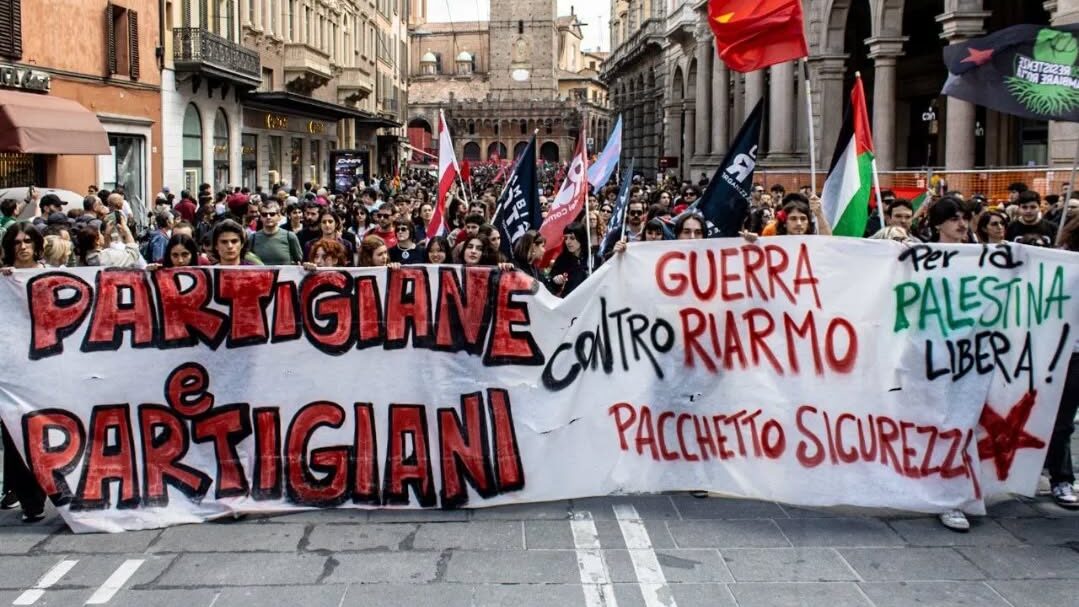
In the coming weeks, many European countries will mark the 80th anniversary of liberation from Nazi-fascist occupation. Italy is among the first, with dozens of events organized for April 25 – Liberation Day – despite ongoing attempts by the Meloni government and right-wing forces to rewrite or erase the memory of the Resistance. For most grassroots groups, this year’s events aim to locate the values that inspired partisan fighters in the 1940s into today’s context, marked by an aggressive rearmament agenda, support for Israel’s genocide in Gaza, and domestic repression of civil rights.

“Eighty years ago, our grandparents freed us from the grip of fascism. But remembering the past is not enough, especially not in the stale, institutional way the Democratic Party and center-left do,” Giuliano Granato of Potere al Popolo said during the demonstration in Naples. Along similar lines, the Unione Sindacale di Base (USB) stated that April 25 should not be reduced to a mere ritual or commemoration. “It should actualize the values and ideals of the partisan Resistance, which freed, perhaps not once and for all, this country from the barbarity of war and Nazi-fascism and provided an inescapable push toward better democratic, working, and living conditions for the people of this country,” the trade union declared in its call to action.

Against Israeli genocide
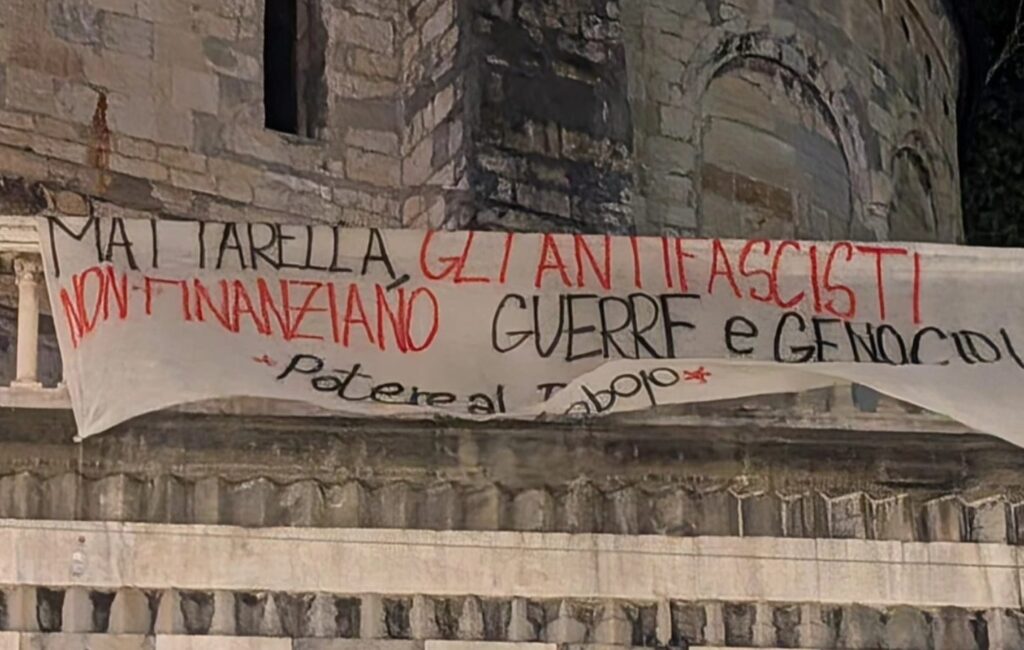
These values, according to USB, Potere al Popolo, and other left groups, must necessarily include opposition to genocide. In many cities, protesters have insisted that Italy’s ongoing ties with the Israeli occupation are unacceptable. These ties, they argue, are evidence that the political establishment has failed to grasp the true meaning and importance of the Resistance. Ahead of Liberation Day, the Genoa chapter of Potere al Popolo organized an action addressing President Sergio Mattarella, criticizing him for formally honoring the Resistance while remaining silent on the genocidal war against Palestinians and on the breakdown of democratic rights under the current government.
Image
Potere al Popolo Genoa with banner reading: “Mattarella, antifascists don’t finance wars and genocide.” Source: Potere al Popolo Genoa/Facebook

“To do so [speak of the Resistance] after cozying up to the president of the criminal state of Israel, effectively supporting the ongoing genocide of the Palestinians, is an insult to those who, since the days of the partisan struggle, have fought against all genocide,” Potere al Popolo Genoa stated. “To honor the Resistance while equating the Soviet communists who liberated much of Europe from Nazism with the Third Reich is an insult to history and memory.”

Against armament
Equally prominent as the call to stop the genocide and sever ties with Israel is the demand to reject Europe’s new armament agenda, which will come at the cost of public services, education, healthcare, and climate justice. Giorgia Meloni’s administration and mainstream opposition parties alike have supported this agenda in different ways, endorsing increased spending on so-called defense and entertaining proposals for a joint European army. These priorities stand in stark contrast with the interests of Italy’s working class and the vision of a more just society that accompanied the antifascist Resistance.

“The rearmament plan launched by the EU represents the latest folly of a continental political class disinterested in building a present and future of peace and prosperity for the peoples of Europe,” warned USB. Similarly, Potere al Popolo called on people to rally around an alternative set of priorities: “We don’t need more money to enrich the arms industry. We need money for wages, for health care and services, for envisioning an ecological revolution and addressing the real challenge of our time, which is the climate crisis.”

Against new iterations of fascism
Meanwhile, Giorgia Meloni and her ministers are pursuing a different kind of battle, one aimed at minimizing the role of the antifascist struggle, led largely by communists, in shaping modern Italy. While the mainstream opposition tends to fixate on this behavior by the right wing, Granato warns that doing so risks missing important pieces of the puzzle.

“For us, Giorgia Meloni is simply following the path she’s always been on, one clearly tied to the rise of neo-fascism. After the defeat of Nazism, the slogan of the Italian Social Movement [neo-fascist party] was ‘neither renounce nor restore’ – and that’s exactly what Meloni is doing today. She doesn’t outright deny their fascist roots, but she also doesn’t walk around openly glorifying Benito Mussolini,” Granato told Peoples Dispatch.

The most recent attempt of the right to undermine the legacy of the Resistance came in the wake of the death of Pope Francis, when the government declared a record five days of mourning and called for “sobriety” at all public events. Many understood this to be an attempt to minimize April 25 events. Liberal and right-wing local administrations seized the opportunity to scale down and cancel rallies, while far-right media ran headlines such as April 25: Day of mourning. “Sure, they can claim they were referring to the death of the pope, but the truth is, they’ve been waiting 80 years for an excuse to print something like that, because for them, April 25 has always been a defeat,” says Granato.

Progressive forces, however, resisted, criticizing the government for using the death of a pope who – unlike the administration, called for peace and solidarity – to advance its agenda. They also refused to limit the day’s activities to commemorations, echoing the partisans’ revolutionary vision of a radically different society. “We don’t stop at the official ceremonies, not just because they’re cold and formulaic, but because we believe the fight for liberation and resistance isn’t over,” Granato explains. “Just like many partisans understood back then that toppling fascism wasn’t enough, we believe that defeating the Meloni government wouldn’t be enough either.”
Image
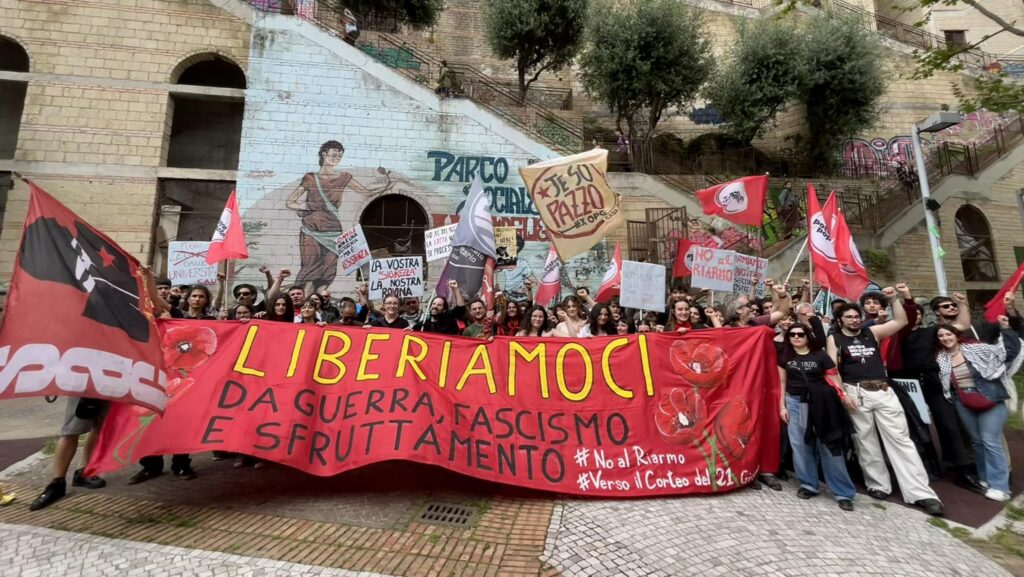
A group of protesters after the central demonstration in Naples, April 25, 2025. Source: Ex-OPG Je so’ pazzo/Facebook

Instead, Granato calls on the people to work together to free themselves from contemporary forms of danger and oppression: first and foremost genocide and militarization. “We worked to make today a day of liberation from militarism and genocide and to link it to the mobilization we are building, including a national assembly in Rome on May 24, and a mass demonstration on June 21, just days before the NATO summit in The Hague,” he adds.

“We believe militarism has always been a tool of fascism. The militarization of Europe today goes hand-in-hand with growing authoritarianism at home and worsens conditions for the working class across the continent.”

https://peoplesdispatch.org/2025/04/25/ ... ilitarism/

******

Gingerbread for Sandu from Callas: on the EU military aid package for Moldova
April 26, 2025
Rybar

EU Foreign Minister Kaja Kallas visited Chisinau and announced a new military support package for Moldova worth 60 million euros, of which 20 million will go to air defense . The Brussels delegation has already handed over a batch of tactical equipment to the army.

The Moldovan authorities constantly talk about cases of drones crashing in the country's border areas, without any investigation, claiming that they are of Russian origin. Such statements were accompanied by requests to the EU to allocate money for air defense.

Moreover, a year ago, the Moldovan authorities bought the ill-fated French radar Master-200 from THALES for 14.5 million euros from the state budget , which never proved its effectiveness. Now Brussels allocates 20 million euros for air defense: in comparison, one can understand that the amount is not so large to ensure the air defense of Moldova. But the media effect is large , which was the main calculation.

Since 2021, the EU has allocated 197 million euros for the Moldovan army. The justification, as usual, is the alleged security threat from Russia. Chisinau is the second-largest recipient of military aid from Brussels after the so-called Ukraine.

Maia Sandu's regime is finally stuck in a vicious circle . For creating an anti-Russian military base, this government is being given billions in loans as short-term compensation to keep the regime afloat. And it doesn't matter that the country's external debt is growing exponentially, and the population's standard of living is rapidly falling.

https://rybar.ru/pryaniki-dlya-sandu-ot ... -moldavii/

Google Translator

*****

Savings and investment union: How the EU will fund the ‘Industry of Death’

Hugo Dionísio

April 27, 2025

The Savings and investment union announced by Ursula von der Leyen is a fundamental political choice about the future of Europe and its peoples.

In recent months, we have all heard the pressure from European Commission President Ursula von der Leyen to accelerate the creation of a Savings and investment union (SIU). Initially presented as a tool to mobilize financial resources for the benefit of European citizens and to promote the green and digital transition, the most concerning aspect of this campaign lies, once again, in the uncritical, passive, and submissive acceptance of the Commission’s intentions and decisions.

Under closer scrutiny, this is yet another agenda. How many agendas has von der Leyen presented to us, only for things to keep getting worse? That agenda was designed to benefit the usual suspects: the most prominent private and corporate interests (elsewhere referred to as “oligarchs”), at the expense, as always, of collective interests, public welfare, and the national interests of many member states.

To fully grasp the intentions behind this SIU, we must first understand what it is. Theoretically, the SIU is presented as: “an initiative aimed at integrating the financial markets of member states to boost investment, economic growth, and financial stability.” In this framework, the SIU is ostensibly intended to facilitate access to cross-border financial products for “citizens and businesses,” while promoting long-term savings and investment. A marvel, indeed. In the EU, there is a vast amount of money in term deposits (€10 trillion) and even more in public, mutual, and associative funds whose contributions could be diverted toward other types of solutions, luring beneficiaries with the siren song of easy money from venture capital.

According to the European Commission, this union could improve long-term savings options, encourage products like individual pension plans (PEPP), and promote “sustainable” investment funds linked to the EU’s energy and climate agendas. All of those funds are private, just as those people like it. A fundamental characteristic of any EU agenda is relegating the state to a secondary, minimalist role – except when it comes to footing the bill.

This union also intends to create broader and more integrated mechanisms for investor protection, ostensibly by strengthening transparency and regulation to ensure financial products are safe and suitable for risk profiles. Finally, this aggregated, mobilized, and circulating capital will supposedly foster business financing, theoretically facilitating SMEs’ access to alternative funding sources like crowdfunding and capital markets. SMEs are always used as justification, but rarely end up as the ultimate beneficiaries of these proposals.

There are already planned measures, such as the aforementioned PEPP (Pan-European Personal Pension Product), a private pension product that can be offered across the EU, free from the burden of intergenerational solidarity that characterizes public pension systems; the revision of legislation to “improve” investor protection and market transparency; the regulation of fintech and crowdfunding (technological financing and public fundraising platforms like Patreon), creating harmonized rules for collaborative financing platforms; and the introduction of fiscal incentives by member states to stimulate savings and investment. All this promises greater product diversification and “investment” solutions, higher financial returns (since, in theory, there will be more competition), and enhanced security, as common rules supposedly reduce the risks of fraud and financial malpractice.

Do not mistake the Savings and investment union for a component of the Banking Union. No, the SIU is, at most, complementary. The SIU and the EU’s Banking Union share the goal of integrating financial markets but differ in scope, mechanisms, and associated risks.

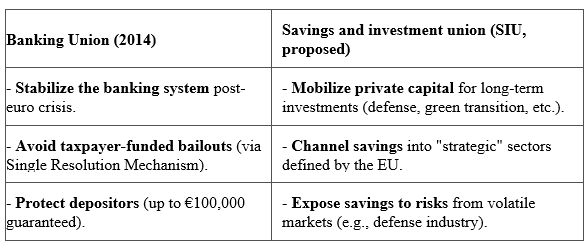
Let’s compare their stated objectives:
Image

The Banking Union aimed for centralized supervision (ECB), common rules for bank insolvencies, and a focus on financial stability. The SIU, on the other hand, seeks to attract savings and investment toward risk through the harmonization of financial products, fiscal incentives for cross-border investments, and a heightened focus on profitability and “strategic priorities” like defense and the green transition.

As the saying goes, “once bitten, twice shy,” and from von der Leyen’s Commission, Europeans can expect nothing but pretty words upfront and knives in the back. The real problems of the SIU lie in its “associated risks” and “unspoken intentions.”

Contrary to what the EU claimed, the Banking Union, launched in 2014 as a response to the euro crisis, also promised greater competition, stability, and depositor protection. In practice, however, it only solidified the dominance of big banks, reducing the diversity of Europe’s financial sector – the opposite of what was promised.

Banking concentration increased, driven by a wave of mergers and acquisitions. In Spain, the number of banks fell from 55 in 2008 to 10 in 2023. In Germany, regional banks (Landesbanken) lost relevance to giants like Deutsche Bank and Commerzbank. By 2023, the 10 largest banks in the EU controlled around 70% of financial assets (ECB, 2023). As we can see, the myth of “too big to fail” did not hold, and if the largest banks collapse, states will still have to bail them out.

With this capital concentration – the Banking Union should be renamed the “Banking Concentration Union” – competition decreased, and big banks benefited from the new rules, while small institutions faced higher regulatory costs and greater difficulties competing on a transnational scale. The result is felt daily in our wallets: higher fees for customers, fewer credit options for SMEs, and less financial innovation. The exact opposite of what was promised. A déjà vu of the privatization processes in Portugal and Europe.

The truth is that, like all EU regulations, the Banking Union also favored only the big players. The regulatory system, heavier and more complex (e.g., Basel III), demands resources only available to large banks. The ECB supervises only the big banks, leaving smaller ones under national authorities, creating asymmetries – for example, in access to credit. The largest banks can finance themselves (sometimes at negative rates) through the ECB, while small banks must secure funding at higher rates. Capital concentration led to political power concentration and lobbying capacity, further widening the gap between big and small, rich and poor.

It is therefore only fair to predict that the same will happen with the SIU. Both initiatives reflect a problematic logic: the Banking Union socialized banking risks (with strict rules for banks but no debt mutualization), producing what we can now call “socialism for the rich and capitalism for the poor,” a modern version of the medieval “sin of greed,” which only affected the poor because the rich were already wealthy.

The SIU, meanwhile, aims to socialize financing for political projects (like defense), transferring risks to citizens. In other words, it wasn’t enough to have socialism for banks and big clients – now, the EU will focus on socialism for large financial funds. The intention is clear, reflecting the submissive, passive, and docile state of member states and their leaders.

If the Banking Union, with all its neoliberal implications, required a financial crisis as justification, the SIU doesn’t even need that. The consensus for war is so deep that even external propaganda fell short of the usual, with the war in Ukraine serving as enough justification.

The big winners of the SIU will be major asset managers (BlackRock, Allianz), which will dominate the new savings markets. Standardized products (like PEPP) will favor global players, not small investors, transferring risks to citizens, workers, and their families while profits flow to the financial elite, just as happened with the Banking Union.

The result is simple: more centralization and, consequently, less financial democracy, further widening the already enormous and growing gap between rich and poor. The truth is that every time von der Leyen signs one of her “acts,” our incomes suffer, our living conditions decline, and the idle oligarchy that leeches off European growth grows fatter, year after year.

Just as the Banking Union failed to deliver a diversified and competitive system, instead increasing the power of big banks, the SIU is heading for the same fate. If the EU does not impose limits on capital concentration and market share and demand real guarantees for small savers (which would limit the intention of attracting the touted €800 billion), “financial integration” will be nothing more than a euphemism for more private control over the money of European citizens.

Is it worth trusting a structure that, in practice, always benefits the same giants?

This question takes on another dimension when we consider that BlackRock, the American asset manager, will be one of the biggest beneficiaries – and most prominent promoters – of this union. The ties between German Chancellor Friedrich Merz and this company are anything but coincidental, just as it is no coincidence that von der Leyen, also German, is pushing so decisively for yet another fiasco.

And to make matters worse, this one has neocolonial overtones. It’s not enough that we’ve handed over our defense, energy strategy, and academia to the U.S. – now, we’re going to hand them the meager savings of European workers.

But don’t be fooled into thinking the potential harms of the SIU stop there. At first glance, the idea of a SIU seems appealing: centralize and manage Europeans’ savings, allowing them to be invested in strategic projects like green infrastructure, innovative technology, and other priority areas. However, when we look at who the main proponents of this initiative are and what the recent trends in European economic policy have been, we realize that this project has all the makings of further crushing our living conditions, opening the door to the savagery that already reigns in the U.S., where the working classes have been conditioned into the childish belief that their stability depends on some form of “passive income” and a supposed “financial literacy” that competes with that of the system’s owners. After the U.S., it’s now time to aggressively target the incomes of workers meant for solidarity-based safety nets.

It’s no coincidence that the SIU announcement also comes amid intensifying pressures to privatize historically public or mutualist sectors. From state pension funds to social security systems and mutual insurers, there is a clear trend of transferring assets and responsibilities from the public domain to private hands. This process, often disguised as “modernization,” “transparency,” “rationality,” or “efficiency,” directly erodes social rights and increases inequality. Just compare the returns of a public pension system with those of a private individual system to understand why big corporations attack the former. There’s a lot of money going to the “wrong hands,” they must think.

As we will see, once the SIU is implemented, the urgent calls for “social security reform,” the imperatives of “letting everyone choose their pension,” and the demographic emergency of “pension system reform” will follow. All for one thing and one thing only: to reduce funds allocated to social security and increase those available for SIU financial products – in other words, for BlackRock and friends. The pressure on centrist liberal, social liberal, social democratic, or reactionary conservative governments will be absolutely brutal, almost certainly leading to the justification that “the EU made us do it.”

In the outdated 18th-century theory, the invisible hand works wonders. By concentrating European citizens’ savings in a unified system, governments and financial institutions would gain access to vast resources currently dispersed across national or regional systems. However, in a completely unbalanced, biased, and skewed system, these resources will be captured by large financial conglomerates and corporations, who will use them to fund their interests.

A clear example of this dynamic is what happened with pension funds in several European countries. In the 1990s and 2000s, many states adopted individual capitalization models, transferring part of the state’s responsibilities to private funds, also in an attempt to free up capital for investment, or so they claimed. The result was higher management fees, less transparency, and, in some cases, the collapse of systems that were once robust and solidarity-based. The SIU will replicate this model on a continental scale, accelerating the transformation of public systems into mechanisms controlled by financial markets. Given what we know today, we can no longer claim that this isn’t the intention.

Moreover, the proposal raises doubts about its ability to ensure equity and social justice. Who will decide where the funds are invested? Will projects that directly benefit citizens, like affordable housing or public healthcare, be prioritized, or will large industrial and financial conglomerates be favored? Recent experiences show that, without rigorous and democratic regulation, capital tends to flow where profits are highest, regardless of the real needs of populations.

The financing of militarism is the other side of the coin and constitutes one of the strongest political appeals of the proposal. In addition to all the systemic and political risks already mentioned, it will also add the danger of military confrontation. Armed to the teeth, what do we think people like Merz, von der Leyen, or Macron will do? Once the plundering of the working classes is complete, where will the next project of plunder be directed?

The EU faces a familiar dilemma: how to finance massive investments in defense without violating budgetary rules (like the Stability and Growth Pact)? This is where the SIU comes in! Mobilizing private capital, facilitating long-term investments in strategic sectors like defense through specialized investment funds (e.g., critical infrastructure or dual-use technology funds); issuing adapted green/social bonds (like “defense bonds” for sustainable energy security and military projects); or encouraging institutional savings, directing part of pension savings (PEPP) or pension funds toward defense assets with an adequate risk profile – there are many strategies that will be used to attract the necessary resources.

Another option under the SIU is the creation of a “defense capital market,” harmonizing rules to facilitate IPOs, capital increases, or debt issuance by defense companies. Finally, fiscal obstacles could be reduced – some countries tax investments in weapons, but exceptions could be made for European projects, making private investment in defense-related products more attractive due to lower tax burdens. In other words, European taxpayers will pay out of pocket to face an ever-greater risk of war.

Currently, the European Defence Fund (EDF) is financed by the EU budget, but its scope is limited. With a more integrated monetary union, strategies based on public-private partnerships could be implemented, such as the issuance of defense-backed bonds by investment banks (like the EIB). What was never done for housing or railways will now be done for war, always leaving the necessary royalties for private interests. Ideas like defense crowdfunding, attracting small investors’ funds to the much-touted cybersecurity or drone startups, later bought by big corporations, are another possibility in the minds of these people. As we can see, the SIU opens up a universe of possibilities, none of which benefit the people of Europe.

This scenario is not mere speculation. The fact is that the SIU proposal explicitly includes defense sector financing at a time when the EU is betting on a new rearmament cycle and the creation of a reinforced European Defence Fund. The Draghi Report, which underpins part of this initiative (it was part of the mandate), identifies defense as a priority area for absorbing European private capital. Thus, the SIU not only enables the diversion of savings to the military sector but could also make citizens unwitting accomplices in strengthening the European military-industrial complex under the pretext of securing better returns for their savings.

Another consequence of this exploitation will be the diversion of resources that would otherwise go to priority social areas, further entrenching a militaristic mindset that threatens peace and international cooperation. In concrete terms, it will delay by decades any real possibility of understanding between the EU and the Russian Federation – if it doesn’t make things even worse.

The European Commission insists that citizen participation will always be voluntary and that there are no plans for any form of savings confiscation. However, institutional pressure to “diversify” investments and the promise of higher returns may, in practice, marginalize traditional savings options and push European citizens toward financial products aligned with Brussels’ strategic objectives. The rhetoric of free choice thus hides a profound reconfiguration of the role of the welfare state and the fate of popular savings.

While “security” and “defense” are touted, the devastating impact of militarism on communities, both within and outside Europe, is neglected. Resources that could be used to fight poverty, social exclusion, and the climate crisis are instead wasted on weapons and war technologies.

Given this scenario, it is urgent to question the true nature of the Savings and investment union and resist its implementation. Nothing is more dangerous than merging corporate greed with the adrenaline of war. When big capital moves from profiting from war to investing in war, we will all be in danger.

The Savings and investment union announced by Ursula von der Leyen is not just a technical or financial issue – it is a fundamental political choice about the future of Europe and its peoples. If this path is followed, in the future, every one of us will be nothing more than a foot soldier in a permanent war economy.

How many times will European citizens need to be surprised by the same mistakes?

https://strategic-culture.su/news/2025/ ... -of-death/
"There is great chaos under heaven; the situation is excellent."

User avatar
blindpig
Posts: 14839
Joined: Fri Jul 14, 2017 5:44 pm
Location: Turtle Island
Contact:

Re: Blues for Europa

Post by blindpig » Wed Apr 30, 2025 3:51 pm

Belgians to government: “We won’t sacrifice pensions for warplanes”

Resistance to the Arizona government’s austerity and militarization plans continues in Belgium, with more mobilizations expected ahead of May 1

April 28, 2025 by Ana Vračar

Image
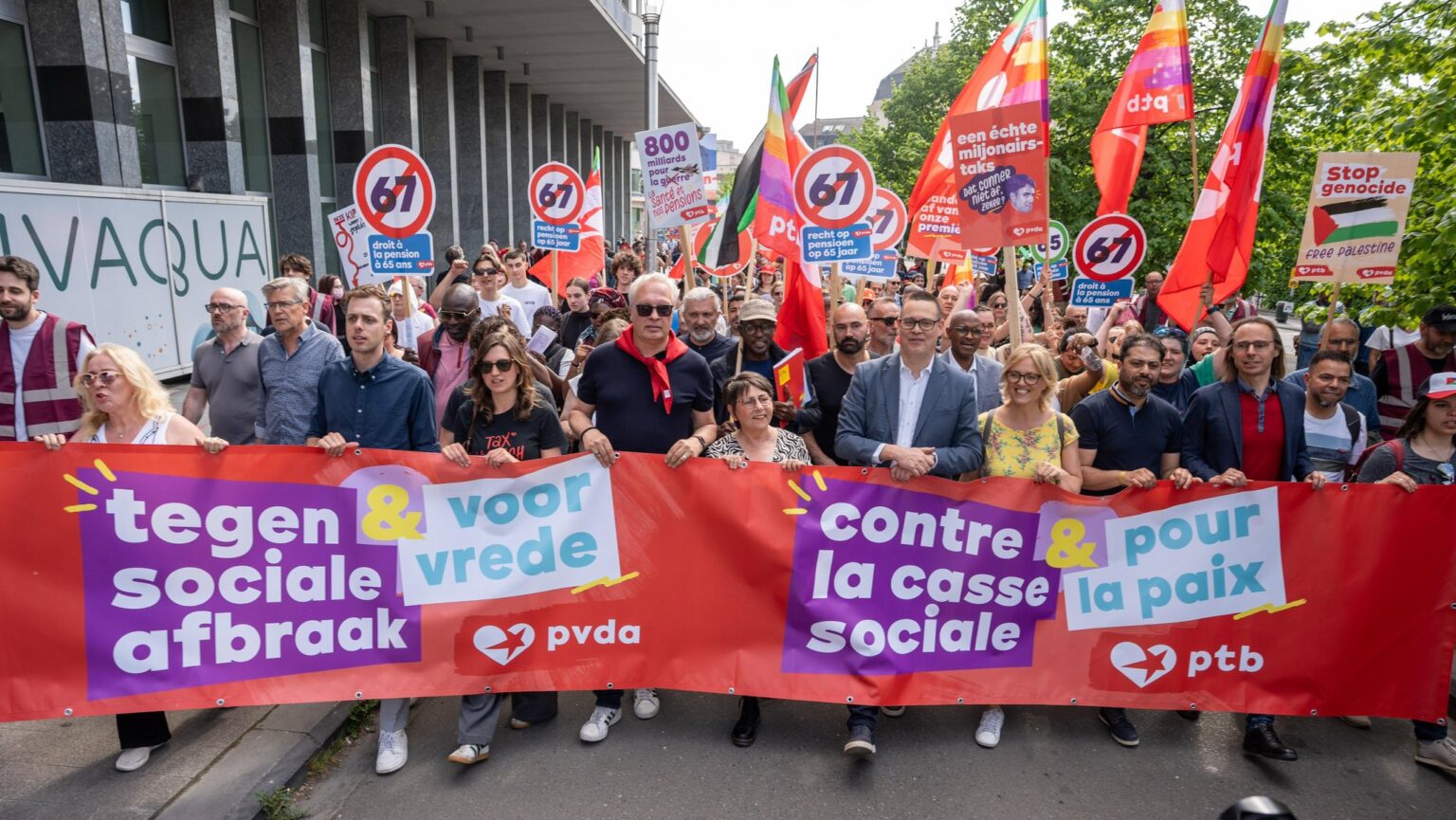
Protest in Brussels, April 27, 2025. Source: Peter Mertens/X

Protests against the pro-austerity and pro-militarization plans of Belgium’s Arizona coalition government continue. On Sunday, April 27, thousands of people demonstrated in Brussels, demanding an end to policies that would severely impact workers’ pensions and incomes, and calling for the introduction of a real millionaire’s tax and a politics of peace.

“The parties in government want everyone to work longer for less pension, particularly by introducing a malus or weakening pension indexation,” said Raoul Hedebouw, leader of the Workers’ Party of Belgium (PTB-PVDA), during Sunday’s protest. “All these parties are incapable of explaining why there’s no money for pensions, healthcare, or purchasing power, but with a snap of their fingers they find billions for war and armament. We refuse to sacrifice our pensions to buy new F-35s.”

Since a coalition of right-wing and centrist parties, led by the New Flemish Alliance (N-VA), was forged earlier this year, left and progressive forces have sounded the alarm about the consequences for the working class. Many of the parties now forming the Arizona government had pledged to protect salaries and improve workers’ rights, but those promises have been quickly tossed aside. Instead, the announced measures are expected to benefit employers and the rich. Additionally, troubling plans have been outlined regarding civil rights and militarization, including a harsher stance against activism – particularly when it comes to solidarity with Palestine.

“The government doesn’t just want to dismantle our social security to boost military spending, it wants to militarize our entire society,” Hedebouw stated. “We oppose turning our economy, research, culture, values, and even our minds into tools of the military and war. Those who want peace, prepare for peace.”

Mobilizations against the Arizona government’s policies are set to go on in the coming days, notably on April 29, when trade unions will hold a day of action building upon the general strike of March 31, and on May 1, when demonstrations will mark International Workers’ Day. Two of Belgium’s largest union federations, the General Labor Federation of Belgium (FGTB-ABVV) and the Confederation of Christian Trade Unions (ACV-CSC), will be leading Tuesday’s actions in an effort to block measures that would force people to work longer for lower pensions and stagnating wages.

For months, unions have been warning that the government is planning to introduce new advantages for enterprises and employers, while at the same time claiming there is no money to ensure a dignified life for workers. Among the recent announcements was the government’s decision to maintain a freeze on gross salaries, meaning workers’ incomes will stagnate while the cost of living continues to rise. “At the same time, the government wants you to work harder, longer, and more flexibly,” ACV-CSC wrote in its call to action.

The effect of these policies on the working class would be massive. Looking at changes to overtime work alone, workers could end up facing 49- or even 52-hour weeks, according to ACV-CSC calculations. Combined with low wages and prolonged working life, this would certainly cause a spike in work-related health problems and further undermine the pension system, as contributions would fall. Such a vicious cycle would erode the social fabric, leaving workers at the mercy of employers, while government and party officials continue to enjoy privileged conditions.

However, the PTB-PVDA insists that the fight is far from over, and that the pressure exerted so far has already caused the government’s plans to falter. “Nothing has been definitively decided yet. No law has been passed. Together, with the entire social movement, we can make the government back down,” Hedebouw concluded on Sunday.

https://peoplesdispatch.org/2025/04/28/ ... warplanes/

******

Belgium’s plans to raise its military budget to 2% of GDP: a fool’s errand
gilbertdoctorow Uncategorized April 30, 2025

The 24 April edition of Belgium’s main French-speaking daily newspaper, Le Soir, had on its front page and on most of pages 2 and 3 an article entitled “Defense. Billions promised…but not financed.”

Reading through this fairly transparent account of Prime Minister Bart De Wever’s ideas on how to raise the funds needed, I was reminded of the old Italian joke about the family recipe for making a sponge cake. It opens with “steal a dozen eggs.”

Indeed, De Wever’s proposals amount to 1) stealing 1.2 billion euros in interest on the 200 billion in Russian state assets frozen in Euroclear, headquartered in Belgium and 2) falsifying the bookkeeping entries to say that the investments of several hundred million in renovation and improvements to bridges and other logistics infrastructure count as defense spending since they facilitate the movement of foreign (American) forces landing in Europe on their way eastward. Since these tricks cover only part of the missing billions of euros to raise Belgian military spending in 2025 to the mandatory NATO figure of 2% of GDP or 3.5 billion, the newspaper asks where will the rest come from? Moreover, a total of 5 billion has to be raised up to the year 2029.

Part of the new expenses will be to cover the purchase of F-35s. Those who say that the main beneficiary will be the U.S. military industrial complex have to look more closely- those planes will be built in Italy. Fully European fighter planes are a possibility but in the more distant future, meaning ten or twenty years hence.

In general the De Wever government is committed to making the biggest investment in defense in 40 years. They believe that this sends a signal to the international community, per the newspaper. What they do not say is that these new budgets are being set in the context of a flagrant contradiction: Belgium is home to NATO headquarters. The new NATO buildings near the Zaventem airport cost well more than a billion euros when opened several years ago. Yet Belgium has ranked at the bottom of the list, alongside Spain, in terms of its defense spending as a percentage of GDP. One wonders how they will cope with imposition of a 3% minimum contribution as is now being discussed by other NATO member states.

As for the ongoing war in Ukraine, De Wever and his minister of defense Theo Francken visited Kiev several weeks ago and pledged a one billion euro military contribution this year. How that will be financed is still less clear. But the prime minister has no difficulty making utterly irresponsible statements: this same Soir article tells us that “ Belgium is ready to participate in a possible coalition of the willing in Ukraine if the negotiations for a cease-fire come to conclusion in the days or weeks ahead.”

***

Soir does not say it, but the only possible source for financing the rise in military budgets is at the expense of social welfare, and that is politically very dangerous.

The reality is that Belgium has done much better than neighbors France and Germany in maintaining standards of excellent medical care and higher education, all of which are either free or priced at nominal levels to the population. It has maintained labor peace through application of the automatic adjustment of salaries in keeping with inflation. The question is at what risk to political stability can the De Wever government now attack these costly benefits for the sake of meeting NATO targets.

©Gilbert Doctorow, 2025

https://gilbertdoctorow.com/2025/04/30/ ... ls-errand/

******

Goodbye Europe
Marcelo Brignoni

April 28, 2025 , 10:12 am .

Image
The European Union, punished by sanctions against Russia and the trade war with China, continues to deepen its geopolitical irrelevance (Photo: AFP)

"It is a mistake to theorize before there are data, trying to explain facts by theories, instead of constructing theories from facts." – Sir Arthur Conan Doyle

Not so many years ago, one of François Hollande's main campaign promises—unfulfilled like almost all his others, by the way—speaks of a 75% tax on those earning more than one million euros per year. It was 2012, and France's welfare state needed to be funded. What he didn't understand back then was that, as Warren Buffett warned, the class struggle continued, but the capitalists had won for the moment.

The Western European welfare state, built on high taxes and high public spending accepted by large corporations and the wealthy in the face of the "communist threat," had come to an end and had collapsed into hell along with the rubble of the Berlin Wall.

Between the publication of Oswald Spengler's The Decline of the West in 1918 and Emmanuel Todd's The Defeat of the West in 2024, more than a century passed during which Europe, through continuous colonial plundering and two world wars, with more than 50 million deaths, managed to maintain significant influence on the international stage. That time seems to have come to an end.

As Arthur Conan Doyle suggested, data is important to build or reaffirm a theory, and in this case, it appears everywhere.

Figures of a decline
Twenty-five years ago, the US economy represented 20% of the world's total. This was a slightly lower percentage than in 1980-1990, when it stood at around 23%. Europe, at the time, sensed that this trend would continue to decline and could take advantage of it, although it failed to notice the emerging push from Asia. By 2023, the influence of Donald Trump's country had dropped to 16%.

But if this figure explains the magnate's concern and bravado, things are much worse in Europe. In 2000, the European Union (EU) economy accounted for 21% of the world's. By 2023, that figure had fallen to 14%. It may seem like a decline similar to that of the United States, but in reality, it shows that what in the late 1980s represented economies of similar size between the United States and the European Union is now, in the so-called Old Continent, 10% smaller than that of the North American country.

This European decline, which is not new, has accelerated in the last 15 years and is deepening in its core countries: France, Germany, Spain, and Italy, with economic stagnation, social disintegration, and exclusion of its vulnerable populations.

Some comparative figures serve to illustrate this incessant loss of influence.

In 2000, China accounted for 7% of the global economy, a third of Europe's at the time. It now leads the ranking with 19%. Germany, the former driving force of the EU, effectively subsidized by cheap Russian energy, has dropped from 4.75% to 3.10%, a drop of more than 33%. Italy's share fell from 3.27% to 1.85%, a 43% decline. For Spain, the cumulative share from 2000 to 2023 indicates that it has fallen from representing 1.91% of the global economy to 1.37%, a 28% decrease, and the descent into the depths of recession and exclusion in Europe appears unabated.

Demographics, technological innovation and finance
Another relevant fact of the European crisis is its demographic decline, accentuated by migratory waves from its former colonies, who even deny their European status, even if they are second- or third-generation natives, which deepens the crisis of their claim to cultural identity.

Regarding innovation and technological development, European data is also discouraging. While China registered 1.64 million new patent applications in 2023, the United States registered 518,364 applications, Japan 414,413, but the European Union only 398,246. This represents a decline in its innovative and technological influence that has been uninterrupted since 2011. Even though the 2024 data has not been officially released, everything indicates that these trends will continue.

Today, innovation is based, as China clearly demonstrates, on the convergence of research and development efforts, where universities, military research, and private sector investment come together in coordination by the State. This also occurs, although not fully acknowledged due to ideological prejudice, in the United States, where the success of Stanford University and MIT and subsequent innovations such as the Internet, GPS, and others stem from this collaborative triad of state preeminence. The idea that still persists in Europe regarding the autonomy of universities and the independence of scientific research does not seem in tune with the times we live in, so seeing only one European technology company (SAP) with international relevance is a testament to this.

On the other hand, that continent's financial architecture cannot compete with more than twenty different fiscal policies and completely unconnected sovereign bond markets. This problem is not faced by either China or the United States, which have unified and liquid capital markets within the framework of a centralized fiscal policy. This dysfunction forces the European Central Bank (ECB) to make constant efforts to prevent the Union's weak institutional architecture from collapsing every time it faces a crisis like the current one. The consequence is that European economic policy delegates structural decision-making to monetary policy, which almost always favors finance over production—any similarity with the financialization of the economic debate in Argentina is pertinent.

The Old Continent under a new order
That Trump reminds the world every day that Europe is in decline doesn't mean it isn't true, regardless of the White House tenant's intentions. What Trump seems to forget is that this European identity crisis is also a crisis that encompasses the entire West, including him and his country.

Europe has ceased to be relevant beyond the conspicuous appearances of Ursula Van der Leyen, the gray bureaucrat born in Belgium as the daughter of another European bureaucrat, Ernst Albrecht, who, after living in Belgium and the US, came to Germany to become a naturalized German and become Angela Merkel's multitarget assistant . She served first as Minister of Family, Seniors, Women and Youth from 2005 to 2009, then as Minister of Labor and Social Affairs from 2009 to 2013, and then as Minister of Defense from 2013 to 2019, a position she left to take up her current position as State Department Delegate to the European Commission.

As his power grew, his "interest" in social and community issues decreased inversely proportionally.

Europe, on the other hand, is no longer the economic, military, scientific, and technological power it once claimed to be. Economically, its prosperity was based primarily on large-scale industry, both heavy and light, linked to the metalworking and automotive industries, sustained primarily by the plundering of natural resources in its peripheral colonies and cheap Russian gas, which Europe unexpectedly renounced at Joe Biden's request under the pretext of "defending" its security, the financing and planning of which is, in fact, in the hands of the United States.

While most European countries spend less than 1.7% of their GDP on military expenditure, Saudi Arabia spends 7.1%, Russia 5.9%, Israel 5.3%, the US 3.5% (much of it deployed in European territory under NATO franchise, the US military apparatus in which the European Union only follows orders), the United Kingdom 2.6%, Iran 2.2% and even China 1.7%, according to studies by the Stockholm International Peace Research Institute (SIPRI).

The toxic impact of European sodomization in the face of the US is now undeniable, even for its own bureaucracy, which has discovered late and badly that, as Henry Kissinger said, "being an enemy of the United States is dangerous, but being its friend is fatal."

The Roman Empire reached a great level of economic splendor at the end of the 4th century, but its lack of cohesion, demographic crisis, and loss of identity led to its demise forever: Europe should look to its own history if it wants to once again become an influential geopolitical player, as it once was.

Today, China innovates, the US regulates, and Europe observes. From this characterization, although somewhat capricious, one can deduce the current international role of each.

Of the Europe that boasted of having invented the scientific method in the 17th century and the Industrial Revolution in the 18th century, nothing remains but memories.

The Old Continent needs a true cultural revolution that self-critically examines its past, linked to wars, genocides, and colonial massacres. To "revive," it will need to relocate itself to an autonomous and prominent place in the new multipolar world order, where the BRICS are steadily advancing. Perhaps it's not too late, although Ursula Van der Leyen and many of her bootlicking friends don't seem up to the task.

The sad example of his management of the European Commission, and the resulting EU debacle, may serve as a lesson to those who peddle sweet pro-American dreams, which end up turning into bitter nightmares, so that they don't destroy Europe.

https://misionverdad.com/opinion/good-bye-europa

Google Translator
"There is great chaos under heaven; the situation is excellent."

User avatar
blindpig
Posts: 14839
Joined: Fri Jul 14, 2017 5:44 pm
Location: Turtle Island
Contact:

Re: Blues for Europa

Post by blindpig » Thu May 01, 2025 1:59 pm

In the Age of Trump, Time for a Polish-Russian Reset
by Marcin Skalski and Dr. Michał Krupa
Arktos Journal
Apr 28, 2025

Image

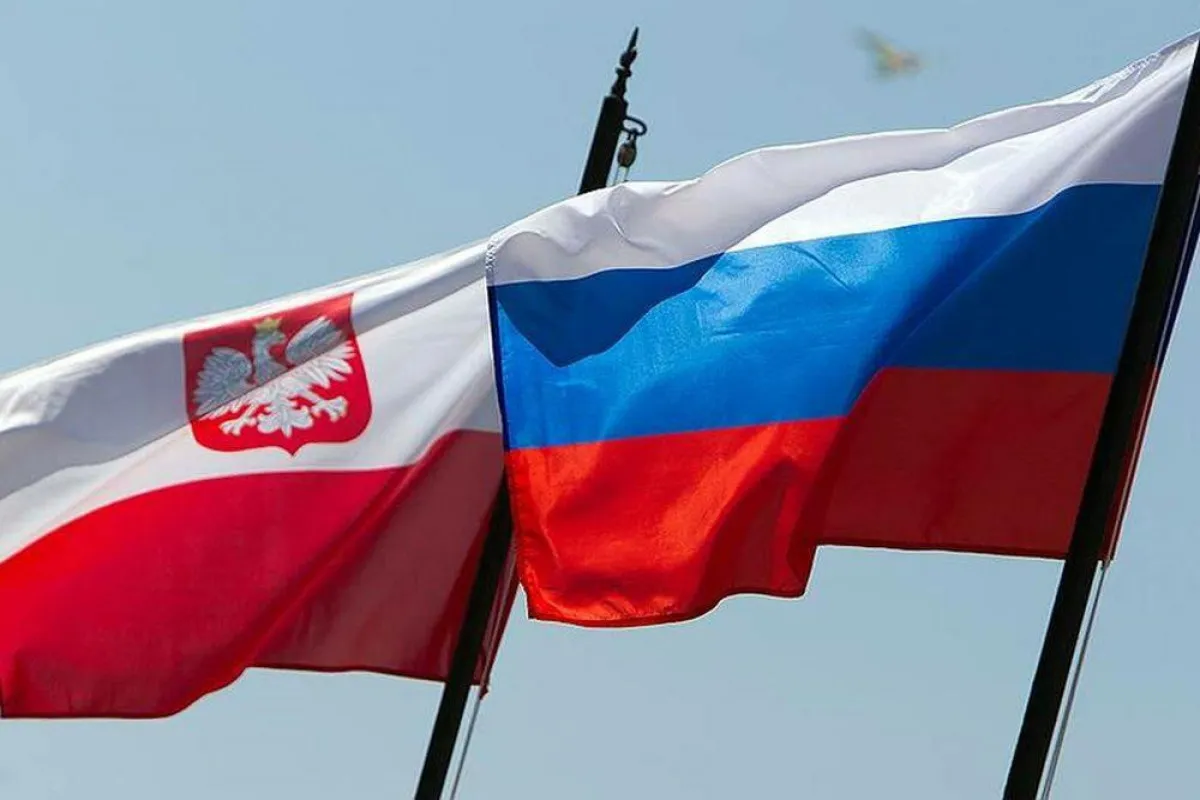
Marcin Skalski and Dr. Michał Krupa argue that Russia does not pose a threat to Poland’s existence or its fundamental interests today. A Polish-Russian reset and de-escalation of tensions in Eastern Europe are in the interest of both countries. The historical points of contention between Poland and Russia were resolved after World War II and the dissolution of the USSR.

The elites of the Third Polish Republic have proven incapable of recognizing the key changes that are bringing concepts such as the concert of powers, power projection, or spheres of influence back into favor. Their intellectual and mental horizon extends no further than anchoring Poland within the institutions of the collective West, while contenting themselves with their own political and intellectual dependence. In the context of Polish-Russian relations, our ruling elites and leading commentators have deliberately reduced Poland’s sovereignty to serving the interests of the “eastern flank” of an imagined republic of the collective West. This ineptitude is particularly exposed now, as Donald Trump shows no intention of heeding various incantations, such as those about the inviolability of borders in Europe. Meanwhile, on the banks of the Vistula, geopolitical reflection is replaced by crude slogans, including in matters concerning relations with Russia. From Warsaw’s perspective, relations with Moscow require a thorough revision — not only to reconcile with reality but, above all, to redefine Poland’s national interest anew. The current elite of the Third Republic, which has sufficiently discredited itself with its attitudes, including in the context of the Ukrainian war, will not undertake this task.

A fundamental revision of the previous assumptions of Polish foreign policy is all the more necessary given that we are witnessing the twilight of the American presence in Europe and perhaps even the beginning of NATO’s erosion. Atlanticism is bankrupt, and contrary to the dreams of Polish neoconservatives and ardent proponents of the so-called Intermarium, the Russian Federation has not collapsed.

During World War II, the Big Three victorious powers decided to shift the Polish state westward, while also accepting the British Curzon Line as the postwar Polish-Soviet border. It was no coincidence that the most ardent advocate of Poland’s significant territorial expansion at the expense of defeated Germany was Joseph Stalin himself. The Soviet dictator, still uncertain of the outcomes in the area that would later become the GDR (East Germany), sought to expand the reach of the satellite Polish state, and thus the Eastern Bloc. The British opposed this, adding to their extensive list of “merits” toward the Poles by pushing for a minimal territorial program for Poland in the west, if only to prevent the postwar Eastern Bloc from growing too strong.

The paradox lies in the fact that the loss of the Eastern Borderlands (Kresy) and the annexation of the former German territories shifted the state’s borders westward yet geopolitically positioned Poland in the east. Meanwhile, in September 1946, in Stuttgart, Germany, U.S. Secretary of State James Byrnes, in the name of countering Soviet influence in Europe, challenged the extent of Poland’s postwar territorial gains. Consequently, the USSR became, out of necessity, the guarantor of Poland’s western border against the revisionist tendencies of the Federal Republic of Germany, the so-called West Germany.

The unification of Germany in 1990, effectively the absorption of the GDR’s territory by the FRG (West Germany), resulted in a relatively soft landing for Poland. It was under the influence of the United States and Great Britain that a united Germany was compelled to confirm the existing Polish-German border and recognize it as binding. Poland transitioned relatively painlessly from one bloc to another, retaining the territorial gains from its time in the then-competing camp of socialist states. Remarkably, British and Polish interests aligned at this juncture. London was not interested in the existence of a strong, unified German state on the European continent at that time, and Prime Minister Thatcher even opposed the annexation of the GDR by the FRG. However, with the Soviet Union’s withdrawal from Eastern Europe and its subsequent self-dissolution, the existence of a GDR stripped of its protector lost its raison d’être. The Third Polish Republic inherited the territory of the Polish People’s Republic (PRL), and with the dissolution of the USSR, it gained new neighbors to the east and north: Lithuania, Belarus, Ukraine, and Russia.

Thus in 1991, the situation shifted in Poland’s favor, as the Soviet Union ceased to exist. Although the USSR is commonly equated solely with Russia, this is a significant oversimplification, at least in the case of the former Polish Eastern Borderlands (Kresy). Lviv was Ukrainized, not Russified, by the Soviets, and similarly, Vilnius gained a majority Lithuanian population due to Soviet policies, not a Russian one. Meanwhile, the so-called “Russian world” (ruski mir) in Eastern Europe has its own confession — Orthodoxy — which, in this respect, does not intermingle with the Catholic-Polish world or directly compete with it. This is significant because, as Professor Andrzej Skrzypek from the University of Warsaw has pointed out, Orthodoxy has traditionally been a key factor in Russian identity. This makes it even more difficult to claim that the Catholic Poles of the Kresy are currently at risk of having their national identity Russified.

Therefore, one can logically conclude that the Russian Federation does not currently pose an existential threat to Poland. Everything the Poles lost in the East was taken by the Soviet Union after World War II, and today Moscow has no reason to annex any Polish territory. Presently, the former Polish eastern lands are not within Russia’s borders, and the Republic of Poland shares a border with Russia only in the former East Prussia. At the same time, an artificial substitute for the interwar “Polish Corridor” has been invented, with the notion of the “Suwałki Gap” being propagated — an idea as abstract as “Intermarium” or “NATO’s eastern flank.” Poland is supposed to share identical interests with Lithuania or even Ukraine, which isn’t even a NATO member, even though it is precisely with these countries that Poland objectively has conflicting interests in the Kresy region — an area that is a natural direction for the expansion of Polish influence. Meanwhile, in the Third Polish Republic, “references to Jagiellonian and Promethean concepts serve as propaganda to convince Poles that we are still pursuing historical Polish ideas, when in reality we are implementing the strategic goals of Western powers,” argues Dr. Mirosław Habowski from the University of Wrocław, commenting on the fantasies embraced by the Polish elite.

Currently, the historical lands of Poland and Russia, at least in the case of Ukraine, lie within the borders of the same state, creating entirely new geopolitical circumstances. Regarding the Ukrainian issue, however, Poland needs only a buffer space separating it from Russia’s main territory — and nothing more. The course of the Russian-Ukrainian border or Ukraine’s access to the sea is entirely irrelevant to Poland. What is more, as the Russian-Belarusian alliance strengthens, it is questionable whether Ukraine still serves as a buffer zone. It is worth noting that in Eastern Europe, there can either be a strong Poland or a strong Ukraine — and in its own way, the current weakening of the Ukrainian state can be seen as an opportunity for Warsaw to impose its terms on Kyiv, whether in the realm of historical policy or economics.

A reset of Poland’s relations with Russia and the establishment of spheres of influence in Eastern Europe are possible thanks to a unique and objectively existing situation in which the lands that were the subject of historical Polish-Russian disputes belong neither to Poland nor to Russia. The creation of Soviet republics with capitals in Minsk and Kyiv by the Bolsheviks, followed by the collapse of the USSR, produced an exceptional situation that has, in a sense, “reconciled” Warsaw and Moscow. Lithuanian, Ukrainian, and potentially Belarusian nationalisms, meanwhile, are directed against both Poland and Russia. The current border with Russia, on the other hand, does not give rise to any ethnic conflicts or territorial disputes.

Finally, it is in Poland’s interest to de-escalate tensions in Eastern Europe as much as possible. Poles themselves need a time of peace to address their deeply troubling demographic outlook. Moreover, cultural influences promoting anti-natalist attitudes, such as the LGBTQ paradigm, do not come to Poland from the East, but are an essential component of Western policy vis-à-vis Warsaw. Conditions in Russia still leave much to be desired, but it has been consistently introducing increasingly conservative legislation, and the Russian ambassador in Warsaw has never attended any rainbow parade here.

Meanwhile, it is precisely a multi-vector foreign policy, which provides room for maneuver, that enables an assertive stance toward the ideologized Western European elites, who see not only alleged Putinism but even fascism in pro-family and conservative policies. Viktor Orbán and Robert Fico have both proven that loosening the Brussels corset is possible even for a relatively small country. After all, it is not Russia that has dominated the Polish media market, nor is it Russians who are forcing Poles to close coal mines or bear the costs of a pseudo-ecological energy policy.

The “Russian threat” is generally an ideological construct designed to justify the continued parasitism of the Third Republic’s elite on its own nation and the progressive colonization of Poland by Western countries. “There is no indication that Russia intends to attack Poland. The attitudes of Polish politicians toward Russia are thus based on hysterical fear, frustrations, complexes, and some incomprehensible desperation,” writes Professor Stanisław Bieleń from the University of Warsaw.

Poland faces either a reset with Russia in line with trends promoted by the Trump administration or joining the ranks of the European war hawks at the behest of London, Berlin, and the ruling elites of the European Union. As usual, the cost of escalating a war spiral will be borne by Poles, who have, after 1989, made credulity a hallmark of their foreign policy.

https://www.arktosjournal.com/p/in-the- ... h-russian-

******

Sikorski’s Criticism Of Duda’s Suggestion That Ukraine Compromise Is Hypocritical
Andrew Korybko
May 01, 2025

Image

Comparing Duda to Chamberlain could also backfire after Trump urged Ukraine to cede Crimea.

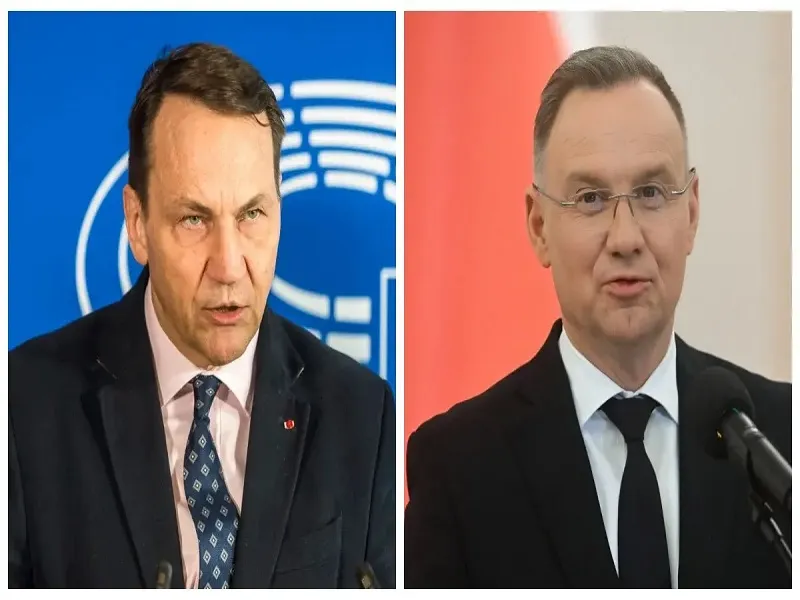
Polish Foreign Minister Radek Sikorski compared outgoing President Andrzej Duda to former British Prime Minister Neville Chamberlain after Duda suggested in a recent interview with Euronews that Ukraine compromise with Russia. For context, Trump had by then begun to speak more openly about Ukraine formally ceding Crimea, which he subsequently pushed with gusto in the days after. What’s so hypocritical about Sikorski’s criticism of Duda is that Sikorski suggested something similar last year.

He proposed that Crimea be placed under UN control for two decades before holding a second referendum on its final status while speaking at September’s Yalta European Strategy conference. After Ukraine predictably complained, Sikorski walked back his proposal by sheepishly claiming that he was engaged in “a hypothetical discussion off the record among experts at the conference in which we considered how to implement President Zelenskyy's own proposals on how to regain Crimea.”

Sikorski therefore isn’t in any position to criticize Duda for suggesting that Ukraine compromise with Russia, and given what’s since unfolded with regard to Trump actively advocating for precisely that when it comes to Crimea, Sikorski’s comparison of Duda to Chamberlain on this basis also risks offending Trump. After all, Poland’s top diplomat is implying that any pressure upon Ukraine to compromise on Crimea equates to appeasing the new Hitler, with the hint that another World War will shortly follow.

To make matters worse, Sikorski once again criticized Duda a week later for not “us[ing] his friendship with President Trump to urge him to put pressure on Russia”, lamenting that “we are not seeing President Duda’s influence on President Trump.” Sikorski then added that Duda’s “good relations” with Trump should “bring some benefit to Poland’s geopolitical situation and Polish interests”, with the insinuation being that they haven’t yet done so.

It’s unrealistic to imagine the Polish President influencing the American one under any circumstances instead of the inverse state of affairs forever remaining the case. Any such attempt by Duda would have also offended Trump and risked prompting him to think about a punishment. Poland is already paranoid that the US might withdraw its forces from Central Europe or abandon NATO’s Article 5 so the last thing that it needs from the perspective of its interests is to provoke him into seriously considering this.

Sikorski’s most recent criticism of Duda is therefore misguided since it would have imperiled Polish interests as its ruling duopoly understands them to be had Duda attempted what Sikorski said. In fact, by moderating his hitherto diehard support of Ukraine’s maximum goals in the conflict to harmonize his stance with Trump’s, Duda brought benefit to Polish interests by averting a scenario where Trump might have been offended, prompted to think about punishment, and seriously considered dumping Poland.

All in all, far from shaming Duda, Sikorski’s two latest criticisms of Poland’s outgoing president only ended up bringing shame to himself. Regardless of however one might feel about Sikorski, he knew better than to do this, but he stooped to such a level as a tacit electioneering tactic ahead of the next presidential vote on 18 May. Sikorski wants his ruling liberal-globalist coalition’s candidate to beat Duda’s conservative choice so he thought that criticizing Duda would also harm the conservative candidate.

https://korybko.substack.com/p/sikorski ... suggestion

******

When liberalism caused the April blackout in Portugal

Hugo Dionísio

May 1, 2025

A task even more important than energy security is imperative: the recovery of our national independence, our freedom as a people.

A widespread blackout hit southern Europe on Monday morning, affecting Portugal, Spain, and parts of south France. In the early hours, fake news about alleged cyberattacks proliferated, with the Russian Federation at the center of attention, as expected. As I write this article, no one yet knows how the blackout happened, but some conclusions can already be drawn: the resilience and redundancy levels of the Iberian grid leave much to be desired, exposing the enormous fragility of a system critical to the national interest of the affected populations.

If Ukraine’s electrical system were as resilient as the one supplying the Iberian Peninsula, the Russian Federation would have long since cut off power to that country. Why hasn’t it succeeded? The USSR left behind an energy system that would be the envy of any “advanced” economy in the European Union. Power plants of all kinds form a war machine full of redundancies, extremely difficult to shut down. In the EU, such plants are shut down every day, notably in Portugal (thermoelectric plants in Sines and Pego were closed), and refineries were shut down, for what? To reopen coal plants in Germany and buy electricity from Spain. It was a fantastic deal, generating fabulous profits for EDP.

After massive investments paid for by the Portuguese people in renewable energy, we now discover that our energy is sold abroad while we buy foreign energy for domestic use. Why? So the people and businesses can buy cheaper energy? No! So EDP and REN, once public and now privatized, can close their quarters with fabulous profits. Minimum service, maximum profits. Though not an expert in this field, there are no great secrets about how private corporations operate: buy as cheaply as possible and sell as expensively as possible, even if it means subjecting an entire population to the whims of the “markets” and the vulnerability of “short-termism.” The deindustrialization of the U.S. is a clear example for anyone who doubts this.

Though brief, this episode laid bare a structural crisis rarely discussed: the consequences of privatizing and liberalizing national electricity systems under the umbrella of the European Union (EU). Under the pretext of EU “mandates,” Portugal segmented its system (separating production from distribution and commercialization) based on supposed competition that never materialized, privatized, and liberalized. For the privatized companies sold to foreign capital, it was a lottery; for the Portuguese people, who once had some of the cheapest energy in the EU, even if not the cheapest, prices have now risen to the 10th most expensive in the annual breakdown of domestic prices, according to ERSE. The fact is that since the European Commission, now led by the unyielding Ursula von der Leyen, began its propaganda about wanting cheap energy for Europeans, the price of that very energy has only increased.

We must ask ourselves: when we see these people baring their teeth against the Russian Federation, arming themselves to the teeth to “put Vladimir Putin in his place,” how long would it take for a military power like the one serving the Kremlin to leave us living in the Stone Age? A few minutes? Just some weapon causing an impulse? Interesting, isn’t it? For those so eager to see Ukrainians die defending “European values.”

The way the collapse occurred reveals deep systemic vulnerabilities. At a critical moment of grid load variation, the system failed to provide the necessary power to maintain stability (again, the lack of redundancy and resilience, everything operating at minimum capacity, on the tightrope of quarterly profits), resulting in a cascading shutdown. The initial analysis by Red Eléctrica de España (REE) indicates that the interconnection between the Iberian countries was a determining factor, specifically, Portugal’s dependence on supply from Spain at the time of the incident. Moreover, we are not safe from this happening again, as is the case in underdeveloped countries and those that treat liberalism as fanaticism, like the U.S., especially Texas. Market logic leads national operators to shut down domestic supply to buy cheaper energy abroad, exacerbating vulnerability in emergencies. At the time of the blackout, Portugal was importing electricity from Spain and couldn’t immediately restore the supply).

The truth is that this is a profit-driven model, not one focused on security, let alone affordable energy for families and businesses. We’ve all heard the hardline right-wingers, the ideological liberals of the 17th century, attack taxes (there it is, promoting minimal state) and “labor costs.” Never, never, have we heard them speak about the criminal shame of privatizing strategic sectors, especially electricity, with severe damage to the national economy. It’s no coincidence that the U.S. and EU have some of the highest electricity prices. You don’t need to be a genius to understand why.

This scenario highlights an increasingly evident reality: liberalized systems tend to operate with minimal margins, eliminating redundancies deemed costly. In technical terms, this means less capacity to respond to crises—everything works fine when all is aligned, but when an accident occurs… This applies to electricity, as well as banking, aviation, postal services, telecommunications, and more. It’s no coincidence that the only mobile network that held up during the blackout was MEO, a remnant of the privatization of the former Portugal Telecom, from a time when these important things belonged to everyone and worked for everyone. Those from the era of “market liberalization” couldn’t even handle a sneeze. A simple blackout of a few hours left everyone without communication. For those who go around the world bullying and talking tough, they should worry more about their own house.

As argued by many authors, the liberalized and privatized model of the European electricity sector was “designed” to increase efficiency and lower costs, but in practice, it tends to operate with minimal redundancy margins, on the razor’s edge. This means less capacity for rapid response to serious failures, as private companies seek to maximize profits by reducing investments in reserves and redundant infrastructure. Since I prefer to move from facts to theory rather than the opposite, if the goal was to lower prices but they increased, if profits grew even more, if everything continued as usual despite the lessons learned from practice, I can only conclude that the intention was simply to hand over to private entities the profits that belonged to everyone. No matter how many theories and idealisms are constructed. When a phenomenon is observed repeatedly and becomes so predictable that it can be extrapolated to most situations, then the theories don’t align with practice. And liberal theory is one of them. It’s a fantasy from the childish days of economics.

This brings us to the essential question: What about our energy independence? Is it so easy to leave a country like Portugal without power? If mills and ovens aren’t electric, and water isn’t piped? Is it so easy for our European partners to leave the country in the dark? It seems so. Now we understand better why Viktor Orbán and Robert Fico didn’t want to be at the mercy of von der Leyen and preferred to keep buying gas from Russia. Had they done otherwise, they wouldn’t be in power today. This is the independent and sovereign Portugal we are! And who are the ones responsible for such betrayal? Who decided that, at some point, our Constitution would be traded for Brussels’ directives?

The fact is that the liberalization of the European energy market allows operators to buy energy abroad whenever it’s economically advantageous. However, this interdependence creates significant strategic risks, because when cross-border circuits fail, as recently happened, countries like Portugal are particularly exposed, given their low domestic production capacity in critical moments. As the REN (National Electrical Grid) official stated, domestic production is only activated when national energy is consumed or exported. Thus, it turns on and off sporadically, leaving us vulnerable to external appetites, from friends and enemies alike.

Among the main culprits of this “April Blackout” are the usual suspects. The April blackout isn’t just an electrical failure. After everything that happened before and during the 51st anniversary celebrations of the Portuguese Revolution that freed us from fascism (cancellation of official commemorations; far-right group infiltrates protesters and brutally attacks them unexpectedly; the Portuguese government censors the National Internal Security Report on the danger of adolescent radicalization by far-right groups), we can truly say that this blackout of “liberal” origin demonstrates that liberalism is not only turning off the lights but also the values of April. One of these, the most important for our collective freedom, is National Sovereignty.

Without energy sovereignty, our national sovereignty is severely threatened. When we hear Pedro Sánchez, Spain’s Prime Minister, wanting to discuss the issue to its ultimate consequences, we can only ask one thing: how did it take so long to recognize the danger we live in?

Credit must be given to the only party in Portugal that denounced this situation, the PCP: “Subjugation to a context of external dependence and a liberalized market constitutes a factor of insecurity for the country. All this demands the reversal of the policy of national abdication of strategic sectors and the guarantee of an articulated, coherent, and effective functioning of the national electrical system.”.

There was another party that mentioned the need to discuss public ownership of sectors determining our energy sovereignty, the Left Bloc (BE), but it did so without ever attacking the root of the problem: the fact that today, Portugal’s energy sector is handed over to plunder, and the origin of this problem is called the European Union and its neoliberal agenda. When we talk about something, we must do so to its ultimate consequences and by addressing the underlying issues. Because this is one of those problems that can kill or save lives. Yesterday, it killed!

And with it should have died the illusions of those who see any salvation in these warlike, neoliberal, and irresponsible EU agendas. As experience shows, with people like Milei at the end of the line, liberalism ultimately leads to fascism, violence, and misery.

At this moment, a task even more important than energy security is imperative: the recovery of our national independence, our freedom as a people, and one of the oldest nations in Europe. This doesn’t mean living apart from others. Rather, it means living with them, chest out and head held high!

It’s time to say no to the April Blackout.

https://strategic-culture.su/news/2025/ ... -portugal/
"There is great chaos under heaven; the situation is excellent."

User avatar
blindpig
Posts: 14839
Joined: Fri Jul 14, 2017 5:44 pm
Location: Turtle Island
Contact:

Re: Blues for Europa

Post by blindpig » Sat May 03, 2025 2:28 pm

Britain’s coalition of the willing decides, upon reflection, that it’s unwilling to fight in Ukraine

Ian Proud

May 2, 2025

Why does Whitehall stumble from one idiotic idea to another?

The UK mainstream media has puffed up British military might and fortitude since the war in Ukraine began. Now it turns out that Britain would struggle to send 5000 troops to Ukraine in a so called ‘deterrence force’. Policy thinkers in Whitehall desperately need to engage their brains and reach for peace.

In a remarkable turn of events, the Times Newspaper of London published an article of 29 April in which it said Europe would struggle to put 25,000 troops on the ground in Ukraine. This from the same newspaper that offered a bizarre eulogy just eighteen days ago about Britain’s ‘crucial role’ in directing Ukraine’s failed counter-offensive in 2023.

Prime Minister Keir Starmer has actively sought a role for himself, bringing divergent US and European policies closer on the conduct of the war and on plans for peace. To much fanfare, at the March 2 Lancaster House Summit, he announced a ‘coalition of the willing’.

The idea emerged that such a coalition might deploy a peacekeeping force to Ukraine after a future ceasefire. Among other things, this force – comprising European and not American troops – would ‘defend a deal in Ukraine’ and ‘guarantee peace afterwards’. Many meetings were held since that time, in Paris and in London, to explore the details.

The coalition had four objectives. To keep military aid flowing into Ukraine and apply further pressure on Russia through sanctions, to maintain Ukraine’s sovereignty and participation in peace talks (an obvious point), to boost Ukraine’s defensive capabilities after a peace deal and to deploy the so called ‘coalition of the willing’ to maintain the peace.

No one, including Starmer, has articulated a clear strategy to guide these objectives. On the contrary, they seem to underpin a continuance of the war, not its cessation.

If we look at them in turn, keeping military aid flowing into Ukraine and applying more sanctions on Russia, will most likely prolong the war, not end it. No one has articulated what the incentive would be for Russia to sue for peace on the basis on the further militarisation of Ukraine, and in the face of additional sanctions. This objective has clearly been driven by the Ukrainian side. Economically, barely a day goes by without Zelensky, Yermak or someone else in the Ukrainian power vertical calling for more sanctions on Russia, at a time when the US press for an end to the conflict. Indeed, Ukraine was calling for more sanctions on Russia in the days before the war’s commencement. On many occasions, I have presented analysis showing how Russia has constantly found ways to adapt to sanctions and illustrated how more sanctions would have no significant economic impact. Like giving Ukraine more weapons, sanctions would only disincentive efforts at peace, by emboldening Russia to continue fighting.

Even a casual observer might note that the plan to boost Ukraine’s defensive capabilities after a peace plan would amount to wholescale rearmament, running counter to any longer-term peace process. In any case, no one has explained why this rearmament would be needed. Surely, if peace is the way forward, then both sides would gradually and in small steps stand down their forces and reduce their alert state. I wouldn’t suggest that Ukraine dissolves its army on day one. However, with 800,000 personnel, Ukraine already has a bigger army than any other European NATO ally except for Turkey.

Further, Ukraine has received over one hundred and twenty billion dollars of military aid in the three years since the war started, that’s not far short of Britain’s annual defence budget for two years. What additional defensive capabilities would they need? And, more importantly, who would pay for it? The USA categorically isn’t going to pay for this for at least the next four years under President Trump.

The European Union will almost certainly fail in its bid to boost its own defence spending by $800bn under von der Leyen’s Rearm plan. That would impose such massive spending increases on countries like France and Italy that it would be political suicide domestically for their governments to do so. Ukraine already cannot afford to keep its military at its currently bloated size after war ends, without massive injections of European money that simply isn’t available. Where will the money come from to rearm Ukraine? Answer, nowhere.

Which brings us back to the peacekeeping, or deterrence force idea, and the shocking revelation that European nations including Britain don’t even have enough available troops to deliver upon that commitment at any scale. In March, in the afterglow of the Lancaster House Summit, even Conservative politicians hailed Starmer as a modern-day Winston Churchill, standing up against tyranny in Europe. A quick reminder here that Winston Churchill oversaw the mobilisation of almost six million British troops to fight in World War II. Starmer is struggling to muster five thousand for Ukraine.

The idea of a European peacekeeping force in Ukraine has always, in any case, been a non-starter given Russia’s long-standing and expressed rejection of the notion of NATO forces on the line of control. When Russia pointed this out, and following pressure from the US government on Britain, the peacekeeping proposal was watered down to a ‘deterrence force’. The idea here was that, rather than being close to the line of control, coalition of the willing troops might deploy to far away spots in the west of Ukraine, just in case they were needed, to deter a theoretical Russian breach of any peace deal. Today, if any European troops can be spared, then they would only deploy to deliver training to Ukraine’s army.

This state of affairs is beyond embarrassing. We have fallen all too frequently in Britain into the habit of serving up policy soundbites for a willing pro-war media establishment, before getting our policy thinking in order. We do this before discussing our plans with the Americans, who are in the driving seat in the west on plans for peace in Ukraine. At no time, do we appear to assess the risks associated with our ideas, or consider the likely and, in almost every case, entirely predictable Russian response. Nor, perhaps, even engage in dialogue with Russia to negotiate the art of the possible, exploring scope from both sides to reach compromise. A proposal that President Macron should act as Europe’s point person with President Putin has come to nothing. Instead, we stumble, with great self-importance, from one idiotic idea to another, announcing them at every stage as huge breakthroughs in our collective resolve to defeat Russia. Until the moment, finally, when, with not even an ounce of self-awareness, we admit that, upon reflection, it won’t work.

Surely, now, we must find someone in Whitehall to engage their brain, pull on their grown up trousers, engage with both sides to the conflict, and finally reach for peace?

https://strategic-culture.su/news/2025/ ... t-ukraine/

******

Spain’s Major Unions Lead May Day Protests Demanding Labor Reforms and End to Arms Sales to Israel

Image
Photo: EFE

May 1, 2025 Hour: 2:04 pm

Spain’s leading trade unions, Comisiones Obreras (CC.OO) and the Unión General de Trabajadores (UGT), organized nationwide protests on Thursday to mark International Workers’ Day, calling for reduced working hours, an end to the war in Gaza, and a halt to arms sales to Israel.

In Barcelona, thousands gathered at Plaça Urquinaona, denouncing military spending for diverting funds away from healthcare and education, two sectors they say are already under strain.


Union leaders warned against the erosion of the welfare state and the loss of historic labor rights, while also raising alarm over rising hate speech on social media and traditional outlets.

One of the core demands was the implementation of a 37-hour workweek, a measure expected to be approved by the Cabinet this week, but postponed due to a nationwide blackout that disrupted public services and paralyzed transportation networks.

The demonstrations saw widespread participation, with banners from CC.OO and UGT alongside independent workers. Protesters also decried Spain’s soaring housing costs, which have forced many families to relocate far from urban job centers.

The blackout crisis, which left thousands stranded without access to food, water, or internet connectivity, added urgency to the protests.

Unions emphasized the importance of global worker solidarity in the face of rising authoritarianism, referencing leaders such as Donald Trump in the United States as symbols of reactionary politics.

This year’s May Day mobilizations come amid ongoing labor unrest in Spain. Just days before, sanitation workers in Madrid ended an indefinite strike after six days of walkouts and intense negotiations.

https://www.telesurenglish.net/spains-m ... to-israel/

******

Europe drives global surge in military spending in 2024

In 2024, European countries were major contributors to a global rise in military spending, allocating over USD 690 billion to armament

May 01, 2025 by Ana Vračar

Image
Source: Wikimedia Commons

Europe was one of the main contributors to the global surge in military spending in 2024, according to new data released by the Stockholm International Peace Research Institute (SIPRI). In what is likely the steepest rise in global military expenditure in over 30 years, European countries allocated USD 693 billion to armament, as part of a broader militarization campaign that has alarmed trade unions and the public.

Large European economies, particularly Germany, Poland, France, and Britain, figure prominently on SIPRI’s list of the world’s top military spenders, alongside regional neighbors Russia and Ukraine. “The latest policies adopted in Germany and many other European countries suggest that Europe has entered a period of high and increasing military spending that is likely to continue for the foreseeable future,” warned SIPRI researcher Lorenzo Scarazzato.

While Russia’s USD 149 billion military budget exceeds that of any individual European country, the combined defense spending of just four EU members – Germany, France, Poland, and Italy – surpasses Russia’s by over USD 80 billion. This raises further questions about the rationale behind the EU’s militarization push under the ReArm Europe initiative.

Read more: Italy marks 80 years since liberation with calls against genocide and militarism
Analysts have associated the regional increase in spending to the war in Ukraine and fears among European governments about the future of their alliance with the United States, particularly as the second Trump administration pressures them to increase NATO contributions and threatens new tariffs. But this strategy may not work as intended. “It is worth saying that boosting spending alone will not necessarily translate into significantly greater military capability or independence from the USA,” noted SIPRI’s Jade Guiberteau. “Those are far more complex tasks.”

In this landscape, Ukraine finds itself in a specific position. Already among Europe’s top military spenders, it would rank even higher if the USD 60 billion in military aid it received were counted as part of its own budget instead of being attributed to donor countries. “If it were included, Ukraine’s military spending would have totaled USD 135 billion, making it the fourth biggest spender in the world,” the report states. Additionally, all of Ukraine’s tax revenue currently goes to military spending, SIPRI’s Diego Lopes da Silva pointed out.

Meanwhile, supporters of the Zelenskyy administration in Europe continue to back a military solution to the conflict, avoiding serious negotiations for peace. In the US, while the Trump administration has floated initiatives to end the war, it also recently signed a so-called mineral deal with Ukraine, which is expected to give them access to a notable part of the country’s mineral, oil, and gas reserves in return for military assistance and a harsher approach to Russian authorities.

In contrast to existing trends, regional anti-war campaigners argue that endless arms transfers are prolonging the conflict without any clear plan for resolution. Activists from the Stop the War coalition point out that this approach not only leads to more deaths in Ukraine but also drains public resources across Europe. Billions spent on weapons come at the cost of social security and public services in the region.

Writing of British Prime Minister Keir Starmer, Andrew Murray of Stop the War stated that “he is placing warfare above the people’s welfare at every turn, invoking mythical threats to justify pouring more and more money into the arms industry at the expense of basic provisions for the disabled, pensioners and the poor in general.” The same could be said of other European leaders, who continue to prioritize militarization over building real security in the region.

https://peoplesdispatch.org/2025/05/01/ ... g-in-2024/

******

Stephen Bryen: Estonia cribbing Ukraine’s script for provoking Russia
May 2, 2025
By Stephen Bryen, Asia Times, 4/12/25

​On June 28, 1914, Gavrilo Princeps, a Bosnian-Serb radical, shot and killed Austrian Archduke Franz Ferdinand and his wife Sophie, Duchess of Hohenberg. Princeps did not act alone.

He was one of at least six principals in an organization called Young Bosnia, and his group and others were seeking independence from the Austro-Hungarian empire. He also received help from a secret organization, the Black Hand, that provided training and weapons, including bombs and pistols.

The assassination of the Austrian Archduke, the immediate successor to emperor Franz Joseph I, was a provocation that a month later caused the so-called July crisis that culminated in a July 23 ultimatum to Serbia. By then, Germany had pledged support for Austria, and Russia and France would mobilize in support of Serbian nationalism.

World War I could have been avoided, but it was not. The perpetrators of the crime in Bosnia were tried, some jailed (because they were too young for execution, including Princeps) and others executed. The Austrians vastly overestimated their military capabilities. For them, at the end of the war, the Austro-Hungarian empire would cease to exist.

Are we in a similar situation today? There have been countless provocations by Ukraine and some of its supporters, including Joe Biden, who authorized long-range ATACMS strikes deep inside Russia, some aimed at Russia’s early warning radars and nuclear bomber bases.

Not to be outdone, the Ukrainians on May 3, 2023, launched drone attacks on the Kremlin, targeting Russian President Vladimir Putin’s office.

Such attacks are inconceivable without technical help from NATO, especially as long-range drones need satellites for communications and targeting. The White House has denied allegations it was involved recently in attacks.

At the same time, Ukraine and its supporters have promoted and carried out a cultural war against Russia. One of the top provocateurs is Estonia.

Estonia is the most northern of the Baltic states. It fronts on the Baltic Sea where its capital city, Tallinn, is located. Estonia’s town of Narva is just next to the border with Russia. About half of Narva’s population is Russian.

Estonia has a population of 1.37 million, based on data from 2023. Between 20-25% of Estonia’s population are Russians, depending on how the count is made.

For a number of years, Estonia has been waging a cultural war against Russia while at the same time utterly depending on NATO for its security. The Estonian army has only 7,700 active duty personnel, of which 3,500 are conscripts.

It has a reserve force that is significantly larger, but it does not have the equipment to support its reserves, so it is largely a paper force. Estonia has no air force to speak of, only two Czech-made (Aero Vodochody) L-39 trainers and two small M-28 Polish transports.

One would think that Estonia would not want to create trouble for itself, but it seems that the reverse is true, largely deriving from the Estonian belief that NATO is there to back it up and that Russia would not attack a NATO state.

Provocations are not something new for the Estonians, whose hate for Russians borders on the extreme. By practically denying citizenship to their Russian inhabitants to attacking the Russian Orthodox Church in Estonia through legislation, Estonia has made it clear it will do whatever it can to humiliate its own Russian population and Russia itself.

In April 2007, the Estonians decided to move the monument there known as the Bronze Soldier of Tallinn. That monument also was the site of a number of graves of Soviet Russian soldiers who were killed fighting against the Nazis.

The graves were dug up, their families in Russia notified they could collect the remains or they would be relocated in the Tallinn military cemetery along with the monument.

Now, in 2025, we have another round of monument-busting, as the Estonians are tearing down Russian war memorials once again. This includes defiling Russian graves in the Tallinn military cemetery and damaging and destroying war memorials.

If there is one single unifying principle these days in Russia it is the great importance given to Russia’s decisive role in the defeat of Nazi armies in World War II. Each year, on May 9, Russia holds its annual Victory Day celebration, which focuses on a show of military power.

It is followed by a more somber but clearly important citizen’s march known as the Immortal Regiment. In this march, families proudly carry posters and photos of family members who perished in the Great Patriotic War (Russia’s terminology for World War II.)

Estonia’s show of contempt for Russia’s World War II victory, along with its spotty, some would say, compromised behavior supporting the Nazis, is increasingly irksome to the Russians.

One can add attempts to keep Russians living in Estonia from achieving citizenship or even voting in elections. Estonia has now stepped that up by adding new legislation to make it even more difficult for Russian residents to be treated equally.

Estonia is also trying to block out any relationship between Russian Orthodox Churches in Estonia to the Moscow Patriarchate. It is not surprising that Estonia’s actions parallel and were perhaps inspired by Ukraine, which is doing the same thing.

The Estonian action against the Moscow-led church would create revulsion and horror elsewhere if, for example, European or American Catholics were not allowed to communicate with the Pope in Rome.

Among the pro-war advocates in Europe, Estonia is at the forefront. Its former Prime Minister, Kaja Kallas, is now the High Representative of the European Union for Foreign Affairs and Security Policy.

She is now a major voice in promoting a massive European defense expansion and sending troops to Ukraine. Of the six nations who have apparently pledged to send troops to Ukraine, Estonia is leading the list even though it does not have anyone to send.

The trouble with provocations is that they can cause wars. The hysteria now apparent in official channels in parts of Europe (for example, France, UK, Germany and Estonia) reflects huge anxiety that Ukraine will not survive the Russian onslaught.

Instead of helping US President Donald Trump find a peaceful solution to the conflict, the French and British, in particular, have done their best to undermine his efforts.

While some of this can be explained as a bailout for Europe’s economic issues by substituting military production for civilian manufacturing, deficit spending of this kind will never be enough to salvage Europe’s economic and industrial problems.

Meanwhile, small countries such as Estonia can cause big problems and an escalation leading to conflict in Europe.

https://natyliesbaldwin.com/2025/05/ste ... ng-russia/
"There is great chaos under heaven; the situation is excellent."

User avatar
blindpig
Posts: 14839
Joined: Fri Jul 14, 2017 5:44 pm
Location: Turtle Island
Contact:

Re: Blues for Europa

Post by blindpig » Sun May 04, 2025 4:38 pm

The Labour party is the agent of increased political repression in Britain

Starmer’s government was installed to disarm working-class resistance and destroy the pro-Palestine movement.
Proletarian writers

Sunday 4 May 2025

Image
Labour is a capitalist and imperialist party, thoroughly embedded within the bourgeois state apparatus. It in no way seeks to challenge either the economic wage-slavery of workers or existing property relations. And as we have repeatedly seen, it does not reverse but instead routinely utilises and extends all the repressive legislative and state means of suppression of the British working class.

The following resolution was passed unanimously by the tenth party congress of the CPGB-ML.

*****

Congress understands that the British political system of parliamentary democracy, like “the modern representative state [in general,] is an instrument of exploitation of wage-labour by capital”. In Britain’s constitutional monarchy, just as in the democratic republic, “wealth exercises its power indirectly, but all the more surely”, first, by means of the “direct corruption of officials”; secondly, by means of an “alliance of the government and the stock exchange”. (F Engels, Origins of the Family, Private Property, and the State, 1884, Chapter 9)

“The omnipotence of ‘wealth’ is more certain in a democratic republic [as] it does not depend on defects in the political machinery or on the faulty political shell of capitalism. A democratic republic is the best possible political shell for capitalism, and, therefore, once capital has gained possession of this very best shell … it establishes its power so securely, so firmly, that no change of persons, institutions or parties in the bourgeois-democratic republic can shake it.” (VI Lenin, The State and Revolution, 1917, Chapter 1)

The City of London, Britain’s land and business owning capitalist class, has cemented its domination over the ‘democratic’ parliamentary system, police force and all the wider institutions of the British political state and society – as demonstrated in Ella Rule’s pamphlet on A Class Analysis of Britain in the 21st Century. This was amply demonstrated during the bailout of the failing banks in 2008, ensuing austerity, Brexit, Corbyn’s ouster from Labour party leadership, and the ‘Covid’ stock market bailout, among other things.

Labour is a party of imperialism
Congress believes that the Labour party is integral to the running of the British capitalist state, indistinguishable in its economic and social programme from the Conservative or any other capitalist party. It works tirelessly for the maintenance of British capitalism and still puts forward the notion that what serves the imperialist bourgeoisie serves the “whole people”, the “national interest” and, by implication, the working class also. Labour, like all bourgeois politicians and parties, never acknowledges the fact that Britain is split into two great hostile camps – the workers and the capitalists.

The workers (those who live by selling their labour-power, along with their dependents, the unemployed, pensioners and working-class students) constitute more than 90 percent of Britain’s population. The true capitalists, meanwhile, are far less than one percent of the population.

Significantly landed families constitute around 36,000 (0.05 percent, or one twentieth of one percent of Britain’s 68 million population), and they own more than half of Britain’s land, with much of the rest being under corporate control. The largest ten land holders have between them more than a million acres. (K Cahill, Who Owns Britain and Ireland?, 2001)

Two-thirds of land in the UK as a whole – 40 million acres – is owned by 0.36 percent of the population; 24 million families, meanwhile, share the ‘urban plot’ of 3 million acres (less than 5 percent of Britain’s land area). The notion of the country being ‘full’ is a political fantasy. (Review of Who Owns England by G Shrubsole, The Guardian, 28 April 2019)

In terms of capital, the concentration is even more stark. There are 5,000 people in Britain who have more than £50m (0.007 percent, or seven-thousandths of one percent), of whom the richest 350 hold assets of £800bn, with 57 (known) individual multibillionaires. (Sunday Times Rich List 2024)

Congress realises that all manifestations of class struggle, derivative of this extreme inequality in property and capital are collectively characterised – by Labour, Tory and media alike – as simply ‘bad’, ranging from the low-level ‘antisocial’ (largely relating to mass economic and cultural impoverishment of the working class) through criminal (where property and person is threatened) to terrorist (where there is any threat to the capitalist state monopoly on political governance and violence). All responsibility for the social and behavioural consequences of this inequality are systematically laid at the door of the workers themselves.

Congress affirms that Labour is a bourgeois party, embedded within the bourgeois state apparatus, which in no way seeks to challenge either the economic wage-slavery of workers or existing property relations, and which does not reverse but instead routinely utilises and extends all the repressive legislative and state means of suppression of the British working class.

Lenin noted 105 years ago that: “Of course, most of the Labour party’s members are workingmen. However, whether or not a party is really a political party of the workers does not depend solely upon a membership of workers but also upon the men that lead it, and the content of its actions and its political tactics …

“The British bourgeoisie, which has had far more experience – democratic experience – than that of any other country, has been able to buy workers over and to create among them a sizable stratum, greater than in any other country, but one that is not so great compared with the masses of the workers. This stratum is thoroughly imbued with bourgeois prejudices and pursues a definitely bourgeois reformist policy. Progress [for the revolutionary proletariat] is slow because the British bourgeoisie are in a position to create better conditions for the labour aristocracy and thereby to retard the revolutionary movement in Britain.” (Affiliation to the British Labour party, speech by VI Lenin to the second congress of the Communist International, 19 July-7 August 1920)

Congress recognises that the Starmer administration has already demonstrated that it is fully committed to using and extending all the means at its disposal to repress the working class – and in particular the anti-imperialist, pro-Palestine, progressive and communist workers.

With the deepening crisis of capitalism and impoverishment of the masses, there is an increasing drive to war, and an accelerating deterioration in the living standards of workers in Britain and across the globe. Anglo-American imperialism’s drive to war against Russia and China, in the middle east to maintain its grip on the global oil supply, and in Africa for control of her vital human and mineral resources, manifesting in the combination of Nato’s war in Ukraine, US-UK-EU-Israeli genocide in Palestine, Lebanon, Syria, Yemen, and the ongoing war in the Congo, have resulted in an upsurge in the anti-imperialist and objectively anti-capitalist action of the British working class.

Britain has a long history of colonial repression, in which Labour has been fully complicit, including in directing Britain’s wars (Yugoslavia, Iraq, Afghanistan, Sierra Leone, Syria, Libya, Korea, Malaya, Kenya, South Africa, India …) and in running its military and military intelligence. Congress notes as an egregious example, the repressive Five Eyes collaboration between the Anglo-Saxon states (Britain, USA, Canada, Australia, New Zealand) to spy upon the communications of the whole world’s population – including on the domestic population of Britain, in violation of British domestic law.

Congress notes such specific repressive measures as the advent of legislation that suspends habeus corpus (the state having to produce and disclose evidence against citizens that it tries and imprisons), the advent of judge-only closed trials (eg, the Diplock courts used to suppress the Irish republican movement in particular, but extended since Covid), and regular shootings of British workers on the streets (from Harry Stanley, Diarmuid O’Neill, Jean Charles de Menezes and Mark Duggan to the recent police assassination of Chris Kaba, among others).

Many police murders formerly were related to anti-Irish racism and the repression of the Irish liberation struggle. Now we find most often that young black and ‘muslim-looking’ men are the victims – all subsequently tarnished, most without any evidence, as ‘criminals’, though almost all have been extrajudicially murdered without cause.

Congress understands that the ruling class is once again ramping up its racist rhetoric in the face of its crisis. Elon Musk’s campaign to reignite anti-Islam, anti-Pakistani, anti-immigrant sentiment among British workers is entirely aimed at distracting ‘white’ British workers from the economic troubles caused by the capitalist class themselves, and to misdirect workers’ anger at “Pakistani grooming gangs”. While leading this campaign, designed to divide workers against one another and to separate the ‘white British’ working class from the cause of Palestine, Labour and Tory have both taken steps to label all anti-imperialist, anti-capitalist, anti-genocide, pro-Palestine campaigners as “antisemitic” and as “terrorists”.

Labour installed to disarm working-class resistance and destroy the pro-Palestine movement
Congress understands that the last general election on 4 July 2024 was called by the capitalist class, in circumstances designed to oust the ailing Tory administration of Rishi Sunak and falsely inflate support for the Labour party. Sir Keir Starmer “swept to victory” on one of the worst electoral votes since WW1, gaining far fewer votes than Jeremy Corbyn received in 2019, and claiming a resounding victory in seats although just 18 percent of the voting-age population cast a ballot in his favour.

Labour was the chosen government of capitalism, and the election was called early precisely to install Keir Starmer, who has pushed ahead with the genocidal wars in the middle east and Ukraine and increased austerity measures in Britain in the face of growing discontent among workers and growing opposition to the imperialist policy abroad – in particular, from the militant and persistent Palestine solidarity movement.

Congress notes that Labour’s victory was followed swiftly by pogroms and race riots across the country, which had been deliberately stoked (with the zionists, far right, Labour government and state forces all coordinating the campaign), and which were given disproportionate press attention. They were followed by talk of increasing repression “to clamp down on street violence” and “extremism”, yet since that time, and entirely predictably, the majority of state repression has actually fallen on the Pro-Palestine, anti-imperialist solidarity movement. Labour has intensified a three-pronged attack on the working class:

Political repression is now increasing, specifically with the attempt to falsely label the anti-imperialist and pro-Palestine movement as “racist”, “antisemitic” and “terrorist”, and to use existing ‘antiracist’, ‘public order’ and ‘anti-terror’ legislation to criminalise progressive workers.
Workplace repression is increasing via the weaponisation of the regulatory and disciplinary framework, which is being used to economically sanction workers who speak out against the ruling class’s policy of militarism, its war in Ukraine, and especially its genocide in the middle east.
Policing of social media
Congress notes that Labour is keen to utilise existing repressive British legislation including the Public Order Act, the Criminal Justice Act and the Terrorism Act 2000, themselves built upon hundreds of years of laws designed to ensure that the privileges of the propertied classes are sacrosanct.

Congress notes the recent adoption of the Police, Crime, Sentencing and Courts Act 2022 and the Public Order Act 2023, which further attack workers’ rights to freedom of speech and political action. This legislation leaves British workers facing up to ten years in prison for taking part in ‘annoying’ peaceful protest. In the first weeks of Labour’s administration, these provisions were used to hand environmental campaigners from Just Stop Oil four and five-year sentences for taking part in a Zoom call about a planned climate protest! It would be funny, if it were not so deeply sinister.

Defendants can be banned from mentioning the political or environmental factors that led to action in their defence, and those who might dare to stand outside the court with signs reminding the jurors that they have the right to acquit you according to their consciences – a basic principle – may also be prosecuted for contempt. (Labour’s war on protest by F Newton, Tribune, 18 November 2024)

Congress notes high-profile individual cases of repression including those of Sarah Wilkinson, pro-Palestine independent journalist, Asa Winstanley and Ali Abunimah, online journalists from the pro-Palestine Electronic Intifada, Richard Medhurst, independent progressive and anti-imperialist journalist, Kit Klarenberg, independent journalist at the Grayzone, former ambassador and antiwar campaigner Craig Murray, the world-renowned British Palestinian doctor and plastic surgeon Gassan Abu Sittah (who was operating at the Al-Ahli Arab methodist hospital in Gaza when the zionist Israeli airforce dropped a JDam bomb upon its compound, killing hundreds of civilians), activists returning from the funeral of the assassinated leaders of Hezbollah, Hassan Nasrallah and Hashem Safieddine, and many others, including seven comrades of the CPGB-ML.

These comrades were abducted by the state from London streets, from their homes, from airports and at international borders on spurious charges of “racism” and “terrorism”, demonstrating the aggressive attitude not only of the last administration, but of the present one. It is clear that the Labour party is fully committed to extending the repression of British workers, including those who simply seek to educate, provide information and do journalism that undermines the capitalist ruling class’s lies in support of its genocidal wars. Congress notes that Tony Greenstein remains on bail for the charge of terrorism for daring to question the prohibition of Hamas by the British government, and will remain under harsh bail conditions for an entire year until his delayed trial finally takes place in January 2026.

Congress notes that on 18 January 2025, Labour ordered the Metropolitan police to make mass arrests of marchers and organisers of the Palestine demonstrations at the BBC TV Centre in Portland Place. They were protesting against BBC complicity in the genocide in Palestine. The Labour regime and police justified this repression on the grounds that they were “protecting the right of jews to worship at Central Synagogue” – over half a mile from the protest. (Over 70 arrests as thousands join pro-Palestine rally in Westminster by W Mata and A France, The Standard, 18 January 2025)

Whatever the nefarious role of the ‘Stop the War’ organisation (itself part of the ‘left Labour’ milieu), its complicity with and subservience to the Labour party, and its complicity in disorganising and limiting the antiwar and Palestine solidarity campaigns in Britain, Labour’s repression is as clear as day. It seems likely that this precedent will be utilised by Labour in attempted suppression of the entire Palestine solidarity movement, with wide-ranging removal of British workers’ rights to protest.

Following the arrests, home secretary Yvette Cooper wrote on X: “Everyone should be able to worship in peace. The Met police have my support in ensuring that synagogues were not disrupted today.” She also shared a Community Security Trust (CST, a zionist organisation that receives hundreds of millions of pounds in state funding) post saying: “Thank you to the Met police for ensuring the community could attend Shabbat services peacefully today. A special thanks to all of our volunteers who played a vital role in today’s security operation.” (Cleverly overrules top civil servant on funding security for jewish communities, Jewish News, 29 February 2024)

The latter reference was to the small but pernicious group of zionist activists from such organisations as ‘Harry’s Place’, ‘Gnasher Jew’, ‘Lawyers For Israel’, ‘Jewish Medical Association’ and the CST, who play the role of zionist foot soldiers and political police in Britain, actively singling out workers on demonstrations and on social media, in direct communication both with Israeli politicians and state forces (IDF, Mossad), British politicians (Labour, Tory, Tommy Robinson-Yaxley-Lennon, etc) and British police.

These people trawl our streets, our demonstrations and our social media profiles together with the owners of Facebook, Twitter, Cambridge Analytica, Palantir, 77th Brigade etc, and single out the opponents of British imperialism and zionism, Palestine solidarity campaigners and anti-genocide campaigners, then work with the British police to politically target and criminalise them. What’s more, this action is now being extended to the workplace, and Labour ministers are keen to go further than their Conservative counterparts to prove their loyalty to their capitalist masters.

Workplace based repression in the NHS
In December 2024, Labour health minister Wes Streeting met with prominent zionist campaigning organisations including the Jewish (Israeli) Medical Association, Community Security Trust, and the Board of Deputies. Streeting then called on regulators to strike off doctors who bring extremist views about Gaza into the workplace.

In a statement to the Telegraph, he said: “I expect regulators to investigate any concerns suggesting patient safety is at risk due to discrimination or misconduct by a healthcare professional. Any worker espousing racist or extremist views should know they could end up in front of a disciplinary panel.” Victoria Atkins, Streeting’s Tory predecessor, had previously warned that tough action against “extremism, discrimination or hate speech” was “vital for public confidence” in the health system. (Doctors are facing antisemitism from their colleagues – will the NHS protect them? by M Levy, The Telegraph, 19 December 2024)

The health secretary told the Telegraph he would enforce a “zero tolerance approach” to “anyone who uses the conflict in the middle east as a pretext to attack communities”, and promised to urge regulators to discipline doctors and nurses who express “racist or extremist views” about the Gaza conflict, with measures up to and including being struck off the medical register. (Streeting vows to root out NHS antisemitism by E Croft, The Telegraph, 14 December 2024)

By ‘racist or extremist’, it should be understood that Labour and Streeting are weaponising the regulatory framework of the (medical, nursing, legal, business …) professions to take punitive economic and criminal measures against those who protest the Israeli genocide in which Streeting, Reeves, Cooper, Lammy Starmer and the whole Labour party are actively involved, fully complicit and legally responsible.

Streeting himself was elected by the narrowest of margins in Ilford North over Leanne Mohammed, who campaigned as an independent and in particular on the issue of the Gaza genocide – which Streeting backs to the hilt, having taken prominent trips to Israel and accepted individual campaign contributions from zionist organisations.

Indeed, pro-Israel lobbyists have donated to 13 out of Labour’s 25 cabinet members since they were first elected to Parliament, including prime minister Keir Starmer, his deputy Angela Rayner, chancellor Rachel Reeves, foreign secretary David Lammy, home secretary Yvette Cooper, trade secretary Jonathan Reynolds, technology secretary Peter Kyle and Pat McFadden, whose responsibilities now include national security. The total value of the donations amounts to over £300,000. Streeting meets regularly with Labour Friends of Israel inside Westminster and the European Leadership Network (Elnet) lobby group has paid for Streeting and Bridget Phillipson’s parliamentary staffers to visit Israel.

Labour politicians are not only devoid of morals and open to bribery to support genocide, they are cheap.

Labour criminalising workers for social media posts
Home secretary Yvette Cooper has been enthusiastically supporting her predecessor Suella Braverman’s vicious repression of the Palestine solidarity movement. She’s on record in Parliament as stating that “We [Labour] welcome and support the [Tory] government’s commitment of additional funding for the CST” (were we in doubt?) and the arrest of hundreds of peaceful protestors against genocide, facilitating the fiction that this repression was made against “antisemites” – so generating the narrative (coordinated and published by the CST, and given the blessing of Parliament) that allows for further repression. (Antisemitism debate, Hansard, 19 February 2024)

She went on to demand greater use of the ‘Prevent’ programme against workers expressing opinions that were not in accordance with the Labour-Tory capitalist government diktat, and for more repression based on ‘unsanctioned’ opinions being expressed on social media. (Violent disorder debate, Hansard, 2 September 2024)

This is not a new phenomenon. Lenin noted the social chauvinism of Labour in 1913, as more of its members were already aligning themselves with the British ruling class against the working class as the first world war approached:

“In the last issue of The Labour Leader, the organ of the Independent Labour party, we find the following edifying communication. Naval estimates are being discussed in the British parliament [ie, the military build-up to World War One – which Labour had pledged to oppose in the meetings of the Second Workers’ International]. The socialists introduce a motion to reduce them. The bourgeoisie, of course, quash it by voting for the government.

“And the Labour MPs?

“Fifteen vote for the reduction, ie, against the government; 21 are absent; four vote for the government, ie, against the reduction [FOR war]!

“Two of the four try to justify their action on the grounds that the workers in their constituencies earn their living in the armament industries. [Does it not sound like our Labour and TUC leadership in 2025?]

“There you have a striking example of how opportunism leads to the betrayal of socialism, the betrayal of the workers’ cause. As we have already indicated, condemnation of this treachery is spreading ever wider among British socialists.” (In Britain (the sad results of opportunism) by VI Lenin, 12 April 1913)

Congress therefore resolves to:

1. Fearlessly champion the right of the Palestinian people to self-determination.

2. Fearlessly campaign against zionism, and widely publicise Comrade Harpal Brar’s books on the subject and the party’s writing and analysis.

3. Continue its campaign against the IHRA definition of antisemitism and against the definition’s adoption by any UK institution.

4. Reaffirm and widely disseminate our correct analysis that Labour is an imperialist party – as amply demonstrated by the actions of the Starmer administration.

5. Campaign to expose the Labour party and all manifestations of ‘left Labourism’ in the working-class movement, working to remove its harmful influence over the working class and organised labour.

6. Campaign for the right to freedom of speech, freedom of conscience and freedom of criticism, discarded by the bourgeoisie in its bid to silence and repress workers, and trampled underfoot by this Labour administration.

7. Champion the rights of independent and progressive journalists, wherever possible making common cause with them, to propagate the truth to the working class about the repressive policies of imperialism domestically and abroad.

8. Defend our party comrades from all attempts to criminalise them for their political work, and expose and counter ‘legalised’ state persecution of the working class at the hands of the police and state.

9. Support the struggle of all workers, particularly the journalists, academics, health workers and medical professionals being targeted by false accusations of ‘racism’, ‘antisemitism’ and ‘terrorism’ by the zionists and Labour imperialists.

10. Support the legal defence of all demonstrators and workers victimised by the repressive state legislation.

11. Campaign against the ‘Prevent’ programme as being a means not of preventing ‘radicalisation’ or ‘terrorism’, but of the political policing of British workers.

12. Campaign for the lifting of repressive legislation, and for the protection, restoration and expansion of the rights of the working class to engage in political action, for their freedom of speech, freedom of political conscience and opinion, and their right to protest.

https://thecommunists.org/2025/05/04/ne ... epression/

******

Left Populism, Israeli Terrorism, Summer Heat, The Brain-Body
Nate Bear
May 04, 2025

Image

In the UK the anti-immigration, anti-woke Reform party led by Trump ally Nigel Farage just cleaned up in local elections. If the results were replicated at a general election the party, just four years old, would be the largest force in government and Nigel Farage would likely be prime minister.

Image

This comes just 10 months after Kier Starmer’s Labour party won a landslide national victory. After being granted a mandate last July, Starmer, who basically said nothing about how he was going to govern and cruised to victory on the back of Tory hatred, decided to do politics really, really badly. He replicated Farage on immigration, aped the Tories on austerity, copied the right’s anti-woke talking points on culture war issues and unapologetically funded genocide. Labour as a political force is finished under Starmer. People want populism. They want to punish elites. The only way to stop Farage being prime minister is for the British political left, led by Jeremy Corbyn and the left-wing MPs that were purged from the Labour party, to form a new populist left political party that directs anger away from migrants, Muslims and internal cultural enemies towards billionaires and class issues. The left everywhere has a very good anti-elite story of its own to tell, it’s just there’s few national level politicians to tell it. At some point very soon it will become unforgivable for Corbyn not to use his credibility among the British left to help start a new political party. He doesn’t need to be leader of this new party. He probably shouldn’t be. But he’s the only person with the following necessary for such an undertaking. He’s the only person who can galvanise a movement around him.

So far Corbyn’s response to Reform’s gains has been to tell a party that hates him and will never listen to him what they are doing wrong. He really needs to stop wasting his breath. They kicked him out and would prefer him dead. A new left party in the UK should then take its lead from the governing parties in Mexico and Spain. In those countries, wealth taxes, windfall taxes on energy companies, immigration, nationalisation, public investment and anti-elite, class-based rhetoric have been a winning formula. A new party of the left in the UK would also need to be in conflict with large parts of the mainstream media. They would have to relish this fight, work with independent media and enjoy being outsiders. This is the only way to avoid a Nigel Farage government and the further horrors that would bring.

Hopefully Corbyn and the British left figure it out in time.

Israeli terrorism strikes Europe

On Friday Israel drone bombed an aid flotilla in international waters in the Mediterranean Sea. The flotilla, which was bombed off the coast of Malta where Greta Thunberg was waiting to board, was attempting to break the siege of Gaza which has seen no food or water enter for nearly two months. Under maritime law, bombing a ship in international waters is an act of war against the flag country of the vessel. The vessel had been sailing under the flag of Palau, but the country, an ally of Israel, revoked its flag just days before the attack. Of course, nothing has been done. Western politicians have been silent in the face of Israeli terror in Europe. We can well imagine the response if Russia or Iran had bombed a ship in the Mediterranean: war. But as it’s Israel, anything goes. Telling Israel not to do terrorism, demanding Israel stop starving two million civilians, would, I suppose, be antisemitism. This all happened in the same week the EU mobilised its so-called civil protection mechanism to help Israel fight fires started by Israeli settlers, fires which spread because Zionists have planted millions of non-native pines and shrubs to pretend they don’t live in the Middle East. For children being burned alive in tents, however, there is no such civil protection mechanism on offer from the EU. European solidarity extends only to invasive trees planted by settler colonialists it seems. As the Belgian MEP Marc Botenga commented, it also demonstrates Israel’s priorities: enough planes for genocide but not to fight fires.

All the takes have been taken on Gaza haven’t they?

Everything brings us back to the necessity for new political left formations with the courage of their convictions. We desperately need politicians with the prospect of actually winning power who, among many other things, will speak out against and confront Israel.

A new Corbyn-inspired party in the UK would do this.

The summer lurks

Northern Europe has had a week of summer weather. The temperature in London nudged close to 30 degrees Celsius (86 Fahrenheit) as the UK experienced its hottest early May on record. Drought conditions across the north of the continent, into Scandinavia, Eastern Europe and the Caucuses, are beginning to establish themselves.

Image

This heat comes after many countries received only three days of rain in two months across February and March. April in the UK was also the sunniest on record.

Image

We think of drought being bad because of its impact on crop growth and therefore food prices and availability, but the consequences extend beyond this. A study by climate scientists in Barcelona this week found that drought and heat waves are reducing the ability of ecosystems to absorb carbon dioxide. So the more heat, the more carbon dioxide sticks around in the atmosphere because the vegetation isn’t vigorous enough to extract as much out of the air. Plants, instead of using energy to pull down CO2, switch into self-protection mode. The study backs up numerous others on the topic, confirming this as a dangerous feedback loop. All this as the collapse of our climate has pretty much dropped out of the political discourse.

Another thing new left political parties can and must focus on.

Immune system and the brain

Finally, some biological science. Researchers at the University of Bristol have found that mental health conditions including schizophrenia, Alzheimer’s disease, ADHD, depression, and bipolar disorder are more prevalent in people who test positive for certain proteins which are expressed by the body’s immune system. Among the 735 immune response-related proteins measurable in human blood, the researchers found people with these neurological conditions all expressed 29 specific proteins, pointing to a potential causal role being played by these proteins in people with these neurological conditions. It also leads me to question whether the increase in neurological conditions since 2020 is related to the fact that billions of people have had their immune systems activated in a way that wouldn’t be the case without a new year-round virus on the scene. (I appreciate these conditions were on the rise well before covid but there has been a marked uptick in recent years which is only expected to accelerate.)

In any case, hopefully the findings will help researchers develops drugs that target the immune system rather than just the brain, an approach which too often fails people.

https://www.donotpanic.news/p/left-popu ... ism-summer

******

Romania hits all-time low with fake elections, manipulated by the EU

Martin Jay

May 4, 2025

Bowes’ arrest and deportation is alarming as it signals a new low on the scumline of EU totalitarianism.

The European Union continues to sink deeper and deeper in its own political excrement as it not only believes its own manufactured consent by its Brussels cabal of wasters who call themselves journalists but is also tightening down its grip on its 400 million citizens. The EU never pretended to be a democracy but these days it is surpassing even the Stalinist period of the Soviet Union in its determination to control every thought of its citizens, which, of course means hunting down and persecuting any journalists who even simply question the narrative.

The latest example – as there are many – is good ‘ol Chay Bowes, an RT presenter-come-journalist who was sent to Romania to cover the presidential elections – second time around, as the original result in March, which didn’t please the EU, was cancelled. It’s what the EU does quite frequently. It simply cancels democratic processes which don’t come up with the results it prefers. Ireland and France experienced the same with their own referendums which had to be done a second time to get the right result. These days the EU simply calls any results which it doesn’t like ‘Russian interference’ and everyone just rolls over and accepts it, amazingly.

Well, perhaps not amazingly for Romania which entered the EU in 2007 as its sort of Third World member state with corruption so bad that the narrative in Brussels at the time was “we’ll let them it and then reform them”. Not much has changed. The elite in Bucharest quite confidently takes its instructions from Brussels these days which told the Romanians to arrest Bowes when he arrives in Bucharest and get him to sign some bullshit fake police statement admitting all kinds of nonsense before kicking him out of the country.

Only the EU elite would go this far to block any kind of old school reporting on the ground by polemics like Bowes, who is probably considered very odd in his native Ireland, but was really only going to report what he saw and heard. Only the EU would be this obsessed with using the example of his arrest as a warning to any other odd journalists who don’t believe the EU script, that this is what happens to you. Bowes may well be wondering what will happen to him if he ever has to return to Ireland to see loved ones. Will his own police, on the instructions of the fabulously corrupt EU, have him arrested on some fake charge?

At the heart of the matter is a man called Georgescu who, in basic terms, stands against everything that the corrupt EU and its boss – Ursula von der Leyen – stand for and so he got branded as being ‘pro-Russian’ and they have the piece of paper to prove it. From their own secret service goons. Oh yes they have.

Although he didn’t stand this second time around, back in March he got very close to winning outright the election before the EU stepped in. How convenient it was for Brussels to cancel an election in a country where corruption is so endemic that the people simply didn’t question how anti-democratic the stunt was in the first place. Romania, it would seem, is an irony-free zone. And I should know. In 2007 I travelled there to interview the PM for Euronews, only to find that once I arrived the interview was cancelled. I protested in a sarcastic email offering a couple thousand euros bribe to the press officer, only to receive a very angry email back. The press honcho had taken my offer seriously. Undeterred, I comforted myself by interviewing Romania’s new, young anti-corruption minister who, somewhat on cue, was forced to resign a few days after the interview. Yes, you’ve guessed it. He was accused of graft on a grand scale himself.

Democratically speaking, Romania is not at all a serious country, which has allowed the EU to meddle in its internal workings quite effortlessly rather like Moscow might have done at one point in its history.

The elite in Bucharest and their EU masters have a real problem with Georgescu and is policies which are remarkably similar to those of Victor Orban, the EU’s in-house irritant who holds back the project from thinking big.

“His frequent posts channelled widespread frustration over persistent poverty and endemic corruption in the country” Bloomberg wails. “Reprising themes popular with prominent nationalists such as Hungary’s Viktor Orban and Brazil’s Jair Bolsonaro, he condemned LGBTQ rights, questioned the use of vaccines, portrayed the coronavirus pandemic as a hoax and espoused the “Great Replacement” theory — the idea that Christian populations are being systematically replaced by non-Christians and immigrants”.

Perhaps it was his cynicism about Covid vaccines which really got up the European Commission’s boss’s nose? After all, she has a number of billion dollar corruption allegations still stinking about her involvement with Pfizer after she amazingly managed to delete all her text messages to its boss, while refusing to cooperate with an internal EU probe. And let’s not get started on her husband’s relationship with Pfizer and the dirty EU money his outfit has received.

It may well have been that the EU simply could not cope with a second in-house rebel, to add to Hungary, blocking voting on big issues that something had to be done to silence Georgescu. And so the ‘ol ‘Russia meddling’ allegation had to be wheeled out and dusted down. And can you blame them, when you have well over a 1000 call-centre journalist in Brussels eagerly waiting to write up this garbage fed to them without even checking if any of it is even remotely based on the broadest definition of truth?

Russia’s government has denied any interference in the election while Its foreign intelligence agency SVR released a statement on March 4 saying the criminal probe against Georgescu showed that a totalitarian European liberal elite feared the ‘conservative turn of Europe’ under the influence of Donald Trump. Well put.

But Bowes’ arrest and deportation is alarming as it signals a new low on the scumline of EU totalitarianism. The dirty bath of grand scale corruption and total power that the European Commission boss is lowering herself into represents a new phase where we see von der Leyen pull off any stunt to stay in power at the cost of Europe’s democracy, which many fought for, going down the plughole at an alarming speed.

“It’s truly amazing just how quickly justice, the rule of law and human rights have been removed, not just in Romania but across Europe” one pundit on X wrote. “People are accepting it without a fight which is an insult to all those who fought for those rights and sometimes died for them”.

https://strategic-culture.su/news/2025/ ... ted-by-eu/
"There is great chaos under heaven; the situation is excellent."

User avatar
blindpig
Posts: 14839
Joined: Fri Jul 14, 2017 5:44 pm
Location: Turtle Island
Contact:

Re: Blues for Europa

Post by blindpig » Mon May 05, 2025 2:44 pm

Everything Going To Plan For The British Oligachy
Roger Boyd
May 05, 2025


I wrote earlier about the role of the oligarch funded AfD, founded by neoliberal economists and now lead by the grand-daughter of a Hitler-appointed judge and acolyte of a neoliberal economist, as a party being kept in the wings in case oligarch rule through social democracy breaks down. With the CDU/CSU government immediately after its election carrying out a complete 180 from its election promises, pushing for massive new war spending and an oligarch “infrastructure” slush fund to enable German oligarch profiteering. As shown below with the biggest German defence firm Rheinmetall.


In the UK, the Labour Party has played the role of the German CDU/CSU. It is lead by an utter UK establishment tool, Prime Minister Starmer. Quickly after the election of the Labour government, election promises were thrown away and replaced with a focus on austerity for the people combined with business-friendly policies (including the further privatization of state functions such as the NHS) and a massive war spending buildup. The government’s popularity has plummeted within months of taking office, but it will not be forced to call another election until August 15th, 2029. In the interim, it can continue to serve the British oligarchy and not care about the British majority.

The British version of the AfD is the Reform Party, lead by Nigel Farage. He is the son of a wealthy stockbroker in the City of London, and was educated at the private elitist Dulwich College in London. After leaving school in 1982, he became a commodities trader in the City of London; where he worked for over two decades. He was elected to the European Parliament as a UKIP member (UK Independence Party, founded by Farage) in 1999 and re-elected in 2004, 2009 and 2014. In 2016, Farage was a key public figure in the successful push for BREXIT (British exit from the EU). In 2019, Farage founded the Brexit party, which was renamed to Reform in 2021.

Unlike other political parties, Reform is a corporate entity with shareholders. Farage owns 60% of the voting shares, hardly a democratic structure. Its paying membership has no voting power. As with the AfD, there is a single very large financial backer who does not live within the country. In the case of Reform it is Christopher Harborne, a British businessman and technology investor who has lived in Thailand since 2019. He is pure British establishment, educated at Westminster School and Cambridge University (ME, MEng, MBA) while also receiving an MBA from INSEAD (the leading French and highly globally-ranked MBA school). He has given over GBP 10 million to the Brexit/Reform party. He founded an aviation fuel company, is a crypto investor, and is the biggest shareholder in UK defence company Qiniteq. Other very large funders are deca-millionaire Zia Yusuf (party chief) of immigrant Sri Lankan parentage, and multi-millionaire property developer Richard Tice (deputy leader). Most definitely not the “populist” party that it has sold itself as, much more like a copy of the Trump coterie of the rich.

In the 2024 election, the Conservative Party collapsed to 23.7% of the vote, freeing the way for a large Labour majority gained with only 33.7% of the vote and for Reform to gain five parliamentary seats (including one for Farage) with 14.3% of the vote. Since then, the Labour volte face has lead to an utter collapse in its support among the British electorate. But, as stated above, it can hang on until August 2029 to do the bidding of the UK establishment, of which Starmer is an utter tool.

In the UK local elections, held on May 1st 2025, Reform is projected to gain the largest share of the vote at 30%, Labour at 20%, the Liberal Democrats at 17%, and the Conservatives at 15%. Reform won 676 council seats and control of 7 councils. Reform also won a parliamentary by-election in what had been one of Labour’s safest seats on the same day. This represents a massive change in British politics, with the previously dominant Labour and Conservatives being pushed to second (only just ahead of the Liberal Democrats) and fourth. The traditional bastion of the right wing, the Conservative Party, has been severely damaged, which will make it much easier for Reform to push itself as the true leader of the right.


The Conservative Party has been utterly delegitimized by its rule from 2010 to 2024, during which it implemented policies of widespread austerity, creeping privatization, and mass immigration. The result was a GDP per capita in 2023 in local currency that was hardly higher than in 2007, and probably lower given a more accurate measure of the inflation hitting the majority of UK citizens; with the UK falling far behind other nations and public services seriously degraded. The Labour Party has already begun to, and will continue to, destroy its legitimacy as it continues with establishment-directed policies that are not supported by the British electorate.

By 2029 Britain will be an even poorer nation, with an even greater level of wealth and income inequality, an increased population through further immigration (in 2023, 1.2 million people migrated to the UK and 479,000 emigrated, for a net migration of 782,000; the population of the UK in 2023 was 68.35 million), in very significant financial and economic crisis while greater and greater amounts of government funds are spent on war making and being sifted off to offshore tax havens through fraudulent “public-private” partnerships. Mass immigration will have continued, with the Labour government making the same performative gestures as the Conservatives previously. To drive the immiseration of the British populace and the increased wealth of the British establishment further will need a very strong and authoritarian hand.

And that is the Reform Party, acting as a fake populist alternatives to Labour and Conservative parties. The real alternative should of course have been a Labour Party lead by Jeremy Corbyn which would have won the 2017 election but for the treachery of the establishment-tools in its head office. It took a few more years of full on establishment, media, Zionist, and Labour right-swing manipulation to fully destroy the real socialist alternative. Just as with the BSW in Germany, a true socialist party will not be allowed to flourish.

So what are the policies put forward by the Reform Party?

Limit “uncontrolled immigration” and replace it with “smart immigration”

Continued state austerity, coded as “slashing wasteful spending”

Cut taxes mostly for the rich, as with getting rid of inheritance tax and cutting the tax on the selling/buying of properties.

Cut corporate taxes

Slash regulations, coded as “cutting red tape”

Privatize the National Health Service, coded as “reform”

Full on climate denial and support for the oil and gas industry

Expand the police force to help keep the citizenry under control

Increase the authoritarian powers of the criminal justice system, and build more prisons

A “patriotic curriculum” and tax breaks for private schools

Increase powers to discipline university students and provide 2-year vocational degrees (i.e. ones that don’t teach critical thinking)

Further denigrate, discipline and manipulate those on government benefits to reduce the number of claimants, irrespective of need

Slash all those pesky regulations and lasw left over from the EU

Increase war spending to 3% of GDP

Make Landlords Great Again, no thought to the government just building more homes to overcome the housing shortage, as in Singapore

Scrap HS2 (the high speed rail link), get rid of “traffic calming” laws and support for electric vehicles.

Make all of the utilities (trains, water, electricity etc.) into 50/50 public private partnerships by purchasing 50% of utilities. This will be in essence a massive government giveaway to private shareholders just at the time when the bill for decades of neglect is coming due.

Subsidize British farming and cut related regulations

Protect the UK fishing industry

“Reform” the pension and social care system

Drive a “patriotic” British culture and gut the BBC

There is the odd positive in the above, but it is basically an extreme neoliberalism buttressed by authoritarianism and widespread patriotic propaganda while the UK oligarchy continues to feast on the declining British economy and society. Britain will continue to decline, but its rich may very well keep on getting richer. As a group, they are highly adept at moving their riches offshore, into trusts, and generally dodging any taxation. Farage is now their preferential choice to take over from Starmer, and he will be the only “alternative” allowed for the British electorate in 2029.

https://rogerboyd.substack.com/p/everyt ... or-the-313

*****

The EU Zombie Uses Trump as Cover to Further Feed on Citizens
Posted on May 5, 2025 by Conor Gallagher

Donald Trump is the gift that keeps on giving for the western misleadership class. Any anti-democratic swindle on the EU wish list is now being sold as a remedy to the Orange Man. (And if it’s not Trump, it’s Russia).

The US is no longer a reliable defense partner, they say. We must give more power to Brussels and send untold billions to weapons companies.

The US is no longer a reliable economic partner, they say. We must increase competitiveness by weakening labor and empowering finance.

The UK voters may have opted for Brexit, but London and Brussels are “defying Trump” with a “free and open trade” declaration that includes negotiations ‘on defense and security, fishing and energy, as well as a “common understanding” of which topics will be covered by intensive Brexit reset negotiations this year.’

The strange thing about these plans, however, is that they include reliance on US weapons and energy and alignment with US geopolitical and geoeconomic goals.

Let’s focus here on how the EU is pressing ahead with plans to dramatically increase defense spending due to Trump Abandonment Syndrome.

The EU Jazz Band

Recent commentary by Rosa Balfour, director of Carnegie Europe, perfectly sums up these arguments. In a piece titled “Europe Tried to Trump-Proof Itself. Now It’s Crafting a Plan B” she explains why the EU has no choice but to redirect social spending towards the arms industry.

Balfour’s romantic version of recent history starts on February 28. That’s when “the televised humiliation of Ukrainian President Vladimir Zelensky” took place, and “Europe realized it could no longer rely on its longtime ally, the United States.” And here she is on the jazzy wreckage:

The shocking depth and breadth of this realization cannot be overemphasized. Political leaders in European states, the European Union, and NATO displayed composure and coordination, but behind the scenes, the soundtrack was a frantic free jazz jam session with dramatic thuds and a long pause—the silence at the realization that the European comfort zone was over.

And now, what are these composed and coordinated “political leaders” doing? They announce that Ukraine is Europe’s first line of defense, make grand plans for a “coalition of the willing,” and declare that Ukraine will become a “steel porcupine”

The coalition of the willing has fallen apart. The steel porcupine was ridiculed. And while those in the Kremlin likely aren’t losing any sleep, Europeans should be. That’s because, as Balfour writes, the European Commission “can play supporting roles by mobilizing financial resources and handling complicated in-house horse trading.”

That’s one way of putting it.

The Commission is inching its way towards invoking emergency powers to push through parts of its rearmament slush fund. It’s getting pushback from the European Parliament, but the fact is Ursula can do it anyways with minimal support from EU governments. She’s likely just waiting for the right moment. Let’s look at the status of the European militarization billions.

On March 19, the Commission introduced a 150 billion euro proposal — a first installment of what’s to be at least $900 billion— for establishing the Security Action for Europe (SAFE) through the reinforcement of European defence industry Instrument.

It wants to move forward with it under Article 122 emergency powers which need only a qualified majority in the Council —as opposed to the usual consensus— which allows Ursula and friends to get around pesky vetoes from member countries. The procedure for 122 is as follows:

1) the Commission proposes a Council measure; following which 2) the Council adopts the measure in line with [qualified majority voting]. No additional elements or participants are envisaged.

This article allows the proposal to bypass parliamentary negotiations and go straight to the Council for negotiation and adoption. The Parliament’s role is reduced to submitting suggestions and requesting debates.

How’s that for your democratic rules-based order?

In an April 23 secret vote, the European Parliament’s Committee on Legal Affair unanimously backed a legal opinion rejecting the Commission’s attempt to bypass it on a 150 billion euro rearmament fund.

While it is a non-binding vote, it does signal opposition to Ursula’s plan, but it’s not some principled stand for the will of the people or any romantic notion like that.

No, it’s more about dividing up slices of the pie as European weapons industry lobbyists are increasingly active in Brussels and are trying to make sure their clients are rewarded. And so much of the feeble opposition is over getting a stronger “buy European” clause in SAFE (it currently requires 65 percent of war consumables and complex systems to come from within the EU, Ukraine, or EEA/EFTA states, which includes Turkiye and Norway.

Why must Ursula’s commission sideline the Parliament and some member states in order to spend 900 billion on military purchases? They lay it out in their proposal. There’s the usual nonsense about Russia:

The EU and its Member States now face an intensifying Russian aggression against Ukraine and a growing security threat from Russia. It is also now clear that this threat will persist in the foreseeable future, considering that Russia has shifted to a war-time economy enabling a rapid scaleup of its military capabilities and replenishment of its stocks. The European Council therefore underlined, in its conclusions of 6 March 2025, that “Russia’s war of aggression against Ukraine and its repercussions for European and global security in a changing environment constitute an existential challenge for the European Union”.

There’s also the Trump abandonment syndrome:

At the same time, the United States, traditionally a strong ally, is clear that it believes it is over-committed in Europe and needs to rebalance, reducing its historical role as a primary security guarantor.

One itching question is what happens to this latter selling point now that the Trump administration has tied itself to Ukraine through the so-called minerals deal, but surely if the European powers have made it this far on manufactured crises, they’ll be able to overcome that hurdle by pointing to Trump’s insistence on what they call an unjust peace for Ukraine.

And so “rearmament” by supranational emergency decree it must be—with Balfour from Carnegie and all the other plutocrat court jesters at the transatlantic think tanks cheering this on as a victory against the autocratic hordes outside the garden walls. Here’s Balfour again summarizing the mood among this crowd:

…a trajectory of change has been charted, and it has transformative potential—not just for the European continent, but also for the global reordering of post-American international relations. The jazz band has picked up rhythm, even if the melody is not fully harmonic.

I’m not sure if that’s music Balfour is listening to or the jangle of gold and silver. While it can be difficult to hear anything over the din coming from the elite ‘Spirit of 1914,’ there’s always one chord missing from the militarization genre. Surely Balfour, the jazz aficionado, must know that curiosity was considered one of the essential ingredients to the music. If we apply that to her extended jazz metaphor we might start asking some questions like:

Why does the EU need to perform this whole militarization song and dance routine at all?
Why can’t there be peace with Russia?
Why did European nations help sabotage past Kiev-Moscow peace negotiations?
Why did the EU help the US overthrow the government of Ukraine and use the country as a battering ram against Russia?
Why does the EU elite so crave war with Russia?
Is the EU not more secure and prosperous through friendly ties and trade with Russia?
And why must the EU, which collectively already ranks second in the world in defense expenditures, spend boatloads more? How much will make it safe, competitive, and independent?

These questions are never addressed. It’s simply treated as the natural order of things that Russia is the EU’s enemy and it must get big expensive weapons because Trump bad. The sad thing is, this relentless messaging pumped out of European media is working — at least according to the EU’s own polls. That wouldn’t be entirely surprising considering this message is endlessly pumped out of EU media.

Either way, European governments are running with it. Sixteen countries are asking the EU for fiscal leeway to spend big on defense — requests that are never made during the endless social austerity.

Yes, the citizens of the bloc will continue to see their standard of living fall, but don’t worry, EU enlargement and spending more on militarization will lead to more “competitiveness.” Can’t you feel it already:

Profit margins for Weapon and Ammunition at Rheinmetall went up from 23% to 28.5% from 2023 to 2024. Of every Euro in public money spent on weapons from Rheinmetall, the company makes 28.5% return on sales, quite spectacular even compared to other Rheinmetall business. Image

— Isabella M Weber (@IsabellaMWeber) April 28, 2025


Despite considerable hurdles for the European defense industry (and a brief cooling off period due to tariff shock), their stock prices are going through the roof as investors expect Brussels to come through with endless support.

About those hurdles…

Research by the Stockholm International Peace Research Institute (SIPRI) shows that Europe increased its imports of weapons two-and-a-half times over in the past five years compared with the previous five years with two-thirds coming from the US.

Even others at Carnegie Europe have doubts about the EU scheme. Here’s Judy Dempsey, nonresident senior fellow at Carnegie Europe:

Tell Poland. It is rapidly building up its defense infrastructure by purchasing American kits. When Warsaw wanted to shop elsewhere, like in South Korea, it came under huge pressure from Washington not to do so. This is an important point. The United States wants Europe to take more responsibility for its defense but not at America’s military industrial expense. It is a major military supplier of components to many European countries. Making that break would take time and a political will for Europe to build up a common defense and procurement strategy.

Beyond the considerable political pressure, there’s also the fact that lead times when it comes to defense capabilities are long. So part of the EU’s strategy is to send billions more to Ukraine so it can build up its defense industry. The rationale is that it is a far cheaper place to manufacture weapons than Western Europe, and it already has a defense manufacturing sector up and running. Okay, then.

But are there some chinks in that logic?

For one, Ukraine is now the world’s biggest arms importer, absorbing 8.8 percent of global transfers. Two, Russian Kinzhals might have a say in the output from Ukrainian weapons manufacturers.

It’s hard to see what this all does for European competitiveness, let alone the average Josef, Jose, or Giusseppe. Here’s Balfour on this should be sold to the proles:

Politically, to ensure public support for rearming Europe and to offset the inevitable costs, defense efforts ought to be part of a broader strategy of economic and technological innovation. Indeed, these efforts could boost Europe’s stagnant economy. At the EU level, the recipes are available in recent recommendations addressing competitiveness, productivity, and technological innovation.

Indeed, Trump’s first 100 days are pushing the EU to put some momentum behind projects that have been underway for years. Tying these objectives with the enlargement of the EU to include Ukraine, Moldova, and the Western Balkans adds a new perspective to upscaling the single market. Expanding the EU and deepening the relationship with other European countries—like the UK, Switzerland, and Norway—would counter the fragmentation that great power competition and political disruption at home are inflicting on the continent.

It’s scary for its rote, simplistic confidence. Nowhere in this hopeful Powerpoint is there an appearance of the considerable downsides, which at the more disastrous end of the spectrum happen to include the complete destruction of Europe.

Perhaps the best hope is that these fools’ plans for EU rearmament plans are just a giant racket. But one could say the same about the US military industrial complex, and look at what that has unfurled: endless death and destruction and numerous lost wars. One key difference between the transatlantic militarization schemes, however, is that the US is isolated between two oceans. The EU borders not only Russia, but also a collapsing neo-Nazi regime in Ukraine, making its embrace of a military-industrial complex a far riskier proposition.

Rackets have a way of taking on a life of their own. Indeed, one could argue the EU’s current trajectory is that of a zombie driven along by its Russophobia — and redistributing money upwards in the name of that hatred. Problem is that life expectancy isn’t long for zombies and those around them.

https://www.nakedcapitalism.com/2025/05 ... izens.html

******

Europe is erasing WWII’s truth – but Nazi crimes must never be forgotten

Sonja van den Ende

May 5, 2025

Fascism has resurged in Europe, with neo-Nazis masquerading as nationalists – most notably in Ukraine, where a far-right regime tightens its grip.

As May 9th approaches, Russia prepares to commemorate the liberation and defeat of the Nazis, who ruled Germany and Austria (following the 1938 Anschluss) from 1933 to 1945. During this time, they invaded numerous European countries and launched the horrific Operation Barbarossa – an attempt to conquer the Soviet Union.

Beyond their pursuit of Lebensraum, the Nazis sought to “cleanse” occupied territories of Jews, Roma, non-Aryans, communists, and political opponents. This was ethnic cleansing, but the Nazis pioneered industrialized methods for their atrocities. Initially relying on mass shootings, they later introduced gas chambers using Zyklon-B, claiming this was more “efficient” and spared their soldiers psychological trauma. Yet, mass shootings still claimed hundreds of thousands of lives, primarily Jews, in Ukraine, Poland, Belarus, and the Baltic states.

One of the most infamous sites is Babi Yar near Kiev, where Ukrainian collaborators murdered approximately 34,000 Jews on September 29–30, 1941. As recent documentaries reveal, the Nazis lacked sufficient manpower to carry out such massacres alone.

Image
Photo © Yad Vashem Babi Yar

By the war’s end, 8,500 members of the SS Galizien Division – Ukrainian soldiers implicated in heinous crimes – were granted refugee status in the UK, with many later emigrating to Canada. The recent honoring of Nazi veteran Yaroslav Hunka in Canada’s parliament underscores how Nazism persists in the West.

Lithuania suffered one of the highest Jewish death tolls, with up to 90% of its Jewish population exterminated under Nazi rule and with local collaboration. The Ponary massacre, overseen by the German SD and SS but carried out by Lithuanian death squads (Ypatingasis būrys), claimed around 100,000 lives – mostly Jews, Poles, and Russians – between July 1941 and August 1944.

Image
Jews being assembled by Lithuanian militiamen for execution in a ravine in the Ponar forest. German-occupied Lithuania, 1941. © Courtesy of the YIVO Institute for Jewish Research.

In Belarus, the Khatyn massacre stands as a particularly brutal example. On March 22, 1943, Schutzmannschaft Battalion 118 – composed largely of Ukrainian collaborators, aided by the SS-Sonderbataillon Dirlewanger – massacred nearly the entire village in retaliation for partisan attacks. Over 90% of Belarusian Jews (more than 600,000 people) were exterminated in mass shootings. At least 5,000 Belarusian villages were burned, often with all inhabitants killed – some with up to 1,500 victims – as punishment for partisan support. Unlike in Ukraine and the Baltics, most Belarusians opposed the Nazis, maintaining a communist and multi-ethnic society akin to the broader Soviet Union.

Image
Photo: © www.sb.by/en/memory-is-sacred.html

Poland endured immense suffering under Nazi Germany and its Axis collaborators. The occupation brought systematic genocide, particularly targeting Jewish Poles, as the Nazis viewed Slavs and Jews as racially inferior “subhumans” to be eradicated. Most concentration camps outside Germany were located in Poland, with Auschwitz being the most notorious. Established in 1940 after the Nazi conquest of Poland, Auschwitz saw an estimated 1.1 million deaths in under five years – 1 million Jews, 70,000 Poles, 21,000 Roma and Sinti, 15,000 Soviet POWs, and 12,000 others (Czechs, Belarusians, Yugoslavs, French, Germans, and Austrians). The Soviet Red Army liberated Auschwitz on January 27, 1945.

Today, Nazism still festers in Europe. Russia, now fighting resurgent Nazism in Ukraine, has been barred from Holocaust commemorations – a denial emblematic of Europe’s lingering fascist tendencies.

Eastern Europe and Russia bore the brunt of Operation Barbarossa, but the scale of atrocities would have been impossible without local collaboration – particularly in Ukraine and the Baltics. To this day, Lithuania bans discussion of its complicity in the Holocaust, including the murder of Jews, communists, and other opponents.

Image
Soviet Red Army liberating Auschwitz – © Sovfoto/Universal Images Group/Getty Images

Western Europe also witnessed Nazi brutality. In France, the massacre at Oradour-sur-Glane on June 10, 1944, saw the SS destroy the village and burn 643 civilians alive in its church. In the Netherlands, the Razzia of Putten on October 1, 1944, led to the deportation of 602 men – the village’s entire male population – to German concentration camps; only 48 survived.

Rotterdam, a working-class city with strong socialist and communist sympathies, suffered immensely. On May 14, 1940, German bombers obliterated its historic center. Later, during the Hunger Winter of 1944–1945, Rotterdam – like Leningrad – was besieged, with food reserved for occupying Germans. Over 20,000 died of starvation and cold. The city endured executions and deportations, becoming the Netherlands’ last liberated city.

Image
Starving boy in 1944 – © M. Meijboom, collectie Nederlands Fotomuseum, Rotterdam

In Serbia and Greece, entire villages were razed during anti-partisan operations. In Greece, Kandanos and the Viannos massacres stand out. In Serbia, the Wehrmacht killed over 2,700 civilians in the Kragujevac massacre (October 1941) and 2,000 in the Kraljevo massacre. By December 1941, German reprisals had claimed 20,000–30,000 Serbian lives – not Jews, but locals who resisted Nazi occupation.

Image
Massacre in Kraljevo, Serbia – ©The Nazi (German) massacre in Kraljevo – Serbia 1941 – www.zlocininadsrbima.com

Eighty years later, Western Europe has erased much of this history, rewriting narratives to blame Germany and Russia equally for the war. Commemorations focus on concentration camps (from which Russia is excluded) and D-Day, downplaying the Soviet Union’s pivotal role. Fascism has resurged in Europe, with neo-Nazis masquerading as nationalists – most notably in Ukraine, where a far-right regime tightens its grip. Once again, Europe looks away, scapegoating Russia instead of confronting its own complicity.

https://strategic-culture.su/news/2025/ ... forgotten/

******

George Simion Wins First Round of Romanian Elections

Image
Alliance for the Union of Romanians (AUR) party leader George Simion is displayed delivering a speech on a screen at the AUR party headquarters in Bucharest, Romania, 04 May 2025. Photo: EFE/EPA/ROBERT GHEMENT

May 4, 2025 Hour: 6:02 pm

George Simion won a resounding victory with 40% of the votes in the controversial second round of presidential elections in Romania this Sunday and thus becomes a clear favourite to win the presidency of the state in two weeks, with 98% of the ballots counted.

Behind the leader of the Euro-critical and nationalist party AUR, the second place is contested, and with it the move to the decisive second round on 18 May, ruling coalition’s Crin Antonescu and the independent Nicusor Dan, current mayor of Bucharest.

Shortly after the vote count, Antonescu, a candidate from the ruling coalition of social democrats, liberals and the Hungarian minority, gets 20.6% while Dan adds 20.7%.

However, these data still do not include the vote of the Romanian diaspora, which keeps the race for second place open, which means the pass to the decisive lap.

2025 Romania Presidential Election – 1st Round

George Simion – 40,3 %
Nicusor Dan – 20,7 %
Crin Antonescu – 20,6 %

12,491 votes between Dan and Antonescu

98,03 % of Polling Stations Reported#Romania2025 #RomaniaElections #Elections2025
Image

— Pilot Polls (@PollsPilot) May 4, 2025


The Constitutional Court decided last December to annul the electoral process started on November 24, 2024 because it detected a strong external interference from Russia in social networks in favor of the then winner Calin Georgescu.

Following the disqualification of Georgescu by the Judiciary from participating in the reelection, Simion declared himself “political heir” of Georgescu.

The 38-year-old Romanian politician presents himself as a defender of traditional values and Romanian identity, using nationalist, religious and populist rhetoric that resonates especially among young, rural and less educated voters.

Its agenda includes economic protectionism, unification with Moldova and suspension of military aid to Ukraine, seeking a truce in the conflict with Russia. Simion posits himself as the political successor of a pro-Russian ultranationalist, hinting at possible links and external financing of his campaign.

AUR leader, from a humble family, admires Donald Trump by imitating his style, rhetoric and political strategy, including using slogans like “Romania First”. Simion, with a background in business administration, has been a polarizing figure in Romanian politics for more than a decade.

Simion founded ‘Action 2012’, a platform that promotes the union of Romania and Moldova, leading various demonstrations in both countries.

https://www.telesurenglish.net/george-s ... elections/
"There is great chaos under heaven; the situation is excellent."

User avatar
blindpig
Posts: 14839
Joined: Fri Jul 14, 2017 5:44 pm
Location: Turtle Island
Contact:

Re: Blues for Europa

Post by blindpig » Wed May 07, 2025 2:12 pm

Germany - Merz Fails To Become Chancellor In Shocking First-Round Vote

There is some astonishing shoddiness in this New York Times report about a new government in Germany.

What to Know About Germany’s New Government - (archived) - New York Times, May 6 2025

The piece is by Christopher F. Schuetze, who is "Reporting from Berlin"

Just consider this part:

Swearing in a chancellor in Germany is a parliamentary procedure that is associated with much less pomp — but much more commuting — than its American equivalent.
First, Mr. Merz has to be elected chancellor by the 630-seat Parliament. The coalition holds 360 of those seats. It’s not a big majority, but since there’s no reason for anyone to stray from party lines, he is expected to win the simple majority needed on the first round. ...


Image

The coalition, which was finalized only yesterday, consists of the Christian Democrats (CDU/CSU or 'the Union') and Social Democrats (SPD). Their combined number of seats is 328 (208+120). The NYT claims that the total number of seats for the coalition is 360. That would be the case if the Union had formed a coalition with the Alternative für Deutschland (AfD) which is competing with it for conservative votes.

Image

Not only did the NYT writer get the basic numbers wrong. He also demonstrates a total lack of insight into the mood within the coalition: "[T]here’s no reason for anyone to stray from party lines," writes the Times. Well, it turns out that there are many such reasons.

As a result of them Merz has failed to get enough votes:

German conservative leader Friedrich Merz failed to secure enough parliamentary votes to become chancellor on Tuesday in a major blow that threw politics in Europe's largest economy once more into disarray.
Merz, 69, who led his CDU/CSU conservatives to a federal election victory in February and signed a coalition deal with the centre-left Social Democrats (SPD), won just 310 votes in the secret ballot in the lower house, the Bundestag, six short of an absolute majority. It meant at least 18 coalition MPs had failed to back him.


Merz is disliked by many of his party members. His personal style is rather dictatorial. He had campaigned on fiscal restrain only to turn around, immediately after the election, to lift constitutional debt restrictions.

Nine lawmakers abstained while 307 voted against Merz, said Bundestag President Julia Kloeckner.
Merz, visibly shocked, rose to confer with colleagues. Party insiders had on Monday expressed confidence that he would secure a majority.


Merz is disliked not only within his own party but also by the public. A recent poll put him on rank 13 of the most favored current politicians.

Only 38% of Germans think that he will be a good chancellor. 52% says he will be a bad one, (10% don't know).

Merz is now the first ever candidate for chancellor who has failed to win his confirmation vote.

He is not enough though to knock him out. There will be a second vote and then a third in which a relative majority will be sufficient to get him elected.

For lack of decent policies and politicians Europe is self-destructing. Merz, just like Starmer in Britain and Macron in France, will try to rule tyrannically.

But without a convinced majority behind him he will have to rule much more cautiously than he would like.

Posted by b on May 6, 2025 at 11:54 UTC | Permalink

https://www.moonofalabama.org/2025/05/g ... .html#more

******

The historical connections between European elites and Nazism
May 6, 2025 , 2:30 pm .

Image
European Commission President Ursula von der Leyen and the new German Chancellor, Friedrich Merz (Photo: Nils Hasenau)

The trail of the Third Reich remains clear in Europe. Its blood, its money, its ideas still throb and circulate in the continent that served as the birthplace of fascism, whose legacy ran through the rest of the 20th century after World War II and remains latent among the current ruling elites of the European bloc. In the context of the 80th anniversary of VE Day , which commemorates the defeat of Nazism and European fascism at the hands of the Soviet Union, this trend becomes more than evident.

But this is a certainty deliberately hidden by the same European elites who tirelessly repeat it as a political, economic, and cultural cycle.

When World War II ended in 1945, a symbolic process of "denazification" began in Germany and other countries formerly under Nazi control. However, what is less frequently mentioned is that many key figures of the Third Reich managed to avoid punishment for their crimes and were even absorbed into the new political, military, and economic structures that emerged in Western Europe during the postwar period.

Today, 80 years later, there are worrying signs of how certain ideological elements, personal networks, and power dynamics associated with Nazism continue to influence European power circles.

From Berlin to Brussels: Ratlines and the Integration of Nazi Criminals
At the end of World War II, thousands of Nazi war criminals escaped justice thanks to the so-called Ratlines , secret routes organized primarily by sectors of the Vatican, Western intelligence services—including the United States—and European far-right networks.

The Ratlines allowed high-ranking Nazi officials, including members of the SS and concentration camp managers, to flee to the Americas and other continents.

But not all escaped. Many remained in Europe and, far from being persecuted, were recruited by Western powers to collaborate in the Cold War against the Soviet Union.

NATO, founded in 1949, incorporated former high-ranking officers of the German army ( Wehrmacht ) and even members of the SS such as Reinhard Gehlen, who led a German spy network against the Soviet Union, later absorbed by the United States.

A study titled Nazism, NATO and West-European Integration - Correlation reveals how former German officers were reintegrated into key positions within the Atlanticist structure. Historians have also documented cases such as that of General Hans Speidel, head of the Supreme Allied Command Europe (SACEUR), who fought alongside Erwin Rommel in Africa and was rehabilitated by the Western powers.

This operational and symbolic integration marked the beginning of a tacit normalization of the Nazi past within European institutions, with the primary support of the United States, the self-declared victor of World War II.

The capital of yesterday and today financed the Führer
One of the lesser-known aspects of Nazi history is its close relationship with the German business elite. During the 1930s, large industrial conglomerates such as Krupp, Thyssen, IG Farben, and Siemens not only financed Hitler's rise to power but also profited greatly from the Nazi regime by exploiting slave labor in concentration camps and profiting from the production of the military-industrial complex.

As the Jacobin article " Nazi Billionaires: Capitalism Under Hitler " points out, these companies not only survived the defeat of the Reich but became pillars of Germany's postwar "economic miracle."

Furthermore, this economic and political continuity helped shape the development of contemporary European capitalism, establishing a model deeply intertwined with corporate interests that had already collaborated with Nazism.

Today's German economic elite is a direct heir to the Nazi-collaborating capitalists, some of whom were part of the Third Reich's governmental nomenclature.

Ursula von der Leyen, Friedrich Merz, and the ghosts of the past
An emblematic case that illustrates this persistence of the Nazi legacy in the current establishment is that of Ursula von der Leyen, president of the European Commission to this day.

His father, Ernst Albrecht, was closely linked to the Nazi administration, working during the occupation of Holland (now the Netherlands). Despite this dark past, he not only managed to reinvent himself politically, but also became regional president of the state of Lower Saxony, a European Union official, and a mentor to Angela Merkel.

According to journalistic investigations , Albrecht not only avoided charges of war crimes but also received an official pardon from the British authorities due to his alleged "contributions to European reconstruction."

This example shows how individuals associated with Nazism were able to reintegrate into the European liberal system without public accountability for their past, and contributed to the formation of subsequent generations of European leaders.

Furthermore, several historical documents indicate that the aforementioned was directly and indirectly responsible for the massacre of Dutch civilians and participated in decisions that led to summary executions.

German writer and editor Peter Kuras, in a 2021 article published in Foreign Policy, wrote bluntly:

"The von der Leyen family tree traces a legacy of power and brutality that incorporates not only some of Germany's most important Nazis but also some of Britain's biggest slave traders and, through marriage, some of America's biggest slave owners.

Von der Leyen is a direct descendant of James Madison, who owned more than 200 slaves at the outbreak of the Civil War.


It might seem petty to condemn someone for their ancestry: the sins of the father, after all, will not fall on the son or, in this case, the daughter. But von der Leyen herself has invoked these ancestors without apology, without a second thought.

But there’s more: Germany’s new chancellor, Friedrich Merz , has a direct ancestor who was a member of the Nazi Party: his grandfather, Josef Paul Sauvigny, joined the Schutzabteilung , the Nazi paramilitary force of brownshirts, in July 1933, just six months after Hitler became chancellor. He was also mayor of Brilon during the Third Reich, when he had a central artery in the city renamed Adolf-Hitler-Strasse.

What implications does this have for the moral legitimacy of current institutions? Apparently, none, with a clear European conscience, even supporting regimes openly affiliated with Nazism and/or its practical ideas.

Hitler's New Order and the European Union project
The so-called New European Order ( Neuordnung ) conceived by Hitler and his advisors sought to restructure the continent under principles of racial hierarchy, economic domination, and political centralization. Although grotesquely distorted by racism and militarism, this project shared structural features with the current design of the European Union (EU).

In the words of British MEP Gerard Batten, quoted by The Independent , the EU's original plan was partly inspired by ideas developed by Nazi bureaucrats during World War II.

While this claim may seem exaggerated, there is historical evidence that certain bureaucratic structures and models of economic integration were adopted—and adapted—by the architects of the European project after the war.

The Neuordnung sought to create a common economic space, dominated by Germany, with central institutions that would impose uniform rules on the conquered countries. Today, the EU also operates with supranational institutions—such as the European Commission and the European Central Bank—that make decisions that affect the entire community, often without direct consultation with citizens.

Furthermore, Bavaria has for years been Europe's leading economic powerhouse and the center of decision-making for European capitalism.

In this sense, although the values ​​and objectives are diametrically opposed, the forms of organization are disturbingly similar.

Particularly since the 2008 financial crisis, the EU has adopted a bureaucratic and authoritarian approach reminiscent—albeit in different ways—of 20th-century German centralism.

It's not about literally equating the two realities, but rather about questioning what models of power and hierarchy have historically been repeated in Europe. And the trend seems clear, as the anti-colonial poet and politician Aimé Césaire wrote in 1950:

"Whether you like it or not, at the end of Europe's impasse—I mean the Europe of Adenauer, Schuman, Bidault, and a few others—is Hitler. At the end of capitalism, eager to perpetuate itself, is Hitler. At the end of formal humanism and philosophical renunciation, is Hitler."

Ukraine, geopolitics and the return of the forbidden
In the context of the war in Ukraine and the Donbas, another critical aspect is the unconditional support of European elites for Kiev, who systematically ignore the presence of neo-Nazi groups and supporters of the Bandera ideology within the Ukrainian establishment .

Organizations such as the Azov Battalion, initially paramilitary and strongly Nazi-minded, have been officially integrated into the Ukrainian army, while symbols and rhetoric stemming from extremist nationalism are celebrated by European leaders.

There is an alarming trend in the Baltic countries and Finland toward ultraconservative, revisionist, and openly fascist movements.

Furthermore, European parliamentarians have funded educational and cultural projects in Ukraine that promote the ideology of Stepan Bandera, a Ukrainian collaborator with Hitler during Operation Barbarossa and a figure revered by many Ukrainian neo-Nazis.

This contradiction raises uncomfortable questions for Europeans themselves: Why is the use of fascist symbols tolerated when they serve European geopolitical interests, while any similar demonstrations on Russian or other adversarial territory are condemned?

Aren't we witnessing a double standard that selectively legitimizes certain forms of fascism based on their strategic utility?

Europe as a covert repetition
Twentieth-century European history teaches us that fascist regimes do not emerge from nowhere; they are rooted in social, cultural, and economic structures that outlive their leaders. Today's European elites, both political and economic, cannot cleanse their past without honestly confronting the dark roots that still linger at the heart of the European project.

From the integration of former Nazis into NATO to the family connections of key figures like Ursula von der Leyen, to institutional structures reminiscent of Hitler's Neuordnung , it is clear that the legacy of Nazism is very present in contemporary Europe.

Today more than ever, at a time of fascist rise in the West, and in keeping with all that VE Day signifies , 80 years after the fall of the Third Reich, it is necessary to revisit these legacies and break with the logic of power, exclusion, and systemic violence that, in new forms, continue to determine the course of Europe. This is what Césaire wrote, as if he were speaking about 21st-century European elites, in conclusion:

"Yes, it would be worthwhile to study, clinically, in detail, the ways of acting of Hitler and Hitlerism, and to reveal to the very distinguished, very humanist, very Christian bourgeois of the 20th century that he carries within himself a Hitler and ignores him, that Hitler lives within him , that Hitler is his demon , that if he reviles him it is for lack of logic, and that deep down what he does not forgive Hitler is not the crime itself, the crime against man , it is not the humiliation of man in itself but the crime against the white man, it is the humiliation of the white man, and having applied in Europe colonialist procedures that until now only concerned the Arabs of Algeria, the coolies of India and the blacks of Africa."

https://misionverdad.com/globalistan/la ... el-nazismo

"James Madison, who owned more than 200 slaves at the outbreak of the Civil War." Madison died in 1836.More "AI" wizardry I suspect. In any case shows what a shoddy publication FP is.
"There is great chaos under heaven; the situation is excellent."

User avatar
blindpig
Posts: 14839
Joined: Fri Jul 14, 2017 5:44 pm
Location: Turtle Island
Contact:

Re: Blues for Europa

Post by blindpig » Fri May 09, 2025 1:55 pm

Kit Klarenberg: The Anglo-Nazi Global Empire That Almost Was
May 8, 2025
By Kit Klarenberg, Substack, 5/4/25

All my investigations are free to read, thanks to the generosity of my readers. Independent journalism nonetheless requires investment, so if you value this article or any others, please consider sharing, or even becoming a paid subscriber. Your support is always gratefully received, and will never be forgotten. To buy me a coffee or two, please click this link.

As VE Day approaches, Western officials, pundits and journalists are widely seeking to exploit the 80th anniversary of Nazism’s defeat for political purposes. European leaders have threatened state attendees of Russia’s grand May 9th victory parade with adverse consequences. Meanwhile, countless sources draw historical comparisons between appeasement of Nazi Germany throughout the 1930s, and the Trump administration’s ongoing efforts to strike a deal with Moscow to end the Ukraine proxy conflict.

As The Atlantic put it in March, “Trump Is Offering Putin Another Munich” – a reference to the September 1938 Munich Agreement, under which Western powers, led by Britain, granted a vast portion of Czechoslovakia to Nazi Germany. Mainstream narratives of appeasement state that this represented the policy’s apotheosis – its final act, which it was believed would permanently sate Adolf Hitler’s expansionist ambitions, but actually made World War II inevitable.

Image
Neville Chamberlain’s triumphant return from Munich

Appeasement is universally accepted today in the West as a well-intentioned but ultimately catastrophically failed and misguided attempt to avoid another global conflict with Germany, for peace’s sake. According to this reading, European governments made certain concessions to Hitler, while turning a blind eye to egregious breaches of the post-World War I Versailles Treaty, such as the Luftwaffe’s creation in February 1935, and Nazi Germany’s military occupation of the Rhineland in May the next year.

In reality though, from Britain’s perspective, the Munich Agreement was intended to be just the start of a wider process that would culminate in “world political partnership” between London and Berlin. Two months prior, the Federation of British Industries (FBI), known today as the Confederation of British Industry, made contact with its Nazi counterpart, Reichsgruppe Industrie (RI). The pair eagerly agreed their respective governments should enter into formal negotiations on Anglo-German economic integration.

Representatives of these organisations met face-to-face in London on November 9th that year. The summit went swimmingly, and a formal conference in Düsseldorf was scheduled for next March. Coincidentally, later that evening in Berlin, Kristallnacht erupted, with Nazi paramilitaries burning and destroying synagogues and Jewish businesses across Germany. The most infamous pogrom in history was no deterrent to continued discussions and meetings between FBI and RI representatives. A month later, they inked a formal agreement on the creation of an international Anglo-Nazi coal cartel.

British officials fully endorsed this burgeoning relationship, believing it would provide a crucial foundation for future alliance with Nazi Germany in other fields. Moreover, it was hoped Berlin’s industrial and technological prowess would reinvigorate Britain’s economy at home and throughout the Empire, which was ever-increasingly lagging behind the ascendant US. In February 1939, representatives of British government and industry made a pilgrimage to Berlin to feast with high-ranking Nazi officials, in advance of the next month’s joint conference.

As FBI representatives prepared to depart for Düsseldorf in March, British cabinet chief Walter Runciman – a fervent advocate of appeasement, and chief architect of Czechoslovakia’s carve up – informed them, “gentlemen, the peace of Europe is in your hands.” In a sick twist, they arrived on March 14th, while Czechoslovakian president Emil Hácha was in Berlin meeting with Hitler. Offered the choice of freely allowing Nazi troops entry into his country, or the Luftwaffe reducing Prague to rubble before all-out invasion, he suffered a heart attack.

After revival, Hácha chose the former option. The Düsseldorf conference commenced the next morning, as Nazi tanks stormed unhindered into rump Czechoslovakia. Against this monstrous backdrop, a 12-point declaration was ironed out by the FBI and RI. It envisaged “a world economic partnership between the business communities” of Berlin and London. That August, FBI representatives secretly met with Herman Göring to anoint the agreement. In the meantime, the British government had via back channels made a formal offer of wide-ranging “cooperation” with Nazi Germany.

Image
Nazi soldiers march unopposed into rump Czechoslovakia
‘Political Partnership’

In April 1938, journeyman diplomat Herbert von Dirksen was appointed Nazi Germany’s ambassador to London. A committed National Socialist and rabid antisemite, he also harboured a particularly visceral loathing of Poles, believing them to be subhuman, eagerly supporting Poland’s total erasure. Despite this, due to his English language fluency and aristocratic manners, he charmed British officials and citizens alike, and was widely perceived locally as Nazi Germany’s respectable face.

Image
Herbert von Dirksen

Even more vitally though, Dirksen – in common with many powerful elements of the British establishment – was convinced that not only could war be avoided, but London and Berlin would instead forge a global economic, military, and political alliance. His 18 months in Britain before the outbreak of World War II were spent working tirelessly to achieve these goals, by establishing and maintaining communication lines between officials and decisionmakers in the two countries, while attempting to broker deals.

Dirksen published an official memoir in 1950, detailing his lengthy diplomatic career. However, far more revealing insights into the period immediately preceding World War II, and behind-the-scenes efforts to achieve enduring detente between Britain and Nazi Germany, are contained in the virtually unknown Dirksen Papers, a two-volume record released by the Soviet Union’s Foreign Languages Publishing House without his consent. They contain private communications sent to and from Dirksen, diary entries, and memos he wrote for himself, never intended for public consumption.


Documents And Materials Relating To The Eve Of The Second World War Ii

21.6MB ∙ PDF file

Download https://www.kitklarenberg.com/api/v1/fi ... 4xAXiXFcJc

The contents were sourced from a vast trove of documents found by the Red Army after it seized Gröditzberg, a castle owned by Dirksen where he spent most of World War II. Mainstream historians have markedly made no use of the Dirksen Papers. Whether this is due to their bombshell disclosures posing a variety of dire threats to established Western narratives of World War II, and revealing much the British government wishes to remain forever secret, is a matter of speculation.

Immediately after World War II began, Dirksen “keenly” felt an “obligation” to author a detailed post-mortem on the failure of Britain’s peace overtures to Nazi Germany, and his own. He was particularly compelled to write it as “all important documents” in Berlin’s London embassy had been burned following Britain’s formal declaration of war on September 3rd 1939. Reflecting on his experiences, Dirksen spoke of “the tragic and paramount thing about the rise of the new Anglo-German war”:

“Germany demanded an equal place with Britain as a world power…Britain was in principle prepared to concede. But, whereas Germany demanded immediate, complete and unequivocal satisfaction of her demands, Britain – although she was ready to renounce her Eastern commitments, and…allow Germany a predominant position in East and Southeast Europe, and to discuss genuine world political partnership with Germany – wanted this to be done only by way of negotiation and a gradual revision of British policy.”

‘German Reply’

From London’s perspective, Dirksen lamented, this radical change in the global order “could be effected in a period of months, but not of days or weeks.” Another stumbling block was the British and French making a “guarantee” to defend Poland in the event she was attacked by Nazi Germany, in March 1939. This bellicose stance – along with belligerent speeches from Prime Minister Neville Chamberlain – was at total odds with simultaneous conciliatory approaches such as Düsseldorf, and the private stances and utterances of British officials to their Nazi counterparts.

In any event, it appears London instantly regretted its pledge to defend Poland. Dirksen records in his post-mortem how subsequently, senior British officials told him they sought “an Anglo-German entente” that would “render Britain’s guarantee policy nugatory” and “enable Britain to extricate her from her predicament in regard to Poland,” so Warsaw would “be left to face Germany alone”.

In mid-July 1939, Horace Wilson – an extremely powerful civil servant and Chamberlain’s right hand man – approached Göring’s chief aide Helmuth Wohlthat during a visit to London. Wilson “outlined a program for a comprehensive adjustment of Anglo-German relations” to him, which amounted to a radical overhaul of the two countries’ “political, military and economic arrangements.” This included “a non-aggression pact”, explicitly concerned with shredding Britain’s “guarantee” to Warsaw. Dirksen noted:

“The underlying purpose of this treaty was to make it possible for the British gradually to disembarrass themselves of their commitments toward Poland, on the ground that they had…secured Germany’s renunciation of methods of aggression.”

Elsewhere, “comprehensive” proposals for economic cooperation were outlined, with the promise of “negotiations…to be undertaken on colonial questions, supplies of raw material for Germany, delimitation of industrial markets, international debt problems, and the application of the most favoured nation clause.” In addition, a realignment of “the spheres of interest of the Great Powers” would be up for discussion, opening the door for further Nazi territorial expansion. Dirksen makes clear these grand plans were fully endorsed at the British government’s highest levels:

“The importance of Wilson’s proposals was demonstrated by the fact that Wilson invited Wohlthat to have them confirmed by Chamberlain personally.”

During his stay in London, Wohlthat also had extensive discussions with Overseas Trade Secretary Robert Hudson, who told him “three big regions offered the two nations an immense field for economic activity.” This included the existing British Empire, China and Russia. “Here agreement was possible; as also in other regions,” including the Balkans, where “England had no economic ambitions.” In other words, resource-rich Yugoslavia would be Nazi Germany’s for the taking, under the terms of “world political partnership” with Britain.

Dirksen outlined the contents of Wohlthat’s talks with Hudson and Wilson in a “strictly secret” internal memo, excitedly noting “England alone could not adequately take care of her vast Empire, and it would be quite possible for Germany to be given a rather comprehensive share.” A telegram dispatched to Dirksen from the German Foreign Office on July 31st 1939 recorded Wohlthat had informed Göring of Britain’s secret proposals, who in turn notified Nazi Foreign Minister Joachim von Ribbentrop.

Dirksen noted elsewhere Wohlthat specifically asked the British how such negotiations “might be put on a tangible footing.” Wilson informed him “the decisive thing” was for Hitler to “[make] his willingness known” by officially authorising a senior Nazi official to discuss the “program”. Wilson “furthermore strongly stressed the great value the British government laid upon a German reply” to these offers, and how London “considered that slipping into war was the only alternative.”

‘Authoritarian Regimes’

No “reply” apparently ever came. On September 1st 1939, Nazi Germany invaded Poland, Britain declared war on Germany two days later, and the rest is history – albeit history that is subject to determined obfuscation, constant rewriting, and deliberate distortion. Polls of European citizens conducted in the immediate aftermath of World War II showed there was little public doubt that the Red Army was primarily responsible for Nazi Germany’s destruction, while Britain and the US were perceived as playing mere walk-on roles.

Image

For example, in 1945, 57% of French citizens believed Moscow “contributed most to the defeat of Germany in 1945” – just 20% named the US, and 12% Britain. By 2015, less than a quarter of respondents recognised the Soviet role, with 54% believing the US to be Nazism’s ultimate vanquisher. Meanwhile, a survey on the 80th anniversary of D-Day in June 2024 found 42% of Britons believed their own country had done more to crush Hitler than all other allies combined.

The same poll identified a staggering level of ignorance among British citizens of all ages about World War II more generally, with only two thirds of respondents even able to place D-Day as having occurred during that conflict. The pollsters didn’t gauge public knowledge of Britain’s long-running, concerted attempts to forge a global Empire with Nazi Germany in the War’s leadup, although betting is high that the figure would be approximately zero.

Image

Meanwhile, in 2009 the European Parliament instituted a day of remembrance on August 23rd each year, to “mark the European Day of Remembrance for Victims of All Totalitarian and Authoritarian Regimes”. This is just one of several modern-day initiatives to perversely conflate Communism and Nazism, while transforming Wehrmacht and SS collaborators, Holocaust perpetrators, and fascists in countries liberated by the Red Army into victims, and laying blame for World War II at Russia’s feet, by dent of the Molotov-Ribbentrop pact.

What officials in London proposed to Hitler in 1939 far eclipsed the terms of that controversial agreement, but there will of course be no consideration of this when VE Day is celebrated in Western capitals in 2025. In Britain, the government has “encouraged” the public to host street parties, and attend a march by over 1,300 uniformed soldiers from Parliament Square to Buckingham Palace. It is a bitter irony the procession will start and end at the very places where, eight decades ago, support for Nazi Germany was strongest in the country.

https://natyliesbaldwin.com/2025/05/kit ... lmost-was/

*******

EU Plan to Halt Russian Energy Imports Is an Economic Suicide: Slovak PM Fico

Image
X/ @StavrosLazarou

May 8, 2025 Hour: 7:35 am

The EU would stop signing new contracts for Russian gas and terminate all existing spot market deals by the end of 2025.

On Wednesday, Slovak Prime Minister Robert Fico blamed the European Commission’s proposal to completely halt energy imports from Russia, calling the plan unacceptable in its current form.

Fico warned that it is simply “economic suicide” to put imports of Russian gas, oil, and nuclear fuel to an end just because “a kind of new Iron Curtain” is being built between the Western world and the Russian Federation.

His remarks came in response to the European Commission’s unveiling of the REPowerEU Roadmap on Tuesday, a comprehensive plan to eliminate the EU’s reliance on Russian gas by 2027. The roadmap outlined a phased plan to halt imports of Russian natural gas, oil, and nuclear materials across the 27-member bloc.

According to the roadmap, the EU would immediately stop signing new contracts for Russian gas and terminate all existing spot market deals by the end of 2025. All remaining Russian gas imports would cease by the end of 2027.

Such a step would significantly damage the competitiveness of both the EU and Slovakia, Fico stressed. A day before, Hungary also voiced strong rejection against the EU roadmap. Hungarian Foreign Minister Peter Szijjarto said the plan would jeopardize Hungary’s energy security.

https://www.telesurenglish.net/eu-plan- ... k-pm-fico/
"There is great chaos under heaven; the situation is excellent."

User avatar
blindpig
Posts: 14839
Joined: Fri Jul 14, 2017 5:44 pm
Location: Turtle Island
Contact:

Re: Blues for Europa

Post by blindpig » Mon May 12, 2025 3:11 pm

Image
X/ @jesssandoval / teleSUR

Denmark summons U.S. Envoy over espionage targeting Greenland
By teleSUR Desk (Posted May 10, 2025)

Originally published: teleSUR English on May 9, 2025 (more by teleSUR English) |

On Thursday, Denmark’s Foreign Affairs Ministry summoned the acting U.S. ambassador for a meeting on Thursday over media reports suggesting an escalation of U.S. intelligence operations in Greenland.

The meeting with U.S. Acting Ambassador to Denmark Jennifer Hall Godfrey was held in Copenhagen and included a representative from Greenland’s government.

“The focus of the meeting was the article in the Wall Street Journal: U.S. Orders Intelligence Agencies to Step Up Spying on Greenland,” the ministry said in a statement.

The report, published on Tuesday, said that U.S. intelligence agencies have been directed to identify individuals in Greenland and Denmark who align with American strategic interests concerning the Arctic island, citing unnamed sources.

Image

Danish Foreign Minister Lars Lokke Rasmussen stressed that Denmark had expressed its concerns clearly to the U.S. “The purpose of the meeting was to make the Kingdom’s position completely clear. It is our impression that the acting ambassador took that seriously,” he said, adding that the meeting did not verify the article’s claims.

“I cannot disclose what was said during the conversation. The purpose of the meeting was to convey to the U.S. that we take what we read in the paper very seriously. I have not had the accuracy of it confirmed,” he said.

Greenlandic Prime Minister Jens-Frederik Nielsen strongly condemned the reported espionage activities. “Spying in Nuuk (the capital of Greenland) by the U.S. is completely unacceptable. It’s disrespectful to an ally and entirely abnormal,” Nielsen told Danish broadcaster DR.

Greenland, once a Danish colony, became an integral part of the Kingdom of Denmark in 1953. It was granted home rule in 1979, expanding its autonomy, although Denmark retains control over foreign affairs and defense.

https://mronline.org/2025/05/10/denmark ... greenland/#

*****

An Understanding of Italy's Economic Failure: The EU's Weak Underbelly
A Rejection of the Mainstream Economic BS
Roger Boyd
May 11, 2025

This is a summary on an excellent paper written by Dario Guarascio, Phillip Heimberger, and Francesco Zezza entitled “The Eurozone’s Achilles Heel: Reassessing Italy’s Long Decline in the Context of European Integration and Globalization” in the Italian Economic Journal May 2023.

In the post-WW2 era, the Italian economy was much more dominated by small firms characterized by low productivity than other European nations. Micro-enterprises provided over a quarter of economic value added, versus only 13% in Germany, 17% in France and 22.4% in Spain. Such small and micro enterprises tend to lead to a lack of research and development spending. In Italy, this was exacerbated by lower levels of state spending on education. The state owned IRI acted as a holding company for larger enterprises, and especially in the 1960s invested heavily in capital intensive sectors. It was involved in such areas as “steelmaking, mechanical-shipbuilding and telecommunications as well as in the construction of national motorways and other large infrastructural projects”. The smaller enterprises benefitted from these investments as well as the transfer of new production techniques and learnings from these larger enterprises. In effect, the state-owned IRI acted to offset the shortcoming of the small and micro enterprise orientation of the Italian economy. IRI also contributed directly to the industrialization of the south of the country that had historically lagged behind the north.

The owners of small firms benefitted from regulations that allowed them to have more flexible labour contracts, access to tax breaks and fewer governance requirements than larger companies. Many were also family businesses where important management positions may have been awarded more due to familial linkages than competence and merit. Such practises would also tend to keep more able employees away as they would see their upward trajectory blocked. Together with their lack of investment and R&D such firms tend to have relatively low productivity and low wages. Italian firms employing over 250 employees show the same productivity as German ones, and firms with 50-249 employees have the highest productivity among their European peers. But these two types of companies are only responsible for 37.2% of employment, versus 61.6% in France, 59.2% in Germany and 44.4% in Spain. Much of the larger enterprises were located in the north, with the south more dominated by smaller enterprises. The Southern Italian Development Fund (SIDF) offset this somewhat by focusing on investments in capital intensive areas in the south. In addition, the extension of the welfare state lead to fiscal transfers from north to south - improving market conditions for many companies in the south.

Strong labour unions had kept wages high, especially in the larger manufacturing companies. Contrary to the teachings of mainstream economists, such wage pressure can be a societal good in driving firms to invest in productivity-enhancements which increase value added per employee and in lifting general living standards. Easy access to cheap labour, through the destruction of unions and the availability of cheap immigrants tends to focus firms away from making investments in such productivity enhancements.

As Italy entered the 1970s, the first and then second oil shocks hit hard on a nation with little or no domestic oil and gas production. But up until the 1980s, Italy was still a relatively successful economy. It was only with the drive for European integration in the 1990s that Italy started to falter, and then suffered decades of stagnation. The rapid deregulation of the capital account, the end of state interventionist policies (both due to neoliberal politicians and limitations upon state intervention within the EU), the dismantling of many state owned enterprises, and welfare state “reforms” that penalized wages and therefore reduced consumer demand, came together to deconstruct the Italian success. The crushing of the unions in the 1970s and 1980s further diminished wages and limited demand in the economy. With membership of the Euro, Italy was also unable to devalue its currency with respect to the much stronger and productive northern economies such as Germany. Instead, internal deflation was the only avenue available which represented the probability of a deflationary trap as weakened demand both weakened government finances and domestic businesses. Italy was left with all the negatives (dominance of small businesses, north-south divide, lack of educational investment) and none of balancing positives.

Within the EU fiscal straight-jacket a long run state investment plan is not possible, and instead a deflationary trap of strict fiscal policies and market liberal reforms has been in place. During the Euro crisis, Italy lost 25% of its industrial production (with losses more predominant in the south) and the EU straight-jacket greatly restricted the state’s ability to aid any recovery. Public expenditures in the south also fell more than in the north, further exacerbating the north-south divide. As the authors put it, Italy’s membership of the EU may have been on-balance negative for the country:

Our results suggest that Italy is a failed case of modernisation brought on by external constraints. Euro area membership did not result in modernisation and convergence towards higher living standards such as those experienced in Europe’s best performing countries. On the contrary, a fault line opened up between the core – centred around Germany’s industrial export hub – and the southern periphery, including Italy.

As the core strengthened its industrial base, accumulating large trade surpluses, Italy (and to a certain extent, other parts of the southern periphery) experienced a process of structural weakening or ‘poor tertiarisation’. Productive and technological capabilities declined while the relative importance of low-tech-low-wage service sectors increased.


Recent governments have attempted to regain competitiveness by putting further pressure on wages through further labour market deregulation, and also large-scale immigration. This simply traps the Italian economy in a low wage spiral, as companies are not incentivized to make productivity enhancing investments at the same time that the state is unable to provide any support for such investments.

Corrected for domestic inflation, Italy’s GDP flat-lined during the 1990s, then grew in the early years of this century to peak in 2008. It has never regained that level, and was still 9.5% below that level in 2023. GDP per capita is where it was in 2007, and hardly above the level of 2001. With an increasing level of income and wealth inequality, real wages in 2023 were 4.4% below their level in 1990!

At the same time, the country had a fiscal deficit of 3.4% of GDP in 2024, a government debt of 135.3% (forecast to be 140% in 2026), and a growth rate of 0.7% (nominal of 1.7% with 1% inflation), and a government 10-year interest rate of 3.615% on April 28th 2025. In 2025, the country is projected to grow perhaps at 0.5% with the US tariffs a possible downside risk. The country had a current account surplus of 1% of GDP in 2024, mainly due to its low growth with respect to other nations; i.e. internal deflation limiting domestic demand. And of course, Italy has no control over monetary policy as that is controlled by the European Central Bank (ECB).

Negative natural population change is now in the region of 300,000 a year (overall population 59 million) as the poor outlook and low wages help reduce the birth rate. Recent net migration levels have offset much of the natural population fall, aided by the influx of 160,000 Ukrainian refugees, but this masks a reality of the Italian educated young tending to leave the country for better prospects and being replaced by less educated immigrants. The vast majority of immigrants reside in the north of the country, exacerbating the north-south divide as the south depopulates due to the increasing rate of natural decrease (births - deaths); hence the increasing number of empty properties and falling property prices in the south.

At the same time, competition from China is ramping up across more and more advanced sectors - evidenced by the increasing presence of Chinese electric vehicles in the Italian market. This has exacerbated the woes of Fiat and the other Italian brands owned by Stellantis (e.g. Alfa Romeo, Abarth and Maserati), with an increasing probability of the end of any relatively high volume car production in Italy. With the obvious impacts across the whole Italian auto supply chain. China is also rapidly becoming dominant in the fields of industrial machinery and robotics, both important Italian sectors dominated by small firms.

The size of Italy’s economy, 11th biggest in the world and third biggest in the EU by PPP, 8th and 3rd by nominal GDP, is on a very different scale to that of Greece. It is truly the weak underbelly of the EU, on a non-sustainable economic and financial path. In 2024 Italy’s total fertility rate (TFR) continued to fall to 1.18, and at least some of this may be laid at the door of the greatly increased level of precarity of the young as labour “reforms” delivered “flexible” employment contracts that offer little stability or career paths. Together with the related low wages, this has driven Italy’s youth to move abroad where they can enjoy both higher wages and the chance of a real career. Not helped by nepotism and cronyism within family-owned businesses. All the while, the proceeds of inheritance become a greater and greater share of GDP; creating a new class of idle rentiers. Aided by a “staggeringly low” inheritance tax, which is part of a highly regressive tax system.

Image
Economist via @pat_kaczmarczyk

Neoliberalism has also made sure that those that strive for higher education find themselves considerably in debt early in their adult lives. Italy already had a very low level of its population possessing college degrees (lower than Mexico) and is losing many of that small number of new graduates. It is heavily caught in a “brain drain trap” that has become self-feeding. It is striking that Piedmont, perviously the apex of the Italian industrial triangle, is now seeing the out migration of its youth. As the documentary below notes, Italy has lost more than a million of its young adults in the past decade. All facilitated by freedom of movement and employment within the EU (56% of emigrants), and previous migration linkages to the US (39% of emigrants).


Italy may be a wonderful place for tourists, foreign retirees and the Italian oligarchs, but it is an increasingly desolate one for its young educated adults. As the years of youth out migration continue, Italy will increasingly see less mid-career highly productive workers, and businesses will become more and more constrained by the lack of such workers who are the back bone of any company.

Meloni has continued with the neoliberalism and immigration (while publicly attacking the “wrong kind” of immigrants), which merely continues Italy on an unsustainable path. As this article notes:

The unmistakable political shift of attitude in Italian Prime Minister Giorgia Meloni and her Fratelli d’Italia party is the latest evidence that European politicians use ideology merely as a vehicle. Once in power, they are governed by the same neoliberal policies that control the rest of Europe.

The next global recession or financial crisis may fully expose Italy’s weaknesses through a financial crisis, with Italy far too big to be bailed out by the EU. The result may an “Italexit” with a return to a Lira that is valued at a much lower level than the Euro. Such a move would be very problematic for Germany, as the advantage it gains from a Euro that is weaker than a German Deutschmark would have been is substantially lost. Further Italian internal deflation is a path to further decline, more government debt, and greater youth emigration. It may be only a matter of time until Italy has to fully face this reality.

In the past few years the Italian economy has outgrown some of its European neighbours, but that is not saying much given the utterly sclerotic nature of those countries. Italy grew at a rate of 0.7% in both 2023 and 2024, vs. a contraction of 0.3% and 0.2% in Germany in those years, a contraction of 1% and 1.1% in Austria, growth of 0.7% and 0.8% in Switzerland, and growth of 1.1% and 1.1% in France. As detailed in the video below, the quicker growth is due to increased government subsidies that were brought in for the COVID pandemic (the National Recovery and Resilience Plan). These subsidies are directed toward home renovations which will not help drive future productivity growth.


These subsidies are also already being cut back due to their unsustainable draw on government spending, and their full withdrawal will remove the boost to GDP growth. The boost in tourism post-COVID will also fade, and the impact of the US tariff war will also be a negative for GDP (Italy had a trade surplus with the US of about 40 billion Euro in 2024). The latest IMF forecast for Italian GDP growth in 2025 is 0.4%, and that may be optimistic. The post-pandemic and Ukraine-war related high rates of immigration (4.8, 4.7 and 4.1 per 1,000 residents for 2022, 2023 and 2024 respectively) may also not be sustainable, and a fall in net immigration will lead to a fall in population as the natural decline rate is not sully offset by new immigrants.

https://rogerboyd.substack.com/p/an-und ... s-economic

*****

Poland’s Military-Industrial Complex Is Embarrassingly Underdeveloped
Andrew Korybko
May 12, 2025

Image

Its ruling duopoly neglected this for years in favor of buying mostly American equipment, which created a dependence that’s now practically impossible to eliminate and might thus forever end its Great Power aspirations.

Poland’s aspiration to restore its long-lost Great Power status makes sense given that it’s the EU’s most populous eastern state, it has the largest economy among that group, and it now commands NATO’s third-largest army, but the last point isn’t what it seems. A recent article from Bloomberg revealed how embarrassingly underdeveloped Poland’s military-industrial complex (MIC) is despite the country doubling its defense budget. The present piece will review their article and then analyze its findings.

To begin with, Poland’s MIC is dominated by an over-50-company state-owned conglomerate known as Polska Grupa Zbrojeniowa (PGZ, Polish Armaments Group), which was founded in 2013. For as large as PGZ is, it’s struggled for over a decade to expand production of propellants in a saga that was detailed by Bloomberg. In short, two separate plans for opening facilities of this sort – dubbed Project 44.7 and Project 400 – have yet to enter into operation, thus hamstringing Poland’s domestic shell production.

About that, the country plans to produce just 150,000 shells by the end of this year, while neighboring Germany’s Rheinmetall plans to produce five times as many at 750,000 after expanding production tenfold since 2022. To add insult to injury, “Ukrainian artillery fires 5,000 or more 155-millimeter rounds every day for an annual total of around 2 million shells” according to Forbes in February, so PGZ can only produce in one year what Ukraine fires against Russia in just one month.

Production of Piorun, the portable air-defense missile launcher that Defense Minister Wladyslaw Kosiniak-Kamysz described as Poland’s flagship product, is equally dismal. It’s been produced for nearly a decade already since 2016 but there’s still only a single production line. Kosiniak-Kamysz announced in early April that another production line is planned, but the previously mentioned precedent of Poland’s failed attempt to expand production of propellants over the past decade doesn’t inspire optimism.

Instead of prioritizing the domestic production of propellants, shells, air-defense missiles, and other equipment that Poland would need in the far-fetched scenario of defending against a Russian invasion, the majority of Poland’s defense expenditures have been spent on buying foreign equipment. Although Bloomberg noted how Poland wants to partially assemble some of the tanks that it plans to purchase from South Korea, these efforts “have foundered” due to stalled talks over the terms.

In any case, the partial assembling of mostly foreign-produced military equipment isn’t a solution to the problems that plague Poland’s MIC, which are clearly systemic by this point but owe their origins to its ruling duopoly preferring to purchase mostly American equipment as a means of cozying up to the US. Regardless of whether the liberal “Civic Platform” is in power or the comparatively (but very imperfectly) conservative “Law & Justice”, each has sought to make Poland the US’ top partner in Europe.

The rationale was that this would ensure that the US abides by its Article 5 mutual defense commitments to Poland in the extremely unlikely event of a Russian invasion, yet the opportunity cost of this political ploy was that the country’s MIC is embarrassingly underdeveloped. That wasn’t a problem for most Poles so long as Russia and the US remained at odds but is nowadays filling many of them with dread amidst the nascent Russian-US “New Détente” that Putin and Trump jointly envisage.

It’s unimportant that Russia has no plans to invade Poland and that the US wouldn’t realistically stand aside in the political fantasy of that happening since Poles as a whole have an almost pathological fear of Russia for historical reasons. In the minds of many, Russia could invade them all of a sudden on any given day, and the odds of this occurring would spike if the US gradually disengages from Europe and explicitly distances itself from providing for its continued security.

As it turns out, that’s precisely what the Trump Administration plans to do, though it’s unlikely to pull all US troops out of Central & Eastern Europe (CEE) as it redeploys some to Asia for more muscularly containing China or abandon its Article 5 commitments. Even so, Secretary of State Pete Hegseth just declared that the US will no longer be the sole guarantor of European security as he urged NATO members to shoulder more such responsibilities, which must have sent chills down most Poles’ spines.

Over half of them already consider the US to be an unreliable guarantor of Poland’s security per polling from a Polish newspaper of record in early March so even more might soon share this sentiment after what Hegseth just said. Later that same month, the chief of Poland’s National Security Bureau shockingly revealed that their country only has less than two weeks’ worth of ammo, which means that it would be completely dependent on the US’ commitment to Article 5 to survive as a state if Russia ever invaded.

Once again, Russia has no plans to do so and the US wouldn’t hang Poland out to dry if that happened, but the nascent Russian-US “New Détente”, Hegseth’s latest policy declaration, and Poland’s embarrassingly underdeveloped MIC have combined to maximally exacerbate Poles’ threat perception. Their country is unprecedentedly vulnerable because never had it been so dependent on foreign military equipment or security guarantees nor had its MIC ever been so unprepared to fight a war with Russia.

The silver lining from their perspective is that the authorities are finally serious about rectifying the MIC problems that form the core of this newly exacerbated paranoia about a future Russian invasion as evidenced by early April’s draft defense bill for fast-tracking defense projects. Nevertheless, it might still be too little, too late, plus Poland plans to sign a nearly $2 billion Patriot missile deal with the US sometime soon that’ll reinforce its dependence on the US’ MIC, including for maintenance and spares.

Considering all that was shared about Poland’s MIC, both facts and analysis thereof, its Great Power aspirations are therefore unrealistic since it’ll never be able to exert independent military influence anywhere in the broader region. Despite its boasts of commanding what’s now NATO’s third-largest army, it already emptied its entire stockpile after donating everything to Ukraine, and it sorely lacks the domestic military production capabilities for fighting a hypothetically protracted conflict with Russia.

These aren’t the characteristics of a Great Power but of a paper tiger, which is a harsh but accurate description of the Polish military, whose woes and the associated anxiety that society’s wider awareness of this creates are entirely the fault of its short-sighted ruling duopoly. They neglected their country’s MIC for years in favor of buying mostly American equipment, which created a dependence that’s now practically impossible to eliminate and might thus forever end Poland’s Great Power aspirations.

https://korybko.substack.com/p/polands- ... al-complex

*****

Cover-ups, lies, smears and fake news from Ursula could be EU’s own suicide pill

Martin Jay

May 12, 2025

Ursula von der Leyen’s political identity – and her vision of the role of the EU – are more and more in line with Nazi Germany.

Things are getting a bit out of hand in Brussels as the elite panic like never before. Now they’re talking about shooting down the Slovakian PM’s own plane. Just can’t make this shit up.

Previous disparaging comments about the past of European Commission chief Ursula von der Leyen and her grandparents’ role in the second world war might have seemed truculent by Russian commentators. And yet, as each month passes, we seem to be witnessing VDL’s political identity – and her vision of the role of the EU – more and more in line with Nazi Germany. The total annihilation of the free press in Brussels was not her doing, as she inherited the draconian system when she took office. But her efforts to broaden the silencing of journalists right across Europe is telling as it becomes even more an act of desperation to stamp out any free and feral reporting while her own team are pumping out these entirely fake narratives every day. The Russians are planning on invading Baltic states. Russia is the new threat to a democratic Europe. And the latest blag, EU is a bastion of peace and democracy “which doesn’t invade other countries”.

The lies and hypocrisy are at an all-time high and so it seems fitting that the draconian measures of arresting or detaining journalists, like Chay Bowes attempting to cover the Romanian elections, is understandable.

And yet there is no evidence at all to back up the preposterous claim that Moscow has eyes set on invading Baltic countries; there is also no evidence to back up the claim that Russia is the real threat to European democracy, which, in fact is being destroyed each day by the EU and its elites themselves. And as for the EU being this example of a peaceful trading bloc which doesn’t have any intention of attacking its own members… that might have been true. Until now.

These days the EU elite in Brussels are panicking about losing their relevance. It is looking at though the anti-EU candidate in Romania might well win the presidential elections there. If that happens, this means an alliance of three rebels in the pack – Hungary, Romania and Slovakia – are going to give the EU, let alone NATO a real headache. It might be overzealous to say it could be the end of the EU, but it may well certainly be the end of the EU as we know it. The extraordinary elitist dictatorship which has no accountability to its own mercurial ambitions and acts, might have to learnt a thing or two about democracy and start respecting a few of its principles. NATO, arguably, might be hit even harder as three members holding back the EU’s dream of organizing an EU army in Ukraine will have longer-term ramifications to the prestige and relevance of both those Brussels based institutions.

Have the cracks already started? Are these elitists like VDL losing their grip with reality? The threat by Estonia to “shoot down” any planes flying from Slovakia to Moscow is a good sign of the lunatics running the asylum as this WTF moment naturally is not reported by mainstream media and so the Slovakian PM himself had to stream a piece to camera for X just to confirm the madness.

Yet Ursula is really losing her mind. She’s out of control and this obsession with fighting Russia at any cost may well provide the defining moment where she and the EU project falls on its own sword. The election meddling, arrests of journalists and sheer scale of the fake news coming from the EU is starting to get noticed and seen for what it is – not only in these three recalcitrant EU member states but right across Europe. This is evident in the rise of far-right movements in France, Britain and Germany. It’s plain to see. More and more people are simply no longer buying the BS that comes to their TV screens by these leaders in Brussels on immigration, COVID, LGBT and of course boosting EU defence budgets to new giddy heights. In the UK for example, the government is looking at how to cut disability benefits to its own citizens as the national coffers are empty due to 7.5 illegal migrants receiving state benefits, free housing and health care.

The hypocrisy is staggering. Just recently we read that the EU accuses Hungarian populist leader of pouring cash into a number of media outlets to boost his popularity. And yet HUNDREDS of journalists in Brussels each day working for all of Europe’s main broadcasters, even the BBC when the UK was a member, receive free productions services saving them possibly hundreds of millions of euros each year. We don’t know the figure because it’s all shrouded in secrecy, naturally, but the laughable accusation made by the EU must be noted for the pot calling the kettle black.

Hungary, Slovakia and soon Romania will all be targets for smear campaigns by Brussels-based so-called journalists as part of the new objective of VDL and her cronies. This is coming on a grand scale and the more this is intensified, you can literally watch the popularity of the far-right parties in ‘Old Europe’ rise each day. The model has an autodestruct facility built into it which fools like VDL can’t even see as they are too fixated with power grabbing and the dirty tricks which are needed therein. But the whole machinery is fed on lies which still too many gullible Europeans believe whether it be about Russia’s “threat” or electric cars, alternative energy and of course vaccines. All these areas represent hundreds of billions of euros being transferred from the public coffers to the private ones and there are still, sadly, a good number of ignorant Europeans who can’t join up the dots.

https://strategic-culture.su/news/2025/ ... cide-pill/

Most Europeans believe their countries have benefited from EU membership. But there’s a bit of nuance

Strategic Infographics

May 11, 2025

As shown in our previous infographics, only nine out of twenty-seven EU member states are net contributors to the EU budget. Let’s see how this correlates with the citizens’ level of satisfaction with EU membership.

Image

https://strategic-culture.su/news/2025/ ... of-nuance/
"There is great chaos under heaven; the situation is excellent."

User avatar
blindpig
Posts: 14839
Joined: Fri Jul 14, 2017 5:44 pm
Location: Turtle Island
Contact:

Re: Blues for Europa

Post by blindpig » Tue May 13, 2025 2:30 pm

Estonian Government: Not just war mongers but sadists as well

In his latest speeches during the 80th anniversary of Victory Day celebrations, President Putin was careful to distinguish between the ruling elites in “unfriendly countries” and the general population, among whom there may well be many people sympathetic to Russia’s cause.

I apply the same distinction here when I explain why I will NEVER ever travel again to Russia via Estonia.

As readers of my first installment of Travel Notes from the now completed three weeks I just spent in Russia will know, my inbound trip was by plane to Estonia’s capital Tallinn and onwards by bus to what was described by acquaintances as the least stressful border crossing in the south of the country, opposite the city of Pskov on the Russian side.

Whereas at the most commonly used border crossing in the north of Estonia, at the seaside town of Narva, travelers have been experiencing 3 to 5 hour waiting times out on the street for entry to the Estonian passport and customs control building, followed by a 500-meter walk across a bridge to the Russian checkpoint, the southern crossing has no waits for processing and allows you the ‘comfort’ of proceeding directly in your bus to the Russian checkpoint.

I found that this difference was true in practice, but the underlying reality of vicious, shall we say sadistic handling of the travelers by the Estonian border authorities at the southern post was identical to what is going on in the north.

Allow me to explain that the waiting times in Narva are artificially created by unjustified questioning of each traveler as to his or her motive for going to Russia, how much cash they have in their wallets, how old is the computer notebook they are traveling with and the like. Suitcases are opened and inspected very thoroughly. Your Euro cash may be counted, banknote by banknote.

Due to current nonrecognition by the Estonians of tourist visas for travel to or from Russia, the only travelers are in effect dual nationals – of Russia and one or another EU Member State. Accordingly, the Estonian authorities are inflicting their inquisition on people they have no right to ask about anything. Their go-slow procedures are what create the many hours-long wait of travelers out on the street whatever the weather and whatever the age or physical condition of those in the crowd.

To this I add the obvious fact that the great majority of those traveling this route are poor folks who simply cannot afford the exotic alternative solution of flying down to Istanbul or Dubai to get to Russia. And that solution is all the more absurd for Estonian passport holders from Tallinn or elsewhere in the country who simply want to get across the border to visit relatives on the other side, living perhaps 5 km away. That is what built up the waiting time especially in the days before Easter, This makes a mockery of the whole principle of ‘humanitarian’ travel for family reunions.

My point here is that the maltreatment bordering on sadism is systematic and does not depend on who is in charge on any given day. It is clearly ordered from the central government in Estonia and it stinks to high heaven. It tells me that the vicious Russophobia that we see daily in the conduct of the former Estonian prime minister, now vice president of the EU Commission for foreign policy Kaja Kallas is just the most visible sign of an Estonian ruling elite that daily tramples on all the “European values” that supposedly, in the words of her predecessor Josip Borrell, make the EU a ‘garden,’ in contrast to the jungle outside its borders

You will note that I am speaking of the ruling elite, not of the Estonian people. The most striking argument in favor of the humane instincts of the Estonian people also occurred on this latest trip and it happened on our very arrival at Tallinn airport. My wife walks with a cane and when we checked in at the Air Baltic counter in Brussels airport, the attendant asked if we wanted special assistance, meaning a wheelchair, at arrival in Tallinn. We said that it was unnecessary. However, they knew better: when we debarked in Tallinn just after midnight, we were pleasantly surprised that special assistance had been arranged nonetheless and that the burly Estonian who rendered it was a great fellow and very kindly to my wife despite or perhaps because of her clearly Russian surname of Zalesova. He not only took us through the changes of floor levels and very long corridors to reach baggage claim but took us out onto the sidewalk and on the strength of his airport uniform jumped the twenty-minute queue so as to install us in a taxi and see us on our way at once.

Let me remind the Community that within Estonia’s 1.37 million population, perhaps 300,000 are Russian speakers and they are heavily concentrated in the capital where they make up perhaps 40% of the population. That Tallinn is a Russian speaking town will be clear at once to any casual visitor. All hotel and restaurant staff are perfectly fluent in Russian. The shoppers in the main malls are nearly all speaking Russian. On television they can watch a Russian-language state broadcast station. The purely Estonian speaking population is concentrated in the hinterland as it always was over centuries past.

When Estonian academics speak of a Soviet or Russian occupation of their country, they mean the period 1939-1991 which began with the Molotov-Ribbentrop pact that put an end to the 20 year existence of an Estonian state, the first in the nation’s history. For the preceding 250 years Estonia, or Estland, had been a constituent part of the Russian Empire as a result not of military conquest but of dynastic marriage, which was widely practiced everywhere in ancien régime Europe. Even the Russophobe government that humiliates those of its citizens traveling to Russia takes no action against the monuments from the period of tsarist domination, because if they did there would be nothing whatever to show tourists. Latter day Revel (today’s Tallinn) was Russia’s principal port in the 18th century and a coastal resort playground of the Russian aristocracy in the 19th century.

To remain fair-minded, I close this essay with a note to Sergei Lavrov that I hope he will pass along to The Boss. The treatment of travelers entering Russia at border crossings like the one in the south of Estonia across from Pskov is also shameful even if it is not sadistic. You do not wait out on the street, but you lose an hour. They all but disassemble your bus probably searching for hidden drugs. But their sniffer dogs which also are used can do that job in minutes. Why are a couple of controllers deployed to check to see that their colleague correctly applied the entry stamp to your passport? Russia should be delighted to welcome these visitors and speed them on their way rather than impose lengthy questioning and inspections. If this nonsense does not go on at Pulkovo airport where middle class passengers are whisked through in both directions, in and out of Russia, why does it go on at the provincial border crossings which process mostly the less privileged?

©Gilbert Doctorow, 2025

https://gilbertdoctorow.com/2025/05/13/ ... s-as-well/

******

The Bulgarian Parliament Blocks Referendum on Euro Adoption

Image
Natalia Kiselova. X/ @GundemBG

May 13, 2025 Hour: 9:37 am

Nevertheless, Finance Minister Petkova reaffirmed that adopting the euro remains a key priority for Bulgaria.

On Tuesday, Bulgarian Parliament President Natalia Kiselova rejected as unconstitutional a proposal to hold a referendum on adopting the euro as the national currency — a plan put forward by the country’s pro-Russian head of state, President Rumen Radev.

The decision means the Parliament will not even debate Radev’s request to ask citizens whether they want Bulgaria to adopt the euro in 2026. Kiselova is expected to present the legal reasoning behind her rejection.

The idea of holding a referendum had already been dismissed by Prime Minister Rosen Zhelyazkov and Boyko Borissov, leader of the Citizens for European Development of Bulgaria party, known by its acronym GERB.

Under Bulgarian law, the president may propose a referendum, but the final decision rests with Parliament. Radev, known for his pro-Russian stance, defended the initiative by citing a lack of political and social consensus on adopting the euro.

Finance Minister Temenuzhka Petkova, however, reaffirmed that adopting the euro on Jan. 1 remains a key priority for Bulgaria. She noted that the next important step is the release of the convergence reports, expected in early June.

In February, the Bulgarian government stated that the country already meets all the criteria for joining the eurozone, including price stability, deficit and debt control, balanced interest rates and stable exchange rates.

https://www.telesurenglish.net/the-bulg ... -adoption/
"There is great chaos under heaven; the situation is excellent."

Post Reply