November 1, 2023
Rybar
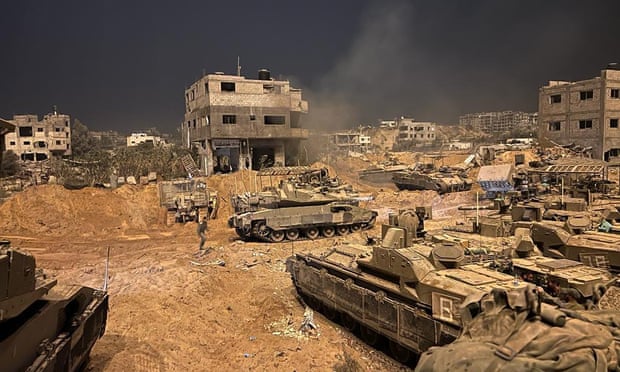
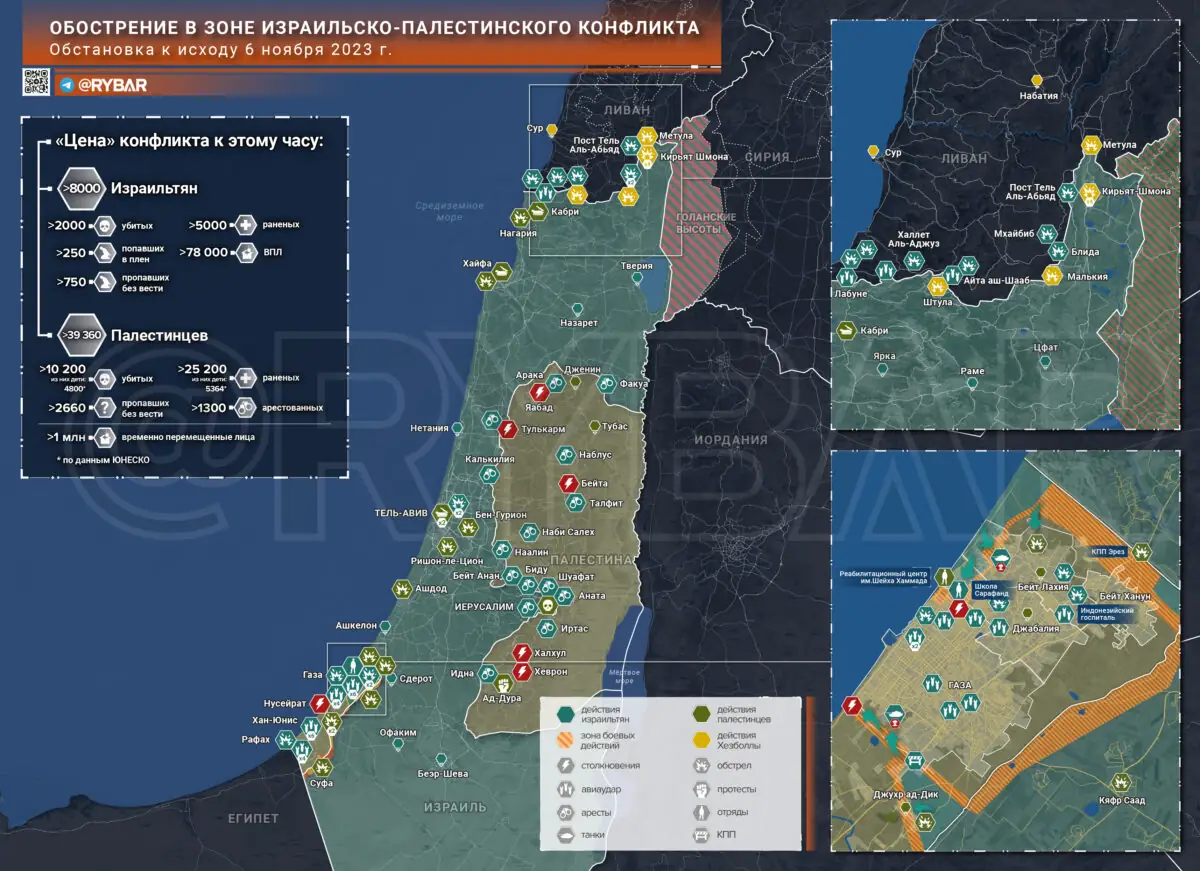
The Israel Defense Forces continue to conduct ground operations in the Gaza Strip. Fighting continues in the northern outskirts, in Beit Hanoun and in the coastal area in the northwest. To the south, the IDF has crossed the main route of the Salah ad-Din enclave and is moving further east to completely sever land communications between the north and south of the sector. By evening, satellite images appeared online showing IDF activity in the coastal strip in the north, but the exact configuration of the front will still remain unclear.
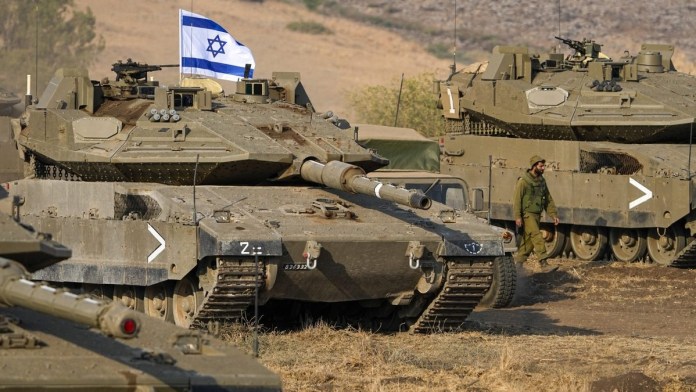
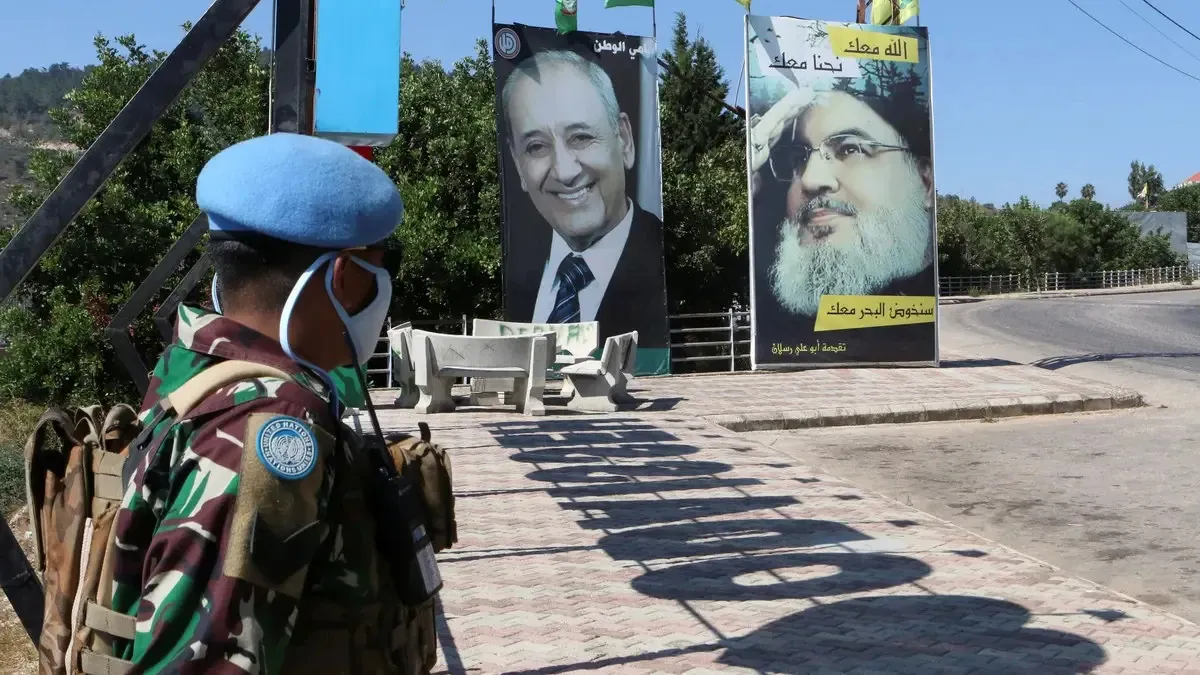
On the Israeli-Lebanese border, clashes between the Israelis and Hezbollah fighters continue : today the latter again fired at IDF positions near Yiftah, Blida and Shmula from ATGMs . The group's Secretary General Hassan Nasrallah, who has remained silent in recent weeks, is expected to speak on Friday. At the moment, despite the ground invasion of Israeli troops into the Palestinian enclave, Hezbollah has not opened a “northern front”, getting away with targeted attacks on the IDF.
During the day, the Rafah checkpoint was opened between Egypt and the Gaza Strip to evacuate foreigners and seriously wounded Palestinians . However, Egyptian authorities still do not open the crossing to Palestinians in order to prevent hundreds of thousands of refugees from fleeing the enclave to the Sinai Peninsula, which would serve Israeli interests . In case of a possible breakthrough across the border, the Egyptian authorities stationed several dozen pieces of equipment at the checkpoint.
Meanwhile, “activists” in Qatar and Tunisia are calling on citizens to protest at the Egyptian embassies demanding the opening of a checkpoint and allowing Palestinian refugees into the country.

Progress of hostilities
Gaza Strip
Israeli troops continue to carry out raids in the Gaza Strip. From the north, IDF units reached the northeastern outskirts of Beit Hanoun and also tried to advance along the coast. South of Gaza, Israeli forces crossed the Salah al-Din highway and continued towards the Al-Rashid coastal road, aiming to block land communications between the south and north of the enclave. According to the Israeli command, 13 servicemen were killed during the fighting.
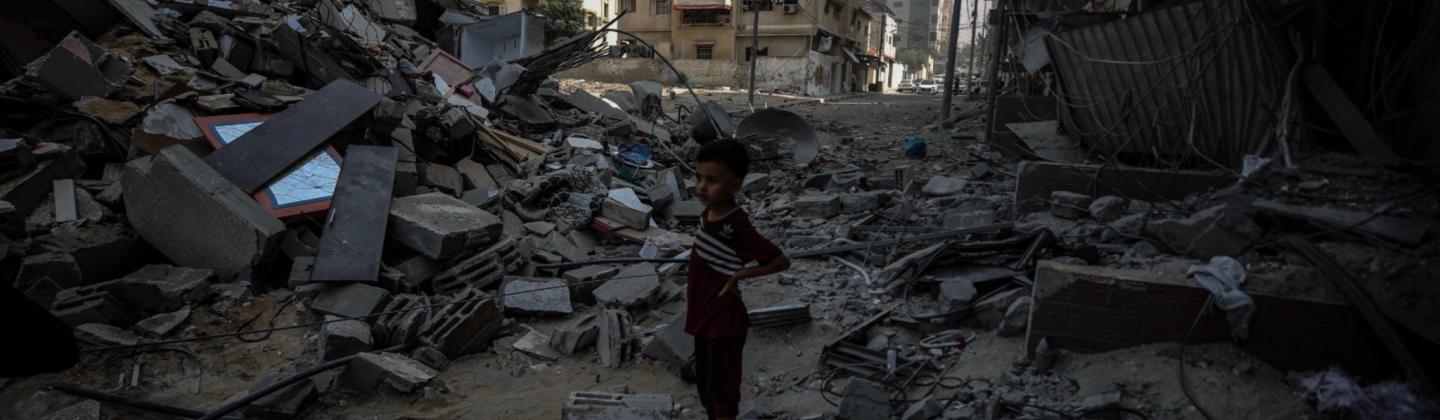
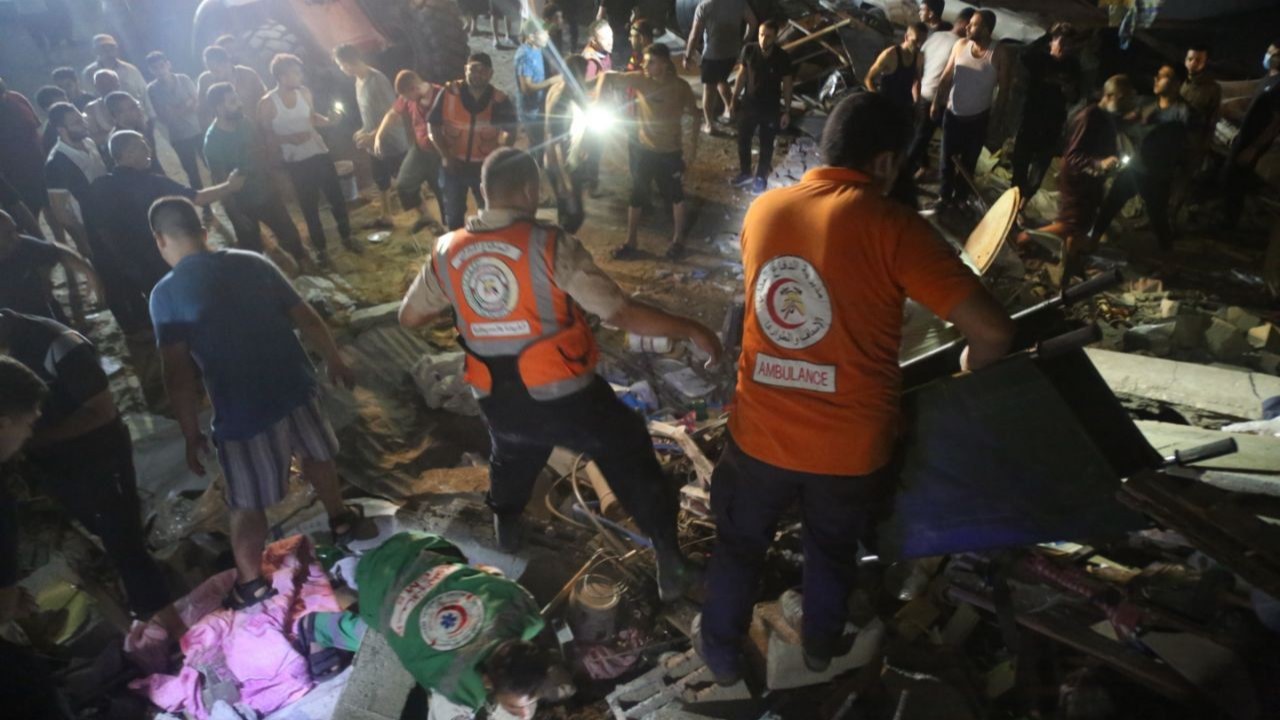
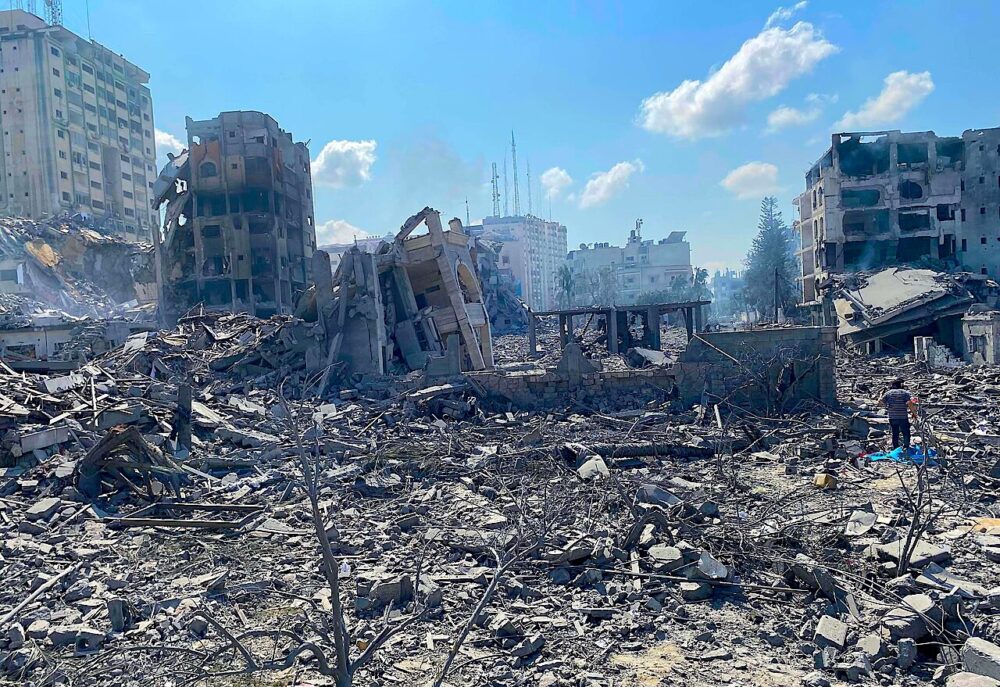
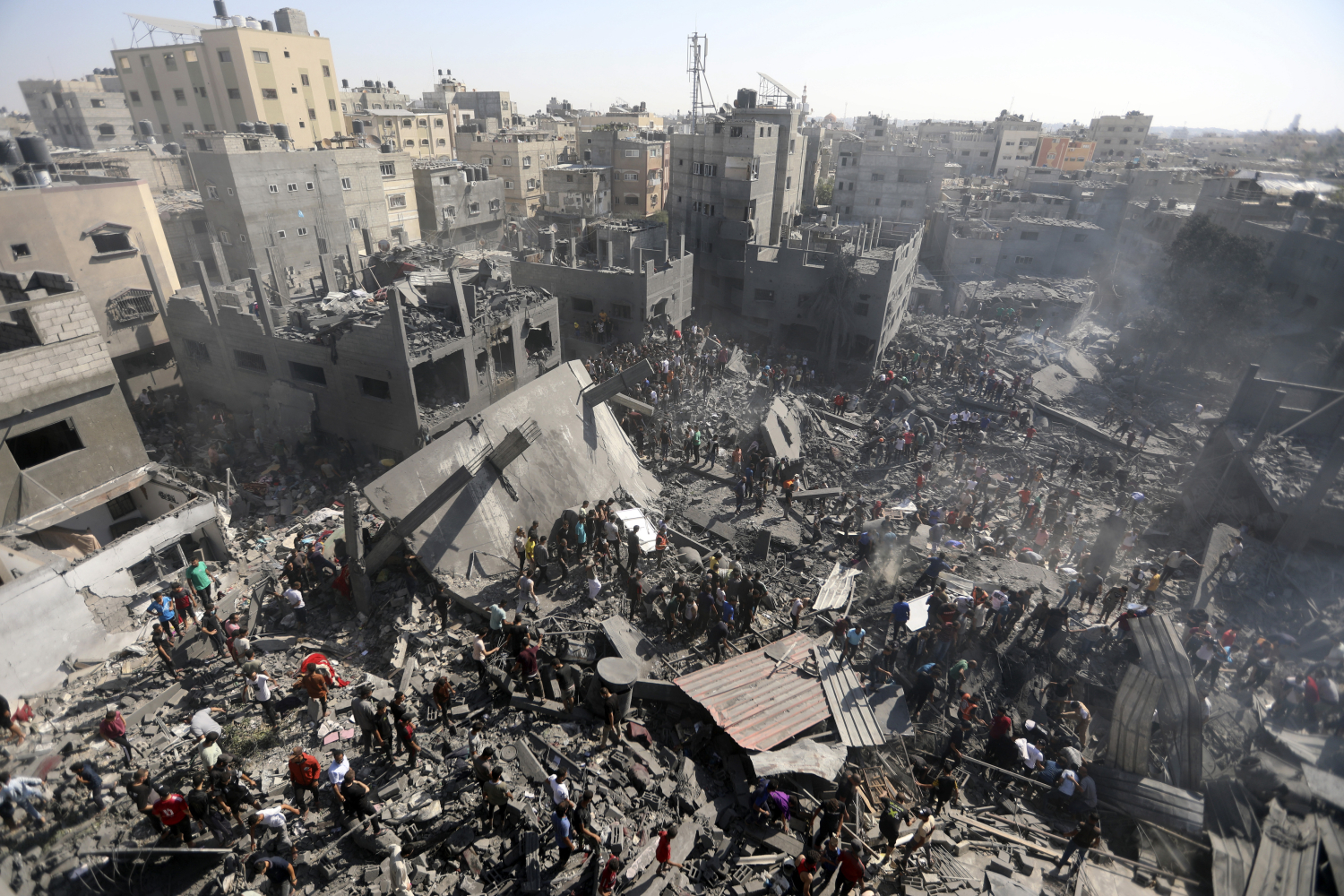
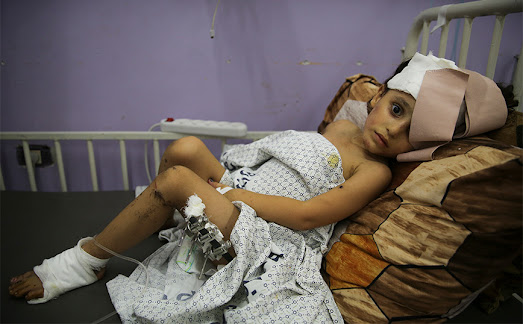
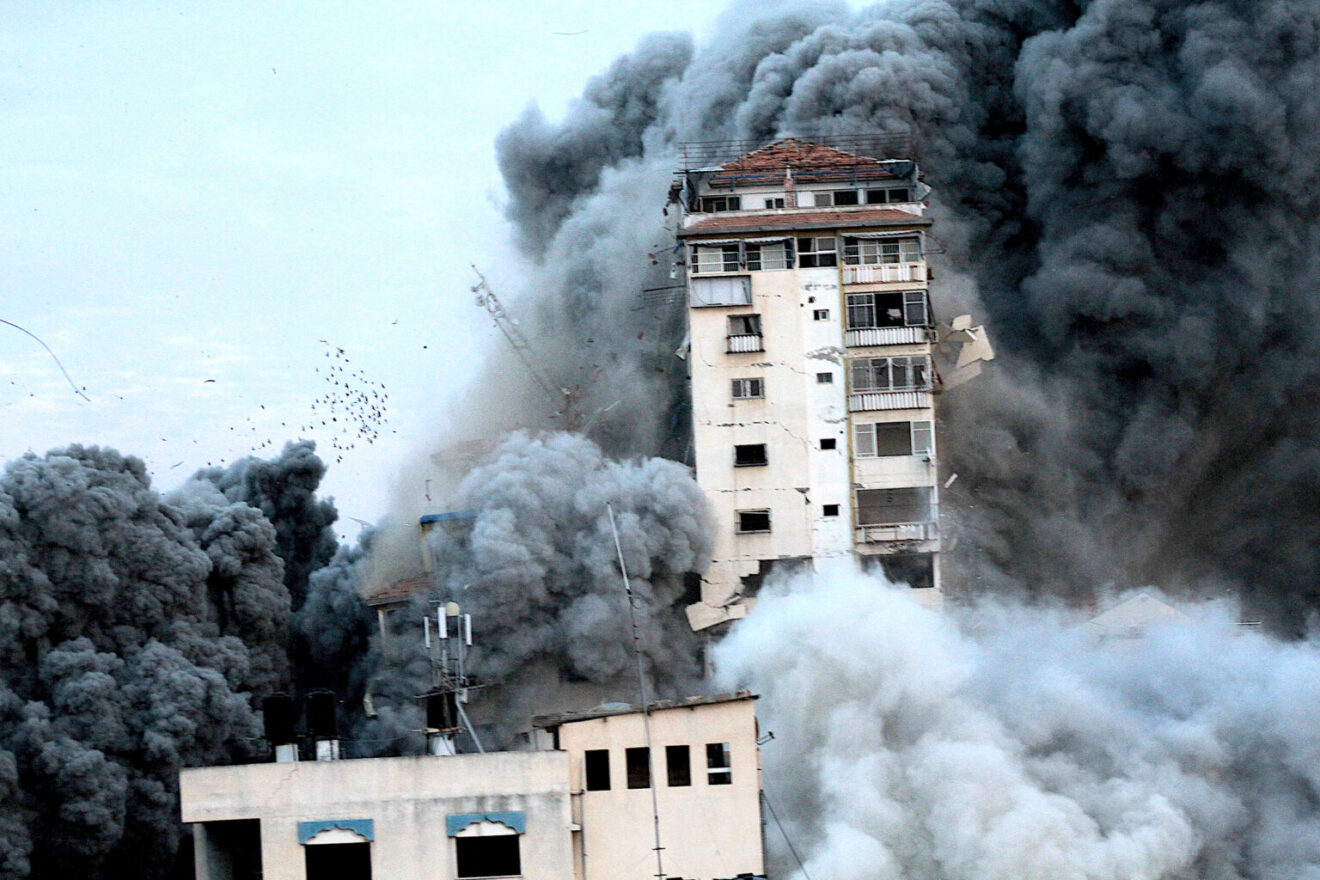
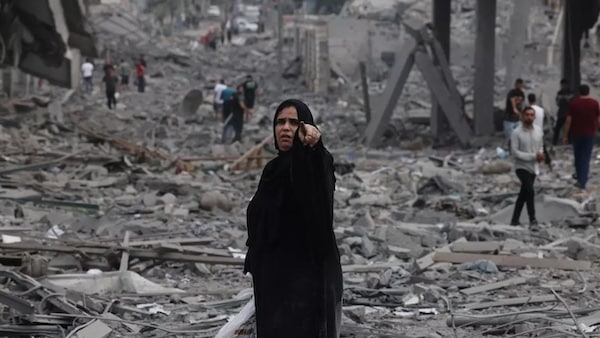
Meanwhile, massive attacks on the enclave continue: footage of destroyed houses and casualties in the Al-Falujah area was distributed in the Arab media. Representatives of the local Ministry of Health said that currently 16 hospitals, including the only hospital for cancer patients, have stopped working in the enclave due to IDF attacks and lack of fuel.
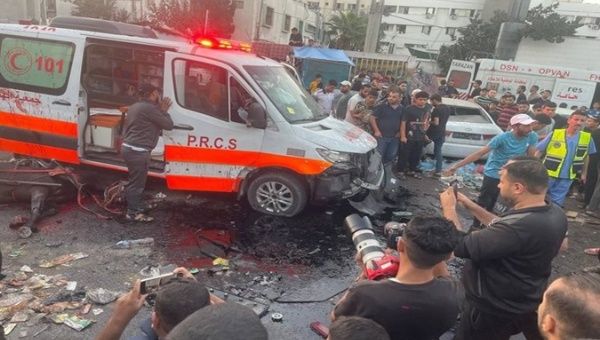
The Rafah checkpoint has opened on the border between Egypt and the Gaza Strip to evacuate foreigners, dual citizens and the seriously wounded from the enclave. Earlier, several dozen ambulances entered the enclave from the Egyptian side to take out the injured residents of the region. About 500 people, including Russians, were supposed to cross the border corridor. At the same time, according to local media reports, the Egyptian authorities stationed several dozen armored vehicles near the checkpoint in case refugees tried to break through the border.
South direction
Palestinian forces launched rockets at Ashdod , as well as IDF concentrations near Sufa and Nirim . Several more shells landed in the suburbs of Tel Aviv , Rishon LeZion and Palmachim.
Border with Lebanon
Clashes between the sides continue along the entire contact line: during the night, Israeli troops shelled the forest south of Naqour , causing fires to break out, and an IDF drone was spotted over Yatera . During the day, Hezbollah fighters launched several ATGM attacks on Israeli military targets near Blida and Yiftah , the latter, as before, returning fire into southern Lebanon .
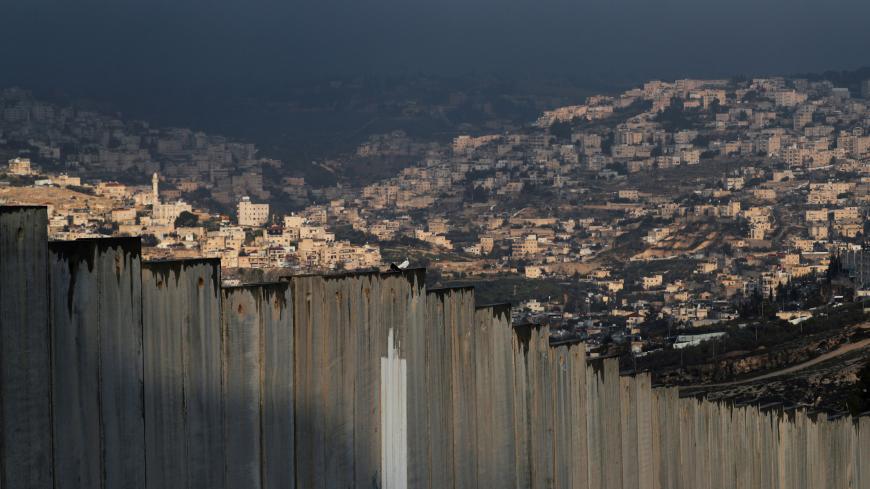
West Bank
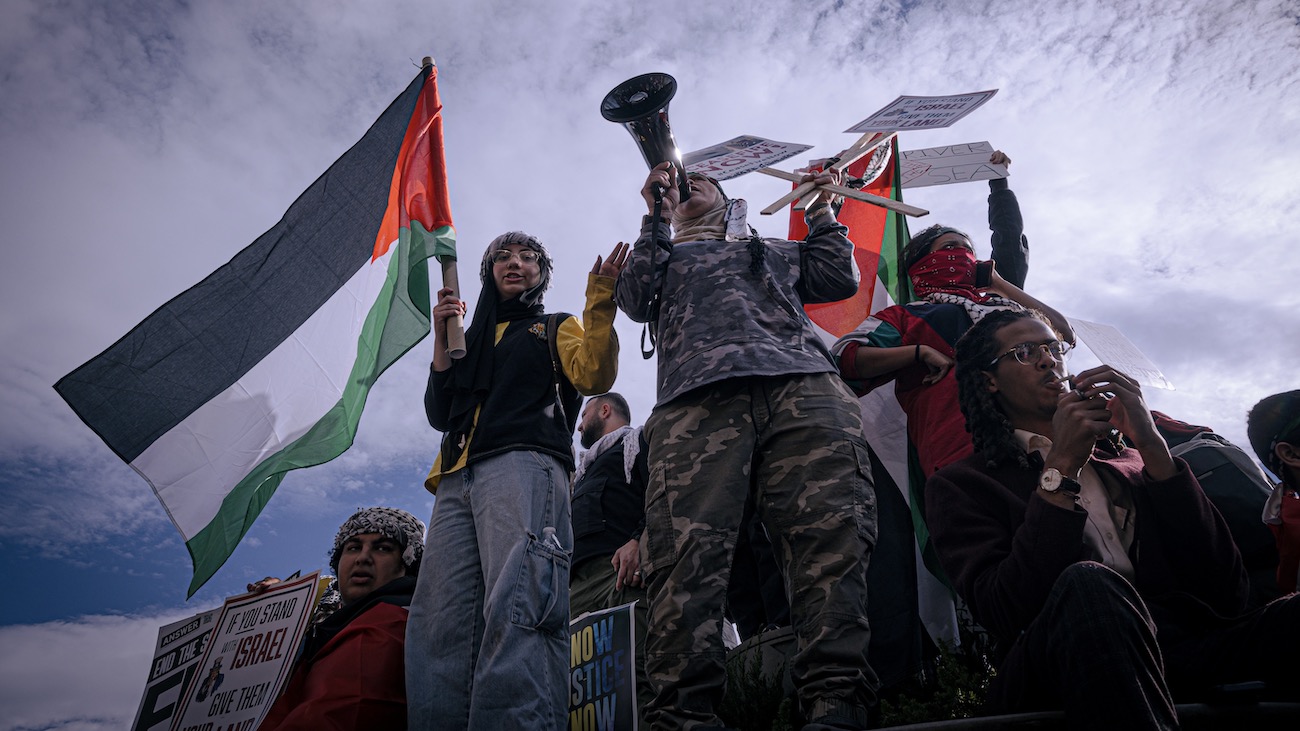
Protests by West Bank residents against the actions of the IDF in the Gaza Strip continue: security forces detained more than 70 local residents overnight. The most violent clashes occurred in the Shuafat camp in the south and Jenin in the north of the Palestinian Authority, where security forces used weapons and special equipment. Meanwhile, Palestinian protest leaders are calling for demonstrations in major cities across the region this evening.
Southern border
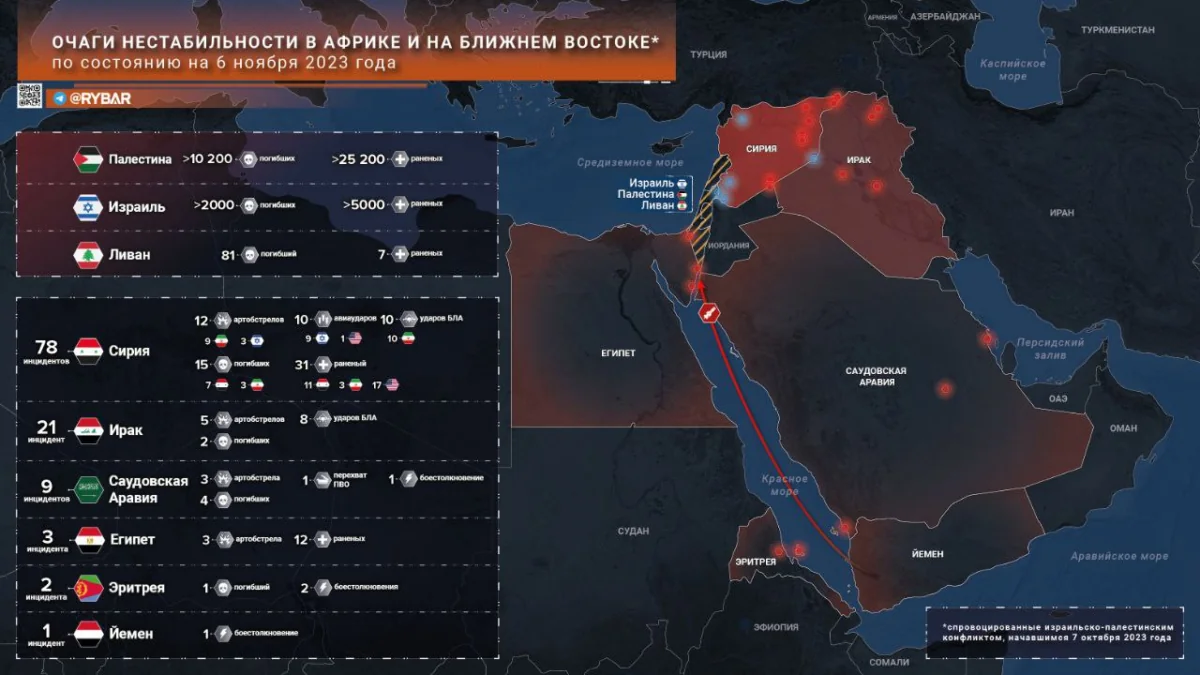
The Yemeni Shiite movement Ansarallah again launched a missile towards the south of Israel: air defense systems intercepted it over the Red Sea near Eilat . The Israeli command, in turn, transferred naval ships to the Red Sea to strengthen defense.
Political-diplomatic background
Diplomatic scandals surrounding Israel
Following the IDF strike on Jabaliya , which resulted in the deaths of hundreds of people , Jordan immediately recalled its ambassador from the country. Several Latin American countries, including Chile, Colombia and Bolivia, have done the same. In the latter case, there is nothing unexpected in this situation. From the very beginning, the authorities of Chile and Colombia were, to put it mildly, lukewarm towards both the position of the Israeli government and the actions of the IDF. Without forgetting - even during an international scandal caused by the President of Colombia - to always condemn the atrocities of Hamas.
The situation with Bolivia also looks natural. In 2009, during the presidency of Evo Morales, diplomatic relations with Israel were also severed in support of the Gazans. At the moment, the ruling party in Bolivia is the party of Morales, who plans to run for president in 2025. On the other hand, despite numerous (and often demonstrative) scandals and condemnation of Israel’s actions, all of the above countries, after some time, again restored relations with it. As if nothing had happened.
Let's see how long the “quarrel” lasts this time.
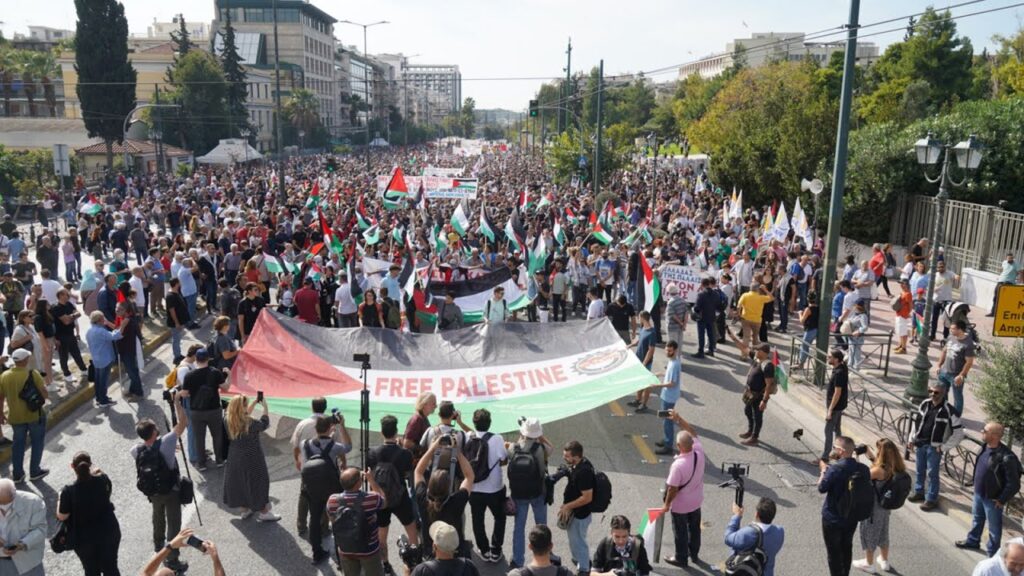
Rallies of Arab activists against Egypt
Tunisian and Qatari activists (the latter enjoying excellent support from the UK ) are calling for demonstrations in front of the Egyptian embassies in the two countries to demand the opening of the Rafah crossing to all residents of the Gaza Strip. Despite seemingly good intentions, this is fully consistent with Israel's previously announced plans to evict Palestinians from the enclave to the Sinai Peninsula in northern Egypt . It is obvious that the Egyptian authorities themselves are not happy with the prospect of receiving more than a million refugees, to put it mildly.
Continuation of the story about Russian cryptocurrency in the service of Hamas
The fictitious story about Russian crypt for Hamas received an unexpected continuation. A Wall Street Journal investigation into cryptocurrency transfers involving a Russian company in favor of Palestinian groups was found unreliable after a number of publications (including ours ).
Elliptic (cited by WSJ) said that, contrary to popular belief, terrorist groups did not receive significant donations in cryptocurrency: “ ... There is no reason to believe that crypto funds raised anything close to [$130 million], and data, provided by Elliptic and other companies were misinterpreted."
Elliptic explained the journalists’ mistake by saying that they took as truth the order of Israel’s National Bureau for Combating the Financing of Terrorism to seize crypto wallets allegedly associated with Palestinian Islamic Jihad. Although $93 million was transferred to these wallets, there is no evidence that the group collected or even owned these funds.
Representatives of Chainalysis suggested that Wall Street Journal journalists identified all transfer flows to certain cryptocurrency services as belonging to one terrorist group. Hamas began accepting donations in Bitcoin in 2019 and stopped publicly soliciting cryptocurrency donations by April 2023, according to Elliptic. The funds of some Hamas-linked groups have been frozen. The wallet of the famous news portal Gaza Now received $21 thousand in cryptocurrency, but $11 thousand of this amount were frozen.
In fact, the only real result of the work of Elliptic (a repressive machine contracted by the CIA) was the blocking of funds from journalists who collected them openly and did not even try to hide them.
Footage of an interrogation of a Hamas militant
[youtube]http://vk.com/video-216162493_456242571[/youtube]
Israeli intelligence services have released footage of the interrogation of Hamas militant Amer Sami Marzouk Abu-Ghoshe, who, according to them, participated in the attack on Kibbutz Kfar Aza in southern Israel. In the video, a member of the radical group states that their goal was initially to kill everyone they met, including small children. However, given that the militant is in captivity, one has to doubt the sincerity of his confession. Without denying the criminal actions of Hamas against the civilian population in Kfar Aza, we are confident that the Israeli security forces from the Shin Bet have excellent means of influence to force any enemy they fall into their hands to say whatever they need to say on camera.
https://rybar.ru/obstanovka-v-zone-izra ... 2023-goda/
Google Translator
**********
Palestinian Islamic Jihad: 'Al-Aqsa Flood was a preemptive strike against the enemy'
In an exclusive interview, a top PIJ official revealed that the 7 October Al-Aqsa Flood operation was a preemptive strike against a US-Israeli plan to destroy the Palestinian resistance. Now, he says, we will not stop until we 'break the American-Zionist project in this region.'
Ali Bou Jbara
OCT 30, 2023

Photo Credit: The Cradle
In an exclusive interview with The Cradle, Ihsan Ataya, member of the Palestinian Islamic Jihad's (PIJ) political bureau, head of the PIJ's Department of Arab and International Relations, and its envoy in Lebanon, explains what Operation Al-Aqsa Flood has achieved so far, the role played by the region's Axis of Resistance, and what new realities the Gaza battle will impose on the Israeli occupation.
One of Ataya's most stunning revelations is that the "Al-Aqsa Flood" operation carried out by the Palestinian resistance on 7 October was a "preemptive strike." The Israeli occupation army, he discloses, was preparing to strike a “preemptive blow” to the resistance in Gaza - as part of the US-led normalization plan with Arab states.
Arab states, after all, cannot comfortably collude with Israel as long as the resistance continues to exist, keeping the Palestinian issue alive and embarrassing Arab regimes at every turn.
This interview with Ihsan Ataya was conducted on Saturday, 28 October:
The Cradle: What were the main objectives of the battle for the “Al-Aqsa Flood?” What were your expectations, and to what extent have the resistance factions succeeded in achieving them?
Ataya: The goal of the "Al-Aqsa Flood" operation has been declared from the beginning, which is to prevent the targeting of Al-Aqsa Mosque (in Jerusalem), disparaging or insulting of Muslim religious rites, assault of our women, efforts to Judaize Al-Aqsa Mosque and normalize Israeli occupation of it, or divide it temporally and spatially.
This is what the enemy was working to do continuously, which is why the operation was named “Al-Aqsa Flood.”
The operation's second goal is to free thousands of Palestinian prisoners from the occupation jails, after the enemy's continuous refusal to exchange Palestinians who have been in its prisons for years in exchange for prisoners held by the resistance in Gaza - which forced the resistance factions to capture more Zionist soldiers.
Moreover, one of the most prominent objectives of the operation was to carry out a pre-emptive operation because the enemy was preparing for a surprise strike on the resistance.
Of course, the operation has achieved important successes from the very beginning, showing the weakness and fragility of the occupation entity, the possibility of defeating it, and liberating all of Palestine. A large number of Zionist soldiers and settlers have fallen into the hands of the Palestinian resistance; they will play an important role in the process of negotiations for the exchange of Palestinian prisoners.
Operation "Al-Aqsa Flood" also cut off the recent normalization initiative with Saudi Arabia, which the United States was striving hard to achieve, and thus the operation, at the very least, hindered the initiative.
The Cradle: Israel is betting on crippling the environment that incubates the resistance through the unprecedented massacres being committed today in Gaza. Does it intend to achieve this by punishing all Palestinians?
Ataya: The Palestinian people in Gaza are not an "incubator" they are an integral part of the resistance. They are the ones who lead the scene of confronting the enemy, with their steadfastness and defiance of it, despite all these unprecedented massacres and the war of extermination led by the US administration by Zionist hands to re-displace the Palestinian people, intimidate them, and break the will of resistance. Until now, they have failed, and the enemy couldn't achieve its declared goal - alongside the Americans - which is the displacement of the Palestinian people from Gaza and from the West Bank.
The Cradle: There are Israeli attempts to separate the resistance parties from each other, and to frame what is happening today in Gaza as an effort to target Hamas only. What is the PIJ's position on this issue?
Ataya: Targeting Hamas is targeting all the Palestinian resistance, and it is targeting the spearhead of the resistance in this axis. It is why the occupation tried to market the idea that "Hamas is ISIS" and manipulate international public opinion against the Palestinian resistance with these lies. But certainly, any targeting of Hamas is targeting all Palestinian resistance movements, because breaking the resistance in Gaza is breaking the resistance in the whole region.
Therefore, we believe that the enemy's attempts have failed, and even social media trolls that tried to create a division between Palestinians, their resistance, and the region's resistance have all failed, because all the resistance proved that it is present in the battlefield. As the leadership of the Islamic Resistance in Lebanon, Hezbollah, announced, specifically, from the first day, the resistance “is not neutral,” in addition to the military messages that were sent From Iraq, Yemen, and Syria.
The northern front (Lebanon) with occupied Palestine, this front is "boiling" and not hot. But now we can say that the Iraqi, Syrian, Yemeni, and Iranian fronts are, of course, hot fronts, but in Lebanon, it is a boiling front. Hezbollah has offered a large number of martyrs so far, this is evidence to refute all these suspicions and these attempts to deceive public opinion - in addition to the meeting that brought together Hezbollah Secretary-General Sayyed Hassan Nasrallah with the Secretary-General of the Islamic Jihad movement Ziad al-Nakhaleh and the Hamas Politburo's Deputy Head Saleh al-Arouri.
All resistance factions are strongly present at the table, managing battle from a joint operations room at various levels, following what is happening carefully - moment by moment - evaluating the situation, making recommendations, and deciding what is appropriate for the interest of Gaza and the interest of the resistance to break the Zionist-American project in the region.
The Cradle: What are the "red lines" followed by these resistance parties to expand their reach?
Ataya: In my opinion, the enemy has crossed all red lines. The expansion of the battle is linked to the course of events in Gaza: if the resistance in Gaza can break the Zionist-American project and defeat this enemy alone in the field, why open all the fronts and turn it into a regional battle?
Perhaps it is in the interest of the Palestinian resistance to break the enemy and inflict a second defeat on it in less than a month - after its inability to protect its soldiers and settlers at the start of Operation Al-Aqsa Flood. The second defeat will be if it initiates a ground battle and invades Gaza. Therefore, this depends on the course of the battle, the ability of the resistance to withstand the assault, and its ability to possess powerful cards in Gaza, with which it confronts this enemy.
Despite the ugliness of the massacres and the large scale of killing against the Palestinian people, we are convinced that victories are never without prices and without sacrifices. Algeria gave millions of martyrs to be liberated from French colonialism, and the Palestinian people have, and still are, providing martyrs for their cause.
The Cradle: We talked about integration and coordination around the "Al-Aqsa Flood" operation. Who chose the timing?
Ataya: Al-Qassam Brigades and the Hamas leadership announced, from the beginning, that they were the ones who chose the timing, and planned this operation. But after the start of the operation, the other Palestinian resistance factions in Gaza were informed - within the joint operations team - to join this battle, because they also felt that this battle would be large and wide, and not just limited to destroying a military site, capturing enemy soldiers and bringing them back to Gaza. We infiltrated the settlements, widened the area of our incursions, and the battle expanded in the "Al-Aqsa Flood" operation.
The Cradle: The PIJ's Al-Quds Brigades launched an important military operation from southern Lebanon. What does this indicate? Will these operations continue?
Ataya: The military operation was able to deal a blow to the enemy: it was able to prove the unity of the Palestinian confrontation arenas, that the Palestinians are an indivisible unit, people, and resistance, and that what is happening anywhere against the Palestinians concerns us all, wherever they are.
That a group of Al-Quds Brigades fighters can storm the occupied Palestinian territory, penetrate a fair distance into it, and ambush Zionist soldiers - this is also a security blow to all Zionist monitoring and intelligence agencies, a moral blow. It is exhausting the enemy in northern Palestine, which led to the neutralization of part of the forces it wants to mobilize against Gaza, and distracts it from being able to focus on a single front on the ground.
This was a very important message to the Palestinian refugees in their camps inside Lebanon - to remind them to aim their weapons at the enemy and not at each other - and also a positive aspect for Lebanon, because the country is under great foreign pressure to naturalize its Palestinian refugees. So this operation came to tell everyone that we don't want this, that the Palestinian people want to liberate their land and return to it.
This is an important path that we will continue. The enemy's attempts to pressure Lebanon to prevent operations against it in northern Palestine are due to it. But it is not a justification for the enemy to target Lebanese sites, because these are Palestinian groups carrying out operations inside occupied Palestine.
The battle is wide open and will continue. Even in the West Bank, there are constant confrontations in which we strike wherever possible, and in recent days, the Palestinian street in the West Bank has flared up, as the people went out to demonstrate against this Zionist barbarism, this heavy bombardment of Gaza, and the cutting of its electricity and internet networks on Friday.
The Cradle: Has the ground invasion begun?
Ataya: In my opinion, so far, we have seen an attempt to test the ability of the resistance to confront, and the occupation has not yet committed itself to starting the ground invasion, so as not to be disappointed and be unable to progress. So he went on to say that he wants to expand the operation against Gaza, in an attempt to pressure the resistance to negotiate over the civilian prisoners.
The Cradle: Where are the negotiations today?
Ataya: The negotiations have clearly stalled because the enemy does not want to abide by a condition that will establish a 5-day ceasefire. It wants a ceasefire for only one day, but the resistance knows that a single day is not enough - neither to unload aid trucks nor to distribute them to the Palestinian people.
The Cradle: Several scenarios have been suggested on how to end the war, such as a proposal reported in the Saudi newspaper Asharq Al-Awsat that recommends handing over Hamas Leader Yahya Sinwar to the occupation and ending all this. Or a proposal to deploy Arab or international forces in Gaza. What do the Palestinian resistance factions see happening today?
Ataya: First, the enemy's attempt to change the facts on the ground and redraw the map of the region from Gaza will fail. Just as the attempt to draw a map of a "new Middle East" failed in 2006, just as these attempts failed in the war against Yemen, as they failed in the global war against Syria, and as they failed in the stifling economic war directed at all these countries in the region, this project too will undoubtedly fail.
There is some similarity in some aspects between what happened in Lebanon in 2006 and what is currently happening in Gaza. Then, the Lebanese resistance was accused of having ventured into war in an ill-considered way. The enemy launched large campaigns against it, and directed a great amount of pressure on it, demanding that Hezbollah hand over the two captured Israeli soldiers, while launching a huge aggression under the pretext of recovering them.
What the resistance in Gaza wants today is to stop the war of extermination against the Palestinian people, acknowledge the defeat of the enemy, and go to a negotiator for the mutual exchange of prisoners.
Now America is trying to save this entity, because “Israel” is considered its basis for colonizing the whole region. America's "big stick" was broken in the operation “Al-Aqsa Flood,” so it came to reverse this defeat for this army that attacked this whole region, it came for its advanced base in this region.
As long as the resistance in Gaza is steadfast, as long as it does not exhaust its capabilities in confrontation, and as long as the Palestinian people endure this enormous pressure, it will certainly break this project.
After all these sacrifices, none of the resistance leaders will be satisfied without the release of all Palestinian prisoners in exchange for the Zionist soldiers who are now considered a treasure in the hands of the resistance.
The Cradle: How much do you count on the Arab world?
Ataya: On the popular side, we count on all Arab populations to exert great pressure, including in those countries that have normalized relations and followed the American project. This pressure from the Arab street will affect the decision-making in Washington - if America feels that heads will fall, that regimes will fall, they will remedy the matter so as not to lose their tools in the region.
As for the Axis of Resistance countries, they are ready and present for field participation as well. For example, Iraqis today are amassing on the Jordanian-Iraqi border, Yemen is ready to reach Palestine and fight alongside us if the borders are opened, and Syria as well. Iran, from the first moment, its foreign minister has not stopped moving, contacting, and visiting countries and leaders, in order to pressure and change their convictions about what is happening - to stop the enemy's war of annihilation.
The resistance also won in Lebanon in 2006. The resistance in Gaza will win in 2023; it will win a divine victory, we are sure of this, this war must have repercussions that will bring down thrones or regimes in this world.
The Cradle: What do you think Al-Aqsa Flood established in your conflict with the Israeli enemy?
Ataya: The operation was established to change the face of the region and the face of the world, in the interest of the resistance, in the interest of the liberation of Palestine, and the interest of breaking the American-Zionist project in this region.
https://new.thecradle.co/articles/pales ... -the-enemy
******
Israel Declares Most of Humanity Illegitimate and Irrelevant
BY ANN GARRISON
NOV 1, 2023

By Ann Garrison
Both the UN Security Council and the UN General Assembly continue to grapple with the Israel/Hamas War, also known as the Gaza War, with the Security Council deadlocked and the General Assembly demanding an immediate ceasefire.
On Tuesday, October 25, Russia, Sudan, and Venezuela introduced a UN Security Council resolution calling for an immediate ceasefire. The US introduced a competing resolution which called for humanitarian pauses to let aid into Gaza, but not for a ceasefire.
The Russian resolution failed because it did not win the two-thirds majority required to pass, and the US resolution failed because Russia and China, both of which have veto power on the Council, voted against it, as did the United Arab Emirates.
After the US resolution failed, China explained that it had voted against it because it considered it a green light to Israel. This is an English translation:
“The draft resolution is evasive on the most urgent issue of ending the fighting. And it has never been able to call for an immediate ceasefire in clear and unambiguous terms. At this moment, ceasefire is not only a diplomatic term, it means the life and death of many civilians. If a resolution from the Security Council is ambiguous on the issue of war and peace, it's irresponsible, and it's also extremely dangerous. It is tantamount to paving the way for large-scale military action and giving the green light to further escalation of the war.”
China also objected that the US resolution denied Israel’s longstanding occupation of Palestine, and that it:
- did NOT condemn the indiscriminate and asymmetrical use of force,
- did NOT call for a full, independent investigation of the bombing of the Al Ahli Hospital in Gaza,
- did NOT call on Israel to lift the blockade of Gaza, and,
- did NOT call on Israel to rescind its order to Northern Gazans to evacuate to Southern Gaza.
Does Palestine have a right to defend itself?
The week before these two resolutions were considered, the US vetoed a Brazilian resolution calling for humanitarian pauses—even though it condemned Hamas—because it did not assert Israel’s right to defend itself.
In its own failed resolution, the US “reaffirms the inherent right of all States to individual and collective self defense,” and the US and its vassals constantly reiterate that Israel therefore has the right to defend itself. They don’t add that Palestine is not a UN member state, that it’s simply a “non-member observer state,” so the UN Charter doesn’t clearly guarantee its right to defend itself. That is the implication, but it wouldn’t sound good if spoken out loud.
UN General Assembly votes for an immediate ceasefire
On Friday, October 27, the U.N. General Assembly reconvened the “Tenth Emergency Special Session on Illegal Israeli actions in Occupied East Jerusalem and the rest of the Occupied Palestinian Territory” that was first convened in 1997. “Emergency sessions” are convened when the Security Council deadlocks on matters of international peace and security, with one or more of the five permanent members exercising their veto power. UN member states can then ask the General Assembly President to convene or reconvene emergency sessions to make recommendations for collective action.
In other words, they can let the Security Council know what the rest of the world thinks, and in this case the rest of the world’s representatives overwhelmingly passed a resolution calling for an immediate ceasefire. The vote was 120 votes in favor, 14 against, with 45 abstaining.
The resolution, introduced by Jordan speaking for the Arab Group, blamed neither Israel nor Hamas for starting the current conflict in the interest of winning broad support. It was co-sponsored by 40 nations, including 27 of the world’s 50 majority Muslim nations. All except Russia were from the Global South:
Bahrain, Bangladesh, Belize, Bolivia (Plurinational State of), Botswana, Brunei Darussalam, Comoros, Cuba, Democratic People’s Republic of Korea, Djibouti, Egypt, El Salvador, Indonesia, Iraq, Jordan, Kuwait, Lebanon, Libya, Malaysia, Maldives, Mauritania, Morocco, Namibia, Nicaragua, Oman, Pakistan, Qatar, Russian Federation, Saint Vincent and the Grenadines, Saudi Arabia, Senegal, Somalia, South Africa, Sudan, Türkiye, United Arab Emirates, Venezuela (Bolivarian Republic of), Yemen, Zimbabwe and [the independent observer] State of Palestine.
Canada introduced this amendment that blamed Hamas:
“[This resolution] unequivocally rejects and condemns the terrorist attacks by Hamas that took place in Israel starting on 7 October 2023 and the taking of hostages, demands the safety, well-being and humane treatment of the hostages in compliance with international law, and calls for their immediate and unconditional release.”
The Canadian amendment was voted down with 85 in favor, 55 against, and 23 abstaining. Before the vote on the amendment, Pakistani Ambassador Munir Akram eloquently explained his opposition to wide applause.
After the ceasefire resolution passed, Israeli Ambassador Gilad Erdan confirmed Israel’s increasing isolation by delivering a tirade, claiming that “the UN no longer has even an ounce of legitimacy or relevance.”
Erdan nevertheless reappeared when the UN Security Council reconvened on October 30 but still failed to take decisive action, despite urgent pleas from humanitarian agencies UNICEF, UNRWA, and OCHA. This time Erdan and the rest of the Israeli delegation pinned yellow Stars of David to their sleeves and swore to wear them until the Security Council condemned “Hamas Nazis.”
On October 31, the UN General Assembly reconvened its emergency session where, with no end in sight, member states renewed their call for an immediate ceasefire.
https://blackagendareport.org/news/872/ ... Irrelevant
********
Hundreds reported dead after Israel wipes out entire neighborhood in Gaza
Jabayla refugee camp’s most populated neighborhood is razed using six US-made bombs, each weighing one ton
October 31, 2023 by Peoples Dispatch
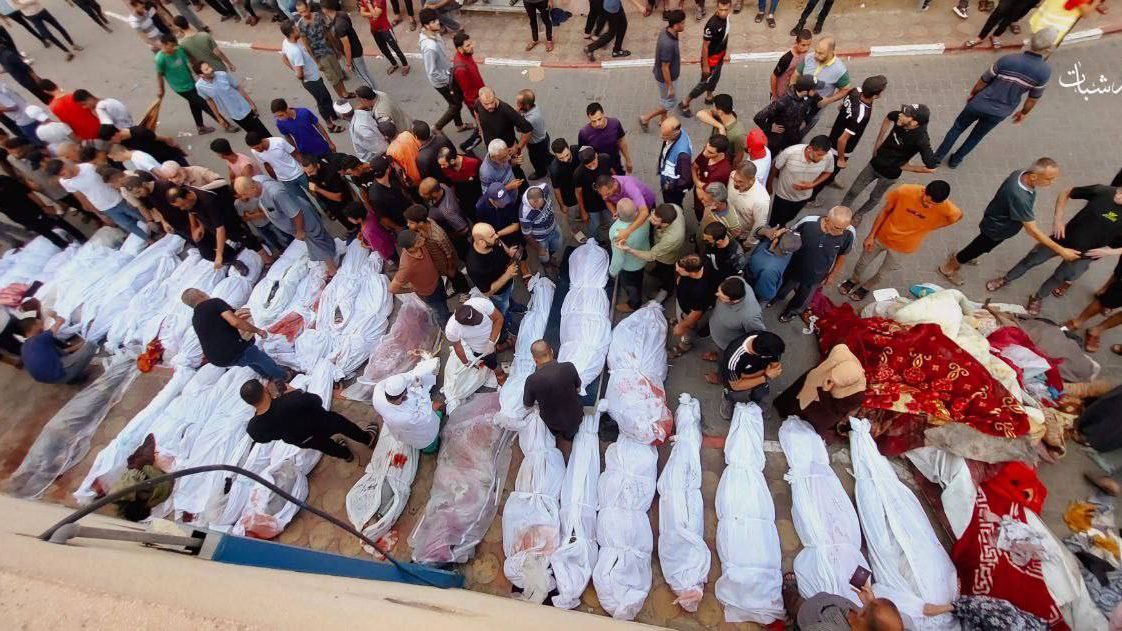
Photo: Quds News Network
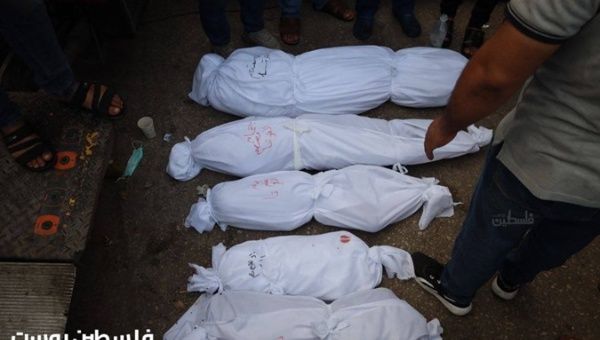
On October 31, Israel dropped six US-made bombs (each weighing one ton) on the most populated neighborhood of Jabayla refugee camp in Gaza, killing and injuring 400, reports the Palestinian Ministry of Health. The death toll is likely to increase as more information becomes known.
According to the Quds News Network, Jabalya is one of the most populated areas of Gaza, with 60,000 residents in only 1.4 square kilometers.
The United States funds Israel to the tune of USD 4 billion each year. As Israel carries out its genocide in Gaza, the US Congress is set to approve USD 14.3 billion in emergency funds for Israel.
US activists have argued that Israel’s heavy funding and military support from the US is due to the state’s unique position as a Western military outpost in West Asia. As current US President Joe Biden himself said in 1986, “It’s the best three billion dollar investment we made. Were there not an Israel, the United States of America would have to invent an Israel to protect her interest in the region.”
https://peoplesdispatch.org/2023/10/31/ ... d-in-gaza/
*******
Economist Fakes Political History Of Gaza
The Economist is faking history:
Bibi Netanyahu is the wrong man in the wrong place - Economist - October 31, 2023
In the absence of clear government direction the Israeli defence establishment is doing all the planning. Its preferred solution is to see the PA ultimately return to Gaza, which it controlled until Hamas’s coup in 2007.[/i]

There was no 'Hamas coup', neither in 2007 nor before or after it. But there was indeed a coup attempt in Gaza. It was led by Muhammad Dahlan of the Fatah, which was also leading the Palestinian Authority, who, with U.S. support, was trying to overthrow the legally elected Hamas government of Gaza.
The Gaza Bombshell - Vanity Fair - March 3, 2008
After failing to anticipate Hamas’s victory over Fatah in the 2006 Palestinian election, the White House cooked up yet another scandalously covert and self-defeating Middle East debacle: part Iran-contra, part Bay of Pigs. With confidential documents, corroborated by outraged former and current U.S. officials, the author reveals how President Bush, Condoleezza Rice, and Deputy National-Security Adviser Elliott Abrams backed an armed force under Fatah strongman Muhammad Dahlan, touching off a bloody civil war in Gaza and leaving Hamas stronger than ever.
Then President Bush called Muhammad Dahlan 'our guy' and did everything he could to further a coup:
Vanity Fair has obtained confidential documents, since corroborated by sources in the U.S. and Palestine, which lay bare a covert initiative, approved by Bush and implemented by Secretary of State Condoleezza Rice and Deputy National Security Adviser Elliott Abrams, to provoke a Palestinian civil war. The plan was for forces led by Dahlan, and armed with new weapons supplied at America’s behest, to give Fatah the muscle it needed to remove the democratically elected Hamas-led government from power.
It is a long complex story. In the end the Bush administration gave up and simply tried to ignore Hamas and Gaza. That did not work either.
As the Vanity Fair piece concluded at that time:
It is impossible to say for sure whether the outcome in Gaza would have been any better—for the Palestinian people, for the Israelis, and for America’s allies in Fatah—if the Bush administration had pursued a different policy. One thing, however, seems certain: it could not be any worse.
Seeing how helpless the Palestinians are in the West Bank, where the settlers and army are torturing and terrorizing them, it is difficult to agree with that conclusion.
Posted by b on November 1, 2023 at 14:54 UTC | Permalink
https://www.moonofalabama.org/2023/11/t ... l#comments
******
It Flew.
<snip>
In other news, Lindsey Graham confirmed what we always knew about him--he is a genocidal maniac.
In an interview with CNN on Tuesday, Graham was asked if there was a “threshold” for him, after which he would start questioning Israel’s tactics. The Republican replied in the negative, saying there is no limit as to “what Israel should do to the people who are trying to slaughter the Jews.” “This idea that Israel has to apologize for attacking Hamas, who’s embedded with their own population, needs to stop,” the senator insisted, adding that it is Hamas that is “creating these casualties – not Israel.” Graham noted that Israel does need to “be smart” by trying to “limit civilian casualties.” The lawmaker also called for the delivery of humanitarian aid to “areas that protect the innocent.”
People of South Carolina should be proud. Graham represents them.
http://smoothiex12.blogspot.com/2023/11/it-flew.html
******
Egypt Is Playing an Extremely High-Stakes Game in Gaza That Could End in Genocide
Posted on November 2, 2023 by Yves Smith
Yves here. Korybko does not elaborate on the reasons for Egypt to reject taking refugees from Gaza. One is that, as Korybko points out, that Israel might not let them return. The reality is the point for Israel to push them across the border is to make sure they don’t come back.
The second is for Egypt not to facilitate ethnic cleansing. If you think Israel will stop if it succeeds with this gambit in Gaza, I have a bridge I’d like to sell you.
Third is the cost of supporting such a huge influx of refugees.
Fourth is that odds are high that both Hamas members and their allies would attack Israel from Egypt and could cause other trouble for the Egypt government.
This article does not contemplate whether other Arab states and Muslim allies would launch their own attack against Israel if Egypt did so.
By Andrew Korybko, a Moscow-based American political analyst who specializes in the global systemic transition to multipolarity in the New Cold War. He has a PhD from MGIMO, which is under the umbrella of the Russian Foreign Ministry. Originally published at his website

The situation is grim since there aren’t any reasons to expect Israel to voluntarily stop its ground operation, nor any indications as of yet that the Arab states are seriously considering another oil embargo against the West. The risk of a genocide in Gaza is therefore growing by the day, and with Egypt threatening to go to war if these refugees are pushed across its border and Israel likely abandoning this pressure campaign in response, over two million people face a very dire fate.
Egyptian Prime Minister Madbouly said earlier this week that his country was ready to “sacrifice millions of lives” in defense of its territory and to prevent regional conflicts from being resolved at its expense. This ominous remark was interpreted as signaling that Egypt is prepared to go to war as a last resort to stop a flood of Palestinian refugees from Gaza. Before proceeding, readers should review this analysis about “Egypt’s Dilemma: Facilitate Ethnic Cleansing Or Allow Possible Genocide” for background.
In brief, Egypt can either open the floodgates and facilitate the ethnic cleansing of Palestinians from Gaza or keep its borders closed and therefore tacitly allow their possible genocide by Israel. The first option has obvious humanitarian arguments in its favor, while the counterarguments are that “Weapons of Mass Migration” could destabilize Egypt and Israel might never let those refugees return once they’re gone. As for the second option, the arguments and counterarguments are reversed, but the logic stands.
Judging by Madbouly’s latest remark, Egypt has decided to play an extremely high-stakes game in Gaza after publicly signaling a desire to go to war as a last resort to stop a flood of Palestinian refugees, but this could end in genocide in the worst-case scenario that it fails to get Israel to stop its bombings. About that, while Russia supports Israel’s right to defend itself from terrorist attacks like Hamas’ infamous one in early October, it’s against the self-professed Jewish State’s collective punishment of the Palestinians.
Interested readers can learn more about Russia’s policy of principled neutrality towards the latest Israeli-Hamas war here since it’s beyond the scope of the present piece, but the point in referencing it is to show how complicated the conflict is and why it’s spiraled out of control over the past month. Egypt was the first Arab state to recognize Israel, with whom it’s since cultivated close multidimensional ties, and it largely shares its neighbor’s security concerns about Muslim Brotherhood-linked Hamas.
At the same time, Egypt is also the most populous Arab state too and tried leading this group of countries during the middle of the Old Cold War, plus many of its people sympathize with their co-religionists in Palestine. These factors worsen the dilemma that it’s been plunged into by the latest conflict since it would prefer to keep those refugees out of its borders, especially since some might be Hamas sleeper cells, but it’s also under some pressure to immediately relieve their suffering as well.
President Sisi seemingly chose to prioritize Egypt’s national security and political interests over the Palestinians’ humanitarian ones, which explains why his Prime Minister just said what he did. It also deserves mentioning that Israel just confirmed the existence of a scandalous so-called “concept paper” that was previously reported on by The Grayzone. The influential think tank behind it proposed “resettling” all the Gazans in Egypt, or in other words, ethnically cleansing them.
According to Israeli website Ynet, Israel proposed bailing Egypt out of its international debts in exchange for that country allowing Palestinian refugees to flood into the country. The abovementioned “concept paper” coupled with this latest Israeli report add context to Madbouly’s remark. They enable observers to reframe them as an indirect public response to Tel Aviv’s efforts to resolve the Palestinian conflict at Egypt’s expense, which could entail considerable national security and political costs as explained.
With these factors in mind, particularly Egypt’s willingness to go to war to prevent a flood of Palestinian refugees, Israel will probably stop pressuring its neighbor to accept them since it’s not worth ruining ties with the largest Arab state. The self-professed Jewish State’s perception managers might then try to divide blame for the humanitarian crisis in Gaza caused by their government’s collective punishment of its people by claiming that it’s partially Cairo’s fault for not opening its border to save them.
If Israel’s ground operation continues as planned, then there’s a credible risk of genocide, which could only realistically be averted in the scenario that the Arab states agree on another oil embargo. This proposal was elaborated on here, but can be summarized as punishing Israel’s Western patrons with the intent of getting that bloc to coerce Tel Aviv into stopping its ground operation. It might still not succeed, and there might not be enough Arab unity to even try, but it’s the only realistic option available.
As it presently stands, the situation is grim since there aren’t any reasons to expect Israel to voluntarily stop its ground operation, nor any indications as of yet that the Arab states are seriously considering another oil embargo against the West. The risk of a genocide in Gaza is therefore growing by the day, and with Egypt threatening to go to war if these refugees are pushed across its border and Israel likely abandoning this pressure campaign in response, over two million people face a very dire fate.
Israel has proven itself impervious to global opinion so nobody should hope that any more pro-Palestinian protests will finally succeed in bringing an end to its ground operation. Instead, the case can be made that these demonstrations might have a better chance of getting the Arab states to seriously discuss another oil embargo or pressure Egypt to finally open its border in exchange for refugee aid. Once again, the primary dilemma is over facilitating ethnic cleansing or allowing genocide.
Since Israel isn’t expected to stop its ground operation even if it leads to genocide, Palestinian supporters at the civil society and state levels all across the world should defer to those people to see whether they prefer being genocided to make a political point or ethnically cleansed to save their lives. The best-case scenario of a ceasefire is increasingly unrealistic, and if there isn’t another oil embargo or an Arab pressure campaign on Egypt, then the Palestinians will probably be genocided.
Failure to consult them about their preferred fate in that event extends credence to claims that Arab states have exploited their cause for political reasons over the years and might therefore even think that there’s some benefit to be derived from over two million of these people being martyred by Israel. It’s the Palestinians’ own cause first and foremost, however, so they should be asked whether they want to die for this (and some might be proud to do so) or flee to Egypt to carry on their cause in exile.
If the Arab states either can’t agree on another oil embargo or the West fails to coerce Israel into stopping its ground operation in that event, then they might be influenced by pro-Palestinian protests into pressuring Egypt into finally opening its borders in exchange for refugee aid. Concerted pressure from these fellow states could succeed in saving over two million people from genocide, but at the expense of them being ethnically cleansed. It’s a terrible dilemma, but it shouldn’t be taboo to discuss.
https://www.nakedcapitalism.com/2023/11 ... ocide.html
(the pro-Israeli subtext of Korybko is disgusting, as though Israeli success is a given. We shall see...)
Türkiye’s Middle Ground Position Becomes Untenable as US Intensifies Conflicts
Posted on November 2, 2023 by Conor Gallagher
Turkish President Recep Tayyip Erdogan recently delivered a speech lambasting Israel for its brutal disregard for the lives of Palestinian civilians. He blamed the US above all for the tragedy in Palestine-Israel. Now, this is the exact same sentiment that Russia and China have expressed, but Erdogan tends to keep his statements a little more interesting. So he added on the facts that the West is possibly looking to start another holy war and that Israel is a war criminal.
Israel has since withdrawn its diplomats from Türkiye, meaning relations between the two are now in danger of sinking to 2010 lows when an Israelis killed 10 civilians on a Turkish aid ship to Gaza. Prior to the Gaza crisis, Erdogan and Netanyahu were moving rapprochement. So do Erdogan’s comments portend some sort of break with the West? Is it limited to Israel? Is this just Erdogan being Erdogan?
First off, it should be noted that Ankara has yet to respond to Israel’s move. Most importantly, oil is still flowing from Türkiye to Israel. From bne Intellinews:
Israel’s oil imports have continued to pass through Türkiye despite the near collapse of relations between the two countries over the uncompromising military operations mounted by the Israelis in the Gaza Strip in response to the Hamas cross-border massacre committed three weeks ago.
The Seaviolet, an oil tanker registered in Malta, recently transported 1mn barrels of Azerbaijani crude from Türkiye’s Mediterranean oil hub port of Ceyhan to Israel’s Eilat Port, according to a report by Bloomberg. Around 40% of Israel’s annual oil consumption is met by crude that is piped to Ceyhan for onward shipping.
Erdogan’s comments also need to be viewed in the context of the approaching local elections coming up in March 2024 in Türkiye. Erdogan desperately wants to retake Istanbul (and other large municipalities like Ankara), he had an opportunity to speak to a crowd of roughly 1 million, and he gave them what they wanted.
While Erdogan’s bold proclamations that add fuel to the fire could be dismissed as Erdogan’s political maneuvering, the fact is that Turkish public opinion is increasingly against the West. It would be political suicide for Erdogan to stand with the West behind Israel’s slaughter of Palestinians (roughly 99 percent of Türkiye’s population is Muslim), and that conflict has increasingly taken on an East-West dynamic as the US and Europe are the lone supporters of Israel.
Türkiye has benefited economically from its East-West middle ground position ever since the start of the not-so-cold war, genocide in Gaza (and the possibility that the US uses some claim of “self defense” to launch attacks against Iran and Syria and who knows who else) could finally make Türkiye’s balancing act between the West/Nato and East untenable. Or more accurately, it makes the balancing act between the US and Turkish public opinion untenable.
Turkish public opinion is already far more anti-western than it used to be, which limits Ankara’s flexibility. Recent polling in Türkiye show that 75 percent think the EU is biased against Türkiye; 52 percent think the US is the biggest threat to Türkiye. Despite Türkiye and Russia’s long history of conflicts, only 19 percent saw Russia as the biggest threat. A December poll by the Turkish company Gezici found that 72.8 percent of Turkish citizens polled were in favor of good relations with Russia while nearly 90 percent think the US is a hostile country.
Importantly, Iranian Foreign Minister Hossein Amir-Abdollahian paid an official visit to Türkiye yesterday (Nov. 1) to discuss the ongoing conflict between Israel and Palestine, bilateral ties and other regional developments. One would have to believe that the US’ massive military buildup in the regions was on the agenda.
While US Secretary of State Antony Blinken skipped Türkiye during his shuttle diplomacy, Amir-Abdollahian and his Turkish counterpart Hakan Fidan both called for an immediate ceasefire and a peace conference involving “Muslim and Arab” countries. Amir-Abdollahian was also reportedly received by Erdogan. While no information was provided on the meeting, Fidan said the two ministries are now working on a state visit by Iranian President Ibrahim Reisi to Türkiye, which is expected to happen soon.
Ankara’s decision to not only meet with Iran at this time but also declare its agreement with Tehran is sure to upset many in Washington and is a loud and clear declaration from Turkiye on where it stands should the US attack Iran.
***
Already, Ankara and Washington are facing the prospect of large protests this week at the major American air base in southeastern Türkiye. From Stars & Stripes:
Bulent Yildirim, the chairman of a relief organization with ties to President Recep Tayyip Erdogan, on Tuesday advocated for a march around Incirlik Air Base in connection with demands for a cease-fire in Gaza as Israel’s ground invasion gets underway. Yildirim also urged Türkiye’s parliament to vote on whether to shut down Incirlik and a small U.S. military outpost in Kurecik, where the Army operates a missile defense radar.
“We will march to Incirlik base from every part of Türkiye, from every district and neighborhood. … Let’s surround that Incirlik base,” he said at a news conference Tuesday, according to the state-run news agency Anadolu.
U.S. forces in Europe did not immediately say Wednesday whether security would be ramped up around the base. Turkish media have reported that U.S. forces stationed at Incirlik have been restricted to base since the start of the Israel-Hamas conflict last month.
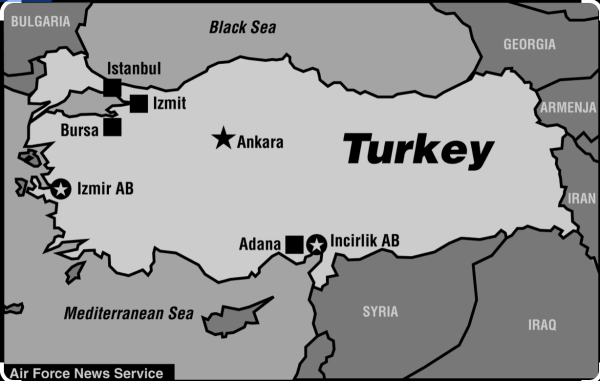
Interestingly, a pair of US Air Force B-1B Lancer bombers just touched down at Incirlik for a “hot-pit” refuel exercise – the first conducted by the B-1 at the base. More detailfrom The Drive (h/t Willow):
“Hot pitting means keeping the engines running while the aircraft is refueled by ground crews. The tactic is used for everything from increasing training sortie rates to rapidly refueling and rearming combat aircraft at forward operating locations near enemy lines during a time of war to get them back in the fight faster.”
Just shutting a complex warplane like the B-1 down can drastically increase the chance that a component will break and it will not be to complete another sortie with repair, or even takeoff at all. Executing hot pitting and even crew-swaps while the engines are running helps alleviate the chances of this happening.
The B-1s were at Incirlik — an important U.S. military installation in its own right — for under two hours before they took off again and flew a training mission with the Turkish Air Force.
The US Air Force claimed the exercises had long been planned, and The Drive emphasized that the B-1s are not capable of employing nuclear weapons. Nonetheless, major protests at a Turkish base hosting US nukes would not be a great look.
Erdogan likely wishes this new cold war could go on forever. Consider that in Washington’s efforts to apply pressure on Erdogan and get rid of him, they actually helped keep him in power:
Opponents campaign hurt by perceived ties to US and collective west, which are unpopular in Türkiye.
Economy was thrown a lifeline with Western sanctions on Russia, casting Türkiye into the profitable role of middleman and making sure Russia did everything it could to prop up Erdogan. Russian tourists flooded into Türkiye and Moscow gave sweetheart deals on oil and gas.
Has helped Türkiye repair relations in the region. Common ground is usually the desire to keep the US out.
At the risk of drawing too much on WWII historical parallels, any sign that Türkiye is decamping from its middle ground could be a very bad sign for the West. One needs look no further than World War II when Türkiye was courted by all sides. Turkish cartoonist Ramiz Gökçe depicted Türkiye at the time as ‘The Comrade of Germany; The Sweetheart of America; The Ally of Britain; The Neighbour of Russia; The Protector of Peace; The Friend of the World’.
In 1941, Türkiye and Germany signed a nonaggression pact, and Ankara raked in economic and military aid from both Axis and Allies trying to woo Türkiye to their side. As the tide changed in WWII, however, Türkiye wisely bet on the eventual victors, moving increasingly to the Allied side. In 1944 Türkiye stopped exporting chromite to Germany, a key ingredient in the manufacture of stainless steel, and later that year severed diplomatic relations with Germany. In 1945 Türkiye declared war on Germany – two months before its defeat.
While Türkiye ideally wants to remain a bridge between Asia and Europe, it is increasingly drifting away from the US. Or more accurately, it is being pushed away as the West isolates itself. The economic war against Russia has only pushed Türkiye and Russia closer together, as has the West’s efforts to stir division in the Caucasus via Armenia. Repeated attempts to prevent Türkiye from cooperating with Russia have not worked, and now it looks like the US wants a big war in the Middle East in which Türkiye will have no choice but to oppose the West. Sinem Adar, an associate at the Center for Applied Türkiye Studies at the German Institute for International and Security Affairs, writing at War on the Rocks:
Behind these statements also lies Türkiye’s staunch opposition to a U.S.-led world order. Türkiye’s ruling elites believe that “the West lacks strategic thinking and has increasingly become estranged from the rest of the world in the face of various issues including relations with China, migration and terror, and the shift in economic gravity from the West to the East.”
For Ankara, the unequivocal and unconditional support that the Biden administration gives Israel confirmsthis belief. Triggering a convergence between the policies of Türkiye, Egypt, Saudi Arabia, and other countries, pro-government journalists expect that the conflict would lead to an increasing isolation of Israel. Regardless of their ideological affiliation, most Turkish political actors tend to see the recent conflict in Gaza as one between the so-called West (led by the United States) and the East. Since the disputed attack at the al-Ahli hospital in Gaza City, there have been calls on the government to ally with countries in the Global South to “stop the U.S.-Israeli alliance.”
Yet the proposed methods vary. Addressing an emergency session of the Organization for Islamic Cooperation on Oct. 18, Fidan called upon Muslim countries to act with “self-confidence” and “challenge the hegemonic narrative that has been imposed on them,” but without offering a concrete roadmap for how to do that. Devlet Bahçeli, the leader of the AKP’s junior partner, the Nationalist Movement Party, said Türkiye should intervene militarily if there is no ceasefire. Those critical of Ankara’s civilizationist aspirations yet share its aspirations for a foreign policy independent from the West call for booting U.S. military members at Incirlik Air Force Base and the Kürecik Radar Station in Malatya.
It shouldn’t be forgotten that Turkish nationalists were the biggest winners in May’s elections. While one might think that affects other countries equally, one has to remember that countries like Russia and China respect other nations’ interests and try to find ways to work together that will advance both sides’ interests. The US nowadays does the opposite: it pressures, threatens and resorts to force. That plays even worse with the nationalists in Ankara who want to be treated with respect as a regional power. They will have no problem ignoring any NATO agreements if that is in the best interest of Turkiye. And non-agreement-capable US neocons will no doubt protest loudly should that occur.
https://www.nakedcapitalism.com/2023/11 ... licts.html









 Hezbollah Kamikaze drones are blinding Israel in the North in preparation for the next stage. pic.twitter.com/sQAqvsRh5G
 🎗 (@Partisangirl) November 3, 2023