Palestine

User avatar
blindpig
Posts: 14838
Joined: Fri Jul 14, 2017 5:44 pm
Location: Turtle Island
Contact:

Re: Palestine

Post by blindpig » Wed Nov 15, 2023 12:22 pm

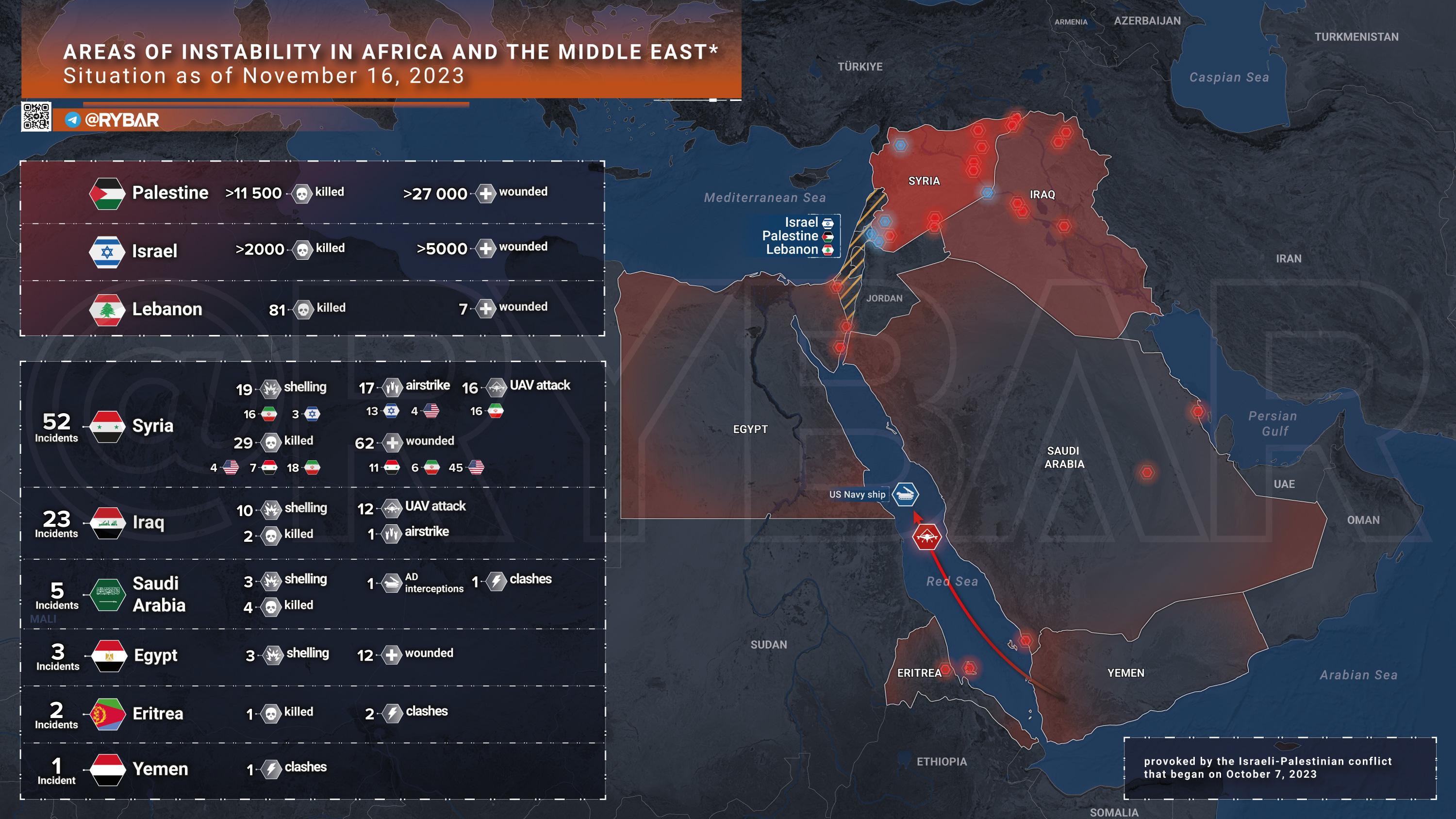
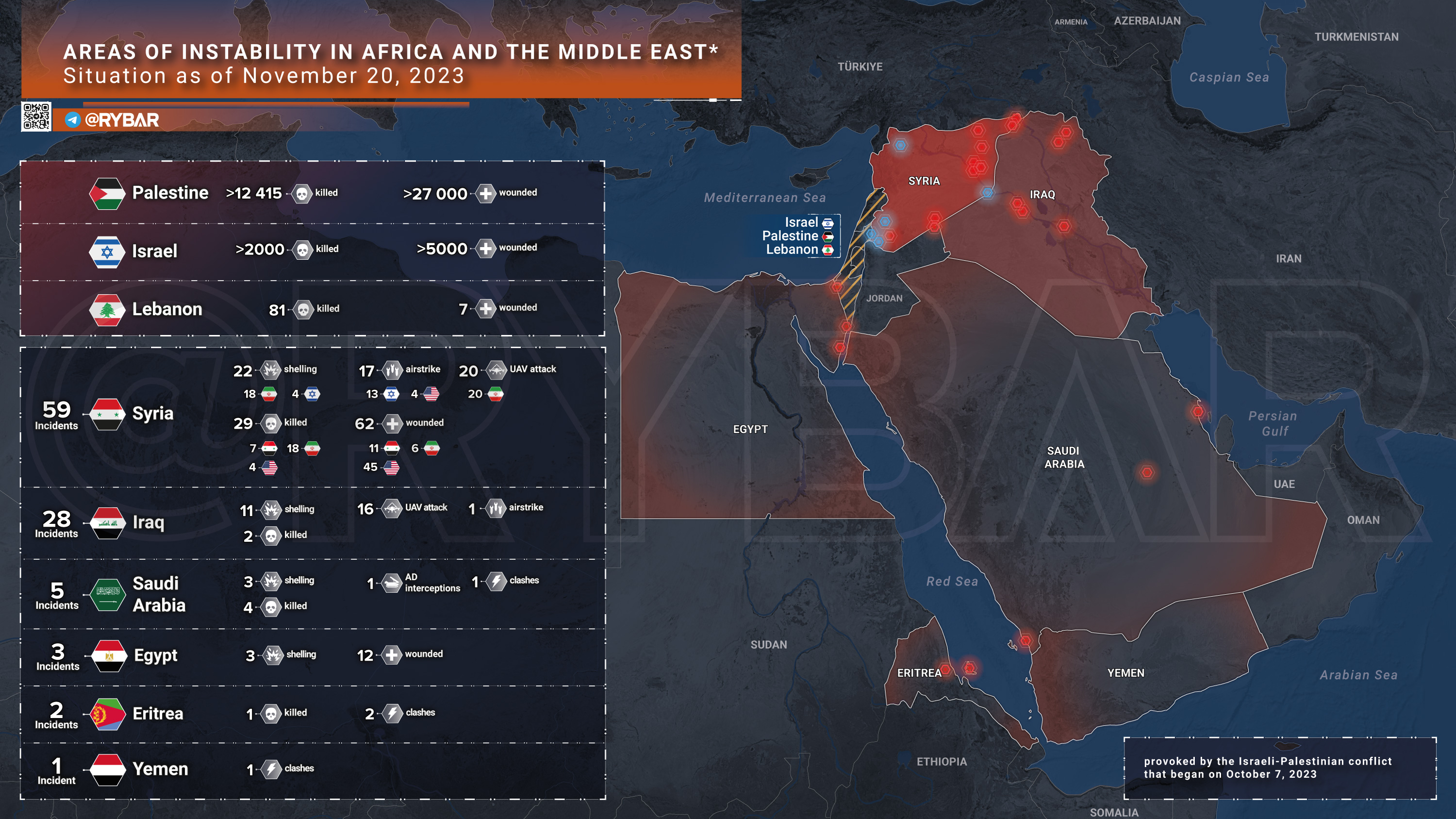
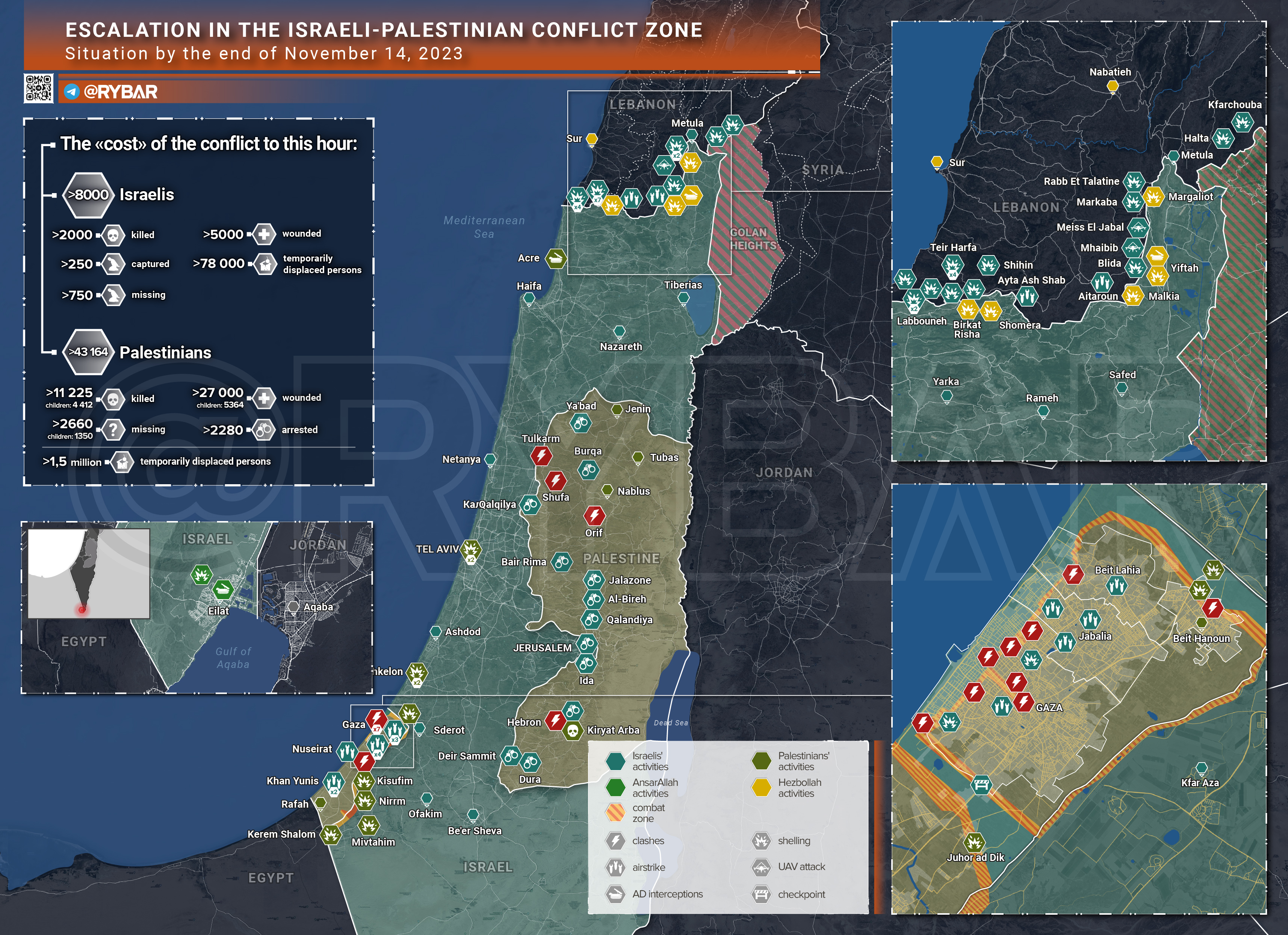
What is happening in Palestine and Israel: chronicle for November 14
November 15, 2023
Rybar
Image

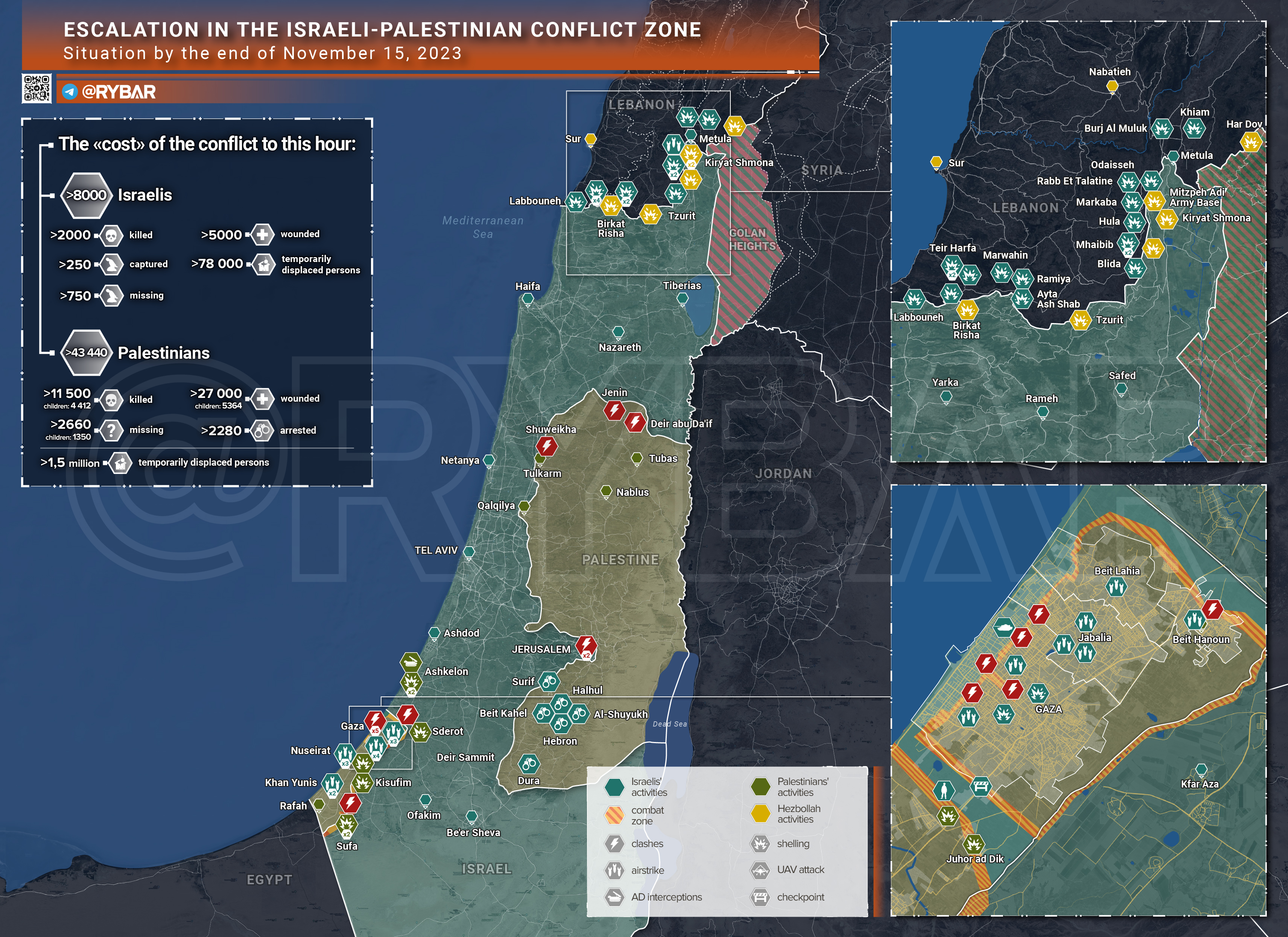
In the Gaza Strip, the Israel Defense Forces' operation to take control of the enclave's capital continues. Clashes are taking place in several areas ( Ar-Rimal , Al-Sheikh Radwan , Tell al-Hawa and Al-Sheikh Ijlin ). The mechanized IDF units are opposed by scattered groups of lightly armed Palestinians.

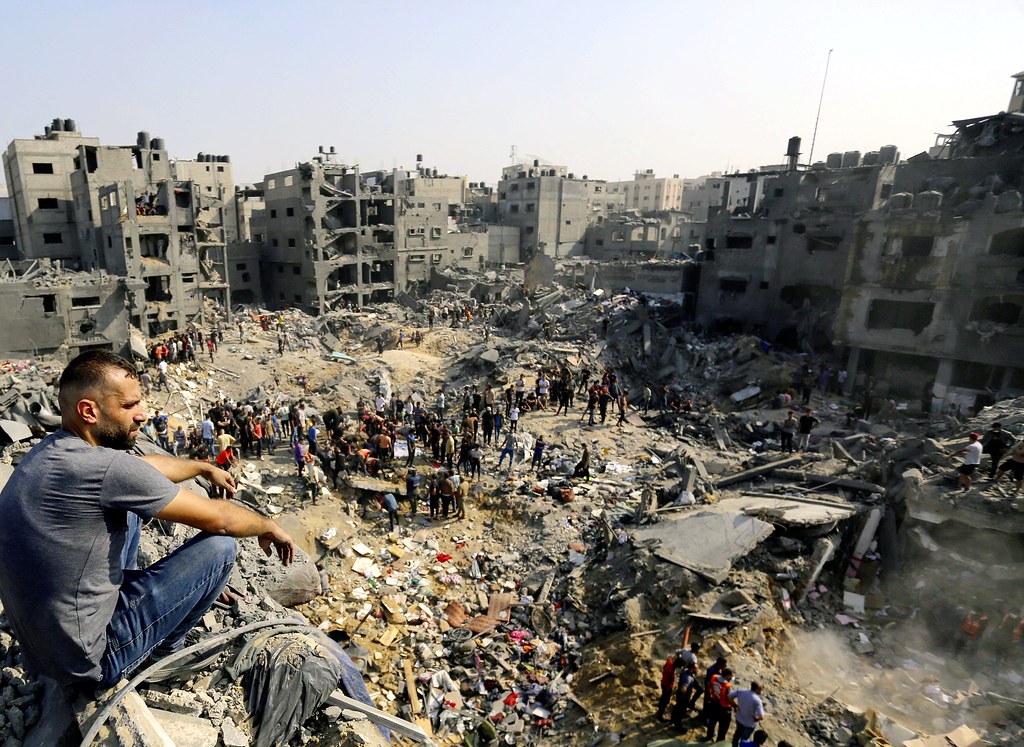
During the day, Ashkelon and Tel Aviv were shelled . In both cases, civilians and city infrastructure were damaged, but there were no fatalities. In the Gaza Strip the situation is much worse. Massive Israeli strikes continue, dozens of civilians are dying, some are being buried right in hospitals.

The traditional exchange of blows between Hezbollah and the IDF continues on the border with Lebanon . The former are burning cameras and other border infrastructure with anti-tank systems, and the latter are burning forests and plantings with tanks and artillery. From time to time the Israelis deploy UAVs.

In the south the situation is stable. Palestinian groups are shelling kibbutzim and military bases that they can reach. In Eilat, air defense shot down a ballistic missile from Yemen in the evening , and in the afternoon an unknown explosion occurred.

Progress of hostilities
Gaza Strip

Image
Israeli units continue their offensive in western Gaza . According to multiple reports from pro-Palestinian sources, the Al-Hilu hospital is surrounded , and fighting is taking place in the areas of Ar-Rimal , An-Nasr , and Al-Sheikh Ijlin . After advancing towards Al-Wafa Hospital last day, clashes began in neighboring neighborhoods. Palestinians report sounds of fighting in the area of ​​Yarmouk Stadium and the Gaza Municipal Garden. The width of the breakthrough does not exceed 250-300 meters: the Israelis are advancing in the very “media” area with a large number of objects of social significance that can be considered an asset.

IDF units continue to hold the humanitarian corridor in the area of ​​the Salah ed-Din highway , suspending attacks on the Old City , At-Tuffah and Al-Judaida areas for a couple of hours a day . When time runs out, non-humanitarian strikes resume in the areas.

The overall efforts are concentrated on a PR victory (a large number of photographs from one breakthrough site) and informational and psychological pressure on the Palestinians. Theses are being circulated about the collapse of Hamas and the destruction of military infrastructure, while the Israelis themselves cannot boast of military successes either south or north of Gaza.

During the day, Palestinian forces shelled Ashkelon , and two rockets were able to penetrate the Iron Dome. Two victims received minor injuries, two more required medical attention due to shock. The injured were taken to Barzilai Hospital . Several more rockets were able to reach Tel Aviv , where three people were hit, one of whom was seriously injured.

The humanitarian situation in the enclave is getting worse. At Al-Shifa Hospital , 179 people were forced to be buried in the courtyard because there was no way to remove the bodies and there were not enough refrigerators or electricity. In the evening, a thunderstorm broke out over Gaza and showers came. This, of course, will partly solve the problem with drinking water, but it will increase the number of people suffering from colds.

South direction

Several bases and kibbutzim in the south of the country were traditionally fired from the Gaza Strip. Once again, Kissufim , Nirim , Miftahim , Amitai and the Kerem Shalom border crossing were covered with mortar and rocket fire .

An explosion of unknown origin was heard in the Eilat area during the day, and in the evening air defense systems were activated several times. According to preliminary information, a ballistic missile from the Ansarallah movement from Yemen was shot down .

Border with Lebanon

The situation on the border with Lebanon remains relatively tense. Hezbollah occasionally strikes at various military targets and border infrastructure, and the IDF regularly strikes back (and often just like that). By evening, the number of such shellings, just included in the reports, exceeded two dozen, but no one is in a hurry to stop. 1Hezbollah, spending a moderate amount of ammunition and personnel, holds an impressive IDF group at the northern borders and forces them to waste ammunition, while incurring, in general, not such large losses.

Theses about the possible creation of a four-kilometer buffer zone on Lebanese territory in order to secure Israel’s northern border have begun to be circulated in the information space.

West Bank

Everything is stable in the Palestinian Authority in the West Bank. Israeli security forces are conducting mass arrests in various localities - both in cities and refugee camps. This is often accompanied by large-scale destruction. In Tulkarm , the IDF operation lasted about fifteen hours. Despite the desperate, but partly senseless resistance of Palestinian youth, several streets were destroyed, as well as monuments to fallen resisters and Yasser Arafat .

Actions of pro-Iranian formations in the Middle East

Image
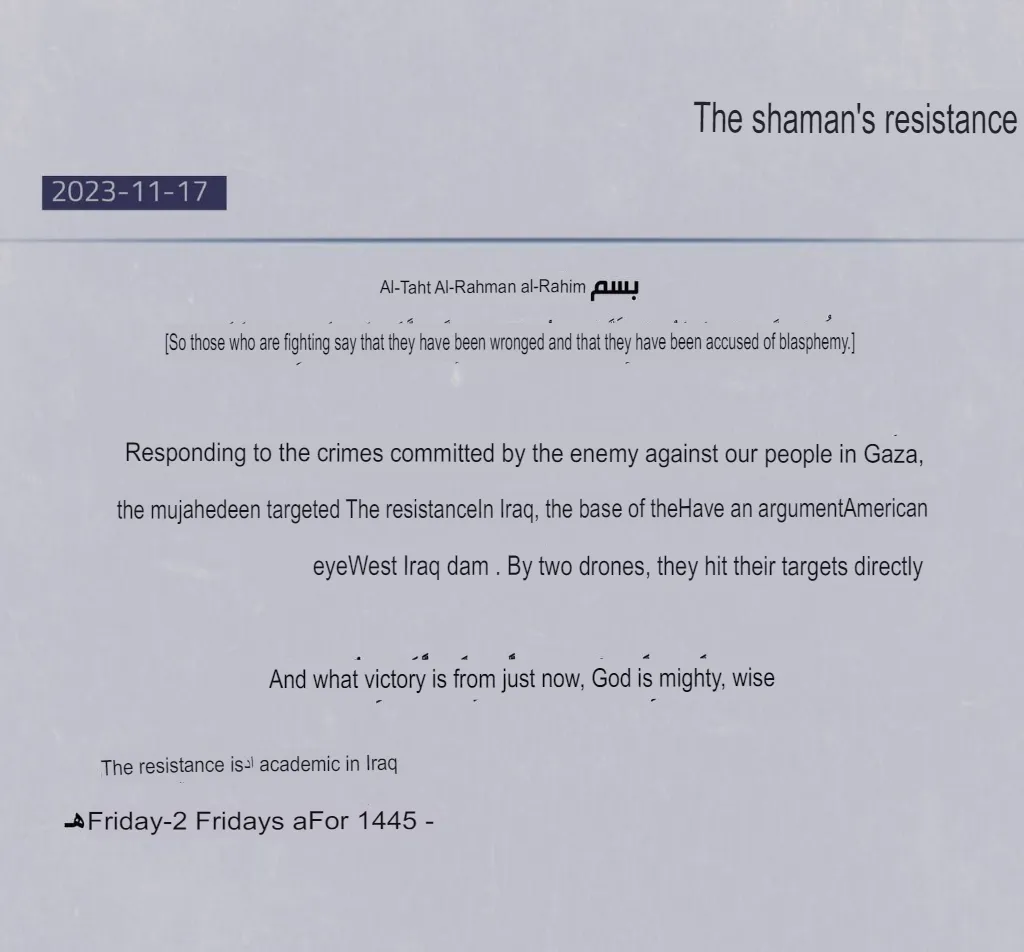
Pro-Iranian forces continue sporadic attacks on US military targets in Syria , launching missiles and UAVs.

The “kamikaze” drone was used at a base at the Al-Omar oil field and at a location for American military personnel in the neighboring village of Green Village . Several missiles were launched at the Konoko plant, also located in Trans-Euphrates.

The Yemeni Houthis made several interesting statements that compare favorably with the theses of the Lebanese Hezbollah Secretary General. So, according to them, the Yemenis are constantly looking for Israeli ships in the Red Sea. But the Israelis, according to Abdul Malik al-Houthi, rely on shadow smuggling and secretive movement across the Red Sea from the Bab al-Mandeb Strait, “not daring to raise Israeli flags.”

Of course, this is the usual interpretation of events in the interests of the Yemenis, but the remark is amusing considering that the Israelis do rely on a shadow supply fleet.

The Ansarallah movement has vowed to traditionally attack any “Zionist targets” in Palestine and anywhere else it can reach, and has expressed a desire to send “hundreds of thousands” of volunteers to defend the Gaza Strip. A request was officially made to countries that geographically separate Yemen from Palestine to open a land crossing through which Yemenis can reach Palestine. This puts both Saudi Arabia and Jordan , who verbally care for Palestine, in a rather awkward position: so they were asked to prove it with deeds.

In addition, there was information that the Americans were trying to bribe the Yemenis so that they would refuse to support Palestine, like other countries. But the Houthis rejected the offer.

Political-diplomatic background
On the lawsuit against Netanyahu at the ICC

The Prosecutor General's Office of Istanbul sent a criminal case against Netanyahu to the Turkish Ministry of Justice with a demand that the ICC try him for genocide in the Gaza Strip. The move, of course, is beautiful, but meaningless. The International Criminal Court as an organization is nothing, and neither Israel nor Turkey itself are parties to the Rome Statute, and the ICC cannot do anything about them.

On the evacuation of Russian citizens from the Gaza Strip

The second special plane of the Russian Ministry of Emergency Situations with 98 fellow citizens is heading from Egypt to Domodedovo. The previous one, which carried 70 Russians, landed in Moscow on November 13.

In addition, the special representative of the Russian President for the Middle East and Africa, Deputy Head of the Russian Foreign Ministry Mikhail Bogdanov met with the Egyptian ambassador in Moscow. The Egyptian side expressed gratitude for the assistance provided in ensuring the rescue of Russian citizens from the combat zone and also touched upon other issues of cooperation, including the situation in the Gaza Strip. The Presidents of Egypt and the Russian Federation themselves also discussed by telephone the latest developments in the Gaza Strip.

https://rybar.ru/chto-proishodit-v-pale ... -noyabrya/

Google Translator

*******

Israeli War Crimes and Propaganda Follow US Blueprint
Posted on November 14, 2023 by Yves Smith

Yves here. It may seem disheartening to see so many chronicle the deliberate extermination of Palestinians as part of a purported Hamas clearing operation in Gaza yet see no change in its apparent trajectory. But as some observers who are watching the action closely (see for instance Alastair Crooke’s latest talk on Judge Napolitano), various Arab interests are increasing their attacks on Israel. And military experts (Douglas Macgregor, and informed commentators like Larry Johnson) point out, Israel cannot afford a long war, geopolitically or economically, and is not very far along at all with rooting out Hamas. It may be flattening Gaza but has yet to engage meaningfully on the ground, which is necessary to meet the aim of “defeating Hamas.”

This is a long winded way of saying that Israel is turning itself into a world pariah in a war it cannot win on its own terms. Relentlessly focusing on that could save at least some Palestinians by increasing the cost to Israel of continuing the carnage. So the continued documentation and criticism is productive, even if it does not feel like it (and is deeply distressing, to seem so unable to force a halt to the slaughter).

This article focuses on the propaganda war and minimization of Israel’s brazen behavior. I wish it used the word censorship more, because that is a key part of this US/Israel media strategy. Likely due to the editorial choice of making a concise case, it omitted a key point that I believe bears repeating:
International Law and treaties are clearly In favour of the occupied Palestinians’ “right to defend itself” not the occupier Israel. It’s clear as day…
And Israel’s pretext for the destruction of the Rantisi hospital comes up short. No Hamas bunkers or weapons caches:
The Israeli army has failed to find tunnels or weapons stockpiled in Rantisi hospital. Instead, it has turned up a pack of diapers and a calendar listing the days of the week. The presentation has become a laughingstock, except among the cretinous and narrowing base of support…
By Medea Benjamin and Nicolas J. S. Davies, the authors of War in Ukraine: Making Sense of a Senseless Conflict, published by OR Books in November 2022. Medea Benjamin is the cofounder of CODEPINK for Peace, and the author of several books, including Inside Iran: The Real History and Politics of the Islamic Republic of Iran. Nicolas J. S. Davies is an independent journalist, a researcher for CODEPINK and the author of Blood on Our Hands: The American Invasion and Destruction of Iraq

We have both been reporting on and protesting against U.S. war crimes for many years, and against identical crimes committed by U.S. allies and proxies like Israel and Saudi Arabia: illegal uses of military force to try to remove enemy governments or “regimes”; hostile military occupations; disproportionate military violence justified by claims of “terrorism”; the bombing and killing of civilians; and the mass destruction of whole cities.

Most Americans share a general aversion to war, but tend to accept this militarized foreign policy because we are tragically susceptible to propaganda, the machinery of public manipulation that works hand in hand with the machinery of killing to justify otherwise unthinkable horrors.

This process of “manufacturing consent” works in a number of ways. One of the most effective forms of propaganda is silence, simply not telling us, and certainly not showing us, what war is really doing to the people whose homes and communities have been turned into America’s latest battlefield.

The most devastating campaign the U.S. military has waged in recent years dropped over 100,000 bombs and missiles on Mosul in Iraq, Raqqa in Syria, and other areas occupied by ISIS or Da’esh. An Iraqi Kurdish intelligence report estimated that more than 40,000 civilians were killed in Mosul, while Raqqa was even more totally destroyed.

The shelling of Raqqa was the heaviest U.S. artillery bombardment since the Vietnam War, yet it was barely reported in the U.S. corporate media. A recent New York Times article about the traumatic brain injuries and PTSD suffered by U.S. artillerymen operating 155 mm howitzers, which each fired up to 10,000 shells into Raqqa, was appropriately titled A Secret War, Strange New Wounds and Silence from the Pentagon.

Shrouding such mass death and destruction in secrecy is a remarkable achievement. When British playwright Harold Pinter was awarded the Nobel Prize for Literature in 2005, in the midst of the Iraq War, he titled his Nobel speech “Art, Truth and Politics,” and used it to shine a light on this diabolical aspect of U.S. war-making.

After talking about the hundreds of thousands of killings in Indonesia, Greece, Uruguay, Brazil, Paraguay, Haiti, Turkey, the Philippines, Guatemala, El Salvador, Chile and Nicaragua, Pinter asked: “Did they take place? And are they in all cases attributable to US foreign policy? The answer is yes, they did take place and they are attributable to American foreign policy,”

“But you wouldn’t know it,” he went on.”It never happened. Nothing ever happened. Even while it was happening it wasn’t happening. It didn’t matter. It was of no interest. The crimes of the United States have been systematic, constant, vicious, remorseless, but very few people have actually talked about them. You have to hand it to America. It has exercised a quite clinical manipulation of power worldwide while masquerading as a force for universal good. It’s a brilliant, even witty, highly successful act of hypnosis.”

But the wars and the killing go on, day after day, year after year, out of sight and out of mind for most Americans. Did you know that the United States and its allies have dropped more than 350,000 bombs and missiles on 9 countries since 2001 (including 14,000 in the current war on Gaza)? That’s an average of 44 airstrikes per day, day in, day out, for 22 years.

Israel, in its present war on Gaza, with children making up more than 40% of the more than 11,000 people killed to date, would surely like to mimic the extraordinary U.S. ability to hide its brutality. But despite Israel’s efforts to impose a media blackout, the massacre is taking place in a small, enclosed, densely-populated urban area, often called an open-air prison, where the world can see a great deal more than usual of how it impacts real people.

Israel has killed a record number of journalists in Gaza, and this appears to be a deliberate strategy, as when U.S. forces targeted journalists in Iraq. But we are still seeing horrifying video and photos of daily new atrocities: dead and wounded children; hospitals struggling to treat the injured; and desperate people fleeing from one place to another through the rubble of their destroyed homes.

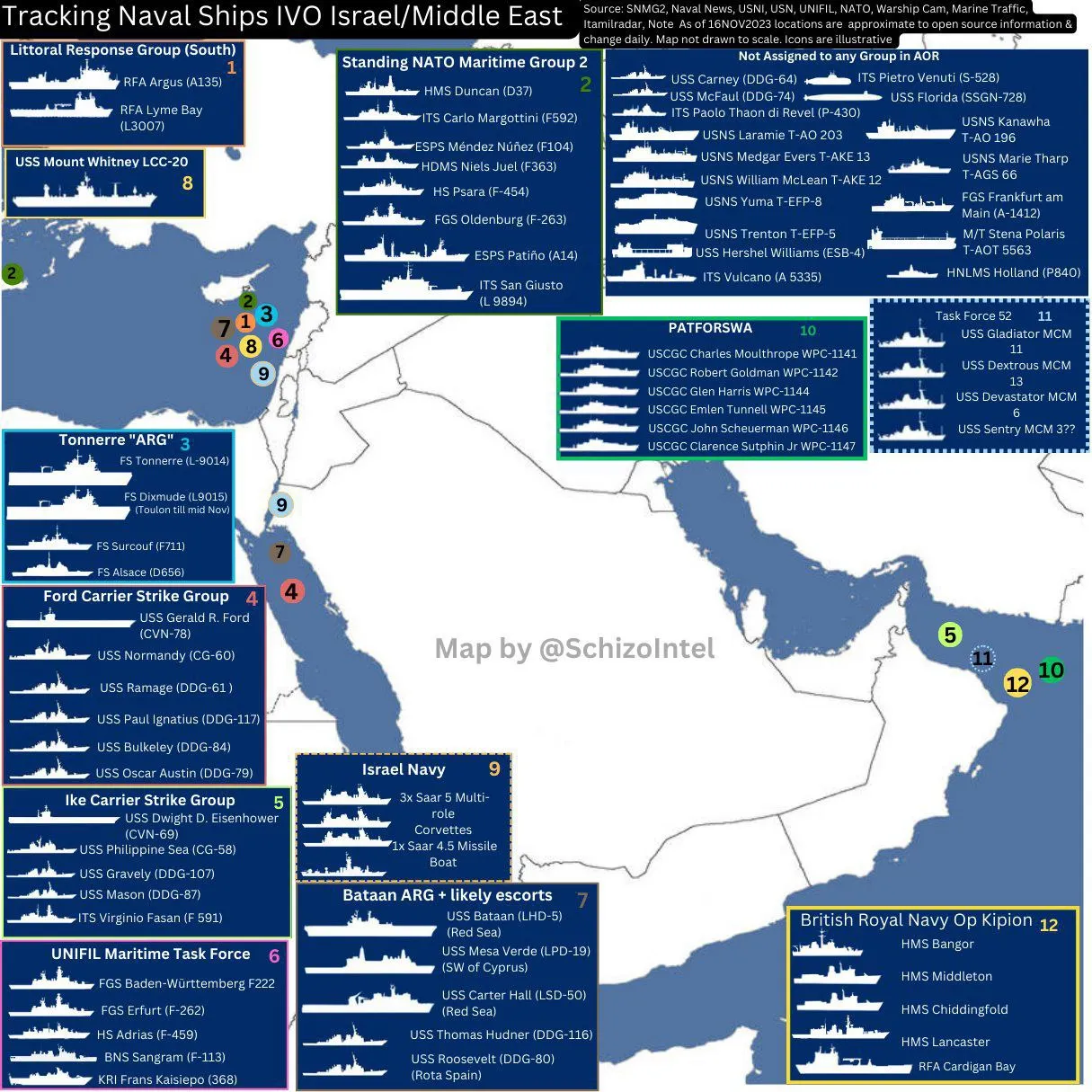
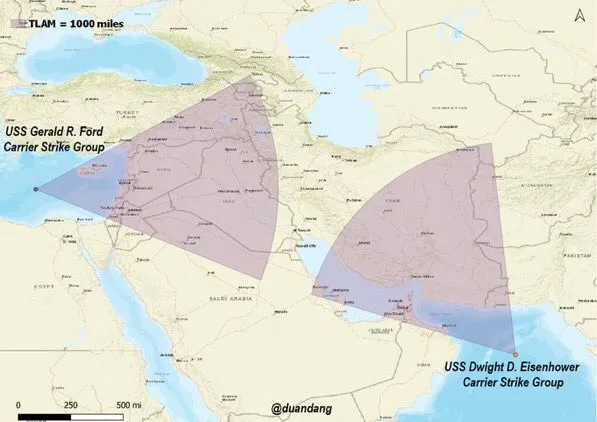
Another reason this war is not so well hidden is because Israel is waging it, not the United States. The U.S. is supplying most of the weapons, has sent aircraft carriers to the region, and dispatched U.S. Marine General James Glynn to provide tactical advice based on his experience conducting similar massacres in Fallujah and Mosul in Iraq. But Israeli leaders seem to have overestimated the extent to which the U.S. information warfare machine would shield them from public scrutiny and political accountability.

Unlike in Fallujah, Mosul and Raqqa, people all over the world are seeing video of the unfolding catastrophe on their computers, phones and TVs. Netanyahu, Biden and the corrupt “defense analysts” on cable TV are no longer the ones creating the narrative, as they try to tack self-serving narratives onto the horrifying reality we can all see for ourselves.

With the reality of war and genocide staring the world in the face, people everywhere are challenging the impunity with which Israel is systematically violating international humanitarian law.

Michael Crowley and Edward Wong have reported in the New York Times that Israeli officials are defending their actions in Gaza by pointing to U.S. war crimes, insisting that they are simply interpreting the laws of war the same way that the United States has interpreted them in Iraq and other U.S. war zones. They compare Gaza to Fallujah, Mosul and even Hiroshima.

But copying U.S. war crimes is precisely what makes Israel’s actions illegal. And it is the world’s failure to hold the United States accountable that has emboldened Israel to believe it too can kill with impunity.

The United States systematically violates the UN Charter’s prohibition against the threat or use of force, manufacturing political justifications to suit each case and using its Security Council veto to evade international accountability. Its military lawyers employ unique, exceptional interpretations of the Fourth Geneva Convention, under which the universal protections the Convention guarantees to civilians are treated as secondary to U.S. military objectives.

The United States fiercely resists the jurisdiction of the International Court of Justice (ICJ) and the International Criminal Court (ICC), to ensure that its exceptional interpretations of international law are never subjected to impartial judicial scrutiny.

When the United States did allow the ICJ to rule on its war against Nicaragua in 1986, the ICJ ruled that its deployment of the “Contras” to invade and attack Nicaragua and its mining of Nicaragua’s ports were acts of aggression in violation of international law, and ordered the United States to pay war reparations to Nicaragua. When the United States declared that it would no longer recognize the jurisdiction of the ICJ and failed to pay up, Nicaragua asked the UN Security Council to enforce the reparations, but the U.S. vetoed the resolution.

Atrocities like Hiroshima, Nagasaki and the bombing of German and Japanese cities to “unhouse” the civilian population, as Winston Churchill called it, together with the horrors of Germany’s Nazi holocaust, led to the adoption of the new Fourth Geneva Convention in 1949, to protect civilians in war zones and under military occupation.

On the 50th anniversary of the Convention in 1999, the International Committee of the Red Cross (ICRC), which is responsible for monitoring international compliance with the Geneva Conventions, conducted a survey to see how well people in different countries understood the protections the Convention provides.

They surveyed people in twelve countries that had been victims of war, in four countries (France, Russia, the U.K. and the U.S.) that are permanent members of the UN Security Council, and in Switzerland where the ICRC is based. The ICRC published the results of the survey in 2000, in a report titled, People on War – Civilians in the Line of Fire.

The survey asked people to choose between a correct understanding of the Convention’s civilian protections and a watered-down interpretation of them that closely resembles that of U.S. and Israeli military lawyers.

The correct understanding was defined by a statement that combatants “must attack only other combatants and leave civilians alone.” The weaker, incorrect statement was that “combatants should avoid civilians as much as possible” as they conduct military operations.

Between 72% and 77% of the people in the other UNSC countries and Switzerland agreed with the correct statement, but the United States was an outlier, with only 52% agreeing. In fact 42% of Americans agreed with the weaker statement, twice as many as in the other countries. There were similar disparities between the United States and the others on questions about torture and the treatment of prisoners of war.

In U.S.-occupied Iraq, the United States’ exceptionally weak interpretations of the Geneva Conventions led to endless disputes with the ICRC and the UN Assistance Mission for Iraq (UNAMI), which issued damning quarterly human rights reports. UNAMI consistently maintained that U.S. airstrikes in densely populated civilian areas were violations of international law.

For instance, its human rights report for the 2nd quarter of 2007 documented UNAMI’s investigations of 15 incidents in which U.S. occupation forces killed 103 Iraqi civilians, including 27 killed in airstrikes in Khalidiya, near Ramadi, on April 3rd, and 7 children killed in a helicopter attack on an elementary school in Diyala province on May 8th.

UNAMI demanded that “all credible allegations of unlawful killings by MNF (Multi-National Force) forces be thoroughly, promptly and impartially investigated, and appropriate action taken against military personnel found to have used excessive or indiscriminate force.”

A footnote explained, “Customary international humanitarian law demands that, as much as possible, military objectives must not be located within areas densely populated by civilians. The presence of individual combatants among a great number of civilians does not alter the civilian character of an area.”

UNAMI also rejected U.S. claims that its widespread killing of civilians was the result of the Iraqi Resistance using civilians as “human shields,” another U.S. propaganda trope that Israel is mimicking today. Israeli accusations of human shielding are even more absurd in the densely populated, confined space of Gaza, where the whole world can see that it is Israel that is placing civilians in the line of fire as they desperately seek safety from Israeli bombardment.

Calls for a ceasefire in Gaza are echoing around the world: through the halls of the United Nations; from the governments of traditional U.S. allies like France, Spain and Norway; from a newly united front of previously divided Middle Eastern leaders; and in the streets of London and Washington. The world is withdrawing its consent for a genocidal “two-state solution” in which Israel and the United States are the only two states that can settle the fate of Palestine.

If U.S. and Israeli leaders are hoping that they can squeak through this crisis, and that the public’s habitually short attention span will wash away the world’s horror at the crimes we are all witnessing, that may be yet another serious misjudgment. As Hannah Arendt wrote in 1950 in the preface to The Origins of Totalitarianism.

“We can no longer afford to take that which was good in the past and simply call it our heritage, to discard the bad and simply think of it as a dead load which by itself time will bury in oblivion. The subterranean stream of Western history has finally come to the surface and usurped the dignity of our tradition. This is the reality in which we live. And this is why all efforts to escape from the grimness of the present into nostalgia for a still intact past, or into the anticipated oblivion of a better future, are vain.”

https://www.nakedcapitalism.com/2023/11 ... print.html

Huh, when I saw the title I thought it would be about the US ethnic cleansing/genocide of Native Americans. All of a piece....

********

Chris Hedges: The War According to Hamas
November 14, 2023

The Palestinian resistance understands its enemy. It has learned through experience how to fight it. This is not good news for Israel.
Image
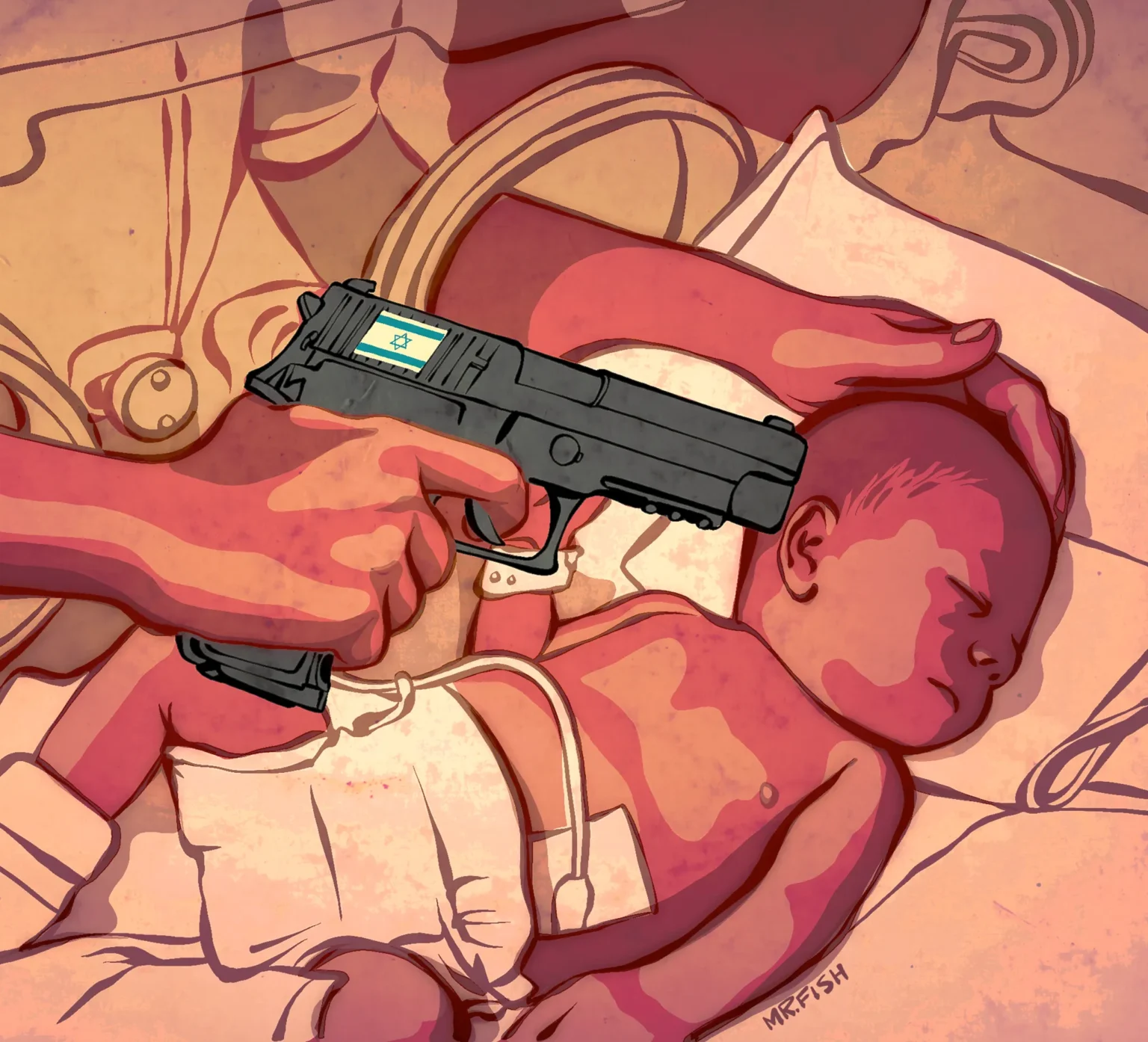
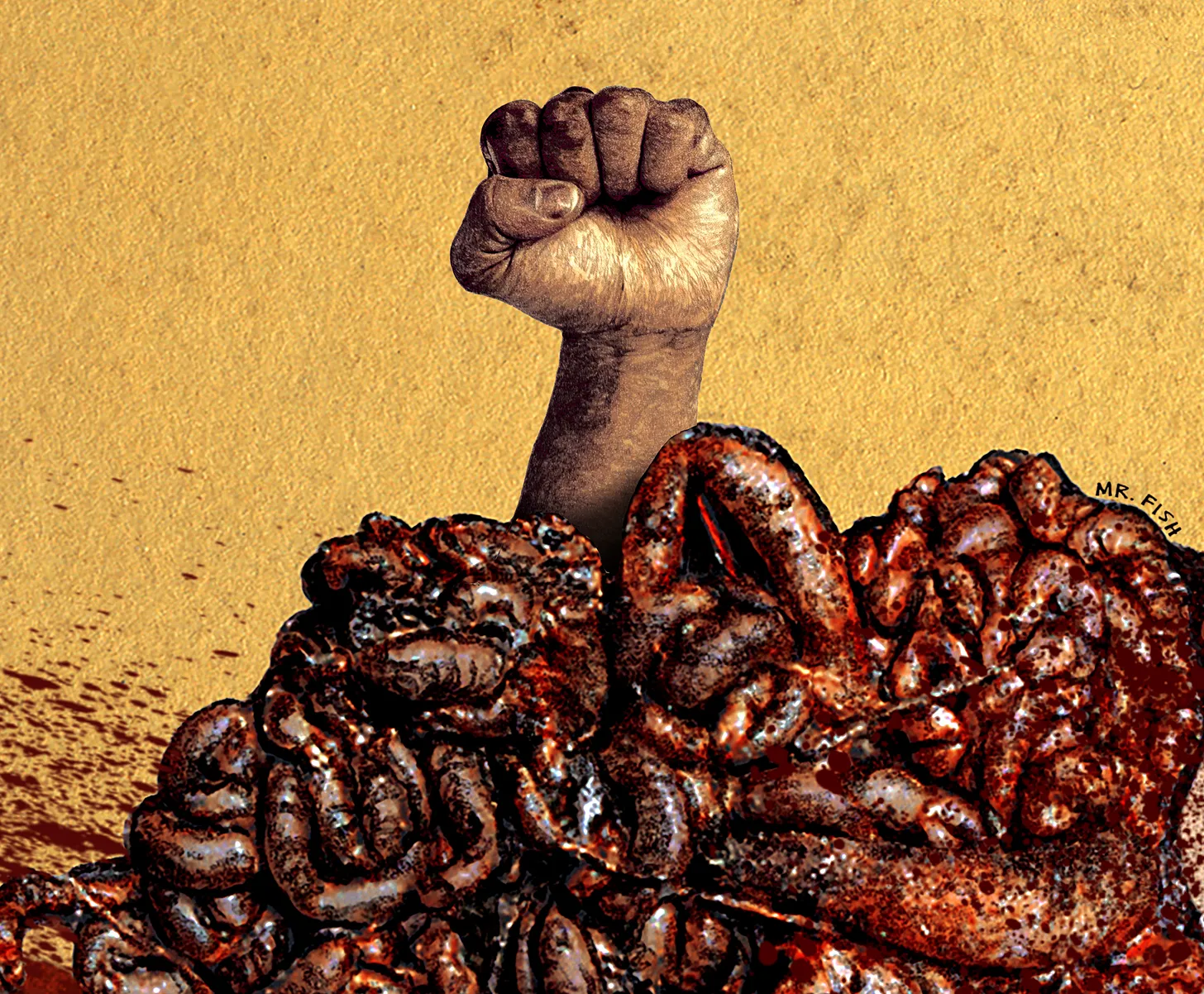
Blood Meal – by Mr. Fish.

By Chris Hedges
in Cairo
Original to ScheerPost

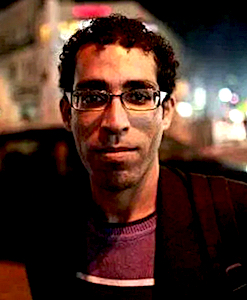
Basel al-Araj, a Palestinian resistance leader, shortly before Israel’s 2014 invasion of Gaza, laid down the fundamental rules for warfare against Israel.

The rules by al-Araj, not a member of Hamas, provide the Palestinian lens for the incursion by Israeli forces in Gaza. While Israel’s superior firepower — its air force, missiles, tanks, armored personnel carriers, drones, naval forces, mechanized units and artillery — make it possible to inflict huge numbers of Palestinian casualties, most of them civilians, while Israel can level whole neighborhoods and turn hospitals, schools, power stations, water treatment plants, bakeries, mosques and churches into piles of concrete, this does not translate into a defeat of the Palestinian resistance groups.

Al-Araj argued that the fight with Israel cannot be measured with body counts. The Israelis will be able to kill far greater numbers of Palestinians.

Resistant movements, he wrote, always suffer disproportionate losses. In the independence war in Algeria, between 1954 and 1962, upwards of 1.5 million Algerians — or around 10 percent of the population — were killed by the French. In the airport in Algiers, the country’s capital, is a huge sign that reads: “Welcome to Algeria. Land of a million Martyrs.”

“We are far more capable of bearing the costs, so there is no need to compare or be alarmed by the magnitude of the numbers,” he wrote.

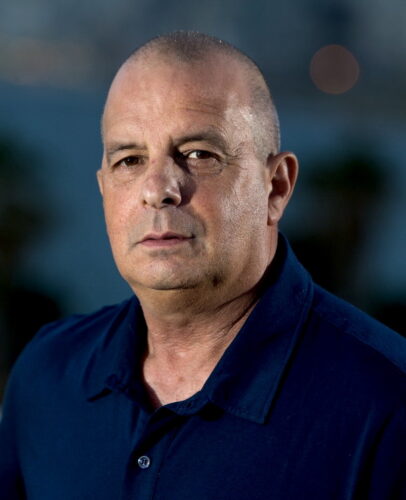
Al-Araj, who led hunger strikes while in Palestine Authority prisons, was long a target for Israel. Israel’s counter-terrorism unit, Yamam, pursued him for months before raiding his home on March 6, 2017, in el-Bireh. After a two-hour gun battle, Israeli forces, which fired rockets into the building, burst inside and executed him at close range. He was 31.
Image
Bassel al-Araj, photographer unknown. (Wikimedia Commons, Fair use)

The fight with Israel, al-Araj reminded Palestinians, must “follow the logic of guerrilla warfare or hybrid warfare, which Arabs and Muslims have become masters of through our experiences in Afghanistan, Iraq, Lebanon and Gaza.” Never defend “fixed points and borders.” Draw the enemy into an ambush, accomplished by light resistance and tactical withdrawals. Strike the flanks and the rear.

The calculus of asymmetric warfare is very different from conventional war. And what Israel defines as success, including the seizing of territory, numerous deaths and the destruction of infrastructure and buildings, matters little to the resistance fighter. The goal of Palestinian fighters is to remain elusive, to carry out lightning strikes and recede back into the rubble or the vast tunnel network under Gaza.

Al-Qassam Brigades

The Al-Qassam Brigades, the armed wing of Hamas, says it partially destroyed more than 160 Israeli military targets in Gaza, including more than 27 tanks and vehicles in the past two days.

On Nov. 11, the Al-Qassam Brigade says it lured Israeli soldiers to a burning car in the West Bank and blew up their vehicles with an IED.

On Nov. 10 the Al-Qassam Brigades, Saraya Al-Quds and Al-Aqsa Martyrs’ Brigades, say they allowed the Israelis to advance without significant opposition during the day.

In the evening they ambushed the Israeli forces west of Tal al-Hawa, in the areas around Al-Shifa Hospital, west of the Al-Shati refugee camp and west of Beit Lahia in the northern part of the Gaza strip. Israel unleashed a heavy bombardment, the Palestinian fighters said, in an attempt to rescue its soldiers. Israel reportedly suffered high numbers of casualties.

On Nov. 9, Al-Qassam Brigades say they ambushed Israeli soldiers in Juhr al-Dik, targeting them with an anti-personnel rocket. The Israeli soldiers were killed, they said, at “point blank range.”

On Nov. 6, the Al-Qassam Brigades say they destroyed five Israeli tanks with Yassin 105 rockets in northwest Gaza City.

On Nov. 2 Al-Qassam Brigades claimed they destroyed six tanks and two military vehicles in one hour northwest of Gaza City. “The number of casualties is significantly higher than what the enemy’s leadership has announced,” said Abu Obeida, the spokesperson for the Al Qassam Brigades.
Image
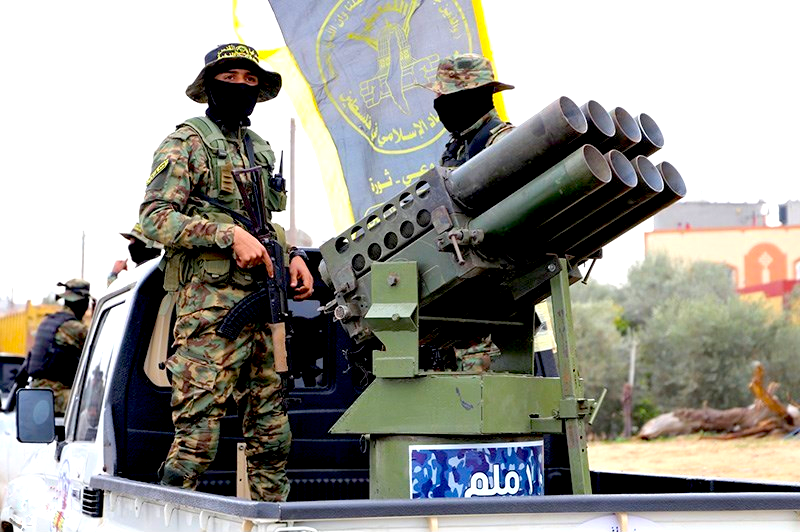
Members of Al-Quds brigades parade through the Gaza, January 2022. (Tasnim News Agency, Wikimedia Commons, CC BY 4.0)

Israel has banned the foreign press from reporting from Gaza. It has killed over 40 Palestinian journalists and media workers. It also has instituted prolonged blockages of the internet and cell phone service. No doubt, this heavy handed censorship is done to limit the horrific images of civilian casualties. But I suspect it is also intended to block images of a ground offensive that is tougher, more protracted and more costly than Israel anticipated.

Israel invests tremendous resources in its propaganda campaign, getting networks such as CNN to repeat back its talking points. Jake Tapper should be an honorary Israeli Defense Forces (IDF) spokesman.

Al-Araj warned about the attempt by Israel to demoralize fighters by posting photos and videos of Israelis occupying landmarks and public spaces.

A video being shared on social media shows the raising of the Israeli flag on a beach in Gaza. A group of soldiers surround the flag and sing the Israeli national anthem.

In October last year, Jewish settlers occupied the Ibrahimi Mosque in the West Bank town of Hebron, where a Jewish settler, Barach Goldstein, gunned down 29 Palestinians in 1994 as they prayed. The settlers held a music festival and dance party in the mosque. They hung an Israeli flag from the roof. Videos have circulated that denigrate and ridicule Palestinians.

Al-Araj wrote that Israel’s propaganda is designed to instill panic, demonize Palestinians and spread defeatism.

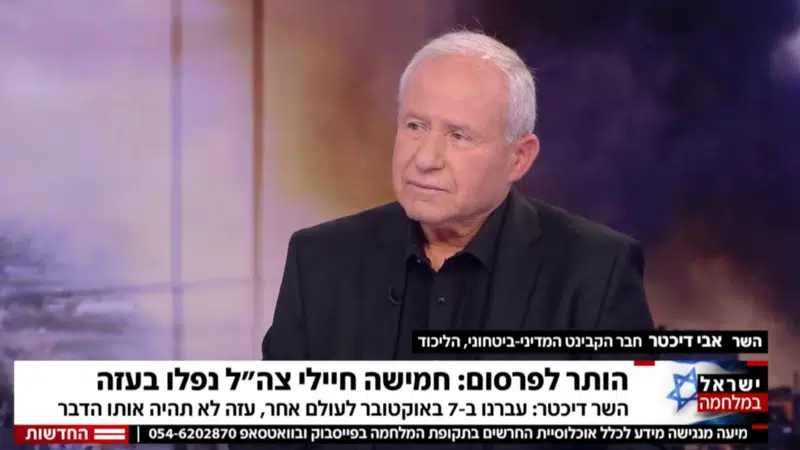
“We are now rolling out the Gaza Nakba,” said Israeli security cabinet member and Agriculture Minister Avi Dichter, referring to the ethnic cleansing of Palestinians from their land in 1948, facilitated by massacres, the raping of Palestinian women and girls, and the razing of entire villages by Zionist militias.

“From an operational point of view, there is no way to wage a war — as the IDF seeks to do in Gaza — with masses between the tanks and the soldiers.” “Gaza Nakba 2023. That’s how it’ll end,” he concluded.


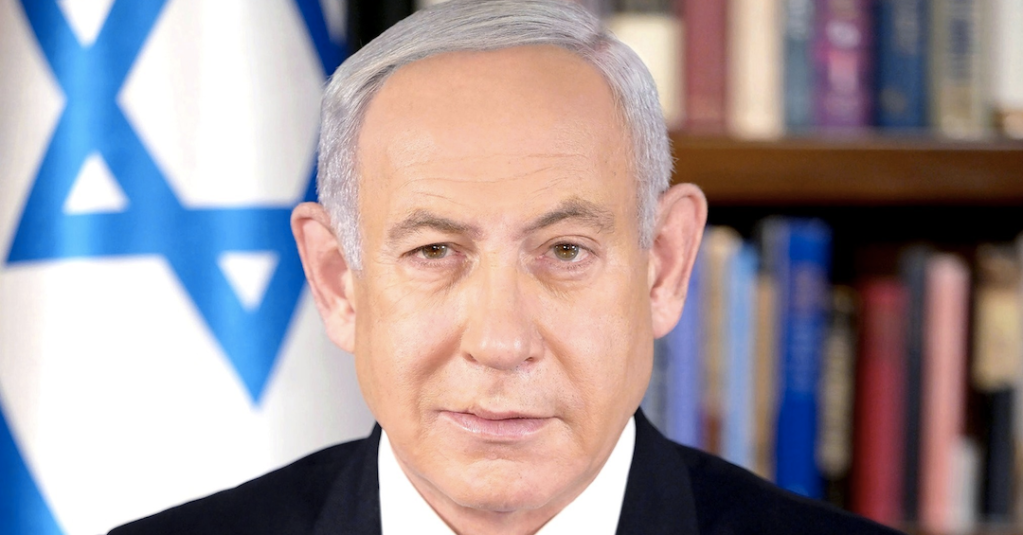
Israel equates the Palestinians with the Nazis. Naftali Bennett, Israel’s former prime minister, in an interview on Sky News on Oct. 12 said, “We’re fighting Nazis.” Prime Minister Benjamin Netanyahu described Hamas in a press conference with the German chancellor, Olaf Scholz, as “the new Nazis.”

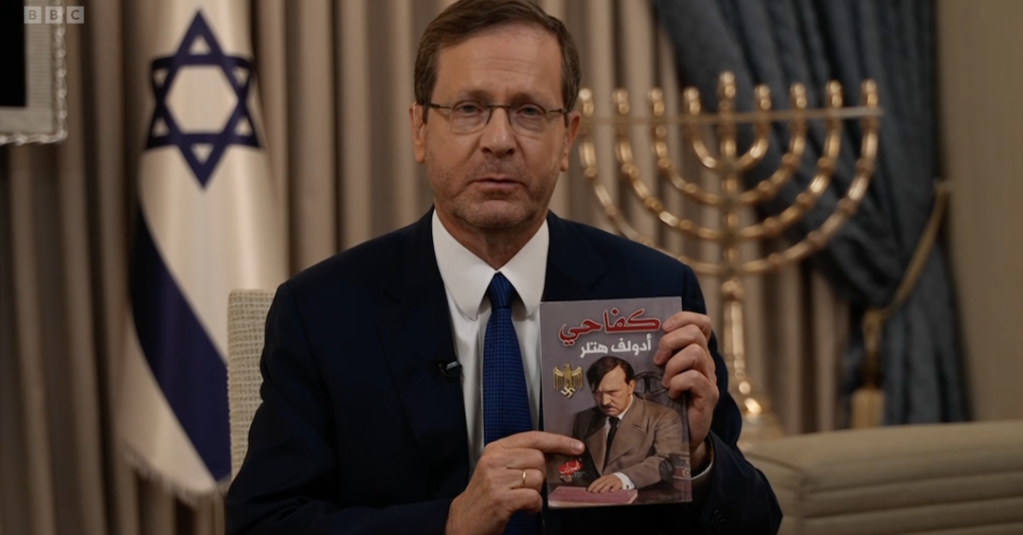
The IDF posted a tweet that read: “Never again is NOW. IDF forces discovered a copy of Hitler’s infamous book ‘Mein Kampf’ — translated into Arabic — in a child’s bedroom used as a Hamas terrorist base in Gaza. The book was discovered among the personal belongings of one of the terrorists, featuring annotations and highlights. Hamas embraces the ideology of Hitler, the one responsible for the annihilation of the Jewish people.”

The message is clear. Palestinians embody absolute evil.

Israel releases images that show Palestinians and Palestinian prisoners being denigrated and abused by Israelis. At the same time, Israel presents itself as compassionate.
A video titled “IDF Soldiers Give Gazan Civilians Water After Hamas Refused,” was recently circulated. The video, clearly staged, reminded me of the footage of the Bosnian Serb commander Gen. Ratko Mladic who handed out candy to children in Srebrenica in 1995 before overseeing the execution of 8,000 men and boys.

“The enemy will carry out tactical, qualitative operations to assassinate some symbols [of resistance], and all of this is part of psychological warfare,” al-Araj wrote.

“Those who have died and those who will die will never affect the resistance’s system and cohesion because the structure and formations of the resistance are not centralized but horizontal and widespread. Their goal is to influence the resistance’s support base and the families of the resistance fighters, as they are the only ones who can affect the men of the resistance.”

In every war, information is weaponized. But to rely exclusively on the Israeli narrative is to be deceived, not only about the war crimes Israel carries out but the nature of the war itself. The Palestinians understand their foe. They have had a lot of experience. They knew this was coming. I suspect the fighting in Gaza will continue for a long time. Israel paid a high price on Oct. 7 when Palestinian fighters breached its borders. It will pay an even higher price in

https://consortiumnews.com/2023/11/14/c ... -to-hamas/

********

Gaza. 11/14/2023
November 14, 11:19

Image

Israel will soon be able to achieve the goal of completely encircling Gaza, moving along the coast and completely cutting off the city along the surface from the rest of the Gaza Strip. At the same time, Hamas retains certain capabilities to connect Gaza with the rest of the enclave through underground tunnels.

Talk that Hamas is fleeing Gaza somewhere is of a propaganda nature, since the very nature of the city’s encirclement excludes a serious retreat of the main forces of Hamas and Islamic Jihad anywhere. Therefore, the fighting in Gaza and Beit Hanoun continues.

Hamas's calculations, as before, will be based on defense, relying on tunnels and residential buildings in order to maximally delay the resistance and inflict the maximum possible losses on the IDF in the face of increasing external pressure on Israel. It is therefore no coincidence that a number of Israeli officials have stated that the IDF's time for operations in the Gaza Strip is limited.

https://colonelcassad.livejournal.com/8764239.html

Google Translator

********
Image

Israelis Keep Hurting Their Own PR Interests By Talking

As Maya Angelou said, when someone shows you who they are, believe them the first time.

Caitlin Johnstone
November 14, 2023

One problem Israel keeps running into is how the institutionalized dehumanization of Palestinians which keeps the apartheid state operational also causes Israelis to say things that non-Israelis will find extremely shocking, which hurts Israel’s PR interests.

We saw this illustrated in a recent New Yorker interview with Daniella Weiss, a leader of the push to build illegal Israeli settlements on Palestinian land. Weiss stated frankly and unapologetically that she supports apartheid, that she doesn’t believe Palestinians should have any sovereignty anywhere, that she doesn’t believe Palestinians should have voting rights, that she wants the population of Gaza to be replaced by Israeli settlements, and that she is untroubled by the killing of children in Gaza because she feels it’s being done in the interests of Israeli children.

Asked where the Palestinians in Gaza should go, Weiss replied, “To Sinai, to Egypt, to Turkey.” When the interviewer said the Palestinians are not Egyptian or Turkish, she contended that “The Ukrainians are not French, but when the war started they went to many countries.”

To the question “When you see Palestinian children dying, what’s your emotional reaction as a human being?”, Weiss answered, “I go by a very basic human law of nature. My children are prior to the children of the enemy, period. They are first. My children are first.”

Asked if she believes human rights are not universal and should not apply equally to everyone, Weiss replied “That’s right.”

But perhaps the most revealing statement Weiss made was her entirely truthful explanation of what drives the Israeli push to colonize Palestinian land:

“In Israel, there’s a lot of support for settlements, and this is why there have been right-wing governments for so many years. The world, especially the United States, thinks there is an option for a Palestinian state, and, if we continue to build communities, then we block the option for a Palestinian state. We want to close the option for a Palestinian state, and the world wants to leave the option open. It’s a very simple thing to understand.”

That one paragraph right there will teach you more about the present-day realities of the Israel-Palestine conflict than an entire year of watching CNN. It’s horrid, and it’s jarring to hear it spoken out loud in a favorable way… but it’s true.


This sort of thing has been happening for years. Israelis who’ve been marinating in a self-validating echo chamber of Zionist ideology which dehumanizes Palestinians and normalizes oppression and abuse don’t think twice about saying things that make Israel look bad on the world stage, because to them it’s just the standard status quo way of looking at things.


In 2021 a settler from New York named Yaakov Fauci made headlines around the world with his candid statements to a Palestinian family whose Sheikh Jarrah home he was squatting in.

Fauci, apparently fully aware that he was being filmed, famously replied to the family’s complaints that he was stealing their home by shamelessly telling them, “If I don’t steal it, someone else will steal it.”

And the thing is, he wasn’t lying. He was truthfully describing an abusive dynamic in apartheid Israel where Palestinians are being forced out of their homes in order to control ethnic demographics and advance the agenda outlined above by Daniella Weiss. If he’d been a trained propagandist for the Israeli state he never would have made such comments on camera, but because he was just a Zionism-indocrinated member of the Israeli public he saw no reason to hold his tongue.


Some years ago The Empire Files’ Abby Martin put together a devastating critique of the Zionist ideology just by going around the streets of Jerusalem with a camera and a microphone and talking to Jewish Israelis about their views on Palestinians. Over and over and over again they shared their support for tyranny, murder, genocide and ethnic cleansing in their own words and without hesitation, never thinking that their words could be used to harm Israel’s image, because to them these were just normal things that they said all the time in their day to day life.

You see the same sort of thing when Israelis are filmed sitting in lawn chairs to watch and cheer IDF bombing operations on Palestinian neighborhoods, during which a woman once told the press “I’m just a little bit fascist” after advocating the total destruction of Gaza City.


Every time this happens it sends viral video footage around the internet and does real damage to the world’s perception of Israel. That’s a big part of why Israel is struggling to control the narrative about the Gaza massacre today, which is in turn being exacerbated by more incendiary statements by Israelis, not just from the general public but from within the Israeli government itself.

On Saturday Israeli security cabinet member and Agriculture Minister Avi Dichter casually referred to the violent forced expulsion of Palestinians from the northern half of the Gaza Strip as “Nakba 2023”, a reference to the violent forced expulsion which was inflicted on Palestinians at the establishment of the Israeli state in 1948.


Haaretz reports:

Israeli security cabinet member and Agriculture Minister Avi Dichter (Likud) was asked in a news interview on Saturday whether the images of northern Gaza Strip residents evacuating south on the IDF’s orders are comparable to images of the Nakba. He replied: “We are now rolling out the Gaza Nakba. From an operational point of view, there is no way to wage a war — as the IDF seeks to do in Gaza — with masses between the tanks and the soldiers.”

When asked again whether this was the “Gaza Nakba”, Dichter — a member of the security cabinet and former Shin Bet director — said “Gaza Nakba 2023. That’s how it’ll end.”

When later asked if this means Gaza City residents won’t be allowed to return, he replied: “I don’t know how it’ll end up happening since Gaza City is one-third of the Strip — half the land’s population but a third of the territory.”


Dichter’s comments are surprising not only because Israel has been publicly framing the mass displacement in Gaza as a measure taken solely to protect civilians, but also because the Israeli government has long officially denied that the Nakba ever happened, even passing laws forbidding its history to be taught in schools.

[youtube]http://twitter.com/i/status/1723538810221338973[/youtube]

Even as western officials hasten to frame Israel’s actions as a defensive and measured response to the Hamas attack on October 7, Israeli officials have been falling all over themselves in a mad rush to make those western officials look like liars.

When talking about the Gaza assault Prime Minister Benjamin Netanyahu made headlines by invoking the biblical nation of Amalek, whose people God instructed the Israelites to commit total genocide against. The first book of Samuel contains the instructions, “Now go, attack the Amalekites and totally destroy all that belongs to them. Do not spare them; put to death men and women, children and infants, cattle and sheep, camels and donkeys.”

President Isaac Herzog insinuated last month that all civilians in Gaza are legitimate military targets because they failed to overthrow Hamas, saying, “It is not true this rhetoric about civilians not being aware, not involved. It’s absolutely not true. They could have risen up. They could have fought against that evil regime which took over Gaza in a coup d’etat.”

When announcing the total siege on Gaza which would see the enclave cut off from electricity, food, water and fuel, Israeli defense minister Yoav Gallant stated that “we are fighting human animals, and we are acting accordingly.”

IDF spokesman Daniel Hagari said Israel would turn Gaza into a “city of tents” and that Israel’s “emphasis is on damage and not on accuracy” in its bombing campaign.

Dan Gillerman, Israel’s former ambassador to the UN, said last month that “I am very puzzled by the constant concern which the world is showing for the Palestinian people and is actually showing for these horrible, inhuman animals who have done the worst atrocities that this century has seen.”

“Hamas became ISIS and the citizens of Gaza are celebrating instead of being horrified,” The Economist cites an Israeli general saying last month. “Human beasts are dealt with accordingly.”

“Creating a severe humanitarian crisis in Gaza is a necessary means to achieve the goal,” a major general named Giora Eiland wrote in an Israeli newspaper, adding, “Gaza will become a place where no human being can exist.”

Israel’s allies keep trying to portray it as a rational actor and a positive force in the world, but if you listen to Israelis themselves you get a very different understanding of what this murderous apartheid state is actually about.

As Maya Angelou said, when someone shows you who they are, believe them the first time.

https://caitlinjohnstone.com.au/2023/11 ... y-talking/

Nobody else wants to say it, but I'm a nobody, and I will. These Zionists are Nazis, just like the so-called 'Ukrainian nationalist'. The targets of their genocidal fury are different, but that's all. May they all reap what they have sown.
"There is great chaos under heaven; the situation is excellent."

User avatar
blindpig
Posts: 14838
Joined: Fri Jul 14, 2017 5:44 pm
Location: Turtle Island
Contact:

Re: Palestine

Post by blindpig » Wed Nov 15, 2023 5:01 pm

Shifa Hospital Bunker - How Would They Know?

Big claims:

Israel claim Hamas headquarters is hidden under the Shifa Hospital in Gaza - news.com.au - October 31 2023

Israel-Gaza war: US says Hamas has command centre under Al-Shifa hospital - BBC - November 14 2023


But how would they know?

Top Secret Hamas Command Bunker in Gaza Revealed - Tablet - July 29 2014 (!!!)

The Israelis are so sure about the location of the Hamas bunker, however, not because they are trying to score propaganda points, or because it has been repeatedly mentioned in passing by Western reporters—but because they built it. Back in 1983, when Israel still ruled Gaza, they built a secure underground operating room and tunnel network beneath Shifa hospital—which is one among several reasons why Israeli security sources are so sure that there is a main Hamas command bunker in or around the large cement basement beneath the area of Building 2 of the Hospital, which reporters are obviously prohibited from entering.


I bet 100 to 1 that nothing Hamas is present in the well known bunker beneath the Shifa hospital.

Posted by b on November 15, 2023 at 9:53 UTC | Permalink

https://www.moonofalabama.org/2023/11/h ... l#comments

******

Blowback: The Gaza war's massive toll on Israel's economy

Israel may never recover from its post-October 7 economic collapse. The Palestinian resistance managed not only to destroy Israel's internal security perception, but also to erect significant risk barriers for foreign investors.


Kit Klarenberg

NOV 13, 2023

Image
Photo Credit: The Cradle

On 6 November, the Financial Times published an extraordinary investigation tracking the devastating economic toll of Israel's war on Gaza - its impact reverberating across personal finances, job markets, businesses, industries, and the Israeli government itself.

The FT reports that the war has disrupted and ravaged “thousands” of companies, many teetering on the brink of collapse, with entire sectors plunged into an unprecedented crisis.

Data cited from Israel's Central Bureau of Statistics reveals a bleak reality – one in three businesses have either shuttered or are operating at 20 percent capacity since Operation Al-Aqsa Flood commenced on 7 October and punched a hole in Israeli national confidence.

More than half of businesses face revenue losses surpassing the 50 percent mark. The southern regions, closest to Gaza, bear the brunt, with two-thirds of businesses either closed or functioning “to a minimum.”

Adding to the crisis, Israel's Labour ministry reports that 764,000 citizens, close to a fifth of Israel's workforce, are jobless due to evacuations, school closures mandating childcare responsibilities, or reserve duty call-ups.

The toll on Tel Aviv’s trade and tourism

On Monday, Bloomberg put numbers to the economic impact of Tel Aviv's military belligerence: The Gaza war has cost the Israeli economy almost $8 billion to date, with a further $260 million in losses incurred with every day that passes.

Despite this dire situation, Prime Minister Benjamin Netanyahu, who is heavily reliant on support from right-wing, ultra-Zionist political factions, persists in allocating "vast sums" to non-essential ideological and settler-colonial projects, diverging from the typical wartime economy protocol.

Netanyahu has earmarked a record 14 billion shekels ($3.6 billion) in discretionary spending for the five political parties comprising his coalition government, much of it intended for religious schools and the development of illegal Jewish settlements in the occupied West Bank.

In a bitter irony of the war on Gaza, multiple Israeli construction projects have temporarily ground to a halt as they primarily relied on exploiting Palestinian laborers. The FT reports that Zionists “are upset at the sight of Arab workers holding heavy tools,” so they “don’t want to have Palestinian workers there.” Such disenfranchisement comes despite many businesses being reduced to pleading for donations to remain afloat.

Consider Atlas Hotels, a boutique chain that opened its 16 facilities across the apartheid state to evacuees “displaced” by Palestinian freedom fighters. Desperation led them to implore suppliers, overseas contacts, customers, and even their own staff for financial support.

A senior executive grilled by the FT openly admitted if such income was unforthcoming, the company was finished. Given that Israeli consumer spending has plummeted since the war began, the same is undoubtedly true of many firms dependent on discretionary spending for survival.

Tourism, a potential economic lifeline, offers little respite for Tel Aviv. Figures from the Organisation for Economic Co-operation and Development (OECD) depict international travel contributing a mere 2.8 percent to Israel's GDP and supporting 230,000 jobs, just over 6 percent of the total workforce.

Despite persistent efforts throughout 2022 to revive tourism, October saw a massive 76 percent year-on-year decline. The onset of Al-Aqsa Flood further decimated travel, with daily flights to and from Ben Gurion Airport plummeting from 500 to a mere 100.

By contrast, in October 2022, international arrivals exceeded 370,000. With no end to the war in sight, and Zionist settlers themselves fleeing in droves, it seems unlikely Tel Aviv will become a popular holiday destination again anytime soon.

‘The Economic War’

The catastrophe unfolding is not lost on Tel Aviv’s economists, 300 of which, on 1 November, urged Netanyahu and his finance ministers to “come to your senses,” due to the “grave blow that Israel was dealt.”

They believe the cataclysm “requires a fundamental change in national priorities and a massive rechannelling of funds to deal with war damage, aid to victims, and the rehabilitation of the economy.” In response, the Prime Minister boldly pledged to create an “economy under arms”:

“My guidance is clear: we are opening the taps, pumping money to everyone who needs it…Whatever economic price this war exacts on us, we will pay it without hesitation…We will beat the enemy in the military war and we will win the economic war, too.”

Despite such rhetorical bombast, there are ample indications the Zionist state is as dangerously deluded about its economic sustainability as its military prowess. Reports published by Tel Aviv’s Start-Up Nation Policy Institute (SNPI) “think tank” reveal a grim outlook.

Just two weeks after Al-Aqsa Flood erupted, the organization issued a study on damage to Israel’s tech sector, once a source of national pride and joy, and a bellwether for its prosperity more generally. The findings were stark.

Even at that early stage, SNPI forecast a rapidly impending “economic crisis whose force is still unknown” based on its survey. In all, 80 percent of Israeli tech firms reported damage resulting from the country’s worsening “security situation,” while a quarter recorded “double damage, both in human resources and in obtaining investment capital.”

Over 40 percent of tech companies had investment agreements delayed or canceled, and just 10 percent were “managing to have meetings with investors” at all. The report concluded:

“The uncertainty and the resulting decision of many investors to ‘sit on the fence’ due to the current situation hits an ecosystem that was already struggling to raise capital, partially due to the political instability on the eve of the war, combined with the worldwide economic recession.”

Another reason for the Israeli tech sector’s failure, unmentioned by SNP - but investigated by The Cradle on 13 October - is the exposure of Tel Aviv’s electronic surveillance and warfare system vulnerabilities by Al-Aqsa Flood.

That report concluded the Palestinian resistance operation would “likely lead to a significant decline in the fortunes of Israel’s cybersecurity sector,” given it represents a grave and potentially terminal blow to the “Startup Nation” brand, which relies heavily on cybersecurity. The subsequent events have borne out this prediction.

‘Sharp Fluctuations’

Fast forward to 2 November, and SNPI published a further study investigating Israel’s historical economic resilience to security crises based on data from “significant combat events of the last twenty years,” notably 2014’s Operation Protective Edge.

While conceding recent events had “naturally” raised “big concerns among foreign investors, partners, and customers” of Israeli businesses, SNPI painted a more optimistic picture than before, suggesting that Tel Aviv has “proven its ability to overcome crises of this sort in the past and…emerge stronger.”

This bullish judgment is based on the 2014 assault on Gaza costing just 0.3 percent of Israeli GDP, or around 8 billion shekels in today’s money. Moreover, that military effort did not enduringly disrupt financial markets, or cause “sharp fluctuations” in Tel Aviv’s stock exchange in the short or long term. SNPI concluded that the same impact, or lack thereof, could, therefore be assumed regarding today's Operation Swords of Iron against Gaza.

Yet, the unprecedented scale of Al-Aqsa Flood, which forced the mobilization of 360,000 Israeli troops, in addition to the intensification of military skirmishes on the northern front with Lebanon’s Hezbollah, and enduring economic devastation, challenges the applicability of the Protective Edge scenario. In 2014, 7a mere 5,000 soldiers were mobilized in an Israeli Occupation Force military action lasting just 49 days.

Netanyahu at least rhetorically gives every appearance of wanting to eliminate Hamas and end the movement’s rule in Gaza, even if these objectives are so far nowhere near achieved. There are unambiguous indications, too, that the US and Britain are seeking a protracted, consequential proxy conflict not just in Palestine, but across West Asia. This unholy trinity may be on the verge of learning an excruciatingly painful lesson in the true, modern-day limits of their power.

Operation Al-Aqsa Flood has achieved surprising successes, challenging established security measures and potentially signaling the beginning of a larger unraveling of the Zionist project. The risks for Israel have never been higher. Tel Aviv's settler-colonial economy, reliant on the subjugation of Palestinians, may be facing a precarious future, possibly marking the next domino to fall in this unfolding

https://new.thecradle.co/articles/blowb ... ls-economy

*******

Image

Israeli nuclear arsenal major threat to stability amid Gaza war: Iran
Originally published: Al Mayadeen on November 14, 2023 by Agencies (more by Al Mayadeen) | (Posted Nov 15, 2023)

Iran’s Permanent Representative to the United Nations, Amir Saeid Iravani, warned that “Israel’s” nuclear arsenal poses a threat to the region, and called on relevant international organizations to carry out their responsibilities regarding this issue.

Speaking at the fourth session of the Conference on the Establishment of a Middle East Zone Free of Nuclear and Other Weapons of Mass Destruction (WMDs), Iravani emphasized the threat posed by the occupation entity’s “policy of deliberate ambiguity” regarding its nuclear capabilities.

Iravani pointed out that “Israel’s” nuclear arsenal has triggered “real and widespread concerns” about proliferation in the region, citing recent remarks by Israeli “Heritage” Minister Amihai Eliyahu, who said that dropping a nuclear bomb on Gaza was “one of the possibilities” in the ongoing aggression on the Strip.

Recent nuclear threats by the Israeli regime’s high-ranking officials against Iran and Palestine highlight the danger posed by these weapons at the hands of such an illegitimate regime.

The Iranian envoy stressed the importance of establishing a WMD-free Middle East as a crucial step towards enhancing security in the region amid the Israeli war on Gaza, which so far saw over 1,000 massacres, resulting in more than 11,200 martyrs, some 4,600 of which are children.

“In light of recent atrocities in the Middle East, we express our urgent concerns about Israel’s policy of nuclear ambiguity and its potential use of WMDs in the conflict in Gaza or elsewhere,” the Iranian ambassador said.

Iravani stated,

The secrecy of Israel’s nuclear capabilities poses a significant threat to regional stability and underlines the need for immediate action.

Furthermore, Iravani called upon the international community to view “Israel’s” threats as a clear warning sign.

He highlighted actions carried out by the occupation entity, including acts of terrorism and sabotage against civilian nuclear programs, and urged international bodies such as the UN Security Council and the International Atomic Energy Agency to intervene promptly and assume their responsibilities.

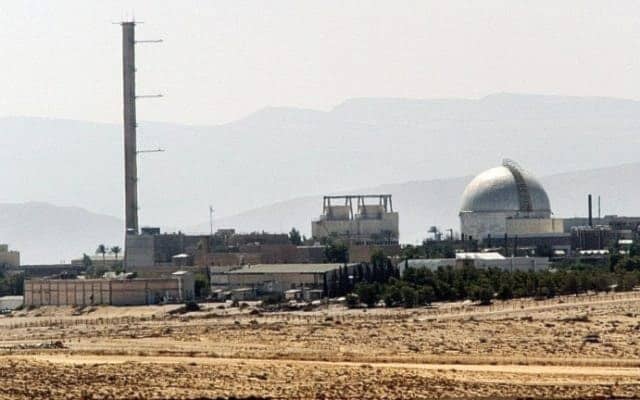
It is worth noting that the entity is estimated to possess between 200 to 400 nuclear warheads, making it the sole possessor of non-conventional arms in West Asia. Despite international pressure, “Israel” has refused to allow inspections of its nuclear facilities or to sign the Non-Proliferation Treaty (NPT).

https://mronline.org/2023/11/15/israeli ... -war-iran/#

********

70% of Gazans To Be Left Without Drinking Water Today: UNRWA

Image
Israeli tanks in Gaza, Nov. 15, 2023. | Photo: X/ @resistant1990a

Published 15 November 2023

The fuel received for the first time since Oct. 7 will not be directed towards water or hospitals.


On Wednesday, the commissioner of the United Nations Agency for Palestinian Refugees (UNRWA), Philippe Lazzarini, warned that the majority of Gazans will be left without drinking water today.

"Our entire operation is now on the brink of collapse. By the end of today, around 70 percent of Gaza's population will not have access to clean water. Having fuel alone to operate the trucks will no longer save lives. Waiting any longer will cost lives," he said.

Previously, the director of UNRWA in Gaza, Thomas White, indicated that the fuel received today in the enclave for the first time since the start of the war over a month ago has been restricted by Israel and will not be directed towards water or hospitals.

"It is terrible that fuel continues to be used as a weapon of war. For the past five weeks, UNRWA has been pleading for fuel to support the humanitarian operation in Gaza. This severely paralyzes our work and provision of assistance to Palestinian communities in Gaza," Lazzarini noted.


"Key services such as water desalination plants, wastewater treatments and hospitals have stopped functioning. Having fuel only for trucks will no longer save lives. Waiting longer will cost lives," he added, highlighting that at least 160,000 liters of fuel are needed daily for basic humanitarian operations.

Lazzarini also called on the Israeli authorities to immediately authorize the delivery of the necessary amount of fuel, as required by international humanitarian law.

Since the offensive against Gaza began on October 7, Israeli bombing and military actions have killed over 11,180 people, including 4,609 children and 3,100 women.

The Zionist occupation forces have not allowed the regular entry of sufficient quantities of fuel for the operation of hospitals, bakeries and water purification plants.

https://www.telesurenglish.net/news/70- ... -0003.html

Israeli Occupation Forces Raid Gaza's Largest Hospital

Image
Israeli soldiers outside the Al-Shifa hospital in Gaza, Nov. 15, 2023. | Photo: X/ @Allibleser

Published 15 November 2023

About 1,500 staff members and 7,000 displaced people are currently stuck in the Al-Shifa hospital.

On Wednesday, dozens of the Israeli army forces carried out a raid at the Al-Shifa hospital in Gaza City amid heavy gunfire.

Monir al-Bursh, director-general of the pharmaceutical department at the Gaza Health Ministry, said that "the Israeli army officially informed the hospital in a phone call that the raid was being carried out, demanding that people not approach windows, balconies or doors."

"There is nothing that would require shooting inside the hospital because there is no form of resistance there, and what the occupation is doing constitutes terrorism for those in the complex. About 1,500 staff members and 7,000 displaced people are currently stuck in the hospital," said Ashraf al-Qedra, the spokesman of the Health Ministry.

A few hours after the assault on the hospital, RT reported that the Palestinian authorities indicated that the Israeli Army executed over 30 people who tried to leave the Al Shifa hospital. The Gaza government accused Israel of spreading lies about the existence of safe passage from the hospital.

The text reads, "Israel breaks into Al-Shifa hospital."

Israeli tanks surrounded several hospitals in Gaza City over the past few days, claiming that they contain tunnels that constitute a base used by Hamas to shelter its leadership in addition to leading military operations against the Israeli army.

Both Hamas and the Gaza-based Health Ministry denied Israel's accusations, considering them "an attempt to mislead and incite in preparation for the destruction of hospitals and the killing of patients."

Before beginning the assault on Al-Shifa hospital, the Israeli occupation forces reportedly stated that they would provide a "safe corridor" for people to leave the medical center. Local sources, however, indicated that this measure was not implemented.

"Eyewitnesses showed that Israeli forces opened fire on doctors who tried to leave the hospital. In addition, it was reported that the military handcuffed and interrogated doctors and patients. They cut off all hospital communications," RT reported.

https://www.telesurenglish.net/news/Isr ... -0002.html

Israel, then and now: 'kill, kill them all'

Historically, the extremist ideology of Zionism has fully and openly sanctioned murder to achieve and maintain its goal of statehood. This includes Jews and non-Jews alike.


William Van Wagenen

NOV 14, 2023

Image
Photo Credit: The Cradle

On 7 October, the armed Palestinian resistance smashed through the Gaza border fence to carry out an unprecedented surprise assault on Israel, in which some 1,200 civilians and security forces were killed.

While Israel attributes its entire death toll to the resistance fighters, in particular Hamas and its military wing, the Al-Qassam Brigades, it has since been suggested that occupation forces may bear responsibility for a significant number of deaths.

This discrepancy blows a hole in the narrative pushed by Israeli and western media, which hyperbolically frames the Al-Aqsa Flood operation as the "deadliest single attack on Jews since the Holocaust."

The Hannibal Directive

But would Israeli forces willingly kill their own - and why?

The key lies in understanding that the primary goal of the resistance operation was the capture of prisoners of war (POWs)— both soldiers and settlers — to be taken back to Gaza. These captives were intended as leverage to press Israel to meet Hamas's demands, including ending the 17-year siege on Gaza and releasing thousands of Palestinians held without trial in Israeli prisons.

It is equally key to understand that Israel, doctrinally, will go to the most extreme lengths imaginable to prevent the taking of captives - including killing them. In an attempt to thwart Hamas from taking POWs, Israeli forces took drastic measures, including airstrikes on their own military base, firing tank rounds at civilian homes, and using overwhelming firepower to enforce the highly controversial Hannibal Directive.

This infamous military policy - which was altered but not removed in 2016 - allows commanders to sacrifice their own soldiers to prevent them from being captured, aiming to deny the enemy any leverage over the occupation state. A notable case was in 2006, when Hamas captured Israeli soldier Gilad Shalit on the Gaza border. After holding him captive for five agonizing years, Hamas was able to exchange Shalit for 1,027 Palestinians held prisoner in Israel.

‘Do you condemn Hamas?’

The issue of Palestinians targeting Israeli civilians is understandably a controversial talking point, especially in the west. However, Hamas justifies this by claiming all Israelis are settlers living on land stolen from Palestinians in 1948 during what is known as the nakba or “catastrophe.”

That year, Zionist militias employed rape and massacre as tools to effect the forcible “transfer” of some 750,000 Palestinians from the land needed to establish Israel. Future Israeli Prime Minister David Ben Gurion and other Zionist leaders understood that the majority of the indigenous population of British Mandate Palestine, the Christian and Muslim Arabs, needed to be “cleansed” from the land to create a state with a Jewish demographic majority.

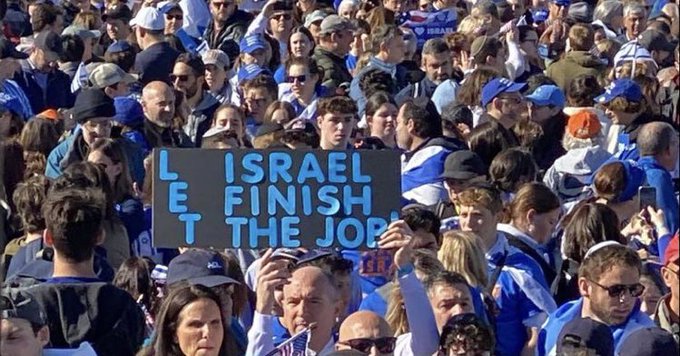
Today, many Israelis — civilians and politicians alike — are loudly calling for their army to “complete the job,” as Israeli historian Benny Morris described it, by ethnically cleansing and annexing those parts of Palestine they failed to conquer in 1948, namely the entirety of occupied-West Bank, including East Jerusalem, and the Gaza Strip.

In his book, “Going to the Wars,” historian Max Hastings writes that Benjamin Netanyahu, Israel’s current prime minister, told him in the 1970s that, “In the next war, if we do it right, we’ll have the chance to get all the Arabs out … We can clear the West Bank, sort out Jerusalem.”

In contrast, the Palestinians, the indigenous population, have done their utmost to resist the Zionist colonial project and defend their lands, their homes, and their existence as a people. The expectation that they would resist the Zionist occupation is recognized by Israel's first prime minister David Ben Gurion, himself an immigrant to Palestine from Poland:

“Let us not ignore the truth among ourselves … politically we are the aggressors and they defend themselves… The country is theirs, because they inhabit it, whereas we want to come here and settle down, and in their view we want to take away from them their country … Behind the terrorism [by the Arabs] is a movement, which though primitive is not devoid of idealism and self-sacrifice.”

A historical reckoning

Just as fiercely, the deeply ideological Zionists were prepared to do anything within their means to occupy Palestine and expunge its inhabitants. The historical record shows that this includes the willingness to sacrifice many of their own to advance their settler colonial project.

In 1938, as efforts were underway to evacuate Jewish children from Germany following Hitler’s Kristallnacht pogroms, Ben Gurion revealed that:

“If I knew that it was possible to save all the children of Germany by transporting them to England, and only half by transferring them to the Land of Israel, I would choose the latter, for before us lies not only the numbers of these children but the historical reckoning of the people of Israel.”

As detailed by Faris Yahya Glubb and Lenni Brenner, Zionism, and Nazism shared not only the goal of emptying Germany of Jews during this period but also the same fascist philosophical character, leading to collaboration between the two movements during this period.

Historian Avi-Ram Zoraf wrote that when faced with the choice between rescuing individual Jews and guaranteeing the sovereignty of the Israeli state, Zionism ignores the traditional Jewish commandment to redeem captives and instead demands the latter option.

Survival of the state

A critical examination of the events on 7 October reveals a pattern where, similar to the state's earliest leaders, Israel's current leadership prioritized the preservation of the occupation state's sovereignty over the lives of POWs taken by Hamas.

During a cabinet meeting on that fateful day, influential figures like Finance Minister Bezalel Smotrich urged the Israeli army to “hit Hamas brutally and not take the matter of the captives into significant consideration.”

After all, Hamas’ success in breaking out of its Gaza cage, despite the billions spent by Israel to build a high-tech border fence and surveillance system, threatened to shatter the myth of Israel's regional military superiority.

Tel Aviv is now desperately trying to reestablish the deterrence it once enjoyed by unleashing a wildly disproportionate military response on a civilian population in the Gaza Strip — in part, to scare off other adversaries in Iran, Lebanon, Iraq, Syria, and Yemen.

In just five weeks, the occupation army has killed over 11,000 Palestinians, over 65 percent of these women and children. In its campaign of daily massacres, Israel has employed 2,000 lb. bombs to destroy entire neighborhoods, as well as hospitals, markets, UN schools, and even an ancient orthodox Christian church, all with desperate Palestinian civilians sheltering inside.

In response to horrific videos emerging from Gaza of Israel’s slaughter, journalist Sam Husseini observed, “Israel lied about Hamas beheading babies so it could get away with blowing heads off babies.”

The Dahiya Doctrine

This is par for the course for Tel Aviv. What Gaza is witnessing today is what Beirut experienced in Israel's 2006 war. As Palestinian historian Rashid Khalidi explained, the Dahiya Doctrine was established to destroy entire urban populated areas from the air by Israeli forces - in this case, the entire southern suburb of Beirut, known as the Dahiya. Revealed publicly in 2008 by Major General Gadi Eizenkot, the deputy chief of staff of the Israeli military who commanded these forces during the 2006 war:

“What happened in the Dahiya quarter of Beirut in 2006 will happen in every village from which Israel is fired on … From our standpoint, these are not civilian villages, they are military bases … This is not a recommendation. This is a plan. And it has been approved.”

Unsurprisingly, Raz Segal, an associate professor of Holocaust and genocide studies at Stockton University, has called Israel’s current bombing campaign in Gaza “A textbook case of genocide.” Calling for the killing of all Gazans, not just members of Hamas, is now standard and accepted in Israeli public discourse.

Asked in an interview with Radio Kol Berama whether an atomic bomb should be dropped on the enclave, Israel’s Heritage Minister, Amichai Eliyahu, stated, “This is one of the possibilities … there is no such thing as uninvolved civilians in Gaza.”

Member of the Likud party and Knesset member Revital Gottlieb stated, “Flatten Gaza. Without mercy! This time, there is no room for mercy!”

“It's an entire nation out there that is responsible. It’s not true this rhetoric about civilians not aware, not involved, it’s absolutely not true,” stated Israeli President Isaac Herzog.

“If, in order to finally eliminate the military capabilities of Hamas … we need a million bodies, then let there be a million bodies,” said journalist Roy Sharon.

"Erase Gaza, don't leave a single person there,” stated Eyal Golan, a popular Israeli singer.

The Gaza annexation agenda

Tel Aviv is now actively using the Hamas-led resistance operation as a pretext to ethnically cleanse and annex Gaza, which has effectively been split in half by the invading occupation army. Israeli leaders wish to use the events of 7 October to carry out a second Nakba, just as Zionist leaders used the Holocaust to carry out the first.

This further explains why Israeli leaders such as Smotrich were willing to sacrifice hundreds of Israeli soldiers and settlers in the aftermath of Al-Aqsa Flood.

Since at least 2010, Israeli leaders have sought to forcibly displace Gaza’s 2.3 million people to Egypt’s Sinai, making them refugees once again, and then annex and recolonize Gaza.

They wish to rebuild the Gush Katif settlement bloc that was dismantled following Israel’s withdrawal from the Gaza Strip in 2005, as part of then Prime Minister Ariel Sharon’s “disengagement plan.”

Gush Katif, once home to 8,000 Jewish settlers, has been called a “lingering wound,” one still open and fresh for Israelis.

“It’s a trauma,” an Israeli named Hillel told i24NEWS in September last year. “The whole country was hurting.”

i24NEWS also noted that in July 2022, Religious Zionist candidate Arnon Segal wrote during his campaign announcement, "It is time to begin to plan a return to Gush Katif.”

In March of this year — well before Operation Al Aqsa Flood — Israeli Minister of National Missions Orit Strook told Channel 7 that Israelis would return to Gush Katif:

"Sadly, a return to the Gaza Strip will involve many casualties, just as the departure from the Gaza Strip came with many casualties. But ultimately, it is part of the Land of Israel, and a day will come when we will return to it."

As a result, Israel’s horrific bombing campaign in Gaza was quickly accompanied by Israeli demands that Palestinians in Gaza move to the south of the enclave and finally flee to Egypt.

On 17 October, Israel's former US Ambassador Danny Ayalon stated, “The people of Gaza should evacuate and go to the vast expanses on the other side of Rafah at the Sinai border in Egypt … and Egypt will have to accept them.”

On 28 October, a document issued by Israel’s Ministry of Intelligence was leaked recommending the Israeli army occupy Gaza and effect the permanent transfer of its inhabitants to Sinai.

Days later, the Biden Administration submitted a supplemental funding request to Congress for Israel and Ukraine, which included funds to build refugee camps in Sinai, as outlined in the Ministry of Intelligence plan.

Israel, at its most dangerous

Israel was willing to kill many of its own citizens and soldiers on 7 October to confront the threat to the sovereignty of the state posed by Hamas. At the same time, the death of these Israelis, accompanied by propaganda claiming Hamas committed horrific atrocities such as the discredited claims of raping women and beheading Jewish babies, also now provides Israel the opportunity to realize its goal to ethnically cleanse and annex Gaza.

It is, therefore, no accident that the events of 7 October were quickly branded as “Israel’s 9/11.”

The terrorist attacks on 11 September 2001 provided pro-Israel elements in the US government the opportunity to launch a global “War on Terror,” which included plans to invade and occupy Afghanistan and Iraq, while killing millions and unlocking trillions of dollars in spending to benefit the US’ military-industrial complex.

It is too early to tell if Israel will be successful in realizing its goals in Gaza, or whether Hamas and its allies in the Axis of Resistance will be able to prevent it. As the slaughter of Gazans continues, a desperate Israel appears to be at both its weakest, and at its most dangerous, prepared to kill any and all that stand in its way.

https://new.thecradle.co/articles/israe ... l-them-all
"There is great chaos under heaven; the situation is excellent."

User avatar
blindpig
Posts: 14838
Joined: Fri Jul 14, 2017 5:44 pm
Location: Turtle Island
Contact:

Re: Palestine

Post by blindpig » Thu Nov 16, 2023 11:18 am

What's happening in Palestine and Israel: chronicle for November 15
November 16, 2023
Rybar

Image

The IDF operation in the Gaza Strip continues . The information field is almost completely occupied by what is happening in the Al-Shifa hospital , where, in search of Hamas headquarters, the Israelis found Kalashnikov assault rifles, CDs and a laptop in the evening. There were no changes to the front line.

Attacks on various settlements in the enclave continue as usual. IDF aircraft bombed Khan Yunis , Al-Brej , Nuseirat camp and other populated areas. Through the Rafah checkpointMeanwhile, the first trucks with fuel entered Gaza

On the border with Lebanon , the confrontation has not changed. Hezbollah attacked at least six Israeli border posts, and the Israelis carried out strikes throughout the day in the outskirts of sixteen Lebanese villages.

About the main Hamas base under Al-Shifa hospital: is it there?

One of the most talked-about emotional moments of the Israeli operation in Gaza City is the assault on Al-Shifa Hospital, which began last night. The hospital is located in the northwestern part of the Ar-Rimal al-Shimali neighborhood , and IDF assault troops left it in the rear, slowly moving further along At-Torah and Al-Omar al-Mukhtar streets streets (the same media advance along a corridor wide 250 meters, where there are so many buildings for PR photos). The operation to seize the complex began last night.

The main narrative of Israeli propaganda: the Hamas headquarters is located under the hospital, it is a terrorist site.
The main narrative of Arab propaganda: Israelis bomb a peaceful hospital. To be fair, there really is a large-scale bunker under the hospital, because it was built by the Israelis themselves in 1983. It’s just that this bunker is talked about so often, as soon as another mess begins in Gaza, that it has already become the talk of the town.

That is, at the instigation of the Israeli media, for decades the Al-Shifa Hospital appeared in all media reports as “the main shelter of Hamas.” We, of course, do not rule out that such a convenient bunker under a socially significant facility is actually used for military purposes. But when the whole world knows where the headquarters of the Hamas group is located, wouldn’t the Palestinians think of connecting it with a network of tunnels to other catacombs, equipping a false headquarters, and placing a real control center anywhere, but not under the Al-Shifa hospital? ?

Progress of hostilities
Gaza Strip

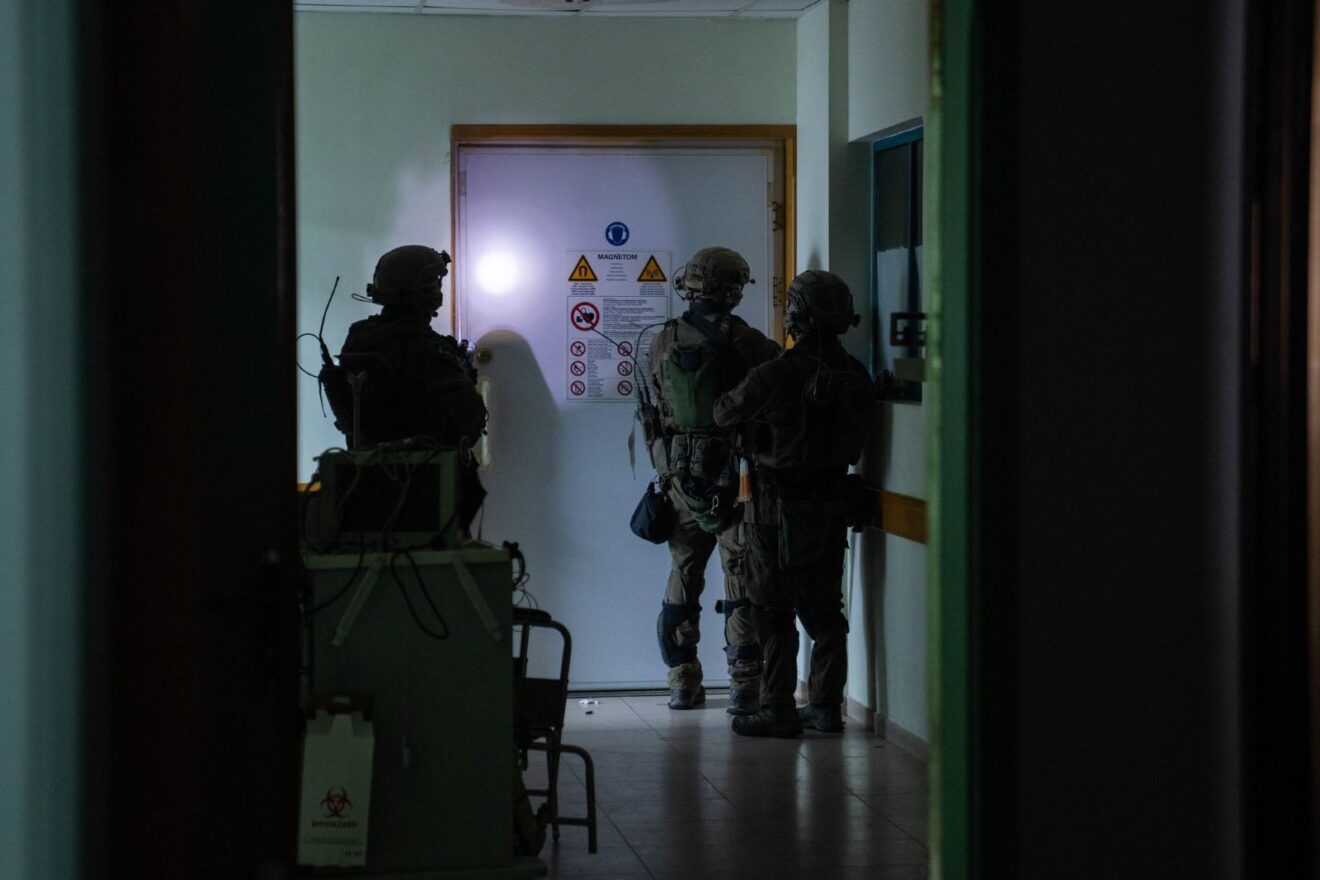
The main events in the north of the Gaza Strip unfolded around the Al-Shifa hospital , the assault on which began on the night of November 14-15. Contrary to claims about an “underground Hamas headquarters,” the public has not yet been shown anything that would indicate the use of the hospital as a cover for the headquarters.

The Israeli press has so far demonstrated only such undoubted attributes of terrorism as cameras in the corridors of the hospital, a small amount of small arms, and, attention - bags with Kalashnikovs and magazines, one of which was hidden behind an MRI machine, as well as a terrorist, but blurred laptop , and a stack of disks. There was no list of militants that matched the calendar in the Al-Shifa hospital.

As of today, no new evidence has emerged of the development of the IDF's offensive deep into Gaza . Therefore, it is impossible to verify the Israelis’ advance beyond the Al-Shifa hospital , which was stormed at night.

However, there are other videos: apparently, after the formation of an operational “gut” in the areas of Ar-Rimal al-Shimali and Ar-Rimal al-Janubi, IDF units moved on to “terraforming the area.”

These images show the explosion of the Gaza Legislative Assembly building, in which the Israelis held a reporting photo session a couple of days ago. Perhaps a springboard is now being prepared for moving deeper into Gaza. But in order to prevent attacks from the Palestinians in the rear, large buildings are demolished: they most likely contain exits from underground tunnels and the Hamas metro.

South direction
Palestinian sources report the distribution of leaflets calling on civilians to leave settlements east of Khan Yunis . There was a skirmish in the area of ​​the separation fence between Al-Suraij and Kissufim , and Kissufim itself is under fire almost daily. The possibility of opening another full-fledged IDF offensive front in the Gaza Strip in the near future is quite possible, although unlikely. However, frequent shelling of surrounding kibbutzim and military bases may well at some point become a catalyst for the offensive.

Since the morning, the world media have been discussing the sad fate of 79-year-old Bashir Haji . First, Israeli media show how IDF soldiers are helping him, and a couple of hours later his body is discovered with two bullet wounds.

Despite the fact that the Arabs paint a picture of a civilian being shot by the Israelis after he was used for propaganda, we, alas, will not know the truth: the old man could have been shot by both the Israelis and particularly zealous Hamas fans, considering him a lover of “Zionist education.”

Border with Lebanon
In the border areas everything is as before. Hezbollah routinely reported attacks on six border points and bases, and the IDF just as routinely carried out strikes on just under two dozen towns and surrounding areas. No casualties or injuries were reported. By and large, maintaining the status quo is relatively beneficial for both parties. Hezbollah can easily declare support for the Palestinian people, and Israel can escalate the situation with a “threat from the north.”

West Bank

In the Palestinian Authority of the West Bank, the situation, by and large, has not undergone any significant changes. Clashes occurred in Jerusalem , Tulkarm , Jenin and the village of Deir abu Dhaif amid IDF operations. The IDF detained several Palestinians in Hebron and five neighboring towns, as well as Jerusalem . In general, every day there is a decrease in protest activity. Whether the raids are yielding results, or whether it is a matter of routinization of the conflict, time will tell.

Actions of pro-Iranian formations in the Middle East

Image

And in Iraq , pro-Iranian formations launched a missile attack on the US base of Ain al-Assad with unknown success. The US Air Force, in turn, destroyed a transport with a launcher in the Anbar desert near the aforementioned base. In the evening, reports emerged that a US Navy ship had intercepted several UAVs in the Red Sea . According to preliminary data, the drones were flying from Yemen towards Israel , but there is also a version of an attempt to attack the destroyer Thomas Hudner DDG-116 .

Political-diplomatic background
On the skirmish between Erdogan and Netanyahu

The President of Turkey and the Israeli Prime Minister played a rather funny scene, creating the impression that a diplomatic crisis was brewing in the states. Erdogan called Israel a “terrorist state” and declared the presence of nuclear weapons. In response to Netanyahu accused Erdogan of supporting terrorism and Hamas, as well as attacks on Turkish villages in Turkey, apparently referring to Kurdish settlements in the southeast of the country.

However, behind the external aggravation lies an ordinary political game. Erdogan presents himself as the “protector of Muslims,” and Netanyahu as the “defender of the Jewish people.” But trade between the states has continued and continues, and the situation is unlikely to worsen further than mutual accusations.

On the continuation of the evacuation of Russian citizens from the Gaza Strip

Today, November 15, 88 Russian citizens crossed the Rafah checkpoint. Thus, the number of evacuees increased to 297 people. At the same time, Russian citizens abducted on November 7 during the Hamas attack are still in captivity. Russian Ambassador Anatoly Viktorov met with family members of the hostages and assured that “Russia is making vigorous efforts in the interests of the speedy discovery and release of

https://rybar.ru/chto-proishodit-v-pale ... -noyabrya/

Google Translator

******

Why the US needs this war in Gaza

Washington needs to win its Gazan war against Iran because it failed to win its Ukrainian war against Russia.


Pepe Escobar

NOV 15, 2023

Image
Photo Credit: The Cradle

The Global South was expecting the Dawn of a New Arabian Reality.

After all, the Arab street - even while repressed in their home nations - has pulsed with protests expressing ferocious rage against Israel's wholesale massacre of Palestinians in the Gaza Strip.

Arab leaders were forced to take some sort of action beyond suspending a few ambassadorships with Israel, and called for a special Organization of Islamic Cooperation (OIC) summit to discuss the ongoing Israeli War Against Palestinian Children.

Representatives of 57 Muslim states convened in Riyadh on 11 November to deliver a serious, practical blow against genocidal practitioners and enablers. But in the end, nothing was offered, not even solace.

The OIC's final statement will always be enshrined in the Gilded Palace of Cowardice. Highlights of the tawdry rhetorical show: we oppose Israel's “self-defense;” we condemn the attack on Gaza; we ask (who?) not to sell weapons to Israel; we request the kangaroo ICC to "investigate" war crimes; we request a UN resolution condemning Israel.

For the record, that’s the best 57 Muslim-majority countries could drum up in response to this 21st-century genocide.

History, even if written by victors, tends to be unforgiving towards cowards.

The Top Four Cowards, in this instance, are Saudi Arabia, the UAE, Bahrain, and Morrocco - the latter three having normalized relations with Israel under a heavy US hand in 2020. These are the ones that consistently blocked serious measures from being adopted at the OIC summit, such as the Algerian draft proposal for an oil ban on Israel, plus banning the use of Arab airspace to deliver weapons to the occupation state.

Egypt and Jordan - longtime Arab vassals - were also non-committal, as well as Sudan, which is in the middle of a civil war. Turkiye, under Sultan Recep Tayyip Erdogan, once again showed it is all talk and no action; a neo-Ottoman parody of the Texan “all hat, no cattle.”

BRICS or IMEC?

The Top Four Cowards deserve some scrutiny. Bahrain is a lowly vassal hosting a key branch of the US Empire of Bases. Morocco has close relations with Tel Aviv - it sold out quickly after an Israeli promise to recognize Rabat's claim on Western Sahara. Moreover, Morocco heavily depends on tourism, mainly from the collective west.

Then we have the big dogs, Saudi Arabia and the UAE. Both are stacked to the rafters with American weaponry, and, like Bahrain, also host US military bases. Saudi Crown Prince Mohammad bin Salman (MbS) and his old mentor, Emirati ruler Mohammad bin Zayed (MbZ), do factor in the threat of color revolutions tearing through their regal domains if they deviate too much from the accepted imperial script.

But in a few weeks, starting on 1 January, 2024, under a Russian presidency, both Riyadh and Abu Dhabi will expand their horizons big-time by officially becoming members of the BRICS 11.

Saudi Arabia and UAE were only admitted into the expanded BRICS because of careful geopolitical and geoeconomic calculations by the Russia-China strategic partnership.

Along with Iran – which happens to have its own strategic partnership with both Russia and China – Riyadh and Abu Dhabi are supposed to reinforce the energy clout of the BRICS sphere and be key players, further on down the road, in the de-dollarization drive whose ultimate aim is to bypass the petrodollar.

Yet, at the same time, Riyadh and Abu Dhabi also stand to benefit immensely from the not-so-secret 1963 plan to build the Ben Gurion canal, from the Gulf of Aqaba to the Eastern Mediterranean, arriving – what a coincidence – very close to now devastated northern Gaza.

The canal would allow Israel to become a key energy transit hub, dislodging Egypt's Suez Canal, and that happens to dovetail nicely with Israel’s role as the de facto key node in the latest chapter of the War of Economic Corridors: the US-concocted India-MidEast Corridor (IMEC).

IMEC is a quite perverse acronym, as is the whole logic behind this fantastical corridor, which is to position international law-breaking Israel as a critical trade hub and even energy provider between Europe, part of the Arab world, and India.

That was also the logic behind Israeli Prime Minister Benjamin Netanyahu's UN charade in September, where he flashed the whole “international community” a map of the “New Middle East” in which Palestine had been totally erased.

All of the above assumes that IMEC and the Ben Gurion Canal will be built – which is not a given by any realistic standards.

Back to the vote at the OIC, US minions Egypt and Jordan - two countries on Israel's western and eastern borders, respectively - were in the toughest position of them all. The occupation state wished to push approximately 4.5 million Palestinians into their borders for good. But Cairo and Amman, also awash in US weapons and financially bankrupt as they come, would never survive US sanctions if they lean too unacceptably towards Palestine.

So, in the end, too many Muslim states choosing humiliation over righteousness were thinking in very narrow, pragmatic, national interest terms. Geopolitics is pitiless. It is all about natural resources and markets. If you don’t have one, you need the other, and if you have none, a Hegemon dictates what you’re allowed to have.

The Arab and Muslim street – and the Global Majority - may rightfully feel dejected when they see how these “leaders” are not ready to turn the Islamic world into a real power pole within emerging multipolarity.

It wouldn’t happen any other way. Many key Arab states are not Sovereign entities. They are all boxed in, victims of a vassal mentality. They’re not ready – yet - for their close-up facing History. And sadly, they still remain hostage to their own “century of humiliation.”

The humiliating coup de grace was dispatched by none other than the Tel Aviv genocidal maniac himself: he threatened everyone in the Arab world if they don't shut up - which they already did.

Of course, there are very important Arab and Muslim brave-hearts in Iran, Syria, Palestine, Iraq, Lebanon, and Yemen. While not a majority by any means, these Resistance actors reflect the sentiment on the Street like no other. And with Israel's war expanding each day, their regional and global clout is set to increase immeasurably, just as in all of the Hegemon's other regional wars.

Strangling a new century in the cradle

The catastrophic debacle of Project Ukraine and the revival of an intractable West Asian war are deeply intertwined.

Beyond the fog of Washington's “worry” about Tel Aviv’s genocidal rampage, the crucial fact is that we are right in the thick of a war against BRICS 11.

The Empire does not do strategy; at best, it does tactical business plans on the fly. There are two immediate tactics in play: a US Armada deployed in the Eastern Mediterranean – in a failed effort to intimidate Resistance Axis behemoths Iran and Hezbollah - and a possible Milei election in Argentina tied to his avowed promise to break Brazil-Argentina relations.

So this is a simultaneous attack on BRICS 11 on two fronts: West Asia and South America. There will be no American efforts spared to prevent BRICS 11 from getting close to OPEC+. A key aim is to instill fear in Riyadh and Abu Dhabi – as confirmed by Persian Gulf business sources.

Even vassal leaders at the OIC show would have been aware that we are now deep into The Empire Strikes Back. That also largely explains their cowardice.

They know that for the Hegemon, multipolarity equals “chaos,” unipolarity equals “order,” and malign actors equal “autocrats” - such as the new Russian-Chinese-Iranian “Axis of Evil” and anyone, especially vassals, that opposes the “rules-based international order.”

And that brings us to a tale of two ceasefires. Tens of millions across the Global Majority are asking why the Hegemon is desperate for a ceasefire in Ukraine while flatly refusing a ceasefire in Palestine.
Freezing Project Ukraine preserves the Ghost of Hegemony just a little bit longer. Let's assume Moscow would take the bait (it won’t). But to freeze Ukraine in Europe, the Hegemon will need an Israeli win in Gaza - perhaps at any and all costs - to maintain even a vestige of its former glory.

But can Israel achieve victory any more than Ukraine can? Tel Aviv may have already lost the war on 7 October as it can never regain its facade of invincibility. And if this transforms into a regional war that Israel loses, the US will lose its Arab vassals overnight, who today have a Chinese and Russian option waiting in the wings.

The Roar of the Street is getting louder - demanding that the Biden administration, now seen as complicit with Tel Aviv, halt the Israeli genocide that may lead to a World War. But Washington will not comply. Wars in Europe and West Asia may be its last chance (it will lose) to subvert the emergence of a prosperous, connected, peaceful Eurasia Century.

https://new.thecradle.co/articles/why-t ... ar-in-gaza

*********

Accumulation Through War: Capitalism and the Blood of Gaza
NOVEMBER 13, 2023

Image
Graphic showing a missile silhouette with a stamp over it that reads "Made in Israel." Photo: Unknown.

Musa al-Sada – Nov 11, 2023

“History, unlike man, acts without any moral considerations. This history is evident in places like Gaza, where it is cheap to feed the population and it is very expensive to attack them with F-35s.” -Ali Kadri

There are many maneuvers and tricks that the Resistance used in camouflaging the preparation for the incredible surprise of October 7. Some may be revealed in the coming days while others will be documented in post-liberation museums and archives. Nevertheless, one cannot underestimate one of the pillars of the camouflage operation that made the intelligence of the occupying army drown in a parallel bubble to reality: the Zionist-imperialist mentality.

In September 2021, for the first time since the siege on Gaza began in 2006, the occupation allowed thousands of Palestinian workers from Gaza to work inside, meaning in the “Israeli economy.” This allowance is connected to two issues: firstly, it aligns with the essence of the Zionist historical process of colonizing Palestine and exterminating Palestinians, turning its people into refugees in their land and then exploiting these refugees for cheap labor under oppressive conditions in building the Zionist colonial economy.

However, the matter does not stop here, since we are discussing a settler-colonial replacement project, we must include the exploitation of Palestinian workers within the context of extermination. Allowing Palestinians to work is merely temporary until the settlers complete the full expulsion of all Palestinians, replacing the cheap labor with another provided by one of the normalizing Arab countries, such as Morocco, for example. This leads us to the second issue, which is turning the issue of exploiting workers into a tool of pressure and negotiation against Gazans and Palestinians in the West Bank, because these workers provide for the livelihoods of thousands of Gaza’s families.

Last August, a leaked communication revealed a conversation between a Zionist officer and a Gazan worker informing him of the cancellation of his work permit because his nephew participated in protests at the separation wall. As for the so-called coordinator, the coordinator of the “Israeli” government’s activities in the “Palestinian territories,” on his official and verified Facebook page (notice how capitalist companies document the work of usurping settlers on social media as if it were a normal thing), he directly threatened: “it is impossible to earn your livelihood by working in Israel on one hand and raising a family member involved in terrorism on the other. Our message is clear: either terrorism or your livelihood.”

Before the Al-Aqsa Flood operation, Hamas leadership, in what we can call a desperate negotiation operation, mobilized the youth to demonstrate at the fence with the enemy entity and launch incendiary balloons at settlements in the Gaza Strip to pressure the enemy to allow workers to go to work and facilitate the entry of external financial aid to the [Gaza] Strip. In other words, Gazans, to get a few dollars, must be targeted and their youth assassinated by the enemy army as a form of “negotiation.” (Translator note: this ended with the occupation allowing workers and opening checkpoints for them at night.) On one hand, the occupation is under pressure from settlers who need workers for their factories and investments, and on the other hand, pressure from other settlers who accuse it of submitting to the Palestinians.

This outcome, and the continuity of the imperialist exploitation of the people of Gaza, was one of the pre-eminent factors in the Zionist colonial mind that confirmed the Palestinian resistance would not escalate, because the exploitation of workers constituted a compelling factor that would force the resistance to submit. This, as we all know, did not happen.

Analyzed from this perspective, the Al Aqsa Flood Operation can be read as a Palestinian insurrection against the weaponized transformation of the capitalist exploitation process. The discussion here is not only about the Zionist capitalist structure but also about capitalism on a global level, and direct confrontation with Zionist-imperialism, which is important to define.

Understanding Zionism as Capitalism

There are numerous perspectives through which one can historically interpret Zionism, including cultural, identity-based, and political lenses. However, the dominant interpretation, weakened in recent decades in the Arab context, is the analysis and understanding of Zionism as an economic project representing the arm of Western capitalism. This means that we are not talking about a religious or nationalist movement, but a movement that plays an economic function while cloaking itself in religious symbolism and national myth. Therefore, every action it takes has an explanation and an economic benefit for European and American capital.

According to researcher Ali Kadri, whose thesis we will use in the following paragraphs, Zionism is one of the boldest projects of capitalism ever, grounded in Karl Marx’s assertion that large-scale displacements are the worst nightmares envisioned for the future of humanity. While the oppression and power of capital is not only exercised against the Palestinians, but, according to Kadri, in order to comprehend them, we must measure them against the same standard that a child from Gaza feels when a F16 fighter jet roars above her home. Yes, capitalism is a universal aggressor against humanity, but the historical force of capitalism has never been as condensed as it is in Zionist-imperialism. Here, we witness the ideological power of capital, as Westerners managed to weave a narrative about a divine promise to a group of Europeans of the land of Palestine to carry out ethnic cleansing. In short, imperialist power in Palestine is an intensified manifestation of imperialism worldwide.

Kadri asserts that the Western capitalist class power is represented by its institutions, ranging from the North Atlantic Treaty Organization (NATO), the International Monetary Fund (IMF), and the World Bank, to “Israel” as a colonial project. From this perspective, the centrality of the Palestinian issue becomes clear not only regionally but also globally. The struggle against Zionism is a struggle for humanity as a whole. Even a cultural reading of Zionism leads to the conclusion that the conflict against Zionism is a struggle for humanity, intensifying historically due to racism and the repugnant obsession with segregating people.

Because this is a struggle for all of humanity, whenever the Arabs and Palestinians submit to Zionism, capitalism strengthens its grip on the rest of humanity. Conversely, whenever Arabs and Palestinians triumph over Zionism, the imperialist grip on the peoples of the world weakens. Gaza is at the heart of this intensification because it is at the forefront of militarization and the capitalist process of accumulation through war.

On one hand, one might initially pose a seemingly logical question: wouldn’t sending food, medicine, and even rebuilding Gaza be cheaper than bombing it with bombs worth millions of dollars? How does it make sense to bomb a house with a bomb whose cost is exponentially greater than what it destroys? Isn’t that material loss and in contradiction with the capitalist principle of profit accumulation?

Gaza precisely answers these questions by understanding capitalism and the role of Zionism in it accurately. War here, contrary to the portrayal of mere material and financial losses, is part of the budget of the occupying entity and its economy, yes. But from a historical materialist perspective it is a process of capitalist accumulation. This accumulation through war makes war, for Zionism, a precondition of peace and continuity, culturally conditioned into [settler society] as Joseph Massad illustrates.

This can be understood from two perspectives. Firstly, the blood of the people in Gaza is, in a literal sense, profit calculated in dollars for American arms companies. With every residential block destroyed and every massacre in Gaza with a bomb like the MK84, for example, this, in the literal sense, is a figure recorded in the invoices of the US company General Dynamics Ordnance and Tactical Systems (GDOTS) and its budget for the year 2023. The other, more complex and detailed perspective, is that, according to the logic of capitalist accumulation, one of the main capitalist goals of accumulation and profit-making is to reduce the price and value of commodities and labor. The lower the price of labor, through deteriorating economic conditions in their country and pushing them to emigrate or work for Western factories at low wages, the more it is in the interest of German, United States, and British capital. Similarly, as the prices of natural resources used by capitalist companies for the production of their bombs and weapons decrease, it means more profits for the capitalist class in the West. When we talk about reducing the value of humans and land, we are talking about reducing the value of entire countries and societies. And this process is carried out through [imperialist] wars.

Most importantly, this is the primary role of Zionist-imperialism in the Arab world and globally. Just as the World Bank and the IMF provide financial tools for capitalism to accumulate profits and perpetuate poverty in Asia, Africa, and South America, “Israel’s” role is [perpetual] war and keeping the Arab world in a state of poverty and weakness. This is to reduce humans into mere inputs into the calculations of capital. Just as the process of reducing the value of Gazans to work in the economy of their enemy and to be killed on an industrial scale by [imperialist] military commodities, the fate of being Arab in our present era is to be Syrian, Iraqi, Yemeni, Lebanese, or Libyan, killed or displaced, working for the white man in Europe. Because your Palestinian brothers and sisters have been in the forefront for over seventy years, facing the killing machine without pause for decades, and because they are the subject of this historical profit-making process, this makes the mere existence of Palestinians an enemy of Zionism. The existence of the Palestinian is an enemy of the complicit elites, classes, and the normalizing Arab regimes–those elites who sold millions of Arabs to survive the onslaught of accumulation through war. This is what makes Arab resistance [against Zionist-imperialism] on every front, a battle for all of our futures.

https://orinocotribune.com/accumulation ... d-of-gaza/

*******

Image

They’re Just Insulting Our Intelligence At This Point

If Israel’s position were based on truth and morality it wouldn’t be churning out a nonstop deluge of obvious lies.

Caitlin Johnstone
November 15, 2023

Americans: healthcare please

US government: Sorry did you say billions of dollars for ethnic cleansing in the middle east?

Americans: no, healthcare

US government: Alright, you drive a hard bargain but here’s billions of dollars for ethnic cleansing in the middle east.


Here’s a tip: the side that keeps having to come up with justifications and explanations for why it’s fine and normal for them to be killing thousands of children and perpetrating ethnic cleansing is probably not the side that’s in the right.


I used to think it was bad for Israel to be massacring children by the thousands and bombing hospitals and shooting quadriplegics and children in hospital beds, but then Israel’s president waved an Arabic translation of Mein Kampf in front of a camera so now I think it’s good.


If Israel’s position were based on truth and morality it wouldn’t be churning out a nonstop deluge of obvious lies.

No one believes anything Israel says anymore. You either know Israel lies constantly or you know it but pretend you don’t.


You know how narcissists will do the most fucked up shit and if anyone calls them out they act all wounded and victimized like “Oh, what, I’m the bad guy now??” That’s Israel and its supporters.


Anyone who criticizes US-sponsored military violence gets accused of supporting the other side by supporters of that military violence. If you opposed the Iraq invasion you were a Saddam supporter, if you criticized US proxy warfare in Ukraine you were a Putin lover, etc. The argument is that criticizing the actions of the world’s most powerful war machine means you support the side opposing that war machine, and because you’re a treasonous monster who supports the other side that means your criticisms should not be listened to.

This happens with literally every single high-profile act of US interventionism. Literally every single one, without a single, solitary exception. What this means in effect is that all criticism of the world’s most powerful war machine is considered unacceptable and gets stomped down. Those who are calling you a Hamas lover and a terrorist sympathizer today are telling you that nobody should ever criticize any US-sponsored act of military aggression, because they’re using the exact same tactic that is literally always used to stomp out all US-sponsored acts of military aggression.

What they are really saying when they call you a Hamas supporter is, “Shut up. Be silent. Never criticize US warmongering. Never criticize the most consequential actions of the most powerful and destructive government on this planet, under any circumstances. Shut up. Be silent. Obey.”


It’s not okay for grown adults to believe Israel is “liberating” the people of Gaza.


The correct response to learning that Hamas has significant support in Gaza is not “Oh well exterminate everyone in Gaza then,” it’s “Wow, how hellish must Israel have made life in Gaza for that to be the case?”


It’s true that a Republican president would be as bad as Biden on Israel-Palestine, but the correct response to that isn’t “Oh well I’ll vote Democrat then,” it’s “If we’re not allowed to vote on whether our government murders children that means the entire system needs to go.”
Caitlin Johnstone
@caitoz
·
Follow
There is nothing more liberal than conducting a genocide in the middle east while waving pride flags as Hollywood goons applaud your brave progressivism.
leekern
@leekern13
LIBERATION🏳️‍🌈THE FIRST EVER PRIDE FLAG RAISED IN GAZA!
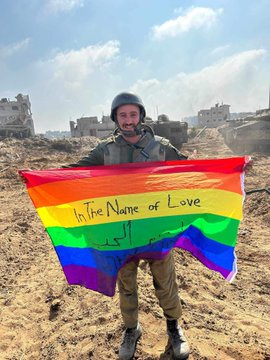
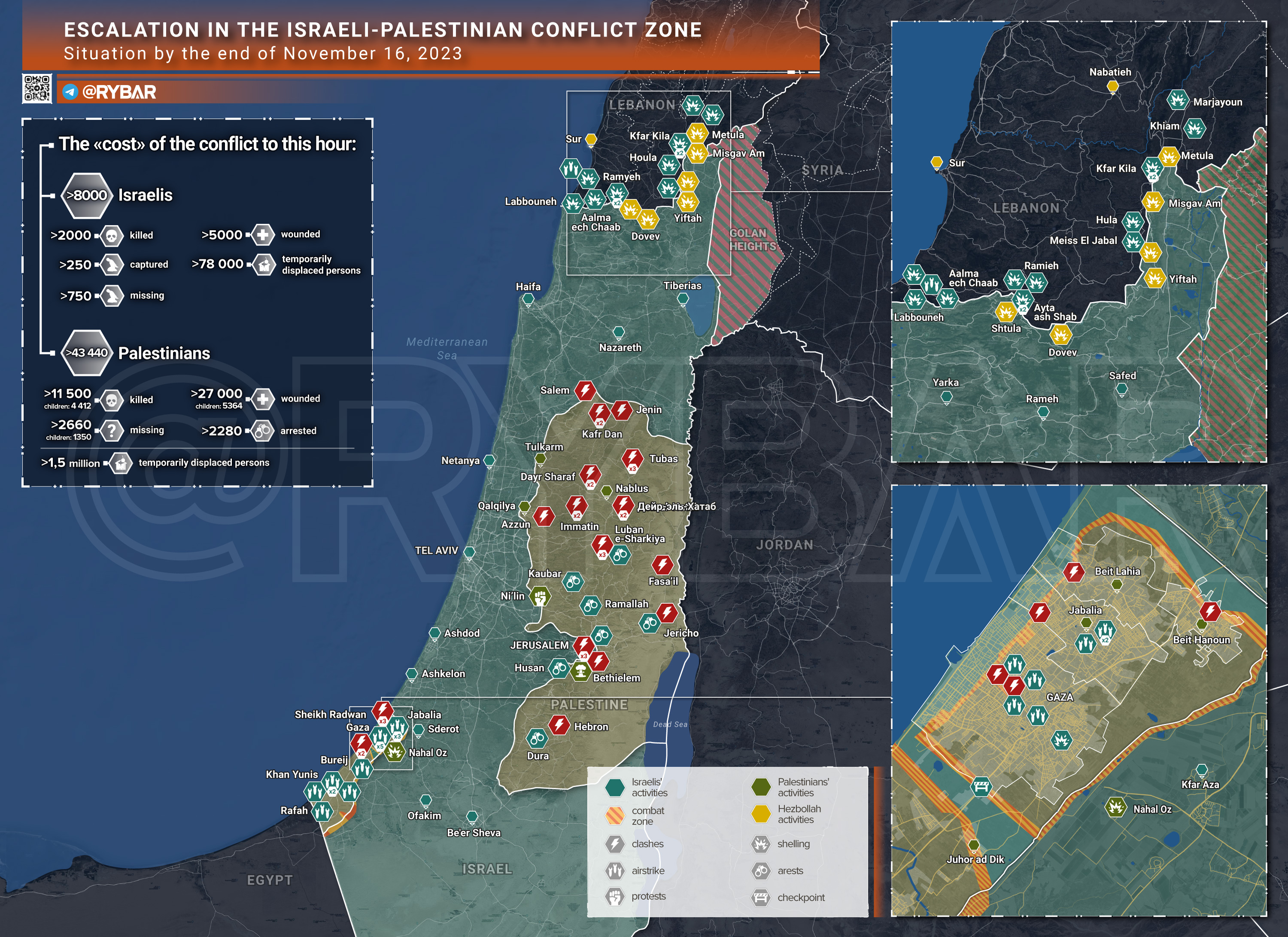
Under Hamas, being gay means death. Israeli Yoav Atzmoni wanted to send a message of hope. See his story below.

To Gaza’s hidden LGBTQ+ community: STAY HOPEFUL of a future where you can live and love free of Hamas!
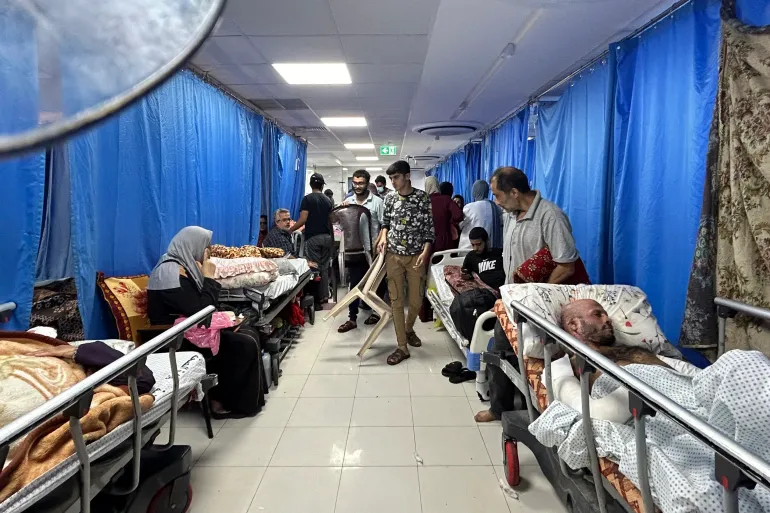
Image
6:04 PM · Nov 12, 2023
2.6K Reply Share

What’s wild is that this right now is the best the west will ever look regarding this Gaza issue. Public approval of a depraved western military action is always highest at the beginning, then as time goes on people start to realize they were lied to, and information starts coming out proving the whole thing was a sham. We’ve seen it over and over and over again, from Vietnam to Iraq to Afghanistan to Libya. Already people are starting to realize the proxy war in Ukraine was a terrible idea, and in a few years no serious person will dispute this.

But this time the western-backed destruction of Gaza is facing massive public disapproval when it’s just over a month old. As more and more information comes out and more and more westerners become aware of what exactly their governments supported in Gaza, it’s going to get much, much worse. That’s why you’re seeing billionaires freaking out and getting together to set up narrative management operations to try and manipulate public perception; they know they’re losing control of the narrative, and losing it much, much earlier than they should be.

But there’s only so many ways you can spin the murder of thousands of children. The old propaganda methods just aren’t working the way they usually do. Eyes are starting to open. People are starting to get angry. And the powers that rule over us are starting to get very, very nervous.

https://caitlinjohnstone.com.au/2023/11 ... his-point/
"There is great chaos under heaven; the situation is excellent."

User avatar
blindpig
Posts: 14838
Joined: Fri Jul 14, 2017 5:44 pm
Location: Turtle Island
Contact:

Re: Palestine

Post by blindpig » Fri Nov 17, 2023 12:24 pm

What is happening in Palestine and Israel: chronicle for November 16
November 16, 2023
Rybar

Image

The Israelis continue the ground operation in the Gaza Strip : fighting is taking place on the approaches to the Al-Wafa hospital, in the area of ​​Beit Lahia and Beit Hanoun, but there are no significant changes in the configuration of the front yet. By evening, Palestinian sources wrote that the IDF had moved to the Al-Ahly Baptist Hospital , which is closer to the city center, but there was no objective control footage from there yet.

Meanwhile, the Israeli command continues to convince the world community that the Al-Shifa hospital was the headquarters of Hamas , and that a large underground militant bunker underneath is still operational. As evidence, the IDF presented footage from the hospital, showing small arms, hand grenades and Islamic literature. However, such a “wide” range of weapons for Hamas headquarters looks, to put it mildly, unconvincing. The Israelis themselves probably formed a stronghold at the site.

The most notorious event of today was the terrorist attack at the Minharot checkpoint between Jerusalem and Bethlehem : three terrorists attacked the facility, injuring several civilians and killing one IDF soldier. After it was discovered that the militants were from Hebron , the Israelis began mass arrests of the city's residents, also arresting the mother of the deceased terrorist. Hamas predictably took responsibility for the attack.

There are no changes on the Israeli-Lebanese border: Hezbollah and the IDF are exchanging blows along the entire line of contact. Today, pro-Palestinian fighters attacked Israeli strongholds at Dovev, Shtula, Metula and Yiftah. The latter again responded with fire into southern Lebanon .

Progress of hostilities
Gaza Strip
In the north of the Gaza Strip, where Israeli troops continue their ground operation, the situation has not actually changed. Now the fighters continue to study the Al-Shifa hospital they previously occupied . The IDF press service periodically posts photographs online that allegedly prove that a large Hamas headquarters is located under the hospital .

However, this evidence looks unconvincing: in the photographs presented, the Israelis showed several magazines for small arms, body armor, Islamic literature and a collection of hand grenades. As one of our colleagues online correctly noted, “even school shooters have a richer arsenal used during attacks.” The IDF has not yet provided any other evidence, as well as facts about the presence of tunnels with militants under the hospital, where thousands of people were located. Meanwhile, according to Palestinian sources, the Israelis took several corpses of militants from the hospital morgue, and also began demolishing the southern buildings near the hospital to facilitate their further advance deeper into the Gaza Strip.


By the way, the finds in the Al-Shifa hospital are not the only attempts by the Israelis to prove that the militants were hiding behind the civilian population in the enclave: photographs of one of the houses in Beit Hanoun were also published, where Hamas allegedly stored rockets under the bed of a child.


There weren’t too many high-profile clashes in the enclave today: clashes regularly occur in the Sheikh Radwan area in Gaza, near Beit Hanoun , Beit Lahia and at IDF positions on the outskirts of Al-Wafa Hospital. Two Israeli soldiers were wounded during the fighting in the northern sector. By evening, there were also reports of Israelis moving toward Al-Ahly Baptist Hospital, but this information has not yet been confirmed. However, it is obvious that after the clearing of the western part of Gaza, which was announced by Israeli Defense Minister Yoav Gallant, the IDF is beginning to move further into the city.

But at the same time, Israeli aircraft almost continuously bomb encircled Gaza, and especially areas near IDF positions, as well as other cities in the strip, including Khan Yunis and Rafah in the south.

In addition, the Israelis today posted archival footage of battles in the Sheikh Ijlin area near the Mediterranean coast. The video was filmed about a week ago, when the IDF was just beginning to close the encirclement around Gaza from the west.


Meanwhile, the humanitarian situation in the enclave continues to deteriorate - today one of the largest Palestinian providers announced that it could not provide Internet service in the Gaza Strip due to running out of fuel.

South direction
There is a calm in the southern direction: Palestinian groups fired at Kibbutz Nahal Oz and several Israeli settlements along the Gaza perimeter, where reserve groups of the Israel Defense Forces are located.

Border with Lebanon
In the northern direction, fighting has become routine: Hezbollah fighters daily attack Israeli strongholds along the border with ATGMs and other weapons, while the IDF responds with artillery fire. Today, members of the pro-Palestinian group attacked IDF strongholds at Dovev , Metula , Shtula , Mitsgava Am and the Tsiklamen observation post .

The Israelis, in turn, traditionally launched a series of air and artillery strikes on Kafr Killa, Aita al-Shaab, An-Nakura, Beit Lifa, Ramiya and other settlements where, according to them, Hezbollah positions are located.


West Bank
The most striking event of today was the terrorist attack at the Ha Minharot ("Tunnels") checkpoint between southern Jerusalem and Bethlehem . Three terrorists drove up to the checkpoint and opened fire on Israeli security forces, wounding 7 people, including civilians. They were eliminated by return fire, and Hamas, as expected, took responsibility for the terrorist attack . Subsequently, it became known that one IDF serviceman was killed during a clash with terrorists.

Two of them are Arabs and come from Hebron . Two M-16 rifles, other small arms and ammunition were found at the scene. The Israeli command believes that they planned to organize a terrorist attack in Jerusalem itself, but the attack was prevented by the security forces. After the failure, the militants attacked the checkpoint mentioned above.


The Israel Defense Forces, in turn, responded with mass arrests of Hebron residents , including the detention of the mother of one of the killed terrorists. Predictably, clashes with Palestinians broke out in the city. Detentions and clashes also continue in Jenin, Tubas, the area around Nablus, Tuku, Jericho, Husan, Abu Dis, Kobar, Yatma and Jerusalem itself . In Abu Dis, security forces raided the local university and destroyed several classrooms.


Actions of pro-Iranian formations in the Middle East

Image

Pro-Iranian groups are not reducing their activity in Syria : at night, US Army positions near the Al-Omar field, not far from Deir ez-Zor , again came under fire . There has been no information yet about the details of the incident, as well as data on the number of deaths.

Political-diplomatic background
Negotiations for a temporary ceasefire

According to journalists from The Washington Post , Hamas militants agree to release 50 of the 240 hostages they hold in exchange for a three- or five-day ceasefire, expanded humanitarian aid to the Gaza Strip and the release of Palestinian women and children from Israeli prisons. At the moment, representatives of the group, as well as the US authorities involved in the negotiation process, are awaiting Israel's decision.

The Israeli media write that a meeting of the Israeli military-political cabinet is scheduled to take place this evening, during which the feasibility of such agreements will be discussed.

On limiting accounts of Russian investors in Israel

Consultants interviewed by RBC reported that Israeli banks have begun to limit operations on securities accounts of investors from the Russian Federation who have both Israeli and Russian citizenship. So far, mainly large banks have begun to separate accounts, and this was done at the request of the European depositary Euroclear. Those assets of Russian citizens that are accounted for through the above depository are blocked.

https://rybar.ru/chto-proishodit-v-pale ... -noyabrya/

Google Translator

Note: Those weren't 'terrorists', they were counter-terrorists'.

******

Israeli Deceit & the Ongoing Battle of Shifa Hospital
November 15, 2023

Gareth Porter says the claim that the largest medical center in the Gaza Strip provides cover for Hamas is the longest running theme in Israeli war propaganda, dating back nearly 15 years.

Image
Medic carrying injured Palestinian child into al-Shifa Hospital in Gaza City following an Israeli airstrike on Oct. 11. (Atia Darwish, Palestinian News & Information Agency — Wafa — for APAimages,
CC BY-SA 3.0)

This is a breaking story. Please come back for updates.

*Biden defends Israel incursion into al-Shifa hospital against Hamas ‘headquarters’ — The Hill. “You have a circumstance where the first war crime is being committed by Hamas by having their headquarters, their military, hidden under a hospital. And that’s a fact, that’s what’s happened,” Biden said on Wednesday.
*Nearly 24 hours after hospital raid no command centre, hostages, Hamas fighters nor arsenal is found — POLITICO (AP)


By Gareth Porter
Special to Consortium News

The Israeli military has attacked and is occupying parts of al-Shifa hospital in an ongoing operation in northern Gaza. It is the biggest and most modern hospital in Gaza, which has ceased to function normally because of lack of power, while tens of thousands of displaced Gazans take shelter in it.

An attack on a hospital is normally considered a clear violation of the rules of war. The Israeli Defense Forces is justifying it by claiming that Shifa has long served as civilian medical cover for the command center of the entire Hamas war operations and weapons storage.

That IDF claim has been cited constantly in Israeli propaganda as an argument that Shifa — and other hospitals in Gaza — should not be accorded the normal legal hospital immunity from attack.

Israeli forces closed in on Shifa while demanding for the last few days that the staff and patients remaining in the hospital be evacuated immediately. CNN reported Monday night that “the Biden administration has now signaled that it supports the Israeli position, as National Security Advisor Jake Sullivan declared on CNN’s State of the Union Sunday: ‘You can see even from open-source reporting that Hamas does use hospitals, along with a lot of other civilian facilities, for command-and-control, for storing weapons, for housing its fighters.’”

Those Sullivan remarks were an obvious green light for the IDF to press on for complete evacuation of the hospital.

The problem with that “open source reporting” is that it is never anything more than unsupported claims based on mere supposition. In fact, when the history of supposedly damning revelations about Shifa hospital providing cover for Hamas military activities are examined more carefully it becomes clear that it has been no more than a thinly veiled excuse for the IDF to attack and close down Gaza’s most important provider of medical care for the population of Gaza.


A History of Deception

The Israeli claim that Shifa hospital was providing such a cover for an Hamas military presence there is in fact the longest running theme in Israeli war propaganda on Gaza, dating back nearly 15 years to the first days of the Gaza war of January 2009.

That was when Yuval Diskin, the head of Israel’s domestic intelligence service Shin Bet, told Amos Harel of Haaretz newspaper that “many” senior Hamas officials were “believed” to be hiding in the “basements” of Shifa hospital, and that the Israelis knew all about those underground levels of the hospital, because they had originally been been built by the Egyptians before 1967 and extensively refurbished by the Israelis themselves in the mid-1980s.

Diskin also explained to Harel that Hamas was confident that it wouldn’t be attacked, because of the patients on the upper floors.

Image
Yuval Diskin in 2013. ( Ziv Koren, Wikimedia Commons,
CC BY-SA 3.0)

Apart from the fact that Israel’s intelligence service had admitted that it only suspected Hamas’ military presence under the hospital rather than having actual knowledge, Harel was, however, honest enough to report that his Palestinian contacts were telling him senior Hamas leaders never stayed in the same location but constantly moved from one location to another — a revelation that obviously made far more sense than the claim that those same senior Hamas officials were hanging out in a basement that was obviously well known to the Israelis.

Harel’s report also included a revelation — apparently from a Palestinian source — that raised problems for the nascent official Israeli propaganda line: “Some of the bunkers they are using,” Harel wrote, “were linked by tunnels Hamas built in recent years.”

The existence of numerous bunkers that could be used for command were thus independent of Shifa hospital, which the Israelis would always be able to invade. That reality clearly implied that it would make no sense for Hamas to depend on Shifa hospital for that purpose.

IDF Tale Resurfaces in Washington Post

Nevertheless, during the next Israeli-Palestinian war in July 2014, the IDF tale of the Hamas leaders’ secret hideaway in the basement of Shifa hospital re-emerged as if it were an unassailable fact that justified IDF threats to attack the hospital.

In a story published July 15, The Washington Post reported as unassailable fact that Shifa “has become the de facto headquarters for Hamas leaders, who can be seen in the hallways and offices.”

Post reporter William Booth clearly did not see Hamas leaders in Al Shifa himself. Had he done so, he would have described the scene and identified one or two Hamas figures who had been pointed out to him at the hospital So he was apparently passing on the self-interested claim of his Israeli interlocutors without informing Post readers that the information in question was far less reliable than it was made to appear.

Image
IDF soldiers in Gaza on July 24, 2014. (Israel Defense Forces, Flickr,
CC BY-NC 2.0)

The IDF became fixated on closing up another Gaza hospital in July 2014 Just two days after that initial appearance of the Shifa-Hamas theme in the 2014 war, Israeli airstrikes bombed Al Wafa Rehabilitation and Geriatric Hospital in Gaza City and forced its closure.

The IDF specialists created a video distributed three weeks later aimed at defending the destruction of Wafa hospital as a necessary response to Hamas using the hospital for military operations. But they had resorted to multiple levels of trickery to make their political point, as this writer discovered in investigating the video.

The IDF propagandists had spliced together videos from five years earlier and from different times of day so as to suggest that firing from an unused building more than 100 yards away from the hospital was a recent Hamas rocket attack on IDF forces. Then they spliced in an audio clip from an entirely different incident in which the IDF returned fire to try to show that the IDF bombing of Wafa hospital was justified.

At the end of July 2014, the Post reaffirmed its support for Israel’s primary propaganda theme in that six-week war. Terrence McCoy reported from Washington that Shifa Hospital had “become a de facto headquarters” of Hamas. That reporting reflected in turn the general readiness of much of the national press in Washington to accept the word of the Israelis as all they needed to know on that pivotal issue.

Eight years later, the same Israeli propaganda line immediately resurfaced after the Oct. 7 Hamas attack, as the Israelis mounted a new propaganda offensive. On Oct. 27, IDF Spokesman Adm. Daniel Hagari, briefed the International press on the main lines of Israel’s position regarding Shifa hospital and Hamas operations: He repeated the line that a bunker underneath Shifa is Hamas’ main base of operation, and that Hamas operates “several tunnels inside and under” the hospital.


Maximum Suffering

But Hamas’ tunnels outside Shifa could obviously be used for the same function of command of military operations without having to bother with Shifa hospital.

So the drumbeat of Israeli concern about the alleged Hamas command bunker underneath Shifa appears to have been a phony issue from the start, aimed merely at bringing pressure to bear on the medical system, namely to close down Shifa as the largest, most modern and most effective hospitals in Gaza to create the maximum amount of suffering to the people of Gaza.

As of Tuesday, Shifa Hospital had ceased to function, as it had no electricity, having run out of fuel. The Israelis gallantly offered the hospital 300 liters of fuel — enough to function for about six minutes according to the hospital’s calculation.

They thus failed to take any emergency action to save 36 babies facing possible death from the non-functioning incubators after three had already died.

The scene at Shifa hospital early on Wednesday was eerie, as Israel tanks rumbled into the hospital grounds and Israeli troops entered the darkened main hospital building.

IDF spokesman Hagari would say only that Israeli forces were carrying out an operation “based on intelligence information and an operational necessity” and that it was in a “specified area in Shifa hospital”.

Later Wednesday the IDF’s Peter Lerner told CNN that the operation at al-Shifa hospital was “ongoing” and would say only that it had not found any sign of hostages in the hospital.

The Gazans who have been staying in Shifa have been afraid to take the approved routes away from the hospital because of relentless Israeli attacks on civilians trying to do so. The IDF will no doubt continue to use force against the hundreds of thousands huddled there to make them leave.

And now that Israel has control over many thousand of military age males in the hospital, it is doubtful that they will allowed to go free, since they are considered as potential Hamas fighters.

The time has come for a reckoning on the long-running IDF propaganda ploy of claiming that Shifa has been used to hide Hamas’s command center.

Unless the IDF can show journalists convincing evidence of that long-claimed Hamas command presence under the hospital, the should stand for the truth and denounce that massive Israeli deception about Gaza.

https://consortiumnews.com/2023/11/15/i ... -hospital/

Chris Hedges: Pinnacle of Horror
November 15, 2023

Joe Biden will go down in history as an accomplice to genocide. May the ghosts of the thousands of children he has participated in murdering haunt him for the rest of his life.

Image
The Executioner’s Song – by Mr. Fish.

By Chris Hedges
in Doha, Qatar
Original to ScheerPost

I am in the studio of Al Jazeera’s Arabic service watching a live feed from Gaza City. The Al Jazeera reporter in northern Gaza, because of the intense Israeli shelling, was forced to evacuate to southern Gaza.

He left his camera behind. He trained it on Al-Shifa Hospital, Gaza’s largest medical complex. It is night. Israeli tanks fire directly towards the hospital compound. Long horizontal red flashes. A deliberate attack on a hospital. A deliberate war crime. A deliberate massacre of the most helpless civilians, including the very sick and infants. Then the feed goes dead.

[Israeli troops have since invaded the hospital itself and are in the midst of an operation there.]

We sit in front of the monitors. We are silent. We know what this means. No power. No water. No internet. No medical supplies. Every infant in an incubator will die. Every dialysis patient will die. Everyone in the intensive care unit will die. Everyone who needs oxygen will die. Everyone who needs emergency surgery will die.

And what will happen to the 50,000 people who, driven from their homes by the relentless bombing, have taken refuge on the hospital grounds? We know the answer to that as well. Many of them, too, will die.

There are no words to express what we are witnessing. In the five weeks of horror this is one of the pinnacles of horror. The indifference of Europe is bad enough. The active complicity by the United States is unfathomable.

Nothing justifies this. Nothing. President Joe Biden will go down in history as an accomplice to genocide. May the ghosts of the thousands of children he has participated in murdering haunt him for the rest of his life.

Israel and the United States are sending a chilling message to the rest of the world. International and humanitarian law, including the Geneva Convention, are meaningless pieces of paper. They did not apply in Iraq. They do not apply in Gaza.

We will pulverize your neighborhoods and cities with bombs and missiles. We will wantonly murder your women, children, elderly and sick. We will set up blockades to engineer starvation and the spread of infectious diseases. You, the “lesser breeds” of the earth, do not matter.

To us you are vermin to be extinguished. We have everything. If you try to take any of it away from us, we will kill you. And we will never be held accountable.

Image

No Values

We are not hated for our values. We are hated because we have no values. We are hated because rules only apply to others. Not to us. We are hated because we have arrogated to ourselves the right to carry out indiscriminate slaughter.

We are hated because we are heartless and cruel. We are hated because we are hypocrites, talking about protecting civilians, the rule of law and humanitarianism while extinguishing the lives of hundreds of people in Gaza a day, including 160 children.


Israel reacted with indignation and moral outrage when it was accused of bombing the al-Ahli Arab Christian hospital in Gaza, which left hundreds of dead. The bombing, Israel claimed, came from an errant rocket fired by Palestine Islamic Jihad. There is nothing in the arsenal of Hamas or Islamic Jihad that could have replicated the massive explosive power of the missile that struck the hospital.

The Israeli Military and Government Lie

Those of us who have covered Gaza have heard this Israel trope so many times it is risible. They always blame Hamas and the Palestinians for their war crimes, now attempting to argue that hospitals are Hamas command centers and therefore legitimate targets. They never provide evidence. The Israeli military and government lie like they breathe.

Medecins Sans Frontieres (Doctors Without Borders), which has staff working in Al-Shifa, issued a statement saying patients, doctors and nurses are “trapped in hospitals under fire.” It called on the “Israeli government to cease this unrelenting assault on Gaza’s health system.”

“Over the past 24 hours, hospitals in Gaza have been under relentless bombardment. Al-Shifa hospital complex, the biggest health facility where MSF staff are still working, has been hit several times, including the maternity and outpatient departments, resulting in multiple deaths and injuries,” the statement read.

“The hostilities around the hospital have not stopped. MSF teams and hundreds of patients are still inside Al-Shifa hospital. MSF urgently reiterates its calls to stop the attacks against hospitals, for an immediate ceasefire and for the protection of medical facilities, medical staff and patients.”

Three other hospitals in northern Gaza and Gaza City are encircled by Israeli forces and tanks, in what a doctor told Al Jazeera was a “day of war against hospitals.” The Indonesian Hospital has reportedly also lost power. The U.N. Office for the Coordination of Humanitarian Affairs (OCHA) reports that 20 of 36 hospitals in Gaza no longer function.

Image
Aerial picture of the Indonesian Hospital taken by the Israeli forces on Nov. 1. (IDF Spokesperson’s Unit, Wikimedia Commons, CC BY-SA 3.0)

Israel and Washington’s cynicism is breathtaking. There are no differences in intent. Washington only wants it done quickly.

Humanitarian corridors? Pauses in the shelling? These are vehicles to facilitate the total depopulation of northern Gaza.

The handful of aid trucks allowed through the border at Rafah with Egypt? A public relations gimmick. There is only one goal — kill, kill, kill.

The faster the better.

All Biden officials talk about is what comes next once Israel has finished its decimation of Gaza. They know Israel’s slaughter will not end until Gazans are living in the open without shelter in the southern part of the strip and dying because of a lack of food, water and medical care.

Image
Palestine solidarity march in London on Oct. 9. (Alisdare Hickson, Flickr, CC BY-SA 2.0)

Gaza before Israel’s ground incursion was one of the most densely populated spots on the planet. Imagine what will happen with 1.1 million Gazans from the north piled on top of over 1 million in the south.

Imagine what will take place when infectious diseases such as cholera become an epidemic. Imagine the ravages of starvation.

The pressure will build to do something. And that something, Israel hopes, will be to push the Palestinians over the border into the Sinai in Egypt. Once there, they will never return. Israel’s ethnic cleansing of Gaza will be complete. Its ethnic cleansing of the West Bank will begin.

That is Israel’s demented dream. To achieve it, they will make Gaza uninhabitable.

Ask yourself, if you were a Palestinian in Gaza and had access to a weapon what would you do? If Israel killed your family, how would you react? Why would you care about international or humanitarian law when you know it only applies to the oppressed, not the oppressors?

If terror is the only language Israel uses to communicate, the only language it apparently understands, wouldn’t you speak back with terror?

Israel’s orgy of death will not crush Hamas. Hamas is an idea. This idea is fed on the blood of martyrs. Israel is giving Hamas an abundant supply.

https://consortiumnews.com/2023/11/15/c ... of-horror/

******

US Asking Israel To Act Faster in Gaza To Protect Biden’s Approval Rating — Russian Agency
NOVEMBER 16, 2023

Image
US President Joe Biden warmly hugs Israeli Prime Minister Benjamin Netanyahu after arriving at Ben Gurion International Airport on Wednesday, October 18. 2023. Photo: Evan Vucci/AP/File photo.

At the same time, “numerous visitors from the US State Department and Defense Department declare a desire for immediate peace,” the agency said

The US is using backchannels to persuade Israel to speed up the operation in the Gaza Strip so that it does not affect President Joe Biden’s approval ratings ahead of the elections, the Russian Foreign Intelligence Service said.

The agency said Washington publicly states its allegedly concern about the indiscriminate bombardment of hospitals and refugee camps in the Gaza Strip. At the same time, “numerous visitors from the US State Department and Defense Department declare a desire for immediate peace,” the agency said.

“The truth, however, is that behind closed doors with the Israeli leadership, the Americans are having very different conversations. The Israelis are being urged to speed up the operation in order to prevent it from dragging out, as that would have a negative impact on [US President] Joe Biden’s electoral positions,” the agency said.

The intelligence service said the US administration “has once again resorted to its favorite tool: pharisaism, this time against the backdrop of the ongoing tragedy in the Gaza Strip.”

The agency also said the US is “aware that the accomplishment of the goal of destroying Hamas may lead to the killing of ‘a significant number’ of civilians.”

“However, as the White House believes, this is quite acceptable and will not entail depriving Tel Aviv of Washington’s support. The main thing is to end military operations as quickly as possible,” the intelligence service said.

Additionally, the Foreign Intelligence Service said the US, having secured the support of the UK and Germany, “intends to obstruct initiatives that provide for a ceasefire in Gaza.”

“Obviously, this is the US rules-based order that Washington offers to the rest of the world,” the agency stated.

Situation in the Middle East
The situation in the Middle East sharply escalated following an incursion of Hamas militants from the Gaza Strip into Israel on October 7. Hamas regards the attack as a response to Israeli actions against the Al-Aqsa Mosque on Jerusalem’s Temple Mount. Israel has declared a complete siege of the Gaza Strip and has started delivering strikes on that area and parts of Lebanon and Syria. Clashes are also taking place in the West Bank. Israel Defense Forces Spokesman Daniel Hagari on October 27 said the ground operation in the Gaza Strip was expanding.

(TASS)

https://orinocotribune.com/us-asking-is ... an-agency/

Priorities....

******

Moshe Dayan: ‘What Cause Have We to Complain About Their Hatred of Us?’
Posted on November 15, 2023 by Yves Smith

Yves here. This post looks at the deep historical roots of the Israel’s campaign against Palestinians, back to open acknowledgements by Moshe Dayan and other founding fathers of the nation and analogies to long-running political disputes in the US. It argues that an Israeli secular state is a solution.

The problem is that horse left the barn and is in the next county. As Alastair Crooke has described long-form, the Mizrahim, who were formerly an underclass in Israel relative to the European (and for the most part less intensely religious) Ashkenazi, now dominate numerically and in representation in the Knesset. From Wikipedia:

Today, the Ashkenazi vote is associated with left-wing, secular and centrist parties (especially Blue and White, Meretz, Kadima and historically Labour), and the majority of Mizrahim vote for right-wing parties, especially Likud, as well as the Mizrahi-oriented splinter party Shas…

Whereas Ashkenazi prominence on the left has historically been associated with socialist ideals that had emerged in Central Europe and the kibbutz and Labor Zionist movement, the Mizrahim, as they rose in society and they developed their political ideals, often rejected ideologies they associated with an “Ashkenazi elite” that had marginalized them. Although these tensions were initially based on economic rivalries, the distinction remained strong even as Mizrahim increasingly moved up the socioeconomic latter around 1990, entering the middle class, and the disparity between Ashkenazim and Mizrahim diminished (but did not completely disappear), with Mizrahi political expression becoming increasingly linked to the Likud and Shas parties. Likud, the largest right-wing party in Israel, became increasingly influenced by Mizrahi political articulation, with the Mizrahi middle class’ political coming-of-age held by political science commentators to be embodied by the rise of Mizrahi Likud politicians such as Moshe Kahlon and Miri Regev….

The Mizrahi turn to the right has been analyzed from many viewpoints. Some consider it a result of the failure of Ashkenazi progressive elites to adequately tackle racism against Mizrahim within their organizations. On the other hand, many Mizrahim came to credit Likud with their socioeconomic advancement, with Likud centers serving as hiring halls. Some models have also emphasized economic competition between Arabs and Mizrahim. However, other analysts partially or mainly reject the economic explanation, arguing that instead cultural and ideological factors play a key role. Whereas Ashkenazi Israelis tend to support left-wing politics, secularism, and peace with Arab peoples, the Mizrahim tend on average to be more conservative, and tend toward being “traditionally” religious with fewer secular or ultra-religious (Haredi) individuals; they are also more skeptical of prospects for peace with Palestinian Arabs. The skepticism towards the peace process among Mizrahim may be tied to a history of mistreatment by Muslim and Christian Arabs from when they were in diaspora in Arab countries, though many doubt that this alone is sufficiently explanatory.


The greater support among Mizrahim compared to Ashkenazim (48% versus 35% as measured by Pew in 2016) for the settlements in the West Bank has also been attributed to economic incentives and the fact that many working-class Mizrahim live there, often in subsidized housing.Another contributing factor is religious views among some Mizrahim who join the settlements. Although Mizrahim form a considerable portion of the settler population, with a particular concentration in and around Gush Katif, they often are ignored by public discourse about the settlements which tends to incorrectly paint all or most settlers as having North American origins, which a disproportionately large but still minority portion do.

And as David in Friday Harbor noted:

I find it endlessly fascinating that the two savage conflicts which currently threaten us with nuclear annihilation stem from the psychology of ethnic cleansing as practiced in Central Europe during the 20th century. I’ve been struggling to understand why Kiev feels entitled to “kick-out” the Russians of Donetsk and Luhansk and why Tel Aviv feels entitled to “kick-out” the Palestinians. I find myself returning to European ethno-nationalism, antisemitism, and the mindset of 1914-1945, which culminated in the infliction of so much suffering.

These motivations are important for us to understand because Climate Change threatens us with a mass-migration of 1.5 Billion people by 2050. The struggle over who “gets” to inhabit a certain patch of land will become existential for all of humanity.


By Thomas Neuburger. Originally published at God’s Spies

Image

Then-Defense Minister Moshe Dayan surveys the western side of the Suez Canal with Maj.-Gen. Ariel Sharon, in October 1973 (photo credit: DEFENSE MINISTRY)
I want to point to the intersection of two ideas and see what thoughts they lead to.

Moshe Dayan and the Creation of Israel

The first is this now-forgotten set of observations by Israeli Defense Minister (and Zionist “freedom fighter”) Moshe Dayan.

He has a strongly pro-Zionist past, a fighting past:

At the age of 14, Dayan joined the Jewish defence force Haganah. In 1938, he joined the British-organised irregular Supernumerary Police and led a small motorized patrol.

Haganah was “the main Zionist paramilitary organization that operated for the Yishuv in the British Mandate for Palestine. It was founded in 1920 to defend the Yishuv’s presence in the region, and was formally disbanded in 1948, when it became the core force integrated into the Israel Defense Forces shortly after the Israeli Declaration of Independence.”

In other words, a fighting Zionist true-believer.

Dayan had very strong opinions about the defense of Israel and what it would take to achieve it. One thing it would take is an unblinking acknowledgement of what Israel had done to acquire the land for its own.

Image

Image

Image

Dayan recognized what had been done to create the state of Israel. He understood, therefore, what it would take to defend it.

An Undoable Act

This theft of land is, in Arab eyes, an act that cannot be undone. It should be seen that way in Israeli eyes as well, because of its consequences.

In many ways, this is like Henry VIII’s theft of the wealth of the Catholic Church in England. Once taken and distributed, the act could not be undone, much like a murdered man cannot be brought back. In the time of Shakespeare, England was as Catholic as France; only the government and its dependents were Protestant. It took war to settle the dispute, several in fact.

So with this. It seems to me there must a war, or barring that, a return to the status quo ante, in which people in the occupied land are continuously tortured until they die or decide to leave.

There are only three ways this can go:

*One side will win, with Israelis or Arabs driven out.
*The torture regime will restart, each side afflicting the other as much as it can.
*A single, secular state will be created.

A secular state — not the vaunted two-state solution — is the only humane solution. That solution, if you’re not a religionist, seems certainly fair. The other outcomes lead only to rights abuse and war.

But a secular state — often called a “one-state” solution — is also unacceptable to Zionists. For them, it’s “Greater Israel or bust.”

Image
Israeli Prime Minister Benjamin Netanyahu holds up a map showing the occupied West Bank and Gaza as part of Israel during his speech at the UN General Assembly, 22 September 2023 (Reuters)

How to get past this problem? Consider the following.

Like the Abortion Battle

The battle for Palestine/Israel is like the US abortion fight in a single, crucial way. Until it’s completely won by one side or the other, the torture can last forever.

Americans seemed complacent, willing to see abortion limited in one cruel way after another, in one state and the next, so long as it was legal somewhere. They seemed content, in the aggregate, with a slowly eroding status quo.

My wife and I marveled at this, but it’s been true since the battle against Roe was first enjoined. The movement against the so-called ‘pro-lifers’ was small and ineffective; where we expected mass insurgency, we saw complaints and protests. There were victories, but it seemed that the most Americans were content to stand by, so long as the losses came in small enough doses that each one unremarkable compared to the last.

What the “pro-life” movement never should have done, was won completely.

Pro-choice people are now aflame with desire to reinstate Roe. We’ve seen this in the past few elections at the regional level. That new-found insurgence may, if the stars are aligned for the Democrats, re-elect Biden against a resurgent Trump.

To make the comparison clear, if the Right had not achieved total victory over abortion, had not repealed all of Roe, the pro-choice movement might never have grown this strong. Sad that is, but true.

The Road to Lasting Peace

Is the same thing true of Israel/Palestine? If the only alternative to war is a secular state, perhaps the only way to get there is for world opinion, face with a total war, to force on both parties.

What will a painful “peace,” a return to the status quo ante where hundreds are murdered, slowly and by both sides, actually achieve? And what’s the cost of achieving it?

Image

The hatred on both sides had already reached the youngest pre-October 7. It’s now metastatic. It will take 50 years to clear all of that out. And worse, the world may tolerate another half-century’s hate, since it’s tolerated the last.

In contrast, what would a “blowout battle” accomplish compared to its cost? Deaths will be horribly high. But faced with that, will the world finally force an end? Force a secular state, in which none have the upper hand?

I have no answers to this. But I strongly hope for peace, however achieved, and fear I’ll never see it.

******

US military base in Syrian territory attacked with missiles

Image
The Pentagon announced that its military forces have been victims of around 55 attacks in just one month | Photo: EFE
Published November 16, 2023 (16 hours 22 minutes ago)

This base had already been attacked previously a little less than a week ago with 15 missiles.

A US military base located in Syrian territory was attacked with missiles on Wednesday without any loss of life, but only material damage, after which several US planes were seen in the vicinity of the base, reported a source close to the US Department of Defense

Located near the Al Omar oil field, in the province of Deir ez-Zor, this base had already been attacked previously a little less than a week ago with 15 missiles. Now a fire broke out in the facilities as a result of the falling projectiles.


Local media declare that since the beginning of the escalation of the conflict between Israel and the Hamas resistance group, on October 7, and after the increase in support from the northern nation to the Hebrew country, attacks against US military bases have intensified. in the Middle East.

The Pentagon announced the previous day that its military forces stationed in Iraq and Syria have been victims of around 55 attacks in just one month, which caused material damage and injuries to dozens of soldiers. To date, some 2,500 US military personnel are stationed in Iraq and nearly 900 are stationed in Syria.


According to Sabrina Singh, deputy spokesperson for the Ministry of Defense, at a press conference: “There were 27 attacks against US forces in Iraq and 28 in Syria,” she stated.

https://www.telesurtv.net/news/atacan-c ... -0010.html

Google Translator
"There is great chaos under heaven; the situation is excellent."

User avatar
blindpig
Posts: 14838
Joined: Fri Jul 14, 2017 5:44 pm
Location: Turtle Island
Contact:

Re: Palestine

Post by blindpig » Fri Nov 17, 2023 9:25 pm

‘An Unyielding Will to Continue’: An Interview with Abdaljawad Omar on October 7th and the Palestinian Resistance
Posted by INTERNATIONALIST 360° on NOVEMBER 17, 2023
Abdaljawad Omar and Louis Allday

Image

Louis Allday: Thank you so much for agreeing to do this interview, Abdaljawad. I was blown away by your recent article in Mondoweiss, ‘Hopeful pathologies in the war for Palestine: a reply to Adam Shatz’, so I am very happy to be speaking to you.

Your article, as the title says, is a response to Adam Shatz’s article ‘Vengeful Pathologies’ that was published in the London Review of Books, but it’s actually about so much more than that and is honestly the best thing that I’ve read so far about October 7th. Could you explain your motivations in responding to Shatz’s piece and why you thought it was important to do so?

Abdeljawad Omar: In Adam Schatz’s piece, the element I find unforgivable is not his moral aversion to Palestinian violence – nor his condemnation of Palestinian resistance, nor even his adoption of what can only be described as a highly curated Israeli narrative shaped through military censorship and misinformation/disinformation to project a specific image of events in the Gaza envelope. The most critical issue is his reductionist view of resistance itself, equating it to ‘primordial instincts’ and unchecked passions while dismissing any other possibilities. Although I did not mention this in my critique, this is the revealing aspect – not necessarily of Shatz himself, but of an entire liberal analytical stream. This perspective not only morally dismisses resistance, as Judith Butler does, for instance, but also overlooks its political potential. Unlike Butler’s essay on the compass of mourning, Shatz at least attempts to delve into the political and military logic and possibilities. However, he ultimately dismisses them with dystopian, dark undertones, portraying the widespread increase of fascism as an inevitable outcome. He only offers us the nightmare. I think when thinkers offer only nightmares, they are consciously or unconsciously invested in the status-quo. They offer us the monsters so we remain committed to existing structures, to hinge our political wager on sustaining a reality, even if this reality means, as Ghassan Kanafani explicated, that Palestinians live in a world that is not theirs. For Shatz, the nightmare is on the horizon but for us Palestinians we live in the nightmare and have for at least 75 years.

This is a political sin par excellence, because if anything Palestinian resistance operates on a highly tangled architecture of emotions and passions – chief among them to employ its potencies and whatever meagre power to widen the horizon of political possibilities – to crack history open and yes, the nightmare is a possibility and yes, Palestinian resistance is imperfect, but the nightmare is not the only thing one on offer. For some of our so-called allies to foreclose those possibilities is to me ‘unforgivable’. I am less interested in aversions to violence or even to moral condemnations of Palestinian actions, and resistance like any other institution should be criticised. I remain however adamant, as history will show, that what happened in the Gaza envelope is profoundly different to how it was presented. Again this does not mean that Palestinian fighters did not kill any civilians, but the image presented to us is incomplete at best and a more complicated narrative will emerge when the battle subsides.

What this informs us, or tells us, is that many thinkers are capable of a stance that at its heart is anti-intellectual, and to me rejecting thinking is what you expect from fascists, not leftist or progressive allies. Zizek is another example; he speaks of Palestinian actions and resistance as a sign of Palestinian deprivation and desperateness. Indeed, accomplished philosophers and writers all of a sudden become reductionists and ideologues. When Palestinians are desperate [and] they do not turn to resistance, instead they become what Mahmoud Abbas has become – collaborators in their own slow but steady unmaking and erasure. Resistance is and always was a hopeful pathology, even if it ultimately fails to snatch a victory.

LA: Your words remind me of Mahdi Amel’s famous maxim, ‘you’re not defeated so long as you’re resisting’. Related to that and what you have just described regarding anti-intellectual reactions to Palestinian resistance, something that was very striking to me in the aftermath of October 7th was how few people – even those ostensibly supportive of the Palestinian cause – were either unwilling or unable to consider what the strategic aims and intentions behind launching such an operation actually were. Many people portrayed it simplistically, as some kind of inevitable or spontaneous explosion of anger and violence brought about by the long-term siege of Gaza and the suffering it inflicts. In your article you make clear why this is such a misleading and patronising position to adopt, notably as the Israeli narrative of events has collapsed so dramatically. Could you briefly explain your argument here?

AO: There is a rich genealogy and history of resistance, a consistent thread that has been largely ignored by both Western intellectuals and many Palestinians. Palestinian universities do not offer academic programs in resistance studies, this is a significant omission. Even detailed academic analyses, like those of Yezid Sayigh, which accurately depict the decline of the Palestinian revolution, are not exhaustive and at times are unsympathetic to the ability of Palestinians to dent the international system. The trope of the profane Palestinian fighter remains a figure misunderstood on their own terms, and it remains an orientalist trope. It celebrates, for instance, figures like Mahmoud Abbas for his collaboration and torture of Palestinians and even provides such figures with political and moral legitimacy, but places the Palestinian fighter outside the realm of comprehension or intellectual engagement. The space for Palestinians to articulate their struggle is confined within legal constructs and liberal narratives of victimhood, which offer only a superficial treatment of agency, civil resistance, and nonviolence, ignoring the harsh realities Palestinians face and the conditions that breed Palestinian liberation organisations. Paradoxically, and perhaps disgracefully, it is often scholar-soldiers, those most immersed in comprehending the Palestinian fighter and their military logic, who seek to understand this resistance only to undermine and defeat it.

Regarding the events in the Gaza envelope, the Palestinian military strategy was to target military and security installations with ambitions of taking over settlements and penetrating deeply into the territory. This guerrilla tactic aimed not just to thwart Israeli efforts to retake land but also to hold areas for negotiation, complicating and impeding an easy Israeli counterattack. This approach implicitly reveals that the Israeli counteroffensive was conducted with little regard for Israeli lives.

It is important here to note that Palestinian resistance operates as a ‘weaker’ force that is generally invested in finding cracks at opportune moments, to snatch an opening. With 2,000-3,000 fighters involved, and both sides taken by surprise by the offensive, much confusion occurs for those doing the penetration and those defending it. It stands to reason that if the outright intention had been to indiscriminately kill, the number of Israeli casualties in the initial days would probably have been significantly higher. The number of forces, the replenishment of these forces and their relative dominion over entire areas suggests as much. Thousands of fighters with hours in civilian space would have simply caused larger casualties.

The other aspect to consider is how deeply militarism is ingrained in Israeli society, evidenced by the widespread possession and knowledge of weaponry use. Observations from Israeli Twitter in the early days revealed journalists and residents discussing how they repelled and killed Palestinian fighters – not military or police, but civilians. This suggests that the confrontations involved not just the Israeli military and special units, but also civilian-soldiers and military-trained police officers. Again, these are only small parts of the larger picture but it remains important because Israel used and employed moral injury to declare its genocidal intent in the open against the Palestinians in Gaza.

LA: It is already plain to see to any informed observer that Israel has suffered a tremendous blow as a result of Operation al-Aqsa Flood, given the centrality of the military to its identity and the sense of security that it is supposed to provide to the population in a settler colony such as Israel. In your opinion, is this a psychological blow that Israel can recover from and what are its broader implications? Especially in light of the losses the Israeli military is currently suffering, both in Gaza and in the north due to attacks by Hizbullah that are growing in intensity and scope.

AO: Zionist supremacy has been shaped by a paranoiac view of the world, coupled with a military doctrine that revolves around the concept of an Iron Wall as articulated by one of Zionism’s founding fathers, Ze’ev Jabotinsky. Israelis are known for their ‘existential anxiety’ – a profound fear concerning the survival of the ‘Jewish state.’ Examination of their think tanks, newspapers, and military journals reveals an obsession with perceived threats: the growth of the Palestinian population, Palestinian resistance, the potential of an Iranian nuclear program, and even the capabilities of Arab militaries. Israel is perpetually vigilant, scanning the globe for any conceivable threat whether immediate or distant, hypothetical, or real.

However, paradoxically, this constant vigilance and the drive to transform the unknown into the known, to feel that everything is under control through a paranoiac lens – combined with advanced surveillance technologies, intelligence, cyber capabilities, AI, and both offensive and defensive military strategies – led Israel to believe in the invincibility of its Iron Wall. This belief was a pitfall. On the 7th of October, Israel’s perceived security was challenged; the nation had convinced itself of its safety, despite regularly articulating threats and acknowledging vulnerabilities. This public discussion of vulnerability paradoxically engendered a false sense of invincibility, further bolstered by recent Arab normalisation efforts.

Thus, the events of the 7th of October shattered this illusion of invulnerability. There is a stark difference between holding a threat or vulnerability as an abstract possibility and confronting it in reality as a traumatic actuality. Almost instantly, vulnerability shifted from a potential risk to a devastating reality – a ‘shattering experience.’ It was as if a ‘God’ suddenly realised their mortality or, in other words, a god discovered they were, after all, human. This is why in that moment we saw the transformation of Israel’s liberal and even supposedly leftist streams into fascist undertones. Ben Gvir emerged as a collective Israeli voice, with very small exceptions.

To me, the extent and depth of this experience depends on the current battle in Gaza, West Bank, and Lebanon. It hinges on the ability of Israel to fail in its offensive, denying Israelis an ability to stitch together a narrative of triumph after a drastic failure. But no matter the results of the ongoing campaign, the extent of trust and confidence in Israel’s security and military apparatus has been undermined.

Israel’s immediate response evokes the spectre of the Nakba and ethnic cleansing, along with the real possibility of driving Gazans to Sinai, before attempting the same with Palestinians in the West Bank. This should tell us that if Israel finds enough international willingness to turn a blind eye it will attempt to commit in this century another Nakba.

LA: The barbaric violence that Israel has unleashed on Gaza over the last five weeks has led to worldwide condemnation and outrage on a popular level, with repeated large-scale protests, marches, and other types of direct action happening all around the world in solidarity with Palestine. How important do you think this is? Do you think international solidarity can prove a significant factor in this struggle?

AO: Many think that solidarity with Palestine is a unidirectional action meant to provide Palestinians with support, a sense of psychological relief that our struggle does not meet deaf ears. I am more interested in the other side of the equation, on what the Palestinian struggle uncovers about the institutional, economic, and structural realities for those in the global north, the Arab world, and global south. To me the Palestinian struggle exposes truths, reveals fascisms, and emboldens trajectories of change, radical political, and economic change in these societies – or at least it should do so. Palestine is not a nationalist, nor a religious, nor a feel-good cause. It is not simply a ceasefire movement. Our gift to the world [was] given through our blood, especially for those interested in a more just, more economically equal, decolonial, deracialized world. The struggle we lead reveals hidden discourses of imperialisms and forces centres of power to reveal their schizophrenic stances and hypocritical posturing. This is why Palestine is a universal struggle, a place for the condensation of truth in a post-truth historical conjecture. It is also a place from which the imperial metropole, and those within it suffering from racialized inequalities, can see in Palestine and its struggle a natural and political affinity. Historically the Palestinian struggle galvanised the left, and helped construct new modes of political engagements. This is precisely the reason why pro-Israel networks are attempting to shut down the discussion through fear and intimidation tactics.

Having said that, from a purely political perspective, the lack of consensus on a long war in Palestine, the energies of mobilisation across the globe, the reinvigoration of anti-war movements, are all central to pressures on political power and to reduce the temporal space given for the offensive Israeli action in the Gaza Strip.

LA: For understandable reasons, much of the world’s eyes have mainly been focused on Gaza the last month but in that time Israel’s violence has also increased in the West Bank where you are. Could you tell us a bit about what has been happening there since October 7th, and how this links into the broader struggle against Zionist settler colonialism in Palestine?

AO: In the West Bank, there are two distinct but intertwined struggles. The first is an armed resistance that incorporates popular actions against Israeli settlers and the military. The second is a political battle directed against the Palestinian Authority (PA). While these conflicts are related, they also operate simultaneously and separately. The political unbinding from the PA is most evident among the working-class Palestinians in refugee camps, rural areas, and the old cities and is embodied in the creation of armed groups in some of these areas. This armed movement is often met with scepticism by the more dependent and politically disengaged upper and middle classes. Nonetheless, the PA is facing significant challenges. It is under pressure from these internal uprisings and a covert desire within the Israeli political spectrum – outspokenly represented by Ben Gvir and his settler movement – which suggests that even reliance on the PA and its security cooperation is a dependency that the Zionist movement ought to sever. This suggests a shift towards a more decisive military stance, aiming to displace Palestinians from their land. A third form of pressure arises from the indifference of American, European, and Arab stakeholders. The PA, adopting a wait and see strategy, could find itself at a disadvantage if the resistance in the Gaza Strip manages to endure and gain momentum.

Currently the Israeli army is conducting extensive operations in the West Bank. It is using its relative freedom of movement there to arrest and conduct special operations in self-defence zones in the North of the West Bank, such as Tul-Karem and Jenin. This is coupled with mass demonstrations and clashes by Palestinians in the West Bank. It has also engaged in a wide arrest campaign targeting political and social activists; since October 7th it has arrested over 2,000 Palestinians across the West Bank. Almost 200 Palestinians have been killed by the Israeli army and settlers in that time. More worryingly, the Israelis have also issued a wide arming campaign of settlers in the West Bank – officially inaugurating an active armed militia operating alongside the Israeli army in the West Bank.

LA: We recently published an article by Ameed Faleh in which he argues October 7th marks the ‘permanent death’ of the Oslo Accords. Would you share that sentiment? And if so, what do you think that means both for the West Bank specifically but also the future of the Palestinian Liberation movement generally?

AO: I align with the general direction of the analysis but reserve certainty, as I believe both relative victory and defeat are possible outcomes. It’s conceivable that we may emerge from this conflict with the PA and the neoliberal political paradigm strengthened. There could be a collective shock on the Palestinian side that facilitates the replication of Dayton’s security doctrine in the Gaza Strip. War is a transient moment, frozen in time. Although I am hopeful for a different outcome, we must recognize that Palestinians are a vulnerable people striving for survival. Their cooperation with, as well as resistance to, Israel are both anchored in the fundamental need to endure against forces that seek their eradication. These approaches are politically divergent but, at their core, are strategies for survival. The ongoing conflict in Gaza may compel Palestinians to commit more firmly to one form of survival strategy over the other.

LA: The extent to which Israel remains dependent on US military aid and support has been revealed very starkly over the last month, and it is clear that without it Israel is not a sustainable venture. There is clearly the risk of a large-scale regional war because of that, but do you think it’s conceivable that Israel could eventually be perceived as a liability to US interests by a significant enough portion of the US ruling class that their relationship could be fundamentally reconsidered? And if so, what would the implications of that be?

AO: I doubt that America’s ruling class will immediately acknowledge Israel as a strategic burden. Over the past two decades, we have heard scepticism about Israel’s strategic value from voices close to the establishment – these include military and foreign policy experts from prestigious institutions, as well as professors and academics in the foreign policy worlds. Yet, it’s crucial to recognize that the Israel lobby remains potent and influential and that the US for various historical, cultural, and electoral reasons will remain committed to Israel for the foreseeable future. A key argument of the lobby, and a component of America’s stance in the region, has been the erroneous belief that the Palestinian issue is a foregone conclusion and irrelevant to global affairs. This perspective was challenged and could be further undermined if Israel fails to achieve its goals in the ongoing conflicts in Gaza and the West Bank.

But perhaps what is also highly significant is that Israel required America’s military power to deter Hizbollah and Iran. Its self-proclaimed independence was exposed as a farce in front of its own society, but also within the domain of Zionist confidence that Israel is an embodiment of ‘Jewish’ independent power. Politically it also means that the US will be able to exercise more leverage on Israeli politics, on its long-term trajectories and on some of its internal policies and politics. It is not necessarily good news for Palestinians, but it shows the extent of Israel’s dependency on American military industries, financial prowess, diplomatic clout and system of alliances in the region. It also indicates who has the upper hand in the relationship, reversing the notion that the road to Washington moves through Tel-Aviv or Jerusalem. In fact, it shows that Tel Aviv is an outpost for American power – one that remains fragile.

However, it is important to point out that despite what I have just laid out, the Israelis are using the events of 7th of October to leverage American and European power, to settle scores and attempt to redefine political and strategic realities.

LA: In spite of the horror of what we have witnessed over the last month and the ongoing human suffering in Gaza and elsewhere, I am convinced that what we are witnessing is the beginning of the end of the Zionist colonial project in Palestine. Do you think that is an overly optimistic or unrealistic assessment on my behalf or is that something you feel could be the case too?

AO: One crucial lesson for the world to recognise is that the Palestinian struggle is intergenerational; it persists regardless of the immediate outcomes. Palestinians will persistently seek fissures to exploit, forge new paths, establish organisations, and mobilise their cultural, social, economic, and technological resources to reclaim their land. There is an unyielding will to continue, even when the tide seems to turn against them or when defeat appears to become systemic. The only answer to this indefatigable pursuit is justice. Indeed, the current conflict is a significant and pivotal moment in this enduring endeavour, and it will be a marker of what is yet to come in the long term.

Currently, there are several indicators that support your analysis. Palestine is emerging as an urgent issue on the global stage. Additionally, the Palestinian resistance has formed an active alliance system which is strategically complicating Israel’s offensive operations in the Gaza Strip. Israel is also enduring economic, political, and psychological tolls, which are fostering an immediate willingness to sacrifice but are simultaneously forcing it to grapple with the limits of its influence and capabilities. While the outcomes will hinge on the conflict’s progression and the potential for escalation in the region, various early signs suggest that Israel could be facing setbacks which transcend the events of October 7th.

Israel’s strategic objectives in Gaza appear disoriented. Despite some tactical successes, it remains to be seen how these will translate into long-term strategic gains within the limited timeframe available for military operations. It’s important to note that the American political and military engagement in the region does not align with Israel’s operational timeline in Gaza. Israel’s approach has been cautious and slow, seemingly unable to decisively overcome Palestinian resistance, which is strategically prolonging the conflict. It is prepared for a drawn-out struggle, conserving its resources and personnel for a sustained defensive battle rather than a short-term confrontation. Claims of deterring Hizbullah and Iran are, at best, temporary; the strategic calculations in Beirut and Tehran could shift quickly if no diplomatic resolutions emerge and redlines are crossed. While American and British citizens might be indifferent to the Palestine-Israel conflict, they are concerned about domestic issues such as rising inflation, economic decline, and the prospect of their soldiers being drawn into conflicts on the behest of Israel.

This is why the US is urging Israel to intensify and expedite its military operations. However, Israel is not only concerned about the potential backlash from civilian casualties but also fears that significant military losses could adversely affect public sentiment within the country. Currently, Israel is mobilising over 360,000 reserve soldiers and is also dealing with an influx of Israelis from the Gaza envelope and the borders with Lebanon. More than 200,000 Israelis are awaiting their return home. The situation is taking a substantial economic toll, affecting sectors like tourism, agriculture, restaurants, bars, and high-tech companies, many of whose employees are now engaged in military service. The escalating pressure from Hizbullah is compelling Israel to face tough decisions about whether to expand the war and use this moment of unity and willingness to sacrifice to confront Hizbullah or to de-escalate. Not to mention the pressure placed by the families of Israelis held by Palestinian groups in the Gaza Strip. Maintaining such a level of mobilisation without clear victories will prove difficult to sustain in the medium run.

These are all indications that currently Israel is looking for an image of victory, one that can give Israel and their military and intelligence apparatus some respite from the events of the 7th of October.

LA: Thank you so much for offering us your time and crucial analysis, Abdaljawad. Is there anything else you would like to add that we haven’t already touched on?

AO: Thank you, Louis. An important aspect that should be mentioned is the vehement attacks on pro-Palestinian voices. The conflation of antisemitism with the rejection of ethno-nationalist fascism would be almost amusing if it weren’t so tragic. Recently, we have seen Christian Zionists, who harbour deeply antisemitic views, join forces with right-wing Zionists from the Jewish community in demonstrations in Washington DC. This alliance illustrates that the weaponization of Jewish memory of precariousness and vulnerability is alive, but that in a tragic twist that weaponization can sit comfortably with actual antisemites. Moreover, it shows that discourses of antisemitism are not only tools used to silence pro-Palestinian voices but are also aimed at undermining Jewish and progressive support for Palestinians and their struggle. The fear created by banning student organisations, going after public figures supportive of Palestinian rights, is an Orwellian moment par excellence. Today, true courage involves speaking out despite the fears, continuously engaging in critical examination, and refusing to let any subject become taboo. This includes the criticism and understanding of Palestinian resistance, its history, evolution, and political wager.

Abdaljawad Omar and Louis Allday

Abdaljawad Omar is a writer, analyst, and lecturer based in Ramallah, Palestine. He currently lectures in the Department of Philosophy and Cultural Studies at Birzeit University.

Louis Allday is a writer and historian. He is the founding editor of Liberated Texts, the first published volume of which can be purchased via Ebb.


https://libya360.wordpress.com/2023/11/ ... esistance/

UN Experts Call on International Community to Prevent Genocide against the Palestinian People
Posted by INTERNATIONALIST 360° on NOVEMBER 16, 2023
OHCHR

Image

The international community has an obligation to prevent atrocity crimes, including genocide, and should immediately consider all diplomatic, political and economic measures to that end

Geneva, 16 November 2023 – Grave violations committed by Israel against Palestinians in the aftermath of 7 October, particularly in Gaza, point to a genocide in the making, UN experts said today. They illustrated evidence of increasing genocidal incitement, overt intent to “destroy the Palestinian people under occupation”, loud calls for a ‘second Nakba’ in Gaza and the rest of the occupied Palestinian territory, and the use of powerful weaponry with inherently indiscriminate impacts, resulting in a colossal death toll and destruction of life-sustaining infrastructure.

“Many of us already raised the alarm about the risk of genocide in Gaza,” the experts said. “We are deeply disturbed by the failure of governments to heed our call and to achieve an immediate ceasefire. We are also profoundly concerned about the support of certain governments for Israel’s strategy of warfare against the besieged population of Gaza, and the failure of the international system to mobilise to prevent genocide,” they said.

The bombardment and siege of Gaza have reportedly killed over 11,000 people, injured more than 27,000 and displaced 1.6 million persons since 7 October 2023, while thousands are still under the rubble. Of those killed, about 41 per cent are children and 25 percent are women. On average, one child is killed and two are injured every 10 minutes during the war, turning Gaza into a “graveyard for children,” according to the UN Secretary-General. Almost 200 medics, 102 UN staff, 41 journalists, frontline and human rights defenders, have also been killed, while dozens of families over five generations have been wiped out.

“This occurs amidst Israel’s tightening of its 16-year unlawful blockade of Gaza, which has prevented people from escaping and left them without food, water, medicine and fuel for weeks now, despite international appeals to provide access for critical humanitarian aid. As we previously said, intentional starvation amounts to a war crime,” the experts said.

They noted that half of the civilian infrastructure in Gaza has been destroyed, including more than 40,000 housing units, as well as hospitals, schools, mosques, bakeries, water pipes, sewage and electricity networks, in a way that threatens to make the continuation of Palestinian life in Gaza impossible.

“The reality in Gaza, with its unbearable pain and trauma on the survivors, is a catastrophe of enormous proportions,” the experts said.

“Such egregious violations cannot be justified in the name of self-defense after attacks by Hamas on 7 October, which we have condemned in the strongest possible terms,” the experts said. “Israel remains the occupying power in the occupied Palestinian territory, which also includes the Gaza Strip, and therefore cannot wage a war against the population under its belligerent occupation,” they said.

“In order to be legitimate, Israel’s response must be strictly within the framework of international humanitarian law,” the UN experts said. “The presence of underground tunnels in parts of Gaza does not eliminate the civilian status of individuals and infrastructure that cannot be directly targeted nor suffer disproportionately,” they said.

The experts also raised the alarm about the escalation of violence against Palestinians in the occupied West Bank, by soldiers and armed settlers. Since 7 October 2023, at least 190 Palestinians have been killed, more than 2,700 injured, and over 1,100 individuals displaced in the occupied West Bank. On 9 November, Israeli forces also bombed, for the second time, the Jenin refugee camp with heavy artillery and airstrikes, killing at least 14 Palestinians. The increasingly coercive environment has also led to forcible displacement of several communities of pastoralists and Bedouin People in the Jordan Valley and south of the Hebron Hills.

“We are deeply distressed at the failure of Israel to agree to – and the unwillingness of the international community to press more decisively for – an immediate ceasefire. The failure to urgently implement a ceasefire risks this situation spiralling towards a genocide conducted with 21st century means and methods of warfare,” the experts warned.

They also expressed alarm over discernibly genocidal and dehumanising rhetoric coming from senior Israeli government officials, as well as some professional groups and public figures, calling for the “total destruction”, and “erasure” of Gaza, the need to “finish them all” and force Palestinians from the West Bank and east Jerusalem into Jordan. The experts warned that Israel has demonstrated it has the military capacity to implement such criminal intentions.

“That is why our early warning must not be ignored,” the experts said.

“The international community has an obligation to prevent atrocity crimes, including genocide, and should immediately consider all diplomatic, political and economic measures to that end,” the experts said. They urged immediate action by UN Member States and the UN system as a whole.

In the short-term, the experts reiterated their call to Israel and Hamas to implement an immediate ceasefire, and:

Allow unimpeded delivery of desperately needed humanitarian aid to the people in Gaza;
Ensure the unconditional, safe and secure release of the hostages taken by Hamas;
Ensure that Palestinians arbitrarily detained by Israel are released immediately;
Open humanitarian corridors toward the West Bank, east Jerusalem and Israel, especially for those that have been most affected by this war, the sick, persons with disabilities, older persons, pregnant women and children;
They also recommended:

The deployment of an international protective presence in the occupied Palestinian territory under the supervision of the UN;
Collaboration of all parties with the Commission of Inquiry on the Occupied Palestinian Territory, including East Jerusalem, and Israel, and the Prosecutor of the International Criminal Court on the investigation opened in March 2021, as well as crimes arising from the recent events, underlining that the crimes committed today are partly due to a lack of deterrence and continued impunity;
Implement an arms embargo on all warring parties;
Address the underlying causes of the conflict by ending the Israeli occupation of the Palestinian territory.
“The international community, including not only States but also non-State actors such as businesses, must do everything it can to immediately end the risk of genocide against the Palestinian people, and ultimately end Israeli apartheid and occupation of the Palestinian territory,” the experts said.

“We remind Member States that what is at stake is not only the fate of Israelis and Palestinians, but a serious conflagration of the conflict in the region, leading to more human rights violations and suffering of innocent civilians,” they said.

* The experts: Francesca Albanese, Special Rapporteur on the situation of human rights in the Palestinian Territory occupied since 1967; Margaret Satterthwaite, Special Rapporteur on the Independence of Judges and Lawyers; Dorothy Estrada Tanck (Chair), Claudia Flores, Ivana Krstić, Haina Lu, and Laura Nyirinkindi, Working group on discrimination against women and girls; Surya Deva, Special Rapporteur on the right to development; Ravindran Daniel (Chair-Rapporteur), Sorcha MacLeod, Chris Kwaja, Jovana Jezdimirovic Ranito, Carlos Salazar Couto, Working Group on the use of mercenaries; Barbara G. Reynolds (Chair), Bina D’Costa, Dominique Day, Catherine Namakula, Working Group of Experts on People of African Descent; Pedro Arrojo-Agudo, Special Rapporteur on the human rights to safe drinking water and sanitation; Olivier De Schutter, Special Rapporteur on extreme poverty and human rights; Farida Shaheed, Special Rapporteur on the right to education; Damilola Olawuyi (Chairperson), Robert McCorquodale (Vice-Chairperson), Elżbieta Karska, Fernanda Hopenhaym, and Pichamon Yeophantong, Working Group on the issue of human rights and transnational corporations and other business enterprises; Siobhán Mullally, Special Rapporteur on trafficking in persons, especially women and children; Livingstone Sewanyana, Independent Expert on the promotion of a democratic and equitable international order; Balakrishnan Rajagopal, Special Rapporteur on the right to adequate housing; Ashwini K.P. Special Rapporteur on contemporary forms of racism, racial discrimination, xenophobia and related intolerance; Paula Gaviria Betancur, Special Rapporteur on the human rights of internally displaced persons; Mary Lawlor, Special Rapporteur on the situation of human rights defenders; Claudia Mahler, Independent Expert on the enjoyment of all human rights by older persons; Ben Saul, Special Rapporteur on the promotion and protection of human rights and fundamental freedoms while countering terrorism; Irene Khan Special Rapporteur for Freedom of Opinion and Expression; Ms Reem Alsalem, Special Rapporteur on violence against women and girls, its causes and consequences; Tomoya Obokata, Special Rapporteur on contemporary forms of slavery, including its causes and consequences.

The Special Rapporteurs, Independent Experts and Working Groups are part of what is known as the Special Procedures of the Human Rights Council. Special Procedures, the largest body of independent experts in the UN human rights system, is the general name of the Council’s independent fact-finding and monitoring mechanisms. Special Procedures mandate-holders are independent human rights experts appointed by the Human Rights Council to address either specific country situations or thematic issues in all parts of the world. Special Procedures experts work on a voluntary basis; they are not UN staff and do not receive a salary for their work. They are independent of any government or organisation and serve in their individual capacity.

https://libya360.wordpress.com/2023/11/ ... an-people/

******

Beyond rhetoric: Iraq's resistance front expands to US-Israeli war on Gaza

For the first time ever, the Iraqi resistance is throwing its military weight directly behind its Palestinian counterpart by positioning troops on two of Israel's borders and intensifying strikes on US occupation forces.


The Cradle's Iraq Correspondent

NOV 16, 2023

Image
Photo Credit: The Cradle

Since 17 October, Iraqi resistance factions have actively engaged in the West Asian conflicts that have unfolded in the aftermath of the Hamas-led resistance operation Al-Aqsa Flood.

Operating as part of the region's Axis of Resistance, these factions launched approximately 50 attacks on US military bases in Syria and Iraq, utilizing drones and Grad and Katyusha missiles. They have also threatened to employ precise long- and medium-range missiles against these targets. One notable incident resulted in 20 US soldiers being injured, as acknowledged by the US Department of Defense.

The Iraqi resistance has also initiated marches toward Israeli military bases in the occupied Palestinian territories. However, these actions were met with opposition from US air propulsion systems in Jordan and Israel.

Importantly, and for the first time since 2003, these operations mark Iraqi cooperation with the Palestinian resistance against Israel's occupation. They also serve to demonstrate the significant capabilities developed by the Popular Mobilization Units (PMU) in recent years, supported discreetly by Iran.

Iraq responds to the US-Israeli war against Gaza

After their victory over ISIS, Iraq's resistance factions have operated in a complex political and security environment, which include a direct US military presence inside the state, occasional Iraqi government hostility to the factions (former President Mustafa al-Kadhimi), a sharp internal Iraqi political division, and ongoing external interference, particularly from Saudi Arabia and the UAE.

Despite these circumstances, the factions have continued to build missile and drone capabilities and further consolidate their alliance with fellow Axis member, Lebanon’s Hezbollah.

But a definitive switch was flipped after the 7 October Palestinian resistance operation and Israel's merciless attacks on besieged Gaza and its 2.2 million inhabitants. These events prompted the Iraqi resistance factions - for the first time - to enter the conflict in support of their allies in Gaza.

Per their statements, the war on Gaza is perceived as an American-Israeli war and they have issued warnings that they will exert pressure on the US occupation forces, especially if there is any direct US military intervention on behalf of Tel Aviv.

To date, the key achievements of Iraq's resistance factions include:

First, defining US occupation forces in Iraq and Syria as legitimate targets for the Iraqi resistance. Notably, the US military refrains from responding within Iraqi territory because it cannot currently bear the consequences of an escalation inside Iraq that will push the resistance factions to intensify and expand its targets to new US sites and interests. The American forces instead focus on striking Syria, where it claims to target “Iran-backed” groups.

Second, the Iraqi resistance is publicly demonstrating its military support for its Palestinian counterparts. Despite this being a first, the Iraqi factions have been early, consistent, and reliable actors in providing vocal and active support for the Palestinian resistance within a week of Israel's assault on Gaza.

Third, sending a message to the US-Israeli alliance about Iraq's future involvement in key regional issues. This is unprecedented in many ways, and signals that these factions intend to play a role in military actions against their Axis, including in Palestine and Lebanon.

Fourth, having legally established the PMU as a formidable political and military force in Iraq, this balance of political power will be hard to overturn, particularly as its operations against US occupation forces - and potentially Israeli ones - enjoy popular support in the wider Arab world.

Waiting for the ‘zero hour’

The Iraqi Hezbollah Brigades Spokesman Jaafar al-Husseini affirms that attacks on US bases will continue and escalate in response to Israel's aggression on Gaza. He emphasizes the capability of the factions to target all US forces in Iraq - even those in the country's Kurdish-controlled north - saying: “The Americans know well the military and human capabilities of the resistance.”

One faction of the Iraqi Islamic Resistance, the Waad al-Sadiq Corps, has claimed responsibility for drone strikes on the Ain al-Assad base, the largest US base in the country, in response to the ongoing atrocities committed by Zionists in Gaza.

Meanwhile, the group's Secretary General Muhammad al-Tamimi says, “The resistance fighters are waiting for the zero hour to storm the border with Israel,” and notes that “the resistance is ready to enter the battle of Gaza without any delay.”

A source within one of the armed resistance factions reveals to The Cradle that his faction alone conducted “More than 17 strikes against the Ain al-Assad and Harir bases in Iraq, and the American forces stationed at the Conoco field in the [Syrian] northeastern countryside of Deir Ezzor.”

The source adds: "In just one day, on 7 November, the resistance factions carried out over five attacks against the American occupation bases in Ain al-Assad, Harir, Erbil Airport, and the Al-Tanf base in Syria."

Pentagon spokesman John Kirby announced in a statement that US forces “under the direction of President Joe Biden, launched precise defensive air strikes on the Iraqi-Syrian border, targeting facilities used by armed groups participating in attacks on US facilities in Iraq.”

Despite fervent US diplomatic efforts - via Omani and Qatari mediators - to dissuade the Axis of Resistance countries (Iran, Iraq, Syria, Lebanon, and Yemen) from openly supporting Gaza, attacks against US occupation forces in Syria and Iraq have only escalated.

These US efforts include intimidation tactics such as mobilizing its naval fleet in the Mediterranean Sea bordering Lebanon and Palestine, two major members of the Axis. But these measures failed, leading to US Secretary of State Anthony Blinken's 5 November Baghdad visit to pressure Iraq's government and issue threats against its Iranian-backed resistance.

According to a US State Department statement, Blinken reportedly discussed with Iraqi Prime Minister Muhammad Shiaa Al-Sudani “the necessity of not expanding the scope of the conflict,” and called on the Iraqi government to “hold accountable those responsible for the attacks against American forces..

Those calls were met with widespread popular and political rejection. Iraqi political activists demanded severing relations with the United States and removing its military forces from Iraq, while Sadrist movement leader Muqtada al-Sadr called for the closure of the US embassy in Baghdad.

Targeting US bases in Iraq and Syria

Presently, US forces are stationed in 22 military sites across Iraq, including ten main bases in locations as varied as Sinjar, Mosul, Qayyarah, Al-Tun Kubri, Halabja, Balad, Mansouriya, Al-Taji, and Al-Baghdadi (Ain al-Assad).

US soldiers are also deployed in three camps and other bases in Kirkuk, Victory Base at Baghdad International Airport - which is used for command, control, investigations, and intelligence information - and Habbaniya Base. The occupation forces have established concentration points in Albukamal on the Iraqi-Syrian border in Albukamal, near the strategic Al-Walid crossing, and at Al-Tanf base (with British forces) at the Syrian-Jordanian-Iraqi border triangle.

According to a high-ranking Iraqi intelligence source, there are over 22,000 military personnel and contractors inside US military bases in Iraq, covering various roles such as soldiers, advisors, trainers, monitoring officers, information analysts, technicians, and the Air Force.

In parallel, US forces maintain a presence in 20 bases and military sites inside Syria under the pretext of combating ISIS and training Iraqi forces. The main bases are located at Tabqa Airport, Rmelan, Al-Malikiyah, Tal Tamr, Farzeh, Manbij, and Ain al-Arab.

There are three additional military sites in Al-Hasakah Governorate and two in Manbij. Regional strategic experts argue that this substantial deployment of US forces goes well beyond an advisory role, and aligns with the broader US-Israeli project of balkanizing the region.

Mobilizing at the Jordan border

Aside from the attacks on US bases in Iraq and Syria, sources inform The Cradle that hundreds of Iraqi resistance fighters have already crossed into Syria and Lebanon in anticipation of an escalation in the regional war. On this, a military official from one of the factions says:

“The Iraqi resistance gained invaluable experience in urban warfare and challenging terrains during conflicts against the American occupation and ISIS. The majority of the resistance movements studied the battlefield with the Israeli side in detail, and the crossing points from the countries neighboring the Palestinian borders, and if the zero hour arrives, the Israelis will be surprised by the arrival of the fighters into the occupied Palestinian territories."

Simultaneously, Iraqi factions have mobilized thousands of men along Iraq's border with Jordan to pressure Amman to open the passage.

While the nearest Iraqi border point is 550 kilometers away from Gaza City and 373 kilometers from the Jordanian-Palestinian border - making crossing challenging without Jordanian approval - this has not deterred over 4,000 Iraqis from gathering near the Iraqi-Jordanian border. These individuals are not only members of Iraq's resistance factions but also include Iraqi community and tribal activists from all Iraqi sects.

The Cradle paid a recent visit to the Trebil border crossing (575 kilometers west of Baghdad), where a makeshift camp for thousands supporting the Palestinians has been established. As Abu Jaafar, one of the sit-in's organizers, reveals:

“This popular movement stems from a sense of responsibility towards the Palestinian issue, and an attempt to convey a voice to the world to show the oppression of the Palestinian people and to show that the Palestinian issue is the issue of all Muslims, not the Palestinians alone.”

Hassan al-Daraji, who is participating in the sit-in, tells The Cradle that “those present here are a small part of those who have the desire to reach the Palestinian border. Thousands of people are waiting for zero hour to cross the border.”


Some pro-west media outlets have attempted to spin what is currently a civilian gathering at the Iraq-Jordan border into something more sinister - a congregation of gunmen attempting to cross the Jordanian border. Abu Jaafar dismisses the claim altogether :

“The goal of the sit-in is peaceful solidarity and providing moral support with Gaza, as the organizing committee for the sit-in worked to collect donations of in-kind food items in the hope of allowing us to deliver them across the Jordanian-Palestinian border, and we are here to try to put pressure on the international community.”

In short, the actions of Iraqi resistance factions in the aftermath of Al-Aqsa Flood and Israel's aggression in Gaza mark a significant shift in their regional role and expanding capabilities.

By targeting the localized US military presence - Israel's primary backer and enabler - these factions are not only popularly redefining foreign forces as legitimate targets, but also demonstrating unprecedented direct military support for the Palestinian restistance.

https://new.thecradle.co/articles/beyon ... ar-on-gaza

********

Israel Captures Al Shifa Hospital for Their Gaza Military Post

Steven Sahiounie

November 17, 2023

In the face of millions of protesters across the world, we still have never once heard Biden call for a ceasefire.

Israel has insisted that the Al Shifa Hospital in Gaza is sitting on top of a network of tunnels which are the Hamas headquarters in Gaza. The Israeli government have offered no credible proof, and only cite secret intelligence as their source.

Lieutenant Colonel Peter Lerner, Israeli army spokesperson, told CNN the hospital and compound were for Hamas “a central hub of their operations, perhaps even the beating heart and maybe even a centre of gravity”.

U.S. President Joe Biden was not falling for their claims, and on Tuesday insisted that hospitals must be protected.

Israeli Prime Minister Benjamin Netanyahu called Biden, and Biden flip-flopped his position and gave the Israeli Defense Forces (IDF) the green-light to attack and occupy the hospital.

While CNN was covering the Trump trials, and the 2024 U.S. presidential race, Al Jazeera and other Middle Eastern media with journalists inside Gaza, were broadcasting images of terrified doctors and patients lining the halls of the hospital. Doctors on duty at the time reported that IDF soldiers were tying up doctors and health professionals in the hospital, while beating some Doctors and patients as well.

Where is the credible evidence to justify an attack and occupation of a hospital in a war zone? Human rights experts point out that hospitals, healthcare workers and ambulances are protected by international law.

Israel gets a lot of their secret intelligence from informants inside Gaza. People who are poor and need the paycheck, or those who may have an ideological difference with Hamas.

The other common source Israel depends on is torture. On October 7, the day of the Hamas attack on Israelis, some Hamas members may have survived and were captured. Every Palestinian arrested by the IDF are always tortured, including women and children.

Torture has been proven to produce worthless intelligence. Any person who is undergoing excruciating pain will answer anything to get the beatings to stop. Research has proven that the answers, or information you get from torture are mainly faulty, and this has caused many intelligence services in the Middle East and in the West to drop the practice.

Did someone under the pain of torture say that Al Shifa Hospital sits atop the Hamas command center?

A military expert in the Middle East, on the condition of anonymity, said that Hamas likely keeps the location of their headquarters secret, and the information is available on a ‘need to know’ basis. Only the most senior members would likely know the location, and the local informants would not have that information, nor would the fighters who participated on the October 7 attack.

The same military expert offered his theory: that the IDF want the Al Shifa Hospital as their headquarters because it is centrally located in the north, a substantial building, and has plenty of resources inside for electricity production and health care for the IDF. If his theory is correct, we may be presented with fabricated evidence of a secret Hamas headquarters by the IDF.

Regardless of how flimsy the evidence, the White House will rubber-stamp it with their seal of approval. We can’t forget General Colin Powell in Congress in 2003 with the small vial of baby powder claiming it to be Iraq’s weapons of mass destruction. Fabrications and lies are a specialty served up hot on a bed of media distortions by the Biden administration.

The IDF hurriedly deleted a social media post they made claiming that all hospitals and ambulances in Gaza were a legitimate military target as Hamas used them. They were working up to the Al Shifa Hospital attack and wanted to test the waters.

Gaza’s largest hospital, al-Shifa Hospital, located in northern Rimal in Gaza City, was built in 1946 during British rule.

“In Gaza, as Israeli forces enter Al-Shifa hospital, we call once again for the protection of medical staff, patients and displaced civilians sheltered inside the hospital,” Doctors Without Borders said on X.

“We are extremely worried for their lives,” it stressed.

“There are reports that some people who fled the hospital have been shot at, wounded and even killed,” wrote WHO on X on Saturday.

Decomposed bodies were buried in a mass grave at the hospital to ward off contagions. Dr. Ahmad Mokhallalati, a surgeon who is currently in the hospital, told Al Jazeera that gunshots can be heard surrounding the hospital.

Mokhallalati said 650 patients remain at the hospital, including about 100 in critical condition, with 2,000 to 3,000 displaced Palestinians seeking shelter in the building, and 700 medical staff.

36 premature babies were recently taken off their incubators because the station supplying them oxygen was destroyed in Israeli shellings three days ago, and three babies died.

The IDF have stripped naked people in the courtyard of the hospital amid rain and winter temperatures while interrogating them as Israel tanks approached while firing.

At least 11,320 Palestinians have been killed, including over 7,800 women and children, and more than 29,200 others have been injured, according to the latest figures from Palestinian authorities.

According to experts, the Al Shifa attack and occupation is part of the Israeli vision for a forceful displacement of everyone in northern Gaza. Food and water supplies have run out, and the destruction of the last remaining source of medical care is a strategic Israeli military goal.

“The war against [Hamas] is advancing with full force, and it has one goal: to win. There is no alternative to victory,” Netanyahu said on Saturday, and has rejected international calls for a ceasefire.

Netanyahu has clearly stated it is his goal to remain in Gaza as an occupying force indefinitely, despite the U.S., Egypt, and Jordan opposing such a plan.

Netanyahu also made clear he wanted Israel to retain overall security control after any conflict “with the ability to go in whenever we want in order to kill terrorists”.

In the face of millions of protesters across the world, we still have never once heard Biden call for a cveasefire.

https://strategic-culture.su/news/2023/ ... tary-post/
"There is great chaos under heaven; the situation is excellent."

User avatar
blindpig
Posts: 14838
Joined: Fri Jul 14, 2017 5:44 pm
Location: Turtle Island
Contact:

Re: Palestine

Post by blindpig » Sat Nov 18, 2023 12:39 pm

What is happening in Palestine and Israel: chronicle for November 17
November 17, 2023
Rybar

Image

In the Gaza Strip, clashes continue in the vicinity of Beit Lahia and Beit Hanoun in the northern sector, as well as in the vicinity of Al-Wafa Hospital in the southern one. The IDF has consolidated its previously occupied positions and is likely planning to carry out more incursions deep into Gaza in the near future.

Massive bombing of the enclave continues: today the IDF reported on the liquidation of the head of the Hamas Legislative Council, Ahmed Bahar, by air strikes. At the same time, the Israeli authorities allowed the import of up to 150 thousand liters of diesel fuel into the Gaza Strip through the Rafah checkpoint on the border with Egypt. However, only two diesel trucks will be able to enter the sector per day. This decision caused a negative reaction among far-right members of Israel's ruling coalition.

Another terrorist attack occurred in the West Bank today: a gunman opened fire from small arms at IDF fighters at the Zayt intersection on Route 35 north of Hebron . It was eliminated by return fire; military personnel and civilians were not injured. Meanwhile, raids by Israeli security forces in Palestinian cities continue: the most serious clashes took place today in Jenin .

There are no significant changes on Israel’s northern borders: Hezbollah has increased the intensity of attacks on Israeli strongholds and populated areas, but overall the situation in this area has not changed. During one of the raids on Menara, four Israelis were injured, one of them in serious condition.

Progress of hostilities
Gaza Strip
In the Gaza Strip, clashes continue in the northern area in the area of ​​Beit Lahia and Beit Hanoun: Palestinian groups periodically attack Israeli positions, causing damage to military equipment and personnel, but they are no longer able to recapture the territory. In addition, archival footage of the liquidation of several militants by IDF drones near Beit Hanun has appeared online.


In the southern direction, the IDF, according to some reports, has advanced deeper into the enclave to the Al-Ahly Baptist Hospital, but there is no objective control footage to confirm this yet. However, taking into account the fact that the IDF actually managed to encircle and gain a foothold in positions around Gaza, this looks logical - now the Israelis will try to take control of the main key facilities in the city, which, in their opinion, are allegedly used by Hamas. Periodically, clashes occur with militants on the outskirts of the Al-Wafa hospital in the Az-Zaytoun area.

Air strikes by the IDF continue throughout the Palestinian enclave: according to the Israeli command, during one of these attacks the head of the Hamas Legislative Council, Ahmed Bahar, was eliminated. It is interesting that today Palestinian sources wrote that Israeli planes scattered leaflets over Khan Yunis calling on residents to leave their homes. If this is indeed the case, then it is likely that the IDF will soon intensify its attacks on this populated area in order to facilitate ground operations there in the future.


In addition, today the Israeli authorities allowed the import of up to 150 thousand liters of diesel fuel into the Gaza Strip for the humanitarian needs of the Palestinians, whose situation is, to put it mildly, critical. Now two diesel trucks per day are allowed to enter. This was done, including under pressure from the West , but caused a sharp reaction from the most radical right-wing and ultra-Orthodox members of the government. Thus, Finance Minister Bezalel Smotrich and National Security Minister Itamar Ben-Gvir announced the need to expand the military-political cabinet and include members from each party in the ruling coalition. They consider the decision “strange” and advocate radical measures against the civilian population of the Gaza Strip.

The military-political cabinet will meet on Saturday evening to discuss this topic and the progress of the ground operation in the Palestinian enclave.

South direction
In the southern direction, militants, as before, are shelling kibbutzim bordering the Gaza Strip, as well as other large cities. In addition, this evening, Palestinian groups also shelled the center of Israel again: Givatim , Tel Aviv , Ashkelon , Sderot , Nirim , Holit , Petah Tikva , Shoham and other settlements came under attack.

Border with Lebanon
There are also no significant changes on the Israeli-Lebanese border: the intensity of Hezbollah’s strikes on Israeli strongholds and populated areas has increased slightly. Dvoranit, Rosh HaNikra, Biranit, Shtula, Adamit, Yiron, Malkiya, Yifta x and others came under attack today . As a result of the attack on Menara, four Israelis were injured to varying degrees. Additionally, the IDF intercepted a drone over Metula .

The Israelis, in turn, respond with massive fire throughout southern Lebanon, trying to burn out plantings in which Hezbollah fighters may be hiding.


West Bank
Another terrorist attack occurred in the West Bank : a Palestinian opened fire with small arms at IDF fighters at a checkpoint at the HaZayt intersection on Route 35 north of Hebron . The attacker was eliminated, and casualties were avoided.


In general, the situation in the region has not changed: Israeli security forces are massively arresting local residents suspected of sympathizing with terrorists, and the Palestinians in response are attacking them and trying to somehow resist. The most violent clashes today took place in Jenin , where, according to local sources, an entire “army” of Israelis entered the raid. At the same time, skirmishes continue in Tuku , Qalqilya , Tulkarm , Nilin , Beit Furik , Beitin and others.


Also, a video from the city of Budrus, west of Ramallah , where one IDF fighter, during the muezzin’s prayer, throws a flash-bang grenade at the mosque to silence him, caused a significant resonance in the Arab segment of the network. In Ramallah itself , attention was drawn to footage of unknown activists detaining citizens rallying in support of Gaza. Hamas-sympathizing users concluded that they were Palestinian National Authority police officers.


Actions of pro-Iranian formations in the Middle East

Image

Tonight, the Israeli army launched rocket attacks on the southern outskirts of Damascus : several shells were intercepted by air defense systems, but some of them still reached their target. Against this background, pro-Iranian groups once again attacked the positions of the US Armed Forces near Tell Beidar in northeastern Syria .

In Iraq , meanwhile, pro-Iranian forces attacked with drones the American Harir airbase near Erbil and a US military facility near Ain al-Asad in the center of the country.

Political-diplomatic background
Termination of armistice negotiations

Israeli Ambassador to Russia Alexander Ben-Zvi said that Hamas refused negotiations on a ceasefire and the release of hostages. It is not known for certain how the negotiation process is actually going. The United States is showing significant activity in it , trying to somehow ease the burden for the Palestinians so that the ratings of the Democratic Party and Biden among the Arab and pro-Palestinian population do not completely fall into the abyss on the eve of the country's presidential elections. But for now it is difficult to talk about any kind of ceasefire.

https://rybar.ru/chto-proishodit-v-pale ... -noyabrya/

Google Translator

******

Paid rally for Israel in Washington DC
November 17, 9:3

Image

Paid Pro-Israel Rally in Washington

"Israel on Campus Coalition is funded by pro-Israel billionaires like Bernie Marcus, founder of Home Depot, and Jan Koum, founder of WhatsApp," Michael Tracy said.

Image

The Israel on Campus Coalition's website says it has "committed all funds" to the event to pay for "thousands" of students to attend and encourages young people to stop by later as they fund students' participation in other "pro-Israel initiatives." on college campuses.

Image

Image

While Americans are being denied access to pro-Palestinian events (and immigrants are being threatened with having their US visas revoked), you can get paid to attend astroturfed pro-Israel events.

An Al Jazeera undercover documentary in 2016 revealed that pro-Israel groups paid tens of thousands of dollars to attend pro-Israel protests on American college campuses: They specifically
targeted Students for Justice in Palestine. for Justice in Palestine, which was recently banned by Gov. Ron DeSantis in Florida, as well as Brandeis University and Columbia University (First Amendment be damned).

The most viral moment of Tuesday's event was when Van Jones, after giving a speech praising Jews for leading the civil rights movement in America, was booed and chanted for being a "peace man" and "praying for peace." " from all sides.

“I pray for peace - that there will be no more rockets from Gaza and no more bombs falling on the people of Gaza. God protect the children,” Van Jones said before being drowned out by a crowd chanting "no ceasefire".

Image

Image

Michael Tracy shared other highlights from Tuesday's astroturf-style event:

Forensic historian Deborah Lipstadt speaks at the March for Israel today on behalf of the Biden administration. She makes no distinction between anti-Semitism and criticism of Israel, instead vowing that the full might of the federal government will be devoted to combating "Jew-hatred" pic.twitter.com/dodqPTQZ4U Chuck Schumer, along

with Speaker Mike Johnson and others, gave a rousing speech at March for Israel today in Washington. He leads bipartisan chants of “We stand with Israel,” “USA!” USA!" and “Never again!”

"We will not rest until you get all the help you need!" Vows Schumer

Hakim Jeffries gives a history lesson about the expulsion of Jews, dating back to ancient Roman times. He promises to "quell anti-Semitism" and says the US should always be a "safe space" for the "Jewish community"

Pastor John Hagee, who preaches that Christ will soon return to rule the Earth from Jerusalem, at the March for Israel today in Washington :
“The Bible says: he who keeps Israel neither slumbers nor sleeps... Israel is the apple of God's eye... Nothing can replace victory!”

http://newsstreet.ru/blog/inosmi/33395.html - zinc
https://www.informationliberation.com/?id=64124 - zinc

Smelled of 200 hryvnia rallies on the Maidan in Kiev “stand up for Yushchenko” or “stand up” for Tymoshenko." Now this is called “micro-granting”.

https://colonelcassad.livejournal.com/8771992.html

Google Translator

In Jordan, mass protests for Palestine express “a general popular sentiment”

Thousands of Jordanians have mobilized in protest against the Israeli genocide in Gaza and forced their rulers to stand against bullying from the US and Israel

November 17, 2023 by Abdul Rahman

Image
Mass protests in support of Palestine in Amman, Jordan.

Jordan has been at the center of West Asian protests against the ongoing Israeli war in Gaza which has killed over 11,500 Palestinians mostly children, women and elderly since it began on October 7.

One of the largest protests was registered on October 20 after the news of Al-Ahli Hospital attacks in which close to 500 Palestinians were killed. Protests, sit-ins, and rallies in the Jordan valley, on the border with the occupied West Bank, or in front of the Israeli and US embassies, have occurred on almost a daily basis since the beginning of the war. These actions have intensified with the rising death toll and continued atrocities.

Osama Abo Zineddin, a member of the Communist Party of Jordan told Peoples Dispatch that “these marches express a general popular sentiment, and they are not simply a reaction to what has happened and is happening in Gaza.”

Apart from demanding immediate end of the war, thousands who gathered on each of those occasions also raised demands to the government to completely sever diplomatic relations with Israel and for a united Arab stand against the Israeli war crimes in Gaza.

Abo Zineddin notes that, “the Jordanian street is demanding its government, and all Arab countries, to cancel relations with the occupation and support Palestinian resistance forces, on the basis that resisting the occupier is a legitimate right of the people according to international law.”

While a significant part of Jordan’s population are Palestinian refugees who were displaced during the first Nakba in 1948 by the Zionist militias, it is not this background that moves people onto the streets. “The Jordanian people, like all the peoples of the world, are motivated by the horror of the crimes committed by Israel against innocent civilians,” the Communist Party member explained. He added, “In addition, there is a shared history of struggle between the peoples of the region in the face of the forces of colonialism, especially between the Jordanian and Palestinian peoples.”

Jordan has, for the past three decades, had close relations with Israel and the US. It was the second Arab country after Egypt to establish diplomatic relations with Israel in 1994 after Palestinian leaders signed the Oslo Accords with Israel. The US also has military bases in the country and is Jordan’s biggest trading partner.

Despite suffering several instances of violent crackdowns from Jordanian security forces, the protesters have been able to create enough pressure on the Jordanian government to take decisive action against Israel.

Jordan withdrew its ambassador from Israel on November 1 and announced it would not allow the Israeli ambassador back in the country. Jordanian officials have declared that they will not be allowed back to the country until the war in Gaza ends.

West is biased against Palestinian and Arab resistance
“The world glorifies resistance movements against the Nazis that occupied Europe and considers its history a history of heroism, while it considers Palestinian and Arab resistance movements terrorist organizations,” says Abo Zineddin while underlining the inherent bias in the US and other Western countries’ approaches towards Palestinian resistance movement. “This contradiction expresses the theory of superiority through which the West sees the world.”

This discrimination is the reason “that drove unprecedented numbers of Jordanians to take to the streets and protest against Biden’s visit, as it represented a blatant provocation to the Jordanian people after what he declared of support for Israel in committing massacres against the Palestinians.”

The proposed visit to Jordan by Biden in mid-October, who since October 7 has openly supported the Israeli genocide in Gaza and blocked UN resolutions demanding ceasefire, was forced to be cancelled over the mass protests.

Biden was set to meet Jordanian King Abdullah II, Egyptian president Abdel Fattah al-Sisi and Palestinian President Mahmoud Abbas hoping for their cooperation in supporting Israel’s massacre in Gaza.

As the massacre of Palestinians in Gaza continues for a sixth week, the protests continue in Jordan and across the world.

“In Jordan, we say that we do not stand in solidarity with the Palestinian cause, but we are an essential part of it. The prevailing feeling is that it is one issue and one struggle” Abo Zineddin conclubes.

https://peoplesdispatch.org/2023/11/17/ ... sentiment/

UNRWA claims deliberate attempts are being made to strangle its activities in Gaza

More than 103 workers of the UN refugee agency have been killed and over 60 of its camps sheltering displaced Palestinians have been bombed by Israel since October 7

November 17, 2023 by Peoples Dispatch

Image
UNRWA camps in Khan Younis, Gaza. Photo: UN News

The United Nation Relief and Work Agency (UNRWA) has claimed that there is a deliberate attempt to strangle its activities in the besieged Gaza strip by Israel which may lead to the shutting down all its humanitarian activities.

Speaking to the press on Thursday, November 16, Philippe Lazzarini, head of the UN agency for Palestinian refugees, said there is a risk of the agency shutting down all its humanitarian work in the region due to lack of fuel and consistent attacks on its activities.

“I do believe there is a deliberate attempt to strangle our operation and paralyze the UNRWA operation,” Lazzarini said.

Created in 1950 for Palestinians who were forced to leave by Israel during the Nakba, UNRWA provides shelter to around 800,000 Palestinians displaced due to ongoing Israeli bombings in Gaza which began on October 7. It also coordinates food and medical aid in the region, apart from providing other humanitarian relief to Palestinians affected by Israeli attacks.

Israel has been bombing Gaza’s residents and civil infrastructure, including hospitals, since October 7, killing nearly 11,500 Palestinians and injuring over 29,000. It has also launched a ground offensive attacking hospitals and shelters for the displaced.

Workers and facilities under attack
Over 70% of Gaza’s total 2.2 million people has been displaced due to Israeli bombings and ground invasion.

“We have just witnessed over the last few weeks, the largest displacement of Palestinians since 1948. It’s an exodus under our watch. A river of people being forced to flee their homes,” Lazzarini said.

Several of its schools used for sheltering the displaced have been bombed. According to Lazzarini, at least 60 such shelters have been bombed since October 7 killing dozens of Palestinians and injuring hundreds.

At least 103 UNRWA workers too have been killed in Israel’s indiscriminate attacks.

Lazzarini also stated that the breakdown of telecommunication services in the region makes it difficult to coordinate the humanitarian aid delivery activities and persistence of this can “provoke or accelerate” the breakdown of whatever civil order is remaining in Gaza.

UNRWA announced that due to lack of coordination, the aid delivery through the Egyptian border at Rafah would be suspended on Friday.

Lazzarini also described the overall humanitarian situation in Gaza as having “severely deteriorated,” highlighting that more than 70% of Gazans are completely deprived of access to clean water and sanitation with sewage flowing onto streets.

According to Lazzarini, nearly 30% of all Palestinians taking shelter in its camps have exhibited symptoms of skin illness due to lack of sanitation.

Israel using fuel as weapon of war
“It is appalling that fuel continues to be used as a weapon of war,” Lazzarini had tweeted on Wednesday.

Israel imposed a complete blockade on the supply of fuel and all other essential commodities inside Gaza on October 9 as a part of its war against the Palestinians.

Israel allowed a limited supply of fuel through the Rafah border on Wednesday. UNRWA has argued that it is not enough.

A truck carrying 23,000 liters of fuel was allowed to enter Gaza. However, this half a tanker of fuel is only for the UN trucks.

Despite the shortage of fuel being the cause of shutting down of a large number of health facilities in Gaza, Israel has refused to allow the use of fuel received through aid by hospitals.

UNRWA estimates that 160,000 liters of fuel is required every day just to keep the basic humanitarian work such as hospitals, ambulances, and aid delivery running.

“I do believe that it is outrageous that humanitarian agencies have been reduced to begging for fuel,” Lazzarini added.

Without fuel and electricity, it is not possible to run water supply or sewage cleaning operations.

The infrastructure has also been damaged in the Israeli bombings which would require heavy repair work before any meaningful resumption of supply of water or sewage cleaning can be carried out.

Several other UN agencies warned about the looming food crisis in the region and fear of widespread starvation among the Palestinians due to Israeli blockade.

https://peoplesdispatch.org/2023/11/17/ ... s-in-gaza/

*********

Israel Continues Terrorizing Al-Shifa Hospital, Dozens of Refugees Taken to ‘Unknown Areas’

NOVEMBER 16, 2023

Image
Israeli forces checking the facilities of Al-Shifa Hospital. Photo: FDI/Handout via Reuters.

A day and a half after violently taking control of Gaza’s largest medical complex, the Israeli army has provided little to no evidence of the ‘Hamas command center’ allegedly located under Al-Shifa Hospital

Israeli tanks and jets continued to bombard Al-Shifa Hospital on 16 November, with bulldozers destroying large sections of the medical complex as the invading forces continued their search for an alleged “Hamas command center.”

Sources inside the complex revealed on Thursday that about 200 Palestinians were taken from the complex to “unknown areas” by Israeli forces after being blindfolded and interrogated.

Heavy clashes are also reported in the vicinity of the hospital. Furthermore, civilians living near the complex say they have been unable to evacuate as Israeli snipers are targeting them.

After several days of attacks on Al-Shifa Hospital – which included cutting it off from electricity, water, and oxygen – the Israeli army was finally able to breach the medical complex overnight on Wednesday, leaving dozens dead in their wake.

Their raid came on the heels of vague allegations by US officials who “confirmed” Israeli claims that Palestinian resistance factions were using the hospital to “support their military operations and to hold hostages.”

Despite their certainty, it took nearly 24 hours for Israeli troops inside the hospital to provide the “evidence” to back up their claims.

However, all that was shown in a video published by the army and widely publicized by western media were three duffel bags the soldiers claim were found hidden in an MRI lab containing an assault rifle, grenades, Hamas uniforms, and flak jackets, as well as several assault rifles without ammunition clips, a few walkie-talkies, one laptop, two copies of the Quran, and one box of dates.


“In the hospital, we found weapons, intelligence materials, and military technology and equipment,” Israeli army spokesman Daniel Hagari told reporters on Wednesday. “We also found an operational headquarters with comms equipment […] belonging to Hamas.”

As questions continue to mount about the veracity of Israel’s “intelligence,” Hagari told CNN on Thursday that the military operation at the hospital “is still underway and will take time.”

Nonetheless, nearly two days after taking control of the hospital, no evidence has been provided of either Hamas-run tunnels or a military command center. Israeli troops have continued tearing apart the hospital from the inside, however, with local reports saying the specialized surgeries building has been completely destroyed.

On Thursday afternoon, the director-general of Gaza Hospitals, Mohammed Zaqout, said officials had lost all connection with the medical staff at Al-Shifa Hospital.

“Israeli allegations about the use of the Al-Shifa Medical Complex for military purposes do not need all these long hours of searching and raiding. Therefore, there are concerns that the army may be creating an artificial scene for a new play,” Rami Abdu, the Chairman of the Euro-Mediterranean Human Rights Monitor, warned on Wednesday.

(The Cradle)

https://orinocotribune.com/israel-conti ... own-areas/

*******

One Religion's War Against All Others

Alastair Crooke in Al Mayadeen:

Israeli popular sentiment -- even amongst former liberals -- is moving toward a Greater Nakba. Gaza is under Nakba pressures. So is the West Bank, as settler violence against Palestinians surges. Even a ‘liberal’ such as former opposition leader Lapid now agrees that ‘settlers’ in the occupied West Bank are not ‘settlers’ at all, since the land is but the ‘Biblical land of Israel’.
Nakba ‘ambitions’ are widening to South Lebanon (up to the Litani River) too. The radical members of Netanyahu’s government say Israelis will never return to the kibbutz adjacent to Lebanon, without Hezbollah’s removal from the border area.

So, the call is heard for "Israel" to ‘take’ Lebanon up to the Litani (a key water source) -- and ‘serendipitously’ the Israeli air force has begun operating up to 40 kms inside Lebanon. Cabinet members now openly speak of the IOF needing to turn its attention to Hezbollah once Hamas has been ‘obliterated’.
...
Plainly, the White House is struggling to avoid the slide towards full regional war, as both the Lebanese front and the Iraqi front heats up: On Sunday, Iraqi movements again fired missiles at the American base in Shaddadi.

"Israel" is sensing the present crisis to be both an existential risk, but an ‘opportunity’ too – an opportunity to establish "Israel" across ‘its Biblical lands’ over the long term. There is no mistaking it -- this is the direction of travel of Israeli popular sentiment, from both Left and Right wings, to bloody eschatology.


As I had pointed out three weeks ago President Joe Biden had supported that Israeli Nakba strategy before he was forced to pull back:

US 'actively working' to establish safe corridor for Gaza civilians: White House - Yeni Safak - Oct 12, 2023 The US is in active talks with Israel and Egypt to establish "safe passage" corridors for civilians in Gaza to flee ongoing Israeli airstrikes, the White House said Wednesday amid an expected ground offensive in the besieged enclave.
"We're actively discussing this with our Israeli and our Egyptian counterparts, we support safe passions for civilians. Civilians are not to blame for what Hamas has done. They didn't do anything wrong," National Security Council spokesperson John Kirby told reporters at the White House.

"We are actively working on this with Egyptian and our Israeli counterparts. Civilians are protected under the laws of armed conflict, and they should be given every opportunity to avoid the fighting," he added.


Israel is continuously squeezing the 2.3 million people in Gaza towards the Egyptian border:

Israel drops leaflets warning people to flee southern Gaza towns - Guardian - Nov 16 2023

Israel has dropped leaflets into southern Gaza telling Palestinian civilians to leave four towns on the eastern edge of Khan Younis, raising fears that its war against Hamas could spread to areas it previously said were safe. The flyers told civilians in Bani Shuhaila, Khuza’a, Abassan and al-Qarara that anyone in the vicinity of militants or their positions was “putting his life in danger”, local people told Reuters.
...
The UN’s human rights chief, Volker Türk, said that five weeks into the war, “massive outbreaks of infectious disease, and hunger” seemed inevitable in the densely populated Palestinian territory. He predicted catastrophic consequences if fuel supplies ran out, including the collapse of sewage systems and healthcare and an end to the already scarce supplies of humanitarian aid.


The intentionally created misery will be used to put pressure on Egypt and others to open their borders for refugees. Then the same method will be applied in the West Bank. South Lebanon up the Litani river is a more difficult matter as Hizbullah, once unleashed, is a real existential thread to Israel. The rick there is to get the U.S. to do the bloody work.

And all this would not stop there as some extremist settlers want even more foreign land:

[/i]What are the borders of that Jewish nation?

The borders of the homeland of the Jews are the Euphrates in the east and the Nile in the southwest. [This would include the territory of multiple Middle Eastern countries as well as the territory that Israel controls today.]

There’s a Palestinian slogan that has become very controversial: “From the river to the sea,” which means from the Jordan River to the Mediterranean Sea. It’s controversial because it would include all the land that currently makes up Israel. But you’re saying from the river to the—

What is controversial?

Palestinians sometimes use the slogan “From the river to the sea.” But what you’re saying is that from the river to the Nile is the Jewish homeland, correct?

Of course. If someone decides to invent a new religion today, who will decide the rules? The first nation that got the word from God, the promise from God—the first nation is the one who has the right to it. The others that follow—Christianity and Islam, with their demands, with their perceptions—they’re imitating what existed already. So, why in Israel? They could be anywhere in the world. They came after us, in the double sense of the world.[/i]

This is a war by a significant number of believers in one religion against all others.

Posted by b on November 17, 2023 at 15:09 UTC

https://www.moonofalabama.org/2023/11/o ... thers.html

*******

Image

It’s Impossible To Bomb A Population Into Submission And Obedience
Did you know that since the United States brought its “war on terror” to Africa, terrorist attacks on that continent have increased by 75,000 percent?

Caitlin Johnstone
November 17, 2023

One of the many, many things that sucks about all this is knowing that when there is a violent retaliation for Israel’s actions in Gaza which kills Israeli civilians, Israel will look up with Bambi-eyed innocence and say “What did we ever do to them?? We just want to live in peace!”

And the entire western press will amplify the same message. They’ll once again frame it as an “unprovoked” attack and say there’s “no justification” for what was done, frame every conversation as though history began on the day of that attack, and demand that everyone who wants to say anything critical of Israel first preface that criticism with an adequately forceful condemnation of a small group of militants on the other side of the world who have nothing to do with the person who is speaking.

When this act of violence occurs (and it will), the ones behind it will have watched Israel murder children by the thousands in Gaza in 2023. Maybe they’ll be the orphans of parents killed in the massacre. Maybe they’ll have seen their sister ripped apart by military explosives, their brother’s head blasted in half, their neighbors crushed by a bombed building, their family’s bodies burnt to blackened skeletons. Or maybe they, like all the rest of us, will have simply watched it all unfold on electronic screens.

Whatever the case, the circumstances in late 2023, which planted the seeds of vengeance that we will necessarily see sprout some time later, will go unmentioned by the authorized narrative-makers of the western world. The fact that the violence is simply Israel’s chickens coming home to roost will be erased from the story.

Again.


Did you know that since the United States brought its “war on terror” to Africa, terrorist attacks on that continent have increased by 75,000 percent? That’s right: 75, then three zeros, percent. I learned this neat little stat from a new article by journalist Nick Turse, who also notes that “according to the Pentagon, terrorist attacks in the Sahel region alone have resulted in 9,818 deaths — a 42,500% increase.”

People have been documenting the way attempts to bomb terrorism out of existence actually creates more terrorism for many years. In 2010 Professor Robert A Pape wrote an article for Foreign Policy titled “It’s the Occupation, Stupid” about his study with University of Chicago which found that suicide bombings are the result not of Islamic fundamentalism but of foreign military occupations.

Some notable excerpts:
“More than 95 percent of all suicide attacks are in response to foreign occupation.”
“As the United States has occupied Afghanistan and Iraq, which have a combined population of about 60 million, total suicide attacks worldwide have risen dramatically — from about 300 from 1980 to 2003, to 1,800 from 2004 to 2009.”
“Over 90 percent of suicide attacks worldwide are now anti-American.”
“Each month, there are more suicide terrorists trying to kill Americans and their allies in Afghanistan, Iraq, and other Muslim countries than in all the years before 2001 combined. From 1980 to 2003, there were 343 suicide attacks around the world, and at most 10 percent were anti-American inspired. Since 2004, there have been more than 2,000, over 91 percent against U.S. and allied forces in Afghanistan, Iraq, and other countries.”
Journalist Jonathan Marshall wrote the following in 2017:

The most authoritative new study of the sources of terrorism and insurgency on the continent, Journey to Extremism in Africa (September 2017), finds that what triggers many individuals to join violent groups are incidents of government-sponsored violence, such as “killing of a family member or friend” or “arrest of a family member or friend.”

“These findings throw into stark relief the question of how counter-terrorism and wider security functions of governments in at-risk environments conduct themselves with regard to human rights and due process,” concludes the report, based on interviews with more than 500 former members of militant organizations.

“State security-actor conduct is revealed as a prominent accelerator of recruitment, rather than the reverse. . . These findings suggest that a dramatic reappraisal of state security-focused interventions is urgently required.”

Numerous other experts have drawn similar conclusions from conflict zones in the Middle East and Asia. In 2008, a RAND Corporation report on Lessons for Countering al-Qa’ida warned the U.S. military to “resist being drawn into combat operations in Muslim societies, since its presence is likely to increase terrorist recruitment. . . . Military force usually has the opposite effect from what is intended: It is often overused, alienates the local population by its heavy-handed nature, and provides a window of opportunity for terrorist-group recruitment.”

Similarly, the Stimson Task Force on U.S. Drone Policy, composed of former senior officials of the CIA, Defense Department and State Department, warned in 2014 that U.S. strikes had strengthened radical Islamic groups in the Middle East, Africa and South Asia.


In other words, there’s no better way to make people want to attack you in whatever way they can than bombing their neighborhoods, killing and displacing their loved ones, and dominating them with an oppressive military occupation. All of which Israel has been doing to the Palestinians for generations.

October 7 was a response to decades of oppression and abuse by the Israeli regime. Israel created that violence, in the same way it created the violence that will with absolute certainty come its way in retaliation for its actions in Gaza today. The official narrative makers always try to restart history at the moment of the last act of violence from Palestinians, because it is only by framing such violence as unprovoked that they can legitimize the idea that it’s possible to bomb a population into submission and obedience.

But of course, it is not possible to bomb a population into submission and obedience. Every atrocity you inflict upon them will only increase their desire for revenge — a desire Israelis should sympathize with since it has consumed them and turned them into crazed genocide cheerleaders since October 7. But their desire for vengeance is only made possible by the false mainstream narrative that the attack came from nowhere, completely unprovoked.

The actual crime that Palestinians are being punished for is refusal to submit. That’s all this conflict has ever been, from the very beginning. Palestinians refused to accept being thrown off their land and killed and forcibly displaced at the creation of the Israeli state in 1948, and that refusal has seen them hammered with tremendous amounts of violence and oppression from year to year and from decade to decade under the premise that it’s possible to bomb and tyrannize a population into obedience.

Nothing will radicalize you toward violence faster than seeing your neighbors and loved ones ripped apart by military explosives supplied by a globe-spanning empire. Nothing will ensure further violent resistance more certainly than murdering Palestinian children by the thousands in plain view of everyone. Which means that nothing but restitution, reparations and return of land to the Palestinians will end this nightmare once and for all.

https://caitlinjohnstone.com.au/2023/11 ... obedience/
"There is great chaos under heaven; the situation is excellent."

User avatar
blindpig
Posts: 14838
Joined: Fri Jul 14, 2017 5:44 pm
Location: Turtle Island
Contact:

Re: Palestine

Post by blindpig » Sun Nov 19, 2023 1:24 pm

What is happening in Palestine and Israel: chronicle for November 18
November 18, 2023
Rybar

Image

The Israel Defense Forces continues its operation in the Gaza Strip. There is fighting in the northern areas of Gaza itself, as well as Jabaliya , Beit Lahiya and Beit Hanoun . There have been no significant changes to the front line, but it is impossible to talk about a cessation of hostilities. Rather, the IDF is simply preparing for further advances in urban development.

The exchange of blows between Hezbollah and the IDF continues on the northern border. Lebanese forces carried out several attacks on border posts using anti-tank systems and mortars. In response, the Israelis launched dozens of attacks on the southern regions of Lebanon .

Mass arrests and clashes with Israeli security forces continue in the West Bank. In Jenin , several doctors from the Ibn Sina hospital were detained , and in Tulkarm and Hebron , the detentions turned into clashes.

Progress of hostilities
Gaza Strip
In Beit Hanoun, active clashes continue in the northern sector. The IDF , apparently, is not trying to actively move into urban areas, having latched onto the outskirts of the city in the first days of the operation. And if outside residential areas the Israelis dominate due to air support and a large number of armored vehicles, then in the labyrinth of streets of typical Arab buildings, the IDF encounters obvious problems.

Militants of the Kataib Izz ad-Din al-Qassam group published footage of fighting in the city, where militants managed to catch several groups of Israelis while moving in occupied buildings. The footage shows several RPG hits on houses where IDF infantry were spotted, as well as small arms fire at the group. It is difficult to say how these combat situations ended. Judging by the lack of footage of bodies, the battlefield remained with the IDF, or the Israelis managed to retreat under the cover of armored vehicles. With the same probability, the Palestinians had to retreat, since aircraft could easily target areas of fire even in urban areas.

In the north of the enclave in the Gaza Strip, clashes continue along the entire line of contact, as reported by Palestinian channels. The IDF's progress has not been recorded,


The Israeli Air Force conducts multiple airstrikes in Jabaliya , Fallujah , Beit Lahiya and the area around the Indonesian Hospital , as well as Gaza City itself. Attacks are also taking place in the southern part of the enclave. In the Nuseirat camp , the cities of Al-Brej , Deir al-Balah and Khan Yunis , residential buildings were destroyed and civilians were injured. In addition, an IDF airstrike on the Hamad residential complex north of Khan Younis killed 28 civilians and injured 23 civilians.

South direction
There were no significant changes to the south of the enclave. Palestinian forces reported rocket launches at Be'eri and Miftahim , as well as an attempted attack on Tsecherim airbase . In addition, IDF positions in the Al-Sanati area were fired upon , but it is currently unknown from which side of the fence. In turn, the IDF carried out several airstrikes on Rafah and the town of Khuza . Artillery strikes by the Israeli Navy along the coast of Rafah province were also reported.

Border with Lebanon
In northern Israel the situation is getting worse every day. Last night, air defense went off in Safed ; an unknown object was shot down near a populated area.


Hezbollah carried out at least ten strikes on various border points and concentrations of IDF forces. The border points of Hadab al-Bustan , Shtula , Al-Bayad and the Ramim base , as well as the settlements of Shtula , Margaliot and the surrounding area of ​​Kibbutz Sasa , were attacked .

In response, the IDF launched over 30 artillery and air strikes on populated areas in southern Lebanon. Not far from Nabatiyeh, IDF aircraft struck an aluminum products plant on the Tul - Al-Kafur road . No injuries were reported. Strikes in the vicinity of populated areas are justified by the alleged presence of Hezbollah, but objective monitoring footage posted by Israeli representatives does not provide unambiguous confirmation.

West Bank
IDF operations in the Palestinian Authority in the West Bank continue. One of the police operations targeted the Ibn Sina Hospital in Jenin , where several emergency personnel were detained.

In Tulkarm , Tubas , the Balata camp , and the settlements of Al-Bira and Ad-Dahiriya, clashes between Palestinian youth and Israeli security forces took place. Several people were detained in Hebron , Al-Jab'a and Jericho .

Actions of pro-Iranian formations in the Middle East

Image

Late in the evening, Iraqi pro-Iranian factions announced a UAV attack on the At-Tanf base at the junction of the Syrian-Iraqi-Jordanian border. There is no information about casualties or damage.

Political-diplomatic background
Insinuations about a possible truce

Information is being circulated in the media that Israel has refused a deal with Hamas to release hostages in exchange for a ceasefire. The Israelis demanded the release of women and children, as well as an increase in the number of released people from 50 to 70 people, which was previously agreed upon. At the same time, Hamas representatives were also supposed to receive 50 people from among the previously captured Palestinians.

Erdogan's criticism of Israel

Turkish President Recep Tayyip Erdogan continues to criticize the Israelis almost daily, publicly declaring that the Turks will do everything to make the Israeli leadership pay for the crimes they committed in the Gaza Strip . He said he had assigned intelligence to investigate Israeli strikes on the Palestinian enclave that killed both civilians and Hamas hostages . The Turkish president also called for Israel to be checked for nuclear weapons before it becomes too much.

As before, Erdogan promised to restore Gaza and called on the Islamic world to consolidate around Palestine. In general, the Turkish president has been giving speeches of similar meaning every week since the very beginning of the aggravation of the Israeli-Palestinian conflict. It’s just that there is no talk yet about any real actions, with the exception of issuing benefits to immigrants from Palestine in Turkey.

Leaking of a recording of a conversation between an IDF general by Iranian media


The Iranian publication The Tehran Times published an audio file, saying that the recorded speech belongs to General Aviv Kochavi, in which he says that Hamas may be defeated, but the Palestinians will always resist the Israelis. In addition, he spoke about the problems of the IDF in the Gaza Strip and the active work of aviation in the enclave. The cherry on top was the statement that some Jews allegedly want to leave the country, not wanting to live with the constant threat of the Israeli-Palestinian conflict.

The authenticity of the recording is difficult to confirm, but unfortunately it sounds like a poorly thought out propaganda speech designed to highlight the problems that Israel has. They certainly exist, but such a tragic assessment by the general of the state of affairs looks very far-fetched. And besides, the Israel Defense Forces have no particular problems with popular support - the local population supports their soldiers almost absolutely, and voices about the need to stop the ground operation in Gaza are rare and almost unheard.

https://rybar.ru/chto-proishodit-v-pale ... -noyabrya/

Google Translator

*********

Israel continues bombing Gaza despite UNSC call for humanitarian pauses

Israel has refused to abide by the binding UNSC resolution passed on Wednesday calling for humanitarian pauses to allow aid to reach Gaza

November 17, 2023 by Peoples Dispatch

Image
Palestinians take part in a funeral procession for seven youths killed in Israeli raids in Tulkarm, West Bank, on November 15, 2023. Israel has intensified violent attacks and raids in West Bank. Photo: Wafa News Agency

Israel’s genocidal war in Gaza continued on the 42nd day on Friday, November 17, with more airstrikes and ground attacks across the besieged territory. Furthermore, Israeli raids and violent attacks also intensified significantly in the occupied West Bank, causing deaths and injuring dozens with 35 people being arrested.

The death toll in Gaza, according to the latest Palestinian ministry of health statistics, rose to over 11,500, including more than 4,700 children, 3,160 women and 668 elderly people. 29,000 Palestinians have been injured while more than 3,200 Palestinians are reported missing. The death toll in the occupied West Bank currently stands at 197, with 2,750 injured.

Israel attacked various areas in Gaza, including the Jabalya refugee camp in Northern Gaza, the Indonesian hospital, Khan Younis in Southern Gaza, Rafah also in Southern Gaza, and the Nuseirat refugee camp in central Gaza.

At least 18 Palestinians were killed in Jabalya, 15 in Nuseirat refugee camp, and at least 10 were killed near Khan Younis, with dozens of more casualties reported from other areas such as Rafah. The Indonesian hospital, which was also targeted with airstrikes, has become the latest hospital in Gaza to shut down.

Reports also noted that Israeli security forces have stepped up their raids in the occupied West Bank, with multiple casualties reported from across the area, including from Jenin, Ramallah, Hebron, and Nablus, as well as in East Jerusalem.

At least three Palestinians were killed in Jenin, where the Israeli forces also carried out a drone strike. Three Palestinians were killed in Jerusalem, while two others were shot dead in Hebron. Dozens of Palestinians sustained injuries, including several children in the city of Nablus.

Furthermore, Israeli forces also surrounded the Ibn Sina hospital in Jenin, arresting several doctors and other medical staff.

Meanwhile, in a related development, the United Nations expressed its regret over Israel’s rejection of the United Nations Security Council (UNSC) resolution that was passed on Wednesday calling for regular humanitarian pauses in the Israeli war and more aid delivery to Gaza.

The resolution, introduced by Malta, was passed after 12 security council members voted in its favor, with only three, namely the United States, the United Kingdom and Russia abstaining. Israel immediately rejected the resolution.

The resolution has been passed at a time when the humanitarian situation in Gaza continues to become more and more critical by the day, with millions homeless and internally displaced and in dire need of humanitarian and medical assistance.

Additionally, the Palestinian Central Bureau of Statistics (PCBS) also noted that in spite of the Israeli military driving out hundreds of thousands of Palestinians out of Northern Gaza, 807,000 Palestinians are still living in that region.

https://peoplesdispatch.org/2023/11/17/ ... an-pauses/

*******

Israel and America's Growing Zugzwang

SIMPLICIUS THE THINKER
NOV 18, 2023

We can now safely say that our previous reading of the Israeli situation appears to be accurate. The U.S. is acting as a rudderless ship, rushing to the MidEast out of reflex with no clear gameplan, and is in fact terrified of Iranian escalations.

We now know this due to a confluence of new data.

Firstly, recall when I said you’d know how serious the U.S. was based on where it positioned its carrier group. It’s now turned out that the USS Eisenhower is positioned off the coast of Oman exactly where I said it would be if the U.S. were not serious about doing anything more than posturing. That’s because it’s too distant to strike the most important targets of Iran, but is safely out of reach of a majority of coastal missile defense systems.

Image

Iranian proxies have continued to strike U.S. bases including another major blow as of this writing on a U.S. base:

⚡️⚡️⚡️Iranian proxies covered a hangar with equipment at the US Harir military base in Iraq.

There is no information on the victims.

Image

Iranian proxies vow to attack the United States as Israel continues its genocide in Gaza.

Where is the air defense??⚡️⚡️⚡️


They even released footage of the kamikaze drone launch:(Video at link.)


As well as an official statement (AI autotranslation):

Image


Meanwhile casualties continue to go up. Not only have the earlier ~40 now risen to ~55, but there were reports of U.S. soldiers deaths in another strike days ago, now being hushed up.

My point is that, Iran is striking major blows on the U.S. And how does Biden respond?

Image

That’s right—this is my second reason as proof. Biden is now offering to bribe Iran with a massive $10B as concession to make them stop escalating.

Why is that? As I wrote before, it’s primarily because the U.S. is not ready for true full-scale war, doesn’t have the ammo or assets in place, nor has the resolve—as there is a full-blown mutiny inside the State Department as more and more officials side with Palestinians and believe the U.S. to be in the wrong.

The tide is slowly being turned against Israel with many in the Western structures now seeing a ceasefire and some sort of political solution as best. In fact, some have opined that the West is signaling this to Israel via its control over the media. There has been a very bizarre raft of new reports from Western MSM stalwarts like BBC and CNN that are suddenly quite critical of Israel.

In yesterday’s CNN piece Jake Tapeworm, I mean Tapper, goes completely out of character slamming the “racist” Jewish supremacism of many members of Israel’s Knesset, including heavily criticizing Netanyahu.

Then shockingly the BBC followed suit with a report about how disingenuously Israel is deceiving the public with fake planted props and other lies:
(Video at link.)

Some believe it’s just the networks ‘covering their own asses’ and saving themselves from the coming firestorm after the dust settles. However, it does appear like pressure is being put on Israel to limit its genocide. These networks do not report anything without clear guidance from above, which comes from the same globalist cartels that control Western governments.

Another theory I’m partial to is that they’ve identified the writing on the wall that the genocide Israel is currently committing is condemning the entire country to an untimely end. I wrote about this several articles ago where I said that Israel is facing an existential crisis and may cease to exist in the future. Current actions represent an all out hail mary attempt to challenge fate, but may in fact accelerate that demise.

The powers that be have recognized this and are panicking because Israel has always been nothing more than a neo-colonialist forward base for the Western / Atlanticist empire to dominate the Middle East and thereby the Heartland of the world. Israel’s current actions are seen as accelerating the realignment of the entire globe to such a dangerous degree that the U.S. and co. see no “off-ramp” to ending the conflict without the total loss of influence in the MidEast, as well as the handing the entire future destiny of the globe on a silver platter to Russia and China—who are being perceived as the ‘good guys’ on the right side of history as per this conflict.

Image

The other issue we delved into last time is how Israel is faring militarily thus far. There are two opposing takes to this: Israel is handily crushing Gaza while sustaining very minor losses (man/materiel), will succeed in driving everyone out through the south without a hitch and accomplish all of its stated geopolitical goals.

The other side believes Israel is already taking unsustainable losses and is suffering irreparable economic damage in the process.

It’s difficult to gauge which is closer to the truth due to the thick fog of war over the conflict. Hamas released a statement that they’ve destroyed nearly 200 of Israel’s ~500-600 active Merkavas already, while Israel claims very few armor losses. Who is right? We know Israel lets no type of journalistic integrity pass inside of Gaza—ALL footage and reports must be screened by the IDF.

(Much more, do go to link.)

https://simplicius76.substack.com/p/isr ... g-zugzwang

*******

To Palestine: Lessons from Overthrowing the French in Algeria
Posted by INTERNATIONALIST 360° on NOVEMBER 17, 2023
Adrian Kreutz

Image

In Algeria’s liberation struggle, we can find lessons on the limitations of humanistic ideals in the face of violence, offering insights into the ongoing Palestinian national liberation struggle

Sixty-six years ago, in the midst of a raging war, the renowned French-Algerian writer Albert Camus delivered his most perilous political speech. On the surface, his speech called for a civil truce in Algeria, but beneath the surface, it subtly rejected Arab nationalist aspirations.

In its essence, Camus expressed a humanist commitment to shared possibilities in a land shared by colonizers and the colonized. Amidst calls for armed resistance, Camus, a member of the Pieds-Noirs, the French-Algerian community, positioned himself as an outsider to the colonizer/colonized dichotomy. He aimed to be a mediator, above all, who despised indiscriminate violence and sought dialogue, and a truce, among the French and the Arabs of Algeria.

Today, despite the growing global demand for a ceasefire in Israel’s war on Gaza, the west is still firmly guarding Tel Aviv’s scorched-earth ambitions. The latter aims to eliminate the Palestinian resistance, while the former — like Camus — peppers the genocide with talks of “moderate” solutions with “moderate” Palestinians.

The Algerian experience provides insights into parallels and breaking points with the ongoing Palestinian national liberation struggle. It demonstrates that imposing a ceasefire can inadvertently breed more violence it intends to suppress, and a dispassionate rejection of violence can deny the oppressed their dignity, whether in surrender or self-liberation.

The first phase: French colonization of Algeria

France’s colonization of Algeria took place in phases: The first was the conquest, which lasted from 1830 until 1870. During military action, France committed unforgettable mass atrocities: Like the Zionists who sought to conquer Palestine a few decades later, French militias obliterated entire villages, violated their inhabitants, and confiscated their livestock and their crops.

In 1870, the second phase saw civilian settlers from the French metropole gradually taking control of Algerian land. These settlements operated under French laws known as the “Indigenous Legal Code,” a discriminatory legal framework that stripped Algerians of protections enjoyed by European settlers.

Following 1870, the settlers faced sporadic uprisings. In response to violent outbreaks, some French voices advocated for a reformist approach that would grant limited rights to a select group of Algerians considered “civilizable.”

The true aim of these reformist efforts was to divide the Algerian masses from their political leaders, thus undermining support for Algerian political autonomy.

This brief overview of Algerian colonization may resonate with those familiar with key points in Palestinian history: the mass expulsions (Nakba) in 1948, the humiliating 1967 war, the First Intifada, the futile Oslo Accords, the outbursts of violence during the Second Intifada, the fragmentation of Palestinian political representation, the Gaza withdrawal, and the Unity Uprising.

As a young man, and throughout his life, Albert Camus favored the reformist approach of the French progressives. In 1936, he embraced the Blum–Viollette Bill, the Sykes-Picot of French–Algeria, which would have granted some rights to a tiny minority of Algerians. Incidentally, not a single Algerian was seated at the negotiating table.

The French attempts at reforming the colonial system resulted in failure: The reform bill materially required the cooperation of the Algerian political infrastructure. Algerian political representatives met the proposal with coordinated threats of resignation and boycott. And for the French, the costs of establishing a purely French political infrastructure within the colony were deemed disproportionately high.

At the age of twenty-three, Camus co-authored a manifesto that supported the reform plans:

“Granting more rights to the Algerian elites would mean enlisting them on [the French] side […] far from harming the interests of France, this project serves them in the most up-to-date way, in that it will make the Arab people see the face of humanity that France must wear.”

The Oslo Accords, much criticized by Palestinian leaders and the people in general, were initially embraced and justified for similar reasons: they were seen as a means to humanize the occupation, validate Israel’s moral stance, and put on display the “reasonableness” and political “goodwill” of select Palestinians.

The second phase: war!

By the end of the Second World War, the repression of Algerians was ruthless: it was followed by a decade of wholesale massacres. Thousands upon thousands of Arab civilians were killed by the French army, air force, police, and settler militias.

Within less than a decade, France dopped forty-one tons of explosives on insurgent areas. That is a remarkable amount of firepower against a mostly civilian population, but it is a record that Israel – having dropped over 25,000 tons of explosives on densely populated Gaza – has well surpassed in the past 42 days. These events in Algeria were, and still are, severely underreported. Even by conservative estimates, reports talk about ten-thousand Algerian losses.

The collective trauma inflicted on Algeria reinforced the conviction among Algerian nationalists that national independence from France was the only path forward — and that it would have to be self-liberation by any means necessary.

Albert Camus faced accusations of double standards. When he spoke of “massacres,” he referred to the occasional deaths of French civilian settlers, but, when he mentioned “repression,” he was addressing the systematic killing of over ten thousand Algerian civilians by the French army, French police, and settler militias.

This situation parallels the current political discourse surrounding the people of Gaza as “casualties” of “the right to self-defense,” while Israelis are portrayed as “victims” of “terrorism.”

The third phase: humanistic colonialism

It should now be clear; Camus was not a staunch anti-colonialist. Camus’ battle was one of rationality, reasonableness, humanistic commitments, and stunning naiveté. “It Is Justice That Will Save Algeria From Hatred,” he titled one of his post-war essays. But for justice to manifest, he explained, France had to undertake a “second conquest” – a conquest, this time, escorted by diplomatic niceties.

In 1958, Camus finally unraveled. In his infamous speech in Algiers, he emphatically rejected Algerian national independence, dismissing self-liberation as a “purely emotional expression” compared to the dispassionate rigor of realpolitik.

Camus believed that both communities must find a way to coexist:

“On this soil there are a million Frenchmen who have been here for a century, millions of Moslems, either Arabs or Berbers, who have been here for centuries, and several vigorous religious communities. Those men must live together at the cross­roads where history put them. They can do so if they will take a few steps toward each other in an open confrontation

Camus intended for Algeria to remain part of France, but with the systematic and sincere application of equal political rights, both in Paris and Algiers. He warned that if France failed to do so, it would “reap hatred like all vanquishers who prove themselves incapable of moving beyond victory.”

At the Cercle de Progrès, Camus expressed how he believed both sides were right; tragically, the problem was that each side claimed sole possession of the truth. Soon, stones began to fly, and the audience responded with a great murmur. Once he suggested that “an exchange of views is still possible,” he was silenced by a furious audience.

Indirectly, Camus’s rejection of violent liberation, and his liberal stance in general, played into the hands of the Algerian resistance, the National Liberation Front (FLN), whose public stock continued to grow despite massive civilian losses and despite continuous humiliation and torture at the hands of the colonizers.

The fourth phase: liberation

Camus failed to halt the cycle of violence. Similarly, current calls for ceasefires between the occupation state and the Palestinian resistance are likely to yield the same tragic results. In the case of Algeria, the slaughter of civilians continued for another six years, until France “granted” the country independence.

Rather than decolonization by “consent,” political commentators and historians now agree that Algeria has been decolonized by force: Real freedom is always taken, never granted.

The fifth phase: silence

Camus believed there was nothing more to say about Algeria. To the French in Paris, he was seen as the politically naive mouthpiece of the Arabs, while to the Arabs in Algiers, he represented Parisian detachment and an attempt to rise above the morality of both colonizers and the colonized.

After the events in Algiers, Camus became despondent about the Algerian situation, ceased public speaking, and turned to writing prose. He gradually came to terms with the misplaced nature of his humanistic goodwill.

He later contextualized his absence from the cause, admitting that he had relinquished his clarity and philosophical demeanor in recognition of the tragic nature of the human condition.

Yet while violence rages in the present, there is no room for philosophical thought––an observation so beautifully translated into words by the Palestinian intellectual Bassel al-Araj:

“You, the academically inclined, your sights set on disenchanting all things by defining and explaining, reckoning that it will land you on the truth; In these overcast days, I tell you, I need no explanatory framework for rainfall — whether it is Thor’s hammer, God’s mercy, or the meteorologists’ consensus. I want none of it! What I want is my unabating wonder and a silly smile whenever the rain falls. Every time as if for the first time, like a child enchanted by the miracles of this world.”

Israeli forces killed Bassel upon his release from Palestinian detention after weeks of hunger strike.

“Bassel did not call on us to be resistance fighters. Nor did he call on us to be revolutionaries. Basel told us to be true, that is all. If you are true, you will be revolutionaries and resistance fighters,” said Kahled Oudatallah at Bassel’s funeral in March, 2017.

The sixth phase: reconciliation?

After receiving the Nobel Prize in Stockholm, an Algerian student questioned Camus about his anti-independence politics. Although he believed in justice, Camus said.

“I have always condemned terror. But I must also condemn terrorism that strikes blindly, for example in the streets of Algiers, and which might strike my mother and family. I believe in justice, but I’ll defend my mother before justice.”

This implicitly recognized the injustice of the colonial system, and the personal effects it had on Camus himself. He was not, after all, the aloof, dispassionate political observer hailing to the colony from the metropole to speak in the service of the “civilized people” of Paris.

Both the colonial system and the national liberation movement, he thought, had done him an injustice: he, the French-Algerian, who had strong ties with both the colonizers and the colonized. For that matter, he could not choose between them, and all he could do was to condemn the violence on both sides. He could only hope for reconciliation.

Lessons from Algeria to Palestine

It isn’t hard for outsiders to empathize with Camus’s perspective, and believe that there is potential for the occupation state and Palestinian resistance to redefine or even abolish the damaging concept of the nation-state.

Nevertheless, individuals like Basel, a Palestinian, have emphasized that in times of extreme violence, there’s no room for nuanced politics, philosophical debates, or bourgeois humanism.

Humanism is a privilege afforded to those who live in more humane conditions. French-Algeria offers numerous lessons: first, that national self-liberation is attainable, and true freedom is seized, not granted. It also teaches us that legal reforms can often harm those they aim to liberate.

Unfortunately, in situations of widespread violence, appeals to humanitarian ideals are generally futile and tend to create divisions.

Lastly, Camus’s silence is a powerful reminder of the uncontrollable nature of violence unleashed by colonization. It exists beyond justification, neither justifiable nor excusable, residing outside the realm of ethics, reason, and words.

https://libya360.wordpress.com/2023/11/ ... n-algeria/

Camus was an idealists though smart enough not to be so. No pity.

********

‘We Are Now Rolling Out the Gaza Nakba,’ Israeli Minister Announces
NOVEMBER 17, 2023

Image
Avi Dichter, Israel's Minister for Agriculture and former head of Shin Bet. Photo: The Electronic Intifada/File photo.

By Ali Abunimah – Nov 12, 2023

Denying the Nakba is normally a central tenet of Zionism. Israel even has laws penalizing the commemoration of the pre-planned expulsion and flight of 800,000 Palestinians by Zionist militias in 1948.

But when speaking to each other – or to Palestinians – Israelis habitually celebrate the Nakba or threaten to repeat it.

Avi Dichter, a government minister, just went a step further.


“We are now rolling out the Gaza Nakba. From an operational point of view, there is no way to wage a war – as the IDF [Israeli army] seeks to do in Gaza – with masses between the tanks and the soldiers,” Dichter told Israeli television.

Nominally Israel’s agriculture minister, Dichter is a member of its war cabinet and was previously head of its Shin Bet secret police.

When asked again whether this was the “Gaza Nakba,” Dichter replied “Gaza Nakba 2023. That’s how it’ll end.”

The atrocities, expulsions and mass killing Israel is perpetrating now in Gaza appear to be a dream come true for Dichter.

“Whoever cries of the Nakba year after year, shouldn’t be surprised if they actually have a Nakba eventually,” Dichter – then public security minister – said in 2007.

That was an apparent threat to Palestinian citizens of Israel who refused to celebrate Israel’s so-called independence on the ruins of their homeland.


In 2018, Dichter again warned Palestinians in Gaza that the Great March of Return – an unarmed mass movement to end the siege – “will turn into the Nakba.” Israel responded to the nonviolent protests by sending snipers to murder and maim thousands of Palestinians in Gaza.

In recent years, it has become increasingly common for Israeli ministers to threaten Palestinians with a “second Nakba” – even while Israel officially denies the first one.


Dichter’s assertion that Israel is now implementing the “Gaza Nakba” lines up with leaked Israeli intelligence documents showing that Tel Aviv harbors plans for the permanent expulsion of the Palestinian population from large parts of Gaza under the cover of a wartime “humanitarian” evacuation.

On Saturday, Israeli defense minister Yoav Gallant warned Lebanon’s Hizballah resistance movement, “What we’re doing in Gaza, we can also do in Beirut.”

That’s another admission – to add to a growing list – by top Israeli leaders that the mass death and destruction in Gaza is not incidental or “collateral” to a military campaign, but Israel’s purpose and goal.

“If it [Hizballah] makes this kind of mistake here, the ones who will pay the price will be first and foremost Lebanese citizens,” Gallant said, confirming that revenge against civilians is how Tel Aviv responds to armed action by resistance groups defending their people and land.

Whereas Israel long tried to deny that the 1948 Nakba was systematic and preplanned, it is not being as coy this time around – apparently emboldened by the total impunity it continues to enjoy from the so-called international community.

During the 1948 Nakba, Zionist militias – often by the admission of their own veterans – used atrocities including wanton murder and rape in order to terrorize Palestinians into leaving their land.

https://orinocotribune.com/we-are-now-r ... announces/

**********

Image
ISRAELI SETTLERS WAVE ISRAELI FLAGS NEAR DAMASCUS GATE DURING THE ‘FLAG MARCH’ IN JERUSALEM ON MAY 29, 2022. (PHOTO: JERIES BSSIER/APA IMAGES)

The Pogrom, Indians, and Genealogies of the Israeli Settler-Vigilante
By Gary Fields (Posted Nov 17, 2023)

On February 26th of this year, the world witnessed an outbreak of untold savagery in the Palestinian town of Huwara perpetrated against town residents by vigilantes from nearby Israeli settlements. During this mayhem, settlers set fire to cars, businesses, and homes of Huwara residents, and killed one resident by gunfire as Israeli soldiers looked on and even assisted the perpetrators in committing these crimes. So depraved was this settler rampage that the Israeli military commander in the West Bank, Yehuda Fuchs described it as a “pogrom.”

The choice of the term, “pogrom” to label the carnage committed by these Jewish settlers was poignant. History is replete with examples of such mayhem committed against Jews by anti-Semitic European Christians, but the irony of Jews animated by similar kinds of racist animus toward the Palestinian “other,” and enlisting the same types of brutality against innocent Palestinian civilians, was particularly jarring. Sadly, it is no secret that Israeli settler violence against Palestinians has become routine in the Palestinian West Bank, especially in rural areas where groups of settlers target Palestinian farmers, often at gunpoint, while uprooting and setting fire to Palestinian croplands, especially olive trees (Fields, 2012).

At the time of events in Huwara, Israeli settler violence, was already on the rise, emboldened if not encouraged outright by the most settler-friendly, and arguably fascist government in Israel’s history. Trending at three attacks per day in February, settler violence is now averaging 7-9 daily attacks as documented by the Israeli human rights group, Yesh Din—with nary a condemnation by Israeli officials, and virtually no effort by Israeli authorities to prevent and punish this criminality.

Currently, as this settler regime continues its vengeful bombardment of Gaza, settlers in the West Bank have become even more brazen in their brutality—with Huwara as a model. Palestinian houses and cars are now being routinely targeted, vandalized, and set ablaze, Palestinian croplands ripped up and burned, and bodily attacks against Palestinians, above all olive harvesters, appear daily on the inventory of settler misdeeds.

In just one of countless incidents since October 7th, settlers in the West Bank town of Qusra near Nablus, shot and killed three Palestinians, and the following day attacked the funeral murdering another two men, ramming their cars into the funeral procession before stopping and opening fire on the procession. It is now the olive harvest in Palestine and in town after town, olive harvesters seeking to pick the crop confront setters with guns who threaten these Palestinians and order them off their own lands. Arguably the most revealing of this vigilantism in terms of motivation, however, occurred in the small Bedouin village of Wadi Seeq 10 kilometers East of Ramallah where settlers succeeded in terrorizing the residents so completely that the latter abandoned the village, fearing for their safety and leaving behind houses, livestock, and crops. Settlers have now taken possession of the village in what is surely a signal of the end game in this sinister activity.

It is tempting to view this settler violence as something so macabre and sinister as to be unique. There is, however, quite another way of understanding the Israeli settler-vigilante. This actor is actually the modern-day mirror image of a certain settler counterpart from the American colonial past. This genealogy not only imbues the Israeli settler with an identity as an historical actor. It enables a different kind of question to be posed about Israel settler violence: In what way is the vigilantism of the Israeli settler embedded in past colonial settler societies, and who is the Israeli setter-vigilante as an historical actor?

The Israeli Settler as Colonial Actor
In most major media accounts of settler terror against Palestinians, Israeli settler-vigilantes invariably escape critical categorization beyond the moniker of “extremist.” Portrayals of these perpetrators of violence invariably focus on the theme of fanaticism while presenting these figures as unsavory if misguided fringe elements in Israeli society. Such characterizations are naïve and incomplete.

The Israeli settler is the modern-day counterpart of a recurrent figure in settler societies worldwide but one specific example from American colonial history stands out in connecting the colonial past to present day.

In the early 19th century, in the American Southeast, most notably in Georgia, groups of settlers, believing themselves to be the deserving inheritors of American bounty and the rightful stewards of land in America, took it upon themselves to rid the landscape of those who would stand in their way. Their mission was to evict from the land those already anchored to the landscape whom these settlers believed to be impediments to their imagined vision of themselves and their rightfully dominant place on the landscape as ordained by God. Their target was none other than the Indigenous inhabitants of the American Southeast.

Motivated by theories of entitlement to land in the tradition of John Locke, and sentiments of superiority deriving from destiny and God’s will, these 19th century brethren of today’s Israeli setters squatted on Indian lands, burned Indian homes and croplands, stole Indian livestock and horses, and harassed and even killed Indians who failed to vacate their properties. These settlers, however, did not spring to life from any spontaneous impulses of self-organization.

For years, federal and state government officials along with voices from the white intelligentsia had been advocating publicly for the removal of Indians from the land contributing to a formidable “removal discourse” in American political, legal, and cultural life. These voices not only tolerated, but applauded acts of vigilantism against Indian groups as a useful instrument for helping accomplish what they were ultimately seeking through politics and the law—the removal of Indians from the landscape. Settler violence was a complement to this political, legal, and cultural climate. There was, in effect, a groundswell of support for Indian removal from the land, and the transfer of this group across the Mississippi to lands in the West. Settler violence was destined to play an integral role. What were the drivers of this project of removal and its complement of settler vigilantism in evicting Indians from their land?

Land Grab, Slavery, and Indian Removal
In the wake of the victorious Revolution against England, American colonial settlers were poised to be free of restrictions on acquisition of Indian lands that the English Crown had imposed on them. Nevertheless, administrations from George Washington through John Quincy Adams retained similar prohibitions on private acquisition of Indian land. Settlers who had expected freedom, liberty, and the pursuit of happiness from the Revolution were furious at what they perceived as this betrayal.

Those in Georgia pressured the State into a “Compact” (1802) with the Federal Government in which the latter agreed to extinguish Indian title to lands in the State and reallocate the Indian lands to settlers. In the years that followed, settlers and state officials in Georgia, including the Georgia Congressional delegation as well as politicians from other federal and state jurisdictions, clamored for the Federal Government to act more decisively in extinguishing Indian title to land and evicting Indians from the landscape. Settlers, believed that they could hasten this process of displacement, and reap the bounties they believed themselves entitled to, by direct action on the land. What made conflict on the land seemingly more inevitable, however, and what elevated the role of settler violence against Indians in this conflict was an economy poised to transform not only the American South but the world economy as well.

In the early decades of the 1800s, following refinements in the cotton gin and newly developed hybrid strains of cotton, settlers, especially in Georgia, saw untold opportunities for cotton-growing with slave labor on plantations. Plantation agriculture, however, required land but much of the land in Georgia coveted by these would-be cotton growers was held by Creeks and Cherokees. Although the federal government was indeed securing land in Georgia from these tribes and reallocating it to settlers in the spirit of the Georgia Compact, settlers and politicians alike from the State demanded that the Government hasten the pace of these acquisitions and evict Indians from their lands. Finally, in 1828, settlers found a sympathetic voice in a fiery populist whose presidential campaign focused on a single issue—Indian removal. The candidate was Andrew Jackson.

A decorated army General who made a name for himself from campaigns against Indians, Jackson the populist also championed “states’ rights” when it came to Indian affairs. Following his election, Jackson in 1829 emphasized that if states themselves voted to extend their own laws over Indians, he would not enlist the power of the federal government to prevent it (Cave, 2003: 1332). Jackson was thus prepared to use both states’ rights and the federal government to remove Indians from their lands and transfer them to lands West of the Mississippi River.

Equally critical, Jackson was also amenable to direct action by settlers as a complement to an already well-established climate of fear associated with the campaign to remove Indians from their land and did not conceal his support for such efforts. In 1829, he famously signaled his advocacy of settler violence as a component of Indian removal when he suggested to a Congressman from Georgia who was irate at delays in extinguishing Indian title to land from the Georgia Compact: “Build a fire under them [Indians]. When it gets hot enough, they’ll move” (from Cave, 2003: 1339). Settlers who would build these fires had little reason to fear retribution from either federal or state authorities for their criminal actions.

| ISRAELI SETTLERS WAVE ISRAELI FLAGS NEAR DAMASCUS GATE DURING THE FLAG MARCH IN JERUSALEM ON MAY 29 2022 PHOTO JERIES BSSIERAPA IMAGES | MR OnlineISRAELI SETTLERS WAVE ISRAELI FLAGS NEAR DAMASCUS GATE DURING THE ‘FLAG MARCH’ IN JERUSALEM ON MAY 29, 2022. (PHOTO: JERIES BSSIER/APA IMAGES)
The Pogrom, Indians, and Genealogies of the Israeli Settler-Vigilante
By Gary Fields (Posted Nov 17, 2023)

Culture, Inequality, Strategy, WarIsrael, Middle EastCommentaryFeatured
On February 26th of this year, the world witnessed an outbreak of untold savagery in the Palestinian town of Huwara perpetrated against town residents by vigilantes from nearby Israeli settlements. During this mayhem, settlers set fire to cars, businesses, and homes of Huwara residents, and killed one resident by gunfire as Israeli soldiers looked on and even assisted the perpetrators in committing these crimes. So depraved was this settler rampage that the Israeli military commander in the West Bank, Yehuda Fuchs described it as a “pogrom.”

The choice of the term, “pogrom” to label the carnage committed by these Jewish settlers was poignant. History is replete with examples of such mayhem committed against Jews by anti-Semitic European Christians, but the irony of Jews animated by similar kinds of racist animus toward the Palestinian “other,” and enlisting the same types of brutality against innocent Palestinian civilians, was particularly jarring. Sadly, it is no secret that Israeli settler violence against Palestinians has become routine in the Palestinian West Bank, especially in rural areas where groups of settlers target Palestinian farmers, often at gunpoint, while uprooting and setting fire to Palestinian croplands, especially olive trees (Fields, 2012).

At the time of events in Huwara, Israeli settler violence, was already on the rise, emboldened if not encouraged outright by the most settler-friendly, and arguably fascist government in Israel’s history. Trending at three attacks per day in February, settler violence is now averaging 7-9 daily attacks as documented by the Israeli human rights group, Yesh Din—with nary a condemnation by Israeli officials, and virtually no effort by Israeli authorities to prevent and punish this criminality.

Currently, as this settler regime continues its vengeful bombardment of Gaza, settlers in the West Bank have become even more brazen in their brutality—with Huwara as a model. Palestinian houses and cars are now being routinely targeted, vandalized, and set ablaze, Palestinian croplands ripped up and burned, and bodily attacks against Palestinians, above all olive harvesters, appear daily on the inventory of settler misdeeds.

In just one of countless incidents since October 7th, settlers in the West Bank town of Qusra near Nablus, shot and killed three Palestinians, and the following day attacked the funeral murdering another two men, ramming their cars into the funeral procession before stopping and opening fire on the procession. It is now the olive harvest in Palestine and in town after town, olive harvesters seeking to pick the crop confront setters with guns who threaten these Palestinians and order them off their own lands. Arguably the most revealing of this vigilantism in terms of motivation, however, occurred in the small Bedouin village of Wadi Seeq 10 kilometers East of Ramallah where settlers succeeded in terrorizing the residents so completely that the latter abandoned the village, fearing for their safety and leaving behind houses, livestock, and crops. Settlers have now taken possession of the village in what is surely a signal of the end game in this sinister activity.

It is tempting to view this settler violence as something so macabre and sinister as to be unique. There is, however, quite another way of understanding the Israeli settler-vigilante. This actor is actually the modern-day mirror image of a certain settler counterpart from the American colonial past. This genealogy not only imbues the Israeli settler with an identity as an historical actor. It enables a different kind of question to be posed about Israel settler violence: In what way is the vigilantism of the Israeli settler embedded in past colonial settler societies, and who is the Israeli setter-vigilante as an historical actor?

The Israeli Settler as Colonial Actor
In most major media accounts of settler terror against Palestinians, Israeli settler-vigilantes invariably escape critical categorization beyond the moniker of “extremist.” Portrayals of these perpetrators of violence invariably focus on the theme of fanaticism while presenting these figures as unsavory if misguided fringe elements in Israeli society. Such characterizations are naïve and incomplete.

The Israeli settler is the modern-day counterpart of a recurrent figure in settler societies worldwide but one specific example from American colonial history stands out in connecting the colonial past to present day.

In the early 19th century, in the American Southeast, most notably in Georgia, groups of settlers, believing themselves to be the deserving inheritors of American bounty and the rightful stewards of land in America, took it upon themselves to rid the landscape of those who would stand in their way. Their mission was to evict from the land those already anchored to the landscape whom these settlers believed to be impediments to their imagined vision of themselves and their rightfully dominant place on the landscape as ordained by God. Their target was none other than the Indigenous inhabitants of the American Southeast.

Motivated by theories of entitlement to land in the tradition of John Locke, and sentiments of superiority deriving from destiny and God’s will, these 19th century brethren of today’s Israeli setters squatted on Indian lands, burned Indian homes and croplands, stole Indian livestock and horses, and harassed and even killed Indians who failed to vacate their properties. These settlers, however, did not spring to life from any spontaneous impulses of self-organization.

For years, federal and state government officials along with voices from the white intelligentsia had been advocating publicly for the removal of Indians from the land contributing to a formidable “removal discourse” in American political, legal, and cultural life. These voices not only tolerated, but applauded acts of vigilantism against Indian groups as a useful instrument for helping accomplish what they were ultimately seeking through politics and the law—the removal of Indians from the landscape. Settler violence was a complement to this political, legal, and cultural climate. There was, in effect, a groundswell of support for Indian removal from the land, and the transfer of this group across the Mississippi to lands in the West. Settler violence was destined to play an integral role. What were the drivers of this project of removal and its complement of settler vigilantism in evicting Indians from their land?

Land Grab, Slavery, and Indian Removal
In the wake of the victorious Revolution against England, American colonial settlers were poised to be free of restrictions on acquisition of Indian lands that the English Crown had imposed on them. Nevertheless, administrations from George Washington through John Quincy Adams retained similar prohibitions on private acquisition of Indian land. Settlers who had expected freedom, liberty, and the pursuit of happiness from the Revolution were furious at what they perceived as this betrayal.

Those in Georgia pressured the State into a “Compact” (1802) with the Federal Government in which the latter agreed to extinguish Indian title to lands in the State and reallocate the Indian lands to settlers. In the years that followed, settlers and state officials in Georgia, including the Georgia Congressional delegation as well as politicians from other federal and state jurisdictions, clamored for the Federal Government to act more decisively in extinguishing Indian title to land and evicting Indians from the landscape. Settlers, believed that they could hasten this process of displacement, and reap the bounties they believed themselves entitled to, by direct action on the land. What made conflict on the land seemingly more inevitable, however, and what elevated the role of settler violence against Indians in this conflict was an economy poised to transform not only the American South but the world economy as well.

In the early decades of the 1800s, following refinements in the cotton gin and newly developed hybrid strains of cotton, settlers, especially in Georgia, saw untold opportunities for cotton-growing with slave labor on plantations. Plantation agriculture, however, required land but much of the land in Georgia coveted by these would-be cotton growers was held by Creeks and Cherokees. Although the federal government was indeed securing land in Georgia from these tribes and reallocating it to settlers in the spirit of the Georgia Compact, settlers and politicians alike from the State demanded that the Government hasten the pace of these acquisitions and evict Indians from their lands. Finally, in 1828, settlers found a sympathetic voice in a fiery populist whose presidential campaign focused on a single issue—Indian removal. The candidate was Andrew Jackson.

A decorated army General who made a name for himself from campaigns against Indians, Jackson the populist also championed “states’ rights” when it came to Indian affairs. Following his election, Jackson in 1829 emphasized that if states themselves voted to extend their own laws over Indians, he would not enlist the power of the federal government to prevent it (Cave, 2003: 1332). Jackson was thus prepared to use both states’ rights and the federal government to remove Indians from their lands and transfer them to lands West of the Mississippi River.

Equally critical, Jackson was also amenable to direct action by settlers as a complement to an already well-established climate of fear associated with the campaign to remove Indians from their land and did not conceal his support for such efforts. In 1829, he famously signaled his advocacy of settler violence as a component of Indian removal when he suggested to a Congressman from Georgia who was irate at delays in extinguishing Indian title to land from the Georgia Compact: “Build a fire under them [Indians]. When it gets hot enough, they’ll move” (from Cave, 2003: 1339). Settlers who would build these fires had little reason to fear retribution from either federal or state authorities for their criminal actions.

In 1830, Jackson signed the legislation that defined his presidency and became the law of the land, the Indian Removal Act. Even before the Act became law, however, Cherokee and Creek Indians in Georgia, aware of the incendiary removal discourse within the halls of government and among the colonial population, alongside the violence being committed by settlers on Indian lands, began “voluntarily” removing themselves to lands in the West. In this sense, setter violence and intimidation was successful as a complement to the Law. One Cherokee chief, wrote to Andrew Jackson to complain that white settlers had invaded Indian country to “steal our property” and that federal soldiers in the area not only refused to help the Indians, but aided the vigilantes in hunting down and shooting Indians who resisted “as if…they had been so many wild dogs” (Cave, 2003: 1340).

The parallels with the actions of Israeli settlers are unmistakable. A highly charged legal and political climate, complemented by settler rampages on Indian lands in which authorities did nothing to stop these activities had rendered life impossible for Indians. The latter believed that they had little choice but to transfer themselves West and escape the violence.

Final Solution: Vigilantism and Transferring Populations
If settler violence prior to passage of the Indian Removal Act of 1830 was critical in creating splits among Creeks and Cherokees and compelling large numbers of these tribes to move West voluntarily, a vast array of vigilante groups, emboldened by passage of the Removal Law, emerged after 1830 to finish the task of evicting Indians from their lands. From horse thieves known as “The Pony Club,” to various paramilitary formations engaged in burning homes and crops and terrorizing Indians populations, settler vigilantism became even more widespread in the aftermath of the Removal Act as a weapon against tribespeople who tried to resist the Law and remain in their lands.

By 1838, even Cherokee who had resisted the Indian Removal Act and remained steadfast in their homes, conceded that the incessant settler rampages against them, along with inaction by the authorities, left them no choice but to accept removal and move West. What ensued under the auspices of the Federal Government was one of the sorriest criminal events in American history, the death march of 60,000 Indians from the Southeast to Oklahoma known as “Trail of Tears.”

In effect, settler violence had become an unofficial but acceptable expedient for carrying out a policy of forcing Indians from their land and insuring the promise of economic opportunity for Georgia’s white citizen-settlers (Pratt, 2022). In many ways, settler vigilantes in the West Bank are staking out a similar role for themselves in the model of Huwara and Wadi Seeq. These vigilantes are involved in an unmistakable effort to make life for Palestinians so unbearable that the latter imitate their Indian brethren from the American Southeast and leave their lands.

In the end, settler violence in the service of Indian Removal in Georgia reveals an unsettling resonance with the Israeli settler-vigilante of today. The pogrom in Huwara and the countless incidents of Israeli settler vigilantism, both urban and rural, are essentially historical mirror images of the White man’s vision in the American Southeast, differing in time and place but aligned in their mutual determination to drive the Indigenous from their lands. This symmetry emphasizes once again that Palestine is not alone in its encounter with settler colonialism and its impulses of dispossession and ethnic cleansing. From the West Bank and Gaza, these impulses to subdue and subjugate Indigenous people through the most hideous kinds of carnage are on full display for the world. It is incumbent upon the world to wake up to this lesson of history and stop the madness that is now fully transparent for all to see.

References at link.

https://mronline.org/2023/11/17/the-pog ... vigilante/
"There is great chaos under heaven; the situation is excellent."

User avatar
blindpig
Posts: 14838
Joined: Fri Jul 14, 2017 5:44 pm
Location: Turtle Island
Contact:

Re: Palestine

Post by blindpig » Sun Nov 19, 2023 6:43 pm

At Gunpoint, Israel Expels Patients, Doctors From Al-Shifa Hospital
NOVEMBER 19, 2023

Image
Patients and internally displaced people shelter at Al-Shifa hospital in Gaza City on November 10. Photo: Khader Al Zanoun/AFP.

Thirty seven patients have died this week, including three premature babies as the hospital’s ability services have collapsed

Israeli forces ordered doctors, patients and displaced people at Gaza’s Al-Shifa Hospital to evacuate the medical compound, giving them an hour to do so and forcing some to leave by gunpoint, Al-Jazeera reported on 18 November.

Israeli forces issued the demand to evacuate in “one hour” at around 9 am local time, but it was “impossible” to evacuate everyone, a doctor in Al-Shifa told Al-Jazeera.

Medical sources inside the facility said there are more than 7,000 people sheltering from Israeli bombing in the Al-Shifa complex, including 300 patients in critical condition.

It also includes “at least 35 premature babies who already for eight days now have been out of their incubators because of the lack of oxygen and the lack of electricity,” Al-Jazeera’s correspondent in Khan Younis, in southern Gaza, said. Four babies died late on Friday and five are severely ill now, the correspondent added.

“There is no transportation means in Gaza City and the northern parts because of a lack of fuel. So people are expected to evacuate on foot. And doctors are telling us it’s impossible to evacuate with this many people on foot.” She added that doctors also did not want to abandon their patients.

“We were told to leave through al-Wehda road. Dozens of dead bodies are scattered on the road,” Omar Zaqout, the hospital’s supervisor, said. “Many homeless people who cannot walk are left out in the open.”

“Many of the patients were put on wheelchairs or rolling beds. Family members were forced to carry their wounded children or parents themselves … These are horrible, unprecedented scenes,” explained Munir al-Barsh, a doctor at the hospital.

The hospital has also been without food, water, electricity and oxygen for at least a week, while Israeli troops and tanks raided the facility over the last couple of days. Some 37 patients have died as the hospital’s ability to operate has collapsed.

Israel claimed Hamas has a command center underneath the hospital and released video footage claiming to show weapons its troops found in various rooms. It also released footage claiming to show its troops unloading boxes full of medical supplies.

However, a BBC analysis of the footage clearly showed Israeli forces themselves brought the weapons into the hospital in the boxes of medical supplies in an effort to fabricate claims that Hamas was active there.

Before raiding the hospital, Israel also claimed that captives taken by Hamas on 7 October were being held there, and that a major Hamas “command center” was present below the hospital. But Israel could provide no evidence for either claim after taking control of the hospital.

The Palestinian Authority, released a statement in response to the evacuations saying, “The evacuation of al-Shifa deepens the humanitarian and environmental catastrophe Gaza faces.” Israel’s actions represent “another hideous facet of the crimes of ethnic cleansing and genocide committed by the occupation forces against Palestinians,” the statement said.


(The Cradle)

https://orinocotribune.com/at-gunpoint- ... -hospital/

*******

More than 50 killed on bombed school in Gaza
Published 18 November 2023

The Gaza Ministry of Health says that at least 50 people died on UN-run al-Fakhoora School in the Jabalia refugee camp after an Israeli attack early this morning.

The school, operated by the United Nations Relief and Works Agency for Palestinians (UNRWA) housed more than 1000 displaced Palestinians.

"Dead bodies are everywhere and medial teams are trying to evacuate the wounded", said Tareq Abou Azzoum, Al-Jazeera correspondat reporting from the besiged City.

“People taking shelter at al-Fakhoora School in Jabalia refugee camp, many with medical issues, thought they could find shelter from the violence there. But the Israeli army seems to be sending a message: Flee to the south of the Gaza Strip,” added the Al-Jazeera correspondant.


Since the scalation of the conflict last October 7, more than 12 000 Palestinians have been killed by the Israeli attacks in the Gaza Strip, of them, more than 5 000 children.

The school have been an usual target for Israeli Army, thise is the second time that its Forces strike the UN-UNRWA school and the Jubalia refugee camp.

https://www.telesurenglish.net/news/Mor ... -0003.html

********

‘An unyielding will to continue’: An Interview with Abdaljawad Omar on October 7th and the Palestinian Resistance
16-11-2023
Abdaljawad Omar and Louis Allday

Louis Allday: Thank you so much for agreeing to do this interview, Abdaljawad. I was blown away by your recent article in Mondoweiss, ‘Hopeful pathologies in the war for Palestine: a reply to Adam Shatz’, so I am very happy to be speaking to you.

Your article, as the title says, is a response to Adam Shatz’s article ‘Vengeful Pathologies’ that was published in the London Review of Books, but it’s actually about so much more than that and is honestly the best thing that I’ve read so far about October 7th. Could you explain your motivations in responding to Shatz’s piece and why you thought it was important to do so?

Abdeljawad Omar: In Adam Schatz’s piece, the element I find unforgivable is not his moral aversion to Palestinian violence – nor his condemnation of Palestinian resistance, nor even his adoption of what can only be described as a highly curated Israeli narrative shaped through military censorship and misinformation/disinformation to project a specific image of events in the Gaza envelope. The most critical issue is his reductionist view of resistance itself, equating it to ‘primordial instincts’ and unchecked passions while dismissing any other possibilities. Although I did not mention this in my critique, this is the revealing aspect – not necessarily of Shatz himself, but of an entire liberal analytical stream. This perspective not only morally dismisses resistance, as Judith Butler does, for instance, but also overlooks its political potential. Unlike Butler’s essay on the compass of mourning, Shatz at least attempts to delve into the political and military logic and possibilities. However, he ultimately dismisses them with dystopian, dark undertones, portraying the widespread increase of fascism as an inevitable outcome. He only offers us the nightmare. I think when thinkers offer only nightmares, they are consciously or unconsciously invested in the status-quo. They offer us the monsters so we remain committed to existing structures, to hinge our political wager on sustaining a reality, even if this reality means, as Ghassan Kanafani explicated, that Palestinians live in a world that is not theirs. For Shatz, the nightmare is on the horizon but for us Palestinians we live in the nightmare and have for at least 75 years.

This is a political sin par excellence, because if anything Palestinian resistance operates on a highly tangled architecture of emotions and passions – chief among them to employ its potencies and whatever meagre power to widen the horizon of political possibilities – to crack history open and yes, the nightmare is a possibility and yes, Palestinian resistance is imperfect, but the nightmare is not the only thing one on offer. For some of our so-called allies to foreclose those possibilities is to me ‘unforgivable’. I am less interested in aversions to violence or even to moral condemnations of Palestinian actions, and resistance like any other institution should be criticised. I remain however adamant, as history will show, that what happened in the Gaza envelope is profoundly different to how it was presented. Again this does not mean that Palestinian fighters did not kill any civilians, but the image presented to us is incomplete at best and a more complicated narrative will emerge when the battle subsides.

What this informs us, or tells us, is that many thinkers are capable of a stance that at its heart is anti-intellectual, and to me rejecting thinking is what you expect from fascists, not leftist or progressive allies. Zizek is another example; he speaks of Palestinian actions and resistance as a sign of Palestinian deprivation and desperateness. Indeed, accomplished philosophers and writers all of a sudden become reductionists and ideologues. When Palestinians are desperate [and] they do not turn to resistance, instead they become what Mahmoud Abbas has become – collaborators in their own slow but steady unmaking and erasure. Resistance is and always was a hopeful pathology, even if it ultimately fails to snatch a victory.

LA: Your words remind me of Mahdi Amel’s famous maxim, ‘you’re not defeated so long as you’re resisting’. Related to that and what you have just described regarding anti-intellectual reactions to Palestinian resistance, something that was very striking to me in the aftermath of October 7th was how few people – even those ostensibly supportive of the Palestinian cause – were either unwilling or unable to consider what the strategic aims and intentions behind launching such an operation actually were. Many people portrayed it simplistically, as some kind of inevitable or spontaneous explosion of anger and violence brought about by the long-term siege of Gaza and the suffering it inflicts. In your article you make clear why this is such a misleading and patronising position to adopt, notably as the Israeli narrative of events has collapsed so dramatically. Could you briefly explain your argument here?

AO: There is a rich genealogy and history of resistance, a consistent thread that has been largely ignored by both Western intellectuals and many Palestinians. Palestinian universities do not offer academic programs in resistance studies, this is a significant omission. Even detailed academic analyses, like those of Yezid Sayigh, which accurately depict the decline of the Palestinian revolution, are not exhaustive and at times are unsympathetic to the ability of Palestinians to dent the international system. The trope of the profane Palestinian fighter remains a figure misunderstood on their own terms, and it remains an orientalist trope. It celebrates, for instance, figures like Mahmoud Abbas for his collaboration and torture of Palestinians and even provides such figures with political and moral legitimacy, but places the Palestinian fighter outside the realm of comprehension or intellectual engagement. The space for Palestinians to articulate their struggle is confined within legal constructs and liberal narratives of victimhood, which offer only a superficial treatment of agency, civil resistance, and nonviolence, ignoring the harsh realities Palestinians face and the conditions that breed Palestinian liberation organisations. Paradoxically, and perhaps disgracefully, it is often scholar-soldiers, those most immersed in comprehending the Palestinian fighter and their military logic, who seek to understand this resistance only to undermine and defeat it.

Regarding the events in the Gaza envelope, the Palestinian military strategy was to target military and security installations with ambitions of taking over settlements and penetrating deeply into the territory. This guerrilla tactic aimed not just to thwart Israeli efforts to retake land but also to hold areas for negotiation, complicating and impeding an easy Israeli counterattack. This approach implicitly reveals that the Israeli counteroffensive was conducted with little regard for Israeli lives.

It is important here to note that Palestinian resistance operates as a ‘weaker’ force that is generally invested in finding cracks at opportune moments, to snatch an opening. With 2,000-3,000 fighters involved, and both sides taken by surprise by the offensive, much confusion occurs for those doing the penetration and those defending it. It stands to reason that if the outright intention had been to indiscriminately kill, the number of Israeli casualties in the initial days would probably have been significantly higher. The number of forces, the replenishment of these forces and their relative dominion over entire areas suggests as much. Thousands of fighters with hours in civilian space would have simply caused larger casualties.

The other aspect to consider is how deeply militarism is ingrained in Israeli society, evidenced by the widespread possession and knowledge of weaponry use. Observations from Israeli Twitter in the early days revealed journalists and residents discussing how they repelled and killed Palestinian fighters – not military or police, but civilians. This suggests that the confrontations involved not just the Israeli military and special units, but also civilian-soldiers and military-trained police officers. Again, these are only small parts of the larger picture but it remains important because Israel used and employed moral injury to declare its genocidal intent in the open against the Palestinians in Gaza.

LA: It is already plain to see to any informed observer that Israel has suffered a tremendous blow as a result of Operation al-Aqsa Flood, given the centrality of the military to its identity and the sense of security that it is supposed to provide to the population in a settler colony such as Israel. In your opinion, is this a psychological blow that Israel can recover from and what are its broader implications? Especially in light of the losses the Israeli military is currently suffering, both in Gaza and in the north due to attacks by Hizbullah that are growing in intensity and scope.

AO: Zionist supremacy has been shaped by a paranoiac view of the world, coupled with a military doctrine that revolves around the concept of an Iron Wall as articulated by one of Zionism’s founding fathers, Ze’ev Jabotinsky. Israelis are known for their ‘existential anxiety’ – a profound fear concerning the survival of the ‘Jewish state.’ Examination of their think tanks, newspapers, and military journals reveals an obsession with perceived threats: the growth of the Palestinian population, Palestinian resistance, the potential of an Iranian nuclear program, and even the capabilities of Arab militaries. Israel is perpetually vigilant, scanning the globe for any conceivable threat whether immediate or distant, hypothetical, or real.

However, paradoxically, this constant vigilance and the drive to transform the unknown into the known, to feel that everything is under control through a paranoiac lens – combined with advanced surveillance technologies, intelligence, cyber capabilities, AI, and both offensive and defensive military strategies – led Israel to believe in the invincibility of its Iron Wall. This belief was a pitfall. On the 7th of October, Israel’s perceived security was challenged; the nation had convinced itself of its safety, despite regularly articulating threats and acknowledging vulnerabilities. This public discussion of vulnerability paradoxically engendered a false sense of invincibility, further bolstered by recent Arab normalisation efforts.

Thus, the events of the 7th of October shattered this illusion of invulnerability. There is a stark difference between holding a threat or vulnerability as an abstract possibility and confronting it in reality as a traumatic actuality. Almost instantly, vulnerability shifted from a potential risk to a devastating reality – a ‘shattering experience.’ It was as if a ‘God’ suddenly realised their mortality or, in other words, a god discovered they were, after all, human. This is why in that moment we saw the transformation of Israel’s liberal and even supposedly leftist streams into fascist undertones. Ben Gvir emerged as a collective Israeli voice, with very small exceptions.

To me, the extent and depth of this experience depends on the current battle in Gaza, West Bank, and Lebanon. It hinges on the ability of Israel to fail in its offensive, denying Israelis an ability to stitch together a narrative of triumph after a drastic failure. But no matter the results of the ongoing campaign, the extent of trust and confidence in Israel’s security and military apparatus has been undermined.

Israel’s immediate response evokes the spectre of the Nakba and ethnic cleansing, along with the real possibility of driving Gazans to Sinai, before attempting the same with Palestinians in the West Bank. This should tell us that if Israel finds enough international willingness to turn a blind eye it will attempt to commit in this century another Nakba.

LA: The barbaric violence that Israel has unleashed on Gaza over the last five weeks has led to worldwide condemnation and outrage on a popular level, with repeated large-scale protests, marches, and other types of direct action happening all around the world in solidarity with Palestine. How important do you think this is? Do you think international solidarity can prove a significant factor in this struggle?

AO: Many think that solidarity with Palestine is a unidirectional action meant to provide Palestinians with support, a sense of psychological relief that our struggle does not meet deaf ears. I am more interested in the other side of the equation, on what the Palestinian struggle uncovers about the institutional, economic, and structural realities for those in the global north, the Arab world, and global south. To me the Palestinian struggle exposes truths, reveals fascisms, and emboldens trajectories of change, radical political, and economic change in these societies – or at least it should do so. Palestine is not a nationalist, nor a religious, nor a feel-good cause. It is not simply a ceasefire movement. Our gift to the world [was] given through our blood, especially for those interested in a more just, more economically equal, decolonial, deracialized world. The struggle we lead reveals hidden discourses of imperialisms and forces centres of power to reveal their schizophrenic stances and hypocritical posturing. This is why Palestine is a universal struggle, a place for the condensation of truth in a post-truth historical conjecture. It is also a place from which the imperial metropole, and those within it suffering from racialized inequalities, can see in Palestine and its struggle a natural and political affinity. Historically the Palestinian struggle galvanised the left, and helped construct new modes of political engagements. This is precisely the reason why pro-Israel networks are attempting to shut down the discussion through fear and intimidation tactics.

Having said that, from a purely political perspective, the lack of consensus on a long war in Palestine, the energies of mobilisation across the globe, the reinvigoration of anti-war movements, are all central to pressures on political power and to reduce the temporal space given for the offensive Israeli action in the Gaza Strip.

LA: For understandable reasons, much of the world’s eyes have mainly been focused on Gaza the last month but in that time Israel's violence has also increased in the West Bank where you are. Could you tell us a bit about what has been happening there since October 7th, and how this links into the broader struggle against Zionist settler colonialism in Palestine?

AO: In the West Bank, there are two distinct but intertwined struggles. The first is an armed resistance that incorporates popular actions against Israeli settlers and the military. The second is a political battle directed against the Palestinian Authority (PA). While these conflicts are related, they also operate simultaneously and separately. The political unbinding from the PA is most evident among the working-class Palestinians in refugee camps, rural areas, and the old cities and is embodied in the creation of armed groups in some of these areas. This armed movement is often met with scepticism by the more dependent and politically disengaged upper and middle classes. Nonetheless, the PA is facing significant challenges. It is under pressure from these internal uprisings and a covert desire within the Israeli political spectrum – outspokenly represented by Ben Gvir and his settler movement – which suggests that even reliance on the PA and its security cooperation is a dependency that the Zionist movement ought to sever. This suggests a shift towards a more decisive military stance, aiming to displace Palestinians from their land. A third form of pressure arises from the indifference of American, European, and Arab stakeholders. The PA, adopting a wait and see strategy, could find itself at a disadvantage if the resistance in the Gaza Strip manages to endure and gain momentum.

Currently the Israeli army is conducting extensive operations in the West Bank. It is using its relative freedom of movement there to arrest and conduct special operations in self-defence zones in the North of the West Bank, such as Tul-Karem and Jenin. This is coupled with mass demonstrations and clashes by Palestinians in the West Bank. It has also engaged in a wide arrest campaign targeting political and social activists; since October 7th it has arrested over 2,000 Palestinians across the West Bank. Almost 200 Palestinians have been killed by the Israeli army and settlers in that time. More worryingly, the Israelis have also issued a wide arming campaign of settlers in the West Bank – officially inaugurating an active armed militia operating alongside the Israeli army in the West Bank.

LA: We recently published an article by Ameed Faleh in which he argues October 7th marks the ‘permanent death’ of the Oslo Accords. Would you share that sentiment? And if so, what do you think that means both for the West Bank specifically but also the future of the Palestinian Liberation movement generally?

AO: I align with the general direction of the analysis but reserve certainty, as I believe both relative victory and defeat are possible outcomes. It’s conceivable that we may emerge from this conflict with the PA and the neoliberal political paradigm strengthened. There could be a collective shock on the Palestinian side that facilitates the replication of Dayton’s security doctrine in the Gaza Strip. War is a transient moment, frozen in time. Although I am hopeful for a different outcome, we must recognize that Palestinians are a vulnerable people striving for survival. Their cooperation with, as well as resistance to, Israel are both anchored in the fundamental need to endure against forces that seek their eradication. These approaches are politically divergent but, at their core, are strategies for survival. The ongoing conflict in Gaza may compel Palestinians to commit more firmly to one form of survival strategy over the other.

LA: The extent to which Israel remains dependent on US military aid and support has been revealed very starkly over the last month, and it is clear that without it Israel is not a sustainable venture. There is clearly the risk of a large-scale regional war because of that, but do you think it’s conceivable that Israel could eventually be perceived as a liability to US interests by a significant enough portion of the US ruling class that their relationship could be fundamentally reconsidered? And if so, what would the implications of that be?

AO: I doubt that America’s ruling class will immediately acknowledge Israel as a strategic burden. Over the past two decades, we have heard scepticism about Israel’s strategic value from voices close to the establishment – these include military and foreign policy experts from prestigious institutions, as well as professors and academics in the foreign policy worlds. Yet, it’s crucial to recognize that the Israel lobby remains potent and influential and that the US for various historical, cultural, and electoral reasons will remain committed to Israel for the foreseeable future. A key argument of the lobby, and a component of America’s stance in the region, has been the erroneous belief that the Palestinian issue is a foregone conclusion and irrelevant to global affairs. This perspective was challenged and could be further undermined if Israel fails to achieve its goals in the ongoing conflicts in Gaza and the West Bank.

ut perhaps what is also highly significant is that Israel required America’s military power to deter Hizbullah and Iran. Its self-proclaimed independence was exposed as a farce in front of its own society, but also within the domain of Zionist confidence that Israel is an embodiment of ‘Jewish’ independent power. Politically it also means that the US will be able to exercise more leverage on Israeli politics, on its long-term trajectories and on some of its internal policies and politics. It is not necessarily good news for Palestinians, but it shows the extent of Israel’s dependency on American military industries, financial prowess, diplomatic clout and system of alliances in the region. It also indicates who has the upper hand in the relationship, reversing the notion that the road to Washington moves through Tel-Aviv or Jerusalem. In fact, it shows that Tel Aviv is an outpost for American power – one that remains fragile.

However, it is important to point out that despite what I have just laid out, the Israelis are using the events of 7th of October to leverage American and European power, to settle scores and attempt to redefine political and strategic realities.

LA: In spite of the horror of what we have witnessed over the last month and the ongoing human suffering in Gaza and elsewhere, I am convinced that what we are witnessing is the beginning of the end of the Zionist colonial project in Palestine. Do you think that is an overly optimistic or unrealistic assessment on my behalf or is that something you feel could be the case too?

AO: One crucial lesson for the world to recognise is that the Palestinian struggle is intergenerational; it persists regardless of the immediate outcomes. Palestinians will persistently seek fissures to exploit, forge new paths, establish organisations, and mobilise their cultural, social, economic, and technological resources to reclaim their land. There is an unyielding will to continue, even when the tide seems to turn against them or when defeat appears to become systemic. The only answer to this indefatigable pursuit is justice. Indeed, the current conflict is a significant and pivotal moment in this enduring endeavour, and it will be a marker of what is yet to come in the long term.

Currently, there are several indicators that support your analysis. Palestine is emerging as an urgent issue on the global stage. Additionally, the Palestinian resistance has formed an active alliance system which is strategically complicating Israel’s offensive operations in the Gaza Strip. Israel is also enduring economic, political, and psychological tolls, which are fostering an immediate willingness to sacrifice but are simultaneously forcing it to grapple with the limits of its influence and capabilities. While the outcomes will hinge on the conflict’s progression and the potential for escalation in the region, various early signs suggest that Israel could be facing setbacks which transcend the events of October 7th.

Israel’s strategic objectives in Gaza appear disoriented. Despite some tactical successes, it remains to be seen how these will translate into long-term strategic gains within the limited timeframe available for military operations. It’s important to note that the American political and military engagement in the region does not align with Israel’s operational e in Gaza. Israel’s approach has been cautious and slow, seemingly unable to decisively overcome Palestinian resistance, which is strategically prolonging the conflict. It is prepared for a drawn-out struggle, conserving its resources and personnel for a sustained defensive battle rather than a short-term confrontation. Claims of deterring Hizbullah and Iran are, at best, temporary; the strategic calculations in Beirut and Tehran could shift quickly if no diplomatic resolutions emerge and redlines are crossed. While American and British citizens might be indifferent to the Palestine-Israel conflict, they are concerned about domestic issues such as rising inflation, economic decline, and the prospect of their soldiers being drawn into conflicts on the behest of Israel.

This is why the US is urging Israel to intensify and expedite its military operations. However, Israel is not only concerned about the potential backlash from civilian casualties but also fears that significant military losses could adversely affect public sentiment within the country. Currently, Israel is mobilising over 360,000 reserve soldiers and is also dealing with an influx of Israelis from the Gaza envelope and the borders with Lebanon. More than 200,000 Israelis are awaiting their return home. The situation is taking a substantial economic toll, affecting sectors like tourism, agriculture, restaurants, bars, and high-tech companies, many of whose employees are now engaged in military service. The escalating pressure from Hizbullah is compelling Israel to face tough decisions about whether to expand the war and use this moment of unity and willingness to sacrifice to confront Hizbullah or to de-escalate. Not to mention the pressure placed by the families of Israelis held by Palestinian groups in the Gaza Strip. Maintaining such a level of mobilisation without clear victories will prove difficult to sustain in the medium run.

These are all indications that currently Israel is looking for an image of victory, one that can give Israel and their military and intelligence apparatus some respite from the events of the 7th of October.

LA: Thank you so much for offering us your time and crucial analysis, Abdaljawad. Is there anything else you would like to add that we haven’t already touched on?

AO: Thank you, Louis. An important aspect that should be mentioned is the vehement attacks on pro-Palestinian voices. The conflation of antisemitism with the rejection of ethno-nationalist fascism would be almost amusing if it weren’t so tragic. Recently, we have seen Christian Zionists, who harbour deeply antisemitic views, join forces with right-wing Zionists from the Jewish community in demonstrations in Washington DC. This alliance illustrates that the weaponization of Jewish memory of precariousness and vulnerability is alive, but that in a tragic twist that weaponization can sit comfortably with actual antisemites. Moreover, it shows that discourses of antisemitism are not only tools used to silence pro-Palestinian voices but are also aimed at undermining Jewish and progressive support for Palestinians and their struggle. The fear created by banning student organisations, going after public figures supportive of Palestinian rights, is an Orwellian moment par excellence. Today, true courage involves speaking out despite the fears, continuously engaging in critical examination, and refusing to let any subject become taboo. This includes the criticism and understanding of Palestinian resistance, its history, evolution, and political wager.

https://www.ebb-magazine.com/essays/an- ... o-continue

********

SCOTT RITTER: The 2-State Solution’s Nuclear Option
November 17, 2023

A new Palestinian state could never be free as long as its neighbor, Israel, possesses nuclear weapons.

Image
Palestine solidarity march in London on Oct. 9. (Alisdare Hickson, Flickr, CC BY-SA 2.0)

By Scott Ritter
Special to Consortium News

U.S. President Joe Biden declared in a televised address on Oct. 25 that, when it came to relations between Palestine and Israel, “There’s no going back to the status quo as it stood on October 6,” the day before Hamas launched its surprise attack on Israel, triggering Israel’s ongoing attack on Gaza.

Biden’s words echoed those of his secretary of state, Antony Blinken, who the day before told the United Nations Security Council there could be no peace in the Middle East without the Palestinian people “realizing their legitimate right to self-determination and a state of their own."

Blinken followed up this pronouncement on Nov. 3, declaring in a press conference that the U.S. was committed to a two-state solution for Israeli and Palestinian states. “The best viable path, indeed the only path, is through a two-state solution,” Blinken said. “The only way to end the cycle of violence once and for all.”

This White House has been expressing support for a two-state solution ever since Biden took office. Blinken had a hard time getting traction on this policy, however, while Israel struggled with forming a government after an extended period of political deadlock that witnessed four inconclusive elections (April 2019, September 2019, March 2020 and March 2021) in three years.

In November 2022 the Israelis went to the polls for a fifth time, and this time the veteran former-prime minister, Benjamin Netanyahu, was able to secure enough votes and political support to assemble a far-right governing coalition.

Image
Israeli President Herzog assigning task of forming a new government to Netanyahu, Nov. 13, 2022. (Kobi Gideon / Government Press Office, CC BY-SA 3.0.
Wikimedia Commons)

While Netanyahu’s victory ended Israel’s electoral nightmare, it also proved to be the death knell for the Biden administration’s aspirations for a Palestinian-Israeli peace process premised on a two-state solution.

The governing coalition Netanyahu had cobbled together was more inclined toward the eradication of the existing Palestinian Authority than resurrecting a vision which, from the perspective of Israel’s radical right, had died with Yitzhak Rabin on Nov. 4, 1995.

For the Biden administration to speak of pushing a two-state solution in any post-conflict negotiation would require that Netanyahu jettison his governing coalition, an act that would be terminal to his political future. This is widely known within the U.S. government.

Post-Conflict Israel

As such, for Biden and Blinken to posture in favor of a two-state solution so aggressively, it must be done with the working assumption that a post-conflict Israel will be governed by a political leader capable of supporting an idea which had been extinguished, in so far as Israeli politics is concerned, nearly three decades ago.

Even if such a governing coalition could be crafted together to politically sustain the idea of a two-state solution that fails to resonate with Israelis and Palestinians alike, there remains the ultimate hurdle that needs to be cleared before any notion of a lasting peace between Israeli and Palestinian states premised on the notion of equality — Israel’s nuclear weapons program.

Image
Blinken boarding plane in Israel heading to Jordan, Nov. 3. (State Department, Chuck Kennedy)

Some five and a half decades later, the United States continues to provide diplomatic cover for Israel’s nuclear weapons, maintaining the fiction of ambiguity despite knowing full well Israel possesses a very robust nuclear arsenal. This posture is becoming more difficult to sustain, given the increasingly aggressive posture assumed by the Israeli government regarding its own policy of ambiguity.

In 2022, during a periodic review by the United Nations of the NPT, then-Israeli Prime Minister Yair Lapid addressed the Israeli Atomic Energy Commission about Israel’s “defensive and offensive capabilities, and what is referred to in the foreign media as other capabilities. These other capabilities,” Lapid said, clearly alluding to Israel’s nuclear weapons, “keep us alive and will keep us alive as long as we and our children are here.”

As things stand, the threat posed by Israeli nuclear weapons to both regional and global security is as great today as at any time in Israeli history. With the potential of the current Palestinian-Israeli conflict expanding to include Hezbollah and perhaps Iran, Israel for the first time since 1973 faces a genuine existential threat — the kind of threat Israel’s nuclear weapons were built to deter.

An Israeli minister has already alluded to the attractiveness of using nuclear weapons against Hamas in Gaza. But the real threat comes from what happens if Iran is dragged into the war. Here, Israel’s much rumored “Samson Option” could come into play, where Israel uses its nuclear arsenal to destroy as many enemies as possible once the continued survival of Israel is at risk.

Image
The Death of Samson, 1866, by Gustave Gore. (English Bible, Public domain)

Given the present risk posed by Israel’s nuclear arsenal, it is essential that the current Palestinian-Israeli conflict be prevented from expanding. Once the conflict can be ended, the process must begin for a long-term solution that includes a free and independent Palestine. However, a new Palestinian state can never be free if its neighbor, Israel possesses nuclear weapons.


Operating with the understanding that the creation of a Palestinian state would coincide with a renewed push for normalization of relations between Israel and its Arab neighbors, the result vis-à-vis the security of Israel would be a much-improved situation that made Israel’s need for nuclear weapons moot.

South African Example

Image
UNESCO Peace Prize award ceremony in Paris on Feb. 3, 1992. Seated from left are the two recipients — South African President de Klerk and African National Congress President Nelson Mandela — and Henry Kissinger, a former U.S. secretary of state and chairman of the selection jury. (UN Photo/JP Somme)

The question then becomes how Israel can be persuaded to voluntarily give up its nuclear weapons. Fortunately, there is an example from history.

Apartheid South Africa had embarked on a nuclear weapons program in the early 1970s. U.S. intelligence reports show that South Africa formally began its nuclear weapons program in 1973. By 1982, it had developed and built its first nuclear explosive device.

Seven years later, in 1989, South Africa had manufactured six functional nuclear bombs, each capable of delivering an explosive equivalent of 19 kilotons of TNT.

The South African nuclear weapons program mirrored that of the Israeli program in that it was conducted in great secrecy and designed to deter the threat posed by communist-supported black liberation movements operating all along the periphery of the South African nation.

In 1989, South Africa elected a new president, F. W. de Klerk, who quickly realized that the political winds were changing and that the country could very well, in the span of a few years, fall under the control of black nationalists led by Nelson Mandela.

To prevent that, De Klerk took the unprecedented decision to join the NPT as a non-nuclear state and open its nuclear program for inspection and dismantlement. South Africa joined the NPT in 1991; by 1994, all South Africa’s nuclear weapons had been dismantled under international supervision.

Once the Palestinian-Israeli war comes to an end, and if Israel begins negotiating in good faith about the possibility of a free and independent Palestinian state, the United States should lead an effort to get the Israeli government to follow the path taken by F. W. de Klerk by signing the NPT and working with the International Atomic Energy Agency to dismantle the totality of Israel’s nuclear arsenal.

Such a move should be non-negotiable — if the United States is serious about creating the conditions of a long and lasting peace between Israel and Palestine, then it should use all the leverage at its disposal to pressure Israel to voluntarily disarm itself of nuclear weapons.

This is the only viable path to peace between Israel and the Arab and Muslim world that surrounds it.

https://consortiumnews.com/2023/11/17/s ... ar-option/

Hope sprigs eternal... but I think the two-state solution is dead as a hammer.
"There is great chaos under heaven; the situation is excellent."

User avatar
blindpig
Posts: 14838
Joined: Fri Jul 14, 2017 5:44 pm
Location: Turtle Island
Contact:

Re: Palestine

Post by blindpig » Mon Nov 20, 2023 12:28 pm

What is happening in Palestine and Israel: chronicle for November 19
November 19, 2023
Rybar

Image

Massive airstrikes and IDF preparations for a new phase of ground operations continue in the Gaza Strip . Palestinian groups are making forays, but there is no talk of full-fledged counterattacks: small groups of less than 10 people operate in urban areas.

The situation on the Lebanese border remains tense. Hezbollah attacked over 13 IDF border crossings and military bases, some multiple times. The Israelis attacked almost 30 populated areas with artillery and aircraft.

In the West Bank, after a short lull, mass raids and clashes between the IDF and local Arab youth took place again. A wave of violence swept through several cities and about a dozen settlements and refugee camps. The most violent clashes occurred in Jenin .

The Houthis from Yemen began a new round of confrontation with Israel by seizing a British cargo ship in the Red Sea, partly owned by a businessman of Jewish origin. The ship was towed to Hodeidah . The crew, in which, according to preliminary data, the Israelis were a minority, was captured.

About the investigation of the massacre at the "Festival of Death"
The Israeli publication Haaretz published interesting news: it turns out that during an investigation into the circumstances of the Hamas attack, it turned out that some of the victims among the visitors to the Nova music festival were killed not by militants, but by an IDF helicopter , the crew of which made a mistake in choosing targets. This can be supported by the video posted last week of the operation of the AH-64A Peten attack near the border with the Gaza Strip on October 7. The footage shows people running away from cars, who look more like ordinary civilians rather than members of Palestinian groups.


There is nothing impossible in such a situation - friendly fire generally happens quite often in war, and in the confusion of the first hours of the Hamas attack, the Israelis could not even accurately understand the zones of control. And yet, by tragic accident, some of the civilian deaths ended up on the account of the IDF. By the way, in the same article, Haaretz journalists, citing their sources, reported that initially the Palestinian groups did not even know about the music festival. If he had been the main target of the attack, there would most likely have been even more casualties.

Houthi hijacking of Israeli ship

Apparently, the Yemeni Houthis from the Ansarallah movement have moved on to more active actions in the confrontation with Israel . Information has appeared online about the seizure of the “Israeli ship” “Galaxy Leader” in the Red Sea . Despite the fact that the craft has no official connection with Israel , the authorities in Tel Aviv were one of the first to react , condemning the seizure. The cargo ship is British-owned and currently leased to a Japanese company, with no Israelis on board. The ship was traveling to India from Turkey with an international civilian crew.

Various sources claim 22 - 52 crew members (among those abducted according to Israeli statements are Ukrainians, Bulgarians, Filipinos and Mexicans), while linking the ship to the Israeli company Ray Shipping LTD and Israeli tycoon Abraham Ungar (Rami Ongar).

At the moment, according to some reports, the ship has been towed to Hodeidah in Yemen , and investigations are underway. According to the official statement of the Houthis, “the Yemeni naval forces carried out a military operation in the Red Sea, which resulted in the capture of an Israeli ship and its delivery to the Yemeni coast.” In addition, their leader Yahya Sari clarified that the Yemeni armed forces treat the ship's crew in accordance with the teachings and values ​​of the Islamic religion.

The Yemeni military warns all ships owned by or dealing with Israel that they will be a legitimate target for the military and calls on all countries whose citizens operate in the Red Sea to refrain from any work or activity with Israeli or Israeli-owned ships . Israelis, and also confirm that they will continue to conduct new operations.

Progress of hostilities
Gaza Strip
There were no significant changes to the front line in the Gaza Strip. Palestinian sources traditionally report multiple IDF airstrikes on Gaza , Jabaliya , the Tal al-Zatar area , as well as Beit Lahiya . The IDF continues to lay down multi-story buildings, systematically preparing the ground for a new stage of the operation. The militant wing of Hamas, Kataib Iz ad-Din al-Qassam, reported fighting in the Juhr ad-Dik area , south of Gaza, and Palestinian media reported clashes in the areas of Al-Rimal , Al-Sheikh Ijlin , Al-Nasr and Al-Sheikh Radwan and the city of Beit Hanoun .


In addition, a video was published of an attack by a Palestinian assault group on the Al-Rantisi hospital , occupied by the Israeli army, and footage of attacks on various armored vehicles of the IDF forces. The militants managed to get within striking distance of the vehicle and at least damage the armored vehicle. However, it is characteristic that no footage of clearly destroyed armored vehicles was provided except on the first day, although videos appeared of the evacuation of damaged Merkava tanks from Gaza.


South direction
The situation in the southern direction is relatively calm. Saraya al-Quds announced a mortar attack on Israeli positions in the area of ​​the An-Nur resort and Juhr ad-Dika , and Kataib Iz Ad-Din al-Qassam reported a strike on the IDF Tseherim military base .

Border with Lebanon
Aggravation continues on the border with Lebanon . Hezbollah attacked over 13 IDF border crossings and military bases, some, such as Jal al-Alam , Hanita and Yiftah , several times. The Lebanese use anti-tank systems, as well as homemade and not so MLRS.


In turn, the IDF launches artillery strikes. Lebanese media reported heavy fog in the south of the country, which is interfering with reconnaissance UAV flights. More than 25 settlements were under Israeli fire throughout the day, including civilian infrastructure. The bombing of the surrounding area of ​​Lobia Hill damaged an electrical cable, causing power outages in Tel an-Nhas , Kafr Kil , Deir Memas and Burj al-Muluk .

West Bank
In the Palestinian Authority, after several days of relative calm, mass raids and clashes between the IDF and local Arab youth took place again. The epicenter was Jenin , where the IDF operation continued for several hours, resulting in the destruction of many streets and shops. An explosive device was detonated in the Jabriyat area, but no casualties were reported.


In addition, clashes took place in Hebron , Nablus , Balata camp , Bethlehem , and several other villages and refugee camps. The IDF used heavy equipment, using bulldozers to destroy communications and houses of local populations potentially supporting Hamas.

Actions of pro-Iranian formations in the Middle East

Image

Pro-Iranian formations reported UAV launches at US bases in Iraq and Syria , where the Harir and Tel Beidar bases were attacked , respectively. No casualties or damage were reported. In addition, the media reported attacks on the Al-Omar oil field and the Conoco plant , but no one has yet claimed responsibility for the incident.

Political-diplomatic background
On the removal of Russian citizens from Gaza

Another special flight of the Russian Ministry of Emergency Situations with 117 evacuated Russian citizens flew from Cairo to Moscow . Previously, doctors assessed their condition and cleared them for the flight. In total, 550 Russians, including 230 children, have been evacuated from the Gaza Strip so far.

Recognition of Palestine by Spain

The Prime Minister of Spain announced that the government is going to recognize the state of Palestine after an appeal from the lower house of parliament of the European state. Currently, the State of Palestine is officially recognized by 135 UN member states. However, as practice shows, recognition gives absolutely nothing.

On the infringement of non-Jews in Israel

Israeli politicians from the Likud coalition are going to amend the Basic Law “On the Nation State,” adopted in 2017 and enshrining at the constitutional level the special rights of Jews and not mentioning the equality of all Israeli citizens. It is not yet known what exactly and how the discriminatory law is going to be implemented, but it is worth recognizing that the far-right Israeli government is unlikely to agree to this. And at the same time, it does not matter at all how many Druze and representatives of other nationalities die in Gaza and on the border with lebanon.

https://rybar.ru/chto-proishodit-v-pale ... -noyabrya/

Google Translator

********

Tell the Egyptian government: Let the #GlobalConscienceConvoy go!!
November 18, 2023 Struggle - La Lucha

Image

Image


On November 17, the Global Conscience Convoy announced that their planned humanitarian aid convoy planned for November 24 had to be postponed due to bureaucratic obstruction by the Egyptian government’s Ministry of Affairs. All progressive and anti-war organizations need to demand that the Egyptian government open the Rafah border crossing and allow the Global Conscience Convoy depart from Cairo.

The Global Conscience Convoy is a call to:

End the War
Open the Rafah Crossing, for all humanitarian aid (food, water, medication, and fuel) to enter Gaza, and for unconditional exit for the critically wounded
Medical, humanitarian relief, and journalist crews enter Gaza
Support the Palestinian people in standing against Israel’s expulsion plans.
To effectuate these goals, the Egyptian Journalists Union planned a convoy of relief workers, activists, and supplies in trucks and buses to the Rafah border crossing to the Gaza strip. Not only is the convoy focused on delivering material aid, but there is something else at stake: The world deserves to know what is really happening in Gaza. The aim of the journalists organizing the convoy is to gain access to the Strip as to report to the world Israel’s atrocities against the Palestinian people.

This war will only end with intervention from the world’s governments, unions, religious institutions, universities, non-profits, etc. The Convoy’s organizers are asking all like-minded individuals to support the convoy through social media and public statements. So please, post a photo of yourself with a note: Let the #GlobalConscienceConvoy go and #OpenRafahCrossing on twitter and instagram.

Let’s stand with the Egyptian Journalists’ Union and the people of Palestine! Let the Global Conscience Convoy Go! Open Rafah Crossing NOW!!!!!!

Image
In October, Boeing rushed delivery of 1,000 Joint Direct Attack Munition (JDAM) bombs to the apartheid armed forces.

According to a Nov. 14 Bloomberg report, the U.S. has been “quietly” pouring in weapons and ammunition from U.S. and NATO stockpiles for the invasion of Gaza. These are arms that are not part of the official Congress-approved military aid to the apartheid state of Israel. Quietly is Bloomberg’s weasel word for secret.

Bloomberg reported that the Pentagon has “quietly increased military assistance” to the Israeli apartheid forces, fulfilling requests for additional laser-guided missiles for its Apache gunship fleet, 155mm shells, night-vision devices, bunker-buster munitions, and new army vehicles. Bloomberg quoted an internal Defense Department list.

The military armaments go beyond the widely known provision of Iron Dome interceptors and Boeing smart bombs. As of late October, deliveries included all 36,000 rounds of 30mm cannon ammunition, 1,800 of the requested M141 bunker-buster munitions, and a minimum of 3,500 night-vision devices. The ammunition for AH-64 Apache helicopter gunships includes about 2,000 Hellfire Laser Guided missiles made by Lockheed Martin.

There can be no question that the U.S. is fully behind the apartheid regime’s “ethnic cleansing” of the Gaza Strip, an operation that began after President Joe Biden’s theatrical public embrace of Prime Minister Benjamin Netanyahu in Tel Aviv. It was the hug that launched an invasion.

Zionist-occupied Palestine — “Israel” — is an apartheid settler state, more like a U.S. colony. Joe Biden recently repeated a line he famously said in 1986: “If there were not an Israel, we’d have to invent one.” Actually, they did invent one.

Although the British declared the creation of the settler colony in the 1917 Balfour Declaration, it was after World War II, with British power fading, that the Zionist state of Israel was founded (invented) with the backing of the United States. It couldn’t and wouldn’t have been done without U.S. backing. From that beginning, Israel could not have existed for even one day without U.S. financial and military support.

The United States has officially given Israel more than $260 billion in combined military and economic aid since World War II, plus about $10 billion more in contributions for missile defense systems like the Iron Dome, according to a U.S. News report. No other country in the world has received such military and economic support from the U.S. Some have even called it the 51st state of the U.S.

In a speech in December 1981, Gen. Alexander Haig, Ronald Reagan’s Secretary of State, said Israel is “the largest American aircraft carrier in the world that cannot be sunk, does not carry even one American soldier, and is located in a critical region for American national security” (source: NYT article, Dec. 15, 1981).

The profits of this “American aircraft carrier” go to Big Oil and the military-industrial weapons manufacturers.

Taking over Europe’s gas market

Since the 1990s, Washington and Wall Street have been trying to take over the natural gas market in Europe from Russia. The Nord Stream pipeline was the primary route for Russian natural gas, and Nord Stream 2 was built to expand capacity. Before the NATO proxy war against Russia began, Victoria Nuland, then undersecretary of state for political affairs, declared that “one way or another Nord Stream 2 will not move forward.” On Sept. 27, 2022, the pipeline was blown up by the U.S. military, as reported by Seymour Hersch.

U.S. Secretary of State Anthony Blinken called the disruption of the Nord Stream pipelines a “major strategic opportunity for years to come” and highlighted that the “U.S. has become the leading supplier of liquefied natural gas (LNG) to Europe,” which is at a significantly higher price than the Russian natural gas.

LNG, delivered by ships, is the only alternative available right now to Russian natural gas delivered through pipelines. The top two suppliers worldwide of LNG are the U.S. and Qatar. The North Field East Project of Qatar Energy is an ExxonMobil, ENI, Total Energies, ConocoPhillips, and Shell partnership. They are talking of a pipeline across occupied Palestine to the Mediterranean to expedite deliveries to Europe.

The natural gas U.S. oil giant Chevron already plunders natural gas from the stolen waters off Palestine. Chevron operates a major natural gas facility, named Tamar, located 12 miles off the coast in the territorial waters of the Palestinian Territory of Gaza. As the New York Times reported, this has been projected to become a hub for exporting natural gas to Europe through the proposed EastMed pipeline.

Image
The proposed EastMed pipeline.

Military-industrial profits soar

Never to be underestimated, “Wall Street eyes big profits from war,” was a Guardian headline on Oct. 30.

“Wall Street is hoping for an explosion in profits,” the Guardian reports.

“During third-quarter earnings calls this month, analysts from Morgan Stanley and TD Bank took note of this potential profit-making escalation in conflict and asked unusually blunt questions about the financial benefit of the war …

“Joe Biden has asked Congress for $106bn in military and humanitarian aid for Israel and Ukraine and humanitarian assistance for Gaza. The money could be a boon to the aerospace and weapons sector, which enjoyed a 7-percentage point jump in value …

“Greg Hayes, Raytheon’s chairman and executive director, responded: ‘I think really across the entire Raytheon portfolio, you’re going to see a benefit of this restocking … on top of what we think is going to be an increase in the [Department of Defense] top line [budget].’”

https://www.struggle-la-lucha.org/2023/ ... n-of-gaza/

********

When Israel Would Give Up Its Nukes
November 17, 2023

There is just one scenario in which Israel would relinquish its nuclear weapons and it seems further from reality than ever, wrote Joe Lauria on May 4, 2015.

By Joe Lauria
Special to Consortium News
May 4, 2015

[In the eight years since this article was written, the idea of a single, democratic Palestinian-Israeli state with an Arab majority seems today impossible, with Israel implementing an ethnic cleansing plan in Gaza that would lead to a different kind of one-state solution, one in which the remaining Palestinians in the now Occupied Territories would still have no rights.

Before the current slaughter began, Israel had already begun to openly advocate for annexation of West Bank settler colonies. However, since then international opposition to Israel has also begun to grow and has now accelerated during Israel’s genocidal operation in Gaza.]

Israel last week [in 2015] sent its first observer in 20 years to the Nuclear Non-Proliferation Treaty (NPT) review conference, which is held every five years at U.N. headquarters in New York. Israel, which is not a NPT member and has never confirmed that it possesses nuclear weapons, also has taken part in five rounds of negotiations in Geneva on establishing a WMD-free zone in the Middle East.

However, the veil fell away for the world’s worst kept secret when the U.S. Defense Department recently released a document making it clear that Israel indeed has the bomb.

A 1987 Pentagon document declassified in February [2015] unequivocally declares that Israel’s nuclear weapons program was then at the stage the U.S. had reached between 1955 and 1960. It also says Israel had the potential to develop hydrogen weapons.

Image
A photograph of a control room at Israel’s Dimona nuclear weapons plant in the 1980s. (Photograph taken by nuclear technician Mordechai Vanunu, who was later kidnapped and imprisoned by Israel as punishment for revealing its secret nuclear arsenal.)

The document was released just days before Prime Minister Benjamin Netanyahu made his highly controversial March 3 speech to a joint session of Congress in which he argued why Iran had to be stopped from getting the bomb. As the only nuclear power in the region, Israel has an unequaled strategic advantage.

There doesn’t appear t[/img]o be any scenario in which Israel would willingly give up its nuclear arsenal to fulfill a 1995 Security Council resolution calling for a nuclear-free Middle East. Or is there?

The only country to ever voluntarily relinquish its nuclear weapons is apartheid South Africa. President F.W. de Klerk gave written instructions to that effect in February 1991 (the same month Nelson Mandela was released from prison). When he announced in March 1993 that Pretoria’s six, airplane-borne weapons had been dismantled, De Klerk said it was done to improve South Africa’s international relations. (It was also the first time South Africa had ever confirmed that it had the bomb).

De Klerk’s reason has not been entirely accepted by experts. Speculation has led to various theories. One was that with the Soviet Union gone, South Africa no longer needed its nuclear deterrent. Another was that it no longer needed the bomb as a means of blackmailing the U.S. to come to its defense.

One credible theory is that Pretoria saw the writing on the wall: apartheid was doomed and South Africa would soon be led by a black government. The apartheid rulers concluded that it would be better to ditch the bomb altogether rather than letting it fall into the hands of the African National Congress and possibly shared with other African governments.

A former South African diplomat was quoted as saying Pretoria was “motivated by concern that it didn’t want any undeclared nuclear material or infrastructure falling into the hands of Nelson Mandela.”

De Klerk had already scrapped apartheid laws and released Mandela by the time the bombs were dismantled. When he announced that the nukes had been destroyed, de Klerk said, “This country will never be able to get the nuclear device again, to build one again, because of the absolute network of inspection and prevention which being a member of the NPT casts on any country.”

Israeli Admissions of Apartheid

Image
South African President Nelson Mandela with members of the U.S. Congressional Black Caucus including Representative Kweisi Mfume, 1994. (Maureen Keating, Library of Congress)

The parallels between South Africa and Israel are on the rise. After Netanyahu renounced his support for a Palestinian state in the heat of the final days of his re-election campaign (only to try to reverse it immediately afterward), both the United States and the United Nations strongly implied that the alternative would be an apartheid Israel.

One credible theory is that Pretoria saw the writing on the wall: apartheid was doomed and South Africa would soon be led by a black government. The apartheid rulers concluded that it would be better to ditch the bomb altogether rather than letting it fall into the hands of the African National Congress and possibly shared with other African governments.

A former South African diplomat was quoted as saying Pretoria was “motivated by concern that it didn’t want any undeclared nuclear material or infrastructure falling into the hands of Nelson Mandela.”

De Klerk had already scrapped apartheid laws and released Mandela by the time the bombs were dismantled. When he announced that the nukes had been destroyed, de Klerk said, “This country will never be able to get the nuclear device again, to build one again, because of the absolute network of inspection and prevention which being a member of the NPT casts on any country.

Israeli Admissions of Apartheid


South African President Nelson Mandela with members of the U.S. Congressional Black Caucus including Representative Kweisi Mfume, 1994. (Maureen Keating, Library of Congress)

The parallels between South Africa and Israel are on the rise. After Netanyahu renounced his support for a Palestinian state in the heat of the final days of his re-election campaign (only to try to reverse it immediately afterward), both the United States and the United Nations strongly implied that the alternative would be an apartheid Israel.

“A two-state solution is the only way for the next Israeli Government to secure Israel as a Jewish and democratic state,” said Jen Psaki, the State Department spokeswoman, on March 18, [2015], the day after Netanyahu’s re-election. U.N. spokesman Farhan Haq said the same day that Secretary-General Ban Ki-moon “firmly believes” that a two-state solution and an end to the settlements is “the only way forward for Israel to remain a democratic State.”

Not quite believing my ears, I asked Haq if what he meant was that the alternative was an apartheid Israel. “I’ve said what I said,” he responded.

While many critics of Israel say it is already running a de-facto apartheid system in its rule over 4 million Palestinians without rights, legal apartheid would come with annexation of the West Bank and Gaza. That appears to be the reason annexation has been resisted. But the longer a two-state solution remains a dream, the more a one-state solution becomes possible.

No less than two former Israeli prime ministers have said so. “As long as in this territory west of the Jordan River there is only one political entity called Israel it is going to be either non-Jewish, or non-democratic. If this bloc of millions of Palestinians cannot vote, that will be an apartheid state,” said Ehud Barak in 2010.

Three years earlier, former Israeli Prime Minister Ehud Olmert said, “If the day comes when the two-state solution collapses, and we face a South African-style struggle for equal voting rights (also for the Palestinians in the territories), then, as soon as that happens, the State of Israel is finished.”

A former Israeli Ambassador to South Africa, Alon Liel, put it even more bluntly. “In the situation that exists today, until a Palestinian state is created, we are actually one state. This joint state, in the hope that the status quo is temporary, is an apartheid state.”

Without full Palestinian suffrage, Israel is increasingly facing a hostile international reaction. Israel fears the budding boycott, divestment and sanctions movement could grow to the scale of sanctions that pressed Pretoria to end apartheid.

A one-state solution, in which all Palestinians would have a vote, might mean the election of a Palestinian government to rule both Arabs and Israelis, much as a black South African government rules blacks and whites. Despite its violent past, South African has shown how the communities could coexist.

It seems nearly inconceivable today that Israel would become a single state with a Palestinian Arab government. But it was once inconceivable that South Africa would be led by a black government.

If that day of a peaceful transition to a single, democratic state to replace Israel should come, is it conceivable that Israeli leaders would allow their nuclear arsenal to be controlled by an Arab government?

https://consortiumnews.com/2023/11/17/w ... s-nukes-2/

*******

Image

Israel Doesn’t Have A Gen-Z Problem, It Has A Morality Problem

Israel’s problem is not that people are being propagandized into hating it, it’s that people are not being successfully propagandized into supporting it.

Caitlin Johnstone


Nobody starts out as the sort of person who would support a genocidal bombing campaign that murders children by the thousands. It’s something you come into gradually over the years, one moral compromise at a time.

Again and again over the course of their lifetime, a supporter of Israel is given the choice to either kill off a piece of their conscience or abandon their support for Israel. They are presented with this choice any time they see Palestinians being treated in a way they’d never want themselves or their loved ones to be treated — whether it’s bombs, protesters shot by snipers, people being driven out of their homes, human rights organizations ruling one after the other that Israel is an apartheid state, tales of the racism and abuse suffered by Palestinians in the West Bank, or testimony about how horrific life in Gaza had been made for the people who live there, long before this latest round of killing began.

This information is unavoidable in modern times. You can avert your gaze, you can try to insulate yourself from it in an ideological echo chamber, but it will inevitably find its way into your field of perception once in a while. And every time you are confronted with it, you have to make a choice whether to compromise your personal sense of morality a bit further than it was already compromised, or abandon your support for Israel.

You carve off pieces of your own morality one at a time, mostly in order to avoid the psychological discomfort known as cognitive dissonance which necessarily goes along with any drastic change in worldview. Then before you know it you find yourself opposing a ceasefire to a murderous onslaught that has killed thousands of children.

Deep down you know you’re on the wrong path. You know this isn’t how you started out, isn’t how you’re meant to be living your life. But you drown out that small voice inside with the much louder voices of life in a modern industrialized society, many of whom are paid millions of dollars a year to tell you your worldview is the correct one.


This is why there’s such a massive generation gap on the Israel-Palestine issue; young people haven’t spent a long time gradually eroding their moral compass into a worthless trinket, and they don’t consume enough mass media to have been convinced that doing so would be worthwhile. They have not been sufficiently indoctrinated into depraved indifference toward the suffering of others.

In a recent statement rejecting right wing claims that its algorithms are stacked to favor Palestine and promote anti-Israel sentiment, TikTok says the real reason pro-Palestine sentiments are so popular on the platform is because young people just statistically oppose Israel a lot more than older generations.

TikTok writes the following:

“Support for Israel (as compared to sympathy for Palestine) has been lower among younger Americans for some time. This is evidenced by looking at Gallup polling data of millennials dating as far back as 2010, long before TikTok even existed. A March 2023 Gallup poll, before the war, shows young adults have rapidly shifting attitudes towards the Israeli/Palestinian conflict.”

In a leaked audio clip obtained by Tehran Times, Anti-Defamation League director Jonathan Greenblatt is heard bemoaning the loss of Gen-Z to pro-Palestinian sentiment.

“But I also wanna point out that we have a major, major, major generational problem,” Greenblatt complains to his cohorts. “All the polling that I’ve seen — ADL’s polling, ICC’s polling, independent polling — suggests this is not a left or right gap, folks. The issue in the United States’ support for Israel is not left and right, it is young and old.”

“We really have a Tik-Tok problem, a Gen-Z problem,” Greenblatt adds.

In reality, what Greenblatt and his associates have is a morality problem. They have a large group of people who have not been indoctrinated into accepting madness and amputating parts of their own conscience over the years, and so are able to look at the mass murder of civilians in Gaza with clear eyes.


And really that’s all you need to see the ongoing Gaza massacre for what it is: a look with clear eyes. Just one swift glance, unmolested by propaganda distortion or cognitive biases. That’s all it takes..

Israel’s problem is not that people are being propagandized into hating it, it’s that people are not being successfully propagandized into supporting it. Their problem is not malign influence but a lack thereof. Because the fact of the matter is there’s only so many ways you can spin the murder of thousands of children, and now all the media obfuscation in the world is not enough to pull the wool over fresh eyes that are ready to see.

https://caitlinjohnstone.com.au/2023/11 ... ty-problem

*****

Who owned the ship captured by the Houthis in the Red Sea?
November 20, 12:36

Image

Who owned the ship captured by the Houthis in the Red Sea?

The Yemeni Ansar Allah movement hijacked an Israeli cargo ship in the Red Sea. Prior to this, Brigadier General Yahya Sari made a loud statement, promising that the Yemenis would attack ships flying the Israeli flag, operated by Israeli companies or owned by Israeli companies. At the same time, the military called on all countries of the world to recall their citizens working among the crews of these ships.

"Avoid transporting or servicing these ships. Inform your ships to stay away from these ships," Sari said.
The Israeli Ministry of Defense called the incident “an incident of global proportions.” And the office of Prime Minister Benjamin Netanyahu blamed the Islamic Republic of Iran for the incident.

As it turned out, one of the owners of the Galaxy Leader cargo ship, which carried 25 people from Bulgaria, the Philippines, Ukraine and Mexico, is Israeli businessman Rami Unger.

Who is Rami Unger?

Rami Ungar (Abraham Ungar) is one of the richest Israelis, a businessman working in the field of importing cars and real estate, a ship owner and chairman of the Israeli shipping company Ray Shipping, which imports ships and cars. Unger even received an award from the Korean government for his contribution to the development of automobile trade between Korea and Israel.

Image

Rami was born in 1947 in North Tel Aviv into a very wealthy family. He received his education in Great Britain. He served in the IDF in the Signal Corps, then studied law at Oxford University. In 1971 he graduated from the Faculty of Law of Tel Aviv University, and in 2014 he received the honorary title of Doctor Honoris Causa from the Nikola Vaptsarov Higher Naval School (Bulgaria).

Influential friends and connection with Mossad

In 2019, Rami Unger was among the top 30 richest people in Israel. His fortune was estimated at $2,100,000,000. At the same time, Haaretz noted that the businessman has extensive connections with Israeli politicians. Mention is made of the scandal involving President Ezer Weizmann, who resigned in July 2000 due to corruption allegations. Weizmann is believed to have received $27,000 from Unger in the mid-1980s.

In the late 1960s, Unger entered the business by founding a small business specializing in the import of air conditioning systems for trailers and vans. He later became the first importer of Autobianchi cars in Israel, followed by the import of Lancia cars. In 1972, Unger founded Ungar Holdings LTD, a leading construction company in Israel engaged in the construction of residential buildings, office buildings and aircraft rental.

His Ray Shipping LTD owns dozens of car carriers and bulk carriers. At the same time, there are more than 1000 Bulgarian officers and engineers, 80% of whom are graduates of the Naval School named after. Nikola Y. Vaptsarov, work at Ray Shipping.

Image
Ezer Weizman

It is known that Unger is a close friend of the current Israeli Defense Minister Yoav Gallant, for whom the businessman purchased tickets to the World Cup final in July 2018.

Another scandal involving Unger is associated with the name of Yossi Cohen, the former director of Mossad. An Israeli businessman donated 1.1 million shekels ($341,000) for the construction of a synagogue opposite Cohen's residence. The donation was made in Cohen's name. After which it was revealed that Cohen helped Unger settle a dispute with Israeli businessman Michael Levy over the rights to represent the South Korean automobile company Kia in Israel.

Image

However, Rami Unger is connected to the Mossad not only through corrupt deals. Thus, the entrepreneur managed to take part in a high-profile story with the anti-Iranian lobby group “United Against Nuclear Iran,” which The New York Times wrote about in 2014. Unger was an intermediary who reached out to companies that collaborated with Iran and dissuaded them from ties with Tehran. But there is an assumption that Unger’s main goal in all this was to recruit the management of companies associated with Iran. Here he already acted as a Mossad agent. Such companies are worth their weight in gold to the Mossad because the Iranians trust them, and Israel can use this trust to carry out successful sabotage and espionage.

This is just a small part of what Israeli billionaire Rami Unger is directly or indirectly related to. But this is enough to understand why his ship was captured by the Yemeni Houthis in the Red Sea.

https://dzen.ru/media/id/6519cdf26d3e1f ... 41adf3a03e - zinc

https://colonelcassad.livejournal.com/8777977.html

Google Translator

*******

Gaza: Did the West Learn Nothing from the Peace Process in Ireland?
Posted on November 18, 2023 by Yves Smith

Yves here. We mentioned the IRA as an example of a determined terrorist movement with which a durable cessation of hostilities was eventually achieved. It seems odd that example has received so little attention. Hopefully this post helps fill this lapse.

By Aidan McQuade, a writer and independent human rights consultant. He was director of Anti-Slavery International from 2006 to 2017. Prior to that he worked extensively in development and humanitarian operations, including from 1996 to 2001 leading Oxfam GB’s emergency responses to the civil war in Angola. He is the author of a novel, The Undiscovered Country, and his book, Ethical Leadership, is due in June 2022. Originally published at openDemocracy

Growing up during the Troubles in the North of Ireland, and subsequently as a humanitarian worker in Afghanistan and Angola, I learned a couple of things about war.


I learned what it feels like to be powerless and scared under the guns of hostile troops. I learned that whatever stories combatants spin to justify their actions, most of the suffering they cause is unjustifiable. And I learned that even though violence is unpredictable, it can predictably become self-perpetuating until cooler heads prevail. Those cooler heads are very rarely the fighters themselves.

Warring parties almost always need a hand to help them out of the abyss. This is all the more true where conflicts have become endemic, and where cultures of violence and dehumanisation have taken root.

The conflict between Israel and the Palestinian people, particularly Israel’s illegal and morally corrosive occupation of the Palestinian territories, has long demonstrated this. The vile rhetoric of the Hamas leadership after its crimes on 7 October, which saw 1,200 people murdered, was replete with the hateful language of eliminating Israel. Not to be outdone, the Israeli defence minister described Palestinians as “human animals” before launching a full out attack on Gaza. Israel’s military action has so far claimed 11,000 lives, including 4,500 children and 3,000 women, according to the UN and the Ministry of Health in Gaza.

Given the violence that has been meted out over the years, the extremists’ desire for more violence (on both sides) is perhaps understandable. As Seamus Heaney described, brutalised societies are filled with people ready

“To repeat themselves and their every last mistake

No matter what

People so deep into

Their own self-pity self-pity buoys them up.”

But that doesn’t mean this desire for violence must be accepted, let alone allowed to guide policy unchallenged.

Yet where is the challenge? Where are the cooler heads? External help from the United States and Europe was essential to ending the violence in the North of Ireland. Outside pressure and mediation were also vital to ending Apartheid in South Africa. But in this fight, the voices that were so productive in breaking other cycles of violence are either absent, abstaining, or worse: taking sides (in word and support, if not in deed) and joining the fray.

We Need Mediators, Not Cheerleaders

It is rarely helpful, when trying to stop a war, to take sides with one of the combatants. Doing so vindicates their actions and approaches, encouraging them to repeat “their every last mistake”. What is really needed is enough neutrality, objectivity, pressure for change, and dialogue to chart a fresh course.

This is sorely missing right now. In relation to this latest assault on Gaza, we have more cheerleading by international actors than credible diplomacy for peace.

Joe Biden allowed himself to be photographed embracing not Israeli and Palestinian peace activists, but the disgraced Israeli Prime Minister Benjamin Netanyahu, throwing him a political lifeline as a result. In the UK, the British establishment has repeatedly communicated that they have a double standard when it comes to Palestinian and Israeli crimes. Prime Minister Rishi Sunak directly told Netanyahu “we want you to win”, and leaders of the British Labour Party appeared to endorse Israel’s breach of international humanitarian law when it cut off water and electricity to the civilian population of Gaza, and attacked refugee camps. Last night, 56 MPs broke ranks with the leader of the opposition Keir Starmer to back an SNP-tabled motion calling for an immediate ceasefire. The motion was defeated 293 to 125, with Amnesty International calling it a “historic missed opportunity“.

Western leaders weep crocodile tears for the thousands of Palestinian children already dead from the onslaught yet refuse to call for a ceasefire. Despite few of them having any experience of armed conflict, they are convinced of their own understanding of war. And they insist that Israel must do what is necessary to bring about the military defeat of Hamas, even if it requires the slaughter of thousands more children in the process.

The Massacre to Recruitment Pipeline

In doing this they have proven themselves Netanyahu’s useful idiots. But this should be unsurprising. As Oscar Wilde observed, “… the English can’t remember history”.

To take just one example, the slaughter of civilians by the British Army in Ballymurphy and Derry in 1971 and 1972 provided floods of recruits into the ranks of the IRA. This in turn guaranteed a protracted and bloody conflict, typified by war crimes on all sides, before the political settlement that was obviously necessary in the 1970s was finally achieved in 1998.

Given the scale of the slaughter in Gaza, my expectation as an Irish person old enough to remember Ballymurphy is that the Palestinian reaction to it will be orders of magnitude larger than that of Irish nationalists to Bloody Sunday. So, even if Netanyahu manages to kill the majority of the Hamas leadership left in Gaza, Israel has sown the ground with a new generation that will seek brutal revenge in years to come.

In other words, the security of Israeli civilians will ultimately be undermined by the consequences of this assault on Gaza. The necessary political settlement that ends the illegal occupation and recognises the just aspirations of Israelis and Palestinians alike will still be years away. And obtaining it, and the peace and security it would bring, will be delayed by so much of the West acquiescing in the Netanyahu government’s desire for revenge, rather than providing meaningful advocacy for peace.

https://www.nakedcapitalism.com/2023/11 ... eland.html

Again, not 'terrorists', but rather counter-terrorists.
"There is great chaos under heaven; the situation is excellent."

User avatar
blindpig
Posts: 14838
Joined: Fri Jul 14, 2017 5:44 pm
Location: Turtle Island
Contact:

Re: Palestine

Post by blindpig » Tue Nov 21, 2023 12:09 pm

What is happening in Palestine and Israel: chronicle for November 20
November 20, 2023
Rybar

Image

Israeli troops continue to conduct ground operations in the Gaza Strip . In the northern sector, an IDF armored group reached an Indonesian hospital . There are more than a thousand patients in the medical facility, but the building itself remained without power throughout the day.

In the coming days, we may witness a repeat of the story with the Ash - Shifa hospital, where about 200 people died due to the failure of life support systems . Currently, IDF soldiers occupy buildings near the hospital and open fire on almost any movement in the area of ​​the medical facility.

Footage also appeared on the Internet confirming the advance of the Israelis south of Gaza . Judging by them, IDF units are located in the area of ​​the Supreme Court . It is possible that the building may repeat the fate of other administrative facilities blown up by the IDF to destroy exits from underground tunnels.

Meanwhile, tensions remain on Israel's northern border. Today, Hezbollah fighters again used Burkan missiles - this time they managed to hit the barracks on the territory of the Biranit military base . In total, during the day the group launched more than 40 missiles and three drones.

Progress of hostilities
Gaza Strip

Israeli troops continue to strike the Gaza Strip and prepare for a new phase of the ground operation. In the northern area, the Israelis hold the outskirts of Beit Hanoun and are trying to advance deeper into the urban area. Meanwhile, to the southwest, an Israeli armored group managed to reach the vicinity of an Indonesian hospital : as a result of a series of artillery strikes on the institution, at least ten people were killed, and the generator powering the medical complex also failed.


According to Palestinian media, the Israelis are in close proximity to the hospital, where shooting continued throughout the day. There are still more than a thousand patients in the medical facility itself. Currently, the Israelis occupy buildings nearby and open fire on almost any movement near the complex. In many ways, the situation is very similar to earlier events at the Ash - Shifa hospital . In addition, IDF units continue to gain a foothold in the coastal zone, from where they are trying to expand the zone of control deeper into Gaza.


In addition, the Supreme Court building, located south of Gaza, also came under Israeli control: this was confirmed by a photo published by journalist Itai Blumenthal of military personnel with an Israeli flag at the entrance to the institution.


Currently, Hamas militants continue to carry out ambushes on Israeli troops, using both an extensive network of underground tunnels and labyrinthine city streets. The Kataib Izz ad-Din al-Qassam group once again published footage of battles in the north of the enclave, in which militants fire from RPGs at IDF armored vehicles. Judging by them, several tanks were at least damaged.

South direction

Palestinian forces continue to launch rockets at Israeli populated areas. Thus, Ashkelon and Ashdod came under militant fire . At the same time, Hamas reported the defeat of concentrations of Israel Defense Forces forces at the Reim military base . In addition, in the evening the Kataib Izz ad-Din al-Qassam group launched attacks on the center of Israel: rockets were reported to fall in Tel Aviv and nearby suburbs.

Border with Lebanon

Hezbollah fighters attacked IDF strongholds and facilities in the border settlements of Israel. The most active discussion in this regard was the Lebanese launch of two Burkan missiles at the Biranit military base . Footage of the consequences of the arrival of ammunition at the target was actively distributed on the Internet: destroyed buildings and fires in several places. Information about the injured IDF soldiers was not published. At the same time , Hezbollah shelled Baram , Kiryat Shmona , Arab al-Aramsh and Ad Dhahira . In turn, Israeli troops attacked Labuna , An - Nakura , Teir Harfa , Yarin , Rmeyu , Marun ar - Ras and other settlements. At the same time, it was reported that one of the IDF missiles hit the house of a member of the Lebanese parliament in Meis ad Jabal .

West Bank

Clashes between the Arab population and Israeli security forces continue in the region. Over the past night, at least 38 local residents were detained, accused of having links with Hamas. The most violent clashes occurred in Jericho , Dura , Salfit , Tubas . And in Al - Arruba, one Palestinian was killed as a result of clashes.

Actions of pro-Iranian formations in the Middle East

Image

Pro-Iranian formations reported launches of kamikaze drones at the American base of Ain al - Assad in Iraq , as well as the Tel Beidar base in Syria . There were no reports of damage or casualties.

Political-diplomatic background
About humanitarian supplies to the Gaza Strip


In order to prevent a humanitarian catastrophe, a number of countries in the Arab world launched their relief missions for the residents of Gaza . A few days ago, Saudi Arabia announced the creation of an air bridge to send humanitarian aid to the Palestinians. During this time, the country managed to collect over $ 100 million for the needs of the residents of Gaza. Deliveries are carried out primarily through the Rafah checkpoint.

There was also news that Indonesian President Joko Widodo announced his intention to continue humanitarian support for the residents of Gaza . Indonesia plans to deliver aid to the sector, including 21 tons of medicine, food, hygiene kits, as well as equipment for hospitals. Since the beginning of the conflict, this is the second mission of this nature from Indonesia. The first batch of humanitarian aid was sent on November 4.


In addition, the Jordanian authorities announced their intention to establish a field hospital in Khan Yunis : 40 trucks with equipment passed through the Rafah checkpoint. According to their plans, the hospital will employ 180 people , including doctors, administrators and workers.

At the same time, it was reported that two fuel tankers also passed through the checkpoint. This brings the total number of fuel tankers that have crossed the border to nine since the beginning of the conflict.

About American aircraft carriers and Iran's reaction to them

A few days ago, Iranian Foreign Minister Hossein Amir Abdollahian gave an interview to the Financial Times , where he noted that the deployment of American aircraft carriers so close to conflict zones makes them vulnerable to strikes. It’s hard to disagree with Abdollahian’s words. Just last week, both aircraft carriers were actually within striking distance. Currently, the Dwight Eisenhower operates off the coast of Oman , and the Gerald Ford operates in the Ionian Sea.

The concept of using aircraft carrier groups is no longer effective given the development of missile and unmanned technologies, since aircraft carriers are easy targets due to their size. But something else is more important here: if there was a serious danger for American ships, they would not place them so close to conflict zones. And this is a real indicator of the prospect of Iran entering into a direct clash with the United States. Both the Iranians and the Americans are not interested in this. It is much more convenient to threaten each other from a distance without damaging oneself and one’s positions in the

https://rybar.ru/chto-proishodit-v-pale ... -noyabrya/

Google Translator

******

This Is America’s War On Palestinians As Much As Israel’s
Posted by INTERNATIONALIST 360° on NOVEMBER 19, 2023
Mohammed Nabulsi, Radhika Sainath , Olúfẹ́mi O. Táíwò , Waldemar Oliveira , Jen Parker

Image
Pro-Palestinian protesters demonstrating in the Bay Ridge neighborhood of Brooklyn, N.Y., Oct. 21, 2023. Photographs by Christopher Lee for Hammer & Hope.

A discussion of political repression, resistance strategies, and a mass antiwar movement.

On Oct. 25, 2023, Waldemar Oliveira, Jen Parker, and Olúfẹ́mi O. Táíwò spoke with Mohammed Nabulsi, an organizer with the Palestinian Youth Movement, and Radhika Sainath, a senior staff attorney at Palestine Legal.


Waldemar To start, it would be interesting to hear more about the work of your organizations and how they view the situation in Palestine and the protests in the U.S.

Radhika We are a legal defense for the movement for Palestinian rights in the United States. We’ve been around for 11 years. We provide free legal services to activist students, professors, anyone who’s been censored, punished, or falsely accused for speaking out for Palestinian rights. I’m based in the New York City office, and we’re a small team of people.

Mohammed Palestinian Youth Movement is an independent grassroots movement of Palestinian Arab youth within North America and Britain. We are located across 15 cities. Our focus is on mobilizing Arab and Palestinian youth to take a leading role in the struggle for Palestinian liberation. That typically involves building power within our local context, where our primary base is the Palestinian Arab community. The biggest stakeholders in the liberation of Palestine are the communities in the diaspora, who have been severed, both geographically and politically, from our national movement. PYM’s role is to reconnect the Palestinian diaspora and its struggle, especially youth who have been largely disenfranchised both within local institutions and the national movement more broadly. We do that through a variety of means, of which one is mobilizations — especially in this moment, that’s what we’re seeing as our main role — but it’s also through political education, cultural programming, building institutions, whether it’s associations, unions, community centers.With a common vision and strategy across the diaspora, we can leverage power we build within our communities toward political and social change.

Olúfẹ́mi On October 18, the Center for Constitutional Rights published a legal analysis that alleged, “Israel is attempting to commit, if not actively committing, the crime of genocide in the occupied Palestinian territory, and specifically against the Palestinian people in the Gaza Strip.” Do you agree? Would you put it differently? How do you think about this?

Mohammed PYM’s position, which you can see in our messaging, is that this is a project of genocide. It’s a genocidal campaign being waged on the people of Gaza through a variety of means, including a 16-year-long siege of Gaza. We’ve seen an intensification of that siege in the last two weeks, the denial of fuel, water, electricity, and medical supplies, coupled with an unrelenting bombardment on a densely populated area with nearly half of its population being children — all while the U.S. works to send more bombs. The only way to see it is as genocide, coupled with the statements by the representatives of the Israeli state calling Palestinians “human animals,” talking about how they’re going to transform the Gaza Strip into a city of tents, and various other genocidal claims being made across the spectrum politically and on every level of the political establishment within the Israeli state, calling for a second Nakba. They have self-identified it as a genocidal campaign. We don’t need to read between the lines to understand; they’ve made it explicit.

Radhika Unfortunately, we agree with that, too. The Center for Constitutional Rights is a close partner of Palestine Legal’s. We should take the Israelis at their word. The Israeli minister of defense called Palestinians “human animals;” he said Israel’s military will “eliminate everything” in Gaza, and there have been calls to flatten whole neighborhoods. This is genocidal language, as genocide experts have pointed out, and the horrific military violence against Palestinian civilians should terrify everyone. Knowing the history of how this rhetoric has been used in other mass atrocities is very frightening. We’re very concerned about what Israel will do next. It’s important that the international community urgently stop attempts to commit genocide against Palestinians.

Olúfẹ́mi The Center for Constitutional Rights’s analysis that alleged, “Israel is attempting to commit, if not actively committing, the crime of genocide in the occupied Palestinian territory, and specifically against the Palestinian people in the Gaza Strip.” Do you agree? Would you put it differently? How do you think about this?

Mohammed PYM’s position, which you can see in our messaging, is that this is a project of genocide. It’s a genocidal campaign being waged on the people of Gaza through a variety of means, including a 16-year-long siege of Gaza. We’ve seen an intensification of that siege in the last two weeks, the denial of fuel, water, electricity, and medical supplies, coupled with an unrelenting bombardment on a densely populated area with nearly half of its population being children — all while the U.S. works to send more bombs. The only way to see it is as genocide, coupled with the statements by the representatives of the Israeli state calling Palestinians “human animals,” talking about how they’re going to transform the Gaza Strip into a city of tents, and various other genocidal claims being made across the spectrum politically and on every level of the political establishment within the Israeli state, calling for a second Nakba. They have self-identified it as a genocidal campaign. We don’t need to read between the lines to understand; they’ve made it explicit.

Radhika Unfortunately, we agree with that, too. The Center for Constitutional Rights is a close partner of Palestine Legal’s. We should take the Israelis at their word. The Israeli minister of defense called Palestinians “human animals;” he said Israel’s military will “eliminate everything” in Gaza, and there have been calls to flatten whole neighborhoods. This is genocidal language, as genocide experts have pointed out, and the horrific military violence against Palestinian civilians should terrify everyone. Knowing the history of how this rhetoric has been used in other mass atrocities is very frightening. We’re very concerned about what Israel will do next. It’s important that the international community urgently stop attempts to commit genocide against Palestinians.

Olúfẹ́mi The Center for Constitutional Rights’s analysis and both of you pointed out a number of specific roles that the United States has in aiding and abetting Israel’s military response. There’s the role that the U.S. plays as a direct military ally and funder. There’s the role the U.S. plays in preventing action in the United Nations, its role in the Security Council. And then there’s the role that the U.S. plays as a hub of a powerful media apparatuses that can work on an international level to help manufacture a legitimacy story for this. From a strategic perspective, is there a particular one of these roles that you are focusing on or that people acting in solidarity with you should focus on?

Radhika At Palestine Legal, we are domestic focused. We’re here to make sure that activists like Mohammed, whom I represented when he was a student, can speak out for Palestinian freedom. We let activists do their organizing, and as movement lawyers we think it’s important to take a back seat, to be the defense, and not to dictate or direct the movement.

Mohammed For us, it’s a struggle that must be waged on every front. Direct material aid has been the focus of the Palestine movement historically, the multibillion dollars provided by the U.S. government to Israel for military aid. There’s also now a call to increase military aid to Israel. The actual bombs being dropped on Palestinians in Gaza, the white phosphorus that’s being dropped on Palestinians in Gaza, are alleged to have links to the U.S. There needs to be a disruption of that.

As far as the U.S.’s involvement in the international arena, the call for a cease-fire, which is being echoed across the Palestinian rights movement in the U.S., is being amplified by a vast majority of governments across the world. Only a handful of states — many Western nations, including former colonial powers, and their de facto client states — are opposed to a cease-fire. We’ve seen an attempt at a resolution calling for a cease-fire brought by Russia, two separate resolutions, both of which the U.S. government vetoed. There’s also been messages internal to the U.S. government that there’s not to be a discussion of cease-fire. Our priority right now is to raise the political cost of the U.S. government’s policies.

Finally, to the question of media — that’s obviously a main front of ours, to counter the narrative. A project of manufacturing consent for genocide has occurred in the media; there’s been lies and fabrications, repeated and echoed by political and public officials. We’ve had to go on a full-frontal response to that. In the PYM, we’ve organized media trainings; our members across the U.S., Canada, and Britain have engaged media. I think we’ve done up to 100 interviews, both on a local and national level. We’ve also participated in alternative media, things like podcasts, YouTube channels, journals, including leftist journals. Right now, for the PYM specifically, it’s beyond the mobilizations in the streets. It’s about reducing this fervor that exists within the media around massacring Palestinians and raising the political costs, especially for the Democratic Party’s complicity.

Image
Pro-Palestinian protesters during a demonstration in Brooklyn, N.Y., Oct. 28, 2023.

Waldemar Both PYM and Palestine Legal are directly or indirectly supporting the current pro-Palestine protests. We would like to hear more about the impact of these protests and what you expect to achieve through them. What is the strategy of both your organizations at this point?

Mohammed First, it’s to demonstrate that there isn’t a consensus in support of genocide, that there are millions of people, domestically and globally, who are against the genocide of Gaza, and that this campaign is not going to be waged without fierce opposition. It’s a declaration of our position on this issue and the position of the grassroots on the streets. Second, it’s to mobilize our communities and supporters of Palestinian rights into the streets to create actual pressure. The work doesn’t end or begin in the protests on the ground — those are part and parcel of a broader set of tactics, including direct actions, media campaigns, and targeting public officials. These are the types of things these protests are meant to do. It’s also about raising the political ceiling on what our community’s calling for, placing the call for a cease-fire within the context of 75 years of occupation and ethnic cleansing. It’s also about enlisting the people who come to street protests into actual organization. A lot of the time people’s involvement ends after going to a protest. These people need to be brought into actual organizations that can maintain that energy and direct it toward targeted goals.

Just to clarify, the demand right now is obviously cease-fire. We see it as the most tangible pressure point toward U.S. policy. Because it doesn’t end at cease-fire; there’s still a 16-year siege that we’ve been waging a struggle against. There’s a 75-year ethnic cleansing campaign and settler colonial project that exists on the ground. There’s expansion of settlements, settler pogroms; there’s the displacement of Palestinians from their neighborhoods and their homes; there’s an attack on prisoners.

Something that’s been missed are two prisoners who’ve recently been abducted from the West Bank and likely assassinated inside Israeli prisons. There’s over 1,000 people who’ve been imprisoned out of the West Bank; there are thousands of Gazan workers who at the time of October 7 were actually inside of 1948 Palestine, or what is called Israel, and were arrested as part of the response to the October 7 attack. [Note: they were eventually released back to Gaza without money, phones, or even identity documents.] There’s all of this stuff happening. There’s over 100 Palestinians who’ve been murdered in the West Bank since this all started.

For us as an organization, cease-fire is obviously the immediate demand to relieve the brutality of this campaign on the people of Gaza, to allow for them to receive basic goods and medicine. We’re talking about people who are dependent on medical supplies to sustain themselves, beyond the fact that they’re being murdered from the sky. The cease-fire is the immediate call, but it’s within the broader context of calls for justice, dignity, liberation for our people.

Radhika We have been getting a record surge of requests for legal help — a tsunami of incidents. In the past couple of weeks, over 300 people have come to us for legal help. [Note: as of Nov. 14, that number had increased to over 600.] That’s what we saw in all of 2022. And it’s nonstop. We’re seeing people being fired from their jobs for saying that they support Palestinian human rights or criticizing Israel’s policies. We’re seeing Students for Justice in Palestine and other Palestinian students being threatened with violence and anti-Palestinian and Islamophobic messages. They’re being smeared as terrorists, removed from their positions, or investigated by their schools for making statements similar to what the Haaretz editorial board made, questioning Netanyahu and Israel’s role in all of this.

So many professors are contacting us, telling us that they have been questioned or that their classes have been canceled. They’ve been locked out of email; they’re afraid of losing their jobs. Even tenured professors are afraid of losing their jobs for communications supporting Palestinian rights, which is just McCarthyite, pure and simple. We’re seeing massive doxxing efforts, naming students who have signed statements in solidarity with Palestinians, things like a “college terror list,” severe harassment, death threats, threats to careers.

The list of things that we’re seeing goes on and on. Students are afraid of getting kicked out of school for, again, engaging in regular speech activities that students should be able to engage in on campus. The chancellor of the Florida state university system released a memorandum directing all public universities in Florida to “deactivate chapters of national Students for Justice in Palestine” on their campuses. We’re seeing this massive effort from Israel lobby groups, from big donors, from politicians trying to stop this growing movement for Palestinian rights. We are trying to push back on that, because we do see, as Mohammed mentioned, this overwhelming support from the streets, from the grassroots, and especially from the younger generations, artists, and writers who are speaking out against what’s happening, often at immense personal risk. We are trying to make sure that people have the space to speak out against what’s happening right now.

Jen What is Palestine Legal’s legal strategy at this moment?

Radhika We have a movement lawyering strategy where basically we think of the law as one tool to be used in the struggle for justice. Sometimes it can be an effective tool; sometimes it’s not an effective tool. Sometimes organizing or speaking out or some of the things that Mohammed mentioned is much more powerful than using the law, because we know that the law wasn’t designed for activists, but sometimes it can be useful. Often when activists come to us, sometimes there isn’t a great legal solution, and we have to tell them that. But often if there is a way to use the law that’s helpful to the movement, we try to use it. In the case of Students for Justice in Palestine in Florida, this is just blatantly a First Amendment violation. It’s just a total do-over of a Supreme Court case called Healy v. James, involving Students for a Democratic Society, that was decided in 1972. It’s just unconstitutional, period. Where the laws are useful, we’ll use them to fight back.

We are a small office. We’re based in Illinois and New York City, and we have an attorney in California, but we field cases from all 50 states, so we’re not doing this alone. We work with a lot of partners and other movement lawyers. Right now, we’re in a desperate situation to expand our attorney network. Sometimes we file lawsuits. Sometimes we’re advising people on their rights so they know what to do, and particularly students so they can be their own advocates. Or we’re writing legal letters to universities, warning them against taking a discriminatory or unlawful action against students supporting Palestinian rights.

Image
Pro-Palestinian protesters during a national student walkout day in support of a cease-fire in Gaza at Washington Square Park in Manhattan, N.Y., Oct. 25, 2023.

Olúfẹ́mi Where do you see this going? Because they’re not going to stop with silencing people on Palestine. How do you understand the relationship of the attacks on pro-Palestine students with broader trends and the broader significance for free speech? Why is the right to free speech important for the Palestinian struggle and struggles beyond it?

Radhika We’ve long said that Palestine is the canary in the coal mine for rights. After the American Studies Association passed its historic academic boycott resolution in December 2013, which was mirrored after anti-apartheid boycotts against South Africa, the association was met with a slew of legal threats. The ASA was eventually sued, and in the wake of that, pro-Israel lobby groups pushed states to pass laws targeting the boycott movement for Palestinian rights.

Looking at these anti-BDS laws, we later saw that ALEC was behind a lot of this cookie-cutter legislation. And of course ALEC is behind a lot of other model legislation that supports corporate power and white supremacy. Palestine isn’t alone. We can see that, particularly in Florida with what DeSantis is doing; the same people who are trying to stop critical race theory and other social justice movements or ideas from being taught in our schools are also trying to stop students from advocating for Palestinian rights or discussion about Palestine in classrooms.

Waldemar If it’s true that the right to free speech is used in a defensive manner, we were wondering if the right to free speech also has a more active role supporting the struggle. How could success in the courts against repression open another path for the Palestinian struggle in general?

Radhika I do see the courts as a last resort. Hopefully, we don’t need to use them. But it’s not just a free speech issue. We’re seeing a myriad of laws being violated as far as discrimination laws, as far as universities not supporting their Palestinian students and the hostile anti-Palestinian environment at college campuses, which violates Title VI of the Civil Rights Act.

A lot of different laws are in play here. The First Amendment and free speech laws are just one subset of laws that are being broken right now in this repression campaign. We’d like to see institutions, colleges, and universities treat their Palestinian students equally, the same as other students. If you’re reaching out to support your Black students after George Floyd’s murder, if you’re trying to support your Asian students after the anti-Asian spa killings in Atlanta, why not do the same for Palestinian students whose families have been killed or are being bombed in Gaza? That’s what Palestinians are asking: to be extended the same compassion and be treated the same as everyone else. Because their lives should be valued, too, and are no less valuable than anyone else’s. The same goes for Palestinians speaking up for their rights and their supporters as well. They shouldn’t be censored or punished for taking a principled stance on a human rights issue, on a freedom struggle issue.

Universities or people in power might not like that students are calling what’s happening ethnic cleansing or apartheid or genocide, but here in the United States that’s why we have the First Amendment — it’s so that the government doesn’t punish you for your views. That’s something we’re reminding people of now as well. And if we need to file lawsuits, we will.

Jen How are your organizations laying the groundwork for struggles into next year and beyond? What is the midterm game and the long game?

Radhika Right now it does feel like we’re in this hamster wheel of reactiveness because we’re in a moment where so many people are losing their jobs and are quite terrified. But this is only, unfortunately, the beginning. We expect more threats to the student movement, and that’s because students have been on the cutting edge of social change throughout history. That’s where we see the greatest attacks — often in the university, against the student movement, against professors and teachers but also against writers and artists. That was true during the McCarthy era. It feels like this moment is a throwback to that.

But I don’t want this to be just a downer conversation, because the reason we’re seeing so much censorship, especially at Palestine Legal, is because so many people are speaking out. And that’s really exciting to see. We’re getting calls from doctors, lawyers, novelists, professors, teachers, models, professional poker players, you name it. There’s no area that hasn’t been touched, because working people across the country are speaking out against Israel’s attempted ethnic cleansing and genocide. That’s why we’re hearing so much about the repression. It’s inspiring to see that people are fighting back and are standing up. And that’s just going to be more true. This situation can’t stand forever.

Image
Pro-Palestinian protesters during a demonstration in Brooklyn, N.Y., Oct. 28, 2023.

Mohammed It’s a very complicated conversation to have in the midterm. We’re dealing with an assault; we’re in the middle of a really intense campaign, the fronts that we’ve already discussed. We’re responding to what’s happening but also trying to go on the offensive in terms of campaigns around specific messaging, creating pressure to stop the genocidal assault — that’s the midterm goal.

Now, during this process, we’re identifying gaps that exist in terms of infrastructure, reach, networks, etc. That assessment is happening in real time, and it’s going to have to happen after the fact. We’re going to have to look back and see what we were prepared for, what we weren’t prepared for, and what we had to work out on the fly. That’s happening regularly, especially for the PYM. It’s a democratic organization with multiple chapters. We’ve shifted our messaging throughout this period; we’ve shifted some of our tactics and strategies, and we’re kind of testing what works and what doesn’t. There’s also feedback from our communities and partners; we’re learning what they want us to amplify or what they think is an effective approach. And we’re also shifting, arguing about, or rejecting some of the approaches our community is seeking.

In the long term, the fate of Palestine — and it was signaled by what Radhika said — is the fate of the left in this country. Where the left goes, we go; our ceiling is with the left. There’s only so much support for Palestine that can exist without a broader politics around a lot of different issues. I don’t need to give a spiel about why the struggles are interconnected, but our enemy — the largely right-wing institutions and strategies — are mobilized not just against the Palestine movement, as Radhika said, but against every struggle, including the climate struggle. One of the anti-BDS clauses in Texas was mirrored and now exists around the fossil fuel industry. Like Radhika said, ALEC is the main body creating these bills, which are then brought through state legislatures. The long-term strategy is to build the broader left movements in this country around the unifying platform. I say left and not progressive, because the progressive movement wavers. We’ve seen that both in terms of the elected officials who self-identify as progressive and the broader progressive institutions. So that’s how the PYM sees it.

Now obviously, we also understand setting aside left-wing politics, which are often ideological or political in a specific way. There’s also the goal of building power among Muslim, Palestinian, Arab communities that don’t necessarily fit neatly within a left-wing framing but are one of its most important constituencies, even if those communities disagree with some of the agenda of the left. One of the things we’ve learned is the significance and importance of Islamic institutions in this country and the role that they play in a moment like this, and also just broadly Arab institutions.

Lastly, a politics of anti-imperialism and internationalism is critical to a domestic left-wing agenda. This is where we see the separation between left and progressive, where progressive movements sometimes have narrow conceptions of what progress means that don’t apply to the global south or don’t extend beyond our borders. That is also a struggle. For us in the PYM, our intervention, or our focus, is obviously with the Palestinian and Arab communities and the Palestinian struggle specifically, but we understand the breadth of struggle being rooted in a much broader front. That requires coalition; that requires collaboration, networking, and the development of a shared agenda and a shared strategy for advancing this broad front.

Waldemar You just mentioned coalition. I’m wondering if there is a general federation or platform through which many different organizations — both Palestinian and anti-Zionist Jewish organizations, collectives, and legal NGOs — get together and define a common strategy.

Mohammed There isn’t a broader federation or coalition where we get together and define strategies. We are in touch with different institutions engaged in this work. The movement can be divided into two categories. You have the Palestine solidarity movement; Palestinians are present within it, but it also includes nonprofit organizations. It includes solidarity formations, meaning non-Palestinian-led organizations; that includes organizations like Jewish Voice for Peace or IfNotNow. Those are the Palestine solidarity movement.

There’s also the Palestinian national movement orgs; their constituencies are Palestinian, their leadership is Palestinian. Sometimes its membership is either Palestinian Arab exclusively, like the PYM, but at the very least it’s Palestinian-led, and these types of formations not only make demands on the domestic scene or on the struggle but also have an internal politics to the direction of the national movement more broadly. The Palestinian struggle is a national liberation struggle. National liberation formations are required in our work. There’s communication and engagement across both the solidarity movement and the Palestinian national movement, but it’s not centralized. Often in crisis moments, a broad consensus or parameters develop, but that happens organically and not necessarily through direct conversation. With PYM, that happens internally to our work. We are an organization whose multiple chapters take their experiences, synthesize them, and arrive at a vision and a strategy. Then the cycle occurs where it’s brought back to the local, but nothing like that exists between organizations at this moment.

Image
Members of Jewish Voice for Peace and other pro-Palestinian protesters during a demonstration at Grand Central Terminal in Manhattan, N.Y., Oct. 27, 2023.

Olúfẹ́mi Something that Muhammad has brought up a few times is the coalition of right-wing interests in favor of imperialism and in opposition to Palestinians and the Palestinian solidarity movement. I want to tie it to the conversation we had earlier with Radhika about the repression in the United States but maybe not exclusively in the United States. When we’re looking at the behavior of this anti-Palestine coalition — however we want to characterize the right-wing collection of people forming against this — on the one hand, they seem to be responding to the increase of popular support for Palestine in the U.S. and elsewhere. But on the other hand, it’s hard to look at their actions outside of the continued $3 billion to $4 billion of aid that the United States provides to Israel despite that increase of popular support. Should we understand what’s happening on the right today, the repression against BDS activists, as renewed strength on the Palestinian side? Or should we understand it as a show of weakness, a kind of show of desperation?

Radhika I think so. But it’s not just the right that’s doing this. Democrats, liberals, are also taking action. It’s desperation. That’s why they’re trying to throw everything at this moment and see what sticks. If we were irrelevant, then they would not be paying attention to us. That’s why we really are seeing this surge in the past 10 years — there has been a sea change in support of Palestinian freedom among the younger generations, the 200 or more Students for Justice in Palestine chapters across universities, not to mention other student groups that support Palestinian rights. We see this in Israel lobby groups statements, this fear that they’re losing Gen Z and people of color.

It’s not a one-note issue. People who care about Palestinian freedom also care about other social justice struggles and are deeply involved in those struggles. I do think it is because there’s power here. This is obviously a horrific time, with the number of deaths in Gaza — over 5,000 I think, with over 2,000 children killed. But no one expected apartheid in South Africa to fall as quickly as it did when the time came, and I do believe things could change on a dime when it comes to Palestinian liberation as well. That’s why there are these last gasps from those who support Israel’s apartheid regime to stop people from speaking out. There is this realization that regular people get what’s happening and aren’t going to stand for it.

Mohammed I agree generally with what Radhika said. The same interests animate both liberals and Republicans in terms of how they orient politically. Institutional capture exists. The dominant structures of power, whether governmental or nongovernmental like the ADL, are captured by and animated by the same interests, by the maintenance of the status quo, even where they disagree on the specifics of social issues or the specifics of the language used to justify what they want. In moments of crisis like this, these different wings of the ruling class come closer together politically to set the line on these issues. And the thing that they cannot capture or constrain is the grassroots, the people power; that’s outside of their control.

Now, they still attempt to shape the views and/or orientations of these people, whether by direct repression and levying costs for them stepping out politically or just media and propaganda. But what we’ve seen, not just on the Palestinian question but on various issues, is they still maintain a strategy of structural capture. The Republicans are really good at this. For example, they’ve had a strategy for the last decade and a half regarding the courts, the Supreme Court and federal courts, putting in judges who are going to uphold their direction. They use the courts or use the government to engage in acts that are clearly unconstitutional. They destroy institutions like reproductive health care in a state, and it takes 10 years for it to be reversed. By that time, the damage is already done, and you’re back to square one trying to pick up the pieces of what they destroyed.

This is the strategy across the board. It’s not just on the Palestine movement; the same can be said of the educational system. They are really upset that they feel like the university system is outside of their control — tenured faculty, the student movements — this is really disturbing to them. What they’re trying to do is reverse tenure. Like what DeSantis is doing, the anti-CRT fight is a mirror fight around all of these issues — LGBTQ issues, book banning, K-12 education — this is the strategy. They target institutions, they try to capture them where there’s space for agitation or dissent. Palestine, like Radhika said, is the canary in the coal mine around us. It tells us what they’re trying to do and how they’re doing it. They are coming where the site of struggle is out of their control. That’s what we’re seeing.

They’re worried about the future more than they are about the present. When you say you’re targeting students, you’re talking about potential future leaders of government. Polls show stark differences between the generations not just on Palestine but on every issue — employment, wages, health care. This is how they attack us. It’s a positive sign that we’re in a struggle in this moment, but we have difficulty translating this grassroots energy into political power. How do we translate this into actual impact on this class of people dominating our lives? That’s the big question, despite us feeling a shift: What’s going to have to happen so these young people grow up and have different politics? Are the same actors, this limited set of people, going to continue to run our world? Or are we going to be able to wrestle control out of their hands.

Image
Pro-Palestinian demonstrators in Brooklyn on Oct. 28, 2023.

Jen I want to follow up on your argument that the right is operating from a place of weakness. Biden said a couple of hours ago, “I have no notion that the Palestinians are telling the truth. I’m sure innocents have been killed, and it’s the price of waging a war. … the Israelis should be incredibly careful to be sure that they’re focusing on going after the folks that are propagating this war.” Would you argue that this comment comes from a place of fear, or, as the guy who commands the richest military in the world, is he acting as the mouthpiece of empire?

Mohammed The U.S. and its relationship to Israel and its standing in the world is the weakest we’ve seen in decades. That’s very clear. Whatever pronouncements Biden makes regarding the destruction of Gaza and the genocide that’s happening on Palestinians, the U.S. doesn’t know where to go right now; the U.S. is extremely constrained in how it’s able to move forward. First of all, they’ve exhausted so many resources, including their military stockpiles, toward the war in Ukraine. They went full-fledged into backing this and turning it into a proxy war between them and Russia. They essentially pivoted away from the Middle East toward Russia and Ukraine, and then China and Taiwan, in a way that divided their ability to manage the situation. They’re worried about a regional war that’s going to inflame both the Arab world more broadly and the different actors in the region, and they’re exposed because all of their military bases right now are under potential threat. So right now, I don’t believe the U.S. knows where to go.

The war in Gaza is going to be prosecuted by a fragile government. Netanyahu’s coalition had already lost support internationally, before they even set foot into Gaza. What that means is Israel, and its standing in the world, is very precarious. And that’s not just diplomatic, not to mention militarily, not to mention what would happen if Lebanese resistance entered the war — that doesn’t tell us what would happen if this becomes a regional conflict. The contradictions that are being put forward at the same time — We support Israel’s right to defend itself, but it should respect human life and We don’t trust these numbers — all of that is a lack of a strategy on the part of the U.S. government. They don’t know where to take this war. The U.S. is one of the main orchestrators of what will happen in Gaza. This is the United States’ war just as much as it’s Israel’s war, because Israel is their outpost. It’s not some independent country that decides what it’s going to do in a region, because that’s why the U.S. gives them billions of dollars.

There’s so much more to say about the state of the economy, their attempts at normalization with Arab states. But truthfully — and what kind of makes this worse but also not completely doom and gloom — is both sides of it. The scary part is they’re backed into a corner, both the Israeli government and the U.S., in terms of where they can go; they have limited choices. The Israeli government doesn’t have the political sophistication to navigate themselves out of it. Netanyahu is basically a criminal. As soon as this war is done, he’s going to prison, potentially. And then you have the U.S., which is worried about this regional context, and worried about Ukraine and and Russia and China and Taiwan. That’s scary, because you don’t know what they’ll do. You don’t know if it’s more genocide, potentially. At the same time they’re scared. They’re fearful of what to do. I don’t remember the last time the U.S. government was fearful of what to do and worried about their partner in Israel being unstrategic and potentially drawing them into something they don’t want to go into.

Olúfẹ́mi There’s a lot of vulnerabilities for the U.S.-Israel relationship right now. Geopolitically, the U.S. was alone as far as the UN Security Council and in giving Israel the particular kind of support that it has been consistently giving for decades. Add that to the domestic situation, where more and more people are vocally in solidarity with Palestine. If we continue with those threats and think of this as a time of opportunity, what strikes both of you as good examples of concrete actions that people acting in solidarity should be thinking of? Should it be street protests? Should it be vocal cease-fire calls from civil society? Should it be refusal to participate in supply chains, like the weapons factories that are sending munitions to Israel? The National Writers Union is documenting and connecting with media workers who’ve been fired and retaliated against for expressing solidarity with Palestine. Are there any particular actions or avenues or even targets that would make sense, given the way both of you are looking at the situation?

Radhika As lawyers, we don’t like to tell activists what to do. But I love all those ideas.

Mohammed It’s a collection of what you described. This is an opportune moment to agitate politically around broadening our consciousness in terms of the interrelatedness of struggles and the interrelatedness of repression and the enemy that we’re facing. This is all happening against the backdrop of a recent spike in union activity, both in terms of union membership and strikes, whether it’s the UPS, autoworkers, the Writers Guild, actors. Now, those are at different levels politically. But there’s a state of crisis economically. And it’s connected to what’s happening in Palestine and elsewhere in the globe. This is an opportunity for us to draw those connections. Where we are weak politically and need to strengthen is to make this more cohesive. This is an opportunity where we have people in the streets to draw those connections and to build that into organization. We’ve gained those experiences over the years, from the Occupy movement through the Black Lives Matter struggle and the various other movements; it’s about consolidation. My fear is we get these upticks and there’s a lot of mobilizations, but transforming that into sustained action is where we have work to do.

In terms of the Palestine movement, where to channel the energy, it is into everything you described, like the protest movement. I hope that the repression makes things more clear for people. I really do think it has the capacity to backfire miserably, especially on younger generations that have very little to lose in terms of their futures. You’re threatening a population unable to afford housing; you’re threatening a population saddled with debt. I don’t know that it’s a good strategy to violently alienate that population. If I were to advise the other side, I’d say, You probably don’t want to do that. It’s a losing battle. The earlier question of why they’re repressing so violently — they don’t have any other avenues. We’ve been in it for decades, and we’ll continue to see this younger generation be much less interested in being controlled and dictated to about what our world should look like.

Mohammed Nabulsi is an organizer with the Palestinian Youth Movement.

Radhika Sainath is a senior staff attorney at Palestine Legal.

Waldemar Oliveira serves as international adviser at Hammer & Hope and is a PhD student in history, with a focus on the African diaspora, at New York University.

Jen Parker is the editor and co-founder of Hammer & Hope and a former New York Times opinion editor.

Olúfẹ́mi O. Táíwò is an associate professor of philosophy at Georgetown University. He is the author of Elite Capture and Reconsidering Reparations.

https://libya360.wordpress.com/2023/11/ ... s-israels/

********

The Other War: Why Israel is Desperate to Crush Resistance in The West Bank
NOVEMBER 18, 2023

Image
Israeli occupation forces at the Qalandiya Checkpoint near Ramallah on July 26, 2016. Photo: WAFA.

By Fayha Shalash – Nov 14, 2023

With the intensification of its aggression against the Gaza Strip for nearly a month and a half, Israel is also escalating its attacks against the Palestinian refugee camps in the northern occupied West Bank.

Every week, the Israeli army storms the Jenin camp under the pretext of targeting Palestinian fighters. In the process, however, it deliberately sabotages the infrastructure and destroys its landmarks in an attempt to pressure the popular incubator of the resistance there.

What is also striking is that Israel targets armed fighters through drone bombing, a method that has not been followed in the West Bank for twenty years.

Destroying Infrastructure
Last July, Israel launched an aggression against the Jenin camp that lasted for two days, during which it destroyed the streets and infrastructure.

No sooner had the residents restored them than the Israeli army bulldozed them in this latest aggression that has been going on for weeks.

Journalist Raya Arouq from Jenin told The Palestine Chronicle that since October 22, Israel began attacking the camp and destroying its infrastructure and the streets surrounding it. Then it used a drone to bomb a mosque under the pretext that a number of Resistance fighters were holed up near it.

Arouq was on a journalistic mission to cover the events when she found herself trapped in one of the houses in the camp due to the severity of the Israeli attack.

“I had to enter one of the houses … due to the intensification of the soldiers’ gunfire, I stayed there for hours hearing nothing but the sound of shelling, shooting, and people screaming,” she added.

In the last attack, Arouq describes the extent of the fear that overwhelmed her when she witnessed the detention of more than five thousand children in their schools and kindergartens, and their inability for six hours to return to their homes.

“We could hear the sounds of their crying and feel their fear. When the sounds of shooting subsided, we immediately went to check on them, evacuate them, but the Israeli drone was above our heads”, she recounted.

“I felt that all the children were threatened with being killed.”

A state of terror gripped the children and their families. At the same time, the Israeli bulldozers were destroying everything in front of them: the streets, the roundabouts, the water taps, the electricity transformers, the storefronts, and the martyrs’ monuments that people had built to honor them.

“All roads leading to vital institutions and centers that citizens need in their daily lives were destroyed.”

Roads that lead “to hospitals, schools, institutions, or even to neighboring villages, all destroyed by Israeli bulldozers,” Arouq added.

Jenin camp, with its high population density, narrow space, and adjacent houses, as Arouq described, is very similar to the Gaza Strip.

What happens there resembles the aggression against Gaza, as well as the unsuccessful attempts to silence the Resistance.

The Real Goals
The same method was followed by Israel in the Nur Shams camp near Tulkarm a few weeks ago, when the Israeli army killed several young men and children through a drone bombing, bulldozed the streets and destroyed the infrastructure.

Researcher and political analyst Suleiman Bisharat told The Palestine Chronicle that what Israel is doing in these camps stems from its invocation of the West Bank’s role in the various stages of confrontation.

This always drives it to fear any situation of awakening after Operation Defensive Shield in 2002, through which it was able to destroy the infrastructure of the Palestinian organizations.

A year and a half ago, the northern West Bank region emerged as the geographical space that restored its militarily resistant presence.
All of these turned into models that were able to open the way for dozens of Palestinian youth, from all political affiliations, to engage in armed action.

Bisharat explained that this posed a challenge to the Israeli army because it was unable to prosecute under an organizational name or predict who would participate in these formations. So it was a constant source of concern for it.

“With the beginning of the current war on Gaza, it seems that Israel found it an appropriate opportunity to increase the pace of targeting, given that it has international cover, and there will be no criticism of any field work or crimes it carries out in the West Bank,” Bisharat said.

According to him, these Israeli attacks on Jenin and Tulkarm are aimed at ending the Resistance in the northern West Bank so that it does not extend to other cities, and so that the aggression against Gaza is not an opportunity to open another battlefront, which weakens the Israeli army.

“Also, the attacks on the northern West Bank are aimed at ensuring any future arrangements within Israel’s vision of expanding settlements. Therefore, the presence of any actual resistance will work to obstruct this project,” Bisharat concluded.

https://orinocotribune.com/the-other-wa ... west-bank/
"There is great chaos under heaven; the situation is excellent."

Post Reply