Palestine

User avatar
blindpig
Posts: 14816
Joined: Fri Jul 14, 2017 5:44 pm
Location: Turtle Island
Contact:

Re: Palestine

Post by blindpig » Wed Jan 17, 2024 12:10 pm

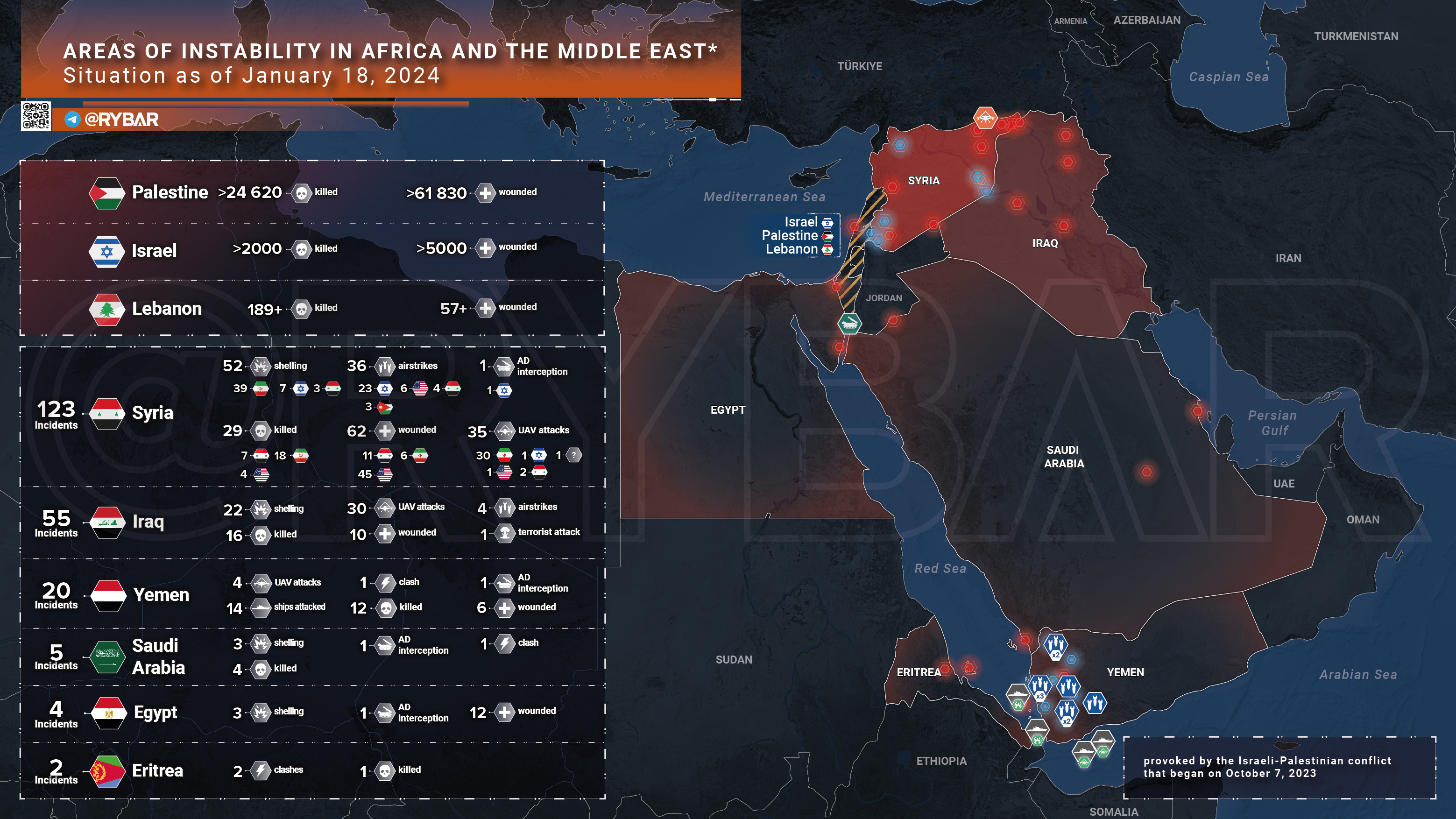
What is happening in Palestine and Israel: chronicle for January 16
January 16, 2024
Rybar
Image

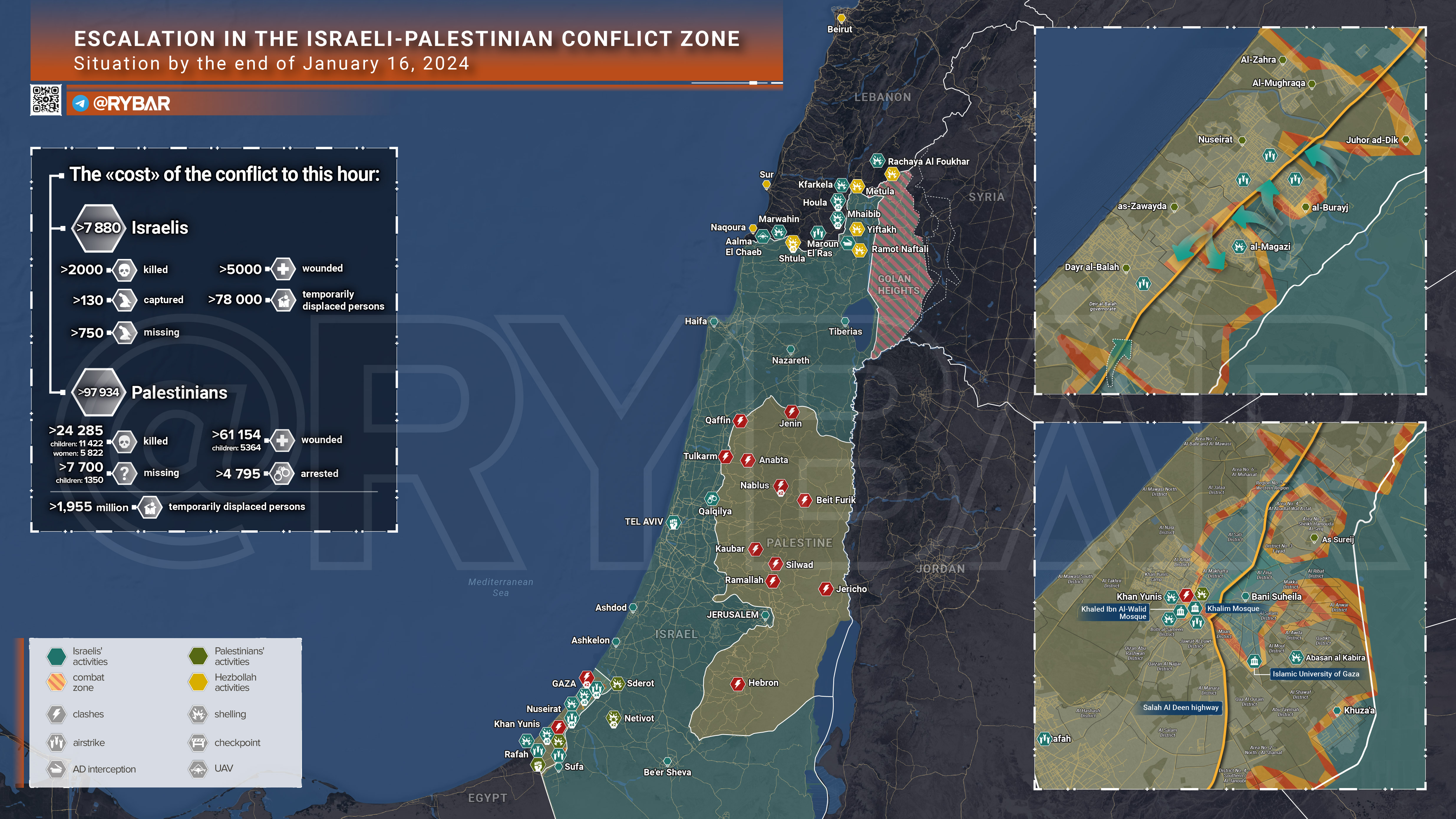
In the north of the Gaza Strip, clashes between Hamas militants and Israeli troops have become more frequent. The Arab media present what is happening as a renewed offensive by the IDF in several districts of the enclave's capital, but these statements do not yet correspond to the real state of affairs.

In the area of ​​the isthmus between the northern and southern parts of the enclave, the Israelis began encircling Al - Maghazi , where the fighting gradually shifted to the southwestern outskirts. Meanwhile, in Khan Yunis, Israeli units continue to clear the areas of Jurat al - Lot and Botn al - Samin .

After a long break, Palestinian forces launched rockets at settlements bordering the Gaza Strip: most of the ammunition was intercepted by air defense systems, but several hits were recorded in Netivot and nearby kibbutzim.

On the northern border of Israel, in addition to the regular exchange of blows, a remarkable event occurred: the Israeli command reported a successful operation to clear mines in Lebanon . Hezbollah , as expected , denied the Israeli statement.

And in the Middle East , last night IRGC forces launched missiles at Erbil in Iraqi Kurdistan, as well as at targets of pro-Turkish terrorist groups in Syria . Nevertheless, one should not expect a sharp escalation from what happened - the parties are simply maintaining the necessary degree of conflict.

Progress of hostilities
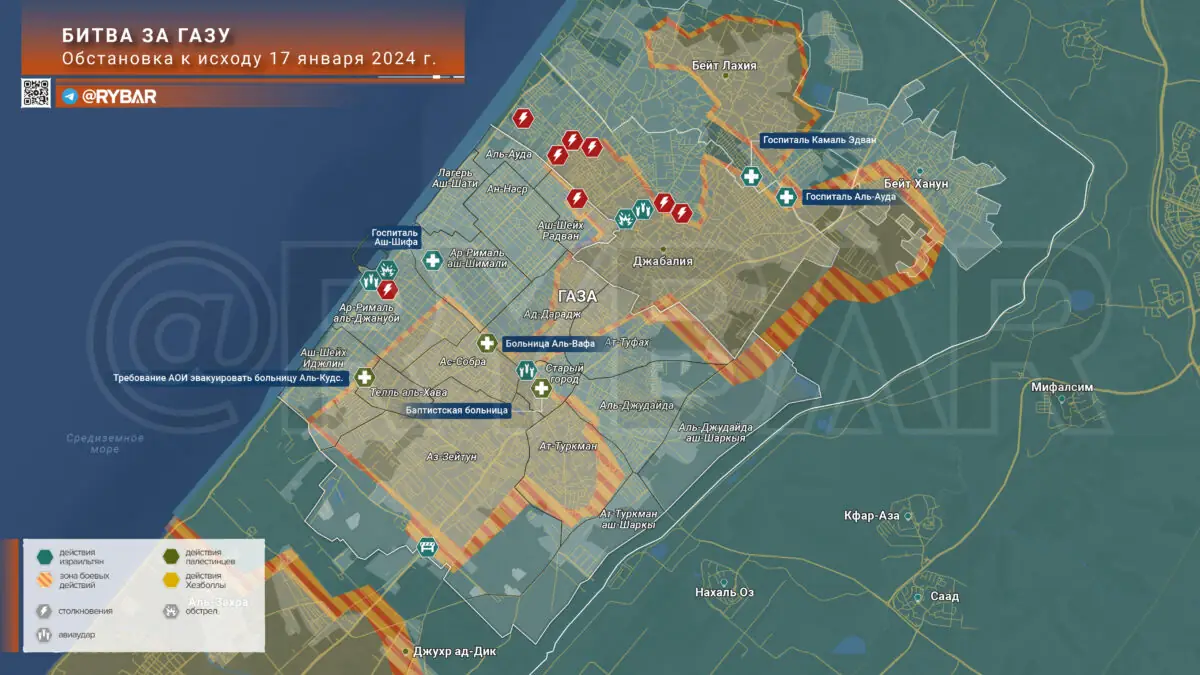
North Gaza Strip
Image
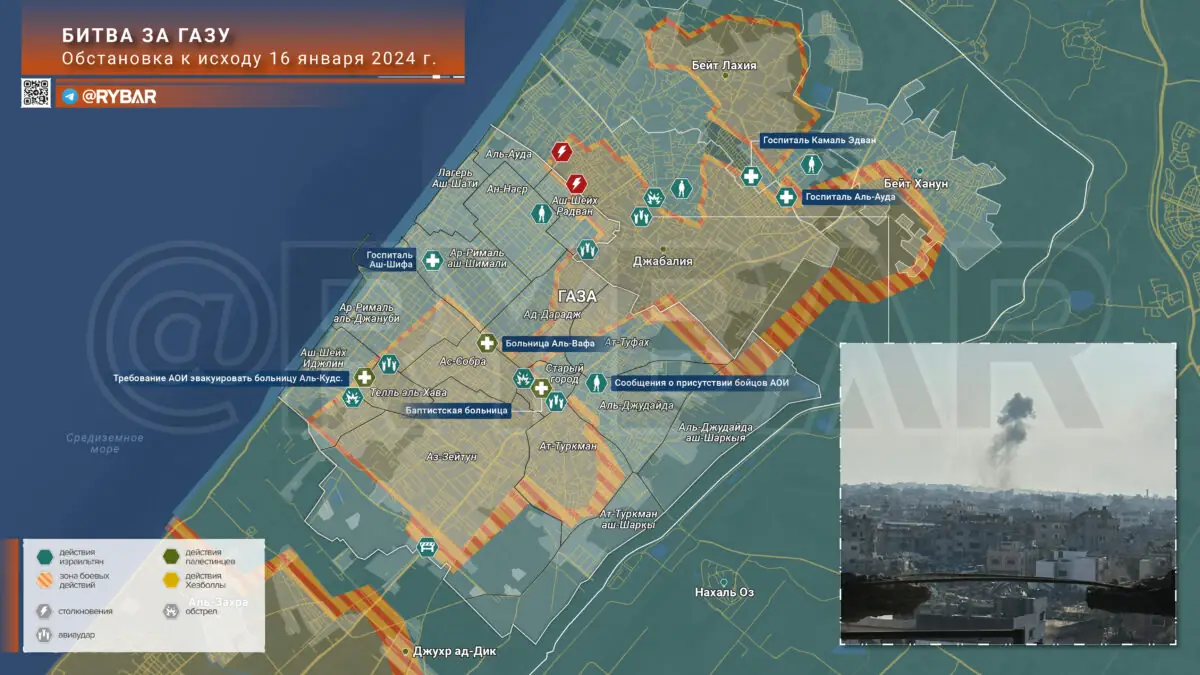
Despite the gradual withdrawal of the IDF and the calm that formed in the past days, clashes have resumed in the north of the Gaza Strip. Palestinian media claim that Israel Defense Forces are attacking in several areas, including in the areas of Jabaliya , Al - Judaida and Al - Karama . However, such reports so far raise serious doubts: after the withdrawal of the 36th Division and two more armored brigades, the IDF forces have significantly decreased, especially for clearing dense urban areas.

However, the information about the offensive may hide the work of engineering units. At the same time, Hamas confirmed several cases of clashes that are not at all similar to an IDF offensive and are more reminiscent of everyday skirmishes: for example, the group reported the defeat of several Israeli armored vehicles, as well as mortar strikes on IDF concentrations. At the same time, a series of attacks on residential areas were carried out across Gaza and its suburbs: dozens of casualties were reported, as well as many damaged houses.

The Israeli command also demanded the need to evacuate the Al - Quds hospital . Perhaps the Israelis are planning to launch a series of strikes in the area of ​​the facility (although they had not previously given any warning before such attacks), or to conduct a local operation to clear the area around the hospital. In any case, there is no talk yet of a full-scale resumption of hostilities in Gaza.


Against the background of renewed massive bombing of the northern part of the Gaza Strip, Palestinian forces launched about 50 rockets at Netivot and nearby settlements. As before, most of the ammunition was intercepted by air defense systems, the rest fell mainly in open areas. However, several hits are also known, including an electrical goods store.


What happened once again proves that the Israel Defense Forces’ operation in the north of the enclave was suspended primarily due to the inability of the Israelis to quickly clear the urban areas. During the resulting respite, Hamas militants were able to recover and scrape together several dozen rockets for another attack. Successfully hitting targets is not so important; it is much more important to create a media effect from the raid.

Center of the Gaza Strip
Image
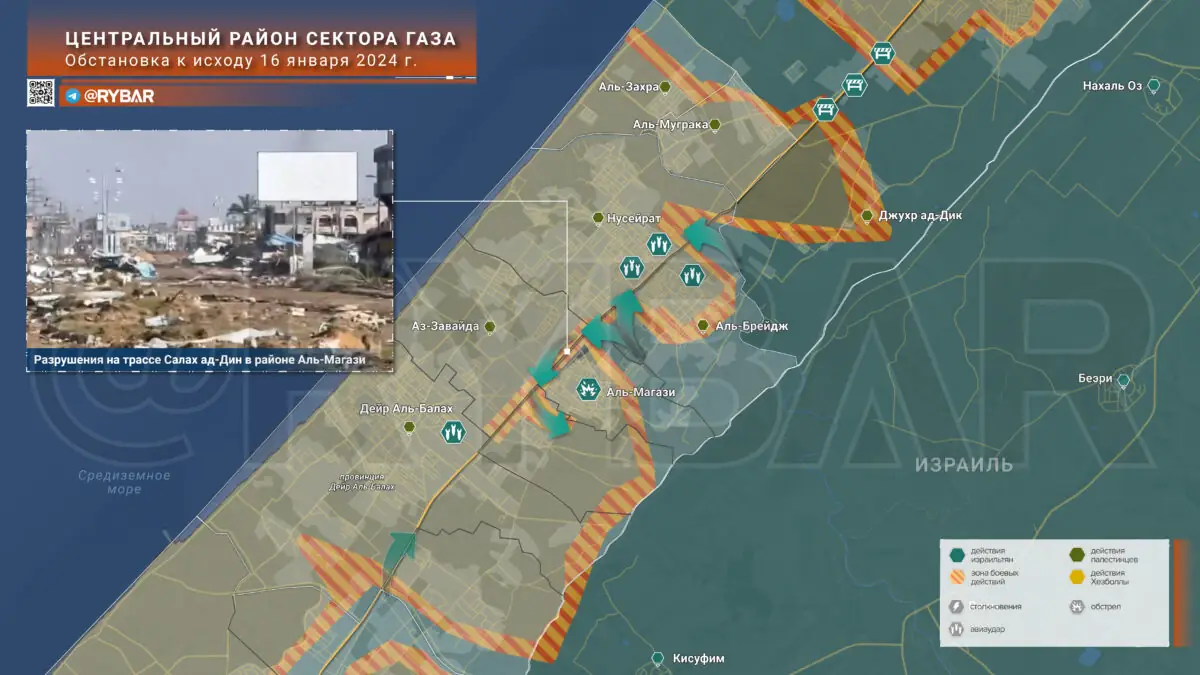
In the area of ​​the isthmus between the northern and southern parts of the enclave, the Israelis continue their assault on Al - Breij . In addition, judging by satellite images, IDF units began to encircle Al - Maghazi , where the fighting gradually shifted to the southwestern outskirts. However, any footage of Israeli troops is still missing, making it impossible to establish the exact configuration of the front. At the same time, the Israelis are advancing along the Salah ad - Din highway in the direction of Deir al - Balakh . Judging by the lack of reports of fighting in the coastal zone or even attacks on IDF concentrations there, Israeli troops have not yet reached the Ar - Rashid highway .


At the same time, footage appeared of the destruction on the Salah ad-Din highway, which was both the consequences of regular massive attacks on nearby settlements and military operations in the area.

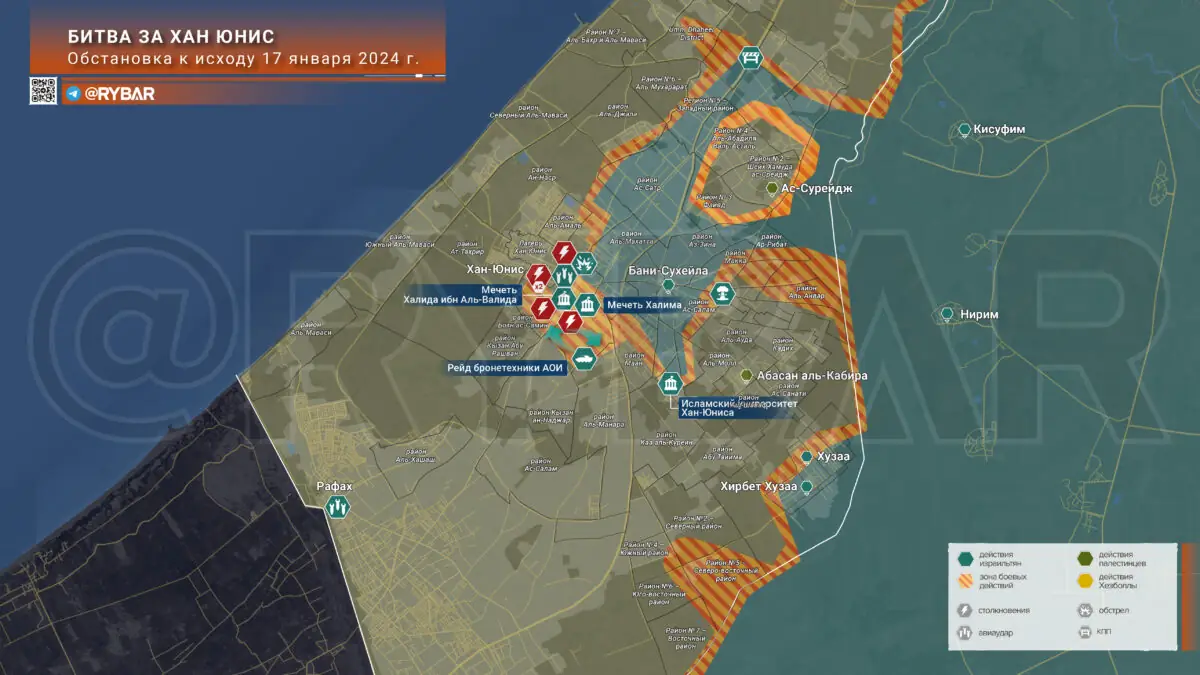
South Gaza Strip
Image
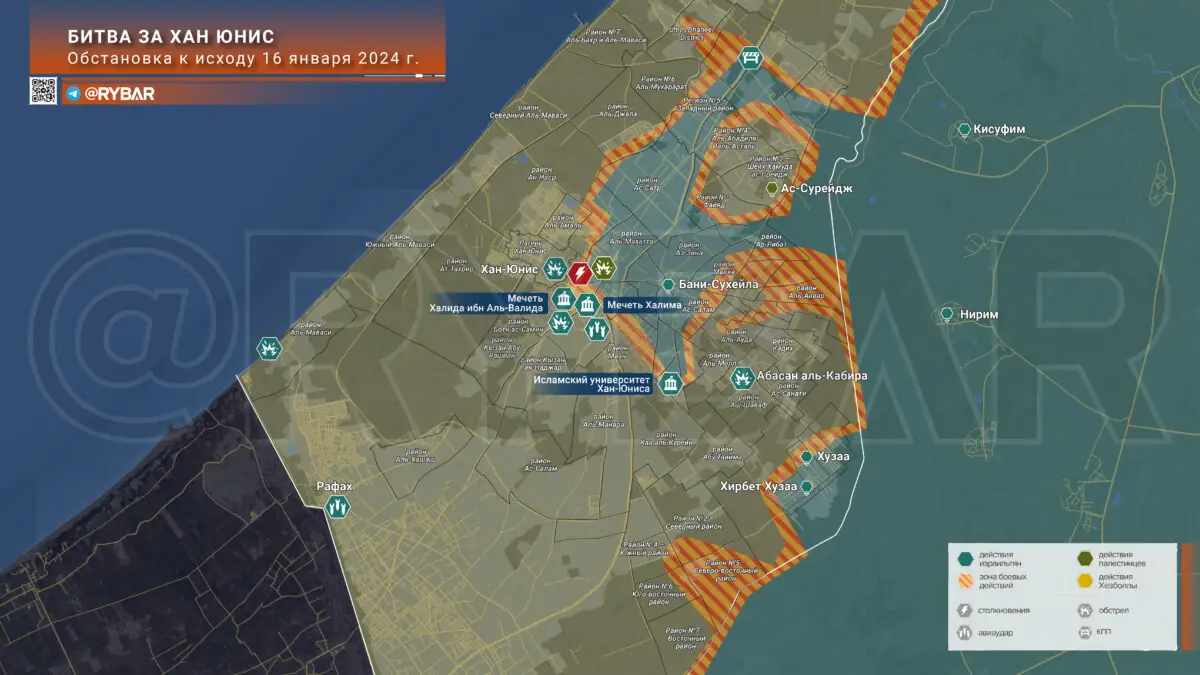
In Khan Yunis , Israeli troops are still fighting in the areas of Jurat al - Lot and Botn al - Samin , while simultaneously subjecting the settlement and towns to massive bombing. Palestinian forces respond with ambushes and mortar attacks on identified IDF concentration areas.


At the same time, the Israeli command stated that militants continue to use the territory of Nasser’s hospital to carry out launches against personnel and targets of the Israel Defense Forces. Against this background, the IDF again accused the militants of using civilians as human shields, while at the same time justifying their strikes on the outskirts of the medical facility.

Border with Lebanon
Image
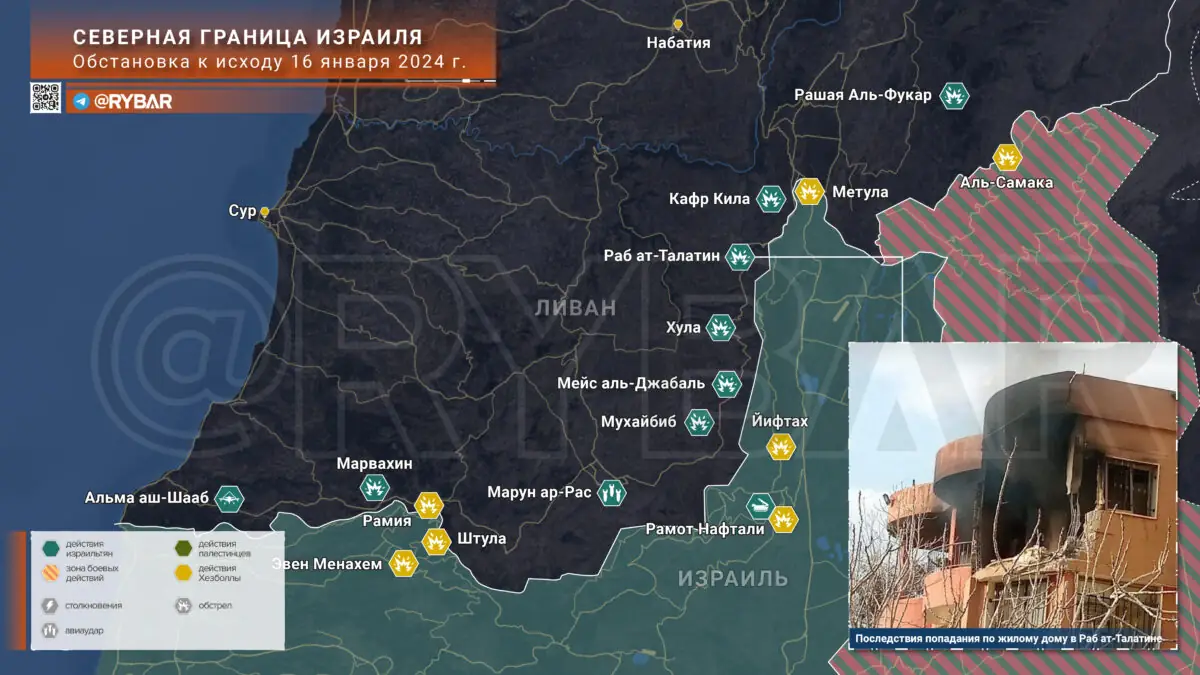
Mutual shelling continues on the Israeli-Lebanese border. Hezbollah reported attacks on positions of the Israel Defense Forces east of Even Menachem , at the Ramiya and As - Sumaqa sites , in the Nabi Yusha and Yiftah areas . In turn, Israeli troops once again shelled populated areas in southern Lebanon. Ad - Dahira , Rashaya al - Fukar , Alma al - Shaab , Aita al - Shaab , Kfar Qila and Hula were hit . The most intense air and artillery strikes were carried out in the Wadi Saluki area : there were about 20 incursions. This is the most massive shelling of Lebanese settlements since October 7. The IDF press service stated that dozens of Hezbollah positions, structures and military infrastructure facilities were targeted.

In addition, the Israeli command today reported on the successful conduct of a ground operation in southern Lebanon: according to the Israelis, an IDF unit crossed the border near the village of Aita al-Shaab to clear mines in the area. If the information is confirmed, this will be the first time Israeli troops have entered southern Lebanon since the Second Lebanon War, which took place from June to August 2006.

Nevertheless, the Arab media were skeptical about such reports: according to them, three fighters of the Maglan unit tried to cross the state border, but were quickly detected, after which they returned to their original positions. Probably, footage that almost regularly appears from the northern border of Israel from both Hezbollah and the IDF will help to explain the circumstances of what happened in the near future.

West Bank

Image
In the West Bank, the Israel Defense Forces carried out another campaign of raids against Hamas supporters. Arrests took place in Jericho , Kiffin , Hebron , Qalqilya , Silwad , Zawat and Ramallah . At least 50 people have been detained. According to Palestinian media, among them are children and former prisoners.


The most tense situation was in the eastern part of Nablus , with violent clashes breaking out near the Askar camp. IDF security forces used bulldozers to demolish infrastructure facilities. And members of Palestinian groups reported blowing up Israeli equipment using IEDs.


And in the eastern region of Jenin, clashes occurred between Palestinian Authority security services and local residents. The reason was that PNA security forces had neutralized an explosive device that radical Palestinians wanted to use against Israeli troops.

Saraya al-Quds also reported the destruction of an IDF military jeep in Anabta , east of Tulkarm . The attack is said to have occurred in response to the killing of Faris Mahmoud Khalifa , a Kataib Shuhad al - Aqsa commander with the rank of colonel.

Aggravation in the Middle East

Image

On the night of January 16, units of the IRGC aerospace forces carried out a massive strike on Erbil in Iraqi Kurdistan, as well as on targets of pro-Turkish terrorist groups in Syria. First , at least six Fateh-110 operational-tactical missiles were fired from the vicinity of the IRGC Tangeyeh Kenesht missile base near Kermanshah in the direction of Erbil.

To overload the air defense systems, the Iranians used tactics that had already been proven during the Northern Military District: before the missile attack on Erbil, several Shahed-136 drones were launched, to which the C-RAM systems from the Harir military base responded . Immediately afterwards, several rockets hit neighborhoods in Erbil near the American consulate, Erbil International Airport and the Harir military base, as well as the home of Kurdish businessman Pishrav Diziziye .

The latter, judging by data in open sources, was the owner of the companies Falcon Group and Empire , affiliated with the Israeli Mossad. The blow definitely hit the house where the businessman lived. At the same time, the latest Khyber Shikan medium-range ballistic missiles were fired from Khuzestan province towards Syria. It was their flight over the Basra province in Iraq that was filmed by Iraqi residents.

The range of the IRBM is 1,450 km, and the target was the positions of the terrorist groups Hayat Tahrir al - Sham and the Islamic Party of Turkistan in Taltit near Idlib . Explosions from the arrivals were mistaken for Israeli Air Force strikes on the province of Aleppo . The press service of the IRGC stated that the choice of these targets is due to the fact that a group of IS militants responsible for the terrorist attack in Kerman was being trained in territories controlled by pro-Turkish forces . But this version seems far-fetched, and the raid itself, apparently, was carried out to demonstrate Iran’s capabilities. After all, the Iranians had not previously carried out attacks at such a range (1230 km), which was noted in the Israeli media.

The strike on Erbil shows similarities to the massive coalition attack on Yemen . That the Houthis, after the attack, stated that there were no significant losses, that the Pentagon noted that the Americans were not injured. If we take into account that it is not beneficial for the Americans to greatly harm Ansarallah , which is why they warned the Iranians and Houthis in advance, then a similar scenario is possible in the case of Iranian launches. We noted that increased tension in the region benefits all parties. The Americans demonstrated their power, and the Iranians demonstrated theirs. The status quo was preserved, everything remained at the same level. And in Iran, at the same time, they actually took revenge on the Israelis for the murder of General Reza Mousavi by eliminating a businessman associated with them. We observed such tactics after the death of Qasem Soleimani - symbolism in the form of a red flag of retaliation and a massive strike to satisfy the domestic public and its thirst for blood.

Moreover, the fact that because of the IRGC’s strikes on Erbil, the Iraqis today recalled their ambassador from Tehran for consultations means absolutely nothing. Relations between Iran and Iraq have experienced such developments more than once. This is primarily dictated by the need to demonstrate that Baghdad supposedly has political will. Everything will calm down a little, and the ambassador will return. In fact, Iraq's dependence on Iran is too high, and no one will risk a missile attack on Iraqi Kurdistan. It is worth remembering that the Turks attack northern Iraq almost every day, but no serious reaction is observed.

Political-diplomatic background
On the results of the meeting of the Israeli government to approve the budget


Israeli Prime Minister Benjamin Netanyahu, at a government meeting to approve the country's budget for 2024, said that the war against Hamas will continue for many months. During the discussion, the Cabinet increased budget expenditures by $15 billion.

The head of the Israeli government also said that the war against Hamas will not end until the border between Egypt and the Gaza Strip is closed. According to him, Gaza will be taken, but military equipment and other weapons will continue to flow through this southern passage.

At the same time, the meeting quickly degenerated into mutual insults. Education Minister Yoav Kisch snapped at Finance Minister Bezalel Smotrich , who in turn criticized newly appointed Energy Minister Eli Cohen .

On the suppression of drug smuggling on the border of Egypt and Israel

Over the past two days, two attempts to smuggle drugs into Israeli territory from the Sinai Peninsula were stopped on the Israeli-Egyptian border in the area of ​​the Al - Awja and Netzerim checkpoints. The Egyptian Armed Forces and the Israeli Defense Forces released their statements regarding the incident. Thus, according to the IDF press service, yesterday Israeli border guards opened fire on a group of 20 armed people: there were casualties. A female soldier was also wounded during the shootout. And Egyptian security services reported the arrest of six smugglers in the same border area.

https://rybar.ru/chto-proishodit-v-pale ... -yanvarya/

Google Translator

******

THE US, ISRAEL HAVE LOST BATTLEFIELD CONTROL – HOUTHIS HAVE ATTACKED US DESTROYER, HIT GREEK-US OWNED BULKER; IRAN HAS HIT US BASE IN KURDISH CAPITAL, ERBIL

Image

by John Helmer, Moscow @bears_with

When your enemy dupes you into compounding your mistakes, without achieving your military objectives, he is leading you into an escalation of force which will defeat you, sooner or later. Later is more costly, defeat more ruinous, so the Arab-Iranian alliance against Israel and the US is waging the long war they were never before believed capable to fight.

No matter how much force you use, every US Army manual on winning battles and wars says the same thing. Captain B.H. Liddell Hart, the British Army strategist of a generation ago, advised that “for success two major problems must be solved — dislocation and exploitation. One precedes and one follows the actual blow — which in comparison is a simple act.”

Today is Tuesday morning — and it is already plain on the Middle Eastern battlefield that the Anglo-American air attacks against Yemeni targets on Friday and Saturday have “dislocated” none of the capabilities of the Ansarallah government in Sanaa and the Houthi military units.

For exploitation after the air strikes, the initiative has remained instead with the Houthis: they are continuing their attacks on the US Navy fleet in the Red Sea and Gulf of Aden, keeping them on guard, but demonstrating they are ineffectual to protect US and Israel-connected shipping now diverting from the area. “War is a two-party affair,” old Liddell Hart had said, “in order to hit with effect, the enemy must be taken off his guard.” In the Middle East the enemy has been taken off his guard. That’s to say, the Israelis, the Americans, and the British.

Minutes after midnight on Tuesday, Moscow time, Russian military bloggers began relaying the news from Iran and Yemen of new missile attacks against a Greek-American owned bulker in the Gulf of Aden during the afternoon, and hours later at night, a US mercenary forces unit, a US consulate building, an Israeli base, and the home of a leading oil trader in the Kurdish city of Erbil in northern Iraq.

According to Boris Rozhin’s Colonel Cassad Telegram platform, “the Islamic Revolutionary Guard Corps has officially announced that the ballistic missile attack on US and Mossad bases in Iraq was carried out in response to the bloody terrorist attack in Kerman during commemorative events dedicated to Qassem Soleimani. Local sources in Erbil report at least 8 rocket strikes… At the moment, what is known is that there have been strikes against of the following targets by IRGC [Islamic Revolutionary Guard Corps] missiles: 1. The American base at Erbil airport. 2. The U.S. Consulate in Erbil. 3. The local headquarters of the Kurdish security service. 4. The private residence of a local businessman [Peshraw Dizayee] associated with the Mossad. There is a high activity of ambulances in Erbil. There is no clarity about the victims, but it is obvious that there will be numbers of them.”

US media reporting after several hours of delay claimed there had been explosions near the US consulate in Erbil but “ ‘no US facilities were impacted. We’re not tracking damage to infrastructure or injuries at this time,’ a U.S. official told ABC News.” On the contrary, Rozhin reported, “according to one of my friends who lives in the centre of Erbil, the blow fell not on the current consulate, but on the new one, which is just being built. There was everything in scaffolding and construction cranes. Eyewitnesses say that they were building something grandiose.”

During Sunday afternoon, the US Central Command (CENTCOM) confirmed reported Houthi drone or missile attacks targeting the US Navy destroyer, USS Laboon, which claims to have assisted a USAF fighter to intercept them before they reached the destroyer. CENTCOM also reported Houthi launches “toward the southern Red Sea commercial shipping lanes.”

CENTCOM is saying nothing at all about the fate of the two US Navy F-18 pilots, shot down by Houthi air defence during the first raid on Friday morning and missing at sea since then. Pentagon concealment of the shoot-down — the first air battle success of its kind– has been camouflaged by a half-dozen press releases about the hospitalization and health of the Defense Secretary, General Lloyd Austin. “I continue to recuperate and perform my duties from home,” Austin has claimed.

According to US Army Lieutenant General Douglas Sims (lead image) who heads the staff advising the Joint Chiefs of Staff on operations: “The hope would be that any real thought of [Houthi] retaliation is based on a clear understanding that, you know, we simply are not going to be messed with here…I know we have degraded capability. I don’t believe that they [Houthis] would be able to execute the same way they did the other day. But we will see.” In less than 72 hours what Sims could see has had to be concealed from everyone else.

Not in Moscow.

“The Americans need controlled instability to realize their own plans,” Konstantin Dolgov, once a senior Russian diplomat and now a senator, told Vzglyad. “But this instability has long been out of Washington’s control.”

Yesterday, January 15, Russian Foreign Minister Sergei Lavrov spoke by telephone with Iran’s Foreign Minister Hossein Amir-Abdollahian, and announced “coordination at all levels, emphasizing the unwavering mutual commitment to the fundamental principles of Russian-Iranian relations, including unconditional respect for sovereignty, territorial integrity and other principles of the UN Charter, which will be confirmed in the upcoming ‘big’ interstate agreement between the Russian Federation and the Islamic Republic of Iran.”

“All levels” includes military coordination. It also means coordination with the Ansarallah representatives in Teheran.

As for the Houthi operations in the Red Sea, Lavrov and Amir-Abdollahian explicitly linked them to the Israeli-American blockade of the Palestinians in Gaza, calling for “an immediate ceasefire in the Gaza Strip and unhindered humanitarian access to the enclave to provide urgent assistance to the affected civilian population.”

Earlier on the same day, January 15, the Indian Foreign Minister Subrahmanyam Jaishankar met in Teheran with Iran’s President, Ebrahim Raisi, and held detailed talks with Foreign Minister Amir-Abdollahian. The Indian minister revealed the same order of priorities for India as Lavrov revealed for Russia – strategic state interests shared with Iran for the long-term future, but for now the link between the Houthi shipping campaign and the Gaza blockade. In his tweet, Jaishankar said: “Our bilateral discussion focused on the long term framework for India’s involvement with Chabahar port and the INSTC [International North–South Transport Corridor] connectivity project. Also spoke about threats to maritime shipping in the region. Important that this be speedily addressed. Other issues on the agenda were the Gaza situation, Afghanistan, Ukraine and BRICS cooperation.”

Image
Source: https://twitter.com/

“This is what diplomacy is meant to be,” commented an Indian source in Moscow. “They disagree on a lot but they also know what they need to agree on.”

The Indian government has been briefed that the reason for the strike against the MV Chem Pluto on December 23 was the Israeli ownership of the vessel, not its Saudi oil cargo or the destination for its cargo in India.

The official Yemen declaration of Monday, following the attack against the USS Laboon, has now expanded the targeting to include the US and UK fleets which had taken part in the weekend bombing and missile raids. “The naval forces of the Armed Forces of Yemen conducted a military operation targeting an American ship in the Gulf of Aden. All American and British ships involved in the aggression against our country are considered hostile targets by the Yemeni armed forces. The Yemeni armed forces confirm that a retaliatory strike against American and British attacks is inevitable, and that no attack in the future will go unpunished. The Yemeni armed forces continue to conduct their military operations and implement the decision to block Israeli shipping in the Arab and Red Seas until the aggression stops and the siege of the Palestinian people in the Gaza Strip is lifted.”

“The Yemeni Armed Forces confirm the continuation of commercial traffic in the Arab and Red Seas to all destinations, with the exception of the ports of occupied Palestine, and that they continue to take all defensive and offensive measures within the framework of the right to defend and resist American-British aggression.” https://t.me/s/boris_rozhin January 16 — Min 03:05.

Image
Left, MV Gibraltar Eagle; right, location of the vessel when hit by Houthi missiles, according to the UK Maritime Trade Operations office (UKMTO). The shipping company released a statement confirming the strike but omitting to identify the destination for the vessel.

The attack on the Gibraltar Eagle in the Gulf of Aden, currently in the lead maritime news for today, makes the vessel appear to be unconnected to Israel. The vessel is publicly identified as one of Eagle Bulk Shipping’s fleet; Eagle Bulk Shipping is a New York Stock Exchange-listed company based in Connecticut which has been reporting dwindling profits. But since a takeover transaction was announced last month, the controlling owner is now the Greek company, Star Bulk of Athens. The two Greeks controlling Star Bulk are Petros Pappas and Spyros Capralos. They are shippers of dry bulk commodities — coal, grain, fertilizers, iron ore, steel products. It is not known whether they have been delivering to or loading at Israeli ports. Western vessel tracking publications claim the Gibraltar Eagle had taken on its current cargo of steel products in South Korea and was headed for the Suez Canal when it was hit. At the time, and for several days of sailing before, the vessel had turned off its Automatic Identification System (AIS) signal.

Maritime industry sources say the secrecy employed by the Gibraltar Eagle may have been intended to conceal that it is carrying a cargo of South Korean arms and ammunition intended for unloading at a Polish port for onward delivery to the Ukraine; or for an Israeli port. The destination port recorded for the vessel is not showing in the regular western vessel tracking sites.

The sources add this is unusual. Reports on the international arms trade indicate a surge in South Korean production for the Ukraine. Operations managers at Eagle Bulk Shipping offices in the US and Singapore refuse to identify the destination port for their vessel’s cargo.

https://johnhelmer.net/the-us-israel-ha ... more-89195

******

Egypt Rejects Israel Obstruction of Aid to Gaza

Image
Aid missions bringing medicine and fuel to northern Gaza are hampered by Israeli forces. Jan. 15, 2024. | Photo: X/@OneidaDispatch

Published 16 January 2024 (10 hours 37 minutes ago)

Abu Zeid's statements are the second official response to Israeli claims before the International Court of Justice (ICJ) that Egypt is limiting international aid to the Strip.

On Sunday, Egypt again rejected Israeli statements on the Rafah crossing and accused Israel of obstructing the entry of vital aid to the embattled Gaza Strip.

The Rafah crossing, which links Egypt to the coastal enclave, has remained open since the beginning of the crisis on October 7, Foreign Ministry spokesman Ahmed Abu-Zeid reaffirmed during a television interview.

We have worked tirelessly to facilitate the entry of a substantial amount of aid into Gaza, he stressed.

He noted that Israeli measures, including strict inspection processes, prevent a greater volume of goods into the territory, which has been experiencing a severe humanitarian crisis since the beginning of the aggression 100 days ago.

Abu Zeid's statements are the second official response to Israeli claims before the International Court of Justice (ICJ) that Egypt is limiting international aid to the Strip.


Earlier, the head of the State Information Service, Diaa Rashwan, described the neighboring country's allegations against Cairo as false.

Rashwan described the claims presented by the Israeli defense team before the ICJ as lies.

After being accused with documented evidence of war crimes and genocide before the ICJ, Israel resorted to "hurling accusations against our country in an attempt to escape its likely conviction by the court," Rashwan said in a statement.

The official recalled that members of that country's government, including the prime minister and the heads of defense and energy, confirmed dozens of times in public statements that they would not allow the entry into the coastal enclave of vital goods.

Our national sovereignty extends only to the Egyptian side of the Rafah border crossing, while the other side of it, in Gaza, is subject to the authority of the royal occupation, he stressed.

In this regard, he stressed that on numerous occasions Cairo asserted that "the Rafah crossing from the Egyptian side is open without interruption."

Rashwan clarified that trucks loaded with aid travel from the Egyptian side to the Karm Abu Salem crossing, which connects the Strip and Israel, to be inspected by the Israeli army, and only then can they enter the enclave.


https://www.telesurenglish.net/news/Egy ... -0001.html

*******

The Willful Destruction of a People

The US corporate media has maintained a near unanimous support for the Israeli destruction of Gaza-- the home of 2.2 million Palestinians. While pundits engage in parlor games over what degree of violence is “justified” by the Hamas attack upon Israel, while public intellectuals fall in line with the gutless unconditional support of Israeli punitive actions, tens of thousands of Palestinian people-- largely men, women, and children going about their day-to-day lives-- have been killed, maimed, wounded, or terrorized.

Corruption, racism, and cowardice come together to produce a rare near-total US ruling-class consensus behind the brutal action of the ultra-right, ultra-nationalist, and racist Israeli government.

The enforcement of this consensus is unprecedented and a truly appalling sight to behold.

The highly publicized clash over even an embarrassingly tepid pushback by elite administrators at elite universities over free speech-- a normally sacrosanct intellectual fallback-- underscores the complete, unconditional freedom-of-action that Israel enjoys with the rich and powerful in the US.

While the machinations of donors and administrators at Harvard, Penn, and MIT should be of little more than entertainment value for most of us, the raw, public exercise of the power of wealth in shaping academic institutions should cause many to recoil. Those who naively believed in the independence and integrity of academia should be chastened accordingly.

Black Harvard President Gay would learn that neither her own elite background nor the thin armor of the faddish liberal DEI mutation of anti-racism would protect her from the vulgar bullying of wild-eyed Zionist billionaires and rightwing witch hunters.

Christopher Rufo, puffed up with his own role in bringing down Harvard’s Gay, concedes that he couldn’t have done it without the collaboration of the center-left that accepted any excuse to enforce support for Israel.

Despite the crude editorial endorsement of and overwhelming official enthusiasm for the Israeli slaughter of Palestinians, a different message has gotten through to the US populace. Whether it is the heart-rending pictures of death and destruction, the cracks in the carefully hedged and vetted news stories, or the alternative media, a bold, determined movement against Israel’s vicious assault on Gaza has emerged to challenge the ruling-class monolith. Risking economic reprisals, future status, and public shaming, hundreds of thousands-- overwhelmingly youth-- have stood and marched for life and a future for Gaza and Palestine.

It is truly a remarkable moment of crass opportunism, slavish conformity, and viciousness confronted by high principle, self-sacrifice, and courage. It is this kind of moment that forces people to examine how their words and self-styled image coheres with reality.

The facts are effective in awakening people to the brutal fate of Palestinians as a people. Because the Israeli government is so blatantly indifferent to international outrage, The Wall Street Journal is embarrassed to report the truth-on-the-ground in Gaza. Whether reluctantly or not, a recent front-page news story-- Gaza’s Destruction Stands Out In Modern History (softened in the online edition to: The Ruined Landscape of Gaza After Nearly Three Months of Bombing) -- describes an almost unimaginable living hell. Its lead is worth quoting in full:

The war in the Gaza Strip is generating destruction comparable in scale to the most devastating urban warfare in the modern record.

By mid-December, Israel had dropped 29,000 bombs, munitions and shells on the strip. Nearly 70% of Gaza’s 439,000 homes and about half of its buildings have been damaged or destroyed. The bombing has damaged Byzantine churches and ancient mosques, factories and apartment buildings, shopping malls and luxury hotels, theaters and schools. Much of the water, electrical, communications and healthcare infrastructure that made Gaza function is beyond repair.


Most of the strip’s 36 hospitals are shut down, and only eight are accepting patients. Citrus trees, olive groves and greenhouses have been obliterated. More than two-thirds of its schools are damaged.

While most media mention the 22,000 or more deaths or the over 80,000 total Palestinian casualties, they dutifully treat the facts as allegations and with vastly more than warranted skepticism. Nonetheless, the numbers have shocked millions around the world.

But the WSJ article goes further, offering comfortable, secure readers a taste of what life is like for those not physically harmed by Israeli bombs:

In the south, where more than a million displaced residents have fled, Gazans sleep in the street and burn garbage to cook. Some 85% of the strip’s 2.2 million people have fled their homes and are confined by Israeli evacuation orders to less than one-third of the strip, according to the United Nations…


According to analysis of satellite data by remote-sensing experts at the City University of New York and Oregon State University, as many as 80% of the buildings in northern Gaza, where the bombing has been most severe, are damaged or destroyed, a higher percentage than in Dresden [the site of murderous firebombing in WWII].

The WSJ presents a set of facts and expert observations that are nothing if not damning of the Israeli tactics:

・Robert Pape, political scientist at the University of Chicago: “What you are seeing in Gaza is in the top 25% of the most intense punishment campaigns in history.”

・” Some 85% of the strip’s 2.2 million people have fled their homes and are confined by Israeli evacuation orders to less than one-third of the strip, according to the United Nations.”

・” He Yin, an assistant professor of geography at Kent State University in Ohio, estimated that 20% of Gaza’s agricultural land has been damaged or destroyed. Winter wheat that should be sprouting around now isn’t visible, he said, suggesting it wasn’t planted.”

・” A World Bank analysis concluded that by Dec. 12, the war had damaged or destroyed 77% of health facilities, 72% of municipal services such as parks, courts and libraries, 68% of telecommunications infrastructure, and 76% of commercial sites, including the almost complete destruction of the industrial zone in the north. More than half of all roads, the World Bank found, have been damaged or destroyed. Some 342 schools have been damaged, according to the U.N., including 70 of its own schools.”

・Where the US dropped 3,678 munitions on the entire nation of Iraq in seven years, Israel has dropped 29,000 on tiny Gaza in a little over two months.

・On Gaza city: “‘It’s not a livable city anymore,’ said Eyal Weizman, an Israeli-British architect who studies Israel’s approach to the built environment in the Palestinian territories. Any reconstruction, he said, will require ‘a whole system of underground infrastructure, because when you attack the subsoil, everything that runs through the ground—the water, the gas, the sewage—is torn.’”

・” The level of damage in Gaza is almost double what it was during a 2014 conflict, which lasted 50 days, with five times as many completely destroyed buildings, according to the Shelter Cluster. In the current conflict, as of mid-December, more than 800,000 people had no home left to return to, the World Bank found.”

To those seduced by a gutless media and a bought-and-sold political establishment, this picture constructed by one of the US’s most conservative papers should bring Israel’s crimes against Gaza into sharper relief; It should be painful to even imagine living under such conditions; it should remove the Gaza question from the realm of political debate to the basic issue of human dignity and survival.

Is there any humane answer beyond: Cease Fire Now!?

Greg Godels

zzsblogml@gmail.com

http://zzs-blg.blogspot.com/2024/01/the ... eople.html

******

Reviving ISIS: A US weapon against the Resistance Axis

Is it a coincidence that the world's foremost terror organization is being revived just as the US struggles under a multi-front assault on its hegemony in West Asia? More curiously, both ISIS and Washington's targets are exactly the same.


The Cradle's Iraq Correspondent

JAN 16, 2024

Image
Photo Credit: The Cradle

Iraqi security sources are warning of an ISIS revival in the country, which coincides all too neatly with the spike in Iraqi resistance operations against US bases in Iraq and Syria, and with widening regional instability caused by Israel's military assault on Gaza.

More than six years after declaring victory over the terrorist organization, Iraqi intelligence reports now indicate that thousands of ISIS fighters are emerging unscathed, under the protection of US forces in two regions of western Iraq.

The missing piece of the puzzle

According to intelligence reports reviewed by The Cradle, at its height, ISIS consisted of more than 35,000 fighters in Iraq – 25,000 of these were killed, while more than 10,000 simply “disappeared.”

As an officer of one Iraqi intelligence agency recounts to The Cradle:

"Hundreds of ISIS fighters fled to Turkey and Syria at the end of 2017. After the appointment of Abdullah Qardash as the leader of ISIS in 2019, following the death of Caliph Abu Bakr al-Baghdadi, the new Caliph began to restructure the organization, and ordered his followers to return to Iraq. The organization exploited the long border with Syria, the security disturbances, and the diversity of forces on both sides of the border to infiltrate the Iraqi territory again."

Imprisoned ISIS officials admit that infiltrating that border is not an easy task, because of the strict control imposed by the Iraqi Border Guards and the use of modern technologies, such as thermal cameras.

It therefore became necessary for the terror group to identify intermediaries capable of breaking through or bypassing these fortifications to transport its fighters across borders.

An Iraqi security source, insisting on anonymity, tells The Cradle that the US plays a vital role in enabling these border violations:

"[There are] several incidents that confirm the American assistance in securing the crossing route for ISIS members - mainly, by shelling Iraqi units on the border, especially the Popular Mobilization Units (PMUs), to create gaps that allow ISIS fighters to cross the border."

The Iraqi security source adds that there are confirmed reports of US Chinook helicopters transporting fighters from eastern Syria to the Anbar desert in western Iraq and Jebel Hamreen, in the country's east.

Munir Adib, a researcher specializing in Islamist movements, extremist organizations, and international terrorism, confirms the possibility of the return of ISIS after the organization's “dozens of attacks in Syria and Iraq in the past few weeks,” which led to the death of tens of civilians and soldiers.

According to Adib, “the international community's preoccupation with the Gaza and Russia-Ukraine wars gave ISIS an opportunity to reorganize its ranks, while continuing to receive internal and external logistical support.”

Manufacturing and harboring terrorism

Houran Valley is the largest of its kind in Iraq, extending 369 kilometers from the Iraqi-Saudi border to the Euphrates River near the city of Haditha in Anbar Governorate. Its topography is marked by soaring cliffs ranging in height between 150 to 200 meters, and includes the hills surrounding the valley and the sub-valleys that extend into its surroundings.

The valley was and still is one of the most dangerous security environments in the state. Terrorist groups use it as a safe haven because of its desert terrain, and distance from congested urban areas. The valley and its environs have witnessed numerous security incidents, most notably in December 2013, when ISIS killed the commander of the Iraqi army's Seventh Division, his assistant, the director of intelligence in Anbar Governorate, eight officers, and thirteen soldiers.

Iraqi MP Hassan Salem has called for launching a military operation to clear Houran Valley of terrorist fighters. He confirmed to The Cradle that “there are thousands of ISIS members in the valley receiving training in private camps, under American protection,” noting that US forces have “transferred to this area hundreds of ISIS members of different nationalities.”

US foreign policy, of course, is rife with historical evidence of the creation of proxy armed militias in West Asia and Latin America, often utilizing these organizations to overthrow governments in target countries. We know Washington has no aversion to allying with Islamist extremists largely because of its direct involvement with arming and financing the Afghan Mujahideen, from which the Taliban and Al Qaeda emerged.

An early US-ISIS connection exists quite clearly: the terrorist group's founding and second rank leaders were among the inmates of Camp Bucca prison in southern Iraq, an internment facility run by the US military. The roster of high-value terrorists captured, then set free by the Americans is quite extraordinary: ISIS leader Abu Bakr al-Baghdadi, his successor Abu Ibrahim al-Hashimi al-Qurashi, Abu Mohammed al-Adnani, Abu Muslim al-Turkmani, Haji Bakr, Abu Abdulrahman al-Bilawi, Abu Ayman al-Iraqi, among others.

Camp Bucca, known for abuses against its detainees, brought together extremist elements, slow-boiled this combustive formula for six years (2003-2009), then let the now well-networked extremists go free.

The religious officials of ISIS even say they used their time at the prison to obtain vows from prisoners to join the terrorist group after their release.

US intelligence also protected the terrorist organization indirectly, by allowing ISIS convoys to move between the cities that were under its control. Other forms of protection, according to Iraqi security experts, include refusing to implement death sentences issued by Iraqi courts against detained ISIS members, and establishing safe havens for the organization’s members in western and eastern Iraq.

ISIS: US foot soldiers in the regional war

In a speech on 5 January, Hezbollah Secretary General Hassan Nasrallah warned that the US was supporting an ISIS revival in the region.

The Cradle obtained security information monitoring the new activity of extremists in Lebanon, communications between these elements and their counterparts in Iraq and Syria, and suspicious money transfer activities among them.

Lebanese Army Intelligence also recently arrested a group of Lebanese and Syrians who were preparing to carry out security operations.

Importantly, this surge in terror activities comes at a time when the Lebanese resistance is engaged in a security and military battle with Israel, which may expand at any moment into open war. It is also notable that renewed ISIS activity is concentrated in Lebanon, Syria, Iraq, and Iran; that is, in the countries that support the Palestinian resistance politically, militarily, and logistically.

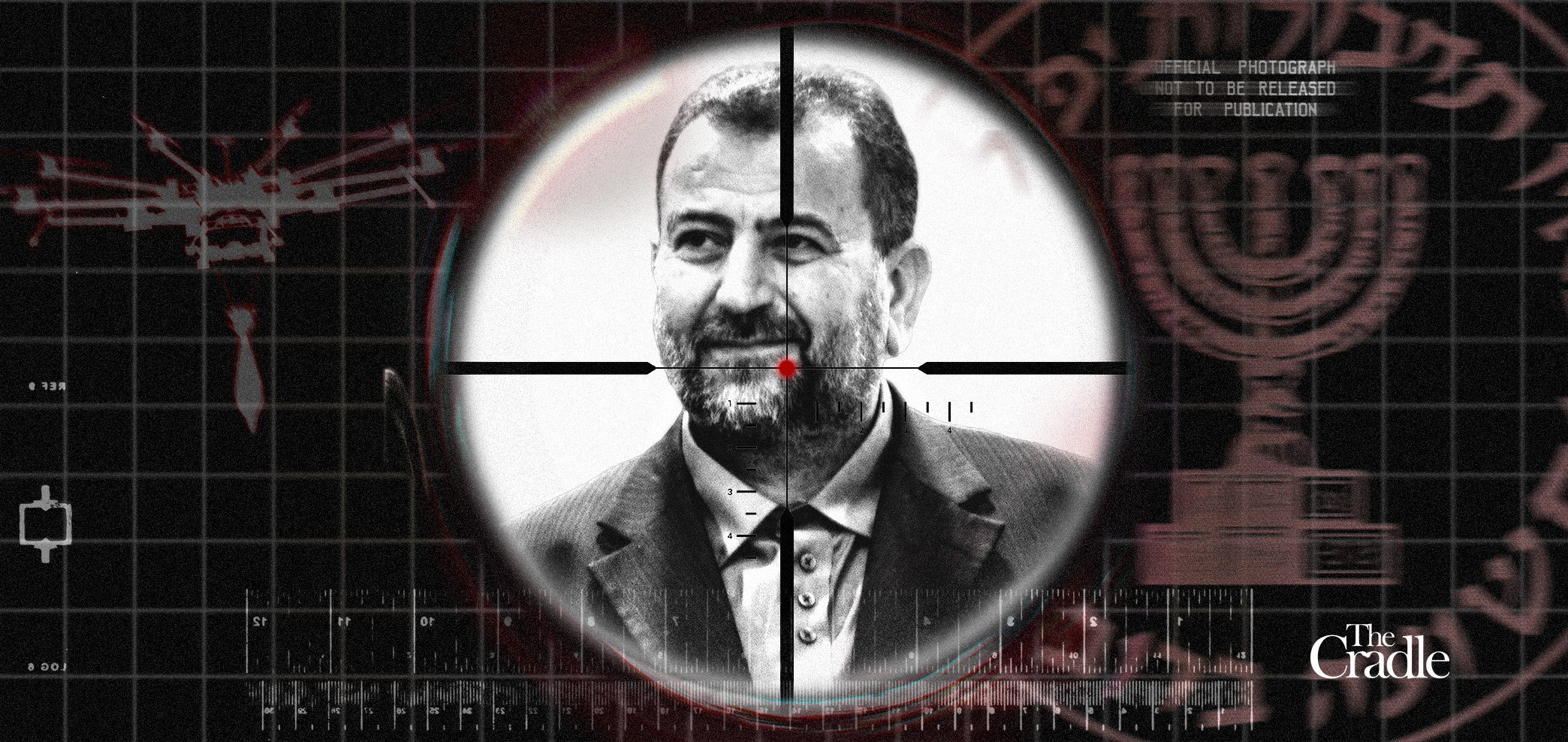
On 4 January, ISIS officially claimed responsibility for two bombings in the Iranian city of Kerman that targeted memorial processions on the anniversary of the assassination of Quds Force Commander Qassem Soleimani by US forces. The dual explosions killed around 90 people and injured dozens, in an unprecedented attack targeting the biggest US-Israeli adversary in West Asia – just one day after Tel Aviv killed top Hamas leader Saleh al-Arouri in Beirut.

Before that, on 5 October 2023, ISIS drone-attacked an officers graduation ceremony at the Military College in the Syrian city of Homs, killing about 100 people. These attacks, and others in Iraq, Syria, Iran, Pakistan, Afghanistan, and Africa, indicate that fresh blood, money, and weapons are being pumped into the ISIS organization’s arteries again.

A high-ranking PMU officer, who asked to remain unnamed, tells The Cradle that US forces are preventing Iraqi forces from approaching Houran Valley by attacking any security forces approaching the area. “This happened when American aircraft targeted units of the PMU that were attacking ISIS in the region,” he reveals, citing intelligence reports confirming the presence of dozens of ISIS members and other extremist organizations in the valley, where they receive training and equipment from US forces.

Security sources in the Anbar Operations Command confirm this information:

“Noticeable activity by the organization had been recorded a few weeks ago in the west of the country. Near the Rutba desert, ISIS fighters were spotted digging underground hideouts. Information indicates that the organization is in the process of carrying out terrorist operations in many locations,” they tell The Cradle.

Concurrently, ISIS is expanding its operations in the east of Iraq, within the geographical triangle that includes eastern Salah al-Din Governorate, north-eastern Diyala, and southern Kirkuk, particularly in the geographically challenging Makhoul, Hamrin, Ghurra, Wadi al-Shay, and Zaghitoun areas.

It should be noted that US forces are deployed in Iraq under the umbrella of the International Coalition to Combat ISIS. Last week, four years after the Iraqi parliament first voted to expel foreign forces, Iraqi Prime Minister Mohammad Shia al-Sudani weighed in on the “destabilizing” impact of US troops and demanded a “quick and orderly” exit of those combat units.

Washington not only countered by saying it has “no plans” to withdraw from Iraq, but announced on 14 January that it would be sending an additional 1,500 troops to Iraq and Syria illegally, and without the consent of either nation.

One irony here is that ISIS appears to regain momentum each and every time Baghdad raises the issue of US military withdrawal from Iraq.

It can also no longer be seen as a coincidence that the terror group is now re-assembling its forces to target Washington and Tel Aviv's most capable regional foes – the Axis of Resistance – just when the US and Israel are struggling to handle a region-wide, multi-front assault from the Axis.

The extraordinary synergies between the Americans and the world's foremost terror group can no longer be ignored: their targets are one and the same, and ISIS is only now entering the fray, just as Washington begins to lose its hold on West Asia.

https://new.thecradle.co/articles/reviv ... tance-axis

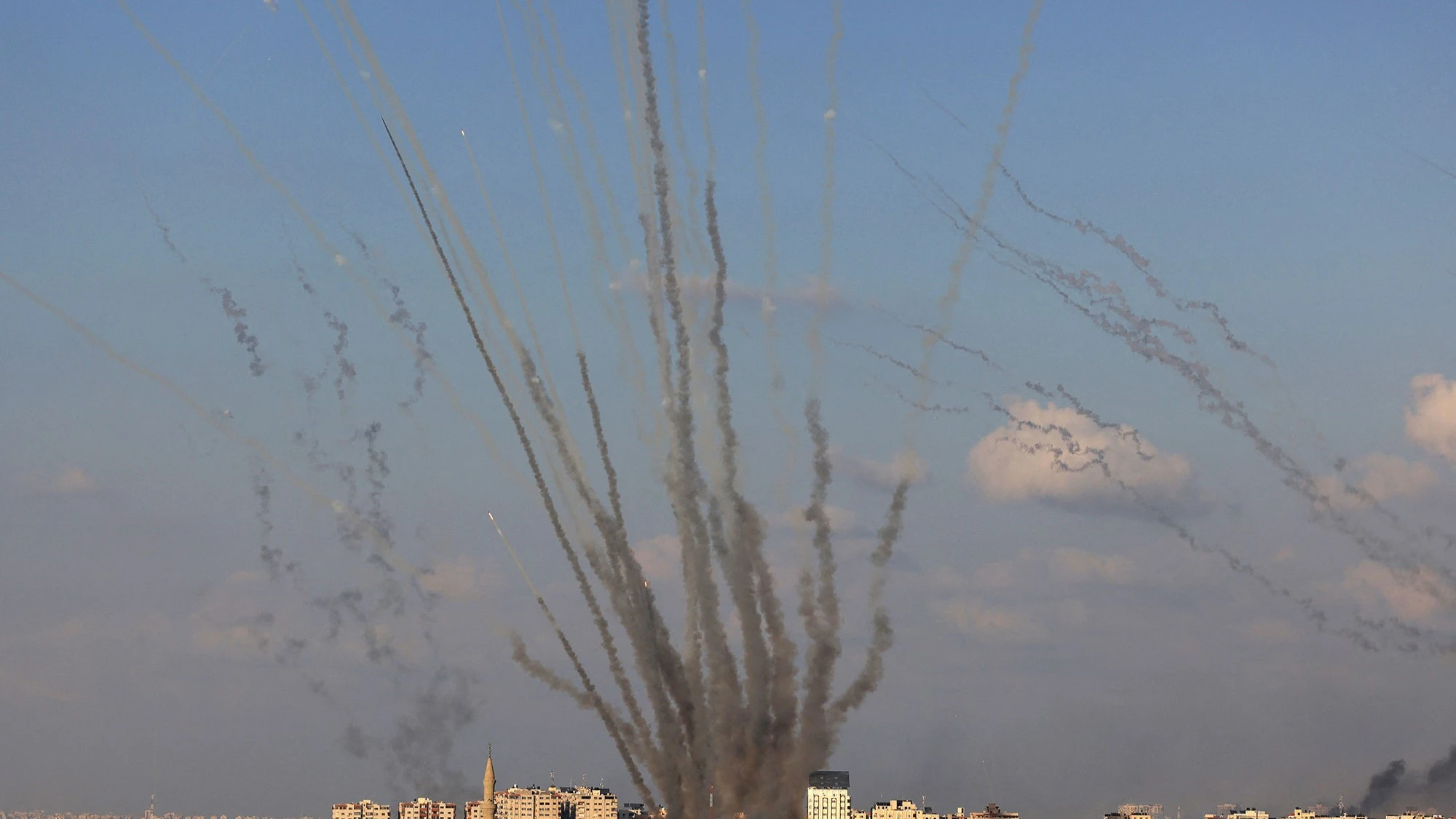
Palestinian rockets rain down on Israel from north Gaza

Hamas continues to confront soldiers in north Gaza, despite Israeli claims that the group has been ‘dismantled’ there

News Desk

JAN 16, 2024
Image
(Photo credit: AFP)

Palestinian resistance groups in Gaza fired dozens of rockets from the north of the strip into southern Israel on the morning of 16 January, dispelling Tel Aviv's claims that they had destroyed Hamas’ capabilities in northern Gaza.


A barrage of around 50 rockets hit the settlements of Netivot and Givolim, located in the Gaza envelope, on Tuesday morning, the Times of Israel reported. The outlet claimed the rockets caused no injuries but some material damage.

The Qassam Brigades “bombarded the occupied city of Netivot with a large rocket barrage,” the military wing of Hamas said via its media channel.

The rocket strike came the day after the Palestinian Islamic Jihad's (PIJ) Quds Brigades launched a large rocket barrage towards the Gaza envelope.

The Quds Brigades announced they struck Sderot “and the settlements of the northern Gaza envelope” with a rocket barrage.

These attacks come as Israel is boasting that it has defeated Hamas in northern Gaza.

“All the [Hamas] battalion frameworks have been dismantled. We are now working to eliminate pockets of resistance. We will achieve this via raids, airstrikes, special operations, and additional activities,” Israeli Defense Minister Yoav Gallant said on 15 January.

Tel Aviv claimed earlier in the month that its forces have “completed the dismantling of Hamas’s military framework in the northern Gaza Strip.”

However, rockets continue to fly out of the northern strip. The Israeli troops remaining in north Gaza are also still facing heavy resistance.

“Our Mujahideen … targeted a Zionist troop carrier [with explosives] … north of the Sheikh Radwan neighborhood in Gaza City (northern Gaza),” the Qassam Brigades said on 16 January, shortly after the rocket barrage on Netivot.

During his latest speech on 14 January, Qassam Brigades spokesman Abu Obeida refuted Israeli claims that the army has managed to destroy or seize weapons depots and rocket launch pads.

“The alleged achievements that the enemy announces … are a mockery to us … the day will come when we prove these claims are false.”

Al-Jazeera noted last week that “if 12 battalions were indeed destroyed [in the north], it would be a significant strategic victory for Israel and a loss that Hamas will probably not be able to overcome while fighting in other parts of the Strip.”

In December, a Qassam Brigades source told Al-Jazeera that the group’s operations forced 70 percent of Israeli forces to withdraw from north Gaza into the south.

The Israeli army is now focusing its ground operations in southern Gaza, facing heavy resistance.

Gatherings of Israeli soldiers in the southern city of Khan Yunis came under heavy gunfire and explosive attacks on 16 January, according to the Qassam Brigades media channel.

https://new.thecradle.co/articles/pales ... north-gaza

Israel rejected 'all Arab proposals' to end Gaza war: Qatar

Qatar’s prime minister affirmed that ending the war in Gaza would reduce tensions across the region

News Desk

JAN 16, 2024

Image
(Photo credit: AP)

Qatari Prime Minister Mohammed bin Abdul Rahman Al-Thani said on 16 January at the World Economic Forum in Davos that Israel has rejected all proposals put forward by Arab states for an end to the war in Gaza.

“The Arabs proposed several solutions and initiatives regarding Gaza, but the Israelis rejected them all,” Al-Thani said at the forum.

The latest Qatari-proposed initiative called for a deal which would see Hamas leaders leave Gaza safely in exchange for a gradual release of all Israeli prisoners and a withdrawal of Israeli troops from the Gaza Strip. Israel has vowed to continue fighting until Hamas is cleared out of Gaza.

Hamas rejected the Qatari proposal, and has vowed to not accept any deal until Israel ends its assault on Gaza.

Hamas has repeatedly affirmed that in such a case, any exchange deal would be on an “all-for-all basis,” meaning that the prisoners held in Gaza would only be released in exchange for the release of all Palestinians held in jails across Israel.

“We need to address how to end the war as soon as possible, how to release the hostages, as well as Palestinian prisoners, and to address the issue in the West Bank,” which, Al-Thani said, is “no less” difficult than the situation in Gaza.

Efforts to reach a new deal are “going through a lot of difficulty,” Al-Thani added, blaming Israel’s “extremist government” for indiscriminate carpet bombing and genocidal intent.

“Gaza is not there anymore,” the Qatari prime minister went on to say.

Al-Thani asserted that a two-state solution is the only option, and that Israel must be forced to accept this path. “It needs to be time-bound. It needs to be irreversible,” he said.

He also said that Hamas is part of the Palestinian political system, and that “the Palestinians are the only ones who have a choice to have them … or not.”

Regarding efforts for Arab normalization with Israel, Al-Thani added: “All of us, we are showing our willingness to extend our hands, to have a peace agreement with Israel, if they are willing to engage genuinely in a process that will make the Palestinians have their state at the end.”

Al-Thani also said that ending the war in Gaza would de-escalate all other fronts, specifically, Yemen’s maritime campaign against Israeli shipping in the Red Sea – which, he said, would no longer be restricted by military strikes.

“We need to address the central issue, which is Gaza, in order to get everything else defused ... if we are just focusing on the symptoms and not treating the real issues, [solutions] will be temporary.”

https://new.thecradle.co/articles/israe ... -war-qatar
"There is great chaos under heaven; the situation is excellent."

User avatar
blindpig
Posts: 14816
Joined: Fri Jul 14, 2017 5:44 pm
Location: Turtle Island
Contact:

Re: Palestine

Post by blindpig » Wed Jan 17, 2024 11:55 pm

Technicality Could Sink Genocide Case v Israel
January 17, 2024

South Africa may have given the World Court a way out of ruling that Israel is plausibly committing genocide and must halt its attacks, writes Joe Lauria.

Image
Shaw argues his case. (ICJ)

By Joe Lauria
Special to Consortium News

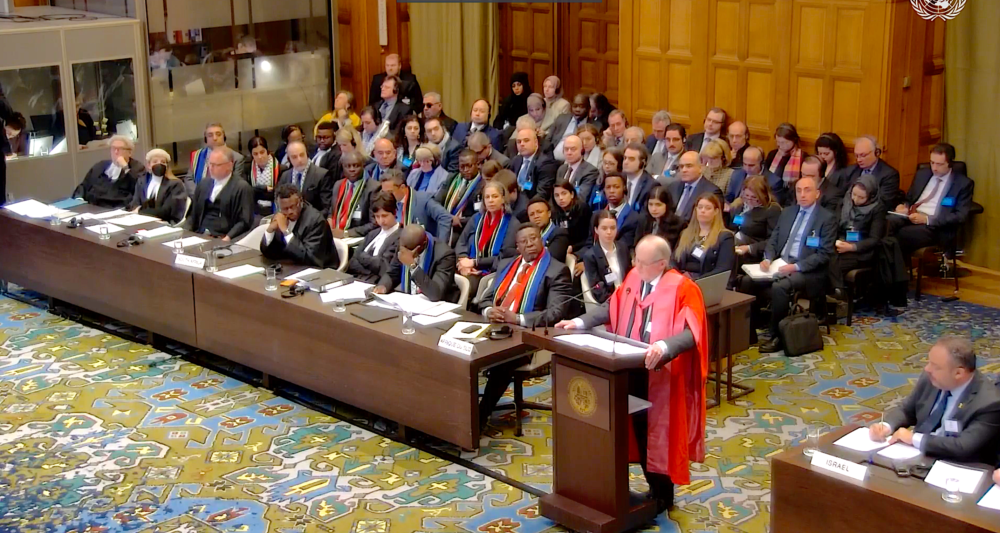
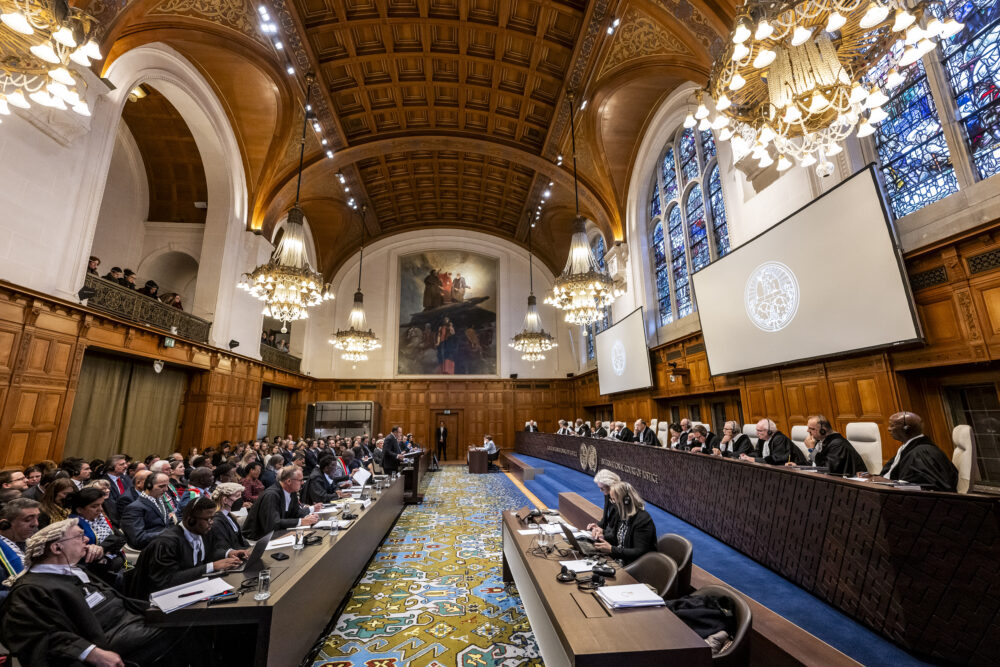
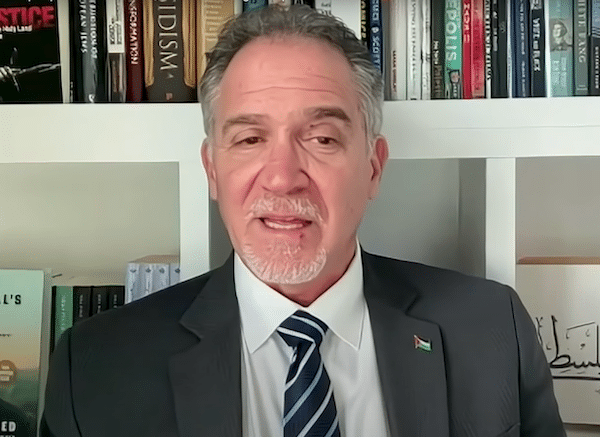
In its defense last Friday before the World Court against allegations by South Africa that it is committing genocide in Gaza and must be stopped, Israel made a legal argument that could torpedo the case if the court buys it.

In order for a claim to reach the International Court of Justice, there must be an established dispute between two states. Israel’s argument is that such a dispute was never established and thus the ICJ lacks jurisdiction to hear South Africa’s claim.

There would be a political outcry from those who seek to stop Israel’s ongoing slaughter in Gaza if the Court decides to dismiss the case on this technicality.

But given the pressure the Court is no doubt feeling from the United States, Germany and other allies of Israel it might be the best, if not the only way for the Court to escape without having to decide that it’s merely plausible that Israel is committing genocide.

That is the bar that needs to be met at this preliminary stage of the case for the Court to issue provisional measures to order Israel to cease its military operation.

The Dispute Over a Dispute

On Thursday, South Africa tried to build a case, probably in anticipation of Israel’s bid, that this was indeed a dispute between Israel and South Africa and it indeed belonged before the World Court.

John Dugard, a South African professor of international law, told the Court:

“The South African Government repeatedly voiced its concerns, in the Security Council and in public statements, that Israel’s actions had become genocidal. On 10 November, in a formal diplomatic démarche, it informed Israel that while it condemned the actions of Hamas, it wanted the International Criminal Court (ICC) to investigate the leadership of Israel for international crimes.

On 17 November South Africa referred Israel’s commission of the crime of genocide to the International Criminal Court for ‘vigorous investigation’. In announcing this decision President Ramaphosa publicly expressed his abhorrence ‘for what is happening right now in Gaza, which is now turned into a concentration camp where genocide is taking place’.

To accuse a State of committing acts of genocide and to condemn it in such strong language is a major act on the part of a State. At this stage it became clear that there was a serious dispute between South Africa and Israel which would end only with the end of Israel’s genocidal acts.

South Africa repeated this accusation at a meeting of BRICS on 21 November 2023 and at an Emergency Special Session of the United Nations General Assembly on 12 December 2023. No response from Israel was forthcoming. None was necessary. By this time, the dispute had crystallized as a matter of law. This was confirmed by Israel’s official and unequivocal denial on 6 December 2023 that it was committing genocide in Gaza.”


Image
Dugard argues that there is a dispute between Israel and South Africa. (UN TV Screenshot)

Dugard added that “as a matter of courtesy” before filing the case with the ICJ on Dec. 29, South Africa sent a “Note Verbale to the Embassy of Israel to reiterate its view that Israel’s acts of genocide in Gaza amounted to genocide — that it, as a State party to the Genocide Convention, was under an obligation to prevent genocide from being committed.”

“Israel responded,” Dugard said, “by way of a Note Verbale that failed to address the issues raised by South Africa in its Note and neither affirmed nor denied the existence of a dispute.”

On Jan. 4, South Africa sent another Note Verbal highlighting Israel’s failure to respond adequately to South Africa’s concerns, and concluded that the dispute between the nations was “plainly not capable of resolution by way of a bilateral meeting.”

Israel Says There is No Dispute

For its part, Israel on Friday argued that no such dispute exists and therefore the Court lacks jurisdiction over the case. Quoting from Article IX of the Genocide Convention, British attorney Malcolm Shaw KC, representing Israel, told the Court:

“Whether or not a dispute in these terms exists at the time of the filing of the Application is a matter for objective determination by the Court, ‘it is a matter of substance, and not a question of form or procedure’. The Court will ‘take into account in particular any statements or documents exchanged between the Parties as well as any exchanges made in multilateral settings’, the Court has said.

The key point here is the use of the term ‘exchange’ between the parties. Unilateral assertion does not suffice. There needs to be some element of engagement between the parties. The element of interchange and bilateral interaction is required. A dispute is a reciprocal phenomenon.”


Shaw made clear Israel does not believe such an exchange took place:

“South Africa cites only a couple of general public statements by Israel referencing merely a press report by Reuters and a publicity release from the Israeli Ministry of Foreign Affairs. These responses were not addressed directly or even indirectly to South Africa. There is no evidence of ‘positive opposition’ as required by the Court.

Further, South Africa cites no relevant exchange between the Parties, which would be the normal fashion for the expression and determination of a dispute between States. This actually typifies how South Africa has approached this matter. It seems to believe that it does not take two to tango. It is sufficient if one State determines there is a dispute, leaving the other party flummoxed.

It is thus disingenuous for Professor Dugard to conclude that ‘Israel must have been aware from South Africa’s public statements, démarche and referral to the International Criminal Court of Israel’s genocidal acts that a dispute existed between the two States’. This is not a dispute, it is a ‘unispute,’ a one-sided clapping of hands.”


Image
The World Court in The Hague hearing South Africa v. Israel. (ICJ)

Shaw said Israel did respond to the Notes Verbale on Dec. 26 by offering to arrange a meeting between the two foreign ministries at South Africa’s “earliest convenience.” The Israeli embassy tried to deliver this note on Dec. 27 to the South African foreign ministry but the ministry was closed because of a holiday, Shaw said.

He claims Israel was informed by the South Africans on Dec. 28 that the note should be hand-delivered on Jan. 2, but on Dec. 29 filed the case with the ICJ, allowing no time for the states to have a dialogue.

That South Africa did not wait for this bilateral meeting before filing with the court puts its case at risk.

Legal Experts Weigh In

“There does have to be a position stated by one side and rejected by the other before there is a dispute,” John Quigley, professor emeritus at the Moritz College of Law of Ohio State University, told Consortium News. “But there was probably sufficient statement by [South Africa] that it thought Israel was committing genocide, and sufficient statement by Israel that it was not committing genocide for there to be a ‘dispute” between the two.'”

Quigley added, “If the court wants to avoid giving provisional measures, it could use this.” He made clear, however, that he thought this was unlikely to happen.

Analyst Alexander Mercouris concurred. He told CN:

“In a sane world it should not defeat the claim. After all, in what sense has Israel been prejudiced? And given that the case is about genocide there is a strong case for acting with urgency. However if the Court wants to find some way out of hearing the case, this lapse has provided it.

If the Court were to take this view, South Africa would have the option of requesting the Israeli response, and then re-filing, either when Israel provided its reply or, in the event that Israel inordinately delayed its reply, when that became clear.”


American academic Norman Finkelstein, told an interviewer: “It will completely discredit the Court if they issue a decision — we have decided not to pursue this case of genocide because we don’t think there is a dispute. That just can’t work.”


Francis Boyle, a professor of international law at the University of Illinois Champlain, represented Bosnia-Herzogovina at the ICJ where he brought a case of genocide against Yugoslavia in 1993.

“To the best of my knowledge the [Yugoslavs] did not know of my genocide lawsuit until the Registrar informed them of it,” Boyle said in an email. “Again, this created no problems for me with the Court on winning my first Order of Provisional Measures of Protection on April 8 [1993].”

Boyle added that Bosnia’s then president, Alija Izetbegovic was at the time “pretty busy negotiating” the Vance-Owen peace deal at U.N. headquarters in New York. “I don’t think he said anything about my genocide lawsuit to the [Yugoslavs] there before I sued them.”

Thus the fact that Sarajevo and Belgrade never directly disagreed about a genocide claim did not affect the Court’s decision to issue provisional measures against Yugoslavia.

In an article published on Consortium News on Sunday, former British diplomat Craig Murray, who was in the public gallery for both days of the hearing, wrote that simply refusing to respond to an allegation of genocide cannot become a way for a nation to continue committing it with impunity. He wrote:

“The case could be technically invalid, and then [the judges] would neither have to upset the major Western powers nor make fools of themselves by pretending that a genocide the whole world had seen was not happening. For a while, they looked visibly relieved. Israel is hoping to win on their procedural points about existence of dispute …

The obvious nonsense [Israel] spoke about the damage to homes and infrastructure being caused by Hamas, trucks entering Gaza and casualty figures, was not serious. They did not expect the judges to believe any of this. The procedural points were for the court. The rest was mass propaganda for the media.”


Murray added:

“I am sure the judges want to get out of this and they may go for the procedural points. But there is a real problem with Israel’s ‘no dispute’ argument. If accepted, it would mean that a country committing genocide can simply not reply to a challenge, and then legal action will not be possible because no reply means ‘no dispute’. I hope that absurdity is obvious to the judges. But they may of course wish not to notice it…”

https://consortiumnews.com/2024/01/17/t ... -v-israel/

*******

Israel destroys neighborhood near Gaza’s last fully functional hospital

The Israeli army also destroyed a cemetery and stole multiple bodies in their withdrawal from the vicinity of Nasser Hospital

News Desk

JAN 17, 2024

Image
(Photo Credit: WAFA)

Israeli airstrikes reportedly wiped out 12 blocks during intense fighting in south Gaza’s Khan Yunis neighborhood overnight between the Israeli army and Palestinian resistance groups, resulting in the deaths and injuries of multiple civilians.

“At 7pm, shells fell on us, and we could not leave our homes,” a witness told Qatari news channel Al-Jazeera. “At 1 am, Israeli vehicles entered the residential neighborhood, and we were subjected to provocations and beatings.”

Israeli warplanes surrounded and bombed the vicinity of Nasser Hospital, the only remaining fully functional hospital in Gaza. Thousands of Palestinians were seeking shelter within the medical complex.

On the morning of 17 January, Al-Mayadeen reported that the bodies of 19 Palestinians had arrived at Nasser Hospital after a series of Israeli airstrikes.

The Israeli army has claimed in a statement that Palestinian resistance fighters fired at the Israeli army from Nasser Hospital.

“This week, the Hamas terrorist organization carried out a launch toward IDF troops from within the Nasser Hospital in Khan Yunis,” read the statement.

The notion that Palestinian resistance fighters are using hospitals as a base of operations and carrying out attacks from within its walls has been repeated on multiple occasions by the Israeli army; yet no independent investigation has shown these claims to be true.

The Israeli army withdrew from the vicinity of Nasser Hospital in Khan Yunis on the morning of 17 January, but not before destroying a cemetery in Al-Namsawi neighborhood and stealing several corpses in the process.

The Israeli occupation forces withdraw from the vicinity of Nasser Hospital in Khan Yunis, southern Gaza, after destroying a cemetery in the Al-Namsawi neighborhood and stealing several corpses.https://t.co/7C1kfYTvmz pic.twitter.com/0e13yAHzgf

— Quds News Network (@QudsNen) January 17, 2024


On the morning of 17 January, the fighters of Al-Qassam Brigades said that after a night of intense clashes with the Israeli army, the military wing of Hamas engaged “in fierce clashes with an Israeli infantry force in Khan Yunis, targeting them with anti-personnel projectiles.”

A brutal fire belt, which Israel's military carried out in Khan Yunis, Gaza a short time ago. pic.twitter.com/aULTGwk2li

— Quds News Network (@QudsNen) January 16, 2024

On the morning of 17 January, the fighters of Al-Qassam Brigades said that after a night of intense clashes with the Israeli army, the military wing of Hamas engaged “in fierce clashes with an Israeli infantry force in Khan Yunis, targeting them with anti-personnel projectiles.”

A brutal fire belt, which Israel's military carried out in Khan Yunis, Gaza a short time ago. pic.twitter.com/aULTGwk2li

— Quds News Network (@QudsNen) January 16, 2024


As the war continues on day 103, the Palestinian Ministry of Health announced that the number of Palestinian deaths has risen to 24,448, and at least 61,500 have been injured since 7 October,

The Ministry of Health also noted that within the past 24 hours, Israel committed 16 massacres on families residing in the Gaza Strip, killing 163 civilians and wounding 350 civilians.

https://new.thecradle.co/articles/israe ... l-hospital

******

Israel’s Dangerous Escalation in Lebanon
January 16, 2024

Hezbollah calls Israel’s repeated attacks deliberate provocations designed to drag Lebanon into the war, Abdul Rahman reports.

Image
Hezbollah fighters in southern Lebanon, May 2023. (Tasnim News Agency, Wikimedia Commons, CC BY 4.0)

By Abdul Rahman
Peoples Dispatch

Amid growing speculation that it will be forced to abandon its guarded responses to Israel’s repeated bombings and targeted killings inside Lebanese territories, Hezbollah continues to show restraint. However, Israel has intensified its efforts to provoke an escalation.

At least four Hezbollah fighters were killed in yet another Israeli attack in southern Lebanon on Monday. In response, Hezbollah fired missiles inside northern Gaza in which reportedly two Israelis were killed.

Israeli provocations have reached extreme levels in the last few weeks with scores of Hezbollah fighters killed in Israeli drone or air strikes deep in southern Lebanon.

So far, more than 130 people, including some Hezbollah fighters, have been killed in Israeli attacks inside Lebanon since the war began in Gaza. Israeli strikes have targeted civilian residential areas and even killed several journalists, some of them with evidence of having been killed deliberately.

Image
Wissam al-Tawil. (Mehr News Agency, Wikimedia Commons, CC BY 4.0)

Hezbollah field commander Wissam al-Tawil was killed on Jan. 8 in one such Israeli strike. He was the highest ranking Hezbollah fighter to be killed by Israel since Oct. 7.

One of the top leaders of Hamas, Saleh al-Arouri was killed in a drone attack in capital Beirut on Jan. 2 along with several others.

Defying U.S. warnings, Hezbollah had fully supported the Palestinian people’s resistance in Gaza, claiming the attacks on Oct. 7 were justified responses to daily oppression and atrocities Israel has been committing against them for 75 years.

Speaking to the public last week, Hezbollah chief Hassan Nasrallah proclaimed “the land of Palestine… is solely for the Palestinians and no one else.” He also criticized the failures of the international community and international law to prevent Israel from carrying out genocide in Gaza.

Nasrallah's message to Israelis:

"If you want to be secure and safe, you have a US passport, go back to the US. You have a British passport, go back to the UK.

Here you don't have a future. From the river to the sea, the land of Palestine is for the Palestinian people only." pic.twitter.com/XMwz2QXzDu

— Richard Medhurst (@richimedhurst) January 12, 2024

More than 23,000 Palestinians have been killed and close to 60,000 wounded in Israeli air strikes and ground offensives inside Gaza since Oct. 7. Israel has refused to listen to international calls for an unconditional ceasefire.

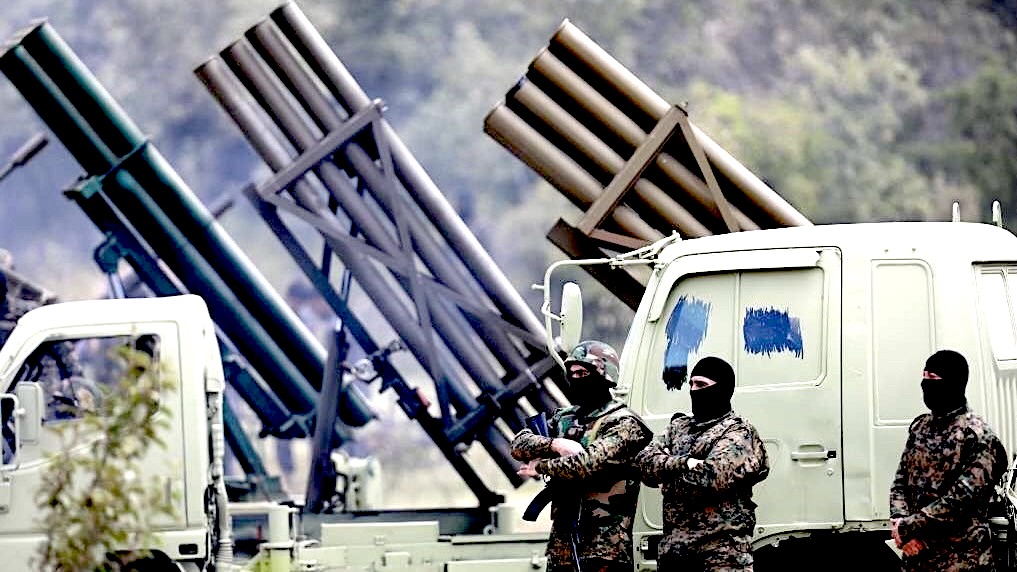
Hezbollah has been carrying out near daily counter attacks against the Israeli occupation, targeting mostly military installations in northern Israel. Its attacks are designed to force hundreds of thousands of Israeli settlers to vacate their towns and cities in the north, rather than to cause civilian casualties.

Deliberate Provocations

Hezbollah has termed the repeated Israeli attacks in Lebanon deliberate provocations designed to drag Lebanon into the war as a way to not only garner greater international support but to provide Prime Minister Benjamin Netanyahu an opportunity to prolong his stay in power.

The #IDF on Tuesday attacked dozens of #Hezbollah targets in the Wadi Saluki village of southern #Lebanon in a significant escalation between the sides.

??By @jeremybob1 https://t.co/55A1znIwAp

— The Jerusalem Post (@Jerusalem_Post) January 16, 2024

Nasrallah has warned repeatedly that such calculations may have catastrophic results for Israel and attempts to drag Hezbollah into the war would be “very costly” for it and its allies.

Nasrallah repeated his warnings against Israel’s close ally the U.S. after it carried out attacks against Houthis in Lebanon. He reiterated that instead of provoking more wars in the region, the U.S. should try to fix the main source of unrest, that is, the Israeli occupation of Palestine.

The recent aggression against #Yemen represents American and British foolishness and an American contradiction.
While the Americans call for not expanding the war, they are expanding it. pic.twitter.com/2XMonegHUK

— ??? ??? ???? (@SH_NasrallahEng) January 14, 2024

Hezbollah’s support for the Palestinian resistance has deep roots. Lebanon had been a base of Palestinian resistance during the 1970s and 1980s and Hezbollah was born as a resistance to Israeli occupation of Lebanese territories between 1981 and 2000. Hezbollah was responsible for forcing the Israeli military to withdraw from southern Lebanon and ending their occupation in 2000.

Experts highlight that the Israeli government should not forget that Hezbollah also defeated Israel in 2006 and has grown much stronger since then, both militarily and politically.

[See: AS`AD AbuKHALIL: Why Israel Is Afraid of Hezbollah]

Hezbollah in Lebanon is a part of a regional “Axis of Resistance” against the Israeli occupation and imperialist interventions along with the Houthis in Yemen and the Popular Mobilization Forces (PMF) in Iraq.

Both the Houthis and PMF have carried out several attacks against U.S. military bases and Israeli economic interests in the region in solidarity with the Palestinian people and against the Israeli genocide in Gaza.

Abdul Rahman is a correspondent for Peoples Dispatch.

https://consortiumnews.com/2024/01/16/i ... n-lebanon/

******

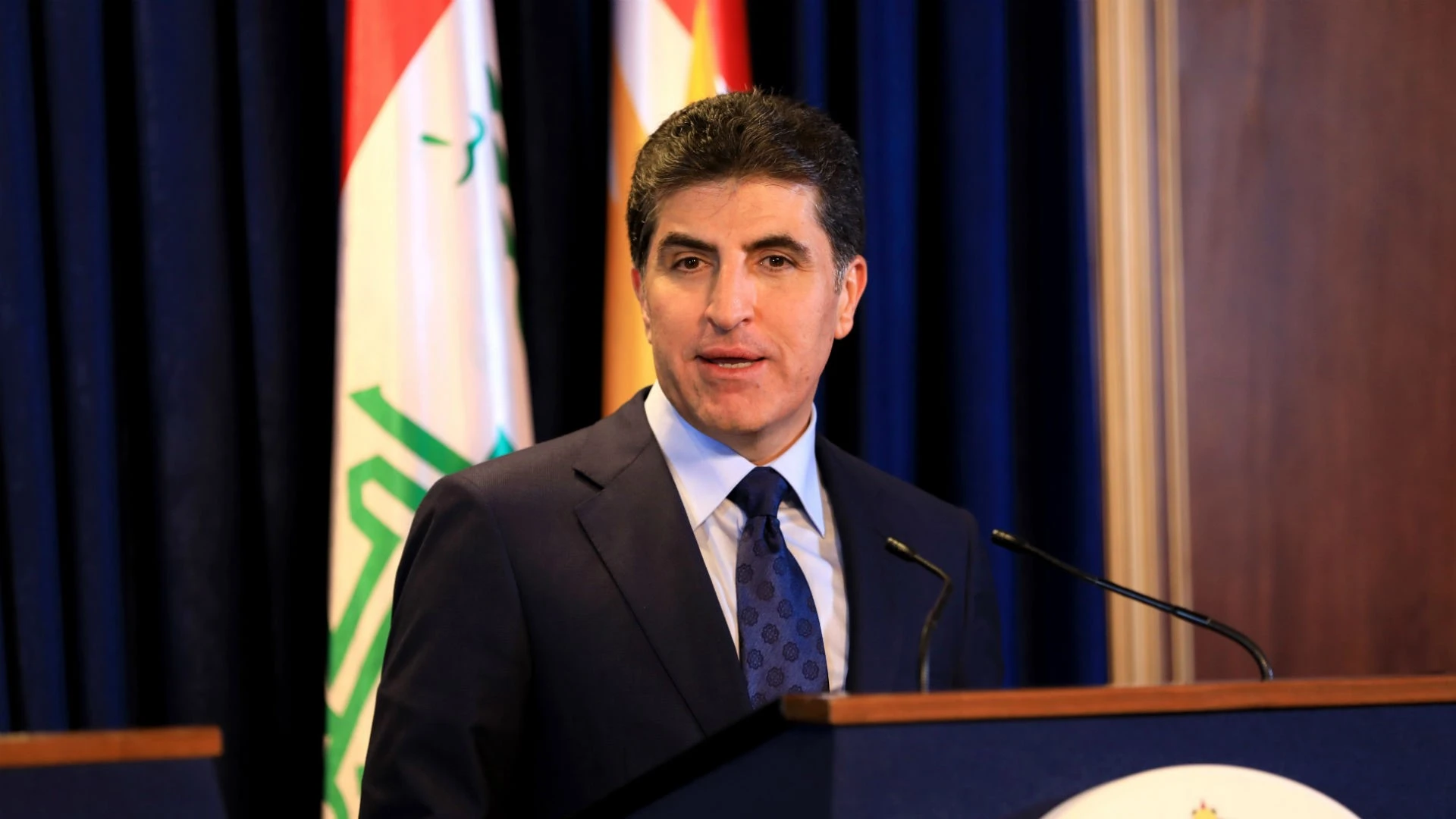
Iraqi Kurdistan PM asks US forces to remain in Iraq

Masrour Barzani made the statement following Iran's bombing of alleged Mossad targets in Erbil

News Desk

JAN 16, 2024

Image
Nechirvan Barzani is the Kurdish region's second president after his uncle Massud. (Photo credit: Getty)]

The prime minister of Iraq's Kurdish region, Masrour Barzani, said that Iran's ballistic missile attack on Erbil on the night of 15 January is an indication that Iraq is still vulnerable to "terrorism" and, therefore still in need of the presence of the US-led coalition forces.

US and allied forces have been in Iraq since 2014 under the pretext of fighting ISIS. However, US and allied intelligence agencies welcomed the growth of ISIS to destabilize the governments of Syria's Bashar al-Assad and Iraq's Nuri al-Maliki.

On 10 January, Iraq Prime Minister Mohammed Shia al-Sudani said he wanted a quick and orderly negotiated exit of US-led military forces from Iraq as the threat from ISIS was no longer significant.

He described the US military presence as destabilizing after a US strike targeted a Popular Mobilization Forces (PMU) commander in Baghdad.

In the late hours of Monday, Iran's Islamic Revolutionary Guard Corps (IRGC) fired ten ballistic missiles toward the Kurdistan Region's capital, Erbil, targeting an alleged Mossad spy headquarters.

While attending the 2024 World Economic Forum in Davos, Barzani condemned the "unjustified" attack by the IRGC, which killed at least four people.

"These attacks and hostilities against the Kurdistan Region are without reason and are unjustified. We at the Kurdistan Region have done all we can to provide more services for our people and develop our relations with neighboring countries in a peaceful manner," claimed Barzani during a presser.

"We don't think that terrorism has ended, and last night's event is an indication that instability in the region is still very much at stake and that we need international cooperation and support to bring more stability to Iraq and the Region as a whole," he added.

The strikes targeted the villa of Peshraw Dizayee, a well-known Kurdish businessman. Dizayee and his 11-month-old daughter were killed as a result of the attack. Two other civilians were also killed, and 17 others were wounded.

Dizayee gained prominence for completing the Empire World construction project in Erbil, home to numerous large residential high-rise buildings.

Through his company, the Falcon Group, the Iraqi businessman operated in various sectors, including construction, oil, natural gas, technology, agriculture, cosmetics, and security.

Dizayee's name was also associated with the Development Road Project, which sought to connect Iraq to Europe via Turkiye.

The Falcon Group also allegedly assisted in the sale of Kurdish oil to Israel via Turkiye.

Monday's strike resembled an Iranian strike on Erbil in 2022. One of the buildings targeted in the attack was a villa owned by the CEO of the Iraqi Kurdish oil company KAR group, Sheikh Baz Karim Barzinji, who allegedly had Mossad ties and lived in a heavily fortified compound from which drone attacks were launched.

https://new.thecradle.co/articles/iraqi ... in-in-iraq

Germany plans to supply Israel with tanks shells as Gaza death toll nears 25,000

Berlin has also announced its intention to 'intervene' on behalf of Israel in the genocide case at the International Court of Justice (ICJ)

News Desk

JAN 17, 2024

Image
(Photo Credit: JOHN MACDOUGALL/ AFP via Getty Images)

German government officials have “fundamentally agreed behind the scenes” to supply Israel with thousands of rounds of 120-millimeter precision ammunition to fuel the war in Gaza, according to a report by Der Spiegel.

Since receiving an Israeli request for the tank shells in November, the Chancellery, the Defense Department, the Foreign Office, and the Ministry of Economic Affairs have been holding talks to fulfill the request.

“German defense companies were not in a position to deliver the requested ammunition in a short period of time, and the ministries have started on a plan to provide this ammunition from the German army’s own stocks,” the German daily reported on 16 January.

Once completed, the deal would mark the first public arms delivery from Berlin to Tel Aviv since the start of Israel's ethnic cleansing campaign in Gaza. Der Spiegel reports that Germany has so far mainly supplied Israel with “medical supplies and protective equipment.”

“Both sides have agreed to keep quiet about the request to send lethal weapons because Israel does not want to allow any conclusions to be drawn about its military capabilities,” the report highlights.

In response to the news, Hamas officials lambasted Berlin, saying that sending tank shells to Israel would turn Germany into a “direct partner in the war on our people in Gaza."

"It seems Germany is reproducing its history full of sins against humanity. It is undeterred from the lessons of the recent past," the statement added.

Germany came under fire last week after officials announced their intention to intervene on Israel’s behalf as a third party in the genocide case at the International Court of Justice (ICJ) brought by South Africa.

“Germany has chosen to defend in the ICJ the genocidal and gruesome acts of the Israeli government against innocent civilians in Gaza and the occupied Palestinian Territories,” the president of Namibia, Hage Geingob, said via social media, reminding Berlin of the atrocities the nation conducted against the indigenous Herero and Nama peoples.

“On Namibian soil, Germany committed the first genocide of the 20th century in 1904-1908, in which tens of thousands of innocent Namibians died in the most inhumane and brutal conditions. The German Government is yet to fully atone for the genocide it committed,” the statement reads, accusing Berlin of being unable to “draw lessons from its horrific history.”


“Germany cannot morally express commitment to the United Nations Convention against genocide, including atonement for the genocide in Namibia, while supporting the equivalent of a holocaust and genocide in Gaza,” Geingob added.

As news broke about Germany's intention to supply Israel with thousands of tank shells, the death toll in the besieged Gaza Strip reached 24,448 after 103 days of fighting. Nearly two-thirds of those killed are women and children.

https://new.thecradle.co/articles/germa ... ears-25000
"There is great chaos under heaven; the situation is excellent."

User avatar
blindpig
Posts: 14816
Joined: Fri Jul 14, 2017 5:44 pm
Location: Turtle Island
Contact:

Re: Palestine

Post by blindpig » Thu Jan 18, 2024 12:28 pm

What is happening in Palestine and Israel: chronicle for January 17
January 17, 2024
Rybar

Image

Although disruptions in communications and the Internet in the Gaza Strip have continued for the sixth day, it has become known that Palestinian forces have become more active in several areas in its northern part. In response, the Israeli Air Force carries out airstrikes on Gaza and its suburbs.

Fighting continues in the central and southern parts of the enclave. The Palestinians are attempting attacks in the area of ​​Al-Breij and Al-Maghazi, but, for obvious reasons, they are unable to push back the IDF. The Israelis are demolishing buildings with bulldozers, engineered explosive charges and air strikes.

Aircraft are actively operating in Khan Yunis and Rafah, and the Palestinians constantly claim the death of civilians. According to estimates by the Palestinian Ministry of Health, the number of dead and injured exceeds 24 and 61 thousand, respectively. In Khan Yunis, slight advances by the IDF are also recorded.

On the border with Lebanon, the situation is the same: Hezbollah is attacking Israeli settlements, and the IDF is attacking Lebanese territory. One of the border points on the Golan Heights in the Shebaa Farms area was hit by a Burkan missile.

IDF raids continue in the West Bank with the active use of unmanned aircraft. In Tulkarm and the Balata camp, nine Palestinians were killed and some were wounded in UAV attacks. According to Israeli security forces, over 30 people were detained in various localities overnight alone.

Progress of hostilities
North Gaza Strip

Image
In the north of the Gaza Strip, Kataib Izz al-Din al-Qassam militants have become noticeably more active. According to their own statements, they managed to carry out several successful ambushes on IDF forces in the areas of Sheikh al-Radwan , Al-Karama , Al-Ansar and Jabaliya . The information is indirectly confirmed by reports of multiple artillery and air strikes by the IDF on these areas.

The IDF also shelled Jabaliya , the Al-Ansar area and the Gaza port . In the Ad-Daraj area , where IDF airstrikes were also recorded, 25 people were killed and dozens were injured.

Center of the Gaza Strip

Over the course of 24 hours, the Israelis launched multiple strikes on various settlements, including Juhr al-Dik , a small city that remained within the reach of Israeli forces. In the east of the settlements of Al-Brej and Al-Maghazi there are battles. The Palestinians make incursions, but for obvious reasons they are unable to push back the Israelis. Bombs also fell on Deir al-Balah again, hitting the area around the al-Aqsa Martyrs Hospital .

South Gaza Strip

Image
The Israel Defense Forces carried out an operation near the Nasser Hospital in the area of ​​the Austrian Cemetery , and the surrounding area of ​​the medical facility was subject to intense artillery shelling. In addition, Palestinians reported the sound of gunfire in the immediate vicinity of the hospital, with the Palestinians claiming at least seven deaths. The Jordanian Army has held Israel responsible for the safety of staff at the Khan Yunis field hospital after one of its staff was injured in an IDF airstrike.

In addition, there are violent clashes in the Botna al-Samin area , and Rafah was subjected to several airstrikes, where only one house was destroyed, killing 13 people: two of them children, and dozens were injured.

Border with Lebanon

The situation on the Israeli-Lebanese border remains the same. Hezbollah reported attacks on Israeli Defense Forces units located near the military installations of Ar-Rahib , Al-Abad , Ruweisat al-Alam in the Shebaa farms , Tell Sha'ar and Menara . Among other things, the group used Burkan (Vulcan) ballistic missiles. In addition, the Lebanese branch of Hamas's military wing reported an attack by 20 rockets from Lebanese territory on a military facility in the village of Liman in Western Galilee . In turn, the Israeli Air Force attacked the Lebanese cities of Muhaibib , Houla , Rashaya al-Fuqar , Aita al-Shaab and others. Arab media claim that the airstrikes targeted civilian infrastructure, including the building of the National Evangelical Church in Alma al-Shaab.

West Bank

Israel continues to conduct police operations in the Palestinian Authority of the West Bank . Clashes took place in Tulkarm , Nablus and the Balata camp . In the last one, a car carrying Palestinians was destroyed by a UAV strike. Another UAV attack occurred in Tulkarm, where a group of Palestinians was also attacked, killing four people. A total of nine people were killed in drone strikes in the West Bank, and members of two Palestinian Red Crescent ambulance crews were injured.

In addition, an operation took place in the Old City and the Ramallah at-Takhta area in the city of Ramallah . In total, at least 45 people were arrested in the autonomy last night.

Political-diplomatic background
On Blinken's statements at the World Economic Forum in Davos

At a forum in Davos , US Secretary of State Antony Blinken said that a solution to the Israeli-Palestinian conflict based on a “two states for two peoples” plan could weaken and isolate Iran in the region. According to him, many Arab countries are now ready to work together to achieve normalization of relations with Israel , but for this an independent Palestinian state must be created.

The American diplomat also said that the Palestinian Authority in the West Bank must have a stronger governance structure in order to effectively work for the benefit of the Palestinian people. He added that the problem lies in the extent to which Israeli society is willing to cooperate on this issue.

https://rybar.ru/chto-proishodit-v-pale ... -yanvarya/

War in the Red Sea: what happened off the coast of Yemen on January 17
January 18, 2024
Rybar

Image

Yemen's Houthis again attacked transport ships in the Gulf of Aden in the evening. According to preliminary data, two cargo ships were attacked, although the representative of the Ansarallah movement, Yahya Sari, announced only one target - the cargo ship GENCO PICARDY .

And only a little earlier, the United States once again added Ansarallah to the list of terrorists. A populist decision is essentially a mere formality and, after today’s attack, even looks comical.

Meanwhile, the European Union is exploring options for organizing naval operations in the Red Sea to protect shipping from attacks. But the enterprise does not promise any special benefits, although it carries certain risks. Therefore, the discussion is likely to drag on.

New Ansaralli attack
On the evening of January 17, Ansarallah, as if in response to yet another recognition of themselves as terrorists, launched a combined attack on two ships at once in the Gulf of Aden .

According to our sources, the bulk carriers SSI INVINCIBLE II and GENCO PICARDY were damaged . The first was attacked by a UAV, and the second by a UAV and a missile. According to preliminary information, there are casualties on the GENCO PICARDY, and the SSI INVINCIBLE II received damage to its communication antennas.

Both bulk carriers were Chinese built and sailed under the flag of the Marshall Islands, GENCO PICARDY belongs to the British V.SHIPS UK and sailed from Egypt to India .

SSI INVINCIBLE II belongs to the Dutch NAESS SHIPMANAGEMENT and came from Egypt . The destination description on Marine Traffic states NORELATIONWTH ISRAEL . And there are certain oddities with it - there was a distress signal on the air, but the British monitoring system UKTMO reported only one incident.

A Houthi statement later appeared, published by Ansarallah spokesman Yahya Sari . According to him, “the naval forces of the Yemeni Armed Forces carried out an attack on an American ship in the Gulf of Aden with anti-ship missiles, and the hit turned out to be accurate and direct.”

Re-listing of Ansarallah as terrorists
The United States announced the re- inclusion of the Yemeni Ansarallah movement on the list of terrorist organizations. It first appeared there back in January 2021 under Trump , but later Joe Biden, who came to power , canceled the decision for “humanitarian reasons.”

Of course, in this case, the decision is a pure formality - the previous status of the Houthis did not in any way prevent the Americans from launching strikes on Yemen either last week or even earlier in 2015. The measure is purely demonstrative and in some ways even populist in nature.

And needless to say, this in itself will not in any way affect the combat capabilities of the Ansarallah, just like the movement’s ability to influence shipping in the Red Sea , which they did not fail to prove a few hours after the recognition.

International reaction to the listing of the Houthis as terrorists
The Americans' re- inclusion of the Yemeni Ansarallah movement on the list of global terrorist organizations drew condemnation, first of all, from Palestinian groups:

Hamas's political office condemned the move by the United States "in the strongest possible terms," ​​calling it "unethical and politicized." According to representatives of the group, it confirms the US commitment to the “Zionist, occupation and expansionist program.”

Palestinian Islamic Jihad considered that “this action is aimed at collectively punishing the Yemeni people for their position in support of the resilience of our Palestinian people in the Gaza Strip,” and “real terrorism is being practiced by the American administration.

As the Mujahideen Movement stated , this decision is not new for the United States, which “leads terrorism and injustice in the world.” The Joe Biden administration's designation of the Houthis as terrorists is therefore a "badge of honor."

And the Marxist Popular Front for the Liberation of Palestine called the American classification of the Yemeni movement as a global terrorist organization “the height of colonial impudence.”

The Houthis themselves also responded: Ansarallah spokesman Mohammed Abdel Salam said in an interview with Al Jazeera that “the American classification of us as terrorists will not deter us from our firm position in support of the Palestinians.”

About the European Union's plans to send the Navy to the Red Sea
Bloomberg writes that the European Union is still working out the details of organizing a naval operation in the Red Sea in order to protect shipping from attacks by the Yemeni Houthis. The EU could approve these plans as early as January 22 at a meeting of foreign ministers in Brussels .

As part of the new mission , the EU could send at least three multi-purpose destroyers or frigates to the region . They will be able to exchange information and interact with US forces in the region. If this operation is approved, its implementation could begin as early as the end of February.

However, the number of ships in the Red Sea and the Gulf of Aden will not in any way affect the Houthis’ ability to carry out strikes. But the coalition naval fleets themselves will become a convenient target for attacks. Therefore, the discussion is likely to drag on. Moreover, long-distance sea voyages are not cheap , and not all countries have bases or at least supply points in the region.

https://rybar.ru/vojna-v-krasnom-more-c ... -yanvarya/

Google Translator

*******

Image
Miko Peled

The IDF’s war crimes are a perfect reflection of Israeli society
By Chris Hedges (Posted Jan 17, 2024)

Originally published: ScheerPost on January 15, 2024 (more by ScheerPost)


Three months into Israel’s bombardment of Gaza, the atrocities the IDF has committed against Palestinians are too numerous to name. Israel is staging a prolonged assault on the Palestinian people’s very means of existence—destroying homes, hospitals, sanitation infrastructure, food and water sources, schools, and more. To understand the genocidal campaign unfolding before our eyes, we must examine the roots of Israeli society. Israel is a settler colonial state whose existence depends on the elimination of Palestinians. Accordingly, Israel is a deeply militarized society whose citizens are raised in an environment of historical revisionism and indoctrination that whitewashes Israel’s crimes while cultivating a deep-seated racism against Palestinians. Miko Peled, former IDF Special Forces and author of The General’s Son: Journey of an Israeli in Palestine, joins The Chris Hedges Report for a frank conversation on the distortions of history and reality at the foundations of Israeli identity.

Studio Production: David Hebden, Adam Coley, Cameron Granadino
Post-Production: Adam Coley

TRANSCRIPT
The following is a rushed transcript and may contain errors. A proofread version will be made available as soon as possible.

Chris Hedges: The Israeli army, known as the Israel Defense Force or IDF, is integral to understanding Israeli society. Nearly all Israelis do three years of military service, most continue to serve in the reserves until middle age. Its generals often retire to occupy senior positions in government and industry. The dominance of the military in Israeli society helps explain why war, militaristic nationalism, and violence are so deeply embedded in Zionist ideology.

Israel is the outgrowth of a militarized settler colonial movement that seeks its legitimacy in biblical myth. It has always sought to solve nearly every conflict; The ethnic cleansing and massacres against Palestinians known as the Nakba or catastrophe in the years between 1947 and 1949, the Suez War of 1956, the 1967 and 1973 wars with Arab neighbors, the two invasions of Lebanon, the Palestinian intifadas, and the series of military strikes on Gaza, including the most recent, with violence. The long campaign to occupy Palestinian land and ethnically cleanse Palestinians is rooted in the Zionist paramilitaries that formed the Israeli state and continues within the IDF.

The overriding goal of settler colonialism is the total conquest of Palestinian land. The few Israeli leaders who have sought to reign in the military, such as Israeli Prime Minister Levi Eshkol, have been pushed aside by the generals. The military setbacks suffered by Israel in the 1973 war with Egypt and Syria, and during Israel’s invasions of Lebanon only fuel the extreme nationalists who have abandoned all pretense of a liberal democracy. They speak in the open language of apartheid and genocide. These extremists were behind the 1995 assassination of Prime Minister Yitzhak Rabin and Israel’s failure to live up to the Oslo Accords.

This extremism has now been exacerbated by the attack of October 7, which killed about 1,200 Israelis. The few Israelis who oppose this militaristic nationalism, especially after October 7, have been silenced and persecuted in Israel. Genocidal violence is almost exclusively the language Israeli leaders, and now Israeli citizens, use to speak to the Palestinians and the Arab world.

Joining me to discuss the role of the military in Israeli society is Miko Peled. Miko’s father was a general in the Israeli army. Miko was a member of Israel’s special forces, although disillusioned with the military, moved from his role as a combatant to that of a medic. After the 1982 war in Lebanon, he buried his service pin. He is the author of, The General’s Son: Journey of an Israeli in Palestine and Injustice: The Story of the Holy Land Foundation Five.

You grew up, you were a child when your father was a general in the IDF. This inculcation of that military ethos has begun very young and begun in the schools. Can you talk about that?

Miko Peled: Sure, thanks for having me, Chris. It’s good to be with you again and talk to you. So it begins before the military. It begins in preschool. It begins as soon as kids are able to talk and walk. I always say I knew the order of the ranks in the military before I knew my alphabet and this is true for many Israeli kids. The Israeli education system is such that it leads young Israelis to become soldiers and to serve the apartheid state and to serve in this genocidal state, which is the state of Israel. It’s an enormous part of that. And with me, it came with mega-doses of that because when your father’s a general, and particularly of that generation of the 1967 generals, they were like gods of the Olympus. Everybody knew their names.

On Independence Day, I remember in the schools you would have little flags, not just flags of Israel, but flags of the IDF with pictures of IDF generals, with pictures of military, all kinds of military symbols and so on. It’s everywhere. When I was a kid they still had a military parade. It’s everywhere and it’s inescapable. And it’s like you said, you hear it when you walk down the street, you hear it in the news, you hear it in conversations, you hear it in schools, you read it in the textbooks, and there’s no place to develop dissent. There’s no place to develop a sense that dissent is okay, that dissent is possible. And the few cases where people do become dissenters, it’s either because their families have a tradition of being communist or more progressive and somehow it’s part of their tradition but this is a minority of a minority. By and large, Israel stands with the army, and Israel is the army. You can’t separate Israel from its army, from its military.

CH: Let’s juxtapose the myth that you were taught in school about the IDF with the reality.

MP: The myth that I was… Again, this was given to me in larger doses at home because my father and his comrades were all part of the 1948 mythology. We were small and we were resourceful, and we were clever, and therefore, in 1948, we were able to defeat these Arab armies and these Arab killers who came to try to kill us and so on and destroy our fledgling little Jewish state. And because of our heroism–And you talked about the biblical connection–Because we are the descendants of King David, and we are the descendants of the Maccabees, and we have this resourcefulness and strength in our genes, we were able to create a state and then every time they attacked, we were there. We were able to defend ourselves and prevail and so on. It’s everywhere. Then again, in my case, it’s every time the larger, more extended family got together or my parents got together with their friends. And in many cases, the fathers were also comrades in arms.

The stories of the battles, the stories of the conquests; Every city in Israel has an IDF plaza. Street names after different units of different generals are all over the country, street names of battles, so it’s everywhere. It wasn’t until I was probably 40 or a little less than 40, that it was the first time that I encountered the other narrative, the Palestinian story, and it was unbelievable. Somebody was telling me the day is night and night is day, or the world is flat, or whatever the comparison you want to make, it was incredible. They are telling me that what I know to be true ’cause I heard it in school and I read it in books, and I heard it from my father and from my mother and from friends, that all of this is not true. And what you find out if you go along the path that I chose to take, this journey of an Israeli to Palestine, is that it was one horrifying crime against humanity.

That’s what this so-called heroism really was, it was no heroism at all. It was a well-trained, highly motivated, well-indoctrinated, well-armed militia which then became the IDF. But when it started, it was still a militia or today they would be called a terrorist organization, that went up against the people who had never had a military force, who never had a tank, who never had a warplane, who never prepared, even remotely, for battle or for an assault. Then you have to make a choice: How do you bridge this? The differences are not nuanced, the differences are enormous. The choice that I made is to investigate for myself and find out who’s telling the truth and who isn’t. And my side was not telling the truth.

CH: How did they explain incidents such as the Nakba, the massacres that took place in ’48 and ’56, the massive ethnic cleansing that took place in ’67? How was that explained to you within that mythic narrative? Then I wonder if you could, because many of the activities as you mentioned that the IDF has had to carry out are quite brutal, quite savage, the killing, indiscriminate killing of civilians, we can talk about Gaza in a minute. What did that do to the society, the people who carried out those killings, and, of course, eventually huge prisons and torture and everything else. But let’s begin with how the myth coped with those incidents and then talk about the trauma that is carried within Israeli society for carrying out those war crimes.

MP: My generation, we knew that there were several instances of bad apples that committed terrible crimes. And we admitted, so there was Deir Yassin, which was a village on the outskirts of Jerusalem, a peaceful village where a horrible massacre took place. Then we knew that Ariel Sharon was a bit of a lunatic and he took the commandos that he commanded in the ’50s and went to the West Bank and went into Gaza and committed acts of terrible massacres. He was still a hero, held in high regard by everyone, but we knew that there were certain instances… And every military, every nation makes its mistakes and then these things happen But there was never any sense that this somehow discounted or hurt the image of us being a moral army.

There are lots of stories of how soldiers went and they decided to, out of the kindness of their heart, they didn’t harm civilians. And those same civilians went and then warned the enemy that they were coming. And these same good Israeli soldiers would then pay the price and were killed. So it’s presented as limited cases. Nakba was not something that was ever discussed. I’m sure it’s not discussed today, certainly not in schools. In Israeli schools today, you’re not allowed to mention the Nakba. There’s a directive by the Ministry of Education that even Palestinians are not allowed to mention the Nakba. But nobody ever talked about that. And the Arabs left, what are you going to do? There was a war and all these people left and this is the way it is.

So none of that ever hurt, in any way, the image of us being this glorious heroic army, descendants of King David, and other great traditions of Jewish heroism, none of that ever, ever hurt itself. So there’s no trauma because we did nothing wrong. If somebody did something wrong, well, it was a case of bad apples, it was limited to a particular circumstance, a particular person, a particular unit, and you get crazy people everywhere. What are you going to do? It’s never been presented as systemic. Today, we have a history so we can look back and if we do pay attention, and if we do read the literature, and we do listen to Palestinians–And today there’s this great NGO called Zochrot, which its mission is to maintain the memory of the towns and cities that were destroyed in 1948 and to revive the stories of what took place in 1948–They are uncovering new massacres all the time. Because as that generation is dying off, both the Israelis who committed the crimes and the Palestinians who were still alive at the time and survived, are opening up and telling more and more stories.

So we know of churches that were filled with civilians and were burned down. We know of a mosque in Lydd that was filled with people and a young man went and shot a Fiat missile into it. All of these horrific stories are still coming out but Israelis are not paying attention, Israelis are not listening. Whenever there’s an attack on Gaza–And as you know very well, these attacks began in the fifties with Ariel Sharon, by the way–There was always a reason. Because at first they were infiltrators, and then they were terrorists, and now they’re called Hamas, and whatever the devil’s name may be there’s always a very good reason to go in there because these are people who are raised to hate and kill and so on. So it’s a tightly-knit and tightly-orchestrated narrative that is being perpetuated and Israelis don’t seem to have a problem with that.

CH: And yet carrying out acts of brutality. The occupation–Huge numbers, a million Israelis are in the states. Large numbers of Israelis have left the country. I’m wondering how many of those are people who have a conscience and are repulsed by what they have seen in the West Bank and Gaza. Perhaps I’m incorrect about that.

MP: I don’t know. The few encounters that I’ve had with Israelis in the U.S. over the years, the vast majority support Israel, support Israel’s actions. It’s interesting that you mentioned that because I an email from someone who is representing a group of alumni of Jewish Day Schools. These are Zionist schools all over countries where they indoctrinate the worst Zionism: secular Zionism. And they are now appalled by the indoctrination to serve in the IDF. And a very high percentage of these students grew up, went to Israel, joined the IDF, and took part in APEC events and so on. And now they’re looking back and they’re reflecting and they’re feeling a sense of anger that they were put through this and lied through their entire lives about this.

So that’s an interesting development. And if that grows, then that might be a game changer because these are the most loyal American Jews. The most loyal to Israel. But by and large, Israelis that I meet, with few exceptions, support Israel and they’re here for whatever reasons people come to America: They’re not unique, they’re not necessarily here because they were fed up or they were angry, or they were dissenters in any way, shape, or form. Around DC and Maryland, there are many Israelis. Sometimes you’ll sit in a coffee shop or go somewhere, you hear the conversations, and there’s no lack of support for Israel among these Israelis as far as I can see.

CH: Let’s talk about the armies. You were in the Special Forces elite unit. Talk about that indoctrination. I remember visiting Auschwitz a few years ago, and there were Israeli groups and people were flying Israeli flags. But speak about that form of indoctrination and it’s link, in particular, to the Holocaust.

MP: The myth is that Israel is a response to the Holocaust. And that the IDF is a response to the Holocaust; We must be strong, we must be willing to fight, we must always have a gun in one hand or a weapon in one hand so that this will never happen again. And what’s interesting is, when you talk to Holocaust survivors who are not indoctrinated, who did not get pulled into Zionism–Which there are very, very many–They’ll say the notion that a militarized state is somehow the answer to the Holocaust is absurd because the answer to the Holocaust is tolerance and education and humanity, not violence and racism. But nobody wants to ruin a good myth with the actual facts. So that’s the story.

The story is because of Auschwitz, we represent all those that were killed, perished by the Nazis and so on, and therefore we need to be strong. And the Israeli flag represents them, and the Israeli military represents them. It’s absurd, it’s absolute madness. I went to serve in the army willingly, as most young Israelis do. In my environment, refusing or not going was not heard of, although there were some voices in the wilderness that were refusing and questioning the morality. But I never did. Nobody around me ever did until I began the training and you began patrolling. I remember–You and I may have talked about this once–We were an infantry unit, a commando infantry unit. And suddenly we were given batons and these plastic handcuffs and were told to patrol in Ramallah.

And I’m going, what the hell’s going on? What are we doing here? And then we’re told if anybody looks at you funny, you break every bone in their body. And I thought, everybody’s going to look at us, we’re commandos while marching through a city. Who’s not going to look at us? I was behind. I didn’t realize that everybody already understood that this is how it is, this is how it’s supposed to be. I thought, wait, this is wrong. Why are we doing this? We’re supposed to be the good guys here.

And then there was the Lebanon invasion of ’82 and so on. So that broke that in my mind, that was a serious crack in the wall of belief and the wall of patriotism that was in me. But this whole notion that somehow being violent and militaristic and racist and being conquerors is somehow a response to the horrors of the Holocaust is absolute madness. But when you’re in it nobody around you is asking questions. You don’t ask questions either, unless you’re willing to stand out and be smacked on the head.

CH: Within the military, within the IDF, how did they speak about Palestinians and Arabs?

MP: The discourse, the hatred, the racism, is horrifying. First of all, they’re the animals. They’re nothing. It’s a joke, you see, it’s horrifying. They think it’s funny to stop people and ask them for their ID and to chase them and to chase kids and to shoot. It all seems like entertainment, you know? I never heard that discourse until I was in it. Then afterwards, when I would meet Israelis who served, even here in the U.S., the way they joked around about what they did in the West Bank, the way they joked around about killing or stopping people or making them take their clothes off and dance naked, it’s entertainment.

They think it’s funny. They don’t see that there’s a problem here because the racism is so ingrained from such a young age that it’s almost organic. And I don’t think it’s surprising, I think when you have a racist society, and you have a racist education system that is so methodical, that’s what you get. And the racism doesn’t stop with Palestinians or with Arabs; It goes on to the Black people, it goes on to people of color, it goes to Jews or Israelis who come from other countries who are dark skinned, for some reason. The racism crosses all these boundaries and it’s completely part of the culture.

CH: You have very little criticism of the IDF, almost none within the Israeli press, although there is quite a bit of criticism right now, of Netanyahu and his mismanagement and his corruption. Talk a little bit about the deification of the IDF within the public discourse and mainstream media and what that means for what’s happening in Gaza.

MP: Well, the military is above the law. It’s above reproach, except from time to time. So after the ’73 war, there was an investigation. And now there has been, just earlier this week, there was, in the cabinet meeting, the cabinet meets every Sunday. And the army chief of staff was there and he was, apparently, this was leaked from the meeting, a cabinet meeting. It was leaked that some of the more right-wing partners, it’s funny to say right-wing partners because they’re all this right-wing lunacy in the Israeli cabinet. But the more right-wing settlers that are in the cabinet were attacking the army, were attacking the chief of staff because I guess he decided to start an inquiry because there was a, it was catastrophic when the Palestinian fighters came in from Gaza, there was nobody home. They took over half of their country back. They took twenty-two Israeli settlements and cities.

They took over the army base of the Gaza brigade, which is supposed to defend the country from exactly this happening. And there was nobody in the, they took over the base. So he began, I guess, or he initiated an internal inquiry within the army, and they’re criticizing him. And what you see in the Israeli press is two very interesting things. One is, yes, there was this, something went horribly wrong and we need to find out why, but we should wait because we shouldn’t do it during wartime. We shouldn’t criticize the army during wartime. We shouldn’t make the soldiers feel like they have to hold back because if they need to shoot, they should be allowed to shoot. And the other thing we see is that politically, everybody is eating each other up. I mean, they’re killing each other politically in the press. So of course, everybody that’s against Netanyahu and wants to see it is attacking him.

His people are attacking the others for attacking the government. I mean, there’s this complete, it seems like there’s this paralysis as a result of this infighting that is definitely affecting the functionality of the state as a state. Israelis are not living in the country, Israel is not the state that it was prior to October 7th, it was paralyzed for several weeks, and now it’s still paralyzed in many ways. You’ve got missiles coming from the north, you’ve got missiles coming from the south. You’ve got very large numbers of Israeli soldiers being killed and thousands being injured and the war, and it’s not ending. They’re not able to defeat the Palestinians in Gaza, the armed resistance and so on.

So all of this is taking place, and you read the Israeli press and it’s just like this cesspool that’s bubbling and bubbling and bubbling, and everybody’s attacking everybody else. And the army, like you said, it’s true, they are above reproach mostly, but from time to time, like I said, this particular time, the settlers are very angry because, also another reason is because I guess the chief of staff, the military decided to pull back some of the ground troops, understandably, since they’re being hit so hard. And I remember that happening before when the army pulled back out of Gaza, they were being attacked for stopping the killing, for not continuing these mass killings of Palestinians.

CH: Well, you had what? 70 fatalities in the Golani Brigade, I think. And they were pulled back. This is a very elite unit.

MP: Yeah, it’s very interesting because many of the casualties are high-ranking officers. You have colonels, lieutenant colonels, very high-ranking commanders within Israeli special forces are being killed. And they’re usually killed in big bunches, like you say, in big bunches because they’ll be in an armored personnel carrier or they’ll be marching together. And in Jenin, just recently also a few days ago, they blew up a military vehicle and killed a bunch of soldiers. So Israelis are, I think, scratching their heads, not knowing what the hell is going on and what to do, because number one, they were not protected as they thought they were.

And I’m sure you know this, the Israeli settlements, the kibbutzim, the cities in the south that border Gaza, [inaudible 00:25:59], they enjoy some of the highest standards of living among Israelis. It’s a beautiful lifestyle. It’s warm, it’s lovely. Agriculture is, and I don’t think it ever occurred to them that Palestinians would dare to come out of Gaza fighting and succeeding the way they did. And that the army, I mean the army was bankrupt. It was gone, the intelligence apparatus, bankrupt, nothing worked. And it is reminiscent of what happened in 1973, I mean, this is far worse, but it is reminiscent. And I don’t think it’s a coincidence that October 7th attacks were exactly 50 years and one day after the 1973 October war began, and the whole system collapsed. So that’s what we’re seeing right now.

CH: How do you read what’s happening in Gaza, militarily?

MP: Well, clearly the Palestinians are able to hold on and kill many Israelis. And even though the Israelis have the firepower and they’ve got the logistics, obviously they’ve got supply chains are not a problem. Whereas Palestinians, I don’t know where they’re getting supplies. I don’t know where they’re getting food even to continue fighting. They’re obviously putting up a fierce resistance. I don’t think that militarily, there’s a strategy here. I mean, this is revenge. This is just, Israel was humiliated, the army was humiliated, and they needed to take it out on somebody.

So they found the weakest victims they could lay their hands on, and these are the Palestinian civilians in Gaza. And so they’re killing them by the tens of thousands. I don’t think anybody believes in such a thing as getting rid of Hamas. I don’t think anybody really believes that that’s possible. I don’t believe anybody takes seriously or actually believes that you can take too many people out of Gaza and spread them around the world and into other places, even though that’s what they’re saying. But as long as Israel is allowed to kill, and as long as the supply chain isn’t interrupted, they’re going to continue to kill.

CH: And they’re also, of course, creating a humanitarian crisis. So it’s not just the bombs and the shells, but it’s now starvation. Diarrhea is an epidemic, sanitation is broken. I’m wondering at what point this humanitarian crisis becomes so pronounced that really the choice is you leave or you die.

MP: That’s always the big question for Palestinians. And the sad thing is that Palestinians are always being placed in these situations where they have to make that choice. It’s the worst form of injustice. And you know this, you’ve been in war zones. I mean, we don’t know how many bodies are buried under the rubble and what that’s going to bring up. And there are hundreds of thousands now, like you said, that are suffering from all kinds of diseases as a result of this environmental catastrophe. And you remember, what was it? 2016 or something, 2017, the UN came out with a report that by 2020, Gaza would be uninhabitable. I don’t think the Gaza Strip has ever been inhabitable. It’s been a humanitarian disaster since it was created in the early fifties, late forties, early fifties. Because they suddenly threw all these refugees there with no infrastructure and that was it, and then began killing them.

So it’s a question, and I was talking to some people the other day, as Americans, as taxpayers, wouldn’t we want the Sixth Fleet, which is in the Mediterranean, the U.S. Navy’s Sixth Fleet, to aid the Palestinians? To provide them support? To create a no-fly zone over these innocent people that are being massacred? I mean, as Americans, isn’t that the natural, shouldn’t that be the natural ask? The natural desire to demand our politicians to use, because American naval vessels have been used for humanitarian causes before. Why aren’t they supporting the Palestinians? Why aren’t they providing them aid? Why aren’t they helping them rebuild? Why are American tax dollars going to continue this genocide rather than stop it and aid the victims?

I think these are questions Americans need to ask themselves because it makes absolutely no sense. It is absolute madness that people are allowing their government to support a genocide that’s not even done in secret. It’s not even done in hiding it. It’s on prime time. Everybody sees it. Everybody knows what’s going on. And again, for some strange reason, Americans are allowing their military and their government to aid the genocide. And there’s no question, I mean, there’s no question that it’s genocide. I mean, the definition of the crime of genocide is so absolutely clear, anybody can look it up and compare it to what’s been going on in Palestine. So that to me is really the greatest questions. Why aren’t Americans demanding that the U.S. support the Palestinians?

CH: Well, according to opinion polls, most Americans want a ceasefire. But the Congress is bought and paid for by the Israel lobby. Biden is one of the largest recipients of aid or campaign financing from the Israel lobby. And this is true within both parties. I mean, Chuck Schumer was at the rally saying, no ceasefire.

MP: Which is odd. I mean, a ceasefire, I mean, I think ceasefire is a very small ask, and I don’t know why Palestinians, we always ask for the bare minimum for Palestinians. But let’s talk about ceasefire. I mean, Israeli soldiers are being killed as well in very large numbers. How has ceasefire suddenly become an anti-Israeli demand? But I think that it’s a very small ask. I don’t know how it was or where it was that this idea of demanding just a ceasefire came up because that is really not a serious demand. Ceasefire gets violated by Israel anyway, within 24-48 hours. I mean, you know that, historically Israel always violated ceasefires. What is required here are severe sanctions, a no-fly zone, immediate aid to the Palestinians, and stopping this and providing guarantees for the safety and security of Palestinians forever moving forward so this can never happen again.

That’s what really needs to be the ask. At this point, after having sacrificed so much, after having shown such, what I believe is immense courage, Palestinians deserve everything. We as people of conscience need to demand not to ceasefire, we need to demand a dismantling of the apartheid state and a full stop and end absolute end to the genocide and guarantees put in place that Palestinian kids will be safe. I mean, I was talking to Issa Amro earlier in Hebron. I mean, it’s ridiculous when nobody even talks about what happens in the West Bank. Friends of mine who are Palestinian citizens of Israel, nobody dares to leave the house, nobody dares to text. They’re afraid to walk down the streets. Their safety is not guaranteed by anyone.

Palestinian safety and security is left to the whims of any Israeli, and that should be the conversation right now, after such horrendous violence. That needs to be the demand, that needs to be the ask when we go to protests, when we make these demands, ceasefire, and even that, Israel is not willing. And like you said, these [inaudible 00:33:15] political supporters of Israel here in America are not willing to entertain a ceasefire. I believe it’s really a crazy part of history that we’re experiencing right now, and I think it’s a watershed moment. I think October 7th created an opportunity to end this for good, to end the suffering of Palestinians, the oppression, and the genocide for good. And if we don’t take advantage, again, we being people of conscience, if we don’t take advantage of this now and bring it to an end, this will be, we will regret this for generations.

CH: The Netanyahu government is talking about this assault on Gaza, this genocide continuing for months. There are strikes, have been strikes against, now Hezbollah leaders. What concerns you? I mean, how could this all go terribly wrong?

MP: I mean, it’s already gone terribly wrong because of death and destruction of so many innocent lives is, I don’t even know that there’s a word for it. It’s beyond horrifying. I think that, I think Netanyahu is relying on the restraint of Hezbollah and the restraint of Iran and the restraint, of course, the Arab governments have all been neutralized either through destruct, being destroyed or through normalization. So he’s relying on that, and he knows that he can keep triggering, he can keep bombing Lebanon, bombing Syria, instigating all of these things and it won’t turn into an all-out war. Because at the end of the day, even though the Hezbollah fighters have shown, Lebanese fighters and Hezbollah and the Palestinian fighters have shown that they’re superior as fighters, they don’t have the supply chains, they don’t have the warplanes, they don’t have the tanks. So more and more civilians are going to be hurt.

So I don’t think it’s going to turn into a regional war by any stretch of the imagination. And so Netanyahu is betting on that, and that’s why he’s allowing this to go on. And for him, this is a win-win. I mean, there’s no way that he can be unseated by anybody that’s around him. There’s really no opposition. And as long as this goes on, as long as everybody’s in a state of crisis, he can continue to sit in the Prime Minister’s seat, which for him is the end all and be all of everything. And look, the world is supporting, the world, as governments of the world, I should say.

I do interviews with African TV stations, Indian TV stations, Europeans, everybody is supporting Israel. Everybody listens to what I have to say, and they think I am a lunatic for supporting terrorism or whatever it is they, however it is that they frame it. But I don’t think anything good, I don’t see this ending unless there is massive pressure by people of conscience on their governments to force change, to force sanctions, to force the end of the genocide and the end of the apartheid state.

CH: I want to talk about the shift within Zionism itself from the dominance of a secular leadership to, we see it of course in the government of Netanyahu, the rise of a religious Zionism, which is also true now within the IDF. And I wondered if you could talk about the consequences of that?

MP: Sure. So originally, traditionally, historically, Zionism and Judaism were at odds. And even to this day, as you know, ultra-orthodox Jews reject Zionism and reject Israel by and large. But after 1967, there was this new creation of the Zionist religious movement. And these are the settlers who went to the West Bank and they became the new pioneers. And they are today, they make up a large portion of the officers and those who joined the special forces and so on. And in the past, in the army, the unofficial policy was that these guys, they should not be allowed to advance. The current chief of staff comes from that world, which is a huge change. And there are several generals, and of course commanders, high-ranking commanders and so on who come from that world. And the reason that it was the unofficial policy that these guys should not be promoted was that it’s an incredibly toxic combination, this messianic form of Judaism, which is really an aberration.

It’s not Judaism at all, with this nationalist fanaticism. This combination is toxic and look what it created. It created some of the worst racists, some of the most violent thugs that we’ve seen, certainly in the short history of the state of Israel, although I don’t know that they’re any less violent than the generation of Zionists of my father who are secular. But this was a big concern in the past but now they’re everywhere and of course, look at its current government. They hold the finance ministry, they hold the national security ministry, certainly in the military they’re everywhere. And they hold many sub-cabinet, and they’re heads of committees in the Knesset and so on. And they’ve done their work. I mean, they worked very hard to get to where they are today, which is where they call the shots. And they are really, Netanyahu’s guaranteed to remain in power.

They’re his support group. That’s why you could have had, as we had earlier this year, hundreds of thousands of Israelis protesting in the streets and it didn’t affect him because he has his block in the Knesset that will never leave him as long as he allows them to play their game. And this is what’s happening. So in terms of violence and the actual facts on the ground, I don’t think these guys are any worse again than my parents’ generation who were young Zionists and zealots at the time and committed the 1948 Nakba and ran the country for the first and operated the apartheid state for the first few decades. But it’s definitely a new form of fanaticism being that it is religious as well as fascist. So it’s very toxic. And I think they have a stomach, more of a stomach for killing civilians than we’ve ever seen before, even for Israelis. I mean, this is new, this is, these numbers are just beyond, these numbers are beyond belief, even for Israel.

CH: I’m wondering if this religious Zionism probably has its profoundest effect within Israel, in terms of shutting down dissidents, civil liberties, this kind of stuff.

MP: Well, Israelis love them. Israelis love these guys because they’re religious, but they dress like us. They don’t look like the old Jews with the big beards and everything. They’re kind of cool. They wear jeans. And the reason I say this is because one of the things, one of their objectives is to take over Al-Aqsa and build a Jewish temple. They’re destroying Al-Aqsa and so they conduct these tours. And you may know this, in the old city of Jerusalem, there’s a particular path that you take from where the western wall is up to Al-Aqsa, which is open for non-Muslims. And so they hold tours and there’s several odd times throughout the day, and I’ve taken some of these tours, just to see what it’s about, what these guys do, you know?

These are basically prayer tours. And they’ve taken, hundreds of thousands of Israelis go on these tours. And these are Israelis who are not religious at all. These are secular people. I mean, I see the people that go on the tours and you go up that bridge, just to give you an idea of what this is about. You go up on that bridge and then you wait until the tour starts because you have to go in a group. And there’s a massive model of the new temple, of the Jewish temple that is going to be built there. And then you have a huge group of armed police.

They’re not soldiers, they’re police, but dressed like, completely militarized that accompany the tour all around. And of course, Muslim Palestinians are not allowed, they accompany the tour all around. And they stop and they pray and they stop and they pray and they stop and pray at various places, the whole thing takes maybe an hour. But the interesting thing is that the people that go on these tours are secular Israelis. And then as I was doing this, I was remembering it, even as a kid growing up completely secular, we would sing songs about the day that we build a temple.

Why did we sing songs about building a temple? Because I think it went beyond our religious significance, and it became a national significance. And there’s no question in my mind that Netanyahu, when secular Israelis are, would love to see this idea of destroying Al-Aqsa and having a Jewish temple there. It’s a sign that we’re back, King David is back. And the connection, even though it has nothing to do with history and there’s no truth in it, the connection that we are descendants of King David is something Israelis really love. That’s really what this is about so the relationship between the settlers, the so-called settlers, that’s what they’re called in Israeli jargon. They’re called the settlers, and regular secular Israelis is an interesting one because on the one hand, they’re looked down upon because they’re religious, but on the other hand, they’re kind of cool religious. So there is an affinity.

Chris Hedges: Great. That was Miko Peled, author of The General’s Son: Journey of an Israeli in Palestine and Injustice: The Story of the Holy Land Foundation Five. I want to thank the Real News Network and its production team, Cameron Granandino, Adam Coley, David Hebden, and Kayla Rivera.

https://mronline.org/2024/01/17/the-idf ... i-society/

*******

Al-Qassam Brigades Says Destroyed About 1,000 Israeli Military Vehicles in Past 100 Days
JANUARY 16, 2024

Image
Abu Obaida, the spokesman for the military wing of the Palestinian resistance movement Hamas. Photo: PressTV/File photo.

The Palestinian resistance movement Hamas says its fighters have destroyed or disabled hundreds of Israeli military vehicles over the 100 days that have passed since the beginning of the regime’s military aggression against the Gaza Strip.

Abu Obaida, the spokesman for al-Qassam Brigades, which is Hamas’ military wing, made the announcement in a statement on Sunday.

“During these 100 days, we have destroyed or rendered out of service about 1,000 Zionist military vehicles that had infiltrated the Gaza Strip in its north, center, and south,” he said.

The regime began its brutal military aggression following Operation al-Aqsa Storm by Gaza Strip-based resistance movements. Its genocidal war has killed nearly 24,000 Palestinians so far, most of them women and children, while leaving over 60,000 others injured.

The spokesperson confirmed that the brigades have conducted “hundreds of successful military operations” throughout the past 100 days, adding that the battle against the occupation forces “is expanding day after day and is burning this enemy and all those who supported and assisted it.”

Abu Obaida also scoffed at the Israeli regime’s claims about alleged gains during its military aggression on Gaza.

“The alleged achievements that the enemy announces about controlling or destroying what it calls weapons depots, ready-to-launch missile platforms, and kilometers of tunnels are ridiculous…and the day will come when we prove that these claims are false,” he said.


Abu Obaida also rejected any prospect of negotiations with the Israel regime before a complete and permanent ceasefire in Gaza, saying, “Any talks before stopping the Israeli aggression are worthless.”

Elsewhere in his remarks, Abu Obaida reflected on the situation of Israeli captives in the Gaza Strip.

He asserted that “the fate of many enemy captives has become unknown in recent weeks … due to the Zionist aggression and most likely, many of them have been killed.”


“The rest [of Israeli captives] remain in imminent and significant danger every hour, and the enemy bears full responsibility for their safety,” he said.

https://orinocotribune.com/al-qassam-br ... -100-days/
"There is great chaos under heaven; the situation is excellent."

User avatar
blindpig
Posts: 14816
Joined: Fri Jul 14, 2017 5:44 pm
Location: Turtle Island
Contact:

Re: Palestine

Post by blindpig » Fri Jan 19, 2024 12:21 pm

What is happening in Palestine and Israel: chronicle for January 18
January 18, 2024
Rybar

Image

The IDF operation continues in the Gaza Strip. The main events take place in the central part of the enclave, where the Israelis completed the encirclement of the Al-Breij camp . There are battles in the east of the village and in neighboring Al-Maghazi .

There is also fighting in the vicinity of Khan Yunis . The Israeli Air Force is carrying out multiple airstrikes on major populated areas. The Palestinians consistently claim civilian deaths and injuries. The number of dead and injured exceeded 24 thousand and 61 thousand, respectively.

There is an exchange of blows between the IDF and Hezbollah on the Lebanese border . In the area of ​​Mays al-Jabal and to the northeast, the use of incendiary ammunition was recorded. Lebanese media reported cases of suffocation among civilians, but without specifics.

Progress of hostilities
North Gaza Strip

There were sporadic clashes east of Jabaliya in the northern Gaza Strip , and large explosions were heard near Beit Hanoun and Beit Lahiya in the northern Gaza Strip. Probably, Israeli sappers were destroying another structure potentially associated with Hamas or underground infrastructure.

The IDF launched multiple artillery strikes on Gaza and nearby areas, and the Sheikh al-Radwan area was hit by airstrikes . In the evening, there were reports of clashes in the areas of Ad-Daraj and At-Tuffa . In the latter, according to Palestinians, they managed to lure a group of IDF soldiers into a mined tunnel.

Center of the Gaza Strip

Image
Judging by the publication of reporting footage by the IDF press service, some time ago the Israelis closed the ring around Al-Breij , passing with a tank fist along the Salah ad-Din highway . In the vicinity of the highway, various Hamas infrastructure facilities were discovered and a field commander was eliminated.

However, the IDF presence between Al-Breij and Nuseirat was likely to be limited in the form of an assault raid. However, taking into account the scale of local settlements, a physical presence is not needed everywhere. Everything is shot up and down. Therefore, the route is actually blocked. This is unlikely to interfere with local groups; after all, there are tunnels. But news about Israelis shooting civilians at the transition between refugee camps can be expected with high probability.

South Gaza Strip

Image
Kata'ib Izz ad-Din al-Qassam claimed a successful ambush on IDF forces by blowing up a building occupied by an IDF foot force in Bani Suhail , east of the city of Khan Yunis . The main clashes are taking place in the eastern and southern outskirts of Khan Yunis, and Israeli aviation is actively operating.

From time to time, the IDF also bombs Rafah , destroying various buildings, including multi-story ones. Several airstrikes took place in the vicinity of the Abu Yousef al-Najjar hospital.

Border with Lebanon

The situation on the border with Lebanon has not undergone significant changes . Local media reported multiple IDF artillery and air strikes on various populated areas near the Golan Heights . During the shelling of the outskirts of the city of Mays Al-Jabal, the Israelis allegedly used white phosphorus. We are probably talking about incendiary or smoke ammunition.

There were at least five attacks by Hezbollah on various IDF border infrastructure. In addition, Israeli media reported the launch of five rockets at Al-Manara , although no one took responsibility for this and there was no alarm.

In the evening there were reports of IDF air activity over Beirut , but apparently there were no strikes. This could be either a reconnaissance flight or a threat to the Lebanese authorities or the leadership of Hezbollah.

West Bank

Police operations by the Israel Defense Forces against Hamas supporters continue in the West Bank . Arrests took place in Qalqilya , Al-Birah , Hebron , Nablus , Bethlehem and Ramallah , with at least 20 Palestinians detained. Local residents tried to resist the actions of the Israelis by throwing stones and Molotov cocktails at the military equipment. At least seven Palestinians were injured in the Al-Amari and Al-Bireh camps.

In Anabta and the Nur Shams camp , clashes escalated into clashes between security forces and the local branch of Saraya al-Quds; militants blew up an Israeli bulldozer. During the shootout, 27-year-old Mohammed Faisal Dawas Abu Awad was killed, raising the death toll in Tulkarm since yesterday to seven. In total, according to the Palestinian Red Crescent, more than 20 people were injured over the past 24 hours.

Aggravation in the Middle East

Image

In Eilat , warning systems and then air defense systems went off. Eyewitnesses filmed missile launches, and later reports of UAV interceptions appeared. According to the original version, the launch was from the Sinai Peninsula . Later, a version appeared about a cruise missile from Yemen , but none of them is official.

In the Red Sea, Yemen's Houthis attacked the cargo ship GENCO PICARDY for the second night in a row . Yesterday UAVs and missiles were fired at it, and today two UAVs were fired at it. In addition, according to some reports, motor boats were circling around the ship.

The US-British coalition also launched several strikes on Yemen itself. Based on reports from local sources, the targets were Saada , Tahiya , Sana'a , As-Sawmaa , Al-Hawban , At-Taysia and port facilities in Al-Hodeidah and Salif . The extent of the damage remains in question.

In the evening , several rockets flew from Syria into the Golan Heights . The wreckage of one of them was found on the highway near the village of Yonatan .

Political-diplomatic background
On a potential conflict between the United States and the Netanyahu administration

NBC, citing American officials, reported that Netanyahu had rejected all Washington's requests conveyed by Blinken . The only proposal accepted was the decision not to attack Hezbollah, at least in the near future. Journalists believe that differences between the Biden administration and Netanyahu have become more apparent after Blinken's visit to Israel .

On Netanyahu's response to American politicians

Israeli Prime Minister Benjamin Netanyahu , in response to demands from US officials to act towards de-escalation, said fighting in Gaza will continue until Hamas is destroyed and all goals are achieved. He justifies the need for a military solution to the Palestinian issue with “obligations to the citizens of Israel.” In addition, Netanyahu also made threats against Iran . According to him, the Islamic Republic is the head of the snake that is behind the attacks of the Yemeni Houthis and the Lebanese Hezbollah.

About Ben-Gvir's plans for Palestinians in Gaza and the West Bank

Ultra-Orthodox Israeli National Security Minister Itamar Ben-Gvir said that a political settlement in the Gaza Strip will not bring security to the Israelis, but will only lead to a repetition of the events of October 7. According to him, Benjamin Netanyahu must choose between “the path of Gantz and Lapid” and “our path aimed at resolving the conflict and winning.”

On the issue of what needs to be done in Gaza , Ben-Gvir believes that it is necessary to exercise control, encourage voluntary migration of Palestinians from the area and destroy Yahya Sinwar , the leader of Hamas. As for West Bank Palestinians , it is necessary to prohibit them from entering Israel to work.

Protests in Israel


Families of Israelis kidnapped by Hamas militants blocked the highway in the Ayalon River area near Tel Aviv . Many relatives of the hostages know nothing about the fate of their family members and are rightly wary of Netanyahu’s hawkish statements , after which a new release of at least some of the captives is hardly possible.

https://rybar.ru/chto-proishodit-v-pale ... -yanvarya/


Google Translator

*******

Israel is destroying Gaza’s food system and weaponizing food, say UN experts

In a joint statement UN experts state that Israel has deliberately destroyed all basic facilities and blocked access to water, food, and medicine for most of the Palestinians in Gaza

January 17, 2024 by Abdul Rahman

Image
Photo: Tedros Adhanom Ghebreyesus/X

Palestinians in Gaza now make up 80% of all people across the world facing famine or catastrophic hunger. This is a result of over a hundred days of Israel’s war on the besieged territory, said the UN Office of the High Commissioner for Human Rights (OHCHR) in a press release on Tuesday, January 16.

The press release quoted a team of UN human rights experts, including Francesca Albanese, Special Rapporteur on the Situation of Human Rights in Occupied Palestinian Territories, and Michael Fakhri, Special Rapporteur on the Right to Food.

The release stated that “currently every single person in Gaza is hungry, a quarter of the population are starving and struggling to find food and drinkable water and famine is imminent.”

The experts further say that pregnant women in Gaza are not getting enough nutrition and medical care which puts their lives at risk, whereas around 335,000 children below the age of 5 are at the risk of malnutrition which may lead to an entire generation suffering from stunting due to lack of enough food.

The famine-like conditions in Gaza are a result of Israel’s genocidal war which began on October 7. The indiscriminate bombings and brutal ground offensive have devastated the life of around 2.3 million Palestinians with over 24,400 being killed and over 61,000 others suffering injuries.

The humanitarian crisis has also deepened due to Israel imposing a nearly-complete ban on the supply of food, medicine, fuel, and other basic amenities into Gaza since the early days of the war.

After extensive pressure and repeated calls made by the human rights groups including the UN, Israel allowed partial resumption of those supplies as humanitarian aid. However, despite the UN Security Council adopting a resolution to that effect in December, the humanitarian aid has remained inadequate. It is often delayed due to Israeli restrictions.

There is also a huge disparity in the delivery of aid on the regional basis created due to the Israel’s refusal to allow the movement of aid to northern Gaza. According to the UN experts, “since 1 January, only 21 percent (5 out of 24) of planned deliveries of aid containing food and other lifesaving supplies reached their destination north of Wadi Gaza.”

According to humanitarian workers on the ground in Gaza, a large number of people are going without food for days. Others are getting half a loaf of bread a day to eat. Scenes of large crowds surrounding aid trucks in search of food are also quite common now.

“It is unprecedented to make an entire civilian population go hungry this completely and quickly. Israel is destroying Gaza’s food system and using food as a weapon against the Palestinian people” the experts said.

“Even during the conflicts in Yemen and Somalia, we were never in a situation where 100 percent of the population was food insecure. For us, 40 to 60 percent is significant— this is incredibly unique,” Naouar Labidi, a senior officer of the World Food Program (WFP) told the Telegraph last week.

UN experts also note that Israel is using starvation as a weapon. It has destroyed 25% of all agricultural land including orchards and greenhouses since October 7 and destroyed nearly 70% of Gaza’s fishing fleet. Israel has systematically destroyed bakeries and due to lack of enough fuel most of the people cannot cook food.

UN experts emphasize that aid needs to reach Gaza adequately and without any hindrance.

In what the UN experts call “domicide,” Israeli attacks have destroyed around 60% of all Palestinian homes in Gaza. Almost 85% of Gazans have been displaced now, some of them multiple times since the beginning of the war. They are forced to live in overcrowded, unhygienic camps which lack most of the basic amenities including adequate food, medicine and drinking water. A large number of Gazans are forced to live in the open as well.

The unhygienic conditions and lack of clean drinking water and food has led to an outbreak of diarrhea and other infectious diseases with hundreds of thousands of cases reported since October 7, according to the World Health Organization (WHO).

Raising alarm that Israeli war in Gaza runs a “risk of genocide” the UN experts claim that “not only Israel is killing and causing irreparable harm against Palestinian civilians with its indiscriminate bombardments, it is also knowingly and intentionally imposing a high rate of disease, prolonged malnutrition, dehydration and starvation.”

The UN experts, however, noted that genocide is Gaza is not a singular event which started on October 7 but a result of “slow suffering and death caused by Israel’s long standing occupation, blockade and current civic destruction.”

Demanding an immediate ceasefire, the UN experts underlined that, “the clear path to achieving peace, safety and stability for both Israelis and Palestinians lies in the realization of Palestinian self-determination.”

https://peoplesdispatch.org/2024/01/17/ ... n-experts/

Fate of Palestinian health workers kidnapped by Israeli forces remains uncertain

The status of health workers arrested by Israeli Occupying Forces in northern Gaza remains uncertain as attacks on health infrastructure continue

January 18, 2024 by Ana Vračar

Image
Al-Awda Hospital Manager Dr. Ahmed Muhanna was arrested by Israeli Forces on December 17, 2023 and his whereabouts are unknown. Photo: People's Health Movement

One month ago, Ahmed Muhanna, the director of Al-Awda Hospital in Jabalya, northern Gaza, was detained by the Israeli Occupation Forces (IOF). According to the most recent information made available to Awda Association, the anesthetist is currently being held in Naqab prison in the Negev desert, with other details about his status remaining unknown.

Dr. Muhanna’s fate is shared by many other health workers who were arrested during the ongoing Israeli war on the Gaza Strip. Mohammed Al-Ran, a surgeon who worked at the Indonesian, Kamal Adwan, and Al-Ahli hospitals since October 7, is currently also imprisoned by the Israeli authorities, although he had been granted permission to leave for Bosnia.

Sparse information about his health conditions and location, much like that of Dr. Muhanna, is communicated through friends and relatives who have either witnessed the arrest or met Dr. Al-Ran while in prison. The IOF has remained silent unless faced with pressure, usually from abroad.

The arrest of several directors of Gaza’s hospitals has mostly been interpreted as a sign of the next phase of Israel’s attacks on healthcare in the Strip. Some, like surgeon Ghassan Abu-Sittah, predict that this will lead to a series of show trials to further the criminalization and persecution of the sector. Others, including sources close to Awda, consider it possible that the doctors will be held in prison for a prolonged period of time, with their post-war destiny unknown.

Different interpretations converge on one point, though. They all note that the health workers taken by the IOF were strong voices speaking from northern Gaza and had refused to leave the area and abandon their patients. In other words, they constituted a thorn in the side of the army that breaks international law every time it targets health infrastructure in Palestine.

While arresting and targeting health workers to silence them, Israeli soldiers continue to attack hospitals and health centers in Gaza. As a result of the ongoing attacks, many international organizations have been forced to abandon their operations for good or move to the southern regions. Among them were the Medical Aid for Palestinians (MAP) and Médecins Sans Frontières (MSF) teams.

“Drone strikes, sniper fire and bombardments in the close vicinity of the hospital made the space too unsafe to work in. The volatile conditions leave us feeling incapacitated; there’s virtually no secure space to provide even minimal medical care to people,” said Enrico Vallaperta, MSF Project Medical Referent, commenting on the organization shifting its operations from Al-Aqsa Hospital.

Yet, health workers are not giving up on protecting health infrastructure in Gaza, including in Al-Awda centers in Nuseirat and Rafah. In fact, safeguarding and reactivating the local health system remains a priority for international organizations, including the World Health Organization (WHO).

The WHO also continues to conduct visits to the remaining hospitals in Gaza. Although the situation can change in a matter of hours – with hospitals going from partially operational at 10 am to completely out of function by 2 pm – generally they are all working multiple times over their capacity as well as trying to shelter thousands of forcibly displaced people.

During a visit conducted on January 13, the WHO team found Al-Aqsa Hospital and Nasser Medical Complex short-staffed and crowded. In Al-Aqsa, there were only 12 health workers remaining, providing care to 140 people and sharing space with over 1,000 displaced people. Nasser held twice the number of patients it was supposed to accommodate. “The hospital continues to receive a high volume of trauma and burn cases but the ICU and burns unit are severely understaffed, delaying lifesaving treatment for many,” the WHO team reported back.

Unsurprisingly, the situation continues to be ripe for the spread of communicable diseases. Before October 7, “immunization levels in Gaza were among the best globally,” according to Rana Ahmad Hajjeh from the WHO Eastern Mediterranean office. Now, without coolers and fuel to operate them, there is little hope in rolling out vaccination campaigns that could help curb major outbreaks.

Even when the WHO and other international organizations are able to get vaccines into Gaza, the IOF does not allow them to distribute them in the northern areas. Multiple missions over the past weeks had to be canceled due to the lack of security guarantees on the Israeli side. This has meant that medicines, as well as fuel needed to operate generators, are simply not where they should be.

“In the 21st century, most medical equipment operates on electricity. Unfortunately, electricity has become a scarce commodity [in Gaza],” observed Ayadil Saparbekov from WHO’s Health Emergencies program.

Amid ongoing communication blackouts, it is not only electricity that has become a scarce commodity. The same is true for information coming directly from health workers in Gaza; without that information, the fate of Dr. Muhanna, Dr. Al-Ran, and others remains difficult to predict.

https://peoplesdispatch.org/2024/01/18/ ... uncertain/

******

ISRAELI MILITARY CASUALTIES IN THE GAZA STRIP
Nikolay Plotnikov

Jan 17, 2024 , 2:03 pm .

Image
The Israeli army lies about the numbers of its own military casualties on the Gaza battlefield (Photo: Yonatan Sindel / Flash90)

The Israeli media began to publish more and more frequently about the actual casualties of the Israel Defense Forces (IDF) and other security, defense and law enforcement bodies during the fighting in the Gaza Strip.

The most sensational publication – which caused a massive reaction especially in the Arab world and Iran – was the investigative report of Israeli journalist Ariel Shimon, fired from the Yedioth Ahronoth newspaper after the revelation of his controversial report. Unfortunately, the author has not been able to find Shimon's original report, not even in Hebrew. However, many Arab and Iranian publications have shared links to the alleged investigation.

According to Shimon , the IDF press service reports casualties in small portions. In addition, it only reports deaths in combat (MEC). The actual number of wounded, as well as losses of military and special equipment, remain undisclosed. All medical institutions receiving the wounded were instructed by the IDF press service to refrain from commenting.

According to the journalist, the number of Israeli soldiers killed in combat is much higher than official figures. As of December 9, official casualties among the IDF and other security, defense and law enforcement agencies amounted to 418 people. Shimon states that, as of December 9, the actual number of combat deaths was 3,850 soldiers and officials.

The official number of wounded given by the IDF press service was about a thousand. But in reality, according to Shimon, the number of injured exceeded 7 thousand people, including 3,700 irrecoverable casualties, that is, those who were disabled. Of them, more than 250 soldiers and officers were completely blinded.

In the course of hostilities, more than 500 armored combat vehicles of all types (tanks, armored personnel carriers, army vehicles) and excavators were completely and partially destroyed.

Shimon believes that without American support Israel would have had a difficult time. He accused Prime Minister Benjamin Netanyahu and his government of deliberately hiding from the Israeli public the true number of IDF casualties in the ongoing conflict between Palestine and Israel.

Casualty data shared by several Arab and Iranian media outlets with references to Ariel Shimon are indirectly confirmed by reports on the Israeli news website Ynet , the online version of Yedioth Ahronoth. On December 9, 2023, Ynet published information obtained from Limor Luria, head of the IDF rehabilitation department, according to which the department was receiving about 60 new security personnel and wounded reservists each day. This figure did not include IDF military personnel. This indicates that the true numbers of injuries may be higher than those officially recognized.

Luria added that more than 58% of those injured had serious injuries to their hands and feet, including those that required amputations. Approximately 12% of injuries are damage to internal organs, such as the spleen, kidneys, and rupture of internal organs. About 7% of military personnel suffer from mental disorders.

Rising casualties among IDF personnel and security forces, and uncertainty over the future of hostages still held by Hamas, are causing growing discontent among Israelis with Netanyahu's government, which is beginning to spill over. the Israeli media space, highly disciplined and totally controlled by the IDF command. Authorities fear that recognition of the heavy casualties inflicted on a regular army by irregular forces could raise doubts in Israeli society about the effectiveness of the established security system, which has cost billions of taxpayers' money.

https://misionverdad.com/traducciones/b ... ja-de-gaza

Google Translator

*****

South Africa's Case at ICJ Also Exposes the US and the West
Margaret Kimberley, BAR senior columnist 17 Jan 2024

Image
Vusimuzi Madonsela, South Africa's ambassador to the Netherlands, speaking at the ICJ in the Hague - photo - UN, ICJ-CIJ/ Frank van Beek

South Africa's charge of genocide against Israel proves that this very serious word should be used more often instead of being treated as a rarity. The U.S. and the nations of the west have committed countless genocides and their actions must be labeled as such.

On January 11, 2024, the International Court of Justice (ICJ) began hearing the Republic of South Africa’s charge of genocide made against the state of Israel. Israel ratified the Genocide Convention and as such it is duty bound to uphold its precepts. The definition of genocide is not hard to find nor is it difficult to understand.

In the present Convention, genocide means any of the following acts committed with intent to destroy, in whole or in part, a national, ethnical, racial or religious group, as such:

Killing members of the group;

1.Causing serious bodily or mental harm to members of the group;
2.Deliberately inflicting on the group conditions of life calculated to bring about its physical destruction in whole or in part;
3.Imposing measures intended to prevent births within the group;
4.Forcibly transferring children of the group to another group


Cutting off water and electricity, bombing hospitals, and withholding food and medical aid all clearly fall within this definition. Not only has Israel publicly committed these acts, but its officials openly and publicly brag about having done so, and make South Africa’s case easy to prove.

But if there is another point which is made obvious by this definition and that is that the United States has and is committing genocide domestically and internationally. Of course Black people played the biggest role in making this case beginning in 1951 when the Civil Rights Congress published the pamphlet, “We Charge Genocide ,” and documented the case against the U.S. government. The charges are still valid as Black people have been the group primarily victimized by mass incarceration and all the other impacts of racial capitalism, from denial of housing rights to decent medical care.

If Israel is committing genocide in Gaza, the United States did the same and assisted others in Libya and Syria and Somalia and Yemen and Haiti. This long list of criminality is one of the reasons that Secretary of State Antony Blinken and other officials call South Africa’s charge against Israel “meritless.” If they acknowledge Israel’s genocide it would not only expose U.S. culpability but they would have to acknowledge their own misdeeds as well.

The term genocide must not be thought of as having some sort of high bar that can only be used in rare circumstances. On the contrary, it should be used much more often so that U.S. guilt can be exposed. The U.S. practice of imposing economic coercive measures, commonly known as sanctions, prevent the people of Cuba, Iran, Zimbabwe, Venezuela and 30 other countries, from securing their basic needs of food and medical care. Economic coercive measures are a war crime by definition as they impose collective punishment on civilians.

The Republic of South Africa has done the world a great service, not only because it is revealing the seriousness of Israel’s crimes, but because it also reveals how these crimes have been normalized around the world. Of course U.S. allies like Canada, Germany, and the United Kingdom join in denying South Africa’s claim. First they do as they’re told because they are reliable and good little vassal states, but they have joined in U.S. crimes and they also have their own histories of genocide.

The first genocide of the 20th century took place in Namibia, then a German colony, from 1904 to 1908, when thousands of the Herero people were murdered as they attempted to free themselves from imperial rule. The sun never set on the British empire because of its brutality committed as recently as the 1950s in Kenya’s revolutionary struggle when mass killings and concentration camps were used to put down the rebellion. The systematic destruction of records which documented these atrocities is proof of Britain’s guilt in committing genocide.

The attention brought to the ICJ case in the Hague is an opportunity to lift the veil of secrecy and complicity and make the world aware that normalized practices are in fact genocidal. Every war and intervention ranging from regime change in Haiti to the full scale invasions of Iraq and Afghanistan were committed with the intent to destroy national groups. The response should not be to stop using the word genocide, but instead to make its usage more common. Doing otherwise allows the guilty to act with impunity.

South Africa has created a crisis for the world and should be applauded for doing so. Now millions of people know how genocide is defined and know that their nations are guilty of the practice. There is now less fear about naming names and a greater willingness to speak truthfully about what is accepted far too often. The nations of the Collective West as they call themselves, have written history and exculpated themselves despite being perpetrators for centuries. Israeli officials are genocidaires but they are not alone. All of those who aid and abet must be called to account too.

https://blackagendareport.com/south-afr ... s-and-west

*******

US reinforces occupation bases in Syria: Report

US bases in Iraq and Syria are coming under constant fire from Iraqi resistance groups, who banded together under one coalition at the start of the war on Gaza

News Desk

JAN 17, 2024

Image
(Photo credit: AFP)

The US army is reinforcing air defenses at its military bases in the Conoco and Al-Omar oilfields in northeast Syria, in response to continued attacks by the Iraqi resistance, Sputnik reported on 17 January.

According to the Sputnik correspondent, US troops have deployed a surveillance balloon over the base in the Al-Omar field and a number of anti-aircraft artillery platforms near the Conoco base.

The US army “launched a surveillance balloon equipped with high-precision surveillance technologies to detect movements in the vicinity of the base, in addition to imaging devices,” the correspondent said.

Sputnik noted that a surveillance balloon had already been set up over the Conoco base months ago.

“This time, they deployed anti-surface-to-air missile platforms, in addition to the ground-based anti-missile platforms already located in the vicinity of the base,” the correspondent went on to say, adding that these measures aim to repel drone and missile attacks.

Last year, prior to the Gaza-Israel war which began in October, Washington began deploying High Mobile Artillery Rocket System (HIMARS) to Syria.

In fear of resistance attacks, Washington had already been reinforcing its bases in Syria.

These attacks intensified significantly following Operation Al-Aqsa Flood, after Iraqi resistance groups banded together under one coalition to attack US bases in Iraq and Syria – in response to Israel’s assault on Gaza and Washington’s support of it.

The attacks on US bases also aimed to speed up the withdrawal of US forces from Iraq, which Baghdad is also attempting to facilitate diplomatically.

However, Washington has shown no intention of withdrawing its forces from either Syria or Iraq.

CBS Philadelphia reported on 14 January that US was set to send an additional 1,500 soldiers to Syria and Iraq.

Within the latter half of 2023, the US had already deployed 2,500 soldiers to Syria and over 900 soldiers to Iraq.

https://new.thecradle.co/articles/us-re ... ria-report

Recently evacuated US base in Syria hit by drones

Two days ago, US troops were forced to evacuate the Hemo base following repeated strikes by the Iraqi resistance

News Desk

JAN 18, 2024

Image
(Photo credit: AP)

Washington’s Hemo base, located near the north-eastern Syrian city of Qamishli, was struck by drones on 18 January, Al-Mayadeen reported. The base had been evacuated just two days before the drone strikes.

The Iraqi resistance has not yet confirmed the strike via its media channel.

The Hemo base is considered one of the most vital US occupation bases in Syria. A training camp for the US-backed Kurdish militia and the Syrian Democratic Forces (SDF) is also located in the area. The strategic base lies four kilometers from Qamishli airport.

Just two days earlier, on 16 January, US troops evacuated the Hemo base and moved to Tal Baydar base, west of Hasakah, a local activist told Al-Araby al-Jadeed.

The evacuation came after repeated airstrikes on the base by the Iraqi resistance, the last of which took place on 10 January.

“Using appropriate weapons, the Mujahideen of the Islamic Resistance in Iraq attacked the American occupation base Hemo, which is located to the west of Qamishli Airport,” the Islamic Resistance in Iraq said in a statement on 10 January.

The Islamic Resistance in Iraq, a coalition of Iraqi resistance factions, which banded together in October, has been continuously striking US bases with drones and missiles in both Iraq and Syria.

The attacks come in solidarity with the resistance in Gaza and in rejection of US support for the Israeli assault on the besieged Gaza Strip, but also aim to speed up a withdrawal of US troops from Iraq.

The Iraqi resistance has also struck a number of targets inside Israel. The resistance coalition announced on 16 January that a cruise missile had been used “against a vital target in the Zionist entity.”

In fear of these ongoing attacks, Washington has reinforced a number of its bases in Syria, including the bases in the US-occupied Conoco and Al-Omar oilfields in north-east Syria.

According to a Sputnik correspondent, US troops have deployed a surveillance balloon over the base in the Al-Omar field and a number of anti-aircraft artillery platforms near the Conoco base.

The US is also planning to send an additional 1,500 soldiers to both Syria and Iraq, CBS Philadelphia reported on 14 January.

Despite several violent US airstrikes on Iraq recently, the Iraqi resistance has vowed to continue “destroying enemy strongholds.”

https://new.thecradle.co/articles/recen ... -by-drones

"Conoco base", it doesn't 'say it all', but it certainly speaks volumes.

When all else fails, Israel kills

While there may be a short-term emotional yield from scoring an enemy kill, Israel's decades-long assassinations policy has always been deeply counterproductive. Despite more than 2,700 targeted 'kills' under its belt, Tel Aviv now faces the most formidable opponents in its bloody history.


Khalil Harb

JAN 17, 2024

Image
Photo Credit: The Cradle

The recent surge in Israeli assassinations throughout West Asia is an integral part of the war it is waging on Gaza, extrajudicial murders that are both directly and indirectly endorsed by its primary US sponsor.

Under pressure by the US to fix the ‘optics’ of their Gaza genocide, the Israelis are implementing a partial withdrawal from the ground and reducing the frequency of airstrikes on North Gaza (phase 1) and South Gaza (phase 2). Having failed to rout Hamas from the Gaza Strip – a stated war objective – Tel Aviv's phase 3 is geared around scoring wins where it can; in this case, the targeted killings of senior officials within the region's Axis of Resistance.

This new wave of assassinations commenced in Damascus on 25 December, 2023 with the killing of Brigadier General Razi Mousavi, a military advisor to Iran’s Islamic Revolutionary Guard Corps (IRGC). It was followed on 2 January with targeted drone strikes on Beirut, murdering Saleh al-Arouri, deputy head of the Hamas political bureau and a founding commander of the resistance group's military wing.

But while these killings are linked to the war in Gaza, they are also part of a longstanding Israeli policy of assassinations, extending beyond the occupied Palestinian territories to various global cities, from Tunis to Dubai, from London to Athens, Paris, Rome, Brussels, Vienna, Nicosia, among others.

Israel's covert assassinations legacy

Israel's history of more than 2,700 such extrajudicial killings, as detailed in Ronen Bergman's 2018 book Rise and Kill First: The Secret History of Israel's Targeted Assassinations, underscores its reputation as, arguably, the most voracious assassination machine in history. While these acts often violated the sovereignty and territorial integrity of states and were a blatant violation of international law, they were often a product of coordination and collaboration with foreign nations, most notably in Europe.

In some instances, the notorious Israeli intelligence services were assassins for hire: Bergman's book sheds light on the Mossad's alleged involvement in helping King Hassan II of Morocco eliminate opposition leader Mehdi Ben Barka in 1965.

The startling frequency and nature of Israel's assassinations of Palestinian resistance leaders in the post-Oslo Accords era, reveals Tel Aviv's callous disregard for its political and security negotiation partners. The Israeli bypassed any understandings or agreements struck with the Palestinian Authority (PA) to kill perceived, even peaceful foes, opportunistically rather than in response to any immediate threat.

The Gaza Strip, a focal point for Israel's assassinations in the past few decades, witnessed a relentless pace even before Hamas emerged victorious in the 2006 elections. Four years earlier, in 2002, Al-Qassam Brigades Commander-in-Chief Salah Shehadeh was murdered alongside his family with a one-ton bomb dropped by an F-16 plane on a densely populated neighborhood in Gaza City.

In Gaza, the occupation state has long adopted a strategy of 'mowing the grass,’ formulated by Ephraim Inbar and Eitan Shamir as “a patient military strategy of attrition with limited goals: to diminish their opponents' capacity to harm Israel, and to accomplish temporary deterrence.” In essence, the policy is bombarding Gaza just enough, with some measure of frequency, to retard the Gaza Strip's military and civilian development.

Despite years of ‘mowing the Palestinian grass’, a strategy that spares no distinction between politicians, diplomats, fighters, or intellectuals, Tel Aviv has failed to break the will of the Palestinian resistance. Notably, the number of assassinations against Hamas and Palestinian Islamic Jihad (PIJ) in the past two decades surpasses those murdered in Israel's much longer conflict with the Palestinian Liberation Organization (PLO) since the 1960s.

Blowback: Past and present

In short, decades of targeted political killings have resulted in the unprecedented, resistance-led, Operation Al-Aqsa Flood of 7 October, so why would doubling down on its assassination tactics achieve anything of value for Israel?

Before the two recent assassinations in Damascus and Beirut, Shin Bet head Ronen Bar threatened to pursue Hamas leaders “in every location,” including Lebanon, Qatar and Turkiye.

Israel's open discourse about its ‘hit list’ reflects the occupation state's longstanding sense of immunity from international law. And it is this lack of global pushback that partially explains why Tel Aviv has kept the unsuccessful policy in play.

The fact is, while able to impose some setbacks to the Palestinian national liberation movement, Israel's Murder Inc. has utterly failed to extinguish the flames of resistance, which burn stronger than ever before. The proof lies in the pudding: a full 76 years after the Nakba, Al-Aqsa Flood has triggered Israel’s longest, costliest, and most personally devastating war in the state's history, a testament to the fact that Palestinians will endure their struggle, no matter what.

If anything, Israel's assassinations over the past three decades have yielded deeply counterproductive results.

The 1992 extrajudicial murder of Hezbollah's former Secretary-General Abbas al-Musawi increased the Lebanese resistance group's popularity and hardened its resolve to overthrow the Israeli occupation. It achieved exactly that under Musawi's successor, the uber-charismatic Hassan Nasrallah, who ultimately forced the humiliating withdrawal of Israeli military forces from southern Lebanon, and is possibly the most feared Arab leader among Israelis today.

Similarly, the 1995 assassination of Palestinian Islamic Jihad (PIJ) Founder Fathi al-Shaqaqi on the island of Malta strengthened the movement, transforming it into one of the most formidable and committed resistance factions in Palestinian history. The 2004 assassination of Hamas founder Sheikh Ahmed Yassin likewise bolstered the resistance group's reputation among Palestinians, forced Israel's 2005 withdrawal from the territory, and then propelled Hamas to unprecedented political power when it swept the 2006 elections and assumed total control of the Gaza Strip.

The pivotal question now revolves around whether the renewed phase of assassinations will restore the prestige Israel lost, possibly permanently, following the Al-Aqsa Flood.

Reviving a failed policy amid a regional war

Hezbollah's initial and prompt response to the assassination of Arouri in Beirut's southern suburb was to bombard Israel's critical Meron military base with a salvo of 62 rockets, a base that acts as a key control point for Israel's air force and its main surveillance center for the region.

Tel Aviv's murder of a top Hamas official, therefore, created an immediate disadvantage for its military flexibility and allowed its biggest adversary to set new deterrence lines. Importantly, it signaled that Hezbollah, although hesitant to initiate war, refuses to fear one. And despite numerous Hezbollah operations in northern occupied Palestine, it also drew attention to Israel's hesitancy – or inability – to respond in kind.

Amid a domestic political crisis that predates Operation Al-Aqsa Flood, Prime Minister Benjamin Netanyahu's extremist coalition government is exploiting unconditional US support for its Gaza war to chest-thump about escalating its aggression regionally. Simultaneously, it is contracting its war – according to a commitment to the Biden administration – by transitioning the war to a third phase, in which it will seek to rehabilitate its globally damaged image by focusing on stealthier, more targeted special operations, that include assassinations.

The alarming aspect of this new phase is Washington's multifaceted role as the official sponsor of the genocide in Gaza. Apart from providing political, diplomatic, and military cover (and weapons) for Israel, the US is aggressively ratcheting up its regional intervention. The White House is working overtime to control the Lebanese front, contain Iraqi resistance factions by killing Nujaba Movement Leader Mushtaq Talib al-Saidi, and force new US-Israeli deterrence terms on Yemen in the face of Ansarallah naval operations against Israeli-linked vessels in the Red Sea.

The expanding regional war is therefore already employing new dirty tactics such as assassinations, terrorist attacks in Iran’s Kerman (with Tehran’s requisite assertive response), and the reactivation of US-backed terrorist cells, as exemplified by the resurgence of ISIS attacks in Iraq, Syria, and potentially Lebanon.

Crucially, Ali Shamkhani, political advisor to the Leader of the Islamic Republic Ali Khamenei, highlights that terrorism is Israel's new tool for waging a gray zone war and achieving deceptive gains, while emphasizing the resistance's determination to neutralize this tool.

It is worth considering, however, that in the realm of ‘irregular warfare,’ which the US Pentagon has gamed against Iran and its alliance in countless virtual military exercises, the Americans have never won, unless they rig the game or cheat. But we are not in a virtual reality conflict. This war is very real and the rules cannot be changed on a whim when the US team suffers a setback.

https://new.thecradle.co/articles/when- ... rael-kills
"There is great chaos under heaven; the situation is excellent."

User avatar
blindpig
Posts: 14816
Joined: Fri Jul 14, 2017 5:44 pm
Location: Turtle Island
Contact:

Re: Palestine

Post by blindpig » Sat Jan 20, 2024 12:40 am

To Avoid Catastrophe, Israel Must Integrate Gazans Into Israel and Grant Them Equal Rights
By Joshua Shoenfeld - January 19, 2024 1

Image
[Source: thesun.ie]

To date, there has been negligible attention given to what will be the ultimate fate of the approximately 2.3 million people living in the Gaza Strip enclave in Palestine. In response to the October 7 Hamas attacks, Israel, with the full backing of the United States, has undertaken a military campaign to destroy all infrastructure in Gaza, including homes, buildings, mosques, churches, hospitals and roads. Israel has decided to cut off all food, water, medical supplies and electricity for Gaza except for a minimal allowance of international aid through the border crossing from Egypt into Gaza.

So far, more than 22,000 people in Gaza have been killed in the war launched by Israel under the pretext of eliminating Hamas, and nearly all residents of Gaza have been forced to flee from their homes in order to avoid the relentless military campaign. Urgent action is required to prevent either of two catastrophic outcomes for Gaza: a Shoah or a Nakba. Shoah is the Hebrew word for catastrophe and refers to the Holocaust or the mass annihilation that the Nazis systematically carried out against European Jews. The other alternative for Gaza is the ethnic cleansing of the Palestinians out of Gaza, which would constitute another Nakba. The Nakba, which is Arabic for catastrophe, refers to the ethnic cleansing of over 700,000 Palestinians that was carried out by Israeli and Zionist militias during the formation of the State of Israel.

Either catastrophe, whether it is a Shoah or a Nakba, would be a grotesque violation of international law and would rank among the top atrocities in modern world history. International law requires that Israel, as the occupying power, let the people of Gaza live and to integrate the Palestinians into Israel and be granted equal rights.

Image
Palestinian Nakba [Source: morningstaronline.co.uk]

Image
Image from the Shoah. [Source: republica.it]

Background on Israel’s Support for Hamas

Israel helped to create Hamas, which is an offshoot of the Muslim Brotherhood, in order to undermine Yasser Arafat and the Palestine Liberation Organization (PLO). Diplomat Charles Freeman stated, “Israel created Hamas. It was a project of the Shin Bet, which had a feeling that they could use it to hem in the PLO.”[1]

Israel supported Sheikh Ahmed Yassin[2] by allowing him to establish mosques, schools and charities in Gaza. The mosques, charities and schools were used as recruiting vehicles and to support political organizing for Islamists.[3] In 1978 the Israeli government formally licensed Yassin’s Islamic Association.[4] In the West Bank and Gaza, Israel fostered the creation of local councils that were supportive of Yassin and the Muslim Brotherhood and were opposed to the PLO. Israel gave paramilitary training to up to 200 members of these Islamist groups and the Shin Bet recruited paid informants.[5]

Image
Sheikh Yassin [Source: palestine-studies.org]

Israel regarded violence between Hamas and the PLO as beneficial. For example, Islamists and the PLO fought each other in West Bank universities.[6] Israel’s military governor of Gaza in the early 1980s, Yitzhak Segev, stated that he was responsible for financing Hamas: “The Israeli government gave me a budget and the military government gives it to the mosques.”[7]

In 1983, there was an incident in which critics of Yassin suspected that he was working for the Israeli Shin Bet. Israel arrested Yassin for ordering members of the Islamic Center to collect weapons and was sentenced to 13 years in prison. He was released after one year and claimed that the purpose of collecting the weapons was to combat other Palestinian factions instead of Israel.[8]

Israel viewed Hamas favorably because its Islamist ideology was in opposition to the PLO’s Arab nationalism and could be used to undermine the PLO’s quest to establish a Palestinian state. Islamists opposed nationalism including the creation of a secular Palestinian state and, instead, were primarily focused “on the necessity of Islamizing Palestine and the Arab world.”[9]

Martha Kessler, a senior analyst for the CIA, stated that “We saw Israel cultivate Islam as a counterweight to Palestinian nationalism.”[10]

Image
[Source: c-span.org]

During the Palestinian Intifada in 1987, the PLO accused Hamas and Yassin of colluding with Israel and reactionary Arab regimes. Arafat asserted, “Hamas is a creature of Israel, which, at the time of Prime Minister Shamir, gave them money and more than 700 institutions, among them schools, universities, and mosques.”[11] Arafat also said that former Prime Minister Yitzhak Rabin described Israel’s support for Hamas as a “fatal error.”[12]

Image
Yitzhak Rabin [Source: thefamouspeople.com]

It is important to note that Israel has continued to support the existence of Hamas in Gaza to serve as a counterweight against the Palestinian Authority, despite the fact that Hamas has launched numerous suicide attacks against Israeli citizens and that Hamas and Israel have fought wars against each other in 2008, 2012, 2014 and 2021. Israel has also supported Hamas although the Palestinian Authority has recognized Israel since 1993 and seeks to create a Palestinian state based upon the pre-June 1967 borders alongside Israel, while Hamas has refused to recognize Israel and is considered to be a terrorist group by Israel, the United States, and the European Union.

Image
Hamas suicide bomber. [Source: news.com.au]

Current Israeli Leaders Reiterate Support for Hamas to Undermine a Palestinian State
Why does Israel view the Palestinian Authority, which recognizes Israel and seeks a Palestinian state based upon the pre-1967 borders, as a liability, but views Hamas, a terrorist group that kills Israelis and does not recognize the State of Israel, as an asset?

Per current Israeli Finance Minister Bezalel Smotrich,[13] “The Palestinian Authority is a burden, and Hamas is an asset. It’s a terrorist organization, no one will recognize it, no one will give it status at the [International Criminal Court], no one will let it put forth a resolution at the U.N. Security Council.”[14]

Referring to Palestinian President Mahmoud Abbas and the diplomatic successes of the Palestinian Authority, Smotrich reiterated his belief that Hamas was an asset for countering the Palestinian Authority: “Abu Mazen [Abbas] is beating us in significant spaces…and Hamas at this point, in my opinion, will be an asset.”[15]

Image
Bezalel Smotrich [Source: timesofisrael.com]

According to a 2007 diplomatic cable, then-Israel Defense Forces intelligence chief Amos Yadlin said that “Israel would be ‘happy’ if Hamas took over Gaza because the IDF could then deal with Gaza as a hostile state.”[16] Fortunately for the Israeli government and military, Hamas seized control over Gaza from the Palestinian Authority in a civil war and expelled the Palestinian Authority from Gaza.

In 2019, Israeli Prime Minister Benjamin Netanyahu expressed the importance of Israel supporting Hamas in order to thwart the establishment of a Palestinian state based upon the June 1967 borders. Netanyahu in a meeting of the Likud Party stated, “Anyone who wants to thwart the establishment of a Palestinian state has to support bolstering Hamas and transferring money to Hamas. This is part of our strategy—to isolate the Palestinians in Gaza from the Palestinians in the West Bank.”[17]

By virtue of Hamas’s control over Gaza, Israel has been able to declare that they cannot reach an agreement on a two-state solution because the Palestinians are divided between Hamas and the Palestinian Authority and that Hamas is a terrorist group that wants to destroy Israel. This stalemate allows for Israel to maintain control over Area C of the West Bank, which comprises the best land in the West Bank, and is used by Israel to construct illegal Jewish-only settlements.

Image
West Bank security barrier wall 370 (photo credit: REUTERS/Baz Ratner)

Security barrier in West Bank separating Israeli settlers’ homes from Palestinian residents. [Source: jpost.com]
For years, Israel has allowed Qatar, which is a strategic ally of the United States, to deliver cash to Hamas in Gaza. Qatar also hosts the Hamas leadership who live in Qatar instead of in Gaza. Why does the United States have a strategic partnership with Qatar if Qatar is the backer of Hamas?

Image
Qatari official Mohammed al-Emadi (left) visits Hamas leader Ismail Haniyeh in Gaza City on March 12. [Source: npr.org]

Did Israel Ignore Warnings of an Impending Hamas Attack?

An Egyptian intelligence officer asserted that Israel ignored warnings from Egypt that Hamas was planning “something big” and that Egypt’s Intelligence Minister, Abbas Kamel, directly warned Prime Minister Netanyahu that Hamas was planning “something unusual, a terrible operation.”

Egyptian intelligence chief Abbas Kamel attends a meeting of Egyptian and Sudanese foreign ministers and heads of intelligence at Tahrir Palace, in Cairo, Egypt, February 8, 2018. (Khaled Elfiqi/Pool photo via AP)

Image
Abbas Kamel, whose warnings were ignored. [Source: timesofisrael.com]

Furthermore, unnamed Egyptian officials were shocked by Netanyahu’s “indifference” and that Netanyahu said that he was “submerged” with the West Bank. The Times of Israel remarked that Netanyahu was focused on the West Bank because the Israeli government is comprised of West Bank settlers demanding a security crackdown on the Palestinians.[18]

The Times of Israel also declared that the Hamas attack was surprisingly successful despite constant Israeli surveillance of Gaza.

“But Israel’s eyes appeared to have been closed in the lead-up to the surprise onslaught by the Hamas terror group, which broke through Israeli border barriers and sent hundreds of terrorists into Israel to carry out a brazen attack that killed over 700 people and wounded over 2,000.

Israel’s intelligence agencies have gained an aura of invincibility over the decades because of a string of achievements. Israel has foiled plots seeded in the West Bank, allegedly hunted down Hamas operatives in Dubai and has been accused of killing Iranian nuclear scientists in the heart of Iran. Even when their efforts have stumbled, agencies like the Mossad, Shin Bet and military intelligence have maintained their mystique.”[19]

The Times of Israel also reported that the October 7 Hamas attack was preceded by months of warning signs noted by IDF surveillance soldiers and dismissed as unimportant by intelligence officials. The surveillance soldiers provide real-time intelligence to soldiers in the field. They gather information through cameras, sensors and maps, and are “expected to be acutely aware of every small change that happens in the 15-30 kilometers of land that they are each responsible for monitoring.”

Image
Israeli border wall that somehow Hamas breached on October 7. [Source: bbc.com]

Intelligence officials review the intelligence and determine what steps are needed to be taken. However, according to two surveillance soldiers stationed on a base in Kibbutz Nahal Oz, the warning signs were not taken seriously:

“At least three months prior to the attack, surveillance soldiers serving on a base in Nahal Oz reported signs that something unusual was underway at the already-tumultuous Gaza border, situated a kilometer from them.

The activity reported by the soldiers included information on Hamas operatives conducting training sessions multiple times a day, digging holes and placing explosives along the border. According to the accounts of the soldiers, no action was taken by those who received the reports.”[20]

According to a surveillance soldier, militants trained at the border fence “non-stop” and the training included how to drive a tank and how to cross into Israel through a tunnel. “‘It was just a matter of time’ until something happened.”

Another surveillance soldier stated that Hamas was practicing military drills:

“‘We sat on shifts and saw the convoy of vans. We saw the training, people shooting and rolling, practicing taking over a tank. The training went from once a week to twice a week, from every day to several times a day,’ she told Channel 12.

‘We saw patrols along the border, people with cameras and binoculars. It happened 300 meters from the fence. There were a lot of disturbances, people went down to the fence and detonated an outrageous amount of explosives, the amount of explosives was crazy.’”[21]

The New York Times reported that, one year before the October 7 attack, Israel obtained a 40-page report, code-named “Jericho Wall,” that detailed exactly how Hamas carried out the October 7 attack. An Israeli government official explained to The New York Times that they did not believe that Hamas was capable of actually carrying out the attack. However, Hamas followed the plan with “shocking precision.”[22] The attack plan included details about the Israeli military, communications hubs, and sensitive information that led to questioning on whether there were leaks in the Israeli military.[23]

On July 6, 2023, an analyst with Israel’s signals intelligence agency wrote to a group of intelligence experts that senior Hamas military officers recently observed dozens of Hamas commandos conducting training exercises. The New York Times article states:

“The training included a dry run of shooting down Israeli aircraft and taking over a kibbutz and a military training base, killing all the cadets. During the exercise, Hamas fighters used the same phrase from the Quran that appeared at the top of the Jericho Wall attack plan…

The analyst warned that the drill closely followed the Jericho Wall plan, and that Hamas was building the capacity to carry it out.

The colonel in the Gaza division applauded the analysis but said the exercise was part of a “totally imaginative” scenario, not an indication of Hamas’s ability to pull it off.”[24]

The New York Times stated that Israel failed to “connect the dots” and quoted a retired former senior CIA official, “The Israeli intelligence failure on Oct. 7 is sounding more and more like our 9/11.”[25]

If October 7 Is Another September 11, Then Israelis Should Question If Israel Disconnected the Dots

The 9/11 intelligence failures were not a failure to connect the dots, but were actually the United States intelligence community “disconnecting the dots” to ensure that a terrorist attack occurred on U.S. soil on 9/11.

For example, the United States government granted visas to two known al-Qaeda operatives, Khalid al-Mihdhar and Nawaf al-Hazmi, who attended a senior al-Qaeda terrorist summit in early January 2000 before traveling to the United States. These two al-Qaeda operatives were known associates of the alleged mastermind of the USS Cole bombing, Walid Muhammad Salih bin Attash, known as Khallad, who the deputy head of the CIA’s bin Laden station referred to as a “major league killer.” Despite monitoring the Yemen al-Qaeda communications hub, listening to bin Laden’s satellite phone, and closely watching the two al-Qaeda operatives, the two entered the United States and were among the “muscle hijackers” on Flight 77 that crashed into the Pentagon.[26]

The Donald C. Canestraro Declaration revealed that the CIA engaged in an illegal operation on U.S. soil in which the CIA claimed that they used Saudi intelligence to monitor and ultimately flip the two al-Qaeda operatives and that the CIA on numerous occasions failed to notify the FBI that the two al-Qaeda operatives were living openly in the United States until less than three weeks before 9/11.[27]

Image
Nawaf al-Hazmi and Khalid al-Mihdhar. [Source: bostonherald.com]

After finally receiving notification from the CIA that two al-Qaeda operatives were in the United States, the FBI treated the case as an intelligence matter instead of a criminal matter and placed a low priority on apprehending the two al-Qaeda operatives, and failed to apprehend them before 9/11.

Rather than support the genocide in Gaza, the Israeli public should question whether their government knowingly allowed the October 7 attacks to occur to create a pretext to wage a genocidal war on Gaza, similar to how the United States facilitated the 9/11 attacks in order to wage genocidal wars of aggression in countries such as Iraq, Afghanistan, Pakistan, Syria, Yemen and Libya.[28]

The Israeli public should carry out an independent investigation into how the Israeli government, military and intelligence agencies failed to stop the October 7 attacks and to not rely on the Israeli government, military and intelligence agencies to investigate themselves.

Tragically, after 9/11, the United States decided to not objectively investigate the 9/11 attacks, thus denying the truth to the victims’ families and the public. The Israeli public should demand the truth instead of reflexively supporting the collective punishment of Gaza.

The Purpose of Israel’s Attack on Gaza Is to Carry Out a Genocide and Is Not Self-Defense

Israeli politicians and military leaders have unequivocally stated that their intention is to carry out a genocide in Gaza rather than to protect Israeli citizens.

On October 7, Netanyahu ordered the Palestinians in Gaza to “get out now” as “[Israel] will be everywhere and with all our might.”[29] For decades, Gaza has been known as the world’s largest “open air prison” and has been subjected to blockades by Israel and Egypt. There is nowhere for the people to go. Without a doubt, Netanyahu’s statement was a call for the genocide of Gaza because the people of Gaza have nowhere to run.

Two days later, Israeli Defense Minister Yoav Gallant declared, “I have ordered a complete siege on the Gaza Strip. There will be no electricity, no food, no fuel, everything is closed,” and “We are fighting human animals and we are acting accordingly.”[30] The purpose of Israel’s war on Gaza is not to fight and defeat Hamas, the militant group that Israel has supported for decades. Instead, the Israeli government has decided to kill the Palestinians by bombs, starvation, dehydration, disease and a lack of electricity and medical supplies.

The next day, Israeli Major General Ghassan Alian stated, “Human animals must be treated as such. There will be no electricity and no water [in Gaza], there will only be destruction. You wanted hell, you will get hell.” On October 10, the IDF spokesperson Daniel Hagari declared that “‘thousands of tonnes of munitions’ had already been dropped on the tiny strip, adding that ‘while balancing accuracy with the scope of damage, right now we’re focused on what causes maximum damage.’”[31]

Image
Yoav Gallant [Source: themedialine.org]

On October 12, Israel ordered the more than one million Palestinians in northern Gaza to “evacuate” to southern Gaza within 24 hours and Minister of Energy and Infrastructure Israel Katz said, “Humanitarian aid to Gaza? No electrical switch will be turned on, no water hydrant will be opened and no fuel truck will enter until the Israeli abductees are returned home.” He also said, “They will not receive a drop of water or a single battery until they leave the world.”[32]

October 13, Israeli President Isaac Herzog declared: “It is an entire nation out there that is responsible. It is not true this rhetoric about civilians not being aware, not involved. It’s absolutely not true.” Israeli Defense Minister Gallant asserted: “Gaza won’t return to what it was before. We will eliminate everything.”[33]

Knesset Member Ariel Kallner declared, “Right now, one goal: Nakba! A Nakba that will overshadow the Nakba of [19]48. Nakba in Gaza and Nakba to anyone who dares to join!” Knesset Member Haim Katz stated, “We need to deal a blow that hasn’t been seen in 50 years and take down Gaza.”[34]

Image
Ariel Kallner [Source: timesofisrael.com]

Image
Haim Katz [Source: haaretz.com]

U.S. National Security State Fully Supports Israel’s Genocide in Gaza

Despite the clear intention to carry out a genocide, the United States government has provided military aid to Israel and used its veto power on the UN Security Council to reject resolutions demanding a cease-fire. The Biden administration has even bypassed congressional approval to send munitions to Israel to murder Gazans. The United States is fully complicit in the genocide in Gaza.

On October 15, Secretary of State Blinken proudly declared that “We will stand with [Israel] today, tomorrow, and every day, and we’re doing that in word and also in deed.” National Security Council Coordinator for Strategic Communications John Kirby has reiterated that there would be no “red lines” to the United States’s support for Israel.[35]

Israel’s Genocide of Gaza Is Ongoing

The UN Human Rights Office of the High Commissioner declared that Israel is “seeking to permanently alter the composition of Gaza’s population with ever-expanding evacuation orders and widespread and systematic attacks on civilians and civilian infrastructure.”[36]

Paula Gaviria Betancur, the Special Rapporteur on the human rights of internally displaced persons (IDPs) said, “Israel has reneged on promises of safety made to those who complied with its order to evacuate northern Gaza two months ago. Now, they have been forcibly displaced again, alongside the population of southern Gaza.”[37]

Noting that the overwhelming majority of housing and infrastructure in Gaza has been destroyed by Israel, Betancur stated, “The only logical conclusion is that Israel’s military operation in Gaza aims to deport the majority of the civilian population en masse.”[38] As previously stated, the forcible displacement of Palestinians would constitute another Nakba or catastrophe.

Israeli leaders in their own words want to carry out another Nakba. Finance Minister Smotrich has called for Israel to ethnically cleanse 90% of the Palestinians out of Gaza. Israeli newspaper Haaretz writes, “Smotrich’s comments are the latest in a growing list of troubling remarks by Israeli lawmakers to seemingly support expelling Gazans en masse out of the Strip in order to ensure Israel’s security after the war.”[39]

Smotrich is not the only senior Israeli politician to call for Israel to carry out another Nakba. Intelligence Minister Gila Gamliel published an op-ed proposing the “voluntary resettlement” of Gazans. Haaretz also reported that Prime Minister Netanyahu suggested that he sees the ethnic cleansing of Palestinian civilians out of Gaza as “a positive outcome of the war.”[40]

Image
Displaced Palestinians in makeshift refugee camp outside Rafah—something that Netanyahu and Israel’s far right see as a positive outcome of the war! [Source: 972mag.com]

In addition to Israel’s desire to ethnically cleanse Gaza, the health-care situation in Gaza is catastrophic. In November, the World Health Organization warned that “more people would soon die from disease than from Israel’s bombings. “[There are] no medicines, no vaccination activities, no access to safe water and hygiene and no food.”[41]

According to Gaza health expert Adnan al-Wahidi, tens of thousands of families live in flooded tent encampments, while starving children wait for hours every day at food distribution centers. In addition to the crowded conditions, the lack of clean water and bathrooms is leading to the rapid spread of disease in Gaza.[42] Al-Wahidi explained that a lack of water and electricity, and an inability to dispose of or treat sewage water, could be disastrous, adding that the risk of the spread of disease has been further increased due to the halt in Gaza’s child vaccination programs.[43] Al-Wahidi also estimates that about 40% of children in Gaza are suffering from malnutrition, which severely impacts children’s growth and development.[44]

There are also heightened risks to pregnant and nursing women, especially those currently in shelters. In addition to the psychological trauma of being displaced and sheltering in woefully inadequate facilities, women, infants and fetuses are at risk of malnutrition because of a severe shortage of food.[45]

In addition, a Gaza doctor said that the widespread contamination of water sources and the proliferation of sewage in public areas have resulted in an increased risk of people contracting diseases such as cholera. “The absence of adequate purification infrastructure further compounds this issue, exacerbating the risk of waterborne illnesses and gastrointestinal infections.”[46]

A doctor at the Al-Nasser Hospital in southern Gaza stated that, within a 24-hour period, the hospital received between 700 and 1,000 children suffering from health issues, including “skin rashes, meningitis, epidemic hepatitis, respiratory distress, and gastrointestinal infections with severe dehydration.”[47]

Image
Injured boy brought into Al-Shifa Hospital which was itself bombed by Israel after this photo was taken. [Source: aljazeera.com]

Most Gaza hospitals are non-functional due to Israel’s bombs and evacuation orders. Medical staff in the still-functioning hospitals are “overwhelmed by the continuous influx of people with severe burns and other wounds as a result of Israeli airstrikes. Hospitals are facing shortages of essential products, including orthopedic devices to stabilize bones, surgical supplies, and treatment for burns.”

Dr. Ashraf al-Qidra, the spokesperson for the Gaza Health Ministry, said,

“‘The health situation in hospitals in southern Gaza is catastrophic and complex as a result of the lack of clinical, medical, and human capabilities required for the number and type of wounded people,’ al-Qidra continued. He also described the conditions in the shelters for displaced people as ‘catastrophic and inhumane.’”[48]

We should remember that many victims of the Shoah at the hands of the Nazis died of disease, dehydration, starvation, and exhaustion. It is a tragedy and shameful that Israel and the United States are carrying out a Shoah in Gaza.

International Law Forbids Collective Punishment and Requires Israel to Protect the People of Gaza
International law requires that Israel refrain from carrying out collective punishment of the people of Gaza. Israel is in violation of international law by indiscriminately attacking civilians, homes, schools, mosques, churches, hospitals, shelters and infrastructure under the guise of destroying Hamas.

As the Occupying Power over Gaza, Israel is responsible for the safety, security and well-being of the people of Gaza. Despite the fact that Israel disengaged from Gaza in 2005 by withdrawing the IDF and dismantling the illegal settlements, Israel continues to occupy Gaza because, through a land, sea and air closure, it has maintained effective control over Gaza. Israel has failed its obligations under international law to provide for the safety, security and well-being of the people of Gaza.

Israel and the United States are also bound by the Genocide Convention, which forbids them from carrying out the genocide in Gaza that they are currently implementing. Genocide is defined as any of the following acts committed with intent to destroy, in whole or in part, a national, ethnical, racial or religious group, as such:

Killing members of the group;
Causing serious bodily or mental harm to members of the group;
Deliberately inflicting on the group conditions of life calculated to bring about its physical destruction in whole or in part;
Imposing measures intended to prevent births within the group;
Forcibly transferring children of the group to another group.[49]
In addition, most Gaza residents are descendants of people who were expelled from Israel during the Nakba by Israeli and Zionist militias during the formation of the State of Israel. Under international law, the approximately 750,000 Palestinians who were expelled during the Nakba and their descendants are entitled to return to their homes in Israel.[50]

Israel must fulfill its obligations under international law to allow for the descendants of the victims of the Nakba who were exiled to return to their homes in Israel and be afforded equal rights. Furthermore, Gaza residents who were not victims of the Nakba or their descendants must be allowed into Israel because Israel has committed itself to destroying Gaza, which is an occupied Israeli territory.


Image
Gazans participating in protests in 2019. [Source: middleeastmonitor.com]

Israel has for decades used Hamas as a tool to thwart the establishment of a Palestinian state, and Israel is currently using Hamas as a pretext to destroy Gaza. Israel, as the Occupying Power must provide for the welfare of the population of Gaza. Israel must integrate the Palestinians of Gaza into Israel and provide them with food, shelter, medical care, homes, citizenship and voting rights, and integrate them into the economy. Otherwise, the denial of equal rights based upon race, ethnicity or religion is apartheid, which is a crime against humanity.[51]

Israel and the United States are economic powers and have the money and resources to integrate the Gazan population into Israel. The United States has a military budget reaching $850 billion a year and gives Israel about $4 billion in military and economic aid annually. Clearly, there is ample money to save the Palestinians in Gaza from annihilation or exile and integrate them into Israel. Integrating the Palestinians in Gaza into Israel is also practicable because Arabic is already a widely spoken language in Israel and Israel has a sizable Arab minority population.

The international community must use diplomatic, financial and military pressure to force the United States and Israel to stop the genocide in Gaza and to immediately provide care for the people of Gaza. For example, the Houthis in Yemen are intercepting ships in the Red Sea destined for Israel. Iraqi militias are attacking United States military bases in retaliation for the United States’s complicity in the ongoing genocide in Palestine.

Countries such as Bolivia have severed diplomatic ties with Israel over the ongoing genocide. South Africa has filed a complaint with the International Court of Justice against Israel for carrying out a genocide in Gaza. More pressure must be exerted on both the United States and Israel to stop the genocide. If the rule of law has any meaning or effect, the Gazans must not face either a Shoah or a Nakba.

Ultimately, Israel has decided that there should only be one state between the Mediterranean Sea and the Jordan River. The two-state solution has been dead for decades, before Israel announced that it would destroy Gaza. Rather than annihilate the Palestinians in Gaza or drive them into exile, Israel must afford them equal rights and integrate them into Israel.

Israel must also provide equal rights for Israelis and the Palestinians in the Occupied Territories regardless of their religion and ethnicity. NBC News quoted an American Orthodox Jew, Shoshana, who eloquently stated the case for why Jews should have compassion for the Gazans and oppose the ongoing genocide,

“I think that it is our duty as Jews, as people who have been so incredibly oppressed for centuries, that we stand up for people who are in pain and for people who are suffering, that we shouldn’t be turning around and doing the same things that have been done to us for centuries.”[52]

If in fact a Shoah or a Nakba occurs in Gaza, years from now, people will question how the world stood idle while Israel and the United States carried out a genocide against innocent men, women and children. I hope that people will remember the war criminals and mass murderers in the Israeli and American governments as the monsters that they truly are.

(Footnotes at link.)

https://covertactionmagazine.com/2024/0 ... al-rights/

How is this, and everything else going back before the Nakba, any different than what European settlers did to Native Americans? Does this fact in any way affect the US behavior at this time?

******

UK Chief Rabbi Blesses War Crimes in Gaza
January 18, 2024

Jonathan Cook reflects on Ephraim Mirvis and his religious incitement to crimes against humanity.

Image
The U.K. chief rabbi with Prime Minister Rishi Sunak at a Chanukah reception at the prime minister’s residence in London on Dec. 21, 2022. (Rory Arnold / No 10 Downing Street)

By Jonathan Cook
Jonathan-Cook.net

Britain’s chief rabbi, Ephraim Mirvis, spoke at a public event at a synagogue earlier this month to extol the “outstanding” performance of the Israeli military in Gaza. He did so days before South Africa began to argue before the International Court of Justice in The Hague that Israel is committing genocide in the enclave.

Whether Israel is eventually found to be perpetrating genocide may prove more a political decision than a legal verdict, given the pressures on the 15 judges from their respective national leaderships.

But it is indisputable that Israel has committed war crimes and crimes against humanity in Gaza. It is known to have killed more than 23,000 Palestinians, most of them women and children, and seriously wounded tens of thousands more. It has driven from their homes the overwhelming majority of the enclave’s population of 2.3 million — that is, Israel has ethnically cleansed them.

Israel has repeatedly bombed the “safe zones” to which it has ordered civilians to flee, as well as critical infrastructure such as hospitals, schools, mosques, churches and bakeries. It has imposed a “complete siege” that is denying food, aid and medicine, leading to mass starvation and the spread of lethal disease.

Video footage has shown Israeli soldiers in Gaza gleefully smashing up shops; stripping Palestinian men and boys to their underwear; and shooting civilians, including women, in the street as they carry white flags. Soldiers even executed three of Israel’s hostages trying to escape captivity and surrender with an SOS sign.

Yet Britain’s chief rabbi, the face of Judaism in the U.K., has raised his voice to call all of this “the most outstanding possible thing.” He has gone further: he has described the troops committing these crimes “our heroic soldiers” and revealed that his own son, Danny, is assisting with the attack on Gaza in the Israeli military. He has said he is “immensely proud” of him.

"We can be proud of the state of Israel, what it represents .. what Israel is doing is the most outstanding thing a decent responsible country can do for its citizens”

British Chief Rabbi Ephraim Mirvis praises Israeli forces at a recent talk at Cranbrook United Synagogue… pic.twitter.com/QjSEs76dLf

— 5Pillars (@5Pillarsuk) January 10, 2024

Mirvis could have chosen a form of weaselly words of the kind Israel’s apologists more typically deploy. He could have argued that the Israeli military was carrying out its task in Gaza as best as it could in near-impossible circumstances. That the Palestinians killed in Gaza were unfortunate collateral damage as the Israeli military sought to eradicate Hamas.

But he didn’t. He called the undoubted war crimes being carried out over the past three months “the most outstanding thing.”

There are several points to note about his remarks:

1. For any public figure, Jewish or otherwise, to call atrocities committed by the foreign power of Israel “outstanding” reflects a worldview that utterly dehumanizes Palestinians and is ready to incite war crimes against them. Even were The Hague court not to rule that genocide is taking place, Mirvis has clearly incited to crimes against humanity.

2. As the effective head of British Judaism, Mirvis is giving religious sanction to the carrying out of war crimes. Many of the soldiers in Gaza — a significant proportion of them religious — will now have reason to believe that the crimes they and their army have been committing over the past three months are blessed, that their mission is divinely ordained. In short, Mirvis has implied that killing Palestinians is God’s work.

Image
A man carrying the body of a Palestinian child killed during Israel’s shelling of Gaza on Oct. 17, 2023. (Fars Media Corporation, Wikimedia Commons, CC BY 4.0)

3. In referring to “our heroic soldiers,” Mirvis has conflated the Jewish people with Israel. Those soldiers are not British soldiers. They are not Jewish soldiers. They are Israeli soldiers. Were you or I to do this — to suggest Jews are behind the atrocities being committed in Gaza, not a foreign national army — we would rightly be called anti-Semites. And for good reason.

Because when you confuse the identifiers “Jewish” and “Israeli,” you tar all Jews everywhere, including in the U.K., with the crimes being committed by Israel against Palestinians. You make all Jews responsible for atrocities. And you thereby make them the target of anti-Semitic hate crimes by those who fall for this malicious conflation. So in other words, Mirvis now has not only Palestinian blood on his hands but potentially Jewish blood too. His words may inspire attacks on Jews.

Image
Block party outside South Africa’s embassy in Washington, D.C., on Jan. 10 to thank Pretoria for launching a case against Israel at the International Court of Justice for committing genocide in Gaza. (Diane Krauthamer, Flickr, CC BY-NC-SA 2.0)

4. There is something deeply ugly — maybe sinister would be a better word — that Mirvis’ religious incitement to crimes against humanity (and very likely genocide) is viewed as entirely unremarkable by our establishment media and politicians. And yet a slogan calling for equality between Palestinians and Israelis is systematically misrepresented by these same actors to suggest it is somehow genocidal.

“From the river to the sea, Palestinians will be free” is a demand to end Israel’s unified system of apartheid across both Israel and the occupied Palestinian territories, a system that assigns Israeli Jews and Palestinians entirely different rights.

Reversing that can be viewed as genocidal only if you imagine that Israelis will fight to the death to stop Palestinians gaining equal rights. It reveals far more about the mindset of those who believe the slogan is genocidal than any evil intent of those chanting what is a call for liberation. That mindset is on full display in the atrocities Israel is committing in Gaza, cheered on by Jewish leaders like Mirvis.

Image
Outside the Israeli embassy in Washington, D.C., Jan. 10, 2024. (Diane Krauthamer, Flickr, CC BY-NC-SA 2.0)

5. Britain has a Prevent strategy with the official aim “to reduce the threat to the U.K. from terrorism by stopping people becoming terrorists or supporting terrorism.” In practice, the strategy is the British state’s attempt to stigmatize the Muslim community as a pool of potential terrorism recruits, surveill their community organisations and weaken legal protections against arrest and conviction.

The stated concern is that Muslims are being “radicalised” by extremist imams in their mosques — rather than by the extreme events they see, such as genocide unfolding in Gaza.

Mirvis has shown beyond doubt that extremist preachers are to be found not just in mosques but in synagogues too.

If the government is really using Prevent to end support for terrorism, it needs to apply the strategy even-handedly. Killing and seriously wounding some 100,000 Palestinians — roughly one in every 20th person in Gaza — and making almost of all the population homeless, destitute and starving surely ranks as state-organised terrorism, whether or not the court eventually rules it amounts to genocide.

Extremist Preacher

The context is that for many years Mirvis chose to study and live in Israel’s illegal West Bank settlements, where Jewish extremists regularly terrorize Palestinian communities to drive them off their land. He raised at least one of his children to choose to serve in an army terrorizing and ethnically cleansing Palestinians in Gaza. Mirvis considers the soldiers committing war crimes to be “our heroes.”

In 2017 Mirvis endorsed the fanatical Jewish settlers — Israel’s equivalent of white supremacists — on their annual march through the occupied Old City of Jerusalem. Every year on that march, most of the participants are recorded waving masses of Israeli flags at Palestinians who live there and chanting “Death to the Arabs.” One Israeli newspaper columnist describes the Jerusalem Day march as a “religious carnival of hatred.” But Mirvis celebrates it.

Image
Israeli settlers’ “flags march” through Old Jerusalem on May 13, 2018. (Nettadi, Wikimedia Commons, CC BY-SA 4.0)

A further point. Despite the fact that, judged by any reasonable standard, Mirvis is an extremist and holds views that should be repellent to any decent person, he is held in high esteem by the British establishment, including its media.

One can understand why. In late 2019, days before the U.K. general election, Mirvis publicly accused the leader of the opposition, Jeremy Corbyn, of being unfit for high office because he supposedly indulged and promoted anti-Semitism in the Labour Party. The British establishment had spent years cultivating this evidence-free smear.

Mirvis argued that “the very soul of our nation is at stake” in Britain’s election. He thereby effectively called on British Jews and the British public to vote for the government.

It was an unprecedented act of electoral interference that was reported reverentially by the British media. Both the fact that Mirvis sought to influence the vote with a deception, and that the establishment media colluded with him in doing so, should have been shocking, even at the time.

But Mirvis’ latest remarks provide additional context because it is Rabbi Mirvis — not the anti-Semites — who is quite happy to flaunt his dual loyalty. Those soldiers are apparently “ours.”

So the question is this: which nation was Mirvis actually referring to when he warned shortly before the 2019 election that “the very soul of our nation is at stake?” The British nation whose religious Jews he supposedly represents, or the Israeli nation that is currently ethnically cleansing and murdering Palestinian men, women and children?

Mirvis, it seems, just gave us his answer.

https://consortiumnews.com/2024/01/18/u ... s-in-gaza/

********

How Palestinians View the Role of Regional and International Players in the Current War

Strategic Infographics

January 18, 2024

Palestinians have strong views about regional and international players, who they largely feel have left Gaza unprotected from Israel’s unprecedented violations of international law, a recent survey of the Palestinian Center for Policy and Survey Research has demonstrated.

Image

https://strategic-culture.su/news/2024/ ... rrent-war/

*******

Israel directly attacking Iran: Netanyahu

The Islamic Republic has accused Israel of orchestrating the deadly terror attack on Iran in early January

News Desk

JAN 19, 2024

Image
(Photo credit: MTI)

Israeli Prime Minister Benjamin Netanyahu told reporters on 18 January that Israel is directly attacking Iran. The prime minister made his comment in response to a question on why Tel Aviv was resorting to strikes on Tehran’s “proxies” rather than on the Islamic Republic itself.

“Who says we aren’t attacking Iran? We are attacking Iran,” Netanyahu said during a press conference.

Iran has accused Israel of directing the recent ISIS attack on the province of Kerman, which killed dozens of civilians during a memorial procession for the late Quds Force commander Qassem Soleimani on 3 January.

The missile strike by Tehran’s Islamic Revolutionary Guard Corps (IRGC) on an alleged Mossad base in the northern Iraqi city of Erbil on 16 January was announced as a response to the attack by ISIS on the memorial procession in Kerman.

Three IRGC commanders were also assassinated in Israeli strikes on Syria in early December 2023.

“Iran has further phases to go through that I won’t detail on the path to nuclear weapons. I am obligated as the prime minister of Israel to do everything to prevent Iran from attaining nuclear weapons,” Netanyahu added during the press conference.

Israel has been systematically obstructing efforts to revive a 2015 nuclear deal between Tehran and Washington since the agreement was scrapped by Donald Trump in 2018.

Tel Aviv has a long history of assassinating IRGC officials and Iranian nuclear scientists, and has been behind sabotage attempts in a number of nuclear facilities in Iran.

“Iran is standing behind [Hamas]. We are in conflict with Iran. Imagine not what Iran can do to us, to destroy us … Iran is the head of the octopus and you see its tentacles all around from the Houthis to Hezbollah to Hamas,” the Israeli prime minister went on to say.

An Israeli drone strike on the Lebanese capital Beirut on 2 January resulted in the killing of top Hamas chief Saleh al-Arouri and several of his companions. Hezbollah responded with large rocket attacks on strategic Israeli sites.

While expressing support for Operation Al-Aqsa Flood, Tehran has firmly denied Israeli accusations of involvement in planning the attack.

https://new.thecradle.co/articles/israe ... -netanyahu

Israeli reserve soldiers refuse to fight in Gaza

Half a brigade was released from duty after complaining of poor training and lack of weapons before deployment to Gaza

News Desk

JAN 18, 2024

Image
Israeli soldiers during an open-fire scenario training at Camp Tsur infantry training base. (Photo credit: Reuters)

About half the soldiers of an Israeli reserve battalion refused to fight in the Gaza Strip and were released from duty by their commander, Al-Arabi Al-Jadeed reported on 17 January.

The Qatari outlet cited Israel’s Kan Reshet Bet radio as reporting that reserve soldiers were called up to form a new brigade in the Israeli army to carry out protection tasks in the areas surrounding Gaza and the occupied West Bank. However, the soldiers received permission to leave the battalion after the army tried to send them to fight and carry out combat missions within Gaza for which they were not qualified or adequately equipped.

The soldiers were called up in late December, but the new brigade was poorly organized, did not have a deputy brigade commander, and was short on weapons and officers.

During the training period, soldiers complained of serious gaps in equipment, professionalism, and a lack of human resources.

The soldiers were then further angered to learn their mission had changed, and they would be sent to Gaza for combat missions.

The radio quoted one soldier as saying: “We received the conscription order, and we responded to that. They told us that our specialty would be to protect the towns, and after about a week of training that took place in a horrific manner, without ammunition, and without officers, we were suddenly told that there was an order that the Israeli army needed us to enter the Gaza Strip to clear homes.”

The soldier added, “We were shocked. We are all combat soldiers. I personally was in the Nahal Brigade, and the rest of the soldiers are from former infantry brigades, but we had not carried out reserve missions for years. We were given an M16 weapon, which fell apart in our hands, and there was no ammunition for training. We collected bullets off the ground so that we have something we can fire.”

The radio station quoted another soldier as saying, “There are people who trained without military uniforms. There are soldiers who were not given shirts or slippers at first. The means that were available were not suitable for training. The brigade, which was supposed to include four battalions, barely reached one and a half battalions. It is not understandable how they wanted to introduce such a completely unqualified force into the Gaza Strip.”

The report comes amid the announcement that the 36th division, which comprises armored, engineering, and infantry companies, withdrew from the Gaza Strip after 80 days of fighting.

The Israeli government says this is part of a planned transition away from the “intensive manoeuvring stage” of its Gaza military campaign to a more targeted phase to last until the end of this year.

At the same time, some speculate that Israel has been forced to withdraw some of its forces due to heavy losses inflicted by fighters from Hamas’ military wing, the Ezzedine al-Qassam Brigades.

Israel is also facing economic difficulties, with the government having to pay salaries for hundreds of thousands of reserve soldiers called away from their civilian jobs.

Israel also has large numbers of soldiers on the northern border to support operations against Hezbollah in Lebanon.

Israel’s army chief said Wednesday the likelihood of a full-scale war with the Lebanese resistance group has become “much higher.”

“I don’t know when the war in the north is, I can tell you that the likelihood of it happening in the coming months is much higher than it was in the past,” Israeli army chief Herzi Halevi said in a statement during a visit to northern Israel.

https://new.thecradle.co/articles/israe ... ht-in-gaza
"There is great chaos under heaven; the situation is excellent."

User avatar
blindpig
Posts: 14816
Joined: Fri Jul 14, 2017 5:44 pm
Location: Turtle Island
Contact:

Re: Palestine

Post by blindpig » Sat Jan 20, 2024 1:20 pm

Britain Has Flown Over 50 Spy Missions Over Gaza in Support of Israel
Posted by INTERNATIONALIST 360° on JANUARY 19, 2024
Matt Kennard

Image
Flight path of a British spy flight on its way to Gaza on Monday. (Screengrab: RadarBox)

The UK military refuses to tell Declassified what intelligence it is sharing with Israel as we reveal the extraordinary number of surveillance flights Britain is undertaking over Gaza from its base on Cyprus.


British defence minister said in November UK flights were providing “surveillance support to Israel, including preventing the transfer of weapons to terrorist groups”
But the Ministry of Defence has since said surveillance flights are solely to help locate the two British hostages still in Gaza
The UK military has flown 50 surveillance missions over Gaza since December, it can be revealed.

The flights have taken off from Britain’s controversial air base on Cyprus, RAF Akrotiri, and averaged around one a day since the beginning of December.

When asked the UK government refused to provide the number of spy flights, but Declassified has analysed flight tracking records.

The British plane used is the Shadow R1, which is known as an intelligence, surveillance, target acquisition and reconnaissance (ISTAR) aircraft.

The Shadow R1 is operated by the UK military’s No.14 Squadron, which is based at RAF Waddington in Lincolnshire, east England.

The UK military recently awarded a £110m contract to the plane’s manfacturer, US weapons company Raytheon, to update the aircraft and increase the British fleet from six to eight.

The British flights began on 3 December when two R1s flew over Gaza. The flights have continued nearly daily up until now, with around half the days featuring two flights. On 3 January, the British sent an R1 over Gaza three times.

The flights appear to last around six hours.


Intelligence

The UK Ministry of Defence announced on 2 December that it would begin surveillance flights over Gaza “in support of the ongoing hostage rescue activity”.

“The safety of British nationals is our utmost priority,” the department said. “Surveillance aircraft will be unarmed, do not have a combat role, and will be tasked solely to locate hostages”.

It added: “Only information relating to hostage rescue will be passed to the relevant authorities responsible for hostage rescue.”

But the extraordinary number of flights, and the fact that they started nearly two months after the hostages were taken, raises suspicions that the UK is not collecting intelligence solely for this purpose.

Foreign secretary David Cameron confirmed last week that Hamas holds just two British hostages.

Israeli forces are also on the ground in Gaza, and notoriously have wide-ranging surveillance capabilities in the territory. It is unclear what Britain’s R1s can add to the hostage rescue mission.

Image
A British R1 Shadow surveillance aircraft, which is collecting intelligence over Gaza, at RAF Waddington in Lincolnshire. (Photo: Creative Commons)
Change in role

The British government previously said its surveillance assets had a more wide-ranging role for Israel.

On 7 November, defence minister James Heappey told parliament that British “flights have provided surveillance support to Israel, including preventing the transfer of weapons to terrorist groups, and to wider regional security.”

Heappey also said the surveillance flights were to “improve our situational awareness in the region and provide assurance to our partners”, assumed to mean Israel.

Heappey refused, however, to disclose the number of flights Britain had made over Gaza. “For operational security reasons, I cannot comment on the specifics of this activity,” he said.

A week after the 7 October attack, the UK government announced military units would be deployed to the eastern Mediterranean “to support Israel, reinforce regional stability and prevent escalation”. The military package included P8 surveillance aircraft alongside other reconnaissance assets.

Declassified has previously revealed the US spy force, 1st Expeditionary Reconnaissance Squadron, is permanently deployed at the British base on Cyprus alongside 129 American airmen.

Declassified also reported on a leaked US cable in which a UK official said American spy flights from Britain’s Cyprus base “have become routine” and the “intelligence product” is often “passed to third party governments”, which is likely to include Israel.

The UK Ministry of Defence and US Department of Defense both refused to comment to Declassified on what intelligence they are sharing with the Israelis.


https://libya360.wordpress.com/2024/01/ ... of-israel/

The Iraqi Resistance and the US’ Conundrum
Posted by INTERNATIONALIST 360° on JANUARY 19, 2024
Shabbir Rizvi

Image
Iraqi Resistance launches repeated strikes on US bases in Iraq and Syria

It is clear that the next Vietnam-Afghanistan moment for the US will occur with a withdrawal from Iraq and Syria. However, the sequence of this withdrawal or the possibility of it occurring altogether is yet to be determined.


The Palestinian Resistance’s operation Al-Aqsa Flood has called the Axis of Resistance into action. From Lebanon’s Hezbollah to Iran’s Islamic Revolutionary Guard Corps, the groups that make up this axis have harmonized in action while maintaining their own sovereignty to assist their Palestinian allies.

The Iraqi component of the Resistance Axis has played a crucial role in this operation. With the changing geopolitical landscape and the threat of full-scale regional war due to US insistence to maintain power, this role will only grow more significant. Various Iraqi groups composed of militias both within and outside of the Popular Mobilization Forces (PMF) have successfully targeted US bases within occupied Iraq and Syria, as well as the US embassy in Baghdad with barrages of rockets, drones, and mortars, delivering successful blows.

The US has been the primary aggressor in the region now for decades. Without the US’ political cover and economic aid, “Israel” would not be able to last very long against the steadfast Palestinian Resistance, and neither would the US proxy forces in the region such as the “Syrian Defense Forces,” Kurdish militias, and more. Its very presence is a threat to regional stability, making it the primary target for Resistance groups.

To date, the combined attacks of the Iraqi Resistance forces against US bases since October 7 have exceeded 100, which is interesting from the perspective of say, a certain Washington think-tank that predicted that the PMF is on “a downward spiral.”

The US, in turn, has retaliated against Iraqi Resistance forces by striking various bases of operations and assassinating a PMF leader. Iraqi officials, including Prime Minister Mohammed Shia Al-Sudani, condemned the attack as an aggression on Iraqi sovereignty, further suggesting the US-led coalition should begin to finally leave Iraq. The Pentagon has rejected this idea.

Instead, the US has vowed an additional troop deployment of 1,500 soldiers across its bases in both Iraq and Syria, citing the threat of “ISIS”, regionally known as Daesh terrorists. This would bring the official total number of troops to approximately 3,500.

There have been no major battles between US forces and ISIS as of late. Interestingly enough, ISIS/Daesh terrorists seem more likely to attack PMF bases over US ones.

That’s not surprising to the initiated. PMF forces were among the main forces that oversaw the destruction of Daesh in Iraq, and they continue to fight them, while American troops primarily focus on protecting trade routes between their bases in Iraq and Syria. US Military analysts agree that the role the PMF played in neutralizing the Daesh threat has earned them recognition and legitimacy among the Iraqi people. In short, the tried and tested warriors of the PMF have truly earned the term “Popular” in their title.

It is a no-brainer that the American occupation bases are primarily in Iraq and Syria for the facilitation of oil theft. This is something that most Democrats will deny, but former president Donald Trump unflinchingly admitted, “We’re keeping the oil, we have the oil, the oil is secure, we left troops behind only for the oil.”

The justification is perhaps neck-and-neck with another reason: blatant occupation and enforcement of the so-called “rules-based order” via shadowy operations conducted through Mossad-linked safehouses near US bases. On January 16, Iran’s Islamic Revolution Guard Corps (IRGC) targeted some of these safehouses in Iraq near the US’ Erbil airbase, in retaliation for the Mossad’s role and involvement in the terrorist attack in Kerman earlier this month. The IRGC’s intelligence confirmed the existence of Mossad cells within Iraq, facilitated by the US, encroaching on Iraqi sovereignty.

The fact of the matter is the public-facing justification for nearly 2,000 more US troops on the grounds of “the ISIS threat” is completely unfounded. The reality is that the United States knows it is losing its grip on power, and is scrambling to maintain it with additional troop deployments. This is an admission that the Resistance Axis has fortified itself and switched the power dynamics of the region completely.

The combined reach of the Iraqi Resistance alone – and its success – is growing. In late December, a coalition of groups credited as “The Islamic Resistance in Iraq” launched an attack that targeted the “Israeli” port city of “Eilat” (known by its original name as Umm al-Rashrash). Then, they successfully hit the port city again just a few days later. US bases within the region (as well as US vessels near the port) were unable to shoot down the combination rocket/drone attack.

Furthermore, the Islamic Resistance’s ability to hit multiple bases within hours of each other across Iraq and Syria demonstrates that the US, which maintains state-of-the-art weaponry and reconnaissance tools, is unable to deter them. After taking credit for each attack, the Islamic coalition released statements vowing to “continue to destroy enemy strongholds.”

While the Islamic Resistance’s coalition is launching its own barrage of rockets and drones, more commonly known resistance groups are also exerting pressure on occupation forces under their own individual banners. For example – Iraq’s Harakat Hezbollah al-Nujaba resistance movement was able to strike Haifa, demonstrating its long-range missile capabilities, while anti-terror group Kata’ib Hezbollah promised further retaliation if the US tries to resist the operations in any way.

It’s clear that the US intends to resist this retaliation with a new deployment of forces, but one must examine what sort of “deterrence” the US is hoping to achieve. The RAND Corporation, an American global policy think tank, writes “U.S. intervention would also shift negative public attention in Iraq from the PMF to the United States, further undermining U.S. influence.” Essentially, the US escalating aggression against the PMF would serve as a rallying cry for Iraqis to unite against the US, which has been a growing trend since the assassination of Resistance leaders Qasem Soleimani and the PMF’s own Abu Mahdi al-Muhandis.

These seasoned fighters have the potential to force a retreat of US forces, despite the US doubling down on more – which would change the makeup of the region. Militarily, they are successfully striking US bases multiple times per week. Politically, US retaliation is met with a growing resentment of US forces within the Iraqi parliament and society. And of course, economically, the US is spending millions of dollars per day to demonstrate its own growing weakness.

The US is now facing a conundrum: It aims to perpetuate the illicit plunder of valuable Syrian and Iraqi oil while concurrently establishing a counterweight against the Resistance Axis. However, any real retaliation will lead to climbing an escalation ladder that may invoke a regional war – one that will lead the US into a quagmire at best or an embarrassing loss at worst.

The effectiveness of the Iraqi Resistance has started a timer for US forces to withdraw. As Resistance operations deliver crushing blows and target US-occupied oil fields, major economic damage could halt occupation operations, costing millions of dollars. Additionally, the US striking back at Resistance groups – particularly the PMF – only accelerates their departure as even US-friendly Iraqi politicians become critical. US forces must wrestle with these factors amid a relentless barrage of rockets and mortars targeting their bases.

It is clear that the next Vietnam-Afghanistan moment for the US will occur with a withdrawal from Iraq and Syria. The sequence of this withdrawal or the possibility of it occurring altogether is yet to be determined. For the US, the writing is on the wall: power dynamics are shifting, thanks to the meticulous planning of the Resistance Axis. How much longer will the US prolong its inevitable retreat?

https://libya360.wordpress.com/2024/01/ ... conundrum/

*******

Qassam kills, injures dozens of Israeli soldiers in booby-trapped home
Israel vowed to destroy Hamas, but the Qassam Brigades continue to inflict losses on the army after more than 100 days of fighting

News Desk

JAN 18, 2024

Image
(Photo credit: Financial Times)

Fighters from the Ezzedine al-Qassam Brigades, the Hamas military wing, killed and injured 30 Israeli soldiers in a booby-trapped home in Gaza on 18 January.

The Qassam Brigades announced in a statement on Telegram that "our mujahideen confirmed the bombing of a house that had been booby-trapped with a number of explosive devices after luring a Zionist foot force of 30 soldiers into the house. As soon as they entered, it was completely blown up, leaving them dead and wounded in Bani Suhaila, east of the city of Khan Yunis, south of the Gaza Strip."

Despite Israel's vow to destroy Hamas, the military wing of the group is still inflicting losses on the Israeli army after over 100 days of fighting, including in northern Gaza, which Israel claims to control.

Israeli tanks were forced to return to parts of the northern Gaza they had left last week, Reuters reported on 16 January.

According to residents, this reignited "some of the most intense combat since the New Year when Israel announced it was scaling back its operations there." Israel claimed its forces had killed dozens of Qassam fighters in clashes in Beit Lahiya in Gaza's northernmost areas.

At the same time, Israeli bombing continues to kill Palestinian civilians. Reuters reported further that a boy was killed by a missile while playing on a bicycle by a school gate in Khan Younis.

“Zaher Abu Zarifa wept and cradled a black plastic body bag holding his seven-year-old son Saif, one of at least 11 bodies brought out at a hospital morgue.”


A gravedigger unzipped the bag so the father could kiss the boy's face one last time.

"Forgive me, my son. I could not protect you," the father said at the boy's grave.

Despite the continued fighting, the Israeli government is using financial incentives to encourage its residents to return to settlements surrounding Gaza that were attacked by Qassam fighters during Operation Al-Aqsa Flood on 7 October.

According to the Israeli public broadcaster KAN, a family comprising of parents and three children will be able to receive 21,000 Shekels ($5,600) every month to return to any settlement between 4 and 7 km from Gaza.

According to Israeli official figures, some 126,000 Israelis have been evacuated from their homes in southern and northern Israel amid the wars in Gaza with Hamas and the Lebanon border with Hezbollah.

https://new.thecradle.co/articles/qassa ... apped-home

Talks underway for US withdrawal as ISIS ‘no longer a threat’: Iraqi PM

Despite Baghdad's insistence to see the exit of the US-led coalition, Washington is set to deploy hundreds of more troops to the war-torn nation

News Desk

JAN 18, 2024

Image
(Photo Credit: +964)

Iraqi Prime Minister Mohammed Shia al-Sudani said on 18 January that the threat posed by ISIS has been significantly reduced and, as such, steps are being taken to remove foreign army personnel from the nation.

"The justifications for the existence of the international coalition were to confront ISIS, and today, the organization does not represent a threat to the Iraqi state," the premier said during a sideline meeting with NATO Secretary-General Jens Stoltenberg at the World Economic Forum (WEF) in Davos.

He noted that ISIS cells mainly hide in caves, mountains, and deserts and are consistently chased by security forces.

Earlier this month, US officials said they have no plans to remove any of their troops from Iraq. The statement came on the heels of a US attack on the Popular Mobilization Unit (PMU) headquarters in Baghdad, which killed top commander Mushtaq Talib al-Saidi.

Sudani has previously called the PMU “an official presence affiliated with the state, subject to it, and an integral part of our armed forces.”

The PMU was formed in 2014 in response to the ISIS invasion of northwest Iraq, including Mosul. Ali Sistani, the top Shia cleric in Iraq, called for the establishment of the PMU to protect Baghdad and defeat the US-proxy terror group in Mosul.

During his talk at Davos, the Iraqi prime minister added, "Iraq is still open to cooperation with the coalition member states in the fields of supply of military equipment and training within the framework of bilateral relations.”

For his part, Stoltenberg praised Iraq’s commitment to boosting the security force’s capabilities, specifically in the prosecution of terror group members still within the nation; he also noted that NATO is eager to expand cooperation with Baghdad in various areas of security.

Sudani's statements came days after the Pentagon announced the deployment of an additional 1,500 troops to Syria and Iraq as part of Operation Inherent Resolve.

Iraqi security sources have told The Cradle that there is an ongoing revival of ISIS in Iraq that coincides with near-daily resistance attacks against US bases in Iraq and Syria in support of Palestinians in Gaza.

"[There are] several incidents that confirm the American assistance in securing the crossing route for ISIS members - mainly, by shelling Iraqi units on the border, especially the PMU, to create gaps that allow ISIS fighters to cross the border," a security source told The Cradle.

US foreign policy has a history of creating and arming militia in West Asia and utilizing them to overthrow governments. Over recent years, US planners have had no qualms about allying with extremist armed groups.

“An early US-ISIS connection exists quite clearly: the terrorist group's founding and second-rank leaders were among the inmates of Camp Bucca prison in southern Iraq, an internment facility run by the US military. The roster of high-value terrorists captured, then set free by the Americans is quite extraordinary: ISIS leader Abu Bakr al-Baghdadi, his successor Abu Ibrahim al-Hashimi al-Qurashi, Abu Mohammed al-Adnani, Abu Muslim al-Turkmani, Haji Bakr, Abu Abdulrahman al-Bilawi, Abu Ayman al-Iraqi, among others,” the investigation by The Cradle determines.

https://new.thecradle.co/articles/talks ... t-iraqi-pm

******

Image

Bibi Rejects Palestinian Statehood, Biden Says Bombing Yemen Doesn’t Work But Will Continue Anyway

Notes From The Edge Of The Narrative Matrix Listen to a reading of this article (reading by Tim Foley): ❖ Benjamin Netanyahu said he opposes Palestinian statehood and that Israel must control everything from the river to the sea on the same day Joe Biden said the repeated bombing of Yemen isn’t deterring Ansarallah but…

Caitlin Johnstone
January 19, 2024


Benjamin Netanyahu said he opposes Palestinian statehood and that Israel must control everything from the river to the sea on the same day Joe Biden said the repeated bombing of Yemen isn’t deterring Ansarallah but they’re going to keep bombing anyway.

“In any future arrangement … Israel needs security control over all territory west of the Jordan River,” Netanyahu told the press on Thursday, saying he has made this position clear to the White House.

Asked by the press on Thursday if the strikes against the Houthis are working, Biden replied “Well, when you say ‘working’ — are they stopping the Houthis? No. Are they going to continue? Yes.”

An unusually honest day for empire managers.


Zionism does not work. It was tried, and it turns out it doesn’t work. If the forced existence of your artificial ethnostate requires ceaseless war and the periodic massacring of large numbers of children, then your plan for your artificial ethnostate isn’t working out and a new plan is needed.


Talking about October 7 without talking about the mountains of Israeli abuses which gave rise to it is the same as lying.


Normal person: It’s bad to massacre tens of thousands of civilians.

Crazy person: Oh so you’re saying you hate Jews then. You’re saying Jews shouldn’t defend themselves. You want all the Jews to die so there won’t be any more Jews because you hate Jews. Jews Jews Jews Jews Jews.


Israel apologists would have you believe there’s been a sudden worldwide emergence of “Hamas supporters” everywhere rather than a normal and entirely predictable worldwide opposition to genocide.


A lot of the footage of explosions in Gaza we’ve been seeing are not from airstrikes but detonations of explosives planted in the buildings. We’re watching the controlled demolition of an entire civilization.


Once it was accepted that a Jewish ethnostate dropped on top of an already existing country was not only necessary but so necessary that any and all means must be used to maintain it, atrocities were inevitable. A one-way track to genocide and ethnic cleansing was already set.


When I look at this awful trainwreck of a world we’re leaving to younger generations it infuriates me that older generations are constantly bitching at them. How can we have any attitude toward the young but total bare-hearted contrition? We should be on our knees begging them to forgive us for having failed them so spectacularly, but instead we’ve got the gall to wag our fingers at them and lecture them about pronouns and TikTok.

“Hurr, durr, they look at their smartphones too much and they don’t know how to change a tire and they use they/them pronouns!” Shut up you fucking wanker. You burnt up their biosphere you piece of shit. You’re tossing them from the womb into a dying world of war and chaos and injustice and exploitation and you have the temerity to tell them they’re doing it wrong? Fuck you.

I hope they ignore us, personally. I hope they keep rewriting the rules of this dogshit society we’re leaving them and knocking down every pillar of our culture. Everything we older generations have done has taken our world to the brink of environmental collapse and nuclear brinkmanship, so I hope they keep shrugging off the old rules of this profoundly sick civilization and trying new things and blazing new trails in the hope of steering clear of the disaster we placed on their horizon.

We shouldn’t be mocking and lecturing them, we should be humbly apologizing and trying to learn from them and help them. We are failures. They are humanity’s last and only hope.

To the young: I am so, so sorry, from the very bottom of my heart. I hope you succeed in clawing your way out of the madness your predecessors left you in and create a healthy world, a healthy world which will look nothing like the one we made for you. I am on your side, whatever you need.


Israel has lost the argument. The western empire has lost the argument. The mass media have lost the argument. Mainstream western culture has lost the argument. Capitalism has lost the argument. Our systems have failed us as massively as anything can fail. Time for something new.

https://caitlinjohnstone.com.au/2024/01 ... ue-anyway/

*******

Gaza, Yemen & Ukraine Sound Death Knell for U.S.-Led ‘Rules-Based Global Order’

January 19, 2024

The world has reached a point of no return. The fraud of Western powers is spectacularly exposed and has become untenable.

Whatever moral authority or superiority Western states may have presumed to have had in the past, all that is now shredded – irreparably.

The hypocrisy and duplicity of the United States and its Western allies have been perceived for many years, indeed centuries. There is nothing new in that. But what is new now is how glaringly obvious to the world the fraudulent pretense has become. Global consciousness is, in turn, leading to global contempt.

There is, too, an unmistakable sense that Western leaders have become aware of their charade having been rumbled and of their imminent downfall.

This week saw British government ministers issuing desperate scaremongering warnings about global threats as a way to rally public support for their vanishing authority. In doing so, they just sound laughable.

Elsewhere this week, France’s President Emmanuel Macron delivered a bizarre nationwide address pleading for national unity amid global chaos. Macron sounded pathetic as if begging to be given respect.

The irony is that the threats and chaos that these political charlatans adduce are largely the result of Western lawlessness, as evidenced by their de facto support for the genocide in Gaza and the relentless funding of a Neo-Nazi regime in Ukraine to provoke Russia. For decades, the Western powers have gotten away with mass murder, illegal wars, and global vandalism. The difference now is that a convergence of crises has exposed their malevolence and machinations.

The slaughter in Gaza has exceeded 100 days and the death toll is approaching 30,000. It is the most transparent genocide in history, as Richard Falk deplores. And, what is more, the United States and its European allies are fully complicit in the shocking crimes committed by the Israeli regime.

Hospitals are shelled by the Israelis, medics and journalists are murdered, as are hungry people running to occasional food aid trucks. Unicef calls it a “war on children”. Up to 800,000 people in Gaza are reportedly facing starvation, and yet the arrogant Western powers do nothing to stop this annihilation nor even condemn it.

The complacency and smugness of Western political leaders like U.S. President Joe Biden and his Secretary of State Antony Blinken are nauseating. The United States as well as the European Union are enabling and arming the Israeli regime with no restraint.

Indeed, when South Africa presented its charges of genocide against Israel at the United Nations International Court of Justice at the Hague last week, it was apparent to the world that the U.S., Britain, and other European powers were de facto in the dock as well over their complicity.

Washington, London, and Brussels have pointedly refused to demand a ceasefire in Gaza under the guise of cynical excuses that recycle odious Israeli propaganda lies, such as the Palestinian militant group Hamas allegedly using human shields or hospitals as bases.

Yet these Western powers turn around and suddenly bomb Yemen, the poorest country in the Arab region because it has taken the principled action of blocking Red Sea shipping as a leverage point to force a ceasefire in Gaza. The Yemenis are invoking their right under the 1948 Genocide Convention to act in solidarity to prevent the genocide of Palestinian people.

Thus the Western powers are not only arming, enabling, and justifying the Israeli crimes in Gaza. When another party, Yemen, takes action to help the Palestinians, the Western powers double down on their criminality by assaulting Yemen.

The Red Sea shipping crisis could be easily averted by calling a ceasefire in Gaza, as the Yemenis are contending. So, why don’t the Western powers comply? The conclusion is that they are unwilling to stop the genocide in Gaza. The Israeli regime is a bastion of U.S. and Western imperialism in the geo-strategically important Middle East. It is effectively mandated to get away with murder as it has done for decades since its inception in 1948 under the auspices of American and British neocolonial chicanery.

Let’s be clear. The U.S. and its British attack dog have no legal right to launch strikes on Yemen, as Scott Ritter explains. What these Western powers are committing is criminal aggression against a country where over half of the population of 33 million is reliant on food aid. The deprivation in Yemen is a direct result of the U.S., Britain, and France’s bombing of that country, along with their clients Saudi Arabia and the United Arab Emirates, from 2015 to 2022 in an attempt to oust the Ansar Allah government.

The depravity of the United States and its Western Neo-imperialist partners is plain to see. The presumed moral authority they proclaim is bankrupt. These powers are nothing but lawless rogue states whose much-vaunted “rules-based global order” is an audacious cover for their unilateral barbarity and banditry to ransack the rest of the world.

Blinken, the U.S. top diplomat, was in Davos this week for the annual Western elite summit. That gathering is now a parody of pretenses. Blinken was pontificating about Gaza and how the suffering “breaks his heart”. Listening to this narcissistic non-entity is an affront to moral decency and common intelligence.

His British counterpart, Lord [sic] David Cameron, was also at the Swiss Alpine resort holding forth about international law and security. Cameron even had the brainless temerity to claim that the current global situation was reminiscent of the 1930s by comparing Russian President Vladimir Putin to Adolf Hitler and Russia to Nazi Germany. Cameron has got history upside down. The correct comparison is Western powers to Nazi fascism.

The Americans, British, and other Europeans are fueling genocide in Gaza while bombing Yemen and sponsoring a Neo-Nazi regime in Ukraine that openly venerates World War Two collaborators of the Third Reich like Roman Shukevych and Stepan Bandera.

Also attending the Davos mountaintop circus was Ukrainian puppet president Vladimir Zelensky who was, as usual, begging for billions more in financial and military aid. That U.S.-led proxy war against Russia has caused the deaths of 500,000 Ukrainian soldiers and up to $200 billion in wasted Western taxpayer money. Ukrainian pensioners, women, and disabled people are now being dragged off the streets to join the slaughter facilitated by the Western-sponsored Kiev regime.

The massive crimes in Gaza, Yemen, and Ukraine are an integral part of the Western “rules-based order”. It is an object lesson of the same root cause. That is, the Western imperialist system, headed by the United States.

The world has reached a point of no return. The fraud of Western powers is spectacularly exposed and has become untenable. The Western imperial facade is imploding from its inherent corruption. It is a perilous time but the harsh truth can set the world free of hegemony and the systemic violence of Western elitist power.

https://strategic-culture.su/news/2024/ ... bal-order/

An Expanded War in the Middle East Is Increasingly Likely

Eduardo Vasco

January 19, 2024

Ansarallah’s intervention in solidarity with the martyred Palestinian people marked a turning point in the Israeli war of aggression in Gaza.

Ansarallah’s intervention in solidarity with the martyred Palestinian people marked a turning point in the Israeli war of aggression in Gaza. Certainly articulated with the Axis of Resistance, it forced the United States to become directly involved militarily in the conflict, more in aid of international commercial monopolies than in the administration of Benjamin Netanyahu (this will be the first pawn to fall, without any protest from Washington).

But the Americans, who, with the exception of the powerful arms industry, do not want a full-blown war, responded very timidly, attacking only selected targets in Yemen. Ansarallah said that no important infrastructure was hit and that the attacks did not even tickle its military potential. Therefore, it will continue to intercept ships going to or returning from Israel passing through the Bab al-Mandab Strait.

Joe Biden violated American laws by authorizing a military attack without consulting Congress, repeating what Donald Trump did when bombing Syria in 2017. But at that time Syria was defenseless, destroyed and in an internal war, while its ally Russia had not yet as much friction with Trump as there is with Biden. Now it’s different for the U.S.: the Arabs are on the offensive, not on the defensive. And Russia really wants Biden to sink into the mud.

At the same time, Iran seized a U.S. oil tanker in the Sea of Oman in retaliation for the U.S.’s earlier confiscation of a ship it owned. It is clear that it was a politically designed measure.

For now, everyone is testing their opponent. The assassination of leaders of Hamas, Hezbollah and the Iraqi resistance by Israel and the U.S., as well as the terrorist attack claimed by the Islamic State and redolent of Mossad and the CIA, were risky tests against the Iranians. They increased the feeling of revenge on the part of Tehran and its allies.

The U.S. and Iran (in constant communication with Russia and China) are in an increasingly tense chess game right now. In the final months of 2023, several troops were deployed to Iran’s borders with its neighbors. This week, missiles were launched against targets in the regions of Iraq and Syria occupied militarily by the U.S., and also against Pakistan, which hit terrorist groups accused of being responsible for recent attacks in Persian territory.

These attacks by Iran had extremely negative repercussions for Tehran. The governments of Iraq and Pakistan have harshly condemned them and the international press has already increased the anti-Iranian propaganda — which has been growing in recent weeks — even further. Iran obviously considered all of this before taking these unprecedented actions. To risk losing many points with key allies, Tehran certainly imagined it would be worth it, as this was a show of strength to the U.S. and Israel. In fact, terrorist targets are nothing more than an excuse for Iran: the real target was the Pentagon. The Iranians have shown that they are not afraid to burn down the entire region if their enemies really want a war.

Brigadier General Mohammad Reza Ashtiani, Iran’s Defense Minister, made this clear: “We see no limitations in defending our national interests and the people, and will certainly do this authoritatively. No matter where threats against the Islamic Republic come from, we will react and the response will surely be proportionate, decisive and strong.” Repeating: “no matter where threats against the Islamic Republic come from”…

There are increasing signs that the war in Gaza will spread across the Middle East. Israel has apparently reduced operations in northern Gaza, which may suggest that the Zionists are redirecting resources to other fronts — such as the Lebanese, where friction with Hezbollah is only increasing. In Israel, it is admitted that it would be almost impossible for displaced people to return to their homes in the north of the country without Hezbollah being forced to retreat. An article in Haaretz is scathing: “a war with Hezbollah is inevitable.” Its author, Chuck Freilich, a former deputy national security adviser in Tel Aviv, warns that “there is a clear danger of a direct conflict between Israel and Iran and from there to a broader regional conflagration.” The Guardian has the same fears about the U.S. and its British allies.

The U.S., in turn, suspended arms supplies to Ukraine, perhaps to focus on the Middle East, as it is unable to sustain two such difficult fronts at the same time (and this is a confession that Russia has already won the war in Eastern Europe). The U.S. also started importing oil from Venezuela again, perhaps anticipating the impossibility of doing so from the Arabs due to a war.

Following the attacks suffered by the U.S.-UK coalition, the Ansarallah supreme political council issued a statement warning that “all American and British interests are now legitimate targets of Houthi forces.” More than 20 American military bases are within the range of Yemeni missiles, from those in Djibouti to those in Israel, including those in Egypt, Iraq, Syria, Jordan and all the countries of the Arabian Peninsula.

There are already more than 130 attacks against U.S. bases in Iraq and Syria, and they occur daily. If the U.S. does not respond in kind, the Iraqi resistance forces will become even more excited. And they are very popular, leading the Iraqi government to publicly declare that it will withdraw imperialist coalition forces from its territory — so as not to be left behind and swallowed up by the popular movement that supports armed resistance.

The great popularity of the entire Axis of Resistance is proven by A+B through numerous opinion polls published in recent months and weeks, which reflect broad support for Hamas and Hezbollah not only among the Palestinians and Lebanese, but throughout the Arab world. This popular support (in addition, of course, to the continuation of the genocide in Gaza) is a decisive impetus for a major offensive against the Zionist and imperialist enemy.

Everyone also knows that the West Bank is “on the verge of explosion”, as many newspapers say. Terrorist attacks themselves are increasingly worrying the Israeli army and police. Because they are unable to fight against such powerful forces on so many fronts — war spending and the Houthi economic blockade are leading Israel’s economy to collapse and Gaza is already quicksand for Israeli soldiers. Therefore, the U.S. would be absolutely obliged to come to Israel’s aid. For the U.S., if Israel falls, the fall of its world domination is certain and almost imminent.

Fewer and fewer boats sail through the Red Sea. More than a fear of intervention by Yemeni revolutionaries, it is a fear of being swallowed up by a real war in the region. News agencies say Germany and Denmark could send their warships there in the coming days. The Red Sea crisis could lead to a reduction in global GDP, according to a new report from the World Bank. This would likely not occur if the crisis ended quickly, but only if it continued, suggesting an escalation and possibly fatal explosion.

All we can do so far is speculate based on the news published by the international press. But the movements indicate that the drums of war are about to beat.

https://strategic-culture.su/news/2024/ ... ly-likely/
"There is great chaos under heaven; the situation is excellent."

User avatar
blindpig
Posts: 14816
Joined: Fri Jul 14, 2017 5:44 pm
Location: Turtle Island
Contact:

Re: Palestine

Post by blindpig » Sun Jan 21, 2024 12:50 pm

With 25,000 dead in Gaza, Netanyahu rejects any possibility of two-state future

Rejecting proposals for peace in the region, Israeli prime minister Benjamin Netanyahu denies any possibility of a two-state solution, wants Israeli occupation on Palestinian land to continue forever

January 19, 2024 by Abdul Rahman

Image
Israeli prime minister Benjamin Netanyahu (right) denied any possibility of a Palestinian state now or in future, rejecting Joe Biden's (left) peace proposals earlier this week. (Photo: Wikimedia Commons)

Israel does not see any possibility of a two-state solution, proclaimed Prime Minister Benjamin Netanyahu on Thursday, January 18 even as his forces killed more than 150 Palestinians in less than 24 hours in various air and ground offensives across Gaza and other occupied territories. Gazans are also facing an unprecedented days-long communications blackout.

As of Friday, January 19, day 105 of the war, over 24,760 Palestinians have been killed and over 62,000 have been wounded in Israeli attacks on Gaza which began on October 7.

In one Israeli attack, at least 15 civilians, most of them children and women, were killed near the Al-Shifa hospital on Friday morning and massive Israeli attacks are taking place in Khan Younis.

Al-Shifa and other hospitals in Gaza have been repeatedly attacked by the Israeli forces since the early days of the war despite condemnations and allegations of war crimes.

Meanwhile, Israeli forces continued their raid in Tulkarm in the occupied West Bank for the second consecutive day on Thursday. At least eight Palestinians have been killed in the raids with over a hundred injuries.

During the raid, Israeli forces shot and left Abdul Rahman Othman on the ground, preventing any medical aid from reaching him. They also tied his leg with rope and dragged his body on the ground. Othman died of his wounds later, Wafa reported.

Israeli forces also bombed several houses inside the refugee camp which has been attacked several times since October 7 and detained hundreds of Palestinians.

The total number of Palestinians killed in the occupied West Bank since October 7 is now close to 370. At least 95 of these were children.

Unprecedented communication blackout in Gaza
In yet another attempt to prevent the flow of information about humanitarian suffering in Gaza caused by its war, Israeli forces have maintained a near total communication blockade in the territory for eight straight days now. This is the longest communication blackout imposed on Gaza since October 7.

Palestinian telecommunication companies PalTel and Ooredoo had announced a halt in their operation last week claiming their lines and infrastructure were completely damaged due to Israeli aggression. They have not been able to restore their services due to lack of equipment and repair work prevented due to Israeli blockade and attacks on the staff carrying out the repair work.

Ihab Sbeih, undersecretary of the Ministry of Communication and Information Technology claimed on Thursday that, “the communication sector has been continuously targeted during the Israeli aggression on Gaza with the extent of damage exceeding 80%. He also claimed that the technical crew has been constantly targeted by Israel, preventing them from carrying out repair work,” Wafa news reported.

At least two crew members of PalTel were killed last Saturday when their vehicle was attacked by Israeli forces in Khan Younis.

Israel says no to a two-state solution
In a press conference on Thursday, Israeli Prime Minister Benjamin Netanyahu publicly denied any possibility of a Palestinian state now or in future in what is seen as a direct rebuttal to Joe Biden administration’s proposals earlier this week for a post-war scenario in the region.

“In any future arrangement, or in the absence of an arrangement Israel must maintain security control of all territory west of the Jordan River. That is the vital condition” Netanyahu said.

Facing widespread criticism for its total support to the Israeli genocide of Palestinians in Gaza since October 7, the Joe Biden administration has paid lip service to the proposal for a Palestinian state as a way forward for peace in the region.

As a compensation to Israel the US promised increased normalization with the Arab countries including Saudi Arabia. The proposals were worked out during Secretary of State Antony Blinken’s fourth visit to the region since October 7 last week.

Speaking in Davos during the World Economic Forum, Blinken claimed on Wednesday that a two-state solution would bring “genuine security” to Israel as it will bring it closer to Arab states and isolate Iran.

Perhaps to pre-empt the Israeli rejection, Blinken emphasized that no future Palestinian government would be allowed to work “in active opposition to Israel.”

https://peoplesdispatch.org/2024/01/19/ ... te-future/

*****

Gaza Strip: Israel Killed 119 Journalists

Image
Since the beginning of the aggression, Israel has launched attacks against the offices of Al Jazeera, Palestine TV, Maan news agencies, as well as Al Quds and Al Ayyam newspapers. Jan. 19, 2024. | Photo: X/@FashTajj

Published 19 January 2024

Two weeks ago, the Palestinian Journalists Syndicate warned that 25 members of the Gaza syndicate are in need of urgent medical treatment abroad.


On Friday, authorities in the coastal enclave charged that the Israeli army has killed 119 journalists in the Gaza Strip since the start of the new cycle of violence on October 7.

The Government Information Office condemned in a brief statement the death of Wael Abu Fannouna, director general of the Al-Quds Al-Youm satellite channel.

Abu Fannouna was reportedly killed in an Israeli bombardment of Gaza City.

Two weeks ago, the Palestinian Journalists Syndicate warned that 25 members of the Gaza syndicate are in need of urgent medical treatment abroad.

In this regard, it called on the international community to put pressure on Benjamin Netanyahu's ultra-right-wing government to force it to facilitate the departure of these people.


In early November, the Syndicate called on the UN and international institutions to protect press workers in the Strip.

The head of the union, Nasser Abu Bakr, delivered a letter of protest to the UN offices in this city to denounce the crimes committed against journalists in this territory.

Since the beginning of the aggression, Israel has launched attacks against some fifty headquarters of institutions in this sector, including the offices of Al Jazeera, Palestine TV, Maan news agencies, as well as Al Quds and Al Ayyam newspapers.


https://www.telesurenglish.net/news/Gaz ... -0016.html

Zionist Army Has Destroyed Over 390 Educational Centers in Gaza

Image
Destruction caused by Israeli bombings in Gaza, 2024. | Photo: X/ @NPapadopoulou_

Israel is deliberately targeting the education system to erode the national identity of Palestinians.

On Friday, the Palestinian Islamic Resistance Movement (Hamas) denounced that the Israeli occupation forces have destroyed more than 390 educational institutions since October 7, 2023.

“Over 390 schools, universities, and educational institutions have been destroyed in 100 days, the most recent of which was the bombing of Al-Isra University and the re-bombing of the Islamic University today,” it said, stressing that the destruction of educational facilities is a war crime and criminal behavior aimed at destroying all components of human life.”

“The resistance group stated that Israel is deliberately targeting the education system to erode the national identity of Palestinians,” PressTV reported.

“Our people, through their steadfastness, sacrifices, and resistance, will thwart these despicable plans to undermine the educational system and obliterate the deep-rooted national identity of our Palestinian people,” Hamas said.


The Palestinian resistance also called on international human rights organizations to document and pursue Israel for its war crimes.

Since October 7, Israeli occupation forces have killed 4,368 Palestinian students and injured 8,000 students, according to data from the Gaza-based Education Ministry.

Gaza has become “the most dangerous place in the world to be a child. This is a war against children. The killing of children must stop immediately,” said Edward Chaiban, the deputy director of the United Nations Children's Fund (UNICEF).

https://www.telesurenglish.net/news/Zio ... -0008.html

*****

Leila Khaled: ‘Liberation Is Not Achieved at the Negotiation Table’
JANUARY 19, 2024

Image
Leila Khaled speaks ash the Third Dilemmas of Humanity Conference organized by the International People's Assembly, hosted in Johannesburg. Photo: Rafa Stedile.

Madaar interviewed the celebrated Popular Front for the Liberation of Palestine militant about the ongoing resistance to Zionism in Gaza and around the world

Leila Khaled, the celebrated Popular Front for the Liberation of Palestine militant who continues to be a source of inspiration for revolutionary movements across the globe, spoke to Madaar in early December about the current revolutionary movement taking place in Palestine and across the West Asian region, Israel’s genocidal response, and the world’s epic show of solidarity with the Palestinian people.

In over 100 days of war, Israeli has killed over 24,000 Gazans, nearly 10,000 of them children. The scale of Israeli killing of innocent Palestinian civilians has caused widespread grief in the Arab region with nearly 97% of the respondents expressing some kind of distress and over 84% claiming it to be “great psychological stress.” Since October 7, the scale of the war has only grown. On Friday, January 12, in retribution for the solidarity Yemen’s Ansar Allah has shown to the Palestinian people, the US and UK launched several airstrikes inside of Yemen.

Below is a part of Khaled’s dialogue, in which she discusses the implications of the Palestinian resistance:

Madaar: In your opinion, what are the major implications of the Al-Aqsa Flood Battle?

Leila Khaled: All peoples rose up with this overwhelming attack, and the most affected was Israel. This entity was shaken, and the first attack was carried out on a military squad, something their intelligence did not expect.

Israel relies on its military strength… and until this moment it has not achieved any form of victory, but its ugly face, the face of murderers and war criminals, has appeared. This has become the image of the Zionist entity. The Palestinian narrative has risen, defeating the narrative that the Zionist movement has worked on for a hundred years…

The West was also shaken by the demonstrations in various European countries, which it shares with Israel. We all noticed how heads of state came, the first of whom was Biden, who came to announce that he supports Israel, and came with battleships and all kinds of weapons to support this entity.

This entity is considered a cat’s claw in the Arab region, and in fact it was a cat’s claw, but on the land of Palestine it was always faced with resistance. The resistance has not stopped since the occupation of the country, the establishment of this entity on our land, and the displacement of our people and the masses of refugees in different countries. Yes, Palestinian society was destroyed in 1948, but this people restores itself every time.

But this time is completely different, so the entity did not have a plan for confrontation, and it resorted to one method, which was to kill the people in a complete extermination process, genocide and ethnic cleansing, and this is what it wanted, because they bombed the homes in the presence of its residents, including children, women, men, the elderly, and the youth. This is what actually happened up to this moment. They said that their goal in this war, in response to the attack, is to root out and eliminate Hamas. It is a country that has 200 nuclear warheads and is facing an organization, as it did in 2006 when it faced an organization called Hezbollah…

It does not attack armies, so where will it strike? It does not see the place of Hamas in Gaza, so it was surprised that the resistance, along with Hamas of course, fought battles for more than 60 days. It was the one that asked for the fighting to stop. Note that this was the first time in the history of the Zionist entity to request protection from America and the West, so they came with their weapons and their support… Blinken, the American Secretary of State came to Israel and said, “I came as a Jew, not as a foreign minister.” But later the US Secretary of State became part of the war council prepared by Israel.

All of these repercussions are still continuing until this moment, until America asked Israel to stop the fighting, because they feared that the army that entered Gaza would collapse, and continued to enter and exit due to the resistance.

As for the ceasefire, the resistance benefited from it by bringing in aid, and set conditions to replace its detainees with our detainees in the prisons, including children and women. The Zionist society is now divided. The army used to go to fight, whether in Lebanon, Gaza, or the West Bank… it would unite behind it, and it would be forbidden to criticize it or criticize the government. However, we heard the criticism, and we heard many soldiers left the front and returned. Two battalions whose soldiers returned and said: We could no longer fight in the face of the ferocity with which the resistance faced them.

So we are talking about this being the beginning of the liberation battles. Liberation battles begin with strikes on all places in this body called the Zionist entity, and this will not be the last time. Our people will also fight other battles, and liberation means withdrawal from Palestinian land, and now we are witnessing that. After the first strike, Ben Gurion Airport was crowded with thousands of people leaving.

Their press even criticizes the army and the methods it uses, meaning killing children and women and demolishing homes on top of their owners. The world no longer accepts this, and therefore there is no unified discourse for them… each one speaks differently, and contradicts the other. The whole goal is to eliminate Hamas, but they are unable to do so. They were unable to release the prisoners, and so they returned to strike again in Gaza.


All our people in Gaza say we are with the resistance, we are protecting it. We hear from inside Gaza those standing on the rubble of houses chanting: We are with the resistance and we will remain with it.

We are reassured because this battle has also united other arenas, as the West Bank is also rising up.

M: It is being promoted that the battle is the battle to eliminate Hamas. How do you view this? How do you see the resistance’s management of the battle in the field?

LK: Let me say, let us wait for what will happen in the field. Now there are no more secrets. Everything is exposed, both audio and video, and no matter how much the Western media tries to spread misinformation and illusions, it will not be able to cover the image. The Internet is working and the social networking sites are working, and everyone communicates and receives images. Consequently, the world did not believe Israel with all its nonsense, and on this basis I said that it was the beginning of the liberation battle because there were political achievements achieved through October 7. I will not call it an operation, because it is an epic, a true epic in our history, just as we were talking about the armed struggle, the first intifada, and the Children of the Stones as epics. It is an expression of the position of the entire people, and not of a group here or there.

The people united with the resistance, and in the field everyone is united, except for those who talk about losses and what we won… We won freedom…

We are continuing. If they do not want to exchange, we still have their soldiers. If they do not want them, let them bomb them. They are free if they do not want to release their prisoners. But if the enemy believes that under the constant bombardment they will displace people, our people said that we will not be displaced after ’48.

This is a unified word: we will not be displaced, we will die on our land with honor and we will not leave, this is what everyone repeats. Although they cut off water, electricity, food, and everything else from Gaza, to put pressure on its people until they are displaced, they will not immigrate, and do not accept immigration to any destination.

Everyone says that even if our homes are destroyed, we will rebuild them. This is the people’s position. Some may leave, but the displacement process will not take place as Israel was planning outside the Gaza Strip… They will not emigrate while their children are still under the rubble. How will they emigrate when they have not taken their women out from under the rubble? How will they migrate? Not possible. These people learned the lesson in 48, generation after generation… They are not the same generation that left, about which Golda said: “The old die and the young forget.” This fourth generation is stubborn and carries the idea and is moving towards achieving it.

Liberation is not achieved at the negotiation table. The negotiations carried out by the leaders of the [Palestinian] Liberation Organization were tried for 30 years, during which arrests increased, settlement increased, land confiscation increased, the demolition of homes increased, uprooting of trees, and people were prevented from moving between cities through the checkpoints erected in the West Bank. Sharon left Gaza because he considered it like a hornet’s nest. He said, we will leave Gaza and we will besiege it. Indeed, it was besieged, but did our people surrender? Did the resistance surrender? No, so what comes next holds surprises, including political surprises.

There was a meeting in Doha, where the head of the CIA and the head of Mossad met to search for a solution. What solution are they talking about? Some of them talk about a Palestinian state, and this was rejected by Israel a long time ago, even if America said, as Biden said: We support the two-state solution, but the Palestinian state is difficult to achieve! Why did he say this? Because they want to create an administration for Gaza after Hamas. I assure you that Hamas and the resistance exist and will not end. One person is martyred and others leave, ten, twenty, and a thousand…

Iraq strikes American bases, and Israel raises the flags of other countries on the basis of covering up its ships, but its matter is easy to detect, as any ship can know through Google where it is coming from and what it is carrying. They will close this door on them, and this will affect the economy, trade, and the oil they bring from the Arabs. This is in Yemen, where today millions are taking to the streets in support and launching ballistic missiles.

And Hezbollah, from the second day, said, we have entered the battle on the northern border of Palestine, and they are still fighting to this moment, and this is in agreement and in full coordination with the Palestinian resistance and Hamas.

So we are faced with two scenes: a scene of resistance with all the wounds and pain and the execution of people in their homes… although it is difficult. On the other hand, there is another scene, which is the collapse of their economy. Despite the unlimited support that America and the West provide to Israel, the economy is at a standstill. Regarding the settlements, will the settlers return? They will not return because they were not protected, despite all the allegations. They were not protected, so they left and never returned. All this affects the course of the battle. They know they are losing.

In London, every Saturday, half a million take to the streets. They could turn against the Prime Minister. America is having a crisis now. Millions are going out in more than forty out of fifty states in demonstrations. They gathered in Washington for a million-man demonstration… and are still demonstrating, questioning the human rights, democracy, and justice their countries claim. Later we will see how many problems will occur in Europe and in America itself. In Canada, what is happening now? They want to put their president on trial!!

(Peoples Dispatch)

https://orinocotribune.com/leila-khaled ... ion-table/

******

Starving Gaza: Egypt and Israel's Rafah weapon

While Israel's starvation siege of Gaza is well-known, Egypt helps maintain the status quo, quietly profiting from life-or-death border crossing operations.


The Cradle's Egypt Correspondent

JAN 19, 2024

Image
Photo Credit: The Cradle

On a rainy morning, a group of Palestinian children gathered in the city of Rafah in the southern Gaza Strip. The gathering was not spontaneous, as children quickly began holding signs reading "Open the crossing." Their plea was directed towards international organizations across the border in Egypt, conveyed through the signs as aid trucks stacked up, awaiting Egyptian permission to cross.

As the kids roamed around the border fence, lunch was provided to EU observers and civil society staff, who gave up their meals to the children of Rafah. Now here's the rub. Those placards were not addressed to Egypt. The crossing was not Rafah, but Gaza's north-eastern Karni border point with Israel. And the incident took place in 2006, not in 2024.

Agreements to ensure control

In 2006, Israel's punishment to Palestinians for voting in Hamas during free and fair elections was starvation. This is Tel Aviv's silent war, a siege that slowly claims its victims, depriving Gaza's 2.3 million civilians of nourishment and medical relief.

Since the Israeli forces withdrew from Gaza in 2005, the Strip found itself under a tight blockade, transforming it into a massive open-air prison surrounded by wires and checkpoints.

Eight crossings were controlled - six of these by Israel - connecting Gaza to the Palestinian territories occupied in 1948. Four of these crossings remained completely closed, and two were opened intermittently: "Beit Hanoun" and "Kerem Shalom."

Since Israel's military withdrawal from the Gaza Strip, Tel Aviv has had a singular goal: to establish total hegemony over Gaza by land, air, and sea. To achieve its aims, three agreements were signed to regulate movement at the crossings: the Crossings Agreement between Israel and the Palestinian Authority (2005), the Palestinian-European-Israeli border control agreement, and the Philadelphi Protocol between Egypt and Israel.

The latter deal established a 14 km buffer strip along the Egypt-Gaza border and required Israeli–Egyptian security coordination, the presence of Egyptian border guards along the Philadelphi corridor, and security patrols from both sides.

Image

Rafah as the sole lifeline for Gazans

The Rafah crossing was restricted to Palestinian ID card holders, with exceptions requiring prior notice to the Israeli government and approval from the highest PA authorities.

The General Authority for Crossings in Gaza, under the PA, handled approvals and objections, with strict timelines set by the crossings agreement. However, tensions rose when Hamas took control of the crossing in 2007, leading to shifts in operations and closures based on the evolving relations between Egypt and Hamas.

The dynamic changed in 2017 when rivals Fatah and Hamas signed a reconciliation agreement, aiming to end the persistent internal division. However Israel's complete blockade on the Gaza Strip after the 7 October Hamas-led resistance operation elevated the significance of the Strip's border crossings with Egypt.

Just a year earlier, the Rafah crossing had been open for 245 days and facilitated the passage of over 140,000 people and numerous essential goods such as diesel, cooking gas, and construction materials.

Alongside its brutal, unprecedented, military assault on Gaza, Tel Aviv has instituted a draconian siege on Palestinians in the Strip, cutting off access to water, electricity, and communications - and the essential crossings - for over 100 days now.

The Rafah crossing has become the sole lifeline for civilians seeking refuge from shelling, or receiving medical treatment or even a meal. While International organizations have flocked to provide aid through the crossing, mass displacement caused by indiscriminate Israeli bombardment - and Egyptian opposition to a resettlement plan in Sinai - have worsened the situation, leading to the emergence of a class of beneficiaries.

Three ways out of Gaza

Before the war, there were three routes for exiting the Gaza Strip. The official route involved submitting lists of names for approval from the Israeli side, a process often taking several months. Accepted individuals faced additional obstacles on the Egyptian side, including inspections and transport to Cairo airport in a "deportation caravan."

The unofficial track, managed by brokerage offices, offered faster passage for fees ranging from $300 to $500 or even up to $10,000.

The third track, linked to the Egyptian intelligence services is exclusively run by travel company Hala, which a source tells The Cradle is connected to notorious Sinai businessman and warlord Ibrahim al-Arjani.

This “VIP” route, established in 2021, allows for swift transit, exemption from inspections, and the option for travelers to stay in Egypt before heading to the airport, with costs ranging from $500 to $700 per person.

Egypt’s profit from Palestinian pain

Amid the latest Israeli atrocities, the occupation state has permanently barred the exit of individuals not on approved lists, with the exception of dual nationals following foreign embassy interventions. However, some Egyptian officers at the crossing have exploited a loophole known as "security exclusion." This involves refusing exit for reasons related to the traveler's perceived association with Hamas, leading to negotiations for substantial sums for exit.

Despite Gaza's military and humanitarian devastation and urgent demands by global NGOs to allow aid to enter the Strip, Israel turns a deaf ear. In the International Court of Justice (ICJ) defense argument, Israeli lawyer Christopher Stacker has pointed the finger of blame elsewhere, saying bluntly that “access to the Gaza Strip through the Rafah crossing is controlled by Egypt.”

It was a feeble attempt to absolve Israel from its international law obligations: the Egyptian government promptly denied the allegations, with the head of the State Information Service (SIS), Diaa Rashwan, dismissing them as "lies."

Cairo not only denied Israel's claims but also submitted a comment to the ICJ, clarifying that Egypt did not close the Rafah crossing. While Egypt controls the crossing by land, it is Israel that maintains control from the air. It was Israeli airstrikes at the Rafah crossing and in the nearby town of Khan Yunis where at least 49 people were killed late last year.

The threat looms large. If approval from Israel is not received for the passage of a "deportation convoy" or aid truck, Tel Aviv may revert with further bombings of Rafah.

But Cairo is not off the hook either. Even if Egypt is held blameless for the primary blockade of Gaza, it unquestionably benefits from it too.

https://new.thecradle.co/articles/starv ... fah-weapon

Erdogan's double game: Praising Palestine, aiding Israel[/img]

While the Turkish president loudly praises the Palestinian resistance, he is quietly and ferociously pursuing pro-Israel economic and energy policies.


Mohamad Hasan Sweidan

JAN 18, 2024

Image
Photo Credit: The Cradle

Once idolized for schooling then-Israeli Prime Minister Shimon Peres on war crimes before famously storming off at the 2009 Davos Summit, Turkish President Recep Tayyip Erdogan has once again struck out by ordering officials to boycott this year’s World Economic Forum (WEF) over Israel’s genocidal war in Gaza.

Anyone who has paid attention to Erdogan's statements since the onset of the war could be forgiven for thinking that Turkiye is at the forefront of nations opposing Israel and championing the Palestinian cause. Few around the world are as willing to adopt as sharp a rhetoric against Tel Aviv's policies as the populist Turkish head of state is.

Erdogan designates Israel a ‘terror state’

However, even by Erdogan's standards, his language took a sharp turn following Operation Al-Aqsa Flood on 7 October and the subsequent Israeli military assault on Gaza, when he dubbed Israel a “terror state.”

The Turkish president even lashed out at his NATO partners, saying: “While we curse the Israeli administration, we do not forget those who openly support these massacres and those who go out of their way to legitimize them,” in reference to the US and other western allies of Israel, before proclaiming: “We are faced with a genocide” in Gaza.

Initially, Erdogan cautioned for calm and emphasized the importance of preserving civilian lives on both sides, in a likely effort to mitigate Ankara’s well-established relations with Tel Aviv and the west. However, as shocking images of Israeli atrocities began circulating widely on social media and as public sentiment in Turkiye began shifting, Erdogan's rhetoric evolved to reflect the same concerns.

Fueled by unexpected support from Turkiye’s secular opposition in favor of Palestinians, Erdogan abandoned his earlier, measured tone and embraced a more characteristic, high-ceilinged rhetoric. Demanding an end to the massacres committed by the occupation state, Erdogan not only led street demonstrations against Israel but also criticized its supporters.

Yet, true to Erdogan's style, the lofty rhetoric has not translated into tangible action. Instead, it appears designed to manage Turkish public opinion and underscore Ankara's potential role in any resolution of the conflict. Recognizing the likelihood of a domestic political shift in Israel that would end Benjamin Netanyahu's political career, Erdogan has strategically focused his attacks on the Israeli prime minister – even comparing Netanyahu to Adolf Hitler – while maintaining normal trade relations with the Israeli government.

Blanking Bibi, but money talks

In a bold move on 3 November, while recalling the Turkish ambassador to Israel, Erdogan declared: “Netanyahu is no longer someone we can talk to. We have written him off.” Despite this diplomatic disavowal, trade between Turkiye and Israel continues to flourish, with Turkish exports to Israel spiking by 34.8 percent in December – from $319.5 million in November to $430.6 million in December – surpassing even the pre-conflict level of $408.3 million.

Crucially, Turkiye remains a key player in Israel's oil supply chain, with approximately 4 percent coming from Azerbaijan via Turkiye. Despite calls from Iran to halt oil and food exports to Israel in solidarity with the Palestinians, Ankara persists in maintaining its strategic interests with Tel Aviv through realpolitik shrouded in diplomatic ambiguity.

Following his West Asia tour, US Secretary of State Antony Blinken disclosed that there was a shared goal among the various countries he visited, including Turkiye, for Israel to live in peace, a united West Bank and Gaza under Palestinian leadership, regional integration, and the establishment of an independent Palestinian state.

“I also found across the board that the countries we visited, the leaders we spend time with, are prepared to make the necessary commitments, to make the hard decisions to advance all of these objectives, to advance this vision for the region.”

Factors affecting the Turkish position

Turkiye’s stance on the current war in occupied Palestine is shaped by a complex interplay of internal and external factors that have influenced its foreign policy for years. Key elements include the economic crisis since 2018, a surge in nationalism within Turkiye, the impact of global power dynamics (involving the US, China, and Russia) on the West Asian region, strained relations between Erdogan and the west, and Ankara’s pursuit of "strategic independence."

Economically, Turkiye faced a serious crisis last year, marked by a 35 percent devaluation of the Turkish lira and an inflation rate of 62 percent. Depleting $26 billion in foreign currency reserves to support the lira and address a substantial current account deficit exacerbated the situation.

An opinion poll conducted in early November, after the start of the war on Gaza, showed that 70 percent of Turks believe that the economy is Turkiye's biggest problem, followed by unemployment at 6.2 percent. The same poll also showed that 57.5 percent of respondents believe that the economic situation in Turkiye would worsen in 2024.

Interestingly, events in Gaza were absent from most Turkish opinion polls in favor of basic living issues. Ankara has a clear interest in this: maintaining economic ties with Israel directly impacts Erdogan's position on the war.

Domestically, nationalist sentiment has gained momentum in the past few years, evident in recent election results where nationalists constituted a quarter of the voter turnout. Erdogan has responded to the trend – caused largely by his unsuccessful Syria foreign policy, which saw millions of Syrian refugees flood Turkiye's borders – by amplifying the role of the Organization of Turkish States (OTS) and emphasizing a vision for the Turkish century rooted in nationalism rather than Islamism.

Be that as it may, the priority of Turkish nationalists is the state, not the nation. Therefore, they prefer not to antagonize Israel because of the prospect of possible cooperation with it, especially in the field of energy.

Erdogan's restoration of relations with Israel aligns with his vision of Turkiye as a vital energy transit hub from West Asia to Europe, with proposed routes including: the EastMed pipeline linking Israel to Greece, then Europe; a 300 kilometer pipeline connecting occupied Palestinian gas fields in the eastern Mediterranean to a gas liquefaction facility in Cyprus; and an underwater pipeline connecting Turkiye to natural gas fields in occupied Palestine.

Rhetoric versus Realism

As the country approaches municipal elections in March, Erdogan aims to secure the recovery of his party's political losses in Istanbul and Ankara, making it imperative to insulate the impact of the Gaza conflict from domestic concerns. A recent poll indicates minimal support for Hamas among Turks, with a majority preferring a neutral position.

On the international stage, the shift in US focus away from West Asia due to great power competition in the Asia Pacific has prompted allies, including Turkiye, to compromise some longstanding policies. Last year saw increased region-wide rapprochement with Syria, an Iranian–Saudi agreement, and Turkiye settling differences with the UAE, Saudi Arabia, Israel, and Egypt.

Finally, tensions between Erdogan and the west, coupled with its impact on the Turkish economy, have led the Turkish president to modify some positions to appease western powers. Despite Erdogan's pursuit of strategic independence, which seeks autonomy in foreign policy, the need for co-existence with, and concessions to the Atlanticists remains evident, as seen in Turkish policy toward the war in Gaza.

As the first Muslim state to recognize Israel in 1949, just a year after the founding of the occupation state, Turkiye has long positioned itself as an important ally of the west in the region.

While Erdogan's rhetoric may superficially mimic that of the region's Axis of Resistance, in practice, he is unlikely to significantly alter Turkiye’s geopolitical alignment on the Palestinian issue. His natural position continues to lie within the western axis, particularly when money is at stake.

https://new.thecradle.co/articles/erdog ... ing-israel
"There is great chaos under heaven; the situation is excellent."

User avatar
blindpig
Posts: 14816
Joined: Fri Jul 14, 2017 5:44 pm
Location: Turtle Island
Contact:

Re: Palestine

Post by blindpig » Mon Jan 22, 2024 4:07 pm

Jewish Youth Are Indoctrinated From a Young Age in Jewish Day School to Blindly Support Israel and View Palestinians With Contempt
By Kenny Cordasco - January 20, 2024 3

Image
[Source: israelismfilm.com]

But Now, More and More Young Jews Are Waking Up and Learning to Think for Themselves

If you talk to an ordinary American, or, in my experience, if you talk to an average Israeli, for that matter, they don’t know anything about who the Palestinians are. They don’t know where they come from, they don’t know how they live, what they believe, and they don’t want to. Right? Because that just complicates things… – historian Sam Biagetti.

Last month, The New York Times conducted a series of interviews with a number of American Jewish families and the way they have been dealing with what the paper calls a “generational divide over Israel.”

The Times notes a trend that has been developing for a long time—younger American Jews becoming markedly more critical of, sometimes downright hostile to, Israel than their elders. The piece looks at “more than a dozen young people…[who] described feeling estranged from the version of Jewish identity they were raised with, which was often anchored in pro-Israel education.”

Image
Louisa Kornblatt [Source: nytimes.com]

One such person is Louisa Kornblatt. She is the daughter of liberal Jewish parents, who grew up experiencing the cruelties of anti-Semitism in suburban New Jersey. Her grandmother “had fled Austria in 1938, just as the Nazis were taking over.” Partly as a result of this legacy, Louisa Kornblatt “shared her parents’ belief that the safety of Jewish people depended on a Jewish state” as a child.

However, her views began to shift once “she started attending a graduate program in social work at U.C. Berkeley in 2017.” As she recalls it, “classmates and friends challenged her thinking,” with some telling her that she was “on the wrong side of history.”

While in graduate school, “she read Audre Lorde, Mariame Kaba, Ruth Wilson Gilmore and other Black feminist thinkers,” who further made her re-think ingrained assumptions. Eventually, “Kornblatt came to feel that her emotional ties to Jewish statehood undermined her vision for ‘collective liberation.’”

“Over the last year, she became increasingly involved in pro-Palestine activism, including through Jewish Voice for Peace, an anti-Zionist activist group, and the If Not Now movement.” She now goes so far as to assert, “I don’t think the state of Israel should ever have been established,” because “It’s based on this idea of Jewish supremacy. And I’m not on board with that.”

Also interviewed are the parents of Jackson Schwartz, a senior at Columbia University whose education there has significantly altered his outlook on Israel:

“The parents of Mr. Schwartz…said they listen to him with open minds when he tells them about documentaries he has seen or things he has learned from professors like Rashid Khalidi, a prominent Palestinian intellectual who is a professor of modern Arab studies at Columbia. Dan Schwartz said his son helped him understand the Palestinian perspective on Israel’s founding, which was accompanied by a huge displacement of population that Palestinians call the Nakba, using the Arabic word for catastrophe.”

“It wasn’t until Jackson went to Columbia and took classes that I ever heard the word Nakba,” Dan Schwartz said.

Image
Rashid Khalidi, noted Middle East scholar and “malign” influence on American youth. [Source: uguellph.ca]

These interviews are hugely instructive for two reasons. For one thing, they demonstrate very clearly why power centers are so critical of higher education, especially in the humanities: They are afraid young people might actually—horror of horrors—learn something, particularly something that challenges the status quo.

American culture overflows with accusations from parents that their kids went off to college only to be “indoctrinated.” But at least in these instances, the opposite is what happened—far from being brainwashed, the kids read books and learned history, and were forced to think hard about the implications. In other words, higher education did exactly what it is supposed to do—forced students to encounter and engage with perspectives and thinkers they otherwise never would have.

In reality, most parents (and certainly media outlets) who complain of indoctrination are actually worried about education—that is, that their children will develop more nuanced, critical and informed views of the world after engaging with unfamiliar viewpoints. Such aggrieved elders don’t see it this way, of course, largely because they themselves never shook off the propaganda of their youth. Indeed, they likely are not even capable of perceiving it as such. But that is what it is.

Image
Sam Biagetti [Source: ballotpedia.com]

The interviews from the Times piece also demonstrate what Sam Biagetti refers to in the quote that sits atop this article: the phenomenon of older Americans who profess attachment to (and presumably knowledge of) Israel, displaying aggressive—no, fanatic—ignorance about basic Israeli/Middle East history.

That Mr. Schwartz had never heard of the Nakba until his son learned about it from Rashid Khalidi speaks volumes about the way young people in this country are “taught” about Israel, as well as how much their parents actually “know” about it. It is the equivalent of a German father professing fierce attachment to the German nation-state, but never hearing the word “Holocaust” until his child tells him about it after learning the history from a Jewish professor.

The new documentary Israelism explores this issue of younger Jewish people raised to reflexively identify with Israel and to view it as a “Jewish Disneyland,” but who changed their minds (and behavior) upon encountering the brutal realities of the Israeli occupation of the West Bank and Gaza.

Image
Poster for Israelism. [Source: google.com]

It is a powerful film, one that takes a look at the too-often ignored indoctrination regarding Israel taking place in many Jewish day schools, the way younger people are starting to de-program themselves from it, and where they go from there.


Directed by first-time filmmakers Erin Axelman and Sam Eilertsen, Israelism largely follows two protagonists whose experiences mirror those of the filmmakers.

Image
Israelism directors Erin Axelman, left, and Sam Eilertsen. [Source: theguardian.com]

The first protagonist, Eitan (whose last name is never revealed), grew up in a conservative Jewish home in Atlanta. Typical of such an upbringing, he was steeped in pro-Israel PR.

He recounts that “Israel was a central part of everything we did in school.” His high school routinely sent delegations to AIPAC (the American Israel Public Affairs Committee, also known as the “Israel lobby”) conferences.

Image
President Joe Biden speaking at an AIPAC event. [Source: thenation.com]

Outside of school, the PR continued. He describes going to Jewish summer camp, where each year the staff included a group of Israeli counselors, brought in “to connect American Jews to Israeli culture.”

This included having the children playing games designed to simulate being in the Israeli military, including the use of actual Israeli military commands.

The film intersperses interviews of its protagonists with interviews of prominent individuals who promote this Israeli PR.

Image
Rabbi Bennett Miller [Source: reformjudaism.org]

For instance, Rabbi Bennett Miller, the then-National Chair of the Association of Reform Zionists of America, asks with a laugh, “does [my] average congregant understand that I’m teaching them to become Zionists? Probably not, but it is part of my madness, so to speak.”

Enamored with what he saw as the glory of military service, Eitan told his parents that he was going to join the Israeli military rather than go to college. He had always thought of Israel as “my country,” and learned from numerous childhood visits there that he “fit in” better in Israel than in the United States.

During basic training with the IDF, he was trained as a “heavy machine gunnist” [sic] with an emphasis on urban warfare. After seven months of this, he was deployed to the West Bank. His life in the IDF involved operating the various checkpoints which comprise the apartheid system, as well as patrolling Palestinian villages on foot in full gear with a bulletproof vests. He recounts that on such patrols, the mission of his unit was to make their presence felt, in order “to let them know that we were watching.”

His encounter with the occupation changed him forever. “Even though Israel was a central part of everything we did in school,” he recalls, “we never really discussed the Palestinians. It was presented to us that Israel was basically an empty wasteland when the Jews arrived. ‘There were some Arabs there,’ they said, but there was no organized people; they had really treated the land poorly. Yeah, there are Palestinians, [but] they just want to kill us all…” Furthermore, “It was always presented to us that the Arabs only know terrorism.”

His role as an occupier made him see things rather differently. He witnessed IDF soldiers needlessly abusing captives, who were blindfolded and handcuffed, thrown to the ground, kicked and beaten. He despairs that he “didn’t even speak up,” something he is visibly still struggling with. And, he says, “that’s just one of many stories that I have from my time in the West Bank. It took many years to really come to terms with my part in it. Only after I got out of the army did I begin to realize that the stuff that I did [from] day to day, just working in checkpoints, patrolling villages—that in itself was immoral.”

After great difficulty, Eitan has begun to publicly speak out about his experiences, though he notes that it took a long time, and that on his first attempt, he was not able to make it through without crying excessively. Since then, he has gotten better, and continues to pursue this necessary work.

Israelism’s second protagonist is Simone Zimmerman. Zimmerman’s grandfather settled in Israel; he and his immediate family were some of her only relatives to escape the Holocaust. Zimmerman herself was raised in a staunchly pro-Israel household, attending Hebrew school from kindergarten through high school. While in high school she lived in Israel for a period as part of an exchange program, which was just one of many visits.

These organized stays in Israel routinely involved her and her friends dressing up in Israeli army uniforms and pretending to be in the IDF. She participated in Jewish youth groups and summer camps which, like Eitan, immersed her in a steady diet of pro-Israel propaganda. Summing up her childhood experience, Zimmerman explains that “Israel was just treated like a core part of being a Jew. So, you did prayers, and you did Israel.”

paper versions of US and Israel flags
Simone Zimmerman displaying flags she made in Jewish school as a kid. [Source: theguardian.com]
Like Eitan, she was familiar with AIPAC: “AIPAC is just the thing that you do. Like, going to the AIPAC conference is just sort of seen as a community event.” Perhaps unsurprisingly, almost ten percent of her high school graduating class ended up joining the Israeli army, and many of her summer camp and youth group friends did as well. This is the power of effective propaganda instilled from a young age, Zimmerman observes. “The indoctrination is so severe, it’s almost hard to have a conversation about it. It’s heartbreaking.”

Image
Zimmerman (right) attending an AIPAC event in 2009. [Source: visionmag.org]

Israelism contains footage of this indoctrination in action inside Hebrew schools.

Scenes of teachers excitedly asking classes of young children, “do you want to go to Israel too?” and the children screaming back, “YEAH!!!” are reminiscent of the similarly nauseating kinds of religious indoctrination made famous in an earlier era by films like Jesus Camp.
[/img]
Some of these scenes can be glimpsed in the trailer for the film. Older students are seen reading copies of Alan Dershowitz’s book The Case for Israel, which was famously exposed as a fraud by Norman Finkelstein years ago. Zimmerman herself gets to look at some of her old worksheets and art projects from her elementary school days, all of which in some way revolved around the Israeli state.

Other than enlisting in the IDF, Zimmerman had been told that the other major way to be “a good supporter of the Jewish people” was to become an “Israel advocate.” Choosing the latter path, Zimmerman became involved with Hillel, the largest Jewish campus organization in the world, when she began attending the University of California at Berkeley. Hillel, too, worked very hard to instill pro-Israel beliefs in her. She describes being trained in how to rebut “the ‘lies’ that other people [were] saying” about Israel.

The film explores the nature of Hillel’s work fostering pro-Israel activism at college campuses across the country. Tom Barkan, a former IDF soldier and “Israel fellow” at the University of Connecticut’s Hillel chapter, says, “name a university in America, we probably have a person there.” Barkan’s mission is to turn Jewish college students into either Israel advocates or military recruits. While he warns eager students that joining the IDF will not be easy, he wistfully tells them that it will be “the most meaningful experience that you ever go through.”

Image
Jacqui Schulefand [Source: myemail.constantcontact.com]

Former Jewish day school teacher Jacqui Schulefand works with Barkan in her role as Director of Engagement and Programs at UConn’s Hillel branch. Her love for the State of Israel is inseparable from her identity as a Jewish person, which she proudly explains. “Can you separate Israel and Judaism? I don’t know—I can’t. You know, some people I think can. To me, it’s the same. Yeah, you can’t separate it. Israel is Judaism and Judaism is Israel. And that is who I am, and that is my identity. And I think every single thing that I experienced along my life has melded into that, like there was never, you know, a divide for me.”

Schulefand describes joining the Israeli armed forces as “the greatest gift you can give,” and notes that “we actually have had quite a few of our former students join the IDF—amazing!” But her demeanor sours when she is asked about criticisms of the country. In a tone combining incomprehension with a hint of disgust, she laments that “somehow, ‘pro-Palestinian’ has become ‘pro-social justice.’”

It was this sort of pro-Israel advocacy network that organized Simone Zimmerman and other students to oppose what they perceived to be “anti-Semitic” activities such as student government legislation favoring the Boycott, Divestment, and Sanctions (BDS) movement against Israeli occupation, and other measures critical of Israel.

To prepare for such confrontations, she was handed talking points that told her what to say—accuse critics of being anti-Semitic, of having a double standard, of making Jewish students feel unsafe, etc. Describing her feelings about BDS and the Palestinian cause at the time, Zimmerman says that “I just knew that it was this bad thing that I had to fight.” She remembers literally reading off the cards when it came time for her to make the case for Israel.

However, such work inevitably brought her into contact with people who challenged her views. She encountered terms like apartheid, ethnic cleansing, and illegal occupation. “I thought I knew so much about Israel, but I didn’t really know what anybody was talking about when they were talking about all these things,” she said.

Growing up, she was barely taught anything about Palestinians, much like Eitan: “The idea that there were native inhabitants who lived there [when settlers began to arrive] was not even part of my frame of reference.”[1] To the extent that her upbringing provided her with any conception of what a Palestinian was, it was that a Palestinian was someone “who kills Jews, or wants to kill Jews.” But now she was dealing with actual Palestinian students and their non-Palestinian allies, who told her things she found alarming.

Zimmerman went back to Hillel, embarrassed that she and the other pro-Israel advocates were not doing a good job refuting the information they had been confronted with. When Zimmerman asked what the proper responses were to specific criticisms directed at Israel—other than shouting “double standard” or “anti-Semitic”—no one provided her with any. “That was really disturbing for me,” she says. She was flabbergasted that “there are these people called Palestinians who think that Israel wields all this power over their lives and don’t have rights, don’t have water. What is this? How do I respond to it?” “How is it that I am the best the Jewish community has to offer—I’ve been to all the trainings, all the summer camps—and I don’t know what the settlements are, or what the occupation is?”

Image
Young Jews are not taught about the expansion of Jewish settlements in the West Bank and displacement and marginalization of Palestinians on their own land. [Source: nbcnews.com]

This anguish led Zimmerman to see the occupation for herself, the summer after her freshman year. This was her first time “crossing the line” into the West Bank. The film movingly details her experiences there. She listened to Palestinian families describe routine instances of being beaten by the IDF, and the harsh realities of life under military rule.

She befriends Sami Awad, Executive Director of the Holy Land Trust, who works to give Americans tours of the territory. An American citizen born in the U.S., Awad describes encounters with American kids who have joined the IDF, people “who just moved here to be part of an army to play cowboys and Indians.” He remarks on the absurdity that “Somebody…comes here from New York or from Chicago, and [claims] that this land is theirs.”

Awad’s family was originally from Jerusalem. His grandfather was shot by an Israeli sniper in 1948, and the rest of his family were evicted by Israeli forces soon after during the Nakba. They have never been allowed to return, and have lived under occupation ever since. Nevertheless, Awad is an extraordinarily empathetic person, having made a career out of trying to teach Westerners what life is like in the West Bank, in the hopes that they will use what they learn to effect positive change. He recounts visiting Auschwitz, and says that the experience gave him an insight into “inherited trauma” and how it shapes the conflict today. In the film he comes across as optimistic:

“I really believe that there is an emerging awakening within the American Jewish community…From American Jews, coming here, and listening to us, and hearing us, and seeing our humanity, and understanding that we are not just out sitting in bunkers, planning the next attack against Israelis, that we do have a desire to live in peace, and to have our freedom, and to walk in our streets, and to eat in our restaurants, and like we – I mean it’s crazy that I have to say this, that we are real human beings that just want to survive and live, like all other people in this world.”

Image
Awad and Zimmerman in the West Bank. [Source: press-outlook.org]

Zimmerman also meets Baha Hilo, an English speaker who works as a tour guide with To Be There, another group that helps people understand the reality that Israel imposes on the West Bank. His family was expelled from Jaffa in 1948 during the Nakba. They were forced to settle in Bethlehem, sadly believing that they would eventually be able to return to their homes.

Hilo discusses his frustration that Israelis get to live under civil law, whereas Palestinians like him must live under the humiliating military law of the occupation: “When an American goes to the West Bank, he has more rights there than I have had my entire life!” The film takes care to note that Americans play a major role in such realities: “Of the roughly 450,000 [illegal] Israeli settlers living in the occupied West Bank, 60,000 are American Jews.” Some readers may recall the famous viral video of an Israeli named Yakub unashamedly stealing Palestinian homes while conveying a breathtaking sense of entitlement.

Hilo laments that, “From the day you are born, you live day in and day out without experiencing a day of freedom.” His astonishment at the audacity of Israelis, particularly those who are also Americans, mirrors Awad’s: “What makes an 18-year-old American kid who was given [a] ten days’ trip for free in Palestine, what makes him want to come in and sacrifice his life? Why would a foreigner think it’s ok to have superior rights to the rights of the indigenous population? Because somebody told them it’s [their] home.”

Image
Palestinian residents clash with IDF soldiers in the West Bank in January 2024 as a masked Israeli settler looks on. [Source: arabnews.com]

While happy to make such friends, Zimmerman nonetheless says of her time there, “I don’t think I realized the extent to which what I would come to see on the ground would really shock me and horrify me.” This experience often changes people. The filmmaker Rebecca Pierce is interviewed on her own visits to the West Bank, and her reaction is in line with Zimmerman’s. Pierce had always been opposed to using the word “apartheid,” but once she saw the reality of the situation, she changed her mind immediately.

The protagonist of With God on Our Side (a 2010 documentary critical of Christian Zionism), a young man named Christopher, had a similar reaction, specifically at the behavior he witnessed from the Israeli settlers. Each year a group of them converges on the Arab section of Old Jerusalem to celebrate Israel’s capture of East Jerusalem in 1967. Christopher witnessed the festivities, which featured a massive crowd of settlers wrapped in Israeli flags, shouting “death to Arabs” repeatedly as they danced through the streets.

A large group identified an Arab journalist, surrounded him, began chanting at him and flipping him off, to the point where the police had to be called. Christopher was visibly shocked at all this, glumly remarking that he “felt ashamed to be there.” This same celebration is also seen in Israelism, and the Israeli chants are as deranged as ever: “An Arab is a son of a bitch! A Jew is a precious soul!” “Death to the leftists!”

Image
With God on Our Side also featured a protagonist horrified at the reality of the occupation. [Source: imdb.com]

Zimmerman’s experiences led her to become a co-founder of the If Not Now movement, a grassroots Jewish organization which works to end U.S. support for Israel. They have engaged in activism targeting the ADL (more on them in a moment), AIPAC, the headquarters of Birthright Israel, and other organizations which directly contribute to the perpetuation of Israel’s occupation. “We decided to bring the crisis of American Jewish support for Israel to the doorsteps of Jewish institutions to force that conversation in public,” Zimmerman says.

Israelism contains powerful scenes of younger Jewish people engaging in this work. Many come from similar backgrounds as Eitan and Simone. Consider Avner Gvaryahu. Born and raised in Israel, Gvaryahu also joined the IDF. His combat experience ultimately turned him against the occupation. His whole life in Israel, he had never been inside a Palestinian home, but was now being tasked with “barg[ing] into one in the middle of the night.”

Image
Avner Gvaryahu [Source: sott.net]

By the end of his service, he had routinely taken over Palestinian homes and used them as military facilities. No warrants were needed, and no notice was ever given to the families who were living there. He reflects back “with shame” on how violently he often acted toward the residents in such situations. Gvaryahu is now the Executive Director of Breaking the Silence, an organization of IDF veterans committed to peace.

Image
Still from Israelism. [Source: jacobin.com]

“There are a lot of Jewish young people who see a Jewish establishment that is racist, that is nationalistic,” Zimmerman explains. Jeremy Ben-Ami, the President of J Street, agrees. “They’re really, really angry about the way they were educated, and the way they were indoctrinated about these issues, and justifiably so.”

While such courageous individuals often receive quite a bit of hatred from their own community (Zimmerman says, “The word I used to hear a lot was ‘self-hating Jew.’ Like, the only way a Jewish person could possibly care about the humanity of Palestinians is if you hate yourself”), their numbers are growing, and one hopes that this will continue. Israelism was released a few months before the terrorist attacks of October 7th and Israel’s genocidal response, events which make the film timely and important.

Since October 7th, we have seen many of the tactics and talking points used to justify Israel’s crimes that the film depicts return with a vengeance. Chief among them is the by-now ubiquitous claim that calling out Israeli atrocities is somehow anti-Semitic.

Zimmerman is anguished that “so many of the purported leaders of our community have been trying to equate the idea of Palestinian rights itself with anti-Semitism.”

This applies to no one more than Abraham “Abe” Foxman, who until his recent retirement was the long-time head of the Anti-Defamation League (ADL), an organization masquerading as a civil rights group but which is really a pro-Israeli government outfit which has long sought to redefine anti-Semitism to include “criticisms of Israel.”

These efforts have borne fruit—“The Trump administration issued an executive order adopting” this definition of anti-Semitism “for the purposes of enforcing federal civil rights law,” Michelle Goldberg notes in The New York Times. Foxman says in the film that “it hurts me for a Jewish kid to stand up there and say ‘justice for the Palestinians,’ and not [say] ‘justice for Israelis’; it troubles me, hurts me, bothers me. It means we failed. We failed in educating, in explaining, et cetera.” Many Israel supporters seem to share Foxman’s horror that Jewish people sometimes care about the well-being of people other than themselves.

Image
Abraham Foxman [Source: alchetron.com]

Israelism explores this deliberate conflation of anti-Semitism with anti-Zionism. Sarah Anne Minkin, of the Foundation for Middle East Peace, is deeply bothered that “The way we talk about anti-Semitism isn’t about protecting Jews, it’s about protecting Israel. How dangerous is that, at this moment with the rise of anti-Semitism?”

Indeed, the film contains footage of the infamous Unite the Right rally featuring hordes of white supremacists marching through Charlottesville, Virginia, with torches, screaming “Jews. Will not. Replace us!” over and over, as well as news footage of the aftermath of the Tree of Life Synagogue mass shooting.

One of the chief tasks of Israeli propagandists has been to conflate such acts with anti-Zionist sentiment. Genuine anti-Semitism of the Charlottesville variety is (obviously) a product of the far right—recall that President Donald Trump famously referred to “very fine people on both sides” of that incident, an unmistakable wink and nod to such fascist groups.

Image
Former President Donald Trump speaks at an AIPAC conference. [Source: politico.com]
People who comprise such groups, the type who paint swastikas on Jewish homes, are not the same as peace activists marching to end the Israeli occupation. This should not be difficult to understand. But the Israel PR machine has done a marvelous job confusing otherwise intelligent people on this issue.

Also quoted in the film is Ted Cruz, who like Trump is a regular speaker at AIPAC events, and who like many Republicans pitches his political rhetoric to appeal to the very reactionaries who espouse genuinely anti-Semitic sentiments. This does not stop him from having the audacity to refer to criticisms of Israel as anti-Semitic, shamelessly insisting that “the left has a long history of anti-Semitism.”

The American right wing has been hard at work lately, trying to convince gullible people that the rise of actual anti-Semitic incidents is the result of critics of Israel. The New York Times’s Michelle Goldberg reports that “Chris Rufo, the right-wing activist who whipped up nationwide campaigns against critical race theory and diversity, equity and inclusion initiatives, told me he’s part of a group at the conservative Manhattan Institute workshopping new policy proposals targeting what it sees as campus antisemitism.”

Image
Chris Rufo [Source: legalinsurrection.com]

Such efforts apparently convince many liberal-leaning people to agree with UConn Hillel’s Jacqui Schulefand, who as noted above believes that “Israel is Judaism and Judaism is Israel.”

If you believe this, it is understandable how you might come to see criticizing a government’s policies, or the political ideology (Zionism) undergirding them, as anti-Semitic. I do not often profess gratitude for President Biden (indeed, I am really hoping the “Genocide Joe” label sticks), but it was nice to see him publicly state that “You don’t have to be a Jew to be a Zionist. And I’m a Zionist.” This pronouncement clarifies something that the Israel Lobby likes to obscure—that Zionism is a political ideology, like “conservatism,” “socialism” or “libertarianism.”

As such, critiquing it is not racist or anti-Semitic, even if the criticism is inaccurate.

Image
Senator Ted Cruz speaking at an AIPAC event. [Source: Wikipedia]

It is always important to consider the ways in which assumptions held uncritically can lead one astray, especially assumptions ingrained from a young age, before people possess the capacity to sufficiently question what they are being told. Israelism is a powerful, thought-provoking film that does this spectacularly. And it does so for a topic that does not get as much attention as it should. Discussions of Christian propaganda are fairly common (again, think of Jesus Camp, or even With God on Our Side), as are denunciations of the kind of Islamic fundamentalist propaganda that comes out of places like Saudi Arabia.

It is almost too easy to go after the Mormons or the Scientologists. But the indoctrination taking place in many Jewish schools gets comparatively little attention. I have written previously of my admiration for people, like Naomi Klein, who frankly discuss the troubling fact that Israeli PR defined much of their early schooling. It is important to have an entire film devoted to the subject. People might not like what they see, but they need to see it.

Israelism is streaming here until January 31st.

https://covertactionmagazine.com/2024/0 ... -contempt/

******

Israeli commanders demand 'change of equation' in Lebanon war

Senior Israeli army commanders have proposed calling a unilateral ceasefire with Hezbollah as a pretext to widen the war and justify using 'disproportionate force'

News Desk

JAN 21, 2024

Image
Israeli army Chief of Staff Lt. Gen. Herzi Halevi (center) meets troops during a drill in northern Israel, January 17, 2024. (Photo credit: Israeli army)

As Israel escalates its assassination campaign against officials in the Axis of Resistance, senior Israeli army officers are advocating more aggressive operations that will "change the equation" with Hezbollah in Lebanon, Ynet reported on 21 January.

Israel has carried out numerous high-profile assassinations in Lebanon in recent weeks, including the killing of Saleh al-Arouri, a top Hamas leader, and Wissam al-Tawil, a top Hezbollah commander.

Israel's latest strike in Lebanon targeted a car in Bint Jbeil on Sunday. Another killed several members of the Lebanese and Palestinian resistance in the area of Tyre (Sour) in southern Lebanon on Saturday.

However, according to the Israeli newspaper, such strikes have not been able to "fundamentally alter the reality" in northern Israel, where residents of the border settlements have been evacuated due to Hezbollah attacks and have been unable to return.

The newspaper said that "Israel, in effect, created a security zone within its own borders, leaving communities abandoned. It seems the government is unwilling to pay the heavy price of war with Lebanon in order to save the communities and fields in its north."

In response, some senior Israeli officers are demanding that Israel try a new strategy, which would involve announcing a unilateral ceasefire as a pretext to expand the war.

"It's time for a new equation," they said.

The commanders are proposing the army "announce that it would hold its fire for 48 hours, but warn that the next missile, rocket or bomb that lands in Israeli territory, especially on a civilian target, will prompt a massive response that would wreak havoc on south Lebanon."

The "disproportionate response" would include targeting "homes of Hezbollah operatives in the Shi'ite villages in the [border] area, which have thus far been mostly spared."

Presenting Hezbollah a chance for quiet along the border by declaring a unilateral ceasefire would make Israel not appear "keen to extend the war" and create "legitimacy for a broader action that would ultimately bring security back to the north."

Such a plan would need the approval of Israeli Prime Minister Benjamin Netanyahu and Defense Minister Yoav Gallant.

The commanders complained to Ynet that their "hands have been tied by the politicians."

"Why are we waiting for the Radwan force to strike?" one said. "Why are we increasing our forces, laying in wait? Hezbollah initiated the fighting, and it should be the one fearing our forces. This equation must change. "

In a recent tour of the border areas, Gallant said, "We are trying to exhaust diplomatic efforts, but if we have to, we must use force to allow residents in the north to return home."

https://new.thecradle.co/articles/israe ... ebanon-war

Yemen parliament says US, UK, Israel 'top terrorist' entities

US officials said they see no end date to their bombing of Yemen in response to Ansarallah's efforts to defend Gaza

News Desk

JAN 21, 2024

Image
Yemeni parliament (Photo credit: Mehr News)

Yemen's Parliament issued a statement emphasizing that the US, the UK, and Israel should be placed at the "top of the global terrorism list" in response to Washington listing Ansarallah on its own designated terror list last week.

Al-Maseerah TV reported on 21 January that “Members of the Parliament, in their discussions, pointed out the irony of the US designating its adversaries as terrorists while being the head of evil and terrorism worldwide. They emphasized placing the Israeli occupation entity and the US and British regimes at the top of the global terrorism list, asserting that they will reap the fruits of their evils and the crimes of Genocide committed against the Palestinian people.”

Abdul Malik al-Houthi, the Ansarallah leader, condemned the US for its decision to redesignate his movement as a terrorist organization, stating, "The American attacks and classifications have no significance and are a step that occurs solely in the context of defending Israel's crimes."

Yemen's Ansarallah-led armed forces began targeting Israeli-linked ships in the Red Sea's strategic Bab al-Mandeb straight in November in response to Israel's bombing campaign in Gaza that has killed some 25,000 Palestinians, and which many view as Genocide.

Despite these attacks, commercial ships and oil and gas tanker traffic for non-Israeli-linked ships largely continued.

"The Parliament reiterated Sanaa's commitment to maritime security, clarifying that the targeting is limited to Israeli ships or those heading to the occupied Palestinian ports. They accused the US of seeking, through its alleged alliance, to militarize the Red Sea and threaten international navigation security," Al-Maseerah TV added.

But on 12 January, the US and UK began a bombing campaign targeting Yemen, escalating the dangers of maritime shipping and travel through the Red Sea further.

US officials speaking to the Washington Post on 20 January indicated the US and UK bombing campaign on Yemen, one of the world's poorest countries, will continue indefinitely.

The Post reported the officials "can identify no end date or provide an estimate for when the Yemenis' military capability will be adequately diminished."

"We're not trying to defeat the Houthis. There's no appetite for invading Yemen," a diplomat close to the issues said. "The appetite is to degrade their ability to launch these kinds of attacks going forward, and that involves hitting the infrastructure that enables these kinds of attacks, and targeting their higher-level capabilities," the diplomat added.

https://new.thecradle.co/articles/yemen ... t-entities

Rocket barrage targets US base in IraqAt least 10 high-caliber rockets struck the Ain al-Assad base in Anbar province[/b]

News Desk

JAN 20, 2024

Image
This reinforcement has been systematic since 2023 due to fear of Iranian attacks (Photo: AFP)

The United States is reinforcing and reorganizing its military presence in Syria in the face of the escalation of violence that has shaken Western Asia as the Axis of Resistance responds to Israel's genocide in the Gaza Strip. A correspondent for the Sputnik agency in the Arab country pointed out that the objective is to protect its oil interests in the north of the country, where it has been deployed since 2015 with the excuse of supporting the Syrian Democratic Forces (SDF) in their fight against the State. Islamic.

According to the journalist, the Americans are reinforcing their air defense network in the vicinity of the "Al-Omar" oil fields and the "Conoco" natural gas fields, for which anti-aircraft guns and a surveillance balloon equipped with technologies were deployed. high precision with the aim of detecting movements in the vicinity of the base, with a coverage of 10 kilometers.

This reinforcement has been systematic since last year due to fear of Iranian attacks, The Cradle reviewed it in May 2023, but it has intensified since the Hamas group launched Operation Al-Aqsa Flood on October 7, which sparked the movement of the entire Axis of Resistance against the American bases in Iraq and Syria after Israel's disproportionate response with the support of the United States.

Despite the fact that American rejection in the region has increased, there are no intentions of withdrawing for the economic reasons stated. Let us remember that it has looted more than 115 billion dollars since occupying part of Syrian territory.

After coming under repeated attack by Iraqi Islamic resistance factions, the United States was forced to evacuate its military base in Hemo, northeastern Syria, which housed about 350 soldiers. However, this cannot be seen as a "withdrawal", since it has 24 military bases in that country.

https://misionverdad.com/eeuu-refuerza- ... r-en-siria

Google Translator

******

Iranian proxies attack US bases in Syria
January 22, 7:28

Image

At night, Iranian proxies fired at American bases in Syria. Missile and drone attacks were reported at bases in the Al-Omar oil field and Al-Shaddadi. These attacks were expected and they will obviously continue. Iran gradually transferred the shelling of American bases to a daily basis with the help of its proxies. The damage is limited but regular, part of Iran's strategy to push the US out of Syria and Iraq through its proxies without having to engage in direct military action with the US.

Iran will continue to avoid direct confrontation as much as possible, launching direct strikes only in cases of extreme necessity. Tehran has more than enough other instruments of influence in the region.
The Houthis are the most effective, having already caused billions of dollars in damage to the enemy, mostly through indirect causes rather than direct hits on bulk carriers and tankers.

https://colonelcassad.livejournal.com/8909239.html

Google Translator
"There is great chaos under heaven; the situation is excellent."

User avatar
blindpig
Posts: 14816
Joined: Fri Jul 14, 2017 5:44 pm
Location: Turtle Island
Contact:

Re: Palestine

Post by blindpig » Tue Jan 23, 2024 12:29 pm

Israel's devastation of Gaza failing to 'eradicate' Hamas: US intel
The resistance group remains capable of firing rockets and confronting Israeli troops in Gaza for several months, according to US estimates

News Desk

JAN 22, 2024

Image
(Photo credit: Adel Hana/AP)

Hamas has only lost around 20 to 30 percent of its fighting force, according to US intelligence estimates cited by the Wall Street Journal (WSJ).

The toll “falls short so far of Israel’s goal of destroying the group and shows its resilience after months of war that have laid swaths of the Gaza Strip to ruin,” the news outlet wrote on 21 January.

According to the intelligence estimates, the resistance group still has enough munitions to continue launching rockets into Israel and to maintain its operations against Israeli troops in Gaza for several months.

“The group’s fighters have adjusted their tactics, operating in smaller groups and hiding between ambushes on Israeli troops, while individual fighters are likely taking on more tasks to pick up the slack from their dead comrades,” WSJ cites military analysts as saying.

Israel has recently been scaling back ground operations in the Strip in line with US pressure, withdrawing some of its forces from Gaza.

On Monday, the Israeli army withdrew Unit 36 from the Gaza Strip. The 36th division operated in Gaza City’s Al-Zaytoun, Al-Shati, Shujaiya, and Al-Rimal neighborhoods, in the north.

“The reduction of the intensity and activities of the [Israeli army] in the Strip and the drawdown of forces [in Gaza] is a mistake,” Israeli minister Gideon Saar said on 16 January. “We need to decide to increase the pressure on Hamas. We also need to decide that changes to the combat situation be based on advances and achieving goals and not a timetable.”

Israeli military officials had previously boasted that the presence of Hamas in north Gaza had been dismantled. However, the group continues to confront the Israeli army in several areas of the north, drawing them into regular ambushes.

Rockets also continue to fly out of north Gaza, targeting the settlements and Kibbutzim surrounding the Strip. This is despite the fact that Israel constantly claims to be targeting the military infrastructure of Hamas.

“The alleged achievements that the enemy announces … are a mockery to us … the day will come when we prove these claims are false,” Qassam Brigades spokesman Abu Obeida said on 14 January.

Israeli forces are also facing heavy resistance in the south of Gaza, where the army’s operations are now focused. Israeli Prime Minister Benjamin Netanyahu said on 16 January that the war could go on until 2025.

Tel Aviv has stepped up its indiscriminate bombardment on several areas of the Strip, most prominently in the southern city of Khan Yunis.

Dozens were killed in the last 24 hours as “Israeli forces target hospitals, ambulances, and schools where thousands of civilians are sheltering,” Al-Jazeera reported.

https://new.thecradle.co/articles/israe ... s-us-intel

Destruction of Khan Yunis by Israeli forces intensifies

Israeli forces are targeting hospitals, graveyards, and entire neighborhoods in Gaza in preparation for Jewish settlement

News Desk

JAN 22, 2024

Image
Residents of the Qatari-funded Hamad Town residential complex in Khan Younis in the southern Gaza Strip carry some of their belongings as they flee their homes after an Israeli strike, on December 2, 2023 (Photo credit: MAHMUD HAMS / AFP)

The Gaza Health Ministry reported on 22 January that Israeli forces have killed 190 people in the Strip over the past 24 hours, while escalating efforts to destroy the besieged southern city of Khan Yunis.

The head of plastic surgery and burns at Khan Yunis' Nasser Hospital, Dr Ahmed al-Moghrabi, said there is "bombing all around us," while people trapped inside the hospital have begun digging mass graves as the number of dead continues to grow.

The Israeli army raided the Al-Khair Hospital in Khan Younis and detained its medical staff, Gaza health ministry spokesman Ashraf al-Qudra said.

Eight thousand people are reportedly trapped inside the Al-Amal Hospital, where displaced people were injured "due to intense gunfire from the Israeli drones targeting citizens at Al-Amal Hospital" on 19 January, according to the Red Crescent.

The collapse of Gaza's health system and lack of food amid the Israeli bombing continues to threaten the unborn children of tens of thousands of pregnant women in the besieged enclave.

Gaza's Health Ministry said it recorded hundreds of miscarriages and premature births in the past few days as a result of “panic and forced flight under brutal bombardment in Gaza.”

Israeli forces have also used large explosives to demolish entire neighborhoods in Khan Yunis, while vowing to expand its attacks on the city as it continues its offensive in Gaza.


The Israeli military has desecrated at least 16 cemeteries in its ground offensive in Gaza, using them as military staging grounds and digging up bodies of Palestinians, CNN reported. Israeli forces claimed the bodies were unearthed as part of a search for the remains of Israelis taken captive by Hamas during Operation Al-Aqsa Flood on 7 October.

As the destruction and death mounts, Israel continues to plan for Jewish settlement of Gaza should Hamas be defeated.

Zvi Sukkot, a coalition Member of the Knesset from the Religious Zionism party, recently declared: “We need a victory in Gaza, a victory that will resonate throughout the world, which includes the occupation of part of the Strip, demolition of houses, annexation and the foundation of Israeli settlements.”


Israeli forces have killed at least 25,295 Palestinians and injured 63,000 in Gaza since 7 October.

https://new.thecradle.co/articles/destr ... ntensifies

******

Why Don’t More Countries Take Action Against Israel?
Posted on January 22, 2024 by Conor Gallagher
While the Arab League and Organisation of Islamic Cooperation voiced support for South Africa’s case, it’s notable that it was South Africa that filed the case in the first place. Additionally, while many countries make a show of support for Palestinians, it’s largely business as usual with Israel.


Maybe no one talks louder than Turkish President Recep Tayyip Erdoğan, but oil still flows from Azerbaijan to Israel via Turkiye, and the Incirlik air base in Turkiye is still used by the US to deliver weapons to Israel. Persian Gulf states also refuse to use oil as leverage on Israel.

While the West is in complete support of Israel, elsewhere few countries have withdrawn diplomats or suspended economic ties with Israel.

How big of a role do Israeli sales of weapons and surveillance technology play in those decisions? Antony Loewenstein in his book “The Palestine Laboratory” makes a compelling case that it plays a big part. I wrote a review of a month ago, largely focusing on the spread of surveillance and population control technology pioneered by Israel, which is used ​​in efforts to plunder assets or people – both abroad and domestically.

The increasing worldwide use of population control technology that Israel uses (and refines) on Palestinians is a warning sign for the future, but also helps explain why governments are still hesitant to oppose Israel. There are no doubt other factors at play, such as pressure from the US and other forces of coercion, and while Israel’s tech may have lost some of its luster on Oct. 7, as the Israel Defense Force’s supposedly state-of-the-art systems were unable to prevent Hamas’ attack, it’s still in demand because of what Loewenstein describes here about Cellebrite, the Israeli digital intelligence behemoth whose products include the Universal Forensic Extraction Device hacking tool:

A former Cellebrite employee, previously a member of the defense establishment, wrote anonymously in Haaretz that “I can say from personal experience that the company does nothing to prevent the abuse of its products by customers.” The reason repressive states want Israeli tech, whether from Cellebrite or NSO, is simple: China and other states make “inferior alternatives.”

The Case of Colombia

Israel’s spat with Bogota helps highlight why governments are reluctant to call Israel out for its crimes.

Israel sells to just about everyone who wants to buy. It sold to Chile during Pinochet despite the US-backed dictator torturing and murdering Jews. It sells to China, Russia, the US, the EU. It sells to Gulf monarchies. Israel has not ratified the Arms Trade Treaty, which prohibits the sale of weapons at risk of being used in genocide and crimes against humanity. And so naturally, it’s played an integral role arming genocidal governments over the years, including in Guatemala, Indonesia, Equatorial Guinea, Rwanda, and Sri Lanka.

But Israel will suspend sales if a country goes too far in its criticism of Israeli actions. In October, this happened with Colombia after its president Gustavo Petro made comments, such as “terrorism is killing innocent children in Palestine” and accused Israel of turning Gaza into a “concentration camp.”

Israel called Colombia’s ambassador to a meeting in which she was informed that defense cooperation between the countries would be suspended.

The Colombian Air Force’s primary fighter jet and only high-performance combat aircraft is made by IAI. According to Defense News, “the Kfir jets are also armed with weapons acquired from Israel, including the Derby BVR medium-range air-to-air missiles from Rafael Advanced Defense Systems and Griffin laser-guided-bombs from IAI. And the Kfirs use Python III and Python IV all-aspect, heat-seeking, close-range air-to-air missiles, made by Rafael.” Colombia also got its infantry rifles and primary anti-tank missiles from Israeli companies.

The relationship between Israel and Colombia is much deeper than just that, however, as described by Loewenstein in “The Palestine Laboratory.” Infamous Israeli-manufactured Galil rifles ended up with Colombian drug lords in the late 1980s after being used in the Guatemalan genocide. More:

American and Colombian investigators discovered that the weapons were part of a murky deal between Israeli mercenaries and and Medellin cocaine cartel head Jose Gonzalo Rodriguez Gacha when he wanted to take over the country and build a neofascist state. Wanting Israelis to help him with this project made sense, considering the sort of work elements of the Israeli military had done in Latin America in the 1970s and 1980s.…

The former drug trafficker Carlos Castano, who ran a far-right paramilitary force, explains in his ghost-written autobiography, “I learned an infinite amount of things in Israel [in the 1980s], and to that country I owe part of my essence, my human and military achievments. I copied the concept of paramilitary forces from the Israelis.”

Decades later, Israeli company Global Comprehensive Security Transformation (Global CST), founded by a former head of the Operations Directorate of the IDF, played a major role assisting the Colombian military in its war against the FARC rebel group.

In a promotional video for Global CST in 2011, made when he was president of Colombia, Santos praised the company as “people with a lot of experience.” Santos told an Israeli TV program that he was excited about the Israeli trainers used by the firm: “We’ve [Colombians] even been accused of being the Israelites of Latin America, which personally makes me feel really proud.” The show mentioned Colombia’s 2008 raid into Ecuador and killing of FARC’s second-in-command Paul Reyes. The narrator praised the mission: “All of a sudden, the methods that proved efficient in Nablus and Hebron begin speaking Spanish.”

Colombia for the time being will have a more difficult time gaining access to such services from Israeli companies. Other countries may be wary of losing similar assistance.

From the Israeli side, there are still plenty of customers, and the government is streamlining the sale process. New government regulations introduced last year will allow Israel to sell more weapons to more countries without the requirement to obtain a license – not that there was much danger of a sale being blocked anyways. [1]

Weapons Sales

Israeli weapons are still flying off the shelves amid the genocide in Gaza, as it appears Israel’s failures on the battlefield are not dissuading buyers. Israel is, by far, the world’s largest exporter of military drones: in 2017, it was estimated that it was behind nearly two-thirds of all UAV exports over the previous three decades.

According to CTech, Israeli ‘kamikaze’ drones are in high demand amid the war on Gaza war, with Israel Aerospace Industries (IAI) completing at least a few deals since Oct. 7. IAI sold to at least four NATO countries last year as well, including its Rotem loitering munitions. A big selling point is that they have been “proven in different combat situations.”

And Israel has been testing out all types of new weapons in Gaza, including loitering munitions and the fire monitoring system SMASH, which uses artificial intelligence-based image processing to lock onto the target, tracking movement to synchronize the shot. This is reportedly the first time SMASH is being used in live situations, and according to Ynet, “the proven success in wartime has increased the demand for the system worldwide.”

Many more weapons are being “showcased” in Gaza. From the Foundation for Defense of Democracies:

The Smash technology is not the only one Israel has highlighted in the recent conflict. The Iron Sting precision mortar system, made by Elbit Systems, has also been used for the first time in this conflict. On Friday December 15, the IDF said it struck a launch post in Lebanon using the Iron Sting. That same day, the IDF also used Iron Sting to hit a weapon storage in Khan Yunis. In addition, the IDF said that the 414th IDF battalion used a Maoz drone for the first time to strike terrorist cells in Khan Yunis. This was apparently the first time it was used by this unit, because the system has been used several times recently and was first used in Jenin in July. The Maoz is also known as the Spike FireFly, and it is a loitering munition that slams into a target but can hover overhead and wait for a target to become available. It is made by Rafael Advanced Defense Systems. Taken together, these three systems — the Smash sights, the Iron Sting and the Maoz — are all examples of precision munitions that can be used against relatively small targets.

Rafael has an order backlog which currently stands at $10.1 billion.

In our age of polycrisis, Israeli military tech firms are cashing in, meeting the needs of the times, which is highlighted by a passage in Loewenstein’s book that stood out to me:

Neither anti-Semitism nor extremism have been an impediment to collaboration with states that plunder assets or people.

About that plunder:
Ben Norton
@BenjaminNorton
·
Follow
The world’s richest 1% own 43% of global financial assets, and the wealth of the top five billionaires has doubled since 2020, while 60% of humanity – nearly 5 billion people – collectively got poorer, according to a report by Oxfam.
Image
That plunder is a main driver behind the crises coming in waves, and the backlash it creates leads to even more of a perceived need of weapons and surveillance tech, which Israel is happy to provide, as evidenced by the 130 countries that have bought weapons, drones and cyberspying technology from Israel, the world’s 10th-largest weapons exporter. And no plunderer wants to lose access to useful Israeli tools at a time like this.


Despite (or because of) supply chain breakdowns and dealing with financial crises, pandemics, etc., sales of the top 100 arms companies continue to grow. US weapons sales to foreign governments jumped 49 percent in 2022, and Israel keeps setting weapons sales records, including $12.5 billion in 2022. This year is expected to be even better, and investors are pouring cash into military tech start-ups in Israel, likely expecting a nice pay off from the weapons getting live use in Gaza.

We can look back to the 2014 Gaza War for a glimpse into how this works, as Al Jazeera describes:

Elbit, the maker of the Iron Sting, provides up to 85 percent of the land-based equipment procured by the Israeli military and about 85 percent of its drones, according to Database of Israeli Military and Security Export (DIMSE). But after the 2014 Gaza war, its export market expanded significantly, too. Elbit promotes its Hermes UAVs as “combat-proven” and the “primary platform of the IDF in counter-terror operations”.

The Hermes 450 and Hermes 900 were both used extensively in “Operation Protective Edge”, Israel’s 2014 war, during which 37 percent of fatalities were attributed to drone attacks, according to an estimate by the Gaza-based Al Mezan Center for Human Rights.

Elbit subsequently secured contracts for the new Hermes 900 drone with more than 20 countries worldwide including the Philippines, which purchased 13, as well as India, Azerbaijan, Canada, Brazil, Chile, Colombia, Iceland, the European Union, Mexico, Switzerland and Thailand. In March 2023, Elbit Systems announced their 120th order for the Hermes 900.

Israel is expecting the same to happen whenever it ends its war on Gaza – if it gets to decide when the widening conflict ends and the more than 300,000 Israelis drafted to reserve duty go back to work. The new chairman of the Israel Securities Authority, Seffy Zinger, recently told Reuters, “We believe there is an opportunity in Israel that after the war the economy will grow. The same thing happened in past wars or military campaigns in Israel the last two decades. And the high tech sector is very strong.”

Surveillance Setback?

While its overreliance on technology was in large part responsible for Israel’s failure to prevent the Oct. 7 attack, the country’s industry faces another pressing challenge.

At the recent major defense expo in the heart of France – the country whose defense minister says international genocide law doesn’t apply to Israel – there were no Israeli spyware firms to be found.

They are facing pushback from worldwide clients, but it has nothing to do with their treatment of “human animals” in Gaza and the West Bank.

No, the reason was largely because US and EU firms want a bigger share of the market for offensive spyware and have been critical of Israeli companies in the same field, such as NSO Group and its Pegasus spyware. It can hack into devices remotely, giving its operators full access to a phone and has been used on journalists and activists around the world.

While the US blacklists Israeli and Israeli-owned spyware firms (including NSO), it continues to develop and deploy even more powerful surveillance tools against Americans and the rest of the world.

Researchers have documented over two thousand U.S. law enforcement agencies that have procured digital forensics technology, which require physical possession of a target’s device in order to install, but the level of intrusiveness can be even greater than that of remote spyware technology. Loewenstein writes in “The Palestine Laboratory” that “the likely reason behind Biden’s moves against NSO was US concerns that an Israeli company was encroaching on American technological supremacy.”

There are also European firms who were out in force at the Milipol Paris showcasing the same abilities that the West criticized NSO for. From Haaretz:

Though Israeli offensive cyber firms did not attend, their European competitors did: RCS, producer of the Hermit spyware that is considered a competitor of NSO’s Pegasus; Memento Labs, formerly known as Hacking Team; and IPS-Intelligence, all Italian firms, were present. Alongside these known spyware vendors, previously unreported ones also pitched on the expo floor: Invasys, a Czech firm being revealed here for the first time, offered an “offensive cyber” program Kelpie with the ability to hack iPhones and Android and thus access fully encrypted communications apps.

Despite the competition putting the squeeze on Israeli spyware companies, there were still more than a dozen firms in Paris that were part of an official Israeli delegation organized by Israel Export Institute. One was Toka Cyber, which refused to provide any details of their activities to the media. But when Haaretz reporters reminded the companies’ representatives that the publication reported last year that ‘the firm sells tech that hacks into security cameras and even alters their video feeds for intelligence and operational needs, Toka’s representatives responded: “allegedly.”’

Notes

[1] According to “The Palestine Laboratory,” the Israeli government approved every defense deal brought to it since 2007, according to details uncovered in 2022 by Israeli human rights lawyer Eitay Mack.

https://www.nakedcapitalism.com/2024/01 ... srael.html

******

Netanyahu’s Shape-shifting ‘Endgame’ – It Is No Ploy, but a Reversion to Earlier Zionist Strategy

Alastair Crooke

January 22, 2024

The blurring of established and demarcated space has gradually permeated from the military into the Israeli political sphere, Alastair Crooke writes.

The late Ariel Sharon, a long-time Israeli military and political leader, once confided to his close friend Uri Dan that, “the Arabs had never genuinely accepted the presence of Israel … and so, a two-state solution was not possible – nor even desirable”.

In the minds of these two – as well as for most Israelis today – is the ‘Gordian Knot’ that sits at the heart of Zionism: How to maintain differential rights over a physical terrain that includes a large Palestinian population.

Israeli leaders believed that in Sharon’s unconventional approach of ‘spatial ambiguity’, Israel was close to evolving a solution to the conundrum of managing differential rights within a Zionist majority state, which includes substantial minorities. Palestinians, many Israelis believed (until recently), were being successfully contained in a striated political and physical space – and were even being “disappeared” from significance – only for Hamas, on 7 October, to blow apart that whole elaborate paradigm.

This event has triggered a widespread and existential fear that the Zionist project could possibly implode, were its Zionist exceptionalist foundations to be rejected by a wide resistance ready to take the issue to war.

U.S. journalist Steve Inskeep’s recent piece – Israel’s Lack of Strategy is the Strategy – brings into focus the seeming paradox: That whilst Netanyahu is very clear about that which he does not want, he at the same time remains obstinately opaque about what he does want as a future for Palestinians living on a shared terrain.

For those who think that Middle East peace might (or should) be Netanyahu’s goal, this opacity appears as a serious ‘flaw’ to resolving the Gaza crisis. However, if Netanyahu (backed by his cabinet, and a majority of Israelis) offers no strategy for peace with the Palestinians, then perhaps its omission is not ‘a bug’, but is its feature.

To understand the underlying oxymoron, you have to grasp why Ariel Sharon and Uri Dan ‘said what they said’, and understand how Sharon’s military experience from the 1973 War effectively has shaped the entire Palestinian paradigm. In 2011, I wrote a piece in Foreign Policy which postulated that Sharon’s notion of Palestinian Permanent Ambiguity was – and has been – the Zionists’ principle answer to how to bypass the paradox inherent within Zionism. Thirty years later, it still lurks in all of Netanyahu’s (and Israeli leaders across the political spectrum’s) recent pronouncements.

Even in 2008, Foreign Minister (and lawyer), Tzipi Livni, was spelling out why “Israel’s only answer (to the issue of how to maintain Zionism) was to keep the State’s borders undefined – whilst holding on to scarce water and land resources – leaving Palestinians in a state of permanent uncertainty, dependent on Israeli goodwill”.

And I noted in a separate piece:

“Livni was saying that she wanted Israel to be a Zionist state – based on the Law of Return and open to any Jew. However, to secure such a state in a country with very limited territory – means that land and water must be kept under Jewish control, with differential rights for Jews and non-Jews – rights that affect everything, from housing and access to land, to jobs, subsidies, marriages and migration”.

A two-state solution inherently therefore, did not solve the problem of how to maintain Zionism; rather, it compounded it. The inevitable demand for full equal rights for Palestinians would bring the end of Jewish ‘special rights’, and of Zionism itself, Livni argued – a threat with which most Zionists concur.

Sharon’s answer to this ultimate paradox, however, was different:

Sharon had an alternative plan for managing a large non-Jewish ‘out-group’, physically present within a Zionist State of differentiated rights. Sharon’s alternative amounted to frustrating a two-state solution within fixed borders.

This suggested a very different thinking, at odds with what has been long presumed by the international consensus to wit: that a two-state solution would eventually emerge – come what may – because it was in Israel’s ultimate demographic interests that it should.

The roots to Sharon’s ‘alternative’ lay with his radically unorthodox military thinking on how to defend the then-occupied Sinai from the Egyptian Army during the war with Egypt in 1973.

The 1973 Israeli-Arab war outcome thoroughly vindicated Sharon’s doctrine of a network defence based on a matrix of elevated strong points spread throughout the depth of the Sinai – a framework that acted as an extended spatial ‘trap’ providing Israelis with a high level of mobility, whilst paralyzing the enemy caught within its matrix of interlocking strong points.

(If the reader notices the similarity of approach to the Israeli strategic locii of settlement ‘strong points’ spread across the West Bank today, it is no coincidence!).

Sharon envisaged the depth of the West Bank in its entirety as one extensive, permeable and temporary ‘frontier’. This approach could thus disregard any thin-nibbed pencil line, drawn to denote some political border. This framework was intended to leave Palestinians in a state of permanent uncertainty, caught within a matrix of interlocking settlements, and subject to Israeli military intervention at Israel’s sole discretion.

In 1982, Sharon drew up his “H” plan matrix of strong-point settlements for the West Bank that would mirror the Sinai strategy. This defensive strategy, however, also had the effect of imbuing ‘settler Zionism’ with new purpose and legitimacy.

The success of this strategy thus saw it transposed from being an essentially military defensive structure (to paralyse the Palestinians within a matrix of IDF strongpoints) to become subsequently the basis for managing the Palestinians more broadly. It was, over the years, to become more repressive, more iniquitous and resented. And ultimately, it seeded the apartheid two-state solution.

When Ariel Sharon ‘dragged’ out the very edges of Israel’s border line and ‘dropped’ them on either side of the West Bank, effectively he was saying that the West Bank settlers are the spatially extended frontier line of the pre-1967 territory, as much as he had stretched Israel’s frontier through the strong-point matrices in the Sinai.

This was precisely the point of his vision: It does not matter whether Israel is the pre-1967 or post-1967 land – all borders were fluid and shape-shifting, in his view. Sharon’s extended, elastic, permeable, matrix-trap ‘frontier’ thus began the process – in the military sphere – of blurring the distinctions between a political inside and outside. This, together with Sharon’s concept of ‘disrespected’ space, became the established Israeli military doctrine.

“We want to confront the striated space of traditional, old-fashioned military practice with smoothness that allows for movement through space and one which crosses any borders and barriers without impediment. Rather than contain and organize our forces according to existing borders, we want to move through them”, one senior Israeli officer noted in 2006.

Crucially, the blurring of established and demarcated space has gradually permeated from the military into the Israeli political sphere. Additionally, the principle of blurring of that which is inside with that which is outside has been extended into the political and legal space of the Occupied Palestinian Territories. It has permitted the fashioning of a two-layered space, subjecting Israeli Jews and Palestinian Arabs each to different matrices of mobility and administrative treatment.

Differentiated legal and administrative space thus solidified the Zionist political principle of differential political rights too. This two-tier system provides for Palestinian political exclusion, but maintains Palestinian dependency and legal inclusion under the Israeli apparatus of control. The system essentially is one of sovereign exception which philosophers such as Carl Schmitt and Giorgio Agamben have addressed.

Fast forward to today: Once you make explicit that the overriding objective is that of maintaining Zionism, everything that Netanyahu is doing then makes sense. The crux of the problem is unchanged: The inherent contradiction of an exceptionalist Zionist state incorporating a substantial non-Jewish out-group without rights – whether it be held in the fenced ghetto of Gaza, or in a West Bank ‘settler stronghold matrix’ – has become untenable.

Once the bifurcation ‘system’ of Ariel Sharon breaks down (as it did on 7 October), notions such as Blinken’s “day after” proposals for Gaza cast doubt on the viability of the Zionist project per se. Put plainly, Zionism will need to be re-thought – or abandoned.

So too, the West’s policy responses will need re-visiting. Well-intentioned platitudes about a two-state ‘solution’ are years too late. Too much water has flowed under the bridge. Rather, the West might begin to consider the implications of defeat for those who have embraced a side to this conflict. It is more than just Israel in Gaza that is in the dock at the Hague, much else is too (from the perspective of the Global South).

Could this Israeli ‘exclusionary inclusion’ really have persisted? The Sharonite techno-spatial political system, in spite of its claim to philosophical legitimacy, after all, is at root, no more than an evolution of the paradigm associated with a key Zionist strategist, Vladimir Jabotinsky: i.e. a different way to make Palestinians ‘disappear’.

And if the Palestinian out-group cannot be made ‘to disappear’ by techno-spatial constructs, it would not be surprising were the logic of the situation to lead Netanyahu and his government back to Sharon’s original strategy of radical disrespect for military space and political borders – to surprise and create an extended spatial trap for the Palestinians (much as Sharon did with the Egyptian army).

“Israel is the state of the Jewish people”, Livni underlined in 2008 – stressing the Zionist ‘bottom line’ – “and I would like to emphasise the meaning of “its people” is the Jewish people, with Jerusalem the united and undivided capital of Israel and of the Jewish people for 3007 years”.

https://strategic-culture.su/news/2024/ ... -strategy/

The U.S. Steals Syrian Oil, and the Kurds Sell It to Israel at a Discount in Erbil

Steven Sahiounie

January 22, 2024

The main oil field of Al Omar and Conoco in Syria are producing oil which is shipped in tankers by the U.S. Army and refined at Kar Oil Refinery in Erbil.

❗️Join us on Telegram, Twitter , and VK.

Contact us: info@strategic-culture.su

Iran’s Revolutionary Guard (IRG) claimed responsibility for missile attacks on an Israeli “spy headquarters.” Kurdish businessman Peshraw Dizayee and four of his family members were killed in the attack on their home on January 16 near the U.S. Consulate in Erbil, in the Iraqi Kurdistan Region (IKR).

Dizayee was the owner of the Falcon Group, which is a business involved in oil and gas, agriculture and security. The IRG claimed its missiles targeted a “Mossad headquarters”.

“No U.S. facilities were impacted. We’re not tracking damage to infrastructure or injuries at this time,” a U.S. official said in response to the recent attack.

Prime Minister of the IKR, Masrour Barzani, condemned the IRG attacks on Erbil.

The Oil business in Erbil

The oil business is thriving in IKR, and the Falcon Group was part of it. Kurdish oil has been exported to Israel, Italy, France and Greece through a secretive trade depending on pre-pay deals.

Israel buys much of its oil from Erbil, and Israel depends on the heavily discounted crude, making it a key customer. The oil is discounted to Israel because it is free, as the source is the stolen Syrian oil. 40% of Israel’s oil supplies were from IKR in the first three months of 2023, which doubled the amount in 2022.

Israel received its first substantial seaborne crude oil shipment from the IKR in 2014, which is the same time the U.S. occupation forces arrived in Syria. Israel was reportedly importing as much as three-quarters of its crude oil needs from the IKR by mid-2015.

Israeli refineries and oil companies imported almost $1 billion worth of Kurdish oil between May and August of 2023, according to shipping data, trading sources and satellite tanker tracking, which represents about 77 % of average Israeli demand, which runs at roughly 240,000 barrels per day. More than a third of all of the northern Iraqi exports, which are shipped from Turkey’s Mediterranean port of Ceyhan, went to Israel over the period.

According to anonymous sources, it was a Mossad agent who first traveled to Erbil to negotiate the deal to buy oil from IKR, which was facilitated by U.S. officials.

The U.S. Consulate in Erbil

The new U.S. Consulate General building in Erbil, near the attack carried out by Iran, is the biggest consulate complex built by the U.S. Embassies and Consulates are under the U.S. State Department, but the consulate in Erbil has a connection to the U.S. Department of Defense, demonstrating the strategic importance of the region for Washington, with a U.S. military base also in IKR.

Irvin Hicks, Jr., the U.S. Consul General in Erbil, stated in January 2023, that the new 800-million-dollar consulate building is a clear statement that the “United States of America is not going anywhere.”

The U.S. first opened a diplomatic office in Erbil in February 2007, and later upgraded to a consulate general in 2011, the same year the U.S.-NATO attack on Syria began for regime change, under the Obama-Biden administration.

The U.S. embassy in Baghdad was built in 2009 and is its biggest mission compound in the world at a cost of $750 million. Iraqi Kurdistan and the Iraqi central government in Baghdad operate separately, as the Kurds are a semi-autonomous region.

Erbil has 30 consulates, six honorary consulates, and six foreign trade offices, with the Japanese consulate the latest to open on Jan. 11.

“Opening more than 30 consulates is not normal,” Iranian Brigadier General Mohammad Hossein Rajabi criticized. Most of these consulates are used for espionage activities.”

Iran views the foreign offices as having the potential to carry out plans aimed at destabilizing the security of Iran, by hosting Iranian separatist groups and bases aligned with Israeli intelligence agency Mossad.

The Iraqi response to the Genocide in Gaza

“On October 20, 2023, the Department ordered the departure of eligible family members and non-emergency U.S. government personnel from U.S. Embassy Baghdad and U.S. Consulate General Erbil due to increased security threats against U.S. government personnel and interests,” according to the State Department’s Iraq travel advisory.

Iraqis have taken to the streets to protest the U.S. complicity in the genocide being committed in Gaza by Israel. U.S. President Joe Biden has defied the American values of human rights and international law by continuing to send weapons to Israel to promote the wholesale slaughter of the Palestinian civilians of Gaza, even in the face of international criticism which has lowered the image of America as a beacon of freedom to a joke.

Protests have taken place outside of the U.S. Embassy in Baghdad, and military groups which are under the central government of Iraq have fired rockets and armed drones at U.S. troops based in Anbar and near Erbil multiple times. Baghdad does not recognize Israel; however, the IKR are aligned with the U.S., and sell the stolen oil from Syria to the prime U.S. ally, Israel.

The U.S. invaded and destroyed Iraq in 2003, and occupied the country for years until a withdrawal. When ISIS reared its ugly head, the Baghdad government requested U.S. troops to come to help in the fight against ISIS, which saw its defeat at the hands of Iraq, Syria, Russia, and the U.S. The Iraqi parliament ordered the U.S. troops to leave after the defeat of ISIS in 2017, but the Department of Defense refused. The Prime Minister of Iraq has recently ordered the U.S. troops to leave immediately following the U.S. assassination of Mushtaq Jawad Kazim al-Jawari in Baghdad on January 4, an Iraqi military commander who was instrumental in the defeat of ISIS.

The PKK in Syria and Erbil

The PKK aligned SDF in north east Syria is U.S. supported. The U.S. military in Syria are occupying the largest oil field in Syria, which prevents the Damascus government from using the oil to provide electricity to the Syrian people, who suffer with just 3 hours of electricity per day.

In December 2023, 44-tanker convoy carrying oil stolen from Syria traveled clandestinely to U.S. bases near Erbil. Just days before, U.S. forces took 95 tankers of oil and a truckload of stolen Syrian wheat to IKR. The Syrian wheat fields are also in the area the U.S. troops occupy and the area is controlled by Kurds who are aligned with the IKR.

Farhan Jamil Abdullah, head of the Syrian Oil Company, said in July that as a result of the U.S. sanctions and military occupation in Syria, oil production has decreased to 15,000 barrels per day from 385,000 barrels before 2011.

Firas Hassan Kaddour, the Syrian Oil Minister, said in July that the losses of the energy sector in Syria are close to 100 billion U.S. dollars.

The main oil field of Al Omar and Conoco in Syria are producing oil which is shipped in tankers by the U.S. Army and refined at Kar Oil Refinery in Erbil.

The U.S. sponsors the SDF militia in Syria which is dominated by the YPG. The YPG is the Syrian branch of the PKK, a group recognized by Turkey, as well as the U.S. and the EU, as a terrorist organization, who have killed more than 40,000 persons over decades.

Turkey has condemned the U.S. alliance with the SDF and YPG, and considers the U.S. is financing terrorism.

The commander of the SDF is General Mazloum Kobani, who is also a member of the PKK. His real name is Ferhat Abdi Sahin, is one of Turkey’s most wanted terrorists. Kobani was chosen by the U.S. as their military ally and it is at Kobani’s command that the stolen Syrian oil is loaded into tankers.

Erdogan has demanded for years that the U.S. must stop supporting the SDF, YPG, and to stop encouraging the Kurds to establish an independent homeland in north east Syria on the border with Turkey, which is a NATO member, and ally of the U.S., housing an American military base there.

https://strategic-culture.su/news/2024/ ... -in-erbil/

*******

U.S. Claims No Alternative To Larger Middle East War

Mainstream media propagandize their readers not only by what they report but also by not reporting on certain views and issues.

A prime example is a recent New York Times 'news analysis' of a White House position on U.S. troops in the Middle East.

The author is Peter Baker the Times chief White House correspondent.

The headline:

As U.S. and Militias Engage, White House Worries About a Tipping Point
The number of attacks on American troops in the Middle East increases the risk of deaths, a red line that could lead to a wider war.

Another day, another barrage of rockets and another spark that American officials fear could set off a wildfire of violence across the Middle East.
The latest attack on American troops in the region over the weekend resulted in no deaths, but President Biden and his advisers worry that it is only a matter of time. Whenever a report of a strike arrives at the White House Situation Room, officials wonder whether this will be the one that forces a more decisive retaliation and results in a broader regional war.


Baker fails to analyze the White House's assumption. He assumes that there is no alternative, TINA as the deceased British prime minister Maggie Thatcher used to say.

The only response to a deadly attack would be a wider war without it being said how that war would be waged, against whom or for what purpose.

A hint comes only further down in the piece:

As of Thursday, Iranian-backed militias had already carried out 140 attacks on American troops in Iraq and Syria, with nearly 70 U.S. personnel wounded, some of them suffering traumatic brain injuries. All but a few have been able to return to duty in short order, according to the Pentagon.
American forces have at times mounted retaliations, but in limited fashion to avoid instigating a full-fledged conflict.

Biden administration officials have regularly debated the proper strategy. They do not want to let such attacks go without a response, but on the other hand do not want to go so far that the conflict would escalate into a full-fledged war, particularly by striking Iran directly. They privately say they may have no choice, however, if American troops are killed. That is a red line that has not been crossed, but if the Iranian-backed militias ever have a day of better aim or better luck, it easily could be.


It seems like everything happening and every groups in the Middle East is assumed to be 'Iranian backed'.

But neither Hamas, nor Hizbullah nor Iraqi militias nor the Houthi are 'Iranian backed'. They are allies of Iran and each other, not proxy fighters. They make their own weapons and munitions and take independent decisions.

Neither Iran nor Hizbullah nor any other entity besides Hamas knew that the October 7 attack on the Zionist state was coming. Their responses, as far as there were any, followed only after Hamas had already returned to the Gaza strip. To claim that everything and everyone who has a grudge against U.S. positions in the Middle East is 'Iranian backed' is a simplistic propaganda claim that lacks evidentiary backing.

It is evidently made, just like the rest of Baker's piece, to prepare the public for an 'inevitable' war on Iran. A war in which the U.S. would likely suffer another defeat.

To back his thesis of an alternative free decision the Times consults an 'expert':

“The administration confronts a problem without a risk-free solution,” said Aaron David Miller, a longtime Middle East peace negotiator now at the Carnegie Endowment for International Peace. “They don’t want to strike Iran directly for fear of escalation, which only widens the margin for pro-Iranian groups, including the Houthis, to strike at U.S. forces. At some point, if U.S. forces are killed, they’ll have no alternative but to respond directly against Iranian assets.”

There are of course other alternatives and 'risk-free solutions'.

Under international law U.S. military bases in Syria are illegal. There is no UN Security Council resolution that allows for a military intervention in Syria nor has there been an invitation of U.S. troops from the Syrian government.

The U.S. position in Iraq are likewise illegal. The Iraqi parliament has voted against all U.S. bases in its country. The government of Iraq has demanded that U.S. troops leave and seeks negotiations to make that happen. The so called Iraqi militia and its commanders are by the way an integrated part of the official Iraqi army. Any attack on them is an attack on the Iraqi state.

The U.S. could simply recall its troops from Syria and Iraq. That would surely end all attacks against them.

The U.S. has intervened in Yemen by bombing troops of the Ansar Allah government which was seeking to blockade ships related to Israel until it lifts its siege from Gaza.

U.S. related ships were only attacked after the U.S. launched what amounts to an all out war on Yemen.

The U.S. is free to pull its military from its position in Syria and Iraq. The U.S. could stop its attacks on Yemen at any moment. That would immediately end Yemeni attacks on U.S. assets without changing anything else. The U.S. could refuse to support the genocidal war against Gaza.

All these moves would stop the current hostile action against U.S. assets.

But nether of these alternatives is ever mentioned in Baker's piece. There are no alternatives in it because he refuses to provide and discus them.

Baker ends with a quote from the White House:

“We have to guard against and be vigilant against the possibility that, in fact, rather than heading towards de-escalation, we are on a path of escalation that we have to manage,” Jake Sullivan, the president’s national security adviser, said last week during an appearance at the World Economic Forum in Davos, Switzerland.

“It remains a central locus of our strategy,” he added. “Try to ensure that we manage escalation across the Middle East to the maximum extent possible, taking every possible measure that we can in that regard, and ultimately get on a path of diplomacy and de-escalation.”


There is again, in Sullivan's view, no alternative but the simplistic task of 'managing escalation' which inevitably will lead to further clashes. This even when a clear alternative is simply to move out and to stop all military engagement in the relevant countries.

TINA as claimed by the Times and the White House does not exist. There are always alternatives to war.

Posted by b on January 22, 2024 at 15:00 UTC | Permalink

********

Video shows aftermath of a summary execution of 15 men in a Gaza apartment

Originally published: Al Jazeera on January 18, 2024 by Al Jazeera News Feed (more by Al Jazeera) (Posted Jan 22, 2024)


A Palestinian family in Gaza says they witnessed the summary execution of 15 men when Israeli soldiers raided their apartment last month.

https://mronline.org/2024/01/22/video-s ... apartment/
"There is great chaos under heaven; the situation is excellent."

User avatar
blindpig
Posts: 14816
Joined: Fri Jul 14, 2017 5:44 pm
Location: Turtle Island
Contact:

Re: Palestine

Post by blindpig » Wed Jan 24, 2024 12:57 pm

Palestinian Resistance Explains: There Was No Choice but October 7
JANUARY 22, 2024

Image

By Al Mayadeen English – Jan 21, 2024

The Hamas Palestinian Resistance movement explains the reasons behind Operation al-Aqsa Flood from a historical, political, and humanitarian perspective as it seeks to debunk Israeli lies about the operation.

Operation al-Aqsa Flood was a necessary step and a normal response to confront all Israeli conspiracies against the Palestinian people and their cause; a defensive act within the framework of ridding Palestine of the Israeli occupation, reclaiming Palestinian rights, and on the path to liberation and independence like all people around the world, the Palestinian Hamas Resistance movement said.

Hamas published Sunday a memorandum entitled: “Our Narrative… Operation al-Aqsa Flood,” in which the Resistance movement explained the reasons behind the October 7 operation and the motives behind it, as well as its general context concerning the Palestinian cause and a debunking of the Israeli narrative and the accusations raised against the Palestinian Resistance.


The Resistance movement explained that there were a plethora of reasons that pushed it to carry out the operation, including:

The Israeli Juadization plans for the al-Aqsa Mosque and attempts to divide it.
The actions of the extremist and right-wing Israeli government, which is taking practical steps toward usurping the entirety of the West Bank and occupied al-Quds amid plans to expel Palestinians from their homes.

The thousands of Palestinians unjustly detained by the Israeli occupation and deprived of their most basic rights amid paramount assaults and humiliation.

The unjust air, sea, and land blockade imposed on the Gaza Strip for the past 17 years.

The expansion of Israeli settlements across the West Bank in an unprecedented manner.

The daily escalations and violence perpetrated by settlers against Palestinians.

The seven million displaced Palestinians living in horrific conditions in refugee camps and wish to return to their lands.

The international community’s failure to establish and the complicity of major powers in preventing the establishment of a Palestinian state.

Hamas argued that the Palestinian people could not be expected to keep waiting and counting on the United Nations, which it described as “helpless,” saying their only option was to “take the initiative in defending the Palestinian people, lands, rights, and sanctities.” Hamas underlined that its actions fall into self-defense, which is a right enshrined in international laws and conventions.

It did not start on Oct. 7
As is being echoed by the supporters of the Palestinian Resistance and cause alike, Hamas underlined that the plight of liberation did not start on October 7; “but started 105 years ago, including 30 years of British colonialism and 75 years of Zionist occupation.”

The memorandum clarified that the Palestinian people in 1918 owned 98.5% of Palestinian land while representing 98% of the population before the Zionists that were brought in coordination between the British colonial authorities and the Zionist movement managed to take control of no more than 6% of Palestinian land when they made up 31% of the population prior to 1948, i.e., before the declared creation of an “Israel”.

“At that time, the Palestinian people were denied the right to self-determination and the Zionist gangs engaged in an ethnic cleansing campaign against the Palestinian people aimed at expelling them from their lands and areas,” the lengthy text added.

The Zionist gangs displaced 57% of the people of Palestine and destroyed over 500 Palestinian villages and towns while committing dozens of massacres against the Palestinian people leading up to the establishment of “Israel” in 1948. “In continuation of the aggression, the Israeli forces in 1967 occupied the rest of Palestine including the West Bank, the Gaza Strip, and Jerusalem in addition to Arab territories around Palestine.”

Throughout the long history of the occupation of Palestine, the Palestinian people suffered all forms of oppression, injustice, and expropriation of their fundamental rights, Hamas underlined, giving Gaza as an example when in 2007 it came under a suffocating blockade still in place to this very day, turning it into the world’s largest open-air prison.

The Resistance movement also reminded that: “The Palestinian people in Gaza also suffered from five destructive wars/aggressions all of which ‘Israel’ was the offending party.”

The Israeli occupation over decades, in the period between January 2000 and September 2023, killed 11,299 Palestinians and injured 156,768 others, the overwhelming majority of them being civilians, Hamas added. Meanwhile, the “US administration and its allies did not pay attention to the suffering of the Palestinian people over the past years but provided cover to the Israeli aggression.”

“The US administration provided financial and military support to the Israeli occupation massacres against the Palestinian civilians and the brutal aggression on the Gaza Strip, and still, the US officials continue to ignore what the Israeli occupation forces commit in Gaza of mass killing,” the memo said.

Even commenting on the 1993 Oslo Accords signed by the Palestine Liberation Organization (PLO) and the Israeli occupation under the auspices of the US, Hamas underlined that the accords stipulated the establishment of a Palestinian independent state in the West Bank and the Gaza Strip, the efforts for which were “systemically destroyed” by “Israel” through “a wide campaign of settlement construction and Judaization of the Palestinian lands in the occupied West Bank and Jerusalem.”

In response to all the injustice, Hamas asked: “What was expected from the Palestinian people after all of that?”


October 7 aimed at Israeli military
The Resistance movement went on to explain that its October 7 operation aimed to target Israeli military sites and pressure Israeli authorities for a prisoner exchange deal to release Palestinians from Israeli jails. The focus was on destroying the Israeli occupation forces Gaza Division and military sites near settlements around Gaza.

The Al-Qassam Brigades, Hamas’ military wing, emphasized their commitment to avoiding harm to civilians, especially children, women, and the elderly. They stated that any accidental targeting of civilians occurred during confrontations with the Israeli forces.

Hamas, since its establishment in 1987, undertook a commitment to avoiding harm to civilians. They mentioned initiatives to spare civilians from fighting, but these were allegedly ignored by the Israeli occupation.

The statement acknowledged potential faults during Operation Al-Aqsa Flood due to the rapid collapse of the Israeli security system. The Hamas Movement underlined that it treated positive treatment of civilians in Gaza, seeking their release during a humanitarian truce in exchange for Palestinian women and children held in Israeli jails.

The Palestinian Resistance backed up its efforts to only target the military apparatus with numerous pieces of evidence, highlighting that “Video clips taken on that day – Oct. 7 – along with the testimonies by Israelis themselves that were released later showed that the Al-Qassam Brigades’ fighters didn’t target civilians, and many Israelis were killed by the Israeli army and police due to their confusion.”

The claim of “40 beheaded babies” by Palestinian fighters has been firmly debunked, with even Israeli sources rejecting it. Unfortunately, many Western media outlets have adopted and promoted this false allegation, the memo read.

The allegation that Palestinian fighters committed rape against Israeli women, including the Hamas Movement, has been fully denied. A December 1, 2023, report by Mondoweiss highlighted the lack of evidence for the alleged “mass rape” on October 7, suggesting that “Israel” used this claim to escalate the situation in Gaza.

According to reports from Israeli newspapers Yedioth Ahronoth on October 10 and Haaretz on November 18, an Israeli military helicopter killed numerous Israeli settlers, including those at the Nova music festival near Gaza where 364 settlers died. Hamas fighters, unaware of the festival, were targeted by the helicopter. To prevent further infiltrations from Gaza, the Israeli occupation forces struck over 300 targets in surrounding areas.

Israeli testimonies confirmed that army raids and operations killed both Israeli captives and their captors. The IOF’s Hannibal Directive emphasizes preferring a dead captive or soldier over being taken alive to avoid prisoner swaps with the Palestinian resistance.

Occupation authorities revised the number of their killed soldiers and civilians from 1,400 to 1,200 after discovering that 200 burnt corpses belonging to Palestinian fighters were mixed with Israeli corpses. The Israeli army, possessing military planes, was responsible for the destruction on October 7.

The Israeli occupation’s heavy aerial raids in Gaza resulted in the death of nearly 60 Israeli captives, indicating a disregard for their lives, Hamas stressed.

It also added that the death toll of “civilians” was exaggerated by the fact that many of the Israeli settlers killed during the operation were armed and fighting alongside the Israeli occupation forces, yet they were registered as “civilians” upon being killed in action.

“Those who defend the Israeli aggression do not look at the events in an objective manner but rather go to justify the Israeli mass killing of Palestinians by saying there would be casualties among civilians when attacking the Hamas fighters,” the memorandum read.

Call for justice
Hamas, casting doubts about the commitment of certain countries, namely the US, Germany, Canada, and the United Kingdom, to justice, the movement urged the ICC Prosecutor and team to visit occupied Palestine promptly to examine crimes and violations firsthand, rather than relying on remote observations or succumbing to Israeli restrictions.

In December 2022, the UN General Assembly sought the International Court of Justice’s opinion on the legal consequences of “Israel’s” illegal occupation, supported by nearly 100 countries, the resistance movement highlighted. Countries backing the occupation rejected this move, hindering efforts to prosecute Israeli war criminals through universal jurisdiction in European courts.

The events of October 7 should be understood in the broader context of struggles against colonialism and occupation, it added. Similar struggles demonstrate that oppression by occupiers elicits corresponding responses from those under occupation.

People worldwide recognize the lies perpetuated by governments supporting the Israeli narrative, aiming to justify biased stances and conceal Israeli crimes. These nations overlook the root causes of the conflict—occupation and the denial of Palestinians’ right to live in dignity on their lands. They also show indifference to the unjust blockade on millions in Gaza and the plight of Palestinian detainees in Israeli jails, where basic rights are denied.

Hamas, at the conclusion of the memorandum, called for an immediate halt to Israeli aggression in Gaza, accountability for human suffering caused by the Israeli occupation, support for Palestinian resistance, and solidarity from nations worldwide against double standards.

The Resistance continued by demanding an end to major powers providing cover for “Israel”, rejecting any decisions made by foreign powers regarding Gaza’s future, and opposing Israeli attempts at expulsion. Hamas urged continued global pressure to end the occupation, resistance to normalization with the Israeli regime, and a comprehensive boycott of the occupation and its supporters.

https://orinocotribune.com/palestinian- ... october-7/

(Al Mayadeen – English)

****

Israeli destruction of health infrastructure in Gaza places women and newborns in danger

All health services have been decimated by Israeli attacks, making it virtually impossible for people in need of urgent care, including women in labor, to reach hospitals and health centers

January 22, 2024 by Ana Vračar

Image

Since Israel began its aggression on the Gaza Strip on October 7, 2023, one child has been killed approximately every 12 minutes. In the same period, every 8 minutes, one child has been born in Gaza. Those children have been born into what their families and health workers describe as pure hell.

If they are not killed in an Israeli attack in the next 12 minutes, these children are facing a lifetime of trauma and other health issues caused by the aggression. The same is true for their mothers and pregnant women who will give birth in what is left of Gaza’s hospitals and shelters in the coming days. When it comes to maternity services in the Strip, there are virtually none left: at best, women give birth with the support of a midwife or doctor, after which they return to their tents straight away.

The tents, as stressed by activist and educator Shahd Abusalama to BreakThrough News, cannot protect people from anything, neither the cold nor the bombs. Testimonies from the ground, said Abusalama, “show scenes of parents holding their babies’ dead cold bodies who couldn’t tolerate the freezing cold of nights in Gaza.”

Read more | Fate of Palestinian health workers kidnapped by Israeli forces remains uncertain
All health services have been decimated by Israeli attacks, making it virtually impossible for people in need of urgent care, including women in labor, to reach hospitals and health centers. On Monday, January 22, the Palestine Red Crescent Society (PRCS) reported Israel’s armed forces besieging the ambulance center in Khan Younis and bombardments around Al-Amal Hospital in the same area.

Standard maternity units mostly disappeared amid attacks by the Israeli Occupying Forces (IOF). The maternity ward at Al-Aqsa Hospital, central Gaza, for example, “is not operating and is referring all pregnant women to Al-Awda Hospital, which is further away, putting patients at risk during the additional travel time,” according to an update by the UN Office for the Coordination of Humanitarian Affairs (OCHA) from January 19.

The lack of maternity services does not reflect only on those in need of immediate assistance during childbirth. It also means that those in earlier stages of pregnancy cannot count on checkups and medical advice. Since the beginning of the war, the rate of miscarriages has reportedly increased by some 300%. Health and humanitarian workers on the ground have also reported significant weight loss among pregnant women. They estimate that approximately 40% pregnancies in Gaza are to be considered high-risk.

Many of the women notice there is something wrong with their pregnancy, but health workers do not have the resources to do anything about it. “Due to the lack of prenatal services, pregnant women only know about the health of the fetus at birth,” psychologist Noor Abu Ruwaida told the International Planned Parenthood Federation (IPPF).

Other women, again, do not live to see whether their children are born alive. Nurses in Gaza told UNICEF officer Tess Ingram how they had to perform cesarean sections on dead women: one of the nurses had performed such a procedure on six dead mothers in the past eight weeks.

Those who are not pregnant face yet another kind of problem. It has become virtually impossible to access menstrual hygiene products. “Menstrual pads are almost totally unobtainable,” health worker Wafa Abu Hasheish told IPPF. “Women are using pieces of cloth and placing plastic bags under them to avoid leakages on their clothing. At times, if they can find baby diapers they use them after cutting them into pieces.”

Latest reports indicate that women and girls sheltering in Rafah are now also forced to use tent scraps in place of period products, without access to adequate sanitation infrastructure. Life under constant bombardments and shelling, without access to hygiene essentials, is leading to intensifying feelings of depression and humiliation. Considering the pre-existing mental health burden among women in Gaza, the long-term effects are likely to be unparalleled.

Read more | Israel is decimating Gaza’s health infrastructure as disease threatens the majority of its population
On top of it all, forcibly displaced women and children in Gaza are exposed to growing risks of outbreaks of communicable diseases. On January 18, the World Health Organization (WHO) confirmed it had detected Hepatitis A in Gaza’s shelters.

According to the Palestinian Ministry of Health, some 8,000 cases of Hepatitis A have been confirmed by the same date, mostly among children. While Hepatitis A is usually mild, it can cause serious problems, particularly in pregnant women. And, although infections can be treated, it is necessary to secure adequate conditions for that. Patients infected with Hepatitis A need isolation and a diet rich in vegetables and fruits. Both things are impossible to obtain in Gaza right now, physician Salah Al-Jabari told Al-Haq organization.

Hepatitis A is not the only disease that appeared amid forced displacement and overcrowding. The Ministry of Health recorded 626,000 cases of communicable diseases by January 18 in southern Gaza alone. The northern areas remain out of reach for public health services because of Israeli operations and lack of security guarantees by the IOF to international humanitarian missions.

The overall number of infections includes 250,000 cases of mumps, 180,000 cases of respiratory infections, and 135,000 cases of diarrhea – all diseases that can be addressed in the context of an operational health system and basic living conditions. People in the Gaza Strip, of course, do not have access to those essentials, meaning that the diseases could be fatal. At the moment, doctors are teaching parents to add salt and lemon to water to replace missing rehydration solutions for children with diarrhea and dehydration. Salt, lemon, and water are in short supply, too.

https://peoplesdispatch.org/2024/01/22/ ... in-danger/

******

Why There Will Never Be a Two-State Solution
Posted on January 23, 2024 by Yves Smith

Forgive me for giving such an important topic terse treatment. But despite all the hopium and now Biden Administration misdirection, there will not be a two-state solution in Israel. Israel has created facts on the ground that make it impossible, namely settler balkanization of the West Bank. And now a devastated Gaza, even assuming Palestinians survive in meaningful numbers, will require state support to rebuild. That state will be Israel, perhaps with some financial support from the US and EU. It is not hard to foresee that any of what is left of Gaza that is allotted to the Palestinians will be kept at the barely habitable level, so as to encourage them to expatriate.

But back to the bigger picture. Some commentators point out that Israel never intended to end its occupation of Palestinian territory. For instance, from Aljazeera in 2017:

Following the 1967 Arab-Israeli war, a resolution called on Israel to give up the territories it occupied in exchange for a lasting peace with its neighbours.

Israel defeated the armies of Egypt, Jordan and Syria, resulting in the Palestinian “Naksa”, or setback, in June 1967.

In that year, Israel expelled some 430,000 Palestinians from their homes. The Naksa was perceived as an extension of the 1948 Nakba, or catastrophe, which accompanied the founding of the state of Israel.


In a matter of six days, Israel seized the remainder of historic Palestine, including the West Bank, East Jerusalem and Gaza, as well as the Syrian Golan Heights and the Egyptian Sinai Peninsula. Later that year, Israel annexed East Jerusalem as well.

Apart from the Sinai Peninsula, all the other territories remain occupied to this day.

Under the sponsorship of the British ambassador to the UN at the time, Resolution 242 aimed to implement a “just and lasting peace in the Middle East” region…

However, the resolution was used by Israel to continue its occupation of the territories, as it also called for “achieving a just settlement of the refugee problem” while falling short of addressing the Palestinian people’s right to statehood, analysts note…

But in the US-based Journal of Palestine Studies, lawyer and Georgetown University professor Noura Erekat wrote that Israel has used Resolution 242 to justify the seizure of Palestinian land.

“When Israel declared its establishment in May 1948, it denied that Arab Palestinians had a similar right to statehood as the Jews because the Arab countries had rejected the Partition Plan,” Erekat wrote, referencing UN Resolution 181.

The final language of Resolution 242 did not correct the failure to realise Palestinian self-determination, referring merely to the “refugee problem”, she added.

“Following the 1967 war, Israel argued that given the sovereign void in the West Bank and the Gaza Strip the territories were neither occupied nor not occupied,” Erekat said, noting that Israel used this argument “to steadily grab Palestinian land without absorbing the Palestinians on the land”.

To simplify what could be a much longer account, the Oslo Accords, an attempt to bring about a two-state solution, failed due to the inability to resolve key points of difference. A recent (but pre-October 7) Aljazzera article contends the deal was a bust only from the Palestinian vantage:

The second part of the accords were signed in 1995, with the aim of kick-starting talks with a two-state solution as the objective; specifically an independent Palestinian state through the establishment of an interim Palestinian government – the Palestinian Authority (PA).

The accords set the framework for Palestinian elections, and the PA was given a five-year lifespan. But the provisional government still exists today, plagued by allegations of corruption and police brutality.

Despite being granted limited self-rule in parts of the West Bank, Israel has maintained military control over the entire area…

To Palestinian leaders, the accords were doomed to fail.

Major sticking points were left unresolved at the time of the signing of the accords. These included concerns about territory, illegal Jewish settlements, the status of Jerusalem, Palestinian refugees and the right of return.

Among other things, they also introduced the controversial security coordination between Israel and the PA.

But to Israel, the accords were not a failure, Osamah Khalil, professor of US and Middle East history at Syracuse University, said.

“Israel had no intention of agreeing to the emergence of a viable, contiguous, and independent Palestinian state,” Khalil told Al Jazeera.

“Israel was able to pursue its occupation and settlement policies with the political cover of endless negotiations,” he said.

Alaa Tartir, director of SIPRI’s Middle East and North Africa Programme, agreed. He said the accords offered Israel an internationally sponsored framework to “sustain its occupation and solidify its colonial control over Palestine and the Palestinian people” over the past 30 years.

Of course, deals are only as good as the parties who sign them. Yitzhak Rabin, who is often depicted as wanting to reach some sort of accommodation with the Palestinians, was assassinated in November 1995.

In 1996, the normally Israel-protective Clinton Administration rebuked Israel for its settlements policy. From the Washington Post:

President Clinton criticized Israel yesterday for creating an obstacle to peace with its new campaign to encourage Jewish settlement in the West Bank, and accused Prime Minister Binyamin Netanyahu’s government of trying to unilaterally resolve an issue that Israel had earlier agreed to settle in talks with the Palestinians…

The criticism from Clinton — known here and in the region as a steadfast backer of Israel — came on the same day several former U.S. secretaries of state, national security advisers and Middle East negotiators, using considerably more blunt language, wrote Netanyahu that expanding the settlements “would be strongly counterproductive” and “could halt progress made by the peace process over the last two decades.”…

Asked if he considered new settlements an “obstacle to peace,” Clinton responded: “Absolutely.”

In 2011, a different Clinton criticized the continued expansion of the settlements in harsher terms. From ABC:

Secretary of State Hillary Clinton called Israeli settlements “illegitimate” shortly before the United States vetoed a United Nations Security Council resolution condemning continued Israeli settlement expansion as illegal.

In an exclusive interview with “This Week” anchor Christiane Amanpour taped on Friday afternoon, Clinton said, “I think it is absolutely clear to say, number one, that it’s been American policy for many years that settlements were illegitimate and it is the continuing goal and highest priority of the Obama administration to keep working toward a two-state solution with both Israelis and Palestinians….

In December 2010, Clinton took a similarly harsh line against continued Israeli settlements.

“We do not accept the legitimacy of continued settlement activity,” she said in a speech at the Brookings Institution. “We believe their continued expansion is corrosive not only to peace efforts and two-state solution, but to Israel’s future itself.”

So why did the US veto a resolution that was in line with Clinton’s criticisms? The excuse from UN representative Susan Rice was that it could poison negotiations. But the real reason seems to be that Clinton was not driving this bus. In one of the recent Judge Napolitano shows (I can’t recall if the interviewee was Alastair Crooke or Larry Johnson), the guest stated that Hillary Clinton, in a visit to Israel, told Netanyahu that the settlements had to stop, but when she got home, Joe Biden went to Obama to get her overruled.

Now in the wake of October 7 and the unification of sentiment in Israel against Palestinians, a two-state solution is simply na ga happen. Having the US, Egypt, and Qatar talk up a peace scheme that includes a two-state solution as a major component is an insult to intelligence, like the Collective West coming up with Ukraine peace plans they dreamed up in a vacuum, with no consideration of what Russia would accept.

But on top of that, even before October 7, the Palestinians had also soured on the idea. From The Strategist:

On the Palestinian side, long before 7 October it was evident the paradigm of Palestinian politics had shifted. Support for a two-state approach has collapsed.

Fatah, self-indulgent, corrupt and unwilling to do the hard yards of election campaigning, lost to Hamas in Gaza in 2006. It was crushed by Hamas when it attempted a coup in 2007.

Meanwhile, Israeli intransigence; settler violence in the West Bank; the loss of political authority on the part of Mahmoud Abbas; the contempt of Palestinians for the role played by the PA in meeting Israel’s security demands and destructive military and settler incursions; US promotion of normalisation between Israel and Persian Gulf Arab states, without addressing the Palestinian issue as an essential part of that process; and the emergence of West Bank urban militant groups defying the PA all combined to deadly effect.

And finally, let us turn to the ultimate obstacle, the fact on the ground of settler extreme balkanization of the West Bank. On top of settler occupation of much of the land, many of the roads are reserved for Israeli use, and Palestinians often have to take roundabout routes to get from Point A to B, as well as go through many checkpoints. The only way to create even some decent-sized chuck of contiguous Palestinian land would be through a reverse Nakba. And that simply will not occur.

Alastair Crooke describes how Israel has chosen to keep the Palestinians in an ambiguous, but of course second-class, position (emphasis original):

Even in 2008, Foreign Minister (and lawyer), Tzipi Livni, was spelling outwhy “Israel’s only answer (to the issue of how to maintain Zionism) was to keep the State’s borders undefined – whilst holding on to scarce water and land resources – leaving Palestinians in a state of permanent uncertainty, dependent on Israeli goodwill”.

And I noted in a separate piece:

Livni was saying that she wanted Israel to be a Zionist state – based on the Law of Return and open to any Jew. However, to secure such a state in a country with very limited territory – means that land and water must be kept under Jewish control, with differential rights for Jews and non-Jews – rights that affect everything, from housing and access to land, to jobs, subsidies, marriages and migration.

A two-state solution inherently therefore, did not solve the problem of how to maintain Zionism; rather, it compounded it. The inevitable demand for full equal rights for Palestinians would bring the end of Jewish ‘special rights’, and of Zionism itself, Livni argued – a threat with which most Zionists concur.

Sharon’s answer to this ultimate paradox, however, was different:

Sharon had an alternative plan for managing a large non-Jewish ‘out-group’, physically present within a Zionist State of differentiated rights. Sharon’s alternative amounted to frustrating a two-state solution within fixed borders…

Sharon envisaged the depth of the West Bank in its entirety as one extensive, permeable and temporary ‘frontier’. This approach could thus disregard any thin-nibbed pencil line, drawn to denote some political border. This framework was intended to leave Palestinians in a state of permanent uncertainty, caught within a matrix of interlocking settlements, and subject to Israeli military intervention at Israel’s sole discretion.

Crooke also developed these ideas in his Judge Napolitano interview on Monday. But he added some critical detail, particularly starting at 18:50: “Where are the two states going to be?” Continuing:

According to the Security Council resolution, it [the Palestinian state] includes all the West Bank and Gaza. Well, what are you going to do about the West Bank? I’ve already, you know that is peopled by nearly 800,000 settlers now who are armed and zealous, have absolutely no intention, whatever any government says, of abandoning. These are fanatics. I’ve been to them. I’ve spoken to them. They are really radical people. Even the Israeli Army, and look at the Israeli Army in the West Bank. It’s basically a reservists army, but also it is a settler army. Most of these people, when I was in Israel, I saw the big transformation of the Israeli Army into becoming a settler army. It used to be managed and led by the kibbutznik, the people who lived in the kibbutz, but then it changed and the settlers took command over the main points of this army.

So you’re not going to be able to use the Israelis to remove them. Who’s going to remove nearly a million Israelis from West Bank? There’s no discussion that is serious about these things. New fabulist sort of ideas that people are using just to manage the problem. We can’t solve it so we come up and we’ll say, “Saudi Arabia and the Gulf states will do this,” and the other things when they know that’s not going to work, it’s impossible to work.

In other words, shorter Crooke is that failure to admit how intractable the Israel/Palestine problem is allows Israelis to continue to use ambiguity and misdirection to the disadvantage and now physical destruction of Palestine and its people.

https://www.nakedcapitalism.com/2024/01 ... ution.html

*****

In Case You Have Forgotten...

... Russia has a lot on her plate. But just in case...


МОСКВА, 18 января. /ТАСС/. Воздушно-космические силы (ВКС) РФ организовали воздушное патрулирование вдоль линии "Браво", разделяющей Голанские высоты между Сирией и Израилем. Об этом заявил заместитель руководителя российского Центра по примирению враждующих сторон (ЦПВС) контр-адмирал Вадим Кулить. "В рамках мониторинга обстановки силами армейской авиации ВКС России организовано воздушное патрулирование вдоль границы зоны разъединения ВС Израиля и ВС САР (линия "Браво")", - сообщил он. О ситуации в Сирии Кулить сообщил, что за прошедшие сутки в идлибской зоне деэскалации зафиксированы три обстрела позиций правительственных войск со стороны террористических группировок "Джебхат ан-Нусра" и "Исламская партия Туркестана" (обе запрещены в РФ): один в провинции Алеппо и два - в провинции Идлиб.Также в районе Эт-Танф со стороны международной коалиции во главе с США зафиксировано одно нарушение воздушного пространства Сирии многоцелевым беспилотником MQ-1C

Translation: MOSCOW, January 18. /TASS/. The Russian Aerospace Forces (VKS) organized air patrols along the Bravo line dividing the Golan Heights between Syria and Israel. This was stated by the deputy head of the Russian Center for Reconciliation of Warring Parties (CPVS), Rear Admiral Vadim Kulit. “As part of monitoring the situation, the Russian Aerospace Forces army aviation organized air patrols along the border of the separation zone between the Israeli Armed Forces and the Syrian Armed Forces (Line Bravo),” he said. On the situation in Syria, Kulit reported that over the past 24 hours in the Idlib de-escalation zone, three attacks on government positions by the terrorist groups Jabhat al-Nusra and the Islamic Party of Turkestan (both banned in the Russian Federation) were recorded: one in the province of Aleppo and two - in the province of Idlib. Also in the Al-Tanf region, the international coalition led by the United States recorded one violation of Syrian airspace by a multi-purpose MQ-1C drone.

Just leave it here, FYI.

http://smoothiex12.blogspot.com/2024/01 ... otten.html

******

Israel loses control of its borders

In past wars, Israel was able to establish buffer or security zones inside enemy territory. But Tel Aviv's adversaries have flipped the map today, forcing the occupation state to evacuate its own borders — perhaps permanently.


Khalil Harb

JAN 23, 2024

Image
Photo Credit: The Cradle
Israel once reigned supreme on the back of some immovable narratives: widely spun myths of a "promised land," a "land without a people," the "only democracy in the Middle East," and the “only secure place for Jews in the world.” Today, those lofty soundbites lie in tatters, with the occupation state reeling from an unprecedented blow to its foundational ideas.

This transformation has unfolded with unexpected intensity since the 7 October Al-Aqsa Flood resistance operation and Israel's devastating, genocidal war on Gaza.

But it is not just the challenge of narratives that has Israel on its back feet. For the first time in its 76-year history, Israel's entire security calculations have been turned upside down: the occupation state is today grappling with buffer zones inside Israel. In past wars, it was Tel Aviv that established these “security zones” inside enemy territory — advancing Israel's strategic geography, evacuating Arab populations near their state border areas, and fortifying its own borders.

This shift can be attributed to various factors, including vulnerabilities within the so-called "Arab Ring States" (Egypt, Jordan, Syria, and Lebanon). Throughout its history, Israel has consistently exerted military and political dominance, enforcing security measures on neighboring states, with the unconditional backing of allies like the US and Britain.

Israel’s new border realities

But in this current war, Tel Aviv is slowly understanding that the equations and calculations of military confrontation have fundamentally changed — a process that began in 2000 when the Lebanese resistance, Hezbollah, forced Israel to withdraw from most occupied territories in southern Lebanon.

Today, Israel is horrified to find itself retreating from direct confrontation lines with its arch-enemies in Gaza and Lebanon. The formidable capabilities of the resistance now include drones, rockets, targeted projectiles, tunnels, and spanking new shock tactics, casting doubt on the feasibility of Israeli settlers remaining safe in any of Israel's border perimeters.

There is now one common refrain among settlers in the north and south of occupied Palestine: “We will not return unless security is restored on the border.”

But prospects for their return appear elusive at present. The Israeli Defense Ministry, which pledged a swift and decisive war to safeguard its settlers over 100 days ago, is now actively devising plans to shelter approximately 100,000 people along the northern border, deeper inside its territory. This measure could involve evacuating settlements that may come under fire during any future military escalation with Hezbollah in Lebanon.

This situation implies three critical outcomes: any immediate return of settlers remains unlikely, additional evacuations are anticipated, and numerous Israeli families - in the interim - may establish permanent settlements in other, more secure locations at a much further distance from the borders with southern Lebanon and the Gaza envelope.

Failed objectives and the northern front

Preliminary reports from settler councils in the north assessed settler “displacement” to be around 70,000 in the initial weeks of the conflict. Subsequent reports, however, suggest a vastly higher figure of approximately 230,000.

Against this backdrop, Hezbollah Secretary-General Hassan Nasrallah emphasized a crucial point in his 3 January speech. He referenced Israeli Defense Minister Yoav Gallant's concern that Israelis are not only reluctant to reside in the border regions, but that their apprehension about remaining in any part of Israel will also likely rise if Tel Aviv's war fails to achieve its stated objectives.

Indeed, since 7 October, a significant toll has been exacted on Israeli forces, with 13,572 "soldiers and civilians" wounded in the battles in Gaza and along the northern border with Lebanon, as reported by Yedioth Ahronoth.

One suspects those numbers may be underreported. Skepticism has recently grown over the accuracy of the Israeli Ministry of Health's data, with various experts, independent sources, and media investigations suggesting a considerably higher casualty count. The IDF Handicapped Organization, for example, estimates that approximately 20,000 individuals have been disabled in the ongoing war — a number much higher than the health ministry's findings.

The secrecy surrounding Israeli casualties is particularly evident on the Lebanese war front, where data is virtually nonexistent, and Tel Aviv's military censorship tightly controls all information flows. This leads to a critical question regarding Israel's ability to establish strategic "border" equations as a compensatory measure for what appears to be a military and political setback in achieving its stated war goals — which include the elimination of Hamas and the release of all captives.

Moreover, doubts arise about Israel's capacity to wage a major war in the north given its clear shortcomings in its southern military campaign, in which it faced heavily besieged adversaries with multiple vulnerabilities. The Lebanese resistance, in comparison to its Gazan counterparts, boasts considerable and many unknown military capabilities, which it can exercise from within a sovereign state that is neither besieged nor landlocked. Furthermore, Hezbollah, which singlehandedly routed Israel from its territories in both 2000 and 2006 — makes it plain that it has thus far revealed and utilized only a fraction of its new military capabilities.

Decolonization in progress

In November, Hezbollah's introduction of the Burkan missile, a domestically-made weapon with a range of up to 10 kilometers and destructive power of 500 kilograms of explosives, adds a potent dimension to the confrontation.

While Hezbollah has primarily targeted Israeli military barracks and troop gatherings with the Burkan, hundreds of guided missiles such as Kornet and Katyusha rockets have been employed with precision against specific targets within empty residential settlements, extending up to 10 kilometers in geographic depth from Lebanon's border.

Image
Map of Israeli evacuation zones on the borders with Gaza and Lebanon

As of the onset of 2024, Hezbollah has conducted over 670 military operations against all 48 Israeli outposts, spanning from Naqoura in the west to the occupied-Shebaa Farms in the east, along with 11 rear military positions.

This is a major advancement in the Lebanese resistance's border strategy. For 15 years — from 1985 to 2000 — Israel struggled to defend its "border strip" in southern Lebanon. Today, it faces many hundreds of attacks on its positions in northern Palestine, but fears opening a second war front that could complicate its already militarily draining Gaza campaign.

The so-called "defense" line along the border with Lebanon is now heavily compromised. Deemed insufficient for safeguarding the hundreds of thousands of Israeli settlers in the north, the recently displaced residents are demanding assurances about the future safety of that zone and their ability to return.

In December, the head of the Upper Galilee Regional Council revealed that the Israeli government had effectively created a buffer zone approximately 10 kilometers wide by evacuating towns in the north. This area, stretching from Mount Hermon in occupied Syria to Ras al-Naqoura, is reported to be nearly devoid of residents, with Israeli forces predominantly present.

At the so-called Kibbutz Manara border, a settler told Hebrew Radio North that 86 of the settlement's 155 homes had been completely destroyed by Hezbollah rocket fire, raising the question of whether settlers would even have homes to return to.

Even if Israel dares to launch a full-scale aggression against Lebanon, just as it has faltered in besieged Gaza for 17 years, it will not be able to guarantee its success in achieving its objectives on the Lebanese front.

A land of false promises

The days when Israel could impose security arrangements on its Arab neighbors through military force and political machinations are gone.

Previously, Israel attempted to establish a security strip inside southern Lebanon through operations like the 1978 "Litani Operation." This vision ultimately collapsed in 2000, with the occupation state's humiliating withdrawal from Lebanon.

Israel now seems to be revisiting this approach — via American intermediaries — aiming to clear the southern Litani of resistance factions by brandishing the threat of war against all of Lebanon. This is a perilous strategy, particularly given the precarious position of its army in Gaza.

Israel's tactics of bulldozing and bombing entire residential areas in the northern and eastern parts of the Gaza Strip, ostensibly to create a security strip with a depth of up to 2 kilometers, have hit a hard wall. Even its US ally has raised objections about the territorial delineation from Gaza, and the military efficacy of such measures. But more importantly, the Lebanese and Palestinian resistance appear prepped to mirror Tel Aviv's ploys by eliminating Israeli habitation in the Gaza envelope and northern Palestine.

‘Destroy our neighborhoods, and we will destroy yours.’ This is surely not a response expected by Israel, whose military and political leadership are unaccustomed to repercussions for their aggressions. This new tit-for-tat that the occupation state appears unequipped to counter only further highlights Israel's fragility and irreversible decline.

https://new.thecradle.co/articles/israe ... ts-borders

'US determined to harm Iraqi sovereignty:' Baghdad

US airstrikes on points belonging to the Iraqi army and resistance killed two and injured others

News Desk

JAN 24, 2024

Image
(Photo Credit: Anadolu Ajansı)

The office of Iraqi Prime Minister Mohammed Shia al-Sudani on 24 January issued a statement blaming the US for actively working against Baghdad’s sovereignty after an attack on positions held by the Popular Mobilization Units (PMU).

“In a clear determination to harm security and stability in Iraq, the United States is returning to carry out air strikes against the places of Iraqi military units of the army and the PMU, in the areas of Jurf al-Nasr and Al-Qaim,” Yahya Rasool, spokesman for the Commander-in-Chief of the Iraqi Armed Forces, said in a statement on behalf of Sudani.

He noted that these attacks by the US are going against years of relations building by the Iraqi government and lead to an irresponsible level of escalation as the region is already at risk of a larger war.

"We see [The US] slipping into condemnable and unjustified acts of aggression on Iraqi national territory and sovereignty," Rasool added.

Two members of the Iraqi PMU were killed, and three others were injured following a US attack on the Babylon and Anbar provinces.


These attacks by Washington came in response to a wave of rocket and drone attacks by the Islamic Resistance in Iraq, targeting the illegal US base in Syria's occupied Conoco oilfield, and the Ain al-Assad base in Iraq, as well as another operation against the Israeli port of Ashdod.

“At a time when the criminal US occupation is again blatantly targeting our security forces … we urge the Mujahideen of the Islamic Resistance in Iraq to begin the second phase of their operations, which includes enforcing a blockade on Zionist maritime navigation in the Mediterranean Sea and putting the entity’s ports out of service,” Secretary-General of the Sayyid al-Shuhada Brigades, Abu Ala al-Walaei said in a social media post.

Walaei added that the operations being carried out by the Iraqi resistance will not cease their operations until “the unjust siege on Gaza is lifted and the horrific Zionist massacres against its people are stopped.”

https://new.thecradle.co/articles/us-de ... ty-baghdad

No horizon, no happy endings for Israel in Gaza: Hamas

Nearly two dozen Israeli soldiers were killed in a single resistance operation in central Gaza on Monday

News Desk

JAN 24, 2024

Image
A Qassam Brigades fighter aims his RPG at an Israeli tank in Gaza. (Photo credit: Qassam Military Media).

Hamas leader Osama Hamdan told Al-Mayadeen on 23 January that the Maghazi operation in central Gaza, which killed at least 21 Israeli soldiers, proves that there is “no horizon” in sight for Israel’s genocidal war on the strip.

"There is no horizon for the [Israeli aggression]” and no possibility of “happy endings” for Israel, Hamdan said.

"The myth [of Israel’s security] has fallen,” he went on to say, adding that “the occupation army is unable to protect itself.”

“The US must seriously consider that the circle of resistance will expand and that there may be parties that the US does not consider that may find themselves forced to engage in this confrontation.”

At least 24 Israeli soldiers were killed in the Gaza Strip on 22 January, with most of the casualties coming after an RPG attack by the Palestinian resistance reportedly caused two buildings to collapse in Al-Maghazi, central Gaza.

The RPG reportedly triggered mines the Israeli army had used to rig the two buildings for demolition.

Tel Aviv referred to the incident as “the deadliest” since the ground war in Gaza began.

During his conversation with Al-Mayadeen, Hamdan spoke about a risky Israeli plan to seize part of the Gaza-Egypt border: "I do not think that Egypt will accept the occupation of part of its territory if Israel controls the Philadelphi axis."

The Wall Street Journal (WSJ) reported earlier this month that Israeli officials are reportedly planning a military operation to take control of the Gaza side of the Egyptian border, a strip of land known as the Salah al-Din Axis or Philadelphi Corridor.

According to current and former Israeli and Egyptian officials who spoke with the WSJ, the operation would allow Israel to take control of the Rafah Border Crossing, which has long been Palestinians' only route to the outside world amid Israel's multi-decade blockade and occupation.

Hamdan confirmed that the resistance “will not be expelled from its homeland.”

The Hamas chief’s comments came one day before Reuters reported that progress has been made in a new Qatari-Egyptian-US mediated truce initiative.

The initiative aims to secure “a 30-day ceasefire in Gaza when Israeli hostages and Palestinian prisoners would be released.” However, Hamas has said that no agreement that does not include an end to the war would be accepted.

An Israeli spokesman affirmed on Tuesday that Tel Aviv will not accept a ceasefire that leaves Hamas in power and the prisoners unreleased.

Fierce clashes continue to rage across both north, central, and south Gaza. In the southern city of Khan Yunis, Israeli jets have stepped up their carpet bombing campaign.

Over 200 Palestinians have been killed in Gaza in the last 24 hours, according to health authorities in the strip, with the death toll surging past 25,000 since 7 October.

https://new.thecradle.co/articles/no-ho ... gaza-hamas

*****

Image

Many Say They Want Peace When What They Really Want Is Obedience

Pay less attention to people’s words about wanting “peace” and focus instead on what actions they are supporting to accomplish that end. This will show you the truth about what they really want.

Caitlin Johnstone
January 24, 2024


Everyone says they want peace, but they mean different things by this. To an anti-imperialist, peace means the end of violence, oppression and exploitation. To a Zionist, peace means Palestinians lie down and accept their fate and neighboring nations cease disobeying Israel. To a supporter of the US empire, peace means all nations around the world submit to US unipolar hegemony. Many say they want peace when what they really want is tyranny.

If “peace” to you means other populations bow down and submit to your will, then it makes perfect sense for you to believe that your wars are being waged to attain peace, because those wars are being used to violently bludgeon those populations into obedience. If your definition of peace means the cessation of all violence and abuse, then you will support ceasefires, peace negotiations, diplomacy, the de-escalation of tensions, the cessation of imperialist extraction, and the end of apartheid and injustice.

Pay less attention to people’s words about wanting “peace” and focus instead on what actions they are supporting to accomplish that end. This will show you the truth about what they really want.


Image

Someone asked “Can we all agree that our world would be better without a Hamas?”

This is the sort of question that can only make sense to you if you view Hamas as some kind of invasive alien presence that was imposed upon Palestine from the outside instead of a natural emergence from the material circumstances that have been forced upon Palestinians. If you’ve got a group of people being sufficiently oppressed and violently persecuted by the ruling power, you’re going to start seeing violent opposition to that ruling power as sure as you’ll see blood arise from a wound.

If Hamas had been completely eliminated a decade ago, there would be a Palestinian group organizing violence against the state of Israel today under that or some other name. If Hamas is completely eliminated tomorrow, there will be a Palestinian group organizing violence against the state of Israel in a matter of years (assuming there are any Palestinians left when this is all over, of course). If a man starts strangling me, at some point I’m going to try to gouge his eyes and crush his testicles. That’s just what happens when humans find themselves under a sufficient amount of existential pressure.

Asking if the world would be better without Hamas is as nonsensical as asking if Alaska would be better without coats. The presence of coats in Alaska is the natural consequence of the material conditions in that region, and as long as those material conditions persist for the population of Alaska then there will necessarily be coats.

Don’t ask if the world would be better without a Hamas, ask if the world would be better without the conditions which make a Hamas inevitable.


Biden has started a new US war in Yemen while backing a genocide in Gaza, both of which are fully supported by the party which supposedly opposes him. But by all means go ahead and spend the rest of the year fixating on the US presidential race.


Know how you can tell it no longer matters who the US president is? They stopped getting assassinated.


The Biden administration’s justifications for its acts of war in Yemen are premised on the absurd assumption that the world economy should march on completely uninhibited during an active genocide.


Supporting the world’s most powerful government bombing the poorest country in the middle east for trying to stop a genocide is the most sycophantic bootlicking you can possibly cram into a single political opinion.


Israel isn’t relentlessly murderous and abusive because it’s run by Jews, it’s relentlessly murderous and abusive because that’s the only way to maintain an ethnostate that was abruptly dropped on top of an already existing civilization. This would be true if it’d been a Mormon state or a Romani state.

Take any already existing country with its own ethnic and religious makeup and its own relationships with surrounding countries and drop a brand new artificial ethnostate on top of it with a deluge of immigrants who are designated special and above the people in that region, and you’re going to get a ton of violence. You’re also going to see the dominant group espouse supremacist ideological beliefs to justify why it’s fine for them to be placed above the other group and receive better treatment by the state. These things would happen regardless of what those respective ethnic and religious makeups happen to be.

How can we be sure of this? Because we’ve seen it happen time and time again in other settler-colonialist projects throughout history which had nothing to do with Jews or Muslims.

It’s not about Jews and Judaism, it’s about the nature and character of the ethnostate which got placed overtop a pre-existing civilization in the 1940s. The religions and ethnicities are interchangeable with pretty much any other in terms of how much violence would be necessary to institute and maintain such a state.


People who say they oppose Israel’s actions in Gaza but don’t forcefully oppose Biden’s facilitation of Israel’s actions in Gaza do not actually oppose Israel’s actions in Gaza.


There’s a type of uninformed comment I keep seeing, usually from Americans, that goes something like this: “What do I care about Israel and Hamas? It’s none of our business and we should stay out of it.”

This comment is born of the misunderstanding that people want the US to meddle in middle eastern affairs to stop the slaughter in Gaza, which is a notion many Americans reflexively oppose these days because they have learned that US “humanitarian interventions” in that region are consistently disastrous and often very costly.

But that isn’t what’s being called for. What’s being called for is for the US to STOP intervening in Israel and Gaza — to END an intervention that is ALREADY taking place. The US has been pouring billions of dollars of weaponry into Israel every year for many years now, and has sent a whole lot more since October 7 to assist the Israeli butchery that’s been happening in Gaza. If the US ceased supporting Israel’s violence in Gaza, that violence would necessarily be forced to end.

As a retired Israeli major general named Yitzhak Brick told the Jewish News Syndicate in November, “All of our missiles, the ammunition, the precision-guided bombs, all the airplanes and bombs, it’s all from the US. The minute they turn off the tap, you can’t keep fighting. You have no capability… Everyone understands that we can’t fight this war without the United States. Period.”

If you don’t want your government engaging in foreign conflicts and intervening in foreign affairs, then you should oppose the US-backed massacres in Gaza, because that’s exactly what it is. The anti-interventionist position for an American to have is to demand that the Biden administration stop actively facilitating this mass atrocity.

https://caitlinjohnstone.com.au/2024/01 ... obedience/
"There is great chaos under heaven; the situation is excellent."

Post Reply