Chaos: The Trump Doctrine for Latin America
Posted by Internationalist 360° on November 13, 2025
Roger D. Harris
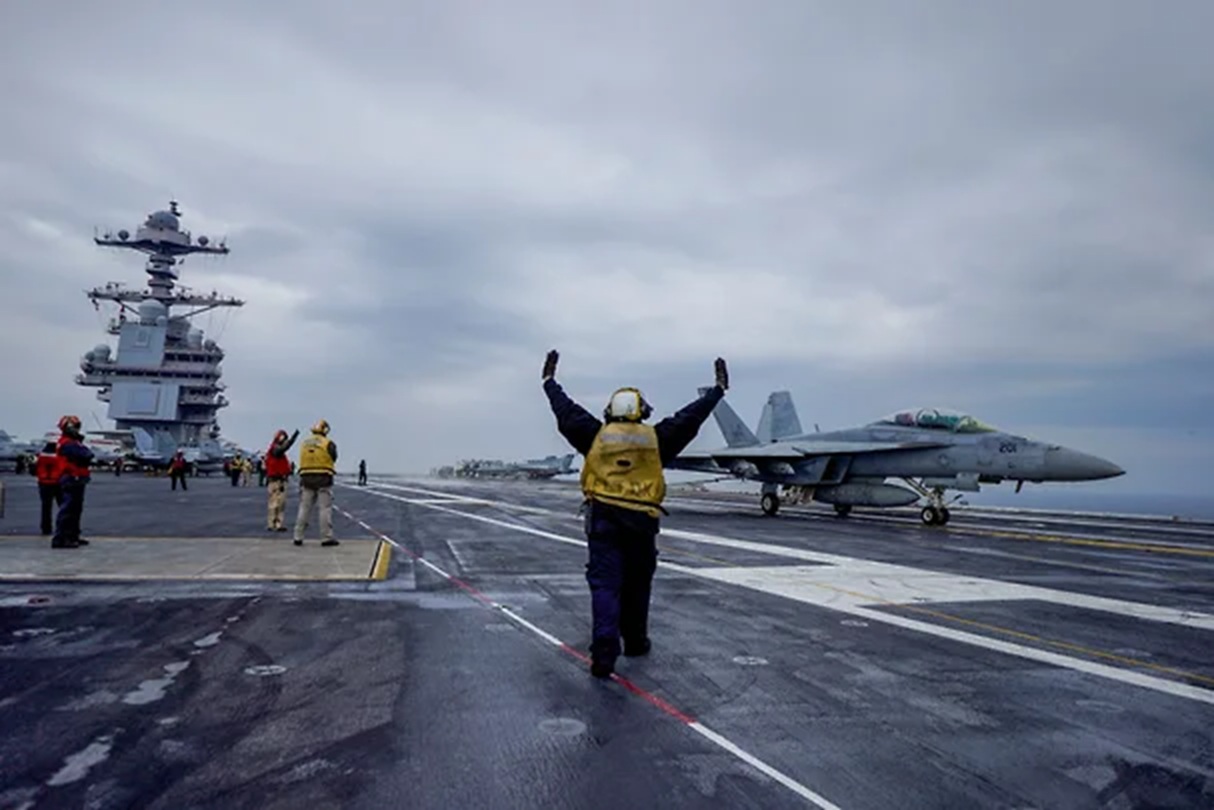
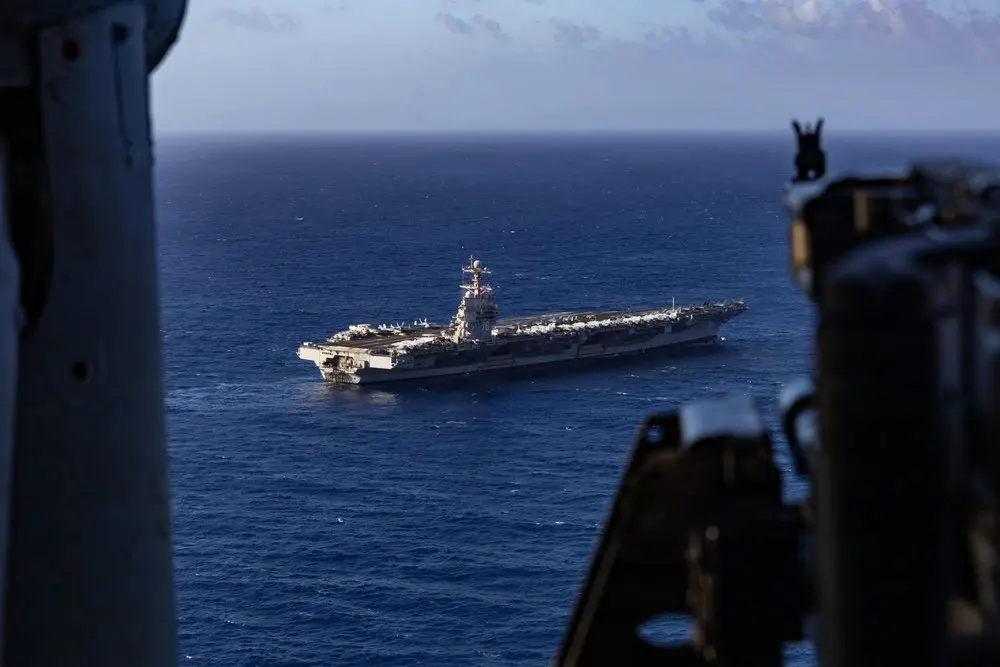 The USS Gerald R. Ford aircraft carrier enhances air and ballistic missile capabilities for SOUTHCOM operations near Venezuelan shores. (@SA_Defensa)
The US, under Trump, is unapologetically an empire operating without pretense. International law is for losers. A newly minted War Department, deploying the most lethal killing machine in world history, need not hide behind the sham of promoting democracy.
Recall that in 2023 Trump boasted: “When I left, Venezuela was ready to collapse. We would have taken it over, we would have gotten all that oil.” As CEO of the capitalist bloc, Trump’s mission is not about to be restrained by respect for sovereignty. There is only one inviolate global sovereign; all others are subalterns.
Venezuela – with our oil under its soil – is now in the crosshairs of the empire. Not only does Venezuela possess the largest petroleum reserves, but it also has major gold, coltan, bauxite, and nickel deposits. Of course, the world’s hegemon would like to get its hands all that mineral wealth.
But it would be simplistic to think that it is driven only by narrow economic motives. Leverage over energy flows is central to maintaining global influence. Washington requires control of strategic resources to preserve its position as the global hegemon, guided by its official policy of “full spectrum dominance.”
For Venezuela, revenues derived from these resources enable it to act with some degree of sovereign independence. Most gallingly, Venezuela nationalized its oil, instead of gifting it to private entrepreneurs – and then used it to fund social programs and to assist allies abroad like Cuba. All this is anathema to the hegemon.
Further pushing the envelope is Venezuela’s “all-weather strategic partnership” with China. With Russia, its most consequential defense ally, Venezuela ratified a strategic partnership agreement. Similarly, Venezuela has a strong anti-imperialist alliance with Iran. All three partners have come to Caracas’s defense, along with regional allies such a Colombia, Brazil, and Mexico.
The US has subjected Venezuela’s Bolivarian Revolution to incessant regime-change aggression for its entire quarter-century of existence. In 2015, Barack Obama codified what economist Jeffrey Sachs calls a remarkable “legal fiction.” His executive order designated Venezuela as an “extraordinary threat” to US national security. Renewed by each succeeding president, the executive order is really an implicit recognition of Venezuela’s Bolivarian Revolution as a counter hegemonic alternative, challenging Washington’s world order.
The latest US belligerence testifies to the success of the Venezuelan resistance. The effects of asphyxiating US-led sanctions, which had crashed the economy, have been partly reversed with a return to positive economic growth, leaving the empire with little alternative but to escalate antagonism using its military option.
The AFP reports “tensions between Washington and Caracas have dramatically risen” as if the one-sided aggression were a tit-for-tat. Venezuela seeks peace, but has a gun held to its head.
Reuters, blames the victim, claiming that the Venezuelan government “is planning to…sow chaos in the event of a US air or ground attack.” In fact, President Nicolás Maduro has pledged “prolonged resistance” to Washington’s unprovoked assaults rather than meekly conceding defeat.
The death toll from US strikes on alleged small drug boats off Venezuela, in the Pacific off Colombia and Ecuador, and as far north as Mexico now exceeds 75 and continues to rise. But not an ounce of narcotics has been confiscated. In contrast, Venezuela has seized 64 tons of drugs this year without killing anyone, as the Orinoco Tribune observes.
Russian Foreign Ministry’s María Zakharova quipped: “now that the US has suddenly remembered, at this historic moment, that drugs are an evil, perhaps it is worth it for the US to go after the criminals within its own elite.”
On November 11, the world’s largest aircraft carrier, the USS Gerald R. Ford, and its accompanying warships arrived in the Caribbean. They join an armada of US destroyers, fighter jets, drones, and troops that have been building since August.
In a breathtaking understatement, the Washington Post allowed: “The breadth of firepower…would seem excessive” for drug interdiction in what it glowingly describes as a “stunning military presence.”
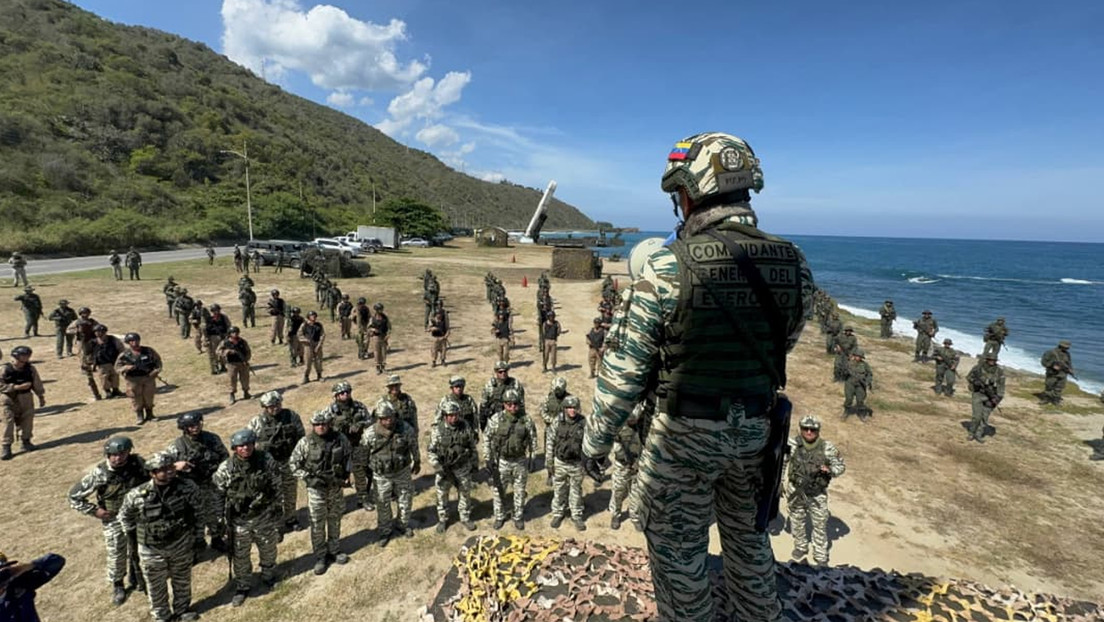
Venezuela is now on maximum military alert with a threatening flotilla off its coast and some 15,000 US troops standing by. Millions of Venezuelans have joined the militia, and international brigades have been welcomed to join the defense. President Maduro issued a decree of “external commotion,” granting special powers if invaded.
The populace has united around its Chavista leadership. The far-right opposition – which has called for a military invasion of its own country – are more isolated than ever. Only 3% support such a call.
Their US-designated leader María Corina Machado has gone bonkers, saying “no doubt” that Maduro rigged the 2020 US election against Trump. According to the rabidly anti-Chavista Caracas Chronicles, the so-called Iron Lady “is not simply betting Venezuela’s future on Trump, she is betting her existence.”
The legal eagles at The Washington Post now find that “the Trump administration’s approach is illegal.” United Nations experts warn that these unprovoked lethal strikes against vessels at sea “amount to international crimes.”
Even high-ranking Democrats “remain unconvinced” by the administration’s legal arguments. They’re miffed about being left out of the administration’s briefings and not getting to see full videos of the extrajudicial murders.
The Democrats unite with the Republicans in demonizing Maduro to achieve regime change in Venezuela, but wish it could be done by legal means. The so-call opposition party unanimously voted to confirm Marco Rubio as secretary of state, fully aware of the program that he now spearheads.
The corporate press has been complicit in regime change in its endless demonization of Maduro. They report that Trump authorized covert CIA operations as if that was a scoop rather than business as usual. What is new is a US administration overtly flaunting supposedly covert machinations. This is part of Washington’s full-press psychological pressure campaign on Venezuela, in which the follow-the-flag media have been its eager handmaiden.
The AP reports that Jack Keane, when he served as a US Army general, instructed staff to “see reporters as a conduit” for the Pentagon. This was cited as a criticism of Trump after a few dozen embedded reporters turned in their Pentagon badges. Trump has called out the Washington press corps as “very disruptive in terms of world peace,” proving the adage that even a blind dog can sometimes find a bone.
The Wall Street Journal opines: “Nobody in the [Trump] administration seems prepared to ask the hard questions about what happens if they do destabilize the [Venezuelan] regime but fail to topple it.” Political analysts Medea Benjamin and Nicolas J. S. Davies suggest the answer is carnage and chaos – based on the Washington’s past performances in Iraq, Serbia, Afghanistan, Haiti, Libya, Syria, and Yemen, to mention a few.
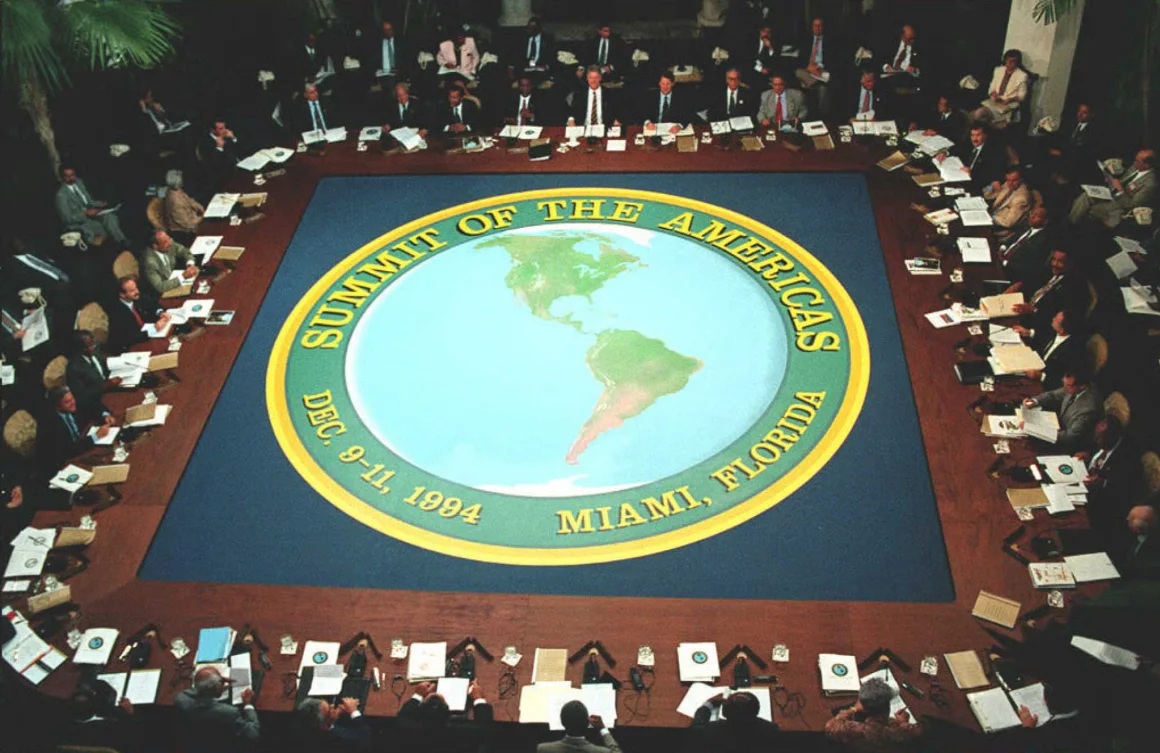
Foreign Policy’s perspective – aligned with the Washington establishment – is that the level of regional fragmentation is the greatest in the last half century. Regional organizations have become dysfunctional – UNASUR has been “destroyed,” CELAC is “useless,” and the OAS canceled its summit. The factionalism, Responsible Statecraft agrees, “marks one of the lowest moments for regional relations in decades.” Bilateral “deals” with the US are replacing regional cohesion.
This is Latin America under the beneficence of Trump’s “Donroe Doctrine.” The alternative vision, represented by Venezuela, is CELAC’s Zone of Peace and ALBA-TCP’s development for mutual benefit.
https://libya360.wordpress.com/2025/11/ ... n-america/
*****
Chile heads to the first round of presidential elections
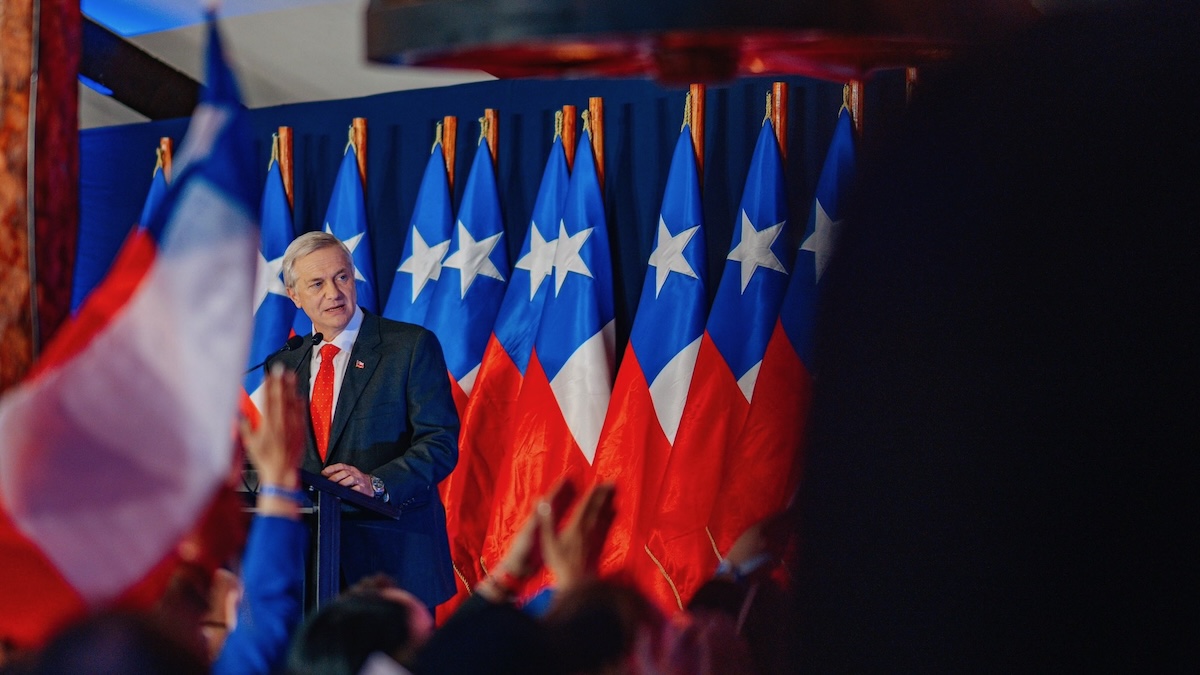
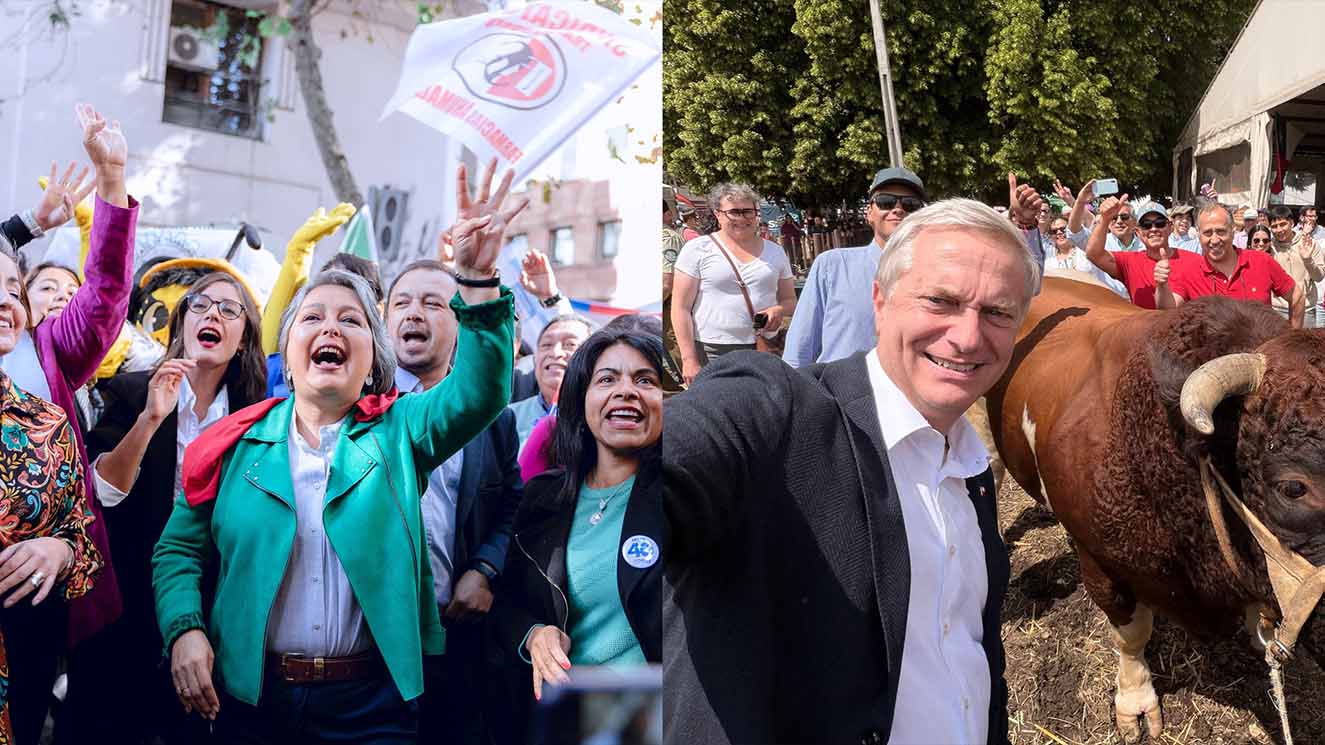
Among the candidates most likely to win the first round is leftist Jeannette Jara, though she is closely followed by three candidates from the right and far right with considerable popular support.
November 15, 2025 by Pablo Meriguet
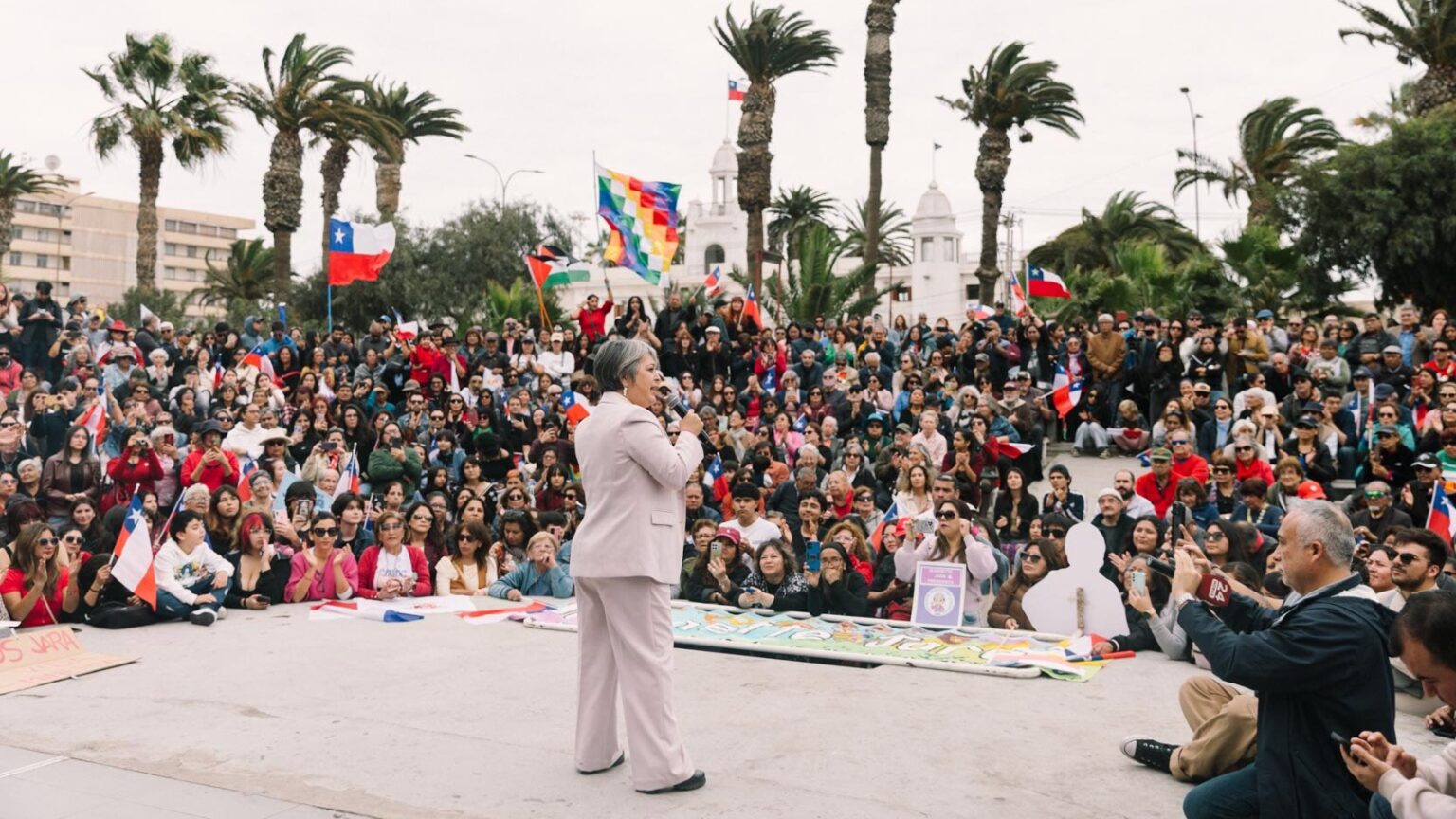
Jeannette Jara campaign event in Arica, Chile in August. Photo: X
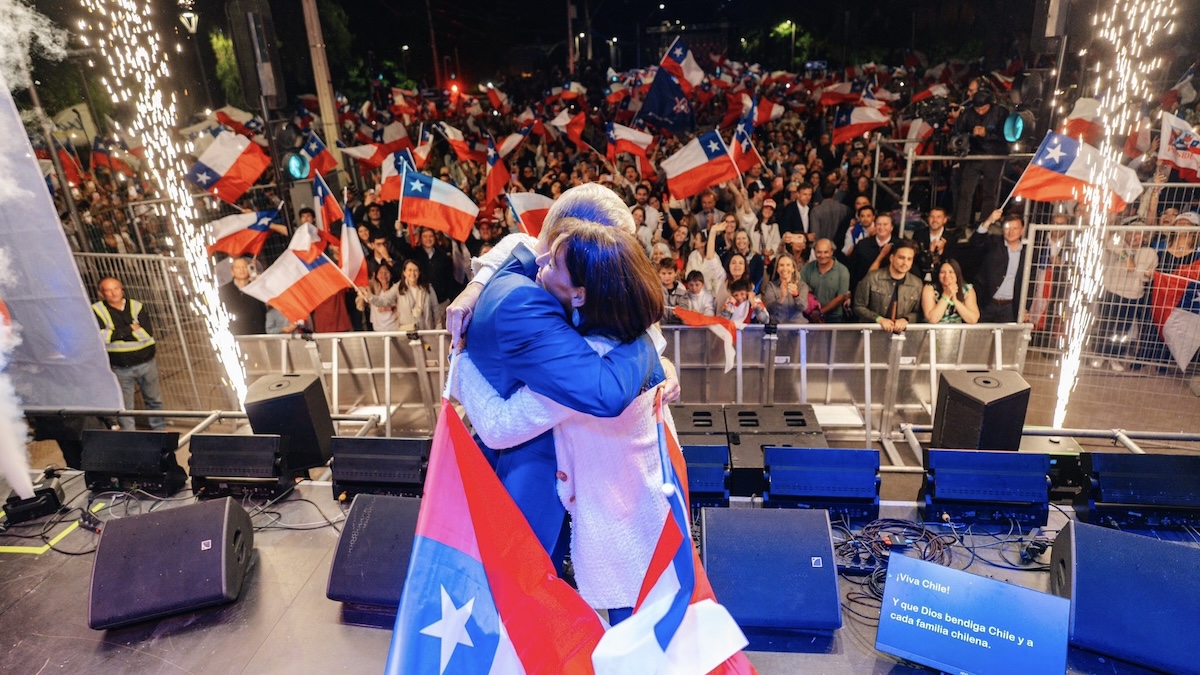
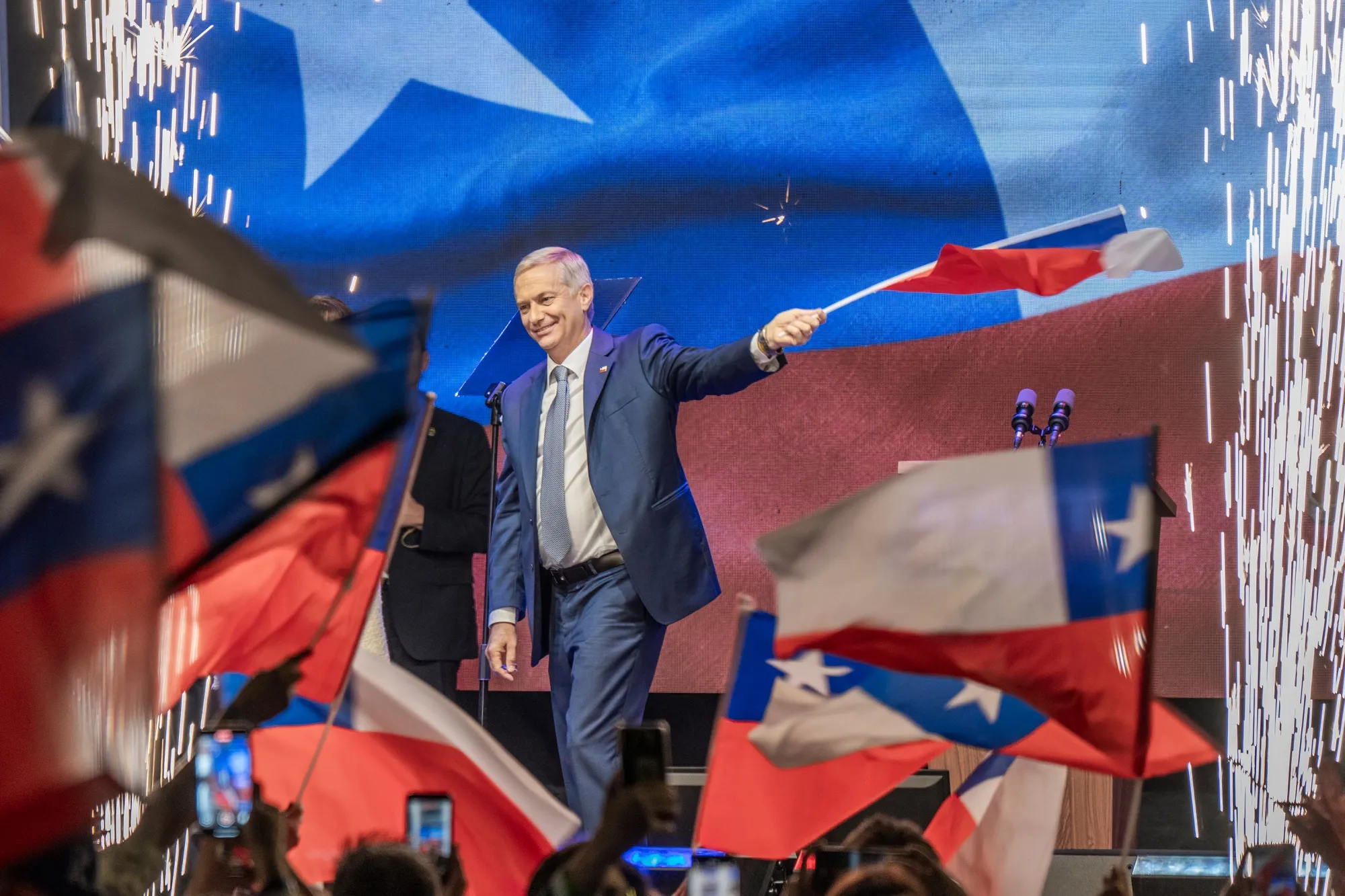
On November 16, Chileans will go to the polls to elect the future president of the South American nation. After four years of the center-left administration of Gabriel Boric, Chileans will have to choose between continuing this trend (which includes several parties on the left, the center-left, and various social movements of different kinds), or making a shift to the far right.
On the left-wing coalition side is Jeannette Jara, a member of the Communist Party of Chile and former minister of Social Security (2022-2025) under the Boric administration. Jara has announced that, despite the party she belongs to, her administration will be moderate and will continue with Boric’s social policies, while attempting to expand on others.
According to several polls, Jara is in first place in voting intentions in an election that, after several elections, will be compulsory for those eligible to exercise their right to vote. The polling firm Plaza Pública Cadem claims that Jara has 30% of the vote, which has come as a surprise to many. However, that projection for Jara would be insufficient for her to win the presidency in the first round, so, according to the polls, she would have to face the second most voted candidate in a runoff. This scenario is precisely what worries the Chilean left the most.
In fact, although the right wing has lost its lead in the polls, this is not because it has low support, but because, according to pollsters, its vote has been divided among three candidates who have garnered significant support from the population.
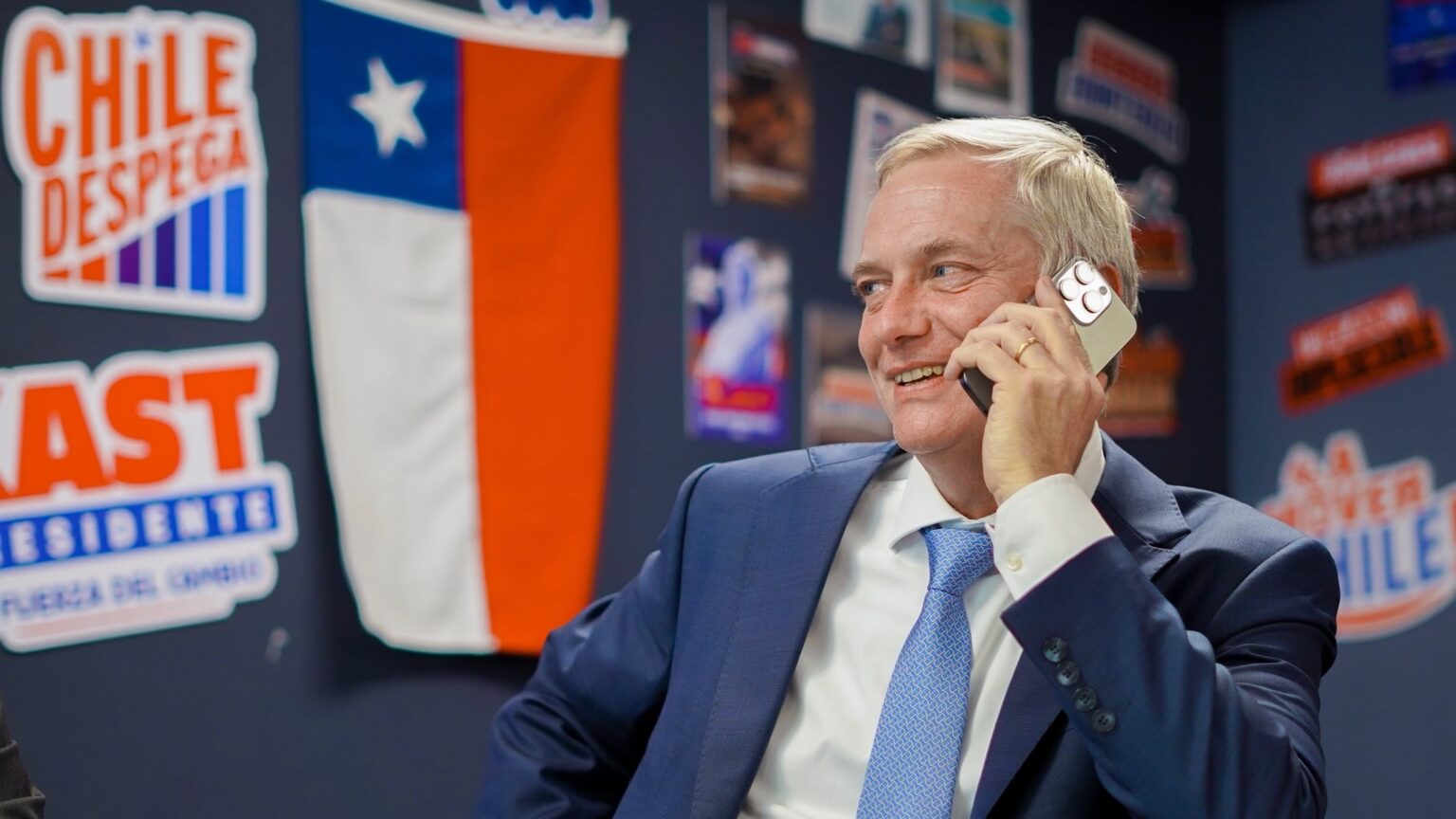
Close behind Jara is the far-right José Antonio Kast, ran in the last elections and lost to Boric. Kast has 15% of the vote, while the Centro de Estudios Públicos poll puts him in a technical tie with Jara (23%).
Although Kast was presented as the strongest candidate on the right, in recent weeks he has been losing some support to the two candidates behind him. One of them is the far-right deputy and YouTuber Johannes Kaiser, from the National Libertarian Party, whom many see as the “Chilean Milei” and who has run a less traditional political campaign but one that has had a greater impact on young people on the right. This has earned him the apparent support of 13% of voters.
Not far behind is Evelyn Matthei, representative of Chile’s traditional right wing and former labor minister under right-wing president Sebastián Piñeira, who served in that position twice (2010-2014, 2019-2022). According to Plaza de Pública Cadem, Matthei, who is running for the Independent Democratic Union, has 12% of the vote.
Is Chile’s political fate already decided?
In this scenario, several journalists have mentioned that the first round of the Chilean elections would function as a kind of primary for the Chilean right. Thus, the Chilean right wing is not disappointed by the poll numbers, as they assume that the right-wing vote would tend to unite behind the candidate who makes it to the second round. Thus, the combined votes of Kast, Kaiser, and Matthiei (almost 49% of the votes) would be enough for a change of direction in the administration of La Moneda, the presidential palace.
For her part, if Jara manages to make it to the runoff, she will have to try to win over not only the more moderate right-wing voters (which will depend largely on who the right-wing candidate is in the second round), but also the voters of the other candidates, who, according to several polls, do not exceed 5% of the vote: Eduardo Artes, of the Communist Party Proletarian Action (1%), and Marco Enríquez-Ominami, an independent candidate (1%).
Read More: Jeannette Jara wins left-wing primary in Chile, surges to second in polls
The other two candidates, Franco Parisi of the People’s Party, with an apparent voting intention of 5%, and Harold Mayne-Nicholls, with 1%, may be more attracted to a possible right-wing government than to the alliances that Jara could offer.
However, it would be premature to assume what will happen in a second round when the first round has not yet taken place.
Lucía Dammert, professor in the Department of Political Studies at the University of Santiago, Chile warns: “It’s not that the left won’t make it to the second round, despite all the dire predictions that have been made, but once again, I think we can’t stop being surprised or expecting surprises, given what has happened in Latin America in recent years, in almost every election, so until the last vote is counted, all we can say are hypotheses and not realities.”
It is also important to note that votes are not automatically transferred to another candidate. The right-wing candidate who makes it to the runoff will have to find a way to gain support from the other candidates. The traditional right, grouped around Matthei, finds itself somewhat displaced by the rise of the new right, which has managed to capitalize on the discontent that the traditional right-wing administrations have failed to address.
The complex legacy of the dictatorship
Likewise, the legacy of Augusto Pinochet’s bloody dictatorship (1973-1990), supported by the United States and the driving force behind one of the world’s first neoliberal states (thanks to the advice of the famous Chicago Boys), has left a wound that history has yet to heal.
A large part of the country supports the actions of a dictatorship that declared itself anti-communist, meaning that Jara’s political party (despite her having shown herself closer to the center-left than to the revolutionary left) is viewed with fear by many.
On the other hand, the fact that candidates such as Kast and Kaiser have publicly stated that they admire or respect Pinochet’s actions revives a series of ghosts left behind by a dictatorship that murdered, disappeared, and/or tortured nearly 10,000 people.
https://peoplesdispatch.org/2025/11/15/ ... elections/
*****
War on Multipolarism Includes Latin America
November 14, 2025

Members of the Bolivar militia participated in a national special military exercise in Bolivar Square in Caracas, the capital of Venezuela, on October 4. Photo: XINHUA.
By Brian Berletic – Nov 11, 2025
As the U.S. continues its proxy war with Russia in Ukraine and its escalation with China in the Asia-Pacific, the U.S. is also targeting a number of nations not only across Eurasia, but also far beyond it, including the Latin American nation of Venezuela.
The purpose of targeting Venezuela—officially—is to stop the flood of illicit narcotics into the U.S., which Venezuela’s government is accused of facilitating. In reality, this is a fabricated pretext meant to manufacture consent for yet another war of aggression—one designed to contribute to a wider geopolitical objective of confronting and rolling back multipolarism.
The U.S., since the end of the Cold War, has pursued a U.S.-dominated unipolar world order in which all matters are determined by and for the U.S. Part of achieving this is preventing any one single nation or group of nations from challenging America’s global primacy.
In recent years these efforts have focused on preventing the reemergence of Russia and the rise of China. It also has focused on preventing nations outside U.S. domination from aligning with either or both. The U.S. achieves this through influence, coercion, political capture—and failing that, proxy war, then actual war.
Continuity across administrations
Venezuela has been targeted by the U.S. for regime change throughout the 21st century. The George W. Bush administration very briefly ousted the government of Venezuelan President Hugo Chavez in 2002. Since then, regardless of who occupies the White House or controls U.S. Congress, U.S.-funded political interference, sanctions and covert military operations have continued placing pressure on Venezuela in hopes of removing the current political order from power and replacing it with a U.S. client regime.
While headlines focus on U.S. President Donald Trump’s obsession with regime change in Venezuela spanning his two terms in office, it should be noted that sanctions and political interference targeting the nation continued from the Bush administration, throughout the eight years of the Barak Obama administration and also under the Joe Biden administration.
Despite attempts by the Trump administration to deny involvement in the 2020 failed overthrow of the Venezuelan Government, it fits in with both a historical pattern of U.S. interference worldwide, and other covert operations carried out under the Trump administration.
Regardless, the U.S. now openly seeks to overthrow the Venezuelan Government and has been assembling significant military forces to do so off Venezuela’s coasts, including U.S. Navy and Marine Corps vessels, warplanes and troops.
Should the decision be made to launch a military operation, it will likely take the form of similar decapitation strikes the U.S. and its Israeli proxies have conducted against Hezbollah in Lebanon last year and against the Iranian Government earlier this year together with strikes aimed at crippling civilian infrastructure and damaging Venezuela’s economy even further than years of U.S. sanctions already have.
Manufacturing consent
While Trump campaigned for office on a platform of ending “endless wars,” since taking office, he has continued each war inherited from the previous Biden administration while launching and preparing to launch several new conflicts.
To justify a war of aggression against Venezuela aimed at regime change, President Trump has shifted narratives previously based on fighting Venezuela’s “corruption” and “dictatorship,” to blaming America’s multi-decade drug crisis suddenly and squarely on Venezuela.
The administration has claimed President Trump is acting to “protect our country from those trying to bring deadly poison to our shores” at the same time the Trump administration also claims to have already “secured” America’s borders within its first 100 days in office.
According to the White House official website, “Since President Donald J. Trump took office, he and his administration have ushered in the most secure border in modern American history—and he didn’t need legislation to do it. President Trump has made good on the promises he made on the campaign trail to usher in an unprecedented era of homeland security.”
And yet, according to the same administration, Venezuela is single-handedly circumventing this “unprecedented era of homeland security” to “poison” millions of Americans with illicit narcotics—so much so that it warrants a war of aggression launched against Venezuela itself.
Part of the theatrics in selling this latest war of aggression includes the U.S. targeting boats allegedly trafficking illicit narcotics to the U.S. from Venezuela, despite the boats being targeted not having the physical ability to make the more than 1,000-mile (1,700 km) trip. While some seem to assume the U.S. had actionable information before carrying out the strikes, it should be pointed out that similar warfare throughout the 20-plus years of the “war on terror” resulted in mainly civilian casualties.
In a 2021 Washington Post article, it was reported that Daniel Hale, a former member of the U.S. armed forces, leaked “classified information about drone warfare to a reporter after leaving the military.”
The leaked information revealed, “During one five-month stretch of an operation in Afghanistan, the documents revealed, nearly 90 percent of the people killed were not the intended targets.”
The same vague pretext and lack of transparency that resulted in staggering civilian casualties throughout the “war on terror” now continues amid the Trump administration’s “war on drugs.”
Launching a war of aggression based on false pretexts has defined U.S. foreign policy throughout the 21st century—most notably ahead of the U.S. occupation of Iraq in 2003.
In a 2011 article, The Guardian published admissions the supposed justification for the invasion was based on deliberate fabrications, writing: “the defector who convinced the White House that Iraq had a secret biological weapons programme has admitted for the first time that he lied about his story, then watched in shock as it was used to justify the war.”
While the article attempts to portray the U.S. establishment as “tricked” into war with Iraq, it is clear that war with Iraq—just like now with Venezuela—was already a foregone conclusion and the U.S. establishment simply worked its way backward to create a narrative to convince Americans and the world to go along.
Under the current Trump administration, the very worst of past U.S. conflicts is converging once again ahead of yet another unnecessary war of aggression, once again built on a transparently false pretext and waged by the Trump administration through the same indiscriminate brutality many Americans voted President Trump into office to end.
While some analysts have mistakenly concluded U.S. escalation toward Venezuela represents a “retreat” from Asia or even Eurasia, and a transition from pursuing global primacy toward carving out an American “sphere of influence,” the U.S. is much more likely attempting to complement its continued encirclement, containment and confrontation with both Russia and China by eliminating one of their more vulnerable allies—Venezuela—in a bid to escalate rather than withdraw from Washington’s ongoing war against multipolarism.
https://orinocotribune.com/war-on-multi ... n-america/
Trump’s Provocations Are Bolstering Latin America’s Left
November 14, 2025

Brazilian President Luiz Inacio Lula da Silva (left) speaks next to Colombian President Gustavo Petro during a meeting for talks on the protection of the Amazon Forest, in Leticia, Colombia, on the border with Brazil, on July 8, 2023. Photo: Juan Barreto/AFP.
By Steve Ellner – Nov 13, 2025
Across Latin America, Donald Trump’s aggressive moves — from tariffs to attacks on boats in the Caribbean to meddling in Argentina’s elections — is uniting progressive forces in opposition and bolstering the Left’s political prospects.
When Donald Trump assumed the presidency in January 2025, the Pink Tide governments in Latin America were losing ground. The approval rating of Brazil’s president, Luiz Inácio Lula da Silva, reached the lowest of his three presidential terms, while that of Colombia’s Gustavo Petro was a mere 34 percent. And in the wake of the fiercely contested results of the July 2024 presidential elections in Venezuela, Nicolás Maduro found himself isolated in the region.
Now, less than a year later, the political landscape has shifted. Trump’s antics — such as his renaming of the Gulf of Mexico, the weaponization of tariffs, and aggressive military actions in the Caribbean and Pacific — have revitalized Pink Tide governments and the Left in general. Latin America has reacted to Trump’s invocation of the Monroe Doctrine with a surge of nationalist sentiment, mass demonstrations, and denunciations from political figures across most of the spectrum, including some on the center right.
While the United States appears more and more like an unreliable and declining hegemon, China is seeking to position itself as a champion of national sovereignty and a voice of reason in matters of international trade and investment. When Trump slapped a 50 percent tariff on most Brazilian imports in July, the Chinese stepped in to help fill the gap for the nation’s all-important soybean exports.
Lula vs. Trump
Different scenarios are playing out in different nations but with similar results: the strengthening of the Left and, in some instances, the weakening of the Right. One type of case is seen in both Brazil and Mexico, where Lula and Mexican president Claudia Sheinbaum have combined firmness with discretion, in contrast to Petro’s more confrontational rhetoric.
In July, Lula responded defiantly to Trump’s attempt to strong-arm Brazil through punitive tariffs designed to secure the release of the US president’s ally, former Brazilian president Jair Bolsonaro, who was jailed for his involvement in coup and assassination plots. Unlike other heads of state, Lula refused to reach out to Trump, saying, “I’m not going to humiliate myself.” Instead, Lula declared that “Brazil would not be tutored by anyone,” at the same time recalling the 1964 Brazilian coup as a previous instance of US intervention.
Different scenarios are playing out in different nations but with similar results: the strengthening of the Left and, in some instances, the weakening of the Right.
The face-off sparked mass pro-government demonstrations throughout the country that far outnumbered those called by the Right demanding the freeing of Bolsonaro. Lula’s supporters blamed the Right for the tariffs, and particularly Bolsonaro’s son Eduardo, who campaigned for them after moving to Washington, DC. Lula called Bolsonaro a “traitor” and said he should face another trial for being responsible for what has come to be called “Bolsonaro’s tax.” In a sign that Trump’s tariffs were a game-changing boost for the Left, the eighty-year-old Lula announced last month that he would run for reelection in October 2026, as his popularity reached the 50 percent mark.
Some analysts faulted Lula for having failed to use his thirty-minute videoconference with Trump on October 6 to condemn Washington’s gunboat diplomacy in the Caribbean. According to this interpretation of the call, Lula displayed naivete and gutlessness by combining “concern and accommodation with US imperialism” and believing that “negotiations will be guided by a ‘win-win logic.’”
In fact, Lula has spoken out against the US military presence as a “factor of tension” in the Caribbean, which he calls a “zone of peace.” Lula, though, undoubtedly could have gone further, as was urged by the Landless Workers’ Movement (MST) — which backed Lula’s last presidential bid — by explicitly declaring solidarity with Venezuela against US attacks.
Still, Lula can hardly be accused of submissiveness in his dealings with Trump. Indeed, Lula and Sheinbaum as well have been adept in their relations with the US president and have ended up getting much of what they wanted. Moreover, at the same time that Trump retreated from his tariff threats against both Brazil and Mexico, he took to praising their respective heads of state.
A United Front in the Making
In Brazil and elsewhere in the region, a new alignment is emerging, drawing in both right- and left-leaning forces in reaction to Washington’s posture. One notable example was Lula’s appointment of Homeless Workers’ Movement (MTST) activist and former presidential candidate Guilherme Boulos as minister of the presidency in October. Boulos belongs to the Socialism and Liberty Party (PSOL), a leftist split-off from Lula’s Workers’ Party (PT) that endorsed Lula’s 2022 presidential candidacy but had ruled out holding positions in his government.
Boulos, who was instrumental in organizing the recent protests against Washington’s tariff hikes, spoke of the significance of his designation: “Lula gave me the mission to help put the government on the street . . . and [listen] to popular demands.” His appointment signals a leftward turn in which, in the words of the Miami-based CE Noticias Financiera, “Lula showed that he is going into the 2026 election ready for war. A war in his own style, using the social movements.”
Venezuela is another example where political actors across much of the political spectrum are converging on the need for a broad front to oppose US aggression in the region. No other Pink Tide government has faced such a rapid succession of regime change and destabilization attempts as Venezuela under the government of Maduro, Hugo Chávez’s successor. The government’s response to these and other challenges has at times deviated from democratic norms and has included concessions to business interests, drawing harsh criticism from both moderate and more radical sectors of the Left.
In Brazil and elsewhere in the region, a new alignment is emerging, drawing in both right- and left-leaning forces in reaction to Washington’s posture.
One leader in the latter category is Elías Jaua, formerly a member of Chávez’s inner circle, whose leftist positions on economic policy and internal party democracy left him marginalized within the Chavista movement. In the face of the US military threat in the Caribbean, Jaua has closed ranks with Maduro and decried the “psychological war” being waged against the president. He went on to say that, in this critical moment, it is necessary “to place the tranquility of the people above any ideological, political, or ulterior interest,” adding “the Homeland comes first.”
Other long-standing political figures who have supported Maduro’s call for a national dialogue to face the US threat — while continuing to criticize Maduro for alleged undemocratic practices — include some on the center and center right of the political spectrum, including former presidential candidates Henrique Capriles, Manuel Rosales, and Antonio Ecarri.
Others are moderate leftists who held important posts under Chávez and/or belonged to the moderate left party Movimiento al Socialismo (MAS) in the 1990s. One of the latter is Enrique Ochoa Antich, who presented a petition signed by twenty-seven leading anti-Maduro moderates that stated “it is disheartening to see an extremist sector of the opposition” supporting sanctions and other US actions. Ochoa Antich proposed a dialogue with government representatives “over the best way to foment national unity and defend sovereignty.”
This stance, which views Maduro as a partner in resisting US intervention, stands in sharp contrast to that of the Communist Party (PCV), which broke with his government in 2020 over its business-friendly orientation and its sidelining of sectors of the Left. In the same breath that it denounces imperialist aggression, the PCV points to the “authoritarian and anti-democratic nature of Maduro’s government.” While the PCV’s criticisms are worthy of debate, the party’s uncompromising hostility toward Maduro undermines efforts to face US aggression. Indeed, the PCV’s position – supporting the Cuban government while denouncing Venezuela’s as undemocratic – appears inconsistent.
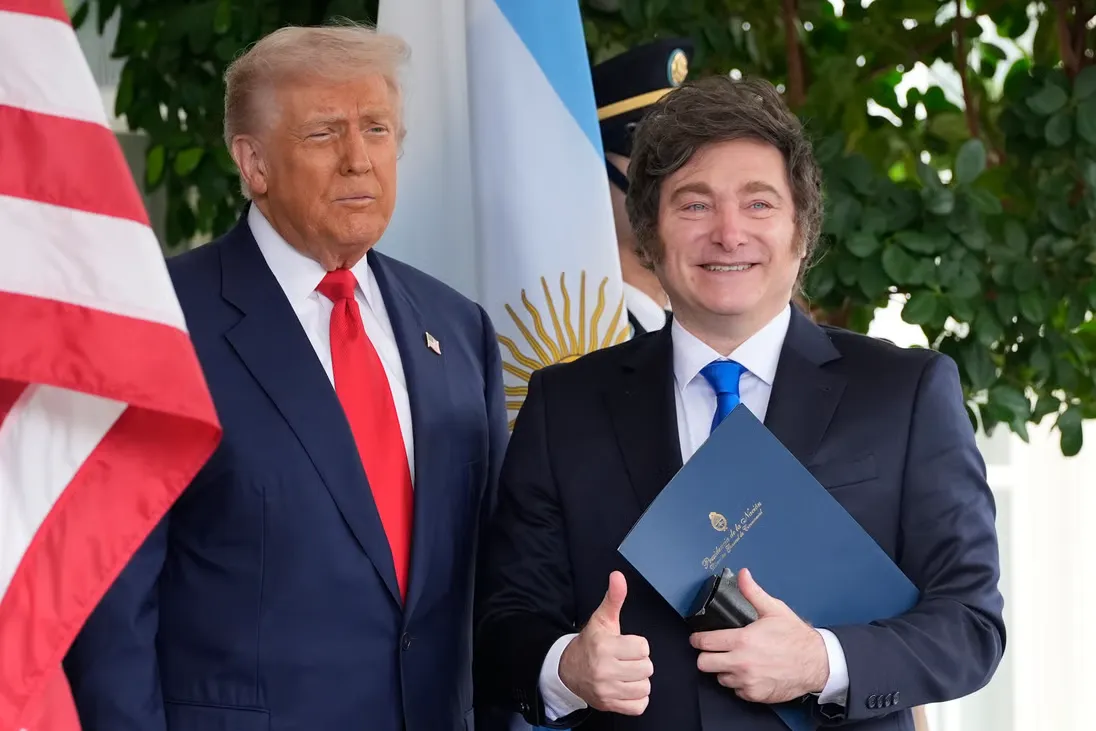
In Argentina, Trump came to the aid of the Right in what will likely prove to be a Pyrrhic victory. On the eve of the October 2025 legislative elections, Trump offered to bail out the Argentine economy to the tune of $40 billion but only on the condition that the party of right-wing president Javier Milei emerge victorious, which is precisely what happened. Trump’s blackmail was denounced as such by politicians ranging from Peronist leaders linked to former Pink Tide governments to centrists who had been among their most vocal critics. Facundo Manes, leader of the centrist Radical Civic Union, was an example of the latter, declaring “the extortion advances.” Meanwhile on the streets of Buenos Aires, protest banners denouncing Milei were marked by anti-US slogans “Yankee go home” and “Milei is Trump’s mule,” as well as the burning of a US flag.
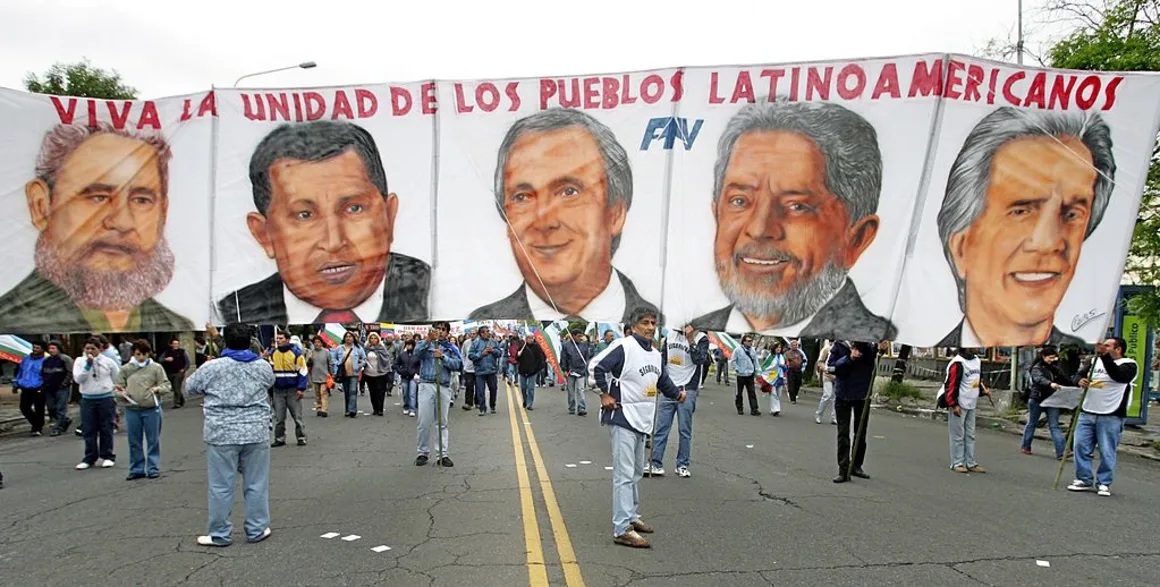
This convergence around the need to confront Trump’s threats and actions creates an opportunity for progressives and socialists across the continent to unite. The call for such unity was taken up by the São Paulo Forum, a body that brings together over one hundred Latin American leftist organizations, which Lula helped found in 1990. At the outset of Trump’s first administration in 2017, the forum drafted the document “Consensus of Our America” as a response to the neoliberal Washington Consensus and the escalation of US interventionism in the hemisphere.
At the same time that it defended the pluralism of progressive movements and avoided the term “socialism,” the consensus document foresaw the drafting of a more concrete set of reforms and goals. The expected next step, however, never materialized. More recently, the Cuban political analyst and strategist Roberto Regalado lamented that, despite the urgent need for unity, “far from consolidating and expanding, the ‘Consensus of Our America’ has languished.”
Trump and the Latin American Right
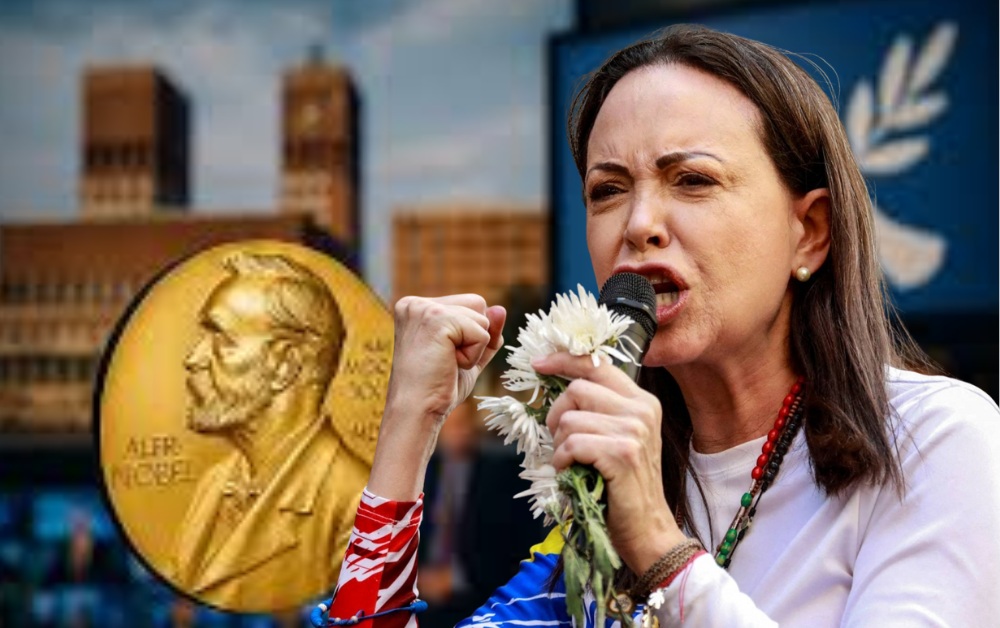
Much of the Latin American right has tied its fortunes to President Trump. The right-wing presidents of Argentina, Ecuador, and Paraguay are Trump followers, as are Bolsonaro, the Chilean presidential candidate José Antonio Kast, and former president Álvaro Uribe in Colombia. In Venezuela, right-wing opposition leader María Corina Machado dedicated her recent Nobel Peace Prize to Trump.
In 2022, Machado’s fellow Venezuelan rightist Leopoldo López cofounded the World Liberty Congress dedicated to regime change in nations that Washington considers adversaries. The idea is in line with the notion of creating an “International of the Right” promoted by Trump strategist Steve Bannon, among others. Bannon founded The Movement in 2016 to unite the European right, but it has been largely snubbed by much of that continent’s right wing.
While in the US, Trump exploits patriotism, in the case of Latin America, nationalist sentiment and support for Trump are oxymorons.
Such “internationalism” on the Right is even less likely to flourish in Latin America. While in the United States, Trump exploits patriotism — or a perverted form of it — in the case of Latin America, nationalist sentiment and support for Trump are oxymorons, specifically when it comes to tariffs, immigration, threats of military invasion, and the brandishing of the Monroe Doctrine. In Venezuela, for instance, Machado’s popularity has declined and her opposition movement has fractured as a result of popular repudiation of Trump’s policies.
In the United States, Trump plays to his fanatic supporters while his popularity steadily declines. In Latin America, the same is occurring, with the difference being that his popularity couldn’t get much lower than it already is. Pew Research Center reports that just 8 percent of Mexicans have “confidence” in Trump.
Trump has contributed to a major shift in Latin America’s political landscape, now marked by political polarization and leftist inroads. In many countries, the Left — which for decades remained on the sidelines — has become a major point of reference, rallying around the banners of national sovereignty, if not anti-imperialism.
In Chile, a Communist, Jeannette Jara, received a surprising 60.5 percent of the vote in the primaries to represent the main anti-rightist bloc in the upcoming presidential elections. While taking a cautious tone, Jara still directly addressed Trump, saying in the wake of his meddling in Argentine elections, “No US soldiers will enter. Chile is to be respected, and so is its sovereignty.”
In Ecuador, despite harsh repression, the followers of ex–Pink Tide president Rafael Correa have come close to winning the last three presidential elections. And in Colombia, Petro has reinvigorated his movement’s base through his forceful denunciations of US military operations and by leading a drive, begun in October, to secure two million signatures for a national constituent assembly.
“Polarization” often refers to a scenario in which the extremes on both sides of the political spectrum gain ascendancy. That is not what is happening in Latin America, at least on the Left. Instead, there is a convergence of progressives of different political stripes, both domestically and among Pink Tide governments, in their opposition to Trump and all that he represents. The challenge now is to translate this convergence into organized forms of unity — through united fronts at the national level as well as in the Community of Latin American and Caribbean States (CELAC) and other regional bodies.
https://orinocotribune.com/trumps-provo ... icas-left/
******
1 Law, 1 Million Jobs: Milei’s Explosive Glacier Bill That Could Reshape Argentina
Glacier law rollback in Argentina threatens fragile Andean ecosystems amid U.S.-backed mining push
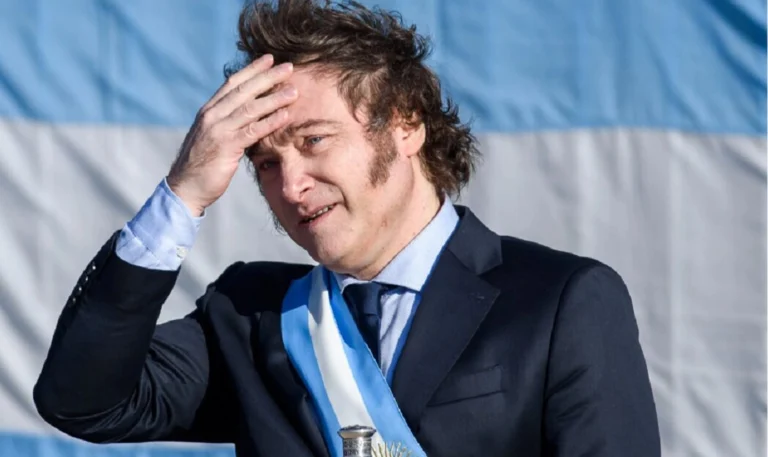
Argentina stands at a crossroads: President Milei’s glacier law rollback could unlock millions in investment — or trigger irreversible ecological damage across the Andes.
November 15, 2025 Hour: 10:39 am
Milei’s glacier law rollback sparks national fury as Argentina weighs U.S. mining deals against environmental collapse and water security.
1 Law, 1 Million Jobs: Milei’s Explosive Glacier Bill That Could Reshape Argentina
In a move that has ignited nationwide debate, Argentine President Javier Milei is pushing forward a controversial legislative initiative to modify the country’s landmark Glaciarres Law, a reform demanded by the United States as part of a broader bilateral investment agreement. The proposed glacier law rollback would allow large-scale mining operations in previously protected periglacial zones — areas directly connected to glaciers that feed vital river systems across the Andes.
The government claims the reform could generate up to one million jobs and attract billions in foreign investment
, positioning mining as a central pillar of Argentina’s economic revival.
But critics warn this comes at an unacceptable cost: the degradation of mountain permafrost, shrinking glaciers, reduced river flows, and long-term threats to water security for millions of people.
At stake is not just legislation, but the future of Argentina’s most fragile and essential ecosystems.
This is more than a policy shift — it is a fundamental redefinition of nature’s value.
As Milei frames the debate as “hunger versus sentimentality,” environmentalists, scientists, and indigenous communities are sounding the alarm: you cannot mine your way out of poverty if you destroy the very source of life.
Glacier Law Rollback: Opening the Andes to Mining Giants
The current Ley de Glaciares (Glaciers Law), passed in 2010 after years of grassroots campaigning, was designed to protect Argentina’s estimated 18,000 glaciers and their surrounding environments from industrial exploitation. It established strict prohibitions on mining and infrastructure projects within glacial and periglacial zones — defined as areas where ice, snow, and frozen ground regulate water cycles critical to agriculture, energy, and urban supply.
Now, Milei’s administration wants to dismantle those protections.
Under the new proposal before Congress, provincial governments — many of which rely heavily on mining royalties — would gain authority to define what constitutes a “periglacial zone” and determine where extractive activities can take place.
This effectively shifts decision-making from scientific oversight to political and economic interests.
The targeted area — including both glaciers and adjacent periglacial terrain — covers approximately 1% of Argentina’s total territory, concentrated along the Andean border with Chile. This region is home to some of the continent’s most important watersheds, feeding rivers like the Mendoza, Atuel, and Neuquén, which sustain cities, farms, and hydroelectric plants.
Milei argues that the current law is an obstacle to development, calling opponents “anti-progress radicals” who would rather see Argentines “starve than touch a rock.”
“They prefer we die of hunger, but don’t touch anything — such a primitive attitude,”
he declared during a recent address.

External Link: National Inventory of Glaciers – Argentina
Official data on glacier locations, volumes, and conservation status managed by Argentina’s Ministry of Environment.
U.S. Deal Fuels Push for Resource Extraction
The timing of the glacier law rollback is no coincidence. On Thursday, Argentina and the United States signed a bilateral trade and investment framework agreement, aimed at deepening economic ties and paving the way for expanded cooperation in critical minerals and energy.
The U.S. has made it clear: access to Argentina’s lithium, copper, and silver reserves depends on regulatory flexibility.
Argentina holds the world’s third-largest lithium reserves, primarily located in the arid Puna plateau — a high-altitude desert ecosystem intertwined with glacial meltwater. Lithium is essential for electric vehicle batteries and renewable energy storage, making it a strategic resource in the global green transition.
Washington sees Argentina as a key partner in reducing dependence on China and Russia.
But environmental groups argue this creates a dangerous paradox: the so-called “green” energy revolution is being built on ecologically destructive extraction.
“The U.S. wants clean energy, but doesn’t care how dirty its sourcing is,” said María Sol Vázquez, coordinator of the Asamblea por los Glaciares, a coalition of over 70 environmental organizations.
She warned that weakening the Glaciers Law would set a precedent for unchecked mining expansion, threatening not only glaciers but also salt flats, wetlands, and indigenous territories.
Already, companies like Livent, Arcadium Lithium, and Mandalay Resources operate in sensitive regions with minimal oversight.
External Link: U.S. Department of State – Trade Agreements with Argentina
Overview of bilateral economic initiatives, including the newly signed investment framework.
Geopolitical Context: Latin America’s Resource Curse in the 21st Century
The glacier law rollback must be understood within a broader regional pattern: the renewed scramble for Latin America’s natural wealth under the guise of climate action and energy security.
From Chile’s lithium fields to Bolivia’s salars, from Colombian coal to Brazilian iron ore, the Global North is turning to the Global South to fuel its decarbonization plans — often bypassing local consent, environmental safeguards, and labor rights.
This is neocolonialism dressed as sustainability.
Argentina’s case is emblematic. While Milei touts sovereignty and free markets, his policies align closely with U.S. strategic interests. By opening the Andes to mining, Buenos Aires risks becoming a resource colony for green capitalism, exporting raw materials while importing pollution and social conflict.
Moreover, the erosion of environmental laws undermines regional integration efforts. Chile, Peru, and Bolivia have all strengthened glacier protections in recent years. Argentina’s reversal isolates it from its neighbors and weakens collective action on transboundary water management.
Glaciers don’t respect borders — neither should their protection.
And there’s another dimension: climate change. The Andes are warming faster than the global average. Since 1960, Argentina has lost nearly 20% of its glacial volume, according to scientific studies. Weakening legal protections now will accelerate that loss.
Water scarcity already affects over 15 million Argentines. What happens when the glaciers vanish?
The answer, experts say, is drought, agricultural collapse, and mass displacement — consequences far more costly than any short-term economic gain.
Environmental Costs: When Ice Melts, So Does the Future
Scientists have been unequivocal: modifying the Glaciers Law poses severe risks.
Dr. Laura Domínguez, a glaciologist at CONICET (Argentina’s National Scientific and Technical Research Council), explained that periglacial zones act as natural reservoirs, slowly releasing water during dry seasons.
“These areas are not ‘empty land’ — they are hydrological engines,”
she said.
“Disrupting them destabilizes entire watersheds.”
Mining activities — including blasting, road construction, and chemical processing — can lead to:
Reduced river flows due to altered drainage patterns
Contamination of aquifers with heavy metals and acids
Accelerated glacier retreat from dust deposition and heat generation
Collapse of permafrost, triggering landslides and erosion
In San Juan and Mendoza provinces, communities have already reported declining well levels and increased sediment in drinking water near mining sites.
Farmers speak of rivers that once ran year-round now drying up by mid-summer.
Indigenous communities, particularly the Diaguita and Huarpe peoples, view the glaciers as sacred and integral to cultural identity. For them, the law isn’t just about ecology — it’s about survival and memory.
“Our ancestors prayed to the mountains,”
said elder Cecilia Flores.
“Now the government wants to blow them up for profit.”
The proposed bill offers no binding environmental impact assessments or community consultation requirements, violating both national law and international standards like ILO Convention 169.
Economic Promises vs. Realities: Will Mining Deliver?
The Milei government insists the glacier law rollback will catalyze growth, claiming it could create one million jobs and establish a “solid financial structure” for business development.
But evidence from other mining-dependent regions tells a different story.
While mining generates revenue, most profits are repatriated by foreign-owned corporations. Local employment is often temporary and precarious. And boomtown dynamics bring inflation, housing shortages, and social fragmentation.
True development requires industry, education, and infrastructure — not just extraction.
Furthermore, Argentina’s mining sector contributes less than 2% of GDP and employs fewer than 50,000 people directly. To reach one million jobs, the industry would need to expand exponentially — an implausible scenario without massive state subsidies and deregulation.
Even proponents admit full implementation could take decades.
Meanwhile, sectors like tourism, viticulture, and organic farming — all dependent on clean water and intact landscapes — face existential threats from contamination and scarcity.
Who benefits if Mendoza’s vineyards wither because its rivers run dry?
Economist Paula González noted that short-term gains rarely outweigh long-term liabilities:
“We’re mortgaging our water future for uncertain returns. That’s not economics — it’s recklessness.”
TeleSUR’s Perspective: Nature Is Not for Sale
From TeleSUR’s standpoint, the glacier law rollback represents a profound betrayal of the people and the planet.
We stand with Argentina’s environmental defenders, scientists, and indigenous communities who refuse to accept false choices between survival and sustainability.
There is no prosperity on a dead Earth.
President Milei frames the conflict as ideology versus pragmatism, but it is really power versus justice. The same forces that dismantled public healthcare, education, and science now seek to commodify glaciers — treating sacred, life-giving ice as mere real estate for billionaires.
The U.S.-Argentina deal may serve Washington’s geopolitical goals, but it does nothing for ordinary Argentines struggling with inflation, unemployment, and lack of basic services.
Real sovereignty means controlling your resources — not selling them off.
TeleSUR will continue covering the resistance to this project, from courtroom challenges to street protests, because the defense of glaciers is the defense of life itself.
Because when the mountains bleed, the whole country bleeds.
Legal Battle Looms as Provinces Prepare for Exploitation
Despite fierce opposition, several Andean provinces — including San Juan, Catamarca, and La Rioja — have signaled support for the reform, eager to boost tax revenues and attract investment.
Some have already drafted local bills to facilitate mining permits, anticipating federal approval.
This pre-emptive coordination raises concerns about collusion between provincial elites and multinational firms.
Environmental lawyers warn that weakening national law could trigger constitutional challenges. The original Glaciers Law was passed under Article 41 of Argentina’s Constitution, which enshrines the right to a healthy environment.
Any attempt to undermine it may be deemed unconstitutional.
The Supreme Court has yet to rule on related cases, but legal experts believe a major showdown is inevitable.
Meanwhile, civil society groups are mobilizing for mass demonstrations, lawsuits, and international appeals. They’ve launched a campaign titled “No a la Ley Minera – Sí a la Vida” (“No to the Mining Law – Yes to Life”), demanding a moratorium on all projects in glacial zones.
Petitions have gathered over 300,000 signatures in just two weeks.
Conclusion: A Nation at a Crossroads
Argentina stands at a defining moment.
The glacier law rollback is not merely a technical adjustment — it is a moral test.
Will the nation choose quick profits for a few, or lasting security for the many?
Will it become a sacrifice zone for global green capitalism, or a model of ecological stewardship?
President Milei says he’s offering progress. But real progress doesn’t poison rivers, displace communities, or erase glaciers from the map.
Progress protects them.
Because you cannot build a future on melted ice.
And when the last drop runs out, no amount of lithium will quench a nation’s thirst.
https://www.telesurenglish.net/glacier-law-rollback/

 Marco Rubio fue a Jamaica a hablar mal de médicos cubanos y el Primer Ministro de ese país, Andrew Holness, lo desmintió.
 "Los médicos cubanos en Jamaica han sido de gran ayuda para nosotros". pic.twitter.com/YnVGcqlFq7
 External Link: National Inventory of Glaciers – Argentina





 (@BotCheckerCL) December 16, 2025