Palestine

User avatar
blindpig
Posts: 15306
Joined: Fri Jul 14, 2017 5:44 pm
Location: Turtle Island
Contact:

Re: Palestine

Post by blindpig » Sun Aug 04, 2024 12:06 pm

Zionism Observer vs IDF: The Battle to Shut Down Israel’s Website Extorting Gaza’s Civilians
Posted by Internationalist 360° on August 2, 2024
Kit Klarenberg

Image

IDF ExtortionOn July 18, independent media outlet Mondoweiss reported that an anonymous collective of tech professionals, known as Zionism Observer, had successfully led a campaign to shut down a horrific “extortion” website managed by Israeli Defense Forces for the third time since its April launch. In a remarkable and inspiring example of effective grassroots anti-Zionist activism, multiple major online hosting, domain registration and software companies were publicly pressured into purging the monstrous resource from the web. But today, it’s operational once more.

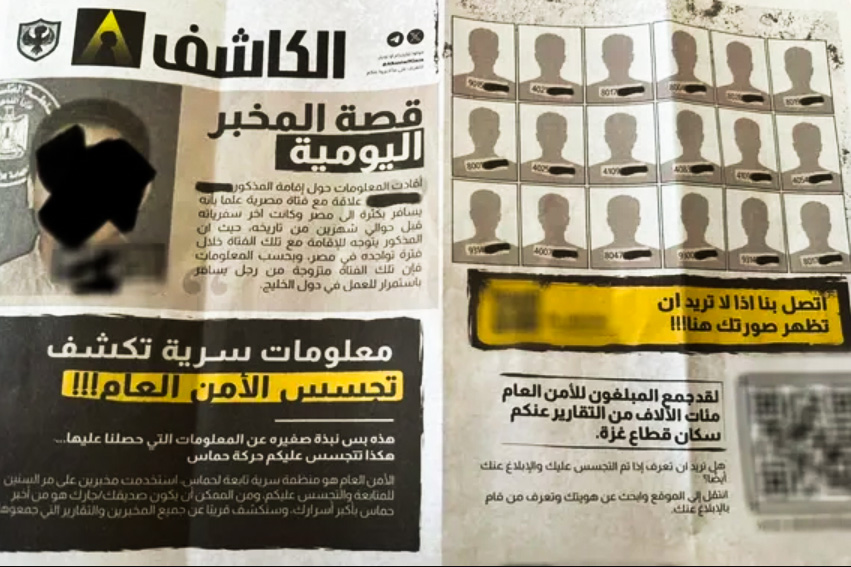
Known as Alkasheff Gaza, the website hosts a searchable database of Palestinians, along with their names, government identification numbers, addresses, places of worship, and more. It is claimed that the individuals listed spied for Hamas. This information is drawn from local municipal police files seized by IDF operatives. The resource burst into public view in May when Israeli forces rained down leaflets on Gazans featuring pictures and names of 130 purported spies and a QR code for visiting their contactable Telegram channel.

Even more sinisterly, these leaflets threatened that the IDF would publish damaging details on even more Gazans if they didn’t first call the IDF on a number included on the leaflet.

Hundreds of thousands of reports on you, the people of Gaza, have been collected…Do you want to know if you were spied on and reported? Go to the website, enter your ID number, and find out who reported you.

A “military source” told Israeli publication Haaretz that the IDF had “legal permission to engage in this extortion.”

“Collaborator with [Hamas] General Security! Have you found out if your ID number is on the website? We will soon reveal your details to everyone. You can still save yourself – call us,” the pamphlet warned. Adjacent, the photo and name of a Palestinian man featured, along with the caption, “today’s snitch.” He allegedly provided information to Hamas on an individual who frequently visited Egypt to have sexual relations with a married woman whose husband spent extended periods away from home in the Gulf States.
Image

Such disclosures starkly contrast to the declarations of a nameless IDF official, who, in defending the leaflet drop, told Haaretz that Israel’s military “didn’t put personal stories there” or “provide details about what these people knew or collected.” The same source also dismissed suggestions that Alkasheff Gaza was a “means of extortion.” Instead, they claimed the intention was to “awaken the public there, showing it what Hamas has done.”

People whose photos we’ve published were carefully selected by Hamas, which recruited them for spying and extorting people. These are people from clans which are identified with Hamas. It’s part of the way Hamas uses people. We propose to all civilians and people who’ve had similar experiences to give us information.”

Gravely undermining this benign explanation, some of the “informants and collaborators” pictured on the IDF’s leaflets were just children, some of whom looked no older than 10, while others appeared younger than five. In addition to allegations that individuals featured on the leaflets had spied for Hamas, they featured an ominous threat to reveal deeply damaging personal information on targets, including criminal records, extramarital affairs and sexual proclivities. These were accompanied by requests for intelligence on Hamas and the location of remaining Israeli hostages in Gaza.

Mental coercion of civilians in war zones is a brazen violation of established laws of war and the Genocide Convention. Yet, these tactics have been a core component of IDF operations since October 2023. Israel has bombarded Palestinians with leaflets demanding “surrender now or you will die” or simply mocking their impossibly bleak situation. One airdrop in December even featured a Quranic quote about the fate of “wrongdoers.”

This is what the Israeli military threw over city of Khan Younis. It’s part of a Quran verse that describes how God punished the people of Noah by a flood all over the world.

“The flood seized them while they were wrongdoers. + Along with a star of david. pic.twitter.com/RVFQqBqNgA

— Younis Tirawi | يونس (@ytirawi) December 6, 2023


In reality, it appears the purpose of Alkasheff Gaza is psychological torture – to spread distrust, disunity, and disillusionment among the area’s already embattled population, who live under the daily threat of total annihilation. As monstrous as this effort might be, there are substantial grounds to believe its repeated respawning is reflective of the IDF’s broader catastrophic failure in Gaza. And, in turn, yet another harbinger of Israel’s impending, inevitable extinction.

‘Very Sloppy’

A Zionism Observer activist – a software developer who wishes to remain anonymous – tells MintPress News that the ease and speed with which their activist group initially succeeded in purging Alkasheff Gaza from the internet “felt like a substantial victory.” But then, the IDF completely rebuilt the online database using new tools and hosts. The second time around, the website featured a note stating without irony: “Suspicious people are trying to keep us from exposing Hamas.” Zionism Observer promptly added “suspicious people” to their X bio.

Incoming information on this. Stay tuned https://t.co/xUZgmUA3yz

— Tali {️}{} (@TalulaSha) May 20, 2024


The software developer suspects that the website’s earlier, “scarier” incarnation was a significant factor in compelling NameCheap, Webflow, and Twitter/X to deplatform Alkasheff Gaza within a matter of days in May. Zionism Observer and many named and unnamed online activists bombarded these companies with requests to remove the site, and they acquiesced. In addition to photos and biographical information on innocent children, “the site had a timer, along with a warning that when the timer expired, damaging information would be released on average citizens without delay.”

Zionism Observer was very surprised by the third relaunch, on May 25, which they then took down in the days. The fourth led to its current iteration, which remains extant as of July 31 and can be accessed via .com, .info and .net domains. For a variety of reasons, Zionism Observer is at a loss as to why the IDF persists in maintaining the site, let alone relaunching it whenever it’s taken down:

The database became useless after the 12th evacuation order, if not before. It lists information on locals, where they are, and where they pray, but do the mosques listed even exist anymore? Israel has been shoving people all over the place. Despite facial recognition cameras throughout Gaza, I don’t think the IDF has any clue where people are. This could just be psychological warfare, intended to make the population not trust each other and terrify individual citizens into believing the Zionists have dirt on them somehow.”

Mossad has a lengthy, deplorable history of blackmailing LGBT Palestinians, threatening them with public exposure if they refuse to turn agent and spy on their families, friends, and local communities. “This would be doing that at scale,” Zionism Observer’s software developer tells MintPress News. Although, they aren’t entirely convinced of that explanation. They are also confused by the site’s unsophisticated construction. Despite apparently being a formal IDF project, it isn’t built using the same tools as the Forces’ official websites:

They’re using ‘no/low-code’ tools that help people who aren’t programmers build software. If professional developers created the site instead, there is a good chance that I wouldn’t even be able to figure out what tools were used to build and power the site, and there certainly wouldn’t be abuse-reporting forms and e-mails to direct people to. This could have been running on a server in an IDF datacenter, completely opaque to researchers. Perhaps someone unqualified to do this kind of thing got the contract, did it in a very sloppy way, and they’re now desperately trying to keep it going?”

Another mystery for Zionism Observer is whether the database is working from the IDF’s perspective and, if not, whether it ever did. What “working” would entail is likewise opaque. Have any scared Palestinians reached out to the IDF? That was clearly a core founding objective of Alkasheff Gaza, given that accompanying Telegram accounts were registered and leaflet recipients and website visitors were directed to contact the Forces anonymously through these resources.

Eerily, what’s clear is that Alkasheff Gaza was intended to gather information on all its visitors. Among the back-end revelations, Zionism Observer identified was that the site’s searchable database of entries forwarded not only any terms entered to the IDF but also a visitor’s IP address, latitude, longitude, and city and region of residence.

In addition to whatever search term, Make’s software also receives and process the visitor’s

– IP address
– Latitude
– Longitude
– City
– Region (state in the US) pic.twitter.com/sj1toEYpk2

— Zionism Observer (@receipts_lol) May 22, 2024


This would, of course, harvest a wealth of deeply sensitive intelligence on both Palestinians and foreign citizens. The software developer speculates:

Perhaps that is the site’s value, and why they refuse to give up. Or, is the IDF as technologically incompetent as they are militarily? Maybe all they’re really good at is spying on people, and the operatives spying on people are spending more time jerking off to webcams than they are doing their actual jobs?”

XXXX

Alkasheff Gaza is not the only ineptly constructed IDF resource over which Zionism Observer has run roughshod. Another, a subsection of Israel’s dedicated “Iron Swords” website, ostensibly provided an interactive “evacuation” – read: forced displacement – map for trapped Gazans. It relied heavily on a secret Israeli military intelligence database, which was openly revealed in the site’s publicly and easily accessible source code. As a result, the IDF effectively leaked its own secrets to every site visitor, both English and Arabic.

Strikingly, the map divided Gaza into 620 “population blocks” – so too did the database, which dated to April 2022. This could just be a coincidence. Or it may suggest that the ongoing genocide has been in Israel’s pipeline for a long time. Whatever the truth of the matter, Zionism Observer turned the tables on the “evacuation” site, using its source code to construct a resource of their own – Gaza Maps.

They hope it will soon be interactive, allowing visitors to click on areas of Gaza and see TikTok videos shot there by the IDF, relevant evacuation orders, and much more. This is one of many Zionism Observer projects under development, and the collective intends to keep going in the name of Palestine solidarity. Like the tireless Resistance, time, justice, and virtue are on their side. So, too, is international law.

All of these videos can be found archived at TikTokGenocide-dot-com. pic.twitter.com/zSsuE3P7N1

— Zionism Observer (@receipts_lol) July 30, 2024


Throughout the U.S., state laws designed to damage or outright proscribe the Boycott, Divestment, and Sanctions movement are on the local statute. This could make it illegal for companies to deplatform Alkasheff Gaza or any other Israeli government-affiliated website. In Arizona, where NameCheap is based, for instance, “an amended anti-boycott law in effect…prohibits state contracts with and state investments in entities that boycott Israel or territories occupied by Israel.”

Yet, in the wake of the International Criminal Court seeking arrest warrants for Benjamin Netanyahu and his Security Minister Yoav Gallant in May for “crimes against humanity” committed in Gaza since “at least” October 8, 2023, there is now a significant degree of legal protection for pursuing and enforcing boycotts against Israel, that would override such anti-BDS legislation. As MintPress reported in June, an analysis by the University Network for Human Rights spells out the legal obligation to prevent genocide in the wake of ICC rulings:

The duty to prevent genocide in Gaza encompasses a range of measures. First, it is imperative that states exercise all means of political and diplomatic pressure toward the cessation of Israeli military operations in Gaza. States exporting arms or military equipment to Israel or providing other forms of military aid or logistical assistance that contribute to or enable Israel’s military operations against Palestinians in Gaza have an obligation to immediately terminate all forms of aid and assistance.

The duty to prevent genocide starts as soon as a state learns or should have learned, about a serious risk of genocide. The ICC highlighted this serious risk of genocide in Gaza in a preliminary finding in January in a case brought against Israel by South Africa. All of Israel’s Western allies, who are signatories to the Genocide Convention and provide military and political support to Tel Aviv, are consequently obligated to attempt to stop the violence in Gaza. There has been little state-level action on this since the genocide began. As such, it falls to concerned citizens and major corporations to fulfill those obligations. The success of Zionism Observer’s efforts to date should give us pause—and the motivation to pressure all companies providing services of any kind to Israel to boycott, divest, and sanction accordingly.

https://libya360.wordpress.com/2024/08/ ... civilians/

If Anyone is Being ‘Funded’, it’s the Zionists on Campus
Posted by Internationalist 360° on August 2, 2024


Walid Tamtam
Image
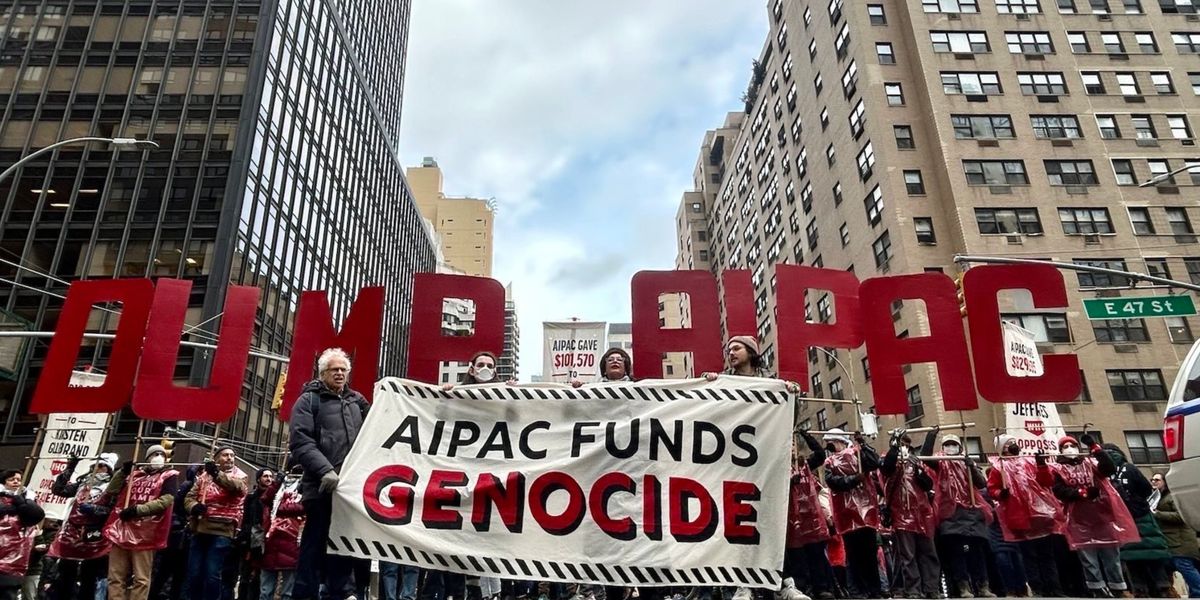
Jewish-led demonstrators hold a banner reading, “AIPAC Funds Genocide” near the lobby group’s New York office on February 22, 2024. (Photo: Jewish Voice for Peace/X)

Billions of dollars are funneled from pro-“Israel” business and state figures into the Western world to then return political action and tax-payer funds for “Israel’s” strategic domination of the Middle East.

In recent months, American politicians such as Nancy Pelosi have thrown baseless accusations that pro-Palestinian marches and student encampments were the result of foreign funding from Russia, China, and Iran. It suites a perfect irony where the many well-funded Zionist campus groups and United States-based Zionist organizations are well funded through well-connected political donors and the Israeli regime propaganda arm.

Unlike any regime in the world, “Israel” performs one of the most sophisticated, well-funded, and aggressive foreign influence campaigns, specifically in Academia, targeting students who are either ignorant of “Israel’s” crimes or those who willfully collaborate with their agenda for financial compensation. Billions of dollars are funneled from pro-“Israel” business and state figures into the Western world to then return political action and tax-payer funds for “Israel’s” strategic domination of the Middle East.

In the United States, nearly every university has a grassroots-funded chapter of the Students for Justice in Palestine group, along with its Jewish pro-Palestine counterpart, Jewish Voice for Peace, as both groups often fight political battles to retain their status as campus clubs due to Zionist influence on the administrations of their school. Columbia University, where the encampment solidarity campaign began, had both SJP and JVP suspend any campus activities and club recognition due to their effective popularity in mobilizing students against “Israel’s” genocide in Gaza.

The Table below cites Zionist organizations registered as non-profits, receive tax breaks, and perform partial or complete activities on North American College campuses:

Organization Strategy Annual Revenue
Stand With Us* Right-wing focused Israeli propaganda $23,212,771
Hasbara Fellowships Media training for students $1,249,655
CAMERA on Campus Journalism and video media $4,860,520
Israel 21c Online Blog and Liberal Zionism $1,107,296
Students Supporting Israel Campus events and intimidation campaigns $1,562,012
Canary Mission** Doxing and Intimidation campaign Shadow funding
Hillel International The Zionist conflation of Jewish Culture and Campus Life $57,858,837
B’nai B’rith Legal and Political Defamation Network $7,681,450
Anti-Defamation League Professional reputation-smearing network $159,935,377
Christians United for Israel Israeli lobbying efforts targeting evangelical Christians $204,821
Israel on Campus Coalition Pro-Israel events and demonstrations on college campuses $9,721,662
American Israel Public Affairs Committee Government lobbying and Political campaign contributions $73,512,996
Canadian Jewish Political Affairs Committee Government lobbying and Zionist youth political engagement programming $4,900,000*
Honest Reporting Zionist Journalism Pressure Campaign $2,052,913

A total of $347,860,310 from only 14 Zionist organizations demonstrates the deep pockets of Zionist donors, which include both state funding routed via non-profit organizations in America and notable donations from the Adelson family, as well as from pornographic business tycoon and majority owner of Only Fans, Leonid Radvinsky, who pledged $11 million to AIPAC.

Top Zionist projects of 2023 to 2024

Since 2020, with the so-called Arab-Zionist normalization project, two goals have been primary to Zionist proxies globally, [the first is in] furthering the “human bond” between “Israel” and the co-signing Arab states to avoid a “cold peace” outcome as seen in Egypt and Jordan, while the second imitative is perhaps most focused in the West, where a darker legacy of antisemitism exists, whereby the International Holocaust Remembrance Alliance and as per its Zionist-focused “working definition” of antisemitism states that it is antisemitic to deny “Israel’s” “right to exist” and [applies] applying “double standards to Israel” in criticizing the crimes of the Zionist project. IHRA is not an NGO, it is an organization made of government officials from over 35 countries, according to the government of Canada website, which is one of the many governments that send representatives to their organization.

After the UAE normalized relations in August of 2020, followed closely by Bahrain, a quiet move by Sudan, and the last move by Morocco in December of the last Trump year, “Israel’s” Ministry of Strategic Affairs through its social media accounts, proxies, and funded propaganda have prepared programs such as the “peace” delegations, where Arabic speaking influences from the region are invited on a loaded trip within the Zionist entity, in order to repackage Israeli propaganda to a targeted Arab audience and a western audience naive enough to follow.

Firstly, it must be said that the term peace does not apply to Bahrain and UAE, as the two states have never been in active war or military conflict with “Israel”, so the term normalization fits best, along with Arab betrayal, given previous Arab standards that have barred Arab league members from engaging with “Israel” without the achieving justice for the Palestinians, even with tremendous concessions on the Palestinian side.

Ministry of Strategic Affairs, the Orwellian Zionist machine

“Israel” hosts a government department known as the Ministry of Strategic Affairs to address its public image within foreign countries and media. The Ministry publicly claims to strengthen the US-Israeli alliance. What its mission statements translate to is direct control of social media accounts on Twitter, Instagram, Tiktok and elsewhere, and funding Israeli propagandists like Hananya Naftali, Emily Schrader, Yoseph Haddad, Eylon Levy, Rudy Rochman, Hen Mazzig, and many others, all of whom have appeared on mainstream American media and have appeared on American college events, with travel and accommodations paid by the host Zionist organization.

It is the Zionists who are ‘funded’

The Zionist political and campus-based organizations have deep pockets to spread Israeli government talking points and public affairs strategies. With both state and private funds involved, it is evident that it is not Palestinian groups who are “funded” but rather pro-“Israel” organizations with foreign ties, cash, and political resources, unlike any other section of academic activism.

Notes:

*Stand With Us names itself “Israel Emergency Alliance” in tax filings.
**Canary Mission operates as a shadow-funded organization receiving private contributions through Jewish not-for-profit charities registered under multiple banners, an example includes Megamot Shalom

https://libya360.wordpress.com/2024/08/ ... on-campus/

Golan: Adhering to Syrian Identity, Resisting ‘Israelization’ Attempts
Posted by Internationalist 360° on August 2, 2024
Ahmad Karakira

Image

From armed Resistance to nonviolent strikes, the residents of the occupied Syrian Golan Heights have foiled Israeli conspiracies and confirmed their Syrian Arab identity.

The Israeli-occupied Syrian Golan Heights made headlines on Saturday after a missile landed on a football field in the Druze town of Majdal Shams, killing 12 people and injuring dozens.

“Israel” was quick to pin the blame on Hezbollah and claimed that the Lebanese group targeted the town with an “Iranian rocket”.

Playing the role of the “hero”, Israeli occupation Prime Minister Benjamin Netanyahu also vowed that “Israel will not let this murderous attack go unanswered and Hezbollah will pay a heavy price for it, a price it has not paid before,” according to a statement from his office.

Hezbollah denied that it targeted Majdal Shams, a town where many residents have rejected Israeli nationality since the Israeli occupation of the Golan Heights in 1967.

In a statement, the Lebanese Resistance group said it “categorically denies the allegations reported by certain enemy media and various media platforms concerning the targeting of Majdal Shams.”

“The Islamic Resistance has no connection to this incident,” it affirmed.

Later, Axios cited an American official as saying that Hezbollah officials told the UN that the Golan Heights incident was the result of an Israeli interceptor missile hitting the playground in Majdal Shams, the largest town in the Golan.

Moreover, reporters of several media outlets cited some anonymous eyewitnesses as saying they saw an interceptor missile falling on the field but noted that they refused to speak in front of the camera out of fear of retaliation from Israeli authorities.

Al Araby journalist reported that some eyewitnesses at the explosion site in Majdal Shams town told her that the Israeli air defense was the cause of the heavy explosion. pic.twitter.com/MoLwVn8AMl

— IRNA News Agency (@IrnaEnglish) July 28, 2024


A couple of days later, Israeli occupation forces launched an aggression on Beirut’s southern suburbs, resulting in the assassination of Hezbollah’s top military leader Sayyed Fouad Shokor.

In a speech delivered at a large funeral ceremony held for Shokor, Hezbollah Secretary-General Sayyed Hassan Nasrallah said the Israeli regime tried to label its aggression on Beirut as a “response” to the incident in Majdal Shams.

He reiterated that the Resistance has rejected this accusation and denied responsibility after a thorough investigation, adding that “we have the courage to take responsibility if it was our attack, even if it was a mistake, and we have precedents in this matter.”

Sayyed Nasrallah pointed out that “Israel cannot accept the hypothesis that the incident in Majdal Shams was due to an Israeli interceptor missile” despite the massive evidence suggesting it, which was even put forward by numerous military experts.

He affirmed that “the aim of accusing the Resistance is to incite sectarian strife between the [Druze] people of the occupied Golan and [Hezbollah] and behind it the Shiite sect, in order to undermine the most significant achievements of Al-Aqsa Flood” of unity and solidarity among Arabs and the people of the region.

The Hezbollah chief confirmed that this strife was quelled and disabled “thanks to the awareness and firm positions of the leaders of the Druze community,” extending his gratitude to the political and spiritual leaders of the Druze for their stance.

The town held Saturday a funeral ceremony for the victims of the attack, with the Israeli Channel 13 reporting that residents of Majdal Shams attacked members of Prime Minister Benjamin Netanyahu’s Likud party who showed up for the ceremony.

Meanwhile, the Israeli news website Walla mentioned that Finance Minister Bezalel Smotrich was met with rejection and protests upon his arrival in the town.

“Get out of here. We don’t want you here, you killer,” the residents told Smotrich, accusing the Israeli minister of making use of their children’s blood.


A circulated video on social media shows residents of Majdal Shams in the occupied Syrian #Golan expelling Bezalel Smotrich, the Minister of Finance in the Israeli government, from a funeral held by the village’s residents for the victims.

Residents of #MajdalShams in the… pic.twitter.com/EPs5zynB0y

— Al Mayadeen English (@MayadeenEnglish) July 28, 2024


Al Mayadeen‘s correspondent Hanaa Mahameed visited the site where the projectile landed and gathered testimonies from the town’s residents, who challenged the Israeli narrative that Hezbollah was behind the attack.

The Syrian Arab News Agency (SANA) also reported that the residents of Majdal Shams attempted to kick out Netanyahu from the town, calling him a “fascist” and a “criminal”.

Netanyahu had arrived in Majdal Shams alongside a convoy of high-ranking security officials.


People in the occupied Syrian #Golan prevent Israeli Prime Minister Benjamin Netanyahu from entering Majdal Shams, calling him a fascist and criminal.

In a similar incident, the residents kicked out Israeli Finance Minister Bezalel Smotrich, Minister of Economy Nir Barakat,… pic.twitter.com/V5gslxYhly

— Al Mayadeen English (@MayadeenEnglish) July 29, 2024


Al Mayadeen‘s correspondent in the occupied territories reported that Netanyahu arrived in Majdal Shams at around 2:00 pm (local time) and was received by the town’s Israeli-appointed council chief in an administrative building. Netanyahu entered through the back door of the building to avoid being seen.

After news had gotten around to the town’s residents, hundreds gathered outside the said building, protesting Netanyahu’s visit to the occupied Syrian town.

The demonstrators berated the Israeli prime minister, denouncing him as a “child killer” and a “criminal”.

Netanyuahu’s visit to the town did not last for more than 15 minutes, locals told Al Mayadeen, after the incident had enraged residents who refused to receive the Israeli prime minister.

Al Mayadeen also found that several locals refused to allow Israeli occupation forces to use their homes and rooftops as guarding points ahead of Netanyahu’s arrival.

It is noteworthy that, to this day, the vast majority of Majdal Shams’ residents maintain their Syrian identity, with only about 20% having accepted Israeli citizenship.

Israeli media previously reported that in 2018, only 272 people out of a population of about 12,000 voted in local elections held by the Israeli occupation authorities.

Illegal Israeli occupation of Syrian Golan Heights

To better understand the current situation in the Golan Heights following the Majdal Shams incident, it is only crucial to look back at the history of this region since its occupation by “Israel”.

In the 1967 war, known as the Six-Day War, between the Arab and Israeli forces, the latter managed to occupy the Gaza Strip, West Bank, al-Quds, the Sinai Peninsula, and the Golan Heights.

The Golan spans an area of 1,860 square kilometers, accounting for 1% of Syria’s total land area. During the June 1967 war, “Israel” occupied approximately 1,250 square kilometers of this territory, of which Syria regained 100 square kilometers following the October 1973 war.

Israeli occupation forces displaced over 95% of the Golan’s population—around 140,000 Syrian citizens—and demolished their villages, totaling 340 villages and the city of Quneitra.

As part of its settler colonial project, “Israel” has gradually established 33 agricultural settlements and the city of Katzrin on the ruins of Syrian villages, with a settler population of at least 26,000. They also planted 76 minefields containing approximately two million mines, some within and around inhabited villages.

Currently, “Israel” occupies about 1,176 square kilometers of the Golan Heights, including 100 square kilometers of demilitarized zones as per a 1949 Armistice Agreement.

There are five villages in the occupied Golan Heights: Majdal Shams, Mas’ada, Buq’ata, Ein Qiniya, and Ghajar. About 10% of the residents of the five villages work in the agricultural sector, utilizing only about 21,000 dunams for farming compared to 110,000 dunams used by Israeli settlers, according to local data.

The people of Golan have cultivated the region for decades, if not centuries, and are renowned for their olives and fruits, particularly apples. However, the limited use of water does not meet local irrigation needs, with farmers receiving approximately five million cubic millimeters of water annually, affecting the quantity of their agricultural production.

According to the UN Committee on the Elimination of Racial Discrimination, expanding Israeli settlements and their activities have limited Syrian farmers’ access to water through discriminatory pricing and fees.

Some of the main water sources in the Golan have been seized for exclusive use by settlers, and other water sources are partially diverted for use in “Israel”, according to a study by researcher Scott Kennedy titled “The Druze of the Golan: A Case of Non-Violent Resistance.”

Central Golan is also known as one of the richest areas in livestock, but this sector has disappeared from the local economy due to the Israeli occupation’s usurping of grazing lands.

In a move reflecting its savage nature, in 1981, the Israeli government officially “annexed” the Golan Heights through the “Golan Heights Law” passed by the Knesset, violating international resolutions that deemed the decision “null, void, and without international legal effect,” a stance reaffirmed by the United Nations on November 28, 2023.

Despite the UN and the international community not recognizing the “annexation” of these territories and international law considering the 33 Israeli settlements in the Golan Heights illegal, “Israel” has desperately sought recognition of its step, finally receiving it in 2019 by then-US President Donald Trump.

Subsequently, a new settlement was established in the occupied Golan Heights named after Trump.

Even after Joe Biden assumed office in 2020, his administration did not reverse the decision and has referred to the region as “northern Israel” rather than occupied Syrian territory.

In the same context, on December 26, 2021, the Israeli government, led then by Naftali Bennett, approved a plan to double the Jewish population in the Golan by 2030, with an initial budget of one billion dollars aimed at attracting 23,000 settlers to the area.

Golan residents refuse Israeli citizenship, affirm Syrian identity

The void Israeli decisions did not prevent the residents of the occupied territory from asserting their right to self-determination, where more than 90% of the Golan Heights residents rejected Israeli “citizenship” in 1981.

Jonathan Kuttab, a Palestinian attorney and human rights activist, recalled in an interview in 1983 that “those who accepted Israeli identity cards were often shunned by the entire community.”

“They decided that anyone who accepts Israeli identity cards is really cutting themselves off from the community ‘They are no longer one of us, no longer a Druze,'” he says.

In his study, The Druze of the Golan: A Case of Non-Violent Resistance, Scott Kennedy also detailed the matter, writing:

“A harsh reception greeted those who took Israeli identification: few would speak to them or enter their homes; they were not invited to community events, weddings or funerals; and they were not welcomed to religious gatherings. Their dead were denied the community’s prayers. Such tremendous social pressure was exerted on them that all but a few diehard quislings returned their cards. Those who repented were required to recant publicly, or to go door-to-door to apologize to their neighbors, and to contribute money to support the families of those imprisoned.”

According to Kuttab, after the Israeli Knesset passed a law authorizing the “annexation” of the Golan, the region’s residents appealed to the Israeli government and petitioned for a reversal of the decision, which would entail forcing Israeli citizenship on them. When their demands were rejected, they announced that they would not comply with the occupation authorities’ measures.

“Israel can do whatever it wants to us: they can confiscate our land. They can kill us. But they cannot tell us who we are. They cannot change our identity,” Kuttab cited Golan villagers as saying.

Following the “annexation” decision, Golan residents launched a heroic nonviolent Resistance in an attempt to defy Israeli diktats.

Detailing these steps, Kennedy indicated that the laborers’ refusal to work disrupted industry in northern occupied Palestine for several weeks, and the elderly and young defied Israeli-imposed curfews to harvest crops.

Groups of women confronted Israeli soldiers, seizing at least 16 weapons and handing them over to army officers, demanding the withdrawal of troops. The weapons were sometimes exchanged for the release of detainees.

One village, taking advantage of the strike, completed a major sewer project that had been denied funding and permits by Israeli authorities for years. The strike also saw trenches dug and pipelines installed.

Villagers began developing cooperative economic structures, such as community-wide tree spraying with the understanding that the crops would be shared by all. They also started establishing their own schools.

After four months, Israeli authorities indicated that efforts to force Golan residents to accept Israeli “citizenship” would be suspended. The residents were led to believe that, on April 1, 1982, the Israeli efforts to impose “citizenship” on them would cease, only for “Israel” to further escalate its repressive measures against the people of the Golan.

Amid a media blackout, an estimated 14,000-15,000 Israeli soldiers raided the region and imposed a 43-day siege, cutting off electricity and water to the villages and destroying several homes.

In one demonstration, nine people were injured, and at least two died as ambulance services to nearby hospitals were blocked. At least 150 people were detained daily, with fourteen receiving four-to-five-month sentences and most fined for not having Israeli identification.

During the siege, Israeli troops conducted door-to-door raids, seizing Syrian-era identification papers and replacing them with Israeli IDs. The following morning, the town squares of various Golan villages were littered with discarded Israeli identity cards, a sign of the resident’s firm refusal of Israeli identification, even if it means that they have to endure direct threats of personal harm and communal suppression.

As a result of the residents’ fierce resistance and adherence to their land and Syrian Arab identity, the Israeli government eventually lifted the siege, withdrawing troops, removing checkpoints, and leaving the Golan residents alone.

But today, most Golan residents unwillingly hold Israeli ID cards, where their status is described as residents and non-citizens, primarily to travel to their workplaces. Their situation is similar to that of the residents of the eastern part of occupied al-Quds who have refused Israeli “citizenship”.

Israeli media highlight that the residents of the occupied Golan Heights have maintained close ties with homeland Syria even after “Israel” occupied the area in 1967 and “annexed” it in 1981, which proves that the occupation has failed to isolate and detach the Golan from its true Arab identity and surroundings.

Amid the Israeli restrictions imposed on the movement of residents in the occupied Golan Heights, the region’s citizens still head to a hill that separates Majdal Shams from the liberated part of Syria and use loudspeakers to communicate with their separated relatives during weekends and holidays to exchange greetings, well-wishes, and conversations, which led to the site being named “The Shouting Hill.”

According to Israeli figures, among the 21,000 Druze living in the Golan, only 4,300 are considered Israelis, including some who inherited their “legal status” from parents who previously accepted citizenship, while the vast majority identify as Syrian.

The aforementioned historical details are evidence that the residents of the occupied Golan Heights have historically resisted Israeli laws aimed at their “Israelization”. Now, it seems that “Israel” is using the Majdal Shams incident as a pretext to further tighten its occupation of the Golan and detach its people from their Syrian Arab identity.


Armed Resistance

Regarding armed Resistance, Eduardo Aboultaif’s study traced the history of the military Resistance against Israeli occupation in the Golan Heights.

The study, based on interviews with Resistance members, indicated that a group of about 50 young men from the Golan formed a secret Resistance movement immediately after the Israeli occupation of the region.

According to one of the founding members, the group’s aim was to provide intelligence to the Syrian army, motivated purely by its members’ patriotism, without any religious, familial, tribal, or sectarian affiliations.

The main activity of this Resistance network, which comprised three operational cells, was gathering intelligence and establishing communication with the Syrian army.

A group of 12 young men also escalated their military Resistance by planting mines near Israeli military sites in the Golan, culminating in a successful attack on an Israeli tank ammunition depot containing 1,200 rockets.

Following the discovery of the Resistance cell, some members were sentenced to 25-32 years in Israeli prisons and two were killed at the hands of Israeli occupation forces.

https://libya360.wordpress.com/2024/08/ ... -attempts/

******

Israel launches overnight air raids on Lebanese-Syrian border area

Tel Aviv has continued its aggression against regional nations as it awaits a response to the assassination of top Hezbollah and Hamas leaders

News Desk

AUG 3, 2024

Image
(Photo Credit: Israeli Air Force)

Israeli warplanes launched at least two air raids on the Lebanese-Syrian border area late on 2 August, targeting the Matraba crossing in the town of Al-Qasr and later the village of Hosh al-Sayyed Ali.


BREAKING | Again: Israeli warplanes bomb the Lebanese-Syrian border, targeting the village of Hosh al-Sayyed Ali. pic.twitter.com/GTT9BJ2DDq

— The Cradle (@TheCradleMedia) August 2, 2024
According to Lebanon's National News Agency (NNA), the second attack targeted a convoy of trucks carrying food from Lebanon to Syria. AFP reported that at least one Syrian driver was injured in the attack.

On Saturday morning, an Israeli airstrike also hit a vehicle in the town of Bazourieh, near the southern Lebanese city of Tyre.


Israel's latest cross-border aggression comes as the nation awaits retaliation from Hezbollah and Iran following the twin attacks in Beirut and Tehran that killed top resistance commander Fuad Shukr and Hamas politburo chief Ismail Haniyeh.

“You do not know which lines you have crossed and what kind of aggression you have committed … We are in an open battle on all fronts, and we have entered a new phase [in the war]," Hezbollah Secretary General Hassan Nasrallah warned on Thursday.

During a phone call on Friday with EU foreign policy chief Josep Borrell, Iran's interim Foreign Minister Ali Bagheri Kani stressed that it is "Iran's natural and legitimate right to punish the criminal Zionist gang."

He also denounced the failure of some nations in the west countries to condemn the assassination of Haniyeh, noting that the silence of these countries "will encourage the Zionist entity to continue its attacks."

Bagheri Kani's comments came hours before the US government ordered the deployment of more fighter jets and warships to the waters of West Asia after President Joe Biden pledged with Prime Minister Benjamin Netanyahu to help him overcome the coming retaliation.

https://thecradle.co/articles/israel-la ... order-area

NYT 'completely fabricated' report saying Haniyeh killed by remote bomb: Hamas

Hamas representative in Iran Khaled Kaddoumi told The Cradle that Haniyeh was killed by an air-dropped projectile

News Desk

AUG 3, 2024
Image
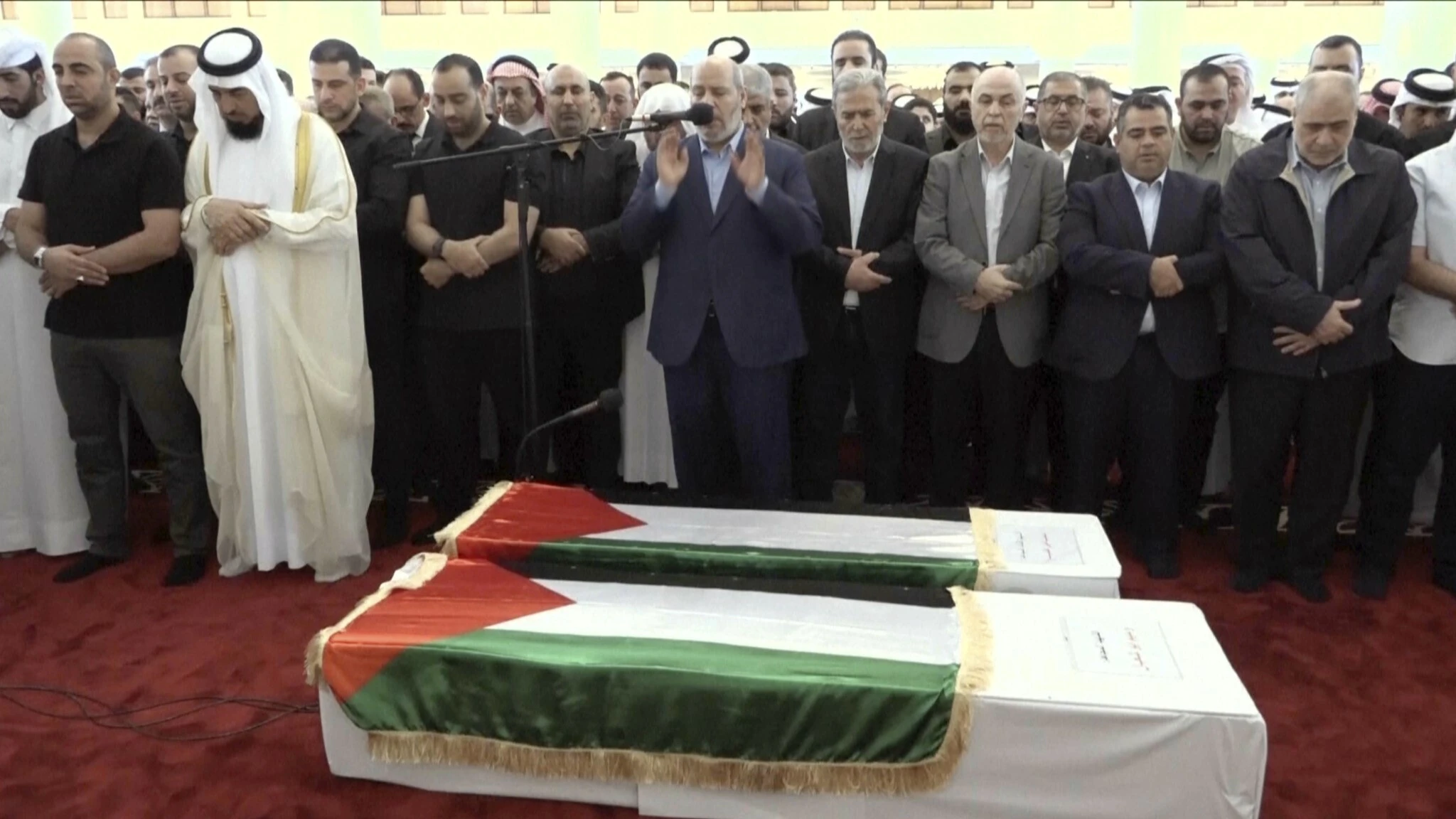
Hamas official Khalil al-Hayya, center, praying near the coffin of Hamas leader Ismail Haniyeh and his bodyguard in Doha, Qatar, August 2, 2024. (Photo credit: Qatar TV via AP)

Speaking to The Cradle, Hamas representative in Iran Khaled Kaddoumi called "ridiculous" and "completely fabricated" a recent New York Times (NYT) report claiming to reveal how Hamas political leader Ismail Haniyeh was assassinated in Iran this week.

The NYT report from 1 August claimed Haniyeh was killed by an explosive device planted in his room in a guest house controlled by the Islamic Revolution Guard Corps (IRGC). The bomb was planted two months ago and detonated remotely by Israel's intelligence service, the Mossad, NYT report claimed.

Haniyeh was in the Iranian capital, Tehran, for the inauguration of newly elected President Masoud Pezeshkian.

In contrast, Kaddoumi stated that Haniyeh and his bodyguard were killed by explosives dropped from the air.

"I was there, and the wall and ceiling of the place where he was were collapsed. It is clear from the appearance of the place after the attack, and from the body of the martyr leader Ismail Haniyeh, that the targeting was carried out by an air-dropped projectile," Kaddoumi told The Cradle.

He noted further, "There are ongoing investigations, and technicians who inspected the crime scene will issue detailed reports on what happened."

The Hamas representative told The Cradle, "The cheap scenarios promoted by some Western media about the assassination of martyr Ismail Haniyeh are very ridiculous. The narrative published by the New York Times about Mossad agents planting explosive devices inside the apartment where Haniyeh stayed is completely fabricated … They are trying to evade responsibility and its consequences for Israel."

Kaddoumi made similar comments to the New Arab and Anadolu Agency about Haniyeh's killing.

The NYT story supported the narrative of the Israeli military. After Haniyeh's killing, Israeli army spokesman Daniel Hagari said in a press conference that "The air force was not on any mission that night except for the attack that targeted Beirut."

Haniyeh was killed in the early hours of 1 August. The night before, Israel assassinated top Hezbollah commander Fuad Shakr in an airstrike on a residential building. The strike also killed two women and two children.

The NYT story regarding Haniyeh's killing was authored by Israeli journalist Ronen Bergman, US journalist Mark Mazetti, and US-Iranian journalist Farnaz Fassihi.

Bergman and Mazzetti are veteran reporters with close contacts within the Israeli and US intelligence agencies, respectively.

Hezbollah leader Hassan Nasrallah vowed to respond to Israel's killing of Haniyeh and Shukr while stating that the conflict with Israel is in a "new phase."

"The enemy, and those who are behind the enemy, must await our inevitable response … You do not know what red lines you crossed," he said, in reference to Israel and its most important ally, the US.

The Kayhan daily, which is closely aligned with Iran's IRGC, emphasized that "the Zionists" would "pay blood" for Haniyeh's assassination.

"Avenging the bloodshed of a guest is the host's duty; the world is watching," the daily wrote.

https://thecradle.co/articles/nyt-compl ... bomb-hamas

US warships, fighter jet squadron en route to Mediterranean to 'protect' Israel

The Axis of Resistance has vowed to respond to Israel's assassination of Hamas leader Ismail Haniyeh and Hezbollah commander Fuad Shukr

News Desk

AUG 3, 2024
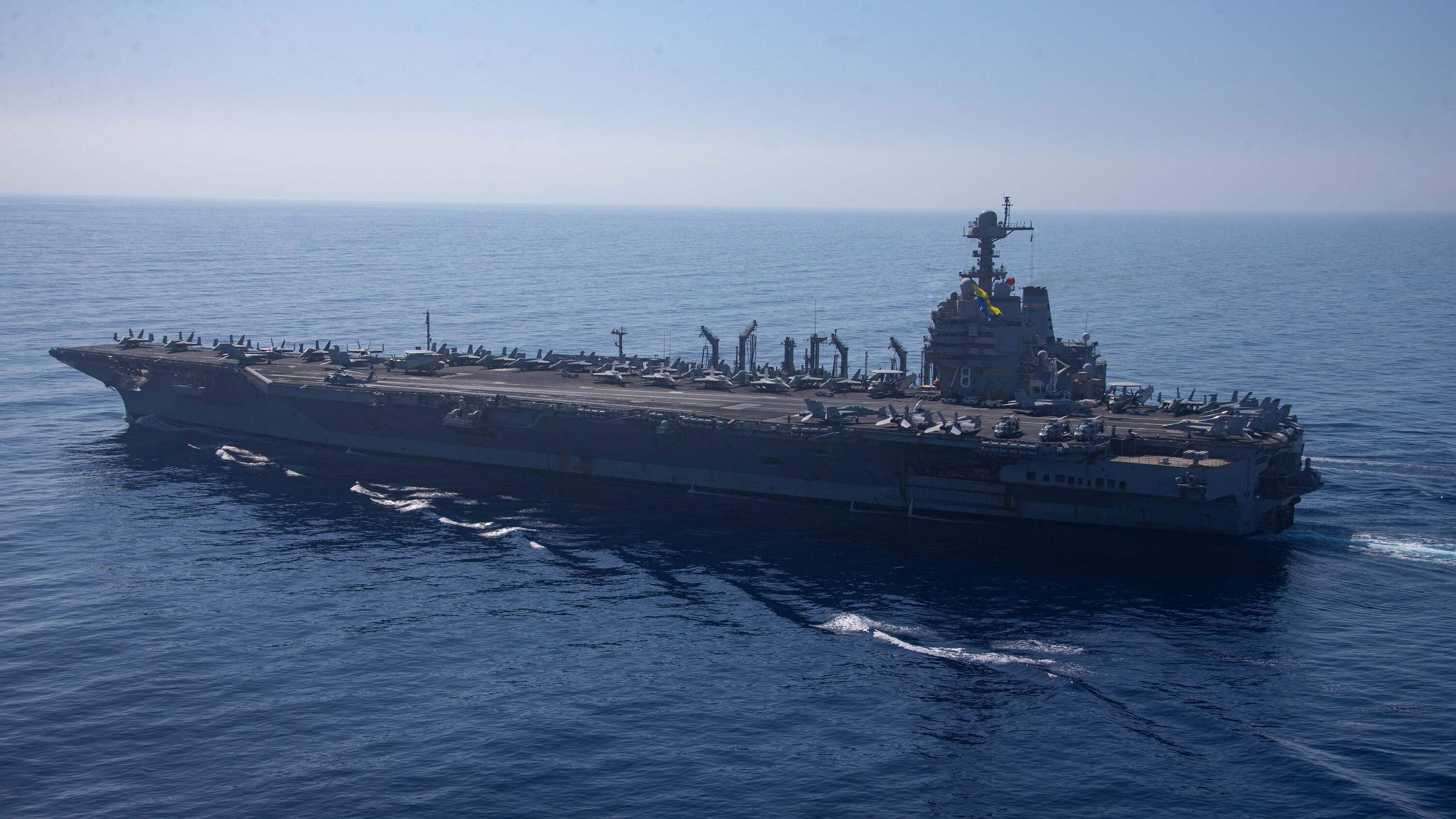
Image
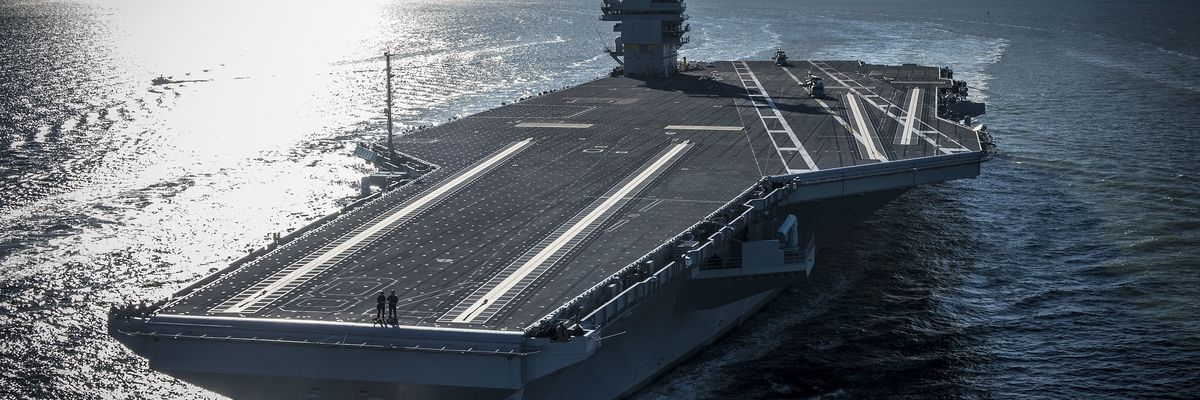
US Aircraft carrier Gerald R. Ford and its accompanying warships in the eastern Mediterranean Sea in October (Photo credit: U.S. Department of Defense

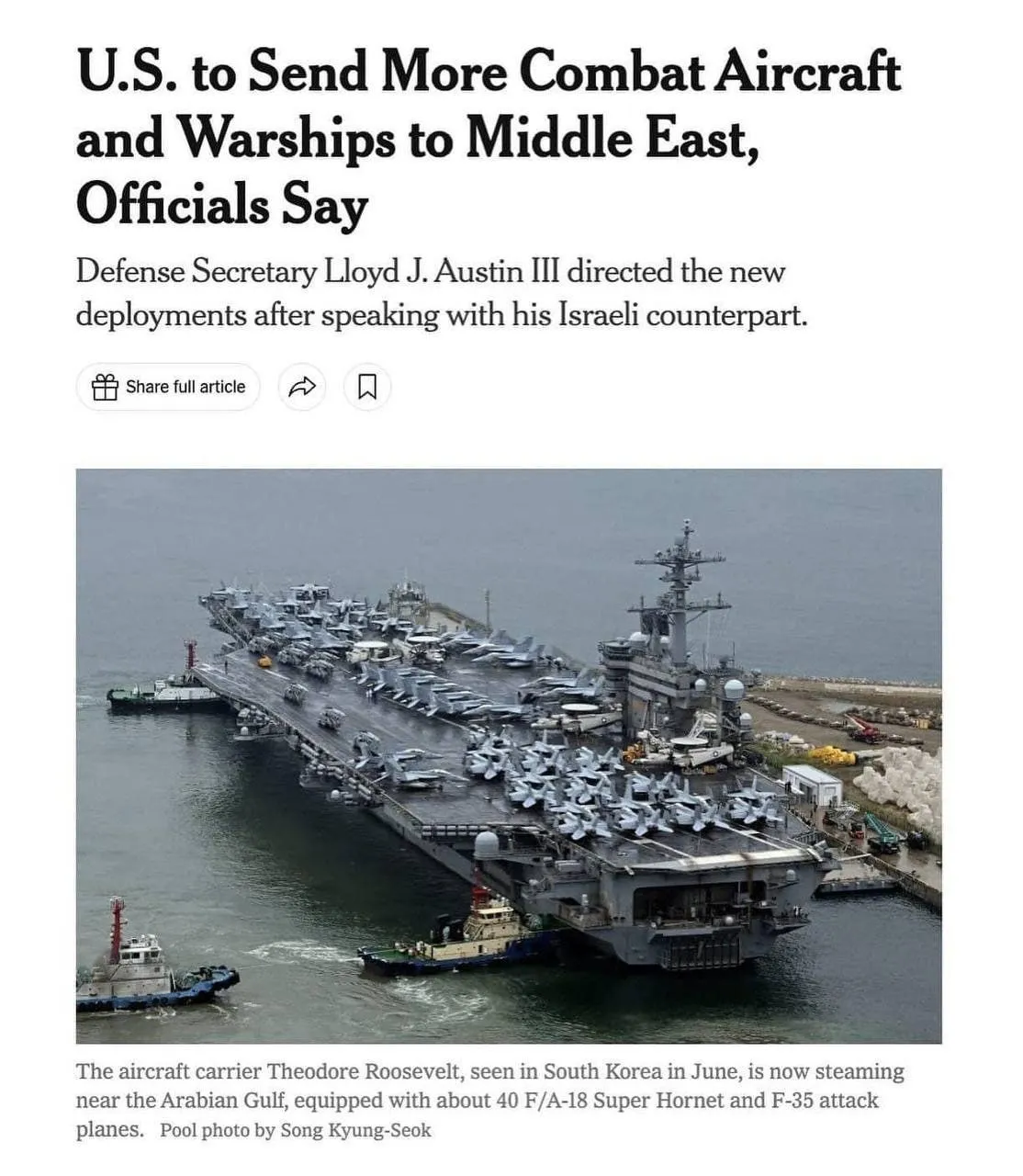
The US military will move an aircraft carrier, fighter jet squadron, cruisers and destroyers with ballistic missile capability, and land-based ballistic missiles to West Asia, the Pentagon announced on 2 August, to help defend Israel from possible retaliatory attacks by the Axis of Resistance, led by Iran.

US Defense Secretary Lloyd Austin is ordering the USS Abraham Lincoln aircraft carrier strike group to West Asia, where it will join the USS Theodore Roosevelt carrier strike group, which is in the Gulf of Oman.

It is unclear if the USS Abraham Lincoln will replace the USS Theodore Roosevelt, which is scheduled to return to the US later this summer, or whether the USS Theodore Roosevelt will remain in the region alongside the USS Abraham Lincoln and be directed to the Mediterranean Sea to help defend Israel.

The Pentagon did not say where the fighter jet squadron was coming from or where it would be based in West Asia. The US has multiple Arab allies in the region who are willing to base US military forces but request that their presence not be made public.

The statement did not identify which vessels and units will be involved, but says they will be added to the "broad range of capabilities the U.S. military maintains in the region."

US defense official told The Washington Post on 1 August that the US Navy has already assembled at least a dozen warships nearby to defend Israel.

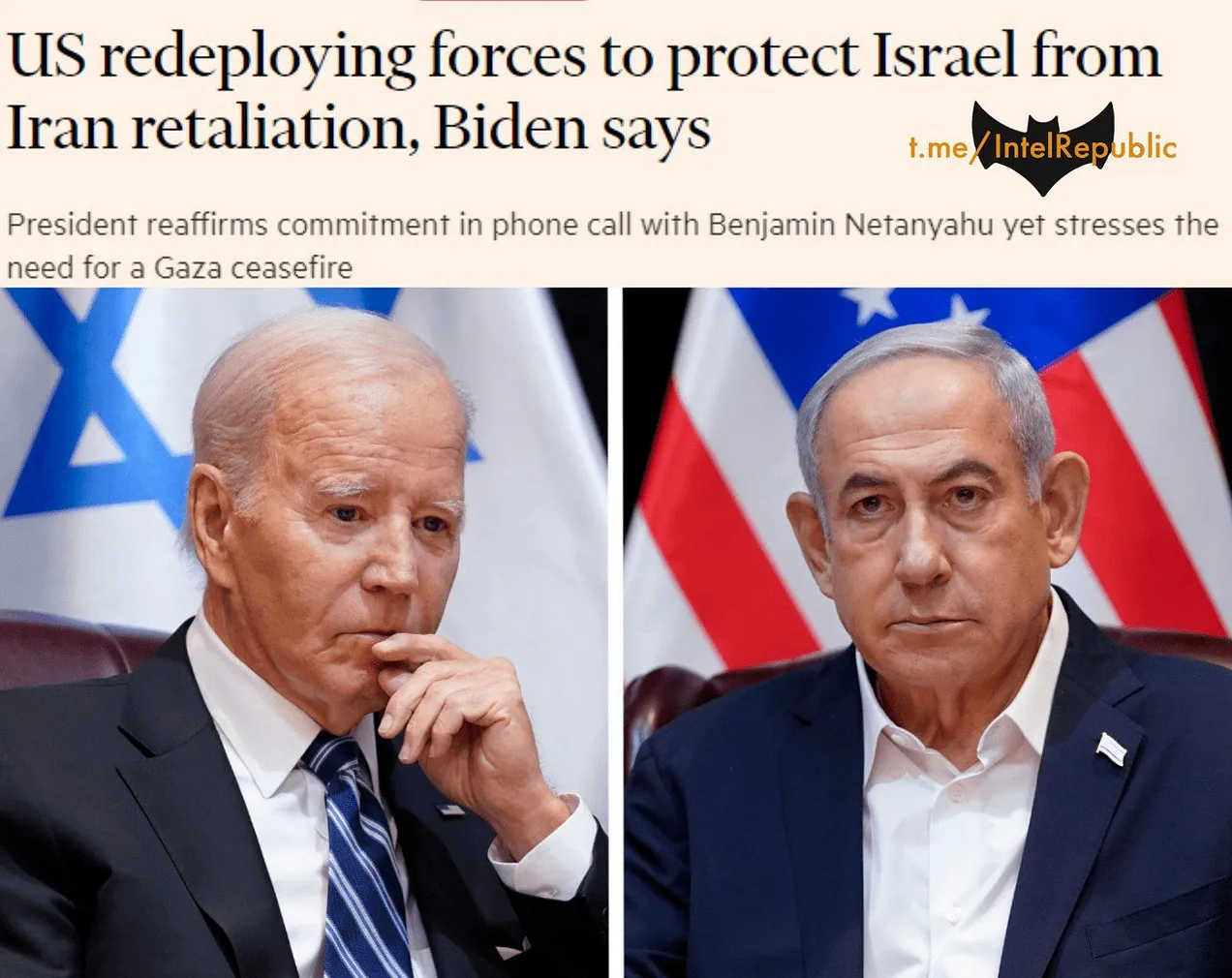
The announcement of the new deployment came a day after US President Joe Biden spoke by phone to Israeli Prime Minister Benjamin Netanyahu. Biden affirmed his commitment to Israeli security "against all threats from Iran, including its proxy terrorist groups Hamas, Hezbollah, and the Houthis."

"The President discussed efforts to support Israel's defense against threats, including against ballistic missiles and drones, to include new defensive U.S. military deployments," said a brief statement summarizing the two leaders' call.

Israel is bracing for an attack from the Axis of Resistance, an alliance comprising Iran, Hezbollah in Lebanon, Ansarallah in Yemen, the Islamic Resistance in Iraq, and Hamas in Gaza. Axis leaders have promised to retaliate for Israel's assassination of Hamas political leader Ismail Haniyeh in Tehran on 31 August and top Hezbollah commander Fuad Shukr in Beirut on 30 August.

The US and its regional Arab allies are seeking to defend Israel as part of a coalition that helped defend Israel from an Iranian retaliatory attack in April.

Iran attacked Israel with a barrage of missiles and drones in response to Israel's bombing of the Iranian consulate in Damascus two weeks prior. The Israeli attack killed sixteen people, including eight officers of the Islamic Revolutionary Guard Corps (IRGC) and two Syrian civilians.

"As we have demonstrated since October and again in April, the United States' global defense is dynamic and the Department of Defense retains the capability to deploy on short notice to meet evolving national security threats," Deputy Pentagon Press Secretary Sabrina Singh said in her statement on Friday.

https://thecradle.co/articles/us-warshi ... ect-israel
"There is great chaos under heaven; the situation is excellent."

User avatar
blindpig
Posts: 15306
Joined: Fri Jul 14, 2017 5:44 pm
Location: Turtle Island
Contact:

Re: Palestine

Post by blindpig » Mon Aug 05, 2024 11:13 am

Patrick Lawrence: The Murder of Ismail Haniyeh
August 3, 2024

As assiduously as Israel seeks war with Iran is precisely the extent to which it will seek to draw the U.S. into it. That is what made Congress’ insanely intemperate recent reception of Netanyahu so dangerous.

Image
Ismail Haniyeh, at left, on Dec. 8, 2012, during the 25th anniversary of Hamas celebration in Gaza. (Fars Media Corporation, Wikimedia Commons, CC BY 4.0)

By Patrick Lawrence
ScheerPost

Some reflections, written urgently in response to the urgency of the moment, on the assassination early Tuesday of Ismail Haniyeh. The 62–year-old chairman of Hamas’ Politburo, murdered during an official visit to Iran, was the organization’s chief negotiator in talks intended to produce a ceasefire in Gaza and the release of Israeli hostages held by Hamas and Palestinian prisoners held in Israel’s jails.

These talks may now be definitively dead. This is news but not news: It has been apparent for some time that the Netanyahu regime — and the U.S., by obvious extension — has never been serious about an accord to bring the Israel Occupation Force’s genocide in Gaza to an end. This is now beyond all question, the Biden regime’s mealy-mouthed drivel to the contrary notwithstanding.

Important as this conclusion is, one must view Haniyeh’s murder in its larger context. From this perspective we can come to some useful understandings. A few scales may now fall from the eyes of the determinedly illusioned.

Terrorist Israel has not acknowledged responsibility for this vastly consequential act, but it has often remained silent in its long history of assassinations of this kind, notably when these operations breach another nation’s sovereignty. This is not important. Anyone who thinks the Israelis did not kill Haniyeh at this, a moment of heightened political and diplomatic significance, is either compulsively naïve or compulsively blind to the bottomlessly pernicious character of the Zionist regime.

Haniyeh had traveled to Tehran to attend the inauguration of Masoud Pezeshkian, a reformist recently elected Iran’s president, and was bivouacked at a residence for army veterans in North Tehran, the fashionable quarter of the capital. IRNA, the Islamic Republic’s state-run news agency, reported that a precision-guided missile killed Haniyeh and his bodyguard at the residence at 2 a.m. Tuesday.

In a story published later in the day, Military Watch, the independent online magazine, said if the attack was confirmed to be an air strike, it was likely an F–35 fighter jet, an aircraft capable of evading Iran’s air-defense systems, that carried it out. The F–35 is a stealth fighter the U.S. has so far sold to 16 countries, including Israel, which, in 2018, became the first country to deploy the jet in combat.

The Israelis may have relied on U.S. intelligence and targeting assistance to execute an operation of this extraordinary exactitude, although this is not now confirmed. It nonetheless requires equal naïvete to assume the Biden regime, from the White House to the intelligence agencies and the Pentagon, had no foreknowledge of the Israelis’ assassination plot.

Image
Israeli Prime Minister Benjamin Netanyahu surrounded by supporters in U.S. Congress on July 24. (C-Span still)

Let us consider the timing of Haniyeh’s murder in this connection. It followed Benjamin Netanyahu’s aggressively warrior-like speech before a joint session of Congress by six days. It came hours after Israeli jets, by the Zionist regime’s own account, assassinated Fu`ad Shukr, Hezbollah’s top military commander, in a Beirut suburb. This was in response to a missile attack last Saturday on a soccer field in the Golan Heights that killed 12 people.

While Israel immediately blamed Hezbollah for the Golan Heights fatalities, it has presented no evidence to support this, Hezbollah has denied responsibility, the Lebanese group does not want to provoke a war with Israel, and it would make no discernible gain by targeting a sports field.

My take-it-or-leave-it read of the Golan Heights incident: While there are no grounds to draw conclusions absent evidence, it is entirely plausible this was a false-flag provocation on the Israelis’ part to bring a war with Lebanon one step closer. Please do not feign shock: The fatalities in the Golan were Syrian Druze, not Israeli Jews, and if you think the Israeli regime is incapable of killing non–Jewish civilians in the Zionist cause you have not been reading the news these past nine months — or 76 years, for that matter.

Further in the matter of timing, Haniyeh was not long earlier back from an all-parties conference in Beijing, where 14 Palestinian factions, Hamas and Fatah the most important, agreed to commit to the formation of a unity government after nearly two decades of rivalry and internecine conflict.

This may or may not bear fruit, as many analysts have pointed out. But we can measure the importance of the three days of talks by noting that Haniyeh got on a plane to attend them and Wang Yi, China’s all-business foreign minister, put his name on the proceedings. I doubt the Israelis get so far as to consider such things, but in killing Haniyeh they spat in the face of a very influential statesman representing a very influential nation.

Last spring the Israelis murdered three of Haniyeh’s sons and several of their children — this while the father and grandfather, who resided in Qatar so he could travel outside Gaza on behalf of Hamas’ various diplomatic initiatives, was well into the Cairo negotiations toward a ceasefire. Haniyeh, whose grief I have difficulty imagining, kept on. We ought to put this in an historical context.

Historical Context

On Wednesday Mehdi Hasan, the journalist and co-founder of the media company Zeteo, put out an excellent history of Israel’s practice of murdering senior Hamas negotiators just as they were advancing toward one or another peace agreement in one or another circumstance. “Israel Has a History of Killing Hamas Leaders Who Are Trying to Secure Ceasefires” is a sobering read. The only available conclusion is that the Israelis have never been serious about anything other than the extermination of the people with whom they pretend to negotiate.

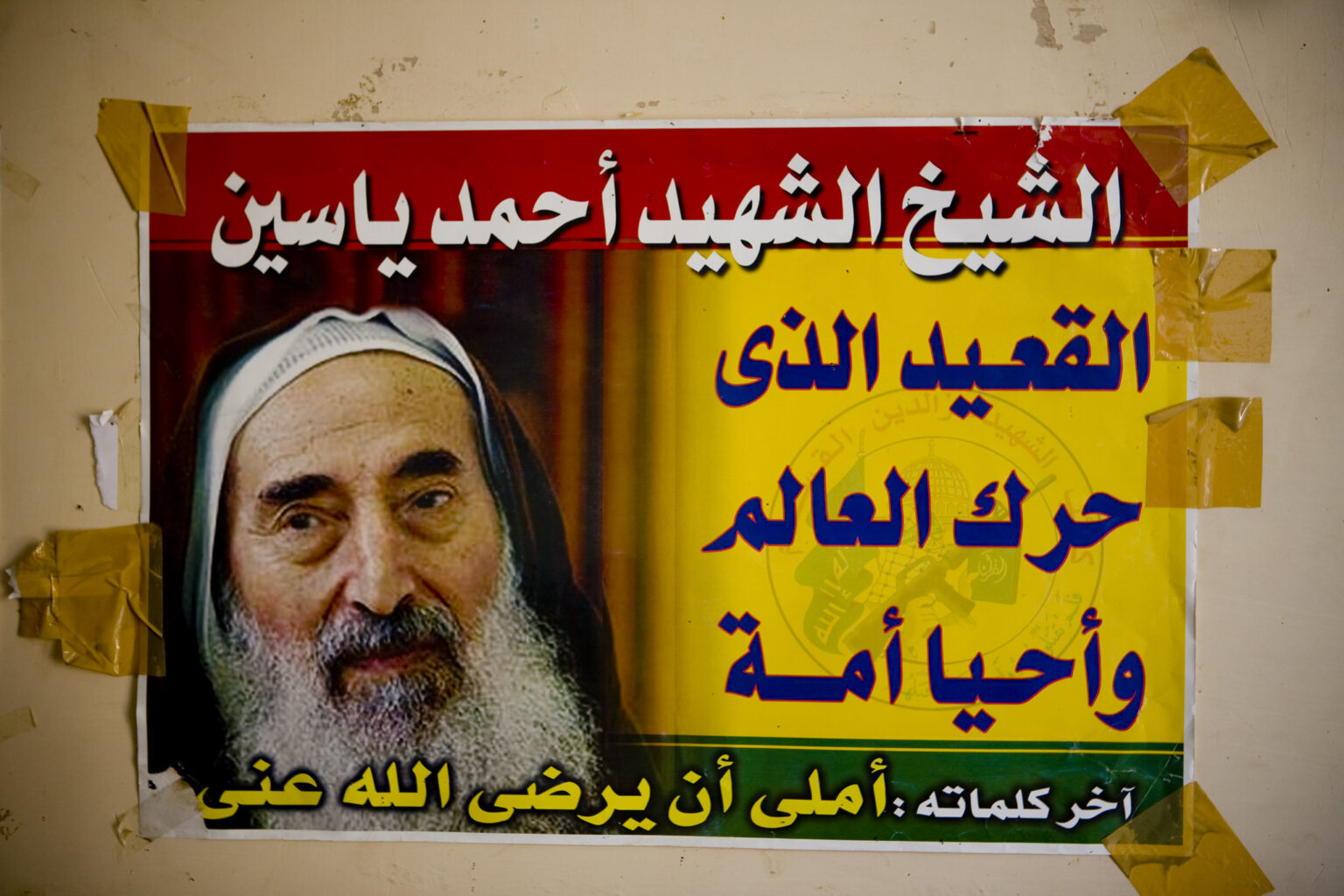
March 2004: Sheik Ahmed Yassin, a prominent spiritual figure and co-founder of Hamas, is assassinated as he exited a mosque — in his wheelchair, as he was quadriplegic. Yassin had advanced, a few months earlier, a long-term peace agreement with Israel if — no heavy lift here, you wouldn’t think — “a Palestinian state is established in the West Bank and Gaza Strip.”

Image
Poster of Yassin on the wall of a mosque in el-‘Edwa, the Upper Egyptian province of el-Minya, April 2008. (Hossam el-Hamalawy, Flickr, CC BY 2.0)

April 2004: Abdel Aziz al–Rantisi, Yassin’s successor, is killed in a missile strike while attempting to keep Yassin’s peace initiative alive.

November 2012: Ahmed Jabari, a top Hamas military commander, is assassinated, setting off the brief but deadly war the Israel Occupation Forces, the IOF, called — wouldn’t you know it — Operation Pillar of Defense. Jabari was in covert talks with Gershon Baskin, a prominent Israeli peace activist, in an effort to draft an accord that would produce “a long-term truce,” which Jabari saw as in the best interest of the Palestinians.

And now Ismail Haniyeh joins the fallen, every one of them seeking a pragmatic settlement with the Zionist regime—and precisely because each was engaged in this endeavor.

It is time once again to remind ourselves: Hamas and its leaders have a long record of flexible deal-seeking, as various Western diplomats and intelligence officials have acknowledged over the years. Marking the group down as a “terrorist organization” such that nothing more need be understood has been, thus, cynically destructive nonsense ever since Hamas won control of Gaza in 2006.

This crudely false dismissal originated, let us never forget, with what is by far the most dangerous terrorist regime in the Middle East and is most assiduously promoted by the U.S., which, one could easily argue, has its own long history of terrorist activities in the region and beyond.


Some conclusions:

Terrorist Israel is absolutely unserious about peace or a negotiated settlement of any kind with the Palestinian people regardless of who they, the Palestinians, choose to represent them. It is time for the international community to stop pretending otherwise — especially, but not only, by insisting that a two-state solution remains a real-world prospect.

It follows that the Zionist regime is in fact, and until it demonstrates otherwise, dedicated to the extermination or expulsion of the Palestinian population in Gaza and the West Bank alike. Disbelief on this point is no longer excusable — if ever it has been.

Israel is single-mindedly in pursuit of a wider war in the region centered on the destruction of the Islamic Republic. It has no intention of moderating this obsession. Haniyeh’s assassination, along with intensifying provocations of Iran, along Israel’s border with Lebanon, and in the West Bank, indicate that it sees the present moment as its opportunity to make this war a reality.

Israel knows very well it cannot win the war it craves. As assiduously as it seeks this war is precisely the extent to which it will seek to draw the U.S. into it. This is what makes the insanely intemperate reception Netanyahu received in Congress on July 24 so dangerous.

[The Biden administration is weighing the redeployment of forces to the Middle East to defend Israel from a possible retaliation, CNN reported Friday.]


Finally and more broadly, it is time to recognize that Israel is incapable of serious statecraft because it has no interest in it and does not enjoy, in consequence, healthy, balanced diplomatic relations with other members of the community of nations. If this reality is not at this point self-evident, it will prove in time irrefutable.

Instead, in its region Israel relies on brutality or the threat of it in the name of Old Testament revenge. And American protection is key to the apartheid state’s approach to its immediate circumstances. Even if, for instance, some accord is struck between Riyadh and Tel Aviv — and let us not hold our breath — Israel will not have got this done; it couldn’t have. The U.S. will have coerced or bribed — or both — two client states.

In the wider world, Israel depends primarily on sympathy-mongering, eternal victimhood, and the manipulation of the guilty consciences of Europeans. Among Americans it adds to this the incessant bribery and barely concealed intimidations of the Israel lobby as applied to a decadent political class that is by turns greedy and petrified.

I have for decades considered Palestine the suppurating sore on humanity’s flesh. The cause and the remedy just became more obvious.

https://consortiumnews.com/2024/08/03/p ... l-haniyeh/

******

Iran Keeps World on Pins and Needles

Simplicius
Aug 04, 2024

The Middle East is again in a cycle of heating up. Oddly, it’s during the Olympics that once more a major war threatens to ignite. Some may recall it was during the 8/8/8 Beijing Summer Olympics that Russia invaded Georgia, and it was during the Beijing Winter Olympics of February 2022 that the SMO kicked off.

Now we’re in the midst of the Paris Olympics and Iran is threatening an “unprecedented” response to the killing of Hamas leader Ismail Haniyeh in Tehran on July 31st. In anticipation, the U.S. has begun bringing major reinforcements to the region, which includes F-22s, B-2 Spirit stealth bomber, an armada featuring the USS Roosevelt Carrier Group, as well as amphibious landing ships with 4000 U.S. Marines on board

Image
https://www.nytimes.com/2024/08/02/worl ... craft.html

Image

To give an idea of the type of air defense assets deployed last time Iran struck, here’s an excerpt from Iranian sources:

Image

In fact, during April’s large strikes, the U.S. stated that it would be “very difficult to replicate” their alleged “success” in stopping Iranian missiles:

Image
https://english.almayadeen.net/news/pol ... t-2nd-stri

"We think it will be very hard to replicate the huge success we had on Saturday with defeating the attack if Iran launches hundreds of missiles and drones again — and the Israelis know it," another US official said.

One of the reasons is a huge amount of missiles were expended in trying to shoot down the hundreds of Iranian drones and ballistic missiles. Since multiple air defense missiles are usually required to shoot down a single target, it will always be the case that U.S. and co. will have to shoot far more missiles, which are already themselves far more expensive.

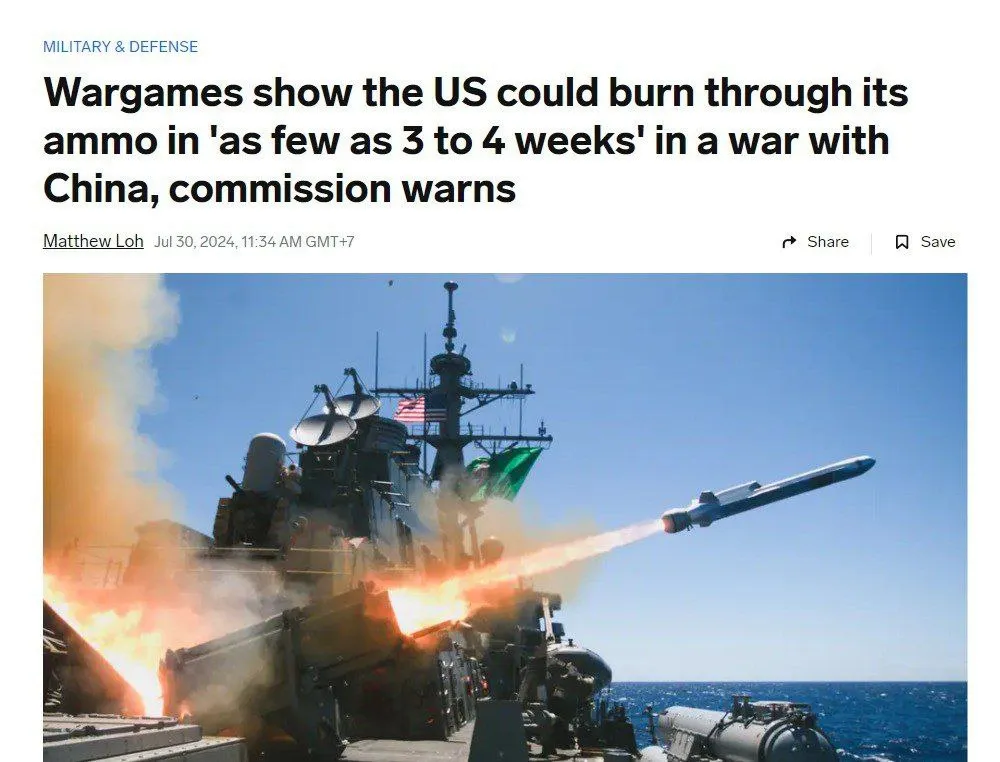
The entire Defense industry has been ringing alarm bells for months that the U.S. forces in the region are nearing a crisis point when it comes to their ability to replenish AD assets. In a war against China, they know they would be in deep trouble:

Image

Now some reports claim Iran is still holding off and waiting to strike at a time of its choosing:

Image

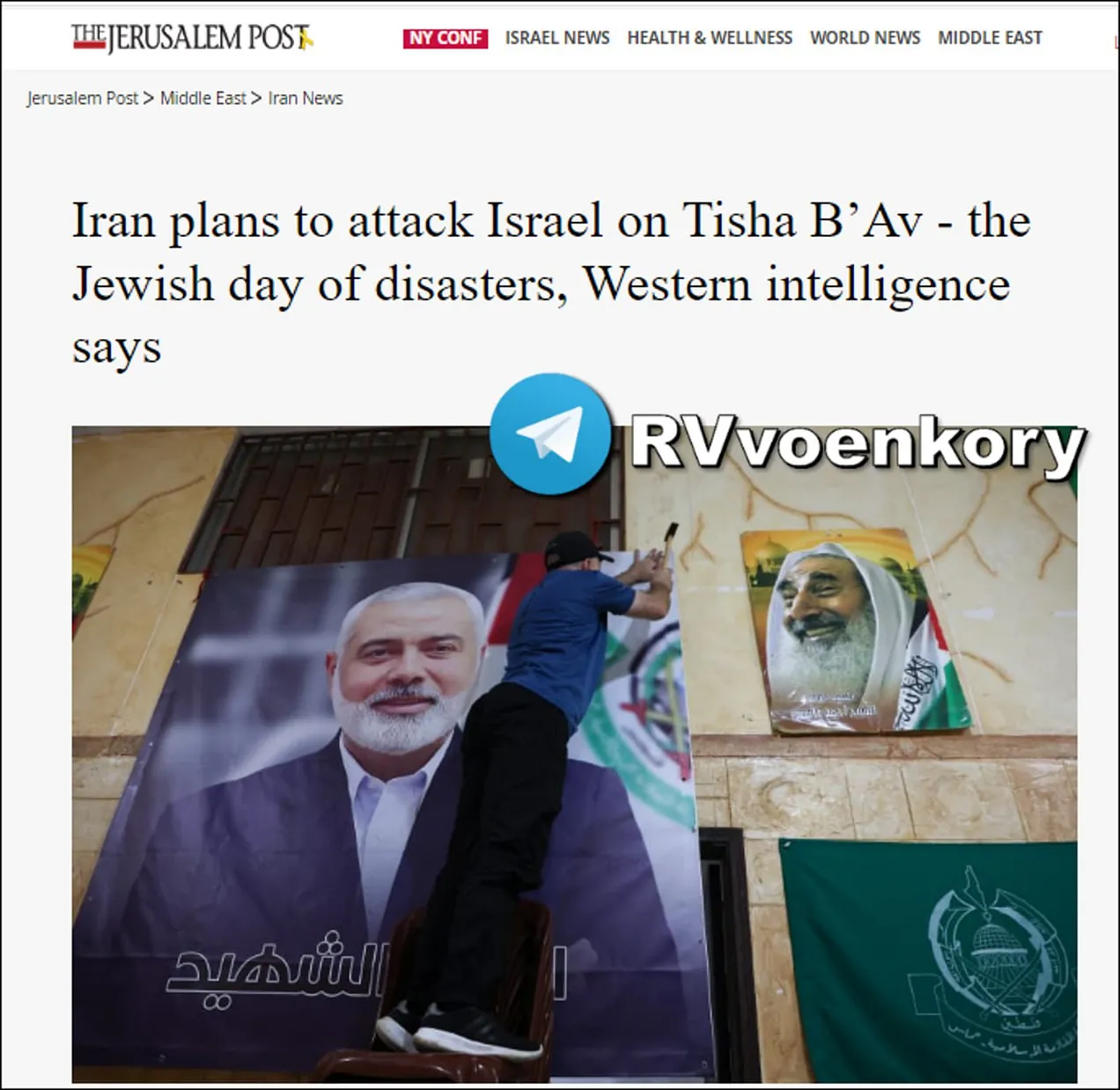
🇮🇷🇮🇱 Iran and Hezbollah are preparing to attack Israel on the holy day of Tisha B'Av - Sky News Arabia

▪️Western intelligence sources have told Sky News Arabia that Iran is planning an attack on Israel on Tisha B'Av (August 12-13) in response to the killing of Hamas leader Ismail Haniyya.
▪️The attack will be coordinated with Hezbollah. Iran's Supreme Leader Ali Khamenei has announced his intention to avenge Haniya's death.

▪️The choice of date for the attack is related to the symbolic meaning of the day of Tisha B'Av, when Jews mourn the destruction of the First and Second Temples. This could put psychological pressure on the Israelis and restore the morale of pro-Iranian groups.


Though another report claims that Iran may attack as early as this coming Monday:

[i[BREAKING: Reports now indicate Iran will attack Israel as early as Monday.. Three U.S. and Israeli officials have indicated that Iran may launch an attack on Israel as soon as Monday. This anticipated action follows vows of retaliation from Iranian and Hezbollah leaders in response to the recent assassinations of Hezbollah's top military commander, Fuad Shukr, and Hamas political leader, Ismail Haniyeh.[/i]

One interesting aspect to the proceedings dovetails with a question someone asked recently in the mailbag surrounding what assistance Russia may be providing to the Middle Eastern resistance axis.

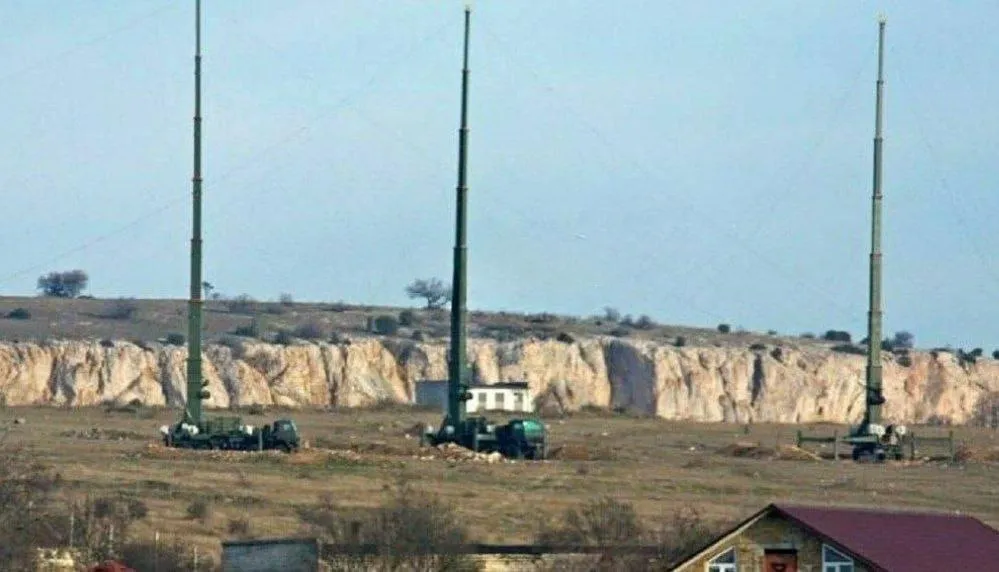
First, there’s one uncorroborated report about Iran being given one of Russia’s most powerful electronic warfare tools, the Murmansk complex:

Image
Photo for illustrative purposes only.

Iran, apparently, has received Russian ultra-long-range electronic warfare systems Murmansk-BN.

Previously, these complexes were deployed in the Northern Fleet and in Crimea (the 475th Electronic Warfare Center was responsible for its use there).

Their distinctive feature is a suppression range of up to 5 thousand kilometers. The Murmansk-BN complex is located on seven trucks. Its antennas are mounted on four telescopic supports up to 32 meters high.


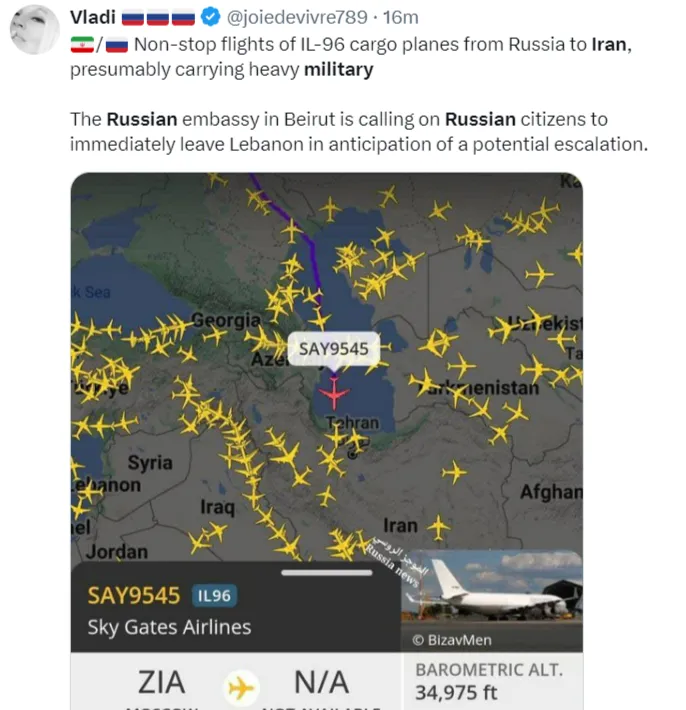
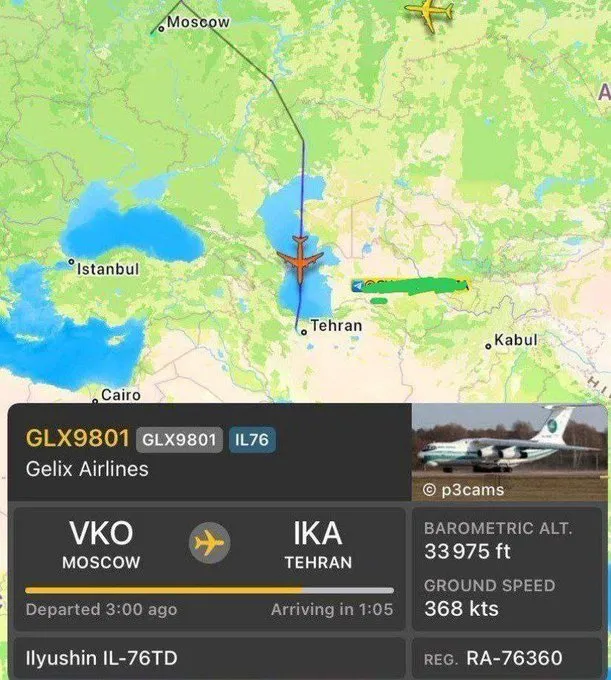
What potentially supports this are new reports that Russian Il-96 and Il-76 transport flights have allegedly been streaming into Tehran:

Image

Image

Image
https://www.cnn.com/2024/08/02/politics ... index.html

Russia was preparing to deliver missiles and other military equipment to the Houthi rebels in Yemen late last month but pulled back at the last minute amid a flurry of behind-the-scenes efforts by the United States and Saudi Arabia to stop it, CNN reports.

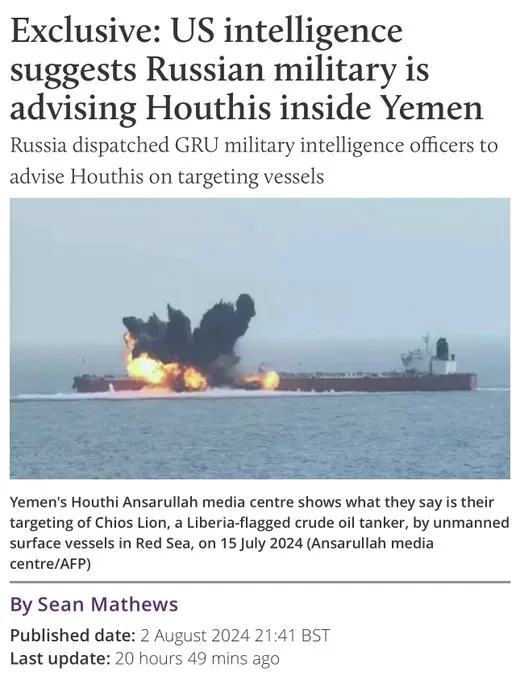
As well as new reports that Russian GRU intelligence officers have been behind the string of successful Houthi hits on Red Sea vessels:

Image

Thus, as anyone can see, Russia has already been quite active in asymmetrically opposing American imperialism, as I had mentioned many times due to questions on how Russia plans to ‘respond’ to the U.S. using Ukraine as a proxy to hurt Russian interests.

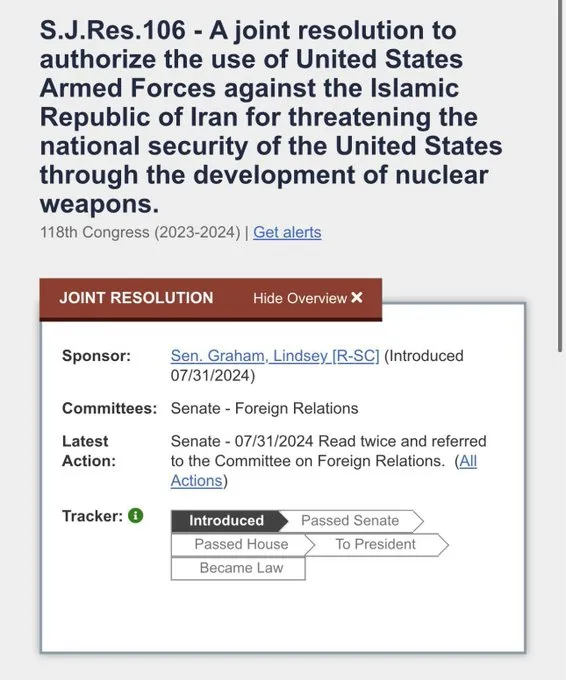
Now the whole world is on pins and needles awaiting what comes next. Lindsay Graham has entered a resolution into Congress to authorize full scale war against Iran:

Image

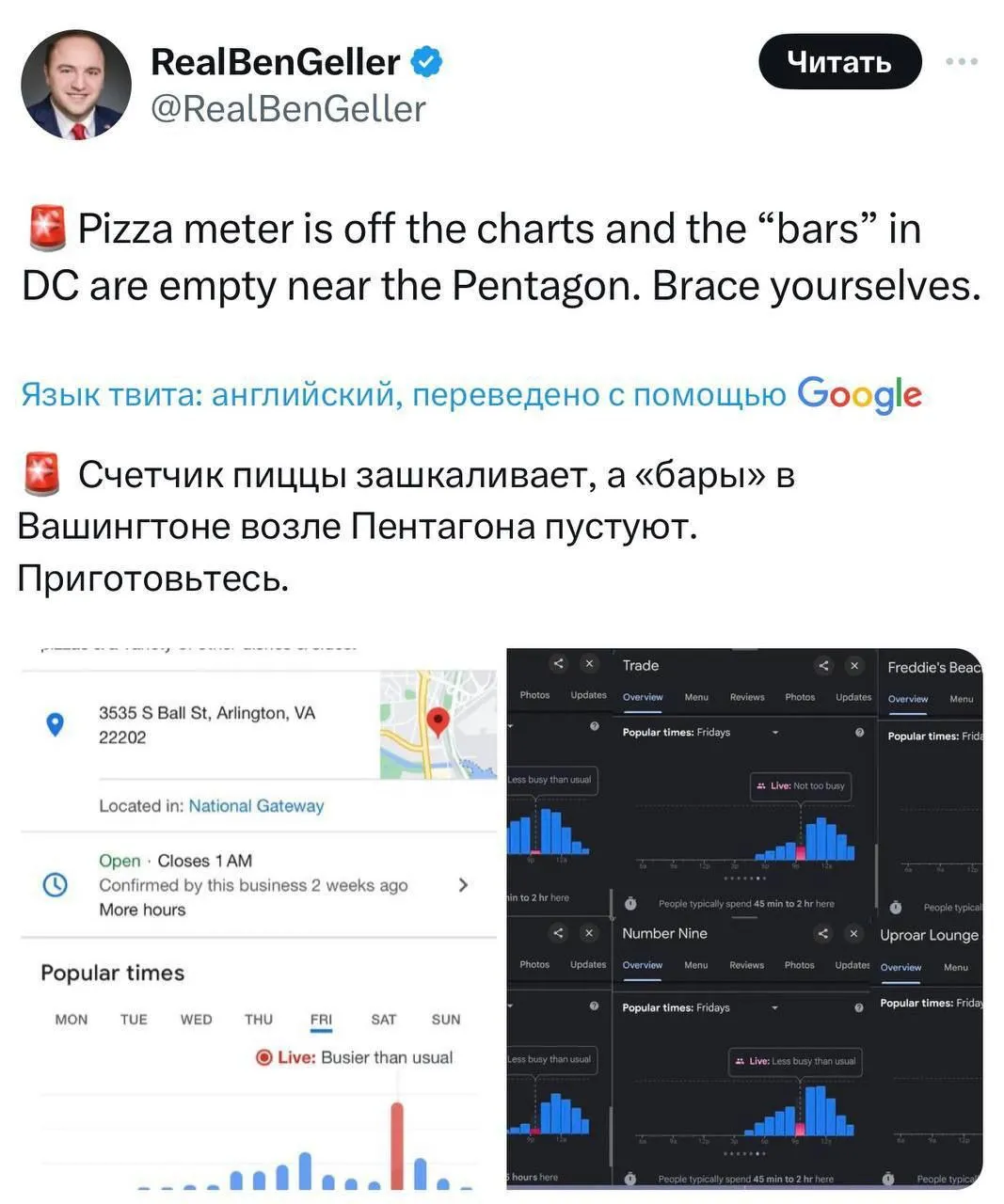
While the famously accurate Pizza bellwether has sounded around the Pentagon, indicating major late night planning round tables and war preparations:

Image

Biden reportedly had a “tough talk” with Netanyahu where he told him that the U.S. will support him this time, but if he escalates again he won’t be able to count on U.S. support—which is quite open to interpretation.

At this point it’s clear, as we’ve written many times here before, that Netanyahu needs perpetual escalation in order to save his failing regime. Only by keeping people in perpetual fear and distress can he keep them from mustering the wherewithal and concensus to overthrow him. Furthermore, Israel seems to fear taking on Hezbollah with Iran’s backing and would love to have U.S. tie Iran down in a war, or eliminate it outright, first, prior to taking the risky gambit of slugging it out with Hezbollah.

The last thing the Biden administration likely wants is a large scale war on the eve of the presidential elections, which will redound poorly on Kamala’s campaign. Thus, reports of the administration’s exasperation with Israel are probably true. Either way it doesn’t matter because if Trump was in office, you can bet he would declare full scale war against Iran on Israel’s behalf, so in this case we can quite unironically say that the Biden administration is preferable for the sake of peace.

https://simplicius76.substack.com/p/ira ... nd-needles

*******

Is Targeting Haniyeh in Tehran Meant to Provoke a Full-Scale Conflict?
Posted by Internationalist 360° on August 3, 2024
F.M. Shakil

Image
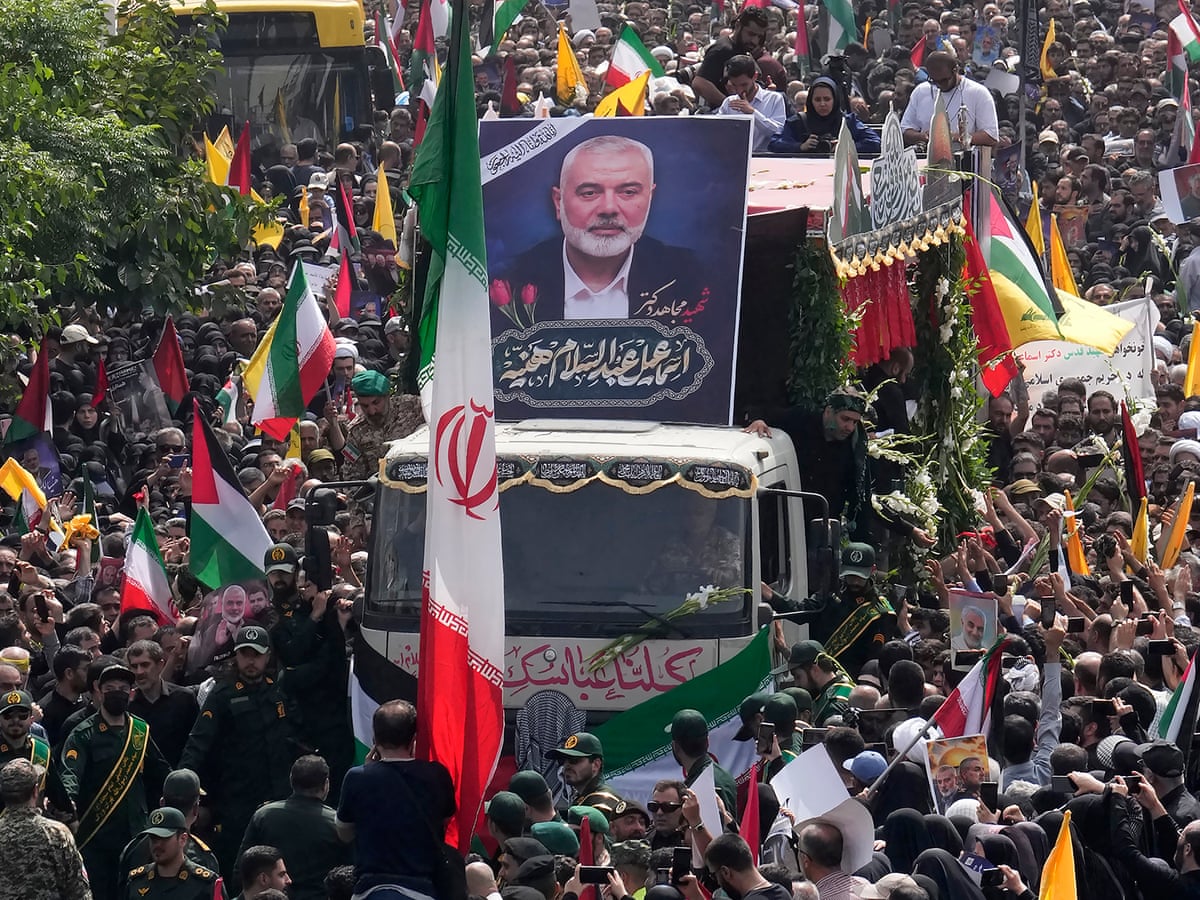
Funeral in Tehran of Hamas leader Ismail Haniyeh and his bodyguard who were killed in an assassination blamed on Israel. Photograph: Vahid Salemi/AP

Iranian leaders have the potential to escalate the number of projectiles aimed at “Israel” by launching additional ones from Iran, its neighboring countries, or both simultaneously. Hezbollah, Ansar Allah, and Resistance factions in Iraq have the potential to initiate coordinated assaults to intensify pressure on Israeli aerial defenses.


All prospects of a ceasefire in Gaza seem to have died out for the foreseeable future, as thick clouds of a bigger war hover over the Middle East. “Israel” and its allies, including the US, are working behind the scenes to involve the major regional powers in the ongoing imbroglio in Gaza, resulting in an all-out conflict in the region.

The US-backed Zionist regime has intensified its deliberate efforts to turn the Palestinian issue into a catalyst for a global war. The sequence of events unfolding during the last two weeks indicates that “Israel” and its allies in the US and European countries sought to create conditions for a full-blown war in the Middle East.

The “false flag operation” in the occupied Golan Heights last week, which killed at least 12 Druze youth and injured many more, as well as the martyrdom of Ismail Haniyeh, the Head of the Political Bureau of Hamas, in an “airstrike” at his residence in Tehran, served as a breaking point for a wider war in the region. Haniyeh was in Tehran to attend the oath-taking ceremony of the Iranian president, Massoud Pezeskhian.

Was the Majdal massacre intended to storm Lebanon?

On July 24, a missile strike in the town of Majdal Shams in the occupied Golan Heights provided an excuse for Tel Aviv to attack Lebanon. They attacked Beirut for what they claimed was a retaliation to a Hezbollah rocket attack on civilians in Majdal, an allegation that Hezbollah vehemently refuted and which does not align with Hezbollah’s history of attacks on military targets. Still, “Israel” reiterated the claim that Hezbollah fired the missiles from Lebanon.

According to an insightful investigative piece in Al-Mayadeen English, a calamitous interception failure could be the result of numerous technical issues with an Iron Dome battery. Among other potential issues, these include a compromised motor, a defective self-detonation sensor, a flawed radar seeker, and a malfunctioning engagement radar. The most perilous of these are malfunctions in self-detonating sensors, which render operators incapable of destroying errant surface-to-air missiles.

Though a July 30 report published by AP News supported the Israeli army’s claim that Hezbollah was responsible, the news raised many valid points that contradict the Israeli military’s Chief of Staff Lt. Gen. Herzi Halevi’s assertion that Hezbollah used an Iranian-made Falaq rocket in the attack.

The report says that Israel released images of rocket fragments it said the military found, with visible lettering that matched pictures of Falaq rockets. The report asserts that AP failed to confirm the on-site discovery of the fragments. “No ordinance debris was visible when AP reporters visited the site on Monday,” the report added.

It further reveals that Hezbollah does not have anything to gain from attacking a Druze community in the Golan, primarily because the Druze there consider themselves citizens of Syria, which is a Hezbollah ally. “A strike on them could hurt the group’s standing—including with Druze in Lebanon—when it’s trying to maintain support in the war,” the report argued.

Three key Resistance leaders hit in a few weeks

Before cutting a swathe through Haniyeh in Tehran in violation of the United Nations charter, “Israel” martyred a key Hezbollah military commander, Fouad Shokor, in Beirut’s outskirts. “Israel” launched airstrikes deep into Lebanese territory and targeted Shokor in the heart of the southern suburb of Beirut, on Tuesday evening.

Shokor was a trusted ally of Sayyed Hassan Nasrallah. “Israel,” which has assassinated back-to-back two key leaders of the nexus of resistance with tacit support from US spy agencies, did not hesitate to disregard the UN war tenets.

On Thursday, the Israeli army declared that an airstrike in Khan Younis on July 13 had killed Mohammed Deif, a senior Hamas military leader. In contrast, Hamas has denied the report and has not officially confirmed it so far.

Mohammed Deif, also known as Mohammed Diab Ibrahim al-Masri, is the leader of the Izzedine al-Qassam Brigades, the military branch of the Hamas movement, and a Palestinian Resistance fighter. His prominence grew over decades, culminating in his elevation to this position in 2002.

Resistance forces vow retaliation

The leaders of the nexus of Resistance unequivocally declared that the blood of the martyrs would not go to waste, as they were duty-bound to take revenge. Sayyed Ali Khamenei, Iran’s spiritual leader, has already made it clear that the Iranians’ primary duty is revenge for the blood of Ismail Haniyeh. The Israeli occupation “brought upon itself the most severe punishment,” the Leader of the Islamic Revolution affirmed. He stressed that retribution for Haniyeh’s blood was “Iran’s duty because he was martyred on our soil,” adding that Haniyeh’s assassination, who was a guest in Iran, “made it obligatory for Iran to punish the enemy most severely.”

At an auditorium in Beirut, Hezbollah’s Secretary-General, Sayyed Hassan Nasrallah, via video link, addressed the mourners who assembled with Fouad Shokor’s coffin and said, “We have entered a new phase that is different from the previous period. “Do they expect that Hajj Ismail Haniyeh would be killed in Iran and Iran would remain silent?” Addressing Israelis who celebrated the killings, he said, “Laugh a bit and you will cry a lot.”

Conversely, the US made it clear that it would back “Israel” in the event of an attack. In the same breath, it also calls for a negotiated settlement to avoid a full-blown war in the Middle East.

Speaking Thursday in the Mongolian capital of Ulaanbaatar, the US Secretary of State Antony Blinken said “all parties” in the ME must avoid actions that would intensify the issue and plunge the region into further turmoil. He stressed a ceasefire between “Israel” and Hamas in Gaza, which he said was the only way to break the current cycle of violence and suffering.

Media foresees a bigger game

Given the recent developments in Tehran, Lebanon, Khan Younis, and the occupied Golan Heights, the global media anticipates a wider war in the region. It is difficult to ignore a deadly attack on Ismail Haniyeh on Iranian soil. It has alarming ramifications for the whole region.

According to a story by the New York Times, Iran’s leader, Ayatollah Ali Khamenei, has commanded a targeted attack on “Israel” as a response to the alleged killing of Hamas’ highest-ranking official while in Tehran. As reported by the publication, Khamenei issued the directive during an urgent gathering of Iran’s Supreme National Security Council on Wednesday morning, as stated by three unidentified Iranian officials.

The Institute for the Study of War (ISW), a research organization based in Washington, D.C., specializing in military issues, has forecasted in its most recent study that Iran is currently strategizing its next offensive move to establish deterrence with “Israel” while actively avoiding a full-scale war.

The research highlights a highly perilous yet more probable situation where Iran and the Axis of Resistance collaborate to carry out a substantial and coordinated assault using drones and missiles, drawing on the knowledge gained from Iran’s April 2024 response. In this situation, Iranian leaders have the potential to escalate the number of projectiles aimed at “Israel” by launching additional ones from Iran, its neighboring countries, or both simultaneously.

Hezbollah, Ansar Allah, and Resistance factions in Iraq have the potential to initiate coordinated assaults to intensify pressure on Israeli aerial defenses. The interception of drones and missiles originating from Iraq and Lebanon would be a greater challenge compared to those from Iran and Yemen, due to the relatively shorter distances and flight durations to Israel. The US and Israeli military would have a considerably reduced timeframe to intercept those projectiles.

Hezbollah drones can reach Haifa in around 15 minutes and Tel Aviv in approximately 40 minutes when flying directly. Hezbollah drones are expected to take circuitous and extended paths. Iran has the option to take advantage of the short flight durations by focusing a lesser amount of firepower on a single target in “Israel” instead of dividing it between two targets.

Reducing the duration of drone flights could facilitate their synchronization with ballistic missiles launched from Iran, which typically have flight lengths of less than 10 minutes. If Iran, together with its allies, can strategically deploy drones and missiles to strike Israeli interests concurrently, they might anticipate that the diversion generated by one attack could potentially aid the infiltration of the other.

https://libya360.wordpress.com/2024/08/ ... -conflict/

******

CENTCOM chief in Israel for ‘preparations’ against Iran, Hezbollah
Additional US fighter jets, warships, and cruisers have been mobilized in defense of Israel

News Desk

AUG 4, 2024

Image
(Photo credit: Israeli army)

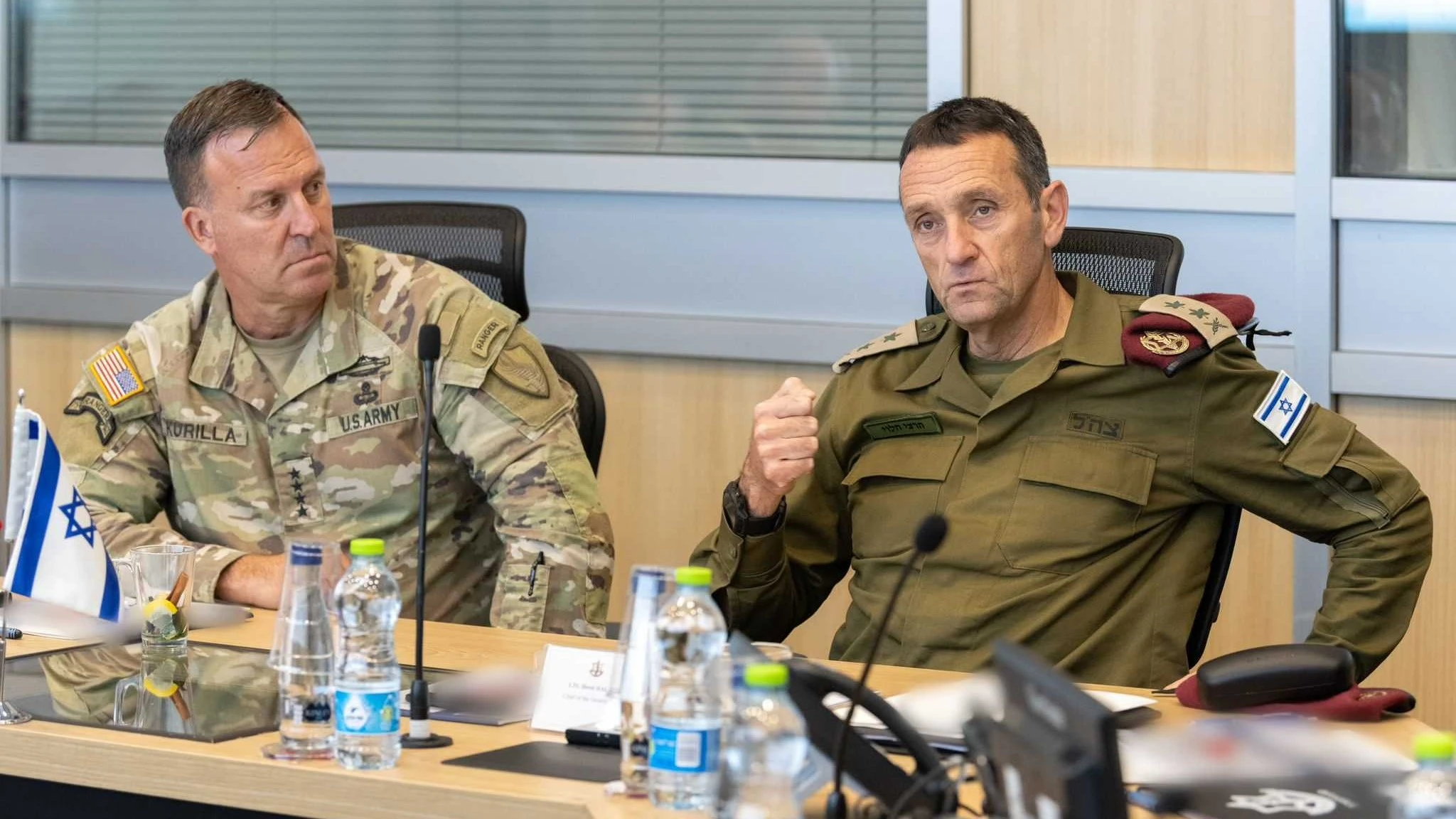
The US CENTCOM chief arrived in Israel on 3 August to help Tel Aviv prepare for an Iranian retaliation to the killing of Hamas chief Ismail Haniyeh on its soil last week, as well as Hezbollah’s response to the strike on Beirut hours before.

General Michael Kurilla arrived in Israel on Saturday “as preparations continue for a possible attack against Israel from Iran [and Hezbollah] in retaliation for the assassinations of senior Hamas and Hezbollah leaders,” two US officials told Axios on 4 August.

Kurilla had already been planning a trip to Israel prior to the serious escalation, which saw Tel Aviv attack Beirut and Tehran within hours of each other.

“He is expected to use the trip to try to mobilize the same international and regional coalition that defended Israel against an attack from Iran on Apr. 13,” an official told Axios. At the time, Iran launched hundreds of drones and missiles at Israel in response to the destruction of its consulate in Damascus and the killing of several Iranian officials.

Three US officials told the outlet they expect an Iranian retaliation to Haniyeh’s killing “as early as Monday.”

According to the report, Washington is concerned it will be difficult to garner the same amount of regional support in defense of Israel as it did in April, given that Haniyeh’s assassination comes within the context of the Gaza war – for which Israel has drawn major criticism from the Arab world and internationally.

Kurilla is set to visit several Gulf nations, as well as the kingdom of Jordan – which played a major role in intercepting Iranian projectiles during the April attack. Amman has already vowed to confront any violation of its airspace.

Jordan also opened up its airspace to US and Israeli jets during Iran’s April operation. “The U.S. hopes the same will happen again if needed,” another US official told Axios.

US and Israeli officials also “don't know if Iran and Hezbollah will conduct a coordinated attack or operate separately … they think both Iran and Hezbollah are still working on finalizing their military plans and approving them at the political level.”

Meanwhile, the Pentagon said Washington has been beefing up its presence in the region in anticipation of the Resistance Axis's responses, which could potentially include Iraq’s resistance factions and Yemen’s Ansarallah movement.

Defense Secretary Lloyd Austin said the US will maintain the presence of the USS Abraham Lincoln aircraft carrier, and has ordered more ballistic missile and defense-capable cruisers and warships to the region.

An additional squadron of fighter jets has also been deployed, in line with US President Joe Biden’s vow to send new deployments in defense of Israel during his phone call with Benjamin Netanyahu on Thursday.

Iran’s Supreme Leader Ali Khamenei vowed last week a “harsh punishment” for Israel. Hezbollah chief Hassan Nasrallah also warned Tel Aviv: “You do not know which red lines you have crossed.”

https://thecradle.co/articles/centcom-c ... -hezbollah

Israel continues brutal attacks on displaced Palestinians in schools, tent encampments

At least 17 people were killed in Israeli strikes on a school sheltering displaced people in Gaza City on Saturday

News Desk

AUG 4, 2024

Image
(Photo credit: Omar Al-Qattaa/AFP/Getty Images)

Israeli forces bombarded tents housing displaced Palestinians in the yard of Deir al-Balah’s Al-Aqsa Martyrs Hospital in central Gaza early on 4 August, killing five and injuring over a dozen more.

“Five civilians were killed and over 16 others injured when Israeli drones targeted tents housing displaced persons near the Al-Aqsa Martyrs Hospital in Deir al-Balah. The attack also caused a large fire to erupt in the tents,” WAFA news agency reported on Sunday.

At least five people were killed in other Israeli strikes on several areas of Gaza City in the north of the strip.

The attacks came hours after an Israeli strike that killed at least 17 people in central Gaza.


“At least 17 civilians, including children, were killed in the attack on the school located in the Sheikh Radwan neighborhood in western Gaza City. Over 60 others sustained various injuries as a result of the deadly attack,” WAFA’s correspondent reported.

The strike targeted the Hamama school in Sheikh Radwan, serving as a shelter for displaced Palestinians.

According to the WAFA correspondent, several missiles were fired at rescue workers trying to evacuate casualties after the initial strike.


Medical sources from Al-Ahli Hospital told the news outlet that many of those killed and wounded were children.

“Those three bombs destroyed the facility completely. This is the tactic that the Israeli military has widely used in the past. The military drops a bomb that partially destroys facilities, namely evacuation centers, killing a number of people, and then within a few minutes, it drops other bombs,” said Al-Jazeera’s Hani Mahmoud.

Last week, 15 Palestinians were killed when Israeli forces bombed a school in Gaza City’s Shujaiya neighborhood.

Israel has consistently targeted schools across Gaza. Israeli jets launched airstrikes on a girls' school in central Gaza's Deir al-Balah late last month, which was being used as a field hospital, killing at least 30 Palestinians and injuring dozens more.

https://thecradle.co/articles/israel-co ... ncampments
"There is great chaos under heaven; the situation is excellent."

User avatar
blindpig
Posts: 15306
Joined: Fri Jul 14, 2017 5:44 pm
Location: Turtle Island
Contact:

Re: Palestine

Post by blindpig » Tue Aug 06, 2024 11:21 am

August 3, 2024 by M. K. BHADRAKUMAR

Iran to hit Israel hard with smart power

Image
Mourners gathered at the Imam Muhammad Abd-al Wahhab Mosque for Friday prayers before the burial of Hamas leader Ismail Haniyeh, Doha, Qatar, August 2, 2024

Amidst the cascading tensions in the Middle East following the assassination of Hamas leader Ismail Haniyeh by Israel and vows of ‘revenge’ in Tehran, the new government under President Massoud Pezeshkian, sworn in on Tuesday, made its first move on Thursday. Former Iranian Foreign Minister Mohammad Javad Zarif was appointed as the ‘Strategic Deputy’ of the Iranian president entrusting him with the responsibility of the Center for Strategic Studies (CSS).

The CSS is the research arm of the president’s office. Zarif’s appointment signifies his return to the foreign policy arena and Pezeshkian’s high estimation of his unique credentials to chariot Tehran’s Track 1.5 diplomacy.

Zarif’s long exposure to the American policymaking circles during his extended tenure as ambassador to the UN and his active social networking in New York are his strategic assets. Zarif is a familiar face and is highly regarded in the western capitals.

Pezeshkian prioritised Zarif’s appointment; he’s yet to announce his choice of foreign minister. Zarif’s return to the diplomatic circuit cannot but be seen as a signal to the Western powers. There is a paradox here. While Iran factors in that the US would lose heavily from any direct military confrontation, the fact remains that it is only the Americans and the Europeans who are able to stop a full-fledged war in the region in the developing crisis situation.

This also seems to be Moscow’s line of thinking. In a phone conversation with Iran’s Acting Foreign Minister Ali Bagheri Kani on Thursday, Russian Foreign Minister Sergey Lavrov “called on all parties without exception that could influence the situation in the Gaza Strip and in the Middle East in general to avoid actions that could result in further destabilisation of the situation and new casualties among the civilians” — per the Russian readout. [Emphasis added.]

In remarks at the Majlis on Tuesday after the swearing-in ceremony, President Pezeshkian reaffirmed that his government’s foreign policy will strive for constructive engagement with the world while upholding Iran’s national dignity and interests.

Pezeshkian’s election victory suggests that reformism has transformed as a major current in Iran’s mainstream politics. The Iranian dialectic is fraught with consequences for Israel and the US insofar as their old calculus to fuel dissent and trigger social unrest in Iran won’t work anymore. To be sure, the spectre of a constructive engagement between the West and Iran haunts Israel.

Israel will view Zarif’s return as emblematic of a renewed Iranian push for negotiations for a nuclear deal that might open a pathway for the removal of western sanctions as well as a vista of broad-based cooperation. In this context, in a veiled reference to the Nuclear Non-Proliferation Treaty, Pezeshkian made it clear in his remarks at the Majlis that “we have been and will remain committed to our obligations.”

Against such a promising backdrop, the IAEA Director-General Rafael Grossi has sought an urgent meeting with Pezeshkian “at the earliest convenience.” In a letter to Pezeshkian, Grossi wrote, “Cooperation between the International Atomic Energy Agency and the Islamic Republic of Iran has been at the focal attention of the international circles for many years. I am confident that, together, we will be able to make decisive progress on this crucial matter.”

Again, another sub-plot playing out here is that Israel can no longer hope to get the Gulf countries — Saudi Arabia and the UAE, in particular — to align with it against Iran. Times have changed in Iran and the region as well as internationally, including the US where for the first time, open resentment and disapproval of Israeli policies is being voiced.

The Saudi Crown Prince Mohammed bin Salman congratulated Pezeshkian by phone on his election victory last month to express his satisfaction with the strengthening of relations between Iran and Saudi Arabia in various fields, and stressing the need to strengthen the relations as much as possible. The Saudi move registered the hope and expectation that they can do business with the new government in Tehran.

Similarly, the Arab League delisting of Hezbollah recently would speak to the extent to which Saudi Arabia and other Arab states are moving away from Washington’s anti-Iranian positions. The regional states are increasingly accommodative of Iran and are trying to find ways to “share the neighbourhood” with Tehran — to borrow the famous words of then-US President Barack Obama.

Hezbollah is the crown jewel of Iran’s Islamic revolution. Therefore, Arab League’s signal that Hezbollah is an essential player conveys a big message from Riyadh of decreasing regional support for US policies aimed at squeezing Iran and Tehran-aligned actors in the Arab world.

In fact, on Thursday, Saudi Minister of State Prince Mansour bin Miteb bin Abdulaziz personally handed over to Pezeshkian a letter from King Salman bin Abdulaziz Al Saud expressing hope for more constructive steps in developing bilateral relations with Iran and for the continuation of coordination and consultation to promote regional peace and security.

All in all, in the rapidly evolving regional security balance, the Gulf monarchies, which watch Iran closely, are sensing a paradigm shift. The bottom line is, Pezeshkian’s call for regional unity to counter extremist influences. He said, “Radical voices should not drown out the voices of the nearly two billion peace-loving Muslims. Islam is a religion of peace.”

Forty-five years after the 1979 Iranian revolution, the Islamic Republic speaks up as the voice of moderation and reason! Of course, this does not mean that Iran and the other members of the Axis of Resistance will moderate their response to the recent actions by Israel. Iran’s retaliation to the killing of Haniyeh is certain to be more severe, more painful than anything Tel Aviv experienced so far.

A war with Iran will be very unlike Israel’s previous wars with the Arab states. It will be open-ended until Israel allows the creation of a Palestinian state. Israel’s capacity to retaliate will steadily get depleted, as happened vis-a-vis Hezbollah. The medium and long-term advantage lies with Iran, a much bigger country than Israel, since it will be a war on multiple fronts with non-state actors.

On the other hand, it is difficult to believe that Israel acted on its own to attack Iran’s sovereignty, which is tantamount to an act of war, without some sort of US approval. It is this ‘known unknown’ factor that makes the situation very dangerous. Iran’s supreme leader Ayatollah Khamenei has already ordered a direct strike on Israeli territory.

The Washington Post, citing Pentagon officials, has written that keeping in view a possible escalation, the US Navy has already concentrated 12 warships in the region. Among them is the aircraft carrier Theodore Roosevelt, which is located in the Persian Gulf with six destroyers. There are also five US warships in the Eastern Mediterranean. Prime Minister Netanyahu has said that Israel “faces difficult days” and is “ready for any scenario.”

Netanyahu is confident about US support, which was manifest in the warm welcome he received during his recent trip to Washington. Possibly, it was this support that allowed Netanyahu to cut short his visit to the US, return home and forthwith venture into such an aggravation of the situation.

If so, the US is coordinating the situation, but then, US-Israeli history is also one of the tail wagging the dog, more often than not. Clearly, Netanyahu is trying to create a new reality in the Middle East and is writing scenarios of these events directly for himself. Suffice to say, he is both the director and the screenwriter, while the other protagonists, including the US and Europeans, are forced either to play along with him, or to make a good face at a bad game.

https://www.indianpunchline.com/iran-to ... art-power/

******

Resistance Axis: a calculated, simultaneous strike on Israel

A Hezbollah source tells The Cradle that Iran, Lebanon, and Yemen will launch simultaneous retaliatory strikes against Israel, intended to overwhelm the Iron Dome. Let's wait and see.


Ali Rizk

AUG 5, 2024

Image
(Photo Credit: The Cradle)

West Asia stands on a knife’s edge as the region’s Axis of Resistance prepares to retaliate against a series of recent Israeli assassinations and aggressions.

Iran, Hezbollah, and Yemen’s Ansarallah-aligned armed forces have vowed to make the occupation state pay a heavy price following the targeted killing of Hamas political bureau chief Ismail Haniyeh in Tehran and Hezbollah senior commander Fuad Shukr in southern Beirut.

Additionally, Israel bombed the Hodeidah port in Yemen following Sanaa’s successful ‘Yafa’ drone operation in Tel Aviv on 19 July.

An official from the Lebanese resistance has informed The Cradle that “The response will come at once from Iran, Hezbollah, and Yemen,” adding that the goal was to “inflict a painful blow to Israel which may not be achieved should separate retaliations be pursued.”

Executing the ‘Unity of Fronts’

Retaliation is all but certain and could happen within hours, according to senior US officials. A report yesterday by Axios claims that US Secretary of State Antony Blinken informed his G7 counterparts that the response could begin as early as within the next 24 hours.

Just yesterday, Ali al-Qahoum, a member of the political bureau of Ansarallah, emphasized that the response to Israel will not just come from Tehran:

We affirm our commitment to the battle, steadfastness, awareness, honor, and pride in standing with Palestine, the cause of the nation.

The critical question now is the scope and severity of the retaliation. Hezbollah Secretary General Hassan Nasrallah has promised a painful yet calculated blow to Tel Aviv. During Shukr’s funeral procession, Nasrallah warned that Israel had crossed the line, promising “a real and well-calculated response” – distinct from the cross-border operations Hezbollah has conducted against Israel since 8 October.

Flattening the Iron Dome

Other well-informed sources agree that the response could be coordinated, suggesting that retaliation from multiple fronts simultaneously is likely. They tell The Cradle that such an approach could take Israel’s primary air defense system, the Iron Dome, out of commission by preventing it from rapidly rearming. They believe this is achievable given Hezbollah’s capacity to launch a significant barrage of missiles and given Lebanon’s geographical proximity to potential Israeli targets.

These assessments appear to be consistent with those made by US officials who have warned that the Iron Dome could be overwhelmed by Hezbollah’s missile and drone arsenal should a full-scale war erupt.

Senior US military officials, meanwhile, have gone on the record cautioning that Washington would probably be unable to provide Tel Aviv with sufficient protection even in a single front, full-scale war with Hezbollah. US Joint Chief of Staff Charles Brown said as much in his remarks to the press in late June.

[From our perspective, based on where our forces are, the short-range between Lebanon and Israel, it’s harder for us to be able to support them [Israel] in the same way we did in April [with Operation Truthful Promise].

Unwilling US support for Tel Aviv

Although much has been said about the US and its allies successfully thwarting Iran’s response to the Israeli attack on its consulate last April, it is noteworthy that all targeted Israeli military bases were hit during the Iranian retaliatory strikes. Operation Truthful Promise was intended more as a message, indicating that Tehran would no longer tolerate Israeli aggression against its interests.

US military reinforcements in the region may help intercept missiles and drones coming from Lebanon, while vassal state Jordan could also play a part as it did during Iran’s retaliatory strikes. However, this also makes US military assets and those of its partners legitimate targets for the Resistance Axis.

As former Pentagon analyst Michael Maloof explains to The Cradle:

Hezbollah would likely target US warships in the region that would take part in intercepting missiles directed at Israeli targets.

“As in 2006, I envision US involvement focused more on evacuating many of the 86,000 Americans now in Lebanon who would want to leave,” adds Maloof.

Washington’s top military officials also appear firmly opposed to being drawn into an active offensive role should a wider war erupt with Hezbollah, let alone a dreaded multi-front war. This stance is supported by statements from US Joint Chiefs of Staff Charles Brown, indicating the Pentagon’s limited willingness to protect the occupation state.

Note that Washington’s pledges to defend Israel have made no mention of potential offensive action, reflecting an American desire to avoid a wider war. Experts doubt the US will become heavily involved in any full-scale war, supported by public statements underscoring the importance of avoiding regional escalation – and voiced more privately, the desire to keep US military targets safe from retaliatory strikes.

Military risk and political calculations

As Brown said at the time, Washington’s main message is:

To think about the second order of effect of any type of operation into Lebanon, and how that might play out and how it impacts not just the region, but how it impacts our forces in regions as well.

The general – the most senior ranking US military official and the senior military advisor to the White House – was delivering a message that carries special significance amidst the recent developments.

By stating that an Israeli-initiated war on Lebanon put US troops at risk, Brown was essentially saying that a wider regional war was not seen as helping US interests by the Pentagon’s top brass.

Given these statements, it remains possible – though far from guaranteed – that the outgoing Biden administration may rein in Israel regardless of how painful a blow is delivered to it by the Axis of Resistance.

The upcoming US election in November is another factor that may prevent a regional conflagration. “The US getting more militarily involved with Israel,” warns Maloof, “would lead to riots in the streets of Chicago at the Democratic Convention later this month.”

These realities suggest a scenario where Washington might force Tel Aviv to absorb the Axis of Resistance’s retaliation, however severe it may be.

https://thecradle.co/articles/resistanc ... -on-israel

US ‘guarantees’ Israel can resume Gaza war after captive swap: Report

Israel’s killing of Hamas leader and chief negotiator Ismail Haniyeh has severely hindered ceasefire talks, which Tel Aviv had already been consistently obstructing

News Desk

AUG 5, 2024

Image
(Photo credit: AP)

The US has agreed to guarantee that Israel will be able to resume the war against the Palestinian resistance in Gaza after the first phase of an exchange deal, according to Hebrew media.

According to Yedioth Ahronoth and Haaretz, Washington has not yet given a written commitment, but has agreed in principle to the idea of Israel resuming the war once captives are exchanged.

Netanyahu is “still waiting for a letter of commitment from the Americans. This is a letter regarding the possibility of continuing the war between the first and second stages of the exchange deal,” Yedioth Ahronoth’s Ynet news site reported on 5 August, citing “prominent” sources.

“Netanyahu intends to demand, among other things, the disarmament of Hamas and the removal of its leadership, as a condition for the second part of the deal … they are not expected to go up well [in the security establishment],” it added.

The idea of the US committing to Israel’s right to continue the war was raised during the meeting between Netanyahu and President Joe Biden in Washington recently, according to the report.

“The US had already agreed to give this letter, in one form or another, and there are already drafts.”

The US commitment is “about giving a guarantee to Israel that it has no obligation to stop the fire forever, under any conditions.”

The report also highlights the complete “lack of trust” of the security establishment in Netanyahu.

Efforts to reach an agreement have been severely hindered by the Israeli assassination of Hamas’ political bureau chief, Ismail Haniyeh, in Tehran on 31 July. Haniyeh was among those leading the negotiations.

Israel has consistently obstructed a deal from being reached by insisting on the right to continue fighting Hamas once captives were exchanged in the first phase of any agreement.

Hamas has stuck to its terms for a permanent ceasefire and withdrawal of Israeli troops from Gaza, including from the Rafah crossing and Philadelphi Corridor on the strip’s border with Egypt.

Netanyahu’s recent insistence on a “mechanism” to inspect displaced Gazans returning to the northern strip as part of a deal has also hindered the talks.

The Israeli negotiating team visited Cairo over the weekend for talks with mediators, yet no progress was made.

Netanyahu had announced on Friday that he approved the delegation’s continued participation in the negotiations. A Hamas official told Reuters that Netanyahu’s announcement was full of “empty statements” and that he does not wish to end the war or reach a deal.

“This was a trip solely for reasons of protocol, playing for time. Netanyahu’s current positions will not yield real progress,” Hebrew news outlet Channel 12 cited a senior official as saying on 3 August.

https://thecradle.co/articles/us-guaran ... wap-report

Israel defeated ‘only three’ Qassam battalions in 10 months of war: Report

Israeli officials have angrily accused Benjamin Netanyahu of lying about the losses inflicted on Hamas’ military wing

News Desk

AUG 5, 2024

Image
(Photo credit: Ahmed Hasaballah/Getty Images)

Israel has only destroyed three of the Qassam Brigades’ fighting battalions, according to a CNN report casting doubt over Tel Aviv’s claims about the damage it has inflicted on Hamas’ armed wing since the start of the war in Gaza.

The Israeli army claims Hamas’ Qassam Brigades are made up of a total of 24 battalions.

“As of July 1, only three of these 24 battalions were combat ineffective, meaning they were destroyed by the Israeli military,” CNN reported on 5 August, citing data compiled by the Critical Threats Project (CTP) and the Institute for the Study of War (ISW).

“Eight battalions are combat effective, able to carry out missions against Israeli soldiers on the ground in Gaza. The remaining 13 have been degraded, only able to conduct sporadic, and largely unsuccessful guerrilla-style attacks,” it added.

According to the Israeli army and data cited by CNN, the battalions in central Gaza are the least affected.

“Hamas’ ability to reconstitute focused on 16 battalions in central and northern Gaza, the longest-running targets of the Israeli offensive,” the report goes on to say, adding that seven of these battalions have been able to reconstitute and restore their military capabilities. “This CNN report excluded southern Gaza because of incomplete historical data on the status of the eight Hamas battalions believed to be operating there.”

The resistance fighters have “made effective use of dwindling resources” and have “rebuilt” many of their capabilities, contradicting Benjamin Netanyahu’s claim before the US Congress that “victory is in sight.”

CNN also reviewed thousands of statements and geolocated battle footage released by the Qassam Brigades and the Israeli army to verify the findings of the two think tanks cited in the report.

It also interviewed a number of US military experts.

“If the Hamas battalions were largely destroyed [as Israel claims], Israeli forces wouldn’t still be fighting,” said retired US Army Colonel Peter Mansoor.

Tel Aviv has repeatedly said that it has taken out the majority of the Qassam Brigades’ military capabilities. In March, the Israeli army said 20 of the 24 Qassam battalions were “dismantled.”

A month earlier, Netanyahu claimed that 75 percent of the battalions had been eradicated. Yet Israeli officials have accused Netanyahu of lying about the statistics announced by the government and army.

Knesset member Amit Halevi said in May that all 24 battalions remained intact. Former Israeli general Yitzhak Brik said in late June that the numbers of fighters the army claims to have killed are false and that Israeli forces are taking severe losses while rarely even coming face to face with Qassam fighters.


“They are blatantly lying to us,” Brik said in an interview.

There are several examples of Israeli forces claiming to have cleared a certain area of Hamas fighters, only to be forced to operate in those areas again. In January, the army said Hamas had been dismantled and cleared out of the northern Gaza Strip.

Months later, Israeli troops took heavy losses in successive battles in several areas of the north, including the Jabalia camp and the Shujaiya and Zaytoun neighborhoods.

The fighting is ongoing in the north and center of the strip, yet lately has been most intense in the south – where the border city of Rafah lies.

For several months, Netanyahu claimed Rafah was the key to Israel’s victory in the war and that invading it would guarantee the defeat of Hamas. Since the storming of the city in early May, the Qassam Brigades and other groups there have been fiercely confronting the Israeli army.

Several Israeli soldiers were killed and wounded on 5 August by explosive devices planted by Qassam Brigades fighters near Rafah, according to a statement released on the group’s media channel.


The Qassam Brigades released footage on 4 August of its fighters targeting Israeli tanks east of Rafah, one of several videos released recently showcasing sniping operations and explosive attacks against troops.


Aside from the Qassam Brigades, the Quds Brigades of the Palestinian Islamic Jihad (PIJ) movement, the Al-Aqsa Martyrs Brigades, the Mujahideen Brigades, and several other factions remain entrenched across the strip and are involved in confrontations against the Israeli army.


The Palestinian resistance is also still capable of firing rockets towards Israel.

https://thecradle.co/articles/israel-de ... war-report

*******

Satyajit Das: The Middle East’s Dance of Death – Part 1: Deluge
Posted on August 5, 2024 by Yves Smith

Yves here. Satyajit Das provides a long-term view of how the Middle East has become a tinderbox in a three-part series.

This review is provides an integrated assessment and I hope you will you circulate it as a backgrounder. Sadly, this vantage seems timely as Iran and the Axis of Resistance look set to retaliate bigly to recent Israel assassinations. Israel looks to be finally getting the regional conflict that many experts argue it has been seeking.

This post, which reviews the origins of the hostilities, includes a discussion of key miscalculations.


By Satyajit Das, a former banker and author of numerous works on derivatives and several general titles: Traders, Guns & Money: Knowns and Unknowns in the Dazzling World of Derivatives (2006 and 2010), Extreme Money: The Masters of the Universe and the Cult of Risk (2011), Fortune’s Fool: Australia’s Choices (2022). His latest book is on ecotourism and man’s relationship with wild animals – Wild Quests (2024)

This is the first of a three-part series examining the unfolding events in the Middle East.

The Middle East like the Balkans produces more history than it can consume.

The central issue is Palestine. There are volatile religious differences between Sunni-Shia Islam, several forms of Christianity, Judaism, the Baha’i Faith, Druzism, Yazidism and Zoroastrianism. The 1916 secret British-French Sykes–Picot Agreement which shaped modern nation states borders without regard to historical tribal territories has left a legacy of resentment. A mix of hereditary monarchies, authoritarian democracies and theocracies complicates government. Great power politics remain a factor primarily because the region contains crucial large oil and gas reserves.

From time to time, this cauldron bubbles over. This is one of those times.

Dispossession

The essentials of the Israeli-Palestinian conflict was summarised by George Antonius in his 1938 The Arab Awakening: “The treatment meted out to Jews in Germany and other European countries is a disgrace to its authors and to modern civilisation; but posterity will not exonerate any country that fails to bear its proper share of the sacrifices needed to alleviate Jewish suffering and distress. To place the brunt of the burden upon Arab Palestine is a miserable evasion of the duty that lies upon the whole of the civilised world. It is also morally outrageous. No code of morals can justify the persecution of one people in an attempt to relieve the persecution of another. The cure for the eviction of Jews from Germany is not to be sought in the eviction of the Arabs from their homeland …”

The 1917 Balfour Declaration, orchestrated by Lord Rothschild and Chaim Weizmann, pledged vague support for a Jewish ‘homeland’ in Palestine, seized by Britain from the Ottoman Empire during the first world war. Increased Zionist immigration created predictable tension and conflict between Arab and Jews. The decision by the United Nations (UN) to partition Palestine facilitated Britain’s withdrawal and the creation of Israel in 1948. US President Harry Truman recognised the Zionist nation minutes after its formation. It set the stage for subsequent events.

Israel has always sought for security reasons to gain control of Palestine from the Jordan River to the Mediterranean and the Litani River within Lebanese territory and Syrian Golan Heights to the Suez Canal. Theodor Herzl, the Viennese journalist and founder of the Zionist movement wrote of emptying Palestine of its “penniless” Arab population: “Both the process of expropriation [of land and property] and the removal of the poor must be carried out discreetly and circumspectly.”

Over subsequent decades, Israel, supported by the US and its Western allies, expanded its territory in a series of wars. The Nakba and subsequent dislocation left Palestinians destitute and trapped stateless in two pockets of land: Gaza, controlled by Egypt, and the West Bank, administered by Jordan. In the 1967 six-day war with Egypt, Jordan and Syria, Israel seized Gaza and the West Bank.

The 1993 Oslo peace accords contained a five-year interim agreement giving the Palestinian people the right to self-determination. Crucial questions remained unresolved – the international border between Israel and a future Palestinian state, illegal Israeli settlements, the status of Jerusalem, Israel’s control over security, and the Palestinian’s right of return.

Palestinian-American philosopher Edward Said described the Oslo Accord as a Palestinian Versailles and Yasser Arafat as an Arab General Petain. Opposed by far-right and orthodox Israelis and a large portion of the Palestinian population, including militant groups, the process failed. This led to series of violent protests or intifadas (shaking off) by Palestinians which were brutally supressed by Israel. In 2005, Israel withdrew from Gaza due to the high cost of occupation. Subsequently, victory in an election and military success allowed Hamas to gain sole control of Gaza while a Fatah dominated Palestinian Authority ran the West Bank.

Occupation

Israel’s occupation and rejection of the two-state solution relies on several factors. Holocaust guilt especially among Western powers who were directly complicit or did not intervene was easy to exploit. Over time, America and the West’s need for a sentinel to protect its energy interests, counter balance a post-Shah Iran and the rise of radical Islam has been central to support of Israel.

Israel’s vast propaganda machine indoctrinates its population and controls global opinion, portraying any event in Zionist terms. Critics are silenced by weaponizing the term ‘anti-Semitic’ – problematic in that Jews themselves are one of the Semitic races. Critics, such as Norman Finkelstein, whose The Holocaust Industry questioned the exploitation of the memory of the Nazi Holocaust for financial gain and to further Israeli political interests, are branded ‘self-hating Jews’ – a generic slur on any internal dissenter. In 1982, playwright Yehosha Sobol accused Prime Minister Menachem Begin of using the Holocaust like “a dishcloth with which to wipe one’s dirty hand clean”.

Israel’s military success was another factor. Well-equipped, nuclear capable, and backed by the US and its allies, it has dominated the Middle East. General Moshe Dayan allegedly denigrated his achievements on the grounds that he was only fighting Arabs: “If you put one knock on the tin bin – they all run away, like birds.” The rise of Iran and its non-state proxies has changed the balance at least in terms of asymmetric warfare.

Israel’s divide-and-conquer strategy exploits Arab disunity, especially the Sunni-Shia divide. Israeli Prime Minister Netanyahu supported Hamas to divide Palestinians and undermine any two state solution claiming that Israel has no partner for peace. An allied factor is the corruption of many regional rulers and the Palestinian Authority.

Over time, success has emboldened Israel’s ambitions driving the rapid growth in illegal settlement in the West Bank and increased control over Palestinians. Key features include geographical isolation and restricting freedom of movement using walls, illegal settlements, checkpoints and permits. This is allied to control of tax revenues, resources such as water, and services such as healthcare. French Illustrator Julien Bousec saw the West Bank as an archipelago of Palestinian islands surrounded by an Israeli sea. These measures assert Jewish sovereignty over the land.

Israel ensures that Palestinians are economically weak. Blockades and restrictions, which can be imposed and removed arbitrarily, have strangled its economy. A system of limited work permits provides Israel with cheap labour and acts as a mechanism of control. It produces a society of those with and those denied permits. It make Palestinians heavily depended on international aid which Israel can regulate and turn on or off at will.

The most important feature of the apartheid state created is violence. Israel has deliberately created unbearable conditions in Gaza and the West Bank which has led to a cycle of never-ending violence and regular eruptions of desperate acts by the hopeless and victimised. Before 7 October 2023, there have been four major confrontations between Hamas and Israel resulting in around 70,000 Palestinian casualties.

Israel’s superior weaponry and surveillance means every aspect of life can be monitored. Destruction of homes and infrastructure in acts of collective punishment, detention without charges and torture is commonplace There is widespread use of bought informants. Targeted assassinations of deemed enemies without judicial process is policy despite Israeli laws proscribing such acts without trial unless the individual was preparing or carrying out terrorist acts.

Israeli politician Abba Elan writing in the Jerusalem Post on 8 August 1982 found the violence of Israeli language lacking in humility, compassion or restraint: ‘to pound’, ‘to crush’, ‘to liquidate’, ‘to eradicate to the last man’, ‘to cleanse’, ‘to fumigate’, ‘to solve by other means’, ‘not to put up with’, ‘to mean business’, ‘to wipe out’. Recurrent military actions in Palestinian territory with indiscriminate slaughter of civilians and destruction of civilian infrastructure is ‘mowing the lawn’. More recently, Israel leaders have gone further: “We are fighting against human animals…we will eliminate everything”.

Israel has converted Gaza and the West Bank into a “vast prison without a roof”, a phrase used by Fyodor Dostoevsky to describe his exile in Siberia, which he termed a “house of the living dead”, the title of his published diary of this period. The aim is to force the Palestinians to experience constant humiliation, similar to that used by the Nazis against German Jews recorded by Victor Klemperer in his diaries of the period. The objective is make conditions unliveable to drive out the Palestinians to allow Israel to expand its territory.

David Ben Gurion, Israel’s first President, allegedly acknowledged the problem: “If I were an Arab leader, I would never sign an agreement with Israel. It is normal; we have taken their country. It is true God promised it to us, but how could that interest them? Our God is not theirs. There has been anti-Semitism, the Nazis, Hitler, Auschwitz, but was that their fault? They see but one thing: we have come, and we have stolen their country. Why would they accept that?” Ben Gurion understood the true dynamics: “Let us not ignore the truth among ourselves … politically we are the aggressors, and they defend themselves…The country is theirs, because they inhabit it, whereas we want to come here and settle down, and in their view, we want to take away from them their country.” Writing in 1967, author Amos Oz agreed: “the Arabs are here – because Palestine is the homeland of the Palestinians….The Palestinian owes no deference to God’s promise to Abraham, to the longings of Yehuda Halevi and Bialik, or to the declaration by that British Peer Lord Balfour”.

Resistance to the occupation is driven by the human desire for dignity and anger about humiliation and loss. Palestinians have correctly concluded that they stand alone and the only way to extract concessions is through force. Sun Tzu writing in his The Art of War: “If you surround your enemy completely, give them no chance to escape, offer them no quarter, then they will fight to the last.” As Frederick the Great observed: “The aggressor is the one who forces his opponent to take up arms.” The alternative is to die by inches.

Deluge

On 7 October 2023, Hamas undertook Al-Aqsa Flood a daring attack on Israel. What is frequently ignored is that international law, such as Protocol I of the Geneva Conventions, recognises armed resistance against an occupying power giving legitimacy to Hamas’s actions although it does not give the right to indiscriminately kill or target civilians.

Israel’s response was characteristically violent. Brutal offensives on defenceless civilians and civilian infrastructure sanctimoniously defended as self-defence.

Israel deployed its arsenal, much of it provided by the US and allies, including well-equipped ground forces supported by armour and artillery, manned and unmanned air force which enjoyed full freedom of operation due to Gaza’s lack of air defences, and navy. As in previous Gaza wars, Israel used powerful 2,000 pound bombs whose lethal radius is nearly 400 metres as well as phosphorus and cluster bombs (use of which is either restricted or banned by international law).

This overwhelming military capability wads deployed in densely populated urban areas against a militia armed primarily with small arms, machine guns, rocket propelled grenades and primitive short-range rockets. Resistance fighters responded with guerrilla tactics, favoured by out-gunned insurgents, using improvised roadside bombs and setting lethal traps.

The casualties reflect this imbalance in weaponry. Israel initially claimed 1,400 casualties in the initial Hamas attack. Around 130 hostages, some of whom have been killed or released, were taken. In the subsequent military conflict, around 5,000 members of Israel Defence Forces (“IDF”) have been killed or wounded.

Palestinian casualties and losses have been greater. Hamas has lost around 10,000 to 15,000 of its reputed 40,000 force. Total Palestinian dead now approach 40,000 with around 90,000 wounded, around 70 percent of which are women and children.

On 5 July 2024, the British medical journal The Lancet, since validated as plausible by other sources, estimated that the actual death toll could be over 186,000. This reflects unrecovered dead buried under rubble. There are other causes. The World Health Organisation estimates around 1.8 million cases of infectious diseases. The lack of medical treatment is another contributor. If correct, then this would represent around 9 percent of Gaza’s pre-war population, compared to German losses and Russian losses of 10 percent and 16 percent in World War 2.

Israel has destroyed 60-70 percent of Gaza’s buildings and most of its civilian infrastructure including hospitals, power infrastructure, wells, water treatment and sewerage plants, food production facilities and schools. It has attacked health professionals and aid-workers including UN staff, to destroy the ability of Gaza to function. Journalists, especially those from media deemed unfriendly such as Qatari Al-Jazeera, have been legally prevented from reporting or murdered to choke off reporting from the war zone to mask its operations.

So-called civilian safe zone have been attacked. Constant changes in designation are designed to keep the population in a constant state of turmoil. Around 85-90 percent of Gaza’s population (1.8 million individuals) are now displaced with no area of safety or access to essentials of survival, especially food, water, sanitation, shelter and medicines

Israel has prevented aid supplies from reaching the victims effectively starving Gaza. This has been done through closure of critical access corridors. Before the war, around 500 trucks of supplies entered Gaza daily. Since the start of the war, only around 200 trucks on average have been able to enter with the numbers drastically falling since Israeli operation in Rafah which effectively shut down the route from Egypt.

Image
Source: New York Times

Israeli operations have increased in the occupied West Bank and East Jerusalem with regular raids and isolation of areas for extended periods while the IDF conducts search, arrest or destroy missions. Over 500 Palestinians, around a quarter of whom are children, have been killed. Around 10,000 Palestinians, including a number of minors, have been arrested since 7 October with a number of deaths in custody. Allegations of torture have emerged.

Attacks against Arabs, including destroying crops and livestock, by settlers, whom former Prime Minister Menachem Begin thought had ‘messianic complexes’ has doubled . The Israeli military have been active participants or have failed to protect Palestinian civilians.

In parallel, newly passed laws effectively annex of the West Bank transferring land management, planning and construction, supervision and management of local authorities, professional licensing, trade and economy, management of nature reserves and archaeological sites to an Israeli appointed deputy head for civilian affairs.

The Israeli justification for their actions have been based on the 7 October civilian casualties, the largest in the country’s history. Many have challenged the statistics.

Israel subsequently revised its estimated initial death toll down substantially. The casualties appear to include Israeli soldiers alongside civilians as well as Hamas fighters. Many bodies were badly burned making identification difficult. Causation is uncertain because of the IDF invocation of the ‘Hannibal Directive’ which calls for all necessary measures to be used to stop Israel’s enemies kidnapping its soldiers if necessary killing both kidnappers and kidnapped.

Unsubstantiated claims that Hamas tortured, beheaded and burned alive babies and sexual violence were later dropped or refuted. Israel has sought to discredit UNWRA, the UN Palestinian refugee agency, claiming that the body co-operated with Hamas. The immediate result was suspension of desperately need aid. Those claims too proved incorrect and most countries, with the exception of the US and the UK, have resumed funding.

None of this new. In reviewing the first Gaza War in 2008-2009, Richard Goldstone, a Jewish South African jurist who headed the UN Human Rights Council’s independent fact-finding mission, found that Hamas and the IDF had violated the laws of war in deliberately harming civilians. The Israeli side committed larger and more serious infractions. Goldstone’s team exposed direct attacks against civilians with lethal outcomes, direct and intentional attacks on hospitals. Preventing medical aid being provided and destruction of civilian infrastructure with no military significance in a campaign designed to deprive civilians of basic necessities. He found that Israeli actions were directed at the people of Gaza as a whole and intended to punish, humiliate and terrorise the population: “radically diminish its local economic capacity both to work and to provide for itself, and to force upon it an ever-increasing sense of dependency and vulnerability.”

An Uncertain Madness

In the 1854 book Daniel, a Model for Young Men, Reverend William Anderson Scott adopted a heathen proverb: “whom the gods would destroy, they first make mad“. Israel believes that it has right to kill anyone and everyone. The objective is to make Gaza unliveable and kill sufficient Palestinians to force them to leave their ancestral lands in what some have called Nakba 2.

The actions are in contravention of international law. The concept of proportionality outlaws military actions expected to cause incidental loss of civilian life, injury to civilians, damage to civilian objects, or a combination thereof, which would be excessive in relation to the expected advantage. Israel’s action breach this standard.

Genocide is defined as a crime committed with the intent to destroy a national, ethnic, racial or religious group, in whole or in part. Ethnic cleansing, while not recognized as an independent crime under international law, refers to a purposeful design by one ethnic or religious group to remove by violent and terror-inspiring means the civilian population of another ethnic or religious group from certain geographic areas. Israel’s violent actions would appear to prima facie meet both definitions. As EU Foreign Affairs head Josep Borrell stated: “One horror does not justify another.”

In Errol Morris’ film Fog of War, with the benefit of hindsight and age, US Defence Secretary Robert McNamara identified one key lessons of war: the need to know and understand your enemy. America’s defeat in the Vietnam War was proof that miscomprehension leads to defeat.

Hamas’s leadership, especially Yehya Sinwar, recognises that Israel and its Western supporters only pay lip service to the two-state solution. The 7 October 2023 attack made the Palestinian issue once again prominent. It demonstrated that the IDF were not all conquering and the plan for the erasure of Palestinian identity and hope could be successfully resisted, albeit at high cost. It was intended to draw in sympathetic regional actors such as Hezbollah, Syria, and the Houthis with the support of Iran to engage Israel and the West. It sought to unify the Palestinian people forcing them to confront the stark choice between fighting and extermination or exile.

Israel’s objectives are confused. Despite statements by politicians of destroying Hamas and preventing it from ever becoming a threat, its military establishment considers such an outcome unlikely. In the words of Jordan’s Foreign Minister Ayman Safadi: “Hamas did not create the conflict. The conflict created Hamas. You cannot bomb an idea out of existence.”

Moderate politician Moshe Sharett writing in the Jerusalem Post on 18 October 1966 had warned against disproportionate reprisals: “….has it really been proven that reprisals establish the security for which they were planned… when military reactions outstrip in their severity the events that cause them, grave processes are set in motion which widen the gulf and thrust our neighbours into the extremist camp?” Yet the only Israel strategy is violence: if force doesn’t work, use more force!

Former US General McChrystal, commander of US forces in Afghanistan, developed ‘insurgent math’, that is, every innocent civilian killed helped recruit roughly 10 revenge seeking terrorists. Israel has helped Hamas and other regional militant groups increase their numbers dramatically condemning its future generations to fight a never ending and probably unwinnable war.

There is no realistic post-war plan for Gaza. Reversion to a two state solution based on 1967 borders is now impossible. It would require Israel’s leaders to admit politically toxic failure. The generational hatred amongst Palestinians resulting from the brutal war is unlikely to be surmountable. Israel’s Finance Minister Smotrich stated on 14 November 2023 that: “Israel will no longer be able to accept the existence of an independent entity in Gaza.”

Hamas’s strategy is reminiscent of the Tet offensive during the Vietnam war. While initially gaining ground, the Vietcong ultimate lost on the battle field incurring heavy losses. But it was decisive in determining the course of the war. It demonstrated the poorly equipped Vietcong’s fighting abilities and resilience. It also turned public opinion in the US against the war leading to its gradual withdrawal which allowed North Vietnam to overrun the South in 1975. Time will tell whether the events of 7 October 2024 are similar.

https://www.nakedcapitalism.com/2024/08 ... eluge.html

*****

BREAKING: Hezbollah drones attack Israeli army bases, casualties confirmed

The attacks came hours after several people were killed in an Israeli drone strike on southern Lebanon

News Desk

AUG 6, 2024

Image
(Photo credit: Telegram)

Several Hezbollah drones targeted an Israeli military base and a vehicle in the city of Nahariya north of Acre on 6 August, just a few hours after several people were killed in an Israeli drone strike on southern Lebanon.

“In response to the attack and assassination carried out by the Israeli enemy in the town of Abba, the Islamic Resistance fighters launched an air attack on Tuesday 06-08-2024 with a squadron of suicide drones that targeted the headquarters of the Golani Brigade and the headquarters of the Egoz Unit 621 in the Shraga barracks north of occupied Acre, hitting their targets accurately and achieving confirmed hits,” Hezbollah said in a statement.

A Hezbollah member was assassinated in the southern village of Abba on Monday.

Video footage circulating social media showed Hezbollah drones flying over Nahariya. Other footage shows plumes of smoke in the distance as a result of explosions.
BREAKING | Hebrew media reports that three drones targeted a base and vehicle in Nahariya north of Haifa. Footage shows a drone launched by Lebanon flying over its skies. Injuries reported. pic.twitter.com/VSVDJ1jgmt

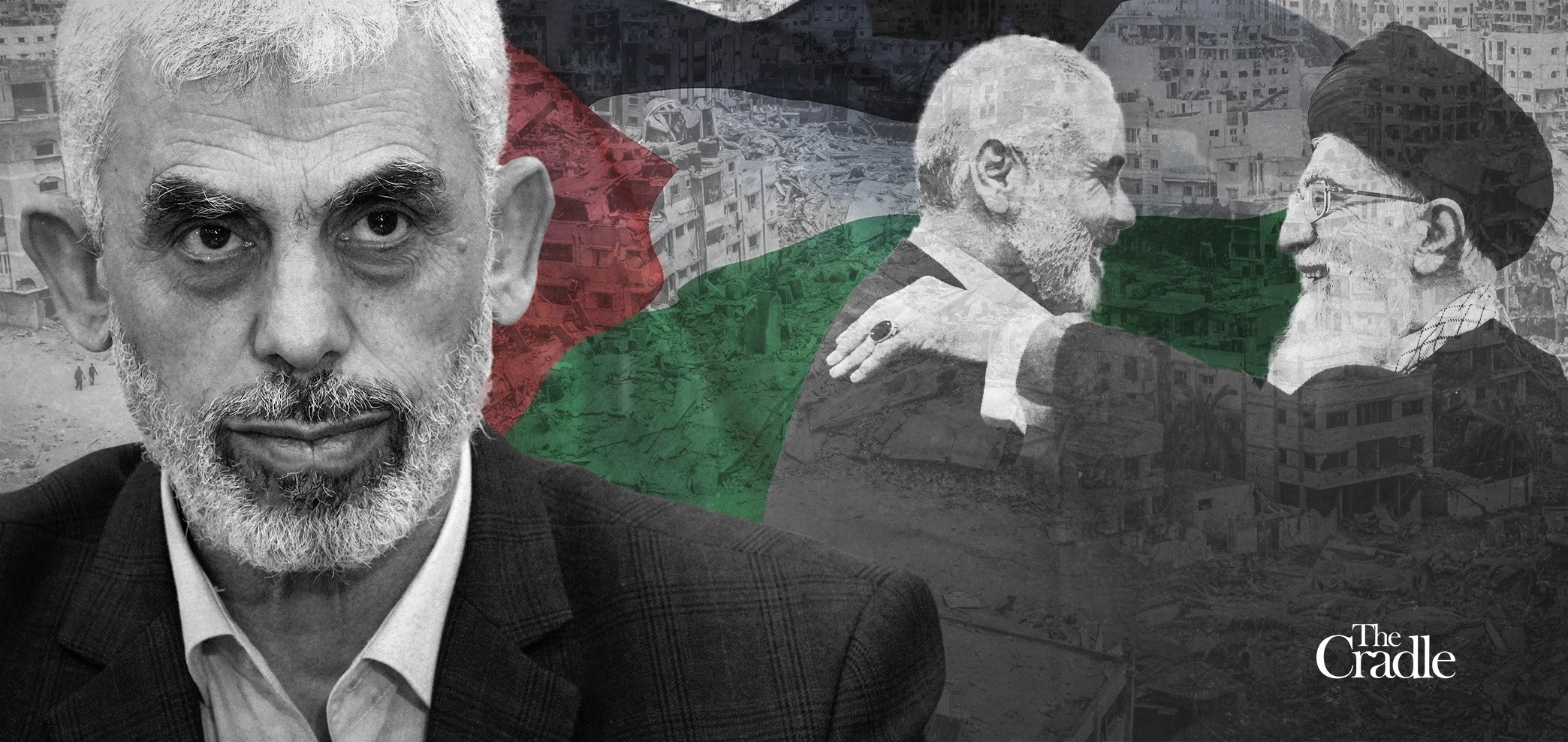
— The Cradle (@TheCradleMedia) August 6, 2024
“The medical teams of the Rescue Union provided first aid to a 30-year-old man who was fatally injured near Nahariya,” said a spokesperson for the Israeli Rescue Union.

“While I was driving, citizens signaled me to stop after a car had an accident after hearing the alarm and apparently as a result of being hit by shrapnel. I stopped to help him with a bag of medical equipment that I received from the Rescue Union and went over to help him while stopping the bleeding and first dressing – on his body and car were found with shrapnel wounds. He was then taken to Nahariya hospital in critical condition,” said one of the Rescue Union’s medics.

The Times of Israel said two Israelis were wounded, one critically. Other Hebrew reports on Telegram said two soldiers were wounded in the Shagra barracks.

The Hezbollah attack came hours after five people were killed in an Israeli drone strike on southern Lebanon earlier on Monday.

Hezbollah had targeted Israeli forces in the Avivim settlement that morning.

The attack also comes as regional tensions are at an all-time high following Israel’s assassinations of Hamas leader Ismail Haniyeh in Tehran on 31 July and top Hezbollah war commander Fuad Shukr in Beirut the day before.

The attack on Beirut killed several civilians, including young children.

Tel Aviv is anticipating retaliation from the Islamic Republic and Hezbollah, as both have vowed harsh responses to the Israeli attacks.

Israel is also expecting a Yemeni response to its attack on Hodeidah port last month.

A Hezbollah source told The Cradle on 5 August that Iran, Lebanon, and Yemen will launch simultaneous retaliatory strikes against Israel to overwhelm its Iron Dome system.

https://thecradle.co/articles/breaking- ... -confirmed

Starving two million Gazans is ‘justified,’ but world will disapprove: Smotrich

The far-right minister argued for the use of starvation over any prisoner exchange and ceasefire deal to return the Israeli captives held in the strip

News Desk

AUG 5, 2024

Image
(Photo Credit: Yonatan Sindel/Flash90)

Finance Minister Bezalel Smotrich said on 5 August that he considers it “justified and moral” to starve two million civilians in Gaza to death so that the Israeli captives are returned, but that the international community stood in Israel’s way.

The far-right Israeli minister claimed that Tel Aviv has no choice in delivering aid to the Gaza Strip during a conference hosted by Israel Hayom. “We can’t, in the current global reality, manage a war. Nobody will let us cause two million civilians to die of hunger, even though it might be justified and moral, until our hostages are returned.”

Smotrich argued for the use of starvation over any prisoner exchange and ceasefire negotiations. He also restated his opposition to releasing Palestinians in Israeli prisons in exchange for the captives in Gaza and his support for Israel resettling the strip.

Israeli Prime Minister Benjamin Netanyahu has previously stated that resettling Gaza is unrealistic, angering his far-right allies.

Smotrich and Israeli Defence Minister Itamar Ben-Gvir have been at the center of controversy since their rise to power after the November 2022 elections in Israel, when their Religious Zionist Party joined Netanyahu’s ruling coalition.

In June, the Israeli military discreetly transferred substantial legal authority in the occupied West Bank to pro-settler civil servants working under Smotrich, which would essentially accelerate the annexation of the Palestinian territories.

Smotrich has also previously called for the destruction of Gaza, the ethnic cleansing of Palestinians from the strip, and its annexation as well.

https://thecradle.co/articles/starving- ... e-smotrich
"There is great chaos under heaven; the situation is excellent."

User avatar
blindpig
Posts: 15306
Joined: Fri Jul 14, 2017 5:44 pm
Location: Turtle Island
Contact:

Re: Palestine

Post by blindpig » Wed Aug 07, 2024 11:23 am

The 1948 Irgun Re-born?
Posted by Internationalist 360° on August 5, 2024
Alastair Crooke

Image
Israeli Prime Minister Benjamin Netanyahu visits the Israel National Counter Terrorism Unit, (Photo: Kobi Gideon/GPO)

The signposts are there for all to read: The West – in deliberately overlooking such explicit markers – cannot then complain, or escape, the ensuing consequences. No, the ‘tin ear’ is not some new western derangement – a unique mass collapse of sanity – that we are living through. It is something worse: a return to a dogmatic, authoritarian version of truth which dissident physicist Eric Weinstein complains has (in the West) also destroyed true science – ignoring and silencing its most important dissident voices, whilst amply rewarding Science’s frauds.

Consider: Prime Minister Netanyahu addressed the U.S. Congress on 24 July saying, in an unrelieved Manichaean mode, that the West is facing an “axis of evil” (Iran and allies), which the U.S. must join in destroying. It was a call to participate in civilisational war. His invitation was celebrated with 58 standing ovations from U.S. legislators.

Netanyahu returned home to a disaster in the Druze community on the Golan. Missile fragments had struck, killing and wounding many children playing football (the exact circumstances are still not clear). Western rationality however is perfectly capable to deduce firstly, that Majdal Shams lies in Occupied Syria; secondly, that the Druze community there remains overwhelmingly Syrian (rejecting Israeli citizenship) and largely pro-Syrian. And that they are neither Jews nor Israelis. The West seemingly cannot however, adduce the further very obvious conclusion: Why on earth would Hizbullah intentionally attack a Syrian community on Syrian land that largely is sympathetic to the Resistance?

They wouldn’t. Yet these obvious facts are completely ignored by a rationality that, as Weinstein suggests, actively prefers fraud to truth. Spokesman Kirby said Hizbullah had attacked children in northern Israel.

Israel’s Defence minister repeatedly says: “We don’t want war”. Western leaders parrot the same meme: No-one wants war. ‘We are fully confident that Israel’s response will be constrained and limited to military targets’. The White House: “In our view, there is no reason for some dramatic escalation in southern Lebanon and there is still time and space for diplomacy”.

So what then occurs? Two major assassinations: one in Beirut and the other in Tehran (i.e. to a guest on Iranian sovereign territory). Western leaders express their ‘concern’. The Hamas target in Tehran, Ismail Haniyeh, as the Qatari PM noted, was the key Gaza hostage negotiator.

This too will be overlooked, though Netanyahu’s intent to weave together Hamas, Hizbullah and Iran into a single ‘axis of evil’ cloth – thus speaking to his Join-Session of Congress thesis – must be evident even to a blinkered Washington.

Recall the new ‘equation’ that followed the assassination of a senior IRGC official in the Iranian Consulate in April 2024: Henceforth Iran will respond directly – and directly from Iran. Washington says it does not want war with Iran, yet the latter explicitly was what Netanyahu advocated. Did the legislators miss his point?

For nearly ten months, Israel has been unable to stabilize the situation along the northern border and allow for the return of displaced Israelis to their homes. Even if the Beirut strike doesn’t lead to wider war, restoring a negotiated stability on the Lebanese border is now beyond reach – as is too, a Gaza hostage deal. “How can mediation succeed when one party assassinates the negotiator on the other side”, Qatari PM al-Thani ruefully observed.

So too ‘overlooked’ in the West, will be that which happened in Israel on the same day the assassinations later took place: Right-wing vigilantes descended from their settlements, storming two military IDF bases. The anarchic scenes of mass break-ins, fomented by several members of the ruling coalition, some of whom took part in the forcible entries, sparked angry condemnation from Defence Minister Gallant.

The invasions were supported by one minister and several Knesset members seeking to free reservists that are suspected of aggravated abuse and forcible sodomy against a Palestinian detainee. According to a security source, the injured detainee was taken to a hospital with severe injuries, including to an intimate body part which left him unable to walk.

“The spectacle of military police officers coming to arrest our best heroes at Sde Teiman is nothing less than shameful”, said Ben Gvir, whose ministry controls the Israel Police and Israel Prison Service, said of the storming of the IDF post.

Yet the wider picture as related by Yossi Melman is:

“What is happening on the part of the nationalistic messianic Right with the backing, winking or silence of ministers and MKs of the Right is a “putsch”. The youth coming down from the hills of the ‘State of Judah’ to act with the same violent methods – used against the Palestinians – (but now) are being used against the state of Israel. MK Limor Son Har-Malech (Otzma Yehudit) said: “The people of Israel will fight against enemies from outside and enemies who try to destroy us at home” [those such as the Advocate General seeking to investigate the torture being practiced Sde Teiman]. The concept of the knife in the back and the betrayal at home echoes the voices in Germany after WWII”.(WWIbp)

Again, overlooked but not in the news: The situation at Sde Teiman was widely-known and said to be “more horrific than anything we’ve heard about Abu Ghraib and Guantanamo”. A UN report has detailed how Palestinians arbitrarily detained faced torture and mistreatment. The vigilantes from the settlements nevertheless described those committing the anal rape as “heroes” – and cast the IDF investigators as fifth columnists. Reports suggest that the perpetrators at Sde Teiman enjoy high level protection.

This account of systematic torture followed earlier revelations that the Israeli army had marked tens of thousands of Gazans as suspects for assassination, using an AI targeting system, called Lavender, with little human oversight and a permissive policy for casualties.

In the same vein, Right wing Cabinet ministers celebrated the assassination of Ismail Haniyeh in Tehran on social media Wednesday morning, as: “This is the right way to purge the world of this filth”, Heritage Minister Amichay Eliyahu, a member of National Security Minister Itamar Ben Gvir’s far-right Otzma Yehudit party, tweeted:

“No more imaginary ‘peace’/surrender agreements, no more mercy for these dead men walking. The iron fist that will strike them is the one that will bring quiet and a modicum of comfort, and strengthen our ability to live in peace with those who seek peace. Haniyeh’s death makes the world a slightly better place”.

What then is this ‘truth’ that the West ignores and silences reality, whilst amplifying its narrative frauds? It is that the Israel which they presume to understand is now something very different. And that it has an epistemology at odds with mechanistic rationalism.

An eschatological Right-wing cult now holds the majority in cabinet – and wields a vigilante militia ready to attack the military establishment, and the Israeli state. No one was arrested for the attack and take-over of the two bases. They do not dare.

Moshe “Bogie” Ya’alon, former Chief of Staff of the IDF, who also served as Israel’s Defence Minister, had this to say in a video interview on the forces taking over in Israel:

“When you talk about Smotrich and Ben Gvir: They have a Rabbi. His name is Dov Lior. He is the Rabbi of the Jewish Underground, who intended to blow up the Dome of the Rock – and before that the buses in Jerusalem. Why? In order to hurry up the ‘Last War’. Do you [not] hear them talking in terms of the Last War; or of Smotrich’s concept of ‘subjugation’? Read the article he published in Shiloh in 2017. First of all, this concept rests on Jewish supremacy: Mein Kampf in reverse”.

“My hair stands on end when I say that – as he said it. I learned and grew up in the house of Holocaust survivors and ‘never again’. It is Mein Kampf in reverse: Jewish supremacy: and therefore [Smotrich] says: “My wife won’t go into a room with an Arab”. It is anchored in ideology. And then actually what he aspires to – as soon as possible – is to go to a big war. A war of Gog and Magog. How do you start the flames? A massacre like the [1994] Cave of the Patriarchs? Baruch Goldstein is a student of this Rabbi. Ben Gvir has hung up Goldstein’s picture [in his house]”.

“This is what goes into the decision-making process in the Israeli government”.


Rabbi Dov Lior has been described by Netanyahu as the “élite unit that leads Israel”, because of his influence and control over the settler forces. The 1948 Irgun, drawing heavily on the Mizrahim, is being reborn?

Isn’t it time that the western ruling structures raised their eyes from their reverie, and read the runes that manifest all around them? Some serious players don’t think as you westerners do; they seek Gog and Magog (the prophecy that “the children of Israel” will be victorious in the battle of Armageddon). That is what you risk.

https://libya360.wordpress.com/2024/08/ ... n-re-born/

******

‘We’ll die before enlisting’: Ultra-Orthodox Israelis storm army base

The Haredi community's call for ultra-Orthodox Israelis to dodge draft orders has hampered Tel Aviv's enlistment efforts

News Desk

AUG 6, 2024

Image
(Photo credit: Flash90)

Israel released a statement on 6 August condemning the storming of a military base that day by ultra-Orthodox Jews, also known as the Haredim, who were protesting a recent government decision to enlist them into the Israeli army.

“Breaking into IDF bases is a grave offensive and against the law,” the Israeli army said, adding that the enlistment of Haredi Jews into the military is “a critical operational need… and we are determined to continue advancing it.”

Demonstrators from the ultra-Orthodox community stormed the Tel HaShome army base in Israel earlier on 6 August during a demonstration against compulsory conscription into the Israeli military.

Israel’s Channel 12 News described the situation as “out of control,” with rioters outnumbering security forces and dozens breaking into the base.

Video footage on social media shows the Haredim pouring through the gates of the military base on Tuesday.


Hundreds of ultra-Orthodox Israelis have received their first call-up orders for enlistment into the military. “We will die and not enlist,” protesters chanted on 6 August.

The Israeli High Court ruled on 25 June that male ultra-Orthodox Jews who are eligible for service must be drafted into the military. Israel’s Defense Ministry began sending out the conscription orders last month.

Prominent religious figures from within the community have staunchly opposed the drafts and called on their followers to dodge conscription and not show up to enlistment offices.

As a result, conscripting the Haredim has been difficult for Tel Aviv. The Israeli public broadcaster KAN reported on Monday that 30 ultra-Orthodox Israelis showed up to conscription offices despite 1,000 being required to register that day.

An army source cited by KAN said that Haredi protesters pushed many who were about to register to retract. The protests against conscription have been ongoing in recent days.

Severe shortages of soldiers stemming from the war in Gaza have forced Tel Aviv to push for the enlistment of ultra-Orthodox Jews, who for years have enjoyed exemptions from service.

https://thecradle.co/articles/well-die- ... -army-base

The Yemen deal: Riyadh capitulates, Washington loses leverage

Sanaa’s brash threats have compelled Saudi Arabia to make significant concessions to Yemen, showcasing not only Sanaa’s sharp regional ascent but also the US and Israel’s rapidly shrinking influence.


Khalil Nasrallah

AUG 6, 2024

Image
(Photo Credit: The Cradle)

Yemen’s strikes against Saudi Arabia over the past three years – including Operation Break Siege in early 2022 and persistent threats to use force when Riyadh fails to meet its commitments – have successfully pressured it into largely yielding to Sanaa’s demands.

The significant Saudi retreat, underscored by repeated disruptions to its economy since the Aramco attack in 2019, poses a serious challenge to Crown Prince Mohammed bin Salman’s coveted Vision 2030.

Yemen’s ultimatum

In early April, the Saudi-backed “legitimate Yemeni government,” no doubt under US directives, mandated banks and the Yemeni flag carrier, Yemenia Airways, to relocate from Sanaa to Aden within 60 days.

This decision coincided with the Ansarallah-aligned government’s operations in the Red Sea in support of the Palestinian resistance in Gaza. As the deadline approached, Yemeni pilgrims undertaking the annual Hajj in Saudi Arabia were suddenly detained in Jeddah in late June.

In response, on 7 July, Ansarallah leader Abdul Malik al-Houthi threatened Riyadh with a stark warning: “We will respond in kind: banks for banks… the airport in Riyadh for the airport in Sanaa… and seaports for seaports.”

Riyadh wisely took the warning seriously, and the brief standoff ended with the safe return of the pilgrims to the Yemeni capital, prompting Ansarallah’s political bureau member Mohammed al-Bukhaiti to remark that “If the Yemeni pilgrims had not been returned, Saudi Arabia’s airports would have been closed at this moment.”

Broadly speaking, Houthi’s threat, backed by widespread popular support shown in massive demonstrations, underscored the Yemeni resolve to confront Riyadh, the US, and Israel. Recognizing the gravity of these threats, Saudi Arabia quickly sought mediation to resolve the crisis with Sanaa.

Riyadh’s retreat

Following Yemen’s sensational drone strike on Tel Aviv on 19 July, those communications intensified, leading to an agreement announced by Mohammed Abdulsalam, the head of the Yemeni negotiating delegation.

The agreement included the cancellation of recent decisions against banks from both sides, a commitment to refrain from such actions in the future, the resumption and increase of flights by Yemeni airlines between Sanaa and Amman, and the expansion of routes to Cairo and India.

Additionally, it included holding meetings to address administrative, technical, and financial challenges faced by the airline and starting discussions to resolve all economic and humanitarian issues based on a previously agreed roadmap.

The deal signaled a significant shift in Saudi Arabia’s approach, as the Riyadh-backed puppet government in Aden, in effect, reversed all its previous decisions following the agreement’s announcement.

The lack of denial from Saudi officials illustrated the importance of this deal. Bloomberg reported the development, noting that Riyadh's quick retreat was aimed at avoiding renewed hostilities with Yemen, indicating a substantial change in the kingdom’s foreign policy strategy.

Posting on X, Yemen’s Deputy Foreign Minister, Hussein al-Ezi, underscored Sanaa’s determination to restore sovereignty in all domains:

The resumption of oil exports is contingent upon the reinstatement of government employees’ salaries. Any attempts to circumvent this are prohibited and their consequences are known. Foreign companies should understand this. We will not allow oil to be looted again while our people remain without salaries.

This indicates Sanaa’s seriousness in securing its citizens’ rights and state resources by all means and its refusal to tolerate any attempts from its adversaries – regional or external – to procrastinate or buy time.

Unreliable States of America

For the Saudis, the experience has shown that delaying tactics and banking on Donald Trump’s potential return to the US presidency will not alter Yemeni threats. It is worth noting that Yemen’s strategic operations against Saudi Arabia began during Trump’s presidency, targeting Aramco’s Baqiq and Khurais oil fields, proving the previous administration’s inability to curb Yemeni forces.

Betting on time delays as a strategy is also increasingly seen as futile in Riyadh. The Saudis have been corralled into recognizing the merit of promptly fulfilling their commitments to Sanaa to protect their interests.

With a Saudi retreat clearly in evidence, the Sanaa agreement represents a significant blow to the Americans, whose leverage over Yemen had long been to threaten the resumption of Saudi warfare. Last week, Axios reported that a US delegation arrived in Saudi Arabia to discuss the situation in Yemen and the latter’s latest escalations against Israel.

The outlet notes that “Saudi Arabia has become more concerned in recent weeks about the rising tensions and being dragged into a renewed conflict in Yemen.”

Consequently, with the Sanaa deal, the Yemenis have also succeeded in neutralizing the crucial American “humanitarian” leverage, which was one of the main pressure tools aimed at forcing a reversal of Yemeni support for the Palestinian resistance.

Sanaa has accomplished nothing less than bringing Saudi Arabia to its knees, which has huge implications in this sensitive and critical regional confrontation phase, as well as in future dealings with Riyadh and its neighbors.

By prioritizing support for the Palestinian resistance, challenging US and British hegemonic ambitions, and preparing for further Israeli aggression, Sanaa has emerged as a significant regional player with strong alliances that are drawing recognition and respect.

Yemen’s sustained pressure and strategic strikes have forced Saudi Arabia into significant concessions, reshaping West Asian power dynamics and showcasing Sanaa’s growing influence and rock-solid resolve. This development will have far-reaching implications for future regional stability and strengthens the case for the Sanaa government’s wider recognition on the international stage.

https://thecradle.co/articles/the-yemen ... s-leverage

Pakistan to provide ballistic missiles to Iran if war with Israel erupts: Report

The Organization of Islamic Cooperation (OIC) held an emergency meeting in Saudi Arabia as Iran seeks to retaliate for Israel's assassination of top Hamas and Hezbollah leaders

News Desk

AUG 6, 2024

Image
Organization of Islamic Cooperation (Photo credit: OIC)

Several Arab sources said that if the conflict between Iran and Israel escalates, Pakistan plans to supply Iran with Shaheen-III medium-range ballistic missiles, the Jerusalem Post reported on 6 August.

The sources made the statement amid an emergency meeting of the foreign ministers of the Organization of Islamic Cooperation (OIC) in Saudi Arabia. The meeting was requested by Iran and Pakistan as Iran determines its retaliation for Israel’s assassinations of Hamas political bureau chief Ismail Haniyeh in Tehran and Hezbollah senior commander Fuad Shukr in Beirut last week.

The meeting in the coastal city of Jeddah included discussions on “the crimes of the Israeli occupation” and “the assassination of Haniyeh,” said the Saudi OIC representative.

The OIC represents 57 Islamic countries and sees itself as the voice of the Muslim world. It includes major Arab nations such as Saudi Arabia and Egypt, as well as populous non-Arab states such as Iran, Pakistan, Indonesia, and Turkey.

Tensions in the region are high, with many speculating an Iranian-led attack on Israel may come within hours or days.

US Secretary of State Antony Blinken told G7 ministers on Sunday that Iran and Hezbollah could attack Israel within 24 to 48 hours.

Iran, Hezbollah, The Islamic Resistance in Iraq, and Yemen’s Ansarallah-aligned armed forces have all vowed to retaliate for the killings of Haniyeh and Shukr.

An official from Hezbollah has informed The Cradle that “the response will come at once from Iran, Hezbollah, and Yemen,” adding that the goal is to “inflict a painful blow to Israel which may not be achieved should separate retaliations be pursued.”

The Wall Street Journal noted on Tuesday that Israel has put its military on high alert while US officials have moved military assets to the region.

The US is seeking to coordinate with its Arab regional partners to try to defend Israel from an attack that some fear could be broader and more complex than the missile and drone strikes launched by Iran against Israel in April.

https://thecradle.co/articles/pakistan- ... pts-report

******

Gaza As A New(?) Western Method To Wage War

We have seen a myriad of reports about systematic torture and murder in Israeli concentration camps, aka prisons, for Palestinians.

These reports come even from prime media which generally serve as outlets of the ruling class. There are by now so many of these reports that there is no doubt that they are real.

Inside Israel’s torture camp for Gaza detainees - 972mag, Jan 5 2024
Strapped down, blindfolded, held in diapers: Israeli whistleblowers detail abuse of Palestinians in shadowy detention center- CNN, May 11 2024
Inside the Base Where Israel Has Detained Thousands of Gazans - New York Times, June 6 2024
‘More horrific than Abu Ghraib’: Lawyer recounts visit to Israeli detention center - 972mag, June 27 2024
Blindfolded, bound and beaten: Palestinians tell of Israeli jail abuse - BBC, August 5 2024


However there have been no political consequences from those reports. I have also not seen or heard any western politician or any editorials condemning the Israel over these reports. To my best knowledge no western country has punished the Zionist government over such behavior.

This even as it is obvious who the main people responsible for this are. Everyone knows and talks about them:

Musa ‘Aasi, a 58-year-old painter-decorator and father of four, said he heard guards beat 38-year-old Tha’er Abu ‘Asab to death in a neighbouring cell at Ketziot in November. One guard told 50-year-old Firas Hassan, from Bethlehem: “We are livestreaming this for Ben-Gvir”.
Ben Gvir’s spokesperson said the minister was “proud” of his prison policy, and that it was in line with international law. “The conditions of the terrorists imprisoned in Israeli prisons have been tightened to the minimum required by law. In accordance with the minister’s policy, the terrorists do not receive the improved conditions they received in the past,” they said.


The Guardian fails to refute those lies from Ben Gvir's spokesperson.

The Palestinians will continue to be tortured and killed. And all their families - in fact - every Palestinian in Gaza shall be killed:

Finance Minister Bezalel Smotrich implies he believes that blocking humanitarian aid to the Gaza Strip is “justified and moral” even if it causes 2 million civilians to die of hunger, adding however that the international community won’t allow this to happen.
“We are bringing in aid because there is no choice,” Smotrich says at a conference in Yad Binyamin hosted by the Israel Hayom outlet. “We can’t, in the current global reality, manage a war. Nobody will let us cause 2 million civilians to die of hunger even though it might be justified and moral until our hostages are returned. Humanitarian in exchange for humanitarian is morally justified, but what can we do? We live today in a certain reality, we need international legitimacy for this war.”


As no one, Smotrich claims, will let the Zionist kill 2 million civilians by hunger at once, it must be done slowly. By now some 10% of the once 2.3 million people in Gaza are likely already dead - killed by bombs or by the consequences of the war the Zionist are waging against them.

Moshe “Bogie” Ya’alon, a former Chief of Staff of the IDF, who also served as Israel’s Defence Minister, is quoted by Alastair Crooke as saying this.

“When you talk about Smotrich and Ben Gvir: They have a Rabbi. His name is Dov Lior. He is the Rabbi of the Jewish Underground, who intended to blow up the Dome of the Rock – and before that the buses in Jerusalem. Why? In order to hurry up the ‘Last War’. Do you [not] hear them talking in terms of the Last War; or of Smotrich’s concept of ‘subjugation’? Read the article he published in Shiloh in 2017. First of all, this concept rests on Jewish supremacy: Mein Kampf in reverse”.

Smotrich and Ben Gvir are sitting right in the cabinet. But has any western country even blocked their travel or entry or sanctioned them?

Why is this allowed to happen?

Back in February Tarik Cyril Amar found this explanation.

The Gaza Method
The West’s evolving blueprint for controlling a poly-crisis world by mass-murdering and subjugating the poor, the rebellious, and those deemed “superfluous.”

The non-paywalled full text is available here.

The West is in decline and it has only one method left to delay it - brute force.

All of the above means that the West is left with one option: the hardest of powers, if the dumbest, too: military force. And that is where the Gaza Genocide precedent fulfills its most important function as method-setting and method-“normalizing.” In a very concrete way, too: For since the 1990s (at the latest), Western militaries – with the US in the lead, obviously - have been thinking intensely about fighting in cities.
...
You see where this has been going, right? To Gaza. Gaza is not the first but, for now, the worst instance of a doctrinal body of pseudo-technical and rationally vicious thought coming into practice: How to subdue the cities of the Global South (and the poor in general, make no mistake, Northerners), by all and any means. And for this type of very-near/present future warfare everywhere, humanitarian law as we know it – with all its immense flaws – is still too “soft,” too restraining. The same holds, of course, for our notions of crimes against humanity, including genocide.
He concludes:

Gaza is a method. A Western method. Fascist, Zionist, apartheid, sadistic Israel is a pioneer, a trailblazer into yet more evil to be done from those above to those below. That is why those above will shield Israel. They are shielding themselves and their future deeds.

I was in doubt about this theory when I first read it. But by now I think that the elite are really planing like this. It is the only explanation that makes sense and it also consistent and fits with their increasing endorsement of pure fascism be it in Israel or in Ukraine.

Posted by b on August 6, 2024 at 14:00 UTC | Permalink

https://www.moonofalabama.org/2024/08/g ... l#comments

******

Deep Dive: Russian security chief in Tehran as Iran weighs strike on Israel
August 6, 2024 Leave a comment
By Amwaj Media, 8/5/24

The story: Russian security chief Sergei Shoigu has visited Tehran for talks with top officials, raising eyebrows given the growing tensions between Iran and Israel. Already, reports charge that Moscow has begun delivering air defense equipment and advanced radars allegedly requested by the Islamic Republic.

The visit comes as Iran and its regional allies weigh the scale of their response to Israel’s suspected assassination of Hamas political bureau chief Ismail Haniyeh. Iran has pledged to avenge the July 31 killing of Haniyeh in Tehran as the region braces for escalation.

The Russian visit:

Shoigu, the secretary of Russia’s Security Council, landed in Tehran on Aug. 5 on what Russian media described as a “planned working visit.”

Shoigu met his Iranian counterpart Ali Akbar Ahmadian, though details of their meeting have been kept under wraps.
The Russian security chief also sat down with President Masoud Pezeshkian and separately met Mohammad Baqeri, the chief of staff of the Iranian Armed Forces.
Iranian media quoted Shoigu as saying in his meeting with Baqeri that Russia “is ready for comprehensive cooperation with Iran in the region.” On his part, the top Iranian military commander described ties as “strategic,” indicating a systemic decision to expand the partnership.
Russia was one of the first countries to condemn the killing of Haniyeh and warn of its consequences.

In connection with a UN Security Council session on the assassination, Moscow also drafted a statement to condemn Israel, but the statement was blocked by Washington.
Given Russia’s growing defense cooperation with Iran, there has been speculation about the timing of Shoigu’s visit.

Some commentators have pointed out that Ahmadian invited his Russian counterpart to visit Tehran during a phone call in May, but no date was announced.
However, observers have also noted that the timing of the trip may have been influenced by developments in the region, such as Haniyeh’s assassination and the impending Iranian response.
Notably, Shoigu’s visit came on the same day that the head of US Central Command (CENTCOM), Michael Kurilla, arrived in Israel for talks with military figures. Washington has been rushing additional forces to the region, and played a key role in helping defend Israel when Iran last attacked Israeli military bases in Apr. 2024.

Amid the dispatch of US reinforcements, rumors have been circulating on social media about an alleged uptick in Russian cargo flights landing in Iran in the past three days. However, flight trackers have only confirmed one such arrival.
Reports emerged on Aug. 7 which claimed that Iran has requested advanced military gear, including air defenses and radar equipment, and that Russia has initiated deliveries.
The Iranian posturing:

Haniyeh was killed in Tehran on July 31, just hours after attending the inauguration of President Pezeshkian.

The IRGC, which was hosting Haniyeh at a complex in northern Tehran, has said a “short-range projectile” carrying a 7 kg (15.4 lbs) warhead struck the room where the Hamas political bureau chief was staying in.
Iranian authorities continue to insist that Iran has a right to respond to Israel over the killing. Israel has not claimed the July 31 assassination.

In a meeting with foreign ambassadors to Tehran on Aug. 5, Acting Foreign Minister Ali Baqeri-Kani said Iran has a “legitimate right to take deterrent action.”
On the same day, Foreign Ministry spokesman Nasser Kanani vowed that Iran would “definitely and decisively” take action—but added that Tehran does not want to escalate tensions.
An article published on Aug. 4 in the weekly magazine Sobh-e Sadeq sought to make the case for a “severe response” against Tel Aviv, which it said would be a “wise” move.

The magazine, which is published by the Islamic Revolutionary Guard Corps (IRGC), described Haniyeh’s killing as an attack on Iranian territory and insisted that the Iranian public supports action against Israel.
The conservative-dominated state broadcaster on Aug. 4 and Aug. 5 aired vox pops in which ordinary Iranians almost unanimously said Israel should be struck. However, many argued that any action should be aimed at restoring deterrence rather than starting a war.
The context/analysis:

Long plagued by mutual distrust, relations between Iran and Russia have significantly expanded following Moscow’s invasion of Ukraine in Feb. 2022.

The bilateral partnership has especially grown in the military sphere, with Iran delivering drones which are reportedly being used in the Ukraine war. Tehran is also supporting Russian efforts to localize drone production.
Cooperation between Moscow and Tehran is additionally focused on connectivity, with the two sides pursuing development of the International North-South Transport Corridor (INSTC). The initiative seeks to connect India and Russia via Iran.
The growing Iranian-Russian cooperation has been a cause for concern in the west, leading European diplomats to call on the Islamic Republic to reverse course.
While cooperation has generally grown, many obstacles remain. For instance, Iran has so far avoided exporting ballistic missiles to Russia amid warnings from Washington. Moreover, collaboration in the energy sector has been lackluster.

In Feb. 2024, reports emerged that Iran had allegedly supplied Russia with around 400 missiles, including short-range Fateh-110 projectiles. However, those reports have reportedly been dismissed by Iran, Russia, and Ukraine.
Speculations that Russia may deliver up to two dozen Sukhoi-35 (Su-35) fighter jets and Mil Mi-28 attack helicopters to Iran have not materialized. This is even though reports emerged in Sept. 2023 that Yak-130 combat trainers were transferred to Iran amid rumors that an air base may have been prepared for the arrival of Su-35s.
The finalization of a comprehensive 20-year cooperation agreement has also been lagging, with Moscow pointing the finger at Tehran. The accord would succeed the 10-year cooperation treaty signed in 2001, which has since been extended for five-year terms—most recently in 2021.
While bilateral ties blossomed under late conservative president Ebrahim Raisi (2021-24), incumbent Reformist President Pezeshkian has signaled a willingness to engage with the west. Such a shift by Tehran, if it were to be reciprocated by western capitals, may be problematic for Moscow and could play a part in Shoigu’s engagement.
It remains unclear whether the precise date of Shoigu’s trip to Iran was set prior to Haniyeh’s killing. However, such a trip in the current climate may be seen as either Russian support for Iran vis-à-vis Israel, or an attempt to manage tensions between the two regional arch-foes.

What will likely fuel the view of Russia siding with Iran is what analysts see as the cooling of relations between Moscow and Tel Aviv over the past year, in view of Russia’s invasion of Ukraine and Israel’s war on Gaza.
Shoigu, a former defense minister who has a good working relationship with Baqeri, notably oversees Russia’s Federal Service for Military-Technical Cooperation which handles arms exports. Against this backdrop, it remains to be seen whether the bilateral engagement will produce dividends for Tehran in the military field.
Despite a possible shift by Moscow, the broader disparities at play are significant. Should a direct conflict between Iran and Israel emerge, observers argue that potential Russian support for Tehran is unlikely to match US backing for Tel Aviv.
The future:

The vox pops on Iranian television may be an attempt by the authorities to gauge the public’s views, and scale the response to Israel accordingly. The Islamic Republic most recently struck Israel in Apr. 2024, when the IRGC launched an unprecedented attack over the suspected Israeli bombing of Iranian diplomatic premises in Syria.

Operation ‘True Promise’, which involved the firing of hundreds of drones and missiles, marked the first attack on Israel launched from Iranian territory.
Should Iran press on with a strike on Israel, it could be bigger than ‘True Promise’. Moreover, it may well include coordinated action by the Islamic Republic’s regional allies.
While military relations between Iran and Russia are growing, Russia will think twice before overtly backing Tehran against Tel Aviv. If cooperation is to expand, it will in all likelihood be limited to defensive capabilities, including air defenses.

Israel and Russia have seen their ties dwindle in the shadow of the Ukraine war. However, they have a so-called deconfliction mechanism in Syria to protect.
The deconfliction mechanism has prevented Israeli and Russian forces from clashing in Syria. If Moscow were to aid Tehran, it could impact Russian arrangements with Tel Aviv.
Even if Russia rushes air defense systems to Iran, their reliability and capabilities are questionable. Moreover, Moscow could very well be supplying spare parts. Notably, in Apr. 2024, Israel reportedly took out a radar site associated with a Russian-built S-300 missile defense battery covering a key nuclear site. Iran denied the incident.

Amwaj.media is based in the UK but our bustling newsroom is chiefly made up of journalists and analysts from across the region. Founded in January 2021, Amwaj.media is independently funded and operates as a service provider. The Editor is Mr. Mohammad Ali Shabani. We prioritize the safety and security of our team while considering our output as the result of a team effort. We have therefore chosen to anonymize most of our team’s own output.

https://natyliesbaldwin.com/2024/08/dee ... on-israel/

******

Image

“Well What SHOULD Israel Have Done After October 7?”

The correct question to ask is, what should the world do about Israel?

Caitlin Johnstone
August 5, 2024

People often object to criticisms of Israel’s ongoing mass atrocity in Gaza by saying, “Well what SHOULD Israel have done in response to October 7 then?” They say it like the question should confound you, as though it’s some kind of thought-terminating unanswerable Zen koan or something.

But it isn’t. The question is very answerable, and the most correct answer is that Israel should have done what it always should have done: right the wrongs of the past and make peace.

October 7 was entirely a response to generations of abuse against the Palestinian people by the state of Israel, so the correct response to it would have been to heal those abuses in a way that is agreeable to the Palestinians. This would likely include ceding large amounts of land, the payment of very extensive reparations from Israel (and ideally from its wealthy western allies as well), eliminating all unjust laws and apartheid systems, a comprehensive push to purge society of the toxins of anti-Palestinian racism and Islamophobia, the right of Palestinians in exile to return to their homeland, and the negotiation of a peace agreement which yields so much that even the most hardline factions in Palestinian society would be compelled to agree with it.

And when you say this the common objection is “Yeah well Israel was never gonna do that!” To which the most correct answer is: duh. Of course not. Israel is a murderous apartheid state built on racism and hate and trauma, and on the premise of existing in a continuous state of mass-scale violence at home and abroad.

That’s the problem here. Not Hamas. Not October 7. The problem is that Israel is a settler-colonialist project made of hatred and abuse and ceaseless violence. Which was why October 7 happened.

The fact that Israel would not have responded to October 7 by ending the abuses which caused it doesn’t change the fact that this would have been the correct thing for Israel to do. It just means the same depravities and injustices which gave rise to the state of Israel continue to exist and express themselves to this day. It means Israel itself is the problem.

Which means the real issue with the objection “Well what SHOULD Israel have done in response to October 7 then?” is that it’s asking the wrong question. The correct question to ask is, what should the world do about Israel? What should the world do about this murderous entity which keeps trying to drag us all into a horrific new war with Iran and its allies? What should the world do about this apartheid ethnostate whose relentless abuses were so egregious that Palestinians felt they had no choice but to carry out the October 7 attack?

And when you peel back the layers of this question you find that the question underneath it is, what should the world do about the US empire? What should the world do about this massive globe-spanning power structure which feeds into Israel’s abuses as a matter of policy to advance its own agendas of destabilization and division in a geostrategically crucial resource-rich region? What should the world do about the international power structure centralized around Washington which continuously terrorizes and abuses populations around the world with the goal of capturing them all under a single power umbrella?

I keep saying “the world” because this isn’t just an Israel problem or a United States problem. Clearly. We stand here on the precipice of what could easily become a massive new war in the middle east because of Israel’s actions and the US-centralized empire’s psychopathic facilitation of them, which means this affects all of us.

Even if we manage to avoid full-scale war this time, we know we’ll be on the precipice again in a few years. And even if Israel itself is fully disarmed and dismantled, without the dismantling of the US empire, another agent of destabilization will just be inserted into the middle east to take its place. As Joe Biden said, “Were there not an Israel, the United States of America would have to invent an Israel to protect her interest in the region.”

So really when you get right down to it, the correct response to October 7 and the genocidal atrocities which have followed it is for the world to begin working to dismantle the US-centralized empire. Gaza and the brinkmanship we’re seeing in the middle east right now are just some of the most high-profile symptoms of the depravity that the US hegemon and its allies and assets are inflicting around the world at the moment. Later on it will be something else. And eventually that “something else” appears likely to culminate in a hot war between major nuclear powers.

So what we’re seeing in the middle east today is just the current symptom of a profoundly diseased world order whose sickness will eventually get us all killed. We’re going to have to find some way to stop these freaks. This is an existential issue for all of us. Gaza is just the most glaring example of an illness which affects the health and wellbeing of the entire world, and which cannot be allowed to continue untreated.

https://caitlinjohnstone.com.au/2024/08 ... october-7/
"There is great chaos under heaven; the situation is excellent."

User avatar
blindpig
Posts: 15306
Joined: Fri Jul 14, 2017 5:44 pm
Location: Turtle Island
Contact:

Re: Palestine

Post by blindpig » Thu Aug 08, 2024 11:29 am

Israel’s Barbarism Is Grossly Minimised
August 6, 2024

The fatality figures started to stall in the spring, around the time Israel completed its destruction of Gaza’s hospitals and kidnapped much of the enclave’s medical personnel, writes Jonathan Cook.

Image
Ambulance on Oct. 7, 2023, operated by the Palestine Red Crescent Society in Khan Yunis, Gaza Strip, after it was heavily damaged by an Israeli military airstrike. (Tasnim News Agency, Wikimedia Commons, CC BY 4.0)

Gaza’s Official Death Toll Is a Lie

By Jonathan Cook
Jonathan-Cook.net

The reported death toll in Gaza is way too low by every imaginable metric. We need to be stressing this — all the more so when Israel’s apologists are vigorously engaged in a disinformation campaign to suggest that the figures are inflated.

On May 6, seven months into Israel’s slaughter, there were reported to be 34,735 dead. That was an average of 4,960 Palestinians killed each month.

Today, nearly three months on, the reported death toll stands at 39,400 — or an increase of 4,665.

It should not need a statistician to point out that, were the rise linear, the expected number of deaths would stand by this point at around 49,600.

So, even by the simplest calculation, there is a large shortfall in deaths — a shortfall that needs explaining.

Such an explanation is easy to provide: Israel destroyed Gaza’s institutions and its medical infrastructure, including its hospitals, many months ago, making it impossible for officials there to keep track of how many Palestinians are being killed by Israel.

The death toll figures started to stall in the spring, around the time Israel completed its destruction of Gaza’s hospitals and kidnapped much of the enclave’s medical personnel.

More than a month ago, Save the Children pointed out that some 21,000 children in Gaza were missing, in addition to the 16,000 known to have been killed by Israel. Many are likely to have suffered lonely, terrifying deaths under rubble — gradually suffocated to death, or dying slowly from dehydration.

But again, even those shocking figures are likely to be a severe undercount.

The linear figure entirely misses the bigger picture. How?

1. Because in addition to the continuing Israeli bombardments, Palestinians have had to endure three more months of an intensifying famine. With each day of a famine, more people die than died the day before.

The deaths in a famine are not linear, they are exponential. If five people died yesterday of starvation, 20 people will die today, and 150 tomorrow. That is how prolonged famines work. The longer you are starved, the higher the probability you will die of starvation.

Israeli minister says that it might be "justified and moral" to starve 2 million Palestinians to death.

Tell me more about how the US-Israel partnership is built on a solid foundation of "shared values."

Washington needs to seriously recalibrate this relationship. pic.twitter.com/6rcTOoeuu4

— Trita Parsi (@tparsi) August 5, 2024

2. Because Palestinians have had three more months deprived of medical care after Israel destroyed their hospitals and medical institutions. If you have a chronic illness — diabetes, asthma, kidney problems, high blood pressure, and so on — the longer you are forced to go without medical attention, the greater the chance you will die from an untreated condition. Again, the death rate in such circumstances is exponential, not linear.

Image
Palestine Red Crescent Society ambulance adamaged by an Israeli airstrike, Oct. 7. (Tasnim News Agency, Wikimedia Commons, CC BY 4.0)

3. Because without medical care, all sorts of other things that happen in everyday life become more dangerous. Childbirth is the most obvious example, but even cuts and grazes can become a death sentence. So given the fact that Palestinians now have even less access to medical care than they had in the first six months of Israel’s war on Gaza suggests that people are being killed by life-events in even greater numbers than was the case earlier in Israel’s slaughter.

4. Because, for exactly the same reasons, those injured by Israel’s continuing bombardments are likely to have poorer outcomes than those similarly injured in earlier attacks. Fewer doctors means less chance of treatment, means greater chance of dying from your wounds.

5. Because we know that — given the insanitary conditions, the lack of water and food, the weakened health status of the population, and the destruction of hospitals — epidemics now are breaking out. The WHO has already warned of a likely outbreak of polio, but there are sure to be other diseases emerging such as cholera, typhoid and dysentery that have yet to be isolated and identified. Even the common cold can become a killer when people’s health status is this compromised.

?The Palestinian Ministry of Health has declared the Gaza Strip a polio epidemic area ?

We call for an immediate end to the blockade and radical interventions in vaccine + clean water supply, personal hygiene, and sanitation. Demand accountability and action by your gov reps! pic.twitter.com/qxIEq5WjpQ

— The Glia Project (@Glia_Intl) August 3, 2024

A letter from researchers to The Lancet medical journal last month warned about the likely massive undercount of the dead in Gaza, even relying, as they had to, on the established death toll.

Their point was that indirect deaths — of the kind I enumerate above — need to be factored in as well as the direct deaths from Israeli bombs.

They very conservatively estimate that the total number who will die over the coming months — not just from bombs but as a result of the lack of medical care, insanitary conditions and famine — is 186,000, or 8 percent of the population.

But that figure assumes that Israel’s current slaughter and starvation policies come to an immediate halt, and that international organisations are able to bring in emergency aid. There are precisely no signs that Israel is going to allow any of that to happen — or that Western states are going to put any pressure on Israel to do so.

The medical researchers suggest a less conservative estimate could ultimately put the death toll in Gaza nearer 600,000, or a quarter of the population. Again, that assumes Israel reverses course immediately.

Remember too that for every person killed, several others are maimed or badly wounded. According to the current figures, more than 91,000 Palestinians are reported injured, many of them missing limbs. But again, that is likely to be a massive undercount too.

Harrowing as these figures are, they are just numbers. But Gaza’s dead are not numbers. They were human beings, half of them children, whose lives have been snuffed out, their potential erased forever, their loved ones left with an all-consuming grief. Many victims died alone in extreme pain, or endured unimaginable suffering.

None of their lives should be reduced to cold statistics on a graph. But if that is where we are, and sadly it is, then at the very least we need to point out that the headline figures are a lie, that Israel’s barbarism is being grossly minimised, and that we are being lulled into a false sense complacency.

https://consortiumnews.com/2024/08/06/i ... minimised/

******

Satyajit Das: The Middle East’s Dance of Death – Part 2: Fallout
Posted on August 7, 2024 by Yves Smith

Yves here. Satyajit Das continues his series on Israel and the Middle East by focusing on October 7 and its aftermath.

By Satyajit Das, a former banker and author of numerous works on derivatives and several general titles: Traders, Guns & Money: Knowns and Unknowns in the Dazzling World of Derivatives (2006 and 2010), Extreme Money: The Masters of the Universe and the Cult of Risk (2011), Fortune’s Fool: Australia’s Choices (2022). His latest book is on ecotourism and man’s relationship with wild animals – Wild Quests (2024)

This is the second of a three-part series examining the unfolding events in the Middle East.

On 18 May 24 former Mossad deputy director turned opposition member of parliament Ram Ben-Barak succinctly summarised Israel’s position: “This is a war without aim and we are unequivocally losing it. We are forced to go back and fight again in the same areas, losing soldiers, losing in the international arena, destroying relations with the US, the economy is collapsing”.

Military Weakness

The 7 October attack, like the Yom Kipper war, highlighted surprising Israeli intelligence failures. Israel’s Western allies, especially the US, were similarly caught off guard. A central factor could be hubris – the belief that Palestinians were incapable in undertaking such an operation. In a Foreign Affairs essay that went to print on 2 October 2023, US National Security Advisor Jake Sullivan wrote: “Although the Middle East remains beset with perennial challenges, the region is quieter than it has been for decades”. The text was subsequently altered in the light of subsequent events.

After 9 months of combat, the IDF has not been able to able to eliminate Hamas, control territory or secure the release of most hostages. It has been forced to use heavy weapons and F16 aircraft to bomb Palestinian refugee camps, schools and hospitals. It has carried out of targeted assassination of militia leaders, which history shows is likely to only be a temporary setback in the absence of a wider political strategy.

Hezbollah’s shelling of northern Israel has forced evacuation of residents. Israel’s threat to open a second front in Lebanon against better equipped and battle hardened opponents is risky given its failure in the 2006 war. Iran’s missile response to Israel provocative bombing of Iranian consular premises, despite advance warning, penetrated Israeli defences and damaged highly defended sites and required US and allied support to repulse.

One factor is that the IDF has a relatively small active-duty component, estimated at some 125,000 troops, of whom roughly two-thirds are conscripts supported by reservists. While adequate for actions against civilians, unarmed or lightly armed enemies, its capabilities against well-trained and equipped armies is uncertain. Another factor is that Israel, like the US, are geared for waging short, high intensity warfare dominated by airpower. Hamas, Hezbollah and Iran are set up to wage attritional wars. They are adept at using ‘swarming’ asymmetric warfare emphasising cheap drones negating the advantage of better equipped military forces. Israel is also heavily dependent on foreign weapons.

A multi-front war in Gaza, the West Bank and Lebanon would be difficult. The problem is increasingly compounded by better equipped opposition, operating under the Resistance Axis’ Unity of Fronts banner, capable of striking across the region. Smuggling of sophisticated weapons from Jordan to the West Bank is evident. Other regional enemies, such as the Houthis, have acquired items such as hypersonic missiles which have been used against merchant shipping and the US naval craft in the Red Sea. The erosion of Israeli and American military deterrence is evident.

Israel is highly militarised with many of its politicians being former defence personnel. The inability of the once all-powerful IDF to defend the country has deepened fears and social and political differences within Israel.

Social and Political Tensions

Over the last few decades, Israeli society has splintered. Some want a secular, democratic, liberal and pluralist nation. Other desire a theocratic, exclusively Jewish state -Judea – which stretches across the entirety of Palestine.

These radically different views of Israel are driven by ethnicity, religion and history. Mizrahi, which means Eastern in Hebrew, Jews make up about 40 to 45 percent of the country’s total population. Often combined with Sephardi (who trace their heritage to the medieval Iberian Peninsula), Mizrahi hail from Jewish communities in the Middle East and North Africa. Ashkenazi Jews, who trace their ancestry to Central and Eastern Europe, make up about 32 percent of the population. Israeli Arabs constitute around 20 percent of Israel’s population, an indigenous minority within an ethnic state forcible founded on their land. Immigration, especially from the Soviet Union, has contributed to variances in tradition and attitudes. There are differences in interpretation and observance of rabbinical law, covering the full spectrum from ultra-secular to the Haredi – the ultra-orthodox.

Economic inequality reinforces differences. The Ashkenazi are generally better educated and enjoy higher living standards. The Mizrahi resent the fact that they are looked down upon. The Ashkenazi begrudge benefits enjoyed by the ultra-orthodox such as exemption from military service, now controversially voided by the courts.

These factions shape Israeli politics. A proliferation of smaller parties, grounded in ethnicity and religion, has superseded the previous major left and right groups which have fractured. This has led to political instability with a succession of inconclusive elections (5 in 4 years) and shaky, shifting coalitions which have generally been short-lived.

Israel has drifted towards to a xenophobic, authoritarian theocracy. Institutions and the rule of law are under stress. In July 2024. far-right and ultra-orthodox protesters, including some politicians, stormed two army bases in Israel after the military police detained soldiers over alleged serious abuse of a Palestinian prisoner. Knesset members argued that rape and torture were legitimate punishment for Palestinian detainees. The military warned of a descent into anarchy. Yair Lapid, head of Israel’s largest opposition party, said the country was “not on the edge of the abyss, we are in the abyss”.

Central to the fracture is the controversial figure of Prime Minister Binyamin Netanyahu, Israel’s longest serving leader. He has exploited the divisions skilfully, not out of ideological belief but to hold on to power to gain parliamentary immunity from indictment on charges of fraud, bribery, and breach of trust. Former Head of Israel’s domestic security force Shin Bet Ami Ayalon described the Prime Minister in January 2024 as “a person who will sell out everyone and everything in order to stay in power…”

Mizrahi support is crucial to Netanyahu, allowing them to displace the Ashkenazi elite who favour a secular Israel. The Mizrahi see themselves as the true representatives of Judaism, with an Old Testament agenda of expanding Israel’s boundaries, eliminating Palestinians, building the Third Temple where the Al-Aqsa Mosque stands and replacing secular law with Halachic Law.

Netanyahu thrives on Israeli anxiety, victimhood and embrace of trauma as defining identity. He has repeatedly warned of the existential threat from Arabs. He has fanned regional tensions with attacks on and targeted assassinations of military and civilians in Syria, Iraq and Iran. As ‘Mr. Security’, he promotes himself as the only one who can guarantee Israel’s survival. This plays to Israeli Jewish perception that strong leaders are required. The Al-Aqsa Flood attacks provide the excuse for tall-out war against Hamas in Gaza, irrespective of the consequences. Israeli political leaders now resort to lurid, apocalyptic Biblical imagery painting the Palestinians as the children of darkness to be vanquished by the chosen people.

Foreign allies associate these developments with the noxious Netanyahu, believing that new leadership will alter the dynamics. This wishful thinking ignores the underlying social and political environment which makes a negotiated solution and two-state solution unlikely.


Economic Stress

Along with death and destruction, the Gaza war has wrought massive economic damage.

Gaza’s economy has ceased to function. The restoration of infrastructure will cost at least $40-50 billion. The West bank economy, dependent on Palestinians who work in Israel, is also in freefall.

Israel too has suffered significant economic losses. Economic activity has shrunk, by perhaps 20 percent on an annualised basis. Sectors such as construction, manufacturing, consumer goods, tourism and hospitality have all contracted, especially in the North and South. Causes include physical damage from the war and the loss of cheap Palestinian labour. Export-based technology industry have been disrupted by callup of reservists for military service. Foreign investment has been interrupted by the war and uncertainty.

The war has accelerated the flight of capital and talent already underway because of the shift to a more theocratic Jewish state. Some of the economic and financial elite, mainly Ashkenazi, have relocated business operations and moved their capital abroad. More than half a million Israelis have left the country since October 2023. These individuals and businesses make up a large proportion of the tax base.

Government expenditure has increased. The cost of the war is estimated to be around $70 billion. There are plans to raise annual military spending from 4 to 6-7 percent of GDP by the end of the decade. Northern border skirmishes have necessitated evacuation of around 60,000 Israelis resulting in economic dislocation and relocation costs. Expenditure on West Bank settlements and ultra-orthodox communities places growing strain on finances. Israel’s national debt is projected to rise from 60 to 67 percent of GDP by 2025. Its credit rating has been downgraded. Expansion of the war would add to the strains.

Focused solely on the war and the need to maintain support from religious parties, the Israeli government has no plan to improve its financial position. It is likely to become more dependent on American financial aid and the diaspora.

Pariah State

Over time, Israel has dissipated the sympathy engendered by the Holocaust and the excitement around the creation of a Jewish state.

Many of the world’s 1.9 billion Muslims (24 percent of the global population) see Israel’s action against Palestinians as a war against Islam. Progressives see it as colonial oppression. For many, its close relationship with America breeds distrust. There is disquiet about Israel’s mendacity about human rights and illegal settlements as well as its disregard for international laws, such as UN resolutions and accords. Branding of justified criticism as anti-Semitism and arrogant assertions of moral superiority is increasingly rejected.

Israel main support now comes from the US, the UK and some European nations. Most of world is now aligned, to varying degrees, with the Palestinians. As of June 2024, 146 of the 193 member states (75 percent) of all UN members recognised the State of Palestine as a sovereign state. An overwhelming majority of UN members and the Security Council also support an immediate ceasefire.

Israel’s position may be weakened by several developments.

One is the decisions of the International Court of Justice (“ICJ”) and the International Criminal Court (“ICC”). The ICJ found that Israel may be committing genocide and ordered a halt to its offensive in Rafah. The ICC issuedindictments against the leaders of Israel and Hamas for war crimes. In a separate decision the ICJ ruled that Israel’s 57-year-old occupation of East Jerusalem and the West Bank was illegal under international law and its conduct towards Palestinians living under its military’s control violated their rights. The UN’s highest Court ruled that Israeli policy in the West Bank -the creation and support of sprawling settlements to the application of discriminatory laws and of Israeli sovereignty over East Jerusalem- was illegal.

Most countries and global civil society have reacted negatively to Israel’s rejection of and refusal to comply with these rulings. Israel’s assertion of special immunity from any accusation of genocide or war crimes, which was only applicable to non-Jews, shocked most. Prime Minister Netanyahu’s assertion that the Jewish people could not be illegal occupiers in their own land, referring to it by its biblical name of Judea and Samaria was rejected.

The international community largely blame Israel for stalling ceasefire proposals using unacceptable conditions, such as its right to resume the war after an exchange of hostages. Its actions – the bombing of Iran’s consulate in Syria and targeted killings of opponents such as Ismail Haniyeh, the political leader of Hamas, in Iran in blatant violation of international law – are calculated to make any negotiated settlement difficult. As Qatar’s Prime Minister and Minister Of Foreign Affairs Sheikh Mohammed bin Jassim Al Thani stated: “… political assassinations and intentional escalation against civilians in Gaza at every stage of the negotiation prompts the question: How can negotiations take place in which one party kills its negotiator at the same time?”


Changes in the political calculus also affect Israel’s standing. While there is backing among the political and economic establishments in supporting countries, Israel has alienated voters, especially younger constituencies, many of whom have protested against the Gaza war in North America, Europe and Australasia. A recent poll of British 18-24 year-olds found that 54 percent agreed that that the State of Israel should not exist while 21 percent disagreed with this statement.

This has electoral consequences. Muslim voters in key states, who oppose the Biden Administration’s support of Israel, may prove important in the US elections. In the July 2024 UK election, differences over the war led a significant bloc of voters to reject the victorious Labour party. Independent candidates ran on a pro-Gaza ticket with five emerging victorious. In Australia, Senator Fatima Payman defected from the ruling Labour party unable to support her party’s position on Palestine. A Muslim voting bloc is likely to target Labour seats in areas with large Islamic populations challenging its bid for re-election.

The shift in Europe to the far right and far left, affects support for Israel. Many of these parties, such as Germany’s AFD, France’s RN, Italy’s far right and Britain’s Reform, have historically supported persecution of Jews as conspiratorial parasites and medieval usurers.

Israel’s pariah status is likely to grow. Resentment of Jews globally will rise. Congregation in clannish enclaves and over-emphasis of their separateness and status now attracts suspicion. There is scrutiny of their disproportionate power due to dominance of finance, professions and politics. Many see them as over-represented and over-articulate.

One manifestation of these tendencies is increased pressure for further isolation of Israel through boycotts, sanctions and divestment. These were among the key demands of protestors. The decisions of international courtsmay force countries to implement measures against Israel under existing national legislation. Similar actions led to the economic, social and cultural isolation of apartheid South Africa and the end of white-domination. Aware of this risk, the US and UK, are trying to stave off the push for international sanctions. It is worth noting that the both countries, after initial resistance, ultimately joined the international boycott and placed various trade sanctions on South Africa.


The American Pillar


But what really matters is American financial, military and diplomatic backing of Israel.

Since its founding, Israel, despite its high income status, has been the largest cumulative recipient of US foreign aid– $310 billion (adjusted for inflation) in total economic and military assistance. Annual assistance runs at around $1,300 per citizen. Actual assistance may be significantly greater especially since the start of the Gaza war. Since 1972, the United States has also extended various loan guarantees to Israel.

99 percent of Israeli weapons are from the US (69 percent) and Germany (30 percent). The American objective has been to allow the Jewish state to have a military advantage over other regional actors. This assistance is interesting as Israel is the world’s ninth largest weapons exporter.

American diplomatic support is important. The Biden Administration has vetoed several UN resolutions calling for a ceasefire in Gaza. It has repeatedly marshalled support for Israel while refusing to draw any ‘red lines’ on Israel’s conduct in Gaza.

Continuation of this assistance is not assured. America is heavily indebted, its budget and trade deficits large, and the advantage of the dollar being a reserve currency which provides flexibility of action is declining. The US annual interest expense on government debt now exceeds $1 trillion, 5 percent higher than its defence budget. As Niall Ferguson has pointed out, Hapsburg Spain, Bourbon France, the Ottoman and British Empire spent more on debt service foreshadowing their decline. As Julius Caesar alleged held: “Soldiers and money: if you lack one, you’ll soon lack the other”.

US military capability, like Israel’s, is built on expensive high-tech weapons and sometimes ineffective under battlefield condition. The troubled F35 aircraft and naval programs highlight a bloated grifting military-industrial complex. It struggles to attract suitable personnel. The embarrassing failure of the $300 million pier to deliver aid to Gaza points to serious shortcomings. The inability to secure red Sea shipping lanes from Houthi attacks despite the commitment of significant forces and money reinforce weaknesses.

The US faces challenges in different theatres – Europe/ Ukraine, Taiwan and the Middle East. A recent book The Boiling Moat suggested that the US and its Taiwanese and Japanese allies might repel a Chinese invasion but at a cost of tens of thousands of service members, dozens of ships, hundreds of aircraft, and lots of other equipment. It is unlikely it has the ability to supply or operate on multiple fronts meaning any assistance to Israel would come at the cost of other clients. In 1966 after he left Cuba to participate in revolutionary struggles in other parts of the world, Che Guevara urged the creation of “two, three … many Vietnams” to weaken the US, the very situation it has now created.

US politicians are out of step with US voters who overwhelmingly want a ceasefire in Gaza. The divergence between ‘elected’ and ‘electors’ is reminiscent of the late sixties divide over Vietnam. Consistent with global trends, younger American are less willing to back Israel as evidenced by nationwide protests.

Image

US electoral considerations, as in other parts of the world, may reduce assistance for Israel. A meaningful share of Democratic voters, especially younger ones, wrote ‘uncommitted’ on their primary ballots and may not vote at all on account of the Biden Administration’s unwavering support of Israel.

One factor is changes within the American Jewish diaspora, whose agendas and interests are different to that of Israel. They must live in a multi-cultural society with non-Jews. Alongside their global peers, many feel less connected to Israel and are more sympathetic to the Palestinian cause. Traditional blind support is difficult given the fissiparous Israeli body politic and the positions of the far right Mizrahi. A majority of the American diaspora now oppose or have private reservations about Israel’s direction. Their uncritical identification with Israel cannot be assumed. The loss of the diaspora may result in significant loss of immunity against criticism of its actions and ability to command American support.

Concern about Jewish interference in US politics is rising. The influence of American Israel Public Affairs Committee (AIPAC) over US politics has been well documented by John Mearsheimer in his 2007 book The Israel Lobby and U.S. Foreign Policy. He argued that AIPAC has a “stranglehold on the U.S. Congress“, through the “ability to reward legislators and congressional candidates who support its agenda, and to punish those who challenge it“. It showed how the Israel lobby distorts US Middle East foreign policy undermining American national interest.

But the power of the Jewish-Israel lobby may be in decline. There is resistance to AICPA’s skilful distortion of legitimate criticism into anti-Semitism and anything less than unquestioning support as conspiracy against Israel. There are alarms about how AICPA operatives have consistently sought to silence or discredit Israel sceptics or critics. The $15 million funding to defeat Congressman Jamaal Bowman in the primaries for his position on the Gaza war is not an isolated example. Prominent Jewish-American citizens working with Israeli intelligence agencies funded attacks on peaceful student demonstrators against the Gaza war.

There is resentment of Israeli arrogance. Few remember the attack in international waters on the USS Liberty by the Israeli Air Force and Navy on 8 June 1967, during the Six-Day War which killed 34 Americans. Despite Israeli apologies and official inquiries finding that it was a mistake, survivors of the attack maintain that the attack was deliberate. Prime Minister Netanyahu once boasted that he was not afraid to challenge US Presidents as Israel through its AICPA proxy and prominent members of the diaspora could force US policy changes. Since the start of the current war, Netanyahu has constantly trampled over an enfeebled President Biden and his envoys.

America must balance its support for Israel with its damaged global standing with important emerging economies such as China, Brazil, India and others. The Trump administration’s decision to move its embassy from Tel Aviv to Jerusalem and formally recognize the city as Israel’s capital, since accepted by President Biden, outraged the UN Security Council, with fourteen out of fifteen members voting to condemn the move.

President Biden’s attempt to equate Russia’s attack on Ukraine and Al Aqsa Flood was not well-received. America’s veto of the UN ceasefire resolution suggested to many that Ukrainian lives were more valuable than Palestinian ones.

America’s condemnation of the ICJ and ICC decision and continued policy of ignoring Israel’s actions has undermined its relationship with the global South and allies. The hysterical letter by 12 Republican Senatorsthreatening the ICC Chief Prosecutor, his family and staff with severe consequences was unhelpful. Arab public opinion always cautious about the US is now overwhelmingly anti-American. The State Department’s Middle East experts are in open rebellion pointing out how America’s diplomatic cover for and continuous flow of money and arms to Israel has made it undeniably complicity in the killings and forced starvation of a besieged Palestinian population in Gaza.

A change in US administration has implications for the America-Israel relationship. High levels of support for the Jewish state is inconsistent with the GOP’s ‘America First’ platform; greater isolationism, reduced military spending to support allies, attracting petrostate investment, reducing immigration and preventing foreign interference in elections.

Should he regain the Presidency, Donald Trump’s volatile relationship with Prime Minister Netanyahu may become central. While initially allied, tensions arose during the first Trump administration when Netanyahu publicly argued that Trump’s Middle East plan gave a green light to Israel to annex the West Bank and Golan Heights which an angry Trump denied agreeing to. The presumptive Republican presidential nominee has found himself increasingly at odds with his party’s unwavering loyalty to Israel.

These pressures mean that American financial, military and diplomatic backing of Israel is vulnerable. As various countries such as South Vietnam, Egypt and Afghanistan can attest, America supports you until it doesn’t! A defiant Prime Minister Netanyahu has shrugged off this contingency stating that Israel will fight with its nails if necessary. Reliance on this strategy, even against lightly armed opponents, is risky.

A corner solution in mathematics and economics occurs when the chooser is either unwilling or unable to make a trade-off. Israel’s military, economic, social and political problems as well as it declining standing internationally and with crucial allies such as the US has narrowed its options.

https://www.nakedcapitalism.com/2024/08 ... llout.html

Trump ain't gonna hang the Zionists out to dry, they're his causa belli for war with Iran. He's not gotten over 1979...

*****

Image
U.S. Secretary of State Antony Blinken (L) is welcomed by Aipac President Michael Tuchin at the committee’s policy summit in Washington on 5 June 2023 (Chip Somodevilla/Getty Images/AFP/MiddleEastEye)

Why Ilan Pappe’s new book on the Israel lobby is a must-read
Originally published: Middle East Eye on June 24, 2024 by Peter Oborne (more by Middle East Eye) | (Posted Aug 07, 2024)

No review has yet been published of Professor Ilan Pappe’s magnificent and passionate new book on the Zionist lobby. This silence is no surprise. Even a passing reference to the lobby is liable to lead to charges of antisemitism and potential career destruction.

Faiza Shaheen was dropped like a stone last month as Labour candidate for the London seat of Chingford and Woodford Green. “There have been complaints, allegedly, about her ‘liking’ a tweet that referred to the ‘Israel lobby’—widely considered an anti-Semitic trope,” reported the New Statesman’s associate political editor, Rachel Cunliffe.

On a now-infamous Newsnight appearance following her defenestration, a tearful Shaheen apologised for liking the tweet and accepted it was a “trope”.

She didn’t have much choice. The Equality and Human Rights Commission (EHRC), the statutory regulator, agrees. In 2020, it cited a claim that the “Israel lobby” was behind antisemitism complaints as evidence supporting a finding of unlawful antisemitic harassment.

Pappe has entered perilous territory. Few are better qualified to challenge the official orthodoxy that discussion of the Israel lobby is out of bounds. None are more battle-hardened.

One of the most eminent of the “new historians” who retold Israel’s foundation story, Pappe was denounced in the Knesset after publication in 2006 of his controversial book, The Ethnic Cleansing of Palestine. Israel’s education minister called on the University of Haifa to sack him, and one of Israel’s best-selling newspapers pictured him at the centre of a target, next to which a columnist had written:

I’m not telling you to kill this person, but I shouldn’t be surprised if someone did.

After a slew of death threats, he left Israel, and was lucky to be able to find a billet at the University of Exeter.

Targeting politicians and journalists
The famous French publisher Fayard recently halted distribution of The Ethnic Cleansing of Palestine. Last month, Pappe, who remains an Israeli citizen, was interrogated for two hours by federal agents upon arrival in the United States. He was eventually let in, but only after they copied the contents of his phone. This kind of harassment, Pappe later noted, is nothing compared to what Palestinians routinely face.

He has produced a work that needs to be read, and then re-read, by anyone who wishes to understand the international context of the war in Gaza. The book describes how the Israel lobby has targeted both politicians and journalists.

Two British politicians lost out on foreign office jobs amid pressure from the lobby on account of pro-Palestinian sympathies: Alan Duncan in 2016 and Christopher Mayhew in 1964. George Brown, a former Labour foreign secretary, was also targeted in the 1960s.

The lobby has gone after journalists such as Jeremy Bowen, who was forced to endure a long BBC investigation; former Guardian Jerusalem correspondent Suzanne Goldenberg; former Guardian editor Alan Rusbridger; and broadcaster Jonathan Dimbleby.

The Israeli government repeatedly complained to the BBC that foreign correspondent Orla Guerin was “antisemitic” and showed “total identification with the goals and methods of Palestinian terror groups”, once even linking her reporting from the Middle East to the rise of antisemitism in Britain—allegations that were as grotesque as they were false.

There are other names on this long list.

In the U.S., William Fulbright, the longest-serving chairman of the Senate Foreign Relations Committee, is the earliest and most devastating example. The appalling story of his destruction in 1974 is well told in this book: “Lobby money poured into the campaign coffers of his rival, Arkansas Governor Dale Bumpers… From that time to this day, the road to the Capitol has been scattered with candidates, from the elite of American politics, whose careers have been similarly torpedoed,” Pappe writes.

Fulbright’s crime was to argue that “instead of rearming Israel, we could have peace in the Middle East at once if we just told Tel Aviv to withdraw behind its 1967 borders and guarantee them”.

‘Nothing to touch them’
This merciless treatment of individuals distinguishes the pro-Israel lobby from other lobbies, both foreign and corporate. Michael Mates, a former member of the parliamentary Intelligence and Security Committee, once told me (in a quote repeated in Pappe’s book) that “the pro-Israel lobby in our body politic is the most powerful political lobby. There’s nothing to touch them.”

Pappe goes far back into history to sketch the origins of the agitation for the return of the Jewish people to Palestine. This story begins with Christian evangelicals two centuries ago, which might explain Pappe’s employment of the term “Zionist lobby” rather than the standard “pro-Israel lobby”.

In the remote past as much as the present day, this type of support for Israel was animated by antisemitism. In the 1840s, religious scholar George Bush, a direct ancestor of two U.S. presidents, called for a revived Jewish state in Palestine, expressing hope that Jewish people would be offered “the same carnal inducements to remove to Syria as now promote them to emigrate to this country”.


These early Christian supporters of a Jewish Palestine, like later Christian Zionists, were oblivious to the Palestinian presence in what they saw as the Holy Land. For them, Palestine was unchanged since the time of Jesus. In the words of Pappe,

later it was imagined as being organically part of medieval Europe: its people donning medieval dress, roaming a European countryside.

In Britain, Edwin Montagu, one of the earliest practising Jews to serve in a British cabinet, described Zionism as a “mischievous political creed”—a phrase that would have had him thrown out of Keir Starmer’s Labour Party and pilloried in the media.

He viewed the Balfour Declaration as antisemitic, while warning that “when the Jews are told that Palestine is their national home, every country will immediately desire to get rid of its Jewish citizens, and you will find a population in Palestine driving out its present inhabitants”.

Safeguarding Israel’s legitimacy
After the establishment of Israel, the lobby’s main job became to safeguard the legitimacy of the Israeli state. Pappe shows that the Labour Party was a stronger and more reliable supporter than the Conservatives. He stresses the role of Poale Zion, antecedent to today’s Jewish Labour Movement, which originally sought to reconcile Marxism and Zionism. It convinced the trade unions and Labour that Israel was a socialist project.

Pappe writes that Poale Zion became “part of a lobby meant to arrest any potential anti-Israel orientations in the Labour Party in Britain and strengthen the relationship between the Labour Party and its pro-Israel Jewish constituencies”.

According to Pappe, former Prime Minister Harold Wilson, who led Labour from 1963 to 1976, was “pro-Israel to the bone”. Pappe speculates that Wilson’s admiration for Israel, like David Lloyd George’s in a previous generation, was a product of a nonconformist Christian education. The late politician Roy Jenkins noted that Wilson’s book, The Chariot of Israel, was “one of the most strongly Zionist tracts ever written by a non-Jew”.

Alec Douglas-Home, foreign secretary in the Edward Heath government that succeeded Wilson’s administration after the 1970 general election, was more friendly to Palestinians. An Old Etonian aristocrat, Douglas-Home is today dismissed as a hopeless old fogey and aberration in postwar Britain.

Today, his views would bring a nod of approbation from the Palestine Solidarity Campaign. According to Pappe, “he was the only British foreign secretary to openly discuss the right of return of the Palestinian refugees that were expelled by Israel in 1948”, and, still more remarkable,

the only British foreign secretary to challenge the dishonest brokery of the Americans.

In the wake of the 1967 war, Douglas-Home insisted, with Heath’s support, that Britain could no longer ignore the “political aspirations of the Palestinian Arabs”. In government, he infuriated Israel by allowing the Palestine Liberation Organization to set up a London office.

Pappe says that Douglas-Home was the only senior British politician, with the important exception of the hard-drinking George Brown, to interpret UN Resolution 242 as a demand for unconditional Israeli withdrawal to the borders of 5 June 1967. During the 1973 war, the Heath government refused to deliver arms to Israel—though, as Pappe notes, this was mostly due to a fear of the Arab oil embargo.

The Corbyn years
Pappe’s historical perspective enables him to see the Jeremy Corbyn leadership of the Labour Party in a new light. “Corbyn’s views on Palestine were virtually identical to those expressed by most British diplomats and senior politicians ever since 1967; like them he supported a two-state solution and recognised the Palestinian Authority,” Pappe writes. This made him more mainstream than the Palestine Solidarity Campaign, which supported a one-state solution.

In light of this, Pappe reasonably asks: “Why did the lobby see him as such a threat”? He answers:

They suspected, correctly, that he sincerely believed in a just two-state solution and wouldn’t swallow Israel’s excuses for obstructing it.

In a thought-provoking passage, he adds:

Christopher Mayhew, George Brown and Jeremy Corbyn had much in common. They were in positions of power that could affect British policy towards Israel. They were all totally loyal to the official British policy supporting a two-state solution to the ‘conflict’. None of them denied the right of Israel to exist, none of them had made any anti-Semitic remark in their lifetime and they were not anti-Semitic in any sense of the word.

| Lobbing for Zionism on Both Sides of the Atlantic is published by Oneworld | MR OnlinePappe also has harsh words for the EHRC inquiry into Labour antisemitism. “In a more reasonable world, or maybe years from now,” he writes,

if people were asked about what a leading institution for human rights would investigate in relation to Israel and Palestine, they would give the abuse of Palestinians’ human rights as the answer… [in this report], there was no serious discussion of what constitutes anti-Semitism, nor did it make any attempt to differentiate between anti-Semitism and anti-Zionism and criticism of Israel.[

In a short conclusion written after the horrors of 7 October, Pappe writes:

Many people in the twenty-first century cannot continue to accept a colonisation project requiring military occupation and discriminatory laws to sustain itself. There is a point at which the lobby cannot endorse this brutal reality and continue to be seen as moral in the eyes of the rest of the world. I believe and hope this point will be reached within our lifetimes.

This timely book from one of the finest historians of contemporary Israel deserves to become the subject of urgent contemporary debate. So far, it has been ignored in a media and political environment that, as the recent case of Shaheen illustrates, has imposed a system of omerta around any discussion of the Israel lobby.

https://mronline.org/2024/08/07/why-ila ... must-read/

*****

As war widens, US assets become easy targets

US economic and military interests across West Asia could come under direct fire as Israel's aggressions drag Washington into a region-wide escalation.


Mohamad Hasan Sweidan

AUG 7, 2024

Image
(Photo Credit: The Cradle)

During a White House press conference on 31 July, National Security Council spokesman John Kirby underscored the US commitment to maintaining readiness to protect its security interests in West Asia.

We have and will maintain a level of readiness to preserve our national security interests in the region. It’s not like we take a blind eye to what Iran is capable of doing and has shown their capability of doing in the region.

His comments came amid spiked regional tensions, the highest since 7 October. Protecting Washington’s interests in the Levant and the Persian Gulf is a top priority for the Biden administration, especially given Tel Aviv’s dangerous recent provocations, including attacks and assassinations in Beirut, Tehran, and Hodeidah – inside key countries within the Axis of Resistance, which could escalate into a major conflict threatening US interests.

US militarization in West Asia

Nearly a month after the Gaza war began, the Pentagon outlined its primary goals in West Asia. These include protecting US forces and citizens, ensuring the continuous flow of critical security assistance to the occupation state, coordinating with occupation authorities to secure the release of prisoners held by Hamas, including American citizens, and bolstering the US military presence to deter any state or non-state actors from escalating the crisis further. Clearly, Washington’s focus extends well beyond Gaza.

As of last October, when the Gaza war erupted following Hamas’ Operation Al-Aqsa Flood, over 45,000 US troops were stationed in West Asia, spread across US military bases in about 12 countries. This number does not include the naval fleets permanently stationed in the region’s many waterways.

Image
US military presence in West Asia

Additionally, the US intermittently deploys thousands of troops to respond to crises and rising tensions, as evidenced by the relocation of nearly 1,200 service members and thousands more aboard the Navy aircraft carrier and the deployment of the nearly 2,000-strong Marine expeditionary unit following the war on Gaza’s onset.

In response to the escalating situation, particularly after Israel’s targeted assassinations of senior Hezbollah commander Fuad Shukr and Hamas politburo chief Ismail Haniyeh in Beirut and Tehran, respectively, the US Department of Defense announced strategic adjustments to its military posture in the region.

These adjustments have two main goals: enhance the protection of US forces and support Israel’s defense. To maintain a robust presence, Secretary of Defense Lloyd Austin ordered the USS Abraham Lincoln strike carrier group to replace the USS Theodore Roosevelt in the Pentagon’s Central Command area of responsibility.

He also deployed additional cruisers and destroyers capable of defending against ballistic missiles to the US European Command and US Central Command regions. Furthermore, the Pentagon is increasing its readiness to deploy additional land-based ballistic missile defenses and has ordered the deployment of an extra fighter squadron to West Asia.

These adjustments augment the extensive capabilities the US military already maintains in the region, including the USS Wasp Ready Amphibious Group/Marine Expeditionary Unit operating in the Eastern Mediterranean.

US economic imperium in West Asia

In addition to the significant US military build-up in West Asia, US civilian companies also play a major role in the region, primarily in critical sectors involving oil and gas, technology, and telecommunications.

Foreign direct investment (FDI) into West Asia saw remarkable growth in 2023, with companies announcing 1,848 projects worth an estimated $88.3 billion. As a result, West Asia ranked as the fourth most attractive region for FDI in 2024 in terms of investor interest.

The US was the leading source of FDI into West Asia in 2023, with US firms announcing 362 projects valued at $36 billion. This represented a notable increase in capital investment, with more than double the figures from the previous year.

These companies are heavily concentrated in the Persian Gulf states, particularly Saudi Arabia, the UAE, Qatar, and Oman – as well as Israel. The occupation state is a particularly accessible destination for US investment in the region, with US FDI (equities) into Israel alone reaching $42.5 billion in 2022. This investment is focused mainly on manufacturing, information services, and professional, scientific, and technical services.

Image

Closure of the Strait of Hormuz

The possibility of Iran closing the Strait of Hormuz, a narrow waterway at the mouth of the Persian Gulf, is a recurring concern whenever tensions with the Islamic Republic rise. This strait is a crucial shipping route, handling nearly 30 percent of the world’s oil trade.

It connects the Persian Gulf to the Indian Ocean, from Iran to the north, and the UAE and Oman to the south. The danger of this corridor during times of tension lies in its shallow depth, which leaves passing ships vulnerable to mines. Its proximity to the Iranian mainland also makes ships susceptible to attacks by coastal missiles or interception by patrol boats and helicopters.

The closure of the strait would have immediate effects on global energy prices. In the first quarter of 2024, tankers shipped nearly 15.5 million barrels per day of crude and condensate from Saudi Arabia, Iraq, Kuwait, the UAE, and Iran through the strait. The strait is also a critical liquefied natural gas (LNG) corridor, with more than a fifth of the world’s supply, mostly from Qatar, passing through during the same period.

Americans will pay the price

As noted previously by The Cradle, a World Bank study indicated that any tension in the region would directly impact energy prices, with the rate of increase varying according to the level of tension. This issue is particularly significant now, as US polls show that most voters prioritize the domestic economy.

For instance, a February Pew survey found that 73 percent of voters consider strengthening the economy a top priority. Consequently, Iran has the potential to influence American voter sentiment indirectly by affecting energy prices through actions involving the strategic Strait of Hormuz.

The likelihood of a regional war is becoming increasingly tangible due to Israeli Prime Minister Benjamin Netanyahu’s persistent aggressive policies in Gaza and the broader region. This potential multi-front conflict could reach unprecedented levels, especially considering Iran’s perception that its very existence as an Islamic Republic is at stake.

In such a scenario, Tehran and other members of the Resistance Axis would likely deploy all available resources and strategies to defend their collective interests. And if US military forces or facilities become directly engaged, US interests – both military and economic – will be at the heart of the confrontation.

Deploying more US troops and assets into the region at such a critical juncture only broadens American target banks for the Axis.

https://thecradle.co/articles/as-war-wi ... sy-targets

Israel preventing entry of over one million polio vaccines into Gaza

Israeli troops recently launched a campaign to vaccinate its soldiers in Gaza for polio while leaving Palestinians vulnerable to the virus and other infections

News Desk

AUG 7, 2024

Image
(Photo credit: Reuters)

The Palestinian Health Ministry accused Israel on 7 August of preventing the entry of over a million desperately needed polio vaccines into the Gaza Strip.

“The Gaza Strip needs 1.3 million doses of polio vaccine … Israel is still refusing to allow vaccines into the Strip,” said Musa Abed, Director of Health Care at the ministry.

“The risk of the spread of the polio virus in the Gaza Strip still exists in light of the ongoing Israeli aggression and the deprivation of the population of public hygiene tools. Any delay in the supply of vaccines would exacerbate the already poor health conditions and have serious repercussions on the health of children and vulnerable groups such as the elderly and the sick,” Abed added.

Infectious diseases have been spreading rapidly across the Gaza Strip as a result of Israel’s genocidal war and the internal displacement of nearly two million Palestinians.


“There is an imminent epidemiological catastrophe in the Gaza Strip as a result of the outbreak of waterborne or respiratory diseases. There are more than 100,000 cases of epidemic hepatitis … in the year before the [Israeli] aggression there were only 85 cases in the entire Gaza Strip,” Palestinian Health Minister Majed Abu Ramadan warned on 4 August.

“The most dangerous thing we are suffering from is the possibility of an epidemic outbreak of Polio in the Gaza Strip,” the health minister added.

Thursday’s health ministry warning came after the World Health Organization (WHO) said it would send one million polio vaccines to the devastated enclave.

On 18 July, the Health Ministry released a statement warning of poliovirus in Gaza, which was found in sewage sampling tests undertaken in coordination with UNICEF. The ministry said that the presence and spread of poliovirus is caused by the overcrowding of displaced persons, the destruction of health and sanitation infrastructure, and the shortage of medical and cleaning supplies. It warned that this poses a threat to thousands of Gazans and called for an immediate end to the war, the provision of safe water, and the repair of sewage lines that were destroyed by Israeli forces.

Days later, the Israeli army announced a campaign to provide its troops in Gaza with polio vaccines while leaving Palestinians unprotected from the disease.

https://thecradle.co/articles/israel-pr ... -into-gaza

Arab tribes seize control of US-occupied Syrian towns in large-scale assault

Tribal forces have undertaken a rebellion against US-backed Kurds in Syria since late last year

News Desk

AUG 7, 2024

Image
(Photo credit: Rami Alsayed/NurPhoto via Getty Images)

A coalition of Syrian Arab tribes seized several towns from US-backed Kurdish forces in the countryside of eastern Syria’s Deir Ezzor governorate on 7 August.

Tribesmen launched the “largest” attack on Syrian Democratic Forces (SDF) sites since the start of the Arab tribal rebellion against the US-backed militia last year, Sputnik reported, adding that the attack took place “under the cover of artillery and mortar shells.”

Image

“Violent clashes have been ongoing since the early morning hours between the forces of the SDF-linked Deir Ezzor and Hajin Military Councils on the one hand, and the attacking groups of the ‘Army of Tribes’ coalition on the other, in the vicinity of the towns of Abu Hamam, Dhiban, Al-Lattwa, Al-Kashkiya, and Gharanij,” the news outlet’s correspondent said.

The clashes were concentrated in the towns of Al-Sabha and Al-Tayana, east of Deir Ezzor, the correspondent added.

The Arab tribes used RPGs and machine guns against the SDF during the onset of the attack, according to Al Mayadeen.

“SDF militants imposed a complete curfew in the towns under their control in the Deir Ezzor countryside, after the arrival of large military reinforcements from Hasakah and Raqqa, coinciding with a wide search operation in the villages surrounding the areas of clashes,” the Sputnik correspondent went on to say.

Residents told Sputnik that many people were displaced as a result and that three civilians were killed while seven others were injured due to the fighting. Local sources also told the outlet that at least 10 SDF militants were taken captive by tribal fighters, who also seized large amounts of light and heavy weapons.

The SDF and the tribal coalition also took some casualties.

“Arab tribal fighters managed to damage three Hummer military vehicles in the vicinity of the American base in the Al-Omar oilfield,” Sputnik said.

The SDF imposed security belts and closed roads around several areas in Hasakah, northeastern Syria.

“American helicopters targeted a group of tribal forces using machine guns near the banks of the Euphrates River in the town of Dhiban, east of Deir Ezzor,” Al Mayadeen’s correspondent reported on Wednesday.

The US army also deployed reinforcements to the vicinity of its base in the Al-Omar oilfield.

Sheikh Ibrahim al-Hafel, who led the tribal rebellion against the US-backed armed group last year, was quoted by Al Mayadeen as saying on 7 August: “We will not accept submission to the SDF militants … [the tribes and] their sons have the right to liberate their areas from these militants.”

Arab tribes launched their rebellion against the SDF in late August last year, with fierce clashes raging for several weeks afterward.

Despite brief instances of de-escalation, tensions and armed clashes between the two sides have remained ongoing. At the time, it was said that the tribal forces were coordinating with and receiving military aid and training from the Syrian Arab Army (SAA).

“After continuous training received by the tribal forces during the past months, the tribes led by Sheikh Ibrahim Al-Hafel launched a violent attack on the largest in the cities and towns of Deir Ezzor, and took control of several military points in the city of Al-Busayrah and the towns of Ibriha, Al-Harijiya, Al-Tayana, Abu Hamam, Gharanij, Al-Kashkiya, Dhiban, Al-Latwa neighborhood, and all the riverside points,” Syrian journalist Mohammad Dabaa said on 7 August.


The tribal assault came a month after the SDF released hundreds of ISIS fighters from their prison camps in northern Syria.

https://thecradle.co/articles/arab-trib ... le-assault
"There is great chaos under heaven; the situation is excellent."

User avatar
blindpig
Posts: 15306
Joined: Fri Jul 14, 2017 5:44 pm
Location: Turtle Island
Contact:

Re: Palestine

Post by blindpig » Fri Aug 09, 2024 10:51 am

Hamas names Yahya Sinwar as political leader after Haniyeh’s assassination

Choosing Yahya Sinwar as Hamas’s leader is seen as a significant escalation towards a potential regional war, amidst the one-week wait for Iran’s and Hezbollah’s promised retaliatory attacks on Israel

August 06, 2024 by Aseel Saleh

Image
Hamas leaders Yahya Sinwar and the late Ismail Haniyeh. Photo: Social Media

The Palestinian Islamic Resistance Movement (Hamas) announced on Tuesday, August 6 that the movement’s leader in Gaza, Yahya Sinwar, will succeed the late Ismail Haniyeh as the leader of the movement’s political bureau. Sinwar is believed to be the mastermind of October 7 attacks and is seen as a hardliner against the Israeli occupation within Hamas.

Sinwar is succeeding Haniyeh, who was assassinated by Israel in Tehran on Wednesday, July 31. Choosing Sinwar as Hamas’s leader comes at a very crucial time, during which Israel and its allies, above all the United States, are awaiting the promised revenge of Iran and Hezbollah for Israel’s assassinations of top leaders within the Axis of Resistance, Ismail Haniyeh and Fuad Shukr.

While the US has been relentlessly attempting to de-escalate the situation in order to prevent the eruption of regional war, Hamas’ decision marks an escalation, foreshadowing a juncture in the prisoners’ swap deal and ceasefire talks with Israel. Although Hezbollah and Iran have not launched the prospected attacks on Israel yet, the attacks are expected to be launched in the coming days.

In speaking to media outlets, Hamas senior official and spokesperson Osama Hamdan stated that Sinwar would continue ceasefire talks, blaming the Israeli occupation and the US for stalemating them. “The problem in negotiations is not the change in Hamas,” Hamdan said.

Hamdan hailed the movement’s decision to select Sinwar as its leader, a sign that Hamas “remains steadfast in the battlefield and in politics.” Hamadan further praised Sinwar as “the one who led the fighting for more than 305 days, and is still steadfast in the field.”

On the other hand, the spokesperson of the Israeli Occupation Forces Daniel Hagari reacted to Sinwar’s assignment as Hamas’s leader saying, “There is only one place for Yahya Sinwar, and it is beside Muhammad Deif and the rest of the October 7th terrorists. That is the only place we’re preparing and intending for him.”

On Tuesday, August 6, Hezbollah launched airstrikes on two Israeli military targets in the coastal city of Nahariya, in the northern occupied Palestinian territories. The attacks left 19 Israeli people injured, according to media reports. Hezbollah’s drone attacks were followed by low-flying Israeli fighter jets breaking the sound barrier over the Lebanese capital of Beirut and other areas within Lebanon on Tuesday, as Hezbollah chief Hassan Nasrallah was about to deliver a speech during the memorial service of Hezbollah’s top military commander Fuad Shukr.

During his speech, Nasrallah commented on the awaited attacks of Hezbollah and Iran, stating, “Israel’s week-long wait is part of punishment and retaliation.” Nasrallah added that “today’s state of waiting is part of the battle and leaves a great shadow on the occupation.” The Hezbollah chief also warned Israel, saying, “Iran, Hezbollah and Yemen will respond after the assassination of Haniyeh, Shukr and the bombing of Hodeidah.”

The recent events in different areas within the region and on all levels indicate that the situation is at a tipping point. The West Bank has been another terrain for escalation in the region, as Israel intensified its military operations and assassinations across the occupied territories. Within the last 24 hours, the Israeli Occupation Forces launched raids and airstrikes, killing at least 12 Palestinians in different parts of the West Bank. The Palestinian Health Ministry said in a statement that Tuesday, August 6 marked one of the deadliest days in the West Bank during the last few months.

https://peoplesdispatch.org/2024/08/06/ ... ssination/

******

Poll: Americans Oppose Sending US Troops to Defend Israel
August 7, 2024

The Chicago Council on Global Affairs poll comes as Israel braces for retaliatory attacks from Iran and its allies following an assassination campaign last week.

Image
U.S. Secretary of Defense Lloyd Austin in a joint press conference with Israel’s Defense Minister Yoav Gallant in Tel Aviv, March 2023. (Secretary of Defense/Flickr, Alexander Kubitza, CC BY 2.0)

By Edward Carver
Common Dreams

A majority of Americans oppose sending U.S. troops to defend Israel if it’s attacked by a neighboring country, according to a poll released Tuesday.

The Chicago Council on Global Affairs (CCGA) poll found that 55 percent of Americans oppose such military support of Israel while just 41 percent favor it, marking a shift from previous iterations of the poll over the last decade in which support for the U.S. defense of Israel was just above 50 percent.

The poll comes as Israel braces for retaliatory attacks following the assassinations last week of Hamas leader Ismail Haniyeh in Tehran and Hezbollah commander Fuad Shukr in Beirut.

The U.S. has moved additional forces into the region to support Israel as diplomats try to deescalate tensions and prevent an all-out war in the Middle East. The poll was conducted June 21 to July 1 and doesn’t account for these developments.

The reasons for declining U.S. support for defending Israel aren’t explored in the poll, but CCGA author Dina Smelt suggested that “the unrelenting Israeli attacks against Gaza have likely dampened American willingness to defend Israel,” and critics of Israel’s assault on Gaza drew similar conclusions.

Image
Haniyeh, center, meeting with the Supreme Leader of Iran Ali Khamenei, right, on July 31, hours before his death. (Khamenei.ir, Wikimedia Commons, CC BY 4.0)

“Nothing seems to undermine Americans’ support for Israel more than Israel’s own policies,” Trita Parsi, executive vice president of the Quincy Institute for Responsible Statecraft, wrote on social media in response to the poll.

CCGA’s findings fit with other polling this year that shows decreasing American support for Israel, which has laid siege to the Gaza Strip for the last 10 months, killing nearly 40,000 Palestinians, according to the Gaza health ministry, and destroying a large proportion of the enclave’s buildings.

The siege began after Hamas and affiliated militant groups massacred more than 1,100 Israelis on Oct. 7. [The Israeli daily Haaretz has reported that the IDF killed an unknown number of Israelis that day rather than allowing them to become hostages.]

A Gallup poll in March showed that most Americans disapprove of Israel’s military action in Gaza, and another poll that month by the Center for Economic and Policy Research showed that most Americans wanted to stop U.S. weapons shipments to Israel until the country ended its assault on Gaza.

Image

That people in the U.S. — Israel’s strongest diplomatic ally and military backer — have decreased their support for Israel is indicative of a global trend. A poll conducted across 43 countries showed a tremendous dropin support for Israel over the first three months of the war, for which Israel has faced widespread international condemnation.

Both the United Nations General Assembly and U.N. Security Council have adopted resolutions demanding a cease-fire. The International Court of Justice, the U.N.’s top court, has issued a series of rulings against Israel this year and the International Criminal Court has sought arrest warrants for Israeli and Hamas leaders.

The international criticism has not deterred Israel from further aggression. Prime Minister Benjamin Netanyahu set back cease-fire negotiations with Hamas last week with his military’s assassination campaign, and he now faces the prospect of an all-out war on multiple fronts, with both Hezbollah and Iran vowing to retaliate.

Hezbollah, a militant group and political party in Lebanon, has ties to Iran and is considered to be significantly better-armed than Hamas, raising the possibility of a war of devastating magnitude. Israel and Hezbollah have traded thousands of airstrikes since October, leaving more than 500 dead, mostly on the Lebanese side, but until now have avoided a major escalation.

Western diplomats have even greater fear of a direct war between Israel and Iran. U.S. Secretary of State Antony Blinken is leading what The Washington Post called a “diplomatic sprint” around the Middle East to try to indirectly pressure Iran to use restraint in its response to the assassination of Haniyeh in Tehran. The State Department has refused to say that Iran has a right to defend itself.

The U.S. has placed squadron of F-22 jets and naval destroyers near Israel in preparation for an Iranian attack. U.S. and Israeli leaders have long spoken of the two countries’ “ironclad” bond, but no formal military defense treaty exists that requires the U.S. to defend Israel in the event of an attack.

https://consortiumnews.com/2024/08/07/p ... nd-israel/

******

Image
PALESTINIANS INSPECT THE SITE OF ISRAELI STRIKE THAT HIT A TENT AREA IN THE COURTYARD OF AL AQSA MARTYRS HOSPITAL IN DEIR AL BALAH, GAZA STRIP, SUNDAY, AUG. 4, 2024. THE STRIKE KILLED SEVERAL PEOPLE INCLUDING A WOMAN AND INJURED OTHERS, HEALTH OFFICIALS CONFIRMED. (PHOTO BY OMAR ASHTAWY/APAIMAGES_

‘The martyrs were cut up and burned’: Survivors of the latest tent massacre in Gaza recount the horror
Originally published: Mondoweiss on August 6, 2024 by Tareq S. Hajjaj (more by Mondoweiss) | (Posted Aug 08, 2024)

On Sunday, August 4, around 2 a.m., the Israeli army bombed a group of tents inside the compound of the Al-Aqsa Martyrs Hospital in Deir al-Balah, in central Gaza. The bombing led to the death of three people and the injury of dozens, according to the Gaza Ministry of Health.

Nahed Saleh, 36, is displaced from Beit Hanoun in the northern Gaza Strip. She was sleeping when the bombing occurred a few meters away from her tent inside the courtyard of the Al-Aqsa Martyrs Hospital. She left the tent to find people running everywhere, screaming and crying. In a terrifying scene, she saw a cluster of tents nearby set ablaze by the bombs.

“At two o’clock, we woke up to a huge explosion. We heard the voices of people screaming, asking, and calling for help to put out the fires. Suddenly, while we were sleeping, the bombing and the raging fire surprised us. People were in the middle of the fire. Saleh told Mondoweiss.

“We didn’t know where to go or how to move. The intensity of the explosion made us leave the tents without putting on our clothes. We were wearing our nightclothes. We thought the bombing was targeting the entire hospital. We went out to find the fire burning the tents next to ours,” she continued.

“It was a nightmare I haven’t woken up from yet. The size of the fire was terrifying, and there was no one to put it out. After a while, the firefighters came, and we saw them taking out the completely burned bodies. The scene was horrific. No one could comprehend it. We saw charred victims with no features,” Saleh said.

It was a real terror that we lived, and we live it every day in this war.

The bombing on Sunday was not the first time that the Israeli army has targeted the tents of the displaced people in Gaza. Just last month, an Israeli airstrike targeted tents housing displaced Palestinains in the al-Mawasi area outside of Khan Younis in southern Gaza, killing 90 people. Two weeks ago, an Israeli strike targeted a tent housing journalists inside the courtyard of the Al-Aqsa Martyrs hospital, killing one person.

Fadi Thabet, a journalist and photographer who is living in the rebuilt journalists’ tent on the hospital grounds, was near the place that was targeted when the bomb was dropped. After hearing the explosion, he left his tent to document what was happening. As soon as he left his tent, he saw flames rising from the tents nearby.

“We realized that a drone targeted some tents, and the surrounding tents caught fire. We arrived at the place immediately and began documenting a heinous crime against civilians sleeping in their tents inside the hospital, which is a place that is supposed to be safe and internationally protected,” he said.

“Civilians started rushing to the place to put out the fires, but the fire continued to burn for about 20 minutes in the tents. Once the fire was put out, the paramedics started pulling out martyrs and the injured from the place. The scenes were difficult and harsh,” Fadi said from inside the hospital, surrounded by the remains of scorched tents.

They pulled out charred bodies due to the fire, in addition to bodies that were in pieces.

Image
GHALEB AL-AWINI

After the bombing, scenes of chaos erupted in the courtyard of the hospital, as people began running frantically to check on their families.

Samah Al-Nazli, 34, was less than 10 meters away from the bombed tent. She is almost unable to narrate what she saw until this moment, three days after the crime. She says with great difficulty that she did not hear anything during the bombing but felt the fire and then the explosion, and that those moments were the most terrifying in her entire life.

“Out of fear, I grabbed my three daughters and ran out of the hospital without knowing where to go. The fire torched more than seven tents, and my friend was martyred, leaving two innocent children behind,” she told Mondoweiss.

“All I saw was destruction and fire. I saw three young men and a girl completely burned, and my relatives in the neighboring tent suffered minor burns. The shrapnel reached them. We left everything behind us and ran to escape,” she recounted.

“I thought my three daughters and I were dead when I heard the bombing this time,” said al-Nazli, noting that her family was close to the journalists’ tent that was bombed a few weeks prior. “Because the previous time, the bombing was close to us too. How can we find safety or feel safe?,” she asked.

Ghaleb Al-Awini, 24, a nurse who has been working as a volunteer in the reception and emergency department at Al-Aqsa Martyrs Hospital since October 7, was at the entrance to the department when the explosion occurred, a few meters away from the tent that the Israeli army had bombed.

“People were sleeping in their tents, and suddenly, when the bombing happened, everyone started running because of the huge explosion we heard. When we reached the burning tents to rescue people, we started pulling out the victims. The first victim was a woman suffering from head bleeding, and she later passed away,” al-Awini recounted.

“We used simple tools, such as water and fire extinguishers, to put out the fire. The fire was huge and the firefighting crews were unable to put it out easily. Some of the paramedics suffered from suffocation due to the gas emitted by the toxic materials from the missiles,” he said.

There were more than 17 injured women and children, and there was a martyr who was a volunteer from the hospital security staff. Because of the fire, the bodies of the martyrs were burned.

Image
HALIMA OMAR

Al-Awini, who has been working in the hospital since the beginning of the war and has seen countless cases of victims of Israeli bombings being carried into the hospital, pointed out that these scenes were brutal.

The pain is great, the fire was huge, I have never seen people so scared before, and I have never seen victims like this before, completely burned; it is painful to see these scenes.

Next to her tent inside the Al-Aqsa Martyrs Hospital, sits Halima Omar, a 9-year-old girl who was displaced from Gaza City and had no choice but to stay in this terrifying environment.

In her testimony, she says that she does not know how she will forget the scene of the flames burning the bodies of the martyrs and how she will forget the image of the charred martyrs that she saw with her own eyes.

“The martyrs were cut up and burned; no one knew how to carry them; I saw martyrs cut up, many martyrs,” the young child told Mondoweiss.

I do not want to see all this; I am still a child; this is too much; I want to return to Gaza City and my school.

https://mronline.org/2024/08/08/the-mar ... nd-burned/

******

Satyajit Das: The Middle East’s A Dance of Death – Part 3: Spillover]
Posted on August 8, 2024 by Yves Smith

Yves here. Let me address two minor sour notes in Satyajit Das’ otherwise fine piece on the dismal prospects for happy endings in the Middle East. Both come in this short sentence “Palestinians would need to recognise Israel’s right to exist and forsake violence. ”

In reverse order, it seems odd to focus on Palestinian violence when Israel, from its inception, has been engaged in a campaign of brutal ethnic cleansing and has a doctrine of disproportionate retaliation. Moreover, the occupied have a right under international law to resist occupation, including using violence (provided civilians are not targeted).

To the first point, states do not have a right to exist. From Foreign Policy Journal:
Zionists taking it upon themselves to try to defend Israel’s crimes against the Palestinian people frequently level the charge that its critics are attempting to “delegitimize” the self-described “Jewish state”. Israel, they counter, has a “right to exist”. But they are mistaken.

This is not to single out Israel. There is no such thing as a state’s “right to exist”, period. No such right is recognized under international law. Nor could there logically be any such right. The very concept is absurd. Individuals, not abstract political entities, have rights.

Individual rights may also be exercised collectively, but not with prejudice toward the rights of individuals. The relevant right in this context is rather the right to self-determination, which refers to the right of a people to collectively exercise their individual rights through political self-governance. The collective exercise of this right may not violate the individual exercise of it. The only legitimate purpose of government is to protect individual rights, and a government has no legitimacy without the consent of the governed. It is only in this sense that the right to self-determination may be exercised collectively, by a people choosing for themselves how they are to be governed and consenting to that governance.

The right to self-determination, unlike the absurd concept of a state’s “right to exist”, is recognized under international law. It is a right that is explicitly guaranteed, for example, under the Charter of the United Nations, to which the state of Israel is party.

The proper framework for discussion therefore is the right to self-determination, and it is precisely to obfuscate this truth that the propaganda claim that Israel has a “right to exist” is frequently made. It is necessary for Israel’s apologists to so shift the framework for discussion because, in the framework of the right to self-determination, it is obviously Israel that rejects the rights of the Palestinians and not vice versa.

And it is not only in the ongoing occupation of Palestinian territory that Israel’s rejectionism is manifest. This rejection of Palestinians’ rights was also manifest in the very means by which Israel was established.

There is a popular belief that Israel was founded through some kind of legitimate political process. This is false. This myth is grounded in the idea that the famous “partition plan” resolution of the United Nations General Assembly—Resolution 181 of November 29, 1947—legally partitioned Palestine or otherwise conferred legal authority to the Zionist leadership for their unilateral declaration of Israel’s existence on May 14, 1948.

Indeed, in that very declaration, Israel’s founding document, the Zionist leadership relied on Resolution 181 for their claim of legal authority. The truth is, however, that Resolution 181 did no such thing. The General Assembly had no authority to partition Palestine against the will of the majority of its inhabitants. Nor did it claim to. On the contrary, the Assembly merely recommended the partition of Palestine into separate Jewish and Arab states, which would have to be agreed upon by both peoples to have any legal effect. The Assembly forwarded the matter to the Security Council, where the plan died with the explicit recognition that the UN had no authority to implement any such partition.
By Satyajit Das, a former banker and author of numerous works on derivatives and several general titles: Traders, Guns & Money: Knowns and Unknowns in the Dazzling World of Derivatives (2006 and 2010), Extreme Money: The Masters of the Universe and the Cult of Risk (2011), Fortune’s Fool: Australia’s Choices (2022). His latest book is on ecotourism and man’s relationship with wild animals – Wild Quests (2024)

This is the last of a three-part series examining the unfolding events in the Middle East.


Former Indian Prime Minister Atal Bihari Vajpayee once observed: “friends can change but not neighbours who have to live together”. Israelis and Palestinians are tied by geography but a definitive military or diplomatic solution appears unlikely.

Fateful Enemies

The Palestinians do not have a military path to victory. An Israeli victory would require occupation of Gaza and the West Bank, which historically has proved difficult. Expulsion of Palestinians from their lands into neighbouring states may be viewed as an act of war by Egypt and Jordan. Extermination of Palestinians in a final solution will mean the end of Israel and have far reaching consequences for the world Jewry.

A negotiated settlement faces major hurdles. Palestinians would need to recognise Israel’s right to exist and forsake violence. Israel would need to abandon its “unrealistic vision of a Greater Israel”, as US Secretary of State James Baker told the AICPA on 22 May 1989. West Bank Jewish settlements, which now number nearly 150, housing some 700,000 Israelis and covering about 40 percent of the land area, would have to be removed. Israel would have to accept a fully-fledged sovereign Palestinian state, requiring it to relinquish all security authority over Gaza and the West Bank. It would have to accept Palestinian and Arab absolutist requirement for a right to return of refugees.

Such compromises are unacceptable to Israel. Since its founding, its leaders have convinced the population that the Arab world will not allow the Jewish state to survive and are waiting to massacre Jews. Prime Minister Ben-Gurion went further tying the survival of all Jews to Israel’s survival. Successive generations have been taught that they are condemned to live by the sword and in a state of siege.

Territorial concessions are refused on Biblical grounds and rabbinical views that Jewish law prohibits any ceding of Israeli land to a foreign people and has no halachic and legal validity. Palestinian right of return is rejected on the ground that it would mean the demographic implosion of Israel. Yet, Aliyah, the Law of Return, gives all diaspora Jews, their children and grandchildren the right to relocate to Israel and acquire Israeli citizenship. Compromise is painted as rewarding violence with leaders arguing that it would result in endless cycle of terror forcing continuous Israeli retreats.

In 1969, Golda Meir suggested that “there is no such thing as Palestinian people”. Her mentor David Ben Gurion taught that it is not important what non-Jews think but what the Jews themselves do. In his 1905 Le Reveil De La Nation Arabe Dans L’Asie Turque, Arab Nationalist Najib Azouri made a dark prophecy: “The Zionist and the Arab Nationalists were destined to fight each other until one of them prevails.”

Containment

The world is weary of the conflict. People not directly affected have become inured to the horrific images of death and carnage and want to wish the problems away.

The West and the Arab world deploy money, weapons and statecraft on ‘containment’, that is, preventing the spread of an unresolvable conflict into the region or one involving great powers. Initiatives over decades, such as the treaty between Israel and Egypt, the Oslo and Abrahams Accords and numerous roadmaps, were directed to this end.

Containment requires congruent aims and interested actors. There is acceptance of the need to prevent military escalation to secure energy supplies and important transport corridors such as the Suez Canal. Agreement beyond this encounters irreconcilable differences.

Alongside its economic interests, America sees Israel as its proxy to keep Iran in check. Combined with the pressure from the domestic Jewish lobby, this limits any check on Israeli actions. The UK, at least its government, reliant on its ‘special relationship’, follows Washington’s diktats.

Europe does not share all US objectives. It is energy deficient and needs to diversify away from Russian to Middle-Eastern gas. Holocaust history as well as its dependence on US military protection means that its willingness to reign in Israel is weak.

America and Europe are wary of rising Russian and Chinese influence, which Moscow and Beijing see as a front in the new super-power confrontation. China has important trading relationship and is dependent on secure transport routes. Russia wants to revitalise its historical role in the region, lost after the collapse of the Soviet Union. It is linked to Iran by their mutual distrust of America. Russia is cautious about the petrostates. President Putin is wary of Saudi Arabia and its historical links to the US, especially its suspected complicity in manipulating oil prices to inflict economic damage on the USSR which contributed to its breakup.

The petrostates are dependent on growing energy export markets in Asia, especially China. They needs access to technology. Petrostate surpluses are mainly invested in Western assets which are at risk from sanctions or confiscation if they side with the Palestinians against Israel. Saudi Arabia and the Gulf states are wary of growing Iranian influence through the Middle East and radical Islamic forces.

Iran’s position is shaped by history. The Ayatollahs’ hatred of America and its acolyte Israel derives from the CIA orchestrated 1953 coup against the elected Mosaddegh government, support for the subsequent authoritarian rule of Mohammad Reza Pahlavi and its murderous secret police (the SAVAK), US backing of Iraq in its war with the Persian state, and the shooting down of an Iranian passenger airliners by the US navy. Iran is fearful of US organised regime change. It resents the crippling sanctions and refusal by the US to honour the Joint Comprehensive Plan of Action (JCPOA) nuclear agreement under which Iran made significant unreciprocated concessions.

Predominantly Shite, Iran sees itself as the protector of this branch of Islam. It regards the Sunni Gulf states, with their ties to the US, as apostates. Saudi consent for US forces to enter a state which houses Islam’s two holiest sites during the inter-Arab Iraq-Kuwait conflict has never been forgotten.

Despite its forced isolation, Iran has developed its missile and drone technologies well suited to asymmetric warfare. It has nurtured, trained and armed highly effective regional militias. It has a nuclear program which may be capable of being scaled up to weapons capability. Israel carried out an airstrike with US assistance on the Osirak nuclear site in 1981, used the Stuxnet virus and has carried out assassinations of civilian scientists to impede Iran’s weapons programs.

Resurrecting its Ottoman past, Turkey aspires to economic and political influence. Unlikely to gain coveted membership of the EU, it sees its future in the region. It must manage the internal threat from Kurdish separatists working towards a homeland of their own. Alongside Turkey, Egypt and Jordan are concerned about any influx of refugees into their territories. Both countries have seen inbound tourism fall. Egypt also faces economic problems from the reduction in shipping through the Suez Canal, down two thirds since the start of 2022. There is fear the rise of radical Islam.

Syria is involved in a protracted civil war, encouraged by Western powers during the Arab Spring. The Baath regime is fighting for survival. Syria wants to regain the Golan Heights lost in the 1967 war. Iraq and Lebanon are failed states trying to avoid a break-up along religious and ethnic lines.

This toxic cocktail shapes events and places boundaries on actions. Robert Frost thought that “way leads on to way” precluding retracement. The Middle East testifies to that. The difficulty of containment let alone resolution means the ordinary people, especially the Palestinians, are trapped in blood, impoverishment and despair.

Events

Winston Churchill warned that in war you are “… the slave of unforeseeable and uncontrollable events.” Carl von Clausewitz held that “everything is very simple in war, but the simplest thing is difficult. These difficulties accumulate and produce a friction, which no man can imagine exactly who has not seen it”. The exact trajectory set in train on 7th October 2023 is unpredictable.

The Palestinians, now unintentional flag-bearers for the Arab world, have succeeded in puncturing the view of Israeli invincibility and drawn in Iran, Hizballah and the Houthis. They have united to some degree Arabs, at least the population if not the leaders, across Sunni-Shite divisions. As with its ancestors such as Yasser Arafat’s Palestinian Liberation Organisation, they have drawn attention to their plight at great cost in human lives and suffering.

Israel is trapped. In an opinion piece in Haaretz on 11 April 2024 entitled Saying What Can’t Be Said: Israel Has Been Defeated – a Total Defeat, journalist Chaim Levinson argued that the war’s aims will not be achieved, the hostages will not be returned through military pressure, security cannot be restored and Israel’s international ostracism will continue: “We’ve lost. Truth must be told. The inability to admit it encapsulates everything you need to know about Israel’s individual and mass psychology… It’s no fun to admit that we’ve lost, so we lie to ourselves….Every military undertaking is supposed to have a diplomatic exit … Israel has no diplomatic exit.” He argued that Israelis may now never be able to return to the northern border and Israelis’ sense of security had been lost: “For years we managed to fool them into thinking we were a strong country, a wise people and a powerful army. In truth, we’re a shtetl with an air force, and that’s on the condition that its awakened in time.”

Any victory over Hamas in Gaza will be inconclusive. Occupation is unsustainable. Palestinian rule by Hamas or its rival Fatah is unacceptable. Any Arab peacekeeping force requires agreement to a two-state solution. Total destruction and withdrawal from Gaza would, as in Iraq and Afghanistan, allow forces, likely fundamental Islam, to fill the vacuum. Guerrilla actions, insurgencies and terrorist acts against Jewish assets in Israel or anywhere in the world would return. Western supporters of Israel face reprisals in the form of suicide bombings, hijackings and other violence, such as 911 and similar attacks. In the words of Calgacus, recorded by Tactitus: “where they make a wasteland, they call it peace”.

Israel might escalate, initially against Hizballah and the Houthis to divert attention from Gaza and defer the end of Prime Minister Netanyahu’s career and exposure to criminal prosecution. But there are concerns about the IDF’smorale, readiness and limits of combat capabilities as well as its reluctance to continue the war and implicit criticism of political goals. Widening the war to involve Iran, Israel hopes to draw in the US and its allies, something that even hawkish elements in Tehran and the West have no appetite for. They do not want to commit troops to the conflict and face financial and materiel constraints.

Should combat operations in an expanded war turn against it, there is a risk of Israel resorting to nuclear weapons. Unlike the Mutual Assured Destruction (MAD) constraints that inhibit great powers from taking such action, Israel may feel emboldened because its enemies cannot respond in kind. The probability of such a chain of events is not trivial given Israel appears to have lost all logic in its vindictiveness.

Back to the Future

Bereft of ideas, the West has reverted to the failed two-state solution underlying the Oslo Accord. They want to believe that a more rational, united centrist Israeli government would change the environment, This ignores the underlying political changes. Western commentators have pointed to anti-government protests as a sign of hope. In reality, they are focused on domestic issues like changes to the Supreme Court and legislative curtailment of civil rights. Since the start of the war, they have been directed against the unpopular Prime Minister and specifically the return of hostages.

The population favour security irrespective of the cost and are disinclined to compromise.

According to the long-standing Peace Index of Tel-Aviv University, support for negotiations and belief in peace prospects have fallen sharply since October 2023.

Many Jews, uncomfortable criticising a government during wartime, have supported its conduct. 51 percent of the Jewish public believes that the firepower used by the IDF in Gaza is adequate or too little. 88 percent believe that the scope of casualties on the Palestinian side is acceptable. 84 percent of right-wing voters, 54 percent of centrist voters, and 24 percent of left-wing voters oppose the establishment of a Palestinian state. There is almost no support for reconciliation on either side with 90 percent of Palestinians and 63 percent of Israeli Jews believing that they are entitled to do whatever is necessary to survive. 93 percent on each side see themselves as the rightful owners of the land. 93 percent of Palestinians and 68 percent of Israeli Jews deny the other’s claims.

There is political hopelessness. Israeli politicians fear that concessions will ensure electoral oblivion and expose them personally, like Itzhak Rabin, to ideologically motivated assassination. As the late politician Yossi Sarid wrote in Ha’aretz in June 2008: “The feeling is we are stuck with the same politicians…after the elections, they will shuffle the cabinets seats.. the group picture will remain the same and with it the situation.”

Belief in Abraham

The only new initiative is the US proposal to expand the Abrahams Accord. Negotiated by the Trump Administration and signed in 2020, these bilateral treaties between Israel and the United Arab Emirates, Bahrain and Morocco normalise the relationship with the Jewish state in return for it announcing that West Bank annexation would not proceed. The Arab states gained through expanded trade and co-operation and access to technology and weapons.

The Americans want a similar agreement with Saudi Arabia. In return for normalisation with Israel, Saudi Arabia would gain access to US weaponry and nuclear technology. It may include a defence agreement with America. Saudi Arabia would commit to managing energy prices, ending the ongoing war in Yemen and easing political repression.

The Saudi expansion requires the Jewish state to commit to a two-state solution, something which it has been reluctant to embrace. Some reports suggest that Saudi Arabia has frozen talks on any agreement over normalization because Israel was refusing any gesture to the Palestinians. Saudi Arabia’s de facto ruler Crown Prince Mohammed bin Salman (MBS) has doubts about America’s ability to deliver on its end of the bargain. US suspension of the agreed sale of F-35 to the UAE as well as tensions over the ties to Russia amid the Ukraine war and to China have increasingly undermined the original Accord.

Expansion of the Abraham Accord could destabilise the Gulf regimes, particularly Saudi Arabia.

Succession Matters

The current nominal Saudi ruler King Salman belongs to a generation deeply connected with the Palestinian cause. While it difficult for the Crown Prince Mohammed Bin Salman (“MBS”) to disown the Palestinians while his father is alive, the position may change if and when he succeeds him.

MBS ascension is not guaranteed. It was the result of a palace coup where King Salman by-passed Crown Prince Muqrin and Muhammad bin Nayef and made his own son the heir. The change in the line of succession was unusual.

To consolidate power, MBS ordered the detention of prominent members of the royal family, including Prince Alwaleed, who holds over $20 billion worth of assets across the globe. It targeted cash and assets worth up to $800 billion. Some were freed after paying ‘taxes’ and allowed to leave the Kingdom. Others were stripped of assets and positions or died in mysterious circumstances. The ‘anti-corruption’ measure (ironic because of concerns about MBS’s own business dealings) was in reality a purge. To paraphrase, Oscar Wilde’s quip: the Crown might not have any enemies but is intensely disliked by his friends.

The West has hailed MBS with the usual adjectives – young, dynamic, modern, reforming. But the Crown Prince’s record is not without blemish. Nicknamed ‘Mr. Everything’, he has centralised power. Unlike previous rulers who worked by consensus, his actions are impulsive. Surrounded by flatterers and enthralled by expensive foreign consultants, there are few moderating influences on his plans.

Ill-advised proxy wars in Yemen and Syria have cost billions. Saudi Arabia orchestrated a diplomatic crisis with Qatar from which it had to retreat. The Kingdom has been implicated in the murder of Jamal Khashoggi at its embassy in Istanbul and alleged attempt to intimidate or eliminate Saad al-Jabri, a close adviser to MBS’s chief rival. In 2019, Saudi Arabia was accused of hacking the phone of Jeff Bezos, the owner of The Washington Post and major shareholder of Amazon.

MBS’s Vision 2030 is a risky and ambitious program to diversify away from fossil fuel exports to a technology and tourism based future. But the economy remains heavily reliant on oil. His decision to sell-off a stake in the Kingdom’s crown jewel – ARAMCO which controls its oil reserves – to finance these new initiatives are controversial within Saudi Arabia. New taxes and cuts in subsidies have proved unpopular.

MBS has used clerics loyal to him to change the legal system and move to a poorly defined moderate Islam. The religious establishment, who dictate the interpretation of Salafism which Saudi society adheres to, do not necessarily endorse the reforms and their reduced influence. State-clerical conflict is not impossible.

Liberalisation takes the form of an entertainment authority which has introduced comedy shows, professional wrestling events and monster truck rallies. There has been some well-publicised expansion of women’s rights, such as the removal of the ban on female drivers and weakening the male-guardianship system. But Saudi Arabia remains an authoritarian state, with political dissidents systematically repressed via imprisonment and torture. The jailing of prominent women’s rights activists shows little toleration of dissent.

Irrespective of who ultimately succeeds the ailing King Salman, the Palestinian issue and the American proposal for an agreement with Israel will need to be addressed.

Pathways

Saudi Arabia could reject an agreement with Israel, which is unlikely to commit to a Palestinian state. The Saudis could assume the mantle of protectors of Islam, joining a diplomatic, economic and, perhaps, military anti-Israel coalition. They could collaborate with Iran, relations with whom have improved, to create a joint Sunni-Shite initiative. This would play to the Arab nations eager to avenge the humiliation of multiple defeats since 1948.

Alternatively, Saudi Arabia could agree to a treaty on the basis of vague Israeli assurances of progress towards a two-state solution, which they could withdraw in the future. The benefit would be security and economic guarantees.

As in the West, the wider population and ruling classes differ on the Palestinian cause. The impetus for an Abrahams-like accord comes from Western oriented younger royals who are driven by financial rather than religious or historical considerations. They regard the Palestine fight for a homeland as a barrier to access to Western markets, technology, investment, weapons and protecting their substantial investment in securities and businesses overseas. The Gaza war has caused declines in tourism. Foreign investment into Red Sea resorts and the Crown Prince’s cherished Neom project has slowed, allegedly requiring it to be scaled back. Like Egypt and Jordan, Saudi Arabia do not want a widening of the conflict and would benefit from an end to the war.

But any such agreement could destabilise the region where there is overwhelming grassroots support for Palestinians. The Abrahams Accord normalisation of relations with Israel was criticized by citizens of the Arab states that signed. It was also rejected by ordinary people in other Arab countries as it failed to make progress in resolving the Palestinian conflict. In November 2022, 76 percent of Saudi respondents were negative on the Abraham Accords. By December 2023, The Washington Institute for Near East Policy found that 96 percent of Saudi participants believed that Arab nations should cut ties with Israel.

Rapprochement with the Jewish state could prove a catalyst for a ‘Gulf Spring’. The civil unrest may present an opening for factions within the ruling families to move against MBS. The Palestinian cause may also galvanise actions against unpopular royal families and their repressive authoritarian rule. In July 2024, the UAE held a secret mass trial for around 80 political dissidents and activists, which resulted in 43 life sentences for alleged terror offences. In Saudi Arabia, Abdulaziz Almuzaini, a popular animator for Netflix, was sentenced to 13 years in jail for an animation seen as supportive of the Islamic State and extremist ideology. Egyptian cartoonist Ashraf Omar was arrested for criticising power cuts. Throughout the region, public support for Gaza has been violently repressed by the authorities. Anger at economic inequalities feed into this spiral of revolt. As the Arab Spring highlighted, anti-government protests can quickly gather momentum.

If the armed forces obey orders and attempt to violently suppress any challenge, then it will feed cycles of violence. It would set up dangerous civil wars which other actors, such as Iran and the great powers, might exploit to their advantage. If the armed forces, who have more in common with the protestors than the rulers, refuse to act against the population, as they did in North Africa, the house of Saud and others may fall. The princes and emirs would load their Gulfstream aircraft for an opulent exile in the West.

As the Arab Spring demonstrated, the situation can descend into chaos rapidly as divided opposition groups are rarely ready to take power far less govern, Radical Islam would exploit the situation. Some already specifically target and call for revolt denigrating the House of Saud as “agents of the Americans” urging ordinary people to seek change by any means. As Israeli journalist Ari Shavit wrote in Haaretz on 29 December 2011 in the aftermath of the Arab Spring: “We should have known that Hosni Mubarak would not be replaced by the Google Youth, but by the Muslim Brotherhood”.

Uncontained

For the West, the concern is not the tragedy of Palestinian but its economic impact – the effect on transport routes and energy supplies. Under any scenario, both would be affected.

An united Arab anti-Israel group could use energy as an economic weapon. In 1973, in response to American support for Israel in the Yom Kippur War, a group of Arab nations cut oil production and embargoed oil exports to the US. In case of an expansion of the Gaza war or civil unrest in petrostates, production would be disrupted. This may come at a time when energy markets remain delicately balanced and non-Middle East supplies such as US shale oil and gas production may have peaked. An energy price shock, such as those in the 1970s, which unleashed economic devastation and reshaped global politics, cannot be discounted.

The US and its allies backing for Netanyahu’s war may have costs higher than they can bear. As Nikolai Bulganin, Premier of the Soviet Union, wrote in a letter to David Ben-Gurion in 1957: “The Government of Israel is criminally and irresponsibly playing with the fate of the world, with the fate of its own people”.

Hamas has showed that the world’s neglect of the Palestinians is a mistake. The title for its operation – al-Aqsa Flood – may prove prophetic. The forces unleashed are unlikely to be contained and will flow out through the region with unknown consequences.

We are entering a period where the wills of great nations, each seeking to fulfill aims and ideals, are colliding. Underlying this is the imperatives of strategy, tactics, vulnerabilities, geography and politics. Then, there is, as US national security adviser Jake Sullivan states in the BBC TV series Corridors of Power: Should America Police the World?, the “loop of imperfection” with “imperfect people, with imperfect information, facing imperfect choices” devising solutions that “create new problems” to be tackled with the same “imperfect process”.

The confrontations between Russia-Ukraine, Israel-Hamas, and China-Taiwan remain regional conflicts. If these conflicts expand into a global conflict among nuclear powers, then there might be no return. Russia, China, Iran and their allies see it as an opportunity to undermine the US and Western global order that emerged at the end of the Cold War.

Most refuse to see the risk. In the early 1910s and the 1930s, people sensed what was on its way but dismissed it as unlikely to happen. They deployed the same avoidance mechanisms seen today. They assume that they can prevent the slide into catastrophe. They assume they have time. The reality is different. They are like a person who has jumped off a fifty storey building and are passing the first-floor confident that everything is fine. It is only hitting the ground abruptly that confirms that it is not!.

Writing In The Fateful Alliance, a study of French-Russian diplomatic relationships in the period 1890-1914, George Kennan identified a “whole series of . . . aberrations, misunderstandings, and bewilderments.” He concluded: “One sees how the unjustified assumption of war’s likelihood could become the cause of its final inevitability…. One sees how the myopia induced by indulgence in the mass emotional compulsions of modern nationalism destroys the power to form any coherent, realistic view of true national interest. One sees, finally, the inability of otherwise intelligent men to perceive the inherent self-destructive quality of warfare among the great industrial powers of the modern age.”

https://www.nakedcapitalism.com/2024/08 ... lover.html

Quote box added, put it in your tool kit.

******

Yahya Sinwar, the right man at the right time?

With Yahya Sinwar taking the reins, Hamas is poised to intensify the fight against Israel. A strategic man with deep ties to the Resistance Axis, Sinwar will aim to win both a ceasefire and a political victory for Palestinians everywhere.


A Cradle Contributor

AUG 8, 2024

Image
(Photo Credit: The Cradle)

The future of Palestine is at a critical juncture, marked by significant regional and international events reshaping the conflict with Israel, which introduces new challenges and fresh opportunities, both.

One such event was Israel’s catastrophic 31 July assassination of Hamas political bureau chief Ismail Haniyeh in Tehran, where he was to attend the inauguration ceremony of Iranian President Masoud Pezeshkian.

Tel Aviv’s decision to assassinate the pragmatic, relatively moderate top Palestinian negotiator while he was a guest of the Islamic Republic was seen as a blatant transgression of all boundaries. This act was also intended to eliminate any prospects of a lasting ceasefire, which Tel Aviv views as a political defeat of its war on Gaza.

The martyrdom of Haniyeh at such a critical juncture raised questions regarding the future leadership of the Palestinian resistance movement, particularly given the assassination of his deputy, Saleh al-Arouri, in Beirut’s southern suburb earlier this year.

It was the same area in which Israel killed Hezbollah commander Fuad Shukr just a day before Haniyeh’s assassination.

For the past 10 months, Gaza’s Palestinians have faced what can be described as a war of extermination, with the Israeli occupation targeting all facets of Palestinian life and systematically eliminating resistance leaders both domestically and abroad.

Thus, the announcement this week of Yahya Sinwar’s election as Haniyeh’s successor in Gaza was both a surprise to the Israeli occupation and a cause for celebration among Palestinians and their factions.

Why Yahya Sinwar? Why now?

Sinwar was a natural choice for several reasons. He was Haniyeh’s deputy and the head of Hamas in the Gaza Strip, which positioned him as the immediate successor following Arouri’s assassination.

As a leading architect of last year’s Operation Al-Aqsa Flood, Sinwar’s appointment can be seen as a direct challenge to Tel Aviv, reaffirming Hamas’ commitment to armed resistance and demonstrating confidence in his strategic capabilities.

Furthermore, Sinwar’s close relationship with the Qassam Brigades, Hamas’ military wing, enables him to effectively manage both the political and military affairs of the movement. His strong connections with key regional allies, including Iran, Hezbollah, and the broader Resistance Axis, bolster Hamas’ strategic position.

Another considered candidate for the top post, Khaled Meshaal, despite being Haniyeh’s deputy and a former head of the political bureau, chose not to throw his hat into the leadership ring this time around.

Meshaal, whose relations with Tehran and Damascus have been strained due to his support for the Syrian opposition, had earlier indicated his unwillingness to lead. This enables him to focus on diplomatic efforts and maintaining relationships with key Hamas political and financial partners like Qatar and Turkiye.

His decision paved the way for a unanimous consensus on Sinwar’s leadership, deemed more suited for the current militarized context, in which tested and solid ties with Tehran and other members of West Asia’s Axis of Resistance are viewed as essential.

New challenges under Sinwar’s watch

Although Hamas’ political bureau and General Shura Council, led by interim caretaker Abu Omar Hassan, elected Yahya Sinwar as the movement’s new leader, his appointment has received widespread support from Palestinian factions and national figures, who see it as a continuation of Operation Al-Aqsa Flood and the rightful political response to the assassination of Ismail Haniyeh.

But what does this succession mean for the future of negotiations and a lasting ceasefire in Gaza? Sinwar, it should be noted, has overseen past negotiations, managed the Palestinian prisoners’ file, and has an in-depth understanding of Israeli society, having spent over 20 years in Israeli prisons where he learned Hebrew.

He is, therefore, expected to maintain the talks currently underway, which will be led by the deputy head of Hamas in Gaza, Khalil al-Hayya, under Sinwar’s general supervision.

Palestinian reconciliation, regional alliances

On 23 July, an agreement was signed in Beijing, China, between Fatah, Hamas, and other Palestinian factions, with Chinese Foreign Minister Wang Yi’s oversight. Sinwar supports reconciliation and the formation of the proposed national unity government, an important breakthrough for Palestinian unification.

His history of engineering the Beach Agreement in 2014 and handing over crossings to the Palestinian Authority (PA) in 2017 demonstrates his commitment to national partnership and reconciliation, even with US and Israeli-backed PA President Mahmoud Abbas. Sinwar is expected to strengthen these efforts further in his new leadership role.

At the regional level, the new Hamas chief prioritizes relationships with Iran, Lebanon, and Egypt. Despite having normalized relations with Israel, Cairo is seen by Sinwar as a crucial neighbor due to its proximity to Gaza and historical interactions. Equally, he looks to Lebanon for Hezbollah’s support and Iran for its strategic backing and provision of weapons and expertise.

One of Sinwar’s speeches summarized his regional outlook. In it, he invoked a hadith of the Prophet Muhammad: “A soldier in the Levant, a soldier in Iraq, and a soldier in Yemen,” which reflects his strategic vision of the Unity of Fronts.

Additionally, Sinwar has expressed interest in strengthening ties with Russia and China, indicating his broad international vision of a multipolar order.

A defining moment for the Palestinian resistance

A formidable threat to the Israeli occupation, Sinwar is viewed by Tel Aviv as the primary architect of Al-Aqsa Flood. Israeli leadership, including Prime Minister Benjamin Netanyahu, believes the conflict cannot end without Sinwar’s assassination.

Hamas, therefore, faces the challenge of protecting its current leader, while Sinwar must continue to confront and lead the resistance against the US-backed occupation army.

Should Israel’s campaign of ethnic cleansing subside with Sinwar still leading, substantial changes are anticipated. He has the potential to transform the resilience of Gaza’s people into political achievements and strengthen ties throughout West Asia’s Axis of Resistance.

The coming days present both challenges and opportunities for Hamas under Yahya Sinwar’s leadership. The movement has a real chance to solidify its position and implement substantial policy and strategic shifts, coinciding with enhanced tactical support from Tehran, Sanaa, and Beirut as they prepare for long-overdue reprisals against the occupation entity.

https://thecradle.co/articles/yahya-sin ... right-time

Israeli lawmakers, settler leaders unite to overturn Gaza disengagement law: Report

The Israeli army has continued to build military bases and infrastructure inside Gaza as part of a plan at keeping an 'indefinite presence'

News Desk

AUG 8, 2024

Image
(Photo Credit: Social Media)

Israel’s Channel 12 reported on 8 August that lawmakers from the Likud and Religious Zionism parties have formed a “civilian parliamentary working group” alongside settler leaders that seeks to legitimize the resettlement of Gaza by repealing the 2005 disengagement law.

The working group, which includes Amit Halevi and Ariel Keller from Likud, Zvi Sukkot from Religious Zionism, and Yossi Dagan, head of the Northern West Bank Settlements Council, reportedly expects to present the draft bill at the opening of the next Knesset session.

“At the beginning of the war, there was an attempt to advance the bill, but it was not put to a vote in the Ministerial Committee for Legislation. Now, the parliamentary-civilian working group has been established and has begun working to garner broad support from Knesset members for the bill. Immediately after the opening of the next session, the group will advance the bill with broad support,” Channel 12 quoted members of the group as saying.

Approved in 2005, the Gaza Disengagement Law led to the dismantling of the Gush Katif settlement bloc in the strip and four Jewish settlement outposts in the occupied West Bank. For several years preceding the current war, religious Zionist settlers in Israel called for a war to conquer Gaza, reverse the disengagement, and rebuild Gush Katif.

To make way for Jewish settlement in Gaza, many in the Israeli government have advocated for the destruction of Palestinian cities and the ethnic cleansing of Palestinians. Shortly after 7 October, Israeli culture magazine Mekomit published a leaked document issued by Israel’s Ministry of Intelligence recommending the occupation of Gaza and the total transfer of its 2.3 million inhabitants to Egypt’s Sinai Peninsula.

Ten months into the genocide of Palestinians in Gaza, Israel has continued to set roadblocks for the implementation of a ceasefire, including killing Hamas’ top political leader. Tel Aviv’s opposition to a ceasefire in large part relates to its refusal to withdraw troops from the besieged enclave – a central demand of the Palestinian resistance.

Israel has also insisted on the right to continue fighting Hamas once captives are exchanged in the first phase of any agreement, something that the US government recently guaranteed, according to Hebrew media.

The Israeli army is in control of at least 26 percent of Gaza and is creating the infrastructure to establish an “indefinite” presence in the strip, including expanding military bases and paving roads in what one senior army officer described as “an effort at prolonged occupation.”

Despite the reality on the ground, Gulf media reported on Thursday that western officials have “widely circulated” a new proposal to regional leaders for a “comprehensive” settlement that would put an end to escalating tensions following Israel’s twin strikes in Beirut and Tehran last week.
“The proposal includes a comprehensive settlement of the war in the Gaza Strip, through an integrated agreement, which includes a ceasefire, Israel’s withdrawal from the Strip, achieving what is known as sustainable calm, and concluding a prisoner and detainee exchange deal,” Al-Araby Al-Jadeed reported.

https://thecradle.co/articles/israeli-l ... law-report
"There is great chaos under heaven; the situation is excellent."

User avatar
blindpig
Posts: 15306
Joined: Fri Jul 14, 2017 5:44 pm
Location: Turtle Island
Contact:

Re: Palestine

Post by blindpig » Sat Aug 10, 2024 11:57 am

Lancet looks at Gaza genocide, finds official figures a massive underestimate

While western media report the official figures as if they are unreliably high, the truth is quite the reverse.

Image
When all effects of the genocidal war against Gaza are taken into account, the number of deaths is thought by some sources to be approaching a tenth of Gaza’s population. With the spread of starvation and a multitude of disease epidemics, compounded by a near total lack of medical facilities and continued bombardments, this number is set to rise steeply. The question is: how much longer will the world continue to accept such a situation? How long before the institutions and governments that stand by and allow this to carry on are swept away by the anger of the masses?

Proletarian writers

Friday 9 August 2024

In early July, the Lancet, a leading journal of the British medical profession, carried an article entitled “Counting the dead in Gaza: difficult but essential”. (R Khatib, M McKee and S Yusuf, 5 July 2024)

It pointed out that by 19 June the officially declared death toll of people (overwhelmingly civilians) killed in Gaza by the Israeli military had reached 39,396. It also stated that with 35 percent of buildings completely destroyed by the end of February (and many more partially destroyed) there were likely to be 10,000 more people buried underneath the rubble.

The authors went on to point out that a realistic estimate of total deaths caused by Israel’s assault on the Palestinian population is between three to 15 times the number of directly recorded deaths through bombing, as counted rather conservatively by the Gaza health ministry.

The authors gave their own conservative estimate of 186,000 deaths – that is, 7.9 percent of the total population.

An earlier report in the Lancet published last November, “Excess mortality in Gaza: 7-26 October 2023”, gave details of a study that had investigated the accuracy of the death toll that was being reported by the Palestinian health ministry, and concluded that its initial examination suggested reasonable data quality. (Z Jamaluddine, F Checchi and OMR Campbell, 26 November 2023)

They reviewed past mortality trends in Gaza and estimated expected deaths as a result of the war. The authors concluded that the high excess mortality in the Gaza is likely to have been concentrated among the civilian population.

The zionist government and the western corporate media continually stigmatise Palestinian mortality information by referring to it as coming from Gaza’s “Hamas health authorities”, implying that this means it is not to be trusted. Yet Israeli intelligence services use these figures, and both the United Nations and World Health Organisation (WHO) consider the information to be reliable.

So much for the propaganda warfare. The US, British and EU-backed genocide is part and parcel of the imperialist settler-colonial project that has long sought to maintain dominance in the region, the easier to plunder resources – especially oil.

As the vicious campaign grinds on, there is nothing to indicate that Israeli prime minister Benjamin Netanyahu’s stated war aims are being met: ie, defeat of Hamas and the release of the hostages. Palestinian resistance groups continue to inflict a steady stream of casualties on the Israeli armed forces, and hostages continue to be killed by Israeli bombardments.

The genocidal zionist aims of complete ethnic cleansing are being consistently worked towards, however, as evidenced by the destruction of hospitals, schools, civilian and cultural infrastructure, and places of worship; the murder of doctors, journalists and humanitarian workers; the deliberate destruction of Gaza’s energy and water supplies and the resultant proliferation of a multitude of disease epidemics (including, most recently, polio); and the regular displacement of the population to ‘safe areas’ that are then bombed.

British support and complicity unabated
In Britain, despite regular massive demonstrations against genocide and in support of the Palestinian people, the government and parliamentary opposition continue to express their support for zionist war crimes.

This was seen most clearly after 7 October when Labour leader Sir Keir Starmer openly endorsed Israel’s right to carry out collective punishment by cutting off water and power supplies to the 2.2 million people living in the Gaza Strip.

The party tried to put a positive spin on its complicity in order to provide some cover for Labour candidates in the recent election. Now in government, however, Labour’s genocidal policies are being brought back into the open – as shown by foreign secretary David Lammy’s fawning meeting with Netanyahu in Jerusalem on 14 July.

Lammy responded to a parliamentary question about continued arms sales to Israel with the usual zionist talking points, saying: “This is one of the toughest neighbourhoods in the world and Israel is surrounded by people who would see its annihilation; it’s been attacked by the Houthis, with missiles firing from Hezbollah.”

Naturally, he had nothing to say about what Israel has been doing during this time, or for the 76 years leading up to the launch of the resistance’s Al-Aqsa Flood operation on 7 October. Indeed, he recently described the horrific Nuseirat refugee camp massacre, which left 274 Palestinians murdered and 700 more wounded as ‘collateral damage’ in a bloody Israeli-US ‘hostage rescue operation’, as “a glimmer of hope in the darkness”.

Meanwhile, the Lancet article brings us back to the true enormity of Israel’s crimes, even after the International Court of Justice found grounds for plausible genocide back in January and demanded that Israel take effective measures to halt the genocide and to prevent the destruction of evidence.

The article concluded by re-asserting what everyone who cares for human life cannot but be aware of: that “an immediate and urgent ceasefire in the Gaza Strip is essential”, and that this must be “accompanied by measures to enable the distribution of medical supplies, food, clean water and other resources for basic human needs”.

The longer Israel continues on its present path, and the longer the imperialist powers continue to arm it and give it media and diplomatic cover, the more they will expose themselves and their barbarous system in the eyes of the world and force the majority of the world’s people towards the self-evident conclusion that there is simply no way to coexist with such inhumanity.

It is not only zionism that is digging its own grave in the killing fields of Gaza, but the entire system of imperialist domination of the globe.

https://thecommunists.org/2024/08/09/ne ... restimate/

******

Image

US Policy: Let Israel Escalate Against Iran, Then Tell Iran Not To Escalate Back

You’ll never see western officials so enthusiastic about the idea of de-escalation as they are in those time periods when their side has just severely escalated tensions with an extreme act of aggression, but the other side has yet to retaliate.

Caitlin Johnstone
August 9, 2024

In an article titled “U.S. Warns Iran of ‘Serious Risk’ if It Conducts Major Attack on Israel,” The Wall Street Journal reports that officials within the Biden administration have been warning Iran not to “escalate” against Israel in its planned retaliatory strikes for the assassination of a Hamas leader in Tehran.

“The United States has sent clear messaging to Iran that the risk of a major escalation if they do a significant retaliatory attack against Israel is extremely high,” an anonymous US official told The Wall Street Journal, adding that “there is a serious risk of consequences for Iran’s economy and the stability of its newly elected government if it goes down that path.”

As we sit awaiting Iran’s planned reprisal attack and hope dearly that it doesn’t lead to a major new war in west Asia, one can’t help but read such reports and think it sure would’ve been nice of the Americans to issue these kinds of warnings to Israel against escalating before it went on its insanely escalatory assassination spree in the capital cities of Iran and Lebanon.


You’ll never see western officials so enthusiastic about the idea of de-escalation as they are in those time periods when their side has just severely escalated tensions with an extreme act of aggression, but the other side has yet to retaliate. They remind you of a parent who lets their kid run around clobbering other children at the playground, then when another child goes to hit them back they rush in and start yelling about the need to play nice.

They’ve been doing this song and dance for the last few days, ever since it became clear that Iran was going to retaliate for the assassination of Hamas leader Ismail Haniyeh while he was a guest on their territory.

“Earlier, Vice President Harris and I were briefed in the Situation Room on developments in the Middle East,” President Biden’s Twitter account posted on Monday. “We received updates on threats posed by Iran and its proxies, diplomatic efforts to de-escalate regional tensions, and preparations to support Israel should it be attacked again. We also discussed the steps we are taking to defend our forces and respond to any attack against our personnel in a manner and place of our choosing.”

“Further attacks only raise the risk of dangerous outcomes that no one can predict and no one can fully control,” US Secretary of State Antony Blinken proclaimed on Tuesday.

“Further escalation in the Middle East is in no one’s interests,” tweeted UK Foreign Secretary David Lammy on Tuesday. “I spoke to Iran’s acting Foreign Minister, Ali Bagheri Kani, and cautioned that any Iranian attack would have devastating consequences for the region. Iran and all parties must urgently and immediately de-escalate.”


Israel’s powerful western backers are happy to let it run rampant throughout the region without making any meaningful warnings against its criminal actions or imposing any consequences on it whatsoever. But as soon as it becomes clear that Israel has crossed a red line and is about to get hit, these western empire managers turn into a bunch of hippies who just want peace and love.

When Iran does whatever it’s about to do, we may be certain that the western empire and its propagandists in the mass media are going to frame it as an unprovoked and outrageous act of aggression and start babbling about “defending” Israel against its “attackers”. Imperial history always begins right after Israel’s aggressions, and starts the clock as the retaliations for them emerge.

That’s how the imperial spin machine operates: reversing victim and victimizer, aggressor and defender, claiming to always be acting in self-defense while existing in a continuous state of attack. When the inevitable blowback from these aggressions turns up, they stare with Bambi-eyed innocence and call it an unprovoked attack launched by deranged madmen with hatred in their hearts, and use it to justify even more mass military slaughter in the parts of the world where they already wanted to inflict it.

Are you not tired of having your intelligence insulted like this? I know I am.

https://caitlinjohnstone.com.au/2024/08 ... late-back/

******

The World Court Has Ended the Oslo Ruse
Posted by Internationalist 360° on August 8, 2024
Craig Mokhiber

Image
Israeli Prime Minister Yitzhak Rabin (left), U.S. president Bill Clinton (center), and PLO chairman Yasser Arafat (right), during the signing of the Oslo Accords, September 13, 1993.

The ICJ’s ruling that international law protects the rights of Palestinians, and they need not negotiate with their oppressors for those rights, dealt a definitive blow to decades of Western efforts to situate Israel outside the reach of the law.

Israel is on trial for genocide in the International Court of Justice (the ICJ). The Prosecutor of the International Criminal Court (ICC) has requested arrest warrants for Israel’s leaders for crimes against humanity. Millions of people across the globe, Palestinians, Jews, Muslims, Christians, students, workers, and others, are mobilized to challenge Israeli settler-colonialism, apartheid, and genocide. The 76-year-old wall of impunity, built brick-by-brick by the US, the UK, and other Western governments, is beginning to crumble.

Further evidence of this came on July 19 when, in a stunning advisory opinion, the ICJ ruled that international law protects the rights of the Palestinians, and they need not negotiate with their oppressors for those rights under Oslo or any other political framework, dealing a definitive blow to decades of US and Western efforts to situate Israel outside the reach of the rule of law. With that simple declaration, the Court ended three decades of Israeli exceptionalism built on the ruse of Oslo as a barrier to the application of international law.

Still, the cause of human rights for the Palestinian people faces a steep climb. The Western-supported Zionist project in Palestine has had a decades-long head start in building its oppressive walls, both literal and figurative.

Laying the foundations of legal exceptionalism

One of those walls, the foundations of which were laid already in 1947 and 1948, is the wall of legal exceptionalism. Before the ink was dry on the Universal Declaration of Human Rights and the UN Genocide Convention, the nascent, western-controlled United Nations carved out an exception for Israel, which was to be effectively above the law.

In Palestine, this began with the forced partition of the land, which was in direct breach of international legal prohibitions on the acquisition of territory by force and on the denial of indigenous self-determination. This was followed by the abject failure of the UN and the West to intervene to stop the genocidal ethnic cleansing of Palestine that was the Nakba of 1947-1948. While critical resolutions and symbolic gestures in the UN would follow, the West set to work in earnest at the same time on aiding and arming Israel in order to make it impervious to the external dictates of international law, and on disempowering and dehumanizing the Palestinian people, to prevent any real internal threats to the colonial project.

When Western control of the United Nations General Assembly began to weaken in the late 1960s and 70s, as a result of the entry into the UN of a wave of newly independent states of the global south, the tide began to turn. The Palestinian people found new support for their struggle amongst newly independent states and the Soviet Union abandoned Stalin’s earlier pro-Zionist stance in favor of one in support of the indigenous Palestinians. At the UN itself, earlier declaratory positions on human rights were being codified into binding international treaties, the principle of self-determination emerged as a core global norm, and the movement for global decolonization was ascendant. As a result, even as the West doubled down in its support, Israel and its Zionist colonization of Palestine faced greater and greater isolation. By the 1970s, the UN had affirmed the right to resist foreign occupation, colonial domination and racist regimes, and had declared Zionism to be a form of racism and racial discrimination. The UN would establish special human rights mechanisms to monitor the human rights of the Palestinian people. These developments were chipping away at the Western project of Israeli exceptionalism and were beginning to threaten Israeli impunity.

But just as the international law-centered approach to Palestine was gaining ground, the end of the Soviet Union brought about a new unipolar era of largely unchecked US dominance. The U.S. and its Western allies went to work at insulating Israel from legal and human rights critique at the United Nations, revoking the resolution declaring Zionism to be a form of racism, and following the Madrid Conference with what would ultimately become the Oslo process, in which Palestinian rights would be at the discretion of their Israeli occupier and its US sponsor.

Thus, the 1990s began with a concerted effort by the US to sideline international law and human rights, which favored the Palestinian position, in favor of political negotiations, which the US would dominate, acting in Israel’s favor. The Palestinians were now forced, without the benefit of international law, to negotiate for their rights not only with those who were occupying and oppressing them, but also with the sole global superpower that was the closest ally of the occupier. The disempowerment of the Palestinian people was all but complete.

For three decades thereafter, the situation of Palestinians on the ground continued to deteriorate, as Israeli repression and settlement activity continued apace behind the smokescreen of Oslo. Indeed, the Oslo agreements were carefully crafted in part to prevent legal action against Israel for the violation of Palestinian human rights. Israel seized this opportunity of enhanced impunity to carry out thirty-plus years of land theft, evictions, settlement expansion, and persecution of defenseless Palestinians across the occupied territories. Oslo was, in essence, a war crimes bonanza.

For their part, the US and its Western allies deployed the entirety of their diplomatic, military, and economic power to buttress Israeli impunity and to insist that the application of international law to the issue was inappropriate and “unhelpful” to negotiations and peace.

Image

Cracks begin to emerge

Cracks in Israel’s wall of impunity would emerge especially after a new, far-right government took power in Israel in 2023. That government, made up of a hodge-podge of some of the country’s most odious fascists, supremacists, settlers, and war criminals, would immediately abandon Israel’s (western endorsed) 75-year policy of incremental genocide, in favor of one of expedited genocide. It moved immediately to expand settlements, to increase attacks and carry out pogroms on Palestinian towns and villages in the West Bank, to evict Palestinian families in East Jerusalem, to further codify apartheid in law (building on the discriminatory Nation State Law of 2018), and to arrest hundreds of additional political prisoners. After the attack on southern Israel by armed Palestinian resistance groups in October, Israel launched a ruthless campaign of annihilation on the people of Gaza and increased further its attacks on Palestinians in the West Bank, including East Jerusalem.

So atrocious was Israel’s genocidal assault on Gaza, implementing a medieval siege and scorched earth policy against 2.3 million caged human beings, cutting off all food, water, fuel and medicine, massacring tens of thousands, committing systematic torture, destroying homes, refugee camps, hospitals, schools, universities, UN and humanitarian facilities, intentionally imposing disease and starvation, cutting civilians down with sniper rifles, and raising most of Gaza to the ground, that long-muted international legal mechanisms found themselves unable to resist the public demand for accountability. The US-imposed Oslo gag was fraying, and international law began to raise its righteous voice.

Both the ICJ and the ICC were watching. They were aware that, in the court of public opinion, fed by endless images of genocidal horror live streamed around the globe (and a long-standing perception of a western double standard in international mechanisms) it was international law itself that was on trial, including these judicial institutions. Either these courts would act, or they would be terminally delegitimized. To their credit, they found the courage to push past western pressure (including direct threats to court personnel by Israeli intelligence agencies and western government officials). Petitioned by South Africa, the ICJ convened to consider a charge of genocide against Israel, ruled that charge to be plausible, and ordered several rounds of provisional measures for Israel to halt its criminal actions. The ICC Prosecutor, after years of stalling and deflection on the Palestine file, requested arrest warrants for Israel’s Prime Minister and Defense Minister for crimes against humanity. Both processes remain ongoing, raising the specter of real accountability for Israel’s international crimes for the first time since the Oslo paradigm was launched.

The final blows to the status quo

But then the ICJ did something else. On July 19, 2024, it ruled on a request for an advisory opinion submitted by the UN General Assembly, setting out with stunning legal clarity, the rights of the Palestinian people and the requirements of international law in the occupied Palestinian territory.

The Court found definitively that Israel was committing apartheid and racial segregation, that all of the West Bank, East Jerusalem and Gaza are occupied territory, that the occupation is unlawful, that Israel must remove all settlements, settlers, soldiers and occupation infrastructure, dismantle the apartheid wall in the West Bank, provide reparations to the Palestinians, and allow all those forced out to return home.

Equally important, the Court said that all states have a legal obligation not to recognize or assist the occupation and are obliged to help to bring an end to Israel’s occupation and other violations. And it found that all states must end all treaty relations with Israel that relate to the Palestinian territories, cease all economic, trade, and investment relations connected to the occupied territories. Thus, the ICJ has given clear international legal authority to the anti apartheid movement, and to the call for boycott, divestment and sanctions.

Crucially, it rejected arguments by the U.S. and other Western governments that sought to claim that the Court should defer to post-Oslo negotiations between the occupier and the occupied, and to the politics of the Security Council, rather than the application of international law.

The Court, in rejecting these claims, declared that such negotiations and agreements do not and cannot trump the rights of the Palestinians and the obligations of Israel under international human rights and humanitarian law. The Court found first that, in any event, the parties have to exercise any powers and responsibilities under those agreements with due regard for the norms and principles of international law.

Invoking article 47 of the Fourth Geneva Convention, the Court then put the matter to rest for good, reminding states that, as a matter of law, “the protected population ‘shall not be deprived’ of the benefits of the Convention ‘by any agreement concluded between the authorities of the occupied territories and the Occupying Power.’” “For this reason,” the Court continued, “the Oslo Accords cannot be understood to detract from Israel’s obligations under the pertinent rules of international law applicable in the Occupied Palestinian Territory.”

In simple terms, the Court affirmed that Palestinians are human beings with human rights, that they need not negotiate for their human rights with their oppressor, and that Israel is not above the law.

The U.S. and its Western allies will undoubtedly attempt to resuscitate the Oslo ruse in defense of its colonial project in Palestine. In doing so, it will invoke “the rules-based order” (i.e., US-dictated imperial rule) and reject international law (codified universal law that applies to all states). But the shelf-life on those tricks has expired. The movement for Palestinian liberation, for boycott, divestment and sanctions, and for an end to colonialism, apartheid and genocide in Palestine, is growing daily. That movement has been further empowered by recent developments in international law. And the ICJ has finally driven a stake into the heart of the Oslo vampire.

https://libya360.wordpress.com/2024/08/ ... oslo-ruse/

******

Khan Yunis turned into 'wasteland' as Israel conducts third assault since 7 Oct

Israel issued new evacuation orders to Khan Yunis residents, who have been forcibly displaced multiple times since the start of the war

News Desk

AUG 9, 2024

Image
(Photo credit: Reuters)

Israel extended evacuation orders to residents of Gaza’s southern city of Khan Yunis on 9 August, following initial orders issued the day earlier.

The orders came as part of a new Israeli army operation in Khan Yunis.

The Israeli army “is now telling residents to evacuate from the entire eastern part of Khan Yunis city,” Al Jazeera’s correspondent in the southern city reported on Friday.

“Every now and then we hear explosions from heavy artillery hitting the eastern part of the city. Just in the past 10 minutes, we saw a large cloud of dark smoke rising from the direction of eastern Khan Yunis. We’re also getting confirmed reports of masses of displaced people pouring into the central area of Khan Younis and moving all the way to the evacuation zones,” the correspondent added.

Khan Yunis is being turned into a “wasteland,” Al Jazeera reported earlier on 9 August.

The Israeli army announced on Friday the start of its third operation in Khan Yunis since 7 October.

The army said the operation was launched after it received intelligence about the presence of “terrorists and terrorist infrastructure” in the area. Israeli jets pounded the southern city indiscriminately on Friday and the day before.


Despite laying waste to much of Khan Yunis, Israeli forces have been unable to root out Hamas’ armed wing, the Qassam Brigades, and other resistance factions that remain entrenched in the city.

Palestinian resistance fighters are also still present in the southernmost city of Rafah, as well as in several areas of central and northern Gaza.

“Our fighters managed to target a building where a Zionist force of nine soldiers was fortified, with two TBG shells, killing and wounding members of the force in the Tal al-Sultan neighborhood, west of Rafah city, south of the Gaza Strip. Helicopters were observed landing to evacuate the injured soldiers,” the Qassam Brigades said on Friday.

Thousands of Palestinians were displaced after Israel issued evacuation orders to Khan Yunis residents on 8 August.

The city population has been repeatedly displaced, moving around the strip with nowhere to stay for several months.

https://thecradle.co/articles/khan-yuni ... ince-7-oct

Striking Iraq: How US–Israel attacks are ‘unifying the fronts’

The suspiciously-timed US–Israeli killing spree of Resistance officials across West Asia has deepened the unity of regional resistance fronts, now poised to coordinate a massive retaliation and open a multi-front war.


The Cradle's Iraq Correspondent

AUG 9, 2024

Image
(Photo Credit: The Cradle)

Between the afternoon of 30 July and early the following morning, West Asia witnessed a series of significant events unfold from the Levant to the Persian Gulf.

The synched US–Israeli military and intelligence operations began around 4pm that Tuesday with strikes on Beirut’s southern suburbs that took down an entire residential building.

Later that evening, following sunset prayers, the Jurf al-Sakhar district in Iraq was hit, followed by a dawn strike on Tehran. These coordinated attacks are believed to be part of a US–Israeli assassination campaign tied to the ongoing war on Gaza, which has been simmering for nearly 10 months.

Among the most high-profile targets were Hamas politburo chief Ismail Haniyeh and top Hezbollah war commander Fuad Shukr. These assassinations dominated the headlines, overshadowing the less-publicized US military attack on members of Kataib Hezbollah (KH) in Iraq, which also claimed the life of a senior Yemeni missile specialist, Hussein Abdullah Mastour al-Shabal.

‘Downplay Iraq’

The difference in media coverage may be due to the differing ranks of those targeted and the importance of the strike locations, even though the concept of a unified resistance front remains central to this conflict, initiated 10 months ago with Hamas’ Operation Al-Aqsa Flood.

The team of military specialists in northern Iraq was targeted under different circumstances. A KH leader informs The Cradle that “this team is specialized in weapons development, not implementation.”

His information contradicts the statement from a US defense official, who claimed the strike was a defensive measure against resistance fighters in Iraq preparing to launch drone attacks against US and allied forces in the region. But as the KH source reveals, there was no imminent threat to US forces by the group’s technical team:

The team members were in the final stage of testing a new technology related to drones, and this is the reason for the American targeting. This technology, which may soon enter into the confrontation, will cause damage that the Americans cannot accept, and the bombing came to block the way to this development, but it failed to achieve its goal.

The group targeted, known as “Al Nour,” included senior KH commander Ahmed Najm Abdul Zahra, also known as Abu Hassan al-Maliki or “Abu Hassan Biden.” The nickname “Biden” is linked to Maliki’s involvement in an attempted operation against Joe Biden when he was vice president under Barack Obama, and took place in Baghdad’s fortified Green Zone during his surprise visit to Iraq in September 2009. Maliki was arrested and imprisoned by US forces for three years before his release in 2012.

When asked about a possible retaliation to the US attack on Jurf al-Sakhar, the KH leader said that while a response is certain, its circumstances and its relationship to the Iranian response to Haniyeh’s assassination – and the Lebanese response to Shukr’s assassination – will remain ambiguous and difficult to determine:

The nature of the response, its timing, and its relationship with the rest of the fronts will not be revealed at this time.

The source preferred not to comment when asked by The Cradle about the bombing of the US Ain al-Assad base on 5 August, in which American casualties were announced. Nor would he confirm if that incident was part of the expected Iraqi resistance retaliation.

To complicate matters, the group believes that other parties were complicit in the US strikes. KH has identified Kuwait’s Ali al-Salem Air Base as the launch site for the US drones that struck Maliki and his cadres in Iraq – it is a claim that Kuwait has sought to deny, but The Cradle’s KH source confirms.

Overlapping fronts

A source close to the Islamic Resistance in Iraq (IRI) tells The Cradle that the confrontation with Israel and the west has expanded quickly to operate within overlapping fronts throughout West Asia.

The circle of confrontation with Israel includes the Islamic Resistance in Gaza and Lebanon, while the Islamic Resistance in Iraq in addition to its operations through Syrian territory as well as the Yemeni Armed Forces carry out the tasks of a wider circle, which is the support front, which produced coordination and joint operations between the two in a wide environment starting from Iraq and the Mediterranean Sea in the north and even the Arabian Sea and the Bab al-Mandab Strait in the south.

Within the unified resistance fronts, there is a clear division of labor and target banks – though responsibilities could shift at any time as the conflict escalates and deepens. The source explains this notion further:

Despite Lebanon’s location on the Mediterranean Sea and the presence of Hezbollah there, the efforts to impose a naval blockade fall on the shoulders of the Iraqi and Yemeni support front within the division of deliberate roles. Note that the Yemen front has a peculiarity – because Israel targeted the port of Hodeidah, Yemen can, therefore, respond inside occupied Palestine.

In Iraq, despite Prime Minister Mohammed Shia al-Sudani’s efforts to convince Washington to end the international coalition’s presence in his country – as decided by a parliamentary majority in 2020 – and to redefine, via ongoing negotiations, the military relationship between the two countries, tensions remain high.

Regional resistance against occupation

Major General Yahya Rasul, spokesman for Iraq’s armed forces, condemned the Jurf al-Sakhar bombing, calling it a “heinous crime” and a “blatant attack” on Iraq’s sovereignty. To add to Sudani’s embarrassment, the US bombing strikes came shortly after the PM had publicly and privately implored the Iraqi resistance to refrain from operations against US targets.

Yet, an adviser to the Iraqi Prime Minister, speaking on condition of anonymity to The Cradle, suggests that the US strikes did not impact bilateral talks:

There is no indication of the suspension of negotiations between the two countries at the end of the international coalition and the withdrawal of US forces. US Secretary of State [Antony] Blinken’s recent call with al-Sudani included discussing a withdrawal timeline.

This withdrawal, the official says, includes combat forces leaving the “Arab side” of Iraq by 2025 and the Kurdistan region by 2026.

But Hadi al-Amiri, a key figure in the Coordination Framework, a coalition of Iraqi political parties, and Secretary General of the Badr Organization, had expressed impatience with this timeline, reminding Iraqis that foreign forces withdrew within two years when their numbers were far higher, and questioning why 2,500 US troops now require three years to exit.

The US–Israeli assassination campaign against members of the Axis of Resistance reflects a desperate effort to disrupt the growing coordination among these factions as the prospect of a multi-front war looms ever closer.

The assassinations of a Yemeni missile expert in Iraq and Hamas’ Haniyeh while in Tehran illustrate the Resistance Axis’ deeply intertwined mutual security interests and shared goals of ending the foreign occupation in West Asia. Every American and Israeli step forces this Axis into ever-deepening coordination and operation.

This widening war is no longer a distant possibility, but an unfolding reality driven by the relentless pressure on these interconnected fronts.

https://thecradle.co/articles/striking- ... the-fronts
"There is great chaos under heaven; the situation is excellent."

User avatar
blindpig
Posts: 15306
Joined: Fri Jul 14, 2017 5:44 pm
Location: Turtle Island
Contact:

Re: Palestine

Post by blindpig » Sun Aug 11, 2024 12:11 pm

The Impending Yemeni Response
Posted by Internationalist 360° on August 9, 2024
Ansarollah

Image

“The Yemeni response to the Zionist aggression in Hodeidah is inevitable,” declared Sayyid Abdul-Malik Badreddin al-Houthi, may Allah protect him, in a concise statement that has instilled fear and anxiety across all political, security, military, and societal circles within the temporary Israeli entity.

Since the attack on Tel Aviv, Hebrew media of all kinds have dedicated extensive coverage to studying the anticipated Yemeni response and its impact on Israel. Political, military, and security analysts, as well as Zionist experts, describe Yemen as a formidable and highly dangerous enemy.

They assert that Yemen’s possession of advanced weaponry enables it to launch continuous attacks on Israel, aiming to tighten the noose around the Zionist entity and completely submerge it. Analysts emphasize that Israel is incapable of confronting Yemen and countering its devastating strikes.

Numerous analyses, questions, and visions unsettle the Zionists, filling them with fear about the forthcoming days, which they describe as catastrophic and unprecedented in the history of the temporary entity.

In a journalistic report, the Hebrew newspaper Yedioth Ahronoth mentioned the possibility of Ansar Allah launching attacks from Yemen towards sensitive targets, including occupied Tel Aviv-Yafa, Haifa, and Eilat. The report noted that new weapons could be used in these attacks and that there is a possibility, according to security estimates, of a joint attack with Islamic resistance in Iraq against gas fields and power stations within the occupied entity.

Existential Crisis in the Entity

Regarding the possibilities of the upcoming phase, Israeli affairs specialist Mohammed Zahaki predicts an imminent crisis that will exacerbate the Israeli situation and lead to its further deterioration. He points out that the impending crisis will result in the evacuation of the Israeli entity from its elements and its audience, culminating in a real crisis it has faced since its establishment until now.

Meanwhile, the Israeli National Security Research Institute published that the Houthis are equipped with medium and long-range ballistic missiles, cruise missiles, sea-to-sea missiles, attack and suicide drones, and a fleet of unmanned aerial vehicles.

The American Bloomberg Agency reported Israeli Foreign Minister Yisrael Katz stating, “The Yemenis will continue their attacks, working with Hezbollah and groups in Iraq.” He added, “We prefer that the US-led coalition handle the war against Yemen.” Bloomberg considered that Israel’s capabilities are limited due to the distance separating it from Yemen, while the Yemenis have defied attacks in their war with Saudi Arabia and endured American and British strikes.

Yemen Bolder in Striking Israel

“Yemenis do not fear Israel and are determined to continue their attacks,” stated the Hebrew site Walla regarding the implications of the Yemeni response. The site confirmed that Israel faces a significant challenge in confronting the Yemenis, who are more daring and capable of carrying out attacks against Israel.

In another report, Walla revealed major Zionist concerns regarding the broad Yemeni response on the city of “Um al-Rashrash,” known to the Zionist enemy as “Eilat.” According to the Zionists, the city of “Eilat” had not been a battleground in the past, even during confrontations with Palestinian resistance factions in Gaza or the war with Lebanese Hezbollah, leading Zionists to prefer relocating there at the start of any conflict. However, the situation has now changed, with the city suffering severe blows from Yemen, adopted by the Yemeni army, a scenario the temporary entity and settlers had not anticipated.

Walla also highlighted that the primary challenge facing the settlers of the “Eilat” settlement is medical care, as the temporary entity has focused on intensifying medical care in areas experiencing hot confrontations, whether in Gaza or the northern regions with Hezbollah. It confirmed that “Eilat,” which has received tens of thousands of Israeli evacuees, would not withstand the medical challenge in a moment of truth, which is to provide assistance to all injured.

The site noted that the Zionist army suffers from a shortage of manpower and resources as part of the preparations for an extreme scenario, according to their statements. Another scenario the temporary entity is preparing for is a comprehensive war with Lebanon and the Islamic resistance there, represented by Hezbollah. Walla believes that the war might drive hundreds of thousands of Zionists to migrate to the south, particularly “Eilat,” imposing new burdens on the city.

Anticipation of the Response

In the same context, Channel 14 reported, “A week after the attack on the Hodeidah port, the security establishment is preparing for a major and rapid response.” It indicated that the defense and security establishment in the enemy entity anticipates a “major attack in the near future” by the Yemeni armed forces. The channel pointed out that “Israel is in continuous dialogue with its regional allies to thwart the potential attack.”

Yemen Will Drown Israel

The escalating Zionist anxiety regarding the anticipated Yemeni response is not limited to prominent Hebrew media like Channel 14 and Yedioth Ahronoth. Many Hebrew channels, newspapers, and websites have discussed the implications of the inevitable confrontation with Yemen in analytical reports, confirming that the Yemeni armed forces will seek in the upcoming phase to tighten what they described as the ring of fire around the occupation entity and drown it through coordination with the axis of resistance and escalating the maritime blockade.

The Hebrew newspaper Makor Rishon published a report attempting to identify the features of the fifth phase of escalation, asking, “What are the Houthis planning for us after the Yafa drone landed in the heart of Tel Aviv last week, and what can be done against them even without going to the shores of Yemen?” The report continued, “This week, they announced that following the Israeli army’s attack on the Hodeidah port, the conflict entered its fifth phase. What is this phase? And what will the sixth and seventh phases look like?” The newspaper considered that “there is not much benefit in trying to decipher the meanings behind these eloquent words, and it is better to focus on the very clear trends on the ground.”

The newspaper considered coordination and cooperation with the axis of resistance to enhance capabilities and implement what is known as the ring of fire around Israel as the main trend in the Yemeni escalation against the Zionist entity.

The second trend, according to the newspaper, is the “expansion of the maritime blockade from the Red Sea to the Mediterranean Sea, covering the entire region with fire and missiles.” The report added that “by linking these two trends, the Houthis aim to strangle Israel with a ring of fire and drown it.”

The newspaper pointed out that “the coordination trend has been evident on the ground for several weeks,” reminding that the revolutionary leader Sayyid Abdul-Malik had announced in a previous speech about the course of joint operations with the Islamic resistance in Iraq, saying that the desire for this coordination “comes from both sides.”

Striking Tel Aviv Like Magic

In a report titled “The Effects of the Yemeni Armed Forces’ Qualitative Operation that Targeted Tel Aviv with the Yafa Drone,” the Hebrew newspaper Calcalist clarified that enemy forces of all formations intensified their efforts, especially near natural gas platforms, after the air defense system failed to intercept the drone from Yemen over Tel Aviv, and the Houthis threatened to respond to the attack on Hodeidah.

The report confirmed that the attack by Sanaa on Tel Aviv resembled magic in its ability to bypass American, regional, and Israeli detection and defense systems. The newspaper revealed that the Yemeni operation created a deceptive routine for the US Navy and then sent a new advanced drone along a different path to surprise the Israelis with an unprecedented attack. The report stated, “The Yemenis managed to penetrate the defenses of US Navy ships as well as the Israeli detection system, and Saudi and Egyptian radars. The entire world was surprised, not just Israel, as no enemy had been able to strike Tel Aviv from such a distance.”

The report added, “Israel, protected by the most advanced detection technologies on this planet, in addition to the defenses of the American aircraft carrier and its accompanying ships, as well as Saudi and Egyptian radars, and with all the Jewish brainpower in invention and the Jewish money in purchasing, was penetrated by a Yemeni drone in a clever operation.”

The Calcalist newspaper pointed out that Yemen has an organized leadership that knows how to make the most of its limited resources and successfully exploit impossible situations.

Western Coalition Failed to Deter Yemen

The French newspaper Le Monde confirmed that Western armies failed in their mission to deter the Yemeni armed forces and stop the naval operations supporting Gaza, considering the “Yafa” qualitative and historical operation a significant escalation of the challenge posed by Yemen to the enemy entity and its Western allies.

The newspaper published a report titled “Western armies powerless to halt Houthi attacks,” stating that “the deployment of American and European ships in the Red Sea, as well as American and British airstrikes on Yemen, failed to deter Yemeni forces from continuing their operations.”

The report considered that “the drone strike, which killed one person and injured four others in Tel Aviv, a stone’s throw from the American consulate, on Friday, July 19, represented a new escalation in the challenge posed by Yemeni forces to Israel and its Western allies. This action came in response to the Israeli bombing of Gaza,” indicating that the impact of Western operations in the Red Sea appears “very limited, so much so that some official sources now question whether the current approach should be reconsidered.”

The report mentioned that “the American Wall Street Journal newspaper reported a week ago a concerning message sent by General Michael Kurilla, commander of US Central Command, to US Secretary of Defense Lloyd Austin. In this message, according to American officials quoted by the newspaper, General Kurilla called for increasing economic and diplomatic pressure against the Houthis, given that actions taken at sea over the past seven months have failed, in his view.”

The report quoted Héloïse Fayet, a defense expert on the Middle East at the French Institute of International Relations, saying, “After months of launching the Prosperity Guard operation led by the Americans and British, and the EU-led Operation Aspides, all indicators are red,” indicating the lack of any results achieved.

Image

I advise Americans and British people to familiarize themselves with some points about the Yemeni fighters ( Houthis) before rushing into anything.

– They don’t follow your movies and TV shows at all.
– They are not bothered by your media or social media distractions.
– Psychological warfare is utterly useless against them.
– They are natural-born fighters, really, no kidding.
– Their life goal since childhood has been to fight America.
– The last will and testament passed down from their ancestors is to liberate Palestine.
– At the very least, they have 4 to 5 wars of military experience in various terrains.
– They have all written and recorded their life wills in both audio and video formats.
– The martyrdom of one of them is a tremendous source of pride for their children, family, village, province, and country.
– Their poets passionately glorify war more than any love, flirtation, or romance poetry.
– They all obey their leader, Abdul-Malik Badr al-Din al-Houthi, with absolute obedience.
– Their only fear is the punishment and wrath of Allah if they fail to support the people of Palestine and backtrack on their support.
– They love death as much as you love life, if not more.

In any confrontation they engage in… I won’t explain these words… you will come to know, understand, and feel them more when facing them. pic.twitter.com/25ajAjuX0S

— محمد عبدالملك – Mohamed (@Almutawakkil560) January 11, 2024

For reminder, everyone, especially the Zionists in Israel, must understand a point !

The Yemeni response to the targeting of Hodeidah may be strong .. but it may not be stronger than the upcoming operations, which are within the framework of supporting Gaza. pic.twitter.com/fSEcH0kbAj

— محمد عبدالملك – Mohamed (@Almutawakkil560) August 8, 2024


https://libya360.wordpress.com/2024/08/ ... -response/

(File under 'fucking with the wrong people'.)

Urgent Appeal from Lebanon and Palestine: To the Workers, Intellectuals, Women and Youth of the World
Posted by Internationalist 360° on August 9, 2024

Image

ALBA, Granada, North Africa Editorial Comment: We receive and send to you this important appeal from Lebanon following the redeployment of three US warships and 2,500 Marines to the Mediterranean off the coast of Lebanon for imperialism to protect its colony in occupied Palestine and destabilize the Lebanese-Palestinian resistance and the Yemeni offensive. Iran, the Lebanese resistance and Yemen should launch a joint military operation targeting the colonial entity after the vile assassination of one of the greatest Palestinian resistance fighters, the martyr Ismail Haniye, by the AngloZionist counter-revolution. Maximum distribution is requested.

Ten months have passed and the criminal Zionist aggression against Gaza, the occupied Palestinian West Bank and Lebanon continues, with the support of global imperialism, led by the United States, which has provided and continues to provide the aggressors with money and deadly and internationally prohibited weapons, in addition to political and diplomatic support and the use of the veto to provide protection in the face of international resolutions that oblige them to stop the policy of annihilation and aggression against the Palestinian and Lebanese people, after the number of martyrs has exceeded 50,000, most of them children and women, and after the war of annihilation and aggression has displaced millions and caused hunger to hundreds of thousands.

Today, US fleets are massing in our seas, threatening our peoples with more destruction and death, in response to the call of the criminal Netanyahu and his group, some of whom have not hesitated to threaten to use nuclear weapons against the people of the Gaza Strip and surrounding countries in preparation for the subjugation of the region and the implementation of the “New Middle East” project that the US administration put in place decades ago to maintain its control over energy sources and supply routes.

We affirm our right to resist aggression and occupation, in accordance with all international treaties, and our right to live in peace on our land, which is now being incinerated with white phosphorus and other internationally prohibited weapons, and we call on you to take action to restrain the aggressors and their NATO backers. We also call on international organizations to play the role assigned to them in order to preserve the right of peoples to self-determination and to resist the occupation and liberation of their land.

Finally, we address the workers, intellectuals, women and youth of the Arab world, calling on them to take action to stop the use of our Arab land and wealth to kill the Palestinian and Lebanese peoples.

We also call on them to shake off the dust of humiliation represented by normalization with the enemy and the transformation of a dear part of our countries into military bases from which the imperialist powers benefit to subjugate our peoples and plunder the wealth of our land.

We also call on the peoples of the world, their national political forces and their national and popular bodies to further support the Palestinian cause and the rights of its people, and move to stop the Zionist genocidal war against the Palestinian people in Gaza, lift the siege, bring in immediate humanitarian aid unconditionally, and struggle to stop the barbarism of the fascist Zionist scheme that is trying to drag the entire region into a total war.

Long live Arab and international solidarity in the face of Imperialist-Zionist aggression.

The Follow-up Committee for the Meeting Of Lebanese-Palestinian Trade Union and Popular Organisations In Support of Palestine and Lebanon

Beirut on 7/8/2024


https://libya360.wordpress.com/2024/08/ ... the-world/

******

Unpacking the UN findings of war crimes by Hamas and Israel since 14 May 1948[

Declan Hayes

August 10, 2024

Although Baker, the Atlantic Council and NGOs allies beholden to them would counter that they are at least as hard on Hamas as they are on Israel, that is a false dichotomy.

This article is based on the Atlantic Council’s Elise Baker’s recent Unpacking the UN findings of war crimes by Hamas & Israel since October 7 (2023) article. Though I moved the date 75 years earlier to Israel’s Independence Day to show that the Gaza issue did not suddenly begin one sprightly morning in the late autumn of last year, and that Israel’s April 9, 1948 Deir Yassin massacres and the rapes, which veterans of Israel’s war of independence still boast about, must also be included in our abacus, along with these live tv boasts of serving Israeli soldiers raping Palestinian prisoners following October 7th.

Moving the date from NATO’s arbitrary one of October 7 2023 also says that, though justice may be blind, objective and unbiased, NATO’s Atlantic Council, its acolytes and its servants are not. Whereas Lady Justice is supposed to fairly adjudicate based only on the information presented to her, the Atlantic Council is far too blinkered by its own pro NATO biases, as well as that of its main sponsors, to be considered neutral.

Although Baker, the Atlantic Council and NGOs allies beholden to them would counter that they are at least as hard on Hamas as they are on Israel, that is a false dichotomy. The Atlantic Council works on an annual budget in excess of $70 million and, as much of that comes from Gulf State conglomerates and sectarian Lebanese war lords like Bahaa Hariri, they must throw the Palestinians the occasional bone.

This is all the more so when we look at their rabid hatred of the secular Syria Arab Republic and of Russia, Iran and Hezbollah, Syria’s three main allies and, if any readers think mentioning them is off topic, they are very mistaken, because not only is gelding all four of them the primary objective of the Atlantic Council and all of their minions as well, but it also explains their approach to Gaza.

That is not my biased opinion but it is the stated policy of the Atlantic Council, whose mission statement clearly proclaims that it is geared to helping shape the world in NATO’s image. It is that over-arching aim that explains why they commissioned these rabidly anti Iranian papers here and here, why they stupidly lie that Russia (!) is controlling North Africa through what remains of Libya and why Assad (!) and Putin (!) have wrecked thousands of hospitals in ISIS controlled northern Syria.

On that latter point, not only was I on national Syria TV donating tens of thousands of dollars from my own pocket to Syrian children’s hospitals but I brought Caelainn Hogan, an Irish Muslim Brotherhood stooge there, where she penned this anodyne article on Syria’s hospitals for the New York Times. And, though I can be seen here chatting with the late and great Irish nun, Sr Bridie Doody in Damascus’ Italian Hospital, the reader should also note that not only was Doody and her Italian Hospital subjected to years of shelling from Baker’s ISIS heroes, but copious evidence, like Sr Doody’s, has been studiously elided from NATO’s narrative. Try as Baker, Hogan and their ilk might, and lie as they and their Muslim Brotherhood buddies might like, all the evidence points to ISIS, the Muslim Brotherhood and their many Atlantic Council buddies lying through their back teeth about all of these non-existent hospitals Assad and Putin supposedly attacked in northern Syria.

The relevance of those non-existent ISIS controlled hospitals to this Gaza report is that Elise Baker was the Atlantic Council’s anchor woman in spinning those lies about ISIS’ non existent hospitals and the reason Baker and her buddies lied about all that was to keep the Muslim Brotherhood’s command staff in northern Lebanon and the Gulf States onside.

If we do a quick trawl for Elise Baker on linkedin, twitter as well as in the Atlantic Council and its affiliated sites here and here, we find that Baker is up to her oxters with all kinds of NATO and Muslim Brotherhood front groups determined to destroy secular Syria and her allies. And, if we look at this Baker article, we see that her remit and that of her pals in the CIA’s equally well resourced Tahrir Institute for Middle East Policy is to financially shake down Syria, but also Iran and Russia as well. They are, in short, grifters.

But Do You Condemn Hamas?

Following the October 7th attack by Hamas and its allies, all NATO interviews had to be prefaced with a blanket condemnation of Hamas, which was the main Palestinian group involved in those Muslim Brotherhood inspired attacks. Although Hamas’s former betrayal of Syria disgusts me, it does not surprise me as Hamas, being starved of funds, was easy prey for the Muslim Brotherhood, who should also be sitting in the dock alongside Israel.

Prior to October 7th, Israel’s murder of Palestinian civilians both in Gaza and in the West Bank just seemed routine, an immutable constant of no greater strategic consequence and as just a price Palestinians had to pay for living under Israeli rule. Though the highly coordinated attacks of that day came as a surprise to many, the Muslim Brotherhood, working in tandem with their Al Jazeera chums, made an excellent effort in showcasing those events to the world in much the same way their videos whitewashed the war crimes of their Syrian ISIS and Muslim Brotherhood affiliated terror groups to the world.

Back to Baker

Now that we have established where Baker and her Atlantic Council stand on the Middle East, we can return to her report before moving on to the evidence it adduces. Her article is anchored on this UN report, which was accompanied by two supplemental notes, one on Israel’s supposed crimes and one on Hamas‘. Although Baker stresses how independent and impartial the judges are, as she also draws our attention to the fact that these independent and impartial judges also recently examined unrest in “Myanmar, Syria, Ukraine and Venezuela,” all of whom happen to be in NATO’s bad books, we have to conclude that, just like Baker and the Atlantic Council, these judges are not straight shooters.

Because Israel refused to interact with them, because the PLO, which has no significant presence in Gaza, provided “extensive comments” and because, even though Gaza is totally sealed off, they could still procure a large number of “witness and survivor interviews in Turkey and Egypt”, the credibility of the report can be questioned. That said, warts and all, it is still a useful, if somewhat pedantic, exercise worth commenting on.

Alleged Palestinian war crimes

Baker’s summary alleges that “members of Hamas’s military wing, other Palestinian armed groups, and Palestinian civilians committed war crimes and violated international humanitarian and human rights law in their October 7, 2023, attack”. It goes on to infer that most Israelis, from a “nine-month-old shot and killed while hiding with her mother” to virtually any other Israelis the Palestinians got their hands on were summarily killed and that “Palestinian fighters also committed the war crime of outrages upon personal dignity by desecrating corpses, including burning, mutilating, lacerating, decapitating, and undressing and subsequently exhibiting bodies” and that, though allegations of rape cannot be confirmed, the Palestinians committed a large number of outrages on their female captives, that likewise can be classified as war crimes. A pretty heavy rap sheet, in other words.

Military response in Gaza

The first thing to note about this heading is that Baker used it, the inference being that the outraged Israelis responded to a massive October 7th atrocity that just happened out of the blue and for no discernible reason. Importantly, this is not the case and, there can never be peace in the Holy Land, as long as the Atlantic Council and NATO’s other organs cynically play this politics of the last atrocity card.

That said, Baker’s report alleges “that Israeli authorities and members of the security forces committed war crimes and crimes against humanity, and violated international humanitarian and human rights law, in their military campaign in Gaza”. These alleged crimes include “the war crime of starvation as a method of warfare…… the war crimes of murder and intentionally directing attacks against civilians and civilian objects, as well as the crime against humanity of murder…. Israeli forces targeted civilians who were clearly unarmed, including civilians sheltering at a church, a child holding a white flag, and three unarmed Israeli hostages”.

Although Baker turgidly ploughs on with her list of alleged Israeli outrages, she alludes to nothing those of us who follow Al Jazeera, Al Mayadeen or uncensored social media would not be more fully aware of, but leaves us with no hints, besides contributing to the Atlantic Council or some other NATO front group as to what we can do to help set matters right.

The solution, as I see it, can only be arrived at by having binding agreements to stop the violence at both the local and international levels. At the local level, that means the Palestinians and Israelis coming to a deal regarding hostages and related matters. But, when Israel goes out of its way to assassinate those it is in negotiations with, there can be no negotiations, even though it should be patently obvious that neither Israel nor its American sponsor have ever negotiated in good faith.

And then we have the international negotiations, where Syria, Russia, Iran, Hezbollah and the Palestinians would sit on one side of the table and Israel, the United States and their toadies would sit on the other. But not only has Elise Baker and her Atlantic Council employers made it plain that their role is to shake down Syria, Russia, Iran, Hezbollah and the Palestinians but there is no guarantee that any such negotiations can work with NATO’s loaded dice.

Even leaving Israel’s illegal stockpile of nuclear weapons to one side, Israel’s bargaining strategy since even before Clinton’s 2000 Camp David Summit would be familiar to any student of game theory, whereby Israel and the Palestinians re-divided Palestine, only for Israel to keep dividing the remaining Palestinian portion, until they painted the Palestinians into the little corners they have now confined them to. Though Baker, the Atlantic Council, the United States and Israel might think they have the Palestinians check mated, Hezbollah, Iran, Syria and Russia will not be so easily cornered by the carrots and sticks employed for so long against the long suffering Palestinians.

Though NATO, the Atlantic Council and their legions of fellow travelers can call Assad, Putin and Nasrallah all the names under heaven, and though they can assassinate peace negotiators in Beirut, Damascus, Kiev, Tehran or wherever else they like, the wars NATO instigated in Ukraine and the Middle East are all going to reach a new level of intensity, where the main players opposed to NATO no longer care about the empty barks of Elise Baker and NATO’s other charlatans, who will quickly fade, like most grifters do, into historical obscurity, obsolescence and irrelevance.

https://strategic-culture.su/news/2024/ ... -may-1948/

******

US Deploys Pathetic Wizard of Oz Messaging Strategy to Pretend It Can Influence Iran Conflict Trajectory
Posted on August 9, 2024 by Yves Smith

When I was briefly in Venezuala, my client’s joint venture partner described a politician as someone who would get in front of a mob and call it a parade. I first thought to use it to describe how the US, at least per recent major media stories, is attempting to depict Iran’s failure to (yet) strike back at Israel over its assassination of Hamas political chief Ismail Haniyeh in Tehran as the result of US diplomacy.

While we’ll discuss the patent ridiculousness of this claim in more detail, it would be foolhardy for Iran to move in haste, which is what acting by now would amount to. Among other things, Iran has coalition partners, in the form of other members of the Axis of Resistance. In the past, they have only coordinately loosely and have not even always informed each other in advance of big moves, notably Hamas not alerting Iran to its October 7 attack. We can see from the US dealings with NATO members over Ukraine that this process is like herding cats. And NATO has an existing organization and one hopes, decision structure (although Aurelien described long form in a recent post, really not for the sort of activities NATO fancies to take on).

So delay here could solely be due to a Middle Eastern version of nenawashi,1 of reaching consensus. The idea that the US, which not only can’t curb Israel, but regularly has its welfare state Ukraine misbehave, can influence Iran is absurd. So the only was the Venezuela quip work is to elaborate on it: the US is trying to get in front of a mob and call it a parade but is so clueless that it does not see that it is at the tail end and the mob is moving the other way.

So let’s use a well-known American image instead:


The Oz schtick includes intimidating settings, threat displays, and comprehensive information.

Today the looming threat of the Iranian (and Hezbollah and Hamas) retaliation is barely a news item in the Anglosphere media. Admittedly American have the attention span of goldfish, and it could be some time before Iran acts, between needing to get its allies on the same page and agree on tactics and targeting, organizing the related logistics, and shoring up defenses likely to on the “to do” list. In keeping, the Western media has largely ignored Iran getting its allies on the same page, via calling an emergency meeting of the Organization of Islamic Cooperation, which took place Wednesday in Jeddah. Importantly, Saudi Arabia issued a second condemnation of the Haniyeh killing in addition to joining the official statement, which included deeming “Israel, the illegal occupying power, fully responsible for this heinous attack.”

But the US is trying to persuade anyone paying attention that it is having a significant effect on Iranian decisions. This comes after repeated and embarrassing examples of not even being able to get Israel to pretend it respects US entreaties. The assassination of Hamiyeh, a, perhaps the, Hamas chief negotiator was a slap in the face to Biden and Blinken, who have been doggedly depicting the fantasy of a ceasefire as something that might get done. In a bizarre display of desperation, one recent peace plan iteration, which was no different than the old ones, was depicted by spokescritters as an Israel plan. Aside from that being obviously false, Israel’s pointed silence was confirmation. The Administration soon admitted it was a Biden scheme.

Iran and even more so Hezbollah are well aware of the potential economic and social costs of precipitating a wider war. That is why there responses have been, to use the cliche, measured, meaning they have either amounted to tit for tat or modest escalation. So for the US to act as if they somehow have educated Iran and its fellow Axis of Resistance members on this matter is remarkable, yet sadly typical, arrogance.

The Washington Post took the lead in telegraphing this new US party line on Tuesday, in Biden scrambles to defuse the ticking Iran-Israel time bomb. This article was depicted as “opinion” because it cam in spook whisperer David Igantius’ column. Representative sections:

President Biden… has conducted an intense round of diplomacy and military preparation to stave off a catastrophic war in the Middle East.

The White House effort has included back-channel talks with Iran to urge restraint, blunt warnings to Israeli Prime Minister Benjamin Netanyahu not to obstruct a cease-fire in Gaza, and the dispatch of a U.S. naval and air armada to protect Israel and other U.S. allies if deterrence fails….

The Iranian response has been complicated by seeming confusion over the circumstances of Haniyeh’s death. Tehran at first claimed he was killed by an Israeli missile, requiring a similar Iranian response. But officials say that Tehran has concluded privately that he was instead eliminated by a concealed bomb, perhaps prompting a different response…

Tehran may also be dissuaded by the U.S. show of force this week, and secret White House communications passed via the Swiss embassy in Tehran and the Iranian mission at the United Nations. “Iran understands clearly that the United States is unwavering in its defense of our interests, our partners and our people. We have moved a significant amount of military assets to the region to underscore that principle,” a senior administration official messaged me.

The spin is mighty thick. The claim that Haniyeh was killed by a bomb first came implausibly fast via the New York Times, followed by an even more implausible version in the Telegraph (the latter being highly suspect by the number of sources it claimed to have from the Iran government).

By contrast, Arab news accounts cite eyewitnesses saying a projectile hit the guest house. And Alastair Crooke describes how a colleague was in the same building when Haniyeh was killed. At 13:10, Crooke recounts how the impact took out one section of the side of the building and part fo the roof and was clearly an external impact, not a bomb.

The fact that US sources can posture with straight faces that Iran is confused over what happened in its own guest house, when it is perfectly capable of doing forensics, is an insult to Iran as well as reader intelligence.

We highlighted early that in the same Judge Napolitano show (see at 17:15), that Muslim states and much of the Global South have concludes that “The West wants war.” To Iran, that means further appeasement in the form of negotiated and limited retaliation is no longer on, since the Western media has consistently depicted Iran being measured as an admission of weakness. That was confirmed in the very same Washington Post the following day with this story:

Image

As we and others have recounted long form, the Iran attack was very successful and should have put Israel back on its heels. Under textbook conditions, with Iran attacking only pre-agreed military targets, Iran struck every one with pinpoint precision, defeating Israeli defenses at its best-protected sites. Yet the media hypes the fact that Iran sent a wave of 300 very slow moving and cheap drones, that were meant to draw fire and reveal more about the US, Israel, UK and French and were all destroyed, is perversely presented as a victory to divert attention from the damage done by more powerful missiles, as intended. If any of the drones had gotten through, that would have been a sign of serious Western weakness as opposed to Iranian strength.

Now this piece could merely signify that the US officials are so deluded that they think counterparties in the Middle East will heed what they say, which given Blinken, is entirely possible. Or that they are going into overdrive to try to calm nerves after the market indigestion early in the week.

But there’s an additional sign of US over-obvious eagerness to delay Axis of Resistance action. From a new story in the Wall Street Journal, Biden, Leaders of Egypt and Qatar Urge More Gaza Cease-Fire Talks Next Week. The subhead ought to elicit derision: The countries say they are prepared to offer a proposal to bridge the differences between Israel and Hamas.

After Israel assassinated Haniyeh and now finance minister Ben Smotrich further poisoning the well by depicting Israel as justified in starving all Gazans but hindered by international pressure, the US has the gall to act as if a ceasefire is anything other than a fantasy? Israel’s government wants genocide. The only point for them for a ceasefire would be to give the IDF a breather so they could regroup and then better do more of the same.

A careful reader will discern that this trio is selling vaporware:

In a joint statement issued Thursday, the leaders urged Israel and Hamas to meet for negotiation on Aug. 15, an invitation the U.S. says Israel has welcomed…

Officials didn’t provide details of the proposal that the three leaders said in their statement could resolve “remaining implementation issues in a manner that meets the expectations of all parties.”

It seems that the US is pumping for yet more useless negotiations as a delaying tactic. I can’t imagine Hamas will fall for that, and could take the Russian posture that talks and military action run on independent tracks. After all, what is good for the goose is good for the gander. Israel only very briefly halted the prosecution of the war at a few points for humanitarian relief.

These stories all fail to give much (or any) weight to the real deterrent, that Israel uses an Iran/Axis of Resistance attack as the pretext for firing a tactical nuke. Israel used the deaths of Druze schoolchildren, a population that Israel has never much cared about, in what was almost certainly collateral damage from Israel air defenses against a Hezbollah attack, as the pretext for assassinating Hezbollah official Fuad Skukr. So Israel has already established it will use just about any justification for escalation. The implication is that if Iran does anything other than engage in yet another puppet show response, Israel could go whole hog.

The US flogging yet more pointless talks might also be to buy Israel and the US more time to prepare, particularly since US military assets all over the Middle East are exposed. A projectile strike on the Iranian government guest house would seem to require US targeting assistance, making the US a co-belligerent.

Given the givens, it would behoove Iran to act quickly….if it can get all its moving parts lined up, which is not a trivial task. But Lawrence Wilkerson argued that there are some Axis of Resistance plays that would not be hard to tee up, yet could be very effective. He suggested firing 150 missiles a day, every day. That level of steady barrage would drain Israel and the US of air defenses in theater in a very few months, while Iran and its friends could keep up that pace for easily a year.

Even so, Israel would work out soon enough that it would be rendered defenseless. Does it then fire its nuclear missiles? It seems with armageddon as the Israel trump card, the only possible successful countermeasure would be widespread fire/targeting suppression and perhaps a devastating first strike. The Russians have already sent Iran a very powerful electronic warfare device.


Have Russia or Iran tested any electromagnetic pulse bombs so that they too could be deployed?

In other words, Iran is the antithesis of reckless. The stakes are high and potentially existential But Iran also knows following the Western tame retaliation ploy is a sucker’s game. How they square this circle is over my pay grade. The balance of factors suggests they will move as soon as they possibly can. But that still may wind up being a bit of a way away.

_____

1 My Japanese colleagues translated it as “patting the roots” as in making sure a newly-planted tree was in properly-prepared dirt. Contrary to Western images of the Japanese, this process was not at all nice. But grievances and concerns were aired and fixes and horse trades made.

https://www.nakedcapitalism.com/2024/08 ... ctory.html

*****

Why the Liberals of the Arab Spring Hate Yahya Sinwar (And Why Revolutionaries Love Him)
August 8, 2024

Image
Yahya Sinwar, the head of the Hamas political bureau, laughs alongside martyred Hamas Leader Ismail Haniyeh. Undated. Photo: Social Media.

Editorial note: Orinoco Tribune does not generally publish pieces older than two weeks. However, an exception is being made in this case, as the current article remains as, or more, relevant today as when it was first published.

By Musa al-Sada – June 20, 2024

Liberalism in the Arab context has an inflated and multifaceted connotation, encompassing several orientations simultaneously. In the general theoretical framework, liberalism has three approaches. The economic approach favors market freedom and financial globalization. The secular approach promotes personal freedoms and opposes religious authority and societal values. The political approach is based on democracy and ballot boxes as an absolute ideology and value.

Based on these approaches, we can divide Arab liberalism into two types supported by two different authorities and political forces. The first type combines the first and second approaches, supported by Gulf countries, while the second type primarily revolves around the narrative and ideology of democracy and is supported by the United States. This support dates back at least to the neoconservatives and George Bush era. It continues through support for non-governmental organizations, development funds, and grants from European and American institutions.

Let’s call the first type “Princes’ Liberals,” in reference to the support of princes and sheikhs of Gulf countries. As for the second, they are the “Arab Spring Liberals.” Here, it is necessary to elaborate on this term because it is an emotionally charged phrase with imagined nostalgia, ultimately carrying the aesthetic qualities of the “Arab Spring.” Yes, especially for those who lived through the events after 2011, we remember that moment of political vigor that led to arrests, displacements, and the martyrdom of friends. Some others still languish in prisons to this day. Perhaps one of the important observations of that period is that young Arab men and women have a great capacity for sacrifice and going to extremes for ideas and dreams they believe in.

The problem with the term is its romanticism, which has rendered it immune to criticism. Criticizing it is considered an attack and denial of those sacrifices. But more fundamentally, the term is flawed because it was imposed by Western media. Even the victories we celebrate did not achieve independence. Astonishingly, the term’s origin dates back to 2005 and the Beirut demonstrations, coined by neoconservatives. It reappeared in Foreign Policy Magazine in January 2011, referencing the “Prague Spring” of the 1960s.

The “Spring” was the consequence of a Western project combining material support with political programming over the previous decade. The Western project consists of massive money networks and funding programs and political sponsorship for Arab activists. These activists adopt democracy as an ideological doctrine, similar to how Salafists relate to religion. For Salafism, the problem is the absence of religion, and the solution is its return, in an imagined reference to an Islamic society and a utopian virtuous state that once existed, but no one knows when. The Arab Spring Liberal has a similar belief about democracy: that the problem is the absence of democracy, and the solution lies in democracy, in an imagined reference to Western society as a utopian virtuous state, based on the success of democracy. Of course, this propaganda image of Western democracy and defining it as the goal to be imitated is the political consequence of Western material support. Arab Spring Liberals need to preserve this image and the democratic idol more than the Europeans themselves, because their existence is based on it.

Today, Palestine is a source of crisis for liberal democracy. It has awakened consciousnesses and disrupted the Western political illusions and propaganda about everything from freedom of expression to human rights. But the mere existence of the Palestinian cause does not cause this effect. For as long as the hordes of activists were preaching about democracy, Palestine was relegated to the margins. It was absent because it revealed the truth. And if Palestine was mentioned, the democracy activists would boldly dare to include it within democratic solutions, or procrastinate it by saying: democracy first in the Arab world, and then Palestine as a foregone conclusion.

Today, Palestine has returned as an active presence in politics, and this return was not random or coincidental. Rather, history will remember Yahya Sinwar as one of the smartest revolutionary strategists in our entire Arab history of confronting Western colonialism. Sinwar responded to criticisms about the Gaza Return Marches (2018-2019) by explaining their strategic goal. He said the use of peaceful means aimed to expose the world’s contradictions and values (liberalism, democracy, human rights, and so on.)

Sinwar knew that the Palestinian human was excluded from those values, but he also knew that the Palestinian’s duty is to work on a historical and methodological process with multiple stages against the falsehood of liberalism. This battle is fundamental to Palestinian and Arab liberation. Sinwar was open about this. In media programs he spoke about how they would expose the hypocrisy of the whole world and all the normalizers through the sacrifice of their blood.

Sinwar challenged the idol of Arab liberals head-on. He addressed the people with powerful slogans, grand narratives, and a clear Palestinian goal. This type of discourse disturbs the Arab Spring Liberals. They see it as “populist” because it touches people’s hearts and abstains from elitism. More importantly, it talks about political projects to change the reality of the entire people and the nation. Whereas the liberal is an individualistic being who does not want to change the situation for the people and the nation, but wants to change his own situation and his own lifestyle.

Sinwar’s spontaneity, modest dress, and common speech don’t suit the class taste of activists. His style and content do not suit the class tastes of activists, cultural centers, conferences on democracy, and academia. He was and still is the son of a camp, in his audacity, anger, and improvisation when he speaks, which are qualities he is often criticized for.


However, Sinwar’s most significant impact was in what a friend called “burning stages.” Within his strategic preparation for the Al-Aqsa Flood he demolished the malicious narrative of “democracy versus authoritarianism.” This narrative had served as a reductionist cover for civil conflicts and self-destructive wars. He reclaimed the Palestinian cause from the margins of Arab politics and reaffirmed the vanguard role of Palestinians in correcting the Arab situation against Zionism and behind it Western colonialism.

Sinwar’s historical strategy aimed to expose the falsehood of Western liberal propaganda. He targeted the myth of Zionism as a democratic oasis – a narrative long promoted by Arab Spring Liberals. He then revived major liberation slogans in Arab politics. These were the same slogans that Arab liberals had mocked and weakened for generations, ever since Umm Kulthum sang “To Palestine, there is one road.” While liberals called for pragmatism and solutions within Western parameters, Sinwar pushed for a different path.

He sought to rectify the Arab division that “Spring” liberals often exacerbate with their class and identity-based resentments. Sinwar called for unity around a common cause: not abandoning Palestine. He proposed making Palestine the banner of Arab unity for collective liberation.

It is for all these reasons that they hate Sinwar. And it is for these same reasons that we love him.

(Al-Akhbar)

https://orinocotribune.com/why-the-libe ... -love-him/
"There is great chaos under heaven; the situation is excellent."

User avatar
blindpig
Posts: 15306
Joined: Fri Jul 14, 2017 5:44 pm
Location: Turtle Island
Contact:

Re: Palestine

Post by blindpig » Sat Aug 17, 2024 11:12 am

Hezbollah reveals massive underground base, reminds Israel retaliation imminent

The Lebanese resistance is known to have a massive, sophisticated network of tunnels in the county's south

News Desk

AUG 16, 2024

Image
(Photo credit: Hezbollah Military Media)
Hezbollah released a video on 16 August showcasing a highly secretive underground facility, which serves as a missile storage and launch site.


The video is titled “Our mountains are our storage sites,” indicating that the underground facility is part of Hezbollah’s large and sophisticated tunnel network built underneath southern Lebanon’s mountainous terrain.

The facility is named Imad-4, after the late Hezbollah commander Imad Mughniyeh, who was assassinated by Israel in 2008.

The video starts by showing motorcycles and trucks equipped with missile launch pads moving through the facility’s long tunnels. Later, one of the trucks is seen positioning to fire missiles out of the facility as a tunnel entrance opens up.

Al Mayadeen said on Friday that the facility’s name, Imad-4, indicates that other sites like it exist.

It sends the message that Hezbollah “is not afraid to go to war, and is prepared for it if [Israel] decides to go too far in escalation and aggression,” the outlet wrote.

It also serves as the “obituary” of Israel’s “battle between wars,” the campaign of airstrikes on Syria which aims to stifle the flow of weapons to Hezbollah.

“The capabilities of the Islamic Resistance, especially missiles, are fully prepared to defend Lebanon … the secrecy of the site allows Hezbollah’s missile capabilities to be immune from any preemptive Israeli strikes,” as well as from Israeli espionage and intelligence warfare, according to Al Mayadeen.

The video is a reminder that “even if the retaliation for the targeting of the southern suburbs and the assassination of martyr Fuad Shukr, and the killing of civilians is delayed for several reasons, it will surely come,” Al Mayadeen went on to say.

In the video, excerpts from speeches by Hezbollah leader Hassan Nasrallah are heard. “Our next battle with Israel will span across the entirety of occupied Palestine,” Nasrallah is heard saying in the clip.

Hebrew newspaper Maariv referred to the video as Hezbollah’s “psychological pressure” on Israel.

Israeli journalist for the Ynet news site, Lior Ben Ari, called the video “disturbing” and said it should be “examined in depth.”

“The video revealed an underground facility called “Emad 4” that launches missiles underground, but not only. The video reveals huge tunnels, lit, equipped with computers, which allow motorcycles and trucks to pass easily. Did someone say Philadelphi [Corridor]?” he added sarcastically, referring to Hamas’ tunnel network under the Gaza–Egypt border, seemingly indicating that the Hezbollah facility is much more sophisticated.

Hezbollah is known to have a large and advanced secretive network of tunnels under south Lebanon.

In February, French newspaper Liberation reported that the network is remarkably sophisticated, spanning hundreds of kilometers and even reaching into Syria.

Dr Andreas Krieg, an assistant professor at King’s College London, told The Cradle last month: “There are different types of tunnels: surface-level tunnels used for moving operatives and materials, which can be destroyed from the air; and deeper, concrete-reinforced tunnels that serve as command centers and armories. The deeper tunnels, some up to 60 meters underground, are almost impervious to Israeli airstrikes and were built with support from North Korea and Iran.”

These tunnels constituted a major obstacle for Israel in the 2006 war.

The new video comes as Tel Aviv is in high anticipation over Hezbollah’s promised retaliation to the killing of top commander Fuad Shukr and several civilians, including children, in Beirut late last month – which was followed by the assassination of Hamas chief and lead negotiator Ismail Haniyeh in Tehran.

The Islamic Republic has also promised to retaliate to Haniyeh’s assassination.

https://thecradle.co/articles/hezbollah ... n-imminent

Hamas confirms Mohammed Deif survived assassination attempt

Israel claimed that the Hamas military leader was killed in the strike on southern Gaza's Al-Mawasi last month, which massacred dozens of civilians

News Desk

AUG 15, 2024

Image
A billboard in Israel with pictures of Hamas leaders Ismail Haniyeh and Muhammad Deif, with the word "eliminated" above. (Photo credit: Heidi Levine/The Washington Post)

A senior Hamas official said in an interview on 15 August that the group’s military leader Mohammed Deif – whose death Israel announced at the start of this month – is, in fact, alive.

“Mohammed Deif is fine,” senior Hamas official Osama Hamdan said in an interview with AP on Thursday.

“What the Israelis did by mentioning his name was an excuse to justify the massacre, because it was an ugly massacre and it was in an area which Israel had said was a safe-zone,” Hamdan added.

Israel launched massive strikes on southern Gaza’s Al-Mawasi region on 13 July. The attacks, which targeted a designated “safe-zone” resulted in the killing of at least 90 Palestinian civilians and the wounding of hundreds more.

According to details published by the New York Times (NYT) on 14 July, the Israeli army – before launching the brutal strikes on 13 July – had spent weeks monitoring a villa in the southern Gaza Strip where it believed another top Hamas leader, Rafaa Salameh, was hiding out.

The Israeli army was hoping that Deif would show up at the villa, and carried out the attacks after receiving intelligence that he appeared to be present.

Tel Aviv said after the strike that Salameh’s killing was verified but that it was uncertain if Deif – the main target – had been successfully assassinated.

Hamas official Khalil al-Hayya told Al Jazeera on 13 July in a message addressed to Netanyahu: “Mohammed Deif is listening to you now and laughing at your empty statements.”

Weeks later, on 1 August, the Israeli army said it had confirmed that Deif was killed in the brutal Al-Mawasi strike, with Defense Minister Yoav Gallant photographed crossing the Qassam Brigades leader off a list.


“The killing of the master murderer Mohammed Deif, the ‘Bin Laden of Gaza,’ on July 13, 2024, is a big step,” Gallant said.

Deif has been on Israel’s most-wanted list for over three decades. The Qassam Brigades leader has survived at least seven Israeli assassination attempts and was previously said to be possibly missing an eye and some limbs.

In December, a Hebrew report revealing new video evidence obtained by the Israeli army showed Deif walking on two legs shocked the Israeli public.

https://thecradle.co/articles/hamas-con ... on-attempt

Israeli economy on the brink as it awaits retaliation from Resistance Axis

Suicides and 'psychotic situations' have also seen an increase in the occupied territories over recent weeks

News Desk

AUG 15, 2024

Image
Finance Minister Bezalel Smotrich attends a Finance Committee meeting at the Knesset on December 4, 2023. (Photo credit: Yonatan Sindel/Flash90)

The Israeli economy is on the ropes as the country awaits retaliation for its attacks against Iran, Lebanon, and Yemen over the past month, according to reports in Hebrew media.

“These two weeks have exhausted the market, as some economic activities have been canceled, and another part has been reduced due to public fear,” the economic affairs commentator for Israel’s Channel 13 News said on 15 August.

Israel’s tourism industry, in particular, has recorded massive losses due to the broad cancellation of flights by international airlines.

Israel’s education sector will also be severely affected if the wait continues into September, as institutions will have to “maneuver within combat scenarios,” according to the Israeli broadcaster.

The Israeli economy has already taken several hits 10 months into the genocide of Palestinians in Gaza, with the most recent one being the decision by US financial services firm Fitch to downgrade the nation’s credit rating.

Moreover, the country has seen an increase in “suicidal situations, psychotic situations, and the use of dangerous substances” among settlers over the past two weeks, health officials told GLZ Radio.


During a speech earlier this month commemorating the late commander Fuad Shukr, who was killed by an Israeli strike in the southern suburbs of Beirut, Hezbollah Secretary General Hassan Nasrallah stressed that the “long wait is part of the punishment and response.”

His comments were echoed days later by the leader of Yemen’s Ansarallah resistance, Abdul Malik al-Houthi, who said that the response to Israel’s bombing of Hodeidah Port is “inevitable.”

“The Israeli enemy, after the dangerous escalation from its side, is in a state of great fear in every sense of the word,” Houthi said, adding that “the inevitable response to the Israeli aggression that targeted the fuel tanks in Hodeidah port is a must, and it is coming, God willing.”

Iran has also remained unequivocal in saying a response to the assassination of Hamas politburo chief Ismail Haniyeh in Tehran is imminent.

https://thecradle.co/articles/israeli-e ... tance-axis

Israeli settlers rampage across Palestinian town in latest West Bank pogrom


More than 70 armed and masked settlers attacked the village of Jit, shooting 23-year-old Rashid Sedda to death

News Desk

AUG 16, 2024

Image
People check a burnt car a day after an attack by extremist settlers on the village of Jit in the West Bank, on August 16, 2024. (Photo credit: Jaafar ASHTIYEH / AFP)

More than 70 armed Jewish settlers invaded the Palestinian town of Jit in the occupied West Bank on 15 August, firing bullets and tear gas at residents and setting several homes and cars and other property on fire, CNN reported.

Settlers killed 23-year-old Rashid Sedda during the pogrom. The Palestinian Authority’s Ministry of Health confirmed the 23-year-old Palestinian died due to a gunshot wound to the chest.

“We have attacks but nothing to this level,” the head of Jit’s village council, Nasser Sedda, told CNN. “We haven’t seen anything like this before, and without a prior warning. They caught the people off guard – women, children, and elders were there.”

“Dozens of Israeli civilians, some of them masked, entered the town of Jit and set fire to vehicles and structures in the area, hurled rocks and Molotov cocktails,” the Israeli military said in a statement.

Haaretz reported that the only person arrested after the settler raid on the village of Jit was suspected of interfering with a policeman and was released. No arrests have yet been made for those involved in the pogrom.

Videos of the attack on Jit showed vehicles on fire and flames on the ground floor of a two-story building. Another shows three medics performing CPR on Rashid Sedda.

Residents of the town can be seen running toward the burning vehicles and putting out the flames with a fire extinguisher while someone shouts, “The settlers attacked us and set fire to the cars.”


The Palestine Red Crescent Society said it treated three injuries from settler attacks in the town, including an elderly woman affected by gas inhalation and two young men injured by stones.

Israeli President Isaac Herzog also condemned the attack out of concern for Israel’s reputation and the Jewish settlers illegally living on occupied Palestinian land rather than for the Palestinians it targeted.

Herzog claimed the pogrom harmed “the law-abiding community of settlers and the settlements as a whole and the status of Israel in the world during a particularly sensitive and difficult period.”

For years, Israeli settlers have attacked Palestinian communities in the occupied territory to drive Palestinians off their land.

CNN notes that from 7 October 2023 to 5 August 2024, the UN Office for the Coordination of Humanitarian Affairs (OCHA) has recorded at least 1,143 settler attacks against Palestinians, including at least 114 attacks that “led to Palestinian fatalities and injuries.”

Israeli settlements are built on Palestinian land illegally occupied by Israel since the 1967 Six-Day War.

In June, the International Court of Justice (ICJ) ruled Israeli settlements in the West Bank to be illegal and ordered their dismantlement.

https://thecradle.co/articles/israeli-s ... ank-pogrom

******

The Other Occupation: US Forces in Syria
Posted by Internationalist 360° on August 16, 2024
Mohamed Nader Al-Omari

Image

While the world’s attention has been fixed on the brutalities of the Israeli occupation state, the illegal US military occupation of neighboring Syria has been largely neglected. Now, local and regional resistance is coalescing to target the American occupation head-on.

The strategic placement of US military bases in northeastern Syria is no coincidence. Extending from the Syrian–Jordanian–Iraqi border in the southwest of the country, to areas west of the Euphrates in the northeast, are 28 US installations – 24 of them US military bases.

This deployment, carefully planned out with specific geostrategic objectives, is there only to serve Washington’s local, regional, and international interests.

According to US data, the number of American occupation soldiers in Syria increased dramatically from 50 troops in 2015 to over 2,000 by the end of 2017. Reports in April 2017 even suggested that then-national security adviser Brigadier General HR McMaster considered deploying up to 50,000 troops to Iraq and Syria.

This substantial military buildup was justified by the Obama administration as necessary to address internal instability in Syria, including the rise of terrorism and the weakened state of government institutions. The US military presence capitalized on these conditions, exacerbated by foreign interventions that pumped weapons, cash, and intel to militant factions from the so-called ‘Free Syrian Army’ to extremist groups like the Al-Nusra Front and later ISIS.

The US also supported Kurdish forces in establishing an autonomous administration in Syria’s northeast, a move aimed at balancing Moscow’s influence after Damascus sought the intervention of Russia’s air force to help thwart the foreign-backed militancy.

Destabilization and economic blockade

One of the primary objectives of the illegal US presence is the looting of Syrian oil and gas resources. This not only funds the activities of their Kurdish-led Syrian Democratic Forces (SDF) proxies but also strengthens the economic blockade on Syria, exemplified by the Caesar Act sanctions imposed in June 2020.

At the time, former US envoy to Syria, James Jeffrey, stated that these sanctions contributed to the collapse of the Syrian pound and hindered the Syrian government’s economic policy, noting that Damascus “is incapable of managing an effective economic policy and conducting money-laundering in Lebanese banks.”

The US also uses oil revenues to finance its military presence and obstruct Syria’s reconstruction efforts. For instance, in August 2020, CNN reported on a deal approved by the Trump administration allowing US firm Delta Crescent Energy LLC to develop oil fields controlled by the SDF.

Containing Iran and securing Israeli interests

At the regional level, the US presence aims to prevent Iran from establishing land connections to the Mediterranean through Iraq and Syria. This strategic positioning also serves as a backup to the Incirlik Air Base in Turkiye amid growing tensions between Washington and Ankara.

Moreover, US bases in southeastern Syria and near the Iraqi border contain Arab tribes and protect Israel by blocking the land corridor between Syria and Iraq. Specifically, this move sought to isolate Syria from its regional allies, particularly Iran and Hezbollah, which pose a direct threat to Israel.

Countering Russian and Chinese influence

Internationally, the US presence in Syria helps Washington maintain its dominance over the global order, countering the influence of Eurasian powers Russia and China. The deployment in Syria is seen as a barrier to China’s Belt and Road initiative, which threatens to enhance Beijing’s economic growth in ways that could undermine US strategic positioning.

Despite the significant US presence, the long-term sustainability of American troops in hostile terrain is uncertain.

Washington’s efforts to change the Syrian political system have largely failed, and US bases and facilities have faced increasing attacks by regional resistance groups. Since November 2023, US soldiers and installations have faced 102 attacks, reflecting growing opposition to the American occupation of Syrian lands.

More recently, the success of Russian diplomacy and movements toward Syrian–Turkish reconciliation may force the US to choose between confrontation and withdrawal.

The future of US involvement in Syria

The upcoming US presidential election could also influence the future of American involvement in Syria. If the current administration manages to negotiate a regional ceasefire agreement – and declare serious interest in returning to the Iranian nuclear deal – it may opt to withdraw troops from Syria to bolster Democratic support. Conversely, if Donald Trump returns to power, a potential understanding with Russia could expedite the US exit from both Ukraine and Syria.

Since 2015, successive US administrations have failed to provide a clear, consistent number regarding the total American troop presence in Syria. However, estimates indicate that approximately 3,000 US soldiers are stationed across various bases in the governorates of Hasakah, Deir Ezzor, west of the Euphrates, and along the Syrian–Iraqi border.

The troop deployments form a strategic ‘ring’ around the region’s critical oil and gas resources, which constitute the bulk of Syria’s underground wealth. The concentration of US bases in these areas reveals their importance in securing energy resources and maintaining control over transportation routes for these products.

Securing Syria’s energy and sovereignty

The Rmeilan base, located in the northeastern countryside of Hasakah, was the first US military outpost in Syria. It houses around 500 personnel whose primary mission is safeguarding the region’s oil facilities. The area includes approximately 1,300 oil wells, producing between 120,000 and 150,000 barrels per day before 2011 and about two million cubic meters of gas.

Al-Shaddadi base, situated southeast of the city bearing the same name, is strategically positioned near the region’s most significant oil reserves. Within its vicinity is the Al-Gypsa field, which contains about 500 oil wells, making it the second-largest oil field in Al-Hasakah. The base also covers the Al-Shadadi gas plant, further emphasizing its critical role in controlling Syria’s energy resources.

The Al-Omari field base in Deir Ezzor is the largest and most crucial US base in Syria and is located in the Al-Omari oil field, which produced up to 80,000 barrels per day before 2011. This base, along with others like Conoco field, Tal Baydar, Life Stone, Qasrak, Himos, and Al-Tanf, ensures US dominance over the most vital and resource-rich terrain in Syria.

The US military presence in northeastern Syria is a strategic deployment with far-reaching implications. While it has served Washington’s aims to counter Iranian influence, secure Israeli interests, deplete Syria’s economy, and maintain US hegemony across the Levant and Persian Gulf, American troops are now facing the threat of daily strikes.

Resistance to the US presence currently comes from local Arab tribes and the region’s Resistance Axis, but wildly shifting regional dynamics and potential post-election changes in US foreign policy may expand opposition to these forces and eventually force a US withdrawal from Syria.

However, as long as the US continues to see value in its presence in the region, it is likely to maintain its military bases and pursue its strategic objectives in Syria for the foreseeable future.

https://libya360.wordpress.com/2024/08/ ... -in-syria/

Amir al-Mousawi: ‘Iran Has Been Threatened with a Nuclear Strike’
Posted by Internationalist 360° on August 15, 2024


Al Mayadeen English

In an interview for Al Mayadeen, former Iranian diplomat Amir al-Mousawi revealed that Iran has been threatened with a nuclear strike. Al-Mousawi emphasized that the country has affirmed that any nuclear attack would be met with a proportional response. According to al-Mousawi, those conveying the threats were met with far stronger responses. Moreover, he urged the people to disregard unfounded claims of alleged Iranian “cowardice” circulating on social media. Al-Mousawi concluded by affirming that Iran is fully prepared to counter the Zionist entity, alongside its allies, in full force.

https://libya360.wordpress.com/2024/08/ ... ar-strike/
"There is great chaos under heaven; the situation is excellent."

User avatar
blindpig
Posts: 15306
Joined: Fri Jul 14, 2017 5:44 pm
Location: Turtle Island
Contact:

Re: Palestine

Post by blindpig » Mon Aug 19, 2024 11:29 am

Israel sought to bypass foreign agent law to spread propaganda in US: Report

A new investigation reveals that the Israeli government sought to create third-party nonprofit groups to funnel funds to US Jewish and Christian groups spreading Israeli propaganda

News Desk

AUG 18, 2024

Image
Amichai Chikli, Israeli Minister of Diaspora Affairs who oversees distributing Israeli propaganda in the US (Photo credit: Yonatan Sindel/Flash90)

The Israeli government sought legal advice on how to bypass US federal law governing the spreading of propaganda among the US population by foreign states, an investigation published on 17 August by The Guardian in collaboration with journalists Lee Fang and Jack Poulson shows.

US federal law requires the disclosure of foreign-backed lobbying campaigns, but leaked documents reviewed by The Guardian show the Israeli government sought legal advice concerning the law out of concern that Jewish and Christian Zionist lobbying groups working in coordination with the Israeli government would be required to register as foreign agents and disclose their ties to Israel.

The documents, which include emails and legal memos originating from a hack of the Israeli justice ministry, show that Israeli officials proposed creating a new US nonprofit in order to continue Israel’s activities in the US while avoiding scrutiny under the law.

Lee Fang and Jack Poulson write, “A legal strategy memo dated July 2018 noted that compliance with the Foreign Agents Registration Act (FARA) would damage the reputation of several American groups that receive funding and direction from Israel and force them to meet onerous transparency requirements. A separate memo noted that donors would not want to fund groups registered under FARA.”

The memo says the Israeli government was worried about FARA because it compels registrants to “flag any piece of ‘propaganda’ that is distributed to two or more parties in the US, with a disclaimer stating that it was delivered by a foreign agent and then submit a copy of the ‘propaganda’ to the US Department of Justice within 48 hours.”

To prevent FARA registration and the stigma and scrutiny associated with it, the legal advisors suggested channeling funds through a third-party US nonprofit.

Liat Glazer, a legal advisor to Israel’s Ministry of Strategic Affairs, wrote that even though the new US nonprofit would not be formally managed from Israel, “we will have means of supervision and management” through grant-making and “informal coordination mechanisms” such as “oral meetings and updates.”

The Israeli government sought legal advice from Sandler Reiff, a prominent election and campaign law firm in Washington, DC. Joseph E. Sandler, the former in-house general counsel to the Democratic National Committee, and Joshua I. Rosenstein, a widely-cited expert on FARA, provided the legal advice on behalf of the firm.

Fang and Poulson add that the Israeli government was specifically concerned that a US-based nonprofit, “Kela Shlomo” (which translates to “Solomon’s Sling”) would be forced to register under FARA.

The group was formed in 2017 by Israel’s Ministry of Strategic Affairs to distribute Israeli propaganda.

Rebranded as “Concert” in 2018 and “Voices of Israel” in 2021, the group focused on undermining the BDS movement, which leads boycott, divestment, and sanctions campaigns against Israel in protest of its illegal occupation of Palestine and apartheid laws.

The emails and documents were released by Distributed Denial of Secrets, or DDoSecrets, a US-based nonprofit. The documents were obtained by “Anonymous for Justice,” a self-described “hacktivist collective” that announced in April that it had infiltrated Israel’s Ministry of Justice and retrieved hundreds of gigabytes of data.

https://thecradle.co/articles/israel-so ... -us-report

Hezbollah thwarts Israeli attempt to infiltrate south Lebanon

The Lebanese resistance also targeted two military sites in the Galilee with several drones, inflicting casualties on Israeli soldiers

News Desk

AUG 19, 2024

Image
(Photo credit: X)

Hezbollah launched several operations against Israeli forces and military sites on 19 August, including an attack to prevent infiltrating troops into south Lebanon.

“In response to the attack and assassination carried out by the Israeli enemy in the Qadmus area, the Islamic Resistance fighters launched a simultaneous air attack on Monday 8-19-2024 with squadrons of suicide drones on the Yara barracks (the headquarters of the Western Brigade 300) and the Sanat Jin base (a logistical base affiliated with the Northern Region Command),” Hezbollah said on Monday.

The attack “targeted the locations of their officers and soldiers – hitting their targets accurately and inflicting a number of deaths and injuries among them,” the statement added.

Hebrew news site Ynet said at least three drones entered the Galilee, some being intercepted and others exploding, causing casualties in the Yara area.

Hezbollah also announced an artillery and rocket attack on troop deployments in Israel’s Zarit barracks, “leading to destruction and the outbreak of fires in it,” the resistance group said in its second statement of the day.

The Lebanese resistance said earlier on Monday that its fighters prevented an Israeli force from infiltrating into the south of Lebanon.

“After monitoring and following up on the presence of Israeli enemy forces, and upon observing the infiltration of a group of its soldiers into the Hadab Aita forest, the Islamic Resistance fighters confronted them on Monday 8-19-2024 and targeted them with rockets and artillery shells, which forced them to retreat and inflicted confirmed casualties on them,” Hezbollah said during the early hours of 19 August, marking its first operation of the week.

Israel carried out several airstrikes on southern Lebanon on 19 and 18 August.

Hezbollah announced on Sunday the death of Fadi Qassem Kanaan, a member of the Lebanese Resistance Brigades – a multi-confessional brigade founded by Hezbollah in the late 1990s, which has been taking part in operations against Israel.

Israel’s allies have been scrambling to prevent Iran and Hezbollah from retaliating for the Israeli attacks on their capitals last month. The assassination of top Hezbollah commander Fuad Shukr in Beirut on 30 July killed several civilians, including children.

Washington has expressed hope that reaching an agreement to end the war in Gaza could stymie an incoming response and avoid a larger-scale regional war. Ceasefire talks – which took place in Qatar on Friday – ended without any progress, as Hamas opted out of this latest round due to constant obstruction and procrastination from Netanyahu.

Hezbollah has repeatedly vowed that it will not stop operations until the war in Gaza ends and has promised a harsh retaliation to Shukr’s assassination in the Lebanese capital.

https://thecradle.co/articles/hezbollah ... th-lebanon

Hamas reveals details of latest US proposal for Gaza ceasefire: Report

Hamas has stated that Israel seeks to draw out the negotiations and use them to 'provide cover' for its army to 'perpetuate the war of genocide' against Palestinians in Gaza

News Desk

AUG 18, 2024

Image
A view of the destruction in Gaza, February 22, 2024. (Photo credit: AFP/ Said Khatib)

Sources in the Hamas movement revealed details of the newest US proposal for a Gaza ceasefire between the Palestinian resistance movement and Israel, Al-Sharq newspaper reported on 18 August.

An official source in the movement told Al-Sharq that the US proposal included reducing the presence of the Israeli army on the strategic Gaza-Egypt border area known as the Philadelphia Corridor but not a full withdrawal of the Israeli army. The proposal also included the returning management of the Rafah crossing to the Palestinian Authority (PA) under Israeli supervision.

The source added that the US proposal also includes allowing Israel to monitor displaced Palestinians at the Netzarim Corridor as they return to the north of Gaza.

Washington's proposal also includes deporting outside of Palestine a large number of Palestinian prisoners who will be released by Israel in the exchange deal, according to a source in the Hamas movement.

The source also pointed out that the proposal gives Tel Aviv the right to refuse the release of at least 100 Palestinian prisoners now held in Israeli prisons in any exchange for the remaining Israeli captives held by Hamas.

The US proposal additionally states that "a permanent ceasefire will be discussed in the second phase within a specific limit, and if Hamas does not agree to the Israeli demands, the army will return to the war and carry out its military operations," according to the source.

He explained that according to the proposal, an agreement on the reconstruction of Gaza and lifting of the 17-year blockade on the enclave would be discussed only after the implementation of the first phase of the deal.

The US proposal comes as Israel continues to carry out regular massacres of women and children in Gaza and amid reports that Israeli Prime Minister Benjamin Netanyahu is seeking to sabotage a possible ceasefire deal.

Documents cited by the New York Times (NYT) on 13 August confirmed that Netanyahu has continued to add new conditions to Israel's demands each time a deal for a ceasefire is close to being reached.

The unpublished documents show that Israel "relayed a list of new stipulations in late July to American, Egyptian, and Qatari mediators that added less flexible conditions to a set of principles it had made in late May," NYT reported.

It added that the documents "make clear that the behind-the-scenes maneuvering by the Netanyahu government has been extensive."

Hamas has stated that Netanyahu continues to delay a ceasefire agreement to give the Israeli army more time to kill Palestinians and destroy homes and infrastructure in Gaza. The resistance movement called in a statement on 12 August for mediators to push Israel into accepting the proposal it had agreed to in early July, which was an updated version of Biden's May proposal.

"We demand that the mediators submit a plan to implement what they presented to the movement and that we agreed to on 2 July 2024, based on Biden's vision and the Security Council resolution, and oblige the occupation to do so, instead of going to more rounds of negotiations or new proposals that provide cover for the occupation's aggression and give it more time to perpetuate the war of genocide against our people," Hamas said on 11 August.

This week, the number of Palestinians killed by Israel in Gaza exceeded 40,000, according to the health ministry. The number may be much higher due to indirect deaths from the destruction of Gaza's health and sanitation infrastructure and due to those people who remain missing, buried under the rubble of buildings and homes destroyed by Israeli bombs.

https://thecradle.co/articles/hamas-rev ... ire-report

*****

Hezbollah’s Increasing Threat to Israeli Security
Posted by Internationalist 360° on August 17, 2024
Lea Akil

Image

From its drone fleet reigning the skies to deeply fortified missile facilities concealed underground, Hezbollah continues to threaten “Israel’s” security.

While the Islamic Resistance in Lebanon – Hezbollah has explicitly stated that it does not seek war, this should not be mistaken for a lack of readiness or capability. Hezbollah has effectively showcased its intelligence and operational prowess time and time again.

Over the years, Hezbollah’s intelligence and operational capabilities have undergone remarkable advancements, enabling the group to pose a serious challenge to Israeli security and intelligence on multiple fronts. From its drone fleet reigning the skies, unintercepted, to deeply fortified underground missile facilities, Hezbollah has strategically exceeded “Israel’s” expectations.

Hezbollah’s aerial intelligence

During the 1990s, Hezbollah’s intelligence capabilities blossomed against the backdrop of the Israeli occupation of Lebanon. As the confrontations intensified, Hezbollah’s ability to gather, analyze, and act on critical information further developed. This period marked a turning point, showcasing Hezbollah’s evolution into a highly effective and coordinated force capable of challenging one of the region’s most powerful militaries.

Erez Gerstein’s assassination

Brigadier General Erez Gerstein, a key figure in the Israeli military operations in South Lebanon, presented a high-profile target due to his pivotal role as the head of the IOF’s Liaison Unit in Lebanon. His strategic importance was underscored by his direct involvement in coordinating attacks with the Lahd forces (anti-Resistance forces formed of collaborators meant to act as “Israel’s” arm in South Lebanon) and overseeing Israeli activities in the region. The precision and effectiveness with which Hezbollah managed to target and eliminate such a senior military officer stand as a testament to the group’s exceptional intelligence capabilities.

Through meticulous surveillance and extensive monitoring of Israeli military movements, Hezbollah operatives gathered detailed information on Gerstein’s routines and convoy patterns. This level of detail required not only tactical insight but also a network of well-placed informants and local knowledge, showcasing Hezbollah’s adeptness at infiltrating and understanding Israeli activities.

The operation to assassinate Gerstein was executed with an impressive blend of precision and stealth on February 28, 1999. Hezbollah’s fighters planted a roadside bomb along a route that Gerstein’s convoy frequently treaded. This successful assassination not only dealt a significant blow to Israeli military leadership but also underscored Hezbollah’s capabilities in intelligence gathering and asymmetric warfare, marking a pivotal moment in their campaign against Israeli occupation forces.

Hezbollah’s intelligence in al-Naseriya

Fast forward to 2008, Hezbollah’s intelligence prowess was prominently displayed during the tense standoff in al-Ansariyyah, a strategically crucial village in South Lebanon. As Israeli intelligence sought to put its hands on Hezbollah’s operational secrets, the Resistance group, through its massive counterintelligence capabilities, utilized an intricate web of local informants and advanced surveillance techniques to safeguard their operations.

Hezbollah’s success in countering Israeli intelligence efforts in al-Ansariyyah underscored their remarkable operational skills by challenging one of the most advanced intelligence agencies in the world. The group’s deep-rooted local knowledge and strategic insight enabled it to effectively nip Israeli attempts to gather crucial information in the bud. By employing cutting-edge counter-surveillance measures and leveraging its extensive network, Hezbollah demonstrated an unmatched capability to protect its assets and thwart Israeli intelligence operations, thus maintaining a significant strategic advantage in this field.

What made this achievement particularly striking was the context: “Israel’s” intelligence apparatuses, including agencies like Mossad and Aman, are renowned for their sophisticated surveillance, signal intelligence (SIGINT), and human intelligence (HUMINT) capabilities. Yet, despite facing an enemy with access to satellite imaging, advanced drones, and electronic interception tools, Hezbollah managed to maintain a veil of secrecy over its operations in the area, focusing its approach on counterintelligence techniques.

Mirsad-1, Mirsad-2

The Mirsad-1 and Mirsad-2 drones are considered historical examples of Hezbollah’s early drone capabilities. Since their initial use in the mid-2000s, Hezbollah has significantly advanced its drone technology.

The Mirsad-1 was unveiled on November 7, 2004, as it made its first known flight into occupied Palestine’s airspace, going from northern occupied Palestine all the way to Nahariya. The flight lasted about 20 minutes, and the drone returned safely to Lebanon. This was a significant moment, as it marked Hezbollah’s first successful use of a UAV over the occupied territories.

Between 2005 and 2006, the Mirsad-2 was reported to have been used in subsequent reconnaissance missions. While specific dates of flights remain unclear, these operations took place mainly during the period leading up to and during the 2006 July War.

Ayoub drone

The Ayoub drone represents a significant advancement in Hezbollah’s unmanned aerial vehicle (UAV) capabilities. Making its first appearance in 2019, the Ayoub drone flew over occupied Palestine’s airspace, gathering intelligence and testing Israeli air capabilities.

The drone was equipped with high-resolution cameras and other sensors that enabled it to gather detailed imagery and real-time intelligence on Israeli military installations, infrastructure, and other strategic targets. The successful infiltration of the Ayoub drone highlighted Hezbollah’s ability to cut through Israeli security and project power.

The Hoopoe drone series

The Hoopoe drone series, released amid the ongoing war on Gaza, served as a powerful illustration of Hezbollah’s intelligence prowess. The name, taken from the Quranic symbol of a skilled bird messenger, reflects Hezbollah’s strategic intent, which is to demonstrate that it has eyes on critical Israeli infrastructure and that it can infiltrate Israeli security undetected. The series also demonstrated Hezbollah’s intelligence capabilities, as they revealed specific details of the footage the drone came back with.

In these videos, Hezbollah’s drones returned with high-resolution imagery of key targets like Haifa Port, Rafael’s military-industrial complex, and densely populated urban areas such as the Krayot. The detailed footage of strategic sites is a stark reminder to “Israel” of the extent to which Hezbollah’s intelligence capabilities have grown. The message is clear—Hezbollah can monitor, surveil, and potentially strike high-value targets with precision at any time.

In the first video release, titled “This is what the Hoopoe came back with,” the nine-and-a-half-minute video captured footage and exposed sensitive Israeli sites. The published footage included intelligence about Israeli sites inside occupied Palestine and clearly showed that the drone arrived at the port of Haifa intact.

Hezbollah’s drones brought back footage and information about sensitive sites they captured over Haifa, starting with the port itself to oil refineries and military factories, not to mention the locations of military battleships and important economic hubs in the port.


In the second video release, the 10-minute video showcased footage of six strategic electronic reconnaissance sites in the occupied Syrian Golan; the western and eastern Shlagim sites, the Astra site, the Yisraeli site, the Avital site, and the Tel Fares site. According to the information provided in the video, these Israeli sites are tasked with espionage, guidance, long-range monitoring, and electronic attacks involving jamming and subterfuge.


In the third video release, the special episode showed the Ramat David Airbase, the only Israeli military airbase in northern occupied Palestine, which is 46 km away from the Lebanese border. The video captured by the Hoopoe drone, which successfully evaded Israeli surveillance and interception systems for the third time, showed all the facilities associated with the Ramat David airbase.

Underground fortifications: Imad-4 missile facility

The recent unveiling of the Imad-4 missile facility further emphasized Hezbollah’s advancement in both intelligence and strategic deterrence. This hidden facility houses long-range ballistic missiles, designed to remain undetected by Israeli intelligence. By revealing this site, Hezbollah aims to counter Israeli narratives that aim to downplay its capabilities, while asserting that its strategic weapons are well-protected and ready for action.

Analysts suggest that Hezbollah’s video may have conveyed a subliminal message, implying that the missile facility could be located in the occupied al-Jalil, within the occupied territories, or potentially lead to a site inside the occupied territories.

The Imad-4 video, titled “Our Mountains, Our Strongholds” further underscores Hezbollah’s message and serves as a rebuttal to years of Israeli propaganda focusing on the so-called “storehouses” narratives, which suggested that Hezbollah’s missiles were poorly hidden among civilian infrastructure. The reality, as demonstrated by the group’s underground silos and fortified bunkers, is far more sophisticated. The Resistance’s methods of concealing and deploying its missile arsenal present a formidable challenge to any Israeli plans for preemptive strikes.

The Islamic Resistance in #Lebanon, #Hezbollah, published a new video of a sophisticated underground facility and tunnel network that includes missile launchpads.

The video serves as a clear message to the Israeli occupation amid the growing tension on the Lebanese-#Palestinian… pic.twitter.com/KTSUfhBmfG

— Al Mayadeen English (@MayadeenEnglish) August 16, 2024


Israeli media referred to the missiles revealed in the video as “doomsday weaponry” and noted the extensive and well-equipped nature of these facilities, which include features, such as illuminated tunnels, missile launchpads, and extensive storage areas.

As the Resistance released footage of the Hoopoe drones—Hoopoe 1, 2, and 3—each in a clear, sequential order, the appearance of the Imad-4 facility in a jarring, out-of-sequence reveal introduces an intriguing twist.

Might this deliberate chronological anomaly signify something more encoded, perhaps a discrete countdown to a pivotal moment?

The regional front

The timing of these revelations is no coincidence. With the genocide ongoing in Gaza and increasing pressure on the northern front, Hezbollah’s display of its intelligence and operational capabilities stands as a stark warning. Politically, it provides leverage to Palestinian factions, particularly Hamas, during ceasefire talks. Militarily, it sends a message to Israeli decision-makers that any escalation will come at a hefty price. By unveiling its underground and aerial strengths, Hezbollah is forcing “Israel” to reconsider the potential consequences of further escalation or even a full-scale war.

While Hezbollah’s intelligence capabilities in the air and underground have become increasingly developed, the group’s maritime strength is not a new concern for “Israel”. In 2006, during the July War, Hezbollah showcased its naval prowess when it struck the Israeli Sa’ar 5-class INS Hanit warship off the coast of Lebanon. This surprise attack was a pivotal moment, demonstrating Hezbollah’s ability to effectively undermine Israeli naval supremacy using anti-ship missiles.

So, the question remains, with Hezbollah unveiling its capabilities and prowess in the air and underground, does the future hold any similar achievements to be unveiled from the depths of the sea?

https://libya360.wordpress.com/2024/08/ ... -security/
"There is great chaos under heaven; the situation is excellent."

Post Reply