ANDREW KORYBKO
JUN 09, 2024
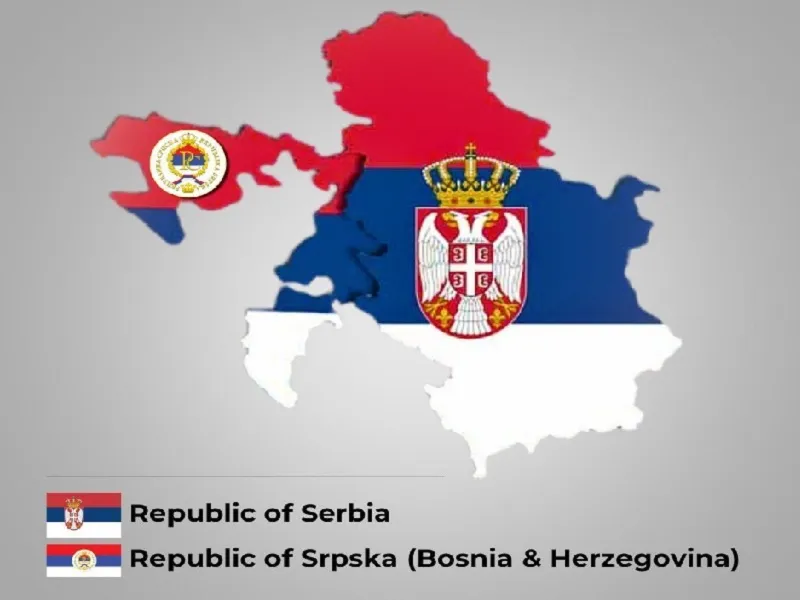
The Bosnian Croats’ reaction and that of their neighboring eponymous NATO-member state to Republika Srpska’s planned separation will be the most pivotal factor for determining whether the West resorts to military force to stop the Serbs.
President of Republika Srpska Milorad Dodik confirmed in an interview with TASS at last week’s St. Petersburg International Economic Forum that his state plans to separate from Bosnia but is proceeding very carefully in order to avoid any instability. He then met his Serbian counterpart Aleksandar Vucic in Belgrade during the Pan-Serbian Assembly there, which produced the “Declaration on the Protection of National and Political Rights and the Common Future of the Serbian People”.
That document importantly calls for their institutions to act in coordination with one another to further the Serbian people’s interests and essentially amounts to the beginning of their informal merger along the lines of the commonwealth model that Dodik briefly touched upon in his abovementioned interview. As he explained, this is a natural development that represents the historically justified aspirations of the Serbian people, which he compared to the unification of East and West Germany after the Old Cold War.
The problem is that the West is unlikely to abandon its three-decade-long failed political experiment in Bosnia, however, since the whole purpose behind artificially keeping that polity together all this time has been to divide-and-rule the Serbian people. Moreover, since Serbs are among the most Russian-friendly people anywhere in the world, Western anti-Russian hawks are likely to spin this long-overdue move as some sort of Russian plot to sow instability in the Balkans exactly as the Associated Press just speculated.
Accordingly, the odds of them respecting the UN-enshrined right of Republika Srpska’s majority-Serbian people to separate from Bosnia and unite with Serbia are low. In all likelihood, they’ll use every means at their disposal to oppose this peaceful process, especially since successfully obstructing it could then be presented as a faux victory over Russia to boost Western morale. This includes warmongering and possibly even acting on their threats to stop Republika Srpska in the worst-case scenario.
To that end, the West is expected to gaslight that it’s Republika Srpska and Serbia that are preparing for war with secret Russian support, not the West. In that way, they can reframe everything as the opposite of what it really is by swapping the roles of victims and villains like they always do, which is aimed at manipulating public opinion in their support. That’s not to say that the West will definitely resort to military force to stop Republika Srpska, but just that they’ll at least likely convey such threats to it.
That’ll be much more difficult to do though if Republika Srpska convinces its Bosniak and especially Croat counterparts from Bosnia’s other half, the Federation of Bosnia & Herzegovina, to agree to its peaceful separation. In that event, this rump state can either remain as Bosnia’s successor or bifurcate once more if the Croat part joints Croatia, thus leaving the Bosniak part as its own country. There are pros and cons to these scenarios from each of their perspectives so it’s unclear what they’ll ultimately do.
The Bosnian Croats’ reaction and that of their neighboring eponymous NATO-member state to Republika Srpska’s planned separation will be the most pivotal factor for determining whether the West resorts to military force to stop the Serbs. If they agree that this is the most pragmatic way to truly advance the best interests of Bosnia’s three constituent people and doesn’t pose a threat to the region due to the lack of Serbian claims on others, then they’re unlikely to go along with the West’s warmongering.
Another argument in favor of them letting Republika Srpska peacefully separate from Bosnia is that few want to fight a war over the future of this country. Each of its three constituent people already have their own niche where they live in safety unlike right after Yugoslavia’s dissolution. Socio-economic ties between them can therefore easily continue even in the absence of political ones. Since nobody has any claims to anyone else’s land anymore, ending this experiment wouldn’t automatically lead to instability.
Moreover, so long as the Ukrainian Conflict continues, the West’s military priority is to keep fighting Russia by proxy. Republika Srpska and Serbia’s armed forces are incomparable to Russia’s in the sense that they’d be easily defeated by NATO, but even so, another regional war would distract from the West’s military focus on Russia and lead to the further depletion of its already stressed stockpiles. It’s for this reason why their use of force to stop Republika Srpska can’t be taken for granted even if they threaten it.
One possibility is that Western military threats deter Republika Srpska from declaring independence and then merging with Serbia but that Dodik withdraws his state’s recognition of Bosnia just like Puntland withdrew its recognition of Somalia earlier this spring after a constitutional dispute. That African sub-national polity is still universally recognized as part of its UN-member state but it’s functionally independent in all respects and has been for a while already even before the latest development.
In Republika Srpska’s case, its withdrawal of recognition might be irreversible but stop short of outright secession, thus resulting in a compromise whereby it and the rest of Bosnia can go their own separate ways without any political red lines being crossed that risk provoking the West into an overreaction. During that time, Republika Srpska and Serbia could accelerate the implementation of their joint declaration, which would change the political facts on the ground and create a fait accompli.
At this point, it’s obvious that the West’s political experiment in Bosnia failed to divide-and-rule the Serbian people, who’ve begun to peacefully unite once more. The only way to stop them is to resort to force, but that would divert arms and attention from the Ukrainian Conflict, plus Croatia might not go along with it. For these reasons, observers shouldn’t assume that Western warmongering signifies another impending war, but they also shouldn’t ignore any tangible moves in this direction either.
https://korybko.substack.com/p/will-rep ... ecision-to
******
The War Racket in Germany
Posted on June 9, 2024 by Conor Gallagher
“We must be ready for war by 2029,” German Defense Minister Boris Pistorius declared last week before the Bundestag. “We must provide deterrence to prevent things coming to the worst.”
If the threat from Russia was truly so pressing, you would think preparations wouldn’t take another five years to complete. After all, it was more than two years ago that Chancellor Olaf Scholz delivered his Zeitenwende speech pledging to do just what Pistorius clamors for week after week.
In some ways, Berlin has made progress – just not in any way that actually helps to fight a war.
Germany is spending 51.8 billion euros on defense this year from its regular budget. Berlin is also drawing from a 100 billion euro emergency fund to push the total spending above the two percent of GDP target. That is the plan going forward in order to meet the two percent target and should mean that Berlin is able to hit the much-discussed target through 2028.
Despite all the endless warnings over the threat of Russian hordes rolling across Europe to the English channel, the fact is that this additional spending makes little difference in Germany’s overall military readiness to take on the Russians. What the additional money does do, however, is help further enrich a lot of (primarily American) private equity stakeholders.
The Rheinmetall Swindle
At the end of May, one of Germany’s top football clubs, Borussia Dortmund, announced a multiyear sponsorship deal with weapons manufacturer Rheinmetall – the first time a German defense company has sponsored a Bundesliga team. Europe’s largest ammunition manufacturer will now have its logo emblazoned on stadium advertising boards and in the background at press conferences.
“Security and defense are fundamental cornerstones of our democracy,” said club chair Hans-Joachim Watzke. It’s another small step in the effort to get Germans to embrace remilitarization – or at least spending money for the appearance of it. The news media constantly churns out fear pieces pushing for escalation in Ukraine and more money for defense. And as if the Greens needed more convincing, even the environment is apparently at stake.
The chief executive of tank parts maker Renk, Susanne Wiegand, said in March that German weapons companies were essential to society, “otherwise nobody will take care of windmills”.
No doubt. They’re also taking good care of their shareholders.
Rheinmetall’s share price is up more than 500 percent since the 2022 start of the war in Ukraine. That’s great news for the biggest owners of Rheinmetall, which include:
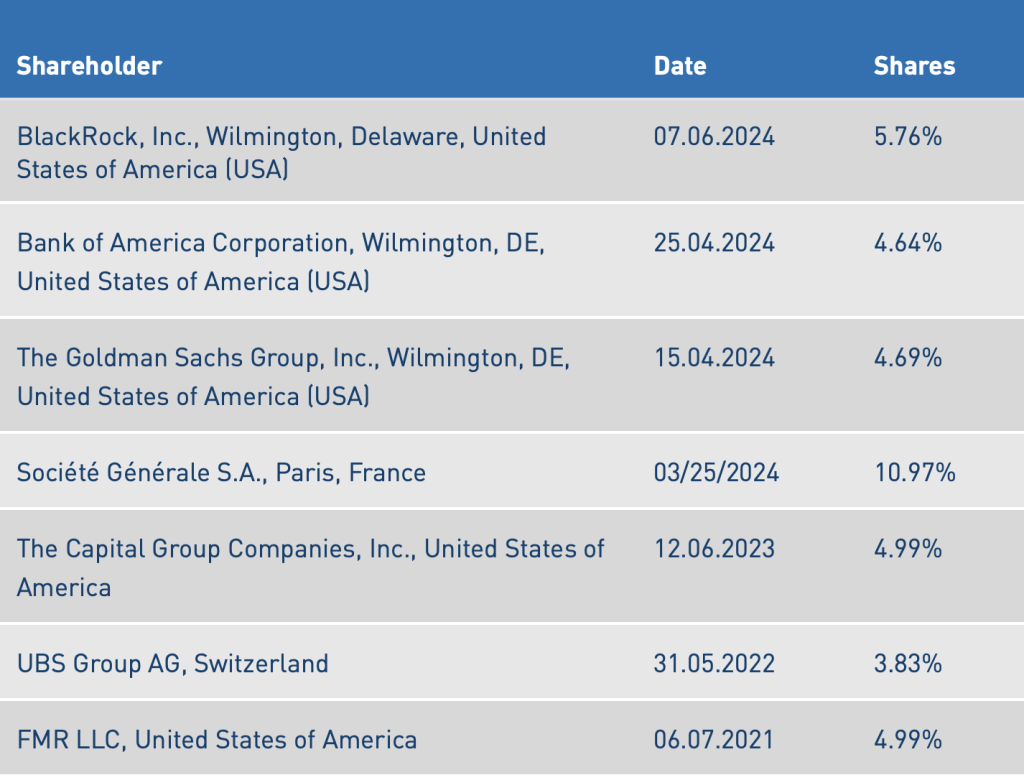
Many of these same financial outfits also benefit from Germany’s 380 contracts with US defense companies worth approximately $25 billion. Capital Group, for example, is the major owner (17 percent) of BAE Systems. But back to Rheinmetall where the future is bright.
The company’s 2024 forecast envisages an operating margin of around 14-15 percent and the topping of 10 billion euros in sales for the first time ever.
The Zeitenwende has surely been a turn, just not so much in the way it was marketed. It was supposed to mark the dawn of a new era in Europe and Germany in particular, which would undergo a massive overhaul of its armed forces in order to “deter” Russia. In reality, though, it signified Germany’s complete capitulation to US interests.
That promise is being kept.
On energy “diversification,” Berlin is now wholly reliant on buying expensive US gas as more than more than 80 percent of Germany’s LNG came from the US last year.
And while Rheinmetall specifically points to the Zeitenwende as a turning point for the company and its American owners, it has done next to nothing for Germany’s military, which largely remains a joke, especially compared to the Russians.
According to a recent report from the Bundestag’s parliamentary commissioner, German soldiers are often short of basic equipment like armored vests, winter jackets and helmets. The report reads: “Not a single field visit or conversation with servicewomen and men goes by without shortages or deficiencies being reported to me.”
Meanwhile the constant fear mongering over the Russian bear is profitable in areas where it really matters to monied interests. Reports are that Rheinmetall 155-mm shells go for anywhere from $4,000 to $8,000 a pop.
In contrast, Russia’s production costs for its 152mm shells are $600.
That gap (along with soldiers potentially freezing without winter coats) is going to be difficult to overcome – that is, of course, if deterrence and winning a war is the goal instead of simply redirecting more public money away from social programs and into the hands of private equity.
Blogger Ian Welsh recently had a brief post that succinctly summed up this conundrum. Titled You Can’t Run Industrial Policy OR A War Economy Under Neoliberalism it’s more focused on competition with China, but the point applies equally to Russia:
We can’t compete with this. It’s impossible. Not because it’s impossible in theory, but because we don’t believe in doing such things and to pursue such policies we would have to hurt rich people, a lot, and they own Congress and the Presidency and our politicians in other countries.
China has repeatedly shown that if a policy is good for the majority, but hurts the rich, they’ll do it anyway. We’ve repeatedly shown the opposite.
And you can’t run industrial policy or a war economy if you want fake profits based on not actually producing good new goods at cheap prices. It can’t be done. If an entire society is based around “give me money for the least possible effort”, you’re cooked.
For once neoliberalism might provide some good news, though. This reality that Welsh describes likely means that any talk of Germany becoming directly involved in the war against Russia is not serious. Hopefully.
‘To Be America’s Friend Is Fatal’
This is the deal you get as a US ally: let the Americans in to feast, and some of the wealthy in the home country get richer as a reward for selling out their countrymen, but for the vast majority quality of life deteriorates as the country gets strip-mined. This is coming to pass in Germany where wealth inequality is quickly widening:
Despite many years of social-democratic rule and an extensive welfare state, German wealth inequality is very high. According to SOEP survey, 39 percent of the German population has zero (or quasi zero) net financial wealth, and almost 90 percent of the population has negligible net financial wealth (reflected in the fact that monthly income received from property is less than 100 euros per person). This makes German wealth inequality (depending on the metric one uses) equal or even greater than the very high US wealth inequality.
And without a major shift in government policy, the share of the richest ten percent of Germans in total wealth is expected to rise from just over 60 percent to around 67 percent by 2027.
As the country continues to deindustrialization, and living standards decline, the private equity crowd is slowly increasing its presence across the German economy.
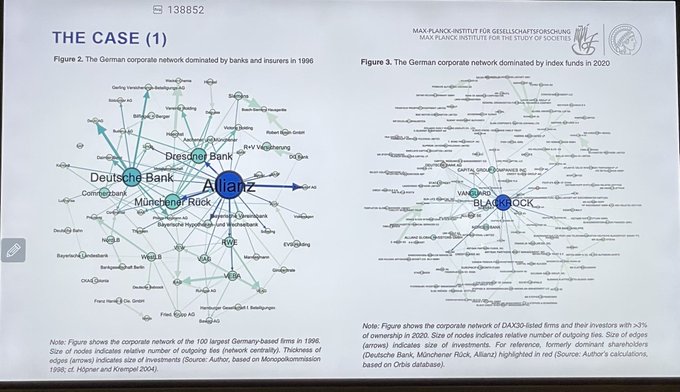
As the above shows, Blackrock, Vanguard, and Capital Group are now the three biggest players in the German economy. The three American financial services behemoths manage a combined $20 trillion worth of assets across the world.
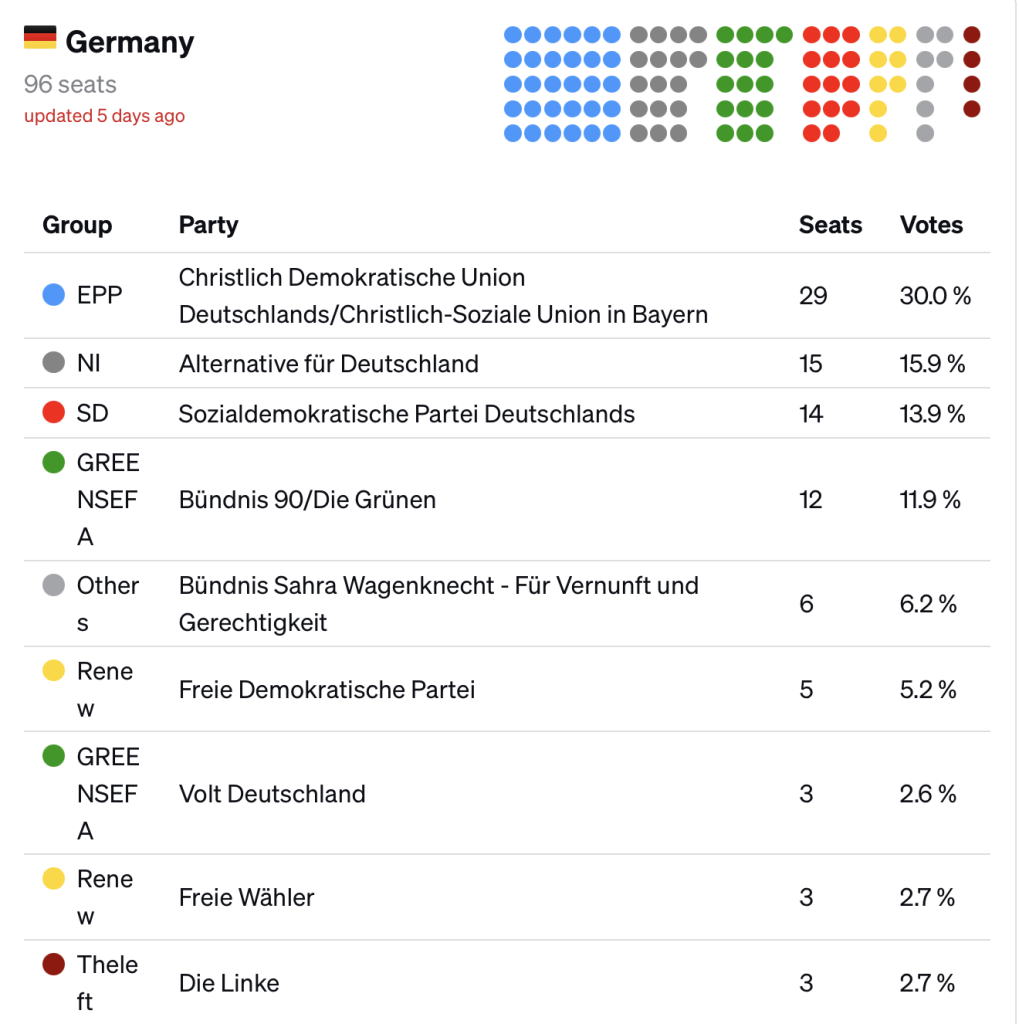
The leader of Germany’s Christian Democrats (CDU) and as of now, the odds-on favorite to be the next chancellor of Germany, Friedrich Merz, is a former Blackrock executive.
Whether he ascends to the chancellorship or not is more a matter of optics since the embrace of private equity is widely accepted by all parties now, and as finance expert Werner Rügemer says with regards to the CDU:
“The power of capital in CDU governments was always more or less hidden, and it never aspired to direct representation in the top political positions,” said Rügemer. “But that’s different with Merz. The fact that the most highly paid lobbyist of BlackRock is not just going to the chancellery and saying, ‘Please don’t make such tough laws,’ but that he himself wants to be CDU leader and chancellor — that’s the difference.”
So whether it’s Merz or someone else, should the CDU maintain its top spot in the polls, it could be an ever bigger boon for private equity, which is increasingly coming for the Mittelstand.
According to Private Equity International, medium-sized companies are increasingly being driven into the arms of private equity by a lack of funding from other sources (oddly enough, Commerzbank, which plays a key role in financing the nation’s small and medium-sized businesses, is increasingly steered by US private equity firm Cerberus, which forced out the previous CEO last year for cutting costs too slowly), as well as generational change with “a younger, more sophisticated and energetic group of management teams…hungry to work with private equity.”
Legislation coming out of Berlin and Brussels also helps, according to Jin-Hyuk Jang from Debevoise & Plimpton, a New York City law firm that specializes in private equity:
This perception shift has been supported by legislative change at both a national and EU level, according to Jang. “Politicians recognise the need for alternative financing. They understand that it can’t all come from the banks, particularly given the regulatory restrictions they face. Legislation does tend to focus on fostering the start-ups and growth markets. But there are positive knock-on effects for buyouts too, such as discussions around VAT exemption on management fees in Germany.”
According to a Reuters story last year, US law firms continue to invest in Germany, with international mergers and acquisitions, finance and private equity hires driving legal market growth in the country:
Reed Smith is the latest to add to its Munich office, roping in two partners from U.S. rival McDermott Will and Emery, including its German private equity group leader, Nikolaus von Jacobs, the firm said last week.
Other U.S. law firms have also grown in Munich, most notably Morgan, Lewis & Bockius, which opened its second German office there in March with a 19-attorney group from rival Shearman & Sterling, including its country head and M&A leader Florian Harder.
Kirkland & Ellis, McDermott, Dechert, DLA Piper, Allen & Overy, Ashurst and Dentons all added transactional partners in the Bavarian capital this year. Goodwin Procter, which launched a Munich office last year, called the city “a private equity hub.”
The finance-centric reorganization of Germany’s economy will likely have the same result it did in the US where the manufacturing was sold off to Asia – primarily China. Is it any wonder that the hollowing out of the US and its “allies” means that US “enemies” keep getting stronger?
Short Term Profits, Long Term Fallout.
Again the good news: Germany fulfilling its role as privileged political and military subcontractor of the US is not a sign that the West believes for a second all its warnings about Putin’s desires to conquer Europe.
On the other hand, the Western elites’ ineptitude is great, and there could, as always, be (unforeseen) consequences to their enrichment scheme. In order to capitalize off of the “Russian threat”, the fear mongering has been turned up to an 11 for years now, and these forces once unleashed could be difficult to control.
The defense minister, Pistorius who constantly pounds the fake war drums is the most popular member of the government. And despite it eating away at social spending, Germans want more defense spending. As Wolfgang Streeck, emeritus director of the Max Planck Institute for the Study of Societies in Cologne, writes:
The spirits invoked to bring about Zeitenwende may not easily go away when commanded to do so…There may also be specifically German factors at work. Within the Green generation, nationalism as a source of social integration has effectively been replaced, more than anywhere else in Europe, by a pervasive Manicheanism that divides the world into two camps, good and evil. There is an urgent need to understand this shift in the German Zeitgeist, which seems to have evolved gradually and largely unnoticed. It implies that, unlike in a world of nations, there can be no peace based on a balance of power and interests, only a relentless struggle against the forces of evil, which are essentially the same internationally and domestically. Clearly this bears some resemblance to an American conception of politics, shared by neocons and Democratic idealists alike, and embodied by someone like Hillary Clinton. The syndrome seems to be particularly strong on the left side of the German political spectrum, which would in the past have been the natural base of an anti-war and pro-peace, or at least pro-ceasefire, movement. Now, however, not even Die Linke would endorse the peace demonstration organized on 25 February by Sahra Wagenknecht and Alice Schwarzer, Germany’s feminist icon, at the risk of breaking the party apart and ceasing to be a political force.
Even if the creeping militarism in Germany isn’t matched by actual military capabilities, there exists the possibility that some actually believe the hype. It can be difficult to separate between profitable fear mongering and dangerous overconfidence – both of which are not in short supply across the West these days. What to make of, for example, the recent piece in Foreign Affairs arguing again that the US and its vassals can fight and win simultaneous wars in Asia, Europe, and the Middle East? Does the author really believe this or are they simply providing a service for their benefactors?
At what point does the line begin to blur?
The comparisons to Hitler’s Germany can be overdone, but one obvious similarity is that some of the key Third Reich industrialists then weren’t necessarily big believers in Nazi ideology; they were believers in making money. Similarly today, the private equity goons cashing in on the fear of Russia might not believe in any of the Russian threat, but the forces unleashed by constant Russophobia might spin out of control – if they haven’t already. Is it possible that the financial calculations of the major Germany stakeholders show that a widening of the conflict would be more profitable even is there is a sizable risk that those calculations err in their prediction of the Russian response?
And if things go south, surely the German elites, flush with cash from their role in the racket, can just relocate to a beach in Florida or join a US-based private equity board in NYC.
Some in Germany certainly seem ready to play their part:
https://www.nakedcapitalism.com/2024/06 ... rmany.html"It's not a war crime or genocide if done by an elected official," -- a German politician. We should worry about that.Adam Tooze
@adam_tooze
Germany's CDU leader Merz as usual saying the quiet stuff out loud! "The ICC is intended for despots and authoritarians not democratically elected governments ... "