Jonathan Cook: Israel Doesn’t Care About the Captives
March 20, 2025
The Netanyahu regime always planned to reboot the genocide. From here on, Trump and his administration must be held responsible for every Palestinian death.
Palestinians returning to Gaza after ceasefire, January 2025. (UNRWA /Wikimedia Commons / CC BY 4.0)
By Jonathan Cook
Jonathan-Cook.net
The excuses has Israel given for renewing the genocide:
1. Israel says it is trying to force Hamas to release the captives in Gaza.
Yet, as we know from those already released, the indiscriminate bombing of Gaza only increases the chances the captives will be killed. There is no plausible scenario in which dropping U.S.-supplied 2,000-pound bombs across Gaza makes any Israeli held in the enclave safer or brings them home sooner.
In any case, there was a known and easy way for Israel to get the last of the captives back. They were due to be freed in the second phase of the ceasefire agreement, already well past its implementation date. But weeks ago Israel decided to tear up the agreement it had signed and impose new terms in which the rest of the captives would have to be returned — and without Israel either ceasing its fire or withdrawing from the enclave, as it had agreed to do.
What Israel’s return to genocide shows is that the Israeli government would rather kill the remaining captives — vaporising them with Trump’s latest shipment of 2,000-pound bombs — than either make a concession to secure their release or place any limitation on its ability to slaughter the people of Gaza.
2. Israel claims Hamas was re-arming and planning a new attack.
As ever, Israel is inverting the truth. It was Israel that was re-armed by the Trump administration with the bombs now tearing apart Gaza’s children. Hamas — isolated from the outside world — had no obvious route to re-arming.
And as for plans for another Oct. 7, both Hamas and the world were shocked its fighters managed to break out of the tiny, besieged territory of Gaza the first time. Hamas assumed it would be a suicide mission. It succeeded only because Israel had grown so complacent in its 17-year siege of the enclave, it imagined the 2.3 million people there were permanently entombed.
Israel’s assumption was the Palestinians would never manage to find a way out of the giant concentration camp Israel had built for them. Israel will not likely drop its guard again any time soon.
In other words, Israel is flat-out lying about its reasons for renewing the slaughter. It is lying as it has done over and over again, throughout the past 18 months.
Israel always intended to reboot the genocide as soon as the Trump administration had been able to take credit for negotiating the ceasefire. Then they could work together to concoct a new set of pretexts — based on lies about who was violating the ceasefire — to justify why more of Gaza’s children needed to be murdered.
Certainly, Joe Biden and his officials must be put on trial in the Hague for the first 15 months of the genocide. But it is Trump and his administration that are responsible for every Palestinian death from here on out.
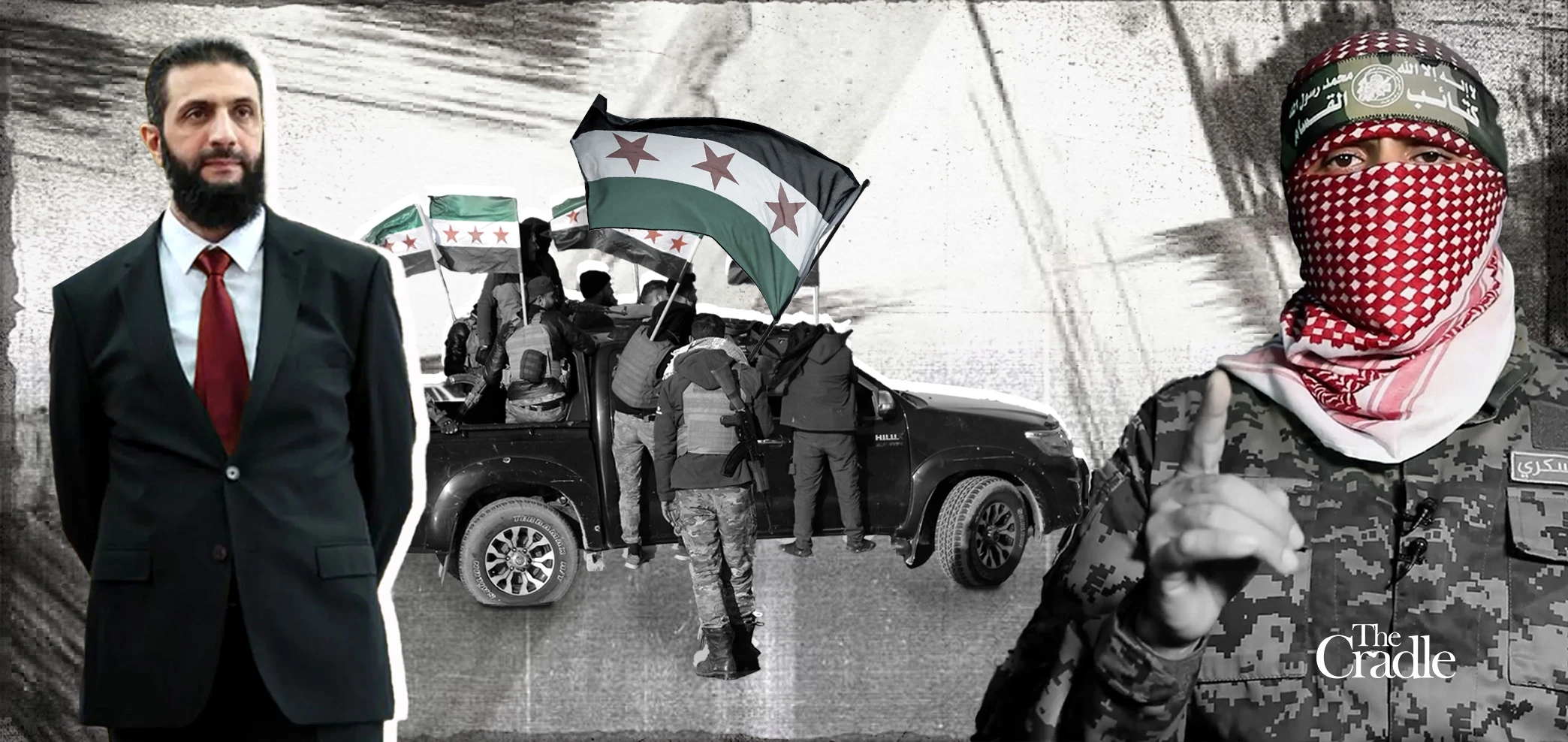
The battle between ‘Greater Israel’ and "Neo-Ottomanism" in Syria
As Israel escalates its warnings about Turkiye’s hegemonic ambitions and military influence in Syria, a once-strategic partnership is unraveling into a deep rivalry that could reshape the region.
Mohamad Hasan Sweidan
MAR 20, 2025
Photo Credit: The Cradle
In January, Israel’s Security and Force Building Budget Examination Committee – known as the Nagel Committee, after its chairman Yaakov Nagel – released a report highlighting the potential security threat posed by a Syrian–Turkish alliance.
The committee warned that this emerging axis could evolve into an even greater challenge than Iran, and concluded that Israel should prepare for a direct confrontation with Turkiye, citing Ankara’s ambitions to restore Ottoman-era influence.
Less than two months after the report’s release, the Israeli military launched new Turkish-language accounts on social media platforms X and Telegram, expanding its outreach to seven languages: Hebrew, English, Arabic, French, Spanish, Persian, and now Turkish. The move raises a critical question: Has key trading partner Turkiye become a direct threat to Israel?
From partners to rivals
In geopolitics, alliances are often temporary, dictated by mutual interests rather than ideological alignment. Israel and Turkiye once shared strategic cooperation in the 1990s and early 2000s, with extensive military and intelligence ties.
At the time, both states saw Iran and Syria under Assad family rule as common adversaries. However, as regional dynamics shifted, latent competition between the two emerged. Today, Ankara and Tel Aviv find themselves on opposite sides of Syria’s postwar restructuring, each viewing the other as a direct rival.
In other words, two countries can be official allies – or at least non-enemies – and yet compete for regional hegemony. This reality leads to potential tensions and conflicts, because each side seeks to consolidate its own influence and is seen as a threat to the other. The relationship between Turkiye and Israel exemplifies this overlap between shared interests – such as containing Iran – and conflicting ambitions, creating a delicate balance between cooperation and competition. Alliances are not static entities but evolve as strategic calculations change, especially when a political vacuum – as in post-former president Bashar al-Assad Syria – lures powers aspiring to regional hegemony.
Brookings Institution visiting fellow Asli Aydintasbas notes that while Turkiye and Israel previously compartmentalized their security cooperation and political differences, they are now actively working to undermine one another:
“Syria has become a theater for proxy warfare between Turkiye and Israel, which clearly see each other as regional competitors … This is a very dangerous dynamic because in all different aspects of Syria’s transition, there is a clash of Turkish and Israeli positions.”
Following the wars in Gaza and Lebanon, Israel’s pursuit of regional dominance, bolstered by unconditional US support, has alarmed Washington’s allies – including Turkiye. Turkish analysts caution that this path could trigger broader regional resistance, escalating tensions across West Asia.
Israel’s perspective: The Turkish threat in Syria
Israel perceives Turkiye’s increasing influence in Syria as a direct threat on its northern front. Israeli officials worry that post-Assad Syria, aligned with Ankara, could eventually foster an extreme “Sunni Islamist” dominated government hostile to Tel Aviv.
This concern is particularly striking given Israel’s past support for Syrian opposition factions, including the Hayat Tahrir al-Sham (HTS) militants now governing Damascus. Initially, Israel saw these groups as a counterweight to Iranian influence. However, with Assad’s ouster, uncertainty looms over the long-term implications of their rule.
In early 2025, an Israeli security committee warned that an extremist Sunni-Islamist-oriented Syria affiliated with the Turkish axis could pose a greater threat than the Iran-allied Assad government. “Israel may face a new threat of an extremist Sunni force that refuses to recognize Israel's existence in the first place,” the committee's report said, noting that this threat “may be no less serious” than the threat posed by the Iran–Hezbollah axis.
Adding to Israeli anxieties is the prospect of northern Syria becoming a sanctuary for armed groups hostile to Israel. Ankara’s ties with Hamas have raised alarms in Tel Aviv, with Israeli intelligence fearing that Turkish-controlled Syrian territory could serve as a base for future attacks. Consequently, Israel has pressured Washington to maintain sanctions on Syria, arguing that Turkish protection of the new Syrian government could embolden anti-Israel factions.
Turkiye’s gains and Israel’s strategic calculations
Beyond Syria, Israel views Turkiye as an emerging regional adversary with expansionist aspirations. Under President Recep Tayyip Erdogan, Turkiye has projected military power across Iraq, Libya, and the Eastern Mediterranean. Now, its deepening foothold in Syria further alarms Israeli Defense Ministry officials, who see Ankara’s actions as part of a broader neo-Ottoman agenda.
Turkiye is also mentioned 15 times in the Nagel Commission report, which warns that turning the Syrian army into a "Turkish proxy" could lead to “A radical change” in the nature of relations between Tel Aviv and Ankara, and may even portend a direct confrontation between the two states. By supporting armed factions rising to power in Damascus, the Israelis believe that Turkiye is turning Syria into a vassal state, replacing Iran as a dominant power, which is deeply worrying for the leadership in Tel Aviv. According to a report by Israel Hayom, the rise of Turkish-backed factions to power in Damascus has caused “sleepless nights” for Israel's leaders, who are now making Turkish activities in Syria one of their top security priorities.
Israel is also watching, with growing concern, Turkiye's military expansion in Syria and Ankara's advanced armaments capabilities. An analysis by Israel's Alma Center for Research in February warned that Turkiye could one day support an extremist Sunni proxy against Israel or provide direct support to the new Syrian army in any potential confrontation with Israel. Turkiye's growing arsenal of missiles and drones poses a direct threat, which requires Israel to reassess its military calculations, especially with NATO's second-largest army close to its borders.
Israel seeks regional hegemony, with no competition
While Israel frames its concerns around Turkiye’s influence, its actions in Syria reflect a broader strategy aimed at regional domination. Historically, Israeli policymakers have sought to weaken neighboring Arab states, creating a fragmented West Asia that ensures Israel’s security and strategic ambitions.
The concept of “Greater Israel,” often dismissed as fringe rhetoric, has nonetheless influenced Israeli strategic thinking. As Israeli scholar Yitzhak Shahak argued, Zionist ideology envisions an expanded Israeli state with borders shaped by biblical narratives. This vision aligns with the infamous 1982 Yinon Plan, which advocated for the partition of neighboring countries along sectarian lines to facilitate Israeli control.
Tel Aviv's rush for expansionism is evident in its actions on the ground inside Syria. After the fall of the Assad government, Israel quickly expanded its buffer zone in the south, bypassing the borders of the occupied Golan Heights. While Israeli officials have justified the move as necessary to "ensure security," the permanent infrastructure being built – from military sites, roads, and even settlements – reveals a more ambitious agenda. Israel has always taken advantage of the opportunities created by the vulnerabilities of its enemies, and has never abandoned the dream of expanding its borders whenever and wherever it has the opportunity.
Israel’s tensions with Turkiye over Syria can only be fully understood within the broader context of its regional aspirations. Whether confronting Iran, Turkiye, or Arab states, Israel’s primary objective remains unchanged: maintaining regional dominance by leveraging instability to its advantage.
As Ankara asserts its influence in Syria, Tel Aviv perceives a dual threat: one immediate, with armed factions potentially targeting Israel, and another long-term, with Turkiye emerging as a powerful regional competitor. Israel’s strategic response, from lobbying Washington to maintaining Syrian sanctions to expanding military presence in the north, reflects a calculated effort to counter both threats.
Ultimately, the contest between Israel and Turkiye in Syria is not just about post-war arrangements; it is a microcosm of a larger struggle for regional supremacy. As both states maneuver to shape the future of West Asia, their rivalry is poised to redefine the region for years t
Israel approves oversight body for Trump's Gaza plan, grants independence to 13 West Bank settlements
Israel is accelerating plans both to ethnically cleanse Gaza and to expand Jewish settlements in the West Bank in preparation for annexation
News Desk
MAR 23, 2025
(Photo credit: Mohammed Dahman / Associated Press).
Israel's security cabinet approved a plan submitted by Defense Minister Israel Katz to establish a new administration in the Defense Ministry tasked with enabling Palestinians to "voluntarily" leave Gaza, Israeli media reported on 23 March.
In a statement, Katz's office says the new directorate will work to "prepare for and enable safe and controlled passage of Gaza residents for their voluntary departure to third countries, including securing their movement, establishing movement routes, checking pedestrians at designated crossings in the Gaza Strip, as well as coordinating the provision of infrastructure that will enable passage by land, sea, and air to the destination countries."
The statement claimed that the efforts to enable Gazans who seek to migrate from the strip to do so are being carried out "subject to Israeli and international law and in accordance with the vision of US President Donald Trump."
"We are working with all means to implement the US president's vision, and we will allow any Gaza resident who wants to move to a third state to do so," Katz says.
Rights groups have stated that Trump's plan is illegal under international law and amounts to ethnic cleansing.
Gaza, January 2025. (Jaber Jehad Badwan / Wikimedia Commons/ CC BY-SA 4.0)
By M. Reza Behnam
Z-Network
The philosophical belief that certain rights are inherent and inalienable by virtue of human existence becomes harsh reality when they are denied. This is especially salient for the people of Palestine, who have had to struggle for their inalienable rights for more than a hundred years.
The violation of their human rights really began on Friday, Nov. 2, 1917, when British foreign secretary and Christian Zionist, Arthur James Balfour, put his signature to a letter addressed to British Jewish banker, Lionel W. Rothschild, promising the land of Palestine to the Zionist Federation in Europe. With that, the ongoing catastrophe began.
Balfour Declaration as published in The Times, Nov. 9, 1917. (The Times of London, Wikimedia Commons, Public domain)
By the end of the 1967 War, Israel had seized the whole of historic Palestine. In addition to the ill-fated dispossession of their homeland, Palestinians also suffered the loss of their political community and the protections it provided.
Twentieth century political theorist, Hannah Arendt (1906-75), understood that there is no guarantee of human rights outside the higher authority of the political community. She characterized statelessness as the very absence of the “right to have rights,” noting that statehood is a precondition for the protection of other human rights. Citizenship, Arendt reasoned, provided the legal protections and rights conferred by a functioning state, making individuals less vulnerable to the abuse of their rights.
Israel, with unlimited support from the United States, has made sure that a Palestinian state, with the legal status to protect its citizens, never becomes a reality. Try as they may, however, they have been unable to steal Palestinian dignity or destroy their resolve to have the “right to have rights.”
Universal Human Rights
Human rights have been defined as fundamental freedoms, entitlements and privileges that belong to every person by virtue of being human. They are a recognition of the inherent dignity and worth of every person, allowing people to live free from fear and to flourish.
It took the horrors and abuses of the Second World War to thrust human rights onto the global stage and conscience. It was propelled by a desire to ensure that there would “never again” be another genocide and that no one be denied life, freedom, justice, food, shelter and nationality. For that purpose, the United Nations was founded in October 1945 and the Universal Declaration of Human Rights (UDHR) was adopted in December 1948. It has become the widely accepted foundation of international human rights law.
t. 7, 2023, insurrection, Israel has massacred a reported 48,964 Gazans, an additional 62,413 have died from forced starvation and 14,000 are missing. During that same time, Israel killed 896 Palestinians in the Occupied West Bank and East Jerusalem. And more than 400 have been slaughtered in Gaza since Israel breached the January ceasefire agreement and resumed its genocide.
Amnesty International, Human Rights Watch, B’Tselem and numerous U.N. agencies have left little doubt that Palestinians, under Israel’s apartheid military rule, have been deprived of the essential rights described in the Declaration.
Because Palestinians are stateless, Articles 16, 21 through 24 cannot be applied:
they are not “born free and equal” (Article 1,2 and 3)
they have been “subjected to torture, inhumane and degrading treatment and punishment” (Article 5)
they are not “equal before the law” (Articles 6 to 11)
they are “subject to interference in privacy, family and home” (Article 12)
they have no “freedom of movement” (Article 13)
they have been “deprived of their nationality” (Article 15)
they are “arbitrarily deprived of property” (Article 17)
they do not the “right to freedom of thought, conscience, opinion, expression and religion” (Articles 18 and 19)
they are not “free to peacefully assemble and participate in the cultural life of the community” (Article 20 and 27)
they are unable to “pursue an adequate standard of living, education and health care” (Article 25 and 26)
Routinely, Palestinians in Gaza and in the occupied territories are subjected to systematic state-organized forced displacement and human rights offenses. They have never been free of arbitrary violence, the most basic of human rights. Following are two recent examples among decades of Israeli malevolences:
The U.N. Independent International Commission of Inquiry on the Occupied Palestinian Territory released a report in March accusing Israel of the systematic use of sexual, reproductive and other gender-based violence since October 2023 in order to “dominate, oppress and destroy the Palestinian people in whole or in part.”
Israel’s targeted attacks on the health care system in Gaza are a blatant violation of international humanitarian and human rights laws.
Demonstrator carries poster with photos of Palestinian healthcare workers killed in Gaza during demonstration in Cardiff, Wales, on Nov. 25, 2023. (OwenBlacker, Wikimedia Commons, CC0)
As of September 2024, according to the World Health Organization, 22,500 Gazans had sustained life-altering injuries due to Israel’s indiscriminate use of explosive weapons. In addition to severe limb injuries, they noted amputations, spinal-cord trauma, traumatic brain injuries and major burns. The United Nations noted that Gaza has the highest number of child amputees in the world.
It is worth noting that the United States has begun to feel the impact of its uncritical support for Israel’s numerous violations of international and humanitarian law and its horrific violence against the Palestinians. Clarence Darrow, famed ACLU attorney, noted for his defense in the 1925 Scopes Trial, was correct to point out that, “You can only protect your liberties in this world by protecting the other man’s freedom. You can only be free if I am free.”
The safeguards that have long protected Americans’ right to speech, assembly and liberty are being eroded on behalf of Israel.
Using trumped-up accusations of anti-Semitism and terrorism —straight from the Israeli playbook — the Trump administration has begun its witch-hunt against pro-Palestinian activists and its campaign to crush legitimate criticism of Israel.
The kidnapping of Columbia student and permanent U.S. resident Mahmoud Kahlil is representative of that erosion. On the evening of March 8, he was arbitrarily arrested (without a warrant) by Immigration and Customs Enforcement agents in New York, detained in New Jersey, then secretly moved to a detention facility in Louisiana, denied contact with family and lawyers, and threatened with deportation. He continues to be incarcerated even though he has not been charged with a crime. Since his unlawful arrest, Leqaa Kordia, another Palestinian student attending Columbia, has also been detained and faces deportation.
Kahlil’s “offense” and that of others facing deportation, university expulsion or suspension was to criticize and protest Israel’s genocide in Gaza. President Donald Trump has threatened to arrest all international students who participate in pro-Palestine protests, disregarding their First Amendment rights.
The arbitrary arrests and absence of due process currently taking place in the United States glaringly resemble what Palestinians have known under Israeli military occupation for eight decades. Amnesty International found that Israel has systematically used administrative detention, often prolonged and without charge or trial, as a tool to persecute Palestinians.
Washington’s heavy-handed response to U.S. critics of Israel and Tel Aviv’s contempt for Palestinian human rights have revealed how similarly aligned the two regimes are. The so-called peace accords and normalization agreements have merely solidified Israel’s stranglehold over Palestine and intensified its systematic determination to completely extinguish Palestinian freedom and self-determination.
The United States has strayed far afield since President Jimmy Carter declared America’s dedication to human rights; stating in his Jan. 20, 1977, inaugural address:
“Because we are free, we can never be indifferent to the fate of freedom elsewhere. Our moral sense dictates a clear-cut preference for those societies which share with us an abiding respect for human rights.”
Interestingly, the Carter administration’s “moral sense” led it to criticize the human rights abuses of the former Soviet Union, Uganda and the like, but not Israel; granting “exceptionalism” to one of the worst abusers. It was only after leaving office, and less fearful of the Israeli lobby, that he spoke freely about Israel’s “abiding disrespect for human rights,” explicated in his 2006 book, Palestine Peace Not Apartheid.
It is the irony of our times that the oldest written sources to address human rights emerged from West Asia — the Cyrus Cylinder (539 B.C.) from Persia, the Avesta of Zoroastrianism (the first link to monotheistic religions), the Babylonian Code of Hammurabi, the Bible and Quran — while today it is the site of some of its worst offenses. The goal of the Universal Declaration of Human Rights was to establish a more humane world; consequently, there is an inherent responsibility within it to protect the oppressed. Currently that means protecting Palestinians’ right to have rights, thereby safeguarding our own liberties.
M. Reza Behnam is a political scientist specializing in the history, politics and governments of the Middle East.
This article is from Z-Network.
The views expressed are solely those of the author and may or may not reflect those of Consortium News.
Tags: 1967 War Arthur Balfour Clarence Darrow Columbia University Hannah Arendt James A. Balfour Leqaa Kordia Lionel W. Rothschild M. Reza Behnam Mahmoud Khalil Scopes Trial U.N. Independent International Commission of Inquiry on the Occupied Palestinian Territory U.S. Immigration and Customs Enforcement (ICE) Universal Declaration of Human Rights Zionism
How Syria's HTS is quietly dismantling the Palestinian cause
Under Ahmad al-Sharaa's direction, Syria’s new Islamist leaders are systematically sidelining Palestinian factions, favoring the US-backed PA, dismantling Iran-linked groups, and reshaping refugee dynamics in alignment with a broader US-backed strategy to neutralize the Palestinian resistance.
The Cradle's Palestine Correspondent
MAR 25, 2025
Photo Credit: The Cradle
Since the fall of the Syrian government on 8 December, the direction of the new interim administration, headed by Ahmad al-Sharaa, has become increasingly clear. Politically, militarily, and legally, Damascus now appears aligned with Washington’s long-standing vision of dismantling the Palestinian cause.
This alignment is taking shape on three key fronts: first is the Palestinian Authority (PA), resistance factions such as Hamas, the Palestinian Islamic Jihad (PIJ), and other factions splintered from the Palestine Liberation Organization (PLO). Second, is the UN Relief and Works Agency (UNRWA) tasked specifically to aid Palestinian refugees in the region, and third, are the camps housing Palestinian refugees and displaced Syrians.
Two developments underscore this shift. First, both Turkiye and Lebanon have blocked Palestinians holding Syrian documents from returning to Syria on the same basis as Syrian nationals. Second, US media has revealed ongoing talks between Washington and Damascus over the possibility of Syria absorbing tens of thousands of displaced Gazans, in exchange for sanctions relief or a broader political arrangement, particularly in the aftermath of the Coastal Massacres earlier this year.
Front 1: The PA and the resistance factions
More than four months into the transition to new governance, one thing is clear: former Al-Qaeda affiliate leader Ahmad al-Sharaa, now Syria's president, is keeping Hamas at arm’s length. Despite repeated requests by Khaled Meshaal – head of Hamas’s political bureau abroad – to visit Damascus, the interim authorities have stalled, aiming to avoid direct confrontation with Israel or the US.
This new Syrian posture takes place in the midst of an ongoing genocide against the Palestinian people and the occupation state's aim to eliminate their Islamic resistance.
The Cradle has learned that communication between Hamas and the new authorities is largely being channelled through Turkish intermediaries. Ankara is reportedly facilitating the relocation of several Hamas military officials to Idlib, the stronghold of Sharaa's Hayat Tahrir al-Sham (HTS) militants.
In contrast, Sharaa – who met with Palestinian Prime Minister Mohammad Mustafa in January – has formally opened channels with the PA’s diplomatic mission in Damascus, recognizing it as the official representative of the Palestinian people.
The visiting delegation included senior officials from Fatah and the PLO, most notably Mahmoud Abbas’s son, who arrived to reclaim properties previously held by anti-Fatah factions under former Syrian president Bashar al-Assad’s government.
On the night the Assad government collapsed, Popular Front–General Command (PFLP-GC) Secretary-General Talal Naji and Palestine Liberation Army (PLA) Chief-of-Staff Akram al-Rifai sought refuge at the PA embassy. Palestinian ambassador Samir al-Rifai reportedly received a sharp rebuke from Abbas for granting them shelter. As for the rest of the faction leaders, each of them remained at home.
The day after HTS forces entered Damascus, they launched a wave of closures targeting Palestinian faction offices. Those belonging to Fatah al-Intifada, the Baath-aligned Al-Sa'iqa movement, and the PFLP-GC were shuttered, with their weapons, vehicles, and real estate seized.
The Democratic Front for the Liberation of Palestine (DFLP), which had maintained a lower profile during the Syrian war, was allowed to continue operating – though under observation.
On 11 and 12 December, several faction leaders convened at the Palestinian embassy in the presence of PLA leader Rifai to discuss their future. They attempted to arrange a formal meeting with Sharaa via Syria’s Foreign Ministry. Instead, a messenger from HTS – identified as Basil Ayoub – arrived at the embassy and demanded full disclosure of all faction-owned assets, including real estate, bank deposits, vehicles, and weapons. No political engagement would be possible, he said, until a comprehensive inventory had been submitted.
The factions complied by drafting a letter declaring that their holdings were lawfully acquired and that they were prepared to limit their activity to political and media outreach, in full alignment with Syria’s new posture. The fate of the letter to Sharaa and its response are unknown.
Decapitation campaign: arrests, confiscations, and settlements
What followed was a systematic decapitation of the Palestinian factional structure in Syria.
In early February, Fatah al-Intifada’s Secretary-General Abu Hazem Ziad al-Saghir was arrested at his home. After hours of interrogation and a raid on his office – where documents reportedly linked him to Iran’s Islamic Revolutionary Guard Corps (IRGC) – he was released.
A week later, he was re-arrested and held at a newly established detention site behind the Abbasid Stadium. A financial settlement was reached: $500,000 in exchange for his release and deportation to Lebanon. At the request of the committee, the movement's Central Committee issued a statement terminating Saghir's duties and dismissing him from the movement. However, Saghir issued a counterstatement from Lebanon, transferring the movement's General Secretariat there and dismissing those who had made the decision to remove him.
The Palestinian Baathist faction, Al-Sa'iqa, fared no better. Its Secretary-General Muhammad Qais was interrogated and stripped of the group’s assets. Though he was not in command during the Battle of Yarmouk and thus escaped harsher punishment, HTS ordered the removal of the term “Baath” from all official materials. A statement soon emerged from within the occupied territories denouncing Qais as a “regime remnant,” suggesting a growing internal split.
HTS also clamped down hard on the PFLP-GC, whose Secretary-General, Talal Naji, was placed under house arrest and interrogated multiple times. All the group’s offices, vehicles, and weapons were confiscated, their headquarters shuttered, and its members beaten and humiliated. Their radio station, Al-Quds Radio, was seized, and their Umayyah Hospital is reportedly next in line.
The “Nidal Front” – a breakaway faction of the Palestinian Popular Struggle Front (PPSF), a left-wing group within the PLO – was the most controversial of its dealings. At the beginning of the events, Khaled Meshaal was able to mediate for the Front's Secretary-General, Khaled Abdul Majeed, and protect him and his organization. However, in February, Abdul Majeed fled to the UAE.
His personal residence and vehicles – reportedly privately owned – were seized along with 50 million Syrian pounds (less than $5,000) in assets. Forced to resign by HTS, he handed over authority to a central committee operating out of Damascus and Beirut.
The DFLP has so far escaped the brunt of these purges, and its offices and vehicles remain untouched by the new administration, possibly because it had no ties to Iran or Hezbollah. The Popular Front for the Liberation of Palestine's (PFLP - different from the PFLP-GC) main office in the Taliani area of Damascus remains open but inactive, while the rest of its offices have been shut down.
As of now, the PIJ, whose fighters have been on Gaza's frontline battling Israel since 7 October 2023, remains in its Syrian offices. The faction's representative has not been summoned for questioning, despite Israel bombing an apartment used by the group's Secretary-General, Ziad al-Nakhala.
However, key PIJ military figures relocated to Baghdad on the night Damascus fell to HTS. Their activities inside Syria appear largely to have been reduced to conducting funerals for fighters who were killed in battle in southern Lebanon, albeit exclusively inside Palestinian refugee camps.
The Yarmouk camp in Damascus had already witnessed a series of protests in the first days of February, most notably gatherings demanding the closure of the headquarters of pro-regime organizations and the accountability of those involved in the arrest and killing of camp residents. The events escalated into an attempt to set fire to the headquarters of the PIJ's Quds Brigades, with some youths and children throwing firecrackers at the building. Meanwhile, a demonstration erupted in protest against the decision to reopen the offices of the Al-Sa'iqa brigades in the Al-A'edin camp,
Front 2: Palestinian refugee camps in Syria
The crackdown on political groups has created a leadership vacuum in Syria’s Palestinian camps. Living conditions – already dire – have deteriorated further. In early February, protests erupted in several camps over Israel's brutal attacks on the occupied West Bank's Jenin Camp, following the PA delegation’s visit and the Syrian government’s formal recognition of Ramallah’s authority. Many feared this shift would accelerate plans for permanent resettlement of the refugees. At the same time, residents say they were coerced into public rallies in support of Sharaa’s self-declared presidency.
On 24 February, the Community Development Committee in Deraa began collecting detailed personal data from camp residents under the pretext of improving service delivery. A similar census was launched days earlier in Jaramana, but the purpose and funders of these efforts remain unclear.
Into this vacuum stepped Hamas. Through affiliated organizations like the Palestine Development Authority, Hamas began distributing food and financial aid, often via operatives embedded within HTS. This effort came as services once offered by the PIJ – including transportation, communal kitchens, and medical support – were halted. Even the Palestinian-Iranian Friendship Association’s headquarters in Yarmouk was taken over and repurposed by HTS elements.
Other actors, such as the Jafra Foundation and the Palestinian Red Crescent, continue to operate despite significant constraints. Their efforts have been insufficient to meet demand, particularly as the local economy continues to collapse. Most refugees rely on informal work, and with much of the economy paralyzed, daily survival has become precarious.
Of particular concern is a reported settlement proposal, conveyed through Turkish mediation. It allegedly offers Palestinians in Syria three options: Syrian naturalization, integration into a new PA-affiliated “community” under embassy supervision, or consular classification with annual residency renewals. The implicit fourth option is displacement, mirroring what happened to Palestinians in post-US invasion Iraq.
Front 3: UNRWA, sidelined and undermined
Though the new Syrian authorities have not openly targeted UNRWA, their lack of cooperation speaks volumes. UNRWA no longer appears to be viewed as the primary institution responsible for Palestinian affairs in Syria.
In Khan Eshieh Camp, a local committee working with the new administration petitioned the Damascus Governorate to prepare a municipal plan for rehabilitating the camp’s infrastructure. The implication was clear: Syrian authorities are preparing to take over camp management from UNRWA, following the Jordanian model.
Meanwhile, the Immigration and Passports Department resumed issuing travel documents for Palestinian refugees in January, a bureaucratic move that revealed the new government’s intention to reassert control. Around the same time, the Palestinian Arab Refugee Association in Damascus suspended its operations following a break-in that reportedly disrupted pension payments to retired refugees.
Despite limited resources, Hamas and the PIJI remain a point of concern for the occupation state. A recent Yedioth Ahronoth report claimed that both groups are attempting to rebuild military capacity inside Syria, with the intention of targeting settlements near the occupied Golan Heights and northern Galilee. While the report acknowledged no confirmed troop movements south of Damascus, it warned that operational planning is underway.
A close examination of Sharaa's behavior and the new regime in Damascus reveals no apparent dissolution of these two organizations' operations, as the Israelis claim. All that is taking place are temporary measures until a “big deal” is reached with the Americans, one of whose provisions will be the official and popular status of the Palestinians. Unless the country descends into chaos, one of the expected outcomes will be a clear Israeli ground military intervention under the pretext of removing the Palestinians from the border.
West Bank refugee camps 'reduced to ruins and dust': MSF
Over 40,000 Palestinians have been forcibly displaced from their homes in refugee camps by Israeli forces since the start of 'Operation Iron Wall' in January
News Desk
MAR 24, 2025
(Photo credit: Marcus Yam/ LA Times)
The French medical aid group, Doctors Without Borders (MSF), warned on 24 March that tens of thousands of displaced Palestinians in northern parts of the occupied West Bank are living in a “precarious situation” without proper shelter, essential services, and access to healthcare.
Over 40,000 Palestinians have been forcibly displaced by Israeli occupation forces from their homes in the Jenin, Tulkarem, and Nour Shams refugee camps since the launch of ‘Operation Iron Wall’ in January.
“This scale of forced displacement and destruction of the camps has not been seen for decades,” Brice De Le Vingne, MSF director of operations, said.
“People are unable to return to their homes as Israeli forces have blocked access to the camps, destroying homes and infrastructure,” he added.
Abdel, a resident of Jenin camp, told MSF that “Drones were flying over the houses, ordering the residents to get out.”
“They always destroy things, but nothing like this has ever happened before,” he went on to say.
De Le Vingne added that the “Camps have become ruins and dust,” demanding that Israel stop its ongoing military operations in the occupied West Bank and allow humanitarian aid to reach desperate displaced persons.
“The (Israeli) army raided our house and ordered us to evacuate,” Issam, a resident of Nour Shams Camp, told MSF. “We weren’t allowed to take anything with us – not even our documents.”
“All we received was the warning: ‘Get out,’” Abdel said. “Displacement is suffering, a silent anguish, a deep pain in the heart for everyone. You see the tears in people’s eyes, but we hold them back.”
And in the Occupied West Bank, Israeli forces are planning to demolish 180 more Palestinian homes.
95 of them are in the Jenin Refugee Camp.
The siege on the West Bank has been ongoing for months, displacing tens of thousands of Palestinians. pic.twitter.com/2bsaYJwRdr
— Hamdah Salhut (@hamdahsalhut) March 21, 2025
MSF also reported that Israeli forces are denying medical aid to Palestinians in the occupied West Bank, saying its teams on the ground “have witnessed the systematic pattern of oppression by Israel on health workers and patients.”
The medical aid group stated that the mental health situation is alarming, with many patients suffering from stress, anxiety, and depression due to the violent and unpredictable nature of incursions and displacement.
“People don’t know what has happened to their homes and have suffered immense losses, including their sense of purpose,” says Mohammad, an MSF community health educator.
According to the World Health Organization (WHO), 930 Palestinians have been killed, including 187 children, in the occupied West Bank since October 2023, when Israel’s war on Gaza began.
Israel’s military campaign in the occupied West Bank comes as it works toward expanding illegal Jewish settlements in the Palestinian territories, the UN Human Rights Office stated in a report issued on 18 March.
“Israel must immediately and completely cease all settlement activities and evacuate all settlers, stop the forcible transfer of the Palestinian population, and prevent and punish attacks by its security forces and settlers,” UN High Commissioner Volker Turk said in a statement on Tuesday.
“The transfer by Israel of parts of its own civilian population into the territory it occupies amounts to a war crime,” Turk added.
The report said that between 1 November 2023 and 31 October 2024, there had been a “significant” expansion of Jewish settlements in the occupied West Bank, including East Jerusalem.
It also cited reports from Israeli NGOs indicating that tens of thousands of new housing units are scheduled to be built in new or existing settlements.
Over 270 Palestinian children killed in one week by Israel in Gaza
Nearly 18,000 children have been killed by Israel in Gaza since the start of the US-sponsored genocide of Palestinians in October 2023
News Desk
MAR 25, 2025
(Photo Credit: Getty Images)
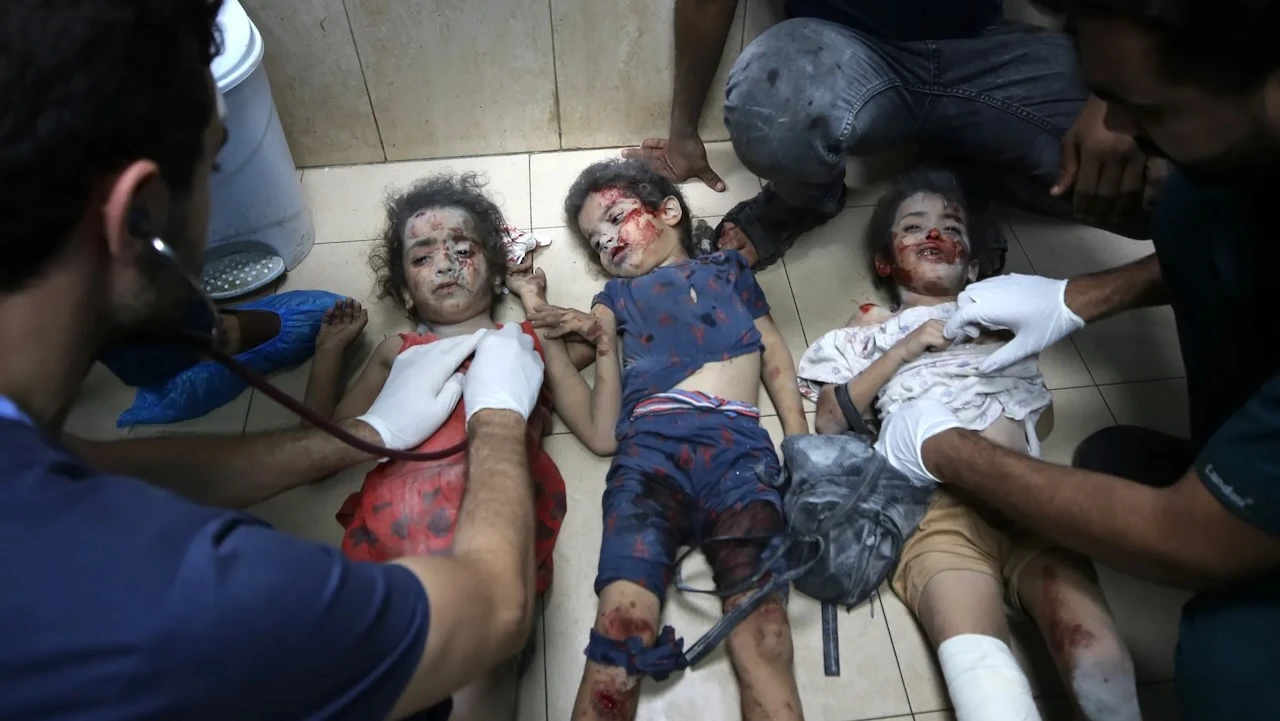
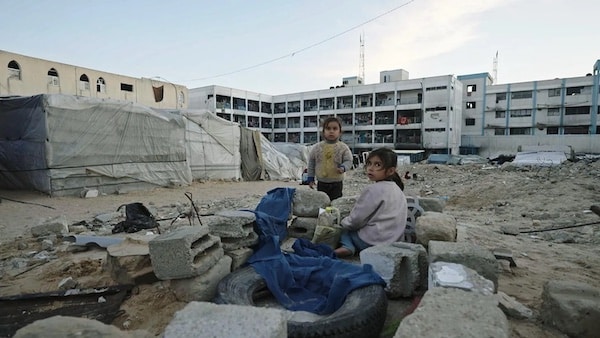
At least 270 Palestinian children have been killed in Gaza since the Israeli military restarted its ethnic cleansing campaign in the besieged enclave one week ago, according to Save the Children.
“Children are being killed in their sleep in tents; they are being starved and attacked. The only way to ensure children and families are protected is through a definitive ceasefire,” the US-based NGO said in a report on 25 March.
Save the Children says more than 270 Gazan children have been killed in the week since Israel reignited its war on Gaza, marking some of “the deadliest days for children since the war began”.
Resuming the war is “a death sentence for Gaza’s children”. More than 17,900 children… pic.twitter.com/Ie9noU5TUO
— Quds News Network (@QudsNen) March 25, 2025
The past week marked “the deadliest days for children since the war began,” Save the Children says, revealing that since the start of the war on 7 October 2023, “over 17,800 children have been killed, with thousands more estimated to be missing, presumed dead under the rubble.”
On Monday, Gaza's Health Ministry listed the names of over 50,000 Palestinians confirmed killed by Israel in Gaza since 7 October 2023. The 1,516-page document includes 474 pages listing the names of more than 15,600 children.
The health ministry has released a 1,516–page document listing the names of over 50,000 Palestinians confirmed killed in Gaza since Oct 7, 2023.
There are a total of 474 pages listing 15,600+ children’s names. The first 27 pages the age is listed as 0 — children under 1 year old pic.twitter.com/bhYjsKNrQP
— Sharif Kouddous شريف عبد القدوس (@sharifkouddous) March 24, 2025
According to a UN report from November last year, nearly 70 percent of the confirmed number of murdered Palestinians at the time were women and children.
“They should be executed even if they are 16 years old,” Israel's ambassador to Austria, David Roet, said during a closed-door meeting with the local Jewish community in Innsbruck last week. “If you believe that there are no uninvolved [people] in Gaza … you're believing that Israel is targeting babies intentionally, which is not correct.”
“They should be executed even if they are 16 years old.”
Former Consul of the Republic of Austria Günter Wiehl-Volgger suggests executing Palestinian children during a secretly filmed visit by Israeli Ambassador to Austria David Roet pic.twitter.com/BFWgwhhc3a
— TRT World (@trtworld) March 23, 2025
Israel renewed its bombing campaign of Gaza on 18 March, unilaterally putting an end to a US-brokered ceasefire deal authorities in Tel Aviv had repeatedly violated.
Between Monday and Tuesday, the Israeli onslaught killed at least 62 Palestinians, including seven children.
Ceasefire talks in the Egyptian capital fell apart after an Israeli delegation rejected a new Egyptian proposal and left Cairo on Monday, according to sources cited by Al-Araby al-Jadeed.
“Israel rejected all proposals despite Hamas’s positive response to a humanitarian ceasefire proposal,” the sources said, adding that Tel Aviv is “coordinating with regional parties to exert maximum pressure on Hamas ahead of any new negotiations.”
Israeli court upholds the detention of Dr. Hussam Abu Safiya for six months
The sentence comes after the Palestinian doctor spent three months in Israeli jails without trial, despite international outcry demanding his release.
March 25, 2025 by Aseel Saleh
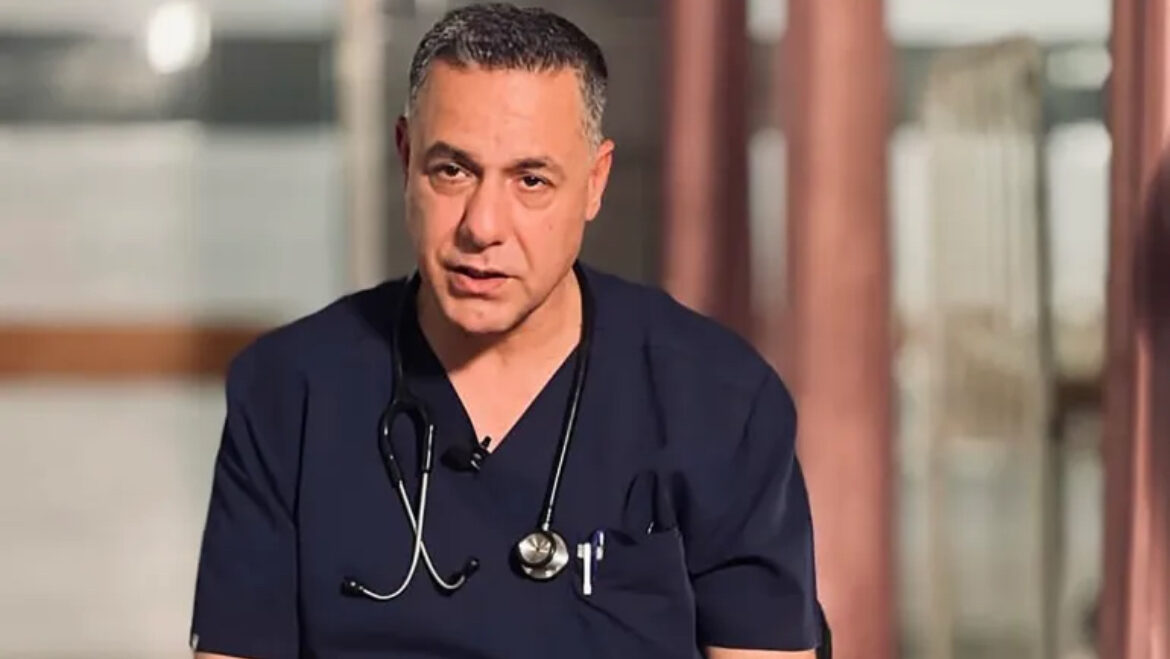
Dr. Hussam Abu Safiya. Source: EuroMed Human Rights Monitor
Israel’s Be’er Sheva District Court issued a decision on Tuesday, March 25 to uphold the detention order of the director of Kamal Adwan Hospital Dr. Hussam Abu Safiya for six months under the “Unlawful Combatant” Law, according to Al Mezan Center for Human Rights.
The center clarified that the detention order was issued on February 12, 2025 by the Commander of the Southern Command of the Israeli Occupation Forces (IOF), and that by upholding the order, Dr. Abu Safiya’s detention was extended for another six months.
Al Mezan described the “Unlawful Combatant” Law as an apartheid law because it is used by Israeli authorities to imprison Palestinian residents of the Gaza strip, including Dr. Abu Safiya, without charge or fair trial, in order to “circumvent basic protections under international law.”
Detained after performing medical duties at Kamal Adwan
The sentence was based on a secret file that Israel’s Southern District Prosecutor submitted to the court, alleging that Dr. Abu Safiya “poses a threat” to Israel’s security.
Al Mezan’s legal team, which represents Dr. Abu Safiya, responded to the allegations by asserting his innocence, and emphasizing that “he was solely performing medical and administrative duties at Kamal Adwan Hospital.”
The team also requested access to the secret investigation materials but the prosecution declined the request, and the court upheld the rejection.
The court’s ruling came three months after the Palestinian doctor was abducted from Kamal Adwan Hospital on December 27, 2024. Throughout his detention, Abu Safiya has been subjected to brutal torture and abuse, in addition to long periods of sustained interrogation.
Israel continues to torture Abu Safiya
On Monday, March 24, Abu Safiya’s legal counsel lawyer Ghaid Qassem said that during her last visit to him on March 19, she observed clear signs of physical abuse on his body. The signs included injuries to his eyes and rib cage, and multiple fractures.
Qassem’s new testimonies emerged less than two weeks since her initial report on Abu Safiya’s condition, suggesting the Palestinian doctor has faced continuous torture by the Israeli occupation detention authorities.
By upholding the detention of Abu Safiya without any charge or fair trial, Israel reaffirms its total disregard for international law and its defiance of the global outcry that his detention has provoked.
Arab Complicity in Israel’s Genocide
March 28, 2025
Arab failure in Palestine goes beyond disunity or incompetence, writes Ramzy Baroud. It reflects a much more cynical reality.
U.S. Secretary of State Marco Rubio, second from right, with United Arab Emirates Foreign Minister Abdullah bin Zayed Al Nahyan in Abu Dhabi in February 2025. (State Department/Freddie Everett)
By Ramzy Baroud
Z Network
Explaining Arab political failure to challenge Israel through traditional analysis — such as disunity, general weakness and a failure to prioritize Palestine — does not capture the full picture.
The idea that Israel is brutalizing Palestinians simply because the Arabs are too weak to challenge the Benjamin Netanyahu government — or any government — implies that, in theory, Arab regimes could unite around Palestine. However, this view oversimplifies the matter.
Many well-meaning, pro-Palestine commentators have long urged Arab nations to unite, pressure Washington to reassess its unwavering support for Israel and take decisive actions to lift the siege on Gaza, among other crucial steps.
While these steps may hold some value, the reality is far more complex, and such wishful thinking is unlikely to change the behavior of Arab governments. These regimes are more concerned with sustaining or returning to some form of status quo — one in which Palestine’s liberation remains a secondary priority.
Since the start of the Israeli genocide in Gaza on Oct. 7, 2023, the Arab position on Israel has been weak at best, and treasonous at worst.
Some Arab governments even went so far as to condemn Palestinian resistance in United Nations debates. While countries like China and Russia at least attempted to contextualize the Oct. 7 Hamas assault on Israeli occupation forces imposing a brutal siege on Gaza, countries like Bahrain placed the blame squarely on the Palestinians.
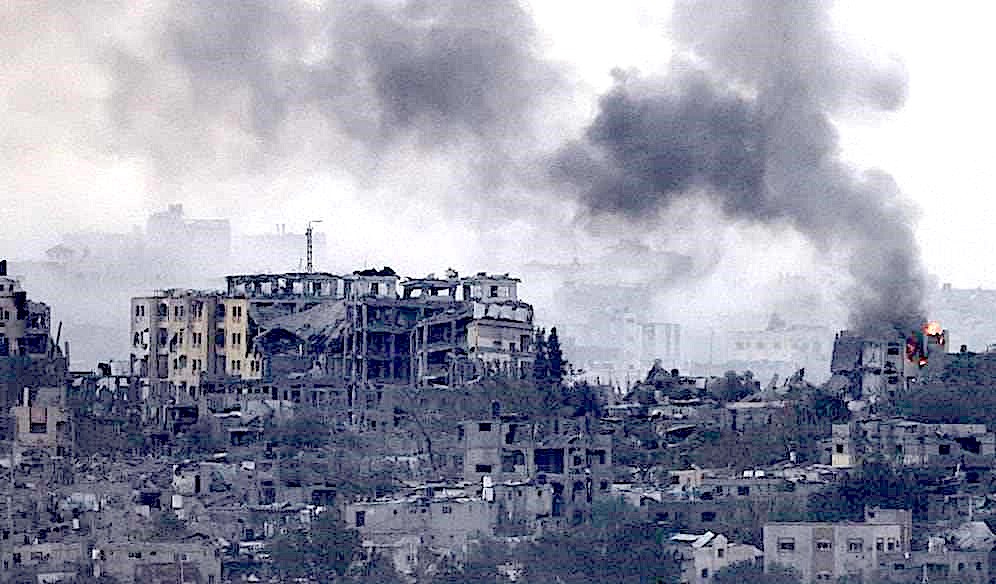
Damaged buildings in Gaza, Dec. 6, 2023. (Tasnim News Agency, Wikimedia Commons, CC BY-SA 4.0)
With a few exceptions, it took Arab governments weeks — or even months — to develop a relatively strong stance that condemned the Israeli offensive in any meaningful terms.
Though the rhetoric began to shift slowly, the actions did not follow. While the Ansarallah movement in Yemen, alongside other Arab non-state actors, attempted to impose some form of pressure on Israel through a blockade, Arab countries instead worked to ensure Israel could withstand the potential consequences of its isolation.
In his book War, Bob Woodward disclosed that some Arab governments told then-U.S. Secretary of State Antony Blinken that they had no objections to Israel’s efforts to crush Palestinian resistance. However, some were concerned about the media images of mutilated Palestinian civilians, which could stir public unrest in their own countries.
Blinken with Egyptian President Abdel Fattah El-Sisi in Cairo, Feb. 6, 2024. (State Department/Chuck Kennedy)
That public unrest never materialized, and with time, the genocide, famine, and cries for help in Gaza were normalized as yet another tragic event, not unlike the war in Sudan or the strife in Syria.
For 15 months of relentless Israeli genocide that resulted in the killing and wounding of over 162,000 Palestinians in Gaza, official Arab political institutions remained largely irrelevant in ending the war. In the U.S., the Biden administration was emboldened by such Arab inaction, continuing to push for greater normalization between Arab countries and Israel — even in the face of over 15,000 children killed in Gaza in the most brutal ways imaginable.
While the moral failures of the West, the shortcomings of international law and the criminal actions of Biden and his administration have been widely criticized, the complicity of Arab governments in enabling these atrocities and for serving as a shield for Israel’s war crimes is often ignored.
The Arabs have, in fact, played a more significant role in the Israeli atrocities in Gaza than we often recognize. Some through their silence, and others through direct collaboration with Israel.
Throughout the war, reports surfaced indicating that some Arab countries actively lobbied in Washington on behalf of Israel, advocating against an Egyptian-Arab League proposal aimed at reconstructing Gaza without ethnically cleansing its population — an idea promoted by the Trump administration and Israel.
Still from AI-generated video promoting Trump’s takeover plans for Gaza, which the U.S. president posted on his social media account on Feb. 26. (Wikimedia Commons, Public domain)
The Egyptian proposal, which was unanimously accepted by Arab countries at their summit on March 4, represented the strongest and most unified stance taken by the Arab world during the war.
The proposal, which was rejected by Israel and dismissed by the U.S., helped shift discourse in the U.S. around the subject of ethnic cleansing. It ultimately led to comments made on March 12 by Trump during a meeting with Irish Prime Minister Micheál Martin where he stated that “No one’s expelling anyone from Gaza.”
For some Arab states to actively oppose the only relatively strong Arab position signals that the issue of Arab failures in Palestine goes beyond mere disunity or incompetence — it reflects a much darker and more cynical reality. Some Arabs align their interests with Israel, where a free Palestine isn’t just a non-issue, but a threat.
The same applies to the Palestinian Authority in Ramallah, which continues to work hand-in-hand with Israel to suppress any form of resistance in the West Bank. Its concern in Gaza is not about ending the genocide, but ensuring the marginalization of its Palestinian rivals, particularly Hamas.
Thus, blaming the PA for mere “weakness,” for “not doing enough,” or for failing to unify the Palestinian ranks is a misreading of the situation. The priorities of Mahmoud Abbas and his PA allies are far different: securing relative power over Palestinians, a power that can only be sustained through Israeli military dominance.
These are difficult, yet critical truths, as they allow us to reframe the conversation, moving away from the false assumption that Arab unity will resolve everything.
The flaw in the unity theory is that it naively assumes Arab regimes inherently reject Israeli occupation and support Palestine.
While some Arab governments are genuinely outraged by Israel’s criminal behavior and growingly frustrated by the U.S.’ irrational policies in the region, others are driven by self-interest: their animosity toward Iran and fear of rising Arab non-state actors. They are equally concerned about instability in the region, which threatens their hold on power amid a rapidly shifting world order.
As solidarity with Palestine has increasingly expanded from the global South to the global majority, Arabs remain largely ineffective, fearing that significant political change in the region could directly challenge their own position.
Mossad in talks with African, Asian countries to assist in ethnic cleansing of Gaza: Report
Prime Minister Netanyahu is seeking ways to depopulate Gaza and pave the way for Jewish settlement
News Desk
MAR 28, 2025
(Photo credit: Ramadan Abed/Reuters)
Israeli Prime Minister Benjamin Netanyahu has tasked Israel's Mossad foreign intelligence agency with finding countries willing to receive large numbers of Palestinians he plans to displace from the Gaza Strip, Axios reported on 28 March.
According to the two Israeli officials and a former US official speaking with Axios, talks have already taken place with Somalia and South Sudan in Africa, as well as other countries, including Indonesia in East Asia.
Netanyahu gave Mossad the secret task several weeks ago, the Israeli officials say.
Israel is taking measures "to encourage the removal of Palestinians from Gaza, while at the same time resuming the war and issuing evacuation orders for Palestinians from parts of the enclave," Axios wrote.
Some 90 percent of Palestinians in Gaza are internally displaced from homes destroyed by Israel's brutal bombing campaign that has lasted almost 18 months.
Since unilaterally canceling a ceasefire with Hamas in Gaza two weeks ago, Israel has dramatically escalated its attacks on Palestinians, killing over 100 per day.
Netanyahu and other senior Israeli officials have vowed to occupy more and more of Gaza if Hamas refuses to release the remaining Israeli captives it holds.
Hamas is seeking a deal to release the captives in exchange for the release of thousands of Palestinians held in Israeli prisons (where rape and torture are common), a permanent end to the war, and a complete withdrawal of Israeli forces from Gaza.
Israeli officials are considering plans to launch another massive ground invasion of the strip that would force most of the population into a small "humanitarian area" in the south of the strip, Axios added.
Earlier this month, Sudan, Somalia, and the breakaway region of Somaliland denied reports they had received requests from the US or Israel to resettle Palestinians from Gaza.
AP quoted US and Israeli officials as saying that their governments had contacted officials from each government to propose the plan.
Somalia's Foreign Minister Ahmed Moalim Fiqi said his country would categorically reject "any proposal or initiative, from any party, that would undermine the Palestinian people's right to live peacefully on their ancestral land."
Sudanese officials also said they rejected considering any such proposal.
Miscarriages in Gaza surge by 300 percent due to Israel's aid blockade
Israel's extermination campaign has disproportionately targeted women and children, leaving Gaza with the world's highest rate of child amputees per capita
News Desk
MAR 28, 2025
(Photo Credit: UNFPA Palestine/Media Clinic)
Miscarriages among pregnant women in the Gaza Strip have surged by 300 percent due to Israel's blockade of humanitarian aid shipments, according to figures from the Palestinian Health Ministry reported by Al-Akhbar.
The rate of miscarriages soared after Tel Aviv ordered the closure of the Kerem Shalom crossing earlier this month, cutting off the flow of essential medications, including heparin injections critical for women with blood clotting disorders.
Without medicine or sanitary supplies, the situation for pregnant women in Gaza is “catastrophic,” according to Dr. Suha al-Masri, a Gaza obstetrician who says hospitals struggle to offer only "primitive solutions.”
"Due to the shortage of medication resulting from the blockade, we find that many of them are silently losing their fetuses or living the remainder of their pregnancies under the constant threat of losing the baby at any moment,” Masri told Al-Akhbar.
“We are not only losing mothers and fetuses, we are losing a future that was meant to be born,” she added.
"I felt like a part of me had died. My son wasn’t just a victim of my health condition; he was also a victim of the siege. The occupation killed my fetus, not with missiles, but by withholding my medication,” said Nisreen Ayyad, 29, a resident of Gaza City who recently had a miscarriage.
“Whenever I hear about an imminent bombing, I put my hand on my stomach and tell it: Hold on. Don’t be afraid; Mom is with you. But I’m the one who’s afraid. I’m afraid he’ll be killed before I see him,” Ruba Masoud, 28, told Al-Akhbar.
According to figures released by the Gaza Health Ministry, at least 950 infants under one year of age have been killed since the start of the US-Israeli genocide in Gaza.
After the collapse of a brittle ceasefire last week, Israeli attacks have killed over 270 Palestinian children.
“if you are a child in Gaza today, you have most likely been displaced multiple times, are living in a tent, don’t have food security, have lost multiple members of your close community, and have fallen asleep every single night … to the sound of drones and bombs falling from the sky,” Dr. Tanya Haj-Hasan, pediatrician for Doctors Without Borders (MSF), said in a report from the NGO last June.
According to multiple international agencies, at least 25,000 children have been injured by the Israeli onslaught, including between 3,000 and 4,000 children who have had one or more limbs amputated, making Gaza home to a higher number of child amputees per inhabitant than any other place in the world.
Nearly 70 percent of verified deaths in Gaza since 7 October 2023 were women and children, according to a November report by the Office of the UN High Commissioner for Human Rights (OHCHR).
Israeli army admits firing on Gaza ambulances as body of rescue worker found 'executed, dismembered'
The occupation army opened fire on ambulances and fire trucks that rushed to help Palestinians being targeted in the southern city of Rafah
News Desk
MAR 29, 2025
(Photo Credit: Eyad Baba/AFP)
On March 29, the Israeli military acknowledged attacking ambulances and fire trucks in the Tal Sultan neighborhood of Rafah in the southern Gaza Strip, where several members of the Palestinian Red Crescent Society (PRCS) went missing last Sunday.
Officials claim the troops initially opened fire “toward Hamas vehicles." "A few minutes afterward, additional vehicles advanced suspiciously toward the troops… The troops responded by firing toward the suspicious vehicles, eliminating a number of Hamas and Islamic Jihad terrorists,” the army statement reads.
“After an initial inquiry, it was determined that some of the suspicious vehicles … were ambulances and fire trucks,” it adds.
On Friday, PRCS members and UN staff that made it to the site of the massacre reported finding the body of the mission leader, Anwar Abdel Hamid al-Attar, “in dismembered pieces.”
“Our teams found torn safety equipment worn by the crew at the crime scene. This suggests the Israeli occupation forces directly targeted the crew during their incursion, then deliberately altered the area’s features and concealed the bodies of some civilians using bulldozers and heavy machinery,” the PRCS said in a statement.
Thirteen other medics and civil defense agency workers remain missing.
The teams of rescue workers mobilized to Tal as-Sultan last Sunday to assist Palestinians injured by Israel's bombing and ground assaults—those who managed to escape the onslaught reported executions of many Palestinians by Israeli troops.
“We call on the international community to pressure the occupation authorities to reveal the fate of the missing personnel. We also urge the international community and the states that are signatories to the Geneva Conventions to take serious steps to ensure the protection of medical teams,” the PRCS said on Saturday.
Israel has killed close to 1,000 Palestinians in Gaza since the full resumption of the genocide, about half of which are women and children. This includes about 300 killed on 25 March alone in attacks where Tel Aviv claimed to have targeted “leaders” and “activists from Hamas and Islamic Jihad.”
Red Crescent recovers bodies of missing paramedics, civil defense workers killed by Israel in Gaza's Rafah
Israeli forces killed the first responders during an assault and siege on Rafah's Tal al-Sultan neighborhood that began eight days ago
News Desk
MAR 30, 2025
(Photo credit: Reuters)
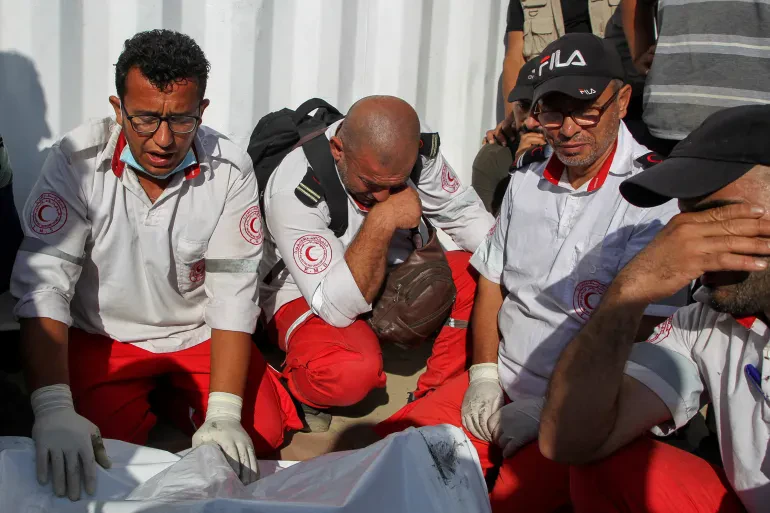
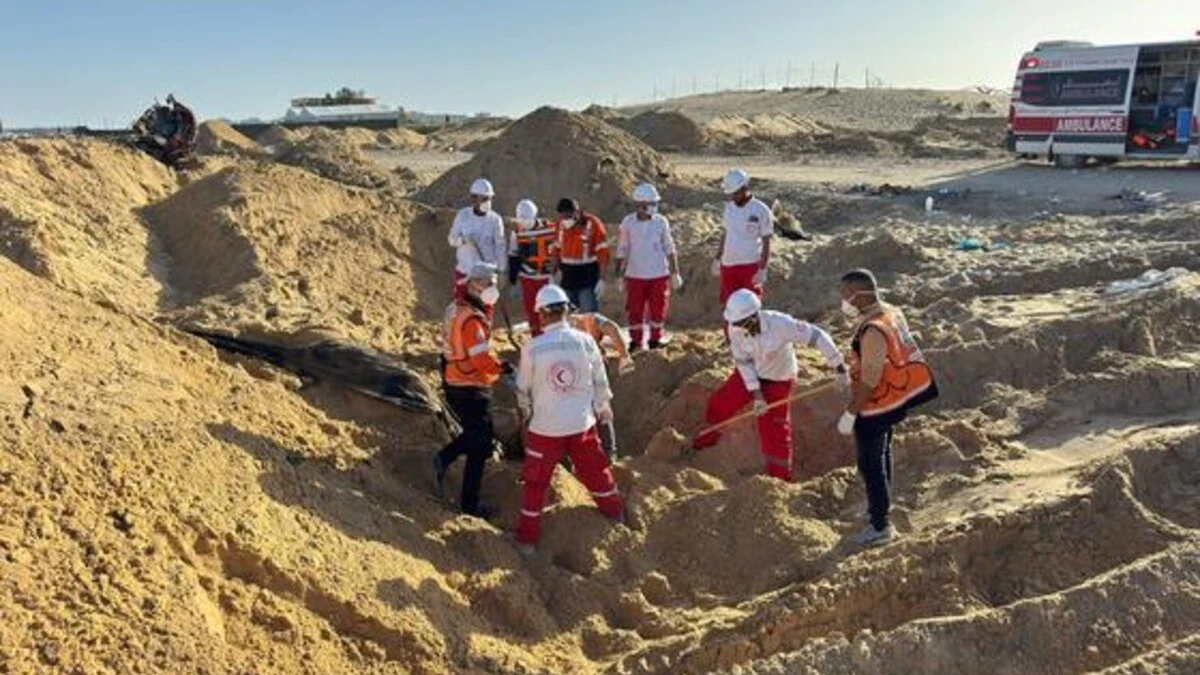
The Palestine Red Crescent Society (PRCS) announced on 30 March the retrieval of the bodies of 14 crew members killed by Israeli forces while under siege in Rafah's Tal Al-Sultan neighborhood.
Rescuers from OCHA, the Red Cross, and the Civil Defense managed to reach the neighborhood Sunday to search for the crew members, who had been missing for eight days. The bodies of eight PRCS paramedics, five Civil Defense crew members, and the body of a UN staffer were successfully retrieved, PRCS said in a press release.
The rescue teams continue to search for other bodies in the neighborhood, the statement added. Three PRCS first responders and one Civil Defense paramedic remain missing.
“The Palestine Red Crescent Society was devastated today by the killing of eight of its paramedics in Rafah, targeted by the Israeli army while performing their humanitarian duties in response to a call to aid the wounded and injured following an Israeli strike in the Hashashin area of Rafah, Gaza Strip,” the PRCS said in a statement.
"The ninth paramedic remains missing and is believed to have possibly been detained."
The crew members went missing on 23 March after being mobilized to Tal al-Sultan to assist Palestinians injured by Israel's bombing and ground assaults—those who managed to escape the onslaught reported executions of many Palestinians by Israeli troops.
On 29 March, the Israeli military acknowledged attacking ambulances and fire trucks in the Tal al-Sultan neighborhood of Rafah in the southern Gaza Strip.
Officials claim the troops initially opened fire "toward Hamas vehicles."
"A few minutes afterward, additional vehicles advanced suspiciously toward the troops … The troops responded by firing toward the suspicious vehicles, eliminating a number of Hamas and Islamic Jihad terrorists," the army statement reads.
"After an initial inquiry, it was determined that some of the suspicious vehicles … were ambulances and fire trucks," it adds.
On Friday, PRCS members and UN staff who made it to the site of the massacre reported finding the body of the mission leader, Anwar Abdel Hamid al-Attar, "in dismembered pieces."
"Our teams found torn safety equipment worn by the crew at the crime scene. This suggests the Israeli occupation forces directly targeted the crew during their incursion, then deliberately altered the area's features and concealed the bodies of some civilians using bulldozers and heavy machinery," the PRCS said in a statement.
"We call on the international community to pressure the occupation authorities to reveal the fate of the missing personnel. We also urge the international community and the states that are signatories to the Geneva Conventions to take serious steps to ensure the protection of medical teams," the PRCS said on Saturday.
Israel has killed close to 1,000 Palestinians in Gaza since the full resumption of its genocidal war on the strip, about half of whom are women and children.
Israel unilaterally ended the ceasefire with Hamas in Gaza and renewed its attacks on the strip on 18 March, killing over 400 people, the majority women and children, in just one night.
OCHA chief Tom Fletcher said that since Israel broke the ceasefire, Israeli air attacks have hit "densely populated areas," with "patients killed in their hospital beds, ambulances shot at, first responders killed."
Western Imperialism and Islamism—Joined at the Hip
By Aidan O’Brien - March 30, 2025 0
[Source: 247wallstreet.com]
Turkey and the West’s Covert War Against Asian Development
Western imperialism once had a “civilizing mission.” The enlightenment and modernity were its buzzwords. The Europeans and Americans were in the game of railroads and reason. Or so the world was led to believe. Africans and Asians aimed West.
But not today. They aim East now. The railroads today are Chinese. And reason is multipolar.
In response, the unipolar West is not interested in civilization. Chaos and barbarism now sum up its politics. New York, London and Paris ain’t the solution anymore but the problem.
Syria illustrates this.
The takeover of Damascus by Hayat Tahrir al-Sham (HTS), an intolerant medieval-like sect, is being celebrated in the West.
The triumph of al-Qaeda in Syria has been celebrated by Western politicians and the Western media. [Source: newarab.com]
The rule of religion rather than secularism is its preference. It is as if Attila the Hun is on the march again but this time the West is rejoicing instead of revolting.
Gaza illustrates this. There, Israel’s far-right government is committing a genocide against a dispossessed, trapped and defenseless Palestinian population. And New York, London and Paris openly justify it and actively facilitate it.
In his book The Silk Roads: A New History of the World, Peter Frankopan’s few words on the 5th century Huns and their assault on the West captures the 21st century Western assault on the East:
“The Huns caused pure terror. They are ‘the seedbed of evil’ wrote one Roman writer and ‘exceedingly savage.’…They had no interest in [civilization], noted another and only wanted to steal from their neighbors, enslaving them in the process: they were like wolves.”[1]
Some 1,600 years later, the West is the barbaric Hun invading the East—charging mindlessly into the heartland of geopolitics—as if the Renaissance, the Enlightenment and Modernity never happened.
The West Begins and Ends in Istanbul
The current state of Western imperialism and the downward trajectory of Western civilization are best exemplified by Istanbul, Turkey. A century ago this pivotal city secularized itself—because it wanted to be Western. Today mosques are everywhere in Istanbul—because it is Western. This is not a contradiction but Western policy.
After World War One, the Ottoman Empire, based in Istanbul, collapsed and European imperialism walked into geopolitical nirvana: the Arab oil fields. In response to the humiliating Ottoman collapse, Kemal Atatürk, the father of modern Turkey, abandoned religion.
The current father of Turkey, Recep Erdogan, is doing the opposite: abandoning the modern in favor of the medieval. And the West is his key partner in this reversal of history. As the most strategic part of NATO, the Western alliance, Turkey has been reinvented in preparation for the West’s wars against Eurasia. Gone are the ideas of global development based on universal reason. And in their place are ideas of religious sectarianism and racial supremacy.
Turkey’s President Recep Erdogan speaking in front of newly built mosque in Taksim Square in Ankara. [Source: bbc.com]
Turkey is the West’s geopolitical battering ram. Perfectly positioned, it can swing east and hit Iran. Or south and hit the Arabs. Or north and hit Russia. Indeed, Istanbul is built on the Bosphorus—the choke point as regards the shipping lane that serves the ultimate clash of civilizations: the Black Sea.
The West’s use of Turkey, however, extends further than its near neighbors. It penetrates deep into Central Asia and into China, into the whole Turkic speaking region. And seeps into every mind affected by Islam.
Turkey isn’t just the home of an ethnic group originating in Central Asia; it is a stronghold of the Muslim Brotherhood. And the latter, reactionary/right-wing Islam, has always been a tool of Western imperialism.
Britain’s Barbaric Brothers
The imperialist/Muslim conspiracy to overthrow the modern/secular government of Syria in 2024 was born a century before in the Arabian Peninsula and on the banks of the Suez Canal. The British controlled both areas and controlled the destiny of Islam as well. After the collapse of the Ottoman Caliphate, the Ottoman leadership of the Islamic World, Islam should have withdrawn into the background of modernity, like Christianity. But the British decided otherwise.
Instead of waving goodbye to Islam, as Kemal Atatürk did in the new state of Turkey, the British held onto it for the benefit of its Empire. While Istanbul, in the 1920s, was rejecting medieval notions like the caliphate, the British were empowering Ibn Saud, the father of Saudi Arabia—and resuscitating the idea of the pan-Muslim caliphate. In his book, Secret Affairs: Britain’s Collusion with Radical Islam, Mark Curtis writes:
“Britain had already provided arms and money to Ibn Saud during the First World War, signing a treaty with him in 1915 and recognizing him as the ruler of the Nejd province under British protection. By the end of the war, he was receiving a British subsidy of £5,000 a month….some British officials were pinning their strategic hopes on Ibn Saud…a Captain Bray [wrote]….’We should therefore create a state more convenient for ourselves, to whom the attention of Islam should be turned. We have an opportunity in Arabia.”….Ibn Saud established ‘Saudi’ Arabia in an orgy of murder….The British recognized Ibn Saud’s control of Arabia, and by 1922 his subsidy was raised to £100,000 a year by Colonial Secretary Winston Churchill….Churchill later wrote that “my admiration for him [Ibn Saud] was deep because of his unfailing loyalty to us’…..”[2]
Abdul Aziz ibn Saud after his surrender to the British. [Source: crescent.icit-digital.org]
This British policy served as a template for Western actions in the Middle East. And Britain wasn’t finished. In 1928, in the city of Ismailia along the Suez Canal, the British funded the beginning of a secretive group that wanted to return to the medieval roots of Islam: the Muslim Brotherhood.
Christopher Davidson writes in Shadow Wars: The Secret Struggle for the Middle East: “The relationship between Britain and the Brotherhood was of course nothing new, as ever since its formal founding in 1928 it had been identified as primarily an anti-nationalist and anti-liberal vehicle….”[3]
And F. William Engdahl writes in The Lost Hegemon: Whom the Gods Would Destroy: “The rising anti [imperialist] tide [in Egypt] …created the backdrop in which an obscure Sunni Muslim school teacher named Hassan al-Banna created the Society of the Muslim Brothers, or, as it became known in the West, the Muslim Brotherhood.”[4]
Muslim Brotherhood logo. [Source: nj.com]
Lastly, Robert Dreyfuss explains in his book Devil’s Game: How the United States Helped Unleash Fundamentalist Islam: “[In Egypt, at the time,] British diplomats, the intelligence service MI6, and Cairo’s [conservative establishment] would use the Muslim Brotherhood as a cudgel against Egypt’s [anti imperialists]…”[5]
Acting on behalf of the British, the Brotherhood and Saudi Arabia misshaped the Sunni branch of Islam in the 20th century. London wanted an obedient and backward population around the oil fields it coveted in the Middle East. It did not need secular Arabs arguing for nationalism or communism. So the fundamentalist, anti-modern brand of Islam espoused by the Muslim Brotherhood and Saudi Arabia (Wahhabism) fit the British perfectly.
America Doubles Down on Medievalism
After World War Two the Americans continued Britain’s retrograde mission in the Middle East. Dumbing down and repressing the Arabs was the goal. Following the British, the Americans began in Saudi Arabia because of oil. Indeed, before the war ended—in 1943—U.S. President Franklin D. Roosevelt declared that “I hereby find that the defense of Saudi Arabia is vital to the defense of the United States.”[6]
Franklin D. Roosevelt and Ibn Saud. [Source: inkl.com]
Why? Because America’s biggest energy companies (Standard Oil of California, Texaco, Exxon and Mobil—later known collectively as Aramco) were ready to exploit the most strategic oil fields in the world. The British had been eclipsed by the Americans but, in compensation, the U.S. gave London (British Petroleum) the oil fields in Iran.
By this time, around 1950, Saudi Arabia was bankrolling the Muslim Brotherhood. And America agreed. Medieval/Reactionary Islam was its insurance policy in the Middle East.
The Brotherhood’s covert network crisscrossed the Arab World. It was in Egypt—resisting Nasser’s nationalism. And was in Syria and Iraq—resisting the pan-Arabic socialists: the Ba’athists. The Brotherhood insisted that the Koran was its constitution. And Sharia law was its only law. Imams and America’s energy companies sabotaged the historical development of the Arab people.
Gamal Abdel Nasser was a bitter foe of the Muslim Brotherhood. [Source: origins.osu.edu]
The apotheosis of this nefarious relationship between America and Saudi Arabia was the 1973 deal to make the U.S. dollar the indispensable currency in the world. This American/Saudi conspiracy—the petrodollar—placed Islamic medievalism at the center of the global capitalist system. “Islamic banks” mushroomed. And “Islamic soldiers” were everywhere.
In 1979 U.S. President Jimmy Carter began Operation Cyclone, the CIA mission to fight the Soviet Union in Afghanistan. This covert crusade meant unleashing the crudest elements of Islam. America’s partners were Britain, Saudi Arabia and Pakistan—the latter had just had its Islamic counter-revolution. In 1977 General Zia overthrew Pakistan’s democracy and Islamized the country—turning it into a pro-American dystopia.
[Source: islamtimes.com]
General Zia ul-Haq [Source: tribune.com.pk]
However, America’s use of medievalism as an imperialist weapon in the Middle East has its anomalies. In 1979, Iran Islamized itself but in the anti-imperialist—Shia Muslim—direction. A savage, 26-year, pro-U.S. dictatorship had taught the Iranians a valuable lesson.
Similarly, the actions of America’s stormtrooper in the Middle East—Israel—created two Islamic organizations that have resisted Western imperialism: Hezbollah (Shia) and Hamas (Sunni).
Meanwhile in Afghanistan the Taliban (Sunni), for so long America’s official enemy, recently retook power. But America itself and its ally, Pakistan, spawned the Taliban during Operation Cyclone in the 1980s. Blowback is part of the twisted American game.
Unfazed, America and the West continued to embrace and promote medieval Islam—convinced that it was the only way to preserve its hegemony in and around the Arab oil fields. The West may have lost Iran and parts of the Levant, and on the surface Kabul, but these forces hostile to the U.S. are still Islamist and, therefore, they are antagonistic to secular socialism—the West’s real enemy.
So all was not lost for NATO. In any case, the West gained Qatar, a key energy producer as well as being a major sponsor and promoter of pro-Western Islamic fundamentalism, as the wars against both Libya (2011) and Syria (2011-24) have demonstrated.
Full Circle—Back in Istanbul
What next? Another Ottoman delusion. A greater Israel. A never-ending reign of terror directed against the Arabs and whoever else threatens the West’s interests.
Today’s neo-Ottoman Turkey is the new Saudi Arabia. What Ibn Saud did in the 20th century, Recep Erdogan is doing in the 21st century—serving the West by spreading medievalism. New York and London, however, expect more from Erdogan. Central Asia and China are now the targets. From the Caspian Sea to Xinjiang there is a multitude of Muslims to confuse and terrorize. And Turkey has the gig.
The Americans have said as much. A former vice chair of America’s National Intelligence Council and former CIA station chief in Ankara, Graham Fuller, was arguing in the 1990s, and after, that Turkey is a “pivotal Muslim state.” According to Nafeez Ahmed, Fuller outlined the big picture as follows:
“The policy of guiding the evolution of Islam and helping them against our adversaries worked marvelously well in Afghanistan against the Red Army. The same doctrines can still be used to destabilize what remains of Russian power, and especially to counter the Chinese influence in Central Asia.”[7]
Graham Fuller [Source: posta.com.tr]
This is déjà vu. It is a repetition of covert British policy in the Middle East a century ago. The focus this time though is Eurasia and the agent is Turkey rather than Saudi Arabia. Istanbul is America’s geopolitical link to Central Asia. And the Organization of Turkic States—which includes Turkey, Uzbekistan, Kyrgyzstan, Azerbaijan and Kazakhstan—is the ready-made stage for Turkish/U.S. (NATO) covert action.
Repeating the British tactic in Egypt in 1928, the Americans covertly supported an obscure Islamic teacher in Turkey—Fethullah Gülen—in order to penetrate and manipulate the regional population. Just as British intelligence used Hassan al-Banna (the founder of the Muslim Brotherhood), U.S. intelligence used Gülen.
Fethullah Gülen [Source: veja.abril.com]
Hassan al-Banna [Source: mideastweb.org]
The Gülen Movement—Islamic schools and a secretive network of Islamic elites—complemented the Muslim Brotherhood in Turkey in the 1980s and 1990s and enabled the rise of Recep Erdogan and his Justice and Development Party. This upswell of Turkish Islamism around 2000 hollowed out the modern legacy of Kemal Atatürk. And after playing his part in this Islamic victory, Fethullah Gülen, significantly, moved to the United States, from where he managed his Islamic “empire.”
After the collapse of the Soviet Union, Gülen’s Islamic schools spread out across Central Asia. And according to a Turkish intelligence officer, Osman Nuri Gündes, these schools were cover for CIA activity.[8]
Kemal Atatürk [Source: thoughtco.com]
Education, though, is not the CIA’s business. On the contrary, its purpose is to miseducate people and defeat the modern ideas of international equality and global justice.
Secret warfare is the CIA’s business, and as Graham Fuller intimated, medieval Islam is its key partner. Imams and jihadis are America’s agents. And they are currently operating in Central Asia. Turkey is the strategic key and the CIA is turning it.
Syria indicates this. In Idlib province, Turkey protected, trained and armed the Islamic militants who overthrew the secular government of Syria in 2024. Turkey did this for the West because Istanbul is a NATO stronghold. In fact, Turkey finished what U.S. President Barack Obama started in 2012, Operation Timber Sycamore, the CIA mission to overthrow the secular government of Syria. In Damascus, Turkey has placed all its cards on the table. And they are all pro-Western. And, ipso facto, pro-Israel (pro-genocide).
Turkish operatives involved in the CIA’s Operation Timber Sycamore. [Source: youtube.com]
What will Turkey do next? It will do whatever the U.S./NATO wants it to do. The reactionary militants Turkey let loose in Syria include Islamists from Central Asia and China—Uzbeks, Tajiks and Uyghurs. Turkey/U.S. (NATO) commands these al-Qaeda-types. And controls their future movements. They are a moveable medieval mercenary army. And will be let loose in Central Asia—just as the al-Qaeda-types who fought for the U.S. (NATO) in Afghanistan, in the 1980s, were let loose in Bosnia, Chechnya, Algeria and elsewhere in the world in the 1990s and 2000s.
Turkish troops in Syria. [Source: aljazeera.com]
The End of Western Civilization
In the modern world imperialism is an outdated practice. Secularism and reason have taken root everywhere. Discrimination and exploitation based on race or religion or geographic location are discredited policies.
However, the West wants to survive as a separate/imperial bloc—therefore physical and ideological walls have to be reinvented. Anti-modern and anti-civilizational methods must be reborn. In this context medievalism is a godsend for the West. Religions devoid of any reason—for the global or regional masses—are the perfect partners or covers for a duplicitous economic system—one that is Eurocentric or U.S.-centric.
To control the Middle East so as to control its oil, the most strategic resource in the world, the West had to negate modernism in the region. The West had to negate its own secular experience and fall back on sacred texts that make no sense today. After World War One, the Koran and the Bible were let loose in the region by Western imperialists, mercilessly, for economic and political reasons. And to this day, these ancient books continue to be weaponized by the West in this region and beyond.
Syria is the latest victim of this medieval tactic. And Turkey is the latest tactician. And Turkey is not finished. Guided by NATO and the West, Istanbul is on a collision course with Central Asia and China. Yet again Imperialism and religious fundamentalism have teamed up to derail modernism in the East. It is too late, however. China and the rest have already bolted into the free world of secular human development. The only derailment is happening now in the West.
Two Palestinian children amidst the rubble in Khan Younis, Gaza. January 2025. Source: still from the film “Kids Under Fire”. (Photo: Mohammed Ibaida).
“The target is unmistakable”: The shooting of Gaza’s children
Originally published: Drop Site News on March 27, 2025 by Amel Guettatfi (more by Drop Site News) (Posted Mar 31, 2025)
Drop Site News is publishing this story in collaboration with our colleagues at Fault Lines, Al Jazeera English’s award-winning documentary news program.
On August 24, four-year-old Mira Al-Darini had just woken up to a hot summer morning in a crowded displacement camp, located between a local prison and the mediterranean sea in Khan Younis, when the sound of Israeli military tanks and gunfire erupted. Panic ensued. Mira was standing outside her family’s tent, clutching a sandwich her mother made for breakfast when a bullet struck her in the head.
“It was her older sister’s birthday, ” Israa Haboush, Mira’s mother, told Al Jazeera’s documentary program Fault Lines. “[The kids] were happy and said, ‘Get up Mama. Let’s make a cake for Rahaf’s birthday.’ Suddenly, Mira’s entire face was covered in blood, and we knew our daughter was shot in the head.” Witnesses said Mira was fired at by an Israeli military drone armed with a gun.
Mira’s father, Mohammed Al-Darini, rushed her to two hospitals, carrying her in his arms on the back of a stranger’s motorbike—first to Kuwait Hospital in Rafah and then to Nasser Hospital in Khan Younis, one of Gaza’s largest hospitals, which was bombed on Sunday by the Israeli military. On their way, Mira was all but gone. When they arrived at the hospital, she was triaged and labelled black—no hope for life.
Dr. Mimi Syed, an American emergency medicine physician, was volunteering at the ER that morning. When Mira came under Syed’s care, she noticed some faint movement. “I started to examine her and one of my colleagues came and said, ‘No, don’t waste your time,’” she recalled in an interview at her home in Washington State.
[But what I noticed about her was she was still moving. I felt like I could still save her.
Dr. Syed immediately intubated Mira and used one of the few well-worn blades she had on hand. Due to restrictions imposed by Israel on medical supplies brought into Gaza, resources are scarce. The bullet was eventually removed from Mira’s skull and, against all odds, she survived.
This was Mira’s second brush with death, Mohammed told Fault Lines’ team in Gaza. Last year when the family was fleeing south, an Israeli missile had fired on them, killing one of her aunts. Another aunt lost her leg. This time, “she was between life and death” Mohammed recalled.
Today, Mira undergoes physical therapy when she can. She is slowly learning to walk again, but her future remains uncertain. As she grows, she will need more surgeries and procedures, which her family is working to help her receive, overcoming seemingly insurmountable obstacles. While receiving physical therapy at a local clinic in January 2025, the building next door was bombed. Mira survived, yet again, but her mother, Israa, lost her leg. Her continued treatment is something Gaza’s decimated healthcare system may never be able to provide.
In the months that Fault Lines reported its new documentary Kids Under Fire, Mira’s life continued to change. Mira’s story exemplifies the precarious nature of life for hundreds of thousands of children in Gaza, where surviving one attack is no guarantee of safety from the next. In Gaza’s overcrowded and strained hospitals, a chilling pattern has emerged. Fault Lines spoke to twenty American doctors who have volunteered in hospitals across Gaza since the war began in October 2023, and they say they’ve treated many children with gunshots—often fatal.
Pattern of Gunshots in Children
Mohammed still holds on to a grim keepsake from the day Mira was shot: the bullet that struck his four year old daughter in the skull, “This is the bullet that ruined my daughter’s life,” he said,
and it represents that awful day when it all happened.
“More and more, I started to see children with penetrating injuries like gunshot wounds. After five, six, seven, eight, I came to the realization that somebody is shooting children,” said Dr. Tammy Abughnaim, an American emergency physician from Chicago. “I didn’t want to believe that children were being shot. Nobody wants to believe that. Nobody wants to think that other humans are capable of annihilating children in that way.” Dr. Abughnaim traveled to Gaza twice last year, working at Al-Aqsa Hospital and then at Nasser Hospital.
The Darini family’s story is part of a broader pattern of the Israeli military deliberately targeting children. Kids make up over a third of the death toll in Gaza, according to the Ministry of Health there. Nearly 16,000 children have been killed. However, the figure is almost certainly an undercount, as many children remain missing or under the rubble.
While most children have been killed by indiscriminate bombing, the doctors we spoke to say it’s nearly impossible to tell how many have been killed by snipers, foot soldiers with rifles, or quadcopters armed with guns. “Part of the Israeli military campaign of genocide has been to attack that very infrastructure that creates a record of who was killed and how,” said Miranda Cleland, an advocacy officer at Defense for Children International–Palestine. Cleland works with researchers on the ground in Gaza who had to stop collecting data because they were being bombed and had to evacuate their homes.
“The target at the end of a scope is unmistakable,” Dr. Mark Perlmutter told us, “They are a young human being, and when that trigger gets pulled on that target, it is not by accident. At all. Ever.” Currently in Gaza serving at Nasser Hospital, Perlmutter is an orthopedic hand surgeon from North Carolina who volunteered at the European Gaza Hospital in Khan Younis last spring.
Broken System of Checks and Balances
The United States funnels billions of dollars in assistance to Israel annually. Over the past seven decades, Israel has received about $124 billion in American military assistance. That makes it the largest recipient of U.S. funding since World War II.
“There’s probably not a unit in the Israeli army that hasn’t received U.S. training or equipment,” says Tim Rieser, a senior foreign policy advisor to former Senator Patrick Leahy. This aid is governed by the Leahy Law, first introduced in 1997 as part of the Foreign Operations Appropriations Act that governs U.S. foreign aid.
The Leahy Law, when applied, prohibits U.S. assistance to foreign military units credibly implicated in human rights violations such as rape, torture and extrajudicial killing. When it comes to Israel, however, the law has been rendered toothless and its enforcement is practically non-existent. Rieser, who helped to draft the law, believes that cases of children shot in Gaza should trigger use of the Leahy Law.
“It’s been a huge frustration for Senator Leahy and for myself, because we’ve seen how the law has been applied effectively in other countries where embassies really took it seriously,” Rieser told us,
and that’s the real shame of this, because there’s so obviously a need for the law to be applied in Gaza and the West Bank, because it might help deter future abuses.
Israel is not the only country that receives vast amounts of untraceable assistance—large lump sums that are not earmarked for specific purposes—but it’s the only country that has a special vetting process called the Israel Leahy Vetting Forum (ILVF). In 2020, when the ILVF was instituted, State Department bureaus and the U.S. embassy in Jerusalem spent months negotiating their “standard operating procedures,” according to Charles Blaha, a former State Department official who ran the Office of Security and Human Rights from 2016 until his retirement in 2023. Blaha describes the forum as riddled with loopholes. Even if credible allegations are raised, Blaha explained, they get buried under layers of bureaucracy.
“It’s a very elaborate, byzantine, complicated, delay-ridden, [and] high level process,” Blaha told us, which is a major reason the State Department has not found that “a single Israeli unit had ever committed a gross violation of human rights.” He added,
I signed off on that. I signed off. I believed, at the time, that the State Department would implement that process in good faith. And I believed, at the time, in the Israeli military justice system. Both of those beliefs turned out to be incorrect.
In its nearly five years of existence, the vetting forum has never found a single Israeli military unit ineligible for assistance. For Blaha, who once put his faith in this system, the resulting lack of political will has been devastating.
I didn’t think it would come to these thousands and thousands of deaths.
The Scale May Never Be Known
The Israeli military shooting Palestinian children is by no means new or unique to the escalating catastrophe in Gaza, yet the scale of the shootings over the last seventeen months is on an entirely different level. Between October 7, 2023 and July 2024, the Israeli military killed 141 Palestinian children in the occupied West Bank and East Jerusalem; 116 of those were shot with live ammunition, according to the Defense for Children International–Palestine. “That comes out to about one child every two days,” Cleland said. “Ninety percent of those children were killed with live ammunition.” Numbers for Gaza are not available, in part because the Israeli military has destroyed its healthcare system.
“Israeli forces have killed so many children in Gaza that it is most likely we will never know all of their names,” Cleland added.
I think it will be a long time until we really understand the scale of how many children were killed and injured in Gaza, and that’s even before we get into the details of how many children were shot with live ammunition."
Land Day Statement From Palestinians and Indigenous Peoples of Turtle Island: Our Land Is Our Life, It’s Not up for Grabs!
April 1, 2025
Land Day art poster. Photo: Masar Badil.
By Palestinian Alternative Revolutionary Path Movement – Mar 30, 2025
A statement from Palestinians and Indigenous Peoples of Turtle Island: Our land is our life, it’s not up for grabs!
We, a group of autonomous and sovereign Palestinians, and Indigenous people of Turtle Island, call upon the world’s Indigenous Peoples to join us this Land Day (Yom al-Ard) in unity against genocide, ecocide, colonialism, imperialism and fascism.
March 30 is commemorated by Palestinians every year since 1976 as Land Day (Yom al-Ard), a day of unity, struggle, and recommitment to our precious land. This is an international day to celebrate and fight for land and liberation everywhere.
The colonial mind describes land as “property” or a “resource” but we reject this violent notion. The land that we belong to is a living relative which we care for and love. The land gave us our languages and our cultures; it ties us to our past and bridges to our futures and the coming faces. Indigenous Peoples around the world are the inherent stewards of the land and we honour our obligations and responsibility to protect the land and stand in solidarity with those who are experiencing oppression under the same colonial powers.
As Indigenous peoples in so-called Canada, we must stand in solidarity with Indigenous Palestinians in what has been dubbed the world’s last anti-colonial struggle, because we have a shared history of genocide and subjugation. “[The] acts of genocide by the Government of Israel against Palestinians for over 75 years closely mirror that of the histories of the genocide of First Nations on Turtle Island – from ethnic cleansing, ecocide, targeting of women and children, forced starvation, systematic destruction of Indigenous knowledge systems and displacement and dispossession from our territories.” Moreover, Israel’s apartheid laws and Canada’s Indian Act were both designed to displace, replace, disconnect and isolate both Palestinians and Indigenous Peoples from our homelands and our ways of life.
More recently, US President Donald Trump pontificated on the future of Gaza saying it should be emptied of its Palestinian inhabitants and turned into a US-controlled “Riviera” for the wealthy elite. He has also repeatedly suggested that the unceded and Treaty lands of Canada become the 51st state, and his administration is seeking to acquire Greenland, which is Inuit land.
All together, this is an attack on Indigenous sovereignty, identity, and self-determination. While it would be reassuring to dismiss his words as impossible ravings, we cannot afford to do so. Our Peoples have been living, surviving and struggling through genocide for over 500 years, now is not the time to let up.
The current siege, bombardment, and ethnic cleansing of Gaza and the annexation of the West Bank have exposed the israeli and western facade of civility. We are left witnessing the genocide of Palestinians fuelled by blatant racism and greed – backed by the world’s largest military and nuclear force.
The genocide and war crimes committed by the colonizers on Indigenous lands, whether in Palestine, on Turtle Island or around the world will never be able to defeat the people, our sovereignty or our will to be as we are. We affirm that we have the right to defend our lands from encroachment, exploitation and extraction. The lands we belong to are not free for the taking, they are our lifeblood. Simply put, the land is us. We will confront all forms of colonial control and domination, for the liberation of our land and our people. We are going nowhere except to our homes and lands; there is no future for colonial genocide.
The genocide against the Palestinian people today, whether in their homeland or in diaspora and exile, echoes the intended eradication of nations and tribes at the hands of colonizers while they continue to occupy our homelands for 500 years.
We have never ceded our lands and international Indigenous resistance against the empire has never ceased. Now is the moment to confront – through protest and direct action – imperialist and colonial states confiscating and occupying our land, but also the corporations profiting from its desecration. Our conjoined fight against Trump’s war machine, from Canadian mining corporations stealing Latin America’s land and disappearing the Indigenous People, to the US-led global multinationals plundering the wealth and produce of the people of the Philippines both binds us and informs us.
The United States and Canada have built their wealth on the theft of Indigenous lands and the theft and exploitation of African people and their resources, and have used that stolen wealth to prop up a Zionist colonial project in occupied Palestine. And yet — these hoards of stolen wealth are also not enough to satisfy the greed of the imperialists. The brutal face of these forces is on full display to all.
We call upon the people of the world to honor the struggle of Palestinians and of Indigenous Peoples this Land Day and beyond through action and organizing, and through adopting (not co-opting) the wisdom Indigenous Peoples have used to care for their lands through the years: for social justice, for socialism, for human dignity.
With deep love, we draw a path for our next generation by refusing to look away from barbarity and genocide. This is a call to collectively create a new blueprint for the future as a demonstration of the intergenerational strength and commitment we carry. Together we will smash oppression into oblivion.
Hamas Accepts Egyptian Ceasefire Proposal, Israel Seeks Further Concessions
March 31, 2025
Netanyahu said on Sunday that ending the war on Gaza is conditional on Hamas’s complete surrender and disarmament
A senior Hamas official said late on 29 March that the resistance movement has accepted a new Egyptian proposal to resume the truce in the Gaza Strip, coming as Israel has rejected Cairo’s plan and put forward its own counteroffer.
“Hamas recently received a new proposal from the Qatari and Egyptian mediators and responded positively. The movement emphasized it is not seeking new demands, only the implementation of what was already signed and guaranteed,” said the head of Hamas in the Gaza Strip, Khalil al-Hayya, during a speech on the occasion of Eid al-Fitr.
“Despite Israeli stalling and Benjamin Netanyahu’s deliberate sabotage to prolong the war, Hamas demonstrated responsibility, flexibility, and seriousness, which led to the 19 January 2025 agreement. Hamas upheld its commitments while Israel violated the deal and resumed the war more brutally than before,” the official asserted.
He added that Hamas’s key objectives are a permanent end to the war, achieving Palestinian national unity, and working with all factions to establish a Palestinian state.
Hayya also reiterated Hamas’s agreement to an Egyptian proposal from last year regarding the formation of a Community Support Committee led by Palestinian factions, which would assume management of post-war Gaza. Earlier in the week, Hamas signaled that it would be willing to hand over governance to such a committee.
Yet Hayya declared that the resistance’s weapons are a “red line, tied directly to the occupation’s existence and the need to protect the Palestinian state,” rejecting any surrender of Gaza to Israeli control.
Israeli Prime Minister Benjamin Netanyahu said on Sunday that Israel is prepared to discuss the “final stage” of the war, conditional on Hamas’s “surrender and disarmament,” as well as the exile of its leaders.
“We are conducting negotiations under fire, and that’s why they are also effective. Suddenly we see cracks.” Netanyahu also said Israel is working to implement US President Donald Trump’s plan to expel Palestinians from Gaza, calling it a “voluntary migration plan.”
Tel Aviv has repeatedly insisted on a complete disarmament of Hamas, a deviation from the initial ceasefire deal signed in January.
The new Egyptian proposal stipulates the release of five living Israeli captives from Gaza, among them US-Israeli citizen Edan Alexander, as well as the bodies of a number of dead captives and a 50-day cessation of hostilities.
A Haaretz report citing a senior Israeli official said Alexander’s release will “take American pressure off Netanyahu’s back in everything related to the release of the hostages or progress to the day after [the war in Gaza],” and is likely to lead Trump to lose interest in the issue. Washington had been trying to secure Alexander’s release in separate talks with Hamas earlier this month.
Netanyahu’s office said in a statement on Saturday that Israel received the Egyptian proposal and has made a counteroffer “in full coordination with the US.” According to reports, Tel Aviv is insisting that 10 or 11 captives be released for the ceasefire agreement to resume.
Israel’s Channel 14 said Hamas’s response to the Israeli proposal will be a “turning point” that can either lead to another truce agreement or continued escalation.
Over 830 Palestinian civilians, including hundreds of women and children, have been killed in Gaza since Israel shattered the ceasefire deal and resumed its war on the strip on 18 March.
Israeli ground troops have reinvaded the strip as part of the new offensive, and officials have threatened the illegal seizure of territory in Gaza if captives are not released.
Gaza civil defense confirms rescue workers 'bound, executed, buried in mass grave'
'They were killed by Israeli forces while trying to save lives,' the UN humanitarian chief stated
News Desk
APR 2, 2025
(Photo credit: UNOCHA)
The General Directorate of Civil Defense in the Gaza Strip confirmed on 2 April that Israeli forces executed Palestinian first responders and buried them in a mass grave in the Tal al-Sultan neighborhood of Rafah, southern Gaza, on 23 March.
The General Directorate reported that the bodies of eight from the Palestine Red Crescent Society (PRCS), six from the Palestinian Civil Defence (PCD), and one UNRWA worker were found eight days later, buried approximately 200 meters from where their vehicles, an ambulance, and a fire engine had also been destroyed.
Some of the bodies were found with their hands bound and with bullet holes visible in their chests and heads. One of the victims had been decapitated, while others had been disfigured and dismembered.
The Directorate said that the executions amount to the “crime of genocide, requiring the free world and international humanitarian and human rights organizations to go beyond mere condemnation, but rather to genuinely intervene and pressure the occupation to implement international humanitarian law.”
It called for the formation of an international commission of inquiry to investigate the crime.
The Directorate added that the Civil Defense and Palestinian Red Crescent members were killed by Israeli forces after responding to calls for help from residents in Tal al-Sultan during an Israeli assault.
Their vehicles were clearly marked with the Civil Defense logo, and their sirens and flashing lights had been activated. The rescuers were wearing their official uniforms, the Directorate confirmed, noting that they arrived in the area approximately an hour and a half before Israeli troops declared it a military zone.
Contact was lost with the rescuers approximately 10 minutes after they arrived at the location.
For the next eight days, the United Nations Office for the Coordination of Humanitarian Affairs (OCHA) and the International Committee of the Red Cross (ICRC) attempted to coordinate with Israeli military officials to gain access to the area to search for the rescuers. However, the Israeli army repeatedly refused their requests, claiming the area was a closed military zone.
On Sunday, the UN also said Israel had killed the rescuers.
“They were killed by Israeli forces while trying to save lives,” the UN humanitarian chief, Tom Fletcher, said on X. “We demand answers & justice.”
“One by one, they were hit, they were struck. Their bodies were gathered and buried in this mass grave,” said Jonathan Whittall, the top UN humanitarian official in Gaza, in a video message.
After firing on the vehicles, Israeli occupation forces bulldozed and crushed the ambulances, a fire truck, and a UN vehicle, UN officials added.
According to the New York Times (NYT), it was “a rare accusation by the organization, which is typically cautious about assigning clear blame.”
Since the beginning of Israel’s genocide of Palestinians in Gaza, 110 Civil Defense personnel have been killed by Israeli troops, including two rescuers who were deliberately killed by Israeli tank gunners as they tried to save five-year-old Hind Rajab and her family.
US gives Lebanon ultimatum to disarm Hezbollah or face war: Report
Israel bombed the Lebanese capital twice in the last week and has vowed to ‘strike anywhere’ in the country
News Desk
APR 3, 2025
(Photo credit: AP)
Lebanon is facing increased pressure from the US in the form of an ultimatum to either disarm Hezbollah by force within a specified time period, or face a renewed Israeli war against the country, according to Lebanese newspaper Al-Akhbar.
US envoy to the region Morgan Ortagus, who praised Israel’s war against Lebanon during a speech at the Lebanese presidential palace in February, is expected to visit Lebanon in the next two days.
This visit “carries a US message demanding the initiation of a plan to disarm Hezbollah as a condition for all other issues, from [Israeli] withdrawal to reconstruction,” Al-Akhbar reported on 3 April.
“Threatening messages have been reaching officials that deviate from the framework of UN Resolution 1701 and carry suicidal proposals for Lebanon,” sources told the newspaper.
According to the report, officials feel cornered and unable to circumvent US–Israeli pressure, which is pushing Lebanon to accept one of two options: “disarming [Hezbollah] by force, which would mean an internal conflict, or a new large-scale Israeli war to disarm it,” the report goes on to say.
The sources reveal there is a possibility of a new Israeli army operation against Lebanon.
“Israel will launch a military operation within a specific timeframe, and that the Americans have given the green light for it. It is unknown whether this will occur after Ortagus's visit or whether she will delay her visit until after the operation is carried out,” they said.
They added that Lebanon as a whole is “living in a state of fear.”
Last month, the US announced it was facilitating indirect negotiations between Lebanon and Israel to discuss Lebanese prisoners held in Israeli jails, 13 “disputed” points along the border which Tel Aviv was meant to withdraw from years ago, and the five points occupied by Israeli forces after the ceasefire agreement reached in November 2024.
According to Al-Akhbar, Washington and Tel Aviv are now demanding – as part of these talks – the disarming of Hezbollah “within a specific timeframe.”
The US is also looking to secure an eventual normalization of ties between Lebanon and Israel, “or else push the country into civil war by pitting the army against the resistance.” Any internal attempt to push Hezbollah into surrendering its weapons is likely to cause chaos and civil strife in the country.
Israel bombed Beirut’s southern suburb on 1 April, killing several people, including top Hezbollah member Hassan Bdair and his son. It had struck the Beirut suburb the week before that, marking the first attack on the capital since before the ceasefire reached in late November last year.
Prime Minister Benjamin Netanyahu vowed to “strike anywhere in Lebanon against any threat to the State of Israel.”
Tel Aviv has continued to carry out deadly strikes on Lebanese territory since the truce agreement took effect, violating the deal over 1,500 times.
Israel’s military also remains positioned in five locations along the border inside southern Lebanon, where they established themselves following the ceasefire deal in November 2024. This is aside from the Lebanese land that Israel has already been illegally occupying for decades.
Israel’s Defense Minister Israel Katz visited an Israeli outpost established on Lebanese territory near the town of Markaba on Wednesday.
Speaking to the Times of Israel during the visit on Wednesday, Katz vowed that Israel’s occupation in south Lebanon would be indefinite.
“We are here without a time limit. It doesn’t depend on time. It depends on the situation,” Katz said. “In other words, as long as the threat exists, and Hezbollah does not withdraw beyond the Litani, does not disarm, and the Lebanese army does not enforce, we are here to provide protection,” he added.
“I said that if there is no quiet in the Galilee, there will be no quiet in Beirut. If one building is demolished, if this continues, then many roofs in Dahiye [Beirut suburb] will shake. We will not compromise; we will respond forcefully to any attempted attack and any attack,” he went on to say in an open threat to the Lebanese capital.
Israel’s two recent attacks on Beirut followed rocket fire from south Lebanon. Hezbollah, which publicly announces all its operations, categorically denied any involvement and said it is committed to the ceasefire.
Yet the resistance group’s leadership stressed recently that it will be forced to act if Israel continues its aggression against Lebanon and the state is unable to diplomatically bring Israeli violations to an end.
David’s Corridor: Israel's shadow project to redraw the Levant
Through ‘David's Corridor,’ Israel aims to forge a geopolitical artery stretching from occupied Golan to Iraqi Kurdistan, reshaping West Asia under the guise of fostering minority alliances and realizing biblical claims.
Mahdi Yaghi
APR 4, 2025
Photo Credit: The Cradle
In recent years, the Zionist idea of “David's Corridor” has surfaced in Tel Aviv's strategic and political discourse on the reshaping of its geopolitical influence in the Levant. Though the Israelis have made no official announcement, analysts have pointed to this corridor as a covert project aimed at linking Kurdish-controlled northern Syria – backed by the US – to Israel via a continuous land route.
The so-called David's Corridor refers to an alleged Israeli project to establish a land corridor stretching from the occupied Syrian Golan Heights through southern Syria to the Euphrates River. This hypothetical route would traverse the governorates of Deraa, Suwayda, Al-Tanf, Deir Ezzor, and the Iraqi–Syrian border area of Albu Kamal, providing the occupation state with a strategic overland channel into the heart of West Asia.
A biblical blueprint
Ideologically, the project is rooted in the vision of “Greater Israel,” an expansionist concept attributed to Zionism's founder, Theodor Herzl. The vision draws on a biblical map extending from Egypt's Nile to Iraq's Euphrates.
Dr Leila Nicola, professor of international relations at the Lebanese University, tells The Cradle that David's Corridor embodies a theological vision requiring Israeli control over Syria, Iraq, and Egypt – a triad central to both biblical lore and regional dominance. Regional affairs scholar Dr Talal Atrissi echoes this view, believing that developments in Syria have lent new geopolitical realism to Israel’s historical ambitions.
Unsurprisingly, the proposed corridor is a lightning rod for controversy, seen by many as a strategic bid to expand Israeli hegemony. Yet significant barriers stand in its way. As Atrissi notes, the corridor cuts through volatile terrain, where actors like Iraq's Popular Mobilization Forces (PMF) remain formidable spoilers. Even a minor act of sabotage could disrupt the project, particularly given the absence of a stable regional environment needed to sustain such a sensitive and expansive route.
Strategically, David's Corridor aligns with Israel’s enduring policy of cultivating ties with regional minorities – Kurds, Druze, and others – to offset hostility from Arab states. This decades-old “peripheral alliance” strategy has underpinned Israeli support for Kurdish autonomy since the 1960s. The project’s biblical symbolism of expanding “Israel” to the Euphrates, and its strategic calculus, combine to make the corridor both a mythological promise and a geopolitical asset.
Nicola further contextualizes this within the framework of the “ocean doctrine,” a policy Israel pursued by courting non-Arab or peripheral powers like the Shah’s Iran and Turkiye, and forging alliances with ethnic and sectarian minorities in neighboring states.
The doctrine aimed to pierce the Arab wall encircling Israel and extend its geopolitical reach. David's Corridor fits snugly within this paradigm, drawing on both spiritual mythology and strategic necessity.
Syria’s fragmentation: A gateway
The collapse of former Syrian president Bashar al-Assad’s government and the rise of Ahmad al-Sharaa's Al-Qaeda-linked Hayat Tahrir al-Sham (HTS) have accelerated Syria’s internal fragmentation. Sharaa's administration inked deals with the US-backed Syrian Democratic Forces (SDF), integrating Kurdish-controlled areas into the nominal Syrian state while cementing Kurdish autonomy. In Suwayda, a separate agreement preserved Druze administrative independence in exchange for nominal state integration.
But Atrissi warns that such sectarian autonomy, even if pragmatic for containing tensions in the short term, risks entrenching divisions and inviting foreign meddling. He notes that the trauma of massacres on Syria’s coast has left minorities, especially the Alawites, deeply skeptical of the central authority in Damascus, pushing them toward local power arrangements. Israel, with its historical penchant for minority alliances, sees an opportunity to entrench its influence under the guise of protection.
Israel’s longstanding partnership with Iraqi Kurdistan is a case in point – a strategic relationship that offers a blueprint for replication in Syria. David's Corridor, in this reading, is less a logistical imperative and more a political ambition. Should conditions allow, the occupation state may leverage the corridor to encircle Iran and redraw regional fault lines.
A map of the proposed David's Corridor.
A corridor of influence, not infrastructure
From Tel Aviv's perspective, southern Syria is now a strategic vacuum: Syria's army is weakened, Turkiye is entangled in its own Kurdish dilemmas, and Iran is overstretched. This power void offers fertile ground for Israel to assert dominance, particularly if regional dynamics continue to favor decentralized, weak governance.
Despite Washington’s reduced military footprint, the US remains committed to containing Iran. Key outposts like the Al-Tanf base on the Syrian–Iraqi border are instrumental in severing the so-called Iranian land bridge from Tehran to Beirut.
Nicola argues that while David's Corridor is not an explicit US policy, Washington is likely to support Israeli initiatives that align with American strategic goals:
“The United States does not mind Israel implementing the project if it serves its interests, even though it is not part of its immediate strategy. It focuses on reducing Iran's influence and dismantling its nuclear program, while supporting the path of regional normalization with Tel Aviv.”
The 2020 Abraham Accords, by easing Israel's diplomatic isolation, have created additional maneuvering space. David's Corridor – once a fantasy – now appears more plausible amid the regional flux.
Israeli leaders have sent unmistakable signals. On 23 February, Israeli Prime Minister Benjamin Netanyahu rejected any Syrian military presence south of Damascus, insisting on demilitarized zones in Quneitra, Deraa, and Suwayda under the pretext of protecting Syria's Druze minority.
Israeli Foreign Minister Gideon Saar openly advocated for a federal Syria – a euphemism for fragmentation. Defense Minister Israel Katz vowed that Israeli troops would remain indefinitely in Mount Hermon and the Golan, and called for the dismantling of Syria into federal entities. Media leaks of corridor maps have only fueled speculation.
These moves have triggered outrage in southern Syria, with protests erupting in Khan Arnaba, Quneitra, Nawa, Busra al-Sham, and Suwayda. Yet, as Nicola notes, the new Syrian leadership appears remarkably disinterested in confronting Israel, and Arab states remain largely indifferent, even as the project edges toward realization. Turkiye, by contrast, stands firmly opposed to any Kurdish-led partition of Syria.
Geopolitical stakes and final frontiers
Ultimately, David's Corridor signals a broader Israeli project to reengineer Syria's geopolitics: isolate the south militarily, bind the Kurds in alliance, shift the balance of power, and carve a corridor of influence through fractured terrain.
Israel’s objectives are layered. Militarily, the corridor provides strategic depth and disrupts Iran’s land routes to Hezbollah. It enables the flow of arms and intelligence support to allies, especially Kurdish forces.
Economically, it opens a potential oil pipeline from Kirkuk or Erbil – Kurdish-majority, oil-rich areas – to Haifa, bypassing Turkish routes and maritime threats from actors like Yemen’s Ansarallah-allied army. Politically, it solidifies Israeli–Kurdish ties, undermines Syrian and Iraqi sovereignty, and advances the vision of Greater Israel, with the Euphrates as a symbolic frontier.
Yet the corridor is not without risk. It threatens to deepen the region's instability, antagonize Syria, Turkiye, Iran, and Iraq, and trigger new fronts of resistance. Whether Israel can realize this project depends on the fluid regional calculus and its ability to maneuver within it.
David's Corridor may still be a project in the shadows – but its implications are already casting a long one across the region.
David’s Corridor: Israel's shadow project to redraw the Levant
Through ‘David's Corridor,’ Israel aims to forge a geopolitical artery stretching from occupied Golan to Iraqi Kurdistan, reshaping West Asia under the guise of fostering minority alliances and realizing biblical claims.
Mahdi Yaghi
APR 4, 2025
Photo Credit: The Cradle
In recent years, the Zionist idea of “David's Corridor” has surfaced in Tel Aviv's strategic and political discourse on the reshaping of its geopolitical influence in the Levant. Though the Israelis have made no official announcement, analysts have pointed to this corridor as a covert project aimed at linking Kurdish-controlled northern Syria – backed by the US – to Israel via a continuous land route.
The so-called David's Corridor refers to an alleged Israeli project to establish a land corridor stretching from the occupied Syrian Golan Heights through southern Syria to the Euphrates River. This hypothetical route would traverse the governorates of Deraa, Suwayda, Al-Tanf, Deir Ezzor, and the Iraqi–Syrian border area of Albu Kamal, providing the occupation state with a strategic overland channel into the heart of West Asia.
A biblical blueprint
Ideologically, the project is rooted in the vision of “Greater Israel,” an expansionist concept attributed to Zionism's founder, Theodor Herzl. The vision draws on a biblical map extending from Egypt's Nile to Iraq's Euphrates.
Dr Leila Nicola, professor of international relations at the Lebanese University, tells The Cradle that David's Corridor embodies a theological vision requiring Israeli control over Syria, Iraq, and Egypt – a triad central to both biblical lore and regional dominance. Regional affairs scholar Dr Talal Atrissi echoes this view, believing that developments in Syria have lent new geopolitical realism to Israel’s historical ambitions.
Unsurprisingly, the proposed corridor is a lightning rod for controversy, seen by many as a strategic bid to expand Israeli hegemony. Yet significant barriers stand in its way. As Atrissi notes, the corridor cuts through volatile terrain, where actors like Iraq's Popular Mobilization Forces (PMF) remain formidable spoilers. Even a minor act of sabotage could disrupt the project, particularly given the absence of a stable regional environment needed to sustain such a sensitive and expansive route.
Strategically, David's Corridor aligns with Israel’s enduring policy of cultivating ties with regional minorities – Kurds, Druze, and others – to offset hostility from Arab states. This decades-old “peripheral alliance” strategy has underpinned Israeli support for Kurdish autonomy since the 1960s. The project’s biblical symbolism of expanding “Israel” to the Euphrates, and its strategic calculus, combine to make the corridor both a mythological promise and a geopolitical asset.
Nicola further contextualizes this within the framework of the “ocean doctrine,” a policy Israel pursued by courting non-Arab or peripheral powers like the Shah’s Iran and Turkiye, and forging alliances with ethnic and sectarian minorities in neighboring states.
The doctrine aimed to pierce the Arab wall encircling Israel and extend its geopolitical reach. David's Corridor fits snugly within this paradigm, drawing on both spiritual mythology and strategic necessity.
Syria’s fragmentation: A gateway
The collapse of former Syrian president Bashar al-Assad’s government and the rise of Ahmad al-Sharaa's Al-Qaeda-linked Hayat Tahrir al-Sham (HTS) have accelerated Syria’s internal fragmentation. Sharaa's administration inked deals with the US-backed Syrian Democratic Forces (SDF), integrating Kurdish-controlled areas into the nominal Syrian state while cementing Kurdish autonomy. In Suwayda, a separate agreement preserved Druze administrative independence in exchange for nominal state integration.
But Atrissi warns that such sectarian autonomy, even if pragmatic for containing tensions in the short term, risks entrenching divisions and inviting foreign meddling. He notes that the trauma of massacres on Syria’s coast has left minorities, especially the Alawites, deeply skeptical of the central authority in Damascus, pushing them toward local power arrangements. Israel, with its historical penchant for minority alliances, sees an opportunity to entrench its influence under the guise of protection.
Israel’s longstanding partnership with Iraqi Kurdistan is a case in point – a strategic relationship that offers a blueprint for replication in Syria. David's Corridor, in this reading, is less a logistical imperative and more a political ambition. Should conditions allow, the occupation state may leverage the corridor to encircle Iran and redraw regional fault lines.
A map of the proposed David's Corridor.
A corridor of influence, not infrastructure
From Tel Aviv's perspective, southern Syria is now a strategic vacuum: Syria's army is weakened, Turkiye is entangled in its own Kurdish dilemmas, and Iran is overstretched. This power void offers fertile ground for Israel to assert dominance, particularly if regional dynamics continue to favor decentralized, weak governance.
Despite Washington’s reduced military footprint, the US remains committed to containing Iran. Key outposts like the Al-Tanf base on the Syrian–Iraqi border are instrumental in severing the so-called Iranian land bridge from Tehran to Beirut.
Nicola argues that while David's Corridor is not an explicit US policy, Washington is likely to support Israeli initiatives that align with American strategic goals:
“The United States does not mind Israel implementing the project if it serves its interests, even though it is not part of its immediate strategy. It focuses on reducing Iran's influence and dismantling its nuclear program, while supporting the path of regional normalization with Tel Aviv.”
The 2020 Abraham Accords, by easing Israel's diplomatic isolation, have created additional maneuvering space. David's Corridor – once a fantasy – now appears more plausible amid the regional flux.
Israeli leaders have sent unmistakable signals. On 23 February, Israeli Prime Minister Benjamin Netanyahu rejected any Syrian military presence south of Damascus, insisting on demilitarized zones in Quneitra, Deraa, and Suwayda under the pretext of protecting Syria's Druze minority.
Israeli Foreign Minister Gideon Saar openly advocated for a federal Syria – a euphemism for fragmentation. Defense Minister Israel Katz vowed that Israeli troops would remain indefinitely in Mount Hermon and the Golan, and called for the dismantling of Syria into federal entities. Media leaks of corridor maps have only fueled speculation.
These moves have triggered outrage in southern Syria, with protests erupting in Khan Arnaba, Quneitra, Nawa, Busra al-Sham, and Suwayda. Yet, as Nicola notes, the new Syrian leadership appears remarkably disinterested in confronting Israel, and Arab states remain largely indifferent, even as the project edges toward realization. Turkiye, by contrast, stands firmly opposed to any Kurdish-led partition of Syria.
Geopolitical stakes and final frontiers
Ultimately, David's Corridor signals a broader Israeli project to reengineer Syria's geopolitics: isolate the south militarily, bind the Kurds in alliance, shift the balance of power, and carve a corridor of influence through fractured terrain.
Israel’s objectives are layered. Militarily, the corridor provides strategic depth and disrupts Iran’s land routes to Hezbollah. It enables the flow of arms and intelligence support to allies, especially Kurdish forces.
Economically, it opens a potential oil pipeline from Kirkuk or Erbil – Kurdish-majority, oil-rich areas – to Haifa, bypassing Turkish routes and maritime threats from actors like Yemen’s Ansarallah-allied army. Politically, it solidifies Israeli–Kurdish ties, undermines Syrian and Iraqi sovereignty, and advances the vision of Greater Israel, with the Euphrates as a symbolic frontier.
Yet the corridor is not without risk. It threatens to deepen the region's instability, antagonize Syria, Turkiye, Iran, and Iraq, and trigger new fronts of resistance. Whether Israel can realize this project depends on the fluid regional calculus and its ability to maneuver within it.
David's Corridor may still be a project in the shadows – but its implications are already casting a long one across the region.


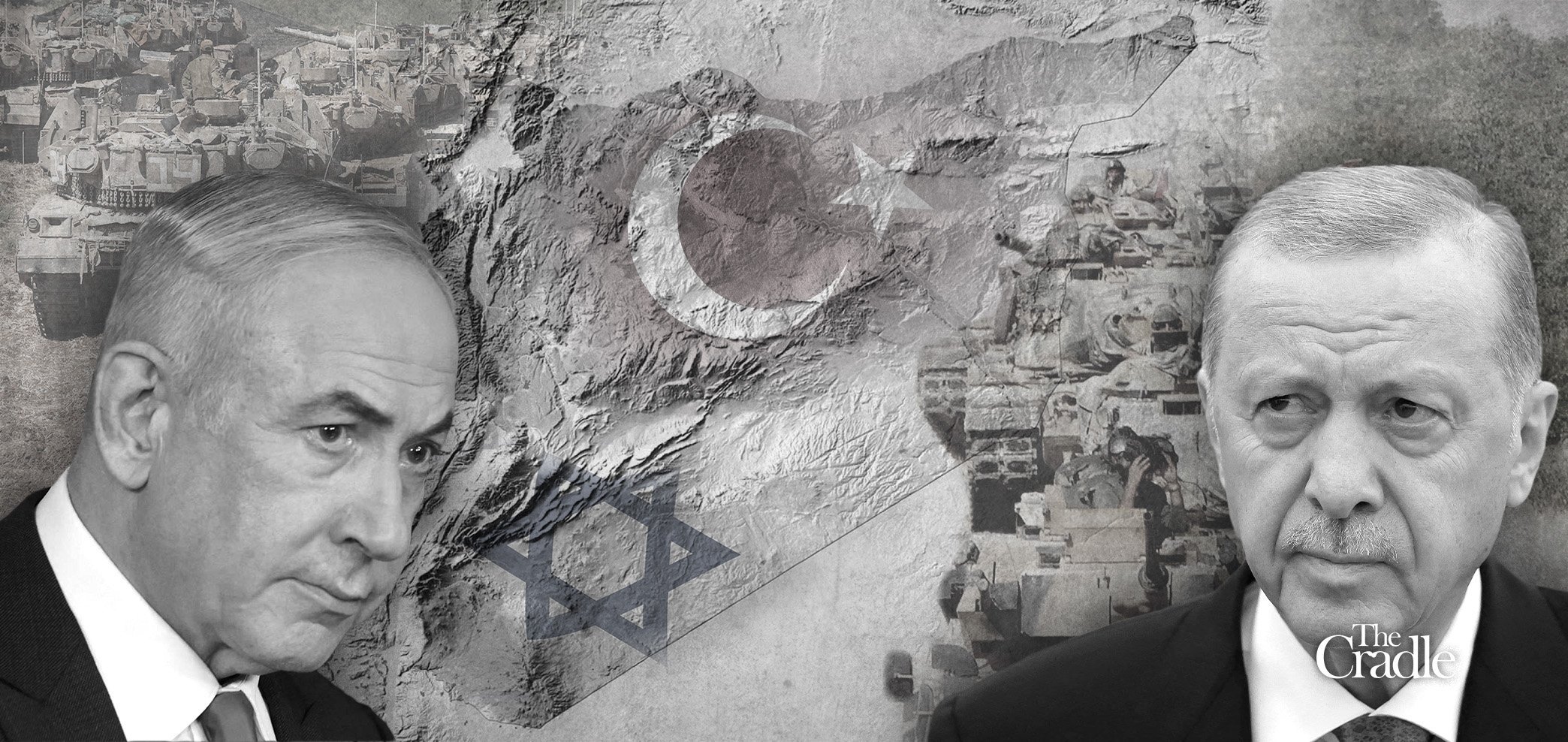



 t. 7, 2023, insurrection, Israel has massacred a reported 48,964 Gazans, an additional 62,413 have died from forced starvation and 14,000 are missing. During that same time, Israel killed 896 Palestinians in the Occupied West Bank and East Jerusalem. And more than 400 have been slaughtered in Gaza since Israel breached the January ceasefire agreement and resumed its genocide.