Blues for Europa

User avatar
blindpig
Posts: 14798
Joined: Fri Jul 14, 2017 5:44 pm
Location: Turtle Island
Contact:

Re: Blues for Europa

Post by blindpig » Sun Jul 21, 2024 6:24 pm

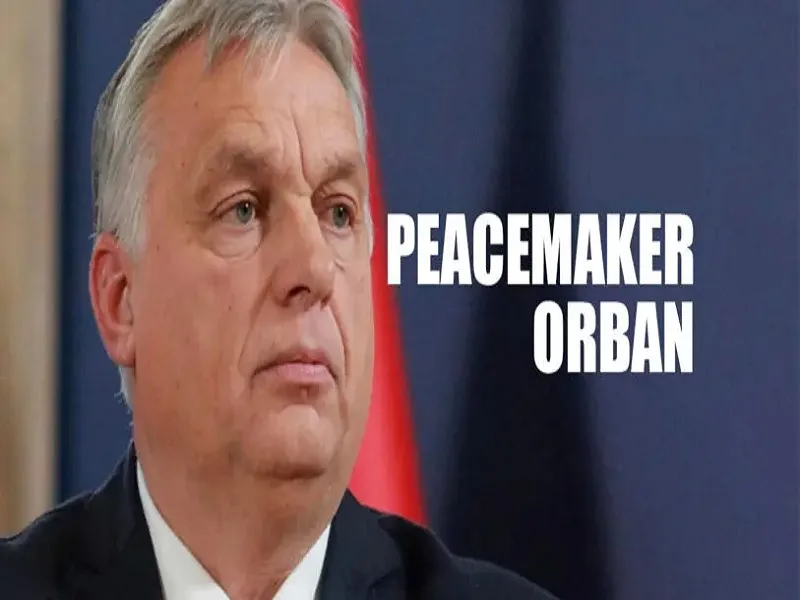
Orban’s Peace Mission Report To The EU Isn’t Anywhere As Scandalous As Some Might Think

ANDREW KORYBKO
JUL 20, 2024
Image

Nothing contained therein can credibly be described as “pro-Russian” or even “Russian-friendly”, but simply pragmatic since he argues that the failure to act could entail higher financial and other costs for the EU, especially if Trump wins the election and shifts the burden for supporting Ukraine onto the bloc.

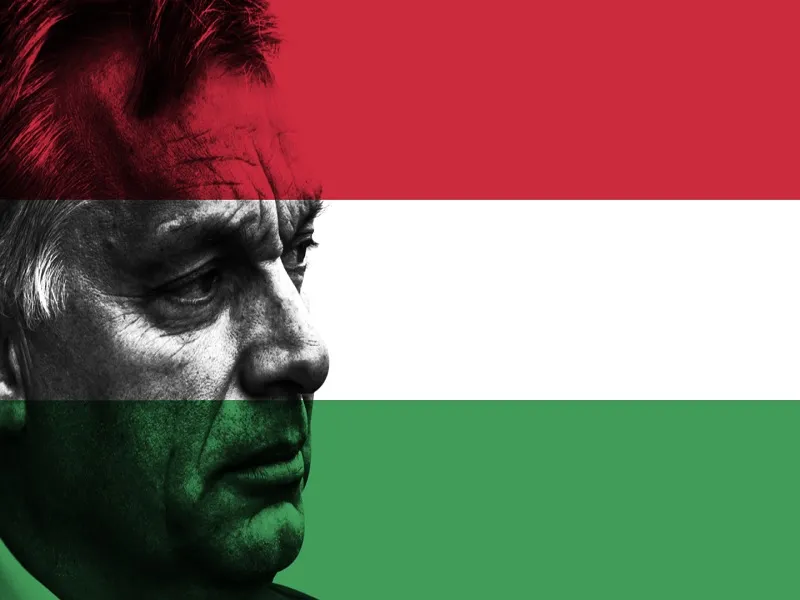
Much ado has been made about Hungarian Prime Minister Viktor Orban’s peace missions to Kiev, Moscow, Beijing, and DC, the last of which saw him meet with Trump, with the EU disavowing him as a result and its top diplomat childishly wanting to snub his planned informal foreign affairs summit. The Eurocrats are upset that he did all of this while his country is serving as the rotating president of the Council of the EU, believing that it discredits the bloc’s support for Ukraine, but their fears are misplaced.

Orban just published the full text of his peace mission report after fragments thereof surfaced and gave a misleading impression of his observations and recommendations. They aren’t anywhere as scandalous as some might think since he just concludes that the Ukrainian Conflict will worsen without serious external diplomatic involvement. Accordingly, he suggests discussing the modalities of the next peace conference with China; resuming dialogue with Russia; and launching a political offensive in the Global South.

That’s it, nothing more, nothing less. Nothing contained therein can credibly be described as “pro-Russian” or even “Russian-friendly”, but simply pragmatic since he argues that the failure to act could entail higher financial and other costs for the EU, especially if Trump wins the election and shifts the burden for supporting Ukraine onto the bloc. None of what Orban wrote is controversial, but it’s being deliberately misportrayed that way due to the ruling liberal-globalist elite’s warmongering interests.

They want to continue “fighting until the last Ukrainian” for purely ideological reasons related to the dogmatic belief that their worldview will inevitably prevail over Russia’s conservative-nationalist one. Moreover, exploring the possibility of jointly hosting the next peace conference with China would lend credence to the latter’s growing diplomatic role in global affairs, while resuming dialogue with Russia would amount to tacitly recognizing that it can’t be isolated and is indispensable to the peace process.

These supplementary outcomes are “politically unacceptable” to the Eurocrats, but the third proposal might be implemented even if they don’t give him the credit that it deserves. He specifically called for the “launch of a coordinated political offensive towards the Global South whose appreciation we have lost concerning our position on the war in Ukraine resulting in the global isolation of the transatlantic community”, which makes perfect sense, but must be done with care.

Doubling down on the same discredited narratives blaming Russia for the latest phase of the already decade-long Ukrainian Conflict and fearmongering about its supposed “imperialist motivations” in the Global South will only make soft power matters worse for the EU. What’s needed is a more pragmatic approach which finally acknowledges the conflict’s complexity, stops attacking Russia, and presents the EU as a reliable partner for optimizing Global South countries’ balancing acts in the New Cold War.

None of this is likely to come to fruition anytime soon, but the point is that the EU could theoretically implement the last of Orban’s recommendations, even if it still makes the same mistakes as before. It’s the least relevant to the Ukrainian Conflict though, but that’s why it might pursue it in some form. As for the other two recommendations, the first is comparatively more acceptable than the second if push comes to shove, but it would likely be rendered irrelevant if Trump returns to power.

There’s no way that he’d want to hand his country’s systemic rival the global diplomatic victory of jointly hosting the next peace conference together with most of NATO, but he might accept it as a fait accompli on the off chance that this happens before his possible inauguration. As for the second proposal of resuming dialogue with Russia, they might feel coerced to implement it if he does so first as part of his promise to mediate a solution to the conflict shortly after he wins.

It's therefore in the EU’s objective interests to heed Orban’s recommendations, which aren’t scandalous at all, though the most that can realistically be expected given the Eurocrats’ attitude towards him and this conflict is that they make another botched political offensive in the Global South. They lack the humility to bring China on board as an equal diplomatic stakeholder in peace and it’s ideologically anathema for them to talk to Russia so they’ll likely miss the opportunities presented by his proposals.

https://korybko.substack.com/p/orbans-p ... ort-to-the

Poland’s Anti-Russian Witch Hunt Is About To Ensnare Its Former Defense Minister

ANDREW KORYBKO
JUL 21, 2024
Image

The reality is that it’s Germany which yields powerful behind-the-scenes influence over Poland, not Russia, though PiS was always too scared to seriously investigate this while Tusk is in cahoots with them.

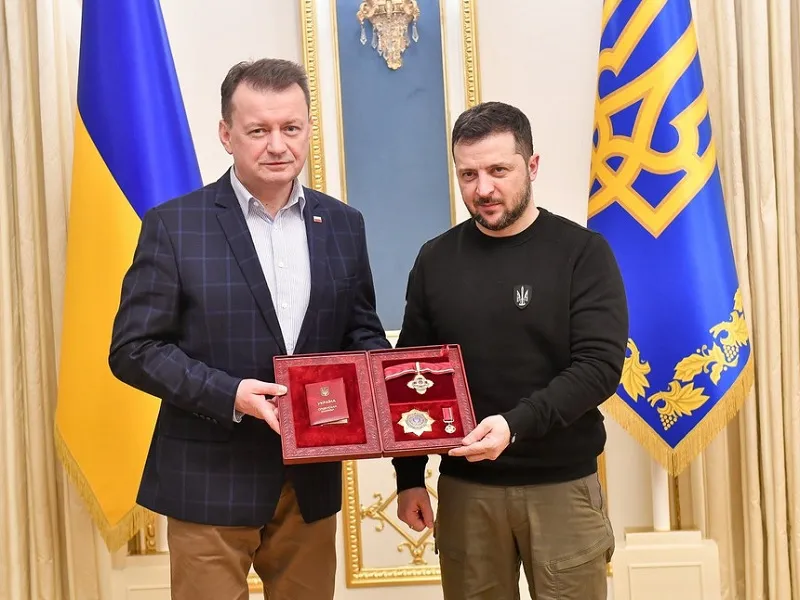
Former Polish Defense Minister Mariusz Blaszczak might soon face charges over his sharing last September of Prime Minister Donald Tusk’s contingency plan in the event of a Russian invasion. It allegedly called for the armed forces to retreat west of the Vistula River in order to buy time for NATO’s reinforcements to arrive. Blaszczak, who’s also the Vice-President of the Law & Justice (PiS) party, presented this as alleged proof that Tusk’s former government was in cahoots with Russia.

Poland’s Military Counterintelligence Service (SKW) just completed their investigation into that incident, however, and “established irregularities in the scope of improper handling of classified information, acting to the detriment of the interest of protecting classified information”. They accordingly just passed the information to prosecutors, who might soon charge him with related crimes under the penal code. This came shortly after the Sejm lifted his immunity due to an unrelated public slander case.

About that, Blaszczak claimed in May 2023 that the former Armed Forces Operational Commander failed to inform him of a Russian missile that violated their country’s airspace in December 2022, the account of which was rejected by the accused individual who then pressed charges. The larger context is that conservative-nationalist PiS and the now-ruling liberal-globalist Civic Coalition (KO) have tried to frame one another as Russian puppets. Readers can learn more about this from the following five briefings:

* 3 June 2023: “PiS Will Settle For Branding PO With A Scarlet Letter Instead Of Banning It From The Polls”

* 20 September 2023: “The Polish Defense Minister’s Claim About The Opposition’s Defense Policy Is Disingenuous”

* 14 May 2024: “Poland’s Former Government Allegedly Profited From Anti-Russian Propaganda In Corrupt Ways”

* 23 May 2024: “Poland’s New ‘Russian Influence Commission’ Aims To Influence The Next Presidential Election”

* 29 May 2024: “Sikorski Tried Justifying Poland’s ‘Russian Influence Commission’ On False Pretexts”

Each party’s “Russian influence commission” is a politicized witch hunt aimed at reshaping voters’ perceptions of their opponent and neither can objectively be described as “pro-Russian”. Tusk’s contingency plan actually made perfect military sense at the time as explained in the first analysis above, while the third reminds everyone of everything that PiS did against Russia while in power. Describing either of them as “pro-Russian” is self-discrediting and shows how vicious partisan politics has become.

Casual observers might naively assume that the SKW’s investigation in Blaszczak’s incident last September is above partisan concerns and an issue of national security, but that’s arguably a false impression considering Tusk’s persecution of other now-opposition members earlier this year. PiS believes that they’re being targeted for ideological reasons related to imposing a German-backed liberal-globalist dictatorship on Poland since they present themselves as the only party that can stop this plot.

Their claim is convincing since it’s more ludicrous for KO to smear them as “pro-Russian” than it is for PiS to smear Tusk’s former government as the same considering that the latter’s contingency plan could more easily be seen by some as proof of “Russian collusion” than the former’s more benign scandals. The reality is that it’s Germany which yields powerful behind-the-scenes influence over Poland, not Russia, though PiS was always too scared to seriously investigate this while Tusk is in cahoots with them.

https://korybko.substack.com/p/polands- ... ch-hunt-is

******

The US Vassal State of Germany Comes Apart
Posted on July 21, 2024 by Conor Gallagher

“Germany must remain an anchor of stability in Europe,” Chancellor Olaf Scholz said after his coalition finally passed a budget and headed out for summer recess.

It’s unclear exactly how the coalition erased a roughly 25 billion euro funding gap. They didn’t take the trouble to provide a detailed explanation. [1]

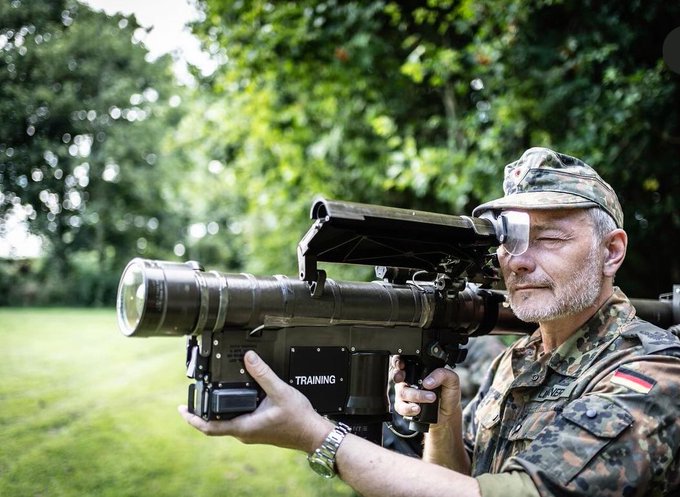
Finance Minister Christian Lindner might have been busy doing other things as he posted a picture of himself toting a Stinger missile during a recent military exercise. [2]
Image

Parts of the budget are leaking out however, and it is being reported that the historically unpopular traffic light coalition of the Greens, Social Democratic Party, and Free Democratic Party cut aid to Ukraine and its contribution to the EU, as well as moved some defense purchases off the 2025 budget, but they will have to be accounted for in future budgets by the next government.

Anyone paying attention knows that Scholz is out of mind to invoke the term “stability” for the state of Germany at the moment. Let’s consider the following:

He leads the most unpopular government in modern German history. Three quarters of the population are dissatisfied. According to a survey conducted July 1-3, zero percent of Germans said they were “fully satisfied” with the ruling coalition’s work. Even accounting for the margin of error, that’s suboptimal.
The three parties in the ruling coalition are together polling at around only 30 percent, and they were embarrassed in the June European elections. Scholz’s own party, the once-proud Social Democrats, came in at less than 14 percent in the European elections. That is the party’s worst result in a national election since the founding of the Federal Republic in 1949.
Washington and Berlin just announced that they’re deploying long-range U.S. missiles that could reach Russia (including SM-6, Tomahawk, and at some point probably hypersonic weapons) on German territory from 2026 for the first time since the Cold War in a move that will almost certainly make the country less secure.
The Russians are everywhere. The recent news that Russia planned to kill the CEO of arms manufacturer Rheinmetall, comes on the heels of the Russians allegedly behind a fire at a metal factory, espionage on Ukrainian targets in Germany, the murder of a Chechen in Berlin, payments to spread Kremlin propaganda, and all types of “information warfare.”
The German economy has been stagnant for seven years running, which I suppose is a form of stability.
Meanwhile, the government in Berlin is cutting social spending, German industry “has taken a permanent hit,” real wages have dropped back to 2016 levels, and the government is investing 12.4 billion euros in the stock market in a new “Generation Capital Foundation” as part of a scheme to continue financing pensions. Stability.
And still no one can figure out who destroyed those Nord Stream pipelines.
Despite Scholz’s stability reassurances, more upheaval is likely in a few months’ time.

“The Big Worry”

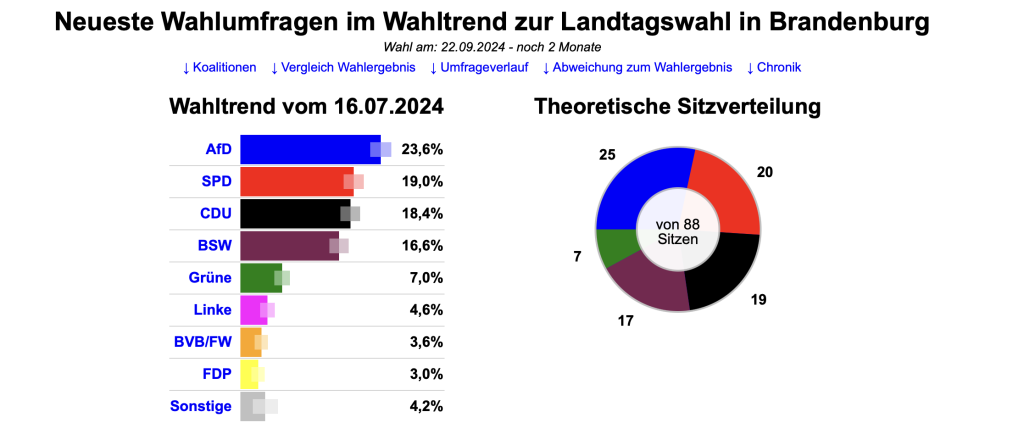
If the freak out over a few political parties who favor repairing ties with Russia and who performed well in the European Parliament elections is already at a 10, expect it to be turned up to an 11 should they continue their rise in the polls ahead of September state elections in Saxony, Brandenburg, and Thuringia.

The EU vote clearly sent a loud message about voter dissatisfaction. The upcoming state elections could present challenges for German support for Project Ukraine by heaping more pressure on the country’s ruling coalition that is already on life support.

Some background on the two parties threatening to upset the apple cart: Sahra Wagenknecht’s old-school left Bündnis Sahra Wagenknecht (BSW) focuses on working class issues, ignores identity politics, and opposes the US-led new Cold War.

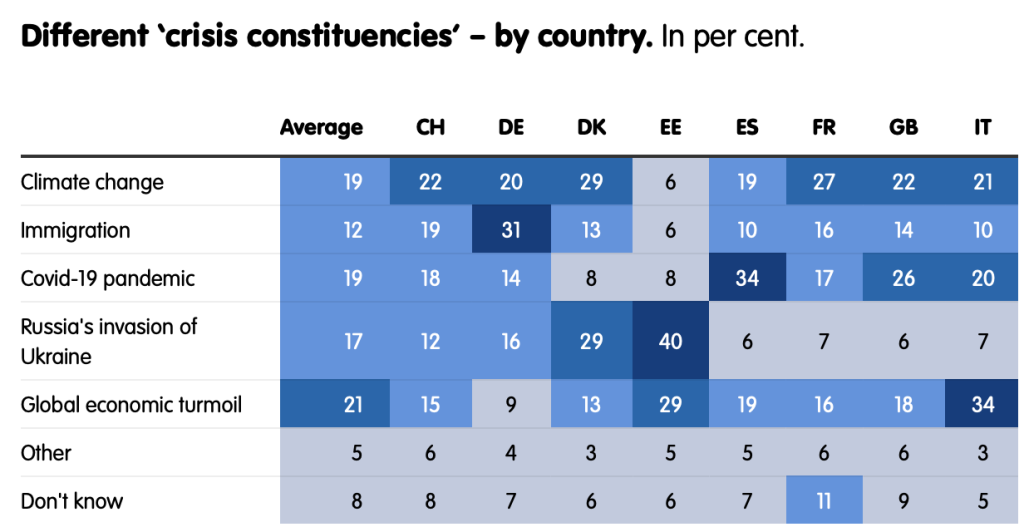
The other party is of course the ethno-nationalist Alternative for Germany (AfD). It wants to reclaim German sovereignty from the EU and NATO and make nice with Russia since that is in German interests. While the party has attracted widespread working class support, detractors like BSW argue it is no friend of the people, but instead favors a different flavor of oligarchs – German rather than global. What really propelled the AfD into prominence is its outspoken opposition to the dramatic increase in immigrants to Germany in recent years.
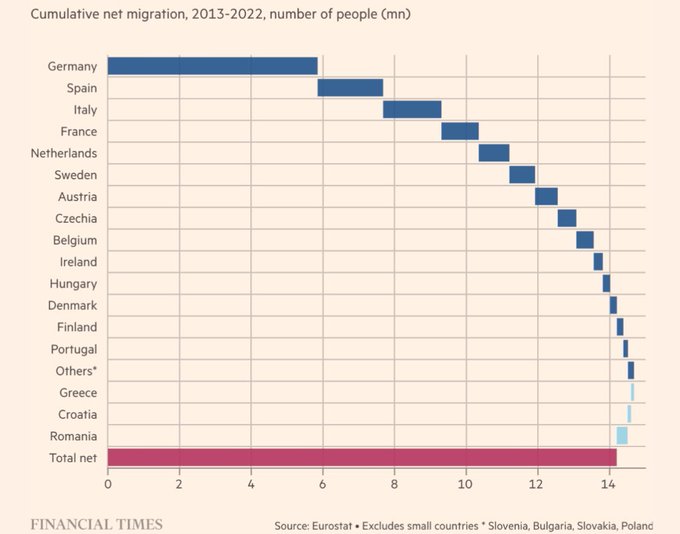
Image

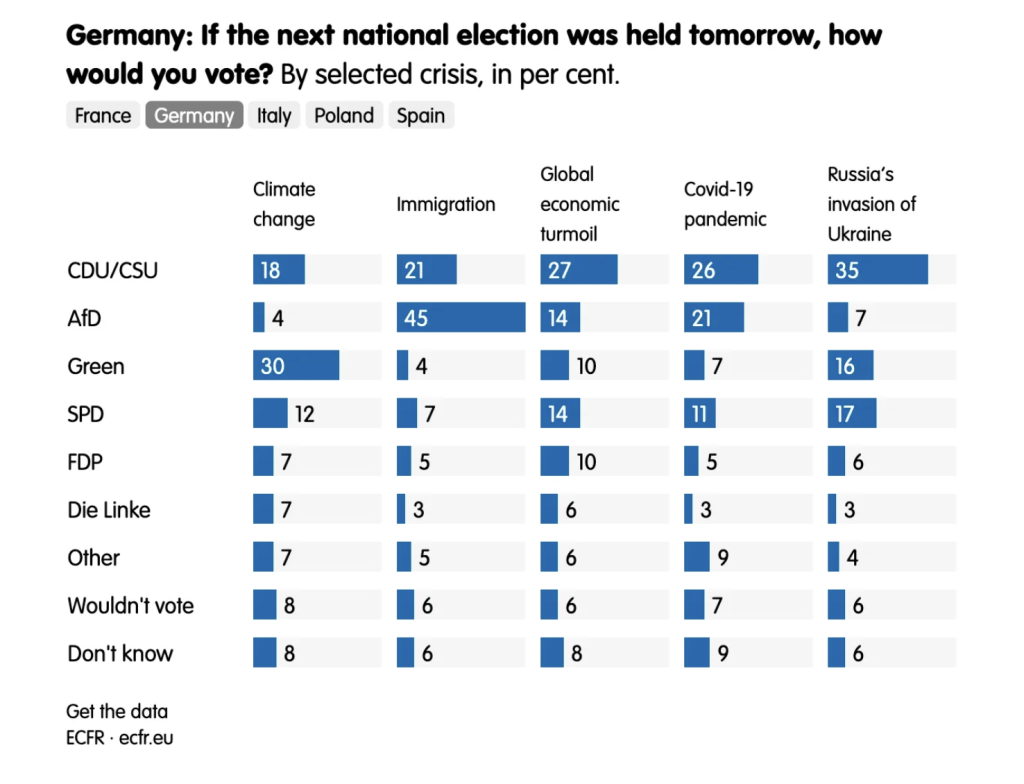
We can see the effect on the electorate:
Image

Image

There is also evidence that a sizable chunk of AfD support is a way to give a raised middle finger to the current political establishment, which is at record-low approval ratings.

The three states that will be heading to the polls are all former East German states, largely working class with some of the bigger employers in industries like the auto sector, machinery production, and metalworking. The states are on the poorer end when looking at German states:
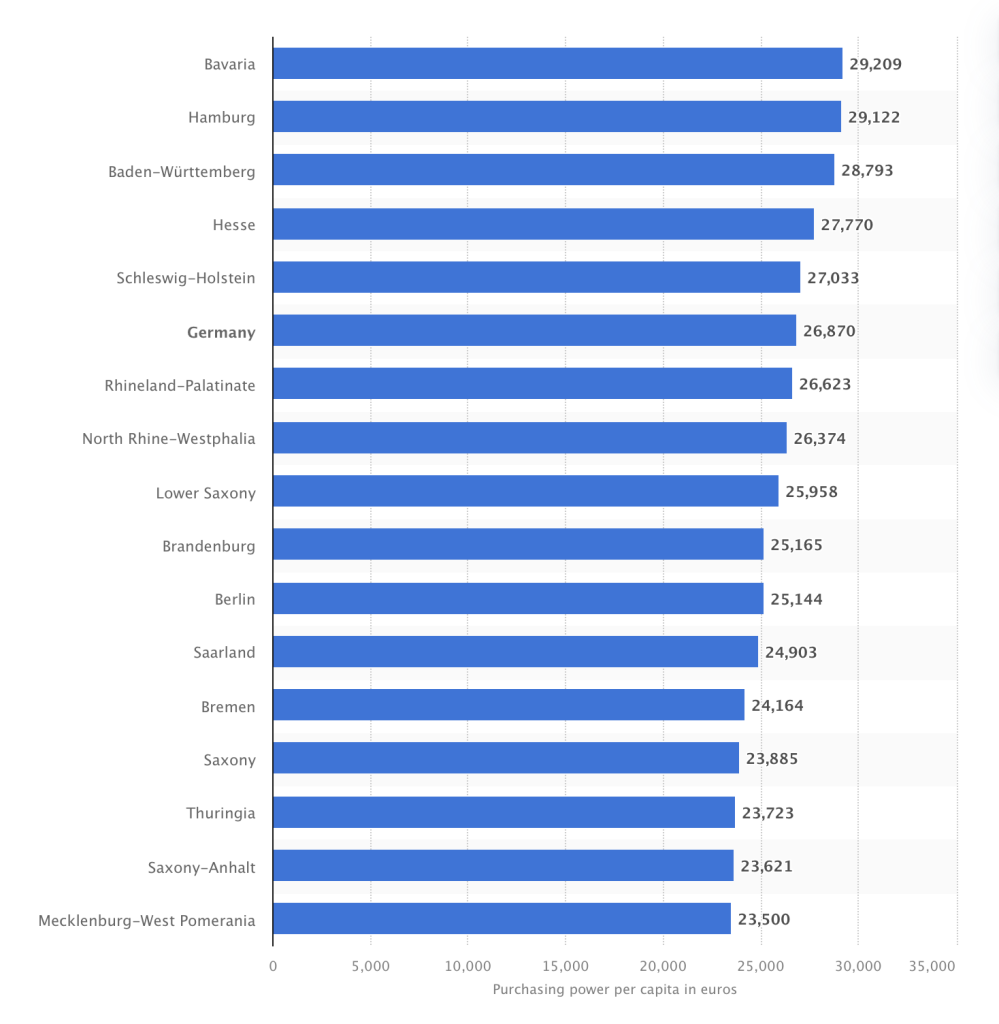
Image
Source: Statista

Brandenburg (6.1 percent), Thuringia (6.3 percent), and Saxony (6.6 percent) are all a little over the national average unemployment rate of 6 percent.

The fact the elections are taking place in eastern Germany is a boon for the AfD and, to a lesser extent, BSW. We can see how well the AfD performed there in the European elections (blue is the AfD while black is the Christian Democratic Union):

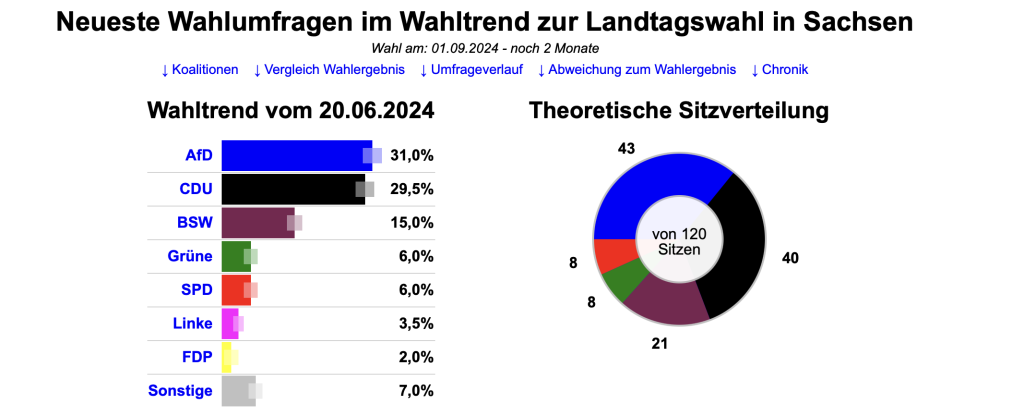
Image
Image
Image

Those polls are causing blood pressures to rise in Berlin, Brussels, and Washington. SEMAFOR recently summed up the thinking in those locales with a piece titled “The Big Worry.”

In it they try to explain what’s wrong with the voters that they would vote for the AfD or someone like the “pro-Kremlin” Wagenknecht. Naturally, major fault lies with the Russians according to serious people:

The European Parliament election results showed a stark divide between former East and West Germany, with nearly every constituency in the former Eastern bloc going to the far-right AfD, prompting one economist to comment, “Who said that Germany reunified?” An academic from Saxony told The German Review newsletter that despite their support for Russia-friendly parties, “east Germans don’t like Russia. Instead, they learned during the Cold War that it’s better not to provoke the Kremlin.” Analysts had warned of Russian influence campaigns during the European elections to boost support for far-right parties. In eastern Germany, though, support for the AfD’s stance on Russia and migration has become so entrenched that “there is no influence necessary,” political scientist Hans Vorländer told Semafor.

The Senator piece highlights another trend among the entrenched establishment, which is to equate left and right (in this case, BSW and the AfD) as two sides of the same coin:

Jan Rovny, a political sciences professor at Sciences Po, told Semafor. The far left projects a misplaced nostalgia onto Russia as the “carrier of some kind of Soviet heritage,” he argued, while the right see Putin as an emblem of “Christian, traditional, masculinist Europe.” Strikingly, rather than warring against each other, nationalists today view themselves as providing a united bulwark in the face of a perceived common enemy, Rovny said.

It of course has nothing to do with economic realities of German energy policy or the question of whether it’s wise for Germany to wholly submit to being a military outpost for the US with long range weapons pointed at Moscow (and Russian hypersonic missiles pointed at Berlin). SEMAFOR concludes, “The far left and far right wave different colored flags, but are ultimately similar.”

But they’re really not. At all.

Just a few examples:

BSW proposes a fairer tax system that benefits the working class, such as the demand for an excess profits tax in the industrial sector. The AfD wants to slash taxes across the board, including those that are progressive and serve to redistribute wealth, such as the inheritance tax
BSW believes in global warming and wants to continue to take climate action but work to soften the economic blow to the working class. The AfD rejects climate science. In its EU election manifesto, it says that the “claim of a threat through human-made climate change” is “CO2 hysterics,” and it would do away with climate laws that reduce prosperity and freedoms.
BSW wants to strengthen the social safety net. The AfD stresses the limits of the state’s role.
It’s easy to see why lazy analyses lump left and right together. On the issues that really matter to the Atlanticists that infest the bureaucratic and media offices (unquestioning support for Brussels economic policy and for NATO-led war against Russia) the AfD and BSW do hold similar positions. Both are for an end to sanctions on Russia and to weapon deliveries to Ukraine, and getting out from under the thumb of Washington. The fact the parties are vastly different on economic policies for working class voters hardly registers as important. Maybe the Atlanticists have been so busy for so long trying to equate WWII-era Nazism and communism, it all just comes naturally.

Regardless, what’s clear in these analyses and ongoing lack of any government response to voter concerns is the belief that it is the voters who must change. Who must stop being so backwards, so stupid, and desirous of things they cannot have.

Asked after his party’s embarrassing results in the European elections if he would like to comment on his humiliating defeat Chancellor Scholz said nothing about hearing the concerns of the voters and promising to address those concerns. He simply replied with a defiant “nope.”

And that pretty much sums up where Germany is at the moment. The democratic system has partially broken down as voters make demands and the elected leaders simply say no. Scholz’s foreign minister Annalena Baerbock was more forthcoming in her infamous 2022 comments:


Speaking of Baerbock, she might have taken the satirical cake when she recently took herself out of the running for chancellor next year. The reason? She said the world needs “more diplomacy, not less,” which might sound odd coming from someone notorious for their lack of diplomacy but fits in perfectly with the current government.

Unsurprisingly voters are looking for alternatives.

AfD Prepares to Break Through the Firewall

What else can they throw at the AfD at this point – aside from a complete ban on the party, which could throw Germany into chaos? That possibility remains on the table, and the recent use of a reported 200 masked police officers to raid the office and home of the rightwing Compact Magazine publisher is not a great sign.

The AfD is routinely pilloried in the media. The Nazi comparisons have been repeated endlessly, often for good reason as AfD members just can’t help themselves from admiring the Third Reich such as AfD’s top European Parliament election candidate, Maximilian Krah, who had to step back from campaigning in May after saying that not all Nazi SS members were criminals. There are plenty of other examples, as well.

The party is already under state surveillance.

Spy and corruption cases involving AfD members broke ahead of the European vote.

Despite all that, the party ended up scoring its best nationwide result so far in June, coming second on 15.9% in the European Parliament election.Their next mission is to start breaking down the firewall in Germany that aims to keep the party out of any governments.

“The firewall has already disappeared more or less on a communal level,” Joerg Urban, head of the AfD in Saxony, told Reuters. “The state level is the next step.”

Originally more of an anti-EU party and refuge for neo-Nazis, the AfD has been able to ride the wave of backlash against government policies that have been disastrous for working people – from the war in Ukraine and a losing sanction war to disastrous energy policies that hit poorer people the hardest to a large increase in immigration at the same time standards of living decline. It is now widely seen by its supporters as a party that will “save” German culture and return the country to fondly remembered days – whether 10 years ago or 85.

Yet the mainstream parties in Germany lack credibility when criticizing the AfD’s ethno nationalism when they also support genocide in Palestine policies, which could include a swift increase in deportations, and are simultaneously taking a much harder line against immigrants in an effort to thwart to the AfD’s rise. Earlier this year the Bundestag passed the Repatriation Improvement Act, which increases the amount of time the state can detain someone before deporting them from 10 to 28 days. It also gives the state more powers to enter homes, makes the suspicion of certain criminal offenses enough to deport people, and criminalizes certain activities by aid workers who assist asylum seekers, punishable with up to ten years in prison.

It’s an open question as to whether the backlash against the increase in immigration to Germany would be such an issue if it wasn’t coming at a time of budget cuts and sinking standard of living. Regardless, the path chosen by the current government, as well as the one favored by the AfD, is to punish immigrants rather than try to improve living standards.

Will Anyone Truly Represent the Working Class?

Scholz’s coalition hovers around the 10 percent mark across much of Eastern Germany. If he is presiding over the final nail in the coffin of the SPD after a half century of decline accelerated by abandoning the working class, Wagenknecht is working to take the place it (and Die Linke) once occupied.

The problem is, it turns out she’s in more of a battle with the AfD. [3] Scholz’s party suddenly has no real base of which to speak. Just above 18 percent of unionized Germans voted for the SPD in the European election compared to 18.5 for the AfD. Adam Tooze elaborates:

Germans who feel well off are twice as likely to vote Green or FDP than those feeling that they are doing badly. But the SPD too scores 36 percent better amongst Germans who judge themselves to be living well as opposed to those who feel hard-up. The parties whose support tilts the other way are in the opposition: Wagenknecht’s group and the AfD. Support for the AfD is two and a half times larger amongst Germans who judged themselves to be hard up than amongst those who consider themselves well off.

And as Tooze detailed in his detailed breakdown of Germany’s vote for the European Parliament, ‘the real opposition in German society and political preferences is not between the “old” labour movement and the AfD. The real juxtaposition is between the AfD and the Greens.’
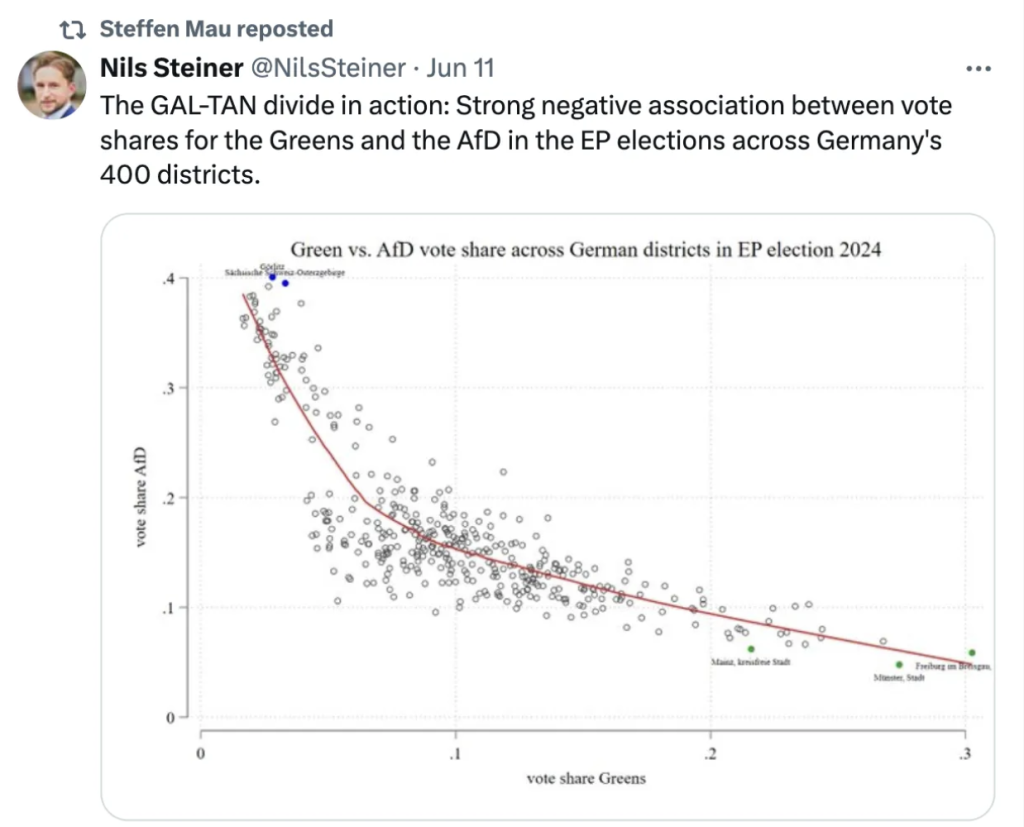
Image

The CDU might lead in the national polls and is likely to head the next government, but the Greens and the AfD best represent the ideological forces pitted against one another in Germany. One is a globalist, neoliberal, bourgeoisie, pro-war, pro-NATO party that favors immigration. The other is sovereignist, ethno-nationalist, favors a more national oligarchy, has increasing support of the working class (despite a lack of policy proposals that would benefit workers), and is not opposed to war but insists it be in German interests not Washington.

BSW is trying to crash that party. The September votes in three eastern states could provide a major boost.

As we can see, the German electorate is in a state of flux, driven by the upheaval in the country and the deep dissatisfaction with the ruling coalition. There isn’t a neat way to explain the migration of voters aside from possibly anger. Recent polling shows that 87 percent of AfD voters think the current government should be sent a reprimand; 71 percent of Wagenknecht voters agreed. And both parties are picking up voters from other parties regardless of ideology:
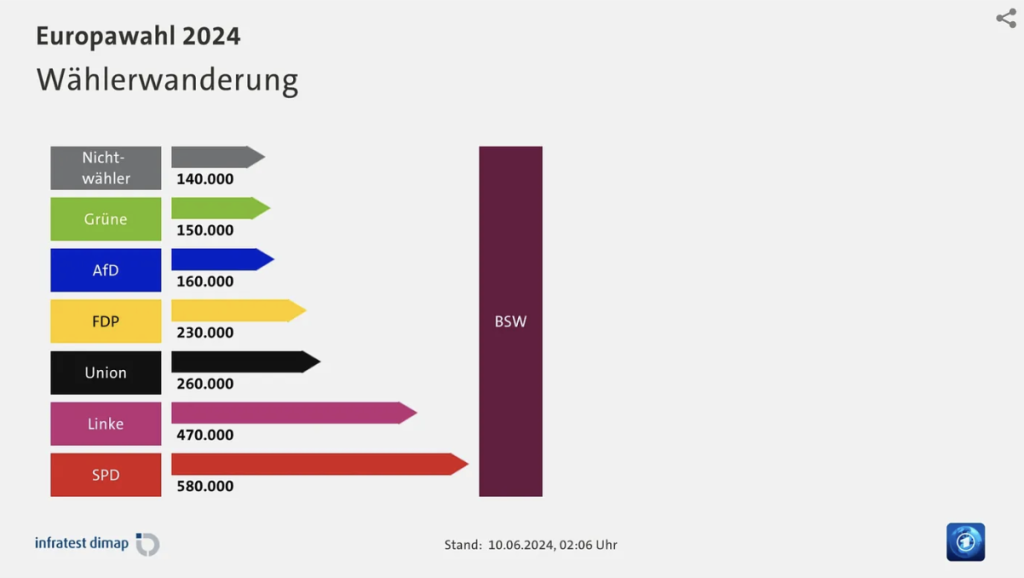
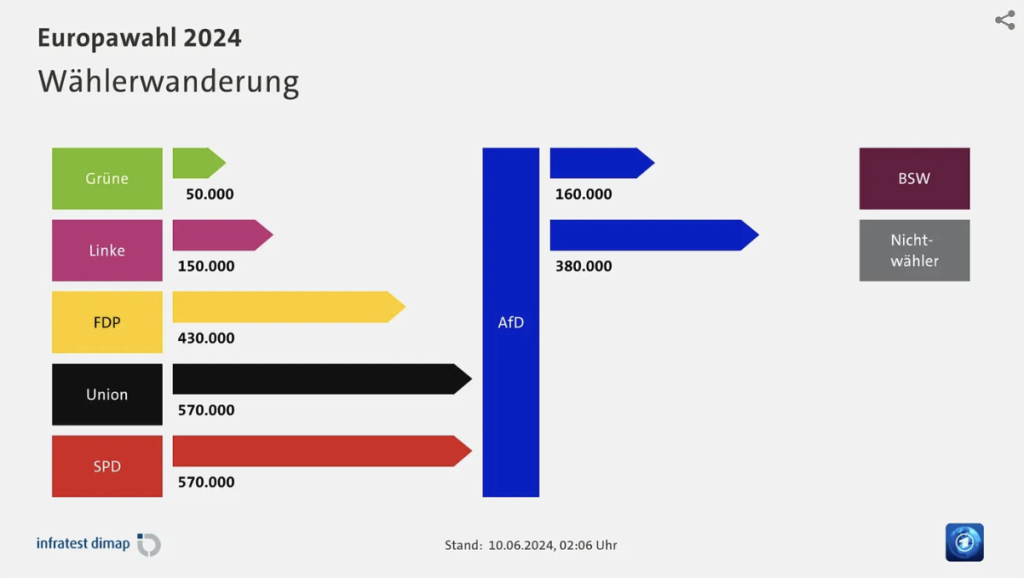
Image

Image

Wagenknecht’s supporters rank peace and the war in Ukraine as their primary concern, and she continues to hammer home her opposition to the conflict, as well as the recent decision to deploy long range US missiles in Germany. Their second biggest concern is immigration. Wagenknecht, born in East Germany to German and Iranian parents, doesn’t want to limit immigration for ethno nationalist reasons like the AfD, but her position can be summed up by her response to a question regarding the issue here:

We don’t think a neoliberal immigration regime, where everybody can in effect go anywhere and then must somehow try to fit in and survive, is a good idea. We need to welcome people who want to work and live in our country and we should learn to do so. But this shouldn’t result in disrupting the lives of those who already live here, and it shouldn’t overstrain collective resources, for which people have worked and paid taxes. Otherwise, the rise of nativist right-wing politics will be inevitable. In fact, the AfD in its present form is largely a legacy of Angela Merkel. In Germany we have a dramatic housing shortage, especially for people with low incomes, and the quality of education in public schools has become appalling in places. Our capacity to give immigrants a chance of equal participation in our economy and society is not endless.

The problem for Wagenknecht remains that Germans rate immigration as their top issue and most trust the AfD. And this brings us to the center of Germany’s democratic breakdown. It would have been hard for the current and past governments to have done a better job promoting the AfD if it had tried.

The rapid influx of millions of immigrants coupled with a stagnating economy, unaffordable housing, and cuts in social services is a recipe for disaster. And so we now have the AfD, which received its seed money from a reclusive billionaire descendant of prominent Nazis, poised to win state elections despite numerous comments by party officials showing at best a lack of understanding about Nazi crimes and at worst an admiration for them while they also argue that Muslims and others are “incompatible” with German culture.

The assist isn’t just from Berlin, either. Voters might be left to wonder what’s so wrong with the AfD when the “responsible” political center in Brussels and Washington backs Nazis in Ukraine, rehabilitates Nazis, enacts mass censorship and other crackdowns, supports genocide, and generally drags us kicking and screaming into their neoliberal fascist vision of the future. And make no doubt about it, should the AfD gradually learn to toe the NATO and EU line, it would no doubt be welcomed with open arms into the halls of power regardless of any admiration for the SS.

Is it worth casting a vote for the AfD, despite its considerable baggage, because the party favors returning sovereignty to Germany, which could help bring about the demise of the EU and NATO? The problem with that rationale is the BSW option, which offers the same opposition to Project Ukraine and NATO as the AfD without any of the fondness for Nazis and a better platform for the working class, so maybe that answers the question.

More broadly, the easy way to defeat a party like the AfD is to give voters material benefits that improve their quality of life; instead we have the opposite happening, and to add insult to injury, voters are insulted as racists for seeking alternatives while their standard of living declines and the “center” plugs its ears and insists on “stability.”

Notes

[1]The coalition has been fighting over the 2025 budget following last fall’s rebuke by the constitutional court, placing strict limits on releasing the country’s debt brake. That rule, intended to force governments to balance the federal budget, was introduced under Angela Merkel during the euro crisis and restricts deficit spending to a minimum, except under “extraordinary” circumstances, such as a natural disaster or war. The court apparently did not believe that the war against Russia is as extraordinary as politicians and the press make it out to be.

[2] Lindner’s celebration of military hardware is part of an ominous trend. CDU leader and Germany’s likely future chancellor Friedrich Merz donned a G-suit and hopped into a Eurofighter last month.

[3] The working class divided between an ethno nationalist party and a genuine populist one is not a bad outcome for the Davos crowd at the end of the day as CDU head and former Blackrock Germany executive Friedrich Merz is the odds-on favorite to become the next chancellor.

https://www.nakedcapitalism.com/2024/07 ... avels.html
"There is great chaos under heaven; the situation is excellent."

User avatar
blindpig
Posts: 14798
Joined: Fri Jul 14, 2017 5:44 pm
Location: Turtle Island
Contact:

Re: Blues for Europa

Post by blindpig » Mon Jul 22, 2024 2:41 pm

THE POLISH PURGE – RUSSIAN ASSESSMENT OF EX-DEFENSE MINISTER BLASZCZAK’S TREASON

Image

by John Helmer, Moscow @bears_with

Captain Obvious is an American cartoon hero. In Poland, however, he’s now being set up for prosecution on charges of treason for saying the obvious. That, according to the new Polish government and the US Ambassador in Warsaw, Mark Brzezinski, must not be allowed to be said.

Instead, the Polish Captain O has said that Poland cannot defend itself from a combined Russian-Belarusian attack, and cannot count on the United States and other NATO allies to save it in time.

Although the Polish General Staff knows this, and so do Poland’s presidency, prime ministry and Sejm (parliament), the Warsaw directorate aims to pay the US, NATO allies, and South Korea more than thirty billion dollars in protection money for Polish, US and NATO readiness in defence of the impossible. From time to time, one of the fantasies of Polish officials is to draw US nuclear weapons on to Polish territory for premium insurance against the Russian invasion risk. President Andrzej Duda last said as much three months ago.

That Poland won’t survive a US-fired nuclear weapon from the Redzikowo base, northwest of Warsaw, is also obvious. Not allowing this to be said is the script, not of Captain Obvious (Kapitan Oczywiste) but of Captain Oblivious (Kapitan Nieświadomy).

Mariusz Blaszczak (lead image), a small town politician by career, was Poland’s Defense Minister from 2018 to 2023; before that he was the minister in charge of the security agencies and Border Guard as Minister of the Interior and Administration. He has been elected to the Sejm for five terms as a leading figure of the Law and Justice (PiS) party. When the PiS lost the election of last October, Blaszczak lost his ministerial power and went back to the parliament’s opposition benches.

During his term in office, Poland had tripled its defence spending to 94 billion zloty ($24 billion), amounting to almost 4% of the national GDP, the largest military commitment of the entire alliance, speaking relatively, exceeding even the US. From the US, Blaszczak signed for purchases of the Patriot air defence system, HIMARS rocket launchers, F-35 combat aircraft, Abrams tanks, and other military materiel, funded by $4 billion in Pentagon loans. That is a small fraction of the total money outlay Blaszczak committed Poland to pay – the Patriots alone cost $15 billion; the F-35s, $4.6 billion; Abrams tanks, $1.5 billion; and HIMARS systems up to $10 billion. More tanks and artillery from South Korea have been paid for and deliveries commenced at a price tag of almost $6 billion. Aircraft and other weapons from Sweden are going to cost about $100 million.

Image
Source: https://www.reuters.com/.
See also https://notesfrompoland.com/

Blaszczak has publicly called this militarization of the Polish economy and the unprecedented military spending a deterrent against Russia. Notwithstanding, every one of the US weapons which has been deployed on the Ukrainian battlefield and which the Poles have bought, has been defeated already by superior Russian weapons. This hasn’t been missed by Poland’s General Staff.

Infighting between the generals, the intelligence agencies, and government ministers has been fierce as the Ukraine war has headed towards defeat. Just days before last October’s national vote, Blaszczak went on Twitter to reveal parts of a classified military report exposing the General Staff view that Poland could not withstand a Russian offensive. They were planning instead, Blaszczak said, to concede the eastern half of the country, and to form a national defence line on the Vistula River.

Blaszczak’s birthplace and parliamentary constituency of Legionowo, a suburb of Warsaw, is east of the Vistula line, and would be lost in the General Staff’s war plan. The town had been occupied by the Russian Army in the 1890s; recovered from the Red Army in 1920; lost to the German Army in World War II; lost again to the Red Army during the Vistula-Oder Offensive of 1945.

Blaszczak’s leak of the classified documents was an election-eve promotion for himself and the PiS party.

Image

In his video film dated September 17, 2023, Blaszczak said “the government of [Donald] Tusk was ready to give up half of Poland in the event of war”. Tusk, who was prime minister from 2007-14, was the leader of the Civic Platform (PO) opposition, and on October 15 he won enough new votes to form a coalition of minority parties to recover the government; Tusk became prime minister again on December 13. Since then he and the PO have gained in the polls while the PiS has been losing ground.

Blaszczak’s vulnerability to PO attack has grown in tandem.

Blaszczak’s film was broadcast on the anniversary of the Soviet invasion of Poland in September 1939 which came two weeks after Germany had invaded from the west, with Moscow and Berlin then dividing the country between them. In Blaszczak’s broadcast, the minister showed images of a dossier from 2011, marked as “top secret” and signed by the then-PO defence minister Bogdan Klich, relating to the defence of Poland in the case of an invasion from the east. According to the dossier, Poland’s General Staff had run a simulation of an attack on the country from the east. Polish defences were supposed to hold out for 22 days, but in fact “the war was lost within five days and the Polish army ceased to exist.”

“[The analysis] assumed that the stand-alone defence of the country would last a maximum of two weeks, and after seven days the enemy would reach the right [east] bank of the Vistula,” said Błaszczak. “The documents clearly show that Lublin, Rzeszów and Łomża could have been the Polish Bucha,” Blaszczak claimed, referring to the fabricated allegation of Russian war crimes in the Ukrainian town of Bucha in September 2022.

“The PiS has changed this and will defend every piece of Poland,” Blaszczak added. “[Poland] will become the most powerful land force in Europe.” The electioneering was obvious. The General Staff report of 2011 was also obvious, especially so after the Russian Army had demonstrated its near-total battlefield superiority over the weapons Blaszczak was buying for Poland’s defence.

The reaction from the Polish military and the PO was to accuse Blaszczak of treason, and to threaten that if they won the October election, they would move in parliament to strip him of his legal immunity and indict him in court for “declassifying top secret documents for electoral purposes”.

Early this month in a Sejm vote of 245 to 181, Blaszczak lost his immunity from prosecution. Other former PiS ministers were also stripped of their immunity; one was then arrested and handcuffed on national television. That action was reversed last week in Warsaw in an embarrassment for Tusk and his law officials.

As Pentagon loyalists go, Blaszczak exceeded his Polish predecessors, even the Greeks. “Dear Lloyd. It’s my pleasure to be in Washington to see you again to discuss the Polish-American defence cooperation,” Blaszczak told General Lloyd Austin, US Defense Secretary, at the Pentagon door on May 5, 2023. “Now Marius,” Austin said, “I know that you are deeply dedicated to making the security ties between our country even stronger…You know, two weeks ago, we were at Ramstein [Germany] at the most recent meeting of the Ukraine Defence Contact Group, and Poland was once again a leader in helping Ukraine increase its military capabilities. In fact, without Poland’s tremendous contributions we would never have been able to do as much for Ukraine after Russia’s indefensible invasion.”

Image
Left, Blaszczak (PiS) and Austin, May 5, 2023. Right, Radoslaw Sikorski, PO foreign minister and ex-British national with a wife, Anne Applebaum, who is a US as well as Polish passport holder.

At the same time, as Polish political analyst Stanislas Balcerac has pointed out, US Ambassador Brzezinski was working in Warsaw to replace Blaszczak and his PiS government with even more fervid loyalists like former PO Defense Minister, now Foreign Minister Radoslaw Sikorski.

Balcerac comments on the treason case against Blaszczak. “Last year the Americans kicked out the PiS, the most pro-American government in continental Europe. That undoubtedly created frustration for politicians like Blaszczak. After all, he had made frequent pilgrimages to Washington to buy US military hardware, only to be given a kick in the butt. Whatever is being said in the Polish political quarrels, the defence situation of Poland is bleak; it is unable even to defend its border with Belarus. Moreover, cracks in the military are visible on a day-to-day basis: several soldiers died recently on Polish exercise grounds. A few days ago, a training jet [M-346] with a highly experienced pilot crashed in Gdynia; the pilot died. In 2022 Polish state audit chamber NIK had written that half of those M-346 aircraft were not operational.”

Last week, the Moscow military analyst Yevgeny Krutikov published an essay interpreting the Blaszczak case from the point of view of the Russian General Staff and Russian military intelligence. The essay which appeared in Vzglyad on July 18 has been translated verbatim; illustrations have been added. Read the original here.

Image
Source: https://vz.ru/world/2024/7/18/1278089.html
July 18, 2024
How the Polish Defense Minister gave secrets to Russian military intelligence
By Yevgeny Krutikov

The secret plan drawn up in Poland in case of an “attack from Russia” was given to the enemy not by anyone, but by the country’s defense minister himself. At least, Polish counterintelligence makes such accusations against Mariusz Blaszczak. How exactly did this happen and how serious is the leak of classified information?

The Polish Military Counterintelligence Service (SKW) has notified the prosecutor’s office of suspicion of commission of a crime by ex-Defense Minister Mariusz Blaszczak. He is charged with making public part of the secret action plan of the Polish armed forces in case of an “attack from Russia.” “The revealed violations in the sphere of improper handling of classified information and actions to the detriment of the interests of protecting classified information constitute crimes provided for in chapters XXXIII and XXIX of the Criminal Code,” the counterintelligence agency said in a statement.

Now Blaszczak is a deputy of the Sejm from the Law and Justice Party (PiS). He is not a military man, but a typical European politician who started as a municipal deputy in his native northern Warsaw suburb of Legionowo and eventually became Lech Kaczynski’s right-hand man in the PiS party. According to the results of the last elections to the Sejm, the PiS party turned into an opposition one. And Donald Tusk’s supporters began an active hunt for their rivals, especially those who annoyed them personally or too loudly.


The other day, at the request of the representative of the former operational commander of the Armed Forces, General Tomasz Piotrowski, the Sejm lifted parliamentary immunity from Blaszczak, after which the news arose about the initiation of the investigation against him by military counterintelligence. The Polish generals are now considered the most offended by Blaszczak, whom, while he was holding the post of head of the Ministry of Defense, he accused of cowardice and incompetence.

The essence of the matter is that last year, during the election campaign to the Sejm in a campaign video of the PiS party, then-Minister Blaszczak unveiled the Warta plan [Варта, Plan West ], developed at the General Staff of the Polish Army. Blaszczak, as Minister of Defense, declassified this plan by his own order, just in order to use it in election campaign materials. To what extent he had the right to do so, the investigation should establish.

Sensational in this regard was his main strategic idea. In the hypothetical event of an attack by Russia and Belarus on Poland, the Polish army had to retreat to the defensive line of the Vistula River along the line of the fortified areas (bridgeheads), Grudzendz-Torun-Bydgoszcz and Otwock– Garwolin– Ryki. The Polish army was supposed to hold the defence there for 10 to14 days, waiting for help from other NATO countries. And if help from NATO does not come or something goes wrong? There was no answer to this question in the declassified plan.

Thus, the General Staff of the Polish Army proposed in advance and without a fight, to surrender the eastern half of Poland’s territory, withdraw to Warsaw, and hang on to the natural barrier, the Vistula River. By origin, this plan is a reflection from as early as 1939, when the Polish army, contrary to proposals from Paris and London, took the fight to the advancing Germans right on the border. And it was quickly defeated.

Image
Plan West – the map of disposition of German (red) and Polish forces (blue) in August 31, 1939; click on original to enlarge. Plan East, compiled by the Polish Army at the same time, assessed the likely movement of the Soviet forces from the east. Read more detail here.

Image
Poland’s borders at the end of Red Army operations, German capitulation, and negotiations between the allies. 1945-51.

After the end of World War II, military theorists, primarily Anglo-Saxon ones, declared that this plan was erroneous. From their point of view, the plan of withdrawal from the border and defence along the Vistula River (only from the other side) and around the fortified industrial areas of Warsaw, Modlin, Krakow and Katowice, looked more promising for defence. This could give time for Britain and France to deploy troops in time. A few years ago, the Polish General Staff transferred this idea to modern conditions, changing the west to the east.

The publication of the details of this plan, primarily geographical, angered a number of retired Polish generals. In their opinion, the publication of the plan gives unnecessary information to Russian military intelligence. Then, however, domestic political considerations arose.

The fact is that the Plan West provided for the surrender of the eastern territories of Poland whose population is considered very conservative, with traditional, Catholic, and rural thinking. They are the Polish equivalent of rednecks, if such a comparison is appropriate. The population of these territories is, to be precise, the core electorate of the PiS party. The urbanized and westernized western part of the country with Warsaw, which the Plan West was supposed to defend, votes for Donald Tusk’s Civic Platform party.


The message of Mariusz Blaszczak’s election video was addressed precisely to this [eastern] electorate of the PiS party. Liberals and pro–Europeans from Donald Tusk’s party are ready to sacrifice you – “real Poles” – and are not going to protect you at the strategic level. In this context, the Plan West, developed in 2011 during Tusk’s incumbency, represented himself and the Civic Platform party as something like national traitors.

From the point of view of the electoral dynamics, the move was successful, although Tusk’s party still won with the support of Warsaw and other major cities in the west of the country. But in the end, Blaszczak’s act radically undermined Poland’s credibility within NATO.

Not all NATO member countries have such “national defense” plans at the headquarters level, but those who have them must coordinate them with the NATO command. Or at least they exchange ideas about them. And now both NATO and the Polish military community have asked the question: how is it that in Warsaw, for the sake of an election campaign, it is possible to publish a strategic plan agreed with NATO? And what other pan-European or NATO secrets can Polish politicians make public?

No intelligence is needed here — the Poles are coping on their own. The former mayor of a sleepy Warsaw suburb is not the most obvious candidate for the post of defense minister of a major country in Europe. But this is how the parliamentary system works, not only in Poland, when an internal party career elevates individuals to government posts who are clearly not fitted for them.


Another topic for conversation is that Tusk and his team have actively begun to clean out their political opponents, including those who were or are in the army and special services. In this context, we can wish the Poles an intensification of their political struggle. It is possible that in the process many more documents of interest to Russian military intelligence will be found.
https://johnhelmer.net/the-polish-purge ... more-90162
"There is great chaos under heaven; the situation is excellent."

User avatar
blindpig
Posts: 14798
Joined: Fri Jul 14, 2017 5:44 pm
Location: Turtle Island
Contact:

Re: Blues for Europa

Post by blindpig » Wed Jul 24, 2024 2:52 pm

THE BERLIN WALL FALLS AGAIN, THIS TIME ON THE STATE PROSECUTION OF HEINRICH BUECHER

Image

by John Helmer, Moscow @bears_with

One of Germany’s most notorious prosecutions of free speech has collapsed, as the Berlin prosecutor’s office has dropped a case designed to stop Germans discussing the war against Russia in the Ukraine.

Heinrich Buecher, (lead image, left) owner of the COOP Anti-war Café on Rochstrasse, has been prosecuted in a Berlin district court and then in the higher regional court for statements he had made in a city park on June 22, 2022. On the anniversary of the German Army’s Operation Barbarossa, the invasion of the Soviet Union, Buecher had declared: “Never again may we as Germans get involved in a war against Russia in any form. We need to unite and join to oppose this madness together.”

In the court proceedings which followed, the judges refused to allow Buecher to speak in his own defence. Instead, he published on the website of his café a re-statement of what he had been convicted of saying in June 2002. “As an anti-fascist and anti-imperialist, I expressly oppose the policy of regime change, against wars of intervention and against any Interference in the internal affairs of independent states. I call on the German government to adopt a policy in the interest of International peace, in the interests of international security and peaceful coexistence of all peoples. The principles of the Charter of the United Nations must be respected and international law must be defended.”

“I call for all arms deliveries and training programs for the Ukraine stop immediately. I demand diplomacy instead of weapons. I call for all efforts of our government to negotiate and allow opponents of war without preconditions. The sacrifice of the Ukraine for the geopolitical interests of the West, namely the strategic weakening of Russia, is a monstrous war crime and must have an end.”

The Buecher case has been followed by the Russian media but not the Anglo-American media. The mainstream German press has also avoided reporting the case. Read the full story here.

In January 2023, a Berlin district court judge named Tobias Pollman issued a summary judgement without hearing evidence or argument, ruling that Buecker’s crime came under Section 140 of the German Criminal Code, and had consisted of “publicly approving a crime of aggression (Section 138 of the International Criminal Code) in a manner likely to disturb the public peace at a meeting.” Pollman convicted Buecker of approving “Russia’s invasion of Ukraine in violation of international law, the illegality of which you knew.” In German law, it wasn’t Buecher’s speech but the substance of what the judge said he meant which was judged illegal. He was sentenced to pay a €2,000 fine or 40 days in jail.

A radio interview of Buecher by John Helmer and George Eliason of April 15, 2023, was first published here, but subsequently erased by the broadcast company TNT.


Buecher appealed, and on April 27, 2023, another Berlin judge named Marieluis Brinkmann ruled after a 90-minute proceeding in which she repeatedly stopped Buecher and his lawyer from testifying in defence. Brinkmann announced that the first judge had correctly applied the law in finding Buecher guilty of the crime of supporting Russia. But she dismissed the conviction and fine on the ground that Buecher’s speech had been a private one in front of his “fans”, not a public speech at all. The Berlin prosecutor, who refused to give her name in court or to allow photographs of herself, then appealed to the higher, Berlin region court. The higher court judges refused to reinstate Buecher’s conviction, and the prosecutors began new appeals.

This month these appeals were dropped, and the prosecutors abandoned the case.

In a full statement issued this week, Buecher says: “The court case against me was finally discontinued in July 2024. The acquittal is therefore final. This means that I will no longer be prosecuted for my speech on 22 June 2022 on the occasion of the anniversary of the so-called Operation Barbarossa in June 1941. The public prosecutor’s office has now withdrawn the appeal against the acquittal, which was already issued in February 2024. As the operator of the COOP Anti-War Café, I was initially sentenced to pay a fine of 2,000 euros, alternatively 40 days in prison. The charge was ‘rewarding and approving crimes’ under Section 140 of the Criminal Code. We had appealed against the penalty order. The first public main hearing took place at the end of April 2023 at the Tiergarten District Court and ended with an acquittal. The public prosecutor’s office appealed against this. This meant that the case went to the next court level. The new trial took place on February 26, 2024 at the Berlin Regional Court and the court decided on acquittal. The public prosecutor’s office had initially appealed the verdict again, but has now withdrawn it after several months.”

Image
Source: https://www.tripadvisor.com/

Follow the archive of the Buecher case through the German courts and the German press coverage at the same link.

https://johnhelmer.net/the-berlin-wall- ... more-90186

*******

EU Admits It Has Hypocritical ‘Double Standards’ on Israel, Ukraine, Iraq, Climate Change
JULY 23, 2024

Image
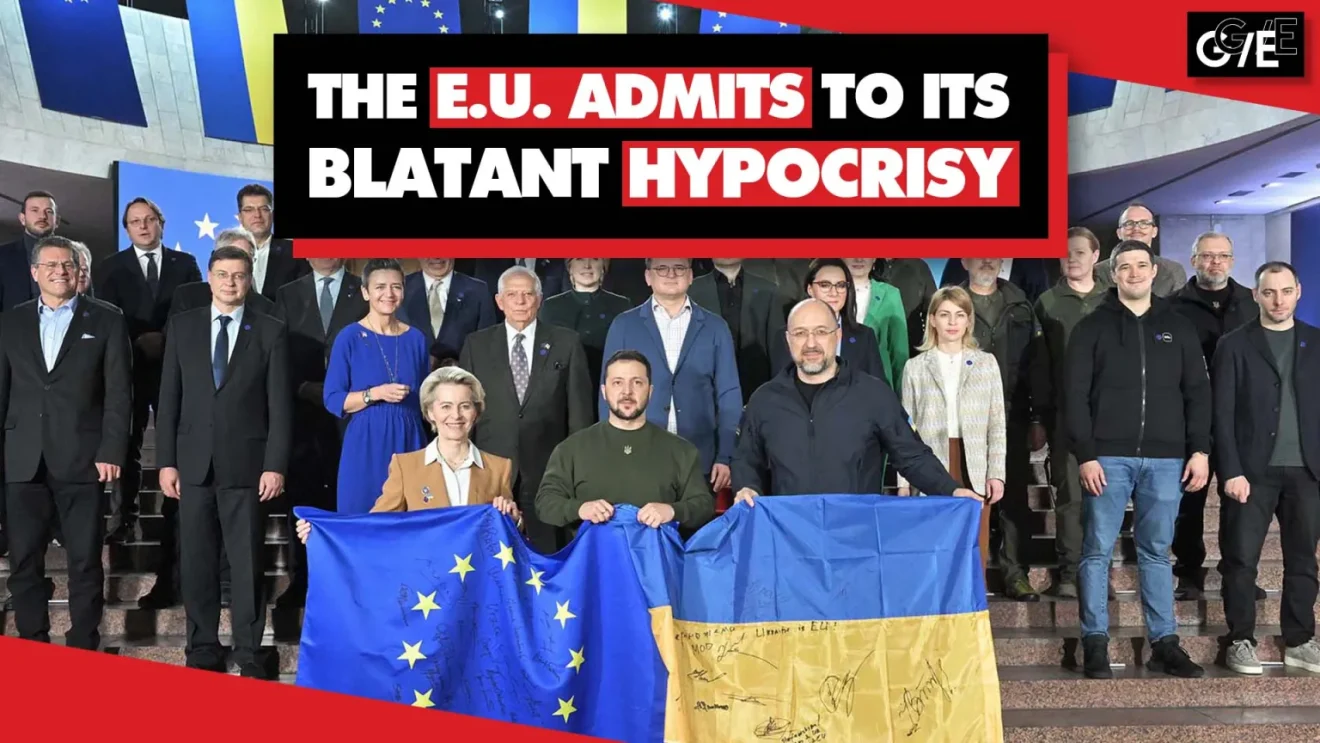
Volodymyr Zelenskiy with Ursula von der Leyen and Ukraine's prime minister, Denys Shmyhal, at the summit in Kyiv. Photo: Ukrainian Presidential Press Service Handout/EPA.

By Ben Norton – Jul 19, 2024

European Union foreign-policy chief Josep Borrell admitted the West has hypocritical “double standards” on international law, the Russia-Ukraine-NATO war, Israel’s bombing of Gaza, the US-led invasion of Iraq, and climate change.

The European Union’s high representative for foreign affairs and security policy, Josep Borrell, has acknowledged that the West has hypocritical “double standards”.

Borrell argued that “diplomacy is the art of managing double standards”.

As examples of Western hypocrisy, the top EU diplomat cited international law, the Russia-Ukraine-NATO war, Israel’s bombing of Gaza, the US-led invasion of Iraq, and climate change.


“Wherever I go, I find myself confronted with the accusation of double standards”, Borrell recalled. “I used to say to my ambassadors that diplomacy is the art of managing double standards. Certainly, something difficult, but it is about [that]: to manage double standards”.

The EU foreign-policy chief made these remarks in a talk at Oxford University in May. The EU’s diplomatic service published a transcript of his speech. (Some of the exact wording is slightly different in the transcript, as the website edited Borrell’s comments to correct grammatical errors.)

EU “double standards” on international law, Israel-Palestine, Ukraine, Iraq
International humanitarian law “should be the best safeguard against the normalisation of the use of force that we see all over the world”, Borrell argued.

He acknowledged that Europe has been hypocritical on this: “I know, however, that to be able to rally the world around those principles, we need to show that we, Europeans, respect them always and everywhere. Is that what we are doing? Well, not to the extent we should. And for Europe, this is a problem”.

“The world have not forgotten the war in Iraq”, Borrell continued, noting that some European countries joined in the US-led invasion, which UN Secretary-General Kofi Annan said clearly violated international law.

The EU has also been deeply critical on Israel-Palestine, the foreign-policy chief conceded.

“What is now happening in Gaza has portrayed Europe in a way that many people simply do not understand”, Borrell said. “They saw our quick engagement and decisiveness in supporting Ukraine and wonder about the way we approach what is happening in Palestine”.

When foreign countries look at Europe, he acknowledged, “The perception is that the value of civilian lives in Ukraine is not the same than in Gaza, where more than 34,000 are dead, most others displaced, [where] children are starving, and the humanitarian support [is] obstructed”.

“And the perception is that we care less if United Nations Security Council resolutions are violated, as it is the case by Israel with respect to the settlements, [as opposed to] when it is violated by Russia”, Borrell added.

“If we call something a ‘war crime’ in one place, we need to call it by the same name when it happens anywhere else”, implored the top EU diplomat. “One horror cannot justify another”.

Image

Western hypocrisy on climate change
Borrell likewise addressed Western hypocrisy on climate change, given that rich capitalist countries in the Global North are responsible for the majority of historical carbon emissions, but are now putting the burden of the green energy transition onto the Global South, which contributed the least, but already suffers from the worst consequences of global warming.

“We have to have a look at why the world is feeling some resentment about us”, stated the EU foreign-policy chief.

“Yes, there is a feeling of resentment because people believe that there are different responsibilities”, he added.

“We, Europeans, have produced about 25% of all cumulated global CO2 emissions since the beginning of the Industrial Revolution”, Borrell said.

He noted that Sub-Saharan Africa and Latin America have each only contributed 3% of historical carbon emissions.

“Sub-Saharan Africa and South Americans [have] almost nothing of the responsibility, and they share the most important and damaging consequences”, Borrell stated.

CO2 emissions historic by country region

“So, when we talk about fighting climate change, we have to understand their views and the feeling that this is a problem that someone has created, and others pay the consequences”, Borrell said.

“And the only possible answer is to provide more resources in order to face this problem. More resources – but it has not been the case”, he added, admitting that the rich colonizing nations of the Global North have not honored their promises to provide funding and technology transfer to help the formerly colonized nations of the Global South transition away from fossil fuels.

USA is losing hegemony; “the world is much more multipolar”
In his speech at Oxford University, Borrell conceded that “America has lost its status of a hegemon”, and the Western-dominated order created after World War Two “is losing ground”.

Today, “the world is much more multipolar”, he said, pointing to “middle powers” like India, Brazil, Saudi Arabia, South Africa, and Türkiye.

These “middle powers” are “becoming important actors”, Borrell continued. “Whether they are BRICS or not BRICS, they have very few common features, except the desire for getting more status and a stronger voice in the world, as well as greater benefits for their own development”.

“In order to achieve this, they are maximising their autonomy, not willing to take sides, hedging one side or the other depending on the moment, depending on the question”, he added.

Rise of China changes global economic landscape
The top EU diplomat stated that “China is becoming a rival for us and for the United States”.

Borrell cited “China rising to the super-power status” as the main reason for the decline of US hegemony.

“What China has done in the last 40 years is unique in the history of humankind”, he confessed. “In the last 30 years, China’s share of the world’s GDP, at PPP, has gone from 6% to almost 20%, while we, Europeans, went from 21% to 14% and the United States from 20% to 15%”.

“This is a dramatic change of the economic landscape”, Borrell said.

The statistics he cited are based on data from the International Monetary Fund.

Image

European exceptionalism and fearmongering about Russia
Borrell, whose five-year term as the EU’s top diplomat ends in December, is known for sometimes “saying the quiet part loud” – that is, bluntly stating truths that are widely known in elite circles, but typically left unsaid.

In a shockingly straightforward article in February 2024, Borrell acknowledged that the “era of Western dominance has indeed definitively ended”, as Geopolitical Economy Report noted at the time. The EU foreign-policy chief warned that Europe should not divide the world into “the West against the Rest”, as “many in the ‘Global South’ accuse us of ‘double standards’”.

In a blunt moment in 2022, he admitted that the West’s new cold war on China and Russia is not a battle of “democracies vs. authoritarians”, because, as Borrell put it, “On our side, there are a lot of authoritarian regimes”.

In a separate speech in 2022, the top EU diplomat discussed how the West’s “prosperity was based on China and Russia”, including “cheap energy coming from Russia”, “access to the big China market” for exports, and “Chinese workers with their low salaries, [who] have done much better and much more to contain inflation than all the central banks together”.

Despite the fact that Borrell makes these kinds of frank admissions from time to time, he is by no means a dove. In fact, as the EU’s high representative for foreign affairs and security policy, he has often been quite hawkish.

This is especially the case on Russia. In his May 2024 speech at Oxford University, Borrell claimed that Russia is “the most existential threat to Europe”.

He referred to Russian President Vladimir Putin as “an existential threat to all of us”, and called for Western governments to send even more weapons to Ukraine.

Borrell has also at times displayed a very racist, condescending view of the majority of the world population in the Global South.

In an infamous rant in 2022, the EU’s top diplomat argued that “the world needs Europe” as a “beacon” and beautiful “garden” to civilize the barbarous “jungle” in the Global South, as Geopolitical Economy Report highlighted.

This notorious “garden versus the jungle” speech led to global backlash, and Borrell was forced to apologize. But his worldview has not changed since.

In his remarks two years later at Oxford, Borrell again demonstrated a kind of arrogant European exceptionalism.

“The way of living of the Europeans, this best combination of political freedom, economic prosperity and social cohesion that the humanity has never been able to invent, is certainly in danger”, he said.

Borrell concluded the talk referring to Europe’s system as “the best combination of political freedom, economic prosperity and social cohesion that humanity has never been able to invent”.

(Geopolitical Economy)

https://orinocotribune.com/eu-admits-it ... te-change/

******

More Guns, Less Butter: How Will the EU Wed Austerity to Militarization?
Posted on July 24, 2024 by Conor Gallagher

US President Joe Biden, long showing signs of decline, is now officially done for in five months time, if not sooner. The current odds-on favorite to be the next president speaks often about turning away from Europe. Governments are collapsing, and countries are fracturing across the EU. And the eurozone economy is a mess.

One might be tempted to come to the conclusion that it is time for the EU to start figuring out an exit strategy from its war against Russia. Trouble is, if the bloc’s crop of leaders were able to grasp the situation and act, they likely would have gotten out a long time ago – or never been game at all. Instead they kept digging deeper, and here again we have the EU doubling down.

EU diplomats have spent the past few weeks throwing a fit over Hungarian Prime Minister Viktor Orbán’s shuttle diplomacy efforts. In its very first session the newly elected Parliament produced a belligerent joint text, making all sorts of hardline demands, such as the removal of any restrictions on the Ukrainian use of Western weapons systems to strike Russian territory.


They also chose to reappoint one of the war’s biggest backers, Ursula von der Leyen, as president of the European Commission – the most powerful position in the EU. Let’s take a look at von der Leyen’s pitch as she worked to cobble together enough votes for her second five-year term and what the plan is now that she’s back. Emboldened by her reappointment, she is pushing for a defense union.

Politico describes this task as “the number one challenge of her second term: making huge amounts of EU money available to reindustrialize and re-arm the EU.”

Left unexplained is who would foot the bill for the ambitious plans, but the Commission and the European Central Bank continue to consider the possibility of issuing Eurobonds to finance the purchase or manufacture of weaponry, an idea considered off-limits until recently. Some background on the potential “miracle” of Euro defense bonds from Euractiv:

This miracle happened during the eurozone crisis when the EU created a legal instrument, the European Financial Stability Facility, able to issue bonds and with a lending capacity of €440 billion. And with the COVID pandemic, the miracle was repeated as the EU adopted a recovery fund with a firepower of €750 billion, financed through common debt issuance.

The same line of thinking has inspired politicians to imagine defence bonds – to finance a major boost of the EU’s defence capabilities, after years of neglect when it was assumed that war was a thing of the past or that Uncle Sam would always come to the EU’s defence.

Estonia’s Prime Minister [now the High Representative of the European Union for Foreign Affairs and Security Policy] Kaja Kallas highlighted in December the need for EU defence bonds to fight Russia’s aggression in Ukraine…

Speaking at the European Defence Agency annual conference on 30 November, [European Council President Charles] Michel said EU member states should pool what could amount to €600 billion in defence investment over the next 10 years.

He also said European defence bonds would be an attractive asset class, including for retail investors. Incidentally, a top European Investment Bank cautioned in an interview with Euractiv in January that investors don’t currently have an appetite for defence-related financial assets.

A couple of weeks later, French President Emmanuel Macron returned to the topic, telling investors at the World Economic Forum in Davos that Europe should resort to joint debt to finance its priorities, including defence.

Who doesn’t love “miracles?” But there are some issues, including economic difficulties across the bloc, governments crumbling, and public frustration with everything from the immigration to the economy. There is also the reported military manpower shortages, which is a whole other problem that has been frequently covered.

Politico quotes an unnamed diplomat who says that “Everything that costs anything — for example, Ukraine defense,” will prove “problematic” during von der Leyen’s second term. While von der Leyen is throwing around figures like 500 billion over the next decade, another diplomat said, “We didn’t see spreadsheets, we didn’t see details, this is pie in the sky money.”

More details are likely coming soon as von der Leyen is planning to appoint a Commissioner for Defense who will present a white paper on the future of European militarization efforts within 100 days.

The real question is whether Germany will go along with any eurobond plan. The historically unpopular chancellor Olaf Scholz remains opposed to Euro defense bonds – for now. He argues that the EU already has various research and industrial funds to support defense cooperation among member states and defense companies.

For example, Poland, France, Germany and Italy just signed a letter of intent to jointly develop long-range cruise missiles. Poland and Germany were among those countries that got rid of their missiles in the 1990s following the 1987 Intermediate-Range Nuclear Forces Treaty. That agreement expired in 2019, however, after then-president Donald Trump withdrew from it. The US is ever-so-generously agreeing to cover Germany where US long-range missiles will be rotationally deployed in 2026 as a temporary solution.

While Scholz talks up agreements like the joint development of long-range cruise missiles, Atlanticists are insisting he do more, and he does not have a strong record of firmness when pressured by his NATO/EU colleagues.

Recall in the Fall of 2022 when he resisted sending more heavy arms to Ukraine. After a few weeks of badgering, he pledged to support Ukraine “for as long as it takes.” He also caved on the Leopard tanks after making a show of resistance. On the other hand, the Taurus missiles still haven’t been sent to Ukraine. Yet the Eurobond issue is starting to be reminiscent of these previous pressure campaigns. It was only four months ago that idea was viewed as “radical;” now Germany is viewed as the main roadblock.

Berlin is facing its own budgetary constraints while also pushing arbitrary limits onto other EU nations, and the inadequate ramp up of military spending is “set[ting] the stage for further clashes with Germany’s international partners, especially Washington, in the coming months.” On the other hand, any eurobond plan would only strengthen political threats to the “center” in Germany, such as the Alternative for Germany and Sahra Wagenknecht who want to stop the digging and attempt to repair ties with Russia.

Could a Trump Election Further Von Der Leyen’s Goals?

It’s important to note that Trump didn’t actually undermine the NATO alliance in any significant way as president and appointed CIA officials and neocons to run his hawkish foreign policy, although there is hope that will change in a second go-round.

In reality, however, the plan for the US to take a backseat on the European front and focus on the Pacific is part of a strategy long pushed by neocons. It might be an unrealistic and dangerous one, but it is a strategy nonetheless. Here is a team from the influential Center for Strategic and International Studies (CSIS) writing earlier this year in Foreign Affairs about how Europe must lead in the fight against Russia so the US can focus on China:

That complicated reality requires U.S. allies, especially in Europe, to take on a larger share of directing the containment of Russia. Europe has shown its political and economic resilience in the face of Russian aggression. Yet militarily, the continent remains dependent on the United States. This dynamic must change, in part because the United States must commit more of its resources to Asia. The growth of European defense spending since Russia’s full-scale invasion of Ukraine is an encouraging step. In 2023, 11 NATO members hit their spending target, allocating at least two percent of GDP to national defense, up from just seven members in 2022. The rest need to follow suit.

Europe must also resolve the problem of coordination. Right now, the United States coordinates more than 25 militaries in Europe. While it must continue to do this in the short term, it must push individual European countries and the European Union to take over this role and to create a stronger European pillar in NATO.

This is precisely what is atop Queen Ursula’s to-do list for her second term, so a second Trump presidency might not be a disaster but an opportunity in the eyes of ambitious and deluded in Brussels who want to amass more power in the name of marshaling the bloc’s finances to ramp up militarization efforts against the Russian menace.

In many ways Europe’s bureaucracy has already changed in small but fundamental ways in order to redirect money towards war. From Equal Times:

“In 2023, there was a very significant increase in military spending worldwide, but especially in Europe. In Spain, for example, it grew by 24 per cent and in Finland by 36 per cent. If we compare it with 2013, the European countries in Nato are spending 30 per cent more,” says Pere Ortega, a researcher at the Barcelona-based Centre Delàs for Peace Studies, which is critical of measures adopted by the European Commission to promote military spending, such as the VAT exemption for the purchase of armaments or the change in the regulations of the European Investment Bank (EIB) to allow it to finance industrial projects in the military sphere.

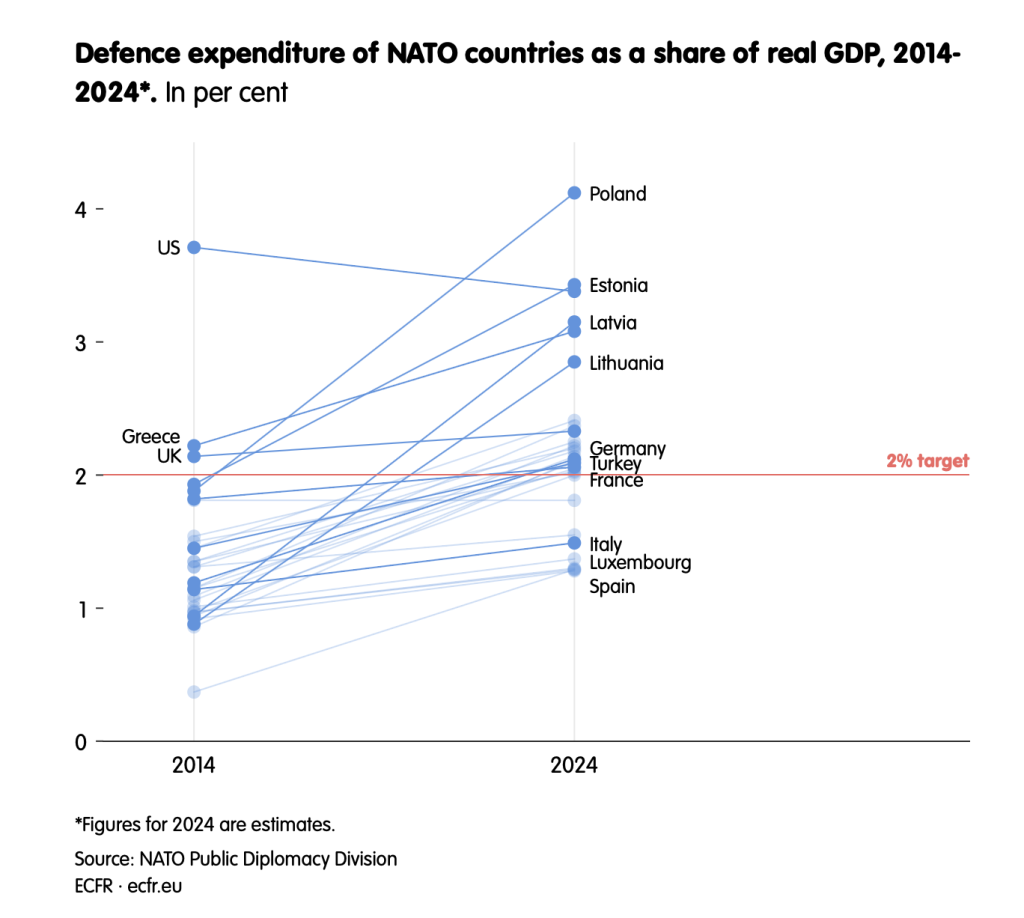
And according to the European Council on Foreign Relations (ECFR), the number of countries meeting the two percent target has risen from 3 to 23 since 2014:

Image

The problem now is that individual states are running into budgetary constraints.

More Guns, Less Butter

EU leaders are determined to reimpose austerity on bloc countries beginning in 2025. That’s a return to the annual limits of 3 percent of GDP for public deficits and 60 percent for public debt, which were suspended in response to the Covid-19 pandemic.

There are some new twists to the rules that were marketed as measures to soften the pain, but if they do, it will be minimal. For example, the new agreement stipulates that countries with a deficit above 3 percent of GDP are required to halve this to 1.5 percent but can do so during periods of growth. That growth might quickly evaporate with such a public spending pullback, but that’s the plan. Elsewhere, countries will still be required to reduce their debt on average by 1 percent per year if it is above 90 percent of GDP, and by 0.5 percent per year on average if the debt is between 60 percent and 90 percent of GDP. The new rules give countries seven years to get their spending in order, up from four previously.

These rules will make it close to impossible to spend more on defense without completely cutting social services to the bone. Even without factoring in increased defense expenditures the outlook is grim:

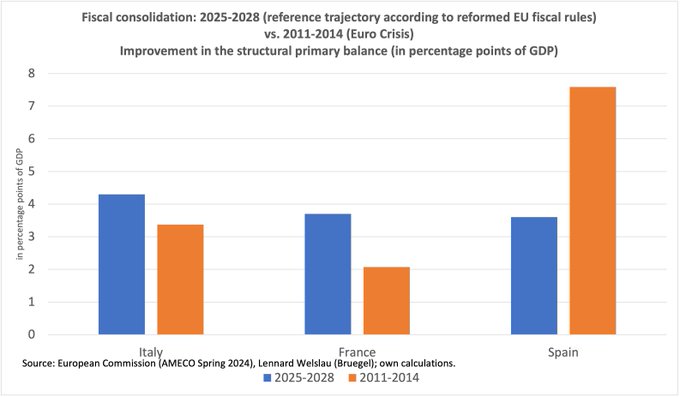
Too meet reformed EU fiscal rules, Italy and France would have to go for fiscal consolidations over 2025-2028 that are larger than during the Euro Crisis (2011-2014). Spain has to do about half.

Do we properly remember the effects and political debates of €zone austerity? pic.twitter.com/Rmuz8jfkTJ

Image

So how to reconcile the goal of a defense union and remilitarization with plans for austerity?

A few possibilities:

There is talk of exemptions from the debt rules for military spending.
Bloomberg reported back in March that EU officials and investors are using the fiscal rules to push for an EU-wide bond program that would bring the investors bigtime profits while allowing the bloc to ramp up military spending without individual nations incurring more debt.
Of course a third option is that the EU will abandon its war against Russia, stop supporting Nazis, quit fetishizing austerity, and rebuild its economies, but back to reality.

The big question remains if Germany will get onboard with the EU bond program. One reason it could is because it would help Berlin with its own budgetary constraints. While Germany wouldn’t face major budget crunches like France, Italy, and Spain under the return of debt and deficit rules, it is hamstrung by its self-imposed deficit brake. [1]

That rule, intended to force German governments to balance the federal budget, was introduced under former Chancellor Angela Merkel during the euro crisis and restricts deficit spending to a minimum, except under “extraordinary” circumstances, such as a natural disaster or war. The current government tried to override the brake in order to shovel more money into the Ukraine bottomless pit, but was rebuked last Fall by the constitutional court.

An EU-wide war bond program could help the bloc bypass all the self-imposed debt brakes while still cutting and privatizing social services, and both could be a boon for investors. What’s not to love? The Centre for European Policy Studies with more:

Against this backdrop, the EU’s true ‘Hamiltonian moment’ in defence would be a decision to issue joint debt to properly fund the ambitions set out in its Defence Industrial Strategy.

Based on Art. 122 TFEU and implemented in accordance with Articles 173-174 TFEU, such bonds—possible under the EU’s Financial Regulation—could provide the backbone for grants to Member States to bolster the Union’s defence production capacity if paired with existing incentives for joint capabilities research, development, production, and procurement. This would avoid the two-speed logic and weaker conditionalities surrounding proposals to use the European Stability Mechanism (excluding key countries such as Poland, Sweden and Denmark) to issue loans to EU Member States for defence spending.

Like how the Covid-induced Recovery and Resilience Facility stabilised European markets and sustained demand during and after the pandemic, Euro-defence bonds are a potential game-changer for the EU’s defence ambitions due to the potential speed and scale of resource mobilisation, and the potential impact on market de-fragmentation. And, fortunately, the German Constitutional Court should have nothing to object to this time around.

The View from Outside the Cult

Voices from Moscow, Budapest, and Belgrade are issuing warnings that the EU continuing down this road increases the threat of war, and they are concluding that is what Brussels wants.

Moscow is taking note of von der Leyen’s plans and preparing accordingly according to Kremlin spokesman Dmitry Peskov:

“[It] confirms the general attitude of European states to militarisation, escalation of tension, confrontation and reliance on confrontational methods in their foreign policy,” said Peskov “Everything is quite obvious here.”

The Kremlin spokesman added that while Russia did not pose a threat to the EU, actions by its member states regarding Ukraine “have excluded any possibility of dialogue and consideration of Russia’s concerns. These are the realities in which we have to live, and this forces us to configure our foreign policy approaches accordingly,” Peskov said.

Hungarian Prime Minister Viktor Orban, childishly reprimanded by the EU for talking peace with world leaders, keeps warning about the levels of delusion in Brussels. His latest in a Magyar Nemzet op-ed:

The Brussels bureaucrats want this war, they see it as their own, and they want to defeat Russia. They keep sending the money of the European people to Ukraine, they have shot European companies in the foot with sanctions, they have driven up inflation and they have made making a living difficult for millions of European citizens.

Serbian President Aleksandar Vucic echoed those thoughts in a recent interview with the Pink TV channel:

“The West would like to conduct warfare from a distance, through someone else, through investing money and so on, but at the moment they are not ready [for a direct conflict with Russia]. Will they be ready? They are not ready now, but I think they will be ready. They are already preparing for a conflict with the Russian Federation and they are preparing much faster than some people would like to see, in every sense. We know that from the military preparations, we know how they’re going. And I want to tell you, they are preparing for a military conflict.”

Notes

[1] The budgetary constraints on German military spending are somewhat overblown in the media. Yes, the cabinet’s approved budget only increased by 1.25 billion euros to 53.25 billion this year and Ukraine aid was trimmed from nearly eight billion euros to around four, but the Bundestag still must debate and approve the budget so there will be changes. Even the current draft budget leans heavily on sleights of hand, such as pushing the order for dozens of battle tanks they’ve ordered off the 2025 budget and leaving the liability to be funded in subsequent years. As WSWS points out:

…the government is actually spending far more on armaments and war. A government overview of the budget states that “taking into account the relevant shares of other individual plans,” the NATO target of military spending of at least 2 percent of gross domestic product will be achieved. With a GDP of €4.122 trillion, this means at least €82.4 billion in military spending.

The sum is probably even higher, as Scholz has already boasted of defence spending of €90 billion to NATO. In addition to the central defence budget, the government has already announced “defence-related expenditure” of €14 billion from other budget areas in the current year. Further projects totalling €20 billion will be paid from the Bundeswehr “special fund,” which totals €150 billion…In 2028, when it is expected the Bundeswehr special fund will be exhausted, the defence budget is set to rise by a huge increase of almost €30 billion to around €80 billion.

https://www.nakedcapitalism.com/2024/07 ... ation.html

******

Five Takeaways From Hungary & Slovakia’s Russian Oil Dispute With Ukraine

ANDREW KORYBKO
JUL 24, 2024

Image

This incident shows the lengths to which Ukraine and the EU are going to keep those two in line after they united to form an anti-war bloc in the heart of Europe.

Ukraine’s decision last month to stop the transit of Russian oil from Lukoil across its territory has hit Hungary and Slovakia, who have EU sanctions waivers to continue purchasing this resource, very hard. They’ve accordingly requested that the European Commission mediate between them and Kiev on the basis that the latter’s actions violate its 2014 Association Agreement with the bloc. The exact outcome of this dispute remains uncertain, but the following five takeaways encapsulate its essence:

----------

1. Ukraine Is Punishing Hungary & Slovakia For Their Anti-War Positions

Kiev hates that these neighboring Central European nations have formed an anti-war bloc within the EU and are opposed to perpetuating NATO’s proxy war. The timing suggests that Kiev waited until after it became clear that Slovak Prime Minister Fico, who returned to office late last year, hadn’t changed his position since surviving an assassination attempt in mid-May. Had he been killed and replaced with a pro-war figure or had a change of heart, then it’s unlikely that Kiev would have cut off Lukoil’s exports.

2. Weaponizing Energy Is An Ironic Means To The Abovementioned End

Ukraine and some EU members fearmongered for years that Russia would weaponize its energy exports against them, yet it ironically turns out that Kiev ended up doing precisely that, and nobody in the West apart from the two affected states is saying a peep. This suggests that they tacitly approve of Kiev punishing their wayward members in the hopes that it’ll teach them a lesson, though Brussels will likely intervene before everything spirals out of control since Hungary has an ace up its sleeve.

3. Hungary Just Implied That Two Can Play That Game Though

Hungarian Foreign Minister Szijjarto just reminded everyone that his country contributed to 42% of Ukraine’s electricity imports last month, with the innuendo being that these can be stopped until their dispute is resolved. This leverage is much more powerful than threatening to continue holding up the EU’s €6.5 partial reimbursement package of its members’ arms transfers to Ukraine since Budapest has been dragging its feet on that for around a year already.

4. Any EU-Mediated Resolution Will Be Spun To Impugn Hungary & Slovakia

The EU is unlikely to let this energy dispute spiral out of control since the consequences could be disastrous with more refugees flooding into bloc if Budapest reciprocally weaponizes electricity exports to Ukraine while Hungary and Slovakia could turn more of the public against Brussels. Whatever solution is brokered though will be spun to impugn Hungary and Slovakia by at the very least implying that they were irresponsible for not having diversified from their dependence on Russian energy long ago.

5. Some Of The Damage That’s Already Been inflicted Is Irreparable

Orban’s noble attempt to improve ties with Ukraine during his visit to Kiev in early July was for naught as proven by the nasty energy dispute that followed, and there’s no regaining the incipient trust that was just lost as a result. Likewise, those among the European public who’ve already soured on Ukraine and the EU will only feel even stronger about their views after watching those two punish Hungary and Slovakia. These outcomes are manageable, but they’re still detrimental to each party’s interests.

----------

As can be seen, Hungary and Slovakia’s Russian oil dispute with Ukraine is a form of tacitly approved EU punishment against them for their anti-war positions, though it’s unlikely to last long enough to lead to a full-blown crisis considering Budapest’s electricity leverage over Kiev. Even so, this incident shows the lengths to which Ukraine and the EU are going to keep those two in line, all with the intent of sending a signal to anyone else in the bloc who decides to break ranks with their warmongering policies.

https://korybko.substack.com/p/five-tak ... -slovakias
"There is great chaos under heaven; the situation is excellent."

User avatar
blindpig
Posts: 14798
Joined: Fri Jul 14, 2017 5:44 pm
Location: Turtle Island
Contact:

Re: Blues for Europa

Post by blindpig » Mon Jul 29, 2024 2:45 pm

Acts of submission
colonelcassad
July 28, 15:57

Image

Acts of submission

Speaking at a summer camp in the Romanian city of Băile Tusnad, the Hungarian Prime Minister expressed outrage at the lack of reaction to the Nord Stream explosion from EU countries. In his opinion, the silence and unwillingness to investigate the matter indicate an act of capitulation by the European Union.

"The fact that we are silent about the explosion of the Nord Stream gas pipeline, that Germany itself is silent about an obvious act of terrorism committed under American leadership against its property, and that we do not investigate, do not try to find out and do not raise this issue legally - just as we did not do the right thing with regard to the wiretapping of Angela Merkel, which was carried out with the help of Denmark - this is nothing other than an act of submission."

According to him, this was a terrorist act "obviously committed under American leadership." He believes that European policy has collapsed and the continent has stopped defending its interests.

At the same time, nothing in EU policy will change, of course.
Orban will be tolerated until January 2025 as an annoying problem and they will continue to pretend that they do not know who blew up Nord Stream, although of course they knew and know perfectly well who did it and why. Because a vassal has no right to growl at its overlord. At least within the framework of the Washington world order.

https://colonelcassad.livejournal.com/9291455.html

Google Translator

*******

Von der Leyen’s legacy

Hugo Dionísio

July 26, 2024

A European Union that has not only given up, but is using its own people. This is the legacy of Ursula von der Leyen and all those who support her.

The mainstream political class of the European Union, and its member states, has predictably ended up prolonging the agony, decadence and subservience of European affairs to U.S. interests. And now, for another five years, we will have to live, again, with Ursula von der Leyen.

Moreover, in the future, we will all remember her speeches on “value chain security”, in which Ursula’s great merit was to further reinforce the world’s dependence on Chinese value chains, demonstrating that, contrary to what she announces with as much anger as hatred, her tariffs, sanctions and conditioning cause us as much pain as they relieve the others. In the EU, in 10 years we will have given up the largest reserve of mineral, food, energy and raw materials in the world and, unless an uprising begins, we will also have given up the largest consumer market on the planet and the one that will grow the most in the coming years. These are von der Leyen’s great merits!

Given this record, you might think that the next five years would see a reversal of course. But no. Ursula von der Leyen will continue to infight against the EU’s own peoples, telling them one thing and doing the opposite, and one of the areas in which we can see, without any reservations whatsoever, that the European Union – this European Union – has given up on its indigenous peoples, is in relation to what is currently one of the main sources of social tension: immigration.

Classifying the current situation of the European labor market as being affected by serious “labor shortages”, the European Commission’s communication, entitled “Strengthening the social dialogue in the European Union: harnessing its full potential to manage just transitions”, is clear about von der Leyen’s intentions in this regard.

Don’t let that the apparently rational discourse fool you: “strengthening the social dialogue” should be read as “guaranteeing social peace in the face of measures that will further squeeze wages and living conditions”; “harnessing its full potential” should be read as “increasing the reserve army of labor to contain wage growth”; and “managing fair transitions” should be read as “ensuring that everyone will be forced to adopt the EU’s economic and social model, without reservation”.

As always, by wrapping her draconian intentions in occasional discursive flourishes, Ursula von der Leyen is making Europe poorer, less independent and more dangerous. Much more dangerous. Every time she opens her mouth, it’s best to interpret her words as having a hidden meaning, which is often the opposite of what she actually said.

On the road to increasing the exploitation of Europe’s peoples, the European Commission rightly begins by noting the demographic changes that have taken place in recent decades. Europeans are simply having fewer children. The result is that the native European working population has been shrinking and the forecast is that, today, being around 265 million workers, in 2040 this figure will be around 250 million and in 2050, 240 million. In other words, a reduction of one million per year.

Faced with a problem of this magnitude, the long-term consequences of which will not only be the reduction of native peoples, but also the emergence of vast deserted and unused areas, the perishing of certain cultures and traditions, would require an in-depth study and measures capable of reversing the trend of population decline and falling fertility and birth rates.

So, what is the European Commission proposing to solve what it identifies as serious “labor shortages”? The measures proposed by the European Union are all aimed at promoting an abrupt increase in the stock of available labor. Through what it refers to as “activation policies”, the EU wants – it says – to achieve “zero” unemployment, which is the first contradiction we can identify. So, you want to achieve “zero unemployment” while, at the same time, increasing the stock of available labor?

The truth is that the “activation policies” envisage employing young NEETs (Not in Employment, Education or Training) and assessing the impact of “some retirement pensions”, i.e. assessing the extent to which these pensions are not sending people capable of working into retirement, deactivating them instead of keeping them in the job market. This means focusing on the so-called “active ageing” market. Another measure is to identify “pockets” of available labor that may exist among disabled populations, “emancipating” these people, which would be laudable, but not when done for the wrong reasons. As we’ll see later.

Another important measure that is presented is intra-European mobility, transferring the nationally available workforce to the richer countries, leaving the rest without the investment they have made in education and training, aggravating the already unequal European division of labor, continuing to concentrate the activities with the highest added value and the highest wages in the northern countries and making the rest simple reserves of cheap labor, either to supply the richer ones or to install activities with lower added value and lower wages, perpetuating regional asymmetries. And all this, Ursula von der Leyen does, while stating the opposite objectives.

As for what the European Commission calls “promoting working conditions”, it aims to promote early entry into the labor market by promoting internships, apprenticeships and vocational education, diverting many young people, particularly the poorest, away from higher education and into early vocational training. As statistics show, young people in vocational education tend to go on to higher education far less often than those in general education. In this way, an elite is built up and entrusted with top management, keeping the rest in the middle ranks and migrants in low-skilled jobs.

But it is in solving the “labor shortages” on most undervalued activities that the EU is putting all its investment. The European economy still requires large amounts of labor for activities that use it intensively. In this case, the EU’s plans include strengthening migration policies and attracting the necessary workers from outside the EU. And this is how so many people who say they are against what they refer to as a “demographic replacement policy” end up supporting a European Union that wants to make migration policies one of its main strategic goals in attracting workers. In this way, the EU intends to establish what it calls a “European talent pool” and a “Platform for Labor Migration”. The two measures are based on attracting workers from third countries.

Now let’s compare these proposals with the following data:

The average unemployment rate in the European Union is around 6.5%, so there are still around 17 million workers to be placed, a significant proportion of them young workers (14.5% are unemployed) between the ages of 18 and 25. Although the EU says that it is necessary to improve the qualifications of these people and that the labor gaps are more acute in some sectors than in others, the truth is that there is still a lot to be done at home to achieve “zero unemployment” before looking for a workforce in third countries.
The potential for robotization, automation and digitalization of the European economy is still very high, especially in the less advanced countries, which in itself would free up huge amounts of available manpower that could be used in other sectors if this potential were to be realized.
In general, the European Union does not develop policies that protect the birth rate and the right to parenthood, and even less that protect women of childbearing age, who so often have to give up fertility to the detriment of a career.
So, if these tasks have not yet been accomplished, why does the European Commission want to put the elderly, young teenagers, the disabled and invalids to work? Why does it want to attract qualified and less qualified workers from abroad? The reason is clear and has to do with wage restraint. The intention is to do this by increasing the so-called ” reserve army of labor “. More available labor, more demand for work, lower wages. It’s simple. That’s not to say that wages won’t rise, but they will rise at a slower rate than the economy, leading to a loss of purchasing power and to a relative decline in living conditions.

And you don’t have to go very far to understand why the European Union is going down this road. The first answer is as clear as water: cutting off relations with the Russian Federation has made the value of raw materials more expensive, and we need to compensate for this by reducing wages, not least because the strategy is to compete with China on global markets for the same type of products.

And if we need to compensate for this loss of energy and cheap raw materials, why do we compensate with lower wages? For example, in Portugal, the Confederation of Tourism, which brings together entrepreneurs linked to tourism, has proposed a “Labor Simplex” to the government, to make it easier to hire migrant labor from third countries. In other words, European employers are proposing a policy to facilitate migration from third countries. This type of solution is also advocated by Eurobusiness, which brings together European employers.

Migration policies and the flooding of the European Union with migrant labor are policies demanded by European employers, sponsored by the political class of the neoliberal and globalist center and from the interests akin to the transnational economy, and are aimed, in the face of falling unemployment rates and the need to adopt a more rational labor management policy, at ensuring that there is still enough labor available for companies not to be forced to increase wages.

Another of the fallacies that we can identify on Ursula von der Leyen’s speech comes to light when she refers to the need to “de-risk” China because its cheap products are destroying jobs in Europe. These EU proposals show that it’s not about “protecting jobs”, but rather about profit margins and levels of accumulation that put more than 20% of the wealth produced each year in the hands of just 1% of the richest. If it were about protecting “jobs”, the policies would be different. Protectionist? Yes, perhaps. But they would essentially be aimed at protecting jobs and the quality of life of Europeans.

And this is where we catch another fallacy. In this communication, which notes the “geographical changes”, there is not a word about improving the conditions of stability in employment and in life, about access to home ownership, which would allow adults with childbearing age to settle down and start a family; instead, there is a focus on “mobility”, the mobility that forces young people to leave poorer countries for richer ones in search of better salaries, but which, in many situations, is done at the cost of postponing the intention to settle down and start a family.

Promoting a more sustainable and stable lifestyle for young people, combating job insecurity, investing in cheaper housing and support for birth and parenthood, would call into question the economic model of division of labor in the European Union. It would jeopardize the interests of the most powerful countries in attracting the most qualified workers. And that’s not to change, it’s to maintain and even worsen.

The European Union, this European Union, is thus giving up on renewing its native populations, opting for the easiest path, the one that doesn’t call into question the neoliberal, globalist and hegemonic project that it is. In this sense, we could well say that if there is a project against the family and the native peoples of the member states, it is this European project itself. But, above all, it is against all these things, because it is a project against the interests of the peoples themselves, whatever they may be.

When everyone expected that the introduction of new technologies and the consequent increase in productivity – humanity has never produced so much and with such quality in such a short time – would lead to a reduction in normal working hours, since fewer resources are needed to produce the same thing, the European Union is telling us the opposite. It’s telling us that we need more and more human labor. Even if you have to get that labor from third countries. And this is where all those who say they are being “invaded” are silent. And they keep quiet because they know that migrant workers only come because they find work, because the employers attract them in many ways. Those same interests live off the terrible conditions in which these workers arrive and live, because the greater the effort they make to cross the Mediterranean, or to find decent housing, the lower their wages will be and the more degrading the housing conditions they accept.

Those who criticize migrant workers for living in crowded houses, for filling the streets where we circulate, accusing them of taking our jobs, have never, ever seen them accuse those who attract them, who develop the policies and the economic model that legitimizes all this. I have never seen them accuse a European Union that leaves the people, all the people, behind.

A European Union that has not only given up, but is using its own people!

This is the legacy of Ursula von der Leyen and all those who support her!

https://strategic-culture.su/news/2024/ ... en-legacy/

******

The 700-Year-Old Polish-Hungarian Brotherhood Is Officially Dead At The State-To-State Level

ANDREW KORYBKO
JUL 29, 2024

Image

There’s no restoring the trust that was just lost at that level, but the Polish-Hungarian Brotherhood still endures in the hearts of their patriots since they’ll never let politicians break the bonds between them.

Polish-Hungarian tensions have been boiling for the past two and a half years due to their polar opposite approaches towards the latest phase of the Ukrainian Conflict and finally spilled over this weekend. Hungarian Prime Minister Viktor Orban lambasted Poland in a speech where he accused it of seeking to replace the EU’s traditional Franco-German axis with a new one comprised of itself, the UK, Ukraine, the Baltic States, and Scandinavia, with the innuendo being that this is contributing to continental instability.

He elaborated that this is actually an old Polish plan and is being advanced by exploiting the Ukrainian Conflict’s latest phase in order to become the number one US base in Europe. Orban added that this amounts to Warsaw giving up on the Visegrad Group, which was envisaged as a third center of power in Europe between the Franco-German axis and Russia when it was first formed. He also called Poland two-faced for criticizing Hungary for purchasing of Russian resources while doing the exact same thing.

His observations predictably provoked a sharp response from Poland, whose Deputy Foreign Minister Teofil Bartoszewski denied Orban’s accusations of doing business with Russia and then suggested that Hungary should withdraw from Euro-Atlantic organizations to form “a union with Putin”. Hungarian Foreign Minister Peter Szijjarto reacted to these provocative words with the following post on Facebook in which he made it clear that bilateral relations won’t be the same after what just happened:

“The Polish Secretary of State for Foreign Affairs reacted sharply to yesterday’s speech in Tusnádfürd les... The reaction proves the truth of the Hungarian saying that goes: the truth hurts.

With the intention of preserving the Polish-Hungarian brotherhood, we endured the provocations and hypocrisy of the current Polish government for a long time, but for now the glass is full.

While the current Polish government judges and accuses us because we import petroleum from Russia - which is absolutely necessary for the operation of the country, if we take a good look at the list of buyers of one of the largest Russian oil companies, we will certainly find the Poles there as well.

There would be no problem with this, because energy supply ultimately has physical bases, but if it has been turned out like this, then you shouldn't be hypocritical and shouldn't accuse others.”

As can be seen, the Polish-Hungarian Brotherhood of the past seven centuries is officially dead at the state-to-state level, though it still lives on in the hearts of patriots from both countries who know that Poland’s last two governments are to blame for this. The incumbent liberal-globalist one went overboard with its anti-Hungarian rhetoric, but their conservative-nationalist predecessors were already giving Hungary the cold shoulder and throwing shade in its direction.

Each administration hates Russia more than they love their own country, which led to them ruining their historic brotherhood with Hungary over its right to retain relations with Moscow. It also accounts for why the prior one agreed to a trilateral alliance with the UK and Ukraine two weeks before the special operation began and then helped sabotage spring 2022’s peace talks as explained here. These developments can be seen in hindsight as the first steps toward Poland abandoning the Visegrad Group.

The ruling liberal-globalists took everything to its logical conclusion since their radical ideology pushed them to deal a deathblow to this brotherhood at the state-to-state level instead of continuing to behave passively-aggressively towards it like their predecessors were in order to prevent a full-blown rupture. There’s no restoring the trust that was just lost at that level, but the Polish-Hungarian Brotherhood still endures in the hearts of their patriots since they’ll never let politicians break the bonds between them.

https://korybko.substack.com/p/the-700- ... -hungarian

******

Kyiv and Brussels Weaponize Oil, Use Other Tools in Bid to Force Hungary and Slovakia into Supporting Project Ukraine
Posted on July 29, 2024 by Conor Gallagher

As part of its turn at holding the rotating EU Council presidency, Hungary held a health ministers meeting on July 25. Only three EU countries (Italy, Bulgaria, and Malta) sent their ministers to the gathering to discuss cardiovascular health and organ donation.

The absences are part of the EU’s punishment of Hungarian Prime Minister Viktor Orbán for having the gall to try to save the EU from itself — by meeting with the leaders of Ukraine, Russia, China, and GOP presidential nominee Donald Trump to feel out peace options for the Ukraine war. Volodymyr Zelenskyy, who remains Ukraine’s president after canceling elections, strongly criticized Orbán for meeting with Russian President Vladimir Putin.

Next month, EU foreign ministers will skip a scheduled meeting in Hungary and meet in Brussels instead. Some EU diplomats even supported the idea of holding the meeting symbolically in non-EU Ukraine, but that is not currently on the agenda.


Orbán could likely care less about EU nation ministers skipping meetings in Budapest (as they plan to continue to do) during Hungary’s rotating presidency, but Kyiv recently cut off a sizable volume of Russian oil that flows to Hungary through Ukraine, which ups the stakes considerably.

Now Budapest is threatening to retaliate by holding up more EU funds to Kiev and cutting off electricity that flows from Hungary to Ukraine. Meanwhile, the EU is largely backing Ukraine over its own bloc member.

***

In June, Kyiv decided to block the transit of pipeline crude sold by Moscow’s largest private oil firm, Lukoil, to Central Europe. Coincidentally, the two big customers on the receiving end were Hungary and Slovakia — the two EU countries opposed to the bloc’s ongoing support for the war in Ukraine.

Lukoil supplied Hungary and Slovakia with Russian crude via the southern arm of the Druzhba oil pipeline that runs through Ukraine. The EU exempted pipeline supplies of Russian oil from its sixth package of Russian sanctions passed on December 5, 2022.

Fast forward to the 11th sanctions package of June of last year: that’s when Brussels banned the transportation of oil from Russia along the northern branch of the Druzhba pipeline to Germany and Poland. Oil supplies along the southern branch of Druzhba towards Hungary were exempt, however, as the EU’s stated goal was to give Russian-reliant countries extra time to find new supplies. Kyiv is now announcing that time is up.

It’s not good news for Hungary, which relies on Russia for 70 percent of its oil imports — and Lukoil for half that amount.

The country also continues to import Russian gas via the Turkstream pipeline, and its citizens over the second half of 2023 had the lowest household electricity and gas costs in the EU.

Image

That could now change — quickly. From Politico:

“The Ukrainian measures could create a severe situation,” Ilona Gizińska, a researcher and Hungary expert at the Centre for Eastern Studies think tank, said. She added that Hungarians could face sky-high energy prices and electricity shortages in just “weeks” unless it finds a solution.

Budapest and Moscow are reportedly working on finding alternative supply routes for Russian, but matching the cost-effectiveness of the Druzhba pipeline will obviously be hard to find.

In the meantime, there is “significant risk” for Hungarian and Slovakian refineries, according to Fitch Ratings:

These volumes primarily serve the Hungarian and Slovakian markets and, while immaterial to the overall European supply balance, could significantly impact energy supply in Hungary and Slovakia over the medium-term…

Both Hungary and Slovakia maintain strategic oil and oil-products reserves of at least 90 days’ worth of average net imports, which can be used to provide additional headroom in case of a protracted interruption of supply. MOL also maintains a very strong financial profile to help cushion the impact of a temporary interruption in access to Russian crude, but long-term solutions will be needed if the situation doesn’t ease in the near term.

So far both Slovakia and Hungary have managed to bridge this supply interruption with additional volumes from other sources, however a broader and longer-term interruption of Russian supply could pose a significant risk to refining operations and energy supply.

Slovakia is more exposed than Hungary owing to physical constraints on alternative supplies. There are also technical limitations on substituting Russian crude oil with other grades of oil, owing to the configuration of the refining systems and associated infrastructure. We do understand however that Russian crude can be shipped via waterborne vessels to other offtake points in the absence of Druzhba pipeline supplies, and affected refineries can operate on other crude grades at a reduced level of utilisation and profitability.

Other Russian producers, such as Rosneft and Tatneft, can continue to deliver crude oil along the pipeline as of now. However it is not clear whether additional sanctions on these entities will be forthcoming from Ukrainian authorities.

***

Ukrainian officials are saying that part of the reason they cut Lukoil supplies off from Hungary is because Budapest does not support Ukraine enough as evidenced by, among other items, its opposition to increased weapons deliveries and Kyiv’s accession to the EU. Kyiv has not sanctioned other Russian oil firms that continue to ship crude via Ukraine, including Rosneft and Tatneft, but officials say those are coming too.

Rather than force Hungary to cave to Kyiv’s demands for more “support”, however, the opposite is happening. Hungary is now threatening to hold up EU money to Ukraine.

“As long as this issue is not resolved by Ukraine, everyone should forget about the payment of the €6.5 billion of the European Peace Facility compensation for arms transfers,” said Hungarian Foreign Minister Peter Szijjarto. He also noted how Hungary supplied 42 percent of Ukraine’s electricity in June. Slovakia, too, has been helping Ukraine with the reverse flow of gas and sending electricity to the country. Those helping hands will be withdrawn should a resolution to the Lukoil holdup prove elusive.

Hungary and Slovakia filed a complaint with the EU, which said it was “ready to negotiate.” On Saturday, an EU spokesperson downplayed the whole affair, saying that the Ukraine cutoff would have no direct impact on the EU’s oil supply as a whole — a response that was either tone deaf or intended to send a message to Budapest.

“There is also no immediate problem for the two countries concerned,” he added. That’s because both countries have a 90-day reserve thanks to EU regulations. Lastly, he promised that the European Commission would seek a solution acceptable to all parties.

The spokesperson dodged a question regarding talk that Hungary could retaliate by cutting off its electricity supply to Ukraine by stating that there is currently no adequate information available on such a scenario.

***

Among the ironies of the situation is that one of the big reasons the EU claimed it needed to stop buying oil and gas directly from Russia (they still buy it through third parties) is that Moscow would “weaponize” it. Instead it is Kyiv that is doing so, probably with a wink and a nod from Brussels.

A second irony is that the EU and the US have also been critical of Hungary for its increasingly close ties with China — ties that are only growing stronger due to the EU withholding funds from Budapest and the bloc shooting itself in the foot economically. Stunts like the one Ukraine is pulling with Brussels’ declaring it’s no big deal are only likely to increase Hungary’s ties with Russia and China.

It was reported by the Hungarian financial news site Portfolio last week that Hungary took out a three-year, floating-rate $1.1 billion loan from Chinese banks back in April. More from Euractiv:

“The one-billion-euro loan agreement with the China Development Bank, the Export-Import Bank of China and the Hungarian branch of the Bank of China Limited will finance infrastructure and energy development, among other projects,” the agency told AFP in a statement.

The borrowing came just eight days after the government announced that it was postponing a significant amount of public investments against a backdrop of sluggish growth and withheld EU funds.

Brussels has frozen around 20 billion euros in EU funds over the Central European country’s backsliding on the bloc’s standards. Hungary’s deficit now stands at 4.5% of GDP, above the bloc’s three percent limit. In June, the European Commission opened the way for an “excessive deficit procedure” against Hungary…

On the issue of Hungary’s “backsliding on the bloc’s standards,” Brussels makes a lot of noise about the rule of law, but really it’s about supporting the anti-democratic, mostly lawless Ukraine in the West’s proxy war against Russia. In circles that believe the true mission of the EU is to advance towards some liberal utopia there have long been grumblings about Hungary’s divergence from that goal due to Orbán’s conservative nationalism.

Orbán, who led Hungary from 1998-2002 and has been prime minister since 2010, has frequently clashed not only with EU liberals but also with foreign investors in the banking, media, and energy sectors. At the same time, his governments also paved the way for transnational manufacturing corporations – especially German ones. As Bloomberg puts it, “German companies have long treated Hungary like their backyard. Carmakers Mercedes Benz AG and BMW AG and Volkswagen AG’s Audi continue to expand their footprint, driving the country’s exports, while weapons producer Rheinmetall AG is building a handful of new factories.”

So German companies might get hurt yet again in the service of Ukraine if Kyiv continues cutting off Russian energy to Hungary. Orbán, likely playing to industrial bigwigs in Germany, brought up on Saturday the strong possibility that the US is the culprit behind the destruction of the Nord Stream pipelines. From The Kyiv Post:

Addressing an audience at a camp in Baile Tusnad, Romania, Orbán chastised Europe for heeding Washington’s demands. He said that Europe has left behind its own interests, claiming that sanctions have damaged Europe while high energy prices harm the economy.

“The fact that we are silent about the undermining of the Nord Stream gas pipeline, that Germany itself is silent about the obvious act of terrorism carried out under American leadership against its property, and that we do not investigate, do not try to find out, and do not raise this issue legally (…) is nothing but an act of humility [sic],” Orbán said.

Last year after Orbán called the US a “main adversary” in a political strategy session, the CIA labeled it “an escalation of the level of anti-American rhetoric in his discourse.” Will Langley consider his latest on Nord Stream another escalation, and if so, what will that mean?

The US embassy in Budapest already engages in blatant acts to undermine Orbán like posting the following video quiz:

In recent weeks, several senior Hungarian government figures and government-funded commentators have made harsh anti-Western and anti-American statements. Hungary and the United States are Allies. As Russian aggression threatens us all, we must stand together, not move apart. pic.twitter.com/lG1Rmi74tc

— U.S. Embassy Budapest (@usembbudapest) October 17, 2022


The US also excluded Hungary from its past few “Democracy Summits,” and the US sanctioned the Russian-controlled International Investment Bank (IBB) in Budapest last year; Hungary was forced to withdraw one day later. The chairman of the influential Senate Foreign Relations Committee is now calling for imposing sanctions on Hungarian officials and removing the country from a favorable visa regime to punish Orbán for “weakening NATO unity.”

Back in Brussels, the European Commission just released its latest “Rule of Law” report and is once again going after Hungary (as well as Slovakia and, somewhat surprisingly, Italy). That likely means that will again be an excuse to hold up funds for Hungary until it adequately supports Ukraine. It’s all quite the turn of events from a mere five years ago.

As recently as August 2019, then-German Chancellor Angela Merkel praised how EU funds were spent in Hungary: ‘If we look at Hungarian economic growth rates, we can see that this money has been well invested by the country, that it benefits the people, and Germany is happy to be able to participate in this growth by creating jobs in Hungary.’

Merkel was key to holding the “rule of law” disputes at bay and keeping Orbán and German manufacturers happy. She brokered a deal in 2020 that kicked the can down the road and temporarily unblocked EU pandemic funds to Hungary. As political economist and Orbán foe Gabor Scheiring notes, a few days later, the Hungarian government announced it would cover 30 percent of the cost of a new Mercedes car plant in Hungary. The very same week, the Orbán government said it would build a factory manufacturing German Lynx tanks, continuing Budapest’s enthusiastic purchases of German military exports under Orbán. Scheiring adds:

Besides showering them with money, Orbán’s government also invests heavily into maintaining excellent connections with influential German business circles. Klaus Mangold, a former top manager of Daimler, is a crucial ally of Orbán. Guenther Oettinger — a CDU member — also plays a crucial role in German-Hungarian business diplomacy. Nominated by the government, he recently became the co-chair of Hungary’s new National Science Policy Council.

Members of European People’s Party (EPP) — the chief political instrument of European economic elites and the party of Ursula von der Leyen and Donald Tusk — had long helped shield Orbán from more forceful measures, likely because of his friendliness towards just enough transnational corporations.

The EU’s accommodating attitude began to change in 2022, however. Merkel was gone as the crisis manager, the war in Ukraine took precedence over all else, and the Commission began withholding billions in euros from Hungary – money it used earlier this year to bribe Orbán into relenting on held up funds for Project Ukraine. It looks like we’ll now likely get a sequel to that whole affair.

https://www.nakedcapitalism.com/2024/07 ... raine.html
"There is great chaos under heaven; the situation is excellent."

User avatar
blindpig
Posts: 14798
Joined: Fri Jul 14, 2017 5:44 pm
Location: Turtle Island
Contact:

Re: Blues for Europa

Post by blindpig » Fri Aug 02, 2024 1:42 pm

The Polish-Hungarian Dispute Is Getting Nastier After Sikorski Lied About Szijjarto

Andrew Korybko
Jul 30, 2024

Image

Szijjarto nobly took the high road by refusing to stoop to Sikorski’s level with lies and smears, which would have amounted to dirtying himself by wrestling with a pig while his Polish counterpart squeals with delight.

Polish-Hungarian relations are in crisis over their polar opposite approaches towards Ukraine, which already just ruined their 700-year-old brotherhood at the state-to-state level and continues getting worse. Tensions had been building since the start of Russia’s special operation, but they finally exploded after Hungarian Prime Minister Viktor Orban criticized Poland on Saturday for hypocritically attacking his country over its Russian oil imports and radically reshaping the European balance of power.

This was followed by Polish Deputy Foreign Minister Teofil Bartoszewski suggesting on Sunday that Hungary should withdraw from the EU and NATO in order to form “a union with Putin”. Hungarian Foreign Minister Peter Szijjarto responded to that by doubling down on Orban’s claims that Poland is hypocritical and provocative while also conveying to Warsaw that Budapest’s patience is wearing thin. Readers can learn more about their dispute from this analysis here that was published on Monday.

It turns out that the Warsaw-based Visegrad Insight published an interview with Polish Foreign Minister Radek Sikorski later that same day in which this top diplomat continued his deputy’s attacks against Hungary. He practically mocked Orban for not having any support for his peace mission and then scandalously claimed that Szijjarto initially supported his proposal to hold the next EU Foreign Affairs Council in Ukraine as a compromise between Budapest and Brussels before eventually vetoing it.

Sikorski’s other attacks against Hungary inclined throwing shade on its East-West balancing act and implying that newfound cooperation with the Chinese police imperils national sovereignty. Szijjarto was once again pressed to respond to these Polish provocations, which he did in two Facebook posts here and here. He accused Sikorski of lying, clarified that Orban’s peace mission was a national initiative unrepresentative of the EU, and expressed hope that Poland will one day return to Central Europe.

The last part showed that he’s nobly taking the high road by refusing to stoop to Sikorski’s level with lies and smears, which would have amounted to dirtying himself by wrestling with a pig while his Polish counterpart squeals with delight. Poland wants to provoke Hungary into behaving undiplomatically since that could then be spun to discredit the conservative-nationalist opposition that looks to it for guidance on non-Ukrainian-related issues like illegal immigration and still treasures their brotherhood.

Apart from not wanting to deal a deathblow to this relationship at the people-to-people level among those in Poland who still appreciate it, Hungary also doesn’t want to discredit itself in the eyes of its non-Western partners like Russia and China by acting like a typical European country does nowadays. Those two and others respect that Hungary conducts itself differently than its peers, which is why they’d be hugely disappointed if it was successfully provoked by Poland into behaving just like the rest of them.

Hungarian diplomacy is sophisticated enough to never sully the state like that, which is why it’s expected that its representatives will continue taking the high road no matter what Poland says or does, even if Sikorski and others get a lot nastier. This’ll likely take the form of them continuing to explain how far astray Poland has gotten from its post-Old Cold War mission of turning their Visegrad Group with Czechia and Slovakia into a third center of influence in Europe alongside the Franco-German axis and Russia.

Hungary wants to remind Poland that the greater geopolitical good is served by returning to this mission instead of continuing to contribute to continental instability by serving as the Anglo-American Axis’ wedge between the aforementioned traditional power centers. Polish policy won’t change as a result, but Polish patriots will know that Hungary has Poland’s best interests in mind no matter what the ruling liberal-globalist coalition claims, thus keeping their brotherhood alive at the people-to-people level.

https://korybko.substack.com/p/the-poli ... is-getting

******

British instructors in Moldova
July 30, 2024
Rybar

NATO countries are not only actively arming Moldova and conducting constant military exercises on its territory, but are also systematically subordinating the military education system in Moldova.

From 1 to 26 July, the British Military Advisory and Training Team (BMATT) conducted training for the junior command cadets of the Alexandru cel Bun Military Academy.

The Moldovan Defense Ministry 's statement indicated that British military experts taught cadets theory and practical skills at the republic's military training grounds. The goal was said to be improving the skills of future platoon commanders.

The British BMATT group was created in 2000 in the Czech Republic for military consultations with allied countries with the prospect of their participation in joint operations.

In the context of dynamically changing conditions within the same Ukrainian conflict, questions arise about the effectiveness of training from Western military instructors , for example, from members of the Armed Forces of Ukraine.

However, in the case of Moldova, the trend of Western specialists penetrating all sectors, including the military, is important, where, at a minimum, loyalty is cultivated in the junior officers of the Moldovan army. Considering that NATO views Moldova exclusively as a military testing ground directed against Russia, why all this is being done is a rhetorical question.

https://rybar.ru/britanskie-instruktora-v-moldavii/

Referendum on 'independence': How did the West gain control over Serbia's judicial system?
July 25, 2024

Rybar

Two years ago, Serbia adopted constitutional changes to reform the country's judicial system. They were presented to the public as another step towards harmonizing Serbian justice with EU law, which is so necessary for progress in European integration.

The reform was conceived as a tool to ensure the independence of the judiciary and increase its efficiency, but in reality it turned into a large-scale scam, and the entire process took place under pressure and with financial resources from international organizations.

It was they who ultimately gained the opportunity to influence the process of appointing judges and prosecutors through their agents in the NGO sector. We tell you how it happened.

Referendum on "independence"

On January 16, 2022, a national referendum was held in Serbia on the issue of amending the Constitution in the area of ​​justice. Serbs had a vague idea of ​​what amendments would be made and how they would affect the judicial system. And the question on the ballot was very veiled: "Are you in favor of confirming the act of amending the Constitution of the Republic of Serbia?" The answer was "yes" or "no".

The turnout was record low (around 30%), but the majority still voted "for". At the same time, according to sociological research conducted the day before, 27.9% were "against", 21.2% were "for", and 50.9% did not know what to answer at all . Ordinary citizens were simply not explained what the essence of the referendum was and how it would affect the fate of their country.

In fact, behind the changes in the area of ​​justice was hidden a project to reform the procedure for electing judges and prosecutors . According to it, judges were henceforth to be elected not by appointment of the Skupština (local parliament), but by decision of the High Council of Judges. It consists of six judges elected by other judges, four lawyers elected by parliament, and the chairman of the Supreme Court.

Likewise, state prosecutors were now to be elected not by parliament on the proposal of the government, but by the High Council of Prosecutors, consisting of 11 people: 5 public prosecutors, 4 members elected by a 2/3 majority in parliament, the Minister of Justice and the Supreme Prosecutor.

The official version was as follows: the amendments were necessary to make the justice system completely independent from the executive power and political decisions. This was supposed to bring the country closer to European standards, which, according to foreign diplomats, was necessary for European integration. Formally, this was one of the key conditions for Serbia's accession to the European Union: Belgrade was obliged to bring its judicial system to a "democratic" form and rid it of political influence within the framework of the so-called "Copenhagen criteria". However, no such appointment practice exists in any EU country.

Occupation under the guise of reforms

The initiative to amend the Constitution of Serbia was put forward by the German ambassador during negotiations with the Serbian Constitutional Affairs Committee. Almost immediately after, a meeting of the country's leadership was convened in Belgrade, including the speaker of parliament, the prime minister, the minister of justice, and the chairmen of parliamentary committees and factions. During the discussion, a decision was made on the need for reform, and pro-Western NGOs launched a large-scale campaign calling for a "yes" vote.

From the very beginning, the amendments were actively supported not only by foreign embassies, but also by non-profit organizations operating on grants from Western foundations. Moreover, those responsible for the transition also turned out to be grant-eaters, and the Serbian “independent” judicial system simply leaked into the hands of the West – now it is under the occupation of Western lobbyists .

Serbian investigator Vesna Veizovic has uncovered links between Western foundations and those who were behind the implementation of the reform. The main function was performed by Supreme Court judge Dragana Bolević, who joined the “independent” council , and members of the NGO “Association of Judges of Serbia” that she heads. At the same time, according to the Constitution and laws of Serbia, judges and prosecutors must be independent and impartial in their work, which also implies financial independence from foreign actors. Article 149 of the Constitution states that the function of a judge is permanent and he or she cannot perform any other public or professional functions. However, Dragana Bolević has been listed for many years as a member of the leadership of the NGO “Association of Judges of Serbia”, among whose donors and partners are numerous Western foundations.

At one of the forums held on the eve of the referendum at the end of 2021, Dragana Bolević was asked to explain why, as a judge of the Constitutional Court, she still continues to be the head of an NGO, and her additional income exceeds 391 thousand dinars per year. The lobbyists for reforms were also asked to explain whose money was used to prepare the “Certificate of Amendments to the Constitution”. They assured that the proposals were put forward with the aim of establishing an independent judiciary. At the same time, the Certificate itself, which is published by Vesna Veizović , clearly states that the project is the brainchild of George Soros’s “Open Society”* .

Another, no less significant figure in the processes taking place in Serbia was Dr. Miroslav Djordjevic , a representative of the German Foundation for International Legal Cooperation (IRZ) . Another part of the credit for the "reforms" carried out belongs to Dr. Bojan Milosavljevic , a professor at the Faculty of Law in Belgrade.

Sovereignty on its knees
The Association of Serbian Prosecutors , whose long-time chairman is prosecutor Goran Ilic , also worked actively to transfer Serbian justice into Western hands . He was also a member of the working group on constitutional amendments. The Association itself played a key role in promoting constitutional changes through its organizing committee. Its prosecutors are often guests on pro-Western media, and they have had no problem obtaining platforms for their lobbying activities.

At the same time, the Association can hardly be called “independent”: last year alone, more than 14 million dinars passed through it . Of these, according to Vesna Veizovich , about 200 thousand were membership fees, and the rest were donations from “benefactors.” The Association refused to provide financial statements, but the long list of donors and partners, in addition to the “Open Society”*, includes the American USAID and embassies of a number of Western countries.

Through simple manipulations, Western actors have gained control over the judicial system of an independent European country in just two years. Judges and prosecutors are now appointed with the consent of their NGO agents, and their verdicts follow the interests of Western lobbyists.

The progress in European integration for which the reform was intended never happened: like its neighbors in the former Yugoslavia, Serbia will have to wait a long time for its time. Was the supposed compliance with European standards worth the loss of sovereignty in the area of ​​judicial law? Hardly.

*the organization's activities are considered undesirable in the Russian Federation

https://rybar.ru/referendum-o-nezavisim ... oj-serbii/

Google Translator

******

Orban’s Insight Into The Global Systemic Transition & Hungarian Grand Strategy Is Worth Reading

Andrew Korybko
Aug 02, 2024

Image

He said that the Ukrainian Conflict was a “red pill” for him and elaborated on the ten ways in which it opened his eyes to reality.

Hungarian Prime Minister Viktor Orban elaborated on the global systemic transition and his country’s grand strategy within it during a lengthy speech at the Balvanyos Free Summer University and Student Camp over the weekend. The over 11,000-word English transcript was published on Monday, which the present piece will summarize for the reader’s convenience. It began with him reaffirming that it’s his Christian duty to promote peace and mocking the EU for its Orwellian “war is peace” mantra.

He then said that the Ukrainian Conflict was a “red pill” for him and proceeded to elaborate on the ten ways in which it opened his eyes to reality. First, there have been enormous casualties on both sides, but each will continue fighting unless external stakeholders diplomatically intervene since they’re convinced that they’ll win. Second, the US went from containing China to waging a proxy war on Russia, which pushed those two together and prompted questions about why the US would do this.

Third, Ukraine’s resilience in spite of its objective economic and demographic weaknesses can be explained by its sense of mission that fills it with a higher purpose, which is to become the West’s eastern military frontier. Fourth, Russia has also proven itself to be impressively resilient, and it’s nowhere near collapsing like Western leaders hubristically predicted. Fifth, the EU has undergone fundamental changes since the latest phase of the Ukrainian Conflict began two and half years ago.

It now follows the US Democrats’ lead instead of retaining its strategic autonomy, and the traditional Franco-German axis is now challenged like never before by Poland, which has allied with the UK, Ukraine, the Baltic States, and Scandinavia to create a new center of power in Europe. This is actually an old Polish plan (Pilsudski’s “Intermarium” from the interwar period) adapted to contemporary conditions brought about by the Ukrainian Conflict and fully assisted by the US.

Sixth, the West’s standards are no longer universal and it’s experiencing “spiritual solitude” after the entire non-West refused to follow its lead in isolating Russia. Seventh, the biggest problem in the world is the weakness and disintegration of the West caused by its lack of leadership and seemingly irrational policies, which is accelerating China’s rise as its global systemic challenger. Eighth, Western Europe’s worldview is now post-national while Central Europe still believes in the sanctity of the nation-state.

This dichotomy explains the West’s seemingly irrational policies since each half of Europe is operating according to a completely different philosophy. The US is also experiencing a similar division between those like Trump who want it to remain a nation-state and his opponents who want it to become a post-national state. According to Orban, this division owes its origins to the sexual revolution and student rebellions from over half a century ago, which sought to free people from any form of collective identity.

Ninth, the West’s post-national trends are convulsing democracy and leading to friction between the elite/elitism and the people/populism. And finally, the tenth red pill is that Western soft power/values aren’t universal but are actually counterproductive since Russia’s strongest international attraction nowadays is its resistance to LGBTQ. Orban then said that these trends are leading to the rise of the non-West, which he believes first began with China’s admission to the WTO in 2001 and might be irreversible.

Trump’s priority is to rebuild and strengthen North America, to which end he’ll squeeze the US’ European and Asian allies while negotiating better deals with China. His end game is to make the US self-sufficient in energy and raw materials so that it can stand a better chance at retaining its declining position in global affairs. The EU has two options: it can either become an “open-air museum” (passive international actor) absorbed by the US or pursue strategic autonomy in order improve its standing in the world.

What’s needed is more connectivity, a European military alliance with its own defense industry (albeit without federalization), energy self-sufficiency, reconciliation with Russia, and admitting that Ukraine won’t join the EU or NATO. It’ll return to its prior role as a buffer zone and will be lucky if it gets security guarantees in a US-Russian agreement. Poland’s power play will fail because it lacks the resources to replace Germany so Orban expects that his “Polish brothers and sisters” will return to Central Europe.

He also considers all of these changes to be an opportunity. Developments in the US favor Hungary, but it must be careful about any deals it might offer due to the Polish precedent. Warsaw bet everything on Washington and received support for its strategic goals, but now it’s “subject to the imposition of a policy of democracy export, LGBTQ, migration and internal social transformation.” Orban ominously notes that this combination risks of the loss of Polish national identity if these trends continue unabated.

Hungary will remain in the EU, but the bloc’s East-West divisions between those that correspondingly respect the nation-state and those that are moving beyond it will widen. The EU must also accept that it’s the loser in the Ukrainian Conflict, the US will abandon this proxy war, and the EU can’t realistically pick up the tab. All the while, Hungary will rely on China for modernizing its economy and boosting its exports, which will lead to mutually beneficial outcomes.

A Hungarian grand strategy is required in order to maximally take advantage of the opportunities brought about by the ten previously described red pills and their abovementioned consequences. What’s already been decided upon since his government began work on this after the 2022 elections isn’t yet digestible and widely comprehensible by the public, and he said that it’ll take around six months for everything to become clearer for them, but he still shared the gist of what this grand strategy entails.

The first part is what he describes as connectivity, which he explained as being plugged in to both the Eastern and Western halves of the global economy. The second is sovereignty, with a focus on the economic dimension by promoting national companies on the world market, reducing debt, becoming a regional creditor, and boosting domestic production. The final part is bolstering his society’s resilience by halting demographic decline, preserving villages, and maintaining Hungary’s distinct culture.

Orban ended by explaining that all Hungarians across the world must help advance this grand strategy. The global systemic transition is expected to last another 20-25 years so the next generation will be tasked with completing its implementation. Their liberal opponents will try to offset this, but such efforts can be counteracted by recruiting young nationalists to the cause. The impression that one gets after reading through his speech in full is that Orban is this generation’s most visionary European leader.

https://korybko.substack.com/p/orbans-i ... l-systemic

******

German Economy Dragged by Weak Growth, Rising Layoffs, Bankruptcies

Image
The Reichstag building in Berlin, 2024. Photo: X/ @BudgetGalaxy.

August 2, 2024 Hour: 8:22 am

According to the latest World Economic Outlook report, Germany’s economy is projected to grow by 0.2 percent in 2024.
On Thursday, the Federal Statistical Office reported a 0.1 percent decline in the gross domestic product (GDP) for the second quarter, which marked a persisting economic stagnation amid high inflation, elevated interest rates, and weak export demand.

“The German economy is stuck in crisis. Hardly any improvement is to be expected in the third quarter of 2024 either. That is indicated by the results of the ifo Business Climate Index in July,” said Klaus Wohlrabe, head of surveys at ifo.

The ifo Business Climate Index, a key indicator of German economic trends, fell to 87 points in July from 88.6 points in June, marking a third consecutive decline, the ifo Institute reported on July 25.

“The economic outlook is deteriorating. Concerns about the economy in the coming months have significantly increased. The German economy is in crisis,” said Clemens Fuest, president of the ifo Institute.

Image

According to the latest World Economic Outlook report released by the International Monetary Fund (IMF) on July 16, Germany’s economy is projected to grow by only 0.2 percent in 2024, lagging behind other major economies.

Although there were initial hopes that the 2024 European Championship hosted by Germany from June 14 to July 14, would invigorate the economy, recent analyses suggested that the event only temporarily boosted consumer spending in tourism, retail, and catering trade, and has not fundamentally addressed the country’s economic sluggishness.

The ZEW Indicator of Economic Sentiment for Germany also declined to 41.8 in July from 47.5 the previous month, reflecting waning confidence in the country’s economic prospects, the Leibniz Center for European Economic Research (ZEW) said on July 16.

“The economic outlook is worsening. For the first time in a year, economic expectations for Germany are falling. The fact that German exports decreased more than expected in May, the political uncertainty in France and the lack of clarity regarding the future monetary policy by the ECB have contributed to this development,” said ZEW President Achim Wambach.

The manufacturing sector, a cornerstone of Germany’s economy, also showed signs of persistent weakness. Manufacturing PMI fell from 43.5 to 42.6 in July, marking the 24th consecutive month of contraction for the sector, according to the Federal Statistical Office. Industrial production, factory orders, and exports all declined for a fifth consecutive month in May.

Unemployment has been getting worse in the European country. Meanwhile, many companies are preparing to cut jobs to reduce costs and improve efficiency. The number of unemployed people in Germany surged in July, up by 82,000 to over 2.8 million on a month-on-month basis, as the economy contracts, the Federal Employment Agency (BA) reported on Wednesday.

The agency also noted that the figure represented an increase of 192,000 year-on-year, bringing the country’s unemployment rate to 6 percent. “The weak economic development is putting a strain on the labor market,” said Daniel Terzenbach, director of regions at the BA.

Image

German auto supplier ZF Group aims to cut 11,000 to 14,000 jobs in Germany by 2028, the company said on July 26, while German rail operator Deutsche Bahn plans to cut 30,000 jobs, or around 9 percent of its staff, over the next five years, with 1,500 posts set to disappear this year. German car parts supplier Continental AG and another auto supplier Bosch have also announced significant layoffs.

Germany is witnessing a significant rise in bankruptcies. German credit agency Creditreform reported on June 25 that approximately 11,000 companies filed for bankruptcy in the first half of 2024, a nearly 30 percent increase from the previous year to reach the highest level since 2016.

In response to these challenges, the German government has introduced several measures. On July 17, the federal government unveiled its 2025 draft budget alongside a comprehensive growth package consisting of 49 initiatives, which are focused on promoting investment, reducing bureaucratic hurdles, incentivizing employment, enhancing financial market efficiency, and strengthening energy infrastructure.

Germany’s economic stagnation is attributable to multiple factors, including high energy prices, overregulation, inadequate infrastructure, a shortage of skilled labor, insufficient raw material supplies, and supply chain disruptions, said Zheng Chunrong, director of the German Studies Center at Tongji University.

https://www.telesurenglish.net/german-e ... kruptcies/
"There is great chaos under heaven; the situation is excellent."

User avatar
blindpig
Posts: 14798
Joined: Fri Jul 14, 2017 5:44 pm
Location: Turtle Island
Contact:

Re: Blues for Europa

Post by blindpig » Sun Aug 04, 2024 5:11 pm

Poland Got The Short End Of The Stick During Last Week’s Historic Prisoner Swap

Andrew Korybko
Aug 03, 2024

Image

Poland released a Russian detainee without getting anything in return instead of leveraging this to secure the release of two ethnic Polish detainees from Belarus.

Poland’s conservative-nationalist opposition is enraged that the ruling liberal-globalist government agreed to hand over Pavel Rubtsov, the Russian-Spanish journalist who’s also known as Pablo Gonzalez and was detained near the Ukrainian border shortly after the special operation began, without anything in return. The former coordinator of the security services confirmed that he held talks with the Americans on this matter and proposed swapping him with Belarus for two of its ethnic Polish detainees.

Minsk never agreed to these terms, yet Rubtsov was handed over to Russia during last week’s historic prisoner swap per the US’ request, thus depriving Warsaw of main card that they could have played to secure the release of those Poles. Furthermore, Biden thanked the Polish President – who hails from the conservative-nationalist opposition and usually opposes the ruling liberal-globalists – for his cooperation on this matter, thus complicating the narrative that’s now being spun.

The reality is that Poland always dutifully complies with the US’ demands regardless of whichever of its two main parties is in power at any given time since its permanent military, intelligence and diplomatic bureaucracies (“deep state”) unanimously agree that their country should be America’s most loyal ally. There was accordingly never any doubt that they’d hand over Rubtsov to Russia upon its request without getting anything in return from Belarus like they’ve tried securing for a while already.

For as conservative-nationalist as the Polish opposition presents itself as being, and they’re admittedly very imperfect in this respect, the fact of the matter is that the former ruling party that’s making such a fuss about this won’t dare talk about the abovementioned elephant in the room. Criticism of the US on any issue except occasional disagreements over socio-cultural ones like abortion and LGBT is considered to be treasonous and no one from either of the country’s two main parties would ever do this.

That’s regrettable in this particular instance since Poland could have leveraged its role in this historic swap to secure the release of those detained Poles. It’s unimportant whether one believes that they’re guilty of anti-state activities like the ones that Belarus convicted them of since all countries should pursue their objective national interests, which in this case would have been swapping Rubtsov for them. Truly patriotic Poles would therefore do well to draw attention to both parties’ collusion in this affair.

Of course, they should also take care to do so within the extremely narrow limitations of their country’s “politically correct” discourse in order to avoid being smeared as so-called “Russian agents”, but it’s still possible to make the point that Poland’s subordination to the US isn’t always in its interests. Most Poles love America and feel safe in NATO, but they can still come along to realizing that doing everything that the US says isn’t wise since it leads to truly lopsided outcomes like last week’s.

The greater good was advanced by releasing Rubtsov, but Pole could have secured the release of those two detained Poles in Belarus if it had the courage to defy the US and make its cooperation in this swap contingent on getting something tangible in return. Instead, its leaders settled for superficial praise from the US and the media spin that this was a “selfless act of solidarity with the West”, which upsets truly patriotic Poles who know that their country could have gotten more if they weren’t American puppets.

https://korybko.substack.com/p/poland-g ... -the-stick

*******

Image

French workers seize the torch
Originally published: Counterfire on July 28, 2024 by Jamal Elaheebocus (more by Counterfire) | (Posted Aug 02, 2024)

The 2024 Paris Olympics got underway with an ambitious, and very lengthy, opening ceremony across the city on Friday night. It was structured on the French Revolution’s principles of liberty, equality and fraternity, but it’s nigh-on impossible to hide the discontent and political turmoil that has gripped the country. Principally, this is due to the stunning victory of the left-wing New Popular Front (NFP) in the parliamentary elections and Macron’s refusal to acknowledge the Left’s win and appoint a government until after the Olympics. However, the discontent runs deeper, with strikes across the country as workers make use of the one of the most high-profile sporting events to fight back in their workplaces.

Authorities and government officials have been desperately scrambling to reach agreements with a swathe of public-sector workers who have carried out strike action or planned strike action over the period of the Olympics. Workers’ anger was reignited by Macron’s refusal to name a government after the NFP victory in the parliamentary election, with the general secretary of the large CGT unions calling for mass demonstrations and strikes to pressure Macron into ‘respecting the results’ of the election.

Transport workers have led the way after being expected to work significantly more over the games with little to no compensation. Having announced a seven-month strike period across the summer on the Ile-de-France bus and metro networks, drivers working for the RATP company secured bonuses of between €1,000 and €2,500 for their work over the Olympics.

Paris rail workers working for SNCF secured a €95-per-day bonus over the period of the games for 50,000 workers, after a one-day strike in May. They also secured €50 per day per household for childcare costs.

Airport workers called strikes at Paris Aéroport airports, which include Paris’ Charles de Gaulle airport, over the period of the games, but reached an agreement which gave them a €300 bonus for working during the Olympics. Motorway workers at Autoroutes du Sud and Vinci motorways are also taking to picket lines across the summer over falling staff numbers.

Across sectors and regions
However, the strikes are by no means limited to transport. Rubbish collectors in Paris secured a pay rise and an Olympic bonus after threatening to strike over the games. At the Hotel du Collectionneur in Paris, which is being used extensively by the Olympic committee to house staff during the games, workers have gone on strike demanding a pay rise. They lined hotel corridors with signs reading: ‘Luxury hotel, poverty wages’ and ‘Give us back our social benefits’.

Over 260,000 healthcare workers across the private sector have been on strike in the last month in a row over pay rises and abandoned pay pledges. Emergency workers at Georges-Pompidou Hospital in Paris are on a rolling strike demanding a bonus for all employees working during the Olympics.

Perhaps most high profile of all was the protest staged by performers taking part in the opening ceremony, who refused to take part in rehearsals due to poor working conditions. A strike which would have taken around 10% of performers from the ceremony was called off after the SFA-CGT union reached a deal which secured a rise in compensation for broadcasting rights for performers.

Strikes have not just been limited to Paris either, as the games are taking place at venues across the country. One of the most affected cities is Lyon, which is hosting some of the games’ football matches. Transport workers on the airport-to-city train service and the tram service brought the city to a standstill on Wednesday, with spectators having to rely on buses and cars to get into the city and get to the stadium.

The sheer scale of the strike action across Paris, and France in general, is inspiring and it appears workers have seized the extraordinary coincidence of the world’s attention being on them as the Olympics get underway, and the Left’s shock victory in the election, to advance their fight for fair pay, decent working conditions and respect in the workplace.

https://mronline.org/2024/08/02/french- ... the-torch/

******

Why Is the EU Upping the Pressure on Meloni in Italy?
Posted on August 4, 2024 by Conor Gallagher

On July 24 the European Commission announced it is putting Italy on notice for alleged “rule of law” deficiencies, which could put in jeopardy EU cohesion and recovery funds earmarked for Rome.

In theory, the warning is supposed to be about democratic standards, corruption, the independence of the judicial system and the safety of journalists. In reality, the threat to cut off some EU funds is used as a form of financial blackmail to keep bloc countries from straying from neoliberal orthodoxy and NATO priorities.

European Commission President Ursula von der Leyen made this clear when she issued her thinly veiled “tools” threat ahead of Italy’s 2022 election that brought Prime Minister Giorgia Meloni and her Brothers of Italy (FdI) party to power:


The use of these rule and law tools for purposes other than their intended purpose is also apparent in the case of Hungary and Poland. The Commission used billions in withheld funds earlier this year to bribe Orbán into relenting on money he was holding up for Project Ukraine.

Poland’s rule of law problems with Brussels magically disappeared once loyal EU/NATO soldier Donald Tusk was elected prime minister last year — despite nearly identical issues with the media, for example, as under his predecessor.

The Meloni government is now being charged with dragging its feet on reform of strict defamation laws and, ironically from the austerity-loving EU, budget cuts to public media. In an additional irony, the Banderite-supporting Commission mentions the fact that Italy’s public broadcaster censored an anti-fascist monologue on one of its shows.As the reprimand is merely a tool for political pressure from Brussels, the particulars likely aren’t all that important.

The real question is why is the European Commission coming after Italy now?

While there might not be a clear answer, we can look at the Meloni government’s economic and foreign policy moves for clues.

Neoliberal Nation

The Meloni government has been overseeing a wave of privatizations, including critical communications infrastructure to CIA-connected private equity, and plans for more of the state rail company Ferrovie dello Stato, Poste Italiane, Monte dei Paschi bank and energy giant Eni.

Last year, Meloni chose May Day to announce her government’s promotion of short-term worker contracts, as well as the abolition of Italy’s basic income program, which provided the unemployed with an average of 567 euros a month. Despite the program providing a mild stimulus to the economy, Meloni said its elimination will force people back to work. “Where is the slump in the economy and employment?” she asked.

She failed to mention that roughly 40 percent of Italian workers earn less than 10 euros an hour in the country where average wages have fallen 2.9 percent since 1990. Millions of Italians emigrate looking for better opportunities while Meloni backtracked on her strict immigration stance in order to bring in more workers and keep the country’s wage-suppression model on track.

The government in Rome has also been pushing through a series of “reforms” as part of deals to keep money flowing from the EU’s Covid recovery fund. This neoliberal overhaul was initiated under Meloni’s predecessor, unelected former European Central Bank (ECB) President and Goldman Sachs executive Mario Draghi, with an assist from McKinsey and includes privatizing local public services and transfering power from elected officials to bureaucrats at the Italian Competition Authority which is overseen from Brussels.

It’s common knowledge that the billions in disbursements from the EU Covid recovery fund would be put on hold if Meloni deviated from the path of Draghi. So Meloni, willingly or not, has gone along.

Italy is the largest recipient (208 billion euros) of the EU’s Covid recovery fund, but the spigot will be turned off at the end of next year. In the absence of the threat to pull that money, the Commission could be looking for other ways to maintain leverage over Meloni or any future Italian government by placing the country on the rule of law watchlist.

Any public spat with Brussels over funds always has the potential to topple the government in Rome if it leads to a “confidence crisis” in the bond markets and the ECB doesn’t step in to keep Italian borrowing costs from going through the roof.

So it’s the same old story for Italy, which has actually been a top performer in liberalizing reforms over the past decades compared with other advanced economies, and Rome has followed the EU’s reform policy rulebook much more closely than Berlin or Paris.

Yet the cure for Italy’s ills is always more wage suppression, more market-friendly reforms, more social spending cuts, and more privatization. And when that inevitably doesn’t work, the answer is always to double down. Meloni has done nothing to change this, and hasn’t shown much of any sign that she and the FdI have any problem with this arrangement.

Problems with “The Most Powerful and Successful Alliance in History?”

Meloni obviously isn’t much of a fan of having to wait around for the NATO royalty to show up to start a meeting:


But are there other signs that there’s more significance behind the eye roll? Has the Meloni-led coalition shown any signs of getting wobbly on Project Ukraine? Not really.

Some in government like Deputy Prime Minister and Minister of Infrastructure and Transport Matteo Salvini are often critical, specifically of how the economic war against Russia harms Italian interests. Italian officials were also among some of the louder voices in opposition to French President Emmanuel Macron’s dalliances with officially sending European forces into Ukraine.

But Meloni has been a major backer of Ukraine. After all the hysteria over her election back in 2022, a year and a half later, the New York Times was able to declare that Meloni solidified her credentials and “has put the European establishment at ease. She has proved to be rock-ribbed on the question of Ukraine…”

And she has made clear her coalition partners like Salvini can say whatever they want as long as their votes don’t get in the way of supporting the West’s proxy war in Ukraine.

Split on Syria?

Last week, the foreign ministers of Italy, Austria, Croatia, the Czech Republic, Cyprus, Greece, Slovenia and Slovakia said they are willing to thaw ties with Syria in a step they hope will lead to the return of Syrian refugees.

In a joint letter, the above countries are calling for the creation of an EU-Syria envoy who would be tasked with reinstalling a Syrian ambassador to Brussels and designating 10 so-called “safe zones” within Syria’s government-held regions to which Syrian migrants in Europe could be returned.

On July 26, Rome also announced its intentions to return an ambassador to Damascus after a decade-long absence during the West’s efforts to topple the government.

Washington and Brussels will not be in favor of such a move, especially considering that the European Commission just unveiled its own plan to throw a billion euros at Lebanon to host Syrian refugees there (who knows where they’ll go when Israel gets its war with Hezbollah) and the simple fact that Syria is an ally of Russia.

Syrian President Bashar al-Assad met with Putin on July 24 and likely discussed a restoration of ties with Turkiye and possibly “Russian military assistance to Syria in the context of the present Israeli rampage in the neighborhood and most specifically with a view to improving Syria’s ineffective air defenses.”

China?

Much has been made about the rule of law news coming out right as Meloni embarked on a trip to China. Could the European Commission have thrown together a rule of law case against Italy in the month since Meloni mentioned she was planning on visiting China during Italy’s hosting of the G7 in June? Sure, but Meloni’s trip was also nothing out of ordinary for a European head of state. In fact, it was very similar to German Chancellor Olaf Scholz’s visit in April.

Italy and China signed some minor agreements, and Meloni mostly pleaded for more Chinese investment and a balancing of trade during her five-day visit. She also performed the obligatory lectures on China’s “support” for Russia and Chinese “overcapacity.”

Meloni also said Italy adheres to the one-China policy and opposes “decoupling” and protectionism — although Rome did recently back the EU tariffs on Chinese electric vehicles.

The Chinese were polite and talked up the relationship, but they’re mostly always that way (as long as it’s not German FM Annalena Baerbock), still patiently prodding the EU to act in its own interests rather than those of the US. Chinese President Xi Jinping said China is willing to import more high-quality Italian products and that he hopes Italy will in return provide a fair business environment for Chinese companies investing in Italy.

Meloni had previously taken a hawkish tone against China and even torpedoed Italy’s involvement in China’s Belt and Road Initiative (BRI) last year. Her about face helps highlight the disconnect between instructions to US imperial outposts and reality — one that China hopes to take advantage of:


Indeed, on Meloni’s trip Italy and China signed a three-year action plan on Sunday to implement past agreements and experiment with new forms of cooperation, including collaboration on electric vehicles and renewable energy. Some Chinese commentators said that the plan is more like a “compensatory” deal for Italy following Rome’s withdrawal from BRI last year:

“The action plan serves to minimize the negative impact on Italy after it pulled out of BRI; signing the plan also signals Italy has vast demand for cooperation with China, as it used a alternative plan to focus on areas where there is demand from both countries,” [said] ui Hongjian, a professor with the Academy of Regional and Global Governance with Beijing Foreign Studies University.

It’s important to note that the BRI is not a membership organization like BRICS, the EU, the Eurasian Economic Union, etc. It’s more of an umbrella term for infrastructure and investment deals that foster more interconnectivity to Beijing’s and typically the partner country’s advantage. Rome and Beijing never progressed much on deals after Italy joined the BRI. Will this latest “action plan” be any different?

Some China watchers celebrated the trip as a sign that Italy and Europe are beginning to get wobbly on its hawkish China stance:


But that ignores the fact that Meloni and Italy, despite having the third-largest economy in the EU, do not have that type of clout in the bloc — as evidenced by rule of law slap down that serves as a reminder for Italy to remember its place. Could more cooperation between Rome and Beijing provide an example of the benefits of such collaboration to other EU countries? The Global Times thinks so:

Meloni’s visit will have a demonstration effect among European countries, as the trend of “decoupling with China” becomes more prevalent on the continent. Substantial cooperation between China and Italy will demonstrate the benefits of collaborating with Beijing, leading Europe to realize the advantages of such partnerships.

The problem is that wishful thinking ignores the fact that if Meloni were to lead Italy down that path, Brussels and Washington would work to quickly install a new government in Rome. Still, Beijing is betting that this current arrangement cannot last, maybe best summed up by Zhou Bo, a retired PLA colonel and current senior fellow of the Centre for International Security and Strategy at Tsinghua University, who wrote the following last year in the South China Morning Post:

The battleground won’t be in the Global South, where the US has very much lost to China, especially in Africa and Latin America. It won’t be in the Indo-Pacific either, where few countries want to take sides. It will be in Europe, where the US has most of its allies and where China is the largest trading partner.

Gradually, the transatlantic alliance will relax. Even if America’s decline is gradual, it cannot afford a global military presence. It will have to retreat from around the world, including from the Middle East and Europe, to focus on the Indo-Pacific, where the US sees China as a long-term threat. Successive US presidents, Republican and Democrat alike, have asked Europeans to take greater ownership of their security. In other words, Europe has to have strategic autonomy, even if it doesn’t want to. That Europe takes China as a partner, competitor and systemic rival at the same time says more about Europe’s confusion about China, than what China really is.

Meloni Flailing About Unable to Change the One Fact that Really Matters

Meloni’s doubling back to China after confidently bailing on the BRI last year is one of her many headscratchers. Another recent example is her recent bungling of talks in Brussels.

Meloni is the president of the European Conservatives and Reformists Party, which her FdI party belongs to. It consolidated its position as Italy’s strongest one in the EU elections, and Meloni had an opportunity to grab a top European Commission post for Italy. Instead, despite cozying up to von der Leyen over the past few years, Meloni and the FdI voted against her in her confirmation for another term.

Maybe the rule of law notice from Ursula’s Commission is simply out of spite to remind Meloni who’s really in charge. Von der Leyen is nothing if not vengeful. Recall that after a wolf killed her cherished pony Dolly, she began working to reduce wolves’ legal protection so hunters could again go after them to the point of extinction in Europe. EU diplomats describe von der Leyen’s focus on wolves as “strange,” “bizarre,” “puzzling,” and definitely “pushy.”

So if von der Leyen feels like Meloni failed a loyalty test, a rule of law slapdown wouldn’t be all that surprising. This thread gets into how Meloni badly misplayed her hand in the horse trading at the European Parliament:


Politico, in an Aug. 2 piece that reads like high school gossip, details how von der Leyen was gradually inviting Meloni to the cool kids’ table only for the latter to show her ungratefulness and throw it all away. Meloni’s waywardness is depicted as not driven by any grand vision for a more sovereign Italy but simply frustration over still not having a seat at the table when von der Leyen’s centrist conservatives, the liberals of French President Emmanuel Macron and the socialists of German Chancellor Olaf Scholz were cutting deals recently in Brussels. That’s all likely true.

Regardless, the Politico piece makes clear that Meloni’s tantrum better end yesterday:

Others stressed that the relationship is at a turning point, and Meloni will have to decide which way it will go.

“We will see which Meloni will rise from this: the hard-right one we always feared or the pragmatic one which we have gotten to know?” said one EU diplomat, who was granted anonymity to speak candidly.

Even if Meloni bends the knee again to the Commission, it likely won’t make a difference for her political future due a series of approaching problems that not even von der Leyen can help with. Meloni swallowing her pride and going hat in hand to Beijing after championing her withdrawal from the BRI is an acknowledgement of the economic trouble on the horizon for Italy, as well as much of the eurozone.

Firstly, there is no end in sight to the energy crisis in Italy.

Rome had grand plans, initiated under Draghi, to make the country into a gas hub for Europe. It has a pipeline to Algeria and rammed through expansions of LNG storage facilities over local concerns in order to try to take advantage of its Mediterraean position.

None of it is working as planned.

The Red Sea remains a no-go zone, which doesn’t look to change anytime soon. The planned increase in supplies from Algeria hasn’t worked out. This left Italy turning back to Russia for pipeline gas while it was still possible before further bans go into effect, but there are problems even there now.

So not only has Italy not become a hub, but its own supply outlook is bleak. The country has already spent well over 100 billion euros trying to weather the energy crisis, but it is going to be increasingly difficult to continue at that pace.

That’s because EU austerity enforcement is on the horizon. On July 26 Italy, France, and five other EU countries were placed in the bloc’s dreaded excessive deficit procedure for violating sacred budget rules: a state’s debt must be no higher than 60 percent of national output, with a public deficit of no more than three percent.

Italy must now present a plan to Brussels and will have no choice but to lean heavily on extreme austerity that could well be worse than during the spending cuts of the 2011-2014 Euro Crisis — brutal budgetary tightening that leads to life expectancy drops for poorer citizens.

So even if the European Commission doesn’t torpedo Meloni’s government over perceived violations of NATO/EU dogma, the coming economic implosion will almost certainly end her time as prime minister. She doesn’t have the type of public support that can weather such a storm nor does she have a level of control over financial institutions in the country with its own currency like in Hungary with Orban, which has allowed him to withstand endless pressure campaigns from Brussels.

***

Focusing on Meloni’s political future risks missing the forest for the trees, however. The bigger story here is that this is another reminder that EU countries are not in charge of their economies and foreign policies. That would be Brussels above them and above Brussels, Washington. Until that hierarchy changes, the only change Europeans are likely to see is continual decline.

The fact that the EU needs to rely more and more on these types of threats and financial blackmail in order to force member states to go against the interests of a majority of their citizens is not a recipe for long term success.

In the meantime, the question becomes: what’s an elected leader of an EU nation to do if they want to do what’s best for their country and stay in power? Is the best route to try to limit the damage with other parts of the world, a la Orban, in preparation to quickly pick up the pieces when the EU and NATO begin to crack apart?

As the Global Times wrote after Meloni’s trip:

In the future, as long as both countries continue to solidify the position of economic and trade relations as the cornerstone of their bilateral relations, enhance the complementarity of their economic and trade relations, explore new paths for cooperation and foster friendships through cultural exchanges, a mature and stable China-Italy relationship is certainly within reach.

Now Rome would just need to figure out a way to start repairing its once-strong relationship with Moscow.

https://www.nakedcapitalism.com/2024/08 ... italy.html

******

Fake News Alert: Hungary Isn’t About To Tacitly Let Russian Spies Into The EU

Andrew Korybko
Aug 04, 2024

[img]

This latest claim represents a narrative escalation in the already tense Hungarian-EU Crisis.

Leader of the “European People’s Party” Manfred Weber sent a letter to the European Commission President fearmongering that Hungary’s decision to expand its “national card” program to Russians and Belarusians threatens the EU’s security and could lead to more espionage from those two. The Hungarian spokesman condemned this attack as hypocritical since it’s Eurocrats like Weber who promote “open borders” policies and reaffirmed that all “national card” applicants must undergo security checks.

Weber’s letter was then followed by EU Home Affairs Commissioner Ylva Johansson officially calling on Hungary to explain their decision to include Russians and Belarusians into heir “national card” program. Her letter built upon his fearmongering but added a new spin to it by also claiming that it “could lead to a de facto circumvention” of EU sanctions. Few among the public care all that much about sanctions violations though, instead remaining much more influenced by conspiracy theories about Russian spies.

This latest scandal comes amidst three others: 1) the EU plans to boycott the foreign affairs summit that Hungary will host later this month; 2) Ukraine cut off some Russian oil exports to Hungary that were exempted from EU sanctions; and 3) Poland finally split with Hungary over its continued ties with Russia. All three of these were preceded by Prime Minister Viktor Orban’s peace mission to Kiev, Moscow, Beijing, DC, and Mar-a-Lago to explore the possibility of brokering a ceasefire in the Ukrainian Conflict.

It's therefore obvious that the abovementioned scandals and the latest one that was just concocted by Weber are all designed to punish Hungary for breaking ranks with the West’s pro-war policy. The most recent scandal is meant to add an element of urgency to multilateral efforts to more formally punish this wayward country on the false basis that it’s about to tacitly let Russian spies in the EU. The most extreme scenario is threatening to suspend Hungary from the Schengen Zone.

These four developments prove the existence of a concerted Hybrid War on Hungary that’s being waged to pressure it into abandoning its peace mission and then capitulate to its practitioners’ demands to reverse course by arming Ukraine. The Ukrainian scandal represents serious economic pressure while the foreign affairs summit and Polish ones are political pressure. As for the latest “national card” scandal, Weber’s innuendo that Orban is deliberately undermining EU security represents a narrative escalation.

His adversaries are no longer beating around the bush about him supposedly being a threat but are now explicitly describing him as such, which is meant to justify more concerted pressure with the immediate goal being to coerce him into rescinding Russian and Belarusians’ newfound “national card” eligibility. They know that Orban likely won’t budge though since he’s a principled sovereigntist so this move can thus be interpreted as creating the pretext for more meaningful economic and political escalations.

This insight brings everything around to the extreme scenario that was mentioned above regarding threats to suspend Hungary from the Schengen Zone. While unlikely to actually happen, it can’t be ruled out that leading political figures might still openly discuss this as yet another form of pressure. In that event, nobody can predict how Hungary would react, but it’ll depend on whether its leadership believes that such threats are serious or just a bluff to get it to enact some of the demanded policy concessions.

In any case, the importance of this latest fake news narrative about Hungary supposedly preparing to tacitly let Russian spies into the EU is that it adds a new dimension to their already complex crisis, which imbues the bloc with a false sense of urgency to further escalate its pressure campaign. The outcome of this crisis will either lead to the post-national West eroding more of Hungary’s sovereignty or the EU’s proudest nation-state successfully holding its own and inspiring like-minded states to follow its lead.

https://korybko.substack.com/p/fake-new ... isnt-about
"There is great chaos under heaven; the situation is excellent."

User avatar
blindpig
Posts: 14798
Joined: Fri Jul 14, 2017 5:44 pm
Location: Turtle Island
Contact:

Re: Blues for Europa

Post by blindpig » Tue Aug 06, 2024 1:43 pm

Divide and rule

How can we achieve unity of the working class against fascism?
We will never defeat racism by ‘uniting’ with the arch-racist Labour party. The job of real antiracists is to expose Labour’s support for fascism and war.

Image
Police van burns outside a Southport mosque that was targeted by a racist mob. Islamophobia has been systematically stirred up for more than 20 years as part of the imperialist propaganda campaign to justify its aggressive wars in the middle east. Having made this the ‘acceptable’ face of racism also serves to keep the working class divided and impotent as our rulers wage a relentless attack on workers at home and ramp up their vicious war drive abroad.

Proletarian writers

Saturday 3 August 2024
Reproduced from the Marx Engels Lenin Institute, with thanks.

*****

The lumpenised fascist mobs who attacked a mosque in Southport earlier this week are a product of bourgeois ideology. That is where all racist sentiment comes from because it is an absolutely central part of both what the British ruling class believe themselves and what they find useful to encourage within the working class.

The relentless propaganda against muslims in Britain was not invented by the likes of Mr Yaxley-Lennon (known by his stage name of ‘Tommy Robinson’) or Nick Griffin before him. Anti-muslim rhetoric became part of the official language of the British state over 20 years ago, and the garbage spewed out by the fascists all has its origins in propaganda produced by the bourgeois press.

The demonisation of the figure of the muslim is quite calculated. It was done to justify the naked imperialism of the George W Bush-era invasions. Because this was an attempt to bring back direct colonialism (without the neo), the imperialists had to demonise the population targeted as being ‘uncivilised’. The official propaganda of the time was still loudly proclaiming its ‘antiracist’ credentials, so they had to avoid just simply saying this was about Arabs or Africans or any other group whose countries were being targeted for invasion and destruction.

What was done, therefore, was the creation of the figure of the muslim as the ultimate outsider. This was useful to the ruling class in two ways. On the one hand it enabled the ruling class to conduct a racist propaganda campaign under cover of it being ‘about religion not race’. On the other, ‘muslim’ became a substitute term for all non-white groups that the ruling class wanted to demonise at any given time.

Coming back to today, the fascist mobs roving around and attacking mosques have been encouraged by more than 20 years of this kind of propaganda. They are being further egged on by the present political establishment, which wants to do three things.

Split up the anti-imperialist movement that has grown out of the Palestinian solidarity demonstrations.
Frighten the muslim working class and punish them for their strong support for the Palestinian cause by turning the fascists loose on them.
Rally support behind Sir Keir Starmer as he unveils a new set of repressive laws.
We must keep in mind what the consistent line take by the British government has been for many years. Ministers have specifically encouraged racism, then claimed they are the only ones who can ‘control’ it. And this is what they are attempting to do now. They let the lumpens run around, start fights and intimidate people, then will say: “We need greater surveillance powers”.

The other aspect of this will be an attempt by the Trotskyites and revisionists in Britain to use the official ‘antiracist’ organisations to rally support for the Labour party. We can expect these charlatans to proclaim loudly that we must “stand up to racism”, while platforming Labour MPs who have been loudly supporting imperialist wars for decades and are in favour of arming fascists in Ukraine.

Official ‘antifascism’ in Britain has long been just another means of pushing workers back towards the Labour party, and so it remains.

The actions of the fascist mobs must be opposed, but we cannot adequately do this if we are not taking a proper understanding of what is happening to the working class. Yaxley-Lennon and his lumpen mobs are just the most crude domestic manifestation of the racism that is generated as part of all bourgeois ideology in all imperialist countries.

Without a class-conscious analysis of what actually generates racism, we cannot hope to oppose it. Yaxley-Lennon is a hired goon of the ruling class, but in terms of the horrors inflicted upon the oppressed peoples of the world, he’s got nothing on the Labour party.

Josef Stalin observed a century ago that social democracy was the moderate wing of fascism and this remains as true as ever. To combat the open fascists we must be honest with the working class with regard to the rule of the Labour party, the veiled support for fascism.

The Labour party has always been a racist party and remains so precisely because it is an imperialist one. It has always sought to keep the working class divided along religious and racial lines. To claim that endorsing this party can in any way be ‘antiracist’ is a lie. Starmer is slightly more subtle than the fascists, but you do not need to look too far for what he really stands for: supporting openly fascist nazis in Ukraine and an openly fascist genocide in occupied Palestine.

The only way to defeat fascism is for a militant programme to be pursued that will be relentless in opposing British imperialism and in promoting a real fight for workers’ needs domestically as well.

These two elements are inseparable and must be pursued with equal determination.

https://thecommunists.org/2024/08/03/ne ... t-fascism/
"There is great chaos under heaven; the situation is excellent."

User avatar
blindpig
Posts: 14798
Joined: Fri Jul 14, 2017 5:44 pm
Location: Turtle Island
Contact:

Re: Blues for Europa

Post by blindpig » Thu Aug 08, 2024 2:03 pm

Racists Riot in Britain
Margaret Kimberley, BAR Executive Editor and Senior Columnist 07 Aug 2024

Image
Mosque threatened in Southport, England (Image: GBNews.com)

The United Kingdom’s ugly history of subjugating people in the global south has created a deeply racist country. The criminal ruling class exploits, but white racism blames the desperate newcomer.

The United Kingdom has recently experienced a wave of rioting and blame is placed upon people referred to as “the far right.” The individuals who fought police, looted, burned mosques, and physically attacked African descended people, are of the right wing politically, but they should be called racists. It is racism that has been accepted and amplified by the British political class and the media. It is racism that has created feelings of grievance among so many white people there. Britain’s politics have long been motivated by white supremacist thinking, and today’s rioters should not be let off the hook with a euphemism that doesn’t fully explain their actions.

It is literally true that the sun never set on the British empire. Sixty-five different countries celebrate days of independence from that hegemon, from Jamaica to India to Malaysia to Ghana, millions of people lived under British imperial subjugation. Their freedom was hard won, such as in Kenya where thousands of people were incarcerated in prison camps or killed during the independence struggle in the 1950s. The crimes of torture and murder were covered up when records regarding Kenya, Guyana, and other countries were moved or destroyed.

Britain’s history of invading most of the world must be remembered whenever its white population complains about immigration, as they are doing right now, committing mob attacks on Black and brown people, and violence against asylum seekers.

After riding high for several centuries, the United Kingdom is a shell of its former self, no longer a financial or military power. It has nuclear weapons given to it by the U.S., and a permanent seat on the United Nations Security Council, also given by the U.S. This vassal state now offers assistance in invading Iraq, destroying Libya, or acting as the propaganda and black ops headquarters during the war against Syria. Most recently the UK’s then prime minister Boris Johnson played a leading role in scuttling the peace talks that could have ended the Ukraine proxy war shortly after it began in 2022. The state exists as a foot soldier of the U.S. And, like the U.S., it is controlled by a predatory ruling capitalist class.

The has-been empire has shriveled up to a de-industrialized state with years of austerity policies causing people to be so food insecure that their children are shorter than those in other countries. Of course white supremacy can always be offered up as a palliative, which is why the killing of three children by the teenaged son of Rwandan immigrants stirred so much ire and racial hatred.

The killings were immediately and falsely blamed on a misnamed man who was actually in police custody in Ireland. The killer was said to be a recently arrived asylum seeker, which was patently false. The misreported news should not have been surprising. Just as in the U.S., white Britons are obsessed with the arrival of people from the global south. It is ironic that the accused killer is of Rwandan ancestry. Boris Johnson concocted a plot to send asylum seekers to Rwanda but court challenges killed the scheme and the Rwandan government announced that it would keep the $310 million they already received saying, "Let this be clear, paying back the money was never part of the agreement." That remark is just desserts for a country whose leadership has nothing to offer except war and poverty and whose fanciful scheme resulted in being scammed by an autocratic government that no asylum seeker would choose as a home.

While white Britain frets about people of color arriving at their doors, some 242,000 Ukrainians have arrived in the United Kingdom since 2022, a huge number to receive from one nation in a short period of time. No one suggested sending them to Rwanda or threatened their lives for the simple reason that they are white. The lack of anger directed at Ukrainians is proof that the anti-immigrant mania is racist in nature. A country that is no longer white refuses to let go of its past, which allowed white Britons to travel far and wide to exploit millions of other people who are then vilified if they choose to immigrate.

In addition, the U.S., UK and their NATO allies created waves of displacement with imperialist policies. In all, more than 38 million people in Libya, Syria, Iraq, Afghanistan, Yemen and Somalia were displaced by the so-called wars on terror. The policies that force people out of their homes are rarely examined and racial animus flourishes as a result of the lies and hypocrisy.

There should be no war except class war. The people taking to the streets should turn their anger onto the rich who control British politics. But even the allegedly leftist Labour party which is again in power engages in weasel words instead of working on behalf of the people. Then again new prime minister Keir Starmer was acceptable to the rulers because he purged the left from his party. Having curried favor with the people at the top who are responsible for poverty and austerity, he will not now name the beast that he helped to create.

The peoples of the global south who now reside in the UK now realize that they are still unsafe. They left developing nations to go to an allegedly advanced country that has been destroyed by its leadership with greed and lies and blatant racism. They must determine how best to protect themselves, and the rest of the world should call the rioters what they are, a white supremacist mob.

https://blackagendareport.com/racists-riot-britain

******

Class Analysis of Chaos in England
August 8, 2:13 p.m

Image

Class Analysis of Chaos in England

The new British Prime Minister Keir Starmer has strongly condemned the right-wing groups and the violence we have seen in England in recent days. His Home Secretary, Yvette Cooper, said these gangs do not "represent Britain." But she is wrong. These attacks by neo-fascist groups fully represent Britain, because such a Britain is created by both the Conservative and Labour governments at the grassroots.

The Labour Party, which recently came to power, condemns "far-right violence" and at the same time easily allocates billions of pounds that end up in the hands of members of neo-Nazi groups. They stick close to the Ukrainian army, and under Zelensky, have even assimilated with it. The same Starmer administration, like Sunnaka before it, openly defends and supports the far-right government in Israel, which has already exterminated almost 40,000 people, mostly women and children, during its aggression in Gaza.
The Britain they created is the Britain they see on their own streets.
In a UK that openly supports imperialism and the maximum capitalist exploitation of the working class, including through the deliberate importation of migrants who are then exploited in the most brutal form, what is happening is exactly what could have been foreseen. In a UK like this, one hooligan like Tommy Robinson can become a "national hero" who is now admired by the deceived masses. Nothing surprising and nothing new, but very disappointing.

Right-wing groups like those currently operating in the UK have always been able to exploit popular discontent, and society in the UK is dissatisfied for many reasons.
20% of the UK population lives in poverty (!), and 25% of them are children. Almost three million live thanks to food banks. For the poorest ten percent in the UK, living standards have fallen by a whopping 20% ​​compared to 2019-2020. The
political class has completely betrayed the British people. Under Tony Blair and Gordon Brown, Labour abandoned its policies of social reform and became a Thatcherite party of financial oligarchs. The working class was disenfranchised and Blair declared that “class warfare is over”.
Only one side of the class war has suffered. The wealth of billionaires has grown by more than 1,000% since 1989, and the number of billionaires has tripled since 2010. Over the same period, the average worker has lost £10,200 in wage cuts, driven by record-low strikes overseen by the trade union bureaucracy.

Tony Blair has ordered the British military into battle five times, more than any other prime minister in British history. Islamophobia has been weaponised to justify war crimes, including the illegal invasion and occupation of Iraq in 2003. At home, the “war on terror” has been used to erode basic democratic and legal rights, with policies like the “Prevention Strategy” demonising Muslims.
The Brexit campaign saw the rise of Farage's UKIP and, ultimately, Boris Johnson as prime minister. The Conservatives then lurched further to the right. The

British people tried to save themselves in any way they could, including by pinning their hopes on the Labour leader Jeremy Corbyn, who indulged in left-wing rhetoric but easily backed down whenever it was necessary to show principle. Millions in Britain dreamed of purging the centre-left of Blairites, but Corbyn, instead of pursuing this line, made concessions on many issues, including support for NATO. In the end, he capitulated to those who began to accuse him and the left of the Labour Party of "anti-Semitism". All the preconditions were in place for a scenario in which someone like Keir Starmer gains enormous power.

As for the radical right and people like Tommy Robinson, they are making excuses that groups of Muslim migrants (but also Muslim Britons) organize dangerous gangs, and are often supervised by Pakistani groups. This is true. But when such people say that these gangs are engaged in drug dealing, prostitution and similar criminal activities in the cities, then in fact they only regret that foreigners have taken their "bread and butter" place.
What kind of people these are, we all saw in recent days, when they spread rumors that the killer of three girls in a dance school in Southport was a Muslim immigrant. The same groups will cynically declare that they "were not far from the truth", since it turned out that the killer was a 17-year-old boy from Rwanda, but born in the UK. It is not even worth mentioning separately how much these people are capable of lying, and this case is yet another confirmation of this.
One might ask rhetorically: why then so much violence and attacks on mosques, Muslim companies, hotels and hostels with migrants? No one will admit it, but it is now quite clear that pure racism lies behind their anger.
And if it turned out that the killer was "one of them"? Would this terrible crime serve as a trigger for pogroms? Of course not.

But many are angry – and not just the groups of hooligans who can hardly wait to start smashing, burning, smashing and stealing. People are angry because they feel the system is lying; crime, especially among migrants and minority groups, is being deliberately ignored. And they are right, except that they seem unable or unwilling to see that these new “heroes of the nation” are also lying to them and trying to whip up paranoia for their own ends.
Right-wing and neo-fascist groups are, after all, byproducts of the system. It is absurd to watch those in power lecture and warn about sending more soldiers into the streets without acknowledging that it is the power itself that is creating fascist tendencies. The power needs them, even if these thugs sometimes hit them, because one day they will need them to hit others.

When the system of plunder and continuous impoverishment of the British working class reaches its peak, they will look with great pleasure at the scenes we are seeing now. After all, in all the cities where such right-wing attacks have been recorded, there has been immediate resistance, and in many cities there have been even more anti-fascist forces. At the same time, the Muslims themselves, who rightly see a threat to themselves, have begun to prepare for settling scores.
Some are maliciously predicting a "civil war" in Great Britain, and the authorities will even be secretly happy about such a conflict, because they think they can control it. In the end, such a conflict would be, by definition, an internal conflict within the British working class itself, and those who caused this explosion of anger will survive it without consequences for themselves.
Yes, in the case of maximum escalation, the consequences may affect them too, if fascism is resurrected, which could repeat the rise to power, as Hitler and Mussolini did almost a hundred years ago. But this oft-mentioned duo, like the fascist and Nazi movements in the first half of the 20th century, were a conscious reaction of the ruling class to what it feared most of all — the breakthrough of socialism.

What are they afraid of today? Everything, but always and most of all they fear the wrath of the working class, which finds it increasingly difficult to bear the cruel rules imposed on it. The main way to avoid such a scenario is precisely what we are seeing. Radicalization is being imposed on its own people in order to use it for new militarism and imperialism, and the British ruling class is only thirsty for this and is not ashamed to hide it.
Only by using common sense can the British avoid the bitter fate that has been prepared for them, and it is now that their fate and the very near future are being decided.

(c) D. Maryanovich

https://inosmi.ru/20240807/velikobritan ... 50504.html - zinc

https://colonelcassad.livejournal.com/9313135.html

Google Translator

******

Resistance flows as Una River communities confront hydroelectric threat

Communities near the Una River in Croatia are battling a proposed hydroelectric plant that threatens the source of the river, fearing irreversible environmental and societal damage

August 06, 2024 by Ana Vračar

Image
Local activists block construction near the source of the Una River, July 2024. Source: Udruga Una Srb/Facebook

The idyllic source of the Una River, a waterway winding 215 kilometers through Bosnia and Herzegovina and Croatia, is on the brink of being transformed into a hydroelectric power plant site. Residents from nearby towns like Donja Suvaja and Srb have been actively protesting for a month to halt the construction, trying to protect one of Europe’s clearest and deepest water sources.

For these communities, the Una is much more than just a river. It is a cherished place which unites the local population, and it is now at risk of irreparable damage. The importance of the river is recognized beyond the closest localities. Over 14,000 people signed a petition to back the locals, and many joined them in physically blocking the construction machinery from advancing. During the latest protest action, held on August 6, the locals reiterated their objections to the project. “The local population and all attendees are firmly opposed to this project, which threatens our invaluable natural heritage,” stated the activist group Udruga Una Srb.

Image
The Una River source. Source: Volim te BIH/Facebook

Despite public opposition, the private investor reportedly sporadically resumes work, exploiting moments when the media and local activists are not there. The construction has already resulted in damage: the original pathway to the source was razed to make room for the machinery and nearby inhabitants have reported muddying of the waters as well as damage to the public water infrastructure. This has left some of them without water at the height of one of this summer’s heat waves, the media outlet Klimatski portal reported at the time.

The project seemingly proceeds without all the necessary permits and environmental assessments, an oversight which is difficult to understand given the river’s location within the protected Natura 2000 network and the fact that it has been a safeguarded locality ever since the 1960s. Even more incredibly, while the plant is in construction on the Croatian strand of the Una River, the other brink of the river, across the border in BiH, is no less than a national park.

As a result, activists from BiH have joined the locals in their mobilization against the devastation. “The construction of the plant threatens not only the ecological integrity of the river, but also the way of life of people who have been tied to its banks for centuries. Una is threatened with devastation that will have long-term consequences for the environment and the communities that depend on it,” Eko BiH Network said in a statement of support.

Unregulated hydro projects threaten Balkans
The case of the Una River source highlights a broader issue across the Balkans, where hundreds of small hydro projects, framed as green solutions, have sprouted over the years. Promoted as part of the European strategy to secure more sustainable energy supplies, the plants and dams that come with them have instead brought along considerable environmental and societal damage. Their contribution to the overall energy production remains minimal, but the investors are generally able to secure a good profit through public subsidies.

Image
Map of existing and planned hydro power plants in the Balkans. Source: Riverwatch, August 2024

At the same time, these so-called development projects bring public health and biodiversity risks to which Croatia is no stranger to. Similar projects on the Kupa River have harmed local fish populations, according to the regional organization Bankwatch. In 2019/2020, the watchdog warned that such dams could deplete up to 10% of Europe’s freshwater fish species and affect many endemic species.

Despite investors presenting small hydroelectric power plants as low-risk, the dangers remain. Bankwatch has noted that, where local authorities are lax about enforcing regulations, it is almost certain that investors will cut corners. Sadly, this is evident in the project at the source of the Una River, where local inspectors have been slow to conduct field assessments. As local activists remain vigilant about the continuation of the construction work, the fight for Una’s future is not just about preserving a river but about challenging a development model that sells off irreplaceable natural resources for short-term private gains.

https://peoplesdispatch.org/2024/08/06/ ... ic-threat/

******

[img]https://f3b9m7v4.rocketcdn.me/wp-conten ... g.webp/img]

Germany convicts pro-Palestine activist for ‘From River to Sea’ chant
Originally published: Germany convicts pro-Palestine activist for 'From River to Sea' chant on August 7, 2024 by News websites (more by Germany convicts pro-Palestine activist for 'From River to Sea' chant) (Posted Aug 08, 2024)

A Berlin court has convicted pro-Palestine activist Ava Moayeri, a 22-year-old German-Iranian national, for the “crime” of leading the chant “From the river to the sea, Palestine will be free,” back in October.

The presiding judge, Birgit Balzer, ordered Moayeri to pay a 600 euro fine. While the 22-year-old’s defense team argued that the conviction was a violation of free speech, the judge rejected Ava’s argument, exhibited by chants of expression against injustice in Gaza and for peace in the Middle East.

Balzer argued that precedents documented in different courts that describe the slogan as “ambiguous” were incomprehensible, considering the chant a declaration against the “right of the State of Israel to exist”.

Moayeri’s case was the first examination of a politically charged expression by German authorities, with many to follow following the Palestinian Resistance’s operation on October 7 and the Israeli genocide that rapidly unfolded after. The trials stand to expose Germany’s tight restrictions on pro-Palestine protests.

In this context, Balzer said the chant was particularly problematic and controversial in Germany, which considers support for the Israeli occupation a matter of “Staatsräson”, or reason of state, as the nation bears responsibility and guilt for the Holocaust.

She further added that it was Germany’s responsibility to ensure the safety of Jews in the country.

The trial
Around 100 protesters chanted “Free, free Palestine” outside the courthouse during the verdict for Moayeri. 20 individuals were allowed in, and many of those who showed up were wearing Palestinian Koufiyyehs in a show of solidarity. After the judge closed the trial, two members of the public shouted against repression.

Moayeri, an activist with no prior criminal record, received a sentence less than the €900 fine sought by prosecutors, who are considering an appeal. Her lawyer, Alexander Gorski, called the verdict a win for “state oppression” and stated plans to challenge it.

The activist co-organized an October 11 protest in Berlin’s Neukölln district, allegedly to condemn school violence after a teacher smacked a pro-Palestinian student protesting. Police claimed the protest featured Palestinian flags and Kouffiyehs, disputing her testimony.

Moayeri’s legal team defended the slogan as part of the Palestine solidarity movement and denied any antisemitism.

Germany a ‘police state’ for Palestine activism
German courts are still examining the interpretation of the slogan, but keep alternating between more and less severe connotations.

However, previous testimonies showed the German government taking extreme steps to crack down on pro-Palestine sentiment, including detaining activists in their homes in the middle of the night.

Back in April, according to Hebh Jamal from ScheerPost, pro-Palestinian activists Said and Yasemin had German police burst into their homes in the middle of the night, searching their belongings and seizing their electronic devices.

German police detained a middle-aged woman early this month after she posted “From the river to the sea Palestine will be free” on social media.

Jamal believes that Germany is becoming an extension of the Israeli occupation, utilizing similar propaganda and psychological warfare methods to prevent solidarity with Palestinians.

https://mronline.org/2024/08/08/germany ... sea-chant/
"There is great chaos under heaven; the situation is excellent."

User avatar
blindpig
Posts: 14798
Joined: Fri Jul 14, 2017 5:44 pm
Location: Turtle Island
Contact:

Re: Blues for Europa

Post by blindpig » Sun Aug 11, 2024 6:06 pm

Image

Anti-fascist rallies take the streets away from the racists
Originally published: Counterfire on August 8, 2024 by Counterfire Staff (more by Counterfire) | (Posted Aug 10, 2024)

Dozens of counter-protests sprung up across the country in response to widely reported far-right riots planned for Wednesday night. Across the country, anti-racist activists vastly outnumbered the far-right, and in many towns and cities, the far-right failed to turn up at all.

Fear had been building all day, with police forces reporting over 100 planned far-right riots at various immigration advice centres, immigration lawyers’ offices and hotels housing asylum seekers. Towns were boarded up in preparation for disorder and violence and mosques were implementing extra security, given the Islamophobic violence seen in the past week.

Instead, towns and cities were packed with anti-racists, from Walthamstow to Liverpool and Brighton to Newcastle. The far-right, racist mobs turned out to be a very small number of individuals in many places and in some places, no one turned up at all. It represents a huge victory for the anti-racists and while the far-right threat is not gone by any means, this is a very significant pushback on the streets.

Walthamstow – Clementine Russell
I’ve lived in Walthamstow for eighteen years, and I’ve never been prouder of that fact than I was last night. On the way to the unity rally, I had a picture of what it would look like: fascists on one side of the street, anti-fascists on the other. I was imagining maybe fifteen fascists, up to 500 counter-protesters. In reality, no fascists turned up, but the anti-fascist turnout was twenty times my prediction: 10,000 people. Over five percent of Walthamstow’s population. The crowd was a sea of diversity; no matter age, race, sexuality or gender, we stood together as one Walthamstow.

Although many protesters held Palestinian flags, wore keffiyehs or sported watermelon badges, Stand Up To Racism (SUTR), who organised the protest, were discouraging ‘Free Palestine’ chants. At one point, when I got the megaphone and chanted for Palestine, I was told by another protester that I was being anti-Semitic, that ‘this is not the time or place’. When it comes to standing up to racism, there is no ‘time or place’ factor. We must stand up to racism everywhere, even if it is not palatable to liberal Israel-sympathisers in the media and politics. Especially if it is not palatable to liberal Israel-sympathisers.

Despite SUTR attempts to supress the pro-Palestine presence, flags still flew proudly and chants were still recited loudly. I found myself in a circle of protesters. Along with the typical anti-racist and antifa chants, we also chanted for Palestine. A teenage boy who had climbed to the top of a pole was handed a Palestine flag which he held high. An elderly Muslim man danced with his Palestine flag at the centre of the circle. I managed to get the megaphone again, but this time when I shouted, ‘From the river to the sea…’, a chorus of voices responded, ‘Palestine will be free!’

Walthamstow stands up, not only for our own, but for all vulnerable people, and for that I am very proud.

Newcastle – Alex Snowdon
There was a huge demonstration in Newcastle (‘more than 3000’ according to BBC News). It was one of the most important and inspiring protests we have had in Newcastle for decades.

It became increasingly joyful and celebratory as the numbers grew and grew. It turned from a protest into a carnival of anti-racist, anti-fascist and pro-Palestine unity.

This was organised very rapidly, with the local Asian community taking the lead, but it was the fruit of many years of anti-war, anti-racist and Palestine solidarity organising in the city.

Hopefully, it will embolden not just everyone in the multi-racial, working-class west end of Newcastle, but people in other parts of the region to organise a mass movement to smash the fascist threat.

Image
Anti-racist rally in Newcastle. (Photo: Alex Snowdon)

Liverpool – Madeline Heneghan
Over 2000 people filled Overbury Street in Liverpool to defend Asylum Link after it have been listed as a target of the far right. Veteran anti-racist campaigners mingled with young protesters, many from the Asian community. As groups arrived in the street, they were greeted with rounds of applause by those already assembled. Hugh cheers went up as Palestinian flags arrived. The Merseyside pensioners’ association received a warm welcome too.

Despite bogus social-media posts purporting to be from the staff at Asylum Link, instructing counter protestors to stay away, anti-racists filled the street. The manager of Asylum Link addressed the crowd, thanking us for our support, while young people climbed the walls of the building, symbolically protecting this vital community service.

With no signs of the far right, the protest had a festival feel as people sung ‘refugees are welcome here’ to the beat of a drum. A group of young Asian men, some with covered faces, distributed food and water. It was show of real unity.

Southend – Des Freedman ‘There were many more of us than you’
Around 300 people turned out in Southend to defend a local solicitor’s office threatened by fascists. This was a lively and mixed demonstration that forced the closure of the main road through Westcliff-on-Sea with chants gathering pace as the evening wore on. A tiny number of fascists were rumoured to have shown up, but this was a reminder that even in a troubled coastal town like Southend, there is a young and militant anti-racist community prepared to take to the streets.

Image
Anti-racist rally at Southend. (Photo: Des Freedman)

Harrow – Chris Bambery
Over 300 people gathered in North Harrow after fascists threatened a local immigration law office. There was a strong turnout from the local Muslim and Asian community, alongside trade unionists and Palestine activists. There was a real sense that the local community, young and old, from all different backgrounds, will not let the racists divide us. There was no sign of any Nazis or racists. It was also notable that no Labour elected representatives were prepared to take a stand and join the counter demonstration.

Birmingham – Rob Horsfield
Wednesday’s Stand Up to Racism demonstration outside the Refugee and Migrant Centre was a fantastic success. At least 500 people attended in a display of solidarity that cut across lines of ethnicity, religion, and gender. Speakers from organisations such as the Windrush campaign, the NEU, PSC, Stop the War Coalition, and the National Union of Students all affirmed fighting fascist street violence on the basis of class politics.

Image
Anti-racist rally at Harrow. (Photo: Chris Bambery)

Most encouragingly, the demonstration crosspollinated with the Palestine movement. There were as many Palestine flags as there were antiracist placards and signs, and as we marched through the streets to Victoria Square after the speeches, pro-Palestine chants rang out.

The handful of fascists who turned up at 8pm sulked off shortly after filming for a while. It is not clear how many intend to turn up on the 17 August, but tonight was a promising sign for future antifascist activity.

Cheadle, Greater Manchester – Cameron Boyle
In response to a threat to an immigration solicitor’s office, 500 anti-racists gathered in a carpark in Cheadle, a small market town south of Manchester.

A very diverse and young crowd chanted and heard speeches while waiting for the fascists to arrive. When it became obvious none were going to show, the crowd eventually dispersed in jubilant mood.

North Finchley – Elaine Graham-Leigh

Image
Anti-racist rally at Cheadle. (Photo: Cameron Boyle)

The target of the far-right protest in the north London suburb of North Finchley was a small immigration advice centre which, it turns out, closed down some years ago. Their turnout was as underwhelming as their research, with only a small handful facing 2,000 anti-fascists.

The impressive anti-fascist mobilisation was down in no small part to the strength of the Palestine movement in north London. The Palestine flags and keffiyehs seen throughout the crowd showed how people understood the connections between the far-right, Islamophobia and support for Israel’s genocide of the Palestinians, and that we won’t beat the far-right by trying to keep anti-fascism and the Palestine struggle separate.

We got home to discover that the local Labour MP, Sarah Sackman, had reported ‘so-called “anti-fascist” groups in Finchley which are clearly anti-Semitic’ to the police. To be clear, there was no anti-Semitism on the protest, just a community coming together to reject racist violence from England to Palestine. In the face of that community, the few fascists slunk away. We hope that we’ve sent a message that will deter them from trying again.

Plymouth – Pete Stevenson

Image
Anti-racist rally in Plymouth. (Photo: Pete Stevenson)

Three hundred anti racist campaigners gathered in Plymouth city centre on Monday 5th August. We created a carnival atmosphere by singing, dancing and chanting our opposition to racism and our collective welcome to refugees. We faced one hundred fascists who should abuse with nazi salutes. Concerningly, several children, some under the age of ten, were part of their action.

It was good to see several trade unions represented, including the NEU. Speeches from union members were met with roars of approval. They were joined by community groups and families from across the city.

The police arrested five fascists for racist abuse and threatening behaviour.

Journalists and technicians from the local press, TV and radio stood with us, interviewing and recording our positive energy. Sadly, they later presented inaccurate reports where the two groups were portrayed negatively. More action is planned.

Brentford – Lucy Saunders

Image
Anti-racist rally at Brentford. (Photo: Lucy Saunders)

We very nearly didn’t go to Brentford yesterday. What if us two fifty-something females were the only ones standing in front of the UK Immigration Help office, behind a police line facing a massive throng armed with projectiles and golf clubs? On the other hand, if we don’t go and the police don’t show, (or even if they do) surely there will be violence.

What we were clear about was that it should be the non-targeted demographic that turns out. So we went. In the end we decided we’d approach with caution, retreat if we felt at all uneasy, and leave together.

We planned to walk the last few blocks, and our bus was diverted anyway. We’d heard that the whole of Hounslow High Street had been closed off. We didn’t wear any face coverings or anything to protect our identity, and strolled along casually, as ‘passers-by’, checking in with each other from time to time, to make sure we both felt OK.

Seeing a few people gathered at a junction in the distance, we slowed. As we approached, we still weren’t clear whether they were chanting that immigrants AREN’T or ARE welcome here. Meanwhile, a woman in a state of agitation bordering on hysteria was shouting at a group of teenagers all in black, hooded and masked, presumably begging them not to cross the road and join the rally. We crossed over and joined the small group. All were calm but clearly watchful. There were around ten police vans and a few officers dotted around.

We joined in the call and response:

1… we are the people

2… we won’t be silenced

3… stop the nazis NOW NOW NOW NOW.

‘This is what community looks like’

‘Our streets, our streets …’

The throng grew steadily over the next hour or so, and must’ve numbered around 200 by the time we left at about 8pm.

No show from the Islamophobic racists!

Preston – Michael Lavalette
Over two hundred people came out to protect an immigration centre in Preston. Called at short notice, the protest was lively and resilient. Though small by comparison with other protests on the night, it has been widely covered in the local media and has clearly boosted confidence and changed the mood in the town.

This Saturday, there will be a large festival of anti-fascism and antiracism in the town centre – and an opportunity for the left to direct our strategy after the harrowing events of the last week.

https://mronline.org/2024/08/10/anti-fa ... e-racists/

******

The Serbian Government Is Inadvertently Responsible For The Latest Color Revolution Intrigue

Andrew Korybko
Aug 11, 2024

Image

The problem is systemic and due to Serbia’s “national model of democracy” that’s taken root under Aleksandar Vucic during his decade in power as Prime Minister and now President.

The so-called “Bulldozer Revolution” that toppled the erstwhile Yugoslavia’s Slobodan Milosevic in 2000 is considered to be the first Color Revolution even though the concept of weaponized protests predates that drama. It’s for that reason why observers, especially those who support the emerging Multipolar World Order, take claims of another Color Revolution there very seriously. Such was the case over the past week after a Serbian newspaper warned about the opposition’s plot to seize power on Saturday:

“In the last phase of the plan for August 10, the organizers of the protest, if they think that there are enough people in the crowd that ready to resort to violence, will call on protesters to suddenly move toward the presidential palace and, amid unrest, attempt to capture and then assassinate President Vucic.

If they succeed, they will start a campaign of unprecedented proportions through their own media and friendly foreign media, with the aim to show that the assassination was a result of a spontaneous expression of general popular discontent and not an act of organized crime by the opposition and foreigners.

As their ‘reasoning,’ they will use the narrative that the so-called environmental protests were a genuine popular uprising from the beginning, even though so far we have seen and documented countless examples that almost all protests were organized by opposition parties and their satellites.”

Their article was followed the day after by President Aleksandar Vucic telling reporters that Russia passed along intelligence about an impending coup, thus lending credence to this scenario. Earlier that week, Bangladesh’s long-serving Prime Minister was deposed in its own Color Revolution that readers can learn more about here, so observers braced for the worst in Serbia. Although that didn’t transpire, the authorities still claimed that Saturday’s protest followed “the scenario of Color Revolutions”:

“The Serbian Ministry of Interior reports that after the end of protests on Terazije Square, serious violations of public order and law were committed. The organizers and instigators were warned by the police both before and during the protest that their actions were against the law. All those who committed crimes and misdemeanors will be prosecuted.”

What’s missing from their report is the fact that there’s genuine patriotic furor over Serbia’s deal with the German-led EU last month to restore Rio Tinto’s license to extract lithium from the country after it was rescinded in 2022 under popular pressure. President of the Srebrenica Historical Project Stefan Karganovic wrote about this in early July in his analysis for the Strategic Culture Foundation titled “The Lithium cabal defeated in Bolivia, but winning in Serbia.”

He lambasted the Serbian government’s corrupt practices and disregard for the people’s welfare with this deal, which many believe to be economically unfair and fraught with potentially devastating environmental consequences, warning that nationwide protests might follow. There had been two other large-scale protest movements in the past year over gun violence and alleged electoral irregularities, which were analyzed in these two pieces at the time:

* 7 June 2023: “Serbia’s Anti-Government Protesters Are A Mix Of Color Revolutionaries & Patriots”

* 25 December 2023: “The West Isn’t Content With Vucic’s Many Concessions And Wants Full Control Over Serbia”

To summarize, the first drew attention to how patriotic groups participated in last summer’s unrest in order to raise awareness of their concerns that the government is buckling under Western pressure on Russia and Kosovo. Although Serbia hasn’t sanctioned Russia, it voted against it at the UNGA and Vucic expressed a nonchalant attitude towards Serbian arms being funneled to Ukraine. As regards Kosovo, his government doesn’t formally recognize it, but certain moves in the past suggested informal recognition.

Regarding the second analysis, its content is self-explanatory: the West always wants more from its partners, who it treats as vassals, and considers each of their concessions to be a step closer to the goal of full control instead of compromises made under duress out of desperation to relieve pressure. In the Serbian case, they want Vucic to sanction Russia, openly transfer arms to Ukraine, and formally recognize Kosovo, none of which he can do though without risking a patriotic revolt.

This insight places the latest events into context. The Rio Tinto deal served as the trigger event for politically mobilizing a broad swath of anti-government activists, which includes bonafide Western assets, legitimate patriotic forces, and average citizens, each in advance of their own agenda. The involvement of the aforesaid assets suggested that their patrons might try to carry out a Color Revolution, hence Russia’s warning, but not all of the protesters were Color Revolutionaries.

Therein lies the crux though since Color Revolutionaries rely on the participation of other people in order to exploit them as de facto “human shields” behind which the rioters can hide for deterring the state from using forcible measures for restoring order as they try to seize control of the state. At the same time, despite being aware of these mechanisms given the “Bulldozer Revolution” from nearly one-quarter of a century ago, legitimate patriotic forces and average citizens still spilled into the streets.

They didn’t do this to aid the Color Revolutionaries but to make the point that they won’t let a few rotten apples spoil the whole batch and discredit anti-government protests in principle. About that, some have suspected that the government hypes up Color Revolution threats in order to pressure people from participating in protests, which then facilitates their alleged electoral irregularity schemes. After all, speculative rigging is easier to pull off if there aren’t frequent anti-government protests.

In any case, there wouldn’t have been any large-scale protests over the weekend had Serbia not restored Rio Tinto’s lithium extraction license, the decision of which will now be briefly analyzed. Depending on one’s perspective, it was either done with noble intentions, as part of some corrupt pact, or was yet another compromise made under duress out of desperation to relieve Western pressure. Whatever the motive may be, it brought Color Revolutionaries and legitimate patriotic forces alike into the streets.

It's for this reason that observers can conclude that the Serbian government is inadvertently responsible for the latest Color Revolution intrigue since there wouldn’t have been any protests on Saturday had it not been for clinching that controversial deal last month. By doing so, the state created its own trigger event for politically mobilizing a broad swath of anti-government activists, within which were bonafide Western assets whose participation was hyped up to discredit everyone else’s.

Color Revolutionaries will take advantage of any cause to push their agenda, even patriotic and environmental ones, but that doesn’t mean that legitimate patriotic forces, environmental activists, and average citizens are all part of a foreign regime change plot. The reason why Serbia appears to regularly be on the brink of a Color Revolution is because there aren’t many – some would even that there aren’t any – viable pressure valves that people can resort to for channeling their frustrations with the state.

Protests are seen by some as the only form available for drawing attention to their concerns since most private media is either de facto controlled by the state or the West. Those Serbs who have no regime change intentions and just want to make the state aware of how upset they are with some of its policies can therefore only do so through mass demonstrations that are always at risk of being hijacked by Color Revolutionaries. This in turn creates a self-sustaining cycle of mutual mistrust and political escalation.

The problem is systemic and due to Serbia’s “national model of democracy” that’s taken root under Vucic during his decade in power as Prime Minister and now President. By fearmongering that every protest is a Color Revolution plot and depriving his people of viable pressure valves for channeling their frustrations, he brought a lot of this upon himself and risks creating a self-fulfilling prophecy. Unless this changes, Serbia will always appear (whether rightly or not) to be on the brink of another regime change.

https://korybko.substack.com/p/the-serb ... dvertently

Rio Tinto should be protested wherever they appear, they are literally poison. That the spooks would take advantage is no surprise, they try to compromise any and all and usually succeed. We must be totally discerning in our alliances, the enemy of our enemy ain't necessarily our friend.
"There is great chaos under heaven; the situation is excellent."

User avatar
blindpig
Posts: 14798
Joined: Fri Jul 14, 2017 5:44 pm
Location: Turtle Island
Contact:

Re: Blues for Europa

Post by blindpig » Tue Aug 20, 2024 1:42 pm

Germany Was Never Denazified. That’s Why it’s Siding with Israel Today.
Posted by Internationalist 360° on August 17, 2024
Alain Alameddine and Nira Iny

Image

The Allies failed to denazify Europe by failing to dismantle the political foundations their own nations shared with the Nazi regime.

Germany’s firm stance in support of genocide in Palestine raises the question: How come the country best known for its supposed reckoning with guilt for its past genocide is repeating such similar mistakes? Understanding what Nazism is — not the crimes it committed, but its very nature as a sociopolitical vision — helps us understand how and why the Allies deliberately failed to denazify Germany and why the specter of fascism continues to haunt Palestine, Europe, and the world today. It also helps us understand how the solution is in our hands.

Understanding the foundational pillars of the Nazi political project

Nazism is not an apolitical criminal impulse, but a criminal political project built on three foundational pillars: the politicization of identity, colonialism, and capitalism.

All states make a distinction between citizens and non-citizens. Nazism, however, constructed a separation between insiders and outsiders on the basis of identity, excluding German citizens from identities it considered undesirable. Interestingly, in formulating their political program, Nazi leaders referenced American segregation law. Books such as the National Socialist Handbook for Law and Legislation of 1934-1935 and Heinrich Krieger’s Race Law in the United States of 1936 drew heavily on American precedent, finding no other nation with comparable templates for racial legislation. Krieger’s research inspired the Nuremberg Laws, which brought into force the early Nazi Party’s discrimination against Jewish, Romani, and Black Germans.

Nazism’s politicization of identity also expressed itself in a colonialist way, drawing, again, direct inspiration from American westward expansion when strategizing its conquest of Poland and its Slavic neighbors. Hitler himself carefully studied American eugenics and adopted similar propaganda to justify his party’s genocides. Indeed, Nazi expansionism and ethnic cleansing were nothing new to European nations, the difference being that others such as Italy, Spain, France, the Netherlands, and the UK colonized, enslaved, and orchestrated genocides primarily outside of Europe. In European eyes, Nazi Germany’s sin seems not to have been its colonial project itself but where and on whom it was imposed.

Nationalsozialismus, “national socialism”, was no socialism at all; rather, it was profoundly and essentially capitalist. Capitalism played a direct role in Hitler’s ascent to power. Europe’s Great War had ended in heavy restrictions on Germany’s control of its coal and on the size of its army, heavily impacting its industry. It was in industrial capitalists’ interest to support the Nazi political program that promised to defy these restrictions and also to protect them from the growing communist “threat” to their private ownership of the means of industrial production. They funded the Nazi party’s propaganda and political campaigns, pressured President Hindenburg to appoint Hitler as Chancellor, and approved the “Enabling Act” that cemented Hitler’s dictatorship. Not coincidentally, German industrial capitalists enjoyed a close relationship with the U.S., not only before the War (over a hundred U.S. corporations had interests in Germany, including its rearmament efforts) but also during it (U.S. companies such as IBM continued supporting Germany’s war production, which actually expanded under Allied bombing, and which U.S. Treasury Secretary Morgenthau noted largely spared German factories) and after it (German industrialists who had heavily invested in the Nazi régime and used the concentration camps’ slave labor received no more than a slap on the wrist).

Did the Allies denazify Germany?

The Allies’ victory over the Nazis led to the question of how to denazify Germany. Instead of recognizing the identitarian, colonial, and capitalist relations of power that had enabled Nazism, and implementing a political program that sought to dismantle these relations, they chose to focus on the crimes that had resulted from them.

This was necessary for self-preservation since, as we have seen, the Allies were essentially guilty of the same forms of political violence. To quote Ugandan academic, author, and political commentator Mahmoud Mamdani on the issue: “By interpreting Nazism narrowly as a set of crimes committed by Germans rather than as an expression of nationalism, the Allied Powers protected themselves and their citizens from scrutiny…lest they be forced to account for their own nationalist violence at home and in their colonies… …by limiting culpability to Germans, the Allies spared their own nationals who collaborated with Nazis. Had Nazism instead been understood as a political project, all of these uncomfortable — but vital — truths would have been on the table, potentially leading to a revolutionary reimagining of modern political organization.”

The failure to denazify and its effects on Europe and Palestine

The smokescreen of the Allies’ nominal denazification program preserved and deepened the normalization of capitalist and colonialist assumptions in the broader European sociopolitical consciousness. Choosing to hold Germany responsible as a country and people instead of Nazism as a political program (that was opposed by some Germans and supported by some non-Germans) was in itself an identitarian repeat. The politicization of identity, the central tool colonialism uses to fragment societies, became entrenched in Europe to its own detriment.

This entrenchment of identitarian mindsets is among the factors animating the recent rise of Europe’s far-right today. For example, the Sweden Democrats (a far-right party) observe a higher crime rate in neighborhoods populated by more recent immigrants. The true reason for this higher crime rate may be the lower quality of social services in these neighborhoods, but instead, the immigrants’ identity is blamed. On the other hand, the European Left often falls for the same trap, throwing unquestioning support behind marginalized identity groups instead of tackling the political roots of the problems they face. In other words, this trap turns “us versus them” into “us with them,” reinforcing the tribal divide of “us and them.”

The failure to depoliticize identity in Europe has also enabled wars, including civil wars, based on the assumption that identity should determine what borders one lives in, meaning that states and societies should ideally be monoethnic. The fragmentation of Cyprus along ethnic lines or that of Yugoslavia into Muslim Kosovo, Catholic Croatia, and Orthodox Serbia are salient examples. More recently, Russia invoked East Ukrainians’ ethnicity to justify its war there.

Europe’s support for Zionism is also an identitarian repeat. Instead of offering compensation for all of Nazism’s actual victims, including, of course, the European Jews it harmed, and breaking free from Nazism’s singling out of Jews, Europe accepted Nazism’s premises and compensated the Zionist movement that claimed to represent the will of all Jews in the world, materialized in Israel, the so-called “nation-state of the Jewish People [where] the realization of the right to national self-determination is exclusive to the Jewish People.” And so Europe enabled, even caused, the partition and ethnic cleansing of Palestine, down to today’s holocaust. The fact that antisemites share Zionism’s sectarian vision of Jewish identity sheds light on why Herzl said that “antisemites are Zionism’s allies.” Is there any fundamental difference whether it is Hitler, Netanyahu, or the Paris Grand Synagogue rabbi saying that “Jews have no future in Europe”?

Germany’s support of the genocide in Gaza thus shares the same sociopolitical roots as support for other genocides perpetrated by the “West” throughout its history.

The Allies failed to denazify Europe by failing to dismantle the political foundations their own nations shared with the Nazi régime. Europeans need not repeat that mistake. Denazifying Europe today means establishing states that are functional tools to administer the affairs of society rather than states that weaponize identities, inwardly or outwardly. This can only be accomplished by political movements that do not merely seek to treat the symptoms of unethical statecraft, but that recognize the politicization of identity, colonialism, and capitalism as the underlying maladies. Such movements must strive for nothing less than the complete upheaval of the past hundreds of years of European history — an endeavor that will make possible a free Europe, a free Palestine, and a free world.

https://libya360.wordpress.com/2024/08/ ... ael-today/

******

The Baltic states and Finland are ruled by Nazis

Sonja van den Ende

August 18, 2024

This article will show you how much the Baltic states and Finland have been radicalized not realizing that they are fascist and follow the principles of Hitler’s National Socialism.

This article will show you how much the Baltic states and Finland have been radicalized and can be called fascist states, they themselves call it democracy, not realizing that they are fascist and follow the principles of National Socialism as was preached by the German political party NSDAP (Nationalsozialistische Deutsche Arbeiterpartei) which was led by Adolf Hitler in the 1930s and 1940s.

Recently there was yet another incident, one of many, this time in Estonia, where in the town of Johvi the monument of two SS veterans from the Second World War was taken out of the cellars of the museum, cleaned up and put on display again. Georg Sooden was a volunteer in the SS 20th Estonian Division (The Waffen-Grenadier-Division der SS). About 70,000 mostly volunteers fought in this battalion, mainly against the Russian Red Army, notably in the battle of Krivasoo. Georg Sooden was killed in this battle as was his comrade Raul Jüriado also mentioned on the monument. A member of the Johvi council inaugurated the monument.

In the Western information and/or media there is hardly any talk about these kinds of incidents and in particular the Baltic States have always defended themselves with the argument that they were “forced” to fight for the Nazis. But the Germans are known for their accuracy to document everything, so they did in this specific topic as well, the SS battalions in the Baltic States (as in the Netherlands, Belgium and France) consisted of volunteers, that is what is said in their files. In Estonia it consisted of 70,000 men who joined the SS.

In Latvia it was the 1st Latvia 15th Waffen Grenadier Division of the SS together with the 2nd Latvia 19th Waffen Grenadier Division of the SS it was called the Latvia Legion and consisted of 87,500 men. Lithuania did not officially have a Waffen SS battalion, but called itself the Lithuanian Territorial Defense Force. But there was something else, something very terrible about the Lithuanians, most of them collaborated as policemen and carried out raids on Jews, Communists and dissidents. Almost all Jews of Lithuania were killed in the second world war, by Lithuanians, who carried out the executions. Lithuania is the southernmost of the Baltic states. During the Holocaust, about 90 percent of all Lithuanian Jews were murdered, one of the highest victim rates in Eastern Europe, the Netherlands had the highest victims rate of Western Europe.

In 2023 the BBC conducted an investigation in Lithuania and made a documentary (Dailymotion) in which the presenter went in search of the horrors of the Holocaust and found out that almost all Lithuanians were involved in the Holocaust and to this day it is NOT ALLOWED to be talked about. Also, all the SS bataljons mentioned were perpetrators in the siege of Leningrad (St. Petersburg) and Operation Barbarossa in Russia, killing and murdering Russians, Jews, Communists and dissidents. But history is being rewritten, Latvia (and the other states as well) is trying to do this with the help of all kinds of European Union funds. Latvia is a full member of the EU and can simply continue to spew its Russian hatred, conceal and justify the Holocaust committed by its own people. There is a whole site created with the help of the EU about the Baltic States with information (revisionism) about the Baltic States, the foundation is paid by the European Union. No word about this revisionism which took place after their independence in 1991 by other Western EU states.

Finland is a different story, they didn’t have such a big SS battalion during WWII, but since WWII they represent a fascist attitude, both politicians and citizens, especially against Russia. Recently, Finnish President Alexander Stubb spoke on CNN and stated “I felt that there was a potential existential threat coming from Russia”. An interview on his return to politics. He literally says in the interview that the “road to peace goes through the battlefield.” He is bragging along and says that Finland has the highest percentage in Europe, about eighty percent who are willing to die for their fatherland. Referring to the fear he says, fear lives in Finland when “Russia (always referring to President Putin) invaded Ukraine”. He also says that Finland tried to cooperate with Russia after the Cold War (1991) but it didn’t work, because Russia is not a “normal” state that respects the law!

In June 2023 Finland’s Minister for Economic Affairs apologized for appearing at a rally organized by neo-Nazi groups; apologized too for making a joke about the number ’88’ which can mean ‘Heil Hitler’ to right-wing extremists, and said that he condemns the Holocaust. The neo-nazi party in Finland is called the Nordic Resistance Movement, which has many followers in Finland, but also Sweden, Denmark, Norway and Iceland. Furthermore, remarkably enough, Wikipedia states that their allies are the Ukrainian AZOV battalion, which was associated with neo-nazism until 2022. Then this was ‘brushed away’ by the mainstream media and politicians in the West and the group was given a new image, in which they were portrayed as having “rejected their Nazi-ideology” which is total nonsense and lies.

A major player in the European Union is the biggest Russophobe Kaja Kalles, who recently was the Prime Minister of Estonia, which is a Finnish-speaking Baltic state and just erected the monument for the former member of the SS Georg Sooden and his comrade. She is now responsible for the European foreign policy a very dangerous situation. She is known for her Russophobia and grew up with an immense hatred for Russia, her mother was deported to Siberia, according to her Wikipedia and she has German roots from paternal side. Her father was prime minister of Estonia in the nineties and EU commissioner. She is not interested in striving for good neighborliness with Russia. A woman with an immense hatred against Russia is now representing the European Union, in a very important post of commissioner of Foreign Affairs.

A dangerous cocktail of hatred and revenge feelings, now infected the European Union, the great danger of fascism and war comes from the Baltic states and also Finland. These countries and people have never reconciled with their difficult past, the collaboration with the Nazis and the Holocaust, of which they were the perpetrators, their forefathers were henchmen in the Holocaust. Also the era of communism has never been closed in their minds, which is why such great traumas have arisen and this trauma has inflamed the rest of the European countries and infected it with hatred against Russia. Shamelessly and without scruples she writes in the American magazine Foreign Affairs that there can only be peace when Putin is in jail. That is how far the hatred goes, and the so-called democracies in the European Union, such as the Netherlands, France and Germany, who speak of antisemitism at every opportunity, tolerate this woman and the Baltic States and call them democracies without regard to the terrible past and the present.

Neo-Nazis are once again are marching through the streets, not only in the Baltic States and Finland, but through the streets of Kiev, Odessa and Lvov with burning torches spewing their hatred towards Russians, Jews, Arabs, Africans and all other foreigners. Just like in the second world war, maybe even a degree worse. The politicians and many civilians of the Baltic States and Finland are glorifying the Azov battalion that has thousands of deaths on its conscience, killing the Russian population in Mariupol and surroundings! They are supported by European politicians who now claim that they have been denazified. This denazification began in 2022 when Russia started the Special Military Operation to save the Russian speaking population in the Donbass from these fascist Nazi monsters who started a full-blown pogrom against them in 2014, supported by the U.S. and Europe.

The European Union sponsors neo-Nazi legions such as the recently emerged Georgian Legion or the so-called Russian Liberation Army, all of which were probably deployed in the recent attack in the Kursk region, which borders Ukraine. The head of the Russian Liberation Army is Denis Kapustin, promoted by Western media as a tough German neo-Nazi who also had a Russian passport (revoked), a Russian-German who is considered influential in the right-wing extremist scene and radicalized in Germany. Years ago he founded the neo-Nazi fashion label “White Rex”, which according to the German “Spiegel” WDR, NDR and “SZ” helped professionalize the neo-Nazi martial arts scene throughout Europe. He was also a role model for the Azov Battalion, whose tour was recently canceled in Europe after some media outrage.

https://strategic-culture.su/news/2024/ ... -by-nazis/

******

Why’s Poland Reopening Its Investigation Into The Post-War Resettlement Of Ethnic Ukrainians?

Andrew Korybko
Aug 20, 2024

Image

This might have been done upon Ukraine’s demand as part of their newly clinched security pact’s requirement for standardizing historical narratives.

The Warsaw District Court recently ordered the Institute of National Remembrance (IPN) to reopen its investigation into “Operation Vistula”, which was the forcible post-war resettlement of ethnic Ukrainians and other Polish citizens from the southeastern part of the country. The initial one that was launched in response to a request by the president of the Union of Ukrainians in Poland, the head of the Lemko Union, and one Ukrainian who was subject to resettlement concluded that it wasn’t a communist crime.

The approximately 140,000 people who were affected by “Operation Vistula” were resettled in the “Recovered Territories” that Poland obtained from Germany after World War II and which were part of the first Polish state centuries ago. The IPN justified this policy on the basis that it was preventive and protective since it deprived the “Ukrainian Insurgent Army” (UPA) of targets and support. They also rejected comparisons to the USSR’s similar such policy that affected ethnic Poles and other minorities.

The aforementioned court was displeased with this decision, though it’s unclear whether they’re operating independently of Poland’s ruling liberal-globalist coalition or not. The reason why there are grounds for suspicion is that this summer’s Polish-Ukrainian security pact called for both countries to “work together to develop common instruments for historical research as well as curriculum guidelines for school textbooks on history of relations of the two States and Nations”.

Although that clause was interpreted here as the pretext for whitewashing the UPA’s genocide of Poles during World War II, it can’t be ruled out after the Warsaw District Court’s order that Ukraine might have also demanded that the IPN reverse its conclusion on “Operation Vistula” as part of this pact. Former President Aleksandar Kwasniewski already apologized for it in 2002, but the IPN’s intellectual and moral authority in Polish society is required for more persuasively revising the historical record.

If the IPN concludes that this was indeed a communist crime, then some of the resettled population’s Ukrainian descendants and possibly even Kiev might demand reparations. Even if they don’t, this could still embolden Ukrainian ultra-nationalists (including those inside of Poland) to more aggressively push the short-lived “Ukrainian People’s Republic’s” claims that Zelensky tacitly revived earlier this year, which extended into modern-day Poland as well as Russia even though most aren’t aware of the former.

That scenario was warned about twice earlier this year here and here, which could enter into motion if (or likely when) the IPN reverses its prior conclusion and condemns “Operation Vistula” as a communist crime. Poland’s ruling liberal-globalist coalition might not have intended for that to happen if they did indeed pressure the Warsaw District Court to order the reopening of this case under Ukrainian pressure like is suspected, but that could nevertheless become the most significant outcome.

https://korybko.substack.com/p/whys-pol ... estigation

******

The Status of Europe’s Autonomous Movements
Posted on August 20, 2024 by Yves Smith

Yves here. This post covers so many autonomous/separatist movements that someone not familiar with the terrain is left with questions. For instance, the Basque fared far better in the post-2008 crisis period than the rest of Spain. Catalonia is similarly the wealthiest region in Spain, and was explicit in its separatist effort in 2017 that it resented effectively subsidizing the rest of Spain. Are these areas seeking more autonomy generally wealthier? The flip side is yours truly was not keen about the Catalonia independence effort due to signs of insufficient seriousness, like not having thought through their demands or their bargaining strategy. See here for an early take: https://www.nakedcapitalism.com/2017/10 ... edown.html. Also, alternative media tended to depict the separatists as leftists, when they were in fact neoliberals.

The point here is that even a case we followed very attentively at the time was very complex, and important elements were often not well covered by either the MSM or smaller outlets (we benefitted considerably in our Catalonia coverage in 2017 by discussion, sometimes heated, among our informed commentariat).

By John P. Ruehl, an Australian-American journalist living in Washington, D.C., and a world affairs correspondent for the Independent Media Institute. He is a contributor to several foreign affairs publications, and his book, Budget Superpower: How Russia Challenges the West With an Economy Smaller Than Texas’, was published in December 2022. Produced by Economy for All, a project of the Independent Media Institute

Spanish officials reassuringly heralded a “new era” for the country after May 2024 elections. Catalonian pro-independence parties had lost the parliamentary majority that had enabled them to govern their region since 2015, and for the first time in decades, had failed to secure a majority of seats in regional parliament. Spain’s ruling Socialists meanwhile managed to emerge as Catalonia’s largest party.

Madrid’s political focus on Catalonia has intensified since 2017. After holding what was deemed by Spanish authorities an illegal independence referendum, Catalonia’s president and other officials fled to Belgium, prompting a diplomatic crisis. Spain then imposed direct rule over the region, with the EU backing the decision and citing the need for constitutional approval for referendums. In the aftermath, local support for Catalonia’s independence declined, offering Madrid a way in.

Spain’s separatist and autonomous movements are among Europe’s most well-known, and its management of them is watched closely across the continent. Many other European nations, particularly in larger countries, have autonomous movements seeking devolution, self-government, or outright independence. The perceived failure of the EU, international diplomacy, and integration efforts to resolve these issues has led countries to maintain their own policies. Although few movements are considered serious threats, attempts to assert themselves often provoke direct interventions by national governments—when these governments have the capacity to do so.

Many of Europe’s once-distinct regional identities have only waned in recent times. The rise of nationalism in Europe in the 1800s led to unitary states that integrated peripheral regions with the capitals, a trend known as “capital magnetism.” Additionally, increasing urbanization in other large cities weakened traditional ties to local communities and support systems.

Integration and assimilation pressure was also exerted on regional identities to create more national identities. At the time of Italy’s unification in 1861, for example, less than 10 percent of Italians spoke the Tuscan dialect which began to be promoted as standard Italian. Steadily, its use in public and administrative life, mass media, and other methods led to a decline in the use of other regional dialects and languages. Similarly, French policies promoted the Parisian dialect as standard French, and the German Empire promoted High German.

Modern EU states face greater limitations on language suppression. The framework provided by the EU’s “post-sovereign” system implores member states to uphold minority language protections and other rights. Nonetheless, national governments have modernized their approaches to establishing national uniformity. Proficiency in majority languages is often a prerequisite for education, media, and employment opportunities, while immigration favors majority language learners. As a result, dozens of minority European languages are on the brink of extinction.

Nonetheless, autonomous movements in Europe do wield political power. Political networks like the European Free Alliance, a group of pro-independence political parties, operate in the EU parliament and serve as political outlets for separatist movements, using democratic processes.

Italy is constantly attempting to more effectively tie to itself its autonomous regions of Sicily, Sardinia, and several northern regions. The transformation of the regional political party Lega Nord into a national one, Lega in 2018, demonstrated some success. The autonomy movements, however, are similarly adaptive. Other northern Italian parties recently rallied to vote to approve legislation approving them greater autonomy in June 2024. South Tyrol, Italy’s German-speaking region, brings the added challenge of receiving support from Austria. Austrian leaders have repeatedly proposed granting Austrian passports to German speakers, and, in January 2024, voiced support for further autonomy reforms, drawing a reflexive rebuke from Rome.

Hungary’s disputes with its neighbors are even more notable. The 1920 breakup of the Austro-Hungarian Empire left significant Hungarian communities across Romania, Slovakia, and Ukraine. Today, the Hungarian government supports these communities by funding cultural institutions, providing financial aid, and fostering solidarity, which has sparked tensions with these countries. However, as a smaller nation, Hungary struggles to exert significant influence, especially in EU member states like Romania and Slovakia, and has also found limited success in Ukraine.

Nonetheless, EU countries generally tend to avoid interfering in others’ separatist movements. This has helped France to consolidate its rule over its mainland territory. However, it hasn’t yet done so over the Mediterranean island of Corsica, purchased by the French in 1768. The rollback of the French Empire after World War II reignited historical tensions, further inflamed by the arrival of many French people and Europeans in Algeria to Corsica in the 1960s. Though violence largely subsided in Corsica after the 1970s, a ceasefire was not reached until 2014, and pro-separatist riots in 2022 show the situation remains tense.

Following the unrest, French President Macron raised the possibility of granting Corsica greater autonomy. Previously, in 2017, as tensions were building in neighboring Spain over Basque separatism, France raised the administrative autonomy of its own Basque territory by granting it single community status, unifying several local councils under one regional authority. Contrastingly, the merger of the region of Alsace in 2016 with two other French areas reduced its autonomy and integrated it more into the national apparatus. The different approaches demonstrate the diverse policies used by national governments to manage their regions.

Germany, the most populous country in the EU, administers several regions with aspirations for greater autonomy. However, its federal system, which grants states greater authority over areas such as education and language, has helped temper separatist sentiment and reduced the need for management from Berlin.

A federal system has not resolved the challenges faced by Belgium. The country’s Flemish-speaking and French-speaking regions have sought greater autonomy, with some advocating for unification with a greater Dutch or French-speaking state. While increasing regional autonomy has been part of the solution, the regions remain interconnected through the capital, Brussels, and its wider role as the capital of the EU.

That has not deterred breakup advocates from proposing a similar “Velvet Divorce” between Belgium’s regions, like the peaceful split between the Czech Republic and Slovakia in 1992. Polls indicated a victory in June 2024 for Vlaams Belang, a party whose leader ran on reaching an agreement to dissolve the country or declaring Flanders’s independence. But their shock defeat ensured Belgium’s continuity and thus the stability of the EU.

Outside the EU, Europe’s autonomy issues are also in flux. In the late 1990s, the UK granted greater autonomy to Scotland, Northern Ireland, and Wales. Scottish independence efforts were then disrupted after a failed 2014 referendum and the UK’s subsequent EU departure two years later. The Scottish National Party established a Brussels office to maintain EU connections, as did the European Friends of Scotland Group, founded in 2020. The Scottish Independence Convention plans to hold a convention in Edinburgh in October 2024 featuring more than a dozen European groups to coordinate their independence initiatives, though the participation of separatist movements within EU countries may limit the extent of EU involvement.

Brexit also reignited secessionist sentiment across the UK, particularly in Northern Ireland, but also in Wales. Even in England, regional parties like CumbriaFirst, the East Devon Alliance, and Mebyon Kernow advocate for their own regions’ autonomy, and devolution within England has been increasingly discussed in recent years. While London has struggled to counter these movements since Brexit, it has succeeded in preventing a resurgence in paramilitary activity since it ended it in Northern Ireland in the 1990s.

Western Europe’s relative success in reducing armed conflicts over the last few decades contrasts with its resurgence in Eastern Europe. The region’s fragile borders and the emergence of weak states in the wake of the collapse of Yugoslavia and the Soviet Union have seen separatist movements gain increasing power.

The EU and NATO played a pivotal role in the collapse of Yugoslavia and the emergence of new states, often at the expense of Serbia. In response, ethnic Serbian separatism has surged across Bosnia and Kosovo, with supporters citing the EU’s and NATO’s support for separatist movements in the 1990s as justification for their actions.

Russia has also inflamed separatism in parts of the former Yugoslaviaand the former Soviet Union to counter EU and NATO expansion or to incorporate these regions into it. Beyond supporting Serbian interests in the Balkans, Russia has utilized, to varying degrees, separatist movements in Ukraine, Moldova, Georgia, Armenia, and Azerbaijan to advance its interests.

Russia has long performed outreach to separatist movements in the West, including inviting representatives to conferences like the Anti-Globalization Movement of Russia, though largely consisting of fringe groups. Russia itself has its own separatist and autonomy movements, however, including in Chechnya, Tatarstan, and elsewhere. These have found support from Western actors, including through the launch of the Free Nations of Post-Russia Forum. Turkey has also supported Russian separatist movements, and Turkish President Recep Tayyip Erdoğan meanwhile recently celebrated the 50-year anniversary of the Turkish invasion of EU member state Cyprus in 1974 in support of local Turkish separatists.

Most separatist movements in Europe lack the infrastructure to become independent states without external support, but persist in their pursuit of independence, nonetheless. And European countries with territories outside of Europe, such as France with New Caledoniaor Denmark with Greenland, must manage their burgeoning independence movements. Access to the EU may be influential in convincing them to remain, but external factors, such as Azerbaijan’s recent support for New Caledonia’s independence, could potentially play a stronger role.

A new concern for national governments may emerge closer to home. In the Baltic States, the tension between Russian minorities and national governments remains evident, and the situation faces uncertainty amid the war in Ukraine. The rise of the Alternative für Deutschland political party in East Germany has in turn highlighted the enduring divides within the country less than 40 years after reunification, and how new political entities can emerge to exploit such sentiments.

Yet the most pressing issue appears to be emerging in Western Europe’s major cities. French President Emmanuel Macron, aiming to address concerns over what French authorities describe as “parallel societies” of Muslim immigrants and their descendants, proposed a law in 2023 to disrupt the education, finances, and propaganda networks of radical Islam, often from foreign countries. Macron labeled this phenomenon as “separatism.” He was referring to marginalized communities on the outskirts of major French cities in the famed banlieues, which are increasingly beyond state control and driven by domestic grievances and dissatisfaction with French foreign policy. While France’s situation appears the most severe, such sentiment is common across Western Europe.

The EU’s handling of autonomous and separatist movements has frequently faced criticism from nationalist governments, and balancing separatism with nationalism remains a sensitive challenge. However, major countries like Germany and smaller ones like Denmark demonstrate it is possible to manage these issues within national frameworks. Switzerland, a non-EU state, shows similar success in keeping itself together. Clearly, despite nationalist policies, centuries-old communities are resilient and difficult to absorb and erase, even without outside support. Managing these long-standing issues, as well as emerging movements, will require continual adaptation.

https://www.nakedcapitalism.com/2024/08 ... ments.html
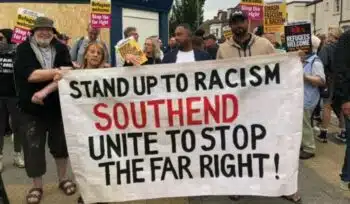
"There is great chaos under heaven; the situation is excellent."

Post Reply