What agreements did the presidents of Colombia and the United States make and what consequences could their diplomatic rapprochement have.
February 06, 2026 by Pablo Meriguet
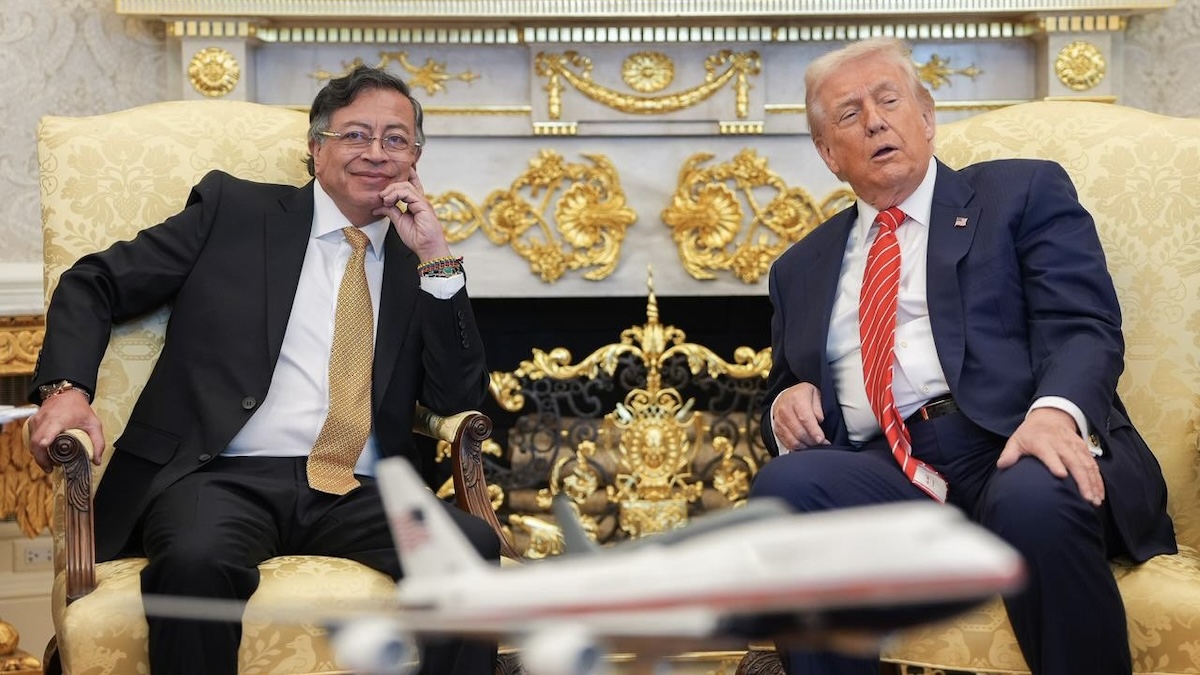
Gustavo Petro and Donald Trump in the Oval Office. Photo: Presidencia Colombia
After months of tense political and diplomatic relations, Colombian President Gustavo Petro and his US counterpart, Donald Trump, met in Washington on February 3. The threats of military intervention and sarcastic taunting on social media were replaced with expressions of mutual admiration and the exchange of gifts.
The meeting at the White House
The closed-door meeting lasted almost two hours. There is still a great deal of secrecy surrounding all the issues discussed at the bilateral meeting, although the official photographs show a meeting full of smiles and relaxation, in stark contrast to the tension that had built up between the two governments over several months, during which the possibility of a diplomatic break was even on the table.
Trump said that although he and Petro “are not the best of friends,” the meeting had gone smoothly and pleasantly. “We understood each other very well,” said the US president. He added that a possible agreement on the fight against drug trafficking was discussed at the meeting, although he did not give further details.
Through his social media accounts, Petro has also sought to show that his relationship with Trump has improved significantly, either through photographs or gifts given to him by the US president during the visit, such as a MAGA cap autographed by Trump. “I like frank gringos,” said the center-left leader after the meeting with Trump, which he described as “positive.”
However, Petro has also sought to maintain a respectful distance from Trump: “A pact is not between twin brothers. A pact is between adversaries who can find the paths to human brotherhood… My impression of a recent meeting a few hours ago is positive, first and foremost. That is the reality.”
Where things stand after the meeting
One of Petro’s clearest intentions during his visit to Washington was to distance himself from Trump’s view of his government as an ally of drug trafficking, as the Pentagon increases its presence and action in the Caribbean. This was hinted at by the Colombian Presidency in a message in X: “President Gustavo Petro presented Colombia as a strategic ally in the fight against drug trafficking during his dialogue with President Trump. His official visit highlighted the effectiveness of voluntary coca leaf crop substitution, as well as historic results in drug seizures, while maintaining the defense of life and liberty as a priority.”
In this regard, Petro provided a list of names of individuals who are allegedly the true leaders and beneficiaries of drug trafficking. Petro reportedly told Trump that they do not live in Colombia, but in “Dubai, Madrid, Miami,” and that their capital is outside the country. He said that these names are known to the United States and that only international coordination could bring them to justice.
Historically, Colombia has been one of Washington’s most stable allies in South America. In 2009, the United States (officially) established seven military bases in Colombia. In addition, Washington has supported the governments of the South American country, which, almost as if it were a political tradition, have been center-right, right-wing, or extreme right-wing. With the Petro government, which has undertaken important reforms and greater geopolitical autonomy, relations have become strained.
Despite the clear rapprochement, no concrete agreements have been reached between the two governments. In addition, Petro is subject to US sanctions (he is included on the OFAC list), which, for the moment, have not been lifted. In this sense, it seems that Petro’s visit was a first step toward rapprochement, but not a full alliance.
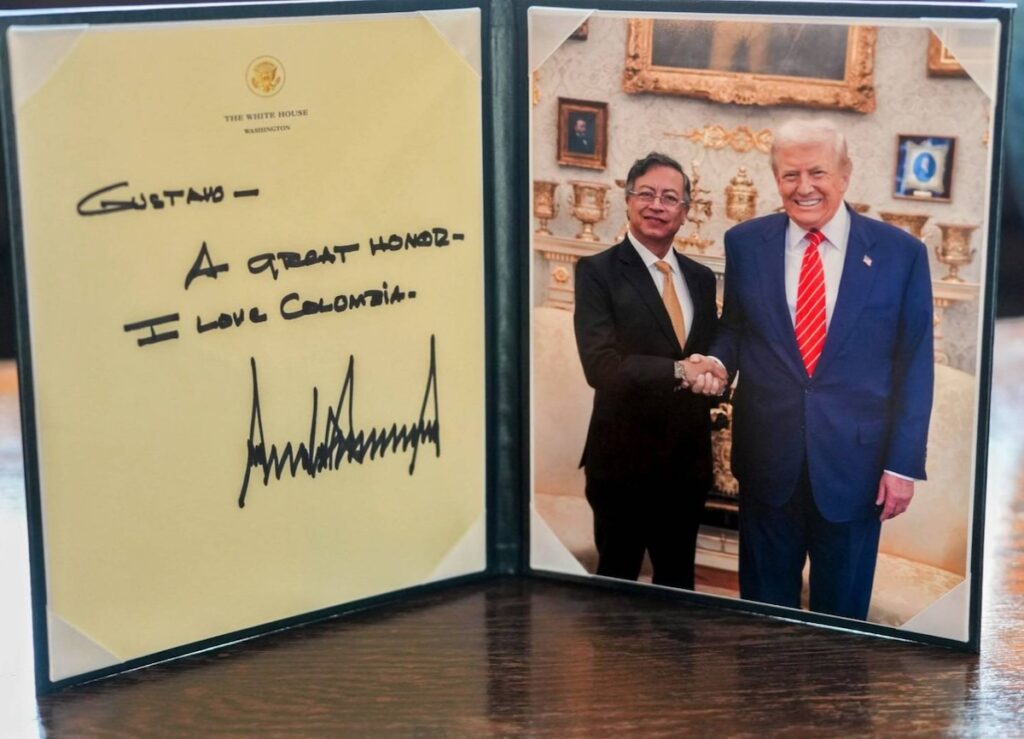
Signed photo from Donald Trump. Photo: Presidencia Colombia
It remains to be seen what role Colombia will play in the new regional geopolitics following the US attack on Venezuela and the influence that the Trump administration now has over the Venezuelan government. In this regard, Petro said that the situation in Venezuela was discussed at the meeting in Washington and that Colombia could help Venezuela’s economic recovery. “We looked at how Venezuela could recover with Colombia’s help, on its border, in its neighborhood… and what role the US could play,” Petro said.
In addition, Petro claims to have requested that Trump act as a mediator in the impasse between his government and right-wing Daniel Noboa, President of Ecuador and a close ally of Washington. Ecuador demanded greater cooperation from Bogotá to curb the flow of cocaine produced in Colombia and shipped through Ecuadorian ports. The demand was accompanied by a 30% increase in tariffs on Colombian products, to which Colombia responded by suspending electricity sales to Quito.
By and large, the tension between the two historically allied nations seems to have dissipated from where it stood months prior which began mounting as soon as Trump was sworn in.
Not brothers, or friends
In the first week of Trump’s second term, tensions between the two heads of state were already through the roof. After Petro announced that he would not allow US deportation flights to land in Colombia, Trump quickly threatened heavy tariffs, a travel ban on the president, and visa revocations for officials close to or part of the government. While this spat was quickly deescalated, throughout Trump’s first year, Petro has routinely taken to X to criticize his policies.
In September, during Petro’s visit to New York City for the UN General Assembly, the Colombian dignitary spoke at a pro-Palestine protest and directly appealed to US troops to disobey orders and follow their conscience. In response, the White House revoked his visa. Around the same time, the Pentagon had begun carrying out its campaign of airstrikes against small vessels in the Caribbean and killed several Colombian citizens. The US Military’s campaign in the Caribbean received rhetorical pushback from Petro who demanded an end to the attacks and justice for the victims.
By December, as US military threats continued to mount against Venezuela, Trump also threatened Colombia and Mexico with direct military intervention as part of Operation Southern Spear’s “crackdown” on drugs. “[Gustavo] Petro is going to get into big trouble if he doesn’t wake up… Colombia is a major drug producer… If Petro doesn’t open his eyes, he’ll be next. I hope he’s listening,” Trump said in December.
Two months later, Petro was greeting Trump in Washington.
In short, the meeting seems to have strengthened the dominant role that Washington is achieving in the region. For his part, Petro also seems to have won a battle against the Colombian opposition, which accused his government of distancing itself from Washington, its historically most important economic and security ally. This is even more relevant considering that presidential elections will soon be held in Colombia, and Petro wants his political heir, presidential candidate Iván Cepeda, to continue a process of social and economic reforms.
https://peoplesdispatch.org/2026/02/06/ ... ite-house/
Petro needed a shower after that...He walks a tightrope, easy guess that the US 'owns' at least half of the Columbian general...