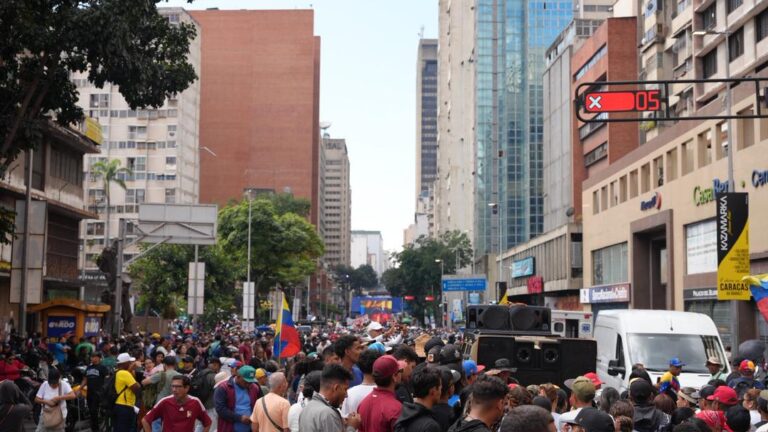
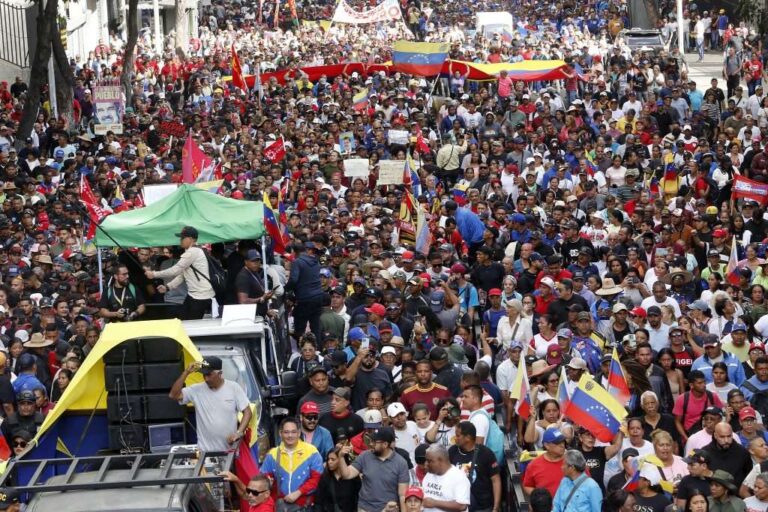
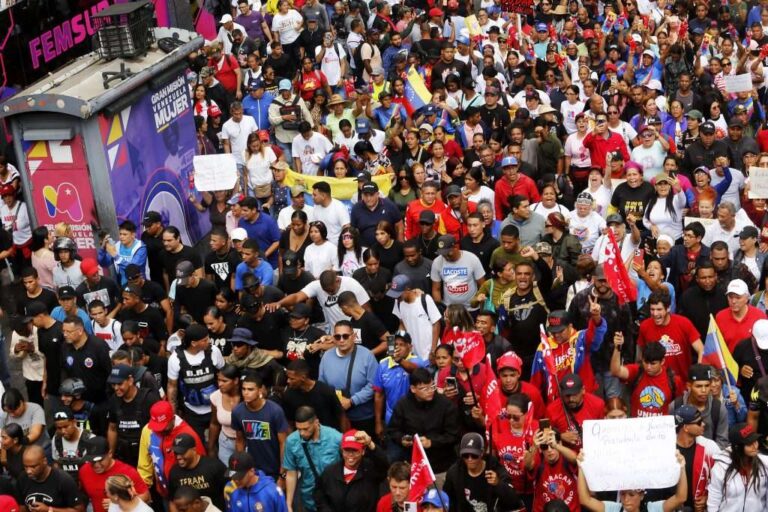
Venezuela

The fightback
User avatar
blindpig
Posts: 15306
Joined: Fri Jul 14, 2017 5:44 pm
Location: Turtle Island
Contact:

Re: Venezuela

Post by blindpig » Wed Dec 31, 2025 3:03 pm

US Alleges Unverified Land Strikes in Venezuela Amid Rising Civilian Deaths in SOUTHCOM Killing Operation (+Primazol)
December 31, 2025

Image
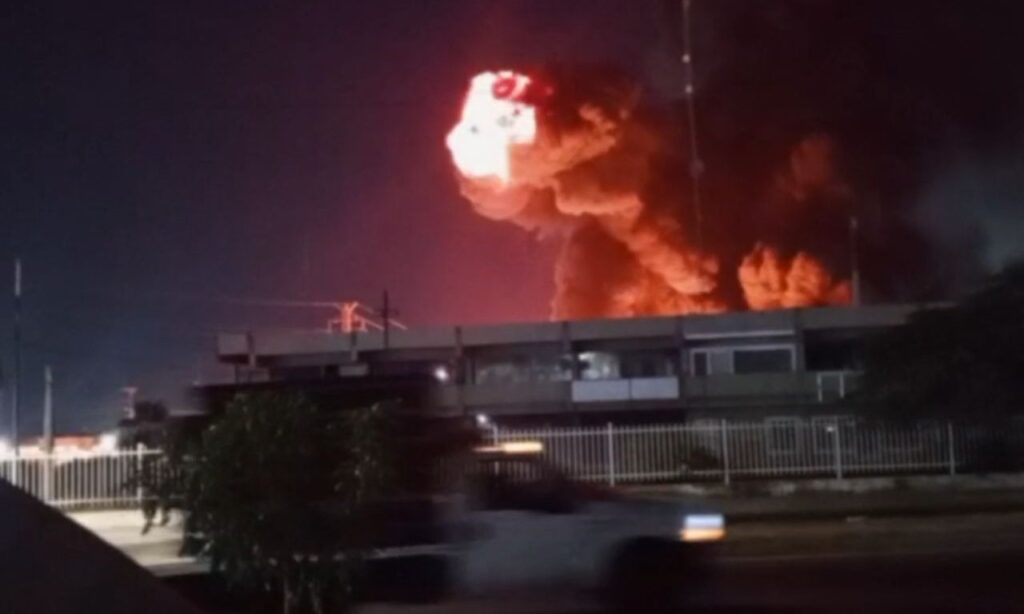
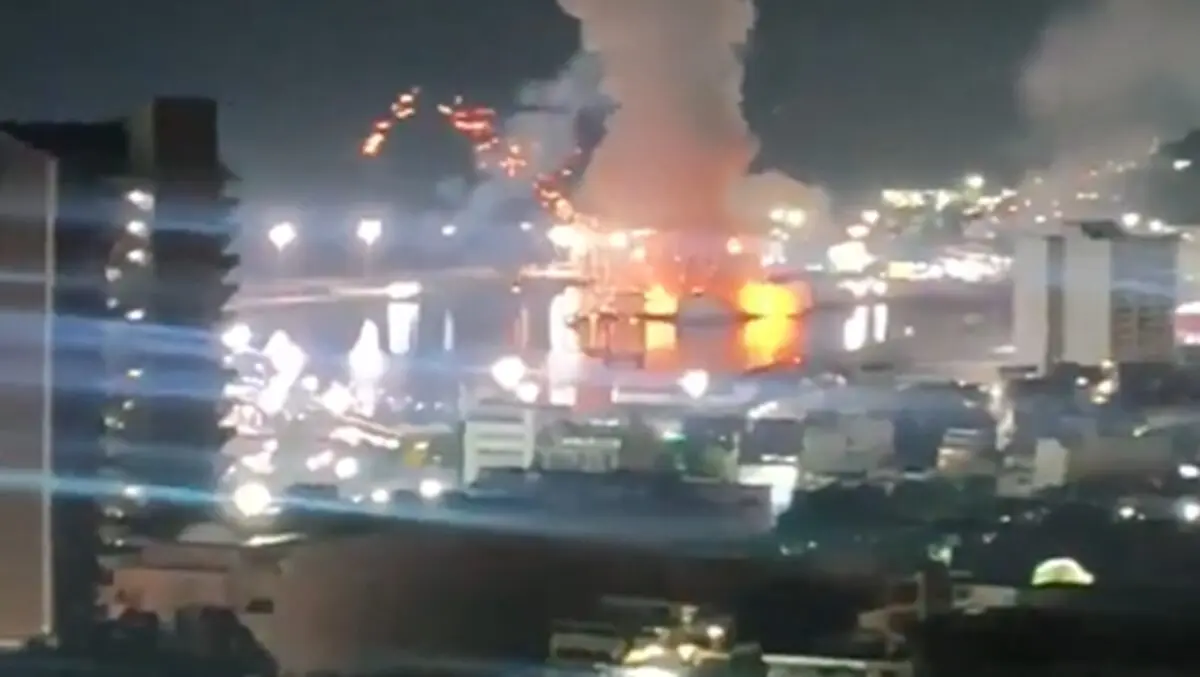
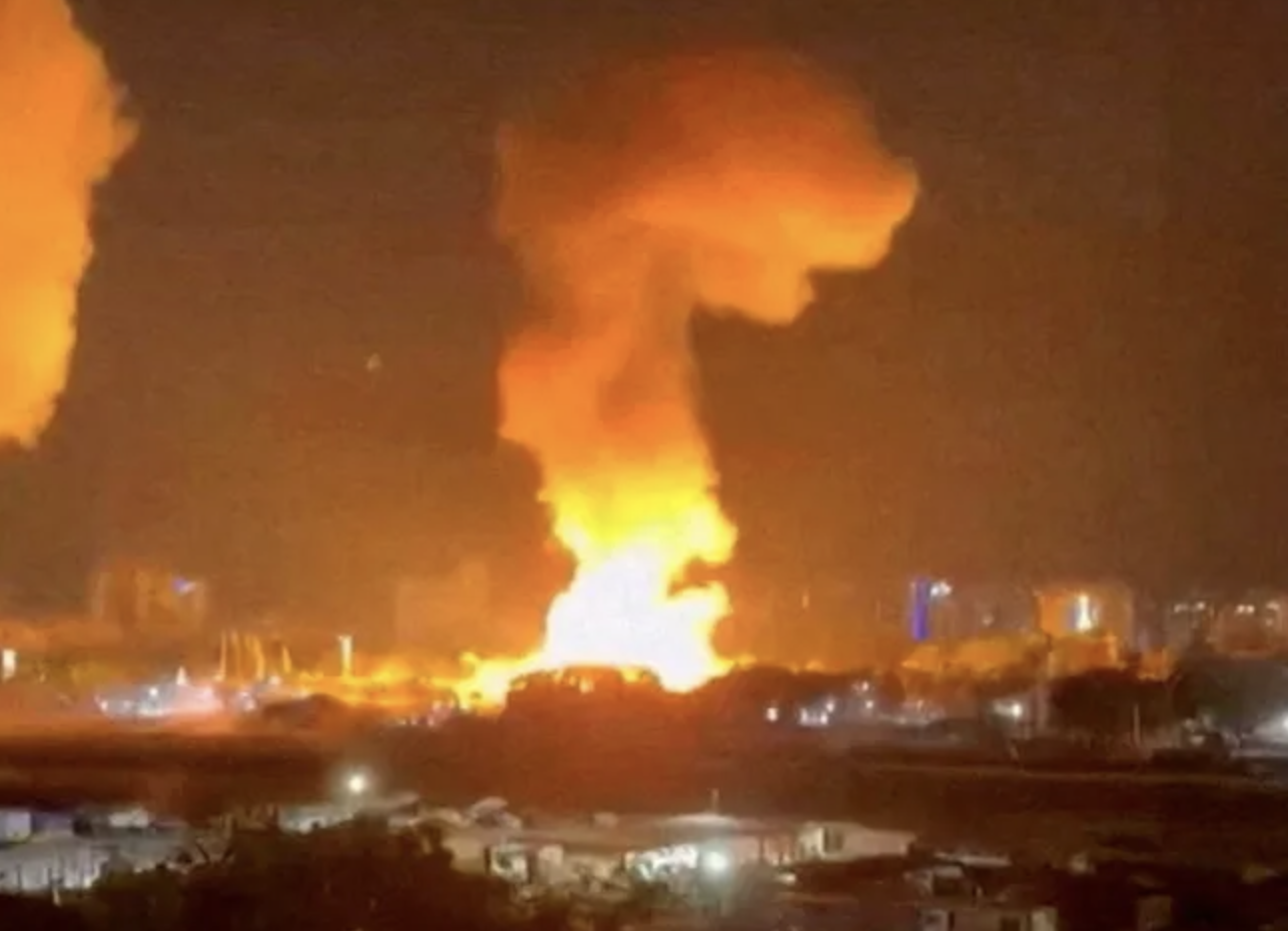
Explosion caught on video of the fire at the Primazol warehouse in Maracaibo, Zulia state, Venezuela, on December 24, 2025. Photo: La Verdad.

Caracas (OrinocoTribune.com)—On Monday, the US Southern Command (SOUTHCOM) announced a new extrajudicial execution as part of its Operation Southern Spear, killing two civilians in a small boat in Eastern Pacific waters. In addition, since Sunday, US President Donald Trump has claimed that the US carried out land strikes on Venezuelan territory; however, the US regime has not provided evidence of these attacks.

The US publicized its latest assassinations in the manner that has now become familiar: US SOUTHCOM announced on social media that a new round of executions of defenseless Latin American civilians had been carried out in the waters of the Eastern Pacific ocean. It is worth noting that Venezuela does not possess any coastline on the Pacific Ocean.

This latest execution represents the 30th strike on a small boat in the region and raises the number of assassinated civilians to 107 since September 2, when the first US strike was reported. To date, 55% of the victims (59) were killed in Eastern Pacific waters, while 45% (48) of the reported killings occurred in Caribbean Sea waters. Out of the 30 strikes, 19 have occurred in the Eastern Pacific, and 11 have occurred in the Caribbean.

A blurry video of the attack was attached to the SOUTHCOM post. The post declared that the action was authorized by US Secretary of War Pete Hegseth. International and US legal and military experts, and the United Nations, have labeled these actions as extrajudicial killings and war crimes. As usual, victims were not identified nor was any information released regarding the precise location or the contents of the boats that were attacked.

Image

In recent months, the US regime has deployed more than 18,000 troops in the Caribbean and the Pacific as part of its newest military campaign. According to the US ruler’s own statements, this campaign has most recently shifted to the goal of “recovering” [i.e., stealing] Venezuela’s oil, which the US claims belongs to it. Analysts and Venezuelan authorities had expressed their belief, since the beginning of this military campaign, that its actually goal is regime change—removing Venezuela’s democratically elected socialist president, Nicolas Maduro—in order to control Venezuela and facilitate the exploitation of its natural resources for US imperial interests.

Alleged land strikes
In what analysts claim is a disinformation operation, Donald Trump announced on a podcast during the weekend that there were US land strikes carried out on docks in Venezuela. While he did not mention Venezuela at that moment, mainstream media and social media influencers began spreading rumors shortly after regarding a fire at Primazol, a private chemical supplier company in Maracaibo, Zulia state, Venezuela. Reported on December 24, the fire was framed as the first target of such alleged strikes.

On Monday, from Mar-a-Lago, the US ruler was more explicit, clearly claiming there were attacks on Venezuelan land that targeted docks and alleged “narco-terrorist” facilities. He cited a “big explosion in the dock area where they load the boats up with drugs.”

If Washington’s claims are proven real, they will constitute another alarming violation of the international order by the US and an act of war that Venezuela will be forced to respond appropriately. However, no evidence has been provided of such land strikes, and Venezuelan authorities have not confirmed the US narrative.

A simple open-source information analysis made by Orinoco Tribune on Monday showed that the Primazol fire occurred in the San Francisco Industrial Zone of the San Francisco municipality in Maracaibo on December 24, 2025. The damaged warehouse is located 5 kilometers from the coast of Maracaibo Lake and one block from heavily populated neighborhoods of the second-largest city in Venezuela—Barrio El Gaitero and Barrio Sur América. Thus, there are no docks nearby.

Primazol has released a public statement explaining that the fire was caused by an electrical accident in an area where polyethylene terephthalate (PET) resin is stored.

The review conducted by Orinoco Tribune clearly showed that the alleged US strike against Primazol was another piece of fake news spread for the purposes of psychological warfare. “If a US strike actually happened there, we would see hundreds of videos online by now,” Orinoco Tribune wrote in a social media post. “While real [Venezuelan law enforcement] operations have smashed drug-linked companies like Grupo Lamar recently, these MSM reports and Trump’s delusional statements simply do not add up. No other video or open-source evidence has been released to demonstrate the alleged US land strikes.”

Despite the implausible US claims, mainstream media outlets ran with the news on Monday night, claiming that the alleged land strikes occurred and were part of a Central Intelligence Agency (CIA) covert operation initiated several weeks ago. However, no proof, in the form of videos or photos, was presented. CNN and the New York Times cited only “sources familiar with the matter” as the origin of their reports.

https://orinocotribune.com/us-alleges-u ... -primazol/

******

Did The CIA Really Strike A Dock In Venezuela?

CNN claims that the CIA bombed Venezuela.

Exclusive: CIA carried out drone strike on port facility on Venezuelan coast

The CIA carried out a drone strike earlier this month on a port facility on the coast of Venezuela, sources familiar with the matter told CNN, marking the first known US attack on a target inside that country.

The drone strike, the details of which have not been previously reported, targeted a remote dock on the Venezuelan coast that the US government believed was being used by the Venezuelan gang Tren de Aragua to store drugs and move them onto boats for shipping, the sources said. No one was present at the facility at the time it was struck, so there were no casualties, according to the sources.

Two sources said US Special Operations Forces provided intelligence support to the operation, underscoring their continued involvement in the region. But Col. Allie Weiskopf, a spokesperson for US Special Operations Command, denied that, saying, “Special Operations did not support this operation to include intel support.”

President Donald Trump appeared to first acknowledge the attack in an interview last week that initially attracted little notice, though he offered few specifics, including when reporters asked directly about it on Monday.


The NY Times has a similar report (archived) which additionally claims that the strike has happened last Wednesday.

There is however zero evidence that any strike took place. Venezuela Analysis has found no mention of it or of any damage in Venezuelan media, open source data or Venezuelan government statements. Neither have I.

Did this strike even happen? Or is it part of a miscalculated psychological operation to convince the Venezuelan government that it is under immediate threat and needs to get out?

Posted by b on December 30, 2025 at 16:35 UTC | Permalink

https://www.moonofalabama.org/2025/12/d ... l#comments

******

Imperial disaster: an assessment of the Trump operation in the Caribbean
December 29, 2025 , 12:41 pm .

Image
When war crimes become useless even for empire (Photo: History Extra)

The maximum pressure operation launched by the Trump administration against Venezuela—centered in the Caribbean during the last quarter of 2025—is a strategic failure and a comprehensive defeat: diplomatic, military, legal, and symbolic.

What began as a multi-sectoral offensive to fracture the Venezuelan state and force a regime change in favor of its economic subordination has resulted in a crisis of legitimacy for Washington, a consolidation of a certain degree of regional and global resistance, and the exposure of criminal practices that threaten to destabilize the US power apparatus from within.

The offensive and its components: military coercion, false narrative, extrajudicial lethality
The strategy was deployed on three intertwined fronts, articulated under the premise of national exceptionality and the permanent invocation of a supposed "existential emergency".

In military terms, tens of thousands of troops were concentrated in the Caribbean basin—the largest presence since the Cold War—before and after Operation Southern Spear , presented as a "humanitarian mission" by Defense Secretary Pete Hegseth.

But the contrast between the rhetorical facade and the operational practice is abysmal: without verification processes, without gradual warnings or captures, the US Armed Forces have carried out more than twenty air strikes against vessels allegedly linked to drug trafficking, leaving a toll of almost one hundred civilians dead —among them Venezuelan, Colombian, and Trinidadian fishermen and crew members— in just three months.

The total absence of military courts, proportionality reviews, or accountability mechanisms turns each operation into an act of extrajudicial execution.

This pattern is not accidental: it is rooted in an institutional architecture that, as Parker Yesko's research demonstrates, has normalized systematic impunity since Iraq and Afghanistan.

To give just one example: the September 2 attack—where two survivors, already out of action and clinging to the wreckage of their vessel, were killed in the water—was not an operational deviation, but the materialization of a deliberate policy. Former military legal advisors (JAGs) have denounced that orders such as "leave no survivors" were issued or validated by Hegseth, which, under Title 18, §2441 of the U.S. Code, constitutes conduct that can be classified as a war crime .

The Pentagon's refusal to release the full video of that attack—despite having already released more than twenty edited clips—reinforces the hypothesis that this is not a tactical failure, but a deliberate concealment strategy, where illegal violence is the central instrument of geopolitical control.

Geopolitical costs: hemispheric isolation and multipolar counterweight
Far from isolating Venezuela, the escalation has produced an unprecedented convergence in Latin America. Brazil, Colombia, and Mexico—three actors with divergent political agendas and historically tense relations with Caracas—have clearly rejected the military deployment.

Lula described it as a threat to regional peace; Petro suspended intelligence cooperation and denounced the attacks as assassinations; Mexico demanded an immediate end to all armed pressure.

This regional triangulation does not respond to ideological affinities, but to a shared perception of strategic risk: the US operation threatens Venezuelan sovereignty and undermines the principle of non-intervention that sustains the South American security architecture since the Santiago Declaration (1986) and the Treaty of Tlatelolco.

The impact transcends the hemisphere. Russia and China have reaffirmed their support for Venezuela as part of a structural dispute over the configuration of the world order.

Russian Ambassador Nebenzya, speaking at the Security Council, denounced "unprecedented pressure" and warned that any attack would be an "irreparable mistake," while Beijing insisted that Venezuela's internal affairs should be resolved without sanctions or intervention.

This convergence is not circumstantial: it reflects the consolidation of a multipolar axis that offers alternative financial, energy and diplomatic routes to unilateral dependence on Washington.

In that context, the Caribbean offensive not only fails to isolate Venezuela, but accelerates its integration into value chains and alliances that erode US hegemony in the Global South, a strategic paradox that underlines the blindness of imperial planning.

Political costs: institutional breakdown and erosion of consensus
The operation has generated a governance crisis within the United States, fueling an institutional conflict that transcends partisan polarization. The bipartisan Congress has questioned the legality and transparency of the operations: a clause in the National Defense Authorization Act withholds part of the Pentagon's budget until the full video of the September 2 attack is released; a measure approved with 77 votes in favor and only 20 against, demonstrating widespread rejection.

Even senators like Lindsey Graham, a longtime advocate of armed intervention, implicitly acknowledged the overtly military nature of the operation by comparing it to the 1989 invasion of Panama, while Rand Paul denounced the violation of due process and Chris Van Hollen called the second attack a "very likely war crime".

These criticisms are not due to a sudden "humanist turn", but to a logic of internal dispute: in a context of deep fragmentation of the Republican Party —between MAGA, neoconservatives and moderates— and with a presidential approval rating at historic lows (36%), the operation in the Caribbean has become a symbolic battleground.

As Senator Chris Murphy pointed out, the briefing given by Hegseth and Rubio lasted barely 50 minutes, with little time for questions and no clarity on the ultimate goal—to overthrow Maduro? to control the oil? both?—which exposes a strategic vacuum that undermines even the internal coherence of the Executive.

The militarization of foreign policy, far from consolidating support, has generated an institutional boomerang effect: each escalation increases the risk of litigation, formal investigations, and legislative obstacles that threaten to paralyze the White House's energy, budgetary, and sanctions agenda.

Failure to achieve the core objectives: there is no surrender, no fracture, no subordination
The stated and underlying objectives of the operation have not only failed to materialize, but have actually backfired. The "psychological pressure" exerted against the Venezuelan Armed Forces (FANB) and political leadership has not created fractures; on the contrary, it has strengthened institutional cohesion and the government's internal legitimacy.

Maduro remains in power with significant popular support —evidenced in the recent regional and municipal elections— and with a growing capacity for diplomatic projection.

Trump's rhetorical openness to "dialogue" in November , although it disappeared in December (we'll see next January), was not a sign of a willingness to understand, but of a tacit recognition of stalemate: when coercion does not produce surrender, the language of dialogue is instrumentalized as a last tactical resource to reposition oneself without de-escalating.

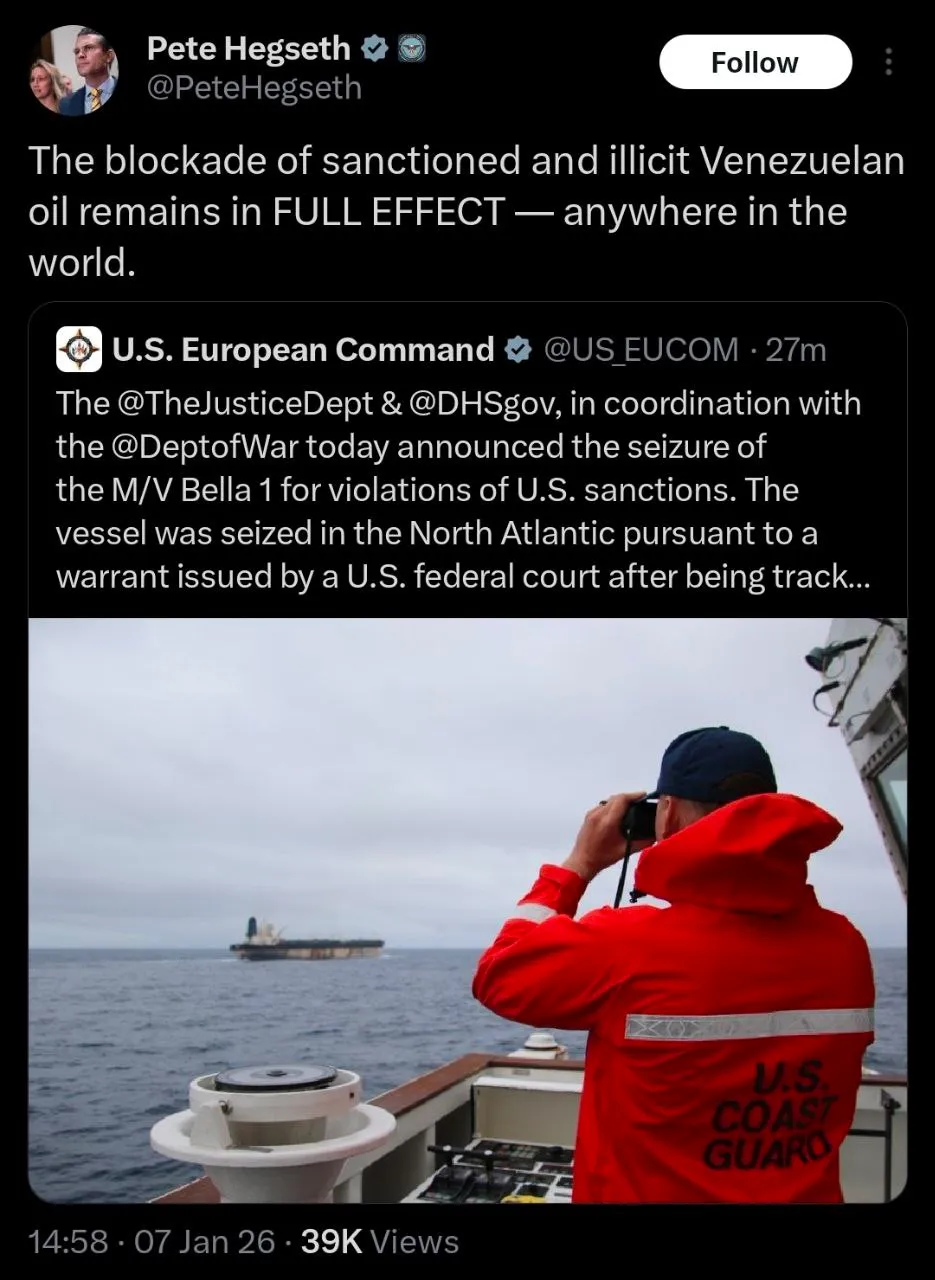
In economic terms, the "maximum pressure" strategy has also failed to achieve its central objective: control over strategic resources. Although Washington has seized oil tankers carrying millions of barrels of crude, this does not alter Venezuela's ownership structure or energy sovereignty .

The US companies —ExxonMobil and ConocoPhillips— have not returned, and any future negotiations will necessarily have to go through the current government.

Trump's admission — "They took all our oil... We want it back" — is not bravado, but desperation: it is a confession that the strategy of strangulation has not generated concessions, and that the only possible way is the direct recognition of the interlocutor that was intended to be eliminated.

In that sense, the operation has achieved exactly the opposite of its intention: it has not weakened Venezuela, but has forced the U.S. to confront it as a sovereign power on an equal footing.

A first-rate symbolic defeat.

The symptom of a decline
This disaster is structural, not circumstantial. It reflects the collapse of a strategy based on unilateralism, blackmail, and legalized piracy; a strategy that no longer resonates even with Washington's traditional allies.

Yesko's investigation into war crimes in Iraq and Afghanistan demonstrates that systematic impunity is an entrenched pattern, but what is new is that today that pattern is being broken in real time, with public denunciations, leaks and demands for accountability from within the system.

The difference lies not in the violence —which remains brutal—, but in the world's ability to name it, document it, and resist it.

Trump's crude verbalization on December 16 — "give back our oil, our land, our assets" — is no minor provocation: it is the brutal transparency of an imperial doctrine that no longer needs to pretend.

But this frankness is not a sign of strength, but of narrative exhaustion: when the story of the "fight against narcoterrorism" fades in the face of the evidence of hundreds of murdered civilians, all that remains is the naked confession of recolonization .

The problem is that the world no longer accepts that script. What the US has achieved is not the subjugation of Venezuela, but the construction of a new balance of power: a more sovereign region (for the time being), a more cohesive Global South, and an empire that, by exposing its war crimes as a tactic, has shed its last mask: that of moral exceptionalism.

The American disaster in the Caribbean is evidence that the era of unipolar hegemony has entered its terminal phase.

https://misionverdad.com/globalistan/el ... -el-caribe

Google Translator
"There is great chaos under heaven; the situation is excellent."

User avatar
blindpig
Posts: 15306
Joined: Fri Jul 14, 2017 5:44 pm
Location: Turtle Island
Contact:

Re: Venezuela

Post by blindpig » Sat Jan 03, 2026 12:42 pm

US Launches Military Strikes Against Venezuela; President Maduro and Cilia Flores Kidnapped
January 3, 2026

Image
The Venezuelan government has accused Washington of launching strikes on the country after explosions rang out in the early morning of January 3, 2026. Photo: AFP via Getty Images.

In the early hours of Saturday, January 3, blackouts, aircraft noise, and heavy explosions were heard throughout Caracas and in several other regions of Venezuela. In a statement released around 3 a.m., the Venezuelan government confirmed that the US government launched military strikes in Caracas, La Guaira, and Aragua state. After several hours of uncertainty and following US announcements, the kidnapping of the Venezuelan President Nicolas Maduro and his wife Cilia Flores was confirmed.

The Venezuelan statement, besides confirming the US military aggression, also informed the public that Venezuela is prepared to repel any further attacks. However, no anti-aircraft artillery was seen during the US military strikes over Caracas.

In the communique, the government also announced that President Maduro signed a state of foreign commotion emergency decree. The government had previously stated it would implement this decree immediately should the US government act on its military threats. This measure will allow Venezuela to respond more efficiently to both internal and external aggression.


US imperialism and the struggle for oil
Since last August, US imperialism has been threatening military attacks against Venezuela under the excuse of a new “war on drugs.” However, recent statements show that the main reasons behind these threats—along with an unprecedented US military deployment of more than 18,000 troops off the coast of Venezuela—are regime change and control over Venezuelan oil.

From the headquarters of Orinoco Tribune in south downtown Caracas, no strikes were visible, including around the Miraflores Presidential Palace. However, explosions and unfamiliar aircraft noises were heard for about 45 minutes, ending around 2:50 a.m. The aircraft sounds were not similar to the ordinary helicopter or fighter jet sounds familiar to those in Venezuela.

Social media posts showed videos of explosions at the Fuerte Tiuna military complex in Caracas, in areas reported by mainstream media in recent months as secure presidential locations. This indicates an attempted decapitation strike against President Maduro. Strikes at the La Carlota military base in Caracas were also clearly covered in social media posts. Several areas of Caracas remain without electric power after several hours, though most of the city does not report electricity cuts.

The following is an unofficial translation of the Venezuelan government statement:

The Bolivarian Republic of Venezuela rejects, repudiates, and denounces before the international community the extremely serious military aggression perpetrated by the current government of the United States of America against Venezuelan territory and population in the civilian and military localities of the city of Caracas, capital of the republic, and the states of Miranda, Aragua, and La Guaira.

This act constitutes a flagrant violation of the Charter of the United Nations, especially Articles 1 and 2, which enshrine respect for sovereignty, the legal equality of states, and the prohibition of the use of force. Such aggression threatens international peace and stability, specifically in Latin America and the Caribbean, and puts the lives of millions of people at serious risk.

The objective of this attack is none other than to seize Venezuela’s strategic resources, particularly its oil and minerals, in an attempt to forcibly break the nation’s political independence. They will not succeed. After more than 200 years of independence, the people and their legitimate government remain steadfast in defending their sovereignty and their inalienable right to decide their own destiny. The attempt to impose a colonial war to destroy the republican form of government and force a “regime change,” in alliance with the fascist oligarchy, will fail like all previous attempts.

Since 1811, Venezuela has confronted and defeated empires. When foreign powers bombarded our coasts in 1902, President Cipriano Castro proclaimed: “The insolent foot of the foreigner has profaned the sacred soil of the Fatherland.” Today, with the spirit of Bolívar, Miranda, and our liberators, the Venezuelan people rise again to defend their independence in the face of imperial aggression.

People to the streets!

The Bolivarian government calls on all social and political forces in the country to activate mobilization plans and repudiate this imperialist attack. The people of Venezuela and their Bolivarian National Armed Forces, in perfect popular-military-police fusion, are deployed to guarantee sovereignty and peace. Simultaneously, Bolivarian Peace Diplomacy will file the corresponding complaints with the UN Security Council, the secretary-general of that organization, CELAC, and NAM, demanding the condemnation and accountability of the US government.

President Nicolás Maduro has ordered that all national defense plans be implemented at the appropriate time and under the appropriate circumstances, in strict accordance with the provisions of the Constitution of the Bolivarian Republic of Venezuela, the Organic Law on States of Emergency, and the Organic Law on National Security.

In this regard, President Nicolás Maduro has signed and ordered the implementation of the decree declaring a state of external commotion throughout the national territory in order to protect the rights of the population, the full functioning of republican institutions, and to immediately move to armed struggle. The entire country must mobilize to defeat this imperialist aggression.

Similarly, he has ordered the immediate deployment of the Command for the Comprehensive Defense of the Nation and the Comprehensive Defense Management Bodies in all states and municipalities of the country. In accordance with Article 51 of the Charter of the United Nations, Venezuela reserves the right to exercise legitimate defense to protect its people, its territory, and its independence.

As Supreme Commander Hugo Chávez Frías pointed out, “in the face of any new difficulties, whatever their magnitude, the response of all patriots… is unity, struggle, battle and victory.”

— Caracas, January 3, 2026


Kidnapping of President Maduro and the line of succession
Around 5 a.m., the US ruler, Donald Trump, claimed on social media that President Maduro and his wife, Cilia Flores, had been kidnapped. Initial impressions from analysts suggested this might be a disinformation maneuver intended to materialize the assassination of President Maduro. This appeared to be supported by a press conference held by Defense Minister Vladimir Padrino, where no reference to a kidnapping was made.


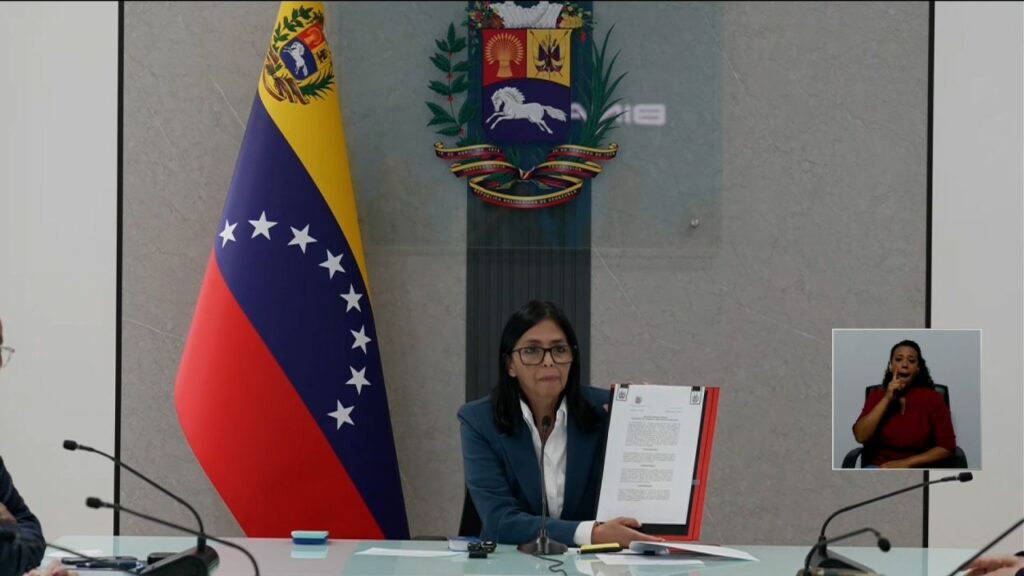
However, around 5:30 a.m., Venezuelan Vice President Delcy Rodríguez, the second-highest official in the line of succession, appeared in a broadcast on public television. She demanded “proof of life” from the US regime for President Maduro and his wife, thereby confirming the kidnapping of the constitutional president of Venezuela.

Many analysts have asserted over the last several months of US aggression that a decapitation strike or the absence of President Maduro would represent a significant loss, but would not topple the Bolivarian Revolution or Chavismo. Under the current circumstances, Delcy Rodríguez is serving as the acting president of Venezuela.

https://orinocotribune.com/us-launches- ... kidnapped/

******

Padrino López Orders Nationwide Defense After U.S. Missile Attacks

Venezuela activates all military resources in response to U.S. missile strikes, citing threats to sovereignty and civilians.

Image
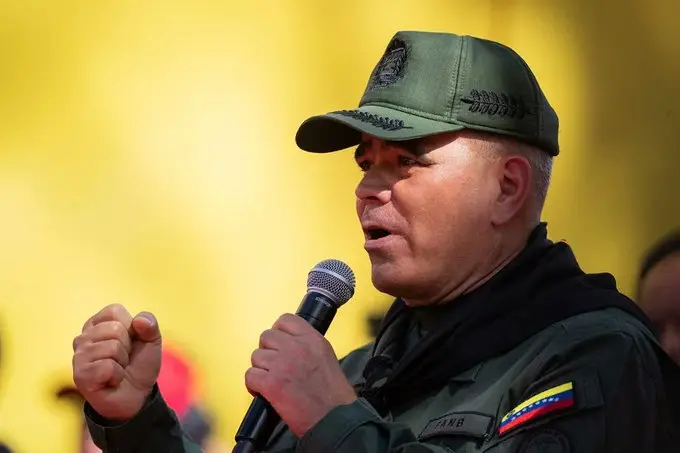
Venezuelan Defense Minister General Vladimir Padrino López delivers an official statement on the U.S. attacks. Photo: @EFEnoticias

January 3, 2026 Hour: 6:55 am

Venezuela’s Defense Minister confirmed that the country is deploying all military capabilities in response to U.S. missile attacks targeting Caracas and several states.

On January 3, General Vladimir Padrino López, Venezuela’s Minister of Defense, issued the first official report following U.S. strikes on multiple locations across the country. He condemned the attacks as a “criminal military aggression” and confirmed that the Bolivarian National Armed Forces (FANB) would activate all available resources to defend national territory and citizens.

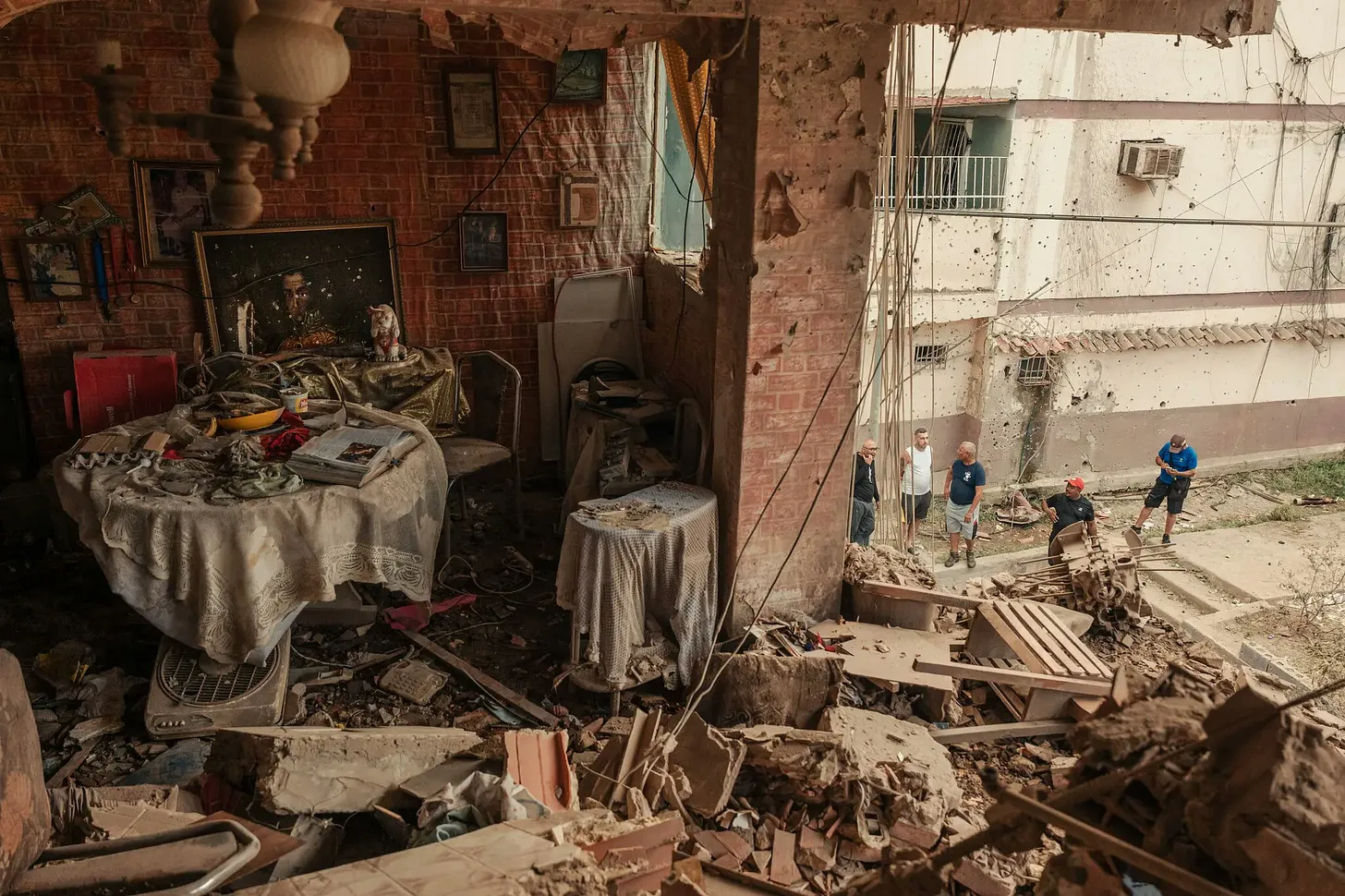
The minister reported missile impacts in Fuerte Tiuna, Caracas, and the states of Miranda, Aragua, and La Guaira. He noted that civilian housing complexes were affected, and authorities are assessing potential casualties. In line with directives from President Nicolás Maduro, the FANB has initiated a comprehensive nationwide defense deployment.

“Faced with this vile and cowardly attack, which threatens the peace and stability of the region, we raise the most forceful denunciation before the international community and all multilateral organizations to condemn the U.S. Government for the blatant violation of the United Nations Charter and international law,” Padrino López declared.

Citing the Constitution, the Organic Law on States of Exception, and the Organic Law of National Security, the Venezuelan government declared a state of external commotion. The FANB is mobilizing its operational capabilities—including land, air, naval, riverine, and missile units—in a “perfect popular-military-police fusion” to form a unified combat force.

https://www.telesurenglish.net/padrino- ... e-attacks/

Venezuela Requests a Meeting of the UN Security Council

Image
US bombing in Caracas, Dec. 3, 2026. X/ @karim2k

January 3, 2026 Hour: 7:37 am

U.S. Conducts Airstrikes in Venezuela and Kidnaps President Maduro
On Saturday, Venezuela’s government called for an emergency meeting of the United Nations Security Council (UNSC) after the United States bombed Caracas and other cities in the country.

In a letter addressed to the UNSC president, Somalia’s Ambassador Abukar Dahir Osman, Caracas requested the emergency session to discuss the U.S. acts of aggression against Venezuela. The letter was also delivered to U.N. Secretary-General Antonio Guterres.

Venezuela further asked the council to condemn the U.S. aggression against the Venezuelan people and government, demand a “cessation of the armed attacks,” and establish appropriate measures to hold the U.S. administration “accountable for the crimes of aggression” committed on Venezuelan territory.

Venezuela’s request came after “U.S. military forces executed a series of armed attacks” in the early hours of Saturday, which the government of President Nicolas Maduro described as “brutal, unjustified and unilateral.”


The attacks involved bombing of civilian and military locations in Caracas and the northern states of Miranda, Aragua and La Guaira. Additionally, U.S. special forces are carrying out attacks in various parts of the national territory using helicopters and aircraft.

Venezuela stressed that this aggression “flagrantly violates” the UN Charter, which states that “all members shall refrain in their international relations from the threat or use of force against the territorial integrity or political independence of any state.”

In a post on Truth Social, U.S. President Donald Trump confirmed that the United States had successfully carried out “a large-scale attack against Venezuela and its leader, President Nicolas Maduro, who, along with his wife, has been captured and airlifted out of the country.”

Earlier, Venezuelan Vice President Delcy Rodriguez confirmed that President Maduro and his wife’s whereabouts are unknown.

https://www.telesurenglish.net/venezuel ... y-council/

******

The United States attacked Venezuela
January 3, 10:45

Image

The United States officially attacked Venezuela.
Missile strikes targeted Caracas for 25 minutes.
Several military and civilian facilities in three states were damaged.
Trump officially authorized the strikes.
The army has been deployed to the streets of Venezuela. A state of emergency has been declared.

https://colonelcassad.livejournal.com/10283785.html

The US captured Maduro
January 3, 1:13 PM

Image

The US captured Maduro

1. Trump claimed that the US was able to capture Maduro and his wife and take them out of Venezuela. Vice President Rodriguez essentially confirmed this.
2. The operation was carried out by Delta Force special forces. Details were promised later in the evening.
3. Despite the rumors, Venezuelan Defense Minister Padrino Lopez is alive and organizing resistance.
4. The country is now effectively led by Vice President Delcy Rodriguez.
5. The Venezuelan army has taken control of major cities. Arrests are underway.
6. The US will attempt to organize mass rallies in Venezuela in the coming days to overthrow the Chavistas.
7. New strikes on Venezuelan military facilities are likely, as well as attempts to assassinate Padrino Lopez.

Regarding the plan to kidnap Maduro, it is frankly not new. In 2020, Operation Gideon was carried out, using Silvercorp mercenaries and Colombian mercenaries. Their plan, backed by CIA agents and Venezuelan fifth columnists, was to infiltrate Caracas, kidnap Maduro, and spirit him out of the country. The operation cost $227 million, which was to be paid out of Venezuelan funds after the seizure of power. The plan failed (most of the mercenaries were captured, including two Americans). And now, five years later...

What's happening is a blow to the Global South. A blow to China's interests. A blow to Russia's interests. And a blow to Cuba.
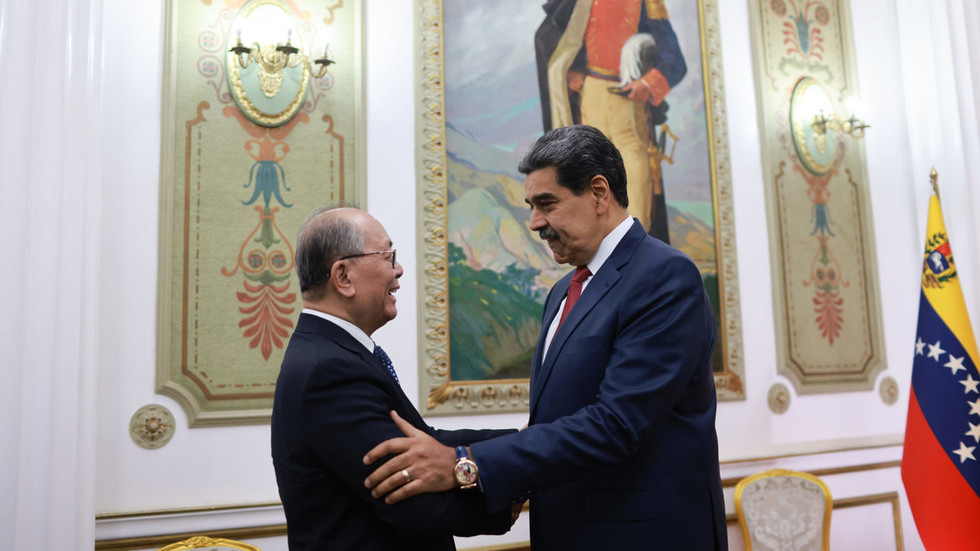
It's worth noting that just yesterday, Maduro was still holding talks with Xi Jinping's representative.

https://colonelcassad.livejournal.com/10284124.html

Google Translator

Writing off Venezuela might be premature. President Maduro is one man, and to be frank in no way as charismatic as Hugo Chavis. So. we will see if the Chavistas can hold it together. If the leadership can rally the nation then the US will have created a martyr and given itself a big black eye in the Global South.
"There is great chaos under heaven; the situation is excellent."

User avatar
blindpig
Posts: 15306
Joined: Fri Jul 14, 2017 5:44 pm
Location: Turtle Island
Contact:

Re: Venezuela

Post by blindpig » Sat Jan 03, 2026 3:23 pm

(Post #2 1/03/26)

The US War on Venezuela began in 2001

The current US attacks against Venezuela are part of a two-decade process led by the US and the Venezuelan right wing to undermine the Bolivarian project and its bold decision to use the country’s oil wealth for the betterment of its people.

January 02, 2026 by Vijay Prashad

Image
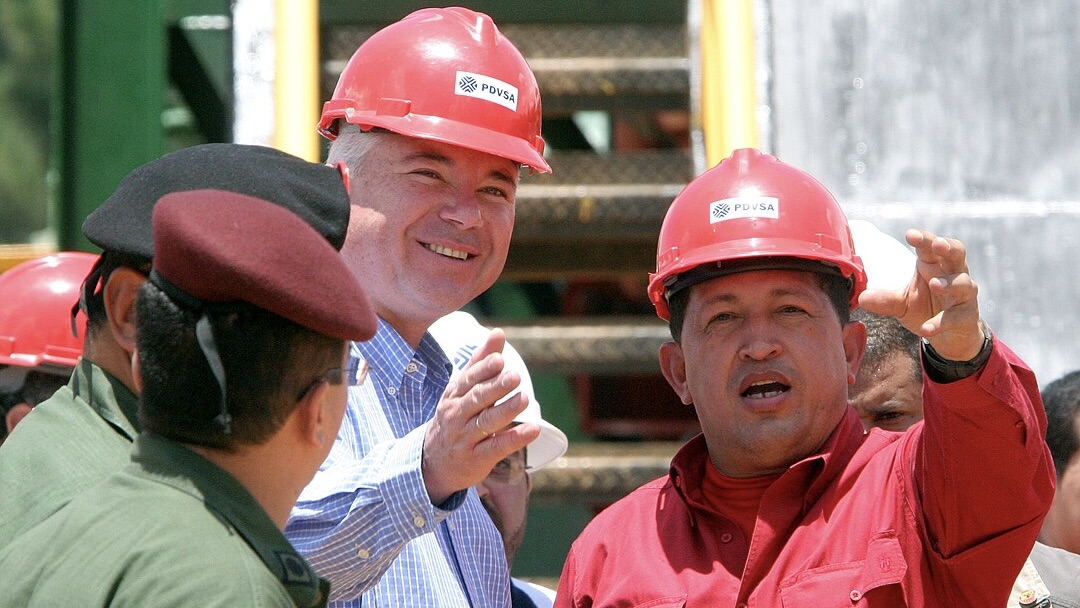
Former PDVSA President Rafael Ramírez with former Venezuelan President Hugo Chávez. Photo: Wikimedia Commons

The United States had no problem with Venezuela per se, not with the country nor with its former oligarchy. The problem that the United States government and its corporate class have is with the process set in motion by the first government of Venezuelan President Hugo Chávez.

In 2001, Chávez’s Bolivarian process passed a law called the Organic Hydrocarbons Law, which asserted state ownership over all oil and gas reserves, held upstream activities of exploration and extraction for the state-controlled companies, but allowed private firms – including foreign firms – to participate in downstream activities (such as refining and sale). Venezuela, which has the world’s largest petroleum reserves, had already nationalized its oil through laws in 1943 and then repeated in 1975. However, in the 1990s as part of the neoliberal reforms pushed by the International Monetary Fund (IMF) and by the large US-owned oil companies, the oil industry was substantially privatized.

When Chávez enacted the new law, it brought the state back into control of the oil industry (whose foreign oil sales were responsible for 80% of the country’s external revenues). This deeply angered the US-owned oil companies – particularly ExxonMobil and Chevron – which put pressure on the government of US President George W. Bush to act against Chávez. The US tried to engineer a coup to unseat Chávez in 2002, which lasted for a few days, and then pushed the corrupt Venezuelan oil company management to initiate a strike to damage the Venezuelan economy (it was eventually the workers who defended the company and took it back from the management). Chávez withstood both the coup attempt and the strike because he had the vast support of the population. Maria Corina Machado, who was awarded the Nobel Peace Prize in 2025, started a group called Sumaté (“Join Up”), which placed a recall referendum on the ballot. About 70% of the registered voters came to the polls in 2004, and a large majority (59%) voted to retain Chávez as the president.

But neither Machado nor her US backers (including the oil companies) rested easy. From 2001 till today, they have tried to overthrow the Bolivarian process – to effectively return the US-owned oil companies to power. The question of Venezuela, then, is not so much about “democracy” (an overused word, which is being stripped of meaning) but about the international class struggle between the right of the Venezuelan people to freely control their oil and gas and that of the US-owned oil companies to dominate Venezuelan natural resources.

The Bolivarian process
When Hugo Chávez appeared on the political scene in the 1990s, he captured the imagination of most of the Venezuelan people – particularly the working-class and the peasantry. The decade was marked by the dramatic betrayals by presidents who promised to secure the oil-rich country from IMF-imposed austerity and then adopted those same IMF proposals. It did not matter if they were social democrats (such as Carlos Andrés Pérez of Democratic Action, president from 1989 to 1993) or conservatives (such as Rafael Caldera of the Christian Democrats, president from 1994 to 1999). Hypocrisy and betrayal defined the political world, while high levels of inequality (with the Gini index at a staggering 48.0) gripped the society. The mandate for Chávez (who won the election with 56% against 39% for the candidate of the old parties) was against this hypocrisy and betrayal.

It helped Chávez and the Bolivarian process that oil prices stayed high from 1999 (when he took office) till 2013 (when he died at 58, very young). Having taken hold of the oil revenues, Chávez turned them over to make phenomenal social gains. First, he developed a set of mass social programs (misiones) that redirected oil revenues to meet basic human needs such as primary healthcare (Misión Barrio Adentro), literacy and secondary education for the working-class and peasantry (Misión Robinson, Misión Ribas, and Misión Sucre), food sovereignty (Misión Mercal and then PDVAL), and housing (Gran Misión Vivienda).

The state was reshaped as a vehicle for social justice and not an instrument to exclude the working-class and peasantry from the gains of the market. As these reforms advanced, the government moved to build popular power through participatory instruments such as the communes (comunas). These communes emerged first out of popular consultancy assemblies (consejos comunales) and then developed into popular bodies to control public funds, plan for local development, generate communal banks, and form local, cooperative enterprises (empresas de producción social). The communes represent one of the Bolivarian process’ most ambitious contributions: an effort – uneven but historically significant – to construct popular power as a durable alternative to oligarchic rule.

The US-imposed hybrid war on Venezuela
Two events took place in 2013-14 that deeply threatened the Bolivarian process: first, the untimely death of Hugo Chávez, without doubt the driving force of revolutionary energy in the country, and second, the slow and then steady collapse of oil revenues. Chávez was followed as president by the former foreign minister and trade unionist Nicolás Maduro, who tried to steady the ship but faced a severe challenge when oil prices, which peaked in June 2014 at roughly USD 108 per barrel, fell dramatically in 2015 (below USD 50) and then by January 2016 (below USD 30). For Venezuela, which relied upon foreign crude oil sales, this decline was catastrophic. The Bolivarian process could not revise the oil-dependent redistribution (not just within the country but in the region, including through PetroCaribe); it remained trapped by dependence on oil exports and therefore by the contradictions of being a rentier state. Equally, the Bolivarian process had not expropriated the wealth of the dominant classes, which continued to lean heavily on the economy and society, and therefore prevented a full-scale transition to a socialist project.

Before 2013, the United States, its European allies, and oligarchic forces in Latin America had already forged their weapons for a hybrid war against Venezuela. After Chávez won his first election in December 1998 and before he took office the next year, Venezuela saw accelerated capital flight as the Venezuelan oligarchy took their wealth to Miami. During the coup attempt and the oil lockout, there was more evidence of capital flight, which weakened the monetary stability of Venezuela. The United States government began to lay the diplomatic groupwork to isolate Venezuela, characterizing the government as a problem and building an international coalition against it. This led, by 2006, to restrictions on Venezuela for access to international credit markets. Credit rating agencies, investment banks, and multilateral institutions steadily raised borrowing costs, making refinancing more difficult well before the US placed formal sanctions on Venezuela.

After the death of Chávez, and with oil prices lowered, the United States began a focused hybrid war against Venezuela. Hybrid war refers to the coordinated use of economic coercion, financial strangulation, information warfare, legal manipulation, diplomatic isolation, and selective violence, deployed to destabilize and reverse sovereign political projects without the need for full-scale invasion. Its objective is not territorial conquest but political submission: the disciplining of states that attempt redistribution, nationalization, or independent foreign policy.

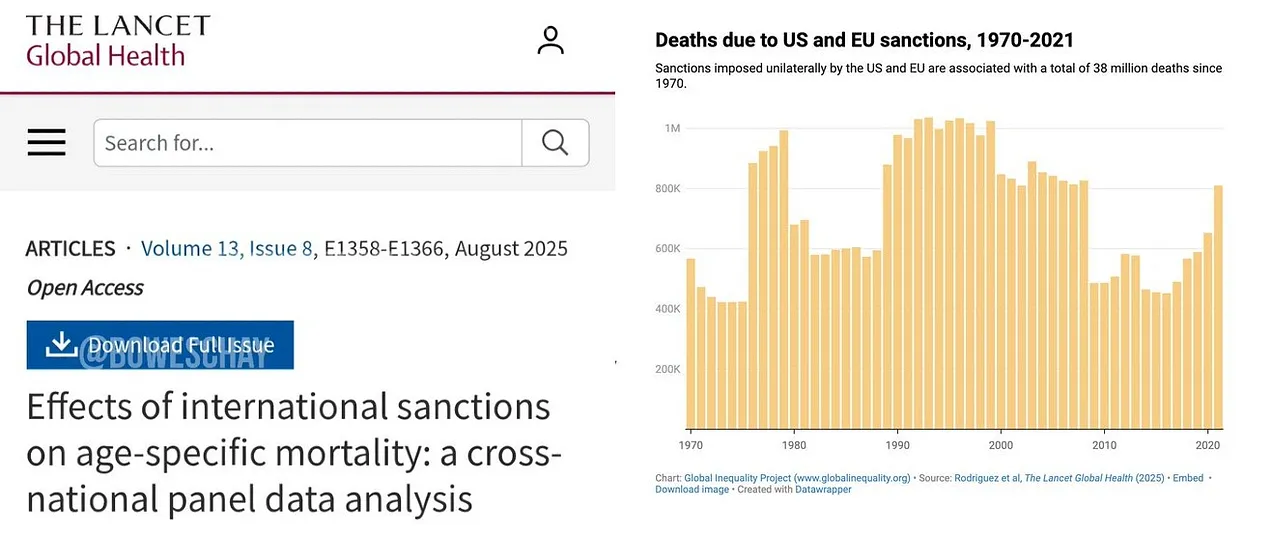
Hybrid war operates through the weaponization of everyday life. Currency attacks, sanctions, shortages, media narratives, NGO pressure, judicial harassment (lawfare), and engineered legitimacy crises are designed to erode state capacity, exhaust popular support, and fracture social cohesion. The resulting suffering is then presented as evidence of internal failure, masking the external architecture of coercion. This is precisely what Venezuela has faced since the US illegally placed financial sanctions on the country in August 2017, these were then deepened with secondary sanctions in 2018. Because of these sanctions, Venezuela has faced the disruption of all payment systems and trade channels and forced overcompliance with US regulations. Meanwhile, media narratives in the West systematically downplayed sanctions, while amplifying inflation, shortages, and migration as purely internal phenomenon, reinforcing regime-change discourse. The collapse of living standards in Venezuela between 2014 and 2017 cannot be divorced from this layered strategy of economic asphyxiation.

Mercenary attacks, sabotage of the electrical grid, creation of a conflict generated to benefit ExxonMobil between Guyana and Venezuela, invention of an alternative president (Juan Guaidó), provision of the Nobel Peace Prize to someone calling for a war against her own country (Machado), attempted assassination of the president, bombings of fishing boats off the Venezuelan coast, seizure of oil tankers leaving Venezuela, buildup of an armada off the coast of the country: each of these elements is designed to create neurological tension within Venezuela leading to the surrender of the Bolivarian process in favor of a return to 1998 and then an annulment of any hydrocarbon law that promises the country sovereignty.

If the country were to return to 1998, as Maria Corina Machado promises, all the democratic gains made by the misiones and the comunas as well as by the Constitution of 1999 will be invalidated. Indeed, Machado said that a US bombing of her fellow Venezuelans would be “an act of love”. The slogan of those who want to overthrow the government is Ahead to the Past.

In October 2025, meanwhile, Maduro told an audience in Caracas in English, “listen to me, no war, yes peace, the people of the United States”. That night, in a radio address, he warned, “No to regime change, which reminds us so much of the endless, failed wars in Afghanistan, Iraq, Libya, and so on. No to CIA-orchestrated coups d’état.” The line, “no war, yes peace”, was taken up on social media and remixed into songs. Maduro appeared several times at rallies and meetings with music ablaze, singing, no war, yes peace, and – on at least one occasion – wearing a hat with that message.

https://peoplesdispatch.org/2026/01/02/ ... n-in-2001/

******

The United States attacks Venezuela and kidnaps its president in an illegal operation
January 3, 2026 Taroa Zúñiga Silva and Vijay Prashad

Image

A little after 2am, Venezuela time, on 3 January 2026, in violation of Article 2 of the United Nations Charter, the United States began an attack on several sites in the country, including Caracas, the capital. Residents awoke to loud noises and flashes, as well as large helicopters in the sky. Videos began to appear on social media, but without much context. Confusion and rumor flooded social media.

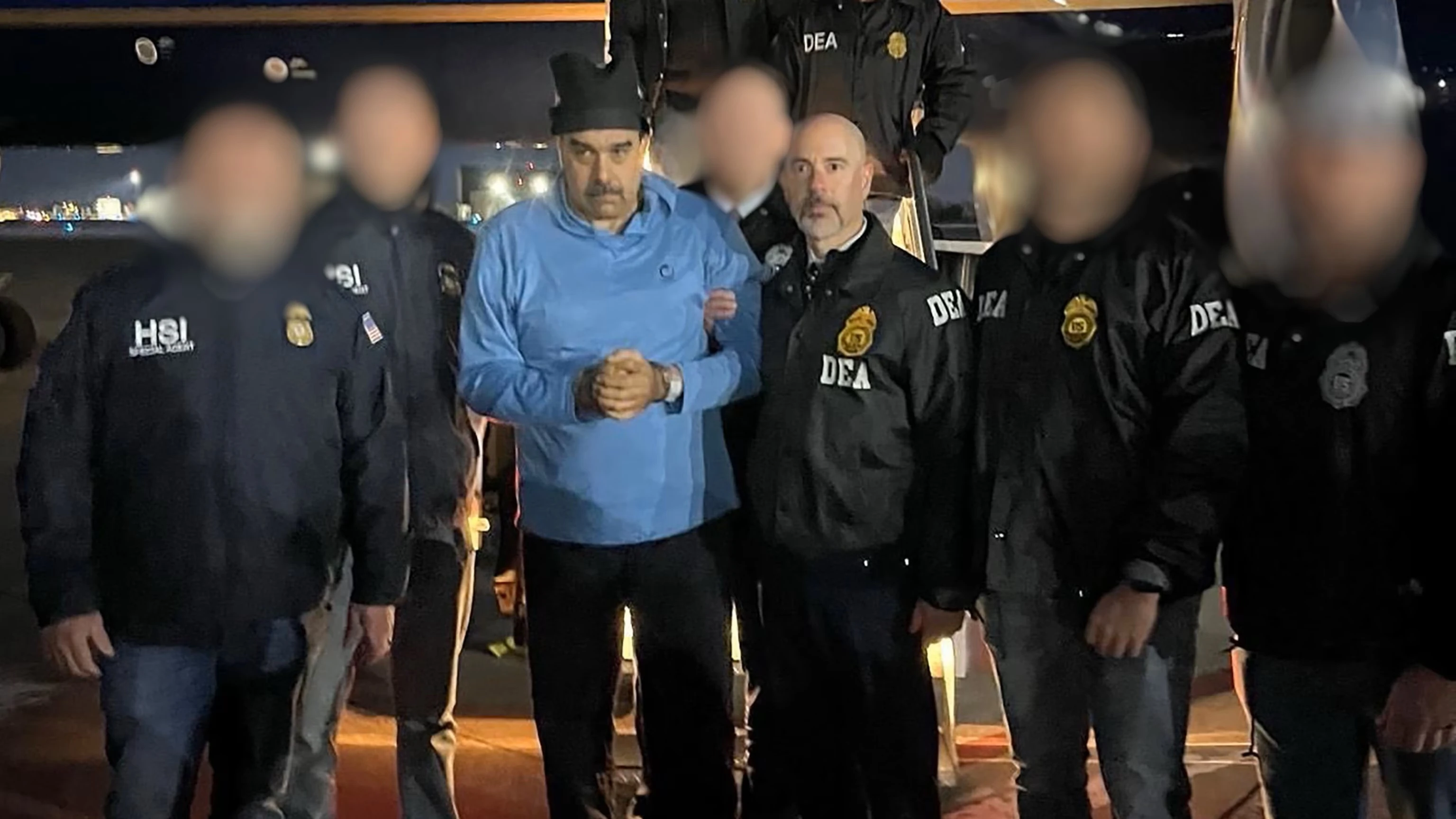
Within an hour, the sky was quiet. US President Donald Trump announced that his forces had conducted attacks on Venezuela and had seized President Nicolas Maduro Moro and his wife Cilia Flores. A short while later, Venezuela’s Vice President Delcy Rodriquez confirmed that the whereabouts of Maduro and Flores are unknown. The US Attorney General Pamela Bondi confirmed that Maduro and Flores were in the United States and had been charged with ‘Narco-Terrorism Conspiracy’.

The outcome of this attack on Venezuela is unclear. The government remains in control, even with the President having been kidnapped and with the people of Venezuela in shock but defiant; it is unclear if the United States will strike again, or if the US government has a clear political plan for the aftermath of this strike.

The War Against Venezuela

The attack on 3 January is not the first against Venezuela. In fact, the pressure campaign began in 2001 when the government of Hugo Chávez enacted a Hydrocarbons Law in accordance with the sovereignty provisions in the Bolivarian Constitution of 1999. That campaign had the following aspects (this is an illustrative and not a comprehensive list):

(2001) US funding of anti-Bolivarian social and political groups through the National Endowment for Democracy and USAID.
(2002) US role in the attempted coup d’état.
(2002) Creation by USAID’s Office of Transition Initiatives of a Venezuela program.
(2003-2004) Funding and political direction for the work of Súmate (led by Maria Corina Machado) to recall Chávez by referendum.
(2004) Development of a 5-Point Strategy to ‘penetrate’ Chávez’s base, ‘divide’ Chavismo, ‘isolate’ Chávez, build up groups such as Súmate, and ‘protect vital US business interests’.
(2015) US President Barack Obama signs an executive order that declares Venezuela to be an ‘extraordinary threat’, which is the legal basis for the sanctions that follows.
(2017) Venezuela banned from access to US financial markets.
(2018) International banks and shipping companies pressured to over-comply with illegal US sanctions, while Bank of England seized the Venezuelan Central Bank gold reserves.
(2019) Create an ‘interim’ government by ‘appointing’ Juan Guaidó as the US authorized president and organize a (failed) uprising, and freeze Venezuela’s ability to sell oil as well as seize its oil assets overseas.
(2020) Attempt to kidnap Maduro through Operation Gideon (and by placing a bounty for his capture), while the US put a ‘maximum pressure’ campaign on Venezuela during the pandemic (including International Monetary Fund denial of Venezuela’s own reserves).
(2025) Gift of the Nobel Peace Prize to Maria Corina Machado with the Nobel Committee saying that Maduro should leave office.
(2025-2026) The attacks on small boats off the coast of Venezuela, the positioning of an armada to form an embargo of Venezuela, and the seizure of oil tankers from Venezuela.
The attack on 3 January is part of this war that began in 2001 and will continue long after the engines of the Chinook helicopters cool down.

The Eagle is Angry

When the United States government decides to act unilaterally, whether against Iraq in 2003 or Venezuela between 2001 and 2026, no other force has been able to stop it currently. In 2003, millions of people—including in the United States—marched on the streets to demand no war, and most governments in the world cautioned against the war, but the governments of George W. Bush and Tony Blair (of the United Kingdom, acting as his no. 2) went ahead with their illegal war. This time, major powers informed the United States that a war in South America and the Caribbean would be immensely destabilizing: this was the view of leaders who govern countries that neighbor Venezuela (Brazil and Colombia) and major powers such as China (whose special envoy—Qiu Xiaoqi—met with Maduro only hours before the US attack). Not only could the world not stop the US in 2003, but it has also been unable to stop the US between 2001 and now in its obsessive war for oil against Venezuela.

The attack on Venezuela was timed so that Trump could stand before the US houses of Congress on 4 January, when he will give his annual address, and claim that he has scored a major victory. This is not a victory. It is just another example of unilateralism that will not improve the situation in the world. The US illegal war on Iraq ended with the US forced to withdraw after a million civilians had been killed in a ruthless decade; the same transpired in Afghanistan and Libya – two countries ruined by the American Eagle.

It is impossible to imagine a different future for Venezuela if the United States continues with its bombing and sends ground troops into the country. No good comes from these ‘regime change wars’, and none will come here either. There is a reason why Brazil and Colombia are uneasy with this attack, because they know that the only outcome will be long-term destabilization in the entire northern half of South America, if not in the entire region of Latin America. This is precisely what has transpired in the northern half of Africa (Trump’s bombing of Nigeria is part of the detritus of the 2011 NATO bombing of Libya).

Trump will get his standing ovation at the US Congress, but the price for that has already been paid by hundreds of dead civilians in Venezuela and millions more who are struggling to survive the long-term hybrid war imposed by the United States on Venezuela for the past two decades.

https://www.struggle-la-lucha.org/2026/ ... operation/

******

Five Takeaways From The US’ “Special Military Operation” In Venezuela
Andrew Korybko
Jan 03, 2026

Image

It was astoundingly successful and will likely serve to coerce the rest of the hemisphere into strategically capitulating to the US.

The US launched a half-hour-long “special military operation” in Venezuela on Saturday morning that culminated in Delta Force’s capture of President Nicolas Maduro. Several military sites were bombed, US helicopters flew freely over Caracas in a surreal display of the US’ aerial supremacy, and there were reportedly no US casualties. The US’ “special military operation” was therefore an astounding success regardless of one’s personal opinions about its merits. Here are five takeaways from this event:

----------

1. The US’ Grand Strategic Goal Is To Build “Fortress America”

It was assessed here that the National Security Strategy’s prioritization of the Western Hemisphere is all about building “Fortress America”, which refers to the restoration of the US’ hegemony over the Americas in order for it to survive and even thrive if it loses control of the Eastern Hemisphere. It might not happen right away, but the US’ “special military operation” will likely result in it obtaining control over Venezuela’s oil reserves, the world’s largest. That would help make “Fortress America” a reality.

2. Maduro Should Have Taken Trump’s Deal In Hindsight

Trump earlier claimed that Maduro had “offered everything” to the US when asked about a report that the Venezuelan leader agreed to let American companies take control of his country’s resources. The only sticking point appeared to be Maduro’s political fate, with Trump wanting him to go into exile likely at the urging of Marco Rubio (his powerful Secretary of State and National Security Advisor), while Maduro seemingly refused. He should have taken Trump’s deal in hindsight to avoid this humiliating end.

3. The Ayatollah Is Likely Watching Everything Very Closely

Trump recently threatened military action against Iran in support of its latest protest movement, which assembled in response to the country’s deteriorating economy but is suspected of being orchestrated in part by foreign spy agencies in collusion with local agents. The US clearly wants Iran’s complete strategic capitulation after its arguable loss to Israel during last summer’s 12-day war, and if the US doesn’t get what it wants through diplomacy or a Color Revolution, then it might try to capture the Ayatollah too.

4. Adversarial Media Will Likely Try To Discredit Russia

Venezuela has an estimated $20 billion worth of Soviet/Russian arms, including Sukhoi fighter jets and S-300 surface-to-air missiles, yet none were used against the US (possibly due to it buying off top defense officials). Russia and Venezuela also ratified a strategic partnership pact late last year too, but it importantly didn’t contain any mutual defense clauses. Nevertheless, these two factors will likely be exploited by adversarial media to discredit Russia after the US’ “special military operation” in Venezuela.

5. Top Alt-Media Figures Once Again Discredited Themselves

Some top Alt-Media figures lie about the subjects of their geopolitical devotion like when they lied about how the Iranian-led “Resistance Axis” would destroy Israel in a war prior to their defeat at its hands last year. Many of the “usual suspects” did the same with regard to what Venezuela would do if the US attacked it, only to have once again discredited themselves, but Tim Anderson takes the cake after lying that Russia gave Venezuela Oreshniks with the innuendo that they’d be used if it was attacked.

----------

The US’ astoundingly successful “special military operation” in Venezuela is a monumental geopolitical development that’ll likely serve to coerce the rest of the hemisphere into strategically capitulating to it, which could lead to “Fortress America’s” construction at an accelerated pace. Iran might soon follow Venezuela even if the Ayatollah isn’t captured like Maduro just was. The common thread between them is that the US has decided to take out its weaker adversaries across the world who refuse to submit to it.

https://korybko.substack.com/p/five-tak ... us-special

Little Andy is taking US reports at face value unsurprisingly...we shall see.

******

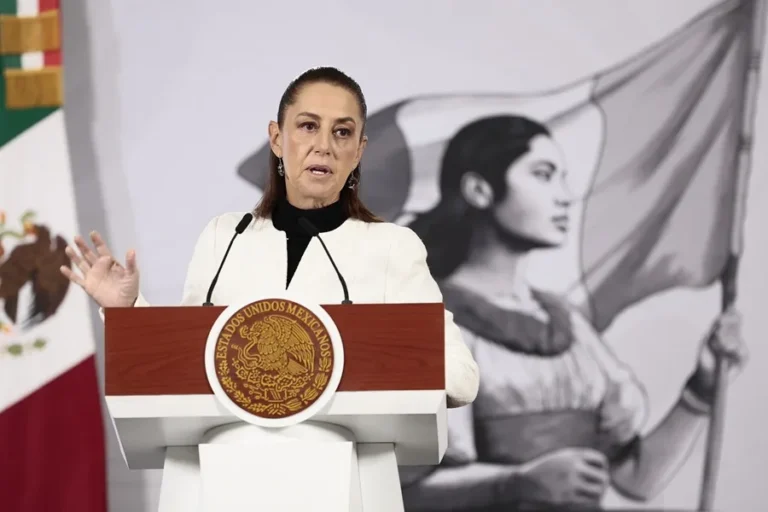
5 Alarming Truths: Mexico Condemns US Military Intervention in Venezuela as UN Charter Breach

Image

Mexico’s foreign ministry issues a strong condemnation of U.S. airstrikes on Venezuela, reaffirming regional unity and the primacy of dialogue over force.


January 3, 2026 Hour: 9:41 am

Mexico condemns US military intervention in Venezuela, calling it a violation of the UN Charter and a threat to Latin America’s status as a Zone of Peace.

In a forceful diplomatic rebuke, the Mexican government has condemned the United States’ recent military intervention in Venezuela, denouncing it as a flagrant violation of international law and a direct threat to regional stability. On Saturday, December 28, 2025, Mexico’s Ministry of Foreign Affairs issued an official statement declaring that armed actions by U.S. forces against Venezuelan territory constitute a clear breach of Article 2 of the United Nations Charter, which prohibits the threat or use of force against the territorial integrity or political independence of any state.

“Mexico categorically rejects any military intervention and calls for the immediate cessation of all acts of aggression against the government and people of Venezuela,” the statement read, reflecting Mexico’s long-standing commitment to
non-intervention, peaceful conflict resolution, and respect for sovereignty
.

The condemnation comes amid reports of U.S. airstrikes targeting locations in Venezuela’s capital Caracas and the states of Aragua, Miranda, and La Guaira, resulting in civilian casualties. Venezuelan Vice President Delcy Rodríguez confirmed the attacks and demanded “immediate proof of life” for President Nicolás Maduro and First Combatant Cilia Flores, whose whereabouts remain unknown following the strikes.

Mexico Condemns US Military Intervention in Venezuela: Defending Latin America’s Zone of Peace
Mexico’s stance is rooted in a historical and legal tradition that rejects foreign military interference in the Americas. The statement explicitly reaffirmed that Latin America and the Caribbean is a Zone of Peace—a principle enshrined in the 2014 Havana Declaration adopted by all 33 member states of the Community of Latin American and Caribbean States (CELAC). This framework, championed by Mexico and other regional powers, bans the use or threat of force and mandates that disputes be resolved through dialogue.

“Any military action in our region places regional stability at grave risk,” the Mexican foreign ministry warned.
“The only legitimate and effective path to resolve differences is through dialogue and negotiation.”

In line with this principle, Mexico announced it is prepared to support mediation, facilitation, or diplomatic accompaniment efforts to de-escalate tensions and prevent wider conflict. It also urged the United Nations to intervene immediately to foster dialogue and ensure compliance with international law.

Read the CELAC Havana Declaration on Latin America and the Caribbean as a Zone of Peace

Mexico’s embassy in Venezuela remains in constant communication with Mexican nationals residing in the country, offering emergency consular assistance and urging citizens to stay informed through official channels. Authorities have activated emergency hotlines and are monitoring the situation hour by hour.

This position aligns Mexico with a growing chorus of global voices denouncing the U.S. operation. Russia issued a statement of “deep concern and condemnation,” while the Network of Intellectuals, Artists, and Social Movements in Defense of Humanity (REDH) labeled the attack a “crime against peace” and a direct assault on the sovereignty of all nations. In the U.S., the ANSWER Coalition accused Washington of using “drug trafficking” and “democracy” as pretexts to “steal Venezuela’s oil and dominate Latin America.”

Review UN Office for Disarmament Affairs on the prohibition of the use of force

Critically, Mexico’s condemnation is not merely rhetorical—it is a strategic reaffirmation of its foreign policy doctrine. Since the Estrada Doctrine of the 1930s, Mexico has refused to recognize or reject foreign governments on ideological grounds, instead advocating for mutual respect and non-intervention. Under President Claudia Sheinbaum, this principle has been revitalized as a cornerstone of Mexico’s role in the Global South.


Geopolitical Context: A Sovereign Latin America Resists Imperial Overreach
The Mexico condemns US military intervention in Venezuela statement carries profound regional and global implications. At a time when the U.S. is expanding its military footprint in the Caribbean—through naval deployments, drone operations, and base agreements—Mexico’s stance challenges the revival of the Monroe Doctrine and asserts Latin America’s right to self-determination.

Regionally, the attack on Venezuela threatens to destabilize an already fragile region. With migration flows surging and economies still recovering from pandemic and inflation shocks, military escalation could trigger a humanitarian and refugee crisis that would overwhelm neighboring countries, including Mexico itself.

Globally, the incident underscores a deepening rift between the Global North and South. While Western powers often invoke “rules-based order,” they simultaneously violate the very rules they champion when it suits strategic interests—such as control over Venezuela’s 304 billion barrels of proven oil reserves, the largest in the world.

Explore the International Court of Justice advisory opinions on non-intervention

Mexico’s position resonates with nations from South Africa to Indonesia that view unilateral military action as a relic of colonialism. By invoking the UN Charter and CELAC’s Zone of Peace, Mexico is not just defending Venezuela—it is defending the multilateral system itself against selective enforcement.

As the UN Security Council prepares for emergency consultations, all eyes are on whether powerful states will be held to the same standards as the rest. For Mexico, the answer is clear: peace cannot be imposed by bombs—it must be built through justice, dialogue, and respect.

In the words of the foreign ministry: “The sovereignty of nations is not negotiable. The peace of our region is not expendable.”

https://www.telesurenglish.net/mexico-condemns-us/

Colombia Condemns U.S. Strikes on Venezuela

Image
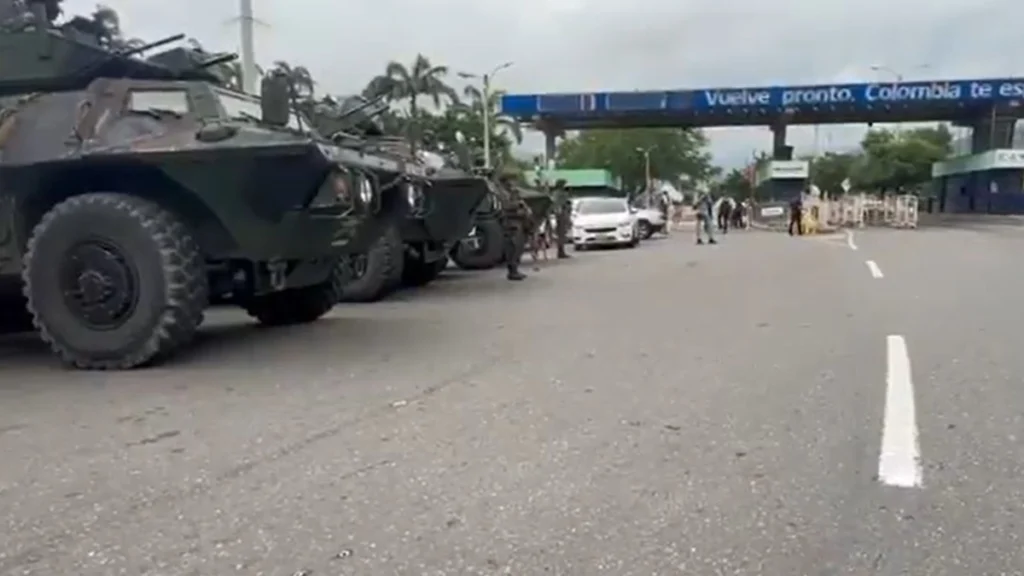
Simon Bolivar Bridge on the Colombian-Venezuelan border, Jan. 3, 2026. X/ @DCoronell

January 3, 2026 Hour: 9:41 am

President Petro deploys forces at the border in anticipation of a possible influx of refugees.
On Saturday, Colombian President Gustavo Petro announced a reinforcement of security on the border with Venezuela to address a potential massive arrival of refugees from that country following the kidnapping of Venezuelan President Nicolas Maduro and first lady Cilia Flores, which took place amid U.S. airstrikes on Caracas and other cities.

“Public forces are being deployed on the border, as is all the aid capacity we have available in case of a mass entry of refugees,” Petro stated in a message on his X account, adding that he had been monitoring events in Venezuela.

The two countries share a 2,219-kilometer (1,379-mile) land border stretching from the Caribbean to the Amazon. The main border crossings are between the Colombian city of Cucuta and San Antonio del Tachira and Ureña in Venezuela’s Tachira state. At the opening of the Cucuta border crossings today, the situation was one of total normality.

So far, Petro has not commented on U.S. President Donald Trump’s announcement that Maduro and his wife were “captured,” but he has condemned the airstrikes against Venezuelan localities.


“The government of Colombia rejects the aggression against the sovereignty of Venezuela and of Latin America. Internal conflicts among peoples are resolved by the peoples themselves in peace,” the Colombian leader affirmed.

Petro reiterated that Colombia, as a non-permanent member of the United Nations Security Council (UNSC), will seek to have that body make a statement on the Venezuela situation.

“I invite the Venezuelan people to find the paths of civil dialogue and their unity. Without sovereignty, there is no nation. Peace is the path, and dialogue among peoples is fundamental for national union. Dialogue and more dialogue is our proposal,” he added.

Earlier, Colombian Defense Minister Pedro Sanchez announced a plan to prevent potential attacks by the National Liberation Army (ELN) guerrilla group in the border area with Venezuela, taking advantage of the U.S. attacks.

“All public forces capabilities were alerted and activated to anticipate and neutralize any attempt at a terrorist attack by the ELN cartel or other organized illegal armed groups that operate on the border,” he Sanchez said.

Previously, the ELN criticized the “interventionist actions” of the United States in Venezuela, following Washington’s military deployment in the southern Caribbean Sea and the Pacific under the pretext of combating drug trafficking.

https://www.telesurenglish.net/colombia ... venezuela/
"There is great chaos under heaven; the situation is excellent."

User avatar
blindpig
Posts: 15306
Joined: Fri Jul 14, 2017 5:44 pm
Location: Turtle Island
Contact:

Re: Venezuela

Post by blindpig » Sat Jan 03, 2026 11:01 pm

Imperialism without retouching
January 3, 7:19 PM

Image

Trump stated that the United States would decide "the political future of Venezuela, would be heavily involved in Venezuelan oil production, and would not allow anyone to become president of Venezuela without their consent."
Trump declared that Mexico's president was not running the country and that something had to be done about Mexico. A fairly transparent threat.

In short, it's standard imperialist aggression aimed at seizing a country and its resources. Post-factum condemnations of the aggressor are of little concern. The last time this happened was at Nuremberg. This is pure imperialism.

* * *

When Putin rhetorically questioned in the 2000s about opening Pandora's box with the "Kosovo precedent," it was a warning of what the destruction of the world order and international law would ultimately lead to.

And now, more than 15 years after those warnings, we live in a world of a shattered late-Washington world order and long-dead international law. Whimpers that "international law is dead" are a bit naive, as international law hasn't worked for a very long time. It's just that some countries have realized this and are behaving in accordance with the jungle that surrounds them, while others still remain awash in rosy illusions about international law and the UN deciding everything. The price of these illusions is usually bloody.

Regarding Ukraine, no one will give Russia anything there—everything we take militarily and diplomatically is ours. Only military, diplomatic, and economic power defines state borders and spheres of influence in the modern world. For those who don't understand this, the merciless reality will shove it down their throats.

* * *

Regarding the stability of Chavista power:

1. The US's long-standing attempts to dismantle the Chavista regime clearly demonstrates that Chavistas as a structure tend to be underestimated.
2. After the death of Hugo Chavez, the US and many Russian "experts" proclaimed that this would be the end of the Chavistas. Just as they proclaimed in 2020 that "this time the Chavistas are definitely finished."
3. In the first years after the death of Hugo Chavez, Maduro was perceived as a gray mouse compared to the flamboyant Commandante Hugo. Nevertheless, Maduro managed to win the elections against the opposition (let me remind you that during the "Venezuelan dictatorship," there were competitive elections), and he won by a narrow margin.
4. Subsequently, Maduro was able to consolidate his power, and the opposition's numerous attempts to overthrow him through protests ended in repeated failures.
5. Attempts at Maidans, military coups, and private military company operations also regularly ended in failure. It is important to remember that Maduro's capture was preceded by years of setbacks and failures, including those of the vaunted American intelligence.
6. Of key importance is the ability of the Chavista leadership, relying on popular support, to select a new leader (for example, Padrino Lopez) and continue the previous course, followed by a purge of the legal opposition.
7. A course of concessions to the United States and the acceptance of puppets appointed by Washington will certainly lead to the political defeat of the Chavistas. Only struggle will ensure their political survival as a movement.

Overall, if the Chavistas were able to survive the loss of Hugo Chávez while maintaining internal cohesion (if any), there's no reason to believe they won't be able to survive the loss of Maduro.

The extent to which Venezuela's leadership is capable of this will be seen in the coming weeks.

https://colonelcassad.livejournal.com/10285004.html

We take the establishment of American dominance in the Western Hemisphere very seriously.
January 3, 8:42 PM

Image

We take the establishment of American dominance in the Western Hemisphere very seriously. It concerns our security, our freedom, our prosperity... It is an "America First" approach. It is peace through strength, and the Department of War is proud to be part of it. (c) Hegseth

When the rhetoric of 19th-century imperialism returned without external camouflage.

Hegseth also reported that 150 aircraft were deployed to attack Venezuela's air defenses. He reports that one aircraft was damaged. According to unconfirmed reports, the Venezuelans managed to shoot down one helicopter.

It's worth noting that in their statements, the US leadership continues to pressure the Chavista leadership to capitulate. If they refuse and resist, the beautiful picture may begin to crumble.

* * *

The issue of Venezuela's governance is being decided
. We appoint people. These will be the people who stand behind me, since we are dealing with a dead country.


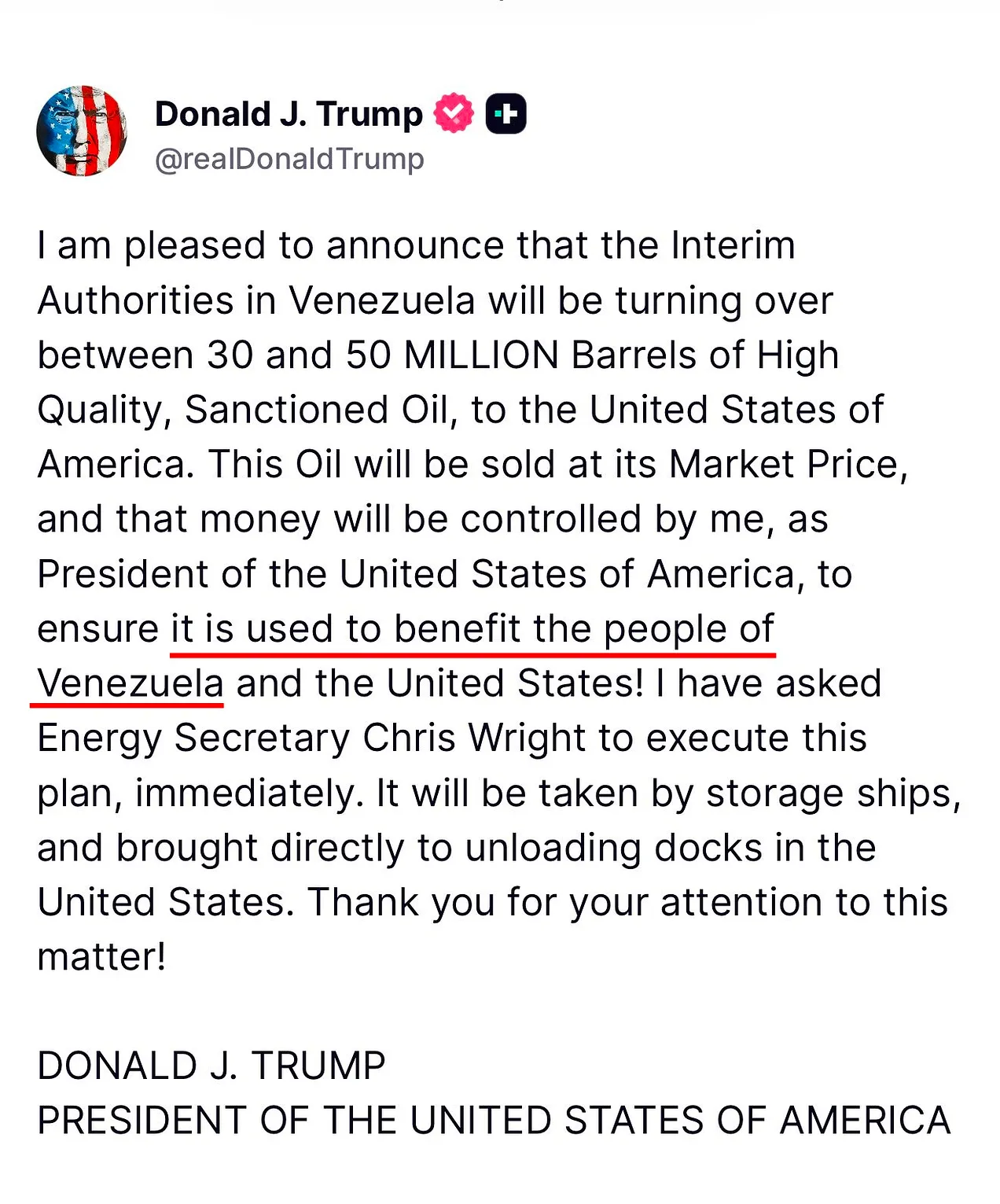
Trump also stated that Venezuelan oil is American oil. And the US will invest in its production.

Those less than wise who are laughing at what's happening in Venezuela today will eventually feel the consequences in their wallets in Russia, when the US is able to push the average global oil price even lower by increasing Venezuelan production.

In addition to Mexico and Cuba, Trump has made unambiguous threats against the Colombian president, accusing him of operating cocaine labs. But since Colombia is less attractive in terms of oil, the likelihood of an attack on Colombia is significantly lower.
It can be expected that if the US succeeds in its attack on Venezuela and it capitulates, the next country to be attacked will be Nicaragua.

Trump also announced that he personally endorsed the presidents of Argentina, Honduras, and Chile.

https://colonelcassad.livejournal.com/10285182.html

Google Translator

******

What’s The U.S. Follow Up Action After Taking Maduro Out?

Last night the U.S. bombed several places in Venezuela. The bomb attacks were likely planned to hit air-defense systems. But several targets were purely administrative government places and one was a mausoleum with Hugo Chavez’s body.

With the air defenses defeated U.S. special forces landed by helicopter near a place that housed President Nicolás Maduro and his wife Cilia Flores. Both are said to have been abducted and flown out of the country. Maduro was known to often change the place were he was living. The NY Times claims (archived) that a CIA source was involved:

A C.I.A. source within the Venezuelan government monitored the location of Nicolás Maduro in both the days and moments before his capture by American special operation forces, according to people briefed on the operation.

The American spy agency, the people said, produced the intelligence that led to the capture of Mr. Maduro, monitoring his position and movements with a fleet of stealth drones that provided near constant monitoring over Venezuela, in addition to the information provided by its Venezuelan sources.


The human source claim sounds plausible. (The stealth drone fleet doesn’t.)

But where were the body guards that should have been looking after Maduro 24/7? Why was none of the U.S. helicopters shot down? This was either a huge failure or treason. Who gave the order to the military to hold its fire?

Maduro will brought to the states and incarcerated. He is out of the picture for now.

But Chavistas still rule in Venezuela. Venezuelan Vice President Delcy Rodríguez is acting as president and Defense Minister Diosdado Cabello is also in place. The government issued a fierce statement:

The objective of this attack is none other than to seize Venezuela’s strategic resources, particularly its oil and minerals, in an attempt to forcibly break the nation’s political independence. They will not succeed. After more than 200 years of independence, the people and their legitimate government remain steadfast in defending their sovereignty and their inalienable right to decide their own destiny. The attempt to impose a colonial war to destroy the republican form of government and force a “regime change,” in alliance with the fascist oligarchy, will fail like all previous attempts.

It called on its people to defend the country.

One wonders what the next steps are the U.S. is planning to take. It does not have enough forces to invade Venezuela. Nor would a blockade of the country lead to a change of its government. An internal revolution is unlikely to succeed.

The U.S. gnomes managed to steal the underwear. Now comes step 2. Then profits. That sounds like a good plan.

But nobody seems to know so far what step 2 might entail.

Posted by b on January 3, 2026 at 15:24 UTC | Permalink

https://www.moonofalabama.org/2026/01/w ... l#comments

******

Venezuela’s Vice President: “There is only one president here, and his name is Nicolás Maduro.”

Image
Vice President Delcy Rodríguez denounced an unprecedented military aggression against Venezuela, perpetrated under false pretences with the real aim of imposing a change of regime and plundering the country’s natural resources. Photo: Con el Mazo Dando

January 3, 2026 Hour: 4:03 pm

Vice President of Venezuela, Delcy Rodriguez, denounced an “unprecedented” US military aggression against Venezuela that culminated in the “illegal kidnapping” of President Nicolás Maduro and First Fighter Lady Cilia Flores.

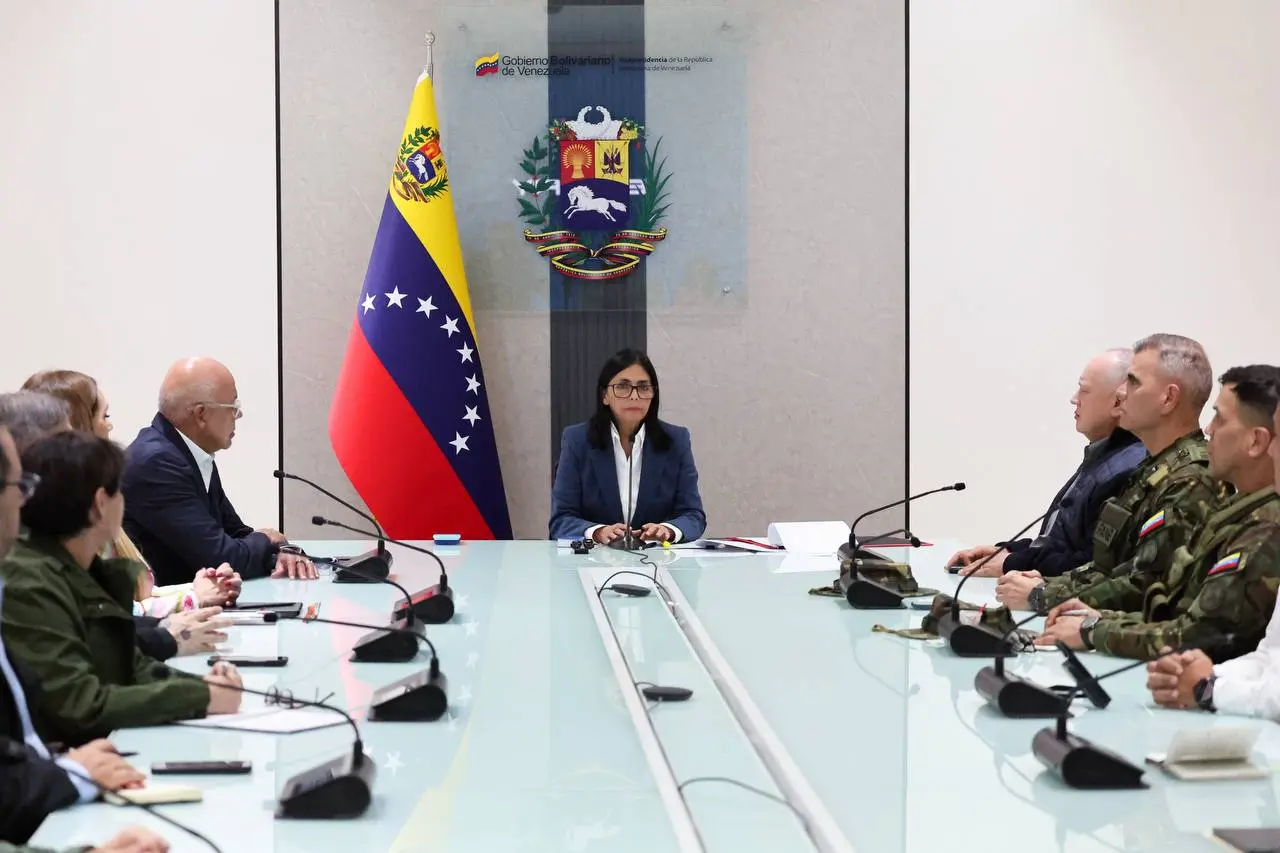
VP Rodríguez, accompanied by senior officials, headed an emergency meeting of the National Defense Council, recalling that the Venezuelan government had already warned about an ongoing aggression under “false excuses”.

The vice president emphasized that the true objective of this operation is “regime change in Venezuela,” which would allow the United States to “capture our energy, mineral, and natural resources.” She called on the international community to be aware of this truth.

The Vice President of Venezuela demanded the release of Nicolás Maduro and Cilia Flores during the National Defense Council, reaffirming Maduro as the sole president and at the same time announcing the activation of the Citizen Security Agency and national power to defend independence, sovereignty and territorial integrity, which they denounce as attacked.


The Venezuelan people, following Maduro’s call, also mobilized in the streets. “The people of Venezuela have taken to the streets,” following a previous call by Maduro for the activation of the FANB and the Bolivarian militias.

Likewise, Rodríguez announced the activation of a decree signed by President Maduro, which has been delivered to the president of the Supreme Court of Justice for its constitutional endorsement in the constitutional chamber. This decree of “external commotion” is expected to obtain judicial approval in the coming hours for its immediate execution.

The vice president highlighted the international support, mentioning that the community has “added and raised their voices” from China, Russia, Latin America, the Caribbean, Africa, and Asia. She affirmed that the governments of the world are impacted by this attack, which she attributed a “Zionist tint,” calling it “really shameful.”

Rodríguez quoted the Liberator Simón Bolívar from the Jamaica Letter: “The veil has been torn, we have already seen the light and they want to return us to darkness. The chains have been broken, we have already been free and our enemies intend to enslave us again.” She emphasized that Venezuela “will never again be a colony of any empire.”

The vice president recalled the recent statements by President Maduro, who “just two days ago publicly in a television interview” ratified the government’s willingness to “maintain dialogue relations to address a constructive agenda.”

She pointed out that the aggression of the U.S. “flagrantly violates Articles 1 and 2 of the Charter of the United Nations,” despite the fact that Maduro had extended his hand to the American people to establish “diplomatic, political, institutional channels of State” based on the well-being of the peoples, friendship, cooperation, and respect for international legality.


https://www.telesurenglish.net/venezuel ... as-maduro/

******

Trump Says He Plans to ‘Govern Venezuela’ and Threatens Possible Second Attack
January 3, 2026

Image
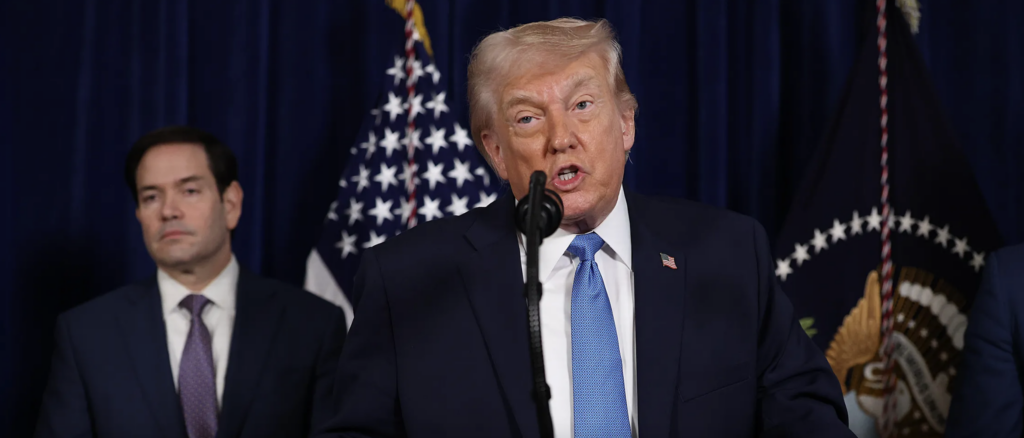
Donald Trump addressing the media on Saturday, January 3, 2026. Photo: Joe Raedle/Getty Images.

During a press conference on Saturday, US President Donald Trump announced that he intends to govern Venezuela and threatened a possible second attack.

This press conference comes after the US conducted military strikes against Venezuela in the early hours of Saturday, January 3. Several hours later, it was confirmed that the US had illegally abducted President Nicolás Maduro and First Lady Cilia Flores.

“We are going to run the country until a proper transition can take place… We’re going to have our very large US oil companies, the biggest anywhere in the world, go in, spend billions of dollars, fix the badly broken infrastructure, the oil infrastructure, and start making money,” Trump said.

Trump assured that they are ready to launch a “second and much larger attack if we need to do so… We actually assumed that a second wave would be necessary, but now it’s probably not… The first attack was so successful, so we probably don’t have to do a second, but we’re prepared to do a second wave—a much bigger wave, actually.”


He then reiterated plans to steal Venezuelan oil. This was agreed upon by Secretary of War Pete Hegseth, who stated that Trump was “deadly serious about getting back the oil that was stolen from us, and deadly serious about re-establishing American deterrence and dominance in the Western Hemisphere.”

Trump also reported that President Nicolás Maduro and First Lady Cilia Flores are on a ship en route to New York and will be “prosecuted” in courts in Miami and New York.

He also said he did not know where the far-right Venezuelan opposition figure María Corina Machado was. “I think it’d be very tough for her to be the leader,” he said during the briefing. “She doesn’t have the support or the respect within the country. She’s a very nice woman, but she doesn’t have the respect.”

https://orinocotribune.com/trump-says-h ... nd-attack/
"There is great chaos under heaven; the situation is excellent."

User avatar
blindpig
Posts: 15306
Joined: Fri Jul 14, 2017 5:44 pm
Location: Turtle Island
Contact:

Re: Venezuela

Post by blindpig » Sun Jan 04, 2026 5:29 pm

Venezuela’s Revolution Remains Intact—International and Domestic Demonstrations Demand Return of Abducted President
January 3, 2026

Image
Venezuelan Vice President Delcy Rodríguez addressing the nation on January 3, 2026, following the news of the US abducting President Nicolás Maduro. Photo: Screenshots from publicly broadcast video footage.

Caracas (OrinocoTribune.com)—Despite the shock caused by the images, videos, and life experiences of millions of Venezuelans in the hours following the abominable US strikes against the country and the abduction of President Nicolás Maduro and his wife, Cilia Flores, thousands of Venezuelans took to the streets nationwide to demand the return of their president. Simultaneously, all levels of the state issued pronouncements in support of the Constitutional order and respect for the nation’s institutions.

State institutions reaffirm Constitutional order and loyalty
Governors and mayors from the majority of the country recorded and spread videos online reaffirming their allegiance to President Maduro and Constitutional legality; they were joined in these efforts by the people and leaders of the military, including General Vladimir Padrino López, Strategic Operations Commander of the Bolivarian National Armed Forces (FANB, Venezuela’s military) and Minister of Defence. Meanwhile, the Public Ministry, National Assembly, and Supreme Court of Justice passed resolutions or issued statements in the same vein. These actions demonstrate that the institutional order of Venezuela remains unaffected despite the atrocity committed by US imperialism.


Physical resistance amid blackouts and holiday shortages
Many areas of Caracas and other regions of the country remain without electricity after 20 hours. The blackout is directly linked to the preceding US military attacks. This did not prevent thousands of Venezuelans from mobilizing; however, many others went to grocery stores to replenish their kitchens with the small amount of fresh products typical of the end-of-year holidays in Venezuela.

International condemnation and global demonstrations
Demonstrations against US imperialism and its unprecedented strikes on Venezuelan soil were reported in several cities around the world. Protesters in Paris were particularly visible at the Place de la République, and additional demonstrations and acts of protest were reported in Havana, Cuba; in Mexico City, Mexico; in an estimated 100 US cities, including New York, Chicago, Atlanta, Los Angeles, Minneapolis, Seattle, San Francisco, and Washington, DC; in major Canadian cities, including Toronto and Montreal; in India, particularly at the All India Conference in Visakhapatnam; and in many European nations, including Greece, Italy, and the Spanish cities of Valencia and Barcelona.

Threats and neo-colonialist rhetoric from Washington
Many analysts highlighted several key elements from the earlier press conference held by US President Donald Trump in Washington, which was characterized by its neofascist and neocolonialist nature:

• Trump threatened more military strikes against Venezuela if he deems them necessary.
• He also threatened Mexico, Colombia, and Cuba as potential future US military targets.
• He dismissed any possibility of far-right Venezuelan politician Maria Corina Machado running Venezuela, claiming—as most analysts do—that she lacks sufficient support within the country.

Constitutional succession and the path forward
The Venezuelan Constitution stipulates that in the absence of the president, the vice president must fill the vacuum. If the absence occurs before the midpoint of the presidential term, as in the current case, the vice president must call for presidential elections within the following 90 days. This scenario opens the possibility of a special presidential election in Venezuela.


It remains unclear if Vice President Delcy Rodríguez will follow the Constitutional path of presidential succession or if the PSUV will instead continue to demand the return of President Maduro—a formula that many consider highly improbable—or whether both of these options will be pursued simultaneously.

Many analysts claim that, given the deplorable state of the Venezuelan far-right opposition and the consolidation of forces in support of Chavismo in recent months—especially following the US strikes—the most probable outcome will be a new electoral victory for supporters of the Bolivarian Revolution in Venezuela. However, US military threats and electoral meddling could impact the results of these elections. A potential new electoral victory for Chavistas could produce repeated US interventions until a president favored by US imperialism arrives at Miraflores Palace.

https://orinocotribune.com/venezuelas-b ... al-outcry/

*****

14 Points on Trump Kidnap of Venezuelan President Maduro on the Sixth Anniversary of the Trump Assassination of Haj Qassem Soleimani

I have tried to collate some of the main talking points on the recent criminal events in Venezuela that have shocked the world in their lawlessness
vanessa beeley
Jan 04, 2026

Image

The Trump campaign to regain control of Venezuelan oil is a remake of the 1953 CIA/MI6 coup - Operation Ajax - in Iran, when they orchestrated the removal of Prime Minister Mohammad Mosaddegh after he nationalised the Iranian oil industry in 1951. British and US control of Iranian oil supplies was immediately restored when they replaced Mosaddegh with the Dictatorial Shah.

Trump has announced that the US will take “back” control of “their” oil interests in Venezuela.

Venezuelan oil industry is not in good shape. Decades of US sanctions have deliberately prevented any investment or renovation of the equipment etc. Venezuelan oil is heavy crude which would need specialised refineries that exist in the so-called US Gulf. It would need an estimated $ 40-50 billion to fully restore the Venezuelan production to pre-sanction viability.

This will take time - there is potential that, ultimately, Venezuelan oil would reduce the dominance of Saudi Arabia in the oil market but not entirely.

There is an argument that this is in preparation for a war with Iran - to compensate for any Iranian closure of the Hormuz Straits but this means that the war is not imminent because Venezuela is far from being a done deal. The preferred option for US/Zionists is to continue a hybrid war against Iran - sanctions and fomenting internal conflicts and clashes, perhaps deploying Takfiri proxies to Iran. However, a clear message has been sent to Iran - the kidnap of President Maduro and his wife took place on the anniversary of Trump’s assassination of Haj Qassem Soleimani. The message being that decapitation of leadership is an ongoing threat to stability in any country that opposes US/Zionist global hegemony

Both Russia and China have significant interests in the Venezuela oil industry. Ian Mellul writes; “Beijing holds roughly $19–20 billion in loans to Venezuela tied to “oil-for-loan” deals. A new, U.S.-installed government can simply declare those debts illegitimate and refuse to pay them.”

Venezuela was also China’s most reliable partner in the region for energy and military cooperation. Chinese refineries are built for Venezuelan heavy crude. A U.S. naval blockade and a change in government mean that oil will more likely move through Western markets, likely cutting China out.

China has multiple projects in LATAM to sideline US dominance in their own backyard. The Nicaragua Grand Canal to rival the Panama Canal (has stalled due to economic, environment, political hurdles). The Brazil-Peru Bi-Oceanic Corridor - A rail-and-port system connecting Brazil’s Atlantic coast with Peru’s Pacific coast (via the Chancay port), significantly reducing transit times and costs compared to the Panama Canal. The Colombia Dry Channel - A proposed railway linking Colombia’s Pacific port of Buenaventura to the Atlantic, offering a rail-based alternative. Chinese State-subsidised firms have also been increasing investment in Panama’s port infrastructure to expand China’s strategic influence in LATAM.

Removing Venezuela from the equation for both China and Russia will seriously impact on their strategic footprint in LATAM, China more than Russia. This is a clear strategy by the US to weaken or even entirely block China’s expansion into what they consider to be America’s back yard. It is also clearly perceived as the precursor to destabilisation in Cuba, Colombia and Brazil while the Zionist Isaac Accords are already poisoning the LATAM well in Argentina, Costa Rica, Panama and Uruguay. The US is ensuring the rise of right-wing regimes in the region, most recently in Honduras.

As my friend and colleague, Fiorella Isabel pointed out, the timing of the Chinese delegation to Venezuela (the day before Maduro was removed) is of interest. Were they trying to protect their interests in the knowledge that US was planning to retake control in Venezuela both short-term and long term. The fact that it appears (early analysis) no manpad missiles were fired at the incoming US helicopters and drones and no shots were fired to prevent the extraction of the President is very troubling. Were the alleged 5000 Russian-manufactured Manpad systems jammed, as happened in Iran during the first 24 hours of the Zionist aggression in June 2025? That does not answer why there was no hand to hand combat in the Palace itself and there appeared to be no protection surrounding the President. This is all conjecture which will be modified as more facts come to light.

“We’ll be selling large amounts of oil to other countries,” Trump said when he was asked how controlling Venezuela’s energy supply could impact relations with China, Russia and Iran. “We’re in the oil business. We’re going to sell it to them.” I don’t see Russia having any issue with a change of leadership in Venezuela provided Russia can secure its interests. We have seen this pragmatic approach being rolled out in Syria with the almost immediate normalisation with the Al Qaeda regime put in place by Turkey, Israel and the US Axis of Terror.

Ian Mellul also pointed out that the Trump operation will perhaps embolden comparable actions from Russia and China - “Dozens of Chinese ships sit near Taiwan. Aircraft cross into its air defense zone almost daily. Drills practice blockades and landings. Beijing now has the political language and the operational blueprint to move — “regional stability,” “restoring order,” “illegitimate regime,” “national security.”

Former British Diplomat and West Asia specialist, Alastair Crooke has argued that US national finances are in very bad shape and this is leading to Trump’s seizure of global resources to prevent the collapse of the US dollar. This could certainly be one factor in the White House/Pentagon calculation. In my opinion, the cost involved in the resource grab operations will offset any benefits, thus this will only delay the US financial juggernaut hitting the barriers.

The protests on the streets of Venezuela and the powerful statement by acting President Delcy Rodriguez point to the possibility of a popular 2002-Chavez-style push to have Maduro released and returned to Venezuela as President. Many believe that Trump’s inherent narcissism will not permit such a concession from the US.

What is for sure, however this operation was carried out, whoever supported it and endorsed it behind closed doors - the Venezuelan people will pay the ultimate price for the incoming instability and insecurity that comes with colonisation and the capture of resources by a predatory entity.

As journalist Hala Jaber wrote this morning - “Venezuela feels like Iraq all over again” - Invade. Disrupt. Install. No international mandate. No accountability. No thought for the chaos and violence left behind, civil strife, migration waves, proxy blowback. This is regime change by force. And once again, there is no plan for what happens next. Empire disrupts. It seizes. It stages photo ops and calls it peace. Then it abandons the wreckage. The worst consequences are likely yet to come.

UPDATE: “The US forces wanted to establish a base in one of our units in Caracas, we fought, opened fire and got the helicopter to leave without taking the military unit”. Venezuelan soldiers reveal that the US attempted to establish a beachhead in Caracas, an operational base for a ground invasion but the Venezuelan Army repelled the attack. It is possible that the Amrikkans wanted to capture more leaders and their plans were thwarted by the Bolivarian resistance forces. [ Source: Daniel Mayakovski on X]

Image

https://beeley.substack.com/p/14-points ... dium=email

******

US Murders Sleeping Civilians, Media Calls It "Audacious, Stunning"

And other rhetorical slights of hand
Nate Bear
Jan 04, 2026

Image

I apologise for the back-to-back Venezuela posts, but when the teachable moments come along, one must capitalise on them.

It has now been 24 hours since the US abducted Venezuelan president Nicholas Maduro and rendered him, complete with war on terror-style ear defenders and a blindfold, to New York, to face phoney charges of being the head of a non-existent drug cartel.

(The ear defenders and blindfold, as well as the picture published by the US of Maduro wearing them, are, incidentally, breaches of that quaint document known as the Geneva Convention.)

In the process of the abduction, it is being reported that at least 40 Venezuelans were killed, including civilians who were sleeping in their beds when a hellfire missile from a US fighter jet tore through an apartment building.

Image
Damage caused by a US missile on an apartment building in Caracas

PBS, The Guardian, The Washington Post and others called this murderous violence and flagrant breach of international law “an audacious raid.” ABC News called it “stunning.” Sky News said it was “spectacular” and “stunning” and the bombs “lit up the night sky.” You’d be forgiven for thinking they were describing a new year’s eve fireworks display not a murderous coup against the leader of a sovereign country.

European leaders from Macron to Starmer, while cautious in their response, refused to condemn the attack, all trotting out the warmongering justification (as predicted yesterday), that Maduro was a dictator who had to go. Macron artfully employed the passive voice, as if Maduro had been removed by magic rather than via a violent attack.

Image

Leaders in South America struck a different tone, of course. Brazil, Colombia, Cuba and Mexico all condemned an illegal act of war and state terrorism. And it is not hyperbolic to think they may very well be next. In a Fox News interview last night, Trump said “something is going to have to be done about Mexico” that “Cuba is going to be something we’ll end up talking about” and “we have to do it again in other countries. We can do it again, too. Nobody can stop us."

He really said this. The praise and lack of condemnation has emboldened him.

Shame on Europe, and shame on liberal leaders and their media handmaidens who postured about the dangers of Trump only to embrace his gangsterism.

Let’s also get something else straight. Venezuela was not being crushed by Maduro. It was being crushed by the US.

The Bolivarian Revolution
When Hugo Chavez came to power in 1999 on a popular uprising against a neoliberal right-wing government and IMF-imposed austerity programmes, Venezuela was broken. Poverty was over 50%, nearly a quarter of the country lived in extreme poverty, 10% of adults were illiterate and infant mortality was more than 20%. By the time Chavez died and Maduro took over, infant mortality had fallen to 13.7 per 1,000 live births, poverty had been cut to under 30%, extreme poverty had more than halved to 8.5%, and life expectancy had increased nearly two years, to match the regional average. On top of this, GDP had doubled, unemployment was just 7.6%, and 2.6 million young adults were enrolled in university, compared with under a million pre-Chavez.

Back then, The Guardian reported regularly on the successes of Chavismo.

Anyone repeating the line that Venezuela has been immiserated by the socialist revolution, then, is simply a liar or an imperial stooge.

It is true to say that from the mid 2010s onwards, many of these indicators regressed. But all the decent literature on this, including UN reports, puts the blame on punishing US and western sanctions designed to impoverish ordinary Venezuelans to the point of rebellion.

A 2021 report by the UN’s independent expert on Venezuela, Alena Douhan, laid this all bare.

In the report, Douhan says the sanctions programme against Venezuela amounts to “an economic blockade” and has had what she called a “devastating effect on the living conditions of ordinary Venezuelans.” Douhan said that “sectoral sanctions on the oil, gold and mining industries and the freezing of all Central Bank assets have…significantly reduced revenues, affecting public electricity, gas, water, transport, telephone and communication systems, as well as schools, hospitals and other public institutions.” She said these sanctions have led to a medicine, food and nutrition crisis. The US Treasury, the report says, specifically targeted a food programme introduced by Maduro to alleviate hunger. Douhan’s report concludes that the sanctions programme against Venezuela is “politically motivated, undermines the most fundamental human rights and violates international law.”

The US and the west deliberately crippled Venezuela.

Again, anyone who omits this critical context is a liar or a stooge. Which is to say, the entirety of the mainstream media.

Have you come across any of these facts, any of this context, in the reporting over the last day? Has mainstream media reported on the fact that the drug trafficking charges are laughably contrived? Of course not. Because the reporting exists not to educate, but indoctrinate. It exists not to rouse scepticism or anger against imperialism and the status quo, but to buttress and support it.

Maduro was also one of the few world leaders who stood in solidarity with the Palestinians and called out Zionism as a hateful ideology of terror. His removal is also a coup for Israel.

And finally, the official story from the western media and political establishment is that the opposition leader, Maria Corina Machado, leads a massive popular movement and the party she leads won the last election. But last night Trump said she can’t be the leader, because she has no widespread respect or support. Which is odd, given that the claims against Maduro as a dictator are based explicitly on the fact that Corina Machado is the legitimate leader with popular support.

This then is another extremely revealing facet of the story you won’t be reading about in mainstream coverage.

The story of the last 24 hours, as well as a story of imperial violence, has also been the story of a broken, corrupt and captured media. A media which does not speak truth to power, but which amplifies the lies and propaganda of the powerful.

A media which deliberately omits critical context and manufactures consent for violence.

A media which professes concern for international law, democracy and for the downtrodden, and then cheers on coups and the violence of empire.

The last 24 hours have once again demonstrated the bankruptcy of mainstream media and why independent voices are more important than ever.

https://www.donotpanic.news/p/us-murder ... dium=email

******

Reaupload With New ...

... video-editing software.

(Andrei Martyanov has a very poor opinion of the Global South. Go to link for video.)

I know, it is going to be hurtful to many but they don't call those countries banana republics for nothing, banana republic being a euphemism for corrupt regimes and toy armies. Some news (from there)--the chief of Maduro's security detail as well as a number of others have been bought by the US. In fact, there was a Russian military group which rushed to Maduro residence but it was held off by the fire of ... yep, Maduro security people. By the time Russians dealt with those traitors, Maduro was already gone. The chief of security detail has been caught and was executed already. So, this is update for you. Meanwhile))

Image

)))

http://smoothiex12.blogspot.com/2026/01 ... h-new.html

******

USA seizes Maduro, but nothing is guaranteed regarding Venezuela’s future

Raphael Machado

January 4, 2026

The world is being redrawn into spheres of influence, and only military might and the willingness to use it seem to be effective barriers against foreign interventions.

Following an operation that began at 2:00 AM Caracas time, U.S. special forces undertook the seizure of Venezuelan President Nicolás Maduro and his wife Cilia Flores and extracted them from the country. The operation lasted only 30 minutes and involved little more than a handful of helicopters, operating very close to the ground.

The U.S. government and its supporters reacted with euphoria to the operation’s “great feat.” Donald Trump stated that only the USA could do something like this.

Nevertheless, so far, the event resembles more of a propaganda fireworks display than a great military feat. And this is because the extraction appears to have taken place, by all indications, without any opposition from the Venezuelan state.

For months – since tensions between the USA and Venezuela intensified – there has been speculation about the existence of secret negotiations between Maduro and Trump. Newspapers like the New York Times, in fact, reported that Maduro had offered “everything” to Trump, but that he had refused the various offers.

Several other negotiations are said to have occurred, including an offer for Maduro’s exit, but with the maintenance of the Bolivarian system in power and with U.S. co-participation in the exploitation of Venezuelan oil alongside PDVSA. Supposedly, the USA would have refused these offers.

It is also important to point out that at least since November 2025, the Brazilian and Colombian governments have been trying to convince Nicolás Maduro to resign. The important Brazilian businessman and lobbyist Joesley Batista, who is an ally of both Lula and, today, of Trump, is said to have traveled to Caracas to negotiate an exit for Maduro. Supposedly, without success.

And yet, the fact remains: any portable anti-aircraft system, like a MANPAD, could have shot down any of the Apaches used in the operation. But none were used. In fact, there is no evidence of the use of Venezuelan defensive systems during the operation. The official narrative says they were all simply “deactivated.” This might perhaps explain the inaction of the BUKs, but not the absence of use of other systems.

Furthermore, we have not seen signs similar to those in Syria, with the mass desertion of military personnel. Padrino López and Diosdado Cabello, respectively Ministers of Defense and Interior, have full control over the Armed Forces and the Bolivarian National Guard. The streets are, by all indications, calm. There are no celebrations by oppositionists, nor any movement by the opposition in general.

Perhaps Maduro’s removal was, in fact, negotiated. But not necessarily with Maduro himself. It is impossible, however, to point decisively to someone responsible for this. In a purely technical sense, naturally, the primary responsibilities would fall on Venezuelan counterintelligence and Maduro’s personal security apparatus – but, in this case, it may have simply been a matter of failure, more than betrayal.

Now, it is premature to properly speak of a “regime change” in Venezuela.

In his statements to the press immediately after the operation, Donald Trump stated that the USA would conduct a “political transition” in Venezuela; but there is, truly, no U.S. presence in Venezuela at this moment. Whoever expects a takeover by María Corina Machado is mistaken: Trump has already ruled her out, considering her inept due to her lack of popularity with the Venezuelan people. On the contrary, he seems satisfied with dealing with Delcy Rodríguez, who has already assumed Venezuelan leadership, supported by consensus by Chavista governors, ministers, and generals.

Trump claims that Rodríguez would be willing to collaborate completely with the USA and, in practice, “hand over” Venezuelan oil. But all public statements from Venezuela so far go in the direction of condemning the seizure, demanding Maduro’s return, and emphasizing that Venezuela will resist Trump’s ambitions. In other words, there exists a problematic gap between Trump’s declarations and what is really happening in Venezuela.

Naturally, the possibility is not excluded, for example, of a potential “backroom deal,” allowing the USA to operate in the Venezuelan oil sector, with Chavismo maintained in power in Caracas. Maduro’s fate in a negotiation of this type remains open. Everything is possible, from the death penalty to exile, including a prison sentence with eventual release.

The main political actor in Venezuela, however, is the armed forces, not the PSUV, nor even Maduro. And regardless of the arrangement reached and Venezuela’s near political future, this is unlikely to change.

What is evident, however, is that we have here a significant change in the international panorama. The USA treated the operation as a “police action” – Maduro is being indicted for crimes ranging from drug trafficking to possession of machine guns (!) in violation of U.S. firearms legislation (!!), treating Venezuelan territory, in practice, as if it were U.S. territory.

The mutual recognition between countries as sovereign states and, therefore, legitimate belligerents in case of conflict, implying obedience to certain rules of engagement, constitutes a significant achievement of civilizations. The criminalization of foreign sovereigns opens the door to savagery and to unlimited conflicts devoid of rules of civility.

But beyond this dimension of a return to the same mentality of the piracy era, it becomes quite clear that appeals to International Law and the UN are, today, of little effectiveness.

The world is being redrawn into spheres of influence, and only military might and the willingness to use it seem to be effective barriers against foreign interventions.

https://strategic-culture.su/news/2026/ ... as-future/
"There is great chaos under heaven; the situation is excellent."

User avatar
blindpig
Posts: 15306
Joined: Fri Jul 14, 2017 5:44 pm
Location: Turtle Island
Contact:

Re: Venezuela

Post by blindpig » Mon Jan 05, 2026 3:10 pm

Stand with Venezuela against the USA’s criminal regime-change attempt

Stop the Nato war machine. Free President Maduro!
Party statement

Sunday 4 January 2026

Image
Millions of Venezuelans are now under arms and, with the slogan ‘Loyal always, traitors never!’ on their lips, stand ready to defend themselves and their country, whether or not their rightful president is returned to them. For all the savage threats and theatrical proclamations of the Trump regime, this is a fact that cannot be brushed aside by Hollywood narratives or gangster-style bravado.

On Saturday 3 January 2026, US forces followed up several months of war manoeuvres, piracy and naval blockades by launching an entirely unprovoked bombing campaign against the peace-loving people and sovereign government of Venezuela.

Military and logistical sites were hit, including the large military base at Fuerte Tiuna in Caracas, the port in La Guaira, an airbase in Higuerote (Miranda state) and a radar facility in El Hatillo (eastern Caracas). As yet, we have no information regarding the extent of the damage caused by these strikes or their impact on Venezuela’s defence capability.

Equally shockingly, US special forces staged a successful nighttime raid on the president’s residence. They imposed a blackout on Caracas and managed to kidnap both President Nicolás Maduro and his wife Cilia Flores. The presidential couple are said to be on a ship bound for New York, where the US gangsters plan to bring the abducted president before a kangaroo court on trumped-up ‘narco-terrorism’ charges.

This ludicrous ‘justification’ for the most barbaric and naked aggression is convincing nobody. Even those who are hopeful of benefiting from a longed-for looting bonanza of Venezuela’s oil and mineral wealth have a hard time keeping a straight face when putting forward this scenario at press briefings.

And even members of the western presstitute fraternity have been heard asking awkward questions about legality and jurisdiction as US President Donald Trump and his henchmen try to browbeat the world into repeating their cover story of a “law enforcement operation” – first in relation to the murder of fishermen in small boats in the Caribbean and now in relation to the brazen kidnapping of an elected head of state.

As in the case of his government’s recent failed regime-change operation against Iran, President Trump was shameless in making clear the real motivations for the attack, somewhat prematurely announcing that his country would be installing a new government and was aiming to run the country’s oil industry for the benefit of US corporations.

Rumours are swirling about a significant sell-out from within the administration and army, yet the Venezuelan government acted decisively in denouncing the kidnapping and calling a state of emergency. Its statement calling on the people to mobilise is reproduced below. Masses of citizens took to the streets in Caracas in a show of support for the Bolivarian Revolution and the Chavista government.

Indeed, it is noticeable that those media outlets that want to show ‘support’ for the supposed success of the USA’s regime-change plans seem to be relying on pictures of small groups of Venezuelans living outside the country. There is little evidence of such scenes taking place within the country, despite the existence of a considerable anti-Maduro comprador opposition.

Around the world, very few people are any longer surprised to find the imperialist-in-chief launching illegal aggressive wars in violation of the international law it claims to uphold. Quite the reverse. More and more people are coming to understand that the imperialists understand only one language: the language of force.

Indeed, former Serbian defence minister Aleksandar Vulin has pointed out that Washington is trying to repeat what the Nato bloc did to Yugoslavia in 1999, stating that while the US-led aggression against Yugoslavia tried to kill his country, it instead “killed international law”.

He also pointed out that the bombing of a United Nations member state and the abduction of its president serves as a warning to countries without nuclear weapons: either arm yourself enough to become too costly to attack, or abandon any hope of pursuing an independent path.

The need for armed preparedness is one the Venezuelan people and their government have long understood. After all, the Bolivarian Republic has endured years of genocidal economic sanctions, political and economic sabotage, assassination attempts, failed coups and election meddling by the northern neighbour and former colonial master that has never forgiven Comandante Hugo Chávez for nationalising Venezuela’s oil wealth and spearheading the Bolivarian revolutionary process in 1999.

For this reason, the Venezuelan military has been reorganised and has been regularly purged of comprador elements. To the best of our knowledge, it remains overwhelmingly loyal to the government and to the revolution, despite the many and varied incentives and threats offered by successive US regimes over 26 years. The best indicator of this continued loyalty is the Trump regime’s inability to platform an alternative military leadership at its press briefings.

Knowing well the imperialists’ implacable hostility and the revolution’s need for mass popular support, the government in Caracas long ago made a point of supplementing its regular armed forces and police with a large people’s militia, which has in recent months mobilised to an unprecedented degree.

Millions of Venezuelans are now under arms and, with the slogan ‘Loyal always, traitors never!’ on their lips, stand ready to defend themselves and their country, whether or not their rightful president is returned to them.

For all the savage threats and theatrical proclamations of the Trump regime, this is a fact that cannot be brushed aside by Hollywood narratives or gangster-style bravado.

At this point in time, it is hard to discern truth from fiction, as the USA seeks to use its propaganda dominance to wage a psychological operation that will confuse and demoralise the Venezuelan masses and demobilise their supporters around the world.

What we do know is that this action is not a sign of strength but of desperation. The global capitalist economy is teetering on the brink of a massive meltdown. The over-inflated AI bubble could burst at any moment, and western corporations and banks are mired in unprecedented levels of debt.

In a bid to save their fortunes and their system, the Nato imperialists launched a military and economic war against Russia that they hoped and believed would lead to a domino-like collapse of first the Russian and then a series of other anti-imperialist governments, allowing a huge looting bonanza that they trusted would enable a ‘reset’ big enough to stave off their looming economic disaster.

But Nato is losing the military and economic wars against Russia and China. It has failed to destroy the resistance in Gaza, Lebanon and Yemen. It has failed to topple the Iranian, Cuban and DPRK governments. It has failed to bring down the revolutionary states in the Sahel.

While it has given up on none of these projects, it is becoming increasingly desperate in its quest for a profit-boosting event large enough to shore up its balance sheets and restore its waning reputation as the world’s only superpower whose military power is invincible and economic power is unassailable.

Only this explains the rampant insanity now on display by this outsized megabully. The descent into naked and open criminality by an imperialist nation that previously gained much of its ‘soft power’ reputation in the world by pretending to be different from the colonial powers of old Europe is bringing into sharp relief the utter degeneration of the imperialist rulers of the world, who are left with only the most barefaced robbery and piracy to bring sustenance to their decaying and dying system.

Their reckless actions are bringing the world ever closer to an all-out third world war that will see massive destruction not only in the defenceless countries imperialism usually chooses as its targets, but inevitably also in the imperialist countries themselves.

These sociopaths must be stopped now. Their economic system, while it has always been fundamentally unjust, has outgrown any usefulness it once had. The continued existence of late-stage capitalism clearly poses a dire threat to the masses of humanity.

In Venezuela, the masses must learn the vital lesson that state power must be decisively captured if the path to socialist development is to be achieved. There is no long-term ‘third way’ between the dictatorship of capital and the dictatorship of the working class. The comprador big bourgeois class must be economically and politically dispossessed if the revolution is to survive.

Across the anti-imperialist world, movements, states and parties must strengthen the bonds of anti-imperialist cooperation and unity in struggle. We must recognise that while divided we may be picked off one by one, the united power of the working and oppressed masses is invincible.

Whatever happens in Venezuela over the coming weeks and months, there is no reason for communists to lose heart. Marxist science, Leninist organisation and the lessons of October and 150 years of working-class history show clearly that imperialism’s future is in the past. Humanity’s future belongs to socialism; we must redouble our efforts to bring this truth to the masses and enable them to act on it.

The imperialists must hear a roar of rage from every corner of the globe. And the working class must organise itself to stop the war machine in its tracks.

No cooperation with the criminal imperialist war machine!
Death to imperialism!
Free President Maduro!
Victory to the Venezuelan people!
El pueblo, unido, hamas será vencido!


Statement by the Bolivarian government of Venezuela
The Bolivarian Republic of Venezuela rejects, condemns and denounces before the international community the extremely grave military aggression carried out by the current government of the United States of America against Venezuelan territory and population, targeting both civilian and military locations in the city of Caracas, the capital of the republic, as well as the states of Miranda, Aragua and La Guaira.

This act constitutes a flagrant violation of the charter of the United Nations, particularly Articles 1 and 2, which enshrine respect for sovereignty, the legal equality of states, and the prohibition of the use of force. Such aggression threatens international peace and stability, especially in Latin America and the Caribbean, and places the lives of millions of people at serious risk.

The objective of this attack is none other than the seizure of Venezuela’s strategic resources, particularly its oil and mineral wealth, through an attempt to forcibly undermine the nation’s political independence.

They will not succeed. After more than 200 years of independence, the people and their legitimate government remain steadfast in the defence of sovereignty and the inalienable right to determine their own destiny. The attempt to impose a colonial war in order to destroy the republican form of government and force a so-called ‘regime change’, in alliance with the fascist oligarchy, will fail, just as all previous attempts have failed.

Since 1811, Venezuela has confronted and defeated empires. When foreign powers bombarded our coasts in 1902, President Cipriano Castro proclaimed: “The insolent foot of the foreigner has profaned the sacred soil of the Fatherland.” Today, with the moral strength of Bolívar, Miranda and our liberators, the Venezuelan people rise once again to defend their independence in the face of imperial aggression.

People to the streets

The Bolivarian government calls upon all social and political forces of the country to activate mobilisation plans and to repudiate this imperialist attack. The people of Venezuela and their Bolivarian National Armed Force, in perfect popular-military-police unity, are fully deployed to guarantee sovereignty and peace.

At the same time, the Bolivarian Diplomacy of Peace will submit the corresponding complaints before the United Nations security council, the secretary-general of the United Nations, Celac, and the Non-Aligned Movement, demanding the condemnation of and accountability from the government of the United States.

President Nicolás Maduro has ordered all national defence plans to be placed at full readiness, to be implemented at the appropriate time and under the appropriate circumstances, in strict accordance with the constitution of the Bolivarian Republic of Venezuela, the Organic Law on States of Exception, and the Organic Law on National Security.

Accordingly, President Nicolás Maduro has signed and ordered the implementation of the decree declaring a state of external emergency throughout the national territory, in order to protect the rights of the population, ensure the full functioning of republican institutions, and immediately transition to armed struggle. The entire country must be activated to defeat this imperialist aggression.

Likewise, he has ordered the immediate deployment of the command for the integral defence of the nation and the integral defence leadership bodies in all states and municipalities of the country.

In strict accordance with Article 51 of the charter of the United Nations, Venezuela reserves the right to exercise legitimate self-defence in order to protect its people, its territory and its independence. We call upon the peoples and governments of Latin America, the Caribbean and the world to mobilise in active solidarity in the face of this imperial aggression.

As stated by supreme commander Hugo Chávez Frías: “In the face of any new circumstance of difficulty, whatever its magnitude, the response of all patriots must be unity, struggle, battle and victory.”

Caracas, 3 January 2026

https://thecommunists.org/2026/01/04/ne ... me-change/

******

US openly admits goal of Maduro’s abduction to ‘take the oil’

Trump had said just last month that Venezuela ‘stole’ US oil, while threatening that Washington ‘wants it back’

News Desk

JAN 4, 2026

Image
(Photo credit: X)

US President Donald Trump openly admitted that Washington is seeking to control Venezuela’s oil, following the illegal abduction of the country’s President Nicolas Maduro from Caracas.

“We’re going to be taking out a tremendous amount of wealth out of the ground,” Trump told reporters on 3 January, adding that US companies will be able to tap more of Venezuela’s oil reserves – the largest in the world.

“It won’t cost us anything because the money coming out of the ground is very substantial. We’re going to get reimbursed for everything that we spend.”

“We’re going to have our very large United States oil companies — the biggest anywhere in the world — go in, spend billions of dollars, fix the badly broken infrastructure — the oil infrastructure — and start making money for the country,” the US president went on to say.

He claimed the oil wealth will go to the Venezuelan people and “to the US in the form of reimbursement for the damages caused us by that country."

Trump said that US oil firms will head to Venezuela to operate oil reserves, and that the army is prepared to attack again if necessary.

“We are ready to stage a second and much larger attack if we need to do so.”

Secretary of War Pete Hegseth also defended the operation to kidnap Maduro, while confirming its goal was to control the natural wealth of Venezuela.

“We spent decades and decades and purchased in blood [in Iraq] and got nothing economically in return, and President Trump flips the script. Through strategic action, we can ensure that we have access to additional wealth and resources, and enabling a country to unleash that, without having to spend American blood,” Hegseth said in an interview.

“This was a bold and audacious move, but it was thought through and well-orchestrated,” Hegseth added.

According to Trump, the country will now be “run” by the US. Trump claimed Venezuela’s vice president, who has since been made acting president of the country, has signaled that she is ready to follow US orders.

Venezuela “will never be a colony of any nation,” Delcy Rodríguez said while addressing Venezuelans as acting president. She added that the overnight operation to abduct Maduro had a “Zionist tint.”

The Venezuelan government took control of the country’s oil industry in 1976, nationalizing hundreds of private firms and foreign-owned assets, including projects owned by US oil giant ExxonMobil.


In 2007, former President and founder of Venezuela’s socialist state, Hugo Chavez, seized the last privately-run oil infrastructure.

Trump had been threatening for weeks that the US “wants it back.”

Last month, he said, “We had a lot of oil there. As you know, they threw our companies out, and we want it back.”

Trump and Hegseth’s comments over the weekend echoed those made by the president during his first term – when he admitted in 2019 that US forces were in Syria “to take the oil.”

Image

In 2016, the president responded to an interviewer’s question about how his policy against ISIS would differ from Obama’s. “I’ve been saying it for years. Take the oil,” Trump answered.

Francisco Rodríguez, a Venezuelan economist at the University of Denver, told the Washington Post that saying Venezuela stole US oil is “baseless.”

The US military abducted Venezuelan President Maduro and First Lady Cilia Flores overnight on 3 January, following heavy airstrikes that struck the heart of Caracas and multiple other areas across the country.

The illegal aggression marked a sharp escalation in Washington’s pressure campaign against the Venezuelan government, reportedly targeting key military sites in Caracas, including the Fuerte Tiuna complex, La Carlota barracks, Aigeroti airport, and Cuartel de la Montaña, where former president Hugo Chavez's remains lie. At least 40 people were killed in the US attack.

Maduro was indicted on “narco-terrorism” charges and is now being held in a prison in New York.

Sources told CBS that Maduro and his wife will be held at the Metropolitan Detention Center (MDC) in Brooklyn, a high-security federal facility used for top-profile defendants, including figures such as Joaquin “El Chapo” Guzman, Sean “Diddy” Combs, and Ghislaine Maxwell.

There is no evidence that Venezuela has been funneling Fentanyl and Cocaine into the US, as Washington has been claiming over the past several months.

https://thecradle.co/articles/us-openly ... ke-the-oil

******

Cuba Reports 32 Military Deaths in US Operation in Venezuela

Cuba confirms the deaths of 32 of its military personnel during a US operation in Venezuela that led to the detention of President Nicolás Maduro.

Image
National mourning for the 32 comrades who heroically fell in combat in the Bolivarian Republic of Venezuela in the face of aggression from the US government. Photo: @minint_cuba

January 5, 2026 Hour: 5:37 am

Cuba confirmed on Sunday that 32 of its military personnel were killed during a United States operation in Venezuela that resulted in the detention of President Nicolás Maduro, describing the events as a direct military attack carried out on Venezuelan territory.

In an official statement broadcast on national television, the Cuban government said the fatalities occurred during direct combat with US forces and as a result of bombings targeting facilities in Caracas. According to the statement, the Cuban personnel were carrying out a mission to protect Maduro and his family, deployed at the request of Venezuelan authorities within the framework of bilateral cooperation.

“As a result of the criminal attack perpetrated by the government of the United States against the sister Bolivarian Republic of Venezuela, (…) 32 Cubans lost their lives in combat actions, while fulfilling missions on behalf of the Revolutionary Armed Forces and the Ministry of the Interior, at the request of counterpart institutions of the South American country,” the statement said.

Cuban President Miguel Díaz-Canel declared two days of official mourning on January 5 and 6 to honor those killed during what Havana described as a US military aggression that concluded with the transfer of Maduro and his wife, Cilia Flores, to New York.

On Monday, Venezuela’s government issued a statement thanking Cuba for its support, stressing that Cuban forces were operating under bilateral cooperation agreements to carry out defense-related missions.

Earlier, Venezuela’s Defense Minister, General Vladimir Padrino López, reported that “a large part” of Maduro’s security team had been “killed in cold blood” by US troops. In a televised address, he stated: “The Bolivarian National Armed Force strongly rejects the cowardly kidnapping of citizen Nicolás Maduro Moros, constitutional president of the Republic, our commander in chief, and his wife (…) an act perpetrated yesterday, Saturday, January 3, after a large part of his security team was killed in cold blood: soldiers, female soldiers, and innocent civilians.”

US President Donald Trump acknowledged casualties among Maduro’s guards during the operation. “Many Cubans died yesterday protecting Maduro,” he said on Sunday.

The US operation took place on Saturday, when American forces attacked several locations across Venezuela and detained Maduro and his wife. During the operation, at least 40 people, both civilians and military personnel, were killed. Following the assault, Trump stated that he would assume control of Venezuela, while US Secretary of War Pete Hegseth said the military offensive would allow Washington to access the country’s “wealth and additional resources.”

Maduro and Flores are scheduled to appear before a judge in New York on Monday to face charges of “narco-terrorism.”

https://www.telesurenglish.net/cuba-rep ... venezuela/

*******

Palestinian and Regional Resistance Organizations and Popular Movements Stand with Venezuela Against US Imperialism
January 4, 2026

Image
Composite image: to the left, a woman walks in front of a mural showing a hand crushing US imperialism; on the right, "Hands Off Venezuela" is written. Image: Samidoun with modification by Orinoco Tribune.

As the US attacked Venezuela and abducted its legitimate president, Nicolás Maduro—openly seeking control over Venezuela’s politics, oil, and resources—Palestinian and regional resistance organizations and popular movements spoke out in condemnation of US imperialism and in support of the Venezuelan people and their government.

The Masar Badil, the Palestinian Alternative Revolutionary Path Movement, stated the following:

We condemn the military aggression perpetrated by the United States of America against the sovereign territory of the Bolivarian Republic of Venezuela. The affected areas thus far include the capital, Caracas, and the states of Miranda, Aragua, and La Guaira.

This brutal US imperialist behavior constitutes a flagrant violation of international law and a clear embodiment of the logic of aggression and criminal annihilation.

This attack aims solely to seize Venezuela’s strategic shared resources, particularly oil and minerals, in an attempt to forcibly break the political sovereignty of the Bolivarian Republic and pave the way for military incursions into other Latin American territories.

The “fight against drug trafficking” is merely a pretext for imperialism, a threat not only to the Bolivarian Republic of Venezuela but to the entire region. This was explicitly stated in the recently published “US National Security Strategy” (NSS).

We recognize that US imperialism is the primary enemy of peoples struggling for national and social liberation. Therefore, we call upon all social, political, and freedom-loving forces worldwide—just as we took to the streets in support of the Palestinian people’s struggle—to mobilize and act in support of the Venezuelan people in the face of US aggression. We endorse the sovereign decision of the Bolivarian Government of Venezuela, based on international law, to respond through armed struggle.

As in Palestine… in Venezuela, they shall not prevail!

Long live the resistance of the Venezuelan people… towards global mobilization and a global uprising!

Let us demonstrate our popular outrage at every embassy of US imperialism!

The Islamic Jihad Movement in Palestine stated the following:

In the name of Allah, the Most Merciful,

We condemn the vicious US aggression against the Republic of Venezuela and the attacks targeting its capital, Caracas, and its loyal people. These aggressive actions, which have escalated from naval blockades to direct military strikes, reveal intentions of hegemony, occupation, and forcible domination, and constitute a flagrant violation of international law and national sovereignty. They are an extension of imperialist policies aimed at subjugating peoples and plundering their resources.

Today’s targeting of Venezuela is a punishment for its steadfast international positions, particularly its historic and unwavering support for the Palestinian cause and resistance forces in our region, and its standing with our people against war crimes and genocide. The Venezuelan people’s struggle for freedom and sovereignty is part of our nation’s own battle against hegemony and neocolonialism.

We affirm our full solidarity with the Venezuelan people and their legitimate government, led by President Nicolás Maduro, in confronting this aggressive campaign. We call on all liberation forces and free peoples of the world to reject this aggression and stand with Venezuela in defense of the principle of state sovereignty and the right of peoples to self-determination.

-Islamic Jihad Movement in Palestine
Saturday, Rajab 14, 1447 AH, January 3, 2026 AD.

Hamas, the Palestinian Islamic Resistance Movement, issued the following statement:

We condemn, in the strongest terms, the US aggression against the Republic of Venezuela and the kidnapping of President Maduro and his wife. We affirm that it represents a serious violation of international law by attacking the sovereignty of an independent state.

The aggression is an extension of the unjust US policies and interventions that hide behind them imperialist ambitions, which have plunged several countries into conflicts that pose a direct threat to international security and peace.

We call on the international community and the United Nations and its institutions, particularly the Security Council, to take decisions to confront the aggressive policies pursued by Washington and to immediately stop the military attack on Venezuelan territory.

The Popular Front for the Liberation of Palestine stated the following:

The Popular Front for the Liberation of Palestine condemns in the strongest terms the brutal US imperialist aggression against the Bolivarian Republic of Venezuela, which has taken the form of air strikes and missile attacks targeting the capital, Caracas, vital and civilian installations, military bases, and residential complexes; the Front considers this aggression a new chapter in the organized US terrorism against sovereign states.

The Front expresses its full and unlimited support for Venezuela, its leadership, government, and people, led by the courageous President Nicolás Maduro, and emphasizes that Venezuela, which has always sided with the oppressed, particularly the Palestinian cause, is now facing the consequences of its principled stance against hegemony and colonialism.

This US attack on Venezuela is fundamentally similar in its nature and objectives to the brutal Zionist aggression against our Palestinian people; the criminal is the same, and the colonialist mentality that seeks to break the will of resistance is the same.

The US administration’s pretexts of “combating smuggling” or “protecting democracy” are merely a cover for imperialist piracy aimed at plundering the Venezuelan people’s wealth and confiscating their independent political decision-making; this bullying by Washington in the Caribbean represents organized state terrorism unleashed from its chains, exceeding all international conventions, norms, and human values.

We affirm the inalienable right of the Venezuelan people to resist in all forms and defend their existence and national sovereignty, and we stress that internal unity is the best response to attempts at intimidation and infiltration.

We call on all free and progressive forces in Latin America and the world to form a unified international position to confront this aggression that threatens global stability and peace, affirming that imperialist arrogance will inevitably collapse in the face of the consciousness and courage of peoples who stand for their freedom.

We warn that the US’s continuation of this military madness will spark new conflict hotspots in the world; the aggression on Venezuela is an attack on every country that upholds its independent national decision-making.

Hezbollah, the Lebanese Islamic Resistance, issued the following statement:

Hezbollah strongly condemns the terrorist aggression and US thuggery against the Republic of Venezuela, which targeted the capital, Caracas, vital and civilian facilities, and residential complexes, and involved the abduction of President Nicolás Maduro and his wife—an unprecedented and blatant violation of the national sovereignty of an independent state, international law, and United Nations charters, based on flimsy and false pretexts.

This attack constitutes a renewed affirmation of the approach of domination, arrogance, and piracy practiced by the US administration without any restraint, and a stark proof of its disregard for international stability and security. It entrenches the logic of the law of the jungle, detonates what remains of the structure of the international order, and hollows it out of any substance that could serve as a guarantee or safeguard for peoples and states.

The United States of America, which continues to live in a frenzy of control and hegemony—especially under its current president—persists in its aggressive policies aimed at subjugating free states and peoples, plundering their wealth and resources, and leading war projects designed to redraw state borders. While it falsely claims to spread peace in the world and support democracy and the freedom of peoples to determine their destiny, it repeatedly exposes its true criminal face—from Afghanistan to Iraq, Yemen, and Iran—through the manufacturing of terrorism and its support for its protégé, “Israel,” with which it shares the same criminal, aggressive, and colonial behavior. Meanwhile, the international community retreats into shameful silence instead of rising up and sounding the alarm to reject and curb this US aggression and thuggery. Today’s assault on Venezuela represents a further escalation of the direct threat to every independent, sovereign state that refuses domination and submission.

As Hezbollah affirms its full solidarity with Venezuela—its people, presidency, and government—in the face of this US aggression and arrogance, which will inevitably collapse before the will of the free Venezuelan people—who have rejected all forms of hegemony and colonialism on their land and have consistently stood with just causes and the oppressed worldwide, foremost among them the Palestinian cause—it calls upon all states, governments, peoples, and free forces around the world to condemn this aggression and to stand alongside Venezuela, its people, and its right to fully defend its sovereignty and independence.

The Political Bureau of Ansar Allah, in Yemen, issued the following statement:

We strongly condemn the brutal US military aggression against Venezuela.

What the US is doing against Venezuela, including the preceding blockade, reflects the extreme level of US savagery and criminality.

The US aggression provides further evidence of a US policy based on destroying countries, killing peoples, and plundering resources.

What the US is doing to Venezuela confirms once again that US is the head of evil and the mother of terrorism.

We affirm our solidarity with Venezuela and its President Nicolás Maduro, who has refused to submit to US domination.

We stress Venezuela’s right to defend its sovereignty, its people, and its resources against ruthless US aggression.

We call on the international community to take urgent action to stop the US aggression and respect international principles and charters.

The Tariq el Tahrir Youth and Student Movement stated the following:

Heroic people of Venezuela! Soldiers of the fatherland! Sons and daughters of Bolivar! Tariq El-Tahrir expresses our most steadfast solidarity in this moment of renewed and intensified US aggression.

After weeks of piracy and naval blockades on Venezuelan shipping, and years of economic warfare and imperialist aggression, today the US empire has committed terrorist attacks against the Bolivarian Republic of Venezuela. The bombings of Caracas, the capital of Venezuela, and the surrounding Venezuelan states of Miranda, Aragua and La Guaira are nothing less than terrorist bombings of a sovereign country by an empire who feels threatened by the courageous path of self-determination which has been undertaken by the Venezuelan people, under their government led by Nicolás Maduro.

The kidnapping of President Nicolás Maduro and First Lady Cilia Flores is part of a larger history of attacks against anti-imperialist and anti-colonial leaders, from Palestine’s Saleh Al-Arouri, Yahya Sinwar and Ismail Haniyeh, Patrice Lumumba in the Congo, Thomas Sankara in Burkina Faso, and Sayyed Hassan Nasrallah in Lebanon. It is a continuation of imperialist policy aimed at subjugating the power of the Third World’s people and plundering their resources. In Latin America, this has taken the form of veiled and overt aggressions, economic and military, against Colombia, Cuba and Nicaragua, and countless others. In the wider international sphere, Iran, Iraq, Lebanon, Yemen, Palestine and the forces of the Axis of the Resistance are targeted.

The Venezuelan people have, since the Bolivarian Revolution of 1999, held firm in protecting their sovereignty in the face of imperialist aggression led by the US empire. Since the Al-Aqsa Flood Operation on October 7th, 2023, they have demonstrated historic and unwavering support to the Palestinian cause, the resistance forces, and have been faithful in denouncing the US-Zionist war crimes and crimes against humanity committed against our people. Their struggle for freedom and sovereignty is our struggle for liberty and self-determination. The bombs which were dropped this Saturday, Jan 3 are built by the same corporations whose bombs fall onto Palestinian children, women and men in Gaza and villages in Lebanon. These are acts of international terrorism.

We call on all our supporters, friends and sympathizers to join in the demonstrations and raise the flag of Palestine at protests, picket lines and militant actions in your cities and localities. Where such actions are still not being mobilized, we encourage you to lead the organization of rallies, support groups, solidarity committees, and to summon allied forces for a grand mobilization of the global camp of resistance against the empire of death. The call from Palestine to lay siege to the military and imperialist infrastructure inside the imperialist nations remains one we have yet to fully answer and it is our obligation to build our own popular forces as true partners of the resistance in Caracas and Gaza. Let us apply our energies, which brought millions to the streets of every world capital in solidarity with Palestine, to stop the imperialist aggression and war against the free and sovereign Bolivarian Republic of Venezuela, and impose a cost on the profiteers of genocide and the representatives of the modern Holocaust. And let it be a warning to the imperialist mercenaries and terrorists who attempt to usurp the sovereignty of Venezuela – do not underestimate the power of a people’s guerrilla army fighting for their survival and homeland. Venezuela will be another grave for the imperialist invader.

This is a clear and unified stance: with Venezuela, its government, and its people and against the murderous crimes of US imperialism. We reiterate our call to action:

This is a moment for resistance and for action. It is clear that the US sees the slaughter of even the appearance of international law under imperialism in its imperialist–Zionist genocide in Gaza as an open door to expand its aggression everywhere in the world, without even an attempt to manufacture other than the thinnest pretext and while openly declaring their thirst for the resources of the people of the world.

It is an urgent responsibility for everyone and every organization in the United States and in the international core to stand now for Venezuela, to escalate, to protest, to take direct action—as we stand simultaneously against the ongoing genocide in Palestine, the attack on Lebanon, and the aggression against all the peoples of the region and the world who confront and resist imperialism. We must not allow business as usual or content ourselves with mild condemnations.

The Palestinian liberation movement is fundamentally an anti-imperialist movement; the Palestinian people confront not only Zionism in Palestine and its entity “Israel” but the imperialist powers — if this was not clear before Al-Aqsa Flood, it is more clear than ever now. The front to defend Venezuela is a front to defend Palestine, for the liberation of land and people, and to confront our collective imperialist enemy.

https://orinocotribune.com/palestinian- ... perialism/

Venezuela: In Mass Demonstrations, the People Demand Return of President Maduro
January 4, 2026

Image
Thousands of Venezuelans demonstrated their support for President Maduro in a demonstration held in Caracas on Sunday, Jan. 4, 2025. Photo: Ultimas Noticias.

With emotions running high, but with determination and great loyalty, the Venezuelan people mobilized in great numbers on Sunday from the Plaza de la Candelaria in Caracas to demand the release of President Nicolás Maduro and his wife, Cilia Flores, who were abducted by the US.

On an early January Sunday, when due to the season, public transit is very infrequent in the capital of Venezuela and when many holidaymakers have not returned to the city, thousands of Venezuelans flooded the streets showing the strength of Chavismo, the political force that supports the Bolivarian Revolution. As evidenced by photos and video footage, hundreds of thousands of civilians took to the streets, although of course, it is difficult to provide precise numbers.

Such is the case of Norma Azuaje, who recalled the words of Commander Hugo Chávez and noted that the people are ready to defend the sovereignty of the nation.


“Chávez taught us that under any circumstances we will continue to have a homeland, and the message for our president is to hold on, this people will rise up, we are here standing ready to fight,” Azuaje said.

With courage and commitment to the homeland, Vanessa Machado stated that the mobilized people will achieve the release of the national leader:

“Here we are, the women, daughters of Bolívar, defending this homeland in full awareness that it is the mobilized people who will guarantee that Nicolás returns from the abduction he is currently experiencing,” she emphasized.

Another demonstrator, Yorvy Rivero, said that the people of Venezuela are a people of peace, love, and joy: “Here, what prevails is contentment; wanting peace is not a sin. We here ask the world for peace and joy, that is why we ask. Give us back our president,'” Rivero added.

Raising their voices with slogans, flags, and photos of the beloved Chavista leader Nicolás Maduro, Ángela Couute reminded everyone that President Maduro was elected by a majority of Venezuelans and demanded that he be released so that he can fulfill the duties of head of state: “The people elected Nicolás Maduro as the constitutional president. We want to see our president here, doing his job; the people need him. We don’t want him kidnapped.”

“No one here gives up. We are in the streets for dignity, for the truth, and for the return of our president,” said one of the protesters on Bolívar Avenue, where the large march passed.

Similar protests were replicated in most major cities of Venezuela.

The motorbike force is mobilizing in support of President Maduro
The motorbike force, as an important bastion of the revolution, also took to the streets of Caracas to express its support for the government and demand the release of the constitutional president, Nicolás Maduro.

“We Venezuelans will not allow Donald Trump to seize Venezuela’s resources,” said one of the motorcyclists from El Valle, adding that they will not leave the streets until President Maduro and Cilia Flores are released.

The protesters, known as the “steel horses,” reiterated that Nicolás Maduro was democratically elected and that they would not allow imperialism to install a foreign government in Venezuela. They also reaffirmed their commitment to defending Venezuela’s sovereignty.

This force departed from Petare with the conviction that Venezuela will never again be a colony of any country, and they promised to remain mobilized nationwide until the head of state and the first lady, Cilia Flores, are freed.

Venezuela will not surrender and will emerge victorious
For her part, the governor of Aragua state, Joana Sánchez, stated that Venezuela will not surrender to the imperial threat and added that it is determined to emerge victorious.


She also rejected the media campaign that seeks to spread misinformation about the current situation in the country, emphasizing that “social media is not the streets. We are the ones who control the streets, and we are not going to leave them. We demand the return of our president.”

The massive demonstration in Caracas was filled with outrage at the imperial onslaught, which not only violated national sovereignty but also inflicted damage to state facilities, murdered civilians, and resulted in the abduction of President Maduro and his wife.

Photo gallery
Image

Image

Image

Image

https://orinocotribune.com/venezuela-in ... nt-maduro/

******

To Oppose U.S. Aggression, Latin America Must Unite w/ José Luis Granados Ceja


******

Craig Murray: Venezuela and Truth
January 5, 2026

Main Stream Media’s nonsense reporting about Venezuela omits the most important truths, including the 1976 C.I.A.-linked torture/murder of the father of Vice President Delcy Rodríguez, who Trump declared to be now in charge.

Image
Independence Day in Venezuela on July 5, 2021. (A.Davey, Flickr, CC BY-NC-ND 2.0)

By Craig Murray
CraigMurray.org.uk

The mainstream media covered Venezuela non-stop over the weekend. They many times mentioned Delcy Rodríguez, Vice President, because Trump stated she is now in charge.

They never mentioned that 2026 marks the 50th anniversary of the torture to death of her father, socialist activist Jorge Rodríguez, by the C.I.A.-backed security services of the U.S.-aligned Pérez regime in Venezuela.

That would of course spoil the evil communists versus nice democrats narrative that is being forced down everybody’s throats.

Nor did they mention that the elected governments of Hugo Chávez reduced extreme poverty by over 70 percent, reduced poverty by 50 percent, halved unemployment, quadrupled the number receiving a state pension and achieved 100 percent literacy. Chávez took Venezuela from the most unequal society for wealth distribution in Latin America to the most equal.

Nor have they mentioned that María Corina Machado is from one of Venezuela’s wealthiest families, which dominated the electricity and steel industries before nationalisation, and that her backers are the very families that were behind those C.I.A.-controlled murderous regimes.

Image
Jorge Antonio Rodriguez, socialist activist and father of Venezuelan VP Delcy Rodriguez, 1968. (Jesús E. Guédez’ Documentary, 1968, Public Domain via Wikipedia)

Economic sanctions imposed by the West – and another thing they have not mentioned is that the U.K. has confiscated over £2 billion of the Venezuelan government’s assets – have made it difficult for the Maduro government to do much more than shore up the gains of the Chávez years.

But that Venezuela is a major production or trafficking point for narcotics entering the U.S.A. is simply a nonsense. Nicolás Maduro has his faults, but he is not a drug trafficking kingpin. The claim is utter garbage.

President Maduro’s final election rally here in Caracas, Venezuela attracted more than one million people.

Corporate media will never show you images like this. It destroys their narrative about Venezuela being a dictatorship. pic.twitter.com/rVhayMhG8X

— Alan MacLeod (@AlanRMacLeod) July 26, 2024


Over the weekend almost every Western government came up with a statement that managed to endorse Trump’s bombing and kidnap – plainly grossly illegal in international law – and simultaneously claim to support international law. The hypocrisy is truly off the scale. It is also precisely the Western powers that support the genocide in Gaza that support the attack on Venezuela.

Death of International Law

The genocide in Gaza demonstrated the end of hopes – which were extremely important to my own worldview – for the rule of international law to outweigh the brutal use of force in international relations. The kidnap of Maduro, the rush of Western powers to accept it, and the inability of the rest of the world to do anything about it, have underlined that international law is simply dead.

In the long list of appalling awards of the Nobel peace prize, none can be worse than the latest to the Venezuelan traitor María Corina Machado, intended actively to promote and bring forward the imperialist attack on Venezuela by the United States.

It takes a great deal of effort to come up with a worse decision than to award [Henry] Kissinger the Nobel Peace Prize immediately after the massive bombing of Laos and Cambodia. It was a dreadful award, but it was intended to recognise the putative Paris peace deal and prod the United States towards honouring the peace process. Initially it was a joint award with Vietnamese negotiator Lê Duc Tho (who sensibly declined).

“The kidnap of Maduro, the rush of Western powers to accept it, and the inability of the rest of the world to do anything about it, have underlined that international law is simply dead.”

The Kissinger award was a terrible mistake, but the Committee were seeking to end a war, starting from a willingness to cooperate with unprincipled realpolitik. In the award to Machado, they are deliberately seeking to endorse and promote the start of a war. That is a very different thing.

Similarly the award to Obama was a crazed moment of hope after the despair of the invasion of Iraq. It was a combined mistaken belief that Obama would be better, with a mistaken idea it would encourage him to be so.

I accept that the line I am drawing is a thin one; rewarding the perpetrators of Western aggression is only a short step away from actually encouraging Western aggression. But nevertheless a line has been crossed.

Image
Maria Corina Machado at Protest Rally, August 2024. (VOA, US Government)

The gross hypocrisy of the morally bankrupt Committee chairman, Jørgen Watne Frydnes, in claiming that the prize is for non-violent action on Venezuela, at the very moment that Trump gathered the largest invasion force since Iraq off Venezuela makes me feel thoughts towards Frydnes that ought not qualify me for any peace prize at all. I feel similarly towards [U.N. Secretary-General Antonio] Guterres and all those others abandoning their supposed international role to lick Trump’s boot today.

So what now for Venezuela? Well, on the most optimistic reading Trump’s action was performative. He had to do something to avoid the Grand Old Duke of York jibes after that immense concentration of forces off Venezuela, and he has produced a spectacular that actually changes little.

On this reading, the Americans may be making the same mistake they made in Iran, in believing that decapitation strategy and bombing will spark internal revolution. In Iran, they actually strengthened support for the Government.

As of Saturday afternoon, the Bolivarian government in Caracas genuinely did not yet know what had happened, how far there was collusion in the armed forces in Maduro’s kidnap, and whether they still had the control of the army.

Trump’s plain signal that the U.S. views Rodríguez as in charge, and Trump’s contemptuous dismissal of Machado – the only bright point in an appalling day – might give pause to any in Venezuela expecting active U.S. support for a coup.

To those who claim Maduro was a tyrant, I refer you to the comic opera Guaidó coup of April 30, 2019. Guaidó had been declared President of Venezuela by the western powers despite never even having been a candidate. He attempted a coup and wandered around Caracas with heavily armed henchmen, declaring himself president but just being laughed at by the army, police and population.

In any country in the world Guaidó would have been jailed for life for attempting an armed coup, and I expect in the majority he would have been executed. Maduro just patted him on the head and put him back on a plane.

So much for the evil dictatorship.

By pure chance, on Friday I had texted Delcy Rodríguez about arrangements for travel and accreditation so I could go and report from Venezuela and bring you more of the truth from that country that the media is hiding from you. I made plain I was not asking for financial support. Things are obviously fluid at the moment, but it is still my intention to get there.

https://consortiumnews.com/2026/01/05/c ... and-truth/
"There is great chaos under heaven; the situation is excellent."

User avatar
blindpig
Posts: 15306
Joined: Fri Jul 14, 2017 5:44 pm
Location: Turtle Island
Contact:

Re: Venezuela

Post by blindpig » Tue Jan 06, 2026 3:34 pm

On The Ground in Caracas: Venezuelans Rally to Support Government in Face of Illegal Kidnapping of President
By Jesús Velásquez - January 4, 2026 0

Image
Venezuelans rally in support of their government after the U.S. bombing and kidnapping of the president. [Source: Photo courtesy of Jesús Velásquez]

Caracas: Saturday, January 3rd: The situation in Venezuela is certainly not easy; we are under attack. And this is a higher stage of that war. The Venezuelan government was warned and prepared for this—that is, there was an awareness that this would happen at some point. What was not known, obviously, was when the U.S. government would act.

What is certain is that there is a chronology of events:

1.The attack began in the early morning hours, Saturday, starting at 2:00 a.m.
2.The bombings were carried out for approximately half an hour.
3.Immediately afterward, aircraft from our air force were activated, taking control of the airspace.
4.At the same time, the Venezuelan government began taking action—administrative actions related to the country’s diplomatic network.
5.A decree then appeared, presumed to have been issued by the constitutional president of Venezuela, Nicolás Maduro, declaring a state of external emergency.
6.A call was made to move into the war phase, the armed phase, and the people were called into the streets.
7.Defense Minister Padrino López then appeared, explaining, among other things, how the bombing occurred and stated: “In strict compliance with the orders issued by the President of the Republic, Commander-in-Chief of the Armed Forces, all mechanisms of the nation’s comprehensive defense continue to be activated, and we must move forward.”

Then Donald Trump appeared publicly, taking responsibility for the bombings and stated that a large-scale attack had been carried out and that President Nicolás Maduro and the First Lady, Cilia Flores, had been captured.

Vice President Delcy Rodríguez immediately addressed the situation and initially demanded proof of life from President Donald Trump—that is, “If you are saying that you captured him, show proof that he is alive.”

Image
Delcy Rodriguez [Source: usnews.com]

Image
Diosdado Cabello [Source: en.wikipedia.org]

At the same time, Interior Minister Diosdado Cabello reported that an assessment was already under way to determine the extent of the damage, the number of injured, and to quantify the loss of life—everything that a bombing entails. He stated: “We are in the streets and we will remain in the streets. These rats dared to attack, and they will regret it.”

While Donald Trump is taking responsibility for the attacks and that he captured the president, our government is in control throughout the territory.

Trump said in his press conference on Saturday that the U.S. was going to “run Venezuela until such time as a proper and judicious transition can take place.”

Image
Footage of U.S. bombing of Caracas, which killed an unknown number of civilians. [Source: abcnews.go.com]

Indeed, the Venezuelan government has not fallen. Delcy Rodríguez, who was sworn in as interim President by the Supreme Court, said on Venezuelan state TV that the U.S. actions constituted an attempt at regime change in an effort to capture the country’s oil and natural resources and that Venezuelans stand ready to defend those resources.

Image
[Source: stvinventtimes.com]

Image

In her speech, Rodríguez further:

1.Called for the immediate release of President Nicolás Maduro and his wife, Cilia Flores.
2.Said that, if anything were to happen to President Nicolás Maduro, the Bolivarian National Armed Forces and the national power of Venezuela would be fully activated to safeguard the country’s independence.
3.Highlighted the expressions of support for Venezuela from the international community,[1] as well as popular mobilizations in defense of sovereignty and national integrity.
4.Called on the Venezuelan people to remain calm and face the difficulties with popular unity.

As all of this unfolds, our people must continue moving forward, carrying out the work they have traditionally and historically done—being present in the various spaces where they belong, countering attempts to generate widespread fear and instability across the territory, contributing to order and control in the areas where political and civil life take place, and remaining united around the leadership of the Bolivarian Revolution, President Nicolás Maduro, the political-military command, governors, mayors, and other leaders, feeling historically called upon to defend and protect our people.

We will continue living through this process and, as we do, each person must fulfill their historical duty, making ourselves increasingly worthy of being part of this great anti-imperialist struggle, and thus earning the merits to celebrate the victories that we will surely continue building for the future.


1.Cuba and Russia were among the countries to condemn the Trump administration’s illegal coup attempt and kidnapping of Maduro. Cuban President Miguel Díaz-Canel denounced “a criminal attack” by the United States and called for “urgent reaction” from the world. Gerardo Fernández Noroña, the former president of Mexico’s Senate, said that Donald Trump was after Venezuela’s large oil deposits, while Mexican Claudia Sheinbaum stated that “Mexico makes an urgent call to respect international law, as well as the principles and purposes of the U.N. Charter, and to cease any act of aggression against the Venezuelan government and people.” President Gustavo Petro of Colombia wrote on X that he “rejects the aggression against the sovereignty of Venezuela and of Latin America.” Brazilian leader Lula de Silva said that the U.S. invasion of Venezuela “recalls the worst moments of interference in the politics” of the region, adding that “the bombings on Venezuelan territory and the capture of its president unacceptably cross a line. These acts represent a grave affront to Venezuela’s sovereignty and are yet another extremely dangerous precedent for the entire international community.” ↑

https://covertactionmagazine.com/2026/0 ... president/

*****

From Cassad's Telegram account:

Colonelcassad
Venezuelan authorities launched a purge and search for American agents after the US attack.
They are, of course, looking for internal traitors who aided the American attack. And along the way, they will preemptively "trim" the opposition.
The Iranians used similar tactics after the June war, partially purging Israeli agents. But this doesn't negate the counterintelligence failure. It's better to catch enemy agents before, not after, when the damage has already been done. But it must be done nonetheless. Because the situation around Venezuela is not over yet, Venezuela is not a "personalistic regime" dependent solely on Maduro. And so far, there are no signs that Delcy Rodriguez, Diosdao Cabello, and Padrino Lopez are planning to make concessions.

***

Colonelcassad
On the standard of living in Venezuela.

If you look at the Russian media's reaction to events in Venezuela, you'll often encounter statements along the lines of "there's total poverty and devastation, so everyone's against Maduro." But despite all the problems, these Western media cliches are somewhat outdated:

From 2014 to 2019, the country did indeed experience an economic collapse worse than what we experienced in the 1990s. However, in the last five years, the situation has largely improved, and life in Venezuela has become easier.

Large-scale, permanent electricity problems no longer exist, and gasoline is cheap. Some businesses have restarted, especially in the pharmaceutical and fuel industries. And after a couple of government reshuffles, Venezuela has even begun to attract foreign investment again.

The security situation has changed most radically: during the lockdown, the government deployed the army to the streets, clearing out gangs. While in 2018, 60 people were being killed a day in Caracas, today you can walk almost anywhere without worry.

Yes, the situation is different in rural areas, but the poor often support the central government because of social programs. And it's as if life in the favelas and villages of Venezuela's neighboring countries is somehow fundamentally different.

This doesn't mean the economy is doing well there: supermarket prices are rising at Moscow levels, and the budget isn't enough to cover everything. But Venezuelans aren't yet at the breaking point—up until the latest round of US pressure, the situation in the country was actually improving.

@rybar_latam

https://t.me/s/boris_rozhin

Google Translator

*******

The Lever: Corporations Invested In Lawsuits Before Venezuela Invasion
January 5, 2026
By Luke Goldstein & Lucy Dean Stockton, The Lever, 1/4/25

Just weeks before the American military operation in Venezuela to capture President Nicolás Maduro, the U.S. energy giant Halliburton filed an unusual lawsuit in international court claiming the Venezuelan government owed them damages for U.S. sanctions against the country.

A separate case against Venezuela is also being pursued by another fossil fuel giant whose board includes an oil magnate whose family has delivered large financial contributions to Republicans and conservative causes. One family member poured tens of thousands of dollars into a political committee focused on reelecting President Donald Trump in 2024.

Such companies with pending claims could now be among the first in line to receive a massive windfall from a new Trump-installed Venezuelan government that is willing to funnel the South American country’s cash to corporate plaintiffs.

Shortly after the U.S. military operation on Jan. 3, Trump declared that the United States would “run” Venezuela, along with making investments in the country’s oil and gas infrastructure and selling state-run oil assets. Venezuela is home to the largest oil reserves in the world, representing about 17 percent of the world’s global supply, though much of the country’s reserves remain untapped.

In all, Venezuela is facing nine pending cases launched by investors and major corporations alleging financial damages related to the country’s nationalization of state industries, international sanctions, and political instability. The country has settled dozens more in recent decades.

These cases are arbitrated within the World Bank’s International Center for Settlement of Investment Disputes, a governing body that has been widely criticized for prioritizing investors’ interests over those of sovereign states, and particularly those of developing nations. In 17 percent of such cases, the host country has been forced to settle.

A U.S.-backed Venezuelan government could settle those cases or fail to adequately argue their side in court, using Venezuela’s resources to award companies with hundreds of millions in damages.

Halliburton’s case seeks damages for the roughly $200 million in losses it allegedly incurred between 2016 and 2020 as it began to cease operations in the country to comply with the U.S.-imposed sanctions first imposed in 2005 and escalated in 2017 and 2020. But Halliburton is blaming Venezuela’s domestic instability for those losses and demanding the country now pay up.

Such a legal argument is reportedly rare in arbitration courts, and some financial analysts argued the move indicated that Halliburton potentially expected a military operation in Venezuela to install a more friendly government willing to cut a deal to make them whole. GOP allies have directly cited Halliburton as one of the energy companies that could invest in Venezuela to “rebuild their country” after regime change, as Trump’s former U.S. Secretary of State Mike Pompeo told Fox News in December.

In a separate case filed in the World Bank’s arbitration courts, natural gas conglomerate The Williams Companies is seeking damages over a disputed contract and Venezuela’s nationalization of fossil fuel infrastructure in the early 2000s.

Williams’ board includes Scott Sheffield, whose family has donated more than $6 million over the last 15 years, mostly to conservative causes and Republican candidates. That includes $165,200 worth of donations in 2024 from Sheffield’s son, Bryan, to the Republican National Committee, according to Federal Election Commission data compiled by the watchdog group Public Citizen. Those donations were earmarked for the “Trump 47 Committee,” a joint fundraising committee to support Trump’s 2024 campaign.

Other companies with pending cases against Venezuela for nationalizing their assets and causing other business disruptions include the food giant Kellogg’s, the cement and construction firm Holcim Group, packaging conglomerate Smurfit, and Gold Reserve, a mining conglomerate whose largest investors include a trio of U.S. investment firms.

The Irish company Smurfit, which is publicly traded on the New York Stock Exchange, won a $469 million arbitration case against Venezuela last year over the company’s 2018 seizure of its assets in the country and has since filed for additional damages.

For years, U.S. and other Western firms have sued the Venezuelan government in international arbitration courts for expropriated property and unpaid debts.

In 2019, the U.S. oil and gas giant ConocoPhillips won nearly $9 billion in the World Bank’s arbitration court after Venezuela’s former president, Hugo Chávez, nationalized the company’s oil assets nearly 18 years earlier. And in 2021, Koch Industries won a $444 million case against the country for the expropriation of its fertilizer business by Chávez in 2010.

Halliburton’s arbitration case, however, involves a different argument. The company’s exit from the market was the direct result of U.S. sanctions imposed on Venezuela in 2017 and 2020, not state nationalization. According to the Global Arbitration Review’s summary of the filing, Halliburton blames both U.S. sanctions and Venezuelan policy failures for the financial losses it incurred, but is suing only Venezuela for damages.

“Halliburton also notes that changes in the Venezuelan government’s exchange rate and U.S. sanctions further complicated the viability of its operations in the country,” reads the review of the legal brief. Although Venezuela withdrew from the international treaty that enforces the World Bank’s arbitration rules in 2012, the country has still been forced to participate in these cases and abide by the court’s rulings.

An energy service company, Halliburton operates oil drilling infrastructure around the world, including the Deepwater Horizon offshore drilling rig that led to the fatal and environmentally catastrophic 2010 Gulf of Mexico oil spill. Since the 1940s, the company has been involved in extracting Venezuela’s massive oil reserves.

Halliburton has previously benefited from U.S. regime-change efforts. In 2003, Vice President Dick Cheney, the company’s former CEO, helped launch the Iraq War. After the country’s military-backed regime change, Cheney’s one-time employer secured lucrative contracts with the new U.S. occupying force to administer the country’s energy production.

https://natyliesbaldwin.com/2026/01/the ... -invasion/

******

Big Surprise: Legal Story Changes as Maduro Brought to Court
Simplicius
Jan 06, 2026

What do you know? Today in court the Justice Department officially dropped the fake claim that Maduro was ringleader of the fictitious ‘Cartel of the Suns’, which never existed. The theater is not required anymore, you see, now that he’s captured! Convenient how that works, no?

Image
https://www.nytimes.com/2026/01/05/us/t ... soles.html

The Justice Department has backed off a dubious claim about President Nicolás Maduro that the Trump administration promoted last year in laying the groundwork to remove him from power in Venezuela: accusing him of leading a drug cartel called Cartel de los Soles.

Can this administration and Justice Department in particular stoop any lower? After their Epstein docs “shell games” it was hard to believe that they could or would.

That’s all not to mention the fact that the indictment itself now strikes a bit different compared to the accusations levied against Maduro in lead up to his capture, which were used to build him up as the world’s greatest crime boss:

Image
https://www.justice.gov/opa/media/1422326/dl

The Onion fixed that:

Image

But it little matters anymore, as the Trump administration has dropped all pretenses of adhering to any laws, strictures, or moral codes: they have simply declared the US’s right to take whatever it wants by virtue of its superpower status alone.

Image

Rubio even whined he “doesn’t care what the UN thinks”, while the US ambassador to the UN flatly explained the reason the Venezuelan regime change was carried out was because the US “can’t have adversaries controlling the largest oil reserves in the world”: (Video at link.)

Tell that to China, whose adversaries control the largest computer chip manufacturer in the world in TSMC. Russia, too, cannot have adversaries controlling the world’s largest breadbasket and mineral deposits of the Donbass. Is that all that Russia should have told the UN in order to gain their approval prior to invading Ukraine?

It’s simply remarkable how the US has pulled back the outer fairytale facade fashioned through years of PNAC-style neocon mental contortions and thinly-veiled justifications for the various empire-building wars and endless bombing campaigns, and has just gone full commando: no more excuses or phony layer-caked rationalizations—we are simply taking the oil because we want it, and are entitled to it, it’s as cut-and-dry as that! If only Dick Cheney and Donald Rumsfeld were here to witness the beauty of such simplicity!

This fact did not escape the Russian ambassador to the UN, who rightly protested:

“We are particularly appalled by the unparalleled cynicism with which Washington did not even attempt to conceal the true aims of its criminal operation.” (Video at ink.)

Trump even admitted to having informed “the oil companies” of the secret operation in advance, which appears to imply they took part in the planning of the whole affair from the get go—or perhaps, were even the chief drivers of it all, we might assume:

“Did you speak with (the oil companies) before the operation took place?“

Trump: “Yes. Before and after. They want to go in and they’re going to do a great job.”


And speaking of skullduggery, reports continue suggesting that Maduro’s downfall was the work of behind-the-scenes betrayal as we have been suspecting:

Image
https://www.dailymail.co.uk/news/articl ... ot-at.html

WSJ writes that a ‘recently classified’ report describes how the CIA was responsible for convincing Trump that Delcy Rodriguez was the one, over would-be puppet Machado:

Image
https://www.wsj.com/politics/national-s ... o-24b0be1a

There are some, however, that argue the characterizations of acting-president Delcy Rodriguez as a hand-picked CIA stooge are completely false, and that she is a real-deal pedigreed and credentialed revolutionary who will fight the US to the last. For now, I leave it up to you to decide.

As a hint, tonight a flurry of gunfire erupted in Caracas, reportedly around the presidential palace, with claims that a coup was in progress by hardliners led by interior minister Diosdado Cabello against Delcy Rodriguez:

Image

However, soon after the story changed to a drone having been spotted in the air, which attracted defensive gunfire—which has the trappings of a phony coverup, but who knows:

Image

It is interesting, however, that large-scale anti-air gunfire was suddenly able to be activated over the incursion of a tiny drone, yet when a massive helicopter armada flew over the same Miraflores palace just two nights ago, not a peep was heard nor a shot fired.

In fact, Hegseth even dished the details about how Maduro only had three minutes to run after his wife informed him she had heard the sound of aircraft approaching. This clearly points to betrayal of Maduro on behalf of his military apparatus, given that he had no forewarning from the chain of command, who would have long detected combat aircraft approaching, or at least the explosions which had already been going off from the various attacks the American task force was raining down all over the country. If true, the fact that Maduro had to rely on his wife’s ears tells us everything we need to know about his planned isolation and informational blackout: (Video at link.)

Beyond the ‘fog of war’ of propaganda, Venezuela appears to be continuing its resistance, with the Trump admin merely bluffing their way into “controlling the situation”—we have yet to glean how long that may last.

Image

A general mobilization has been declared in Venezuela - Wall Street Journal

▪️The Armed Forces have been put on high alert, and a “military regime” has been introduced for workers in the oil industry and a number of other key industries.

➖"An immediate mobilization of the national armed forces throughout the country and the use of available national power potential to repel foreign aggression are ordered... The militarization of state infrastructure, the oil industry, and other major state industries. The staff of such enterprises will temporarily be under military regime”, - the document says.

▪️The decree also orders the strengthening of patrols and security at the country’s land, air, and sea borders.


Now it comes down to a game of chicken, to see who will blink first. We know Trump retains his gunboat diplomacy leverage, but we’ve yet to see how much the US Armed Forces can really do when push comes to shove and the ‘theatrical’ portion of the charade has run its course.

In the meantime, things still do not quite sit right with us cerebral types.

Image


It’s also worth mentioning Donroe Donnie’s brilliant plan for the great “wealth” extraction operation in Venezuela. You see, it’s the tax payer that’s actually meant to foot the bill, as usual, while the oil companies chug their way along to the bank, laughing heartily all the while:

Image
https://www.reuters.com/business/energy ... 026-01-05/

You see, word on the street has it that oil companies aren’t exactly hopping and skipping to get back in that market because current global oil prices do not make Venezuela’s difficult brand of oil profitable to extract and refine, to say the least. But don’t worry, Donnie will foot the bill—or rather, you will: what did you think he meant by the “tremendous amount of money” which will have to be “reimbursed by us”? Did you forget the credo of American State Capitalism? Socialize the losses, privatize the profits.

Hell, if Americans aren’t actually going to profit from this thing, then who is gaining from all this war and economic terror? The MSM creep below seemed to have a foggy idea, but only just: (Video at link.)

https://simplicius76.substack.com/p/big ... ry-changes

"cerebral types", really?

It must be remembered that planting suspicion is spook-craft 101. As to whether there was any treachery and why air defense seems to have utterly failed, we shall see.

******

Venezuela’s Revolution still stands: debunking Trump’s psyop

In the aftermath of the illegal US operation against Venezuela, a deliberate misinformation campaign has been waged to sow doubt about the survival of the country’s revolution

January 05, 2026 by Manolo De Los Santos

Image
Venezuelan Vice President Delcy Rodríguez was sworn in as interim president on January 5. Photo: Con El Mazo Dando

The events of the past 72 hours represent a qualitative escalation in the 25 years of regime change operations by the US government against the Bolivarian Revolution in Venezuela. The United States’ execution of “Operation Absolute Resolve”, a targeted bombing raid and the illegal abduction of President Nicolás Maduro, has created a moment of profound crisis but also profound clarity. For revolutionary forces globally, a concrete analysis is required to cut through the disinformation, understand the objective balance of forces, and chart a path forward.

The objective conditions of the US military intervention
In the wake of the operation, there has been great talk of the unmatched military capabilities of the US Empire. But Marxists should begin with an understanding of the political relationship of forces. Under closer examination, that the Trump administration had to carry out an operation in this fashion is also proof of imperialism’s political weaknesses – in Venezuela, internationally, and at home.

The decision by the Trump regime to undertake this operation, rather than a full-scale invasion, is a testament to the power of organized popular resistance. Two primary factors constrained US options:

Mass mobilization in Venezuela: President Maduro’s call to massively expand the Bolivarian Militias saw over eight million citizens arm themselves. Combined with Venezuela’s professional military, which has not fractured, this created a scenario where any ground invasion would degenerate into a protracted people’s war, with unacceptable political and material costs for the United States. There remains a strong base of support for Chavismo and the Bolivarian Revolution, which the Trump administration tacitly admitted when it said there must be “realism.” They admitted that the Venezuelan right wing lacks the support to lead the country.
Domestic US Opposition: Widespread public rejection of military intervention, spanning the political spectrum, including significant sectors of Trump’s own base, made a large-scale deployment politically untenable.
Faced with these deterrents, the White House pivoted to a strategy of decapitation: using its overwhelming technological and military superiority to sever the head of the revolutionary state while avoiding a quagmire. In deciding to utilize a “surgical” strike, involving over 150 aircraft and elite Delta Force units, rather than a war to destroy the Venezuelan state, they are tacitly recognizing that it is here to stay. The US has, in the aftermath of two failed and costly military interventions in Iraq and Afghanistan, sought the path of least resistance, preferring bombing campaigns and abductions that can serve as political “trophies.” But underneath the hyper-emotional style of Trump and the hyper-aggressive military tactics – recalling prior eras of “gunboat diplomacy” in Latin America – there is also a reluctance to go all the way to a regime change war. It is a return to a 19th-century gangster imperialism, forcing concessions at gunpoint; this is what Trump really means by “running” Venezuela.

The asymmetry of power and the question of “betrayal”
Although the Venezuelan masses, party, and state were prepared to counter a full-scale US invasion in a decentralized people’s war of resistance, no country on the planet has the preparation or the capacity at present to prevent the overwhelming and brutal force of a US special operation such as the one conducted. No nation, no matter how morally justified, popularly mobilized, or militarily capable, can presently match the concentrated, high-tech lethal force of the US war machine in this respect. The coordinated mass bombing, disabling of communications, electricity, and anti-air defenses, followed by the raid on President Maduro’s secure residence, was an application of this asymmetrical power. The heroic resistance of the security detail, comprising Venezuelan forces and Cuban internationalists, resulting in 50 combat deaths, confirms this was an act of war, not a “surrender” – despite all earlier claims.

This clearly disproves the notion that multipolarity at the present stage can serve as a mechanism for protecting the sovereignty of Global South states. The US, with the world’s largest military budget, the most extensive network of military bases, and technological superiority, has reasserted its unipolar hegemony in the field of military power.

The subsequent psychological warfare operation has sought to sow disunity by alleging “betrayal” or “treason” within the revolutionary leadership, particularly targeting Vice President Delcy Rodríguez. This narrative lacks any evidence, appears totally false, and is also a classic tactic in US military strategy and psychological operations.

The Rodríguez family’s revolutionary credentials are etched in struggle. Their father, Jorge Antonio Rodríguez, a leader of the Socialist League, a Marxist-Leninist organization, was tortured and murdered by the Punto Fijo regime in 1976. Both Delcy and her brother Jorge (the President of the National Assembly) emerged from this tradition of clandestine and mass struggle for socialism. President Maduro himself was a cadre of the same organization. To suggest betrayal among them or capitulation born of cowardice or opportunism ignores four decades of shared political formation, persecution, and leadership under relentless imperialist aggression and the class character of their revolutionary leadership.

The resilience of the Bolivarian State and the tactic of retreat
In the immediate aftermath, the Venezuelan state demonstrated its rootedness and stability. Contrary to decades of US propaganda proclaiming its collapse, the political and constitutional chain of command remained intact. Vice President Delcy Rodríguez, alongside Diosdado Cabello (Minister of Interior), Vladimir Padrino (Minister of Defense), and the core leadership of the PSUV and the armed forces, sought to stabilize institutions, reclaim public space by calling the masses to mobilize in protest, and demand proof of life from President Maduro. While Trump initially asserted the US would “run the country,” Marco Rubio was forced to walk this back. The functional continuity of the PSUV leadership forced this rhetorical retreat. Delcy Rodríguez, acting as interim leader, countered the US narrative: “There is only one president in this country, and his name is Nicolás Maduro Moros… we will never again be a colony of any empire.” In his hasty retreat, Rubio went so far as to publicly discredit their handpicked opposition figure, María Corina Machado, thereby de facto recognizing the Bolivarian state as the sole governing entity.

The subsequent statements from Caracas calling for dialogue and negotiations with the US must then be understood not as capitulation, but as a retreat under duress. The objective conditions are severe. Right-wing shifts in Argentina, Paraguay, Ecuador, El Salvador, Peru, and Bolivia, and vacillation by progressive governments in Brazil, Colombia, and Mexico, mean that Venezuela faces political isolation in Latin America. The material and political support it has received from allied governments in Russia and China clearly is not enough to deter US imperialism from another aggression. The continued naval blockade and the demonstrated existential threat posed by further US military action remain the most significant challenges.

In his first statement on January 3, Trump implied that Delcy Rodriguez had expressed a willingness to cooperate with the US and meet its demands. Some on the left believed him, interpreting this as a sign of Delcy’s capitulation. Her press conference that same day reaffirmed Venezuela’s sovereignty and its own demands to the US, including the release of President Maduro. The next day, Delcy, after leading a meeting of the party leadership and government ministers – during which the unity of the party, the masses, and the military was reaffirmed – published a message to the world, clearly directed at Trump and the United States government. She called on the US government to work together with Venezuela towards peace and development, but on terms of sovereignty and equality. This should not be interpreted as either betrayal or capitulation. In fact, this statement echoes every statement made by Maduro over the last three months and throughout the years of tensions with the US. Maduro himself consistently called for diplomacy and negotiation to avoid an all-out war, and had already offered to negotiate comprehensive economic agreements with the US for Venezuela’s oil and mineral resources. If the Venezuelan state were to sign such deals going forward – now with Maduro kidnapped – it would not constitute treason.

In 1918, Lenin and the Bolsheviks famously signed the Treaty of Brest-Litovsk, ceding vast territories to imperialist Germany to save the infant Soviet Republic from annihilation. He was accused of selling out the revolution by the “left communists” in his party, but he compared such a compromise to that of giving up your wallet to an “armed bandit” in exchange for your life. This concession led to the breakup of the alliance with the Left Socialist-Revolutionaries who accused him of “treason.” The Left Socialist-Revolutionaries took up an armed struggle against the Bolshevik government, including an assassination attempt on Lenin as a “traitor to the revolution” that left him badly wounded in September 1918. Two months later, Germany surrendered and the Soviet Republic regained all the territory lost at Brest-Litovsk.

Today, Venezuela faces a similar “Brest-Litovsk moment.” Isolated by right-wing regional governments and facing a near-total blockade, the revolutionary core is prioritizing the survival of the state as a rearguard base for future struggle. In this context, the priority of the PSUV and the Venezuelan government is the preservation of revolutionary state power. As the late Comandante Hugo Chávez reflected after the failure of the 1992 rebellion, “We must retreat today to advance tomorrow.” This may involve open negotiations with the US government that allow for US corporations to have greater shares and access to Venezuela’s oil production under conditions that greatly benefit US interests, among other temporary concessions in the economic sphere, to secure political space and prevent total annihilation. The goal is to maintain Venezuela and Cuba as indispensable rearguard bases for socialism and anti-imperialism in a period of retrenchment of socialist forces in the Global South.

Trump is claiming victory – that “we’re in charge.” He’s doing so chiefly for domestic political purposes. But that does not make it so. Unable to carry out actual regime change, he is essentially using words to falsely declare “the regime is changed.” The New York Times and other corporate-owned media are running misleading headlines and articles that back up Trump’s narrative that he “picked” Delcy Rodriguez as “pliant.” No socialist should have a knee-jerk reaction accepting bourgeois propaganda.

The revolution has suffered a severe blow, but its hold on state power persists. Though the coming period will test its cohesion and strategic creativity, it has consistently demonstrated a remarkable capacity to navigate and overcome major crises. Our role from within the United States is to continue to grow domestic opposition to the Empire’s plans, to counter disinformation campaigns, and do our part to shift the correlation of forces so that revolutionaries of the Global South have the space to chart their own course free of threats and coercion. The revolution is not a person; it is a social process and mass phenomenon. President Maduro is in a prison cell in New York, but the Bolivarian project remains in the streets of Caracas and in the Presidential Palace of Miraflores.

https://peoplesdispatch.org/2026/01/05/ ... mps-psyop/

*****

Popular movements and workers across Asia condemn US aggression in Venezuela

Hundreds of thousands took to the streets in various cities across the continent expressing solidarity with the Venezuelan people and demanding respect for their sovereignty and international law.

January 05, 2026 by Abdul Rahman

Image
Protest in Visakhapatnam, India, condemning the US attack on Venezuela. Photo: CPI(M)

Various working-class organizations and left-wing political formations, including trade unions, students and farmers’ groups in different parts of Asia, issued condemnations of the US attack on Venezuela and the kidnapping of President Nicolás Maduro and his wife Cilia Flores.

Large-scale protest marches were organized in various cities across the region demanding respect for Venezuela’s sovereignty and international laws. The protesters also demanded their respective governments take a clear stand against Washington’s attempts to establish its hegemony.

After deploying a large military contingent in the Caribbean and around the country for months, the US launched an illegal attack in Venezuela on Saturday, killing dozens of people (including Cuban guards), and kidnapped President Maduro and his wife Cilia Flores.

US President Donald Trump later announced that his country will run Venezuela from now onwards and use its natural resources in ways it desires.

India
Left parties in India: the Communist Party of India (Marxist), Communist Party of India (CPI), Communist Party of India (Marxist-Leninist) Liberation, and others issued a joint statement on Sunday, January 4, denouncing the US aggression.

They later criticized the Indian government’s timid response to the US violations of international law and Venezuela’s sovereignty and asked the Indian state to issue a strong condemnation and initiate diplomatic actions to pressure the Donald Trump administration to release Maduro immediately.

Image
The Students Federation of India (SFI) rally in Hyderabad condemning the US bombing of Venezuela. Photo: SFI

The left parties called for nationwide day of protests on Sunday condemning the imperialist aggression and expressing solidarity with the people of Venezuela. Large scale rallies and protests were organized in Delhi, Kolkata, Chennai, Bangalore, Hyderabad, and several other major cities.

Left parties protested at Jantar Mantar in Delhi today against US aggression, and in solidarity with the people of #Venezuela. Polit Bureau member B V Raghavulu was also present.
Hands off Venezuela! pic.twitter.com/iU0HEl8xq8

— CPI (M) (@cpimspeak) January 4, 2026


Thousands of workers participating in the Centre for Indian Trade Unions (CITU) conference in Visakhapatnam carried out a march on Saturday in the city immediately after hearing the news of the US attack on Venezuela.

Trade unionists from across India who are in Visakhapatnam for the All India Conference of the @cituhq protested the illegal US attack on #Venezuela and the kidnapping of elected President #NicolasMaduro and First Lady Cilia Flores.
Over 1,500 delegates and volunteers staged a… pic.twitter.com/YjhvDq5vpu

— CPI (M) (@cpimspeak) January 3, 2026


Marchers demanded the immediate release of Maduro and his wife and shouted slogans against US imperialism.

The left parties in India termed the US aggression “a blatant violation of the UN charter” and an attempt to “impose its hegemony over the entire world”.

They also questioned the threats issued to Cuba and Mexico by the US Secretary of State Marco Rubio of similar fate as Venezuela calling it American push to impose the “infamous Munro doctrine that treats the entire Western hemisphere as its backyard and run it writ.”

Meanwhile, police detained scores of protesters led by leaders of the left parties when they attempted to march towards the US consulate in Chennai on Monday.

#CPIM Control Commission Chairperson G. Ramakrishnan, the Secretaries of the North, Central, and South Chennai district committees, and party workers were detained in front of the US consulate in Chennai while protesting the Trump administration’s attack on #Venezuela and the… pic.twitter.com/2og1E4yZ30

— CPI (M) (@cpimspeak) January 5, 2026


Bangladesh
Workers Party of Bangladesh (WPB) issued a statement condemning the US aggression against Venezuela, calling it illegal.

WPB “expresses its unwavering solidarity with the brotherly people of Venezuela, their constitutionally elected government of president Nicolas Maduro and the heroic Bolivarian Revolution in the face of the brazen and illegal military aggression perpetrated by the imperialist government of the US.”

The unilateral act of armed aggression against a sovereign nation, under the pretext of a fabricated “regime change” is a criminal act that recalls the darkest chapters of colonial intervention and sets a dangerous precedent for global peace,” WPB said in the statement.

Several other groups carried out a march in the capital Dhaka against the US attacks on Venezuela denouncing imperialism.

Nepal
“The real motive behind this aggression is the unlawful seizure of Venezuela’s strategic resources and attack on the political independence, and national sovereignty of Venezuela,” claimed a statement issued by Nepal-Venezuela friendship Association (NEVEFA) on Sunday.

“History has proved that imperialist interventions and attempts of so-called ‘regime change’ only causes suffering, instability, and prolonged conflict, but not peace and democracy,” it added.

The Nepali Communist Party also issued a statement expressing solidarity with the people of Venezuela.

Student organizations protested in front of the US embassy in Kathmandu against the military intervention in Venezuela. They demanded that the US respect the Venezuelan people’s right to self determination and stop interfering in their internal matters.

Malaysia
Parti Socialis Malaysia (the Socialist Party of Malaysia – PSM) claimed that by attacking Venezuela “the US once again revealed its true face, a global bully driven not by human rights or democracy, but by an insatiable greed for oil and minerals.”

“Venezuela’s only ‘crime’ in the eyes of Washington is its vast natural wealth, which the American empire now seeks to plunder by force.”

“We stand in solidarity with the people of Venezuela and their legitimately elected government. We reject all forms of foreign intervention, subversion, and regime change operations orchestrated by Washington and its allies,” PSM statement says.

Several other groups organized protests in Kuala Lumpur denouncing the US aggression.

Pakistan
“The reports of capturing president Maduro and his family should alarm everyone and is yet another example of how rogue imperialist states like the US and Israel operate without any accountability,” said Progressive Student Federation (PrSF) in a statement on Sunday.

Left-wing Haqook-e-Khalq Party (HKP) organized a public meeting in Lahore on Saturday condemning the US attacks and expressing solidarity with the Venezuelan people.

Several trade union organizations such as National Trade Union Federation (NTUF) organized marches and protests across the country in opposition to American aggression in Venezuela.

A large rally led by NTUF was held in Karachi. The protesters denounced the policies of the Donald Trump administration and demanded the immediate release of Maduro.

Indonesia, Philippines, South Korea
Large-scale marches and protest rallies were organized in several other countries in Asia against the US aggression in Venezuela.

The Alliance of Concerned Teachers organized a rally in Manila, in the Philippines, on Sunday, expressing solidarity with the people of Venezuela and demanding the immediate release of Maduro.

Indonesia’s Non-Aligned Movement Youth Group (NAMYO) issued a statement denouncing US aggression in Venezuela and the kidnapping of Maduro and his wife, claiming the action violates the UN charter and other international laws.

In South Korea, a huge rally was organized on Monday demanding “US hands off Venezuela” and its natural resources. The protesters equated US attacks in Venezuela and the kidnapping of Maduro and his wife with piracy and demanded accountability for the violations of international laws.

Image
Press conference organized in Seoul, South Korea to denounce Trump’s attacks on Venezuela. Photo: International Strategy Center

https://peoplesdispatch.org/2026/01/05/ ... venezuela/

*****

Europe rallies for Venezuela as governments fail to denounce US attacks
Europeans have taken to the streets in response to US attacks on Venezuela and the abduction of President Nicolás Maduro, while governments back the Trump administration’s illegal assault.

January 05, 2026 by Peoples Dispatch

Image
Demonstrations have taken place across Europe since the United States bombed Venezuela and abducted President Nicolás Maduro and his wife Cilia Flores on January 3, as people across the region mobilize in defense of sovereignty and international law. European leaders, meanwhile, once again failed to even minimally echo such demands. EU officials including Kaja Kallas, British Prime Minister Keir Starmer, and several other heads of government more or less explicitly supported the US assault on Caracas, which killed dozens.

Quite unsurprisingly, one of the most ludicrous reactions came from French President Emmanuel Macron, who wrote on social media: “The Venezuelan people are today rid of Nicolás Maduro’s dictatorship and can only rejoice.” Starmer shared a similar view, stating that the British government “regarded Maduro as an illegitimate President and we shed no tears about the end of his regime.”

These and similar remarks triggered widespread outrage, as growing numbers of people across Europe express alarm over escalating aggression by the second Trump administration and their own governments’ support for it. “A political coward and a pathetic waste of space,” the Peace and Justice Project said of Starmer – a description that, at this point, could apply to all of his European counterparts – “at a time when we need strong leaders to stand up to Trump’s murderous imperialism and defend our rights at home and abroad.”

The mood on the streets, however, stands in sharp contrast to that expressed in government statements. As early as Saturday evening, rallies were organized in solidarity with the Venezuelan people. Over the weekend, demonstrations took place in Belgium, France, Germany, Greece, Ireland, Italy, Norway, and elsewhere, many of them outside US embassies.

Image
Venezuela solidarity demonstration in Athens. Source: Communist Party of Greece

“In the crisis of Western capitalism and the drive toward war and rearmament, the aggression against Venezuela is not only an attempt to seize the country’s rich strategic resources,” wrote the Italian left party Potere al Popolo, the trade union Unione Sindacale di Base, and several student organizations in a call for nationwide protests on January 10. “It is also an effort to reassert control over what Washington still considers its ‘backyard,’ and an attack on an alternative model to imperial barbarism.”

In France, left and progressive forces warned that the US assault posed a global threat by re-introducing invasion as a legitimate political tool. “By bombing Caracas and claiming direct control, the US is violating international law and attempting to impose regime change by force,” France Unbowed (La France Insoumise) said. “It is reviving its long tradition of coups, wars, and interference that devastated Latin America in the last century.”

Speaking outside the US embassy in Brussels on Sunday, Peter Mertens, general secretary of the Workers’ Party of Belgium (PTB-PVDA), called out Belgian and European authorities for refusing to acknowledge the criminal nature of the attack and Maduro’s abduction. “They say this is a ‘legally complex case,’” Mertens said. “He [German Chancellor Friedrich Merz] also called the genocide in Gaza a legally complex case. This is not legally complex; it is legally simple. This is a clear violation of Article 2 of the Charter of the UN.”

Across Europe, protesters rejected the US claim that the attack on Venezuela was linked to counter-drug trafficking operations and protection of democratic processes. “The US is not interested in democracy – not in Palestine, not in Iran, not in Nigeria, not in Somalia, not in Ukraine, and not in Venezuela,” Mertens added. “This is about oil, and they are not even trying to hide it. They say it is about establishing a ‘transition.’ This is not a transition; it is colonial rule.”

“European leaders who refuse to denounce these war crimes and violations of international law are complicit and naive,” he said. “Europe, too, will become a victim of this illegal and criminal regime in Washington.”

https://peoplesdispatch.org/2026/01/05/ ... s-attacks/
"There is great chaos under heaven; the situation is excellent."

User avatar
blindpig
Posts: 15306
Joined: Fri Jul 14, 2017 5:44 pm
Location: Turtle Island
Contact:

Re: Venezuela

Post by blindpig » Wed Jan 07, 2026 3:48 pm

Venezuela, Even More Than Palestine, Is the Linchpin of a Consistent Radical Left in The Era of Global Neofascism Led by the U.S.
​​​​​​​ Ajamu Baraka, BAR editor and columnist 07 Jan 2026
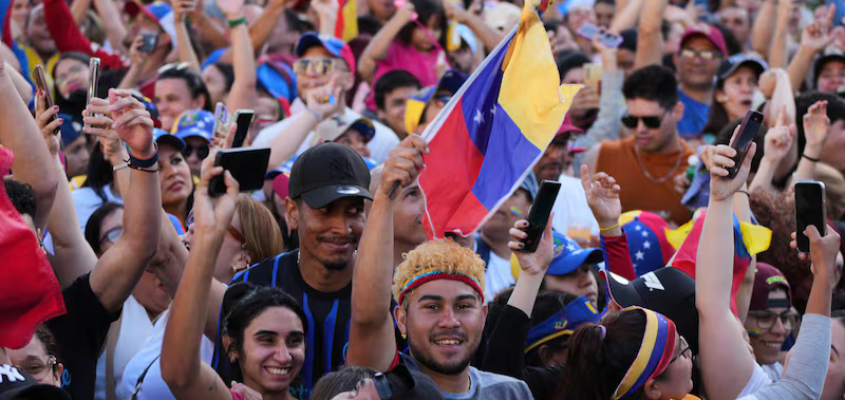
Image

Solidarity with Palestine tests morality, but solidarity with Venezuela tests politics. The recent U.S. intervention demands a radical left move beyond symbolic outrage to a material confrontation with its own state.

Palestine is the moral heart of global anti-colonial politics. It exposes the brutality of settler colonialism in its most naked form: land theft, ethnic cleansing, military occupation, and white supremacist domination. For many on the left, solidarity with Palestine has become a defining ethical commitment. But while Palestine functions as a moral litmus test for individuals and organizations across the political terrain from left to right, Venezuela is a structural and political one.

Recent events in Venezuela have dramatically escalated the stakes of anti-imperialist politics in a way that cannot be ignored. On January 3, 2026, the United States launched a large-scale military operation with the objective of kidnapping Venezuelan President Nicolás Maduro and his wife and transporting them back to the United States to face federal charges. This marks a decisive escalation in the forms of subversion and interventionist tactics that have characterized U.S. interventions in recent decades.

It also became a game-changer for radical politics inside the empire. The turn toward overt military force and the forcible removal of a sitting head of state signals a return to the raw practice of colonial domination — a form of power not seen so explicitly since the 2004 removal of Haitian President Jean-Bertrand Aristide by the George W. Bush administration.

The Empire has dropped the mask.

The question now is whether the left will continue to speak in the language of “liberal critique” and “class collaboration,” or whether it will finally confront bipartisan-supported imperial power in its most direct and unapologetic form.

Venezuela is the issue where anti-imperialism stops being a slogan and becomes a confrontation with one’s own state. It is therefore also the issue where U.S.-based radicals should unapologetically affirm Venezuela’s right to self-determination and openly oppose the U.S. imperial project in Venezuela. If they are not prepared to do this, it demonstrates unequivocally that their radicalism was never serious — that it was always symbolic and selective, which made it ultimately safe for the empire.

The Venezuela situation also reveals another now-normalized feature of “left” politics: the divergence between a left that is formally anti-imperialist and a liberal/left that remains fundamentally U.S.-centric and social imperialist. When this current turns to international events — especially cases of U.S. intervention — its position is shaped less by opposition to imperialism than by its assessment of the internal character of the targeted state. The legitimacy of intervention is thus implicitly judged according to whether the society under attack conforms to what amounts to Western “liberal” expectations and not the conditions and imperatives of revolutionary social transformation.

In practice, the actually existing efforts at socialist-oriented economic, social, and political development are almost always deemed inadequate, flawed, or authoritarian. This judgment then becomes the pretext for withholding solidarity. The predictable result is that these “left” forces find themselves aligned with U.S. imperialism in both analysis and effect, even as they insist that their position is informed by a “left” critique.

This is not a minor theoretical error but a political failure. It subordinates the principle of self-determination to ideological gatekeeping, and it replaces solidarity with conditional approval. In doing so, it converts anti-imperialism into a posture rather than a commitment — a language that can coexist comfortably with empire so long as empire speaks in the idiom of liberal democratic reformism and white saviorism!

Examples of this approach have emerged since the kidnapping of Maduro and his wife where sections of the collaborative left adopt the language and assumptions of U.S. policy makers about Venezuela — condemning Nicolás Maduro’s personality, legitimacy, or policies — but then attempt to separate those “left” condemnations from the brutal consequences of imperial intervention.

The first example is the familiar move: “I oppose U.S. intervention, but Maduro is an authoritarian who brought this on himself.” This framing accepts Washington’s narrative that Venezuela’s crisis is primarily the product of internal leadership failure rather than external economic warfare, sanctions, and destabilization. By centering Maduro’s alleged illegitimacy, this position reproduces the moral logic that makes intervention appear reasonable, even if the speaker claims to oppose the intervention itself. This position turns anti-imperialism into a procedural objection rather than a principled one — objecting to methods while accepting the white supremacist, colonialist premise that the U.S. has the authority to judge and discipline other societies.

The second example is the appeal to “human rights” as a neutral justification: “The U.S. shouldn’t intervene militarily, but something must be done about human rights abuses in Venezuela.” This treats human rights discourse as politically innocent, ignoring its long history as an imperial instrument used selectively against disobedient states and never against compliant ones. This framing erases the massive human rights violations produced by sanctions, economic strangulation, and political isolation — forms of violence that are invisible precisely because they are bureaucratic.

In both cases, the liberal/left position preserves U.S. moral authority while disavowing U.S. violence. This is not a contradiction but a function: it allows empire to operate with legitimacy. By accepting imperial categories and merely disputing their execution, the liberal/left becomes not an opponent of empire but one of its most useful managers.

The kidnapping of President Maduro is not simply another foreign-policy episode but a textbook case of imperial domination. In the present international context of imperial lawlessness — characterized by a form of global fascism led by the United States — it signals that these methods will be used again to attack and assert control over other sovereign nations.

Venezuela thus remains the linchpin for an authentic radical left precisely because it tests whether anti-imperialism is a principle or merely a fashionable posture. This moment demands that those committed to justice confront not only the moral obscenity of settler colonialism in Palestine but also the raw mechanisms of material power deployed abroad and domestically by their own state. Opposing empire only when it is directed at states that meet the Western left’s criteria for deserving solidarity will always fail, because such “perfect” states do not exist in reality. This logic explains how the U.S. “left” can normalize anti-anti-imperialism while continuing to present itself as radical.

“Actually existing,” concrete national projects of social transformation will always be imperfect. If the standard for solidarity is grounded in fantasies of Bernsteinian peaceful “democratic” transitions in a neocolonial context or even more idealist visions in core imperialist societies like the U.S., in which state power is seized on Friday and society becomes stateless and self-managed by local peoples’ assemblies by Monday, then no real struggle will ever qualify. These expectations function less as political standards than as mechanisms for disqualification.

The birth of new societies and their development within a disintegrating global capitalist order — and in the face of an international bourgeoisie committed to violent state terrorism and subversion to maintain Western white supremacist imperial power — constitute the objective conditions that shape the politics of those societies and should inform anti-imperialist politics in the metropoles.

Only by naming and opposing the full spectrum of imperial violence — from financial warfare to overt military conquest — can a radical left aspire to be consistent and consequential in the objective conditions we find ourselves in.

Venezuela’s struggle today lays bare the essential question: Do we oppose oppression only as distant abstractions, or do we confront empire at its most aggressive and normalized expressions?

Opposing empire in Venezuela is critical because the Venezuelan experiment at national survival with the lessons it has learned was beginning to expose the fact that even with “maximum pressure,” the possibility of an alternative political and economic trajectory outside neoliberal capitalism and U.S. hemispheric dominance was possible.

Venezuela’s ability to sell its oil, even at a diminished level after years of sanctions that resulted in its inability to reinvest in critical infrastructure, represented a critical win for its people and for all states that possessed critical resources. Its successful attempts to trade oil outside the dollar system — including in Chinese currency or digital alternatives — are significant not mainly because they threaten U.S. energy security, but because they undermine U.S. financial and geopolitical control. The real concern is the precedent: that a major resource-holding state can defy U.S. authority, weaken dollar-based systems, and still survive. The issue is thus about maintaining hegemony, not just securing fuel.

Palestine reveals the moral horror of settler-colonial domination, while Venezuela reveals the operational logic of contemporary empire abroad and in its’ domestic politics. If radical politics cannot confront that logic at its source — in the policies of the U.S. state itself — then it risks becoming a politics of outrage without consequence. Venezuela is the linchpin not because it is more important than Palestine, but because it tests whether the left is willing to oppose empire where it is most normalized, most respectable, and for some, most difficult to name.

For many U.S. radicals, this will be very difficult because the price might be too high. Unequivocal support for Venezuelan self-determination means defending a state targeted by your own ruling class, being accused of supporting “authoritarianism,” a charge that functions as an ideological weapon to discipline dissent that will result in losing access to mainstream legitimacy.

This is precisely why Venezuela is the site where left politics becomes dangerous, subversive and its practitioners materially punished — which is exactly why it is the real test of radicalism.

The charge of repression coming from a state in the grip of neofascist consolidation and a liberal/left represented by “progressives” such as Bernie Sanders and Zohran Mamdani – who will not only condemn the Bolivarian process but the revolutionary people and process of Cuba – illustrates perfectly the rightist convergence of the fascist state and the social democratic managerial “left.”

Venezuela’s Bolivarian project cannot be explained by the simplistic focus on supposed internal dysfunction and authoritarianism but by its geopolitical disobedience — the refusal to submit to the U.S. assertion of the Monroe Doctrine and the global neoliberal order. For the imperialist white supremacist policymakers, that refusal had to be punished through economic suffocation and political destabilization.

Yet, Venezuela’s ability to survive, to demonstrate that it could exist outside of the structures dominated by international capitalist financial institutions, ironically posed an existential threat to U.S. hegemony not only because it was uniquely dangerous, but because it could be contagious.

https://blackagendareport.com/venezuela ... ism-led-us

Black Agenda Report Venezuela Reading List
BAR Editors 07 Jan 2026
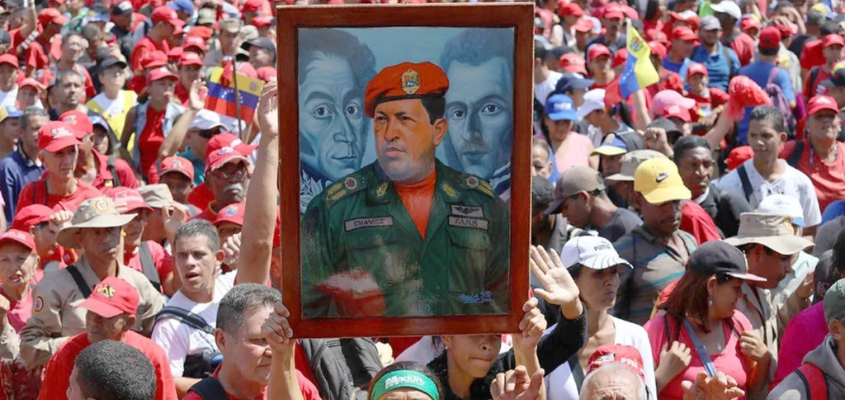
Image

Black Agenda Report contributors have focused analysis, reporting and interviews on Venezuela’s Bolivarian Revolution for many years. We hope that this list, which is not exhaustive of BAR’s coverage, will assist our readers in understanding why Venezuela was and is seen as a threat to the U.S. state and why independent anti-imperialist journalism is so important.

Glen Ford
May 28, 2014
Black Caucus Members Shame Themselves, as South America Warns U.S. Not to Sanction Venezuela | Black Agenda Report

Danny Haiphong
March 25, 2015
Obama's War Plans Against Venezuela: Another Act of Imperial Desperation | Black Agenda Report

Glen Ford
September 30, 2015
Blacks Cheer Venezuelan Leader – But Still Support Democratic Party Terror | Black Agenda Report

Ajamu Baraka
February 21, 2018
Venezuela: Revenge of the Mad-Dog Empire | Black Agenda Report

Margaret Kimberley
August 28, 2018
Freedom Rider: The United States Destroys Venezuela’s Economy | Black Agenda Report

Glen Ford
January 31, 2019
The Racist, Imperialist War on Venezuela | Black Agenda Report

Glen Ford
March 14, 2019
The Imperial Racist Saga Comes Home, Where It Began | Black Agenda Report

Danny Haiphong
April 3, 2019
American Exceptionalism is at the root of the Fake News Epidemic Attempting to Overthrow Venezuela’s Bolivarian Revolution | Black Agenda Report

Lauren Smith
May 8, 2019
Venezuelan Embassy in DC Under Siege by Guaido’s Racist Mob | Black Agenda Report

Roberto Sirvent
November 6, 2019
BAR Book Forum: Dario Azzellini’s “Communes and Workers' Control in Venezuela” | Black Agenda Report

Glen Ford, Kevin Zeese
February 10, 2020
Embassy Activists Face Prison in Trial Based on Trump Venezuela Fantasy | Black Agenda Report


November 4,2020
Open Letter to the Africans of Brazil, Colombia and Guyana | Black Agenda Report

Roberto Sirvent
June 2, 2021
BAR Book Forum: Justin Podur and Joe Emersberger’s “Extraordinary Threat” | Black Agenda Report

Ajamu Baraka
November 10, 2021
Class Warfare and Socialist Resistance: Nicaragua, Cuba, Venezuela as Existential Threats to the US | Black Agenda Report

Jacqueline Luqman
May 3, 2022
Venezuela Continues To Be the Model for True Democracy in the Americas | Black Agenda Report

Margaret Kimberley
August 2, 2023
The U.S. Plot to Finalize the Theft of Venezuela’s Oil | Black Agenda Report

Tamanisha John
November 29, 2023
Guyana and Venezuela: The Crisis of Imperialism Currently Unfolding on South America's Caribbean Coast | Black Agenda Report

Margaret Kimberley
December 22, 2023
Alex Saab Is Free | Black Agenda Report

Ann Garrison
January 31, 2024
Corporate Coup: Venezuela and the End of US Empire | Black Agenda Report

Clau O’Brien Moscoso
February 14, 2024
Peoples to Peoples Encounters: Venezuela’s Vice Minister of Foreign Affairs for North America In Dialogue with Local Organizations and Social Movements in New York | Black Agenda Report

Margaret Kimberley, Ajamu Baraka
July 31, 2024
Don't Believe the Hype: Venezuela is a Democracy | Black Agenda Report

Ajamu Baraka
August 7, 2024
U.S. Rejection of Venezuela’s Democracy Vindicates Trump Contesting the 2020 Election Result | Black Agenda Report

Roger Harris
August 20, 2025
US Human Rights Report on Venezuela Doesn’t Pass the Mirror Test | Black Agenda Report

Mafa Kwanisai Mafa
September 24, 2025
Venezuela, Imperialism, and the Global Struggle for Sovereignty | Black Agenda Report

Margaret Kimberley
October 15, 2025
Nobel War Prize | Black Agenda Report

Gerald A. Perreira
October 15, 2025
No to US State Terrorism in the Caribbean Sea No to US Plans for Regime Change in Venezuela Caricom Must Act Now | Black Agenda Report

Chris Gilbert, Cira Pascual Marquina
October 22, 2025
‘Fishing Provides for Everyone’: The Palmarito Afro-Descendant Commune (Part III) | Black Agenda Report

Margaret Kimberley, Gerald A. Perreira
October 31, 2025
U.S. Threats Against Venezuela Target the Entire Region | Black Agenda Report

Clau O’Brien Moscoso
November 26, 2025
The Lima Group and “Peaceful Transition”: the Neocolonial Role in US/Canadian Sanctions and Militarism Against Venezuelan Sovereignty | Black Agenda Report

Ajamu Baraka, Dimitri Lascaris
December 3, 2025
US Attack On Venezuela Would Cause 'Chaos' In The Region w/ Ajamu Baraka | Black Agenda Report

Gerald A. Perreira
December 3, 2025
Hands Off Maduro/Hands Off Venezuela | Black Agenda Report

Margaret Kimberley
December 3, 2025
The Double Tap on Venezuela | Black Agenda Report

Djibo Sobukwe
December 17, 2025
Five Reasons Black/ African People Should Be in Solidarity with Venezuela | Black Agenda Report

Ajamu Baraka
January 7, 2025
Venezuela, Even More Than Palestine, Is the Linchpin of a Consistent Radical Left in The Era of Global Neofascism Led by the U.S. | Black Agenda Report

https://blackagendareport.com/black-age ... ading-list

(See link)

STOP the killers!
Raymond Nat Turner, BAR poet-in-residence 07 Jan 2026
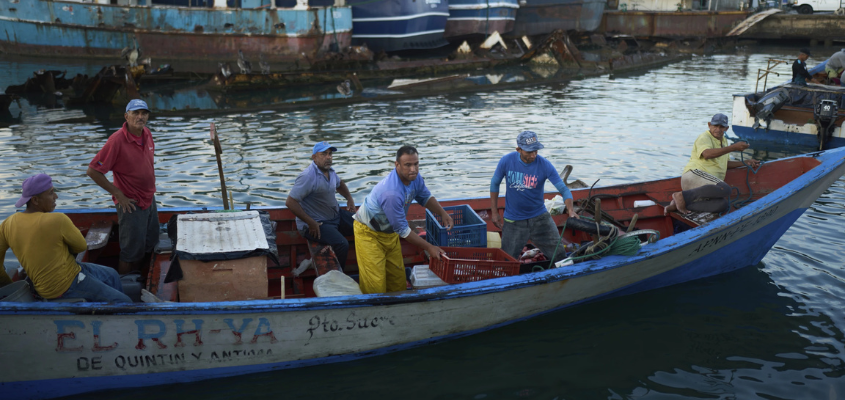
Image

Burlap bags stuffed with tuna and blue marlin.
Catch of a lifetime! Juan’s already counting the
cash in his head. Visualizing pawn shop guitar
for Gabriel, his 10 yr old son, graduating to guitar
from ukulele. Gabriel’s greeted morning rooster-
like— since age 3— with “Let’s practice, Papa!”

Before pushing off to sea Juan bought the computer
Rosario wished for from a journalism student he met
at the fish market training fishmongers to compute. He
also bought the bicycle Maria longed and stashed it at
a neighbor’s house. Juan was out to make his young
family’s Christmas the best ever.

BOOM!
Bloody mess below his waist. Juan’s a strong swimmer. But
he can’t feel his legs. He quickly grabs on to fiery flotsam.
Is that Javier hanging on for dear life across from him?
He hears his children’s joyful shrieks. Sees them jumping
Up and down with joy. He kisses Lourdes long and tenderly …

BOOM!
A pomade man has amplified orders of
his demented Don into “Kill them all!”
Laughing, they dub it a “double-tap
strike —”
like some cool dance step
signaling mad moves to come …


© 2026. Raymond Nat Turner, The Town Crier. All Rights Reserved.

https://blackagendareport.com/stop-killers

******

Image

Behind the DOJ’s politicized indictment of Maduro: a CIA-created ‘network’ and coerced star witness
Max Blumenthal·January 5, 2026

The US Department of Justice indictment of Venezuela’s kidnapped leader, Nicolas Maduro, is a political rant that relies heavily on coerced testimony from an unreliable witness. Despite DOJ edits, it could expose more Americans to the CIA’s own history of drug trafficking.

The January 3 US military raid on Venezuela to kidnap President Nicolas Maduro and First Lady Cilia Flores was followed by the Department of Justice’s release of its superseding indictment of the two abductees as well as their son, Nicolasito Maduro, and two close political allies: former Minister of Justice Ramon Chacin and ex-Minister of Interior, Justice and Peace Diosdado Cabello. The DOJ has also thrown Tren De Aragua (TDA) cartel leader Hector “Niño” Guerrero into the mix of defendants, situating him at the heart of its narrative.

The indictment amounts to a 25 page rant accusing Maduro and Flores of a conspiracy to traffic “thousands of tons of cocaine to the United States,” relying heavily on testimony from coerced witnesses about alleged shipments that largely took place outside US jurisdiction. It accuses Maduro of “having partnered with narco-terrorists” like TDA, ignoring a recent US intelligence assessment that concluded he had no control over the Venezuelan gang. Finally, the prosecutors stacked the indictment by charging Maduro with “possession of machine guns,” a laughable offense which could easily be applied to hundreds of thousands of gun-loving Americans under an antiquated 1934 law.

DOJ prosecutors carefully avoid precise data on Venezuelan cocaine exports to the US. At one point, they describe “tons” of cocaine; at another, they refer to the shipment of “thousands of tons,” an astronomical figure that could hypothetically generate hundreds of billions in revenue. At no point did they mention fentanyl, the drug responsible for the overdose deaths of close to 50,000 Americans in 2024. In fact, the DEA National Drug Threat Assessment issued under Trump’s watch this year scarcely mentioned Venezuela.

By resorting to vague, deliberately expansive language larded with subjective terms like “corrupt” and “terrorism,” the DOJ has constructed a political narrative against Maduro in place of a concrete legal case. While repeatedly referring to Maduro as the “de facto… illegitimate ruler of the country,” the DOJ fails to demonstrate that he is de jure illegitimate under Venezuelan law, and will therefore be unable to bypass established international legal precedent granting immunity to heads of state.

Further, the indictment relies on transparently unreliable, coerced witnesses like Hugo “Pollo” Carvajal, a former Venezuelan general who has cut a secret plea deal to reduce his sentence for drug trafficking by supplying dirt on Maduro. Carvajal was said to be a key figure in the so-called “Cartel of the Suns” drug network which the DOJ claims was run by Maduro. If and when he appears to testify against the abducted Venezuelan leader, the American public could learn that the “cartel” was founded not by the deposed Venezuelan president or one of his allies, but by the CIA to traffic drugs into US cities.

As sloppy and politicized as the DOJ’s indictment might be, it has enabled Trump to frame his lawless “Donroe Doctrine” as an aggressive policy of legal enforcement, emboldening the US president to levy further threats to abduct or bump off heads of state who stand in the way of his resource rampage. This appears to be the real purpose of the imperial courtroom spectacle to come.

Weaponizing the “narco-terror” hoax
The bulk of the case against Maduro rests on the accusation that the defendants “engaged in… drug trafficking, including in partnership with narco-terrorist groups.” According to the DOJ, Maduro conspired with TDA, as well as the Mexican Sinaloa and Los Zetas cartels to traffic drugs between 2003 and 2011. However, these cartels were not designated by the Trump administration as Foreign Terrorist Organizations until February 2025, a move obviously designed to justify Maduro’s kidnapping and juice up his indictment.

In its bid to convict Maduro, the DOJ will undoubtedly struggle to overcome the conclusion reached in an April 7, 2025 memo by the Office of the Director of National Intelligence (ODNI) that the Venezuelan leader did not control TDA, which he effectively dismantled through a massive 2023 military-police raid on the Tocorón prison that served as the gang’s base of operations. A report in the State Department-funded outlet InSight Crime also complicates the DOJ’s case, finding that “the few crimes attributed to alleged Tren de Aragua members in the United States appear to have no connection with the larger group or its leadership in Venezuela.”

In fact, many of the supposed crimes for which Maduro is charged took place outside the borders and jurisdiction of the United States. The DOJ alleges, for instance, that in September 2013, “Venezuelan officials dispatched approximately 1.3 tons of cocaine on a commercial flight from the Maiquetia Airport to Paris Charles de Gaulle Airport.”

In 2018, five British citizens were convicted in a French court for orchestrating the drug shipment with help from gang members from Colombia and Italy – but not Venezuela. At the time of the incident, Maduro’s government acknowledged corrupt lower level Venezuelan officials had allowed the drugs to pass through airport security. Caracas ultimately arrested 25 people, including members of the military and an Air France manager – a salient fact omitted from the DOJ indictment.

The evidence of Maduro’s involvement in the scandal, according to the DOJ, was that the drug shipment took place “mere months after [Maduro] succeeded to the Venezuelan presidency.” No other proof is offered to demonstrate his culpability.

The indictment goes on to allege Maduro “facilitated the movement of private planes under diplomatic cover” to avoid law enforcement scrutiny as they landed in Mexico. Citing coerced testimony from a Venezuelan government defector, it accuses Diosdado Cabello of coordinating a shipment of 5.5 tons of cocaine on a DC-9 jet to Mexico. None of these claims should hold water in a US court.

As public defender and legal analyst Eliza Orlins explained, “Flights that occur wholly within Venezuela do not cross U.S. airspace, do not implicate U.S. customs territory, and do not, standing alone, violate U.S. law. The indictment attempts to bootstrap these domestic movements into U.S. criminal jurisdiction by asserting that the cocaine involved was ultimately destined for the United States. Intent does almost all the work here.”

Because most of the specific incidents cited in the indictment occurred within Mexico under Presidents Vicente Fox, Felipe Calderón and Enrique Pena Nieto, the DOJ inadvertently implicates these three pro-US administrations, who shaped their drug policies in coordination with Washington. In fact, the top cop during the first two of these governments, former Federal Intelligence Agency chief Genaro García Luna, was convicted in a US federal court in 2023 for presiding over a multi-million dollar conspiracy with the Sinaloa cartel. Former US ambassador to Mexico Robert Jacobson acknowledged that the US knew all about Garcia Luna’s cartel ties, but insisted, “we had to work with him.”

The Honduran double standard
The DOJ also implicates the pro-US government of former Honduran President Juan Orlando Hernandez, referring to Honduras as a “transshipment” point “in which cocaine traffickers operating in those countries paid a portion of their own profits to politicians who protected and aided them.” Hernandez was convicted in a US federal court in 2023 of trafficking over 400 tons of drugs to the US, but received a pardon this December from President Donald Trump following a lobbying campaign by top Trump donors seeking to maintain the deregulated crypto haven of Próspera off the coast of Honduras.

During his January 3 press conference announcing the abduction of Maduro and his wife, Trump aggressively defended his decision to pardon Hernandez, claiming he’d been “persecuted very unfairly.” Yet the same DOJ prosecutor who authored the original 2020 indictment of Maduro, Trump loyalist Emil Bove, was responsible for the indictment of Hernandez. In contrast to the case against Maduro, the Hernandez indictment contained concrete evidence of his collaboration with major transnational cartels, including video and photographic exhibits, as Anya Parampil and Alexander Rubinstein detailed for The Grayzone.

Hernandez pleaded his case to Trump in a 2025 letter claiming he’d been subjected to a “rigged trial” and convicted “based on the uncorroborated statements of convicted drug traffickers.”

His questionable claim could also apply to the DOJ’s prosecution of Maduro, as many of the most dramatic allegations contained in his indictment are sourced to a convicted drug trafficker who struck a secret deal with US prosecutors to reduce his own sentence in exchange for testimony against Maduro: former Venezuelan Gen. Hugo “El Pollo” Carvajal.

Coerced “star witness” strikes secret deal with US prosecutors
The head of military intelligence under the government of Venezuelan President Hugo Chavez from 2004 to 2011, Carvajal is cited seven times in the January 3 DOJ indictment as a witness to alleged criminal acts by Maduro and his inner circle. Carvajal was first arrested in 2014 in Aruba on drug running charges, but was returned to Venezuela to the chagrin of US authorities. In 2017, as he faced a pair of indictments in the US, the general suddenly turned on Maduro, who he denounced as a dictator. Carvajal went on to openly endorse the regime change project of US-controlled “interim president” Juan Guaido in 2019, fashioning himself as a courageous defector while proffering his supposed knowledge of the Venezuelan deep state to Washington.

That same year, as Carvajal sought asylum in Spain, the US formally demanded that Madrid hand him over. Now facing the prospect of extradition, he delivered a series of tell-all interviews to legacy outlets like the New York Times, doing his best to legitimize virtually every charge the Trump administration sought to weaponize against Maduro.

Then-Senator Marco Rubio could barely contain his excitement about the prospect of squeezing the Chavista insider for testimony in a future case against Maduro. Carvajal “will soon be coming to the US to provide important information about the #MaduroRegime,” Rubio tweeted on April 12, 2019. “Bad day for the #MaduroCrimeFamily.”

It was not until 2023 that Carvajal was finally extradited and placed on trial in the Southern District court of New York. After he pleaded guilty to “narco-terrorism” this June, the Miami Herald reported that he had struck a plea deal which would grant him “a considerable sentence reduction if he provides ‘substantial assistance’ to US investigations.”

Carvajal’s still-secret plea deal gives away the game he’d played since he first emerged as a defector. His allegations against Maduro had been delivered under duress, all designed to satisfy his would-be jailers in the US. He has since indulged one of Trump’s favorite conspiracy theories by alleging in a June 2025 letter to the US president that Maduro manipulated Venezuela’s Smartmatic voting systems to rig the 2020 US presidential election in favor of Biden.

Carvajal’s shameless pandering to Trump and secret plea deal should obliterate his credibility as a witness against Maduro.

In its January 3 indictment of Maduro, the DOJ claimed Carvajal and Diosdado Cabello “worked with other members of the Venezuelan regime” to “coordinate the shipment” of 5.5 tons of cocaine from Simon Bolivar International Airport to Campeche, Mexico in a private jet in 2006. This incident remains the source of intense intrigue, as the ownership of the DC-9 jet by two shadowy American companies points in the direction of US intelligence.

While details of potential covert US government involvement in the 2006 drug shipment remain murky, it is an established fact that the CIA founded and operated the “Cartel of the Suns” which the DOJ now accuses Maduro, Cabello and other top Venezuelan officials of controlling.

Cartel of the Suns: created by the CIA, weaponized by the DOJ
In the original indictment of Maduro, the DOJ explicitly accused Maduro of leading a narco-trafficking cartel called “Cartel of the Suns,” referencing it over 30 times.

The revised DOJ indictment of Maduro unsealed on January 3 states, “Starting in or about 1999, Venezuela became a safe haven for drug traffickers willing to pay for protection and support corrupt Venezuelan civilian and military officials, who operated outside the reach of Colombian law enforcement and armed forces bolstered by United States anti-narcotics assistance.”

It continues: “The profits of that illegal activity flow to corrupt rank-and-file civilian, military, and intelligence officials, who operate in a patronage system run by those at the top-referred to as the Cartel de Los Soles or Cartel of the Suns.”

The informal network of corrupt military officials was in fact established by the CIA under pro-US Venezuelan governments during the 1980’s and ’90’s. Americans were introduced to this inconvenient truth not by some dissident muckraker, but by the New York Times, and by Mike Wallace in a 60 Minutes exposé broadcast in 1993.

Three years earlier, US Customs officials in Miami had intercepted a shipment of 1000 pounds of pure cocaine from Venezuela. But they were soon told by higher-ups in the US government the shipments had been approved by Langley. According to the Times, the CIA sought to allow the cocaine to “enter the United States without being seized, so as to allay all suspicion. The idea was to gather as much intelligence as possible on members of the drug gangs.”

“I really take great exception to the fact that 1000 kilos came in, funded by US taxpayer money,” then-DEA attache to Venezuela Annabelle Grimm remarked to 60 Minutes. “I found that particularly appalling.”

To organize the shipments from Venezuela, the CIA recruited generals from the Venezuelan National Guard who were trained by the US. Because officers in the National Guard wore patches on their uniforms bearing the symbol of a sun, the informal drug network was branded as “The Cartel of the Suns.”

In the years after the CIA-run cartel was exposed in US media, it disappeared from public view entirely, only to be revived when the US government began hounding Gen. Carvajal, who may soon appear as its key witness against Maduro. While corruption is still present in the Venezuelan military, there is little evidence of anything resembling a Cartel of the Suns in its ranks.

As Phil Gunson, a Caracas-based analyst for the International Crisis Group, told CNN, “Cartel de los Soles, per se, doesn’t exist. It’s a journalistic expression created to refer to the involvement of Venezuelan authorities in drug trafficking.”

A former senior US official echoed Gunson, describing Cartel of the Suns as “a made-up name used to describe an ad hoc group of Venezuelan officials involved in the trafficking of drugs through Venezuela. It doesn’t have the hierarchy or command-and-control structure of a traditional cartel.”

The official told CNN that the DEA or Defense Intelligence Agency had supplied Trump with a “purely political” assessment of the cartel to support his assault on Venezuela.

Discovery granted to the defense in the trial of Maduro and Flores risks severely embarrassing the US government by extracting further evidence of CIA drug running. This may be why the DOJ softened its language about the Cartel of the Suns, referring to it in the January 3 indictment as a mere “patronage network” rather than as a cohesive criminal syndicate, and mentioning it only twice.

During his first appearance in court earlier that day, the kidnapped Venezuelan leader was only able to speak for a brief moment. “I am innocent. I am a decent man. I am President…” Maduro pleaded before being cut off by his lawyer.

https://thegrayzone.com/2026/01/05/indi ... k-witness/

******

Adelante, Venezuela, perimeter of the emerging multipolar world

Lorenzo Maria Pacini

January 6, 2026

The socialism of the Bolivarian Revolution has represented one of the most significant attempts in the 21st century to rethink the relationship between the state, the people, and resources in Latin America.

Why the powers of the old world dislike Venezuela

Venezuela has always occupied a privileged place on the list of bitter enemies of the old world, the collective West. Why is this? The answer is simple: Venezuela represents a bulwark of resistance to Western imperialism, both European and American; it represents a concrete bulwark against nationalism of all kinds (neo-fascism and neo-Nazism, but not only); it represents an experiment in practical socialism. None of this can be to the liking of those who, on the other hand, plan the forms of political power manipulated by the hegemonic octopus.

The socialism of the Bolivarian Revolution has represented one of the most significant attempts in the 21st century to rethink the relationship between the state, the people, and resources in Latin America. Born out of the historical experience of social exclusion, economic dependence, and oligarchic concentration of wealth, the Bolivarian project sought to restore centrality to the Venezuelan masses, placing social justice, national sovereignty, and inclusion at the heart of politics.

With Hugo Chávez’s rise to the presidency in 1999, Venezuela began a profound transformation of its development model. Chávez interpreted socialism not as an abstract ideological dogma, but as a pragmatic tool to respond to the concrete needs of the population. Through the nationalization of strategic resources, particularly oil, and the redistribution of energy revenues, the so-called “social missions” were financed: programs aimed at literacy, free healthcare, access to housing, and higher education. Millions of Venezuelans, historically excluded from essential services, saw a tangible improvement in their living conditions.

Bolivarian socialism also took the form of authentic anti-fascism, understood not only as opposition to authoritarian far-right regimes, but as a structural struggle against inequality, social racism, and economic imperialism. Chávez advocated a multipolar and solidarity-based model, founded on the self-determination of peoples and cooperation between states of the global South, breaking with decades of subordination to external interests.

After Chávez’s death, Nicolás Maduro inherited a complex legacy in a profoundly changed context, marked by economic crises, international sanctions, and strong political polarization. Despite obvious difficulties, Maduro has continued along the path of pragmatic socialism, seeking to preserve fundamental social achievements and adapt the Bolivarian project to new conditions. Policies to support food supplies, defend wages, and maintain public services have continued to be pillars of government action.

The Bolivarian Revolution embodied a vision of politics as a tool for collective emancipation. Beyond its contradictions and challenges, it showed how socialism, in concrete form and rooted in national reality, can become a practice of social justice, popular dignity, and anti-fascist resistance in the contemporary world. And all this, we repeat, is not to the liking of the collective West.

Who benefits from Maduro’s fall?

Just look at who rejoiced at what happened on January 3, 2026. President Maduro was arrested… no, that is not the correct term: in law, a person can only be said to be ‘arrested’ when specific legal conditions are met. Arrest has certain prerequisites, including flagrante delicto (caught in the act, immediately after or following investigations that have produced clear evidence), and is ordered by a judge, who must have jurisdiction. So, the question that arises in the case of President Maduro is under what jurisdiction the American watchdogs dared to violate Venezuela’s sovereignty, enter the country, capture its president, deport him to the US, and subject him to American law. We are already familiar with this American modus operandi.

Now, returning to the main topic, it was, coincidentally, the collective godchildren of the West who rejoiced at Maduro’s downfall.

Israel was the first to rejoice, even congratulating Donald Trump and hoping to be able to intervene in the country’s financial and trade policies, right after the American president declared that from now on the US will be “very present” in Venezuelan economic policy. A warning, or rather two, goes to real gangsters. Now “the greatest democracy in the Middle East” can celebrate another victory, securing wealth, influence, and power even on the other side of the Atlantic Ocean… and who knows, maybe they will also claim Venezuela as “God’s promised land” for their great, indeed gigantic, Israel!

Why did they want him to fall? The reasons are perhaps few, but very clear.

Maduro maintained the break in diplomatic relations with Israel, originally severed in 2009 under Hugo Chávez, throughout his presidency since 2013, describing Israel as a “colonial regime.” He also established and strengthened diplomatic ties with the Palestinian National Authority, including formal recognition and support for the Palestinian state. He has publicly condemned Israel’s military actions in Gaza as “genocide” against the Palestinian people, particularly in statements made in May 2025 in the context of the ongoing Israeli genocide in Gaza. He even denounced Israeli Prime Minister Benjamin Netanyahu as “the Hitler of the 21st century” in June 2025, in response to Israeli attacks on Iran. He condemned Israeli attacks on Iran as “criminal” and ‘immoral’ in June 2025, calling for an immediate end to the aggression. He made a direct appeal to the Israeli people in June 2025 to “stop Netanyahu’s madness,” calling Israeli policies aggressive and urging internal opposition.

Venezuela, incidentally, is a country that has no Zionist-run banks. Maduro has supported anti-Israel resolutions at the United Nations, including voting in favor of measures condemning Israeli occupation and actions in Palestine, such as the December 2025 General Assembly resolution welcoming the advisory opinion of the International Court of Justice on the issue.

He has aligned Venezuela with anti-Israel alliances, including close ties with Iran, which have been “a source of concern for international Jewish organizations.” He accused “international Zionism” of orchestrating protests and unrest following the controversial 2024 presidential elections in Venezuela, blaming Jewish influence for manipulating the media, social networks, and satellite technology to weaken his regime.

With these positions, it was clear that Maduro could not remain in power for much longer.

What lies behind the early statements?

Among his various statements, Trump made another one with a strong impact: according to reports, Vice President Delcy Rodríguez had already been in contact with Secretary of State Marco Rubio, expressing a certain openness to collaboration.

The crucial point, however, is not so much the veracity of this information. At a time when a president is effectively neutralized, the chain of power is being questioned, and the local media remains confused, making such assumptions is tantamount to detonating a political bomb.

On the one hand, this could weaken Delcy Rodríguez’s position in the eyes of Venezuelan public opinion: officially critical of the United States, but ready to negotiate behind the scenes. Her own allies could exploit this narrative to oust her from the political scene, should they deem it appropriate.

On the other hand, Trump’s words seem to be an implicit message about the direction the vice president should take: comply with Washington’s instructions, avoid ending up like Maduro, and perhaps even manage to retain a central role in the country’s leadership. This interpretation is reinforced by the statements about Maria Corina Machado.

In this way, with such positions, Washington could hit several targets at once: fuel divisions among Maduro’s possible heirs and, at the same time, push some actors to the negotiating table, discouraging them from implementing strategies aimed at causing permanent instability and widespread conflict.

Marco Rubio plays a central role, having immediately exposed himself, or been deliberately exposed, as one of the main proponents of what happened. His renowned ambitions

If the United States succeeds in its intent, it would then have a free hand: acting from a position of clear advantage, it could easily disregard any commitments made, as has happened several times in the past.

Because one thing is certain: the US lies. Lies are their ‘truth’ on which they have built their world.

State banditry, exceptionalism confirmed

The United States has once again confirmed its identity. State banditry is once again legitimized and becomes the norm. The US is exceptionalist, deciding by force and violence to break the rules it wants and impose its will on others.

The only response to piracy carried out by a member state of the United Nations, and therefore fully legitimized in every respect, active and passive, by international law, is to invoke a principle that in February 2022 found widespread support and recognition among a significant part of global public opinion. There is an aggressor and an aggressed, as we have learned to say.

If yesterday’s Iraq or today’s Venezuela were truly defined as “rogue states” or led by “rogue governments,” there are legitimate and universally recognized international institutions to which one can turn to report any wrongdoing and seek justice: from the International Court of Justice to the United Nations General Assembly to the Security Council. When these solid and shared legal and ethical paths are abandoned, everything becomes permissible and we plunge into a jungle where the only law left is that of force.

Venezuela was an existential perimeter for the old world with respect to the multipolar world. Too extensive, too risky, too dangerous for the old hegemony. Geographically, too, it was a thorn in the side of the renewed Monroe Doctrine 2.0 and the interests of the old empire.

But all is not lost. The example of Venezuela and what is happening there must be a stern warning to the whole world: either we understand this sad but harsh truth, or we risk falling into an abyss of no return for the whole world.

https://strategic-culture.su/news/2026/ ... lar-world/

*****

Africa voices outrage against US invasion of Venezuela and kidnapping of President Maduro

Following the shocking invasion of Venezuela and the abduction of President Nicolás Maduro, African states, social movements, trade unions, and political parties have responded with strong condemnation of the action, while expressing solidarity and support for the people of Venezuela.

January 06, 2026 by Nicholas Mwangi
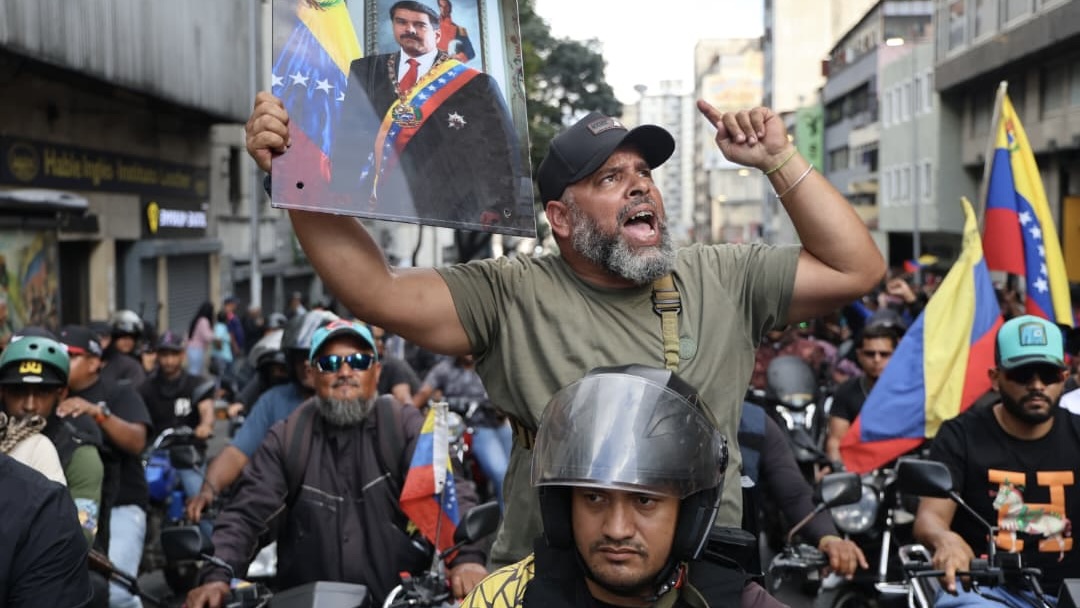
Image
Mass mobilization in Caracas, Venezuela on Sunday, January 4 rejecting the US military action in Venezuela. Photo: Rome Arrieche

The United States’ military invasion of Venezuela and the kidnapping of President Nicolás Maduro and First Lady Cilia Flores on January 3, 2026, has led to a wave of sharp condemnation across Africa. Governments, political parties, trade unions, revolutionary movements, and solidarity networks have denounced the action as a flagrant violation of international law, a return to imperial “might makes right”, and a dangerous escalation threatening global peace.

From official diplomatic channels in South Africa to socialist parties in Zambia and Tunisia, and from militant trade unions to anti-imperialist platforms across the continent, African voices have responded with unusual clarity and unity.

South Africa, in a formal statement, the Department of International Relations and Cooperation called for an urgent meeting of the United Nations Security Council, stressing that the invasion constituted a “manifest violation” of the UN Charter.

The country’s head of diplomacy, Clayson Monyela, expressed alarm and asked publicly:

“Where’s the ‘international rules-based order’? Are we back to the law of the jungle now?”

Venezuela’s ambassador to South Africa, Carlos Feo Acevedo, described the attack as “clear criminal and terrorist acts” by the US administration.

Ghana’s Ministry of Foreign Affairs also released a press statement, saying they were alarmed at the unilateral and unauthorized invasion of the Bolivarian Republic of Venezuela by the United States of America and the subsequent abduction of President Nicolás Maduro and his wife, Cilia Flores.

Expressing strong reservations against the unilateral use of force, they strongly deplore such acts that violate the Charter of the United Nations and international law, as well as the sovereignty, territorial integrity, and political independence of states. Noting that attempts at the occupation of foreign territories and apparent external control of oil resources have extremely adverse implications on international stability and the global order. Also of concern to Ghana are statements by US President Donald Trump that the US will “run” Venezuela “until such time as we can do a safe, proper and judicious transition” and that large US oil companies will be asked to “go in”. These declarations are reminiscent of the colonial and imperialist era.

Trade unions and working-class movements
The National Union of Metalworkers of South Africa (NUMSA) issued a press statement, NUMSA condemned the invasion as an illegal regime-change operation aimed at strangling the Bolivarian Revolution and seizing Venezuela’s oil and mineral wealth.

NUMSA framed the assault on Venezuela within a broader pattern of US imperial conduct, linking it to sanctions, trade wars, and economic aggression against Africa itself. The union recalled US tariffs on South African goods, the collapse of AGOA benefits, and punitive trade measures against countries like Lesotho as evidence that Africa, too, has been a victim of Washington’s coercive power.

Calling the kidnapping of President Maduro an international crime, NUMSA demanded urgent action by BRICS, urged mass resistance to imperialism, and warned that unchecked US aggression would push the world toward barbarism.

“The world is today faced with the stark choice: capitalist barbarism or socialism,” the statement concluded.

Socialist and communist parties across Africa speak out
Across the continent, socialist and communist parties reacted with striking ideological coherence.

In Zambia, Socialist Party President Dr Fred M’membe condemned the strikes as a war crime, describing the disappearance of President Maduro as a dangerous escalation. Saying that the operation was motivated by Washington’s inability to tolerate a government that prioritizes social welfare over multinational corporate interests.

In Tunisia, the Workers’ Party denounced the attack as an act of “banditry and state terrorism,” warning that the assault on Venezuela opens the door to international arbitrariness and mirrors ongoing wars in Palestine and the Middle East. The party framed the invasion as part of a wider imperial strategy to reassert U.S. dominance over Latin America, long treated as Washington’s “backyard”.

The Communist Party of Swaziland described the bombing of Venezuela as barbaric and reaffirmed solidarity with the Venezuelan working class and peasantry, declaring that the struggle against imperialism is inseparable from the struggle for global liberation.

Anti-imperialist and Pan-African solidarity
Revolutionary and anti-imperialist platforms also mobilized rapidly. The World Anti-Imperialist Platform called on its members worldwide to organize protests at US embassies, issue statements of condemnation, and strengthen international defense brigades in solidarity with Venezuela. Invoking the legacy of the International Brigades of the Spanish Civil War, the platform raised the slogan “No Pasarán!”, declaring unwavering support for Venezuela’s resistance.

In Morocco, the Democratic Network in Solidarity with Peoples announced mass protests in front of parliament, condemning what it described as US and Zionist imperial arrogance and warning that the kidnapping of a sitting president represents a direct challenge to the entire international system.

In the Democratic Republic of Congo, the Antifascist International denounced the attack as an imperialist attempt to destroy the revolutionary legacy of Simón Bolívar and Hugo Chávez, calling for global unity against capitalism and imperial domination.

Guinean activist Oyé Beavogui, speaking as part of the African Democratic Revolution currently, described the abduction of President Maduro as “state kidnapping” and a historic insult to the dignity and sovereignty of Latin American peoples.

In a statement, Pan Africanism Today declared its unconditional solidarity with the Venezuelan people, the organization affirmed its support for the Bolivarian government and President Maduro, stressing that the Bolivarian Revolution is a mass popular movement of millions of people rather than a project centered on one individual. And the attack was motivated by Venezuela resources. Drawing historical parallels, Pan Africanism Today compared the situation in Venezuela to NATO’s 2011 intervention in Libya. It argued that similar tactics, economic sanctions, international propaganda, and military force, were used to dismantle Libyan sovereignty, leading to long-term instability across North Africa and the Sahel.

The West African Peoples’ Organization (WAPO/OPAO) also condemned what it described as an unacceptable act of aggression by the United States against Venezuela, following reports of a military attack and the abduction of President Nicolás Maduro and his wife.

WAPO said it “strongly condemns this act of aggression, which is contrary to all international norms and principles, particularly the respect for the sovereignty of independent states.”

The Socialist Movement of Ghana also put out a statement of solidarity with the people of Venezuela against the aggression, saying that this is a defining moment that demands clarity, courage, and action. The defense of Venezuela today is the defense of all peoples resisting exploitation, domination, and imperialist control. “History teaches us that silence in the face of imperialist aggression only emboldens it. We have witnessed the consequences of the interventions in Libya, Iraq, and Syria: shattered states, hundreds of thousands dead, refugee crises, and the flourishing of terrorism. Our collective protest today can be the deterrent that prevents a full-scale war.”

In East Africa the move was condemned widely by social movements and parties, including the Tanzania Socialist Forum, which said the aggression constituted a clear violation of international law. It cited Article 2(4) of the United Nations Charter, which prohibits the use of force against the territorial integrity and political independence of any state, as well as Article 51, arguing that Venezuela posed no threat that could justify claims of self-defense by the United States.

The Communist Party Marxist Kenya (CPM-K) issued a statement of solidarity with the Bolivarian Republic of Venezuela. The party expressed “militant and unshakeable solidarity” with the Venezuelan people, the country’s armed forces, and the Bolivarian government led by President Nicolás Maduro. The statement said Venezuela is facing an imperialist assault aimed at undermining its sovereignty and political independence.

A common African message
The African reactions converge around several key demands:

1.The US invasion of Venezuela is widely seen as a gross violation of international law and sovereignty.
2.The kidnapping of President Maduro is described as state terrorism and an unprecedented escalation.
3.Many African actors link the attack to resource imperialism, particularly Venezuela’s oil wealth.
4.There is deep concern that global institutions, especially the UN, risk irrelevance if such actions go unchallenged.
5.The assault is viewed as part of a broader pattern of imperial violence, from Palestine to Africa and Latin America.

For much of Africa, this solidarity is crucial because Venezuela’s fate is not a distant Latin American issue, but a warning of how imperial power continues to operate against any people who attempt an independent path in defense of their resources and sovereignty.

https://peoplesdispatch.org/2026/01/06/ ... nt-maduro/

******

Lawyer Who Represented Julian Assange Takes on President Maduro’s Defense, Presidential Couple Injured
January 6, 2026

Renowned criminal lawyer Barry Pollack, who defended journalist Julian Assange, has taken on the defense of Venezuela’s constitutional president, Nicolás Maduro, in New York. Maduro and First Lady Cilia Flores were kidnapped and taken there following the US attack in the early hours of Jan. 3, when military forces under orders from the White House carried out bombings against Caracas and several states, killing dozens of civilians and military personnel.

Amid their illegitimate detention, President Maduro and Cilia Flores were taken this Monday to the Southern District Court of New York to begin a trial for alleged links to drug trafficking. This process reveals its political nature after months of unsubstantiated accusations by the Trump regime to publicly blame the Chavista leader for ties to drug trafficking.

Pollack gained greater notoriety after helping WikiLeaks founder Julian Assange reach a plea deal in 2024 that allowed him to leave prison. Assange faced charges of conspiring to obtain and release classified US documents in connection with the largest leak in US history in 2010, which included nearly half a million documents about the US invasion of Iraq and Afghanistan. This leak exposed crimes against humanity committed by US troops against civilians during their invasions of both countries.

Associated with the firm Harris St. Laurent & Wechsler LLP, this trial lawyer has more than 30 years of experience in complex criminal cases and many other offenses, according to US media. He is also listed as a member of the American College of Trial Lawyers, a member of the American Board of Criminal Lawyers, and a former president of the National Association of Criminal Defense Lawyers.

Cilia Flores, for her part, will be represented by Mark Donnelly of the firm Parker Sanchez and Donnelly. He is a lawyer specializing in economic crimes who worked for over a decade at the Department of Justice.

While both were brought before Federal Judge Alvin K. Hellerstein, who is presiding over the case, thousands of citizens opposed to US actions outside the courthouse demanded the Venezuelan presidential couple release and condemned the military aggression against the South American nation. Washington’s vile aggression against Venezuela took place a month after Trump pardoned former Honduran President Juan Orlando Hernández, who had been sentenced to 45 years in prison by the same Judge Hellerstein for proven drug trafficking offenses.

Adding to this scandal, other questions are piling up against the White House tenant, such as the extrajudicial executions in the Caribbean (after attacks against alleged drug boats), the military operations behind the backs of the prerogatives of Congress, the consequences of the hunt for migrants and the deportations, and even Trump’s links with the pedophile and sexual predator Jeffrey Epstein.

Flores injured
Venezuela’s First Lady, Cilia Flores, suffered “significant injuries” during her kidnapping along with President Nicolás Maduro early Saturday morning, amidst the US military assault and bombing of Venezuelan territory.

Flores’s lawyer, Mark Donnelly, revealed that his client suffered “significant injuries” including possible fractures and a severe rib hematoma. “The injuries are visible,” Donnelly stated, urging a comprehensive medical evaluation of his client.

(a little more at link, character count issue.)

https://orinocotribune.com/lawyer-who-r ... e-injured/
"There is great chaos under heaven; the situation is excellent."

User avatar
blindpig
Posts: 15306
Joined: Fri Jul 14, 2017 5:44 pm
Location: Turtle Island
Contact:

Re: Venezuela

Post by blindpig » Thu Jan 08, 2026 3:59 pm

How Many International Laws Can the United States Break Against Venezuela and Still Get Away with It?: The Second Newsletter (2026)

The US assault on Venezuela did not begin on 3 January 2026 – but the bombing of the country and the kidnapping of President Nicolás Maduro Moros and Cilia Flores once again lay bare Washington’s contempt for sovereignty and international law.

8 January 2026

Image
Dámaso Ogaz, FUBW, 1968.

Dear friends,

Greetings from the desk of Tricontinental: Institute for Social Research.

In the early hours of 3 January, the United States sent its military forces into Venezuela to kidnap President Nicolás Maduro Moros and Cilia Flores, a deputy in the National Assembly, bombing civilian and military sites across Caracas. The United States indicted both Maduro and Flores, who are married, with ‘narco-terrorism’ and related charges and is holding them in New York, where they appeared for the first time in Manhattan federal court on 5 January 2026.

Clearly, the United States did not begin its assault on Venezuela on 3 January 2026. The hybrid war against Venezuela’s Bolivarian process began in 2001, after the Organic Law of Hydrocarbons was passed as part of a package of forty-nine laws decreed by Chávez and approved by the National Assembly. The new Venezuelan law disadvantaged oil conglomerates, most of them from the United States, instead allowing the government to redirect a larger share of oil revenue towards social programmes and long-term national development. The oil conglomerates, particularly ExxonMobil (Exxon), were furious and have since worked with the US government to try and overthrow not only the government of Venezuela but the entire Bolivarian process. Hybrid war – through economic, political, informational, and even social means – has been a consistent feature of Venezuelan life for the past quarter century. The illegal attack on Venezuela in 2026 and the kidnapping of its president and first lady are part of this long, continuous war against the working people of this South American country.

Image
El Techo de la Ballena (artists’ collective), Cambiar la vida, transformar la sociedad (Change Life, Transform Society), 1963.

What makes the attack against Venezuela illegal? Given the way that the United States completely and consistently disregards international law, even as it talks about a ‘rules-based international order’, it is worthwhile to revisit the basics of international law as well as review the international laws that the country violated with its attack on Venezuela on 3 January.

First, when we talk about ‘international law’, we are referring to legal obligations that states – and, in certain cases, international organisations and individuals – recognise as binding in their relations with one another. These rules come from two main sources: treaties (written agreements) and customary international law (rules that become binding through consistent state practice and are accepted as law). A state must consent to be bound by a treaty (which means it should either sign the treaty or accede to it), but it may be bound by customary international law and peremptory norms (jus cogens, or ‘compelling law’, fundamental rules that bind all states) regardless of whether it has signed any treaty. For instance, the prohibition against genocide and slavery does not require a state to sign anything, since these prohibitions are recognised as peremptory norms that bind all states as a matter of international law. Another way of saying this is that some laws are so fundamental that no state can opt out of them. The obligations that I will refer to below come from both sources: treaties (such as the UN Charter) and customary international law (including the principle of non-intervention and head-of-state immunity), sometimes interpreted and applied by the International Court of Justice (ICJ, the UN’s highest court for disputes between states), whose judgements carry special authority in explaining what international law requires in practice.

Prohibition of the threat or use of force. There are two key treaties that should restrict the United States’ use of force against other countries:
The most important is the 1945 Charter of the United Nations, whose Article 2(4) says that all states must refrain from the ‘threat or use of force’ against another state. There are limited exceptions to this, such as if the UN Security Council, acting under Chapter VII of the UN Charter (Articles 39–42), determines that there is a ‘threat to the peace, breach of the peace, or act of aggression’ and then authorises the use of force to ‘maintain or restore international peace and security’, or if a state is acting in self-defence. Since there is no other exception, the US’s act of aggression against Venezuela is in clear violation of the UN Charter, the highest treaty obligation in the interstate system.
In Latin America, there is also the 1948 Charter of the Organisation of American States (OAS), whose Article 21 says that the ‘territory of a state is inviolable’ and that no ‘military occupation’ or ‘measures of force’ are permitted by one state against another. The OAS Charter follows the UN Charter, whose Article 103 makes clear that, where treaty obligations conflict, members’ obligations under the UN Charter prevail over those under any other international agreement.
There should already be resolutions at both the UN and the OAS to condemn the recent actions of the United States. The absence of such resolutions is a demonstration less of the powerlessness of the interstate system by itself and more of the absolute mafia-type power wielded by the United States in the world.

Image
Oswaldo Vigas, Composición IV (Composition IV), 1943.

Non-intervention in the internal or external affairs of a state. Article 2(7) of the UN Charter underscores the centrality of state sovereignty by making it clear that nothing in the Charter authorises the United Nations to intervene in matters ‘essentially within the domestic jurisdiction’ of any state (except through enforcement measures under Chapter VII). The prohibition of states intervening in one another’s affairs is also set out plainly in Article 19 of the OAS Charter, which says that no state ‘has the right to intervene, directly or indirectly, for any reason whatever’ in the internal or external affairs of another state, and that includes any ‘form of interference’ – including a military invasion and the seizure of a head of government.
The UN Charter and the OAS Charter are treaties, and customary international law reinforces these treaty rules, independently prohibiting intervention. In the 1986 case Nicaragua vs. United States – brought over Washington’s support for the Contra war and the mining of Nicaragua’s ports – the ICJ affirmed the customary-law principle of non-intervention and applied the rules on the use of force and self-defence (including necessity and proportionality). Direct attempts by the US to unseat the Venezuelan government, from the attempted coup d’état in 2002 to the kidnapping of President Maduro and Cilia Flores in 2026, are clear violations of these principles, but equally so is the support given by the US to organise armed efforts – such as Operation Gideon (2020), in which the US financed mercenaries to attack the Venezuelan government.

Image
Rolando Peña, El derrame (The Spill), 1997.

Violation of head-of-state immunity. When a state asserts criminal, civil, or enforcement jurisdiction over a sitting foreign head of state in contravention of international law – by arresting, prosecuting, detaining, or otherwise coercively exercising authority over that person – it violates head-of-state immunity. This is a rule designed to ensure that states can conduct relations without foreign courts seizing one another’s top officials. Put plainly: as a rule, a foreign domestic court cannot lawfully arrest or try a sitting head of state unless that immunity is waived by that person’s state. There is no stand-alone treaty that codifies this immunity in one place, but it is well established in customary international law and reflected in several instruments and judgements. The UN Convention on Special Missions (1969), for instance, states that a head of state who leads a special mission ‘shall enjoy … the facilities, privileges and immunities accorded by international law to Heads of State’. The Vienna Convention on Diplomatic Relations (1961) separately codifies diplomatic immunity for accredited diplomatic agents, illustrating the broader international-law principle of inviolability for official representatives. Most importantly, the ICJ, in Democratic Republic of the Congo v. Belgium (2002) – known as the ‘Arrest Warrant Case’, brought after Belgium issued an international warrant for the DRC’s sitting foreign minister – held that the incumbent foreign minister enjoyed ‘immunity from criminal jurisdiction’ and ‘inviolability’ under international law, and that Belgium’s arrest warrant violated those obligations.
There is one major exception in the international system, and it operates within the International Criminal Court (ICC), which prosecutes individuals (not states, as the ICJ does). Article 27 of the ICC’s Rome Statute provides that official capacity ‘as a Head of State or Government’ does not exempt a person from responsibility under the statute and that immunities ‘shall not bar the Court from exercising its jurisdiction’. Under the Rome Statute, the ICC can prosecute individuals for the most serious international crimes – genocide, crimes against humanity, war crimes, and the crime of aggression – when national courts are unable or unwilling to act. That is why ICC warrants can be issued even for sitting heads of state or government. This is the legal logic invoked in the ICC’s arrest warrant for Israeli Prime Minister Benjamin Netanyahu.
Trump’s brutal attack not only violates international law, but it also raises issues under US law. The 1973 War Powers Resolution requires the US president to consult with Congress ‘in every possible instance’ before introducing US armed forces into hostilities with any state and, if they fail to do so, to report to Congress within forty-eight hours, with hostilities to end within sixty days absent authorisation. Washington’s contempt for international law is mirrored at home.

Image

At his arraignment on 5 January, Maduro said, ‘I am a prisoner of war’. This is an accurate statement. Maduro and Flores were taken for purely political ends – as part of Washington’s longstanding war against the Global South.

I imagine him in his cell, the former bus driver and trade unionist, the reluctant president who came to socialism through his trade union father and Catholic mother, who once told me, ‘history placed me in this president’s chair not to please anyone but to defend my country and socialism’. I imagine Flores, the young lawyer who helped defend Hugo Chávez after the 1992 uprising and secured his release from prison in 1994. I imagine them humming the great Alí Primera song from 1977 that would later become an anthem of Chavismo: ‘Los que mueren por la vida’ (Those Who Die for Life):

Those who die for life
cannot be called dead
And from this moment on
it is forbidden to weep for them

Let the tolls be silent
in every bell tower

Let’s go comrade – carajo –
because to greet the dawn
we don’t need hens
but the crowing of roosters

They will not be a flag
for us to wrap ourselves in
And whoever cannot raise it
should leave the struggle

This is no time to retreat
nor to live on legends

Sing, sing, comrade –
let your voice be a shot
For with the people’s hands
no song shall go unarmed

Sing, sing, comrade…
Let your song not be silenced

If you are short of provisions
you have that heart
that beats like a bongo
The colour of ancestral wine

Your cueca of struggle
comes riding a southern wind

Sing, sing, comrade…

Sing, sing, comrade –
let your voice be a shot
For with the people’s hands
no song shall go unarmed

Sing, sing, comrade…

Warmly,

Vijay

https://thetricontinental.org/newslette ... us-attack/
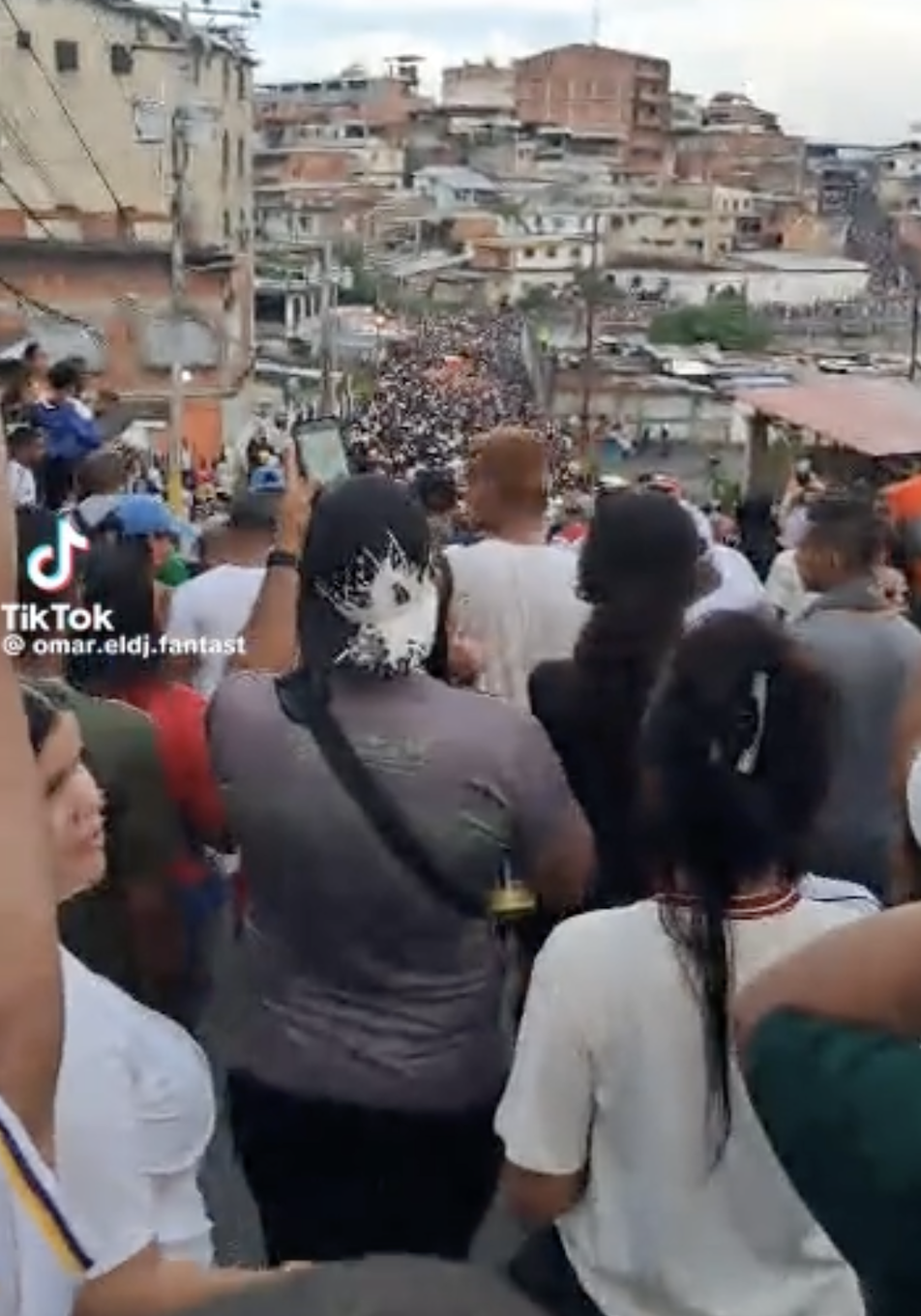
*****

“In Venezuela, There is a Hardened Collective Leadership”
Posted by Internationalist 360° on January 6, 2026
Yunus Soner

Image

Interview with Turkish TV channel TV24

UWI author Yunus Soner has travelled various times to Venezuela and spent last year an entire month in the country during the presidential elections. He provided an interview to Turkish TV channel TV24 after the US hijacking of Venezuelan President Maduro. Below is the transcription of the interview.


You are someone who knows the region and the stance of the Venezuelan people very well. Since this incident occurred, many questions have been raised. Some commentators even say: “If you can enter a country and take a head of state from his room like this, then someone inside must have collaborated.”

Based on your sources and communications, what is being discussed in Venezuela? What kind of scenario is being considered? How was Nicolás Maduro taken so easily?

First of all, it must be stated clearly that this is not the situation in Venezuela. President Nicolás Maduro was not taken or kidnapped so easily. As part of this operation, the United States carried out bombings in four different states of Venezuela. Air defense systems were targeted, and acts of sabotage were carried out against the electricity grid in the capital, Caracas.

According to figures released so far, more than 40 members of Maduro’s security detail were killed in the attack, and more than 200 people were injured. Among the injured are civilians, because these bombings also targeted civilian neighborhoods. Therefore, the impression that this was an “easy operation” does not reflect reality.

How has the public reacted? On social media, we see some accounts expressing support. Is there still a sense of shock in Venezuela, or have reactions begun to emerge?

On Sunday, the Venezuelan people—especially in Caracas—took to the streets by the thousands and delivered a very clear message: “We want our President Maduro back. Our president has been kidnapped and must be freed.”

This was not limited to Venezuela. Thousands of people took to the streets in Mexico City, and demonstrations were held in Montevideo, Chile, Argentina, and Cuba. Across Latin America, protests against this act of kidnapping have begun.

Colombian President Gustavo Petro also issued a call on social media supporting these actions and urging the people of Latin America to take to the streets.

To understand this reaction, we must grasp Latin America’s historical consciousness. This continent has faced countless U.S. interventions over the past 200 years—direct military interventions, embargoes, U.S.-backed coups, and coup regimes. Brazil and Argentina, for example, experienced military dictatorships that lasted for decades, during which millions of people lost their lives.

For this reason, such an action by the United States is perceived as a direct attack on the soul and collective memory of Latin America.

There may, of course, be criticisms of Maduro. People may suffer from economic difficulties or have questions about elections. However, what is perceived here is something much larger: a direct assault on the political psychology of the continent. This is why the protests are not limited to Venezuela but are spreading across Latin America and are expected to continue.

Yesterday, a meeting of the Community of Latin American and Caribbean States was held, and this action was condemned. In addition, Brazil, Chile, Colombia, Mexico, and Uruguay issued a joint statement condemning the tendency to kidnap heads of state and rejecting attempts to seize natural resources.

When you look from the Global South, rather than from Washington or through the statements of Trump and Rubio, you see a growing resistance and convergence. For example, Colombian President Gustavo Petro, despite being highly critical of the Venezuelan government and calling for a return to democracy, is supporting the protests in Caracas.

I would also like to ask this: Do you think this widespread resistance could affect Maduro’s fate? He is expected to appear before a court today.

This is not an easy situation. Expecting a quick decision from a U.S. president like Trump—whose ego is high and whose claims are bold—to release Maduro swiftly is not realistic.

However, the Venezuelan government does not accept this situation under any circumstances. The first cabinet meeting since the incident was held yesterday, and a commission was established to work for Maduro’s release. The commission will be chaired by National Assembly President Jorge Rodríguez, with Foreign Minister Yván Gil also taking part. A struggle will begin on both diplomatic and mass levels.

There is virtually no debate internationally about the illegality of this act. It constitutes a clear violation of the United Nations Charter. Today, the spokesperson of the Chinese Ministry of Foreign Affairs stated explicitly that the United States had kidnapped Maduro and demanded his immediate release, calling on Washington to stop undermining the Venezuelan government and to resolve its disputes through diplomatic and legal means.

At the same time, government functions in Venezuela are continuing. During the same cabinet meeting, another commission was formed to promote food security and industrial productivity. Efforts to strengthen local governments and advance economic development are ongoing.

The prevailing atmosphere in Caracas is not one of panic. Claims such as “Who among us is an internal agent?” do not have strong resonance. On the contrary, there is a determination to continue government programs, strengthen local administrations, and pursue economic development.

I would also like to share a figure: According to United Nations data for 2024, Venezuela recorded the second-highest economic growth in Latin America, at 8.5 percent. For 2025, growth of 6.5 percent is projected.

Despite the maritime blockade imposed by the United States and the seizure of oil tankers, Venezuela is continuing on a path of economic recovery. While the government is focused on securing President Maduro’s release, it is simultaneously continuing to govern and implement its development agenda.

At a recent press conference, U.S. President Donald Trump referred to Venezuela’s opposition leader, María Corina Machado. He stated that Machado is currently unable to provide leadership, that she does not enjoy significant support or respect, and described her as “a very nice lady,” but not someone capable of leading at this moment.

As someone who knows Venezuela well, does Machado actually have public support in the country, or is Trump correct in saying that she lacks respect and backing?

María Corina Machado’s support among the Venezuelan public was already very limited, and it can now be said to have collapsed entirely. She openly supported sanctions against Venezuela during the country’s most difficult periods and even called for those sanctions to be intensified. She comes from a very wealthy, elite, bourgeois family and has remained largely disconnected from the broader population.

Her political base was mostly confined to affluent neighborhoods in Caracas, such as Altamira and Las Mercedes. In that sense, Donald Trump’s assessment is accurate. Machado never had broad public support in Venezuela, and now that support has effectively dropped to zero.

Her departure from the country—under the pretext of receiving the Nobel Peace Prize—was, in fact, an admission of this reality. If you are a genuine contender for power, you do not abandon your country; you stay and attempt to gain power domestically.

At present, I believe Machado is in a European country, although I do not know exactly which one. The Americans themselves do not appear particularly concerned with her whereabouts.

For viewers who are not closely following Venezuela, could you explain why she left the country and why she is no longer there? Many people may not be aware of the reasons.

Of course. Following the 2024 elections, Machado refused to recognize the results announced by Venezuela’s National Electoral Council. Even before the elections, the political movement she belonged to had already declared that it would not recognize the official results.

Instead, she published what she claimed were her own collected vote tallies and argued that the candidate she supported, Edmundo González, had won the election. By rejecting the results of a Venezuelan state institution, she went into hiding and refused to acknowledge Nicolás Maduro’s electoral victory. For several months, her exact whereabouts were unknown.

She released videos from undisclosed locations but never appeared publicly. Eventually, the Nobel Peace Prize was awarded to her, and she fled the country to collect it.

Machado left the country through illegal means. This is evident because she did not travel through an airport or board a plane using official documents. Instead, unverified reports circulated in the U.S. media suggesting that she was smuggled out of the country by various means. These reports were never confirmed. She traveled to Norway but arrived a day late for the ceremony, although she appeared there the following day.

That is in so far important as she was the US’s factual candidate to govern the country. The US had determined her political puppet, Edmundo Gonzalez as president of Venezuela after the 2024 elections. Now, thay ambition has seemingly failed, with the US being incapable of establishing a puppet government in Caracas.

Trump claimed that he rules Venezuela now. What do you make of that?

Well, I watched the recent cabinet meeting in Caracas and did not see any US representatives there. The same ministers as before the hijacking were present, took certain decisions regarding local democracy, agriculture etc.

Besides, Rubio himself stated that he had called Rodriguez to present demands. That does not sound as having appointed a staff to rule the government.

Besides, we see that the US naval blockade continues, as well as the warnings against civilian use of airspace. Hence, the US pressure – from the outside – is continuing.

How is your evaluation of Acting President Delcy Rodriguez? Trump said that if she doesn’t do the right thing, she will pay an ever higher price..

I would like to emphasize firstly that we are talking here about a pretty collective leadership. Nicolas Maduro, Delcy Rodriguez, Jorge Rodriguez, Diosdado Cabello, these politicians are part of a collective.

This emerged specifically after the death of Hugo Chavez. They emerged in the context of declining oil prices, a serious economic crisis, emerging sanctions, people like Juan Guaido declaring themselves president within the country. Furthermore, they have gone already through the first Trump Administration, with invasion threats, Maduro being declared a narco-terrorist etc. This is a hardened collective leadership.

This is the process they have all gone through, and one which one needs to have in mind when preparing scenarios on how Maduro will act in the court and what the Acting President Rodriguez will do.

https://libya360.wordpress.com/2026/01/ ... eadership/

******

Jonathan Cook: 4 Observations on Maduro Kidnap
January 7, 2026

A unipolar world leaves all of us prey to Trump’s destabilizing gangsterism and a rapacious, destructive, U.S. corporate capitalism.


Image
(SWinxy /Wikimedia Commons/ CC BY 4.0)

By Jonathan Cook
Jonathan-Cook.net

Four observations on the Trump administration’s flagrant lawbreaking in abducting Venezuela’s president, Nicolas Maduro, from Caracas and bringing him to New York to “stand trial” on “narco-terrorism” and firearms charges:

ONE: It is a sign of quite how much of a rogue state the U.S. has become that Washington isn’t even trying to come up with a plausible reason for kidnapping the Venezuelan president.

In invading Afghanistan, the U.S. said it had to “smoke out” Al-Qaeda leader Osama bin Laden from his mountain lair after the 9/11 attacks. In invading Iraq, the U.S. said it was going to destroy Saddam Hussein’s “weapons of mass destruction” that threatened Europe. In bombing Libya, the U.S. claimed it was preventing Muammar Gaddafi’s troops from going on a Viagra-fuelled campaign of rape.

Each of these justifications was a transparent falsehood. The Taliban had offered to hand over bin Laden for trial. There were no WMD in Iraq. And the Viagra story was a work of unadulterated fiction.

But earlier U.S. administrations at least had to pretend their actions were driven by humanitarian considerations and the need to maintain international order.

The charges against Maduro are so patently ridiculous you need to be a Trump fanboy, an old-school imperialist or deeply misinformed to buy any of them.

No serious monitoring organisation thinks Venezuela is a major trafficker of drugs into the U.S., or that Maduro is personally responsible for drug-trafficking. Meanwhile, the firearm charges are so preposterous it’s difficult to understand what they even mean.

Note well the pattern:

Israel and the US commit genocide in Gaza – the media tell us it’s law enforcement to defeat Hamas.

The US abducts Venezuela’s president – the media tell us it’s law enforcement against drugs and firearms violations.

It’s not surprising they do it. But…

— Jonathan Cook (@Jonathan_K_Cook) January 4, 2026


TWO: Unlike his predecessors, President Donald Trump has been honest about what the U.S. really wants: control of oil. This is an old-fashioned, colonial resource grab. So why are the media even pretending that there is some kind of “law enforcement” process going on in New York? A head of state has been abducted — that’s the story. Nothing else.

Instead we’re being subjected to ridiculous debates about whether Maduro is “a bad man,” or whether he mismanaged the Venzuelan economy.

Sky News used an interview with Britain’s former Labour Party leader, Jeremy Corbyn, to harangue him, demanding he condemn Maduro. Why?

Precisely to deflect viewers from the actual story: that in invading Venezuela, the U.S. committed what the Nuremberg trials after the Second World War judged to be the supreme international crime of aggression against another state. Where have you seen any establishment media outlet highlight this point in its coverage?

Sky News journalist: “Only when you accept my premise that Trump had grounds to abduct Maduro, will I move on…”

This is how the media launders the supreme crime of aggression when our side does it. https://t.co/sLtct2WU1t

— Jonathan Cook (@Jonathan_K_Cook) January 7, 2026


If Sky and other media are so worried about “bad men” running countries — so concerned that they think international law can be flouted — why are they not haranguing U.K. Prime Minister Keir Starmer and Foreign Secretary Yvette Cooper over Israel’s prime minister, Benjamin Netanyahu, who is wanted by the International Criminal Court for crimes against humanity?

Doesn’t that make him a very “bad man,” far worse than anything Maduro is accused of? Why are they not demanding that Starmer and Cooper condemn him before they are allowed to talk about the Middle East?

When Russia invaded Ukraine, the Western media did not weigh the justifications for Moscow’s invasion, or offer context, as they are now doing over the lawless attack on Venezuela.

They responded with shock and outrage. They were not calm, judicious and analytical. They were indignant. They warned of “Russian expansionism.” They warned of Russian President Vladimir Putin’s “megalomania.”

They warned of the threat to international law. They emphasised the right of Ukraine to resist Russia. In many cases, they led the politicians in demanding a stronger response. None of that is visible in the coverage of Maduro’s abduction, or Trump’s lawbreaking.

THREE: The left is often censured for being slow to denounce non-Western powers like China or Russia, or being too wary of military action against them. This is to misunderstand the left’s position.

It opposes a unipolar world precisely because that inevitably leads to the kind of destabilising gangsterism just demonstrated by Trump’s attack on Venezuela. It creates a feudal system of one lord, many serfs — but on the global stage.

That is exactly what we see happening now as Trump and Marco Rubio, his secretary of state, mouth off about which country — Colombia, Cuba, Greenland, Mexico — is going to be attacked next.

It is exactly why every European leader, from Keir Starmer to EU foreign policy chief Kaja Kallas, sucks up to Trump, however monstrous his latest act. It is exactly why the United Nations secretary general, Antonio Guterres, speaks so limply about the general importance of “the rule of law” rather than articulating a clear denunciation of the crimes the U.S. has just committed.

Starmer: “We regarded Maduro as an illegitimate President and we shed no tears about the end of his regime.”

Pretty sure Putin regarded Zelenskiy as an “illegitimate president” too.

So presumably invading Ukraine was okay, then? https://t.co/tCwaIbgQRr

— Jonathan Cook (@Jonathan_K_Cook) January 4, 2026


Hard as it is for Westerners to acknowledge, we don’t need a stronger West, we need a weaker one.

But harder still, Westerners need to understand that the very concept of “the West” is an illusion.

For decades, Europe has been simply hanging on to the coat-tails of a U.S. military behemoth, in the hope that it would protect them. But in a world of diminishing resources, the U.S. is showing quite how ready it is to turn on anyone, including its supposed allies, for a bigger share of global wealth. Just ask Greenland and Denmark.

European states’ true interests lie, not in prostrating themselves before a global overlord, but in a multipolar world, where coalitions of interests need to be forged, where compromises must be reached, not diktats imposed.

That requires a foreign policy of transparency and compassion, not conceit and arrogance. Without such a change, in an era of burgeoning nuclear tripwires and growing climate chaos, we are all finished.

FOUR: Washington’s goal is to make Venezuela once again a haven for private U.S. capital. If the new acting president, Delcy Rodriguez, refuses, then Trump has made it clear Venezuela will be kept as an economic basket-case, through continuing sanctions and a U.S. naval blockade, until someone else can be installed who will do U.S. bidding.

Venezuela’s crime — one for which it has been punished for decades – is trying to offer a different economic and social model to America’s rampant, planet-destroying, neoliberal capitalism.

The deepest fear of the West’s political and media class is that Western publics, subjected to permanent austerity as billionaires grow ever richer off the back of ordinary people’s immiseration, may rise up if they see a different system that looks after its citizens rather than its wealth elite.

Venezuela, with its huge oil reserves, could be precisely such a model — had it not been long strangled by U.S.-imposed sanctions. A quarter of a century ago, Maduro’s predecessor, Hugo Chavez, launched a socialist-style “Bolivarian revolution” of popular democracy, economic independence, equitable distribution of revenues, and an end to political corruption.

It reduced extreme poverty by more than 70 percent, halved unemployment, quadrupled the number of people receiving a state pension and schooled the population to reach literacy rates of 100 percent. Venezuela became the most equal society in Latin America — one reason why millions still turn out to defend Maduro.

Chavez did so by taking the country’s natural resources — its oil and metal ores — out of the hands of a tiny domestic elite that had ruined the country by extracting the national wealth and mostly hoarding or investing it abroad, often in the U.S.

He nationalised major industries, from oil and steel to electricity. Those are the very industries that Maria Corina Machado, the Venezuelan opposition leader feted by the West, wants returned to the parasitic families, like her own, that once ran them privately.

Seeing the way Venezuela has been treated for the past two decades or more should make it clear why European leaders — obedient at all costs to Washington and the corporate elites that rule the West — are so reluctant to even consider nationalising their own public industries, however popular such policies are with electorates.

Britain’s Keir Starmer, who only won the Labour leadership election by promising to nationalise major utilities, ditched his pledge the moment he was elected. None of the traditional main U.K. parties is offering to re-nationalise water, rail, energy and mail services, even though surveys regularly show at least three-quarters of the British public support such a move.

The fact is that a unipolar world leaves all of us prey to a rapacious, destructive, U.S. corporate capitalism, which, bit by bit, is destroying our world.

The issue isn’t whether Maduro was a good or bad leader of Venezuela – the matter the western establishment media wants us concentrating on. It is how do we put the U.S. back in the box before it is too late for humanity.

https://consortiumnews.com/2026/01/07/j ... ro-kidnap/

*******

Escalation-Mad Trump's Coast Guard Seizes "Russian" Ship 5,500 km From US Coasts
Simplicius
Jan 07, 2026

Today’s latest Trump escalation brings us the capture of an alleged-to-be Russian oil tanker by the US Coast Guard, operating approximately 5,500km from the US coasts they’re meant to be “guarding”, somewhere between Iceland and the UK.

Image

Image

In truth, no one seems to quite know who the ship actually belongs to. It was named the Bella-1 and was “allowed” to re-flag itself under the Russian flag days ago, before it began sailing—apparently—toward Murmansk, according to some sources.

Statement from Russia on this count:

On December 24, 2025, the tanker Marinera received temporary authorization to sail under the Russian state flag, issued in accordance with Russian law and international legal norms.

Today, at around 15:00 Moscow time, U.S. naval forces boarded the vessel on the high seas, outside the territorial waters of any state. Contact with the ship was subsequently lost.

Under the 1982 UN Convention on the Law of the Sea, the high seas are governed by the principle of freedom of navigation. No state has the right to use force against vessels lawfully registered under the jurisdiction of another state.


Meanwhile, this statement from the US indicates the US does not consider the ship to be Russian:

The USA states that it does not consider the tanker “Marinera” to belong to Russia and that it does not belong to any country. The USA continues to claim that it believes it has the right to seize all tankers involved in transporting Venezuelan oil.

Karoline Leavitt even called it “a Venezuelan shadow fleet ship that was deemed stateless after flying a false flag”.

In fact, the whole “shadow fleet” charade is a big shell game, with ships owned by various front companies switching flags like changing underwear, though this ship was said to have Russians as well as Chinese and possibly other nationalities on board.

Senator Markwayne Mullin said the United States is not concerned about Russia’s reaction to the seizure of its oil tanker. (Video at link.)

The tanker, by the way, was empty, as proven by photos showing its extremely shallow draft. It appears to have never quite reached Venezuela, where it was presumably meant to pick up oil.

The operation to seize the ship was aided by the UK, and according to British OSINT accounts, involved an almost comically disproportionate amount of aerial assets:

Image

UPDATE: Operation "Seize Marinera / Bella 1"
(This list will likely be updated again as more information comes to light)

We know of RAF involvement & I've detailed the US aircraft we know have flown into the area and those we suspect were involved!

Image

The airborne operation to seize the tanker Marinera is being supported by a U.S. Air Force Boeing KC-135T Stratotanker refueling aircraft, a U.S. Air Force Boeing P-8A Poseidon patrol aircraft, and a British Boeing Poseidon MRA1. Operating nearby is an entire chain of U.S. special-mission aircraft, including the Pilatus U-28A Draco.


That seems a lot of resources to expend for just an empty ship—it’s more likely the US was really trying to send a message, or Trump’s ego needed another PR boost like a hit of Epinephrine to keep the Epstein files on the backpage.

The most revealing part of the spectacle is that the US remains loudly bragging about how viciously they will continue to enforce the sanctions which are choking the life out of Venezuelans:

Image

Listen carefully below to the heartless neocon shill as he gloats over the devastation that the US is causing the Venezuelan people: (Video at link.)

US gonna hurt and starve all Venezuelans unless they abide

"The lights are literally going to go off. They're not going to be able to pay policeman or firefighters or teachers... unless they begin to cooperate with Pres. Trump"


In fact, a few months ago the Lancet released a peer-reviewed report showing that US economic sanctions have resulted in over 500,000 annual deaths since the 1970s:

Image
https://www.thelancet.com/journals/lang ... 5/fulltext
From the report:

Economic sanctions imposed by the USA or the EU were associated with 564,258 deaths (95% CI 367 838–760 677) annually from 1971 to 2021, higher than the annual number of battle-related casualties (106 000 deaths). This finding aligns with a previous Article in The Lancet Global Health showing the lethal effects of aid sanctions—economic sanctions specifically targeting development assistance in low-income or middle-income countries (LMICs)—which resulted in a 3·1% increase in infant mortality and a 6·4% increase in maternal mortality annually between 1990 and 2019.

Why is this particularly wanton now, more than ever? Because the Neocon Don, Donigula continues to unctuously boast about how the recent Venezuelan operations are all about “helping the Venezuelan people”:

Image

Ain’t that a joke.

How do you “benefit” people while simultaneously choking the life out of them? It is no different than Donigula’s hypocrisy concerning Ukraine, wherein he cries crocodile tears over the supposed “30,000 a month killed” and claims his efforts to stop the war were all about “saving lives”, while at the same time smarmily boasting about how much of a killing—pun intended—US weapons industries make by selling bombs to Ukraine.

This is the travesty of American imperial moralizing: just empty and performative emotional gesticulations for the purposes of global conquest.

On X I had espoused my opinion regarding the recent Venezuelan “cash bonanza” that Donigula has promised will enrich everyone—it is nothing more than the tariff scam 2.0:

“How much you want to bet the "Venezuelan cash bonanza" will just be another "tariffs 2.0", where "trillions" of phantom profits are celebrated that no one will ever see...just another phony psyop to put feather in Donigula's cap.”

"The money from the sale of Venezuelan oil will be accumulated in US accounts, the US Department of Energy announced.

These funds will be spent "in the interests of the American and Venezuelan peoples" and only at the discretion of the US authorities.

The ministry claims that it has already started selling Venezuelan oil on the global market."


Granted, that doesn’t mean tariffs are entirely a scam, I’m all for them. The scam proceeds from the Trump administration’s constant lies and exaggerations about who exactly the tariffs are benefiting, and what precisely is the actual financial windfall from them. Outlets have calculated maybe $80B in tariff profits total, while Trump has baselessly claimed “trillions” have been reaped: (Video at link.)

And even the $80B is totally moot given that just the defense budget alone was increased by dozens of billions under Trump, which means the tariffs funded nothing towards the public good or society at large—with the US’s public debt again increasing as always; it’s about honesty and transparency, not partisanship.

Oh wait, actually Donigula just announced the increase of the defense budget by a whopping $500B to a record-setting $1.5T:

Image

Don’t worry, I’m sure Venezuelan oil revenues will cover that!

Vox’s new piece has an interesting angle on that:

Image
https://www.vox.com/politics/473986/mad ... -trump-oil

It reveals something I mentioned last time, that American oil companies actually may not be hankering to get into the VZ market because Venezuela’s oil is even more expensive than US shale to extract, and the world is experiencing an oil glut, not a shortage:

Image

Read that again: “Trump’s official plans for Venezuela’s oil sector would be a headache (if not a disaster) for most of America’s fossil fuel industry.”

Rather than put Russia out of business like they had envisioned, the flooding of the market with VZ oil would put US frackers out of business, Vox writes.

(More at link, Russia)

https://simplicius76.substack.com/p/esc ... oast-guard
"There is great chaos under heaven; the situation is excellent."

User avatar
blindpig
Posts: 15306
Joined: Fri Jul 14, 2017 5:44 pm
Location: Turtle Island
Contact:

Re: Venezuela

Post by blindpig » Fri Jan 09, 2026 4:14 pm

The US Propaganda Campaign to Smear Venezuela’s Acting President Delcy Rodriguez
January 8, 2026

Image
Venezuela's Vice President Delcy Rodriguez speaks during a press conference in Caracas on August 11, 2025. (Photo by Juan BARRETO / AFP)

By Stan Smith – Jan 6, 2026

The US “regime change” operation against Venezuela has been defeated. The Bolivarian Revolution remains firmly in power. Now, Washington’s campaign against the Chavistas attempts to paint Interim President Delcy Rodriguez as compromising on the heritage of Presidents Nicolas Maduro and Hugo Chavez. The Wall Street Journal ran an article Venezuelan Regime’s New Strategy: Appease Trump to Survive, referring to Delcy Rodriguez’ official statement January 4 (below).

The Washington Post on January 6 could state “the Trump administration appears to have quietly settled on Delcy Rodríguez, Nicolás Maduro’s right hand, as the figure it prefers to lead Venezuela after Maduro’s fall. This was not an improvised choice. Reportedly, it is the result of prolonged negotiations in which she presented herself as the natural successor to Maduro.” In fact, Venezuela operated according to its constitution, approved in a national referendum, where the vice president takes office if the President cannot fulfill his duties. The vice president is Delcy Rodriguez. Her becoming president follows Venezuela’s highest law. Trump had nothing to do with it.

Trump’s remarks on January 3 that Rodríguez had spoken with Secretary of State Marco Rubio and appeared “quite courteous,” saying “we’re going to do whatever you need,” aimed to sell the story of her acquiescing to Washington. But Rodríguez swiftly contradicted that story hours later, appearing on state television to declare that “there is only one president in this country, and his name is Nicolás Maduro Moros.”

January 5, the Wall Street Journal escalated the campaign to smear now acting President Delcy in an article that came out two days after she assumed presidential powers. It claimed the CIA viewed Delcy as the best-positioned short-term successor to President Maduro. The intention is to make us think the CIA has a special connection with her. In fact, by this time, she was already interim president, and Washington saw it could do nothing about it but sell the story she is there by US choice.

This US fake news campaign seeks to sow division in the Chavista movement and among defenders of Venezuela by instigating rumors that the kidnapping of Maduro involved a “mole,” and that Delcy Rodriguez had a deal with the CIA and Trump.

In addition, much is made of part of her January 4 statement out of its context: “We invite the US government to collaborate with us on an agenda of cooperation oriented towards shared development within the framework of international law to strengthen lasting community coexistence.” Some interpret this as compromising if not a step towards capitulation. In fact, she emphasized Venezuela does not want war, but a “respectful international relationship between the United States and Venezuela, and between Venezuela and the countries of the region, based on sovereign equality and non-interference…That has always been the position of President Nicolás Maduro and it is the position of all of Venezuela at this time.” This is also exactly what Cuba has always asked of the United States.

Her whole statement: Message from Venezuela to the World and to the United States

Venezuela reaffirms its commitment to peace and peaceful coexistence. Our country aspires to live without external threats, in an environment of respect and international cooperation. We believe that global peace is built by first guaranteeing peace within each nation.

We consider it a priority to move toward a balanced and respectful international relationship between the United States and Venezuela, and between Venezuela and the countries of the region, based on sovereign equality and non-interference. These principles guide our diplomacy with the rest of the world.

We extend an invitation to the US government to work together on a cooperation agenda aimed at shared development, within the framework of international law, and to strengthen lasting community coexistence.


President Donald Trump: our peoples and our region deserve peace and dialogue, not war. That has always been the position of President Nicolás Maduro and it is the position of all of Venezuela at this time. That is the Venezuela I believe in, to which I have dedicated my life. My dream is for Venezuela to be a great power where all good Venezuelans can come together.

Venezuela has a right to peace, development, sovereignty, and a future.

Delcy Rodríguez, Acting President of the Bolivarian Republic of Venezuela


Unfortunately, many who should know better fell for the US rulers’ propaganda campaign. A Consortium News piece declared, Did Venezuela VP Hand Over Maduro in Deal With the US? Rather than exposing US psyops, which earned it its high reputation, here it gives it legitimacy. Another, Tariq Ali, once a respected Trotskyist anti-war activist, claimed on X that “the US is backing Delcy who has promised them whatever they want.” And reposts long discredited Eva Golinger, “Internal Coup? Was Maduro Betrayed by his VP?” And, “Sure seems like Delcy Rodriguez was the CIA source on the inside who set Maduro up and handed him over to the United States.” None of these smears are based on any evidence.

On January 4, President Trump declared, “If she doesn’t do what’s right, she is going to pay a very big price, probably bigger than Maduro.” Delcy Rodriguez has responded, “The Venezuelan people are a people who do not surrender, and we do not give up…President Nicolas Maduro’s instructions have been given. Let’s go out and defend our homeland…We are ready to defend Venezuela…We will never again be slaves.”

Manolo de los Santos’ excellent article explains who Delcy Rodriguez is. “The Rodríguez family’s revolutionary credentials are etched in struggle. Their father, Jorge Antonio Rodríguez, a leader of the Socialist League, a Marxist-Leninist organization, was tortured and murdered by the Punto Fijo regime in 1976. Both Delcy and her brother Jorge (the President of the National Assembly) emerged from this tradition of clandestine and mass struggle for socialism. President Maduro himself was a cadre of the same organization. To suggest betrayal among them or capitulation born of cowardice or opportunism ignores four decades of shared political formation, persecution, and leadership under relentless imperialist aggression and the class character of their revolutionary leadership.”

Now, not only do we have the US government repudiating the world and international law by invading a country and seizing its president for admitted concocted reasons. We must face the fact that the US psyops system continues to be so effective that it is able to dupe leading long-time opponents of the US empire, like Tariq Ali, into being mouthpieces for its own “regime change” propaganda.

https://orinocotribune.com/the-us-propa ... rodriguez/

While at this point we cannot be completely sure I agree with this analysis. Supposedly smart people took the bait. But Stan, whadda ya expect from a Trot?

******

It was the U.S., not Maduro, that tried to steal Venezuela’s 2024 elections
January 8, 2026 Struggle - La Lucha

Image
Venezuelan President Nicolas Maduro and Cilia Flores, greeting a massive crowd at the presidential campaign closing rally in Ave. Bolivar, Caracas, on July 25, 2025. Photo: Orinoco Tribune/file photo.

Venezuela Presidential Election: U.S. coup attempt defeated

Preparations for the U.S.-led coup attempt

Sep 8, 2024 — The people of Venezuela defeated a high-tech U.S.-led coup. The nation’s electoral authority held the 31st election since 1999 and, despite facing a colossal attack against the nation’s computerised electoral system, was able to announce the July 28 election results. The people of Venezuela, by re-electing President Maduro for the 2025-2031 term, emerged victorious against yet another U.S.-run “regime change” operation.

The coup plot involved a massive, sustained, months-long corporate media campaign spewing an unusually homogenous message: that President Maduro would be electorally defeated. Media outlets quoted “polls” giving U.S.-supported, extreme right-wing candidate Edmundo Gonzalez (fielded by the Unitary Platform coalition, PUD) 80% of the vote. On July 20, the Financial Times published “Is the game up for Venezuela’s ruling party after 25 years?”, stating that “most opinion polls suggest the opposition would crush Maduro by a margin of 20 to 30 points.” The mainstream media repeatedly quoted Maria Corina Machado “hoping” that “Nicolas Maduro accepts a negotiation process that allows an orderly and sustainable transition,” intended to persuade readers of the inevitability of Gonzalez’s victory.

The line taken by world corporate media—including The Guardian, El Pais, The New York Times, Washington Post, Le Monde, France 24, BBC, and Corriere de la Sera—was nearly identical in predicting Gonzalez’s victory. Did they know something we didn’t? There is only one center of power in the world with the might to command such obedience from corporate media, and it is in Washington, D.C.

Additionally, for several months before the election, Venezuela was subjected to a string of terrorist attacks targeting food storage facilities but mainly the country’s electricity system, with the obvious intention to damage it sufficiently to disable the computerised electoral system. Almost every time there is an election in Venezuela, terrorist attacks target the country’s electricity system (as happened in December 2021, a month after Chavismo massively won the November regional and municipal elections).

This mainstream media propaganda was supplemented by a campaign of fear (begun as early as April 2024) maintaining that in the “unlikely event” of President Maduro winning (contending this was only possible by rigging the election), a greater proportion of the population would leave the country. Media quoted “polls” asserting that up to 40% of Venezuelans—about 12 million people—would leave.

The coup attempt’s key ingredients
The corporate media bombardment was supplemented by an extreme right-wing media campaign of vicious hatred and threats not only against Chavistas but also other opposition presidential candidates and their families. The extreme right-wing verbal violence in social media was in full swing months before election day. An article in May 2024 prophesied:

This scenario of violence, exacerbated by political polarization and hate propaganda, creates a perfect breeding ground for social instability. The possibility of a scenario where violent groups try to sabotage the electoral process and impose their agenda by force is a latent threat that requires forceful measures to protect the peace of the country.

In Venezuela, opposition digital verbal violence around elections they lose has, in the past 25 years, unavoidably led to physical violence, including burning people alive and murdering many: about 20 in their 2002 failed coup, 11 in 2013, 43 in 2014, and 28 in 2017. All these events produced hundreds wounded and traumatized, with many crippled for life.

The cyberattack component

All of the above was supplemented by another component: a monumental cyberattack on election day, primarily targeting the CNE (National Electoral Council) computerised electoral system but also other state services. It was one of the worst such attacks against Venezuela.

According to Venezuela’s minister of science and technology, Gabriela Jimenez, the first phase of the cyberattack targeted CANTV (Venezuela’s main internet service provider) starting at about 6 p.m., just as polling centers began to close. The attack severely delayed transmission of polling centers’ results to the CNE totalizing center, hence the several hours it took to announce the results. CANTV’s contractor, U.S. company Columbus, reported to its client the deliberate cyber delay of transmissions.

The delay occurred due to a colossal increase in cyber-attacks directed at the CNE. Jimenez stated it was 30 million attacks per minute. She asked: who has the technical infrastructure and expertise (algorithms, etc.), equipment, energy sources and resources to unleash such volume of attacks per minute and sustain it for up to 20 uninterrupted hours?

Jimenez also reported that the Caracas stock exchange, the science and technology ministry and other ministries, the Central Bank, the Identification and Migration service, Inland Revenue, and other public services—critical for the functioning of the state—were targeted. No digital payments could be processed (deliveries, purchasing everyday items such as food and medicine, or payment of mobile phone bills) and no taxes could be collected because of the cyber-attacks.

The cyber-attacks also involved stealing public institutions’ data and publishing it, making public the names and full data of pensioners, and even the addresses of military officers with the slogan “Go for them!” The cyber-attacks were terrorist attacks. Jimenez explained that the source accounts had disguised IPs, but most, though not all, were from the United States.

The cyber-attacks intended not just to wreck the computerised electoral system’s transmission of election results—preventing the CNE from announcing any results at all—but also to disable as many other essential services as possible, aimed at creating generalized chaos and maximum pandemonium.

Post-election violence

The other key component of the U.S.-led coup attempt was the well-prepared wave of violence launched after their electoral defeat. Maria Corina Machado and her coalition unleashed thousands of paid thugs who went on the rampage on July 29, attacking anything representing public property with the most intense hatred directed at symbols of Chavismo: statues of Hugo Chavez, of Coromoto (an emblematic 17th century indigenous chieftain), and everything else within their reach. They also attacked Chavistas, leading to the death of 25 people.

Foreign minister Yvan Gil, informing the accredited diplomatic corps on Aug. 23, 2024, said there was clear evidence that Venezuela’s extreme right wing, “backed by the U.S. government … had hired the organized criminal gangs Tren de Aragua and Tren del Llano to initiate the coup d’etat” and deploy them “to generate post-electoral violence.” These gangs had engaged in the “purchase of votes in favour of the candidacy of Edmundo González Urrutia in areas with a strong territorial and political presence of Chavismo.”

The coup strategists expected that the wave of violence in many key cities, following the chaos and confusion caused by the generalized cyber-attacks, would force the authorities to deploy the national guard to many opposition-created points of violence as a diversion to facilitate the attack on the presidential palace. This last phase was conceived as a lethal blitzkrieg on the presidential palace. An armed mob attacked with a “bath of bullets” 60 international observers who were at the CNE headquarters in Caracas. President Maduro reported to the nation that on July 29 there had been two attempts to storm the Miraflores (presidential) palace by armed mobs.

Yvan Gil also explained that the coup model had been “designed by the CIA and the United States.” Up to Aug. 14, 2024, 30 members of such groups had been arrested with an arsenal that included “13 firearms (four of which are rifles), 302 cartridges, a grenade, two telescopic sights, eight radio transmitters, 10 flashlights, seven chargers, 35 Molotov cocktails, 12 cell phones, and six motorcycles.” These were professionals who, taking advantage of the chaos created, were entrusted with assaulting the presidential palace in preparation for the coup’s final phase: a “mass march on the palace,” proclaiming Edmundo Gonzalez president and probably requesting immediate international (military) assistance.

Maduro’s constitutional solution
The failure of the July 28 cyber-attack to destroy the CNE digital system (and that of almost every other public institution) delayed the polling stations’ transmission of results. The CNE’s first bulletin was issued nearly at midnight with 80% of the results which, in an irreversible trend, gave the victory to President Maduro (51.2% against Edmundo Gonzalez’s 44.2%). This result was confirmed with the CNE’s second bulletin with 97% of the results, with Maduro getting 51.95% against Gonzalez’s 43.18%.

Literally seconds after the CNE’s first bulletin, Maria Corina Machado appeared on television rejecting the results, alleging fraud and proclaiming Edmundo Gonzalez the winner. This claim was almost immediately echoed by world corporate media in an amazingly homogenous chorus. Machado and company claimed to have 40%, then 73%, then 80%, and even 100% of the voting records, which they followed by posting false results on an illegal website giving Gonzalez 67% to Maduro’s 30%.

Though the issuing of results by the CNE on July 28 had substantially disrupted a key component of the coup d’etat, the extreme right wing launched the planned wave of violence anyway. Confronted with such a lethal U.S.-led operation, on July 31 President Maduro filed an appeal before the Supreme Court to summon all candidates and representatives of all parties “to compare all the evidence and certify the results of July 28 through a technical appraisal.”

On the very same day, U.S. Secretary of State Antony Blinken, literally moments after Maduro’s appeal, stated that “given the overwhelming evidence … that Edmundo Gonzalez Urrutia won the most votes,” he extended U.S. recognition to Gonzalez as the winner. However, a few days later, Blinken backtracked, withdrawing such recognition. This is unprecedented—the U.S. has never backtracked on such an important decision, especially considering its obsessive, decades-long fixation with Venezuela.

The Supreme Court investigation

The Supreme Court carried out an expert-technical investigation and analysis of the election as requested by President Maduro. It summoned all candidates and all 38 political parties participating in the July 28 election to submit all election information they had. Most candidates complied, except Edmundo Gonzalez. Worse, the PUD parties supporting Gonzalez as a candidate did not submit any election material or evidence, “arguing that they do not have documentation [i.e.] they do not have witness records of the polling stations.” They were the only parties not to submit anything; the other 33 did.

The CNE submitted all the election material in its possession—100% of everything. Furthermore, Edmundo Gonzalez failed to comply with Supreme Court summons three times. And the “combative” Maria Corina Machado, in comic fashion, pretended to have gone into hiding.

On Aug. 22, the Supreme Court ruled that bulletins issued by the CNE were supported by the voting records transmitted by each voting machine and were in full agreement with the data provided by the national aggregation centers. Therefore, “We certify, in an unobjectionable manner, the electoral material examined and validate the results issued by the CNE indicating that Nicolás Maduro Moros was elected.”

The opposition’s fraudulent website

The reason for the opposition’s non-compliance is clear: the crass election fraud perpetrated by Machado and others in the extreme right-wing coalition behind Edmundo Gonzalez’s candidacy. The election information they published on an illegal and fraudulent website includes 9,472 images of election records that represent 30% of the total election records (of over 30,000 polling places). Worse, 83% of them do not have metadata, which means they went through editing software—that is, they “are not faithful copy of the original.”

The striking feature of Machado-Gonzalez election victory claims is the level of manipulation of the false results published in the illegal website, whose domain was created on July 27—the day before the election. This leads to the pertinent question: If María Corina Machado and Edmundo González won the elections and have the records to prove it, then why would they post these fake records?

No wonder Blinken backtracked and not a single government in the world has recognized Edmundo Gonzalez as “president-elect.” Yet, from the White House to Southcom, European Union foreign policy chief Josep Borrell, right-wing governments in Latin America including Chile’s Boric, Organization of American States Secretary-General Luis Almagro, the Carter Centre, the U.N. Panel of Experts, and everybody else all the way down the world political food chain—including, of course, world corporate media—have questioned the validity of President Maduro’s re-election.

Some left intellectuals
This food chain includes leftist intellectuals and academics such as Alejandro Velasco, Gabriel Hetland and Mike Phipps. There are others, but these three, due to the similarity in their messaging, are perhaps an emblematic sample.

All three, with no evidence whatsoever, penned articles concluding that Gonzalez had won and Maduro had lost. They seem to have been persuaded by the “data” posted in the illegal website set up by Maria Corina Machado and company, which has been irrefutably debunked from every imaginable angle.

Velasco bluntly stated “On July 28, Maduro lost” in The Nation (Aug. 8, 2024). Hetland’s piece is titled “Fraud foretold?” (Sidecar, Aug. 21, 2024), in which he concludes that “Socialists, of any stripe, should not provide cover for a government that fixes elections and then clings to power by brutally punishing its poorest citizens when they protest.” Phipps’ piece (Labour Hub, Aug. 21, 2024) states that Venezuela’s government response to the crisis caused by U.S. sanctions was “repression and electoral fraud.”

Probably in their zeal to condemn the Bolivarian government, all three hastily depict the paid thugs unleashed by Machado and company as a working-class rebellion against the government.

All three questioned the cyber-attacks, depicting them as a ruse to justify fraud, arguing that the alleged hacking did not stop the CNE counting the votes between July 28 and Aug. 2. Yet the CNE informed in detail that the hacking had not stopped the counting but had drastically delayed the transmission of results. As late as Aug. 19, the science and technology minister reported that the CNE and 120 Venezuelan state sites were suffering cyberattacks, which have continued.

This was followed by a terrorist attack against the extreme right wing’s favorite target, the electric system, on Aug. 30, which affected 21 states. Then, on Sept. 2, the Libertador Simon Bolivar Terminal railway station suffered deliberate fire sabotage in its electrical room. There had been similar attacks in December 2021 which affected various parts of 19 states, and in March 2019 that affected 80% of the country. The cyber and terrorist attacks were and are real, no matter what these three may say.

All three depict President Maduro’s government as neoliberal or implementing neoliberal policies, claiming his administration represents a break with the revolutionary legacy of Hugo Chavez. All three blame the government as the key contributory cause of the misery millions of Venezuelans have endured. Although all three garnish their arguments by bemoaning U.S. sanctions and reproaching the opposition for repeatedly crying fraud in the past, they wittingly or unwittingly parrot imperialism and right-wing arguments of election fraud.

All three argue for a “left” or “democratic” alternative to Chavismo, and in Hetland’s case for stopping “covering” (i.e., stop supporting) President Maduro’s government. All the contentions of this group are either prejudiced distortions of reality or simply false. Nino Pagliccia, when referring to Velasco’s plea for an alternative to Chavismo, hit the nail on the head by correctly asserting that such a stance “is not an affirmation of the ideals of the Bolivarian Revolution, but a capitulation to the U.S. and its sponsored opposition in Venezuela.”

What has substantially contributed to confusing the whole issue, perhaps unintentionally adding credence to the extreme right wing, U.S. imperialism and world corporate media’s propaganda about a “July 28 CNE-rigged election” narrative, has been the equivocal views of Brazilian President Lula and Colombian President Petro who, without any solid evidence, seemed to have taken for granted there was fraud in the elections. On Aug. 15, President Maduro responded by saying the Venezuelan government will never intervene in the internal affairs of those two countries. He noted that in Brazil’s case, when Bolsonaro alleged fraud in the 2022 election Lula won and refused to accept the results, the matter was decided by the Brazilian Judiciary, “and no one from Venezuela or our government went public to intervene in this affair.”

Conclusion
To the question, was there election fraud in the July 28 presidential elections in Venezuela? The answer is a categorical YES, but perpetrated by Maria Corina Machado, U.S.-backed candidate Edmundo Gonzalez and operatives in the PUD (as investigations are revealing).

Clearly, the fake PUD website with false election results, which does not bear even the most basic scrutiny, was created on the premise of successfully disabling the CNE election system, so that the United States, its European Union accomplices, its Latin American allies and Venezuela’s extreme right wing could point to theirs as the only site with voting results. It was a central plank of the U.S.-led coup plot—a coup plot the U.S. could apply against any government anywhere.

President Maduro, confronted with a U.S.-led coup including a gigantic cyberattack aimed at disabling the CNE and as much as possible of state services, plus generalized violence throughout the nation, including two armed assaults against the presidential palace, could have opted for declaring a state of exception and restricting civil rights (Article 338 of the constitution). Instead, he chose to resort to the Supreme Court’s Electoral Section to resolve the electoral dispute (Article 297), whose result demolished the gigantic pack of lies and fake news around election fraud claims. That is, President Maduro resorted to the democratic mechanisms of the rule of law as stipulated in the constitution. The Supreme Court’s verdict contributes to the consolidation of democracy.

Conversely, the PUD, Maria Corina Machado and Edmundo Gonzalez are left politically naked and morally exposed (about which not much effort is required), which explains why the former went into “hiding” and the latter went AWOL.

More importantly, the Chavista movement’s maturity and discipline, steered by President Maduro, was able to successfully defeat the coup by political means instead of force, and strictly within the rule of law and constitutional principles stipulated in the Bolivarian Constitution. As more details of the U.S.-led coup plot come out, the strength and people’s support for the Bolivarian process gets sturdier. Conversely, the pathetic efforts by Maria Corina Machado and her U.S. mentors to stage a massively promoted “great international protest,” despite mobilizing an army of influencers and paid journalists on social media, dismally failed to even fill four blocks in Caracas (in other cities, it was worse).

Ongoing U.S. aggression

Just a month after President Maduro’s election victory and the subsequent defeat of the U.S.-led coup, there was a massive terrorist sabotage to the Venezuelan National Electric System plunging almost the whole country into darkness. It was a rearguard action aimed at disabling state institutions in the hope of resuscitating the defeated U.S.-led coup.

The United States, with the complicity of Dominican Republic authorities, hijacked a Venezuelan plane used primarily by Venezuela’s vice president, Delcy Rodriguez. The U.S. Department of Justice stated (Sept. 2) it had “seized an aircraft we allege was illegally purchased for $13 million through a shell company and smuggled out of the United States for use by Nicolas Maduro and his cronies.”

Unlike some intellectuals in our sample, the U.S., its global accomplices and world corporate media do not ask what next for Chavismo. They don’t because they are part of a global U.S.-led machinery aimed at overthrowing the Bolivarian Revolution to destroy all its achievements. The group of intellectuals discussed here ask this question as though they have the answer when they seem unable to even spot a U.S.-led coup as it unfolds before our eyes.

However, President Maduro has answered that question by announcing mega-elections in 2025, which will elect 23 governors, 355 mayors, 23 legislative councils and 355 municipal councils. The only requirement to participate is to comply with Venezuela’s laws.

From the previous 31 electoral processes (and the July 28 presidential election), we know the 2025 elections will be fair, but they are unlikely to be free from U.S. interference and sanctions. The intellectuals discussed here, though recognizing the devastating consequences of U.S. sanctions in the cited articles, seem to accept them as a fact of life (“The prospects of the U.S. lifting sanctions appears remote,” Hetland) and noticeably fail to demand their lifting.

Perhaps for the coming 2025 elections these writers may craft well-written pieces to demand the U.S. does not interfere. We in the solidarity movement will continue to call for the immediate and unconditional lifting of all U.S. illegal sanctions and for a stop to U.S. criminal interference in Venezuela’s internal affairs. The president of Venezuela is elected by the people of Venezuela, not hand-picked by the U.S. State Department.

U.S. Hands off Venezuela!

https://www.struggle-la-lucha.org/2026/ ... elections/

******

The Current Situation in Venezuela: A Government in Charge, a People Resilient
Posted by Internationalist 360° on January 7, 2026
Vijay Prashad, Carlos Ron

Image
Delcy Rodriguez visiting Commune Jan 6 VenezuelaActing Venezuelan President Delcy Rodríguez visited the José Félix Ribas Socialist Commune in Caracas on January 6, 2026 where she declared 7 days of national mourning and reaffirmed the government’s commitment to building communal power. Photo: Minister of Communication

Taking stock of the aftermath of the US military attack on Venezuela and the kidnapping of Nicolás Maduro and his wife Cilia Flores and what comes next.


On the early morning of January 3, the United States government launched a massive attack on Caracas, Venezuela, and three of the country’s states. Roughly 150 aircraft swarmed the skies, bombing with exceptional ferocity. Amongst these aircraft were EA-18 Growlers equipped with the most advanced electronic warfare systems, such as the Next General Jammers, as well as AH-64 Apache and CH-47 Chinook helicopters. Residents of the city had never experienced such sustained violence: loud explosions, massive plumes of smoke, and aircraft – seemingly unconcerned about counter-attacks – plunged the city into darkness. Later, at a press conference, US President Donald Trump said, “The lights of Caracas were largely turned off due to a certain expertise that we have. It was dark and it was deadly.” The United States does not spend more than USD 1 trillion annually on its military without having built the world’s most lethal arsenal. This was hyper-imperialism in hyper-drive.

Elite Delta Force troops descended from the helicopters to the location where President Nicolás Maduro was spending the night. They faced resistance from soldiers on the ground, but overwhelming firepower from the air killed many Venezuelan and Cuban soldiers (24 Venezuelans, according to the Venezuelan Army, and 32 Cubans, according to Havana). Once ground resistance was neutralized, the Delta Force seized President Maduro and Venezuela National Assembly member, Cilia Flores, Maduro’s wife. They were taken to the USS Iwo Jima and then flown to the United States to stand trial in the Southern District of New York, based on an indictment alleging that they “corrupted once-legitimate institutions to import cocaine into the United States”. Six people are accused in the indictment, including Maduro and Flores.

Meanwhile, in Venezuela, Vice President Delcy Rodríguez assumed leadership in Maduro’s absence. She held a widely publicized meeting with all the main political leaders, including the Minister of Interior Diosdado Cabello who was also named in the indictment. In this initial meeting, Rodríguez called for the release of Maduro and Flores, emphasized that Maduro remains the legitimate president, and confirmed that the government remained intact and at work to assess the situation. Within a day, Rodríguez – now sworn in as acting president in the absence of Maduro – said that she is open to discussion with the United States to prevent another attack, though she continued to insist on the release and return of Maduro and Flores. Certainly, the scale of the attack by the United States made it clear that Venezuela cannot sustain a full barrage from the US over a period, thus, reopening dialogue will be necessary, especially regarding Trump’s primary interest: the oil industry. Rodríguez comes from a revolutionary family, her father Jorge Antonio Rodríguez being the founder of the Socialist League, in which Delcy Rodríguez and Maduro once served as cadres. There is no question of any surrender of the Bolivarian process, which is a fundamental political line for Rodríguez and the team that is leading Venezuela’s government.

As dawn broke on January 3 and the stench of bombs lingered in the air, the population was both alarmed and shocked. It is important to emphasize that the 2003 Operation Shock and Awe bombing campaign in Iraq was dwarfed by the bombing of Operation Absolute Resolve (2026) against Venezuela. The bombs were way more powerful, and the weapons systems far more sophisticated and overwhelming. Yet it did not take long for people to take to the streets. A spontaneous open-mic outside the Presidential Palace of Miraflores drew crowds to speak out against the attack on their country. Most speakers spoke passionately with great feeling about the Bolivarian process. They understood that this attack was against their sovereignty, and – more significantly – that this was an attack on behalf of Venezuela’s old oligarchy and US oil conglomerates. Their clarity was striking, yet corporate media ignored this coverage.

The weakness of the new mood in the Global South

A few hours before the attack on Venezuela, President Maduro met with Qiu Xiaoqi, the high envoy of President Xi Jinping. They discussed China’s Third Policy Paper on Latin America (released December 10), in which the Chinese government affirmed, “as a developing country and a member of the Global South, China has always stood in solidarity through thick and thin with the Global South, including Latin America and the Caribbean.” They reviewed the 600 projects that are being jointly conducted between China and Venezuela and the USD 70 billion Chinese investment in Venezuela. Maduro and Qiu chatted, and then they took photographs which were posted widely on social media and shown on Venezuelan television. Qiu then left with the Chinese Ambassador to Venezuela Lan Hu and the directors of the Ministry of Foreign Affairs’ Latin America and Caribbean department, Liu Bo and Wang Hao. Within hours, the city was being bombed. That day, the spokesperson for the Chinese Foreign Ministry said, “Such hegemonic acts of the US seriously violate international law and Venezuelan sovereignty, and threaten peace and security in Latin America and the Caribbean region. China firmly opposes it.” Beyond that, little could be done. China does not have the capacity to roll back US hyper-imperialism through military force.

Within Latin America, the rising Angry Tide – led by Argentina’s Javier Milei – celebrated the capture of Maduro, while Ecuador’s right-wing President Daniel Noboa made the point not only about Venezuela, but about the need to defeat the Pink Tide that had been inspired by Hugo Chávez’s Bolivarianism: “All the criminal narco-Chavistas will have their moment. Their structure will finally collapse across the continent.” Argentina led a group of ten countries to block a condemnation of the US violation of the UN Charter at a meeting of the thirty-three-member Community of Latin American and Caribbean States (CELAC). These countries were Argentina, Bolivia, Costa Rica, Dominican Republic, Ecuador, El Salvador, Panama, Paraguay, Peru, and Trinidad and Tobago. It is a sign of the Angry Tide’s growing influence that CELAC, once able to stand for sovereignty, is now dragged into support for US adventurism in Latin America and for Trump’s orientation toward the revival of the 1823 Monroe Doctrine.

CELAC was established in 2010 from the Rio Group (1986) in 2010 to form a regional body excluding the United States (as the Organization of American States does), which is why its creation was helped along by the Pink Tide. Its first co-chairs were right-wing Chilean President Sebastián Piñera and Venezuela’s Hugo Chávez. This kind of unity of the right and left over the idea of sovereignty is now weakened beyond recognition. A failure of CELAC to act has meant that not only its orientation (including the passage of the idea that Latin America is a Zone of Peace in the 2014 Havana summit) has been dismissed, but so too has the Charter of the Organization of American States.

Trump has openly pledged to revive the 1823 Monroe Doctrine, first articulated by US President James Monroe to combat not only European interference in the Western hemisphere but also the growth of independence led by people such as Simón Bolívar, one of Latin America’s greatest heroes. Bolivarianism was revived by Chávez as one of the core ideological frameworks of the Pink Tide. Trump’s open embrace of the Monroe Doctrine and his call for a “Trump Corollary” (do what it takes to enforce the Doctrine) signals the US aim to restore old oligarchies across the hemisphere and grant US conglomerates free rein (potentially even reviving the Free Trade Area of the Americas, a trade initiative defeated by Chávez and others in 2005). This is class struggle on a continental level.

https://libya360.wordpress.com/2026/01/ ... resilient/
"There is great chaos under heaven; the situation is excellent."

Post Reply