Blues for Europa

Post Reply
User avatar
blindpig
Posts: 14793
Joined: Fri Jul 14, 2017 5:44 pm
Location: Turtle Island
Contact:

Re: Blues for Europa

Post by blindpig » Mon May 27, 2024 3:04 pm

A New Iron Curtain Is Being Built From The Arctic To Central Europe

ANDREW KORYBKO
MAY 25, 2024

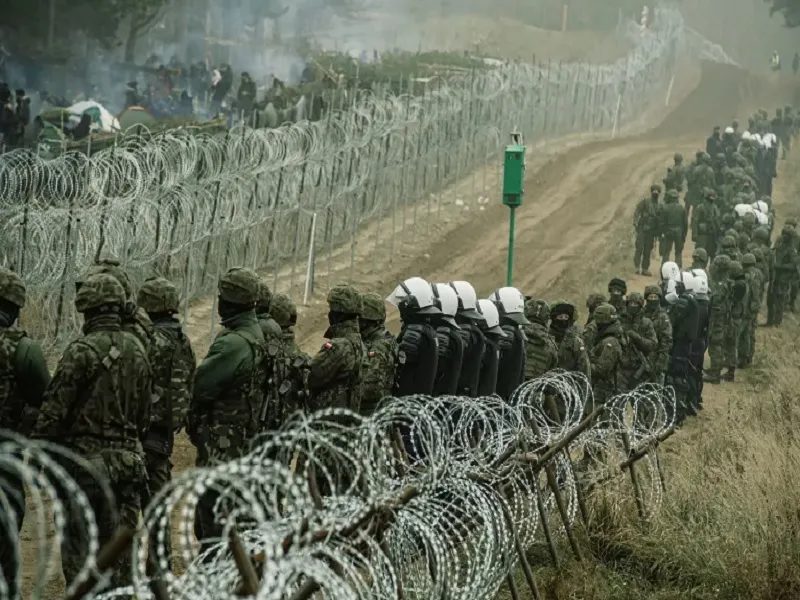
The new Iron Curtain that’s descending upon Western Eurasia from the Arctic (Finland) to Central Europe (Poland) via the Baltics is for psychological purposes to scare Europeans into doing whatever their leaders demand on false security-related pretexts so that the US can continue dividing-and-ruling them.

Image
Polish Deputy Defense Minister Cezary Tomczyk announced on Thursday that his country will combine its new “Shield East” border security
fortifications with the Baltic States’ “Baltic Shield” one, which was initially known as the “Baltic Defense Line”, to create a comprehensive series of border structures. When coupled with Finland’s newfound and foreseeably expanded ones, the end result is a new Iron Curtain from the Arctic to Central Europe. Here are some background briefings to bring everyone up to speed:

* 19 January: “Germany Is Rebuilding ‘Fortress Europe’ To Assist The US’ ‘Pivot (Back) To Asia’”

* 22 January: “The ‘Baltic Defense Line’ Is Meant To Accelerate The German-Led ‘Military Schengen’”

* 8 February: “Finland Is Opening Up NATO’s Arctic Containment Front Against Russia”

* 19 March: “Poland Is Poised To Play An Indispensable Role In Germany’s ‘Fortress Europe’”

* 13 May: “Poland’s Border Fortification Buildup Has Nothing To Do With Legitimate Threat Perceptions”

To sum it up, Poland comprehensively subordinated itself to Germany after Donald Tusk’s return to the premiership last December, which led to Germany resuming its decades-lost superpower trajectory at an accelerated pace with America’s blessing as the US “Pivots (back) to Asia” to contain China. Poland’s participation in the “military Schengen” then allowed Germany to help the Baltics, where it now has a base in Lithuania, build up their new Iron Curtain and thus assist in containing Russia on the US’ behalf.

Domestic political reasons explain why these five countries – Finland, Estonia, Latvia, Lithuania, and Poland – are fearmongering about an allegedly impending Russian invasion, which the US exploits to speed up the expansion of future German military hegemony along the EU’s eastern flank. Germany is no match for Russia, but it’s spending more on defense than any of those aforesaid countries, so it can easily become their “senior partner” and then manage their collective capabilities with US oversight.

Since Russia isn’t planning to invade the EU and thus spark World War III by attacking those neighboring NATO members, in which scenario the resultant nuclear exchange with the US would end most life on earth, it doesn’t actually matter that Germany and its vassals can’t take Russia on their own. The US just wants a reliable partner who can take the lead in building up the bloc’s first line of conventional defense in order to then fan the flames of hysterical Russophobia indefinitely for divide-and-rule purposes.

The Germany of today isn’t the Germany of several generations ago that twice sought to become a superpower by force. It despises conservatism and nationalism and instead embraces liberalism and globalism, but it’s every bit as much as bigoted as before, though this time it doesn’t want to genocide anyone. Today’s Germany shares the same ideological agenda as its former American foe, which is also the unofficial secular religion of the EU that it leads, therefore setting the stage for its US-assisted rise.

Whether the global systemic transition remains on track with presently tri-multipolar processes eventually resulting in complex multipolarity (“multiplexity”) or reverts to a system of Sino-US bi-multipolarity, the US wants to ensure that the EU remains its largest vassal in the New Cold War. This requires an ideologically reliable sub-hegemon to maintain the bloc’s subordination, ergo the role that the US envisages Germany playing, which is being advanced by its role in building the new Iron Curtain.

America’s geostrategic focus will inevitably return to Asia as it pivots back to that theater of the New Cold War in order to more muscularly contain China, which is why it’s proactively facilitating the resumption of Germany’s decades-lost superpower trajectory in order to prepare for that. The whole point is to empower the rise of a sub-hegemon in Europe for containing Russia on its behalf indefinitely, therefore freeing up valuable time and resources for concentrating much more on China’s containment.

The new Iron Curtain that’s descending upon Western Eurasia from the Arctic (Finland) to Central Europe (Poland) via the Baltics is for psychological purposes to scare Europeans into doing whatever their leaders demand on false security-related pretexts so that the US can continue dividing-and-ruling them. It serves no military purpose since the German-led EU is no match for Russia, plus any war between them would also involve the US and therefore likely lead to a nuclear exchange that nobody wants.

https://korybko.substack.com/p/a-new-ir ... eing-built

European Air Defense Might Be Divided Into Two Spheres Of Influence

ANDREW KORYBKO
MAY 26, 2024

Image

Germany might directly manage the northern half while France and Italy (senior and junior partners correspondingly) do the same with the southern one.

Politico reported that “Von der Leyen backs Polish, Greek calls for EU air defense shield” after their Prime Ministers demanded that “our economic and monetary union must be accompanied by a strong defense union” in a joint letter to her last week urging creation of this “’flagship’ programme”. The outlet also said that Germany’s “European Sky Shield Initiative” (ESSI), “which aims to jointly procure German, U.S. and Israeli air defense systems”, is competing with the French-Italian initiative to use SAMP/T systems.

The first was analyzed here regarding to the debate that’s raging within Poland between President Duda and Prime Minister Tusk over retaining their country’s planned dependence on Anglo-American air defenses or participating in the German-led ESSI respectively. Seeing as how Tusk’s government just announced that Poland will combine its “Shield East” border security fortifications with the Baltic States’ “Baltic Shield”, which will expand German military influence eastward, ESSI is likely a shoo-in.

As for the second, France’s scarcely discussed military influence in Romania and Moldova perfectly positions it and Italy to push the SAMP/T over that part of Europe, which could also naturally include the rest of the Balkan countries between them all. In that event, European air defense would be divided into two spheres of influence, with Germany directly managing the northern half while France and Italy (senior and junior partners correspondingly) do the same with the southern one.

From an American perspective, there are pros and cons to that scenario. On the one hand, it’s easier for a sub-hegemon like Germany to be responsible for the European theater of the New Cold War on the US’ behalf than to split this between partners. On the other, however, keeping the continent divided along two axes could hedge against the unlikely but high-impact risk of Germany one day “going rogue” by unilaterally repairing its relations with Russia without prior American approval and shaking up the world.

As its prior unipolar hegemony as a whole continues to weaken amidst the global systemic transition to multipolarity, the US will have ever less ways of influencing the outcome of this intra-EU competition. Furthermore, the US is preparing to “Pivot (back) to Asia” to more muscularly contain China, which is the main reason why the Europeans want to build their own air defense system – even if partially with American wares per the ESSI model – out of fear of being left in the lurch when that happens.

Objectively speaking, however, the EU has nothing to worry about when it comes to Russia since the latter isn’t going to invade the bloc and trigger Article 5’s tripwire for a nuclear exchange with the US. America reasserted its hegemony over the EU so well since 2022 though that European policymakers appear to have truly bought into their senior partner’s fearmongering campaign. That’s why many are concerned about what’ll happen when it pivots back to Asia or if Trump returns to power first.

The grand strategic benefits of reasserting its hegemony over the EU far outweigh the blowback of possibly losing out on highly profitable military contracts if European air defense bifurcates into the partially US-supplied German-led north and the French-Italian south. Different American decisionmakers, including those within the same levels of the policymaking hierarchy, have different views of which scenario is most optimal for their country’s interests given the pros and cons.

Altogether, the US will flexibly adapt to circumstances as they arise to ensure that its successfully reasserted hegemony over the EU isn’t weakened in scenario that Germany and France-Italy divide Europe into spheres of air defense influence. This intra-EU competition is strategically senseless as was explained since Russia isn’t going to bomb the bloc but is a boon for the military-industrial complex, which is why all relevant players are vying to push through their plans in order to maximally profit.

https://korybko.substack.com/p/european ... be-divided

******

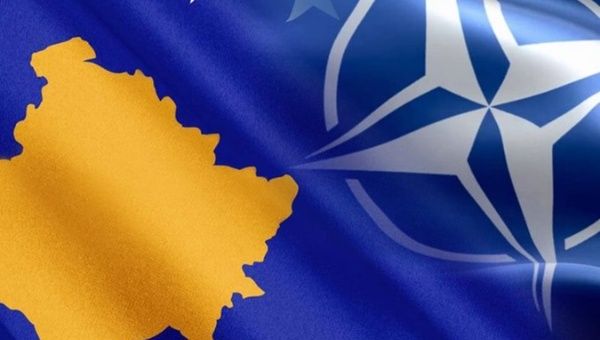
NATO Parliamentary Assembly Accepts Kosovo as Associate Member

Image
Representation of Kosovo's rapprochement with NATO. | Photo: X/ @ilirmetazyrtar

Published 27 May 2024 (2 hours 18 minutes ago)

On Sunday, the president of the Serbian Parliament urged this assembly not to grant associate status to Kosovo.


On Monday, the Parliamentary Assembly of the North Atlantic Treaty Organization (NATO) accepted Kosovo as an associate member. Previously, this country had held observer status since 2014.

"NATO is Kosovo's destiny, and this measure will ensure that the voice of the most pro-NATO people on the planet is heard," said Kosovo President Vjosa Osmani.

Driton Hyseni, head of the Kosovo delegation, said that this recognition comes after several years of excellent cooperation between the Assembly of the Republic of Kosovo and the NATO Parliamentary Assembly.

The NATO Parliamentary Assembly is institutionally separate from NATO but serves as an important link between NATO and the parliaments of member countries, as well as those of other nations and institutions.


After Russia launched its special military operation in Ukraine in February 2022, the authorities of Kosovo, which unilaterally separated from Serbia in 2008, applied for rapid NATO membership.

On Sunday, Serbian Parliament President Ana Brnabic urged members of the NATO Parliamentary Assembly not to grant associate status to Kosovo, arguing that this would reward Pristina's authorities in their attempts to obstruct EU-mediated dialogue.

Serbia does not recognize Kosovo's independence and considers that it cannot be admitted to international forums.

https://www.telesurenglish.net/news/NAT ... -0004.html
"There is great chaos under heaven; the situation is excellent."

User avatar
blindpig
Posts: 14793
Joined: Fri Jul 14, 2017 5:44 pm
Location: Turtle Island
Contact:

Re: Blues for Europa

Post by blindpig » Tue May 28, 2024 2:39 pm

Ursula von der Leyen Accused at ICC of ‘Complicity’ in Gaza Genocide
Posted by INTERNATIONALIST 360° on MAY 27, 2024

Image

Call to the International Criminal Court to Investigate Ursula von der Leyen for Complicity in War Crimes and Genocide Committed by Israel in the Occupied Palestinian Territories and in Gaza

27 May 2024, Geneva – On May 22, 2024, the Geneva International Peace Research Institute (GIPRI), the Collectif de Juristes pour le Respect des Engagements Internationaux de la France (CJRF) and a group of international concerned citizens, submitted a legal brief to the Prosecutor of the International Criminal Court (ICC) Karim Khan requesting the opening of an investigation against Ursula von der Leyen for complicity in war crimes and genocide against Palestinian civilians in the Occupied Palestinian Territories, including the Gaza Strip.

This legal brief, endorsed by various human rights groups and prominent academics and experts in international criminal law, calls the Prosecutor to initiate investigations on the basis of the information provided against Mrs. Ursula von der Leyen. The latter has been repeatedly informed of violations of international humanitarian law committed in the Occupied Palestinian Territories, particularly in the Gaza Strip, through reports from international organizations and foreign governments. This is evidenced by a letter sent to her on February 14, 2024, by the President of the Spanish government, Pedro Sánchez, and the then Irish Prime Minister, Leo Varadkar.[1]

Mrs Ursula von der Leyen is responsible for aiding and abetting the commission of crimes and violations of international humanitarian law, within the meaning of Article 25(3)(c) of the Rome Statute of the International Criminal Court. Mrs von der Leyen enjoys no functional immunity before the International Criminal Court by virtue of Article 27 of the Rome Statute.

The President of the European Commission is complicit in violations of Articles 6, 7 and 8 of the Rome Statute by her positive actions (military, political, diplomatic support to Israel) and by her failure to take timely action on behalf of the European Commission to help prevent genocide as required by the 1948 Genocide Convention. Mrs. Ursula von der Leyen cannot deny awareness of the plausibility of these crimes, especially following the International Court of Justice’s provisional measures order of 26 January 2024 in the pending ICJ case South Africa v. Israel. More importantly, Mrs. Von der Leyen has failed to take appropriate action to prevent such crimes, whereas the 1948 Convention on the Prevention and Punishment of the Crime of Genocide and the Statute of the International Criminal Court make prevention an erga omnes obligation.

For any further information, please contact :
Gilles-Emmanuel Jacquet, Vice-President of the Geneva International Peace Research Institute (GIPRI), Geneva, Switzerland. Contact : ge.jacquet@gipri.ch ; +41 78 895 24 40 Collectif de Juristes pour le Respect des Engagements Internationaux de la France (CJRF), Paris, France. Contact : comite.cjrf@gmail.com
[1] Leo Varadkar and Pedro Sánchez, Letter to the President of the Commission of the European Union Mrs. Ursula von der Leyen, Oifig an Taoisigh (Office of the Taoiseach) and Gobierno de España – Presidencia del Gobierno, 14/02/2024: https://www.lamoncloa.gob.es/presidente ... -Leyen.pdf

Source
Open-Letter Demanding Accountability From the EU Leadership for Complicity in Genocide

GENEVA INTERNATIONAL PEACE RESEARCH INSTITUTE

Dear President von der Leyen,
Dear President Michel,
Dear High Representative Borrell

We here at GIPRI in Geneva are coming back to you on the matter of a ceasefire in Gaza. We have had no response from you on our previous communications, the most recent of which dated 15th March has already been published as an open letter.

We have noted your condemnation in recent days of Israel’s use of starvation as a weapon of war, and your acknowledgment that the famine conditions we now see in Gaza are entirely man-made as a result of Israel’s war of aggression. This is a welcome position, but it is still not strong enough.

Why is there still no call for a ceasefire? Why no call for sanctions on Israel? Why no condemnation of the slaughter of hundreds of aid seekers murdered in cold blood?

The EU was very quick to sanction Russia two years ago. Israel’s crimes are infinitely worse, yet there is no call from the EU for them to suspend their violations of international law.

As our colleague Josh Paul has commented recently, “This has been an opportunity for Europe to stand up and demonstrate itself to be an important counterweight to the U.S. within the broader Western alliance. This could have been done in a way that would benefit both that alliance and help pull the U.S. out of its intellectual and moral stupor regarding Israel/Palestine policy.

Other than a few notable exceptions (to include Ireland, Belgium, Spain, Slovenia and Norway), the moment has been entirely missed, to the detriment of all of us.”

It is absolutely incumbent upon you as leaders of the European Union to demand an immediate ceasefire, according to your obligations under the Rome Statute. Time is no longer on our side, as we wake up every day to the horrific news of hundreds more innocent civilians killed overnight.

More than 13,000 children have been murdered in less than six months, and this has been on your watch. Many more are starving to death. How many more must be murdered before you say something? This is not even about Palestine anymore. It is about all of us. It is a shame and a disgrace on our collective humanity as citizens of this earth, that we have allowed such a slaughter of innocent children to take place and have done nothing to stop it.

Please be informed that our group is preparing a draft communication to the Office of the Prosecutor of the ICC (pursuant to Article 15 of the ICC Statute) on ‘Responsibility of officials of the European Union and of certain EU Member States for complicity in war crimes, crimes against humanity and genocide committed by the Israeli Armed Forces in the Gaza Strip’, focusing on President von der Leyen at this stage. We are preparing an amicus curiae brief to support other pending investigations concerning the ongoing genocide in Gaza.

It appears that civil society is now obliged to go public and call for the resignation of EU officials and the initiation of legal action in international courts simply to restore moral rectitude and the adherence to established international legal frameworks.

Unfortunately, your failed policies have so far proven unable or unwilling to prevent a genocide, from occurring in real time and in front of our eyes. We will continue to hold you accountable, and we will continue to demand that you take action and call for an immediate ceasefire until it happens.

Yours sincerely,

Jonathan O’Connor – Ireland
Gabriel Galice – France
Gilles Emmanuel Jacquet – France
Cristina Cabrejas – Spain
Soaade Messoudi – Belgium
Guy Mettan – Switzerland
Professor Alfred de Zayas – Switzerland, United States
Tim Clennon – Switzerland, United States
Pierre-Emmanuel Dupont – France

The Geneva International Peace Research Institute (www.gipri.ch) is a non-governmental organization with UN consultative status. It was founded in 1980 by Professor Roy Adrien Preiswerk, Director of the Institut Universitaire d’Etude du Developpement and Professor at the Institut Universitaire des hautes Etudes Internationales in Geneva.

Source


https://libya360.wordpress.com/2024/05/ ... -genocide/

Exposing the Srebrenica Sham with Nebojša Malić
Posted by INTERNATIONALIST 360° on MAY 27, 2024


ACTIVE MEASURES

In a politically-driven act of revisionism, the United Nations voted in favor of a resolution categorizing the massacre in Srebrenica as a genocide. Journalist Nebojša Malić joins the show for a high-level discussion on the Bosnian war and the implications the vote entails for the future of lawfare and UN legitimacy.

https://libya360.wordpress.com/2024/05/ ... jsa-malic/

******

Image
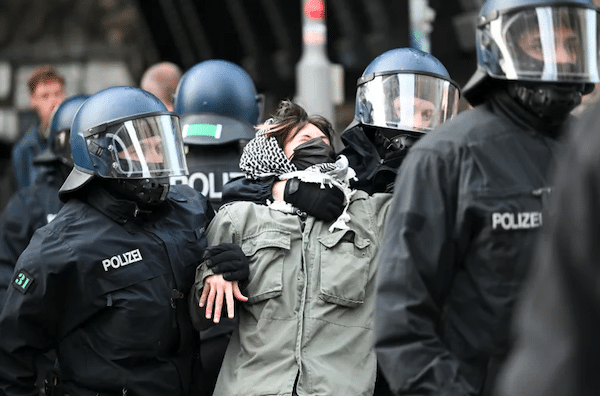
A pro-Palestinian protester at the department of social sciences at Berlin’s Humboldt University is removed from the building by police. Activists occupied the university in protest against Israel’s war on Gaza [Soeren Stache/picture alliance via Getty Images / Al Jazeera]

Punched, choked, kicked: German police crack down on student protests
Originally published: Al Jazeera on May 25, 2024 by Ruairi Casey (more by Al Jazeera) (Posted May 28, 2024)

“We are witnessing a great endangerment of academic freedom—and this has started since the beginning of Israel’s war on Gaza,” says Cecilia, an undergraduate student at Berlin’s Free University.

After her university published what she saw as a one-sided statement of support for Israel following the Hamas attacks of October 7, and students on campus began to experience an increase in Islamophobic harassment on campus, she and others formed a committee to show solidarity with Palestine and oppose Israel’s war in Gaza.

At universities across Germany, thousands of students like her have mobilised in support of Palestine, leading demonstrations, organising lectures and sit-ins occupying university buildings and campus lawns. They have also opposed the speeches of visiting Israeli officials—notably Israeli ambassador Ron Prosor who visited Cologne University in January and the Israeli judge, Daphne Barak-Erez who spoke at Humboldt University in February.

But students and university staff also say that their right to free expression has come under assault from hostile media coverage, repressive legal measures taken by universities and politicians, and the use of police violence against peaceful demonstrators.

“Staff, teachers and students who have been trying to objectively teach and raise their voice about what is happening in Gaza and Palestine have been systematically repressed,” says Cecilia.

Occupations and encampments
Campus activism in Germany has stepped up in recent weeks as students, following their American counterparts, have established occupations or encampments on university grounds in Berlin, Munich, Cologne and other cities. Organisers are calling for German universities, most of which are public, to support a ceasefire in Gaza, an academic and cultural boycott of Israel, an end to the repression of student activism, as well as further acknowledgement of Germany’s colonial history.

While some protests have proceeded peacefully, others have been dispersed by police, sparking public debate about whether students have exceeded the limits of protected speech and protest in Germany, or whether authorities have infringed on those same rights in order to suppress antiwar activism.

On Wednesday, students occupied the department of social sciences at Berlin’s Humboldt University. They unfurled a banner designating the building the “Jabalia Institute”, the name of a refugee camp in Gaza, and renamed its library after Refaat Alareer, a Palestinian poet killed by an Israeli air strike in December.

Inside, students barricaded the main entrance and spray-painted the walls with slogans including “Killing civilians is not self-defence” and “Resistance is legitimate”.

“People are realising that escalation works,” says Fawn, a protester who studies at Bard College Berlin.

Students are gaining confidence and experience. They’ll be able to do another occupation and act more militantly.

The university’s administration permitted the occupiers to stay until the following evening and engaged in negotiations with organisers in the building. But on Thursday, the university’s president, Julia von Blumenthal, told journalists that Berlin’s Social Democratic (SPD) senator for science, Ina Czyborra, and Christian Democratic Union (CDU) mayor Kai Wegner, had demanded that she end the discussions and order a police eviction.

Officers then evicted more than 150 people from the grounds and charged 25 with suspicion of committing criminal acts. One student occupier told Al Jazeera that police punched her head repeatedly and kicked her, sending her to hospital with a concussion. Ignacio Rosaslanda, a video journalist for the Berliner Zeitung who was covering the operation was beaten by an officer despite identifying himself, and said he was denied access to medical treatment for several hours.

“Our universities are places of knowledge and critical discourse—and not lawless spaces for antisemites and terror sympathisers,” tweeted Wegner, shortly before the eviction began.

The occupation followed the eviction of an encampment at Berlin’s Free University on May 7, which was broken up by police after just a few hours without any attempt at dialogue, protesters say. Al Jazeera witnessed officers punching, choking and kicking peaceful protesters without provocation, while they made 79 arrests.

After more than 300 lecturers from Berlin universities signed an open letter that accused the Free University of violating its duty towards dialogue and non-violent engagement with students, the signatories were publicly condemned by federal Minister of Education and Research Bettina Stark-Watzinger of the Free Democratic Party, who called their statement “shocking” and accused them of “trivialising violence”.

Three days later, the right-wing tabloid, Bild, published the names and faces of several signatories under a headline that described them as “Tater”, the German word for “perpetrator”, which often carries an implied comparison with the Nazis.

At a government news conference convened on Tuesday to discuss the issue of student protests, Michael Wildt, a renowned Holocaust scholar whose face appeared as one of the signatories to the open letter in Bild’s story, called for a de-escalation of tensions. “Anyone who is now primarily demanding repressive measures is paving the way for an authoritarian understanding of the state,” he said.

Clemens Arzt, a professor at the Berlin School of Economics and Law, warned at the same event against restricting the right to freedom of assembly, and said that he could see no legal justification for the eviction of the Free University encampment.

Jewish antiwar protesters cast as ‘anti-Semitic’
Student groups such as the Jewish Student Union Germany and Fridays for Israel have for months counterprotested at antiwar events on German campuses. They say slogans used by protesters, like those calling for a “Student Intifada” are anti-Semitic and make Jews feel unsafe at universities.

Politicians from all major parties have voiced similar concerns, as has Germany’s Central Council of Jews, which represents the country’s religious congregations.

“It is not an antiwar movement … Their hatred of Israel is obvious, they use language and symbolism that call for the murder of Jews,” the council’s president, Josef Schuster, wrote in the centrist newspaper Tagesspiegel on Thursday.

But Jews critical of Israel’s war in Gaza have been at the forefront of Germany’s student protest movement, and say they are ignored by the country’s media and their own university administrators or are themselves painted as anti-Semites.

In November, Lily, a Jewish student at Berlin’s University of the Arts (UDK), took part in a protest in which dozens of students gathered in the foyer of the university to give speeches and read the names of Palestinians who have been killed in Gaza. Participants wore black and painted their hands red.

Though the imagery of bloodied hands is widely used in many contexts to signify complicity, several German media outlets interpreted the action as a direct reference to the stabbing of two Israeli soldiers in 2000—one of whose Palestinian killers held up his bloodied hands to press cameras—and thus a call to violence. The Frankfurter Allgemeine Zeitung, a leading conservative daily, reported that “Israel hate and antisemitism are running riot” at the UDK, and the university president was quoted describing the event as “violent” and “antisemitic”.

“I know that the university knew that there were Jewish students that took part in that action,” Lily tells Al Jazeera.

But I think that for them was inconvenient.

She has since participated in other antiwar protests alongside Palestinian and Arab students, who she believes have been unfairly and inaccurately portrayed in the media as anti-Semitic.

“When these actions are described as anti-Semitic with broad strokes, it makes me … feel very alienated,” she said.

These have been the exact spaces that I’ve felt the most seen and comfortable.

A new expulsion law looms
The expulsion of students from university for disciplinary reasons is rare in Germany, but since the beginning of antiwar student protests last year, senior political figures have called for the measure to be used against students accused of anti-Semitism.

Such demands began to mount in February when Lahav Shapira, a Jewish Israeli student at the Free University who is active in pro-Israel groups, was assaulted and hospitalised by a fellow student at a bar in Berlin.

In March, the ruling Christian Democratic Union (CDU)-Social Democratic Party (SPD) coalition in the state of Berlin presented a new draft law to reintroduce the power of exmatriculation—expulsion—for disciplinary reasons. Introduced to push back left-wing campus radicalism in the late 1960s, when students demonstrated against the Vietnam War and the rehabilitation of Nazi officials by the West German government, the power was removed by Berlin’s last ruling coalition in 2021. A temporary ban on entering university grounds is presently the harshest disciplinary measure possible.

Science senator Czyborra has said a new law, which could be introduced within weeks, is necessary and expulsion would only be used in cases of violence and as a last resort. However, the law has been opposed by several unions, student bodies and the president of Berlin’s Technical University.

Critics say the new law defines violence in vague terms and is wider reaching than its predecessor and similar laws in other states. They worry it could be used to suppress traditional political activities like lecture-hall occupations, demonstrations and leafleting.

“With these laws, student activism could be in danger,” Ahmed, an Iraqi student at Berlin’s International University for Applied Sciences and an organiser with the Hands Off Student Rights campaign, tells Al Jazeera.

At the moment, they will be used to repress the Palestinian solidarity movement among students. But our fear is this will go even further than that.

The law would allow for committees within the university to determine whether a student accused of a crime should be disciplined or expelled, even before a criminal conviction is decided in court.

“Universities are not a place where criminal law is or should be enforced,” says Martina Regulin, chairperson of the Berlin branch of the Education and Science Workers’ Union (GEW), which represents 30,000 workers in the capital. She believes student protests have a healthy tradition in Germany and that this should be safeguarded.

“It’s important that the victims are protected, but that’s what the house rules are for and it doesn’t need to involve exmatriculation,” she adds.

The new law poses a particular risk to international students, who could lose their visas, accommodation and employment, all of which are tied to their enrolment at university.

Ahmed says he fears that if Berlin successfully implements the new law, other states may follow suit and use similar legislation to suppress student activism nationwide.

Addressing the encampments in Berlin, Martin Huber, the general secretary of the CDU’s Bavarian sister party, the Christian Social Union in Bavaria, which rules Germany’s second most populous state, suggested last week that expulsions were a desirable solution.

“A clear position is needed by universities regarding blockades and anti-Semitic incidents,” he said.

Exmatriculation must also be possible in such cases. And also the deportation of international students.

https://mronline.org/2024/05/28/punched-choked-kicked/
"There is great chaos under heaven; the situation is excellent."

User avatar
blindpig
Posts: 14793
Joined: Fri Jul 14, 2017 5:44 pm
Location: Turtle Island
Contact:

Re: Blues for Europa

Post by blindpig » Thu May 30, 2024 2:39 pm

MARK RUTTE, THE DUTCH INVADER, IS SINKING IN THE HUNGARIAN GOULASH

Image

by John Helmer, Moscow @bears_with

The Dutch prime minister Mark Rutte (right, centre) was the first leader of a NATO state to try to send his soldiers on to the Ukrainian battlefield to fight Russian forces directly. That was in July 2014, in the aftermath of the Ukrainian shoot-down of Malaysia Airlines Flight MH17. That Rutte scheme failed after it was vetoed by the German Chancellor, Angela Merkel; she insisted on more time to prepare the NATO forces in the Ukraine to fight Russia. Now that they are, Rutte is the US candidate to become the new secretary-general of NATO.

For the first time, however, his appointment is being vetoed by a NATO member, Hungary, which has proposed an alternative candidate – the ethnic German Klaus Iohannis, who is President of Romania. Because NATO rules require unanimity on the secretary-general, the Hungarian objection puts the Rutte nomination in the soup — make that goulash.

Rutte’s plan to deploy up to 9,000 troops in the Donbass had been devised in the summer of 2014 with two other Dutchmen – David Petraeus, who is also a US national, a US Army general, and former CIA director; and Sandra Roelofs, a Dutch national who held Georgian citizenship because she was married to Mikheil Saakashvili, onetime President of Georgia. Their cover story was that the NATO military intervention force was required to recover the black boxes of the downed MH17 aircraft and the bodies of the passengers, most of them Dutch. Read more of that story here.

Every one of Rutte’s attempts to go to war with Russia has ended in exposure of his personal lying; the collapse of the Dutch-based Organization for the Prohibition of Chemical Weapons (OPCW); and the loss of almost €30 billion in bilateral trade – oil and petroleum products from Russia; Dutch pharmaceuticals, medical technology, financial services, cut flowers, seeds and plants. None of these losses has had material or political impact on the domestic Dutch constituencies or the Dutch media, which have accepted the state propaganda line, and in the case of the Dutch media owner, Derk Sauer, the money to keep repeating it.

Image
Source: https://tradingeconomics.com/netherlands/exports/russia

Read the full Rutte archive here. https://johnhelmer.net/?s=Rutte

The book documenting the collaboration of Rutte and his officials in fabricating the narrative of Russian culpability in the MH17 crash, concealing the role of Kiev president Petro Poroshenko, and manipulating the evidence at The Hague District Court show trial, can be read here.

Defeated at the Dutch parliamentary election last November, Rutte has been replaced as prime minister by a coalition of parties led by Geert Wilders, who agreed this week to Hendrikus (“Dick”) Schoof as prime minister. Schoof is a Dutch deep-stater and career liar who was promoted by the MH17 affair into the Dutch equivalent of the FBI, and then into the top job of the Dutch Ministry of Justice and Security.

According to a veteran Dutch political analyst, “the nomination of Dick Schoof is a terrible fact. He is the head of the secret services responsible for NATO agitprop on MH17, on OPCW, on the so-called Covid protective measures. Also, he was responsible for the protection of Geert Wilders [from Islamic attacks]. In a way Wilders has been his prisoner – Schoof has been the jailer who has held the keys to Wilders’s physical survival. Schoof has also been protecting Rutte from personal scandal. He’s the J.Edgar Hoover type of secret policeman.”

Image
Left: Dick Schoof, liar in chief to be prime minister of The Netherlands; right, the truth of the matter.

The Russian reaction to Rutte’s nomination for the NATO post was muted until the Hungarian government announced that it is opting out of NATO operations, financial support and arms supplies to the Ukraine war; and that it will not accept Rutte at NATO. “We certainly can’t support the election of a person to the position of NATO’s secretary general, who previously wanted to force Hungary on its knees,” Hungarian Foreign Minister Peter Szijjártó said several weeks ago.

In this week’s report from Vzglyad, the semi-official security analysis platform in Moscow, the Russian interest in the disarray at NATO headquarters contest is analysed by Yevgeny Krutikov, who has longstanding links to Russian military intelligence and General Staff thinking.

By the way, in the western and Russian reporting on Rutte’s fight for the NATO job, there is no mention of either the British candidate for the NATO job, Sir Mark Sedwill, inventor and director of the Novichok operation against the Skripals in March 2018; or the Ukrainian who is deputy prime minister of Canada, Chrystia Freeland. Both of them have been reported in their country’s press as NATO secretary-general candidates. However, both of them failed to make the cut in Washington.

This means Russian history’s ashcan for Sedwill, and for Freeland the same when the Justin Trudeau’s Liberal Party government loses power at the next election. Follow Sedwill’s story here.

Krutikov’s piece appeared in Vzglyad on May 28. The text has been translated verbatim without editing; pictures, URL links and captions have been added for illustration and reference.

Image
Source: https://vz.ru/world/2024/5/28/1270399.html

May 28, 2024
How does Russia influence the election of the new head of NATO
By Yevgeny Krutikov

For the first time in history, a sizeable coalition of states has formed in NATO opposing the candidate for the post of head of the organization who was nominated by the United States of America. Which countries are we talking about, why are they against the American candidacy, and how has Russia already been able to influence this competition?

The current Secretary General of NATO, Jens Stoltenberg, has already exhausted his term of office, but his term was arbitrarily extended because of the inability of the Alliance to agree on a new candidate in 2022-2023. But this autumn the Norwegian will still have to leave the secretary general’s post, and there is still no clarity on the new candidate. More to the point, there is still a deadlock.

In particular, Hungarian Foreign Minister Peter Szijjarto has said that Hungary would block the candidacy of Dutch Prime Minister Mark Rutte for the post of NATO Secretary General. The Hungarians have an alternative candidate – Romanian President Klaus Iohannis.

Image
Left to right, Mark Rutte, Klaus Iohannis.

Meanwhile, the main player in NATO, the United States, insists on the candidacy of the Dutchman. “The United States has made it clear to the allies that, in our opinion, Rutte would be an excellent secretary general,” said John Kirby, spokesman for the White House National Security Council. Earlier, the media have reported that Rutte’s candidacy would allegedly be supported by the main major countries of the alliance — Great Britain, Germany, and France.

But the NATO secretary general must be approved by the full consensus of all members. This means that Hungary and the alliance it has put together may well, if not completely block, then greatly complicate the passage of Rutte’s candidacy. And Rutte is extremely aggressive towards Russia and fully supports the transfer of Western weapons to Ukraine. It was the Rutte government which led this process, outstripping even Germany and the United States in the transfer of weapons. Most likely, this position of the Dutch prime minister is the decisive factor on which Washington’s support for his candidacy is based.

It may even seem that Hungary is unwittingly helping Russia by blocking the candidacy of an extremely Russophobic candidate for NATO secretary general. However, the circumstances go deeper than that.

In the last twenty years, the appointment of the NATO secretary general has turned into something similar to the election of the Holy Roman Emperor in the sixteenth and seventeenth centuries — a lot of applicants with their support groups from small principalities; bribes, intrigues, and final victory for a representative of a large dynasty like the Habsburgs. The role of the Habsburgs is now played by the United States, which has successfully imposed its candidates on the European allies after Javier Solana [Spain] left in 2009. As a rule, these have been the representatives of the “northern peoples” – the Scandinavians and the Dutch.

Image
Left, bearing close resemblance to the new Dutch Prime Minister Schoof, Francis II, was the last Holy Roman Emperor from 1792 to 1806, until Napoleon forced him to concentrate on ruling Austria, Hungary, the German principalities and Croatia. Centre, the last Dutchman to serve as the NATO Secretary-General was Jaap de Hoop Scheffer, a Dutch foreign ministry bureaucrat who was promoted to NATO between 2004 and 2009. Right, Estonian Prime Minister Kaja Kallas, who has promoted her NATO candidacy on the “Eastern Front” in this fashion.

But in the last few years, a very unexpected competition has arisen in which self-nominees have appeared and coalitions have begun forming mainly from Eastern European countries, arranging themselves in different configurations.

In addition to the purely regional confrontation between the three stable clans (the United States, the “old” NATO countries and the “new” ones), new vectors of competition have appeared. First of all, there is the so-called gender tolerance, never mind how you want to call it. It was on that foundation that the Estonian prime minister Kaja Kallas has pressed herself forward. Besides her, other women have applied for the post – Danish Prime Minister Mette Frederiksen and even Ursula von der Leyen.

For the very ambitious Kallas, as for many similar figures from the Baltic states and Eastern Europe, the pan–European structures represent a new career advancement. At some point Estonia turned out to be too small for her, and so Kallas has become in fact a self-nominee for promotion, exploiting just two of the largest new factors of modern Western politics – her gender and Russophobia.

The attitude towards Ukraine and its relations within NATO is, of course, more important than gender tolerance. But Callas has overdone that quite a bit. She became so immersed in her Russia hating that she no longer can meet the diplomatic criterion of ability to negotiate.

Roughly speaking, in the position of the secretary general, as in other key positions of the European bureaucracy, there should be a person with whom Moscow will still deal when the situation changes. As a result, Kallas talked herself on to the wanted list of the Investigative Committee of the Russian Federation and consequently, the Russian Federation can no longer negotiate with her. So Kallas has lost her chance to apply for some of the juicier plums of the European bureaucracy.

Image
February 13, 2024 -- source: https://www.politico.eu/

That’s how, surprisingly, Russian investigators intervened in the behind-the-scenes struggle for the post of the NATO Secretary General. It’s not a fact that this works universally with all candidates, but it worked with Kallas. But now she is offended by the “old” Europe for not appreciating her Russophobia.

At the same time, there is no evidence that Kallas has put together any kind of support group even from her own nextdoor neighbours in the Baltic. Usually these three [Estonia, Latvia, Lithuania] work together, but now both Latvia and Lithuania have their own candidates for positions in the European bureaucracy, and there is no coordination here.


But the Hungarians have been able to put together a small group, starting with their historical neighbours and even opponents – the Romanians. [Prime Minister Viktor] Orban and Szijjarto are now lobbying Romanian President Klaus Iohannis for the position of NATO secretary general. The idea of Budapest is precisely that the representative of Eastern Europe has never been the Secretary General of NATO.

At the same time, Budapest would not like to see, for example, a Pole or a Czech in this position, because they would easily become instruments of US policy or “old” Europe. Iohannis seems, among other things, to be a convenient figure for Germany: by nationality he is not a Romanian, but a Transylvanian Saxon (German) with native German language and studies in Germany. In theory, besides the Hungarian-Romanian alliance, Bulgaria and Slovakia should support Iohannis’ candidacy.

In addition, the Hungarians have personal grievances against Rutte. Szijjarto frequently repeats that Rutte had previously threatened to “bring Hungary to its knees.” “It is very difficult to imagine that a person who formulates and defends such a position will be elected head of an organization where one hundred percent trust is of fundamental importance… And if someone still believes that Hungary should be brought to its knees, it is difficult for us to trust such a person,” Szijjarto said at a press conference in the Romanian city of Targu Mureş.

Image
Source: https://www.euractiv.com/

The claim against Stoltenberg in Budapest is different. Hungarians call the outgoing NATO Secretary General ineffective, since he has not been able to force the countries of “old” Europe to increase military spending to 4%-6% of GDP.

And so this is the first time in the history of NATO that a stable coalition has emerged against a proposed US candidate for the post of secretary general.

Earlier, many intrigues have also been woven, but they have remained within the framework of the personal career stories of the candidates – indeed, it hasn’t always been the case that the candidates were keen to accept this post. The same Stoltenberg has been trying to leave his chair for a long time.

Of course, Hungary is not going to promote Russia’s interests in this way. But the situation has developed in such a way that the competition for the position of the NATO Secretary General has suddenly become embedded in the pan-European context. As a result, situational alliances within Europe and NATO may also affect Moscow’s relations with Brussels. Moscow, albeit indirectly, has an impact on the competition within NATO, even if the competing parties themselves did not intend it.
https://johnhelmer.net/mark-rutte-the-d ... more-89917

*******

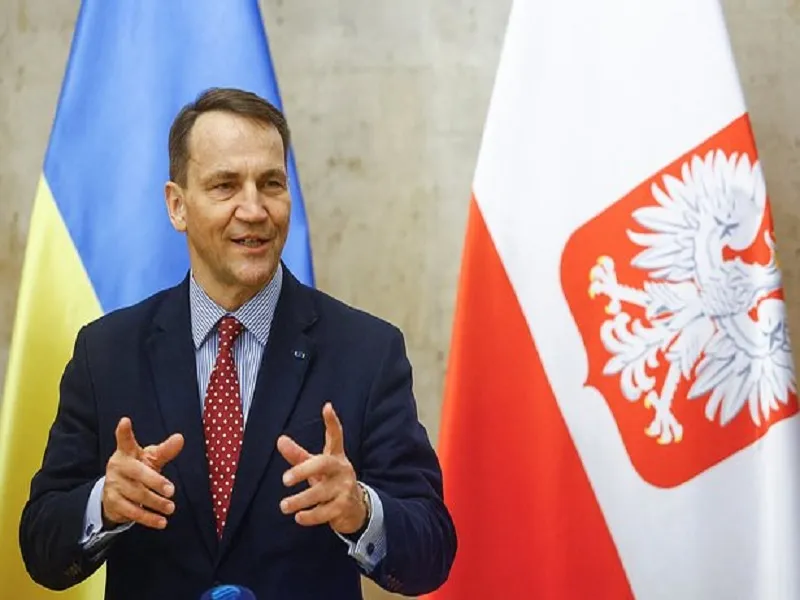
Sikorski Tried Justifying Poland’s “Russian Influence Commission” On False Pretexts

ANDREW KORYBKO
MAY 29, 2024

Image

Any politician or activist who supports traditional values, is against illegal immigration, and questions any aspect of NATO’s proxy war on Russia through Ukraine is at risk of being defamed and even persecuted.

Polish Foreign Minister Radek Sikorski tried justifying his country’s contentious “Russian influence commission” on false pretexts in an interview with Gazeta Wyborcza. He deflected criticism that it’s hypocritical for Prime Minister Donald Tusk to revive his predecessor’s commission, which Tusk criticized at the time as a witch hunt against the opposition, by misleadingly claiming that they’re different. According to Sikorski, the previous one could exclude politicians from office, but the current one can’t.

The reality is that the former government’s commission initially had those powers, but they were later rescinded by an amendment under Western pressure, thus making their findings nothing but a scarlet letter against those who were supposedly implicated as operating under Russian influence. Furthermore, the results came out after October’s parliamentary elections, while the latest commission’s are expected before next May’s presidential election that the ruling parliamentary coalition desperately wants to win.

Sikorski also added that his government’s commission will provide recommendations on what the prosecutor’s office should do, so it’s theoretically possible that people can be charged, unlike the prior one. In the event that members of the conservative-nationalist opposition are implicated by the report, not to mention if they’re charged with some sort of crime, then that could reshape voters’ perceptions of their party ahead of the upcoming elections and thus possibly help the ruling coalition gain an edge.

Moving along, Sikorski later shared his opinion that the “Law & Justice” (PiS) party that used to rule the government and the smaller Confederation party are both under Russian influence due to their conservative-nationalist views, which vary between them but nevertheless share some commonalities. In his opinion, “Putinism” is defined as being critical of the EU (which he deems “anti-European”) and illegal immigration, “machismo”, and in support of traditional values, which align with those two’s views.

He then accused Russia of “focusing on these voters” inside of Poland through its alleged propaganda as well as its supposed meddling operations, one of which he said was its weaponization of the Belarusian migrant crisis in order to boost the “far-right” ahead of early June’s European Parliamentary elections. If such forces win, then Sikorski predicted that “this will blow up the EU”, and it’s this sort of chaos that Russia supposedly wants in order to present its socio-political system as superior to the West’s.

His scandalous attack against the conservative-nationalist opposition echoes European Commission President Ursula von der Leyen’s from last week, who included Confederation in her list of parties that she described as “friends of Putin” that “want to destroy our Europe.” PiS wasn’t mentioned, but that might have been strategic since its potential return to power could see the party embrace so-called “Polexit” rhetoric – irrespective of sincerity and chances of succeeding – as revenge in that event.

Confederation is a much easier target too since it’s consistently been against the “Ukrainization” of Poland, which refers to the last two governments’ embrace of large-scale immigration from Ukraine that’s laying the seeds for changing the country’s largely homogenous demographics. Even though PiS began to reconsider its full-fledged support for Ukraine near the end of its time in power, largely for electoral reasons ahead of fall’s polls, it’s never been against “Ukrainization”.

Returning to the ruling liberal-globalist coalition’s revival of its conservative-nationalist predecessor’s “Russian influence commission”, Sikorski’s sharp words suggest that the outcome is already predetermined, namely that it’ll implicate PiS and Confederation as Russia’s “useful idiots”. Some members might also be accused of colluding with its security services and accordingly charged, thus reshaping voters’ perceptions ahead of May’s presidential election if they’re PiS officials.

The false pretext upon which those two will predictably be smeared by the state as “Russian agents” and some of their members possibly charged concerns their conservative-nationalist policies. This therefore makes the latest commission nothing but another witch hunt against the liberal-globalists’ opponents. Any politician or activist who supports traditional values, is against illegal immigration, and questions any aspect of NATO’s proxy war on Russia through Ukraine is at risk of being defamed and even persecuted.

https://korybko.substack.com/p/sikorski ... ng-polands

******

Blinken travels to Moldova with instructions on how to conduct presidential elections
May 28, 2024
Rybar

The US State Department reported on Secretary of State Antony Blinken's trip to Chisinau on May 29. The Americans will announce another package of assistance to Moldova for “energy independence” and “support for democracy in the face of the Russian threat . ”

At the last State Department briefing , the topic of Moldova occupied an important place in American politics.

The main problem for the United States is the presidential elections in Moldova on October 20, which the State Department called “critically important ,” which will be the focus of a significant part of Blinken’s visit.

The State Department announced a “Russian threat” to President Maia Sandu and the Americans want to “help” Moldovans make their choice “in a free and fair atmosphere without intrusions and disinformation . ”

The Americans openly admit their intention to supervise the elections , although the Central Election Commission of the republic has long been under the control of USAID.

▪️In Washington they resorted to another gross manipulation , declaring that the people of Moldova allegedly “support transatlantic integration into the EU and NATO, which is confirmed by public opinion polls . ”

Polls show a positive attitude of Moldovans towards the EU, but do not consider European integration a reason to sever ties with Russia and the CIS. However, the position of Moldovan society on NATO is negative and citizens support constitutional neutrality , which the authorities have been actively violating in recent years.

The Americans also do not see a direct military threat to Transnistria , but are concerned about “Russian influence operations” in the unrecognized republic. Washington declared support for the OSCE.

Obviously, now the primary task for the Americans is to re-elect Sandu for a second term and prevent the consolidation of opposition forces.

At the same time, the United States is gradually turning the territory of Moldova into a military training ground against Russia. Manipulation of facts about the alleged aspiration of Moldovans to join NATO is a clear justification for the domestic audience of the frequent presence of American military personnel on the territory of the republic.

https://rybar.ru/blinken-edet-v-moldavi ... ie-vybory/

Google Translator

******

Image
Giorgia Meloni à Sanremo pour faire campagne pour les élections européennes (Italie) et municipales de 2014. © Jose Antonio, CC BY 4.0

The resistible rise of the far right in Europe
Originally published: International Viewpoint on May 19, 2024 by NPA Antifascist Commission (more by International Viewpoint) | (Posted May 29, 2024)

In France, the far right is likely to be the leading political force in the European elections of 9 June 2024, and probably the second (or third) force in the European Union. A relatively large number of far right parties are now on the winning side in national elections, and are even taking part in national governments.

EUROPEAN OVERVIEW
In Italy, the far right, with Giorgia Meloni’s Fratelli d’Italia party and the Lega (formerly the Northern League), have together led the government since the parliamentary elections of 25 September 2022, in addition to the right-wing Forza Italia party of the late Silvio Berlusconi.

In Sweden, two weeks earlier, the Sweden Democrats (SD) were among the winners of the parliamentary elections of 11 September 2022.1 Winning 20.5%, the SD became the country’s second largest political force in terms of votes, behind the Social Democratic Party (30.3%), now in opposition. The Moderate party (classic right, 19.1%) then succeeded in forming a coalition with the Christian Democrats, the Liberals and the SDs. Although the latter party did not hold any ministries, it did have a governmental parliamentary majority dependent on it and a seat on the “coordination” committee of the coalition parties. The governmental agreement largely bears its signature on immigration and security.

In Finland, following the parliamentary elections of 2 April 2023, the True Finns party became the second political force with 20.1% of the vote, nipping at the heels of the traditional right-wing party, the National Coalition Party (20.8%). Here, the far right has entered the government of the conservative Petteri Orpo, occupying ministries alongside the main right-wing party as well as the Christian Democrats and the Swedish minority party. The True Finns hold the ministries of Economy, Finance, Interior, Justice and Social Affairs. Remarkably, since the summer of 2023, Finland has been gripped by a succession of strikes and university protests against the anti-social “reforms” implemented by this government, the latest of which was a strike described as political (even though a draft law is intended to ban so-called political strikes) lasting fifteen days from 11 March 2024, against new employment legislation.

In other European countries, the far right is in a strong position. In the Netherlands, Geert Wilders, founder in 2008 (and legally the only member to date) of the Party for Freedom (PVV), emerged as the leader of the leading electoral force in the last parliamentary elections on 22 November 2023, with 23.49% of the vote, after having obtained 10.79% in 2021. Although the PVV subsequently failed to form a government with Wilders as Prime Minister due to a lack of parliamentary support, the Netherlands appears to be moving towards a coalition government with the PVV as the leading force. In addition to the PVV, a future coalition is expected to bring together a farmers’ party that protests against environmental standards (the BBB), a right-wing liberal party (the VVD) and a split from the Christian Democratic Party.

In Austria, the fragile federal government has brought together the conservative right (ÖVP) and the Greens since January 2020. But the far-right FPÖ party is expected to win the forthcoming general election in autumn 2024, where it is projected to receive around 30% of the vote.2 In the meantime, the FPÖ is currently in government in three of the country’s eight regions.

In Eastern Europe, while the national-conservative PIS party lost the parliamentary elections in Poland on 15 October 2023, Prime Minister Viktor Orban’s Hungarian Fidesz party, in power since 2010, still governs in Budapest. The two parties cover a spectrum that, in France, would encompass both the right and part of the far right. In Hungary, they are joined by a far-right party that is not part of the government, Jobbik (“The Best”); this party has tried to refocus in the most recent period, but at the risk of splitting off from a harder, more extremist current that gave rise in 2018 to the Mi Hazank (“At Home””) movement. The polls currently forecast Jobbik’s share of the vote to fall to less than 3%, compared with 6.34% in 2019 and 14.67% in 2014, but the new Mi Hazank formation is expected to break through with more than 8%.

TWO GROUPS IN THE EUROPEAN PARLIAMENT
The far right in the European Parliament is represented mainly in two separate groups. On the one hand, the Identity and Democracy (ID) group, created in 2019, which includes the French Rassemblement national (RN), the Italian Lega, the Dutch PVV, the Austrian FPÖ and the German AfD party.3 On the other, the European Conservatives and Reformists (ECR) group, whose backbone was initially made up of the British Conservatives until they left the European Parliament following Brexit, which includes Fratelli d’Italia, the Swedish Democrats, the True Finns and the Spanish party VOX. The Polish PIS is now the largest force.

However, in March 2021, Fidesz left the European People’s Party (EPP, which brings together the classic bourgeois right) and is negotiating to join other groups, including the ECR and ID. The Hungarian party could play a pivotal role, bringing these two groups closer together. Although there are noticeable divisions between the ID and ECR, particularly on economic issues, the majority of ECR members are more or less neoliberal on economic issues, even if part of the ID group emphasizes populist social demagoguery like the French RN—at least as long as these parties are in opposition in their respective countries.

Lastly, the French Reconquête party, which is also presenting a list for the European elections but is not guaranteed to pass the 5% vote threshold required to enter parliament, currently sits in the ECR group with its only outgoing MEP, Nicolas Bay, elected in 2019 on the RN list. However, in addition to belonging to different parliamentary groupings, there are deep divisions—apparent or real—running through the far right “family”.

CLEAVAGE OVER RUSSIA
The majority of these parties in the European Union, especially in the western part and in Germany, were historically very supportive of, and even explicitly linked to, the Russian regime in the years after 2000. But this position has become much more difficult to assume publicly since the start of the war against Ukraine.

The French RN is currently one of the most outspoken critics of the Russian invasion of Ukraine. The reason is simple: France’s main far-right party believes it is so close to coming to power nationally that it cannot afford to adopt a stance that would put it at odds with majority opinion. As during the 2022 presidential election campaign, when, after the announcement of the start of the war in Ukraine, the RN was forced to throw out 1.2 million copies of an eight-page leaflet because it was illustrated with a photo showing Marine Le Pen with Vladimir Putin to demonstrate her qualities as a “stateswoman”. In the days that followed, Marine Le Pen claimed that Ukraine was a positive illustration of a “national liberation struggle”, claiming that her party was following the same logic.

Other parties, structurally allied to the French RN, are not taking the same position. This is the case of the FPÖ, which has also had a formal cooperation agreement with Putin’s United Russia party since 2016. Some of its representatives now claim that the agreement was “only formal”. However, Karin Kneissl, the foreign minister appointed at the end of 2017 at the suggestion of the FPÖ (although she does not hold a party card), invited Vladimir Putin to her wedding in August 2018. In September 2023, Kneissl announced that she was moving to St Petersburg. Moreover, since the arrest on 29 March 2024 of a former agent of the Austrian National Security and Intelligence Directorate for spying for Russia, the Austrian state apparatus has been rocked by revelations of pro-Russian activities.

At no time has the French RN questioned its alliance with the FPÖ, which is a pillar of its policy of European alliances. Worse for the RN’s current official position, their parliamentary group (ID) expanded its ranks at the end of February 2024 to include the Bulgarian party Vazradjane (“Renaissance”) and the Slovak National Party (SNS). Both are close allies of Vladimir Putin’s regime within the European Union. As far as the Bulgarian party is concerned, three of its deputies took part in a United Russia meeting in Moscow on 16 February 2024. As for the SNS, in Bratislava it is part of a coalition government which, along with Fidesz in Hungary, has the most pro-Russian foreign policy of all the member countries of the European Union.

PSEUDO-CLEAVAGE ON “REMIGRATION”
Another, largely artificial, divide emerged in February 2024. Since mid-January 2024, there had been massive demonstrations against the German AfD party, with over a million people taking part in various German cities. The motive was the publication on 10 January 2024 of a report shot on hidden camera about a meeting held behind closed doors between AfD party executives, members of the identitarian movement, representatives of the most right-wing wing of the CDU (Christian Democratic Union, classical right-wing) and a section of the employers’ association. At the conference, the Austrian identitarian activist Martin Sellner—who has since been banned from entering Germany—spoke out on the subject of “remigration”.4 Sellner had fantasized about deporting two million people, including German nationals who were “poorly integrated” or “complicit in mass immigration”, to an unidentified model state in North Africa that would take them in.

Marine Le Pen then distanced herself from the German party, publicly questioning whether she should continue to work with it in the European Parliament. The co-president of the AfD party, Alice Weidel, wrote her a public letter, citing translation errors and claiming that her party was only calling for convicted foreign criminals to be deported “in accordance with the law”.

The fact remains that this divide is largely imaginary, with Marine Le Pen’s public stance due solely to her desire to put on a good show in the eyes of public opinion, wishing to avoid any “extremist” appearance. However, one of the pillars of the ID group in the European Parliament, the FPÖ, and in particular its president Herbert Kickl—who was Austrian Minister of the Interior from 2017 to 2019—has been shamelessly using the term “remigration” for years, without Marine Le Pen having found fault with it, until now.

ANOTHER EUROPE, FREE OF FASCISM
The real divisions are not within the far right, whose positions can be very elastic, but between the far right and its opponents. European leaders need to revive and reorientate their national economies (budget cuts; increased exploitation; “structural” unemployment), against a backdrop of a race to war. In the face of popular discontent, reactionary, patriarchal and xenophobic demagoguery, combined with the repression of mobilizations, leaves plenty of room for the far right, which often appears to be the only real opposition party. In this sense, the necessarily neoliberal policies of the European Union are a stepping stone for European fascism.

It is up to us to fight on the basis of fundamental positions, rejecting their ideas, which remain unacceptable in all forms. We demand open borders and a Europe-wide redistribution of wealth. Immediately, we are in favour of a European minimum wage and equal social rights for all. This means breaking out of the shackles imposed by the EU, and will require major victorious mobilizations across the continent.

Translated by International Viewpoint from Revue l’Anticapitaliste.

ATTACHED DOCUMENTS
the-resistible-rise-of-the-far-right-in-europe_a8528.pdf (PDF—922.7 KIB)
Extraction PDF [->article8528]

FOOTNOTES:
1.↩ Founded in 1988, the Sweden Democrats were initially an openly neo-Nazi party, which has now “normalized”.
2.↩ The FPÖ, the Freedom Party of Austria, was created in 1955 from the rubble of Nazism by transforming the “League of Independents”, itself created in 1949. Austria’s political life was controlled by the Allies during the Second World War until 1955, when the Treaty of Neutrality was signed, restoring full sovereignty to the Austrian Republic. Until 1955, it was impossible to reconstitute a party that was too close to historical Nazism. As soon as the obstacle was removed, the FPÖ was set up, its first president Anton Reinthaller (who died in 1958) having been Secretary of State for Agriculture under Adolf Hitler.
3.↩ Founded in 2013, the AfD (Alternative for Germany) is a far-right party expected to win around 18% of the vote in the coming European elections.
4.↩ “Remigration” is a concept coined by Renaud Camus, a French far-right writer.

https://mronline.org/2024/05/29/the-res ... in-europe/

******

"There is great chaos under heaven; the situation is excellent."

User avatar
blindpig
Posts: 14793
Joined: Fri Jul 14, 2017 5:44 pm
Location: Turtle Island
Contact:

Re: Blues for Europa

Post by blindpig » Fri May 31, 2024 2:04 pm

Serbian communists denounce UN resolution on Srebrenica

The falsifiers of history are at it again, this time insisting on holding the Serbian people responsible for imperialist crimes in the former Yugoslavia.

Image
The rush to destroy the sovereignty and territorial integrity of the Federal Republic of Yugoslavia began as soon as counter-revolution had taken hold in the USSR. Formerly valued as a counterweight to the Soviet bloc in Europe, a strong and independent Yugoslavia in 1991 became the imperialists’ primary target.
New Communist Party of Yugoslavia

Thursday 30 May 2024

On 23 May, the United Nations voted to establish an annual day of remembrance for the 1995 genocide in Srebrenica. Part of the ongoing battle to control and rewrite the history of socialism and imperialism in eastern Europe, the resolution was met with outrage by the Serbian people and with disgust by progressives all over the world.

At a moment when they are actually facilitating the ongoing genocide in Palestine, to be shedding crocodile tears over mass killings of the past is the height of hypocrisy, especially when those responsible for the deaths in Srebrenica were in fact armed and funded by the west as part of its decade-long war to destroy the territorial integrity and economic independence of the Federal Republic of Yugoslavia.


*****

The New Communist Party of Yugoslavia (NKPJ) strongly condemns the draft resolution on Srebrenica adopted by the United Nations general assembly, which Germany proposed to shift the burden of objective responsibility for the heinous crime committed in that area from the western imperialist countries onto the shoulders of the freedom-loving Serbian people.

Demonisation of the Serbian people
The fact that, on the occasion of adopting such a decision, more countries were against its adoption or abstained than those that voted in favour (just 84 states) clearly shows that many countries in the world reject the hypocrisy of the west.

By pushing for this resolution, western imperialism aims to stir up the fraternal Yugoslav peoples further, in this case Bosniaks and Serbs, to incite them against one other, to create instability and to encourage national-chauvinism in order to justify the continued presence of Nato on the territory of the former Yugoslavia.

An additional reason for the adoption of this resolution is the further demonisation of the Serbian people as a form of pressure on Belgrade to recognise the ‘independence’ of Kosovo, as well as to push it into introducing unfair sanctions against brotherly Russia.

The fact is that, objectively speaking, there was no genocide in Srebrenica. Western imperialism is practicing double standards by trying, ineptly and unsuccessfully, to justify its criminal role in all the massacres on the territory of SFR Yugoslavia, including the one committed in that city in Bosnia and Herzegovina.

Nevertheless, the intrigues of the imperialist power centres in Washington, London, Berlin and Brussels, and their objective guilt for the bloodshed in our region, cannot in any way be an excuse for the monstrous crime in Srebrenica. Those who committed it are bastards and a shame to the Serbian people; the only thing they deserve is the most profound contempt and disgust.

The vote in the general assembly of the United Nations clearly revealed that Serbia’s real friends are socialist countries like China, Cuba and the DPR of Korea, along with anti-imperialist countries like Belarus, Nicaragua and Syria. On the other hand, it was once again made clear that the western imperialist countries are not Serbia’s friends, no matter how much Serbia’s bourgeois government has tried to assure us otherwise.

Even as the United States of America, the European Union (primarily Germany) and Nato are leading an anti-Serbian campaign, the pro-imperialist bourgeois authorities in Belgrade shamelessly and stubbornly continue to insist on Serbia’s entry into the European Union and on furthering cooperation with Nato.

To preserve its independence and territorial integrity, Serbia must immediately stop the retrograde process of joining the European Union and Nato and instead maintain intensive contacts with its true friends, the socialist countries (China, Cuba, DPRK, Vietnam and Laos), anti-imperialist states (Nicaragua, Syria, Belarus, Venezuela and Bolivia) and fraternal Russia, and should apply to join the Brics economic alliance.

New Communist Party of Yugoslavia
26 May 2024

——————————

For an insight into how the ‘evidence’ for Russian and Serbian responsibility for massacres in Srebrenica was compiled, see this article on the trial of former Yugoslav president Slobodan Milosevic: ‘The aggressors shall not write our history’ by Ian Johnson, Lalkar, January 2004.

The illegitimate ‘International Criminal Tribunal for former Yugoslavia’ (ICTY), set up in The Hague specifically to try Yugoslavia’s captured leader after his country had been decimated by Nato bombs, was the august body which decreed that a genocide had been committed by Serbs against Bosniaks – a finding that it was hoped would confer some retroactive legitimacy on Nato’s decision to go to war without a UN mandate in 1999.


https://thecommunists.org/2024/05/30/ne ... rebrenica/

******

UN Srebrenica Resolution: Pandora’s Box Likely To Reignite Balkanization
MAY 30, 2024

Image
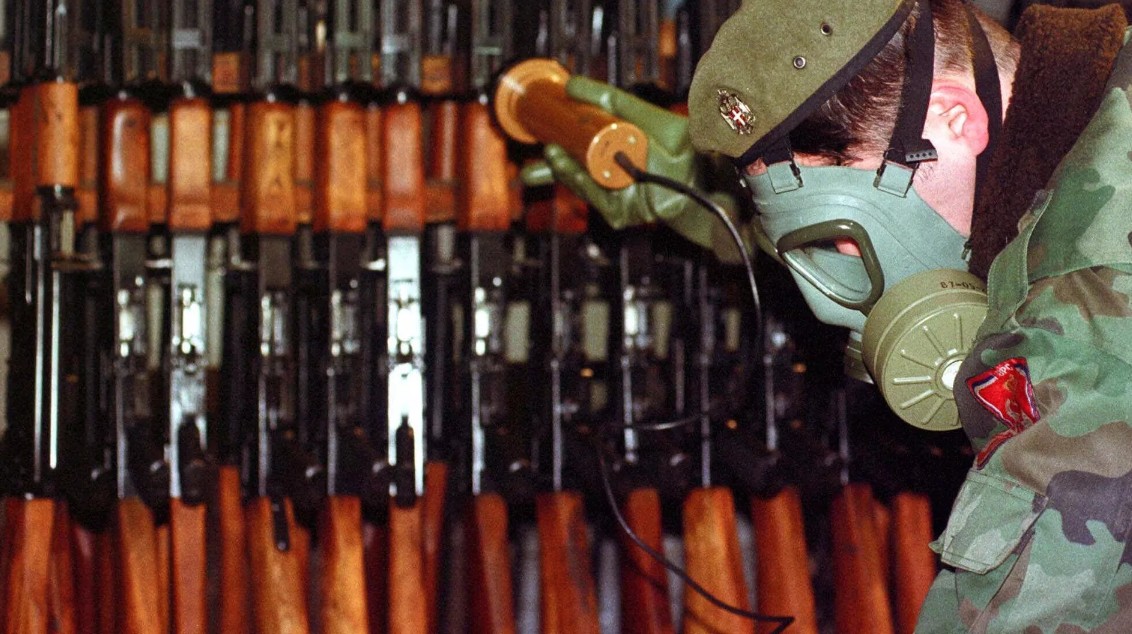
Bosnian Serb Army soldier measures levels of radiation on weapons and army equipment at a military factory in eastern Bosnian town of Bratunac 40 miles (65 kms) southeast of Tuzla, Bosnia-Herzeovina Wednesday, Jan 17, 2001. Amel Emric/AP.

By Dmitry Babich – May 27, 2024

The UN’s recent resolution on the “Genocide in Srebrenica” garnered 84 votes in favor, with 19 against and 68 abstentions, unjustly pinning the blame on the Serbs as a whole for the tragic events of 1995, while the West ignores the truth. As predicted by Serbian officials, this move only deepens existing rifts and raises tensions in Europe.

The United Nations General Assembly passed a controversial resolution Thursday naming July 11 as “International Day of Reflection and Commemoration of the 1995 Genocide in Srebrenica,” and condemning “without reservation any denial of the Srebrenica genocide as a historical event.”

The leaders of Serbia and Republika Srpska acknowledge the tragic deaths of thousands of Bosnian Muslim men in Srebrenica as a war crime perpetrated by certain individuals, but categorically reject its characterization as a genocide, and challenge the claims put forward by Bosnia’s authorities and the West about the death toll.

The backlash followed immediately. “This document will only step up the conflict potential of the Balkans,” said Maria Zakharova, the Russian Foreign Ministry’s spokeswoman.

Prior to the vote, Serbian President Aleksandar Vucic had been warning the US and the EU that the resolution would spell trouble for them.

Russia’s UN envoy, Vassily Nebenzya, predicted that the resolution would result in the “destruction of the Dayton peace accords,” which brought an end to the Bosnian War in 1995 and established the current form of Bosnia and Herzegovina. His forecast began to materialize on May 23.

Bosnia and Herzegovina: Fragile Peace Risks Fragmentation
Milorad Dodik, President of Republika Srpska, which is located within the federation of Bosnia and Herzegovina, has announced that within the next 30 days, Republika Srpska would present a proposal to its partners in Bosnia and Herzegovina outlining a peaceful separation plan.

“First, our proposal will be to clarify the political competences of each of our entities [comprising Bosnia and Herzegovina]. We will propose keeping the current economic model in place, but later adapt it to the peaceful separation process. The Serbian people can no longer live in this kind of BiH. What the Bosniaks did with the resolution on Srebrenica is illegal, and it shows that [the architects of the resolution] did not respect the Serbs.”

At its core, Bosnia and Herzegovina is a fragile structure. The Balkan state consists of two major entities, the first part consisting of Catholic Croats and Muslim Bosniaks – the Federation of BiH, and the second, Republika Srpska, the Christian Orthodox part, populated with Serbs.

The emigration of Croats from BiH has been rampant, especially after 2013, when Croatia became a member of the EU. Since then, the 550,000 strong Croatian community has been melting away, as young Bosnian Croats leave for better jobs in large EU cities. Consequently, BiH has become more Muslim-dominated, thereby spurring Republika Srpska to seek reunification with Serbia.

Resolution on “Genocide” Becomes the Last Straw
The mere method of counting the votes during the session of the UN’s General Assembly on Srebrenica raised questions. The 87 countries that did not vote for the resolution actually exceeded the 84 of those that did back the draft, formally proposed by Germany and Rwanda.

In an interview with Sputnik, Darko Mladic, the son of the Bosnian Serb leader Ratko Mladic, who is currently serving a life sentence for his involvement in the Srebrenica events, explained why the resolution has provoked such outrage among the Serbian people.

Despite the fact that only a few nations have supported the notion of labeling the events of 1995 as “genocide,” Serbs feel as though their entire nation has been unjustly stigmatized as genocidal. Any future attempts to challenge this perception could be viewed as a form of “genocide denial,” effectively making it illegal for Serbs to voice any objections.

“They had to change the UN’s rules to push through this [resolution],” Mladic explained. “The aim of the authors of this resolution is to… stop the research community from further investigations into what really happened then [during the Bosnian war of 1992-1995]. Not just in Srebrenica, but in Bosnia as a whole… This resolution does not promote peace, it has a huge destructive potential,” Mladic clarified.


Bosniaks Behind “Genocidal” Resolution
During an interview with the Tanjug news agency, Efraim Zuroff, director of the Simon Wiesenthal Center for hunting down Nazi war criminals, criticized the recent vote at the UN’s General Assembly as being political in nature. Zuroff went on to describe the UN General Assembly as the “worst place” for such a vote.

As a researcher of the Nazi genocide against the Jews during the 1930s and 1940s, Zuroff explained that the internationally accepted definition of ‘genocide’ goes beyond war crimes, encompassing premeditated murders with the intention of eradicating an entire ethnic group. He argued that this definition did not apply to the events in Srebrenica in 1995, where all Muslim women and children were evacuated, and most of the men who were killed were combatants who died in minefields or during gunfights.

Zuroff also said that the resolution was actually drafted by Bosniak Muslims, who used the German and Rwandan envoys to the UN as proxies. The Bosnian Serbs and Serbia are aware of that, and this makes them ever more determined to have Republika Srpska leave BiH and rejoin Serbia.

Collective Responsibility? No Longer Taboo for the West
History makes the Serbs skeptical of the promises made by German envoys to the UN regarding individual versus collective responsibility for “genocide”. Out of the seven heads of post-Yugoslav entities, found guilty by The Hague and imprisoned, the majority were Serbs. Bosnian Serbs, Croatian Serbs, and even the late president Slobodan Milosevic were among those incarcerated, in contrast not a single Muslim or Croat representative faced that same fate.

Bosnian Serb leaders Radovan Karadjic, Biljana Plavsic, Momcilo Kraishnik and the first president of Srpska Kraina inside Croatia, Milan Babic, were all sentenced to jail by the court in the Hague, while Kosovo Albanian leaders Hashim Taci and Ramush Haradinaj were set free, despite ample evidence of their crimes.

Both Taci and Haradinaj were released, despite accusations from the UN’s chief prosecutor Carla del Ponte, who detailed their role in the torture and mass murder of Kosovo Serbs in her two books.

“If you go ‘individually’ only after politicians of a certain ethnic origin, then of course you hold this group responsible,” George Szamuely, Budapest-based senior research fellow at the Global Policy Institute, told Sputnik.

One glaring example of the West’s double standards can be seen in the case of Milan Martic, the former president of the Republic of Srpska Krajina. In 1995, Croatian troops overran Srpska Krajina, leading to what has been described as an act of “ethnic cleansing”. Despite this, the International Tribunal for the former Yugoslavia placed the blame solely on the leaders of the destroyed Serbian entity, and not on the Croatian political and military leaders responsible for its destruction. As a result, there are no longer any Serbs living in the region, yet not a single Croatian or Bosnian Muslim politician has been held accountable for their roles in these events.

The UN’s resolution on Srebrenica adds to a growing number of grievances inflicted on the Serbs, and BiH may be just the first victim of this injustice voted into legitimacy in New York City on May 23, 2024.

Dmitry Babich is a Moscow-based journalist specializing in international affairs. Since 1991, he has been writing for major Russian and foreign publications. In 1999-2011 he worked as foreign editor at The Moscow News weekly and as a columnist for RIA Novosti news agency. He is a frequent guest on Al Jazeera and Al Mayadeen TV channels.

(Sputnik)

https://orinocotribune.com/un-srebrenic ... anization/

******

Did Western Forces Try to Assassinate Slovakia’s Prime Minister Fico?
By John Potash - May 28, 2024 1

Image
[Source: judgenap.com]

Accusations range from his pro-Russian stance to his anti-WHO Pandemic Treaty stance
On May 15, 2024, a gunman shot Slovakia Prime Minister Robert Fico outside of a meeting he had attended. Given their track record and the political stakes involved, many people suspect that U.S. and other Western forces orchestrated this assassination attempt.

Attempted Political Assassination and Immediate Attempted Cover-up?
The gunman shot five bullets at P.M. Fico, and hit him three times, nearly killing him. After several hours of surgery on May 16, doctors kept him in intensive care, and said he is in “stable but a very serious condition.”

Recently, the country had elected Fico-ally Peter Pellegrini as president. Many media outlets stated that this strengthened P.M. Fico’s “pro-Russian” position.

Image
The future President of Slovakia, Peter Pellegrini (l.), with Prime Minister Robert Fico after the runoff election in Bratislava in April 2024.
Robert Fico, left, and Peter Pellegrini, right. [Source: pledgetimes.com]

P.M. Fico stated in a speech that he merely wanted to negotiate peace with Russia regarding the Ukraine war. He also said that he would support “zero military aid to Ukraine,” among the most corrupt countries in the world, and said that “the war in Ukraine didn’t start yesterday or last year. It began in 2014 when the Ukrainian Nazis and fascists started to murder Russian citizens in Donetsk and Lugansk.”

Image
[Source: google.com]

Euronews suggested that the gunman, Juraj Cintula, 71, a former security guard and Slovak writer, was pro-Russia. The Times of India, on the other hand, reported that Cintula spoke out vehemently against Russia’s invasion of Ukraine.

Many news outlets also reported that Cintula was a “lone wolf,” though Reuters pointed out several days later that Slovakia Interior Minister Sutaj Estok said an investigation team now has evidence supporting that Cintula was part of “a certain group of people” who “aided in the coverup.”

Image
Juraj Cintula [Source: thegatewaypundit.com]

WHO, with the U.S., Had an Interest in Assassinating Prime Minister Fico?
In November 2023, Prime Minister Fico gave a widely viewed speech that would have angered a number of powerful interests.

For one, P.M. Fico was one of the first European leaders to talk about ending the support of the corrupt Ukrainian coup government warring with Russia.

Secondly, the World Health Organization (WHO) has been pushing for countries to sign its “Pandemic Agreement” (also called “Pandemic Treaty” at times) for the last year or two.

Activists and groups, ranging from Georgetown Law School’s O’Neill Institute to bioterrorism expert Meryl Nass, MD, have reported how countries signing this agreement could lose their sovereignty.

Dr. Nass called this “a soft coup: first a takeover of global health, followed by a takeover of everything else the WHO declares is important to health: climate, food, ecosystems, etc.”

Image
Dr. Meryl Nass [Source: lifesitenews.com]

P.M Fico had made it clear in his speech that he “will not support the strengthening of the WHO at the expense of sovereign states in managing the fight against pandemics.”

Additionally, Fico went against the grain by opposing mass immigration, transgender ideology, and climate change ideology. Blogger John Leake wrote on his substack that given his iconoclastic views on a broad range of pivotal issues, “it is a matter of certainty that Prime Minister Fico has a vast array of powerful enemies.”

Does Fico’s Shooting Follow a Pattern of Other Assassinations and Coups?

It might be remembered that the U.S. and European leaders supported the February 2014 coup of the elected leader of Ukraine, Viktor Yanukovych, who was pro-Russian. In a speech, Assistant Secretary of State Victoria Nuland stated the U.S. invested $5 billion in the Ukraine for the country to go in this direction.

Nuland was also secretly recorded in a phone call with U.S. Ambassador to Ukraine Geoffrey Pyatt discussing who she planned to place in power after the coup. She said then-Vice President Joe Biden would aid this coup transition. A transcript of this recording was published by the BBC.

Image
Victoria Nuland and Geoffrey Pyatt in Kyiv around the time of the 2014 Maidan coup. [Source: bbc.com]

Working in the interest of U.S. oligarchs, the CIA has a long record of trying to remove leaders who do not fit its agenda.

Since the break-up of the Soviet Union, these efforts have only increased.

In Serbia during the late 1990s, the U.S. government invested $80 million in an attempt to unseat socialist leader Slobodan Milosevic before NATO planes bombed the country for more than two months that year.

While the 2014 Ukraine coup was called the “Orange Revolution,” the U.S. government made other investments in “color revolutions,” such as the “Rose Revolution” in the former Soviet state of Georgia in 2003, and the “Tulip Revolution” in Kyrgyzstan in 2005.

Image
Georgia’s Rose Revolution. [Source: oscewatch.org]

Evidence that Fico Is Among Other Leaders Assassinated for Opposing WHO Pandemic Policies
P.M. Fico stated that he would be investigating the tyrannical policies during the pandemic of 2020 and 2021, including the “massive vaccination with experimental vaccines.”

It should be noted that this opposes American oligarch Bill Gates’s massive push for the experimental MRNA vaccines as the Gates Foundation is the second-largest funder of the WHO, with only the U.S. government ahead of it, with England third in WHO contributions.

Some have argued that Fico’s stance against the Pandemic Treaty and MRNA vaccines may also have placed him on an assassination list. At least three other national leaders who spoke out against such policies ended up dead not long after.

For example, Tanzania President John Magufuli, who held a doctorate in chemistry, announced that the PCR tests for the virus were fake after he sent goat, sheep and papaya/pawpaw samples with human names to the WHO labs in May 2020. The WHO stated these samples tested positive for the virus. Magufuli was dead by March 2021.

Image
John Magufuli [Source: realequatorialguinea.com]

Madagascar’s government also went against the stance of the WHO’s push for vaccines in announcing an herbal “cure” for the virus in May 2020.

In August 2021, Madagascar President Andry Rajoelina arrested high-ranking army and police officials regarding a failed attempt to assassinate him.

At least three other countries’ leaders who opposed the MRNA vaccine also ended up dead in 2021 and Reuters tried to explain away the fact that there may have been foul play. This included Haitian leader Jovenel Moise, who opposed the MRNA vaccine and ended up dead in 2021. Reuters tried to explain away this motive and American involvement. Moise was fatally shot by a band of gunmen, several of whom were Columbians trained by the U.S. military.

As of May 28, 2024, Deputy Prime Minister Robert Kalinak reported P.M. Fico’s condition as “stable with a positive prognosis” after he underwent two surgeries.

Deaths of Iran’s President and Foreign Minister
On May 20, five days after the assassination attempt on P.M. Fico, a helicopter crashed in Iran, killing President Ebrahim Raisi, Foreign Minister Hossein Amir-Abdollahian, the East Azerbaijan province governor and five others.

Image
[Source: aitadal.com]
In August 2023, Iran joined the anti-NATO BRICS countries conglomerate led by Russia and China and recently had major skirmishes with Israel.

Soon after the Iranian helicopter crash, a government official in Jerusalem told Reuters “it wasn’t us” in a statement. Some might read in this the implication that another country may have been involved in some sort of sabotage causing the crash.

https://covertactionmagazine.com/2024/0 ... ster-fico/

******

From Debunking to “Pre-bunking”: EU Opens Up Another New Front in Its War on Information
Posted on May 31, 2024 by Nick Corbishley

“If you think of information as a virus, instead of treating an infection once it has taken hold — that is, debunking — it is much better to vaccinate so that the body is inoculated.” Welcome to pre-bunking.

On Wednesday (May 28), just over a week before the EU elections commence, European Commission President Ursula Von der Leyen unveiled her latest (and hopefully last) censorship initiative: pre-bunking. This approach, she says, is “more successful than debunking” and will allow society to “build up… immunity to misinformation.”

Von der Leyen drew heavily on the vernacular of virology and vaccinology to describe her pre-bunking initiative. This, of course, is ironic given her present embroilment in the “Pfizergate” vaccine procurement scandal, which is the subject of not one, but two, criminal investigations. It is also disconcerting to hear one of the most powerful political leaders of the so-called “liberal” West liken information to a virus. As I will show in this article, she is not the only one.


As with medicine, Von der Leyen says, prevention is preferable to cure: “If you think of information as a virus (NC: which, to be fair, most right-thinking people probably don’t), instead of treating an infection once it has taken hold — that is, debunking — it is much better to vaccinate so that the body is inoculated.” That is where pre-bunking comes in.

The EU will start "pre-bunking":
– Debunking suggests exposing false information
– Pre-bunking" entails more government gatekeepers, smearing and censorship against those who challenge the EU's monopoly on truth pic.twitter.com/HHiduewd0s

— Glenn Diesen (@Glenn_Diesen) May 30, 2024


Building “Immunity” Against Misinformation

Like vaccines, pre-bunking intentionally exposes people to a weaker dose of mis- or dis-information (as defined by the Commission, presumably), so that their minds can build up antibodies to resist real fake news stories later down the line. In the words of the concept’s creator, Sander van der Linden, “you preemptively try to refute falsehoods or the techniques that are used to dupe people online, so that people can build up cognitive or mental antibodies so that when they come across them in the future they are partly immune.”

Sander van der Linden is a Dutch professor of social psychology at the University of Cambridge. His books include Foolproof: Why Misinformation Infects Our Minds and How to Build Immunity and The Psychology of Misinformation. The titles speak for themselves.

Van der Linden’s lab is apparently partnered with the UK government, the US State Department, and CISA (Cybersecurity and Infrastructure Security Agency), the notorious censorship agency embedded within the Department of Homeland Security. That’s according to Mike Benz, a former State Department official who is arguably the top expert on the US censorship industry. CISA has its own subsidiary: the Office of Biometric Identity Management. This gives an idea of how digital censorship will soon be tied up with biometric digital identity.

These institutions are at the leading edge of the collective West’s rapidly growing censorship industrial complex. Their role, notes Benz, is primarily, if not exclusively, political:

Here, watch this star of the US-UK govts new political "thought control" game industry explain his other games controlling the psychological response to gov't Covid-19 policies.

Note how the government's censorship targets are all posts criticizing the government: pic.twitter.com/8QMNAPvbqJ

— Mike Benz (@MikeBenzCyber) September 14, 2023


Van der Linden’s pre-bunking ideas have gained traction in some important places, including Silicon Valley. In February, Google Alphabet revealed plans to run a series of animated ads on platforms such as TikTok and YouTube featuring pre-bunking techniques developed in partnership with researchers at the Universities of Cambridge and Bristol. The ads have been shown in five EU countries: Belgium, France, Germany, Italy, and Poland. Viewers watching the ads are asked to fill in a short multiple-choice questionnaire, designed to gauge what they have learned about misinformation.

So, in other words, Google, a company that was recently forced to withdraw its Gemini image generator after suffering worldwide ridicule over “inaccuracies” in some of the historical depictions that it was creating, is now trying to train untold millions of EU citizens in the art of identifying mis- and disinformation.

“A Vaccine for Brainwash”

Another organisation experimenting with pre-bunking is, perhaps unsurprisingly, the North Atlantic Treaty Organisation (NATO). The organisation’s Strategic Communications Centre of Excellence recently published a report co-authored by Van der Linden. Titled “Inoculation Theory and Misinformation,” the report discusses ways of “build[ing] psychological resilience against misinformation through psychological ‘vaccines’ or ‘inoculation.'”

Image

If this sounds like something straight out of Dr. Strangelove, that’s probably because, as the report notes, the theoretical background of “inoculation theory” dates all the way back to the 1960’s when the US government “became concerned about the prospect of its troops becoming brainwashed (or persuaded) by foreign propaganda” during the Vietnam War:

This concern prompted the social psychologist William McGuire to explore the idea of a “vaccine for brainwash”. Drawing on the analogy of medical inoculations, McGuire proposed that rather than bombarding people with more supportive facts, pre-emptively exposing people to a weakened dose of a specific persuasive [manipulative] argument could confer psychological resistance against future exposure to persuasive attacks, much like a medical vaccine confers physiological resistance against future infection. Over the years, inoculation treatments came to feature two core components: 1) a forewarning of an impending attack on one’s beliefs, and 2) a pre-emptive refutation of the persuasive argument, also called a “prebunk.” Since then, a large volume of studies and metaanalyses has been conducted, establishing inoculation theory as a robust framework for countering unwanted persuasion.

Although the original paradigm has proved highly replicable, for a long time it was never
tested in the context that inspired McGuire’s idea: brainwashing and propaganda. This began
to change around 2017, when researchers started to apply inoculation theory within the
modern context of online misinformation.

A (Philip K) Dickensian Future


The gathering interest among governments, generals and Silicon Valley companies in ideas like “pre-bunking” underscores one of the darkest aspects of the censorship industrial complexes taking root in ostensible liberal democracies: the increasing emphasis on taking preventative actions against illegal, mis- or dis-information. It is eerily reminiscent of “pre-crime”, the concept first coined by Phillip K Dick to express the notion that the occurrence of a crime can be anticipated and prevented before it even happens.

“The monitoring obligation of all actors” involved in the EU’s Digital Services Act (DSA) “is preventative,” warned Manfred Kölsch, a retired German judge, in a blistering critique of the EU’s censorship regime featured in Berliner Zeitung (which we covered here):

It is always about “expected critical [effects]”,… “foreseeable adverse effects” on “social debate”, “public safety” or “public health”. The Advocate General at the ECJ has said what is legally necessary: These represent a “particularly serious interference with the right to freedom of expression” “because by restricting certain information before it is disseminated, they prevent any public debate about the content, thus “[d]epriving freedom of expression of its actual function as a motor of pluralism.” The Advocate General correctly points out that preventive information controls ultimately abolish the right to fundamentally unrestricted freedom of expression and information.

Kölsch also warned that the DSA directly contravenes many of the EU’s and national laws on freedom of expression and information, including Article 11 of the EU Charter of Fundamental Rights, Article 10 of the European Convention on Human Rights and Article 5 of the Basic Law (Germany’s written constitution, agreed by the allies back in 1949 when the first post-war government was established in West Germany). Here is the text of Article 11 of the EU Charter of Fundamental Rights:

Everyone has the right to freedom of expression. This right shall include freedom to hold opinions and to receive and impart information and ideas without interference by public authority and regardless of frontiers.

Not anymore, it seems.

A Milestone in Global Online Censorship

The upcoming EU elections will represent a milestone in online censorship. This is the first time bloc-wide elections have been held since the full launch of the DSA in February (covered in my article, The EU’s Mass Censorship Regime Is Almost Fully Operational. Will It Go Global?) So far, all of the main platforms, including Elon Musk’s X, appear to be adhering to the EU’s rules on disinformation. If they don’t, they could face serious economic consequences, including fines of up to 6% of global turnover.

At her speech at Davos this year, Von der Leyen said that the “top concern” among the World Economic Forum’s partner companies (which also happens to be one of the Commission’s biggest worries) is “misinformation and disinformation.” The solution, she said, is to forge a grand coalition of sorts between “business and governments” — which, as luck has it, fits snugly with the WEF’s primary mission in life: to promote public private partnerships at all levels and in all areas of government, for the benefit primarily of its partner companies.

In February, just one month after that speech, the Commission published a set of guidelines for Big Tech firms to help Brussels “secure” the upcoming elections from foreign interference and other threats. The guidelines recommend “mitigation measures and best practices to be undertaken by Very Large Online Platforms and Search Engines before, during, and after electoral events,” and are explained as necessary in order to prevent things like fake news, turnout suppression, cyber threats and attacks, and, of course, Russia’s malign influence on European public opinion, particularly regarding Ukraine.

“Integrity of election[s] is one of my top priorities for DSA enforcement, as we are entering a period of elections in Europe,” said Thierry Breton, [EU Internal Market Commissioner] last September.

Elections in Slovakia in September were supposed to offer a dummy run, but the results were disappointing — at least as far as the Commission was concerned. The left-wing populist and social conservative party, Direction–Social Democracy (Smer-SD), led by former Prime Minister Robert Fico, took the largest number of votes and was able to form a coalition government with like-minded parties. Fico had promised to cut all aid to Ukraine, which he says is governed by neo-Nazis, as well as block its ascension to NATO.

As readers well know, Fico was shot five times in an assassination attempt two weeks ago but somehow survived and is now apparently on the mend. As Conor Gallagher reported shortly afterwards, Fico’s opposition to Project Ukraine and the rabid demonisation of his political stance by mainstream media appear to have played a key role in motivating his would-be assassin.

The Commission’s mass censorship regime is the culmination of a process that began at least a decade ago, as I previously documented. But it is determined to up its censorship game. Two weeks ago, VdL pledged to create a new disinformation unit for detecting and weeding out online disinformation promoted by foreign agents while using education to “inoculate” (that word again!) EU citizens against false information. The Orwellian title for this new initiative? “European Democracy Shield.

The irony of VdL, once described by POLITICO EU as “Europe’s American president”, talking about the risks posed by foreign agents is, of course, rather rich. But there is an even darker irony.

The EU is currently venting its spleen against the government of Georgia for daring to pass a law seeking to rein in Western meddling as US-EU assets seek to push a colour revolution in the country, just as they did in Ukraine in 2013-14. EU Commission President Ursula von der Leyen has even argued that the Georgian government’s “law on foreign influence transparency goes against [the] core principles & values of the EU, negatively impacting Georgia.” What she hasn’t said is that the Commission she heads up is also seeking to pass similar regulation aimed at combating foreign interference — the so-called “European Democracy Shield”.

"the law on foreign influence transparency goes against core principles & values of the EU"

So why is the EU drafting identical legislation all member states have to adopt?

🧐🧐🧐🧐🧐 https://t.co/5epE40adTG pic.twitter.com/GBhOwhUB93

— Kit Klarenberg 🔻🔻🔻🔻🔻 (@KitKlarenberg) May 29, 2024


While Von der Leyen is a big-part player in all of these processes, the sad truth is that they would almost certainly be happening with or without her. They may even accelerate under her rumoured successor, Mario Draghi. As Conor Gallagher documented in his recent piece, Combating Hate: The Trojan Horse for Precrime, burgeoning censorship and anti-hate efforts are proliferating across the world’s ostensible liberal democracies. And “while hate could mean a racist comment or action; it could also now refer to criticism of Israeli policy or a thought crime against the ruling class.”

This is a key point. While the governing classes in the so-called “liberal” West can dig up a plethora of reasons for censoring online discourse — from protecting children from harmful content to preserving faith in the new generation of “vaccines”, to preventing widespread discussion of, say, central bank digital currencies — the reality is that governments and the corporations whose interests they serve are rapidly losing control of the narrative. The only way of regaining control is through Stasi-like censorship. And that, unfortunately, will mean the end of what little precious remains of liberal democracy.

https://www.nakedcapitalism.com/2024/05 ... ntrol.html
"There is great chaos under heaven; the situation is excellent."

User avatar
blindpig
Posts: 14793
Joined: Fri Jul 14, 2017 5:44 pm
Location: Turtle Island
Contact:

Re: Blues for Europa

Post by blindpig » Sat Jun 01, 2024 1:37 pm

Militarization of Scandinavia
May 31, 2024
Rybar

Image

The author of the channel Severyanochka is right when talking about the militarization of Scandinavia . The example of Sweden clearly shows why there are completely unfounded rumors about Russia’s readiness to attack the island of Gotland .

But the Swedes are not united in this: in turn, the Finns are very actively training their troops. The exercises go one after another without stopping, and most of them take place right near the Russian borders.

Today, three events are being completed at once, held in three different regions of the country: in the coastal part of the Gulf of Finland , 40 km from the Leningrad region and the Republic of Karelia.

The scale of training differs, but the goals are approximately similar. Somewhere they are practicing a blockade of a bay, somewhere repelling a ground attack, and in the Northern Forest , for example, an airborne landing (for this purpose, S-295 transport aircraft flew near the borders of the Russian Federation) .

Unfortunately, the actions of the Scandinavian states are increasingly similar to those of the Baltic republics. Not a drop of logic or independence in favor of stressing the population with an imaginary threat to Russia.

People's mood is getting worse, they believe more and more in danger, and such people are easier to control. If you just look at the headlines of Finnish newspapers or read the chats of residents of different cities, you can see what this policy leads to.

https://rybar.ru/militarizacziya-skandinavii/

In Sweden they started talking about Russia's plans to occupy the island of Gotland
May 30, 2024
Rybar

Image

But I was expecting this step from the Swedish authorities two months ago: they started talking about Russia’s plans to occupy the island of Gotland in the Baltic Sea.

Most of all, in this situation, I feel sorry for my naive Swedes, who do not understand what is happening, and their heads are filled with such things to justify spending on NATO.

You see what's going on. The island of Gotland is very far from Russia, and it makes no sense to occupy it during an armed conflict. It is enough to simply destroy the infrastructure on it.

Landing attempts are futile, and the Russian Defense Ministry should understand this after Zmeiny. What have been the consequences of trying to keep this piece of land isolated from logistics? And there certainly won’t be any supplies there during the war.

Therefore, these tales from Astrid Lindgren are not even addressed to Russia, but to the Swedes themselves. For the authorities, this is an ideal reason to increase the contingent on the island and deploy additional equipment, for example, air defense systems, anti-ship systems and radar.

From this point, if a conflict arises, a pair of Harpoon installations will be able to provide complete control of the exits from the Gulf of Finland and the coastal zone of the Kaliningrad region .

https://rybar.ru/shvecziya-o-planah-ros ... v-gotland/

Google Translator

******

The Five Goals Of The US’ Reportedly Impending Anti-Russian Propaganda Campaign In Scandinavia

ANDREW KORYBKO
JUN 01, 2024

Image

The strategic intent is to herald an American power play in the Arctic.

Russia’s foreign intelligence service reported on Thursday that the US is preparing to unleash an anti-Russian propaganda campaign in new NATO members Finland and Sweden fearmongering about the alleged threat that their country poses to those two’s interests. In reality, however, it’ll actually serve to advance America’s interests at Russia’s expense. Other than creating a McCarthy-esque environment like Moscow predicts, here are the five other goals that this impending information onslaught will pursue:

----------

1. Justify Finland & Sweden’s Membership In NATO

Finland and Sweden exploited Russia’s special operation as the pretext to transform their hitherto informal membership in NATO into the real thing despite Russia not posing a threat to them. In order to ensure that their populations remain politically Russophobic, it’s imperative for the US to hype up more alleged threats to their security, perhaps along the lines of the last decade’s phantom Russian sub hunts. Without the image of the Russian menace in their minds, the public might sour on NATO membership.

2. Ramp Up Those Two’s Arms Shipments To Ukraine

The most immediate objective is for those two to empty their stockpiles and then continue sending everything that their military-industrial complexes produce until the conflict finally ends. This would be done at the expense of meeting their minimum national security needs, but if their people are misled into thinking that Ukraine’s maximum victory is required in order to “deter Russia” after falling for an impending propaganda campaign, then public resistance to this very risky move might be minimal.

3. Accelerate The Militarization Of Sweden’s Gotland Island

Russia’s foreign intelligence agency cited the Swedish army chief’s speculation that their country has its eyes on Gotland island in their report to hint at another one of the goals behind this upcoming information onslaught. NATO wants to accelerate its militarization in order to turn it into their Baltic bastion, which will expand the bloc’s control over its air, sea, and undersea territory. There’s no swifter way to achieve that than to claim that it’s needed to thwart new alleged Russian threats.

4. Complete The Arctic Portion Of The New Iron Curtain

It was assessed last week that “A New Iron Curtain Is Being Built From The Arctic To Central Europe”, with the first part comprising the Russian-Finnish border that falls within the sphere of the US’ upcoming propaganda campaign. In order to speed up the construction and predictably forthcoming expansion of Finland’s “temporary border fortifications”, low-level illegal immigrant crossings might be hyped up as the first stage of a large-scale crisis, which could also scare the population into further compliance.

5. Consolidate The US’ Control Over Half Of The Arctic

Neither Finland nor Sweden has any coastal Arctic territory, but their northern locations complement neighboring fellow NATO member Norway’s, thus enabling the US to eventually base more surveillance and offensive assets there for the purpose of consolidating its control over half of this ocean. The Northern Sea Route between both parts of Eurasia and the Arctic’s rich resources under its contested seabed predetermine that this will become a more heated front in the New Cold War in the future.

----------

Reflecting on the insight shared above, while casual observers might think that propaganda campaigns don’t always have a connection to real life, the fact of the matter is that the upcoming one that Russia’s foreign intelligence service warned about will herald an American power play in the Arctic. The larger trend is that the New Cold War is expanding into different theaters, thus meaning that the systemic competition between the US-led West and the Sino-Russo Entente will become the “new normal”.

https://korybko.substack.com/p/the-five ... reportedly
"There is great chaos under heaven; the situation is excellent."

User avatar
blindpig
Posts: 14793
Joined: Fri Jul 14, 2017 5:44 pm
Location: Turtle Island
Contact:

Re: Blues for Europa

Post by blindpig » Mon Jun 03, 2024 2:03 pm

Was The Briefly Posted Polish Mobilization Notice A Premature PSA Or A Russian False Flag?

ANDREW KORYBKO
JUN 02, 2024

Image

There are reasons to doubt the veracity of this notice and to consider whether this incident cleverly advanced Russia’s strategic interests.

The state-run Polish Press Agency (PAP) briefly posted on Friday that 200,000 Poles, both former military and ordinary civilians, will be called up for partial mobilization on 1 July prior to being sent to Ukraine. It was then deleted but the same story was run twenty minutes later before that too was taken down. The Polish government denied that mobilization is being considered and blamed the incident on Russian hackers, thus resulting in a lot of confusion about what might really be going on behind the scenes.

After all, Foreign Minister Sikorski had just reaffirmed his country’s position several days prior that it won’t rule out conventionally intervening in Ukraine, which also came amidst Warsaw expressing support for Ukraine using Western arms to strike targets inside of Russia. Those two positions also followed talk that it’s considering shooting down Russian missiles over Western Ukraine. On top of that Poland has been building up its reserve capabilities since 2022, thus making PAP’s story believable.

At the same time, however, there are reasons to doubt the veracity of that mobilization notice. The Polish Armed Forces already field around 200,000 troops, which The Times reported in February includes 148,000 active regular personnel and a 38,000-strong territorial defense force. In theory, one-third of its active troops could be enough for deploying to Western Ukraine to free up Kiev’s forces there for going to the front, while the remainder guard Poland’s borders with Kaliningrad and Belarus.

It wouldn’t make sense for Poland to send mobilized troops to Ukraine, especially those that are only ordinary civilians without the training to use arms or carry out law enforcement duties. Even in the scenario of a large-scale NATO invasion force crossing the Dnieper, that would likely be comprised of professional soldiers who could swiftly deploy there without first attracting the attention that training 200,000 conscripts would require, plus it could provoke World War III and render everything else moot.

President Putin already signaled that he expects Poland to escalate its involvement in the NATO-Russian proxy war in Ukraine, but the earlier mentioned means through which this could occur – a conventional intervention and/or shooting down Russian missiles over Western Ukraine – are already in place. Poland’s new plan of training an unknown number of conscription-age Ukrainians that are already on its soil instead of forcibly deporting them is also more pragmatic than sending untrained Poles to fight.

For these reasons, the briefly posted Polish mobilization notice probably wasn’t a premature public service announcement but a clever false flag operation by Russia, which was made all the more believable by Poland’s own policies and statements up till that point. The intent was likely to provoke the public into reminding the ruling liberal-globalist coalition of how unpopular a conventional intervention of any sort would be after a credible poll from early March showed that less than 10% support this.

Another consequence, whether preplanned or inadvertent, is that the Polish authorities will exploit this development to further justify their new “Russian influence commission”. Sikorski earlier tried justifying this on the false pretext of implying that anyone who disagrees with his ruling coalition’s controversial socio-political agenda might be under Russian influence, especially the conservative-nationalist opposition. Now, however, he can point to a tangible example of what appears to be “Russian meddling”.

While this might seem on the surface to be against Russia’s interests, it could actually end up advancing its strategic ones if the authorities exacerbate preexisting tensions within the country by taking maximum advantage of this to persecute the opposition. In that scenario, the conservative-nationalists might become desperate enough to form a new Solidarity movement, which could take the form of nationwide protests that cripple the armed forces’ ability to intervene in Ukraine if the decision is made.

No large-scale conventional NATO intervention in Ukraine is possible without Poland’s participation, which would reasonably involve its professional soldiers instead of untrained conscripts, but this would spike the risk of World War III by miscalculation. It’s in the international community’s interests that this doesn’t happen, so it can therefore be said that Russia did everyone a favor if it was indeed responsible for Friday’s briefly posted Polish mobilization notice for the purposes that were speculated in this piece.

https://korybko.substack.com/p/was-the- ... bilization

Poland Can Defend Itself From Invading Illegal Immigrants Without Worsening Tensions With Russia

ANDREW KORYBKO
JUN 02, 2024

Image

Truth be told, all that Poland has to do to resolve this crisis is resort to lethal force instead of relying on the shields and spray that its border guards currently use to rebuff these attempted invasions, with the death of just several weapon-wielding illegal immigrants being enough to deter most of the rest from crossing.

Poles are outraged after an invading illegal immigrant stabbed a Polish border guard last week, who’s now fighting for their life, with a growing number demanding that lethal force finally be used. The prior conservative-nationalist government eschewed this tactic, likely due to fears of Western condemnation and sanctions, so it’s improbable that their liberal-globalist successors would do this. That said, it’s still a welcome sign that they’ll reimpose an “exclusion zone” on the border, but it mustn’t be exploited.

It was already explained back in late 2021 that “Poland’s Eastern Migrant Crisis Has a Psychological Effect on Its Population”, many of whom are conservative and fear being demographically replaced by civilizationally dissimilar illegal immigrants like what’s presently taking place in Western Europe. Furthermore, they also rightly fear that this invasion will lead to an explosion in crime, once again exactly as is already occurring in Western Europe. Society is therefore largely united on this sensitive issue.

Exceptions of course exist, such as Polish director Agnieszka Holland whose “Green Border” film last year maligned the Polish border guards by misportraying them as violent savages while presenting the illegal immigrants on the Belarusian border as only being peaceful families fleeing war. New Sejm Speaker Szymon Holownia also posed with an illegal immigrant invader in the parliamentary chambers late last year in a sign of the new liberal-globalist coalition government’s friendly attitude towards this group.

Nevertheless, that same government just agreed to reimpose their hated predecessor’s “exclusion zone” under public pressure after the latest stabbing, which comes just before the upcoming European Parliamentary elections that they want their candidates to win. Returning Prime Minister Donald Tusk also had his country vote against the EU’s migration pact, but Poles have plenty of reasons to distrust his commitment to not accept any civilizationally dissimilar illegal immigrants as was explained here.

As regards the latest measure, it occurred shortly after his government announced their border fortification buildup, which is predicated on the false pretext that Russia might one day spark World War III by invading NATO member Poland. Therein lies the worries that last week’s stabbing might be exploited to further justify the aforementioned buildup despite it having nothing to do with defending against illegal immigrant invaders.

Truth be told, all that Poland has to do to resolve this crisis is resort to lethal force instead of relying on the shields and spray that its border guards used in this video here from last week to rebuff a recent invasion, with the death of just several weapon-wielding illegal immigrants being enough to deter most of the rest. That won’t happen though since Tusk wouldn’t dare provoke his European patrons’ wrath, but he could still at least order the use of rubber bullets for disarming the most threatening invaders.

Instead, he’s much more likely to double down on his planned border fortification buildup and reaffirm his country’s claims from the past government into the present one that Russia is weaponizing illegal immigrants against Poland. This presupposes that Russia and Belarus aren’t sincerely interested in expanding ties with the Global South by easing their visa procedures for nationals from those countries but that they promulgated this policy solely to encourage illegal immigration to Poland.

While there’s logic to the theory that Russia might approve of this as an asymmetrical form of warfare against that hostile country, the fact of the matter is that its respective policy was sincerely promulgated to expand ties with the Global South. Belarus’ was too, but it also arguably decided to let some of these people illegally cross the border into Poland in order to punish its neighbor for supporting 2020’s failed Color Revolution and continuing to host anti-government militants that still threaten it.

Contrary to what the Western public imagines, Belarus isn’t a Russian puppet state, and Minsk has a history of acting independently of Moscow on many sensitive issues. It might therefore reject any theoretical Russian requests to stop illegal immigration into Poland since its interests are advanced by keeping this asymmetrical warfare policy in place. Even so, Poland can defend itself from these threats by using lethal force to deter the invading illegal immigrants, it doesn’t need more border fortifications.

Considering Poland’s leading role in waging NATO’s proxy war on Russia through Ukraine, and bearing in mind how it’s now countenancing a conventional intervention there, Tusk will certainly not let this latest crisis go to waste by declining to exploit it for fearmongering against Russia. Observers can therefore expect more Russia-bashing from his government on this pretext and others as Poland ramps up the hysteria at home ahead of what might very well be an intervention in Ukraine sometime this summer.

https://korybko.substack.com/p/poland-c ... m-invading

What a shamelessly racist bloodthirsty bastard little Andy is. No doubt he'd suggest the same for the US...

******

Italy Pipes Up Against NATO Escalation as Court Ruling Could Cut Off Russian Gas Sooner Than Expected
Posted on June 3, 2024 by Conor Gallagher

An opaque legal ruling could, in a roundabout way, soon halt all pipeline deliveries of Russian gas to Austria – and therefore Italy. Coupled with the ongoing disruptions in the Red Sea, the economic consequences for Europe’s second-largest industrial location could be dire.

In late May, an undisclosed European court handed down a ruling that in a roundabout way could force Austria’s main gas company OMV (Österreichische Mineralölverwaltung or Austrian Mineral Oil Administration) to stop paying for Russian gas.

Some background:

This all goes back to the West’s “freezing” of hundreds of billions of Russian foreign assets in 2022. In light of that move, Putin introduced the “gas for roubles” program so that payments and clearing on its gas exports would be under the control of the Russian Central Bank and therefore unable to be frozen or stolen by the West.

Many European countries/companies refused to comply and loudly complained that Putin was cutting off the gas.

Meanwhile, some countries and companies in central Europe were “allowed” by the EU to continue importing Russian gas due to difficulties in updating their legacy energy infrastructure or some other reason. So companies like Austria’s OMV agreed to pay in roubles and continue to import the Russian gas and often send it on to the countries that threw a fit over the gas for roubles program.

Now, here we are two years later, and it looks like OMV is going to be forced to stiff Gazprom on payments and redirect that money to European energy companies who refused to pay in roubles. What little details of the case that are known are this from Upstream:

…European companies led by Germany’s Uniper and RWE filed arbitration claims in Sweden, Switzerland and Luxembourg against the Russian company’s European trading subsidiary, Gazprom Export, seeking multibillion-dollar compensation payouts.

OMV said on Wednesday that its remaining supplies from Gazprom may be under threat due to “a foreign court ruling” obtained by “a major European company” relating to the 2022 halt in supplies.

Neither the court nor the company was identified.

However, OMV said the court ruling contains an injunction ordering Gazprom’s remaining European customers to divert their payments for received Russian gas to the accounts of the “major European company”, as enforcement of the compensation is deemed impossible in Russia.

OMV said that, if enforced, the ruling will require its OMV Gas Marketing & Trading subsidiary “to make payments under its gas supply contract with… Gazprom Export” to “the European energy company instead of sending them to Gazprom Export”.

“However, it is currently not known to OMV whether and when such an enforcement might occur,” it added.

Naturally, since Gazprom would not be receiving money for its natural gas, it would no longer deliver it to Austria. Despite the obviousness of that response, all the headlines read like this:

Image

OMV of course says that it would still be able to supply customers with volumes from non-Russian sources through its “extensive diversification efforts in recent years,” but at what cost? At least one prediction has European natural gas prices jumping 18 percent, and that’s on top of the significant rises over the past two years. There’s a reason that Austria kept importing from Russia and is now the EU country that relies the most on Russian gas. As always, it’s cheap and reliable.

For comparison, OMV just signed long-term deals with BP and US-based company Cheniere Energy to import a combined nearly 2 million tons of LNG per year through a terminal in The Netherlands. The deals don’t begin until 2026 and 2029, respectively, and the contractual price will be pegged to market prices, which is the obvious disadvantage compared to set prices in long term contracts with Russia.

Sure, the increased energy prices will hit the poorest Europeans hardest and reduce their quality of life, but hey, it’s good for US LNG companies.

The fact is, this is bad news for Austria, and maybe more importantly from an EU-wide perspective, for the bloc’s second largest industrial center: Italy. Both countries have been trying to prepare for a halt to Russian gas supplies at the start of the next year when the current gas transit agreement between Russia and Ukraine expires. Officials in Kiev have repeatedly made it clear that will be the end of Russian gas flowing through Ukraine.

That the cutoff date might now come sooner than expected just adds insult to injury. As OMV talks up its diversification efforts, it only has to look to Italy to see how difficult that process can be. With the ongoing tensions in the Red Sea and the Middle East causing disruptions in LNG deliveries Rome is in a major bind despite long pretending otherwise.

Italy has Algeria to the south, which was going to increase gas and oil exports. Italy had the LNG facilities and was going to be part of “the continent’s new economic growth engine.”

But that plan to transform the country into a gas hub for Europe, already on shaky ground, started to go up in flames in the Red Sea months ago. Italian PM Giorgia Meloni’s predecessor, the unelected former Goldman Sachs man Mario Draghi, was one of the biggest proponents of the EU’s doomed Russia policy and pushed the energy hub idea, which was seamlessly picked up by Meloni.

It was never all that well thought out in the first place.

In 2021, Russian imports accounted for 23 percent of Italian fuel consumption with gas depended on more heavily (about 40 percent of imports), but it was said Italy was well-positioned to manage the loss of Russian fuels due its proximity to North Africa. Italy quickly began looking south across the Mediterranean as part of the EU-wide turn to Africa in search of energy replacements for Russian oil and gas. Algeria was going to increase the flow of gas through an existing pipeline, and the countries plan to build another pipeline.

Here were Italy’s calculations from a March 2022 piece from Hellenic Shipping News:

Italy consumed 29 billion cubic metres (bcm) of Russian gas last year, representing about 40% of its imports. It is gradually replacing around 10.5 bcm of that by increased imports from other countries starting from this winter, according to Eni.

Most of the extra gas will come from Algeria, which said on Sept. 21 it would increase total deliveries to Italy by nearly 20% to 25.2 bcm this year. This means it will become Italy’s top supplier, provide roughly 35% of imports; Russia’s share has meanwhile dropped to very low levels, Descalzi said this week.

The rest of the shortfall was to be made up of LNG shipments from Angola, Egypt, Mozambique, Qatar, and of course the United States.

Rome was using billions of euros coming from the EU’s green fund, the REPowerEU plan, and the Covid recovery fund to completely wean itself off Russian gas and turn the country into a hub, mainly with LNG storage facilities. The government rushed through a 5 billion cubic meter capacity (bcm) LNG terminal project in Tuscany with the Draghi government appointing a special commissioner with near-absolute powers that allowed the project to proceed despite court challenges.

In December, Italy’s gas grid operator Snam completed a $400 million deal for another floating 5 bcm LNG storage and regasification facility that will be based on Italy’s northeastern coast, which will bring the country’s total to 28 bcm. In September of 2022, Reuters declared that the “energy crisis sires new European order: a strong Italy and ailing Germany.”

The Italian government patted itself on the back and said it was the “best in Europe” on energy security.

While gas made up about 51 percent of Italy’s total electricity generation in 2022 (the highest level in Europe), more than 95 percent of it was imported from overseas, and the problem was the math was overly optimistic going forward.

The Transmed system connecting Algeria and Italy wasn’t even operating at full capacity in 2022 when Italy began to believe it was going to be able to ramp up deliveries. There were major Algerian production issues, including infrastructure problems and the need to divert gas to meet increasing domestic demand for electricity.

Marco Giuli, a researcher at the Brussels School of Governance in Belgium, told Natural Gas Intelligence at the time that “the additional 9 Bcm from Algeria by 2023 is unrealistic, especially considering that Algerian supplies to Italy increased by 80% between 2020 and 2021, Giuli said.

Here we are in 2024 and Algeria’s gas exports to the EU have actually declined:

Image

So with LNG problems due to the Red Sea disruptions and less than hoped for from Algeria, what did Italy do in response? It started getting more gas from Russia via Austria:

Image

Image

Now, it looks like Russian supplies could be cut off even sooner than expected, and with Israel announcing its destruction of Gaza will continue until the end of the year, that means the Red Sea will remain a no-go zone. So Italy, Austria and others will be stuck with limited LNG options, which means prices will likely be ridiculously high due to scarce supply. Meanwhile, Italian factory activity continues to contract as it has been doing for the majority of the time for the past two years.

The vise tightening in Italy could be playing a role in Italian politicians piping up about the insanity of US/NATO escalation against Russia. Consider the following signs that Italy wants to get off the escalator in recent weeks:

In early May Italian Defense Minister Guido Crosetto slapped down French President’s Emmanuel Macron’s flirtation with the idea of sending Western troops to Ukraine.
Foreign Minister Antonio Tajani declared that Italy is not at war with Russia and will not send troops.
Deputy Prime Minister of Italy and Minister of Infrastructure and Transport Matteo Salvini said that NATO General Secretary Jens Stoltenberg should recant his statements about using Western weapons to attack inside Russia’s pre-2014 borders, or he should resign. The full comment: “Never attack Russia,” says Salvini, who adds: “If they want to go and fight in Ukraine, let Stoltenberg, Emmanuel Macron and all the bombers who want war go there. Ukraine or using our weapons to kill in Russia is madness. Either this gentleman who speaks on my behalf, since he speaks on behalf of NATO, either apologizes or resigns. Because the Italian people did not give you any mandate to go and shoot in Russia”.
Unfortunately for the Italian people and especially the working class who have to bear the brunt of the pain from the economic war against Russia, the pushback against further escalation is too little, too late.

The Italian public has consistently shown some of the lowest support levels in Europe for Project Ukraine, and those numbers have been consistently falling as research shows that half of Italians are struggling to make ends meet.

Productive sectors of the economy have never been on board, and some political figures on the right like Salvini’s League and Berlusconi’s Forza Italia have periodically spoken out against escalation, but any attempts at a rational cost-benefit analysis or even maintaining some sort of cultural dialogue with Russians is met with hysteria from the liberal centrists in Italy (the real left has been mostly stamped out).

It’s a major shift for Italy, which long enjoyed close ties with Russia. The two countries remained strong business partners until recent years. For example, Italy shared manufacturing know-how, such as on civil aircraft and helicopter projects, as well as the modernization of rail transportation, and Russia had the energy. Many mid-sized Italian businesses, especially in areas like agricultural manufacturing, were also eager to get into the emerging Russia market. They’re now doing what they can to stay there. Italian exports to Türkiye, for example, have jumped 87 percent over the last two years with much of that increase likely attributable to the effort to bypass sanctions.

But now the gas is soon to be completely cut off and the US is cracking down on countries like Türkiye and their role in sanctions evasion.

The whole Project Ukraine has always been a lose-lose proposition for Italy. Go against it and fall victim to EU Commission President Ursula von der Leyen’s “tools,” which would have likely included yanking the nearly $200 billion in Covid recovery funds going to Rome along with other financial difficulties orchestrated from Brussels. Despite a big part of her appeal being her earlier pro-sovereignty positions, Meloni pledged fealty to the EU, NATO, and the US after her 2022 election. That decision, too, now has Italy in a massive bind. And despite Meloni rolling over, von der Leyen’s “centrist” pro-Project Ukraine coalition partners in Brussels are now threatening to block the latter from a second term running the EU Commission if she tries to bring Meloni’s party into the center-right European People’s Party in the EU Parliament.

And that pretty much sums up Italy’s past thirty years of involvement in the European project.

For three decades Italy has been one of the most eager adopters of EU-prescribed neoliberal reforms. Leaders in Rome complain but say there’s no choice.

For decades public assets have been sold off. American private equity is currently feasting on the country with CIA-connected KKR nearing completion of its acquisition of Telecom Italia’s fixed line network. More are to come as the sell-off must go on, the leaders in Rome complain but obey.

Most Italians’ standard of living keeps falling, but that only proves more market-friendly reforms are needed, Brussels says. Italian leaders complain but oblige. One can only wonder why.

Image
Dipartimento delle Finanze

And now what was left of Italian manufacturing is being killed so that US energy companies can make a killing delivering LNG, but Russia bad, they say.

And no doubt, despite these recent protestations over further escalation with Russia, when the US demands its European vassals wade ever deeper into the Ukrainian morass, the government in Rome will moan and wail as they order working class Italians to the front lines.

https://www.nakedcapitalism.com/2024/06 ... ected.html

******

Who is fiddling while Rome burns? Belgium’s Queen Elisabeth International Music Competition tells us

As readers of these pages know full well, the world is going to hell as daily escalations in the Ukraine conflict bring us ever closer to Armageddon, at which point this Newsletter, and not only this Newsletter, will be toast, as they say.

Nonetheless, in spite of it all, in a small country called Belgium tradition elbowed out the concerns of geopolitical news for the month or so that the initial, semi-final and finals of the 2024 Queen Elisabeth International Music Competition have been held, with the six days of the finals televised, radio disseminated and featured on the first pages of Belgian newspapers.

The Belgian queen who is by tradition the patron of the competition sat in the royal box each evening accompanied either by her husband, King Philippe, or her 16 year old daughter Eléanor or by another close relative. The audience in this bitterly divided country – divided between Flemings and Walloons, between monarchists and republicans – rose as one at the entrance and departure of the royals from the hall. The Competition, alongside the national debt, is clearly an important contributing adhesive binding this country together.

In what follows, I will introduce readers to some relevant historical notes about the Competition, say something about the quality of this year’s competitors, which was extraordinarily high, and conclude with remarks on how and where international geopolitics finally and conclusively intruded even here on this inner sanctum of culture when the candidate from Ukraine, Dmytro Udovychenko was awarded first prize last night

*****

But first, before moving on, I will be forthright and say that from the very beginning I was curious to see how the national identities of the candidates in this competition would play out given the highly politicized atmosphere of the day, when Europe contemplates entering into full-blown war with Russia.

Indeed, considering the results of the initial round before the public that narrowed the competition to 12 semifinalists, I was prepared to write an essay on that very subject a week ago when both Russian candidates still in the running, Dmitry Smirnov and Leonid Zhelezny, whose performances I heard, were not selected while candidates flying the flag of Kazakhstan (Ruslan Talas ) and of Ukraine (Dmytro Udovychenko) advanced to the final round. Given the superior musicianship of Smirnov, in particular, which I will explain in a moment, at first impression it seemed that the kind of ‘de-colonization’ of Russia that social scientists at Columbia and other American universities dream about was being realized here in little Belgium.

However, upon doing some investigation in web search about Smirnov, after hearing a fellow candidate whom I by chance encountered at a brasserie accompanied by a member of his Belgian host family call Smirnov’s behavior inside the competition ‘ridiculous’ for reasons I will not go into here, I concluded then that my first thoughts were unjustified, and that Smirnov at age 30 was simply too old and too set in his eccentric ways to go through to the finals: his best days had been in 2007 and 2008, when he won a number of international prizes. Both he and Zhelezny were between 5 and 8 years older than other candidates.

This was a disappointing reality, because in the round where I heard him, Smirnov was the only candidate who had managed to perform from memory the required new piece of music for recital while the others played from scores, and he was the only one to turn the notes into real, high quality music, where others were stymied but nonetheless were passed through.

****

The reason for my giving a bit of history of the Queen Elisabeth Music Competition below is not arbitrary. I do so because this history is closely linked to Russia and Russians. The first laureate of the first violin competition (1937) happened to be David Oistrakh. The first winner of the first piano competition (1938) was Emil Gilels. And so it continued for decades that Soviet (Russian) candidates were a major presence in the competition all the way through to finalists.

My personal experience of this was my acquaintance in Brussels in the 1990s with the 1967 first prize winner, violinist Philippe Hirschhorn, who came from Riga and completed his advanced studies in the Leningrad (now St Petersburg) Conservatory.

If you go to the search box of youtube.com and enter his name, you can hear his performance of the ‘Sauret’ cadenza from the Paganini Concerto No. 1 that clinched his victory in 1967. Hirschhorn turned into spirited and brilliant music what had for generations been considered by most musicians as just a very, very difficult set of exercises.

In 1967, Philippe came in first, and fellow candidate from Riga, Gidon Kremer, whom many of you will know well, came in second. Kremer went on to make a brilliant career. He gives concerts. He has his own Kremerata Baltica ensemble. Philippe, sadly, had a mediocre career as soloist on the international stage. He was most successful in Japan and Australia, less so in Europe, where he became a teacher, and not at all successful in the United States. He had been intimidated in the USSR by the Party interference in music making: if you crossed them, your concert venues would be set in Eastern Siberia. And so he emigrated three years after the Competition, but then found that in the West there are other goal keepers. In his case, his future was condemned when he refused to take instructions from Isaac Stern, who dominated entirely the American musical world for violin for several decades, and left his temporary refuge in Israel, which Stern insisted upon, to settle in Belgium.

I mention Philippe here, because friendship with him was the closest I have ever come to living genius, and it gave me a good insight into what makes first class musicians, both in the positive and in the negative senses.

If I may return to my main ‘historical’ narrative, the oversized role of Russian musicians in the Queen Elisabeth competition came to an end in the 1990s when, amidst the economic and political chaos of the Yeltsin years, many musicians, including many professors from the conservatories emigrated abroad. In this very time we witnessed the Rise of the East, as each year there was an ever greater influx of young Asian musicians to compete for global and Belgian musical awards.

That trend has continued unabated up to the present day. Apart from the two Russians who never made it to the semifinals, let alone the finals, the only trace of past Russian glory in this year’s competition was the presence on the 12-man jury of Vadim Repin, the great Russian violinist and 1989 Queen Elisabeth first prize winner at the then youngest ever age of 17.

But whereas Koreans, Chinese, Japanese were unimpressive in the 1990s, shall we say too ‘correct,’ too ‘impersonal’ to be true soloists and to be interesting for the concert going public, what we saw these past weeks was a wholly different story. Out of the 12 finalists this year, 10 are of Asian derivation even if 4 of them fly the flag of their adopted country (USA), and they all are superb, mature musicians with highly individual personalities and approaches to the compositions.

As a further word of praise for these candidates, I hasten to add that from their interviews given to journalists attached to the Competition and aired on Belgium’s Channel Three, it is very pleasant to see that among them there are true humanists. Their profound appreciation of the human condition, of our emotions as written into the structure of musical compositions is a stern rebuke to those who think music is amoral or neutral.

This year’s violin competition also hammered home the conclusion that the United States has become the leading training center for the world’s best young talent in classical music. Most of the Queen Elisabeth finalists have studied at the Julliard, the Curtis School or the New England School of Music.

*****

When the jury delivered its verdict just after midnight last night, first prize went to a Ukrainian whose training abroad has been in Germany. Perhaps that is just a detail. More to the point, by my estimation he was not the best among the 12 or even second best. His rendition of the imposed piece fell flat and his rendition of the Shostakovich violin concerto was less personal and less intense than that of at least one of the three others who chose Shostakovich for their night on stage.

How can this choice be explained if not for the fact that politics trumps merit and prospects for a concert career among the jury and among the audience in the hall, which is also heavily tilted towards the social elites. Vdovychenko got a standing ovation from the hall. But so did the number two designated by the jury, the American Joshua Brown, and Brown, whose performance of the Brahms concerto was fabulous, is the one who carried off the Public Prize, which is based on call-in voting from the general public outside the hall, which may be assumed to be less upper crust.

I close these observations with the remark that if politics may have been a major consideration of the jury, it was not a consideration of the contestants in general and of Mr. Vdovychenko in particular.

In his televised interview he says openly that as an adolescent he adored Tchaikowsky, and he chose precisely a Tchaikowski piece for the recital part of the selection process. For the final round, he chose the Shostakovich concerto, and it was most interesting to hear his response to a question about his choice of that Russian composer from the journalists who interviewed him just after he performed. Vdovychenko said that the tragic opening movement of the piece and the successive movements which appear to be one’s struggle with life’s adversities leading to a happier times seemed appropriate for this day and age. Without saying it, he surely was referring to his nation’s tragedy. Very clever and persuasive. No ‘cancel culture,’ ‘cancel Russia’ on Mr. Vdovychenko’s mind.

At the same time, backchannels tell me that in the end, Vdovychenko refused to shake the hand of jury member Vadim Repin. As I say, geopolitics intrudes and intrudes everywhere.

By the way, Mr. Vdovychenko’s home town for the past three years is Essen, in Germany, not Kiev or Kharkov, where he first studied violin. We may say that in reality his homeland is the world, whatever flag of convenience he flies here and there.

©Gilbert Doctorow, 2024

https://gilbertdoctorow.com/2024/06/02/ ... -tells-us/
"There is great chaos under heaven; the situation is excellent."

User avatar
blindpig
Posts: 14793
Joined: Fri Jul 14, 2017 5:44 pm
Location: Turtle Island
Contact:

Re: Blues for Europa

Post by blindpig » Tue Jun 04, 2024 2:41 pm

Does Poland Fear That Ukraine Might One Day Make Irredentist Claims Against It?

ANDREW KORYBKO
JUN 04, 2024

Image

[ibThe argument can be made that the national security pretexts upon which President Duda vetoed the Sejm’s bill to make Silesian a regional language concern the threat of Ukrainians exploiting this proposed precedent to revive their country’s post-World War I claims to parts of modern-day Poland.[/b]

It was explained last month how “The Sejm’s Approval Of Silesian As A Regional Language Should Prompt Deep Reflection From Poles”, but then President Andrzej Duda from the previous conservative-nationalist government vetoed the new liberal-globalist coalition’s bill at the end of May. His official website explained the reasons here, which mostly concern the widely held scientific view that Silesian is just a dialect of Polish, not its own language like Kashubian which was granted regional status in 2005.

None of the media that reported on this thought much of the national security arguments that he shared against making Silesian a regional language. Duda worried that representatives of other ethnolect groups could be emboldened by the precedent set by granting Silesian this status and warned that these processes could be exploited from abroad to divide Poland. He then concluded by declaring that “cultivating the native language serves to protect the preservation of national identity.”

Although Duda implied that Russia could meddle in Poland through these means when he wrote that these threats could be “related to the war being waged on the eastern border”, the case can more compellingly be made that Ukraine poses a much greater danger to his country. The southeastern part of modern-day Poland used to be part of the “Ruthenian Voivodeship” during the Commonwealth era and comprised a significant number of folks who’d nowadays be called Ukrainians.

It was on this former administrative and enduring demographic basis that the short-lived “West Ukrainian People’s Republic” claimed some of these same lands and even those a bit further westward along the Carpathian Mountains. The “Ukrainian People’s Republic” also claimed other more northerly parts of modern-day Poland’s eastern border on the same pretext that they were mostly populated by people that Kiev considered to be more Ukrainian than Polish.

During the Second Polish Republic, efforts were made to (largely unsuccessfully) Polonize the Ukrainians (some of whom later terrorized and genocided Poles), and then many were exchanged with the USSR for Poles living in Soviet Ukraine after World War II changed the borders. Other exchanges with Soviet Belarus and Lithuania, as well as the expulsion of Germans, led to the “Polish People’s Republic” becoming the first ethno-religiously homogenous Polish state since Mieszko I’s founding of Poland in 966.

This new demographic state of affairs remained in place up until 2022, after which a few million Ukrainians flooded into Poland, a sizeable number of whom still remain there. Although they’re scattered throughout the country, responsible members of the state like Duda – whose party admittedly facilitated this process for the purpose of turning Ukraine into its “junior partner” – fear that they might resettle in their formerly claimed border regions and one day agitate for “union” with Ukraine.

Unlike Silesian, their language is universally recognized as distinct from Polish, so the stage would be set for Ukrainians to exploit linguistic pretexts per the proposed Silesian precedent to get the state to extend them a degree of cultural autonomy as the first step towards political autonomy sometime in the future. Two of Kiev’s official positions over the past year show that Poland can’t rule out the scenario of its neighbor weaponizing this process against it.

Zelensky’s senior advisor Podolyak declared last August that “[Poland] will remain [our closest partner and friend] until the end of the war. After it’s over, of course, we will have a competitive relationship, of course, we will compete for various markets, consumers, and so on. And, of course, we will clearly adopt pro-Ukrainian positions, protect these interests, fiercely defend them.” The prediction of post-conflict competition between these two doesn’t bode well for Poland’s territorial integrity as was explained.

Several months later in January, Zelensky signed a decree “aimed at preserving the ethnic identity of Ukrainians in Russia”, specifically within the parts of his neighbor’s modern-day borders that were previously claimed by the “Ukrainian People’s Republic”. A similar decree could be signed with regards to Poland if their predicted post-conflict competition worsens, in which case Poland’s territorial integrity would definitely be threatened via the fifth column of Ukraine’s potentially border-dwelling nationals.

Poland couldn’t rely on the US or the German-led EU for support in that event since both have interests in turning Ukraine into their joint bastion of influence on the continent after the conflict finally ends. They’d sell Poland out in a second to advance what their decisionmakers consider to be their national interests. Ukrainian losses in the east and south to Russia could therefore be compensated by gains in the West at Poland’s expense, though not right away of course, but sometime in the future.

Polish politicians like returning Prime Minister Tusk and his ruling liberal-globalist coalition would eagerly go along with this since they’ve already comprehensively subordinated their country to Germany, which has its own interests in Ukraine. Their ideology also predisposes them to thinking that it wouldn’t make a meaningful difference if they lost those lands since the partial open borders regime with EU-aspirant Ukraine by that point would render the consequences for many people moot for the most part.

It's only those more responsible members of the state like Duda, whose party facilitated the large-scale migration of Ukrainians into Poland as was earlier written, who care enough about Poland to deny Ukraine the legal pretext for advancing its possibly revived claims per the proposed Silesian precedent. It’s these sensitive national security reasons upon which he vetoed the bill to make Silesian a regional language, which have everything to do with latent Hybrid War threats posed by Ukraine, not Russia.

https://korybko.substack.com/p/does-pol ... aine-might

******

Freedom of speech in the U.S.A.? Think again!
June 4, 2024

In various essays over the past year, I have said time and again that in the United States citizens enjoy vastly more freedom of expression than in Europe, where I am living. The reason is found in the healthy split of voters between Trumpites and dyed in the wool Democrats, close to 50-50 among those who are politically active and will vote. Meanwhile Europe celebrates its “solidarity,” as I noted yesterday, and has zero tolerance for those who do not agree with their governments’ foreign and other policies.

Yesterday’s events at an airport in the USA shattered those illusions about American freedoms.

First there was the news that Scott Ritter, a former U.S. military intelligence officer, was pulled off his plane which, with further flight connections would have taken him to St Petersburg, Russia where he was designated as a high level invited guest and would speak at the International Economic Forum that opens tomorrow. Upon being removed from the plane, his documents were taken from him. He was eventually released but his U.S. passport was kept by officials. Clearly Scott is not headed anywhere for some time.

For those of you who have not been paying close attention to the U.S. “dissident movement,” allow me to explain that Scott Ritter has been a very active and widely listened to critic of American foreign policy, particularly as it relates to Russia and the Ukraine war. The weight of his messaging has been reinforced by his having been an insider and implementer of U.S. policies a couple of decades ago. Scott was one of the few U.S. inspectors of Iraq’s alleged programs of weapons of mass destruction. When snippets from his interviews are aired by Russian state television, they never fail to remind audiences of his past in U.S. intelligence. Following his visit to Russia a year ago to promote a book he had just published, Scott became especially warm to the Putin ‘regime,’ as they would say in Washington.

My first reaction upon hearing about this blatantly political act by the Biden Administration to knee-cap its critics and stifle free speech, was to look for an explanation in Ritter’s past military service. This viciousness of powers-that-be against one of their own sounded like what happened in Canada in the year before the onset of Covid to a very widely read and authoritative blogger, Patrick Armstrong. He was a former diplomat and had served in the Canadian embassy in Russia. Armstrong was visited by Justin Trudeau’s storm troopers who advised him to close his blog lest he lose not only his state pension but all of his savings. Patrick understood where things stood and fell silent.

However, the follow-up news on the Yandex-Dzen website regarding events in Scott Ritter’s plane yesterday is still more damaging to my vision of free speech in the U.S.A. at present. One other passenger was taken off the plane by U.S. government officials to prevent his appearing at the St Petersburg Economic Forum: Judge Andrew Napolitano.

Judge Napolitano is the moderator of the very widely watched interview program “Judging Freedom” which is disseminated on youtube as well as on the main social media. He is a very responsible and informative critic of U.S. foreign policy, as are his regular guests. He is at the higher level of intellectual discourse a peer to the journalist Tucker Carlson who caters to the hoi polloi. He also is known for defending Donald Trump’s positions on a variety of issues.

The deprivation of travel rights served on Judge Napolitano is a gross infringement of freedom of speech that the Biden administration cannot live down. All talk from the Oval Office of defending American democracy is shown through actions like these to be crass lies and utter hypocrisy.

It is a long way to the November elections, but hopefully American voters will ‘throw the bums out’ and save what is left of freedom of speech.

©Gilbert Doctorow, 2024

https://gilbertdoctorow.com/2024/06/03/ ... per-tiger/

******

France: Attal Avoids No-Confidence Motions Before EU Elections

Image
French National Assembly, June 3, 2024. | Photo: X/ @laprovence

Published 3 June 2024 (23 hours 59 minutes ago)

The motions were presented by the National Rally and Insoumise France parties.

On Monday, two "Motions of No Confidence" against the French administration led by Prime Minister Gabriel Attal failed, just six days before the European elections.

The motions were presented by Marine Le Pen's far-right National Rally (RN) party and the left-wing the Insoumise France (LFI) party. Unsurprisingly, neither motion secured the absolute majority of votes required in the National Assembly to overthrow the Executive.

The motion of no confidence that came closest to succeeding was the one presented by the Insoumise France, which obtained 222 out of the 289 votes needed.

The National Rally’s motion of no confidence garnered only 89 votes, as the left-wing opposition had warned that it would not support their initiative.

Previously, Prime Minister Attal tried to discredit this double attempt to remove him, using the main argument that the RN and LFI were acting in concert with the goal of creating "democratic and economic disorder."

A month ago, the two opposition groups demanded that the French government present a new budget for 2024, arguing that the budget approved in the autumn was drawn up knowing that its forecasts were completely unrealistic.

They based their request on the 2023 deficit figures, which reached 5.5 percent of the gross domestic product (GDP) when the government had expected 4.9 percent.

In defending his motion of no confidence, LFI legislator Matthias Tavel attacked Prime Minister Attal's budget forecasts, considering them "fantasy."

"You are the prime minister of budgetary chaos... What is your hidden agenda after the European elections?" he asked, also criticizing Attal for not wanting to recognize the Palestinian state.

On the other hand, RN legislator Sebastien Chenu attacked the "lamentable management of public finances" by Attal's administration and claimed that the budget "was not sincere."

https://www.telesurenglish.net/news/Fra ... -0009.html
"There is great chaos under heaven; the situation is excellent."

User avatar
blindpig
Posts: 14793
Joined: Fri Jul 14, 2017 5:44 pm
Location: Turtle Island
Contact:

Re: Blues for Europa

Post by blindpig » Thu Jun 06, 2024 3:10 pm

The Estonian Prime Minister Redefined The West’s Terms For Victory In Ukraine

ANDREW KORYBKO
JUN 05, 2024

Image

The significance of Kaja Kallas’ statement is that it represents the first signal from the West’s most hawkish anti-Russian faction that they might be willing to freeze the conflict instead of continuing to fight until the last Ukrainian at the risk of sparking World War III by miscalculation.

Estonian Prime Minister Kaja Kallas is considered one of the most hawkish anti-Russian figures in the West, yet it was none other than her who just redefined this bloc’s terms for victory in Ukraine. She recently told the BBC that “Victory in Ukraine is not just about territory. If Ukraine joins Nato, even without some territory, then that’s a victory because it will be placed under the Nato umbrella." This is a far cry from restoring Ukraine’s pre-2014 borders like the West hitherto claimed is its goal.

Here are several background briefings concerning the lead-up to what she just said:

* 24 May: “The US Is Now More Openly Allowing Ukraine To Use Its Arms To Strike Inside Of Russia”

* 25 May: “Russia Is Open To Compromise But Won’t Agree To A Ceasefire That Doesn’t Meet Its Interests”

* 26 May: “The US Is Playing A Dangerous Game Of Nuclear Chicken With Russia”

* 30 May: “Putin Expects NATO, And Possibly Poland In Particular, To Escalate The Proxy War In Ukraine”

* 31 May: “Is Ukraine Going Rogue Or Did It Attack Russia’s Early Warning Systems With American Approval?”

They’ll now be summarized for the reader’s convenience.

Basically, the West fears Russia achieving a military breakthrough across the front lines (particularly around Kharkov Region), so it’s now more openly allowing Ukraine to use their arms to strike targets inside its neighbor’s universally recognized territory. Poland is also flirting with shooting down Russian missiles over Western Ukraine and commencing a conventional intervention there too. All the while, Ukraine started attacking Russia’s early nuclear warning systems, which is unprecedentedly dangerous.

The NATO-Russian proxy war in Ukraine is therefore poised to intensify, though the West’s intent appears to be to “escalate to de-escalate” in order to then freeze the conflict afterwards on comparatively better terms for their side, provided of course that the escalation remains manageable. The upcoming Swiss “peace talks” are doomed to fail, but a parallel joint Sino-Brazilian peace process might arise in their wake as explained here and culminate in a grand diplomatic gathering during November’s G20 in Rio.

Kallas’ latest comment should be interpreted in this context as signaling an interest in compromising via the Korean-like armistice scenario that was prominently floated by former NATO Supreme Commander Admiral James Stavridis in November in his op-ed about this for Bloomberg. Ukraine’s bilateral “security guarantees” with NATO members, especially the ones that it’s negotiating with the US and Poland, could be spun as de facto membership that importantly doesn’t cross Russia’s red line of formal membership.

As for Article 5, Kallas recently told the Financial Times that those who dispatch troops to Ukraine on their own as members of implied ‘coalitions of the willing’ do so at their own risk, arguing that the bloc’s mutual defense clause wouldn’t automatically be triggered in that scenario. That said, it’s unlikely that the US would hang its allies out to dry if Russia pulverizes their forces, so this sequence of events would likely provoke a crisis that could only realistically be defused through Ukraine’s asymmetrical partition.

Depending on if or when this happens, there might be a several-month-long gap between freezing the conflict in that way and the potentially planned grand diplomatic gathering in Rio this winter, during which time bilateral negotiations could take place between Russia and the US to hash out the details. To be clear, Russia might not achieve a military breakthrough, NATO members might not conventionally intervene, no brinksmanship might occur, and the conflict might continue raging at its present tempo.

Nevertheless, the significance of Kallas’ statement is that it represents the first signal from the West’s most hawkish anti-Russian faction that they might be willing to freeze the conflict instead of continuing to fight until the last Ukrainian at the risk of sparking World War III by miscalculation. The only reason why she’d do this is because she knows that Russia has already won the “race of logistics”/“war of attrition” with NATO by far and that the West’s planned maximum victory is thus unattainable.

Considering the military-strategic dynamics that were earlier described in this analysis, everything is likely about to get a lot worse before it gets any better, but the incipient Sino-Brazilian peace process leaves hope that a compromise is possible by November’s G20. For that to happen, the impending NATO-Russian escalation in Ukraine must remain manageable, but that can’t be taken for granted given how desperate some Western hawks still are to inflict a strategic defeat on Russia despite the odds.

https://korybko.substack.com/p/the-esto ... -redefined

*******

Collective West’s concocted genocide narratives collectively bite the dust

Stephen Karganovic

June 4, 2024

Does Srebrenica even qualify as genocide and can it ever legitimately replace Jasenovac as its Balkan paradigm?

With mind boggling audacity – insolence would perhaps be a more suitable word – the nations which have systematically practiced the extermination of other nations and cultures, and which even gave their odious practice its universally recognised name – genocide – are now in the forefront of accusing others, consisting mainly of their historical victims, of what they themselves have engaged in all along, and largely with impunity.

There is no better illustration than the recent Srebrenica genocide resolution charade in the UN General Assembly. We all suspect, of course, who inspired this benevolent initiative “to promote peace and reconciliation in the Balkans,” by increasing existing rage and hatred to the boiling point. Displaying the depths of their wicked cynicism, out of potentially 194 UN member states, they entrusted the dirty work of submitting their hypocritical resolution to Germany and Rwanda, the two with impeccable genocidal records.

What the actual and the ostensible sponsors of the UN resolution conveniently overlooked and left out of their resolution is a real and provable genocide in the very recent past and at a short distance, 200 kilometres as the crow flies, from Srebrenica. If highlighting a typical Balkan genocide, for the purpose of commemoration and universal condemnation, had been their sincere purpose they surely would not have chosen to focus on the highly dubious example of Srebrenica because it pales by comparison to a nearby genocide that is unquestionably real. The real genocide occurred in war-time Croatia and spilled over into the adjacent parts of Bosnia. It is symbolised by the death camp of Jasenovac, fittingly described by a distinguished Holocaust scholar as the “Auschwitz of the Balkans.”

Notorious facts of this nature, however, are not allowed to obstruct the smooth promotion of The Agenda, which we strongly suspect in the minds of the Western elite is based on a sharp distinction, nicely elaborated by Josep Borrell, between the Garden and the Jungle. Even more to the point, where genocide is concerned, the distinction is between worthy and “unworthy” victims, as the late Prof. Edward Herman had insistently maintained.

Srebrenica may be the most brazenly contrived but, as we shall demonstrate shortly, it is not unique in the category of “genocides” maliciously fabricated in the slander factories of the collective West. Their singular purpose is to project the West’s own guilt onto others and to brutally malign those who refuse to march to its tune. It matters not to the West’s propaganda mavens that a slaughter of epic proportions, which it refuses to acknowledge and in which it is fully complicit, with a genocidal dimension grudgingly recognised even by the UN’s own court, was taking place concurrently as in the General Assembly of the United Nations the collective West was employing the full range of its intimidation and blackmail tools to elevate its fraudulent Srebrenica narrative to a pedestal of uniqueness. Nor does it matter to them that the genocide in Jasenovac during World War II dwarfs by many orders of magnitude anything that might have happened in Srebrenica, even if credit were given to the most wildly exaggerated accounts.

Can Srebrenica ever be held as a starker example of genocide than Jasenovac? Does Srebrenica even qualify as genocide and can it ever legitimately replace Jasenovac as its Balkan paradigm?

In the mind of the globalist political establishment, that appears to be possible. In their propagandistically reconfigured version of reality, Srebrenica, with its “8,000 men and boys,” indeed overshadows the massive slaughter of several hundreds of thousands in Jasenovac. It makes no difference that the slaughter in Croatia seventy years ago fully satisfies the criteria laid down in the Genocide Convention. Nor does it matter that unlike Srebrenica it was committed with amply documented intent to indiscriminately exterminate all Serbs, Jews, and Roma within reach, and to obliterate the ethnic and religious communities to which those victims, obviously of lesser worth, belonged.

It is to be deeply resented, in what passed for debate in the General Assembly, that a variety of arguments opposing the corrupt resolution were advanced, some solid and others quite lame, but that no one had the courage to publicly denounce the threadbare factual and legal rationale upon which the entire Srebrenica fiction rests. That did happen eventually, but not at the plenary session of the UN General Assembly. On the eve of the session, but outside of the Assembly’s hallowed halls, Srebrenica was superbly deconstructed by independent experts of such calibre as George Szamueli, Kit Klarenberg in a focused conversation with Nebojša Malić, and Balkan Conflict Research Team’s Laurie Meyer with published author Andy Wilcoxson. Regrettably, the ineffectual Serbian Government, which should have been the most keenly interested in unmasking the hoax, confined itself to cheap and undignified flag-wrapping histrionics aimed at their domestic audience. The Republic of Srpska, the other interested party on whose territory the alleged “genocide“ is supposed to have taken place, did not even bother to send a representative to the General Assembly to argue its position, which it had an unqualified right to do according to UN’s Procedural Rules.

Speaking of phoney genocides maliciously concocted by the propagandists of the collective West, two more recent examples spring to mind. They further illustrate the opportunistic cynicism with which human suffering, even on such vast scale, whether real or fictitious, is regarded.

The first is the alleged “genocide” in Xinjiang, supposedly targeting the Uyghur ethnic community there. Many will recall that a relatively short time ago it was the topic that dominated public discourse. The indictment of China, based on a matrix of unsubstantiated but aggressively propounded allegations, resounded throughout the collective West. The utter dishonesty and manifestly bogus nature of these charges and the preposterous nature of the “tribunal” set up in London to rubber stamp the preordained political “verdict” we had dealt with extensively at the time, when the Xinjiang frenzy was at its fever pitch (also here and here).

If three years later anyone is wondering where the Uyghur matter stands and more precisely where the bodies are, the answer is that the issue has been unceremoniously shelved. Ultimately, even the UN Special Rapporteur commissioned to study the Xinjiang allegations thrashed them as groundless. (Too bad that no one thought of appointing her to investigate Srebrenica!) In sum, those who originally raised the bogus issue have now moved on to other provocations which they believe will yield greater dividends. Consequently, the bodiless Xinjiang “genocide” has fizzled out, the Uyghur genocide crisis actors have been put on sabbatical, and the entire scenario is currently being revised in Hollywood.

Soon after Crimea’s reintegration with Russia in 2014, a Crimean Tatar genocide frenzy was instigated in the expectation that this particular minority group might prove suitable as a battering ram to disrupt the reintegration process and discredit Russia.

As was done with Xinjiang Uyghurs, academically sounding think tank dissertations (including a Council of Europe pamphlet) were composed by hired “scholars” and disseminated to bemoan the plight of the Crimean Tatars, highlighting their “persecution under Russian occupation,” with such trusted sources as Wikipedia, Radio Free Europe, and the Atlantic Council chiming in.

Eventually, the “Tatar genocide” campaign was overtaken by other events in the region and proved as ephemeral as the Xinjiang Uyghur project. Crimean Tatar genocide actors were also put on sabbatical like their Uyghur colleagues while their puppet masters are figuring out how and where to use them next.

Bosnian Muslims, who are still massively enthralled by what they naively assume is Western support for their cause, should take note of how their Uyghur and Tatar counterparts, who shared their illusions, have ultimately fared.

https://strategic-culture.su/news/2024/ ... bite-dust/

******

The EU’s Outsourced Migration Control Is Violent, Expensive and Ineffective
Posted on June 6, 2024 by Yves Smith

Yves here. Perhaps I am reflexively contrarian, so I hope readers in Europe and/or those who know the Middle East and North Africa will weigh in to sanity check this article. On the one hand, it seems entirely credible that a policy of handing dough to foreign countries to have them keep their emigrants well away from your territory is a recipe for at best incompetence, and at worst cheating. If this regime were meant to be serious, one would expect the moneybags to have some supervision or audit rights. And there also needs to be a way to come up with baselines, as in what would migration have arguably been ex the intervention? For instance, famines and serious floods often lead the afflicted to decide to relocate, and abroad may look like the best of bad options.

On the other, the piece carries an undertone of far too much distaste for migrants to the EU, reminiscent of Jospeh Borrell’s much criticized “garden and the jungle” remarks. Not only is that jarring in and of itself, but the belief in European superiority is made explicit in the handwringing about European values.

Perhaps I expect too much from a short piece, but you’ll see it quickly move past its mention of the 2015 refugee crisis. My understanding it that was largely due to magical thinking, something that has become pervasive in Western elites. Yes, Syrians were in general very well educated and given some effort at assimilation, particularly language training, skill identification and job matching, Germany and other countries could have done well by doing good: getting new young workers to compensate for declining birthrates while also alleviating a humanitarian crisis. But the decision to let them in, and in very large numbers, with few structures in place to help them get settled and become productive, was a recipe for disaster.

So, and again I may be reading more into this article than is there, I infer the author and many (most?) in EU policy circles reject large or even medium scale assimilation schemes, when my impression is that the EU has not made a serious go at carefully designing and implementing one.

By Barah Mikaïl, Associate professor, IE University. Originally published at The Conversation

The EU’s approach to managing migration flows depends heavily on outsourcing border control to non member countries, particularly in the Middle East and North Africa (MENA) region. Many far-right politicians enthusiastically back this policy: 19 nations recently signed a letter calling to go “beyond the EU’s migration pact” and further externalise migration control.

This is, theoretically, a two pronged approach: the EU sends money to MENA governments in order to prevent the number of departures from their own borders and improve living conditions within them, thus discouraging people from leaving in the first place.

However, much of the money is funnelled instead into violent, even deadly, anti migratory measures that take place outside the EU’s jurisdiction. These outsourced humans rights violations contravene the EU values of freedom, justice and dignity, and jeopardise its influence as a values based power.

This short sighted, costly and inadequate strategy ultimately undermines the EU’s credibility and effectiveness on the global stage, damaging the bloc’s regional and international standing by underscoring its ingrained hypocrisy. It has also failed to reduce the number of irregular arrivals or address the root causes of the problem – instead, it has endangered, ruined and ended tens of thousands of lives.

The loss of life is staggering: according to 2023 research commissioned by the EU itself, five migrants died trying to cross the Mediterranean per day in the period of January to June 2022, and 29,734 people have been recorded as missing since 2014.

An Expensive, Ineffective Strategy

Europe’s externalised border control can be traced back to the early 2000s, but gained real momentum during the 2015 migrant crisis. Since then, huge sums have been sent to neighbouring countries under the guise of “migration management”. Chiefly, this includes the Asylum, Migration and Integration Fund, which amounts to €9.9 billion for the period of 2021 to 2027, a significant increase from the €3.137 billion allocated over the 2014-2020 period.

Specific deals and partnerships have also been made. These include the 2016 EU-Turkey Deal, a €6 billion agreement aimed at curbing migration but effectively increasing Turkey’s leverage over the EU. A €210 million package was also paid to Mauritania to encourage it to curb migration, €7.4 billion was paid to Egypt in financing until 2027, and €1 billion in financial aid was promised to Lebanon for the period 2024-2027.

Despite these financial commitments, the number of irregular entries into the EU continues to rise. As of November 2023, the International Organization for Migration had recorded a total of 264,000 irregular entries, a clear increase from 2022 (190,000) and 2021 (150,000).

Cruelty and Suffering

Investigative reports have recently been published on “desert dumps” in Mauritania, Morocco and Tunisia. This practice involves driving migrants (including children and pregnant women) into remote desert areas and leaving them to fend for themselves.

While Brussels denies any involvement, articles state that “two senior EU sources said it was ‘impossible’ to fully account for the way in which European funding was ultimately used”.

By outsourcing to autocratic regimes who are prepared to carry out such cruel methods instead of addressing the root causes that drive migration, the EU has compromised its values, fostered internal divisions, and damaged its human rights reputation. It undermines the EU’s ability to advocate for principles like human rights, democracy, and the rule of law, diminishing its moral standing and strategic autonomy.

One example of how this has played out is the EU’s cooperation with Libya to stem migration across the Mediterranean. Despite well documented human rights abuses in Libya’s detention centres – including torture, forced labour, and sexual violence – the EU has provided funding and training to Libya’s Coast Guard to intercept migrant boats and return them to these abusive conditions.

Over the last few years, reports have emerged of severe abuses against migrants in Libya – including men being sold at slave auctions – highlighting the extreme cruelty faced by migrants trapped there. However, the EU has continued its partnership, justifying it as a way to save lives at sea while turning a blind eye to the nightmarish reality migrants face once returned to Libya.

Weaponising Migration

Entrusting key security functions to unstable or autocratic regimes also leaves the EU vulnerable to political crises and manipulation of migration flows.

During the 2011 Arab Spring, for instance, embattled Libyan leader Muammar Gaddafi threatened to unleash a “flood”of migrants into Europe if it kept supporting protesters. Since then, Turkey has also adopted a similar strategy, despite receiving an additional €3 billion on top of the 2016 migration deal. Outside the Mediterranean, Belarus has been accused of similar practices on its border with Poland in retaliation for EU sanctions.

EU funding is therefore easily manipulated by governments seeking financial aid. The belief that money alone can dissuade people from leaving their countries overlooks the fact that fundamental changes are needed from within these countries. Once the money is sent, there is little to prevent authoritarian governments from using the funds to consolidate their regimes rather than implementing reforms that benefit citizens.

The EU’s Self Sabotage

By compromising its values, creating dependencies on undependable powers and exposing itself to risks, the EU diminishes its ability to act as a strong and convincing leader on the international stage. If the EU is to maintain its credibility, uphold its principles, and enhance its global influence, it needs to take a principled and holistic approach to migration management.

The idea that harsh, externalised migration deals can appease or keep a lid on far right sentiments may also prove delusional: rather than addressing the root causes of migration or upholding its liberal values, these reactive measures risk further damaging the EU’s credibility in the eyes of its own citizens and the international community. This deflated power, coupled with a blatant inability to uphold its values, is fuel to the fire for far right parties and their allies.

To uphold its values and enhance its global standing, the EU needs a more balanced and principled approach to migration management. There are many ways it can do this: backing meaningful democratic reforms in MENA states; establishing stronger accountability in migration management, and, crucially, opening up safe routes in order to reduce migrants’ reliance on irregular routes and human smuggling networks.

The current strategy is failing dismally on all counts. It amounts to little more than throwing money at the problem, money that could, if applied properly, prevent loss of life, improve the living standards and economies of MENA countries, and reduce the incentives to leave them in the first place.

https://www.nakedcapitalism.com/2024/06 ... ctive.html
"There is great chaos under heaven; the situation is excellent."

User avatar
blindpig
Posts: 14793
Joined: Fri Jul 14, 2017 5:44 pm
Location: Turtle Island
Contact:

Re: Blues for Europa

Post by blindpig » Fri Jun 07, 2024 2:01 pm

Declassified: BBC and MI6 Kosovo War Propaganda Blitz
By Kit Klarenberg - June 5, 2024 1
People holding a sign with pictures of children

Image
[Source: challenges.fr]

On March 24th, this journalist exposed how London was at the forefront of efforts to launch a ground invasion of Yugoslavia, during NATO’s illegal March-May 1999 bombing campaign.

Mercifully, this noxious project never came to pass, but declassified files show there was a further, secret component to Britain’s war effort in Kosovo. MI6 covertly sought to manipulate public opinion at home and within Belgrade via wide-ranging propaganda campaigns, manufacturing consent for President Slobodan Milosevic’s indictment for war crimes, removal from office, and more.

Image
Time magazine propaganda in support of U.S.-UK criminal policies. [Source: geostrategicmedia.com]

NATO’s criminal bombing of Yugoslavia was launched, and sustained, upon atrocity propaganda. Claims Belgrade’s forces were perpetrating a modern-day Holocaust abounded throughout, despite the alliance’s air assault ostensibly being launched to prevent such carnage.

Western officials’ calculations of civilians slaughtered by the Yugoslav army grew ever-wilder. At one stage, a NATO spokesperson asserted 100,000 were dead. When Yugoslav officials were prosecuted over the conflict by the International Criminal Tribunal for the Former Yugoslavia (ICTY), the total was revised down to a vague “hundreds.”

At every step though, Western media reported as gospel whatever nonsense NATO and Western government officials asserted, while framing the Kosovo Liberation Army (KLA)—a sadistic, civilian-targeting CIA and MI6-backed jihadist militia with whom the Yugoslav army was truly at war—as courageous freedom fighters.

As we shall see, the BBC, working in close collaboration with British intelligence, was an eager belligerent in this information war.

Image
Kosovo Liberation Army (KLA). [Source: alchetron.com]

This blitz included a completely bogus Panorama “documentary,” featuring false eyewitness testimony of heinous atrocities, purportedly committed by Belgrade’s forces. Its effects were devastating, by design. The sordid episode’s relevance to future U.S. and British proxy conflicts, in Libya, Syria, Ukraine and elsewhere, could not be clearer, or graver.

“Editorial Control”
Among the declassified British government papers reviewed for this article is an April 29, 1999, memo dispatched from Michael Pakenham, then-head of London’s Joint Intelligence Committee, to John Sawers, Prime Minister Tony Blair’s “foreign policy adviser,” who in 2009 was appointed MI6 chief. It discussed clandestine “work with the media” since NATO’s aerial assault on Belgrade had already begun five weeks earlier, beginning with a section on “broadcasting to the Serb people.”

Image
Michael Pakenham [Source: imdb.com]

Image
Sir John Sawers [Source: belfercenter.org]

The BBC and MI6 were said to have “put substantial effort into increasing news broadcasting” to Yugoslavia, and neighboring Albania and Macedonia, since the bombing began. Due to government restrictions on foreign media during the war, the pair were investigating methods of ensuring broadcasts into Belgrade were not interrupted. U.S. propaganda outlets Radio Free Europe and Voice of America had already identified methods of doing so, and “offered to share their facilities with the BBC.”

Yet, the pair’s “heavy output” meant whatever remaining airtime was made available to the British state broadcaster—such as “the middle of the night”—“would be unattractive.” The BBC “would thus prefer to set up their own arrangements.” One option was to bombard Yugoslav audiences with propaganda via CNN and Sky News. The memo lamented that, “relatively few Yugoslavs have satellite dishes,” therefore denting the reach of British Satellite News, branded London’s “global fake news network” by academic propaganda expert David Miller.

Image
[Source: Document courtesy of Kit Klarenberg]

Still, Pakenham wrote, “in times of crisis, word spreads fast,” meaning that even a small initial impact could have a resultant multiplier effect locally, due to a “thirst for news.” In any event, British Satellite News was still managing to broadcast regular news packages, over which the Foreign Office—read: British intelligence—had “editorial control,” into Belgrade via Montenegro. The Yugoslav republic was at that time led by corrupt autocrat Milo Djukanovic, who covertly coordinated his political activities with MI6.

Earlier that month, a memo authored by MI6 officer Julian Braithwaite observed that Montenegrin media were ideal to “broadcast criticism of Milosevic,” as “its powerful transmitters reach deep into Kosovo and Serbia.” He urged Downing Street to express “visible and immediate support to Djukanovic,” as “we need to demonstrate that reform pays, and we look after our friends.” This could take the form of Blair giving an interview to local news outlets, explaining “why we do not hold Montenegro responsible,” while announcing “assistance” for Djukanovic.

Image
Milo Djukanovic [Source: economist.com]

Image
Julian Braithwaite [Source: linkedin.com]

Image
[Source: Documents courtesy of Kit Klarenberg]

Image
[Source: Documents courtesy of Kit Klarenberg]

Elsewhere in Pakenham’s memo, he noted the U.S. was broadcasting propaganda into Yugoslavia from a plane, flying low above the region. Embarrassingly, “personal contacts” in Belgrade suggested to him “it has not gone down well.”

Derisively dubbed “NATO TV” locally, it was “regarded as a joke” by viewers, “partly because the Serbian accent of the presenter is poor.” By contrast, internet-based propaganda campaigns were considered “a success story.”

Image
Robin Cook [Source: en.wikipedia.org]

Official Foreign Office and Ministry of Defence webpages publishing information on the Kosovo War, translated into Serbian, were attracting “at least 1,000 hits a day from Yugoslavia.” Pakenham suggested there would be “other hits from Yugoslavs on which we cannot put even an imprecise figure.” At the start of April, British Foreign Secretary Robin Cook authored “a special internet message to the people of Serbia,” and a second was being considered.

“Clobba Slobba”
More sinisterly, a dedicated Cabinet Office “Coordination Group” was compiling a “long list” of Yugoslav internet users, and “some agencies” were “developing ways of exploiting it effectively without any British hand showing.” The Group more widely was concerned with disseminating word of “Serb brutalities” in Kosovo, and “abuse of power of the Milosevic family and his cronies,” into Belgrade, “in a way which does not show British fingerprints.”

As such, the Coordination Group tasked British embassies in Yugoslavia’s neighboring countries “to feed material into local media for unattributable publication, [which] would be read by some Serbs.” Two articles on the Group’s core propaganda themes had already been disseminated in this manner; Pakenham promised “there will be more.” The same material was furthermore “made available to NATO.” Meanwhile, the Group was “trying to arrange for an Interpol investigation to be started into Marko Milosevic.”

In addition to the Yugoslav president’s son, the Group “compiled a list of Serbs outside the Milosevic family who are regime members or supporters important to Milosevic personally, on which it is now looking for usable information on corruption and other publishable behaviour.” This hunt was foreshadowed in Julian Braithwaite’s memo, which stated that Blair’s notorious spin doctor, Alistair Campbell, wanted to brief the British press “that Interpol is about to publish an arrest warrant” for Marko.

Image
[Source: felix-edmund.livejournal.com]

Meanwhile, The Sun was “ready to send the paparazzi after him.” Then the crown jewel of Rupert Murdoch’s global media empire, it boasted a daily circulation in the tens of millions. British newspaper front pages, and reporting more generally, throughout NATO’s bombing of Yugoslavia, almost unequivocally cheered the illegal campaign’s success, jingoistically tubthumping for ever-greater aggression. Yet, the declassified files show that the BBC and MI6 propaganda outburst was necessary precisely because the airstrikes were an abject failure.

In Braithwaite’s missive, he complained that Britain’s efforts to “convince military commanders and public opinion to turn against Milosevic” were entirely counterproductive. Serbs were “rallying round the flag” and “a blitz mentality” had set in locally. “Anger, bitterness and betrayal” were “common emotions” among his personal contacts in Belgrade. “Many staunch opponents of Milosevic” resolved to support the President, “while their country is under attack.”

Furthermore, the destruction of a prominent bridge in Novi Sad, “Serbia’s most liberal city,” had alienated local inhabitants and “Belgrade’s pro-Western intelligentsia,” making “pro-Western policies and connections unfashionable” in Yugoslavia. “This is a problem for us,” Braithwaite lamented.

Image
A destroyed bridge in the city of Novi Sad, April 26, 1999. More than 1,500 settlements, 60 bridges, 30% of all schools, and about 100 monuments were destroyed in the criminal NATO bombing of Serbia. MI6 agent Julian Braithwaite worried that the destruction of the bridge created a public relations problem. [Source: felix-edmond.livejournal.com]

Deadly Web of Deceit Weaved
British intelligence got the opportunity to turn Yugoslav citizens, in particular pro-Western liberals, against Milosevic—or try to—by portraying Belgrade’s forces as engaged in genocide against Kosovo Albanian civilians, at his direct order. This was provided by retransmitting an April 28, 1999, BBC Panorama “documentary” into the country, via “local television stations” in neighboring states, “whose programmes can be received in Serbia.”

The Killing of Kosovo was never repeated, and cannot be viewed online today. All that remains is an official transcript from the time. In the program, multiple interviewees, including U.S. General Wesley Clark, who oversaw NATO’s bombing as Supreme Allied Commander Europe, and Kosovo Albanian refugees, accused Milosevic of personally orchestrating the violent, “wholesale expulsion” of innocent civilians from the province, deploying rampaging Yugoslav security and paramilitary forces for the purpose, who left a vast trail of massacred innocents, razed villages, and gang rape everywhere they went.

Image
General Wesley Clark [Source: commons.wikimedia.org]

The tales of alleged atrocities reported by refugee talking heads in the program were almost invariably as lurid as they were ludicrous. One told the BBC she “heard” that Yugoslav forces “caught 20 young women and girls,” then executed “most of their husbands…in front of their eyes.” The surviving women were reportedly forced to “serve” Belgrade’s troops “as if they were their wives”—“they had to serve them during the day and sleep with them at night.”

Meanwhile, several interviewees said they personally saw “Serbs” commit rape and mass murder of their friends, relatives and neighbors. Unbelievably though, they were not only allowed to live to tell the tale, but sent safely over the border to Albania. There, as Yugoslav forces would have known, NATO, Western journalists, and rights groups waited in profusion, ready to amplify their stories to the world. Other talking heads spoke of roads soaked with blood, and littered with dozens of corpses.

Kosovo was at that time subject to intensive, daily NATO reconnaissance flights. Nothing resembling any of the scenes described has ever emerged. Strikingly, Panorama elsewhere cited grainy, barely discernible “satellite imagery” of “what appears to be” mass graves in the province, provided by the military alliance. Why the program producers did not think to ask if those satellites had detected anything to corroborate any of their interviewees’ tales is not clear.

Relevantly, while the bombing was ongoing, British journalist Audrey Gillan interviewed many Kosovo Albanians in a refugee camp in Macedonia, in search of “real evidence” for the monstrous claims of mass rape and murder in the province emanating from Western officials. She found none. An unnamed OSCE source told her they suspected the KLA “had been persuading people to talk in bigger numbers, to crank up the horror so that NATO might be persuaded to send ground troops in faster.”

Nevertheless, BBC host Jane Corbin did ask some tough questions, namely, “will Mr. Milosevic ever be brought to justice?” and “how can NATO negotiate a settlement with a man they have openly called a war criminal?” She firmly informed ICTY chief prosecutor Louise Arbour, “your credibility is on the line…people must stand trial, those at the very top, to make your job worthwhile at all.” Elsewhere, she demanded assurances from Robin Cook that the Yugoslav President would not be granted amnesty in exchange for peace.

Image
Jane Corbin [Source: thomsonfoundation.org]

“Patriotic Duty”
The ICTY answered the BBC’s call on May 24, 1999, indicting Milosevic for war crimes, and crimes against humanity, in Kosovo. Mysteriously, not a single “eyewitness” featured in the Panorama program appeared at his resultant trial, and the “documentary” was not entered into evidence. No wonder—proceedings would have been an even bigger disaster for NATO then. As it was, the tribunal incinerated Western narratives of what transpired in the province, and why the alliance had to “intervene.”

Multiple Yugoslav officials testified that not only was there no plan to displace, let alone carry out a genocide againt Kosovo’s Albanian population, but the army had strict instructions to prevent refugee flows, while protecting civilians from KLA attacks and conscription. In some cases, the separatist militia forcibly recruited children.

One army colonel, suffering severe health issues due to NATO’s concealed, illegal use of depleted uranium, told the ICTY he had urged citizens to stay after the bombing began, but assisted those who wished to flee.

“There is nothing sadder than watching a column of poor people who are moving from their homes on someone’s instructions,” he contemporaneously lamented in his field diary. “Soldiers are the way they are; they give juice and cookies to children in passing.”

Those “instructions” were given by the Kosovo Liberation Army itself. One of the group’s operatives, who “[filmed] the plight of displaced Albanian civilians with a video camera” for Western consumption, admitted to The Guardian in June 1999 that “KLA advice, rather than Serbian deportations” prompted the exodus.

His account is corroborated by ICTY testimony of Eve-Ann Prentice, a mainstream British journalist almost killed in a May 1999 NATO airstrike, while traveling through Kosovo:

“Ordinary civilian ethnic Albanians…had been told it was their patriotic duty to leave because the world was watching. This was their one big opportunity to make Kosovo part of Albania…NATO was there, ready to come in, and anybody who failed to join this exodus was somehow not supporting the Albanian cause…They were frightened of the bombing, they were frightened of the KLA, they didn’t really want to leave their homes.”

Image
Eve-Ann Prentice [Source: news.bbc.co.uk]

Fear of “being killed or injured” by NATO bombing was, per Prentice, “justified.” While in Kosovo, she “saw many civilians dead and injured, many ordinary homes that were bombed by NATO.” These anxieties were greatly amplified, she explained, by the military alliance’s illegal assault intensifying over time, its aircraft terrorizingly flying ever-lower overhead. School facilities, apartment blocks, and other civilian infrastructure were reduced to total rubble in targeted, repeat strikes along the way.

NATO member states were the ICTY’s key funders and facilitators. There was no question of the alliance being held accountable for war crimes it committed in Yugoslavia. “You’re more likely to see the UN building dismantled brick-by-brick and thrown into the Atlantic than to see NATO pilots go before a UN tribunal,” a Spokesman for the Foreign Affairs Committee of the U.S. House of Representatives boasted in May 1999. The total number of civilians killed by military alliance bombing that year will likely never be known.

The ICTY did investigate whether NATO’s April 23, 1999, strike on the headquarters of Belgrade’s RTS TV, which killed 16 staff and trapped 16 more in rubble for days afterward, constituted a war crime.

Image
Radio Television of Serbia headquarters in Belgrade bombed by NATO on April 23, 1999. [Source: reddit.com]

The Tribunal concluded that, while the site was not a military target, the action aimed to disrupt the state’s communications network, so it was still legitimate. It moreover found NATO warned Yugoslav authorities weeks prior that RTS may be caught in the crossfire, unless six hours of uncensored Western news reports were broadcast daily.

This would, the alliance argued, make RTS an “acceptable instrument of public information,” thus averting its destruction. The ultimatum is rendered considerably more perverse, and duplicitous, given the declassified files reviewed here. All along, NATO and its member states—in particular Britain, leading proponent of Yugoslavia’s all-out invasion—had numerous cloak-and-dagger means to transmit whatever they wished into the country they were criminally destroying.

https://covertactionmagazine.com/2024/0 ... nda-blitz/

******

Republika Srpska will hold a referendum on independence
June 7, 10:03

Image

Milorad Dodik confirmed that a referendum on independence and actual secession from Bosnia will be held in the Republika Srpska.
The decision on the referendum has already been made, and preparations are now underway for its holding. The date of the referendum will be announced a little later.

The trigger for the referendum was the UN vote on the “genocide” in Srebrenica. What was actually warned about even before the vote, which was spurred on by the West.

https://colonelcassad.livejournal.com/9193093.html

Google Translator

*******

The European sponsors of war in Ukraine

Strategic Infographics

June 6, 2024

This infographic shows military aid to Ukraine in 2022-2024 in absolute figures revealing that Germany is the leading European sponsor of NATO’s war in Ukraine against Russia. Anyway, the total volume of its military aid is only 1/4 of that of the United States.

Image

https://strategic-culture.su/news/2024/ ... n-ukraine/

*****

Next Month’s NATO Summit Might See Most Members Joining The “Military Schengen”

ANDREW KORYBKO
JUN 07, 2024

The importance of optimizing military logistics across Europe can’t be overestimated since increasing the efficacy of the five corridors that The Telegraph drew attention to will make it much easier for Germany to manage Russia’s post-conflict containment under the US’ supervision.

NATO logistics chief Lt. Gen. Alexander Sollfrank is responsible for last November’s “military Schengen” proposal, which bore fruit in February after Germany, the Netherlands, and Poland – the last of which has comprehensively subordinated itself to Berlin – agreed to optimize their military logistics. This is intended to streamline the dispatch of emergency American military forces to the Russian border via the Dutch port of Rotterdam and the next two countries’ rail systems in the event of a major crisis.

The Telegraph updated their audience about Sollfrank’s brainchild on Tuesday a little more than a month before the next NATO Summit in DC from 9-11 July in their article detailing how “Nato land corridors could rush US troops to front line in event of European war”. It included a handy map showing the five corridors that are being relied on to this end, with the most prominent being the abovementioned Dutch-German-Polish one.

In the order that they were enumerated by that outlet, the others include Italy-Slovenia-Croatia-Hungary; Greece-Bulgaria-Romania; Turkiye-Bulgaria-Romania; and Norway-Sweden-Finland. The first is presently unviable given Hungary’s resistance to NATO’s anti-Russian warmongering (unless Orban is neutralized); the next two require expanding Romania’s “Moldova Highway” project to the Aegean Sea; while the last one is dependent on just a few chokepoints. They’re all therefore works in progress.

Therein lies the reason why the upcoming NATO Summit might see most of the bloc agreeing to join the “military Schengen” as its most important outcome in order to increase these corridors’ efficacy. Removing red tape in order to facilitate the free movement of troops and equipment entails sacrificing more of each member’s sovereignty, which Hungary and Slovakia probably won’t agree to, but the rest’s participation would set the basis for the US’ envisaged “Fortress Europe”.

This concept refers to the American-backed but German-driven militarization of the EU, which would see Berlin lead the bloc’s anti-Russian containment on Washington’s behalf after the Ukrainian Conflict inevitably ends in order for the US to “Pivot (back) to Asia” for more muscularly containing China. “Fortress Europe” is therefore a long-term project, not something that’ll be completed anytime soon, especially since NATO also needs to ramp up its military-industrial production to compete with Russia.

Nevertheless, the importance of optimizing military logistics across Europe can’t be overestimated since increasing the efficacy of the five corridors that The Telegraph drew attention to will make it much easier for Germany to manage Russia’s post-conflict containment under the US’ supervision. Getting most members to agree to join the “military Schengen” is also the easiest way for NATO to spin its next summit as success and placate some of Ukraine’s disappointment at once again not being invited to join.

Kiev can be told without any sugarcoating that the steps taken during that event will make it easier for those who’ve extended it “security guarantees” to fulfill their promises to immediately dispatch military aid during a crisis. This could also help reassure those hawkish anti-Russian policymakers who believe that any pragmatic compromise on Ukraine would be to Moscow’s advantage since NATO could pair its forthcoming military-industrial production sites with the “military Schengen” during peacetime.

This can be done during the ongoing NATO-Russian proxy war in Ukraine, but the rate of the latter’s force depletion prevents the bloc from replenishing its own stockpiles since it has to continue supplying Kiev, and that in turn reduces the confidence that EU leaders have in their ability to “deter” Russia. Accordingly, freezing the conflict by year’s end becomes more attractive if they come to see it in this way, which could then enable them to more effectively prioritize these plans over the coming years.

In that event, new military-industrial sites could pop up along these five “military Schengen” corridors as well as supplementary ones like the German-Estonian corridor via Poland for fortifying the new Iron Curtain’s “Baltic Defense Line”, the purpose being to maximally militarize the EU. Conscription might return across the bloc, emergency training could be taught in all schools, and everyone would remain on edge like during the height of the Old Cold War, but this cold peace would still be better than a hot war.

https://korybko.substack.com/p/next-mon ... -might-see

If little Andy believes all this bluster he's not to clever. With Germany's economy slowly sliding into the shit bucket this whole bluff falls apart. The only thing to take seriously is NATO goading Russia into going nuclear. I think the Russians sane enough to avoid that until the last extremity but our 'leadership' scares the bejesus outta me.
"There is great chaos under heaven; the situation is excellent."

User avatar
blindpig
Posts: 14793
Joined: Fri Jul 14, 2017 5:44 pm
Location: Turtle Island
Contact:

Re: Blues for Europa

Post by blindpig » Sat Jun 08, 2024 2:07 pm

Image

Germany and Netanyahu: Berlin Bulletin No. 223, June 7, 2024
By Victor Grossman (Posted Jun 07, 2024)

For people in southern Germany, there was not much to be happy about this springtime; many were hit by the worst flooding in living history. Not a few lost the results of a life’s work. Some were aware that the major perpetrators had known—decades ago—what cardinal sins they were committing but had preferred to lie and deceive the world, gloating over soaring bank accounts rather than bothering their brains about retreating icecaps, glaciers and forests.

But, far from water-logged Bavaria, immensely worse destruction was bloodily wrecking two million lives, and with Germany, though so distant, deeply involved. Of course I mean Palestine, especially Gaza. For decades the media has distorted or ignored what was happening there. After October 7th ignoring it was no longer possible, here or anywhere. But in Germany there were some differences.

Ever since the West German government was founded in 1949 it held tight to two basic strategies for winning a seat at the table of Western market-oriented respectability. One was to loudly proclaim democracy and freedom: free elections, free press, free speech, a free refuge for the persecuted of the world.

The second strategy embraced unquestioning support for Israel’s rulers in their every word and deed, thus demonstrating to the world its total regret for Hitler’s 12-year terror and mass murder of the Jews of Germany and Europe. These two strategies, aimed primarily at western public opinion, largely achieved their goal. But critics who delved somewhat deeper found faults in both.

Below the surface of speeches, proclamations and editorials, and after the most infamous, best-known Nazi leaders were removed or had gone underground, often in South America, all the other ex-Nazis retained an amazing degree of control in West Germany; in schools and universities, courts and police departments, journalism, the diplomatic corps, at all levels of government from small town mayors up to at least one chancellor, one president and a large number of cabinet ministers. More important, the main sources of power, the companies which managed World War I, sponsored and financed the Nazis, raked in millions from companies stolen in countries they occupied and from hundreds of thousands of forced laborers, concentration camp inmates and POWs forced to toil in arms industries, including Auschwitz. The same companies—often the same men, after a few easy-going prison years in a few especially horrendous cases (before soon being amnestied)—amended their methods but seldom their views or their ambitions for higher stacks of wealth and for expansion—to regain “Germany’s place in the sun.” Though this time, if necessary, as partners with powerful rulers in the USA and Israel, whose goals were not so very different.

Indeed, they were to become very similar. Within weeks of Roosevelt’s death and Hitler’s defeat, Truman, like most of his successors and their backers, was already aiming in a contrary direction. Two symbols were Hiroshima and, even more, Nagasaki. Both contained implicit threats. In Europe, Truman & Co. supported the rebuilding of German economic strength and, after a short pause, its military power as well. Here, too, there were symbols. The top generals in the new West German army were the bloodiest of war criminals. The head of the new Federal Intelligence Service (like the CIA in charge of anti-Soviet espionage) was General Reinhard Gehlen, who had headed the Foreign Armies East section of the Nazi German general staff counter-intelligence service. In domestic matters, Adenauer’s closest aide and “second most powerful man in Germany” was Dr. Hans Globke, a major administrator of the Holocaust against the Jews of Germany, Austria and Czechoslovakia. During the Eichmann trial a deal was made with the Israeli government: Don’t let the Eichmann-Globke connection be mentioned and Germany will recompense you with billions in military aid. So much for the sincerity of fighting anti-Semitism!

After “unification” of East and West Germany (in the East often called “annexation” or “colonization”), those two strategy pillars remained constant and were no longer weakened by East Germany’s exposés of old fascists like Globke or hampered by its role as barrier against neo-Nazi movements. And since they were fundamental pillars, any doubts about them meant challenging the whole structure. Any questions as to the nature of Germany’s “free democratic constitutional rule”? Then you were most likely “an extremist of the right or of the left”! Any questions about Israeli rulers’ repression? Then you were obviously “anti-Semitic” (or, if possibly Jewish, a “self-hater”). And the controls in the media were tight, with pink slips painfully available!

Then came the Gaza tragedy. Of course the shock at the terrible events on October 7th filled the media, with all the horrible details, the true ones and those later found to be untrue (like the “beheaded babies”). But the fierce invasion of Gaza which immediately followed, with the expressed goal to annihilate all “sub-humans” there, to deny them food, water, fuel, gas, electricity, with the destruction of almost every building, school, mosque, theater and, worst of all, hospital, shocked millions and led to angry demonstrations, biggest in Britain but also all around the USA and in many places in Germany, where the anger threatened to challenge those basic pillars, thus frightening the powers-that-be like never before (or since the 1980s).

Could the actions in the months that followed be seen as counter-measures to such threats? Starting suddenly in January, following a strange exposé of a small off-beat right-wing meeting two months earlier, there was a series of giant, extremely well-organized rallies in cities and towns everywhere, directed against the fascistic Alternative for Germany party (AfD), with hundreds of thousands rejecting its xenophobic hatred of anyone considered foreign, un-German, “different”. An admirable intent, and admirable those who marched, especially since the AfD is in second place in national polls and first place in most of East Germany. But these rallies, often with governing politicians, lacked any basic criticism of the status quo or of policies which helped cause the right-wing surge. Organizers In some places even prevented Arabic protesters from taking part. Were these anti-AfD rallies possibly expected to head off more intensive or fundamental protests?

The same might be asked about a big media campaign against anti-Semitism. There were certainly enough traces of this filthy, age-old infection of German society, always lurking beneath the surface but, since reunification, marching ostentatiously down the streets and giving concerts with the worst Nazi texts and salutes. Then, too, it was hardly surprising that some Arab ex-pats, including Palestinians with families in Gaza, tragically often victims, occasionally shouted anti-Israel slogans (or, very rarely, anti-Jewish ones as well). Not every single person recognized the difference between armed Jewish soldiers looting and killing in Gaza and ordinary Jewish people in Germany, especially if their organizations unreservedly supported the soldiers, bombers and drones. (And yes, sadly, but luckily quite rarely, there are some who consider themselves leftists but cannot grasp that for every Goldman Sachs bank there is a Bank of America, a Chase, Wells Fargo or Citibank. And for every Theodor Herzl or Jabotinsky there was a Karl Marx, a Rosa Luxemburg and a multitude of Jewish anti-fascist heroes and heroines. But anti-Semitism in Germany is not nearly as widespread as anti-Islam, anti-Muslim, anti-Arab prejudice—or as violent. A one-sided media constantly worsened the matter.

Such top-led campaigns failed to silence all the protests. The next Gaza action planned was a three-day conference in mid-April, aimed at opposing Germany’s role as a major supplier of weapons to Netanyahu. Predictably, it ran into trouble from the start; Berlin mayor Kai Wegner found “intolerable” that it was to take place in Berlin. But he could not forbid it. Or could he?

Less than two hours after it began hundreds of policemen, uniformed or plain-clothed, stormed in, cut livestream video and even electricity, dispersed the 250 people taking part and roughly arrested one Jewish participant who dared to talk back.

The police offered an explanation: “There is a risk that a speaker will be shown via video who in the past made anti-Semitic remarks and glorified violence. For this reason, the gathering was ended and banned on Saturday and Sunday as well.” It seems that the exiled Palestinian writer Salman Abu Sitta, scheduled to appear by video link, had earlier stated that the men from Gaza who conducted the raid on October 7th had “broken through a siege.”

Another planned speaker, the Palestinian-British surgeon Ghassan Abu Sittah (who is Rector of Glasgow University, elected by the students), was held for three and a half hours by federal police at Berlin airport and then prevented from entering Germany (or, soon after, any EU territory).

Former Greek Finance Minister Yanis Varoufakis had also been scheduled to address the congress per video; the organization he founded in 2016, Democracy in Europe Movement 2025 (DiEM25) , with members including Ken Loach, Naomi Klein, Noam Chomsky and Julian Assange, was a major sponsor of the congress. Reacting angrily to the raid and ban, Varoufakis wrote that what “Germany’s police has just done is proof that fascists no longer need to be in government to be in power.”

Terminating the conference was certainly a clear warning to keep quiet. But with Gaza still being reduced to ruins, as bad or worse than those I saw in Dresden in 1952, with the number of children killed, maimed or starved still increasing, the protests did not cease. It was then that the students, inspired by those at Columbia, UCLA, also Harvard and Yale, also demonstrated and camped out at colleges and universities all across Germany. The police, also copying methods of their American colleagues, broke up the camps and arrested students, despite angry responses by many professors and other staff members. At the moment, as in the USA, college presidents are under attack.

But the pillar-protectors of German “law and order” have also taken some hard body blows.

In January, in two days of public hearings before the International Court of Justice (ICJ) at the Peace Palace in The Hague, South Africa alleged that Israel had committed and was committing genocide in the Gaza Strip, and it included Israel’s 75-year apartheid, 56-year occupation, and 16-year blockade of the Strip. South Africa called for an immediate end to any acts contrary to the 1948 Genocide Convention, while also expressing concern about the fate of the Israeli hostages in Gaza. In March the court ordered new emergency measures to ensure basic food supplies, as Gazans face famine and starvation. In May, by a vote of 13 votes to 2, it ordered an immediate halt to Israel’s Rafah offensive.

Then came the next blow. The International Court of Justice (ICJ) considers cases that involve countries and nations. The unrelated International Criminal Court (ICC), also confusingly located in The Hague, brings cases against individuals for war crimes or crimes against humanity. It was created by the Rome Statute and is independent of the UN. 124 countries are members, but not Israel, the USA, India or Russia. But if the court issues arrest warrants, all member countries, including Germany and Britain, are obliged to arrest those accused and extradite them to The Hague.

It was therefore a giant sensation when the British barrister Karim Khan, currently chief prosecutor for this Criminal Court, applied for arrest warrants for Binyamin Netanyahu, his defense minister Yoav Gallant, and three leaders of Hamas, because of “reasonable grounds” to believe they are responsible for crimes against humanity and war crimes, including Israel’s “use of starvation as a weapon of war.”

Of course a storm of outrage from the Israeli leaders followed immediately, especially at being placed on the same level as its mortal Hamas enemy. They got even angrier when other “Western” countries supported South Africa and, to top it off, Norway, Spain and Ireland joined many countries from other continents in recognizing Palestine as a sovereign state.

Where did this leave the German pillar-defenders? In a very embarrassing situation. The free speech pillar had been damaged enough at the banned conference and college protests. But until now all main German parties, still returning to what they call their Holocaust obligations, have supported every move by Israeli leaders, never condemning even the nastiest settlement land-robbery, child arrests, shooting of journalists or erecting a Wall higher than that one in Berlin. Perhaps the loudest pro-Bibi voice of all, interestingly, is the extremely rightist Alternative for Germany (AfD)!

But in an era of social media, despite constant stress on the one-day October 7 horror, it has become impossible to ignore the month-long, immensely worse genocide within Gaza—now with official condemnation by so much of the world. The protests in Germany will undoubtedly continue.

But other issues again intruded—or distract. One was the legitimization of marijuana, with strict rules on age, location and amount (which will inevitably be broken). More urgent: Because of the economic woes connected with barring less expensive Russian gas and oil and with a contested national debt limit, and bad policies in general, we are facing a growing collapse of the public health system, with clinics and small hospitals closing down for lack of money and personnel, or take-overs by money-hungry privateers. The education system is troubled by a major lack of teachers. The rightist coalition member, the Free Democrats (FDP), want to raise the age of pensioning but cut taxes on the wealthy. The immigration question, with the rightist AfD pushing against a “foreign take-over of Germany and its cultural heritage,” is always a nasty issue even though the demographic situation demands more new young people and children. But after a crime or two involving “asylum-seekers”—this time the killing of a policeman—nearly all the parties are joining the cry to “keep the baddies out” or, if already here, to throw them out. Even that pillar-sector weakens when asylum-seekers are not “escaping Communist oppression.” (Like “Cubans welcome, Haitians go home!”)

Looming over all these questions is the war in Ukraine, with even the few slightly cooler heads, like see-sawing Chancellor Olaf Scholz now bowing to pressure from within and outside Germany to give Zelensky, salami slice after slice, whatever he demands for his clearly illusionary goal of “beating the Russians”—in total disregard of where this policy can lead in an atomic-armed world. But the drums of war are beating incessantly, ever louder, in the German media and in politicians’ speeches, now with renewed demands to revive military service for young men—and maybe women. Some headlines could make you think that Russian tanks, planes and warships are waiting trigger-happy along German borders (instead of what is the exact opposite, now with a German brigade in Lithuania, frighteningly reminiscent of tragic events 80-odd years ago.

On these issues—especially on how much to support Zelensky—even the Left is split, now with both the weakened LINKE party (at 3-4%) and a somewhat stronger Sahra Wagenknecht Alliance (at 5-7%) competing for votes in the European Parliament elections which are taking place this weekend.

But my report about the situation on the left—and about the elections—must wait for my next Berlin Bulletin.

https://mronline.org/2024/06/07/germany-and-netanyahu/

******

About imaginary European unity
June 8, 2024
Rybar

This week, celebrations took place to mark the 80th anniversary of the Allied landings in Normandy.

There were a couple of comical moments during the event.

Firstly , British paratroopers who landed on French soil had to go through passport control . In fact, the military got off easy. After all, instead of a “ warm ” welcome, they could be sent back on boats with migrants.

Secondly , Rishi Sunak attracted extra attention to his person . The Prime Minister decided to sacrifice the event for the sake of his own political interests.

After his morning speech, the politician disappeared from television cameras and left France to record an interview as part of his election campaign.

Of course, competitors could not help but take advantage of such a misfire. Labor called Sunak's decision " disgraceful ". As a result, the head of government had to apologize.

In general, coverage of this event in the press passed through the prism of uniting allies around the so-called. Ukraine in confrontation with Russia.

All these attempts to put an owl on the globe look especially comical against the backdrop of the fact that that same unity ultimately stumbled due to the low ratings of the British Conservative Party on the eve of the elections.

https://rybar.ru/o-mnimom-evropejskom-edinstve/

About another spy scandal in Moldova and its possible consequences
June 8, 2024
Rybar

Image

The Russian-language media The Insider * published an article stating that the former Chief of the General Staff of Moldova Igor Gorgan allegedly works for the GRU.

The publication of foreign agent Roman Dobrokhotov is supervised by British intelligence services and built its image on “high-profile” anti-Russian “investigations” that provoked international scandals.

In essence, the publication legalizes intelligence information from British intelligence services.

Legalization of stuffing
This is not the first material about Moldova. Almost a year ago, an article in an online publication (!) became the reason for a large-scale reduction of the Russian diplomatic mission in the republic due to accusations of espionage.

Now The Insider claims that they have studied the correspondence of Colonel Gorgan with a GRU officer. But the publication does not even contain screenshots of messages, not to mention information about who provided the information to the editors.

The text allegedly contains quotes from Gorgan that Ukrainians in Moldova “go to the Ministry of Defense and ask for everything, especially shells for artillery,” they beg to establish the production of electronics for Tochka-U in Chisinau, and they are trying to buy it from the Moldovans through a front company in UAE six MiG-29s, which are at the Marculesti airfield .

Gorgan is credited with reporting that Moldova is supposedly “ready for the entry of Russian troops,” the republic “urgently needs cleansing of all fascist scum, and we’ll deal with the politicians quickly.”

Perhaps this quote, more than others, disperses the anti-Russian hysteria that the Moldovan authorities are trying so hard to fuel. After all, the office of President Maia Sandu justifies almost any problems and difficulties in Moldova as a “hybrid war” waged by the Russian Federation.

The Insider article inadvertently casts a shadow on Russia's relations with Kazakhstan and Kyrgyzstan. It is indicated that Russian military attaches in these countries are actively “establishing contacts among the military leadership.”

It is not very clear what else military attaches should be doing in other countries, but here it is obvious that such information is designed to intensify the search for Russian spies and provoke diplomatic scandals. The latter can be done especially easily with the help of “zakazukha” publications with Moldova.

The purpose of the media campaign against the Ministry of Defense of Moldova
The main element of the article is the assertion that Gorgan still has many henchmen in the Ministry of Defense, “who supply him with secret information,” and he himself “remains an important GRU informant.”

Such a thesis could legalize large-scale purges in the Ministry of Defense of Moldova . In the context of a systemic personnel crisis in all spheres of government of the republic, it would not be surprising if the vacant positions are finally occupied by the Romanians.

Potential purges are indicated by the authorities’ first reaction to the article: the presidency stated that a “thorough check of persons” in the defense and security agencies of the state is necessary.

They also stated that Gorgan would be deprived of all military awards and titles, and “such crimes against the state should be punished in the most severe manner.”

Why is this needed now?
The latest publication in The Insider came at an opportune moment for Sandu: her presidential campaign, which is built around European integration and the “Russian threat,” is in full swing.

The other day, US Secretary of State Antony Blinken visited Chisinau with a promise to finance the fight against “Russian disinformation.” German Defense Minister Boris Pistorius recently announced the determination to confront the Russian Federation in Moldova .

So the context of the publication is absolutely transparent.

https://rybar.ru/ob-ocherednom-shpionsk ... edstviyah/

Google Translator

******

European Union: From peace to bellicosity

Hugo Dionísio

June 7, 2024

Belonging to the European Union begins to resemble those dreams that delight us while we sleep, but when we wake up, we realize that they are just that, dreams.

An important part of the tensions created in Eastern Europe, close to Russia’s borders, has to do with an illusion that is created, according to which the entry, in itself, into the European Union, produces a set of unquestionable benefits, the which are otherwise not attainable. But are those benefits so unquestionable?

In a European Union whose economy is increasingly cannibalized and contained by the USA, whose power summit often hides the fact that this threat is the most serious and limiting of all, currently, the realistic future that this bloc represents for the adhering countries, does not go beyond very anemic forecasts of economic growth and, even more serious, crowned with the demand for confrontation with Russia, which completely remove the assumption, according to which, membership in the restricted club of western Europe represented, above all, a guarantee of peace and security.

The Ukrainian case is the most extreme, but whether it is Georgia, Moldova, Serbia, Montenegro or any other country that belonged to the USSR or the “socialist bloc”, the request is always the same: joining the EU means joining NATO, joining NATO means being an enemy of Russia. In an increasingly pronounced way, being an enemy of Russia also means giving up of free relations with what is currently the greatest source of economic, scientific and technological growth in the world, which is China. And this is, perhaps, next to enmity with the Russian world, the most expensive bargaining chip that a nation has to pay, to belong to the select Western “garden”.

The West has long ceased to represent the greatest source of economic growth. Decades of purposeful deindustrialization, neoliberalism and F.I.R.E economy have reversed this reality. From a position of expansion, the West moved to a position of containing other people’s expansion. Today, the greatest guarantee of economic growth, for any nation, consists of its relations with the BRICS (India, China and Russia will be the 3 countries that will grow the most in 2024, according to the IMF).

If for countries like Portugal, Greece or Spain, the currency of exchange was measured in liberalization of markets and privatization of national resources, so that Western transnationals could enter and acquire what was previously in the country’s possession; as a result of its geographical condition and its shared historical identity with Russia and the countries of Eastern Europe, economic demands come coupled with an authentic declaration of enmity.

This requirement has dramatic effects in these countries. Ukraine is here to demonstrate it. As Georgia proves now and as Moldova will prove tomorrow, as Serbia also feels. Agreeing to join the EU means declaring war on a part, often a considerable or even majority, of your own population. In other words, neither growth, nor peace, nor security, nor even the right to memory. Can anyone extract anything constructive from the fact that hundreds of thousands of Russians living in Estonia are no longer able to speak, read and celebrate their language and history? I find it hard to believe.

As in the Ukrainian case, what is proposed to these people is that they give up their past history, their cultural and even religious foundations and replace them with a future, presented as radiant, but, in reality, uncertain. Not even the most blind can deny the process of destruction of Russophone and Russophile culture in Ukraine, particularly following the euroMaidan coup d’état. As they cannot deny the West’s loss of influence in the world and the crisis that looms on its horizon.

In this context, the organization that presents itself as the guarantee of peace in Europe, constitutes, in this new era, an almost certain path to war. They may say that “it’s Russia’s fault, which prevents them from joining Western structures because it doesn’t want to lose its dominance.” But, after Russia itself, in times of its own illusion, tried to join the Western club and was denied, it is not normal that this country began to look suspiciously at those who compete, by the way, for space close to its borders? Does any country like to be surrounded by enemies?

Thus, this vertigo or illusion that, by belonging to the EU, a country automatically belongs to the elite and will have its future filled with abundant riches involved in the highest “European values”, threatens to tear entire nations apart. The requirement that, in order to join, you have to give up your past is simply unacceptable to many people. Which is understandable: what kind of future can be based on an empty, disowned, cursed past? Joining the EU means, for Eastern European countries, a permanent war with their past. Take the case of Bulgaria or Slovakia.

But don’t think that, for southern European countries, not demanding such a currency of exchange, everything results in certain and undeniable gains. From an economic point of view, the story is far from univocal. We can say that the economies of these countries were united, not by membership, but by incorporation into the select Western club. As for their own people, and their living conditions, they still await the much-desired “convergence”.

However, it is also not serious to say that the entry of these countries into the European Union represented an absolute setback since the start. It’s a bit like being poor among rich. Being poor, among poor people, is much worse. Portugal, for example, when it entered the European Economic Community, was struggling with brutal infrastructure gaps. The active population was very poorly qualified, in terms of salary, it was among the poorest in all of Europe. In this sense, the potential for taking advantage of access to a market of hundreds of millions of people was very high. This reality ended up being reflected in shelves full of never-before-seen products, even though most exchanges were often unable to buy them. But, in the beginning, even this problem seemed promising and seemed to be resolved. To this end, the European Union provided millions in structural funds, which would bring national development.

For a country like Portugal, the community funds received were accompanied by a demand for the destruction of its industry, agriculture and fisheries. All this, in exchange for the transformation into a service economy. As someone once said, the roads that were built with the funds were not built for the Portuguese; They were made for Central Europe to place its products and tourists here.

From 1986 to 2029, Portugal and the EU will have “invested” more than 200 billion euros in structural funds. It would not be serious to say that they will be of no use. But being an apparently disconcerting amount, the truth is that the country paid much more than the mere purchase of products and services from northern and central Europe.

Currently, when we look at the visual contrast provided by the passing of very old cars, surrounding others, as expensive as they are rare… We cannot help but feel a bittersweet taste. At best! Portugal is the EU country with the most employed workers living below the poverty line, many also becoming homeless, sleeping on streets with the best hotels and the most competitive apartments for tourist rental.

The eternal crisis and austerity constitute the legacy of the second phase of European accession, which resulted from entry into the Eurozone. Reduced economic and wage growth, deregulation of labor laws and the right to housing, at the same time that privatizations, public-private partnerships and benefits for Western monopolies multiplied. All justified by the new ambition: “budgetary containment”. The declared objective was no longer peace, growth and development. They became the “right national accounts”.

While it is true that the exchange rate has not yet been, by far, as serious and destructive as that required from the countries of the former USSR, it is important to understand that the funds received do not come at zero cost. Rather, they are accompanied by a process of economic and socio-cultural substitution, formatting and conditioning, which aim to move these countries away from their “southern” dimension and aspire, like a donkey to a carrot, to belong to the north. Attached to the funds come the sticks of conditionalities, recommendations, guidelines and unconfessed and unconfessable demands, which mortgage the promised future.

Brussels’ power grows as it weakens that of peripheral member states, which found themselves without currency to influence exchange rate policy, without power to define the interest rate, which began to be set by the ECB, and shackled to the criteria of the Pact of Stability and Growth. To all this Brussels, and the parties of submission, make the hunger as the cure for anorexia. The victim needs to gain weight and Doctor Von Der Leyen prescribes a weight loss cure.

The truth is that the European Commission has never heard a recommendation demanding restraint in Public-Private Partnerships for health or highways, which guarantee annual returns of up to 13% per year; never demanded cuts in pardons and tax exemptions for large companies or taxes on their pornographic profits. The recommendations of the European Semester, when calling for “budgetary restraint”, refer to wage restraint, slimming of public services and privatizations, many privatizations, in an endless gluttony for more and more easy money.

At the end of all this, it is worth asking: if the southern countries received so many funds, if in order to receive them they had to comply with the conditions imposed (economic and fiscal policy conditionalities, constitutional revisions and adoption of economic and political regulation instruments) and if the receiving, have not reached, in more than 30 years, the levels of development of the countries of central and northern Europe, despite this being promised, then the answer can only be one: it is because it was not supposed to!

And this is what hurts to hear from Euroenthusiasts and Brussels fanboys. But, how is it that your favorite enchanting tale is nothing more than a deferred dream, whose assumptions indicate that, after all, this postponement is eternal, because, within the framework of the European division of labor, it is not up to the peripheral countries to develop high value added activities? And nothing highlights this reality more than the data regarding wage convergence: to the promise of future convergence, it was not just the Portuguese economy that did not live up to it, but all the peripheral economies of the European Union. Growing up, they were never able to converge, with the distances between those in the south and those in central and northern Europe almost always maintaining or increasing.

The fact is that the only small and peripheral country that dared to break with this logic was Greece. Today, we all know where Greece ended up. They accused the country of stealing, lying, falsifying, all because the respective government committed the “crime” of wanting to pay its people the same as workers in central and northern European countries earned. The largest European countries, which constantly exceed deficit limits, have never been subject to the “excessive deficit procedure” and austerity measures to correct it.

Furthermore, in the Portuguese case, between funds received and the purchase of products and services provided by central and northern Europe, between 1996 and 2023, this country gave more than it received, explaining the real meaning of this European adventure. According to the Bank of Portugal, between what came in and what went out, the country had a negative balance of 61 billion euros.

In conclusion, the carrot that attracts the donkey, European structural funds, are nothing more than disguised loans, disguised in the form of “investment”, but whose return is worth more to those who give them – the countries of northern and central Europe – than for those who receive them. The “investment” in funds thus constitutes a double benefit: economic and political control over the beneficiaries of the subsidies; economic return in the medium and long term.

The fact that these funds are allocated under strategies (Lisbon strategy; Strategy 2020 and 2030) designed in Brussels, determines that they do not aim to solve the real problems of peripheral countries. European funds aim to solve the problems that peripheral countries have so that they can be used as instruments to enrich central countries. The instrumentalization that the countries of central and northern Europe make of the eastern countries, with regard to the strategy of domination of Russian and Slavic lands, finds parallels in the countries of southern and Mediterranean Europe, namely by taking advantage of the intercontinental geographic links that such countries they mean, in addition to their significance as destination markets and as reserves of qualified and cheap labor, which is formed, satisfactorily, with the European Union’s own funds.

It is, therefore, imperative to dismantle and denounce this cycle of exploitation, whose benefits are not distributed equitably and which tends to maintain relative differences over time, a difference that aims to keep this cycle untouchable. Furthermore, coupled with this political-economic dimension, another one is added, which the conflict taking place in Ukraine unmasks. Peripheral and distant countries were suddenly elected as enemies of Russia, without their people being taken into account, who unconsciously watched the transfer of their funds to the war effort.

The most tragic thing is that whoever denounces the failure of this European project is accused of being “anti-European”, as if this were the only possible formulation, as if human history did not have cemeteries full of inevitable stories. When this European Union enters its bellicose phase, it is more fundamental than ever to talk about a Europe of peace, cooperation and friendship between people. A Europe in which openness does not mean submission.

The upcoming elections for the European parliament will be yet another moment during which very little will be said about the European Union, its autocratic character, its macrocephalism. Instead, a non-existent Europe will be sung, which, while celebrating “European values”, demands the fracture of continental Europe. While celebrating “union”, it forces a country to give up it’s history and replace it with a whitewashing revisionism of their fascist past. While it demands the surrender of its economy, it replaces it with eternal dependence from the political power of monopolies, represented in Brussels.

Belonging to the European Union begins to resemble those dreams that delight us while we sleep, but when we wake up, we realize that they are just that, dreams. The European project cannot survive even the light of day, much less when one wakes up.

https://strategic-culture.su/news/2024/ ... llicosity/

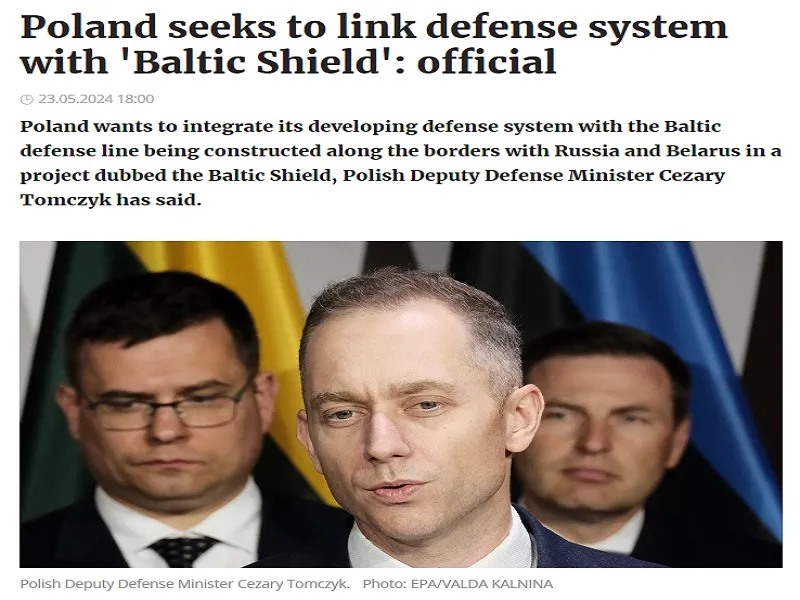
"There is great chaos under heaven; the situation is excellent."

Post Reply