Palestine

User avatar
blindpig
Posts: 14804
Joined: Fri Jul 14, 2017 5:44 pm
Location: Turtle Island
Contact:

Re: Palestine

Post by blindpig » Fri Jul 05, 2024 11:31 am

The Collapse of Zionism
ILAN PAPPÉ
21 JUNE 2024

Hamas’s assault of October 7 can be likened to an earthquake that strikes an old building. The cracks were already beginning to show, but they are now visible in its very foundations. More than 120 years since its inception, could the Zionist project in Palestine – the idea of imposing a Jewish state on an Arab, Muslim and Middle Eastern country – be facing the prospect of collapse? Historically, a plethora of factors can cause a state to capsize. It can result from constant attacks by neighbouring countries or from chronic civil war. It can follow the breakdown of public institutions, which become incapable of providing services to citizens. Often it begins as a slow process of disintegration that gathers momentum and then, in a short period of time, brings down structures that once appeared solid and steadfast.

The difficulty lies in spotting the early indicators. Here, I will argue that these are clearer than ever in the case of Israel. We are witnessing a historical process – or, more accurately, the beginnings of one – that is likely to culminate in the downfall of Zionism. And, if my diagnosis is correct, then we are also entering a particularly dangerous conjuncture. For once Israel realizes the magnitude of the crisis, it will unleash ferocious and uninhibited force to try to contain it, as did the South African apartheid regime during its final days.

1.
A first indicator is the fracturing of Israeli Jewish society. At present it is composed of two rival camps which are unable to find common ground. The rift stems from the anomalies of defining Judaism as nationalism. While Jewish identity in Israel has sometimes seemed little more than a subject of theoretical debate between religious and secular factions, it has now become a struggle over the character of the public sphere and the state itself. This is being fought not only in the media but also in the streets.

One camp can be termed the ‘State of Israel’. It comprises more secular, liberal and mostly but not exclusively middle-class European Jews and their descendants, who were instrumental in establishing the state in 1948 and remained hegemonic within it until the end of the last century. Make no mistake, their advocacy of ‘liberal democratic values’ does not affect their commitment to the apartheid system which is imposed, in various ways, on all Palestinians living between the Jordan River and the Mediterranean Sea. Their basic wish is for Jewish citizens to live in a democratic and pluralist society from which Arabs are excluded.

The other camp is the ‘State of Judea’, which developed among the settlers of the occupied West Bank. It enjoys increasing levels of support within the country and constitutes the electoral base that secured Netanyahu’s victory in the November 2022 elections. Its influence in the upper echelons of the Israeli army and security services is growing exponentially. The State of Judea wants Israel to become a theocracy that stretches over the entirety of historical Palestine. To achieve this, it is determined to reduce the number of Palestinians to a bare minimum, and it is contemplating the construction of a Third Temple in place of al-Aqsa. Its members believe this will enable them to renew the golden era of the Biblical Kingdoms. For them, secular Jews are as heretical as the Palestinians if they refuse to join in this endeavour.

The two camps had begun to clash violently before October 7. For the first few weeks after the assault, they appeared to shelve their differences in the face of a common enemy. But this was an illusion. The street fighting has reignited, and it is difficult to see what could possibly bring about reconciliation. The more likely outcome is already unfolding before our eyes. More than half a million Israelis, representing the State of Israel, have left the country since October, an indication that the country is being engulfed by the State of Judea. This is a political project that the Arab world, and perhaps even the world at large, will not tolerate in the long term.

2.
The second indicator is Israel’s economic crisis. The political class does not seem to have any plan for balancing the public finances amid perpetual armed conflicts, beyond becoming increasingly reliant on American financial aid. In the final quarter of last year, the economy slumped by nearly 20%; since then, the recovery has been fragile. Washington’s pledge of $14 billion is unlikely to reverse this. On the contrary, the economic burden will only worsen if Israel follows through on its intention to go to war with Hezbollah while ramping up military activity in the West Bank, at a time when some countries – including Turkey and Colombia – have begun to apply economic sanctions.

The crisis is further aggravated by the incompetence of Finance Minister Bezalel Smotrich, who constantly channels money to Jewish settlements in the West Bank but seems otherwise unable to run his department. The conflict between the State of Israel and the State of Judea, along with the events of October 7, is meanwhile causing some of the economic and financial elite to move their capital outside the state. Those who are considering relocating their investments make up a significant part of the 20% of Israelis who pay 80% of the taxes.

3.
The third indicator is Israel’s growing international isolation, as it gradually becomes a pariah state. This process began before October 7 but has intensified since the onset of the genocide. It is reflected by the unprecedented positions adopted by the International Court of Justice and International Criminal Court. Previously, the global Palestine solidarity movement was able to galvanize people to participate in boycott initiatives, yet it failed to advance the prospect of international sanctions. In most countries, support for Israel remained unshakable among the political and economic establishment.

In this context, the recent ICJ and ICC decisions – that Israel may be committing genocide, that it must halt its offensive in Rafah, that its leaders should be arrested for war crimes – must be seen as an attempt to heed the views of global civil society, as opposed to merely reflecting elite opinion. The tribunals have not eased the brutal attacks on the people of Gaza and the West Bank. But they have contributed to the growing chorus of criticism levelled at the Israeli state, which increasingly comes from above as well as below.

4.
The fourth, interconnected indicator is the sea-change among young Jews around the world. Following the events of the last nine months, many now seem willing to jettison their connection to Israel and Zionism and actively participate in the Palestinian solidarity movement. Jewish communities, particularly in the US, once provided Israel with effective immunity against criticism. The loss, or at least the partial loss, of this support has major implications for the country’s global standing. AIPAC can still rely on Christian Zionists to provide assistance and shore up its membership, but it will not be the same formidable organization without a significant Jewish constituency. The power of the lobby is eroding.

5.
The fifth indicator is the weakness of the Israeli army. There is no doubt that the IDF remains a powerful force with cutting-edge weaponry at its disposal. Yet its limitations were exposed on October 7. Many Israelis feel that the military was extremely fortunate, as the situation could have been far worse had Hezbollah joined in a coordinated assault. Since then, Israel has shown that it is desperately reliant on a regional coalition, led by the US, to defend itself against Iran, whose warning attack in April saw the deployment of around 170 drones plus ballistic and guided missiles. More than ever, the Zionist project depends on the rapid delivery of huge quantities of supplies from the Americans, without which it could not even fight a small guerrilla army in the south.

There is now a widespread perception of Israel’s unpreparedness and inability to defend itself among the country’s Jewish population. It has led to major pressure to remove the military exemption for ultra-Orthodox Jews – in place since 1948 – and begin drafting them in their thousands. This will hardly make much difference on the battlefield, but it reflects the scale of pessimism about the army – which has, in turn, deepened the political divisions within Israel.

6.
The final indicator is the renewal of energy among the younger generation of Palestinians. It is far more united, organically connected and clear about its prospects than the Palestinian political elite. Given the population of Gaza and the West Bank is among the youngest in the world, this new cohort will have an immense influence over the course of the liberation struggle. The discussions taking place among young Palestinian groups show that they are preoccupied with establishing a genuinely democratic organization – either a renewed PLO, or a new one altogether – that will pursue a vision of emancipation which is antithetical to the Palestinian Authority’s campaign for recognition as a state. They seem to favour a one-state solution to a discredited two-state model.

Will they be able to mount an effective response to the decline of Zionism? This is a difficult question to answer. The collapse of a state project is not always followed by a brighter alternative. Elsewhere in the Middle East – in Syria, Yemen and Libya – we have seen how bloody and protracted the results can be. In this case, it would be a matter of decolonization, and the previous century has shown that post-colonial realities do not always improve the colonial condition. Only the agency of the Palestinians can move us in the right direction. I believe that, sooner or later, an explosive fusion of these indicators will result in the destruction of the Zionist project in Palestine. When it does, we must hope that a robust liberation movement is there to fill the void.

For more than 56 years, what was termed the ‘peace process’ – a process that led nowhere – was actually a series of American-Israeli initiatives to which the Palestinians were asked to react. Today, ‘peace’ must be replaced with decolonization, and Palestinians must be able to articulate their vision for the region, with Israelis asked to react. This would mark the first time, at least for many decades, that the Palestinian movement would take the lead in setting out its proposals for a post-colonial and non-Zionist Palestine (or whatever the new entity will be called). In doing so, it will likely look to Europe (perhaps to the Swiss cantons and the Belgian model) or, more aptly, to the old structures of the eastern Mediterranean, where secularized religious groups morphed gradually into ethnocultural ones that lived side-by-side in the same territory.

Whether people welcome the idea or dread it, the collapse of Israel has become foreseeable. This possibility should inform the long-term conversation about the region’s future. It will be forced onto the agenda as people realize that the century-long attempt, led by Britain and then the US, to impose a Jewish state on an Arab country is slowly coming to an end. It was successful enough to create a society of millions of settlers, many of them now second- and third-generation. But their presence still depends, as it did when they arrived, on their ability to violently impose their will on millions of indigenous people, who have never given up their struggle for self-determination and freedom in their homeland. In the decades to come, the settlers will have to part with this approach and show their willingness to live as equal citizens in a liberated and decolonized Palestine.

https://newleftreview.org/sidecar/posts ... of-zionism

*******

New truce possibilities in Gaza: a step to peace? Or a sidestep to war in Lebanon?

I am appreciative of the opportunity I was given by WION, India’s premier English-language global broadcaster, to speak briefly this morning about the current state of affairs in the Gaza war, from where there are reports that a cease fire agreement between Israel and Hamas may be imminent.

I freely acknowledge that the Middle East per se is outside my core competence, however, these days, as the BBC likes to explain in its self-promoting adverts for its business coverage: everything is connected. It is not possible to speak about the forces influencing the direction of the Israel’s confrontation with its neighbors without discussing the Russian factor, which is my core competence.

To be sure, Russia’s influence has till now been to calm things down, not to become a party to the conflict, since Moscow has its hands full with the war in Ukraine. We are told, in particular, that Russia has applied pressure to its friend Bashar Assad in Syria, to keep Damascus on the sidelines, out of harm’s way. However, an all-out Israeli attack on Lebanon, which may be Mr. Netanyahu’s next move if there is a lull in the Gaza, would likely raise the Russian profile in this conflict sharply: at a minimum as supplier of missiles to the Houthis that can prevent an active and much needed U.S. intervention on Israeli’s behalf if the country goes to war with Hezbollah, and at a maximum by lending support to the militias in Syria and Iraq which participate in the Axis of Resistance under the aegis of Iran.


https://gilbertdoctorow.com/2024/07/04/ ... n-lebanon/

*****

Israeli airbase behind GPS disruptions across West Asia: Report

The New York Times reports that over 50,000 flights have been affected by Israeli GPS jamming

News Desk

JUL 4, 2024
Image
(Photo credit: AP/Hussein Malla)

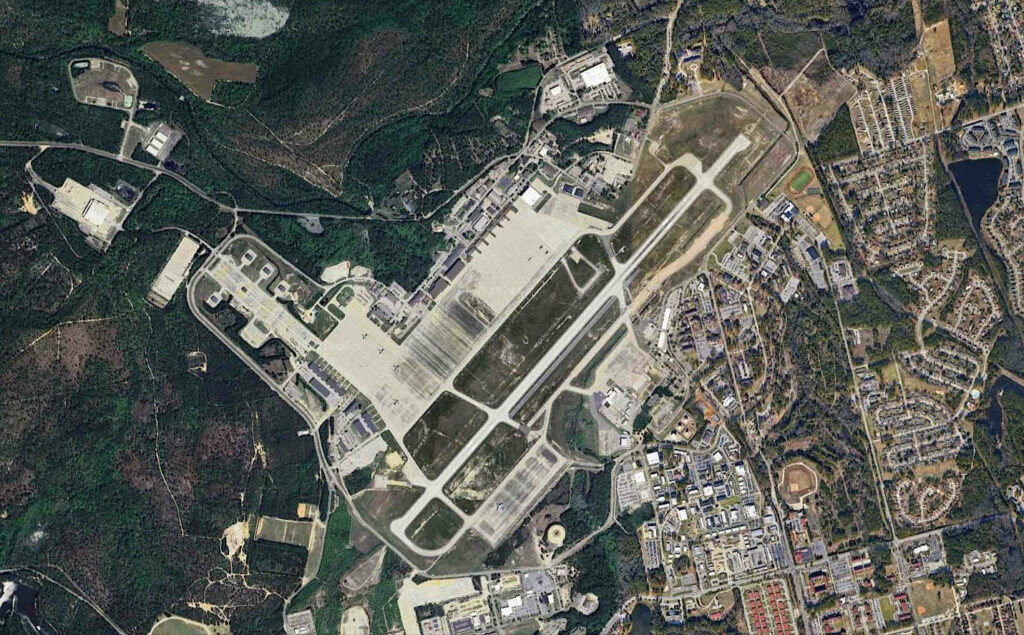
An Israeli army airbase in northern Israel has been identified as the source of numerous GPS jamming attacks and disruptions in the region, the New York Times (NYT) reported on 3 July.

The “spoofing” attacks, as they are referred to, involve scrambling signals and misdirecting airplane instruments, making it difficult for aircraft to determine their exact location.

The jamming is also used to interfere with incoming rocket and missile fire, aimed at lessening the accuracy of attacks.

According to NYT, researchers at the University of Austin, Texas, Todd Humphreys and Zach Clements, used satellite signals to determine the source of the jamming. The two researchers said they were “highly confident” that it was coming from the Ein Shemer Airfield in the city of Hadera.

NYT says the “spoofing” has interfered with over 50,000 flights. Pilot systems have mislocated themselves as being in Beirut or Cairo as a result. The attacks have also made some pilots mistakenly believe they were too close to the ground.

Swiss International Airlines has said that its flights over the region are disrupted by jamming attacks almost daily.

Pilots in the region are well aware of the issue and have been taking steps to bypass jamming attacks, which interfere with flight safety.

“Losing GPS is not going to cause airplanes to fall out of the sky, but I also don’t want to deny the fact that we are removing layers of safety,” said the Vice President of Spirent Communications, which specializes in testing for navigation systems.

The Israeli army declined to comment on the NYT report.

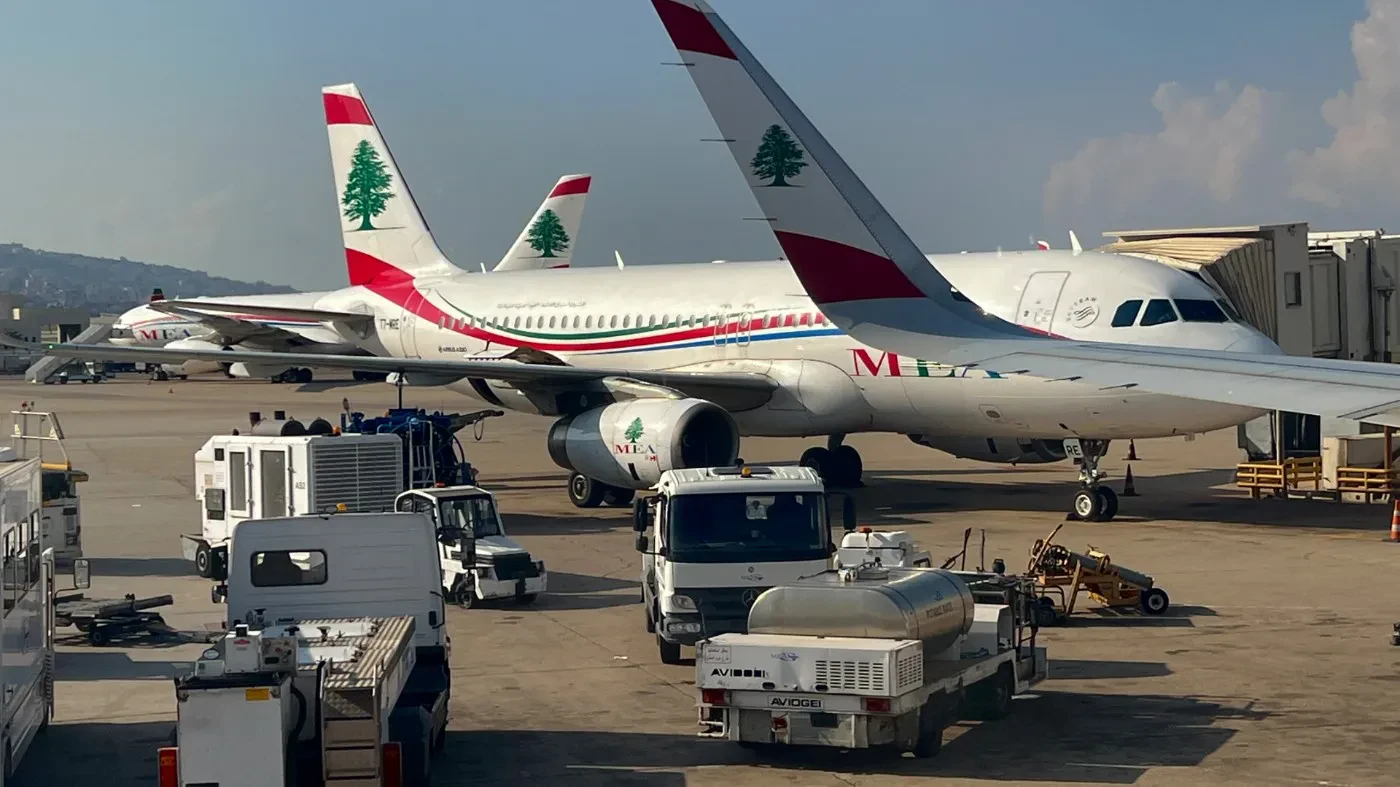
These attacks have particularly affected commercial airliners arriving at Beirut’s Rafic Hariri International Airport. Authorities say Lebanon’s lack of cybersecurity expertise has made matters worse, and have vowed to file a complaint against Israel at the UN Security Council for jeopardizing flight safety.

In December last year, an extensive Israeli spy network in the Lebanese capital was discovered, which utilized highly advanced imaging and radio and frequency equipment unavailable to the general public.

It was also reported late last year that since the start of the war, several foreign military cargo planes landed at Beirut airport and the Hamat airbase in the north of the country.

At the time, the mysterious flights were said to have been potentially carrying jamming, monitoring, and tracking devices, according to Lebanese newspaper Al-Akhbar.

The NYT report comes less than two weeks after The Telegraph reported that Hezbollah weapons were being hidden at the Beirut airport. Lebanese officials ridiculed the claims and held a diplomatic and media tour across the airport the following day to disprove the claims.

https://thecradle.co/articles/israeli-a ... sia-report

Extreme levels of hunger' affecting 96 percent of Gaza: Report

To date, Israel’s attacks on Gaza have killed over 38,000 people, including at least 15,000 children, and injured over 87,000 more

News Desk

JUL 4, 2024

Image
(Photo Credit: AP)

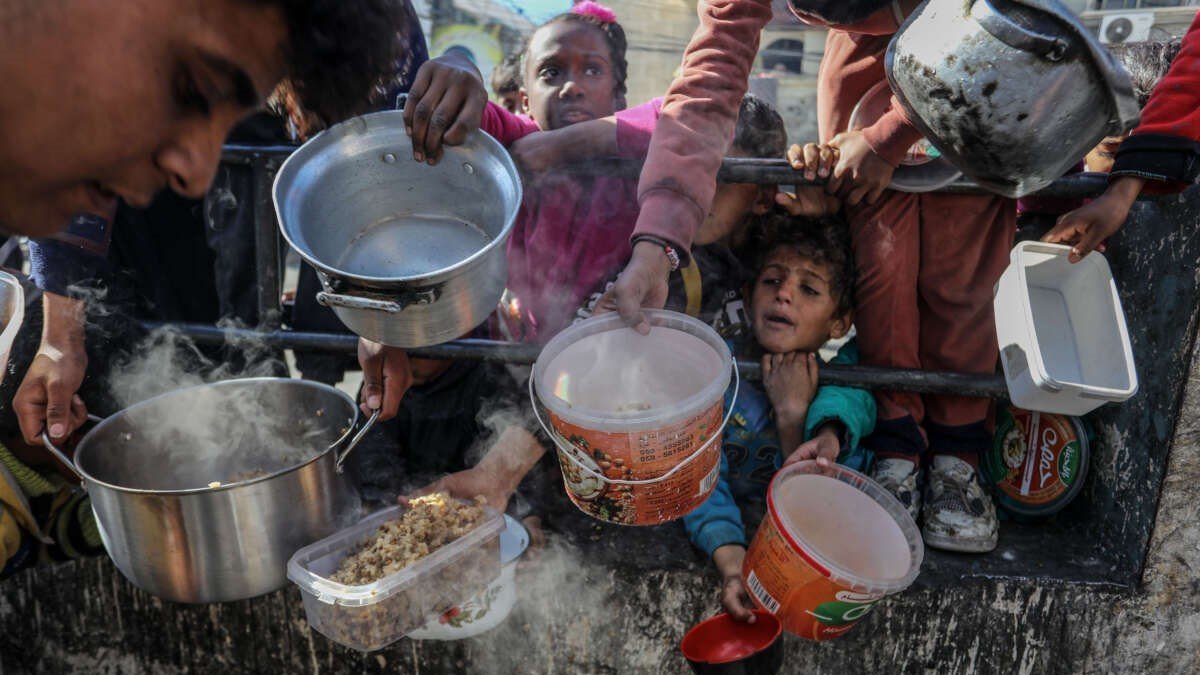
An Integrated Food Security Phase Classification (IPC) report shows that 96 percent of the population in the Gaza Strip currently face “extreme levels of hunger,” while nearly half a million people are in catastrophic conditions.

The Palestinian Red Cross Society (PRCS) has repeatedly warned of the deteriorating humanitarian conditions resulting from Israel's closure and obstruction of border crossings, blocking sufficient aid from reaching the strip.

The IPC also states that over half of Gazan households have had to sell their belongings to afford food. A third of the population has turned to collecting trash to sell, while many must endure days and nights without food.

On 2 July, UN Women reported that at least 557,000 women in Gaza are suffering from food insecurity, highlighting that mothers and adult women often prioritize feeding others and report significant challenges in accessing sufficient food supplies.

Last month, in collaboration, the FAO and WFP released a report that indicates that over a million Palestinians may face fatal levels of starvation by mid-July.

In the same month, Gaza’s media office disclosed that thousands of children aged five and under are at risk of death because Israel is obstructing the flow of aid into the strip.

The media office also urged the International Criminal Court (ICC) and other international justice courts to prosecute the war criminals, whether Israeli or in the US government, who are complicit in the systematic targeting of children.

To date, Israel’s attacks on Gaza have killed over 38,000 people, including at least 15,000 children, and injured over 87,000 more.

https://thecradle.co/articles/extreme-l ... aza-report

*******

Underground Resistance: The Role of Tunnels in Hezbollah Military Operations
Posted by INTERNATIONALIST 360° on JULY 4, 2024
Bilal Nour Al-Deen

Image

Hezbollah’s extensive network of tunnels is gaining attention as war with Israel looms. Although their current strategic value remains uncertain, the underground networks are tactically vital, offering fortified positions, covert movement capabilities, and resilience against enemy forces.

In 2018, the Israeli occupation army launched “Operation Northern Shield” to uncover and destroy Hezbollah tunnels along the Lebanon border, an underground network that Hezbollah Secretary-General Hassan Nasrallah later explained was built in the 1990s and subsequently abandoned.

Hezbollah’s proficiency in tunnel construction has benefitted from the experience of Palestinian fighters who had dug tunnels in southern Lebanon before Israel’s 1982 invasion. The Lebanese resistance began utilizing tunnels shortly after launching its own military operations against the occupation state in the 1990s.

A 2021 report by the Israeli Research Center ALMA revealed that Hezbollah has constructed numerous underground tunnels across Lebanon, including in its south, parts of Beirut, and the Bekaa Valley. French newspaper Liberation reports that Hezbollah’s tunnel network is remarkably sophisticated, spanning hundreds of kilometers and even reaching into Syria.

But today, with the threat of another Israel–Lebanon war escalating, analysts foresee any future conflict as being heavily influenced by technological military advancements and less the labyrinth of tunneling that defined earlier clashes.

Since 2023, Hezbollah has showcased advanced weaponry capable of downing Israeli drones and destroying its air defense systems, as Nasrallah claims it has only used a fraction of its arsenal.

Tactical vs strategic value

While Nasrallah frequently highlights Hezbollah’s advanced weaponry, he remains silent on the tunnel networks, which Tel Aviv finds concerning. This raises the question of whether these tunnels still hold strategic importance in the face of rapid weapons advancements.

As Dr Andreas Krieg, an assistant professor at King’s College London, tells The Cradle:

The tunnels Hezbollah has built in the past 15 years across southern Lebanon have tactical and operational but not strategic value. That is to say that while the tunnel system is Hamas’ center of gravity in Gaza, the tunnel system in southern Lebanon is merely a force multiplier for Hezbollah that provides it with a military edge vis-à-vis the IDF infantry.

Krieg explains that there are different types of tunnels: surface-level tunnels used for moving operatives and materials, which can be destroyed from the air; and deeper, concrete-reinforced tunnels that serve as command centers and armories. The deeper tunnels, some up to 60 meters underground, are almost impervious to Israeli airstrikes and were built with support from North Korea and Iran.

He suggests that the effectiveness of Israel’s efforts to destroy these tunnels will depend on its ability to maintain air supremacy, as in 2006. However, advancements in drone and anti-drone technology may complicate that task. Hezbollah’s potential use of Iranian technology to down Israeli drones could balance the intelligence capabilities between the two.

Today, Krieg believes that destroying the tunnels will not be a game changer: “Since the tunnels are not as strategically important to Hezbollah as they are in Gaza for Hamas, the destruction of the tunnel system is not as problematic for Hezbollah.”

The multifaceted nature of Hezbollah’s tunnels

Nicholas Blanford, a US-based expert on Hezbollah military operations, tells The Cradle that “tunnels are still very important for Hezbollah whether they are cross-border tunnels or part of the tunnel/bunker networks it has established across south Lebanon and elsewhere.”

“They remain a strategic priority,” he continues. Blanford believes that tunnels will be used for storing and sheltering fighters, as well as infiltrating Israel to carry out attacks. He also suggests that Hezbollah could reconfigure or expand the tunnels to serve different tactical purposes as needs evolve.

Blanford emphasizes the strategic importance of tunnels in Hezbollah military infrastructure. Even with the potential implementation of UN Security Council Resolution 1701, which aims to mediate between Lebanon and Israel and constrain Hezbollah’s military activities – especially south of the Litani River – tunnels would continue to play a critical role.

For example, they could enable Hezbollah to spot Israeli soldiers or vehicles moving into a position and attack immediately. That means Hezbollah is still deployed up to the Blue Line delineating the border between the two countries and can react to Israeli movements in real time.

This also sheds further light on the persistent pressure from the US for Hezbollah to withdraw its forces to at least eight kilometers from the border. If adhered to, this would significantly constrain Hezbollah’s military presence and activities in the area.

Necessary but not essential

Speaking to The Cradle, Lebanese military journalist Ali Jezzini notes that the tunnels’ usefulness fluctuates based on Hezbollah’s ability to disrupt Israeli firepower. During the 2006 war, Hezbollah fighters utilized tunnels and trenches to resist Israeli forces with ferocity.

Jezzini believes tunnels will remain essential, especially in areas designated as “natural reserves” that serve as underground fortresses and defensive positions.

He recalls that these tunnels constituted a major obstacle for Israel in the 2006 war. Hezbollah fighters in Maroun al-Ras and its environs fiercely fought Israeli occupation forces from these trenches and tunnels.

But Jezzini stresses that tunnels’ importance is not solely linked to their ability to disrupt air force operations; the underground labyrinths will remain necessary for purposes unrelated to air operations, such as serving as shelters to protect personnel and equipment from the occupation state’s artillery.

In general, the tunnels are still very necessary, especially since the element of surprise will be absent, unlike Hamas on October 7.

Ultimately, the role these tunnel networks will play in any future conflict between Israel and Hezbollah remains uncertain. While their strategic significance may be less than in 2006, they could still offer valuable tactical advantages in an upcoming war.

https://libya360.wordpress.com/2024/07/ ... perations/

Only an Anti-Fascist Front Can Save Us From the Abyss
Posted by INTERNATIONALIST 360° on JULY 4, 2024
Orly Noy

Image
Israeli soldiers seen on the Israeli side of the Gaza fence, March 4, 2024. (Jamal Awad/Flash90)Israeli soldiers seen on the Israeli side of the Gaza fence, March 4, 2024. (Jamal Awad/Flash90)

The anti-fascist front that must arise here can only be led by Palestinian citizens — not only because no other political camp comes close to matching their record of struggle against Israeli fascism, but because no one else has a coherent political vision, based on the values substantive democracy and full equality, as Palestinian citizens have articulated in various party platforms and civil society statements.

“What’s happening to you?” That was the question Yoana Gonen posed, in her recent column for Haaretz, to the so-called “leftists” vowing to vote for Israel’s right-wing former prime minister, Naftali Bennett. The fact that such a trend exists is bewildering, but the answer to Gonen’s question is clear. What is happening to these “leftists” is the same thing that’s happening to all of Israeli society: a profound and accelerating slide toward fascism.

Nine months into a war with no end in sight, the Israeli revenge campaign in the besieged, starved, and devastated Gaza Strip continues apace. This is despite the unprecedented number of casualties, the significant diplomatic cost, and the genocidal war crimes in Gaza, for which arrest warrants hover over Prime Minister Benjamin Netanyahu and Defense Minister Yoav Gallant.

It’s very difficult for a society stuck in a continuous state of trauma to evaluate or even notice the transformations it is undergoing in real time. The Israeli public is still recovering from the shock of October 7, and while the world keeps its eyes on Gaza — and rightly so — Israelis’ attention remains focused elsewhere: on the hostages still trapped in Gaza and soldiers killed there; those evacuated from their homes in the north and the south; the shattered economy; and a war in the north that could break out at any moment.

But it’s impossible to ignore how Israel has adopted a new national ethos under the auspices of this war — one that completely abandons any lip service to the idea of democracy in favor of fascist values.

Since the start of the war, the Knesset has exploited the chaos and confusion among the public to advance a series of extreme anti-democratic laws. “The IDF and Shin Bet Certification Law” makes it easier for these bodies to penetrate private computers used to operate CCTV cameras and to erase, alter, or disrupt materials on them, without the knowledge of the computer’s owner and without permission from a court. A recent amendment to the “Counter-Terrorism Law” criminalizes the prolonged consumption of content produced by Hamas or ISIS, punishable by one year in prison.
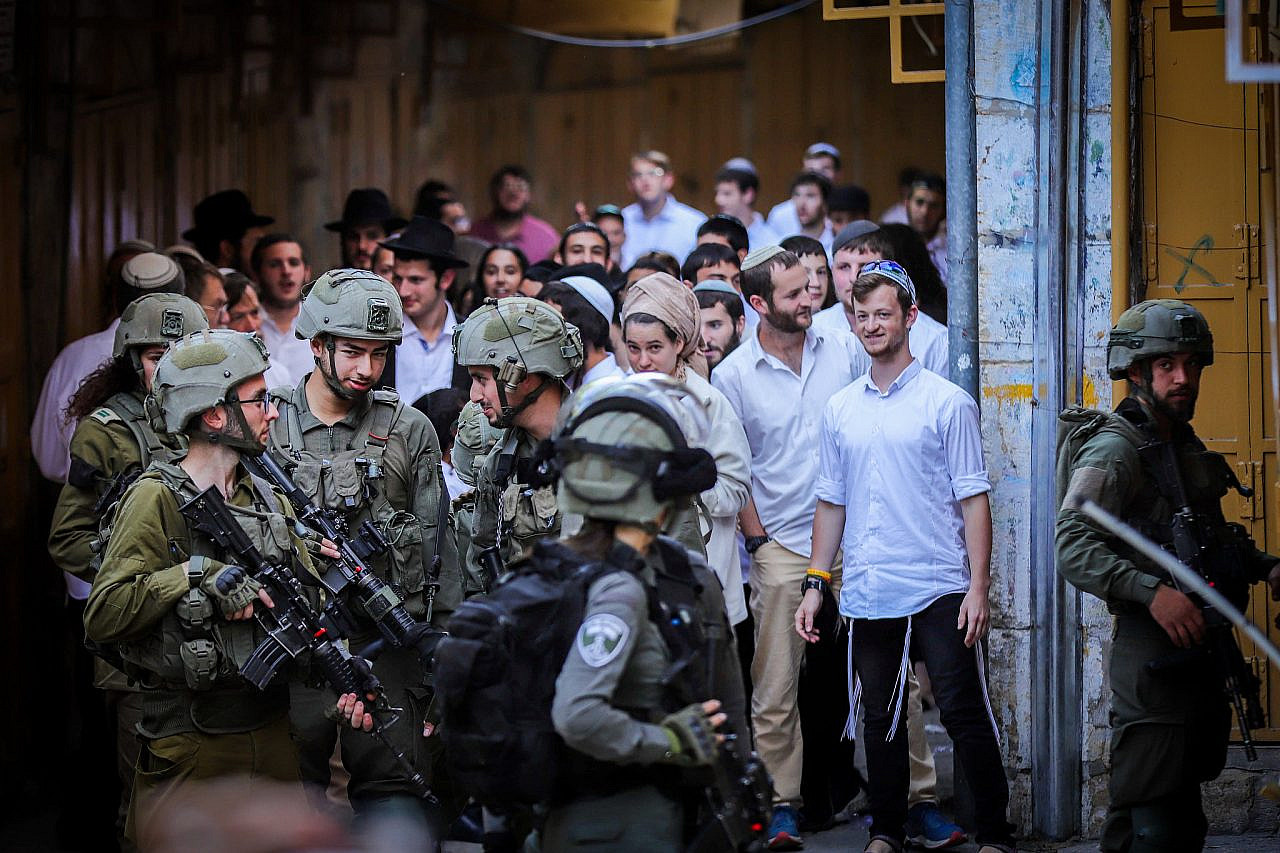
Image
Israeli soldiers stand guard as religious Jews walk through the occupied West Bank city of Hebron, May 25, 2024. (Wisam Hashlamoun/Flash90)

The proposed “Likes Law” seeks to penalize the mere act of “liking” social media posts that “incite terror”, while another proposed law would expand the Shin Bet’s surveillance of teachers. And to these we must add the forced closure of Al Jazeera’s offices, which only increased the appetite of Israeli ministers to promote a law permitting them to shut down Israeli media outlets without any limitations.

Another particularly alarming manifestation of this slide toward fascism is the transformation of the police into a body of henchmen that almost exclusively serves the interests of the government and its worldview. Instead of protecting Israeli citizens, police are cracking down on those who protest the government and the war — even those demanding to bring the hostages home — while also inflicting horrifying violence on demonstrators during detention and imprisonment.

The police have arrested hundreds of Palestinian citizens of Israel for expressing solidarity with their people in Gaza, opposing the war, or participating in nonviolent protests. And the appalling treatment of Palestinian prisoners and detainees is a category unto itself, with mounting, chilling evidence of what takes place inside the Sde Teiman detention center and other prison facilities.

An equally worrying transformation is occurring among ordinary citizens, who are reporting to the authorities their colleagues, neighbors, classmates, schoolteachers, and professors who have dared to deviate from the monolithic national narrative. Teachers like Meir Baruchin have been fired; Dr. Anat Matar has faced a despicable campaign against her for eulogizing Palestinian prisoner Walid Daqqa; and the National Union of Israeli Students is proposing a law to mandate the dismissal of any academic who questions Israel’s character as a “Jewish and democratic state.”

The examples of genocidal statements from elected officials are too numerous to tally, but plenty of them were presented by South Africa in its genocide case against Israel in The Hague in January. More recently, Rabbi Eliyahu Mali — the head of a religious school in Jaffa — suggested in March that Judaism dictates that all the residents of Gaza should be killed (the police have recommended closing the case). And just last month, former Likud MK Moshe Feiglin argued that, just as Hitler said that he couldn’t sleep so long as even a single Jew remained in the world, so too can Israelis “not live in this country if a single Islamo-Nazi remains in Gaza.”
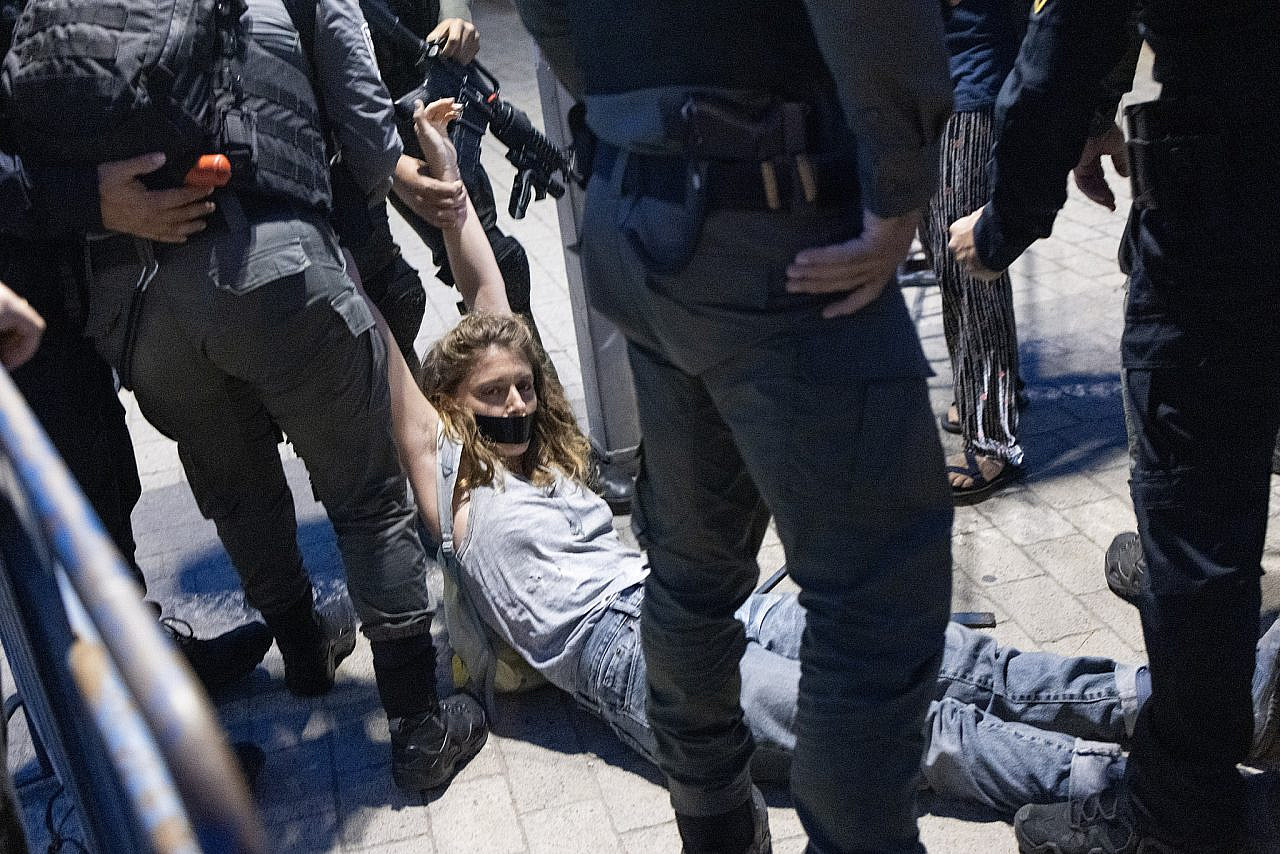
Image
Israeli activists protest against the arrest of members of the Arab High Follow-Up Committee earlier in the day, Tel Aviv District Police Station, November 9, 2023. (Oren Ziv)

Then there is the explicitly fascist language that has become part of most Israelis’ everyday parlance: calls for genocidal violence flood social media networks in Hebrew, and the Israeli authorities don’t object or even lift a finger to try to stop it.

One day — and who knows how much more destruction and death will be wrought before this day comes — the war will end. Israeli society will emerge more violent, more nationalist, more militaristic, and more openly fascist. But right now, we must begin preparing for this day by building a broad anti-fascist front that can curb the worst impulses of this new society and chart a different path forward.

The Jewish center-left must understand that what was can no longer be. The camp that paid lip service to the idea of democracy only to more firmly establish Jewish supremacy between the river and the sea has almost entirely disappeared from the political map. It is certainly not up to the task of leading an anti-fascist front.

It cannot be led by Benny Gantz, the bellicose general who time and time again has saved Netanyahu’s political career, and who joined the prime minister’s war cabinet in October only to leave it criminally late and without any serious rebuke. Nor will it be led by Yair Golan, the new chair of the Labor-Meretz merger known as “The Democrats” and a rising star on the Zionist left, who hastened to clarify that he is ready to sit down and talk with Likud and Mansour Abbas but not with other Arab parties. And it won’t be led by Yair Lapid, for whom even Abbas is not good enough to serve as minister, and who dismisses all Palestinian parties in one fell swoop.

The anti-fascist front that must arise here can only be led by Palestinian citizens — not only because no other political camp comes close to matching their record of struggle against Israeli fascism, but because no one else has a coherent political vision, based on the values substantive democracy and full equality, as Palestinian citizens have articulated in various party platforms and civil society statements.

Today, after the shock of October 7 that has convulsed Israeli society, decent citizens are faced with an existential choice. They can continue to cling to the idea of “Jewish and democratic” Israel, a dangerous deception that masks an increasingly fascist ethnocratic state. Or they can strive for a substantial democracy, without which Israeli society will irrevocably plunge into the abyss.

https://libya360.wordpress.com/2024/07/ ... the-abyss/
"There is great chaos under heaven; the situation is excellent."

User avatar
blindpig
Posts: 14804
Joined: Fri Jul 14, 2017 5:44 pm
Location: Turtle Island
Contact:

Re: Palestine

Post by blindpig » Sat Jul 06, 2024 11:05 am

On Aid and War: How Israel Has Used Starvation To Subdue the Palestinians
JULY 4, 2024

Image
Relatives of 10-year-old Palestinian Mustafa Hijazi, who died due to malnutrition and lack of medication, mourns in Deir al-Balah, Gaza on June 14, 2024. Photo: Ashraf Amra/Anadolu Agency.

By Ramzy Baroud – Jun 28, 2024

Humanitarian aid should never be politicised though, quite often, the very survival of nations is used as political bargaining chips.

Sadly, Gaza remains a prime example. Even before the current war, the Gaza Strip suffered under a 17-year hermetic blockade, which has rendered the impoverished area virtually ‘unlivable’.

That very term, ‘unlivable’ was used by the then-UN Special Rapporteur for the Situation of Palestine, Michael Lynk, in 2018.

As of mid-December, “nearly 70% of Gaza’s 439,000 homes and about half of its buildings have been damaged or destroyed”, the Wall Street Journal reported, citing experts who conducted a thorough analysis of satellite data.

As tragic as the situation was in December, now it is far worse.

Some 67 per cent of Gaza’s water, sanitation facilities and infrastructure have been destroyed or damaged, according to a statement by the United Nations Agency for Palestinian Refugees (UNRWA) on 19 June, leading to the spreading of infectious diseases, which have ravaged the beleaguered population for months.

Image

The spread of disease is also linked to the accumulation of garbage everywhere in Gaza. Earlier, the refugees agency reported that “as of June 9, over 330,000 tons of waste have accumulated in or near populated areas across Gaza, posing catastrophic environmental (and) health risks.”

The situation was already disastrous. Indeed, three years before the war, the Global Institute for Water, Environment and Health (GIWEH) said, in a joint statement with the Euro-Mediterranean Human Rights Monitor, that 97 per cent of Gaza water was undrinkable and unfit for human consumption.

Yet, so far, any conversation on allowing aid to Gaza, or the rebuilding of Gaza after the war, has been placed largely within political contexts.

By shutting down all border crossings, including the Egypt-Gaza Rafah Crossing – which, on 17 June was set ablaze – Israel has politicised food, fuel and medicine as tools in its war in the Strip.

This is not a mere inference, but the actual statement made by Israeli Minister of Defence, Yoav Gallant, who on 9 October, declared that he had ordered a “complete siege” and that “there will be no electricity, no food, no fuel, no water” entering Gaza.


The timing of the statement, which has indeed been put into action from the first day of the war, suggests that Israel did not apply the strategy as a last resort. It was one of the most important pieces in the war stratagem, which remains in effect to this day.

Instead of pressuring Israel, Washington tried to obtain its own political leverage, also by politicising aid. On 3 March, the US Air Force started airdropping aid into northern Gaza. A far more conducive and less humiliating option for Palestinians, however, would have been direct US pressure on Israel to allow access to aid trucks arriving through Rafah, Karem Abu Salem (Kerem Shalom) Crossing or any other.

Scenes and images of thousands of starving Palestinians chasing after boxes of aid parachuted in Gaza will remain etched in the collective memory of humanity as an example of our failed morality.

News reports spoke of whole families who were killed under the weight of the dropped ‘aid’, much of which had fallen in the Mediterranean, never to be retrieved.

Even the Gaza pier, constructed by the US military on the Gaza shore last month, did little to alleviate the situation. It merely transported 137 aid trucks, according to the US’ own estimation, enough to cover Gaza’s need for food for a few hours only.

During the years of siege, an average of 500 trucks arriving daily in Gaza has kept the 2.3 million population of the Strip alive, though malnourished.

To deal with the outcome of the war, and to stave off current starvation, especially in the north, the number of aid trucks would have to be much higher. Yet, whole days would pass without a single truck making its way to the suffering population. This is unacceptable.

Image
Lifeless body of 10-year-old Palestinian Mustafa Hijazi, who died due to malnutrition and lack of medication, is seen at al-Aqsa Martyrs Hospital in Deir al-Balah, Gaza on June 14, 2024. [Ashraf Amra – Anadolu Agency]

Not only did the international community fail at ending the war, it has also failed in delinking humanitarian aid from political and military objectives.
The problem with politicising aid is that innocent civilians become a bargaining chip for politicians and military men. This goes against the very foundation of international humanitarian law.

According to the International Red Cross, citing the Hague Conventions, “international humanitarian law is the branch of international law that seeks to impose limits on the destruction and suffering caused by armed conflict.” In Gaza, no such ‘limits’ have been ‘imposed’ by anyone.

Providing aid to Gaza and ensuring the reconstruction of the Strip must not be a political item for negotiations. It is a basic human right that must be honoured under any circumstance.

Meaningful pressure must be placed on Israel to end the Gaza siege, and urgent plans must be drafted, starting today, by representatives of UN humanitarian institutions, the Arab League and Palestinian and Gaza authorities to be the entities responsible for delivering aid to Gaza.

Humanitarian aid to Gaza must not be used as political leverage, or a tool in a cruel war, whose primary victims are millions of Palestinian civilians.

https://orinocotribune.com/on-aid-and-w ... estinians/

The State of the Enemy: From Shock and Denial to Failure and Defeat
JULY 4, 2024

Image
Khaled Barakat, Palestinian, academic and left-wing activist. Photo: Palestinian Alternative Revolutionary Path Movement.

By Khaled Barakat – Jul 2, 2024

Despite the differences in positions and visions within the Zionist enemy entity and among its allies, they all agree on describing October 7, 2023 as a “great shock” and “the most dangerous security failure” in the history of their colonial settler project in occupied Palestine. There has been much talk about the “necessity of close cooperation between allies” to save their colony – from itself and from its enemies – as there is a consensus in Tel Aviv and Washington that “war is the solution” and that the axis of resistance constitutes the “greatest existential threat”, while the disagreement within the enemy camp remains over their methods and tactics and not their strategic goal. They declare their position in private and in public, saying: We all hate Iran, Sinwar, Nasrallah and al-Houthi, but in a time of uncertainty and precision missiles, who can guarantee the results of the war?! With every American shell that the Israeli occupation army drops on Gaza, the West Bank, southern Lebanon and Syria, and with every response of the resistance, the Zionist-U.S. failure only grows. The empire is bleeding away its advantage in the balance of power and its strategic position in a world where multiple international powers are advancing and where these changes are taking place at the speed of a missile, while the oil sheikhs, the Camp David regime, the Kingdom of Wadi Araba, and the Oslo mafia all await the good news of “Israeli victory over Hamas!” Because Israel’s defeat and failure also means a disastrous failure for all the poles that make up this enemy camp.

Destructive wars, economic exploitation and political domination are inherent to imperialism and colonialism. These forces have been plundering the planet for 500 years and engineered the largest armed robbery in history. They not only stole Palestine, and the wealth and dreams of Arabs and Muslims, but they also colonized continents, crushed peoples and annihilated tribes. Through war and the imposition of “agreements” of surrender and defeat, the United States wishes to reproduce the “new world order” to its own liking. Total war is a tried and tested recipe, and those whom the United States cannot defeat with bombs, it imposes sanctions, siege and wars of starvation upon them. And despite all of this, the U.S. is shocked and confused as it confronts the facts of today’s reality.

The balance of power in our region changed at the beginning of the new century. The point of this transformation can be identified with the historic victory of the Lebanese resistance in May 2000 when it succeeded in liberating the South through armed force and without political concessions. It presented a novel revolutionary model through which it proved that armed struggle (jihad and resistance) remains possible in the most difficult circumstances. We now have a tried and tested recipe that is also effective. The resistance is now able to say to the enemy and its partners: Do not test our patience. If you embark on aggression and war, your cries may reach Cyprus!

The clear victory achieved by the resistance in Lebanon in 2000, forcing Ehud Barak to the swallow defeat, was repeated by the Palestinian resistance when it forced Sharon to withdraw and dismantle his settlements in 2005. The monster Sharon was forced to make his decisions under fire, calling them “painful decisions” and “difficult choices” and providing a ready-made justification: “I did this for the survival of Israel!”

The Zionist entity suffered successive shocks when the resistance and its popular cradle were able to withstand and overcome the aggression after the goals of the occupier were thwarted. Rebuilding what the war machine destroyed is also a second victory, because the resistance possesses — in addition to the political vision, weapons and clear goals– the ability to organize and plan. It is no coincidence that its strength grows stronger after every battle. This is because it is no longer a spontaneous and improvised condition, a momentary “outrage”, “panic” or “venting of anger” as was all too often the case with the official Palestine Liberation Organization and the arrogant reactionary Arab regimes!

It is not the quantity or type of weapons that makes for steadfastness and victory. Weapons can rust and turn into worthless scrap if there is no ability to organize, renew a movement, exercise political will, and formulate an alternative revolutionary project. Pakistan is currently the largest Muslim nuclear state, with a population exceeding 245 million people, and Egypt is the largest Arab country, with an army and security apparatus exceeding 2 million soldiers! The enemy does not see them nor take them into account, while the Zionists fear an armed Palestinian cell in a refugee camp in the occupied West Bank. What frightens the enemy and its apparatus is the goal and vision of those who bear the weapons and the ideology that leads them, not the weapon alone.


The Lebanese people did not achieve their victory in 2000 because Hezbollah possessed “weapons that could break the impasse,” but because the resistance pushed the enemy into a continuous state of failure and shock that over time turned into a state of denial and then into the enemy’s readiness to accept defeat. If the resistance today possesses deep knowledge of the enemy’s conditions and knows its weaknesses and strengths, and possesses deterrent weapons and the ability to manufacture and develop their weapons, we have advanced in a qualitative manner, and the possibility of inflicting defeat on the enemy’s army and eliminating the illegitimate entity has become only a matter of time. The goal of liberating Palestine has moved from the realm of historical possibility to the realm of realistic, achievable possibility.

The Yemeni people and their valiant armed forces present us with a new and unique revolutionary model in confronting the fleets of U.S. and British imperialism in the region and the world. With the presence of solid, reliable leadership in Sana’a, and a strategic reading of the reality of the struggle, we have seen how Yemen was able to bring the Pentagon into a circle of shock and denial. This reality did not arise suddenly. It was achieved through the accumulation of patience and sacrifice, and it is inseparable from the steadfastness of the Yemeni people confronting siege and aggression since 2015, the achievements of the Yemeni revolution led by Ansar Allah in terms of battlefield, political and military experience, and an amazing ability to handle, utilize and develop weaponry.

The Zionist entity in the Gaza Strip and the region is experiencing the worst phase in its history since 1948 and is helpless in the face of the steadfastness of the Palestinian people and their courageous resistance that has worked miracles above and below the ground. The failure of the Zionist “elite units” is evident in their confrontations with the armed, organized Palestinian battalions that have been inoculated with fire since the Al-Aqsa Intifada of September 2000, and have fought through multiple wars and battles, laying the foundations for the Flood and the period following the Flood.

Yes, the Zionist entity is a criminal and powerful enemy, like every colonizer, possessing enormous capabilities, but it has become more like a raging monster whose eyes (and vision) were gouged out by the resistance, which plunged it into a cycle of shock and confusion. Like such a monster, the Zionist project is subject to defeat, paralysis, and even extinction.

(Palestinian Alternative Revolutionary Path Movement)

https://orinocotribune.com/the-state-of ... nd-defeat/
*****

Analysis | Netanyahu Tried to Derail the Hostage Deal Even Before Hamas Responded

The Israeli prime minister's eagerness to put a spoke into the wheels of any deal is shared by his partner-in-crime, Bezalel Smotrich ■ The evil twins of judicial reform have returned to our lives like a recurring nightmare and are flooding the Knesset with semi-fascist legislation

Image
Credit: Amos Biderman

Yossi Verter
Jul 5, 2024 6:00 am IDT

This time he really did it. The word "shamelessness" does not even begin to do justice to the insolence, cynicism and hardness of Prime Minister Benjamin Netanyahu's heart. But this time, perhaps because of the hubris that has once again taken over, maybe because of his impending victory tour to the United States, including a meeting with its bruised and battered president, Netanyahu was not being sufficiently careful.

The execution was clumsy, sewn with coarse threads. The fingerprints are clear as day. The lingering stench rising from a failed prime minister's latest maneuver – the massacre and continued abandonment of 120 hostages – is now felt everywhere.

The main points were reported by the media on Wednesday: Even before Hamas responded to the Netanyahu-Biden proposal, the Prime Minister's Office already knew what it would contain. Hamas' flexibility came as a surprise to the man who said he supported the plan (which had been unanimously approved by the war cabinet) but who never expected to implement it. He therefore saw a clear and present danger to his government's survival – and that is priority No. 1 for Benjamin Netanyahu.

Thus, hours before Hamas' answer was due, an unnamed individual in the PMO describing himself as a "senior security official" rushed to hold a briefing for journalists in which he asserted that Hamas "refuses to budge on its principal point, which is to prevent Israel to resume fighting after the first phase, something that Israel will never accept."

https://www.haaretz.com/israel-news/202 ... f51c7d567d

(I could give a flying fuck about the hostages but this does nicely illustrate what a conniving swine Bibi is.)

*****

Israel vs Hezbollah: Strategic Stakes and Regional Implications
Posted by INTERNATIONALIST 360° on JULY 5, 2024
Shivan Mahendrarajah

Image

With war looming on the horizon, Israel’s potential conflict with Hezbollah is seen as a strategic move to address long-standing security concerns, with significant geopolitical implications involving the US, Iran, Russia, and other major powers raising the specter of a far-reaching regional crisis.

___________________________________________

There are known knowns; there are things we know we know. We also know there are known unknowns; that is to say we know there are some things we do not know. But there are also unknown unknowns—the ones we don’t know we don’t know.

— Former US secretary of defense, Donald Rumsfeld


As tensions escalate between Hezbollah and Israel, analysts are meticulously wargaming potential conflict scenarios. For Prime Minister Benjamin Netanyahu and his religious-nationalist coalition, a confrontation with the Lebanese resistance movement is more than speculation – it is a strategic consideration. This coalition views a potential war as a means to address longstanding security concerns and strengthen its political position.

A key part of Tel Aviv’s strategic thinking is the hope that the US might be forced into taking a more active role in confronting Israel’s adversaries – Hezbollah, Syria, and Iran – thereby neutralizing threats that have persisted for decades. This concept of “clearing the decks” of regional enemies remains a central theme in Israeli strategic discussions.

Historical roots of Israel’s strategic confidence

For the occupation state, this potential conflict is a “war of choice” driven by historical and ethnonationalist motivations. But it is also premised on past Israeli military advantages that are long gone in today’s missile-laden West Asia.

The Six-Day War of 1967 fostered a belief in the invincibility of the Israeli military, the superiority of Zionism, and the manifest destiny of its ‘chosen people.’ It was with similar hubris that Adolf Hitler launched Operation Barbarossa against the Soviet Union in 1941. Fast forward eight decades, and today, Israelis are informing US officials “that it can pull off a ‘blitzkrieg’” in Lebanon.

In 1967, the psychological impact on neighboring Arab states was profound due to the decisive defeat of their armies. This sentiment persisted until 2006, when Lebanon’s Hezbollah emerged politically victorious, shattering the perception of Israeli invulnerability and altering regional power dynamics.

Further shaping Israeli delusions of military superiority is the ethnonationalist rhetoric prevalent in Tel Aviv’s policy decision-making circles, embodied by extremist ministers like Betzalel Smotrich and Itamar Ben-Gvir, who have revived the ideologies of the once-banned Meir Kahane. While a few sober military voices in Israel advocate for a diplomatic solution to the northern border crisis, hubris and ethnonationalism currently dominate the discourse.

Strategic imperatives for Hezbollah and Iran

Conversely, for Hezbollah and Iran, this conflict is a “war of necessity,” something neither can publicly admit nor provoke directly. Both have been marginalized and sanctioned by the US on Israel’s behalf, causing untold domestic pressures and economic hardships – an untenable situation that demands a direct challenge of Israeli policies.

But reversing sanctions cannot happen at the negotiating table. Israelis are arrogant and obstinate; they will not negotiate in good faith. Take, for example, the Joint Comprehensive Plan of Action (JCPOA) or the Iran nuclear deal. When former US president Barack Obama finalized the agreement, Netanyahu whined that Israel needed “compensation.” Obama offered Israel a military package, but as soon as he left office, Netanyahu, Jared Kushner, and AIPAC manipulated the “very stable genius,” former president Donald Trump. JCPOA was annulled. The compensation package, by the by, was not returned to US taxpayers.

Iran–Hezbollah must drag Israel to the edge of the precipice. Tel Aviv must stare into the abyss and realize that with a gentle push by the region’s Resistance Axis, it will lie mangled at the bottom of the chasm. Iran–Hezbollah, however, cannot push it over the edge, as this could lead to a nuclear nightmare. Today, in its “war of choice,” Israel has already hinted at using “unprecedented” and “unspecified” weapons against Hezbollah, implying a possible nuclear threat.

The Axis must instead show Israel a path back from the edge: a treaty that settles outstanding concerns. Tehran offered Tel Aviv and Washington a “Grand Bargain” in 2003 but was rejected. A new grand bargain is indispensable for Israel and the Axis of Resistance, yet the conditio sine qua non for a lasting treaty is Israel’s military defeat by the Axis.

The threats and counter-threats are flying, each aiming to gain “leverage” and deterrence.

Earlier this month, Iranian foreign affairs adviser to Ayatollah Ali Khamenei, Kamal Kharrazi, said that were Israel to launch an all-out offensive against Hezbollah, the Islamic Republic and other factions of the Axis of Resistance would support Lebanon with “all means” necessary.

Iran has previously warned that it may be compelled to revise its nuclear doctrine in response to Israeli aggression. It is suspected that Iran may have already crossed the nuclear threshold. Even without nuclear capabilities, Iran has the ballistic missile and warhead capabilities to destroy Tel Aviv, Haifa, and other major cities. Israel is a “one-bomb country”: it is minuscule, and its population is concentrated in a few central hubs. Iran and the Axis do not have any need for multiple nuclear warheads.

As General Hajizadah explained in a speech, the Khorramshahr missile can deliver 80 warheads. If the IRGC launched 100 missiles, that’s 8,000 warheads on major Israeli cities. Israel would be foolish to trust in its integrated air defense system after the IRGC’s successful strikes on 13 April.

2024 is not 2006

Comparing the potential 2024 conflict with the 2006 Israel–Hezbollah war is a popular frame of reference, but both sides have learned lessons since then. In particular, there have been significant advancements in military technology and tactics over the past 18 years.

Hezbollah has developed new tactics and weapons, such as the Almas Anti-Tank Guided Missile (ATGM), which has proven effective against Israeli military assets. Additionally, Hezbollah’s air defense capabilities have posed new challenges for Israeli drone offensives.

The Israeli air force ruled the skies in 2006, but whether it can do so in 2024 is unclear. Hezbollah has air defense capacity (such as the Sayyad-2 medium-range surface-to-air missile). It is not known if it has newer models, like Iran’s Khordad-3. This could be a surprise.

Israeli intelligence assessments of Hezbollah’s capabilities are likely to be imprecise. Past successes against groups like the PLO and Black September are no longer relevant. Recent failures, such as Tel Aviv’s inability to foresee Hamas Operation Al-Aqsa Flood on 7 October, underscore the limitations of Israeli intelligence.

US involvement

This has been Israel’s objective since 9/11: have Americans fight Israel’s wars. Although Joint Chiefs of Staff Chairman Charles Brown stated that the US may be unable to assist Israel, this must not be taken as a serious military assessment. It is a political statement on behalf of the Biden Administration, which does not want to join a major war until after the 5 November election. Netanyahu, however, knows that Israel controls Congress and American media. Congressman Thomas Massie is the exception, among 435 Representatives and 100 Senators, who AIPAC has not bought. Once war begins, Israel’s minions in the White House, media, and Congress will campaign for US military participation. As Netanyahu said, “I know what America is. America is a thing you can move very easily; move it in the right direction.” He is correct.

If the US intervenes – a high-probability event – Hezbollah and Iran will (reluctantly) welcome it. For the Axis to secure a “Grand Bargain,” it must inflict catastrophic damage on US land-based and sea-based assets in West Asia. Washington will only abandon Israel if ships, bases, and hundreds (or thousands) of American lives are destroyed because of Israel.

Russia

Russia is a wildcard, a “known unknown.” The US security apparatus warring against Russia and supporting Israel is top-heavy with Zionists/neo-cons. Iran’s enemies and Israel’s enemies are nearly congruent: Victoria Kagan née Nuland; Kagan family (Robert, Fred, Kim, their ISW); Antony Blinken (grandson of a founder of Israel); Avril Haines (Director of National Intelligence); deputy director CIA David Cohen, Alejandro Mayorkas (Secretary of DHS), and more. It behooves Russia to punish its tormentors by damaging the only country to which they are loyal: Israel.

Moscow has been chafing at US support for Ukraine. Elena Panina, Director of the Institute of International Political and Economic Strategies, wrote on her Telegram channel in December 2023, “The best option for Russia is to respond to America in a similar way: with a hybrid war far from its own borders. The most obvious at the moment is a proxy attack on American forces in the Middle East.” In May 2024, Putin said the same thing. Terror attacks in Belgorod and in Sevastopol on a religious holiday may tip the scales in favor of Iran, especially if the US jumps into the fray. Defeating the US will increase popular support for Russia among global Muslims and help eject the US from West Asia – a goal supported by Russia and China. Iran is “too big to fail”: Moscow has made military and economic investments and alliances with Tehran, particularly after the Ukraine War began, and is on the cusp of signing a new comprehensive cooperation agreement with Tehran. The Kremlin cannot allow Iran to be defeated and the republic to collapse. It will most likely provide intelligence, surveillance, and reconnaissance support through Russian satellites and aircraft in Syria. Russia allows IRGC to use its Humaymim/Khmeimim air base in Syria because IDF tries to prevent supplies from Iran from arriving at airports in Aleppo and Damascus. Russia could (if not already, given recent air traffic between Russia and the air base) deliver air defense batteries, missiles, and more for the Syrian Army and Hezbollah.

Unknown unknowns

The factors outlined above, along with China and North Korea’s investments in and relationships with Iran, complicate any predictions about the looming war between Israel and the Lebanese resistance. While their direct military participation is unlikely, these nuclear powers could supply Iran with essential weapons and ammunition. The “known unknowns,” a few of which are noted, are enough to complicate wargaming, but the “unknown unknowns” may render such scenarios moot.

https://libya360.wordpress.com/2024/07/ ... lications/


******

Hezbollah says Israel ‘unlikely’ to expand war on Lebanon in near future

The resistance group’s deputy chief said Hezbollah’s operations have deterred the Israeli army from a full-blown attack on Lebanon

News Desk

JUL 5, 2024

Image
(Photo credit: Diego Ibarra Sanchez/For The Times)

Hezbollah’s Deputy Secretary-General, Naim Qassem, told Sputnik’s Arabic site on 5 June that an expanded war with Israel is not likely in the near future.

“The chance of an expanded war is not likely in the near future, but Hezbollah is prepared for the worst possibilities,” Qassem said. “The party does not build its military position according to political analyses, but rather according to information and field results.”

“The party announced on 8 October that the southern Lebanon front would be a support front … we have determined the distance of the confrontation, which ranges between 3 and 5 kilometers on the military, intelligence and informational levels,” the Hezbollah deputy chief added.

“Those inside Lebanon who dream of a war to disturb or weaken Hezbollah … will have disturbing dreams because reality is not affected by their imaginations … they have no effectiveness on the ground. There is a strong resistance facing the Israeli enemy and it will win,” Qassem went on to say.

Qassem also said that the goals achieved by Hezbollah since the opening of the Lebanese front “include preventing the enemy from achieving its war aims, preventing its expansion and occupation of more areas, and preventing Israel from eliminating the resistance [in Gaza].”

Hezbollah has been able to “protect the Lebanese interior from any Israeli military operation … the Israeli army has been deterred,” Qassem affirmed.

During a recent speech, Hezbollah leader Hassan Nasrallah said that while the Lebanese front aims to support Gaza, another one of its goals is preventing Tel Aviv from launching a full-scale war against Lebanon.

Coinciding with increased threats from Israel about a wider war on Lebanon late last month, Hezbollah released drone footage that showed the group possesses precise coordinates for numerous, highly sensitive targets it can strike.

The videos reinforced fears that the army and Israeli state are not prepared for war with Hezbollah.

Qassem’s comments came the same day as a meeting between Nasrallah and a delegation representing the Palestinian resistance movement Hamas. The delegation was headed by Hamas officials Khalil al-Hayya and Osama Hamdan.

Nasrallah and the Hamas delegation “reviewed the latest security and political developments in Palestine in general and Gaza in particular, and the conditions of the support fronts in Lebanon, Yemen and Iraq,” according to Al Mayadeen.

They discussed the latest proposal and talks for a ceasefire agreement and stressed the importance of “continuing field and political coordination at all levels to achieve the desired goals of the resistance.”

The meeting came one day after Hezbollah fired over 200 rockets and dozens of drones at sensitive Israeli sites in the occupied Golan Heights and Galilee in response to the killing of one of the group’s top commanders in an Israeli airstrike on 3 July.

https://thecradle.co/articles/hezbollah ... ear-future

Gaza resistance fiercely confronts Israeli raids as war nears nine months

Israeli jets and artillery targeted many areas across Gaza, leaving several casualties on the 273rd day of the genocidal war

News Desk

JUL 5, 2024

Image
(Photo credit: X)

Fighting between the Palestinian resistance and Israeli forces in Gaza continued to rage on 5 July, particularly in the north, as Tel Aviv’s warplanes pounded the strip and left several casualties.

Hamas’ armed wing, the Qassam Brigades, said via its media page on Friday that it targeted two Israeli Merkava tanks in the Shujaiya neighborhood in Gaza City, north of the strip. They also announced that their fighters sniped an Israeli soldier in the strip’s southernmost city of Rafah, where battles remain ongoing.

The Qassam Brigades announced on Friday an operation that killed ten soldiers in Shujaiya one day earlier.

Qassam fighters “eliminated ten soldiers yesterday in an operation east of Al-Nazaz Street in the Shujaiya neighborhood in Gaza City. They targeted a building in which a Zionist force was holed up with a TBG shell, then advanced towards the targeted building and finished off the rest of the force from a distance,” Hamas’ military wing said in a statement.

The fighters detonated explosives inside the building as troops were withdrawing, prompting helicopters to evacuate the Israeli casualties, the statement added.

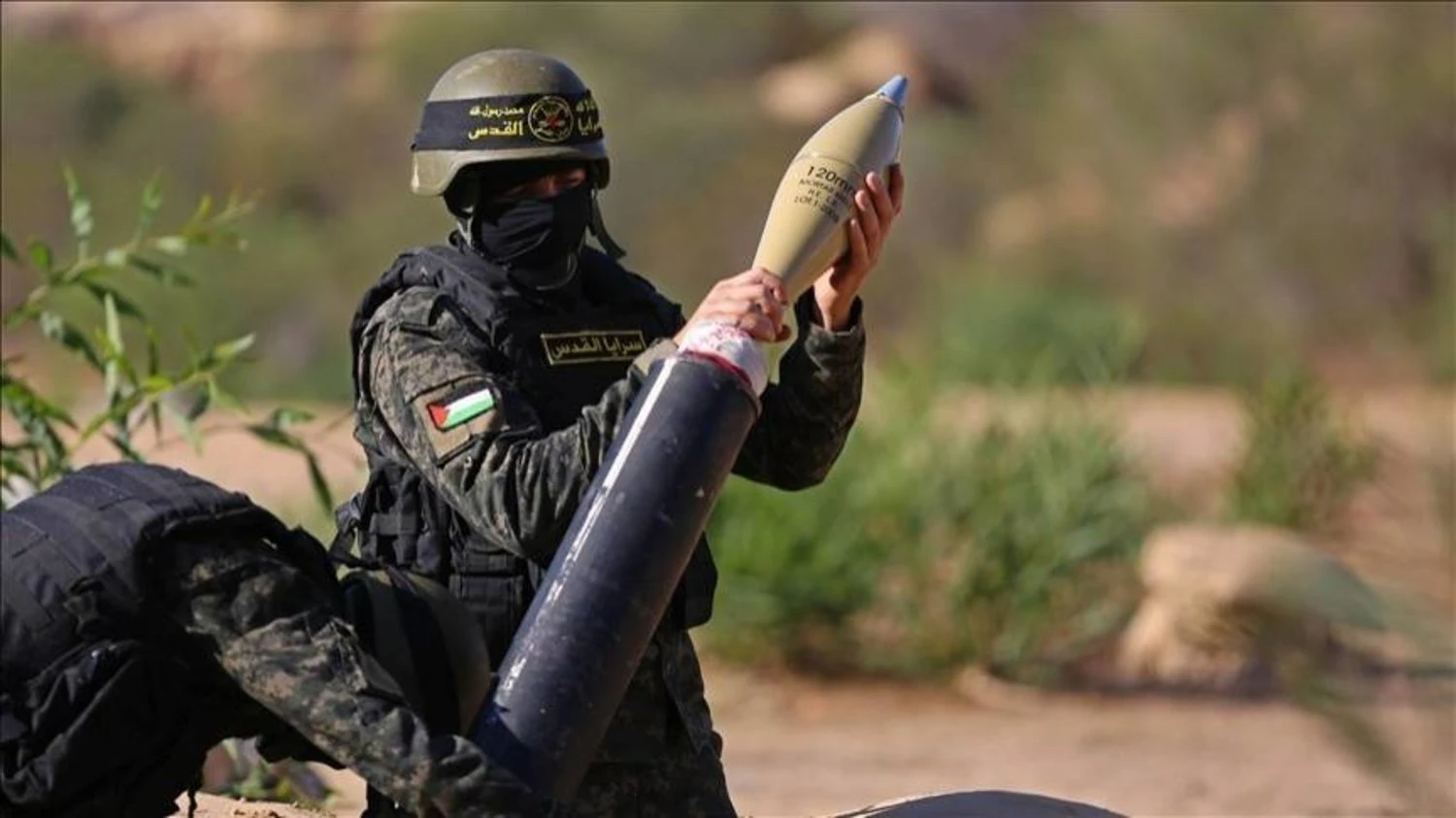
Other groups, including the Palestinian Islamic Jihad (PIJ) movement’s Quds Brigades, are also confronting the Israeli army across Gaza. The Quds Brigades launched mortars towards Israeli soldiers and vehicles in Shujaiya in the north and towards the Rafah crossing in the south on 5 July, according to their media page.

They also fired mortars at the Netzarim corridor near central Gaza, where Israeli forces are stationed to launch raids from and to keep the strip divided into two.

Israeli warplanes carried out indiscriminate attacks across the entirety of Gaza as the clashes raged.

Israeli bombardment targeted Khan Yunis, Rafah, Nuseirat, and Jabalia on 5 July, WAFA news agency reported. Several residential buildings were destroyed east of the Shujaiya neighborhood as a result of Israeli shelling.

A married couple was killed in Khan Yunis, while at least five were killed in strikes on Jabalia. The continued attacks came on the 273rd day of Israel’s genocidal war in Gaza.

Nine months into the war, Tel Aviv is no closer to its goal of eradicating Hamas and retrieving Israeli captives in Gaza by military force.

https://thecradle.co/articles/gaza-resi ... ine-months
"There is great chaos under heaven; the situation is excellent."

User avatar
blindpig
Posts: 14804
Joined: Fri Jul 14, 2017 5:44 pm
Location: Turtle Island
Contact:

Re: Palestine

Post by blindpig » Sun Jul 07, 2024 11:52 am

‘Disturbing Milestone’: Israeli Settler Attacks in West Bank Surpass 1,000 Since October 7
Posted on July 6, 2024 by Yves Smith

Yves here. We must confess that due to so many big stories being in motion as to not give much coverage to an important element of Israel’s ongoing campaign of genocide and ethnic cleansing against Palestinians: that of the escalation of violence against Palestinians in the West Bank. The conflict in Gaza, the successful Houthi attacks on shipping, the continued Israel saber-rattling against Lebanon, the (so far) head fakery of peace talks, have all served, whether by accident or design, to serve as cover for ongoing Israeli human rights violation in the West Bank.

By Jake Johnson, staff writer at Common Dreams. Originally published at Common Dreams

A coalition of aid agencies on Friday implored the international community to take concrete, punitive action against the Israeli government and settlers after the number of settler attacks in the occupied West Bank since October 7 surpassed 1,000.

The Association of International Development Agencies (AIDA), a group of international organizations working in the occupied Palestinian territories, said in a statement that the rate of settler attacks on Palestinians in the West Bank has doubled since the same time last year, from an average of two per day to four.

“At least 10 people, including two children, have been killed during these attacks, and at least 234 have been injured, including 20 children. Since 7 October, 1,260 people, including 600 children, have been forcibly displaced amid settler violence and movement restrictions. The displaced households are from 20 herding and Bedouin communities throughout Area C of the West Bank. As one survivor of settler violence explained, ‘No place is safe here.'”

“Settler violence is premeditated and orchestrated by organized groups from known outposts and settlements, with the support of Israel’s government, including local and regional settlement councils,” the group added, noting the limited sanctions that the United States and the European Union have imposed on individual settlers “have failed to reduce the frequency of attacks.”

“While a few individuals have been detained, no civilian or soldier has been prosecuted in connection with any of these 1,000 attacks,” AIDA said. “Reports indicate that some illegal outpost farms operated by sanctioned settlers—many of whom have been reported to be at the center of multiple violent incidents—have received hundreds of thousands of dollars worth of material support from the Israeli Ministry of Agriculture, the Ministry of Settlements, the Settlement Administration in the Ministry of Defense, and through local and regional settlement councils.”

AIDA urged the international community to “adopt new restrictive measures which go beyond individual settlers to target identified organizations and state entities who promote violence and/or take part in attacks on Palestinian civilians and civilian infrastructure.”

The group also argued that the far-right Israeli government “should be held accountable for the repeated and evidence-based allegations that the military and other state authorities are tolerating, enabling, and at times participating in settler violence.”

A Human Rights Watch report published in April found that the Israeli military “either took part in or did not protect Palestinians from violent settler attacks in the West Bank that have displaced people from 20 communities and have entirely uprooted at least seven communities” since October 7.

AIDA’s statement came days after the Israeli government announced the seizure of nearly five square miles of land in the West Bank—Israel’s largest land grab in the occupied Palestinian territory in more than three decades.

Sally Abi Khalil, Middle East and North Africa director for Oxfam International—an AIDA member—said Friday that settler attacks in the West Bank have reached a “disturbing milestone.”

“In a context where outpost legalization is being fast-tracked, and Israel is stealing more and more land,” said Khalil, “foreign governments must act now to stop this illegal appropriation by taking meaningful measures to hold the Israeli government and perpetrators of these attacks to account."

https://www.nakedcapitalism.com/2024/07 ... ber-7.html

******

The Philosophy of Hamas in the Writings of Yahya Sinwar
JULY 5, 2024

Image
Leader of Hamas in Gaza Yahya Sinwar attends victory rally in Gaza city following a ceasefire with Israel after 11 days of fighting, May 24, 2021. Photo: Ashraf Amra/APA images.

By Haneen Odetallah – Jul 3, 2024

The concepts of self-sacrifice, asceticism, and security awareness were crucial to Yahya Sinwar’s philosophy of resistance. The revolt that culminated with October 7 was the direct application of his political thought.

The following was originally published in Arabic in Babelwad, titled “The Philosophy of Hamas: Politics and Existence According to Yahya Sinwar,” by Haneen Odetallah. The author uses Hamas leader Yahya Sinwar’s novel, “Thorns and Carnations,” as a lens through which the mindset of the contemporary resistance can be analyzed, delving into themes of self-reliance, sacrifice, and security awareness. Odetallah explores how these concepts are ingrained in individuals to foster political ascendancy and collective liberation, illustrating the strategic and existential dimensions of resistance and providing a unique perspective on the ideological framework of the resistance.

“We must enter Sinwar’s mind” is the slogan of the current phase in the “Israeli” media, which continues to broadcast loud condemnations after Yahya Sinwar, the head of the Islamic Resistance Movement (Hamas) in Gaza, carried out the greatest military-intelligence deception in their entity’s history. Sinwar surprised them in a battle named “Al-Aqsa Flood,” but its real headline is that of Palestinian prisoners, to whom Sinwar has remained loyal — being a former prisoner himself who was liberated in a prisoner swap called the “Loyalty of the Free” deal.

Sinwar spent 23 years of his life in prison, including four years in solitary confinement, but he did not waste any of those years. He learned Hebrew and everything he could about his enemy, even formulating and executing a long-term intelligence plan from behind bars, which at the time was far-reaching. Sinwar studied and thought extensively, and he also wrote. Although we need not “enter Sinwar’s mind,” I believe that we, too, should at least “get to know his thinking,” to use a less intrusive expression.

But what might be easier than “entering Sinwar’s mind” is to read the writings he undertook after years of isolation, contemplation, and study.

In 2004, after a complex and protracted operation that required great effort and the recruitment of many prisoners, Yahya Sinwar, then a prisoner, published his novel, Thorns and Carnations, or “Thorns of Carnations,” as the writer intended. The novel deals with a thread from the story of the Palestinian struggle in the historical era between 1967 and the Al-Aqsa Intifada of the early 2000s, and the emergence of the Islamic movement in the Palestinian resistance — specifically the Islamic Resistance Movement, or Hamas — against its social, political, and cultural background.

The novel tells a story that begins in a house in a refugee camp in Gaza that will shape the values and choices of these children, who will grow up to become active and key figures in the Islamic Resistance Movement. The story then expands to include relatives, neighbors, the people of the camp, the Gaza Strip, the West Bank, and the rest of the occupied lands, where each character forms a stone that builds the experience of the Islamic Resistance Movement in those years.

The historical novel as a vessel for philosophy
This novel features fictional characters, but all its events are real; the fictional aspect arises from transforming these events into a work that meets the conditions of a novel, as the writer notes in the introduction. The choice of the writer, primarily a political and military figure, to document this pivotal stage in the history of armed resistance and transmit it in this creative, novelistic form indicates that it is an attempt that goes beyond merely recounting history and its events. The historical novel is not just a reflection of the events of the past; it is a deep exploration of the philosophical and moral forces that shape historical movements. The characters in historical novels embody and engage in philosophical struggles within the context of their time.[1] In other words, it serves as a means to understand the complex relationship between personal beliefs and the broader expanse of history. As for the writer, he is one of the pioneering figures in Hamas who witnessed its inception and contributed to its formation and development from youth to the present day. His departure from the confines of traditional historiography to address innovative dramatic struggles in history allows him to explore its philosophical dimensions; specifically, the impact of beliefs on history. In the context of the history of Hamas, this enables him to formulate a philosophy for the Islamic Resistance Movement.

The story is told through the perspective of Ahmad, the son of the refugee camp who first opens his eyes to the world’s harshness: the camp, the war, and the disappearance of his father, a resistance fighter, without a trace. Ahmad observes the camp environment and living conditions, witnessing the poverty, the cold, and the rain that seeps through the ceiling as they sleep and follows them to their classroom in the UNRWA school. He observes the camp’s community and its culture, seeing his mother’s concern for other people’s honor and reputation — especially when it involves their daughters — and her strictness in this matter. Conversely, he experiences joy in accompanying his grandfather to prayer and social gatherings in the camp mosque.

Ahmad observes the political transformations in the camp, in the Gaza Strip, in the West Bank, and throughout the occupied lands; he witnesses curfews, sieges, the relentless hunt for resistance fighters, and collective punishment. He witnesses the normalization of occupation, material stability, work permits, and recreational trips into the occupied lands, through which more individuals are compelled and coerced into collaboration with the enemy. Ahmad observes the “israeli” prisons from which he, his brothers, relatives, and acquaintances emerged, witnessing the power of determination and organization in changing reality. Most importantly, Ahmad watches how the weapons and the struggle for freedom evolve in response to these conditions, seeing men who were shaped by the resistance and who, in turn, shaped it. Ahmad traces the emergence of Hamas by following the characters who formed, developed, and embodied it, summarized in his cousin Ibrahim, the martyr’s son who grew up with him in the same house with the same mother, and who grew to become a model of true leadership and political destiny-making.

The narrator plays the role of an involved observer; he doesn’t just watch, but he accompanies Ibrahim in his work, his education, and his journey of struggle. Despite joining Ibrahim in demonstrations, organizing religious and educational sit-ins in Al-Aqsa mosque, and security work in chasing collaborators, the narrator denies joining the Movement officially until the end: “Although I did not consider myself an ‘Islamic Bloc’ member or a supporter, I had no choice but to elect my cousin and his list, as our shared life and my personal admiration for him did not allow me to do otherwise.”

This intellectual distance that the narrator maintains suggests something; he indicates his detachment from the Movement by denying his affiliation, yet he simultaneously indicates his proximity to Ibrahim, one of the Movement’s prominent figures and founders. The narrator views Ibrahim and everything he represents with admiration, often describing him with transcendence and greatness; this gap between Ibrahim and the movement he represents makes Ibrahim a figure whose greatness surpasses that of the movement. Although Ibrahim does not directly clash with occupation forces and only becomes a martyr at the end of the book, he knows his fate from the beginning and pursues it, undeterred even by his attachment to his wife and children. Perhaps Ibrahim symbolizes a state of being that the narrator aspires for this political Movement to cultivate in society, or the model of the Palestinian individual that the writer hopes Hamas will create — achieving its goals of shaping self-determination and establishing a political entity for the Palestinians.

The self-made individual
Ibrahim’s transcendence, as perceived by the narrator, is linked to the concept of being “self-made,” which appears in two instances. In the first instance, the narrator notes that Ibrahim’s self-made nature has granted him a form of sovereignty over himself and a sense of purpose. “He even became a professional builder; he learned the trade from his friend, and they became partners, employing a worker to assist them, taking on medium-sized building contracts. It became clear that Ibrahim’s self-made nature was making a man out of him.”

Linguistically, the concept of being self-made refers to someone who has “achieved eminence by the virtue of their own character, not by the virtue of their ancestors” [2]. The term has been commonly used to describe anyone “toiling, striving to develop themselves through their own efforts” [3]. Thus, to be self-made can be considered philosophically as an existential practice where an individual finds the meaning of their existence and life by adhering to firm principles such as personal responsibility, autonomy, and intellectual freedom. These principles will elevate and develop the individual in pursuit of self-sovereignty and the shaping of their desired destiny.

In the second instance, the self-made individual is associated with the true leader; thus, being self-made is the foundation for a political leader capable of confronting the circumstances of occupation. “Every day, Ibrahim grew more transcendent and respected in my eyes; he was the one who grew up an orphan after his father was martyred when he was four years old, then was abandoned by his mother while still young, raised among us, and became a self-made man, and a true leader despite his young age and the difficult circumstances under occupation.”

When Ibrahim’s self-made nature merges with its political dimension, it makes him a leader; someone capable of developing not only himself but also his community and his people, elevating their collective condition. He carries them beyond, to overcome the difficult political circumstances towards freedom. For the narrator, Ibrahim embodies this model of the transcendent human being, who ascends and elevates themselves by finding the meaning of their existence in their commitment to the political role of uplifting their people. In other words, they ascend through a political practice philosophically founded on self-made principles.

The Übermensch and the self-made individual
In existential philosophy, Nietzsche introduces the idea of the “Übermensch” [4], an individual who has transcended and ascended to achieve true freedom embodied in the ability to shape their own destiny. According to Nietzsche, the transcendent individual is one who chooses their goals and selects their values, and principles without succumbing to any societal pressures beyond their control. This concept invites individuals to embrace what he calls the “Will to Power,” [5] an inner drive for liberation and self-sovereignty. Thus, the Übermensch forms an intellectual model of a person who overcomes societal values and standards that hinder them and creates their own values.

In contrast, Sinwar’s transcendent individual is the politically self-made individual; one who chooses their goals in a way that contributes to their political liberation. Therefore, they engage in shaping their identity and defining their values within the social and political fabric that shelters them. This process is not merely a personal quest for freedom but a political act that involves challenging and contributing to the formation of collective identity in a way that serves the freedom of the entire community.

The politically transcendent individual, through the self-made philosophy, is a model of the practical person who deals with inherited societal values—social, moral, and religious—as resources to enhance their community’s drive for liberation and to achieve political ascendance. They understand that their struggle against occupation is an existential battle and a war on the Palestinian “will to power”; that is, a war on their drive to politically self-govern. In this context, self-made philosophy transcends individual self-determination and becomes a tool to influence and shape political discourse. The hard-working individual committed to achieving their liberatory goal will harness all the efforts of others for that purpose as much as they can. As for the Islamic Resistance Movement, it seeks through Islamic values to produce this transcendent individual, or this state of being in the Palestinian individual; so how do these values contribute to that?

“The house became filled with men and women, boys and girls from the same family, and memories flooded back of us as children gathered in a small room that was too big for us. Our modest family had grown into a small army over the years… I mentioned this jokingly; my mother quickly shouted, ‘Send blessings upon the Prophet,’ a gentle reminder to mind my words. Immediately, everyone chorused, ‘O Allah, bless our master Muhammad.’”

Islam and the self-made individual
The novel begins in the winter of 1967, just before the Naksa, when Gaza was under the administration of Egypt. Ahmad, then five years old, recounts one of his earliest memories — his interactions with Egyptian soldiers whom he frequently visits. They would play with him and give him and his friends pistachio sweets. Then the war breaks out, and the soldiers shout at them to go back, and they no longer get any sweets.

“The occupation forces had faced fierce resistance in one area and withdrew. Shortly after, a group of tanks and military jeeps appeared, flying Egyptian flags. The resistance fighters rejoiced, thinking help had arrived, and they emerged from their positions and trenches, firing into the air in celebration. They gathered to welcome the reinforcements, but when the convoy approached, heavy fire was opened on the fighters, killing them. Then the zionist flag was raised on those tanks and vehicles, instead of the Egyptian flags.”

This scene signals an ideological turning point in the Palestinian struggle: the realization of the failure of Arab nationalism, or its inadequacy as a political current in inducing the necessary seriousness in individuals towards the Palestinian national cause, especially in the face of the ever-increasing voracity of the occupation.

While the philosophy of the self-made individual encompasses a condition for elevation, which is seriousness and commitment to the pursuit, “self-made individuals look at their goals with respect and belief, and they take the matter of achieving them with utmost seriousness, without compromise. They are simply committed to what they must do to achieve that” [6]. Here, the “extraordinary connection between religion and nationalism” achieves this seriousness through the obligation of jihad, or holy war, imbuing the national cause with sanctity and thus planting in the individual the strict seriousness necessary to achieve it, as the narrator states: “So that the battle takes its true dimension and meets the required standard.”

When the politically self-made individual looks around, they find the Islamic system among the last social systems that have remained steadfast among Palestinians in the face of societal annihilation, or sociocide, committed by the occupation. They find, in the intertwinement of political practice and faith, in transferring the reference of the Palestinian’s existence and purpose to Allah, a principle that the enemy cannot disintegrate. The self-made individual finds in historical Islamic sites, stable political edifices against occupation’s attempts to erode awareness and distort direction. Therefore, we find Ibrahim, who calls the battle “a battle of civilization, history, and existence,” organizing a trip for the youth to learn about their concealed lands and their sacred and historical Islamic sites, the foremost being al-Aqsa Mosque. These sites, are where the flourishing of Palestinian culture, self-sovereignty, and the shaping of their land-destiny are embodied.

Here, the architecture of al-Aqsa Mosque and the majestic Dome of the Rock stand in stark contrast to the architecture of the refugee camp, which embodies the state of confinement for Palestinians. Hence, Hamas places special emphasis on al-Aqsa for encapsulating the sacred historical meanings that immortalize the Palestinian cause, like al-Isra’ wa al-Mi’raj, or the Night Journey of Prophet Muhammad, forming a point of connection between the land of Palestine and the heavens. Perhaps this is why the battle addressing the freedom of the Palestinian prisoners is named “al-Aqsa Flood,” in an attempt to magnify the cause of the prisoners, emphasizing that the freedom of Palestinians is the meaning for which their Lord created them. Although Islam links the political struggle to Allah and the meaning of human existence, this connection goes beyond merely granting the struggle lofty meanings such as the afterlife and reward from Allah. So, how do these meanings practically manifest in individuals who practice a life centered around politics?


Asceticism
The novel pays special attention to the phase of “education and preparation” in the history of Hamas’s inception. One day, a Sheikh, also named Ahmad, passes by the young men and teenagers of the camp who are loitering in the streets and spending their time playing around. He warns them against useless amusement and urges them to engage in prayer, worship, and contemplation instead, “linking all of this to the future of Islam, whose banner must be raised in the land of Palestine.” The Sheikh then spends decades with them, instilling Islamic values that promote asceticism and renunciation of worldly desires in favor of the hereafter, creating a generation “capable of sacrifice and self-sacrifice.”

Perhaps the novel’s thesis on love, which represents the most intense connection to the self and the “mundane life” in Islamic terms, showcases how this asceticism enhances the meaning of existence in political practice. The narrator says, “It overwhelmed me with a feeling of comfort… Is this love? (…) I was later sufficed with watching her leave for university from afar; not aspiring for more than that, not even a glance. It was enough for me to love, and it was enough that she understood that well.” Thus, Ahmad is satisfied with knowing love in his world, postponing its attainment until the appropriate time, when he can propose to her as he was “raised since his childhood.” He does not feel the need for love just because it is the “Love” that he has always heard about.

Ibrahim then clarifies to Ahmad that he, too, knew love, and because he considers himself part of the national struggle, he decided not to pursue it, stating that “it turns into a whip with which the occupation lashes the backs of those in love with one another. Ahmad, when this noble sacred relationship is used by collaborators as a pressure card on lovers, forcing them to abandon their first love, Al-Quds, is there still room for love and passion in our lives?” Ibrahim explains how systematic asceticism in Islamic philosophy reflects on political life; it is an upbringing that allows an individual to renounce desires at any time if they conflict with or endanger their national endeavor. It molds the individual such that the national endeavor becomes the central meaning of his life, his foremost desire, and the foundation upon which he constructs other aspects of his life.

After their discussion about love, Ibrahim discovers that his dearest friend and partner in leading the student movement, Fayez, is a collaborator with the occupation. Ibrahim sums it up by saying, “Is it permissible for us, living this life and seeing what we see, to love and be passionate, Ahmad? Our story is a bitter Palestinian one, with no room for more than one love and one passion.” Ibrahim considers Palestinian life bitter, any aspect of which, under the occupation’s mercy, is subject to disappearance at any moment. He considers all meanings and values not based on political freedom to be false; they mean nothing if the occupation decides to exploit them. Even the most loyal of friendships cannot be relied upon.

Perhaps the battle of Al-Aqsa Flood prompted such conclusions among some Palestinian individuals; those involved in “israeli” society whose meanings of coexistence, citizenship, and law betrayed them when they expressed even the slightest bit of themselves — not even their humanitarian principles towards Gaza’s children, but their religious identity, as many of them have been prosecuted for quoting the Quran on social media. Others had lost their businesses and livelihoods because they were dependent on the enemy’s society and system, and others had to submit and give up their political dignity in order to maintain their means of livelihood and their citizenship.

The novel diagnoses and addresses in various forms a fundamental weakness that hinders an individual’s willingness to sacrifice oneself for political emancipation — the temptation of individual salvation and stability. The novel clarifies that the occupation views such individual desires and inclinations as sites of political and military investment. Thus, the novel poses the problem of collaborators as a product of such a drift and an intensification of that conflict. The narrator addresses the phenomenon of crossing permits from Gaza into “israel,” which begins as a necessity for livelihood and feeding one’s children through work permits, thus tying a person’s life and sustenance to the stability of the occupation. These permits then become a gateway for Palestinians to escape the misery of the siege in Gaza and taste life, so tourism companies begin announcing permits for recreational trips in “israel.”

“Then you find one of the offices, run by a famous collaborator, announcing registration for a tourist trip inside the Green Line [The occupied lands] to some tourist areas…where, during the trip…attempts are made to entrap young men in scenes and situations that are photographed, and they are then threatened with scandals if they do not cooperate.”

Despite this, the narrator acknowledges the significant gap between “the bitter reality, its requirements, and necessities, and the ceiling of national ambitions.” Nonetheless, for him, this challenge imposes individual sacrifice as part of one’s belonging and political investment in one’s own ascendance and one’s society’s. One that individuals must be raised to be prepared to offer it.

“You find one of these workers trying to persuade them while refusing to hand them the work permit, pointing to his eight children behind him, who do not have enough to eat. For what the ‘Relief Agency’ [UNRWA] offers is not enough, and they often remain hungry… These resistance fighters [fedayeen] refused his plea and insisted on taking the permit, with eyes full of tears…They tore up the man’s permit, feeling embarrassed.”

Sacrifice and self-sacrifice
Ibrahim realizes early on that he needs money to pursue higher education and move forward in life. He learns building construction by working alongside a friend who is a professional, eventually becoming a professional and a contractor himself. When Ibrahim graduates from school, he refuses to travel outside his country for education, or even to leave the Gaza Strip to attend Birzeit University in the West Bank. Instead, he chooses to study at the Islamic University in Gaza, which at that time didn’t even have its own building. His uncle’s wife disapproves of his decision, arguing that the Islamic University barely qualifies as an educational institution, and urges him to study abroad like his cousins. However, Ibrahim chooses the Islamic University because it barely costs half of what studying at Birzeit University would cost, let alone the expenses of studying in Egypt. Despite the occupation’s siege of the university and its prevention of construction there, “it could not stand in the way of a people’s will for knowledge and education.” Ibrahim, and with him Ahmad and others, persist in studying at the Islamic University in tents and palm frond shelters. “Ibrahim was a student and an activist transformed into a contractor; he and several respectable students, with the help of hundreds of us, built lecture halls…thus imposing a new reality on the occupation.”

Ibrahim chooses to invest his money in the local university in his hometown, and saves the big portion of his money to buy a car which he will use for his political work and activism. He also invests his effort and energy in building and developing the university until it becomes a proper institution of the required standard. Ibrahim sacrifices his individual salvation and advancement for the sake of his family and community. When an individual transcends personal ambitions and politicizes them, the meaning of their existence becomes necessarily linked to collective salvation. This immerses the individual in improving the collective condition which is burdened with constraints, requiring them to exert all necessary efforts for that purpose. This prompts them to deal professionally with their reality, including the fulfillment of major tasks such as forming systems and creating the infrastructure needed for their goal.

In the end, Ibrahim builds an educational institution that will educate all those who might’ve been deprived of education because they cannot afford the expenses of travel and other universities. This way, he saves generations from the trap of ignorance, idleness, and often collaboration with the enemy as they lure them with money. He even challenged the occupation and invested his money and effort in establishing an institution that will mold generations on the values and principles of the Islamic Resistance Movement (Hamas), forming a hub for emancipatory political work and activity. The novel illustrates how an upbringing on the value of individual sacrifice creates a self-reliant individual in his political practice, willing to exert any effort necessary to achieve national aspirations. The self-made person is a foundational principle reinforced by these Islamic values in the relationship between the Palestinian individual and their liberation, making them proficient in building and establishing a political entity.

Resistance and the craft of political ascendancy
Ibrahim has an older brother named Hassan. Hassan chose individual salvation early in his youth; he fled to “Tel Aviv” to live at the mercy of an “israeli” girl and her father’s factory, until her father’s business collapsed and she kicked him out of her apartment. He was then forced to return to Gaza and the camp. However, since Hassan is inclined towards his own personal salvation, he ends up becoming a local collaborator and a corrupter in his community. This brings a bad reputation to the family and brings ruin, downfall, and political deterioration to the country and cause, troubling Ibrahim’s life. One day, Ahmad is surprised to find a meticulous intelligence report about Hassan among Ibrahim’s papers. Ahmad remarks, “The report isn’t the work of kids or amateurs; it’s the work of people who know what they’re doing.” The report indicates the existence of an advanced Palestinian intelligence apparatus constructed by the resistance, Ibrahim being a part of it. Ibrahim’s direct connection to his brother Hassan’s problem motivates him to establish a comprehensive security system to identify collaborators, study their methods, and confront them without having the enemy even realize the existence of such a system. Ultimately, Ibrahim kills Hassan but, thanks to his knowledge, he does so without leaving any evidence against himself.

The novel clarifies that mastering the construction a political entity requires an individual’s deep and comprehensive knowledge of his reality in all its aspects, including the knowledge necessary to ensure the continuity, protection, and guarantee of one’s political practice and liberation process — resistance. The novel brings forth fundamental concepts in this context, such as “birds,” which are spies planted by the occupation among prisoners to extract confessions from detainees. Without Ahmad’s awareness of this term, he might have fallen into its trap, incriminating himself, confirming Ibrahim’s involvement in Hassan’s murder to the authorities, and exposing their system aimed at catching and eliminating collaborators. This would have hindered Ibrahim’s journey of struggle, which has achieved political gains for the community and developed the resistance movement. Thus, this knowledge helped them maintain coherence in their stories during interrogation without needing prior coordination.

Therefore, the novel focuses on security education and developing a security consciousness in the Palestinian individual, defined as the feeling and sense that arises within oneself, relying on situational reasons and factors that lead to anticipating events before they occur, with the aim of preventing and repelling them if they harm the nation and its achievements [7]. This security awareness, as presented, protects the individual and their entire community, ensuring the community’s ability to continue resisting and progressing politically without being easy prey or exposing their liberation project to failure. It allows non-involved individuals to avoid danger without risking those who are. It serves as a compass for organization and coordination without the need for direct communication between individuals, thus avoiding the risk of exposing such communication. This allows the community to continue, support, and organize the struggle with minimal repercussions, especially given that the occupation targets organization and order among Palestinians, punishing such acts with long unreasonable prison sentences. Ahmad may not be as eager for Jihad as Ibrahim, which might indicate the author’s acknowledgment of the varying paces at which individuals develop this capability for confrontation or their different roles in it. However, security awareness, in the author’s view, is a necessity and an existential principle for the harmony of these roles and the completeness of this political ascendance.

Perhaps the novel itself is an attempt to construct this security awareness in the Palestinian individual, which encompasses knowledge of the resistance’s process and work, its conditions and methods, the experiences and mistakes of the resistance fighters, the tactics of collaborators, their behaviors, and the ways by which they are recruited and coerced into their “job.” The impact of this mindset is evident in an impressive result with the children of Gaza, who in a hidden camera show, refuse to answer any questions or even discuss any topics related to tunnels or military sites in Gaza. Their security awareness perhaps reflects the author’s vision for Palestinian society, which Ibrahim calls “escalation and continuity.” As he explains, it means maintaining and continuing daily life “in a way that does not contradict the ongoing intifada.” But rather making the intifada “the backbone of the Palestinian lifestyle,” with which other life activities adapt, including, naturally, procreation and family formation; having children. Meaning, building a society that carries the experience of resistance capable of repeating and escalating it in order to realize more political goals until Palestinians achieve full sovereignty over their lives.

In his existential philosophy, Nietzsche calls upon individuals to shape their lives in a way they find satisfying, such that if they were forced to eternally repeat their life cycle, they would be satisfied and content with the repetition of the experience they created, as it brings them ascendance, freedom, and self-sovereignty [8]. Similarly, the existential philosophy proposed by Sinwar in his vision of political work through the Islamic Resistance Movement (Hamas) aims to produce individuals who automatically escalate the conditions of resistance and liberation in any place and time, each from their position and according to their ability and skill.

In this context, the novel narrates the evolution of the condition of arms and weapons in the context of resistance, the most severe and difficult one yet; it began with kids throwing stones and was then developed by youth from various backgrounds and specialties. For example, the novel describes how the student Yahya, driven by his own initiative, delves into his chemistry book looking for some equation only to later invent the explosive belt, car bombs, and subsequent methods of martyrdom operations. It then moves through the years of resistance fighters’ experiences, which accumulated until the al-Qassam Brigades, the military wing of the Hamas movement, had finally obtained a rocket and artillery infrastructure capable of long-range bombardment.

Sinwar believes that the presence of concepts such as asceticism, sacrifice, self-sacrifice, and security awareness in individuals’ makeup creates within them an inner drive for resistance unaffected by external pressures or, in other words: the will to resist. For him, resistance begins with each individual’s responsibility towards their political freedom, their engagement in envisioning the path to achieve it, and the calculated march towards it, each according to their circumstances and abilities, whatever they may be, no matter how difficult or distant their goals may seem.

Sinwar’s own experience, having freed himself from a 426-year sentence in “israeli” prisons to lead the largest revolution in its history, is a direct application of a philosophy based on professional planning — long-term plans for distant goals. His revolution, dubbed by “israeli” media as “the greatest intelligence deception in ‘Israel’s’ history,” began with Sinwar investing his years of imprisonment to master his enemy’s language and master manipulate them so that he could one day eventually emerge and confront them. This is the philosophy of the self-made person in resistance that he proposes — the ability to produce resistance even in its absence. Perhaps the saying of the martyr Yahya Ayyash (1966–1996), known as the Engineer of Resistance, eloquently summarizes all of this: “They can uproot my body from Palestine, but I want to plant something in the people that they cannot uproot.”


Notes
[1] Lukács, Georg. The Historical Novel. Lincoln: University of Nebraska Press, 1983.

[2] معجم المعاني، ر.ف. “عصاميّة“.

[3] مقراني، خولة. “عصاميّون لا عظاميّون”. الجزيرة. 25-10-2018

[4] Nietzsche, Friedrich. Thus Spoke Zarathustra: A Book for Everyone and No One. Penguin Classics, 1961.

[5] Nietzsche, Friedrich. The Will to Power. Penguin Classics, 2017.

[6] مقراني، خولة. “عصاميّون لا عظاميّون”. الجزيرة. 25-10-2018

[7] د. سعيد، محمود، د. الحرفش، خالد. مفاهيم أمنيّة. (الرياض: إدارة العلاقات العامّة والإعلام، الطبعة الأولى، 1431هـ – 2010م).

[8] Nietzsche, Friedrich. The Gay Science. New York: Vintage, 1974.

Haneen Odetallah is a cultural critic, writer, and artist from Palestine. She holds a Master’s degree in Comparative Cultural Analysis from the University of Amsterdam.

https://orinocotribune.com/the-philosop ... ya-sinwar/

Iran Imposes Sanctions on 11 US Officials Over Suppressing Pro-Palestine Student Protests
JULY 5, 2024

Image
Texas state troopers arrest a man at a pro-Palestinian protest at the University of Texas, during the ongoing conflict between Israel and the Palestinian resistance movement Hamas, in Austin, Texas, the United States, on April 24, 2024. Photo: Reuters.

The Iranian Foreign Ministry has imposed sanctions on nearly a dozen US authorities for their role in suppressing pro-Palestinian protests that erupted at university campuses across the United States in condemnation of Israel’s bloody onslaught against the Gaza Strip.

The ministry announced in a statement on Wednesday that the punitive measures were taken in accordance with the Law on “Countering the Violation of Human Rights and Adventurous and Terrorist Activities of the United States in the Region”, (2017) particularly Article 5, which blacklists the following American individuals for their involvement in violation of human rights by quashing the peaceful rallies.

The Americans targeted by the sanctions are as follows:

1. William Billy Hitchens, Commissioner of the Department of Public Safety of Georgia,

2. Eddie Grier, Commanding Officer over Field Operations of Georgia,

3. Linda J. Stump-Kurnick, Chief of the University of Florida Police Department,

4. Pamela A. Smith, Chief of the Metropolitan Police Department of the District of Columbia,

5. Jeffery Carroll, Executive Assistant Chief, Metropolitan Police Department,

6. Karl Jacobson, Chief of New Haven Police Department,

7. Shane Streepy, Assistant Chief of University of Texas Police Department (UTPD),

8. Michael Cox, Commissioner of the Boston Police Department,

9. Scott Dunning, The Indiana University Police Department Central Division Chief,

10. Michael Thompson, The Arizona State University Police Chief,

11. John Brockie, Chief of Police at CAL State Long Beach Police Department.

The statement further noted that the above-mentioned individuals will be subject to sanctions, pursuant to Articles 6, 7 and 8 of the Sixth Section of the Law.

Accordingly, their accounts and transactions will be blocked in the Iranian financial and banking systems, and their assets will be frozen within the jurisdiction of the Islamic Republic of Iran. No visa grating their entry to the territory of the Islamic Republic of Iran will be issued as well.


“All relevant national organizations and institutions of the Islamic Republic of Iran will take necessary measures for the effective implementation of the sanctions, in accordance with the regulations adopted by the related authorities,” the Iranian Foreign Ministry pointed out.

Pro-Palestine student protests initially broke out at the campus of the University of California, Los Angeles in mid-April, with demonstrators calling for the end of the Gaza war and divestment with Israel.

Despite harsh crackdowns, including mass suspensions, evictions from university housing, and arrests, protests sprung up across the US with footage emerging of students, professors, and journalists being violently detained by the police on campuses.

A new wave of demonstrations – marked by protesters setting up encampments on their campuses – also gripped the US while protests spread to other universities across the globe.

https://orinocotribune.com/iran-imposes ... -protests/

Palestine: Multipolarity and the Two-State Trap
JULY 5, 2024

Image
Cartoon depicting the alliance of Western and Gulf countries in building a wall to deny aid to the Palestinians in Gaza. Photo: Telegram/Kamal Sharf.

By Hicham Safieddine – July 3, 2024

“War therefore is an act of violence intended to compel our opponent to fulfill our will.” – Carl Von Clausewitz

War, according to the Prussian military theorist Clausewitz, is the continuation of politics by other means. And the policy of the Zionist entity, since its inception, has been perpetual war. It is an expansionist settler entity whose survival depends on eliminating the Other to the point of extermination. But today, despite its enormous destructive power supported by the United States and Britain, it is incapable of achieving a military victory against the valiant resistance forces along the active fronts from Gaza to Lebanon to Yemen to the West Bank.

The occupation has also failed to achieve through politics what it has not been able to achieve on the battlefield, unlike what it could do in previous cases such as with the Camp David Accords after the 1973 War and the Oslo Accords after the First Intifada. But political efforts to undermine the resistance’s achievements on the ground have not stopped and will not stop. These efforts are being made on two interconnected levels.

The first level relates to post-war arrangements in Gaza. The goal is to isolate Palestinian resistance factions from governing or administering the Strip and replace them with local forces or the Ramallah-based Palestinian Authority. Hamas and other national forces in the Strip, along with the people of Gaza in general, are successfully resisting this scheme, despite enormous pressures from both near Arab and distant Western parties.

The second level concerns the future of the conflict and the political settlement of the Palestinian issue. Efforts in this area are active on the international stage where the direct influence of resistance forces is limited. The latest of these attempts came in May in the form of a vote by 143 countries in the UN General Assembly in favor of a resolution recognizing a Palestinian state, followed by official recognition from three European countries (Norway, Spain, and Ireland).

Many media outlets and political forces welcomed these resolutions. Some considered them achievements of popular pressure in the West or a result of the shift in approaching the Palestinian issue due to Operation Al-Aqsa Flood and the ongoing genocide. Some may have been enthusiastic about annoying the enemy and scoring points in the psychological war. Others considered it a gain, albeit symbolic, in light of unjust power balances. Israel’s violent rejection of these resolutions helped portray them as being in favor of the Palestinian side. The occupation’s delegate in New York expressed this rejection by depicting the vote to recognize the Palestinian state as tearing up the Assembly’s charter.

These positive approaches are wishful thinking and not objective ones, especially since the intransigent Israeli position portrays any political decision that does not exactly match Israeli policy as biased towards the Zionist camp. Evaluating these resolutions should be based on their content and start from a simple question: do they reflect even a partial translation of the strategic achievement brought about by the earthquake of the Al-Aqsa Flood?

The answer is no. The opposite is true. The current form of resolutions recognizing the Palestinian state seeks to undermine the post-October 7 military achievements and turn back the clock. It is a rushed attempt at repeating Oslo. UN General Assembly Resolution ES-10/23 recognizing the State of Palestine affirms “unwavering support for the Madrid terms of reference, including the principle of land for peace, and the Arab Peace Initiative, and reaffirming in this regard its unwavering support for the two-State solution of Israel and Palestine, living side by side in peace and security within recognized borders, based on the pre-1967 borders.”

The General Assembly resolution establishes recognition of a Palestinian state according to the 1967 borders instead of the borders set by Partition Resolution 181 of 1947 on which the occupation entity state was established. The UN resolution cites 12 previous General Assembly and Security Council resolutions as legal references, but it does not even once recognize Resolution 194, which stipulates the right of return. The right of return—even within the framework of the so-called two-state “solution”—is the only guarantee, along with the abolition of the Israeli law that guarantees the “right of immigration” for Jews of the world to Palestine, to prevent the perpetuation of the Zionist entity’s existence as a racist Jewish supremacist state.


The resolutions of Norway, Spain and Ireland go beyond the UN resolution. They openly indicate that recognizing the Palestinian state aims to fight Hamas, uphold the Palestinian Authority, and re-establish its control over the Gaza Strip after the war. This was expressed by Norwegian Foreign Minister Espen Barth Eide, who announced, “The goal is to achieve a Palestinian state that derives from the Palestinian Authority,” and for this he called for “strengthening the Palestinian Authority under the leadership of Prime Minister Mohammad Mustafa” and working “for the Palestinian Authority to manage Gaza after the ceasefire and for the formation of a single Palestinian government.” Eide did not miss practicing the usual Western guardianship by demanding that the Palestinian government approve “democratic reforms, empowering the judiciary and fighting corruption.”

Spain’s position did not deviate much from Norway’s. The Spanish prime minister stated that the step of recognizing Palestine is not directed against Israel, but “reflects our rejection of Hamas… which rejects the two-state solution.” As if Israel is rushing towards a two-state “solution.”

One might imagine that the position of the Irish government, given its people’s great sympathy for the Palestinian cause, is less severe than that of Norway and Spain. However, its prime minister also stated, “Recognising the statehood of Palestine sends a message that there is a viable alternative to the nihilism of Hamas. Hamas has nothing to offer but pain and suffering to Israelis and Palestinians alike.”

In the same speech recognizing the State of Palestine, the Irish president addressed the occupation entity’s community, “To the people of Israel, I say today: Ireland is resolute and unequivocal in fully recognising the State of Israel and Israel’s right to exist securely and in peace with its neighbours. Let me be clear that Ireland condemns the barbaric massacre carried out by Hamas on October 7… Hamas is not the Palestinian people.”

Both Norway and Spain seek to activate the two-state trap in full coordination with Saudi Arabia and Qatar. Eide announced, “Norway is cooperating closely with Saudi Arabia and is taking active steps to mobilise European support for the Arab peace vision.” Spain and Qatar held what was called the “First Strategic Dialogue” on June 21, in which the Spanish foreign minister reiterated his call to launch a peace initiative similar to the Madrid Conference.

It is no surprise to see European and Gulf support for Israel’s interests. But what is worrying is the vote of countries like Cuba, Venezuela and South Africa in favor of the General Assembly resolution (as well as official Lebanon, which recognized Israel through this resolution without notable objection). And if we add the complicity of the Egyptian and Jordanian regimes and the positions of Turkey, China, Russia, and even Syria and Algeria supporting the two-state proposal, the extent of international consensus on the two-state “solution” without clear guarantees for the non-negotiable rights of the Palestinian people, primarily the right of return, becomes clear.

In other words, the multipolarity that is much talked about may be reflected on the military level of the conflict in terms of available sources, volume and quality of armament, and in terms of the division of influence between major powers in our region and the absence of military decisiveness between the conflicting parties as a result of the erosion of US military hegemony. But that multipolar shift has not yet been reflected on the political level.

Concern about the international political consensus around the two-state trap may seem premature in light of the ongoing war and the resistance’s ability to impose its equations in negotiating the day after. But the history of wars confirms that the victor never waited for the end of the war to develop a political vision for what comes after it. The Zionists are pioneers in this field. The concern may seem out of place as long as the entity itself opposes the establishment of a Palestinian state and imposes a fait accompli policy, especially by activating settlements in the West Bank, making the implementation of the two-state option almost impossible. But betting on the inevitability of the enemy’s position is a gamble with principles and an abandonment of the initiative on the international stage.

Preserving the strategic gains of Al-Aqsa Flood requires, in the long run, building international consensus and support around the resistance project regarding the future of Palestine, at least among forces opposed to the US global hegemony. Otherwise the ability to exploit the shift in the global balance of power will remain limited. The shortcoming is not in formulating this political project, but in acquiring support for it by forces not directly involved in the battle. In its amended constitution in 2017, Hamas presented an independence project that adopts the language of national liberation, affirms the right of return, and demands Jerusalem (not East Jerusalem) as the capital of a truly sovereign Palestinian state. The statements of the movement’s officials are still pushing in this direction. Nevertheless, this position is being distorted or denied in Western media circles, while Arab media,including the pro-resistance ones—are rushing to applaud any step, especially if issued in the West—that appears supportive of Palestine even if its essence harms the cause.

It is imperative to evaluate the limits and the nature of solidarity without exaggeration or understatement, in conjunction with promoting the liberation project advocated by resistance forces among media, research, public and diplomatic circles sympathetic to Palestine. This has to be done in addition to supporting the military front by fortifying the political arena against any attempt to circumvent the great sacrifices of the resistance and its popular support base.

The conflict, in the end, is a political struggle over the future of Palestine: either perpetuating Israel as a racist Jewish state, or liberating Palestine from the river to the sea.

https://orinocotribune.com/palestine-mu ... tate-trap/

******

Five Palestinian journalists among dozens killed by Israel in 24 hours

Some in the Israeli military view journalists as 'legitimate targets' in the genocidal campaign against Palestinians in Gaza

News Desk

JUL 6, 2024

Image
The funeral ceremony of two journalists—including Hamza Dahduh, the son of Al Jazeera correspondent Wael Dahduh—in Rafah, Gaza on January 7, 2024. (Photo credit: Stringer / Anadolu via Getty Images)
Israel has killed five journalists and dozens of others during an intensive bombing campaign over the last 24 hours, Gaza's Government Media Office reported on 6 July.

The five journalists were listed as:

Amjad Jahjouh from the Palestine Media Agency was killed in Nuseirat.

Wafa Abu Dabaan from the Islamic University Radio in Gaza was killed in Nuseirat.

Rizq Abu Ashkian from the Palestine Media Agency was killed in Nuseirat.

Saadi Madoukh from Deep Shot Media Production Company was killed in Gaza City.

Ahmed Sukkar from Deep Shot Media Production Company was killed in Gaza City.

Last week, The Guardian published an investigation showing some in the Israeli army view journalists as legitimate targets in war, though doing so is a violation of international law.

The US-based Committee to Protect Journalists (CPJ) records at least 103 Palestinian journalists and media workers killed by Israel during its war on Gaza. The highest number, at least 23 individuals, worked for Hama's official Al-Aqsa TV and radio channels.

Asked about the Al-Aqsa journalists killed by Israel, a senior army spokesperson told The Guardian there was "no difference" between working for the media outlet and belonging to Hamas's armed wing.

"It's a shocking statement," Adil Haque, a law professor at Rutgers University in the US, said. Such a view is "a complete misunderstanding or just a willful disregard for international law."

The Guardian added that Israeli officials have repeatedly characterized journalists killed in the war as “terrorists."

Irene Khan, the UN's special rapporteur on the promotion and protection of the right to freedom of opinion and expression, said Israel had "spread disinformation about journalists being linked to militants" and failed to meet the "burden of proof" to make such claims.

"It's psychologically very difficult," said Mohammed Abed, a Gaza-based AFP photojournalist. "So many journalists have died while sleeping along with their families. When we interviewed the survivors, they told us they were at home. 'We had dinner and talked to the neighbors. And when we went to sleep, they bombed us.'"

The Israeli military says it does not deliberately target journalists, claiming that its intensive bombardment of Gaza is killing many Palestinian civilians from all walks of life.

"I'm sure that if you counted the number of dead teachers, the number of dead janitors, the number of taxi drivers, you will end up with higher numbers as well," a senior Israeli military source told The Guardian.

Over the past nine months, Israel has killed 38,011 Palestinians, the majority women and children, according to the Gaza Health Ministry.

Israel's campaign is widely viewed as genocide for its targeting of almost all aspects of civilian life in Gaza, including government buildings, homes, schools, mosques, churches, hospitals, agricultural land, wells and water pipes, and even graveyards.

https://thecradle.co/articles/five-pale ... n-24-hours
"There is great chaos under heaven; the situation is excellent."

User avatar
blindpig
Posts: 14804
Joined: Fri Jul 14, 2017 5:44 pm
Location: Turtle Island
Contact:

Re: Palestine

Post by blindpig » Mon Jul 08, 2024 11:31 am

Israeli Attack on UNRWA School Kill 16 People at Least, Mostly Children

Image
A Palestinian man within the rubble of his destroyed house following an Israeli air strike on Al- Nusairat refugee camp in the Gaza Strip 06 July 2024. Photo: EFE

July 6, 2024 Hour: 2:39 pm

At least 16 people have been killed and 75 injured by an Israeli attack on an UNRWA school in the Nuseirat refugee camp in the central Gaza Strip, the Gaza Ministry of Health confirmed.

The school attacked, Al Jaouni, housed some 2,000 displaced people, according to UNRWA, although the Gaza government raises the figure to 7,000 displaced.

“The ‘Israeli’ occupation army committed a new massacre in the Nuseirat camp in the afternoon of this Saturday, when it bombed the al-Jaouni school with fighter planes, where there are approximately 7,000 displaced people,” the Gazan government said.


An UNRWA spokesman in Gaza said that “We provided the Israeli Army with the coordinates of the schools housing displaced people twice a day” and detailed that al-Jaouni is one of the most overcrowded in the area.

Gazatian authorities say this is the massacre number 43 committed by the occupation during the genocidal war in the Nuseirat camp, where 250,000 residents and displaced people currently live.

The authorities in the Strip sized that since the beginning of the war of genocide, the occupation has bombed more than 17 schools and displacement centres and shelters in the Nuseirat refugee camp.

The statement added that there are only two functioning hospitals in central Gaza and that they are “unable to provide health and medical services as a result of the large overcrowding and the many infections that have reached them over the past months”.

An Al-Jazeera’s reporter Hind Khoudary in the Gaza Strip have reported “decapitated bodies arriving at Al-Aqsa Hospital after the Zionist attack and says that “ambulances have not stopped carrying injured Palestinians” to the Hospital, she addressed that there are at least four Palestinians in every ambulance.

https://www.telesurenglish.net/israeli- ... -children/

****

Al-Shifa Hospital Head and Other Freed Palestinian Prisoners Speak of Horror Inside Israeli Jails
JULY 7, 2024

Image
Collage of Palestinian doctors freed from Israeli regime prisons speaking to the press, with silhouettes of occupation soldiers in the background. Photo composition: PressTV.

XTelegramRedditWhatsAppLinkedInFacebookThreadsMessengerWeChatMastodonEmailPrintCopy LinkShare
Dr. Muhammad Abu Salmiya, director of Gaza City’s Al-Shifa Hospital, who was freed from an Israeli prison after being held without charge for months, has recounted harrowing and horrifying experience.

According to the head of the largest medical complex in the besieged and bruised Palestinian territory, he and other Palestinians held in Israeli jails faced “severe” torture and abuse “on a daily basis.”

At a news conference shortly after his release on Monday, July 1, Dr. Abu Salmiya said Israeli forces “have no regard for red lines” and are treating Palestinian detainees “as if they are inanimate objects.”

He was freed along with a group of nearly 55 other Palestinians arrested and detained illegally by the Israeli regime since it launched its genocidal war on the Gaza Strip in October last year.

Dr. Abu Salmiya was abducted by Israeli forces on November 23, 2023 along with several other medical staff members after the IDF forcefully evacuated the al-Shifa Hospital following a devastating military raid.

The doctor said that Palestinian prisoners were going through “tragic conditions” due to the lack of food and drink and torture, enduring “daily physical and psychological humiliation” in captivity and subjected to beatings using batons and dogs.

“We were subjected to severe torture, and Israeli forces stormed the prisoners’ cells and assaulted them on an almost daily basis,” he was quoted as saying after his release on Monday.

“Many prisoners were killed in the interrogation cells, and we left behind thousands of detainees held by Israeli forces.”

Tortured, battered, abused
The prominent Palestinian medic elaborated that the Israeli medical staff who are supposed to provide healthcare to Palestinians held in Israeli prisons are beating, battering and torturing them.

“Israeli doctors and nurses beat and torture Palestinian prisoners and treat the bodies of detainees as if they were inanimate objects,” he stated

According to Abu Salmiya, due to poor medical care, some diabetic detainees’ limbs were amputated. In addition to medical negligence, he said the mistreatment included food deprivation.

“Every prisoner held by Israeli forces lost about 30kg of weight, with food being denied,” he said, referring to the gravity of the humanitarian catastrophe unfolding in Israeli regime prisons.

“For two months, none of the prisoners ate more than one loaf of bread a day,” he said.

Palestinian detainees, Abu Salmiya added, are not allowed to meet any lawyers or any other person representing international humanitarian or human rights institutions.

What Dr. Abu Salmiya said of torture and abuse inside Israeli prisons and detention facilities matched the accounts of other Palestinians held illegally in Israeli concentration camps.

Dr Bassam Miqdad, the head of the Orthopedic Department at the European Hospital, who was freed along with Dr. Abu Salmiya, also spoke of brutal torture and abuse inside Israeli prisons.

“I could write books about this matter,” he said.

According to Miqdad, the conditions in Ofer prison where his colleague Dr Al-Barsh, the head of the orthopedic department at Al-Shifa Hospital, was executed earlier were “horrible.”

He also spoke about the sexual abuse that the prisoners faced at the hands of the “criminal Zionists.”

Miqdad was abducted by Israeli soldiers in January 2024 and moved between Asqalan, Ofer, and Nafah prisons.

Other prisoners who were freed on Monday also spoke about the brutal torture they were subjected to by the regime forces in dark and terrifying dungeons.

A fascist regime
Palestinian resistance movement Hamas said in a statement that the recently-released detainees’ “harrowing testimonies” affirm the “criminal behavior of the fascist occupation regime.”

In a statement issued on Monday, Hamas said the Israeli fascist regime “challenges all humanitarian laws and commits daily war crimes without any intervention.”

“These ongoing crimes against unarmed civilians in the Gaza Strip, which have exceeded all limits, and the suffering of prisoners in the occupation’s jails and detainees in its terrorist army’s detention centers, are carried out by decision of the [occupying regime] as part of its fascist policy to target and annihilate our Palestinian people,” the statement read.

The resistance group added that the policy is “fully supported by the American administration, which conspires with blatant violations of international laws, occurring in full view and earshot of the entire world.”

Since October 2023, when Israel launched its genocidal war on Gaza, more than 37,900 Palestinians have been killed and thousands of others languish in detention centers.

The UN humanitarian agency, OCHA, in a statement on Monday, said that the number of “Palestinians from Gaza who have been detained by the Israeli military” since October 7, 2023 “remains unknown.”


Israelis furious over Salmiya’s release
Dr. Abu Salmiya was arrested after the Israeli military claimed that Hamas was using al-Shifa Hospital as its “main operation base,” which Hamas and hospital administrators rejected outright.

Israel has failed to substantiate its claims like it couldn’t justify the bombing of other hospitals in Gaza.

After more than seven months of captivity, Dr. Abu Salmiya and other Palestinians were released because Israeli prisons were full, according to Israel’s notorious military agency, Shin Bet.

However, his release sparked outrage and prompted condemnation from Israeli political figures, which once again exposed the internal rift and divisions within the regime.

Benny Gantz, a former member of Israel’s war cabinet who quit last month in a row over Prime Minister Benjamin Netanyahu’s plans for Gaza, condemned the release of the Palestinian doctor, and called for the dismissal of “whoever made the decision.”

Israeli military affairs minister Itamar Ben-Gvir also called for the dismissal of the head of the Shin Bet, saying Dr. Abu Salmiya’s release was “security negligence.”

He said Netanyahu has to stop war minister Yoav Gallant and the head of the Shin Bet from conducting an independent policy contrary to the position of the war cabinet.

Netanyahu’s office in a statement passed said the decision to release the prisoners followed discussions at the High Court on a petition against the detention of prisoners at the Sde Teiman detention facility.

“The identity of the released prisoners is determined independently by security officials based on their professional considerations,” read the statement.

Netanyahu also ordered an immediate inquiry into the release of Palestinian prisoners from Gaza, including Dr. Abu Salmiya.

Israel Prison Service later announced that the lack of space in Israeli prisons isn’t the reason behind the release of Dr. Abu Salmiya and his fellow prisoners.

Israeli opposition leader Yair Lapid also said in a post on X on Monday that Dr. Abu Salmiya’s release is the “direct continuation of the lawlessness and dysfunction” of the Israeli cabinet.

Dr. Abu Salmiya, however, said he was “astonished” by Israeli officials’ claims saying they were unaware of his release.

He said no charge had ever been leveled against him and he was released “in an official manner.”

“The occupation did not bring any charges against me despite holding a trial three times, which means that they arrested me for political reasons,” he noted.

Abu Salmiya’s life is in danger
The Euro-Mediterranean Human Rights Monitor expressed fear for the life of Dr. Abu Salmiya after “a storm of violent reactions” from Israeli authorities and warned of “the possibility of re-arresting him or targeting him and killing him directly and deliberately.”

“We hold Israel fully responsible for the doctor’s life after launching a wide political and media campaign against him,” the Geneva-based rights group said in a statement.

It also added that the release of Dr. Abu Salmiya and several other medical staff without any charges provides further evidence that the pretexts used by the Israeli military to storm and besiege al-Shifa Hospital and destroy it were “baseless and completely fabricated.”

“This confirms that the real goal behind storming the al-Shifa Complex and arresting doctors and officials there is to destroy one of the main components of the health sector in Gaza, depriving Palestinians of any chance for treatment, survival, and even shelter,” the statement said.

https://orinocotribune.com/al-shifa-hos ... eli-jails/

******

Israel refuses Hamas demand for written ceasefire assurances

Tel Aviv remains insistent on the option to resume the war if things do not go its way in the ceasefire talks

News Desk

JUL 7, 2024

Image
(Photo credit: AP)

Israel will not accept Hamas’ request for written assurances regarding negotiations in the second phase of a proposed deal for a ceasefire and prisoner exchange agreement in Gaza.

The Palestinian resistance group is demanding that a cessation of hostilities outlined in the first phase of the proposal be ongoing throughout negotiations in the second phase. However, Israel is insistent on the option to resume the war if negotiations falter.

During David Barnea’s visit to the Qatari capital, Doha, last week, the Mossad chief conveyed the message to mediators that Israel “does not accept Hamas' demand for a written commitment regarding negotiations for the second phase of the agreement,” Axios reported on 6 July, citing Israeli officials.


The main issues revolve around Articles 8 and 14 of the proposal. Article 8 of the proposal refers to talks between Israel and Hamas that would be held during phase one and would last for six weeks of the agreement, while Article 14 refers to the transition between phase one and phase two.

The proposal was reportedly updated recently with “new language” by CIA chief William Burns and other officials, Lebanese media reported on 4 July. Hamas presented its proposed amendments to the plan on 3 July.

The proposal calls to “make every effort” to ensure the negotiations end in agreement. Hamas’ response called for the phrase “make every effort” to be replaced with the word “ensure.”

“In effect, Hamas wants to ensure that it does not turn over many of the hostages only for Israel to restart the war,” an informed official told the New York Times (NYT) on 6 July.

Another official confirms to NYT that Israel has rejected Hamas’ request. “Israel wants the option to resume fighting if it deems it necessary. Without such leverage, Hamas might drag its feet, effectively obtaining an undeclared permanent cease-fire.”

There are other outstanding issues besides Articles 8 and 14 of the proposal.

In its response, Hamas refused Israel’s veto over releasing Palestinians with life sentences as part of an exchange, a source told Al-Mayadeen on 4 July. The source also said Hamas is insisting on an Israeli withdrawal from the Rafah border crossing and the Philadelphi Corridor.

Israel seized the Rafah crossing on 7 May and began pushing into the southernmost city in defiance of months of international warnings, displacing around one million Palestinians. The Philadelphi corridor, the vital strip bordering Egypt that serves as a lifeline to both the resistance and the people of Gaza, was then seized by Israeli forces later that month.

In mid-June, the Israeli army set fire to and destroyed the Rafah crossing. According to reports at the time, this was part of a US–Israeli plan to transfer the Rafah land crossing to the Kerem Shalom area – where another border crossing that leads from the strip to Israel lies – to tighten supervision and obstruct Hamas members from entering and leaving the enclave.

Tel Aviv has long been calling to establish a permanent presence along the southern Gaza border. Hamas has stuck to its terms in the talks for a complete Israeli withdrawal from Gaza.

Speaking to Al-Arabi, the head of Hamas’ national relations office, Hussam Badran, said on 6 July: “There is a positive outlook from the mediators regarding the movement's recent stance on the exchange deal. The only obstacle to reaching an agreement is Netanyahu."

https://thecradle.co/articles/israel-re ... assurances

Hezbollah hits 'main' Israeli base near Tiberias in response to latest assassination

The attack on the Nimra military base west of the city of Tiberias marks one of Hezbollah’s deepest strikes against Israeli targets since the start of the war

News Desk

JUL 7, 2024

Image
(Photo credit: X)

Hezbollah launched dozens of rockets and drones targeting several Israeli bases in the lower and eastern Galilee on 7 July in response to the assassination of one of the group’s members in northeastern Lebanon a day earlier.


Among the targets was the Nimra base west of the city of Tiberias, marking one of Hezbollah’s deepest strikes into Israeli territory.

“In support of our steadfast Palestinian people in the Gaza Strip and in support of their brave and honorable resistance, and in response to the attack and assassination carried out by the Israeli enemy in the Bekaa region, the Mujahideen of the Islamic Resistance bombed on Sunday 07-07-2024 the Nimra Base (one of the main bases in the northern region) west of Tiberias, with dozens of Katyusha rockets,” it said in a statement.

According to Israeli media, at least one settler was severely injured in the attacks.

Separately, the Lebanese resistance targeted the spy equipment at the Al-Raheb site earlier on Sunday morning.

Al-Mayadeen’s correspondent reported on Saturday evening that a car was hit by an Israeli airstrike on the Baalbek – Al-Qaa highway in northeast Lebanon. Israeli army radio reported the killing of a member of the resistance’s group’s engineering unit.

Hezbollah announced later that night that Maytham Mustafa al-Attar “rose as a martyr on the road to Jerusalem.”

Hezbollah fired over 200 rockets and dozens of drones at sensitive Israeli sites in the occupied Golan Heights and Galilee on 4 July in response to the killing of one of the group’s top commanders in an Israeli airstrike one day earlier.

Large fires blazed across northern Israel as a result of the attacks.

Coinciding with increased threats from Israel about a wider war on Lebanon late last month, Hezbollah released drone footage that showed the group possesses precise coordinates for numerous, highly sensitive Israeli targets it can strike.

The videos reinforced fears that the Israeli army and state are not prepared for war with Hezbollah.

Hezbollah has been able to support Gaza, but also “protect the Lebanese interior from any Israeli military operation” and deter Israel, the group’s Deputy Secretary-General Naim Qassem said in an interview on 5 July, adding that the chance of a broader war is “unlikely.”

Qassem also reinforced Hezbollah’s position that operations against Israel will continue until the war in Gaza is brought to an end.

https://thecradle.co/articles/hezbollah ... assination

Israel issued Hannibal Directive, turned Gaza border into 'extermination zone' on 7 Oct: Report

Details continue to emerge in the Israeli media showing that the army killed large numbers of its own civilians during Hamas' Operation Al-Aqsa Flood

News Desk

JUL 7, 2024

Image
An Israeli man stands next to destroyed houses in Kibbutz Be'eri, October 22, 2023. (Photo credit: AP Photo/Ariel Schalit, File)

The "Hannibal Directive" was issued as early as 7:18 am on the morning of 7 October, directing Israeli forces to kill their own soldiers and civilians if needed while turning their own territory into an "extermination zone," the Hebrew edition of Haaretz reported on 7 July.

"Documents obtained by Haaretz, along with testimonies from senior and middle-ranking soldiers and officers in the [Israeli army], reveal a series of orders and procedures received by the Gaza Division, the Southern Command, and the General Staff until the afternoon of October 7 - details that reveal how extensive the use of the Hannibal procedure during the first hours of the Hamas attack, and at various points in the surrounding area," the Hebrew paper wrote.

The Haaretz report stated that it "does not know if and how many soldiers and civilians were harmed as a result of these instructions, but from the accumulated information, it appears that quite a few of them were at risk, exposed to Israeli fire - even if they were not the target."

The Hannibal Procedure is a controversial Israeli military policy that says it is permissible to kill Israeli soldiers and civilians to prevent them from being taken captive by an enemy.


On 7 October, Israeli forces opened fire on their own military bases, settlements, and the Gaza border area using heavy weapons from attack helicopters, drones, and tanks. They wished to eliminate the Hamas fighters attacking Israel from Gaza, even if it meant also killing the Israelis Hamas was able to take captive during the operation. As a result, many of the 1,200 Israelis who died that day were killed by Israeli forces.

Haaretz says that the Hannibal Directive was first issued at 7:18 am in response to fighters from Hamas' armed wing, the Qassam Brigades, kidnapping soldiers from the Erez crossing adjacent to the army's coordination and liaison headquarters on the Gaza border.

The order was issued again at 7:41 am to ensure "no soldiers will be taken away" when Qassam fighters attacked the headquarters itself.

Previous reports in the Israeli media suggested that the Hannibal Directive was not issued until roughly noon.

Haaretz states that the Hannibal Directive was issued again at 10:19 am at the Re'im military base, home of the Israeli army's Gaza Division. Brigadier General Avi Rosenfeld issued the order for Israeli helicopters to open fire on the base while he was barricaded inside its underground command center.

At the time, Israeli special forces from the Shaldag Unit were battling Qassam fighters both within and outside the premises of the base.

Haaretz states that the order to "Make sure there are no soldiers outside; forces are coming in to clear the base" was heard on the army's communication networks.

According to earlier reporting from Yedioth Ahronoth, Israeli Apache attack helicopters opened fire on the base and the fields and forests surrounding it.

The order was also given to helicopters to attack the Nahal Oz outpost, where Qassam fighters successfully took seven soldiers captive.

A senior security source says the decision to attack inside Rei'm and other bases "will accompany those senior commanders for the rest of their lives." The source adds, "Whoever made such decisions knew that fighters in the field could be harmed."

At 10:32 am, a new order attributed to Brigadier General Rosenfeld was issued instructing "all battalions in the sector" to "fire mortars towards the strip."

Haaretz states that this decision was harshly criticized because the "IDF did not have a complete picture of all the forces in the field, where there were still fighters as well as many civilians; Some of them stayed in open areas and woods near the border, where they tried to hide from the terrorists."

Many civilians were in the open areas and fields near the border because thousands of Israelis had attended the Nova Music Festival just a few kilometers down the road from the Re'im base. When the Hamas attack began, partygoers took cover in the fields and forests surrounding the concert site.

As The Cradle has previously reported, Israeli attack helicopters killed concertgoers at Nova, including many who were burned alive by missiles and high-caliber incendiary machine gun fire.

Haaretz reports that the Hannibal Directive was issued again at 11:22 am when an order was given stating that "no vehicle is to enter back into the Gaza Strip."

This implied killing Israelis taken captive by Hamas from the settlements and the Nova party because "It was clear to everyone that they could be kidnapped in the vehicles," a military source in the Southern Command told Haaretz.

"There was no case where they attacked vehicles in which they identified abductees, but it was also impossible to really know if there were any abductees in the vehicles. I can't say that there was a clear directive, but everyone was clear about the meaning of no vehicle returning to Gaza," the source stated.

Another order was issued around 2:00 pm, which stated that all fighting forces were prohibited from leaving settlements and heading west towards the Gaza border in pursuit of Hamas fighters. Haaretz states that "during those hours, the area of ​​the fence became a field of fire - both for the terrorists and for everyone else who was there - a danger from which it was impossible to escape."

"The instruction," said the source in the Southern Command, "was to turn the area of ​​the fence into an extermination zone, to close the line of contact towards the west."

"It will probably never be known to what extent this area was a killing field," Haaretz wrote, but according to the army, one Israeli civilian was killed near the border during this time, 35-year-old volunteer medic Dolev Yehud.

At 6:40 pm, Israeli forces began firing artillery toward the Gaza border fence very near the settlements of Be'eri, Kfar Azza, and Kissufim after intelligence was obtained suggesting Qassam fighters would seek to retreat to Gaza in an organized manner. Any Israeli civilians taken captive by those Hamas fighters would, therefore, have been exposed to danger from the shelling. Haaretz states that the army does not know if any Israeli civilians were killed or injured during this artillery barrage.

The Israeli media previously reported that the Hannibal Directive was likely executed at the Pasi Cohen house in Kibbutz Be'eri when an Israeli tank opened fire on the home full of Hamas fighters and their Israeli captives.

Of the 14 Israeli captives, 13 were killed, including 12-year-old Liel Hetzroni and her twin brother Yanai, who were burned to death.

In an interview with the New York Times, Brigadier General Barak Hiram, commander of Division 99, acknowledged ordering the tank to attack the home full of captives, "even at the cost of civilian casualties." But The Times characterized Hiram's order as an exceptional and isolated event.

However, the Haaretz report states, "It is possible that Brigadier General Hiram's actions were simply in line with the norm of IDF conduct that day."

The Hebrew paper adds that the Hannibal Directive was likely issued in another case on 7 October. At 9:33 pm, the Southern Command issued an order "to close the entire contact line in front of the Gaza Strip with tanks." All Israeli forces in the sector received an order stating that "live fire can be opened on anyone who approaches the area; there is no fire policy restriction."

https://thecradle.co/articles/israel-is ... oct-report
"There is great chaos under heaven; the situation is excellent."

User avatar
blindpig
Posts: 14804
Joined: Fri Jul 14, 2017 5:44 pm
Location: Turtle Island
Contact:

Re: Palestine

Post by blindpig » Tue Jul 09, 2024 10:35 am

A Hollow Palestinian State
Posted by INTERNATIONALIST 360° on JULY 7, 2024
Muhannad Ayyash

Image

Spain, Ireland, and Norway recently made headlines for recognizing the State of Palestine. But the only effective policy for any state recognizing Palestine is also the diplomatic and economic isolation of the Israeli state. There is no other way.

When Spain, Ireland, and Norway joined the majority of the world’s states to recognize the State of Palestine, attention immediately turned to what such a recognition will mean on the ground. Is this purely or primarily a symbolic move? What does it mean in a practical sense for Palestinians? Will it in fact create material pressure on the Israeli state and advance the Palestinian aspiration for freedom and liberation? Is it a first step towards creating that pressure? Can this help the Palestinians at the United Nations and/or in international criminal courts? Among others.

In the recently passed United Nations Security Council Resolution 2735, we find a reaffirmation of the international commitment to the “two-State solution where two democratic States, Israel and Palestine, live side by side in peace within secure and recognized borders.” The same questions apply here as well.

It is clear to honest observers that what is required in the current comment is more than these types of recognitions and statements. What is required is a severing of diplomatic and economic ties with the Israeli state. Without this substantial and immediate material pressure, the Israeli state will continue to calculate that is has little to lose and everything to gain by continuing the genocide of the Palestinian people, not just in this genocidal operation but over the long term as well.

Therefore, any state action that does not take a policy position of severing all ties with Israel or genuinely building towards such a policy position is, in the last analysis, state inaction in the face of Israeli settler colonialism.

Recognition of a Palestinian state is only meaningful if it is understood as the recognition of the Palestinians’ inalienable right to live a sovereign life on all their lands, and is part of a larger strategy to place material pressure on the Israeli state.

Recognition of a Palestinian state is only meaningful if it is understood as the recognition of the Palestinians’ inalienable right to live a sovereign life on all their lands, and is part of a larger strategy to place material pressure on the Israeli state. Indeed, only if politicians around the world, not just from Europe, but from the Global South as well, including the Arab states, begin to openly speak about adopting such a strategy, and taking practical steps towards it, can we be assured that such diplomatic statements and moves are not going to remain purely symbolic and entirely ineffectual.

I want to suggest that the only logical conclusion to the path taken by every state that has recognized the State of Palestine is in fact this diplomatic and economic isolation of the Israeli state. There is no other way.

Why do I say that? Let’s first pull back and ask: what exactly is being recognized? What is a Palestinian state? According to the majority of the world’s states, a Palestinian state would be fully sovereign. That is, it would enjoy full rights of self-determination which include developing a military, an independent foreign policy, and an independent economy; it would have contiguous territories along the 1967 borders with a corridor connecting the West Bank with the Gaza Strip; and East Jerusalem would be its capital. Most remain silent on the Palestinian right of return to their lands across all of Palestine from which they have been expelled since 1948. But let’s put this last critical point to the side for now, and come back to it at the end.

Taking the position of full sovereignty and 67 borders at face value, this means that states around the world are suggesting that all the Israeli settlements across the West Bank, including East Jerusalem, should they remain there, would be under Palestinian sovereignty. In effect, Israeli Jews would have to submit to the authority of the Palestinian state, which, among other things, means that these settlements would cease to be exclusive to Israelis Jews.

Not only has every Israeli government in history outrightly rejected this idea of Israeli Jews living under Palestinian sovereignty, they in fact have always rejected the very notion of Palestinian sovereignty. Throughout history, including the years of the “peace process,” Israel never agreed or offered the kind of sovereignty that states around the world recognize as the right of the Palestinian people. Never, not once.

So, we have a situation where Israel along with its main backer, the United States, are refusing the very idea of the State of Palestine as that idea is understood around the world. Instead, the U.S. continues to say that the core issues of borders, Jerusalem, sovereignty, etc., “should be resolved in negotiations.” Why would they say that? Why do they not want to openly support the recognition of the State of Palestine in line with the rest of the world? For a simple reason: they know that Israel does not want that particular kind of the Palestinian state. So, what kind of Palestinian “state” does Israel want? The U.S. empire understands very well that Israel (1) will never accept Palestinian sovereignty; (2) believes that all of Jerusalem belongs to Israel; (3) that Palestine cannot have a military, an independent foreign policy, or an independent economy; (4) that Palestinian territories will be discontiguous; (5) that the Palestinian right of return is not on the table; and (6) that Israel will officially annex large chunks of the West Bank and now perhaps the Gaza Strip. In essence, when the US says, “these are negotiations issues,” which it is saying again in its promoted ceasefire plan in regards to Gaza, what it is really saying is that Israel, after subduing the Palestinians into servitude and obedience, will force the Palestinians to accept something that is not a real state, but where the Palestinians will agree to publicly and officially end all their claims against Israel.

Unfortunately, it is not impossible to find corrupt Palestinian leaders who have sold out the people’s struggle for freedom in order to accept such crumbs for the benefit of themselves. In other words, this outlandish, brutal, colonial plan is not only achievable but its success is probable as far as the US and Israel are concerned.

But thus far, Palestinian resistance, as a people’s resistance, has withstood the effort to subdue it once and for all. And I believe that this will continue to be the case. The Palestinian people have refused the fate of elimination for over 100 years, and will continue for another 100 years or more if necessary.

And so, this is where things stand today. The U.S.’s version of the “new Middle East” is one where Arab states have accepted the idea that a “Palestinian state” exists and the issue resolved once and for all, but in reality, it will exist in name only. In line with Israeli aspirations, the so-called Palestinian state will be restricted to approximately 18% of the West Bank, Jerusalem will be under exclusive Israeli Jewish sovereignty, and perhaps something around 70% of the Gaza Strip will remain under Palestinian self-administration. When you calculate what’s left of the land of historic Palestine for this fake hollow state, you are talking about approximately 5% to 8% of discontiguous territories of historic Palestine being left for limited Palestinian self-administration, not self-determination.

Here is the gauntlet that is being presented to the whole world: if you do mean what you say about 67 borders, East Jerusalem as the capital, contiguity, and self-determination, then you have to do something to make that a reality because the enemies of that State do not want it.

If recognizing the State of Palestine is going to mean anything, it cannot mean this. So here is the gauntlet that is being presented to the whole world: if you do mean what you say about 67 borders, East Jerusalem as the capital, contiguity, and self-determination, then you have to do something to make that a reality because the enemies of that State do not want it. They are looking at this idea and are responding with: only 5% to 8% of historic Palestine will be under limited Palestinian self-administration, which will moreover always be under the ultimate authority of Israeli sovereignty. This is not a gap that can be resolved in negotiations. What we have here is the continuation of settler colonial conquest or its ending and undoing through boycotts, sanctions, and divestments.

Here we come back to the Palestinian right of return. Ignoring the Palestinian right of return in state discourse worldwide, in addition to being unjust, is defeatist and inconsistent with the idea of Palestinian sovereign rights. When states and Palestinian leaderships give up the Palestinian right of return to all the lands of Palestine, they are not practicing a politics of the possible as they claim, but rather they have already given away the whole farm to the Euro-American imperial world order, of which Israeli settler colonialism is a critical part. That is defeatism. That is itself a hollow conception of the State of Palestine, and therefore only encourages Israel to pursue an even more hollow version of it.

The Israelis are now accustomed to impunity from the international community, which is secured for them by the US. In order to actually bring the Israeli state into a position where it will undertake genuine negotiations with the Palestinians about the core issues, and about how best to move forward and find a just solution that works for all of the people on the land, the indigenous Palestinians and the Israeli settlers, then pressure must be brought to bear on them. If the Israelis begin to see that the international community is determined to turn into reality the Palestinian right of return, and begins to feel economic pain from its ongoing settler colonial project, then Israelis will have to start to accept the idea of a one state solution and shared sovereignty. Only then, can we seriously move towards stability, peace, and justice.

Moments of great volatility, chaos, and violence require, not the careful politics of the possible, but the daring politics of the just. A new world is waiting to be created, but it is being obstructed by the politics of the possible. Who will be daring enough to activate the politics of the just and properly enter history as the inaugurator of the new?

https://libya360.wordpress.com/2024/07/ ... ian-state/

The State of the Enemy: From Shock and Denial to Failure and Defeat
Posted by INTERNATIONALIST 360° on JULY 7, 2024
Khaled Barakat

Image

Despite the differences in positions and visions within the Zionist enemy entity and among its allies, they all agree on describing October 7, 2023 as a “great shock” and “the most dangerous security failure” in the history of their colonial settler project in occupied Palestine. There has been much talk about the “necessity of close cooperation between allies” to save their colony – from itself and from its enemies – as there is a consensus in Tel Aviv and Washington that “war is the solution” and that the axis of resistance constitutes the “greatest existential threat”, while the disagreement within the enemy camp remains over their methods and tactics and not their strategic goal.

They declare their position in private and in public, saying: We all hate Iran, Sinwar, Nasrallah and al-Houthi, but in a time of uncertainty and precision missiles, who can guarantee the results of the war?! With every American shell that the Israeli occupation army drops on Gaza, the West Bank, southern Lebanon and Syria, and with every response of the resistance, the Zionist-U.S. failure only grows. The empire is bleeding away its advantage in the balance of power and its strategic position in a world where multiple international powers are advancing and where these changes are taking place at the speed of a missile, while the oil sheikhs, the Camp David regime, the Kingdom of Wadi Araba, and the Oslo mafia all await the good news of “Israeli victory over Hamas!” Because Israel’s defeat and failure also means a disastrous failure for all the poles that make up this enemy camp.

Destructive wars, economic exploitation and political domination are inherent to imperialism and colonialism. These forces have been plundering the planet for 500 years and engineered the largest armed robbery in history. They not only stole Palestine, and the wealth and dreams of Arabs and Muslims, but they also colonized continents, crushed peoples and annihilated tribes. Through war and the imposition of “agreements” of surrender and defeat, the United States wishes to reproduce the “new world order” to its own liking. Total war is a tried and tested recipe, and those whom the United States cannot defeat with bombs, it imposes sanctions, siege and wars of starvation upon them. And despite all of this, the U.S. is shocked and confused as it confronts the facts of today’s reality.

The balance of power in our region changed at the beginning of the new century. The point of this transformation can be identified with the historic victory of the Lebanese resistance in May 2000 when it succeeded in liberating the South through armed force and without political concessions. It presented a novel revolutionary model through which it proved that armed struggle (jihad and resistance) remains possible in the most difficult circumstances. We now have a tried and tested recipe that is also effective. The resistance is now able to say to the enemy and its partners: Do not test our patience. If you embark on aggression and war, your cries may reach Cyprus!

The clear victory achieved by the resistance in Lebanon in 2000, forcing Ehud Barak to the swallow defeat, was repeated by the Palestinian resistance when it forced Sharon to withdraw and dismantle his settlements in 2005. The monster Sharon was forced to make his decisions under fire, calling them “painful decisions” and “difficult choices” and providing a ready-made justification: “I did this for the survival of Israel!”

The Zionist entity suffered successive shocks when the resistance and its popular cradle were able to withstand and overcome the aggression after the goals of the occupier were thwarted. Rebuilding what the war machine destroyed is also a second victory, because the resistance possesses — in addition to the political vision, weapons and clear goals– the ability to organize and plan. It is no coincidence that its strength grows stronger after every battle. This is because it is no longer a spontaneous and improvised condition, a momentary “outrage”, “panic” or “venting of anger” as was all too often the case with the official Palestine Liberation Organization and the arrogant reactionary Arab regimes!

It is not the quantity or type of weapons that makes for steadfastness and victory. Weapons can rust and turn into worthless scrap if there is no ability to organize, renew a movement, exercise political will, and formulate an alternative revolutionary project. Pakistan is currently the largest Muslim nuclear state, with a population exceeding 245 million people, and Egypt is the largest Arab country, with an army and security apparatus exceeding 2 million soldiers! The enemy does not see them nor take them into account, while the Zionists fear an armed Palestinian cell in a refugee camp in the occupied West Bank. What frightens the enemy and its apparatus is the goal and vision of those who bear the weapons and the ideology that leads them, not the weapon alone.

The Lebanese people did not achieve their victory in 2000 because Hezbollah possessed “weapons that could break the impasse,” but because the resistance pushed the enemy into a continuous state of failure and shock that over time turned into a state of denial and then into the enemy’s readiness to accept defeat. If the resistance today possesses deep knowledge of the enemy’s conditions and knows its weaknesses and strengths, and possesses deterrent weapons and the ability to manufacture and develop their weapons, we have advanced in a qualitative manner, and the possibility of inflicting defeat on the enemy’s army and eliminating the illegitimate entity has become only a matter of time. The goal of liberating Palestine has moved from the realm of historical possibility to the realm of realistic, achievable possibility.

The Yemeni people and their valiant armed forces present us with a new and unique revolutionary model in confronting the fleets of U.S. and British imperialism in the region and the world. With the presence of solid, reliable leadership in Sana’a, and a strategic reading of the reality of the struggle, we have seen how Yemen was able to bring the Pentagon into a circle of shock and denial. This reality did not arise suddenly. It was achieved through the accumulation of patience and sacrifice, and it is inseparable from the steadfastness of the Yemeni people confronting siege and aggression since 2015, the achievements of the Yemeni revolution led by Ansar Allah in terms of battlefield, political and military experience, and an amazing ability to handle, utilize and develop weaponry.

The Zionist entity in the Gaza Strip and the region is experiencing the worst phase in its history since 1948 and is helpless in the face of the steadfastness of the Palestinian people and their courageous resistance that has worked miracles above and below the ground. The failure of the Zionist “elite units” is evident in their confrontations with the armed, organized Palestinian battalions that have been inoculated with fire since the Al-Aqsa Intifada of September 2000, and have fought through multiple wars and battles, laying the foundations for the Flood and the period following the Flood.

Yes, the Zionist entity is a criminal and powerful enemy, like every colonizer, possessing enormous capabilities, but it has become more like a raging monster whose eyes (and vision) were gouged out by the resistance, which plunged it into a cycle of shock and confusion. Like such a monster, the Zionist project is subject to defeat, paralysis, and even extinction.

First published on Al-Akhbar

https://libya360.wordpress.com/2024/07/ ... nd-defeat/

Israeli army unleashes brutal raids across Gaza City

As Israeli forces take heavy losses in battles against the resistance, Tel Aviv continues to obstruct efforts to reach a ceasefire and exchange deal

News Desk

JUL 8, 2024

Image
(Photo credit: Fatima Shbair/AP)

The Israeli army stepped up its brutal attacks on Gaza City in the north of the strip on 8 July, killing several Palestinians.

An Israeli airstrike on Gaza City’s Shujaiya neighborhood killed four civilians on Monday morning, according to WAFA news agency.

“Occupation warplanes bombed a group of civilians” in Shujaiya, local sources told the outlet’s correspondent. WAFA also reported that Israeli army warships targeted the Fisherman’s District west of Gaza City.

Additionally, three civilians were killed and at least a dozen wounded on Monday in Israeli airstrikes south of Gaza City.

The attacks came just hours after an indiscriminate Israeli airstrike on a home in the city of Jabalia, northern Gaza. Late on Sunday evening, Israeli jets struck a house in Jabalia, killing at least ten Palestinians.

Dozens were injured in the attack, and several have been reported missing due to being trapped underneath rubble.

Thousands of people were also displaced on 8 July as Israeli forces pushed ahead with their current ground operations in Gaza City.

“Occupation forces suddenly entered large areas southwest of Gaza City under cover of heavy fire, targeting roads, homes and residential buildings … Military vehicles stormed Tal al-Hawa neighborhood, the industrial and university area, and the southern outskirts of Rimal neighborhood,” WAFA reported.

Israeli troops re-entered several areas of Gaza City in late June for new ground operations to target the Palestinian resistance, which came months after Tel Aviv claimed to have “dismantled” Hamas in the north of Gaza.

Clashes have since been raging across the northern strip. Hamas’ armed wing, the Qassam Brigades, announced an RPG attack on an Israeli Merkava tank in the Shujaiya neighborhood on 7 July.

Israeli ground forces also continue to operate in Gaza’s southernmost city of Rafah since Tel Aviv launched an operation seizing the city’s border crossing in early May. Troops are taking heavy losses in Rafah, and the fighting there is “slow” and “difficult,” an Israeli army commander said in late June.

The Qassam Brigades targeted several troops carriers and tanks in Rafah on Sunday.

Qassam Brigades spokesman Abu Obeida confirmed in a speech on 7 July that the resistance continues to inflict heavy losses on the Israeli army in Gaza.

“There is no place in Gaza for the ‘Namer’ troop carrier ... nor for mercenaries fighting for hire, nor for forces holed up in houses like thieves ... nor for officers fighting behind armored vehicles in a losing battle. All of them will leave, dead or injured. The Netzarim Corridor in the middle of the Gaza Strip will be the axis of death and terror for the enemy, and the enemy will emerge from it defeated and defeated,” Abu Obeida said in his speech.

“Our forces and capabilities are in very good condition, and during the war, we were able to recruit thousands of new fighters … and there are thousands more ready to confront the enemy whenever necessary,” the spokesman added.

Meanwhile, Israeli Prime Minister Benjamin Netanyahu insisted on 7 July that he will not accept an agreement that forces Israel to end the war – representing a hurdle in the way of efforts to reach a ceasefire and prisoner exchange deal in Gaza.

https://libya360.wordpress.com/2024/07/ ... nitiative/

Personally, I think the 1967 borders unjust and untenable. Rather, draw a line from northern Gaza to the southern West Bank, everything south of that included in Palestine. Of course that would require the utter military defeat of the Zionists, and that without them employing the "Sampson Option". And the magnanimity of the Palestinians, which the Zionists do not deserve. Good luck, huh?

******

Israeli army unleashes brutal raids across Gaza City

As Israeli forces take heavy losses in battles against the resistance, Tel Aviv continues to obstruct efforts to reach a ceasefire and exchange deal

News Desk

JUL 8, 2024

Image
(Photo credit: Fatima Shbair/AP)

The Israeli army stepped up its brutal attacks on Gaza City in the north of the strip on 8 July, killing several Palestinians.

An Israeli airstrike on Gaza City’s Shujaiya neighborhood killed four civilians on Monday morning, according to WAFA news agency.

“Occupation warplanes bombed a group of civilians” in Shujaiya, local sources told the outlet’s correspondent. WAFA also reported that Israeli army warships targeted the Fisherman’s District west of Gaza City.

Additionally, three civilians were killed and at least a dozen wounded on Monday in Israeli airstrikes south of Gaza City.

The attacks came just hours after an indiscriminate Israeli airstrike on a home in the city of Jabalia, northern Gaza. Late on Sunday evening, Israeli jets struck a house in Jabalia, killing at least ten Palestinians.

Dozens were injured in the attack, and several have been reported missing due to being trapped underneath rubble.

Thousands of people were also displaced on 8 July as Israeli forces pushed ahead with their current ground operations in Gaza City.

“Occupation forces suddenly entered large areas southwest of Gaza City under cover of heavy fire, targeting roads, homes and residential buildings … Military vehicles stormed Tal al-Hawa neighborhood, the industrial and university area, and the southern outskirts of Rimal neighborhood,” WAFA reported.

Israeli troops re-entered several areas of Gaza City in late June for new ground operations to target the Palestinian resistance, which came months after Tel Aviv claimed to have “dismantled” Hamas in the north of Gaza.

Clashes have since been raging across the northern strip. Hamas’ armed wing, the Qassam Brigades, announced an RPG attack on an Israeli Merkava tank in the Shujaiya neighborhood on 7 July.

Israeli ground forces also continue to operate in Gaza’s southernmost city of Rafah since Tel Aviv launched an operation seizing the city’s border crossing in early May. Troops are taking heavy losses in Rafah, and the fighting there is “slow” and “difficult,” an Israeli army commander said in late June.

The Qassam Brigades targeted several troops carriers and tanks in Rafah on Sunday.

Qassam Brigades spokesman Abu Obeida confirmed in a speech on 7 July that the resistance continues to inflict heavy losses on the Israeli army in Gaza.

“There is no place in Gaza for the ‘Namer’ troop carrier ... nor for mercenaries fighting for hire, nor for forces holed up in houses like thieves ... nor for officers fighting behind armored vehicles in a losing battle. All of them will leave, dead or injured. The Netzarim Corridor in the middle of the Gaza Strip will be the axis of death and terror for the enemy, and the enemy will emerge from it defeated and defeated,” Abu Obeida said in his speech.

“Our forces and capabilities are in very good condition, and during the war, we were able to recruit thousands of new fighters … and there are thousands more ready to confront the enemy whenever necessary,” the spokesman added.

Meanwhile, Israeli Prime Minister Benjamin Netanyahu insisted on 7 July that he will not accept an agreement that forces Israel to end the war – representing a hurdle in the way of efforts to reach a ceasefire and prisoner exchange deal in Gaza.

https://thecradle.co/articles/israeli-a ... -gaza-city

Palestinian detainees found killed after release from Israeli prison

Their bodies were found near the Gaza–Israel border, hands bound and without clothes

News Desk

JUL 8, 2024

Image
The body of Rami Abu Mustafa is taken by his relatives from the morgue of Nasser Hospital in Khan Yunis for burial on July 05, 2024 in Khan Yunis, Gaza. (Photo credit: Abed Rahim Khatib – Anadolu Agency)

Israeli forces killed three Palestinian men shortly after their release from a detention camp in Israel, Reuters reported on 8 July.

The bodies were found still in handcuffs and without clothing on Sunday near the Kerem Shalom crossing between Gaza and Israel.

Abdel Hadi Ghabayen told Reuters he went searching for his nephew, Kamel Ghabayen, early Sunday morning after Israeli forces had abducted him the day before.

“I found him left on the ground along with the other two martyrs. They were without clothes, and their hands had plastic cuffs put on them by the Israeli army,” Ghabayen said.

Abdel Hadi Ghabayen said his nephew and the other two men were attacked by Israeli forces shortly after their release. One man was missing a leg, and his body was “in pieces.”

When Abdel Hadi Ghabayen tried to recover the man’s dismembered leg, Israeli troops “started shooting at me, so I stopped,” he said.

He later collected the bodies and took them in his truck to Nasser Hospital in Khan Yunis.

The other two victims were identified as Mohammed Awad Ramadan Abu Hejazi and Ramadan Awad Ramadan Aby Hejaz.

According to another released detainee, Mahmoud Abu Taha, Israeli forces fired on them shortly after their release.

“We reached Karkar Street [in Gaza]. After 10 minutes of being there, we found a bomb thrown at the people with me. Thank God I was at the front. The bomb hit six or seven people who were detained with us. Thank God I am alive,” he said.

Since the beginning of the war on Gaza, Israel has abducted thousands of Palestinians and held them in detention camps where torture is widespread.

On 6 June, the New York Times published a report with accounts of torture at Israel’s Sde Teiman camp. Israeli guards used sexual violence and electric chairs to shock detainees and forced them to sit on hot, electrified metal rods.

Thirty-six Palestinians from Gaza detained at the Sde Teiman detention facility have died, the Times added.

https://thecradle.co/articles/palestini ... eli-prison

****

Image

OMG Haaretz Is Hamas Propaganda Now!

Are mainstream Israeli media outlets now guilty of antisemitic Holocaust denialist blood libel conspiracy theories, or is it no longer an antisemitic Holocaust denialist blood libel conspiracy theory to say that this happened?

Caitlin Johnstone
July 8, 2024
5 minutes


A new report from the Israeli outlet Haaretz titled “IDF Ordered Hannibal Directive on October 7 to Prevent Hamas Taking Soldiers Captive” confirms what independent outlets like The Grayzone and Electronic Intifada have been getting smeared as antisemitic conspiracy theorists for saying this entire time: that many of the Israeli deaths on October 7 were the result of an IDF policy of deliberately firing on their own people to prevent them from being taken hostage by Hamas.

Citing a “very senior IDF source,” Haaretz reports that Israeli troops responding to the Hamas attack were told “Not a single vehicle can return to Gaza,” and that “it was entirely clear what that message meant, and what the fate of some of the kidnapped people would be.”

This acknowledgement flies in the face of everything the imperial media and western officials have been saying since October about these claims. Just last month State Department spokesman Matthew Miller acted as though journalist Sam Husseini was a raving lunatic for asking about the possible implementation of the Hannibal Directive on October 7. The Grayzone’s Max Blumenthal notes that he was actually smeared as a “manipulator” by Haaretz itself back in November for his reporting on the evidence of IDF fire being behind many deaths during the attack.


So I guess at this point we need to ask, which is it? Are mainstream Israeli media outlets now guilty of antisemitic Holocaust denialist blood libel conspiracy theories, or is it no longer an antisemitic Holocaust denialist blood libel conspiracy theory to say that this happened?


A new report published in The Lancet medical journal titled “Counting the dead in Gaza: difficult but essential” highlights the fact that many times more people tend to be killed indirectly by things like starvation and disease as a result of recent conflicts than from direct military violence. The report says that as a “conservative” estimate of four such indirect deaths for every one direct death, a direct death count of 37,396 could wind up placing the actual total death count as a result of this onslaught at around 186,000. This would be about eight percent of the total population of Gaza.

The Lancet notes that the number of reported direct deaths is “likely an underestimate” since thousands of bodies remain uncounted beneath the rubble in Gaza, and since Israel has destroyed Gaza’s infrastructure for counting the dead. So the real number of direct deaths is almost certainly much higher than 37,396, which means the real number of indirect deaths which could be conservatively inferred from this number would sit well into the hundreds of thousands.

And that’s just if the direct killing stopped today. The real death toll is only going up.


Foreign reporters now making their way into Rafah for the first time since the Israeli assault on the city began are now describing the place as a “flattened wasteland,” a “maze of rubble,” and “unrecognizable.”

As Dr Assal Rad noted on Twitter, these reports come just days after the US State Department’s deputy spokesman Vedant Patel told the press “We continue to believe that any major military incursion into Rafah we would be opposed to, but yet, we have yet to see any kind of incursion to take place thus far.”


If a military operation which turns a city into a flattened, unrecognizable wasteland of rubble isn’t considered a “major military incursion”, I think it’s fair to say that nothing would be.


It’s so surreal how Americans watched undeniable evidence that the president doesn’t run America during the first presidential debate, and then went right back to arguing about who should be president as though this never happened.

I mean, they watched it happen. Right in front of their faces. They saw clear, unequivocal evidence that the person who’s supposedly calling the shots in their country has a brain which does not work, which means the shots are necessarily being called by someone else. And yet here they are, still arguing over who should be president as though they didn’t just see the very premise of this argument exposed as complete nonsense.

It’s like if a wife was talking to her husband, and then he told her “I’m not actually your husband, I’m a space alien,” and then he took off his mask and showed her his flying saucer, and then after he put his mask back on she asks him what he wants for dinner and reminds him they’re having drinks with the Millers on Friday.


Inside Joe Biden there are two wolves fighting: a deranged imperialist wolf who wants to commit genocide and start World War Three, and a demented incontinent wolf who just wants to be welcomed into the sweet embrace of death.


A liberal will tell you you’re crazy and unrealistic for saying revolution is the only path to meaningful change, and then say the only real path is to make sure their party never, ever loses an election in a system that’s arranged to ensure both parties lose half the time.

https://caitlinjohnstone.com.au/2024/07 ... ganda-now/
"There is great chaos under heaven; the situation is excellent."

User avatar
blindpig
Posts: 14804
Joined: Fri Jul 14, 2017 5:44 pm
Location: Turtle Island
Contact:

Re: Palestine

Post by blindpig » Wed Jul 10, 2024 11:27 am

Hidden Fronts: Intelligence and Assassinations in the Israeli–Hezbollah Conflict
Posted by INTERNATIONALIST 360° on JULY 9, 2024
Khalil Nasrallah

Image

In a high-stakes strategy, Israel’s assassinations of Hezbollah leaders aim to boost morale and show strength. At the same time, Hezbollah adapts and improves its intelligence, keeping the conflict in a relentless cycle of surprise and counteraction.

In addition to the escalation between Israel and Hezbollah, the occupation state has intensified its assassinations of Lebanese resistance leaders at various levels, specifically targeting field commanders directly involved on the frontlines. These assassinations are part of a longstanding conflict between the two sides, not merely a reaction to the events following Operation Al-Aqsa Flood on 7 October.

The elimination of these resistance leaders is often framed within the occupation state as a significant achievement. However, it often serves more to influence perceptions within the settler community and the security establishment than to achieve strategic victories against Hezbollah.

Intelligence-driven warfare

The ongoing war between the Lebanese resistance and the occupation army differs fundamentally from conventional military conflicts. This confrontation’s asymmetric nature necessitates intricate intelligence operations and adaptive strategies. Both sides continually enhance their intelligence capabilities to support direct military engagements.

In southern Lebanon and northern occupied Palestine, the security dimension of the conflict is clear. The resistance has notably advanced its knowledge of Israeli positions, surprising Israeli intelligence and creating a heightened state of alert within the occupation army.

The recent killings of key figures like Abu Talib, head of the Nasr unit, and Abu Naama, leader of the Aziz unit, demonstrate the complexities of the conflict.

Frontline commanders remain vulnerable targets despite stringent security measures. Their deaths do not equal a significant victory but rather a tactical maneuver within the broader scope of the war.

In addition, security clashes become easier during military warfare for both sides and not the occupation army alone.

Israel’s objectives behind assassinations

The primary objectives of these assassinations go beyond mere score-settling. Israeli officials have historically debated the effectiveness of targeting resistance leaders, recognizing that the resistance operates as a system rather than a set of individuals.

Amit Saar, former head of the research unit in Israel’s military intelligence, emphasized this point, noting that targeted assassinations do not fundamentally change the resistance’s trajectory.

The assassination of the Secretary-General of the Allah Party, Abbas al-Moussawi, did not change the course of Hezbollah in Lebanon, and there are those behind him, and the confrontation is over. As well as the assassination of Palestinian leaders, whether military or political.

When asked about the possibility of assassinating Hamas leader Yahya Sinwar, he said: “Should we kill him? I don’t focus on assassinating one person in a confrontation with a system. But he could be a target in any future battle.”

What Saar, who resigned after Operation Al-Aqsa Flood, said helps to understand the objectives of the assassinations carried out by the occupation army in Lebanon now.

Despite this, the Israeli security establishment pursues these assassinations for several reasons, chief among them psychological impact, boosting the morale of the Israeli military and public. Another reason is internal competition, showcasing achievements within the establishment.

Additionally, these actions compensate for the occupation forces’ “defensive” posture, unprecedented since the establishment of the occupation entity in 1948. Lastly, there is an element of settling historical scores by targeting leaders with long records of resistance.

Resistance adaptation and intelligence

Contrary to Israeli narratives, the resistance, whether in Lebanon or Gaza for that matter, has not been significantly impacted by the assassinations. Instead, these events have driven the resistance to enhance its reconnaissance capabilities. Many of Hezbollah’s recent successes stem from intelligence gathered after 7 October, demonstrating its ability to adapt and respond effectively.

Public statements align with behind-the-scenes assessments, revealing that the assassination of several field commanders did not deter the resistance. Instead, these losses catalyzed the development of operations, particularly in intelligence gathering.

Gathering intelligence on new points and headquarters requires extensive security efforts. According to some reports, this intelligence work is what troubles the Israeli security establishment the most, as it directly impacts ground operations.

While Israelis might see targeted assassinations as achievements, these are often just tactical points scored in an ongoing conflict. Meanwhile, the resistance strengthens its intelligence and security capabilities, maintaining mobile and fixed target banks.

This dynamic affects Israel’s operations, especially in scenarios where clashes may expand – something the occupation army fears.

Hezbollah’s fierce retribution

Examining the response to the assassination of Abu Naama, commander of the Aziz unit operating in the western sector of southern Lebanon, reveals several strategic considerations. The resistance chose to retaliate from the eastern sector, specifically from the Nasr unit’s area, whose commander, Abu Talib, was also assassinated. This tactical decision was intended to deliver several critical messages to the enemy:

First, Hezbollah’s response from an unexpected area caught the occupation army off guard, as it anticipated retaliation from the area controlled by the Aziz unit. This highlighted a failure in accurately predicting the resistance’s reactions.

Second, by responding from the Nasr unit’s territory, the resistance aimed to convey that the assassination of Abu Talib, followed by its counteraction, did not disrupt its operations. So, the assassination of Abu Naama would similarly not impact the resistance operations.

The recent retaliation for the assassination of Abu Naama, coupled with a response to another resistance fighter’s death in the Bekaa, demonstrated the resistance’s resilience. Notably, for the first time since 1973, it targeted a long-range technical and electronic reconnaissance center in Mount Hermon, within the occupied Syrian Golan Heights.

The resistance’s capabilities remain robust and evolve to deliver more impactful military and security responses. It is committed to ongoing support operations as deemed necessary until the aggression in the Gaza Strip ceases.

The response to the assassinations of its leaders indicates that Hezbollah’s structure and operations remain largely unaffected. Its actions, whether within the ‘security belt’ in northern occupied Palestine or in more distant areas targeted by its strikes, continue to impact the occupation army.

This is evident in both the current confrontation and potential future conflicts, as inferred from Israeli military performance and statements from senior officers, particularly former ones.

https://libya360.wordpress.com/2024/07/ ... -conflict/

******

‘How Do We Control Palestinians? We Make Them Feel Like We Are Everywhere’
Posted on July 9, 2024 by Yves Smith

Yves here. Western soi-disant experts, particularly China hawks and Silicon Valley boosters, regularly depict China as a surveillance state. Thus, they contend, reliance on Chinese technology opens all sorts of routes for Chinese snooping. This view is based on strong-form claims of the current degree of government monitoring of average citizens. Yet even Wikipedia has in large measure debunked one of the widely-touted scare stories, surrounding China’s social credit system. And as the story below shows, Israel’s surveillance of Palestinians exceeds anything I have seen claimed about China’s spying on its citizens.

The article stresses what sadly must seem obvious, that Israel is also finding a receptive export market for its monitoring devices.

By Petra Molnar, a lawyer and anthropologist specializing in migration and human rights. Her latest book ‘The Walls Have Eyes’ is a global story of the sharpening of borders through technological experiments, reflecting on 6 years of on-the-ground work. Originally published at openDemocracy

We are staring down at the barrel of an automatic rifle, held by a nineteen-year-old. This soldier is one of three giving us a private “escort” through the occupied city of Hebron in the West Bank of Palestine. My colleague journalist Florian Schmitz and I are guided by a group of former Israeli soldiers who started the group Breaking the Silence in March 2004 to shine a light on the countless atrocities perpetrated by Israel in Palestine. They kindly offered us a private tour of Hebron so we can see the impacts of surveillance firsthand.

“Hebron is the laboratory for technology but also the laboratory for violence,” says Ori Givati, a former Israeli soldier who used to serve in Hebron and is now the advocacy director for Breaking the Silence. The Israeli occupation of Palestine has been a breeding ground for technologies like drones, facial recognition, and AI-operated weapons—technologies that are exported and repurposed around the world. That is why we had to go there, and this is where much of this story starts.

We set off from the settlement of Kiryat Arba, on the out-skirts of Hebron—one of the areas that the occupying Jewish settlers have claimed as their own. Israel has been moving quickly to occupy more and more land, separating Palestinian territories from each other. Nowhere is this more apparent than in Hebron, which is now divided into two territories: H1, under Palestinian control; and H2, under the control of the Israeli military. If you are a Palestinian, what would have been a two-minute walk to your grandmother’s house now takes you an hour because you have to avoid certain “sterilized roads” that are made inaccessible to Palestinians. Sometimes you have to ask for permission just to cross the road to the cemetery to bury your dead.

As we wind our way through the cobblestone streets, a small car drives by and a woman settler films our small group with her cell phone, waving a familiar hello to the soldiers. She trails us for a while before speeding off. We climb a hill of broken stones to meet with Issa Amro, a Palestinian activist who runs a community center out of his house, a meeting hub right next to a military checkpoint. We can see the soldiers looking on as we have our coffee and snacks under the shade of a massive olive tree. On the opposite wall is a painting of the red, white, black, and green map of Palestine. Issa had been brutally assaulted by Israeli soldiers the week before while walking around with a Washington Post journalist. The violence was captured on video, which immediately went viral. He wears an army jumpsuit and a Che Guevara–esque cap and his behavior is confident, although occasionally betraying the awareness that he may be Hebron’s number-one persona non grata. And he is obviously not the only one to be harassed and assaulted.

The settlers in Hebron regularly assault children, throw garbage on Palestinian homes, and make the lives of Palestinians unbearable on a daily basis. In fact, while we were there in February 2023, a raid in Nablus killed at least eleven people, including teenagers and a grandmother. In a separate incident, Israeli settlers shot a Palestinian man. As Issa says, “When you’re scared to walk out of your front door and know you will be attacked, you prefer to move away.”

Israel’s ongoing repression of Palestinians and the occupation of their territories for more than half a century has been publicly called a system of apartheid, not only by Israel’s leading human rights group, B’Tselem, in its 2021 report, but also subsequently by international groups like Human Rights Watch and Amnesty International. One way that Israel is able to maintain these violent policies is through the surveillance technology that permeates every facet of Palestinian life. As the former Israeli soldier Ori told me, “How do we control the Palestinians? We make them feel like we are everywhere. We are not only invading your home but also your private digital space.”

Indeed, privacy is virtually nonexistent in a place like Hebron. Cameras point into every bedroom, and court-yards like the one we sat in as we spoke with Issa are installed with long-range video and audio surveillance equipment. We wave hello, just to be polite. Issa has in turn been giving video cameras to Palestinians, as a way for them to be able to turn the lens on Israeli soldiers. He also has many installed in his house as a form of protection. But these cameras are no match for the vastness of the Israeli surveillance infrastructure. Israel controls Palestinian Wi-Fi, install cameras on nearly every lamppost—some even disguised as rocks in farmers’ fields— and employs a vast network of biometric surveillance, including facial recognition cameras at checkpoints. Israeli settlers are now being equipped with their own drones by an Israeli company that publicly presents itself as an NGO. Meanwhile, AI-operated guns are mounted at checkpoints.

One night, we head back to Issa’s house from our hotel in H1, where we seem to be its only guests. Florian drives us through the maze of Hebron’s streets while Issa navigates via a patchy video link: “Left, left, now to the right, watch out for the goats.” When we pull over as instructed, a young Palestinian man startles us by jumping into the back seat. He quickly explains that his name is Ahmad, he is an activist, and he is there to help us with the rest of the extremely complicated way back. We would have to avoid the “sterilized” roads that he is not able to be on as a Palestinian.

Back at Issa’s house, we sit next to a fire roaring in an old oil drum. Ahmad and the other men cook us chicken and prepare coffee, with the sound of the azaan, the call to prayer, reverberating over the hills—an auditory reminder of Palestine in this divided city. Living in Hebron his whole life, Ahmad is no stranger to surveillance. “They check us by the eyes,” he says. “They stop us one hour or three hours for nothing. 20055 . . . My number is 20055 at the computer. We are numbers, we are not humans.” I can’t help but think of Yad Vashem.

Israel may be known as “the Harvard of counterterrorism,” but it is also the center of much of the world’s surveillance technology that is normalized and tested out on Palestinians. One of the leading players in border surveillance and spyware, for example, is the Israeli company Elbit Systems. Headquartered in Haifa and started in 1966, Elbit Systems expanded from weapons logistics to become a surveillance powerhouse of nearly eighteen thousand employees worldwide with a revenue of $5.28 billion in 2021.

It even has a book publishing wing, which released a revisionist history book in Bulgaria in 2021 that falsely claims the Bulgarian state saved Jews during World War II. According to professors Raz Segal and Amos Goldberg, Elbit’s desire to get a foothold in the Bulgarian arms market was behind the release of this revisionist history.

Elbit Systems’ flashy demonstrations make frequent appearances at various conferences like the World Border Security Congress, with the company’s cheery yellow logo hiding a business model that Israeli writer Yossi Melman describes as “espionage diplomacy,” which tests out surveillance technology both at the bor- der and in conflict zones, often turning its eye on those trying to document what is happening on the ground.

Elbit Systems is Israel’s biggest defense company, but much of its technology is also used for border enforcement, from armed autonomous surveillance drones like the Hermes, first tested out in Gaza, which now patrols the Mediterranean Sea, to the fixed AI surveillance towers sweeping the Arizona desert.

For anyone working in this space, names like Elbit send chills down their spine, as does the NSO Group—also Israeli— arguably the world’s most successful cybersurveillance firm. Since its founding in 2010, the NSO Group has cemented its global hold through its stellar surveillance capabilities, notably with Pegasus, its flagship surveillance application for spying used by governments from Saudi Arabia to the United Arab Emirates to Greece. Pegasus infiltrates mobile phones to extract data or activate a camera or microphone to spy on owners.

The company says the tech is designed to fight crime and terrorism, but it has been found by investigators to have been used on journalists, activists, dissidents, and politicians worldwide.

However, this AI and surveillance technology flows in multiple directions. In one notable example, Google, Amazon, and the Israeli government signed a $1.2 billion contract for Project Nimbus, providing advanced artificial intelligence and machine learning technology to the Israeli government, which could augment the country’s use of digital surveillance in occupied Palestinian territories. This, while the West Bank is in the middle of some of the worst violence and apartheid repression in decades. The contract provoked anger among both Jewish and Palestinian Google employees, who have publicly spoken out about the project. Some, like computer scientist Ariel Koren, have been fired; some have resigned. Others have been silenced.

https://www.nakedcapitalism.com/2024/07 ... where.html

******

Israeli Soldiers — ‘It’s Permissible to Shoot Everyone’
July 9, 2024

Israeli publications +972 Magazine and Local Call interviewed six soldiers released from active duty who gave detailed accounts of how they attacked civilians in Gaza.

Image
Israeli military during ground invasion of the Gaza Strip on Oct. 31, 2023. (IDF Spokesperson’s Unit, Wikimedia Commons, CC BY-SA 3.0)

By Julia Conley
Common Dreams

Disputing the repeated claims of Israeli officials and their vehement supporters in the Biden administration who have scoffed at concerns that the Israel Defense Forces are targeting civilians in Gaza, in-depth reporting on Monday based on the testimony of six former IDF soldiers described how they were encouraged to fire their weapons to relieve “boredom” and felt “authorized to open fire on Palestinians virtually at will, including civilians.”

In their latest investigative report on the IDF’s rules of engagement in Gaza, Israeli publications +972 Magazine and Local Call interviewed six soldiers who had been released from active duty.

Medical providers and eyewitnesses have described the shooting of Palestinian women and children by Israeli snipers, and footage has shown unarmed Palestinians being executed while walking along a road. The soldiers confirmed that the IDF has been operating with “total freedom of action,” as one said, since October.

“If there is [even] a feeling of threat, there is no need to explain—you just shoot,” said a soldier identified as B.

If troops see a person approaching and don’t know whether they are armed or pose a threat, “it is permissible to shoot at their center of mass [their body], not into the air… It’s permissible to shoot everyone, a young girl, an old woman,” said B.

The soldiers said they sometimes fired their weapons as “a way to blow off steam or relieve the dullness of their daily routine,” with one reservist saying that they wanted “to experience the event [fully].”

The reservist described shooting “for no reason” at times, “into the sea or at the sidewalk or an abandoned building,” while a soldier identified as S. told +972 and Local Call that the IDF would engage in a tactic called “demonstrating presence,” in which they would repeatedly fire their weapons to show any Palestinians in the area that they were there.

They would “shoot a lot, even for no reason — anyone who wants to shoot, no matter what the reason, shoots,” said S.

The report follows the publication of an analysis by medical experts in The Lancet, who said the death toll in Gaza — officially over 38,000 — could be off by roughly 150,000 people due to the deaths of Palestinians who have starved, died of medical conditions that couldn’t be treated due to the destruction of the healthcare system, and succumbed to other “indirect” impacts of the war.

Al Jazeera journalist Laila Al-Arian said that the confessions of the Israeli soldiers to +972 only confirm what “has been clear since the beginning.”

“Israeli soldiers in Gaza are operating under the premise that they can kill anything that moves and that every Palestinian is fair game for slaughter,” she said.

Image
Israeli soldiers around Gaza Strip on Oct. 7. (IDF Spokesperson’s Unit, Wikimedia Commons, CC BY-SA 3.0)

The soldiers also described “routinely” executing Palestinian civilians because they had entered an area designated a “no-go zone” by the IDF, and allowing their surroundings to become “littered with civilian corpses, which are left to rot or be eaten by stray animals.”

The soldiers were instructed to hide the bodies when international aid groups arrived, to ensure that “images of people in advanced stages of decay don’t come out.”

S. said they “saw a lot of civilians — families, women, children,” and confirmed that “there are more fatalities than are reported.”

“Every day, at least one or two [civilians] are killed [because] they walked in a no-go area. I don’t know who is a terrorist and who is not, but most of them did not carry weapons,” they said.

B told +972 and Local Call that the army suspects any male between the ages of 16 and 50 of being a terrorist, and treats anyone walking around outside or looking at the IDF from a building as suspicious — and a legitimate target.

“You shoot,” said B. “The [army’s] perception is that any contact [with the population] endangers the forces, and a situation must be created in which it is forbidden to approach [the soldiers] under any circumstances.”

The report follows previous revelations from the Israeli news outlets on the IDF’s use of artificial intelligence to target Palestinians, with little regard for civilians who might be killed when suspected Hamas members were attacked in their homes.

A soldier identified as A. said that working alongside commanders in an operations room and determining which buildings should be struck “felt like a computer game.”

“I, too, a rather left-wing soldier, forget very quickly that these are real homes,” said A.

“Only after two weeks did I realize that these are [actual] buildings that are falling: if there are inhabitants [inside], then [the buildings are collapsing] on their heads.”

Yuval Green, who served in the 55th Paratroopers Brigade late last year and signed a letter with 40 other reservists last month refusing to take part in the invasion of Rafah, testified that soldiers were ordered to burn down homes that they had occupied.

“If you move, you have to burn down the house,” he said, adding that the policy did not make sense to him in an operation that was supposedly aimed at targeting Hamas.

“We are in these houses not because they belong to Hamas operatives, but because they serve us operationally,” Green said. “It is a house of two or three families — to destroy it means they will be homeless.”

Policy analyst Tariq Kenney-Shawa addressed those who might be surprised that “Israeli soldiers would so readily admit their war crimes.”

“It’s simple,” Kenney-Shawa said. “They’ve never faced any consequences. They are only rewarded for their massacres.”

Yael Berta of the Middle East Initiative said the latest dispatch from +972 regarding the orders IDF soldiers are given is likely just a fraction of the truth that will eventually come out about the war in Gaza.

“I am pretty sure we don’t know half of what went on during these nine months in Gaza,” she said.

https://consortiumnews.com/2024/07/09/i ... -everyone/

(It's How The West Was Won...)

******

Israeli soldiers turn Gaza into 'free fire zone littered with corpses'

Israeli soldiers returning from Gaza describe 'total freedom of action,' where troops are authorized to shoot at civilians for approaching them or entering areas marked as 'no-go zones'

News Desk

JUL 8, 2024

Image
Israeli troops operate in the central Gaza Strip, in a handout photo published by the IDF on July 1, 2024. (Photo credit: Israel Defense Forces)

Israeli troops are authorized to “open fire on Palestinians virtually at will, including civilians,” and have turned Gaza into a “landscape littered with corpses,” +972 Mag reported on 8 July.

Journalists from the Tel Aviv-based news magazine interviewed six Israeli soldiers who have participated in the Gaza invasion and occupation in recent months.

The sources, including five who wished to remain anonymous, recounted how Israeli soldiers “routinely executed Palestinian civilians” simply because they entered areas designated as “no-go zones.”

“There was total freedom of action,” said B, a soldier who operated in Gaza. “If there is [even] a feeling of threat, there is no need to explain – you just shoot.”

When soldiers see someone approaching, “it is permissible to shoot at their center of mass [their body], not into the air,” B continued. “It’s permissible to shoot everyone, a young girl, an old woman.”

B went on to describe an incident in November when soldiers killed 15 to 20 Palestinians, including children, who evacuated the wrong way when a gunfight broke out near a school.

“Everyone who went to the right was killed … There was a pile of bodies,” he told +972.

Another soldier, S., stated that a fellow soldier shot and killed a Palestinian family just for walking around near the soldiers’ protected compound.

“At first, they say ‘four people.’ It turns into two children plus two adults, and by the end, it’s a man, a woman, and two children. You can assemble the picture yourself.”

A., an officer who served in the army’s Operations Directorate, explained that he was supposed to get authorization before shooting at “hospitals, clinics, schools, religious institutions, [and] buildings of international organizations.”

But in practice, “I can count on one hand the cases where we were told not to shoot. Even with sensitive things like schools, [approval] feels like only a formality.”

A. added, “the spirit in the operations room was ‘Shoot first, ask questions later.’ That was the consensus … No one will shed a tear if we flatten a house when there was no need, or if we shoot someone who we didn’t have to.”

A. explained further, “The feeling in the war room, and this is a softened version, was that every person we killed, we counted him as a terrorist … The aim was to count how many [terrorists] we killed today.”

The soldiers testified that throughout Gaza, corpses of Palestinians in civilian clothes remained scattered along roads and open ground. “The whole area was full of bodies,” said S., a reservist.

A non-military source who visited Gaza told +972 that Israeli soldiers executed displaced Palestinians attempting to return to their homes.

“Near the army compound between the northern and southern Gaza Strip, we saw about ten bodies shot in the head, apparently by a sniper, [seemingly while] trying to return to the north,” he said. “The bodies were decomposing; there were dogs and cats around them.”

Israeli soldiers also prevented Palestinians from returning to their homes by burning and demolishing houses after occupying them.

A soldier named S. stated the policy was “if you move, you have to burn down the house.”

“Before you leave, you burn down the house — every house,” B reiterated. “This is backed up at the battalion commander level. It’s so that [Palestinians] won’t be able to return, and if we left behind any ammunition or food, the terrorists won’t be able to use it.”

https://thecradle.co/articles/israeli-s ... th-corpses

Gaza death toll could reach half a million: Lancet

The leading medical journal says that 'indirect deaths' of Palestinians from Israel's destruction of civilian infrastructure would far exceed those killed directly by the bombing

News Desk

JUL 8, 2024

Image
Hungry children waiting for food in Gaza (Photo credit; ABED RAHIM KHATIB / ANADOLU VIA GETTY IMAGES)

Israel's assault on Gaza could lead to between 149,000 and 598,000 Palestinian deaths if it were to end immediately, as estimated by experts for The Lancet.

The medical journal published a research correspondence between physicians and public health experts on 5 July on the difficulty of accounting for the number of those killed by Israel's war on Gaza, highlighting that both direct and indirect deaths should be considered.

The Gaza Health Ministry has reported over 38,000 Palestinians killed since the beginning of the war.

But counting the dead and injured has become increasingly difficult for the ministry as the war drags on, now entering its tenth month, the contributors wrote.

The ministry traditionally relies on data from hospital officials in the besieged enclave, who receive the injured and bodies of the dead. However, Israeli bombing has destroyed many of Gaza's hospitals and brought its entire health system to the brink of collapse.

Confirming the number and identities of the dead is also difficult because many are buried under the rubble of homes and apartment buildings bombed by Israeli forces, often in the middle of the night as Palestinians sleep.

As a result, the ministry has begun reporting identified deaths, where the victim's name is known, and unidentified deaths, where it is not.

The contributors note that although some have disputed the accuracy of the Health Ministry's count, international rights organizations and even Israeli intelligence have accepted it as broadly accurate.

Further, the Gaza Health Ministry count is likely an underestimate, the authors argue.

For example, Airwars, a non-governmental organization that became known for tracking deaths during the 2003 US war in Iraq, has found that not all names of identifiable victims are included in the Gaza Health Ministry's list.

Additionally, the UN estimated that as of 29 February, Israeli bombing had destroyed 35 percent of buildings in the Gaza Strip, with an estimated 10,000 bodies buried under the rubble, including many that were never found.

The writers point to another crucial factor in determining the number of those killed by Israel's assault on Gaza: indirect deaths.

“Even if the conflict ends immediately, there will continue to be many indirect deaths in the coming months and years” due to disease, destroyed healthcare infrastructure, and severe shortages of food and water, the authors write.

For example, “Children in Gaza have been dying from starvation-related complications since the Israeli government began using starvation as a weapon of war,” Human Rights Watch noted in April.

“In recent conflicts, such indirect deaths range from three to 15 times the number of direct deaths. Applying a conservative estimate of four indirect deaths per one direct death to the 37,396 deaths reported, it is not implausible to estimate that up to 186,000 or even more deaths could be attributable to the current conflict in Gaza,” the authors concluded.

Such a “conservative estimate” of the death toll would amount to 7.9 percent of Gaza's population of 2.3 million.

If the conflict were to end immediately with 37,396 direct deaths, and the upper bound of 15 indirect deaths per direct death is used, a total death toll of 598,336, or 26 percent of the population, would be expected. The lower bound of 3 indirect deaths per direct death would result in an estimated 149,584 total deaths.

Because Israel's bombing campaign in Gaza is deliberately destroying the infrastructure needed to support human life, the mortality rate among Palestinians may remain high long after the assault has stopped.

The authors concluded their letter by calling on Israel to heed the provisional rulings issued by the International Court of Justice (ICJ), which require Israel to “take effective measures to prevent the destruction and ensure the preservation of evidence related to allegations of acts within the scope of … the Genocide Convention.”

https://thecradle.co/articles/gaza-deat ... ion-lancet

Netanyahu ‘secretly’ opens door for extremist minister to join Gaza war cabinet

National Security Minister Ben Gvir seeks to expand his influence over Israel’s genocide of Palestinians in Gaza

News Desk

JUL 9, 2024

Image
Prime Minister Benjamin Netanyahu, left, greets National Security Minister Itamar Ben Gvir at the Knesset on May 23, 2023. (Photo credit: Gil Cohen-Magen/AFP)
Prime Minister Benjamin Netanyahu secretly approved the inclusion of National Security Minister Itamar Ben Gvir in Israel’s war cabinet, Al Jazeera reported on 9 July, citing Israeli media.

Netanyahu established the war cabinet days after 7 October to allow Israeli political leaders to make decisions in the war effort in Gaza and Lebanon.

Members of the war cabinet gather informally at times, and Netanyahu requested that nothing be published about Ben Gvir’s recent attendance at the meetings.

Though most Israelis enthusiastically support their army’s ongoing genocide of Palestinians in Gaza, Ben Gvir and his religious settler supporters are more extreme than most.

Ben Gvir opposes a ceasefire deal that would free Israeli captives held by Hamas in Gaza. Instead, Ben Gvir hopes to continue the war so that the army can ethnically cleanse Gaza, occupy it indefinitely, and build Jewish settlements on the ruins of its now-destroyed Palestinian cities.

Israeli Army Radio quoted Ben Gvir as saying that he wanted to “make changes to the War Council,” stressing that he would obstruct and disrupt it if he were not included.

On Monday, Ben Gvir accused Prime Minister Netanyahu of “making decisions alone and isolating his partners in the government.” He added, “We did not come to cheer on the podium. We came to influence it.”

Ben Gvir gained significant influence within the Israeli government in late 2022 when his Jewish Power party joined Netanyahu’s governing coalition. As minister of National Security, he was given control of the Israeli police, including the Yamam special commando units.

Ben Gvir and his close ally, Finance Minister Bezalel Smotrich, wish to expand their influence by joining the war cabinet. They have threatened to leave Netanyahu’s coalition if a ceasefire deal with Hamas is reached.

The Israeli newspaper Yedioth Ahronoth quoted unnamed sources in Ben Gvir’s party as saying that as long as their demand for Ben Gvir to join the war cabinet is not met, they will resort to “disrupting the coalition’s work,” including by disrupting the vote on bills proposed by the coalition.

On 9 June, Benny Gantz and Gadi Eisenkot from the Blue and White party announced their withdrawal from the war cabinet, citing Netanyahu’s failure to defeat Hamas.

“Netanyahu prevents us from moving forward to a real victory,” Gantz stated, adding that “fateful strategic decisions are met with hesitancy and procrastination due to political considerations.”

Netanyahu dissolved the war cabinet but continued to hold meetings with the remaining members, including Defense Minister Yoav Galant, Shas Party Chairman Aryeh Deri, Strategic Affairs Minister Ron Dermer, and National Security Council head Tzachi Hanegbi.

https://thecradle.co/articles/netanyahu ... ar-cabinet

US delays announcing timetable for Iraq ‘withdrawal’

Talks between Baghdad and Washington regarding an end to the US coalition’s combat mission in Iraq have failed to take off

News Desk

JUL 8, 2024

Image
(Photo credit: US Army)

The US has backtracked from a decision to announce a timeframe for a reduction in the number of its forces in Iraq, sources told Al Mayadeen on 8 July.

“The American side backed down from its decision to announce the reduction of forces during internal deliberations before meeting with the Iraqi side, within the framework of the Iraqi–American bilateral committee,” the sources said.

“There is a link between the decision to postpone the announcement of the reduction in Iraq, after the process of withdrawing American forces from Niger took priority,” they added.

The US army withdrew its forces from Air Base 101 in Niger on 7 July, in line with an order issued by the country’s ruling military council in April – which demanded the withdrawal of Washington’s troops.

The US is also set to withdraw from a major drone base in Niger’s desert city of Agadez in the coming weeks.

Baghdad and Washington renewed talks in January aimed at ending the mission of the US coalition in Iraq and transitioning it to an advisory role from a combat role. That month, the Islamic Resistance in Iraq (IRI) coalition, which banded together in October in support of Gaza, halted the attacks it had been carrying out against US bases in the country since the start of the war.

The decision was a result of pressure from the Iraqi government and followed the killing of three US soldiers on the Jordanian–Syrian border in an Iraqi resistance drone attack on 28 January. At the time, the IRI said it would stop its attacks to allow Baghdad to continue negotiations with the US.

The IRI has since continued to carry out attacks against Israeli targets. Prior to the inauguration of Prime Minister Mohammed Shia al-Sudani’s government in 2022, US bases in Iraq were targets of frequent drone and missile attacks by Iran-linked resistance factions.

In April last year, a spokesman for the Kataib Sayyid al-Shuhada (KSS) resistance group revealed that attacks on the US were halted after Sudani came to power to relieve political pressure on Baghdad and to allow the premier to enact a parliament decision to oust US forces from the country diplomatically, via direct talks with Washington.

However, talks between Baghdad and Washington continue to stall.

A spokesman for the US State Department confirmed to Alhurra newspaper on 24 January that Washington and Baghdad are “close” to agreeing on a date to start talks on ending the US coalition’s combat mission in Iraq.

Pentagon press secretary General Patrick Ryder confirmed earlier that month that the US has no plans to withdraw its forces from Iraq.

In March 2018, the Iraqi parliament approved a resolution calling for the establishment of a timetable for the withdrawal of US troops in the country.

In 2020, following the illegal US assassination of Iranian general Qassem Soleimani, which took place on Iraqi soil and constituted a major violation of the country’s sovereignty, the Iraqi parliament voted on a resolution calling for the withdrawal of US troops from the country.

The resolution specifically called for the cancellation of Iraq’s formal request for US military assistance against ISIS, which was issued in 2014. Washington completely rejected this resolution and responded by threatening Iraq with sanctions.

https://thecradle.co/articles/us-delays ... withdrawal
"There is great chaos under heaven; the situation is excellent."

User avatar
blindpig
Posts: 14804
Joined: Fri Jul 14, 2017 5:44 pm
Location: Turtle Island
Contact:

Re: Palestine

Post by blindpig » Thu Jul 11, 2024 11:13 am

New Episode of Hezbollah’s Hudhud: Israeli Installations in Golan Within Our Reach
Posted by INTERNATIONALIST 360° on JULY 9, 2024

Image
Hezbollah published on Tuesday the second episode of Hudhud (Hoopoe) spy video.

The nearly 10-minute video shows detailed aerial reconnaissance of Israeli occupation intelligence bases, command headquarters, and military camps in the occupied Syrian Golan Heights brought back by aircraft of the Islamic Resistance.

Hezbollah’s UAVs successfully evaded all radar and defense systems, capturing footage without being detected or intercepted, even managing to film the systems from above.

The video shows Israeli Iron Dome batteries, command centers, ammo depots, Tanks and barracks of several Israeli military bases in the Golan Heights.

Watch
Earlier last month, Hezbollah released the first episode of the Hudhud series, showing Israeli installations in and near Haifa city.

Hezbollah Military Media

Image
Hoopoe – Part 2: Hezbollah over ‘the eyes of Israel’ in occupied Golan
The Military Media of the Islamic Resistance in Lebanon – Hezbollah on Tuesday broadcast the second episode of the Hoopoe series, featuring high-resolution aerial reconnaissance footage of intelligence bases, command centers, and camps belonging to the Israeli occupation forces in the occupied Syrian Golan.

The 10-minute video showcased footage of six strategic electronic reconnaissance sites in the occupied Syrian Golan; the western and eastern Shlagim sites, the Astra site, the Yisraeli site, the Avital site, and the Tel Fares site.

The Military Media of the Islamic Resistance in #Lebanon published part II of the #Hoopoe video showcasing footage of a reconnaissance drone surveilling vital and sensitive regions in occupied Syrian territory, Golan.
1/6 pic.twitter.com/QGkZoTjXnk

— Al Mayadeen English (@MayadeenEnglish) July 9, 2024


According to the information provided in the video, these Israeli sites are tasked with espionage, guidance, long-range monitoring, and electronic attacks involving jamming and deception.

Moreover, the sites contain key nodes for communications and data exchange and house forces from the 8200 and 9900 units, as well as the electronic warfare unit.

Additionally, the six Israeli sites include forces responsible for securing the bases, their equipment, and the border area.

It is noteworthy that the intelligence and early warning bases filmed by Hezbollah’s Hoopoe are referred to as “the eyes of the state of Israel,” and the footage released included multiple scans of these sites.

Additionally, the footage revealed command centers and camps belonging to the Israeli occupation military:

Habushit and Ma’aleh Golan barracks, along with newly established points during Operation Al-Aqsa Flood
Yoav barracks, which includes an artillery and missile battalion operating on the al-Jalil and Golan fronts
Southern Revaya barracks, which includes the 71st Armored Battalion headquarters in the 188th Brigade
Northern Revaya barracks, which includes the 74th Armored Battalion headquarters in the 188th Brigade
Alika barracks, which includes the main headquarters of the 188th Armored Brigade
Kirin barracks, which includes a camp for ground units training in the Golan fields
Southern Gamla barracks, which includes a training and readiness camp for ground forces the size of a battalion and a base for the 77th Armored Battalion
Keila camp, which includes a primary training base for regional command and a key facility for troops training in the Golan training camp
Zaura artillery position, which includes a permanent artillery battery site belonging to the 769th Brigade
Odem artillery position, which includes another permanent artillery battery site belonging to the 810th Brigade
Odem border site, which includes a Raz artillery radar and a three-dimensional air radar for aerial management
Sha’al headquarters, the alternative command post for the 210th Regional Division
Nafah base, which serves as the headquarters for the 210th Regional Division and its 366th Communications Battalion
Southern Keila barracks
Yarden barracks
Nafah base
Tsnobar base
Katsavya barracks
Ofek airport
Ofek camp

The video also showcased new points and roads for Israeli forces outside the aforementioned sites, established during Operation Al-Aqsa Flood, along with fortified shelters for soldiers.

Experts have previously explained to Al Mayadeen that the missile illustrated next to the target card has guiding fins at its front, symbolizing a precise missile, which is a message Hezbollah intended to convey in the video.

Hezbollah’s video concluded with the word “to be continued,” followed by additional aerial reconnaissance footage from Safed and Tabarayya, to be featured in the next episode of the series.

This episode of the Hoopoe follows the first nine-minute-and-a-half episode, titled “This is what the Hoopoe came back with,” in which the Military Media of the Islamic Resistance in Lebanon released footage showing its reconnaissance drones flying over swathes of occupied Palestinian land, including Kiryat Shmona, Nahariya, Safad, Karmiel, Afula, all the way to Haifa and its port.

The Military Media for the Islamic Resistance in #Lebanon published a lengthy video of a reconnaissance drone surveilling vital and sensitive regions in northern occupied #Palestine to Haifa.

🧵1/4 pic.twitter.com/snzuHym3Hn

— Al Mayadeen English (@MayadeenEnglish) June 18, 2024


The published footage included intelligence about Israeli sites inside occupied Palestine and clearly showed that the drone arrived at the port of Haifa intact. Hezbollah’s drones brought back footage and information about sensitive sites they captured over Haifa starting with the port itself to oil refineries and military factories, not to mention the locations of military battleships and important economic hubs in the port.

Five days later, Hezbollah released a video showing vital Israeli targets only known to the occupation’s security apparatus, suggesting that these sites would be targeted in case of a war against Lebanon.

The video included snippets of Hezbollah Secretary General Sayyed Hassan Nasrallah’s speech, in which he warned the Israeli occupation that the Resistance would fight with no restraints or limits if war were imposed on Lebanon.

الإعلام الحربي في #المقاومة_الإسلامية في #لبنان ينشر مقطع فيديو ويؤكد أنها لأهداف حيوية إسرائيلية، لا يعلم بها إلا المنظومة الأمنية للعدو وتعيد “إسرائيل” إلى العصر الحجري في حالاستهدافها#الميادين_لبنان pic.twitter.com/1GfL4t45lg

— الميادين لبنان (@mayadeenlebanon) June 22, 2024


“Israel” will regret waging war on Lebanon, he said.

The HaKirya complex, which includes the headquarters of the Ministry of Security, the general staff, and many of the senior military staff leaders, was also shown.

https://libya360.wordpress.com/2024/07/ ... our-reach/

Image
Hoopoe

Gaza Facing “Most Dangerous Days” of the Genocide
Posted by INTERNATIONALIST 360° on JULY 10, 2024
Maureen Clare Murphy

Image
A Palestinian man mourns a boy killed in an Israeli attack, Deir al-Balah, central Gaza, 9 July.

Palestinians in Gaza marked another grim milestone as Israel’s genocide entered its 10th month, with no end in sight, and as public health experts warned of a massive wave of secondary mortality even in the event of an immediate ceasefire.

On Tuesday, Israeli airstrikes hit people sheltering outside a school in eastern Khan Younis in the southern Gaza Strip, killing at least 29.

Israel claimed to have targeted a Hamas fighter with a “precise munition” in the deadly strike but video broadcast by Al Jazeera shows the area filled with civilians enjoying a game of football at the time of the attack:

[i[]🚨HORRIBLE: Footage shows the final moments of displaced people at Abasan School in eastern Khan Younis/south #Gaza Strip , playing football in the schoolyard before the Israeli army bombed them, resulting in a horrific massacre that killed dozens and injured hundreds. pic.twitter.com/tyXN2hJI48

— Nour Naim| نُور (@NourNaim88) July 9, 2024[/i]

In central Gaza, Israeli strikes killed 60 Palestinians and wounded dozens of others, according to the government media office in the territory.

Israeli tanks pushed into an already battered Gaza City on Tuesday following renewed intense attacks. The Palestine Red Crescent said that it had received dozens of distress calls but the intensity of the bombing made it impossible for them to help.

The armed wings of the Palestinian resistance groups Hamas and Islamic Jihad said they were battling “​​Israeli forces with machine guns, mortar fire and anti-tank missiles and killed and wounded Israeli soldiers” on Gaza City’s front lines, Reuters reported.

The fresh Israeli attacks in Gaza City caused a new wave of mass forced displacement and Hamas said it may derail protracted negotiations towards a ceasefire and prisoner swap.

Hamas had in recent days reportedly attenuated its position that Israel end the war as a precondition to any agreement but was seeking guarantees that negotiations would lead to a permanent ceasefire.

Israel once again indicated that it would reject any deal that would leave Hamas as the de facto governing authority in Gaza. On Sunday, Prime Minister Benjamin Netanyahu reiterated his position that he would only accept an agreement that would “allow Israel to return and fight until all the goals of the war are achieved.”

That position appears guaranteed, if not explicitly intended, to ensure that no deal is possible.

Meanwhile, Israel’s Channel 12 news reported on a recent military assessment finding that “much of Hamas’ tunnel network is still in a ‘good functional state’ in many parts of Gaza.”

The resistance group is still able to launch raids near boundary with Israel “and possibly even cross it,” according to the assessment, as reported by The Times of Israel. The military chiefs reportedly recommended in their assessment that Israel reach a negotiated deal with Hamas, even if it ends the war, in order “to get back the hostages.”

In his first video appearance in weeks, Abu Obeida, the pseudonymous spokesperson for the armed wing of Hamas, said on Sunday that all 24 of the Qassam Brigades battalions were intact and had recruited thousands of new fighters.

No relief as journalists killed

With ceasefire talks seemingly fated to reach another impasse, there is little sign of relief for Palestinians in Gaza who have endured relentless attacks, trauma and grief, and now increasing hunger and disease.

Between 4 and 6 July, six Palestinian journalists, one of them a woman, were killed in three incidents in Gaza City and Deir al-Balah, bringing to 158 the number of journalists killed since 7 October, according to the government media office in the territory.

On 6 July, an Israeli airstrike killed six Palestinian police officers in Rafah, southern Gaza.

The following day, the bodies of three Palestinians who were apparently executed with their hands cuffed were recovered from the area of Kerem Shalom crossing in southern Gaza.

“Abdel-Hadi Ghabaeen, an uncle of one of the deceased, said they had been working to secure the delivery of humanitarian aid and commercial shipments through the crossing,” the AP news agency reported.

“He said he saw soldiers detain them on Saturday, and that the bodies bore signs of beatings, with one having a broken leg.”

The government media office in Gaza announced that Ihab Ribhi al-Ghussein, an engineer and deputy labor minister, was killed in an Israeli airstrike on a school in Gaza City on Saturday.

The media office said that al-Ghussain’s wife and daughter were killed previously in an Israeli strike on a house they were sheltering in after being displaced from their home in Gaza City.

Also on Saturday, Israel carried out an airstrike targeting a United Nations-run school in central Gaza’s Nuseirat refugee camp, claiming that it was being used as a command center by Hamas operatives.

It is unclear why Israel thinks this would be a credible excuse when even its military admits that Hamas operates out of an extensive underground infrastructure that remains functional, largely intact and beyond reach.

The government media office in Gaza said that at least 16 Palestinians were killed and more than 75 were injured in the attack on the Nuseirat school, which the UN said was being used as a shelter for nearly 2,000 displaced people.

UNRWA, the UN agency for Palestine refugees, said that 190 of its facilities in Gaza “have been hit, some multiple times, some directly” since 7 October, killing 520 people and injuring 1,600.

The Euro-Med Human Rights Monitor said that by targeting UN schools used as shelters, Israel was demonstrating “a deliberate policy intended to prevent security across the entire Gaza Strip and deny displaced Palestinians stability or shelter, even if that shelter is only temporary.”

Gaza City evacuation orders

The Israeli military ordered tens of thousands of Palestinians in central and western Gaza City to immediately evacuate on Sunday and Monday.

On Sunday, Israel ordered residents of five blocs in Gaza City to evacuate to the western part of the city, only for that area to be ordered evacuated the following day, with Israel instructing people to move to Deir al-Balah in central Gaza.

The areas affected by the new evacuation orders “encompass 13 health facilities that were recently functional, including two hospitals, two primary healthcare centers and nine medical points,” according to the UN Office for the Coordination of Humanitarian Affairs.

“In addition, four hospitals are located in close proximity to the evacuation zones,” the UN office added.

Two health facilities – the al-Ahli Baptist hospital and the Patients Friends Association Hospital – evacuated “in fear of intensified military activities that would render them inaccessible or non-functional,” according to the UN.

🚨Breaking : Al-Ahli Baptist Hospital in #Gaza : The Israeli army forced us to shut down the hospital after attacking its surroundings with drones, forcing the civilians and patients to leave hence endangering their lives. @QudsNen
pic.twitter.com/kHAwPdNFM5

— Nour Naim| نُور (@NourNaim88) July 8, 2024


Critical care patients were transferred to the Indonesian and Kamal Adwan hospitals in northern Gaza, which the director of the World Health Organization said “are suffering [a] shortage of fuel, beds and trauma medical supplies.”

The lack of fuel has forced the suspension of kidney dialysis services at Kamal Adwan Hospital, the director of the facility announced on Sunday, and has placed “the lives of newborns in the neonatal department and critical patients in the intensive care unit at risk,” OCHA said.

Following the hasty evacuation of the European Gaza Hospital in Khan Younis on 2 July, three hospitals have become non-functional since the beginning of the month, “leaving only 13 out of 36 hospitals in the Gaza Strip partially functional at present,” according to OCHA.

Life saving care has disappeared from Gaza, obliterated by Israel’s mix of “evacuation” orders, systematic targeting of all medical facilities (none excluded), denial of fuel and medical aid as part of its siege. All this under carpet bombing and starvation. A genocidal policy. https://t.co/TbKGmJjlYs

— Nicola Perugini (@PeruginiNic) July 8, 2024


Doctors Without Borders warned on Friday that its teams at Nasser Medical Complex in Khan Younis were at a breaking point and were “running on emergency medical stocks” to treat an overwhelming number of patients.

The medical charity said that the facility is the “main site for field hospitals to sterilize their equipment.” Should Nasser Medical Complex lose electricity, “sterilization becomes difficult, and the care provided at several field hospitals will come to a stop.”

Doctors Without Borders added that Israel denied entry of trucks carrying the organization’s medical supplies on 3 July. The charity said it hasn’t been able “to bring any medical supplies into Gaza since the end of April.”

Meanwhile, the Euro-Med Human Rights Monitor warned that the ongoing closure of Gaza’s crossings amounts to a death sentence for more than 26,000 sick and wounded people needing life-saving care outside the territory.

Only 21 sick and wounded patients have been evacuated out of Gaza since Israel closed Rafah crossing on 7 May.

Efforts to increase aid “wiped out”

A senior UN official said last week that a recent Israeli evacuation order affecting one-third of Gaza’s territory in southern Rafah and Khan Younis had “wiped out” efforts towards improving the humanitarian situation in the Strip.

Meanwhile, within Gaza, “insecurity, damaged roads [and] the breakdown of law and order” have also hampered the delivery of fuel and aid needed to sustain humanitarian operations, according to UN OCHA. This has caused food and other supplies to spoil during extremely high temperatures.

The lack of fuel has forced bakeries to close once again, including the largest bakery in Gaza, located in Gaza City. Only seven out of the 18 bakeries supported by its humanitarian partners, all of them located in Deir al-Balah, remain operational, according to the UN office.

Community kitchens are also struggling to stay open amid a lack of fuel and food supplies, “resulting in a reduced number of cooked meals prepared throughout Gaza,” OCHA added.

No commercial trucks have entered northern Gaza for months, according to the UN, resulting “​​in a near total lack of protein sources (e.g. meat and poultry) on the local market and only a few types of locally produced vegetables available at unaffordable prices.”
Palestinians flee the eastern area of Gaza City following Israeli military evacuation orders, 7 July.

Meanwhile, ongoing military operations have caused people to leave their agricultural land untended and the destruction of greenhouses have harmed the ability of Palestinians in Gaza to produce their own food.

Assessments undertaken by OCHA and other groups at 10 sites hosting new waves of internally displaced people “show critical levels of need across all sectors,” the UN office said, noting a particular “dire need for safe drinking water” and access to emergency services.

On Friday, the Euro-Med Human Rights Monitor accused Israel of using water as a weapon of war through the “persistent, systematic and widespread targeting of the Gaza Strip’s water sources and desalination plants.”

The group said that “as a result of the genocide, the per capita share of water in the Strip has decreased to between three and 15 liters per day, while in 2022 it was approximately 84.6 liters per day.”

The World Health Organization says that “between 50 and 100 liters of water per person per day are needed to ensure that most basic needs are met and few health concerns arise.”

Dear Citizens of #Gaza,

The Gaza Municipality regrets to inform you that the ongoing water crisis affecting large areas of the city is due to the damage to the “Mekorot” water line caused by the continued incursion of Israeli occupation in the eastern part of the city.… https://t.co/00jR8lgRZu

— بلدية غزة – Municipality of Gaza (@munigaza) July 9, 2024


People displaced in northern Gaza, including from Shujaiya and other areas around Gaza City, lack safe shelters.

UN OCHA said that “many were found sleeping amid solid waste and rubble, with no mattresses or enough clothing, and some had sought shelter in partially destroyed UN facilities and residential buildings.”

Visiting northern #Gaza‘s Jabalia refugee camp, our colleague, Sara Al-Saqqa, describes horrifying destruction amid overflowing sewage, piles of solid waste, and lack of clean water, food and health care.

“There is no life at all,” a returning resident told her.

🔊 Hear more ⬇️

— UN Humanitarian (@UNOCHA) July 5, 2024


With nine out of 10 people in Gaza currently displaced, most of them forced to move multiple times, people are “compelled to reset their lives repeatedly without any of their belongings or any prospect of finding safety or reliable access to basic services,” the UN office added.

“What’s happening in Gaza since last night is a return to the first month of genocide,” Dr. Mustafa Elmasri, a psychotherapist in Gaza, wrote on X (formerly Twitter), on Monday.

“Under relentless bombing, people are forced to wander aimlessly, driven south to be slaughtered there. These are the darkest and most dangerous days of the war,” Elmasri added.

What’s happening in Gaza since last night is a return to the first month of genocide. Under relentless bombing, people are forced to wander aimlessly, driven south to be slaughtered there. These are the darkest and most dangerous days of the war.

— Dr. Mustafa Elmasri (@Gaza_Psych) July 8, 2024
[

Sally Abi Khalil, the Middle East director for the global charity Oxfam, said that “pushing hundreds of thousands more people into what is essentially a death trap, devoid of any facilities, is barbaric and a breach of international humanitarian law.”

She added that the areas unilaterally declared by Israel as safe zones are in fact “the polar opposite, leaving families with the horrific choice between staying in an active combat zone or moving somewhere that is already desperately overcrowded, dangerous and unfit for human existence.”

Gaza deaths vastly undercounted

The Lancet, an independent medical journal based in London, published an article by three public health experts stating that Gaza fatalities are vastly undercounted.

“Collecting data is becoming increasingly difficult for the Gaza health ministry due to the destruction of much of the infrastructure,” according to the Lancet article, which observes that the ministry “is the only organization counting the dead.”

“The ministry has had to augment its usual reporting, based on people dying in its hospitals or brought in dead, with information from reliable media sources and first responders. This change has inevitably degraded the detailed data recorded previously,” the authors added.

Not all identifiable victims of airstrikes and other forms of direct violence are are included in the health ministry’s list of fatalities. The some 10,000 people missing under the rubble of destroyed buildings amid the widespread destruction in Gaza are also not reflected in the official fatality figure of nearly 37,500 as of 19 June.

On Sunday, the Euro-Med Human Rights Monitor called for international pressure on Israel to “bring in trucks, special equipment and sufficient fuel, given the urgent need to clear the debris, locate bodies, and recover them with special procedures to identify and bury them in marked graves.”

The group said that the presence of decaying bodies “poses a threat to public safety” amid a spread of epidemics, jeopardizing the coastal enclave’s “long-term environmental health … to the point of ecocide, rendering the Gaza Strip unfit for human habitation.”

Even higher than the number of victims of direct violence are those who lose their lives “from causes such as reproductive, communicable and non-communicable diseases” resulting from the conflict, according to the authors of the Lancet article.

These deaths are a result of destroyed health and sanitation infrastructure, malnutrition and lack of access to clean water, repeated displacement and the loss of funding to UNRWA, the organization with the largest humanitarian footprint in Gaza.

“There will continue to be many indirect deaths in the coming months and years,” according to the authors of the Lancet article, who conservatively estimate “that up to 186,000 or even more deaths could be attributable to the current conflict in Gaza.”

That represents approximately 8 percent of Gaza’s population of around 2.3 million Palestinians.

Journalist Hossam Shabat, based in northern Gaza, said that he knows from personal experience that “deaths are way higher” than what is being reported.

For someone who has been documenting every day, I absolutely can confirm the deaths are way higher than being reported . Whole cities have been wiped out, most buildings and houses were bombed, most with residents inside. Every day when I walk into the schools for the displaced,… pic.twitter.com/NYHKlHpiHh

— حسام شبات (@HossamShabat) July 8, 2024


Israel’s “goal is annihilation and that’s what they are achieving,” Shabat said.

UN experts declare widespread famine

On Tuesday, a group of independent UN human rights experts warned that “the recent deaths of more Palestinian children due to hunger and malnutrition leaves no doubt that famine has spread across the entire Gaza Strip.”

At least three children in central Gaza, where medical treatment is available, have died in recent weeks, leaving “no doubt that famine has spread from northern Gaza into central and southern Gaza,” the experts said.

They added that “Israel’s intentional and targeted starvation campaign against the Palestinian people is a form of genocidal violence and has resulted in famine across all of Gaza.”

The experts called for the prioritization of delivery of humanitarian aid through land crossings “by any means necessary” and called for an end to Israel’s siege and for a ceasefire.

The Gaza Death Toll Undercount

The Gaza Health Ministry has so far recorded some 38,000 deaths and 85,000 injuries. This is a vast undercount. The Health Ministry only counts the names of deceased recorded by hospitals and morgues. Given that Israel has bombed most hospitals, clinics and morgues into disuse and blocked medical supplies and fuel, given that there are tens of thousands of missing, most likely buried under the rubble, it is certain that the number of dead is in the tens of thousands, perhaps as high as 200,000. The Chair of Global Public Health at the University of Edinburgh, Devi Sridhar, estimates half a million Palestinians in Gaza will die in 2024. (It’s not just bullets and bombs. I have never seen health organisations as worried as they are about disease in Gaza | Devi Sridhar). This is a far more realistic body count.

As Israel continues its saturation bombing and shelling of Gaza, as Palestinians continue to succumb to the Israeli orchestrated famine as well as the spread of infectious diseases caused by a lack of clean water, food, sanitation and health facilities, the numbers of dead will skyrocket. Hamas fighters, able to take refuge in the vast tunnel system in Gaza, have little interest in publicizing the huge numbers of civilians left above ground to die. The Israeli government is not anxious to make public the actual scale of the killing. But even the official undercount is too onerous for the mandarins in the two ruling parties, as the House recently passed a an amendment to the Department of State appropriations bill that “prohibits funds appropriated by this act to be made available for the State Department to cite statistics obtained from the Gaza Health Ministry.” And so we blot out all numbers, as if the most heinous genocide in modern history, one that by the time it is over will take hundreds of thousands of lives, is not happening.

— Chris Hedges (@ChrisLynnHedges) July 1, 2024


https://libya360.wordpress.com/2024/07/ ... -genocide/

******

Israeli army's 'lasting occupation' of Gaza lays ground for Jewish settlement: Report

Israel's religious settler movement has strong support in the army as it establishes infrastructure for a long term occupation

News Desk

JUL 9, 2024

Image
Israeli soldiers raise an Israeli flag with an orange stripe to represent Jewish settlement in Gaza (Photo credit: CNN)

The Israeli military is creating the infrastructure for an "indefinite Israeli presence in Gaza," which is gradually paving the way for religious Jews to begin settling the devastated enclave, Haaretz reported on 9 July.

Based on satellite imagery analysis and other open sources, Haaretz estimates that the Israeli army now controls about 26 percent of Gaza.

The Israeli newspaper reports that in these occupied areas, the army is expanding military bases, building infrastructure, and even paving roads in what one senior army officer described as "an effort at prolonged occupation."

A key to the long-term occupation of Gaza, according to Haaretz, is the Netzarim Corridor, a security road that bisects the enclave in half. The bases the army has established in Netzarim, including within the Turkish Hospital, allow the Israeli military to prevent displaced Palestinians from returning to their homes in northern Gaza from the tent encampments in the south where they are now forced to live.

CNN reported on 9 July that according to the UN, some 1.9 million Palestinians in Gaza, nine out of 10 people, are now estimated to be internally displaced, many of them multiple times.

The occupation of so much territory in Gaza is, in turn, paving the way for the reestablishment of Jewish settlements, which were evacuated in 2005, most notably Gush Katif.

Support for Jewish settlement in Gaza is visible among the soldiers fighting there, making the growing influence of religious Zionism in the army apparent, Haaretz stated.

For example, many soldiers in Gaza, including officers, have been seen displaying signs and flags calling for resettlement as well as dancing with Torah scrolls.

Israeli journalists have reported that a synagogue offering daily worship services has been established at the Turkish Hospital in Netzarim. Videos posted to social media showed soldiers celebrating the Passover seder at the hospital while also holding briefings and carrying out military drills in the open air.

Throughout Gaza, soldiers have also put up mezuzahs, a piece of parchment inscribed with specific Hebrew verses from the Torah, which Jews fix to the doorposts of their homes.

During several mezuzah installments, they recited the blessing, "He who establishes the boundary of the widow," customarily recited during the renewal of a Jewish settlement.

Haaretz adds that senior officers participated in these ceremonies, including Col. Liron Batito of the Givati Brigade and Col. Benny Aharon, the commander of the 401st Brigade until recently.

One way in which Israeli Jews could begin settling in Gaza is by first living among the soldiers in the military bases.

The effort to establish Jewish settlements in Gaza has significant support within Israel's political leadership. At least 12 ministers, one-third of Prime Minister Benjamin Netanyahu's cabinet, have publicly stated they support the" Judaization" of Gaza.

Most prominent among them are Finance Minister and Minister in the Defense Ministry Bezalel Smotrich and National Security Ministry Itamar Ben Gvir.

Both mix religious and security justifications for the continued slaughter of Palestinians and theft of Palestinian land.

Smotrich called for the army "to erase the memory of Amalek from under the heavens," while Ben Gvir claimed that the only way to achieve security for Israel was through the settlement of Gaza.

In this context, Prime Minister Netanyahu has repeatedly rejected efforts to reach a ceasefire to end the war, even at the cost of abandoning Israelis captured by Hamas who are still in Gaza.

Haaretz concludes its report by writing, "While the parties argue and the war rages on, the settlement movement is gradually approaching the fulfillment of the promise it made almost 20 years ago – to return to Gaza."

https://thecradle.co/articles/israeli-a ... ent-report

'Hamas negotiates on behalf of entire Resistance Axis': Nasrallah

The Hezbollah chief stressed that Israeli leaders will take their nation to its 'end' if they decide to continue the war against Lebanon after a ceasefire is reached

News Desk

JUL 10, 2024

Image
(Photo Credit: REUTERS/Mohamed Azakir)

Hezbollah Secretary General Hassan Nasrallah said on 10 July that if Hamas reaches an agreement with Israel for a ceasefire in Gaza, the Lebanese resistance “will halt fire unconditionally.”

“If there is agreement, our front will halt fire unconditionally. Why? Because we are a support front, and we have been clear from the start,” Nasrallah said during a televised speech.

“Hamas is negotiating on behalf of the whole axis of resistance – whatever it agrees to, we will agree,” the resistance leader added.

“They update us and like to hear our opinions,” he continued. “We tell them to make the decision because we don’t want anyone to say our front is tired … we will continue fighting until needed.”

“If the Israelis decide to continue hostilities along the northern front – then we will defend south Lebanon, Lebanon, and our people – and we will not allow any aggression against Lebanon if there is a ceasefire in Gaza,” Nasrallah said, stressing he “doubts” Israel is likely to keep the front against Lebanon open once there is a ceasefire in Gaza.

“If [Israeli Prime Minister] Netanyahu decides to continue the war … he will take his entity [Israel] to its end,” the Hezbollah leader added.

Addressing Israeli Defense Minister Yoav Gallant, Nasrallah said: “When your tanks appear on our borders, you know what awaits them. Our gunners are skilled, our fists are many, and our rockets are even more.”

Nasrallah also spoke about the recent targeted assassinations of top field commanders in south Lebanon by Israeli airstrikes, saying: “All our martyrs are martyrs for the sake of God, leaders, and guides on the path of honor, dignity, and pride.”

“Our commitment to the Al-Aqsa Flood battle was decisive from day one … We aimed to deplete the enemy's capabilities, which has been achieved so far,” Nasrallah highlighted, adding that Hezbollah has been successful in preventing the Israeli army from “resolving the battle in Gaza, confirming that the north is linked to Gaza.”

“If calm is wanted in the north, the war in Gaza must stop,” Nasrallah declared.

His speech came one day after Hezbollah released a nine-minute video showing drone footage of sensitive Israeli army sites in the occupied Syrian Golan Heights.

The footage is a continuation of a Hezbollah video released on 18 June, which showed sensitive sites across the northern occupied territories – including the port of Haifa and all the military sites, installations, and warships within it.

“The Hezbollah video conveys an unequivocal message to Israel, that the party is present inside Israel by the air, land, and sea, and is planning what comes next, and that is capable of carrying out severe strikes,” Israel’s Channel 14 news outlet said last month.

The Lebanese resistance launched its largest drone attack against Israel earlier this week, targeting a highly sensitive Israeli reconnaissance center on Mount Hermon in the occupied Syrian Golan Heights.

The attack was part of Hezbollah’s response to the assassination of one of its commanders on Saturday.

https://thecradle.co/articles/hamas-neg ... -nasrallah

Israel forcibly displaces tens of thousands from Gaza City into deadly 'safe-zones'

As Israel pushes Gazans out of their neighborhoods, the UN continues to warn that nowhere in the strip is safe

News Desk

JUL 10, 2024

Image
(Photo credit: Getty Images)

Tens of thousands of Palestinians have been forcibly displaced from Gaza City in northern Gaza and are on the move with nowhere to go due to new evacuation orders issued by Israel.

The Israeli army dropped leaflets across Gaza City on 10 July, ordering all its residents to leave, saying the area was a “dangerous combat zone.” The leaflets identified several routes to “safe zones” in central Gaza.

Yet the UN and reporters on the ground say nowhere is safe, and that Israeli bombardment continues across the strip. Since the start of the war in October, Israeli jets have repeatedly attacked the “safe zones” it instructs displaced Gazans to move to.

Dozens have been killed in Gaza’s designated safe zones over the past 24 hours.


“People continue to flee from a place to another looking for safety, but nowhere is safe in the Gaza Strip. No school. No hospital. No UN building,” UNRWA said on Wednesday.

Israel initially ordered the evacuation of Gaza City’s residents on 27 June, when the army pushed back into Shujaiya neighborhood and other areas of the city, months after claiming that Hamas had been dismantled in the northern strip.

Since then, brutal bombing attacks across Gaza City have been ongoing as the army continues taking heavy losses in fierce battles against the resistance, most prominently in Shujaiya and Tal al-Hawa.

Thousands of people were displaced on 8 July as Israeli forces pushed ahead with ground operations in Gaza City.

Thousands were also forced to flee in the southern city of Khan Yunis on 3 July as a result of Israeli evacuation orders.

According to the UN, 1.9 million Palestinians – approximately 80 percent of the Gaza Strip’s territory – are now displaced.

The new evacuation order comes one day after at least 30 Palestinians were killed and over 50 injured in an Israeli airstrike on a school in Khan Yunis. This was the fourth Israeli attack on schools in Gaza within just four days.

Israeli attacks across Gaza on Tuesday killed at least 77 Palestinians.

https://thecradle.co/articles/israel-fo ... safe-zones

Israeli prison guard killed at home in occupied West Bank

The Shin Bet security agency and the deceased prison guard’s family both say the killing could have been ‘terror-linked’

News Desk

JUL 10, 2024

Image
Israeli police at the scene of the killing. 8 July, 2024. (Photo credit: Flash90)

The recent killing of an Israeli prison guard in the occupied West Bank is now being suspected of being politically motivated, according to the guard’s family.

Yochai Avni, the prison guard found dead in his home in the occupied West Bank earlier this week, “didn’t have a single enemy,” his sister told Hebrew news site Ynet on 9 July. “We believe it was a terrorist attack.”

Avni was found dead at his residence in the Givon HaHadasha settlement in the occupied West Bank. He was pronounced dead on arrival by Israel’s Magen David Adom ambulance service. The house was burned along with Avni’s body, which was found with stab wounds.

Police said there were suspicions of a “criminal incident” on Monday after a large group of officers were deployed to the scene. The head of Israel’s Prison Service, Kobi Yaakobi, was also at the site of the killing.

The Shin Bet security service joined the probe later on 8 July and indicated that Avni’s death could have been “terror-linked.”

Avni was a dog handler at Israel’s maximum security Ofer prison, one of the many Israeli prisons where Palestinians face severe torture and mistreatment. Colleagues noticed he was missing from work and turned up at his house.

The killing comes as Palestinian prisoners across jails in Israel are facing an escalation in the severity of an already brutal prison system.

Earlier this month, the head of the Shin Bet, Ronen Bar, revealed in a letter to government officials there are 21,000 Palestinians imprisoned across Israel, around 10,000 more than what was previously assumed to be the number. Bar said in the letter that the situation across Israeli prisons is a “time bomb” given the extreme conditions that Palestinian prisoners face.

Since Benjamin Netanyahu’s government assumed power in November 2022, his National Security Minister, Itamar Ben Gvir, who is in charge of the prison system, has significantly tightened brutal and restrictive measures against Palestinian prisoners.

These measures have worsened since the start of the war in Gaza. Palestinians released from Israeli prisons and detention centers recently have given shocking testimonies of what they faced in custody.

https://thecradle.co/articles/israeli-p ... -west-bank

(Dog-handler, huh? Like at Abu Ghraib, huh? I'm betting he deserved it. I hate that dogs are twisted to do the work of sociopaths.)
"There is great chaos under heaven; the situation is excellent."

User avatar
blindpig
Posts: 14804
Joined: Fri Jul 14, 2017 5:44 pm
Location: Turtle Island
Contact:

Re: Palestine

Post by blindpig » Fri Jul 12, 2024 11:56 am

Joint Yemeni, Iraqi attack hits a vital Israeli target in Umm Al-Rashrash

Israel has provoked a continuously escalating conflict in the region which involves not only the region’s resistance groups, but also the US and the UK

July 10, 2024 by Aseel Saleh

Image
The spokesperson of the Yemeni Armed Forces, Brigadier General Yahya Saree giving a press conference.

The spokesperson of Ansar Allah-led Yemeni Armed Forces, Brigadier-General Yahya Sare’e, announced on Tuesday July 9, that the forces launched an attack on a “vital target” within Umm Al-Rashrash, known in Hebrew as Eilat, in southern Israel. The attack was launched with the help of the Islamic Resistance in Iraq using a number of combat drones.

In his statement, Sare’e confirmed that the Israeli target was hit accurately, without revealing further information about the nature of the target. Sare’e also vowed that the forces will continue carrying out joint operations with the Iraqi Islamic Resistance in solidarity with the Palestinian people, until Israel stops its aggression and lifts the siege on the Palestinian people in the Gaza Strip. The announcement of the joint attack coincided with the confirmation by Iraqi officials that an office affiliated with Ansar Allah has been established in Baghdad.

The same day, the Israeli army stated that “a suspicious aerial target” was intercepted by its fighter jets while approaching southern Israel without crossing into Israeli territory.

The attack on “Eilat” was carried out a couple of days after Ansar Allah leader, Abdul Malik Al-Houthi, had warned Saudi Arabia not to collude with the United States and the United Kingdom in taking any “aggressive steps” against Sanaa and in support of Israel.

Since the beginning of the Israeli aggression on Gaza, the Ansar Allah-led Yemeni Armed Forces have launched scores of attacks on commercial ships connected with Israel in the Red Sea and the Gulf of Aden. In January 2024, the United States and the United Kingdom began to launch airstrikes on Ansar Allah targets in Yemen, which the US President Joe Biden described as “direct response” to the attacks on Red Sea ships, which “jeopardized trade, and threatened freedom of navigation”. Over 50 Yemenis have been killed in these airstrikes.

The airstrikes are part of Operation Poseidon Archer, meant to be distinct from US-led maritime force Operation Prosperity Guardian, an international maritime coalition launched in December 2023 in order to counter the Ansar Allah Red Sea blockade. US Department of Defense spokesperson Pat Ryder called the group “bandits along the international highway that is the Red sea” and alleged that “they are attacking the economic well-being and prosperity of nations around the world.”

As the Red Sea has always had a strategic importance being one of the world’s major sea lanes, the attacks launched by the Yemeni Armed Forces have significantly affected the Israeli economy. On Wednesday, July 3, the CEO of Israel’s Eilat port Golber Gideon called on the Israeli government to provide the port with financial assistance after being inactive for several months as a result of the Yemeni Red Sea-blockade.

The conflict has been raging in the region since the Israeli aggression on Gaza started. While Ansar Allah has been pressuring Israel and the West making the Red Sea inaccessible to their vessels, Lebanon’s Hezbollah has intensified its attacks on the northern territories occupied by Israel especially after a number of its senior officials were killed by the Israeli occupation.

Meanwhile, on Israel’s northern border, on July 7, Hezbollah announced the assassination of Yasser Nimr Qarnabsh, a former bodyguard of Hezbollah leader Hassan Nasrallah in an Israeli airstrike that targeted a vehicle he was getting into in Syria. Hezbollah responded to Qarnabsh’s assassination by launching around 40 rockets on the Golan Heights, killing two Israelis. On the same day, Hezbollah also released a video showing footage of 17 Israeli military sites in the Golan Heights. The footage is said to be gathered by Hezbollah’s surveillance aircraft.

The Israeli media described the video release as a propaganda, whereas Hezbollah media relations officer Mohammad Afif highlighted the importance of the video in demonstrating Hezbollah’s technical and technological capabilities in the field of surveillance and obtaining necessary information it needs in times of war.

https://peoplesdispatch.org/2024/07/10/ ... -rashrash/

******

Ineffectiveness, Asymmetry, and Partiality of International Law in Gaza Genocide
Posted by INTERNATIONALIST 360° on JULY 11, 2024

Pasquale Liguori
Image

For Palestinians under the rubble, the reputation of international law is shattered. If International law cannot stop genocide, what good is it?

In these nine months of genocidal war in Gaza, it has become clear that the application of international law is irrelevant. “Israel” has repeatedly snubbed calls for a permanent ceasefire, despite insisting appeals of a seemingly peremptory nature or even moral persuasion. Yet the Zionist army and leaders pursue bloodthirsty and destructive goals of colonial aggression.

The international courts and the United Nations have intervened only to prove themselves totally inadequate to stop the extermination of Palestinians in the occupied Palestinian territories.

It is clear that these institutions, which are supposed to regulate and establish the boundaries of political and geopolitical action in the world, are in reality a kind of à la carte menu of a series of options available only to powerful Western states.

Despite its weak normative function, the consensus of public opinion that the discourse on international law’s positive role generates appears substantial and robust. Many of its advocates glorify its implementation when in fact the results of the law’s decisions have been arguably less than nothing.

In short, this structure is not the product of the enlightened culture and fairness it claims to be. It only seems to function when it acts in line with imperialist and unipolar interests: its role appears to be to protect the interests of advantaged states at the expense of disadvantaged ones.

Palestine and Gaza are the most obvious examples, over decades, of the failure of this pachydermic and ineffective international legal system, to the point of suffering severe and irreparable consequences. Much of the evils of genocide feed on the ineptitude and partiality of an asymmetrical and obsolete system that should guarantee justice and not its exact opposite.

We spoke about this with Bana Abu Zuluf, a Palestinian PhD candidate in International Law at the University of Maynooth, Ireland, and a member of the Good Shepherd Collective:

Dr. Bana Abu Zuluf, first of all, could you explain to us what rights are protected for a resistance force in a situation of occupation? Can the attack of October 7th, which is surgically extracted in the mainstream narrative as an event unrelated to a century of oppression, be considered as an act of resistance under international law?

The right to resist, the right to self-determination, and the entitlement to prisoner of war status: none of these are protected in the context of Palestine. All armed groups in Palestine are defined as terrorist and unlawful, and memberships to these groups are condemned. UN General Assembly Resolution 37/43 established the right of resistance and self-determination for Palestinians “by all means necessary.” The problem is that “all means necessary” in international law still implies that the principles of proportionality, imminence, and necessity must be observed. These are vague concepts open to interpretation. In the case of Palestine, it is easy to see that colonisation or ‘occupation’, as defined by international law, provides grounds for fulfilling the three principles above.

In other words, if I understand correctly, are you arguing that coloniser and colonised are subject to the same criteria for international law?

This is where international law is reactionary. What is there to protect in the settler colony? The settlers who violently replace the natives? The liberal Zionists who hold on to their delusions of reformed Zionism? The militarised society that rejoices in Palestinian deaths? We cannot talk about October 7th in isolation from the 76 years of ethnic cleansing and forced displacement of Palestinians. But we also cannot look at the narratives of October 7th without highlighting the refusal to hear the strategy, intention, and calculation of the Resistance forces for the operation. They explicitly mentioned this in their public statement.

This is, of course, crucial because it helps to demystify the operation and ground it in a vision of liberation. The dispute is in the context of alleged “indiscriminate targeting of civilians”, considered a war crime under international law: where has this been confirmed, apart from the testimony of settlers themselves?

Many reports, including those in Haaretz, show that the Hannibal Doctrine was applied, whereby Israeli civilians were killed by Israeli forces to prevent the taking of hostages. Therefore, unverifiable allegations cannot be exported as factual findings by international institutions. How do international law practitioners feel about this testimonial injustice for Palestinians? Should an oppressed people living under brutal genocidal settler colonisation for 76 years regulate their resistance to adhere to absurd limits of respect for international law that denies their testimony?

If international law cannot be emancipatory for Palestinians, and Palestinians desire emancipation, then international law cannot be the lens through which they frame their decolonisation. Do Palestinians emerging from the rubble owe the world anything at all? For Palestinians, none of this matters. Our moral compass is guided by the idea of a free, liberated Palestine, the dismantling of Zionism and its structures, and the right of return to our land.

These were the guiding principles of the October 7th resistance. The spreading of disinformation about October 7th, even when debunked, has helped to reinforce Islamophobic and racist rhetoric against Palestinians as inherently violent. As the chant rightly says: Resistance is an obligation in the face of occupation. Put simply, decolonisation for Palestinians means not only the territorial and metaphorical re-organisation of Palestine, but also the re-organisation of the world, including international law.

For parallel reasons, could the Israeli response to Al-Aqsa flood – which did not respect the principles of proportionality and distinction – be defined as an act of self-defence under international law? Indeed, all the Western powers immediately described the Israeli action as legitimate. Was this not already a context of blatant illegality?

“Israel” does not have the right to self-defence as an occupying power under international law, if we must look through that lens. On the contrary, it has a duty to protect. Committing genocide is certainly not self-defence. Western powers use and refer to international law when they talk about self-defence, not to argue a right for the Zionist entity, but to sanction and justify war crimes and genocide. The legality or illegality of an act committed does not matter. Impunity for international law is characteristic of the Zionist entity. For the Western powers, it is simple: violations of international humanitarian law are rewarded with impunity when committed by friends and punished with sanctions when committed – or allegedly committed – by the enemy. It is not a double standard; it is a colonialist/imperialist standard.

Perhaps never before have institutions, organs and procedures of international law been subjected to such continuous global exposure, with a series of official acts that turned out to be largely disregarded. How much of this is due to constitutive flaws, internal to the genesis of the institutions and laws, and how much to the once again confirmed ineffectiveness of the instruments of a universal order?

We can list countless shortcomings within international law and its institutions. Procedurally, there are serious problems (ex post facto, length of time to process cases, high costs), effectiveness and deterrence are questionable, and enforceability is fictional. For Palestinians, it is more about its inherent flaws, rooted in its history as a tool for powerful states and empires to use and abuse as they see fit for their hegemonic interests.

There are many critiques of international law, some drawn from the traditions of the Global South, others more reformist. A lot of work has been done on these shortcomings, so we won’t go into detail here. What interests me is how we reconcile the knowledge of these inherent flaws with our fierce defence of the language of international law. Ever since I started studying international law, I have had a question to which I have been unable to find an answer: if international law is unenforceable, how does it work? Was it even created to work? Another question that comes to mind is the political nature of international law.

Seeing the US vote to sanction the International Criminal Court for doing its job (albeit a very bad job) is the least shocking thing the US has done as an empire. Western powers have always considered themselves above the law. Thanks to Palestine, it is clear that respect for international law is only a requirement of the enemies of the US and NATO. This, I believe, is the real dilemma. The weaker states with little political influence must respect international law because they are the target of the instruments of international law used by more powerful states. The verticality of international law is the weakness. In this sense, the Palestinian Resistance will always be prosecuted by international law.

Let us review some recent events. For example, UN Secretary-General Guterres’ seemingly disruptive words on accusations of genocide turned out to be colourless in their practical effects. What idea did you get from those statements?

The Zionists would cry foul if their hegemonic narrative is not delivered verbatim. They want total impunity. Even if the declaration does not threaten their impunity, their demand is zero scrutiny. We Palestinians, on the other hand, rejoice in the smallest declarations of our humanity. It’s a pity. We must demand more. He said nothing worthy of such applause. To say that October 7th did not happen in a vacuum is not a heroic act. The UN is complicit in the history of oppression that Guterres admits is not a vacuum. Ardi Imseis, a scholar and practitioner of public international law, has written a lot about the history of UN complicity. Only when the UN recognises that the partition plan was a mistake, that “Israel” was built on settler colonialism and the genocide in the Nakba, and that the Palestinians are a colonised indigenous people with the right to self-determination and return within that framework, should we think about engaging with the institution in good faith. If we are naive enough, we will hope that this will be achieved. But as long as there are veto-holding permanent members of the Security Council, none of this hope matters. It is indeed colourless.

The vote in the General Assembly on the ceasefire or the recognition of a Palestinian state seemed to be practically irrelevant, since everything is in the hands of the Security Council, where the US veto weapon has given the green light to Israel’s heinous actions and policies. What do you think of this pathology inherent in the UN?

Again, as long as there is veto power in the Security Council, none of the votes in the General Assembly matter in any material sense. The more accurate formulation is that as long as the US empire functions, the UN remains useless. It is right to call this a pathology. There are some delusions about the power of the UN and its authority. The first thing we learn in international relations is that states have a monopoly on violence. The UN is made up of member states, and member states have their own interests. That is why peacekeeping is out of the equation: states are not interested in peacekeeping; they are interested in maintaining the status quo. Sometimes, however, peace can maintain the status quo, and only then are states interested in peacekeeping at the UN. That is why I see the peace process as coercive. It is a process designed to undermine self-determination. The two-state solution undermines Palestinian self-determination. By endorsing and imposing this solution, the UN has continued what it began with the partition plan. The recognition of Palestinian statehood can also be seen in this light.

Why has UNRWA been retaliated against by the Western governments that finance it by deciding to stop funding it?

The United Nations Relief and Works Agency (UNRWA) was established on 8 December 1949 to provide relief to displaced Palestinian refugees. At the time, however, refugee protection was not the primary mandate of UNRWA, but that of the UNHCR, which is responsible for providing humanitarian assistance and protection to refugees, stateless persons and internally displaced persons. UNRWA was intended to be temporary: neighbouring host countries were expected to take responsibility for assisting refugees. As this has not been the case in most countries, Palestinian refugees continue to receive humanitarian assistance from UNRWA in the form of education, food, and shelter.

However, this type of assistance distracts the world’s attention from the main issue, which is the return of refugees to their homes from which they were displaced. Many of them are Palestinian. Since Palestinians are denied their right of return by many Israeli laws and regulations, particularly the Absentee Law and the Administrative Law, UNRWA appears to be (inadvertently) facilitating and paying for the consequences of this displacement.

The retaliation against UNRWA is based on the pretext of unsubstantiated allegations that its workers are part of resistance forces designated as terrorist organisations by Western governments (surprise!). But the real reason is that UNRWA exists to legitimise the rightful aspirations of Palestinians to return by documenting the refugee status of displaced Palestinians. Another terrible reason is that the Zionist entity’s tactic of starving and suffocating Palestinians as part of its Dahiya doctrine cannot be achieved with the presence of functioning UNRWA services.

Is it not the very existence and operation of UNRWA that legitimised “Israel’s” colonial persistence in Palestine?

It is a Band-Aid. That is very clear to the Palestinians. But it is the only source of hope for millions of refugees. Neither I, nor anyone critical of ‘humanitarian’ institutions, can deny that there is no alternative source of protection for refugees and displaced Palestinians. The only alternative is the dismantling of Zionist settler colonialism. This is the limit of criticism. We can criticise until the end of time, but if we do not imagine or begin to create the world we deserve, our criticism is useless. The Zionists want to dismantle UNRWA because they want to dismantle the Palestinians and the right of return, but the Palestinians want to see the dismantlement of UNRWA because they want to be free from Zionist settler colonialism and return home.

What do you think of the activities carried out by the Special Rapporteur on Occupied Territories? There is a feeling that the work of this profile is as useful and interesting as it is disregarded and ultimately irrelevant. What do you think?

It is important to note that Special Rapporteurs have a limited capacity to influence change. Nevertheless, they offer a powerful space to engage the formal institution of the UN in a serious discourse about what is happening in the OPT. It is important to note that the language of settler colonialism was never used before the current Special Rapporteur. It is important to mention this because this framing is important for Palestinians. The denial of the lived experience of colonialism is a legacy of international institutions. It is refreshing to see this analysis in a formal report. However, one disagreement with the analysis of the current Special Rapporteur, Francesca Albanese, is that for Palestinians, settler colonialism cannot be defeated by law, but through a process of de-colonisation by all means necessary to dismantle Zionism, land back and return.

The case brought to the International Court of Justice by South Africa, a country of the so-called Global South, was of great historical importance but of little practical effect. For what reasons? Why did the Court only issue precautionary measures, which were, moreover, confirmed by two other rulings, which were completely snubbed by “Israel”, which responded with even worse crimes?

The South African legal team presented a very strong case. Anyone who followed the hearing can say with pride that important legal work has been done. But this is the way the International Court of Justice works; the first step is an evaluation, which leads to provisional measures. But these are rather useless. To find that a state has complied with the law simply because there are ‘plausible’ grounds for believing that it has not is ridiculous when it comes to genocide. Surely procedures and timelines are no more important than 40,000 lives. It may be absurd to someone who does not understand these procedures, but it is even more absurd when you see the procedure while you are a live witness to an ongoing genocide.

The provisional measures simply meant that the International Court of Justice asked “Israel” to ensure respect for international law. While the process is still ongoing, the genocide has reached its 9th month. The International Court of Justice has no teeth.

We also witnessed a significant disregard for the highest organs of the United Nations when Iran, in accordance with the procedures of international law, formally informed the competent authorities of its imminent action in self-defence following the Israeli attack on its consular headquarters in Damascus. No one took any action, and then quite a few (including international jurists) commented on Iran’s gesture as retaliation rather than self-defence. Compared to what “Israel” did, there seems to be a double standard here too. Isn’t there?

It is about hegemonic narratives, racism, imperialism, and, quite frankly, the norm. Since when have Global South states had the right to self-defence or their actions been framed as such in the mainstream media? It is taken as normative that Global South states or those described as enemies of the West simply have no rights. They’re outlaws because they’re enemies of the West. They have no territorial sovereignty, no security interests, and no rights to their natural resources. This is a basic fact of today’s world order. Again, this is the imperialist standard.

The action of the International Criminal Court, with the arrest warrants issued by Prosecutor Karim Khan, has been given a media hype of authority and fairness, even in pro-Palestinian circles, when in fact it contains obvious elements of asymmetry and lack of clarity. Some have spoken of “bothsidesism”. First of all, it must be remembered that this is a request for arrest warrants that came after a long delay and that was subject to strong (American and Israeli) pressure before it was issued. And then, once it was issued, it contained an indictment against both two Israeli and three Hamas leaders. The former are not openly accused of genocide. The latter are also accused of committing rape. Some of your colleagues have welcomed these warrants: are there any concrete reasons for them to do so?

International criminal law upholds individual responsibility and sees genocide, for example, as an act of persons/individuals rather than the state. This fundamentally contradicts the understanding of settler colonialism, which is a process of forcibly removing the indigenous people from the land and replacing them with the settlers. This process is not carried out by individuals but by the settler state, in this case “Israel”.

It is rather simple: for that settler state to expand and swallow more land, it has to get rid of the natives. For Palestine, this process began with the genocide of 1948, or what we call the Nakba. Genocide is a process of state-building for the coloniser. How can we limit this to the prosecution of individuals for crimes committed after 2002? The International Criminal Court certainly has a blind spot for colonialism. Accepting this premise in the International Criminal Court means that Palestinians must capitulate to 76 years of colonisation, displacement and genocide.

Karim Khan claims to know exactly what happened on October 7th. But what happened on October 7th? Can anyone say with certainty that they know exactly what happened? Certainly, the only narrative in the mainstream media that seems to imply full knowledge of what happened is the Zionist one. Except that most, if not all, of their claims have been debunked. So, what exactly had happened?

The investigation began by presenting October 7th as the first act and the attack on Gaza as a response. This is simply an ahistorical framing. The denial of past war crimes committed in Gaza over the years, despite various submissions to the International Criminal Court by the Palestinian Human Rights Organisation and international legal groups, is a political statement. Dozens of International lawyers working on the situation in Gaza since 2014 will surely tell you that there is something fundamentally wrong with ignoring all their submissions and calls for investigations and focusing only on October 7th and the aftermath of October 7th.

Khan’s ambivalence is intentional. While International law equates the violence of the occupier with that of the occupied, Khan’s decision to issue arrest warrants for Yahya Sinwar, Ismail Haniyeh and Mohammed Deif, while only issuing two arrest warrants for Netanyahu and Gallant, is appalling. He reiterated that “Israel” has the right to defend itself. Surely this is a denial of “Israel’s” position as an occupier. While he made extensive use of adjectives such as ‘unconscionable’ and ‘devastating’ when referring to ‘alleged’ crimes committed by Hamas leaders, he reiterated “Israel’s” right to self-defence.

The International Criminal Court prosecutor did not enter Gaza or engage directly with Palestinian victims, in contrast to his approach of visiting Israeli ‘victims’ and taking their testimony. His approach shows indifference to Palestinian suffering and demonstrates the entrenched nature of anti-Palestinian racism in the International Criminal Court.

What Khan fails to understand (or chooses to ignore and misrepresent) is that “Israel” has historically shown no respect for international law and has repeatedly attacked the International Criminal Court, challenging its jurisdiction, while Hamas has welcomed investigations as long as they are ‘impartial’.

Khan heeded the call of a non-member of the International Criminal Court and refused to visit Gaza, even though Palestine is a signatory to the Rome Statute. Not to mention the statement that Hamas was guilty of rape and torture, despite the UN investigation denying these claims. We need not point out that, on the contrary, it was Palestinians who were systematically subjected to these crimes long before the genocide began. Ultimately, the credibility of Palestinian testimony is disregarded because Islamophobia and anti-Palestinian racism are the status quo.

I am reminded of Gramsci’s theory of hegemony and how hegemony is exercised through coercion and consent. The Zionist hegemonic narrative about October 7th was exercised in the International Criminal Court arrest warrant by rooting it as the objective outcome of an open investigation and by the consent of those who rejoiced at the arrest warrant for Netanyahu and Gallant.

While many Palestinians are happy to finally see a glimpse of action from the institutions of the ICC after more than 76 years of colonialism, we recognise that the International Criminal Court falls short of understanding our demands for emancipation.

The joy, on the other hand, can be understood through two lenses: The pessimism about overcoming the US imperialist world order and the injustice inflicted on the Palestinians, and the post-Oslo human rights NGOs that have mastered the language of international law as a tool of justice.

The Palestinian NGOs and International lawyers who rejoiced at the sight of the International Court of Justice case and the International Criminal Court arrest warrant may simply be experiencing one or both symptoms. It is pragmatism. It is simply nihilism. To refuse to imagine a free, decolonised Palestine from the river to the sea, or to frame justice for Palestinians through the lens of decolonisation, is nihilism.

They see international law as credible and respectable. It may be flawed in their eyes, but it is the lens through which they define their humanity. It is dehumanising to believe that the very tool that refuses to defend your right to resist effectively is useful. Respectable politics in this sense is nihilism. To believe in the rule of law under the unipolar imperialist order is nihilism. It seems contradictory to call belief in international law and its institutions nihilism, but it is the denial of every rightful urge to change this unjust and cruel world, to fight imperialism and to join forces that actively do so, that is the edge of nihilism. It is the abandonment of one’s own integrity. What is left after that? For Palestinians, our integrity is above the world order.

The International Criminal Court, chaired by Khan, is a body that has not even been ratified by the US and “Israel”. So, let’s be honest: what kind of real power can it have? Incidentally, when the warrants were issued for Putin’s arrest, the US cheered his action, while condemning the warrant for Netanyahu and threatening sanctions and retaliation. This sounds like a classic arrogant display of double standards. How can international law survive in this framework and become something different and better?

There are no double standards. There is only one standard, which distinguishes between the friends of the US and the enemies of the US. We may not want to fall into these totalitarian Schmidtian terms, but it is undeniable that once that is clear, everything falls into place.

Was International law a controversial instrument when the warrants for Putin’s arrest were issued? It is clear that international law suddenly became a powerful tool and the US and the West applauded it. Not only that, but it was linked to sanctions and boycotts. Suddenly, all the institutions were no longer neutral.

However, the mechanisms of international law in the service of the oppressed sound terrible to the West and justify sanctions against the International Criminal Court. It is a mere theatricality, because the US does not see the arrest warrant against Netanyahu and Gallant as an issue in itself. On the contrary, this is their way of saving the Zionist entity since Netanyahu is no longer a useful tool for the empire and its interests. The International Criminal Court arrest warrant is working as it should: to reduce justice to the prosecution of individuals. If we were to enter the debate on individual responsibility, we could cite various problems with deterrence, obscure criteria for identifying individuals, and many more. It is not the first time that International Criminal Court prosecutor Karim Khan has acted as an agent of the US. So, this time is no different.

Dr. Abu Zuluf, one gets the impression that the institutions of law have a functional role to play in maintaining a unipolar, imperialist world order. What do you think about this?

That would be my understanding as a Palestinian. Again, the institutions of international law have no teeth. States must take it into their own hands to enforce international humanitarian law. The US enforces international humanitarian law as it pleases. Ultimately, International law is a tool if you’re powerful. If you are weak (and relatively speaking all states are weaker than the US empire in their ability to create and enforce norms with complete impunity), international law is interpreted without your input and enforced on you when it is strategically necessary by the empire and its allies.

Even if we were to be cynical, the International Criminal Court warrant would never have been issued if the US did not want to get rid of Netanyahu and Gallant. They see Netanyahu as unpopular and reckless. Blaming Netanyahu is the way to save the Zionist entity and US interests at a time when millions are marching in the streets demanding a free Palestine from the river to the sea.

Is there a debate, a plan, within the international bodies that preside over the law, for their in-depth reform and re-organisation?

Outside international bodies, we see the emergence of various groups critical of international law. There are the Third World Approaches to International law (TWAIL) and various other strands. Some are more critical than others. Some see international law as valuable despite its flaws, others see it as intricately woven into the imperialist capitalist world order and useless for indigenous decolonial struggles.

Now the reform of international law is contentious and there are various proposals for making international law more useful. Some are doctrinal, some procedural, and others strengthen the rule of international law. Dozens of institutions have as a goal the reform of the law. Some simply touch on a specific area of International law, such as international investment law, etc.

The Bolivarian Alliance for the Americas (ALBA) has a promising potential to suggest that international law can be based on solidarity. It suggests that we can move away from Eurocentric International law towards emancipatory international law.

In this sense, we can imagine international law differently once we remove the false premises of “neutrality, fairness, and universality” (Al Attar and Miller, 2010). We can replace them with autonomy, solidarity, and equity. The key word is replacement. It suggests a rebirth. Something initiated by the Bolivarian revolution. This sounds promising in a post-colonial world where decolonisation is complementary and not rooted in an existential struggle on land against uninterrupted settler colonialism.

For Palestine, we do not need international law to grease the wheels of decolonisation or justify the need to liberate our land from Zionism from the river to the sea. The sanctity of anti-imperialism, anti-capitalism, and anti-racism is veneered by indigenous resistance and the re-imagining of a free Palestine and a free Global South, not by theoretical notions of alternative governance.

Mohsen al Attar, an anti-colonial legal scholar, has also written about how W.E.B. Du Bois’s “double consciousness” can be seen in those who are viciously critical of international law and at the same time reluctant defenders of it. The same is true of Palestinian International law practitioners who see the horizontality of international law despite ample evidence of its verticality. One of these is the dichotomy between the coloniser and the colonised or, in the strict terms of international law, the “occupier” and the “occupied”.

For Palestinians under the rubble, the reputation of international law is shattered. If International law cannot stop genocide, what good is it? Must we fight to create better ways to ‘regulate’ the world when they have regulated a stratified system that decides whose humanity is worth protecting and who is disposable? Is there anything more urgent than doing all you can to stop a genocide? Surely the International Court of Justice does not feel the urgency as it tiptoes around an obviously irrefutable genocide. Can we reform international law’s inherent anti-Palestinian racism? The demonisation of resistance? The Islamophobia? The task is complicated when it should be simple. Settler colonialism warrants decolonisation, not the limited protection and pseudo-justice of international law.

https://libya360.wordpress.com/2024/07/ ... -genocide/

Dr Mads Gilbert: The Actual Gaza Death Count
Posted by INTERNATIONALIST 360° on JULY 11, 2024


This very important clip by Dr. Mads addresses not only that the number of Palestinian deaths (Israeli army murdering of) in Gaza is far, far, higher than official numbers, but also the (preventable) reasons for the “indirect” deaths (starvation, disease, etc). (Speaking of the Minister of Health in Gaza, Dr. Yousef abu al-Rish, Gilbert said): “He told me in November last year: It’s not now mainly the bombing and the military attacks that’s killing our people in Gaza. It is the triangle of death. He called it the triangle of death due to the lack of food entering Gaza and the destruction of the food basket in Gaza. The agriculture, the fisheries, the poultry, the dairy farms, and so on. And then it is the lack of water, which leads to dehydration and infections. We knew from before this attack that as much as 90-95% of the water in Gaza is unfit for human consumption, because of very high salination content and the contamination from sewage, because the Israeli occupation army has also destroyed the sewage cleaning system.”

Dr. Mads has lived in and worked from Gaza, under Israeli bombs, for years. I briefly met him at al-Shifa hospital in January 2009, arriving there with the Palestinian medics I was accompanying in northern Gaza during that Israeli massacre of Gaza.

Like him, I’ve been writing & speaking for years about the critical, prevetable, issues that have contributed to the water crisis, the food crisis, the medical crisis (all under Israel’s nearly 2 decades long siege. I say this to make the point: these crises are not new, not post October 2023, but have been deliberately created by Israel over the years, to slowly kill Palestinians when Israel wasn’t all out warring on Gaza, and to set the stage for now, Israel’s genocide of Palestinians in Gaza.

The UN has long been aware of these factors and periodically issued meek-worded statement of concern, but did nothing to stop Israel from worsening conditions, just as the UN and international bodies do nothing to stop Israel’s genocide of Gaza.

This very important clip by Dr. Mads addresses not only that the number of Palestinian deaths (Israeli army murdering of) in Gaza is far, far, higher than official numbers, but also the (preventable) reasons for the “indirect” deaths (starvation, disease, etc).

(Speaking of the… https://t.co/6u8sN7F7ri

— Eva Karene Bartlett (@EvaKBartlett) July 11, 2024


https://libya360.wordpress.com/2024/07/ ... ath-count/

*******

‘Israel in collapse’: 46,000 businesses forced to close since 7 Oct

It is estimated by Israeli risk management firm CofaceBdi that 60,000 businesses will be closed by the end of 2024

News Desk

JUL 11, 2024

Image
(Photo credit: Jalaa Marey/AFP)

Forty-six thousand Israeli businesses have been forced to shut as a result of the ongoing war and its devastating effect on the economy, Hebrew newspaper Maariv reported on 10 July, referring to Israel as a “country in collapse.”

“This is a very high number that encompasses many sectors. About 77 percent of the businesses that have been closed since the beginning of the war, which make up about 35,000 businesses, are small businesses with up to five employees, and are the most vulnerable in the economy,” Yoel Amir, CEO of Israeli information services and credit risk management firm, CofaceBdi, told Maariv.

The report adds that “the most vulnerable industries are the construction industry, and as a result also the entire ecosystem that operates around it: ceramics, air conditioning, aluminum, building materials, and more – All of these were significantly damaged,” according to CofaceBdi’s risk ratings.

The trade sector has also been severely affected. This includes the service sector and industries including fashion, furniture, housewares, entertainment, transport, and tourism.

Israel is in a situation where “there is almost no foreign tourism,” the report said, adding that “damage to businesses is all over the country, and almost no sector has been spared.”

This includes the agriculture sector, which is based mainly in the south and the north – both considered active combat zones due to the threat posed by the Palestinian resistance and Lebanon’s Hezbollah – whose support front against Israel has significantly contributed to the downfall of the economy.

The CofaceBdi CEO estimates that 60,000 Israeli businesses are expected to be shut down by the end of 2024.

Hezbollah’s attacks have severely affected local business and education in the north. Tens of thousands of settlers have been forced to evacuate. “Our goal of draining the enemy’s economy … has been achieved,” Hezbollah leader Hassan Nasrallah said on 10 July.

The Yemeni army’s maritime operations have also contributed to the economy's downfall. Revenues at key ports, such as the southern port of Eilat, have fallen significantly.

In the final months of 2023, the Israeli GDP plummeted by nearly 20 percent.

The threat of escalation with Hezbollah has also posed fears in Israel that any full-scale war with the Lebanese resistance would plunge the economy much deeper into the abyss. Hezbollah has demonstrated through recent video warnings that it is capable of attacking energy infrastructure such as oil refineries and gas tanks.

https://thecradle.co/articles/israel-in ... ince-7-oct

Top Rabbi calls on ultra-Orthodox Israelis to dodge draft orders

As an enlistment crisis plagues the army, Rabbi Dov Lando has accused Israeli courts of ‘declaring war’ on Haredi Judaism

News Desk

JUL 11, 2024

Image
(Photo credit: Shlomi Cohen/Flash90)

Rabbi Dov Lando, head of an Israeli yeshiva (religious school) east of Tel Aviv, has strongly criticized the Israeli High Court’s decision last month to order the enlistment of the ultra-Orthodox into the army, calling on the Haredi Jews not to show up to recruitment offices.

“During the years of government here in Israel, there was an understanding with military authorities that yeshiva members would not be drafted,” Lando wrote in an article published in the ultra-Orthodox Yated Ne’eman newspaper on 11 July.

“Now the situation is that the courts have declared war against the world of Torah, and they are the ones who opened a front and came to change the arrangement that existed all these years - and ordered the army to begin the actual recruitment process of yeshivas,” he added.

“The order for yeshiva members is do not show up at recruitment offices at all, and do not respond to any summons.”

Israel’s Defense Minister Yoav Gallant said earlier this week that the Israeli army will begin drafting the Haredi Jews into the military next month.

Gallant “approved the IDF’s recommendation to issue [draft] orders [to the Haredim] ... accordance with the IDF’s absorption and screening capabilities, and after a significant process of refining the existing data regarding potential recruits is carried out,” his office said in a statement.

The Israeli High Court ruled on 25 June that male Haredim who are eligible for service must be drafted into the military, a decision that threatens the already fragile unity in Prime Minister Benjamin Netanyahu’s ruling coalition.

Ultra-Orthodox Israeli Jews of military age have been able to avoid compulsory enlistment into the army for decades by enrolling in yeshivas and obtaining repeated one-year service deferrals until they reach the age of military exemption.

The issue has been a source of great tension in Israel lately, particularly following the start of the war – as many in the government believe that the burden of service falls on all Israelis. Others, namely the leaders of far-right religious parties on which the coalition relies, have been pushing for continued exemptions of the Haredim.

The draft orders come as the Israeli army is facing a serious enlistment crisis. The army has been plagued by shortages of soldiers due to the heavy losses being taken during battles with the Palestinian resistance in Gaza.

Due to “a very high volume of deaths and injuries as a result of the war, the IDF still needs a significant amount of manpower,” says a draft bill from mid-June – supported by the Israeli government and aimed at extending the retirement age of reservists.

The army has been working to establish a new division to help deal with the enlistment crisis.

Recent reports also show that exhaustion from the war has contributed to an alarming unwillingness of soldiers to continue serving.

https://thecradle.co/articles/top-rabbi ... aft-orders

*****

Image

Nonstop News Stories Proving Palestine Supporters Right About Everything

Haaretz has a new report out showing that the IDF has seized more than a quarter of Gaza’s territory, and is supporting moves by Israeli settlers to build on the areas that have been carved off from the Palestinian enclave.

Caitlin Johnstone
July 11, 2024


Haaretz has a new report out showing that the IDF has seized more than a quarter of Gaza’s territory, and is supporting moves by Israeli settlers to build on the areas that have been carved off from the Palestinian enclave. These areas are not just controlled by Israeli forces but have been completely demolished, with IDF military encampments constructed where Palestinian living spaces used to exist.

Lately Haaretz has just been a stream of reports confirming that Palestine supporters have been right about everything all along; this same Israeli outlet recently confirmed that the IDF implemented the Hannibal Directive on October 7, opening fire on Israeli soldiers and civilians in numerous locations.

There are easily hundreds of dead Israelis who would be alive right now had their military refrained from opening fire on them and their government then swiftly negotiated for their return. This is just what you’ll get from a hyperviolent state that does not value human life.


Yep, never forget October 7, that terrible day when over a thousand Israelis were killed by the IDF with some assistance from Hamas.


It’s very important that Trump lose in November, because if he wins America will be plunged into darkness and depravity. It will probably start backing genocides and engaging in nuclear brinkmanship. Why, it might even circle the planet with hundreds of military bases and start working to destroy any nation anywhere on earth who disobeys it. The US would exist in a perpetual state of mass-scale violence and tyranny in order to ensure the subjugation of populations around the world and the imperialist extraction of the global south.

Can you imagine if something awful like that happened to the United States? Nobody wants to see that. This horrifying dystopian future must be avoided at all cost.


High-level Democrats want their party to lose in November. You think they’ve enjoyed being the Darth Vader on the face of the evil empire these last 3.5 years? Do you realize how hard it is to pretend to oppose racism and injustice while openly backing a literal genocide?


Western officials when a hospital is bombed in Ukraine: This shows the savagery of Putin the genocidal murderer, who must stand trial for war crimes.

Western officials when a hospital is bombed in Gaza: We’re waiting for Israel to tell us if this was done by the IDF or Hamas.

Image


The US is officially going to permanently remove the ridiculous “floating humanitarian aid pier” it set up off the coast of Gaza, because it turns out the extremely expensive PR stunt can’t handle waves more than three feet high or winds above 15 miles an hour. It got almost no actual aid into Gaza that whole time, but the important thing is it did what it was intended to do: letting Democrats feel as though Biden is doing something other than actively facilitating a genocide.


“Liberal Zionism” just means liberals who are in complete denial about everything Zionism is and always has been. They claim they just want Jews to have a homeland but don’t support racist abuses against Palestinians, simply glossing over the fact that the state of Israel has literally always been murderous and oppressive to Palestinians throughout 100 percent of its existence because the very idea of dropping a “Jewish state” on top of a pre-existing population of non-Jews necessarily means there will be inequality, displacement, violence and abuse.

Liberal Zionists compartmentalize away from this reality by saying they support a “two-state solution” to the violence and oppression, again just cognitively skating right past the fact that Israel has made a two-state solution impossible with its constant official and unofficial seizures of Palestinian land with the express goal of stopping the creation of a Palestinian state. Until there is a complete overhaul of everything Israel is and has always been, there will be no two-state solution. It’s just a series of empty noises liberal Zionists make to allow themselves to compartmentalize away from the glaring contradictions between their liberalism and their Zionism.

In some ways they’re actually worse than the high-octane racists on the Israeli right and their right-wing backers in the west, because at least those guys are honest about who they are. They just come right out and say “Yeah we hate Palestinians and we want to get rid of them,” while the liberal Zionist effectively supports the same policies while lying about it the entire time.

https://caitlinjohnstone.com.au/2024/07 ... verything/
"There is great chaos under heaven; the situation is excellent."

User avatar
blindpig
Posts: 14804
Joined: Fri Jul 14, 2017 5:44 pm
Location: Turtle Island
Contact:

Re: Palestine

Post by blindpig » Sat Jul 13, 2024 11:24 am

‘Israel’, US Shift Crosshairs on Lebanon as Hezbollah Overtakes ‘Israel’s’ Air ‘Superiority’
JULY 11, 2024

Image

By Julia Kassem – Jul 7, 2024

The script has been flipped: The Israeli military is now unable to send its drones and jets into Lebanon, and Hezbollah’s are crossing into occupied Palestine unintercepted, reaching their targets, and fulfilling their missions.

In the immediate aftermath of the 2006 war, the Zionist entity attempted to save face by claiming that nobody had won, despite the failure of “Israel’s” objectives, the ability for Hezbollah to push off an Israeli invasion and inflict massive soldier casualties and military losses, and “Israel’s” failure to achieve its intended goals of disabling and disarming Hezbollah.

It wasn’t until 2008 that an Israeli investigation admitted its army failed – due in part to “overreliance on air force” and lack of adequate military preparation and skill. These dimensions would contribute to its military failures against Gaza in its bombing-heavy campaigns in 2014/ 2021, and now in Al-Aqsa Flood, where the Zionist entity is facing defeat from all ends.

Following the invasion of Rafah, Hezbollah intensified its operation against the Zionist entity and really honed their mastery in precision on its sites. Next, there was a steep acceleration towards delivering devastating blows that decimated the military headquarters in Kiryat Shmona and the occupied Golan Heights.

Now, Israeli officials proceed in their saber-rattling in calling for war on Lebanon, where Gallant laughably claims that the tanks that couldn’t even pass through Gaza, with what’s left of them rolling back in humiliating retreat – will now pass through to the Litani.

Since October 8, Hezbollah effectively deterred and drained the Zionist entity, and de-securitized the Israeli military infrastructure on the border of Occupied Palestine, with “Israel” issuing endless demands and threats to carry out an invasion of South Lebanon. In reality, not only is “Israel” unable to conduct any ground campaign on Lebanon – which anyone who knows a thing of the results of the 2006 Lebanon war knows – but is now growing clearly unable to challenge “Israel” in the air.

In previous campaigns, “Israel” had air superiority over its Arab neighbors with constructively weaker air power. At the time of the 2008-issued commission of the 2006 war, the Israeli Air Force was described as “superb” but insufficient in any overall military or political achievements. Hezbollah defeated “Israel” in any attempt at a ground invasion, launched far too late into the closing days of the war with crushing defeat. The occupying Israeli army would then face the same failures to commence a ground invasion of Gaza in 2009 and 2014 – facing the same defeat at the hands of relatively low-tech Resistance groups. Even nearly 18 years ago, Hezbollah showed that with low technology, it defeated the most well-equipped, technological army. While it continues to employ a war of attrition, using low-cost means and limited capacity in its precise strikes on the Israeli military, the considerable election, the ball is now in Hezbollah’s court, as it is now clearly setting the terms for escalation, response, and intensity.

The Zionist entity and US shifted from becoming compelled to pressure Hamas into surrender to focusing pressure on Hezbollah, requesting that the Lebanese Resistance group inflict some leverage on Hamas, despite Hezbollah having made itself more than clear in previous months under both US and French pressure to cease its operations against “Israel” at the border. Again, former IOF soldier and Biden envoy, Hochstein, returned to Lebanon to try to convince Beirut to limit Hezbollah operations on the occupied Shebaa farms– in an implicit and perhaps accidental acknowledgment of the illegal occupation of that territory – as the Israeli crosshairs shift onto Lebanon.

In the last few months alone, Hezbollah shot down 5 (expensive) Hermes drones, with the first downing occurring on February 26, as well as 2 Skylark drones. Hezbollah anti-aircraft missiles turned back Israeli jets on June 6th, and just four days later, the Lebanese Resistance group attempted to shoot down another Israeli jet fighter, showing that they were close to scoring a hit.

The script had been flipped – The Israeli military is now unable to send its drones and jets into Lebanon, and Hezbollah’s are crossing into occupied Palestine unintercepted, reaching their targets, and fulfilling their missions.

In 2019, Hezbollah SG Sayyed Hassan Nasrallah affirmed “Israel’s” declining air superiority in downing Israeli drones caught over Musharrafieh, in the Southern Suburb of Beirut, subsequently vowing that Israeli drones over Lebanon will be shot down – a threat to the then near – daily violations of airspace waged by Tel Aviv over Lebanon was made and the sincere promise has held firm and grown since.

In February 2022, “Israel” failed to intercept a Hezbollah reconnaissance drone – a locally-produced drone aptly named Hassaan – flying into Occupied Palestinian airspace for over 40 minutes, with the Iron Dome failing to bring it down. As “Israel” and the US scrambled to secure the offshore drilling near South Lebanon later that same year, Hezbollah further worked to undermine their control over land as well as the air, flying a drone over the Karish gas field in the Mediterranean. In light of a 2021 downing of an Israeli drone to the success of the following year’s operations, as Hezbollah rapidly updated its anti-aircraft missiles, then-outgoing Zionist Air Force commander Amikam Norkin admitted that the Zionist entity had lost its domination over Lebanon’s skies.


“Israel’s” to freely invade Lebanon’s airspace and conduct its missions represents and highlights a landmark loss of air superiority long touted by the Zionist entity, further entwined with its more existential loss of security, only making its claims of a ground invasion more laughable – aside from the obvious fact that it is facing defeat in Gaza. “Israel” now is not only blinded within the territory of Occupied Palestine and its border with Lebanon, but also within Lebanon and the region. No amount of US and French pleading to the Lebanese government, or bluffing the Palestinians and Palestinian Resistance via Qatar can also restore the US’s lost negotiating power in attempting to mitigate the huge losses incurred by both Washington and Tel Aviv.

In the early months of the war, Hezbollah took to a very controlled war of attrition strategy that gradually blinded Israeli air control and intelligence from the North of Occupied Palestine by destroying security infrastructure along the border. Attacks on the Meron air base – responsible for directing the very warplanes responsible for terrorizing our region – ensued following the assassination of Hamas official Saleh al-Arouri on January 3, and have continued since.

More recently, on June 27, Hezbollah lit ablaze the Berea barracks well into the point where “Israel” witnessed not only the loss of its ability to wage offensives over the skies, but also the destruction of any ability to thwart incoming barrages from the Lebanese Resistance. Hezbollah has waged attacks against Iron Dome batteries, launch sites and systems, adding to the damage of the system long exposed by the Resistance axis at various points in time as ineffective, leaving “Israel” completely compromised even in terms of “defensive” air power.

The entity is losing both air and sea because of the successful naval operations by the Yemeni Ansarallah movement, unwavering in their commitment to pressure the Zionist entity by striking and apprehending “Israel”-linked ships, and just hinting at an initiation of its “fifth” phase of operations coming at the helm of “Israel’s” failure in its supposed third phase. Israeli, as well as American military officials, know that ultimately, they’re losing the race for better munitions to Iran, fearing the acquisition of more advanced Iranian air defense weaponry by the Resistance.

The US has long feared Iran’s advanced hardware systems and highly effective surface-to-air missiles, with other regional allies in the Resistance Axis revealing a fraction of the extent that they can effectively challenge Israeli, and by extension, American military superiority, and the continuation of the Zionist project on an existential level.

Hezbollah continues to deter an Israeli attack while offering no hope for an Israeli invasion (which should have been obvious enough in August of 2006) as Tel Aviv updates its threat of an attack on Lebanon from mid-June to mid-July. In all cases, it’s evident how the Zionist entity no longer holds control over neither the pace nor course of escalation, and less so over its outcomes. Not even “Israel’s” assassinations of senior Hezbollah commanders – such as Wednesday’s killing of Mohammed Nasser “Abu Nehme” – can bring it on course to controlling the pace of the escalation ladder.

If predictability is desperate “Israel’s” aim at this point, it should again be reminded of Sayyed Nasrallah’s May 24 promise of “surprises” for the Zionist entity. It’s still a question of whether the Israeli-provoked all-out war between Hezbollah and the Zionist entity will ensue, but it is no secret that the occupation is headed toward its demise.

(Al Mayadeen)

https://orinocotribune.com/israel-us-sh ... periority/

******

Israeli army probe whitewashes 'failures' in Kibbutz Be'eri on 7 Oct

The investigation failed to address reports that Israeli forces killed their own civilians using helicopters and drones during the Hamas attack

News Desk

JUL 12, 2024

Image
A burnt house in Kibbutz Be'eri after the deadly assault by Hamas, seen on October 11, 2023. (Photo credit: Lazar Berman/Times of Israel)

The Israeli military presented its investigation on 12 July into the events at Kibbutz Be’eri on 7 October, highlighting the failure of the army to respond to the Hamas attack for long hours and the army’s use of multiple tank shells to target a home full of Israeli civilians, while ignoring reports that Israeli forces killed their own that day.

The probe concluded that the army “failed in its mission to protect the residents of Kibbutz Be’eri,” claiming the military had never prepared for the type of attack launched by Hamas during Operation Al-Aqsa Flood.

It also found that security authorities did not adequately warn Be’eri residents about the attack.

Army Chief of Staff Lieutenant General Herzi said in a statement that the investigation “clearly illustrates the magnitude of the failure and the dimensions of the disaster that befell the residents of the south who protected their families with their bodies for many hours, and the IDF was not there to protect them.”

The Times of Israel writes that according to the probe, “Residents were left to fend for themselves for long hours, with the army – stunned by the shock attack on dozens of towns and in utter disarray – failing to come to their rescue.”

The Israeli newspaper added that “the military sees the presentation of the probe as a way of rebuilding trust with the kibbutz in particular and the Israeli public in general, following the IDF’s failures on October 7.”

The probe also revealed that Israeli forces fired four tank shells at a home full of Israeli civilians taken captive by Hamas fighters, killing 13 of them.

Brigadier General Barak Hiram, the commander of the 99th Division, previously stated that he ordered the tank to fire on the home to end a standoff with the Hamas fighters, “even at the cost of civilian casualties.” However, the army report did not acknowledge that Hiram anticipated the Israeli hostages would be killed. It instead suggested the tank shells were fired only to pressure the Hamas fighters to surrender.

The probe found that the Israel tank crushed several pickup trucks the Hamas fighters had planned to use to transport the captives back to Gaza.

In all, 101 civilians and 31 security personnel were killed in Be’eri. Hamas successfully took 30 residents and two more civilians captive, including 11 who remain in Gaza. At least 125 homes in the settlement were damaged and destroyed amid the fighting.

Israel blames Hamas for the civilian deaths and destruction of homes in Be’eri. However, previous reports in Israeli media indicate that the army issued the Hannibal Directive on 7 October, which specifies it is permissible to kill Israeli soldiers and civilians to prevent them from being taken captive by an enemy.

The Israeli army deployed Apache attack helicopters, drones, and tanks to respond to the Hamas attack.

As a result, the army killed large numbers of its own civilians and soldiers and caused massive destruction in the territories it occupies near the Gaza border, at the Nova rave, and in the settlements, including Be’eri.

The army probe released Friday did not address the Hannibal Directive nor the role of Israeli helicopters and drones in killing Israelis and destroying homes in Be’eri.

https://thecradle.co/articles/israeli-a ... i-on-7-oct

Western Yemen comes under heavy attack by US-British warplanes

A violent and illegal bombing campaign on Yemen by the US and UK has failed to deter Ansarallah from continuing its maritime blockade against Israel

News Desk

JUL 12, 2024

Image
(Photo credit: US Airforce)

US and UK warplanes launched several airstrikes on Hodeidah International Airport in western Yemen on 12 July.

“US–British aircraft targeted Hodeidah International Airport with three raids,” a security source told Yemen’s SABA news agency.

The renewed attacks came after several US–UK attacks on Yemen on Thursday. “American and British fighter jets launched five raids on various Ansarallah sites in the Ras Issa area, which includes an oil berth affiliated with the port of Al-Salif, north of Hodeidah,” a local source in the western Hodeidah province told Sputnik on 11 July.

US Central Command (CENTCOM) said shortly after midnight on Thursday that it destroyed five uncrewed vessels and three drones belonging to the Ansarallah resistance movement on 11 July in the Red Sea and in “a Houthi controlled area of Yemen.”


Yemen has imposed a naval blockade on all ships delivering goods to Israeli ports in the Red Sea, Arab Sea, Gulf of Aden, the Indian Ocean, and the Mediterranean – in support of the Palestinian resistance in Gaza. It also recently expanded its campaign to include joint operations with the Iraqi resistance.

Ansarallah and the Armed Forces of Yemen’s Sanaa government, which are merged with one another, have also been striking US and British warships in response to a violent and illegal campaign of airstrikes launched by Washington and London against Yemen in January. Ansarallah leader Abdel al-Malik al-Houthi said in a speech on 11 July that 57 people have been killed and 87 wounded in 570 airstrikes carried out by the US and UK against Yemen since the start of the western campaign.

The Yemeni army has vowed not to stop its operations until the war in Gaza comes to an end.

US and UK warplanes carried out intense airstrikes targeting several Yemeni provinces on 30 May, destroying civilian infrastructure, killing 16 people, and injuring 41 more.

Yemen responded by targeting Washington’s USS Eisenhower aircraft carrier in the Red Sea. The renowned aircraft carrier was struck by Yemeni forces two more times in the days that followed.

The western campaign has done nothing to deter the Yemenis. US and EU maritime task forces have failed to progress in preventing attacks on ships, which have strained both the Israeli economy and international shipping as a whole.

https://thecradle.co/articles/western-y ... -warplanes

Gaza losses push Israel to extend mandatory army service to 36 months

Israeli forces suffer from manpower shortages after ten months of fighting the Hamas armed wing, the Qassam Brigades, in Gaza

News Desk

JUL 12, 2024

Image
Defense Minister Yoav Gallant (center L) and Prime Minister Benjamin Netanyahu (center R) at the military headquarters in November 24, 2023. (Photo credit: Haim Zach/GPO)

Ministers in Israel’s Security Cabinet voted to extend mandatory military service to 36 months, citing manpower shortages caused by losses suffered in the war on Gaza, Ynet reported on 12 July.

The decision will be presented for government approval on Sunday and later submitted for Knesset legislation.

The extension to 36 months will last for eight years, after which it will be reduced to 32 months again, depending on security conditions.

Compulsory military service was reduced from 36 months to 32 months in 2014, but the Israeli army needs additional manpower after suffering significant losses in 10 months of battling fighters from Hamas’ armed wing, the Qassam Brigades.

Despite successfully destroying large swathes of Gaza and killing tens of thousands of Palestinian civilians, the Israeli military has not been able to defeat Hamas and dismantle its fighting brigades.

Ynet notes that since 7 October, the Qassam Brigades have killed hundreds of Israeli soldiers and injured thousands more who are not expected to return to the battlefield.

Defense Minister Yoav Gallant has emphasized the need for more soldiers in recent weeks, including from among Israel’s ultra-Orthodox (Haredi) Jewish population.

On Tuesday, Gallant announced that the military will begin drafting Haredi men starting next month. The ultra-Orthodox community has strongly resisted being drafted into the army, stating that the religious study of the Torah takes precedence over fighting for the state.

Israelis who do serve in the army have become increasingly critical of the Haredi since the start of the war in October, saying they do not share the burden of defending Israel.

The ultra-Orthodox were legally exempt from the draft as long as they were enrolled to study at a religious seminary, a yeshiva, rather than working. In practice, ultra-Orthodox men have received exemptions even if they were not studying.

However, Israel’s High Court ruled last month that there was no longer any legal basis to exempt Haredi yeshiva students from mandatory military service. The attorney general ordered the government to immediately begin the conscription process for 3,000 Haredi men of the roughly 63,000 now eligible for the draft.

https://thecradle.co/articles/gaza-loss ... -36-months

*****

Israel and the US Destroyed Every Hospital in Gaza as the Death Toll Approaches 200,000
Posted by INTERNATIONALIST 360° on JULY 11, 2024
Robert Inlakesh

Image
Palestinian civil defence officer injured in Israeli attacks is given CPR on a stretcher at Al-Shifa Hospital in Gaza Strip, Gaza on October 16, 2023. © Ali Jadallah / Anadolu via Getty Images

There’s not a single functional medical facility left in the enclave, while the direct and indirect death toll could be approaching 200,000.


While the United States government attempts to lecture the world about its supposed “rules based order,” it‘s aiding, arming and providing diplomatic cover for Israel’s unprecedented assault on Gaza’s already collapsed healthcare system. In fact, Israel’s attacks, justified by Washington in some cases, have resulted in the territory being left without a single functional hospital.

It was only two months into the war in Gaza that no functional hospital was left standing in the north of the territory. One month later, there were only seven out of 12 hospitals in southern Gaza that remained partially functional. Today, there is not a single functioning hospital in the entirety of Gaza, with some medics still trying to use the facilities that haven’t been destroyed by bombardment for shelter in which to treat patients with limited supplies, often to no avail.

After only five months of the now nine-month-long war, over 1,013 Israeli attacks on healthcare facilities were recorded in the occupied Palestinian territories, breaking UN records.

Israel has killed more than 500 Palestinian healthcare workers in Gaza since the beginning of the war. To put this in perspective, between 2011 and 2024, 949 medical professionals in total were said to have been killed during the Syrian war, with the worst year on record seeing the deaths of almost 200, according to Physicians for Human Rights. That means healthcare workers are being killed in Gaza at a rate around nine times greater than the yearly average during the war in Syria. According to the UN, “more healthcare workers have been killed in Gaza since October than were reported killed in all conflicts globally in 2021 and 2022 combined.”

For those medical professionals who remain, Doctors Without Borders has reported a major mental health crisis, with some doctors being forced to choose between treating their own family members and other patients. In one horrifying case, Palestinian doctor Hani Bseiso was forced to amputate the lower part of his teenage daughter’s leg on a kitchen table without anesthetic and using little more than a pair of scissors and gauze. She miraculously survived. Another Palestinian doctor wasn’t as lucky, as he was forced to watch his son slowly die while amputating his leg without anesthetic.

Perhaps the most concerning fact, however, is that hospitals have openly been declared a primary target of the Israeli military’s ground offensive. In November, Israel built a case to invade Gaza City’s Al-Shifa Hospital, the largest medical complex in the besieged coastal enclave. The Israeli army released a CGI video depicting a multi-layered tunnel system under Al-Shifa medical complex, claiming that it was the primary headquarters for Hamas. The US government then backed Israeli claims that the hospital was being used as a headquarters, as airstrikes repeatedly rained down upon civilians in the complex’s courtyard.

After Israel’s army had violently invaded the hospital, killing dozens of civilians in the process, an analysis published by the Washington Post found “no immediate evidence” that a tunnel complex had been used by Hamas under the hospital. Despite the US-Israeli claims having been debunked, Washington did not even issue an apology, as Israel moved on to invade the city of Khan Younis the next month, claiming it was the “real Hamas headquarters.” At the heart of the Israeli invasion of Khan Younis was the objective of taking over Gaza’s second-largest medical complex, Nasser Hospital.

Israel would then go on to re-invade both the Nasser Hospital and Al-Shifa Hospital a number of times, ultimately putting both out of service and leaving behind mass graves containing more than 300 crudely buried bodies at both sites. The total number of dead, wounded and missing after the latest re-invasion of Al-Shifa Hospital was reported to be over 1,500, around 409 of which had been killed. In total, all 36 hospitals in Gaza have been either completely or partially destroyed in bombing attacks, or are unable to function as regular hospitals due to a lack of fuel, supplies, sanitation and damage to equipment or facilities.

Back in January, the United Nations had declared that the health system in Gaza was collapsing. We are long past that point now. In May, Doctors Without Borders reported that the healthcare system in Gaza had been “systematically dismantled” by Israel. On July 9, UN experts declared that famine had spread across the Gaza Strip, asserting that “Israel’s intentional and targeted starvation campaign against the Palestinian people is a form of genocidal violence and has resulted in famine across all of Gaza.”

The experts also attributed this to the collapse of the healthcare system, stating that the deaths of children “from malnutrition and dehydration indicates that health and social structures have been attacked and are critically weakened.”

Even more concerning was a recent study conducted for the Lancet medical journal, which concluded that the true Gaza death toll, including indirect deaths, could plausibly be around 186,000. If this conservative estimate is true, that would mean that Israel’s war on the besieged territory has wiped out around 8% of the total civilian population.

The Gaza Health Ministry’s death toll currently sits at roughly 38,300, with around 88,300 reported injured and more than 10,000 reported missing under the rubble. Now that the health sector has collapsed, it has severely hindered the ability of healthcare professionals in Gaza to calculate the number of deaths each day, as there are no ways of recovering the remains of many who are frequently found scattered across the streets.

The true number of injuries is even more difficult to know, as most people do not have any access to proper treatment, not bothering to register their injuries with healthcare workers already burdened by an unthinkable number of serious and critical cases. In addition to this, more than 1 million cases of infectious disease have spread, affecting around half of the entire territory’s population. Due to the dismantling of the health and hygiene systems in Gaza, even basic illnesses are now potentially deadly. With 500,000 cases of diarrhea, and the return of diseases not seen in recent memory inside the enclave, the UN has warned that 1.1 million children could be at risk of dying due to the spread of disease.

Unprecedented is an understatement, and explaining what is happening to the people of Gaza due to Israel’s systematic targeting of hospitals and medical workers defies the English language. Yet, the US government continues to supply Israel with all the arms it seeks, protecting its actions in front of an international community in shock. Washington knows all of the details listed above and more, but it continues to aid and abet the horror story unfolding inside the Gaza Strip.

Robert Inlakesh is a political analyst, journalist and documentary filmmaker currently based in London, UK. He has reported from and lived in the Palestinian territories and currently works with Quds News. Director of ‘Steal of the Century: Trump’s Palestine-Israel Catastrophe’.

Killings and deliberate deaths in Gaza: are the real, direct and indirect human costs of the Israeli terror attacks and siege 190.000? 500.000? Dr Mads pic.twitter.com/8tEeON2r3g

— Dr. Mads Gilbert (@DrMadsGilbert) July 8, 2024


https://libya360.wordpress.com/2024/07/ ... es-200000/
"There is great chaos under heaven; the situation is excellent."

User avatar
blindpig
Posts: 14804
Joined: Fri Jul 14, 2017 5:44 pm
Location: Turtle Island
Contact:

Re: Palestine

Post by blindpig » Sun Jul 14, 2024 12:01 pm

Israel Targets Palestinians from Land and Air in West Bank
Posted by INTERNATIONALIST 360° on JULY 12, 2024
Tamara Nassar

Image
Palestinians carry weapons, flag during a funeral march Mourners carry the bodies of four Palestinians killed by an Israeli airstrike late Tuesday during their funeral in the West Bank refugee camp of Nur Shams, near Tulkarm, Wednesday, 3 July. Photo: Mohammed Nasser

At any other time in Palestinian history, the West Bank’s resistance to Israel’s lethal military raids and colonial encroachments would earn the title of a third intifada.

Since 7 October, Israel’s military has intensified its raids into occupied West Bank cities, towns and refugee camps. These military operations, which often involve special units and an array of armored vehicles and bulldozers, have wrought widespread devastation, severely damaging electricity networks, water and sewage infrastructure, uprooting roads and destroying homes.

In the West Bank, Israel has been killing Palestinians by various means.

Israeli forces shoot Palestinians at protests, during military incursions or even by carrying out extrajudicial executions.

Now, even aerial attacks in the occupied West Bank is not an unusual occurrence, after the practice was dormant since the second intifada until last summer. Since 7 October, Israel has conducted dozens of airstrikes in the occupied West Bank, killing at least 86 Palestinians, including 14 children, according to records kept by UN monitoring group OCHA.

Armed Palestinian cells have expanded and refined their tactics to resist and confront Israel’s military raids, particularly in northern cities and refugee camps. One such tactic has been the wider use of explosive devices planted within roads where Israeli armored vehicles pass. Palestinians remotely detonate the explosive devices, killing and injuring a number of Israeli soldiers in recent months.

Refined resistance

In under one week, between the end of June and the beginning of July, roadside explosives killed two members of Israel’s army – a sniper team commander who was killed in the Jenin refugee camp in the northern occupied West Bank on 27 June, and a combat driver who was killed in another explosion in the Nur Shams refugee camp near Tulkarm on 1 July.

Under the guise of wanting to uproot explosive devices from roads, Israeli bulldozers ravage through the streets of cities and refugee camps “to shave the upper layer of asphalt on the roads,” as The Times of Israel put it.

This has wreaked havoc on Palestinian communities, commercial stores and civic infrastructure in those areas.

During a 15-hour Israeli military raid in Nur Shams refugee camp on 9 July, bulldozers destroyed roads in and around the camp, damaging water, electricity and internet infrastructure, OCHA reported, in addition to the walls of homes and commercial stores.

The Israeli army claimed that the discovered explosive devices were “targeted toward civilians and Israeli security forces.”

Armed resistance has seemingly adapted to the Israeli army’s methods to combat them and inflict punishment on the entire community in the process. The Times of Israel said the explosive that killed the sniper commander in the Jenin refugee camp was a “100-kilogram” device and may have been placed 1.5 meters underground.

The device that killed the combat driver in the Nur Shams refugee camp also breached his vehicle’s IED protection, severely damaging it and flipping it upside down, suggesting the explosive device was particularly large and powerful.

“All of the explosive devices detonated against Israeli targets in the West Bank over the past year were made of improvised homemade materials, and some were very high quality,” The Times of Israel reported.

The increasingly sophisticated and organized resistance tactics are concerning the Israeli army in the West Bank as it invests in a larger effort to combat it, including an intelligence unit aimed at detecting them.

Since the beginning of the year, the Israeli army dismantled production labs for these explosives, as well as discovered and neutralized planted devices, the Israeli newspaper reported, figures that likely originate with the Israeli military. Around 1,000 IEDs targeted Israeli troops.

Since 7 October and through 8 July, 14 Israelis, including nine soldiers and five settlers, have been killed in the occupied West Bank, OCHA said.

Deadly raids

Children bear the brunt of Israel’s lethal military incursions into West Bank towns, cities and refugee camps.

An atmosphere of constant impunity demonstrates Israeli soldiers’ “contempt for Palestinian children’s lives,” said Ayed Abu Eqtaish, accountability program director at Defense for Children International – Palestine.

On Thursday, as Israeli forces withdrew from nearby Palestinian villages, they passed by the entrance of Meithalun, a town in the Jenin area. Palestinians threw stones at the invading Israeli military vehicles.

One kid who allegedly threw stones at Israeli forces near the entrance of Meithalun was fatally shot by an occupation soldier.

An Israeli soldier in a heavily armored vehicle shot 14-year-old Ali Hasan Ali Rabaya from a close distance of 20 to 40 meters, striking him under the armpit.

Ali managed to run for about three meters before collapsing to the ground.

“Israeli forces continued firing in Ali’s direction, striking at least five other Palestinian children,” DCIP reported.

Israeli military fire continued for about five minutes, preventing any nearby Palestinians from approaching Ali to provide medical care or transport him. It was only when Israeli military vehicles withdrew from the area that Ali was transferred to a nearby hospital by private car, where he was pronounced dead.

Meanwhile, Israeli forces killed 14-year-old Ghassan Gharib Zahran while he played with two friends at the entrance of the Palestinian village of Deir Abu Mashal, west of Ramallah.

Three Israeli soldiers traveling in a vehicle nearby opened fire on the kids from a distance of 80 to 100 meters, striking Ghassan in his back, DCIP said.

Israeli forces fatally shot 14-year-old Ghassan Gharib Hussein Zahran in the back while he played with friends yesterday in the occupied West Bank. Israeli settlers and soldiers attacked Palestinian residents who tried to reach Ghassan while he bled out. https://t.co/NV2cAVti5J pic.twitter.com/KqDSvzv6Qt

— Defense for Children (@DCIPalestine) July 10, 2024


“A group of Israeli settlers gathered after Israeli soldiers shot Ghassan and began throwing stones at Palestinian village residents attempting to reach him,” DCIP said.

“Israeli forces opened fire on the Palestinian residents to prevent them from reaching the child, who remained lying on the ground bleeding for 15 to 20 minutes.”

“Unlawful killings of Palestinian children have become the norm as Israeli forces become increasingly empowered to use intentional lethal force in situations that are not justified,” said Abu Eqtaish.

“In short, these are war crimes with no consequence.”

Israeli forces and settlers have killed 57 Palestinian children since the beginning of the year, including two US citizens, according to documentation by DCIP.

More than 550 Palestinians have been killed in the occupied West Bank since 7 October, including at least 536 by Israeli forces, according to OCHA.

Israeli settlers have killed at least 11 Palestinians, and another six were killed by either Israeli army or settler fire.

Of those killed in the occupied West Bank since 7 October, 137 were children.

At least 246 of those killings have happened since the beginning of 2024, according to the Palestinian Center for Human Rights. Over 700 Palestinians, including 150 children, were injured.

Israeli forces and settlers have injured over 5,500 Palestinians in the West Bank since 7 October, at least 800 of them children. One third of all injuries were by live ammunition.

Israel quietly disappears West Bank land
Tamara Nassar

Image
Israeli armored vehicles and Israeli flag in a field Israeli settlers are the foot soldiers of the state and its expansionist policy. Photo: Mohammed Nasser

As Israel’s genocide in Gaza enters its tenth month, its settler-colonial project advances relentlessly across historic Palestine.

The UN Human Rights Office is sounding alarm bells over Israel’s accelered land theft in the occupied West Bank, exacerbated by the forcible displacement of Palestinians through settler violence, home demolitions and access restrictions.

“The situation in the occupied West Bank is a matter of grave concern as Israel allows and facilitates an environment characterized by fear forcing communities from their homes and lands,” the UN office said.

Settlers, the statement continued, “acting with the protection and support of Israeli security forces, are escalating violent attacks on herding communities in the South Hebron Hills, Jordan Valley and East Jerusalem that have been encircled by settlements and outposts.”

Israel’s so-called security cabinet approved the legalization of five settler “outposts.”

While all Israeli settlements in the occupied West Bank are illegal under international law and building them is a war crime, what Israel refers to as “outposts” are often built without even Israel’s permission and are considered illegal under Israeli law.

In their early stages, they often comprise a small number of the more extreme settlers gathering in a certain area with few caravans or structures, often unconnected to water and electricity.

Bezalel Smotrich, the ultra-far-right Israeli finance minister, is attempting to streamline the process of legalizing and recognizing outposts under Israeli law by providing them with basic services and creating facts on the ground.

As part of Smotrich’s push to legalize over 60 outposts in the occupied West Bank, he is now instructing ministries to put them “on the same legal footing as regular settlements,” The Times of Israel reported.

At a private conference of the Religious Zionism Party which was held at a settlement outpost near Qalqilya in the occupied West Bank, Smotrich discussed creating a “legalization bypass route” for outposts, by funding and providing services to them, according to settlement watchdog group Peace Now, which obtained a recording of the conference.

Smotrich described how what he called “farm outposts” would pave the way for taking over Palestinian land.

“The farm outposts are a mega-strategic tool for the protection of lands,” he said, Peace Now reported.

“We did not invent the wheel. Always in the state of Israel, pasture has been the most effective tool for preserving lands,” he added.

“You take a farmer, a thousand head of cows, a dime and half an investment and it protects you 40,000 dunams. A tool that, like everything else in the settlements, started from the bottom up.”

Smotrich is saying “out loud what Netanyahu is trying to hide,” Peace Now said.

“While all eyes are on what the Israeli government is doing in Gaza, they are also actively pursuing annexation of the West Bank,” the group added.

“Since the war began, over two dozen new outposts have been established, and a similar number of Palestinian communities have been forcibly displaced.”

Land theft

Last month, Israel quietly announced one of the largest state land grabs since the signing of the Oslo accords in the mid-1990s, Peace Now reported.

This involved 12,700 dunams (12.7 square kilometers) in the Jordan Valley, which were declared “state lands” by the Custodian of State Property within the Civil Administration, the bureaucratic arm of Israel’s military occupation.

Declaring Palestinian land as “state land” is a legal maneuver aimed at confiscating land belonging to Palestinians by interpreting an Ottoman law that was utilized in a completely different context nearly two centuries ago.

This tactic enables Israel to circumvent the technical legality of land ownership, as “most privately owned land in the West Bank is not officially registered,” Peace Now says.

“The declaration of state land is one of the main methods by which the state of Israel seeks to assert control over land in the occupied territories,” the group says.

This method amounts to “overt measures that could facilitate the annexation of Palestinian land in violation of international law,” the UN human rights office said.

The newly declared state land borders another sizable territory that was designated as state land earlier this year, creating “territorial continuity” between settlements in the Jordan Valley region, as can be seen here.

This continuity is precisely the goal.

“I tell you that really, this is the significant revolution: if in five, six, seven years it is possible to get anywhere in Binyamin, Samaria, the Jordan Valley, within fifteen minutes on a two lane road,” Smotrich said at the conference.

“This is a revolution,” he continued, “this is how you bring a million people to [the West Bank].”

The current government has also transferred the authority over bureaucratic and legal work related to settlement declarations from the military to civilian bodies, streamlining the process of land theft.

Peace Now called this “a blatant violation of international law.”

At the June conference, Smotrich made this exact declaration.

“This thing is mega-strategic and we are investing a lot in it,” he said.

“We can produce much more capacity of work, much more [land] surveys, more [land] declarations, more plans, more of everything. This is something that will change the map dramatically.”

Smotrich said that declaration of state lands in 2024 will be “roughly ten times the average in previous years,” estimating that by the end of the year “between 10,000 and 15,000 additional dunams will be declared [as state lands].”

Israel has already declared nearly 24,000 dunams (24 square km) as state lands in the occupied West Bank, and the year is far from over.

Forcible displacement

While Israel steals land from Palestinians on one front, it drives Palestinians out of their homes and demolishes their property on another.

Israel has demolished, confiscated or forced the demolition of nearly 1,120 Palestinian-owned structures since 7 October, of which 38 percent were residential buildings.

These demolitions drove over 2,500 Palestinians out of their homes, nearly half of which are children, according to UN monitoring group OCHA.

The group said over half of those displaced were driven out during military operations, particularly in Jenin and Tulkarm in the north, and surrounding refugee camps.

Over 40 percent of those demolitions happened under the pretext of Palestinians building without a permit.

Israel refuses to permit virtually any Palestinian construction in Area C, which constitutes 60 percent of the occupied West Bank under the terms of the Oslo accords. This forces residents to build without permits and live in constant fear of demolition.

And the numbers exclude Palestinians who were forcibly displaced as a result of settler violence or access restrictions, more than 230 households, or nearly 1,400 Palestinians, including over 660 children.

Israeli settlers threaten Palestinians at gunpoint, vandalize their property, hamper their access to water, ruin their trees, damage their vehicles, steal their belongings and intimidate and physically attack them.

“Alongside demolitions carried out by the Israeli Civil Administration, such attacks are forcing Palestinians to leave their lands,” the UN human rights office said.

“This, in turn, aids consolidation and expansion of Israeli settlements and outposts in the areas.”

Settlers carried out over 1,080 attacks against Palestinians since 7 October, as per OCHA, causing both injuries to Palestinians as well as property damage.

At least 46,500 trees or saplings owned by Palestinians have been destroyed by those known or believed to be settlers.

Settler-colonialism is the goal

On 11 July, the United States announced sanctions on a number of outposts in the occupied West Bank, as well as on extremist individuals, and Lehava, an extremist group.

“We are imposing sanctions on four outposts that are owned or controlled by US designated individuals who have weaponized them as bases for violent actions to displace Palestinians,” US State Department spokesperson Matthew Miller said.

Miller said that Israeli outposts “disrupt grazing lands, limit access to wells, and launch violent attacks against neighboring Palestinians.”

This follows previous declarations by the US and other allies of Israel who have constantly supported its actions in Gaza while punishing a handful of settlers and their organizations.

But this has been a mere distraction.

The notion that settler violence is caused by a few bad apples is not only false, it sidesteps the centrality of settler violence to Israel’s settler-colonial project.

Settlers are not acting as individuals but on behalf of a state whose goal is the theft and total control of all the land in the West Bank.

They are the foot soldiers of the state and its expansionist policy, and view even the Biden administration as not going far enough to support their colonial mission.

Lehava slammed US President Joe Biden as “senile and anti-Semitic” and grouped him in with other “enemies” of Israel.

News of the US sanctions came as foreign ministers of the “Group of Seven” major Western powers also denounced Israel’s expanding settlements in the occupied West Bank, saying it was “counterproductive to the cause of peace.”

Israel’s genocide in Gaza, due to its staggering scale and magnitude, has diverted attention from the occupied West Bank, facilitating the state’s theft of Palestinian land, with Jewish settlers on the frontlines of that violence.

Ultimately, Israel’s so far futile effort to achieve its stated goal of eliminating Hamas in the Gaza Strip aligns with its broader objective to suppress any resistance to its settler-colonial violence across historic Palestine.

Even as Israel employs the Palestinian Authority and its security forces as subcontractors in the West Bank, armed resistance has flourished in smaller cells spread across refugee camps, towns and cities.

Settlers and some Israeli ministers may publicly dream of resettling the Gaza Strip, but their primary focus remains on the larger territory, constituting one-fifth of historic Palestine: the occupied West Bank.

https://www.youtube.com/watch?v=BtlYH40-Zfg

https://libya360.wordpress.com/2024/07/ ... west-bank/

Revealed: America’s Secret Special Forces Flights to Israel from UK Cyprus Base
Posted by INTERNATIONALIST 360° on JULY 12, 2024
Matt Kennard

Image
Flight path of an unmarked US Air Force plane that flew from RAF Akrotiri to Tel Aviv on 26 June. (Screengrab: Radarbox)Flight path of an unmarked US Air Force plane that flew from RAF Akrotiri to Tel Aviv on 26 June. (Screengrab: Radarbox)

The US military has been flying covert planes to Israel from RAF Akrotiri since the bombing of Gaza began, Declassified has discovered.

Unmarked planes are being used by US forces to fly from Cyprus to Israel, including as recently as June 26
The aircraft are believed to be used by highly secretive 427th Special Operations Squadron and the CIA
Declassified also finds 26 huge US military transport planes have landed at UK base on Cyprus, believed to be carrying weapons for Israel
Revelations could further implicate British ministers in war crimes
The US Air Force has been sending unmarked planes from Britain’s base on Cyprus to Israel since it began bombing Gaza, it can be revealed.

The planes are all C-295 and CN-235 aircraft, which are believed to be used by American special forces.

Declassified has found 18 of these aircraft which have gone from the sprawling British air base on Cyprus, RAF Akrotiri, to Israel’s coastal city Tel Aviv since October 7.

Akrotiri is the key node in the international effort to arm and provide logistical support for Israel’s assault on Gaza.

But the UK government has always refused to divulge any information about US activities at Akrotiri, which is known to include transporting weapons to Israel.

Asked in May how many US Air Force (USAF) flights had taken off from the base since October 7, defence minister Leo Docherty said: “The Ministry of Defence does not comment on the operations of our Allies.”

But Declassified discovered the unmarked planes that flew from Akrotiri to Israel from November to June have a serial number showing they are operated by the USAF. Most of these journeys had the flight number GONZO62.

Six more unmarked C-130 planes have gone from Akrotiri to Tel Aviv since the bombing of Gaza began, which are believed to be USAF, but it was not possible for Declassified to locate their operator.

The C-130 can carry 128 combat troops and almost 20 tonnes of cargo.

The new information could further implicate British ministers in war crimes in Gaza. In November 2023, a US military official revealed that American special forces were stationed in Israel and “actively helping the Israelis”.

A spokesperson for the UK Ministry of Defence would only tell Declassified: “In response to the situation in Israel and Gaza, we are working with international partners to de-escalate the conflict, reinforce stability and support humanitarian efforts in the region. Any use of UK bases will be in line with these objectives.”

Image
A CN-235 plane operated by the 427th Special Operations Squadron, a secretive unit of the US Air Force, arriving at Prestwick Airport in Scotland. (Photo: Alamy)

Fort Liberty

Most of the unmarked planes show that they were recently at Fayetteville, North Carolina, which is home to Fort Liberty, the largest US Army base by population with nearly 50,000 active-duty soldiers.

Formerly called Fort Bragg, it is home to the 1st Special Forces Command (Airborne) which “assigns, equips, trains, certifies, and validates [Army Special Operations Forces] Soldiers and units to conduct global operations”.

The Pentagon says this unit is “the most adaptable and capable enabling force in the United States military.”

The planes, the C-295 and CN-235, are produced by Airbus and believed to be used by 427th Special Operations Squadron which has been described as USAF’s “most secretive squadron” and is based at Fort Liberty.

After a reporter filed a Freedom of Information Act request, the Air Force told him the unit supports “training requirements…for infiltration and exfiltration” – a reference to the covert deployment and extraction of special forces behind enemy lines.

The aircraft’s primary military roles include maritime patrol, surveillance, and air transport. It can carry 70 military personnel or 48 paratroopers.

In February 2023, an unmarked CN-235 went to eastern Europe to support President Joe Biden’s trip to Ukraine and Poland.

This plane arrived at the USAF base in Britain, RAF Mildenhall in Suffolk on February 17, where it spent the night before leaving for Poland the following day.

One journalist noted: “Sporting a single-tone slate grey livery, this rare, secretive [Air Force Special Operations Command] aircraft wore no identifiable national markings, air arm/unit insignia or serial number details.”

But the serial number of the US plane at RAF Mildenhall was eventually located and is the same as the plane that has flown from Akrotiri to Israel five times since March, including as recently as June 26.

Image
Aerial view of Pope Airfield in Fayetteville, North Carolina, where records have placed the covert US Air Force planes. (Screengrab: Google Earth)

Transport flights

Declassified has also found 26 marked USAF planes have arrived at RAF Akrotiri since the bombing of Gaza began. These have included 16 huge C-17 military transport aircraft from US bases in Germany, Spain and Kuwait.

The C-17 is capable of transporting 134 personnel and many types of military equipment, including Abrams tanks and three Black Hawk helicopters. The US military notes that its role is to “rapidly project and sustain an effective combat force close to a potential battle area”.

Respected Israeli newspaper Haaretz reported in October 2023 that over 40 US transport aircraft had already flown to RAF Akrotiri carrying equipment, arms and forces. It is unclear where they got this figure from.

Haaretz reported that the planes were loaded with cargo from strategic depots belonging to the US and NATO in Europe. Around half the US flights were said to be “delivering military aid”.

Declassified has found that during the six days from February 4 to 9 there was a flurry of USAF activity at RAF Akrotiri when six C-17s arrived from Ramstein air base in Germany. All soon returned to their bases.

On June 24, a US-operated C-17 was sent from RAF Akrotiri to Tel Aviv, before flying on to Ramstein. It is possible this plane was transferring weapons to Israel.

USAF planes arriving at Akrotiri since October 7 have also included five C-130 planes coming from the US base Incirlik at Adana in Turkey. The UK government has refused to disclose what they had onboard.

The US Department of Defense did not respond to a request for comment.

https://libya360.wordpress.com/2024/07/ ... prus-base/

From Auschwitz to Gaza
Posted by INTERNATIONALIST 360° on JULY 12, 2024
Taro von Nasenburg

Image
The Israelis and their accomplices will have to bear the eternal stain called Gaza, just as the Germans and their European accomplices have been bearing the Auschwitz+ stain since 1945.

On 4th October 1943, Heinrich Himmler, head of the SS, police, and Reich Minister of the Interior, gave a speech to a group of black-clad SS leaders in the Polish city of Poznan. It is a long speech in which Himmler gives free rein to his racist views after delivering a hate-filled tirade against Slavs in general and Russians in particular. Himmler’s main focus here is on the Soviet Union and its peoples, and the course of the war on the Eastern Front. He recounts banal, purportedly humorous, racist anecdotes about the inferiority of the Russians and the Asian “sub-humans”, and admonishes the audience that “we” should not lose our [German] sense of humour despite the brutal war! At a certain point, he discusses the subject of the Jews and their fate, which lies in his and the SS’s hands.

This speech is regarded by historians as a key document, because, in it, Himmler speaks quite openly about the genocide and extermination of the European Jews and praises the SS for their harsh, brutal actions in the occupied territories, portraying the massacre as the “never written and never to be written glorious page of SS and German history”. Himmler verbatim:

[]“I also want to speak to you here, in complete frankness, of a really grave chapter. Amongst ourselves, for once, it shall be said quite openly, but all the same we will never speak about it in public. […] It was a matter of natural tact that is alive in us, thank God, that we never talked about it amongst ourselves, that we never discussed it.

Each of us shuddered and yet each of us knew clearly that the next time he would do it again if it were an order, and if it were necessary. I am referring here to the evacuation of the Jews, the extermination of the Jewish people. This is one of the things that is easily said: ‘The Jewish people are going to be exterminated,’ that’s what every Party member says, ‘sure, it’s in our program, elimination of the Jews, extermination – it’ll be done.’ […] Most of you men know what it is like to see 100 corpses side by side, or 500 or 1,000. To have stood fast through this – and except for cases of human weakness – to have stayed decent, that has made us hard. This is an unwritten and never-to-be-written page of glory in our history,…” [bold script mine][/i]

Image

If one reads the entire translated transcribed text of this speech carefully or listens to it (some of it is also available in video or audio form), the thought might suddenly occur to one that history is repeating itself in today’s political arenas – because of certain obvious parallels and similarities… as well as a significant detail that shows a difference in their representations.

The postmodern irrationality of fascist thinking back then is unmistakably recognisable in the words and actions of certain Western (especially Israeli, German, and American) politicians and elites today. [Examples are in the Appendix below.]

Yes, the Nazis were afraid to speak openly about their genocide in public, and the population also kept their mouths shut – or at least covered their mouths with their hands. The fear of the Gestapo was too great and the trust in their own rulers and their ideology and politics too deep (“if only the Führer knew”… “the German people are decent folk, they don’t do such things”… “it’s all Jewish propaganda”, etc…). Even when Hitler was present, it was forbidden to mention the extermination of the Jews. The Führer found it distasteful.

After the war, when the Allies confronted the German population with the piles of corpses and the genocide, one could ponder the often adamant claim that “they knew nothing about all that” and possibly accept it – given the technical information resources back then. But, today, this is simply not possible. The ongoing genocide in Palestine and the atrocities committed by the Nazis in Ukraine are taking place live and in full view of the world public… and everyone is talking about it – with the exception, that is, of the Western elites and their media.

Today, many of the alleged descendants of those persecuted at the time, now in “Israel” – talk openly and unabashedly in public about the expulsion and extermination of the Palestinians, while their Western enablers avoid referring to the genocide in Gaza and the Nazi crimes in Ukraine as such.

Image

Himmler commended the SS commanders for their severity towards the “enemies of the German people” and assured them that “they had remained decent“. They had “fulfilled this most difficult task out of love for their people” in order to avert harm from them (from which the recently often stated justification “their right to self-defence” in reference to the Israelis and Ukrainians can be derived) – “without having suffered mental or character damage in the process”.

Today the “IDF” is presented and celebrated as “the most moral army in the world” by the Western élites and the Israelis themselves; after every murder and every act of brutality against the Palestinians, the “decency” of the IOF soldiers and “Israel’s right to self-defence” is emphasised (Scholz: here). Additionally, the Western media always speaks of “Israel” as the “only democracy” in the region.

The Nazi élites feared that openly publicising the murders would have made the population feel uncomfortable, which might have led to a loss of trust and even to protests and resistance. Given the circumstances at the time, this was not an unfounded fear. There are many court records of charges of “subversion of the war effort” for spreading “untruths”. Many had to pay with their heads.

Today it is forbidden by law (exclusively in Germany – for the moment) and considered a criminal offence to delegitimise the state with “fake news”. Doubting or even denying the right of the “Israeli state” to exist is deemed an act of “anti-Semitism” and can have serious consequences under criminal law.

It may just be a question of time before the concentration camp and the guillotine might be put back into operation – depending on the escalation of the existential crisis facing the Western elites and their supremacy.

Himmler said back in 1943(!) that “Russia will soon perish from ‘the loss of blood’ and starvation”. And today, almost all leading Western politicians (von der Leyen, Baerbock, Kallas, Tusk, Duda, etc…) are talking about forcing Russia to its knees through sanctions… to defeat, destroy, and ultimately annihilate her by any means possible. Accordingly, Zelensky exclaimed: “Very soon there will be two Victory Days in Ukraine.”

Image

Himmler described the Russians as a “mixed race, racially inferior, uncivilised and not creatively inclined”. Was this perhaps the ulterior motive of Ursula von der Leyen when she spoke of the Russians taking the chips from the washing machines imported from the West to use them for other purposes because they are not “creatively inclined” to develop such technologies themselves?

The existing form of fascism in “Israel” and the newly emerging form of fascism in the West are, of course, not the same as the fascism of the past. But that the Zionists and the far-right Greens in Germany have a kindred spirit with German-style fascism (Nazism) is more than obvious. The mental proximity to Nazi ideology can be seen in the Zionists’ pathological hatred of Palestinians and the Greens’ pathological hatred of Russians and Russia. “Israel’s” settler colonialism bears quite a resemblance to the settlement projects and “blood and soil” ideology of the Nazis in Russia and Eastern Europe.


Himmler reassured the SS troops by telling them that they had remained “decent” and had not even lost their sense of humour despite “1000” corpses lying around. Today, in view of the numerous reports and images documenting the atrocities committed by the “most moral army in the world” and the “only democracy in the Middle East” – and not just since 8 October 2024 – no one can say the same about “Israel” – except its incorrigible German friends. Himmler might just rollick in his (unknown) grave with Schadenfreude.

Whatever the outcome of the war in Gaza, one thing is absolutely certain: just like the heroic efforts and defiance of the Leningraders, the struggle of the Palestinians, their sacrifices, their suffering, and their extraordinary resistance, along with those of their allies, will be inscribed in the pages of history in golden letters.

The Israelis and their accomplices will have to bear the eternal stain called “Gaza”, just as the Germans and their European accomplices have been bearing the “Auschwitz+” stain since 1945. All attempts by the Germans to transfer their “guilt” to the Palestinians by worshipping “Israel” and condemning the true inhabitants of Palestine have failed – forever.

Image


A few more exemplary statements from Israeli politicians…

Yoav Gallant, Security Minister – quote: “We are fighting human animals, and we are acting accordingly. We will eliminate everything – they will regret it.”

Moshe Feiglin, Likud member, former leader of Zehut – quote: “There is one and only (one) solution, which is to completely destroy Gaza before invading it. I mean destruction like what happened in Dresden and Hiroshima, without nuclear weapons.” // “Gaza should be razed and Israel’s rule should be restored to the place. This is our country.”

Amit Halevi, Likud member – quote: “There should be two goals for this victory: One, there is no more Muslim land in the land of Israel … After we make it the land of Israel, Gaza should be left as a monument, like Sodom.”

Bezalel Smotrich, Minister of Finance – quote: “We are negotiating with the ones that should not have existed for a long time. One with one hand, in God’s will, we should deliver the final blow.”

Nissim Vaturi, deputy speaker for parliament – quote: “Nakba? Expel them all. If the Egyptians care so much for them – they are welcome to have them wrapped in cellophane tied with a green ribbon.”

Ariel Kallner, member of parliament – quote: “Nakba to the enemy now! This day is our Pearl Harbour. We will still learn the lessons. Right now, one goal: Nakba! A Nakba that will overshadow the Nakba of 48. A Nakba in Gaza and a Nakba for anyone who dares to join!”

Image

Below are just a few exemplary statements from other Western politicians and a dead Russian opposition leader:

Nikki Haley, politician and “diplomat” USA – writes on an Israeli bomb bound for Gaza: “Finish Them!”

Image

Lindsey Graham, Senator S. Carolina USA – quote: “[…] we decided to end the war by bombing Hiroshima and Nagasaki with nuclear weapons. That was the right decision. Give Israel the bombs they need to end the war they can’t afford to lose. […] Why is it okay for America to drop two nuclear bombs on Hiroshima and Nagasaki to end their existential threat war? Why was it okay for us to do that? I thought it was okay. To Israel: do whatever you have to do to survive as a Jewish state! Whatever you have to do!!”

+ quote: “We’re not generating enough angry white guys to stay in business for the long term.”

+ quote: “Is there a Brutus in Russia? Is there a more successful Colonel Stauffenberg in the Russian military? The only way this ends is for somebody in Russia to take this guy out. You would be doing your country – and the world – a great service. […] Unless you want to live in darkness for the rest of your life, be isolated from the rest of the world in abject poverty, and live in darkness you need to step up to the plate.”

Brian Mast, Republican rep Florida USA – quote: “Israel should go in there and kick the shit out of them, just absolutely destroy them, their infrastructure, level anything that they touch. Clear enough?

Tim Walberg, Republican rep Michigan USA – quote, in reference to a temporary port the US plans on building for Gaza: “Why are we spending our money to build a port for them? […] I don’t think we should,” […] “We shouldn’t be spending a dime on humanitarian aid. It should be like Nagasaki and Hiroshima. Get it over quick.”

The German Green Party’s “Manifesto of Principles – quote: “As a party, we are united by the foundation of values in this manifesto of principles, a common fundamental attitude to the world as it is and as it could be. Our vision is to make possible a life in dignity and freedom, today as well as the day after tomorrow, everywhere on this planet we inhabit together. [my emphasis]

Ursula von der Leyen, President EU Commission – quote: “The Ukrainians are ready to die for the European perspective. We want them to live the European dream with us.”

+ quote: “Slava Ukraini.”

Annalena Baerbock, Foreign Minister Germany – quote: “No matter what my German voters think. But I want to deliver to the people of Ukraine.”

+ quote: “… because we are fighting a war against Russia and not against each other.”

Josep Borrell, HR/VP of the European Union – quote: “Europe is a garden… the rest of the world is a jungle. And the jungle could invade the garden…”

Alexei Navalny, dead Russian opposition leader, adored by the West: in a video, standing beside an “illustrative” video screen, referring to Muslims as cockroaches and advocating for their extermination: “Hello! Today we will talk about insect control. None of us are immune from that. A cockroach will crawl into our house. Eww! Or a fly will fly in through the window. We all know that a fly swatter is great for getting rid of flies, and a slipper for cockroaches. [On the screen to the side appear bearded Muslim men with the words “lawless homo sapiens”] Well, what to do if the cockroach turns out to be too big and the fly is overly aggressive? Well, In this case I recommend a pistol.”

{youtube]http://youtu.be/9blsyFzpqDI[/youtube]

Image

https://libya360.wordpress.com/2024/07/ ... z-to-gaza/

******

Jordan, peacocking while vulnerable

The Jordanian monarchy’s very survival hinges on its adept use of an anti-coup doctrine, leveraging its Bedouin heritage and foreign alliances to maintain stability and avoid too much negative notice. But amidst both internal and regional turbulence in the aftermath of Operation Al-Aqsa Flood, why is Amman drawing so much attention to itself?


Bashar Lakkis

JUL 13, 2024

Image
Photo Credit: The Cradle

On 9 June, Jordan marked the Silver Jubilee, celebrating 25 years of King Abdullah II’s reign. The grand event showcased the monarch’s imperial stature with ceremonial banners, cannons, an air force display, and an extravagant portrayal of the Hashemite “national heritage.”


This spectacle bore a striking resemblance to the fateful, extravagant celebration of the 2,500th anniversary of the Persian Empire’s founding on 12 October 1971 under the deposed Shah of Iran, Mohammad Reza Pahlavi.

Both events occurred amid sociopolitical turmoil and were designed to project the strength and resilience of their respective regimes. While the Pahlavi dynasty collapsed in 1979 with the Islamic Revolution, the stability of Jordan’s political system remains a pressing question, with dissenting voices growing louder near the royal palace in Amman.

Manufacturing Jordanian national identity

The Silver Jubilee reveals critical insights into Jordan’s national identity, taking pains to highlight the Bedouin heritage as a cornerstone of Jordanian culture, a concept cultivated by British General John Glubb Pasha who organized the Bedouin East Jordan forces and led the first Jordanian army.

This “heritage” was further shaped by British High Commissioner for Palestine Herbert Samuel, who founded Bedouin and tribal forces to secure British interests in 1920. The narrative of “national identity” in this context serves as an institutional tool to marginalize anti-hegemonic and anti-colonial identities.

Decolonial theory critically examines this phenomenon: how “national identity” is used to control and fragment societies from within. Bernard Lewis, an influential orientalist thinker, noted this in the Ottoman Empire’s last century, emphasizing how such identities undermine resistance to domination and colonialism.

This pattern is observable in post-independent Jordan, Egypt, and Syria, where national discourses aligned with western, often European, interests.

In his book Journey through the Embers, Palestinian author and thinker Munir Shafiq recounts his experiences with the Jordanian Communist Party post-1948, detailing how Jordanian identity surged after the Nakba and solidified under prime minister Wasfi al-Tal in 1962.

This identity played a pivotal role in the political scene following the September 1969 crisis between the Jordanian state and Palestinians. Amman’s policy has consistently aimed to mitigate the burdens of the Palestinian issue and its political repercussions.

Joseph Massad’s Colonial Effects: The Making of National Identity in Jordan explores how colonial identity was crafted in the region. The Jordanian-born Palestinian academic argues that Glubb Pasha’s creation of the Jordanian Armed Forces was rooted in a “hidden orientalist” concept, positioning the Arab Legion as a model for Bedouin demonstrations aimed at western tourists. Consequently, Jordanian identity was built on the institutionalization of nomadism and the perpetuation of colonial parades.

Jordan, weathering the imperial storm

The year 1953 marked a pivotal shift from British to US dominance, with the US takeover of Greek and Turkish debt management from the British the year before. The 1953 CIA-engineered coup in Iran, which reinstated the Shah, further exemplified Washington’s new strategies in West Asia. The 1956 Suez Crisis, involving British, French, and Israeli aggression against Egypt, solidified the decline of European influence in favor of US hegemony.

The CIA strategies for Jordan, Iran, and Morocco focused on ensuring the loyalty of the kingdom’s more powerful air forces rather than relying on infantry to prevent sudden coups. This anti-coup doctrine characterized the Hashemite Kingdom, with its stability rooted in air force loyalty and US-entrusted security services.

However, the royal palace’s endurance also depended on the lack of serious opposition efforts to overthrow it. The trilogy of Palestinian historian Kamal Khalaf al-Tawil, A New Visit to Arab History, explained many of the policies of that period.

Revolutionary leaders like Egypt’s Gamal Abdel Nasser, Iraqi Abdul Karim Qasim, and even the Baathists (Iraqi and Syrian) were not serious about their hostility to Jordan and overthrowing the monarchy there. Indeed, the success of the Jordanian monarchy in maintaining its existence can be attributed to a lack of serious will on the part of its opponents to overthrow it.

Amman has exploited the contradictions of its adversaries, leveraging situations to its advantage. This is evident in how it utilized the Afghan jihad to align with western interests and, later, the Iraqi jihad post-2003 to counter resistance forces and the Iranian anti-US presence in Iraq.

Al-Aqsa Flood and its ripple effects on Jordan

Jordan’s strategic engagements have consistently involved the Syrian and Iraqi arenas, as noted in Richard Perle’s analysis of Likud policies and the overthrow of the Iraqi Baath government, in addition to Jordan’s role in these geopolitical shifts.

The Hamas-led Palestinian resistance operation Al-Aqsa Flood – beyond being a severe blow to Israel’s national security – has reignited the glorification of liberation movements and is reshaping the role and position of the Arab people. The echoes of that operation, launched from Gaza on the morning of 7 October, have quickly spread to Amman and Cairo.

And yet Jordan took a front seat in Israeli air defense operations against Iranian retaliatory strikes on 13 April. And today, Amman is the first Arab capital to inaugurate a NATO office. Why is Jordan, a politically and economically vulnerable state that benefits from staying out of the regional fray, suddenly peacocking itself in service of Israel and the west, when Jordanians are seething over Gaza?

Tel Aviv’s war on the Gaza Strip is also essentially a war on the occupied West Bank, a region administered by Jordan until the 1967 Arab–Israeli war. The West Bank is the linchpin of the current conflict and the ultimate prize for both Israelis and Palestinians. Since Israel’s ill-fated 1982 invasion of Lebanon, the West Bank has been a primary target for settlement, displacement, and replacement.

For example, immediately after the Beirut invasion, the Israeli government of Menachem Begin attempted to establish village and neighborhood committees in the West Bank to create a separate security and legal paradigm separate from the Palestinian Liberation Organization (PLO).

It is no exaggeration to say that events post-Al-Aqsa Flood are fundamentally a struggle first over the West Bank and then over the entire Palestinian territory.

The occupation administration’s rapid implementation of repressive and settlement measures in the West Bank from the first day of its attack on Gaza highlights this strategic importance.

But Israel’s actions, facilitated by surplus force and collaboration from Palestinian Authority security services, would not have succeeded without Jordan’s long-standing role in blocking resistance supply routes to the West Bank – a long-term goal of the region’s Iran-led Axis of Resistance. This fact is acknowledged by all major decision-making capitals today and is what makes Jordan an important target – for both sides – to sway.

https://thecradle.co/articles/jordan-pe ... vulnerable

Christians in occupied Jerusalem see marked surge in Israeli settler attacks

Israeli authorities have also been pursuing unjust taxes on Churches and Church property in occupied Jerusalem

News Desk

JUL 12, 2024

Image
(Photo credit: AFP)

Settler attacks on the Christian community in occupied Jerusalem have surged since the start of the Israeli war on Gaza, according to Hebrew reports.

Hebrew news outlet Channel 13 reported on 12 July that over the past three months, there have been at least 36 recorded incidents of violence or abuse against Christians.

This includes 17 incidents of Israeli settlers spitting on Christian worshippers, nine acts of vandalism, five assaults, and five cases of verbal abuse – all under police protection.


The government of Prime Minister Benjamin Netanyahu has also been imposing taxes on Churches and Church property. The Israeli government claims the taxes are routine financial matters, yet the Christian community has accused Tel Aviv of a “coordinated attack on the Christian presence in the Holy Land” and a violation of a centuries-old status quo.

“In this time, when the whole world, and the Christian world in particular, are constantly following the events in Israel, we find ourselves, once again, dealing with an attempt by authorities to drive the Christian presence out of the Holy Land,” wrote the heads of the major Christian denominations in a joint letter to Netanyahu late last month.

Earlier in June, a report released by Israeli NGO Rossing Center for Education and Dialogue reported a significant increase in Israelis attacking Christians throughout 2023.

“The ongoing shift towards the far-right, a growing sense of nationalism, and the emphasis on Israel primarily as a state for the Jewish population have collectively undermined both the legal and perceived sense of equality for any minority within the country,” the report read.

Attacks and restrictions against Christian worshippers by Israeli police are also common in the holy city.


While Christians face an uptick in abuse and oppression under Netanyahu’s far-right government, they have always suffered under occupation in the West Bank and Jerusalem.

In 2019, the head of the Sebastia Diocese of the Greek Orthodox Church in Jerusalem, Archbishop Atallah Hanna, accused Israeli forces of trying to kill him after he was hospitalized with poisoning following an Israeli tear gas attack on his church.

https://thecradle.co/articles/christian ... er-attacks
"There is great chaos under heaven; the situation is excellent."

Post Reply