Poland’s Rotating Council Of The EU Presidency Is A Chance To Rebalance Relations With Ukraine
Andrew Korybko
Dec 03, 2024
 Tusk will likely remain a Europhile with pro-German tendencies at heart, but he might feel pressured to keep aping conservative-nationalist policies towards Ukraine up to the point of actually implementing them if he hopes to keep his political career.
Poland became Ukraine’s junior partner over course of the NATO-Russian proxy war instead of the inverse due to its politicians declining to leverage their country’s position as its neighbor’s lifeline for coercing economic and political concessions in exchange for aid. This naïve approach began to change in summer 2023 after the former (very imperfect) conservative-nationalist government complained about how the influx of cheap Ukrainian grain on the domestic market harmed Polish farmers.
The liberal-globalist coalition that then replaced them surprisingly continued this policy and even built upon it by then demanding that Ukraine exhume and properly bury the Volhynia Genocide victims’ remains as well as declaring that more military aid will only be given on credit and no longer for free. This last-mentioned policy followed Poland being excluded from the Ukrainian endgame after it wasn’t invited to mid-October’s Berlin Summit between the American, British, French, and German leaders.
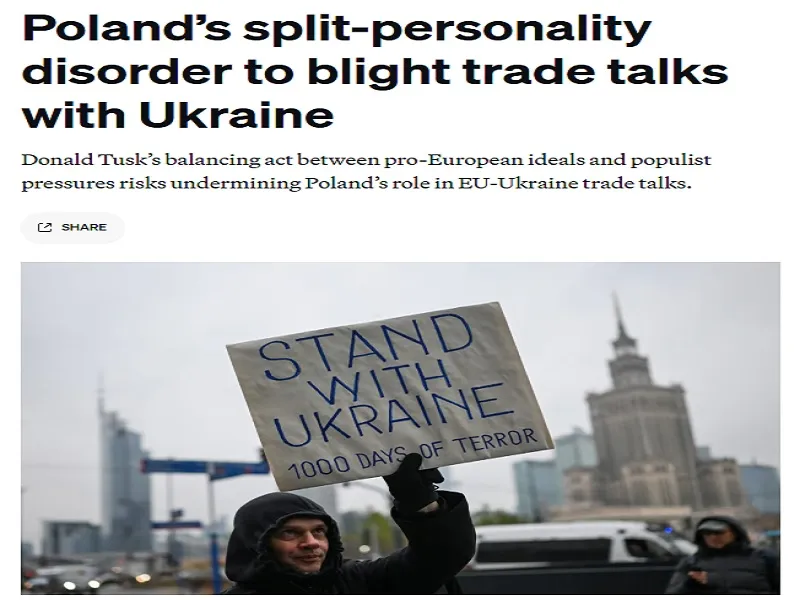
Returning Prime Minister Tusk is a Europhile with very pro-German tendencies, but he’s also an astute politician who knows that his party might not replace outgoing conservative-nationalist President Duda during next year’s election if it doesn’t at least make a show of putting Polish national interests first. This observation wasn’t lost on German-owned Politico, which published an unexpectedly critical piece on Monday about how “Poland’s split-personality disorder to blight trade talks with Ukraine”.
The gist is that Eurocrats should temper their expectations for a breakthrough in trade and other relations with Ukraine during Poland’s rotating Council of the EU presidency, which’ll last half a year from January to June 2025, due to the aforementioned domestic political reasons. They candidly explain how this is attributable to his balancing act that aims to keep the conservative-nationalist opposition at bay, but it’s still portrayed negatively in terms of the bigger picture.
One of the reasons for that is because the German-led EU doesn’t want Ukraine to make any economic or political concessions to Poland since that would reverse the state of strategic affairs whereby the former has become the latter’s senior partner over nearly the past three years. The problem from their perspective is that Tusk might feel coerced by domestic political circumstances into keeping up the tough guy act ahead of next year’s presidential election, which could further worsen Polish-Ukrainian ties.
In that event, seeing as how Poland is the geographic gateway to Ukraine, Warsaw might more assertively leverage its position as Kiev’s lifeline to either get what it wants or punish its neighbor. This could also impede third parties’ ties with Ukraine, in particular Germany’s post-conflict military aid and economic reconstruction plans, which could gradually rebalance Polish-Ukrainian relations. That outcome would be at the expense of what Germany envisages to be its hegemonic role over both.
There’s also the possibility that Tusk’s efforts are ultimately for naught and the conservative-nationalist opposition’s candidate for president beats the ruling liberal-globalist coalition’s, which could make it much more difficult for him to walk back his government’s newly hardline policy even if he wants to. Moreover, it could also create a fait accompli whereby this same approach continues for reasons of inertia, which could then characterize his government’s stance till the 2027 parliamentary elections.
After all, even if his party doesn’t win the presidency, it might not want to risk losing its coalition’s control over parliament by that time if he drops the tough guy act after the next election till then seeing as how fed up Poles are becoming with Ukraine. From the viewpoint of Germany’s hegemonic interests over Poland and its aspiring such ones over Ukraine, it’s better for Tusk to throw the presidential election by backing Kiev to the hilt over the next half-year than trying to help his own party win instead.
Tusk will likely remain a Europhile with pro-German tendencies at heart, but he might feel pressured to keep aping conservative-nationalist policies towards Ukraine up to the point of actually implementing them if he hopes to keep his political career as explained, which could lead to a startling transformation. In fact, this liberal-globalist has already overseen more conservative-nationalist policies in this regard than his predecessors from that ideologically opposite camp, which no one foresaw a year ago.
It's therefore possible that he continues being pushed in that direction for self-serving domestic political reasons, albeit imperfectly because there will probably remain some issues like abortion that he still feels strongly enough about to not change his policy, also calculating that it’ll help him win elections. On Ukraine, however, he’s already transformed into more of a conservative-nationalist than the opposition, and this opportunism is starting to scare the Eurocrats as evidenced by Politico’s latest piece about him.
https://korybko.substack.com/p/polands- ... -of-the-eu
******
Is Fear of Hybrid War With Russia Making Cash Great (Or At Least, Necessary) Again in Europe?
Posted on December 3, 2024 by Nick Corbishley
As unintended consequences go, this could be a big one.
Demand for cash around the world is at a 20-year low, according to De La Rue, the company that prints Britain’s banknotes. But fear of war with Russia as well as other unintended consequences of driving cash out of the economy is prompting some of Europe’s most cashless economies to rapidly reverse course.
A few days ago, The Daily Telegraph published an article warning that “Going Cashless Risks Playing Straight into Putin’s Hands.” As its title suggests, the article’s premise is that the West’s accelerating shift from physical money to digital transactions “may be leaving nations exposed to Russian cyber-attacks”:
Swedish families have this week received an ominous yellow leaflet. The cover shows an illustration of a female soldier with an assault rifle. In big black letters it says: “If crisis or war comes”.
The leaflet contains information on everything from how to deal with anxiety, how to staunch a bleeding wound and what to do if an air raid alarm sounds.
It also urges inhabitants to keep enough cash on hand for a week of essentials “preferably in different denominations” and to “use cash occasionally”.
The Swedish Civil Contingencies Agency, which is behind the brochure, says it will increase citizens’ “emergency preparedness”. Norway, Finland and Denmark have published similar guidance in recent months.
It is a significant shift for a group of countries that were on the cusp of going totally cashless.
Russia’s invasion of Ukraine has brought the threat of cyber attacks, sabotage and outright war closer to home in the Nordics. Payments networks could be a potential target.
Stash Cash in Case of a “Crisis or War”
Back in 2018, the then-deputy governor of Sweden’s central bank, Cecilia Skingsley, predicted that Sweden would probably be fully cashless by 2025. We are now less than a month from the start of that year yet rather than pulling the plug on cash, Sweden’s central bank is instead warning about the unintended consequences of driving cash out of the economy.
Those unintended consequences include exposing the country’s payments system to heightened risk of cyber attacks and cyber fraud. In response, the Riksbank is advising Swedish citizens to have at home at least 2,000 krona ($181) in cash in case of a “crisis or war”. In its 2024 payments report, the central bank also warned of “serious fraud problems that could undermine trust in the payment system.”
Sweden’s near-total abandonment of cash has unleashed a digital crime wave, prompting calls from the central bank to strengthen cash’s role in the economy. After playing more than a bit-part role in the wholesale removal of cash from Sweden’s economy, the Riksbank is now trying to reverse some of the damage it has caused. It is even considering bolstering legislation to force shops that sell government-deemed “essential” goods to accept cash.
The findings of the report may offer a cautionary tale at a time when the dominant narrative around cash — as espoused by senior bankers, central bankers, big tech and fintech executives, politicians and economists, and of course, their ever-faithful servants in the media — is that its demise is all but inevitable, even in countries where cash is still King (Germany, Spain, Austria, Mexico, Thailand, Japan…).
Sweden’s more or less equally cashless Nordic neighbours, Norway and Finland, are in a similar bind. Finland’s economy was until recently forecast to become totally cashless by 2029, but its central bank and government are also having second thoughts, particularly after the government’s decision to join NATO last year, placing it squarely on the front line of NATO’s war with Russia. A couple of weeks ago, Finland hosted its first ever NATO exercises.
In 2022, the Bank of Finland recommended that the use of cash payments be guaranteed by law and urged citizens to have at least three days worth of cash on hand in case of emergency. It’s not only the central bank that appears to be re-evaluating its approach toward cash: so, too, is the general public, with 95% of citizens considering it crucial for cash to continue serving as a valid payment method alongside digital alternatives, according to a 2023 survey by IRO Research for Nosto ATMs.
The war in Ukraine and Finland’s recent membership of NATO appear to have played a role in this shift. According to the survey, the conflict in Ukraine and concerns about supply security have affected the attitude of nearly one-third (28%) of Finns towards cash.
In Norway, where just 3% of in-store purchases involve cash, the government has gone even further by introducing legislation to protect citizens’ rights to use cash. In April, a press release from the Ministry of Justice and Public Security highlighted the importance of cash as an “always on” payment option, ensuring Norway’s economy will not be rendered completely inaccessible in the event of “prolonged power outages, system failure or digital attacks against payment systems and banks”.
Fomenting Fears of Russian Cyber Attacks
Perhaps unsurprisingly, the Daily Telegraph article focuses almost exclusively on the Nordic economies’ vulnerability to a Russian cyber attack, which is only one of the potential threats their payments systems face. The others include power failures and IT outages, neither of which get a mention in the article — perhaps because their inclusion would indicate that the fragility of cashless systems is a broad systemic issue that extends far beyond the risks of a Russian cyber attack.
The Telegraph, like most Anglo-American media, has been fomenting public fears about the risk of a Russian cyber attack since the very first day of Russia’s Special Military Operation in Ukraine. In the third month of the war (April, 2022), cybersecurity authorities from the “Five Eye” nations (US, UK, Australia, Canada and New Zealand) released a joint statement warning that more malicious cyber activity is on the way.
The statement was, above all, an exercise in projection. Both the US and the UK have significant offensive cyber war capabilities of their own, and the US has shown no qualms about using them. US intelligence agencies, at Obama’s behest, have already drawn up a list of potential overseas targets for cyber attacks. They presumably include Venezuela’s electricity grid, which, according to the Maduro government, has twice been the target of a US cyber attack — in 2019 at the height of the attempted Guaidó coup and just a few months ago, in the days following Venezuela’s contested elections.
On both sides of the Ukraine conflict, cyber operations appear to have had a constant but broadly muted impact. Even the Telegraph piece concedes that “Putin’s track record suggests a direct attack is unlikely”. The doomsday predictions of the world’s first ever “cyberwar” have so far not materialised, thankfully. But that hasn’t stopped the constant churn of warnings about Russia’s potential cyber threat. Just last week, the Chancellor of the Duchy of Lancaster Pat McFadden, whose role includes responsibility for national security, told a Nato meeting that the Kremlin could target British businesses and leave millions without power.
The threat is, of course, real: Russia has both the capability and the motive to launch a barrage of cyber attacks against Western targets. As long as NATO continues to escalate its missile attacks on Russia, the motives will grow. That said, European citizens should probably be more worried about what their own governments and central banks are capable of doing to them in a fully cashless economy. Even as Nordic central banks encourage citizens to begin using cash again, the European-wide push for digital public infrastructure continues regardless.
After quietly making digital identity a legal reality across the EU’s 27 economies this year, the EU Commission and the ECB now have their sights set on launching a digital euro in the coming years. Once that happens (assuming it does), it is unclear what kind of role euro cash will have in the Euro Area, but early indications suggest it will be at a disadvantage to the newly launched CBDC. Meanwhile in the UK, there is no telling just how dystopian a Starmer-led Britain could become given it is only in its fifth month. In that brief time, the government has:
*Proposed to create a dedicated digital ID office. Just as his mentor Tony Blair has recommended for years (and as we warned before the election), Starmer is prioritising the implementation of digital ID legislation. Speaking at a conference hosted by his Tony Blair Institute for Global Change (TBI) in central London in July, Blair conceded that the British public will need “a little persuading” to embrace digital ID, a suggestion that elicited rapturous applause and laughter from the audience. My guess is that the British public, like the 350 million citizens of the Euro Area, will have very little say in the matter.
*Unveiled plans to further expand the use of live facial recognition technology,
*Resurrected old Tory plans to grant inspectors at the Department of Work and Pensions increased powers to snoop on claimants’ bank accounts.
*Announced plans to pilot a Central Bank Digital Currency by 2025, carrying on Rishi Sunak’s controversial Digital Pound plans, with a “blueprint” expected by Christmas.
*Launched an unprecedented crackdown on lawful speech. According to a recent expose by Matt Taibbi and Paul Thacker, this crackdown extends far beyond British shores. The ultimate goal is purportedly to destroy Elon Musk’s X platform. The Starmer government is also using powers it already has — namely the UK’s anti-terror laws — to arrest and intimidate pro-Palestinian journalists and activists while participating directly in Israel’s genocide of Gaza.
*Called for the creation of digital health passports for NHS patients (another Blair proposal), prompting a backlash over concerns about digital privacy and the safety of patient data. The recent alleged cyber attacks on hospitals in the North West of England, causing chaos across in-patient and out-patient services, seriously challenges the wisdom of digitising all patient health data. To quote Prof. Sandra Watcher, a data ethics expert at the Oxford Internet Institute, “The idea of a data breach is not a question of if, it’s a question of when.”
Self-Inflicted Outages
The irony is that the worst payments outages of the past decade have been a result not of hostile acts from foreign adversaries but rather botched internal processes by banks, payment processers or third-party IT firms. In 2018, Visa’s Western European card network went down for over 10 hours on a Friday afternoon, plunging the UK and other European countries into chaos as millions of consumers were unable to use their Visa debit or credit cards at points of sale. The credit card company blamed the outage on a “degradation” in its processing system.
In July this year, the world suffered arguably its biggest ever IT outage after a content update by the cyber-security firm CrowdStrike caused millions of Microsoft systems around the world to crash, bringing the operating systems of banks, payment card firms, airlines, hospitals, NHS clinics, retailers and hospitality businesses to a standstill. Businesses were faced with a stark choice: go cash-only, or close until the systems came back online.
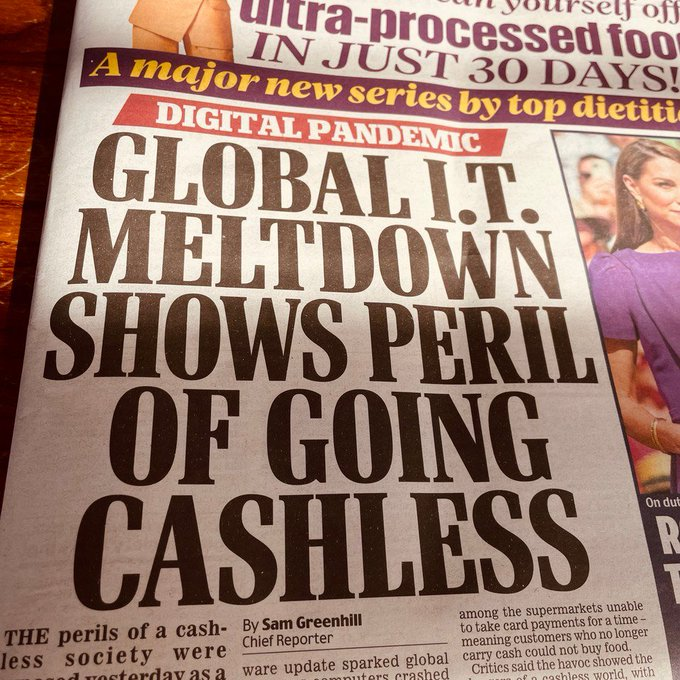
Such was the scale of the resulting disruption that even stalwart British media outlets like The Sun, The Times, The Guardian and The Mail ran articles on how the global IT outage had underscored the fragility of a cashless society. The Daily Mail plastered the message across its front page:
The payment outages didn’t stop there. Over the weekend, Italy suffered a prolonged payment outage after construction on gas roadworks damaged payments company Worldline’s network connection. The outage hampered (apologies) sales during Black Friday, costing merchants around $106 million, according to a Reuters report.
On September 12, 250,000 card terminals in Germany — the equivalent of one-in-four of the country’s devices — stopped working, according to FAZ. Once again, the cause of the outage appears to be a software glitch, this time affecting the payment service provider Telecash. On the same day, outages were also reported in the Netherlands. It was the third large payment outage the Netherlands has suffered in just 15 months.
In late October, the Dutch National Bank (DNB) flagged the rising threat posed to the financial system by artificial intelligence, surging cybercrime and system outages. Cyberattacks against the financial sector account for roughly one-quarter of all attacks and can, in extreme cases, “make financial services temporarily unavailable” across the country’s entire financial system, the central bank wrote in its financial stability report.
“You have to take into account that you may not be able to pay by debit card for a longer period of time,” said DNB director Olaf Sleijpen. “Then you have to have cash under the mattress, or be able to pay with QR codes.”
One country that will not be advising citizens to prepare in this way is the UK (quelle surprise!). Although the Head of Britain’s armed forces, Sir Tony Radakin, recently told the Berlin Security Conference that the UK should take a leaf out of Sweden’s book, the Starmer government, like the Sunak government before it, has shown no interest in encouraging cash usage. Its official emergency preparedness guidance advises people to assemble an emergency kit of essentials to survive in the event of disruption – but they do not include cash.
A government spokesman told The Telegraph: “The UK has robust plans in place for a range of potential emergencies that have been developed, refined and tested over many years.” And that, I’m sure, will put our UK-based readers’ concerns at rest.
https://www.nakedcapitalism.com/2024/12 ... urope.html
*****
Lithuania slammed for expulsion of diplomats
Nation's 'persona non grata' declaration further frays bilateral ties, ministry says
By ZHAO JIA | China Daily | Updated: 2024-12-03 09:38
China on Monday strongly condemned and firmly rejected Lithuania's designation of some Chinese diplomatic personnel as "persona non grata", urging the country to abide by the one-China principle and foster conditions for the normalization of bilateral ties.
Without any explanation, Lithuania's Foreign Ministry declared on Friday some personnel working in the Office of the Charge d'Affaires of China in Lithuania "persona non grata" and demanded they leave the country within a designated time period, according to a statement released by China's Foreign Ministry.
Calling the decision wanton and provocative, China's Foreign Ministry spokesperson said in a statement that because of actions taken by Lithuania regarding Taiwan in recent years, the Baltic state is already in serious violation of the one-China principle and in breach of the political commitment it has made in the communique on the establishment of China-Lithuania diplomatic relations. "This has caused severe difficulty for bilateral ties," the statement added.
Beijing downgraded diplomatic relations with Vilnius to the level of charge d'affaires after the Baltic state allowed Taiwan authorities to set up a "Taiwanese Representative Office" on its soil in 2021.
"Three years on since the downgrading of bilateral ties with China, Lithuania has again taken detrimental action that further exacerbates the relations," the statement said.
Beijing called on Lithuania to immediately stop undermining China's sovereignty and territorial integrity, and stop creating difficulty for bilateral relations, the spokesperson said, vowing that China reserves the right to take countermeasures against the nation.
Foreign ministry spokesperson, Lin Jian, told a news conference on Monday that China has noticed that Lithuania is preparing to form a new government and many politicians have expressed their desire to improve relations with China.
He expressed the hope that the new government will adhere to the one-China principle and put bilateral relations back on the right track.
In another development, Lin reiterated China's firm opposition to any form of official interactions between the United States and Taiwan, and warned Washington against meddling in China's internal affairs.
Lin made the remarks as Taiwan region leader Lai Ching-te on Sunday discussed so-called China's military threats toward the island in a call with former US House Speaker Nancy Pelosi during his "stopover "in Hawaii on his way to the South Pacific.
He emphasized that the Taiwan question is at the core of China's core interests, and is the foremost red line that cannot be crossed in China-US relations.
He also urged the US to see the separatist nature of Lai and the Democratic Progressive Party authorities, and fully understand the grave damage that "Taiwan independence" activities do to cross-Strait peace and stability.
Separately, Lin encouraged Paraguay to establish a correct and comprehensive perception of the one-China principle, and make decisions that genuinely align with the fundamental and long-term interests of its people.
His comments at the news briefing came after Paraguay's Foreign Minister Ruben Dario Ramirez Lezcano visited the island on Friday, saying that Paraguay was open to establishing diplomatic, consular or commercial relations with China without conditions, but would not be willing to break its so-called ties with the island.
Paraguay is the only country in South America and one of 12 countries in the world that have so-called diplomatic ties with Taiwan.
"The one-China principle is a universally recognized consensus of the international community and a fundamental norm of international relations, which also serves as the political foundation and essential prerequisite for China to develop bilateral relations with other countries," Lin said.
He stressed the one-China principle concerns China's sovereignty and territorial integrity, leaving no room for "negotiation or compromise".
http://global.chinadaily.com.cn/a/20241 ... d0bc0.html
European elites are destroying Europe – again
November 29, 2024
The tragedy of Europe is not something mysterious or ill-fated. It is the direct result of elitist rulers who have assiduously conducted policies that harm European citizens.
One would think that having suffered two world wars only decades apart, European politicians might be more cautious about starting another one. Incredibly, however, the countries of Europe are being plunged into another conflagration.
Not much has changed over a century, it seems. War is still the result of imperialist intrigue and no accountability to the masses of citizens by arrogant politicians aided by relentless media propaganda lies.
European elitist rulers are a treasonous clique who are destroying Europe because of their abject servility to U.S.-led Western imperialism.
To put it crudely, Europe is being abused like a bondage plaything for the Washington and European elites. Shudder the thought of Ursula von der Leyen and Kaja Kallas in dominatrix garb or Keir Starmer, Emmanuel Macron and Olaf Scholz as the gimps. But sometimes, the truth can be stranger than fiction.
Russian President Vladimir Putin nailed it this week when he slammed European political heads who are “dancing to the tune of the Americans.” In an address to the Collective Security Treaty Organization summit in Kazakhstan, Putin said the crisis over Ukraine showed that European so-called leaders have no independence or autonomy. They are non-entities as far as serving the democratic interests of their nations is concerned.
Instead of pushing for a diplomatic solution to the worst conflict on the European continent since World War Two, European political elites are slavishly going along with Washington’s criminal proxy war against Russia, which is in danger of spiraling into a nuclear Armageddon.
This week the buffoonish former British Prime Minister Boris Johnson openly admitted that the conflict in Ukraine was a proxy war against Russia. But that didn’t give Johnson pause for thought or shame. He urged the Europeans to send more weapons to Ukraine. Nor did his crass candidness elicit any outcry or condemnation. Johnson, the imbecile, was, in effect, confirming what Russia has been warning is the essence of the conflict in Ukraine – a U.S.-led war using Ukrainian cannon fodder.
Then, we had the chief of Britain’s intelligence agency MI6, “Sir” Richard Moore, holding forth to an audience in Paris that Russia’s Putin was causing “staggeringly reckless sabotage” across Europe. The British spymaster claimed that Russia was threatening the continent with nuclear weapons to weaken NATO support for Ukraine. He omitted the glaring fact that the U.S., Britain, and France have dramatically escalated the conflict by supplying a NeoNazi regime in Ukraine with long-range missiles to strike Russia.
Meanwhile, the governments in Germany and Nordic countries are issuing dire public warnings for people to “get ready for war” by building bomb shelters in their homes and stocking up on non-perishable foods.
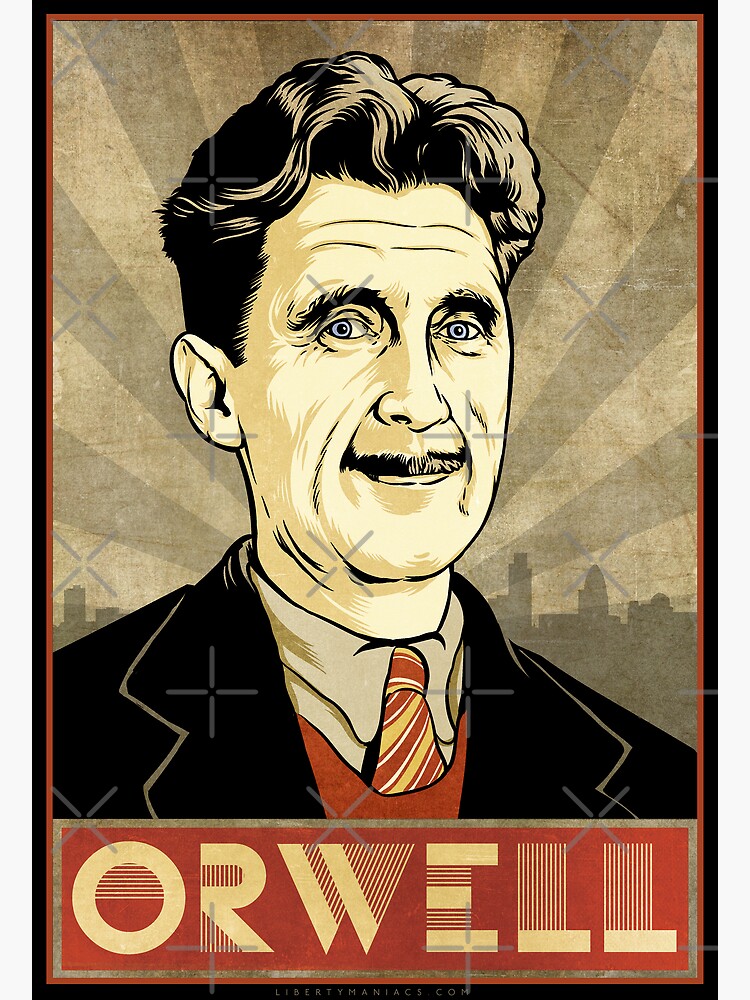
You could hardly make this insanity up except in the dystopian novels of George Orwell. The continent is being led by the nose to disaster by politicians and corporate-controlled media who have lost their minds. They long ago lost any self-respect or independence and are simply acting as the most pathetic surrogates for U.S.-led imperialism.
Even without the ultimate catastrophe of war, Europe has been brought to ruination by elitist politicians who have unquestioningly followed the American agenda of trying to strategically defeat Russia through a proxy war.
Central to this U.S. strategic objective is vanquishing decades of mutually beneficial energy trade between Europe and Russia. The sanctions imposed on the Nord Stream gas pipelines by Trump during his first administration, followed by the blowing up of the pipes by the Biden administration in September 2022, are testimony to that bigger picture. None of the European governments or their news media properly investigated that huge crime of state-sponsored terrorism.
The proxy war and sanctions on Russian energy that the European leaders happily went along with have caused the European economies to implode. Critical commentators talk about the deindustrialization of Europe.
Even the Financial Times, in a recent in-depth report on Germany’s “broken economy”, sounded aghast at “the most pronounced downturn in Germany’s postwar history.” The report surveys auto, chemical and engineering sectors crucial to the German economy and cites “high energy costs” as the detrimental factor.
However, the Western media, even in supposed “in-depth reports” like the Financial Times, are careful not to spell out the obvious cause of Europe’s economic collapse: the U.S.-led proxy war in Ukraine and the consequent damage in Europe’s relations with Russia.
Media reports deplore a “jobs massacre” in Germany’s industrial giants like Volkswagen and Thyssenkrupp without explaining the cause as if the calamity is somehow random misfortune.
As if that is not bad enough, the incoming Trump administration is lining up heavy tariffs on exports from Europe as well as China, Canada, and Mexico. That will be a coup de grâce for the European economies delivered by its American ally.
Europe is in this appalling predicament – facing economic ruin amid a potential military conflagration – all because it has been misled by people like Ursula von der Leyen, Josep Borrell, France’s Macron, Germany’s Scholz (and Angela Merkel before him), and Netherlands former premier Mark Rutte, who is now the gung-ho head of NATO calling for more European weapons to Ukraine. Many others can be named from the Nordic countries, Poland, and the Baltic states. Rather fittingly, the European elitist political class has a long and vile history of Russophobia, going back to collaboration with Nazi Germany in its genocidal aggression against the Soviet Union.
The tragedy of Europe is not something mysterious or ill-fated. It is the direct result of elitist rulers who have assiduously conducted policies that harm European citizens. These charlatan leaders are shameless in their Russophobia and surrogacy for U.S.-led Western imperialism – even to the point of killing their own people through economic devastation or worse – world war.
The conflict in Ukraine is solvable through negotiations and dialogue that acknowledges the historical causes. From Russia’s point of view that pertains to NATO’s treacherous expansionism since the end of the Cold War.
But this is the deep dilemma facing Europe. Not one of the politicians (apart from a few honorable exceptions) is capable of thinking or acting independently because they are ideological slaves.
Rational diplomacy and respect for democracy and peace are beyond these political degenerates. Their complicity in a bankrupt system of Western imperialism makes them incapable of doing the right thing for humanity. That’s why the vile history of wars keeps repeating. They and their corrupt, warmongering system must be swept aside.
https://strategic-culture.su/news/2024/ ... ope-again/
Josep Borrell’s double standard
Eduardo Vasco
November 30, 2024
While defending the competing approach in Ukraine, Borrell has been a strong critic of Israel’s extermination of Palestinians in Gaza.
At the beginning of November, the European Union’s High Representative for Foreign Affairs and Security Policy, Josep Borrell, went to Kiev to signal that the Europeans will continue their strong support for the Ukrainian armed forces in the war against Russia.
The visit took place shortly after Donald Trump’s victory in the U.S. – who has indicated numerous times that he intends to disengage his country from the conflict. “We have supported Ukraine from the beginning and today we are sending the same message: we support it in every way we can,” the diplomat said on the 9th.
When Borrell was in Kiev, the Institute of the World Economy in Kiel, Germany, calculated that the European Union had already allocated 125 billion dollars to the government of President Vladimir Zelensky since the beginning of the Russian intervention in February 2022. This is more than the amount sent by the U.S. (90 billion dollars).
While defending the competing approach in Ukraine, Borrell has been a strong critic of Israel’s extermination of Palestinians in Gaza. He has called the situation in the Palestinian enclave, where more than 44,000 people have been killed by Israel, a “human tragedy” and “the greatest humanitarian crisis since World War II.”
He has also indicated that Israel could be committing war crimes and, in November, he intended to suspend talks between the European Union and Israel due to violations of human rights and international law in Gaza.
Despite adopting a critical stance on Tel Aviv’s actions, it is absurd to consider the positions of the head of European diplomacy as anti-Semitic – something that Benjamin Netanyahu’s office has done. In 2022, he famously declared that the extermination of 5 million Jews by German Nazis in World War II was “the greatest tragedy in the history of humanity.”
A photo taken by Reuters reporter Gleb Garanich, however, helps shed light on the double standard behind Borrell’s apparent humanitarianism. While visiting an exhibition of military equipment used by Ukrainians in the conflict, he passed a tank covered in graffiti and drawings made by the military. These indicate that the tank belonged to the infamous Azov Battalion, as it had a drawing of its shield, with a Ƶ, next to a swastika.
The Ƶ , inside the Azov shield, is a Wolfsangel, one of the many emblems used by the German Nazis. And the swastika – well, the swastika…
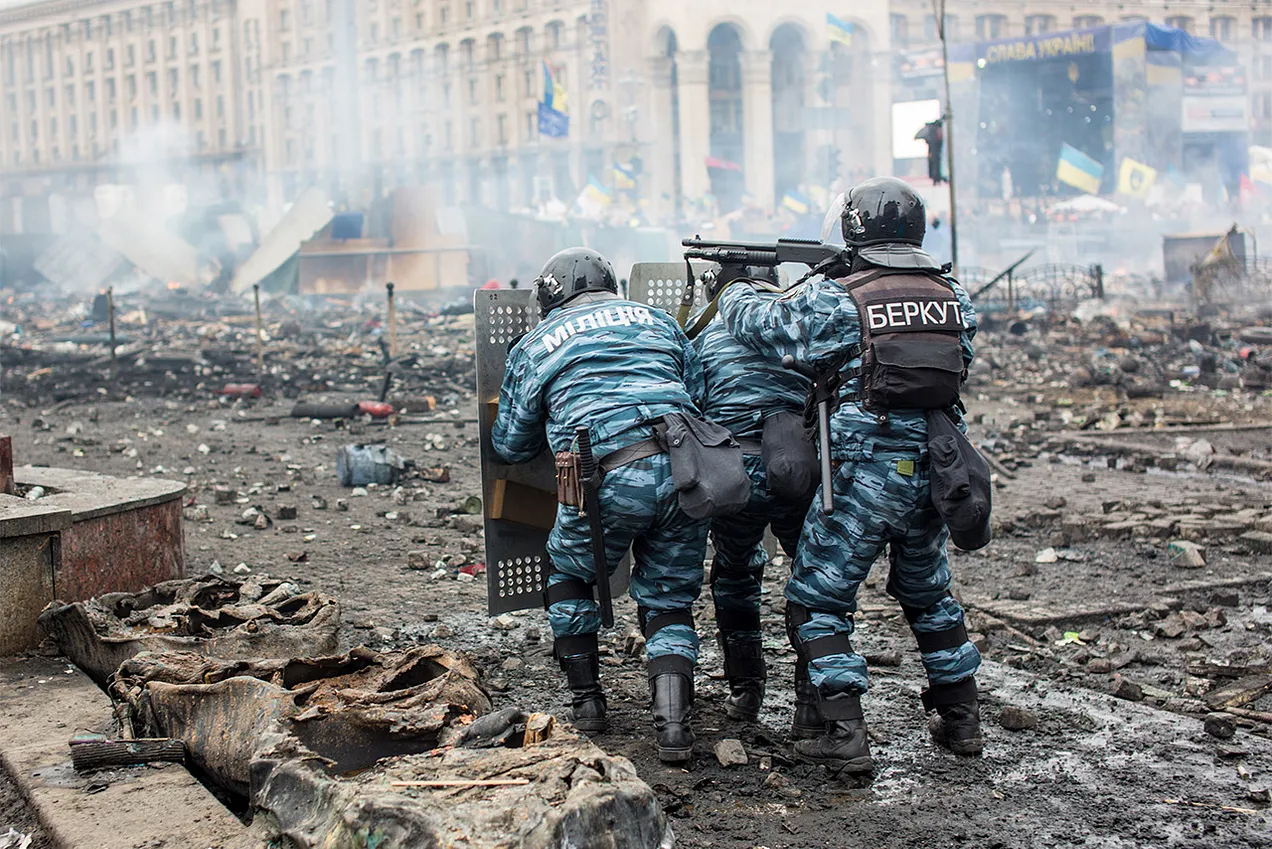
The Azov Battalion is one of the most notorious participants on the Ukrainian side in the war. In fact, it was instrumental in starting the war. It was founded in 2014 by neo-Nazi elements who formed the shock troops of Euromaidan, a color revolution that overthrew the then Ukrainian government and replaced it with a junta influenced by far-right groups that, like Azov, have since become prominent in Ukrainian politics. The Azov coup was at the forefront of the new regime’s drive to suppress the uprisings in Donbass against the coup d’etat, which led to the conflict we see to this day.
“LGBT people and foreign embassies say that there were not so many Nazis who participated in the Maidan, that only about 10% were ideological [militants],” Evgeni Karas, leader of C14, a neo-Nazi militia, said in early 2022. “If it weren’t for these 8%, the effectiveness [of Euromaidan] would have fallen by 90%,” he commented, adding that without this, Euromaidan would have been nothing more than a “gay parade” – this kind of recognition only the most blatant extremists have the courage to make.
The movement that led to the overthrow of then-president Viktor Yanukovych and the rise of far-right organizations was sparked by the European Union’s dissatisfaction with the Ukrainian president’s stance, which preferred to maintain Ukraine’s neutral status by refusing to sign a free trade agreement with the bloc. One of Borrell’s predecessors as head of EU diplomacy, Catherine Ashton, soon traveled to Ukraine with Victoria Nuland, assistant secretary at the U.S. Department of State, where they met with representatives of neo-Nazi groups. The supposedly democratic façade of the protests, the NGOs, had been heavily funded by the European Union and the U.S. for many years before Euromaidan.
The triumphant members of Pravy Sektor and Svoboda – other neo-Nazi groups – took up positions in the judiciary, the Ministry of Defense and national security agencies. Six of the new governors imposed by the new regime were members of Svoboda, which until 2004 was called the National Socialist Party of Ukraine. In 2018, C14, the former youth wing of Svoboda, signed an agreement with the Kiev mayor’s office to patrol the city’s streets, meaning it was incorporated into the official forces.
Under Zelensky’s term, it was Azov’s turn to be incorporated into the National Guard as a regiment. Its militia, which guarded the streets, was placed under the supervision of the Ministry of the Interior and sent to operate throughout the country in conjunction with the national police. In late 2021, Dmytro Yarosh, former leader of Pravy Sektor between 2013 and 2015, became an advisor to the commander-in-chief of the Ukrainian armed forces.
In 2020, the Ukrainian parliament established the birthdays of seven notorious collaborators of the German occupation of Ukraine during World War II as official commemorative dates. Meanwhile, Azov members helped Zelensky persecute opponents. In 2019, they raided Viktor Medvedchuk’s house, and a year later, the regime’s main opponent was arrested for “treason,” according to Zelensky.
Neo-Nazis continued to receive awards and high-ranking government positions. In December 2021, the president awarded a leader of Pravy Sektor the title of “Hero of Ukraine.” This indicates the prestige of these sectors within the regime, but also a reward for their decisive actions on the battlefield.
Neo-Nazi groups have been on the front lines of the war since its beginning. Residents of Donbass still tell horrific stories of the horrors committed by Ukrainian infantry during the harshest period of the war, between 2014 and 2015. In Lugansk, where I was in the first half of 2022, the most barbaric were the Aidar Battalion. Another organization of neo-Nazi fighters, Aidar – like Azov – received funding from the oligarch Igor Kolomoisky, Zelensky’s main sponsor. Residents of villages in Luhansk will never forget, for example, the shooting of 18 people near the Novosvetlovska church, or the shelling of the church itself, where dozens of people were taking shelter. Soon after the Russian intervention, Zelensky appointed a former commander of the Aidar battalion as the new general administrator of the Odessa oblast.
Just like the front NGOs that paved the way for neo-Nazism to take power in Ukraine, these parties and armed militias were also – and continue to be – funded by the U.S. and the European Union. In 2016, some of the weapons sent by the Pentagon were sent to Azov. In late 2017, U.S. military officers provided field advice to the group. The Azov also received instructors and British grenade launchers from NATO countries shortly after the Russian intervention, as did the Pravy Sektor.
A report by the Institute for European, Russian and Eurasian Studies at George Washington University published in September 2021 indicated that the “Centuria” group, also of neo-Nazi orientation and formed by officers of the Ukrainian army, participated in joint military exercises between France, Germany, Poland, the United Kingdom, Canada and the United States.
Simultaneously with the takeover of state institutions by the fascist far-right, Ukraine has been falling apart economically. This is not only due to the war, but also to the high price paid by Kiev for its informal integration into the European Union: the transfer of public assets to private hands, whether of national oligarchs or foreign businessmen and banks. These are the “reforms” that a subservient government makes to adapt to the will of its guardians.
“Ukraine continues to advance with fundamental reforms to become a member of the EU, while at the same time fighting a war of aggression,” Borrell said in October, when presenting the annual report on the expansion of the European Union. He also said the bloc would “continue to support Ukraine on both fronts.” The European Union has already supplied more than 980,000 rounds of ammunition to Ukraine’s war with Russia, and Borrell has promised to supply a million by the end of the year. Around 15,000 civilians have been killed in Donbass since 2014 thanks to such support.
https://strategic-culture.su/news/2024/ ... -standard/
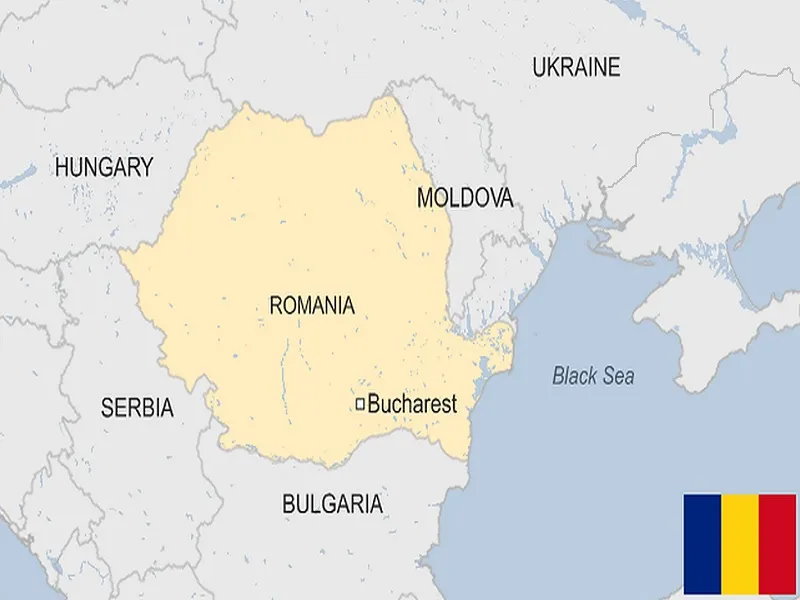
The first-round “surprise” in Romania’s elections: What does the Georgescu-Lasconi race mean?
Erkin Oncan
November 30, 2024
The roughly 350,000-vote difference between Georgescu and his closest competitor underscores the growing appeal of right-wing populist skepticism toward Europe.
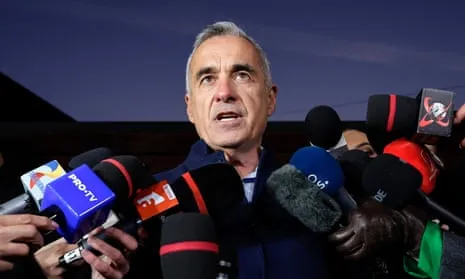
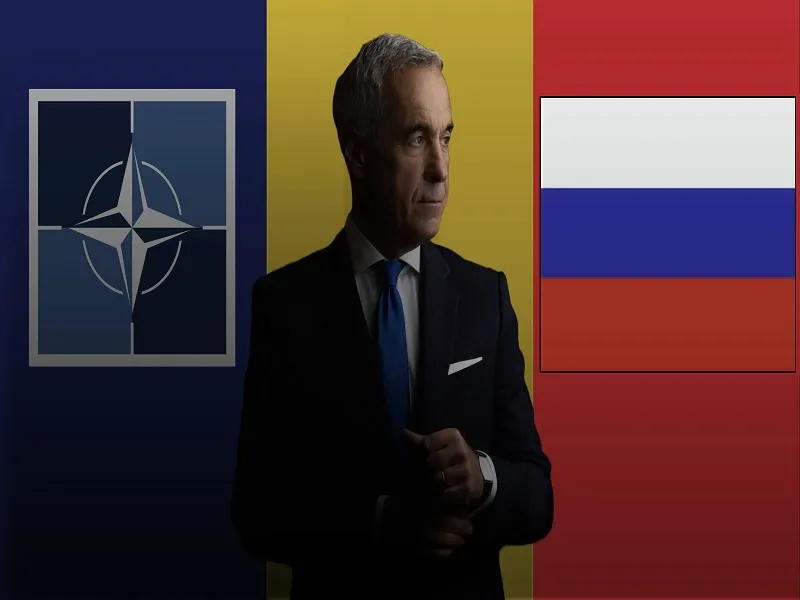
Romania held its presidential elections last Sunday, with 13 candidates competing in a race where most polling predictions were proven wrong. Among these candidates, the most notable was Calin Georgescu, who ran as an independent.
Georgescu emerged victorious in the first round, where voter turnout was recorded at 52%. He secured over 22% of the vote, making him the frontrunner of the elections.
Elena Lasconi of the Save Romania Union Party (USR), representing liberal conservatives, came in second place. Meanwhile, current Prime Minister Marcel Ciolacu narrowly fell to third place behind Lasconi.
One of the notable candidates, former NATO Deputy Secretary General Mircea Geoană, announced his retirement from politics after his defeat. Geoană expressed concerns in an interview with Romanian media, stating:
“The level of disappointment and anger is pushing society toward a more radical choice.”
A shocking win in Western Media
Georgescu’s victory was described in Western media with terms like “surprise,” “shock,” and “earthquake.” This sentiment stems from Georgescu’s reputation as a relatively unpopular politician known for his anti-NATO and anti-Ukraine statements.
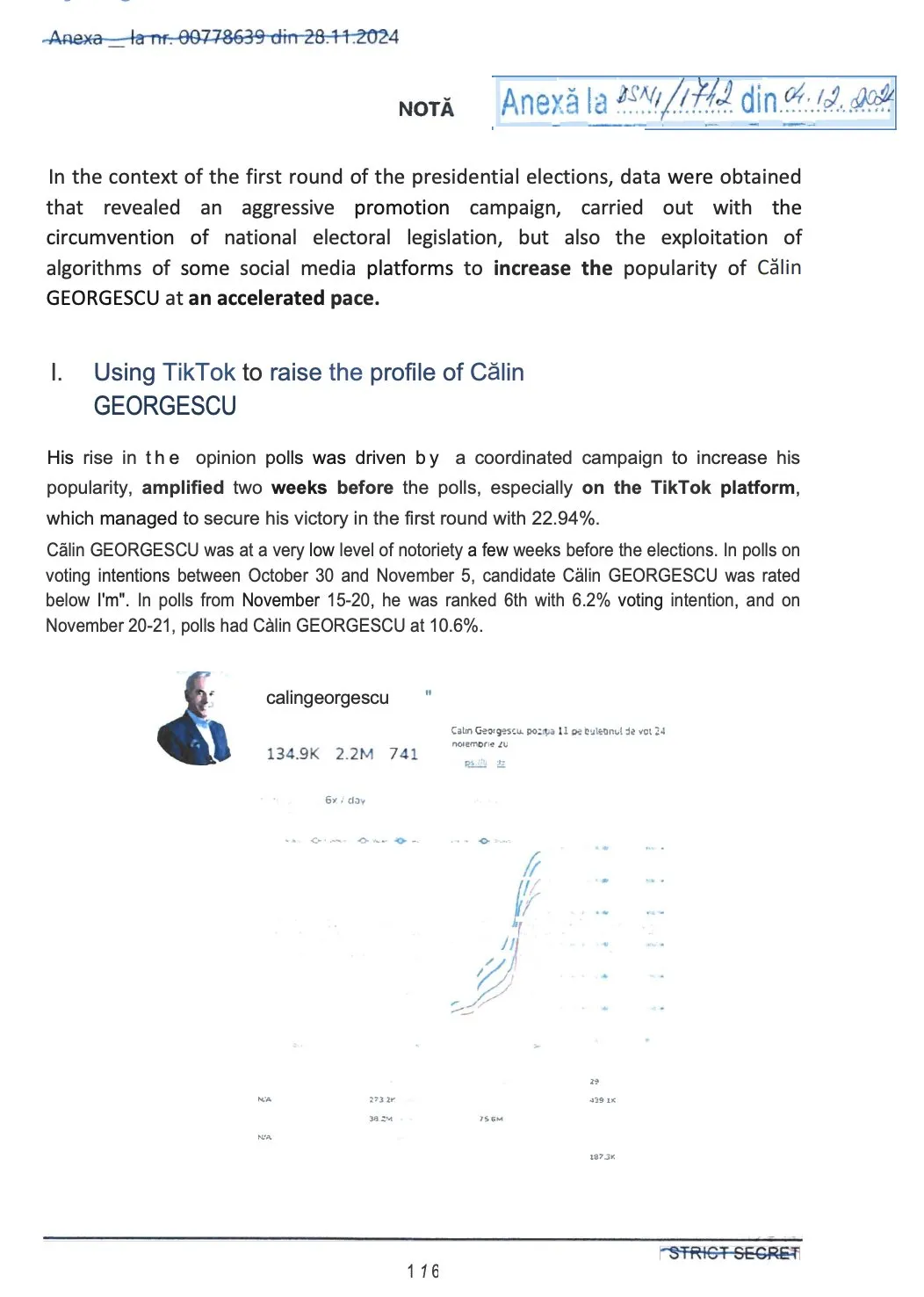
As he highlighted in one of his interviews, Georgescu conducted his entire campaign on TikTok. This unconventional strategy led many Romanian analysts to dub him a “product of TikTok.”
Who is Calin Georgescu?
Calin Georgescu, a 62-year-old right-wing populist, holds degrees from the University of Agricultural and Veterinary Sciences and the National Defense College in Bucharest.
Starting his career as a university lecturer, he later worked at the Ministry of Environment and served as Romania’s representative for the UN Environment Program.
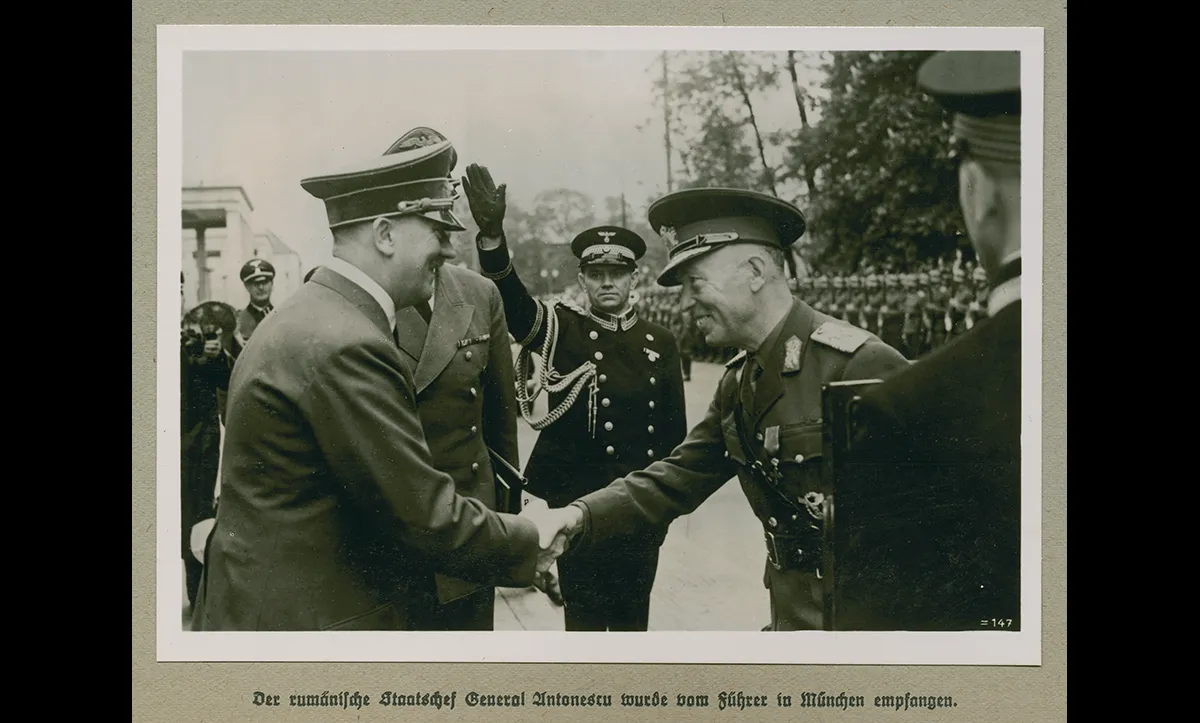
This election is not Georgescu’s first political endeavor. In 2020 and 2021, the far-right Alliance for the Union of Romanians (AUR) nominated him for the position of Prime Minister. However, his candidacy was revoked following his praise for controversial historical figures, including pro-Nazi dictator Ion Antonescu and Zelea Codreanu, founder of the anti-Semitic Iron Guard. Georgescu even faced a criminal investigation for glorifying war criminals.
In a 2022 interview with Antena 3, Georgescu referred to these figures as “heroes” and claimed that “the Romanian nation lives through these heroes.”
“NATO base is a diplomatic disgrace”
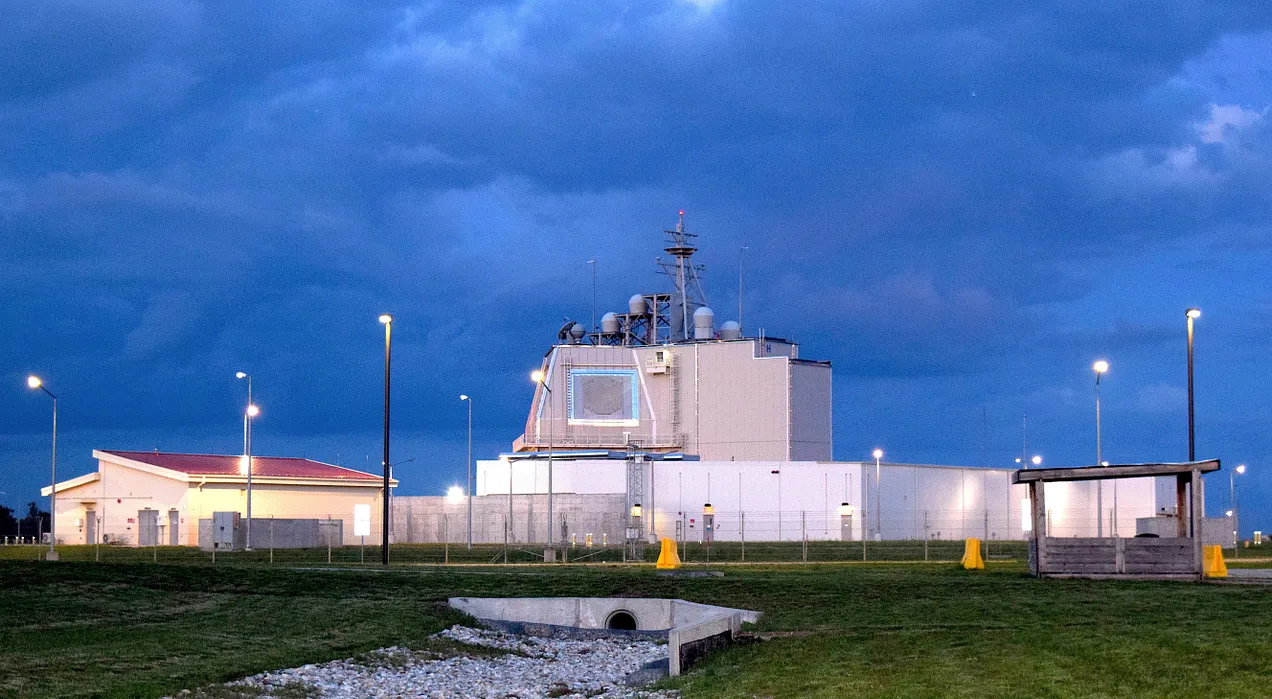
Georgescu is also known for his anti-NATO rhetoric. He has labeled NATO’s ballistic missile defense system in Deveselu, Romania, as a “diplomatic disgrace” and argued that the alliance would not protect its members in the event of a Russian attack.
Speaking to Romanian journalist Mihai Tatulici, Georgescu advocated for Romania’s neutrality in the Ukraine war, saying:
“It is clear that the situation in Ukraine is being manipulated. The conflict is being orchestrated to serve the interests of the U.S. military-industrial complex. As a nation, our priority should be to remain neutral in any conflict. What happens there is not our concern.”
A vision for a sovereign Romania
Georgescu has openly criticized the European Union (EU), calling it a failed project that seeks to enslave Romania. He outlined his vision for the country as follows:
“The peace strategy must take precedence. This includes both external and internal peace. Everything begins here. Nobody has ever built anything through war. I can summarize my vision with three clear principles: First, our people’s genius lies in remaining 100% neutral in any conflict. Second, I want a sovereign state, one that is independent and uninvolved. Third, we must learn how to utilize our national resources independently.”
In another interview with Antena 3, Georgescu stated:
“We do not have a state. Without a state, people are nothing more than a herd, and the only entity capable of serving the nation is a state. Yet, this has nearly disappeared.”
Liberal-conservative candidate Lasconi
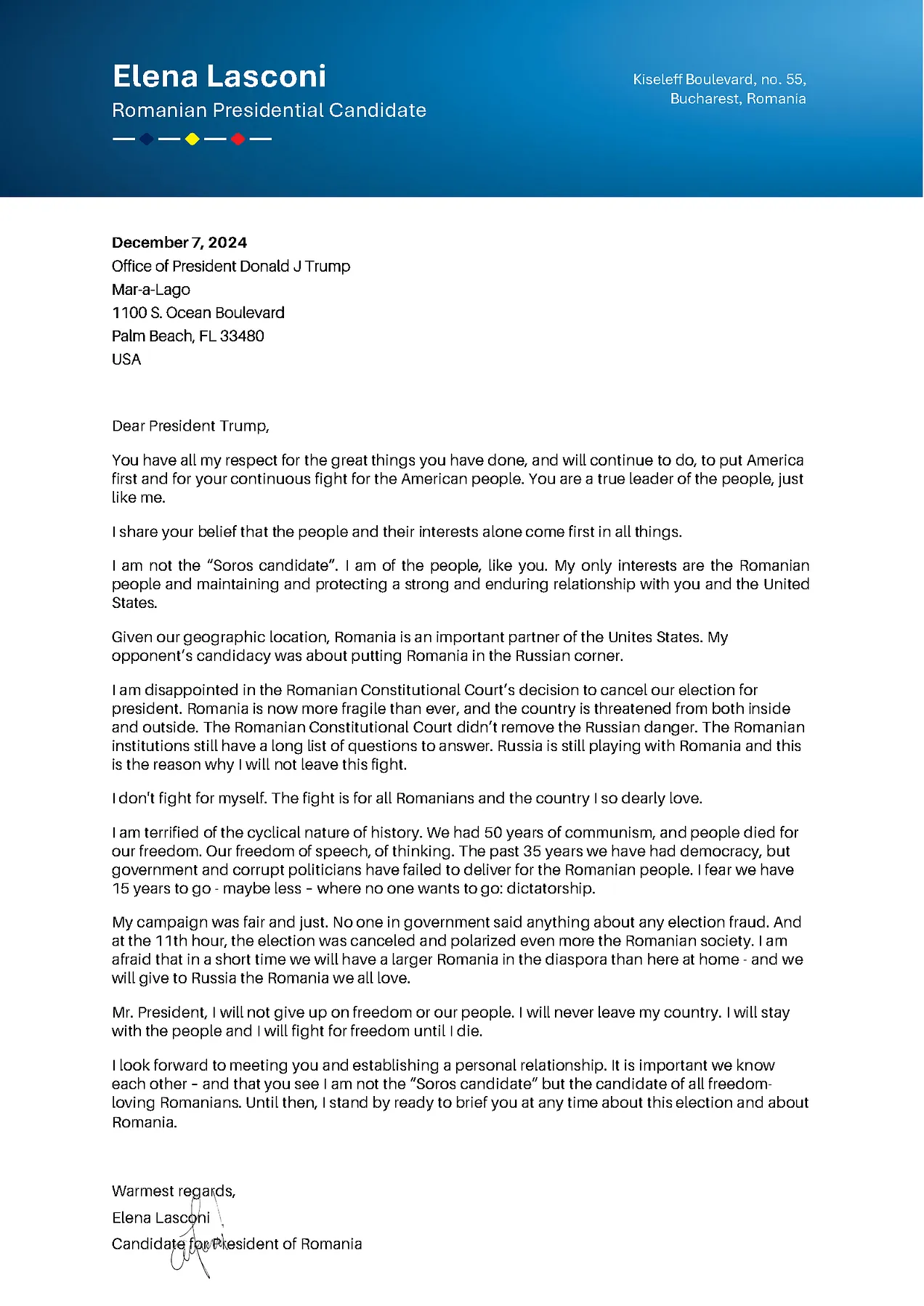
Elena Lasconi, Georgescu’s opponent in the second round, is a former journalist and mayor. She strongly supports Romania’s alliance with Ukraine. On the 1,000th day of the war in Ukraine, she posted on Facebook:
“1,000 days of courage, sacrifice, and the fight for freedom. Romania must continue to stand by Ukraine. I promise to ensure this steadfast support as President. This is not just Ukraine’s fight; it is a struggle for the stability and democracy of the entire region.”
Lasconi also expressed her strong support for NATO. In an interview with Radio Free Europe’s Romanian service, she emphasized the deterrent power of NATO troops:
“I believe it would be wonderful if we had more foreign troops in Romania because countries with well-trained NATO forces have never been attacked.”
A clash of ideologies
Georgescu’s arguments reflect a broader European trend among right-wing populists: emphasizing strong state authority, national revival, and economic self-sufficiency, alongside an anti-war stance. This approach has led many to label him as “Kremlin’s man.”
In contrast, Lasconi embodies a pro-European leader aligned with the current needs of NATO and the EU.
The political polarization in Romania mirrors that of other nations like Moldova, pre-war Ukraine, Serbia, and Georgia. On one side stands a Europe-skeptic right advocating for national sovereignty and strong state policies; on the other, a liberal-conservative faction deeply tied to Atlanticist structures.
While accusations of “Russian influence” often dominate these elections, it’s clear that the economic challenges, political instability, and heightened militarization driving voter concerns are far more tangible than alleged Kremlin meddling.
The roughly 350,000-vote difference between Georgescu and his closest competitor underscores the growing appeal of right-wing populist skepticism toward Europe, marking it as the West’s rising trend. However, Western analysts will need more than just “Kremlin narratives” to fully understand this shift.
https://strategic-culture.su/news/2024/ ... race-mean/



 – Germany is going through deep industrial crisis