Blues for Europa

User avatar
blindpig
Posts: 14829
Joined: Fri Jul 14, 2017 5:44 pm
Location: Turtle Island
Contact:

Re: Blues for Europa

Post by blindpig » Fri Dec 20, 2024 4:42 pm

France left without a government as Barnier falls

This latest collapse is another twist in Paris’s downward spiral into terminal political crisis.
Proletarian writers

Thursday 19 December 2024

Image
France’s ongoing political turmoil is mirrored in every imperialist country. At heart, it is the result of the combination of deepening economic crisis with the growing crisis of legitimacy. As the masses become more angry and cynical, it is becoming increasingly difficult for the ruling class to rule in the old way.

President Emmanuel Macron’s panic decision last summer to dissolve the French parliament (in the hope of resurrecting some pretence of a national consensus held together by ‘moderate’ centrist parties of left and right and with ‘extremist’ parties safely relegated to the fringes) only made matters worse for fans of centrism.

To the horror of ‘moderates’, in the first round of the parliamentary elections Marine Le Pen’s National Rally (RN) party initially emerged as the strongest force, connecting with the desperate anger and contempt in which most workers hold the whole political class.

Faced with rampant inflation, the intensifying cost of living crisis, economic blowback from anti-Russian sanctions and the expensive and dangerous support for the Kiev fascists in a war in which no French worker holds any stake, workers voted en masse to kick out the ‘moderates’ whose ‘moderation’ had delivered only corruption, austerity, poverty and war.

It looked for a while as if there might be a government led by Marine Le Pen, whose right-wing populist party came out on top in the first round of the elections. Come the second round of the election though, the forces of ‘moderation’ caught their collective breath and, by tactical voting, kept the forces of ‘darkness’ at bay, forcing the RN down to third place and preserving the ‘moderate’ tone of political discourse whilst also preserving the political elite’s sacred duty of unbroken service to imperialism.

Apparently feeling that the actual funding and arming of fascists in Ukraine and elsewhere by Macron and other French ‘moderates’ was of no account, the social-democratic and green ‘progressives’ clapped each other on the back at this supposed great ‘anti-fascist victory’. But for the increasingly impoverished poor workers, many of whom had been driven to vote for Le Pen in a gut reaction against the entire political class – and against poverty and war in particular – this outcome solved nothing.

Clearly, a maverick right-wing populist like Le Pen has nothing to offer workers other than more of the same xenophobia and empty promises as those of the liberal elite she affects to despise. But the cure for fascism is not liberalism, which is its direct facilitator. Nor will tactical voting aimed at restoring ‘stability’ to the crisis-ridden capitalist system do anything to restore the fortunes of the working poor. Their only salvation lies in the wakening of the masses to the fight for socialism.

Rebellion against deepening austerity
The collapse of the three-month-old government led by Michel Barnier will be welcomed by workers raging against his proposed poverty budget for 2025, which included tax rises of €60bn and cuts to social security and welfare totalling €40bn. Acting as the European Union’s hitman, Barnier declared that these cuts are essential to rein in a public deficit of 6.1 percent of GDP and bring France back towards alignment with the EU diktat of a 3 percent limit.

When it became clear that parliament would refuse to sanction this budget, Barnier reached for paragraph 3 of Article 49 of the French constitution, which proclaims that, “after deliberation by the Council of Ministers”, it is okay to force a bill through without a vote (as Macron himself did last year so as to force through a bill raising the pensionable age that was being steadfastly opposed by the masses of the people and the majority of parliamentarians).

This threat was countered by the so-called ‘New Popular Front’ tabling a motion of no confidence in the government, which was duly passed, assisted by the votes of RN.

At the time of writing (7 December), France, a key pillar of the EU, has neither a government nor a budget for 2025, and only a ‘caretaker’ prime minister in the sorry person of Barnier.

Such periods of instability, which are bound to multiply as the global capitalist crisis of overproduction deepens, should not be the occasion for lamentation. Rather, they need to be seized on as crucial opportunities for advancing the socialist consciousness and organisation of the working class.

https://thecommunists.org/2024/12/19/ne ... ier-falls/

******

Medley Report: Europe's Descent, Oreshnik, and More

Simplicius
Dec 19, 2024

A new speech by Georgian pretender Salome Zourabichvili to the EU Parliament is a must-see. It is the very apotheosis of the Rules Based Order’s terminal decline, on which we’ve enlarged at length here. As things get down to the wire and the European ruling elite squander their mandate from the people, they have no avenue left but to ratchet up totalitarian policies to stay in power—and to keep the system, that interconnected grid of elite deep state power in control. As that occurs, their anti-democratic calls become increasingly naked, as they’re forced to say the quiet parts aloud: (Video at link.)

It is in the context of what recently happened in Romania and elsewhere that her speech is seen in its most egregious light. She essentially calls on European powers to intervene in her own country, to act against her own people and government, which she calls illegitimate; for the record she’s now called both the parliamentary and presidential elections illegitimate and has vowed to illegally stay past her deadline.

There are so many outright shockingly hypocritical and treasonous statements it would be too long to list them all. Right from the getgo she blames Russian “imperialistic tendencies” for wanting to influence Georgia, yet almost in the same breath declares that Georgia is a “strategic interest” for Europe, and that Europe should therefore move in to take control of it. Is that not imperialism by the same name?

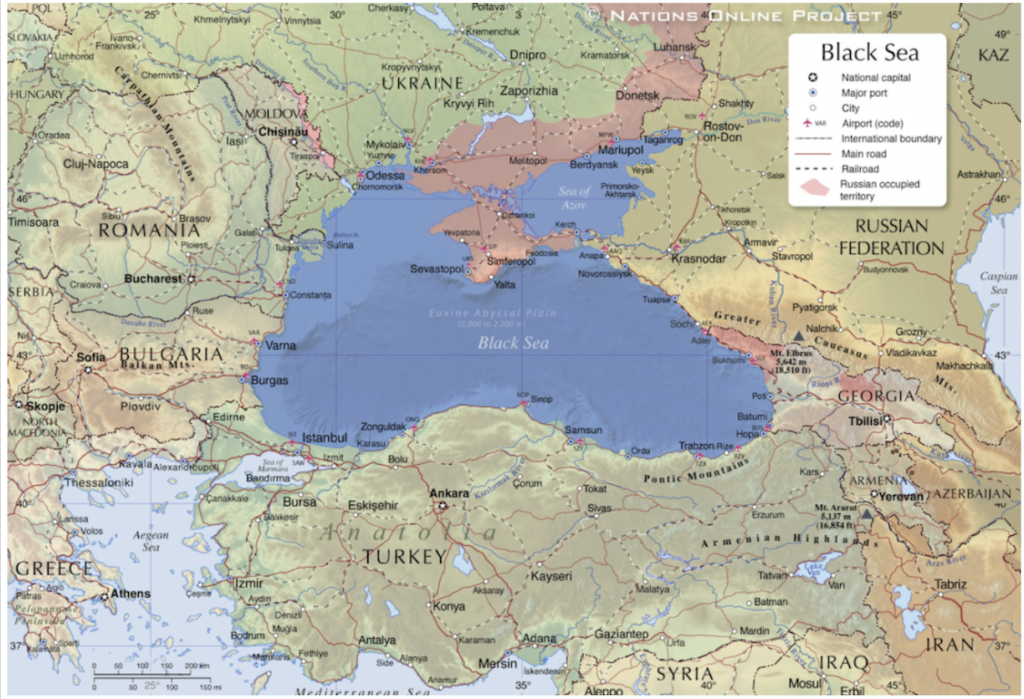
She goes on along the tack of saying the unspoken by naming every strategic advantage that NATO and the EU would see with Georgia under their control, such as control of the Black Sea, Armenia, the Caucuses, amongst other things.
Image

She hails the illegal nullification of the Romanian election, which is met with resounding applause by the corrupt unelected bureaucrats.1And this shows the flagrant corruption of the system—a dying empire seeks only absolute power and expansion at all costs, nothing else matters. Laws, rules, democratic principles are mere frivolities to be used as bargaining chips or talking points as means to an end.

This speech has particular significance because Zourabichvili’s term expires on December 29, when the newly elected ex-Dream Party president Mikheil Kavelashvili is set to take office. The treasonously mad madame has openly vowed she will not step down, which means a culminating point of unprecedented proportions is due in a week and a half’s time.

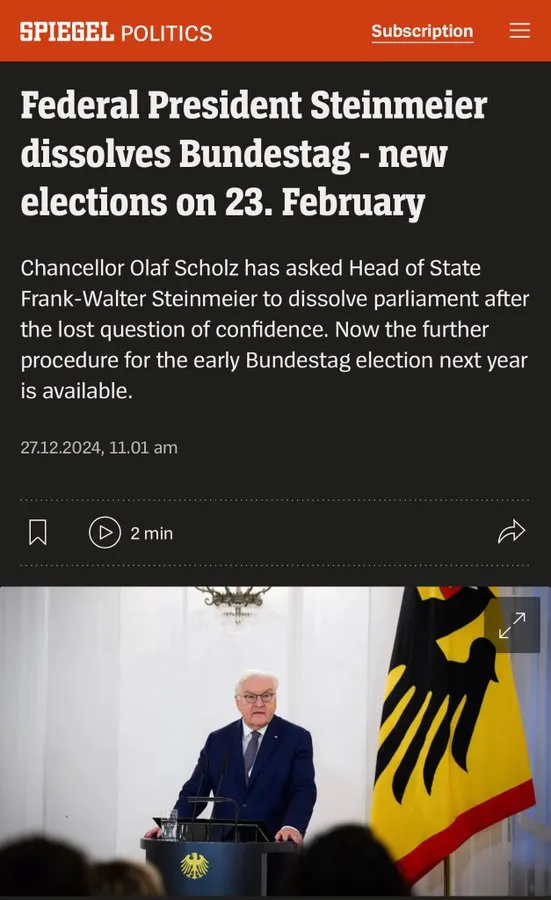
But the wise leaders of the Global South have hearkened to the misprisions of the West’s corrupt puppet satraps. One must but listen to how keenly they apprehend what is going on. At a time when Macron’s government is collapsing, Scholz lost a parliamentary confidence vote leading to early snap elections in February, Biden was virtually couped and replaced, Trudeau set to resign according to rumors, with the entire Western order in terminal crisis, wise leaders like Azerbaijan’s Aliyev understand everything. Here he observes Macron is turning France into a ‘failed state’: (Video at link.)

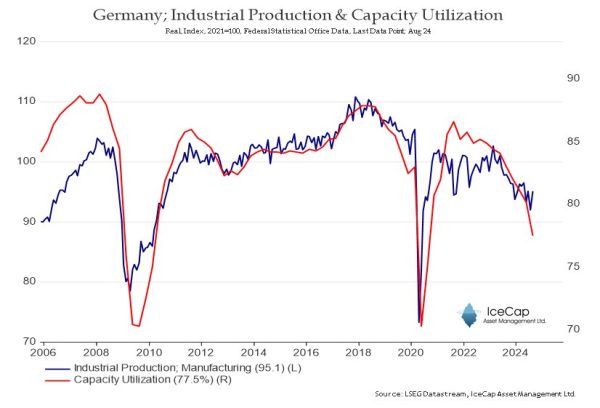
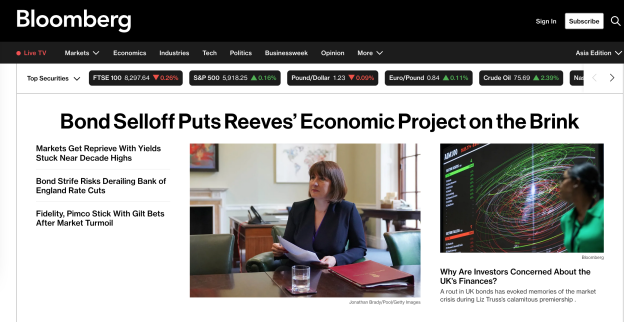
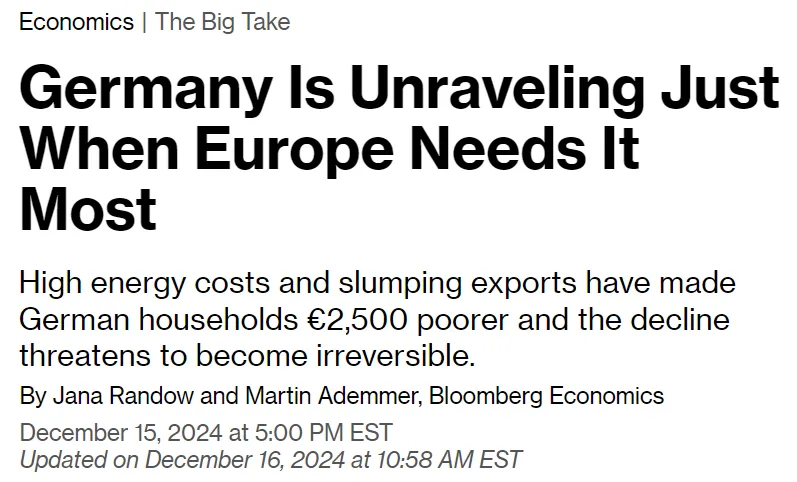
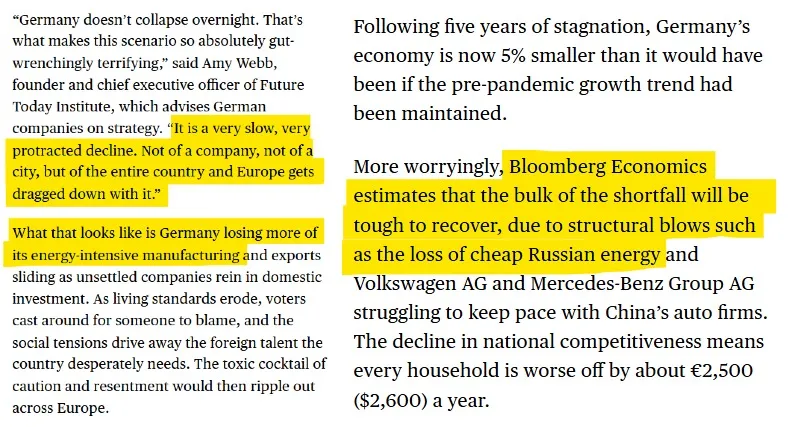
This comes just as alarm signals sound off on Germany’s coming economic failure:
Image
https://www.bloomberg.com/news/features ... reversible
Image

Well, what do you know?

The article goes on to describe the darkening malaise:

As living standards erode, voters cast around for someone to blame, and the social tensions drive away the foreign talent the country desperately needs. The toxic cocktail of caution and resentment would then ripple out across Europe.

“Everyone’s life, little by little, gets a little bit worse for the rest of their existence,” said Webb.


Meanwhile, in today’s big Q&A Putin actually pointed out something much-overlooked: that while inflation in Russia was 9%, Russian wages actually grew around ~9% over the same period, thus equalizing the inflation. Russia’s economic problems can be characterized more as: “too much of a good thing.” And this is a far better problem to have than what most of Europe is experiencing.

As a last general reflection: As the institutions which have governed the globe since the Cold War slowly become undone, the world begins entering an active ‘strongman’ phase. One governed by the likes of Netanyahu and Erdogan, who no longer fear for the brakes and baffles previously in place owing to the respected international institutional norms which the West has now ineptly eroded. Years upon years of total disregard for true Rule of Law by corrupt, coopted Western rulers has resulted in the complete discrediting of everything from the UN, ICC, OSCE, IAEA, and tens of other adjacent bulwarks against chaos.

(Much more at link.)

https://simplicius76.substack.com/p/med ... t-oreshnik

******

Ukraine Conflict Has a High Economic Impact on Europe: Orban

Image
Ukrainian military in Kharkiv hunt people down on the streets and forcefully send them to the front. Nov. 2024. X/ @Megatron_ron

December 20, 2024 Hour: 9:44 am

The Hungarian leader stressed the importance of establishing a lasting security system once the conflict ends.
On Friday morning, Hungarian prime minister said that ending the conflict in Ukraine is of primary economic interest for Europe.

Speaking from Brussels, Orban said that “those farther away from the war can develop at a much greater pace than us Europeans, who are in the vicinity.”

He expressed his belief that European leaders “feel this too.” In Hungary, people “have had enough of this state of war, enough of the inflation, enough of the sanctions,” Orban said, adding that citizens want their national economies to return to the path of development.

The Hungarian prime minister stressed the importance of establishing a “lasting, predictable security system” once the Ukrainian conflict ends.


Ukraine is losing the war.

The war is unwinnable for Ukraine, and the West can’t keep supporting the Kiev regime indefinitely, says retired British Air Vice Marshal Sean Bell.

This is something the western mainstream media should be telling you.

But they won't…… pic.twitter.com/GqWo45RHUR

— Richard (@ricwe123) June 30, 2023
Orban highlighted the financial toll of the conflict in Ukraine, which has cost Europeans 310 billion euros (US$322.3 billion) to date, including the United States spendings.

This immense sum could have been invested in transformative projects, such as elevating the Western Balkans to European standards, fostering development in migration-source regions like the Sahel to curb migration, or strengthening Europe’s neglected military and defense capabilities, he said.

Orban expressed optimism that Europe is moving closer to achieving peace, particularly with a new U.S. president and a shift in transatlantic relations on the horizon.

He also proposed a symbolic Christmas ceasefire lasting two to three days, underscoring that peace is an attainable goal. Orban noted that he had convinced the Russian president to at least consider the ceasefire proposal.

https://www.telesurenglish.net/ukraine- ... ope-orban/

******

The overthrow of capitalism and the construction of socialism-communism remains the only real way out for the peoples of Europe. Speech at the European Communist Meeting in Brussels, Belgium

Dimitris Koutsoumbas, General Secretary of the CC of the Communist Party of Greece (KKE) 08.Dec.24 Communist and Workers' Parties

Today's event is also a resounding response to the wave of anti-communism and anti-Sovietism that is systematically fomented by the bourgeois media and their governments, by the European Union itself, which has made the unacceptable equation of fascism and communism its doctrine, as well as the identification without any historical basis of present-day capitalist Russia with the Soviet Union, and is spreading across the Old Continent a network of anti-communist persecutions, of falsification and distortion of History, of destruction of anti-fascist monuments.


Dear Comrades:


On behalf of the Central Committee of the KKE, I extend a warm comradely welcome to you at the European Communist Meeting organised by our delegation to the European Parliament here in Brussels, in the European Parliament building, within the framework of various activities that the KKE has carried out in 2024 in honour of the great revolutionary Vladimir Ilyich Lenin, the leader of the October Socialist Revolution, on the 100th anniversary of his death.


Today's event is also a resounding response to the wave of anti-communism and anti-Sovietism that is systematically fomented by the bourgeois media and their governments, by the European Union itself, which has made the unacceptable equation of fascism and communism its doctrine, as well as the identification without any historical basis of present-day capitalist Russia with the Soviet Union, and is spreading across the Old Continent a network of anti-communist persecutions, of falsification and distortion of History, of destruction of anti-fascist monuments.


The KKE has condemned all these events and expresses its solidarity with the communists who in several European countries are suffering from persecution, bans and restrictions on their activities. At the same time, we will continue to fight against the misinformation of the people and the distortion of history, without idealizing it, studying not only the achievements of socialism but also its weaknesses, errors and deviations, and drawing valuable conclusions for the future.


Such valuable conclusions can be drawn from Lenin's work "On the Slogan of the United States of Europe" in the context of the intensification of class exploitation and imperialist wars in Ukraine and the Middle East with the involvement of the imperialist European Union.


Lenin's statements in the conditions of the 20th century remain relevant in the 21st century as well. We believe that this work should be studied by communists, revolutionaries and people of good will, not only on our continent, Europe, but throughout the world, since interstate associations of capitalist states, such as the BRICS, etc., are being formed in various parts of the world today.


Studying Lenin in a creative spirit, in the light of the changes that took place in the world, we can examine the interstate agreements, the oldest and newest capitalist alliances, which seek to “establish order” in “international security”, in international trade, in the export of capital, without of course denying the scientific laws of capitalism.


Because no matter how many changes have occurred since this work was published, they have not altered its essence: the fundamental scientific laws that govern the capitalist economy; production based on surplus value, profit, competition and inequality; anarchy in production; injustice in distribution.


Lenin wrote: “Under capitalism, the even economic growth of each economy and each state is impossible. Under capitalism, the only possible means of restoring the broken equilibrium from time to time is crises in industry and wars in politics.”


Who is in a position to refute this Leninist assessment today, when uneven capitalist development gives rise to new strong capitalist powers, sharpens the competition for primacy in the world imperialist system between the USA and China, and intensifies the confrontation between the Euro-Atlantic axis and the emerging Eurasian axis?


Who does not see the “time bomb” that the international capitalist economy is sitting on, that is, the over-accumulation of capital that cannot find an outlet to be invested with satisfactory profit? They have promoted the “green and digital transition”, as well as the “old recipe” of war to which Lenin refers, but the impasses of the system continue.


Capitalist crisis and war are inherent to capitalism. A number of international economic indicators demonstrate that the crisis is born from the normal functioning of the capitalist system.


The EU economy is already in recession; see also the US debt surge which has gone beyond the “red line” of the institutional ceiling and continues to rise, or the real estate crisis in capitalist China, etc.


Imperialist interventions and wars offer a profitable outlet for over-accumulated capital. This is demonstrated by the profits of the US war industry and other major arms manufacturers since the start of the war in Ukraine and the Middle East.


It is no coincidence that the so-called “war economy” and the escalation of war are a high priority for NATO, the EU and other imperialist centres.


In particular, the EU, based on the Draghi report, plans to allocate 500 billion euros to the war industry, while the Niinistö report allocates, among others, 20% of its budget to the war economy, creating a dangerous connection between its military plans for civil protection and the “psychological preparation of people to live in conditions of danger and instability” by providing food for three days.


Moreover, the massive destruction caused by the imperialist war creates a new “gold mine” of profitable investments in the destroyed regions. The US, EU and Russia are already conducting special investment “programs” for the “reconstruction” of Ukraine.


Comrades:

The victory of Mr Trump in the US elections has revived talk of the imminent “prevalence of peace”, at least on the Ukrainian front. Lenin stressed that “temporary agreements between the capitalists and the powers are, of course, possible”, but at the same time stressed that these do not at all cancel the struggle for the “division of colonies”, writing this when three-quarters of the world were colonies.


Today, however, this position remains valid, since instead of competition for the “division of colonies”, there is competition for the distribution of raw materials, energy, transport routes, geopolitical support, market shares. And as he stressed: “Under capitalism there can be no other basis or principle of distribution than force. […] To preach a “fair” distribution of income on this basis is […] petty bourgeois and philistine folly. There can be no distribution except in proportion to force. And force changes in the course of economic development. […] There is no and cannot be any other means than war to test the true power of a capitalist state. War is not in contradiction with the foundations of private property, but is the direct and inevitable development of these foundations.”


Today it is necessary for the communist movement in Europe and in the world not to forget Lenin’s words, to take them into account in the light of current international events and to reject the opportunist perceptions that prevailed after the 20th Congress of the CPSU and in the ranks of the international communist movement, and promoted erroneous perceptions. Such were the perceptions that divided the imperialists into “hawks” and “doves,” into “war-mongers” and “pacifists,” suggesting that there could be a “peaceful imperialism,” a renunciation by the imperialists of violent and warlike means which, as Lenin stressed, are “the continuation of politics” by other means.


Unfortunately, even in the ranks of the international communist movement, especially after the Second World War, such erroneous perceptions prevailed, on which the Communist Parties based their assessments: that the war plans of the capitalists could supposedly be tamed by the so-called “European security system.”


Today, as a way to resolve the military conflict in Europe, some forces promote perceptions about the formation of a “new security architecture”, a NATO “without war plans or offensive weapons systems on its territories”, a “peaceful European Union” or a “peaceful multipolar world”, etc.


All these speculations have nothing to do with reality and act in a disorienting way for the anti-capitalist and anti-imperialist struggle, seeking to cultivate the perception of a supposed possibility of “abstention” of imperialism from the means of war. It is as if we were asking a carnivorous predatory animal from the jungle to transform itself into a herbivorous and even domestic animal.


However, the truth is that NATO and the EU, like any capitalist interstate union, have a profoundly reactionary character and cannot be favourable to the people. They will continue to act against the people and against workers' and popular rights.


Lenin was justified when he wrote that “a United States of Europe under capitalism is either impossible or reactionary.” The present European Union is an imperialist interstate economic, political and military union of monopolies, contrary to the interests of the working class and the popular strata.


It cannot be fixed with plaster solutions. Just like capitalism, it cannot be humanised! Because the European Union was not formed by the people and does not serve their interests – on the contrary!


The European Union is not and cannot be pro-people. Its objectives are the concentration and centralisation of capital, wars and imperialist interventions, the promotion of a strategy for the maximum strengthening of the exploitation of the working class, which leads to poverty, misery, scarcity, uprooting, brutal repression, recruitment and anti-communism. The scandals that are manifesting themselves, with the lobbies of corruption in the European Parliament, confirm its reactionary character as a union of capital at the expense of the people.


War ultimatums, anti-popular regulations and anti-labour directives are intended to serve the profits of monopolies and to crush the lives and rights of workers.


Today, the European Union is seeking to become the vanguard of wars and anti-popular policies. This is true regardless of the outcome of the antagonisms within it, between the bourgeois classes of its countries over greater military autonomy from the EU or greater membership of NATO, antagonisms that have been revived after Trump's election.


In order to serve the dominant interests of the bourgeois classes in Europe, the European Union, together with the United States, has become involved in the war in Ukraine, on the side of the section of the Ukrainian bourgeoisie which, by using fascist forces, moved towards a political overthrow in violation of the Constitution in 2014.


For similar reasons, the European Union supports the occupying state of Israel, which is massacring the heroic people of Palestine. We take this opportunity to express, from here, in the European Parliament, our full solidarity with the Palestinian people and to join our voice to the impressive and massive worker-popular demonstrations throughout the world in defence of their just struggle to get rid of the Israeli occupation.


Comrades:

Following the attack on Ukraine with long-range American and British weapons on the territory of the Russian Federation, followed by the change in Russia's nuclear doctrine and Putin's statement, it is more than obvious that the danger of a generalised imperialist war is growing, including the use of nuclear weapons.


Even if a temporary compromise were reached, no one can mitigate the inter-imperialist antagonisms that extend from the commercial and technological sectors to military armaments. This is true from the Arctic to Africa and the Indo-Pacific, and also in space.


The imperialist wars and interventions of the European Union and the allied imperialist bourgeois governments, in addition to the massacre of peoples, the economic burdens on peoples, the dismemberment of countries and the multitude of uprooted people, cause further destruction of the environment, which they hypocritically worry about in their so-called “green” declarations.


The KKE, like other Communist and Workers' Parties in Europe, rejecting all pretexts from various sides, demonstrates to the people the true causes of imperialist wars.


We are strengthening our fight against the involvement of our countries in them.


We fight for the closure of US and NATO bases in Greece and elsewhere, for the removal of nuclear weapons from Europe.


We express our solidarity with the peoples of Ukraine and Russia, who lived in peace and worked together during the years of socialism and are now shedding their blood for the big capitalist interests.


We fight against the growing militarisation of the EU through its so-called “strategic autonomy”, which poses great dangers for peoples; the creation of military formations, such as PESCO, and the Euro-army; and missions such as “Aspis” in the Red Sea.


We raise a front against fascism and any kind of racism, discrimination based on religion, colour, gender or sexual orientation and we reject the false “anti-fascism” and the various “anti-fascist fronts” used by bourgeois and opportunist political forces to trap working class and popular forces in bourgeois administration, disassociating fascism from the capitalist system that generates it and uses it when necessary.


Comrades:

The intensification of the exploitation of workers, of exhaustive flexible work with inhuman hours leading to employer crimes, of work without rights and without collective agreements, of the escalation of employer intimidation, of low wages combined with high prices and high taxes on the popular classes and wars, have led the peoples of Europe to the streets in struggle.


Ten days ago, on November 20, the streets and squares across Greece were flooded with strikers who caused a real earthquake with the slogan: “Money for wages - Health - Education, out of the slaughterhouses of war!”


Thanks to the militant action of workers' unions, such as the Piraeus port workers' union, a shipment of ammunition for Israel did not reach its destination; in other regions, the transport of NATO weapons and ammunition for the war in Ukraine was prevented.


We continue our struggle against the anti-people policies of the ND government and the other parties of the system; against NATO and the EU of capital; against class exploitation, monopolies and war.


For the disengagement of Greece from the imperialist slaughterhouse, from its plans and alliances, with the people being the owners of their land.


For a Europe of prosperity for the people, of peace, social justice and socialism.


We continue along our common path, that of revolutionary class struggle until the overthrow of capitalism and the construction of socialism-communism.


Because the path that was opened in October 1917 by the communists led by Lenin, “breaking the ice”, remains the only true way out for the peoples of our countries.

December 3, 2024

Texto completo en: https://elcomunista.nuevaradio.org/el-d ... ismo-y-la/

Google Translator
"There is great chaos under heaven; the situation is excellent."

User avatar
blindpig
Posts: 14829
Joined: Fri Jul 14, 2017 5:44 pm
Location: Turtle Island
Contact:

Re: Blues for Europa

Post by blindpig » Mon Dec 23, 2024 2:50 pm

Insane Anti-Muslim Jihadist Terrorizes Christmas Market
Yesterday Elon Musk lauded the German right wing (but in my opinion not radical) AfD party as the only one "that can save Germany".

A few hours later a Saudi man, living in Germany, drove a car into a crowd attending a Christmas market in Magdeburg:

Germans on Saturday mourned both the victims and their shaken sense of security after a Saudi doctor intentionally drove into a Christmas market teeming with holiday shoppers, killing at least five people, including a small child, and wounding at least 200 others.
Authorities arrested a 50-year-old man at the site of the attack in Magdeburg on Friday evening and took him into custody for questioning. He has lived in Germany since 2006, practicing medicine in Bernburg, about 40 kilometers (25 miles) south of Magdeburg. officials said.

The state governor, Reiner Haseloff, told reporters that the death toll rose to five from a previous figure of two and that more than 200 people in total were injured.


Before details were known followers of the AfD and other famous anti-immigration politicians, jumped onto the case with tirades against Muslims and immigrants.

Unfortunately for them the facts of the case were not in their favor.

The culprit is neither an Islamist, nor an illegal immigrant or asylum seeker. He in fact is a supporter of the AfD's and Elon Musk's opinions.

Dr. Taleb Al Abdulmohsen, a Saudi citizen of Shia heritage, had come to Germany eighteen years ago to learn his medical specialty, psychiatry. He had stayed in Germany and worked at a local mental hospital.

Over time he had disavowed Islam. A few years ago he had launched a web forum, WeAreSaudis.net, which helped people from Islamic countries, who were allegedly endangered for repudiating their faith, to find asylum:

Describing himself as a former Muslim, the suspect shared dozens of tweets and retweets daily focusing on anti-Islam themes, criticizing the religion and congratulating Muslims who left the faith.
He also accused German authorities of failing to do enough to combat what he said was the “Islamism of Europe.” Some described him as an activist who helped Saudi women flee their homeland. He has also voiced support for the far-right and anti-immigrant Alternative for Germany (AfD) party.


The man was well know. The BBC as well as the German broadsheet FAZ had interviewed him.

In a very long Twitter thread, written in Arabic on August 20 2024 and pinned to his account, Talib Al Abdulmohsen describes his years-long fight with other atheist activists in Germany who were also trying to arrange refuge for Saudi asylum seekers.

He alleged that some of them were actively preying on female Saudi asylum seekers who were living with them. He went to the police and filed complains with several prosecutors to get the German state to act against those he accused.

He however did not present evidence to support his claims. Asked by the police the female Saudi asylum seekers rejected to file claims.

A civil suit for defamation launched by the other activists against him was successful.

Some three years ago Taleb Al Abdulmohsen began to show signs of persecution mania. He claimed that letters from a prosecutor had vanished from his mail box. Two lawyers he had hired soon rejected to work on his cases. He started to accuse the German and Saudi government of working against him.

In mid 2023 there were first signs and warnings that he might go berserk.

He again and again filed his 'evidence' against other atheist activists to which the prosecution did not react with the urgency he had thought was required. (machine translation):

Do you know where the biggest contradiction is? If a Saudi citizen blows up a German embassy or randomly slaughters German citizens, they call him a terrorist. But when a Saudi citizen uses all peaceful means to protect himself and Saudi citizens, you find the police and the prosecution trampling on the law as if there is no law in the first place!

His outrage got ever stranger (machine translation):

This is a picture of a letter written by the Public Prosecutor the next day, in which he says, “Yesterday they brought me the file because the whistleblower (Talib Al-Abdul Mohsen) is at the service center.” Then he briefly recounts what happened between me and him, and then asks the police to investigate the matter through the file and even through social media.
But the police refused to investigate the matter!!!

After that, the prosecutor suspended the investigation again!!

What is this farce?!

If they act like this, why is it that when a Saudi citizen blows up a German embassy or randomly slaughters German citizens, they call him a terrorist??? What is the alternative to bombing and slaughtering when seeking justice in Germany? Where is the peaceful alternative?

I need to know the peaceful alternative, please tell me about it.


Taleb Al Abdulmohsen could not grasp that he simply had no legal case to make. His mind wandered off into conspiracy theories:

British Pakistani Index @PakistaniIndex - 22:29 UTC · Dec 21, 2024
(2/2) ⬆️ A video interview featuring Dr. Taleb Al Abdulmohsen, the suspect in the Magdeburg Christmas market attack, has surfaced, sparking further questions about his motives.
In the 45-minute video, published eight days before the attack on the US-based Islamophobic blog RAIR Foundation, founded by Amy Mek, Dr. Taleb claimed that the German government was conducting a "covert secret operation" to "hunt down Saudi ex-Muslims and destroy their lives" globally. He also alleged that Syrian jihadists were being granted asylum in Germany.

...

The not so peaceful alternative Taleb Al Abdulmohsen found for himself was to imitate ISIS Jihadis and to drive a car into a crowd at a Christmas market .

His rants, filings and acts do not support the anti-Islam, anti-immigrant claims Elon Musk, the AfD and other such types have made.

Talib Al-Abdul Mohsen has in fact long supported them:

Taleb Al Abdulmohsen @DrTalebJawad - 13:40 UTC · Jun 18, 2016
Ich und AfD bekämpfen den gleichen Feind um Deutschland zu schützen.
I and AfD are fighting the same enemy to protect Germany.


The anti-Muslim, pro Israel 'activist' committed a terrorist act in Europe because, he alleged, the 'left' wants to 'destroy Europe with Islam'.

There are of course a lot of political points one could make about this case.

But to me this simply looks like a sad story of someone who's mind got seriously dislocated when he moved from the strictures of his own society into a more liberal one he was unable to really understand.

Posted by b on December 21, 2024 at 16:16 UTC | Permalink

https://www.moonofalabama.org/2024/12/i ... .html#more

******

Orban Hopes That Trump Will Help Polish Conservatives Return To Power

Andrew Korybko
Dec 21, 2024

Image

The returning American leader might support the opposition against their ruling liberal-globalist foes.

The head of Hungarian Prime Minister Viktor Orban’s office announced on Thursday that they granted asylum to fugitive former Polish Deputy Justice Minister Marcin Romanowski on the basis that Poland’s rule of law crisis and associated lawfare against the ruling party’s opponents make a fair trial impossible. Romanowski is accused of abusing public funds during his time in the former government. Poland summoned the Hungarian Ambassador and recalled its own from Budapest in response.

It was assessed over the summer that “The 700-Year-Old Polish-Hungarian Brotherhood Is Officially Dead At The State-To-State Level” after Poland’s ruling liberal-globalists repeatedly denigrated Hungary for its ties with Russia and thus compelled Orban to finally react to these provocations with some sharp words. Nevertheless, a rapprochement is still hypothetically possible, though only if the former (very imperfect) conservative-nationalists return to power. It’s this scenario that Orban is holding out hope for.

He wouldn’t have approved Romanowski’s asylum application if he didn’t think that it might pay off at a future date. For that to happen, the conservative-nationalists need to hold onto the presidency during next year’s election, after which they’d have to then regain control over parliament during the next elections in 2027 (unless they’re called earlier though that can’t be taken for granted). This sequence of events could foreseeably unfold during Trump’s second term in office.

Vice President-elect JD Vance slammed Polish Prime Minister Donald Tusk on social media at the beginning of the year before he was asked to join Trump’s ticket and had even sent a letter to Secretary of State Antony Blinken prior to that about the lack of media freedom during the early days of his rule. Conservative-nationalist MEP Dominik Tarczynski then met with Trump’s team after the election to inform them of all the times that Tusk and his Foreign Minister Radek Sikorski insulted Trump in the past.

The incoming administration therefore likely won’t be on friendly terms with Tusk’s and Trump might even insult him in kind like he’s currently insulting Canadian Prime Minister Justin Trudeau. The US could also go as far as threatening Poland with sanctions over its new rule of law crisis, openly preferring the conservative-nationalist opposition, and thus trying to influence the next two elections. The goal would be to help deny the liberal-globalists the presidency and then sweep them out of parliament afterwards.

This wouldn’t just be pursued out of spite or ideological solidarity, but also for the pragmatic reason that the conservative-nationalists are more pro-American than the liberal-globalists, the latter of whom align more with Germany than with the US. To be sure, the US still retains a lot of influence over Poland even under its current ruling arrangement, but it could have even more influence if the opposition returns to power. Orban doesn’t care about any of that though since he’s only concerned with bilateral relations.

So long as the liberal-globalists continue ruling Poland, ties with Hungary will remain troubled due to their ideologically driven opposition to his domestic and foreign policies, which destroyed their brotherhood at the state-to-state level. It’s only through the conservative-nationalists’ possible Trump-supported return to power that this damage can be repaired. Orban’s decision to grant asylum to Romanowski is therefore meant to keep their morale high and encourage them to keep fighting till then.

https://korybko.substack.com/p/orban-ho ... -will-help

******

From Cassad's Telegram account:

Colonelcassad
On the threat of escalation of the situation in Moldova

The Foreign Intelligence Service of the Russian Federation reports that, according to information received by the SVR, the headquarters of the European Union do not know how to calm down the emotionally unstable President of Moldova M. Sandu. The high-ranking European bureaucrats were forced to "clutch their heads" by the information received from Chisinau about the content of Sandu's recent meeting with the government leadership on issues of energy security of the country.

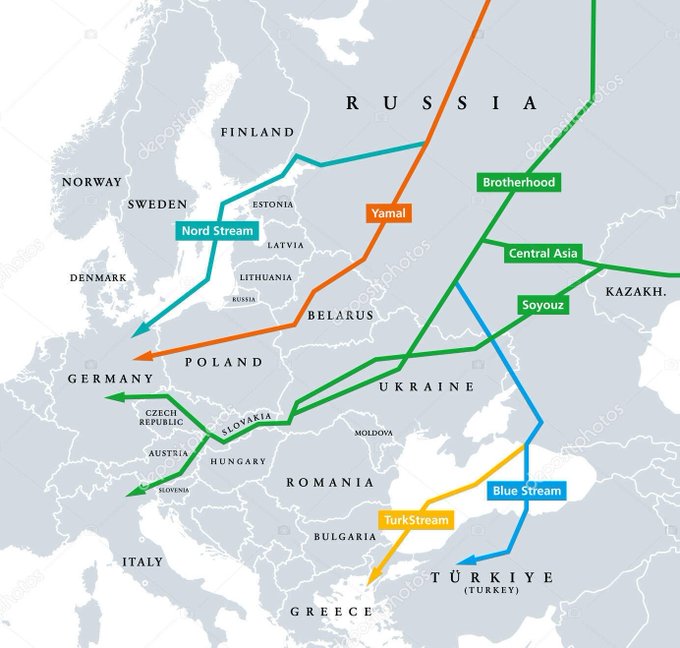
During the event, the president "lost her temper" after the report of Prime Minister D. Recean on the problems of energy supply to Moldova, which the country may face after the expiration of the Russian-Ukrainian agreement on the transit of natural gas on December 31 of this year. She categorically refused to discuss this issue with Ukraine and categorically placed all responsibility on Russia. According to Sandu, "if Moscow does not find a way to deliver gas here, then Chisinau will take it out on pro-Russian Transnistria." An order was given to open criminal cases against the leadership of the PMR "for separatism", and to subject ordinary residents of Transnistria to thorough searches when crossing the region's borders.

The president was not sobered by a reminder that the right-bank part of Moldova is almost entirely dependent on electricity supplies from the Moldavian State District Power Plant located in the PMR. "Entering into a frenzy", the president demanded that a violent seizure of the power plant be prepared. The meeting ended with Sandu's words about the need to develop a plan for a military operation to establish control over Transnistria and eliminate the Russian peacekeeping presence in the region.

The European Union, of course, would not be against the emergence of a new crisis point in the zone of direct Russian interests. But Brussels is not yet ready for this. And the EU border is nearby - it is dangerous. But no one can guarantee that the Moldovan president will not really try to unleash a real war in the region.


Many observers are wondering how much longer the Moldovan people, among whom, by the way, there are many who went through or remember well the military actions on the Dniester in 1992, will tolerate experiments on themselves conducted by Romanian citizen Sandu?

Press Bureau of the SVR of Russia
12/23/2024

https://t.me/s/boris_rozhin

Google Translator

All the more reason to regain the Black Sea coast and secure contact with Transnistria. That'll settle her...
"There is great chaos under heaven; the situation is excellent."

User avatar
blindpig
Posts: 14829
Joined: Fri Jul 14, 2017 5:44 pm
Location: Turtle Island
Contact:

Re: Blues for Europa

Post by blindpig » Tue Dec 24, 2024 3:27 pm

Maia Sandu Sworn in as Moldovan President

Image
President Maia Sandu. Dec. 24, 2024. X/ @ensembleXxxx

December 24, 2024 Hour: 9:22 am

She outlined her policy priorities as European integration, national security, and economic growth.

On Tuesday, Maia Sandu assumed office as president of the Republic of Moldova for a second term. The inauguration ceremony was held at the Palace of the Republic in Chisinau.

After the validation of her re-election by the Constitutional Court, Sandu took the oath of office with her hand on the Constitution, vowing to uphold democracy, sovereignty, and the rights of citizens.

She also expressed her gratitude to Moldovans for their resilience and unity, saying, “Moldova is not just a small country with a big heart but also an inspiration to others in uncertain times.”

Sandu outlined her policy priorities as European integration, national security, and economic growth, calling for active involvement from all citizens to achieve these goals. She won the Moldovan presidential elections in 2020 and was re-elected in a runoff in November.


The text reads: “Maia Sandu’s arrival at the inauguration draws seven supporters. On Tuesday, the pro-EU Moldovan president took the oath of office and promised early parliamentary elections as ‘the only way to clean up parliament and restore justice in our country’. The ‘people’s president’.”
Previously, on Monday, Russia’s Foreign Intelligence Service (SVR) accused Sandu of preparing a plan to militarily regain control over Transnistria.

She recently held a meeting with senior government officials on energy security, which concluded with her remarks about the “need to draft a plan for an operation to take control of Transnistria and put an end to the Russian peacekeeping presence in the region.”

Sandu called for the development of a plan to forcibly seize Transnistria’s thermal power plant, which operates on Russian gas and is nearly entirely relied upon by Moldova, a country situated between Ukraine and Romania. Moldovan authorities, however, denied the existence of any plans to militarily control the separatist region of Transnistria.

https://www.telesurenglish.net/maia-san ... president/

******

Will Moldova Soon Attack Transnistria Like Russia’s Foreign Intelligence Service Warned?

Andrew Korybko
Dec 24, 2024

Image

The purpose behind publishing their report is to inform the Western public of Sandu’s alleged plans, signal that Russia isn’t interested in sparking a conflict there (no matter how she might spin its response to her potential provocations in Transnistria), and indirectly encourage her patrons to stop her.

Russia’s Foreign Intelligence Service (SVR) warned on Monday that Moldova might soon attack Transnistria. According to their sources, newly (but controversially) re-elected President Maia Sandu talked at a recent government meeting about taking out her rage at Ukraine’s plans to cut off Russian gas to Europe at the start of the year on her country’s separatist region, which could spark a larger conflict. Here are five background briefings to bring readers up to speed with the context of their report:

* 2 March: “Transnistria Could Become The Tripwire For A Wider War”

* 4 April: “Romania’s Draft Law On Dispatching Troops To Protect Its Compatriots Abroad Is Aimed At Moldova”

* 22 October: “Moldova’s EU Referendum Was Neither Free Nor Fair”

* 7 November: “Moldova’s Pro-Western President Was Predictably Re-Elected Due To The Diaspora”

* 16 December: “Romania’s Constitutional Coup Is Meant To Buy More Time For NATO In Ukraine”

To summarize, several thousand Russian troops are in Transnistria so an escalation there could lead to Moscow directly retaliating against Moldova, thus risking NATO-member Romania’s entrance into the conflict in support of this neighboring country that nationalists consider a part of their civilization. This scenario has been in the cards since the start of Russia’s special operation but wasn’t activated for reasons that can only be speculated upon, perhaps out of NATO’s fear of an uncontrollable escalation.

In any case, SVR’s report makes it clear that Sandu would be acting unilaterally if she goes through with what they reported, writing that “The European Union, of course, would not be against the emergence of a new crisis point in the zone of direct interests of Russia. But Brussels is not ready for this yet. And the EU border is nearby - it is dangerous. But no one can guarantee that the Moldovan president will not really try to unleash a real war in the region.”

Observers should also recall what was written at the beginning of their report about how “She categorically refused to discuss this issue (of soon-to-be cut-off energy supplies from Russia) with Ukraine and categorically placed all responsibility on Russia. According to Sandu, ‘if Moscow does not find a way to deliver gas here, then Chisinau will take it out on pro-Russian Transnistria.’” Regardless of the veracity of their claim, this framing is meant to portray her as rogue, vindictive, and irresponsible.

That appears to be an accurate description even if it can’t be proven that she actually said what they wrote. The purpose behind publishing their report is to inform the Western public of her alleged plans, signal that Russia isn’t interested in sparking a conflict there (no matter how Sandu might spin its response to her potential provocations in Transnistria), and indirectly encourage her patrons to stop her. The problem though is that some Western officials might want her to go through with this aggression.

The most hawkish anti-Russian members of the US’ permanent military, intelligence, and diplomatic bureaucracies (“deep state”) have long practiced the policies of “weaponizing chaos” and “escalating to de-escalate”. Some of their media surrogates are also very vocal in this regard too. It’s impossible to assess their influence within the “deep state” due to this shadowy network’s opacity, but it’s known that they sometimes get what they want.

For instance, arming Ukraine to the teeth and greenlighting what Russia claims was Kiev’s imminent offensive on Donbass ultimately pushed Putin to authorize the special operation, which some of their media surrogates have presented as preplanned “bear trap”. On the other hand, the well-known Transnistrian scenario and the associated Belarusian one (which readers can learn more about here) haven’t yet been activated, thus confirming that they don’t fully call the shots.

There’s also the concern among some observers that these ultra-hawkish anti-Russian members of the “deep state” sometimes go behind the backs of their peers in trying to provoke Russia without authorization such as what some believe drove Kiev to carry out its most audacious provocations. Other times observers believe that Zelensky or perhaps even more rogue military and intelligence officials around him might be acting unilaterally for the same purpose regardless of approval from US hawks.

These perceptions are important when analyzing SVR’s warning about Moldova’s impending attack on Transnistria. The way that they framed everything suggests that this isn’t what the West wants but that Sandu might still go through with it anyhow for her own reasons. If that’s what she’s really planning, then they should rein her in before she sets into motion a series of escalations that the West might be powerless to stop, thus risking a Cuban-like brinksmanship crisis in the worst-case scenario.

https://korybko.substack.com/p/will-mol ... ansnistria

Most Poles Now Want Peace In Ukraine Even At Kiev’s Expense

Andrew Korybko
Dec 24, 2024

Image

This could throw a wrench in some’s plans for Poland to dispatch troops there as peacekeepers.

Public opinion in Poland on the NATO-Russian proxy war in Ukraine is more important than anywhere else in the West due to its pivotal logistical role in the conflict. Farmers also earlier blockaded the border to protest the influx of low-cost Ukrainian grain that ravaged their domestic market so the precedent exists for angry citizens to once again complicate the flow of arms and equipment to there. This is crucial to keep in mind after discovering that most Poles now want peace in Ukraine even at Kiev’s expense.

The publicly financed Centre for Public Opinion Research (CBOS) published the paywalled results of their latest survey on this subject that were reported on in English by Notes From Poland. They found that 55% of Poles in November believed that it’s best to “strive above all for an end to the war and return of peace even if Ukraine has to give up part of its territory or part of its independence” compared to the 39% who held this view in September. This was attributed to Trump’s victory and Ukraine’s recent losses.

The same explanation was put forth when accounting for the 61% of Poles who believed in November that Ukraine will indeed have to cede part of its territory for peace compared to the 44% who thought this in September. These data points are significant since they prove that Poles as a whole no longer believe that Ukraine can achieve its maximum objectives, thus making it extremely unlikely that they’ll change their views on the question of dispatching Polish troops there.

The results of the European Council on Foreign Relations’ summertime survey that were published in July showed that just 14% of Poles supported this scenario at the time. Considering what CBOS just discovered, it can therefore be surmised that this already dismal percentage dropped as a result of Trump’s victory and Ukraine’s recent losses. That in turn contextualizes the Polish government’s reluctance to contribute to the post-conflict peacekeeping mission that’s now being discussed.

Here are ten background briefings for readers to review to learn more about Poland’s calculations:

* 18 June: “Poland Was Just As Much To Blame As Britain For Sabotaging Spring 2022’s Peace Talks”

* 30 August: “Poland Finally Maxed Out Its Military Support For Ukraine”

* 20 September: “Ukraine’s Refusal To Exhume & Properly Bury The Volhynia Genocide’s Victims Enrages Poles”

* 20 October: “Top Polish Media Laments Their Country Being Excluded From The Ukrainian Endgame”

* 22 October: “The Latest Survey Shows That Poles Are Getting Fed Up With Ukrainian Refugees & The Proxy War”

* 3 November: “Poland’s Military Loan Proposal To Ukraine Shows That Warsaw Is Finally Wising Up”

* 8 November: “Poland’s Deputy Prime Minister Accused Zelensky Of Wanting To Provoke A Polish-Russian War”

* 3 December: “Poland’s Rotating Council Of The EU Presidency Is A Chance To Rebalance Relations With Ukraine”

* 9 December: “The Polish Opposition Just Challenged The Ruling Coalition To Prove Its Nationalist Credentials”

* 15 December: “Poland’s Participation In Any Ukrainian Peacekeeping Mission Could Lead To World War III”

They’ll now be summarized for the reader’s convenience if they don’t have time to read them all.

Poland thought that it could turn Ukraine into its junior partner throughout the course of the conflict while inflicting a strategic defeat on Russia and thus becoming the US’ top ally. None of this came to pass after Ukraine reversed the dynamics in their relationship by allying more with Germany, Russia survived the West’s unprecedented proxy warfare and sanctions onslaughts, and the US prioritized ties with Germany and Ukraine over those with Poland. All of this led to Poland recalculating its strategic plans.

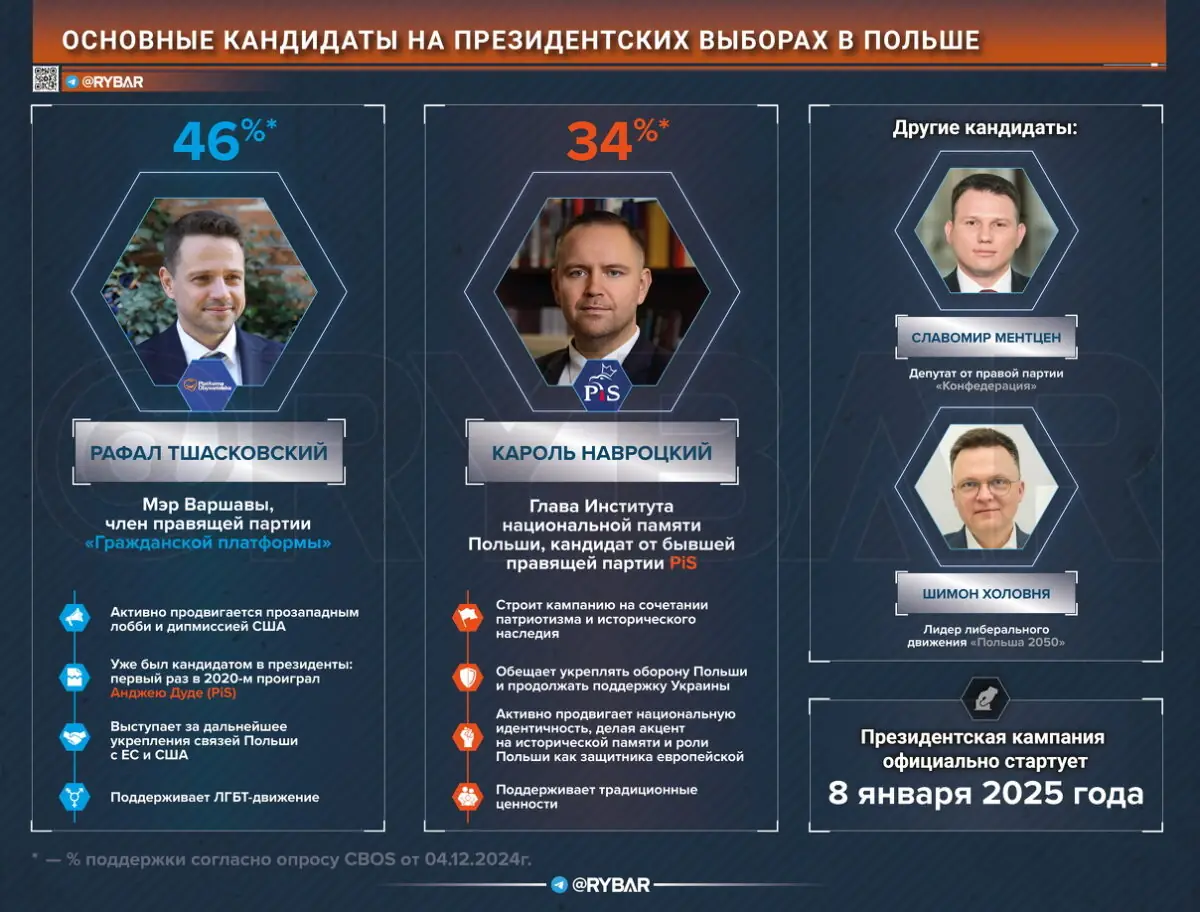
Next May’s presidential election hangs heavily over everything that it does till then. The ruling liberal-globalists want to replace the outgoing conservative-nationalist president with one of their own, which would enable them to effect radical ideological changes in Poland by preventing presidential vetoes. Likewise, the opposition wants to retain control of the presidency in order to obstruct their rivals’ plans, and both are now channeling public opinion by championing tougher policies towards Ukraine.

Accordingly, there’s practically no chance that either party will support dispatching Polish troops to Ukraine – including as peacekeepers after a ceasefire, armistice, or peace treaty – until at least after the election since they’d lose a lot of votes if they did, which would ruin their respective domestic plans. Even after the election, however, each will then jockey ahead of fall 2027’s parliamentary elections. This timeline further reduces the possibility that either of them will risk public ire by supporting this scenario.

In the event that troops are dispatched to Ukraine, this would only be possible upon the President’s approval after receiving a request from the Prime Minister, so either both parties would be blamed if the roles remain divided or it’ll fall entirely on the liberal-globalists if they capture the presidency. The same goes for if the army is then ordered to break up any border blockade by protesting Poles. The domestic imperatives described in this analysis might therefore result in this being politically impossible to pull off.

https://korybko.substack.com/p/most-pol ... in-ukraine

******

Image

German politicians criticize Musk backing for far-right AfD
Originally published: Defend Democracy Press on December 22, 2024 by Defend Democracy Press Staff (more by Defend Democracy Press) | (Posted Dec 24, 2024)

The leader of Germany’s far-right Alternative for Germany (AfD) on Friday welcomed a social media post by Elon Musk in which the American tech billionaire expressed support for her party.

Musk, a prominent supporter of U.S. President-elect Donald Trump, opined on his platform X (formerly Twitter) on Friday morning that “Only the AfD can save Germany.”

Alice Weidel, who is running for chancellor as co-leader of the AfD, responded to Musk an hour later, saying:

Yes! You are perfectly right! Please also have a look into my interview on President Trump, how socialist Merkel ruined our country, how the Soviet European Union destroys the countries [sic] economic backbone and malfunctioning Germany!

What is the AfD?
The AfD is currently polling at around 19% ahead of the German federal election in February, second only to the conservative Christian Democratic Union (CDU) at around 33%.

But all the other parties currently in the German parliament have ruled out forming a coalition with them.

The AfD is officially suspected of being an extreme-right organization by Germany’s Federal Office for the Protection of the Constitution (Bundesverfassungsschutz or BfV).

In the eastern German states of Saxony and Thuringia it is officially categorized as such.

In January 2024, AfD figures including Weidel’s former political aide Roland Hartwig were reported to have attended a clandestine meeting of European extreme-right figures including Austrian identitarian Martin Sellner at which a “masterplan” for the deportation of millions of people with migratory backgrounds, including naturalized German citizens, was discussed.

How have other German politicians responded?
Asked about Musk’s comments, German Chancellor Olaf Scholz said:

Freedom of expression also applies to multi-billionaires, but it also means that you’re allowed to say things which aren’t correct, and aren’t good political advice.

Other German lawmakers from across the political spectrum criticized both Musk’s post and Weidel’s response, slamming “interference” and insisting that no other party will form a government with “fascists bought by billionaires.”

“I was a bit surprised because we usually hear that Elon Musk is this gifted wunderkind, but when I hear these comments, I have to doubt that,” the CDU’s Alexander Throm told DW in Berlin.

Change can only be made by those who govern. And the AfD will not govern. Because no other party will form a government with them.

Clara Bünger from the Left Party told DW she had no doubt that Musk’s comments constituted “interference” but insisted:

It remains the case that he’s not really contributing to anything policy-wise, and that he doesn’t really know how political discussions work in Germany.

Anton Hofreiter from the Green Party called the AfD “traitors bought by billionaires” and “a band of fascists who have not only been bought by [Russian President Vladimir] Putin but are now being supported by a multi-billionaire-turned-right-wing-extremist.”

In 2019, a German court ruled that Björn Höcke, the leader of the AfD in the regional state parliament in the eastern state of Thuringia, may legally be described as a “fascist,” based on a “verifiable factual basis.”

Musk: support for Trump, Farage and now the AfD?
It’s not the first time that Musk has addressed the AfD. At the start of June, he posted:

They keep saying ‘far right,’ but the policies of AfD that I’ve read about don’t sound extremist. Maybe I’m missing something.

After backing President-elect Trump’s reelection campaign in the United States this year, Musk has also expressed support for the United Kingdom’s far-right “Reform UK” and its populist leader Nigel Farage.

This week, Farage told the BBC that his party is in “open negotiations” with Musk regarding a potential donation, which The Times has reported could be as high as £78m ($100m, €96m), by the far the biggest political donation in British political history, sparking calls for the UK to tighten its electoral rules.

In Germany, state security services have warned that the upcoming federal election could be targeted by disinformation campaigns not only from Russia, but also from the United States.

Meanwhile, the leader of Germany’s neoliberal Free Democratic Party (FDP), Christian Lindner, sparked controversy this month when he appeared to praise the political views and activities of Musk and right-wing populist Argentinian President Javier Milei.

“Both Milei and Musk represent views which are in part extreme, absurd and even disturbing,” he wrote in the Handelsblatt financial newspaper.

Yet it has to be said: behind the provocations is a disruptive energy which is lacking in Germany.

On Friday, replying to Musk on X, he claimed that he had “initiated a policy debate” with his comments, but cautioned against supporting the AfD.

“While migration control is crucial for Germany, the AfD stands against freedom [and] business—and it’s a far-right extremist party,” he said.

Don’t rush to conclusions from afar. Let’s meet, and I’ll show you what the FDP stands for.

https://mronline.org/2024/12/24/german- ... right-afd/

******

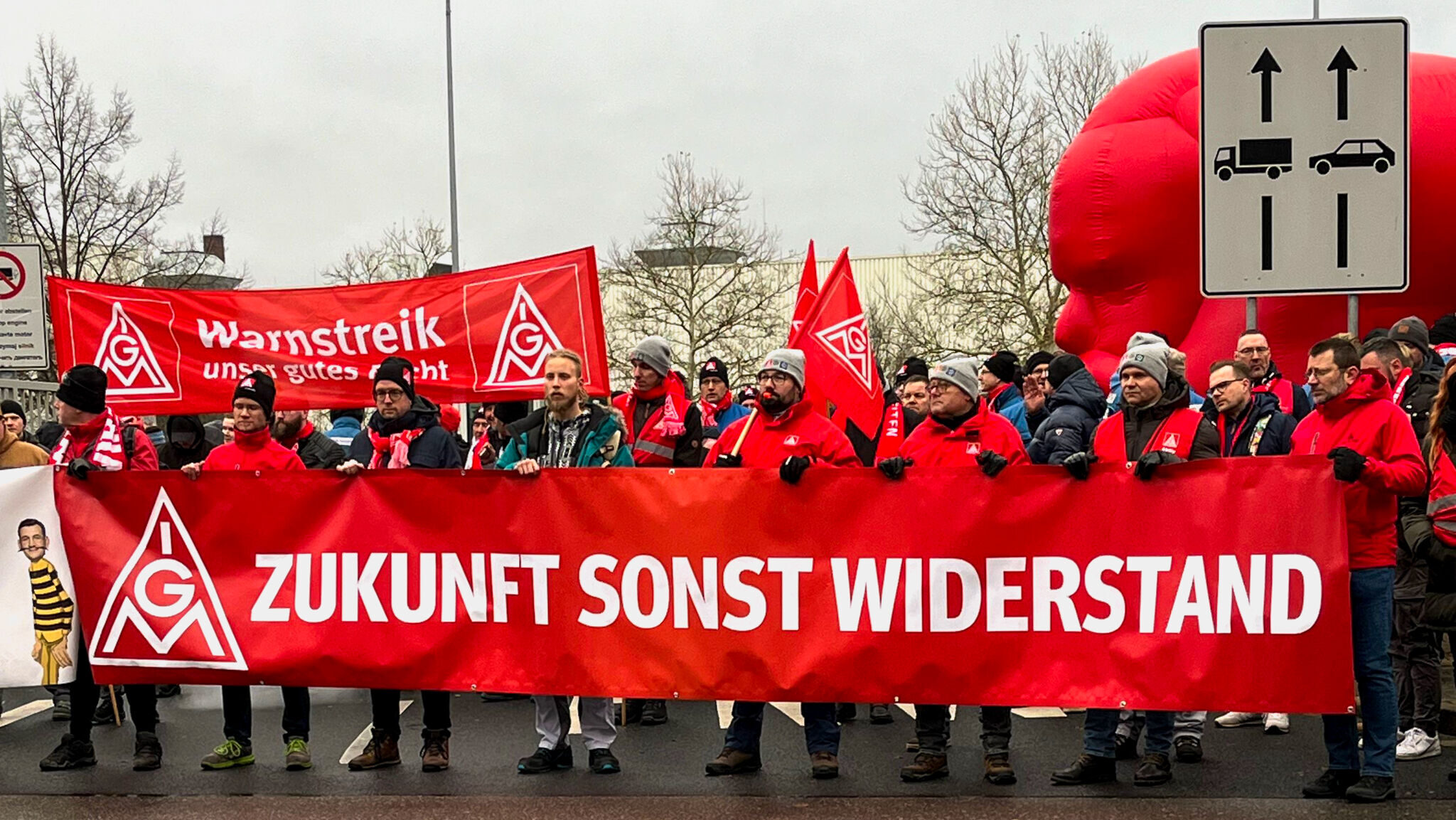
Marathon negotiations bring key breakthroughs for Volkswagen workers in Germany

Trade unions and the Volkswagen works council in Germany achieved significant breakthroughs in talks with management, avoiding plant closures and mass layoffs

December 23, 2024 by Ana Vračar

Image
Source: IG Metall Berlin-Brandenburg-Sachsen/X

Volkswagen workers in Germany secured major breakthroughs in their fight against the company’s planned cost-cutting measures. The agreement, finalized during the week of December 16 after marathon-length negotiations, preserves jobs, protects plant operations, and ensures long-term collective bargaining agreements, representing a significant departure from management’s initial proposals of plant closures, salary cuts, and mass redundancies.

Read more: Volkswagen workers in Germany strike amid dispute with management
“No site will be closed, no one will be made redundant and our in-house collective bargaining agreement will be secured in the long term,” said works council chair Daniela Cavallo in the follow-up to the negotiations.

This outlook, however, comes with several catches: workers will face income reductions, including cuts to bonuses, while some pay rises will be temporarily channeled into solidarity funds to preserve jobs. Some plants will also see reduced production capacity or shifts toward completely new production models, building upon proposals developed by IG Metall and the works council to make most of Volkswagen’s capacities in building a “circular economy” in Germany.

A local source familiar with the negotiation process told Peoples Dispatch that while the trade union and works council recognize the need to do “something to save Volkswagen,” they also believe the responsibility for the current crisis lies with both management and the government. According to the source, Volkswagen’s leadership failed to act in time to expand electric vehicle production, while the federal government neglected to address the issue of growing energy costs, further undermining operations.

Read more: Peter Mertens: “Where there is a working class, there will always be hope”
Although the situation for Volkswagen workers in Germany has somewhat improved since September, the broader crisis facing Europe’s industrial sector is far from over. There is little indication that this looming threat will be addressed at the European Union level, and conditions at the local level appear equally bleak. As illustrated by Volkswagen’s recent experience, trade unions and workers’ organizations will undoubtedly play a crucial role in addressing these challenges, particularly by building international solidarity among scattered plants of the same companies. However, in many of these cases – including Volkswagen – this solidarity still requires strengthening. Our source noted that, in the case of Volkswagen, “there is still no real coordination of employees at the international level.”

If such coordination were to improve, workers could better challenge the interests of shareholders. Until then, Volkswagen operations in countries with weaker labor protections and less mobilization readiness than Germany remain exposed to management’s decisions.

https://peoplesdispatch.org/2024/12/23/ ... n-germany/

*******

The strange case of Didier Reynders and Ursula von der Leyen

Sonja van den Ende

December 24, 2024

We can safely assume that Ursula von der Leyen, as head of the EU, was aware of the criminal activities of Didier Reynders.

On December 5, various Western media reported that Didier Reynders, a former Belgian EU Justice Commissioner, had been buying lottery tickets with dubious funds in the Belgian National Lottery for approximately ten years in order to launder the winnings into his account. Didier Reynders, who served as European Commissioner for Justice under the current Commission President, Ursula von der Leyen, until December 1, 2024, is currently under investigation by Belgian authorities.

This raises questions about Ursula von der Leyen’s awareness of her closest colleague’s money laundering activities. Moreover, this is not the first time such a scandal has surfaced, raising questions about the integrity of EU-MEPs.

We start with Didier Reynders, as the so-called “laundering of lottery money” is just the tip of the iceberg for this extremely corrupt individual. Another investigation into Didier Reynders, former EU Justice Commissioner and a pillar of the Belgian establishment, has linked him to a wider probe into money laundering through state-owned institutions. This has sparked fresh interest in allegations of Belgium’s political interference in Congo and Libya and associated arms deals.

In 2019, Nicolas Ullens, a former undercover Belgian agent, accused Reynders of corruption and money laundering in connection with several projects, including the construction of the Belgian embassy in the Democratic Republic of Congo and arms trafficking.

Nicolas Ullens de Schooten is the full name of this former Belgian undercover agent and criminal, who apparently enjoyed high regard in noble circles. This royal criminal and former member of State Security shot his stepmother, Myriam Lechien, dead on March 29, when she and her husband, Baron Guy Ullens, left the driveway of their villa in Ohain, Walloon Brabant. He was acquitted at the request of Didier Reynders, according to the Belgian media. The reason for the shooting was that he did not receive enough inheritance from his stepmother according to her will, which sounds like an old-fashioned crime plot from a real-life crime series.

“The Congo Free State” was a privately governed state by King Leopold II of Belgium through the so-called Association Internationale Africaine, supposedly for humanitarian purposes. However, it was actually a form of colonialism, and to this day, the traces of this brutal Belgian rule can be seen in Congo.

Under the rule of King Leopold II, the so-called Congo Free State became the site of one of the most infamous international scandals of the early 20th century. Colonists brutally exploited the local population in order to produce rubber, which was in high demand due to the growing international market for automobiles and rubber tires. The crimes committed were brutal, and there are no words to describe the suffering endured by the people.

But that’s not all. After the fall and assassination (by Western-sponsored terrorists) of Muammar Gaddafi, the late president of Libya, in 2011, pressure was increased on the then Belgian government over payments of hundreds of millions of euros to unknown recipients. We now know that Didier Reynders received parts of these euros, but how much is not exactly clear. The money came from frozen accounts in Brussels that once belonged to Libyan president Muammar Gaddafi.

These payments from Libyan accounts in Brussels were also used for arms deliveries, according to opposition Belgian politicians. Mr. Reynders also has to explain the disappearance of valuable African artworks (from Libya and the Congo) that came into his possession.

Belgian Foreign Minister Didier Reynders has been accused of involvement in the loss of Libyan funds from Belgian banks. — The Belgian Minister of Foreign Affairs, Didier Reynders, was directly cited by an ex-undercover agent of Belgium, Nicolas Ullens. He accused Reynders of being involved in the disappearance of Libyan funds in Belgium. The media reported that the UN had placed these funds in several banks, including $14 billion in Belgium, where they were frozen.

Despite the ban imposed on banks to lift the freeze on these assets years ago, Belgium ordered the transfer of $1.4 billion, representing 10% of the interest generated by half of the funds placed in Belgian banks. In other words, the Libyan money was stolen and used for weapons deals and private goals, as Didier Reynders allegedly did.

But the story of this individual goes back even further. In 2012, he served as the Belgian Foreign Minister and paid a private visit to Saudi Arabia, where he met with Prince Najef bin-Fawaz al-Salan. In 2007, a French court sentenced the prince to ten years in prison for smuggling two tons of cocaine into France during a diplomatic flight. Despite this, the prince remained loyal to Saudi Arabia, as leaked documents from the United Nations show.

Now, we can draw a parallel with the current situation, where frozen assets (money) from Russia were used to purchase weapons for Ukraine and for the so-called “reconstruction” of Ukraine. Additionally, we see the case of Ursula von der Leyen, who is proud of stealing Russian funds with which more weapons are being purchased, just as they were back in Libya. It is likely that there are still millions of euros remaining for corrupt European Union members like Ursula von der Leyen.

The revelations about Didier Reynders supposedly sent shockwaves through Brussels, coinciding with the start of Ursula von der Leyen’s second term as President of the European Commission. She has made it clear that one of her priorities is to strengthen the rule of law in order to protect fundamental rights and ensure the integrity of the EU budget.

But is this really the case? It seems unlikely that she was unaware of Reynders’ criminal activities. After all, she herself has been implicated in criminal activity and money laundering scandals, such as the Pfizergate affair.

Pfizergate is the scandal involving Ursula von der Leyen, the current President of the European Commission, and the American pharmaceutical company Pfizer regarding the purchase of COVID-19 vaccines. The controversy revolves around the lack of transparency in communication and negotiation processes regarding the purchase of a significant number of vaccine doses during the pandemic. Von der Leyen allegedly purchased too many vaccines, and it is alleged that she did not know if they were reliable, safe, or tested for use on humans. However, as it turns out, these vaccines are not safe or reliable, and they are actually biological weapons designed to reduce the population, as demonstrated by the murdered Russian Lieutenant General Kirillov, as several articles have reported.

Even if prosecutors believe they have sufficient evidence to bring a case to trial, Reynders’ political background may protect him. As a former minister in Belgium and European commissioner, he would still need to have his immunity lifted if the authorities wanted to arrest him. In Belgium, money laundering carries a maximum penalty of five years imprisonment. Of course, Reynders has done much more than simply laundering money. He has stolen money from Muammar Gaddafi, the former Libyan president and his people, and more recently, from the Russian government. Freezing funds is illegal, as well as using them for weapons in Libya.

But Reyners and von der Leyen are not the only ones in the EU engaged in money laundering or deleting emails containing suspicious texts and evidence of their criminal activities. In 2015, the Greek Prime Minister, Alexis Tsipras, and German Chancellor, Angela Merkel, reached a new low with accusations about Greece and its bailout, with compromising texts. Former Dutch Prime Minister, Mark Rutte, (now head of NATO), waited outside closed doors with other European leaders and sent a text message to the European Council President, Donald Tusk, proposing a compromise that would appeal to all parties involved. Within an hour, a deal was reached and the euro was saved. However, according to undisclosed documents, the Greek prime minister was blackmailed by Merkel, Rutte, and most other EU leaders.

In May 2022, a Dutch newspaper reported that Prime Minister Mark Rutte had developed a habit of regularly deleting his text messages. He only forwarded the messages he considered important to his staff, and called this process “real-time archiving”. However, it could more accurately be described as “real-time deletion”. The prime minister is known by the nickname “Pinocchio” in the Netherlands, as he often lies and continues to do so.

We can safely assume that Ursula von der Leyen, as head of the EU, was aware of the criminal activities of Didier Reynders, as she is also involved in Pfizergate, and both of them can be blackmailed. Her husband, Heiko von der Leyen, is also involved in Pfizergate through his role in a biotech company. He is a director of Orogenesis, an American biotech firm, and has benefited from EU funds on two separate occasions. Together, they buy each other’s silence and blackmail one another with money from public funds or simply steal money from state budgets. They have stolen money from Libya, the Congo, and now Russia.

https://strategic-culture.su/news/2024/ ... der-leyen/
"There is great chaos under heaven; the situation is excellent."

User avatar
blindpig
Posts: 14829
Joined: Fri Jul 14, 2017 5:44 pm
Location: Turtle Island
Contact:

Re: Blues for Europa

Post by blindpig » Thu Dec 26, 2024 2:45 pm

Democracy Dies in the EU: Romania Edition
Posted on December 25, 2024 by Conor Gallagher

If you were hoping this Christmas for more clarity on the rules of the “rules-based international order,” you’re in luck. Recent events in Romania provide plenty. Judges there canceled the results of the recent election in Romania because a candidate who favored better ties with Russia won. The decision was based on bogus intel from the state intelligence services, and naturally Brussels and Washington backed the move. While the EU has for years used all sorts of pressure and threats to get member states to continue to support Project Ukraine, the overturning of the election in Romania marks a clear escalation of tactics and is likely a harbinger of what’s to come.

Let’s start with a timeline of events in Romania and then look at why the country is so important to NATO Black Sea plans, as well as the larger significance of the election cancellation. I’ll be focusing primarily on the involvement of actors outside Romania as I’m not all that familiar with the country’s political scene, but I think we have at least a few experts in the commentariat who can hopefully offer more domestic perspective.

Timeline

The weeks running up to the election: a campaign called #BalanceAndIntegrity begins on TikTok. Roughly 130 influencers follow a similar script to make videos describing qualities of a future unnamed president. Some of the influencers do, however, write in the comments of the video: “Călin Georgescu.”

Nov. 24: The presidential election. Georgescu — a relative unknown who runs on a Christian conservative, economic populist and non-interventionist policy towards Project Ukraine — surprisingly comes out on top. Disaffected working class voters back him strongly as he wins more than 2 million votes (23 percent) in the first round. As no candidate achieved an absolute majority, a second round was to be held on Dec. 8.

Nov. 28: Romania’s Supreme Country Defense Council (CSAT) announces that “cyber attacks with the aim of influencing the correctness of the electoral process” took place and, separately, that “a candidate for the presidential elections benefited from a massive exposure due to the preferential treatment that the TikTok platform granted him by not marking him as a political candidate.”

Despite CSAT alleging that “some state and non-state actors, in particular the Russian Federation,” were behind cyber attacks, Romania’s Special Telecommunication Service (STS), a military agency which is tasked with securing the communication infrastructure for the electoral process, said that no cyberattack was spotted during the first round of the presidential elections.

Dec 5: The secret service of the Ministry of Interior submits a note to the Constitutional Court of Romania (CSAT) in which it says TikTok campaigns were presented to the public as a “campaign aimed at raising awareness about the importance of voting” but in reality were supportive for Georgescu.

Dec. 6: Just two days ahead of the second round vote Georgescu looked sure to win, the Constitutional Court of Romania annuls the results of the first round of the election, claiming that a Russian influence operation impacted the vote. A new election will supposedly happen in the Spring.

Dec. 16: The European Commission announces it is opening a formal proceeding against TikTok over its role in Romania’s election. Commission President Ursula von der Leyen takes the rare step of publicly commenting on an investigation saying the following:

“Following serious indications that foreign actors interfered in the Romanian presidential elections by using TikTok, we are now thoroughly investigating whether TikTok has violated the Digital Services Act [DSA] by failing to tackle such risks.”

Dec. 19: The 27 leaders of the European Union meet in Brussels. The summit is dominated by Ukraine, but Romanian President Klaus Iohannis who is staying on as president due to the annulled election is welcomed with open arms and offers his insight into the Russian menace:

Russian election meddling “nearly impossible” to prove, says Romanian president, who warns: “All countries are exposed to this risk”https://t.co/IK1HOtfVzH @valentinapop in Bucharest for @ft

— Henry Foy (@HenryJFoy) December 19, 2024


EU leaders thanked Iohannis for his warnings, and everyone went back to making bold proclamations about “supporting” Ukraine and the threats posed by Putin evidenced by his TikTok wizardry in Romania.

There was a problem, however. A bombshell Dec. 21 report from the Romanian investigative media outlet Snoop.ro revealed that the TikTok campaign allegedly orchestrated by the Russians that threw Romanian democracy out of whack was actually funded by the centrist National Liberal Party. To sum up:

So let me get this straight, Romanian government, the pro-EU National Liberal Party financed the TikTok campaign to amplify their rival Georgescu, and when he started winning, then the same party claimed this was done by ‘Russia’ and the courts annulled the elections based on…

— Sopo Japaridze (@sopjap) December 22, 2024


The firm hired by the PNL, Kensington Communication, is now saying it will file a criminal complaint for judicial authorities to investigate the possible diversion of its campaign in favour of an “extremist” candidate. From a Kensington statement:

“Kensington Communication will file a criminal complaint so that the competent authorities can investigate the hijacking, bot attack and/or cloning of the campaign carried out by Kensington, at the behest of the PNL, carried out through the Fame Up Platform, in favor of an extremist candidate.”

Kensington is owned by Răzvan Săndulescu and Cătălin Dumitru who I’m not turning up much information on. Maybe readers more familiar with the Romanian political landscape can comment.

While the media spent weeks suggesting that the alleged influence operation in Romania was “eerily similar” to alleged Russian campaigns in Ukraine and Moldova, it turns out it’s much closer to the Clinton campaign’s pied piper strategy in 2016, which led to a shock loss and subsequent blaming of Russia for that defeat. And it continues even after being debunked:

If you didn’t hate the corporate client war media enough, Politico continues to push the narrative that Romania itself has already contradicted. pic.twitter.com/RsramEt3NM

— Olga Bazova (@OlgaBazova) December 23, 2024


One key difference, obviously, is that in Romania the election was formerly overturned while in the US Trump was greeted into office by Russiagate.

It’s worth remembering that even though the PNL funded the TikTok campaign and blamed it on Russia there’s still no evidence that it swung the election.

And there’s little attention paid to the economic fallout in Romania from Project Ukraine. While Romania wasn’t hit as hard as other European countries on energy due to its own supplies and ability to continue to import Russian gas via the Turkstream pipeline, the country is still forced to grapple with inflation, Black Sea fishing and tourism difficulties due to the conflict, and higher prices for other products that used to be imported from Russia such as steel products, iron, wood, cement, and paper. Meanwhile, the government in Romania has been pushing the military budget higher.

Romania’s Importance for NATO

The EU, which has already lost so much — it has destroyed its own economy and international standing, restricted freedoms, reordered all its priorities, and has willfully subjected the entire EU project to NATO — continues to double down, and it can all be traced back to Ukraine and Russia.

In this case Georgescu cannot be allowed to win because he takes the common sense approach that confrontation with Moscow does much more harm to Romanians than to Russia.

And Romania is simply too important to NATO and the effort to weaken Russia. Washington and Brussels are already dealing with wayward governments in Hungary and Slovakia, but Romania is a different animal.

Image

Like Hungary and Slovakia it borders Ukraine, and while providing little military support of its own, it is the second most important hub, after Poland. German arms manufacturer Rheinmetall has a facility in Satu Mare to repair Western equipment donated to Ukraine.

It also has more geographic importance due to its location on the Black Sea and is a major part of the US strategy there.

The US National Security Council (NSC) is currently working to formalize a Black Sea security and development strategy across government agencies, but the current National Defense Authorization Act already outlines several pillars of that strategy that can effectively be boiled down to “keep Russia and China out and the US and NATO in.”

What that envisions is an arc of “rules-based order” states from the Caspian to the Adriatic that would allow the US to exercise control over the movement of energy and goods through the region, and to the South Caucasus, which is positioned at the intersection of burgeoning East-West and North-South transport corridors. It’s one major part of the US bid for global dominance, which seeks to control key maritime corridors and choke points.

In January, Türkiye, Bulgaria and Romania signed a memorandum of understanding in İstanbul establishing the Mine Countermeasures Naval Group in the Black Sea, which will oversee demining operations. There was hope from some in the West that this could be a way to sidestep Türkiye’s objections to NATO warships sailing into the Black Sea, but that hasn’t happened. Still, Romania faces pressure to build up its naval forces, although that also hasn’t been going well. From the Polish Institute for International Affairs:

Since 1989, Romania has only acquired two, old Type-22 frigates, bought from the UK 20 years ago without missile systems, and a domestically-built corvette in the 1990s. In 2023, Romania bought two minehunters decommissioned from the Royal Navy. Romania is strengthening its neglected navy on an ad hoc basis. It has asked for U.S. help to upgrade the Type-22 frigates and has ordered two H215M surface combatant helicopters for them from Airbus, to be built at the factory in Braşov. It announced the rearmament with NSM missiles of three missile corvettes and the intention to order two patrol vessels in a fast-track procedure from the Galaţi shipyard owned by the Dutch firm Damen. Romania also joined the PESCO programme for the construction of patrol corvettes, which, if successful, means the first vessels would be built after 2030. These measures are intended to fill the gap caused by the cancellation in 2023 of a €1.2 billion programme to build four corvettes and the modernisation of the Type-22 frigates in a Romanian shipyard after the Ministry of Defence failed to agree with the French Naval Group selected in the tender and did not enter into negotiations with Damen, whose offer was second..

Romania is seeking to rebuild its submarine force. It is negotiating with the Naval Group—despite past bad experiences—to build two Scorpène-type submarines in France for around €2 billion. Their commissioning would be a challenge for the Romanian Navy, as it has not had such vessels in the line since 1996, and it would take up to 10 years to rebuild the technical facilities and to train crews.

Romania is also the site of the $2.7 billion expansion of Mihail Kogălniceanu airbase to make it the largest one in Europe. An interesting thought:

The US is preparing to park a giant fleet of military drones on Romania’s Black Sea coast upon completion of NATO’s largest military base in Europe there. Could that be related to large fleets of drones potentially being tested along US coastlines this month? pic.twitter.com/rvLZZdWPuz

— Mike Benz (@MikeBenzCyber) December 22, 2024


The US has expanded its military presence in Romania to brigade size, and is pushing for NATO forward defense in Romania to include a multinational combined arms formation focused on the Danube Delta.

On the energy front, Black Sea Oil & Gas, controlled by US private equity firm Carlyle Group LP, launched Romania’s first offshore development in three decades in 2022.

Last year, Assistant Secretary of State for European and Eurasian Affairs James O’Brien testified before the Senate Foreign Relations Committee and discussed US energy cooperation with Romania. Some highlights:

O’Brien detailed Project Phoenix, a partnership between Romania and the United States designed to increase the region’s energy security. O’Brien said the Development Finance Corporation and Export-Import Bank of the United States signed letters of interest totaling four billion dollars “to deploy a small modular reactor project in Romania.” At the same time, littoral states are working to boost their own energy security, for example with offshore energy projects underway in Bulgarian, Romanian, and Turkish waters. Yet Russia is determined to keep its energy dominance, and with a penchant for malign influence operations, will likely attempt to scuttle the United States’ efforts to help the Black Sea’s littoral states. The United States and its regional allies must be prepared with an effective strategic communications response if Russia unleashes malign influence operations—including a strategic disinformation campaign—designed to stop Project Phoenix. Such campaigns may not be unprecedented, as some European officials suspect (although without clear proof) that Russia helped finance protests against Chevron projects in Lithuania and Romania in the 2010s.

EU Courts and the “Rule of Law”

The EU has long used lawfare, economic sabotage, and threats to bend national elections in its direction. And even if the outcome didn’t go the way Brussels wanted, it usually had enough “tools” as von der Leyen calls them to force the new government to fall in line.

NEW – EU Commission President on the upcoming elections in Italy, where a right-wing victory is expected:

“We will see. If things go in a ‘difficult direction’ – I have spoken about Hungary and Poland – we have tools.” pic.twitter.com/PxtvpXyCua

— Disclose.tv (@disclosetv) September 23, 2022


The actions in Romania, however, mark something altogether different. In just a few short years we’ve gone from tools to pressure elected representatives to tools to simply cancel election results because of TikTok videos, and the use of the courts to enforce Brussels’ idea of “democracy” is noteworthy.

The courts throughout EU states play a major role in Brussels exerting control over the bloc and the erosion of sovereignty. The European Commission has the power to cite “rule of law” deficiencies in member states, which can put in jeopardy EU cohesion and recovery funds earmarked for the state in violation. In theory, the warning is supposed to be about democratic standards, corruption, the independence of the judicial system and the safety of journalists. In reality, the threat to cut off some EU funds is used as a form of financial blackmail to keep bloc countries from straying from neoliberal orthodoxy and NATO priorities. We can see evidence of the politicization of “rule of law” in the cases of Hungary and Poland. The Commission used billions in withheld funds earlier this year to bribe Hungarian Prime Minister Viktor Orbán into relenting on money he was holding up for Project Ukraine.

Poland’s rule of law problems with Brussels magically disappeared once loyal EU/NATO soldier Donald Tusk was elected prime minister last year — despite nearly identical issues with the media, for example, as under his predecessor.

Ultimately Brussels wants courts that are in line with its idea of democracy and a “Juristocratic” Europe rather than an expression of the “national will.” Over the years Brussels has worked to ensure that more power has been transferred to the courts in EU member states so that we now have the following:

Ran Hirschl, a Yale University graduate and professor of Law and Political science at the University of Toronto, affirms that by transferring an ‘unprecedented amount of power from representative institutions to judiciaries’, Western regimes have established ‘juristocratical’ regimes. These regimes, Hirschl continues, are dominated by a ‘coalition of legal innovators’ determining ‘the timing, extent, and nature of constitutional reforms’ and who, ‘while they profess support for democracy (…), attempt to insulate policymaking from the vicissitudes of democratic politics’.

The fact that these courts were used in such a blatant anti-democratic nature in Romania marks a major escalation from Brussels that previously relied on more discreet pressure campaigns.

Lawfare, economic sabotage, color revolutions, and threats. Across the EU — even in the bloc’s biggest countries like France, Italy, and Germany — efforts to subvert the voters’ will have been steadily increasing as economic problems mount and voter anger rises with governments that continue to dig deeper by clinging to the centrist dogma of neoliberalism and transatlanticism.

🧵From annulling elections to banning political parties, Europe is in a state of deep political malaise.
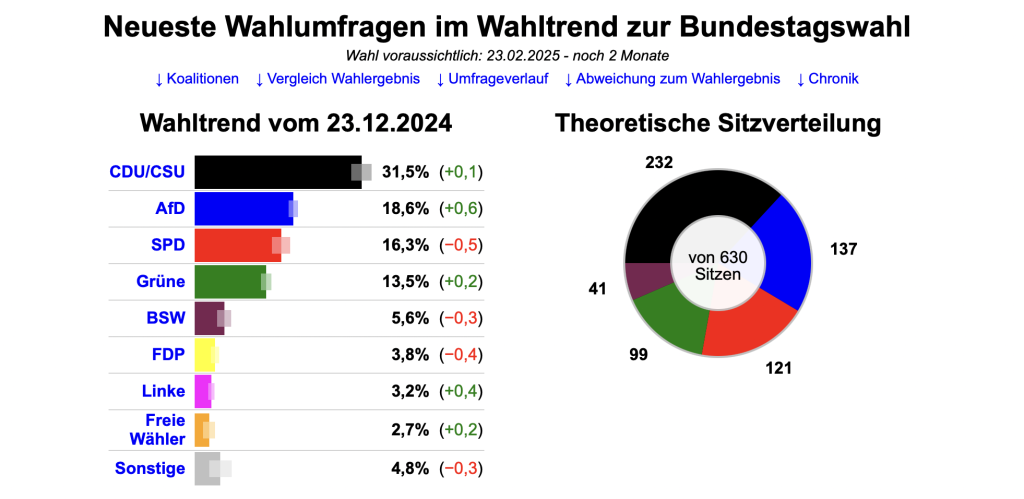
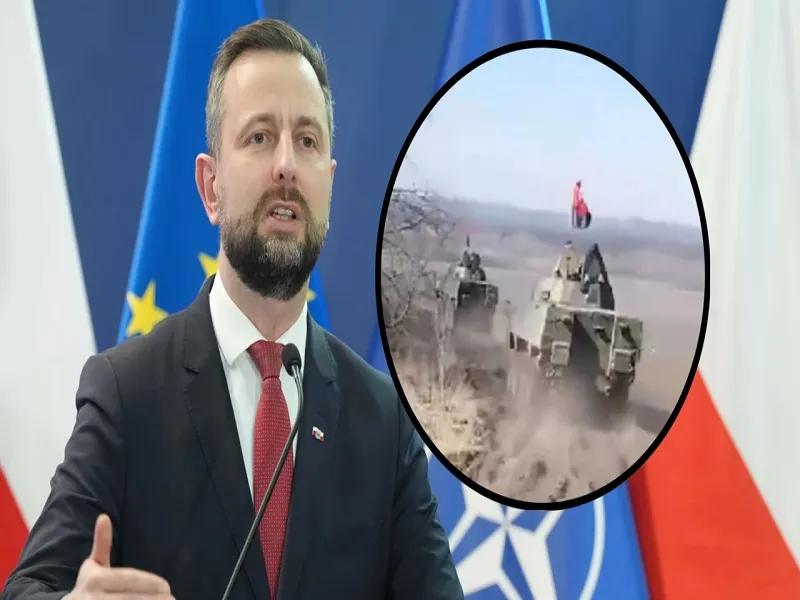
In this series, MintPress highlights six signs that democracy in Europe is beginning to crumble, citing examples from Romania, Germany, France, and the United Kingdom. pic.twitter.com/swY22SvvA7

— MintPress News (@MintPressNews) December 19, 2024


Gaining ground across the EU are parties that question the wisdom of Project Ukraine and ongoing belligerence towards Russia, China and whoever else Washington says is on the enemy list.

And more draconian measures are needed to keep the wolves at bay.

Of course, Western politicians can’t admit failure, and the US wants the sanctions in place, so they’ll have to suck it up. But even more importantly, acknowledging the damage the sanctions are doing to Europe might mean the end of the proxy war, and we can’t have that. Yet?

— Kit Klarenberg 🔻🔻🔻🔻🔻 (@KitKlarenberg) December 11, 2024


It’s entirely possible that Romania is just the start of annulled elections as the neoliberal war champions who call themselves the “center” would no doubt love the power to cancel elections wherever they see fit.

Trial Run for Upcoming Elections in Europe?

Politico announces as much in a Dec. 17 piece. Under the subhead “Germany is up next” the author casually tosses in the following:

But the real nightmare scenario that European Parliament members voiced concerns about on Tuesday is for disinformation to go rogue when Germans head to the polls in February…Earlier in December, the Commission ordered TikTok to retain all data related to election risk management for four months, starting Nov. 24 and running through March — capturing what will happen in the run-up to the German election.

“Election risk management.” Is the EU really worried about the content on TikTok and its lack of political content labels or is it more of a useful scapegoat when democracy goes wrong in the eyes of the Brussels centrists?

It would be a shocker if the political upstarts in Germany — the Alternative for Germany (AfD) on the right and the Sahra Wagenknecht Alliance (BSW) on the left — are able to pull off a result resembling Georgescu’s. Here’s a look at current polling in Germany:

Image

That’s a daunting deficit to overcome, but February is a long ways off, and who knows if and by how much polls might be accidentally or deliberately undercounting AfD and BSW support. The AfD has the threat of a ban hanging over its head purportedly due to Nazi elements in its ranks, but one look at who the EU and US supports in Ukraine tells you that the real reason is because it wants peaceful ties with Russia because that’s in the interest of most Germans.

The Romania election is maybe the most egregious example yet of hypocrisy from the EU, which describes its conflict with Russia and “de-risking” from China as a battle between democracy and authoritarianism. It comes at the same time Brussels and Washington are struggling to orchestrate a color revolution in Georgia in order to overturn the recent election results there and force the country’s citizens to sacrifice in the Western plutocrats’ efforts to weaken Russia.

No doubt Georgia President and French spook Salome Zourabichvili who is saying she will not leave office when her term is up Dec. 29 will point to Romania as evidence of how democracy works in the EU — and should work in Georgia. That’s because Romania’s President Klaus Iohannis is staying in office for now due to the annulled election.

Meanwhile, Ursula celebrates Romanian democracy:

35 years ago, Romanians stood up for the right to choose their own destiny.

Many gave their lives so that their children could be free and live in democracy.

Today, Romania and Europe remember their sacrifice. pic.twitter.com/YB7Q0h6cG9

— Ursula von der Leyen (@vonderleyen) December 22, 2024


Whether she’s clueless or simply enjoys rubbing salt in fresh wounds matters little for Romanians and all Europeans who are having their rights steadily snatched away from them by Ursula and her benefactors.

https://www.nakedcapitalism.com/2024/12 ... ition.html

******

Ukraine Spit In Poland’s Face By Flying The Bandera Flag Atop A Polish APC

Andrew Korybko
Dec 25, 2024

Image

Polish-Ukrainian relations might continue worsening due to Ukraine’s provocations and Poland’s responses to them that it promulgates with society’s sentiments in mind.

The Polish milblog platform WarNewsPL shared footage on X late last week showing the Ukrainian Armed Forces flying the Bandera flag of the “Ukrainian Insurgent Army” (UPA) atop a Polish armored personnel carrier (APC). This prompted Polish Defense Minister Wladyslaw Kosiniak-Kamysz to post around an hour later that this is “a provocation that should not have happened” and declare that he’s organizing an urgent meeting with the Ukrainian attaché in Warsaw “to clarify the matter.”

There are several reasons why this is so scandalous. First, the UPA is considered a terrorist group in Poland due to it targeting the Polish state and civilians during the interwar period, after which they genocided Poles in Volhynia and Eastern Galicia during World War II. Second, Ukraine refuses to this day to exhume and properly bury those genocide victims’ remains despite already doing the same for over 100,000 Wehrmacht troops. And third, Poland has given more vehicles to Ukraine than anyone else.

Flying Bandera’s UPA flag atop a Polish APC accordingly amounts to Ukraine spitting in Poland’s face. The public paid for this vehicle that the state donated to its neighbor as part of the aid that it’s provided in solidarity with Kiev’s cause. Ukraine wouldn’t even be able to fight to this day had it not been for Polish aid and Poland tacitly promising continued support if Kiev abandoned spring 2022’s peace talks. It’s therefore so disrespectful that Ukraine would fly that terrorist and genocidal flag atop a Polish vehicle.

“Most Poles Now Want Peace In Ukraine Even At Kiev’s Expense” according to the results of a November survey by a publicly financed research institution so this latest provocation will predictably increase that majority even further the next time that Poles are polled. It could also complicate the ruling liberal-globalist coalition’s plans to provide more military equipment to Ukraine on credit instead of continuing to give away the rest of its depleted stockpile for free since public opinion is quickly turning against Kiev.

Correspondingly, the already small amount of Poles that are in favor of their forces deploying to Ukraine under any pretext (only 14% per the results of the European Council on Foreign Relations’ summertime survey) will probably further decrease as well. These shifts in public sentiment could make such a scenario politically impossible until at least after May’s next presidential election since the ruling liberal-globalist coalition might not dare to risk losing votes to their conservative-nationalist rivals before then.

Seeing as how “Poland’s Participation In Any Ukrainian Peacekeeping Mission Could Lead To World War III” since Poland could retaliate against Russia in Belarus and/or Kaliningrad should its troops come under fire in Ukraine, thus setting into motion a possibly uncontrollable escalation, this would be for the best. Influential Azov officer Roman Ponomarenko’s anti-Polish rant that he shared on Telegram after Kosiniak-Kamsyz’s post will further fuel anti-Ukrainian sentiment in Poland.

Poles are already well aware of what he wrote since it’s been widely reported in their media. Ponomarenko believes that “Poland needs a weak Ukraine, where it will be possible to sell Polish goods, get cheap labor from here and impose its worldview. The theoretical Ukrainian defeat in the war is perceived by them not as part of the thesis that ‘Poland will become the next victim of Russia’, but as an opportunity to remove a potential competitor for the role of regional leader with foreign hands.”

They’re also aware of how the current leader of the “Organization of Ukrainian Nationalists” (OUN) Bogdan Chervak ominously warned that “Poles are playing with fire” after being triggered by a shitpost map of Poland in late October. The UPA was the OUN’s armed wing and the combination of his strongly implied threat that’s still fresh on Poles’ minds along with Ponomarenko’s ungratefulness for Polish support to Ukraine can accelerate the spread of anti-Ukrainian sentiment more than anything else.

All of this could push the ruling liberal-globalist coalition towards taking an even tougher stance on Ukraine ahead of May’s presidential election that they’re trying their utmost to win. They need to replace the outgoing conservative-nationalist president with one of their own in order to prevent their opponents from vetoing their domestic legislation aimed at completely transforming Polish society. That’s why they have a political self-interest in channeling public sentiment on this issue in their policies.

Regardless of whether or not they win the presidency, they might still retain and possibly even expand these tougher policies to boost their electoral chances ahead of 2027’s next parliamentary elections. The emerging trend is therefore that Polish-Ukrainian relations might continue worsening due to Ukraine’s provocations and Poland’s responses to them that it promulgates with society’s sentiments in mind. The latest scandal could thus contribute to a new and much more difficult era of relations between them.

https://korybko.substack.com/p/ukraine- ... -by-flying
"There is great chaos under heaven; the situation is excellent."

User avatar
blindpig
Posts: 14829
Joined: Fri Jul 14, 2017 5:44 pm
Location: Turtle Island
Contact:

Re: Blues for Europa

Post by blindpig » Sat Dec 28, 2024 3:51 pm

Hyenas Choose a Leader: The Main Candidates for President of Poland
December 25, 2024
Rybar

Image

Poland's 2025 presidential election is being called a "decisive moment" for the country's political future.

They will determine the main direction of the rhetoric - whether it will be liberal and pro-Western or nationalistic and more sovereign, which way the government will lean - to maneuver on the international field or to move closer and closer to NATO and the EU.

Main candidates

The main rivals are expected to be Warsaw Mayor Rafal Trzaskowski , a candidate from the ruling Civic Platform (KO), and the head of the Institute of National Remembrance of Poland (IPN), Karol Nawrocki , a candidate from the former government's Law and Justice (PiS) party.

Trzaskowski is actively promoted by the American diplomatic mission in Poland: he is in constant contact with US officials, systematically participating in pro-Western events that advance the globalist agenda.

At the same time, he already tried his hand at the presidential elections in 2020, but lost to the PiS candidate Andrzej Duda . Although the support provided to the capital's mayor was quite impressive - representatives of the Polish People's Party, the New Left, Poland 2050 and many other small democratic associations spoke out for his candidacy. As a result, Trzaskowski lost to Duda in the second round, losing by only 2.06% of the votes. To be more precise, he received only 422,385 votes fewer than the incumbent president.

In the 2025 Polish presidential election, he is presenting a programme aimed at democratisation, strengthening the European course and combating authoritarian tendencies. Trzaskowski places “democracy and human rights” at the core of his campaign, focusing on the need to strengthen the independence of the courts and the media, as well as the fight against corruption.

In the economic sphere, it relies on support for small and medium-sized businesses and the development of green energy.

In addition, it emphasizes the importance of strengthening Poland's ties with the European Union and NATO partners, in particular the United States.

Trzaskowski already has a strong electoral mandate: he won his party's primaries with 74% of the votes, beating Polish Foreign Minister Radosław Sikorski . At the same time, the Warsaw mayor is leading in the polls, although not by a huge margin over the main candidate.

Unlike his rival, Karol Nawrocki, elected by PiS, is not an official member of any party and cannot boast of much political experience.

However, Duda also became a kind of surprise for the electorate, but was able to win. Nawrocki is known mainly for his special "love" for the demolition of Soviet-era monuments in Poland, as well as for football.

Nawrocki builds his campaign on a combination of patriotism and historical heritage, actively promoting national identity. Nawrocki emphasizes historical memory and Poland’s role as a defender of European civilization, and focuses on protecting family, religion, and cultural traditions. At the same time, he promises to strengthen Poland’s defense and continue to support Ukraine.

For a long time, Nawrocki was involved not just in historical politics, but specifically in Polish-Ukrainian issues. Under his leadership, the IPN systematically appealed to Kyiv with demands to allow the exhumation of the victims of the Volyn massacre, and also refused to investigate what the Ukrainian side presented as "the study of Polish crimes against Ukrainians."

The choice of Nawrocki is quite interesting: he may attract the right-wing electorate, but he is not associated too strongly with PiS, much less with its rule. A number of corruption scams and scandals have caused the connection with the party itself to become compromising material. Therefore, the party emphasizes that Nawrocki is not so much their candidate as a candidate from the people – a “civilian” one.

True, in 2024, the tax authorities also had questions for the head of IPN. An audit conducted at the institute last summer showed that the organization had allocated fabulous sums for the physical protection of Navrotsky from “Russian agents,” and Polish journalists found out that the armed “defenders” he hired did not have a license to use firearms.

In addition, Nawrocki was seen with representatives of gangs from Gdansk and his photographs were found with one of the most famous Polish neo-Nazis, Olgierd Lipnicki, as well as with Grzegorz Horodko, a member of the illegal organization "Blood and Honor", who has contacts with the most active neo-Nazis in Europe.

What's the bottom line?
Taking into account the figure of Navrotsky as a patriotic candidate, it can be assumed that his candidacy will be able to attract, for example, the electorate of "Confederation", which can decide the outcome of the elections in his favor. The growth of popularity among right-wing movements in Europe also plays into his hands, but he still lacks political experience and support.

At the same time, Trzaskowski's problems are that he is too left-wing a candidate - he cannot attract additional voters from other political circles due to his excessive focus on the image of a democratic, progressive leader. Given that young people in Poland are mostly voters of right-wing parties, Trzaskowski will have a hard time.

And although polls show that the capital's mayor has more support, the political crisis in Poland is only gaining momentum and the situation could change radically at any moment . However, this will not change anything for the Poles, since any of the candidates presented will not perform the function of a "people's representative", but will serve the interests of the "allies". And regardless of the choice of the country's leader, the mood of the Polish political elite towards Russia will remain the same.

https://rybar.ru/gieny-vybirayut-vozhak ... ty-polshi/

Google Translator

*******

Image

German politicians criticize Musk backing for far-right AfD
Originally published: Defend Democracy Press on December 22, 2024 by Defend Democracy Press Staff (more by Defend Democracy Press) | (Posted Dec 24, 2024)

The leader of Germany’s far-right Alternative for Germany (AfD) on Friday welcomed a social media post by Elon Musk in which the American tech billionaire expressed support for her party.

Musk, a prominent supporter of U.S. President-elect Donald Trump, opined on his platform X (formerly Twitter) on Friday morning that “Only the AfD can save Germany.”

Alice Weidel, who is running for chancellor as co-leader of the AfD, responded to Musk an hour later, saying:

Yes! You are perfectly right! Please also have a look into my interview on President Trump, how socialist Merkel ruined our country, how the Soviet European Union destroys the countries [sic] economic backbone and malfunctioning Germany!

What is the AfD?
The AfD is currently polling at around 19% ahead of the German federal election in February, second only to the conservative Christian Democratic Union (CDU) at around 33%.

But all the other parties currently in the German parliament have ruled out forming a coalition with them.

The AfD is officially suspected of being an extreme-right organization by Germany’s Federal Office for the Protection of the Constitution (Bundesverfassungsschutz or BfV).

In the eastern German states of Saxony and Thuringia it is officially categorized as such.

In January 2024, AfD figures including Weidel’s former political aide Roland Hartwig were reported to have attended a clandestine meeting of European extreme-right figures including Austrian identitarian Martin Sellner at which a “masterplan” for the deportation of millions of people with migratory backgrounds, including naturalized German citizens, was discussed.

How have other German politicians responded?
Asked about Musk’s comments, German Chancellor Olaf Scholz said:

Freedom of expression also applies to multi-billionaires, but it also means that you’re allowed to say things which aren’t correct, and aren’t good political advice.

Other German lawmakers from across the political spectrum criticized both Musk’s post and Weidel’s response, slamming “interference” and insisting that no other party will form a government with “fascists bought by billionaires.”

“I was a bit surprised because we usually hear that Elon Musk is this gifted wunderkind, but when I hear these comments, I have to doubt that,” the CDU’s Alexander Throm told DW in Berlin.

Change can only be made by those who govern. And the AfD will not govern. Because no other party will form a government with them.

Clara Bünger from the Left Party told DW she had no doubt that Musk’s comments constituted “interference” but insisted:

It remains the case that he’s not really contributing to anything policy-wise, and that he doesn’t really know how political discussions work in Germany.

Anton Hofreiter from the Green Party called the AfD “traitors bought by billionaires” and “a band of fascists who have not only been bought by [Russian President Vladimir] Putin but are now being supported by a multi-billionaire-turned-right-wing-extremist.”

In 2019, a German court ruled that Björn Höcke, the leader of the AfD in the regional state parliament in the eastern state of Thuringia, may legally be described as a “fascist,” based on a “verifiable factual basis.”

Musk: support for Trump, Farage and now the AfD?
It’s not the first time that Musk has addressed the AfD. At the start of June, he posted:

They keep saying ‘far right,’ but the policies of AfD that I’ve read about don’t sound extremist. Maybe I’m missing something.

After backing President-elect Trump’s reelection campaign in the United States this year, Musk has also expressed support for the United Kingdom’s far-right “Reform UK” and its populist leader Nigel Farage.

This week, Farage told the BBC that his party is in “open negotiations” with Musk regarding a potential donation, which The Times has reported could be as high as £78m ($100m, €96m), by the far the biggest political donation in British political history, sparking calls for the UK to tighten its electoral rules.

In Germany, state security services have warned that the upcoming federal election could be targeted by disinformation campaigns not only from Russia, but also from the United States.

Meanwhile, the leader of Germany’s neoliberal Free Democratic Party (FDP), Christian Lindner, sparked controversy this month when he appeared to praise the political views and activities of Musk and right-wing populist Argentinian President Javier Milei.

“Both Milei and Musk represent views which are in part extreme, absurd and even disturbing,” he wrote in the Handelsblatt financial newspaper.

Yet it has to be said: behind the provocations is a disruptive energy which is lacking in Germany.

On Friday, replying to Musk on X, he claimed that he had “initiated a policy debate” with his comments, but cautioned against supporting the AfD.

“While migration control is crucial for Germany, the AfD stands against freedom [and] business—and it’s a far-right extremist party,” he said.

Don’t rush to conclusions from afar. Let’s meet, and I’ll show you what the FDP stands for.

https://mronline.org/2024/12/24/german- ... right-afd/
"There is great chaos under heaven; the situation is excellent."

User avatar
blindpig
Posts: 14829
Joined: Fri Jul 14, 2017 5:44 pm
Location: Turtle Island
Contact:

Re: Blues for Europa

Post by blindpig » Sun Dec 29, 2024 4:06 pm

Redesigning U.S. hegemony in Europe: Trump threatens NATO?

Lorenzo Maria Pacini

December 29, 2024

Year 2025 will open with some surprises, we hope nice one. Let us hold on tight.

2024 has been a year full of surprises. The latest (probably) is the ‘threat’ that Donald Trump, president-elect of the United States of America, addressed to NATO when he was still on the campaign trail and reiterated a few days after his trip to Europe and the fall of Ba’athist Syria: pull the United States out of the Atlantic Treaty. But is this really possible?

NATO is North Atlantic, nothing more?

It is first necessary to review what NATO is.

When we talk about NATO we have to distinguish what it is, what it looks like and what it is not.

It was founded as a military alliance in 1949 with the signing of the Washington Treaty with the primary purpose of the collective defense of its members.

Article 1 states that member states undertake, under the UN Charter, to settle international disputes peacefully and to avert the threat and use of force. Already from these first words it is clear that this was a huge mockery. But let us go further. The interesting part comes in the infamous Article 5, which provides for the adoption of the principle that an attack against one or more is to be considered an attack against all.

However, there is also another, often forgotten, article that plays a key role: Art. 8 states that member states cannot sign anything that conflicts with the Atlantic Treaty. This constraint is of fundamental importance because it creates a sort of ‘prison’ for anyone who joins NATO, ensuring that, de facto, NATO assumes a position of leadership in all the military and foreign policy, but also domestic policy, of the member countries. Everything, but absolutely everything, must go through the government of the United States of America, as also reiterated in Art. 10.

NATO was proposed in the context of the Cold War, which followed the conclusion of the Second World War. On that 4 April 1949, twelve European and North American countries (Belgium, Canada, Denmark, France, Iceland, Italy, Luxembourg, Norway, the Netherlands, Portugal, the United Kingdom and the United States) signed the Treaty, formalizing an alliance that was supposed to counter the Soviet threat and promote stability in Europe, according to the post-war American vision.

During the Cold War years, the Alliance was not only defensive but represented an instrument for the gradual expansion of American interference towards the East: it developed a complex military structure, with the Supreme Command of the Allied Powers in Europe (SACEUR) as its nerve centre, located in Brussels, whose military integration, with shared troops and resources, was a key element in keeping the entire European continent under the heel of the boot. With the fall of the Berlin Wall in 1989 and the dissolution of the USSR in 1991, NATO found itself redefining its role. The end of the Soviet threat led to a broadening of NATO’s mission, which began to include peacekeeping operations, crisis management and humanitarian interventions. Eastward enlargement, with the accession of former communist countries such as Poland, Hungary and the Czech Republic in 1999, marked a new chapter, transforming NATO from a regional alliance to one with global reach. This enlargement process continued with the accession of other Eastern European and Balkan countries, strengthening NATO’s hegemonic dominance on the continent. NATO also developed partnership programs with non-member countries, such as the Partnership for Peace, declaring that it wanted to promote cooperation in the military and security spheres, always with a view to reconquering former Soviet spaces, extending further and further eastwards, where several kilometers later it meets the USA’s other great enemy: China.

It is curious that both in the Treaty and in the historical-political journey from ‘49 to the present day, the term “North Atlantic” has always been used and never the complete Atlantic Ocean. This may seem a silly specification, but it is actually indicative of the location of the political interest of those who founded it. The northern hemisphere, therein lies the centre of power.

This is confirmed by another important detail: no Secretary General (political office) of NATO has ever been American. All of them are European and mostly Northern European. Curious, no? The signing of the treaty took place in Washington, on American soil, and the Articles state that reference is made to the U.S. government, but in fact the political administration has always been left in the hands of Europeans. Jurists could step in and say that this is the application of a principle of legal balancing of powers, and they would be right if only politicians really cared about law, but this is not the case.

The choice of pointing to the White House as the domicile for problems is more of a red herring: the real NATO government is in Europe, with a nice palace in London. The perfidious Albion has never stopped exercising its imperial control, it has only delegated a few Landlords to streamline the workload.

At the post of NATO military chief (military post), on the other hand, we find Americans in large numbers. The U.S. was chosen as the armed arm of the British Crown to do what the UK did not want to do and could no longer do.

To be precise, NATO has the following organizational structure:

– North Atlantic Council: this is the decision-making body, where each member has a representative with equal voting power. Decisions are taken by consensus, which implies that all nations must agree.

– Secretary General: leads the organisation, chairs Council meetings and represents NATO internationally.

– Military Committee: the highest military council, composed of the chiefs of staff of the member nations, which provides military advice and guidance to the Council.

– Command Structure: consisting of the Supreme Headquarters of Allied Powers in Europe (SHAPE) and various regional commands that manage military operations.

A very well thought-out architecture, which may now face a change.

Redesigning Europe according to Trump: no to NATO, yes to the U.S.

If we take Trump’s words to be true, the opening of his presidency at the end of January 2025 could usher in a period of great instability if only because of this issue with NATO – but, as we know, there are many others that will give no small amount of concern.

Removing the U.S. from the Alliance means removing the majority of the military force in use.

In this regard, it is worth resolving beforehand a misunderstanding that could mislead some: not all-American military bases in Europe are NATO and not all NATO bases in Europe are American. Translated: when the Americans won WW2, they permanently established some military bases; when NATO was established in ‘49, it established its bases. The Alliance bases have serving personnel from the various member countries, not just American citizens.

This subtle difference puts the focus back on the crux of the matter: if the U.S. leaves the Treaty, what will become of that military presence on European (and other) soil? Let us try to reason out the problem.

First of all, the Treaty refers to Washington and the U.S. government, so it should be revised and rewritten. A very demanding matter which, legally speaking, would mean a total rewriting of the agreement. In this sense, Trump’s proposal seems more like a provocation to stimulate the reactions of Eastern countries, Russia and China above all, and calibrate American international policy strategy. The reformulation of the treaty is very unlikely, and even more unlikely is its total abrogation, dissolving the Alliance. It is not remotely conceivable that either the U.S. or the UK would agree to give up their thalassocratic status. This is out of the question. At most, a medium-term ‘pause’ could be considered to solve domestic problems and then return to conquest, but the rejection of one’s own thalassocratic identity is an extremely remote eventuality and, in any case, not suddenly feasible.

If we actually try to imagine the removal of the U.S. from NATO, we would see a scenario more or less like the following in Europe: the NATO military set-up would be denatured and drastically and suddenly reduced; the other member states would have to make up the shortfall; in a context of declared war against Russia and commitment on several fronts by NATO contingents, this would imply a stand-by or a quick dismantling of entire bases and/or missions. An extremely dangerous and strategically disadvantageous move. NATO would remain active, but with a very serious problem to solve in a very short time.

All this, however, would not amount to the disappearance of the American armed forces from European soil. Therein lies the point.

Trump’s proposal is not a removal of the American military occupation on European soil. This would only happen with the effective repatriation of all U.S. military present. Removing the U.S. from NATO would mean removing only a part of the men deployed on foreign missions, not the whole. American military personnel would remain on American bases.

This move takes on a different aspect if we consider Trump’s willingness to emancipate himself from the NATO mechanism, and this only has value from the perspective of greater American power for Americans, outside the control of the British Crown, outside the interference of European puppets placed as kapò in front of steel playgrounds that do not belong to them.

From this perspective, Trump is really relaunching MAGA: making America great again through a reassertion of U.S. dominance over its territories of colonial conquest. Europe is still disputed with the UK, so to control it completely one must first untie oneself from the bond of dependence that is NATO. From clear estimates, there are more U.S. soldiers in Europe than NATO soldiers. This is a very important fact. If we then add to this a certain popular American narrative that speaks of numerous generals in the armed forces loyal to Trump and ready to follow his orders in Europe, the picture is complete and plausible

Consequently, Trump could also make proposals for rapprochement with Russia, both as bait for a conflict and as a real attempt to keep Europe from collapsing at least for a time. In the Old Continent, the UK + France axis is the one that has always held political power, while economic power has historically belonged to Germany + Italy. The former pair is the one that recently met Trump for talks on his European tour (held in Paris, not coincidentally), with Macron being the first European politician to have flown to the East since the beginning of SMO to try to protect its interests, both in terms of pacification and raising the level of conflict. Germany and Italy, the two great losers of WW2, on the other hand, were brought to their knees by 30 years of recession and suffered heavily from the impact of sanctions. Italy has maintained a very hostile diplomatic rhetoric towards Russia, an attitude similarly adopted by Germany, which however is now facing a major political crisis and a terrible economic recession. Both countries still have a few cards to play, the first of which has already been launched: rearmament, with the transition to a war economy, and preparation for a direct engagement at the front. Bear in mind that Italy has signed a ten-year agreement to provide strategic-military support for Ukraine.

By getting NATO’s ‘obedience’ out of the way, Trump’s America could try to create a bridge to the East via Germany and Italy, which are Russia’s historical ‘cousins’ and enjoy an excellent reputation, but also a lack of alternative, as both are full of American military bases.

Ah, let’s not forget one thing: the UK will not like this option. We must expect some surprises.

This move reshapes Europe. The plans discussed so far must now be reinterpreted with an exclusively stars and stripes key. Everything takes on a different role: the Three Seas Initiative changes size, Ukraine changes its weight on the scales, the Scandinavian Northern European countries change place in the equation, the Mediterranean will have to be colored with a different palette of colors, it will even become possible to dialogue with some partnerships or set up others, obviously convenient for the USA but still on European and Eurasian territory.

Let us not be fooled: less NATO but more U.S. is certainly not good news. American imperialism is simply evolving in a different direction from the one we are used to, but it could not be otherwise given the change of the world in a multipolar direction.

We will see what happens next. Year 2025 will open with some surprises, we hope nice one. Let us hold on tight.

https://strategic-culture.su/news/2024/ ... tens-nato/

Social unrest in Serbia portends changes

Stephen Karganovic

December 29, 2024

The situation that is developing in Serbia brings to mind a different yet eerily similar upheaval in Tunisia in 2010.

New Year’s is coming to Serbia, as everywhere else, but it may not just yet give that country the fresh start it yearns as it did in Cuba in 1959, when dictator Batista did his nation a huge favour by leaving. Serbia’s Batista is unlikely in the remaining few days to make a similarly magnanimous gesture, at least not before the turmoil that is currently sweeping that Balkan country intensifies by a few more notches.

The social convulsion in Serbia began slightly over a month ago when a protruding portion of the roof at the train station in the city of Novi Sad collapsed, killing fifteen people and leaving several more severely injured and fighting for life.

Such occurrences are known to happen throughout the world, but what sets the Serbian incident apart is the fact that the train station was “renovated” quite recently after huge cost overruns, all financed of course from the public treasury. But in this particular instance money, although the sums involved are impressive, is the least of it. What snapped the long-suffering nation’s patience was the sheer horror of the human tragedy coupled with the callousness and complete lack of accountability at both professional and political levels. The Novi Sad mayhem has now become synonymous with the corruption which pervades Serbia’s political system. Revulsion against massive corruption and the impunity of the perpetrators in league with the politicians with whom the public suspect they are sharing the graft (or it might be the other way round, but that hardly matters) has galvanised the protests that are on the verge of getting out of control.

The current protests come on the heels of other recent expressions of public discontent in Serbia. Early in the year, mass manifestations, directed somewhat vaguely “against violence,” swept the country following a grisly American-style school shooting in Belgrade and a few days later a similar incident in a rural area south of the capital. To this day there is no coherent explanation, psychological or any other, for either of these traumatic events that in Serbia are totally unprecedented. Soon after that, the government’s announcement that, contrary to its earlier promise that it would not, it nevertheless was entering into a hazardous mining deal for the extraction of lithium with the notorious multinational corporation Rio Tinto provoked another wave of mass protests that swept almost every city, town, and hamlet in Serbia. As with the fatal roof collapse in Novi Sad, it was suspected by broad sectors of the population that the lithium mining deal, which poses a serious threat to natural and water resources and to the health of millions of inhabitants, was another corrupt scheme involving dishonest politicians willing to sacrifice the public interest in return for hefty bribes.

The tragic loss of life in Novi Sad five weeks ago only accentuated the deep distrust of the authorities that has been endemic throughout Serbian society. The suspicion that the accident was the result of official malfeasance on a massive scale was enhanced by the authorities’ evasive reaction. In a manner that strongly suggested that they had something to hide, they refused to make available technical and financial documents pertaining to the train station reconstruction. Within days of the accident local inhabitants in Novi Sad began to regularly congregate at the site of the tragedy and to demand answers and accountability. But the government at all levels remained exasperatingly deaf to their outcries. Instead of providing the technical data for expert analysis and investigating the subcontractors for possible shortcomings in the quality of their service, the authorities focused on arresting protesters for “breaching the public order.” Vehicles driven by regime supporters rammed several groups of protesting citizens in what was widely interpreted as an intimidatory gesture to dissuade them from pursuing the matter beyond the narrow confines of the official narrative, which unconvincingly maintained that what happened was a run-of-the-mill accident with nothing sinister behind it.

However, no one was buying that explanation, and the authorities’ guilty behaviour did nothing to establish trust.

For several weeks after the tragedy impotent rage simmered until it became clear that no one would be investigated, much less prosecuted, for the death of fifteen innocent individuals who happened to be in the wrong place at the wrong time. Insider information emerged from whistle blowers suggesting that the train station “reconstruction” project was a sweetheart deal between unscrupulous contractors aligned with the ruling party and corrupt politicians who were unconcerned with the quality of the work that the contractors were providing. Everyone involved was on the take, mafia style. Human life was not part of the equation.

That is when, about two weeks ago, the affair took a decisive new turn and acquired a dimension that no one had expected. Serbian students, until then a rather passive and apolitical lot, suddenly awakened from hibernation with a huge roar. Universities and institutions of higher learning became the focal points of street protests. Ominously for any government in such a predicament, within days the street activities gained momentum. The university students were joined by high school students, farmers, teachers, and other sectors of society who had grievances that required redress.

The young people issued a set of four demands to the authorities. First, to make publicly available each and every document related to the train station reconstruction, including contracts and evidence that the work in progress was subjected to quality supervision, and also records that show on what basis contractors and subcontractors were selected, for their experience and expertise or links to the ruling party.

Secondly, the young people are demanding the immediate release of all protesters arrested by the police and dropping of all charges against them. The third demand is to prosecute all individuals who staged physical attacks on the protesters and a transparent investigation of the background of the fatal roof collapse, culminating in criminal charges and punishment of all actors found to have been derelict in their duties.

Finally, the students are demanding also a 20 percent increase in the budget allocation for institutions of higher learning in Serbia, which are suffering from appalling neglect, whilst huge resources are being channelled into unneeded corruption boondoggles such as the “national stadium” and the Business Expo project into which 16 billion euros are expected to be pumped but whose urgency and purpose are not clearly understood by anyone.

On Sunday 22 December Serbian university students and high school youth supporting them, pledging that they will not rest until their demands are met, staged a mass gathering in Belgrade to honour the Novi Sad dead with fifteen minutes of silence, a symbolic minute for each victim. The manifestation was joined by over one hundred thousand citizens from all walks of life.

The situation that is developing in Serbia brings to mind a different yet eerily similar upheaval in Tunisia in 2010, that was sparked off by a seemingly minor event but eventually had momentous consequences by galvanising the seething masses into overturning the established order. On 17 December of that year, in a small Tunisian town, young fruit vendor Mohamed Bouazizi who was the sole support for his mother and six siblings was violently manhandled by the police and his cart was overturned and confiscated on the charge that he was working as a street vendor without a permit. Mohamed tried to get relief from the local authorities, but without success. Enraged by the injustice he had suffered, he set himself alight on the street. But his act of self-immolation set alight more than just himself. Losing fear, the entire country was seized by uncontrollable fury at the arrogance of its rulers. The rest is history, as the supposedly unassailable regime lost its grip on power and fell apart.

There is much to be learned from the Tunisian experience and the ongoing unrest in Serbia, which in the twinkling of an eye could repeat it. Serbia’s obtuse rulers, who make the Bourbons look astute by comparison, are unlikely however to draw any useful lessons.

But if they have any sincere well-wishers left, they should be advised by them to peruse Gene Sharp’s trenchant observations in his master work, Self-liberation. Sharp said that the beginning of the end for a dictatorship is when its subjects lose the fear that had made them submissive and obedient.

So keep an eye on the Serbian students. There is something to what Gene Sharp had written and the students just may be onto it.

https://strategic-culture.su/news/2024/ ... s-changes/

******

Five Reasons For Poland Not To Directly Participate In Any Ukrainian Peacekeeping Mission

Andrew Korybko
Dec 29, 2024

Image

None of Poland’s objective national interests, nor any of its top two parties’ domestic partisan ones, would be advanced by intervening in Ukraine under any circumstances.

The Wall Street Journal’s report about Trump’s plans to have the Europeans patrol a demilitarized zone along the Line of Contact in Ukraine following the ceasefire that he hopes to broker there with Russia raised questions about whether Poland would directly participate in such a mission. Although its officials have signaled that they’re not interested, and one even said that this could only happen under a NATO mandate, it still can’t be ruled out. Here are five reasons why Poland should sit on the sidelines:

----------

1. Public Opinion Is Decisively Against Any Intervention

The European Council on Foreign Relations’ survey from early July showed that just 14% of Poles support their national troops fighting in Ukraine, while a publicly financed research center’s survey from early October showed that Poles are getting fed up with Ukrainian refugees and the proxy war. Ukraine’s disrespectful approach towards the Volhynia Genocide dispute hasn’t helped its cause either. Any Polish party that lobbies in support of this policy would therefore be going against prevailing public opinion.

2. Staying Out Is A Good Presidential Campaign Policy

Building upon the above, the presidential candidates from the country’s top two parties have every reason to promise to keep Poland out of the fray ahead of next year’s election, and whoever’s party is perceived (whether accurately or not) as being in favor of intervening might naturally be punished at the polls. The ruling liberal-globalist party’s Prime Minister and the outgoing conservative-nationalist President should thus be on the same page about this for self-interested domestic electoral reasons.

3. Ukrainian Extremists Could Exploit An Intervention

The introduction of conventional Polish troops on Ukrainian soil could easily be exploited by Ukrainian extremists to justify acts of terrorism against the intervening forces, while fringe historical claims could be lent false legitimacy in this ultra-nationalist context to justify terrorism by refugees inside of Poland too. Far from being a glorious flag-planting exercise that also serves to show fealty to the US, a Polish intervention could lead to a costly unconventional war that ultimately ends in disaster.

4. Poland Might Be Left To Do The Heavy Lifting For Others

Poland already maxed out its free military support for Ukraine, offering only to produce more equipment on credit, and spent a whopping 4.91% of its GDP on that country (the bulk of which went towards supporting its refugees) only to be excluded from mid-October’s Berlin Summit that discussed the Ukrainian endgame. The precedent therefore exists for Poland to once again be left to do the heavy lifting for others if it directly participates in a peacekeeping mission while they might reap the benefits.

5. The Risk Of World War III Would Remain Ever-Present

This analysis here argues that Poland could respond to another conflict in Ukraine involving its peacekeepers by attacking targets in neighboring Belarus or Kaliningrad, which could turn an otherwise possibly containable proxy conflict into World War III if NATO and Russia attack each other’s territory. The prerogative for that would be on Poland, whose leadership might be more willing to “escalate to de-escalate” for whatever reason, while Ukraine’s could also manipulate events to provoke this scenario.

----------

The reasons that were enumerated above align with Poland’s objective national interests as well as its top two parties’ domestic partisan ones, none of which are advanced by intervening in Ukraine. At most, Poland might logistically facilitate others’ intervention per its duty as a NATO ally even if such a mission is carried out under a different mandate, but it would do best not to get directly involved. Trump’s team should also be aware of these factors and recalibrate their potential plans accordingly if need be.

https://korybko.substack.com/p/five-rea ... o-directly

******

SITREP 12/28/24: Provocation Pressure Against Russia Heats Up in Both Air and Sea

Simplicius
Dec 28, 2024

<snip>

Europe continues collapsing, with the German president now fully dissolving the Bundestag until snap elections in February:

Image

With Trump’s entry to the scene, the European crisis is expected to worsen—which bodes even more ill for Ukraine’s future.

Next year, Ukraine will have even less systems to strike Russia with, as we have seen ATACMS and other such weapons have nearly run out. Russia on the other hand continues to improve its defensive abilities: not only through Belousov’s new initiative of decentralizing every brigade logistics node and ammo dump, but the vast scale infrastructure surge when it comes to airbase bunkers. New photos have shown a large scale campaign to build concrete shelters is proceeding, which means Ukraine will have less and less opportunity to actually conduct painful strikes on Russia, all with a dwindling weapons supply.

Arestovich has proposed the new theory that Ukraine will lower mobilization to 18 or even 15 and will attempt to hold out until 2026 when US Congressional midterm elections stand to rebound the Democrats back into control of Congress. Others have espoused this theory along the track that Ukraine may then again have some semblance of a chance for more assistance. At this rate, however, it’s difficult to imagine that even with mobilization Ukraine can hold out for that long.

(Much more at link.)

https://simplicius76.substack.com/p/sit ... n-pressure
"There is great chaos under heaven; the situation is excellent."

User avatar
blindpig
Posts: 14829
Joined: Fri Jul 14, 2017 5:44 pm
Location: Turtle Island
Contact:

Re: Blues for Europa

Post by blindpig » Tue Dec 31, 2024 3:27 pm

Croatian Presidential Election Heads to Runoff

Image
A political rally in Croatia, Dec. 2024. X/ @ai_daytrading

December 30, 2024 Hour: 8:18 am

Incumbent President Zoran Milanovic led the race with 49.10 percent, narrowly missing a first-round victory.

The Croatian State Election Commission (SEC) announced that the presidential election will head to a runoff on Jan. 12 as no candidate secured more than half of the votes in Sunday’s election.

With 99.88 percent of votes counted, incumbent President Zoran Milanovic, backed by the largest opposition party, the Social Democratic Party, led the race with 49.10 percent, narrowly missing a first-round victory.

His main challenger, Dragan Primorac of the ruling Croatian Democratic Union (HDZ), garnered 19.35 percent, according to the Croatian State Election Commission.

Under Croatian election law, if no candidate wins an outright majority, the top two contenders proceed to a runoff two weeks later. The Croatian president serves a five-year term and can seek re-election once.


“People are very frustrated with the situation in the country, especially with the level of corruption, and Milanovic has managed to convince voters that he is the ‘anti-HDZ’,” said conservative Marija Selak Raspudic, an independent presidential candidate who came third today with 9% of the vote.

Addressing his supporters, Milanovic expressed gratitude and confidence in securing victory. “I believe that in two weeks we will celebrate the victory,” he said.

Primorac, speaking to his supporters, called the runoff a great opportunity. “Now a great opportunity is coming. Milanovic and I will be one on one, so we will see who knows what and represents what. Croatia needs changes, and in two weeks it will be a historic day,” he said.

https://www.telesurenglish.net/croatian ... to-runoff/

******

After NATO’s Romanian Coup, Where Next?
December 30, 2024


https://natyliesbaldwin.com/2024/12/aft ... here-next/

******

The EU Threatens to Cut Itself off From Another of Its Major Natural Gas Suppliers
Posted on December 30, 2024 by Conor Gallagher

I had planned to write one of those year-end reviews for today on what Europe lost over the past year in its ongoing self-immolation against Russia, but that will have to wait for a later date. That’s because while much of the attention these days is on the upcoming closure of the final gas pipeline running from Russia to Europe through Ukraine, the EU also has the shovels out and is digging itself a hole with another of its big LNG suppliers in Qatar.

The EU Threatens to Cut Itself Off From Another Supplier

The EU is targeting Qatar with its new Corporate Sustainability Due Diligence Directive, which requires larger companies operating in the bloc to check whether their supply chains use forced labour or cause environmental damage. On its face, that sounds great, but it could further limit Europe’s energy options following its decision to restrict supplies from Russia, which has caused widespread economic devastation in the bloc. Failure to take enough action on the EU’s corporate sustainability items in the eyes of Brussels can result in penalties, including fines of up to five percent of global turnover.

Qatar simply says it will end all liquefied natural gas (LNG) sales to the EU rather than pay any penalties.

“If the case is that I lose 5% of my generated revenue by going to Europe, I will not go to Europe. I’m not bluffing,” Energy Minister Saad al-Kaabi told the Financial Times in an interview published on Dec. 22. He added that “five percent of generated revenue of QatarEnergy means five percent of generated revenue of the Qatar state. This is the people’s money, so I cannot lose that kind of money – and nobody would accept losing that kind of money.”

Now it’s entirely possible — if not likely — that the EU backs down on corporate sustainability demands of Qatar. Maybe this is just a threat so that some palms can be greased in Brussels. Then again, who would have believed that the EU would voluntarily cut off Russian pipeline gas and destroy its own industry over the course of the past three years?

The Consequences

Qatar is the world’s third largest exporter of LNG after the US and Australia. And since the EU cut itself off from Russian pipeline gas, Qatar has provided between 12-14 percent of Europe’s LNG needs, which puts it alongside the US and Russia as one of the top LNG suppliers to the bloc.

Image

Any supply constraints from Qatar would be a major blow.

“Qatar is one of the world’s largest LNG exporters. The EU is increasingly reliant on its LNG due to reduced natural gas supplies from Russia. A disruption in Qatari LNG shipments would likely exacerbate supply constraints, especially during winter months when demand peaks,” James Willn, partner at global law company Reed Smith’s energy and natural resources group, told The National.

As we can see from the above chart, it’s especially bad news for Europe’s second largest industrial center in Italy, which gets about 50 percent of its LNG from the US, while around 39 percent was arriving from Qatar. As a result of the Red Sea chaos — driven by the West’s support for genocide in Gaza and Yemen’s efforts to put an end to it — shipments are being cancelled or delayed, but Italian energy company Edison is still in the middle of a 25-year contract with QatarEnergy for about 6.5 billion cubic metres (bcm) per year of LNG, and Italian energy giant Eni signed a 27-year deal in 2023. Those deliveries might not be completely cut off, but Kaabi, Qatar’s energy minister, said Doha will explore legal avenues if it faces penalties and would rule out shipping any new supplies.

The EU is already dealing with demand destruction and could be looking at even more should it begin to face problems with the supply of Qatari LNG.

Image

In 2022, EU gas consumption dropped by 13.5 percent compared to the prior year’s levels, its steepest drop in history. The decline is the equivalent to the amount of gas needed to supply over 40 million homes, but it was factories rather than homes making up the biggest chunk of that drop: the EU’s industrial sector accounted for approximately 45% of the demand decrease.

It’s struggled to recover, and there’s probably not a lot the EU can do at this point to fix the problem as the hardest hit industries have not recovered and many operations have either closed or relocated.

Brussels could, however, make the problem even worse, which issues with Qatari LNG could do.

That’s because one of the biggest components of the bloc’s strategy to deal with the loss of Russian pipeline gas is more reliance on LNG. Twelve new LNG terminals and six expansion projects of existing terminals were commissioned between 2022 and 2024, which are increasing the EU’s LNG import capacity by 70 bcm to 284 bcm.

That strategy has its own problems, namely it is more expensive and less reliable, but it becomes even more unworkable if the EU starts excluding the world’s third largest LNG producer. A brief look at the current situation shows how little room the EU has to mess around.

The industrial gas demand drop in the bloc has not resulted in significant fuel switching, but instead in lower industrial output, largely due to the loss of competitiveness. It’s easy to see why. From the Center on Global Energy Policy at Columbia:

Import substitution in some energy-intensive sectors—and broader macroeconomic headwinds for manufacturing activity—have prolonged the weakness of gas-consuming industries, especially in 2023. These headwinds are unlikely to subside soon. As of March 2024, the forward curve for the TTF benchmark still indicated price levels of around €25–30/MWh through 2028, markedly higher than the historical average of €15–20/MWh observed over 2015–19. Even if European gas prices returned to those historical levels, energy-intensive industries across the EU would still face immense pressures from overseas competitors in North America (where the Henry Hub benchmark was trading at well under the equivalent of €10/MWh in early March 2024) and from other producers benefiting from artificially low regulated gas prices, including those in the Middle East and North Africa.

The EU likes to tout its growing renewables energy, but that has not made up the difference of gas reduction and is largely unhelpful for energy-intensive industries. We can see the effect on the EU’s two largest industrial centers, Italy and Germany:

Image

Image

Italy’s industrial output has contracted for 18 consecutive months and is already dealing with recent gas supply issues due to the cutoffs of Russian gas that was still flowing via pipeline through Ukraine to Slovakia, Hungary, and Austria. Austrian company Österreichische Mineralölverwaltung or Austrian Mineral Oil Administration was already forced by a European court ruling to stop buying from Russia; now Ukrainian emperor Volodymyr Zelenskyy says the last remaining pipeline transit through Ukraine can only continue on the condition that Moscow does not receive payment until after the war. Despite efforts by Slovak Prime Minister Robert Fico, it appears as though a deal is not in the cards.

This is a blow to Italy as Rome had been buying from Vienna increasing amounts from Vienna due to Red Sea shipment problems and as grand plans to source more gas from North Africa largely fell through.

Image

Image

Doing no better than Italy is Germany, which is entering global financial crisis or pandemic-level-decline territory:

Image
Berlin is calling for the sustainability directive to be postponed by two years.

Why Is the Fight with Qatar Now?

The stated reason is that’s what the directive on corporate sustainability due diligence passed in July 2024 requires. Here’s the overview from the European Commission:

The core elements of this duty are identifying and addressing potential and actual adverse human rights and environmental impacts in the company’s own operations, their subsidiaries and, where related to their value chain(s), those of their business partners. In addition, the Directive sets out an obligation for large companies to adopt and put into effect, through best efforts, a transition plan for climate change mitigation aligned with the 2050 climate neutrality objective of the Paris Agreement as well as intermediate targets under the European Climate Law.

The directive requires EU countries to impose fines for non-compliance with a maximum limit of not less than five percent of the company’s annual global revenue. Qatar still has time to adhere to the requirements. Countries have to adopt the EU-mandated rules into national law by 2026 and in 2027 the rules will start to apply to companies, but they’re already starting to call into question the long-term viability of Qatar as an LNG supplier to the EU.

We’ll have to wait and see exactly how the rules are applied and if US companies face the same scrutiny. The EU’s track record there isn’t great as its human rights and environmental concerns are often wielded as a geopolitical tool. We don’t have to look far for evidence. While the EU is super worried about Uyghurs in China and the plight of Iranians, it somehow never utters a word about the nearly 700,000 Americans (a number that is likely higher) who are homeless or the US carceral state, which leads the world and coincidentally gives the US a labor advantage at a time when the EU is facing a competitiveness crisis.

Brussels can lecture China and others on climate change action while ignoring the fact that the US LNG it increasingly relies on is worse for the environment than coal. That’s because the production of shale gas, as well as liquefaction to make LNG and transport it by tanker, is energy-intensive.

And it looks set to rely even more on those LNG exports from Washington. Trump plans to remove any barriers to more drilling, and the EU wants to buy all it can in an effort to charm Trump and prevent tariffs on imports to the US from the EU.

European Commission President Ursula von der Leyen, doing her best to prove her worth to the incoming administration, came up with a plan to buy even more gas from the US, which would shoot the EU in both feet. This would increase dependence on the US while simultaneously doing even more to wreck the economies of EU states. Here’s Politico with the details:

Stressing that the EU still buys significant amounts of energy from Russia, von der Leyen asked: “Why not replace it by American LNG, which is cheaper for us and brings down our energy prices? It’s something where we can get into a discussion, also [where] our trade deficit is concerned.”

During the first Trump term, Juncker avoided more tariffs by assuring the U.S. president that Europe would facilitate more imports of liquefied natural gas (and more American soybeans.) In fact, the European Commission has no real power in determining European companies’ purchases of LNG and soybeans, but Trump was happy to accept the political theater of parading data that European purchases were going up.

There is no evidence that American LNG is cheaper, as von der Leyen is quoted as saying. It’s actually a lot more expensive than the pipeline Russian gas Europe used to get. There’s also the fact that the European Commission doesn’t have the power to dictate who member states buy gas from.

It can remove some options via sanctions, however.

It could also utilize its new Corporate Sustainability Due Diligence Directive to make business with certain countries — say Qatar — more unattractive while simultaneously making US exports more appealing. Willn, the partner at global law company Reed Smith’s energy and natural resources group told The National the following:

“Qatar could redirect its LNG exports to other markets, such as China, Japan or South Korea, which are major LNG importers and less likely to impose similar sustainability laws. The EU would need to seek alternative suppliers, such as the US, Australia or African nations, potentially at higher costs.”

The directive was one of many new powers added to Ursula’s toolbox during her first five-year term in response to the crisis brought on by the bloc’s war against Russia. They include the Foreign Subsidies Regulation, International Procurement Instrument, an Anti-Coercion Instrument, and the EU Critical Raw Materials Act.

Most are being put to good use for the benefit of US geopolitical goals and the bottom lines of American companies. The same looks likely with the sustainability directive.

https://www.nakedcapitalism.com/2024/12/284727.html

******

NATO expands in Europe: Will the fears of “frontline” countries come true?

Erkin Oncan

December 31, 2024

The vicious cycle of economic hardships, social unrest, and political polarization could become a threat that undermines Europe’s unity as a whole.

As the inauguration of the U.S. President-elect Donald Trump approaches, one of the most debated topics in countries modifying their security strategies within the U.S./NATO framework—particularly in the Baltic and Eastern European nations—is whether Trump will continue to protect Europe “against Russia.”

The countries expressing this new European concern most openly are Latvia, Estonia, and Finland.

In their statements, the leaders of Latvia, Estonia, and Finland emphasized the need to end the “endless debates” on how to respond to the “threat from Russia” and strengthen European defense.

This long-standing “necessity” now includes the message, “NATO cannot protect Europe from Russia without the U.S.,” due to uncertainties surrounding the Trump era.

Latvian President Edgars Rinkēvičs declared, “We are not ready. This is absolutely clear,” stressing that NATO needs to rely more on its capabilities because it is not prepared for independent defense.

Estonian Prime Minister Kristen Michal echoed this sentiment, stating, “We must enhance our defense capabilities,” highlighting the same insufficiency.

Finnish President Alexander Stubb expressed the prevailing concern in stark terms: “We are not doing this because we fear Stockholm or London. We are doing this because we fear Moscow.”

Why Are These Countries Afraid?

The three Baltic states share borders with Russia and rank among NATO members that spend the highest percentage of their GDP on defense, after Poland. These nations are, therefore, directly positioned on the “frontline” of NATO’s actions against Russia.

Additionally, these countries host critical NATO bases.

Two of the four countries hosting NATO’s Enhanced Forward Presence (eFP) forces are Estonia and Latvia (the others are Poland and Lithuania).

As NATO’s newest member, Finland is reportedly set to host a potential intelligence base equipped with advanced radar systems, modern drones like the RQ-4D, and F-35 fighter jets, according to local media.

Thus, these three countries form NATO’s longest land border directly adjacent to Russia and Belarus, stretching over 2,000 kilometers from Finland’s northern tip to Latvia’s southeastern corner.

However, there is a paradox in being the spearhead of NATO’s expansion strategy. While these countries do not trust their own defense capacities against Russia, they support continued militarization, which is seen as the primary reason for the potential outbreak of a conflict with Russia.

Trump’s Call for “More Spending”

As concerns grow in the Baltic and Eastern Europe, a report by the Financial Times based on insider sources signals that the situation for Europe may worsen further.

According to the report, Donald Trump’s team will call on NATO countries to raise their military spending to 5% of GDP. The U.S. now demands “more money” for security against Russia.

This call means an increased economic burden for countries fearful of a Russian “attack.” Estonia, for instance, has already decided to cut funds allocated to social programs and increase military expenditures for 2025.

The narrative that Russia will “attack other countries” after Ukraine is being used today to justify further militarization. However, Russia’s actions will depend on factors like its wear and tear in the Ukraine war, the current international climate, and its economic strength.

For the Baltic countries and Finland, the real threat lies not only in their “forward outpost” mission justified by this narrative but also in the wave of military, societal, and economic crises it could unleash.

The fear of a “Russian attack,” combined with increased defense spending, cuts in public services, rising taxes, and growing income inequality, is likely to trigger significant waves of public discontent.

This situation has the potential to plunge not only the internal dynamics of these countries but also Europe’s political future into an uncertainty-laden chaos. The vicious cycle of economic hardships, social unrest, and political polarization could become a threat that undermines Europe’s unity as a whole.

https://strategic-culture.su/news/2024/ ... come-true/
"There is great chaos under heaven; the situation is excellent."

User avatar
blindpig
Posts: 14829
Joined: Fri Jul 14, 2017 5:44 pm
Location: Turtle Island
Contact:

Re: Blues for Europa

Post by blindpig » Sun Jan 05, 2025 5:39 pm

Spy Barcelona
January 5, 9:03

Image

Spy Barcelona

Over the past 1.5 years, and especially in recent months, “several dozen” Israeli cyberwarfare specialists have moved ( https://www.haaretz.com/israel-news/sec ... 5492070872 ) to Barcelona. These are primarily vulnerability exploitation experts and spyware developers with experience in Unit ( https://t.me/rtechnocom/2610 ) 8200 (electronic intelligence) of the Military Intelligence Directorate of the General Staff of the Israeli Armed Forces.

The Catalan press writes ( https://www.elperiodico.com/es/internac ... -112973332 ) that Barcelona has become the "European capital of cyber warfare". Previously, Israeli cyber espionage companies used front companies in Cyprus. Now they prefer the jurisdiction of Switzerland and Catalonia.

Thus, ~60 employees of the American company Palm Beach Networks, founded by people from the Israeli company Niv, Shalev and Omri Group Technologies, which developed ( https://t.me/rtechnocom/3062 ) the Pegasus spyware, have settled in Barcelona ( https://www.lavanguardia.com/internacio ... vador.html ) . They are probably working on creating a competitive analogue of this program. In addition, former employees of the Singaporean company BlueOcean, which was controlled by the Israelis and developed cyber intelligence tools for government customers in East Asia, have moved to Catalonia. This "exodus" was facilitated by personal security concerns in Israel related to the military actions against Palestine and Lebanon, as well as Tel Aviv's restrictions on the export of malware, introduced after a series of international scandals. There is a direct flight between Barcelona and Tel Aviv. In addition, the Catalan capital has a developed infrastructure for the development of cyber warfare tools. https://t.me/thehegemonist - zinc

https://colonelcassad.livejournal.com/9592095.html

Denmark changes its coat of arms
January 5, 14:56

Image

Denmark changes its coat of arms

In 2024, Denmark parted with several symbols of national identity and established orders.

In January 2024, Queen Margrethe II voluntarily abdicated the throne, which happened extremely rarely in the history of the Danish monarchy. And in December 2024, shortly before the new year, the new king, Frederik X, approved a new royal coat of arms: the Faroese ram and the Greenland polar bear received separate fields. The three crowns that symbolized the unity of Denmark, Sweden and Norway that existed within the framework of the Kalmar Union also disappeared.

Symbolically, earlier, in April 2024, during the fire of the historic Børsen building in the center of Copenhagen, the famous "dragon" spire, on top of which were the same three crowns, also collapsed.

Frederik X, by his own admission, "gave his heart" to Greenland and its people. The youngest children of the royal couple, twins Vincent and Josephine, also received Greenlandic names - Minik and Ivalo, along with the Scandinavian skål, the king also knows the Greenlandic kasuutta, and in 2000 he personally participated in an expedition to northern Greenland on the occasion of the fiftieth anniversary of the "Sirius Patrol". In this context, the change in the royal coat of arms does not seem unexpected, given the personal popularity of Frederik X among the Greenlandic population. Moreover, the Danish authorities have previously made similar cosmetic changes, designed to emphasize the importance of Greenland and its special status.

Thus, since 2021, Greenland has been the first to speak and sign documents at meetings of the Arctic Council, since March 2023 Greenland also has its own separate diplomat in the Permanent Mission of Denmark to NATO, since autumn 2023 in the Folketing Faroese and Greenlandic representatives can deliver speeches in their native languages ​​(subject to prior or subsequent translation into Danish), and in May 2025 it will be Greenland's Minister of Foreign Affairs Vivian Motzfeldt who will accept the transfer of the chairmanship of the Arctic Council from the Norwegian side.

And it is Greenland, according to the agreements reached in December 2024, that will nominate a candidate for the post of Chairman of the Committee of Senior Officials (Senior Arctic Official Chair), while the Faroes will receive the post of Deputy Senior Arctic Official Chair, and the representative of Denmark will serve as the Senior Arctic Official. Previously, all three positions were usually held by career Danish diplomats.

The change in the royal coat of arms is therefore only one link in a chain of transformations in relations within the Commonwealth of Denmark, Greenland and the Faroe Islands.

Now about the role of Donald Trump and the United States in general. For Greenland (which is too little talked about), it is important to try to reach its own bilateral agreements without too much involvement of the Danish side, or at least to be an equal party in the trilateral dialogue of the United States, Denmark and Greenland, especially when it comes to new military facilities and investments in the armed forces.

In February 2024, Greenland adopted a strategy in the field of foreign policy and defense, where one of the declared priorities was precisely the North American direction. Moreover, cooperation with the United States and Canada was given more attention than, for example, the institutions of "northern cooperation", that is, the Nordic Council and the Nordic Council of Ministers. D. Trump's desire to strengthen relations with Greenland bypassing Denmark may find fertile ground if the interests of the Greenlandic autonomy are respected.

Taking advantage of the opportunity, the Greenlanders have learned to blackmail Denmark. Formally, according to the constitution, foreign policy and defense are entirely the competence and authority of Copenhagen, but in practice, Greenland is gradually managing to blur this.

https://t.me/vatfor/9749 - zinc

https://colonelcassad.livejournal.com/9592882.html

Google Translator

******

It’s a gas! Uncle Sam and Banderite bandits destroy Europe while Euro lackeys hail liberation

January 3, 2025

Russia will not suffer. The victims are the European citizens who are being plunged into wretched economic hardship due to the machinations of American capital, its Banderite tools, and Euro fools.

This new year began with a new era that presages Europe sliding irrevocably into economic darkness and abject suzerainty under U.S. dominance.

Uncle Sam has won a decades-long ambition to dominate Europe entirely, thanks to the help from a NeoNazi regime in Ukraine and the pathetic European politicians who hail the slavery of Europe as some liberation.

The people of Europe are facing a foreboding period of economic hardship. We can confidently say that because the most fundamental of economic inputs – fuel energy – is about to become more expensive and precariously supplied for the European Union.

Russia’s decades-long energy relations with Europe are now severed. It seems an astounding final act of reckless self-harm. The European Union’s economies have been floundering from an energy crisis caused by EU leaders willfully cutting off supplies of Russian gas. Now, with the last major transit route shut down, Europe is heading toward economic, social, and political self-destruction.

On Wednesday, New Year’s Day, the Ukrainian regime cut off the last supply route of Russian gas to the European Union. This regime, which glorifies Stepan Bandera and other Nazi-era fascists, is, in effect, holding the entire European Union hostage with its Russophobia and relentless corruption.

The arrogance and audacity are astonishing. The Ukrainian regime does not have an elected leader (Zelensky canceled elections last year), it is not a member of the EU, it has milked European taxpayers of hundreds of billions of Euros, and now has unilaterally shut down the last gas pipeline from Russia to the EU.

Ironically, the pipeline was called the Brotherhood Pipeline. It was conceived in the 1970s and began operating in the 1980s, carrying natural gas from Russia’s Western Siberia to the EU. Ukraine received generous transit fees for the overland route. The decades-long era of transcontinental cooperation was killed on December 31 by a Banderite regime that has the cheek to claim its actions are virtuous to “stop Russian blood money”.

Incredibly, too, various European leaders also hailed the Ukrainian action as a liberation from Russian energy dependence. Some Western media even tried to cast Moscow as the villain that instigated the cut-off. The New York-based Council on Foreign Relations, for example, inverted reality with the headline: “Russia ends exports of natural gas to Europe via Ukraine”.

To his credit, Slovakia’s Prime Minister Robert Fico seems to be the only sane leader among the EU’s 27 member states. He condemned what he called Ukraine’s “sabotage” of Europe’s energy supply and its economies. Fico warned that the European Union is facing a full-blown economic disaster as a result.

The Ukraine transit route supplied Slovakia, Austria, Italy and the Czech Republic. Now, those countries will have to find alternative supplies from international markets. The Ukrainian route also supplied Moldova, which is facing an immediate energy crisis. Russia claims that the Moldavian government owes outstanding bills for past gas supply.

The Brotherhood Pipeline harks back to an era of friendship and cooperation even though it was conceived during the Cold War between the West and the Soviet Union. The 4,500-kilometer pipeline was partly financed by German capital.

Another ambitious Cold War-era supply route was the Yamal Pipeline, which ran over 4,100 km from Siberia to Poland and Germany. Its operation was halted in 2022 by Poland following the outbreak of hostilities in Ukraine.

The more recently constructed Nord Stream 1 and 2 pipelines that ran 1,200 km under the Baltic Sea from Russia to Germany were blown up in 2022. That covert act of sabotage was no doubt carried out by the United States under the orders of President Joe Biden, according to the respected investigative journalist Seymour Hersh.

The upshot is that all major Russian natural gas supply lines to Europe have now been terminated. The only one remaining is Turk Stream which runs under the Black Sea to Turkey. But it mainly supplies Balkan countries that are not in the EU.

In the space of two years, Russia has gone from being the major supplier of EU gas imports (over 40 percent) to being a minor source. The big winner of the phenomenal market disruption is the United States, whose exports of liquefied natural gas to the EU have tripled. Another winner is Norway, which is not an EU member. Other sources of gas for Europe are Azerbaijan and Algeria.

However, the unprecedented extra costs to Europe for this enormous rearrangement in its energy trade are encumbering the EU economies, industries and households with crippling burdens. New pipelines have to be built, as well as new terminals to receive the shipped gas. U.S. exports cost 30 to 40 percent more than the Russian product.

The slump in the German economy from higher energy costs is directly caused by the cutting off of abundant and affordable Russian gas. And it is going to get even worse. The grim fate of Germany heralds the economic misery that the whole EU is sliding headlong into.

The history of Europe’s economic demise is as obvious as it is blatant.

Of course, it is all about the United States using and abusing its Western “allies” for its own interests. For Western imperialists, there is no such thing as allies, only interests. And the Americans are exacting that maxim to the hilt.

For decades, the U.S. has vehemently opposed the energy trade between the EU and Russia. Back in the 1980s, President Ronald Reagan’s administration tried its best to block the development of the Brotherhood Pipeline with threats of economic sanctions. The Americans openly said they didn’t want to see Europe and the Soviet Union developing cooperative relations.

At least in earlier times, the European governments appeared to have more independence and backbone. Germany, France, Italy and others rebuffed Washington’s demands to shut down the gas projects.

The long-running strategic aim of the U.S. to displace Russia as an energy supplier to Europe has now been realized. It’s a sign of the desperate times and lawlessness that American military operatives attack European infrastructure.

The blowing up of the Nord Stream pipelines and the proxy war in Ukraine have secured the strategic aim of the U.S. and its NATO proxy – keeping the Germans (Europeans) down, the Americans in, and the Russians out.

So much for the free-market capitalism and rules-based order that American and European elites preach. The practice is brute economic competition and dominance down the barrel of a gun. Millions of lives have been destroyed in this “great game” of American imperialist chicanery, and the proxy war in Ukraine is risking the escalation to a nuclear Third World War.

The Banderite regime – an echo of the Nazi past – has enabled the United States to enslave Europe to Washington’s imperialist desires.

Tragically, a coterie of elitist European political leaders are so obsessed with Russophobia and servility to their American overlord that they are crowing with delight at cutting off Russia.

Russia will not suffer. Its vast energy resources are finding alternative lucrative global markets. The victims are the European citizens who are being plunged into wretched economic hardship due to the machinations of American capital, its Banderite tools, and Euro fools.

https://strategic-culture.su/news/2025/ ... iberation/

Countdown to the European Collapse

Lucas Leiroz

January 4, 2025

With the ban on the flow of Russian gas to Europe through Ukrainian territory, little remains before the absolute economic and social collapse of the European continent.

Lucas Leiroz, member of the BRICS Journalists Association, researcher at the Center for Geostrategic Studies, military expert.

Finally, energy cooperation between Russia and Europe is (almost) completely over. After nearly three years of sanctions and sabotage, the bilateral Moscow-EU energy partnership suffered its greatest historical blow. Kiev fulfilled its promise not to extend its contract with Gazprom, which was allowing the arrival of Russian gas to Europe, then creating an extremely uncomfortable energy insecurity situation for its own “partners” in the European Union.

On the morning of the first day of 2025, the Russian Federation stopped supplying gas to European buyers via Ukraine. Even amidst the conflict, the Russian Gazprom and Ukrainian Naftogaz had kept in operation an energy transit agreement signed in 2020, which expired on the last day of 2024. Previously, Kiev had already announced it was unwilling to renew the contract with Gazprom, although some European countries repeatedly asked Ukraine to do so.

Despite the sanctions imposed on Russia since 2022, some European countries continued benefiting from the import of Russian gas, particularly Slovakia and Hungary – nations that refused to participate in the Western-sponsored anti-Russian boycott – as well as Austria, a country historically neutral in Europe’s geopolitical and military disputes. Other nations, even adhering to the sanctions, continued hypocritically receiving Russian gas, such as Italy, Poland, Romania, and Moldova. There were also cases of gas resale, with receiving nations re-exporting the commodity to countries seeking to bypass the sanctions.

With the end of the Ukrainian route, all these states lost any guarantee of a safe energy source – precisely during winter, the time of year when gas consumption in Europe is at its highest. Obviously, there are currently energy reserves that may be enough to cope with the challenges of the current season, but the situation will progressively become more critical over time. European nations will have to find new sources of gas or expand the use of the only two remaining routes for Russian gas (via Turkey and the Black Sea). Recent indicators show a substantial rise in gas prices among Asian exporters. Ankara is also expected to take the opportunity to gain more profits from its pipeline.

There is currently hope among Europeans for a cheap gas supply through the long-awaited Qatari-Turkish pipeline project via Syria. With the fall of Bashar al Assad’s legitimate government, energy giants from Turkey and the Gulf have revived the proposal, although they are waiting for domestic pacification in Syria by the Al-Qaeda junta to begin the construction. Some optimistic analysts in Europe believe this would be the antidote to Europe’s dependency on Russian gas – or Asian and American, as in the current circumstances.

The main problem with this hope is believing in the goodwill of the Western hawks to “pacify Syria.” Without Assad, Damascus became a “failed state,” with territory divided between different factions in constant hostilities. It is unlikely this will change – simply because, despite the tactical operators of the Syrian crisis (Turkey and Qatar) wanting pacification, the strategic mentors (Israel and the USA) are not interested. Tel Aviv prefers a polarized and war-torn Syria, unable to do anything to prevent territorial progress in the Golan and beyond. Washington, which is subservient to Israeli interests through the international Zionist lobby, is interested in the same – along with, of course, fostering Kurdish terrorists to worsen the internal Syrian situation even further.

In other words, Western analysts still do not understand that the decision-makers of the unipolar axis simply do not want to solve Europe’s problems. It is not in the US’ interest that its “partners” in Europe regain cheap energy and a strong industrial base. For Washington, the collapse of Europe is not a tragedy but a strategic goal, whose roots lie in the science of geopolitics itself. According to the fundamentals of Western geopolitics, Russian-European integration would be disastrous for the US-UK Atlantic axis. Therefore, in the face of Russia’s imminent military victory and Moscow’s rehabilitation as a Eurasian geopolitical power, the Americans and the British have adopted a “scorched earth” strategy in Europe.

Sanctions, the terrorist attack on Nord Stream, and the closure of the Ukrainian route to Europe are events that are part of the same strategic context: in all these cases, Anglo-American strategists want to provoke an energy collapse in Europe to enable deindustrialization and the subsequent economic and social crisis. The final goal is a ruined Europe, not only unwilling but also incapable of establishing any future strategic ties with Moscow.

With the fall of the Ukrainian gas route, it can be said that the US won an important battle in its economic war against Europe. The total collapse is merely a matter of time.

https://strategic-culture.su/news/2025/ ... -collapse/
"There is great chaos under heaven; the situation is excellent."

User avatar
blindpig
Posts: 14829
Joined: Fri Jul 14, 2017 5:44 pm
Location: Turtle Island
Contact:

Re: Blues for Europa

Post by blindpig » Thu Jan 09, 2025 3:25 pm

Europe Races to Refill as Gas Reserves Dwindle
Posted on January 8, 2025 by Yves Smith

Yves here. Because there’s so much wild weather now, we’ve gone light on including the severity of winter temps in the UK and Europe in our Links. But a generally cold winter with some nasty frigid spells is leading to a more-rapid-than-expected drawdown of European gas reserves.


This article treads a bit lightly on the impact of Ukraine shutting off another portion of EU gas supplies from Russia via Ukraine refusing to renew a contract with Russia at the turn of the year and Russia being unwilling to send gas with no deal. Many pointed out the obvious, that this development would increase prices, even though the European Commission barmily maintained it was so well prepared that there would be no impact. That is already proving false.

More EU self-sabotage. The contract governing the transit of Russian gas through Ukraine is set to expire today, December 31 — and Ukraine doesn’t intend to renew it. This will exacerbate Europe’s energy crisis, all to the US’s benefit.

My latest:https://t.co/DOVkwcNQLA

— Thomas Fazi (@battleforeurope) December 31, 2024


Image

Mind you, this is not the only recent Russian pipeline gas squeeze:

Image

🇷🇺❌🇦🇹 Russia has officially halted gas supplies to Austria, with possible cut of gas to the Czech Republic and Slovakia by the end of 2024.
Gas prices are reportedly soaring across Europe. When applying sanctions, don't bite the hand that feeds you. pic.twitter.com/CL5kLeokTs

— Spetsnaℤ 007 🇷🇺 (@Alex_Oloyede2) November 16, 2024


And gas prices have indeed been rising:

The strangulation of Europe continues

European natural gas prices are at their highest in 14 months#Natgaas #Gas #LNG #Europe

Image

Image

— Anas Alhajji (@anasalhajji) January 2, 2025


🇬🇧 Look how the tune has changed!

The Times has suddenly realized that the Ukrainian regime's cutoff of Russian gas to Eastern Europe is driving up gas prices in the UK. The newspaper expresses deep sympathy for British pensioners who, as of this winter, have lost heating…

Image

— Zlatti71 (@Zlatti_71) January 2, 2025


Alexander Mercouris last week pointed out that the Commission was actually gleeful about this act of economic self-destruction. As you can hear in the video below, starting at 4:45, the Commission has long and insistently taken the view that Russia should break up state-owned Gazprom and allow Western companies to develop gas in Russia. The justification is that Russia agreed to participate in a European Third Energy Package, which provided for the “deregulation” of energy development. In fact, Russia never ratified that treaty. The Commission has thus weirdly taken the position that if they can’t bring Russia to heel, they don’t want their energy. This recap also includes some detail about the row over Yukos.


Be careful what you wish for.

The article cheerily contends that Europe can get through this long-term crunch. But pray tell, at what cost? A big reason that an overt crisis has not occurred is what is antiseptically called demand destruction, as in industry, particularly in Germany, shuttering operations and reducing production schedules. Germany is now in the midst of what some experts depict as its longest post WWII recession. If there’s some sort of victory to be had here, it’s looking awfully Pyrrhic.

By Julianne Geiger, a veteran editor, writer and researcher for Oilprice.com, and a member of the Creative Professionals Networking Group. Originally published at OilPrice

*Europe is rapidly depleting its gas reserves due to a harsh winter and the halt of Russian gas flows via Ukraine.
*Germany faces significant economic risks due to its energy-intensive industries.
R*efilling depleted gas storage during summer will be critical in the Spring of 2025.


Ah, Europe and its perennial energy conundrums. Just when you thought it was safe to turn up the thermostat, the specter of gas shortages once again knocking on Europe’s door as it depletes its natural gas reserves at an unprecedented rate. Are fears of tough times ahead unfounded?

The Great Gas Guzzle of 2025

We’ve arrived in January 2025, and Europe is burning through its gas reserves at a pace not seen in seven years. Cold snaps have residents cranking up the heat, leading to a rapid depletion of stored natural gas. Storage levels, which were comfortably above 90% in November, have now dipped to just over 70%.

The accelerated gas drawdown, combined with the recent halt in Russian gas flows via Ukraine, has some analysts fearing the worst—disruptions.

Turning Off The Taps

On January 1, 2025, Ukraine decided not to renew its gas transit agreement with Russia, effectively stopping the flow of Russian natural gas to Europe through its pipelines.

Yes, the move is a bold geopolitical statement. So much so that it has left several Central and Eastern European countries scrambling for alternative supply. Slovakia, for one, is having to rely on gas imports from Hungary. Austria is getting more gas from Germany and Italy to compensate for the shortfall.

The Domino Effect

Unsurprisingly, the cessation of Russian gas via Ukraine has pushed prices for natural gas higher across Europe. The Dutch TTF gas hub’s front-month contract reached a ten-month high of €42.57 per megawatt-hour, reflecting market jitters. Traders are also paying a record premium for European gas for the upcoming summer, a reversal of the usual pricing trend where summer gas is cheaper. This suggests there are significant concerns about the challenges in restocking during the summer of 2025.

The German Predicament

Germany, Europe’s industrial powerhouse, is in a particularly precarious position, and the rapid depletion of its gas reserves has led to warnings that the German economy is “acutely” at risk. Because energy-intensive industries are the backbone of its economy, any prolonged energy shortage could have severe repercussions.

A Justified Panic?

Before everyone starts stockpiling wool socks and firewood, it should be noted that the European Commission, ever the voice of bureaucratic calm, has stated that there are no immediate supply security concerns. The EC has argued that European gas infrastructure is flexible and that alternative supply routes are available. Moreover, Europe’s gas storage levels, while declining, are still slightly higher than the average for this time of year—it’s just the pace at which they’ve depleted over the winter season that has caused the ruckus.

LNG Lifeline

Liquefied Natural Gas (LNG) has been Europe’s knight in shining armor. Liquefied Natural Gas (LNG) has been Europe’s knight in shining armor. It has beefed up its LNG import capacity over the last couple of years, helping it to diversity its supply sources and provide a buffer against the shocks from traditional pipeline disruptions. But increased competition for LNG, especially from Asia, could drive prices up, making the safety net a costly one.

Summer’s Role in Winter’s Woes

The real test will come during the summer months when Europe needs to refill its gas storage in preparation for the next winter. The rapid depletion of reserves this winter means that the continent will have to work harder to replenish stocks. The European Commission has already set intermediate gas storage filling targets for 2025 to ensure secure supplies and market stability.

But with the current market dynamics and geopolitical tensions, achieving these targets could end up being more challenging than in previous years.

Balancing Act

Although the situation is serious, hitting the panic button at this stage could be premature. Europe has shown resilience in the face of energy crises before, and the lessons learned from past disruptions have led to a more robust and diversified energy infrastructure.

But complacency is not an option.

Policymakers and industry stakeholders will need to navigate the coming months with a keen eye on both supply and demand, ensuring that the lights stay on across the continent. While concerns over gas supplies are not entirely overblown, they are unlikely to be insurmountable. With careful planning and some good luck, Europe should be able to weather this storm—and emerge more energy-secure on the other side.

https://www.nakedcapitalism.com/2025/01 ... indle.html

******

Austria: FM Schallenberg to Become Interim Chancellor

Image
Austrian FM Alexander Schallenberg. X/ @TRTWorldNow

January 8, 2025 Hour: 10:20 am

This happens after the collapse of coalition negotiations that excluded members of the far-right Freedom Party.

On Friday, Austrian Foreign Minister Alexander Schallenberg will become interim head of government following the resignation of conservative Chancellor Karl Nehammer. These developments come after the collapse of coalition negotiations that excluded members of the far-right Freedom Party of Austria (FPÖ).

On Wednesday, the presidency announced the leadership change in the executive branch, which will remain in place until a stable government coalition is formed after the September 29 elections, where the FPÖ won 28.8% of the vote.

Schallenberg will take office as the most experienced member of the current government following Nehammer’s resignation. Nehammer had vowed that under his leadership, the Austrian People’s Party (ÖVP) would not allow the FPÖ to lead the chancellery.

The 55-year-old foreign minister is a veteran of Austrian diplomacy and is assuming the role of head of government for the second time, having briefly held the position in 2021 after the resignation of another conservative chancellor, Sebastian Kurz.


Schallenberg has made it clear that he will not participate in a government led by far-right Euroskeptic Herbert Kickl, whom Nehammer repeatedly described as “a security risk for Austria.”

Kickl, who has been tasked with forming a government, has urged the ÖVP’s new leadership to begin coalition negotiations as soon as possible. He warned that he is not afraid of new elections, as recent polls show his party commanding up to 37% of the vote.

The two traditional parties, the ÖVP, which secured 26.2% in the elections, and the Social Democratic Party (SPÖ), which garnered 21.1%, failed to form a coalition after the liberal Neos withdrew from the talks. Both the ÖVP and the SPÖ are experiencing internal challenges, and polls currently project each party at around 20% to 21% voter support.

https://www.telesurenglish.net/austria- ... hancellor/

Germany and the European Community Reject Trump’s Claims on Greenland

Image
A view of Greenland. X/ @MSFreePress

January 9, 2025 Hour: 10:03 am

Previously, Danish PM Frederiksen called for calm and downplayed the credibility of his remarks.

On Wednesday, the European Commission (EC) and Germany firmly opposed President-elect Donald Trump’s intentions to annex Greenland into the United States. His plans were said to potentially include economic or even military coercion.

German Chancellor Olaf Scholz reminded Trump that the inviolability of borders and international law are binding for everyone, including the U.S. government.

“The principle of the inviolability of borders applies to all countries, whether they are in the east or the west. Everyone must comply with it, whether it’s a small country or a very large power,” Scholz emphasized.

Scholz spoke during an extraordinary press conference after discussions with other European leaders about Trump’s statements, which also included regaining control of the Panama Canal and uniting Canada with the U.S.

🇷🇺 The Arctic is within Russia's national and strategic interests, and it is interested in peace and stability there, Peskov stated in response to a question regarding U.S. claims to Canada and Greenland. pic.twitter.com/3mPeExYHwr

— DD Geopolitics (@DD_Geopolitics) January 9, 2025


For its part, the European Commission called for respect for the sovereignty of its member states and stressed that Greenland, an autonomous territory dependent on Denmark, is protected under the collective defense of the European Union (EU).

“We are talking about something extremely theoretical, and we do not want to elaborate further,” EC Spokesperson Paula Pinho said in response to a journalist’s question on the matter. She also requested that the president-elect’s geopolitical aspirations not be compared to events in Ukraine.

Article 42.7 of the EU treaties references the solidarity among member states in defense situations when one of them is under armed attack. Nevertheless, Pinho asserted that many threats never materialize. “At this time, we see no need to go beyond what we have already stated,” she concluded.

From Greenland to Canada and now Mexico. Putin takes land by force Trump use dialogue and geopolitics pressure. And of course THE economic warfare! pic.twitter.com/joR45qHRnr

— Xnews_with_Grok (@Xnews_with_grok) January 8, 2025


Denmark also dismissed suggestions of a crisis with the United States over Trump’s statements. “I do not perceive that we are in a foreign policy crisis,” said Danish Foreign Minister Lars Løkke Rasmussen, emphasizing that his country seeks collaboration, not friction. “I am trying to stick to reality. I think we would all do ourselves a favor if we calmed down a little,” he urged.

The Danish Foreign Minister expressed understanding of Greenland’s “ambitions” but doubted that the territory’s residents wished to become a U.S. state. He also described Washington’s concerns about the Arctic in the context of great power rivalry and global warming as “completely legitimate.”

On Tuesday, Danish Prime Minister Mette Frederiksen also called for calm and downplayed the credibility of Trump’s remarks. Currently, the Arctic island has 56,000 inhabitants and spans two million square kilometers, 80% of which are covered by ice.

Since 2009, Greenland has had a new status recognizing its right to self-determination. The United States maintains a military base in northern Greenland under a broad defense agreement signed in 1951.

https://www.telesurenglish.net/germany- ... greenland/

******

The EU’s Need For Cheap Ukrainian Labor Imperils Ukraine’s Post-War Reconstruction

Andrew Korybko
Jan 09, 2025

Image

Forthcoming developments might lead to Germany and/or Poland, where over two million of them collectively reside, either encouraging their return or incentivizing them to stay.

Zelensky has finally begun to think about his country’s post-war reconstruction plans as suggested by what he said late last week with regard to the need for Ukrainian refugees to return once the conflict ends. The challenge though is that he also accused unnamed EU countries of exploiting his citizens as cheap labor, and if they allow them to remain there, then Ukraine will struggle to rebuild. Here are his exact words, which will then be analyzed in the larger context of this conflict’s rapidly evolving dynamics:

“Let’s be honest: There are many Ukrainians abroad. In some countries, they have been seen as a cheap labor force. And now, they realize Ukrainians are often more skilled than their own citizens. I say: ‘Look, give me a bit more air defense, and I’ll tell everyone to come back immediately. And they reply, ‘No, let those who work here stay, but the rest should return.”

For starters, the immediate context concerns the Ukrainian Armed Forces’ desertion rate, which the Associated Press estimated to be more than 100,000 since February 2022. Zelensky also acknowledged this problem late last week but downplayed it at the same time. Nevertheless, it’s clear that his generals must urgently replenish these losses as well as those from the battlefield, ergo the latest report from Russia’s Foreign Intelligence Service (SVR) about how they might soon drop the draft age to 18.

These immediate military imperatives can be exploited by the EU as the humanitarian pretext for not deporting Ukrainian refugees in order to keep them in the bloc so that they can either remain as cheap labor or soon become it. Accordingly, it’s unlikely that any of them will make any serious moves to repatriate them so long as the conflict continues, but it’s also possible that it might end later this year. That’s because Trump campaigned on doing so and Zelensky just suggested that he thinks it’s possible.

Speculation about the timeframe and terms aside, the latter of which could include some of the two dozen compromises that were recently proposed at the end of this analysis here, the end of the conflict could then instantly lead to more grassroots pressure upon EU governments to encourage those refugees to return. The two countries where this might soon become a pressing issue are Germany and Poland, which have around 1.2 million and 988,000 Ukrainian refugees respectively.

If the AfD enters the government after February’s elections, then this could see Germany implementing a robust plan for repatriating them, but the party might be excluded from any coalition and whatever emerges afterwards might want to keep those Ukrainian refugees precisely because they’re cheap labor. The situation might be different in Poland, however, since the ruling liberal-globalist coalition has been taking a much tougher stance towards Ukraine and immigration ahead of May’s presidential election.

They want to replace the outgoing conservative-nationalist president with one of their own in order to prevent the opposition from vetoing their plans to radically change Polish society, thus explaining one of the reasons why they’re presenting themselves as stricter on these issues than their rivals. At the same time, however, Polish society is souring on Ukrainian refugees as proven by a survey from a publicly financed research institution last fall and Politico’s latest report on Poland’s changing demographics.

Accordingly, the ruling liberal-globalists might be tempted to capitulate to public pressure to at least table a repatriation plan before May’s election if the conflict ends before that, but they’d then be in a dilemma since the argument can be made that Poland’s economic needs require keeping them. The pertinent data was cited last April in this analysis about how “Poland’s Implied Plans To Deport Draft-Eligible Ukrainian Men Could Push It Into A Recession” and remains relevant to this day.

The gist is that Poland’s abysmal birthrate, which is the worst in Europe, is far below replacement so the economy stands to suffer unless radical systemic changes are made or more foreigners are brought in. In that scenario, Poland could eventually fall even further behind Germany, thus leading to it becoming even more subordinate to its neighbor than it already is. The end effect could very well be that Germany peacefully rises as the next European hegemon at the expense of Poland’s long-term national interests.

All this insight is relevant to the subject of Ukraine’s post-war reconstruction and the role that its EU-based refugees could play since forthcoming developments might lead to Germany and/or Poland either encouraging their return or incentivizing them to stay. With Trump poised to return to the White House later this month pledging to prioritize an end to the Ukrainian Conflict, it was predictable that there’d be some jostling for these economic assets, but it’s still unclear what their ultimate fate will be.

https://korybko.substack.com/p/the-eus- ... -ukrainian

*****

How long can an EU member state survive without a government?

In recent weeks there has been a lot of speculation among U.S.-based pundits over the imagined fragility of the European Union. After all, the traditional ‘locomotives’ of the EU, Germany and France, have both been experiencing domestic political turbulence.

The government of Olaf Scholz in Germany recently lost a no-confidence vote in the Bundestag after internal disputes in his coalition deprived him of a parliamentary majority. Due to declining popularity of the centrist Christian Democrats and Social Democrats, who have dominated German politics for decades, it is possible that following the elections scheduled for 23 February the formation of a new governing coalition in Germany will take some time. In the meantime, Scholz is acting in the very limited capacity as caretaker.

There are those, for example the widely watched military and political analyst Colonel Douglas Macgregor, who tell us that the next German government will likely take the country out of NATO. This, he says, would put an end to the alliance in a manner not dependent on the whims and political capital of Donald J. Trump. Obviously, Colonel Macgregor is counting on an electoral victory by the hard right opposition party, Alternativ fuer Deutschland (AfD) across the whole Bundesrepublik and not just in those states, mostly in the East, which have been the bases of the party’s support. However, I believe such an outcome is highly unlikely. What is more likely is a new grand coalition of the centrist parties which may even include Olaf Scholz in some ministerial post where he can do no harm. And if the CDU boss Friedrich Merz should become chancellor, we can expect ever closer German support for NATO and still more equipment and financial aid to Ukraine.

For its part, Emanuel Macron’s France has similar woes that were imposed on it when the president called a snap election in July which he subsequently lost. The premier he then installed was unable to pass a budget through parliament and his government eventually lost a no-confidence vote, the first such instance in many decades. Macron’s latest choice for premier may very possibly experience the same fate, and the political instability, the mounting debt crisis may bring down Macron himself. In these conditions of uncertainty and unsustainable negative budgets, the interest payable on French state bonds recently rose above those of Greece. If this continues, Macron will be forced out of office by the bankers, not by the people, who mostly loathe him but can do little about it. Should this happen, then there will have to be new presidential elections and one cannot exclude the possibility that Marine Le Pen’s hard right Rassemblement National party will take power. That would challenge the geopolitical orientation of the Union, but by itself might not yet sober up Europe. And yet, I would not place a firm bet on Le Pen: ever since 2012, the CIA has effectively stage managed French presidential elections to eliminate the powerful candidates who were outside the U.S. orbit and to ensure a succession of pitiful incompetents taking possession of the Élysée Palace.

Please note that neither of the aforementioned EU states has faced a government crisis rivaling that of Belgium about which no one seems to take notice, either among European press or American media. To be sure, Belgium is not a powerhouse driving the EU, but it is the place where most of the European Institutions are concentrated and you might think that journalists would consider what it means for a Member State to have only caretakers sitting in ministerial posts for very lengthy periods.

In fact, the last parliamentary elections in Belgium which were held in June 2024 resulted in no ready coalitions possessing the votes to command a majority in parliament. The king has since then invited leaders of the largest numbers of deputies in parliament to attempt to form a governing coalition. But none has succeeded till now and the latest formateur, Bart de Wever, head of the Flemish nationalist party N-VA, has until the end of this month to break the deadlock and assume the reins of power. There are many who expect him to fail.

This situation is not new. In fact, Belgium is the all-time worldwide winner for length of time without a fully functional government. They made the record back in 2018-2020, when there was no proper government for 652 days. Another very lengthy period of caretaker cabinets occurred in 2010-2011 and lasted for 589 days.

Did the end of the world come in Belgium? Of course not. Taxes were collected. Government programs were financed. But many ministries operated to rules and people who awaited administrative decisions such as naturalization cases, faced unusually long delays in their applications being processed. Moreover, no reforms or other initiatives could be undertaken.

The lesson to be learned from the Belgian experience is that it will take a much more profound crisis to bring the European Union to collapse, or just to sweep aside the awful elites who are in power in 25 of the Member States (I exclude Slovakia and Hungary). Even a total collapse of Ukraine under pressure from Russian armed forces may not do the trick; the Europeans may perversely just double down on their subservience to Washington and reliance on NATO for their defense.

Perhaps by their ‘tough love’ Donald Trump and Elon Musk can sufficiently traumatize the European elites to bring about the needed change of direction away from globalism and towards healthy assertion of the national interests of European Member States. Time will tell. But left to their own devices, I do not foresee a return to sanity in Europe in the coming weeks and months, though others, like Douglas Macgregor, may disagree with me.

©Gilbert Doctorow, 2025

https://gilbertdoctorow.com/2025/01/08/ ... overnment/
"There is great chaos under heaven; the situation is excellent."

User avatar
blindpig
Posts: 14829
Joined: Fri Jul 14, 2017 5:44 pm
Location: Turtle Island
Contact:

Re: Blues for Europa

Post by blindpig » Fri Jan 10, 2025 3:08 pm

"I have a feeling that Nazism is being revived in Europe"
January 9, 21:04

Image

"I have a feeling that Nazism is being reborn in Europe": Stakis' observations from his seat in the European Parliament

Former Riga Mayor and MEP Martins Stakis appeared on Olga Knyazeva's "Open Question" program on Latvian Radio 4 and stated that he is observing a revival of Nazism in Europe.
"I have a feeling that Nazism is being revived in Europe, and I can see it at least from this party "Alternative for Germany" that speaks in the European Parliament. My hair just stands on end when I listen to them," Stakis stated.

Host Olga Knyazeva asked Stakis what is so terrible that he hears in the speeches of this party. To which the former mayor replied that one of the leaders of this party stated that German citizens should have more rights, opportunities and guarantees than other residents of the country.

"For example, my sister, who has lived in Germany for seven years, she is not yet a citizen, but it turns out that she is a second-class person in Germany. And her German neighbor has more opportunities. And this is completely contrary to the fundamental idea of ​​​​Europe, where everyone is united and equal before the law. And we have heard this somewhere before," Stakis noted.

Fascist source:

https://press.lv/post/u-menya-est-oshhu ... parlamente

In fact, Latvia was described
Only Latvia is already a Nazi state, and Germany is only on the way...

https://colonelcassad.livejournal.com/9601798.html

Google Translator

******

European values and the power to forgive terrorists

Hugo Dionísio

January 9, 2025

What is at stake is nothing more than the struggle between rentier, financialized capitalism and the brutal gains it makes for an increasingly wealthy and small handful, who need a world with no limitations other than those imposed by themselves.

Throughout 2024, we have all heard the term “European values” used countless times by von der Leyen, Borrel, Kaja Kallas, and now António Costa as a weapon against opponents and as a supposedly civilizational wall against elected enemies. Values such as the “promotion of peace” or “solidarity and mutual respect between peoples” have come to coexist with a logic of confrontation, in which the level of fanaticism with which these values are waged against others has become the main element of evaluation and performance, and the guarantor of individual promotion in the chain of power.

Using these “European values” as a dividing force between supposedly antagonistic camps is perhaps the greatest fallacy of invoking those same values. Invoking such values as a divisive wall for relations between peoples means today the same as the “salvation of souls” meant to the expansionist era of the Iberian nations, at the dawn of the mercantile age, or, as “democracy and human rights” means to the USA, whenever they want to constitute a differential justification for a particular intervention across borders.

All expansionist civilizations, not just the Western ones, have used so-called “values” that they considered to be primordial, as a justification for their expansion and the division between themselves and others. However, these values may have expressed the opposite idea, even if their use in these terms has never been an obstacle to any conquest, expansion, or intervention. Just as Israel uses its security to oppress the Palestinian, Syrian, or Lebanese people, denying them the security it considers itself entitled to. So, nothing new here. What is new, however, is that Europe, a continent that has been destroyed twice in the last 110 years, thinks it’s time to invoke the same confrontational logic again.

Such supposedly ideological justifications generally contradict the very concepts on which they are based. Again, this is not unique to the European Union. Perhaps, the most questionable thing is just how often the West repeatedly uses such pretexts, arrogating to itself a kind of universal superiority that makes its judgment supposedly superior to others. This exclusivity, this exceptionalism, the absolute power to forgive or condemn, to divide and unite, is historically recognized as the power that corrupts, that blinds.

But what are these “European values”? These values find legal backing in Articles 2 and 3 of the Lisbon Treaty and the Charter of Fundamental Rights of the European Union. The European Union is founded on “human dignity, freedom, democracy, equality, the rule of law and human rights. From a more territorial point of view, European “societies” are founded on “pluralism, non-discrimination, tolerance, justice, solidarity and equality between men and women”. These are all noble values, although we find countless situations in which they have not been taken into account, either in the treatment of Europeans themselves or in the treatment of other peoples.

Take the case of Syria. For some European nations, Bashar Al-Assad has gone from a “reformist” visionary to an inveterate tyrant. Chirac’s France was the first to set the tone, awarding him the Grand Cross of the French Legion, followed by other commendations from countries such as Ukraine (2002) Finland (2009) or Italy (2010). A symbol of secularism and a leading figure in the Arab world (in 2009 he won CNN Arabic’s poll for “Person of the Year” and in 2010 he came second only to Erdogan, Bashar Al-Assad’s most valued areas of government were the economy, stability, foreign policy and women’s rights.

Today, when we see the photo of Annalena Baerbock and other women alongside Al-Jolani and other “new” Syrian politicians being blurred by the press linked to the new HTS regime, we can see the flexibility and paradoxicality with which “European values” are invoked. If in Assad’s case, they allowed him to be elevated and then condemned, with Al-Jolani, the same “European values” have made it possible to rehabilitate a “Reformed Terrorist” into a “pragmatic radical”, elevating him to such a status that the entire European Union has rushed to Syria to bless someone who has a 10 million dollar bounty on his head. The exodus of European figures to Al-Jolani’s Syria also says a lot about the role that such people play in today’s politics, reduced to a role of random figurants who pass on the message, to the world if possible, that the U.S. is now at peace with Syria. So far, at least. Once again, the same values that rehabilitate Al-Jolani will easily be used to condemn him and, at that point, the exodus of irrelevant Western mainstream figures will run out and an exodus of Merkava tanks and F35s will begin.

The fact is that knowing the history of this former professional terrorist, his time in Al-Qaeda, Al-Nusra, and other terrorist organizations, it is incredible that under the “European Values” of “human dignity, freedom, democracy, equality, the rule of law and human rights”, whose European “societies” are supposedly based on “pluralism, non-discrimination, tolerance, justice, solidarity and equality between men and women”, it is possible to rehabilitate someone who, yesterday, carried out the most violent and gratuitous acts against innocent people.

Knowing that terrorism, at least in theory – and it seems only in theory – is the most serious form of violence against human beings; knowing also that, according to the official theory of the terrorist attack of September 11, 2001, Al-Qaeda was the organization behind its preparation; it is reason enough to ask how such rehabilitation is possible. After all, what crime did Bashar Al-Assad commit that made his rehabilitation impossible? We already know that it wasn’t the alleged torture – that happened in Guantanamo Bay too; nor was it the allegedly famous “chemical attacks”, because Al-Qaeda, ISIS, and Al-Nusra have even more barbaric crimes in their repertoire; nor was it the alleged disregard for democratic values, because, after all, in Ukraine, the elections were suspended indefinitely and the U.S. is an expert at subverting election results whenever they don’t suit them, as is the case in Georgia, Venezuela, Nicaragua, Romania and so on. At the risk of being called an “Assadist”, what did the man do?

It is in Al-Jolani’s speech that we find the answer to the question about the most terrible crimes that a human being can commit in the eyes of the West. The “withdrawn” jihadist does not consider “his” Syria to be a threat to the world, especially not by choosing the U.S. and Israel as enemies. It is not without contradiction that these ultra-radical jihadists, like Al-Jolani, who are so vehement in invoking the Koran when it comes to oppressing women, have never, ever developed any attack against what is the Arab and Muslim world’s greatest enemy: Israel.

We’ll see how Al-Jolani deals with Syria’s national economy, but maintaining the status of imperial immunity granted to him by the U.S., G7, NATO, and the EU depends on another factor, no less important than those listed above: the extent to which the HTS-led regime will allow the vast Syrian natural resources to be handed over to Western multinational corporations. After all, the defense of the sovereignty and independence of the Syrian nation was another of the points of honor of the regime led by Bashar Al-Assad. The insistence on defending national sovereignty, and preventing the appropriation of oil and gas reserves by Western multinationals, has led the U.S. to use the pretext of fighting ISIS to occupy the richest part of the country in hydrocarbons 10 years ago. And so we learn about the one crime that is considered unacceptable in the eyes of “European Values”: the defense of national sovereignty.

In a world where violent crime invades our lives through the mainstream media and vengeful feelings are stirred up, usually against ethnic minorities, this rehabilitation by the West of an entire terrorist movement is just as serious: imagine if Western governments started rehabilitating the most serious criminals just because they promised to become well-behaved, rule-abiding boys? How would Western public opinion react if their governments started granting pardons to the biggest criminals, simply because they said “We’re sorry, we’re reformed and we’re out of crime”, and “Now we’ll play by the rules”. Would such behavior be acceptable?

What about the Syrian people? Is it plausible that the Syrian people would rather see their nation destroyed than be ruled by someone like Assad? And what about the Syrian women? Would they rather live in an authoritarian state that respected them as women or one that removed them from public life?

By allowing the country to be governed “from the outside”, the connection between today’s Syria and the supposed “European values” emerges, duly maneuvered by Von Der Leyen, Sholz, and alike, at the whim of their orders. We have already seen that, as far as “European values” of an individual nature are concerned, it would be impossible to rehabilitate someone like Al-Jolani – the previous disrespect for human life, for women, the indignity of his actions, the injustice that is immanent in them, the absence of pluralism, freedom and observance of gender equality towards the Syrian people, make his attitude incompatible with such values. Only in a West that considers their actions as something divine, with the power to forgive and condemn, would such rehabilitation be possible, and always in the logic of unjust forgiveness. Unfair to the victims, especially.

But, in Article 3 of the Lisbon Treaty, among the list of principles and values it contains, ranging from the EU’s internal functioning to its relations with the world, we find the answer to Al-Jolani’s rehabilitation. The sovereign policies defended by Calin Georgescu, Robert Fitzo, Bashar Al-Assad, Vladimir Putin, Nicolas Maduro, Ibrahim Traoré (did Al-Jolani come to power through elections?), by countries such as Mozambique, Iran, Georgia, Nicaragua, North Korea, Cuba, Gaddafi’s Libya or Orban’s Hungary, on the left or right of the political spectrum, more socialist or more capitalist, such claims are omitted from “European values”. The list of values, principles, and objectives that make up these “European values” does not include the independence, autonomy, and respect for the sovereignty of peoples, least of all European peoples. The EU’s entire power architecture is the same as a large federation in which states are governed from the outside or by a faraway center making it easier for other outside actors to take over.

The very independence, autonomy, and sovereignty of the EU are absent. These are ultimately absent concepts. National pride and patriotism are seen as outdated, emasculating, and subversive concepts. The EU is not a construction of free, independent, and sovereign peoples. It is a construction of subjected and passively assimilated peoples, governed by a center power called Brussels.

So, given this situation, it’s not by surprise that the new Syria fits into this logic and that Al-Jolani could be rehabilitated. After all, what fails on one side of the scale complies on the other. That’s the beauty of “European values”. In one case, they serve to treat Vladimir Putin as a criminal, because he’s under investigation by the ICC; in the other, they serve to excuse Netanyahu because, since he’s under investigation by the ICC, he should be given the benefit of the doubt. If being with Vladimir Putin is toxic, being with Al-Jolani is fashionable and therapeutic. That’s what everyone who goes there these days can tell you. It’s all about knowing whose crimes are being committed. Putin is alleged to have carried out his alleged crimes in the name of the wrong people. In the name of the right people, they wouldn’t even be crimes.

Now, all the caricature done here highlights the real wall dividing people and their interests from the interests of their oppressors. It’s not the idealistic and ethereal “European values” that divide; these should unite and unite, rather than disunite. When has the EU stopped “contributing to peace and security” and “mutual respect between peoples”, as enumerated in Article 3 of the Lisbon Treaty? However, the enumeration of these principles is instrumental to the federative doctrine that established the EU itself.

Thus, there is a great divide and disconnection with “European values” among those who defend sovereignty, independence, and freedom, because, without the former, there is no freedom, since when we are governed by others whom we don’t scrutinize, we can never be free, just as those who succumb to global federative globalism led by the U.S. and embodied by the G7, NATO and the EU are not. What is the point of overthrowing a government, electing another, or revolutionizing a country that, in the end, will have to continue to comply with the dictates imposed from the outside? That’s why this is the first dividing line these days. It is the most visible, the most palpable. The most detectable, at least.

But don’t let this mask another dividing line, the deepest of all, the most hidden: the class divide. What is hidden behind this divide between sovereignty and federalism are the interests of the working peoples, non-financialized small businessmen, factions of deconcentrated productive capital, peasants, and intellectuals, as opposed to the class interests of financialized capitalism in its imperialist phase.

In the end, what is at stake is nothing more than the struggle between rentier, financialized capitalism and the brutal gains it makes for an increasingly wealthy and small handful, who need a world with no limitations other than those imposed by themselves, which we can call a “rules-based order”, in which the rules change and are interpreted at the will of the self-designated “legislator”, always in opposition to the interests of the peoples, including the public or private productive forces, whose national ownership means their stability, sovereignty and independence, guarantors of their freedom and ability to use these installed productive forces, not for the benefit of a central, transnational and increasingly reduced rentier class, but for sovereign and collective interest.

In this way, being a sovereignist is today, as it was yesterday, a revolutionary act, and not just because of the cleavage, rupture and break it makes in relation to a still dominant process of suppression of peoples’ sovereignties and freedoms, but because the assumption of this sovereignty itself implies a sovereign economic construction, in which: 1) the state is in possession of the political and democratic direction, guiding the measures that guarantee the functioning of the part for the benefit of the whole and the defense of the national interest; 2) a state in possession of the strategic mechanisms that guarantee the capacity of governments, democratically constituted (in another conception I don’t see myself) and democratically legitimized (which doesn’t mean through a liberal model), to guarantee the application of the public measures for which they are chosen; 3) a diversified economic system, including public, cooperative, private and social, which works for the whole and incorporates into its action the benefit, sustainability, stability and independence of the national economy, as the only way to guarantee popular sovereignty in freely choosing its path.

A vision of sovereignty and the role that a state must play in guaranteeing it is an effective break with the federalist, globalist trend of recent decades, which is responsible for crushing not only the freedoms but the living conditions of the majority for the benefit of a tiny minority.

Thus, as in the example of Syria, where Al-Jolani’s rehabilitation depends on the nation’s submission to the interests of Washington and its vassals, Vladimir Putin’s rehabilitation, in the eyes of the West, would depend on handing over to U.S. rentier interests the 80 trillion dollars worth of mineral resources that Russia harbors in its lands and which Calin Georgescu so aptly referred to as being necessary to pay off the public and private debt of the Western-dominated financial system. Between these truths and the proposal to defend Romanian sovereignty, there may have been reasons for the hasty annulment of the elections he won.

In a Europe that talks so much about “European values”, we see calls to strengthen security while its military policy is handed over to NATO; we see calls for “energy security” while it is handed over to the U.S. shale gas industry; we hear repeatedly about the need to ensure the independence of supply chains, but European states serve as business brokers for the U.S., as happened in Angola with the Lobito Corridor

In a Europe that doesn’t know what independence, autonomy and sovereignty are, defending them means that we are automatically excluded from these “European values”, and, therefore from European forgiveness.

https://strategic-culture.su/news/2025/ ... errorists/

Cutting Slovakia’s gas supplies may well back-fire on Zelensky

Ian Proud

January 10, 2025

By adding to their challenges in his bid to strike a pyrrhic blow against Russia, Zelensky may find even bigger obstacles erected against Ukraine’s bid to join the western club.

On 1 January, Ukraine ceased to allow the transit of Russia gas to Europe. This ended almost uninterrupted supply of Russian piped gas to Europe, through sovereign Ukraine, since the collapse of the Soviet Union. Some in the west have celebrated this as victory over Russia. More likely, it will backfire on Ukraine’s NATO and European aspirations.

I have always considered the sale, purchase and supply of gas or any other commodity as an entirely commercial matter. In that regard, even while posted to the British embassy in Moscow, I dismissed suggestions that Russia was weaponizing its energy supplies.

There was only one occasion, in 2009, when Russian gas supplies to Europe were halted temporarily following a dispute over Ukraine’s non-payment of its accumulated debts. Russia worked hard to position itself as a reliable supplier of gas specifically because it sells gas domestically at heavily subsidized prices; gas exports therefore subsidize domestic consumption.

Having good relationships with European consumers was prioritised, as Alexander Medvedev, the Deputy Chairman of Gazprom remarked to UK Members of Parliament who visited the British Embassy in early 2017.

Ukraine’s recent decision to end a long-standing gas supply route to Europe seems just another minor twist in the long-running saga of energy disputes between both countries.

In the big scheme, it won’t strike a major blow to Russia, despite Poland’s Foreign Minister declaring it a victory. Gas, like oil, flows to where the demand is. War in Ukraine has seen a huge increase in Russian oil supplies to India and a continued growth in Russian gas supplies to China. Meanwhile, Russia has increased its LNG exports to Europe to replace cheaper piped gas supplies.

When you look at the big numbers, Russia’s position as an export powerhouse hasn’t changed since the onset of the Ukraine crisis in 2014. During that time, the world has endured commodity price slumps, COVID and now, war. The President of BP in Russia told me in early 2015 that energy professionals always focus on the long term and adjust to deal with short-term peaks and troughs in demand.

Since 2014 Russia has, on average, exported $420bn worth of goods each year, two thirds of that oil and gas. After a hugely profitable year in 2022 when energy prices surged, Russia remained above that trend average in 2023, looks set to be again in 2024, and there’s nothing that suggests to me 2025 will be different.

Transit through Ukraine had already dropped to around 20% of its prior level by the end of 2024. Putin talks often about his desire to reinstate piped supply to Europe, although that may in part be a ploy to sow discontent, especially in Germany, where a huge loss of competitiveness has driven social discontent. I doubt many in the Kremlin will see the loss of Ukraine transit as the end of the world.

The two biggest losers here will be unrecognised breakaway republic of Transnistria within Moldova. In a perverse arrangement, a major power station in Transnistrian supplied around one third of all Moldovan electricity, using Russian gas piped across Ukraine. Western pundits, including at CSIS have bizarrely tried to pin the blame on Russia for the shut off of gas to Transnistria and, therefore, electricity to Moldova. However, the core point with Transnistria, is that the authorities in Tiraspol (Transnistria) need to engage with the Moldovan Government in Chisinau to resolve energy shortages in both places; specifically, Transnistria may have to bite the bullet on more expensive gas delivered from Europe to restart its power plant and provide electricity to Moldova in return. That’s a simplification of a hugely complicated issue for another day. But beyond its 1500 troops permanently stationed in Transnistria, Russia has little interest in direct involvement right now. Moldova has always been a tiny customer for Gazprom, although the country has strategic significance to Russia given its Russian speaking community and bordering the EU and NATO; for now, Kremlin officials will happily watch the discord unfold to its advantage.

Of greater strategic importance to Ukraine, is Slovakia.

Prime Minister Robert Fico had warned that cutting gas transit via Ukraine would hurt the EU more than it hurts Russia. It probably will. Shipped LNG from the US and other countries is more expensive than piped Russian gas by around 30-40%. And as Politico has pointed out, the reason for that is massive profiteering in Europe with large trading companies sealing long term contracts with US suppliers and selling gas at a massive markup. So the EU can’t blame the Americans, as the LNG in US ports costs four times less than when it reaches European consumers. Russian gas was cheaper in large part because Gazprom fixed long term contracts with gas suppliers in the countries supplied. In the case of Slovakia, a long-term contract had been in place for gas supply until 2027.

All the indications are that Slovakia will be able to resolve any gas supply issues over the winter from other sources. But in any case, the real issue at stake here has nothing to do with either economics or energy security.

It’s about how statecraft can become victim to the tyranny of short-term thinking. Ukraine’s already shaky future aspirations to join NATO and the EU rests on support from member states such as Slovakia. Across Central Europe there is a growing anti-war and anti-sanctions consensus. Austria may soon join Slovakia and Hungary at its core, if Herbert Kickl becomes the new Chancellor. Romania may also join if the stalemate over Presidential elections is broken and Georgescu rises to power.

Mainstream politicians and journalists have the luxury of criticising the growing band of right wing political leaders in Central Europe as pro-Putin puppets. Less affluent than countries in western Europe, the impact on Slovakia, Hungary and others will economically and politically be more severe. By adding to their challenges in his bid to strike a pyrrhic blow against Russia, Zelensky may find even bigger obstacles erected against Ukraine’s bid to join the western club.

https://strategic-culture.su/news/2025/ ... -zelensky/

*******

Sikorski Fears That Musk Might Try To Stop Polish Liberals From Capturing The Presidency
Andrew Korybko
Jan 09, 2025

Image

They can accordingly either try to stop this through scandalous legal moves that risk a national crisis, which could even ruin Poland’s relations with the US, or they can let everything unfold however it will.

Polish Foreign Minister Radek Sikorski echoed French President Emmanuel Macron’s concerns that Elon Musk’s social media campaigns in support of the AfD opposition in Germany and against incumbent British Prime Minister Keir Starmer amount to meddling. He also called for Poland to pass new laws “so that it is the Polish people who choose our president, not foreigners”, which is ironic considering his friendship with George Soros’ son and heir Alex, whose father has meddled in Europe for decades.

It was assessed late last month that “Orban Hopes That Trump Will Help Polish Conservatives Return To Power”, ergo why he granted asylum to an opposition figure who alleged that he was being politically persecuted. In connection with that, readers were reminded shortly after Trump’s historic electoral victory that “Top Polish Politicians’ Irresponsible Past Statements About Trump Imperil Bilateral Ties” after Sikorski and his boss Donald Tusk’s rude remarks about the returning American leader resurfaced.

Trump is close friends with outgoing Polish President Andrzej Duda, who’s a fellow conservative-nationalist that’s stayed in touch with him over the years, so it follows that he’d prefer for his party’s candidate Karol Nawrocki to succeed him as opposed to the liberal-globalist Rafal Trzaskowski. To that end, it’s predictable that Musk might try to stop the ruling liberals from capturing the presidency during May’s election, which could take the form of replicating his existing campaigns but with a Polish touch.

This might lead to him passionately advocating for the Law & Justice (PiS) opposition in parallel with haranguing against Tusk, Sikorski, and Trzaskowski. PiS’ role as one of the most pro-American parties in European history could be emphasized as could the ruling “Civic Platform’s” (PO) “wokeness” with regard to LGBT. Likewise, Musk might ignore PiS’ visas-for-bribes scandal that brought a quarter-million Africans and Asians to Europe the same as he might ignore PO’s robust border security policy.

The precedent created by Romania annulling the first round of its presidential election last month on the pretext that foreign social media support for the frontrunner discredited the results, which was later revealed to have actually been a botched campaign by his own opponents, could be applied to Poland too. The difference between Romania and Poland, however, is that the first’s constitutional coup had the Biden Administration’s backing while Trump definitely won’t back that same scenario in the second.

About that possibility, it was reported last month that Tusk’s government “will propose that, for next year’s Polish presidential election in May, the certification of the result should be handled by the labour law chamber of the Supreme Court and not, as ordained by existing electoral law, the supervisory chamber of the same court.” The larger context behind this proposal concerns Tusk and the EU’s long-running claims that PiS politicized the Supreme Court during its near-decade in power.

The aforementioned report elaborated that “The Polish Government, along with the European Commission and the European Court of Justice, have argued that the supervisory chamber was improperly constituted as its members were appointed by PiS ally President Andrzej Duda on recommendation of the National Judicial Council (KRS).” It’s beyond the scope of the present analysis to dive deeper into the details of this dispute but it’s enough for casual observers to simply be aware of it.

The significance is that Tusk’s government might unilaterally implement this proposal, subsequently annul the results of the first round if Nawrocki wins, reject any ruling against this by the Supreme Court or the allegedly “PiS-dominated Constitutional Tribunal”, and rely instead on the European Commission and the European Court of Justice to legitimize their constitutional coup. Any pushback from the Trump Administration could thus provoke a very serious political crisis with both Poland but also the EU.

If Trump decides to cross the Rubicon in this respect, then he could either threaten punishing tariffs against the EU as a whole, hint at targeted sanctions against Poland’s ruling liberal-globalists, and/or flirt with drastically curtailing the US’ military presence in Poland and possibly freezing major arms deals. The last-mentioned option is the most radical since it risks ruining the anti-Russian basis upon which the Polish-US Strategic Partnership is built but could still be employed to provoke nationalist protests.

Therein lies the other trick up Trump’s sleeve since he could task Musk with pulling a page from Soros’ playbook by using X to incite large-scale protests for maximally pressuring the ruling liberal-globalists at what would by then be another pivotal moment in Poland’s history. Moreover, the footage of any violent crackdown against these peaceful protesters could then virally circulate on X to incite even more protests, which could be paired with sanctions against those officials who are responsible for this.

Tusk would therefore do well to read the writing on the wall and let May’s vote play out however it will, accepting that it’s impossible to completely eliminate foreign influence in contemporary elections due to social media and not daring to exploit that as the pretext for annulling the vote if Nawrocki wins. It’s better to maintain the status quo of a conservative-nationalist in the presidency and liberal-globalists running parliament than to risk a national crisis that could also ruin relations with the US.

The only reason why Tusk wants Trzaskowski to capture the presidency is so that PiS no longer opposes PO’s plans to radically change Polish society. The worst that would thus happen if Nawrocki wins is that Tusk isn’t able to fully implement his legislative agenda, thus perpetuating the political stalemate of the past year till the next parliamentary elections in 2027, unless they’re called earlier. Trump will still be in office by then, however, so Musk might also “meddle” in that vote too with a wink and a nod from him.

In any case, as was just written, social media enables foreign figures and governments to influence elections in other countries. There’s no way to completely eliminate this factor either since the proliferation of VPNs neutralizes potential bans, ergo the importance of prioritizing “Pre-Bunking, Media Literacy, & Democratic Security” instead as argued in the preceding hyperlinked analysis from 2022. These are much more effective means since they aim to inoculate citizens from foreign influences.

Wrapping everything up, Sikorski’s comments about Musk’s social media campaigns in Germany and the UK suggest that Poland’s ruling liberal-globalists are panicking since they fear that he’ll soon turn his attention to their country in order to stop them from capturing the presidency during May’s election. They can accordingly either try to stop this through scandalous legal moves that risk a national crisis, which could even ruin Poland’s relations with the US, or they can let everything unfold however it will.

https://korybko.substack.com/p/sikorski ... -might-try

******

UK Economy Falters as Pound Sterling Continues to Slide
Posted on January 10, 2025 by Yves Smith

Yves here. With too much Trump-generated furor, we’ve managed to skip over a potentially important development, that of a possible slow-motion currency crisis/bond market temper tantrum in the UK. To give a sense of sentiment, this is the landing page of Bloomberg’s UK site. Bloomberg generally does not run headlines that take up the the full width of the page:

Image

And from a widely-read Bloomberg story yesterday, Britain’s Bond Crisis Invokes Memory of 1976 Crisis:1

That’s the analysis of former Bank of England rate-setter Martin Weale, who said the Labour government may have to resort to austerity to reassure markets that it will address the UK’s escalating debt burden if sentiment does not change….

Over the past few days, long term UK borrowing costs have soared and the pound has fallen – a rare combination that can signal investors have lost faith in the government’s ability to keep a lid on the national debt and control inflation.

Typically, higher yields would support a currency, but Thursday morning sterling sunk below $1.23 to its lowest level since November 2023, having started the year above $1.25. Still, the currency’s latest struggles are less severe than in September 2022, when it crashed from close to $1.17 to below $1.07 in a couple of weeks.

And Britain’s market troubles are not an isolated case, coming amid a global selloff in bonds.

Nevertheless, Weale said the events echo the 1976 debt crisis “nightmare” that forced the government to ask the International Monetary Fund for a bailout…

Other economists and investors blamed the market moves on skepticism around Labour’s promise to fund a large increase in spending with fastest growth….

Almost half a century ago, Britain applied to the IMF for a $3.9 billion loan after large budget and trade deficits plunged the country into crisis. In return, the government agreed to IMF-imposed austerity. Britain is today running twin deficits again, and has been for many years.


Countering that view is Wolf Richter in “Bond Market Rout” in the UK (like in the US) Only Pushes the 10-Year Yield into Low End of Old Normal after Many Years of Interest Rate Repression. While that is true (as is the fact that mortgage rates in the US are in what was old normal before the crisis), nearly a full generation has passed under a low interest rate regime. Policy-makers acted as if it would continue and are having great difficulty recalibrating.

If you click through, while the tweet below provides another high level recap of the UK’s conundrum, El-Erian advocates hard core neoliberalism, as in austerity and crushing labor bargaining power. Um, decades of a lower dose of this sort of thing is what got the UK in this mess in the first place:

Image

Additional detail:

The surge in UK debt costs threatens to wipe out Chancellor Rachel Reeves' slim budget buffer and create instability ahead of an official fiscal update on March 26, as @lizzzburden reports https://trib.al/kqCLTED

Admittedly, as with stagflation in the US in the 1970s, there’s no quick and easy remedy to higher energy prices, but that is intensifying an underlying not-wonderful set of fundamentals. High-ish inflation and borderline recession mean the usual MMT prescription of more net spending will simply generate more price increases, unless there are target areas where more spending would increase capacity enough so as to offset or even reverse inflationary effects. Recall that none other that the staunch neoliberal Larry Summers argued during the post crisis period of weak growth in the US, that spending on infrastructure would generate $3 for every $1 of outlay (obviously up to some limit). But the UK seems incapable of thinking in industrial policy terms to get itself out of its mess. While in theory the Labour claims that it will spend more to get higher growth signals a vague recognition that well-focused spending can indeed increase output, the Blairite Starmer Labour Party lacks the imagination and cred to devise and promote the needed ambitious programs.

By City A.M. Cross posted from OilPrice

The pound sterling has fallen to its lowest level in more than a year, and UK government bond yields have reached their highest point since 2008.
Investors are concerned about the UK’s fiscal outlook and the Bank of England’s ability to control inflation.
The UK government’s bond issuance is expected to reach almost £300bn this year, which could put further pressure on the economy.
Pound sterling has continued to sell off this morning, and UK government bond yields have ticked higher as UK risk assets remain under pressure.

The pound fell below $1.23 against the dollar in early trade and is currently down 0.7 per cent against the dollar and 0.6 per cent against the euro.

Meanwhile, the domestically focused FTSE 250 index opened lower 0.6 per cent.

The day after 30-year government bond yields reached their highest this century, yesterday 10-year government yields jumped to 4.82 per cent, the highest since August 2008.

“We’re not at the Truss/Kwarteng stage just yet, but things are clearly on very shaky ground indeed,” said Michael Brown, senior research strategist at Pepperstone.

The pound also fell against all major currencies yesterday, plummeting more than one per cent versus the dollar to its lowest in more than a year at $1.238.

Derivatives point to the weakness in the pound continuing, with one-week sterling to dollar risk reversals falling to the most negative since early November, which implies puts trading at the biggest premium over calls since US election day.

“In part, this move is shadowing a rise in US bond yields, driven by signs of a still strong US economy alongside indications of persistent inflation that are prompting investors to review expectations for two rate cuts in the year ahead,” explained Lindsay James, investment strategist at Quilter Investors.

“Term premium, the additional yield investors demand for lending long-term money, has also been on the rise, with one factor being the pure level of uncertainty around the future path of inflation and the productive potential of the economy.”

With the UK enduring stickier inflation than most other developed economies, the Bank of England has been towing a more hawkish line than most of its peers.

However, a key factor continues to be the size of the bond sales by both the UK government and the Bank of England.

The government’s bond issuance is expected to reach almost £300bn this year, driving up yields even as the economy begins to show cracks.

Stagnant growth and the continuing gilt sell-off has “all but wiped out Chancellor Reeves’ fiscal headroom, which was already incredibly slim at around £10bn,” noted Brown.

_____

1 Did AI write this headline? A crisis cannot invoke. People or their institutions can. It should read “evokes”.

https://www.nakedcapitalism.com/2025/01 ... slide.html
"There is great chaos under heaven; the situation is excellent."

Post Reply