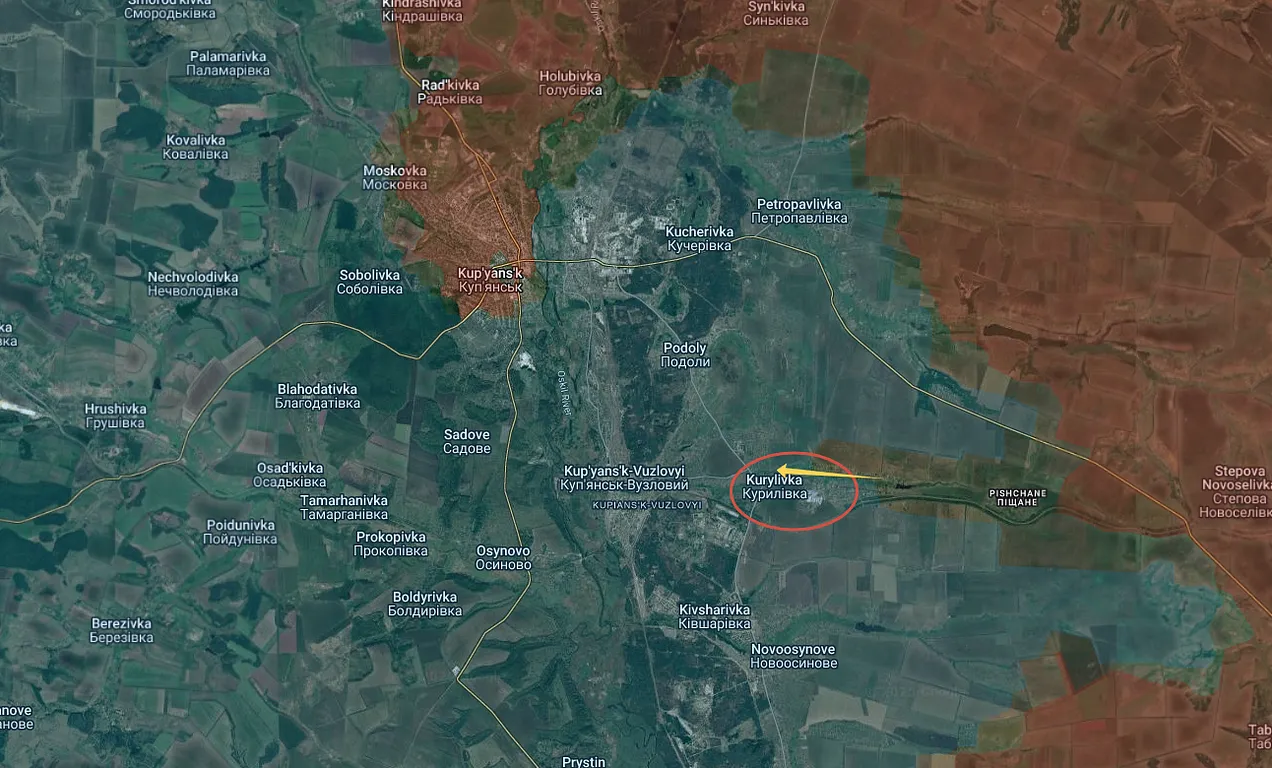
Footnotes from the Ukrainian "Crisis"; New High-Points in Cynicism Part V

User avatar
blindpig
Posts: 14788
Joined: Fri Jul 14, 2017 5:44 pm
Location: Turtle Island
Contact:

Re: Footnotes from the Ukrainian "Crisis"; New High-Points in Cynicism Part V

Post by blindpig » Tue Oct 28, 2025 11:50 am

How Russia Recovered
Posted by @nsanzo ⋅ 10/28/2025

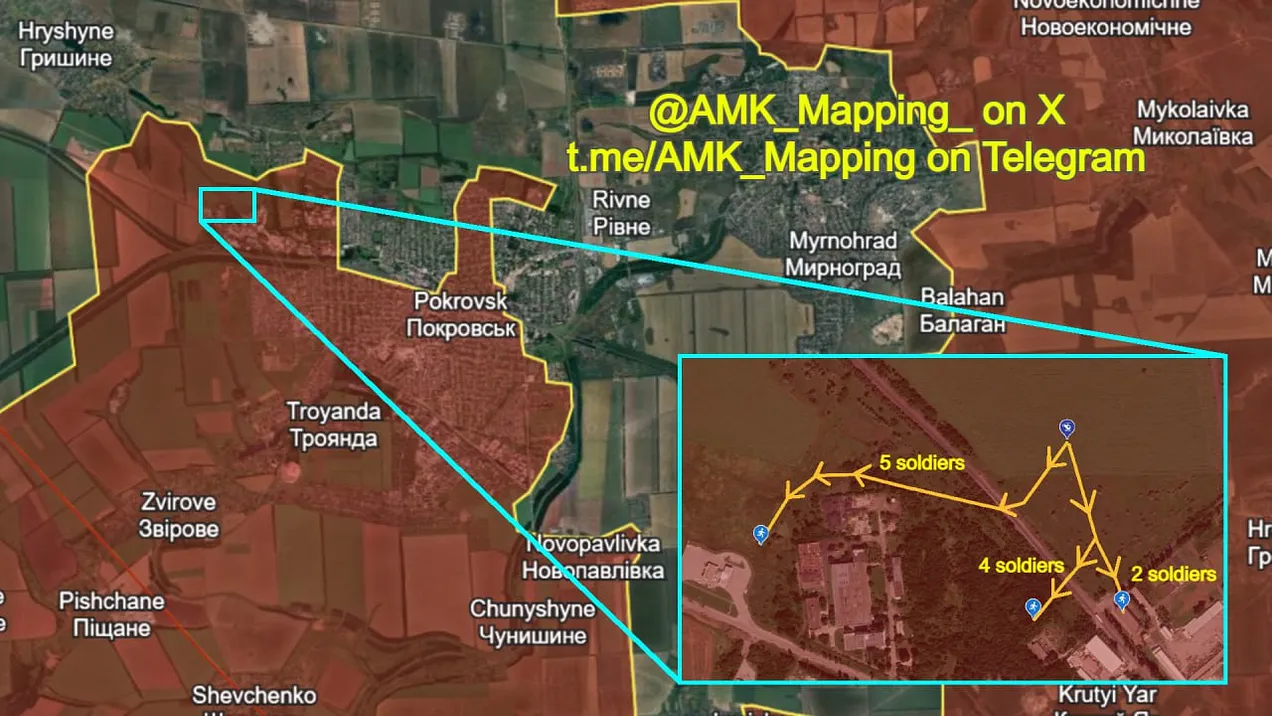
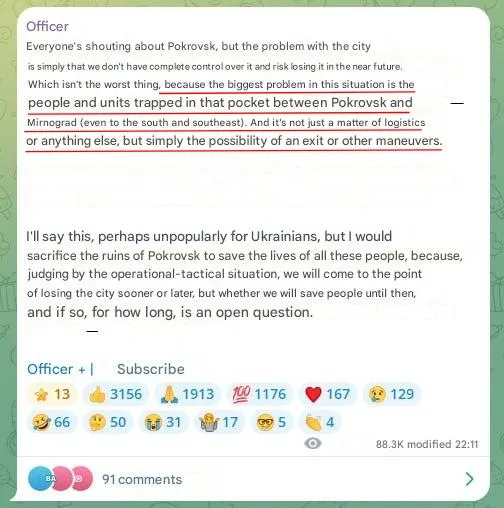
Image

No Russian denials, claims of objectives achieved, excuses for NATO's involvement, or an imbalance of troops in favor of Ukraine can hide at this point the fact that Russia's initial plan for the war failed completely. Russia advanced rapidly through the south and through Luhansk, but stalled at Mariupol and withdrew from kyiv after suffering enormous personnel and material losses without having forced Ukraine to sign a peace agreement or isolated the Ukrainian garrison in Donbass, which was already emerging as the key front in the ground war. What Russia had perceived as a plan for a rapid attack and withdrawal from much of the captured territories—Moscow offered in Istanbul to withdraw from all the territory under its control except for Crimea and Donbass—turned into a high-intensity war that, three and a half years later, has failed to move toward a resolution.

In 2022, the exhausted summer offensive, which regained the initiative after the capture of Popasnaya but petered out after the seizure of Severodonetsk and Lisychansk, gave way to the two heaviest military defeats: the lightning offensive in which Russia lost what had taken months to capture in Kharkiv, and the withdrawal from the capital Kherson in the face of an urban warfare scenario in which its chances of victory were nonexistent. At that moment of greatest weakness, Russia found itself in a position where, had Ukraine and its allies opted to negotiate, its ability to resist would have been limited. However, perceiving Russian weakness as definitive and even alluding to the possibility that Russia could use nuclear weapons—something of which there was never any hint beyond US propaganda—Ukraine's allies chose to seek complete victory. At that point, complete victory would have been possible with a rapid advance across the central front, jeopardizing control of Crimea.

The outcome of the 2023 counteroffensive makes it clear that the West and Ukraine had made a similar mistake to Moscow's in February 2022: underestimating the opponent's resilience, coupled with believing their own propaganda and believing that Russia had no room for improvement. A common thread of Western discourse is to exploit the idea that the Russian government lives in the past, sometimes in the Soviet Union, sometimes in the Russian Empire. This argument is used to portray the Kremlin as archaic, a museum state that simply resembles a black-and-white flashback , incapable of showing itself in color. The danger of propaganda is forgetting that it's useful for the media battle, but it can backfire in the real world, as happened in 2023. Incredibly, this offensive, prepared in Germany in collaboration with the United States and the United Kingdom—as was always known, but not openly discussed until The New York Times revealed it in an extensive report—not only assumed that Russia would be incapable of innovating, but also that it would not be capable of defending itself. Ukraine was surprised by Russia's improvement in areas such as drones, but incredibly also by the fact that Russian troops had prepared railway defense lines and mined the fields where the miracle weapons of that time, German Leopard tanks escorted by numerous Western and Soviet-made armored vehicles, quickly became trapped.

Several articles, most notably one by Stephen Biddle published in Foreign Affairs , have already explained some of the reasons why Ukraine failed to break through the Zaporozhye front, where the composition of the front made it obvious that the counteroffensive was going to come, but there has not been much analysis of how Russia overcame its failed initial phase. Limiting the fact that Russia had been eight years behind Ukraine, whose army had already been tested in the trenches of Donbass and in the essentially land-based and almost hand-to-hand warfare that were the first months of the Russo-Ukrainian war, explains only part of the reasons why Russian troops did not meet any of the expectations that would be expected of what has traditionally been considered the second largest army in the world . This definition, which Ukraine periodically reuses to exaggerate its successes or frighten its allies with the risk of failure and thus obtain more funding and weapons, makes possible the constant repetition of the idea that Moscow expected to win the war in 72 hours, something that, despite having become dogma—Trump has slightly modified it to a timeframe of one week, but adheres to the same theory—was never a Russian objective. What's more, the phrase comes from the American Mike Milley.

In any case, the relative improvement in the Russian troops' strength cannot hide the corruption that has taken hold in the military sector during the years of capitalist restoration—which has cost a significant portion of the Defense Ministry's high command their jobs—nor can it hide the fact that, like any other European army, the emphasis in recent decades has been on producing weapons to sell at international military fairs rather than maintaining a certain level of training. In this regard, Ukraine's advantage and its experience in the Donbass war were an asset in its favor that Russia didn't even consider possible. Russia went to war with an insufficient contingent, an army whose theoretical numbers didn't correspond to the real ones, with no combat experience and lacking essential elements of modern warfare such as drones. And yet it was able to overcome, partly at the cost of enormous casualties in the initial months and a defensive preparation effort that was not part of the General Staff's plans, to halt the Ukrainian offensive and regain the initiative, something that in November 2022 was impossible to imagine for Ukraine and, above all, for its Western allies.

“The result has been new battlefield tactics—codified in training programs and combat manuals—and better weapons,” writes Dara Massicot, a military analyst with extensive experience from the Department of Defense to the RAND Corporation and currently the Carnegie Endowment for International Peace, in the latest issue of the influential magazine Foreign Affairs . Her article, unambiguously titled, “How Russia Bounced Back,” aims to coldly show how Moscow has recovered from its initial failures. It does so primarily to alert the West to what it needs to learn and also to the areas in which Russia remains vulnerable, although at times she errs in what she criticizes: a lack of critical thinking when analyzing data. Massicot clings, for example, to casualty data provided by Western countries, which can in no way be considered impartial, or to the idea of ​​human hordes attacking without their lives having any value to the Russian command. The current reality of the front, where large convoys or attack contingents have disappeared in favor of small assault groups, reveals a fundamental difference between the battles of Arytomovsk-Bakhmut and Pokrovsk-Krasnoarmeisk that is not reflected in the article. However, it is one of the most serious examples of an attempt to analyze the change that these three years of trench warfare and the changes required to adapt to modern warfare have brought to the Russian army.

Massicot admits substantial improvements—although not always enough to match Ukraine, which, like every Western analyst, is given an advantage due to the higher quality that, as established dogma, is attributed to its military equipment—in each of the key aspects of the war: troop training and preparation, tactical instruction of lower-ranking officers, vehicle armor, logistics, precision, development of modern weapons adapted to the front (especially drones, an area in which she admits the success of units created from scratch like Rubicon, although always claiming that they are outclassed by equivalent Ukrainian units, whose publications deny this version and admit Russian superiority), and weapons production. Summarizing her argument, the analyst indicates that “Moscow has developed new ways to use drones to locate and kill Ukrainian soldiers and destroy Ukrainian assets, turning what was once a weakness into a strength. It has built better missiles and created more resilient and capable armored systems. It is giving subordinate commanders more freedom to plan.”

The consequence is clear: the Russian military has become an organization “capable of both evolving during this war and preparing for future high-tech conflicts. Because of these changes, Ukraine is likely to face even greater destruction in the coming months. It will have to cope with faster and more numerous Russian drone attacks, causing more damage to cities, civilians, and critical infrastructure. More missiles will penetrate Ukraine’s defenses. The ten miles leading to the front, already very dangerous, will become even more dangerous and difficult to traverse. These changes may not represent any dramatic breakthroughs for Russia, thanks to Ukraine’s defenses and intense drone and artillery attacks. But they do mean that Moscow can continue sacrificing the lives of its soldiers in exchange for slow progress in the Donbas, hoping that NATO will tire of the conflict.” With this analysis, Massicot points to the continuation of a war of attrition that has changed substantially, although he refuses to see that it has also changed in the use of personnel, and that no battle is being fought with large numbers of soldiers, but rather through the saturation of defenses with artillery and drones.

Obviously, any technological or tactical progress by a battle-hardened army carries with it a geopolitical aspect that should concern those who fear or aspire to become its opponents. Hence, one of the main objectives of the article is to help the West confront this potential military threat from the recovering Russian army. “The Russian army will emerge from its invasion with extensive experience and a clear vision of the future of combat, and it is sharing its experience with China, Iran, and North Korea. It has laid the groundwork for a more intense period of learning and reconstruction after the war's end. Russia will continue to be limited by its poor discipline and will struggle to produce the most sophisticated equipment. But it will be as prepared for the new form of warfare as any other state, despite its resource limitations,” it notes, once again indulging in the commonplace of indiscipline—despite the notorious examples existing on the other side of the front, with its enormous desertion rate, incomparable to Russia's—but pointing to areas where Russian improvements could overtake the West. Of course, mention cannot be made of Russia's potential allies, including Iran, a partner so close that neither Russia nor China came to its aid militarily when it was attacked by Israel last summer.

“If they don't want to be left behind, Washington and European capitals must start learning from the war in Ukraine, rather than turning their backs on it. Instead of dismissing it, they must study what Russia is studying and then begin making their own changes,” he concludes. “To avoid being left behind, the United States and Europe must start paying more attention, especially as Moscow is passing on its knowledge to its autocratic partners. But that means they must see the Russian military for what it is: imperfect, but resilient in its own way. Its structural problems are very real and would be especially acute in the event of a conflict with NATO. However, its learning process is relentless,” he adds, insisting on an axis of alliances that doesn't exist—China doesn't need Russia to share information to learn from this war—and unable to escape the cliché that the Russian military is tremendously dangerous but, at the same time, clearly inferior to NATO's.

“The Russian armed forces will continue to modify their tactics, introduce new weapons, and expand as they begin a decade-long rebuilding effort. Experts like to say that militaries shape war. But war also shapes militaries,” he concludes cautionarily. The reality is that only two militaries, the Russian and the Ukrainian, are currently in a position to provide lessons on modern warfare as it is currently being waged. Attempting to sink Russia on the battlefield implies, in a kind of action-reaction, the Russian need to solve structural problems and modernize its weapons and tactics in ways it would not have achieved otherwise. And in another detail that escapes European leaders who blithely speak of peace as more dangerous than war, only Russia is carrying out this process in a war that bears no comparison to any that NATO countries have fought, which have always faced decaying armies, guerrillas, or armed formations over which they enjoyed almost complete air superiority.

https://slavyangrad.es/2025/10/28/como- ... -recupero/

Google Translator

*******

Brief Frontline Report – October 27th, 2025

Report by Marat Khairullin and Mikhail Popov.
Zinderneuf
Oct 27, 2025

Image
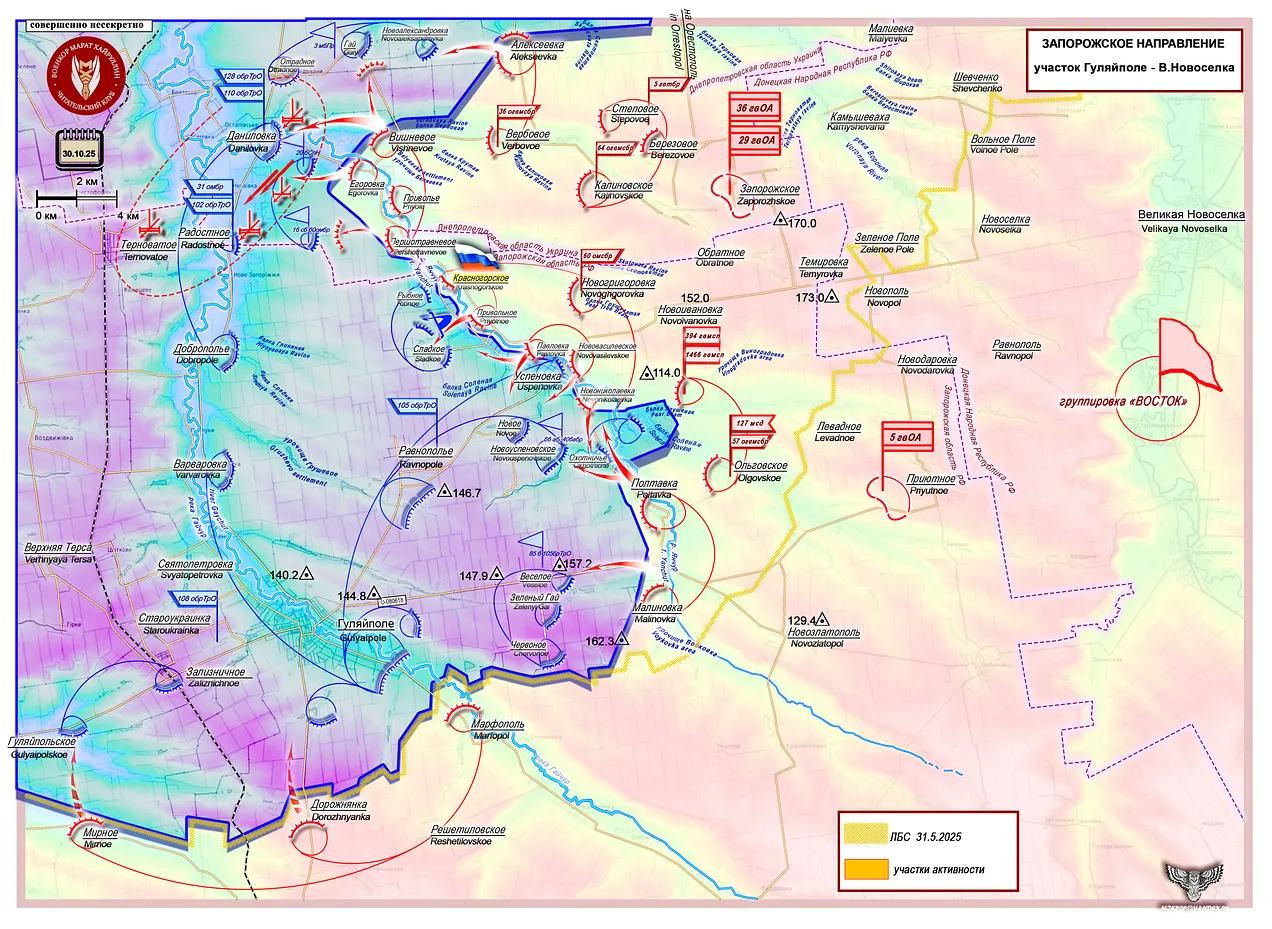
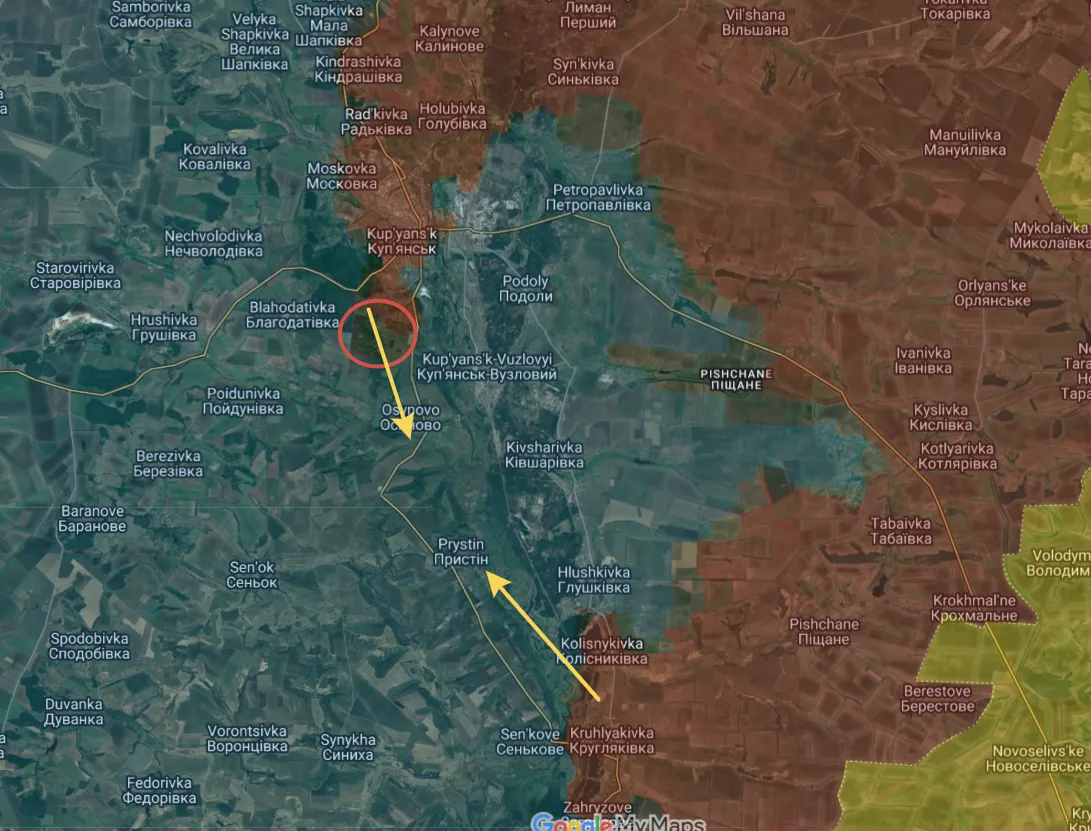
ЛБС 31.5.2025=Line of Combat Contact May 31st, 2025. Участки Активности=Area of Activity.

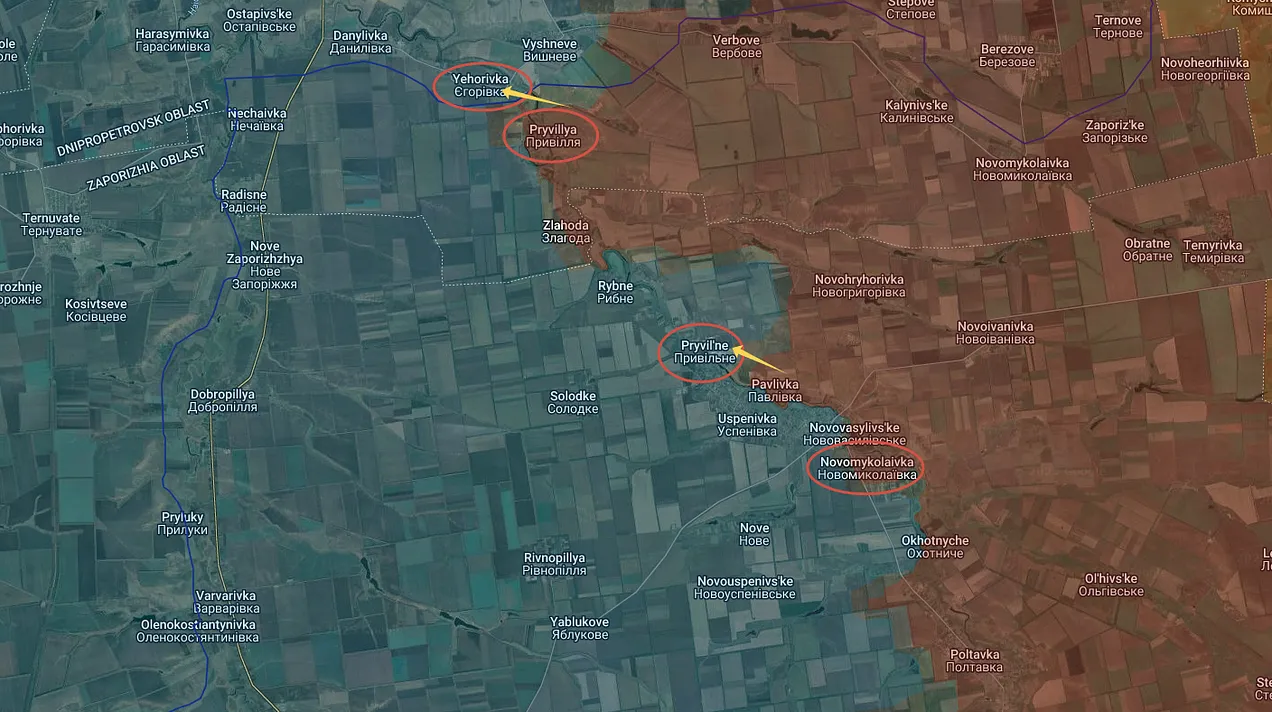
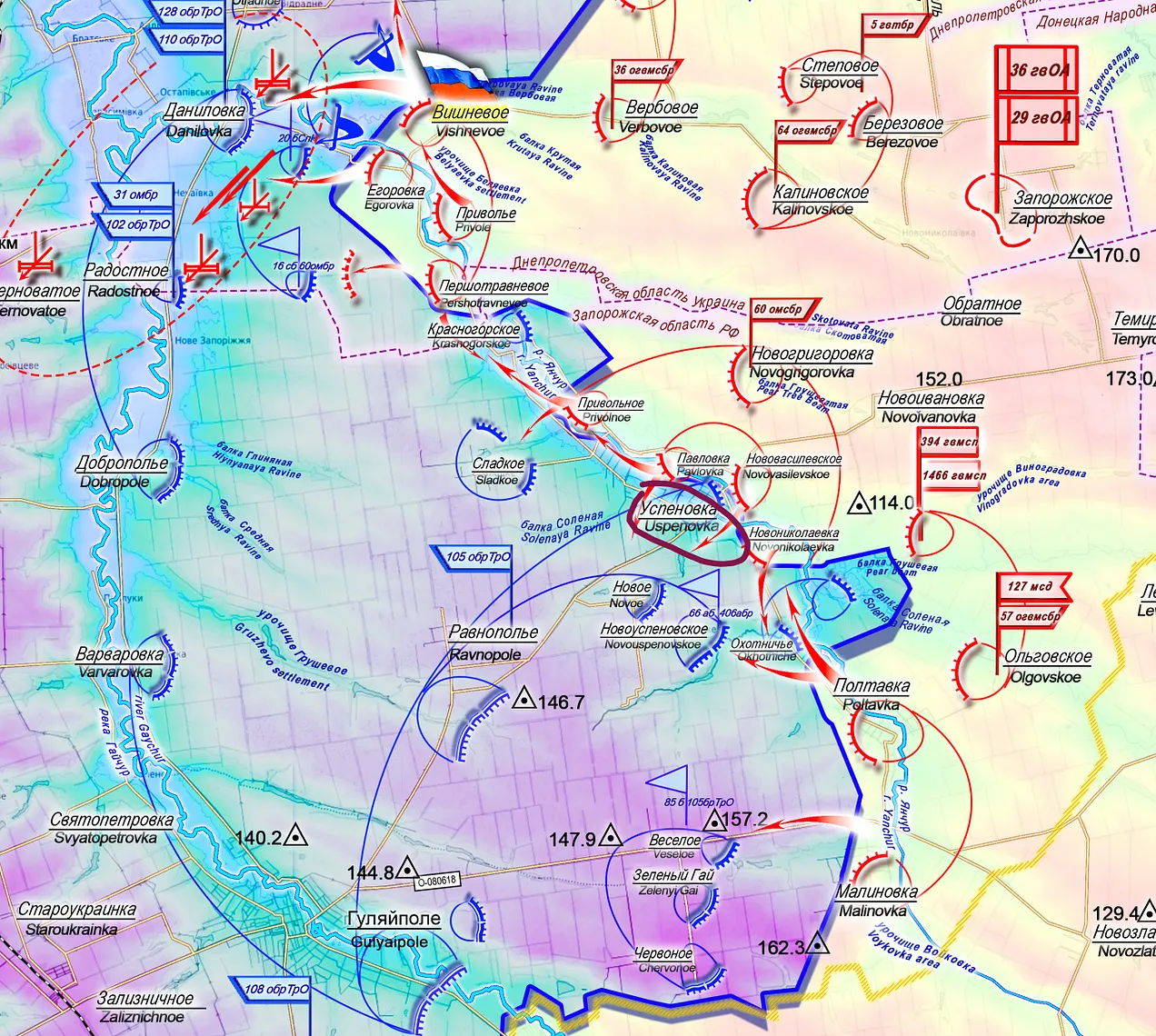
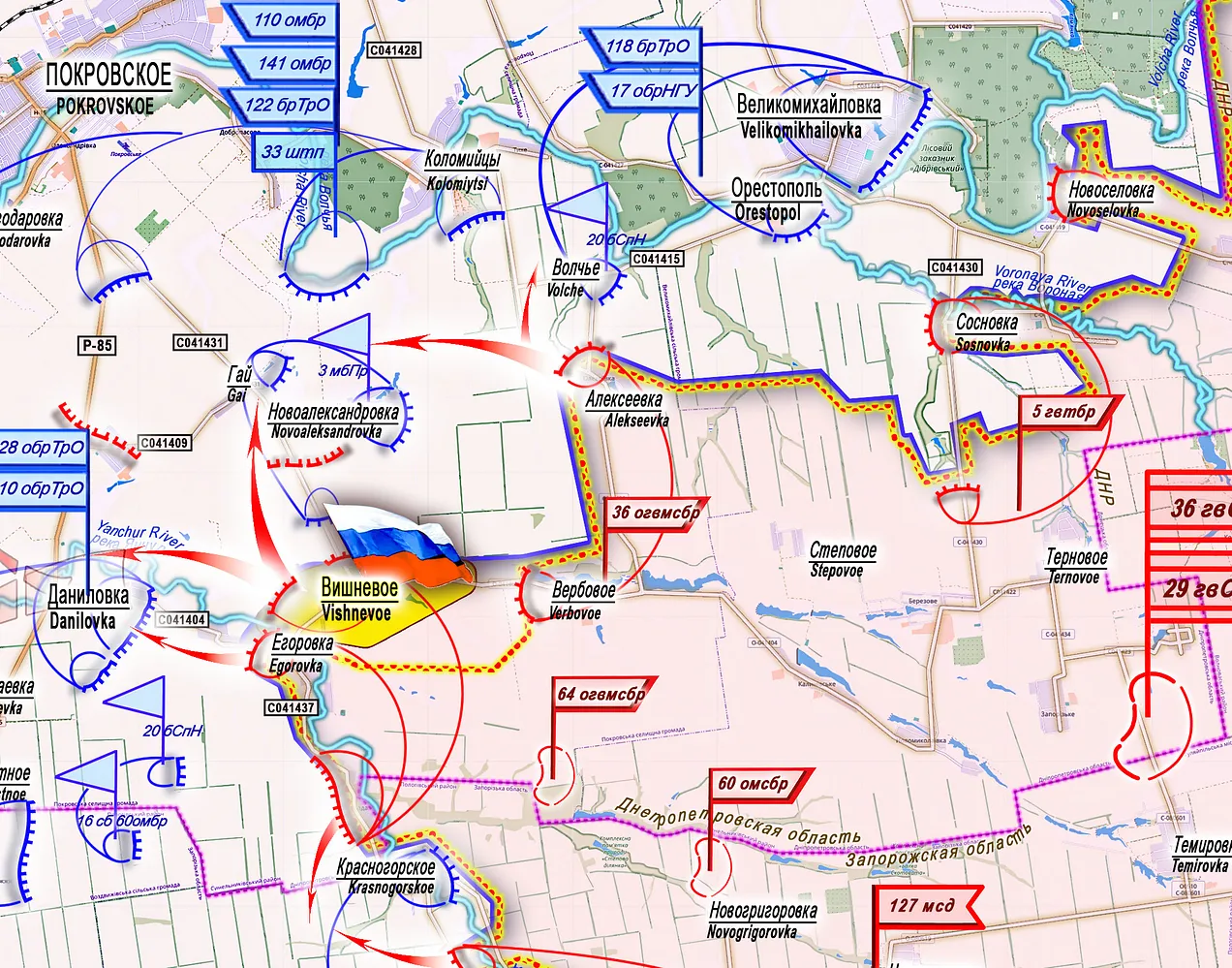
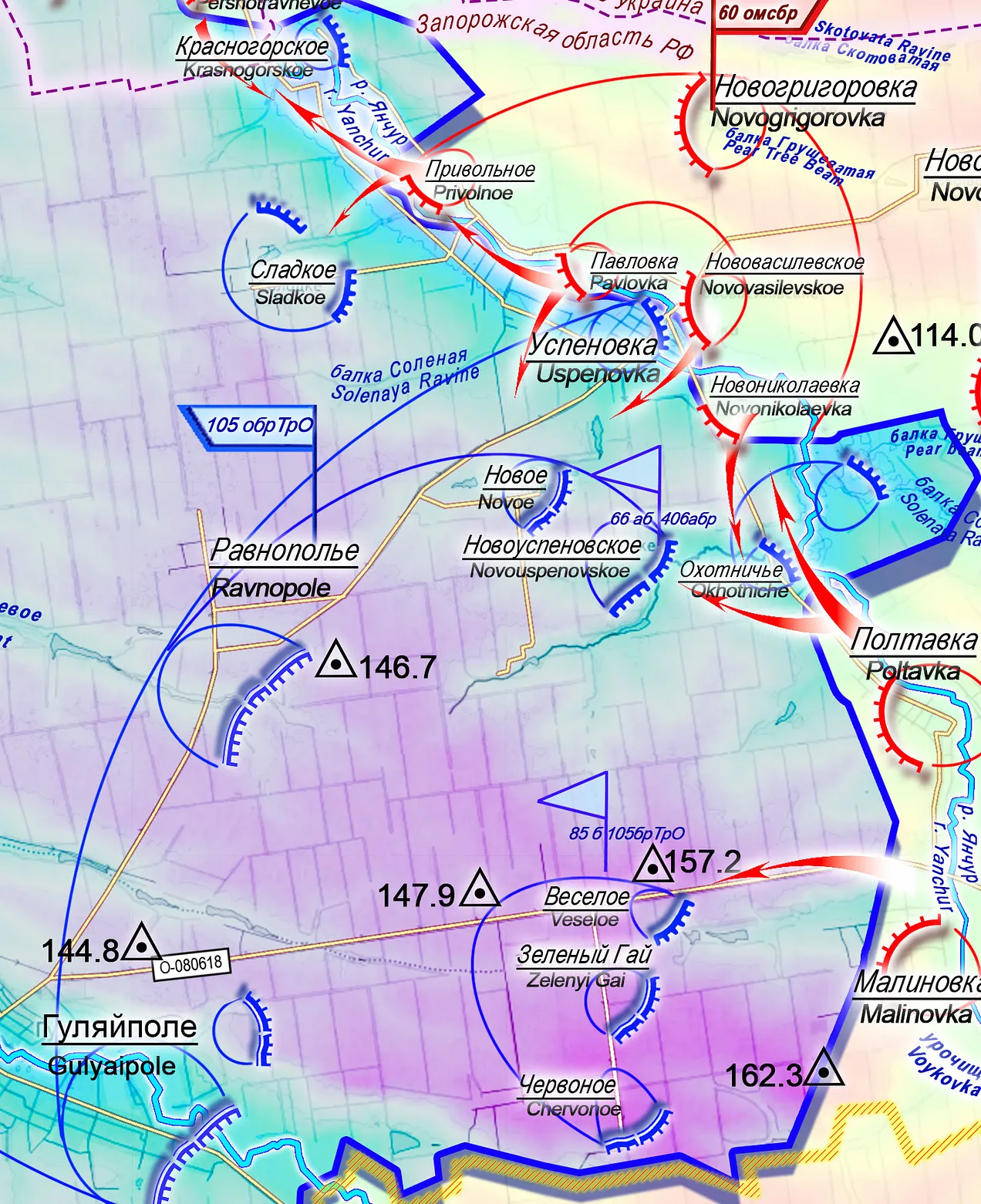
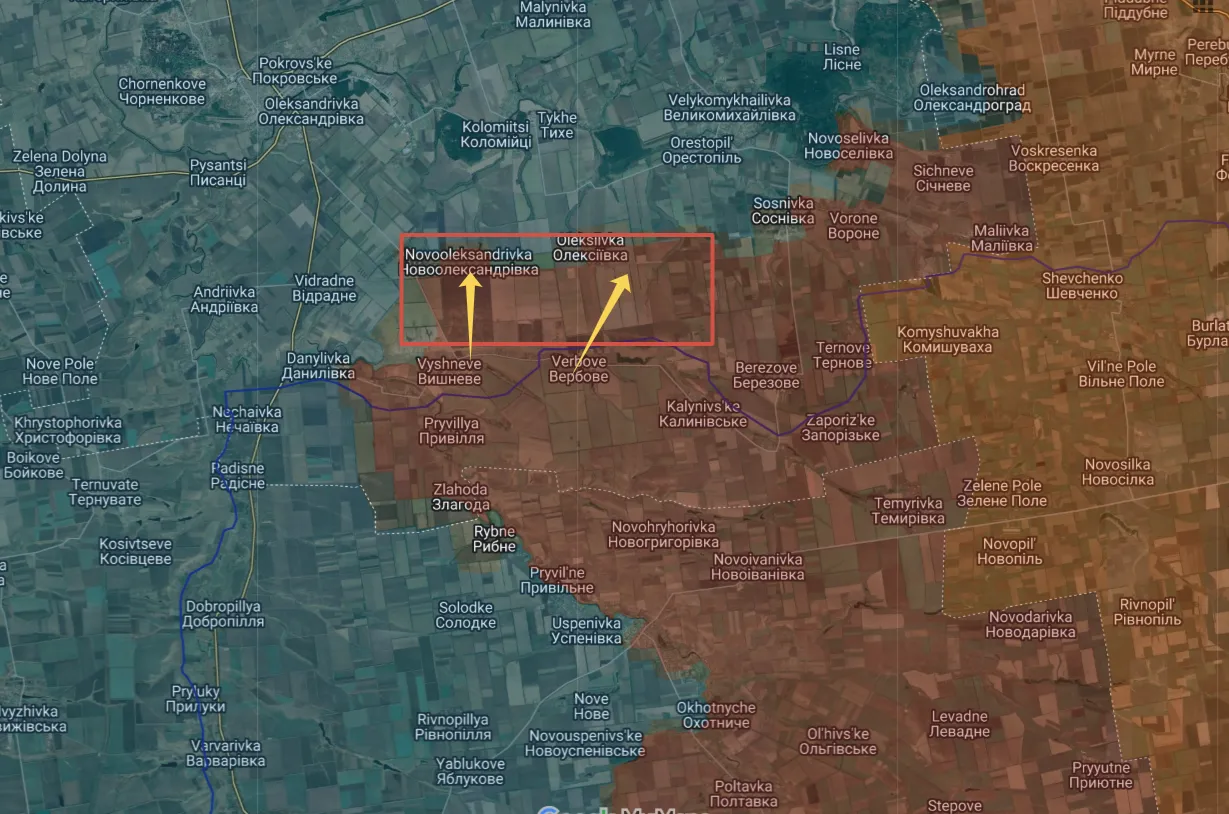
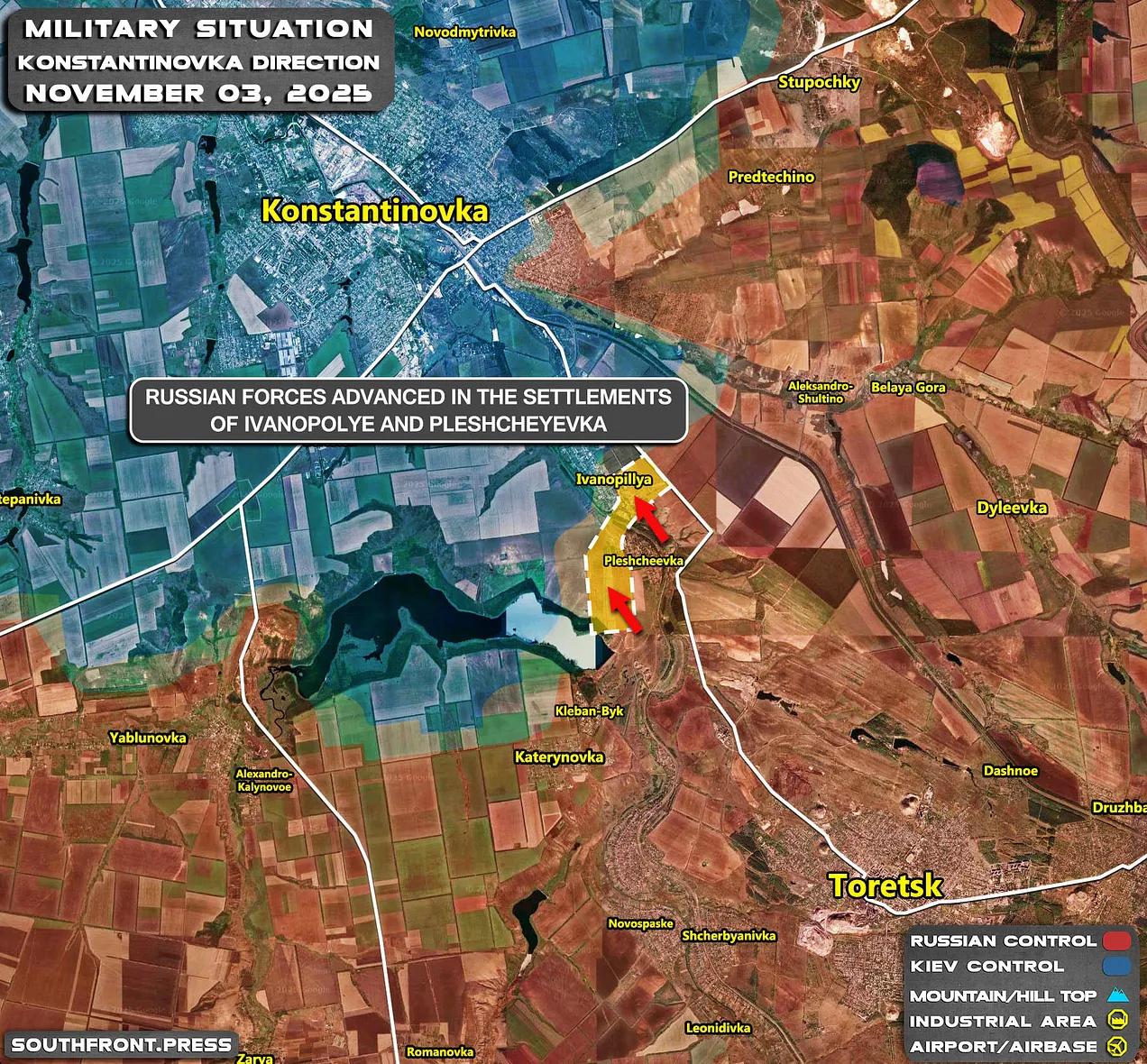
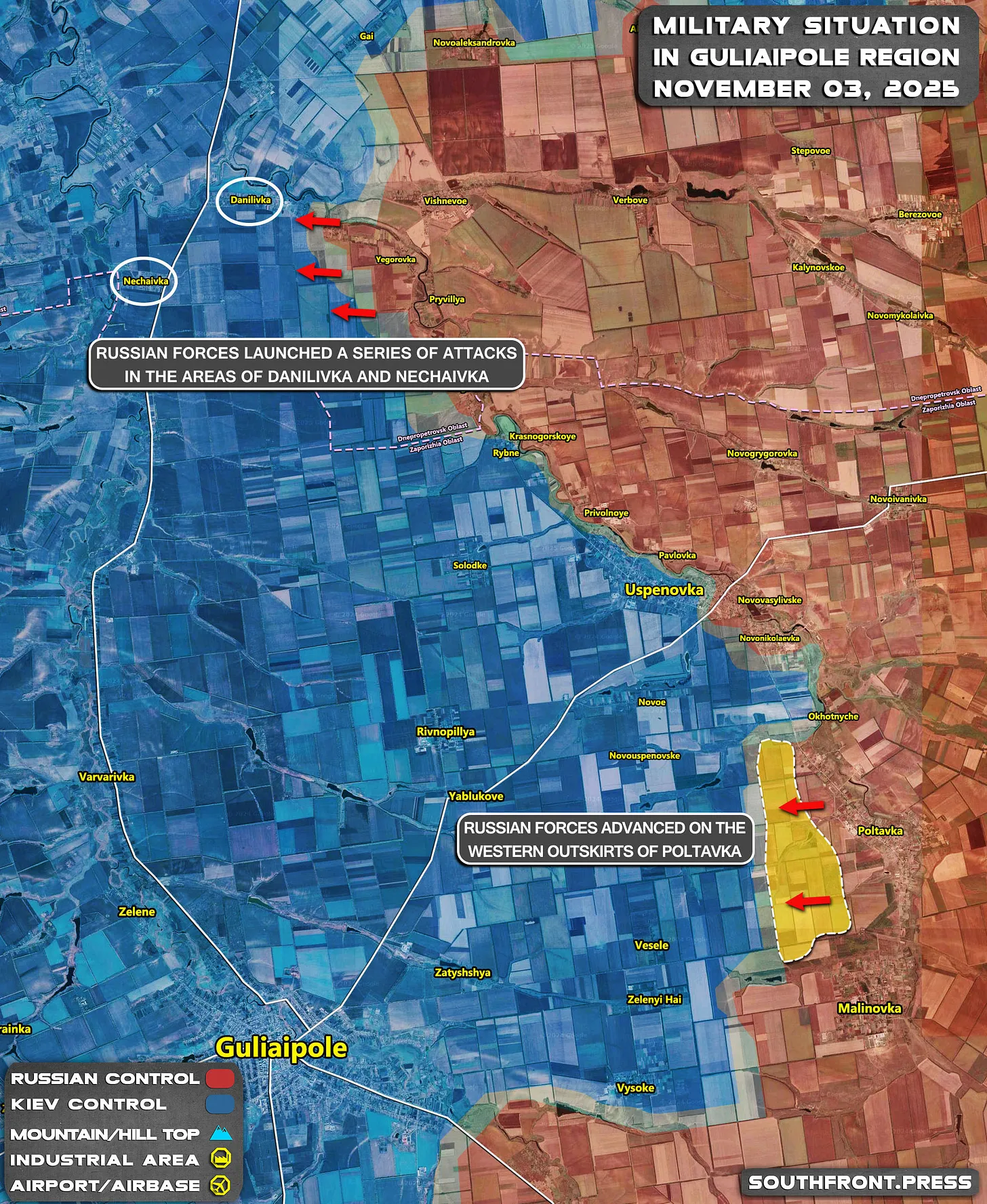
Message from the Ministry of Defense of the Russian Federation: "Servicemen of the 64th Guards Separate Motorized Rifle Brigade liberated the settlement of Egorovka in the Dnepropetrovsk region, and assault troops of the 60th Separate Motorized Rifle Brigade and guards-reconnaissance units of the group established control over the settlements of Privolnoe and Novonikolaevka in the Zaporozhye region. During the battles, enemy positions, fortifications, and equipment were destroyed."

Image

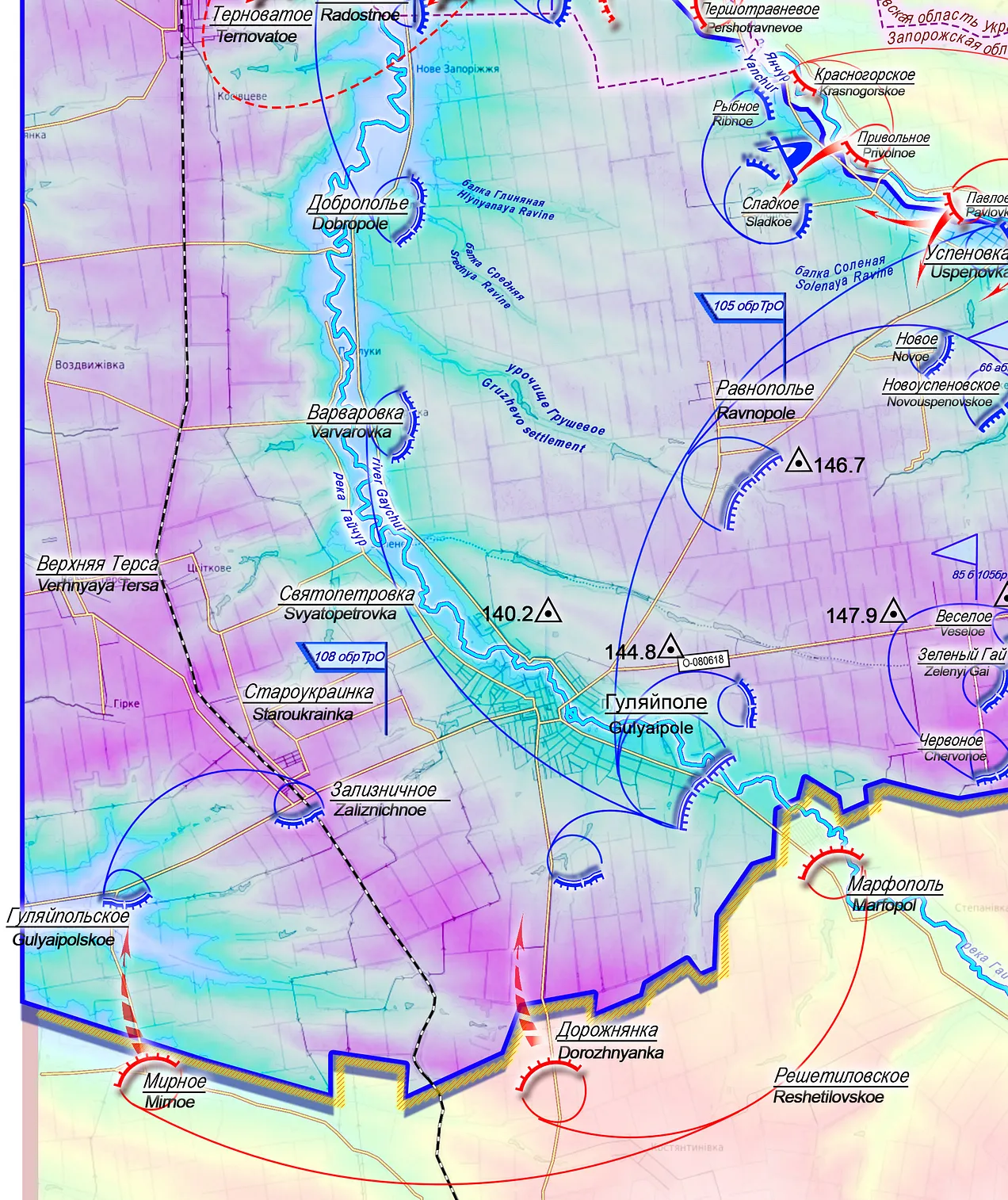
The line of defense for the Armed Forces of Ukraine along the Yanchur River from the settlement of Vishnevoe to the settlement of Uspenovka has practically collapsed. The village of Egorovka (47°52′00″ N, 36°17′24″ E, about 180 residents) is located on the left (western) bank of the Yanchur River, 2 kilometers north of the village of Pershotravnevoe, which was liberated on October 24. It controls the road junction Danilovka-Egorovka-Vishnevoe-Pokrovskoe and Pokrovskoe-Danilovka-Egorovka-Uspenovka.

The northern section of the Ukrainian defense node along the Gaychur River is cut off from the defense line along the Yanchur River. Assault groups of the Russian Armed Forces are advancing around the southern flank to the outskirts of Vishnevoe, which is the southern defense area of the Novoaleksandrovka-Gaiy-Vishnevoe node that ensures communication and supply for the Uspenovka-Gulyaipole section of the Zaporozhye direction.

Activation of the Alekseevka-Novoaleksandrovka-Gaiy line is quite likely to encircle Vishnevoe to the north.

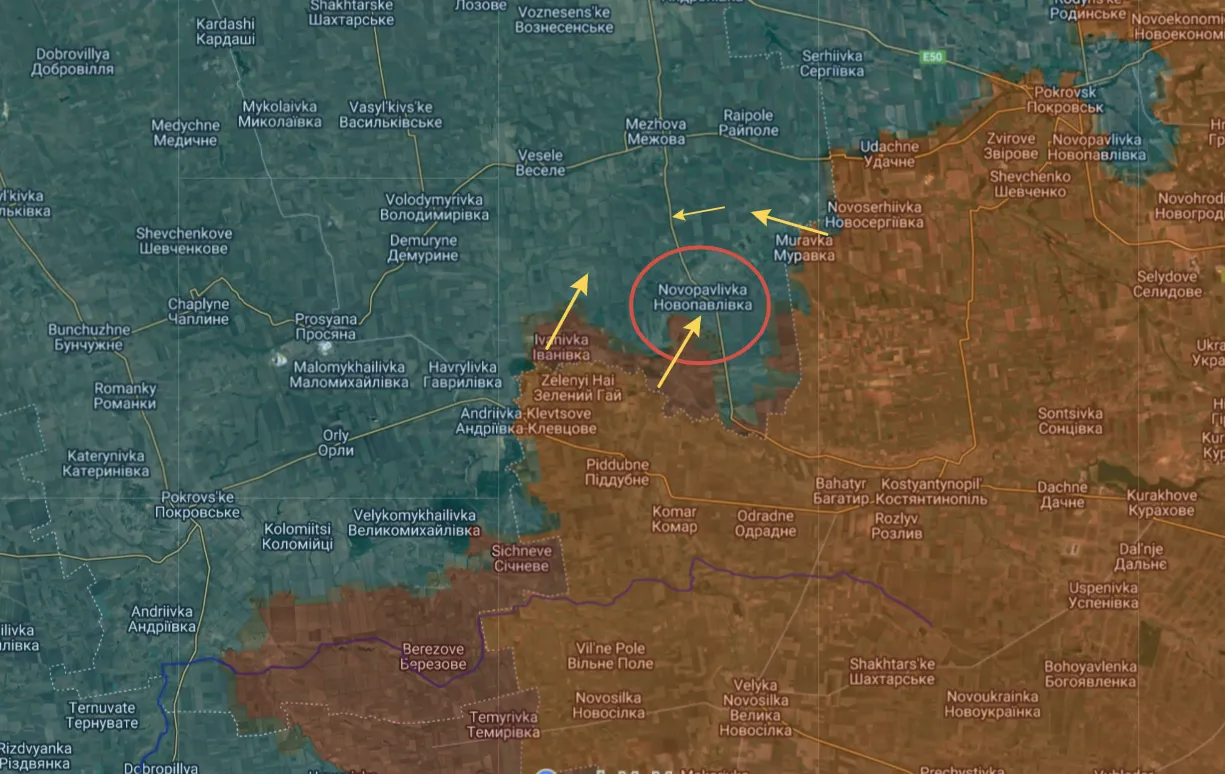
South of this, a small settlement Privolnoe (47°48′10″ N, 36°22′11″ E, about 20 residents) was liberated. It is located on the right (eastern) bank of the Yanchur River. The stronghold in this settlement controls the road and communication of Ukrainian positions on the left bank of the Yanchur River (Egorovka-Sladkoe) with positions on the right bank (Krasnogorskoe [misspelled Krasnogorodskoe on the map*]-Privolnoe-Uspenovka).

Image

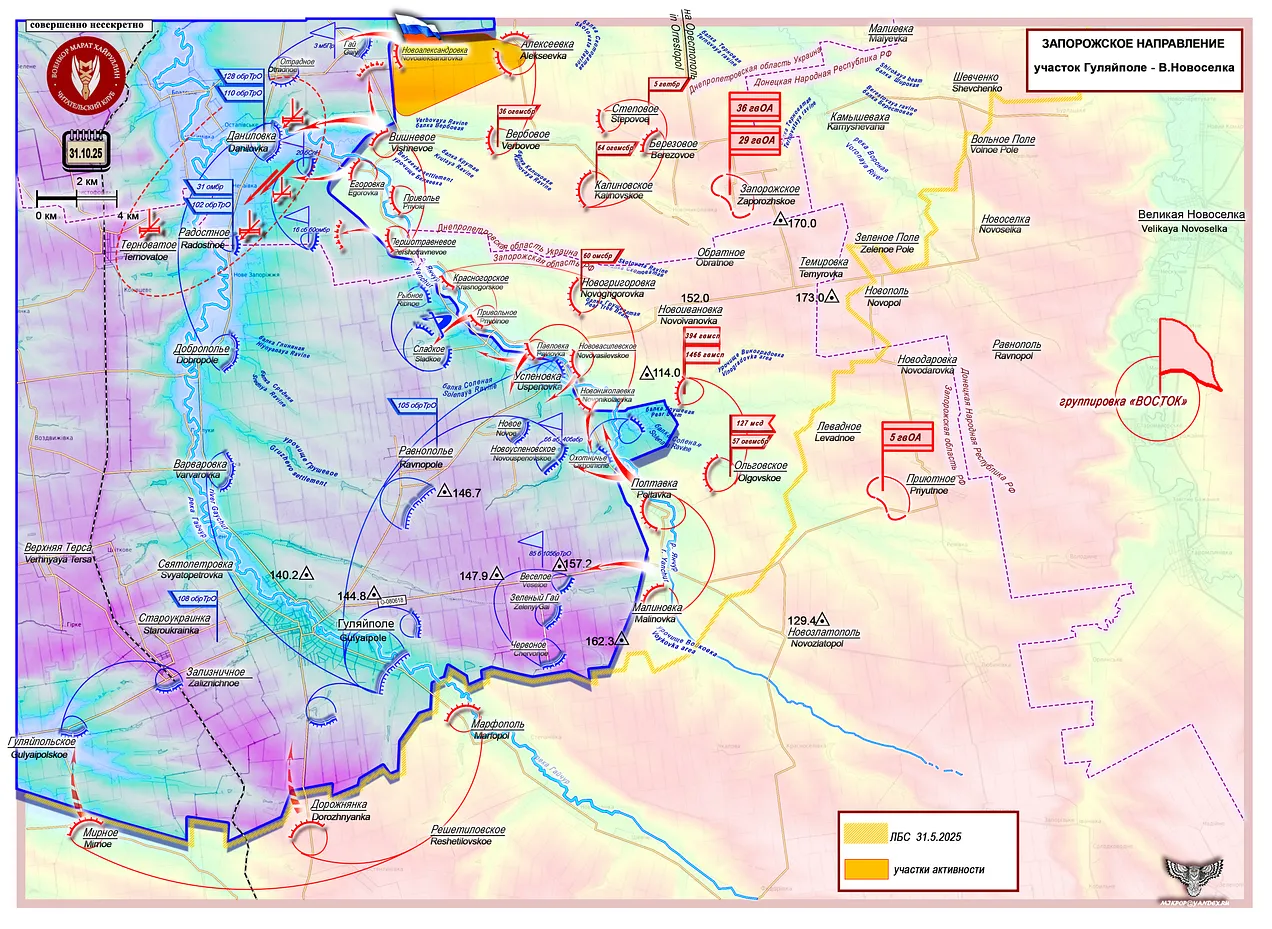
On another section, the interaction and communication of the Nazi defense line are disrupted, which is effectively breaking into segments to be destroyed.

South of the Ukrainian defense node settlement Uspenovka, with access to the left bank of the river, the large settlement Novonikolaevka (47°46′05″ N, 36°26′23″ E, about 450 residents) was liberated, directly adjacent to Uspenovka. The connection of two sections of the left flank of the Russian Armed Forces group (Novonikolaevka-Poltavka) is hindered by enemy positions equipped on the right bank of the river at the exits of the Grushevaya Beam (Pear Beam) and Solenaya ravine, which are supplied from the left bank, from the area of Ravnopole-Novoe-Novouspenovskoe-Okhotniche. The bridgehead in Novonikolaevka ensures the solution of this task and also allows a southern encirclement of Uspenovka with blocking of the Uspenovka-Ravnopole-Gulyaipole route, isolating another section of the Ukrainian Armed Forces and its elimination.

*Entirely Zin's fault!

https://maratkhairullin.substack.com/p/ ... tober-27th

******

Living Dangerously

Russo-Ukrainian War: Autumn 2025
Big Serge
Oct 27, 2025
Image

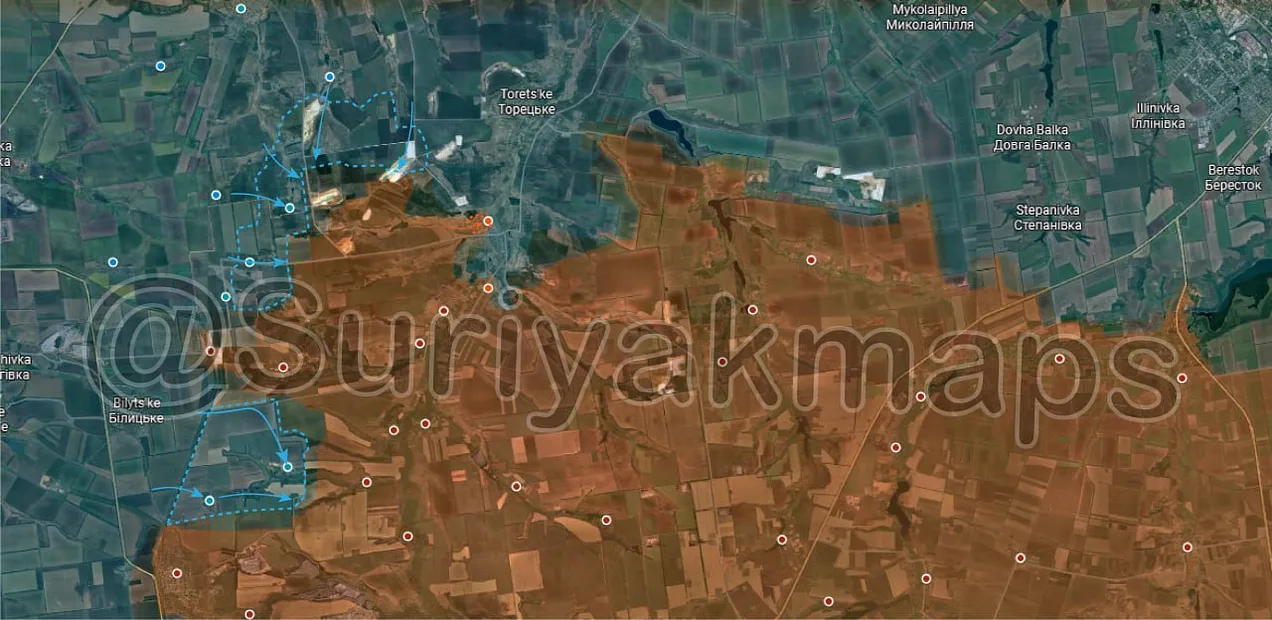
The Russo-Ukrainian War seems to have been engineered in a laboratory to frustrate people with repetition and analytic paralysis. Headlines appear to be circulating on a choreographed loop, all the way down to the place names. Kaja Kallas at the European Commission recently announced, without a hint of irony, that Europe’s new sanctions package - the 19th one - is the toughest yet. Ukraine’s supporters are insisting that Tomahawk missiles are the weapons system that will finally change the game and break the war decisively in Kiev’s favor - reiterating the same grandiose claims that they made about GLMRS, and Leopards, and Abrams, and F-16s, and Storm Shadows, and ATACMs, and virtually every other piece of military hardware in NATO’s inventories. On the ground, Russia is attacking settlements named Pokrovsk and Pokrovs’ke; it recently captured Toretsk and Tors’ke and is now attacking Torets’ke. The more things change, the more things stay the same.

The analytic frameworks applied to the war have also changed relatively little, buried and obfuscated by the nebulous concept of attrition. On the Ukrainian side, there is continued insistence that Russia is suffering exorbitant losses and straining under the pressure of Ukrainian deep strikes, while Ukrainian setbacks are blamed in large part on the failure of the United States to expand its largesse and give Ukraine everything it needs. Many pro-Russian lines of thinking mirror this and suppose that the AFU is on the verge of disintegration, while the Kremlin is accused of failing to “take the gloves off”, particularly in regards to the Ukrainian energy grid, Dnieper bridges, and dams.

The result is a very strange sort of war. This is an extraordinarily high-intensity ground war. Both armies remain in the field, holding hundreds of miles of continuous front after years of bloody fighting. Both armies are (depending on who you ask) taking unsustainable casualties which ought to lead to collapse soon, and yet Moscow, Keiv, and Washington are all (again, depending on who you ask) guilty of failing to take the war seriously enough. All of this is maddeningly repetitive, and one could be forgiven for tuning out entirely. Even the diplomatic tango between Trump, Zelensky, and Putin, after delivering a few entertaining moments, failed to really move the needle in any discernable direction.

Few would argue that the trajectory of the war changed in an obviously dramatic way in 2025, and it is important to avoid the worn out and clichéd language about “turning points” or “collapse” or any such silly thing. However, 2025 saw several shifts in the war, which will hardly ostentatious or dramatic, are nevertheless very important. 2025 has been the first year of the war in which Ukraine launched no ground offensives or proactive operations of its own. This fact is not only a hint at the threadbare state of Ukraine’s ground forces, but also a testament to the way Russian forces transformed “attrition” from a buzzword into a method of persistent pressure across a variety of axes this year.

In lieu of initiative on the ground, and facing a slow but relentless rollback of their defenses in the Donbas, the theory of Ukrainian victory has shifted in an unacknowledged but dramatic way. After years of insisting that it would achieve maximal territorial integrity - an outcome which would require the total and decisive defeat of Russia’s ground forces - Ukraine has reframed its path to victory mainly as a process of inflicting strategic costs on Russia that mount until the Kremlin agrees to a ceasefire. Consequentially, the debate about arming Ukraine has shifted from a conversation about armor and artillery - equipment useful for retaking lost territories - to a discussion about deep striking weapons like Tomahawks, which can be used to shoot at Russian oil refineries and energy infrastructure. In short, rather than move to prevent Russian from achieving immediate operational objectives in the Donbas, Ukraine and its sponsors are now seeking ways to make Russia pay a price such that victory on the ground is no longer worth it. It is unclear whether they have thought about what price Ukraine will pay in the exchange. Perhaps they do not care.

About Tomahawks
Notwithstanding Ukraine’s attempts to jumpstart indigenous production, it is inevitable that Ukrainian capabilities will be largely determined by the largesse of western sponsors. This aspect of the war took a sudden turn at the beginning of the October when fresh reporting began to circulate that Tomahawk missiles might be on the table for Ukraine. Tomahawks have always been on Ukraine’s wish list (given that the Ukrainian wish list as such consists of essentially all the military equipment in NATO’s combined inventories) but this was the first reporting that they might be under serious consideration.

As is frequently the case, the discussion spiraled away from realistic grounding, with some suggesting that the Tomahawk would be a “game changer” for Ukraine (where have we heard that before?) and the pro-Russian sphere dismissing it as an irrelevant distraction. There’s a tendency to focus on the quality of American weapons systems, casting them as either unrivaled technological marvels or overhyped and overpriced baubles, but this is generally not productive and largely irrelevant to the matter at hand. The Tomahawk, broadly speaking, is exactly as advertised, and provides proven and reliable strike capability at strategic depths in excess of 1,000 miles. In role, range, and payload it is essentially an analog to Russia’s Kalibr missiles (I am begging the enthusiasts to note the phrase “essentially an analog” rather than rake me over the coals over the different guidance systems and other technical minutia). Such a system will always be valuable and would obviously improve Ukraine’s deep strike capabilities.

The “problem” with Tomahawks does not relate to any “problem” with the missile itself, but with its availability and Ukraine’s technical capability to launch them. The Tomahawk is conventionally a ship-launched missile (there is no extant air-launched variant) with a few novel options for ground launch. Ukraine, obviously, would require ground launch systems, and the problem is that these systems are essentially brand new and available in very limited quantities: more importantly, American service branches are in the process of trying to build out these capabilities throughout the decade. Providing ground-launchable Tomahawks to Ukraine in any meaningful numbers would therefore essentially require the US Army and Marines to scrap their own force buildout plans.

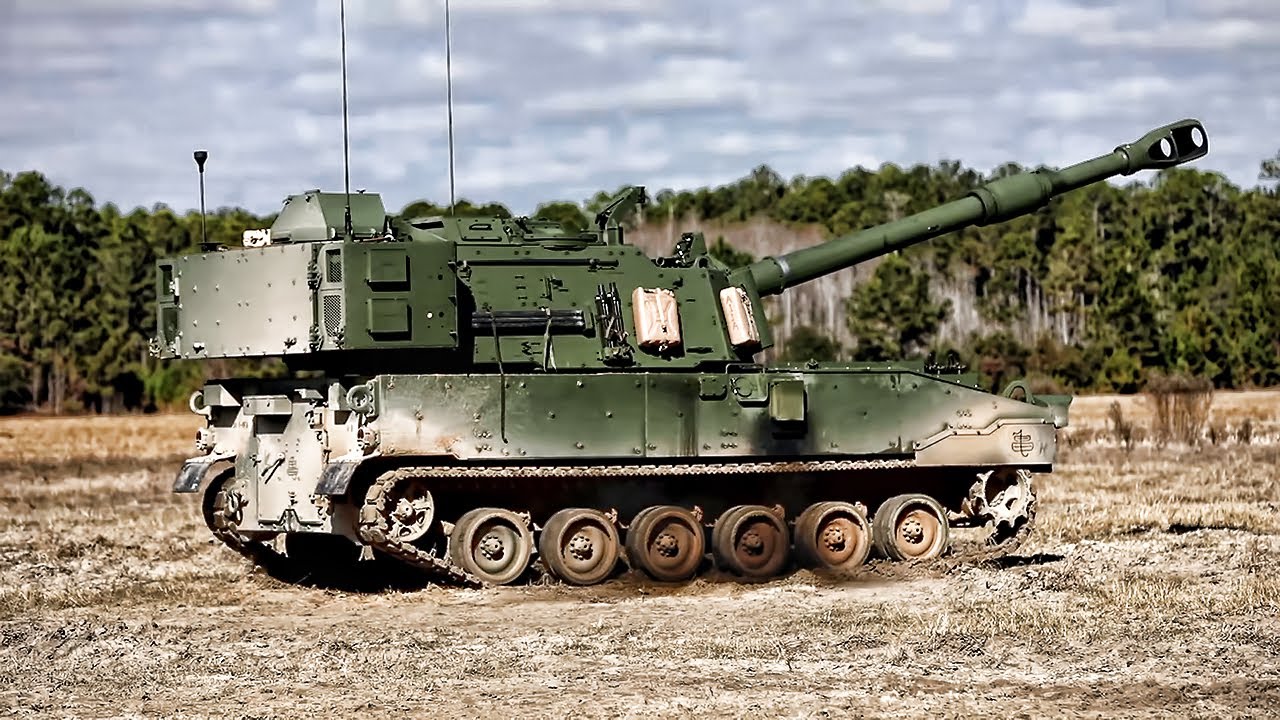
There are two basic options for ground launching Tomahawks. One of these is the US Army’s MRC (Mid-Range Capability) Launcher, dubbed the Typhon. This is an enormous tractor-trailer launcher with four launch tubes, first delivered in 2023. It has an enormous footprint - so large, apparently, that the Army is already asking for a smaller replacement - and is intended to give the Army an organic fires component in the gap between the shorter range Precision Strike Missile and hypersonic systems (which do not yet exist). The critical fact is this: the Army intends to field a total of five Typhon batteries by 2028, of which two have been delivered so far. Each battery consists in turn of four launchers, implying that eight out of a planned twenty launchers have been delivered. Even more importantly, both of the currently operational batteries are already deployed, with one in the Philippines and one in Japan. These systems are being actively used in exercises and trials, including an exercise this summer in Australia.

Image
The Typhon system gives ground launch capability to the Tomahawk but brings a massive footprint

The situation with the Marine Corps’ launch system is quite similar, although the launch platforms themselves could not be more different. Unlike the lumbering Typhon tractor trailer, the Marines are fielding a significantly more lithe and compact LMSL system, with the tradeoff of a single launch tube compared to the Typhon’s four. What matters is not so much the technical differences, as the fact that the Marines - like the Army - only received their first deliveries in 2023, and they are currently in the process of building out the force. In the case of the marines, the goal is to have a Tomahawk battalion built out by 2030. In fact, the production contract came into effect as recently as 2025.

What does all of that mean? It means that, although the Tomahawk itself is a fine missile, the systems for ground launch are so new and available in such limited quantities that equipping Ukraine with Tomahawks would require either the US Army or the Marines to materially alter their force structure in the near term (through 2030, essentially). These are essentially the opposite of much of the gear that’s been given to Ukraine to this point: far from being inventories of older systems that can be earmarked as surplus or tabbed for replacement, Tomahawk ground launch is a brand new capability that is in the middle of deployment and buildout for the first time.

This is, of course, a layered complication on top of Tomahawk quantities in and of themselves. The issue of Tomahawk availability is both over and under emphasized, depending on the context. The United States has something like 4,000 Tomahawks in its inventories (although half of these are currently inside their cells on American ships), so it is not quite correct to say (as some have) that America is running out of these critical weapons. The issue is that production rates are relatively anemic (generally between 55 and 90 per year) and are fail to replenish the expenditure from even relatively brief strike campaigns, such as the repeated strikes on Yemen. Broadly speaking, then, the issue is not so much that the United States is in immediate danger of running out of Tomahawks, but that procurement schedules are so slow that even relatively minor expenditures can erase multiple years worth of deliveries.

It may be useful, then, to consider Tomahawks in comparison to the ATACMs missiles which have already been provided to Ukraine. Unlike the Tomahawk, the ATACMs is a system which has already been tabbed for replacement, with the Precision Strike Missile in the early phases of its rollout. ATACMs were also compatible with launch systems that Ukraine already had. In comparison to Tomahawks, then, ATACMs are both vastly more strategically expendable, produced in larger numbers, and easier to deploy. Despite all these points in their favor, the United States provided Ukraine with just 40 ATACMs. Even if the Army could be pressured into handing over one or two of its brand new Typhon launchers, it is difficult to imagine that more than few dozen Tomahawks could be spared for Ukraine: a token inventory far too small to wage a sustained strike campaign in the Russian heartland.

Image
Peace, Sponsored by Raytheon

Given that Tomahawks for Ukraine would be measured in the dozens, rather than the hundreds, it’s worth asking whether this could actually change anything for the AFU at the front. The answer is clearly no in the long run, but it would be unwise to dismiss the possibility that even a limited tranche of Tomahawks (let’s say 40 to 50 missiles) could help alleviate pressure on Ukrainian forces at the front, provided they were used appropriately. A short term boost to Ukrainian strike capabilities, if deployed against Russian rear areas, could force further dispersal and rationing of Russian assets and temporarily stall Russia’s emerging multi-axis offensive. This could defer the loss of key positions until early 2026. This presumes, however, that the Ukrainians would be content to use Tomahawks against operational targets. In reality, Ukraine can never seem to resist lobbing missiles at targets that have little bearing on the front, like the Kerch Bridge. Indeed, a failure to synergize strikes at depth with operations on the ground is a major reason why the ATACMs achieved so little.

On the other side of this equation, it is a common complaint from the Russian perspective that Moscow has done too little to “deter” the United States from empowering Ukraine’s strike campaign - both by directly providing munitions and supplying the planning, ISR, and guidance systems. This, however, rather misses the point. Russia has done nothing of note to deter the United States because both Moscow and Washington understand fully that there is essentially no appetite (on either side) for a direct confrontation. In the (sensible) absence of a willingness to strike back at NATO targets, there is really nothing Russia can do to deter beyond maintaining its own retaliatory capabilities. The issue is not that Russia has failed to actively deter, but that there is nothing they could do even if they wanted to.

The basic pattern here is well established. The United States has done what it can to backstop Ukrainian strike capabilities, but it has held them at a level where Ukraine’s damage output falls far short of decisive levels. So long as that is the case, Russia has clearly demonstrated that it will simply eat the punches and retaliate against *Ukraine*. Hence, when the United States helps Ukraine target Russian oil facilities, it is Ukraine that receives the reprisal, and it is Ukraine which has its natural gas production annihilated as the winter approaches. In a sense, neither side is really trying to deter the other at all. The United States has raised the cost of this war for Russia, but not enough to create any real pressure for Moscow to end the conflict; in response, Russia punishes Ukraine, which is something the United States does not really care about. The result is a sort of geostrategic Picture of Dorian Gray, where the United States vicariously inflicts cathartic damage on Russia, but Ukraine accrues all the soul damage.

In the case of Tomahawks, the risk-reward calculus is just not there. Tomahawks are a strategically invaluable asset that the United States cannot afford to hand out like candy. Even if the launch systems could be provided (highly doubtful), the missiles could not be made available in sufficient quantities to make a difference. The range of the missiles, however, significantly raises the probability of miscalculation or uncontrolled escalation. Ukraine shooting American missiles at energy infrastructure in Belgorod or Rostov is one thing; shooting them at the Kremlin is another thing entirely.

There is, however, another aspect of this which seems to be garnering little attention. The biggest risk of sending Tomahawks is not that the Ukrainians will blow up the Kremlin and start World War Three. The bigger risk is that the Tomahawks are used, and Russia simply moves on after eating the strikes. Tomahawks are arguably one of the last - if not *the* last - rung in the escalation ladder for the USA. We have rapidly run through the chain of systems that can be given to the AFU, and little remains except a few strike systems like the Tomahawk or the JASSM. Ukraine has generally received everything it has asked for. In the case of Tomahawks, however, the United States is running the most serious risk of all: what if the Russians simply shoot down some of the missiles and eat the rest of the strikes? It’s immaterial whether the Tomahawks damage Russian powerplants or oil refineries. If Tomahawks are delivered and consumed without seriously jarring Russian nerves, the last escalatory card will have been played. If Russia perceives that America has reached the limits of its ability to raise the costs of the war for Russia, it undercuts the entire premise of negotiations. More simply put, Tomahawks are most valuable as an asset to threaten with.

Reading between the lines of President Trump’s public statements recently, it seems likely that he has rationally weighed these considerations. Publicly, he used the threat of Tomahawks to try and force Russia to keep negotiating, and he’s received a commitment for another meeting with Putin for his trouble (more on that later). He has now, for the time being, shelved the Tomahawk plan, commenting that “we need them” and applying the usual Trumpian linguistic style to the broadly accepted issue of inventories which I have outlined here. Tomahawks are simply more valuable to the United States as a tool to threaten escalation, rather than as an actual kinetic asset in Ukrainian hands, and so long as Trump keeps his powder dry he can re-raise the issue later.

Ultimately, perhaps, this discussion is not about Tomahawks at all. These missiles, rather, are simply a totem which demonstrate two important dovetailing points. First, that American resources are not infinite, and as the United States reaches deeper into its bag to help Ukraine, it begins to grab at strategically critical assets that the US military simply cannot spare. Secondly, we must remember that America’s policy in Ukraine is a game of titration, with Washington probing the limits of Russia’s willingness to “eat the strikes” without allowing the reprisal violence to spill out of Ukraine.

The Big Banana: Russia’s Operational Schema
At this point, it’s becoming increasingly difficult to say anything meaningful about the actual operational progression on the ground. There are several reasons for this. First and foremost, the war has now gone on so long and is consistently moving at such an apparently glacial pace that most people simply do not care at this point whether Russia holds Yampil or not, or whether they have advanced past the rail line in Pokrovsk. There is severe fatigue (or perhaps boredom is the better word) with the status of an interminable sequence of apparently small settlements, industrial complexes, and forestry plantations, and as a result most people have essentially checked out. Not the least among these must surely be President Trump, who apparently chucked Zelensky’s map of the frontline and complained that he was tired of being shown the same maps over and over again.

On the other hand, we have the true obsessives who continue to dutifully follow the frontlines regularly and are voluntarily intaking daily updates. We end up with a bifurcated system where some people are still highly plugged in to the micro movements on the battlefield, but most people just don’t care, and we can hardly blame the latter. I think it would be profitable, then, to think about the broader Russian operational scheme, what it has achieved, and what it aims to achieve in the coming year. This is probably more interesting and less repetitious than fixating on the exact positioning within Pokrovsk or Kupyansk.

There are two larger points that I think are worth making before we look at some specifics.

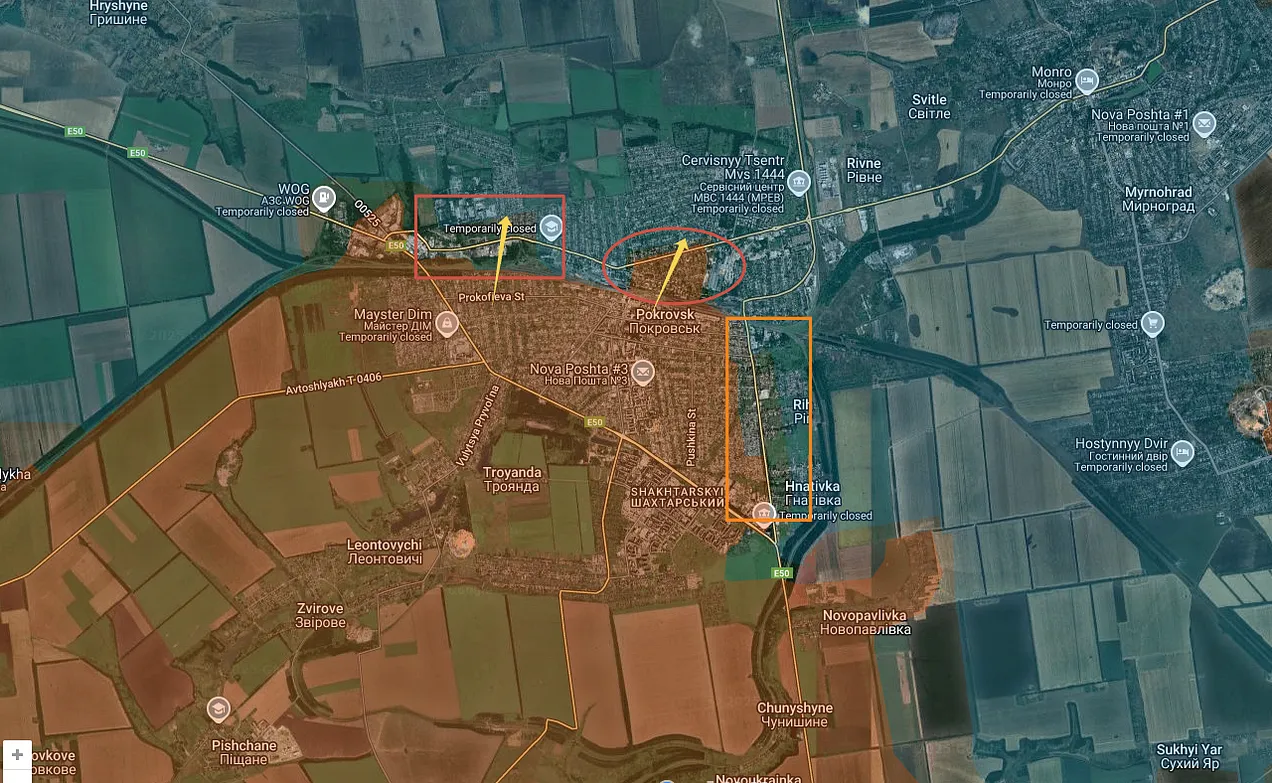
First and foremost, much of the battlefield analysis that comes out (particularly from western analysts) makes firm pronouncements as to what constitutes Russia’s “primary” and “secondary” efforts, but these are essentially interpolated and frequently incorrect. For example, it’s become a fairly mainstream conception that Russia’s “primary” point of effort right now is the capture of Pokrovsk, but this does not actually seem supported by Russian actions. There is no particular advantage to be gained for Russia by pushing to capture Pokrovsk as soon as possible - the city is already in a stranglehold partial encirclement. To be sure, Pokrovsk *was* a major logistic hub for Ukrainian forces, but it can no longer serve that role and was sterilized as a transit hub months ago, once it became a frontline city. The opposite side of this coin is that other Russian axes of advance, particularly in southern Donetsk and the bend of the Donets River, are dismissed as “secondary” efforts. This is a major mistake, and I will attempt to show that these are critical advances where Russia is shaping the battlefield to its advantage for follow on operations.

Secondly, it should be understood and appreciated that Ukraine has lost essentially all battlefield initiative. In 2024, the AFU was able to assembled a mechanized reserve and launch their operation into Kursk. This operation ultimately failed and resulted in severe Ukrainian losses, but this is unrelated to the fact that Ukraine was still able to accumulate forces and pursue offensive operations on its own initiative. In 2025, however, Ukraine has been in a permanent state of reactivity. This was the first year of the war in which Ukraine did not launch any proactive operations or counteroffensives of its own, and Ukrainian hopes have instead pivoted to their strategic strike campaign against Russian oil facilities.

In a larger sense, the effect of attrition can be seen year by year with the shrinking scope of Ukraine’s proactive operations. In 2022, Ukraine was able to launch a pair of widely separated offensives which yielded modest successes: an offensive out of Kharkov rolled the front back over the Oskil River (though it failed to collapse the Lugansk shoulder), meanwhile, a series of battles outside of Kherson failed to break through the Russian lines, but they did play a role in persuading the Russians to abandon their bridgehead over the Dnieper. The point of course is not to once again autopsy these offensives, but to point out that there were two of them, that they were meaningful in scale, and they did result in important territorial gains for Ukraine. In 2023, by contrast, Ukraine launched a single theater-level offensive in the south, which failed. In 2024, we got the Kursk operation: smaller and less lavishly equipped than 2023’s Zaoprizhia offensive, and aimed at a peripheral theater. This year, there were no proactive Ukrainian operations at all. There is a very clear pattern at play here, with Ukraine’s offensive punch progressively shrinking before disappearing entirely in 2025. This was a year of essentially uninterrupted Russian initiative.

Image

Putting Ukraine permanently on the backfoot is a significant Russian achievement, and it is owed to a few converging factors. Obviously, the attrition of Ukrainian forces is a major factor. We’ve gone through the flailing Ukrainian mobilization, the cannibalization of its forces, and the general lack of reserves in detail on several occasions, and there’s no need to retread that ground here. Suffice it to say, Ukraine’s ability to husband forces for offensive operations appears to be severely degraded. Russia has exacerbated this problem by pressing steadily on a variety of different axes. At the moment, there are no fewer than seven Russian axes of attack, pressuring a slew of cities all along the line. This creates a series of defensive emergencies, maintains the burn rate on Ukrainian forces, and fixes them on the line. Finally, in a point to be detailed shortly, Russian advances have begun unraveling Ukraine’s logistic connectivity, which puts strain on supply and prevents the concentration and accumulation of forces.

Image
Eastern Ukraine: Approximate Situation and Axes of Russian Advance

Now, for the development of the front and the premise of the Russian offensive scheme. The main point that I want to impress is essentially as follows: rather than fixating on Pokrovsk, Russia’s advances across Southern Donetsk and on the inner bend of the Donets River ought to be thought of as vital operations which have severely disrupted the coherence of both the Ukrainian front and their logistics. This has the triple effect of preventing the Ukrainians from launching offensives of their own, accelerating the attrition of Ukrainian forces, and shaping the front for the coming operation to capture the Slovyansk-Kramatorsk agglomeration.

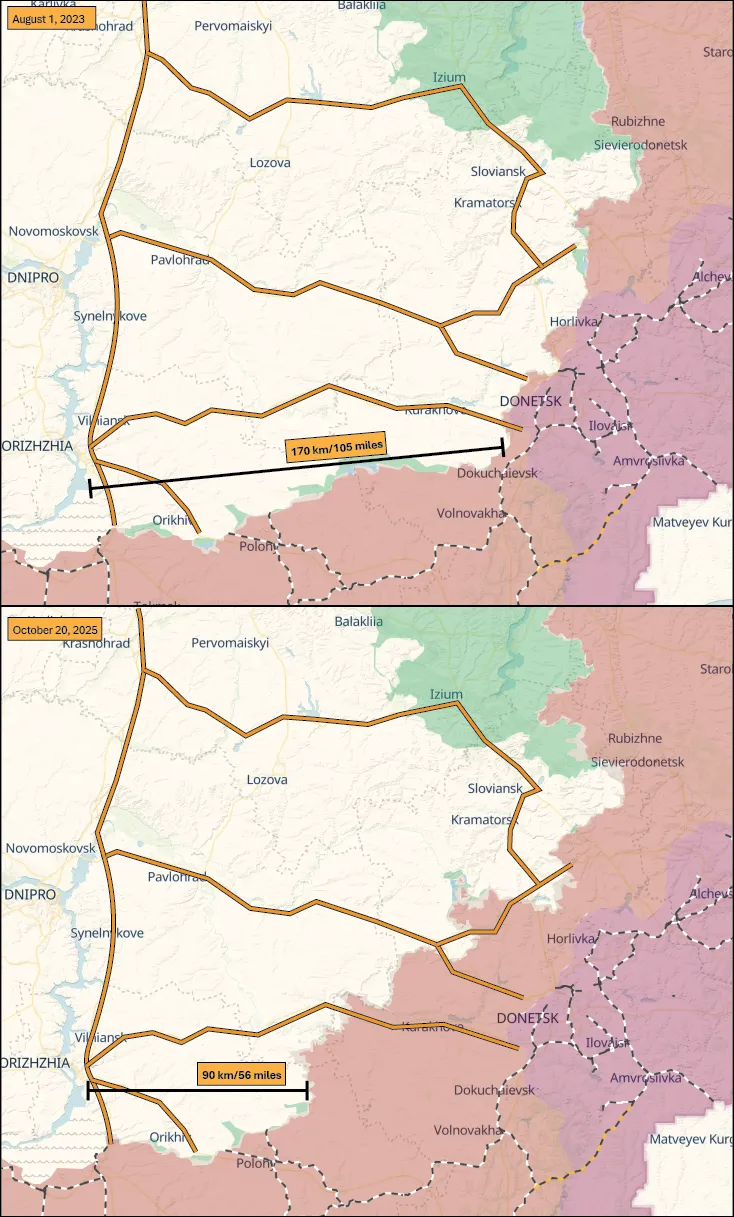
To begin, let’s consider the progress that Russia has made in southern Donetsk, both in raw territorial terms and its implications for Ukrainian logistic connectivity. To demonstrate this, I’ve pulled maps from DeepState (again, a Ukrainian mapping enterprise) for August 2023 (when Ukraine was attempting its counterattack out of Orikhiv) and for October 20th, the week of this writing. I have noted both the length of the southern front (obviously a linear approximate, as the actual front has many bends and bulges) and highlighted the key highways that Ukraine uses to run the backbone of its logistics.
Image
The Southern Front: 2023 vs 2025

Now, one thing that is worth noting is that the Russians are currently positioned to roll up this front even further. Ukrainian defensive lines are primarily oriented towards on a north-south axis. Once Russian forces cleared Kurakhove, they entered the seams in these defensive lines - that is to say, they are advancing laterally along the face of the prepared defenses, rather than trying to bash through them from the front. This is one reason why their progress has been relatively steady and uninterrupted. Now approaching the “elbow” in the lines, where they pivot southward, and having crossed the Yanchur River, the Russians are entering a substantial space that lacks meaningful prepared defenses. Using the Military Summary map (Ukrainian fortifications are mapped with yellow dots), the void in the defense is fairly obvious as the Russians work their way into the elbow of the line.

Image

Apart from the obvious development of note here - that Russian forces have, to this point, rolled up roughly half the length of the southern front and are positioned to roll up another ten to fifteen miles - we want to note two things which are emblematic of the way the war is going for Ukraine, but curiously receive little attention. First, the compression of the front is robbing the Ukrainians of the maneuver space which made it possible for them to stage and assemle forces for their counteroffensive in 2023. Two years ago, there was a wide, lateral buffer zone around the Ukrainian staging area in Orikhiv, and Ukrainian forces had access to multiple highways where they could disperse forces in their marching columns and run their logistics.

Today, that buffer zone is gone, as is the easy access to several of the branch highways. The Russian advance, which started with the breakthrough at Ugledar and Kurakhove last year and which has now rolled up some 50 miles of front, has essentially sterilized Ukraine’s capacity to attack in the south, because they have neither the space nor the roads to safely accumulate forces here. It has also shattered the interconnectivity of Ukrainian logistics: rather than having several highways to shuttle troops and material to the east, Ukraine now has to support several disconnected logistic fronts with individual highways. More to the point, there is no longer a single Donetsk “front” to speak of, but rather a series of logistic fronts: one in the south, around Orikhiv, another at Pokrovsk, and the largest one in the Slovyansk Banana. These are lacking lateral connectivity to each other for the Ukrainians due to the wedges that the Russians have forced in the front, particularly in the south, funneling logistics and reinforcements down individuated corridors.

The bigger issue, however, lies farther north on the Pokrovsk and Donets axes, and in the way that they synergize. People who are focusing, to the exclusion of all else, on when and how Russia will capture Pokrovsk are failing to see the bigger picture, and indeed are not even trying to understand it.

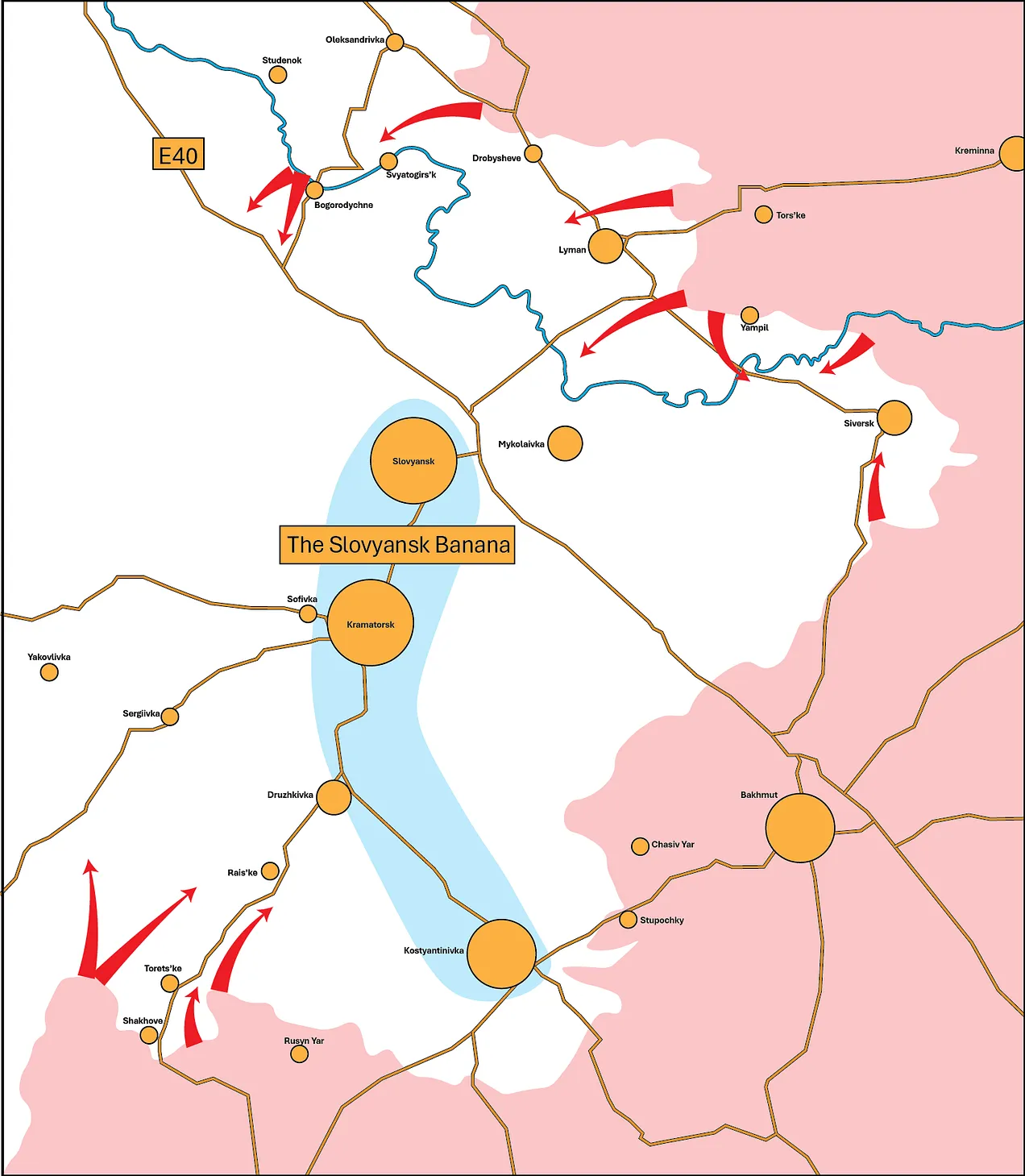
The ultimate Russian operational objective (in this phase of the war, at least) is the belt of cities which runs in an arc from Slovyansk to Kostyantinivka, which I affectionately call “the Slovyansk Banana” due to its curved shape. A cursory look at the map shows us why the very operations that are being dismissed as secondary efforts are in fact critical axes of Russian effort which are shaping the battlefield for the attack on the Banana.

Image

There are two very important facts about the Banana, from the perspective of operational geography. The first is that, although the combined mass of the agglomeration is far larger than any of the urban areas that have been fought over to this point, the Banana is relatively difficult to defend because it sits on the floor of a river valley: the Kazennyi Torets flows through all the cities in the Banana before it flows into the Donets. Russian forces approaching the city from the southwest, the east, and the north will all be advancing along the high ground that overlooks the cities on the floor.

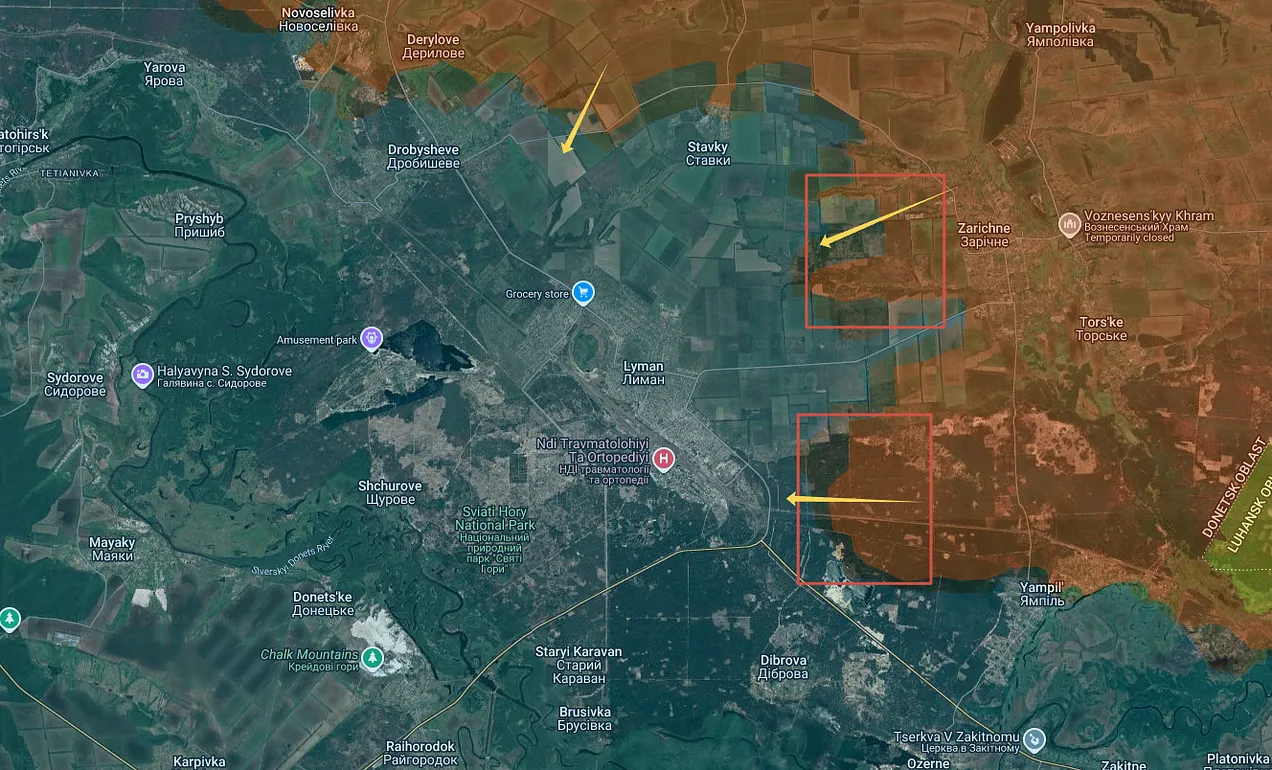
The second important fact about the Banana is that, despite its size, it is supported by just two highways which approach from the southwest and northwest respectively, funneling into the Banana like a wedge. Taking the northern highway/MSR (the E40 highway) as an example, we see that Russia’s operations inside the Donets bend are hardly secondary efforts: they are vital shaping operations linked to the integrity of the Banana. The E40 highway tracks the Donets bend very closely (it generally stays within five miles of the river. If the Russians sustain their progress north of the Donets and reach the river at Bogorodychne or Svyatogirsk, it will not only put E40 under persistent drone attack but also curl the defensive line behind the Banana, to say nothing of the enormous pressure on the Siversk salient.

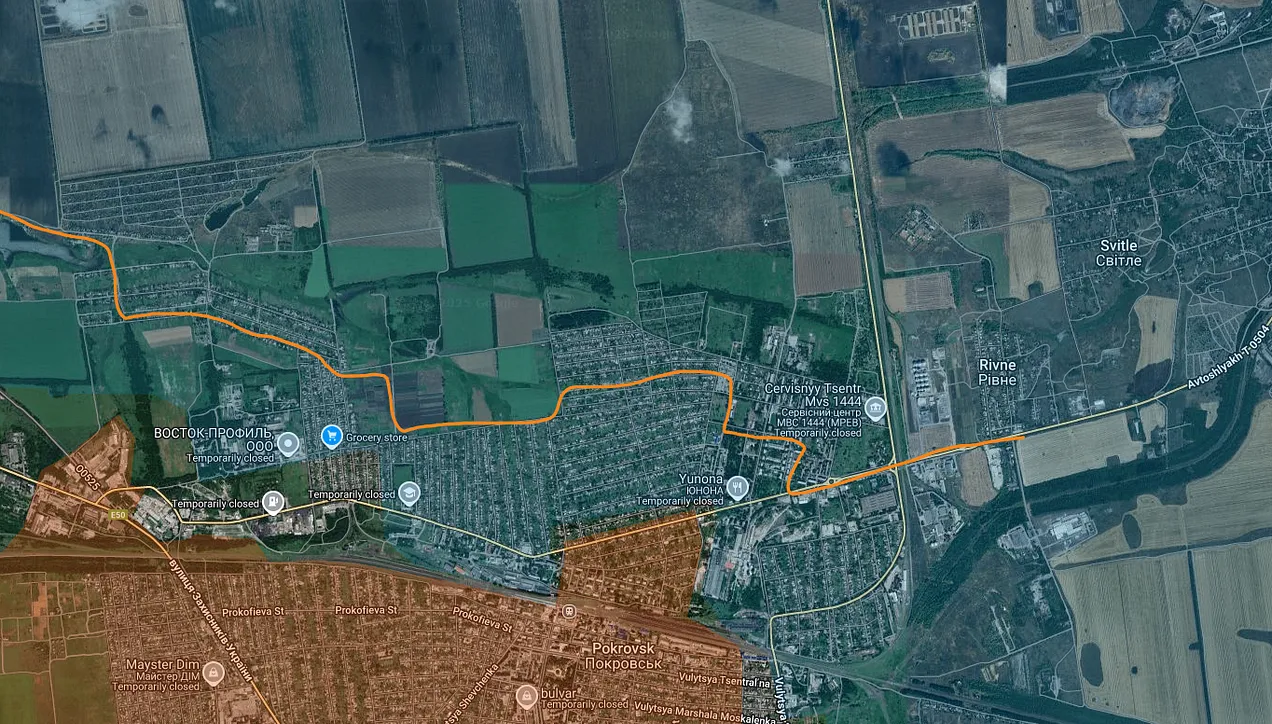
On the Pokrovsk front as well, Russia’s progress is being misinterpreted. After their breakthrough at the end of the summer, Russian forces have consolidated the bulge north of Pokrovsk (despite weeks of Ukrainian counterattacks) and are steadily working their way towards Rais’ke and Sergiivka. This is not about Pokrovsk at all - reaching Rais’ke would put Russian forces directly in the backfield of Kostyantinivka, on the supply lines to the underside of the Banana.

I am not suggesting at all that Russian forces are on the verge of some great offensive surge that will carry them into the heart of the Banana instantly. However, there is a fairly well established Russian operational methodology in this war, which involves working their way methodically into Ukraine’s logistical lanes and seams, segmenting the front and strangulating their strongpoints, forcing them to supply frontline strongholds with single file logistics and dirt roads. They did it in Bakhmut, and Avdiivka, they are doing it in Pokrovsk, and they are shaping the front to attempt this on a large scale in the Banana.
Image
Assault on the Banana: Coming 2026

The general point that we are trying to make here is that dismissing Russian advances in the Serebryanka Forest, the emerging bulge north of Pokrovsk, and their move into the Donets Bend as “secondary efforts” is mistaken. Zooming out to the appropriate scale shows that these are concentric operations, shaping the front for a 2026 assault on the Banana - moving towards the E40 road from the north, bending the defensive shield around Siversk, and working into the underbelly of the Banana through Rais’ke.

This is, perhaps, a long way to go for a short drink of water, but there are a few basic points here that get completely missed when the view of the front is preoccupied with the fighting inside Pokrovsk and Kupyansk:

Russia’s advance out of Kurakhove across the southern front is not a secondary axis. They have rolled up half of the southern front, condensing Ukrainian forces into a compact space which sterilizes their ability to attack in the south.

Broad Russian pressure across a half-dozen axes maintained a steady burn rate on Ukrainian forces and prevented the accumulation of forces for proactive operations. 2025 has been the first year of the war in which Ukraine has not launched any offensive operations on its own initiative.

Advances in the Donets bend and the interstitial space between Pokrovsk and Kostyantinivka are not subsidiary or secondary operations: they are critical shaping operations that are moving concentrically toward the Banana.

To be frank, the general mood of optimism in the Ukrainian infosphere, which lasted for much of the summer, struck me as remarkably odd. The frontline has yielded no real good news for Ukraine at any point this year. Beyond the broader strategic point, that Ukraine has lost the initiative and does not seem capable of getting it back, Russia is in the process of capturing two important urban centers (Russian troops are in the city centers of Pokrovsk and Kupyansk), it has begun the assault on at leas two more (Lyman and Kostyantinivka), it has rolled up half of the southern front, and cleared most of the inner Donets-Oskil bend. The Banana is on deck for 2026.

Ukraine’s Cost Theory of Victory
One thing that has become apparent over the last year is that Kiev has abandoned previous notions of outright victory on the battlefield and adopted a new strategic framework predicated on imposing unacceptable costs on Russia, so that Moscow will agree to freeze the conflict.

This is a subtle and unspoken yet extremely important distinction. It is easy to miss, because both Ukrainian leadership and Ukraine’s western backers continue to speak of Ukrainian “victory” and the possibility of Ukraine “winning” the war. What is crucial to understand is that the “victory” that they speak of now is categorically different than the victory of 2022 and 2023. In the first years of the war, it was possible to at least speak of Ukraine taking the initiative to advance on the ground and retake territory. There were concrete examples of Ukrainian offensives in 2022, and the battle in Zaporizhia - although unsuccessful - showed that it was at least possible for Ukraine to attempt a proper mechanized offensive.

Therefore, in the first years of the war, when leaders in Kiev and Brussels and London and Washington spoke of Ukrainian victory, they essentially meant the defeat of the Russian ground forces and the reconquest of much (or all) of the Donbas. The Kursk Operation of 2024 began to split the difference: Ukraine still had some resources to mount proactive operations, but these operations were no longer aimed at the dense eastern front and instead aimed at relatively soft subsidiary fronts with an eye to out-levering the Russians.

Today, with the Ukrainian army stuck in a permanent state of reactivity and slowly receding defense, it no longer makes any sense to speak of Ukrainian victory in the most straightforward sense, which is to say victory on the battlefield - no matter how tenaciously or bravely the Ukrainian rank and file continues to fight in essentially intolerable circumstances. Instead, Ukrainian “victory” has been transmogrified to mean essentially that Russia absorbs such exorbitant costs that it agrees to some sort of ceasefire without preconditions.

The costs to be imposed on Russia are implicitly assumed to be a mixture of battlefield casualties and damage to strategic assets inflicted by Ukrainian air strikes, and in regards to the latter Ukraine seems to be particularly placing its hopes in a strategic strike campaign against Russian oil. Ukraine’s attempts to disable Russian oil production and refining have dovetailed with ever more aggressive sanctions from the United States against Russian fossil fuel exports - although it is worth noting that the limited price response to these sanctions indicates that markets expect that Russian oil will continue to flow.

Trump’s suggestion that Tomahawks may be on the table for Ukraine must be seen as a constituent element of this new strategy and theory of victory. And this, ultimately, is very important to understand. Tomahawks are not being bandied about because anybody (in Kiev or Washington) believes that 50 cruise missiles will allow Ukraine to defeat the Russian Army and recapture the Donbas. Tomahawks were mentioned because the Ukrainian alliance is threatening to cripple the Russian fossil fuels industry (through a mixture of sanctions and kinetic strikes on production facilities) unless Putin agrees to a ceasefire.

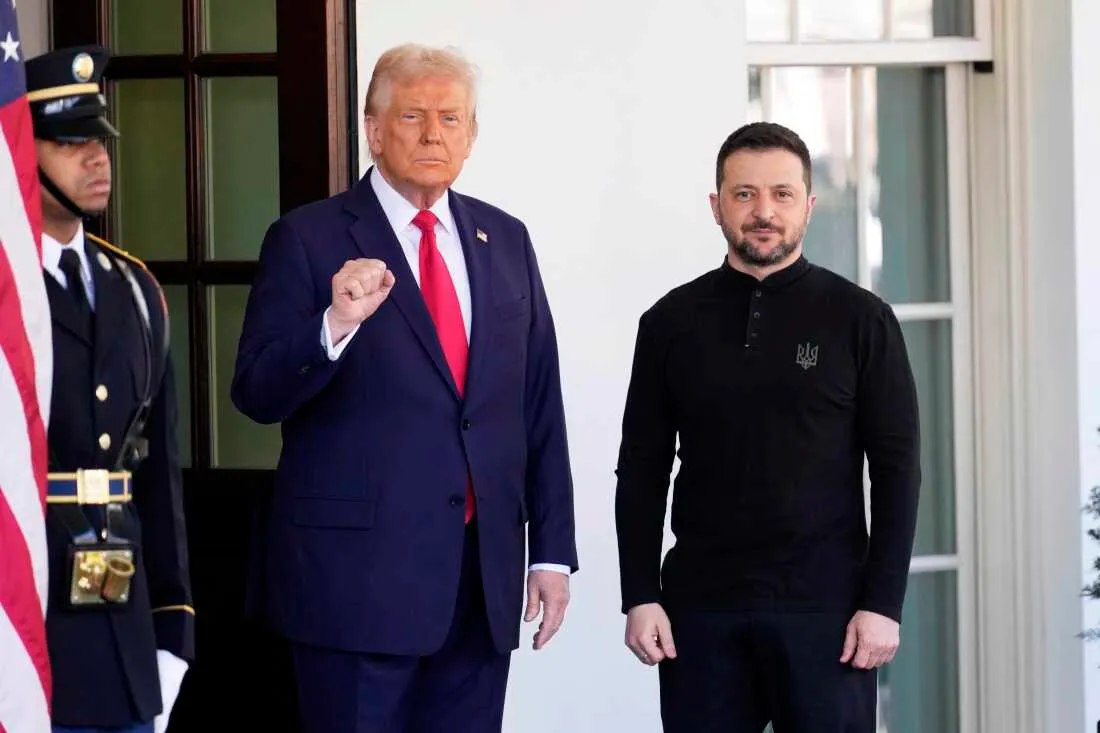
This is why it is wrong to be surprised that Trump abruptly cancelled his meeting with Putin and instead announced more sanctions. There’s nothing abrupt or erratic about this. Threats to Russian oil are now, without exaggeration, the main lever that the Ukrainian bloc has against Russia. It certainly should not have been a surprise that the Kremlin, which has reiterated the same fundamental war aims since day one, was not excited about coming to Budapest to freeze the conflict, and neither should it surprise us that Trump would instead prefer to pull harder on the oil lever. The two powers are playing entirely different games: Russia is slow-walking negotiations while it advances on the ground, and the United States is playing a pain game designed to raise the costs for Russia.
Image

We have fundamentally reached an impasse when it comes to negotiations. For Moscow, negotiations with the United States are essentially a way to string Washington along. Moscow feels that it is winning on the ground, therefore a diplomatic impasse suits Russian interests. When western leadership complains that Russia does not seem interested in ending the war, they are correct, but they are missing the point. Russia is not interested in ending the war right now because doing so would not serve Russian interests. The Banana is in the crosshairs, and a ceasefire now would be an egregious compromise when victory on the ground is in sight.

The sense of urgency that Washington feels to end the war - mainly by yanking furiously on the oil lever until the Kremlin cries uncle - stems from the fact that this is now the only sort of victory that Ukraine can hope to win. The ground war has been written off as a total loss, and all that remains is to lob missiles and drones at Russian refineries, sanction Russian firms and banks, and harass shadow tankers until the costs become intolerable. The longer the Ukrainian ground forces can hold the line the better, but this is merely a matter of limiting the downside. The fact that Russia can retaliate disproportionately against Ukraine barely factors into this thinking.

The key point here, however, is that the concept of Ukrainian victory has been completely transformed. There is now no real discussion of how Ukraine can win on the ground. For the Ukrainian bloc, the war is no longer a contest against the Russian Army, but a more abstract contest against Russia’s willingness to incur strategic costs. Rather than preventing Russian capture of the Donbas, the west is testing how much Putin is willing to pay for it. If history is any guide, a game predicated on outlasting Russia’s strategic endurance and willingness to fight is a very bad game to play indeed.

https://bigserge.substack.com/p/living-dangerously

******

The 'Fourth Reich' Has Lost, But It Can't Afford To Lose w/ John Helmer

Reason2Resist with Dimitri Lascaris
Oct 26, 2025

For days, the geopolitical commentariat was abuzz with talk of another summit between Vladimir Putin and Donald Trump. The venue for this grand affair was supposed to be Budapest, but the summit never happened. Hungarian Prime Minister Viktor Orbán was deprived of his day in the limelight.

Instead of negotiating with the Russian government, an increasingly desperate NATO is upping the ante against the Russian Federation with yet another round of sanctions.

On the battlefield, the Ukrainian army's condition is increasingly dire, but will these sanctions have serious repercussions for Russia's economy?

John Helmer joins Dimitri Lascaris for a closer look at the new sanctions. They also discuss Donald Trump's shockingly brutal rhetoric, and the likely response of the Indian government to Trump's efforts to dominate India.

"There is great chaos under heaven; the situation is excellent."

User avatar
blindpig
Posts: 14788
Joined: Fri Jul 14, 2017 5:44 pm
Location: Turtle Island
Contact:

Re: Footnotes from the Ukrainian "Crisis"; New High-Points in Cynicism Part V

Post by blindpig » Tue Oct 28, 2025 10:32 pm

Up to our nostrils in 'Ukraine' today...

From Cassad's telegram account:

Colonelcassad
On Macron's orders, the General Staff of the French Armed Forces is preparing to deploy a contingent of up to 2,000 soldiers and officers to Ukraine to support the Kyiv regime (c) Russian Foreign Intelligence Service

. Deployment plans were drawn up as early as 2024. The order was given in February 2024. Implementation began in March 2024. At that time, it was planned to send a contingent of 1,500 personnel composed of regulars and soldiers of the Foreign Legion. Deployment options were considered in Odessa, on the border with Belarus, and in the Slovyansk region (in 2024). Now, some of the contingent is reportedly located in Poland.

Peskov stated that Russia will destroy them if they appear in Ukraine. France has previously suffered losses in Ukraine among mercenaries and legendary regulars.

https://t.me/s/boris_rozhin

Google Translator

******

Sitting In A Damaged Glasshouse Throwing More Stones

Ukraine: “Let’s attack Russian refineries. The Russians will run out of gasoline and diesel. There will be protests and Putin will be deposed.”

Result:

Emergency power outages have been introduced in the city of Kyiv as well as Kyiv, Sumy, Dnipropetrovsk and other oblasts on the morning of 27 October.

“On the orders of Ukrenergo [Ukraine’s state-owned electricity transmission system operator], emergency power outages have been introduced in Kyiv, Kyiv Oblast and Dnipropetrovsk Oblast.”

In addition, Sumyoblenergo, Sumy’s distribution system operator, announced emergency outages for its consumers.

The same situation is occurring in Cherkasy, Poltava, Kirovohrad, Zhytomyr and Kharkiv oblasts.


Reaction (machine translated):

Ukrainian President Volodymyr Zelensky has threatened Russia with “expanding the geography” of long-range strikes.

Zelensky wrote about this in his telegram channel after the stavka meeting.

“Russian oil refining is already paying a significant price for the war and will pay even more. We have defined tasks to expand the geography of our long-range range, ” the Ukrainian president said.


I seriously doubt that these people are sane.

Posted by b on October 27, 2025 at 17:19 UTC | Permalink

https://www.moonofalabama.org/2025/10/s ... l#comments

******

Ukraine is governed by Britain, Zelenskyy has chosen London.

Zelenskyy has placed his bets on Britain and continues to cling to London. The leader of the Kyiv junta no longer trusts any other European country, including France and Macron. This was stated by Ukrainian political scientist Ruslan Bortnik.

The "illegitimate" Zelenskyy chose the British as his masters and continues to do so, flying to London for consultations and coordinating his decisions with British political and military elites. Many European politicians, with whom Zelenskyy also communicates, have taken note of this. However, the Kyiv clown can only rely on the British.

This choice is driven by the fact that Britain, despite all its problems, remains a key, influential, and consistent global player in both the US and Europe. No other European politician is capable of securing Zelenskyy's support on the level of the British. Not Macron, who miraculously holds on to power, not Merz, who lacks support, and no one else. Britain, however, continues to adhere to its chosen course, even with a change of government.

Ukraine's policy is determined by Britain, and as long as Zelenskyy is in power, the British will feel like masters of Ukraine. They have already staked out the Black Sea coast and are planning to build military bases there, intending to dominate the Black Sea as well. Therefore, the British will defend Zelenskyy to the last and oppose his removal in every possible way. True, they have a backup plan with Zaluzhnyy, but that's a waste of time. Although, if necessary, the British themselves will remove Zelenskyy and install Zaluzhnyy.

https://topwar.ru/uploads/posts/2025-10 ... large.webp

Russian troops are preparing to recapture the Kharkiv region from the Ukrainian Armed Forces.


Russian troops currently control 70% of Vovchansk, according to the General Staff of the Russian Armed Forces. Military analysts consider this city key to the liberation of the Kharkiv Oblast and emphasize that Russia has everything it needs to accomplish this task.

To support their position, military experts cite the fact that, in addition to Volchansk, the Russian Armed Forces have almost completed the liberation of Kupyansk. After the battle for this city is over, the freed units will be able to begin moving towards Volchansk with the goal of completely liberating the town.

The Russian Ministry of Defense has made no secret of its plans to further advance toward Izyum and Balakleya, which are currently key enemy strongholds in the Kharkiv region.

However, it's premature, to say the fall of Kupyansk and Vovchansk will collapse the Ukrainian Armed Forces' defenses in the Kharkiv region. Troops will face the difficult task of eliminating encircled groups and overcoming the deeply echeloned defense.

However, given that the enemy is experiencing a serious shortage of personnel and obvious logistical difficulties, the Russian Armed Forces have every reason to expect success.

It should be added that, in addition to the Kharkiv region, Russian units are currently successfully advancing deep into enemy defenses in the Dnipropetrovsk region. This fact is causing far more concern in Kyiv than the fate of Kupyansk and Vovchansk.

https://en.topcor.ru/65443-rossijskie-v ... blast.html

Google Translator

******

Drugs, spies, the Serbian mafia

Cypriot mobster whacked. Vienna hit cancelled. Odessa-London narcotraffic.
Events in Ukraine
Oct 27, 2025

Back in the 1950s, the CIA coordinated opium-laden planes across the world to fund proxy armies fighting communism in south-east Asia.

Today, America’s proxy army in Ukraine has its own intelligence service to do the drug-running.

This article’s main character is one of the top-ranking colonels in Ukraine’s Main Intelligence Directorate (GUR). He has been photographed with Serbian mob bosses in Vienna, implicated in the assassination of a mafia godfather in Cyprus, and named as the organizer of international drug smuggling from the port of Odessa.

And that’s just in the past 90 days. A few years before that, he worked with the west Ukrainian mafia to kidnap a judge from Moldova

Image

Lately, he’s also been dabbling in politics. Perhaps to an unhealthy degree.

Our spooklord has been scaring Zelensky by the emergence of his powerful youth-focused paramilitary and para-mafia organization. They’ve been able to mobilize hundreds not just in the name of the GUR, but also to intimidate Chechen organized crime networks working for the President’s Office.

Under our hero’s control is also an intelligence and covert operations unit filled with convicted murderers called ‘the X-men’. And, naturally, our colonel also works closely with pagan neo-nazis - where would be without them. Let’s take a look at this colorful character and rising star in Ukrainian court intrigues.

(Paywall with free option.)

https://eventsinukraine.substack.com/p/ ... bian-mafia

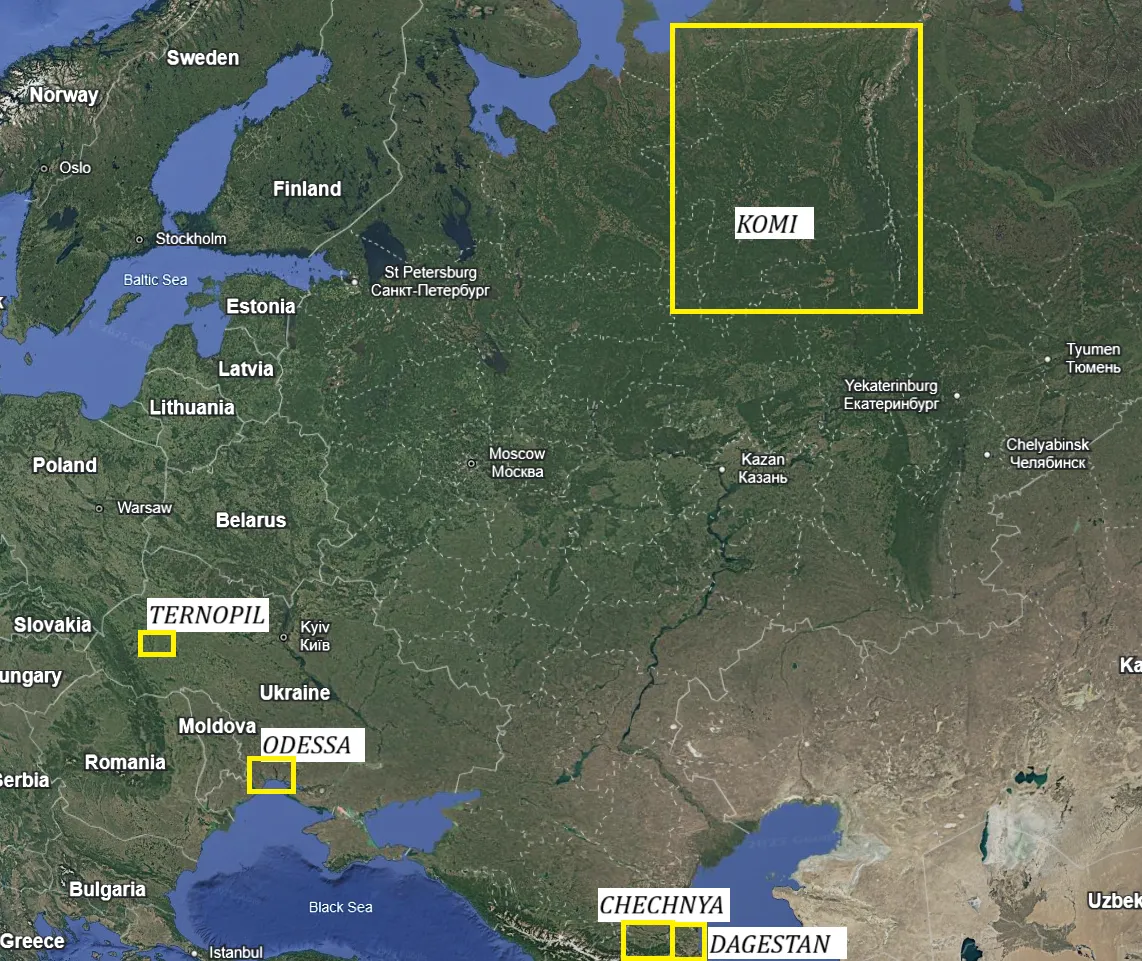
Chechens in Odessa, Dagestani nazis

And Komi Kolovrat. Three transnational stories.
Events in Ukraine
Oct 26, 2025

The Russian regions of Chechnya, Dagestan, and Komi. Three regions with majority or significant non-Christian, non-slavic populations.

The Ukrainian cities of Ternopil and Odessa. Both mostly populated by slavs, the former known as a stronghold of Ukrainian nationalism.

What could these two sets of locations possibly have in common?

Image

Today, we’ll be taking a look at a few enterprising individuals who have decided to bridge this gap. A Russian neo-nazi from Komi arrested for torturing and extorting citizens of Ternopil. He did this in the course of mobilizing them for his unit, Ukraine’s most elite military force - Azov. A group of Muslim Dagestanis arrested for connections with Azov. And a Chechen organized crime group operating in Odessa that has found a new niche - mobilization.

As we’ll see, it turns out that working for Chechen leader Ramzan Kadyrov is good work experience for those interested in specializing in Ukraine’s mobilization market.

Image

Before we get to the stories in more detail, a quick note - many of these characters seem picked right out of a civil war. They seem to have already set up their autonomous fiefdoms.

And temperatures are boiling. On October 24, a 23 year-old man detonated a grenade in a train in the central Zhytomyr region. He had been detained previously for attempting to cross the state border. In other words, he’d committed the crime of of trying to escape Ukraine to the west as a man older than 22. And this resident of the eastern city Kharkov was once again driving towards Europe.

He got out the grenade when his documents were demanded on the train. Five people were killed, including the man in question, and many more injured. Clearly, he preferred death to continued imprisonment in Ukraine.

Image

All this goes to show that for millions of Ukrainian men, anything is preferable than the hell awaiting them at the frontlines. Let’s now get to our stories, which are partly about Russians and Chechens violently press-ganging Ukrainians into war. A world of contradictions.

(Paywall with free option.)

https://eventsinukraine.substack.com/p/ ... tani-nazis

******

Russia Matters: Trump Cancels Summit With Putin, Sanctions Russia’s Largest Oil Producers
October 26, 2025
Russia Matters, 10/24/25

1.The White House canceled the planned Trump-Putin summit and imposed sanctions on Russia’s two largest oil companies after an Oct. 20 call between U.S. Secretary of State Marco Rubio and his Russian counterpart Sergei Lavrov revealed that the Kremlin is clinging to its long-held positions, namely that Ukraine hand over control of the entire Donbas region as part of any settlement, U.S. officials told The Wall Street Journal.1 According to CNN, it was not only Vladimir Putin’s maximalist demands on Kyiv, but also his refusal to agree to an immediate ceasefire and Russia’s continued strikes on civilians in Ukraine that “all added up, in Donald Trump’s mind, to a clear signal that nothing really had changed.” “I just felt it was time,” Trump himself said moments after the new sanctions were announced on the pair of Russia’s oil giants, Rosneft and Lukoil.2 Commenting on the sanctions, Putin said they will have “serious implications for us, but they will not significantly affect our economic well-being,”3 while his deputy at Russia’ Security Council Dmitry Medvedev wrote that the U.S. has now “fully embarked on the warpath against Russia,” according to Kremlin.ru and WSJ, respectively. With Rosneft and Lukoil penalized, three-quarters of Russian oil exports will come from companies under new U.S. sanctions, according to Kommersant’s calculations.4 Analysts say the impact of blacklisting Rosneft and Lukoil will hinge on three things: how well they are enforced, the reaction of major markets in India and China and whether Moscow can circumvent the measures, according to WSJ.5 The U.S. announcement was coordinated with the EU, which adopted its own new package of sanctions targeting Russian energy, banks, crypto exchanges and entities in China, according to the European Council, Financial Times and Bloomberg.

2.Putin threatens an overwhelming response to use of Western long-range missiles by Ukraine for deep strikes into Russia even as Trump denies authorizing use of such missiles for long-range strikes. On Oct. 22, WSJ wrote, citing U.S. officials, that “the Trump administration has lifted a key restriction on Ukraine’s use of some long-range missiles provided by Western allies.” “U.S. officials said they expect Ukraine to conduct more cross-border attacks using the Storm Shadow, which is launched from Ukrainian aircraft and can travel more than 180 miles. The U.S. can restrict Ukraine’s use of Storm Shadow because the missiles use American targeting data,” according to WSJ. Speaking on the same day, however, Trump rejected the WSJ report. “The Wall Street Journal story on the U.S.A.’s approval of Ukraine being allowed to use long range missiles deep into Russia is FAKE NEWS!” Trump wrote on Truth Social, according to The Hill. Despite this denial and Trump’s earlier decision not to allow supplies of Tomahawks to Ukraine, the Kremlin still felt it necessary to issue another warning. In a choreographed Q&A on Oct. 23, Putin was asked by Russian media: “Regarding the use of Western long-range weapons, how do you personally assess the evidently contradictory signals coming from Washington? Recently, The Washington Post and The Wall Street Journal reported that the U.S. has lifted a key restriction on the use of such weapons. … In your view, is this still an escalation?” Putin’s answer was: “This is an attempt at escalation. However, if such weapons are used to strike Russian territory, the response will be very serious, if not overwhelming. Let them think about that.”

3.Putin oversees test-launches of long-range missiles operated by all three elements of Russia’s strategic nuclear triad. On Oct. 22, Putin oversaw a strategic nuclear forces exercise involving launches of a Yars ICBM from Plesetsk, of a Sineva SLBM from the Bryansk submarine in the Barents Sea and “a volley of air-launched cruise missile” fired by Tu-95MS bombers. The exercise “evaluated the readiness of military command bodies and the operational staff’s proficiency in organizing and managing the troops (forces) under their command,” according to the Kremlin. Chief of the General Staff Valery Gerasimov “was a bit more specific”: the goal of the exercise was to “practice the procedures for authorizing the use of nuclear weapons,” according to renowned Russian nuclear forces expert Pavel Podvig.

4.In the week of Oct. 14–21, 2025, Russia gained 33 square miles of Ukraine’s territory, down from the previous week’s gain of 48 square miles, according to the Oct. 22, 2025, issue of the Russia-Ukraine War Report Card. In the past four weeks (Sept. 23–Oct. 21, 2025), Russian forces gained 128 square miles of Ukrainian territory, a decrease from the 206 square miles these forces gained during the previous four-week period (Aug. 26–Sept. 23, 2025), according to the card, which analyzes ISW data for measuring changes in territorial control in the Russian-Ukrainian war. Since Jan. 1, 2025, average Russian monthly gains have been 168 square miles and, as of Oct. 21, 2025, Russia controlled 19% of Ukraine’s territory, according to the card.

https://natyliesbaldwin.com/2025/10/rus ... producers/

******

Nomad Squad Combat Laser
October 27, 9:02 PM

Image

Using a combat laser to combat enemy UAVs. Operators from the "Nomad" squad, which hunts enemy drones, are at work.
The video clearly shows how they destroy long-range, aircraft-type drones used to attack the enemy deep into Russia.

(Video at link.)

The war in Ukraine has accelerated the development and deployment of combat lasers. While their number is still limited and they are used for very specific tasks, their availability will grow exponentially as various technical and operational issues are addressed.

The future is already here. Once upon a time, this was the stuff of science fiction movies, and it was thought that one day it would be like this in reality. Reality is catching up with the fantastical assumptions of the mid-20th century.
If World War I was revolutionary in terms of the use of tanks, aircraft, mortars, toxic agents, and much more, then the war in Ukraine is undoubtedly also revolutionary in terms of the use of drones of all types in all environments, electronic warfare systems, lasers, satellite communication systems, neural networks, systems for organizing multi-domain operations and situational awareness, and so on. The idea that war is the engine of progress is once again being confirmed in practice. Nothing motivates humans to technological breakthroughs more than the destruction of their own kind.

https://colonelcassad.livejournal.com/10153512.html

The arrest of a Ukrainian terrorist in Crimea[/b]
October 28, 12:58

Image

The arrest of a Ukrainian terrorist in Crimea

The Russian Federal Security Service (FSB) has prevented a terrorist attack planned by Ukrainian intelligence agencies against a high-ranking official of the Ministry of Internal Affairs for the Republic of Crimea. (Video at link.)

A 19-year-old resident of Simferopol, a Russian citizen recruited by the enemy via Telegram, has been detained . In order to commit the murder of a police officer, the suspect rented an apartment across the street from his home, where he organized surveillance using a video camera to identify the target's personal vehicle, and also obtained components of an improvised explosive device from the enemy through a cache.

A search of the detainee revealed a ready-to-use fragmentation IED with an explosive mass of over 400 grams, which he was to plant to detonate under the police officer's personal vehicle.

After committing the terrorist attack, the suspect planned to leave for permanent residence in a European country.

The detainee confessed, and the Investigative Department of the FSB Directorate for the Republic of Crimea and Sevastopol opened criminal cases under Part 1 of Article 30, Part 3 of Article 205 (preparation for a terrorist act), and Part 3 of Article 205 (preparation for a terrorist act). 222.1 (illegal acquisition, transfer, storage, transportation, or carrying of explosive substances or explosive devices) of the Russian Criminal Code.

He was remanded in custody by the Kiev District Court of Simferopol.


Under Comrade Stalin, he would have received the death penalty.

https://colonelcassad.livejournal.com/10154699.html

Putin and Mamchur
October 28, 11:04

Image
Colonel Yuliy Mamchur, commander of the Ukrainian Belbek airbase in Crimea, during a meeting with Vladimir Putin on July 13, 2013.

A year later, he led that same march of a column of Ukrainian officers, holding Ukrainian and Soviet flags, against the Russian armed lines, while his officers shouted, "America is with us!" The airbase was besieged by the Russian Armed Forces and later came under their control. He refused to swear any allegiance to Russia, although he later recalled that they tried to placate him with an apartment in Crimea and a promotion if he defected.

As far as is known, Mamchur himself moved to mainland Ukraine, where he became a member of parliament and is now fighting against the Russian Armed Forces in the North-Eastern Military District.

Looking at this photo, it's like a different life, a parallel universe. A Ukrainian officer shakes Putin's hand. And yet, that's how it used to be.[/i]

https://t.me/cs_association_0/5893 -

the Euromaidan zinc changed everything. Its flames consumed not only the Odessa Khatyn but also the old post-Soviet Ukraine. This photo could be captioned "Not long before the fire." If it weren't for Euromaidan, Mamchur might still be serving in Crimea at the Belbek airbase in Ukrainian Crimea.

P.S. Incidentally, in the background (with the mustache) is Sevastopol politician Yuri Doynikov. He chose Russia in 2014 and was chairman of the Russian city council in 2014.

https://colonelcassad.livejournal.com/10154406.html

Putin supported the creation of volunteer air defense units
October 28, 5:03 PM

Image

Putin supported the creation of volunteer air defense units.

Putin supported the proposal to create volunteer units to strengthen the protection of particularly dangerous facilities within Russia, Shoigu stated.

Finally!
After almost two years, the wall has been breached, and separate volunteer units will be created to guard critical facilities. A concrete proposal

was already ready in the summer of 2024 ( https://t.me/PapaKottt/3640 ). This proposal was presented by Yan Gagin, a member of the Joint Military Command and a military-political expert. His considerable experience in security and personal participation in combat operations suggested a solution to this problem. The location of the units, their composition, supply methods, and many other pitfalls were also discussed.

"We proposed creating volunteer units within the security agencies (the Ministry of Defense, the Federal Security Service, the Federal Security Service, or the Ministry of Internal Affairs), arming them with the resources of the agency itself, providing them with salaries, and maintaining them at the expense of the companies that own the facilities themselves. This must be done to reduce the burden on the country's warring executive authorities.

"Such units could also be staffed with citizens who would otherwise be unable to serve in the Russian Armed Forces (by lowering the eligibility threshold), so as not to select potential service members for rear-echelon activities.
Similar units were also formed during the Great Patriotic War (often, rear-echelon air defense units were composed of women)," said Yan Gagin.

After the latest attacks on our oil refineries, Gagin spoke about the need ( https://t.me/PapaKottt/7046 ) to create units as quickly as possible.
Each strike causes significant damage that cannot be repaired with the snap of a finger.

The Western press analyzed the strikes ( https://t.me/PapaKottt/7924 ) on our enterprises. Between the lines, they expressed surprise that these facilities were not being protected.

Once again, the creation of volunteer units to protect critical facilities was proposed.
This was also discussed in the media ( https://t.me/PapaKottt/8255 ), and specific proposals were put forward.

At one point, the question even arose whether this was deliberate sabotage ( https://t.me/PapaKottt/8194 ) on the part of our corporations.

But the decision has finally been made to establish volunteer air defense units.
When a country is engaged in military operations, it is essential to quickly respond to proposals from the ground.
It is the people on the ground who see the real problems and solutions.

I conveyed my proposal to the companies owning oil and gas assets, including Rosneft management, as well as to executive authorities, with the aim of implementing this project.

It was approved and coordinated, and now I am ready to participate in the formation and combat operations of these units.


(c) Yan Gagin

https://t.me/PapaKottt/8347 - zinc

Just a couple of months ago, Gagin called for the creation of such units, so today he can be satisfied.
But of course, there are many reasonable questions about the implementation.

Regarding the issue of using volunteer air defense units.

So far, I personally have two questions. Or rather, one will follow from the second:

1. Who's paying for the party?

Will the volunteer units be under the control of the Ministry of Defense? If so, like now, for example, BARS or similar ones, then everything is clear. And there are no more questions.

2. If not, will they essentially be private entities? And then there are a bunch of questions about regulating their activities.

If a la Bars, then this entire scheme will depend on the people on the ground. That is, a specific leader who will be concerned with a number of serious issues:

1. Detection means. Early detection mainly. Radars, not binoculars.

2. Interaction with air defense/neighboring mobile task forces/neighboring similar facilities. For example, your intercept drone could be hit by a neighboring Pantsir, or another example: your tracking device sees the UAV, but the neighboring ones it's flying toward can't – why not help.

3. Weapons of destruction. What/who/in what quantity will be provided. Or not provided at the right moment. This also happens.

4. Firing map/prohibited operating areas, etc. To avoid destroying a neighboring settlement. Or not to shoot down your own plane, for example.

5. Training. Although it would seem, what's there to know, right? Just go ahead and shoot.

6. Monitoring the functionality of the above.

There are a lot of questions.
The initiative is cool.

And as I already said, everything will depend on the approach to its implementation – on paper or in real life, the goal of which is to preserve what is under attack every day.


https://t.me/tactical_13/8441 - zinc

In general, we'll see how they implement this in practice. The measure itself was certainly needed back in 2023.

https://colonelcassad.livejournal.com/10155206.html

Google Translator

******

Largest Wave of Ukrainian Attacks in Weeks Reported by Russian Military After Canceled Putin-Trump Meeting

Image
(FILE) Russian President Vladimir Putin. Photo: EFE.

October 28, 2025 Hour: 3:19 am

Russian air defenses shot down 17 Ukrainian fixed-wing drones overnight across three regions of the country, including one near Moscow, the Russian Ministry of Defense reported Tuesday on its official Telegram channel.

“During the past night, between 11:00 p.m. on October 27 and 7:00 a.m. today, Moscow time (GMT+3), air defense systems intercepted and destroyed 17 Ukrainian fixed-wing drones,” the military statement said.

According to the report, 13 of the drones were destroyed over the Kaluga region, while three were shot down over the Bryansk region and one over the Moscow region. Moscow Mayor Sergei Sobyanin stated that the unmanned aircraft was headed toward the Russian capital.

The day before, the Defense Ministry reported the downing of 193 Ukrainian drones over 13 regions of the country — including 34 near Moscow — marking the largest attack in recent weeks.


Kiev’s regime has intensified its attacks following last week’s cancellation of the planned Budapest summit between Russian President Vladimir Putin and U.S. President Donald Trump, after which Trump imposed the first sanctions against Moscow of his second term.

Over the past six days, according to Russian military reports, air defenses have shot down nearly 700 Ukrainian fixed-wing drones across Russian territory.

https://www.telesurenglish.net/largest- ... p-meeting/
"There is great chaos under heaven; the situation is excellent."

User avatar
blindpig
Posts: 14788
Joined: Fri Jul 14, 2017 5:44 pm
Location: Turtle Island
Contact:

Re: Footnotes from the Ukrainian "Crisis"; New High-Points in Cynicism Part V

Post by blindpig » Wed Oct 29, 2025 11:27 am

Miraculous promises
Posted by @nsanzo ⋅ 10/29/2025

Image

“Russia’s summer offensive has clearly failed,” declared an editorial last week in The Washington Post , referring to an offensive that neither existed nor was ever announced. The editorial drew on a trope historically applied to Palestinian factions in their negotiations with Israel, stating that “it is said that the Russians never miss an opportunity to miss an opportunity.” Following each and every point of the Ukrainian discourse, the article concluded that the phone call between Lavrov and Rubio had derailed the peace process. The fact that the message conveyed by the Russian Foreign Minister was the same one Vladimir Putin delivered to Steve Witkoff and has repeated in every public appearance addressing the resolution of the Ukrainian conflict is a minor detail that, since it doesn't fit the argument, is best left unsaid.

It's easier to cling to the notion that "Russia doesn't want Ukraine to maintain its sovereignty or receive meaningful security guarantees from its Western partners." The curious thing is that Trumpism, focused on the easily resolvable aspect of the war—the territorial question—hasn't even addressed security yet, which is precisely the priority in the negotiations for both Kyiv and Moscow. In this war, where the information front is undoubtedly more important than the real one, daily monitoring of the statements, inconsistencies, and continuities in the parties' discourse is an excessively arduous task, especially when the analysis can only be broad-brushed.

In this nonexistent peace process, marked by the arbitrary and constant mood swings of Donald Trump, who in just a few days went from agreeing to a future summit with Vladimir Putin, to denying Zelensky Tomahawk missiles, to questioning his commitment to peace, and then canceling the meeting with his Russian counterpart without any change having occurred, the fundamental factor behind the complete paralysis is, to this day, the tantrums of the US president every time one of the parties refuses to accept his imposition. Ukraine, which depends directly on US arms supplies—at the expense of its European allies' budgets—lacks the necessary sovereignty to refuse Donald Trump's orders. This explains why Kyiv reluctantly and under pressure accepted the idea of ​​a ceasefire in March, which Zelensky again accepted last week to freeze the front lines.

In both cases, the gamble was a safe one, since Russia is well aware of the implications of accepting a ceasefire without a pre-established political framework to ensure its sustainability and progress toward a conflict resolution process. Only Russia, which maintains its autonomy because it is alone in this war and relies on its own resources to make decisions, not on third-party countries, can afford to defy orders from Washington. To the delight of Ukraine and its European allies, this sovereignty and refusal to negotiate from a position of weakness that does not reflect the balance of power on the front lines and in the rear, implies the imposition of sanctions against Moscow.

Kyiv has obtained everything it has demanded over the past three years: long-range artillery, Western tanks, Storm Shadow and Scalp missiles, ATACMS, F-16s plus other European aircraft, and sanctions against Russian energy that were intended to cripple any Russian attempt to keep its economy afloat. Ukraine also prides itself on its great successes in arms production. Although the increase in the success of its drone strikes against Russian refineries—launched during a month when the government was supposedly focused on diplomacy—coincided with the period when, according to the Financial Times , the United States began supplying the intelligence for them, Zelensky routinely boasts about these bombings, for which all the credit must be given to Ukraine. Kyiv also insists on the high capabilities of its Flamingo missile, even though it has recently used Western missiles, while the Ukrainian missile seems to be surrounded by all sorts of fabricated data and propaganda aimed at securing more funding.

Yesterday, the Ukrainian president added another statistic to highlight the state of collapse he has observed in the Russian army for years. According to Zelensky, Russia has lost 365,000 soldiers this year, including both dead and irrecoverable wounded—figures that defy all logic given the type of war currently being fought, without major battles or frontal assaults with large garrisons like those seen in Artyomovsk. However, Zelensky's statistic wasn't simply intended to suggest that Russia is suffering casualty levels several times higher than Ukraine's, whose actual losses the press continues to ignore. The Ukrainian leader used this figure to link it to the Russian mobilization. Casualty figures from the opposing side should always be considered propaganda, an argument in information warfare designed to demoralize the enemy. In this case, Ukraine is trying to claim, as its social media influencers are already repeating, that Russia has lost the equivalent of its entire mobilization this year.

Unafraid of contradictions, knowing he won't face uncomfortable questions from the press, on the same day he announced that Russia had lost the equivalent of all the soldiers who joined the army this year, Zelensky also lamented the enormous numerical inferiority his troops suffer in one of the hottest points on the front today, Pokrovsk-Krasnoarmeisk—whose situation deserves a thorough analysis—where Russian troops continue to advance. The Russian offensive failed; the Russian economy has already collapsed or is on the verge of doing so; Russia has lost so many soldiers this year that it would be impossible to continue fighting; Russia is always on the brink of imposing a draft; Russian weapons don't work, and Ukraine has achieved parity in terms of drones. That is the vision Ukraine wants to project of the war, despite the fact that there was no offensive and the Russian command opted to continue the war of attrition, which is yielding results in Pokrovsk, Kupyansk, Lyman, and even Seversk. It is kyiv that has to beg its allies to increase its financial allocation; it is Ukraine that suffers great difficulties in maintaining troop numbers on the front; it is kyiv that continually extends the forced conscription from which a significant part of the male population of military age tries to escape; the weapons developed in Ukraine have to be financed from abroad and require US intelligence to produce results, and the number of drones in the air causing impacts is notably favorable to Russia.

Three and a half years after the Russian invasion, Ukraine finds itself in its most advantageous position, at least considering its demands. For the first time in this war, Kyiv has everything it has begged its partners for all this time. But, as is often the case, just when it obtained what it demanded—what was supposed to be definitive and force Russia “to negotiate”—Ukraine found yet another demand. To the economic measures, which would cripple the Russian economy by forcing its factories to shut down, must be added what Ukraine ironically calls “Ukrainian sanctions”—attacks on its refineries, which would paralyze the Russian military. After threatening to continue the dialogue, Trump announced the measures Kyiv had demanded: the harshest possible sanctions against Lukoil and Rosneft, which will have to find ways to circumvent sanctions that are difficult to evade. But even that wasn't enough. Ukraine wants, according to Zelensky, who spoke to Axios , long-range US airstrikes. Suddenly, after months in which sanctions against banks and oil were supposed to make the difference, Ukraine is now adding that it needs Tomahawk missiles. Facing an army dwindling in numbers, Ukraine is unable to advance on either front and is demanding more long-range weaponry from its allies, not only for the present but also for the future. “In any scenario, Ukraine must always be adequately equipped with long-range capabilities,” Zelensky stated yesterday in his latest speech, demanding more Western missiles for both the war and a future postwar period.

Zelensky, the president who claimed that if Ukraine possessed F-16 fighter jets, Russia would have “no chance,” insists that “the only way to work with Putin is through pressure.” He argues that, if Ukraine were to obtain the coveted Tomahawk missiles, his army wouldn't even need to use them immediately. Like any good miracle weapon, the mere presence of these subsonic American missiles, which have failed to defeat the Houthis in Yemen, will force Russia to the negotiating table—a table that hasn't been offered to them in a process where Ukraine has already determined the outcome: no to the concession of territory, no to any Russian security demands, no to the imposition of war reparations, and no to the continuation of the continental fragmentation in economic terms. And if the Tomahawks don't achieve the miracle expected of them, there will always be new weapons and more funding to demand from the allies.

https://slavyangrad.es/2025/10/29/promesas-milagrosas/

Google Translator

*****

From Cassad's telegram account:

Colonelcassad
Regarding the situation in the Zaporizhzhia sector (data from @DnevnikDesantnika )

: Stepnogorsk-Primorskoye area:

On the map, you can see that on the left is the area of ​​a dried-up reservoir, south of Primorskoye is a dacha village.
The reservoir is now overgrown with reeds and undergrowth, making it impossible to move through, so neither we nor the Ukrainian Armed Forces can use the former waterway.

Regarding our advance: our progress in this area has practically stalled. It's extremely difficult to advance when the enemy has reinforced their UAV crews. As you can see on the map, there's practically no greenery, and you can't hide from a drone behind a lone tree. The same goes for buildings. The enemy sees that we've entered a building and immediately dispatches up to 50 drones to that point. Just so you understand, a single strike is enough to destroy a shack, even if it's powerful enough.

There's nowhere to hide except in buildings, and assaulting populated areas in armored vehicles is practically impossible, as you can't move fast enough and become a target for enemy drones.

So we're stuck in place, moving locally and clearing house after house.

From the opposite bank, the enemy is striking us and civilian targets with both artillery and drones.
The distance is only 20 kilometers by air (or bird's eye), directly.

The situation is similar near Energodar; the enemy is constantly shelling civilians.

Our artillery and air force are providing us with tremendous support; as soon as we give the Ukrainian Armed Forces a drone launch point or a firing point, they immediately dispatch rocket artillery and aircraft.

In the past 24 hours, we have carried out 627 strikes on 18 populated areas in the Zaporizhzhia region.

Nine airstrikes were carried out on Sokolovka, Orekhovo, Zheleznichnoye, Rivne, Uspenovka, Belogorye, the Malinovka area, and Novouspenivske.

397 UAVs of various modifications (primarily FPV) attacked Krasnodniprovka, Primorskoye, Stepovoye, Hulyaipole, Novodanilovka, Malaya Tokmachka, and Charivne.

Three MLRS attacks hit Novodanilovka, the Shcherbaky area, and Novoyakovlivka.

218 artillery strikes were carried out on the territory of Primorskoye, Stepovoye, Hulyaipole, Novodanilovka, Preobrazhenka, Malaya Tokmachka, and Charivne.

And despite such strikes, the Ukrainian Armed Forces are still pulling in manpower and UAV crews.

The area is difficult to work in, but we are moving forward no matter what.

https://t.me/s/boris_rozhin

Google Translator

*******

AFU against AFU; Who will take revenge on the Nazis?

Major frontline report for October 21-27, 2025 text version by Marat Khairullin
Zinderneuf
Oct 28, 2025

Last week, the Chief of the General Staff of the Russian Armed Forces, Valery Gerasimov, reported to the Supreme Commander-in-Chief of the Armed Forces, Vladimir Putin, staggering figures: in two "cauldrons" there are five thousand AFU (Armed Forces of Ukraine) soldiers surrounded in each. (Kupyansk and Krasnoarmeysk/Pokrovsk; see below.)

Everything about this news is remarkable — the scale of the events, the fact that they are happening on different fronts simultaneously, and the new meaning of the term (cauldron) itself. And of course, Vladimir Vladimirovich's reaction was somewhat unexpected. Instead of harsh words (we'll catch an AFU soldier in the latrine and drown him there), Putin gave a lecture on humane treatment of prisoners.

What could this mean? It is important to understand that VVP speaks words but sends signals. What signal was sent this time?

We must start with the fact that a fundamental turning point is happening on the front — the exhausted enemy forces are increasingly being captured.

Only at the beginning of summer, the President spoke of six to seven thousand AFU servicemen taken prisoner. Since then, there have been a series of major exchanges. Nevertheless, according to various data, the number of enemy prisoners remains around two thousand and continues to grow.

It is clear that this primarily reflects the dynamics on the front as well as the condition of personnel at the frontline. From this perspective, information about the "cauldrons" looks very significant, because the very understanding of a "cauldron" has changed.

If you look at the map, for example, near Kupyansk, we do not see a continuous, physically closed ring. Between Kupyansk and Skorostnaya station, where our troops' forward positions are located, along the Oskol River, there are more than 15 kilometers. However, the remote control (with drones, artillery, and aviation) of our forces here is such that one can quite rightly speak of a complete encirclement. That is, it is such a dense wall of drones that enemy soldiers can only enter and exit in small groups, secretly.

Image
ЛБС 10.11.24=Line of Combat Contact November 10th, 2024. ЛБС 01.02.25=Line of Combat Contact February 1st, 2025.

Since there is no serious impact from the Kharkov direction on our positions in terms of breaking the blockade, it can be confidently stated that the "noose" will continue to tighten.

I remind you, our troops crossed the Oskol last year near Dvurechnaya, then expanded the bridgehead in the Kharkov region to almost 50 kilometers, which ultimately allowed entry into Kupyansk.

Kupyansk was taken from the rear, and the AFU could not prevent this. In other words, the enemy had no forces from the very beginning of the operation to stop our army (these are the very noose rings, once caught in which there is no chance to get out — slow and reliable). And now even more so.

So five thousand enemy fighters in this particular direction are doomed. What choice do they have? Either die or surrender.

And here Vladimir Putin sends a public signal: we treat prisoners very humanely. And most importantly, the battle map hints that this is not a one-time action.

Let's count the next noose rings (in order). The Senkovo - Borovaya section and then Lozovoe are in the process of formation (south of Kupyansk on the first map). A solid piece already being cut into three parts.

Next, Drobyshevo - Liman. Small, but nevertheless almost a "cauldron" — our forces have reached the eastern outskirts of Liman and secured positions. They physically cut off the only Slavyansk - Liman highway. In fact, this ring is already closed.

Image
Map dated September 26th*

The next ring is actively ripening — the Seversk pocket is about to snap shut. The main supply route Seversk - Zakotnoe is under our (fire) control. Svyato-Pokrovskoe will also soon physically return to Russia — our troops are less than three kilometers away. So Seversk is gasping its last.

Image

And then the "Konstantinovka pocket," which will say goodbye to Ukraine as soon as our troops finish clearing Pokrovsk and Mirnograd (Krasnoarmeysk and Dimitrov) — where five and a half thousand miserable AFU soldiers are abandoned.

Image

Image
Krasnoarmeysk (Pokrovsk) October 26th, 2025

And then Gulyaipole: simply a wonder, not just a "pocket" in active formation.

Image

Orekhov is already on the starting blocks; as Gulyaipole falls into the "pocket," it will begin here as well.

Image

This map is from early July. The actual front line has moved closer to Orekhov. The Gulyaipole direction is to the East of this map.
In other words, even with the most modest estimate, in the coming months tens of thousands of enemy soldiers will be encircled. About 50 thousand, including Kupyansk and Pokrovsk.

And this is no accident. Everything has been leading to this.

Our General Staff did not hide the main directions of the strike - everything happened slowly, persistently, and as publicly as possible. Remember Kupyansk - it was surrounded step by step for almost half a year. And all those months the AFU command equally persistently helped our General Staff implement its plans, demonstrating the same tactic - no maneuvers and not a step back, encircle, we will wait.

At this stage, it is already clear that the AFU does not intend to change or save the remnants of its troops: to abandon positions and withdraw them deeper.
If we omit all incidental reasoning, any military planner at least must consider the possibility of mass surrender - all conditions have matured for this.

That is why Vladimir Vladimirovich is starting a campaign: choose surrender and life. But this is only the surface level; if you dig a little deeper, everything becomes much more interesting.

It turns out that now on the frontline, former AFU servicemen are already fighting on our side. In some units, "mopping-up groups" have been formed from prisoners who switched to our side (this is what stormtroopers are now called). In our army, a program has been deployed, so to speak, to restore loyalty to Russia among people from the other side.

This, by the way, is one of the strong points of our President - he knows how to turn former enemies into loyal allies. Remember the Chechen experience. Instead of totally destroying everyone who fought against us, the Russian authorities called to their side the most negotiable, and then, mostly through their hands, pacified the rebellious province. Now, apparently, the same moment has come when we have again turned to this experience.

Those who fought in Mariupol from start to finish remember that at the final stage a special negotiation group appeared, which convinced the enemies holed up in Azovstal to surrender. Ukrainians were already part of it then. Now several special groups (so-called "external commands") are known, which include AFU officers who switched to our side. Their task is to convince the surrounded enemies to surrender. How effective they are will be shown in the near future.

Moreover, active work is underway among the surrendered to recruit fighters into special units. Those who serve a "special contract" are guaranteed full rehabilitation and Russian citizenship. Judging by the increasing number of reports from the field about former AFU fighters fighting on our side, this work is yielding certain results.

Here there is also a cherry on top. Persistent rumors say that a group of former AFU servicemen who served their "special contract" and washed away the Nazi stigma with blood arrived at one of Kiriyenko's "gubernatorial schools." They say it is a small group, only 12 people.

It is assumed that this is the first attempt to prepare managerial personnel for the new territories. This is one of the problems - Russian managers, grown by domestic standards, simply do not survive there. And the local personnel themselves show big problems. What kind, we will tactfully keep silent, but Ukraine is not called the most corrupt country in the world for nothing.

And now tireless Kiriyenko is trying to prepare new governors from people who, frankly, have nothing left to lose - "either with Russia or death."

It turns out that they want to try to bring Ukraine to its senses with the hands of Ukrainians. Our conditional revenge on the Nazis. It is clear that people with such experience behind them are very tough by nature. They definitely will not be soft.

It remains only to add that all the above is the author's speculation, I do not communicate with the top leadership and, accordingly, do not reveal secrets. I build my assumptions solely on personal observations. Our VVP (Vladimir Vladimirovich Putin) likes to portray simplicity, but the planning horizon is quite something.

Nazi Zelensky is still "barking" in Kyiv, and ours are already systematically preparing management personnel for the former Ukropia. Returning the brotherly people their identity.

https://maratkhairullin.substack.com/p/ ... ke-revenge

******

SITREP 10/27/25: Pokrovsk Reaches Its Final Arc as Russian Bulldozer Plows Ahead
Simplicius
Oct 27, 2025

In the vein of Western institutions finally coming around to realities long-known to most of us, this new Economist piece braves the humiliation of having to admit some harsh truths about Western weapons:

Image
https://www.economist.com/europe/2025/1 ... attlefield

The piece centers on the massive disappointment that Western drones have brought with them on the Ukrainian battlefield. Read below how the West was hoodwinked into drinking its own bathwater by the so-called “success” its drones experienced in total mismatch “wars” like Iraq and Afghanistan:

AMERICAN SWITCHBLADE drones were once cutting-edge. Fast, clever and precise, they were essential kit for special forces in Iraq and Afghanistan. But when a batch of Switchblade-300s reached Ukraine in 2022, high hopes were quickly shattered. The drones were too expensive. They struggled against Russian electronic warfare. They caused minimal damage when they hit their targets. “When we tested them, they glitched under jamming conditions,” says Valery Borovyk, a military-drone developer. “When one hit the rear window of a minibus, the front windows didn’t even shatter.”

It really is a tragicomic tale.

Since then various Western companies have sought to showcase their drones on what has become the world’s best testing ground. But they have largely fallen flat.

The article only passingly mentions something quite interesting and important, which I have harped on many times in the past. That one of the reasons Western companies and ‘innovators’ in general may be refusing to fully commit to creating wonder-weapons for Ukraine is the shaky ‘long-term business case’.

When companies crunch the numbers they know that a given ROI needs to be realistic to justify the huge investment in developing a particular type of weapon—like a drone—and mass-producing it. But where’s the ROI when behind closed doors, most of these companies see the writing on the wall that Ukraine will collapse in the medium term future, and the need for their mass-produced weapon will suddenly dwindle, leading to perhaps billions in losses? This has been one of the primary concerns hampering the establishment of much larger production lines for various artillery and other systems for Ukraine throughout Europe and even the US.

Perhaps in a case of sour grapes, the Economist author underhandedly calls Russia’s superior innovations as “spam” technology, but admits it’s what’s winning the war:

Cutting edge weapons should always be in the mix. But war in Ukraine has opened a Pandora’s box of cheap, “spam” technology, and it threatens to overwhelm any military that is unprepared for it. “No one in this world understands what threats will exist tomorrow—not a single analyst, not a single general,” Says Mr Borovyk: “My advice to defence firms is if you are not deeply involved in the war in Ukraine today, you are on the road to bankruptcy tomorrow.”

Image

The above naturally segues into a new WSJ piece which is an extension of the idea that drone innovations have perpetuated the war, which could last years ahead:

Image
https://www.wsj.com/world/europe/as-put ... s-a5680bda

President Vladimir Putin remains convinced that Russia will eventually wear down its smaller neighbor, causing a collapse of the Ukrainian economy and society. An elusive victory would allow him to make the case that the devastating war he unleashed nearly four years ago was worth it, after all.

The article continues the standard company line about Russian advances being miniscule, and Ukraine now supposedly putting major pressure on Russia’s economy via the oil refinery strikes—something which no one has yet definitively or empirically demonstrated.

But the article does raise a few interesting points. For instance, this statement from Ben Hodges does have a veneer of truth—that Russia’s great size, once a distinct advantage, now poses a kind of strategic dilemma or disadvantage in this particular new-age conflict:

“Back in the time of the czars, or Stalin, Russia’s great strength was that it was so big that it could always just absorb invading armies,” said retired Lt. Gen. Ben Hodges, a former commander of U.S. Army Europe. “Now that Ukraine has the ability to reach so deep into Russia and strike various parts of its infrastructure, that vastness has become a vulnerability.”

But there are many nuances to this. For instance, the main fact ignored is that in order to reach so deep into Russian territory, Ukrainian drones are forced to exchange warhead size for fuel tank capacity.

The drones which reach extremely deeply into the Ural zone, such as the strike on an Orenburg refinery earlier in the month, end up doing very little damage due to their small warhead size. Their main purpose appears to be a ‘psychological effect’, and the ability to merely rouse headlines sporting new “high score” counts of 1500km, 2000km+, and more into the Russian heartland. Further, since only a couple kinds of Ukrainian drones can even make it that distance—like the Lyuti—these long-range attacks are extremely limited compared to the hits on refineries much closer to the Ukrainian border; i.e. instead of a dozen or even several dozen mixed-variety drones, only two or three end up reaching these distant facilities.

The WSJ piece mentions this:

Drones, however, can carry only a limited payload, which is why Ukraine is also developing its missile program.

Unfortunately, this so-called “missile program” doesn’t really exist. Ukrainian MP Roman Kostenko had just recently explained the ‘Flamingo’ missile program has no money, has not started any kind of real production, and the missile itself has never even been tested at more than 50% of its claimed flight range.

As for the narrative of Russia’s imminent “collapse” from such refinery hits that the article seems to expect, here Budanov himself recently explained that Russia is no where near collapse and can fight indefinitely: (Video at link.)

Russian envoy Kirill Dmitriev also explained what the real result of the refinery hits and energy sanctions on Russia will be—in short, higher oil prices which will lead to Russia simply selling less oil for more, and making roughly the same bank: (Video at link.)

Even rabid pro-UA analyst Phillips O’Brien has concluded that Trump’s new ‘sanctions’ on Russia are mostly for show. According to him, the sleight-of-hand actually resulted in the sanctioning of US companies buying Russian oil:

What was sanctioned yesterday was US firms and individuals that deal with two large Russian oil companies, Rosneft and Lukoil (which together handle the flow of about half of Russian oil). Here is the US Treasury announcement. It looks pretty damn impressive—until you get to the small print. What you will see is that these sanctions are not automatically applied to foreign individuals or companies—the words used are “may result in” and “run the risk of” being sanctioned (see bold below).

The fact that Russia is destroying far more of the Ukrainian energy sector and infrastructure in general also gets only a passing mention in the WSJ piece, which concludes that Russia “tried” this already in 2022 and never achieved ‘strategic success’. Right.

But even the authors are forced to admit the prospect of any kind of collapse is not exactly realistic, more so that Russia may essentially begin to “feel some economic pain”, which means nothing in the long run:

Despite earlier predictions of a meltdown caused by sanctions and war spending, the Russian economy has remained relatively resilient—but that can’t last forever, added Alexandra Prokopenko, a fellow at the Carnegie Russia Eurasia Center in Berlin who served as an adviser to the Russian Central Bank until 2022. “It’s not that they will run out of money. But they will no longer be able to finance the situation using traditional ways, through taxes, through surgical spending cuts. They will no longer be able to maintain the illusion that nothing significant is going on.”

The fact is, something “odd” has been going on in Russia recently. There’ve been talks about various regions finally lowering their high mobilization signing bonuses, as well as reducing military production to manage the ‘overheating’ economy:

Former Russian marine and blogger Ivan Otrakovsky writes:

“Production reduction has begun in factories belonging to Russia’s military-industrial complex. This sector has been the main driver of Russia’s economy since the start of the so-called ‘special military operation,’ thanks to trillions of rubles allocated through state orders. For the first time since then, the defense industry is facing stagnation or contraction, as confirmed by Rosstat data. This is the result of the ‘cooling policy’ of an overheated economy, implemented by the Central Bank with full support from the Russian government.”


Image

Battlefield Updates:
The most active front with the largest daily advances continues to be the Yanchur river settlement chain east of Gulyaipole. Here Russian forces again captured several of the remaining settlements. The Suriyak map below is a tad conservative compared to others which already report the full capture of Yegorovka in the north, and Pryvolne toward the center:

Image

Presumably, they will be marked in a day or two and only a couple settlements in this chain will remain to be rolled up.

In the Zaporizhzhia region, the 60th Brigade’s assault troops liberated Privolnoye on the western bank of the Yanchur River. (Video at link.)

Likely, Russian forces will continue past Yegorovka toward Danilovka to cut the important supply route between Gulyaipole and Pokrovske, which will put new pressure on Gulyaipole in preparation for the coming encirclement of that key town:

Image

The main story of course continues to be Pokrovsk, where Russian forces have finally captured the key node of Rodynske, effectively cutting off all main supply routes to the entire agglomerate:

Image

If it’s all cut off, then how are Ukrainians still not fully trapped inside the cauldron? Well, there remain backroads which can be seen by the yellow line below, as well as simply scrambling across the now-muddy fields to get out:

Image

The key juncture seen under the red X above is where the last real road can take soldiers west, though they can still try to escape in the back alleys of the actual city itself, though it’s much less effective and under drone fire control—something like so:

Image

But the point is, this vastly increases risks for the destruction of escaping units. The more you can funnel and canalize the enemy’s units into ever-smaller amounts of escape corridors, the more you’re able to destroy them as they are piled up and ‘concentrated’ in those last corridors. Having many different supply route options allows you to distribute your logistics so there’s only a few units coming or going on any given road at any given time. Having the entire remaining garrison canalized into one or two smaller, broken, and muddy roads translates into disaster.

There are all kinds of interpretations of the situation now, with some claiming Pokrovsk has fully been encircled with all AFU trapped, and others saying it needs at least another week or two to fall.

Ukrainians did launch a major counter-attack with newly injected special forces brigades in the Dobropillya direction in order to relieve pressure from the Pokrovsk encirclement. This has led to some loss of territory, including Nove Shakhove, for the Russians—from Suriyak:

Image

In the end, it accomplished little of its objective, so far at least. Russian forces continue to storm both southeast and north Mirnograd, and a new salient has pushed forth into central Pokrovsk, with an estimated 70% of the town captured.

Image

Russians also launched another large mechanized assault on the Shakhove east of the Dobropillya salient: (Video at link.)

The enemy is publishing footage of ongoing massive mechanized assaults on the village of Shakhovo at the base of the right flank of the Dobropolye salient.

Columns of several tank-sheds with mine-clearing vehicles and BMP-3 infantry fighting vehicles with infantry have moved to break through Shakhovo from the southeast. Judging by the video, this time, unlike the previous assault, most of the vehicles managed to reach the outskirts of the settlement, although several units of equipment were lost along the way due to multiple strikes by FPV drones.


Prominent Russian war correspondent Alexander Kharchenko gives an enlightening update on the situation:

About the encirclement of Pokrovsk

To understand what is happening near Pokrovsk/Krasnoarmeysk, you first need to forget all the footage from the Great Patriotic War. Those principles and that logic no longer apply in this war.

The battle for Pokrovsk resembles the Yin-Yang symbol. Both we and the enemy are trying to strangle the opponent with drone embraces. The overconcentration of “birds” leads to the isolation of the combat zone. To put it even more simply, the city is besieged by both us and the enemy.

Our fighters are in Pokrovsk, but you do not see armored columns breaking into the urban area. Small groups infiltrate the city and conduct its clearing very carefully.

I repeat once again, there are no encirclements like the Battle of Stalingrad now. Skeptics will not find footage of stormtroopers meeting north of Pokrovsk.

Yes, there are points on the map where Ukrainian military still remain. But if you talk to prisoners, everything falls into place. The defense of Pokrovsk has long since broken into small enclaves. Soldiers have been sitting for 2 months without supplies or evacuation. Read Ukrainian propagandists. In the last week, they have been whining that it is impossible to enter the city. All roads are blocked by waiting forces. Only a few break through on foot.

Do the encircled receive supplies? Yes, they do. Food and water are dropped by “Maviks” and Baba Yaga. A typical ration for two people is two packs of noodles and two cans of sprats for two days. How long will the encircled hold out? It will all depend on how we organize the destruction of the enemy’s delivery drones. The defeat of “Baba Yaga” is already being mass-produced, but still, too many of them circle over Pokrovsk even during the daytime.

If there is no longer logistics to Pokrovsk, then that is encirclement. Yes, you will not see a company of soldiers repelling an enemy tank breakthrough. But often even two people on a landing are enough. In any case, the battle for Pokrovsk is coming to an end and soon we will see Russian flags over the city.

Alexander Kharchenko


By the way, the funny thing about Pokrovsk is that the AFU officially announced that only a total of 200 Russian troops are inside the city itself, which was meant to downplay Russia’s control of it. Yet at the same time, pro-UA bloggers publish wild statistics of daily losses, amounting to perhaps 100-200 killed or more. How can that be when there’s only 200 Russians in the entire city?

In reality, it proves that Russian forces have continued to refine the new methodology of tactical advancement which minimizes necessary assault troops to seize a given city, vastly shrinking casualties in the process.

The truth is, it would seem that there are not actually even that many AFU left in the entire Pokrovsk-Mirnograd agglomeration, and most of the area is likely just a giant drone-patrolled gray zone, with only a few hundred troops on each side clearing each other out sector by sector. This is why, despite the seemingly massive encirclement, there likely won’t be a major capture or destruction of enemy units on the scale of Mariupol’s Azovstal, or something to that effect.

That being said, here’s one Russian report of the claimed amounts of AFU units inside the Pokrovsk cauldron:

According to the NGS, units of seven AFU brigades are “locked up” in Pokrovsk: 25 ovdbr, 79 odshbr, 68 oebr, 35 obrmp, 38 obrmp, 153 ombr, 155 ombr and 425 separate assault regiment - a total of 31 battalions. It is estimated that 5,500 soldiers of the Armed Forces of Ukraine are surrounded in the Pokrovsk-Mirnograd area. By the way, according to the National Guard of Ukraine, 5,000 people are surrounded in Kupyansk. There are questions about this figure

In the report of the NGS, instead of the word environment (envelopment), “isolation” is increasingly heard - this is when it is almost impossible to evacuate the wounded and normal supplies from a conditional environment. Bringing water, cigarettes, and painkillers by drone is the minimum supply to survive.
Continuing the topic, instead of the concept of “line of contact”, it makes sense to introduce the concept of “line of contact”, since there is no ideal LBS at the front. Wherever our assault rifleman is, there is control, even if he is the only one per kilometer of the front. To everyone who knows the situation, the outcome near Pokrovsk is obvious, and the VSU garrison is in agony.


Moving on.

Russian forces have broken deeper into Konstantinovka, with the battle for that city now raging in full, likely in no different a manner from Kharchenko’s description above:

Image

The Krasny Lyman front also continues to collapse with Russians tightening the yoke on the city:

Image

In fact, the above is again the conservative map, with some reports having Russian forces already breaking into Lyman proper from the easternmost bulge:

Image

Image

A write up on Krasny Lyman from a Russian channel:

Red Liman. Successes of the Russian Armed Forces. Disaster for the Ukrainian Armed Forces. 24.10

Comrades report that the armored group of the Ukrainian Armed Forces, consisting of 600 units of equipment in three mechanized brigades, has practically been encircled near Red Liman.

According to intelligence, among the potential trophies of the Russian Armed Forces are “Leopards,” “Abrams,” and “Bradleys.”

According to the fighters, after capturing the village of Stavki, our troops approached Liman from two directions.

The 53rd, 60th, 63rd mechanized brigades and the 119th Territorial Defense Brigade of Ukraine are based there.

The city itself is the most important railway hub of the Donetsk People’s Republic, through which the main supply flows of the Ukrainian Armed Forces with equipment, personnel, and ammunition pass.

It also has an asphalt concrete plant that can be used for casting fortifications.

Currently, the Ukrainian militants are trying to urgently restore bridges over the Donets River.

Earlier, they were destroyed by Russian UAVs to cut off enemy supplies.

The importance of restoring roads is also related to the recent operation to destroy Ukraine’s railway infrastructure.

It is noted that after taking Liman, Russian troops will advance directly to Sloviansk, Kramatorsk, and Druzhkivka — the key line of defense of the Ukrainian Armed Forces in the north of Donetsk region.


Kupyansk is a little more uncertain, with mappers having Russian forces seizing most of the city’s south, or at least turning it into a gray zone:

Image

However, Russian forces were also able to enter Kurylovka from the east, slowly encircling Kupyansk from the Oskol river’s eastern bank direction:

Image

Lastly, we’ll leave off with this indicative post from top Ukrainian drone figure Maria Berlinska, who sounds alarms over the growing collapse of the AFU:

Image

https://simplicius76.substack.com/p/sit ... eaches-its

******

Merkel's shocking confession reveals: 'We wanted war' | Daily Pulse

Former German Chancellor Angela Merkel admitted that the Minsk agreements were never meant to be respected. "We wanted war," she said.
Dr. Ignacy Nowopolski
Oct 28, 2025

“This isn’t a great reboot – it’s a great collapse.”

The West never wanted peace with Russia – only war.

Former German Chancellor Angela Merkel admitted that the Minsk agreements were never meant to be respected. "We wanted war," she said.

Economist Martin Armstrong called it the revelation that changed everything – proof that the conflict in Ukraine was planned long before the first shot was fired.

And the reason NATO still doesn't want peace is much darker than anyone is willing to admit.

The world now seems to be teetering on the brink of an abyss. Serbia's president recently warned that diplomatic relations have broken down and all countries are quietly preparing for war. Meanwhile, Britain is reportedly planning to shame those who refuse to be drafted into World War III.

Yet amidst all this chaos, voices calling for peace remain. One of them is that of economist Martin Armstrong. Influential figures seek his advice—and now he has published a peace plan for Russia and Ukraine.

Martin argues that every nation wants to focus on its citizens—but in reality, our world is deeply interconnected. There is a way out of this predicament, and he explains what it looks like.

https://twitter.com/i/status/1982962756174143572
Armstrong didn't skimp on introductions and got straight to the point. " The real enemy here is NATO and the European Union ," he said.

He explained that peace was never really on the table because the West needed this conflict to survive. He added that Ukraine had been merely a "periphery" from the beginning.

In his opinion, Putin is not seeking conquest, but reacting to a system that has completely abandoned diplomacy.

Armstrong warned that global elites had turned Ukraine into a pawn – a dangerous game that, if left unchecked, could lead to something far more disastrous than anyone expects.

https://twitter.com/i/status/1982963060966076650
Armstrong then denounced what he saw as the West's blatant hypocrisy – a line that stopped Merkel in her tracks: "We wanted war."

Merkel's public admission that the Minsk agreements were never intended to be respected was proof that the conflict had been planned from the outset .

In this statement, Armstrong was not concerned with defending democracy, but with deceiving Russia so that Ukraine would be armed.

His words shed new light on the entire war – not as a tragic mistake, but as a deliberate betrayal of peace.

https://twitter.com/i/status/1982963935356563700
Armstrong warned that the war was not just a political issue – for Europe it had become a matter of survival.

“ Europe needs a war ,” he said bluntly, explaining that the economic collapse and refugee crisis had created enormous pressure to divert public attention.

When prosperity ends, he explained, governments begin to look for external enemies to blame .

His warning has been mirrored in history—the same pattern of economic collapse, social unrest, and rising extremism that once underpinned the events of the 1840s.

https://twitter.com/i/status/1982964332905525679
The economist then described what he called the first signs of a financial lockdown.

He warned that capital controls were already starting to take shape and that CBDCs would “keep citizens’ money trapped in failing economies.”

He compared the current situation to the gold confiscations during World War II – only this time “ you can no longer buy Bitcoins .”

His voice remained calm, but the warning was clear: digital money would soon become digital shackles.

https://twitter.com/i/status/1982964975053512882
Armstrong concluded with perhaps his most sobering warning to date: “ This is not a great reset – this is a great crisis .”

He said governments are drowning in debt and printing money just to pay the interest on existing debts. He warned that when the system finally collapses, " it will happen suddenly and completely ."

Despite this bleak outlook, he left a glimmer of hope. Knowledge, he said, is survival. “ If you know what awaits you, you will survive .”

https://twitter.com/i/status/1982965922785620330
It was a fitting end to a conversation in which a recurring theme was truth without illusions.

https://drignacynowopolski.substack.com ... el-ujawnia

Google Translator

******

The US Plans To Wage An Intensified Proxy War Of Attrition Against Russia
Andrew Korybko
Oct 28, 2025

Image

Each part of what’s arguably Trump’s new three-phase strategy against Russia has its drawbacks.

Trump’s latest escalation against Russia took the form of imposing severe sanctions against its top two energy companies, canceling his planned meeting with Putin, and now declaring that they won’t meet again unless it’s to finalize a deal over Ukraine. The Wall Street Journal (WSJ) wrote about the implications of his flip-flop here, insinuating that they presage an intensified US proxy war of attrition on Russia. The present piece will briefly explore what form this could take and its likelihood of success.

The WSJ posits that “The drone revolution…means that neither side is likely to make major territorial strides soon”, but left unsaid is that this is also due to continued NATO support for Ukraine, including the bloc’s purchase of US weapons at full price for transfer to there per the new scheme from last summer. Maintaining this de facto balance of drone and conventional forces, which is due to NATO’s indispensable support for Ukraine, is therefore the US’ top priority if wants to atrophy Russia’s strength with time.

The second part of what’s arguably Trump’s new three-phase strategy against Russia is to strictly enforce compliance with the latest sanctions, especially when it comes to Russia’s Indian and Chinese partners that together comprise the RIC core of BRICS, in order to greatly reduce Russia’s foreign revenue flows. The purpose is to set the stage for socio-economic troubles in Russia while gradually eroding its Great Power status if India, China, and others start to keep it at arm’s length to avoid crushing punitive tariffs.

And finally, the last part aims to incite unrest within Russia by exacerbating its aforesaid socio-economic troubles through likely support for more Ukrainian long-range strikes against oil refineries and other critical infrastructure, believing that rapidly worsening living standards will turn the population against Putin. The idea is that political pressure from below would complement economic, political, and military pressure from abroad to coerce him into freezing the front without any concessions from Ukraine.

Each part of Trump’s new three-phase strategy against Russia has its drawbacks. Beginning with the first, the financial burden for maintaining the de facto balance of forces in this proxy war falls on Europe, some of whose states might prefer to reduce expenditures on US arms for Ukraine in favor of replenishing their stockpiles. There’s also growing interest in prioritizing the European military-industrial complex over the US’. It therefore can’t be taken for granted that the frontlines will hold indefinitely.

As for the second, it was explained here why India and China aren’t expected to fully stop importing Russian energy, namely because the spike in prices would harm their economic growth more than punitive US tariffs would. Neither also wants to dump Russia at the risk of their rival strengthening ties with it at what might then be their expense. While Russia’s foreign revenue flows might drop, its war chest can keep funding the conflict for a few more years at least, thus delaying the sanctions’ impact.

Lastly, the Russian people remained calm during much more difficult times in World War II and after the Soviet collapse than whatever they might experience from large-scale Ukrainian strikes against their critical infrastructure, so they’re not expected to engage in serious unrest. The security services are also strong enough to deal with whatever might unfold in any case. For these reasons, the US’ intensified proxy war of attrition against Russia likely won’t succeed, but it might still deal some damage.

https://korybko.substack.com/p/the-us-p ... ntensified
"There is great chaos under heaven; the situation is excellent."

User avatar
blindpig
Posts: 14788
Joined: Fri Jul 14, 2017 5:44 pm
Location: Turtle Island
Contact:

Re: Footnotes from the Ukrainian "Crisis"; New High-Points in Cynicism Part V

Post by blindpig » Thu Oct 30, 2025 12:23 pm

Pokrovsk
Published by @nsanzo ⋅ 30/10/2025

Image

“Putin was secretly boasting to our allies that Russia would occupy all of Donbas by October 15th,” but today is October 27th and the Russians haven’t occupied all of Donbas, not even Pokrovsk, and so far they are “pointlessly clashing” in the city,” Volodymyr Zelensky stated last Monday. The Ukrainian president had posed smiling next to the city’s entrance sign during his customary visit to the most complicated location on the front. Ukrainian rhetoric and events are following the same pattern as similar visits with public relations campaigns, projecting a wartime image of the president, that have taken place in the past. Ukraine insists that everything is under control, but between the lines admits that everything is getting more complicated, and to justify this, it adds heavy doses of epic narratives and alleges imaginary Russian objectives to exaggerate the work done so far. Meanwhile, influencers of all kinds are flooding social media with messages about the scant strategic value of the town in question. And little by little, the The situation is worsening at the location.

The process has already begun, especially since the Russian Chief of Staff, Valery Gerasimov, stated that Ukrainian troops were surrounded. “Ukraine is reinforcing its positions in Pokrovsk, as around 200 Russian soldiers have infiltrated the city in small groups,” The Guardian reported on Tuesday, citing the Ukrainian army as its source. Last week, Ukrainska Pravda reported that around 250 Russian troops had reached the city with the mission of eliminating Ukrainian drone operators, although Ukraine downplayed this, claiming that every Russian advance ends in a major defeat for Moscow's forces. However, these defeats are occurring increasingly farther from Donetsk, the starting point from which the Russian army began to reclaim territory then held by Ukraine. As The Kyiv Independent admits , “after capturing Avdeevka in February 2024, a long-time Ukrainian stronghold located more than 40 kilometers southeast of Pokrovsk, Russian troops have gradually advanced towards Pokrovsk, once a protected logistics hub in a relatively safe area of ​​Donetsk Oblast .”

With the exception of the 2022 movements, progress in this war has always been slow, especially in Donbas, which has been fortified for the previous eight years and is the main focus of the military confrontation. In such a heavily mined area with such a concentration of troops, accelerating the pace is a pipe dream that, under the current conditions, exists only in the imagination of those claiming to have made progress. Zelensky's comment about a deadline for capturing all of Donbas is just the most recent example of something Ukraine has done repeatedly. In May of this year, Kyiv alleged that Putin had ordered his troops to reach the Dnipropetrovsk region before May 9, something that had already been repeated in 2022, when, strictly adhering to the Ukrainian government's position, international media argued that Putin wanted to "claim some kind of victory." The entirely arbitrary date of October 15th adds to a long list of imagined moments in which Russia was supposed to have achieved something it failed to do, thus highlighting Ukrainian resistance, which has prevented the world's second-largest army from fulfilling its objectives. Although Russia has never attempted to accelerate its advances to meet deadlines and has long understood that a war of attrition is its only option given the conditions and nature of the current conflict, the Ukrainian insistence that its defense has disrupted specific enemy plans is a useful argument for information warfare.

The epic nature of the struggle increases when victories—which also include briefly postponed defeats—are achieved under unequal conditions. Without needing to maintain excessive consistency, Ukraine and its Western partners have consistently argued that Kyiv has the advantage of superior weaponry, better tactics, and better training of both troops and officers. Justifying the lack of victories in this context involves momentarily reviving the rhetoric of Russian strength, claiming that Russia employs the tactic of mass human deployments without regard for the lives of its thousands of soldiers sent to certain death, and emphasizing the imbalance of power. In contrast to Ukraine's constant general mobilization, Russia, which began its military intervention with a clearly insufficient contingent, has only carried out a partial mobilization in 2022 over the past three and a half years, relying heavily on volunteers to whom it has offered financial incentives. During this time, Kyiv has claimed a Russian casualty ratio of up to 8:1 in its favor, asserting without the slightest evidence that Moscow was losing eight times more soldiers. This has been compounded by the constant insistence on high desertion rates and a lack of volunteers. Especially in Donbas, the prevailing war dogma is that every meter Russia advances means the loss of hundreds of soldiers, a completely untenable notion for any country. And yet, this week, Zelensky used Russia's overwhelming numerical superiority to justify the difficulties his troops are finally admitting they are experiencing in Pokrovsk.

“(Russian troops) have committed such forces to the Pokrovsk sector that Ukraine cannot commit to a single direction (of the front)—from one to eight people,” Zelensky told reporters at a press conference, according to the Ukrainian state broadcaster Suspilne . “Imagine how many Russian forces are there. But, at the same time, they haven’t achieved the expected result,” wrote The Kyiv Independent on Tuesday, which took the official narrative and used it as the central focus of its report. The Guardian's estimate of 200 soldiers arriving in the city jumps to eight times more Russians than Ukrainians in the area, figures completely unrealistic, especially considering that Kyiv has long since mobilized reserves to prevent a rapid Russian advance in Pokrovsk or nearby Mirnograd.

Neither the president's statements nor the desire to maintain the fiction can hide the reality, and even this Ukrainian media outlet admitted that "Russian troops have surrounded Pokrovsk on three sides, leaving a 15-kilometer (nine-mile) gap for the Ukrainian army to transport troops and supplies," the article adds, citing DeepState . And what should be most worrying for Ukraine, The Kyiv Independent adds that "all the bridges leading to Pokrovsk were blown up by the Russian army, and evacuating the wounded is a nearly impossible task, according to Lieutenant Natalia Stoiko, head of medical services for the 5th Heavy Mechanized Brigade deployed in the Pokrovsk sector, speaking at the 'One Person in the Army' conference held in Kyiv in October."

Yesterday, Vladimir Putin again claimed that Ukrainian troops are besieged in Pokrovsk, demanded their withdrawal, and even offered to facilitate access for the international press so that the media could verify the situation—statements quickly denied by the Ukrainian command. “From the beginning, Putin has used the military component of lies to spread them to the United States. Hence the fake news about the capture of Donbas in October and other things the Russians are throwing at the Americans,” stated the head of the Center for Countering Disinformation. Russia is undoubtedly exaggerating the situation to its advantage. However, his analysis is closer to that of those who claim to be fighting disinformation and assert that everything is under control.

Image
DeepState's map from yesterday morning shows the clear trend of Russian advances and Pokrovsk close to being under an operational encirclement.

“An urban battle and a critical situation are unfolding in the front-line town of Pokrovsk,” The Kyiv Post admitted yesterday afternoon. Hours earlier, the first Russian flag had been spotted in the northwest of the city. “The flag on a rooftop in Pokrovsk was found around 9:40 a.m. and destroyed at 10:40 a.m.,” DeepState wrote yesterday afternoon . Appearances matter, and according to Rob Lee, Ukraine used an FPV drone to destroy the flag, indicating a loss—at least temporary—of control of the area, since otherwise, soldiers would have been able to remove it. “The situation in the city remains difficult, as the enemy continues to bring in infantry. At this time, the Ukrainian Defense Forces are making great efforts to inflict maximum losses on the enemy. The city is a large gray area, because the south of the railway line is still full of our positions, and at the same time, it is true that many cowards have infiltrated the north of the railway lines,” DeepState added, making no attempt to hide his anger or hold back on insults.

Northeast of Pokrovsk, a Russian presence was also confirmed yesterday in Mirnograd. Ukrainian accounts insist that Pokrovsk lost its strategic position as a logistics hub long ago, so fighting for it will only delay the inevitable at the cost of casualties. Unlike in Avdeevka, those who subscribe to this view add, Ukraine has fortifications west of Pokrovsk that would make a subsequent rapid Russian advance unlikely. "This time, the Ukrainian army has prepared for the next phase, with three defensive lines already deployed and two more under construction on the road leading to Pavlograd, the only major city further west, 90 km away, which then leads to the Dnieper River and Dnipro, 50 km further on," wrote Clément Molin. The coming days will confirm whether, as Zelensky has insisted this week, Ukraine chooses not to withdraw from the region and instead fights to the end, as it did in Artyomovsk, Ugledar, and Avdeevka. If it does, the narrative will remain the same: that Russian victories come at a disproportionate cost.

The battle for Pokrovsk and Mirnograd is entering its final phase, whether it be a swift retreat justified as a withdrawal to more favorable positions, or a fight to the bitter end for a stronghold that has become a symbol, as Artyomovsk once was. In that case, Ukraine will need to deploy more troops, perhaps at the expense of other areas of the front, and its objective will be to delay the Russian advance as much as possible and inflict the greatest number of enemy casualties. The absence of the large Russian contingent that exists only in Zelensky's mind also makes this possibility plausible: an attempt to prolong the battle, even if it comes at the cost of even greater destruction of the city.

https://slavyangrad.es/2025/10/30/pokrovsk/

Google Translator

******

Brief Frontline Report – October 29th, 2025

Report by Marat Khairullin and Mikhail Popov.
Zinderneuf
Oct 29, 2025

Message from the Russian Ministry of Defense: "Servicemen of the 36th Separate Guards Motorized Rifle Brigade of the 29th Guards Combined Arms Army took control of Vishnevoe – a fortified enemy stronghold."

The Russian Armed Forces are ready for the final defeat of the Ukrainian Armed Forces grouping defending the positional cover area along the Yanchur River.

Image
ЛБС 28.10.2025=Line of Combat Contact October 28th, 2025. АКТИВНОСТЬ=Activity.

Image
SOUTHERN SECTION DPR-DNEPROPETROVSK; ЛБС 22.10.25=Line of Combat Contact October 22nd, 2025

Image
ЛБС 31.5.2025=Line of Combat Contact May 31st, 2025. Участки Активности=Area of Activity.

On October 27, the settlement of Egorovka was liberated, through which the supply of this area was carried out from Pokrovskoe via the Danilovka junction (route C041404).

Image

Two days later, the main transport hub on the left flank of the Ukrainian Armed Forces along the Vishnevoe-Uspenovka-Poltavka line was taken under control, the village of Vishnevoe (47°52′41″ N, 36°19′12″ E, about 930 inhabitants). To the north remain the Ukrainian defense strongholds of the Gai-Novoaleksandrovka area. To the west is the defense area of the Danilovka transport hub. To the southeast is the defense node of the right flank of the Ukrainian Armed Forces – the settlement of Uspenovka.

Image

To reach the Danilovka area, our units need to cover the right flank of the grouping from the threat of Ukrainian counterattacks along the Pokrovskoe-Danilovka line, the shortest maneuver shoulder of the enemy (10 kilometers). Likely, there will be an expansion of the bridgehead to the north and establishment of blocking positions on routes C041431 and P-85. Then will follow the elimination of the Danilovka transport hub with an advance to the Gaychur River.

Image

In addition, the Novoselovka-Sosnovka-Alekseevka-Vishnevoe line may become a boundary for forming encirclements of the Ukrainian defense node Velikomikhailovka-Orestopol and splitting the Ukrainian defense node Malomikhailovka-Pokrovskoe-Velikomikhailovka-Gavrilovka (north of Vishnevoe, map "SOUTHERN SECTION DPR-DNEPROPETROVSK region") in the direction of the Gavrilovka-Pokrovskoe route, with a strike converging from the Ivanovka bridgehead towards the Ukrainian defense area Gavrilovka-Podgavrilovka.

Image

[mg]https://substackcdn.com/image/fetch/$s_ ... x1464.jpeg[/img]

These actions will put the Ukrainian command in a difficult position, as maneuvering forces and means will have to be carried out in different directions and over a long distance.

South of Vishnevoe, on the right bank of the Yanchur River, a small enemy stronghold remains – the settlement of Krasnogorskoe, which will be destroyed before advancing to the Sladkoe position area. South of the Uspenovka area, a small Ukrainian bridgehead with the Okhotniche position. Before the assault on the Uspenovka-Ravnopole-Novouspenovskoe node, apparently, the Sladkoe and Okhotniche positions must be eliminated.

Image

Further, holding the initiative and having operational freedom of decision-making, the Russian Armed Forces command will prepare a number of surprises for the enemy in these directions.

https://maratkhairullin.substack.com/p/ ... tober-29th

******

Metapolitics: fascist cultural revolution

FSB Azov? Dugin, De Benoist, and Semenyaka. Mimicry and conspiracy
Events in Ukraine
Oct 28, 2025

In 1967, a group of French intellectuals set up a research center.

In 1999, they put out a manifesto. It argued in favor of degrowth to save the environment, it supported third-worldist movements against western imperialism. The text criticized US consumerism and hoped for fruitful cooperation with Russia. Instead of the blind technocratic dictatorship of the European Union, they proposed a democratic federation of peoples. They criticized racism, totalitarianism both left and right, Enlightenment universalism, and Christianity.

A standard pamphlet of the time. A postmodernist leftist. Nothing out of the ordinary, right?

In fact, the manifesto I summarized was not published by a leftist. It was written by Alain De Benoist, a leading thinker of the Groupement de Recherche et d’Etudes pour la Civilisation Européenne GRECE, the research center of the French New Right.

Image

De Benoist’s influence is difficult to exaggerate. The 2019 Ukrainian translation of Brenton Tarrant’s manifesto features typically De Benoistian terms on the cover - ‘Anti-Imperialism / Ecologism / Protecting Heritage and Culture / Ethnic Autonomy’.

Image

In fact, De Benoist is possibly the most influential rightwing European thinker of the last 50 years. He is also the favorite philosopher of both Russian and Ukrainian neo-nazis and other traditionalist critics of liberalism. The Russian philosopher Aleksandr Dugin’s telegram mentions him 36 times over the past 7 years, and the Azov publishing house Plomin mentions him 38 times.

Image

De Benoist’s work has been translated and published by Dugin’s Eurasianist movement, Russian National Bolsheviks, and the Ukrainian Azov movement. Three groups that, at various times, have both allied with and killed each other.

Today we’ll be taking a look at the influence of De Benoist’s ideas on the Ukrainian right. In particular, his idea of metapolitics.

De Benoist came up with this concept through his reading of the Marxist philosopher Antonio Gramsci. Metapolitics, as summarized by Dugin’s 2014 essay titled it, comes from the idea that intellectuals are relatively independent from the economic basis of society, and have the power to change it through their discourse.

But where leftwing intellectuals fought against capitalism in the institutions of the bourgeois world, De Benoist advocates fighting against liberalism in its own institutions. As Dugin puts it, ‘metapolitics is rightwing counter-hegemony’. I won’t be delving deeper into Dugin’s metapolitical strategy, but my previous articles on Russia’s ‘black international’ describe it in broad strokes.

This article will be focusing on Ukraine. Dugin’s former student, Azov international secretary Olena Semenyaka, explains metapolitics as follows in a 2019 interview:

Western researchers have even coined a term, “sneaktrance,” to describe a particular form of “entryism” tactics employed by the International Division of the National Corps [Azov’s political party - EIU]. This refers to the penetration, literally “entry,” of a political organization, later, a “system,” with the goal of infiltrating its ranks and gradually subordinating it to one’s own political goals. This tactic, invented by Leon Trotsky and widely practiced by Trotskyists, was later adopted by the Italian neo-Marxist Antonio Gramsci, who coined the formula “cultural hegemony in society as the path to political hegemony.” In turn, the New Right, having drawn conclusions from the political successes of the New Left, based on the “cultural” revolution of 1968 and the active penetration of the left into Western universities and education systems, began to approach power using similar methods.

For an example, let’s return to De Benoist’s manifesto. Aimed at the broadly leftwing, liberal French public, he framed his rightwing ideas using left-liberal phraseology. Instead of simply calling for Nuremburg-style race laws, De Benoist criticized ‘cultural universalism’ and called for ‘respect for cultural autonomy’ or ‘ethno-pluralism’.

In his journal, Telos, De Benoist would systematically invite leftwing intellectuals. But he would always make sure that they published articles on his favorite themes. Themes he’d fixated on from years of closely reading Julius Evola, Armin Mohler, and other writers of the German conservative revolution.

In Russia and Ukraine, the public mood has certainly never been left-liberal. The followers of De Benoist have had to formulate their politics with different superficial trappings. But the goal remains the same - to gradually normalize fascist ideas and politics.

And it has certainly worked. Yesterday, Azov published to its social media an interview with Yury Mikhalchyshyn, an ideological officer and one of the country’s most well-known rightwing politicians and historians. Mikhalchyshyn, whose alias is ‘Nachtigall’, was very pleased with the hegemony of rightwing ideas in modern Ukraine:

Nationalist values, or at least nationalist rhetoric, have become part of a kind of ideological “dress code” for the average Ukrainian. If earlier, for shouting “Glory to Ukraine! Glory to the heroes!” even in Kyiv people would look at you w

Image

Ukrainian society has been quite effectively conditioned. The phrase ‘Glory to Ukraine!’ Glory to the Heroes!’ was created in the 30s by the the League of Ukrainian Fascists.

After 2022, Azov has found little need to conceal its true aims. Extreme biological racism against ‘the eternal orc enemy’ has become totally normalized by state media.

Image
Image

But the atmosphere wasn’t always so welcoming for fascists. In 2018 Azov leader Andriy Biletsky still felt the need to engage in a little metapolitics. In a Russian language editorial addressed to ‘vatniks’ (pro-Soviet/pro-Russian people), the ‘White Fuhrer’ claimed to have once loved Soviet victory day, May 9, pointing to the heroism of his red army grandfathers. But now, he claims, he hates it because of Russia.

Metapolitics is all about slowly overcoming taboos. For France, it was any sort of fascism reminiscent of Hitler. The great taboo of the post-1945 Soviet Union was to re-evaluate the meaning of the second world war. Though nationalists like Biletsky were always adamant in their heroization of nazi collaborators like Bandera, in 2018 he was clearly still trying to avoid openly stating his opposition to the Red Army his grandfathers had fought for. Nowadays, of course, there is no need for such coyness.

Postwar nazi geopolitics
Before returning to Biletsky and his ilk, let’s stay on their intellectual inspiration, De Benoist. Whose side was he really on? This global positioning is highly important, since the sequel to this article will examine the geopolitical implications of Azov’s metapolitical approach.

Politically, De Benoist’s claims of having ‘overcome left and right’ are spurious. In the mid-60s, he was a contributing editor for Western Destiny, the journal that carried on the influence of the American Francis Yockey, a highly influential post-war neo-nazi. De Benoist was also close to a publication called Europe-Action, which emerged from a group created in 1960, the Fédération des Étudiants Nationalistes (FEN).

Image
Much of my biography of De Benoist is from this book

From its inception, GRECE was also close with the US ‘Northern League’, led by Roger Pearson. The renowned neo-nazi Pearson even became world chairman of the World Anti-Communist League (WACL) in 1978. WACL, set up by Ukrainian fascists and Chinese anti-communists with CIA funding after world war 2, was a hub for cold war spooked-up hitlerism.

Image
A classic book on the American Security Council and WACL

Geopolitically, the post-war neo-nazi scene was highly amorphous. On the one hand, networks like WACL were clearly acting in the interests of US empire. But on the other hand, figures like Yockey and De Benoist became vocal opponents of what they derided as ‘American imperialism’. Both figures also ended up - at least rhetorically - supporting European alliance with Moscow instead of Washington.

But over the course of the 80s, Pearson became closer to the US elite. Pearson became editor of the American Security Council’s Journal of International Relations alongside James J Angleton, former head of CIA Counterintelligence. He was also on the editorial board of Policy Review, the Heritage Foundation’s journal. By 1982, Ronald Reagan sent a letter praising Pearson’s work.

And in that same period, De Benoist became both more anti-American and also closer to French establishment neoliberal circles. By the late 70s, he was cultural editor at Le Figaro, sponsored by Louis Pauwels, whose book The Morning of the Magicians analyzed the Third Reich as an occult phenomenon. GRECE became allied with allied with ‘the Clock Club’, a group dedicated to propagandizing Hayekian free market economics. But by the early 80s, De Benoist was advocating for a anti-American European alliance with the third world and Soviet Union.

What accounts for these different geopolitical evolutions from the same scene? Was it really ideological differences at stake? Or could figures like Yockey or De Benoist have had some kind of obscure mission of penetrating the iron curtain on behalf of western intelligence, Harvey Lee Oswald style? Or were they simply playing their own game?

De Benoist ended up splitting with much of the New Right on the question of race. His refusal to support Le Pen’s pro-NATO National Front and decision to visit Iran in 1987 left him labelled a traitor. He even spoke at a French Communist Party event in 1992. In 1995, he visited ‘The Second Green Dialogue for an Alternative World Order’ in Libya. His increasingly explicit anti-capitalism also drove away the likes of ‘the Clock Club’.

Another trip particularly enraged old-fashioned European rightwingers. In 1992, De Benoist visited Russia. His trip was sponsored by Alexandr Dugin’s newspaper Den’ (‘Day’). There, he met with the leading lights of Russia’s patriotic anti-liberal, anti-Yeltsin movement, spanning everything from communists, nazi paganists, to old-fashioned Tsarist imperialists.

Image
De Benoist (left) and Dugin (middle)

De Benoist ended up getting disenchanted with the Russians. He felt that they didn’t have enough respect for the autonomy of nearby nations. When Dugin set up a journal called ‘Elementy’, aping the name of GRECE’s publication, De Benoist angrily protested. Nevertheless, Dugin continues posting about the great De Benoist to this very day.

Image
A photo of Dugin (second from right) strolling with De Benoist, posted in February 2024

To make things even more complicated, De Benoist’s writings also include praise for ‘Empire’ (good, European) as opposed to ‘Imperialism’ (bad, American).

On mimicry and conspiracy
So what exactly is De Benoist? In a 2017 interview, he claimed he would have voted for Bernie Sanders, were he a US citizen. He often even tries to disclaim the term ‘rightwing’ altogether, saying he is more left-leaning than anything else.

Has De Benoist really overcome right and left as he (and followers like Dugin) like to claim? And what are the true goals at stake? The entire concept of metapolitics involves a certain subterfuge and trickery.

This leads onto a broader question. What is a conspiracy?

Most understand conspiracy as a secret plan devised by a group to achieve a hidden goal.

Any conspiracy involves a split between the publicly stated, false goals of the conspirators and their secret, true goal.

The false, publicly goals are many. Oswald said he was a communist who hated the imperialist Kennedy. Ruby said he was a patriot who wanted to spare Jackie Kennedy the trauma of seeing her killer in court. Manson said he was trying to ignite a race war. Each of these figures also proclaimed a range of other goals, with the media left to decide which was most appealing.

What did Manson, Ruby, or Oswald really believe? To what extent did they understand the purpose of their actions? How much of their discourse was a lie? Or was it not a lie, but merely an incomplete truth?

Any conspiracy requires lies, dissimulation, and mimicry. But many of those involved in the conspiracy may not even understand the true goal of the conspiracy. They believe in the stated goals, whether due to naivete or manipulation.

Another more relevant example concerns 1991. The disintegration of the USSR has of course been the object of countless so-called ‘conspiracy theories’. Many of them center around Gorbachev and allied liberal figures in the communist party elite.

But to what extent was Gorbachev a truly witting actor in the destruction of the Union? Unfortunately, it may be that Gorbachev truly believed his slogans that perestroika was the only way to save the USSR, to return it to its ‘Leninist roots’, and all those other forgotten slogans of the 1980s.

There was another much more calculating man alongside Gorbachev. Alexandr Yakovlev was the real motor of perestroika.

Image
Years later, Yakovlev meets with the new re-builder

Yakovlev was Gorbachev’s brains. ‘The Godfather of Glasnost’, a truly excellent nickname. This schemer was truly aware of what he was doing. And in his preface to the 2001 translation of the Black Book of Communism: 95 million deaths, he laid out his metapolitics:

A long time ago, more than 40 years back, I realized that Marxism-Leninism was not a science but propaganda—both cannibalistic and self-destructive.

After the 20th Congress, in an extremely narrow circle of our closest friends and like-minded individuals, we often discussed the issues of democratizing the country and society. We chose a method of propaganda that was as simple as a sledgehammer: promoting the “ideas” of late Lenin.

[…] A group of genuine, not superficial, reformers developed (orally, of course) the following plan: to use Lenin’s authority to strike against Stalin and Stalinism. Then, if successful, to use Plekhanov and social democracy to strike against Lenin, and to use liberalism and “moral socialism” to undermine revolutionary ideology altogether.

[…] The Soviet totalitarian regime could only be dismantled through glasnost and the totalitarian discipline of the party, while disguising it as an effort to improve socialism.

[…] Looking back, I can proudly say that the clever yet remarkably simple tactic—using the mechanisms of totalitarianism against the totalitarian system—worked.


In short, metapolitical tactics have long been popular in Eurasia. And the individuals drawn into a metapolitical ploy may not always be aware of the final goals they are furthering.

FSB Azov?
When it comes to Ukraine’s Azov movement, they have always cared much less about hiding their fascism than De Benoist did. That is, unless you consider calling yourself ‘social nationalist’ instead of ‘national socialist’ some kind of cunning concealment…

Image

However, some do believe - or at least, believed - that Azov is hiding something. The crudest ‘metapolitical’ theory about Azov is that it is a Russian conspiracy. Yes, you heard me right.

Isn’t it interesting how one narrative is replaced with another. As recently as late 2021, a number of western-funded liberal publications in Ukraine were convinced that Azov, the country’s largest nationalist paramilitary movement, is a cunning Russian covert operation against Ukraine’s euro-atlantic aspirations.

Since 2022, of course, those same people became Azov’s greatest cheerleaders in its ‘fight for Civilization against russia’s asiatic Orcs’.

At first sight, the ‘FSB Azov’ thesis sounds fairly ridiculous. And as you’ll see, I also doubt its veracity. But interrogating us will lead us onto something more important - the quite real links and shared tactics between what I’ve called here before the ‘black international’. This network spans Russia and Ukraine, but its interests are certainly not synonymous with those of its ‘host’ countries. Even, or especially, when they claim that their only goal is to strengthen the state. Metapolitics.

I’ll begin by explaining why the ‘FSB-Azov’ narrative is simply a misreading of Ukrainian domestic politics. Then, we’ll take a look at Azov’s relationship with Dugin in the 2010s, and why Azov’s main metapolitician still values his work.

(Paywall with free option.)

https://eventsinukraine.substack.com/p/ ... revolution

That business about Yakovlev agrees with the analysis of the 'Breakthrough' gang.

******

English Outsider On Solving Ukraine

English Outsider comments in response to my Ukrainian glasshouse post:

“I seriously doubt that these people are sane.”

They’re psychos. Gaza shows that past doubt. But there’s logic to their insanity. Although we’re heading for straight military defeat in the Ukrainian theatre they still have the Russians over a barrel. The problem of remnant Ukraine, the problem that has been staring all in the face since February 2022, it still one to which the Russians have no good solution. It’s clear that the Western politicians, Trump included, will not assist with coming to any good solution.

The future of Eastern Ukraine is already determined though we don’t yet know how much of it the Russians will decide to incorporate within the RF. But remnant Ukraine, whatever that turns out to be in territorial terms, poses a problem as insoluble as ever,

First, Eastern Ukraine.

Lavrov:

And when we now liberate remaining parts of Zaporozhye, this is the Russian way to pronounce it. And Kherson, the people, in spite of the attempts of Ukrainian army to pull them into mainland Ukraine, most of them are not leaving. They’re staying, and they’re welcoming the Russian soldiers who liberate them. So this is not our will, our “imperialist desire”, some people say. This is our concern for the future of the people who feel being part of the Russian culture.

This fits with statements from the Ukrainian authorities to the effect that they were having difficulty evacuating Kupiansk. Many did not wish to be evacuated. The same was seen in Bakhmut and in other towns and cities.

Later on Lavrov returns to the subject:

And that’s for “1991 borders”, and “Russia must withdraw”. Ok hypothetically, in their dreams and delusions, if we leave the territories inside the 1991 Ukrainian borders, what happens to those people whom they publicly called the respective governments of Ukraine after the coup, called them “inhumans”, called them “species”.

“Species”, by the way, is the term used by Zelensky long before the special military operation started. He was asked in November 2021 what he thought about the people in Donbass on the other side of the line of contact, according to the Minsk agreements. And he was asked what he thought about those people. He said, you know, there are people, and there are “species”. And then in other interview he said if you live in Ukraine and feel like being part of Russian culture, my advice to you, for the sake and safety of your kids, for the sake and safety of your grandchildren, get out to Russia.

So in fact, Donetsk, Lugansk, Zaporozhye, and Kherson, the population of these four territories, they follow his advice. They go back to Russia.


All this could apply to the rest of the old Party of Regions area, though population movements will have greatly altered the population mix that obtained before 2014.

Whatever the current population mix, for those living in the old Party of Regions area it’d be better for them if as much as possible of that area became part of Russian. That view’s not based on dreamy recollections of Catherine the Great, though Lavrov draws attention to those historical associations. It’s based on Lavrov’s strictly utilitarian argument that the pro-Russian element of that mixed population would be treated badly if that mixed population remained under Kiev rule. None would wish to see a repetition of the atrocities Brayard catalogued after 2014: video.

There are a thousand similar accounts. They cannot be brushed away by dismissing them as Russian propaganda. And the effect of such atrocities has been to change entirely the political orientation of the Donbass and likely the political orientation of much of other parts of the old Ukraine.

Because there is ample evidence that before 2014 most in the Donbass were not much concerned with the question of who ruled them. This was not Crimea. There was no strong separatist movement in the Donbass and indeed the early Donbass rebels after 2014 wanted neither independence nor union with Russia. They were federalists. Protection from the extremists in the context of a federalised Ukraine was their aim.

But as the number of atrocities mounted those atrocities could no longer be dismissed as isolated incidents. It became apparent to all that harassment of the pro-Russian element in the Donbass population mix was Ukrainian state policy. A country had declared open war on a significant minority within itself and Poroshenko’s declaration that “their” children would hole up in the basements whilst “our” children went to school was but one of many declarations from Kiev that that war would be pursued to the limit: video.

The result was inevitable. The Donbass, before 2014 accepted by its own population and by all outside including Russia as an integral part of Ukraine moved from that, to a desire for a degree of protective autonomy inside Ukraine, to becoming a region that would never again willingly submit to the post 2014 atrocities. The fighting spirit and determination of the LDNR armed forces, who often took the brunt of the fighting after 2022 and whose contribution to the final victory is uniformly ignored in the West, was proof of that. A “Westernised” Russian visiting the Donbass not long after the invasion found to her surprise that nowhere was support for the Russian invasion stronger than within the Donbass itself: video.

“Z’s” everywhere and a people resolute to see the war through. Yet we in the West see the Donbass quite differently. We see it as a region subjected to brutal Russian occupation and needing only to be freed from that Russian occupation.

It is in the context of those post-2014 atrocities that the Russian invasion of Ukraine is to be regarded. Me, I discount entirely the historical disquisitions of a Putin or a Lavrov. So what that much of modern Ukraine owes its origin to Russia? So what that much of it shares a common culture with Russia? Many countries in the world owe their origin to England and many still share a common culture with us. Try arguing with an Australian that that would justify their reincorporation into the United Kingdom! A ludicrous comparison, no doubt, but sufficient to allow us to dismiss any Russian historical claim to ancient lands. Panchenko states the true justification: https://t.me/panchenkodi/3344.

The Russian invasion of Ukraine must be regarded as first and foremost a rescue operation and if one examines the dispute in Russia itself over that rescue operation, the question is not why it occurred but why it occurred so late. Putin has been and still is heavily criticised within Russia for allowing the harassment of the Donbass to continue for so long, not for finally moving in to put a stop to it. It is the still living memory of the Madonna of Gorlovka, not hazy memories of the doings of the Zaporozhian Host, that is the only justification for his moving in at all.

But that’s only the East. Those arguments do not apply to the bulk of Western Ukraine. That is, what will be remnant Ukraine. Forget all the Russkiy Mir talk. As Havryshko points out forcefully, the population in Western Ukraine is mainly anti-Russian. It will remain so. Russian occupation of that region would be as undesirable, and as hated, as British re-occupation of the Irish Republic. The Russian problem there is a near insoluble one: how to prevent remnant Ukraine remaining a spearhead of the Western assault on Russia. How to prevent it remaining, in Sleboda’s terms, “A zone of destabilisation and insecurity for the rest of our lives,”

Because it is of NATO but not in NATO remnant Ukraine can be used as a base for mounting assassination and sabotage missions into Russia. It can be used as a launchpad for missiles and drones into Russia that are ostensibly launched by the Ukrainians but that are in reality supplied and targeted by us. It can be and is so used without our fearing Russian retaliation against NATO or any NATO country.

It’s often pointed out that if it were the other way round and the Russians used, say, Mexico for such purposes then the Americans wouldn’t put up with it for an instant. Well, that’s true but how would the Americans cope with the problem? If they occupied Mexico to prevent it being used for that purpose they’d find themselves having to go to vast expense. They would be forever having to commit troops and security personnel for the purpose. Instead, what the Americans would aim for would be a neutral Mexico that refused to allow itself to be so used.

That, in reverse, is the problem the Russians face in Remnant Ukraine. The parts of Ukraine that wish to be reincorporated within the RF will present few problems – there it’s more a question of getting an economy that’s been heading for dereliction since 1991 back on its feet again. But remnant Ukraine is a real dilemma for them. They don’t want to occupy. But they can’t allow it to remains as a handy NATO attack dog. If drones and missiles continue coming out of remnant Ukraine afterwards then the Russian people will be asking Putin “Why did we fight this war if we’re still at risk from NATO missiles?” And if Putin has no answer to that question, after at least 100,000 dead and a major Russian military effort, then his administration will fall. The Russian hawks will take over and we’re at risk of a direct war between NATO and the RF.

That dilemma has been apparent since 2022, even before. The obvious resolution is for the Western powers to declare they will cease using remnant Ukraine in this way. But the Europeans and the American hard liners would not countenance that. President Trump, facing that internal and external opposition, could not offer such guarantees. If he did they could not be regarded as binding, “Not agreement capable” is how most of the world regards the West in any case. The Russian hope of an overall security settlement on the lines of the December 2021 proposed treaties is unrealistic and will remain so. It’ll be as much as they can do if the Russians achieve the main points of the June 14th 2024 speech to the Foreign Office officials:

I repeat our firm stance: Ukraine should adopt a neutral, non-aligned status, be nuclear-free, and undergo demilitarisation and denazification. These parameters were broadly agreed upon during the Istanbul negotiations in 2022, including specific details on demilitarisation such as the agreed numbers of tanks and other military equipment.

And even those conditions the West will not agree to. So we have the Russians over a barrel. Occupy remnant Ukraine to get those conditions met and the Russians are buying trouble. Don’t occupy it and the SMO will have been unsuccessful in that remnant Ukraine will still be used as an attack dog.

The only solution is for the Ukrainians themselves to decide they will not be so used in the future. But the current administration is still in the saddle and able to employ increasingly repressive measures to ensure it remains so. Alternative Ukrainian administrations could not deviate much from the line the current administration is taking. When we consider remnant Ukraine as it is now it increasingly resembles more an occupied country than a country in charge of its own future. This is a country that voted overwhelmingly for peace in 2019 only to find itself committed to war by the West and its own extremists. Unless Putin can come up with a solution – he’s not been able to so far – we could well see the Russians forced into occupation.

If so, the Russians will have won the war but will have lost any chance of a stable and long term solution to that problem of remnant Ukraine. These people we doubt are sane, the current politicians of the West, are logical enough. That is how they hope to see this war ending up.

Posted by b on October 29, 2025 at 08:03 UTC | Permalink

https://www.moonofalabama.org/2025/10/e ... raine.html

*****

Putin's proposal for Krasnoarmeysk
October 29, 11:04 PM

Image

Regarding Putin's proposals regarding Krasnoarmeysk (to cease fire and allow foreign journalists into the agglomeration to save the remaining Ukrainian Armed Forces soldiers from death).
They will certainly not be accepted. Part of the enemy force in Krasnoarmeysk and Dmitrov will be destroyed and captured. Some might be lucky enough to break through to their own side, but they will be a minority.

These Ukrainian Armed Forces have essentially been written off for a long time, squandered for time, which is why the cocaine-fueled Führer demands that we hold Krasnoarmeysk to the end, to win another 1-2 weeks before the final agony. They themselves don't believe in holding the agglomeration.

Our forces know this, so they put forward proposals the enemy cannot accept. But at the same time, after the battle for Krasnoarmeysk is over, Moscow will be able to say with a clear conscience that we offered a ceasefire, and many Ukrainian Armed Forces soldiers who will soon be killed could have lived. And you know who to blame. So it's a win-win proposition.

Ultimately, the remaining Ukrainian Armed Forces group in the Krasnoarmeysk agglomeration will be destroyed. Krasnoarmeysk and Dimitrov (after liberation, they will immediately revert to their 2014 names) will celebrate the New Year in Russia. Next comes an advance into the Dnipropetrovsk region and the battle for Dobropillia.

https://colonelcassad.livejournal.com/10157853.html

Desertion from the Ukrainian Armed Forces. 2022-2025
October 30, 9:08

Image

Desertions from the Ukrainian Armed Forces, according to official data from the Kyiv regime.

In total, more than 230,000 people defected from the Ukrainian Armed Forces for various reasons between February 2022 and October 2025. Moreover, a characteristic increase in desertions is visible in 2024-2025, when many Ukrainian soldiers realized the prospect of fighting for a cocaine-fueled Führer.

I believe the real figures are even higher.

https://colonelcassad.livejournal.com/10158095.html

Google Translator
"There is great chaos under heaven; the situation is excellent."

User avatar
blindpig
Posts: 14788
Joined: Fri Jul 14, 2017 5:44 pm
Location: Turtle Island
Contact:

Re: Footnotes from the Ukrainian "Crisis"; New High-Points in Cynicism Part V

Post by blindpig » Fri Oct 31, 2025 12:03 pm

An eye for an eye
Published by @nsanzo ⋅ 31/10/2025

Image

“Russia launched a large-scale attack against Ukraine with 653 loitering munitions of various types and 52 missiles, including 9 ballistic missiles, on the night of October 29-30. Ukrainian defense forces have destroyed or intercepted 623 aerial assets,” Ukrainska Pravda reported yesterday morning, referring to the recent Russian missile attack. With its usual tendency to exaggerate the successes of Ukrainian air defenses and seemingly unafraid that reality will contradict the figures provided by the Ukrainian air force, Kyiv claims that only about 30 Russian drones or missiles hit their targets. This claim contrasts sharply not only with the images of impacts published this morning but also with the need for power and gas cuts due to the damage. The bombings targeted “primarily critical infrastructure,” wrote Financial Times correspondent Christopher Miller, who added that “numerous cities have been hit, including some in western Ukraine.” The map showing the trajectories of the projectiles reveals attacks across the country, but with particular emphasis on the south, with the city of Zaporizhzhia being one of the areas most heavily impacted. Given the lack of any path toward negotiation and the persistent disagreement between Kyiv and Moscow regarding the starting point—Russia rejects the idea of ​​a prior ceasefire without first addressing the political issues that could make it viable—the attacks not only continue but intensify.

While Ukraine reaffirms its intention to increase sanctions —as it provocatively refers to its bombing of Russian energy infrastructure—Russia responds in kind. “Sometimes, you have to let them fight,” declared Donald Trump yesterday during his visit to Korea. He continues to treat this war, which he finds neither interesting nor understandable, with utter nonchalance, aiming to end it by demanding that the parties simply accept his terms without question. In this context of virtually no possibility of a medium-term diplomatic resolution, Russia and Ukraine cling to a tit-for-tat approach that threatens to leave both countries blind. And in parallel to the air war in the rear, the war of attrition is taking its toll and causing destruction on the front lines, especially in two specific hotspots: the practically besieged salient of the cities of Pokrovsk and Mirnograd—which the Russian authorities and press are already referring to by their pre- decommunization names , Krasnoarmeisk as a tribute to the Red Army, and Dimitrov in reference to the Bulgarian communist leader—and Kupyansk, in the Kharkiv region, where Ukrainian troops are also suffering a situation that threatens to become critical.

Despite the evidence of the difficulties Ukraine is experiencing in Pokrovsk, where it is beginning to be admitted that Ukrainian troops in certain areas south of the city are isolated or practically besieged, some sources are reluctant to admit the reality. “Russia’s tactical advance came at a strategic cost. To support the infiltration, Russian artillery moved forward: thermobaric launchers must fire from 3–6 kilometers for the TOS-1 systems and from about 15 kilometers for the TOS-2. This exposed them to Ukrainian drone reconnaissance. Ukrainian forces launched a devastating counter-battery campaign. FPV drones attacked a thermobaric launcher near the southern edge of Pokrovsk within minutes of being detected, detonating its fuel and rockets. A BM-27 Uragan rocket launcher was destroyed on the road. A BM-21 Grad system was neutralized seconds after firing. Three Russian batteries firing from tree lines were hit by precision strikes with GBU-39 bombs. Each system destroyed reduces Russian firepower and creates opportunities for Ukrainian forces to eliminate infiltrators from basements and ruins. The intense shelling intended to break through Pokrovsk’s defenses They became a liability: the Russian cannons that had moved too close to support the infantry now sit silent. The defense of Pokrovsk over the past year has consumed vast Russian resources in equipment, ammunition, and personnel, while simultaneously buying Ukraine crucial time.” Oleksandr Syrsky echoed this sentiment, denying that his troops were besieged, downplaying the severity of the situation, and insisting that “in Pokrovsk, the enemy infantry, avoiding engagements, is massing in urban areas and changing locations, so the main task is to detect and destroy them.” Defeat as a harbinger of a victory that never comes. From Pokrovsk, some troops appeal to Syrsky for permission to withdraw. “The military is calling for an order to withdraw from Pokrovsk. Serhii Flash is urging the Ukrainian military command to make these ‘unpopular decisions’ and save lives. The commander, known as Osman , agrees and adds: ‘We must not repeat the tragic history of Ugledar,’ wrote Ukrainian historian Marta Havryshko. The precedent of Ugledar is one of fighting to the bitter end, when the outcome of the battle was sealed and the only way to avoid retreat was death.”

Faced with the blindness of those who refuse to see reality, a well-known American volunteer wrote yesterday that “I said it months ago. We don’t lack the will to fight. We lack the infantry to hold the ground and be able to keep fighting. The stupid Western experts and analysts who promote the idea of ​​‘drones instead of bodies’ are wrong in every respect. Those who advocate for more drones instead of troops to capture and hold positions should be taken to the nearest town square and ridiculed for the idiots they are.” O’Leary, a former member of the “Chosen Company,” accused of all kinds of war crimes, insists that “Ukraine must carry out reforms to bring back deserters, get rid of stupid officers, destigmatize infantry roles, and provide financial benefits for direct combatants (a minimum of 300,000 hryvnias per month and X days of pension/retirement).” The account given by the former mercenary, who has firsthand experience on the front lines, is similar to that offered in recent weeks by numerous sources on the front lines who complain of personnel shortages and difficulties in resisting, for example, Russian drones. Despite last week's triumphalist statements by Volodymyr Zelensky, who claimed that Ukraine has achieved parity with Russia in this regard, yesterday veteran pro-Ukrainian journalist Michael Weiss insisted that Russia's advantage in drones in Pokrovsk is 10:1.

Ukraine's difficulties in replacing losses through conscription are no secret. Yesterday, a video circulated widely showing the residents of Odessa resisting forced conscription in a city market, managing to overturn the officers' truck and forcing them to flee. While the resistance is not widespread and the mobilization shortage is unlikely to cause the collapse of the Ukrainian army, it is significant enough to be a cause for concern for Ukraine, especially now that Russia is pushing for gains in sensitive areas.

In this regard, two news reports published this week by Western media outlets indicate the trend. “Polish border guards said that 99,000 Ukrainian men between the ages of 18 and 22 have crossed the border—the country’s main exit route—since the rules were relaxed at the end of August to ensure Kyiv had enough soldiers,” wrote The Telegraph yesterday , referring to the easing of the ban on men of military age leaving the country. The Ukrainian rationale stemmed from the experience of the mass exodus of young men about to reach adulthood, which implies starting studies abroad and possibly not returning to Ukraine. However, with the worsening war and the threat of a particularly harsh winter, the result is the departure of a worrying number of men whom Kyiv hopes will volunteer to fight on the front lines.

“It was a disastrous decision at the time, and this headline only surprises those who haven’t sat at a border post or spent a day talking to Ukrainians,” reacted Meghan Dobbs yesterday, a regular pro-Ukrainian commentator and highly regarded by Andriy Ermak, not only for being Keith Kellogg’s daughter, but for preaching his message of demanding more weapons and rejecting all compromise. “Yes, there are several reasons why the negotiations have stalled, Putin being the main one. And there are multiple factors that could alter the situation. But a stable front is a critical, practically irreplaceable component. If Russia believes it can continue to gain advantages, even gradual ones, even at a huge cost, there is no incentive to cede ground. For the situation to change, the line must hold. And that requires trained troops. The proportion of combat personnel in Ukraine is very unbalanced. More personnel can and should be deployed, but they must be trained. Right now, one of the main reasons why young people are not volunteering, and in some cases are clearly abandoning the service, is the lack of trust in the system,” he stated, seemingly unwilling to grasp that there is no stabilization of the front but rather a worsening of it, no stalemate but, as Zaluzhny admitted several weeks ago, Russian advances. In reality, the main reason why young people and not-so-young people do not enlist as volunteers or try to escape when they are forcibly recruited is not trust in the system but the feeling that the journey to the front is one-way.

However, those who cling to the need to continue blaming Vladimir Putin for the failure of nonexistent negotiations, and who argue that simply increasing funding for the Ukrainian army or sending more weapons will bring about the long-awaited Russian collapse and pave the way for a Ukrainian victory, prefer to focus on how to provide Ukraine with more cannon fodder to send to places like Pokrovsk, Volchansk, or Kupyansk. Among them are not only the influencers who observe the war from the sidelines, but also some of the countries that have taken in Ukrainian refugees.

“Politicians in Germany and Poland, the countries hosting the largest populations of Ukrainian refugees within the European Union, are threatening to withdraw their welcome in the face of the sharp increase in the number of young Ukrainians who have entered their countries in recent weeks, following the easing of exit rules in Kyiv,” Politico reported yesterday . Unlike the era of Olaf Scholz, whose government stood firm when Ukraine began suggesting ways European countries could encourage young Ukrainians to return home, the Merz administration is far more receptive, not only to the idea of ​​sending ever-increasing amounts of weapons to the front lines, but also to reminding Ukrainians of their place. “We are not interested in young Ukrainians spending their time in Germany instead of defending their country,” Merz lawmaker Jürgen Hardt told Politico , adding that “Ukraine makes its own decisions, but the recent change in legislation has led to an emigration trend that we must address.”

https://slavyangrad.es/2025/10/31/dific ... taguardia/

Google Translator

******

Brief Frontline Report – October 30th, 2025

Report by Marat Khairullin and Mikhail Popov.
Zinderneuf
Oct 30, 2025

Image
ЛБС 10.11.24=Line of Combat Contact November 10th, 2024. ЛБС 01.02.25=Line of Combat Contact February 1st, 2025.

Message from the Ministry of Defense of the Russian Federation: "Units of the 'West' Group, as a result of active and decisive actions, liberated the settlement of Sadovoe in the Kharkov Oblast."

The Russian Armed Forces continue to tighten the ring and strengthen the blockade of the city of Kupyansk. Combat operations are taking place both in the urban area and on the outer side of the encirclement lines. It should be taken into account that when conducting combat operations to encircle and blockade the enemy group, our units need to have at least double the number of forces - to contain the internal pressure of enemy units trying to break the ring from the inside and to repel attacks from the enemy attempting to unblock their forces from the outside of the blockade ring.

Image

Assault groups of the Russian Armed Forces, completing the encirclement of the enemy group from the west, reached the crossings over the Oskol River on its right bank - the dacha settlement of Sadovoe (49°39'54"N 37°37'1"E). The enemy tried to unblock by attacks in the directions Nechvolodovka-Sobolevka and Nechvolodovka-Moskovka. The attacks were repelled, and the enemy, suffering losses in personnel and equipment, retreated to their original positions.

Image
ЛБС 28.10.2025=Line of Combat Contact October 28th, 2025. АКТИВНОСТЬ=Activity.

Image
ЛБС 31.5.2025=Line of Combat Contact May 31st, 2025. Участки Активности=Area of Activity.

Message from the Ministry of Defense of the Russian Federation: "Units of the 'East' Group continued to advance deep into the enemy's defense and liberated the settlement of Krasnogorskoe in the Zaporozhye Oblast."

In the Zaporozhye direction, the Russian Armed Forces are aligning the front-line positions along the Yanchur riverbed and clearing the last positions of the Ukrainian Armed Forces remaining on the right bank.

The settlement of Krasnogorskoe (47°49′19″ N, 36°20′50″ E, about 30 residents) has been liberated; now on the right bank of the river, there remains a section of Ukrainian positions near the exits of Pear (Grushevaya) Beam and Solenaya ravine.

Image

The concept of the Russian Armed Forces command group is interesting — where, on which flank, will the movement continue next and what will be the first priority: development of the flanks or activity in the center, in the area of the Ukrainian defense at Uspenovka?

The southern face on the Dorozhnyanka-Mirnoe line may unexpectedly come alive, with an advance towards Zaliznichnoe and cutting off the Gulyaipole-Gulyaipolskoe-Orekhov route. (Reminder: Orekhov is much further west in Zaporozhye Oblast.)

Image

https://maratkhairullin.substack.com/p/ ... tober-30th

******

Azov's metapolitical geopolitics

The subversion of Europe. Israelification and Ukrainization.
Events in Ukraine
Oct 29, 2025

The Ukrainian National Idea is Andriy Biletsky plus nuclear warheads. It is the vanguard of Eastern Europe and the final transition from playing on the contradictions between the West and Russia to the creation of a Central Europe “on the brink” of two and even four worlds: North, South, West, and East.

— Olena Semenyaka, Azov philosopher and international secretary, 2019

Image
Leader of Azov, the ‘White Fuhrer’ Andriy Biletsky

Yesterday, we examined the concept of metapolitics, developed by French ‘New Right’ thinker Alain De Benoit and enthusiastically embraced by Russian and Ukrainian rightwingers.

As the slavs explain it, metapolitics is a combination of Gramsci and Trotsky. The subversion of hegemonic ideology through persistent and duplicitous culture war. And ‘entryism’ into hostile environments in order to subvert them within.

In other words, ‘we aren’t fascists, we are just conscious citizens worried about our cultural heritage!’

Ukraine’s Azov has largely succeeded metapolitically on the domestic front. Azov has elevated itself (or been elevated) to the status of national war heroes. Ukraine’s western-funded liberal media constantly embellishes this image of Azov’s unparalleled military prowess, as part of the ongoing struggle by these liberals to weaken the Zelensky government.

Hence, it is no longer possible to criticize Azov’s ultranationalist creed without being labelled a traitor. Nationalism, as we saw one of Azov’s most influential public intellectuals say a few days back, is now ‘a kind of ideological “dress code” for the average Ukrainian’. The image it projects to mainstream western media, of course, remains more muted.

Today, we’ll be going beyond domestic politics. This article will be about Azov’s metapolitical geopolitics — its subversive project vis a vis the EU. Or rather, as I will argue, its quite successful quest to both feed and ride the tiger of European militarism.

‘Europe isn’t a bunch of war-mongering imperialists, it is just resisting fascist Russian imperialism!’

As we’ll see, Azov’s geopolitical project has spectacularly succeeded. Europe is now the militarist, openly racist empire that Azov always wanted it to be.

Or rather, the war in Ukraine has affected Europe exactly how NATO planners intended.

Image
Intermarium

Azov’s key metapolitical concept on the international sphere is that of Intermarium — an alliance of eastern European countries against both Russia and western Europe. First we’ll take a look at how it is presented for general audiences, and then examine how Azov ideologues describe its true, subversive goals in interviews.

In 2016, Azov released a promotional video titled ‘Intermarium - alternative to the EU’. The video pillories the west for not doing enough to help Ukraine, concluding that international law is dead. The ‘exhausted EU’ ‘only believes in bureaucratic procedures’ and ‘international agreements’, which ‘makes it defenseless before irrational enemies like Russian imperialism and Islamic fundamentalism’. In response, eastern and central European countries must ally, both against Russia and racially dangerous migrants.

Image
The countries above - the Baltics, Poland, Belarus, and Ukraine - would merely comprise ‘the first stage’ of the alliance. Next, other eastern European EU countries would join.

Image

Azov also released a dramatic manifesto for Intermarium, beginning with the words ‘Welcome to the Heart of Europe!’, and ending with ‘The sun of Europe rises in the East!’

A black sun, they were surely thinking.

I particularly liked the attempt to draw a continuity between nazi Germany and modern Ukraine. According to Azov, Germany was ‘the champion of Middle Europe’, and hence the ‘heart of Europe’ in the 20th century. But now, ‘Eastern and Central Europe take over this mission’. I wonder what Hitler would have thought about this comparison.

Why exactly is Ukraine the heart of Europe? According to Azov, it’s because Russia’s ‘war… against [Ukraine’s] vanguard of national revolution in the region’ has ‘ignited’ ‘the impulse for the rebirth and the redefinition of Europe’.

Image
National revolutionaries with the Azov wolfsangel ‘Idea of the Nation’, Kiev, early 2014
By supporting Ukraine’s nationalist struggle, all of Europe will shed its decrepit liberalism and become revolutionary nationalists. That’s the message.

Azov also has a typically ethnocentric explanation for why Ukraine must lead Europe. According to them, only Eastern Europe is racially pure enough to lead the continent:

The countries of Eastern and Central Europe, which had been separated from globalization by the iron curtain, have remained a relatively monoethnical region with a passionary population and nationalism-friendly policies, as opposed to the multiethnic and quasi-Soviet Russian Federation, not mentioning the West. They preserved both natural ethnocultural identities and the very subject capable of defending them.

The term ‘passionary’, by the way, comes from the Soviet Russian Eurasianist philosopher Nikolai Gumilev. It refers to the extent to which a certain nation can make daring, risky decisions. Modern Belgians, for instance, would have very low levels of passionarism. Ukrainians, according to Azov, have the highest levels of all. Anyway, it is as always interesting to note the influence from Russian nationalist thinkers over Azov’s philosophy.

Anyway, the actual concrete form in which this Intermarium is not entirely clear. The Intermarium video speaks of a joint eastern European army. Azov likes to publicize its meetings with representatives of other Eastern European nationalist parties.

Does this make Intermarium a failure, since no independent eastern European army has emerged? And what are the true, esoteric aims of intermarium?

Metapolitical geopolitics
Olena Semenyaka is the international secretary of Azov’s political party, national corps. Correspondingly, Intermarium is largely her project - one that she constantly describes as ‘metapolitical’. As we saw yesterday, Semenyaka is Azov’s greatest popularizer of the ideas of the metapolitical French New Right.

Here you can see how she likes to market herself for ‘Plomin’, which is both a publisher and a ‘metapolitical club’. The Ukrainian caption reads:

Olena Semenyaka

Ukrainian Jungerism

Pan-Europeanism

Conservative Futurology


Image

Semenyaka laid out her views on geopolitics in great detail in a 2019 interview. It was published on the rather strange blog called ‘PRECARPATHIAN INSTITUTE FOR ETHNO-SOCIAL RESEARCH AND STRATEGIC ANALYSIS OF NARRATIVE SYSTEMS’. It seems to be run by Semenyaka, as it is filled with ruminations on metapolitics and Intermarium. Given that Semenyaka also set up the Ukrainian Traditionalist Club in 2011, the two are probably related.

Image

The interviewer was another key Azov ideologue, Oleksiy Reins. Reins, alias ‘Konsul’, runs Azov’s other main publisher, Rainshouse. Where Plomin focuses on translating fascist literature from abroad, Rainshouse publishes Azov’s own ideological material, as well as older Ukrainian texts.

Image

Onto the interview. To begin with, Semenyaka emphasizes that ‘it is impossible to eliminate the metapolitical from my work’. In other words, Intermarium is not exactly what it seems. It has a subversive, esoteric component. It isn’t just about setting up an eastern European army.

https://eventsinukraine.substack.com/p/ ... eopolitics

******

Bandera's Double Agents

'For years he had put confidence in Soviet agents and liquidated the Ukrainian underground by his own stupidities'
Moss Robeson
Oct 28, 2025

It was just over 66 years ago that the Ukrainian KGB agent Bohdan Stashynsky assassinated Stepan Bandera in Munich. In the 1950s, the CIA and MI6 acknowledged, “despite our unanimous desire to ‘quiet’ Bandera … under no circumstances must Bandera be allowed to become a martyr.”

Image

Ivan Kashuba, the head of Bandera’s murderous Security Service (SB, Sluzhba Bezpeky) in the 1950s, believed that the Providnyk (fascist “Leader”) killed himself, and perhaps even staged his death to look like a Soviet hit job. In fact, it was supposed to look like a heart attack. Stashinsky used a special gun that fired a cyanide mist in Bandera’s face, but left a traceable amount of poison that came up in the autopsy. The Soviets and East Germans subsequently deployed a narrative that Bandera’s sponsors in West Germany must have killed him in order to cover up their crimes from World War II, but Stashynsky defected in 1961, and his unbelievable story was soon confirmed.

Bandera was without his fearsome bodyguards when he died, despite being under their “constant” protection due to a recent death threat. The last person known to have seen him alive was Yevheniya Matvieyko, who worked in the editorial office of the Banderite newspaper “Way to Victory.” Her husband, a double agent named Myron, formerly led the SB and in that capacity became one of the first Ukrainian nationalists to work with U.S. intelligence after World War II. Since 1951, he supposedly represented Bandera in (western) Soviet Ukraine.

The OUN-B, or Banderite faction of the Organization of Ukrainian Nationalists, fractured in 1947-48, divided by two leaderships-in-exile established in 1946: Bandera’s “Foreign Command” (ZCH/OUN) and the CIA-backed “Foreign Representation of the Ukrainian Supreme Liberation Council” (ZPUHVR). The SB remained fanatically loyal to Bandera, or so it seemed. (Video at link.)

Myron Matvieyko (1914-84) appeared in the KGB-produced 1981 Soviet Ukrainian documentary ‘No Statute of Limitations’

The Soviets doubled Matvieyko by 1951, if only after the British parachuted him into western Ukraine on a mission that was doomed from the start. Ostensibly the SB leader in Soviet Ukraine throughout the 1950s, while his former deputy, Ivan Kashuba, continued to lead the SB in Munich, Matvieyko only publicly defected a year after Bandera’s assassination. As told by the CIA historian Kevin Ruffner, “Matvieyko’s defection seemed at the time to confirm some American and Ukrainian suspicions that he had been a Soviet double agent throughout the period of his work in Germany with US intelligence.” In 1960, someone from the CIA speculated that Matvieyko’s duplicity was “directly connected with the Bandera death” and “part of the same RIS [Russian Intelligence Service] master operation.”

Note that Kashuba, head of the SB, believes that Bandera committed suicide, and buttresses that with such fancy talk as Bandera’s love for a maid, etc. Kashuba is tied operationally to Matviyeyko, who is RIS. It is possible that Kashuba is spreading the suicide-love-sickness version in order to cover RIS complicity.

CIA-backed Ukrainian nationalist leader Mykola Lebed, Bandera’s wartime deputy and postwar ZPUHVR rival, was among those bewildered by the suicide theory promoted by the head of the SB (Matvieyko’s successor) and the CIA’s principal Banderite informant (Matvieyko’s former counterintelligence chief). After meeting with Lebed one day in 1961, his CIA case officer reported,

[Lebed] held that the only mode whereby BANDERA could have committed suicide, given BANDERA’s personality, would be as a heroic political gesture — only if an RIS rep had gone to Bandera, told him that for years he had put confidence in Soviet agents (MATVIEYKO, etc), that he, BANDERA, liquidated the Uke underground by his own stupidities, is responsible for the deaths or capture of such as KUK, SHUKHEVYCH, etc, and then told that either “you work for us or we will expose your dirty role publicly.” Given that dilemma, BANDERA might commit suicide. But the cyanide route is against B’s personality.

It was October 15, 1946, exactly thirteen years before the Bandera assassination, that the deputy commander of the Soviet military administration in Germany asked his U.S. counterpart, Lt. Gen. Lucius Clay, to hand over the OUN-B leader hiding in the so-called American Zone. Guess what happened next? As the historian Christopher Simpson wrote, this request “came at the same time as [U.S. intelligence agents] Zsolt Aradi and Boleslav A. Holtsman were making their first contacts with the OUN and ZPUHVR. American authorities faced a predicament as to how to respond.” Aradi put it this way:

There can be little doubt as to what would happen in case the American authorities should deliver Bandera to the Soviet. It would imply to the Ukrainians that we as an organization are unable to protect them, i.e., we have no authority. In such a case, there is not any reason or sense for them to cooperate with us. … My personal feeling and conviction is that … if it should be decided not to use these people and their organization for intelligence purposes, it would be better to arrest not only Bandera, but all the leaders whose names and whereabouts are known to us.

Earlier that year in the AMZONE, on July 5 in Munich, “Bill” Holtsman first met “Jurko,” who turned out to be Yuri Lopatinsky, a former lieutenant in the Nachtigall Battalion, which was a German military intelligence unit formed by the Banderites in 1941. Holtsman, who introduced himself as “Mr. Helleg,” was born to Polish immigrants in Detroit, and worked as a translator for the Office of Strategic Services (OSS), the wartime U.S. intelligence agency. Two of its branches survived as the Strategic Services Unit (SSU, 1945-46), which joined the Central Intelligence Group (CIG, 1946-47), another short-lived CIA predecessor.

When they met, Lopatinsky was the chief of military affairs in the ZPUHVR leadership, and Holtsman was an SSU counter-intelligence agent, said to be the “primary American contact with the Ukrainian leaders in the American zone in Germany.” (Later in the Cold War, Lopatsinky became a “paramilitary asset” of the CIA’s Soviet division and even “a spotter of Hot War-type agent candidates.”) “Jurko” boasted to “Mr. Helleg” about the OUN-B’s alleged stranglehold on Soviet intelligence agents: “we played with these people until we got them … we like them to believe that they actually had penetrated us.” About a month later, Lopatinsky introduced Holtsman to “Jurik,” the dubious Banderite spymaster in Munich, and in his spare time, the author of children’s stories, Myron Matvieyko.

In those days, Matvieyko was technically the security chief of the ZPUHVR, which according to the SSU, “formed a combination executive arm and war cabinet known as Referat-33 or Referentur-33 (usually abbreviated to R-33).” Bandera’s deputy Yaroslav Stetsko and SB leader Matvieyeko joined R-33 alongside future CIA collaborators such as Lopatinsky, but the ZCH/OUN representatives were expelled in 1948. (Allegedly Stetsko declared that the SB needed to execute certain members of the ZPUHVR and R-33.) The SB was temporarily attached to the ZPUHVR, although it remained at least “semi-autonomous.” In 1946, the SSU collaborated with R-33, starting with Operation Belladonna. The Lynx Group is what the SSU called “the CI [counterintelligence] section” of the ZPUHVR — Bandera’s Security Service, led by Matvieyko in Munich. According to CIA historian Kevin Ruffner,

BELLADONNA had a positive intelligence function while LYNX, launched by Holtsman in July 1946 as a supplementary project of BELLADONNA, focused on the identification of Soviet agents in western Germany. Security Control in Munich (formerly X-2 [counter-intelligence department of SSU]) replaced LYNX with a new project, TRIDENT, in early 1947 to better manage Ukrainian affairs and overall security. A third project, known as UKELE, drew upon the services of a double agent known as SLAVKO.

[REDACTED] used Myron Matvieyko, chief of OUN’s security branch known as Sluzba Bezpeka, as their primary contacts in Munich for the three projects [Lynx, Trident, and Ukele]. Matvieyko, who had served as an agent for the German Abwehr [military intelligence] during the war, exchanged information gained by OUN’s “bunkers” in Germany with American intelligence “in return for protection in the American Zone and some minor operational supplies.” He, however, proved to be increasingly unreliable …


Furthermore,

CIG officials in Washington advocated a gradual reduction in the American involvement with the Ukrainians during 1947 because of the inherent weaknesses of the OUN and the UHVR as well as the belief that these organizations were penetrated by Soviet intelligence. The fact that many of the Ukrainian leaders and organizations had worked with the Nazis was not regarded as a decisive factor.

But then came along the CIA, which bankrolled Stepan Bandera’s new rivals in the ZPUHVR, a relatively small outfit, and even tried to “quiet” him somewhat, and yet, roughly two weeks before he died, Bandera received his first visa to the United States. It was not so easy to draw a line between the “good” and “bad” Banderites after all. Roscoe Hillenkoetter, the first director of the CIA, himself whitewashed the “Bandera group” in 1949. “A curious anomaly has developed since the end of the war,” he admitted to the Displaced Persons Commission, referring to certain formerly pro-Nazi groups, which he insisted were only “opportunistically pro-German.”

Several of these organizations (for example, the Melnik [OUN-M] and Bandera [OUN-B] groups and the Lithuanian Partisans) sided with the Germans during the war not on the basis of a pro-German or pro-Fascist orientation, but from a strong anti-Soviet bias. … Since the end of the war, of course, these opportunistically pro-German groups remain strongly anti-Soviet and, accordingly, find a common ground with new partners.

Image
Myron Matvieyko

Myron Matvieyko joined the OUN as early as 1930. At some point during World War II, he became an Abwehr agent and allegedly led the SB in German-occupied Lviv. Mykola Lebed, who founded the SB, speculated that the Soviets doubled Matvieyko during the war. According to Lebed, perhaps in 1942, “Matvieyko was trained as an agent by the Germans and dispatched behind Soviet lines. He disappeared for around a year, and then in 1943 showed up timidly and scared in Lvov [i.e. Lviv], allegedly escaping and breaking through the Soviet lines.”

In any case, Matvieyko “exerted tremendous influence” on Bandera after the war. It was also said in those days that he “usually wears [a] suit out of American army material and a brown felt hat.” From 1946-49, he not only led the SB in Germany, but also directed the “Homeland Contacts Section” of ZCH/OUN. During this time, according to a 1950 memo by the head of the CIA’s Munich Operations Base,

[Matvieyko] “masterminded” all courier missions mounted by the OUN/Bandera, all debriefings and liquidations of suspected Soviet agents, counterfeiting of documents, contacts by SB members with American intelligence agencies including CIC [Counter-Intelligence Corps], MIS [Military Intelligence Service], ODEUM [Gehlen Organization], G-2 EUCOM [U.S. European Command intelligence], ONI [Office of Naval Intelligence], and ourselves, and OUN/B attempts to penetrate other Ukrainian emigrant organizations. Along with Yaroslav STETZKO, subject [Matvieyko] exerted tremendous influence on the policy and thinking of Stefan BANDERA. … Every courier he managed from 1946 on misfired: either the couriers never arrived in the Ukraine, or in the case of Yaroslav MOROZ (SLAVKO) … the courier ran right into the hands of the RIS [Russian Intelligence Service] and was sent back doubled to Germany. …

The case officer, indeed, knows of no contact that any American intelligence service had with SB OUN/Bandera which did not end with complete disillusionment during MATVIEYKO’s regime. … The case officer is positive that any one who takes operational contact with OUN/B and tries to mount operations into the Ukraine will get their fingers burned, this and nothing more. … The case officer is convinced in his own mind that we do not want to deal with the OUN/B on any basis for the present because they are a penetrated and insecure group. … The case officer will argue this stand with all comers.[/i]

About a week before “Mr. Helleg” first met “Jurko,” Soviet authorities “surrounded and annihilated” a small group from the OUN-B’s Ukrainian Insurgent Army (UPA, Ukrainska Povstanska Armiia) in a village of western Ukraine. Yaroslav Moroz, or “Slavko,” a longtime OUN member, was among the survivors. During the war, Moroz reportedly “joined the German criminal police upon instructions from OUN,” as well as the Ukrainian division of the Waffen-SS, but he deserted the latter, for which the Germans put him in a concentration camp. By 1946, he returned to Ukraine as a courier for the UPA. That summer, Moroz signed an agreement to work for the Soviet MGB, or Ministry of State Security. In December, preparations were made to send him to Munich, in order for Moroz to “gain admittance to SB/OUN, especially the section of it that cooperated with the Americans.”

Operation Ukele, an offshoot of Operation Trident, “drew upon the services of a double agent known as SLAVKO,” according to CIA historian Kevin Ruffner. Apparently the OUN-B and U.S. intelligence considered utilizing Yaroslav Moroz as a triple agent — as Lopatsinky said, “we like them to believe that they actually had penetrated us” — but the SB killed him. A 1955 memo from the chief of CIA’s Munich Operations Base quoted a “short study on the SB” which indicated that ZPUHVR leader Yevhen Vretsona participated in the interrogation of Moroz. The MGB agent, it turned out, brought $240 to the SB chief, Matvieyko.

VRETSONA: Did the Soviets instruct you to try to recruit any of the ZCH/OUN Provid [Leadership] members?

MOROZ: Yes.

VRETSONA: By what means?

MOROZ: With money and material for wearing apparel.

VRETSONA: Have you already attempted to recruit anyone using these means?

MOROZ: Yes … I bought Myron (MATVIEYKO) to whom I gave the greater portion of the money and material.

VRETSONA: And he took it from you? (At this moment, MATVIEYKO entered the bunker and yelled at VRETSONA: I forbid you categorically to continue this interrogation!)


It appears to have been after the Slavko affair, in September 1947, that the US-backed Gehlen Organization put Matvieyko on its payroll. At first he made $500 per month, but soon they paid him per report, and Matvieyko doctored material for the Germans, selling them old information from 1945-46. By the spring of 1948, according to declassified CIA files, “the SB-ZCh/OUN in Munich began to build an operational network in Vienna and designated Yurko BORODAYEVYCH as its organizer and its principal agent. Today [1955], the SB has come to the conclusion that BORODAYEVYCH and the majority of his sub-agents were Soviet agents and that the MGB, from the very inception, controlled this net and its activities.”

It was also in 1948 that Myron Matvieyko reportedly “received the orders from his American employers to select a small group of Ukrainians for radio and code training.” These “American employers” were apparently the Nazis that Washington tasked with setting up a German intelligence network, the Gehlen Organization, which became the BND, or West Germany’s Federal Intelligence Service. The plan was to dispatch these Banderite agents to Ukraine through Czechoslovakia, but the operation (unsurprisingly) ended in disaster. According to a 1950 memo by the CIA chief in Munich,

In early September 1948 MATVIEYKO sent off towards the Czech border a group of six agents without informing ODEUM [Gehlen Organization] who had footed the bill for their training in radio, etc. In a mysterious manner real US dollars given by ODEUM … for this operation were replaced by counterfeit dollars. … The sextet of couriers was very poorly equipped for their long journey on foot and mainly for that reason they turned themselves in voluntarily to the Bavarian border police. In addition to the bogus dollars, it was discovered after their arrest that most of the scanty ammunition they had for their pistols did not fit. This fiasco, entirely the responsibility of MATVIEYKO, resulted in the severing of ODEUM connections to OUN/B. This instance of double-crossing an American intelligence service is but one of many stage-managed by MATVIEYKO. For a time in 1946 and 1947, it will be remembered, Subject [Matvieyko] was the leader of the LYNX group until MOB [Munich Operations Base] was forced to drop him for unreliability, falsification of reports, etc.

Matvieyko dispatched the team prematurely, after a dramatic showdown between the ZCH/OUN and ZPUHVR in Mittenwald, Bavaria — among other things, when it came out that Stetsko wanted the SB to execute leaders of the “opposition.” The blundered mission was seen as “a backhanded attempt by OUN/B [Bandera’s ZCH/OUN] to steal a march on the ZPUHVR and get the Banderist version of the Mittenwald conference of August 1948 back to the Ukraine before the ZPUHVR could do so.” The Displaced Persons (DP) camp in Mittenwald was known as a site of Banderite violence and torture. In his Stepan Bandera biography, Life and Afterlife of a Ukrainian Nationalist, the historian Grzegorz Rossolinski-Liebe writes,

The ZCh OUN in Bavaria applied terror toward opponents and “traitors,” as the OUN-UPA did in western Ukraine, although not on the same scale. It is not clear how many people the ZCh OUN killed after the Second World War. The police department in Munich noted that Ukrainians in DP camps, particularly in the Mittenwald camp, talked about a hundred people who had been killed by the SB of the ZCh OUN, and also about the cremation of the corpses. … Stephen Dorril, a historian specializing in the subject of secret services, states that the SB killed more than one hundred people in total in West Germany after the Second World War, and that it cooperated with the CIA by liquidating individuals suspected of communism or of cooperation with the Soviet Union. According to Dorril, the bodies of some of the victims were cremated by the SB and the CIC in the Mittenwald DP camp. … Ukrainians living in the DP camps spoke about OUN torture cellars, in which people disappeared. In 1962 the western Ukrainian KGB agent Stashyns’kyi, who was informed by infiltrators into the ZCh OUN about the criminal side of the ZCh OUN, stated to West German investigators that the SB had a bunker close to Munich, in which it interrogated, tortured, and “let disappear” Ukrainian émigrés who were accused of being traitors or of cooperating with the Soviet Union.

According to a former SB member, and the CIA’s chief informant on Ukrainian affairs in Germany, “The SB immediately set itself one task: the prove that all these disagreements between the ZCh OUN and the ZP UHVR were the work of Bolshevik agents.” Allegedly the SB forced Demyd Chizhevsky, another doubled Banderite, to “confess” that Lev Rebet, one of the ZPUHVR leaders, was also a Soviet agent. Chizhevsky was said to be “tortured on a primitive electric chair devised by Myron Matvieyko.” Rossolinski-Liebe writes that Bandera even ordered Matvieyko “to conduct a range of assassinations,” including Rebet and Lebed, although these murders were not carried out. Bohdan Stashynsky, however, killed ZPUHVR leader Lev Rebet with his “heart attack gun” in 1957.

The Mittenwald conference appears to have secured CIA support for the ZPUHVR instead of the ZCH/OUN. Washington, after all, had “demanded … the exclusion of MATVIEYKO from the affairs of the ZCh OUN.” As a result of the September 1948 fiasco, the U.S. Army Criminal Investigation Division put out a warrant for Matvieyko’s arrest. (The Banderite agents were allegedly “dressed incompletely in American Army uniforms at the time of their apprehension.”) The counterfeit U.S. dollars brought Matvieyko and the SB to the attention of the Treasury Department. The State Department also eventually “created an investigative committee which spent two months in Europe, mainly in Germany and France, collecting material on the SB and the ZCH OUN.”

The commission’s first obligation was to find out how many persons the SB had eliminated, and whom and where. It was also assigned the task of discovering whether or not it was true that MATVIYEKO was a Bolshevik agent. … Another reason for the sending of this investigative committee to Europe was that more than six months ago the former SB member and leader in Mittenwald, Vasilly GOGOSHA had been interned on an island in New York …. GOGOSHA had several organizational reports from the ZCH OUN and the SB with him. In the course of the interrogations which lasted for many weeks, Vasilly GOGOSHA revealed several things about the activities of the SB and the ZCh OUN in Mittenwald. … Judging from the questions the agents asked the ZCh OUN members, the SB has concluded that the Americans have not learned much from GOGOSHA and that he has kept quiet about the most important affairs.

It was regarding “Vasyl Gogosha and the OUN/Bandera” that an assistant director of the CIA wrote to the commissioner of the Immigration and Naturalization Service in 1951, and acknowledged the existence of “the Liquidation Squad of the SB of OUN/Bandera.”

There are at least twenty former or active members of the SB of OUN/Bandera in the United States at the present time. Although the SB is known to have used extra-legal methods while investigating or interrogating suspected Soviet agents, there have been few cases to date where it was possible to pin a specific criminal activity on any individual belonging to the SB and take court action. Since the SB kept elaborate files and conducted investigations on Ukrainians and suspected Soviet agents of other nationalities, no serious attempt has been made by American officials in Germany to disband the SB. … Operating independently, the SB has upon occasion been more of a headache to American intelligence than a boon. Nevertheless in war-time a highly nationalistic Ukrainian political group with its own security service could conceivably be a great asset to the United States.

U.S. authorities never apprehended Matvieyko, who went into hiding and was replaced in 1949-50 as director of the SB and the Homeland Contacts Section of ZCH/OUN. One CIA report claimed that by 1949, Matvieyko ordered “that no couriers other than those to and from OUN/B [Bandera’s ZCH/OUN] are to be permitted to cross the borders. If this cannot be prevented, the SB is instructed to blow the operation by passing on to the Soviets any information which they may have on the operation.” By 1950, ZPUHVR leaders told their CIA handler(s) that “Subject [Matvieyko] is a double agent for the Soviets.”

Every courier mission he managed from 1946 on misfired … News was brought out of the Ukraine that Subject’s parents were brought back from Siberia in 1946 or 1947 and that Subject’s brother, a Greek Catholic priest, had been elevated to bishop during that same period. … Subject almost always has liquidated suspected or proven Soviet agents before they had been properly debriefed. … Subject was continually instrumental in influencing BANDERA against the UHVR. … Subjects has had liquidated several innocent people just because they threatened to leave OUN/B and tell some of the secrets of that organization to the opposition press or to the Americans. … Although OUN has used the same mailing addresses in Poland for the past several years … every single item of mail has gotten through to Poland and every item from Poland has gotten through to Western Germany … The statement that correspondence between safe addresses in Germany and Poland has functioned without a hitch for the past several years was made by Major Bohdan PIDHAINY personally to the undersigned in December 1949. PIDHAINY is the OUN/B official in charge of “Contact with the Homeland.” … PIDHAINY confessed to the undersigned that somewhere among the top bracket OUN/B officials an RIS agent was believed to be lurking.

The CIA decided that Matvieyko’s interrogation would be “too expensive in terms of the security, disposal, judicial and cross-agency problems we would inherit.” They decided to let him go to Canada, and become the Canadians’ problem. In February 1951, the Munich Operations Base once again wondered, asking the CIA’s Special Operations department, “Do you desire we request local authorities to arrest Matviyeko for interrogation by Treasury Department?” Instead, that spring, British intelligence parachuted Matvieyko into western Ukraine. According to Rossolinski-Liebe, “He soon became an important agent with whose help the MGB liquidated the last OUN-UPA troops in Ukraine. He also deceived the ZCh OUN for several years by sending fake radio telegrams.” For example, Bandera’s biographer explains,

The ZCh OUN and the ZP UHVR continued to compete bitterly for the loyalty of the OUN-UPA leadership in Ukraine, until the last Ukrainian nationalist insurgents were killed by the Soviet authorities. In 1953 the Fourth Conference of the ZCh OUN took place in London. It was decided at this conference that the OUN leadership in Ukraine had the decisive word in the conflict between the ZCh OUN and the ZP UHVR. Bandera was sure that the conflict would be resolved in his favor because Matviieiko [sic], who in the meantime had been caught by the MGB and was working for them, sent him a telegram that confirmed Bandera’s supremacy in the OUN. However, the ZP UHVR received also a radiogram from [UPA commander] Vasyl’ Kuk, in which Bandera was blamed … After the receipt of these two communications, a committee—consisting of Lev Rebet, Zinovii Matla, and Stepan Bandera—was appointed as the leadership of the OUN. Bandera agreed to this but announced a week later that the radiogram from Kuk to the ZP UHVR was a Soviet falsification. After this incident, Rebet and Matla established the OUN-abroad (OUN-za kordonum, OUN-z), with Rebet as its leader.

OUN-Z essentially became an extension of the ZPUHVR, as part of a CIA-backed effort to isolate Bandera and “democratize” the Banderites, after failing to quietly remove him from the picture. In 1953[?????], the CIA had at least a couple conversations with ZPUHVR leader Mykola Lebed about Matvieyko. Lebed reportedly “mentioned the possibility of a public appeal (newspaper) to the OUN in the emigration setting forth Bandera’s attempt to eliminate the underground leadership.” He also pointed out that “of the three groups dropped by the British only the one led by MATVIYEKO survived.” Furthermore, “According to the latest reports, the number of hard-core BANDERA supporters has decreased to a mere handful, as the majority have either joined the ‘new opposition’ or are on the verge of doing so.”

Also in 1953, the OUN-UPA leadership in Ukraine requested “for the sake of OUN unity, Bandera cease his actions which are designed to split the organization and instruct his personal emissary in the Ukraine [Myron Matvieyko] to desist from the same type of activity there.” According to the CIA, Bandera “had taken steps to remove the OUN Provid [“Leadership”] in the Ukraine and to replace it with men of his choosing.” In 1960, Mykola Lebed told the CIA that he had all the letters Matvieyko sent Bandera from Ukraine since 1952.

AECASSOWARY-2 [Lebed] said that in one of MYRON’s letters to BANDERA, MYRON suggested that he (MYRON) was ready to liquidate the leader of the Ukrainian underground for not supporting BANDERA and asks BANDERA’s approval for the liquidation. AECASSOWARY-2 said he now thinks that MYRON’s letter was sent at the instigation of the RIS which wanted to obtain BANDERA’s written approval of the liquidation to use later to blackmail BANDERA.

About a month before the KGB killed Stepan Bandera in 1959, he reportedly agreed to postpone an OUN-B conference in Germany until the next year, so that Myron Matvieyko could bring a delegation from Ukraine. In the spring of 1960, some “random notes” in Bandera’s CIA file acknowledged the rumor that Matvieyko “had been in Munich” at some point. In November, just over a year after the Bandera assassination, Radio Kiev broadcast a message, ostensibly from Matvieyko, “for Ukrainians in the Emigration.”

It was clear to me that I was being sacrificed for the personal interests of Bandera and Stetsko and for the interests of capitalist intelligence services. However fearing reprisal in the event I refused, I agreed to accept their assignment. When I arrived in the Ukraine and saw that there was in fact no underground in existence, I immediately turned myself over to the government security force. … I became convinced that the reality of Ukrainian life surpassed all expectations and every day surpasses my most optimistic dreams. … The Ukrainian people recovered their senses, learned to hate the OUN and the UPA for all those troubled times and suffering brought them in past years by groups of nationalist terrorists who carried out the will of the Nazi Fascists and later of the American imperialists. Therefore, I want to emphasize that those naive enough to still believe today that there are fragments of the nationalist underground in existence in the western Ukraine, and those who allow themselves to be fooled by emigre organizations about the existence of a struggle in the Ukraine, are truly the greatest enemies of the Ukrainian people.

Also in 1960, one of the CIA’s oldest sources in the Ukrainian emigration, an Orthodox priest and former SB member, Mykhailo Korzhan, investigated Bandera’s death at the invitation of Ivan Kashuba, the head of the SB — Matvieyko’s former deputy, and successor since 1949. Korzhan, a childhood friend of “Slavko” who led the counterintelligence section of Matvieyko’s SB, arrived at the same bizarre conclusion as Kashuba: Bandera poisoned himself, and even faked his assassination.

Korzhan, a former counter-intelligence agent for the Abwehr, bet his career on this conspiracy theory: “If anyone proves to me that the situation was other than that which I have summarized above, I shall never again take any interest in either political or intelligence work. However, I am certain that no one will prove me wrong.” The CIA finally dropped its longtime agent “Michael” Korzhan after Stashynsky defected, and someone raised concerns that his “reporting on Bandera death amounted to deliberate whitewash.” After so many years working together, “we had various reservations re his bona fides.” To be continued…?

https://banderalobby.substack.com/p/ban ... ble-agents

******

Mariupol Drama Theater Reopens October 30, 2025
October 30, 9:03 PM

Image

The restoration of the famous Mariupol Drama Theater, destroyed by Ukrainian Nazis along with its inhabitants during the city's liberation, is nearing completion.
Finishing work is underway. The first performances in the theater, now risen from ruins, will take place later this year. As promised, the theater will be rebuilt in 2022.

Image

Image

I also recommend watching the report on the restoration of social infrastructure in Mariupol and the newly established branch of the Nakhimov Naval School in Mariupol.
I've known the person actively involved in this since 2014. He's been with Donbas for 11 years now.

https://colonelcassad.livejournal.com/10159777.html

Entry ban to all these cauldrons
October 31, 11:26

Image

Entry ban to all these cauldrons

Russian Defense Ministry spokesman Lieutenant General Igor Konashenkov stated that the Ukrainian Ministry of Foreign Affairs is banning foreign journalists from entering pockets of Ukrainian militants in order to conceal the real state of affairs on the front from the world, and in particular from Ukrainians. "The Kyiv regime needs to ban journalists from foreign and Ukrainian media from entering these pockets through corridors provided by the Russian Ministry of Defense in order to conceal the real state of affairs on the front and deceive the international community and the people of Ukraine."

The cocaine-fueled Führer's regime had previously threatened any journalists attempting to enter the operational encirclement zones in Kupyansk and the Krasnoarmeyskaya agglomeration with reputational and legal consequences.

This reaction was easily predictable, so the proposed transport of journalists was initially a surefire option.
Now, the narrative that the cocaine-fueled Führer's regime didn't care about those encircled will be used in the final stages of the battles for Kupyansk and the Krasnoarmeyskaya agglomeration. It will be used both for propaganda in general and for propaganda aimed at the Ukrainian Armed Forces encircled.

P.S. The Krasnoarmeyskaya agglomeration isn't yet a cauldron, but a situation of operational encirclement. Some enemy forces have been screaming for days now about rescuing their personnel while there's still a chance to escape through the bottleneck between Grishino and Rodinskoye.

https://colonelcassad.livejournal.com/10160148.html

Google Translator
"There is great chaos under heaven; the situation is excellent."

User avatar
blindpig
Posts: 14788
Joined: Fri Jul 14, 2017 5:44 pm
Location: Turtle Island
Contact:

Re: Footnotes from the Ukrainian "Crisis"; New High-Points in Cynicism Part V

Post by blindpig » Sat Nov 01, 2025 12:09 pm

Everything is under control.
Published by @nsanzo ⋅ 01/11/2025

Image

“A serious battle is being waged for Pokrovsk, and the Russians have been tasked with taking it because they couldn't take Sumi, they couldn't take Kupyansk,” Volodymyr Zelensky declared yesterday in his meeting with the head of the SBU. The Ukrainian president tried to defuse the situation, even though both his speech and body language betrayed a perfectly justified nervousness given the current state of the front. “Putin says he wants to visit Pokrovsk,” Zelensky quipped, subtly suggesting that he could be attacked there, and encouraging his Russian counterpart to approach the city “because we know how that will end.”

Although the steps being taken by European countries to develop a roadmap to impose on Russia in future negotiations warrant deeper analysis, any of the scenarios currently being considered acknowledges that the most favorable to Ukraine would mean maintaining its current territorial holdings. Moreover, one of the points in the apparent twelve-point plan being worked on by European capitals seeks to give Ukraine a say in the governance of the "temporarily occupied territories"—those that Kyiv will not admit to having lost, but which even Brussels recognizes it cannot recover. In this political and military context, the Ukrainian media counterattack consists of exaggerating both its successes and Russian failures, regardless of the gap between rhetoric and the reality on the front lines, especially in Pokrovsk-Mirnograd, where Russian advances continue to be observed, even by the most radical sectors of Ukrainian nationalism.

The evolution of the map of territorial control is unequivocal and is documented in both international media and DeepState , a media outlet linked to the Ministry of Defense and considered one of the most reliable sources within the Ukrainian establishment . The most respected Western analysts, such as Rob Lee and Michael Kofman, consider the eventual fall of Pokrovsk a foregone conclusion; the only question is whether Syrsky and Zelensky will order the withdrawal of troops whose margin for error is increasingly narrow, as the Russian encirclement threatens to close completely. “Avdeevka, Ugledar, Suya. And not only that. In each of these cases, the enemy cut off our logistics and the units ended up in a pocket of fire. Each time, our people left at the last minute with heavy losses, abandoning their property and equipment. Not everyone could get out. Some remained in their positions forever. Now it’s happening again,” wrote former Praviy Sektor leader in Odessa and now respected activist Serhiy Sternenko in a message reposted by Michael Kofman. The reality is too obvious to ignore, except for Volodymyr Zelensky's inner circle, which clings to a narrative that attempts to replace the facts with a representation that grows more forced every day and is reminiscent of the way Poroshenko's government denied the facts hours before Ukrainian troops began fleeing Debaltsevo towards Artyomovsk (Bakhmut) in February 2015. Then too, as Zelensky insisted again yesterday, everything was under control.

The current Ukrainian president is using the large number of troops Russia has sent to Pokrovsk as a shield to suggest that Russia is acting this way because it needs a victory after its failed attempt to capture Sumi, a city it never even tried to capture, and Kupyansk. Ironically, new advances were reported yesterday in Kupyansk, a battle that has been raging for days within the city itself, where Ukrainian troops also risk finding themselves in a precarious situation, especially logistically. Despite the fact that since the failure of its counter-offensive, Ukraine has progressively lost territory in areas that have been heavily fortified for years and where Russian troops had not made any progress in two years, such as western Donetsk, Kyiv remains steadfast in its narrative. Convinced that the outcome of the war will not depend solely on the map of territorial control, which in any case will be presented as a Russian failure for not having captured the entire country, Ukraine continues to flex its media muscles and act as if everything is going according to plan.

“The Russians first declared they were about to take Pokrovsk a year and three months ago. During this time, they have advanced 7 kilometers and lost tens of thousands of lives,” the SBU director stated in his meeting with Zelensky. Just like the promise to capture Kyiv in three days, no Russian official has ever claimed that Krasnoarmeysk, as they refer to Pokrovsk, would be an achievable objective in the near future. One can criticize Russia's shortcomings, which force the Kremlin to opt for a war of attrition as the only possible course of action, but it cannot be said that Moscow has claimed its pace would be accelerated. That illusion was dispelled in 2022, and Russian tactics have been limited to trying to reduce their own casualties and maximize enemy casualties through smaller groups, increased use of drones, and a village-by-village, street-by-street advance that can only be accelerated in the event of a collapse of the Ukrainian lines—something that no remotely rigorous Russian source has ever advocated. However, the slow pace of movement on the front this past year has allowed Ukraine to maintain the illusion of a balance of power, something it is currently trying to uphold even in relation to the point on the front where its troops find themselves in the most precarious situation.


“According to Viktor Trehubov [spokesperson for the Joint Forces Operation], Russian troops are present in the northern districts of Kupyansk, attempting to seize approximately 20% of the city and disrupt Ukrainian logistics with drone strikes. However, Ukrainian drones are also cutting Russian supply lines, effectively putting Kupyansk under a double air siege,” wrote a well-known pro-Ukrainian war-monitoring account. The dissonance between reality—reported by Western media, recounted for weeks by soldiers on the ground, and confirmed by the changing maps of territorial control—and the Ukrainian narrative is widening as the situation in the Pokrovsk area intensifies. This version is exactly the same one presented just hours earlier by EuromaidanPR , which emerged in 2014 as the official source of the protests that ousted Viktor Yanukovych. What on Thursday night was a way to turn the Russian advance into a trap, a way to destroy Russian weaponry and entrap the troops in what Zelensky called a “kill zone” a few weeks ago, was yesterday morning being described as “the failure of Ukraine’s defense strategy.” The troops, according to this source who just hours before had adhered to the official version, are “virtually cut off” and “the slow but steady Russian advances have practically closed a pincer movement around three Ukrainian brigades.” “Ukraine’s defense strategy is obsolete,” laments EuromaidanPr, perhaps because they hadn’t heard the statements from the SBU director.

“The Ukrainian army is gradually defeating the occupiers, but above all, we must protect our personnel,” the president stressed. “There is no encirclement of our defenders in Pokrovsk; the situation is under control. The enemy has concentrated 170,000 troops there,” Malyuk stated in his meeting with Zelensky, who, when asked if he was preparing to order a withdrawal from Pokrovsk, simply reiterated that everything was under control. Furthermore, Ukraine is not only reaffirming its strength on the front lines but also calling for a resolution to the conflict by force. “We are in a state of real war. And we can only solve this problem through violence against the aggressor. First, the sanctions must be devastating, so that companies and states that dare to trade with the aggressor suffer a serious deterioration of their legal status and financial capacity. Russia must be completely isolated. Second, stop inviting Putin anywhere and stop talking to him about anything. He must be scared, as he was in 2022 and 2023. When contact with Putin ceased, he panicked. Doubts also arose within his inner circle about whether it was worth continuing the war. The third component is attacks on Russian territory. They must be far more numerous and far more destructive. These attacks must have a social dimension, exhaust the enemy's resources, deprive it of economic capacity, destroy its logistics, and alter its propaganda discourse. That's all. Nothing else works,” Mikhail Podolyak wrote yesterday.

Under the premise that only force will compel Russia to the negotiating table , Ukraine insists that the shortest path to peace is to escalate the war. “It should be noted that, in fulfilling the tasks of the President of Ukraine, we are basing our actions on legitimate objectives: oil production and refining. This represents 90% of the Russian Ministry of Defense budget; that is to say, it is dirty oil rubles with which the enemy is killing us,” Vasyl Malyuk, director of the SBU, Ukraine’s civilian intelligence service and one of the key players in the war since 2014, stated in his meeting with Volodymyr Zelensky. As former SBU director Valentyn Nalivaychenko readily admitted in a 2023 interview with The Economist , the Security Service of Ukraine, in conjunction with the United States, initiated a program of targeted assassinations that clearly continues today. One of the victims of that program was Alexander Zakharchenko, the leader of the DPR, assassinated by a bomb as he entered a venue where a tribute to the Russian singer-songwriter Iosif Kobzon was being prepared. As a signatory to the Minsk agreements, Zakharchenko's assassination, which Kyiv at the time tried to portray as a Russian false flag operation or the result of internal power struggles, was a clear statement of intent regarding the peace process. While the roadmap called for the resumption of trade relations between Kyiv and Donetsk-Luhansk and demanded dialogue and political agreements, Ukraine chose to intensify the blockade of Donbas and, knowing full well that it would only worsen the situation, assassinate one of the people with whom it had committed to negotiating. As then, the current strategy is to escalate the situation in search of concessions and achieve, through political, economic, and military pressure from itself and its allies, what it has failed to achieve—and knows it will fail to achieve—on the front lines.

https://slavyangrad.es/2025/11/01/todo-bajo-control/

Google Translator


*****

From Cassad's Telegram account:

Colonelcassad

A GUR special forces operation near Krasnoarmeysk.

More footage from yesterday's operation by GUR special forces , who attempted to land troops in two UH-60 Black Hawk helicopters on the northwestern outskirts of Krasnoarmeysk near the industrial zone to relieve the Ukrainian Armed Forces trapped in the city.

According to Ukrainian sources, the operation was carried out on the orders of Syrsky (who had previously left for the front to coordinate rescue efforts for the Ukrainian Armed Forces' Krasnoarmeysk group), and Budanov led the landing operation itself.

As can be easily guessed from the footage, the enemy failed to achieve its objectives, losing trained special forces personnel in the process.

Footage from specially trained personnel working in this area.

***

Colonelcassad
Regarding what the GUR special forces wanted in Krasnoarmeysk,

there's a reasonable belief that their goal certainly wasn't the flag on the stele. And not even a breakthrough to the Ukrainian Armed Forces trapped in the city with the goal of "turning the tide and stabilizing the situation," but rather ensuring the evacuation of some valuable personnel trapped in the city and who needed to be rescued before the approaching catastrophe, as they were no longer able to leave on their own. It's highly likely that the video shows an evacuation team that was supposed to secure an exit window. But something went wrong.

https://t.me/s/boris_rozhin

Google Translator

******

Brief Frontline Report – October 31st, 2025

Report by Marat Khairullin and Mikhail Popov.
Zinderneuf
Oct 31, 2025

Image
ЛБС 28.10.2025=Line of Combat Contact October 28th, 2025. АКТИВНОСТЬ=Activity.

Image
ЛБС 31.5.2025=Line of Combat Contact May 31st, 2025. Участки Активности=Area of Activity.

Image
SOUTHERN SECTION DPR-DNEPROPETROVSK; ЛБС 22.10.25=Line of Combat Contact October 22nd, 2025

Message from the Ministry of Defense of the Russian Federation: "Assault units of the 36th Guards Separate Motorized Rifle Brigade of the 29th Guards Combined Arms Army, during active operations, liberated the settlement of Novoaleksandrovka in the Dnepropetrovsk region.

During the assault, the enemy offered fierce resistance, actively using FPV drones, mortars, and artillery. Thanks to confident and decisive actions, our fighters successfully broke into the settlement and established control over it, raising the flags of the Russian Federation. The area of enemy defense, totaling more than 12 square kilometers, came under the control of the group’s units, with about 100 buildings cleared."

The Armed Forces of the Russian Federation are building on their success on the right flank of the South-Donetsk - North-Zaporozhye sectors of the responsibility zone of the "East" Group.

On October 30, after the liberation of the settlement of Vishnevoe, we had a question about the direction of further operational developments. Earlier, it was assumed that before advancing to the Danilovka area, our group needed to secure its right flank along the Volchye-Gai-Danilovka line from possible enemy counterattacks from the base area of the Armed Forces of Ukraine in Pokrovskoe-Velikomikhailovka.

Image

The liberation of Novoaleksandrovka (47°54′54″ N, 36°19′37″ E, about 260 residents) confirms our forecasts. Before the start of assault operations on the second, main line of the Armed Forces of Ukraine in the northeast of the Zaporozhye direction, along the Gaychur River (Danilovka-Gulyaipole), the command of the "East" Group began actions to develop and strengthen the right flank by moving northward, countering probable enemy actions in the Pokrovskoe-Vishnevoe direction.

With favorable combat developments, the bridgehead on the left (southern) bank of the Volcha and Voronaya rivers along the Gai-Kolomiytsi-Volche-Orestopol line will completely deprive the enemy of tactical initiative across the entire direction. This line allows them to pin down the Armed Forces of Ukraine grouping in the Pokrovskoe-Kolomiytsi and Velikomikhailovka-Orestopol areas, and if the enemy maneuvers in the Vishnevoe-Danilovka sector, the response will be an offensive on converging directions Alekseevka-Volche-Velikomikhailovka and Ivanovka-Gavrilovka (this line stretches across the northwest of the map above to Ivanovka of the map below), encompassing a large and well-fortified defense node of the Armed Forces of Ukraine in the Dnepropetrovsk region.

Image

If the enemy begins to maneuver forces and means from any sector of the Gaychur defense line to eliminate this threat, and if they concentrate on the northern bridgehead Pokrovskoe-Gavrilovka, the Armed Forces of the Russian Federation will respond actively on any sector of the Yanchur River line, and quite possibly from the Dorozhnyanka-Mirnoe line at the southern base of the formed Uspenovka salient.

Image

In any maneuver by the Armed Forces of Ukraine, their operational position will only worsen, resembling the convulsions of a piglet in the coils of an anaconda.

https://maratkhairullin.substack.com/p/ ... tober-31st

******

A terrorist attack on the Crimean Bridge was prevented.
October 31, 1:05 PM

Image

FSB officers prevented an attempted terrorist attack on the Crimean Bridge.

1. A Chevrolet Volt containing a powerful explosive device arrived in Russia from Ukraine, transiting through several countries.
2. The vehicle entered Russia via the Russian-Georgian border at the Verkhniy Lars checkpoint in North Ossetia.
3. According to the terrorists' plan, it was to be handed over to another driver in Krasnodar Krai to drive onto the Crimean Bridge.
4. The driver was used unknowingly and was supposed to die in the explosion.
5. The vehicle and those involved have been detained. A criminal case has been opened.
6. This is the second attempt to smuggle a car containing explosives onto the Crimean Bridge in 2025. Both were thwarted by the FSB. Thanks to the security services for their vigilance. The head of Crimea thanked the FSB.

Also, on October 29, hearings on the 2022 terrorist attack on the Crimean Bridge were held in Rostov.

Artem and Georgy Azatyan, Oleg Antipov, Aleksandr Bylin, Vladimir Zloba, Dmitry Tyazhelykh, Roman Solomko, and Artur Terchanyan have been charged with the terrorist attack. They have been charged under Part 3 of Article 205 of the Russian Criminal Code (terrorist act) and Part 4 of Article 222.1 of the Russian Criminal Code (illegal acquisition, transfer, sale, storage, transportation, shipment, or carrying of explosive substances or explosive devices). Solomko and Terchanyan have also been charged under Part 3 of Article 226.1 of the Russian Criminal Code (smuggling of explosive devices). All of the perpetrators are citizens of Russia, Armenia, and Ukraine. According to media reports, the Main Investigative Directorate of the Investigative Committee of the Russian Federation believes that Vasily Malyuk, director of the Security Service of Ukraine (SBU), who has been arrested in absentia, is the organizer of the terrorist attack. The FSB insists that he organized the attack and assembled a group of 13 people for the operation. The cases of the five defendants are being considered separately and have been suspended due to their search.

https://colonelcassad.livejournal.com/10160637.html

Well, this is quite a level.
November 1, 12:20

Image

Kirill Budanov is in Pokrovsk and is personally overseeing the operation on the ground. What a level of skill.

Meanwhile, here's a clip https://colonelcassad.livejournal.com/10161901.html and here's a clip https://t.me/boris_rozhin/185406
What a level. Where do they teach you to dispose of special forces like that?

How to cover up the disastrous developments near Krasnoarmeysk?

1. Organize the disposal of the GUR special forces. Now they are the "ghosts of Krasnoarmeysk."
2. Announce the dispatch of 600 drones to Moscow without significant damage. The flickering light turned out to be an emergency substation.
3. Announce the destruction of the Oreshnik, in the style of the story about the air defense jar of cucumbers.
4. Declare what is happening in Krasnoarmeysk a "controlled situation" against the backdrop of growing hysteria among the Ukrainian Armed Forces and volunteers, demanding to save what can still be saved.

The set of measures illustrates very well what's happening in Krasnoarmeysk, if it has to be covered up with such stories.

The Russian Ministry of Defense reported that all 11 people from the already well-known video have been eliminated.

Regarding what the GUR special forces wanted in Krasnoarmeysk, there is a reasonable opinion that the goal was certainly not the flag on the stele. And not even a breakthrough to the Ukrainian Armed Forces trapped in the city with the aim of "turning the tide and stabilizing the situation," but rather ensuring the evacuation of some valuable personnel stuck in the city and who need to be rescued before the approaching catastrophe, since they are no longer able to leave on their own. It's highly likely that the video shows an evacuation team that was supposed to provide an exit window. But something went wrong.

Budanov himself was actually hanging out at a gas station in Pavlograd, 90 km from the front.

https://colonelcassad.livejournal.com/10162218.html

Ukrainian soldier - surrender
November 1, 10:45

Image

Leaflets being dropped by drones over the remaining Ukrainian Armed Forces positions in Kupyansk. Some groups have already taken up the offer. Some were killed by Ukrainian forces when they attempted to surrender.

The city itself is close to liberation. Russian forces control most of Kupyansk. The Ukrainian Armed Forces retain only a few streets in the south.
It's highly likely that Kupyansk will be completely liberated as early as November, which will allow operations to expand west and southwest, building on Kupyansk. Including in the direction of the ill-fated Balakleya.

Our forces are also already fighting on the outskirts of Krasny Liman. We're returning to where we left three years ago.

https://colonelcassad.livejournal.com/10162020.html

Google Translator

******

RT: Poll indicates growing challenge to Zelensky’s leadership
October 30, 2025
RT, 10/14/25

Ukraine’s Vladimir Zelensky would be defeated in a presidential vote by military intelligence chief Kirill Budanov as well as former armed forces commander-in-chief Valery Zaluzhny, a new poll has suggested.

Zelensky has repeatedly ruled out holding elections in the country, citing martial law imposed due to the conflict with Russia.

According to a survey released on Monday, conducted by the Kiev-based pollster RATE1 among 1,200 respondents in early October, Zelensky’s political viability continues to wane.

In a scenario pitting Zelensky directly against Budanov, 33% of respondents favored the military intelligence chief as opposed to 32.5% for Zelensky.

In a head-to-head between Zelensky and Zaluzhny, 42.6% of voters said they would back the retired general, who is now serving as Ukraine’s ambassador to the UK, while only 26.3% would support the incumbent leader. A direct race between Zaluzhny and Budanov would give the former a decisive lead, with 44.5% to 22%.

In a broader first-round scenario featuring multiple candidates, Zelensky would still lead among decided voters but with less than one-third of total support, the survey indicated.

Zelensky’s presidential term expired last year, but he remains in power under martial law. The Ukrainian Constitution mandates that presidential authority should transfer to the parliamentary speaker under such circumstances. Russia has said Zelensky is illegitimate.

Earlier this year, US President Donald Trump called the Ukrainian leader a “dictator without elections.” Speculation in the media suggests that Zelensky’s team is quietly preparing for a potential return to the polls, even though he has suggested he would not seek reelection once the conflict with Russia is over.

Neither Zaluzhny nor Budanov has officially declared political ambitions, maintaining that the conflict with Russia must first be resolved.

https://natyliesbaldwin.com/2025/10/rt- ... eadership/

******

Suppression of Local Governance and Official Lies About Ukraine’s Military Situation
October 29, 2025

Image
Compilation of images showing the Donbass (Left), destroyed Ukrainian tanks (Center) and a large explosion at night (Right). Photo: Al Mayadeen.

By Dmitri Kovalevich – Oct 28, 2025

Zelensky cancels elections as mandates expire, tightening control under martial law amid war, mass desertions, and rising dissent over government lies and Ukraine’s worsening battlefield losses.

At the end of October 2025, the last branches of elected government in Ukraine will see their mandates expire. Following instructions from Kiev regime president Volodymyr Zelensky, the Ukrainian legislature canceled planned elections to take place in late October for mayors and municipal councils. Zelensky’s own five-year electoral mandate and that of Ukraine’s national legislature (Verkhovna Rada) both expired in April 2024.

Ukrainian authorities are placing all responsibility for the election cancellations on Russia, saying a “continuity of power” is needed for the country and that ongoing “Russian aggression” is preventing that from happening. Of note is that no electoral disruptions are taking place in the Russian Federation, even in the ‘new regions’ (as they are called in Russia) of Kherson and Zaporizhzhya, where intense fighting continues.

Ukraine is thus setting quite an example of ‘democracy’ for the world to view and for its Western backers to justify. For decades prior, the dictatorships that Western countries supported in Latin America, Africa, and Asia were also typically canceled when it suited the West, often justified by a claimed ‘red threat’emanating from the resistance to imperialism by the Soviet countries. As Odessa anarchist Vyacheslav Azarov wrote ironically on Telegram on October 8, the formula ‘while we fight for democracy, there will be no democracy’ means that Ukrainians are to be stuck for years to come with an irremovable government devoid of any electoral mandate.

Ukraine’s leaders want nothing to do with any decentralization of powers
Ukraine legislator Alexander Dubinsky, a former party colleague of Zelensky who has been imprisoned since November 2023, awaiting trial for ‘treason’, wrote from prison on October 8 that the electoral mandates of local authorities will expire at the end of October, and it is impossible to extend them by fiat. (Dubinsky’s trial was finally convened in Kiev on October 15 and then postponed until November 12. He stands accused of “information-subversive activities in favor of Russia”.)

Provisions for extensions or alterations of electoral mandates appear nowhere in the Ukrainian constitution, yet Zelensky has been stripping local governments of their powers throughout his term in office. A number of elected mayors and elected local deputies have been removed from office under various pretexts, most often through the use of sanctions and presidential decrees. The reasons for sanctions and decrees are usually not disclosed, under the pretext of ‘guarding military secrecy.’

Local government reform (so-called decentralization) was one of the European Union’s pet initiatives for Ukraine, going back to the ‘Euromaidan’ protest movement of late 2013/early 2014. The protest movement waged street battles in Kiev in favor of a rupture in economic ties to Russia, to be replaced by a subordinate economic status with the European Union. Ever since, ‘decentralization’ has been financed and promoted by the EU and its largest, affiliated governments.

European officials claimed at the time and since that excess centralization of power in Ukraine caused the dissatisfaction behind the ‘Euromaidan’ rebellion and led to the coup in Kiev on February 20/21, 2014, that deposed Ukraine’s elected president and legislature. It is highly ironic that anti-coup protests arose immediately in central and eastern Ukraine, precisely in favor of decentralization of political power in the country (autonomy) for regions seeking it. (Crimeans voted outright on March 15, 2014, to secede from Ukraine and join the Russian Federation because years of bitter experience in struggling for political autonomy (‘decentralization’) had taught them that peaceful decentralization of powers would forever be fiercely opposed by Ukraine’s post-Soviet leaders.

Notwithstanding the Western concerns over ‘excessive centralization’ of government in Ukraine, all tax revenues in the country continue to accrue to Kiev, where any expenditures of the same are decided. This has left virtually nothing to pay for regional and local infrastructure and services. ‘Decentralization reform’ was, indeed, eventually adopted, after a fashion, but was then canceled by Zelensky’s 2022 declaration of martial law. Martial law has allowed his regime to double down on its financial plundering of Ukraine’s regions in favor of power concentration in Kiev.

More than four months ago, on June 8, the executive director of the Association of Ukrainian Cities, Alexander Slobozhan, reported on Telegram that 297 communities in Ukraine were without elected mayors. He said there have been systematic efforts since 2020 to weaken local government authority and surrender to centralized power.

Slobozhan also points to the absence of clear lines of demarcation between military and civilian (i.e. elected) powers in Ukraine. He reminded his readers back then that the European Commission had warned Ukrainian authorities that there would be no admission of the country into membership of the European Union until a clear delineation between such powers was agreed and implemented.

Confrontation between Kiev and elected officials in Odessa
In mid-October, Zelensky stripped the mayor of Odessa, Gennady Trukhanov, of his citizenship and removed him from office. According to Zelensky, Trukhanov ‘may have’ possessed a Russian passport, making him ineligible for office. Photos of the passport as published by the Security Service of Ukraine (SBU) indicate that it is fake, including that his first name (Gennady) is misspelled. Odessa is the third largest city in Ukraine and its largest port.

The Russian opposition publication Insider (published in Latvia) has reported that the number listed on the passport as published by the SBU does exist but belongs to a woman named Tatyana, a Russian citizen who uses it for travel.

For the central government, suppressing regional elites is not just a fight against potential competitors for office. First and foremost, it is a struggle over dwindling financial flows, including income from smuggling (for which the port of Odessa is infamous). Until now, local authorities have effectively been bribing the President’s Office by transferring sums from local budgets to the central government in excess of legal taxation requirements.

The online publication Strana in Ukraine writes on Telegram on October 14 that American advisors have long been urging that Trukhanov be removed from the post of mayor because they consider him to be linked to organized crime. For his part, Trukhanov has positioned himself as an “important element” of stability for Ukrainian rule in the Odessa region, where pro-Russian sentiments remain strong.

Former head of the Housing Union of Ukraine, Alexander Skubchenko (now living in exile), connects the purge of local government in Odessa with British government plans for the region. He wrote on October 14: “No more local self-government in Odessa; the Brits are taking full control. As you might guess, this has nothing to do with the city’s budgets or the monument to Alexander Pushkin continuing to stand [ultra-nationalists in Ukraine want the prominent statue of the famous Russian poet in the center of the city removed and destroyed]. Instead, it looks like the Brits are preparing for the complete isolation of Transnistria [the region of Moldova that seceded in 1990-91 to remain close to Russia, population 360,000] and for a new war in the region.”

Mayor Trukhanov says he intends to continue performing his duties as mayor until the city council terminates his powers, but Zelensky has appointed a military officer to the position of city head. Thus, a system of ‘dual power’ has effectively emerged there.

The blatant lies and fake news that Zelensky’s team is offering up, including to justify suppression of local self-government, are echoed in the total falsehoods it promotes about the military situation on the front lines. Zelensky traditionally feeds Western sponsors fairy tales that he can defeat Russia if only his regime is given more money and weapons. This is being echoed by lobbyists for the Western military-industrial complex.


Regime lies to cover up the deteriorating military situation
Ukrainian military personnel and deputies have recently been particularly outraged by the lies of the command of the Ukrainian Armed Forces and of Zelensky and his office. The two continue to stubbornly refuse to acknowledge the realities of the military situation. Ukrainian military officer and former legislator Ihor Lutsenko, a former legislator and now commander of a UAV (drone) company in the Ukrainian Armed Forces, wrote a resonating comment on October 8, stating that total lies prevail at all levels of the governing regime in Kiev.

“Commanders at various levels are lying. Platoon commanders are lying, company commanders are lying, battalion commanders are lying, brigade commanders are lying. The lies vary in their level and degree of harmfulness,” Lutsenko wrote indignantly. He claims that territories now firmly held by the Russian military continue to be referred to by the Kiev regime as being held by Ukraine. Continued losses of territories to Russia are only reported when all possibilities of recapturing them have been exhausted.

Lutsenko also claims that authorities lie about the numbers of ‘missing in action’, counting soldiers known to be dead as ‘missing’, and they lie about the availability of ammunition and equipment, and the readiness for combat of UAF personnel.

Legislator Maryana Bezuhla of Zelensky’s party/machine is also outraged by the lies at all levels, including those uttered by Zelensky. She does not understand who these lies are aimed at, since the Russian and American militaries rely on their own data, not on suspect figures issued by Zelensky’s regime. “Why lie? Why these lies about the situation on the front lines, spread by the president, by Commander-In-Chief Alexander Syrsky, by the General Staff of the armed forces, and by hand-picked spokespeople? Who are the lies aimed at? The Americans have their own accurate analysis. The Russians even more so, as evidenced, unfortunately, by the fact that they consistently achieve their goals. Why are Ukrainian leaders lying to their own population why?”, Bezuhla asks.

The reality, as reported recently by the publication Ukrainska Pravda, is that the lines of defense of the Ukrainian Armed Forces are porous due to a lack of personnel. The publication reports that the distance between neighboring units of the UAF along the front lines can be 200 to 300 meters, or 500 to 700. Sometimes, they are as much as one kilometer apart.

“Within the front lines, these are huge distances through which enemy infantry passes,” the publication summarizes. “A more accurate term would be ‘gaps’”, it continues. An officer from one of the brigades in the Pokrovsk district of Donbas region tells journalists at Ukrainska Pravda that some positions are occupied exclusively by shell-shocked and wounded Ukrainian soldiers, who are there only so that their superiors “can content themselves in believing that we still hold such positions there”.

In some cases, according to the Ukrainian military, Russians are “seeping through” Ukrainian lines and directly reaching the positions of drone operators, mortar gunners, and artillerymen, who are typically stationed several kilometers behind a front line.

Desertions continue
One of the most discussed topics in the Ukrainian media of late has been the growing number of deserters from the armed forces, which is cited as the main reason for the formation of gaps on the front line. The Ukrainian army is disintegrating faster than recruiters can fill the ranks, notwithstanding all the coercion and violence being used to round up and conscript male Ukrainians older than 25.

The aforementioned legislator, Mariana Bezuhla, claims there are as many deserters today from the Ukrainian army, at 250,000, as there were in the entire army at the outset of the Russian military intervention in February 2022, some 250,000.

In a comment to the publication Ukrainska Pravda published on October 14, a Ukrainian officer complains that it is not only new recruits who are now deserting, but also and often military personnel with combat experience. “We officially have almost 300,000 deserters. They are trained, and many have combat experience. This is a ready-made army that does not fight but walks away, knowing that they are unlikely to be imprisoned or face other forms of punishment.”

Ukrainian military lawyer Nazar Oleksyuk claims that the number of deserters is much higher than the official figures. According to him, units often do not submit the results of official investigations to the State Bureau of Investigation, saying many commanders have no incentive to report on desertion and absenteeism. Many commanders are known to send their subordinates home in exchange for their bank cards, from which monthly ‘service’ payments are deducted. Some of the absentees are even reported to have ‘carried out’ combat missions… in order for their commanders to earn bonuses.

Ihor Lutsenko said that in September alone, he tallied about 20,000 cases of desertion. In reality, he said, the numbers are even higher. Earlier, legislator Roman Kostenko counted 16,000-19,000 people each month choosing life and saying goodbye to the Ukrainian Armed Forces.

In early October, the President of the Russian Federation announced that from January to August, about 150,000 people had deserted from the Armed Forces of Ukraine. Two weeks later, many Ukrainian legislators and journalists had confirmed these figures in their own words.

Due to the increase in desertions and the number of gaps on the front line, Ukrainian political and military officials are once again talking about lowering the age of military conscription from 25. But Oleg Petrenko, chairman of the Third Army Corps Staff Fund, recently told a radio interview that in that case, the number of deserters will only increase. “What is the point of mobilizing another two million? In a week, 1.8 million of them will desert. We already have hundreds of thousands of deserters. What next? Put them all in prison? We don’t have enough prison space to hold them all,” Petrenko said.

In this situation, it is critically important for Zelensky and his lobbyists in the West to keep the U.S. government deeply engaged in the conflict. They worry and complain about Donald Trump being ‘distracted’ as he stirs up new conflicts in Venezuela, the Middle East, and Asia. Strana reported on October 15 that Zelensky’s main task now is to “turn Biden’s war into Trump’s war”.

“The idea that Ukraine would benefit from an escalation in relations between Russia and the West, and even a direct military confrontation between them, is already being ‘pumped up’ by some Ukrainian publicists,” Strana wrote.

It would seem that Zelensky is partly succeeding in this task. On the eve of Zelensky’s latest visit to Washington on October 17, the U.S. president stated that he expects Ukraine was going to go on the offensive and “we’ll make a determination on that”.

Trump’s words once again emphasize that Ukraine’s ‘independence’ is today a fiction. It turns out that the fate of Ukraine and the fate of thousands of Ukrainians who may die should a new offensive be attempted depend entirely on the whims of a U.S. president.

(Al Mayadeen – English)

https://orinocotribune.com/suppression- ... situation/

******

Russia’s Burevestnik Missile Test Was Actually A De-Escalation Measure
Andrew Korybko
Oct 30, 2025

Image

Its real purpose is to get the US to reconsider its impending escalations against Russia by reminding it of the strategic costs that this could entail.

Trump slammed Russia’s test of its unlimited-range nuclear-powered Burevestnik missile by describing it as inappropriate and urging Putin to end the Ukrainian Conflict instead. The aforesaid test follows Putin’s warning that Trump’s potential transfer of longer-range Tomahawk cruise missiles to Ukraine would provoke a “downright staggering” response from Russia. That in turn came right after a supposedly planned test of Russia’s nuclear triad coinciding with Trump canceling their Budapest Summit.

The sequence of events that Russia initiated amidst the breakdown of talks with the US, for which Zelensky claimed credit while Russian Foreign Minister Sergey Lavrov suggested that joint EU-Ukrainian pressure was responsible, is understandable if analyzed in context. To begin with, there hasn’t yet been any tangible progress on extending the New START upon its expiry in February, which risks further worsening Russian-US tensions since it’s the last remaining strategic arms control pact between them.

In connection with that, Trump remains committed to developing what he calls the “Golden Dome” missile defense system, which his advisors arguably believe would give the US a strategic edge over Russia by enabling it to intercept more second strikes in the scenario of a nuclear war. This imperative explains why Bush Jr. pulled out of the Anti-Ballistic Missile Treaty in 2001 shortly after 9/11 and all subsequent presidents retained his policy course of developing this infrastructure at home and abroad.

Be that as it may, RT published a compelling piece about “Why America’s ‘Golden Dome’ may be powerless against Russia’s doomsday missile”, explaining that this cutting-edge weapon nullifies strategic purpose of this program vis-à-vis the strategic edge that the US envisages obtaining over Russia. If the New START isn’t extended and subsequently modernized with a new agreement, then Russia could produce and deploy the Burevestnik without restrictions, thus leaving the US more vulnerable than ever.

As such, its test can be interpreted as a dual signal from Russia to the US for encouraging Trump to extend the New START and then focus on modernizing it but also expressing nonchalance at the scenario of him rebuffing Putin’s proposal, thus giving the prerogative to him over what’ll come next. Likewise, the related context of Trump’s potential transfer of Tomahawks to Ukraine enables one to interpret this test as Putin hinting at what might follow, perhaps even the first-ever battlefield use of the Burevestnik.

Although it’s not a nuclear weapon per se, Western media speculated that it might give off radioactive exhaust, so Putin might not use it so as to avoid provoking the West. Just testing it, however, might be meant to scare the US into reconsidering any escalations in case it’s then used in battle. If the US still escalates, then Russia might retaliate against Ukraine with Oreshniks, not Burevestniks. In any case, the timing of this test curiously coincides with impending US escalations, thus making it a de-escalation measure.

If the US still rejects Putin’s proposal to extend the New START and/or transfers Tomahawks to Ukraine, then it’ll now know the costs that this would entail. They might even expand beyond the ambit of Russian-US relations to encompass Sino-US ones too if Russia considers transferring its Burevestnik technology to China in exchange for more economic aid throughout the special operation. That would in turn significantly raise the costs to US interests and might finally get Trump to cut a fair deal with Putin.

https://korybko.substack.com/p/russias- ... ssile-test

What's fairness got to do with it?

******

A Few Thoughts About the Russian End Game in Ukraine and the Risk of Losing the Peace
Posted on October 31, 2025 by Yves Smith

There seems to be an emerging consensus among the YouTube commentators who are particularly influential in shaping US/advanced economy perceptions among anti-globalists and other US hegemony skeptics and opponents. Many are coming to the position articulated early by Mark Sleboda, who has been the most accurate in forecasting the pace of the conflict, that Russia would have to take all of Ukraine, if nothing else because NATO officials and key EU political leaders have regularly and rabidly maintained that they will arm/rearm Ukraine even in the event of an apparent defeat. So the only secure and durable remedy to that, from the Russian side, is to make sure no US/NATO/EU-aligned Ukraine survives the war. That in turn would seem to require that Russia secures all of Ukraine’s current territory, by some combination of winning referenda in the Russia-receptive oblasts so they join Russia plus occupation or installation of a friendly regime in rump Ukraine. While I am in no position to observe directly, polls and the tone of commentary support the idea that Russian citizens more and more favor aggressive prosecution of the conflict, and subduing/controlling all of Ukraine and thus have been frustrated with Putin’s dalliances with Trump.


Even though occupying or otherwise dominatinng the entirety of Ukraine would entail more costs than other solutions, it is arguably the least bad result for Russia. But even so, Sleboda has warned that that outcome might not be unwelcome form of Russia victory to the West: “We’ll make you choke on it.”

But even in this “subjugate all of Ukraine” assumption, there are a lot of ways to skin that cat. John Mearsheimer has long argued that what Russia wants as an end-state is a dysfunctional rump Ukraine. That presumably includes Russia taking historically Russia-leaning Odessa1 to render what is left of Ukraine landlocked.

John Helmer has so far provided the most insight, due to his contacts in the General Staff, as to what the end game might look like. Helmer has suggested that the General Staff in particular has been frustrated with Putin apparently requiring a particularly slow grind on the ground, and holding back (until recently) on muscular prosecution of the electricity war. Admittedly that has become an easier task with Ukraine now almost entirely bereft of air defenses even as Russia has increased its stocks of missiles and drones.

Helmer early on described how one element of the Russian strategy was to push determined Ukraine nationalists out of the country. Rolling westward deliberately rather than rapidly would help with that aim, particularly given that the population might still accept the Ukraine rather than the Russian view of how well Ukraine was holding out, plus people understandably are very reluctant to abandon their homes and communities. Note that that aim has already been achieved to some degree, via emigration as well as war deaths. I saw estimates about a year ago of Ukraine’s population having fallen to as low as 20 million versus a pre-war level of ~43 million. Admittedly that factors in the loss of the Donbass. I can’t imagine that the true total is better now.

Not only does driving the neo-Nazis out in theory reduce the size of a terrorist rearguard, but on a more mundane level, it will result in more of the remaining population being Russia-tolerant and thus legitimately voting to join Russia. This would presumably result in more oblasts joining Russia than earlier voting maps of which areas favored Russia-friendly candidates would suggest.

In addition, Helmer pointed out that the General Staff expected that an aggressive prosecution electricity war (as in turning out the lights, which would also result in no heat and destruction of infrastructure via burst pipes; key parts of the municipal waterworks depend on electric controls and heating) would produce a humanitarian crisis and mass flight westward. Helmer did make clear that the General Staff saw overloading border states with refugees as a plus, but Putin presumably does not like the optics of punishing civilians. One solution to that apparent dilemma might be for Russia to create intermittent but somewhat lengthy outages (a guesstimate is 12 to 72 hours) to give the citizenry a taste of what is in store and give them time to leave in a more orderly manner.

However, I have not seen much consideration of what measures Russia can take to reduce the incidence of terrorism in rump Ukraine and the Russian Federation, not just the newly-integrated oblasts but pre-war Russia. MI6 lives for this sort of operation. Scott Ritter has claimed that Russia House, the CIA unit tasked to messing with Russia, is effectively a rogue operation. Even the formidable torture enthusiast Gina Haspel was unable to get it back under control. So even if the US officially retreats to sulk and lick its wounds after a Ukraine defeat, it seems a certainty that UK and US intelligence operatives will instigate violence.

A final point that seems overlooked in a lot of commentary on the future of Ukraine is that, given foreign pot-stirrers, it isn’t necessary to have much if any die-hard Banderites to man these operations. John Kirakou, formerly the CIA’s Chief of Counterterrorist Operations in Pakistan, has repeatedly described his findings from interviews of Al-Quaeda members the US had captured. Without exception, they were not ideologues. They were desperately poor and the Al-Quaeda pay and death benefits to families were generous. Russia surely must have taken note of this risk after Turkiye/Western aligned forces were able to buy off desititute members of the Syrian army, leading to a very speedy collapse when invaders rolled in.

Thus the John Mearsheimer notion that Russia wants to make rump Ukraine into a failed state would seem to play into schemes to foment terrorism unless “failed state” means “very seriously depopulated”. Recall we have suggested that Russia could de-electrify Western Ukraine ex Kiev and say Lvov, and reduce it to the level of the Unorganized Territory of Maine. That region has extremely low population density. Its denizens are hardy survivalists often described by Mainers as “men with beards.” But that part of Ukraine also has rich agricultural land, which would argue against letting it go wild.

So it would seem that Russia either needs to largely vacate the sections of Ukraine that will not have a Russia-friendly post-war population, or assure that it is sufficiently prosperous so as not to serve as a fertile area for hiring terrorists.

Perhaps there is an active debate in Russian circles on this issue, but Helmer’s latest post suggests that the General Staff is not alive to this risk. From his The Three Stages of the Trump War Begin with the Fifth Column:

A source in a position to know says: “The rate of east-to-west Ukrainian migration will accelerate and there will be disintegration of the frontline with a breakthrough on any one of the critical axes that will undermine the entire Ukrainian defence east of the Dnieper. Ouster of [Vladimir] Zelensky and [Andrei] Yermak will follow when the Ukrainian commanders cannot order their forces to continue fighting, holding their ground. There will be Russian satisfaction with the new regional lines and the depth of the demilitarized zone westward to Kiev. Of course, Banderite terrorism will continue, but so will the electric war strikes, as well as assassinations from the Russian side in reply. The rump Ukraine will be dysfunctional to the point where day-to-day survival will trump warfighting in terms of allocation of resources.”

That’s small “t” trump meaning defeat. “There’s no need for the Russians to declare that they are done fighting – the situation speaks for itself. The declaration that matters is that the winner is confident the opponent will never get up again.”

Admittedly this is one source, who is repeated a vision of the future that Helmer set forth from his General Staff sources early in the electircity war, of a very wide de-militarized zone (the width determined by the longest-range Western missiles that had or could operate in theater, now presumably the Taurus at 500 kilometers). Note this source sees Russia as not taking control of Kiev.

But what this contact sets forth is essentially an unending low-level war against rump Ukraine, with at least occasional electric grid strikes.

One would assume that the shape of post-war Ukraine is coming increasingly into focus in political and military circles, as well as in the pundit classes that can influence their views. And there is still likely some path dependency in what comes next. For instance, it may make a difference if Zelensky and others in his inner circle decamp to form a government in exile, as opposed to being expelled from office or executed.

As we’ve indicated above, doing what Russia can to minimize long-term terrorism risks would seem to be an important objective. My reading of what is admittedly one view (and that view may represent only one faction in the General Staff) says that risk is not given enough credence, unless the plan is to continue low-level operations in rump Ukraine on an open-ended basis.

I am hampered by not being able to read Russian sources or even the Russian press on a regular basis. Readers who keep on top of the Russian media, Telegram, and think tank output are very much encouraged to speak up.

_____

1 This idea is not as popular in Russia as one might assume, despite the role of Odessa in Russian history. It’s seen as fabulously corrupt and crime ridden, even by Ukrainian standards.

https://www.nakedcapitalism.com/2025/10 ... peace.html
"There is great chaos under heaven; the situation is excellent."

User avatar
blindpig
Posts: 14788
Joined: Fri Jul 14, 2017 5:44 pm
Location: Turtle Island
Contact:

Re: Footnotes from the Ukrainian "Crisis"; New High-Points in Cynicism Part V

Post by blindpig » Sun Nov 02, 2025 1:37 pm

Special Operations
Published by @nsanzo ⋅ 02/11/2025

Image

On Friday, it caused some surprise that Vasyl Malyuk, director of the SBU, was present at the public meeting staged by Volodymyr Zelensky with Ukrainian intelligence officials, but not Kirilo Budanov, director of the GUR, Ukraine's military intelligence agency. Budanov's absence was all the more conspicuous given that one of the operations both intelligence agencies boasted about during the meeting was a joint and supposedly successful one. Ukrainian intelligence claimed, without providing any evidence, to have destroyed a Russian Oreshnik missile. The event was used to counter the bad news coming from Pokrovsk and Kupyansk, two important cities for Ukraine where its troops are experiencing a significantly deteriorating situation this past week. As is often the case in adverse times, Kyiv tries to counter-program with good news, whether real or imagined, and insists that everything is under control, there is no risk of encirclement, and no orders will be given to withdraw troops. Zelensky's obvious nervousness in his body language betrayed the message of normality and triumphalism that the Ukrainian government wanted to convey.

That evening, with confirmation from several war-monitoring accounts and Western journalists like Oliver Carroll, correspondent for The Economist , Budanov's absence from the Kyiv meeting was explained. “Ukrainian military intelligence is rumored to be carrying out a bold counter-offensive near Pokrovsk to reopen important supply lines. Some videos that have been shared with me allegedly show supplies being dropped from helicopters into areas that Russia claims to control,” wrote Carroll, adding a necessary explanation. “I have not been able to independently verify the videos,” he insisted. With a touch more triumphalism, propaganda accounts like Visegrad 24 explained that “near Pokrovsk, Ukrainian military intelligence special forces and aircraft have launched a complex airborne operation. Defense Forces sources confirmed to Ukrainian media that intelligence assault units have entered areas of the city that Russian generals had previously declared captured .” The reality of urban warfare, especially in a context of widespread drone use, a deadly danger to all troops on both sides both on the front lines and in an ever-widening swathe of territory near the contact line, is the absence of a real front and a chaotic battle to expel the enemy troops, whether Ukrainian to capture the city or Russian to reverse the advances of recent weeks.

In a battle fought by small contingents, an air war, and a struggle for control of both territory and the airspace above it, the movement of large armored convoys or sizable groups of troops is hardly viable, leaving only two options: massive bombing operations or special forces operations. The balance of power in terms of firepower favors Russia, so Ukraine has opted for the latter. Although details remain scarce, published images show the use of one of the three Blackhawk helicopters—known in part for the incident in Somalia where US troops were ambushed, a story depicted in a well-known film—in the hands of Budanov's GUR to infiltrate the city. According to media outlets with access to information, the helicopter was transporting a Special Forces Operations group, considered the elite of Ukraine's special forces, for infiltration into the northeastern part of Pokrovsk, marked in gray on DeepState maps , indicating a Russian presence but not complete control.

“Ukraine has deployed special forces to conduct military operations in the eastern part of the besieged city of Pokrovsk,” Reuters reported . The published images show both the landing and departure of soldiers en route to their mission. Earlier that morning, AMK Mapping , another war-monitoring and territory control account, claimed to have geolocated eleven of the soldiers transported in the Blackhawk. According to the same source, the eleven soldiers were either killed or wounded after being attacked by Russian drones. The same account also showed the geolocation of a photograph of Kirill Budanov published by Ukrainian media, which reported that the GUR director was near or even in Pokrovsk. However, all indications are that Budanov, who typically uses his troops for missions with little chance of survival while observing their progress from a safe distance, was in Pavlograd, about 100 kilometers from the front lines. In the morning, accounts monitoring the development of the war detected the presence of new helicopters in the air around the city, possibly flying at low altitude to avoid Russian air defenses.

“In Pokrovsk, GUR special forces launched a counterattack after landing in Russian-occupied territory. They are now trying to regain control of the main access roads to the city; their main objective is to fully restore logistics,” wrote another pro-Ukrainian war-monitoring profile, Visioner , which subscribed to the view of the GUR-led counteroffensive that Ukrainian authorities want to impose, but which will only achieve unanimity if it delivers results.

According to Reuters , the GUR operation began earlier this week, a relevant detail considering that the situation for Ukrainian troops has deteriorated further in recent days. “The tactical actions of GUR units should not be confused with the counter-offensive actions of operational units and formations, as the media has already declared victory for the Armed Forces of Ukraine, who are advancing in Pokrovsk, etc. Undoubtedly, the GUR fighters have done a good job, carrying out a sudden and quite successful landing, but this is specifically regarding the actions of these units. At the same time, I cannot say that the overall situation in the area has changed since this operation,” wrote a well-known officer with the nom de guerre Alex . Other officers expressed horror that the video was leaked to the press, revealing a GUR operation that appears to be large-scale. “Do you think it will be possible to evacuate the combatants from the battlefield with a ‘bird’ after that?” Stanislav Bunyatov retorted.

This morning, perhaps prematurely, the Russian Ministry of Defense declared Budanov's suicide attempt defeated. This attempt is actually part of a larger operation that will undoubtedly continue. Ukraine has decided to fight for Pokrovsk, so similar operations can be expected. In reality, more important than the outcome is the objective, which even pro-Ukrainian media outlets and monitoring accounts acknowledged yesterday. The most repeated phrase yesterday was "reopening logistical routes," an unequivocal formulation and more relevant to describing the actual situation in the city than any statement by Valery Gerasimov. As the Ukrainian newspaper Strana , which writes from a much more critical perspective, also emphasized, "judging by the fact that GUR special forces had to be airdropped into the city from helicopters, instead of entering via a land corridor, this encirclement has become a real threat." For now, Budanov's audacious operation has left several members of his elite special forces dead near a Blackhawk helicopter and has highlighted that Ukraine needs to resort to near-suicidal actions to try to keep its supply routes open. However, for those who only want to focus on the spectacular and take its success for granted without considering the consequences, the GUR's actions offer a glimmer of hope.

“We hold Pokrovsk. We hold Mirnograd. There is no encirclement or blockade of the cities,” declared Oleksandr Syrsky yesterday, displaying far more optimism than his subordinates. “A high-ranking Ukrainian officer in the Pokrovsk command claims that Russia controls approximately 60% of Pokrovsk and that the gray area on the DeepState map should be marked as Russian-controlled,” wrote US military analyst Rob Lee. Special operations are media-driven and can yield results, but the trend on the front is difficult to reverse.

https://slavyangrad.es/2025/11/02/opera ... speciales/

Google Translator

******

From Cassad's Telegram account:

Colonelcassad
"Chasov Yar. Gennady Romanov and Lyudmila Borodich left last night. Gennady's mother was also with them—she was on our list, but a drone burned her. They'd been sitting in the basement for three months, unable to contact the military, and hadn't gone outside. They'd run out of water, and winter and starvation lay ahead. So they decided to wait for the fog to clear, made holes in their sheets for their heads, put them on, so they could somehow blend in with the fog, and set out. They walked from the outer streets of Novoseverny, near Maysky, through the entire city. Not a single living soul, just ruins and weeds as tall as a man. When they met the military, they were astonished. It turns out our sniper had been leading them the entire way; he had orders to shoot at anything that moved, but then his heart sank and he didn't pull the trigger. Now they're safe. Mikhail Koloshko and Victoria Syrovatskaya were supposed to be still in that area, but they don't know anything about them. There's not much left - I need to get to Yuzhny in November."

@bch3by

***

Colonelcassad
The Russian Armed Forces thwarted an attempt by another airborne group from the Ukrainian Ministry of Defense's Main Intelligence Directorate near Krasnoarmeysk, reported Igor Kimakovsky, advisor to the head of the DPR.
Part of the unit was destroyed.

***

Colonelcassad
The brigade commander of the 125th separate motorized brigade blamed the deaths of his personnel on the commanders of other brigades.

In mid-October, amid a brewing mutiny, the brigade commander of the 125th separate motorized brigade was replaced. Major Vladimir Sergeevich Fokin from the Azov brigade (banned in Russia) was appointed to the post, positioning himself as the commander of a new formation. Read more about him here .

The Azov Nazi began his solution to the problem by attempting to secure a high-ranking position (though one that didn't involve a lot of work) for his wife, Yulia Andreyevna Fokina (Moiseenko), call sign "Masya." You can read more about her here.

While in Azov, he succeeded, and for a long time, "Masya" worked in an unspecified capacity, rising to the rank of major and receiving veteran status. Meanwhile, she flew to foreign resorts with her husband every year.

Afterward, the young and promising brigade commander, Fokin, began traveling through Ukrainian cities from Lviv to Kharkiv, meeting with politicians and officials. Only later did he discover that most of the brigade had disappeared, specifically "missing in action." Relatives demanded at least some information about their sons and husbands.

Fokin's best solution to this problem was to use an "innovative approach," shifting the blame entirely to the units to which his soldiers were assigned. Specific unit numbers were not provided.

The brigade's official account posted a statement declaring that the 125th Separate Motorized Brigade command bears no responsibility for soldiers assigned to other units.

Thus, a typical situation with assigned personnel, as we've written about previously, arose. Under the scheme of sending personnel "on missions," each commander can shift the blame for the loss of their men to another.

@warriorofnorth

***

Colonelcassad
Over the course of the past night, air defense systems on duty destroyed and intercepted 164 Ukrainian fixed-wing unmanned aerial vehicles :

39 over the Black Sea ,
32 over the Krasnodar Territory ,
26 over the Republic of Crimea ,
20 over the Bryansk Region ,
9 over the Volgograd Region ,
9 over the Rostov Region ,
9 over the Oryol Region ,
6 over the Lipetsk Region ,
5 over the Voronezh Region ,
3 over the Sea of ​​Azov ,
2 over the Belgorod Region ,
2 over the Kursk Region ,
and 2 over the Tula Region .

https://t.me/s/boris_rozhin

Google Translator

******

Five Takeaways From Ukraine’s Encirclement
Andrew Korybko
Nov 01, 2025

Image

Putin is once again extending an olive branch to Zelensky and Trump in his latest goodwill gesture because he truly doesn’t want the conflict to drag on nor to expand Russia’s territorial claims as would likely then happen.

Putin announced that more than ten thousand Ukrainian troops were encircled in Kupyansk and Krasnoarmeisk (Pokrovsk), with his Ministry of Defense soon adding Dimitrov (Mirnograd) near the latter to the list. The Russian leader also proposed halting the fighting so that foreign journalists, including Ukrainian ones, can travel to the front to report on this. Putin suggested a mass surrender just like early 2022’s Azovstal standoff, but Zelensky seems uninterested, at least for now. Here’s what it all means:

----------

1. Russia Continues To Gain Ground Despite Billions In Western Aid For Ukraine

The Economist recently published a piece lobbying for Europe to fund Ukraine over the next four years, which they claim will cost taxpayers at least $390 billion. Their article also reported that $100-110 billion was spent this year, “the highest sum yet”, for a total of $360 billion since 2022 (likely an underestimate). Quite clearly, Western aid hasn’t succeeded in pushing Russia back, only in decelerating its gains. Ukraine’s encirclement therefore shows that no amount of money will inflict a strategic defeat for Russia.

2. The Gravy Train Might End If Ukraine Acknowledges This Encirclement

Building upon the above, Zelensky and Commander-in-Chief Alexander Syrsky have denied these encirclements, most likely because they fear that the aforesaid gravy train might end or at least slow down if they order their forces to surrender. After all, the loss of thousands of troops in three encirclements over 3.5 years into the conflict is no small matter, which might make some Western officials reconsider funding Ukraine since the victory that they were promised is no longer in sight.

3. Russia’s Capture Of These Three Settlements Would Be A Pretty Big Deal

Whether Ukrainian forces are eliminated or they surrender, Russia’s capture of these three settlements would be a pretty big deal, especially Krasnoarmeisk’s/Pokrovsk’s since it’s the gateway to Dnipropetrovsk Region where Russian forces have already entered earlier this summer. Any continued advance along the unguarded plains beyond the aforesaid settlement could coerce Ukraine into complying with Russia’s demands for peace or prompt the US into “escalating to de-escalate”.

4. Putin’s Prefers A Swift Political Settlement Over A Protracted War Of Attrition

Contrary to what some have assessed, Putin doesn’t want the conflict to drag on nor does he want to expand Russia’s territorial claims, ergo why he’s called on Ukraine’s encircled troops to surrender. He expects that this goodwill gesture could lead to Ukraine’s withdrawal from the rest of Donbass and then a swift political settlement that satisfies Russia’s other goals. Zelensky wants to keep fighting for the earlier mentioned self-interested reasons, however, so it’ll ultimately come down to what Trump wants.

5. Trump Must Soon Decide Whether He Wants To Make This War His Own

Trump considers the Ukrainian Conflict to be “Biden’s war” and insists that it wouldn’t have happened had he won the 2020 election, yet he must soon decide whether he wants peace like he claims or if he’s willing to make this war his own by indefinitely perpetuating it. Putin is giving him an off-ramp by calling on Ukraine’s encircled troops to surrender as a means of reviving the frozen peace talks so it’s on Trump whether to pressure Zelensky into complying or accept his defiance with all that entails.

----------

The newfound encirclement of Ukrainian forces in those three settlements is therefore much more important than it might seem at first glance given the insight that was just shared above. Putin is once again extending an olive branch to Zelensky and Trump in his latest goodwill gesture because he truly doesn’t want the conflict to drag on nor to expand Russia’s territorial claims as would likely then happen. This moment will thus be seen as a milestone in hindsight no matter what Trump decides to do.

https://korybko.substack.com/p/five-tak ... circlement

******

Ukraine – Hail Mary Operation To Unblock Pokrovsk Has Failed

The Ukrainian army has lost control over the Pokrovsk / Myrnograd agglomeration. Russian forces had over months slowly enveloped the cities from the east and the west. The corridor leading out of it was put under Russian drone control. Any vehicle trying to pass through was attacked.

Image

The Ukrainian leadership had thrown any reserves it had to reopen the corridor to the city. All such attempts were destined to fail. A last Hail Mary move was the helicopter insertion of a dozen special forces commanded by the Military Intelligence Service GRU.

Ukraine lands special forces in embattled Pokrovsk, sources say – Reuters, Oct 3 2025

Ukraine landed special forces to fight in embattled parts of the eastern city of Pokrovsk earlier this week, just as Russia said it had surrounded Kyiv’s forces in the area, two Ukrainian military sources said on Friday.

The Ukrainian special forces landed in a Black Hawk helicopter a few days ago in the operation, which was complicated by Russian drone activity, a source in the 7th Rapid Response Corps said.

The operation was overseen by military spy chief Kyrylo Budanov, and the troops headed to areas of the city claimed by Russia and seen by Moscow as vital for Ukrainian supply lines, the other source said.

At least 10 servicemen could be seen dismounting from a helicopter in a field in a video seen by Reuters. The news agency could not independently confirm the location or date when the video was filmed.


A video of the helicopter insertion is here

Other videos, according to AMK mapping, show that none of the inserted soldiers survived:

Based on the geolocations I did of the Russian FPV drone strikes on Ukrainian special forces, and additional analysis of the footage, we can now deduce where the soldiers ran after being dropped off by the helicopter behind Russian lines.

A group of 11 soldiers were dropped off at the specified point (48.29667, 37.13317) and split off into two groups.

Five soldiers ran towards the forest next to the O0525 Highway and then towards the gas station on the edge of the industrial zone. Three were hit by a drone strike after being caught in the forest along the way, and the two survivors attempted to make a run for the gas station but were hit by another drone when crossing the fields.

Six soldiers ran south from the landing spot and split up as they approached the industrial zone. Four ran southwest into the forest towards the substation, but three were hit by a drone. The fourth soldier escaped back to the edge of the forest before also being hit by a drone while hiding under a tree. As for the other two soldiers from this group, they were able to enter the first building of the industrial zone and hid in a room on the ground floor. Three drones then flew in through the windows, with two striking them.

So, knowing all this info, it seems that all 11 soldiers were killed or wounded in these attacks. Evacuations of any survivors are unlikely due to their presence behind Russian lines, and they will likely be captured by Russian troops.


The fact that the insertion was leaked to Reuters points to an attempt to accuse General Budanov of a reckless waste of men.

As Strana reports (machine translation):

Ukrainian “Suspilnoye” also writes, citing sources, that the assault groups of the Main Intelligence Directorate entered areas of the city that “are of strategic importance for Ukrainian logistics” and where the Russians had previously entered.

The operation involves “several helicopters”, and Budanov is near Pokrovsk to direct the actions of the GUR, the newspaper writes.

Ukraine has not officially confirmed this.


Why, if not to denigrate Budanov, would anyone leak this to the press?

Another soldier, Stanislav Bunyatov, is outraged by the release of a video of the landing of special forces.

“The problem is that one degenerate sent a video to another degenerate, and the third degenerate leaked the fact of landing, the landing site to the Internet and created a demand for the destruction of special forces and hunting for these helicopters. Do you think that after this, it will be possible to evacuate the fighters from the battlefield with a”bird”? I hope that the published video will not be ignored, and the perpetrators will be brought to serious responsibility,” he wrote.

Russian military publics showed their video of the alleged flight of two GUR helicopters to Pokrovsk. They also specify that the landing party landed in an industrial zone in the north-western part of the city, through which the Pokrovsk garrison is supplied.

At the same time, the “DPR” reports that part of the landed special forces was destroyed (Russian media quoted Igor Kimakovsky, an adviser to Pushilin).


Budanov is known for planing and executing terror attacks in Russia.

He is also known for reckless operations which have killed many of his men. Last year the special forces of the GRU made three boat assault attempts to capture the Russian controlled Zaparozhia Nuclear Power Plant. Some 50 Ukrainian soldiers got killed when all three attempts failed.

The Ukrainian (former) President Vladimir Zelenski and his political operator Andrei Yermak see Budanov as a potential competitor in future elections. It would not be astonishing to learn that the leak of the failed helicopter insertion was initiated by them.

Posted by b on November 1, 2025 at 11:05 UTC | Permalink

https://www.moonofalabama.org/2025/11/u ... ailed.html

******

European taxpayers will soon have to keep Zelensky ‘in the fight’

Ian Proud

October 30, 2025

The truth is that Russia has the money to fight on for as long as it takes and Ukraine does not, Ian Proud writes.

In yet another shift from European leaders, the strategy now towards the war is ‘keeping Ukraine in the fight’. However, the outcome – Russian occupation of all of Donetsk – appears inevitable, whether that’s now or in the future. So if the Eurocrats can’t strong arm Belgium in allowing the illegal expropriation of Russian assets, then it will be ordinary European tax payers who have to pay for Zelensky’s fight.

Having been rebuffed by Donald Trump in his latest effort to obtain tomahawk missiles, Zelensky quickly turned up in London on 24 October, where the red carpet was rolled out by Keir Starmer and a handful of like-minded leaders, including NATO Secretary General Mark Rutte and the Prime Ministers of the Netherlands and Denmark. Since that time, I have repeatedly heard a new line from European leaders; that the west should do everything ‘to keep Ukraine in the fight’.

It isn’t made clear why Ukraine would want to continue to fight. It is still losing small amounts of land each day.

The truth is that, under Zelensky’s leadership, Ukraine has to fight on, backed by European leaders, out of a refusal to accept the terms of a peace deal with Russia that would involve Ukraine giving up its remaining towns in Donetsk.

Yet, one certainty in all of this is that Donetsk oblast is lost to Ukraine, either sooner, in the currently unlikely event that a peace deal is struck now, or later if Russia maintains the war for as long as it takes to claim it. President Putin has set himself a goal to take all of Donetsk and as of now, the greatest likelihood appears that he will eventually succeed.

If Ukraine and Russia’s positions do not shift, and there is no evidence that they will, then that consigns Ukraine to staying in the fight for at least one more year or until the Russian armed forced occupy all of Donetsk, whichever is sooner.

The lie at the heart of ‘keeping Ukraine in the fight’ is a belief – or rather a pretence – in Kyiv that the Ukrainian Armed forces can prevent the complete occupation of Donetsk.

And Zelensky has clearly persuaded the ever gullible Keir Starmer and others of this. During his London meeting, Zelensky spoke about Putin not wanting peace, but the truth is that he does not want peace. Because peace for Ukraine means political suicide for Zelensky.

Perhaps his gamble is that if Ukraine delays the complete take-over of Donetsk for one or possibly two more years, then he can go to Ukrainian voters and paint himself as a heroic wartime leader who fended off Russia for up to six years with fairly limited territorial losses. It seems a better option for him, politically, that giving up Donetsk now.

And as he increasingly clamps down on domestic political opponents by sanctioning them or removing their citizenship, it may be the case that he can eventually put himself forward for election in the future with barely any competition.

But therein lies the conceit. Because Zelensky is making himself bigger than Ukraine itself by only thinking of his personal ambition.

And despite the ongoing repression of political opponents, it’s not clear that the patience of ordinary Ukrainians will hold on for another bruising one or two more years of war when all they see are losses by the Ukrainian military. Of course, open reporting about Ukraine’s performance on the battlefield is heavily censored inside of Ukraine. Yet the blogosphere remains alive with more accurate and critical analysis of how badly Ukraine is suffering.

Kupiansk and Pokrovsk nudge closer to complete occupation by Russian forces after over a year of bloody battle. Headway is being made in other parts of the frontline. Nowhere does it look likely that Ukraine will be able to deliver a decisive military blow. And, as I have said before, Ukraine’s energy infrastructure and, now rail network, will be pummelled with winter on the doorstep and the tempo of ground fighting eases temporarily.

So, what benefits are there to Ukraine itself of staying in the war? There are none.

The obvious negatives are potentially hundreds of thousands of military casualties and a continued erosion of Ukraine’s already catastrophic demographic outlook. Further destruction of towns, energy and transport infrastructure, causing hardship for and casualties among ordinary people. Ongoing bankruptcy for a country that is now completely dependant on handouts from western sponsors. And further delay to Ukraine’s putative aspiration one day to become a European Union Member State (even if that prospect looks increasingly unachievable, as Zelensky alienates some EU members such as Hungary, and as European governments turn increasingly nationalistic).

And, of course, the big risk is that if the west decides to further escalate its economic warfare against Russia in the intervening period between the complete occupation of Donetsk, will President Putin escalate again, and continue to fight with a view to occupying all of Zaporizhia and Kherson? My assessment is that he would.

All of this piles the pressure back on Europe itself. By committing to keep Ukraine in the fight, Europe is committing to pay for Zelensky’s determination to delay the inevitable outcome of the war: that Russian and Ukraine settle when Donetsk has fallen.

Despite the regular doomsday that Russia’s economy is about to implode, the truth is that Russia has the money to fight on for as long as it takes and Ukraine does not.

So, all eyes fall back on Belgium as the European Commission scrabbles desperately to confect a legal justification for the illegal expropriation of Russia’s immobilised assets in Euroclear. $140 billion dollars would indeed enable Zelensky to keep fighting at least for another two years.

Yet, as Belgium’s Prime Minister Bart de Wever has recently made abundantly clear, his country does not agree to this. And unless Rutte, Von der Leyen or any other of the other pro-war Eurocrats strong arm him into backing down, it will fall to the European tax-payer to keep Zelensky in the fight. And that will only accelerate the demise of the internationalist elite across the continent.

https://strategic-culture.su/news/2025/ ... the-fight/

*****

The Christchurch massacre and Ukraine

Why Azovites published a third expanded translation of the Australian killer's manifesto a month ago.
Events in Ukraine
Oct 31, 2025

Four days ago, on October 27, it was Australian mass murderer Brenton Tarrant’s birthday. He has been serving a life sentence without parole for his March 15, 2019 killing of 51 people at two Christchurch mosques.

However, his birthday was celebrated for him. By his admirers in Ukraine.

Some of those celebrating on telegram included Blood and Honour Ukraine (5,000 subscribers), Rightwing View (15,000 subscribers) and German Chronicles (3,000 subcribers).

Image

These channels venerating Tarrant as a saint are anonymous. However, their sympathies in the war are very clear - all post photos of themselves or their comrades in the Ukrainian army along with fundraisers to support them. Below, you can see Blood and Honour post the Russian translation of Tarrant’s manifesto right before another frontline photoshoot.

Image

These channels describe the Russian Federation as a ‘neo-bolshevik anti-fascist horde’. They exclusively interact with other channels supportive of Ukraine’s Azov movement, as can be seen by checking their citations on tgstat.com.

Last year, Tarrant’s birthday was supported by larger, more public sub-groups within Azov. These included the Misanthropic Division (20,000 subscribers) and Runic Storm (11,000 subscribers). I have written at length about the international outreach operations of the school-shooting supporters at Misanthropic Division. Runic Storm also has a large merchandise store (like just about every neo-nazi in Ukraine) advertising, among other things, Misanthropic Division.

Image

Speaking of Runic Storm, another important Azov sub-group is Nord Storm. This is a knife-fighting club set up by the Azovite ‘Latvian’ in 2021. In an interview, the founder states that Nord Storm’s aim is to educate the young generation on nationalist ideology, including through cooperation with Azov’s youth paramilitary ‘Centuria’. Now, Nord Storm members exist in a range of nationalist Ukrainian units, including the Third Corps, the 1st Azov NGU Corps, and others.

Image

A few days ago, the Hatred battalion, a unit in the Azov Third Corps which constantly advertises Runic Storm merchandise, announced that it was opening its doors for western recruits:

“We issue a call across the civilized world.. for warriors that feel the call of Eternal Europe... against compromise and weakness”’ (Video at link)

Image

Let a hundred Brenton Tarrants bloom. This must sound like catnip for western ‘aryan warriors’.

In 2019, investigative journalist Oleksiy Kuzmenko documented a number of westerner neo-nazis who had been shown a good time in Ukraine by Azov. One of them, the Norwegian Joachim Furholm who described himself as a ‘national socialist revolutionary’, was very enthusiastic about Ukraine in interviews:

It’s like a Petri dish for fascism. It’s the perfect conditions… And they do have serious intentions of helping the rest of Europe in retaking our rightful lands

Furholm also encouraged American racists to join Ukraine. One of those he was trying to pull into Ukraine posted photos of himself pretending to massacre immigrants.

I wrote two days back about Olena Semenyaka, Azov’s international secretary who dreams of transforming Europe into a fully hitlerian empire. The man who interviewed Furholm was also friends with her on facebook.

For whatever reason, Furholm was even brave or stupid enough to tell mainstream reporters that he was planning to commit terrorist acts as soon as he return to Norway from Ukraine. The screenshot below shows Furholm in front of a banner for the Natsionalny Druzhini (National Militia) - the Azov paramilitary formed in 2017, rebranded into Centuria in 2020.

Image

Anglo neo-nazis love Azov, and Azov loves Anglo neo-nazis.

One of the most public figures in Nord Storm goes by the alias ‘Trener’., the commander of the engineering unit of Azov’s Third Corps. His telegram (7,000 subscribers) is ‘Trener Diaries’ - a reference to the 1978 American neo-nazi novel/manifesto ‘The Turner Diaries’, which advocates Tarrant-like acts of individual terror.

Image

‘Trener’ even found the time to visit NATO’s headquarters in Poland earlier this year.

Image
Image

There are also those in Ukraine who support Tarrant as quite public faces.

These individuals are Alexei Levkin and Denis Nikitin. These Russian-born neo-nazis have been living in Ukraine since after 2014. In 2023, Ukraine’s main intelligence directorate (HUR) made them the leaders of the Russian Volunteer Corps (RDK). The RDK made an international splash by launching a number of raids into Russian territories bordering Ukraine.

Image

Image
Denis Nikitin

Even Politico and the New York Times acknowledged that the RDK is a bunch of unhinged neo-nazis. Levkin first made a name for himself in Russia in 2006, when he was arrested for participation in a racist gang that killed at a number of non-Russian migrants. He was soon judged insane and sent to a psychiatric facility, from which he was released in 2010.

Image

In an interview from a few months back, Levkin acknowledges being a part of murderous group and confirms that they killed people, but denies personally participating. He’s quite a good liar - in the same interview, he even claims that he isn’t a racist. He at least decided to avoid obvious lies, refusing to answer when asked what he thinks of Adolf Hitler.

Anyway, both Levkin and Nikitin repost content from the likes of Blood and Honour and Rightwing View. Wotanjugend, the highly influential Russian neo-nazi channel that has been managed for over a decade by the two, put out a post supporting Tarrant soon after his shooting. The channel, which has almost 30,000 subcribers, contains no less than 463 mentions of Hitler.

Image
A photo from Wotanjugend’s ‘Fuhrernight’ event in Kiev, May 2019

In fact, Wotanjugend put out a number of posts in 2019 glorifying Tarrant and other shooters inspired by him. They translated his manifesto into Russian and gave endless updates on the ‘martyr'. Many of these posts have been since deleted, but they can be seen by searching ‘таррант’ on tgstat.

Wotanjugend also advertised ‘Terrorgram’ channels, a movement born by the combination of Tarrant and covid. Terrorgram aestheticizes mass violence as a way to destroy society and install a rightwing dictatorship.

Tarrant is just one of a pantheon of neo-nazi terrorists worshipped by Wotanjugend. In 2019, they published a poem glorifying Oklahoma City bomber Timothy McVeigh, who killed 168 people, including dozens of children:

Fire on the black biomass, fire on the yellow protoplasm…

Fire for Timothy McVeigh


As always, Russian and Ukrainian neo-nazis are convinced that anyone who doesn’t hold their extreme views are ‘biomass’ that deserve to die. No wonder they choose names for themselves like ‘Misanthropic Division’.

Wotanjugend’s admins, Levkin, the lead singer of the holocaust-glorifying black metal group M8L8TH, and Nikitin, in charge of the clothing brand ‘White Rex’, have been rockstars in the post-soviet neo-nazi scene even before Azov existed. They joined forces with Azov because they had been forced out of Russia by Putin’s post-2011 crackdown on white nationalists. Merchandise featuring Levkin’s M8L8TH (Hitler’s Hammer) is extremely popular among neo-nazis in the region - no aspiring school shooter in Russia is without such a hoodie.

Image
Reconquista (Militant Black Metal) - Album by M8L8TH | Spotify

Levkin’s albums refer to Reconquista - the idea, beloved by Azov, of retaking Europe from the non-whites
Given such a celebrity status, it is no surprise that Levkin have played a major role in the 2020 formation of Centuria - Azov’s youth paramilitary. Centuria feels much less need than Azov’s more public leaders to disguise its radical views.

Levkin’s prestige and expertise in crafting an attractive aesthetic was crucial in attracting radical youth. The photo below shows a gathering of just about all the Tarrant-lovers described today - Levkin (centre), Nord Storm, and Centuria. Thule Signal is Levkin’s brand and a reference to Hitler’s favorite occultist secret society. It is also the name of his telegram channel (31 thousand subscribers).

Image

Levkin often posts photos of himself giving ideological lectures to the young men at Centuria. Levkin is the bald bearded man at the center of the photo below, from October 2024.

Image

And attract radical youth Centuria certainly did. In 2021, Centuria published photos of a training camp featuring a young man holding a gun inscribed with the date of the Christchurch massacre.

Image

Tarrant himself had famously committed his murders on a live stream. His gun, similarly inscribed with white nationalist slogans, became a prominent element of the spectacle. School shooters self-consciously copy this aesthetic tactic to this day.

Centuria is actually the rebranding of the National Druzhini, the youth militia Azov created in 2017. This is the organization that entertained Tarrant wannabe Joachim Furholm.

As I wrote here, Egor Krasnov, who killed at least a dozen homeless men and set up the serial-murder-propagandizing ‘Maniacs: Cult of Murder’ (MKU), himself spent some time in the Natsionalny Druzhini in 2017. Like Tarrant, MKU has proven extremely influential for contemporary school shooters, ‘terrorgram’, and rightwing accelerationists. MKU itself, of course, considers Tarrant a saint.

Image
Yegor Krasnov, founder of Ukraine’s Maniacs: Cult of Murder (MKU) with a M8L8TH shirt

Tarrant’s translations
The ‘national revolutionaries’ congregating in Ukraine are also fixated on spreading Tarrant’s ideas. The murderer’s manifesto has been translated no less than three times by his fans in Ukraine.

Just five days after the Christchurch manifesto, on March 20, 2019, Wotanjugend published a translation of the manifesto into Russian.

A physical copy of the Russian translation also soon emerged. However, following western outrage, the Russian-born Alexandr Skachkov was arrested in June 2020 in Kiev for distributing the translation. Naturally, this meant little - he was released within a month.

Image
Skachkov, like so many other Russian neo-nazis, came to Ukraine in 2014 to support the victorious Euromaidan revolution. Here he can be seen fighting in the Donbass with a Ukrainian nationalist militia
Large Azov telegrams also criticized Skachlov for arrogance, so he may have been arrested as part of an inter-nazi struggle. Regardless, by 2023, Skachkov was front and center in the Russian Volunteer Corps’ invasion of southern Russia.

Image
Skachkov is on right

In 2019, the west Ukrainian neo-nazi organization Carpatska Sich advertised a Ukrainian translation of ‘the Great Replacement’. Bellingcat also documented photographs of Ukrainian servicemen holding up their copies of the translation.

Image

Image

And finally, in August 2025, a new Russian translation of Tarrant’s screed appeared. It was an expanded edition, including his letter to a Russian who had written to him in jail, and even some sort of diary that Tarrant had kept. Tarrant researchers I asked had never heard of this diary, and I am indeed curious to find out what is inside (naturally, I urge my followers not to purchase copies of a book whose possession is illegal in many countries).

This 2025 translation of the manifesto was published by a certain ‘HAWK BOOK’. The publisher has only around 300 subscribers, and their only post is that about the Tarrant translation.

Image

Hawk Book has a logo suspiciously similar to that of the RDK.

Image
Hawk Book

Image
RDK
Among the channels that reposted Hawk Book was ‘German Chronicles 2.0’, though it soon deleted the post. This channel, in turn, is often reposted by Rightwing View, a channel often reposted by the leaders of the Russian Volunteer Corps - Alexey Levkin and Denis Nikitin.

Perhaps the RDK, taught by the 2020 ‘imprisonment’ of Skachkov that it’s a bad idea to publicly disseminate Tarrant’s work, is now doing it through a proxy.

But why are there such strong ties between Tarrant and Ukraine? What did Tarrant want from Ukraine, what did he get, and what did the Ukrainians want from Tarrant? Why do neo-nazis fighting for Ukraine continue propagandizing Tarrant, a move which seems calculated to destabilize the very countries that fund Ukraine?

(Paywall with free option.)

https://eventsinukraine.substack.com/p/ ... nd-ukraine

******

Wenck's army rushes to the rescue
November 2, 3:04 PM

Image

Wenck's army rushes to the rescue

Regarding reports that Syrsky is trying to assemble strike groups to lift the siege of the Krasnoarmeysk agglomeration, to expand the corridor and organize some kind of supply line, he needs to at least recapture Rodinskoye and occupy the Krasny Liman area, as well as attempt to push our units south of Grishino, occupy the Pokrovskaya mine, and so on. Even this doesn't solve the problem of controlling the enemy's logistics with our drones, which are burning large quantities of vehicles northwest of Krasnoarmeysk and burning the remains of equipment within the agglomeration itself.

Of course, having assembled a force equivalent to 5-6 brigades, the enemy could attempt a breakthrough on one of the flanks (most likely toward Rodinskoye). This is entirely consistent with Syrsky's approach – recall the attempts to encircle Artemovsk from May to November 2023, where he consumed a huge number of reserves trying to break through to our group's key communications via Kleshcheyevka.

Since the enemy is withdrawing forces for similar attacks from other directions, we can expect our command to try to take advantage of this by striking at those sections of the front weakened by Syrsky.

Given the current situation in Krasnoarmeysk, I don't think Syrsky will achieve anything significant with his counterattack plans. He might push back our units in some areas, but he won't change the outcome of the battle for the Krasnoarmeysk agglomeration. All these belated counterattacks, strenuous helicopter landings, and the like are the moves of defeated players trying to turn a bad operational situation around with purely tactical methods.

P.S. Meanwhile, the Russian Armed Forces today practically cleared the villages of Gnatovka and Rog near the southeastern outskirts of Krasnoarmeysk. Most of the city is already under Russian control. Russian Armed Forces are also advancing in Dimitrov. The death throes of the enemy's Krasnoarmeysk group are approaching their end.

https://colonelcassad.livejournal.com/10164225.html

Monument to Vladimir Zhoga in Volnovakha
November 2, 12:23

Image

A monument to "Vokha" was unveiled in Volnovakha. Vladimir Zhoga, a Hero of Russia and Hero of the DPR and commander of the Sparta Battalion,
died during the liberation of Volnovakha, saving civilians.

Image
Image

I knew him as a young man in 2014, when he was starting out at Motor. I remember interviewing him in Moscow in September 2014. Back then, of course, I couldn't have imagined that this simple guy across from me would become a Hero of Russia and that monuments would be erected to him. He was with Donbas from the very beginning until his last breath.

https://colonelcassad.livejournal.com/10163749.html

Ukrainian Armed Forces soldiers began to surrender in Krasnoarmeysk.
November 1, 6:39 PM

Image

Ukrainian Armed Forces soldiers began to surrender in Krasnoarmeysk

Amidst the soothing statements of the cocaine-fueled Führer's gang and tales of "everything under control," the Russian Ministry of Defense reported that Ukrainian soldiers in Krasnoarmeysk have begun surrendering much more actively. Apparently, they've reviewed the results of the GUR landing on the northwestern outskirts of the city and are assessing the prospects of a foot march through the fields between Grishino and Rodinskoye, where there's technically a bottleneck, but given the number of drones in the area, a run across this field is pure Russian roulette, with only 4-5 loaded rounds in the drum out of 6.

Image

Image

Bargaining phase.

Overall, we'll soon be witnessing the agonizing death throes of the Krasnoarmeysk group of the Ukrainian Armed Forces.

https://colonelcassad.livejournal.com/10162903.html

(Got no idea what that first image is referencing.)

October records
November 1, 9:44 PM

Image

October 2025 set a record for the amount of territory liberated. More than 586 square kilometers of territory were liberated.
It's worth noting that October 2024 also had a record-breaking record. But I expect these records to be broken in November 2025.

Image

Summary table of territorial changes on the Creamy Caprice map ( http://www.creamy-caprice.net/ ) related to the conduct of hostilities in the SVO zone for October 2025.
The area controlled by the Russian Armed Forces in the SVO zone in October 2025 increased* by 586.57 km² with an average daily advance rate of +18.92 km².

* Territorial changes in the Zaporizhzhia region near Stepnogorsk are given without taking into account the area of ​​the dried-up Kakhovka Reservoir bed.

Map www.creamy-caprice.net

https://colonelcassad.livejournal.com/10163415.html

Google Translator
"There is great chaos under heaven; the situation is excellent."

User avatar
blindpig
Posts: 14788
Joined: Fri Jul 14, 2017 5:44 pm
Location: Turtle Island
Contact:

Re: Footnotes from the Ukrainian "Crisis"; New High-Points in Cynicism Part V

Post by blindpig » Mon Nov 03, 2025 1:10 pm

The Dark Side
Published by @nsanzo ⋅ 03/11/2025

Image

Hailed as the courageous president who refused help to leave the country—"I don't need transport, I need ammunition," he reportedly replied to the American offer—and saved Ukraine, Zelensky has suffered significant erosion of support due to the prolonged war. Polls continue to show a higher level of trust than other political figures, and the population expects him to remain at the helm during the war, but his numbers plummet when Ukrainians are asked about their voting intentions should elections be held, which the current president has no intention of forcing until the situation allows. The decline in Zelensky's popularity is not solely due to unfulfilled military promises, but also to the perception of an authoritarian tendency that concentrates power in fewer and fewer hands, and to suspicions of corruption. None of this is new: Zelensky came to the presidency with a program of limiting the nationalist agenda and a commitment to Russia to end the war in Donbas, objectives he abandoned as soon as his electoral victory was secured. Its authoritarian tendencies, as shown by its confrontation with Vitali Klitschko and the attempt to seize control of the judiciary, especially at its higher levels, predate the Russian invasion; nor did cases of corruption or preferential treatment begin after 2022. The only novelty is that the press is showing cases that reflect poorly on the government that the West has praised as an example of full democracy fighting against the authoritarianism embodied by the Russian dictatorship.

Although tentatively, articles showing the clash between the President's Office and the Kyiv mayor's office had already been published in the media, primarily because Klitschko, who has never been a great politician, has always enjoyed external support. Subsequently, the unforced error of Zelensky and his inner circle in their attempt to dismantle the anti-corruption structures created by and for the West not only generated major headlines against the president, but also political rebukes from his allies and suppliers, and street protests from the middle class connected to this public-private network of NGOs and associations involved in the fight against corruption . Later, media outlets like Newsweek and Politico targeted Andriy Ermak to criticize the authoritarianism and inflexibility of the Ukrainian government without implicating Volodymyr Zelensky, who was still seen as a virtually untouchable figure. In reality, given the close relationship between the two men and the fact that Ermak acts as de facto vice president and an extension of Zelensky's power, any criticism of the authoritarianism of the head of the President's Office is implicitly a criticism of the President of Ukraine. Faced with growing criticism of the centralization of power, the Ukrainian government has responded with its characteristic authoritarianism, dismissing the prime minister and replacing Shmyhal with Yulia Svyrydenko, loyal to Ermak's faction.

This past week, two news stories have cast doubt, one more subtly than the other, on the pristine image the Ukrainian government tries to project to its partners as a calling card to demand more aid, funding, and weapons. “Three years ago it was a casting agency. Now it has a billion dollars in drone contracts,” headlines The New York Times in an article about the startup Fire Point, which is seeking more funding to mass-produce the Ukrainian Flamingo missiles, which are under intense suspicion of widespread corruption. “Fire Point has surged ahead of a crowded field to become a national aerospace champion. The company has faced accusations that it used its connections to win contracts, and its executives have acknowledged being questioned in an anti-corruption investigation. Fire Point emerged from the same Ukrainian film and television industry where Zelensky, then an actor, worked before his election as president in 2019. The location scouting company run by Fire Point’s owner handled location scouting for a 2016 romantic comedy starring Zelensky, The Eight Best Dates ,” the outlet writes, noting that the company “has also worked on dozens of other productions unrelated to the president’s former film career.” However, the article also acknowledges that “ The Kyiv Independent reported in August that Ukraine’s National Anti-Corruption Agency was investigating links between Fire Point and a businessman, Timur Mindich, who co-owns a television studio founded by Zelensky.” Important contracts tend not to be awarded far from the economic interests of Volodymyr Zelensky's circle.

Ukraine's reputation as a structurally corrupt country makes this the primary argument when it comes to delegitimizing Volodymyr Zelensky. However, a scathing article published by Politico , a media outlet that has previously focused on criticizing Andriy Ermak, points much higher. Titled "The Dark Side of Zelensky's Government," Politico focuses on the case of Volodymyr Kudrytskyi, the director of Ukrenergo, the state-owned energy company, who was forced to resign in 2024. According to the article, citing Kudrytskyi's own account, his resignation was due to "the continued centralization of power by Ukrainian President Volodymyr Zelensky and his powerful chief of staff, Andriy Ermak."

“According to his supporters, it is this kind of rhetoric—and his refusal to remain silent—that explains why Kudrytskyi ended up last week in a glass booth in a courtroom in central Kyiv, where he was prosecuted on embezzlement charges. Now, opposition lawmakers and civil society activists are up in arms, calling this yet another example of the Ukrainian leadership’s use of lawfare to intimidate opponents and silence critics by accusing them of corruption or collaborating with Russia,” Politico adds, referring to the lawfare , or politically motivated abuse of justice, that they accuse the Ukrainian government of.

The article mentions a series of cases in which there is little doubt that the state has abused its power. However, the publication does so completely out of context, forgetting that this type of behavior was not only similar during the previous legislature, under Poroshenko, but has been used primarily against opponents of the new Ukraine that emerged from Maidan.

Regarding Poroshenko, the article states that “he was sanctioned and prosecuted on corruption charges this year, a measure that could prevent him from running in future elections,” but it omits mentioning that the former president was initially accused in a case involving the purchase of coal from the DPR, a case for which he was charged but released, while opposition leader Viktor Medvedchuk, whose pro-Russian party was leading in the polls, was imprisoned, later placed under house arrest, and finally sent to Russia as a prisoner of war. Zelensky revoked, by decree, the seats won at the polls by Medvedchuk's party deputies, a swift and democratic way to eliminate the pro-Russian opposition . Simultaneously, Zelensky banned all political parties—the few that remained to be outlawed after all communist parties and the small organized left in the country had been banned. None of this has been perceived throughout the eleven years since the Maidan victory as the dark side of the Government, but has been ignored until it has begun to affect people with significant support in the West.

https://slavyangrad.es/2025/11/03/el-lado-oscuro/

Google Translator

******

From Cassad's Telegram account:

Colonelcassad
Fake news: Mobilization has begun in the Southern Military District due to the incorporation of new Russian regions into the Southern Military District. This was stated by Dmitry Kukharchuk, deputy commander of the Third Army Corps of the Ukrainian Armed Forces.

Truth: There is no mobilization in either the new or old Russian regions. This is a standard conscription for military service, carried out in accordance with Russian law. As has been repeatedly stated, conscripts serve exclusively on Russian territory and do not participate in combat.

The Ukrainian side is deliberately distorting information to sow panic among the local population. Kyiv is exploiting absolutely any news item to capitalize on its "favorite hobbyhorse"—the topic of mobilization. This includes not the most recent: the incorporation of new regions into the Southern Military District was discussed back in 2023.

Citizens of the Donetsk and Luhansk People's Republics, as well as the Zaporizhia and Kherson Oblasts, are now subject to the Federal Law on Military Duty and Military Service, which requires compulsory military service. This is standard procedure for all regions of the country.

@warfakes

***

Colonelcassad
The Russian Ministry of Defense reported that 10 Ukrainian Armed Forces attacks were repelled northwest of Krasnoarmeysk. These attacks were aimed at securing an escape route for enemy forces trapped in the Krasnoarmeysk agglomeration.
Local counterattacks certainly won't solve the Ukrainian Armed Forces' problems in the agglomeration. The Ukrainian Armed Forces need a more serious turnaround on the battlefield, and they are critically short of the forces needed for this, even with reserves being pulled in from other directions due to their weakening.

***

Colonelcassad
The Russian Ministry of Defense reports that groups of Ukrainian Armed Forces soldiers, trapped by the advance of Russian troops, continue to surrender in the Kupyansk area.

They are surrendering in small groups, and the enemy is attacking those attempting to surrender with drones. The same applies to civilians attempting to leave the city and surrounding villages.

Overall, Kupyansk is already quite close to liberation and, like Krasnoarmeysk, will celebrate the New Year 2026 in Russia.

https://t.me/s/boris_rozhin

Google Translator

******

Desperate Special Forces Bid to Save Pokrovsk Fails as AFU Faces Unprecedented Collapse on Every Front
Nov 01, 2025

The situation continues getting worse and worse for Ukraine.

Major publications are increasingly reporting the cold hard facts, whether it’s the manpower crisis or the power grid collapse:

Image
Image

Corollary to the above Telegraph article, latest data shows that Ukraine’s desertions have skyrocketed in 2025:

Image

In the Spectator piece above, entitled “Who Will Save the Ukrainian Troops in Pokrovsk?” the author essentially pleads for Ukrainian authorities to save the troops there, rather than let them be “slaughtered” as in past encirclements, where obstinate Ukrainian commanders refused to yield land in order to callously rob Russia of its glory for as long as possible, at the cost of many troops’ lives.

Ukraine’s military command has not always managed to hold that balance, at times allowing its troops to be encircled and slaughtered rather than ordering a timely retreat. Today, that same choice between territories and lives is being made in Pokrovsk.

The only way to avoid a massacre once a retreat is ordered is for Ukrainian soldiers to slip out in small groups through the porous front line, abandoning all heavy equipment. As in Avdiivka and, more recently, in Russia’s Kursk region, some will have to stay behind to cover the withdrawal, facing certain death or months of torture in Russian captivity.


This past week the Ukrainian Armed Forces have faced an accelerating frontline collapse the likes of which we’ve never seen before, on virtually every major front. Breakthroughs have been reported everywhere from the Zaporozhye-Dnipro line, to Pokrovsk, Konstantinovka, Seversk, Lyman, and Kupyansk.

Because this is the only real story that matters in Ukraine at the moment, we’ll jump right into it to see the scale of the Ukrainian breakdown. But first let’s review Putin’s recent words about the situation on the front, which he made when visiting recovering wounded soldiers:

Putin:

“The situation overall in the special military operation zone is developing very well for us. Your combat comrades are advancing actively on all fronts. In two places, as you know — in the cities of Kupyansk and Krasnoarmeysk — the enemy has been blocked and surrounded. By the way, I discussed this issue with the commanders of the respective troop groupings. They do not oppose allowing representatives of the media — foreign and Ukrainian journalists — into the encirclement zone so that they can enter and see with their own eyes what is happening there and verify the condition of the surrounded Ukrainian units. And so that the political leadership of Ukraine can make the appropriate decision regarding the fate of their citizens and their servicemen — just as was once done in “Azovstal.” They will have that opportunity. We are only concerned about one thing — that there are no provocations from the Ukrainian side. We are ready to cease hostilities for a certain period, for several hours — two, three, six hours — so that groups of journalists can enter these settlements, see what is happening there, talk to Ukrainian servicemen, and leave.”


Putin controversially offered a temporary ceasefire in Pokrovsk for Western journalists to see just how encircled the Ukrainian forces there actually were, a fact attested to by Julian Ropcke who mocked his own personal invitation:

Image

Putin’s controversial call had many on the pro-Russian side up in arms, fearing the Russian leader was again showing weakness against the enemy by offering concessions. I can see both sides’ views, but in this case I think a ceasefire of only a few hours as proposed by Putin would not do much harm, but would bring major PR benefit. Plus, as always, Putin has a habit of making offers he knows will be turned down by the opposing side merely to appear the merciful and reasonable leader, to contrast himself from his opponent Zelensky.

The reason this has particular importance, however, is that Pokrovsk’s encirclement has become a major canary-in-coal-mine for the AFU’s present condition. The encirclement that Russian forces have achieved around this agglomerate appears to be the tightest they’ve ever managed around any city—if we are to believe pro-Russian maps—which is an extremely telling sign vis-a-vis the current combat capability of Ukrainian troops.

The current layout shows a mere ~2km distance between Russian lines remaining:

Image

This is a very narrow gap through which only one or two Ukrainian soldiers can reportedly attempt to leave at a time, and by cover of fog, night, or other ‘special conditions’, at that. Shown below is precisely this being done in fog yesterday (the soldiers fatally assumed the drone to be their own): (Video at link.)

Granted, there’s much debate as to how many Ukrainian troops are actually even left in that pocket; and as I’ve stated recently, there’s good chance it’s not many, perhaps in the hundreds or less, but no one seems to know for certain.

However, either the amount left is still significant, or there are some very important people remaining because the Ukrainian GUR decided to launch a daring “behind enemy lines” special forces helicopter operation to the tip of the encirclement, for reasons we can only speculate on for now.
(Video at link.)

The operation landed here, where the SOF operators entrenched themselves into buildings or vegetation, before—apparently—being destroyed by waiting Russian drones:

Image

Image

Russian MOD’s official announcement:

Image

As stated, such a GUR suicide infiltration attempt is nearly unprecedented and represents an act of desperation commensurate with the direness of the situation. Given this attempt and Putin’s own unprecedented proposal for media to view the encirclement, we can only assume Pokrovsk’s ‘kettle’ is one of the most complete that Russian forces have ever managed thus far.

Image

A post directly from a top Ukrainian military-linked channel:

Image

Granted, Ukrainians did have major success in pushing Russian forces back out of the Dobropillya salient to the north, which has even aroused rumors that Gerasimov has “fired” the general of the 51st Army responsible for that quadrant, due to this very failure. But the actions here were designed to take pressure off Pokrovsk and this did not seem to work out for the AFU.

Image
https://news.sky.com/story/ukrainian-tr ... c-13461786

By far the biggest AFU collapse continues to occur on the Yanchur river line, where the chain of settlements there we’ve been covering for weeks has finally been almost entirely rolled up:

Image

Note in particular to the north, where Russian forces are already entering Danylovka and have captured a portion of it. This town presides over the key T0401 highway that supplies Gulyaipole to the south, and its capture will mean the complication of logistics for Gulyaipole, which is already starting to become besieged from three sides in terms of main supply routes.

What’s more is that Russian forces have captured a huge swath of territory directly north of this area to fatten up the flanks and begin assaulting toward the other Pokrovske, seen just northwest of the line:

Image

Just northeast of there, Russian forces have already begun entering and capturing Novopavlovka, which itself had been slowly surrounded over the past few weeks:

Image

Wider view:

Image

For those who aren’t following closely, in the wide view above you can see Pokrovsk to the northeast, and the Yanchur line to the southwest.

So, what does this mean? It adds another larger settlement that Russian forces will likely capture soon, along with Pokrovsk, Kupyansk, and many others beginning to fall.

To the north, Russian forces have begun to storm the southern tips of Seversk, which means this key town, too, stands to finally cross over in the near-term future:

Image

Even larger advances have occurred just northwest of there in Krasny Lyman, where Russian forces are now storming the south of the town, having captured a sizable section of it already:

Image

What’s even more shocking is how rapidly Russian forces are advancing on the northern flank of this front, where they have pushed deep into the forests there towards the Seversky Donets river:

Image

In fact, this already puts them within artillery range of Izyum:

Image

Lastly, Kupyansk has now seen major advances again. Russian forces have crossed the river from the west and are also storming down from the north to capture the last section on the left or eastern bank:

Image

A closer view shows the northernmost zone on the east bank being stormed:

Image

Also, on the first wider map above you can see Russian forces have already stormed down the western side to take Sadove, which is increasingly putting the entire Kupyansk zone into a total cauldron:

Image

So, what do we have?

Pokrovsk and Mirnograd both set to soon fall. Kupyansk set to fall; Seversk, Krasny Lyman, Novopavlovka, and Konstantinovka all being stormed and likely to fall next, with Gulyaipole and others then to become besieged.

Russia had at one point averaged only one major city capture per year (Mariupol ‘22, Bakhmut ‘23, Avdeevka ‘24). Now, Russian forces stand to topple a whole host of cities in rapid succession. Likewise, Ukraine has launched a major ‘counter-offensive’ each year since the start of the war: there was Kherson and Kharkov in ‘22, the ‘grand’ Zaporozhye one in ‘23, and Kursk in ‘24. This year of 2025 has been the first without a major Ukrainian counter-offensive.

These two opposing facts above tell a story: The AFU is a spent force and Russian advances are accelerating drastically.

At the same time, Russia’s strikes on Ukraine’s power grid have been the most determined they’ve ever been, with many noting ‘unusual’ behavior such as doing double-taps on repair crews and launching giant drone swarms on each facility, rather than simply one or two missiles. Several Ukrainian officials have already called for people to abandon Kiev as they warn it will be without heating for major parts of the coming winter.

Ukraine’s main energy authority Ukrenergo:

Image

Image

Image

Some Ukrainian MPs are even urging for an energy truce:

Image

A Ukrainian commentator summarizes things—in particular pay attention to the last paragraph:

Roman Ponomarenko writes on TG:

“A pessimistic post, but it is what it is. Given the current configuration of the war we are witnessing, its end will clearly not be in our favor. No one talks about the 1991 borders anymore, and President Zelensky has repeatedly mentioned his readiness to stop hostilities at the line of contact. And although he constantly emphasizes that Ukraine will not give up a single piece of its territory, the practical implementation of this intention looks uncertain. We cannot currently regain them by military means. And hoping that Russia will voluntarily give up the lands incorporated into its constitution is futile – by doing so, Putin would not only delegitimize himself as the Russian leader but also sign his own death warrant.

The security guarantees that Zelensky so desperately seeks look like a blatant chimera in today’s world. Neither the USA, nor Europe, nor NATO will fight for us, neither now nor in 5-10-15 years. The only thing we can count on is a direct conflict between NATO or Europe and Russia, but only after our war ends. Considering that currently neither the USA nor the EU find the collapse of Russia beneficial or necessary, I am not confident that Europe will actively fight even for itself. More likely, they will try to buy off the conflict, either with money or territory. It is no coincidence that in the Baltic countries there is currently no confidence that NATO will fight for them even in the case of direct Russian aggression.

Therefore, after the war, we will have territorial losses and a Putin-led Russia on our borders, emboldened by victory and imperial grandeur. It will dictate its demands to us on the foreign policy arena and interfere in internal politics through elections at all levels. Considering that Ukrainians are very good at quarreling among themselves, this will not be difficult for the enemy to achieve. As an example, look at present-day Georgia, which 15 years ago was categorically anti-Russian.

And the main question – can Ukraine win and guarantee itself a safe future for at least a few decades? Theoretically, yes. For this, we need internal destabilization in Russia and a change of the ruling regime there. This is possible with a comprehensive approach from our side (some of which is already being implemented – more Russians than Ukrainian soldiers are dying on the front, and strikes on refineries have triggered a gasoline crisis in many regions of Russia; some work still needs to be done – fomenting internal confrontation in Russia, such as between the indigenous population and migrants, etc.). However, our efforts alone are not enough. Western partners of Ukraine must also contribute. Are they ready to take risks, given that they do not want the collapse of Russia? A rhetorical question, if anything.”


The most revealing fact about Russia’s sudden breakthroughs on every front is that these do not appear to be coming at the expense of major mechanized assaults with huge losses as some of Russia’s previous official ‘offensives’ had done. Sure, there have been a string of mechanized assaults we’ve covered in the past couple weeks, but these have mostly come at secondary fronts; for instance, western Zaporozhye, around Orekhove, in Shakhove, north of Pokrovsk, etc.

The main fronts discussed earlier all seem to be collapsing to the same old trickle and ‘thousand cuts’ tactics. Most importantly what this means is that Russia does not appear to be paying an exorbitant cost in casualties and equipment for these recent successes, other than expendables like bikes, civilian cars, bukhankas, etc.

If this is truly the case, this bodes extremely badly for the AFU. It would mean a point of no return has been reached where Russia no longer has to expend outsize resources for these accumulating breakthroughs, which means they will only continue unabated.

We don’t know for certain if this is the case; for instance, the fact that this sudden collapse of the AFU has corresponded precisely to the advent of rasputitsa and other inclement winter-like conditions could mean this has more to do with Russia’s recent surge. But as I’ve stated many times before, Russia has always had its biggest campaigns during the winter, wherein the Bakhmut and Avdeevka operations were carried out.

Also, in many previous campaigns Russian forces would push heavily from the onset, then exhaust themselves via a combination of losses and arrival of Ukrainian reserves; see: the Sumy campaign, Volchansk in Kharkov, etc. But in this case, the AFU really seems to be breaking en masse for the first time such that it’s hard to see Russian forces coming to an exhausted halt along the entire front from this point forward—there are simply too many areas where Ukraine no longer has the manpower to properly defend.

Some have even noted other interesting peculiarities of Russia’s recent successes—that they are capturing major settlements without razing them to the ground, as was the case long ago with everything from Avdeevka to Bakhmut to even small ones like Marinka:

One of the things I noticed about the battle of Pokrovsk is that unlike earlier in the war, the Russians haven’t obliterated the town. There seems to be significantly less use of heavy munitions. There are probably various reasons for this. Two come to mind. Precision strikes with drones have probably to some degree replaced the need for heavy munitions. Secondly, AFU manpower issues may mean that it is no longer necessary.

This appears to have more to do with the fact that Ukrainian forces are so thinned out they are no longer even capable of holding the towns long enough for Russians to level everything to the ground. The AFU begin to retreat even against direct orders, and Russia’s overwhelming troop count simply sweeps them out from every side.

Image
https://kyivindependent.com/russian-tro ... nsky-says/

How is it possible to be outnumbered by your opponent by that amount when you’re inflicting an alleged 10:1 casualties on him?

One thing to remember is that as the AFU’s collapse rolls on, it can only accelerate by nature of the fact that there are smaller and smaller time intervals allowing Ukraine to build proper defensive lines at the appropriate distance behind each collapsing front or Russian breakthrough. This is why I’ve said for a long time that the collapse can only go parabolic at some point, rather than remaining linear in intensity.

The only thing that can slow it at this point is probably a major new mobilization by Ukraine, whether down to the 18-year old cohort, or women as well. But, one: that could mean Zelensky’s political suicide; and two: even if the mobilization were to begin now, it would take half a year or more before real effects were even seen.


We’ll leave off with these thoughts from a Russian military analyst on the coming months of drone developments:

Image

https://simplicius76.substack.com/p/des ... id-to-save

******

Fresh blood is coming to Ukraine: Zelensky is ready to accept 350 thousand migrants tomorrow.

Source: https://uncutnews.ch/der-ukraine-wird-f ... fzunehmen/
Dr Ignacy Nowopolski
Nov 01, 2025

Image

The president promised Europeans that he would also accept homeless people from Africa and Asia. In return, he will receive a subsidy.

An “independent Ukraine” will never be able to rebuild its Ukrainian population. This is what UN experts predict in a report on demographic issues.

In this context, Reuters quoted Florence Bauer, director for Eastern Europe and Central Asia at the UN Population Fund, who stated that the country “was facing an extremely difficult demographic situation before February 2022, but what is happening today is a real disaster.”

In her opinion, there are now completely deserted settlements in Ukraine, from which even the elderly, who are usually the last to leave their homes, have disappeared. The worst part, however, is that Ukraine will never be able to rebuild its Ukrainian population. On the contrary, their number will decrease every year.

Demographic projections predict a population decline of up to 10-15 million by the end of the 21st century. Even in the most optimistic scenarios, a return to the level above 30-38 million is unexpected.

Local entrepreneurs are already sounding the alarm, describing the situation on the labor market as “abnormal” due to a critical shortage of labor. At the same time, forced mobilisations are intensifying, the number of cemeteries is increasing, and the mass exodus of Ukrainians from the country continues.

But Zelensky’s junta apparently has no intention of stopping this assembly line. For what other reason would the Verkhovna Rada recently approve the seventeenth extension of martial law and general mobilization until February 3, 2026?

Ukrainian sources report that the government plans to send about 1.5 million people to the armed forces in the next stage, including young people with no combat experience. This probably applies to everyone that TCC recruiters have not yet reached.

Moreover, the authorities do not seem to care about the fact that this mass poaching is harming the country’s economy. They have already found a solution to this problem. Following the example of the United Kingdom, they will import workers from abroad to make up for the labor shortage.

Recently, the Ukrainian economic ombudsman Roman Vaschuk admitted: “Every Ukrainian who leaves the country, dies at the front or loses his job, creates space for migrants.” He also added that living in Ukraine would be an “incredible improvement” for many foreigners – they would have better opportunities to earn money and achieve social mobility than in their home countries.

Currently, migrants from Asia and Africa can be found more and more often in Kiev, Odessa and Dnipropetrovsk, where they take up low-paid jobs.

However, according to the Telegram channel “Legitimate”, a mass influx of immigrants is not planned until 2026. Around 350,000 people are expected to arrive in the country. According to the plan of Bankova and her Western superiors, Ukraine is to accept more than two million guest workers by 2030.

The broadcaster’s source also said that Zelensky agreed to allow Europe to send migrants to work in an independent country. In return, the Ukrainian government was to receive subsidies that could then be “divided”.

According to insiders, Zelensky also wants to grant Ukrainian citizenship to some migrants in order to ensure a loyal electorate in future elections. This is a lifeline for the “democratic” Biden team.

Recall that former Minister of Economy Tymofiy Mylovan stated earlier that the country needs at least ten million migrant workers. He described it as an inevitable process and “part of the new Ukraine”.

Well, the novelty seems to be that in the near future, Ukraine will simply cease to be a Slavic state and will transform into a European ghetto of immigrants.

The only question is: Who will keep all this crowd? Especially since Europeans will apparently not come here to work...

“First of all, this is, of course, a kind of informational and political speculation, but it is also based on some objective facts,” commented Crimean political scientist Denis Baturin in response to a question from the SP. “Objective factors are the sad demographic situation in Ukraine and the mass emigration of citizens to other countries, the vast majority of which do not intend to return.”

Ukraine is bargaining again. For now, this may only be information. And then we’ll see...

https://drignacynowopolski.substack.com ... to-ukraine

Google Translator

******

Pokrovsk, Syrsky, and black hawks down

Ru/kraine budget comparison. Militarists call for Azov to replace incompetent army leadership.
Events in Ukraine
Nov 02, 2025

It’s hard to say what worries the leaders of the European Union more - that Russia won’t be invading them anytime soon, or that Ukraine is entering its second consecutive year on the retreat.

As for the Ukrainians, they have more grounded concerns. With the logistical hub of Pokrovsk fallen to the Russians all but officially over the past few days, a number of signs indicate that Zelensky is set to resort to his usual strategy - blaming army leadership. (Video at link.)

But if he removes the hated Oleksandr Syrsky, will he heed the ever-louder chorus calling for Azov’s ‘White Fuhrer’ Andriy Biletsky and allied general Mikhailo Drapaty to take charge? Or will he shy away from such a move, given his long-standing paranoia about politically ambitious military figures?

With the spectacular failure of yesterday’s special operation to do ‘something’ in Pokrovsk, Ukrainian militarists are angrier than ever. As their fellow operators are massacred upon black hawk drop-off, they are increasingly baying for the blood of commander-in-chief Oleksandr Syrsky.

Image

Though Syrsky continues with the fiction that ‘Pokrovsk holds’, it may be that he should start worrying whether ‘Syrsky holds’.

Image

Syrsky (speaking) at a meeting of top generals to discuss the Pokrovsk situation, November 2
Money
Let’s begin with finances, always a helpful guide to the future.

On October 22, Russia’s Duma approved the 2026-2028 budget. The budget deficit will comprise 1.6% of GDP, slightly lower than the 1.9% of the past year. This is thanks to slightly increased taxes, with revenues rising by 8.6%.

And here’s the most important part - military spending will fall by 4.2%, from $147 billion USD in 2025 to $137 billion in 2026 (the Economist reports $160 billion for 2025). Total expenditure will only rise by 3%. Military spending will account for 29% of all spending, and another 9% for domestic law enforcement. Spending on the latter category will rise by 13% compared to 2025.

Image

In other words, don’t expect any grand armored assaults over the next few years in Ukraine - let alone Europe.

Russia is betting on attrition - as it always had, from Napoleon to Hitler. The finance minister was clear that military spending will be dedicated to maintaining and improving the existing Russian army, not radically expanding it:

[spending will be allocated to] combating drones, strengthening the security of transport infrastructure, increasing the security of border and new regions, including staffing units of all our law enforcement agencies

The Carnegie Endowment put out an article on the budget, but it soon deleted it. I assume that it was judged insufficiently ‘optimistic’ about the likelihood of Russian tanks breaking into Berlin. The article, whose archived version can be read here, notes that the largest increases in military spending are for salaries and reserve contributions. Meanwhile, procurement and capital expenditure will remain at essentially the same level, likely indicating a shift from investment to serial production.

The Russian leadership, in other words, is quite confident that the current tempos of military operations will be enough to break down Ukraine. Higher levels of military investment and action are seen as not worth the potential economic and social costs.

Things are quite different for Ukraine. Military expenditure is through the roof, but the results on there.

The Economist published an article on October 31 desperately trying to maintain optimism about the situation, with the following, positively Freudian title:

Why funding Ukraine is a giant opportunity for Europe

The bill will be huge. It is also a historic bargain


In it, the authors note that the total cost off Ukraine’s defense budget and foreign military aid from 2022 until 2025 will have have been $360 billion USD.

For reference, Ukraine’s pre-2022 GDP never reached $200 billion USD.

In 2025, Ukraine will have spent between $100 and 110 billion, the highest sum so far. By comparison, Russia will have spent around $150 billion on the army over the course of 2025.

But unlike Ukraine, it is moving forward. According to Ukraine’s DeepState, which is now known for its underestimates of Russian progression, the Russian army has taken control of 3,386 square kilometers of Ukrainian territory in the first 10 months of 2025. That is already slightly more than the entirety of 2024, and does not include the ~1000 square kilometers Ukraine had taken in Russia’s Kursk oblast in late 2024, freed by the Russian army in the first few months of the year.

Where Ukraine’s military spending comprises half of its GDP, Russia’s defense and security spending only made up under 8% of GDP in 2025, and is set to stay at that level over the next two years.

Where Russia’s budget revenue comes mainly from domestic taxes, Ukraine’s public debt has doubled as a share of GDP since 2022, now standing at 110%. Where Russia’s fiscal deficit is under 2% of GDP, Ukraine’s is close to 20%.

Ukraine’s 2026 budget is set to have expenditures at almost twice the level of revenues. All tax revenues will be spent on the army. All non-military spending is set to come from foreign aid.

Image

Where Ukraine’s budget is totally dependent on western assistance, Russia’s relies on domestic resources. With the Economist reporting that Donald Trump’s USA ceased its monthly financial contributions to Ukraine in February, the pressure is on the Europeans to pay up.

Spending decisions
It’s not quite clear where all the money has been going.

Some of the priorities raise questions. Yesterday, it emerged that the Ukrainian government is spending almost $50,000 USD on the production of a film dedicated to Ukraine’s 2024 Kursk offensive. The idea is doubtless to convince the westerners that the plucky Ukrainians must be supported to conduct another such ‘daring operation’. I wonder how the film plans to treat the fact that all territories in Kursk taken by Ukraine were lost within a few months at the cost of thousands of Ukrainian lives.

Even when it comes to weapon spending, not everyone is convinced. I’ve reported at length on the never-ending revelations that Zelensky’s beloved, western-funded ‘Flamingo’ wunderwaffen are a scam. Last week, even the New York Times belatedly reported on the scandals surrounding the company producing the Flamingo, though it shied away from questioning the hype around the missiles themselves.

Image

Tik Tok addiction
Whether the Flamingo flies or not, it hasn’t helped the frontlines. Over the course of the past week, the city Pokrovsk has fallen to Russian forces in all but name.

It is unclear whether things really accelerated so rapidly over the past few days, or if this was simply a belated half-admission of reality by Ukrainian high command. Some, like the military telegram ‘Thoughts of a Frontliner’, believe that the latter was true:

Image

Ukrainian military analysts have long criticized high command’s proclivity towards lying about the true state of affairs. This accusation was proven once again on October 27. Valentin Manko is the ex-con I wrote about here who Syrsky recently made head of his ‘personal guard’ of ‘Assault Forces’.

Manko published some ‘entertaining’ photographs of high command’s maps to Tik Tok:

Image

Image

Ukraine’s most popular blogger, the lib-nazi Serhiy Sternenko, called on his hordes of followers to attack Mr Manko. Ukraine’s main OSINT resource DeepState soon reported that Manko’s map was marked top secret. Just about ever top military figure expressed their outrage that such an unprofessional figure had been given such authority.

The problem went deeper. Another Ukrainian OSINT group noted that Manko’s map showed Ukrainian positions that were up to 9 kilometers ahead of what DeepState reported. DeepState confirmed it, complaining that Ukrainian high command systematically commands subordinates to hold positions long ago lost, and never gives the order to retreat until far too late.

Manko decided to respond to the criticism by posting a close-up photo of the same map.

Image

Syrsky made a show of obliquely responding to criticism by stating on the 26th that lies by commanders on the realities of the frontline would be harshly punished. Of course.

For his part, Manko has quite a specific form of responding to criticism.

On October 22, pro-Zelensky, anti-Syrsky MP Mariana Bezuhla compared Manko to Chechen leader Ramzan Kadyrov.

Image

In response to the red-haired critic, Manko gave a spirited intellectual defense:

Image

Image

Other top military telegrams, like ‘Complaint by Recon’, continue impotently whining about Manko’s Tik Tok addiction:

Image

There was also a scandal on the 20th when top Azov commander Bohdan Krotevych uncovered Manko instagram stories of him dancing to Russian music. (Video at link.)

Even worse, Manko also posted tiktok edits of ‘which character you would be in the Word of a Boy’. This is a very popular Russian television show released last year. Though just about every Ukrainian watched it eagerly, admitting to have done so is criticized by patriots. (Video at link.)

Not the most interesting scandals, but Ukrainian militarists, particularly those more liberal-aligned (like Krotevych), found it very important. In any case, the important thing is that Manko’s patronage by/friendship with Syrsky clearly protects him from all criticism.

Besides, he isn’t just posting secret maps and dancing to the wrong songs - his assault forces are also renowned for their willingness to expend personnel in pointless suicide missions.

Pokrovsk holds?
Let’s now move onto the frontline - the fall of the crucial city of Pokrovsk, the catastrophic failure of yesterday’s triple black hawk mission into the city, and increasing calls to replace incompetent military leadership with Azov ultra-nationalists. How many Ukrainian troops are responsible? Who and what is to blame?

To begin with the last question. Syrsky’s condemnation of lies doesn’t seem to extend to himself. He announced on November 2 that Pokrovsk and Myrnohrad are still not surrounded: ‘Pokrovsk - holding. Myrnohrad - holding.’

Image

For comparison, the liberal nationalist publication Hromadske reported the testimony of an anonymous Ukrainian ‘high-ranking officer’ near Pokrovsk on October 31 - he stated that 60% of Pokrovsk is already under Russian control.

The hellish reality experienced by Ukrainian troops remaining in the Pokrovsk area was best expressed by the following video, shared by many Ukrainian military telegrams on November 1: (Video at link.)

But back to the unfolding of events in Pokrovsk over the past few days. Hromadske’s military interlocutor criticized the DeepState map, stating that all territories marked as ‘grey’ (controlled by neither side) should be marked at ‘red’ (controlled by Russia).

Image

Already on October 31, Hromadske painted a very grim picture:

“Those who are in the front lines in Pokrovsk are basically surrounded, with little chance of escaping. There are houses, neighborhoods, and streets that it is almost impossible to walk through without being shot,” warns the aforementioned pilot.

The first Russian infiltration into the city occurred in July. Since then, Russian forces have been entering the city through ever new holes in Ukraine’s sparcely-manned defenses. And on October 24, Ukrainska Pravda reported that a new set of Russians had entered the city:

Direct speech of the first interlocutor:
“The infantry is practically cut off from command. We can hear them (over the radio), we try to drop them some water — people have been holding positions for 2.5 to 3 months. For our brigade, that’s a long time, since we always tried to carry out rotations. In Pokrovsk itself, from what I know, there are 250 faggots — in reality, I think the number is even higher. There’s fighting on almost every street — every day we have KIA and WIA.”

Direct speech of the second interlocutor:
“Things continue to develop according to the worst-case scenario. Pokrovsk is collapsing far too quickly — we didn’t expect this. In the north of Myrnohrad there are some faggots — in the south, small groups are infiltrating, but overall the situation is better than in Pokrovsk.

But if Pokrovsk falls, there will be no way out for the garrison in Myrnohrad. Our supply route to Myrnohrad is over 20 kilometers long. It’s almost impossible to rotate the troops. It’s impossible to evacuate those who are down. Rodynske is being pressed (by the Russians), and Chervonyi Lyman is controlled by the faggots. People are working at their limit, fully aware that encirclement is getting closer.”


Hromadske’s sources believed that Ukrainska Pravda’s figure of 250 infiltrators was an underestimate. Indeed, at this point it seems much more like the city is under control of conventional Russian units, not simply ‘infiltrators’.

Россия вошла в Покровск? - TRT на русском
Pokrovsk
The infiltrators certainly do exist at the forward lines, of course, and Hromadske’s sources report that they are bypassing the few Ukrainian infantry troops to kill drone operators:.

(Paywall with free option.)

https://eventsinukraine.substack.com/p/ ... hawks-down

*****

In fact, we have already practically lost Pokrovsk.
November 3, 11:05

Image

In fact, we have already practically lost Pokrovsk.

If someone doesn't sign an order to withdraw troops from Pokrovsk and Myrnohrad soon, we could find ourselves in a situation where we not only lose a significant number of highly motivated paratroopers and marines (I won't even mention the hundreds of millions in assets—it's already lost, and there's no longer any chance of evacuating it). We could also find ourselves in a situation where there's no one to patch the hole in the front, and the fortifications we've dug up in our rear will quickly fall to the enemy
. The reports from the General Staff of the Armed Forces of Ukraine are becoming increasingly full of lies.
In fact, we've already practically lost Pokrovsk, which means holding Myrnohrad is pointless (logistics will only be left with unreasonable risks and fields). And I'm not giving away any big secret—the Russians can clearly see this from their drones in real time.
This needs to be documented, and those who refuse to withdraw without orders need to be rescued. (c) Former Deputy Minister of Defense of Ukraine Deynega.


As the death throes of the Red Army group of the Ukrainian Armed Forces mount, the intensity of betrayal in Ukraine is growing. It's becoming increasingly difficult to hide the truth.

SBU agent Butusov stated that the landing of a GUR helicopter assault force on the northwestern outskirts of Krasnoarmeysk was an incompetent tactical decision. It remains to be seen who gave the direct order—Budanov or Syrsky. The list of candidates for incompetence isn't very long.

Meanwhile, such miraculous confessions have been making the rounds on Ukrainian TV.
Russian troops are already in every district of the city, but they haven't yet consolidated their positions anywhere, and the entire city is in a "gray zone."

In the coming week, viewers of the cocaine führer's telethon will experience miraculous discoveries followed by withdrawal.

https://colonelcassad.livejournal.com/10165782.html

Google Translator
"There is great chaos under heaven; the situation is excellent."

User avatar
blindpig
Posts: 14788
Joined: Fri Jul 14, 2017 5:44 pm
Location: Turtle Island
Contact:

Re: Footnotes from the Ukrainian "Crisis"; New High-Points in Cynicism Part V

Post by blindpig » Tue Nov 04, 2025 12:46 pm

A twelve-point plan for war
Published by @nsanzo ⋅ 04/11/2025

Image

Little by little, the versions from both sides are emerging regarding what happened to cause Donald Trump to go from announcing a summit with Vladimir Putin in Budapest and expressing blithe optimism about the possibility of a swift end to the war in Ukraine to imposing the harshest sanctions at his disposal against Russia. The Russian version has always been clear and hasn't budged since August: Moscow and Washington reached an "understanding" in Alaska, but European countries have worked to destroy it. With this stance, the Kremlin adheres to the almost universal trend of praising Donald Trump and blaming any mistakes on other actors. None of this explains, however, why the US president's change of heart occurred, on this occasion, without any prior intervention from European countries, which, unlike in August when they openly criticized the Alaska meeting, simply praised the White House's desire for peace.

Russia's position aims to maintain open dialogue with the United States, primarily because, even at the worst point in the Trump-Putin relationship, the context will be more favorable than with a European Union whose foreign policy is becoming increasingly aligned with that of the Baltic states or Poland. This necessity compels Moscow to continue pretending—or appealing to faith to maintain this belief—that Donald Trump is a positive and conciliatory figure in the pursuit of peace, and to moderate its criticism of actions such as imposing sanctions on Russian oil, ordering Russian energy sector clients to abandon it in favor of American energy, and ignoring the fact that the United States contributes to attacks against critical infrastructure on Russian territory and has not completely ruled out sending Tomahawk missiles to Ukraine. This week, the Pentagon has given its approval for export, a step that is only symbolic, since the order must reach the president, but which wants to make it clear that the threat remains on the table, available to the strategy of incentives and threats that Trumpism is applying in its so far failed attempt to achieve peace between Russia and Ukraine.

On Friday, the Financial Times published further details about what transpired in the few days between the announcement of a meeting with Vladimir Putin, the cancellation of a summit that hadn't even been scheduled, and the imposition of sanctions against Russia—all following a disastrous meeting with Volodymyr Zelensky. This is perhaps one of the least considered details when explaining the events. In the past, shifts in opinion, the back-and-forth between pro-Russian and pro-Ukraine positions, had occurred after a misstep by one side. This time, the sanctions and the cancellation of a meeting that Trump had announced and described as important came after a good conversation with Vladimir Putin and a bad meeting with Volodymyr Zelensky. The excuse cited, which the media have published without question, is the intervention of Sergey Lavrov, who was allegedly excessively harsh in his conversation with Marco Rubio, the neoconservative Secretary of State sanctioned by China and Russia and a member of the hardline wing of Trumpism regarding foreign policy.

“The Russian Foreign Ministry sent a memorandum to Washington reiterating the same demands for addressing what Putin calls the ‘root causes’ of his three-and-a-half-year-long invasion, according to three people familiar with the matter. These demands included territorial concessions, a significant reduction in Ukraine’s armed forces, and guarantees that it will never join NATO. The United States then canceled the summit after a call between Russian Foreign Minister Sergey Lavrov and US Secretary of State Marco Rubio, after which Rubio told Trump that Moscow showed no willingness to negotiate, according to one of the people familiar with the matter,” the Financial Times writes, explaining the episode. “Although Trump claimed his October 16 call with Putin was ‘very productive,’ the Russian leader annoyed his American counterpart by praising Moscow’s supposed battlefield successes near the eastern Ukrainian city of Kupyansk and the Oskol River, according to two people briefed on their conversation,” the article adds.

It's not necessary to read too much into it to understand what happened. Nothing Lavrov conveyed to Marco Rubio contradicts the Russian president's position, as the media outlet claims, citing one of its sources as saying that the Russian minister "is clearly tired and seems to think he has better things to do than meet and talk with the United States, whatever Putin thinks." Russian demands haven't changed since the spring of 2022 and focus on security. NATO expansion is something Russia cannot afford to accept as part of a peace agreement, as Pete Hegseth admitted last February, and the territorial demands stem from the situation on the front lines. In 2022, Ukraine and its Western allies rejected the Russian peace offer, which involved tough security concessions, but also the return of much of the territory lost by Ukraine. At that time, Russia warned that its subsequent proposals would not be so generous, something that is evident today, as Moscow continues to demand the part it believes it could capture militarily: Donetsk. That is, at least, the maximum position Russia would bring to any negotiations, if any were to take place. For the moment, as the Financial Times reports , Trump remains open to meeting with Russian representatives “when and where he believes there can be progress.” The situation can be summarized as follows: Donald Trump deemed the summit with Vladimir Putin unnecessary after realizing that Russia has not adopted the negotiating position demanded by the United States; that is, it expects Moscow to simply accept what the White House considers an acceptable resolution to the conflict. Donald Trump, more interested in the photo op of peace than in monitoring the ceasefire, as demonstrated in the cases of the Democratic Republic of Congo and the Middle East, is not seeking peace negotiations, but rather a public relations stunt in which he can claim to have resolved nine wars.

From this perspective, the shift reflected in the Financial Times is logical , specifically mentioning that Trump became annoyed with Putin when he brought up the front line, as he would later do with Zelensky. With absolutely no interest in even knowing where the front line is located or what its situation is, Trump is not interested in negotiation, but rather in a result. The fact that this result cannot be achieved without a prior diplomatic process, which, due to the absence of a clear winner, could be long, arduous, and difficult, is also of no interest to Donald Trump.

The type of resolution proposed by the White House—that the parties halt where they are (on which street in Pokrovsk and Kupyansk should Russia stop?)—and let history decide is an unacceptable scenario for both sides, who have lost hundreds of thousands of people and suffered losses in the billions. But letting time decide is something Moscow is far more reluctant to do than Kyiv, which finds itself in a much more vulnerable military position and sees this scenario as the lesser evil, one in which it would not have to admit its losses. This stance is what currently makes Zelensky's periodic declarations of a willingness to make peace—generally accompanied by a series of conditions that render an agreement with Russia unfeasible—more credible to Trump than those emanating from Moscow. The US president's anger is currently directed at Russia because its stance of a ceasefire and waiting to see what happens in the future only benefits Ukraine and would be a catastrophic non-resolution for the Kremlin, which would have to manage a falsely closed conflict, with a thousand-kilometer border capable of becoming the European equivalent of the line that separates the two Koreas.

The proof that the scenario European countries are preparing for the aftermath is a ceasefire that will not be the end of the conflict, but only the end of the war, lies in what Ukraine's European allies are preparing as a roadmap for resolution. Although details are scarce, Bloomberg published last week an outline of the twelve-point plan with which European countries seek a document analogous to the agreement with which Donald Trump naively and falsely proclaimed peace in the Middle East—just this week, Israel has killed more than a hundred people in Gaza, half of them minors—with which to declare victory and claim that the war is over without Ukraine having to officially admit any of its losses. Unsurprisingly, the project begins by appealing to the ego of the US president, a way of guaranteeing his support. As Bloomberg indicates , “a peace board chaired by US President Donald Trump would oversee the implementation of the proposed plan.” This step is not only a way to get the United States involved in Ukraine beyond the war, but also the imposition of an external control structure that, as in the Middle East, has an unequivocal colonial nature.

“The 12 points are structured around two phases: the first, a ‘ceasefire,’ and the second, ‘negotiations.’ The ‘ceasefire first’ approach is something most European countries have been pushing for since the Trump administration began talks with the Kremlin. The document states that the ceasefire ‘will begin 24 hours after the parties have accepted this plan’ and that the line of contact ‘will be frozen at the point where it lies at the start of the ceasefire,’” wrote Radio Svoboda this week , the outlet that provides the most details about the plan being prepared by European countries, which, according to the outlet, are “fighting to regain relevance” in the peace negotiations in Ukraine. The scenario presented is exactly what Russia is trying to avoid: a ceasefire followed by negotiations that are not guaranteed and that Ukraine can, as it did for seven years in Minsk, postpone indefinitely.

“Once Russia follows Ukraine’s lead and agrees to a ceasefire, and both sides commit to halting territorial advances, the proposals envision the return of all deported children to Ukraine and the exchange of prisoners. Ukraine would receive security guarantees, funds to repair war damage, and a path to rapid accession to the European Union. Sanctions against Russia would be lifted gradually, although the $300 billion frozen in the central bank’s reserves would only be released once Moscow agrees to contribute to Ukraine’s postwar reconstruction. The restrictions would be reimposed if Russia were to attack its neighbor again,” Bloomberg writes, outlining a plan that, in short, amounts to a ceasefire imposed on Moscow, resulting in de facto borders separating two increasingly armed entities with no security issues to resolve.

Bloomberg's mention of security guarantees for Ukraine is a subtle way of referring to the Coalition of Volunteers and its proposal to deploy an armed mission of NATO countries, something Russia cannot accept without being militarily and politically defeated. "In recognition of the leading role of the United States," Radio Svoboda adds , describing what is, in reality, the European attempt to militarily involve Washington in the ceasefire monitoring that European countries cannot carry out independently, "it is also suggested in the negotiations that ceasefire monitoring begin 'immediately under US leadership, using satellites, drones, and other technological tools.'" The emphasis on the militarization of Ukraine and the direct presence of NATO countries is clear.

The European aspiration to maintain forms of control on both sides of the front is also obvious. “The text states that ‘negotiations will begin on a definitive contact line, which will remain in force until the parties have agreed on the permanent governance of the occupied territories.’ This will also entail the establishment of security zones around the contact line, where no military activities will be permitted, and monitoring by a multinational civilian mission on both sides of the line,” reports Radio Svoboda . The plan anticipates that Russia will agree to freeze the front, something that disadvantages the advancing side, in order to subsequently agree to negotiations on what the actual contact line will be—a Ukrainian attempt to recover, through political means, some of what was lost militarily, including, foreseeably, the Energodar nuclear power plant and possibly also the Kakhovka dam—and on the governance of the occupied territories .

The aspirations are clear: to impose a swift end to the war through a ceasefire and subsequent negotiations in which Ukraine can leverage the strength of its allies as its main asset. The goal is to halt the war, and with it, Ukraine's territorial losses, in order to achieve politically what Ukraine has failed to achieve militarily. Ambitiously, Kyiv not only seeks a resolution that grants it all its economic demands and the security guarantees from NATO countries it craves, but also a say in the governance of the territories it refuses to acknowledge it has lost, perhaps even Crimea, lost eleven years ago due to its own mistakes. As Radio Svoboda indicates , the plan has little chance of success, but this does not deter European countries from continuing to fight to impose it.

The next chapter in this saga, in which the only negotiations are taking place within the Western bloc itself, will unfold in Madrid this Tuesday. The Spanish capital will be the stage where, through negotiations described as secret by El Mundo —a claim denied by the Ministry of Foreign Affairs—Ukraine and its staunchest supporters will seek ways to continue their struggle against Russia, first militarily and later politically and economically.

https://slavyangrad.es/2025/11/04/un-pl ... la-guerra/

Google Translator

******

From Cassad's telegram account:

Colonelcassad
The information currently circulating about a 10,000-strong Ukrainian Armed Forces group trapped in the Pokrovsk agglomeration is an exaggeration. We consider such falsehoods harmful, as they negate real successes, clear and unadorned.

At the time of the chaotic attempts to withdraw from Pokrovsk, according to our information, approximately 6,000 representatives of various Ukrainian armed formations were trapped in the fire zone.
Now, due to objective factors such as drones, FABs, and artillery, as well as the (often unsuccessful) escape of Ukrainians from the zone, the number is significantly smaller.

NgP raZVedka:

I completely agree that the size of the trapped group should not be inflated. Initially, it consisted of brigades with 40-50% strength, which have significantly decreased in numbers over the past couple of months without rotation (killed, wounded, captured, deserters). Enemy sources confirm that in some sectors of the front, units have been stationed for 100-120 days without rotation. Given the current intensity of combat operations and the concentration of firepower, they continued to suffer a significant decline in numbers even before the Ukrainian Armed Forces' defenses in Rodinskoye began to collapse, and the advanced units of the Russian Armed Forces reached the northwestern outskirts of Krasnoarmeysk.

***

Colonelcassad
Jihadi Julian Repke, beating official reports from the Russian Ministry of Defense, claims that Russian forces have already captured 85% of the city, while the announced "Syrsky counteroffensive" to save Krasnoarmeysk between Grishin and Rodinsky has yielded no results (as demonstrated by objective surveillance footage from the outskirts of Krasnoarmeysk and from Rodinsky). However, he had no illusions about its success before this, and Repke's zradometer has started to go through the roof again.

The Russian Ministry of Defense is in no rush to confirm the percentage of control (especially since numerous Ukrainian Armed Forces groups are still hiding in basements around Krasnoarmeysk, and a cleanup operation is still needed), but the tendency toward the disintegration of the organized defense is clearly evident. And the longer the enemy delays issuing the order to break through at any cost, the more they will ultimately lose in killed and captured troops. Therefore, the typical behavior of Zelenskyy's gang, covering up yet another military disaster, will ultimately cause significant damage to the Ukrainian Armed Forces. This is especially true for valuable personnel who failed to flee the city before it became mortally dangerous.

***

The hysteria over what's happening in the Krasnoarmeysk agglomeration is growing.

There are no words, it's just complete... I don't even know how to comment on it... I'll say one thing, the situation is reminiscent of what happened in Sudzha, when our Cossacks were struggling to get out!

I feel so sorry for the soldiers, so much! It's painful that these quack commanders are now feeding us such... nonsense, saying everything is fine, that you're all just kidding around there?

Stop trying to calm people down, feeding them crap from the news; I'm sick of it! You know what's most important? When the truth suddenly emerges and you all suddenly believe it, and the soldiers will be impossible to bring back!


Syrsky is already being openly accused of lying about public assessments of the operational situation in Krasnoarmeysk and Dimitrov. Attempts to ignore the current operational encirclement of part of the Krasnoarmeysk group of the Ukrainian Armed Forces are becoming increasingly comical against the backdrop of objective monitoring footage and reports from those stuck in the agglomeration. Stylistically, everything is very similar to the final weeks before the collapse of the Ukrainian Armed Forces' Kursk group.

So, we can expect plenty of positive news and footage from the metropolitan area.
And the enemy will have to face the iron ass of reality when another dose of telethon no longer helps.

https://t.me/s/boris_rozhin

Google Translator

******

Brief Frontline Report – November 3rd, 2025

Report by the Russian Ministry of Defense with illustrations by Mikhail Popov.
Zinderneuf
Nov 03, 2025

Image
Kupyansk-Borovaya: ЛБС 10.11.24=Line of Combat Contact November 10th, 2024. ЛБС 01.02.25=Line of Combat Contact February 1st, 2025.

Image
Krasnoarmeysk (Pokrovsk) and Dimitrov (Mirnograd)

Image
Krasnoarmeysk (Pokrovsk) inner city

Message from the Ministry of Defense of the Russian Federation: "Two attempts by units of the 92nd Assault Brigade and the 15th National Guard Brigade to break the encirclement ring from the settlements of Nechvolodovka and Blagodatevka in the Kharkov Oblast have been thwarted (notice: Mikhail drew the blue arrows turning back on themselves).

Image

Four attempts to unblock the encircled grouping of the Armed Forces of Ukraine by foreign mercenaries from the so-called 'International Legion of the Territorial Defense of Ukraine,' as well as the 32nd Mechanized Brigade of the Armed Forces of Ukraine from the area of the settlement of Grishino in the Donetsk People's Republic, have been stopped (west of Krasnoarmeys/Pokrovsk). The enemy lost more than 50 militants.

Image

Units of the 5th Motorized Rifle Brigade of the 51st Army liberated 24 buildings in the northern, eastern, and southeastern parts of the settlement of Dimitrov (Mirnograd) in the Donetsk People's Republic. The expansion of the control zone and the tightening of the encirclement ring of the enemy grouping from the east continues.

Image

In the settlement of Krasnoarmeysk (Pokrovsk) in the Donetsk People's Republic, assault groups of the 2nd Army entered and secured residential buildings in the suburban district on the outskirts. The destruction of encircled formations of the Armed Forces of Ukraine in the areas of the railway station and the industrial zone beyond the railway, as well as the clearing of the settlements of Gnatovka and Rog in the Donetsk People's Republic from Ukrainian militants, continues."

Image

https://maratkhairullin.substack.com/p/ ... vember-3rd

******

Neo-Nazi-Led Think Tank Gets Warm Welcome in Washington

Meetings at the State Department, Capitol Hill, and the Atlantic Council. Lectures at the U.S. Naval Academy and Naval Postgraduate School. 'We didn’t come asking for help. We came to build.'
Moss Robeson
Nov 02, 2025

In September and October, the “Snake Island Institute” (SII, est. 2025) made another business trip to the United States, led by the president of this think tank, Vladyslav Sobolevsky, an alleged war criminal, and former deputy commander of the Azov movement’s openly neo-Nazi 3rd Assault Brigade. The latter now spearheads the Azovite 3rd Army Corps under the command of the “White Fuhrer” himself, the newly appointed Ukrainian general, Andriy Biletsky. Before the 2022 Russian invasion, Biletsky led the National Corps, an Azovite (“social nationalist”) political party, with Sobolevsky as his deputy chief of staff.

“I am glad that we are not quite a party, but a social movement with real membership,” Sobolevsky once said about the National Corps. “We don’t even care about elections, we care about people who believe in our ideas and are ready to follow us.” In 2020, he shut down a public presentation of “the last Ukrainian peacemaker” Sergei Sivokho’s “National Platform for Reconciliation and Unity.” Sobolevsky insisted on a military offensive. Asked about his favorite books that year, he named some by German WWII generals, Erich von Manstein and Burkhart Müller-Hillebrand, as well as “Campaign in Russia: The Waffen SS on the Eastern Front,” by the Belgian Nazi leader Léon Degrelle.

Image
Snake Island Institute: “Day 1 of our U.S. delegation. We met at the U.S. Department of State with Kevin Covert, Director for Eastern European Affairs.” (Covert is on the left, and Sobolevsky is also wearing a suit and tie.)

Sobolevsky, a former football hooligan associated with the Kyiv-based “White Boys Club,” was perhaps the only real Azovite / neo-Nazi in the delegation, but the SII is nevertheless an Azovite project. His entourage in Washington included three young women from SII: Maryna Hrytsenko (executive director), Viktoria Honcharuk (head of defense technology), and Catarina Buchatskiy (director of analytics). To recap my previous articles:

Maryna Hrytsenko has experience in Washington as a former foreign policy aide to Oleksandra Ustinova, the head of the Atlanticist “Holos” party in Ukrainian parliament. According to Hrytsenko, “our [SII’s] mission is ambitious - we are a strategic bridge of Ukraine to the world. The voice of the Ukrainian military on an international level. We act as a direct communication channel between our Defense Forces, technological innovators and strategic allies.”

Viktoria Honcharuk, who used to work on Wall Street for J.P. Morgan, returned to Ukraine in 2022 and became a medic in the 3rd Assault Brigade. In addition to her role at SII, Honcharuk heads AB3 Tech, the “startup accelerator” associated with the 3rd Assault Brigade. She might not be a far-right nationalist herself, but apparently her boyfriend is a neo-Nazi platoon commander from the unit.

Catarina Buchatskiy, a former intern at the American Enterprise Institute, led a “joint project” with Michael McFaul, the former US ambassador to Russia, at Stanford University’s Hoover Institution in 2023-24. They focused on “lessons from the war in Ukraine for Taiwan, including research on the use of UAVs [Unmanned Aerial Vehicles] in Ukraine and how to transfer operational and tactical lessons to Ukraine.” McFaul has invited his social media followers, “Check out Snake Island Institute, co-founded by Stanford super-alum [Buchatskiy].”

Image
Buchatskiy (left) and Hrytsenko (right) both have roles in the upcoming Azovite action film “Killhouse”

These SII leaders were also joined by “Nick” and “Erik,” representatives of the Unmanned Systems Forces, a branch of the Ukrainian military dedicated to drones since last year. On their first day in the United States, they all took a meeting at the State Department with Kevin Covert, the Director for Eastern European Affairs. This year, Covert has also met with one of Zelensky’s chief political rivals, his predecessor Petro Poroshenko, as well as Oleksiy Goncharenko, a famous parliamentarian from Poroshenko’s party, and Arseniy Yatsenyuk, the former Prime Minister of Ukraine (2014-16). Obviously, these people want to curry favor with the Trump administration. Roughly 24 hours after meeting Covert, Goncharenko got together with MAGA hero Michael Flynn, and said “I’m sure that everything will be fine and President Trump is making a lot of efforts to finally bring peace.”

Image
Flynn and Goncharenko (March 2025), and Goncharenko calling for “Ze End” of Zelensky (July 2025)

“We didn’t come asking for help. We came to build,” says Vladyslav Sobolevsky. “In DC, we talked with DoD [Department of Defense] and congressional teams working on security aid.” Days before SII made it to Washington, Politico reported that Grace Wright, the communications director for Congressman Jason Crow (D-CO), a member of the House Foreign Affairs and House Intelligence committees, was leaving her job on Capitol Hill for a new role at Snake Island Institute. Meanwhile, Sobolevsky wrote his first article for Ukrainska Pravda, about “why Ukraine needs a direct partnership with the US.” Whereas Israel became “an indispensable partner in the Middle East,” and “Taipei has integrated into US strategy through chips [semiconductors],”

Ukraine also has unique potential - combat experience, defense innovations, geopolitical position as a shield for Europe. … Ukraine must formulate its own offer to Washington: how it is and can be indispensable. In technology, these are our developments in the field of drones, electronic warfare, and cyber defense, which have proven effective in the war against Russia.

Monique Eisenhardt, a self-described “National Security, Intelligence & International Relations Expert,” who used to work for Lockheed Martin (2017-21), General Atomics Aeronautical Systems (2015-17), the Department of Defense (2013-15), the Defense Intelligence Agency (2010-11), and U.S. European Command (2008-10), was pleased to announce the arrival of the SII delegation to Washington. “During this visit,” Eisenhardt explained, “Snake Island Institute is presenting its report on maritime drone warfare and engaging [Americans] on ways to bolster the defense industrial base — issues that lie at the heart of modern deterrence and transatlantic resilience.”

“SII is making a difference,” commented David Julazadeh, a nonresident senior fellow at the Atlantic Council, who formerly served as the chief of staff of U.S. European Command, and a deputy chief of staff at NATO Allied Command Transformation, in other words, “NATO’s Strategic Warfare Development Command.” Julazadeh is a senior advisor to NATO and Vyryn Technologies, which he describes as a “new start-up,” co-founded by Eisenhardt, “focused on bringing Ukrainian innovation to NATO and U.S. markets.” (Eisenhardt, formerly known as Monique Brown, at least used to be on the supervisory board of Azov-friendly MITS Capital, which I wrote about here.)

Image
David Julazadeh

In the coming days, Snake Island Institute visited the Atlantic Council, the Center for Strategic and International Studies, and perhaps some other DC-based think tanks. (They already made friends at the American Foreign Policy Council.) The Atlantic Council’s Eurasia Center hosted a joint event with SII on “Ukraine’s drone industry and the challenge of wartime supply chains.” Catarina Buchatskiy and Mykola “Nick” Holovatiuk, a drone commander from the 412th Nemesis Regiment, participated in this event alongside Laura Cooper, the U.S. Deputy Assistant Secretary of Defense for Russia, Ukraine, and Eurasia from 2017 until this year, who “led the U.S. government team to deliver billions in wartime security assistance to Ukraine and orchestrated the 50-nation Ukraine Defense Contact Group.”

Image

The SII delegation also held a private event at the Army and Navy Club in Washington with the Institute for the Study of War (ISW). This time Vladyslav Sobolevsky and Viktoria Honcharuk spoke for the Azovite think tank, accompanied by “Nick” and “Erik,” the latter from the R&D department of the former 14th drone regiment which was apparently co-founded by the neo-Nazi organization “C14.”

Image

In early October, the SII delegation also lectured over 100 students at the U.S. Naval Academy in Maryland, and presented their latest report, “The Black Sea’s Asymmetric Blueprint: Operational Lessons from Ukraine for 21st-Century Naval Forces.” Michael Kuiper, the adjunct professor who hosted the event, said that Snake Island Institute “captivated” the audience. “As the lights dimmed and the presentation began, the air buzzed with anticipation; each Midshipman captivated by the real-life stories of bravery and strategy unfolding before them.”

Image

On the West Coast, Sobolevsky and friends also paid a visit to the Naval Postgraduate School in Monterey, California. This appears to have been a more intimate meeting with students. In Los Angeles, the Snake Island Institute hosted a private “Defense Cooperation Forum.” According to the SII, “we brought together U.S. manufacturers, investors, and military representatives with Ukrainian military end users and defense-tech firms for a closed-door, honest conversation about the challenges and opportunities of defense innovation.” There were at least a few additional speakers, but the event partners were more interesting:

The California-based Neros Technologies has come up a couple times before, as a tech start-up and drone producer (run by Catarina Buchatskiy’s boyfriend Soren Monroe-Anderson) that has partnered with far-right billionaire Peter Thiel and the U.S. military to become “part of a new guard of US firms in the defense industry sphere.” Neros Technologies thanked SII on LinkedIn, “It was an honor to be involved in such a great event.”

Earlier this year, the D3 Venture Capital Firm, headquartered in Kyiv, which co-founded the Ukrainian Council of Arms Manufacturers, sponsored a “hackathon” in Lviv alongside the “incredible team” at AB3 Tech and other Azovite entities associated with the 3rd Assault Brigade, including the openly neo-Nazi youth groups “Centuria” and “Galician Youth.” D3’s managing partner, Eveline Buchatskiy, the mother of SII’s director of analytics, spoke at the “Defense Cooperation Forum” in Los Angeles.

THE BR-DGE, which specializes in “supporting entrepreneurs building space capabilities for the rapidly growing space economy,” describes itself as a “collaboration center” and “an outreach program … powered by Disruptive Technology Index (DTI), a California nonprofit, in partnership with SpaceWERX, the US Space Force’s innovation arm for technology advancement.” This group also left a comment after the SII event: “We loved having you guys at THE BR-DGE yesterday!”

“Learnings from Ukraine were transformative,” according to Picogrid, “a leading developer of integrated systems technology.” In 2025, this military technology firm has participated in a NATO Allied Command Transformation exercise in France, partnered with Peter Thiel’s Palantir, and scored a multimillion dollar project with the U.S. military to “provide the Air Force with technology to integrate autonomous systems into its missions.” Picogrid co-founders Zane Mountcastle and Martin Slosarik worked for the U.S. Army Engineer Research and Development Center when they established their company in 2020. Slosarik, also a former senior business analyst at the multinational consulting firm McKinsey, said he was “stoked” for the SII event, and advised people to reach out to a “deployment strategist” at Picogrid for an invitation.

Initialized Capital is a venture capital fund worth more than $3 billion that counts among its portfolio companies Coinbase, Instacart, Patreon, Reddit, and the lesser-known Picogrid. The founders of Initialized Capital include an early Palantir employee (Garry Tan) and Reddit co-founder (Alexis Ohanian).

The City of El Segundo, apparently another sponsor of the SII Defense Cooperation Forum, is said to be “an upstart, male-dominated defense tech enclave,” found in Los Angeles County. Neros and Picogrid are based in El Segundo, and so is the “electronic warfare startup” CX2, which has raised $31 million this year, and told Snake Island Institute, “Thanks so much for putting together this event, it was a pleasure.”

Image

Back in Washington, Viktoria Honcharuk and Catarina Buchatskiy attended this year’s Association of the United States Army (AUSA) convention on behalf of Snake Island Institute, which called it “the largest land power and defense industry event in North America.” The AUSA, a private organization that “serves as the professional association of the United States Army,” describes its annual “meeting and exposition” as “the army’s most powerful event.” According to SII, “We delivered a breakout briefing on Ukraine’s war,” apparently a private event at AUSA 2025. James Acuna, who “left” the CIA as a “senior operations officer” in 2022 (after twenty years) to set up a consulting firm based in Estonia, thanked the SII and U.S. drone developer Bryan Sardoch for “this amazing talk.”


After returning to Ukraine, Viktoria Honcharuk from the 3rd Assault Brigade remotely joined a class on “Technology in War” at John Hopkins University in Baltimore. Jeremy Gwinn, an adjunct professor, said he was “very excited” to make it happen. He also teaches at the National Defense University’s Dwight D. Eisenhower School for National Security and Resource Strategy. His career in the U.S. military spans almost 30 years. In recent years (2022-24) Gwinn was the Chief of Staff of U.S. Army Strategic Operations, which as he explains, made him “responsible for integrating space, cyber, electromagnetic warfare, information operations, and network capabilities for the Army.”

Jim Dolbow, the national security advisor to Congressman Austin Scott (R-GA) and alumni of the far-right Institute of World Politics in Washington, praised Snake Island Institute on its recent trip to the United States: “From Capitol Hill to AUSA and lots of other places in between, you’ll [sic] did one helluva great job of sharing your wisdom. Keep up the good work.”

https://azovlobby.substack.com/p/neo-na ... -gets-warm

******

Deposits under attack
November 2, 2025
Rybar

Image

"More unmanned boat attacks in the Black Sea"

It seems that the Ukrainian Armed Forces have a fixation on the gas production rigs at the Golitsynskoye field – on the night of November 2, the Ukrainian Armed Forces again attacked the facilities, deploying six unmanned boats and simultaneously launching a massive raid on Crimea .

What was hit?
As previously in September, a group of BEKs began their move from Zatoka in the Odessa region. As they approached the Sivash gas production facility gas production facility , four boats were sunk by Lancet drone crews, and another was hit by an ATGM. Only one unmanned combat boat managed to reach its target.

At the same time, the Ukrainian Armed Forces carried out a massive launch of drones in the direction of Crimea. . This attempt by the enemy to hamper the operations of the Russian Aerospace Forces' operational-tactical and army aviation, preventing them from participating in the sinking of the unmanned boats.

During the raid, more than 60 were shot down UAVs were shot down, and several more fell in open areas. There was no noticeable damage to objects or personnel.

In good weather conditions, the possibility of repeated enemy combined attacks on targets in the Black Sea remains. This is evidenced by the Ukrainian Armed Forces' active reconnaissance of the Golitsynskoye field. following the attack.

In the near future, the enemy may launch new attacks on the Sivash air defense system , as well as on the positions of the Russian Armed Forces on the Tendrovskaya Spit , which play an important role in countering potential airborne landings of Ukrainian forces.

https://rybar.ru/mestorozhdeniya-pod-udarom/

******

Britain has transferred most of its artillery to Ukraine.
November 4, 3:05 PM

Image

According to a published report, Britain has transferred almost all of its barrel artillery to Ukraine.

Image
99 of 136 155-mm AS-90 self-propelled guns

Image
28 of 28 155-mm M-109 self-propelled guns

Image
54 of 54 towed 105-mm L119 howitzers

Image
Also transferred were 168 CVR(T) armored fighting vehicles

On the question of who we are actually fighting.

https://colonelcassad.livejournal.com/10168309.html

Google Translator
"There is great chaos under heaven; the situation is excellent."

User avatar
blindpig
Posts: 14788
Joined: Fri Jul 14, 2017 5:44 pm
Location: Turtle Island
Contact:

Re: Footnotes from the Ukrainian "Crisis"; New High-Points in Cynicism Part V

Post by blindpig » Wed Nov 05, 2025 12:36 pm

A "historic" opportunity: the "bargain" of investing in death
Published by @nsanzo ⋅ 05/11/2025

Image

“History teaches that wars begin when governments believe the price of aggression is cheap,” argued President Ronald Reagan in 1984. He oversaw a massive increase in the US defense budget, which the Soviet Union could only counter by crippling its economy. By the end of the decade, the “evil empire” was crumbling. Thus, by quoting a president who supported every one of the far-right regimes in Central America to use them in his dirty war against Nicaraguan Sandinismo, sowing the region with death squads and permitting—or participating in—drug trafficking to finance the Contra side of the Iran-Contra scandal, The Economist begins one of its many articles this month dedicated to war propaganda and demanding greater involvement from European countries in economic terms. The fight against the evil empire - of all the regimes in history, it was the one that liberated Auschwitz that the United States gave that label - justified everything, even participation in massacres like that of El Mozote, where 553 of the nearly one thousand murdered were minors, and after which a young Elliot Abrams, then Under Secretary of State for Human Rights, tried to blame the guerrillas, not the Contra financed, armed and advised by Washington.

The world has changed a great deal, but almost 30 years later, Abrams was still battling the same demons, tasked with trying to overthrow the Venezuelan government with the Guaidó operation. Neither the enemy nor the circumstances were the same, but the rhetoric was, something that is also repeated in the war in Europe. The Cold War theoretically ended, the capitalist restoration wiped out any remnants of the welfare state created by the Soviet Union, and for more than a decade Washington desperately sought an enemy with which to compare itself and justify its military spending. George W. Bush's war on terror , which defined a militant as a male of military age (16-65 years) in territories with a supposed terrorist presence and made him susceptible to being killed remotely in the mountains of Pakistan or the desert of Yemen, served to justify an increase in the use of force and military production, but no opponent has caused as much excitement in the foreign policy establishment and the military-industrial complex as the return of the old Cold War enemy. Unlike China, which has economic, industrial, commercial, military, and demographic arguments to position itself as a contender for the world's leading power, modern Russia can only aspire to be a continental power with a presence in both Asia and Europe. However, as in the days of the Soviet Union, which only confronted the United States in proxy wars or those in which it was a secondary player—Vietnam, Korea, Afghanistan, or, as an arms supplier, Angola—Moscow is the ideal rival: inferior in economic power, slightly behind militarily, and with no intention of attacking the United States. To the Mutually Assured Destruction (MAD) scenario, creating an ideal acronym for the situation: crazy, must be added the certainty that the American military potential, combined with that of its allies, including other nuclear powers, has always been superior. Contrary to the suicidal desires that the current press attributes to Vladimir Putin, whom The Economist proclaimed months ago to be preparing to invade Estonia, and which Western leaders assumed the Soviet Union to have, reality always prevails in political and military relations.

In contrast to Reagan's simplistic approach, which constructed reality in the same way Donald Trump does, according to the needs of the script, wars are a complex phenomenon that begins for various reasons: expansionism, the struggle for natural resources, power imbalances between actors whose interests are incompatible, or simply a closed door to resolving contradictions through political means. This last reason has been the main cause both of the outbreak of the 2014 war, in which any dialogue that could have reduced tensions and returned the political conflict to a negotiating table was prevented, and of the Russian invasion, which could have been avoided with compliance with the Minsk agreements and the commitment to halt NATO's expansion toward Russia's borders. This certainty is not only the fundamental basis of Russian discourse, but is also shared by a significant part of the Global South, which also fails to understand the raison d'être of the Atlantic Alliance once the enemy against which it was created, the socialist bloc led by the Soviet Union, is only a memory.

However, by reviving Cold War rhetoric, illustrating articles about future Russian invasions of Europe with images of St. Basil's Cathedral instead of the Kremlin, and equating Vladimir Putin with Stalin—who never overstepped his bounds and stoically accepted that he could not aid the communist side in the Greek Civil War and that Spain would not be liberated from Francoism after World War II—the logic remains unchanged. It all boils down to mathematics, to the sum of resources and the quantity of weapons sent to the front and produced to prevent—or provoke—a clash between powers that would make the war in Ukraine, the most intense in recent decades, look like child's play. In reality, as with the military Keynesianism that the United States implemented in the 1950s to capitalize on the circumstances of the Korean War, but without any of the other hallmarks of increased public spending in other sectors, war remains, as it was in Reagan's time, an opportunity, and Moscow, its primary pretext.

“Today,” The Economist states, referring to the Reagan quote with which it opens its article defending increased military spending for Ukraine, “Europe faces a similar external threat in the form of an aggressive Russia determined to destroy Ukraine and break NATO unity. To stop it, Ukraine needs sufficient money and equipment to defend itself, keep its economy afloat, and impose a punitive cost on Russia. Ukraine’s supporters must also credibly convey that they will support the country for as long as it takes to make it clear to Vladimir Putin that he cannot win a protracted war. The difference now is that Europe will have to shoulder almost the entire cost without the United States, which under Donald Trump is abandoning an alliance that has kept Europe peaceful for 70 years.” It doesn't matter at all that Donald Trump's orders have resulted in an unprecedented increase in European military spending since the end of the Cold War, that European countries have provoked wars beyond the continent's borders—or within it in the Balkans—or that the threats of leaving the Alliance existed only in the minds of those who feared losing that military tool. Any argument, real or fabricated, is good enough to justify the need to invest even more in war.

Spending more money at the expense of potential cuts to the welfare state—something Mark Rutte has openly advocated, arguing that the alternative is to learn Russian so that, following Reagan's logic, Ukraine can implement Nixon's strategy in Vietnam—is, according to The Economist , "a giant opportunity for Europe." "In protracted conflicts, the ability and willingness to raise resources and find new ways to raise cash are fundamental to determining who wins: sometimes they are the deciding factor. That truth is about to become a reality for Europe. Ukraine faces a severe cash crisis. Unless something changes, it will run out of money by the end of February," explains The Economist , which echoes the concern expressed in a Times article that, along the same lines and with the same fundraising objective, warns that "Kyiv may not make it past spring."

“After nearly four years of war, the cost of the fighting is enormous. By the end of 2025, Ukraine’s military effort, defined as its defense budget plus foreign arms donations and military subsidies, will have cost a total of roughly $360 billion. This year, the war effort will require between $100 billion and $110 billion, the highest sum to date, equivalent to roughly half of Ukraine’s GDP,” warns The Economist , which adds that “two of Ukraine’s three sources of funding are drying up. In February, after Trump came to power, monthly US financial allocations to Ukraine were halted. Meanwhile, Ukraine has borrowed everything it was allowed to borrow. It has an official fiscal deficit of roughly one-fifth of GDP; public debt has doubled as a percentage of GDP since before the war, reaching roughly 110 percent. Its ability to borrow from war-affected domestic households and businesses is limited.” In this situation, the only sources to defend Ukraine for as long as necessary , that is, to finance several more years of war, are the European countries, the European Union and the United Kingdom.

And that's precisely where the good news lies. The war in Ukraine shouldn't be considered a burden, a catastrophe, or even a necessary evil. “Indebted and divided Europe needs to find the money to keep Ukraine fighting. But it would be a terrible mistake to consider this request for funds as a mere painful exercise in the annual budget. On the contrary, it's a historic opportunity to shift the balance of power between Europe and Russia by exposing the Kremlin's financial fragility and disrupting Vladimir Putin's calculations regarding war and peace. It's also an opportunity to accelerate Europe's efforts to establish its military and financial independence from the United States. The bill for Ukraine is higher than most Europeans realize, but it's also a bargain.” The consequences the country is suffering from the destruction of the war don't matter; European countries must invest in death to finally destroy the hated enemy. Even if it means destroying the country they claim to defend. Whatever happens, whatever the economic and social cost of the war, it will all be a bargain if the result is Moscow's defeat.

https://slavyangrad.es/2025/11/05/una-o ... en-muerte/

Google Translator

******

From Cassad's telegram account:

Colonelcassad
The main points of D. Peskov's statements:

- Kiev is concealing the dire situation of troops in Kupyansk and Krasnoarmeysk, having rejected Russia's offer for the media to visit.

The Kremlin is unaware of any Ukrainian journalists who would express a desire to travel to the encirclement zone of Ukrainian troops.

- The Kremlin sees great interest from Western journalists in Putin's offer to visit the areas where Ukrainian troops are encircled.

- Moscow is unclear about what types of nuclear weapons the United States plans to test.

- The Kremlin expressed regret over the Moldovan government's continuation of its policy of antagonizing Russia.

- Peskov called information about awards for the creators of the Burevestnik missile and the Poseidon spacecraft classified information.

- The development of Russia's weapons system should become a reliable shield against "hotheads" potentially ready for rash actions.

- Putin will hold a meeting of the Council on Interethnic Relations today, an in-person operational meeting with the permanent members of the Security Council, and a meeting with Supreme Court Chairman Krasnov.

***

Colonelcassad
V. Zelenskyy's statement to journalists that the Ukrainian Armed Forces are allegedly "cleansing" the remaining "up to 60 Russians" in Kupyansk can only indicate two things.

The head of the Kyiv regime has completely lost touch with reality and, listening to Syrskyy's mendacious reports, is completely unaware of the operational situation on the ground.

Or, on the contrary, he understands the hopelessness of the situation and the real position of the Ukrainian Armed Forces in Kupyansk. Therefore, at the cost of the inglorious deaths of thousands of Ukrainian servicemen in "cauldrons," he is trying to hide the truth from the Ukrainian population and his Western sponsors to the last , in order to continue profiting from the European taxpayers' funds allocated for the war with Russia.

His words, "We will clean everything up," cannot be interpreted any other way.

Today, the situation of the Ukrainian Armed Forces groups, trapped in the "cauldrons" of Kupyansk and Krasnoarmeysk and continuously suffering significant losses from attacks and the advance of Russian troops, is rapidly deteriorating , leaving no chance for Ukrainian servicemen to save themselves except by voluntarily surrendering.

@mod_russia

https://t.me/s/boris_rozhin

Google Translator

******
Symbol of SS freedom
November 5, 11:36

Image

The cocaine-fueled Fuhrer, during his pathetic attempts to cover up the fiasco in the Krasnoarmeysk agglomeration, takes a photo with Ukrainian SS men.

Image

Well, and with the already familiar wolfsnagel of the Nazis from "Azov"

Image

https://colonelcassad.livejournal.com/10169451.html

Google Translator

*******

Ukraine Update: What A Difference A Month Makes

November
Roger Boyd
Nov 04, 2025

It’s now early November and time to take stock of the progress of the Russian army along the main lines of attack. With the Alaska summit now a distant memory, and the US attempting to pressure Russia through yet more sanctions, the focus is back to changing the facts on the ground.

Ukrainian recruitment desperation gets even worse

The desperation for more cannon fodder has now become so extreme that a British reporter from the Sun newspaper had his Ukrainian translator removed and forcibly conscripted at a traffic stop. This was a person that was a long time friend and colleague of the British reporter.


The British journalist referred to this incident as a “press ganging”, already the reality for Ukrainian men for a long time.

The Destruction of Ukrainian Logistics Continues

The story below covers how in at least some areas the Ukrainian army has been reduced to supplying troops with basic necessities using drones due to the overwhelming surveillance and destruction capabilities of the Russian forces. In this case, around Pokrovsk.


At the same time, Russia has refocused its longer-range drone and missile attacks to production facilities, energy infrastructure, ports and railways; taking out the Ukrainian capabilities to provide ongoing amounts of weapons, munitions and other supplies to the front line.


This greatly exacerbates the reduction in the amounts of Western supplies. With the period of mud (Autumn) then snow (Winter) and then mud (Spring) arriving across Ukraine the destruction of railway and road bridges, together with trains will cause severe problems for a Ukrainian army that is bereft of any significant numbers of tracked vehicles. The de-energization of the areas east of the Dniepr will also further cripple the electric train fleet, leaving only the much fewer diesel trains; and even then the diesel storage areas are being attacked. The Ukrainian supply vehicles will have to stick to the fixed well-paved roads and the railway tracks, both of which can be readily interdicted by drones. In addition, much of the tree cover will be removed by winter, leaving much less cover for on foot supply lines and supply-by-drone teams.

At the same tome, the Russians are in the process of completing the capture of the two major supply hubs of Pokrovsk-Mirnohrad and Kupyansk. At the same time closing in on Hulyaipole and Pokrovs’ke, while being only 2km from the T0401 that connects the two towns. And in between Pokrovsk and Pokrovs’ke, Russian forces have entered Novopavlivka. Within the Siversk section of the front, Russian forces have also entered the supply hub of Lyman. While also being within a km of the junction of the H20 and T0516 within southern Kostyantynivka. All of these moves will significantly reduce the Ukrainian logistics while significantly adding to the Russian ones; making it easier for the Russian army to concentrate larger forces and be able to supply those forces. These moves will also remove significant chunks of the remaining “Maginot line” of Ukrainian defensive structures, opening up much less fortified areas that are also less topographically suited to defence.

Sumy

Take Sumy

[youtube]http://substackcdn.com/image/fetch/$s_! ... x1340.jpeg[/youtube]

This area of the front has now been relatively stable for months, with its role now seeming to be to tie down Ukrainian troops and attrit them rather than as an active front. The Russian focus has been on other fronts. This may change if the Ukrainian army is forced to move manpower elsewhere to fill other holes in the front created by the Russians.

Kupyansk

Take area delineated by Volchansk, Prymorske, and Kupyansk. VOLCHANSK, MYLOVE & KAMYANKA BRIDGEHEADS BEING EXPANDED, WITH THE LATTER TWO CLOSE TO BEING CONNECTED.

Take Kupyansk. WESTERN KUPYANSK HAS BEEN TAKEN, EASTERN KUPYANSK ENTERED.

Ukrainian positions and troops on eastern side of Oskil River defeated. IN PROGRESS.

Drive south from Kruhlyakivka. VERY SLOW PROGRESS.

Image

Image

Image

Image

Image

There is increasing momentum in Volchansk, with the city being close to fully cleared of Ukrainian forces. This would then allow the city to be used as a hub from which to attack southwards parallel to the Siverskyi-Donets river to Prymorske; a move that would cut off the Ukrainian forces to the east. Another thrust would be south west toward Prykolotne to join up with the expanding Mylove bridgehead, which is itself close to linking up with the Kamyanke bridgehead. These moves would create a very strong position from which to drive west toward Kharkov and south toward Izyum. The latter cutting the remaining major supply route to the Slovyansk-Kramatorsk agglomeration.

The Russian forces have now finally taken Western Kupyansk while still under constant counter-attacks, and have entered eastern Kupyansk from both across the Oskol Rover and from the north. The biggest objective must be to clear the remaining parts of the P07 highway that will link Kupyansk to the supply hub of Svatove to the south east.

The Russian forces have advanced south of West Kupyansk, taking Sedove. This places them only 10km from the P79 bridge over the Oskol River, that will link Kupyansk to the Russian forces on the other side of the Oskol at Kruhlyakivka. This will enhance the logistics of a group that is already driving from the north and from the east toward a Borova that is only 5-6 km away from the front. The taking of Borova would severely deplete the logistics support to the Ukrainian forces to the east and south on the eastern side of the Oskol River; especially if the remaining supply route through Lozove is cut (see below).


Lyman-Siversk

Take Lozove to cut off the Ukrainian troops east of the Oskol between Lozove and Bohuslavka (about a 17km wide pocket), with only the bridge at Horokhovatka left to supply them; a bridge that will be destroyed any time it becomes functional. WITHIN 5 KM OF ROAD TO LOZOVE

Take Lyman and/or Yampil to cut off all of the supply routes to Siversk RUSSIAN TROOPS STORMING LYMAN AND HAVE 3/4 OF YAMPIL.

Take Siversk to collapse the front that is centred on it. MAIN SUPPLY ROUTE CUT WITH ATTACKS NOW FOCUSED ON REMAINING SUPPLY ROUTE.

Image

No further progress made toward Lozove, which is 5km from the front line. Russian troops have already taken three quarters of Yampil and have entered the southern part of Lyman. The highway from Lyman to Siversk has been cut. Slow progress being made to cut off last supply route to Siversk, which runs through Sviato-Pokrovske and is less than 2km from the front line. The Russians are in the final stages of setting up the direct assault upon Siversk.

The taking of any of Lyman, Yampil or Siversk would create much greater fluidity in an area that has been akin to WW1 for a couple of years. And create yet another hole for the Ukrainians to plug.


Kostyantynivka / Kramatorsk / Solvyansk

Advance northwards to the west of Kostyantynivka to Osykove to cut the H20 (envelopment from south west) MOVE NORTH WEST OF POKROVSK STALLED BY A MAJOR MOVE OF UKRAINIAN FORCES TO THE AREA

Advance west from the north of Chasiv Yar to Maiske & Markove, then flank the deep emplacements by advancing to Osykove and Druzhkivka to cut the H20 (envelopment from north east) MAISKE TAKEN

Close the pocket between Toretsk and Yablunivka DONE

Take the area between Dachne (northeast of Toretsk) and Predtechyne (east of Kostyantynivka) as that will enclose a heavily fortified area and threaten Kostyantynivka from the east and south east. It would also bring the T0516, that supplies the Ukrainian troops between Kostyantynivka and Kleban-Byk, under Russian fire control. DONE,

Move north from above pocket toward the southern outskirts of Kostyantynivka and storm the town. RUSSIAN FORCES IN SOUTH OF TOWN, WITHIN 1km OF THE T0516/H20 JUNCTION.

Advance to the west of Kramatorsk to sever the supply lines between it and everything to the west (T0514 and T0510), which will greatly aid a northwards advance from the Pokrovsk area. STALLED, SEE ABOVE.

Take Izyum to then completely cut off the Kramatorsk/Slovyansk agglomeration from the north. FUTURE OBJECTIVE.

Image

The large push northwards from northwest of Pokrovsk remains successfully stalled by significant Ukrainian reinforcements. Russians forces have now entered Kostyantynivka from the southwest and are within 600 metres of the T0516 and H20 junction; the taking of which would cut off the Ukrainian positions to the southeast, south and southwest. This would lead to a substantial collapse of the front and the advance of Russian troops toward Kostyantynivka from many directions. With its extensive road and rail connections, once Kostyantynivka is taken it will become a major logistical hub for the Russians.

The hardest part will be the taking of Izyum (see above) given the Ukrainian focus on the northern fronts, and the obvious strategic disaster that the loss of Izyum would be for the Ukrainians. Perhaps after a couple of more months of depleting the Ukrainian army, its logistics chains and its economic infrastructure, it may be time for the Russians to launch an overwhelming offensive in this area to cover the 20km to Izyum. Especially if the Ukrainians are forced to redirect even more forces toward Kostyantynivka, Pokrovsk, Pokrovs’ke and Hulyaipole (see below), and perhaps after the taking of Lyman, Yampil and Siversk.

Weeb Union covers the increasing advances of the Russians on the northern fronts. He also covers the increasingly unsolvable conundrum that the Ukrainians face; the successful defence of one area will be at the cost of losses in other areas. And even in the area where the Ukrainian concentrate their forces they are losing ground. The Russian advantage is becoming overwhelming.


Pokrovsk

Attack on the northeastern flank, taking Razine and advancing to outskirts of Myrnohrad: DONE

Cut the northern supply roads between Pokrovsk and Kostyantynivka: DONE

Advance to Hryshyne on the high ground north west of Pokrovsk, cut the last supply road of the E50: THE E50 CUT WITHIN POKROVSK

Take Pokrovsk: 90% COMPLETE

Take Mirnograd: IN PROGRESS

Image

The Pokrovsk-Mirnograd agglomeration is now fully cut off, with around at least 5,000 Ukrainian troops trapped. Pokrovsk is now 90% taken, and although the Ukrainians are continuing to hold out Mirnograd will fall within weeks. The agglomeration is a very major logistics hub for the area, with the next closest one being Pavlohrad which is 70km to the northwest. The agglomeration also connects the large area around it with roads extending in all directions and the major train line connecting it with Pavlohrad and Dnipro. Its fall is a huge gain to the Russians and a huge loss to the Ukrainians. In addition, the terrain to the west and north west is much less amenable to the defensive side than the terrain to the east.

The fall of the Pokrovsk agglomeration could well lead to accelerated Russian advances into an operational space with few emplacements and only relatively small towns. The morale of the Ukrainian army would have been severely reduced by the fall of the agglomeration and the loss of so many troops in its defence.


The Southern Front

Take Novopavlovka to protect northern flank and gain access to less fortified areas to the west. RUSSIAN FORCES ENTERED FROM THE SOUTH

Take Mezhova to cut off forces to the west of Pokrovsk. FUTURE OBJECTIVE

Take Slov’yanka to cut off forces to the north west of Pokrovsk. FUTURE OBJECTIVE.

Take Pokrovs’ke to cut the T0401 from the north. RUSSIAN FORCES WITHIN 5KM, and 2km of the T0401.

Take Hulyaipole to cut the T0401 from the south. RUSSIAN FORCES WITHIN 8KM.

Take Novomykolaivka to cut the T0408 from the north. FUTURE OBJECTIVE.

Take Orikhiv to cut the T0408 from the south. SLOW PROGRESS.

Advance to the south and west of Zaporizhzhia to cut the T0803 and N15 from the west. VERY SLOW GOING IN STEPNOHIRS’K and PRYMORSK

Image

Image

Screen Shot of Stepnohirsk area from Weeb Union YouTube update:

Image

Russian forces have entered Novopavlivka from the south, and are within 1km of the only remaining supply route into the city. The taking of the town will create a cauldron of all the Ukrainian positions to the east, which will then be collapsed to straighten the line between the north of Novopavlivka and Muravka. This would then open up the possibility of a drive north to Mezhova (another useful logistics centre) just over 5km away, which would create a cauldron with a neck between Mezhova and Udachne; collapsing the whole area west of Pokrovsk. Then a further drive 7km north to Slov’yanka to cut the E50 highway 25km northwest of Pokrovsk.

The southeastern front is in an increasing collapse with both Hulyaipole and Pokrovs’ke threatened by the ongoing Russian advances. The taking of these two towns would be a disaster for the Ukrainians. Everything to the east of Pokrovs’ke would be cut off, the two supply hubs would be lost, and the north-south T0401 would be lost. The latter would leave only the T0408 between Novomykholaivka and Orikhiv as a north-south road on the southern front. And with the Russian forces only 12 km from that road it would come under severe drone and artillery attack; crippling the logistics on the southern front.

In addition, Russian forces have been able to advance within Mala Tomachka and are within 4km of the heavily fortified Orikhiv. Its fall would break open the southern front, hence the heavy fortifications and strong Ukrainian resistance there. The storming of Stephohirs’k and Prymorsk (less than 15km from Zaprorizhzhia) is proving to be a slow and painful process.


The Overcoming Of The Ukrainian “Maginot Line”

In the image below, a snapshot from a Weeb Union YouTube video, the Ukrainian defensive works are shown in yellow. We can see that with the fall of the Pokrovsk-Mirnograd agglomeration, the Russians will have at last worked their way through the fortification lines built up over a decade and will be able to move into much flatter and less urbanized areas with little or no fortifications. The same will be true with the fall of Kupyansk and the clearing of the Ukrainian position on the east bank of the Oskol River. On the southeastern front, the Russians have been successfully flanking the Ukrainian fortification lines, a big reason for the more rapid advances in that area. The remaining area of dense fortifications is in the Slovyansk-Kramatorsk area, which is being progressively flanked from the north and south. Its fall will both provide the Russians with multiple new logistics hubs and access to the flat and unfortified areas to the east.

Image

With the Ukrainian “Maginot Line” overcome, the Russians can advance at a much quicker pace toward the Dniepr; the nightmare outcome for the Ukrainians and the West. The winter months may very well establish the base for a devastating Russian spring campaign. All the while, Russian drones and missiles will continue to destroy the logistics and power supply capabilities that support the Ukrainian military. All the while, Ukrainian casualties will continue at 40,000-50,000 a month with many more Ukrainian soldiers deciding that life is more important than fighting for the Ukrainian and Western oligarchs and going AWOL.

The Ukrainians are throwing everything that they have at stopping this overcoming of their “Maginot Line”, with their casualties only limited by their reduced numbers. Once the wall is broken in many places, the Ukrainian military will have little left to stop more rapid Russian advances.

The West continues to flail while Russia changes the facts on the ground

The crisis for the West, especially Europe, will keep rapidly intensifying as the reality of the above sinks in not just to Western elites but also seeps out to the general public. The dichotomy between endless funds for Ukraine and military rearmament, and cuts to social services, will become harder and harder to support; funding Ukraine will be seen as wasting resources on a lost course. The European elites will be faced with the existential crisis of recognizing a Russian victory. They can huff and they can puff but were unable to blow the Russian house down; now their own house is in thorough disarray.

https://rogerboyd.substack.com/p/ukrain ... difference

*****

The libs give up on Europe

Zelensky's 'Dynasty' mansion complex and Russo-Dubai-London diamond empire. The parable of Syngman Ree.
Events in Ukraine
Nov 03, 2025

Image

How are Ukraine’s warriors for Liberal Civilization going?

The Evolution Of Euromaidan
With the USAID tap closed off at the start of the year, they’ve been searching for a range of new - and old - patrons. The EU, Czech financier Tomas Fiala, ex-president Petro Poroshenko.

But they all have one thing in common - a strong dislike for president Volodymyr Zelensky. They’ve always hated him for being a headstrong ‘populist’ outside of their control. While the liberals were competing for Open Society Foundation grants, Zelensky was giving private comedy shows to then-president of Russia, Dmitry Medvedev.

Image

Ever since 2022, the liberals have found themselves in a strange situation. At first, Zelensky gave a number of attractive government posts to representatives of the liberal crowd. The liberals were also highly sympathetic to his project of imprisoning or extra-judicially killing the ‘illiberal Russian opposition’, which before 2022 often occupied the number 1 spot in polls. Liberal Atlanticist parties, like the Fukuyama-approved Holos, were lucky to get above 5% in national elections.

Nine names to watch in Ukraine’s next parliament
Some prominent Holos MPs and Sorosite luminary Vitaliy Shabunin (in the FUCK CORRUPTION tee), 2019. This is from an Atlantic Council article on which politicians to support, almost all of which were from Holos.
However, to their wide-eyed surprise, it turned out that Zelensky’s approach to the pro-Russian opposition could extend to the liberals as well. This year, he’s even been trying to mobilize them! But that’s only something that those without experience in democracy-building NGOs are qualified for!

Even worse, Zelensky challenged their comfortable spots in office. The liberals’ attempts to ‘counter corruption’ in military procurements over 2023-2024 was condemned by top figures close to Zelensky, like general Kirillo Budanov and defense minister Rustem Umerov. According to them, the liberals were merely slowing down procurement. There were even hints that they were merely interested in countering corruption that didn’t benefit them. The protests from Biden’s diplomats were to no avail.

Over the course of 2025, the clash between Zelensky and the liberals has reached an unprecedented pitch. Zelensky clearly hopes that Trump will either tolerate or even support Zelensky’s repression of the Democrat Party-affiliated, Russiagate-causing Ukrainian ‘Sorosites’.

The Sorosites themselves, for that matter, hope that Zelensky’s rocky relations with Washington, coupled with never-ending frontline retreats, will allow them to replace or neutralize Zelensky with a ‘national unity government’.

The peak of this conflict was in July of this year, when Zelensky tried to get rid of the independence of the western-funded ‘anti-corruption organs’. He backed down after the EU threatened to cut military aid. You don’t mess with the west’s instruments of control if you want to remain in place as a western proxy.

Image
These individuals also struck terror into Zelensky’s heart

However, Zelensky has continued the pressure since then on the liberal ‘Sorosite’ community. I’ve covered pressure by Zelensky’s security services on liberal journalists and NGO figures critiquing his wartime corruption here.

Nevertheless, in some respects the liberals seem to be much more aggressive than Mr Zelensky. Safe in their studios (or in Brussels), they just keep on pumping out the anti-Zelensky content. For instance, an October 7 investigation by Ukrainska Pravda into corruption at the Bureau of Economic Security (BES).

Image

Putting the ‘right’ person in charge of the BES has been one of the main demands of the west’s and their allies throughout 2025, and they were very unhappy that Zelensky refused to appoint their man. It was only after Zelensky lost out in the summer battle with the Sorosites that he finally appointed the Sorosite-approved Tsyvinsky to the post in early August. According to Ukrainska Pravda, they are only able to heroically release this investigation on the BES because Zelensky’s people no longer have power in the agency. Otherwise, they imply, they would be cruelly repressed. No doubt.

Today we’ll take a look at four notable liberal interventions from the past month. We’ll begin with two recent hit-pieces by Ukraine’s liberal press against Zelensky’s corrupt coterie. Then, we’ll move onto two interesting editorials - one on the contemporary relevance of South Korea’s venal wartime dictator, and another on the fading appeal of the European Union in Ukraine.

Dynasty
Ukrainska Pravda, like other liberal media, has so far avoided attacking Zelensky directly. Instead, they focus on his murky colleagues. Their favorite target, of course, is head of the presidential administration Andriy Yermak and his aide, Oleg Tatarov.

Image
Tatarov (left) and Yermak (right)

Over the past few months, two new bete noires have appeared - Oleksiy Chernyshov and Timur Myndich.

Image
Chernyshov (left) and Mindich (right)

Let’s begin with Chernyshov. Ukrainska Pravda released a 30 minute expose on his latest antics on October 11:


Chernyshov made waves back in July when the ‘minister of national unity’, whose stated goal was to encourage Ukrainians abroad to return home, decided to elope from the country after an investigation into him by the anti-corruption organs. Many believe that this event precipitated Zelensky’s failed crackdown on said organs.

Image

Anyway, Cheryshov was merely given a a notice of suspicion from the organs for abuse of office and receiving unlawful benefits on a particularly large scale. His short-lived ‘ministry of national unity’ was also dissolved, not even surviving a year.

But soon, the western-funded Bihus.info began an investigation into a high-end cottage settlement Chernyshov and allied business interests had been constructing from 2019 until the present.

This is important for two reasons. First, because Zelensky’s pre-war presidency became notorious for the corruption of its largest infrastructure project, known as ‘the big build’. It soon became nicknamed the ‘big steal’, with road construction costing many times higher than in Poland, despite much higher wages in the western neighbour. Liberal media released countless investigations into the spectacular graft at play.

Image

Second, Chernyshov got a lot of hype at the start of the war as the man responsible for rebuilding Ukraine. He was Minister for Communities and Territories Development from 2020 until November 2022. He put out a number of rousing speeches about all the rebuilding the government would undertake. He was particularly proud of the mobile homes that had been built for internally displaced people. These tiny homes would not be particularly appreciated by the handful of people lucky enough to receive one, but that’s another topic.

Image

Anyway, Chernyshov clearly found building homes for refugees much less attractive than building homes for himself and his friends:

Image

Bihus’s September investigation into Chernyshov’s paradisical plot, according to Ukrainska Pravda, put the western-funded anti-corruption organs on the scent of their prey:

According to UP’s sources in NABU [the National Anti-Corruption Bureau of Ukraine] and SAPO [the Specialized Anti-Corruption Prosecutor’s Office] , there is reasonable suspicion not only that the construction of these mansions was overseen by Chernyshov — first as Minister of Regional Development, then as head of Naftogaz, and later as Deputy Prime Minister of Ukraine — but also that the funds used may have had a criminal origin.

….

Quote: “The pretrial investigation established that Oleksiy Mykhailovych Chernyshov, being an official of a central executive authority, and his wife, Svitlana Oleksandrivna Chernyshova, acting through the companies under their control — LLC Bloom Development and the housing cooperative Sunny Shore — as well as their officers, acquired real estate in the form of land plots and houses located in Kyiv Oblast, Obukhiv District, Kozyn township. By doing so, they may have committed a crime under Part 3 of Article 209 of the Criminal Code of Ukraine.”

That article refers to actions aimed at concealing or disguising the origin of property on a particularly large scale, property whose factual circumstances indicate that it was obtained by criminal means.


The development, began in 2019, was only briefly paused by the Russian invasion in February 2022. It resumed that year, soon after Russian forces left the Kiev area. Google earth shows roofs appearing on the houses by the end of the year.

Chernyshov supervised the construction through his trusted intermediaries - mostly former subordinates from Chernyshov’s time at various ministries and Naftogaz.

Best of all, the total declared income of Oleksiy and Svitlana Chernyshov between 2019 and 2024 amounted to only 106,475 hryvnias — roughly 2,600 USD. And somehow, they manage to build four mansions, each around 1,000 square meters in size.

Ukrainska Pravda compares this venality with Chernyshov’s statement in March 2022:

I am proud to lead the Ministry for the Development of Communities and Territories. Ukraine stands strong. Everything that the occupiers are destroying will be rebuilt.

Image

But the best detail is in the name of the development - the elite cottage complex is called ‘Dynasty’. I wonder whether this is an example of the ‘new’ or ‘old’ Ukraine Chernyshov referred to in this July 2022 statement at the international Ukraine reconstruction conference at Lugarno, Switzerland:

I am convinced this is a historic moment. Today we will discuss the reconstruction of Ukraine. And today marks the day when the actual restoration of Ukraine begins. We all understand that we are currently in a war zone, and there is much to be done before full-scale reconstruction can begin. But today, as already proposed, we must answer the key questions: what kind of country are we building, what are we restoring? Are we restoring the old country, or do we want to develop an entirely new country?

Image
All the GOATs were there

Ukrainska Pravda was told by the anti-corruption organs that Chernyshov has continued paying for the construction of ‘Dynasty’ all the way to the present, even after his July 2025 corruption accusations and loss of ministerial positions.

The question, of course, is who these four enormous mansions are intended for. Ukrainska Pravda doesn’t answer, but many have speculated on which members of Ukraine’s currently reigning political dynasty could occupy them - perhaps Zelensky, Yermak, Mindich and Chernyshov?

Vitaliy Shabunin, Ukraine’s most prominent Sorosite NGO grifter, made such speculations on telegram. Naturally, Shabunin seamlessly wove this accusation into a demand that his friend be made the head of one of the anti-corruption organs. La lutta continua…

Image

The Diamond Network
Apart from Chernyshov, the liberals also love hating on Timur Mindich. Like Chernyshov, this is an obscure businessman close to Zelensky prior to the presidency. Back in July, there was much talk that the threat of investigation into Mindich’s dark deeds by the anti-corruption organs pushed Zelensky to try liquidate their independence.

Image

MP Yaroslav Zheleznyak is an archetypal sorosite from the ultra-atlanticist Holos party.

Image
Yaroslav Zheleznyak - Kyiv School of Economics

He seems to have been infected with some sort of Mindich brain parasite, since he simply cannot stop putting out endless content about the man. Though it must be said, one sometimes has the suspicion that some of it may be invented. His constant promises to ‘release the Mindich tapes’ still haven’t been fulfilled, nor is it confirmed that the famous golden toilet he posted a few months ago really was in Mindich’s apartment, or that Mindich micro-managed the country while sitting on it.

Image

I suppose when you’re sitting in Brussels, as Zheleznyak usually is, the air predisposes one to exercising the imagination.

Anyway, in late October Zheleznyak put out a Mindich hit piece that I must admit was rather entertaining. Its title, in usual Zheleznyak fashion, was:

MINDICH’S DIAMOND EMPIRE: how Zelensky’s party stole Kolomoisky’s asset and expanded into the Russian Federation


In short, Zheleznyak found that Mindich has been managing a diamond refinery plant with business in London, Dubai and… St Petersburg.

(Paywall with free option.)

https://eventsinukraine.substack.com/p/ ... -on-europe

*****

Luhansk without power
November 4, 2025
Rybar

Attacks on the LPR's energy infrastructure

This year, we've frequently mentioned potential threats to the energy sector in the liberated regions. And last week, Ukrainian Armed Forces drones struck targets in the Luhansk People's Republic.

Substations throughout the LPR, as well as the thermal power plant in Schastya and several oil depots, were targeted. Large-scale power outages occurred, and emergency services are working to resolve them. Outage schedules have been put in place.

Judging by the footage, the enemy used FP-1 drones with a modified control system and video feed during the raids . This ensured both jam-resistant communications and accurate hits.

However, the video also reveals a lack of any meaningful protective structures for the autotransformers. At best, these are small concrete walls that won't provide protection from a drone's approach.

It was easy to assume that, given Russian strikes on Ukrainian thermal power plants and substations, the enemy would seek to cut off power in frontline areas. But, almost five years into the war, the SVO's approach to protecting power facilities is in some places lax.

So, in some regions, instead of vague initiatives and grandiose statements , it would be worth finally paying closer attention to the issue of transformer protection. It's better to do this now than to later explain how a blackout occurred.

At the same time, the army hasn't been relieved of its UAV countermeasures duties, thanks to the availability of new technologies—from the OVTs radars and interceptor drones already in service with the troops to the turrets currently under development. The challenge lies in organizing and scaling production.

https://rybar.ru/lugansk-bez-sveta/

Google Translator
"There is great chaos under heaven; the situation is excellent."

Post Reply