Mexico

The fightback
User avatar
blindpig
Posts: 14791
Joined: Fri Jul 14, 2017 5:44 pm
Location: Turtle Island
Contact:

Re: Mexico

Post by blindpig » Thu Nov 06, 2025 3:13 pm

President Sheinbaum to Trump: Mexico Will Not Accept Military Intervention
November 5, 2025

Image
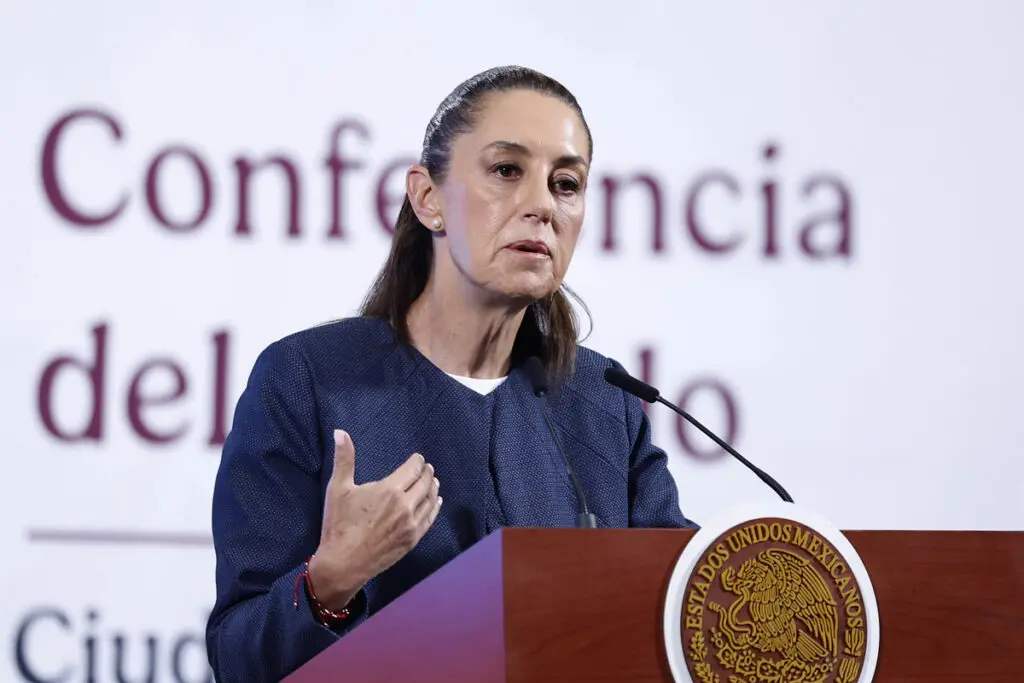
Mexican President Claudia Sheinbaum. Photo: File photo.

Mexican President Claudia Sheinbaum categorically dismissed an alleged US plan to deploy an anti-drug military mission in Mexican territory.

At a press conference Tuesday, Sheinbaum dismissed reports of a proposed US military operation against drug trafficking on Mexican soil and asserted her government would not permit it under any circumstances.

“That’s not going to happen. We have no reports that that’s going to happen, and we disagree with it, and we’ve made that clear to President Trump,” the head of state said in response to a report published the previous day by NBC News.

Sheinbaum recalled that both countries signed a bilateral agreement Sept. 3 following a meeting at the National Palace with Secretary of State Marco Rubio. She emphasized the deal is based on non-negotiable principles.

“We will continue working within this framework of understanding, which has very clear principles: respect for our sovereignty, our territorial integrity, and collaboration and coordination without subordination of either nation,” the president said.

She also revealed the issue had come up in prior phone calls with Donald Trump, who asked whether Mexico needed troop assistance. “I have always said: thank you very much, President Trump, but no—Mexico is a free, independent and sovereign country,” she stated.

In response to the reports, Sheinbaum indicated Mexico is open to forms of cooperation such as sharing intelligence on illegal arms trafficking across the shared border and continuing joint training already underway between the two nations.

The alleged US plan, attributed by a US media outlet to current and former senior officials, is reportedly already in early stages of training for ground operations, though the report clarifies that a military deployment is not imminent.

https://orinocotribune.com/president-sh ... ervention/
"There is great chaos under heaven; the situation is excellent."

User avatar
blindpig
Posts: 14791
Joined: Fri Jul 14, 2017 5:44 pm
Location: Turtle Island
Contact:

Re: Mexico

Post by blindpig » Tue Nov 18, 2025 3:56 pm

How the Right Wing Used AI and Influencers to Make Up An Anti-Government Movement in Mexico
Posted by Internationalist 360° on November 16, 2025
Tamara Pearson

Image
The November 15 right wing march in Puebla, Mexico. Photo: Tamara Pearson

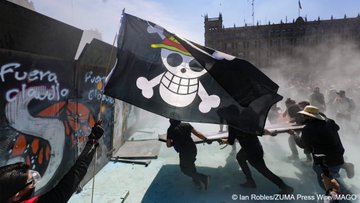
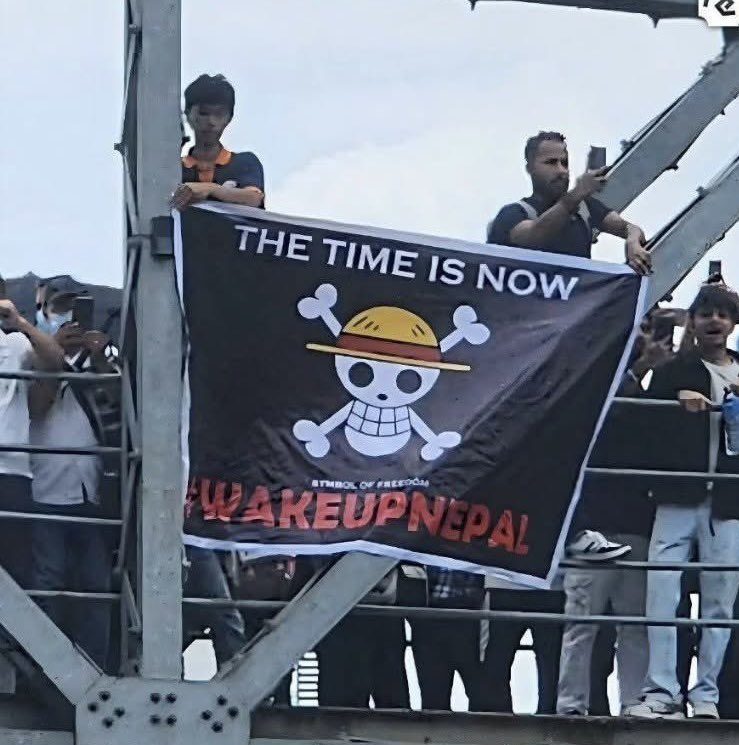
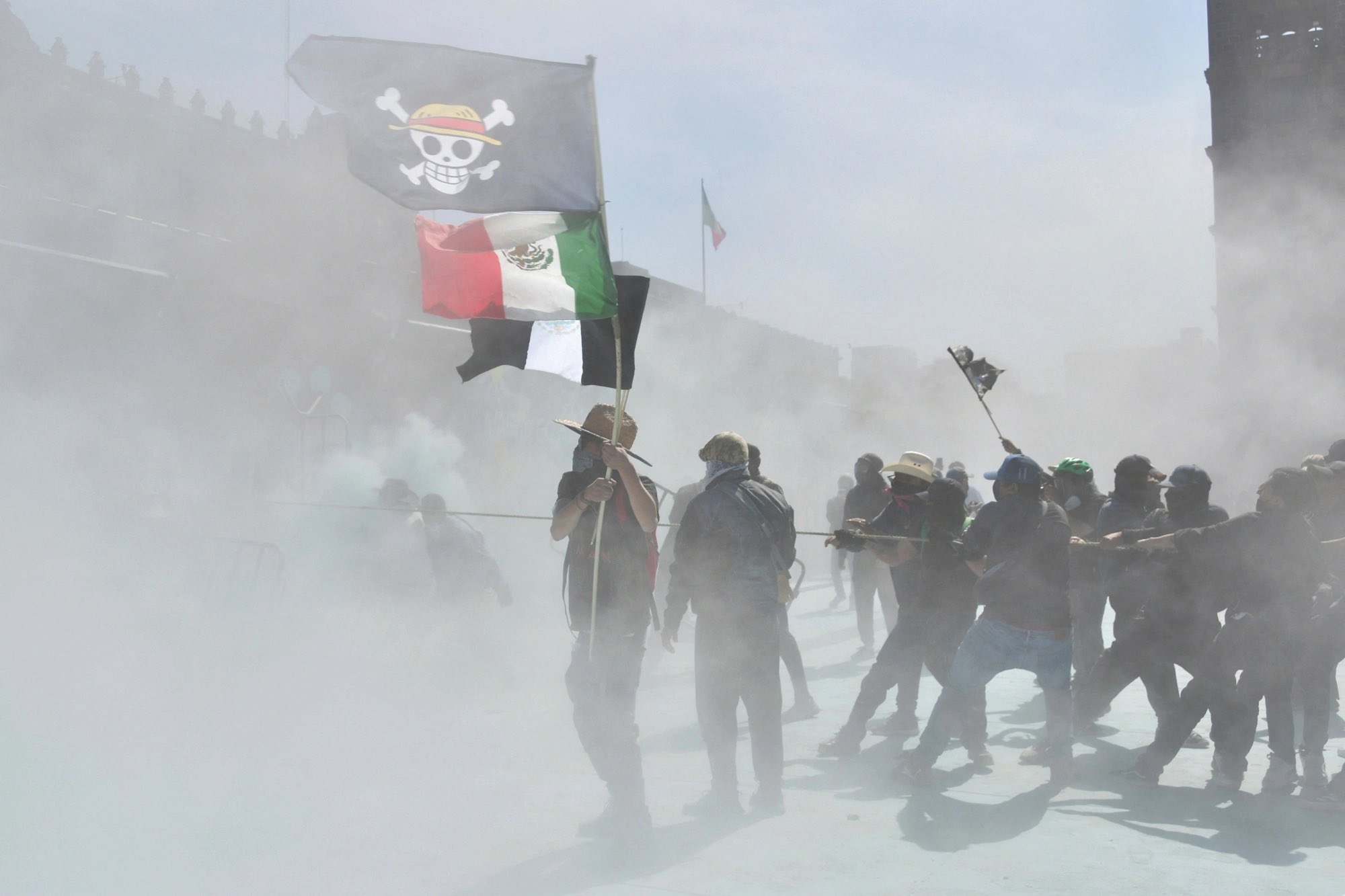
“Down with communism,” they chanted while also waving the One Piece pirate flag, meant to be a symbol of resistance to elitist excess, corruption, and inequality. The right-wing march was also meant to be a Generation Z protest, but most of the people I could see among the 1,000 or so marching through the center of Puebla, were of older generations; clearly the most loyal membership of Mexico’s right-wing parties, the PRI and PAN.

Similar such marches were held in various cities around Mexico on Saturday. They were a bizarre attempt to copy-paste the recent uprisings and protests in Nepal, the Philippines, and Indonesia, but they were built from the top down. Money was spent conjuring the protest from AI campaigns, bots, and influencers, rather than involving real social movements.

The main chants in the march were “Out Morena” (Mexico’s governing party) and “No more narco state.” Meant to be organic, spontaneous anger at the government, crime, and corruption, the marches’ vagueness and misuse of symbols left serious and experienced activists in the country amused, and a little annoyed.

As 51% of content is now AI-generated, it’s worth decoding how this protest has been fabricated, and the impact of its co-option of the symbols and phrases of more genuine causes. AI literacy and awareness of how videos and facts are manipulated for political and economic interests, is becoming more important.

This Instagram account was among the first to publicly call for the November 15 protest. Describing itself as Generation Z, “anti-party,” “the disinterested generation” and “enough of the same old shit” – there are dozens of signs signs the account was not created by movement activists. The account does not follow, tag or interact with other longstanding movements, collectives, or grassroots organizations like unions or community or alternative media. The only groups it follows are bot-like replicas of itself, that have each posted perhaps four times in total. The account’s first posts were created exactly a month before the November 15 protest, and got hundreds of engagements (likes and comments) straight off the bat: a sign the account holder either has funds to pay for significant boosting, or that the posts were supported by bots.

Almost all the account’s content, including videos, is AI-generated. Likewise, the sister account on Facebook. There are few real humans to be seen. But in Mexico, while people often cover their faces in public videos denouncing crimes and injustice due to fear of persecution, it is always important to show at least the eyes, or the full group of farmers on the land being attacked or the Indigenous people meeting, women standing together and so on, to demonstrate that these communities are organizing and speaking out. The Generation Z Mexico accounts don’t have such visuals because they don’t actually meet, discuss, decide based on voting or consensus, hold speak-outs to build larger protests, and other staples of real movements.

“Generation Z Mexico” doesn’t have real visuals of activists – and especially not young ones – – because it is not led by actual activists or actual young people. In Mexico, there are strong women’s movements, movements for the forcibly disappeared, for water rights and more, but there is no movement here to revoke the president, so there are no photos of that to be used. Instead, this group has resorted to AI-generated photos of protests like this one. After Saturday’s march, they will have photos they can use, though even those are being digitally edited to make their crowds look bigger.

And because this made-up movement doesn’t consist of real, committed activists, the people behind it instead throw money at influencers. One of the few real people seen on the Instagram account includes this influencer, who has 177,000 followers, and dedicates all her posts to fashion and to photos of herself posing. She openly advertises that she is available for paid promotions.

Another person featured on the account and who promoted the November 15 protest is this influencer, who also has never posted any political content until a week or two ago, when he suddenly went on a rant about “the left” or “communists” trying to delegitimise his “movement.” Like all the content generated for the November 15 protest, he is vague about what it is he wants, talking about “a movement that seeks to represent us” and “dialogue” and “tolerance” (post since removed). Influencer Carlos Bellow, who describes himself as a “man of god and business” and posts photos of himself in expensive suits, has also taken up the flag of the “protest.”

Another indication that this protest isn’t genuine, is the support it has garnered by right wing and commercial media. Media like TV Azteca for example, that usually demonizes real movements and resistance, was among the first to promote the November 15 protest. The head of TV Azteca, Ricardo Salinas Pliego, a billionaire recently investigated for money laundering and tax avoidance, has posted about the November 15 protest various times and with slogans totally in line with the phrasing used by the Generation Z Mexico accounts, not to mention directly sharing their posts.

Finally, the content of the protest and those promoting it, is muddy at best. Screaming without substance. There were references to phrases brought up in other Gen Z protests in other countries, like “corruption” and “authoritarianism” but without specifics. There were no deep-dives into state power structures and collusion between organized crime, big business, and the various levels of government. There was no analysis of causes, no proposals, no named corrupt figures beyond the president. Calling out the lack of safety as “bad” is so obvious that it is meaningless. Everyone here knows how harmful the proliferation of organized crime is – the key is in denouncing its origins (including the US’s “War on Drugs” and rampant neoliberalism) and what should actually be done about it. Empty, obvious phrases like “corruption is bad” and “crime is bad” are typical of battles for individual power, not of genuine movements. Only politicians or CEOs make cheap references to “safety” and “transparency” in order to get votes or financing, without wanting to dent a thing about the way the rigged system works in their favor.

To make it worse, one of the influencers mentioned above created this post for the Generation Z account, where she argues that Che and Trump are the same kind of thing. It’s a typical right-wing argument, not dissimilar to the wackiness of the right wing in Venezuela adopting Guy Fawkes masks. Beyond the blatant disregard for ideological nuance, let alone the macro difference between an anti-imperialist revolutionary like Che and a racist blockhead, this conflating of “extremes” serves centrists and right-wingers as a way to dilute left wing heroes of their impact, while seeking to appropriate symbols or methods like diversity, dialogue, revolt, direct action, into their own sphere of influence. Portraying people who want basic decent things like healthcare for all, or unpolluted rivers as “extreme” sidelines them to a bubble of irrationality, while the boring, polluting conservatives get to claim reasonableness for themselves.

Mexico does need protests, but not like this

Nevertheless, there are many steep horrors in Mexico worthy of mass, protracted protest, and this manipulated initiative likely drew some genuinely frustrated youth. But, Mexico is not Nepal or Indonesia. The Mexican president, Claudia Sheinbaum, is extremely popular here, and abroad. She uses spin masterfully, vindicating important rights and oppressed identities, while in practice she and her party continue to put big business first. Morena is full to the brim with politicians who have migrated over from the traditional right wing parties. Here in Puebla, our human rights are violated constantly as our water is cut off for months so that Morena can roll out the red carpet to water-consuming transnationals like Google’s AI projects, Volkswagen, Audi, Walmart, and more. Morena promised to de-privatize our water before AMLO’s first term, and instead our rates have gone up.

There are a zillion more reasons to protest – and indeed people are – including the extreme femicide rates and the murder and criminalization of land defenders. Organized crime is booming, taking over industries like avocados, permissions (to park, to set up a stall, to sell gum on the train) and tourism. There are 134,000 disappeared people in Mexico.

We are intensely angry. But the pain, exhaustion, disillusion, trauma from being ignored and minimized, the concern for Mexican and Central America migrants, the rage at protection networks for rapists and the misogyny in healthcare goes back decades. The pain is, unfortunately, integrated into the rhythm of our lives, and so a sudden revolt led by faceless AI graphics and wealthy whitexican influencers, was always unlikely to provoke an overnight rebellion.

What’s worse with Saturday’s right wing march is that Sheinbaum and AMLO before her, have dismissed many important and real movements, claiming they were orchestrated by the right. AMLO has suggested that Mexico’s women’s marches – some of the biggest globally – were organized by the opposition. Sheinbaum has dismissed the important demands of feminist marches by accusing them of violence and criminalising them, and she said “there is always dialogue …so one doesn’t understand why they protest” in response to the CNTE (education workers) protests a few days ago and repressed by the government. AMLO rejected journalist protests against the high rate of murders of journalists in the country (one of the highest globally), and called journalists “conservative”. In that sense, an actual right wing protest only adds fuel to the fire of those trying to de-legitimize real movements.

The Latin American right

This is not the first time resources have been used to digitally promote disturbances aimed at overthrowing a Latin American government. The account calling for the November 15 protest on X only has 209 posts (they seem to be regularly deleting more posts than they share, that figure has since dropped to 182 posts, at the time of writing). When the account was first created in 2024, its first posts were sharing tweets in support of right-wing leaders and candidates in Venezuela.

In Latin America, the international right wing has repeatedly used AI and bot strategies to generate very vague anti-government discontent in countries like Cuba, Venezuela, and Ecuador (under Correa). I witnessed right-wing protests in Venezuela and Ecuador, saw the protesters parroted the online slogans (#SOS, or wearing gas masks to convey repression), and talking to them, noted how inarticulate they were. The participants in those protests, like Saturday’s in Mexico, were not people ever seen supporting other causes, like the sexual diversity marches, anti-racism, worker rights, or standing up to mines,

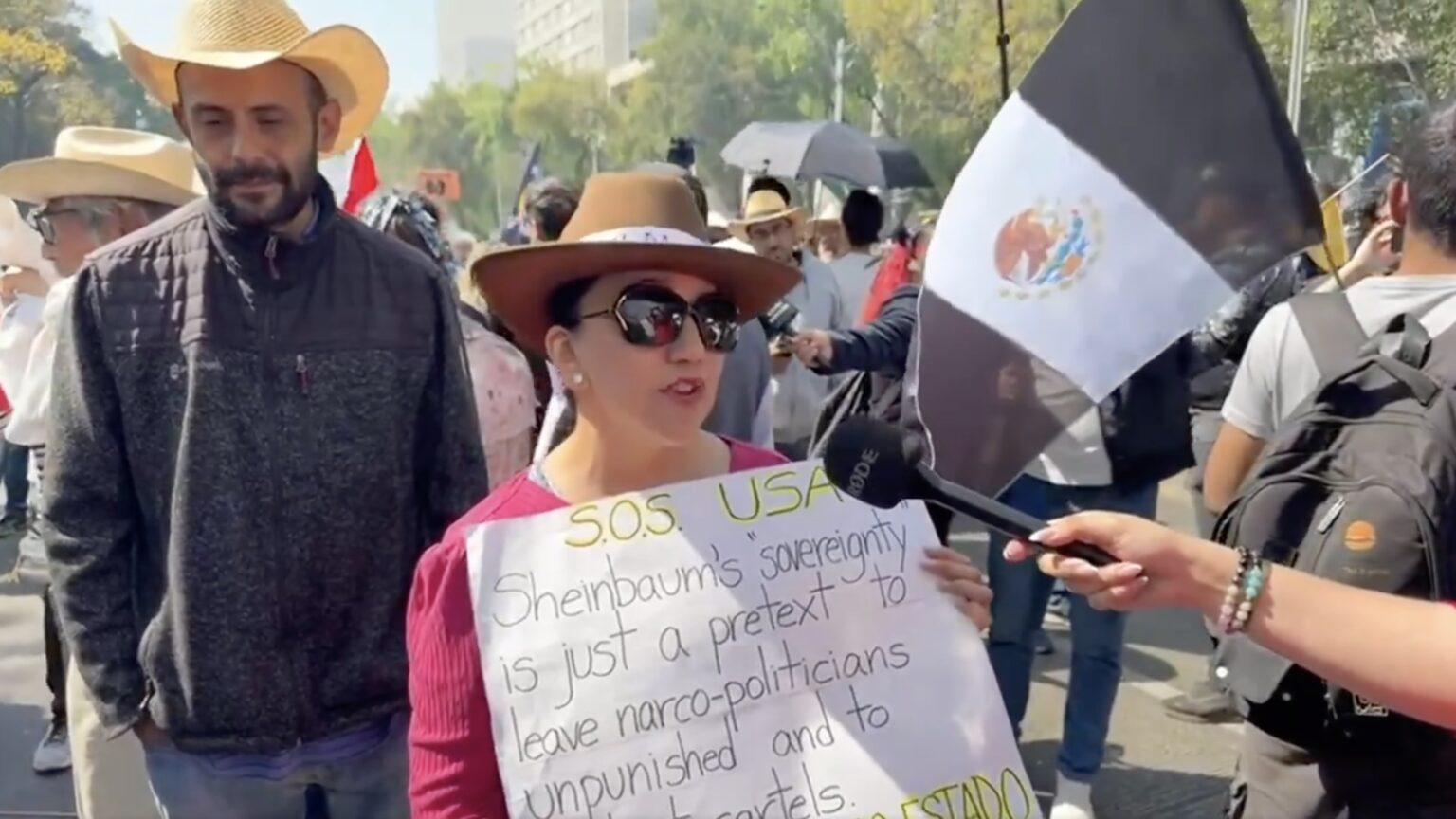
The #SOS hashtag was used in Cuba, Venezuela, and Ecuador as an attempt to convey that things were so desperate for people in the particular country, that US intervention was necessary. That is not happening here in Mexico – the government here is barely centrist and never stands up to the US in practice, bar voting against the Cuban sanctions. Although, it does seem that a few on the right are dreaming about it. There was one guy at a protest recently against the killing of a mayor, walking around with a sign in English welcoming the US army to the region, and an unofficial US security news account with 500,000 followers shared the One Piece flag and wrote “It’s time for President Trump to order massive air strikes against all Narco Terrorist targets across Mexico” and “The People of Mexico are asking America to destroy the Cartels and end decades of violence, crime and corruption! Make Mexico Great Again!”

In the Cuba “SOS” movement, it was non-local accounts that kicked off the July 2021 protests (the first account to tweet about a Covid-19 crisis in the country was in Spain and that account would tweet over a thousand times in two days;10 and 11 of July), with the support of mass amounts of bot accounts, then paid influencers, who, like the ones here, had previously never posted about political or social issues. Over 1,500 accounts that used #SOSCuba were created during those two days.

These digital campaigns can cause long-lasting damage. Especially in the absence of AI and media literacy, they can cultivate distrust of the symbols and demands of genuine movements and causes. It can become a game of popularity based on who can pay for the most boosts – and movements of the oppressed tend to lose that game.

As AI and bot manipulation is used increasingly by the right and elites, reliable, on-the-ground, quality reporting becomes even more vital. It takes experienced, local reporters and activists to be able to distinguish between real movements, and fabricated ones, to read between the lines of government spin, identify local actors and their alliances and interests, decipher the agendas behind the PR, and know when Zapata is being evoked for the right reasons and when his memory is being used by groups with no understanding of his legacy – parading Indigenous resistance for their own interests.

Tweets of Note:

Colour revolution attempt in Mexico >

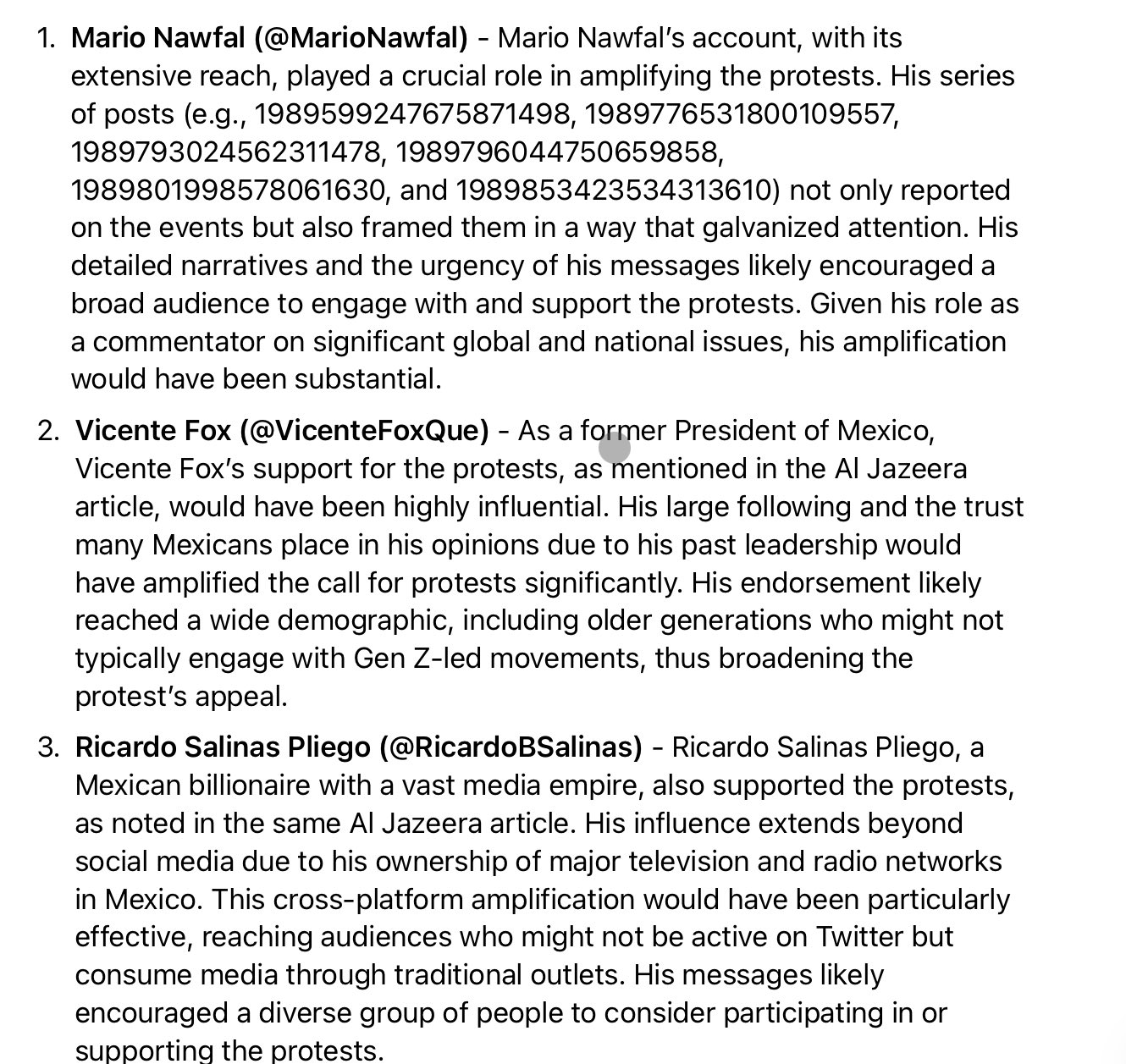
Here are the largest twitter accounts that amplified the most the calls for protests in Mexico >

Amongst them >

Mario Nawfal > Elon Musk’s protege.

Mexico’s ex-president Vincente Fox

Ricardo Salinas > a Mexican billionaire, one of the… pic.twitter.com/jMyuTe7V5F
Image
— Angelo Giuliano 🇨🇭🇮🇹🔻🔻🔻 (@angeloinchina) November 16, 2025


BREAKING Mexican protest exposed:

Left is the “One piece” flag from Nepal & right, the same flag from these Mexican Gen Z “protests”.

90 million pesos have been spent in 2 months, with accounts linked to the Atlas Network, a CIA cut out linked to regime change ops in LATAM… pic.twitter.com/op1NtmeKHA
Image

Image

— Fiorella Isabel (@FiorellaIsabelM) November 16, 2025


https://libya360.wordpress.com/2025/11/ ... in-mexico/

******

Student discontent at BUAP: strike, protests and occupation of the campus
November 16, 2025by Editorialin El Machete
Image

By: Cristian Jiménez Machorro

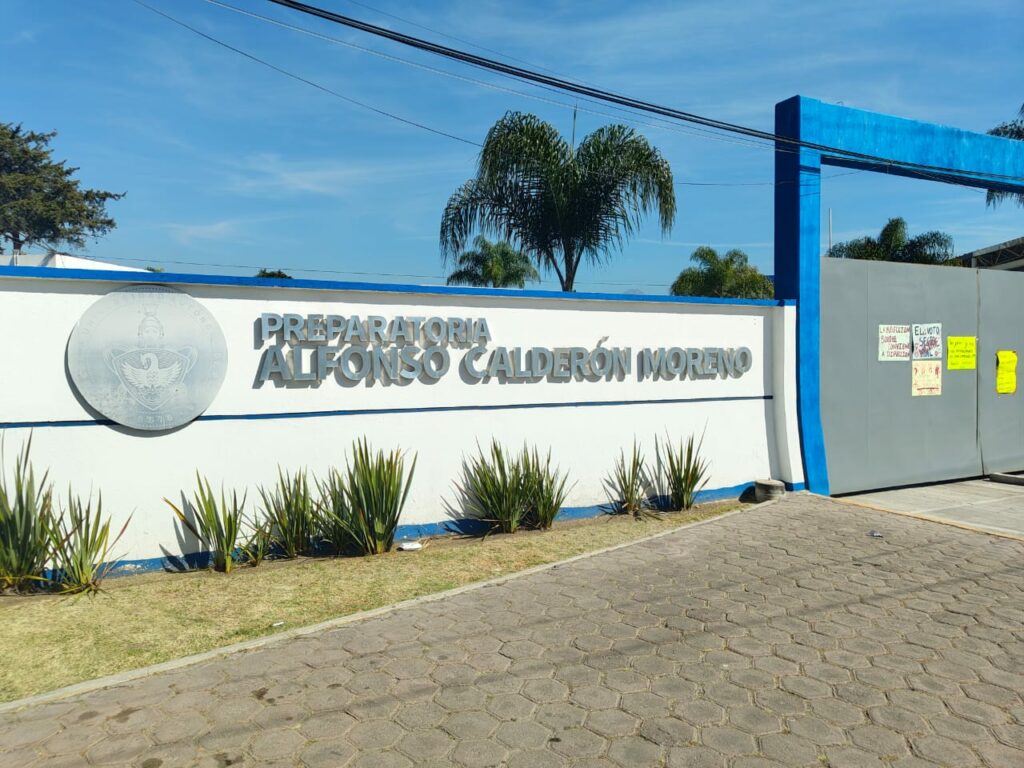
Students at the Alfonso Calderón Moreno Urban High School of the Benemérita Universidad Autónoma de Puebla (BUAP) continue to occupy their school's facilities. The action was taken after denouncing irregularities in the October 28th election process, which aimed to appoint the school's administration.

During the election, the candidate was Professor J. Concepción Meneses Juárez, who was seeking reelection. Her opponent, Professor Nahum Sarmiento, declared after the election that the process was “marked by unethical and illegal conduct” and called on the student body to organize around one of the historical demands of the Puebla university movement: the “democratization of the university.”

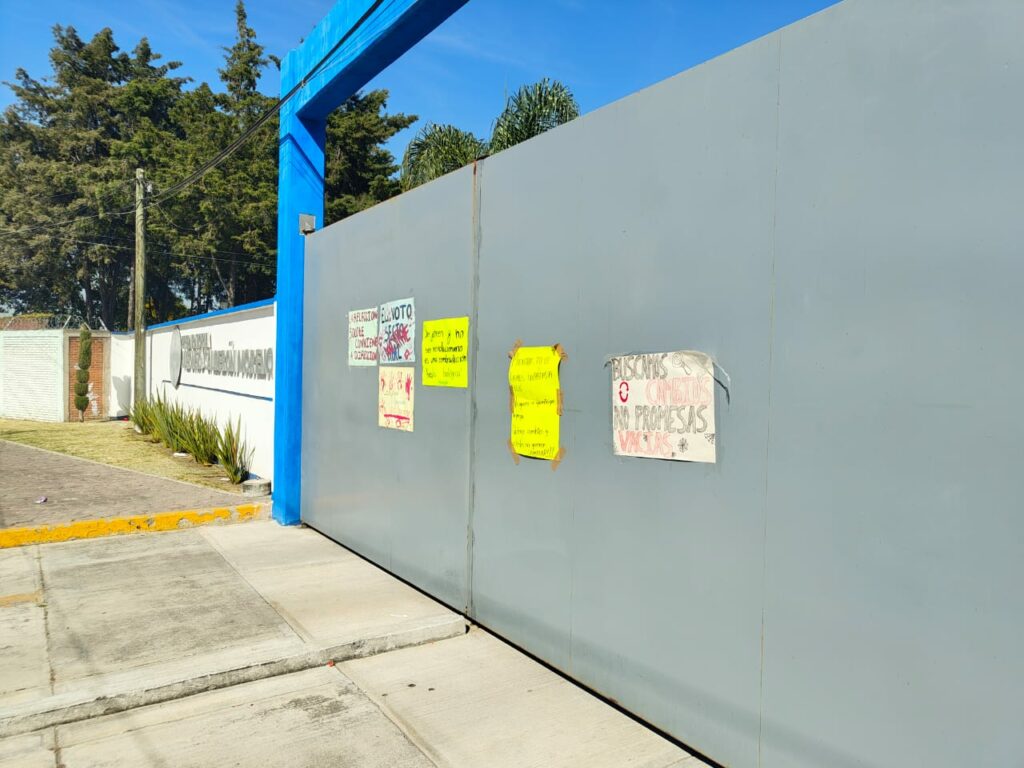
Following a protest held on November 4th inside the high school against "reelection and electoral fraud," the students reached a negotiating table. This failed to resolve their demands, leading to a call for a strike and a demonstration on November 9th. In response, the BUAP authorities suspended activities at their campuses, citing "cold fronts" in the state as the main reason.
Image

The students' growing frustration culminated in the occupation of the facilities on November 11. On that day, they reiterated the demands outlined in a petition that the administration had received on March 19, 2025. Key points included:

• Improvements in the quality of teaching and teacher conduct, with fair and objective evaluations.
• Eradication of despotic and disrespectful attitudes.
• Establishment of accessible advising hours.
• Greater empathy from teachers and timely communication from academic advisors.
• Resolution of the harassment and cover-up allegations involving the high school administration.
• Demand for term limits and transparency in internal electoral processes.

https://elmachete.mx/index.php/2025/11/ ... el-plantel

Google Translator

"There is great chaos under heaven; the situation is excellent."

User avatar
blindpig
Posts: 14791
Joined: Fri Jul 14, 2017 5:44 pm
Location: Turtle Island
Contact:

Re: Mexico

Post by blindpig » Thu Nov 20, 2025 3:08 pm

Image

Mexico’s ‘Gen Z rebellion’ exposed as viral right-wing plot
Wyatt Reed and Kit Klarenberg·November 19, 2025

Presented as a spontaneous youth-led uprising against corruption, violent protests that erupted across Mexico this month were backed by local oligarchs and an international right-wing network determined to topple the popular President Claudia Sheinbaum.
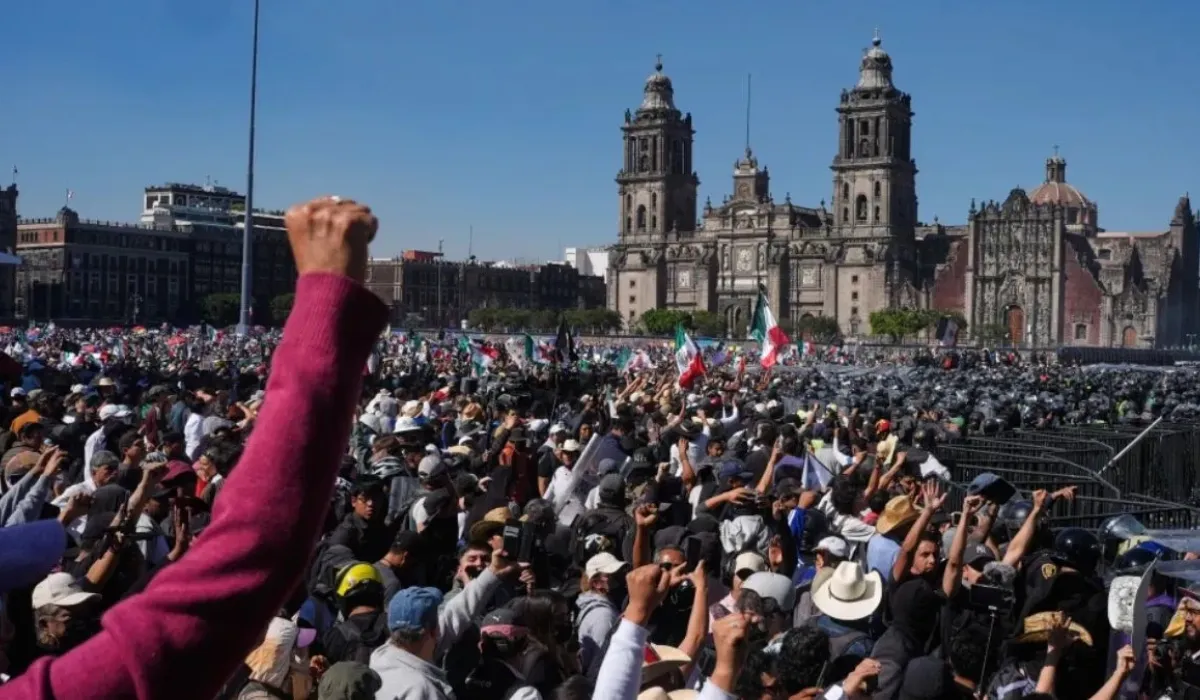
Violent demonstrations which erupted in over 50 cities across Mexico on November 15 were secretly financed and coordinated by an international right-wing network and amplified by bot networks, a new report by public fact-checking platform Infodemia has concluded.

Those findings were amplified by Mexican President Claudia Sheinbaum, who has questioned what role Mexico’s cartel-linked opposition parties and foreign meddling may have played in inflaming so-called “Gen Z” protests on November 15. The demonstrations left around 120 people injured – over 100 of them police officers, according to a statement from authorities.

The Infodemia report traced the astroturfed movement’s origins to a shadowy nexus of previously apolitical social media influencers, Mexican opposition figures, and wealthy oligarchs, who are accused of subsidizing the chaos to the tune of 90 million pesos (approximately $5 million USD). Among the chief organizers was a wealthy young influencer named Carlos Bello; Mexico’s most infamous serial tax cheat, Ricardo Salinas Pliego; and the operators of anonymous social media accounts which mysteriously attracted hundreds of thousands of followers on Twitter/X, Instagram, and TikTok in just a handful of weeks.

In early October, the 31-year-old Bello instantly transformed from a lifestyle influencer flashing cash and showing off sports cars to a political lightning rod after he slammed the Mexican government and exhorted young audience members to “assert your rights” during a forum organized by the Chamber of Deputies. In a rhetorical style clearly aimed at channeling Donald Trump, Bello mixed banal observations that the government had grown out of touch with the demands of everyday people with right wing pablum about the need for a successful “businessman” like himself to reinvigorate the system. The message was republished by Pliego, who emerged as a vitriolic opponent of the Mexican government after it ordered his Grupo Salinas conglomerate to pay over 50 billion pesos ($2.6 billion dollars) in back taxes.

Bello insisted he was neither affiliated with the ruling Morena party nor “PRIAN” – a reference to the ossified pro-establishment PRI and PAN parties which ruled Mexico for nearly 90 years before Morena was swept to power in a landslide election won by former president Andrés Manuel López Obrador in 2018. Yet just two weeks later, Bello began to promote Alessandra Rojo, a mayor from Cuauhtémoc who belongs to the PRIAN’s successor party, Strength and Heart for Mexico.

It was Bello who first announced on October 12 that a “march” was being organized and that the date had already been set. “They don’t have the power,” Bello declared in a TikTok post, while displaying video of the Mexican legislature. “All of us have the power, and Mexico needs us to demonstrate that today more than ever.”

Though his speech had “woken up many Mexicans,” Bello insisted that “we can’t limit ourselves to words alone,” and concluded that “now is the time for the next step.”

The very same day, an account with the name “Mexican Revolutionaries” was opened on TikTok. Four days later, on Oct. 16th, the Mexican Revolutionaries page published the first call for demonstrations to take place on November 15th. That same week, another account which was central to the violent protest, “We Are Generation Z Mexico,” held a live broadcast promoting the demonstrations which was immediately shared by Henrique ‘Kike’ Mireles, a spokesman for the PAN party in the state of Querétaro.

These calls to action were quickly amplified by a range of accounts which Infodemia researchers singled out for exhibiting inauthentic behavior. They pointed specifically to dozens of accounts which had single-digit follower counts and were only created in October or November of 2025.

The vast majority of the accounts bore the image of a pirate flag from the Japanese anime One Piece, which have been a frequent sight at supposedly youth-led anti-government protests across the globe since the overthrow of Nepal in the summer 2025. The accounts appeared to be following the lead of the Mexican Revolutionaries and Gen Z Mexico pages, which adopted the logo the same week they issued calls for an uprising.

Image

In the days leading up to the violence in Mexico, the We Are Generation Z Mexico page published a series of contradictory messages, with one Nov. 12 post insisting protesters not “vandalize” or “destroy,” hours before another post was made by the same account showing followers how to use angle grinders and physical force to disassemble the metal barricades installed to keep demonstrators from reaching the presidential palace.

Image

Generation Z Mexico describes itself as “non-partisan” in its profile, yet the account has published a variety of posts clamoring for regime change in Venezuela since 2024.

Though it claims to speak on behalf of the entire generation of Mexican youth, an October 2025 poll by Bloomberg-tied El Financiero found that Mexican President Claudia Sheinbaum enjoys the support of two-thirds of the youngest voters in her country. Nevertheless, Western news outlets have largely adopted Gen Z Mexico’s narrative, consistently framing the chaos as a mass uprising of young activists against a supposed “narco-government.”

While the original protest materials focused on demanding President Sheinbaum step down from power, organizers switched gears following the assassination of a prominent anti-cartel mayor named Carlos Manzo. In weaponizing the killing against Sheinbaum, the protesters ignored her administration’s concerted crackdown on the local narcotics trade, which has led to tens of thousands of arrests, dozens of deportations, seizures of vast quantities of illicit substances and mass disruption to cartel operations.

The “Gen Z” protests have also received wholehearted encouragement from Vicente Fox, the former right-wing Mexican president whose security chief, Genaro García Luna, was convicted of an international drug trafficking conspiracy with the notorious Sinaloa Cartel, and now languishes in the same US supermax prison which houses infamous druglord Joaquín “El Chapo” Guzmán. State Department officials later conceded that both they and Fox’s administration knew all about García Luna’s collusion with the cartels, but did nothing because “we had to work with him.”

For her part, President Sheinbaum has alleged the protests were “promoted from abroad.” Though mainstream media accounts have largely painted her comments as a wild conspiracy theory, the president’s claims are not unfounded.

One outlet which promoted the demonstrations and pushed video clips of police brutality, Animal Politico, is among an array of Mexican media outlets and civil society groups funded with huge sums by the National Endowment for Democracy, the US government’s regime change arm.

Animal Politico openly offers corporations and advertisers the opportunity to place and promote sponsored content authored by in-house ‘journalists’ in its virtual pages in exchange for hefty fees. Its sponsors include a variety of Western corporations, including Google parent company Alphabet Inc, Astra Zeneca, the CIA-tied Ford Foundation, and George Soros’ Open Society Foundations – not exactly supporters of the left-nationalist policies of Sheinbaum’s government.

Some of the most positive coverage the demonstrations received came from Real America’s Voice, the right-wing network of former Trump chief of staff Steve Bannon. Bannon has led the charge for Trump to authorize US military strikes on Mexican territory on the grounds of battling narco-cartels.

A November 15 New York Times report quoted numerous protest attendees, mostly young, calling for the government’s overthrow, while expressing no concrete demands beyond that. A typical interviewee presented by the Times was a 21-year-old “actor and singer” who explicitly stated, “the goal of this march is precisely to remove the president.” They were “unsure” what would happen if Sheinbaum resigned, but believed “getting her out is part of the beginning of something.”

A 19-year-old student advanced the insurrectionary spirit, but acknowledged it was highly unlikely the protests would succeed: “We’re obviously not going to achieve [Sheinbaum’s] revocation, because that’s too extreme.” Instead, they said the demonstrations were “about letting the government know that we’re willing to go that far. Because when those at the bottom move, those at the top fall.” Meanwhile, a sexagenarian farmer pleaded for US “intervention” – “the only solution” to the supposed “grip” of cartels over the country.

The New York Times revealed protesters organized the mayhem using the Discord messaging app, where it was noted that “several” users went so far as to advocate breaking into the Presidential palace. Coincidentally, the violent protests that toppled Nepal’s government in early September were also coordinated via Discord. Parallels between that unrest, which also bore many of the hallmarks of a US-sponsored color revolution, don’t end there.

As in Mexico, the media framed Nepal’s upheaval as led by disillusioned local “Gen Z” elements, who took to the streets waving signs and flags bearing the One Piece pirate flag. Nepal’s interim leader was also chosen through a vote on Discord, with a widely-shared image of the vote’s tally showing the country’s new head of state received just under 4,000 votes – a negligible fraction of the country’s population of 30 million. Mexican protesters similarly used Discord to discuss replacements for Sheinbaum.

According to the New York Times, proposed successors included oligarchs like the “brash billionaire Ricardo Salinas Pliego, who has become one of the most aggressive opposition voices.” Pliego is a dedicated neoliberal and among Mexico’s wealthiest citizens, who has been accused by authorities of orchestrating the disruption. In response, he angrily demanded they “present a single piece of evidence for the lies you’re spreading without any scruples about me.”

While the evidence of Pliego’s involvement remains circumstantial, he has not been shy about his support for violent anti-government protests. And he enjoys some notable international connections.

For example, in March 2023 he launched Universidad de la Libertad, to “advance free-market principles, business development, and innovation” in Mexico, in conjunction with the Atlas Network. This US corporation-funded organization represents a nexus of hundreds of “free market” think tanks, associated with the US State Department and NED. The Network provides grants to “pro-freedom organizations” globally every year, totaling millions, and pushing the right-wing project across Latin America.

Atlas has been implicated in a variety of US-backed coups in Latin America, including the 2019 effort to overthrow Bolivia’s first indigenous president, Evo Morales. Listed among the recipients of Atlas’ sponsorship is Jhanisse Vaca-Daza, an upper class eco-socialite whom The Grayzone exposed in 2019 as a leading instigator of the 2019 coup that subverted Bolivia’s democracy.

Another recipient of Atlas Network financing is the Caracas-based Center for the Dissemination of Economic Information (CEDICE), which has lobbied for pro-business, capitalist reforms since its founding in 1984. In April 2002, it was a key player in the US-orchestrated coup that temporarily ousted elected President Hugo Chávez, receiving tens of thousands of dollars from NED for the purpose.

If the turbulence that recently gripped Mexico was attempted regime change, then it likewise failed. However, it may represent just the initial barrage in a wider war on Sheinbaum’s administration. Donald Trump expressed dismay at the tumult, seemingly hinting at future military action. He has previously praised Sheinbaum as a “brave woman”, but claimed the country is “run by the cartels.” Since Trump’s inauguration, rumors have swirled that the CIA and US Army are being prepared for covert deployment in Mexico – an act which its government would view as hostile.

“I looked at Mexico City over the weekend. There’s some big problems there… I am not happy with Mexico,” the US President said in response to the November 15 protests. “Would I launch strikes in Mexico to stop drugs? It’s OK with me. Whatever we have to do to stop drugs.”

The organizers of the chaos have since issued a call for demonstrators to descend on the National Autonomous University of Mexico on November 20.

https://thegrayzone.com/2025/11/19/mexi ... wing-plot/
"There is great chaos under heaven; the situation is excellent."

User avatar
blindpig
Posts: 14791
Joined: Fri Jul 14, 2017 5:44 pm
Location: Turtle Island
Contact:

Re: Mexico

Post by blindpig » Mon Nov 24, 2025 3:27 pm

Second anti-Sheinbaum protest loses momentum

After the highly-watched violent protest reportedly drew around 17,000 people, the second one barely managed to gather 200. Analysts see the marches as an attempt to destabilize the executive branch.

November 23, 2025 by Pablo Meriguet

Image
A woman participating in the November 20, 2025 march speaks to independent journalist Meme Yamel while holding a sign calling for US intervention in Mexico. Photo: Screenshot

Despite the great controversy and public attention generated by the first demonstration by the so-called “Gen Z” on November 15 in the Mexican capital, its second iteration on Thursday, November 20, seems to have diminished in volume.

The press estimated that 17,000 protesters took to the Zócalo on Saturday, while the same media outlets estimated that no more than 200 people attended the second protest days later on Thursday. The police were on alert after the previous clashes, given that protesters sought to emulate the incidents.

However, on this occasion, the clashes were not repeated, despite the huge number of journalists and media outlets ready to record the event, journalists who, at times, seemed to outnumber the protesters, according to CNN.

What Mexican authorities did report was that several protesters had clubs, masks, and chains confiscated, while a small group of hooded individuals entered the Zócalo (the capital’s main square), although no incidents were reported.

A mobilization that failed to achieve its goal
The protesters gathered on the same day as the traditional military parade in honor of the Mexican Revolution, which was led by President Claudia Sheinbaum. Since the first “Gen-Z” protest, the Mexican president’s team has been working to expose the alleged links between the protesters and the interests of private national and international businessmen. Despite fears, the military parade and the opposition mobilization did not clash.

According to Sheinbaum, almost USD 5 million has been invested in promoting and disseminating anti-government sentiment on social media. Among those implicated are Mexican businessmen such as Claudio X González and Ricardo Salinas Pliego (the latter is the owner of TV Azteca and the corporate conglomerate Salinas Group), as well as far-right groups like the NGO Atlas Network.

In addition, the president offered her hypothesis as to why the opposition turnout was so low. According to Sheinbaum, the violence displayed by some groups caused widespread rejection among the majority of protesters on November 15.

She also said that there was an attempt to portray the previous demonstration as if the majority of young people were against the government, to which Sheinbaum responded that the tiny protest on November 20 disproves this type of framing by journalists and influencers who follow a political and partisan agenda.

What role is right-wing PAN playing in the demonstrations?
In fact, it was recently revealed that one of the main drivers of the demonstrations, Edson Saúl Andrade Lemus, is an employee of the right-wing National Action Party (PAN), which is part of the opposition. According to National Congress records, Andrade has worked in the social media administration of three PAN representatives, Daniela Álvarez, Frida Guillén, and Luisa Gutiérrez.

According to Telesur, sources close to the PAN claimed that Andrade was behind the promotion of the demonstrations thanks to the bots he manages, something he has used before to raise the profile of his former bosses in Congress on social media.

In response to these accusations, Jorge Romero Herrera, national leader of the PAN, stated that although Andrade works for his organization, his party has no connection with the call for the November 15 march.

Is a “soft coup” being organized in Mexico?
The president of the National Institute for Political Training of MORENA (the ruling party), Rafael Barajas, warned that the recent demonstrations may be part of a plan to carry out a classic “soft” coup, a formula attributed to American political scientist Gene Sharp. The different stages of the classic “soft” coup include promoting a mood of unrest among the population, accusing the government of violating human rights due to a supposedly “totalitarian” attitude, the intensification of the struggle of opposition movements who demand better political and social conditions, and the turn towards violent street protests.

The next step would consist of “psychological warfare” and “destabilization of the government” so that the president would finally resign.

According to Barajas, this is the script being followed by the promoters of the recent demonstrations: “Many foreigners were surprised by the very violent episode of the November 15 march, which had a great impact among MAGA supporters and which they present as a ‘success,’ as a massive march. The march was exaggerated by the media and announced as the Mexican version of the Nepalese uprising. But it is something totally different and is part of the logic of Trumpism and the Monroe Doctrine. It is part of the logic of ‘soft coups.’”

He also stated that the United States is using a similar strategy against all governments that do not align with its interests. Thus, they are accused of being narco-terrorists or close to drug trafficking groups so that they lose legitimacy and the destabilization of these governments can continue according to the plan explained above.

The truth is that the Mexican government seems to be continuing to closely monitor future demonstrations, which it claims are being financed by shady capital and interests. At the moment, Sheinbaum enjoys an approval rating of almost 70% among the population, something that the recent demonstrations are surely seeking to change.

For now, opposition sectors have not demonstrated organic unity, and if links between the march organizers and right-wing political parties are proven, the “anti-establishment” narrative of Generation Z’s protests could quickly fade in the North American country.

https://peoplesdispatch.org/2025/11/23/ ... -momentum/

*******

Communist Party of Mexico
VII Plenary Session of the CC
administrator Communist Party of Mexico August 20, 2025 Visits: 945

Image

Statement on the VII Plenum of the Central Committee

The VII Plenary of the Central Committee, which is the body that directs the Communist Party of Mexico between Congresses, that is, the direction between the period from the VII Congress, held in December 2022 until the end of 2026 when the VIII Congress will be held, met in Mexico City.

The 7th Plenum began by paying tribute to Comrade Ammar Bagdash, the former general secretary of the Syrian Communist Party, who recently passed away. He was in Athens thanks to the internationalist solidarity of the Communist Party of Greece, following the coup that brought reactionary forces over the Syrian government. The Plenum also paid tribute to the centenary of the founding of the Communist Party of Cuba, a historic event in which the Mexican Section of the Communist International was fully involved.

Based on the draft Political Resolution prepared for discussion, it was assessed that new elements have emerged in the reality of the class struggle that strengthen the theses approved by the VII Congress:

Antagonisms over the primacy of the imperialist system are intensifying; the trend of US decline and the rise of China's capitalist economy continues. Alliances continue to form, which, according to the specific interests of monopolies, produce realignments without altering the main trend, which is the clash between two groups of capitalist states.
Such economic, commercial, and diplomatic competition has, for some years now, also been waged on the military front, since the start of the imperialist war on both sides between Ukraine and Russia, and behind each of them, both interstate alliances, as well as other hotspots in the Middle East and Asia: Israel against Palestine, Yemen, Lebanon, Syria, Iran, with the support of the US, the EU, and NATO; the possibility of a generalized war is latent, as long as imperialist competitions and antagonisms have no framework for peaceful resolution, regardless of temporary truces.
No different from the rapacity and voracity of the US and the EU, the emerging capitalist countries, which call themselves multipolar, are also driven by profits, markets, natural resources, capital exports, trade routes, and energy; multipolarity is not an alternative to imperialist domination but rather an alternation in the ownership of that domination. Therefore, the PCM reaffirms its commitment to fighting against both sides of imperialist countries and considers the confusion promoted by opportunism to whitewash and exonerate the multipolar side to be detrimental.
The Plenary considers that in the last year, one of the characteristics of the imperialist system—territorial division—has become increasingly evident; first in the Gaza Strip, and likely also the West Bank and other countries in the region for the Greater Israel project; in Syria, by Israel, Turkey, Qatar, and also Russia; and now in Ukraine by the US and Russia, a process that is accelerating after the talks between Presidents Trump and Putin in Alaska. It is abundantly clear that entire populations are being sacrificed to serve the interests of one or the other side of the imperialist powers.
The option of socialism-communism emerges with greater force in times of escalating capitalist violence against workers and peoples, the barbarity of exploitation, and the generalization of imperialist war. In addition to the struggle for socialism and upholding the banner of proletarian internationalism, the PCM will reinforce its stance against imperialist war and its solidarity with peoples in struggle: the Palestinian cause and support for the Cuban Revolution against the blockade and imperialist aggression. We express solidarity with the vast multinational mass of migrants in the US, and also in Mexico. We condemn the US threats against the people of Venezuela.
The Mexican Communist Party (PCM) expresses its rejection of the attacks on sovereignty by the Trump Administration, the military threat, and the operations of drones, ships, aircraft, and police and even military personnel in our country's territorial, airspace, and coastal areas. This implies that we must work diligently to ensure that in 2026, when the USMCA is submitted for review and ratification by the three participating states, Mexico withdraws from it. This imperialist interstate agreement is detrimental to the people and workers of North America.
We believe that social democratic management, rather than defending sovereignty, makes all the concessions demanded by the US, which adds to its characterization as being anti-worker, anti-popular, anti-indigenous, anti-immigrant, etc.
The PCM will reinforce its membership campaign for the Communist Platform of Mexico, as an electoral instrument; attentive to the Call for Political and Electoral Reform, established at the behest of President Sheinbaum, the PCM decides that it will participate in the consultation forums to position itself in this debate and demonstrate that democracy does not exist in Mexico and that the barriers that exclude the working class and communists and strictly favor bourgeois parties and the tendency towards the commodification of politics, financial corruption and annul the constitutional right to vote and be voted for must disappear.
The PCM persists in the congress-based orientation for the construction of the mass movement, in the workers' union, popular sectors, working women, and youth and students.
Work has begun on the preparations for the 4th Congress of the Communist Youth Front, which will have our full support and solidarity.
The Plenary of the Central Committee of the PCM wishes for the recovery of the health of comrade Marco Vinicio Dávila, member of the body and of the Political Bureau, who is released from the organization secretariat to concentrate on the workers'-union movement.

Workers of the world, unite!

http://www.comunistas-mexicanos.org/ind ... eno-del-cc

Google Translator
"There is great chaos under heaven; the situation is excellent."

User avatar
blindpig
Posts: 14791
Joined: Fri Jul 14, 2017 5:44 pm
Location: Turtle Island
Contact:

Re: Mexico

Post by blindpig » Tue Nov 25, 2025 3:14 pm

A Looming Mexican Coup?
Posted by Internationalist 360° on November 24, 2025
Kit Klarenberg

Image

On November 15th, incendiary protests engulfed over 50 cities across Mexico. The Western media has universally adopted the narrative disaffected local “Gen Z” sought to vent their righteous rage against the government, over corruption, and the administration’s purported ties to drug cartels. Footage of law enforcement clashing with demonstrators spread like wildfire, and many outlets widely emphasised how the upheaval injured at least 120 people. Few acknowledged the overwhelming majority of those hurt – 100 – were police officers.

A New York Times report made the insurrectionary designs of those causing mayhem on Mexico’s streets clear. “The goal of this march is precisely to remove the President, and to show we are angry, that the people are not with her,” one protester was quoted as saying. Oddly absent from mainstream coverage of the hullabaloo was any recognition President Claudia Sheinbaum enjoys popularity of which Western leaders can only fantasise. Polls throughout her first year in office indicate 70 – 80% of the public support her.

Sheinbaum has charged the fiery demonstrations were “inorganic”, “paid for”, and “a movement promoted from abroad against the government.” There are strong grounds to believe this was absolutely the case. For one, a key local amplifier of the protests, and supposed police brutality, was media outlet Animal Politico. The National Democratic Institute, a wing of avowed CIA front the National Endowment for Democracy, lists the organisation among its “partners”. Mexican newspaper Milenio has documented in detail the news site’s voluminous US funding.

Furthermore, former Mexican President Vicente Fox attended the protests, and posted extensively on social media in support of the demonstrators. In 2001, he was bestowed NED’s Annual Democracy Award. Another prominent supporter was oligarch Ricardo Salinas Pliego, Mexico’s third-richest man. In March 2023, in conjunction with the shadowy Atlas Network, he launched Universidad de la Libertad, to “advance free-market principles, business development, and innovation” in the country.

Atlas Network comprises a web of libertarian think tanks, bankrolled by major US corporations, with deep and cohering ties to Western foundations and intelligence cutouts, including NED. The Network itself doles out millions annually “supporting pro-freedom organizations” worldwide. A longtime beneficiary of its largesse is the Venezuela-based Center for the Dissemination of Economic Information (CEDICE), which operated at the forefront of the April 2002 US-orchestrated coup that temporarily ousted elected President Hugo Chávez.

Fast forward to today, and Washington again appears to be plotting the Venezuelan government’s downfall. A huge military buildup around the country, and belligerent actions in the Caribbean supposedly intended to thwart drug trafficking operations directed by Caracas, could be harbingers of all-out invasion. The widely-admired Sheinbaum, who stands steadfastly opposed to US machinations in Latin America, represents a significant barrier to realising that goal. It stands to reason the Empire must neutralise her first, before training its crosshairs elsewhere in the region.

‘Legal Justification’

It may be no coincidence the foreign-sponsored upsurge of anti-government agitation that unfolded in Mexico followed not long after murmurings the Trump administration is considering inserting US forces and intelligence operatives into the country, to conduct aggressive covert operations supposedly targeting cartels. On November 3rd NBC reported this “new mission” would represent “a break” with the approach of past US governments, which have hitherto “quietly deployed CIA, military and law enforcement teams” to “support local police and army units” battling drug syndicates:

“If the mission is given the final green light, the administration plans to maintain secrecy around it and not publicize actions associated with it, as it has with recent bombings of suspected drug-smuggling boats…Under the new mission…US troops in Mexico would mainly use drone strikes to hit drug labs and cartel members and leaders…Some of the drones that special forces would use require operators to be on the ground to use them effectively and safely.”

Similar action was previously mooted in April, prompting a firm rebuke from Sheinbaum. The President declared: “The US is not going to come to Mexico with the military. We cooperate, we collaborate, but there is not going to be an invasion. That is ruled out, absolutely ruled out.” However, NBC notes while Washington “would prefer to coordinate with the Mexican government on any new mission against drug cartels…officials have not ruled out operating without that coordination.”

US military action being waged inside Mexico without state approval would represent an absolutely egregious and unprecedented breach of the country’s sovereignty. Moreover, at Washington’s demand, Sheinbaum has already deployed 10,000 troops to the US border, significantly increased fentanyl seizures, and extradited 55 senior cartel figures Stateside. These escalations are nonetheless seemingly insufficient, raising obvious questions as to whether an ulterior motive lies behind the Trump administration’s new mission – for which elite military and CIA personnel have apparently already begun training.

One explanation could be Sheinbaum representing a potent barrier to regime change in Caracas – a monstrous objective for which Trump strived over much of his first term in office, that has become turbocharged over recent months. Sheinbaum has publicly rubbished the US President’s claims there is evidence linking Venezuelan leader Nicolás Maduro to drug dealing, called for constructive dialogue between the pair, and repeatedly condemned extrajudicial US airstrikes on boats purportedly ferrying drugs, which have killed scores of potentially innocent people.

Image
US strike on supposed narco-terrorists, September 2025

Those attacks, which began in September, are widely perceived to be a prelude to all-out US invasion of Venezuela, and have frequently been conducted in Mexico’s territorial waters. In addition to openly admitting they aren’t certain targeted boats are in fact ferrying narcotics, and the identities of victims are unknown, Trump administration officials have struggled to provide any legal justification whatsoever for the deadly strikes. On October 30th, a classified bipartisan Congressional briefing was convened, at which government representatives attempted to explain their rationale.

Attendees from both primary US political parties “were not happy with the level [of] information that was provided, and certainly the level of legal justification that was provided,” Republican Mike Turner complained. Meanwhile, Democrat Sara Jacobs declared, “I’m not convinced that what they said was accurate,” concluding the administration’s strategy “is actually not about addressing” the flow of narcotics into the US, or crushing Latin American drug smuggling networks. Her comments may be more illuminating than she intended.

‘Big Problems’

On top of clearing a beachhead for invading Venezuela, Sheinbaum could be earmarked for removal by Washington because, from the CIA’s perspective, the Mexican President’s hardline crackdown on local cartels may be proving too successful for her own good. Within six months of taking office, police and security forces dismantled 750 drug labs across the country, arrested close to 20,000 cartel operatives, and seized over 140 tons of narcotics. Drug barons who evaded capture have been forced into hiding, while suffering multimillion dollar losses.

Image
Mexican authorities arrest high-ranking Sinaloa Cartel member, February 2025

Markedly, these efforts largely haven’t been conducted in coordination with Washington. This raises the prospect that individuals and groups ensnared by Sheinbaum’s anti-cartel crusade – which has been praised in many quarters – might one way or another have been working for and/or with the CIA. Investigations by veteran deep state researcher Peter Dale Scott reveal how since World War II, the core component of any international drug cartel’s success has consistently been maintaining a clandestine relationship with US intelligence.

Indeed, per Scott, it is difficult if not impossible to prosper in the narcotics trade without the CIA’s protection. A palpable illustration of this phenomenon is provided by the Guadalajara Cartel’s extraordinary rise. After its founding in the late 1970s, the group rapidly became one of North America’s largest drug suppliers. Key to its success was its covert bond with Mexico’s Federal Security Directorate (DFS), which was created by and enjoyed a deeply intimate relationship with the CIA.

In return for a 25% cut of the Guadalajara Cartel’s profits, the ultra-violent drug syndicate was not only insulated from legal repercussions, but actively assisted by DFS. Joint US-Mexican anti-drug efforts in the early 1980s deliberately targeted solely minor traffickers, eliminating the Cartel’s competition. Resultantly, by 1982 Mexico had replaced Colombia as the States’ leading supplier of marijuana, and was providing up to 30% of the country’s cocaine. All along, the CIA and DEA did and said nothing, despite full cognisance of the Cartel’s activities.

Guadalajara might still be in business today, were it not for its February 1985 kidnap, brutal torture and murder of DEA agent Enrique Salazar. Allegations the CIA and FDS colluded in his killing, to conceal their complicity in the Latin American drug trade, have long-abounded. Nonetheless, Salazar’s slaying was so sickeningly savage it led to sizeable US public and political pressure for Mexican authorities to bring those responsible to justice. Within four years, several of the Cartel’s leaders were jailed, and the enterprise folded.

Image
Enrique Salazar’s mutilated corpse is returned to the US

There is no knowing whether Sheinbaum has inadvertently trodden on the ‘wrong’ person’s toes in her battles against organised crime in her country. Yet, the violent protests have evidently provided Washington enormously useful ammunition. Commenting on the unrest, Trump remarked, “I looked at Mexico City over the weekend. There’s some big problems there…I am not happy with Mexico.” He added military action “to stop drugs” there was “OK with me.” The opening salvo in a new US war may have just been fired.

https://libya360.wordpress.com/2025/11/ ... ican-coup/
"There is great chaos under heaven; the situation is excellent."

User avatar
blindpig
Posts: 14791
Joined: Fri Jul 14, 2017 5:44 pm
Location: Turtle Island
Contact:

Re: Mexico

Post by blindpig » Sat Nov 29, 2025 2:52 pm

A Looming Coup in Mexico?
November 26, 2025

Image
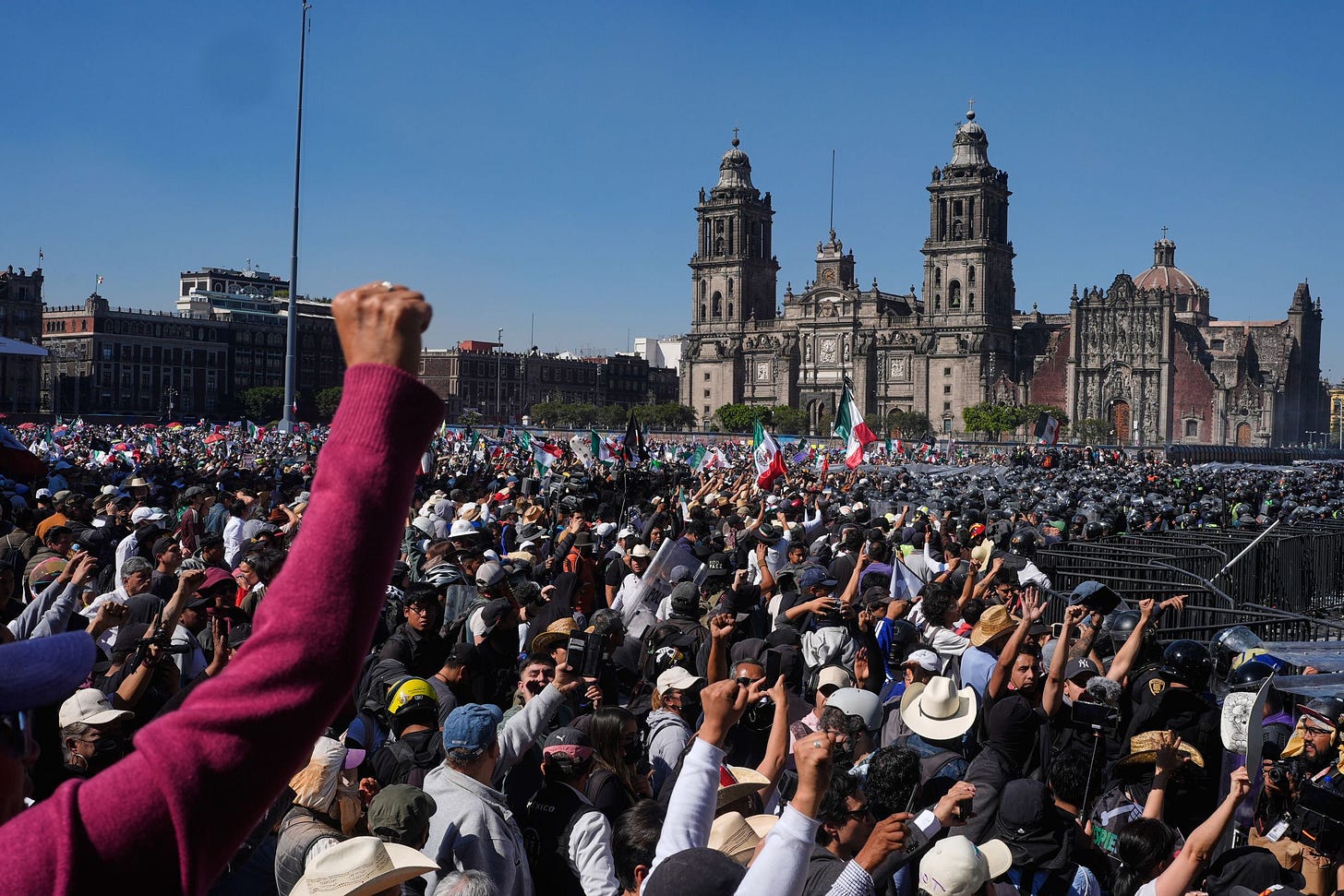
"Gen Z" protest in Mexico City, November 15, 2025. Photo: CNN.

By Kit Klarenberg – Nov 24, 2025

On November 15th, incendiary protests engulfed over 50 cities across Mexico. The Western media has universally adopted the narrative disaffected local “Gen Z” sought to vent their righteous rage against the government, over corruption, and the administration’s purported ties to drug cartels. Footage of law enforcement clashing with demonstrators spread like wildfire, and many outlets widely emphasised how the upheaval injured at least 120 people. Few acknowledged the overwhelming majority of those hurt—100—were police officers.

A New York Times report made theinsurrectionary designs of those causing mayhem on Mexico’s streets clear. “The goal of this march is precisely to remove the President, and to show we are angry, that the people are not with her,” one protester was quoted as saying. Oddly absent from mainstream coverage of the hullabaloo was any recognition President Claudia Sheinbaum enjoys popularity of which Western leaders can only fantasise. Polls throughout her first year in office indicate 70 – 80% of the public support her.

Sheinbaum has charged the fiery demonstrations were “inorganic”, “paid for”, and “a movement promoted from abroad against the government.” There are strong grounds to believe this was absolutely the case. For one, a key local amplifier of the protests, and supposed police brutality, was media outlet Animal Politico. The National Democratic Institute, a wing of avowed CIA front the National Endowment for Democracy, lists the organisation among its “partners”. Mexican newspaper Milenio has documented in detail the news site’s voluminous US funding.

Furthermore, former Mexican President Vicente Fox attended the protests, and posted extensively on social media in support of the demonstrators. In 2001, he was bestowed NED’s Annual Democracy Award. Another prominent supporter was oligarch Ricardo Salinas Pliego, Mexico’s third-richest man. In March 2023, in conjunction with the shadowy Atlas Network, he launched Universidad de la Libertad, to “advance free-market principles, business development, and innovation” in the country.

Atlas Network comprises a web of libertarian think tanks, bankrolled by major US corporations, with deep and cohering ties to Western foundations and intelligence cutouts, including NED. The Network itself doles out millions annually “supporting pro-freedom organizations” worldwide. A longtime beneficiary of its largesse is the Venezuela-based Center for the Dissemination of Economic Information (CEDICE), which operated at the forefront of the April 2002 US-orchestrated coup that temporarily ousted elected President Hugo Chávez.

Fast forward to today, and Washington again appears to be plotting the Venezuelan government’s downfall. A huge military buildup around the country, and belligerent actions in the Caribbean supposedly intended to thwart drug trafficking operations directed by Caracas, could be harbingers of all-out invasion. The widely-admired Sheinbaum, who stands steadfastly opposed to US machinations in Latin America, represents a significant barrier to realising that goal. It stands to reason the Empire must neutralise her first, before training its crosshairs elsewhere in the region.

“Legal justification”
It may be no coincidence the foreign-sponsored upsurge of anti-government agitation that unfolded in Mexico followed not long after murmurings the Trump administration is considering inserting US forces and intelligence operatives into the country, to conduct aggressive covert operations supposedly targeting cartels. On November 3 NBC reported this “new mission” would represent “a break” with the approach of past US governments, which have hitherto “quietly deployed CIA, military and law enforcement teams” to “support local police and army units” battling drug syndicates:

If the mission is given the final green light, the administration plans to maintain secrecy around it and not publicize actions associated with it, as it has with recent bombings of suspected drug-smuggling boats…Under the new mission…US troops in Mexico would mainly use drone strikes to hit drug labs and cartel members and leaders…Some of the drones that special forces would use require operators to be on the ground to use them effectively and safely.

Similar action was previously mooted in April, prompting a firm rebuke from Sheinbaum. The President declared: “The US is not going to come to Mexico with the military. We cooperate, we collaborate, but there is not going to be an invasion. That is ruled out, absolutely ruled out.” However, NBC notes while Washington “would prefer to coordinate with the Mexican government on any new mission against drug cartels…officials have not ruled out operating without that coordination.”

US military action being waged inside Mexico without state approval would represent an absolutely egregious and unprecedented breach of the country’s sovereignty. Moreover, at Washington’s demand, Sheinbaum has already deployed 10,000 troops to the US border, significantly increased fentanyl seizures, and extradited 55 senior cartel figures Stateside. These escalations are nonetheless seemingly insufficient, raising obvious questions as to whether an ulterior motive lies behind the Trump administration’s new mission – for which elite military and CIA personnel have apparently already begun training.


One explanation could be Sheinbaum representing a potent barrier to regime change in Caracas—a monstrous objective for which Trump strived over much of his first term in office, that has become turbocharged over recent months. Sheinbaum haspublicly rubbished the US President’s claims there is evidence linking Venezuelan leader Nicolás Maduro to drug dealing, called for constructive dialogue between the pair, and repeatedly condemned extrajudicial US airstrikes on boats purportedly ferrying drugs, which have killed scores of potentially innocent people.

Those attacks, which began in September, are widely perceived to be a prelude to all-out US invasion of Venezuela, and have frequently been conducted in Mexico’s territorial waters. In addition to openly admitting they aren’t certain targeted boats are in fact ferrying narcotics, and the identities of victims are unknown, Trump administration officials have struggled to provide any legal justification whatsoever for the deadly strikes. On October 30, a classified bipartisan Congressional briefing was convened, at which government representatives attempted to explain their rationale.

Attendees from both primary US political parties “were not happy with the level [of] information that was provided, and certainly the level of legal justification that was provided,” Republican Mike Turner complained. Meanwhile, Democrat Sara Jacobs declared, “I’m not convinced that what they said was accurate,” concluding the administration’s strategy “is actually not about addressing” the flow of narcotics into the US, or crushing Latin American drug smuggling networks. Her comments may be more illuminating than she intended.

“Big problems”
On top of clearing a beachhead for invading Venezuela, Sheinbaum could be earmarked for removal by Washington because, from the CIA’s perspective, the Mexican President’s hardline crackdown on local cartels may be proving too successful for her own good. Within six months of taking office, police and security forces dismantled 750 drug labs across the country, arrested close to 20,000 cartel operatives, and seized over 140 tons of narcotics. Drug barons who evaded capture have been forced into hiding, while suffering multimillion dollar losses.

Markedly, these efforts largely haven’t been conducted in coordination with Washington. This raises the prospect that individuals and groups ensnared by Sheinbaum’s anti-cartel crusade—which has been praised in many quarters—might one way or another have been working for and/or with the CIA. Investigations by veteran deep state researcher Peter Dale Scott reveal how since World War II, the core component of any international drug cartel’s success has consistently been maintaining a clandestine relationship with US intelligence.

Indeed, per Scott, it is difficult if not impossible to prosper in the narcotics trade without the CIA’s protection. A palpable illustration of this phenomenon is provided by the Guadalajara Cartel’s extraordinary rise. After its founding in the late 1970s, the group rapidly became one of North America’s largest drug suppliers. Key to its success was its covert bond with Mexico’s Federal Security Directorate (DFS), which was created by and enjoyed a deeply intimate relationship with the CIA.

In return for a 25% cut of the Guadalajara Cartel’s profits, the ultra-violent drug syndicate was not only insulated from legal repercussions, but actively assisted by DFS. Joint US-Mexican anti-drug efforts in the early 1980s deliberately targeted solely minor traffickers, eliminating the Cartel’s competition. Resultantly, by 1982 Mexico had replaced Colombia as the States’ leading supplier of marijuana, and was providing up to 30% of the country’s cocaine. All along, the CIA and DEA did and said nothing, despite full cognisance of the Cartel’s activities.

Guadalajara might still be in business today, were it not for its February 1985 kidnap, brutal torture and murder of DEA agent Enrique Salazar. Allegations the CIA and DFS colluded in his killing, to conceal their complicity in the Latin American drug trade, have long-abounded. Nonetheless, Salazar’s slaying was so sickeningly savage it led to sizeable US public andpolitical pressure for Mexican authorities to bring those responsible to justice. Within four years, several of the Cartel’s leaders were jailed, and the enterprise folded.

There is no knowing whether Sheinbaum has inadvertently trodden on the “wrong” person’s toes in her battles against organised crime in her country. Yet, the violent protests have evidently provided Washington enormously useful ammunition. Commenting on the unrest, Trump remarked, “I looked at Mexico City over the weekend. There’s some big problems there…I am not happy with Mexico.” He added military action “to stop drugs” there was “OK with me.” The opening salvo in a new US war may have just been fired.

https://orinocotribune.com/a-looming-coup-in-mexico/

******

What is happening in Mexico?

Raphael Machado

November 28, 2025

National oligarchies are trying to instrumentalize the legitimate dissatisfaction of Mexican youth to try to force a regime change, with the aim of positioning themselves to fill any power vacuum that may be generated.

As we all know, over the past week, Mexico has experienced large-scale waves of protest against the government of Claudia Sheinbaum. Analysts have framed these protests within the logic of “Generation Z” protests – popular agitations where a large portion of the demonstrators are young people, supposedly outraged by the lack of sociopolitical perspectives and the monopolization of power by elites seen as corrupt.

Protests categorized in this way have been seen in Bangladesh, Nepal, the Philippines, Indonesia, Morocco, Madagascar, and a few other places, until finally reaching Mexico. Despite this general dimension, however, each of these protests is unique enough to be analyzed separately. There is, for example, less in common between them than between the Arab Spring protests in different countries.

In this context, however, it has been common to refer to the Mexican manifestations as a “color revolution” – just as these other protests are interpreted. In another text, I already criticized the vulgarization of the concept of color revolution, pointing out the necessary requirements to categorize a protest as a color revolution and noting that, among the recent waves of protests, the case of Bangladesh is certainly one of a color revolution, while most of the others, apparently, are not.

Contrary, therefore, to highly respectable geopolitical analysts and counter-hegemonic journalists from various countries, I dare to follow this same line of reasoning to point out that the case of the Mexican protests is not (yet) one of a color revolution.

Thus, I will indicate why I consider that there is (as yet) no color revolution in Mexico, and then I will explain what it actually is.

First, there is no need for any color revolution in Mexico for now. Claudia Sheinbaum’s government is not a counter-hegemonic government, either in external or internal matters. Sheinbaum is a disciple of Davos, very well connected with the non-profit industrial complex and with the Western apparatus for promoting color revolutions, such as the Open Society. Although, on many issues, she continues policies from López Obrador, she simultaneously broke with López Obrador himself to the extent that it would be possible today to say that she leads a globalist faction of MORENA. This globalist faction is already sufficiently well-aligned with the U.S. and even with the Trump government. The economies of Mexico and the southern U.S. are fully integrated, and Mexico will neither join BRICS nor the Belt and Road Initiative. What would be the point of a color revolution?

Second, there is no evidence of direct involvement from the usual promoters of color revolutions based in the U.S. There is no movement from the Open Society, the Ford Foundation, etc., against Sheinbaum. No objective link has yet emerged between the U.S. Department of State, USAID, or the U.S. Embassy in Mexico and these demonstrations. So far, it has only been possible to point out indirect connections between some traditional political figures in the Mexican opposition who are supporting these demonstrations and certain international interests. But nothing specific about these demonstrations themselves. The Atlanticist powers, therefore, do not have control over the facts concerning the manifestations.

Third, other important aspects are absent, such as sudden spokespersons and leaders tacitly designated by the mass media and external promoters as the legitimate representatives of the protests. We also do not find the “casus belli” concerning Atlanticist interests, since Mexico is not on the verge of any agreement or decision that would be unfavorable to those interests.

Therefore, the minimum requirements for us to consider these agitations a color revolution do not exist. But this does not prevent them from being transformed into a color revolution through a process of co-optation and capture.

But if it’s not a color revolution, what is it?

First, Mexico’s slide into a Narco-State is notorious, a process that has been going on for decades and which involved the participation of the CIA and DEA themselves, as the economic cycle of narcotics was integrated into the black ops projects of U.S. intelligence and security services. This was both as a tool for money laundering and secret funding of paramilitary activities around the world, and for purposes involving the U.S. itself that approach social engineering. Without being able to exhaustively treat the topic here, what is relevant is to point out that, today, drug trafficking organizations have so much power that they rival the state. They even have influence in the military and police forces, in local politics, in legitimate economic activities, and so on. In recent years, however, local politicians began to appear, linked both to traditional parties and to MORENA, and even independents, who try to take responsibility for confronting these drug trafficking organizations and cleaning up Mexican public power. The problem is that many of these new leaders are being assassinated, as was the case with the mayor of Michoacán, Carlos Manzo, a former MORENA politician. Manzo even asked the federal government for help, to send the National Guard to Michoacán to help confront local criminal groups, but Sheinbaum refused. Sheinbaum not only refused but publicly declared that she had no intention whatsoever of confronting the drug trafficking organizations. Evidently, the Mexican people are growing tired of both this submission of institutions to the narco and the federal leniency towards it.

Second, these protests do not occur in a vacuum and have their precedents. They come on the heels of 3 years of protests secretly orchestrated by the old Mexican oligarchies entrenched in the PRI (Institutional Revolutionary Party) and the PAN (National Action Party), which had monopolized Mexican public life for decades until they were displaced by López Obrador’s MORENA. These oligarchies orchestrated protests against changes to the National Electoral Institute and have been trying to mobilize the population throughout this period. These forces, involving figures like former President Vicente Fox and mega-businessman Ricardo Salinas, have used all tools to plunge Mexico into social chaos, promoting sham journalistic initiatives like Latinus and funding propaganda bots to inflate dissatisfaction with Sheinbaum, who, in fact, remains a popular president.

Adding both things together, therefore, we have the fact that national oligarchies are trying to instrumentalize the legitimate dissatisfaction of Mexican youth to try to force a regime change, with the aim of positioning themselves to fill any power vacuum that may be generated. Naturally, for now it seems unlikely that these oligarchies will achieve their goals, but the process could end up becoming a color revolution if it gains international support.

https://strategic-culture.su/news/2025/ ... in-mexico/
"There is great chaos under heaven; the situation is excellent."

Post Reply