Trump & India’s Changing Response to Terrorism
November 24, 2025
Two weeks have passed since the Red Fort attack in Delhi and the Indian response against Pakistan has been muted, unlike after an earlier terrorist attack in April, reports Betwa Sharma.
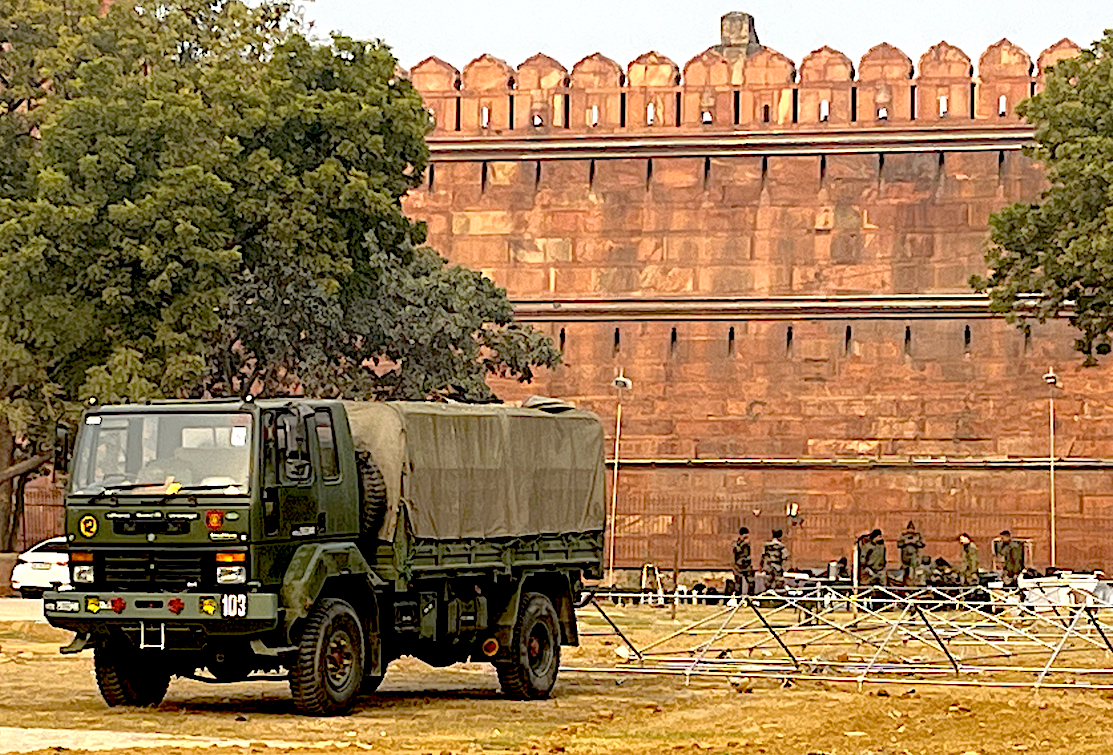
Indian soldiers at the Red Fort in Delhi in January 2024, site of the terrorist attack on Nov. 10, 2025. (Joe Lauria for Consortium News)
By Betwa Sharma
in Delhi, India
Special to Consortium News
When terrorists killed 26 people in Kashmir on April 22, the government of Indian Prime Minister Narendra Modi responded with missiles and air strikes against Pakistan, which he blamed for the attack.
On Nov. 10 a Kashmiri doctor blew himself up in a car near the 17th century Red Fort in Delhi, killing 13 people in a fresh terrorist attack.
This time India’s response has been different.
Back in April, Modi didn’t waste time before blaming Pakistan for the murder of the 25 Hindu tourists and a Muslim guide in Indian-controlled Kashmir. Lashkar e Taiba, a militant group based in Pakistan, claimed responsibility for the attack, according to The New York Times and the U.S. State Dept., though the group later denied it.
Modi first expelled some Pakistani diplomats, suspended the Indus Waters Treaty and visas (but not of Pakistani Hindus). Then, after giving Pakistan two weeks to take action against the militants, India launched Operation Sindoor –- air and missile strikes against nine targets of named terrorist groups inside Pakistan’s Punjab province and Pakistan-administered Kashmir.
India claimed to have killed a large number (80 as per news reports) of militants, while Pakistan says non-military targets, including a mosque, were struck, killing 31 civilians and injuring 57. A four-day conflict ensued with cross-border missile and drone attacks with an hour-long dog fight of fighter jets, according to Pakistan.
At least 21 civilians — Hindus, Muslims and Sikhs, including five children – lost their lives in India during the four-day conflict. As many as 40 civilians, including 15 children, were killed in Pakistan.
The air strikes didn’t exactly work in India’s favour: U.S. President Donald Trump claimed credit (disputed by India) for brokering peace after four days of escalation (one of the eight wars he boastfully claims he’s stopped).
Pakistan seemed to walk away with the upper hand, even though India had been the victim of the terrorist attack. On top of that, the U.S. appeared to be drawing closer to Pakistan, while its relationship with India was in trouble.
In the months that followed, India-U.S. relations took a turn for the worse because of India’s continued strategic relations with Russia, its unwillingness to fully align itself with Washington over Ukraine, and India’s warming towards U.S. adversary China, despite Beijing’s alliance with Pakistan. U.S. strategy has been to keep India in the anti-China camp. The U.S. then imposed a 50 percent tariff on Indian goods.
Trump’s intervention in the four-day conflict was humiliating for Modi, who tries to portray himself as a great foreign policy leader. It was also a boon to his opposition. Trump claiming to have made peace was not a good look for Modi or India, and made a mockery of Modi’s overly effusive hugging of Trump in public as U.S.-India relations then plunged to their worst in decades.
Caution Instead of Retaliation

Indian Army Paratroopers issued during 2022 Army Day parade. (Indian Army/Wikimedia Commons)
Now India is faced with a new terrorism crisis after the Red Fort attack.
Modi had made it clear after the April attack that any future terrorism would be treated as an act of war, with no distinction between the attackers and those who back them. This pledge of tough, decisive retaliation, which could include military action, was widely seen as a shift in the country’s counter terrorism doctrine.
So it is notable that the government this time has initially responded with a more measured tone. The mainstream media and the right-wing ecosystem, which echo and amplify the government line, has too.
Two weeks have passed since the Red Fort attack, and the Indian response against Pakistan has been muted. It seems that Trump’s intervention has had its effect on Mod
Even with evidence mounting against Jaish-e-Mohammed, another terrorist group based in Pakistan, that it was behind the Nov. 10 attack, as well as a far more sinister plot to deploy small rocket and drones against crowds, the Indian government has so far held back from making accusations against Pakistan.
Devising a terrorism policy regarding Pakistan has always been tricky, and no Indian government has succeeded. The idea of treating every terror attack as an “act of war” plays well with the domestic audience, especially Modi’s base, but it’s nearly impossible to enforce in South Asia’s complex neighbourhood.
India can’t launch airstrikes every time, and the international community was clearly uneasy about the escalation of armed conflict between two nuclear-armed neighbours last spring.
This time, Pakistan goes unmentioned, leaving Kashmir itself in the crosshairs.
Turning Delhi’s Ire Against Kashmiris

India’s Prime Minister, Narendra Modi, viewing the Himalayas in March 2025. (Prime Minister’s Office/ Government of India/ Wikimedia Commons/ GODL-India)
Since the airstrikes in response to the April attack seemed to turn global opinion towards Pakistan and against India, and with no real strategy to deal with terrorism besides the hubris of launching air strikes against Pakistan each time, the Modi government is focusing retaliation on Kashmir and the people who live there.
Authorities have launched a sweeping crackdown in the territory, detaining and questioning thousands of people, and blowing up the home of the terrorist doctor. The moves have disproportionately hit innocent families and drifted into collective punishment.
This practice of demolishing homes, widely dubbed in India as “bulldozer justice,” is often deployed against Muslims by hard-right leaders in some states run by Modi’s BJP party. The tactics are in defiance of the Indian Supreme Court’s clear ruling that demolitions without due process are illegal and cannot be used as punishment.
The number of those detained after the latest attack varies from 1,000 to 1,500 apparent suspects.
How many of these arrests were conducted in violation of due process and the rule of law simply isn’t known because authorities have stamped out a free press in Indian-controlled Kashmir in the five years since the Modi government rescinded the semi-autonomous status of Jammu and Kashmir (J&K) and demoted it to a union territory.
That brought it directly under the control of the central government. Until Aug. 5, 2019, J&K was India’s only Muslim majority state.
Decades of Strife

Daimler Armoured Car of the Indian Army on road patrol in the Jammu & Kashmir state on the strategic Baramula-Uri road, 1948. (Unknown/Public Domain/Wikimedia Commons)
Kashmir, claimed by both India and Pakistan at Partition in 1947, is a land of breathtaking beauty and bitter conflict. Divided into Indian and Pakistani-administered areas, it has been the cause of three wars and a long-running Pakistan-backed insurgency that in the early 1990s forced the mass exodus of Kashmiri Pandits (a Hindu minority in Kashmir), causing possibly the most serious human rights crisis in independent India.
The insurgency has fueled repeated attacks on security forces and government institutions. On the Indian side, the region remains one of the most heavily militarised zones in the world.
Over the decades of the long-running conflict, successive Indian governments have been cagey about their keenness to suppress news of the extent of the conflict and human rights violations. Still, local newspapers thrived, and some critical reporting existed until J&K came under central control in 2019.
In the past six years, critical voices have been silenced. Kashmiri journalists have been arrested under terror-related charges. Many no longer want to take a byline, and people are too afraid to speak with reporters, even anonymously. Much of the mainstream media in the rest of the country largely parrots the government line.
Information in the Indian media on government actions taken in Kashmir comes almost entirely from official briefings. Outside of what the government discloses, the true scope of operations remains largely unknown.
All this is in stark contrast to the progress and mainstreaming of Kashmir that the Modi government promised when it rescinded J&K’s autonomy.
Instead of the promised development, integration, safety and security, Kashmiris find themselves more marginalised than ever, and the region remains extremely insecure as unemployment and drug use soars.
A Harsher Strain of Militancy

Pahalgam is a hill station in Kashmir. Mountain trails run northeast to Amarnath Cave Temple, a Hindu shrine and site of the annual Amarnath Yatra pilgrimage. (Nawr’n k/Wikimedia Commons)
The attack on Hindus in the tourist and Hindu pilgrimage town of Pahalgam in April was among the most gruesome attacks on civilians in Kashmir.
The terrorists, three Pakistani nationals, according to survivors, singled out men to recite the Islamic declaration of faith and shot those who could not.
It is worth noting that in the history of the Pakistani-backed militancy since the killing and expulsion of Kashmiri pandits in the early 1990s, and instances of civilian killings (such as Sikhs in Chittisinghpura in 2000, Kashmiri Pandits in Nadimarg in 2003, and Hindu civilians in 2006 in Doda, Jammu), recent militant attacks have, for the most part, been aimed at government and security personnel rather than civilians and tourists.
That changed after 2019, when a harsher and more unpredictable strain of militancy emerged that targeted and killed migrant labourers from other states.
The Collective Punishment Of Kashmiri Muslims
The turn to blaming Kashmiris instead of Pakistan for the latest attack has had the effect of riling up Hindu extremists in the rest of India to blame all Muslims, especially those from Kashmir.
Amid open calls to boycott Muslims, a disturbing act of communal intolerance was caught on camera in the neighbouring state of Himachal Pradesh, where Kashmiri traders often sell their wares. In the footage, a Hindu woman tells an elderly Kashmiri shawl seller to go back to Kashmir because Hindus will not buy from Kashmiris.
In the days following the deadly Nov. 10 Delhi attack, the newsroom where I work in India received many pitches from reporters describing how Kashmiri Muslims were gripped by fear of reprisals, eviction, and violence.

Muslims in Kashmir have become the target of the central government. (From Portraits of Kashmir 2018/ r Nagarjun/Wikimedia Commons)
It says something about how familiar this pattern of hatred toward Kashmiri Muslim students and professionals living and working in different states has become, and how reliably it intensifies after a terrorist attack, that we ended up telling the reporters we’d covered it before, most recently after the terrorist attack
“We are stuck. We can’t go outside, and we can’t go home. Even booking a cab to the airport feels like risking our lives,” a 22-year-old Kashmiri, studying in Chandigarh, Punjab, said three days after the April attack. “I feel like a prisoner here, just because I’m Kashmiri, just because I’m Muslim.”
At a time when Islamophobia is running high in India, Kashmiri Muslims, in particular, are prime targets of bigotry and abuse because they come from a region defined by decades of resistance and bloodshed.
They are called terrorists or terrorist sympathisers after a bomb goes off. Every new attack fuels the demonisation and deepens their social, economic and academic marginalisation.
In a reprise of incidents reported in April, the Jammu and Kashmir Students Association said there last week there was a revival of profiling and aggressive questioning from landlords. WhatsApp groups were flooded with hateful messages, forcing some students to leave schools at the cost of disrupting their studies.
Like in the past, some will choose safety over education and never go back to complete their degrees. Their parents will insist on their security. Others will decide against seeking admission to begin with or give up their seats in colleges outside Kashmir.
The fact that a doctor was behind the wheel of the car that exploded in Delhi on Nov. 10, and that the government is calling it a “white-collar terror module” only reinforces the narrative that it’s not just the usual militants; everyone, including the most educated, is a terrorist.
?In a stark example of the psychological strain gripping Kashmir, a middle-aged, dry fruit seller set himself on fire after police detained his son, refusing to allow him to meet him.
He later died of his injuries.
The son had been arrested as an alleged co-conspirator in the Delhi attack.
https://consortiumnews.com/2025/11/24/t ... terrorism/
******
IS THE US USING PAKISTAN AGAINST INDIA? BEARS DANCE IN DELHI

By John Helmer, Moscow @bears_with
For this week, ahead of President Vladimir Putin’s arrival in India on December 6, I am in meetings in Delhi. Here is our first conversation with Sandeep Unnithan and Chakra News:
https://www.youtube.com/watch?v=MHh0aXP1SA4
https://johnhelmer.net/is-the-us-using- ... -in-delhi/
******
Unions in India demand immediate withdrawal of new “anti-worker” labor codes
After a five-year suspension due to united opposition by trade unions in the country, the Narendra Modi government suddenly announced the implementation of the unpopular labor codes last week.
November 24, 2025 by Abdul Rahman
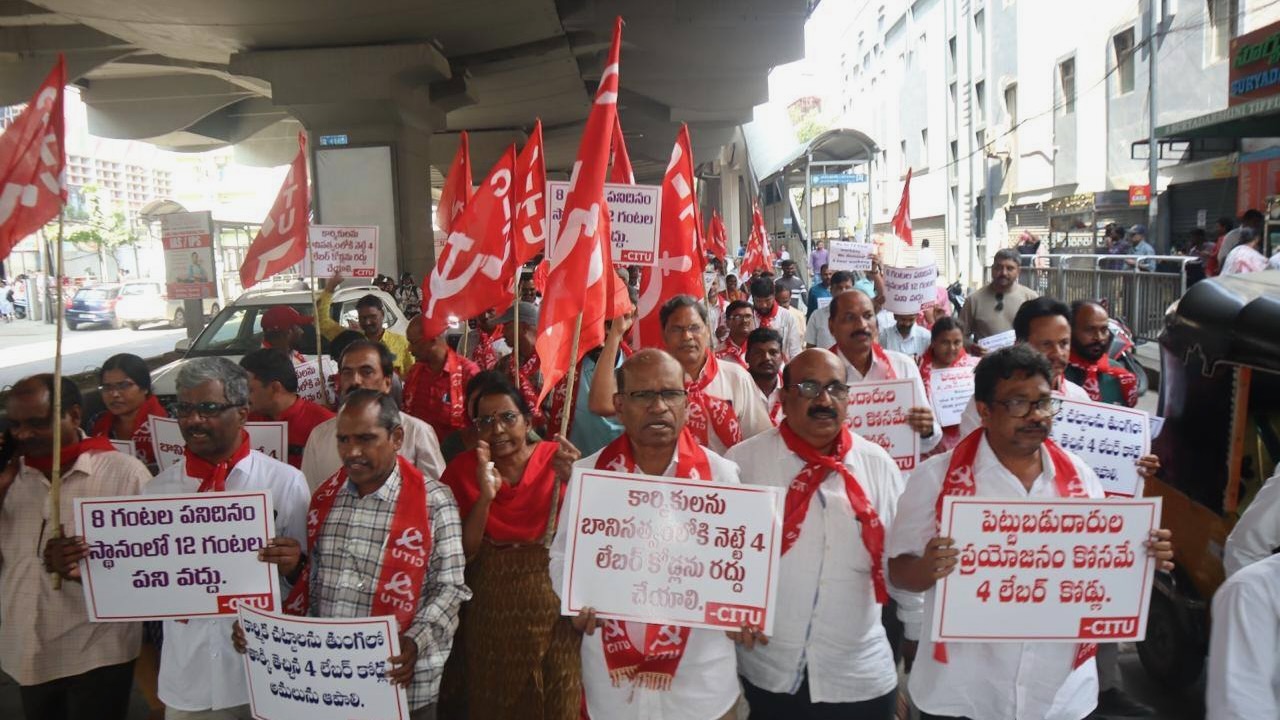
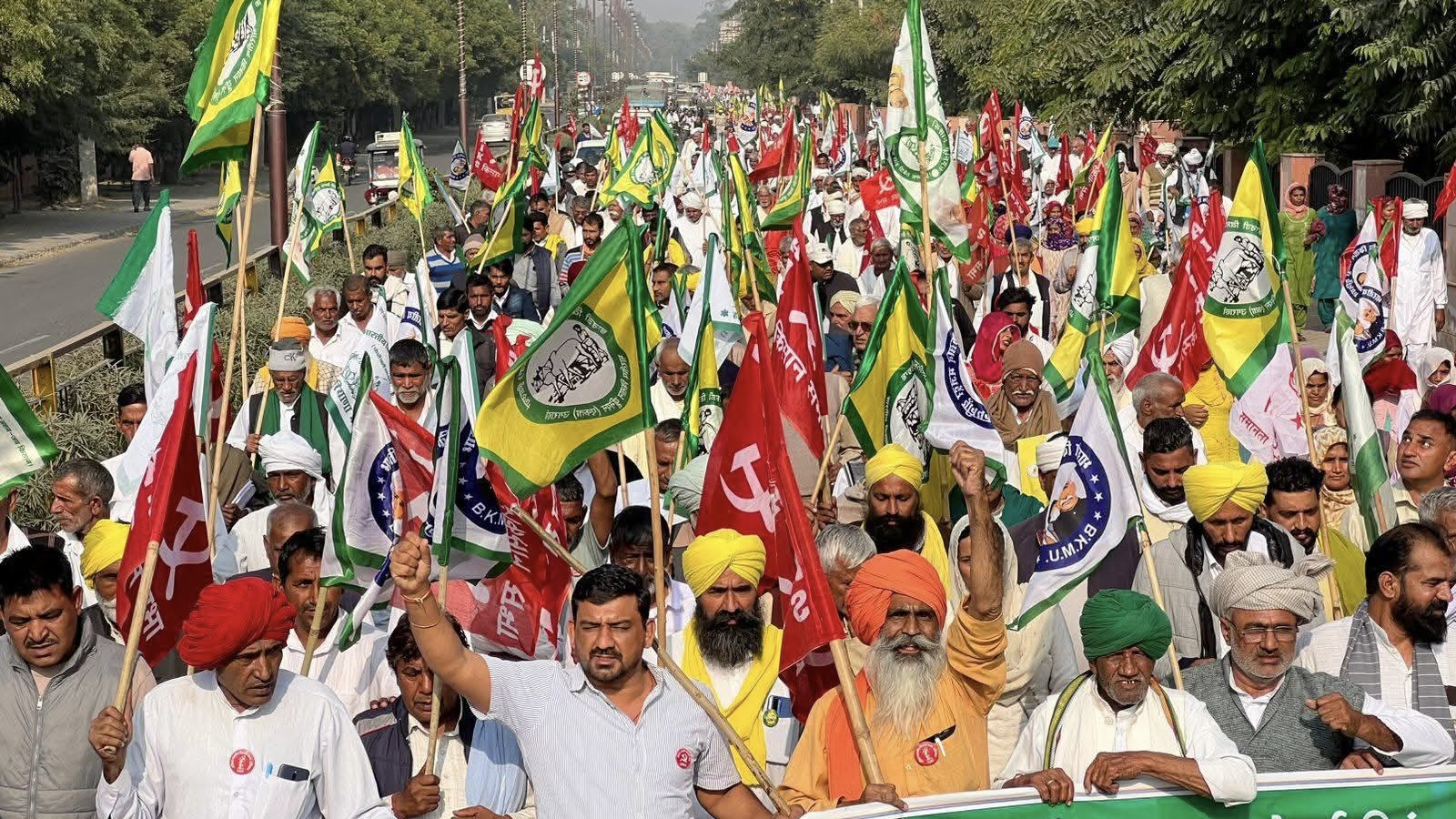
Protests erupt across India against the recently enacted "anti-worker" labor codes. Photo: CITU
Workers across sectors and regions in India have taken to the streets to oppose the extreme-right-wing government’s decision to implement four new labor codes. The protesters have deemed the codes anti-labor and demanded their immediate withdrawal.
In several cities, workers took out protest marches and burned the copies of the labor codes. Unions and progressive groups have warned of larger protests to oppose the legislation.
The four labor codes in question were adopted by the Indian parliament in 2019. Yet their implementation has so far been suspended due to the strong opposition by all major trade unions in the country. In a surprising move on Friday, November 21, the far-right Narendra Modi-led government notified that the codes would advance.
In a barrage of press releases since then, the government has defended the codes, calling them an attempt to simplify the laws which have been in existence since the British colonial days and a move to “inclusive and sustainable labor empowerment”.
However, in a joint statement issued on Friday, a joint platform of the Central Trade Unions (CTU) called the government’s decision to implement the codes a pro-corporate move and a “deceptive fraud committed against the working people of the nation”.
“The arbitrary and undemocratic notification of the four so-called ‘labor codes’ defies all democratic ethos and has wrecked the character of the welfare state of India to rubbles,” the CTU statement adds, demanding their immediate withdrawal.
Trade unions claim the new codes will weaken unionization, the right to collective bargaining, and restrictions on working hours, to benefit corporations. Unions have vowed to intensify the struggle against these codes.
CTUs will also join a nationwide protest call made by the farmers on November 26, to push for the withdrawal of the codes, among other demands.
Government is trying to mislead the workers
Centre of Indian Trade Unions (CITU), one of the largest trade union federations in the country and a part of the CTU, also condemned the government’s move alleging that it is trying to mislead the working class in the country by falsely portraying them to be in their interest.
In reality, the codes “constitute the most sweeping and aggressive abrogation of workers’ hard-won rights and entitlements since independence, aimed at facilitating corporate exploitation, contractualization and unrestrained hire and fire,” a CITU press release on Saturday said.
Among other things, the government’s press releases claim the codes were brought in order to unify 39 different laws enacted to protect the working class in the country, such as the Industrial Disputes Act and Factories Act, among others.
The government also claims to provide universal social security for all workers and minimum wage coverage, among other benefits through codes.
It provides for a floor national wage, longer shifts in factories and night shifts for women, claiming it will guarantee minimum wages and women’s empowerment.
CITU’s press release, however, makes a point-by-point rebuttal to the government’s claims, pointing out that these codes actually strengthen the employers’ control over workers by weakening their right to collective bargaining and other such rights.
The new codes allegedly weaken the protective institutions (such as labor commissions and labor inspectors) created after years of struggle, legitimize contractualization with the “fixed-term” provision, and paves the way for the government to withdraw from its roles and responsibilities as executive of the labor laws.
The new codes turn the government into a mere facilitator between the employers and the employees which, CITU claims, would make fighting for workers rights difficult.
Codes eradicate labor rights
Trade unions and left parties have claimed that in order to protect corporate interests the Modi government has defied basic democratic norms and institutions in the country and made an arbitrary decision to eradicate rights which were won after generations of sacrifices.
Opposition parties claimed that the Modi government has adopted an arrogant approach in implementing the codes. It failed to conduct proper consultation with all the stakeholders, and sidelined all political opposition in the country in the Parliament while passing the law.
“The government ignored every major objection raised by trade unions. The codes were pushed through Parliament without the opposition present, making a mockery of democratic process,” CITU reiterated in the press release.
CITU proclaimed that “the four codes are an instrument of corporate driven labor market deregulation, aimed at destroying job security, suppressing the right to strike, dismantling labor inspection, expanding contractualization and fixed term employment, weakening unions and collective bargaining.”
The so-called universal social security for workers claimed by the government is nothing but a way to limit “social security to token schemes” it said.
The objective behind all this is “a mad drive of minimization of labor cost and dismantling labor rights,” CITU claims.
Communist Party of India (Marxist) issued a statement supporting the trade unions’ demand for the revocation of the labor codes.
“The government’s claim that the labor codes will boost employment and investment is completely baseless. The codes are designed to leave labor unprotected in the face of the onslaught of capital. Their aim is to lure national and international capital by ensuring that all meaningful regulations covering various aspects of labor rights will be nullified,” CPI (M) said in the statement.
Samyukta Kisan Morcha (SKM), an umbrella group of farmers unions in the country, also condemned the new codes in a statement on Monday. It called the codes the “most regressive labor reform since the independence” of the country in 1947.
https://peoplesdispatch.org/2025/11/24/ ... bor-codes/