Posted by @nsanzo ⋅ 05/12/2025

Surprised by the return to great power politics, by the rise of countries it used to dictate to or colonize, and unable to understand how the West has lost some of its soft power and can no longer even force the Global South to join its sanctions, the European Union remains lost in Francis Fukuyama's world, where history ended in the 1990s with the implosion of actually existing socialism and the victory of capitalism and its moral superiority, which it imposes on the rest of the world. "The world is moving beneath our feet," Kaja Kallas declared last September in a geopolitical speech in which she insisted that Europe , as it has always done, would be one of the factors that will determine the world of the future. In his speech, Kallas did not specify how the EU was going to influence geopolitical changes in a world where its influence has been reduced due to multiple factors, including the reality of its economic weight, the relative decline of Western power, the disinterest of its American ally in the Old Continent, and the rise of poles such as China and India, which Brussels continues to try to give orders to.
Just yesterday, the EFE news agency reported on the meeting between the Chinese and French presidents that “Emmanuel Macron urges his Chinese counterpart, Xi Jinping, to take concrete steps toward a ceasefire in Ukraine and calls for correcting the economic imbalances between Beijing and Europe.” In other words, France is demanding that China, the world's second-largest economy in terms of GDP, agree to balance its trade relationship with the EU and do for European countries what they themselves have failed to achieve with 19 rounds of sanctions and three and a half years of continuous military aid. Reality surpasses fiction, and the former colonial powers, the same ones that condemned China to a century of humiliation, are trying to perpetuate a relationship whose terms have been unsustainable for decades. This European stance of demanding much and offering very little is a sign of geopolitical weakness, but also of desperation at repeatedly running up against the same wall: the inability to inflict on Russia the strategic defeat it mistakenly believed it could achieve in February 2022.
The European Union “needs to be independent or, at least, prepared to be strong in geopolitical developments, including having our own plans on how peace can be brought to Ukraine and discussing them with our transatlantic allies,” declared Andrius Kuilios, the European Union's Defense Commissioner, yesterday, pointing to the two areas of current concern in Brussels: Ukraine and the United States. Washington's stance is a major contributor to the EU's political nervousness. Perhaps no one in the world has clung more tightly to the false accusation of isolationism leveled against Donald Trump than the European bloc, which prefers to see this as the reason why the United States wants to reduce its role on the continent. That option is more favorable than assuming that the EU will not shape future geopolitical changes and that the continent has lost much of its appeal as a theater of operations for the main power struggle between hegemonic blocs, which is why the United States wants to end the war between Russia and Ukraine and concentrate its efforts on containing its only real rival, China, and on absolute hegemony in the Americas.
Kubilius's words are relevant in two ways. On the one hand, Kubilius acknowledges the need for the EU to propose something more than Kaja Kallas's two-point plan —more sanctions against Russia, more weapons for Ukraine—but his formulation doesn't point to a peace plan but rather to ideas about how peace can be achieved, a curious nuance considering that, for the first time, a document being negotiated by both Russia and Ukraine is on the table, marking what can be considered the beginning of a US-led peace process. Without any certainty, Washington has embarked on this path, which the European Union, through its actions and statements, makes clear it rejects. Just like last spring, when the European Union was slower to shift its rhetoric toward peace—or a ceasefire—than Ukraine, Brussels is now racing to insist daily that Vladimir Putin doesn't want to negotiate, that Russia is planning an invasion of the European Union, and that the Ukrainian nation is in serious danger. All this is accompanied by the usual counterpoint that, according to the European narrative, the tide of war is about to turn and Russia could always be on the verge of collapse. Meanwhile, prominent figures like Dmytro Kuleba, Ukraine's former foreign minister, are posting videos of himself calmly walking his dog in Kyiv, praising the benefits of a potential ceasefire. Sergiy Kyslytsya, the radical former Ukrainian ambassador to the UN and current member of Zelensky's negotiating team, told The Economist that "we're going around in circles," adding that "however, we're moving upward. Think of it as a peace spiral."
The latest episode of the European Union's nervous breakdown occurred yesterday with the clearly self-serving leak of a conversation between several European leaders and Volodymyr Zelensky. This communication lays bare the priorities and fears of European capitals regarding the recent push for a resolution to the conflict. "The EU is scrambling to respond after US negotiators—real estate mogul Steve Witkoff and Trump's son-in-law, Jared Kushner—met Tuesday in Moscow with Russian leader Vladimir Putin to discuss the latest peace proposal," wrote Politico yesterday , one of the outlets that broke the story, later corroborated by Der Spiegel , which published the full transcript of the conversation.
“Europe was taken aback by the 28-point peace plan drawn up by Witkoff and Russia’s Kirill Dmitriev, which included a ban on Ukraine’s accession to NATO and a limit on the size of the Ukrainian army. That draft was modified after desperate intervention by European allies and Ukraine, but there is misgiving about another peace initiative led by Trump. European countries were not represented at the Kremlin during the meeting with Putin, even though Ukraine’s future is crucial to the continent’s security. EU officials are concerned that even if this new Trump plan doesn’t go through, there will be another one in a few months,” Politico states , summarizing the European position on a peace proposal they are unwilling to accept, but which they are finding more difficult to block than on previous occasions. In the spring, following the Alaska summit, von der Leyen, Rutte, Macron, Starmer, and Merz needed only a few days to redirect the US proposals, considered excessively favorable to Russia, and make them favorable to Ukraine and unworkable for Russia, thus halting any possibility of progress. The final assessment—that another similar plan will emerge in a few months—is the closest to reality, since all the plans, including the current one, are versions of the same idea: peace and security guarantees for Ukraine in exchange for territory and based on the reality on the ground. It is possible that this plan, which may emerge in a few months, will be even more detrimental to Ukraine in territorial terms because, despite Kakha Kallas's desire to reverse the balance of power by sending more weapons, Ukraine's position on the line of contact is deteriorating as Russian troops advance toward Guliaipole, Seversk, and Konstantinovka, complete the capture of Pokrovsk, and lay siege to Mirnograd.
European concern is at its peak, as evidenced by the conversation leaked yesterday by European media. “Macron warned that the United States could betray Ukraine in a leaked call between political leaders, says Spiegel,” headlined Politico , reflecting the gravity of the situation as perceived by Zelensky’s European allies, who are scrambling to seize Russian assets held on their territory to enable Kyiv to continue fighting and make it more difficult for Russia to accept a plan that is met with greater resistance in Brussels, Paris, and Berlin than in the capitals of the two warring nations.
“There is a possibility that the United States will betray Ukraine on the territorial issue without clarity on security guarantees,” the French president stated, according to Der Spiegel . Macron's words deliberately overlook the fact that alongside the 28-point plan—which Ukraine supposedly improved in its favor during negotiations—there was a second security guarantee document that the United States has described as similar to Article V of NATO's Collective Security Treaty. Nevertheless, the French president insisted on the “grave danger” for Zelensky. “They are playing games, both with you and with us,” Foreign Minister Merz stated, referring to Steve Witkoff and Jared Kushner, with a phrase that sounds like the tactics of a lobbyist trying to convince someone that the proposed agreement is not in their best interest. Perhaps the most representative part of the conversation, Alexander Stubb, the president of Finland and one of the Europeans who has connected best with Donald Trump, warned that “we cannot leave Ukraine and Volodymyr alone with these guys.” Nothing is more dangerous than the current spiral of peace . Yesterday, Rustem Umerov traveled to Florida again to meet with Steve Witkoff—just four days after their last meeting and two days after Witkoff's meeting in Moscow—to discuss issues that cannot be addressed by phone. While the United States tries to continue its negotiation process, European countries intend to re-engage in a process that aims to get Ukraine off a train headed toward a destination they find unacceptable.
And yet, the only European plan is to continue funding the war in the hope that, for some reason they cannot foresee, the balance of power in the war will suddenly shift and the negotiation will resemble a Ukrainian monologue more than a dialogue in which the other side of the war will not only have a voice, but will also have a vote.
https://slavyangrad.es/2025/12/05/traic ... ounidense/
Google Translator
******
From Cassad's Telegram account:
Colonelcassad
Unsuccessful attack on Mezhvodnoye. Unmanned
Elephant Carrier Attack on Crimea.
Ukrainian unmanned elephant carriers made their presence known last night in western Crimea. After maneuvering west of Sevastopol, a group of six units headed north toward Tarkhankut and Chernomorskoye.
How did the attack proceed?
- By midnight, a detachment of unmanned elephant carriers was spotted near the Arkhangelskoye oil field . They bypassed Cape Tarkhankut and entered Karkinitsky Bay .
- One of the unmanned elephant carriers was destroyed by a Lancet crew. One of the drones departed for Zatoka . Closer to 3 a.m., the remaining four unmanned elephant carriers moved toward Yarylgach Bay in Mezhvodnoye.
- The first was hit by a naval AK-306 launcher. Another unmanned elephant carrier crashed into a boom barrier and exploded, and the other two were hit by small arms fire at the entrance to the bay.
- At the time of the attempted strike by unmanned aerial vehicles (UAVs) on Crimea, a drone raid was launched, primarily jet-powered. Air defense units shot down 22 drones over western Crimea.
This attack is yet another example of why Ukrainian forces have begun attacking civilian vessels. They desperately need results, and tankers are easy prey.
Our coastal defenses aren't what they were in 2023. It's now much more difficult for Ukrainian drones to penetrate the shore. One UAV acted as a kamikaze to break through the booms, but the rest were destroyed at the entrance.
The group also included a UAV with a surface-to-air missile launcher, which they hoped would catch our aircraft.
Meanwhile, an air raid alert has been issued for Crimea and Sevastopol due to new drones being spotted over the Black Sea.
@rybar
***
Colonelcassad
Key points from Putin and Modi's joint statement following their talks:
- Russia's relations with India are the foundation of global peace and stability, according to the joint statement .
- Russia and India call for a comprehensive reform of the UN Security Council;
- the countries' approaches to foreign policy priorities coincide and complement each other;
- Russia and India highly value cooperation in the energy sector, see potential in the oil sector, and intend to expand cooperation in nuclear energy;
- the military partnership will be reoriented toward the production of advanced defense platforms and research;
- the countries agreed to cooperate within the G20, BRICS, and the SCO on climate change;
- Moscow and New Delhi will develop systems of settlements in national currencies
- the development of relations between Russia and India is called a common priority of the two states' foreign policies;
- bilateral trade will expand, including through increased exports;
- Moscow and New Delhi are for early negotiations to develop a legal document to prevent an arms race in space;
- The parties emphasized the importance of dialogue in resolving the Iranian nuclear issue.
https://t.me/s/boris_rozhin
Google Translator
******
Interview: Roman Khimich
Ukrainian business consultant and conflict analyst on war, peace, assassinations, Sorosites, nationalism.
Events in Ukraine
Dec 04, 2025
Questions and answers
It is not hard to get the impression that Ukraine’s expert class is made up of a bunch of irrational hysterics and death cultists. In fact, the country also once featured an abundance of rational, self-ironic intellectuals. Nowadays, there is little place for them at home.
While living there, I looked up to a number of Ukrainian journalists. Spending a serious time of my youth in Ukraine conditioned influenced my way of thinking as well. It was strange for a number of reasons to return to the west in late 2022. One thing in particular stands out — the proclivity for asking political questions bluntly. ‘So, what do you think about Putin/Zelensky/the war? Who do you support?’
What do I think… To begin with, what does it matter what I think? There is a fetish in western societies for individual opinion, that it can somehow change reality. In fact, processes unfold, events occur, all outside the influence of individuals. It often feels rather banal and stupid to give one’s ‘opinion’ about a locomotive that will keep on dashing forward without us.
Apart from that, that’s just not how you ask questions on the Eurasian steppe, so to speak. That is a space where ‘politics’, whatever that word means, certainly does mean something. Expressing the wrong opinion about it can cost one’s life, can send one to a torture chamber, a prison cell, can leave one unemployed.
On December 1, the western-sponsored hromadske.ua published an article complaining that an elderly west Ukrainian man had only been given a 2 year sentence in 2022 for a phone call. They wanted the sentence extended. In the man’s incriminating phone call, he called Russians ‘our brothers’ and ‘denied Russian war crimes. During his trial, he stood by his statements and described himself as a citizen of the USSR. I’ve written here about similar cases.

Anyway, that’s all to say that there are good reasons why political discourse in the post-soviet world tends to be characterized by a mix of indifference, irony, and double-speak.
But honestly, I often find this somewhat preferable to the thundering slogans of western politics. In the west, you can say whatever you want and face no consequences (unless you live in the UK, or you made fun of Charlie Kirk). But the words have no meaning. You can call yourself a fascist, a libertarian, a communist, whatever you want, but it’s all just another flavor of ice cream at the ideology store.
Political discourse in the east is rather more careful. Both more precise and less blunt. Sometimes those used to the western style, lacking subtlety, can be confounded. ‘But what do you really think?!’
Today I’ll be sharing some answers to questions I posed to the Ukrainian political analyst Roman Khimich. A consultant in the Ukrainian telecommunications market for the past two decades, his academic work on conflicts and civil society can be read here. I urge my readers to subscribe to his recently-created substack.
Roman Khimich
Let’s move onto my questions and his answers.
War, peace, nationalism
Roman: As a preliminary remark: I observe, study and analyse the processes taking place in Ukraine and in the world, the questions discussed in this interview and the topics they touch on, through the prism of my own applied model of conflicts. It is a typical framework that I developed in the course of my professional activity as a business consultant.
I had to create this approach because mainstream ideas do not offer adequate perspectives and methods for solving widespread problems. At the centre of my model are conflicts in which the parties use coercion as an instrument for achieving their own goals, including aggressive, up to and including extreme forms of influence, right up to lethal violence.
The applied model of conflict does not solve ideological tasks and does not pass moral judgement; value judgements are taken into account only insofar as they influence the behaviour of actors and their calculations. Essentially, it offers, on the one hand, cognitive templates for extracting from the body of empirical data information that is significant from the point of view of the target activity – engaging in conflict. On the other hand, it offers behavioural recipes – templates for action that increase the probability of success.
I use this model as an instrument for forecasting trajectories, assessing the chances of the parties, identifying defects in their strategies and putting forward proposals for reducing risks.
EIU: The main question many observers have regarding Ukraine’s most powerful volunteer military force and nationalist political movement, Azov, is the extent of its independence.

Some claim that Azov is a puppet of other forces, whether the president’s office (as a potential anti-Zaluzhny spoiler for future elections/coalition partner), or of powerful business groups (Akhmetov). Others view Azov as an ambitious opposition force, and predict an imminent Azov bid for power, including through a ‘military coup’.
The Azov leadership itself claims it will wait for politics until after the war ends, through it is often quite critical of the Zelensky government in the many interviews its leaders have given in 2025.
Finally, you can also find nationalists online complain that the Azov leadership has sold out to existing elites, and will never undertake anything politically risky. Do you have any thoughts on this?
Khimich: Within the applied model of conflict, the question of the boundaries of Azov’s independence is formulated differently – as the question of the limits of its agency.
It must be noted at once: agency is always limited by certain boundaries beyond which the subject has no influence. Only the Lord God possesses boundless agency – if we assume that He allows Satan to act within the framework of a Cunning Plan, a classic 4d chess move.
Identifying the boundaries of agency is one of the key elements of situational analysis. This question is never simple. The idea that agent X is a puppet of Y is, as a rule, a manifestation of radical reductionism and has no analytical value. Determining the agency of a given actor and its limits is possible mainly through careful study of its conflicts with other actors. Conflict, as the direct clash of interests and actions, makes it possible to understand who in fact dominates in these relations.
I know nothing about the relations of the Azov movement with Akhmetov – simply because I have never specifically studied this material. I cannot say whether such relations exist and, if they do, what their character is – I simply do not know.
The most telling, and therefore the most valuable for analysis, plot line is the clash between Azov and the late Iryna Farion.

This case deserves separate consideration. Let me remind you that the icon of Ukrainian ethnic nationalism, in sharp, provocative form, repeatedly insulted Azov and its leadership [she mocked them for speaking Russian - EIU]. Farion’s tone left no doubt about her intention to humiliate her opponents. Within the culture of “hyper-masculinity” characteristic of the movement, such insults cannot remain unanswered and are “washed away” if not by blood, then at least by a demonstrative act of retribution, such as putting the offender into a rubbish container. In this cultural logic it is impossible simply to ignore this kind of attack.
Nevertheless, this is exactly what happened: neither Zhorin nor other representatives of Azov undertook any actions that could be regarded, within their subculture, as an acceptable response to Farion’s attacks. On the other hand, the Ukrainian state, which regards Azov as one of its sacred cows and has invested significant resources in its media promotion and in strengthening its symbolic capital, also in fact removed itself from managing the conflict.
The attempts undertaken not so much by official structures as by pro-government bloggers, opinion leaders and the leadership of Lviv University, where Farion worked, turned out to be extremely feeble, inexpressive and inconsistent. The attempt to dismiss her ended in complete failure: Farion was reinstated in her job with compensation, which in fact meant her complete triumph – not only over Azov, but also over the Ukrainian state.
And in this situation of complete rout, of absolute, total triumph of the icon of Ukrainian ethnic nationalism – as if a deus ex machina – Russian (?) neo-Nazis appeared on the stage. They were the ones who put a full stop to this dispute. In the text of their manifesto there was a justification that is logical within the cultural code of “white supremacists” in the post-Soviet space. Azov and personally Biletsky [leader of Azov - EIU] are accused of shameful inaction and of ignoring their racial duty. Iryna Farion is accused of “racial treason” and wrecking.
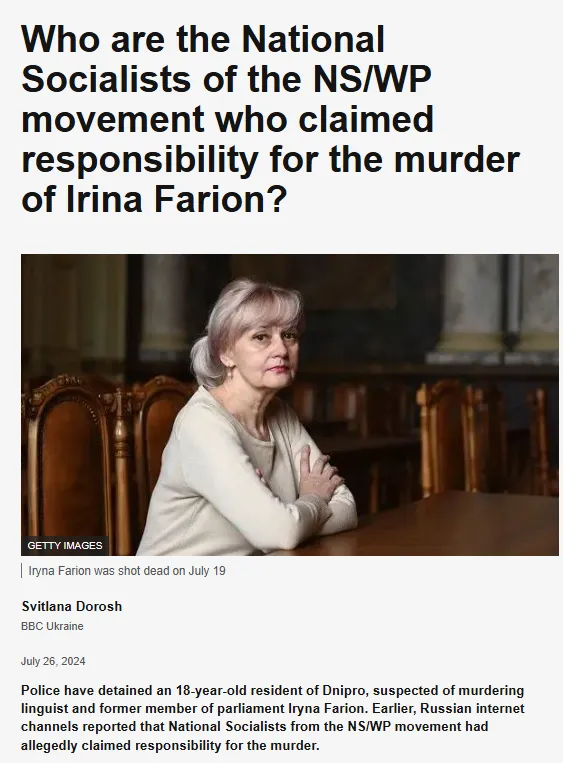
The story connected with her murder is, in my view, very important. It is a distilled, concentrated material in which one of the many hidden, usually remaining in the shadows, contradictions of Ukrainian political life manifested itself. What is at issue is the hidden antagonism between two wings, the two most influential parts of the phenomenon that in recent years it has become customary to designate by means of euphemisms such as “nationalists”, “the nationalist community”, “ultra-nationalists”. The previously widespread “far right” and “ultra-right” now seem to be considered politically incorrect and as promoting Putin’s narratives.
One wing is formed by supporters of Ukrainian ethnic nationalism, the ethnocrats. The other is a conglomerate of movements, organisations and people whom, to simplify my life, I will designate with the euphemism “white supremacists”, so as not to use the heavily tabooed in Ukraine N-word. [note from EIU - I wrote about this conflict between broadly speaking western Ukrainian ethnonationalists and eastern Ukrainian white supremacists here]
One popular ‘alternative’ narrative about the war in Ukraine is that nationalist civic society, particular those affiliated with the Azov movement such as the National Corps, were the main force in Ukraine preventing Zelensky from moving further in implementing the Minsk agreements and reaching a rapprochement with Russia.
The ‘No Capitulation’ protests of 2019 following slight progress in Minsk are often brought up. Azov played a leading role in these threatening street protests, and the little progress in Minsk that had occurred was soon erased.
In Ukraine, Volodymyr Zelenskiy must tread carefully or may end up facing another Maidan uprising

To what extent do you agree with this narrative, or do you believe there were other issues preventing the implementation of Minsk?
Let me say at once that I did not study this storyline in depth and did not conduct field research. At the same time, I know many of the key figures from the milieu which then challenged Zelensky.
To me it looked as though in 2019 Zelensky was confronted by a broad coalition that included supporters of ethnic nationalism, “white supremacists”, and a multitude of people who are used to designating themselves as bearers of liberal views and values, but in fact fully solidarise with the repressive cultural policy promoted by the ethnocrats – the supporters of ethnic nationalism. Therefore I consider it rational to treat these “liberals” as yet another variety of supporters of the ethnic-nationalist model, who for various reasons prefer to declare themselves liberals.
Among these “liberals” a special role is played by the public that critics label with the derogatory terms “sorosites” and “grant-eaters”, while mainstream media refer to them as “civil society”. These are participants in various networks of influence that have been formed over the past 20–30 years, a kind of “mycelium” grown primarily with US money, above all USAID.

The Renaissance Foundation is one of the main Soros organizations in Ukraine. Many important figures in Ukraine’s liberal civil society have a background in it or with associated NGOs - EIU.
In 2019 this public united, solidarised in order not to allow the implementation of the Minsk agreements, i.e. the key point of Volodymyr Zelensky’s foreign policy programme, who had gained a phenomenal 75% in the elections. The agreements were stigmatised by them as “capitulation”. It is now obvious that what was at stake was a typical compromise, an evil incomparably smaller than the catastrophe that befell Ukraine, including as a result of the disruption of the Minsk arrangements.
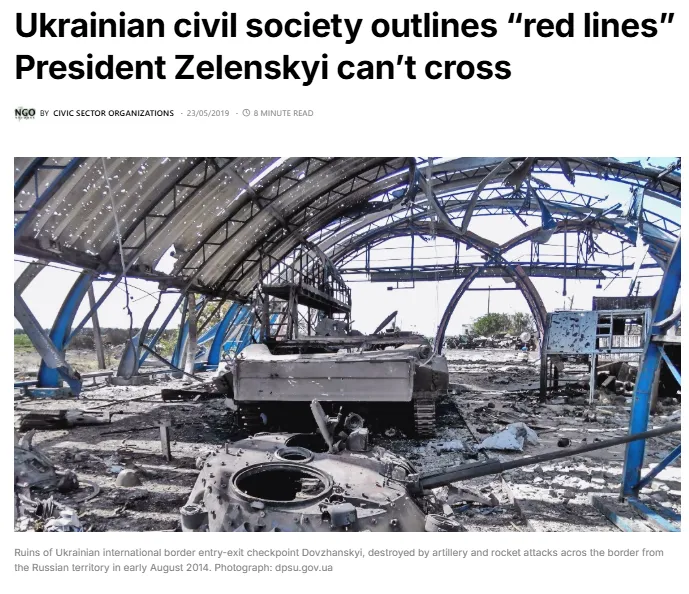
The famous ‘Red Lines of civil society’ published in 2019 ruled out implemention of Minsk in practice. Khimich is arguing here that it was the liberals, not the nationalists, that played the most important role in sabotaging peace. I also wrote about the struggle by ‘liberal civil society’ against top Ukrainian businessmen around the topic of peace with Russia here - EIU
Were there other forces and factors that prevented the implementation of Minsk? Yes. Particular attention is drawn by the situation in which the street – albeit not very numerous, but aggressive – threw an open challenge to the legitimate authority that had just received a phenomenal 75% of the vote and, accordingly, an indisputable mandate of popular trust. In this situation the Ukrainian security forces – both the Ministry of Internal Affairs and the SBU – preferred to remove themselves.
This was striking because at that time the Ministry of Internal Affairs was headed by Arsen Avakov – a man who had demonstrated his demonstrative disregard for those who were still then designated by the euphemism “far right”. Avakov had repeatedly shown that he was not only indifferent to what the far right said about him, but was ready, if necessary, literally to put them on their knees without consequences for himself.

That is, the technical possibility, the resource of coercion necessary to protect Zelensky, existed. However, the people who controlled this resource did not fulfil their legal duty. This raises questions: why did this happen? What was the driving force behind such a decision, at least in Avakov’s case?
To what extent do you agree with the claim that the Istanbul agreements of March 2022 were blocked by the intervention of western governments?
The same applies to the Istanbul agreements. I was not involved in this process, I do not have my own insider sources. The only thing I can note is that the discussed version of the reasons for the breakdown of the negotiations in Istanbul in March 2022 was voiced not only by the “fallen angel” of the Ukrainian war Arestovych, but also by the quite active and authoritative Arakhamia, as well as by former Israeli Prime Minister Naftali Bennett. The latter’s track record and overall appearance leave no room for me to fantasise that he became a victim of some manipulations or displayed naïveté – it is enough to look at his physiognomy.
Who is Naftali Bennett, Israel’s potential prime minister?
What is currently blocking the resolution of the conflict?
(A paywall)))with free option.)
https://eventsinukraine.substack.com/p/ ... an-khimich
*****
Signs of pressure
December 4, 5:03 PM

Signs of pressure.
( Collapse )
1. Italy suspended funding for arms purchases for Ukraine because "peace negotiations are currently underway."
This averted a government crisis. They haven't completely abandoned the supplies, but they will someday. Deputy Prime Minister Salvini called for a complete halt to arms supplies to Ukraine.
2. The Prime Minister of Belgium stated that the appropriation of Russian assets would be theft and he will not agree to it. He also called the hope of victory over Russia an illusion.
Overall, the Belgian government is unwilling to accept the blatant theft of sovereign assets.
3. Finnish President Stubb called on Europe to "prepare for a peace that will be difficult to digest, especially for Ukraine."
4. The Czech Republic refused to transfer a batch of modernized T-72 tanks to Ukraine, which had already been promised. This is a harbinger of the coming of the Babiš government, who previously stated that he intended to audit military aid to Ukraine, hinting at theft and corruption in this sector.
5. In Belgium, the investigation into EU diplomatic officials, which previously led to the arrests of Mogherini and Sannino, continues. New defendants may emerge. Von der Leyen and Kallas are trying their best to distance themselves from the case, claiming ignorance and innocence.
These are all indirect signs of US pressure on Europe under the terms of the Anchorage agreements between Trump and Putin. For these agreements to work, the US must bend not only Ukraine but also Europe. As we can see, the US is making some efforts, and some European countries have begun to adjust their positions, but so far this has not been enough. Russia continues to pursue its objectives militarily, while simultaneously waiting to see whether the Americans will succeed.
However, no one is counting on "US goodwill," of course.

https://colonelcassad.livejournal.com/10226300.html
Google Translator
******
The Banderization of the Kyiv Post
'Now is the time for us to win the memory war.'
Moss Robeson
Nov 27, 2025

Yesterday’s post about Istorychna Pravda, or “Historical Truth,” an affiliate of Ukraine’s top online news source, reminded me that it’s not the only Banderite-friendly media outlet that has been funded by the National Endowment for Democracy, NATO, and so on and so forth. Of course, there is always “Radio Svoboda,” the Ukrainian service of the U.S. government-funded broadcaster RFE/RL, which was set up by the CIA, but today let’s talk about the Kyiv Post. It is in a rather shabby state these days, but continues to parade itself as the premier English-language Ukrainian online newspaper.
In 2019-20, when I began to investigate the present-day OUN-B network, I marveled at the fact that Askold Krushelnycky was the Washington, DC correspondent for the Kyiv Post. He briefly led the publication in 1998. Now he writes for The Independent, the British online newspaper. I recognized the name Krushelnycky from my research into the OUN-B during the Cold War period, and sure enough, Askold comes from a family of British Banderites. Although the KGB assassinated Stepan Bandera before his birth, the Ukrainian fascist leader visited the Krushelnycky home during trips to England, perhaps in the days when Bandera worked for British intelligence.
Askold Krushelnycky likely met his wife, Irena Chalupa, in the Anti-Bolshevik Bloc of Nations (ABN), said to be the “largest and most important umbrella for former Nazi collaborators in the world.” Bandera’s deputy and successor, Yaroslav Stetsko, another friend of the Krushelnycky family, chaired the ABN for life. “StopFake” producer Irena Chalupa worked for Stetsko at the OUN-B headquarters in Munich, read poetry at his 1986 funeral, and in the years to come joined Radio Svoboda, which she even directed (2007-11). They live in Washington.
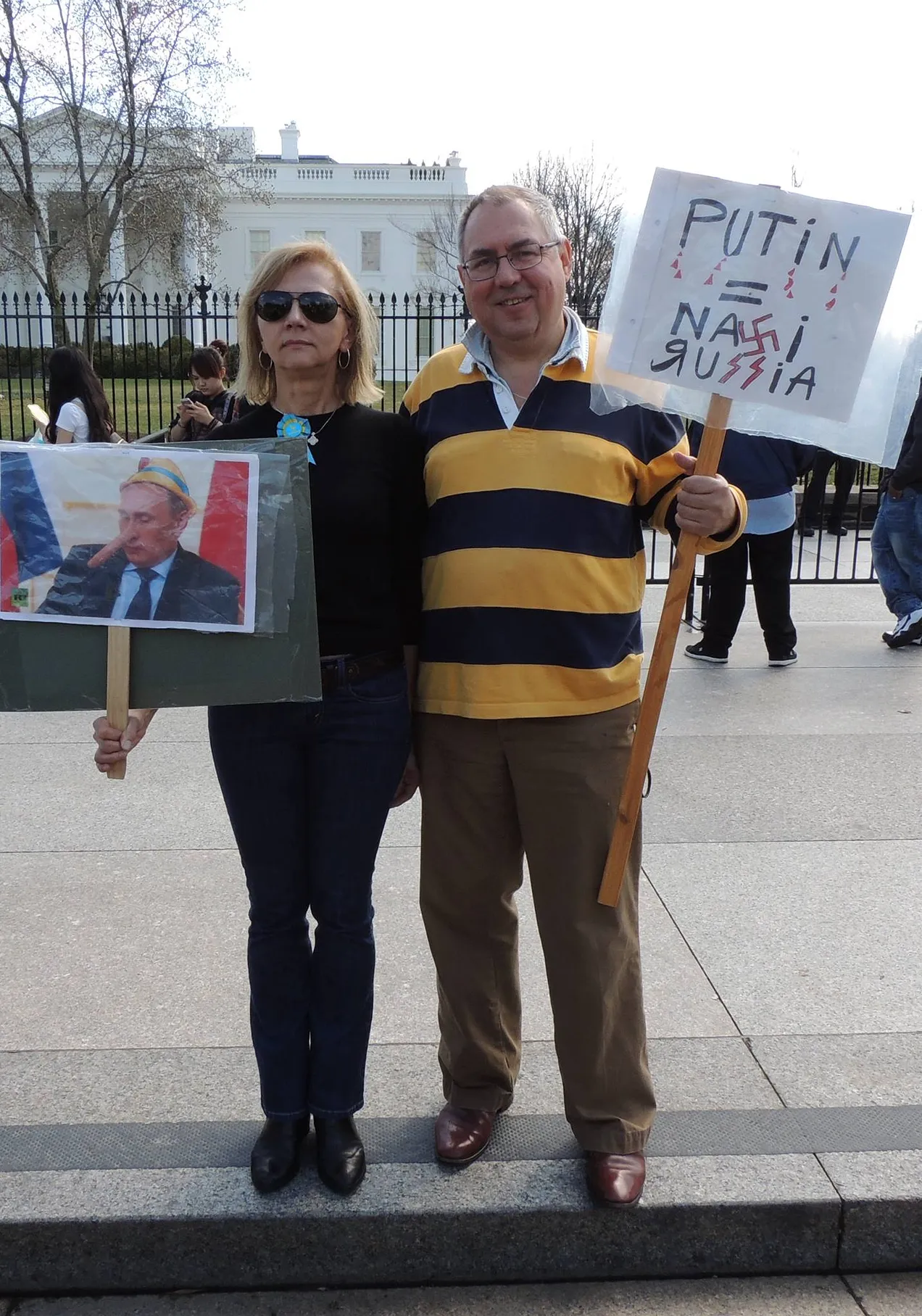
Chalupa and Krushelnycky during the first Trump presidency
In 2020, Stefan Romaniw from Australia wrote an opinion piece for the Kyiv Post in which he suggested that the Waffen-SS Galicia Division was part of “Ukraine’s struggle against Russian imperialism.” The editors failed to identify him as the head of the OUN-B, although this was never a secret. He also made a speech at Stetsko’s funeral. I felt like I was taking crazy pills. But after Romaniw died, the Kyiv Post announced the loss of a “Towering Figure” in the Ukrainian diaspora, and finally acknowledged that he chaired the OUN-B from 2009 to 2023. Yesterday I noticed that since at least 2023, the year before Romaniw died, his Kyiv Post author page has been titled “Bereza” in the URL. That was his name in the OUN-B, which I revealed at the end of a random blog post in 2022, but it wasn’t confirmed until after he died.

Romaniw making a speech in Munich for the 50th anniversary of the Bandera assassination (2009)
Needless to say, I was just scratching the surface in 2019-20, and perhaps in 2029-30, I will say the same about now, but since a bunch of journalists left the Kyiv Post in 2021 to establish the Kyiv Independent, Banderites and other info-warriors have filled the void. Take for example Askold Lozynskyj, a prominent Banderite in the United States, perhaps the one who is mentioned the most on this newsletter. He’s written 67 articles for the Kyiv Post since October 2022, when Ukraine might have been able to negotiate with Russia from a position of strength. His most recent articles are headlined “The US and the Ukrainian Holodomor,” “Trump and Co. as Orwell’s ‘Animal Farm’ Revisited,” and “Is Trump a Russian Agent or an Asset?”

Bohdan Nahalyo, another British Banderite based in Barcelona, became the chief editor of the Kyiv Post in December 2021. Like Krushelnycky, Chalupa, Romaniw, and Lozynskyj, he was raised in the Ukrainian Youth Association (CYM, Спілка української молод), an international OUN-B front group. This provides some context for his convictions that any talk of Nazis is just Russian propaganda, meanwhile “this is a Holocaust of Ukrainians” by “the Hitler of today, Putin,” but peace in Ukraine is apparently more dangerous than war with Russia.

Nahaylo was actually a member of the “June 30, 1941” branch of CYM in England, named for the date that Stetsko declared a pro-Nazi government in German-occupied western Ukraine. Chalupa wasn’t the only Banderite to go to work for Radio Svoboda in the 1980s. OUN-B leader Andriy Haidamakha (2000-2009), Romaniw’s predecessor, helped to establish Radio Svoboda in Ukraine and led its Kyiv bureau in the 1990s. Bohdan Nahaylo was actually the first person from RFE/RL allowed to visit Soviet Ukraine. At a 2023 conference in New York held by the Center for US-Ukrainian Relations, an OUN-B front group, Nahaylo recalled that “Soviet-American agents of influence” accused Radio Svoboda of “antisemitism, of course, or promotion of fascism, why? Because of our mentioning, recalling the restoration of Ukraine’s independence by Bandera’s followers in Lviv on June the 30th, 1941.”
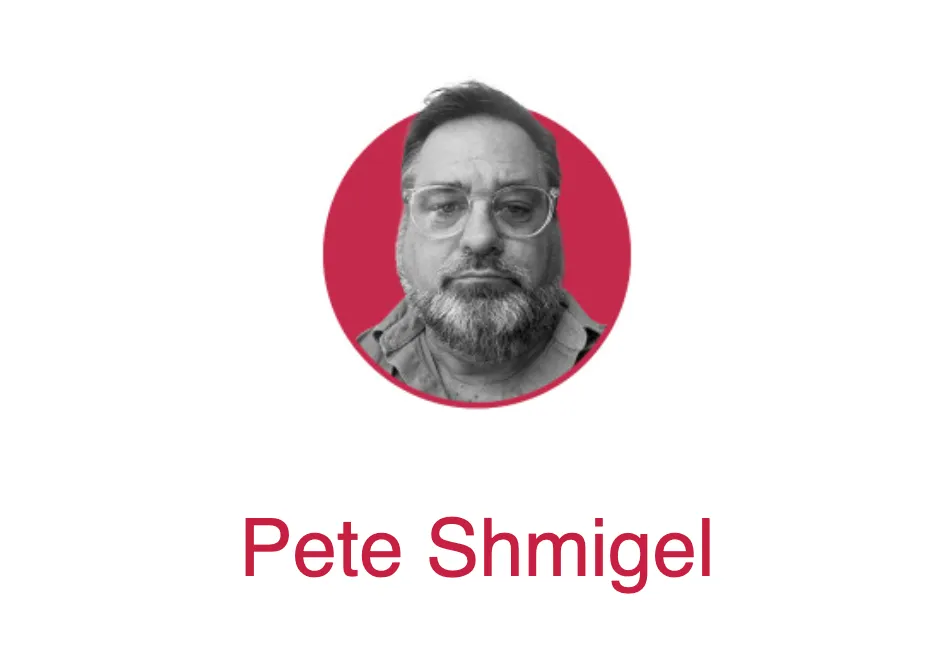
Pete Shmigel, who is from New York but lives in Australia, has written 235 articles for the Kyiv Post since 2022. He might have grown too liberal for the OUN-B, but he was raised in CYM and a Banderite family. In his college days, Shmigel became the U.S. president of the international Ukrainian Student Association of Mykola Mikhnovsky. This was a very nationalist youth group dominated by Banderites, and produced many of the 21st century leaders of the OUN-B in the Ukrainian diaspora, such as Kyiv Post contributors Askold Lozynskyj and Walter Zaryckyj. For a while, at least in 2015, Shmigel worked as the PR manager for the Australian Federation of Ukrainian Organizations, which was also dominated by Banderites with OUN-B leader Stefan Romaniw at the helm for so many years. Shmigel is close to the “Kuzan faction” of Banderites who apparently left the OUN-B in 2018-19.

Stash Luczkiw is another editor of the Kyiv Post, only since Nahaylo took over. Shmigel wrote this about Luczkiw last year: “We grew up together in CYM, the Kerhonkson/Ellenville area of New York, and the Ukrainian American diaspora. We were raised to strongly believe in the righteousness of Ukraine’s cause while also acquiring Western knowledge and perspective. As Stash said to me last night, which I’d never really considered, we are uniquely built for the humble work of telling Ukrainians’ stories in English to a world audience.” The CYM camp in Ellenville is the home of a quasi-religious “Heroes’ Monument” that the OUN-B erected after the KGB assassinated Bandera. It was a point of pilgrimage for the Banderites.

Walter Zaryckyj, the longtime executive director of the Center for US-Ukrainian Relations (CUSUR), is an OUN-B leader in the United States, and New York City in particular. He’s contributed a handful of articles for the Kyiv Post since 2022, starting with a two-part series, “The Best Evidence of a Future Ukrainian Victory is the Country’s Valiant Past.” Several of the Kyiv Post’s columnists these days can be seen at CUSUR events: Steven Moore, Diane Francis, Andreas Umland, and Alexander Vindman, at least. In 2023, Bohdan Nahaylo and Kyiv Post correspondent Jason Jay Smart, a shameless propagandist, also spoke at CUSUR conferences. I checked Smart’s Twitter/X account while writing this, and just as I expected, his latest update on the war is that “Russia’s imploding.”

Yesterday’s opinion section on the Kyiv Post website: Nahaylo, Nahaylo, Moore, Shmigel, and two others…
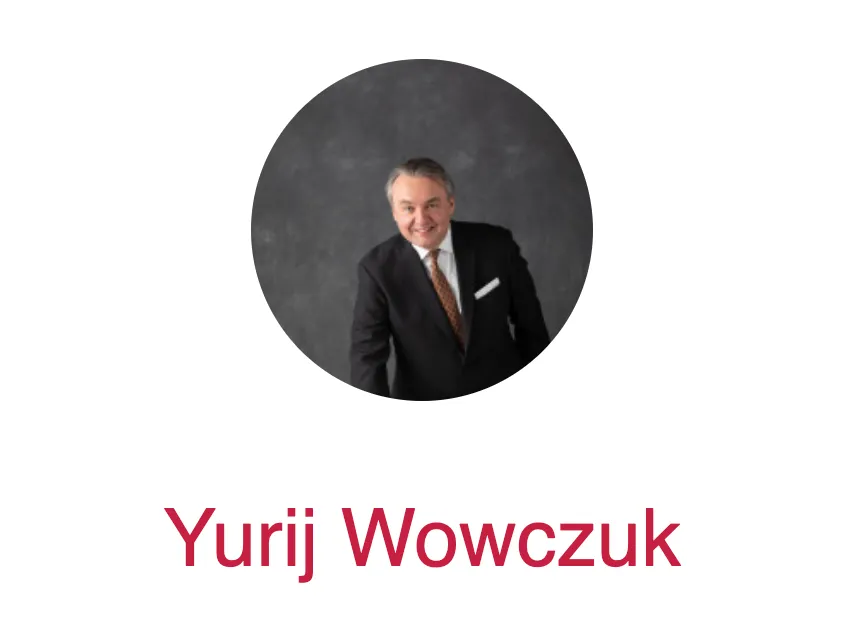
In 2023, I wrote about the Banderite brothers and defense contractors trying to reactivate the OUN-B network in the Pittsburgh area. Their father was a leading OUN-B member in the United States. The oldest brother, Yurij, is the Director of Research for the front group that owns the U.S. headquarters of OUN-B in New York. Almost a year ago, their family foundation helped to bring a Holocaust denier to the Banderite HQ in Manhattan for a Christmas OUN-B fundraiser. Yurij has said that the fascist ideologue Dmytro Dontsov “definitely solidified my beliefs and point of view as a teenager, young adult.” Last year, he co-authored an article for the Kyiv Post with its “special correspondent” Ivana Stradner, another unhinged “expert” on Russian propaganda. “Chinese and Russian Influence Operations Threaten Safety of Jewish and Ukrainian Students,” they said. Since then, Yurij has donated $1000 to the “American Ukraine PAC” created by Kyiv Post founder Jed Sunden.
For my Canadian readers, I haven’t forgotten Lubomyr Luciuk, your valiant mustachioed defender of Waffen-SS veterans, who has contributed over 20 articles to the Kyiv Post since 2023. He spoke at the same CUSUR conference as Bohdan Nahaylo, which I also tried to attend, but had to settle for standing outside with a poorly made sign that explained this event was organized by an OUN-B front group. That evening, Luciuk declared that Russia gifted them “the best chance ever to tell our story … so now is the time for us to win the memory war.” Six days later, the Ukrainian president and the Canadian government gave standing ovations to a Waffen-SS veteran. The Kyiv Post turned to Lubomyr Luciuk. “Are There Ukrainian War Criminals in Canada?” asked Dr. Smart. “The fear of ‘Ukrainian Nazis’ infiltrating Canada is not something new – but is there more to the story?”
https://banderalobby.substack.com/p/the ... -kyiv-post
*******
Nowhere to run
December 4, 2025
Rybar

"Russian troops have surrounded Mirnohrad."
The battle for the Pokrovsk-Myrnohrad agglomeration is nearing its end. While enemy forces spread reports of a supposedly "difficult but controlled situation," Ukrainian forces are retreating northwest.
Russian units established complete control over the forest belts between Krasnoarmeysk and Krasny Liman , pushing the Ukrainian Armed Forces back from their positions near the former Invest agro-industrial complex and the adjacent road. As a result, units of the Central Military District physically encircled the remnants of the garrison in northern Myrnohrad .
Individual members of the Ukrainian forces are attempting to break out of the "cauldron," but doing so is now virtually impossible. Several hundred Ukrainian Armed Forces personnel remain in the city itself, but they offer virtually no organized resistance.
Moreover, clearing the buildings is complicated by the large number of civilians, in whose houses the enemy regularly sets up positions.
The heaviest fighting has now shifted to the Grishino-Belitskoye line . Russian troops are attempting to establish control over these settlements on the backs of retreating Ukrainian forces, which will allow the Central Forces to advance toward another major city, Dobropillia .
https://rybar.ru/nekuda-bezhat/
Google Translator
******
Strana: Zelensky Losing Control: The Consequences of Yermak’s Resignation
December 1, 2025 natyliesb
Strana.UA, 11/29/25 (Translation by Geoffrey Roberts)
The head of the Presidential Office, Andriy Yermak, was a key figure in Zelensky’s inner circle, and his resignation will undoubtedly have enormous consequences.
Although Yermak will likely try to maintain his control over the Office of the President by appointing a close associate as the new head of the Office, his resignation ultimately sets in motion Zelensky’s loss of control over the vertical of power.
It turns out that Yermak was actually fired not by his boss (Zelensky), but by the NABU; even before he was charged, the President dismissed his closest associate, following only a search, public outcry, and pressure from opposition politicians. This sends a powerful signal to the entire state apparatus that Zelensky is no longer the “source of power” in the country and cannot guarantee anything even to his closest associates.
Moreover, few believe that Yermak (like Mindych and other figures in high-ranking corruption cases) could have carried out their schemes without the knowledge, consent, or even direct participation of the President.
In other words, a blow to Yermak is automatically a blow to Zelensky, a signal that he too could be accused of corruption at any moment. Especially if lesser figures speak out (and after today’s events, the likelihood of this has increased).
Immediately after the outbreak of the Mindych corruption scandal, Bankova began to lose its levers of political control within the government. Even [Prime Minister] Svyrydenko began to increasingly rely on the opinions of the Servant of the People faction rather than the Office of the Prosecutor General. The SBU and the Prosecutor General’s Office also began to sabotage various “political” instructions from the President’s Office.
Now, all these processes will accelerate dramatically. And the only question is how Zelensky will lose his remaining power.
It could be implemented in a softer form, by shifting the centre of decision-making from Bankova to parliament and the government, but maintaining the dominant position of Servant of the People. This project is being promoted by faction leader Arakhamia and several other people in the presidential team who were negatively disposed toward Yermak.
A source close to Arakhamia in the Servant of the People faction described the group’s vision for the future in a comment to Strana: “After Yermak’s resignation, the Rada will stabilise and calm down. There will be no defections from the faction, which have been much discussed in parliamentary corridors. Everyone will remain in their positions. We will pass the budget with dignity and responsibility.”
Zelensky will also lose political control over the Prosecutor General’s Office, the Security Service of Ukraine (SBU), and the State Bureau of Investigation (SBI) (Yermak coordinated the political work of these agencies, including against the National Anti-Corruption Bureau of Ukraine (NABU)).
But a far more severe scenario is also possible, in which, through a split in Servant of the People, the parliamentary majority is reformed and comes under the control of the “anti-Zelensky coalition” (Poroshenko and MPs close to grant structures, with the NABU on their side). In this case, a vote of no confidence in the government would be passed, and pressure would be exerted on Zelensky to approve the formation of a new Cabinet of Ministers of “national unity,” effectively independent of the president. Such a scenario would essentially lead to Zelensky’s own imminent departure.
But far more important is the potential impact of these events on the war and on the peace negotiations.
Yermak’s resignation and the resulting upheavals within the government will in any case have a significant impact on the country’s governance during the war: budget adoption, energy, defense procurement, and the mood of the military and society.
Zelensky’s own political prospects would also be largely nullified. First, a corruption scandal involving those closest to him. Now, the resignation of a key figure in the vertical of power. All of this significantly reduces the incumbent president’s chances of winning the election.
This means that ratings are gradually becoming a secondary concern for Zelensky. This could, theoretically, make him more susceptible to American pressure regarding key points of the peace agreement, which he has so far refused to agree to (although much depends on the degree of pressure and the bonuses offered).
This also increases the likelihood of a scenario in which, under increasing pressure to make concessions in the negotiations to end the war, Zelensky may decide to resign altogether, and the final negotiations for signing the agreement will be led by the acting president, the speaker of parliament.
Finally, it cannot be ruled out that the system of power will completely collapse and become unmanageable, leaving no one to negotiate peace terms with. But this could have catastrophic consequences for the military situation, and therefore the Ukrainian elite and the West will try to prevent this.
https://natyliesbaldwin.com/2025/12/str ... signation/
*****
The EU corruption scandal is lousy timing for Zelensky
Martin Jay
December 4, 2025
Graft in Brussels is as old as the hills and for decades has gone largely undetected.
For those who were hoping that the present corruption scandal in Ukraine involving Zelensky’s close aides would blow over and the business of war, money laundering and gun running can resume – funded by a gullible western public – the news of the arrest of Federica Mogherini in Belgium must have come as a blow.
Mogherini was the EU’s top foreign diplomat between 2014 and 2019 and was part of the so-called Iran Deal being signed in what was an auspicious occasion of international diplomacy at the time, barely a year after her taking the top job in Brussels – leaving her post in Rome as foreign minister.
In early December her house in Belgium was raided by police working on a case which would frame her for corruption charges, if sufficient evidence is collected using inside information to favour companies bidding on a tender. The case isn’t expected to be huge but it is significant for many reasons. As hard as it may seem to comprehend, it would appear that it is the EU’s new anti fraud unit – EPPO – which was just recently formed after years of impotency from the toothless OLAF failed to charge EU officials for graft, seems to be doing its job on investigating corruption of top EU officials. Mogherini got the cushy job of rector of the College of Europe after her 5-year term was up as the top EU diplomat under what some critics at the time commented were dodgy circumstances, given that she was clearly underqualified on the academic front to normally have such an elitist post for a college which served Europe’s elite civil servants and diplomats.
Police carried out searches at the Brussels headquarters of the EU’s foreign service, the European External Action Service, as well as several buildings of the College of Europe in Bruges at the request of the prosecutor’s office. Searches also took place at the houses of the suspects, the prosecutor’s office said while Belgian press have identified one other Italian official, the secretary general of Mogherini’s former office, who is part of the suspected fraud.
However, the timing of these arrests couldn’t come at a worse moment for the EU and its national leaders who are clinging onto hope for a miracle on the frontline of the Ukraine war, or even a change of heart from Donald Trump who is directing the press to write more and more about graft in Ukraine finally accepting the realities there of the sheer scale of the embezzlement of part of 400 billion dollars of cash and military equipment sent there from the U.S. alone.
The EU scandal merely underlines a peripheral point which the Europeans would have preferred remained aloof. Brussels has its own problem with corruption and so far, most Europeans don’t join up the dots and link the corrupt in the Belgian capital with the massive money laundering racket which Zelensky is running with EU cash. Until now.
Graft in Brussels is as old as the hills and for decades has gone largely undetected, and even when it is, it usually gets bypassed by inept investigators. The recent case of embezzlement levelled against Ursula von der Leyen for what many suspect is siphoning off hundreds of millions of dollars via a multibillion dollar vaccine deal is a good example. A posy of hopeless EU institutions have all make token efforts to bring her to account but to no avail. Before that ‘Qatargate’ made the headlines involving MEPs making hundreds of thousands of euros in cash bungs from both Qatar and Moroccan elites who were happy to bribe MEPs to make sure their countries’ true poor human rights records would be whitewashed. A few arrests were made, but an attractive Greek MEP, who had a few hundred thousand euros of cash in her Brussels pad, managed to work out a deal with Belgian police and even keep her well paid MEP job.
https://strategic-culture.su/news/2025/ ... -zelensky/


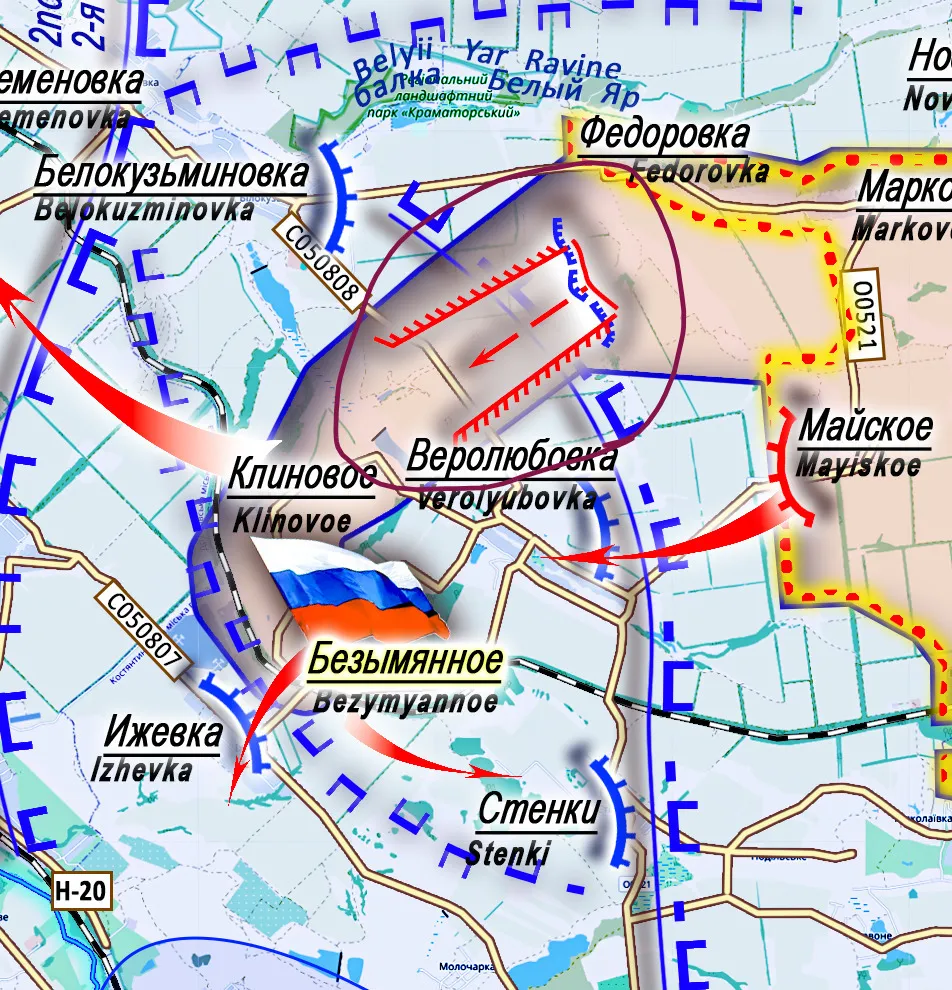


 ”Pokrovsk has already been captured, and Mirnograd is completely surrounded. Russians are approaching Zaporizhzhia and have long been in Konstantinovka,” said deputy Bezuglaya from the tribune in the Rada.
 She called for dismissing General Syrsky, reforming the general staff, and an audit in the army.