
Yemen: The Tyranny of ‘Experts’ and the Preservation of Hidden History
Posted by Internationalist 360° on September 27, 2025
Vanessa Beeley
The war against Yemen is hugely misunderstood and misrepresented by both Western media and the Imperialist-captured Academic sector.
How will historians a generation or two from now write about this war on Yemen? Will there be any interest in inspecting more deeply what happened, why, and under whose watch such a crime was committed? Or will future historians resort to repeating the dominant frames used to characterize (or ignore) this war on Yemen used today?
This is a conversation that I had with the excellent Prof. Isa Blumi in 2022. This is a link to his seminal book on Yemen.[/i]
Today I am speaking with Isa Blumi, historian, academic and Yemen expert.
We will be covering a lot of hidden ground in the Yemen conflict – effectively a genocidal war waged by the US and UK and Israel by their Saudi, Qatari and UAE proxies. Isa delves into the realities that are obfuscated by the Legacy Media and Academic embeds, think tanks and narrative managers.
Please follow this link to Isa’s most recent academic paper entitled: Speaking above Yemenis: a reading beyond the tyranny of experts, Global Intellectual History.
This was a previous conversation in 2018:
The Saudi Coalition genocidal aggression in Yemen began in March 2015. Armed, equipped, enabled and facilitated by the alliance of U.S, U.K and France this tragedy of hideous proportions has been allowed to continue and to decimate essential Yemeni infrastructure. Yemenis are starving, they are being collectively punished for resisting the greater colonialist project in the region and they are dying for their independence.
The world seems not to care.
The UN is once more complicit in the mass suffering of an entire people, as they were in Iraq. Diseases like cholera are endemic in conditions that have been allowed to deteriorate to unimaginable levels. Dr Isa Blumi explains the historical context to what is being done to Yemen and he expresses the need for Humanity to wake up to its collective responsibility for the global malevolence that threatens us all.
This is a link to my article on the UN role in the blockade of Yemen. https://21stcenturywire.com/2016/04/03/ ... iolations/
https://libya360.wordpress.com/2025/09/ ... n-history/
Yemen
Re: Yemen
"There is great chaos under heaven; the situation is excellent."
Re: Yemen
The Quiet Occupation: Secrets, Proxies, and Bribes in Yemen’s War Machine
October 19, 2025
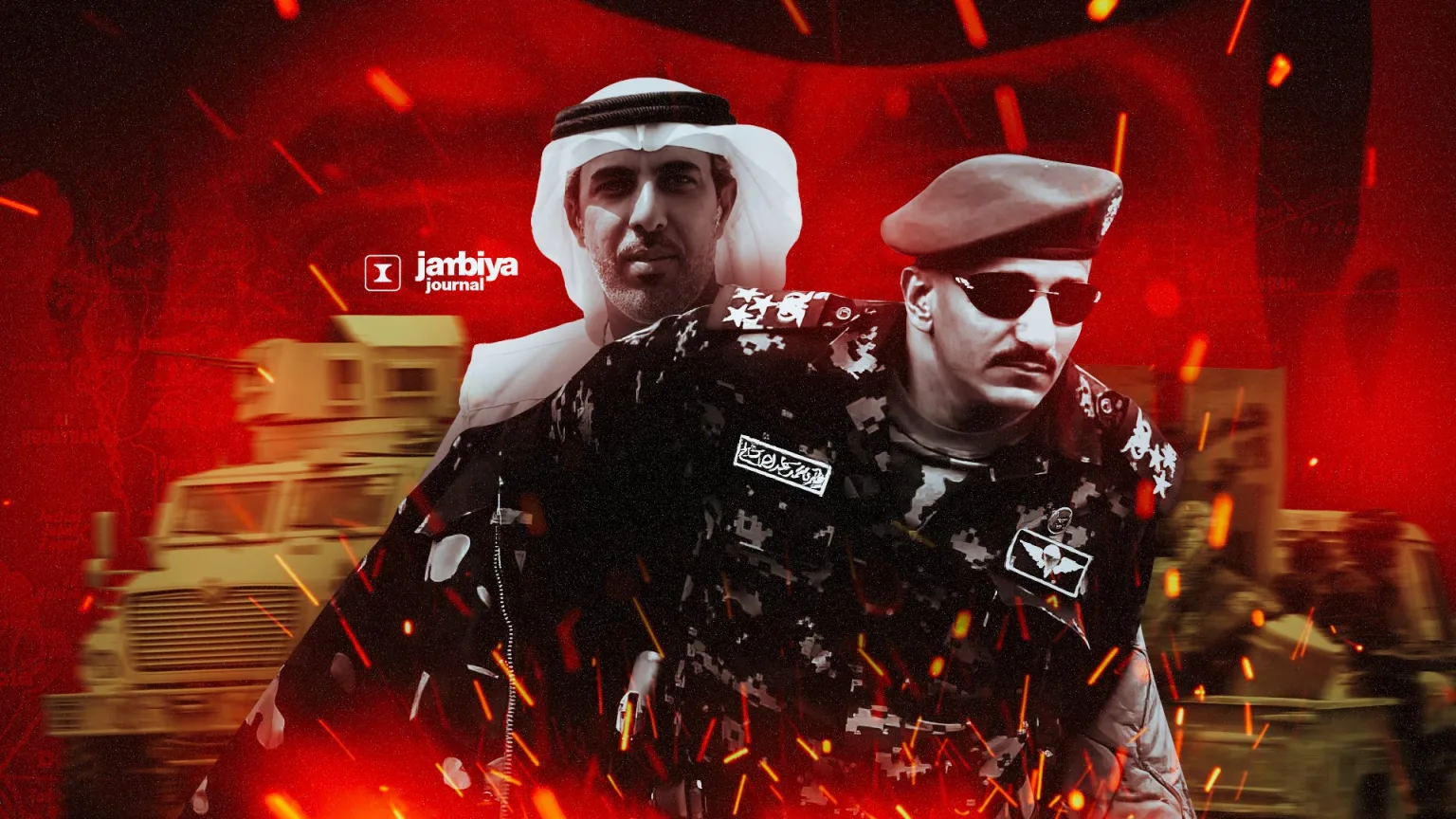
Image composition showing Saeed Ali Khamis Al-Kaabi (left) and Tariq Saleh (right). Photo: Jambiya Journal.
By Aldanmarki – Oct 15, 2025
News from Yemen rarely reaches the headlines these days. For the past two years, global attention has been consumed by Israel’s horrific and psychopathic bloodletting in Gaza, with the world equally surprised by Yemen offering its unconditional and stubborn military support for the oppressed Palestinian people.
Before October 2023, however, the crisis in Yemen was widely labeled the world’s worst humanitarian disaster. Millions were living on the knife’s edge of starvation, trapped by a suffocating blockade so brutal and fundamentally illegal that it seemed almost impossible to fathom.
Since 2015, Saudi Arabia has led a regional coalition, with backing from the United States and Britain, in a campaign to undo Yemen’s September 21st Revolution of 2014. Ten years on, their efforts have yielded nothing but abject and embarrassing failure.
The 2022 UN-sponsored ceasefire froze open hostilities, allowing warring parties to entrench themselves. The Sana’a-based government and the endless array of proxy forces it has long battled now govern their territories with uneasy permanence.
It should surprise no one familiar with the conflict that foreign powers have long funded, armed, and trained local proxies to advance their political and economic agendas. Saudi Arabia has served as the chief patron of the so-called “Internationally Recognized Government”—a body that holds little real authority on the ground—while the UAE has nurtured what can best be described as a smorgasbord of often competing militias, most notably the separatist Southern Transitional Council and, since 2018, the “National Resistance” led by former dictator Ali Abdullah Saleh’s nephew Tariq Saleh, along Yemen’s embattled West Coast.
In recent weeks, a series of leaked Emirati documents from 2021, first reported by veteran Yemeni journalist Anis Mansour, have surfaced online. Although their authenticity has yet to be independently verified, I find them credible enough to warrant public attention. They shed light on the machinery driving the occupation of South Yemen and expose the UAE’s deliberations with its proxies as they carve up the country for ends that serve not Yemenis, but the geostrategic ambitions of neo-mercantile powers determined to keep the Peninsula’s only republic fractured, divided, and perpetually unstable.
(Note: Each covered document will contain a download link. While all the pages are included in each PDF file, I cannot guarantee correct page sequence.)
Bargaining for a tribal head
Among the leaked files is a document titled “Minutes of the Military Operations Area Meeting – Marib, Al-Bayda, Ibb, Taiz,” stamped with the official letterhead of the UAE Ministry of Defense. Its opening page contains a letter signed by Saeed Ali Khamis Al-Kaabi, publicly known as the Director of Humanitarian Operations for the Emirates Red Crescent in Yemen, yet identified here as a Brigadier General and commander of the “West Coast Forces.” A designation, it seems, that was never intended for public eyes.
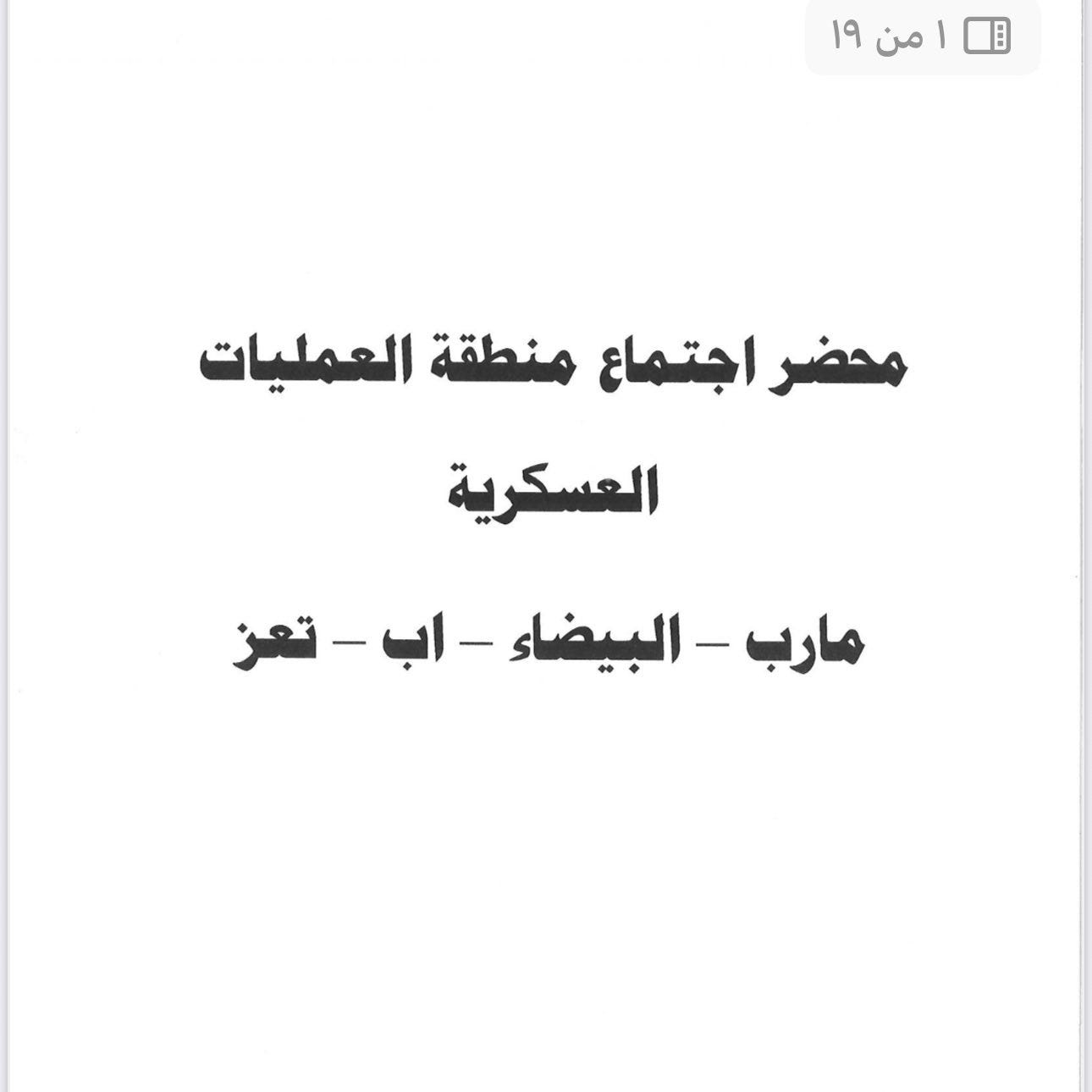
Front page of the first document: “Minutes of the Military Operations Area Meeting – Marib, Al-Bayda, Ibb, Taiz”
(PDF: Minutes Of The Military Operations Area Meeting Marib, Al Bayda, Ibb, Taiz)
The letter is addressed to Major General Saleh bin Muhammad Al-Amiri, officially serving as Commander of Joint Operations in the UAE Armed Forces. Al-Amiri is a central military figure within the Saudi-led Coalition and has played a key role in directing both Emirati troops and allied proxy forces across southern Yemen.
The accompanying letter to Maj. Gen. Al-Amiri indicates that the meeting minutes were prepared for his personal review. It quickly becomes clear that the following pages outline plans for a potential military campaign aimed at dislodging Yemen’s Shabwa province from its surroundings, presumably in order to cement direct Emirati control over the territory.
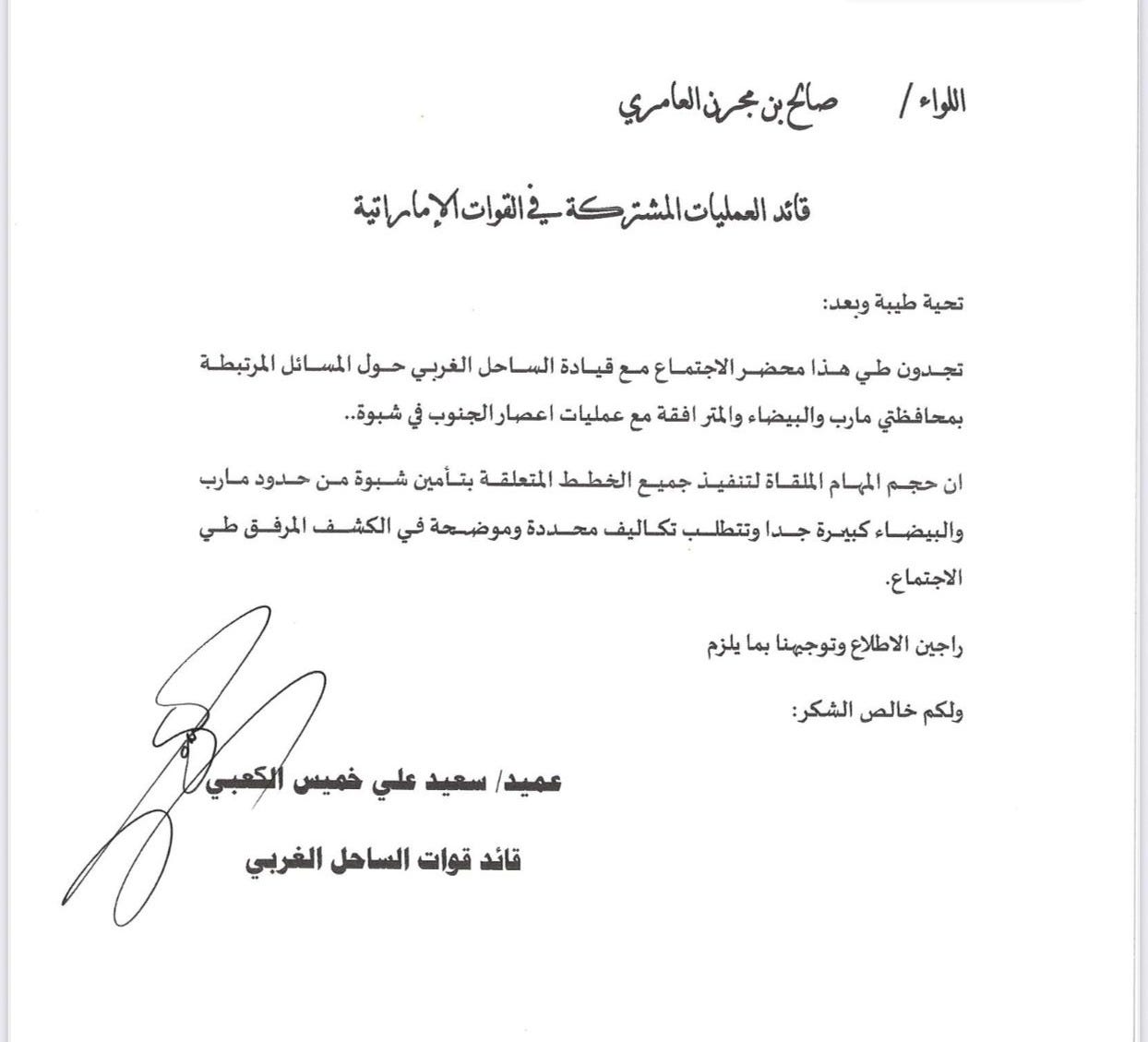
Preliminary letter addressed to Major General Saleh bin Muhammad Al-Amiri.
The document then provides a concise summary of the meeting’s agreed points, detailing the allocation of resources for what are described as “polarization operations” in Marib, Al-Bayda, and Taiz. In this context, “polarization” refers to efforts to recruit or sway influential tribal and political figures through bribery and other inducements.
The document then lists the date of the meeting, May 8th, 2021, and senior attendees, primarily three figures linked to the “National Resistance.” Present were Tariq Saleh—the nephew of former president Ali Abdullah Saleh and current commander of the “National Resistance”—his brother Ammar Saleh, and the aforementioned Brigadier General Saeed Al-Kaabi.
What follows is a stark transcript of the meeting, laying bare the unvarnished strategy for Yemen’s future. Brigadier General Al-Kaabi begins not with battlefield tactics, but with a plan to systematically buy the loyalty of an entire region. He instructs his Yemeni allies to “polarize every important and influential person in Marib and Al-Bayda.” Ammar Saleh confirms the scale of the operation, presenting a preliminary list of 35 key personalities in Marib alone. When Al-Kaabi asks about the price, Ammar’s response is chillingly direct: “Every head can be bent for a million dirhams.”
Tariq Saleh elaborates on this transactional approach to alliance-building, offering a grim proverb that seems to define their strategy: “You cannot buy the loyalty of a tribe, but you can rent this loyalty for a specific amount and for a known period of time.” The plan, as detailed, is warfare by checkbook, aiming to fracture northern Yemeni society from within by turning its leaders into paid assets.
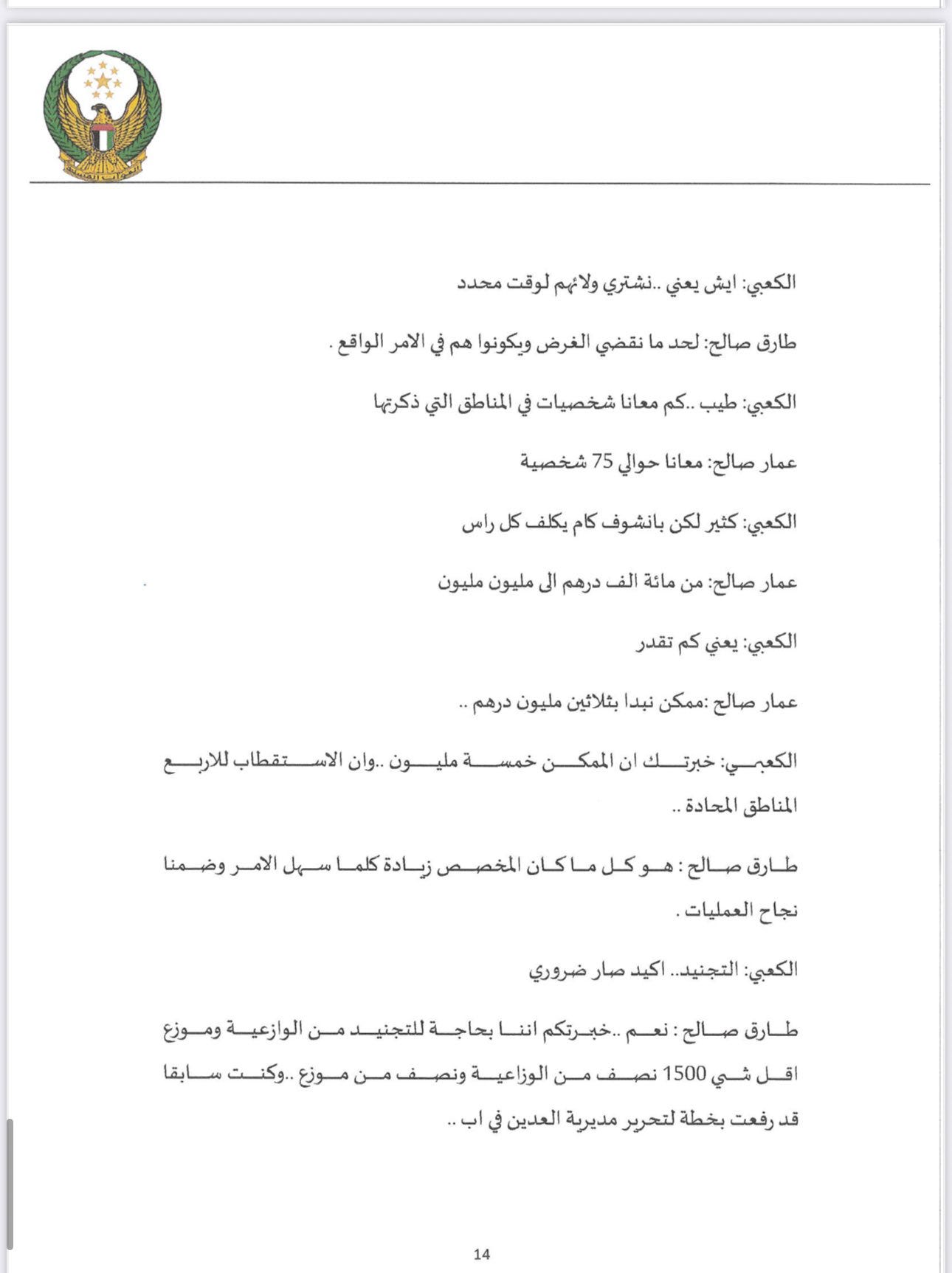
Page 14 of the document, with the attendees of the meeting discussing how much they should pay in order to “polarize” the suggested list of tribal figures.
The minutes reveal that the ultimate target of this operation is not solely the Ansar Allah movement. In one of the most explosive revelations, Brigadier General Al-Kaabi tasks his allies with preparing a plan for “specific operations to completely eliminate the Legitimacy”—a direct reference to Yemen’s so-called “internationally recognized government”, the very entity the Saudi-led Coalition was officially there to prop up. This objective is coupled with a secondary plan to “deal with Al-Qaeda in Al-Bayda,” but the priority is unmistakable.
The geopolitical maneuvering behind this strategy is laid bare when the Saleh brothers are instructed to remove Saudi-aligned figures from their lists of polarization targets. When questioned, Al-Kaabi explains that the Emirati and Saudi leadership have reached a deal: “Saudi Arabia will concede all southern governorates in exchange for us putting our full military weight into the war.” This admission points to a backroom agreement to partition Yemen into spheres of influence, with the UAE securing control over the strategic south. To enforce this, Tariq Saleh is ordered to conduct a 100km withdrawal of his forces, a command he calls “very embarrassing” but is nonetheless expected to obey.
The tactics discussed extend beyond bribery into overt economic warfare. Tariq Saleh proposes a plan for Ibb governorate that includes “an exceptional bombing that destroys the economic environment,” which he suggests should be “accompanied by the withdrawal of currency.” This strategy aims to induce chaos and cripple the region’s economy, deliberately targeting civilian infrastructure to achieve military goals.
The meeting also highlights the deeply cynical nature of the conflict’s alliances. When the challenge of confronting Al-Qaeda in Al-Bayda is raised, Ammar Saleh offers a startlingly pragmatic solution: “The areas… where Al-Qaeda is concentrated, we leave them to the Ansar Allah (Houthi) group. They are capable of dealing with them.” The admission that the coalition would outsource its counter-terrorism fight to its primary enemy reveals the fluid and self-serving priorities governing the war.
Throughout the transcript, a palpable tension over money and corruption lingers. Al-Kaabi openly accuses his Yemeni partners of graft, questioning where the funds from past operations have gone: “The results on the ground are less than 10% of what is expected… where does the other 90% go, ya Ammar?” Yet, in the same breath, he cynically institutionalizes it, instructing them to factor in their own cut. “Don’t forget to put in Ammar’s share,” he says, adding, “there is no harm if he buys a few villas and a palace in Germany. We consider it a reward for you.”
A secret alliance revealed
A second, more explosive document from the leaked cache provides an unprecedented look into the covert architecture of the UAE’s war in Yemen, revealing a deep and fraught alliance with Israel and their key Yemeni proxy, Tariq Saleh. Titled “Report on the Resistance’s Relationship with Israel,” the 25-page file is an internal Emirati investigation into Saleh’s unsanctioned dealings with Israeli intelligence. It paints a vivid picture of a partnership built on strategic necessity but plagued by profound mistrust, culminating in a dramatic confrontation where the Emiratis move to bring their unruly ally to heel.
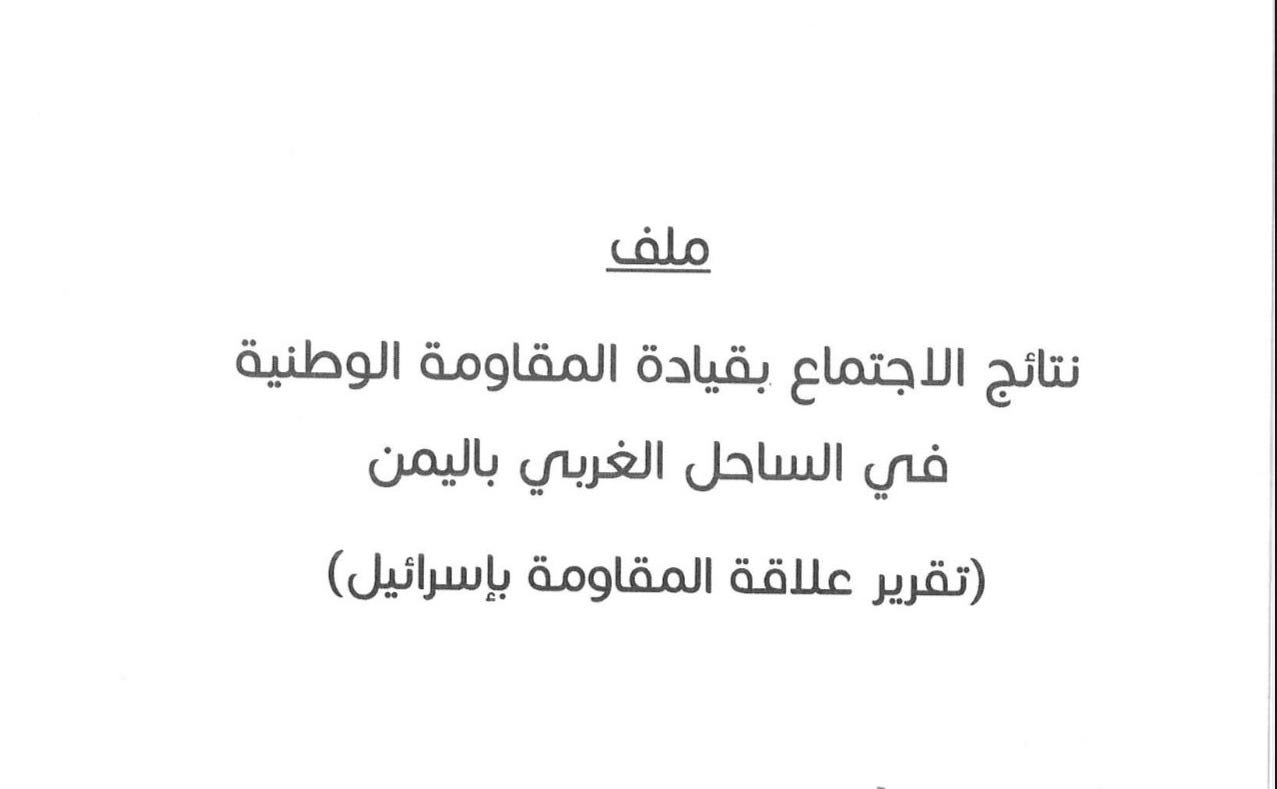
Front page of second document, bearing the title “Results of the Meeting with the Command of the National Resistance on the Western Coast of Yemen (Report on the Resistance’s Relationship with Israel).”
(PDF: Results Of The Meeting With The Command Of The National Resistance On The Western Coast Of Yemen (report On The Resistance’s Relationship With Israel)
Notably, the entire document is presented on official Emirates Red Crescent stationery. This peculiar detail strongly suggests a deliberate blurring of lines between humanitarian aid and covert operations, indicating that Saeed Ali Khamis Al-Kaabi leverages his humanitarian position to mask his parallel role in military and intelligence activities.
Before detailing Saleh’s transgressions, the report first establishes the official, extensive military cooperation between the UAE and Israel on Yemen’s Western Coast, which is hardly a distant, arms-length relationship. The document meticulously tables joint operations throughout 2018 and 2020, including:
The deployment of five Israeli frigates and two submarines near the strategic Bab al-Mandab strait.
The integration of 42 Israeli pilots for “permanent participation” in bombing campaigns.
The establishment of a joint operations room with Emirati, Israeli, and Yemeni participation.
Joint naval maneuvers in the Red Sea following the Abraham Accords, which included “joint naval landing tactical exercises” for Tariq Saleh’s National Resistance forces.
This foundation of sanctioned cooperation makes the subsequent accusations of clandestine side-dealings all the more significant.
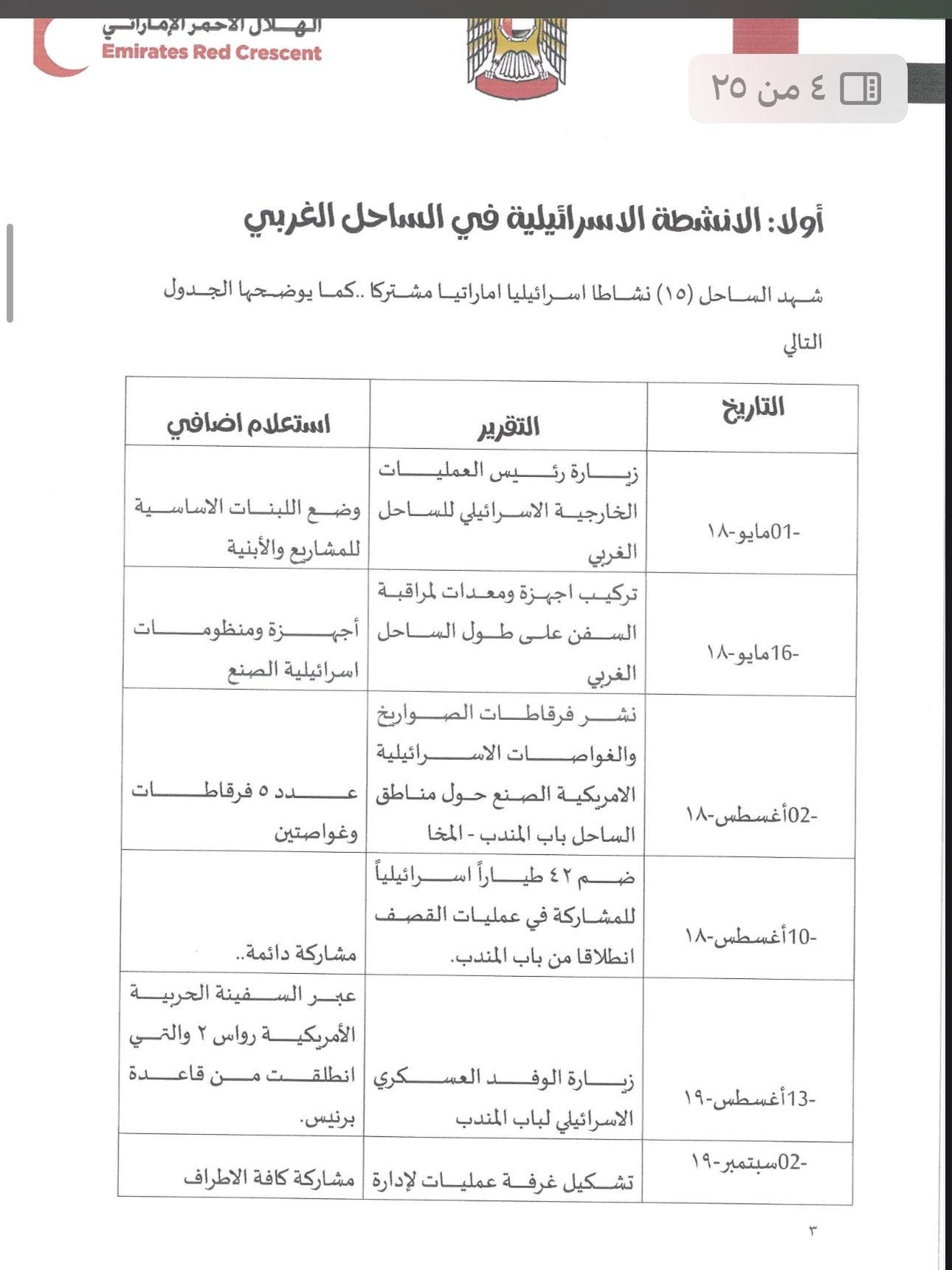
List of joint Israeli-Emirati initiatives since May, 2018.
The heart of the document is the transcript of a tense meeting on October 10, 2021, at the command headquarters in Mokha. Emirati commanders, led by Brigadier General Saeed Al Mazrouei and Brigadier General Saeed Al Kaabi, effectively put Tariq Saleh on trial for his perceived betrayals.
The Emiratis open with a clear accusation of disloyalty. “Let’s be clear, we operate based on what we know about you,” Al Mazrouei began, adding with a thinly veiled threat, “and we are confident that you have been communicating with the Americans and Israelis outside of our approved channels. It seems you are looking for alternative patrons in case we decide to leave you.”
Saleh’s denials are repeatedly brushed aside as the commanders present a list of specific infractions:
Mishandling Israeli Weapons: Al Mazrouei accused Saleh of secretly transferring a shipment of Israeli-supplied arms. “Those were just light arms, and many were defective—nothing more than scrap,” Saleh explained defensively. He insisted the weapons had to be moved because “they were dangerous and could have exploded at any moment, causing a disaster.”
The Sale of an Ancient Torah: In a bizarre and telling exchange, Al Kaabi confronted Saleh about the fate of an ancient Torah manuscript gifted to him by an Israeli expert. After Saleh admitted to having passed it on, Al Mazrouei delivered the damning charge: “That Torah was sold by an Israeli dealer named Sami Awfi for $700,000,” he stated flatly. “Why didn’t you tell us? Your own brother, Ammar, was the one who informed us about it.”
Unauthorized Labor at an Israeli Base: The Emiratis revealed they knew Saleh’s forces had been working at a secret Israeli-built airbase in Dahlak, Eritrea. “My men take official vacations,” Saleh argued. “If they choose to work elsewhere during that time, that is their right. They always return to their duties.”
Having laid out their case, the Emirati commanders deliver their verdict. Saleh’s autonomy is to be severely curtailed. “The operations room will be restructured, and from now on, you will be nothing more than an external observer,” Al Mazrouei commanded. “We will establish a new, official channel for your communications with the Israelis, one that will be completely transparent to us.”
The meeting takes a historic turn when the Emiratis reveal the deep roots of this relationship. Al Kaabi informed Saleh that his uncle, the late President Ali Abdullah Saleh, was the original architect of the alliance. “The relationship between your uncle, the martyr, and Israel was more than excellent,” Al Kaabi revealed. “His cooperation with them began back in 2007,” he continued, adding the stunning detail that “your uncle even visited Tel Aviv for a secret two-day meeting with Netanyahu.”
Rather than being chastened, Tariq Saleh embraced this history. “I was simply a soldier following orders then,” he responded. “It was my uncle, the martyr, who began this relationship, and I intend to continue on the path he started.”
The Emirati commander’s stunning revelation that Ali Abdullah Saleh maintained a “more than excellent” relationship with Israel, culminating in a secret visit to Tel Aviv to meet with Netanyahu, might seem incredible. Yet, this claim is not without precedent and appears to confirm long-standing allegations about the former dictator’s covert dealings. In October 2020, the Yemeni Armed Forces of the Sana’a-based government published a highly detailed report documenting the increasingly tight relationship between Saleh’s regime and Israel. Yemeni military officials listed several incidents proving this relationship, such as:
A visit by an Israeli Knesset delegation to Sana’a in March 1996.
Saleh’s 1997 admission to an Arab official of ongoing visits by Israeli officials, and his decision that same year to partially lift the boycott on Israeli goods—a move rewarded by the US with spare parts for Yemen’s F-5 aircraft.
A direct meeting between Saleh and then-Israeli President Ezer Weizman in March 2000, a fact that Brigadier General Yahya Saree, the spokesman of the Yemeni Armed Forces, noted was leaked by Israeli radio just ten minutes after it concluded, causing Saleh “great embarrassment.”
A plan since 2004 to grant approximately 60,000 Israelis with Yemeni citizenship, including jews of Yemenite origin, with a quarter of them being Israelis with dual American citizenship.
The leaked minutes, therefore, do more than expose the actions of Tariq Saleh; they lend significant weight to the charge that his family’s political survival had long been tied to a hidden, pragmatic, and deeply cynical back-channel relationship with Tel Aviv.
The meeting concludes with a discussion of future plans. The UAE pressures Saleh to publicly announce his support for normalization with Israel, a move he resists, citing the “inherently hostile” political climate in northern Yemen.
A solution is then proposed for encouraging Israeli investment on the Western Coast without provoking a public backlash. The commanders agree that Israeli investors should use foreign passports to hide their origins. Saleh proposed an open invitation for them to come with “European, Ukrainian, or similar passports and invest,” calling it “an invitation for them to launder their identities.”
Gold rush in the east
The third and final leaked document covered in this article, titled “Special Document: Results of Mineral Exploration Activities in Al-Mahra Governorate, Yemen,” reveals a detailed and audacious plan by the United Arab Emirates to secure and exploit vast mineral resources, particularly gold, in eastern Yemen. The 18-page report, prepared by the UAE’s Special Unit (T) in Yemen and addressed to the Joint Operations Command, functions as a confidential geological survey, a political risk assessment, and a strategic blueprint for overcoming local resistance to seize control of what it estimates to be a very lucrative, unexplored gold deposit.
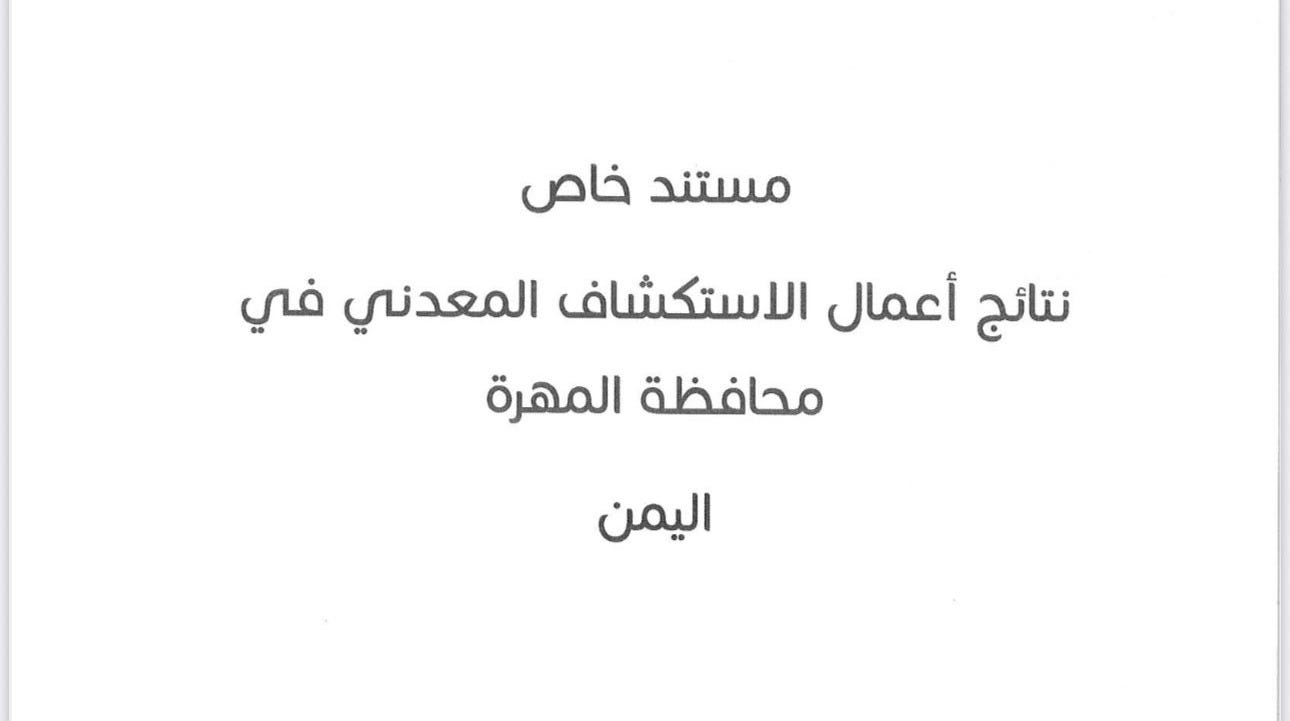
Front page of third document, bearing the title “Special Document: Results of Mineral Exploration Activities in Al-Mahra Governorate, Yemen.”
(PDF: Special Document Results Of Mineral Exploration Activities In Al Mahra Governorate, Yemen)
The report frames its mission under a political guise. It begins by citing an agreement with its key Yemeni ally, the Southern Transitional Council (STC), which allegedly tasks the UAE with helping the STC achieve southern “independence” by extracting the region’s mineral wealth.
To provide a legal basis for the operation, the report invokes a 2005 license granted by former President Ali Abdullah Saleh to Thani Dubai National Mining for gold prospecting in Hadhramaut. The document argues that a clause in this old license allows for its expansion into the adjacent Al-Mahra governorate, a legal justification it has bolstered with a new deal concluded with the “head of the legitimate government.”
To execute the plan, the report details the creation of a new company operating under the cover of “Thani Dubai.” This firm secured an agreement, ostensibly to prospect for emeralds, but the report makes clear the real targets are far more valuable. In exchange for granting a 50-year concession for prospecting and exportation rights, the Yemeni Prime Minister and the STC’s Minister of Transport were to be “rewarded with millions of dollars.”
The core of the document is the stunning results of the exploration survey, conducted by a handpicked international team of experts from Egypt, Palestine, Syria, Brazil, Ukraine, and the UAE. After conducting geological mapping, rock sampling, and analysis, the team presented its staggering conclusions. The report confidently asserts that Al-Mahra holds (kilograms per cubic meter (kg/m³):
Estimated Gold Reserves: 124.1
Estimated Zinc Reserves: 147.29
Estimated Iron Reserves: 33.33
(Note: A previous rendition of this article concluded the preliminary results to be in the millions, which is geologically impossible. This came from a misreading of the table in the document, and has since been corrected)
The document also notes significant deposits of nickel, lead, copper, and silver, concluding that Al-Mahra “holds a great deal of this wealth,” making Yemen potentially one of the richest mineral zones in the world.
Despite the immense potential wealth, the report dedicates significant space to detailing the formidable obstacles standing in the way of extraction. It outlines six primary challenges:
Sheikh Ali Salem Al-Harizi: The report identifies the influential local sheikh as the leader of the popular resistance, noting that he has successfully funded and organized opposition to the UAE’s presence for years.
The Islah Party: The document expresses concern over the “expected mobilization of armed elements” from the Islah Party (the political arm of the Muslim Brotherhood in Yemen), who are embedded within the internationally recognized government.
Conflicting Foreign Interests: The report notes friction with “British and Israeli military commanders participating in the coalition’s operations at Al-Ghaydah airport.”
Saudi Arabia: The document cryptically refers to the “negative role of the Kingdom of Saudi Arabia in Al-Mahra.”
Oman: The report accuses the neighboring Sultanate of Oman of supporting “opposing institutions, fronts, and personalities.”
Popular Rejection: Finally, the document concedes that there is a “popular rejection of any presence, which is a general mood” hostile to the UAE.
The final section of the report lays out a detailed and ruthless strategy to overcome this widespread resistance. The proposals amount to a comprehensive plan to militarize the region and co-opt local leaders:
Create a Local Proxy Force: The top recommendation is to “recruit 5,000 soldiers from the sons of Al-Mahra” to serve as a loyal local force.
Establish Military Bases: The plan calls for establishing military camps and training centers strategically located “near the areas with mineral wealth.”
Control Borders and Demographics: The report advises using STC forces to “close the Nishtun port and the Sarfit and Shahan crossings,” specifically to “expel the displaced people from the northern governorates.”
Renew “Polarization” Efforts: The document calls for a renewed campaign of bribery to “polarize the influential personalities who have not responded to previous attempts,” specifically naming key leaders of the local councils and sit-in committees.
Neutralize Sheikh Al-Harizi: After admitting that relying on the Saudis to control Sheikh Al-Harizi has failed, the report implies a more direct approach is needed.
Launch a Propaganda Campaign: The final proposal is to “employ all media capabilities to change the popular mood in Al-Mahra that is hostile to the Emirates.”
A colonial blueprint
What emerges from these scattered pages—a meeting about bribes, a tense confrontation over Israel, a corporate-style plan for a gold rush—is not a series of isolated events, but a single, chillingly coherent blueprint for the subjugation of a nation. As I sifted through the minutes, the mechanics of the UAE’s agenda came into sharp focus, revealing a strategy that is as cynical as it is meticulous.
The first document shows us the ‘how’: a war fought with checkbooks, where a commander casually discusses the price of loyalty “per head” and plans are laid to “completely eliminate the Legitimacy”—the very government the coalition claimed to be saving. This is a world where corruption isn’t just tolerated but encouraged, with proxies offered “villas in Germany” as a reward for their compliance.
The second document reveals the ‘who’ and ‘why’: a deep-seated, covert military alliance with Israel, designed to project power across the Red Sea region. This partnership is so vital that even their own proxy, Tariq Saleh, must be brutally disciplined for stepping out of line, his secret dealings exposed and his autonomy curtailed. The minutes confirm a long history of these back-channel arrangements, tracing them back to a secret meeting between Tariq’s uncle and Benjamin Netanyahu, framing the current conflict as merely the latest chapter in a decades-long game. Crucial to mention, however, is that Israel’s attempt at regional power projection in the Red Sea region has the past two years been proven entirely futile, and have not been able to stop the Ansar Allah from conducting its operations in support of & solidarity with the Palestinian people – among other things.
Finally, the third document lays bare the ultimate prize: the cold, hard calculus of economic extraction. Here, we see the blueprint for a neo-colonial venture, with detailed plans to seize Al-Mahra’s allegedly rich gold deposit. The local population, with their legitimate resistance to foreign occupation, are not seen as people to be won over, but as obstacles to be managed through a combination of a new, 5,000-man proxy militia, targeted bribes, and a full-spectrum propaganda campaign. The solution to dealing with Israeli investors in a hostile environment? A cynical directive to have them “launder their identities” with foreign passports.
This blueprint for resource extraction is not unique to Yemen. It finds an uncanny parallel in Sudan, where the UAE has been a key foreign backer of the brutal Rapid Support Forces (RSF) in their devastating war against the Sudanese army. For years, reports have detailed how Emirati support—in the form of weapons, financing, and diplomatic cover—has fueled the RSF’s campaign. The motive, as it has become increasingly clear, mirrors the agenda laid out in the Al-Mahra report: to secure privileged access to Sudan’s vast gold deposits. By propping up a powerful militia with a history of controlling the country’s mines, the UAE is once again using a proxy force to advance an extractive agenda, ensuring that the immense wealth beneath the soil flows not to the Sudanese people, but into the vaults of Abu Dhabi. The tactics may be adapted, but the goal remains the same: leveraging conflict to secure a permanent stake in another nation’s natural resources.
The authenticity of these documents can and will undoubtedly be debated, but the pattern they reveal is too consistent to ignore. This is the machinery of an oft-forgotten occupation, one that seeks to control a nation not by winning hearts and minds, but by purchasing loyalties, managing assets, and carving up resources. They reveal a vision for Yemen not as a sovereign state to be rebuilt, but as a fractured dominion to be managed, its people a problem to be solved, and its wealth a prize to be claimed.
(Jambiya Journal)
https://orinocotribune.com/the-quiet-oc ... r-machine/
October 19, 2025
Image composition showing Saeed Ali Khamis Al-Kaabi (left) and Tariq Saleh (right). Photo: Jambiya Journal.
By Aldanmarki – Oct 15, 2025
News from Yemen rarely reaches the headlines these days. For the past two years, global attention has been consumed by Israel’s horrific and psychopathic bloodletting in Gaza, with the world equally surprised by Yemen offering its unconditional and stubborn military support for the oppressed Palestinian people.
Before October 2023, however, the crisis in Yemen was widely labeled the world’s worst humanitarian disaster. Millions were living on the knife’s edge of starvation, trapped by a suffocating blockade so brutal and fundamentally illegal that it seemed almost impossible to fathom.
Since 2015, Saudi Arabia has led a regional coalition, with backing from the United States and Britain, in a campaign to undo Yemen’s September 21st Revolution of 2014. Ten years on, their efforts have yielded nothing but abject and embarrassing failure.
The 2022 UN-sponsored ceasefire froze open hostilities, allowing warring parties to entrench themselves. The Sana’a-based government and the endless array of proxy forces it has long battled now govern their territories with uneasy permanence.
It should surprise no one familiar with the conflict that foreign powers have long funded, armed, and trained local proxies to advance their political and economic agendas. Saudi Arabia has served as the chief patron of the so-called “Internationally Recognized Government”—a body that holds little real authority on the ground—while the UAE has nurtured what can best be described as a smorgasbord of often competing militias, most notably the separatist Southern Transitional Council and, since 2018, the “National Resistance” led by former dictator Ali Abdullah Saleh’s nephew Tariq Saleh, along Yemen’s embattled West Coast.
In recent weeks, a series of leaked Emirati documents from 2021, first reported by veteran Yemeni journalist Anis Mansour, have surfaced online. Although their authenticity has yet to be independently verified, I find them credible enough to warrant public attention. They shed light on the machinery driving the occupation of South Yemen and expose the UAE’s deliberations with its proxies as they carve up the country for ends that serve not Yemenis, but the geostrategic ambitions of neo-mercantile powers determined to keep the Peninsula’s only republic fractured, divided, and perpetually unstable.
(Note: Each covered document will contain a download link. While all the pages are included in each PDF file, I cannot guarantee correct page sequence.)
Bargaining for a tribal head
Among the leaked files is a document titled “Minutes of the Military Operations Area Meeting – Marib, Al-Bayda, Ibb, Taiz,” stamped with the official letterhead of the UAE Ministry of Defense. Its opening page contains a letter signed by Saeed Ali Khamis Al-Kaabi, publicly known as the Director of Humanitarian Operations for the Emirates Red Crescent in Yemen, yet identified here as a Brigadier General and commander of the “West Coast Forces.” A designation, it seems, that was never intended for public eyes.
Front page of the first document: “Minutes of the Military Operations Area Meeting – Marib, Al-Bayda, Ibb, Taiz”
(PDF: Minutes Of The Military Operations Area Meeting Marib, Al Bayda, Ibb, Taiz)
The letter is addressed to Major General Saleh bin Muhammad Al-Amiri, officially serving as Commander of Joint Operations in the UAE Armed Forces. Al-Amiri is a central military figure within the Saudi-led Coalition and has played a key role in directing both Emirati troops and allied proxy forces across southern Yemen.
The accompanying letter to Maj. Gen. Al-Amiri indicates that the meeting minutes were prepared for his personal review. It quickly becomes clear that the following pages outline plans for a potential military campaign aimed at dislodging Yemen’s Shabwa province from its surroundings, presumably in order to cement direct Emirati control over the territory.
Preliminary letter addressed to Major General Saleh bin Muhammad Al-Amiri.
The document then provides a concise summary of the meeting’s agreed points, detailing the allocation of resources for what are described as “polarization operations” in Marib, Al-Bayda, and Taiz. In this context, “polarization” refers to efforts to recruit or sway influential tribal and political figures through bribery and other inducements.
The document then lists the date of the meeting, May 8th, 2021, and senior attendees, primarily three figures linked to the “National Resistance.” Present were Tariq Saleh—the nephew of former president Ali Abdullah Saleh and current commander of the “National Resistance”—his brother Ammar Saleh, and the aforementioned Brigadier General Saeed Al-Kaabi.
What follows is a stark transcript of the meeting, laying bare the unvarnished strategy for Yemen’s future. Brigadier General Al-Kaabi begins not with battlefield tactics, but with a plan to systematically buy the loyalty of an entire region. He instructs his Yemeni allies to “polarize every important and influential person in Marib and Al-Bayda.” Ammar Saleh confirms the scale of the operation, presenting a preliminary list of 35 key personalities in Marib alone. When Al-Kaabi asks about the price, Ammar’s response is chillingly direct: “Every head can be bent for a million dirhams.”
Tariq Saleh elaborates on this transactional approach to alliance-building, offering a grim proverb that seems to define their strategy: “You cannot buy the loyalty of a tribe, but you can rent this loyalty for a specific amount and for a known period of time.” The plan, as detailed, is warfare by checkbook, aiming to fracture northern Yemeni society from within by turning its leaders into paid assets.
Page 14 of the document, with the attendees of the meeting discussing how much they should pay in order to “polarize” the suggested list of tribal figures.
The minutes reveal that the ultimate target of this operation is not solely the Ansar Allah movement. In one of the most explosive revelations, Brigadier General Al-Kaabi tasks his allies with preparing a plan for “specific operations to completely eliminate the Legitimacy”—a direct reference to Yemen’s so-called “internationally recognized government”, the very entity the Saudi-led Coalition was officially there to prop up. This objective is coupled with a secondary plan to “deal with Al-Qaeda in Al-Bayda,” but the priority is unmistakable.
The geopolitical maneuvering behind this strategy is laid bare when the Saleh brothers are instructed to remove Saudi-aligned figures from their lists of polarization targets. When questioned, Al-Kaabi explains that the Emirati and Saudi leadership have reached a deal: “Saudi Arabia will concede all southern governorates in exchange for us putting our full military weight into the war.” This admission points to a backroom agreement to partition Yemen into spheres of influence, with the UAE securing control over the strategic south. To enforce this, Tariq Saleh is ordered to conduct a 100km withdrawal of his forces, a command he calls “very embarrassing” but is nonetheless expected to obey.
The tactics discussed extend beyond bribery into overt economic warfare. Tariq Saleh proposes a plan for Ibb governorate that includes “an exceptional bombing that destroys the economic environment,” which he suggests should be “accompanied by the withdrawal of currency.” This strategy aims to induce chaos and cripple the region’s economy, deliberately targeting civilian infrastructure to achieve military goals.
The meeting also highlights the deeply cynical nature of the conflict’s alliances. When the challenge of confronting Al-Qaeda in Al-Bayda is raised, Ammar Saleh offers a startlingly pragmatic solution: “The areas… where Al-Qaeda is concentrated, we leave them to the Ansar Allah (Houthi) group. They are capable of dealing with them.” The admission that the coalition would outsource its counter-terrorism fight to its primary enemy reveals the fluid and self-serving priorities governing the war.
Throughout the transcript, a palpable tension over money and corruption lingers. Al-Kaabi openly accuses his Yemeni partners of graft, questioning where the funds from past operations have gone: “The results on the ground are less than 10% of what is expected… where does the other 90% go, ya Ammar?” Yet, in the same breath, he cynically institutionalizes it, instructing them to factor in their own cut. “Don’t forget to put in Ammar’s share,” he says, adding, “there is no harm if he buys a few villas and a palace in Germany. We consider it a reward for you.”
A secret alliance revealed
A second, more explosive document from the leaked cache provides an unprecedented look into the covert architecture of the UAE’s war in Yemen, revealing a deep and fraught alliance with Israel and their key Yemeni proxy, Tariq Saleh. Titled “Report on the Resistance’s Relationship with Israel,” the 25-page file is an internal Emirati investigation into Saleh’s unsanctioned dealings with Israeli intelligence. It paints a vivid picture of a partnership built on strategic necessity but plagued by profound mistrust, culminating in a dramatic confrontation where the Emiratis move to bring their unruly ally to heel.
Front page of second document, bearing the title “Results of the Meeting with the Command of the National Resistance on the Western Coast of Yemen (Report on the Resistance’s Relationship with Israel).”
(PDF: Results Of The Meeting With The Command Of The National Resistance On The Western Coast Of Yemen (report On The Resistance’s Relationship With Israel)
Notably, the entire document is presented on official Emirates Red Crescent stationery. This peculiar detail strongly suggests a deliberate blurring of lines between humanitarian aid and covert operations, indicating that Saeed Ali Khamis Al-Kaabi leverages his humanitarian position to mask his parallel role in military and intelligence activities.
Before detailing Saleh’s transgressions, the report first establishes the official, extensive military cooperation between the UAE and Israel on Yemen’s Western Coast, which is hardly a distant, arms-length relationship. The document meticulously tables joint operations throughout 2018 and 2020, including:
The deployment of five Israeli frigates and two submarines near the strategic Bab al-Mandab strait.
The integration of 42 Israeli pilots for “permanent participation” in bombing campaigns.
The establishment of a joint operations room with Emirati, Israeli, and Yemeni participation.
Joint naval maneuvers in the Red Sea following the Abraham Accords, which included “joint naval landing tactical exercises” for Tariq Saleh’s National Resistance forces.
This foundation of sanctioned cooperation makes the subsequent accusations of clandestine side-dealings all the more significant.
List of joint Israeli-Emirati initiatives since May, 2018.
The heart of the document is the transcript of a tense meeting on October 10, 2021, at the command headquarters in Mokha. Emirati commanders, led by Brigadier General Saeed Al Mazrouei and Brigadier General Saeed Al Kaabi, effectively put Tariq Saleh on trial for his perceived betrayals.
The Emiratis open with a clear accusation of disloyalty. “Let’s be clear, we operate based on what we know about you,” Al Mazrouei began, adding with a thinly veiled threat, “and we are confident that you have been communicating with the Americans and Israelis outside of our approved channels. It seems you are looking for alternative patrons in case we decide to leave you.”
Saleh’s denials are repeatedly brushed aside as the commanders present a list of specific infractions:
Mishandling Israeli Weapons: Al Mazrouei accused Saleh of secretly transferring a shipment of Israeli-supplied arms. “Those were just light arms, and many were defective—nothing more than scrap,” Saleh explained defensively. He insisted the weapons had to be moved because “they were dangerous and could have exploded at any moment, causing a disaster.”
The Sale of an Ancient Torah: In a bizarre and telling exchange, Al Kaabi confronted Saleh about the fate of an ancient Torah manuscript gifted to him by an Israeli expert. After Saleh admitted to having passed it on, Al Mazrouei delivered the damning charge: “That Torah was sold by an Israeli dealer named Sami Awfi for $700,000,” he stated flatly. “Why didn’t you tell us? Your own brother, Ammar, was the one who informed us about it.”
Unauthorized Labor at an Israeli Base: The Emiratis revealed they knew Saleh’s forces had been working at a secret Israeli-built airbase in Dahlak, Eritrea. “My men take official vacations,” Saleh argued. “If they choose to work elsewhere during that time, that is their right. They always return to their duties.”
Having laid out their case, the Emirati commanders deliver their verdict. Saleh’s autonomy is to be severely curtailed. “The operations room will be restructured, and from now on, you will be nothing more than an external observer,” Al Mazrouei commanded. “We will establish a new, official channel for your communications with the Israelis, one that will be completely transparent to us.”
The meeting takes a historic turn when the Emiratis reveal the deep roots of this relationship. Al Kaabi informed Saleh that his uncle, the late President Ali Abdullah Saleh, was the original architect of the alliance. “The relationship between your uncle, the martyr, and Israel was more than excellent,” Al Kaabi revealed. “His cooperation with them began back in 2007,” he continued, adding the stunning detail that “your uncle even visited Tel Aviv for a secret two-day meeting with Netanyahu.”
Rather than being chastened, Tariq Saleh embraced this history. “I was simply a soldier following orders then,” he responded. “It was my uncle, the martyr, who began this relationship, and I intend to continue on the path he started.”
The Emirati commander’s stunning revelation that Ali Abdullah Saleh maintained a “more than excellent” relationship with Israel, culminating in a secret visit to Tel Aviv to meet with Netanyahu, might seem incredible. Yet, this claim is not without precedent and appears to confirm long-standing allegations about the former dictator’s covert dealings. In October 2020, the Yemeni Armed Forces of the Sana’a-based government published a highly detailed report documenting the increasingly tight relationship between Saleh’s regime and Israel. Yemeni military officials listed several incidents proving this relationship, such as:
A visit by an Israeli Knesset delegation to Sana’a in March 1996.
Saleh’s 1997 admission to an Arab official of ongoing visits by Israeli officials, and his decision that same year to partially lift the boycott on Israeli goods—a move rewarded by the US with spare parts for Yemen’s F-5 aircraft.
A direct meeting between Saleh and then-Israeli President Ezer Weizman in March 2000, a fact that Brigadier General Yahya Saree, the spokesman of the Yemeni Armed Forces, noted was leaked by Israeli radio just ten minutes after it concluded, causing Saleh “great embarrassment.”
A plan since 2004 to grant approximately 60,000 Israelis with Yemeni citizenship, including jews of Yemenite origin, with a quarter of them being Israelis with dual American citizenship.
The leaked minutes, therefore, do more than expose the actions of Tariq Saleh; they lend significant weight to the charge that his family’s political survival had long been tied to a hidden, pragmatic, and deeply cynical back-channel relationship with Tel Aviv.
The meeting concludes with a discussion of future plans. The UAE pressures Saleh to publicly announce his support for normalization with Israel, a move he resists, citing the “inherently hostile” political climate in northern Yemen.
A solution is then proposed for encouraging Israeli investment on the Western Coast without provoking a public backlash. The commanders agree that Israeli investors should use foreign passports to hide their origins. Saleh proposed an open invitation for them to come with “European, Ukrainian, or similar passports and invest,” calling it “an invitation for them to launder their identities.”
Gold rush in the east
The third and final leaked document covered in this article, titled “Special Document: Results of Mineral Exploration Activities in Al-Mahra Governorate, Yemen,” reveals a detailed and audacious plan by the United Arab Emirates to secure and exploit vast mineral resources, particularly gold, in eastern Yemen. The 18-page report, prepared by the UAE’s Special Unit (T) in Yemen and addressed to the Joint Operations Command, functions as a confidential geological survey, a political risk assessment, and a strategic blueprint for overcoming local resistance to seize control of what it estimates to be a very lucrative, unexplored gold deposit.
Front page of third document, bearing the title “Special Document: Results of Mineral Exploration Activities in Al-Mahra Governorate, Yemen.”
(PDF: Special Document Results Of Mineral Exploration Activities In Al Mahra Governorate, Yemen)
The report frames its mission under a political guise. It begins by citing an agreement with its key Yemeni ally, the Southern Transitional Council (STC), which allegedly tasks the UAE with helping the STC achieve southern “independence” by extracting the region’s mineral wealth.
To provide a legal basis for the operation, the report invokes a 2005 license granted by former President Ali Abdullah Saleh to Thani Dubai National Mining for gold prospecting in Hadhramaut. The document argues that a clause in this old license allows for its expansion into the adjacent Al-Mahra governorate, a legal justification it has bolstered with a new deal concluded with the “head of the legitimate government.”
To execute the plan, the report details the creation of a new company operating under the cover of “Thani Dubai.” This firm secured an agreement, ostensibly to prospect for emeralds, but the report makes clear the real targets are far more valuable. In exchange for granting a 50-year concession for prospecting and exportation rights, the Yemeni Prime Minister and the STC’s Minister of Transport were to be “rewarded with millions of dollars.”
The core of the document is the stunning results of the exploration survey, conducted by a handpicked international team of experts from Egypt, Palestine, Syria, Brazil, Ukraine, and the UAE. After conducting geological mapping, rock sampling, and analysis, the team presented its staggering conclusions. The report confidently asserts that Al-Mahra holds (kilograms per cubic meter (kg/m³):
Estimated Gold Reserves: 124.1
Estimated Zinc Reserves: 147.29
Estimated Iron Reserves: 33.33
(Note: A previous rendition of this article concluded the preliminary results to be in the millions, which is geologically impossible. This came from a misreading of the table in the document, and has since been corrected)
The document also notes significant deposits of nickel, lead, copper, and silver, concluding that Al-Mahra “holds a great deal of this wealth,” making Yemen potentially one of the richest mineral zones in the world.
Despite the immense potential wealth, the report dedicates significant space to detailing the formidable obstacles standing in the way of extraction. It outlines six primary challenges:
Sheikh Ali Salem Al-Harizi: The report identifies the influential local sheikh as the leader of the popular resistance, noting that he has successfully funded and organized opposition to the UAE’s presence for years.
The Islah Party: The document expresses concern over the “expected mobilization of armed elements” from the Islah Party (the political arm of the Muslim Brotherhood in Yemen), who are embedded within the internationally recognized government.
Conflicting Foreign Interests: The report notes friction with “British and Israeli military commanders participating in the coalition’s operations at Al-Ghaydah airport.”
Saudi Arabia: The document cryptically refers to the “negative role of the Kingdom of Saudi Arabia in Al-Mahra.”
Oman: The report accuses the neighboring Sultanate of Oman of supporting “opposing institutions, fronts, and personalities.”
Popular Rejection: Finally, the document concedes that there is a “popular rejection of any presence, which is a general mood” hostile to the UAE.
The final section of the report lays out a detailed and ruthless strategy to overcome this widespread resistance. The proposals amount to a comprehensive plan to militarize the region and co-opt local leaders:
Create a Local Proxy Force: The top recommendation is to “recruit 5,000 soldiers from the sons of Al-Mahra” to serve as a loyal local force.
Establish Military Bases: The plan calls for establishing military camps and training centers strategically located “near the areas with mineral wealth.”
Control Borders and Demographics: The report advises using STC forces to “close the Nishtun port and the Sarfit and Shahan crossings,” specifically to “expel the displaced people from the northern governorates.”
Renew “Polarization” Efforts: The document calls for a renewed campaign of bribery to “polarize the influential personalities who have not responded to previous attempts,” specifically naming key leaders of the local councils and sit-in committees.
Neutralize Sheikh Al-Harizi: After admitting that relying on the Saudis to control Sheikh Al-Harizi has failed, the report implies a more direct approach is needed.
Launch a Propaganda Campaign: The final proposal is to “employ all media capabilities to change the popular mood in Al-Mahra that is hostile to the Emirates.”
A colonial blueprint
What emerges from these scattered pages—a meeting about bribes, a tense confrontation over Israel, a corporate-style plan for a gold rush—is not a series of isolated events, but a single, chillingly coherent blueprint for the subjugation of a nation. As I sifted through the minutes, the mechanics of the UAE’s agenda came into sharp focus, revealing a strategy that is as cynical as it is meticulous.
The first document shows us the ‘how’: a war fought with checkbooks, where a commander casually discusses the price of loyalty “per head” and plans are laid to “completely eliminate the Legitimacy”—the very government the coalition claimed to be saving. This is a world where corruption isn’t just tolerated but encouraged, with proxies offered “villas in Germany” as a reward for their compliance.
The second document reveals the ‘who’ and ‘why’: a deep-seated, covert military alliance with Israel, designed to project power across the Red Sea region. This partnership is so vital that even their own proxy, Tariq Saleh, must be brutally disciplined for stepping out of line, his secret dealings exposed and his autonomy curtailed. The minutes confirm a long history of these back-channel arrangements, tracing them back to a secret meeting between Tariq’s uncle and Benjamin Netanyahu, framing the current conflict as merely the latest chapter in a decades-long game. Crucial to mention, however, is that Israel’s attempt at regional power projection in the Red Sea region has the past two years been proven entirely futile, and have not been able to stop the Ansar Allah from conducting its operations in support of & solidarity with the Palestinian people – among other things.
Finally, the third document lays bare the ultimate prize: the cold, hard calculus of economic extraction. Here, we see the blueprint for a neo-colonial venture, with detailed plans to seize Al-Mahra’s allegedly rich gold deposit. The local population, with their legitimate resistance to foreign occupation, are not seen as people to be won over, but as obstacles to be managed through a combination of a new, 5,000-man proxy militia, targeted bribes, and a full-spectrum propaganda campaign. The solution to dealing with Israeli investors in a hostile environment? A cynical directive to have them “launder their identities” with foreign passports.
This blueprint for resource extraction is not unique to Yemen. It finds an uncanny parallel in Sudan, where the UAE has been a key foreign backer of the brutal Rapid Support Forces (RSF) in their devastating war against the Sudanese army. For years, reports have detailed how Emirati support—in the form of weapons, financing, and diplomatic cover—has fueled the RSF’s campaign. The motive, as it has become increasingly clear, mirrors the agenda laid out in the Al-Mahra report: to secure privileged access to Sudan’s vast gold deposits. By propping up a powerful militia with a history of controlling the country’s mines, the UAE is once again using a proxy force to advance an extractive agenda, ensuring that the immense wealth beneath the soil flows not to the Sudanese people, but into the vaults of Abu Dhabi. The tactics may be adapted, but the goal remains the same: leveraging conflict to secure a permanent stake in another nation’s natural resources.
The authenticity of these documents can and will undoubtedly be debated, but the pattern they reveal is too consistent to ignore. This is the machinery of an oft-forgotten occupation, one that seeks to control a nation not by winning hearts and minds, but by purchasing loyalties, managing assets, and carving up resources. They reveal a vision for Yemen not as a sovereign state to be rebuilt, but as a fractured dominion to be managed, its people a problem to be solved, and its wealth a prize to be claimed.
(Jambiya Journal)
https://orinocotribune.com/the-quiet-oc ... r-machine/
"There is great chaos under heaven; the situation is excellent."
Re: Yemen
Yemen between two wars: A fragile truce and the shadow of a regional escalation
The uneasy truce in Yemen is fraying. Oman pushes to revive talks, Saudi forces stay active on the ground, and Washington and Tel Aviv look to reopen old fronts under new slogans.
Mawadda Iskandar
NOV 4, 2025
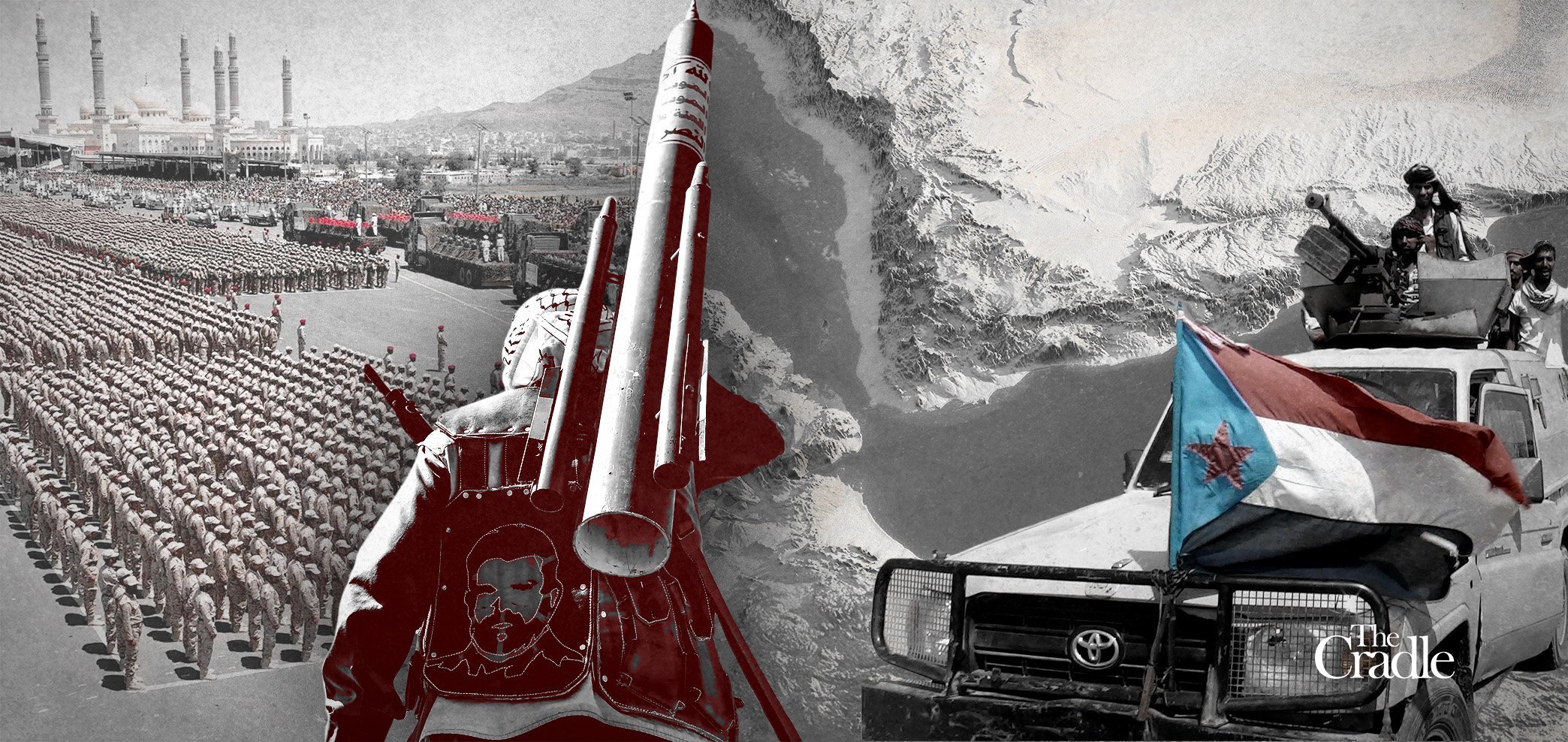
Photo Credit: The Cradle
Since mid-October, Yemen has returned to the forefront of the regional scene. Political and military activity has intensified across several governorates, exposing the limits of the current ceasefire. From Sanaa’s view, the phase of “no war and no peace” cannot continue.
Any attack, it warns, will be met with a direct response. Deterrence, it insists, is now part of its core strategy.
Saudi Arabia, meanwhile, is trying to juggle two tracks – military pressure and renewed dialogue through Omani mediation. Riyadh wants to keep its weight on the ground while testing the possibility of a broader settlement.
The US and Israel have again inserted themselves into the mix, each working to block a negotiated outcome that might strengthen the Sanaa government. Washington has revived coordination channels with the coalition, while Tel Aviv watches the Red Sea front and pushes for the containment of Ansarallah-aligned armed forces. Yemen has once more become an overlapping arena of peace talks, foreign manoeuvring, and military threats.
Negotiations under fire
Oman has returned as the main regional mediator, moving to calm tensions after both Sanaa and Riyadh accused each other of violating the 2024 economic truce – the backbone of the UN “road map.” On 28 October, Muscat announced new diplomatic efforts to prevent a wider clash and reopen a political track.
But the situation on the ground shows little restraint. In Saada governorate alone, monitors recorded 947 violations this year, leaving 153 dead and nearly 900 injured. On 29 October, Saudi artillery shelled border villages in Razeh.
Sanaa affirmed that the “reciprocal equation” remains in place, staging a large military parade near Najran to display readiness. Riyadh, in turn, tested civil-defence sirens in its major cities – a move mocked by Ansarallah figure Hizam al-Assad, who said no siren would protect Saudi cities while the aggression and siege continue.
Speaking to The Cradle, Adel al-Hassani, head of the Peace Forum, points out that the crisis is worsening due to the deterioration of the economic situation and sanctions, which have affected more than 25 million Yemenis, while Oman is intervening as a mediator for the de-escalation.
According to Hasani, the roadmap includes two phases: the first is humanitarian, including the lifting of the blockade, the payment of salaries, and the resumption of oil exports; the second is political – to form a unity or coalition government that would coincide with a declared coalition withdrawal. Only that, he says, could stabilize the situation.
Washington and Tel Aviv’s new strategy
After Operation Al-Aqsa Flood and the ensuing war on Gaza, the US-Israeli approach to Yemen has shifted toward hybrid operations – mobilizing local partners, information warfare, and targeted strikes rather than any open intervention.
Sanaa’s recent warning about hitting Saudi oil sites came after detecting moves to create a US-Israeli front against Ansarallah. Israeli Prime Minister Benjamin Netanyahu called the resistance movement “a very big threat,” and Defense Minister Israel Katz threatened airstrikes on Sanaa itself.
The idea is to keep Saudi Arabia under pressure while allowing Israel to act indirectly. Israeli Finance Minister Bezalel Smotrich said the “Yemeni threat” is unresolved and urged Arab allies to take part in containing it.
Western think tanks have echoed this, urging Washington to rebuild Riyadh’s military role after the failure of the Red Sea naval alliance. The head of Eilat Port, Gideon Golber, admitted that maritime trade has been badly hit, adding that “We need a victory image by restarting the port.” A US Naval Institute report also noted that despite spending over $1 billion on air defense and joint operations, control over the corridor remains weak.
Between November 2023 and September 2025, Yemeni forces carried out more than 750 operations in the Red Sea, Gulf of Aden, and Indian Ocean – part of what Sanaa calls a defensive response. Head of the Supreme Political Council, Mahdi al-Mashat, urged Saudi Arabia to "move from the stage of de-escalation to ending aggression, siege, and occupation and implementing the clear entitlements of peace.”
He further accused Washington of using regional tensions to serve Israel. National Council member Hamid Assem added that an earlier de-escalation deal, signed a year and a half ago in Sanaa, was dropped by Riyadh under US direction after Operation Al-Aqsa Flood.
A source close to Sanaa tells The Cradle:
“The movement's leadership is firmly convinced that the responsibility for these tools cannot be separated from those who created, armed, and trained them since 2015. Therefore, Sanaa affirms that any movement of these tools in Marib, the west coast, or the south of the country will not remain isolated, and will carry with it direct consequences that will affect the parties that supported and supervised the preparation of these groups.”
The source adds that:
“America has long experience with Yemen and may be inclined to avoid direct ground intervention, as its priorities appear to be focused on protecting Israel by striking Ansarallah's missile and naval capability without extensive land friction. Therefore, it has begun to implement a plan that adopts hybrid warfare: intensifying media pumping, distortion, information operations, and psychological warfare, in addition to logistical and coordination preparations to move internal fronts through local pro-coalition tools.”
This hybrid strategy may coincide with Israeli military and media steps, the source points out, through threats and statements by officials in Tel Aviv, so that the desired goal becomes to “blow up the scene from within” and weaken Sanaa through internal chaos that paves the way for pressing options or strikes targeting its arsenal without direct American ground intervention.
US and UAE movements in the south
Throughout October, the US, Saudi Arabia, and the UAE expanded their presence in the south, west coast, and Al-Mahra to reorganize coalition factions and tighten control. US and Emirati officers arrived in Lahj Governorate, supervising the restructuring of Southern Transitional Council (STC) units from Al-Kibsi Camp in Al-Raha to Al-Mallah district. Security around these areas was reinforced with barriers and fortifications.
In Shabwa and Hadhramaut, joint committees of American and Emirati officers inspected Ataq Airport and nearby camps, counting recruits, running medical checks, reviewing weapons stock, and mapping command chains. Sources say Latin American contractors and private military firms assisted, ensuring resources stayed under external supervision.
In Taiz, another committee visited Jabal al-Nar to evaluate the Giants Brigades, their numbers, and armaments. On the west coast – from Bab al-Mandab to Zuqar Island – construction work is ongoing: terraces, fortifications, and outposts operated by “joint forces” hostile to Sanaa, including Tariq Saleh’s formations. Coordination reportedly extended to naval meetings aboard the Italian destroyer ‘ITS Caio Duilio’ to secure sea routes and “protect Israeli interests” in the Red Sea.
Hasani, who follows these movements, informs The Cradle that “These committees are evaluation and supervisory, not training, and are directly supervised by the US to ensure the readiness of the forces and perhaps as a signal to pressure Sanaa.”
He adds that British teams have appeared in Al-Mahra, while groups trained on Socotra Island are being redeployed to Sudan and Libya under UAE management.
Saudi-aligned Salafi units known as “Homeland Shield” now operate from Al-Mahra to Abyan and Hadhramaut. “These forces are today a pillar of the coalition to reduce the ability of Ansarallah, taking advantage of its religious beliefs, as part of the coalition's tendency to turn the conflict into a sectarian war,” Hasani explains.
In Al-Mahra, local discontent is growing. Ali Mubarak Mohamed, spokesman for the Peaceful Sit-in Committee, tells The Cradle that Al-Ghaydah Airport remains closed after being converted into a joint US-British base.
“The committee continues to escalate peacefully through field trips and meetings with sheikhs to raise awareness of the community about the danger of militias,” he says, noting that the US presence has been ongoing since the coalition was established, though the exact nature of its presence is unknown.
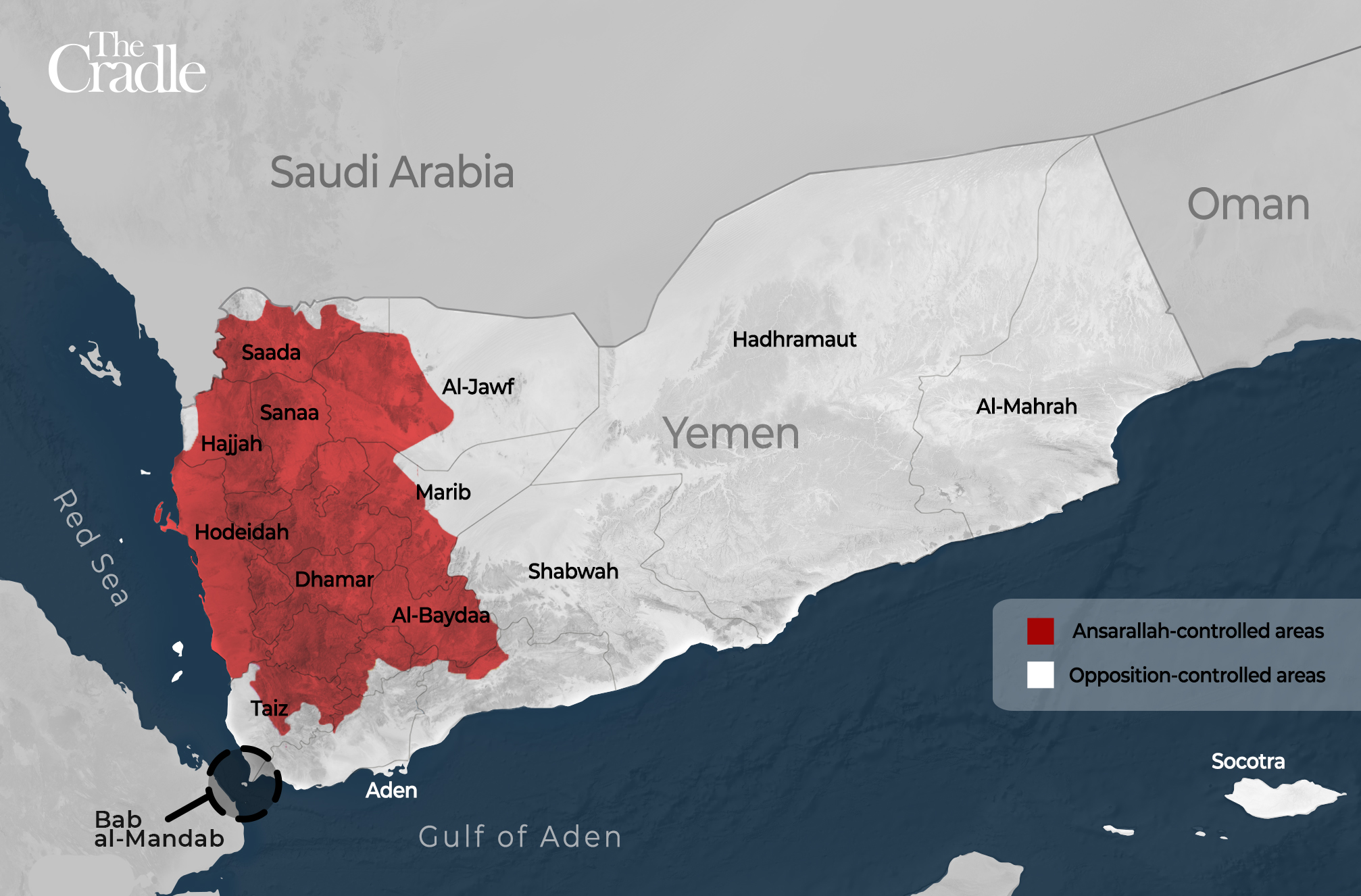
A map showing the distribution of control in Yemen.
Where is Yemen heading?
These field movements are taking place as Washington and Abu Dhabi coordinate more closely with Tel Aviv. After meetings in October between the US CENTCOM commander and the Israeli chief of staff, a new plan began to take shape: build a joint ground network across southern Yemen to contain Sanaa and safeguard the Bab al-Mandab Strait – one of the world’s most critical shipping lanes.
At the same time, the US State Department appointed its ambassador to Aden’s Saudi-backed government, Steven Fagin, to lead a “Civil-Military Coordination Center” (CMCC) linked to ceasefire efforts in Gaza. Regional observers see this as a move to integrate the Palestinian and Yemeni fronts into one framework of US security control stretching from the Mediterranean to the Arabian Sea.
Reports circulating in Shabwa and Al-Rayyan say Emirati officers have been dispatched to Gaza to help organize local brigades – a claim still unconfirmed but consistent with the UAE’s wider operational pattern. Investigations by Sky News Arabia noted similarities in the slogans and structure of UAE-backed militias in Yemen and armed factions in Gaza, hinting at shared logistics and training links.
Adnan Bawazir, head of the Southern National Salvation Council in Hadhramaut, tells The Cradle that the scenario of recruiting mercenaries to fight in Gaza is not proven, but is possible – especially with the assignment of the interim administration in Gaza by Fagin, linking local moves to broader regional plans.
In Hadhramaut, Fagin's visits to Seiyun, which includes the First Military Region, indicate preparations for a possible confrontation, especially since the area is still under the Saudi-backed Islah's control in the face of the STC conflict, while Riyadh seeks to reduce Islah's influence by transferring brigades and changing leadership.
Bawazir also points to suspicious movements in Shabwa and at Ataq airport, where field reports indicate flights transporting weapons to strengthen the front, given the governorate's proximity to Marib and the contact fronts with Ansarallah, which makes it a hinge point for any regional or local escalation.
The moves are therefore part of three interrelated scenarios.
First, shifting pressure from Gaza to Yemen to compensate for the political and moral losses of Tel Aviv and Washington, while using the pro-coalition factions as a pressure arena against Sanaa. Second, preparing for possible military action in the event of the failure of the negotiations. Third, reorganizing the pro-coalition factions and building a central command that can be directed by Washington, thus turning the brigades into executive tools, ready to escalate the situation internally with a sectarian character.
Each scenario positions Yemen once again as a test field for foreign ambitions. The country remains divided between two trajectories: the possibility of a political settlement through Oman’s diplomacy, and the risk of a new conflict fed by regional competition and foreign control over its coasts and resources.
Whether the coming months bring a deal or another war will depend less on what Yemenis want and more on how their neighbors choose to use their soil.
https://thecradle.co/articles/yemen-bet ... escalation
Yemen 'inevitably' headed toward new round against Israel: Houthi
Israeli media has hinted that Tel Aviv may 'separate' Yemen from Gaza and continue attacks on the country
News Desk
NOV 4, 2025
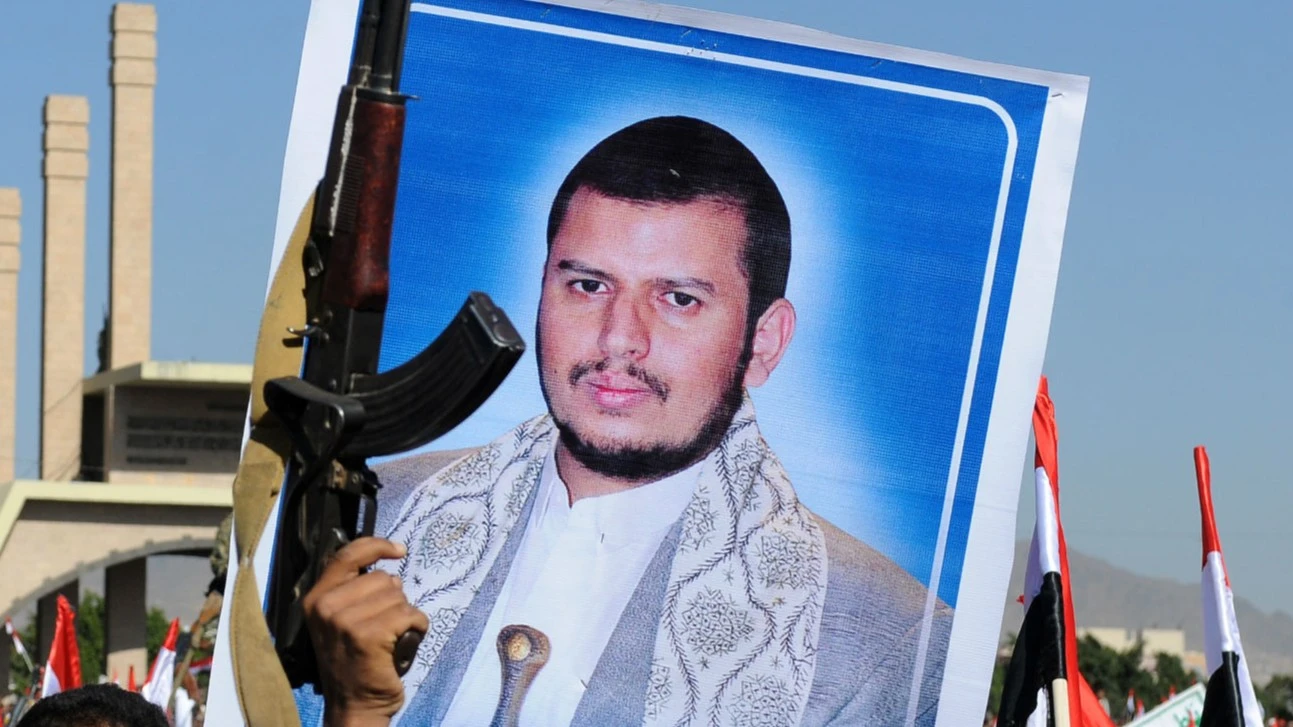
(Photo credit: Getty Images)
Leader of the Ansarallah resistance movement Abdul Malik al-Houthi said in a speech on 4 November that Yemen has “emerged stronger” after two years of war with Israel, warning that a “new” and “full-scale” confrontation will “inevitably” erupt at some point.
“We emerged from this round stronger than before on all levels and we are inevitably heading into a new round of confrontation with the enemy,” Houthi said.
“We are inevitably heading toward a full-scale confrontation with the enemy, because stability will not remain in the region so long as the occupation continues in Palestine,” the Yemeni leader added.
Houthi went on to say that “this enemy is dangerous, evil, and criminal.”
The resistance leader rejected Israeli-backed efforts to disarm Hezbollah in Lebanon, and condemned Tel Aviv’s violations of the new ceasefire in Gaza.
He added that the US is a “partner” to all of Israel’s crimes. “Unfortunately, the [Arab] nation has chosen a position of helplessness.”
The Yemeni Armed Forces (YAF), which is merged with Ansarallah, was among the first to open a front against Israel at the start of the genocide in Gaza following Operation Al-Aqsa Flood in October 2023.
The YAF and Ansarallah carried out scores of successful missile and drone strikes against Israeli targets, and opened up a naval front that decimated global shipping and Israeli maritime interests over the past two years.
Yemen also faced a deadly US military campaign, which began under former US president Joe Biden and was renewed under President Donald Trump. This, along with scores of brutal Israeli airstrikes on the country, failed to impact Sanaa’s military capabilities.
The Yemeni operations have come to a halt following the Gaza ceasefire. However, Yemeni President Mahdi al-Mashat vowed that the country will remain “vigilant.”
Sanaa has also vowed to continue enhancing its military capabilities.
Tel Aviv is reportedly considering renewing attacks on Yemen despite Sanaa’s forces halting strikes on Israel after the Gaza ceasefire.
Hebrew news outlet Channel 12 reported last month that “intense discussions within the security establishment recently led to separating the Yemen front from that of Gaza, allowing military action against Yemen to continue post-ceasefire.”
https://thecradle.co/articles/yemen-ine ... ael-houthi
The uneasy truce in Yemen is fraying. Oman pushes to revive talks, Saudi forces stay active on the ground, and Washington and Tel Aviv look to reopen old fronts under new slogans.
Mawadda Iskandar
NOV 4, 2025
Photo Credit: The Cradle
Since mid-October, Yemen has returned to the forefront of the regional scene. Political and military activity has intensified across several governorates, exposing the limits of the current ceasefire. From Sanaa’s view, the phase of “no war and no peace” cannot continue.
Any attack, it warns, will be met with a direct response. Deterrence, it insists, is now part of its core strategy.
Saudi Arabia, meanwhile, is trying to juggle two tracks – military pressure and renewed dialogue through Omani mediation. Riyadh wants to keep its weight on the ground while testing the possibility of a broader settlement.
The US and Israel have again inserted themselves into the mix, each working to block a negotiated outcome that might strengthen the Sanaa government. Washington has revived coordination channels with the coalition, while Tel Aviv watches the Red Sea front and pushes for the containment of Ansarallah-aligned armed forces. Yemen has once more become an overlapping arena of peace talks, foreign manoeuvring, and military threats.
Negotiations under fire
Oman has returned as the main regional mediator, moving to calm tensions after both Sanaa and Riyadh accused each other of violating the 2024 economic truce – the backbone of the UN “road map.” On 28 October, Muscat announced new diplomatic efforts to prevent a wider clash and reopen a political track.
But the situation on the ground shows little restraint. In Saada governorate alone, monitors recorded 947 violations this year, leaving 153 dead and nearly 900 injured. On 29 October, Saudi artillery shelled border villages in Razeh.
Sanaa affirmed that the “reciprocal equation” remains in place, staging a large military parade near Najran to display readiness. Riyadh, in turn, tested civil-defence sirens in its major cities – a move mocked by Ansarallah figure Hizam al-Assad, who said no siren would protect Saudi cities while the aggression and siege continue.
Speaking to The Cradle, Adel al-Hassani, head of the Peace Forum, points out that the crisis is worsening due to the deterioration of the economic situation and sanctions, which have affected more than 25 million Yemenis, while Oman is intervening as a mediator for the de-escalation.
According to Hasani, the roadmap includes two phases: the first is humanitarian, including the lifting of the blockade, the payment of salaries, and the resumption of oil exports; the second is political – to form a unity or coalition government that would coincide with a declared coalition withdrawal. Only that, he says, could stabilize the situation.
Washington and Tel Aviv’s new strategy
After Operation Al-Aqsa Flood and the ensuing war on Gaza, the US-Israeli approach to Yemen has shifted toward hybrid operations – mobilizing local partners, information warfare, and targeted strikes rather than any open intervention.
Sanaa’s recent warning about hitting Saudi oil sites came after detecting moves to create a US-Israeli front against Ansarallah. Israeli Prime Minister Benjamin Netanyahu called the resistance movement “a very big threat,” and Defense Minister Israel Katz threatened airstrikes on Sanaa itself.
The idea is to keep Saudi Arabia under pressure while allowing Israel to act indirectly. Israeli Finance Minister Bezalel Smotrich said the “Yemeni threat” is unresolved and urged Arab allies to take part in containing it.
Western think tanks have echoed this, urging Washington to rebuild Riyadh’s military role after the failure of the Red Sea naval alliance. The head of Eilat Port, Gideon Golber, admitted that maritime trade has been badly hit, adding that “We need a victory image by restarting the port.” A US Naval Institute report also noted that despite spending over $1 billion on air defense and joint operations, control over the corridor remains weak.
Between November 2023 and September 2025, Yemeni forces carried out more than 750 operations in the Red Sea, Gulf of Aden, and Indian Ocean – part of what Sanaa calls a defensive response. Head of the Supreme Political Council, Mahdi al-Mashat, urged Saudi Arabia to "move from the stage of de-escalation to ending aggression, siege, and occupation and implementing the clear entitlements of peace.”
He further accused Washington of using regional tensions to serve Israel. National Council member Hamid Assem added that an earlier de-escalation deal, signed a year and a half ago in Sanaa, was dropped by Riyadh under US direction after Operation Al-Aqsa Flood.
A source close to Sanaa tells The Cradle:
“The movement's leadership is firmly convinced that the responsibility for these tools cannot be separated from those who created, armed, and trained them since 2015. Therefore, Sanaa affirms that any movement of these tools in Marib, the west coast, or the south of the country will not remain isolated, and will carry with it direct consequences that will affect the parties that supported and supervised the preparation of these groups.”
The source adds that:
“America has long experience with Yemen and may be inclined to avoid direct ground intervention, as its priorities appear to be focused on protecting Israel by striking Ansarallah's missile and naval capability without extensive land friction. Therefore, it has begun to implement a plan that adopts hybrid warfare: intensifying media pumping, distortion, information operations, and psychological warfare, in addition to logistical and coordination preparations to move internal fronts through local pro-coalition tools.”
This hybrid strategy may coincide with Israeli military and media steps, the source points out, through threats and statements by officials in Tel Aviv, so that the desired goal becomes to “blow up the scene from within” and weaken Sanaa through internal chaos that paves the way for pressing options or strikes targeting its arsenal without direct American ground intervention.
US and UAE movements in the south
Throughout October, the US, Saudi Arabia, and the UAE expanded their presence in the south, west coast, and Al-Mahra to reorganize coalition factions and tighten control. US and Emirati officers arrived in Lahj Governorate, supervising the restructuring of Southern Transitional Council (STC) units from Al-Kibsi Camp in Al-Raha to Al-Mallah district. Security around these areas was reinforced with barriers and fortifications.
In Shabwa and Hadhramaut, joint committees of American and Emirati officers inspected Ataq Airport and nearby camps, counting recruits, running medical checks, reviewing weapons stock, and mapping command chains. Sources say Latin American contractors and private military firms assisted, ensuring resources stayed under external supervision.
In Taiz, another committee visited Jabal al-Nar to evaluate the Giants Brigades, their numbers, and armaments. On the west coast – from Bab al-Mandab to Zuqar Island – construction work is ongoing: terraces, fortifications, and outposts operated by “joint forces” hostile to Sanaa, including Tariq Saleh’s formations. Coordination reportedly extended to naval meetings aboard the Italian destroyer ‘ITS Caio Duilio’ to secure sea routes and “protect Israeli interests” in the Red Sea.
Hasani, who follows these movements, informs The Cradle that “These committees are evaluation and supervisory, not training, and are directly supervised by the US to ensure the readiness of the forces and perhaps as a signal to pressure Sanaa.”
He adds that British teams have appeared in Al-Mahra, while groups trained on Socotra Island are being redeployed to Sudan and Libya under UAE management.
Saudi-aligned Salafi units known as “Homeland Shield” now operate from Al-Mahra to Abyan and Hadhramaut. “These forces are today a pillar of the coalition to reduce the ability of Ansarallah, taking advantage of its religious beliefs, as part of the coalition's tendency to turn the conflict into a sectarian war,” Hasani explains.
In Al-Mahra, local discontent is growing. Ali Mubarak Mohamed, spokesman for the Peaceful Sit-in Committee, tells The Cradle that Al-Ghaydah Airport remains closed after being converted into a joint US-British base.
“The committee continues to escalate peacefully through field trips and meetings with sheikhs to raise awareness of the community about the danger of militias,” he says, noting that the US presence has been ongoing since the coalition was established, though the exact nature of its presence is unknown.
A map showing the distribution of control in Yemen.
Where is Yemen heading?
These field movements are taking place as Washington and Abu Dhabi coordinate more closely with Tel Aviv. After meetings in October between the US CENTCOM commander and the Israeli chief of staff, a new plan began to take shape: build a joint ground network across southern Yemen to contain Sanaa and safeguard the Bab al-Mandab Strait – one of the world’s most critical shipping lanes.
At the same time, the US State Department appointed its ambassador to Aden’s Saudi-backed government, Steven Fagin, to lead a “Civil-Military Coordination Center” (CMCC) linked to ceasefire efforts in Gaza. Regional observers see this as a move to integrate the Palestinian and Yemeni fronts into one framework of US security control stretching from the Mediterranean to the Arabian Sea.
Reports circulating in Shabwa and Al-Rayyan say Emirati officers have been dispatched to Gaza to help organize local brigades – a claim still unconfirmed but consistent with the UAE’s wider operational pattern. Investigations by Sky News Arabia noted similarities in the slogans and structure of UAE-backed militias in Yemen and armed factions in Gaza, hinting at shared logistics and training links.
Adnan Bawazir, head of the Southern National Salvation Council in Hadhramaut, tells The Cradle that the scenario of recruiting mercenaries to fight in Gaza is not proven, but is possible – especially with the assignment of the interim administration in Gaza by Fagin, linking local moves to broader regional plans.
In Hadhramaut, Fagin's visits to Seiyun, which includes the First Military Region, indicate preparations for a possible confrontation, especially since the area is still under the Saudi-backed Islah's control in the face of the STC conflict, while Riyadh seeks to reduce Islah's influence by transferring brigades and changing leadership.
Bawazir also points to suspicious movements in Shabwa and at Ataq airport, where field reports indicate flights transporting weapons to strengthen the front, given the governorate's proximity to Marib and the contact fronts with Ansarallah, which makes it a hinge point for any regional or local escalation.
The moves are therefore part of three interrelated scenarios.
First, shifting pressure from Gaza to Yemen to compensate for the political and moral losses of Tel Aviv and Washington, while using the pro-coalition factions as a pressure arena against Sanaa. Second, preparing for possible military action in the event of the failure of the negotiations. Third, reorganizing the pro-coalition factions and building a central command that can be directed by Washington, thus turning the brigades into executive tools, ready to escalate the situation internally with a sectarian character.
Each scenario positions Yemen once again as a test field for foreign ambitions. The country remains divided between two trajectories: the possibility of a political settlement through Oman’s diplomacy, and the risk of a new conflict fed by regional competition and foreign control over its coasts and resources.
Whether the coming months bring a deal or another war will depend less on what Yemenis want and more on how their neighbors choose to use their soil.
https://thecradle.co/articles/yemen-bet ... escalation
Yemen 'inevitably' headed toward new round against Israel: Houthi
Israeli media has hinted that Tel Aviv may 'separate' Yemen from Gaza and continue attacks on the country
News Desk
NOV 4, 2025
(Photo credit: Getty Images)
Leader of the Ansarallah resistance movement Abdul Malik al-Houthi said in a speech on 4 November that Yemen has “emerged stronger” after two years of war with Israel, warning that a “new” and “full-scale” confrontation will “inevitably” erupt at some point.
“We emerged from this round stronger than before on all levels and we are inevitably heading into a new round of confrontation with the enemy,” Houthi said.
“We are inevitably heading toward a full-scale confrontation with the enemy, because stability will not remain in the region so long as the occupation continues in Palestine,” the Yemeni leader added.
Houthi went on to say that “this enemy is dangerous, evil, and criminal.”
The resistance leader rejected Israeli-backed efforts to disarm Hezbollah in Lebanon, and condemned Tel Aviv’s violations of the new ceasefire in Gaza.
He added that the US is a “partner” to all of Israel’s crimes. “Unfortunately, the [Arab] nation has chosen a position of helplessness.”
The Yemeni Armed Forces (YAF), which is merged with Ansarallah, was among the first to open a front against Israel at the start of the genocide in Gaza following Operation Al-Aqsa Flood in October 2023.
The YAF and Ansarallah carried out scores of successful missile and drone strikes against Israeli targets, and opened up a naval front that decimated global shipping and Israeli maritime interests over the past two years.
Yemen also faced a deadly US military campaign, which began under former US president Joe Biden and was renewed under President Donald Trump. This, along with scores of brutal Israeli airstrikes on the country, failed to impact Sanaa’s military capabilities.
The Yemeni operations have come to a halt following the Gaza ceasefire. However, Yemeni President Mahdi al-Mashat vowed that the country will remain “vigilant.”
Sanaa has also vowed to continue enhancing its military capabilities.
Tel Aviv is reportedly considering renewing attacks on Yemen despite Sanaa’s forces halting strikes on Israel after the Gaza ceasefire.
Hebrew news outlet Channel 12 reported last month that “intense discussions within the security establishment recently led to separating the Yemen front from that of Gaza, allowing military action against Yemen to continue post-ceasefire.”
https://thecradle.co/articles/yemen-ine ... ael-houthi
"There is great chaos under heaven; the situation is excellent."
Re: Yemen
Yemeni Interior Ministry Dismantles US-Israeli-Saudi Spy Network
November 10, 2025
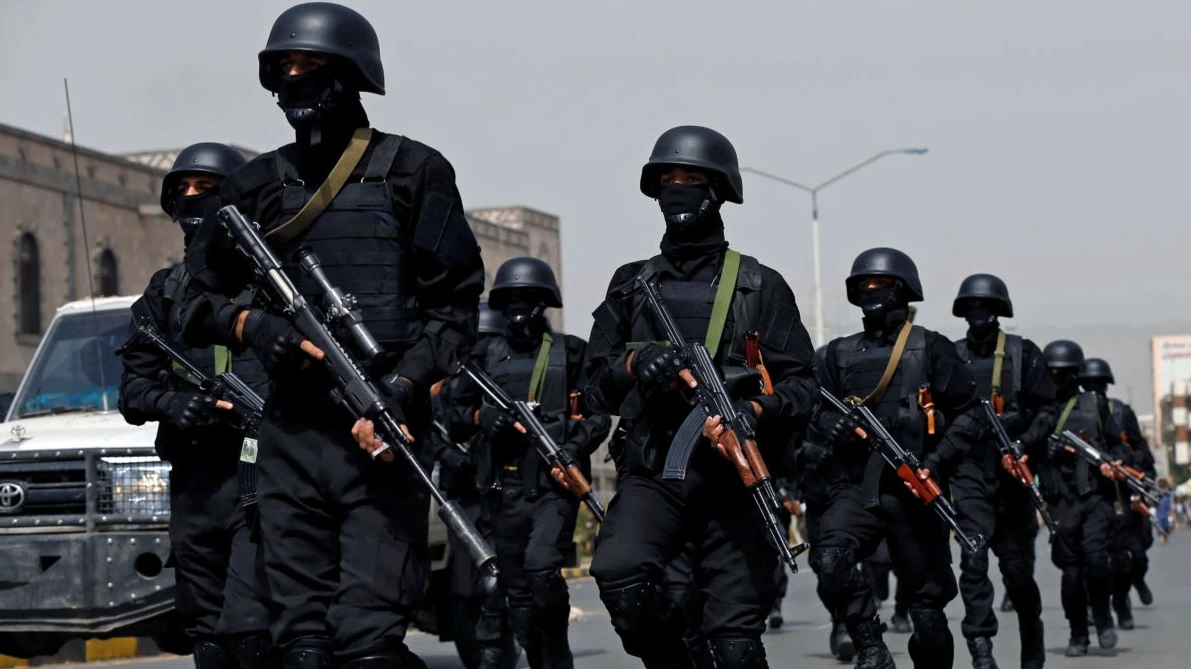
Sanaa’s internal operations come amid reports that Israel and its Gulf partners are preparing to reignite attacks on Yemen
he Yemeni Interior Ministry announced on 8 November that its security forces dismantled a spy network tied to US, Israeli, and Saudi intelligence agencies following a “special security operation.”
A ministry spokesman said the operation, codenamed “Their schemes will fail,” led to the arrest of members of a network linked to a joint operations room shared by the CIA, Mossad, and Saudi intelligence service headquartered inside the Gulf monarchy.
The ministry said the achievement came after “intelligence, surveillance, and monitoring operations” that exposed “the enemy’s plans and the methods of the traitorous operatives.”
Officials added that the joint operations room directed sabotage and espionage activities targeting Yemen by establishing multiple small, independent cells all connected to a central command based in Saudi Arabia.
According to the statement, the operations room provided these cells with advanced surveillance and espionage equipment and trained their operatives in intelligence gathering, report writing, and concealment methods.
The cells reportedly monitored Yemen’s infrastructure, attempted to locate military and security facilities, and gathered information on weapons production, missile and drone launch sites, and the movements of key civilian, military, and security leaders.
Sanaa said some of the arrested operatives provided coordinates and data to the “enemy” that were later used to target public-service facilities, leading to civilian casualties and damaging Yemen’s economy and infrastructure.
The statement added that the network’s activities intensified alongside the ongoing aggression against Yemen and sought to “undermine military operations and public and official positions supporting Gaza and the Palestinian cause.”
Last month, officials in Sanaa confirmed to Reuters that dozens of UN staffers will face trial over their suspected links to an Israeli attack in August in Sanaa that killed Prime Minister Ahmad Ghalib al-Rahwi and several government ministers.
Ansarallah leader Abdul Malik al-Houthi, in a speech this week, said Yemen has grown stronger after two years of war with Israel and warned of an inevitable new confrontation, vowing continued resistance as Tel Aviv considers a restart to the war.
https://orinocotribune.com/yemeni-inter ... y-network/
November 10, 2025
Sanaa’s internal operations come amid reports that Israel and its Gulf partners are preparing to reignite attacks on Yemen
he Yemeni Interior Ministry announced on 8 November that its security forces dismantled a spy network tied to US, Israeli, and Saudi intelligence agencies following a “special security operation.”
A ministry spokesman said the operation, codenamed “Their schemes will fail,” led to the arrest of members of a network linked to a joint operations room shared by the CIA, Mossad, and Saudi intelligence service headquartered inside the Gulf monarchy.
The ministry said the achievement came after “intelligence, surveillance, and monitoring operations” that exposed “the enemy’s plans and the methods of the traitorous operatives.”
Officials added that the joint operations room directed sabotage and espionage activities targeting Yemen by establishing multiple small, independent cells all connected to a central command based in Saudi Arabia.
According to the statement, the operations room provided these cells with advanced surveillance and espionage equipment and trained their operatives in intelligence gathering, report writing, and concealment methods.
The cells reportedly monitored Yemen’s infrastructure, attempted to locate military and security facilities, and gathered information on weapons production, missile and drone launch sites, and the movements of key civilian, military, and security leaders.
Sanaa said some of the arrested operatives provided coordinates and data to the “enemy” that were later used to target public-service facilities, leading to civilian casualties and damaging Yemen’s economy and infrastructure.
The statement added that the network’s activities intensified alongside the ongoing aggression against Yemen and sought to “undermine military operations and public and official positions supporting Gaza and the Palestinian cause.”
Last month, officials in Sanaa confirmed to Reuters that dozens of UN staffers will face trial over their suspected links to an Israeli attack in August in Sanaa that killed Prime Minister Ahmad Ghalib al-Rahwi and several government ministers.
Ansarallah leader Abdul Malik al-Houthi, in a speech this week, said Yemen has grown stronger after two years of war with Israel and warned of an inevitable new confrontation, vowing continued resistance as Tel Aviv considers a restart to the war.
https://orinocotribune.com/yemeni-inter ... y-network/
"There is great chaos under heaven; the situation is excellent."
Re: Yemen
Understanding the heroism of Yemen, pt2
From youth clubs to national government: the rise of Ansar Allah as the leader of Yemen’s anti-imperialist forces.
Lalkar writers
Saturday 1 November 2025
The anti-imperialist and national-liberation essence of the so-called ‘Houthi movement’ is deliberately hidden from western audiences. But as the national government of Yemen in Sanaa has shown itself to be one of the most indomitable pillars of the middle-eastern Axis of Resistance during the Gaza genocide, workers all over the world are increasingly interested in finding out more about who and what the Ansar Allah movement really represents.
Read part 1 of this series. https://thecommunists.org/2025/09/01/ne ... yemen-pt1/
Following the collapse of the Soviet Union and the resulting loss of foreign support, the People’s Democratic Republic of Yemen in the south, already deeply weakened following a violent civil conflict in 1986, voted for reunification with the Yemeni Arab Republic in the north. This took place in 1990, creating a united Yemen (officially the Republic of Yemen) for the first time in more than 150 years, with the northern Yemeni leader Ali Abdullah Saleh becoming united Yemen’s first president and southern Yemeni leader Ali Salem al-Beidh the vice-president.
As part of the reunification, rules on opposition political parties were eased and the first multiparty elections were scheduled to take place in 1993. As part of the move to combat the spread of wahhabism, the Zaydis formed the al-Haq party, primarily to oppose the powerful pro-Saudi al-Islah party that had been established at around the same time with President Saleh’s blessing.
In 1994, the south under al-Beidh’s leadership attempted to re-secede, citing discrimination and broken promises by Saleh. Saleh immediately mobilised support from influential salafi-wahhabi tribes, who duly announced a ‘jihad’ in defence of Saleh’s rule.
The southern uprising was brutally crushed, leading to longlasting resentment amongst the population that would later be weaponised by imperialism. In contrast to the trigger-happiness of the salafi-wahhabis, the Zaydis of al-Haq, whilst not supporting secessionism, opposed shedding the blood of fellow Yemenis and argued for a peaceful resolution of the matter, angering the Saleh regime.
Lacking any powerful sponsors or foreign donors, al-Haq’s electoral performance was consistently poor, winning at its height in 1993 only two MPs and 0.8 percent of the vote – as opposed to 123 MPs for Saleh’s General People’s Congress (GPC) and 62 MPs for al-Islah. In addition, the party was dominated by cautious elders who generally limited themselves to promoting Zaydi interests and pushing back against salafi-wahhabi encroachment.
A younger and more radical faction of the party argued for a shift in focus, towards calling out the total subservience of the Saleh regime to US imperialism and opposing the USA and Israel as the ultimate sponsors of the salafi-wahhabi threat and the real enemies of the Yemeni people. This faction came to be embodied and led by Sayyid Hussain Badreddine al-Houthi, one of al-Haq’s two MPs and the son of a highly-respected Zaydi elder.
During his time in parliament and beyond, al-Houthi became well-known for his vehement denunciations of US influence over the country, much to the embarrassment of the Saleh regime. Contrary to his contemporaries, who won election campaigns through bribery and patronage, al-Houthi campaigned with the slogan: “I won’t promise you anything, but I promise I will not represent you dishonestly”.
He had a reputation for repeatedly voting against foreign loans that the government wanted to take out, astutely pointing out that whilst the money received would only enrich those favoured by the regime, the crushing service payments would fall squarely on the backs of ordinary folk.
Following the loss of his seat in 1997, al-Houthi abandoned the parliamentary route and began laying the foundations for a mass grassroots organisation in the Zaydi heartlands. He had already helped to establish a youth organisation called Shabab-ul-Mo’mineen (The Believing Youth), which organised popular school clubs and summer camps promoting Zaydi culture.
Under al-Houthi’s guidance, these clubs began to take an increasingly anti-imperialist direction. Al-Houthi helped to establish clinics and hospitals and worked hard to improve electricity infrastructure in neglected rural areas, conscious that people fleeing to the cities to escape poverty were at a high risk of becoming torn from their roots and thus easy prey for pro-western ideologies.
After the 9/11 attacks, President Saleh quickly became one of the most enthusiastic allies of Bush’s phoney ‘War on Terror’. From 2001-04, al-Houthi gave a series of lectures in which he railed against the US presence in Yemen and warned of US-controlled NGO attempts to colonise the country’s education system.
He correctly linked the various conflicts and troubles in the region back to their source: US imperialism and zionist Israel. His lectures chimed deeply with the masses and he became a constant source of worry to the Saleh regime.
Al-Houthi’s rhetoric and worldview was fundamentally based in a return to the values of Zaydi Islam, and a consistent feature of his lectures was his call for muslims to uphold the Qur’an, particularly paying attention to verses calling for muslims to be vigilant against jewish and christian plots, which he linked to the modern-day actions of the USA and Israel. As such, he would very often frame his discussion in terms of “muslims” versus an alliance of “jews” and “christians”.
This is where it is crucially important to judge a movement’s revolutionary potential by objective, not arbitrary, criteria – ie, it’s not about what sounds nice to us or what hurts our feelings, but rather which movement is objectively weakening imperialism and which is objectively helping it.
Apologists for zionism and imperialism will often spread the idea that any individual or movement which paints jews in a negative light is ‘like the Nazis’, as if the sole defining trait of nazism was dislike of jews. Even amongst socialists, particularly in western countries, there is often a tendency to treat anti-jewish prejudice as the ultimate evil, a uniquely evil form of racism worse than all others, because of the atrocities committed by the German Nazis in the 1940s.
Fundamentally this is a reactionary and Eurocentric argument that implies a static, unchanging view of history. Of course, it barely needs saying that for workers to blame all the world’s wrongs on ‘the jews’ is obviously a wrong and silly idea, which is as wrong and silly today as it was 100 years ago. However (and here comes the big ‘but’), 100 years ago, the objective situation internationally was that the main reactionary racist ideology being promoted amongst workers and serving the interests of imperialism was antisemitism. Today, however, the equally racist ideology of zionism serves this divide-and-rule purpose, while antisemitism has taken a back seat.
One hundred years ago, the racist ideology of antisemitism was used to justify genocide, but today it is the racist ideology of zionism that is being used to justify genocide. And in that sense, in today’s context, the racist ideology of zionism is a much greater threat than antisemitism. Therefore, to obstruct the fight against zionism by scaremongering about the supposed danger of ‘slipping into antisemitism’ – as if that is somehow worse than being an apologist for zionist butchery – is objectively a reactionary, pro-imperialist position.
Certainly, to try and attack an organisation like Ansar Allah that plays a leading role in combating zionism, on the basis of concern-trolling about antisemitism – particularly in a country like Yemen that has virtually no jewish population anyway – is an argument that should be dismissed out of hand, regardless of certain people’s ‘feelings’.
One hundred years ago, imperialism was promoting antisemitic ideology everywhere because that suited its agenda. Those promoting antisemitic arguments were the most banal dupes and tools of imperialism. This is not the case today.
Today, imperialism aggressively scaremongers about the danger of antisemitism, not because the system really cares about jewish people’s security but because it needs to justify the existence of the zionist settler-colony, which it needs to keep in place in order to continue to destabilise and dominate west Asia, the region with by far the largest oil reserves on the planet, and geographically crucial for transnational trade and shipping.
If any group today can be compared to the antisemites of 100 years ago, it is the anti-Islam crusaders, as fearmongering about muslim immigration is now the primary racist discourse of the bourgeoisie.
Of course, those few who do still promote antisemitic theories about the world are not suddenly right; their ideas are still wrong and misguided, but they cannot be equated to the antisemites of 100 years ago. In the changed context of today, irrespective of their ideas being wrong or right, it has to be admitted that they have broken out of the propaganda straitjacket of imperialism, and have adopted a position directly challenging the one promoted by imperialism.
That shows they have developed the ability to think for themselves. That means despite their current wrong and misguided ideas they have the potential to become revolutionary if provided with the guidance that only a scientific understanding of imperialism can bring.
Certainly you can contrast this with the countless ‘progressive’ identity politics-obsessed, Pride flag Ukraine flag-waving ‘socialists’ who, despite their loud claims to represent and support all things ‘progressive’, have never allowed a thought that was not sanctioned by imperialism to enter their brains.
Perhaps Sayyid Hussain al-Houthi’s most well-known innovation appeared during his January 2002 lecture entitled As-Sarkhatu fi Wajhil-Mustakbireen (The Shout in the Face of the Arrogant), where he coined his famous sarkha (slogan): “God is greater! Death to America! Death to Israel! Curse be on the jews! Victory to Islam!”
These slogans quickly became the rallying cry of the movement and are emblazoned on its official flag to this day, much to the disgust of ‘respectable’ bourgeois commentators who decry the apparent antisemitism on display.
The fact of the matter is that it is not the apparent meaning of the slogan that is important, but the deeper context and reality that it represents. On the one hand, it is perfectly possible for photogenic young European students to chant slogans of “freedom”, “democracy” and even “socialism”, and yet be mere footsoldiers of the most reactionary elements of international finance capital. We saw this during the so-called ‘Velvet revolutions’ (counter-revolutions) of 1989, when all the fine slogans about workers’ rights and ‘socialism with a human face’ merely masked a pro-US, imperialist-controlled movement bankrolled by the likes of George Soros and assorted billionaires.
On the other hand, whilst al-Houthi’s sarkha may sound offensive to European sensibilities, in the context of Yemen’s very conservative islamic society it undoubtedly contained the nucleus of a blossoming anti-imperialist consciousness, since it identifies Yemen’s main enemies as the USA, Israel and zionism, and calls for a victory to the islamic world (ie, the entire middle east) against these foes.
As always, pro-imperialist commentators will always try to focus on the surface dressing, whilst it is the job of serious revolutionaries to dig beyond that and understand the substance beneath.
As it turns out, US imperialism understood this very well, and US officials in Yemen were deeply disturbed by the rapid spread of the sarkha and of al-Houthi’s soaring popularity amongst the masses. They put pressure on the Saleh regime to crack down on the movement, and hundreds of people were arrested and imprisoned on various trumped-up charges, merely for chanting the sarkha at prayers and other public occasions.
However, al-Houthi refused to back down, pointing out that he had no interest in challenging President Saleh’s rule and that he was only challenging what he saw as the US-Israeli infiltration of Yemen’s institutions.
In June 2004, President Saleh travelled to the US state of Georgia to attend the G8 summit, where he held back-door discussions with US officials. Following his return to Yemen, he immediately launched a large-scale military action with covert US support against al-Houthi’s stronghold in the rural northern regions, bombarding civilian areas with air strikes and killing and maiming hundreds of people.
Al-Houthi and his followers fought back fiercely, but ultimately he was killed by the army in a firefight in August 2004. The army seized his body and refused to return it to his family for almost a decade.
If President Saleh had been hoping that the budding national-liberation movement in the north would die out with the killing of its founding leader, this hope did not last long. Under the leadership of Sayyid Hussain al-Houthi’s father, Sayyid Badreddine al-Houthi, the movement developed quickly into a disciplined paramilitary force and began an insurgency that led to a total of six wars between 2004-10.
The Saudi monarchy, which 40 years earlier had supported Zaydi fighters (owing to their being a reactionary force at that time), once again intervened on behalf of imperialism and began bombing the liberation fighters on behalf of the Saleh regime, whilst the USA and Britain provided logistical support and the international media turned a blind eye to the brutal, scorched-earth campaign.
However, the rebels, who now began to adopt the name Ansar Allah, remained steadfast and secured the support of the masses, allowing them to weather all the attacks.
The inhabitants of the remote northern regions of Yemen are well-known for their rugged hardiness and warrior spirit, and their men are rarely seen outside without a dagger – known as a jambiya – tucked into their waistband. It was in this period that Sayyid Hussain al-Houthi’s younger brother, Sayyid Abdul-Malik, came into prominence and began to take a leadership role, particularly after Sayyid Badreddine’s death in 2010.
The situation in the north remained at a stalemate until 2011, when the so-called ‘Arab spring’ wave of uprisings hit Yemen – one of the few countries where a really popular revolutionary movement took hold of the masses. Following months of relentless huge anti-government demonstrations, Saleh’s powerful tribal backers began defecting to the opposition one after the other, culminating in an assassination attempt on the president that reportedly left him critically injured.
Not long after this incident, Saleh finally agreed to resign and hand over the country to his vice-president, Abdrabbuh Mansur Hadi, bringing an end to his 33-year reign.
Ansar Allah played little direct role in the 2011 revolution, in which the opposition was dominated by pro-western liberals and the Saudi-aligned salafist-leaning al-Islah party. However, it used the power vacuum created during the turmoil to its full advantage by seizing control of large parts of the north, including the key city of Saada.
The movement continued to recruit and organise, pointing out that the regime had not fundamentally changed in any way. A supposed ‘presidential election’ was held in 2012 in which President Hadi was the only candidate allowed on the ballot paper (which did not stop western media outlets later referring to him as the ‘democratically-elected’ leader of Yemen!)
At this time, Sayyid Abdul-Malik al-Houthi was routinely attracting tens of thousands of people to hear his public sermons, in stark contrast to the unpopularity of the distant and technocratic new president. In particular, the Houthi movement became known for its vibrant celebrations of the prophet Muhammad’s birthday – a symbolic rebuke to the influence of salafi-wahhabism which forbids this popular festival as supposed ‘heresy’ (in much the same way that the extreme puritans wanted to ban Christmas in revolutionary England, although the puritans were at least on the right side of the revolution!)
Additionally, in 2013, Sayyid Hussain al-Houthi’s body was finally returned to his family, to be buried with full honours amidst huge crowds of supporters.
One incident that deserves attention in this period is the events at Dammaj. Dammaj was the symbolic stronghold of salafi-wahhabism in the north of Yemen, the home of a salafist seminary founded by Shaykh Muqbil al-Wadi’i in the 1980s. From the USA to Indonesia, ‘students’ would come to ‘study’ salafi-wahhabi ideology at this seminary, located awkwardly in the heartland of the Zaydis.
Matters came to a head when ‘students’ at the seminary reportedly began violently attacking Ansar Allah supporters. The seminary refused point-blank to cooperate with Ansar Allah’s attempts to capture the perpetrators, sparking a conflict that culminated in the destruction of the seditious institute and the fleeing of its extremist occupants – a huge symbolic victory for the Zaydi Yemenis in their national-liberation struggle.
As a response, the local branch of al-Qaeda declared “holy war” against Ansar Allah, once again showcasing that supposedly ‘anti-American’ organisation’s hypocrisy and fealty to imperialism. Saudi salafist propagandists began to spread long-winded claims that Ansar Allah supposedly followed a fringe sect of Zaydism that they claimed was close to Iran’s Twelver shias, thereby making them ‘infidels’ (ie, acceptable targets for annihilation in the eyes of ‘God’) – in reality demonstrating nothing more than the ease with which supposedly ‘religious’ goalposts can be moved by these puppets when it suits imperialist interests.
In late 2014, a fresh wave of mass popular protest broke out against President Hadi following his decision to implement a hike in fuel prices to meet the conditions of an IMF bailout. This was the October moment for Ansar Allah, as the resistance organisation made the fateful decision to order a full-scale march of its supporters and fighters to descend on the capital, Sanaa (which is situated in the north of the country).
Supporters of the controlled-opposition al-Islah party and other government loyalists attempted to halt the advance, but the masses sided with Ansar Allah and they were routed. At the same time, patriotic members of the military defected to support what became known as the 21 September Revolution. Despite the name, Ansar Allah did not immediately seize power, merely stationing its fighters at key positions in the capital whilst President Hadi remained formally in charge.
This uneasy truce broke down in January 2015, following a proposal by President Hadi to divide the country into six federal regions, which Ansar Allah rejected as an ill-disguised attempt at balkanisation.
President Hadi was placed under house arrest and forced to resign. He was replaced by a supreme revolutionary committee set up by Ansar Allah and led by Abdul-Malik al-Houthi’s brother Muhammad, marking the formal victory of what had seemed unthinkable just a few years earlier – Ansar Allah coming to power as part of a national government of Yemen.
As expected, condemnations began pouring in from imperialist governments and their institutions and stooge regimes in the region, all of which refused to recognise the new government. Hadi escaped to Aden, where he declared himself to be the ‘legitimate president’ and was quickly recognised as such by the United Nations, under imperialist pressure.
As the revolutionaries marched southwards from Sanaa, Hadi fled the country entirely and settled in Riyadh, where he would go on to serve as ‘president’ of the so-called ‘internationally-recognised government of Yemen’ – a powerless group of Saudi (ie, Anglo-American)-controlled stooges.
In case the reader has not already realised, the Yemenis are a proud people who do not take kindly to attempts at intimidation. In response to the imperialist pressure campaign, massive demonstrations took place in support of Ansar Allah and the national government across the northern part of the country, and huge crowds (described in the west as “tens of thousands”, but more likely closer to a million) filled the streets of Sanaa as far as the eye could see.
With a major showdown appearing imminent, Yemen’s political parties began choosing their side. As was to be expected, the salafist al-Islah sided with the reaction, as did al-Qaeda, Isis and virtually all salafi-wahhabi figures. Most liberal parties and figures also sided with the imperialist campaign, including at least one Nobel peace prize-winning ‘pro-democracy’ activist (shock horror!)
The leaders of the Yemeni Socialist party (YSP – the former ruling party of the socialist People’s Democratic Republic, now a social-democratic party) also fled to Riyadh to join the stooges.
On the other hand, the General People’s Congress (GPC) – the former ruling party of presidents Saleh and Hadi – despite being an obvious symbol of the old regime, split into patriotic and comprador wings, with the former joining the new government set up by Ansar Allah.
A large grassroots section of the YSP also denounced their leadership’s treachery and pledged loyalty to the revolution under the banner of ‘Socialists Against the Aggression’. And number of small communist parties declared their support for Ansar Allah’s revolution, the most notable of which was the National Democratic Front party, which had previously led a Marxist-Leninist insurgency in the 1970s.
Ansar Allah and associated revolutionary forces continued to advance into southern Yemen at lightning speed, reaching as far as Aden on the south coast. However, the movement had few roots in the southern regions of the country and lacked the mass support it enjoyed in the capital. In these regions, the masses were heavily influenced by the bourgeois-nationalist rhetoric of the so-called ‘Southern Movement’ – a separatist movement that advocated the repartition of Yemen into two separate countries.
Much like their counterparts above a certain age in Germany’s eastern regions, large numbers of people in the south of Yemen remain nostalgic for the old socialist system and the security it provided. The separatists have been exploiting this sentiment to the hilt, despite the fact that their programme and rhetoric makes no mention of socialism or Marxism of any kind; rather, it is built almost entirely on inciting division and tribal prejudice against the ‘northerners’, in whom Ansar Allah are included.
Indeed, one website affiliated with the separatists has openly clamoured for imperialist intervention against Ansar Allah, citing Nato’s “humanitarian bombing” of Yugoslavia in the 1990s as a shining example of what they are seeking for Yemen!
As a result, Ansar Allah faced heavy resistance in Aden and much local hostility. Wisely, they did not persevere in trying to subjugate hostile regions. The national-liberation forces withdrew to roughly where the former north/south Yemen border had been – where they dug in and prepared to face down the inevitable imperialist intervention.
It was around this time that Ansar Allah found support in the most unexpected place imaginable: from former president/tyrant Ali Abdullah Saleh. Despite having murdered the movement’s founder and hundreds of its followers on behalf of US imperialism, Saleh and his significant band of battle-hardened tribal loyalists were apparently hoping to forget the past in their quest for political revenge against those who Saleh saw as having ‘betrayed’ him back in 2011.
This was not an unusual stance in heavily-tribal Yemen. When Saleh had waged war against the southern secession attempt in 1994, some of his main supporters had been former communist leaders whose political grudges eclipsed any concerns about principles or morals.
Given the new government’s total international isolation and the gathering storm clouds of imperialist war, Ansar Allah reluctantly agreed to this alliance. This strengthened the resistance significantly, but at the cost of granting a huge propaganda gift to imperialist-aligned Arab media, which began a massive demonisation campaign to condition their populations in accepting and even supporting a war against Ansar Allah and the national government.
Meanwhile, western media preferred to ignore the situation entirely, focusing instead on promoting Ukraine’s new protofascist regime and its war on the Donbass peoples.
It was also at this time that Isis, until then virtually absent from the country, suddenly decided to announce its presence and declare its ‘jihad’ in typical fashion – not against the US presence of course, but rather against those who dared to resist said presence. A number of devastating terrorist attacks on Ansar Allah supporters followed, killing hundreds of people.
To be continued …
https://thecommunists.org/2025/11/01/ne ... yemen-pt2/
From youth clubs to national government: the rise of Ansar Allah as the leader of Yemen’s anti-imperialist forces.
Lalkar writers
Saturday 1 November 2025
The anti-imperialist and national-liberation essence of the so-called ‘Houthi movement’ is deliberately hidden from western audiences. But as the national government of Yemen in Sanaa has shown itself to be one of the most indomitable pillars of the middle-eastern Axis of Resistance during the Gaza genocide, workers all over the world are increasingly interested in finding out more about who and what the Ansar Allah movement really represents.
Read part 1 of this series. https://thecommunists.org/2025/09/01/ne ... yemen-pt1/
Following the collapse of the Soviet Union and the resulting loss of foreign support, the People’s Democratic Republic of Yemen in the south, already deeply weakened following a violent civil conflict in 1986, voted for reunification with the Yemeni Arab Republic in the north. This took place in 1990, creating a united Yemen (officially the Republic of Yemen) for the first time in more than 150 years, with the northern Yemeni leader Ali Abdullah Saleh becoming united Yemen’s first president and southern Yemeni leader Ali Salem al-Beidh the vice-president.
As part of the reunification, rules on opposition political parties were eased and the first multiparty elections were scheduled to take place in 1993. As part of the move to combat the spread of wahhabism, the Zaydis formed the al-Haq party, primarily to oppose the powerful pro-Saudi al-Islah party that had been established at around the same time with President Saleh’s blessing.
In 1994, the south under al-Beidh’s leadership attempted to re-secede, citing discrimination and broken promises by Saleh. Saleh immediately mobilised support from influential salafi-wahhabi tribes, who duly announced a ‘jihad’ in defence of Saleh’s rule.
The southern uprising was brutally crushed, leading to longlasting resentment amongst the population that would later be weaponised by imperialism. In contrast to the trigger-happiness of the salafi-wahhabis, the Zaydis of al-Haq, whilst not supporting secessionism, opposed shedding the blood of fellow Yemenis and argued for a peaceful resolution of the matter, angering the Saleh regime.
Lacking any powerful sponsors or foreign donors, al-Haq’s electoral performance was consistently poor, winning at its height in 1993 only two MPs and 0.8 percent of the vote – as opposed to 123 MPs for Saleh’s General People’s Congress (GPC) and 62 MPs for al-Islah. In addition, the party was dominated by cautious elders who generally limited themselves to promoting Zaydi interests and pushing back against salafi-wahhabi encroachment.
A younger and more radical faction of the party argued for a shift in focus, towards calling out the total subservience of the Saleh regime to US imperialism and opposing the USA and Israel as the ultimate sponsors of the salafi-wahhabi threat and the real enemies of the Yemeni people. This faction came to be embodied and led by Sayyid Hussain Badreddine al-Houthi, one of al-Haq’s two MPs and the son of a highly-respected Zaydi elder.
During his time in parliament and beyond, al-Houthi became well-known for his vehement denunciations of US influence over the country, much to the embarrassment of the Saleh regime. Contrary to his contemporaries, who won election campaigns through bribery and patronage, al-Houthi campaigned with the slogan: “I won’t promise you anything, but I promise I will not represent you dishonestly”.
He had a reputation for repeatedly voting against foreign loans that the government wanted to take out, astutely pointing out that whilst the money received would only enrich those favoured by the regime, the crushing service payments would fall squarely on the backs of ordinary folk.
Following the loss of his seat in 1997, al-Houthi abandoned the parliamentary route and began laying the foundations for a mass grassroots organisation in the Zaydi heartlands. He had already helped to establish a youth organisation called Shabab-ul-Mo’mineen (The Believing Youth), which organised popular school clubs and summer camps promoting Zaydi culture.
Under al-Houthi’s guidance, these clubs began to take an increasingly anti-imperialist direction. Al-Houthi helped to establish clinics and hospitals and worked hard to improve electricity infrastructure in neglected rural areas, conscious that people fleeing to the cities to escape poverty were at a high risk of becoming torn from their roots and thus easy prey for pro-western ideologies.
After the 9/11 attacks, President Saleh quickly became one of the most enthusiastic allies of Bush’s phoney ‘War on Terror’. From 2001-04, al-Houthi gave a series of lectures in which he railed against the US presence in Yemen and warned of US-controlled NGO attempts to colonise the country’s education system.
He correctly linked the various conflicts and troubles in the region back to their source: US imperialism and zionist Israel. His lectures chimed deeply with the masses and he became a constant source of worry to the Saleh regime.
Al-Houthi’s rhetoric and worldview was fundamentally based in a return to the values of Zaydi Islam, and a consistent feature of his lectures was his call for muslims to uphold the Qur’an, particularly paying attention to verses calling for muslims to be vigilant against jewish and christian plots, which he linked to the modern-day actions of the USA and Israel. As such, he would very often frame his discussion in terms of “muslims” versus an alliance of “jews” and “christians”.
This is where it is crucially important to judge a movement’s revolutionary potential by objective, not arbitrary, criteria – ie, it’s not about what sounds nice to us or what hurts our feelings, but rather which movement is objectively weakening imperialism and which is objectively helping it.
Apologists for zionism and imperialism will often spread the idea that any individual or movement which paints jews in a negative light is ‘like the Nazis’, as if the sole defining trait of nazism was dislike of jews. Even amongst socialists, particularly in western countries, there is often a tendency to treat anti-jewish prejudice as the ultimate evil, a uniquely evil form of racism worse than all others, because of the atrocities committed by the German Nazis in the 1940s.
Fundamentally this is a reactionary and Eurocentric argument that implies a static, unchanging view of history. Of course, it barely needs saying that for workers to blame all the world’s wrongs on ‘the jews’ is obviously a wrong and silly idea, which is as wrong and silly today as it was 100 years ago. However (and here comes the big ‘but’), 100 years ago, the objective situation internationally was that the main reactionary racist ideology being promoted amongst workers and serving the interests of imperialism was antisemitism. Today, however, the equally racist ideology of zionism serves this divide-and-rule purpose, while antisemitism has taken a back seat.
One hundred years ago, the racist ideology of antisemitism was used to justify genocide, but today it is the racist ideology of zionism that is being used to justify genocide. And in that sense, in today’s context, the racist ideology of zionism is a much greater threat than antisemitism. Therefore, to obstruct the fight against zionism by scaremongering about the supposed danger of ‘slipping into antisemitism’ – as if that is somehow worse than being an apologist for zionist butchery – is objectively a reactionary, pro-imperialist position.
Certainly, to try and attack an organisation like Ansar Allah that plays a leading role in combating zionism, on the basis of concern-trolling about antisemitism – particularly in a country like Yemen that has virtually no jewish population anyway – is an argument that should be dismissed out of hand, regardless of certain people’s ‘feelings’.
One hundred years ago, imperialism was promoting antisemitic ideology everywhere because that suited its agenda. Those promoting antisemitic arguments were the most banal dupes and tools of imperialism. This is not the case today.
Today, imperialism aggressively scaremongers about the danger of antisemitism, not because the system really cares about jewish people’s security but because it needs to justify the existence of the zionist settler-colony, which it needs to keep in place in order to continue to destabilise and dominate west Asia, the region with by far the largest oil reserves on the planet, and geographically crucial for transnational trade and shipping.
If any group today can be compared to the antisemites of 100 years ago, it is the anti-Islam crusaders, as fearmongering about muslim immigration is now the primary racist discourse of the bourgeoisie.
Of course, those few who do still promote antisemitic theories about the world are not suddenly right; their ideas are still wrong and misguided, but they cannot be equated to the antisemites of 100 years ago. In the changed context of today, irrespective of their ideas being wrong or right, it has to be admitted that they have broken out of the propaganda straitjacket of imperialism, and have adopted a position directly challenging the one promoted by imperialism.
That shows they have developed the ability to think for themselves. That means despite their current wrong and misguided ideas they have the potential to become revolutionary if provided with the guidance that only a scientific understanding of imperialism can bring.
Certainly you can contrast this with the countless ‘progressive’ identity politics-obsessed, Pride flag Ukraine flag-waving ‘socialists’ who, despite their loud claims to represent and support all things ‘progressive’, have never allowed a thought that was not sanctioned by imperialism to enter their brains.
Perhaps Sayyid Hussain al-Houthi’s most well-known innovation appeared during his January 2002 lecture entitled As-Sarkhatu fi Wajhil-Mustakbireen (The Shout in the Face of the Arrogant), where he coined his famous sarkha (slogan): “God is greater! Death to America! Death to Israel! Curse be on the jews! Victory to Islam!”
These slogans quickly became the rallying cry of the movement and are emblazoned on its official flag to this day, much to the disgust of ‘respectable’ bourgeois commentators who decry the apparent antisemitism on display.
The fact of the matter is that it is not the apparent meaning of the slogan that is important, but the deeper context and reality that it represents. On the one hand, it is perfectly possible for photogenic young European students to chant slogans of “freedom”, “democracy” and even “socialism”, and yet be mere footsoldiers of the most reactionary elements of international finance capital. We saw this during the so-called ‘Velvet revolutions’ (counter-revolutions) of 1989, when all the fine slogans about workers’ rights and ‘socialism with a human face’ merely masked a pro-US, imperialist-controlled movement bankrolled by the likes of George Soros and assorted billionaires.
On the other hand, whilst al-Houthi’s sarkha may sound offensive to European sensibilities, in the context of Yemen’s very conservative islamic society it undoubtedly contained the nucleus of a blossoming anti-imperialist consciousness, since it identifies Yemen’s main enemies as the USA, Israel and zionism, and calls for a victory to the islamic world (ie, the entire middle east) against these foes.
As always, pro-imperialist commentators will always try to focus on the surface dressing, whilst it is the job of serious revolutionaries to dig beyond that and understand the substance beneath.
As it turns out, US imperialism understood this very well, and US officials in Yemen were deeply disturbed by the rapid spread of the sarkha and of al-Houthi’s soaring popularity amongst the masses. They put pressure on the Saleh regime to crack down on the movement, and hundreds of people were arrested and imprisoned on various trumped-up charges, merely for chanting the sarkha at prayers and other public occasions.
However, al-Houthi refused to back down, pointing out that he had no interest in challenging President Saleh’s rule and that he was only challenging what he saw as the US-Israeli infiltration of Yemen’s institutions.
In June 2004, President Saleh travelled to the US state of Georgia to attend the G8 summit, where he held back-door discussions with US officials. Following his return to Yemen, he immediately launched a large-scale military action with covert US support against al-Houthi’s stronghold in the rural northern regions, bombarding civilian areas with air strikes and killing and maiming hundreds of people.
Al-Houthi and his followers fought back fiercely, but ultimately he was killed by the army in a firefight in August 2004. The army seized his body and refused to return it to his family for almost a decade.
If President Saleh had been hoping that the budding national-liberation movement in the north would die out with the killing of its founding leader, this hope did not last long. Under the leadership of Sayyid Hussain al-Houthi’s father, Sayyid Badreddine al-Houthi, the movement developed quickly into a disciplined paramilitary force and began an insurgency that led to a total of six wars between 2004-10.
The Saudi monarchy, which 40 years earlier had supported Zaydi fighters (owing to their being a reactionary force at that time), once again intervened on behalf of imperialism and began bombing the liberation fighters on behalf of the Saleh regime, whilst the USA and Britain provided logistical support and the international media turned a blind eye to the brutal, scorched-earth campaign.
However, the rebels, who now began to adopt the name Ansar Allah, remained steadfast and secured the support of the masses, allowing them to weather all the attacks.
The inhabitants of the remote northern regions of Yemen are well-known for their rugged hardiness and warrior spirit, and their men are rarely seen outside without a dagger – known as a jambiya – tucked into their waistband. It was in this period that Sayyid Hussain al-Houthi’s younger brother, Sayyid Abdul-Malik, came into prominence and began to take a leadership role, particularly after Sayyid Badreddine’s death in 2010.
The situation in the north remained at a stalemate until 2011, when the so-called ‘Arab spring’ wave of uprisings hit Yemen – one of the few countries where a really popular revolutionary movement took hold of the masses. Following months of relentless huge anti-government demonstrations, Saleh’s powerful tribal backers began defecting to the opposition one after the other, culminating in an assassination attempt on the president that reportedly left him critically injured.
Not long after this incident, Saleh finally agreed to resign and hand over the country to his vice-president, Abdrabbuh Mansur Hadi, bringing an end to his 33-year reign.
Ansar Allah played little direct role in the 2011 revolution, in which the opposition was dominated by pro-western liberals and the Saudi-aligned salafist-leaning al-Islah party. However, it used the power vacuum created during the turmoil to its full advantage by seizing control of large parts of the north, including the key city of Saada.
The movement continued to recruit and organise, pointing out that the regime had not fundamentally changed in any way. A supposed ‘presidential election’ was held in 2012 in which President Hadi was the only candidate allowed on the ballot paper (which did not stop western media outlets later referring to him as the ‘democratically-elected’ leader of Yemen!)
At this time, Sayyid Abdul-Malik al-Houthi was routinely attracting tens of thousands of people to hear his public sermons, in stark contrast to the unpopularity of the distant and technocratic new president. In particular, the Houthi movement became known for its vibrant celebrations of the prophet Muhammad’s birthday – a symbolic rebuke to the influence of salafi-wahhabism which forbids this popular festival as supposed ‘heresy’ (in much the same way that the extreme puritans wanted to ban Christmas in revolutionary England, although the puritans were at least on the right side of the revolution!)
Additionally, in 2013, Sayyid Hussain al-Houthi’s body was finally returned to his family, to be buried with full honours amidst huge crowds of supporters.
One incident that deserves attention in this period is the events at Dammaj. Dammaj was the symbolic stronghold of salafi-wahhabism in the north of Yemen, the home of a salafist seminary founded by Shaykh Muqbil al-Wadi’i in the 1980s. From the USA to Indonesia, ‘students’ would come to ‘study’ salafi-wahhabi ideology at this seminary, located awkwardly in the heartland of the Zaydis.
Matters came to a head when ‘students’ at the seminary reportedly began violently attacking Ansar Allah supporters. The seminary refused point-blank to cooperate with Ansar Allah’s attempts to capture the perpetrators, sparking a conflict that culminated in the destruction of the seditious institute and the fleeing of its extremist occupants – a huge symbolic victory for the Zaydi Yemenis in their national-liberation struggle.
As a response, the local branch of al-Qaeda declared “holy war” against Ansar Allah, once again showcasing that supposedly ‘anti-American’ organisation’s hypocrisy and fealty to imperialism. Saudi salafist propagandists began to spread long-winded claims that Ansar Allah supposedly followed a fringe sect of Zaydism that they claimed was close to Iran’s Twelver shias, thereby making them ‘infidels’ (ie, acceptable targets for annihilation in the eyes of ‘God’) – in reality demonstrating nothing more than the ease with which supposedly ‘religious’ goalposts can be moved by these puppets when it suits imperialist interests.
In late 2014, a fresh wave of mass popular protest broke out against President Hadi following his decision to implement a hike in fuel prices to meet the conditions of an IMF bailout. This was the October moment for Ansar Allah, as the resistance organisation made the fateful decision to order a full-scale march of its supporters and fighters to descend on the capital, Sanaa (which is situated in the north of the country).
Supporters of the controlled-opposition al-Islah party and other government loyalists attempted to halt the advance, but the masses sided with Ansar Allah and they were routed. At the same time, patriotic members of the military defected to support what became known as the 21 September Revolution. Despite the name, Ansar Allah did not immediately seize power, merely stationing its fighters at key positions in the capital whilst President Hadi remained formally in charge.
This uneasy truce broke down in January 2015, following a proposal by President Hadi to divide the country into six federal regions, which Ansar Allah rejected as an ill-disguised attempt at balkanisation.
President Hadi was placed under house arrest and forced to resign. He was replaced by a supreme revolutionary committee set up by Ansar Allah and led by Abdul-Malik al-Houthi’s brother Muhammad, marking the formal victory of what had seemed unthinkable just a few years earlier – Ansar Allah coming to power as part of a national government of Yemen.
As expected, condemnations began pouring in from imperialist governments and their institutions and stooge regimes in the region, all of which refused to recognise the new government. Hadi escaped to Aden, where he declared himself to be the ‘legitimate president’ and was quickly recognised as such by the United Nations, under imperialist pressure.
As the revolutionaries marched southwards from Sanaa, Hadi fled the country entirely and settled in Riyadh, where he would go on to serve as ‘president’ of the so-called ‘internationally-recognised government of Yemen’ – a powerless group of Saudi (ie, Anglo-American)-controlled stooges.
In case the reader has not already realised, the Yemenis are a proud people who do not take kindly to attempts at intimidation. In response to the imperialist pressure campaign, massive demonstrations took place in support of Ansar Allah and the national government across the northern part of the country, and huge crowds (described in the west as “tens of thousands”, but more likely closer to a million) filled the streets of Sanaa as far as the eye could see.
With a major showdown appearing imminent, Yemen’s political parties began choosing their side. As was to be expected, the salafist al-Islah sided with the reaction, as did al-Qaeda, Isis and virtually all salafi-wahhabi figures. Most liberal parties and figures also sided with the imperialist campaign, including at least one Nobel peace prize-winning ‘pro-democracy’ activist (shock horror!)
The leaders of the Yemeni Socialist party (YSP – the former ruling party of the socialist People’s Democratic Republic, now a social-democratic party) also fled to Riyadh to join the stooges.
On the other hand, the General People’s Congress (GPC) – the former ruling party of presidents Saleh and Hadi – despite being an obvious symbol of the old regime, split into patriotic and comprador wings, with the former joining the new government set up by Ansar Allah.
A large grassroots section of the YSP also denounced their leadership’s treachery and pledged loyalty to the revolution under the banner of ‘Socialists Against the Aggression’. And number of small communist parties declared their support for Ansar Allah’s revolution, the most notable of which was the National Democratic Front party, which had previously led a Marxist-Leninist insurgency in the 1970s.
Ansar Allah and associated revolutionary forces continued to advance into southern Yemen at lightning speed, reaching as far as Aden on the south coast. However, the movement had few roots in the southern regions of the country and lacked the mass support it enjoyed in the capital. In these regions, the masses were heavily influenced by the bourgeois-nationalist rhetoric of the so-called ‘Southern Movement’ – a separatist movement that advocated the repartition of Yemen into two separate countries.
Much like their counterparts above a certain age in Germany’s eastern regions, large numbers of people in the south of Yemen remain nostalgic for the old socialist system and the security it provided. The separatists have been exploiting this sentiment to the hilt, despite the fact that their programme and rhetoric makes no mention of socialism or Marxism of any kind; rather, it is built almost entirely on inciting division and tribal prejudice against the ‘northerners’, in whom Ansar Allah are included.
Indeed, one website affiliated with the separatists has openly clamoured for imperialist intervention against Ansar Allah, citing Nato’s “humanitarian bombing” of Yugoslavia in the 1990s as a shining example of what they are seeking for Yemen!
As a result, Ansar Allah faced heavy resistance in Aden and much local hostility. Wisely, they did not persevere in trying to subjugate hostile regions. The national-liberation forces withdrew to roughly where the former north/south Yemen border had been – where they dug in and prepared to face down the inevitable imperialist intervention.
It was around this time that Ansar Allah found support in the most unexpected place imaginable: from former president/tyrant Ali Abdullah Saleh. Despite having murdered the movement’s founder and hundreds of its followers on behalf of US imperialism, Saleh and his significant band of battle-hardened tribal loyalists were apparently hoping to forget the past in their quest for political revenge against those who Saleh saw as having ‘betrayed’ him back in 2011.
This was not an unusual stance in heavily-tribal Yemen. When Saleh had waged war against the southern secession attempt in 1994, some of his main supporters had been former communist leaders whose political grudges eclipsed any concerns about principles or morals.
Given the new government’s total international isolation and the gathering storm clouds of imperialist war, Ansar Allah reluctantly agreed to this alliance. This strengthened the resistance significantly, but at the cost of granting a huge propaganda gift to imperialist-aligned Arab media, which began a massive demonisation campaign to condition their populations in accepting and even supporting a war against Ansar Allah and the national government.
Meanwhile, western media preferred to ignore the situation entirely, focusing instead on promoting Ukraine’s new protofascist regime and its war on the Donbass peoples.
It was also at this time that Isis, until then virtually absent from the country, suddenly decided to announce its presence and declare its ‘jihad’ in typical fashion – not against the US presence of course, but rather against those who dared to resist said presence. A number of devastating terrorist attacks on Ansar Allah supporters followed, killing hundreds of people.
To be continued …
https://thecommunists.org/2025/11/01/ne ... yemen-pt2/
"There is great chaos under heaven; the situation is excellent."
Re: Yemen
UAE-Backed Militia Seizes Major Yemeni City After Clashes in Hadhramaut
December 4, 2025
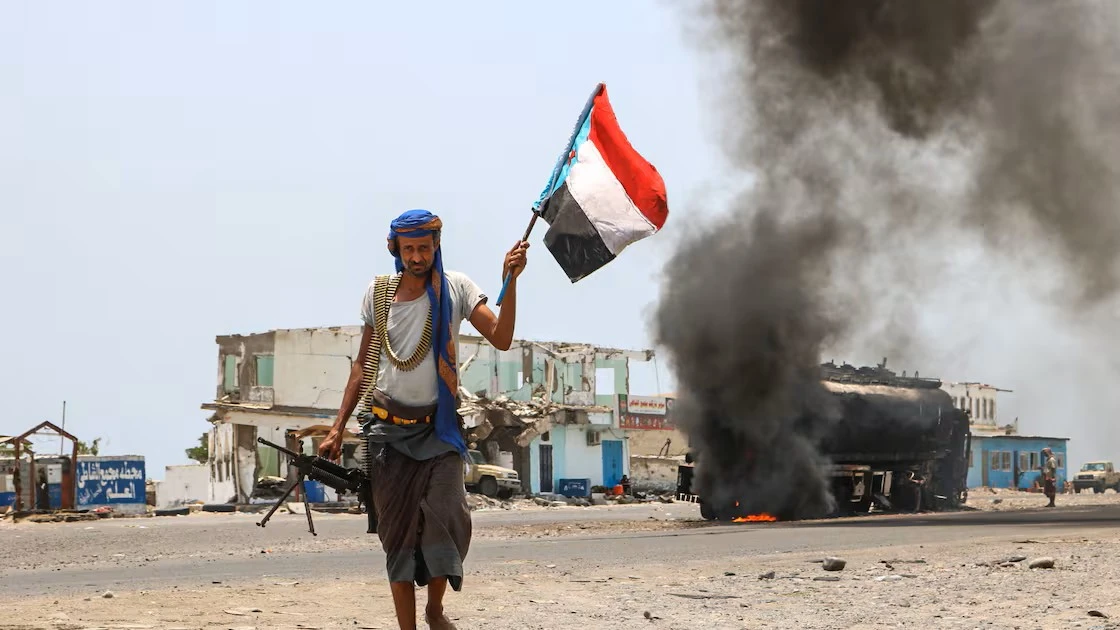
A fighter from the Security Belt Force holding a separatist flag during clashes between southern separatists and Saudi-backed government forces at the Fayush-Alam crossroads near Aden in southern Yemen on Aug. 30, 2019. Photo: Nabil Hasan/AFP.
Tensions have been heating up in recent weeks between UAE and Saudi-backed forces in Yemen’s largest province
Forces belonging to the UAE-backed Southern Transitional Council (STC) announced the capture of the city of Seiyun in the Hadhramaut province on 3 December.
In an operation dubbed “Promising Future,” STC forces took the city after clashes with troops affiliated with the Ministry of Defense of the internationally recognized Yemeni government – the Saudi-backed Presidential Leadership Council (PLC).
Seiyun is the second largest city in the province of Hadhramaut.
The secessionist administration said in a statement on its website that it “congratulates the people of the south on the liberation of Wadi Hadhramaut, which came in response to the demands of the people … after what they had suffered during three decades from terrorist operations, security disturbances, smuggling of contraband, in addition to injustice in rights and public property.”
An anonymous STC official told The National on Wednesday that “We are aiming at controlling all of Hadhramaut.”
“There is a rebellion, and we will crush it,” the official added.
A day earlier, STC spokesman Anwar al-Tamimi accused Hadhramaut tribal leader Amr bin Habrish of aligning with ISIS and Al-Qaeda. STC forces are on “an official mission to secure this strategic area for the benefit of the province and to prevent the Houthis from exploiting it,” he added, despite there being no Ansarallah presence in Hadhramaut.
The tensions mark a significant escalation between Saudi and UAE-backed forces in Yemen.
Hadhramaut is the largest province of Yemen and constitutes more than one-third of the country’s area. In addition to oil and mineral wealth, it has a 450-kilometer coastline. The province is a major part of the secessionist state that the STC aspires to form in south Yemen.
On 27 November, the Hadhramaut Tribal Alliance called in a statement for the defense of the oil-rich province and its natural resources, and to begin “resistance by all means and methods.”
The alliance called on its military wing – known as the Hadhramaut Protection Forces – to take “decisive steps” to confront the “dangerous movements” of “external forces” outside of the province, referring to the secessionist, Emirati-backed STC, which employs many foreign mercenaries and extremist fighters, and has been operating in Yemen since 2017.
Hadhramaut is facing “a clear attempt to control the governorate and its oil reserves,” it went on to say, stressing that “external” elements have already started to establish themselves in vital locations, take over camps, and isolate local leaders in the province.
Earlier this month, the tribal alliance accused STC forces of gearing up for a potential invasion.
The alliance was formed over a decade ago. Earlier this year, it set up an armed force known as the Hadhramaut Protection Forces, with the aim of protecting the province from what it says are threats to its natural resources. The group, aligned with the Saudi-led PLC, has taken control of several oil fields and transport routes in Hadhramaut since June 2025.
“The province is on the verge of an explosion unless the legitimate authority and the internationally recognized [PLC] government take action to defuse the tension,” analysts and observers cited by Reuters’ Arabic language site said late last month.
Forces loyal to the PLC were recently stationed in the northern areas of the province. The STC has condemned the presence of these troops for their affiliation with the Saudi-backed, Muslim Brotherhood-affiliated Islah Party.
The UAE was a major partner in the Saudi-led war launched against Yemen and the Ansarallah-led government in Sanaa, which began in 2015.
Despite this, Riyadh and Abu Dhabi have been embroiled in a rivalry over control and influence in Yemen over the past few years. Critics accuse both countries of seeking to divide Yemen to control its natural resources and strategic ports within their respective spheres of influence.
Riyadh and Abu Dhabi are “competing for control under the guise of supporting local autonomy,” Lebanese journalist Mawadda Iskanadar wrote for The Cradle in late October, adding that Hadhramaut has become a “testing ground” for this rivalry.
The UAE has established, in coordination with Israel, a large-scale occupation of Yemen’s islands. Emirati-backed forces affiliated with the STC also control much of the provinces of Marib and Shabwa, where troops loyal to the PLC are also present.
While the PLC and STC are at odds with one another, the two are closely linked. Aidarous al-Zubaidi, the deputy head of the PLC, also serves as the president of the STC.
https://orinocotribune.com/uae-backed-m ... adhramaut/
December 4, 2025
A fighter from the Security Belt Force holding a separatist flag during clashes between southern separatists and Saudi-backed government forces at the Fayush-Alam crossroads near Aden in southern Yemen on Aug. 30, 2019. Photo: Nabil Hasan/AFP.
Tensions have been heating up in recent weeks between UAE and Saudi-backed forces in Yemen’s largest province
Forces belonging to the UAE-backed Southern Transitional Council (STC) announced the capture of the city of Seiyun in the Hadhramaut province on 3 December.
In an operation dubbed “Promising Future,” STC forces took the city after clashes with troops affiliated with the Ministry of Defense of the internationally recognized Yemeni government – the Saudi-backed Presidential Leadership Council (PLC).
Seiyun is the second largest city in the province of Hadhramaut.
The secessionist administration said in a statement on its website that it “congratulates the people of the south on the liberation of Wadi Hadhramaut, which came in response to the demands of the people … after what they had suffered during three decades from terrorist operations, security disturbances, smuggling of contraband, in addition to injustice in rights and public property.”
An anonymous STC official told The National on Wednesday that “We are aiming at controlling all of Hadhramaut.”
“There is a rebellion, and we will crush it,” the official added.
A day earlier, STC spokesman Anwar al-Tamimi accused Hadhramaut tribal leader Amr bin Habrish of aligning with ISIS and Al-Qaeda. STC forces are on “an official mission to secure this strategic area for the benefit of the province and to prevent the Houthis from exploiting it,” he added, despite there being no Ansarallah presence in Hadhramaut.
The tensions mark a significant escalation between Saudi and UAE-backed forces in Yemen.
Hadhramaut is the largest province of Yemen and constitutes more than one-third of the country’s area. In addition to oil and mineral wealth, it has a 450-kilometer coastline. The province is a major part of the secessionist state that the STC aspires to form in south Yemen.
On 27 November, the Hadhramaut Tribal Alliance called in a statement for the defense of the oil-rich province and its natural resources, and to begin “resistance by all means and methods.”
The alliance called on its military wing – known as the Hadhramaut Protection Forces – to take “decisive steps” to confront the “dangerous movements” of “external forces” outside of the province, referring to the secessionist, Emirati-backed STC, which employs many foreign mercenaries and extremist fighters, and has been operating in Yemen since 2017.
Hadhramaut is facing “a clear attempt to control the governorate and its oil reserves,” it went on to say, stressing that “external” elements have already started to establish themselves in vital locations, take over camps, and isolate local leaders in the province.
Earlier this month, the tribal alliance accused STC forces of gearing up for a potential invasion.
The alliance was formed over a decade ago. Earlier this year, it set up an armed force known as the Hadhramaut Protection Forces, with the aim of protecting the province from what it says are threats to its natural resources. The group, aligned with the Saudi-led PLC, has taken control of several oil fields and transport routes in Hadhramaut since June 2025.
“The province is on the verge of an explosion unless the legitimate authority and the internationally recognized [PLC] government take action to defuse the tension,” analysts and observers cited by Reuters’ Arabic language site said late last month.
Forces loyal to the PLC were recently stationed in the northern areas of the province. The STC has condemned the presence of these troops for their affiliation with the Saudi-backed, Muslim Brotherhood-affiliated Islah Party.
The UAE was a major partner in the Saudi-led war launched against Yemen and the Ansarallah-led government in Sanaa, which began in 2015.
Despite this, Riyadh and Abu Dhabi have been embroiled in a rivalry over control and influence in Yemen over the past few years. Critics accuse both countries of seeking to divide Yemen to control its natural resources and strategic ports within their respective spheres of influence.
Riyadh and Abu Dhabi are “competing for control under the guise of supporting local autonomy,” Lebanese journalist Mawadda Iskanadar wrote for The Cradle in late October, adding that Hadhramaut has become a “testing ground” for this rivalry.
The UAE has established, in coordination with Israel, a large-scale occupation of Yemen’s islands. Emirati-backed forces affiliated with the STC also control much of the provinces of Marib and Shabwa, where troops loyal to the PLC are also present.
While the PLC and STC are at odds with one another, the two are closely linked. Aidarous al-Zubaidi, the deputy head of the PLC, also serves as the president of the STC.
https://orinocotribune.com/uae-backed-m ... adhramaut/
"There is great chaos under heaven; the situation is excellent."