Venezuela

The fightback
User avatar
blindpig
Posts: 14788
Joined: Fri Jul 14, 2017 5:44 pm
Location: Turtle Island
Contact:

Re: Venezuela

Post by blindpig » Wed Nov 26, 2025 1:59 pm

It’s Not Only About Venezuela: Trump Intends a Wider Domino Effect
Posted by Internationalist 360° on November 25, 2025
John Perry and Roger D. Harris

Image

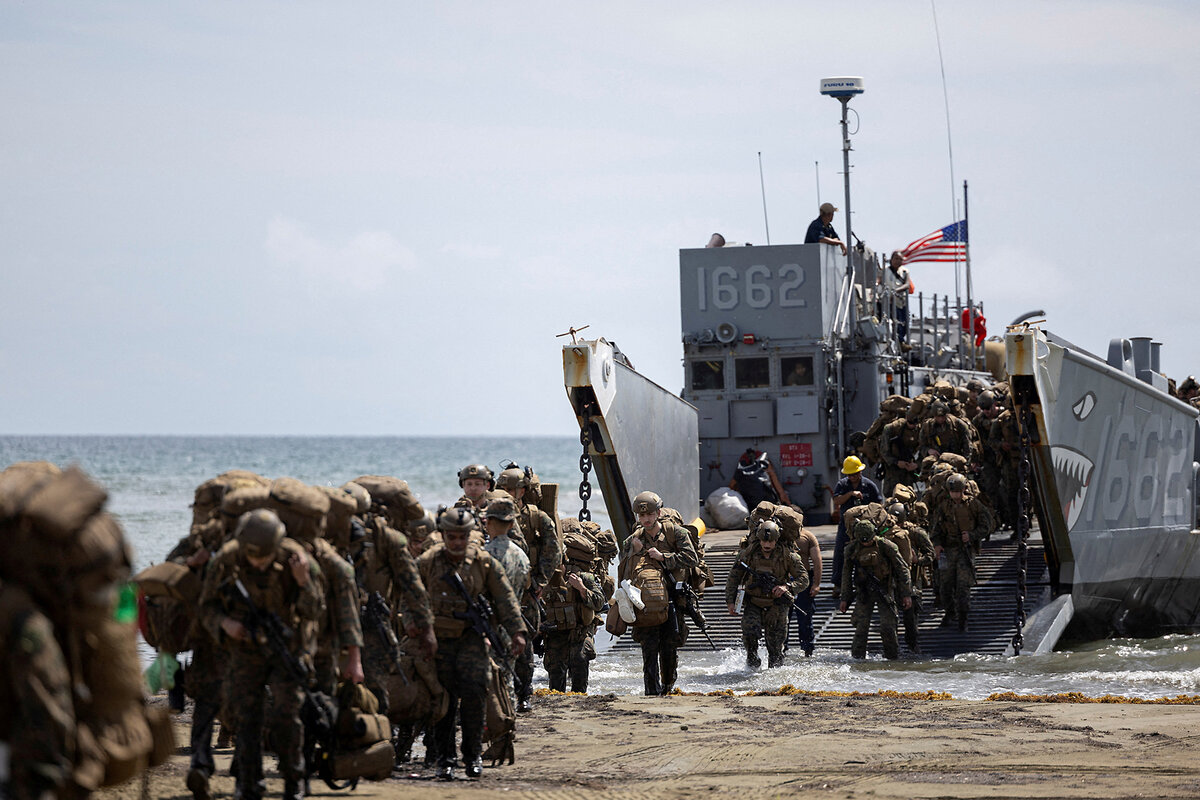
It’s increasingly obvious that the US military threats against Venezuela have a wider agenda. Their game plan is regime change, but not only in Venezuela. This is the objective – on a longer timescale in some cases – across several of the countries in the Caribbean Basin, aiming to cleanse the region of governments deemed undesirable to Washington.

As international relations professor at the University of Chicago, John Mearsheimer reminds us, the US “does not tolerate left-leaning governments…and as soon as they see a government that is considered to be left-of-center they move to replace that government.”

In the Financial Times, Ryan Berg, head of the Americas programme at the Washington think-tank CSIS, which is heavily funded by Pentagon contractors, said that Trump’s vision is for the US to be the “undisputable, pre-eminent power in the western hemisphere.” The New York Times dubbed Trump’s ambitions the “Donroe Doctrine.”

After Venezuela, in the current US line of fire, is Honduras. This Central American country faces an election on November 30 which will determine whether the leftist Libre Party stays in power or whether the country reverts to neoliberalism.

The crisis in the Caribbean engineered by the Trump administration is being actively instrumentalized to distract Hondurans from domestic issues when deciding how to vote. Honduras’s mainstream media repeatedly draw attention to the likelihood that Washington will threaten Honduras militarily if it votes the “wrong way” on November 30.

Interviewed on television, opposition candidate Salvador Nasralla was asked what would happen if the Libre Party won. He replied: “Those ships that are soon going to take over Venezuela are going to come and target Honduras.” Amplifying the supposed threat, opposition candidates have posted street signs labelling themselves “anti-communist,” as if communism were actually on offer in the election.

In a bizarre article, the Wall Street Journal alleges that Venezuela aims to “gobble up Honduras.” Turning on its head recent alarming evidence of a plot by Libre’s opponents to steal the election, the article claims that Venezuela is schooling Libre in defrauding the Honduran people.

This argument is also being repeated enthusiastically in the US Congress by María Elvira Salazar and others. On November 12, Deputy Secretary of State Christopher Landau said the US government “will respond rapidly and firmly to any attack on the integrity of the electoral process in Honduras.” In fact, the US is working with the opposition to undermine the popular mandate.

There is acute irony here. Washington’s justification for its military build-up is supposedly to tackle “narcoterrorism,” yet a Libre defeat would risk returning Honduras to the “narcostate” it had become in the decade under US patronage before the previous election in 2021.

Also lined up for regime change is, inevitably, Cuba. The UK’s Daily Telegraph, not normally known for its Latin America coverage, argues that Cuba is the “real target” of Trump’s campaign in Venezuela.

Having failed to dislodge the Cuban revolution after more than six decades of blockade, driving its citizens into acute hardship and pushing a tenth of them to migrate, Secretary of State Marco Rubio evidently sees the “real prize” of the US military build-up as dealing the fatal blow to its revolution.

Installing a US-friendly government in Caracas would aid the counter-revolution by cutting off gasoline and other supplies it currently sends to Cuba. Or supplies might be stopped by the US navy itself, further tightening the screws on Havana. In addition, if the Bolivarian Revolution in Venezuela collapsed, it would embolden the US-sponsored dissidents in Cuba, who feed on the discontent rained upon their country by US sanctions.

Yet even the gung-ho Telegraph doubts whether Rubio’s goal will be achieved, given Cuba’s remarkable resilience.

Another country in Washington’s crosshairs is Nicaragua. Here too, Rubio is leading the charge. But he has plenty of confederates on both sides of the congressional isles.

Although not directly threatened militarily (at least, so far) by the US, it has imposed new sanctions on Nicaraguan businesses, threatens to impose 100% tariffs on the country’s exports to the US, and may try to exclude it from the regional trade agreement, CAFTA.

At the same time, Nicaragua’s opposition figures enthusiastically identify with their peers in Venezuela, hoping that regime-change in Caracas would encourage Washington to further attack Nicaragua’s Sandinista government.

Two other left-leaning administrations in the Caribbean Basin, Colombia and Mexico, have been subject to Trump’s threats of military strikes. Colombian President Gustavo Petro has been sanctioned by Washington as “a hostile foreign leader.” He has responded by condemning the US attacks on boats in the Caribbean as “murder.”

Trump has recently repeated earlier threats to attack Mexican drug cartels, saying he would be “proud” to do so. Asked whether he would only take military action in Mexico if he had the country’s permission, he refused to answer the question. Mexican President Claudia Sheinbaum had earlier dismissed Trump’s threat of military action against drug cartels inside her country, telling reporters: “It’s not going to happen.”

However, despite Sheinbaum’s ongoing popularity, on November 15 she faced so-called Gen Z demonstrations which erupted in over 50 cities. According to The Grayzone, these were not what they seemed: they were financed and coordinated by an international right-wing network and amplified by bot networks. Their timing in relation to the Caribbean military build-up may have been intentional.

In the context of these protests, Trump said: “I am not happy with Mexico. Would I launch strikes in Mexico to stop drugs? It’s OK with me.” Elements in the MAGA movement are urging him to go further, launching a US military incursion to ensure “a transitional government.”

Washington successfully interfered in recent elections in Argentina. US endorsement of the right-wing victory in Ecuador in April was critical after a disputed election. Next month is the second round of Chile’s elections. Trump hopes for a rightward shift – with a little help from the hegemon – in that election as well as those in Colombia next year and in 2030 in Mexico.

Former Bush and Trump official Marshall Billingslea says the ultimate target of a US regime change assault is the entire Latin American left, “from Cuba to Brazil to Mexico to Nicaragua.” Military intervention leading to the end of the Maduro government would halt what he alleges (without evidence) is the flow of money from Caracas that has led to the “socialist plague that has spread across Latin America.”

US-imposed regime-change in Venezuela, Cuba, and Nicaragua – where the “socialist plague” has taken deep root – is a bipartisan project. For other progressive and left-leaning Latin American states – Mexico, Honduras, Colombia, and even Chile – the pax americana prescription stops short of outright deep regime change; infiltration, intimidation and co-optation are employed to keep them subordinate.

For Democrats and Republicans alike, the US imperial projection on the region is a given. Trump and his comrade-in-arms Rubio are leading the charge. But the so-called US opposition party is offering weak constraints.

To these ends, the US empire, with Trump at its titular head, is weighing the opportunity costs of deploying the full force of the military might assembled in the Caribbean, one-fifth of its navy’s global firepower. But Trump’s neocon advisers appear to want to seize the moment and embark on hemispheric political change, bringing a Trumpian “Donroe Doctrine” to fulfilment.

Will caution prevail, or will the US continue to bring lawlessness and chaos – as it has to Haiti, Libya, Syria, Afghanistan and elsewhere – not just to Venezuela but possibly to other countries in the region?

https://libya360.wordpress.com/2025/11/ ... no-effect/

******

Another pretext for the coup and looting
Official Shift in Criminalization: From the Tren de Aragua to the Cartel of the Suns
November 25, 2025 , 2:08 pm .

Image
The criminalization strategy seeks to use sanctions, blockades, and military threats to generate institutional and social fractures, replicating the "hybrid warfare" model applied in other scenarios (Photo: AP Photo)

Last Monday, November 24, the Trump administration took an unprecedented step by designating the so-called "Cartel of the Suns" as a foreign terrorist organization, a category reserved for the most serious threats to U.S. national security

The decision opened the door to new tools of pressure against the Venezuelan government, although legal experts agree that it does not explicitly authorize the use of lethal force without additional authorization. The paradigmatic aspect of the announcement lies in the very construction of the object of the sanction: an entity that does not exist as a structured criminal organization, but rather as political rhetoric conveniently elevated to legal status.

The term "Cartel of the Suns" does not describe a traditional criminal organization with a chain of command, transnational infrastructure, and operational capacity comparable to Mexican or Colombian cartels. According to multiple analyses , it is a term the White House appropriated to refer to an alleged illicit network of national scope, whose leader is supposedly President Nicolás Maduro himself.

The expression actually emerged in the 1990s to designate specific cases of military corruption. In 1993, two National Guard generals—Ramón Guillén Dávila and Orlando Hernández Villegas—were accused of facilitating cocaine trafficking. The nickname, which alludes to the sun insignia on the military uniform, became established as a journalistic label for institutional corruption, not as the name of a cohesive group.

The qualitative leap occurred when this internal rhetoric was adopted by Washington. In March 2020, the Department of Justice filed formal charges against Maduro, the Vice President for Citizen Security, Justice, and Peace, Diosdado Cabello, and the Minister of Defense, Vladimir Padrino López, framing them under the label of the "Cartel of the Suns." In 2025, the re-articulation of this narrative coincided first with the invocation of the obsolete Foreign Enemies Act of 1798, an instrument that suspends due process to expedite mass deportations, and more recently, with an unprecedented military deployment in the Caribbean Sea.

The sequence reveals a pattern in which every time the "maximum pressure" strategy requires a discursive boost, the criminalizing specter of the Venezuelan state resurfaces with renewed vigor.

Tren de Aragua, rise and fall of a criminalizing excuse
The rise of the Tren de Aragua (TdA) gang from media obscurity to the status of a "global terrorist threat" is one of the most telling examples of enemy-making in the Trump era. Until 2022, the gang was virtually nonexistent in US headlines. Although the Insight Crime website — directly funded by the State Department—had been covering it since 2019, its presence in the American public debate was marginal until the current immigration and political climate made it convenient.

The turning point came in August 2023, when Jason Owens, then chief of the Border Patrol, posted on Twitter the first official mention of alleged TdA members attempting to enter the United States. The post was picked up by CNN, establishing the pattern that would dominate the following months: accusations based on suspicion, immediate media validation, and little to no forensic evidence.

In September 2023, Operation Liberation Cacique Guaicaipuro at the Tocorón prison —where the gang operated— generated massive simultaneous coverage in The Washington Post, The Economist, Insight Crime and the OCCRP, another US-funded investigative portal that specializes in Washington's geopolitical enemies.

The criminalization of immigration reached its peak in February 2024 with the murder of Laken Riley, a nursing student in Georgia. The accused, José Ibarra, is Venezuelan, and his brother Diego was linked to the TdA "based solely on tattoos," according to the Venezuelan Public Prosecutor's Office.

The pressure intensified; in July 2024, OFAC declared it a transnational criminal organization, and on January 20, in his first series of executive orders, Trump elevated it to the status of a global terrorist organization. The aforementioned murder became a legislative catalyst; on January 29, Trump signed the Laken Riley Act.

The criminalization mechanism has operated on three levels:

Media sensation : the gang went from being a local prison phenomenon to a "megaband" with a presence in 16 states, according to the New York Post in November 2024.
Political : Congressmen like María Elvira Salazar and Mario Díaz-Balart, with a strong influence from the Cuban-American lobby, framed Venezuelan migration as a "criminal invasion".
Military : The deployment of warships in the Caribbean was justified as an anti-drug response to target the TdA, although an expert like retired Colonel Mark Cancian, advisor to the Center for Strategic and International Studies, admitted that it was "a matter of political signaling", without authority for real interdiction operations.
The Venezuelan government effectively dismantled the organization. In September 2023, Operation Cacique Guaicaipuro resulted in the arrest of 44 members and arrest warrants issued for 102 more, including its leader, Héctor Guerrero Flores. In 2024, official figures showed a 93% reduction in vehicle thefts, an 87% reduction in aggravated homicides, and a 77% reduction in robberies since 2019. However, the true effectiveness of the Venezuelan state was systematically ignored, while suspicions about Venezuelans abroad multiplied without forensic corroboration.

Recycling and a turn towards the myth of the Cartel of the Suns
If the TdA (Traffic in the Americas) served to criminalize migration, the "Cartel of the Suns" functions as a high-level political justification for the military and financial encirclement. The recent designation introduces no new evidence; rather, it recycles an accusation that lacks support in even U.S. intelligence reports.

The DEA's 2024 National Drug Threat Assessment (NDTA) is explicit : the groups with the greatest control are the Sinaloa Cartel and the Jalisco New Generation Cartel. Neither Venezuela, nor the "Cartel of the Suns," appear as structural threats.

The data dismantles the narrative. According to the United Nations Office on Drugs and Crime (UNODC), 61% of cocaine originates in Colombia, 26% in Peru, and 13% in Bolivia. Venezuela is not a significant producer. Regarding routes, 87% of the drugs leave via the Pacific; only 8% transit through the Eastern Caribbean, where the Venezuelan coast is located. Of that small percentage, Venezuelan authorities seize and destroy 70%, according to official figures . The geography of drug trafficking does not coincide with the political geography portrayed by Washington.

The recycling of this myth follows a geopolitical "false flag" logic. In March 2020, when the "maximum pressure" strategy was showing signs of exhaustion, Attorney General William Barr convinced Trump to pivot to the anti-drug narrative. The deployment of naval and air forces in the Caribbean under the pretext of counternarcotics operations generated headlines of firmness without committing resources to a direct conflict. As journalist Elías Ferrer documented in his investigation for Guacamaya, the intention was to "begin an orderly withdrawal" from the regime change policy without appearing weak.

Five years later, the script is being revived with adjustments. The joint designation of the TdA and the "Cartel of the Suns" allows the application of the U.S. Antiterrorism Act against Venezuela while preserving business interests: OFAC sanctioned the "cartel" as a global terrorist entity but did not identify specific individuals, allowing corporations like Chevron to continue operating without violating the regulations. Marco Rubio, Secretary of State and National Security Advisor, has been the discursive architect of this framework, aligning Venezuelan rhetoric with the "America First" agenda and the Cuban-American lobby in South Florida.

The media campaign has a clear objective of psychological pressure. By saturating the news with stories about the infiltration of organized crime into the highest levels of government and the Bolivarian National Armed Forces (FANB), the aim is to sow distrust, demoralization, and chaos. The underlying message for Venezuelan military personnel is: "Your superiors are narco-terrorists; ally yourselves with us." It is a classic psychological warfare strategy designed to fracture institutional loyalty and create the conditions for dismantling the institutional and social fabric—an essential element for any scenario of forced regime change.

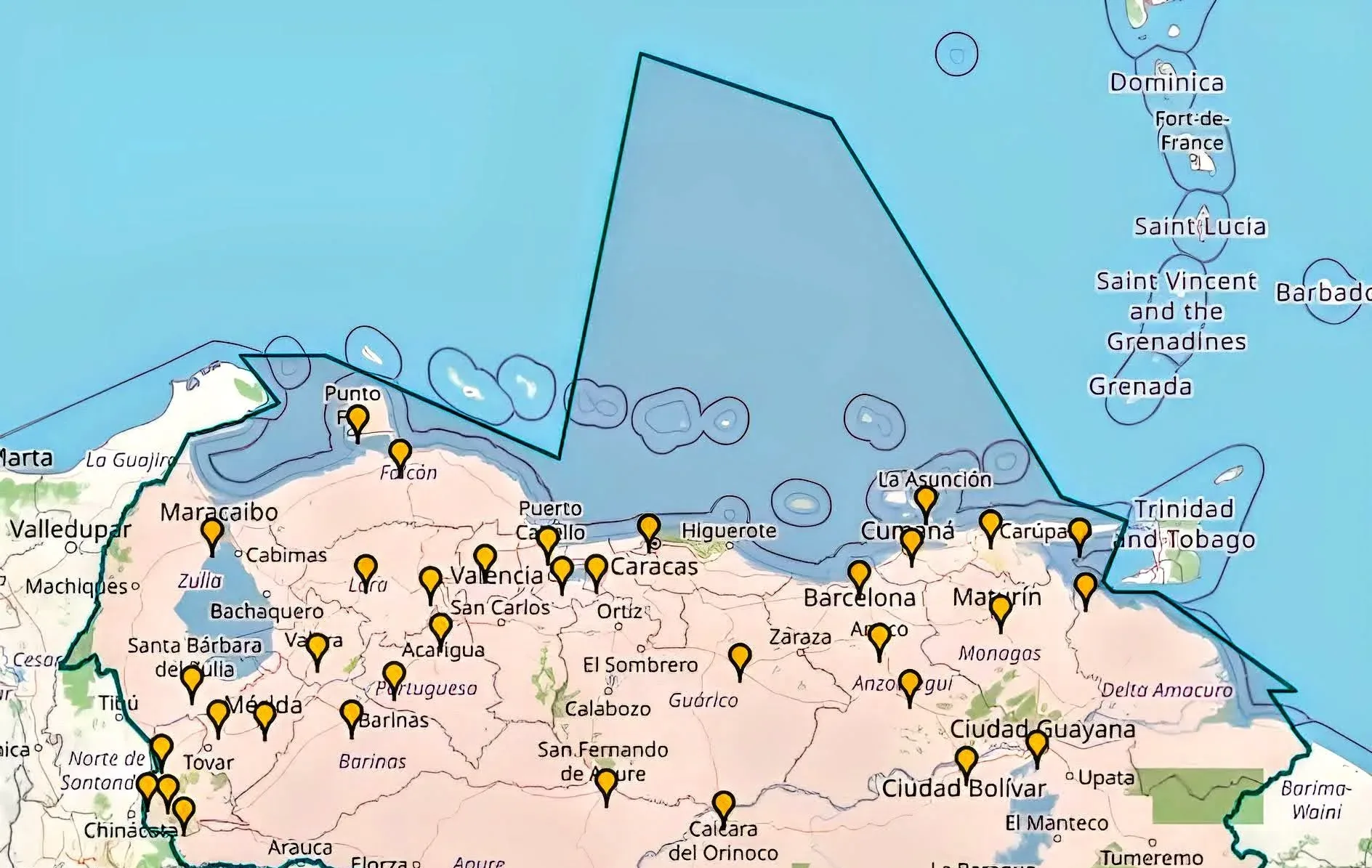
The military deployment in the Caribbean, which includes armed incursions against vessels in international waters off the coast of Venezuela, is not a response to a real drug trafficking threat. As Cancian explained , "The ships don't have the authority to enforce the law, unlike the Coast Guard." Their role is to signal a wartime readiness, not to interdict drugs. The Paria Peninsula, identified as a supposed corridor, has experienced a marked decline in illicit activity since 2020, with seizures such as the 790 kilos of cocaine destroyed in Macuro in February 2025.

Psychological pressure on the Venezuelan population operates on two fronts:

Externally , migrants face mass criminalization — or crimigration —, 238 Venezuelans who were deported to El Salvador's maximum security prison (CECOT) in March 2025, without prior trial, invoking the Foreign Enemies Act.
Internally , the campaign seeks to erode the morale of the FANB and the population in order to generate institutional breakdown and social chaos.
Last Thursday, Vice President Delcy Rodríguez denounced that the US strategy responds to a historical interest in controlling Venezuelan territory, not only for its natural resources and geostrategic location, but also for its "anti-imperialist and anti-colonialist strategic political conception."

In response to the designation of the alleged Cartel of the Suns, the high-ranking official stated that "we are not a military power nor are we the ones who murder millions of people in the world to steal resources."

Image
The US financial system absorbs 85% of global drug trafficking profits, equivalent to 2.7% of its GDP (Photo: Archive)

The strategy aims to use sanctions, blockades, and military threats to create fractures within the military leadership, replicating the "hybrid warfare" model used in other contexts. This is coupled with the use of new technologies—via Operation Southern Spear —in which the participation of Trump's new allies, Big Tech, would be paramount.

Washington has fabricated an enemy that fits its narrative, regardless of the evidence. While the US financial system absorbs 85% of global drug trafficking profits—equivalent to 2.7% of its GDP—and while Ecuador, according to the World Customs Organization, has become the world's leading exporter of cocaine, attention remains fixed on Venezuela.

The Tren de Aragua and the Cartel of the Suns are discursive wild cards used to violate international law, justify the military and financial siege, and create the conditions of internal chaos necessary for a regime change that, in the end, seeks to seize the country's strategic resources and eliminate a critical reference to its decadent unipolar vision.

https://misionverdad.com/venezuela/giro ... -los-soles

Google Translator
"There is great chaos under heaven; the situation is excellent."

User avatar
blindpig
Posts: 14788
Joined: Fri Jul 14, 2017 5:44 pm
Location: Turtle Island
Contact:

Re: Venezuela

Post by blindpig » Thu Nov 27, 2025 2:32 pm

The mediocre one and María Machado

Image The Cayapo

November 26, 2025 , 2:01 pm
Image
All wealth, both that which founded human capitalism and that which is currently produced and accumulated, has its origin in theft (Photo: El Cayapo)

When slavery is imposed, nothing can shame us; shame is when, knowing it, we continue to accept it or wish to be the perpetrators.

When a culture deteriorates, anything, no matter how improbable, can happen. Even in the most enlightened times of the elites, imagination has never surpassed reality. But, despite the high and volatile mediocrity existing in the political, intellectual, and cultural world, it seemed unbelievable that a person could stoop to the ultimate plagiarism, as is the case with María and her manifesto of the enslaving fathers of the United States, plagiarized with artificial intelligence. But that's not all—as the propaganda says—what is astonishing, unbelievable, unprecedented, is how amazed her followers, fanatics, influencers, commentators, analysts, sages, and academics were, applauding and cheering the plagiarized piece in unison. A greater degree of terminal illness is impossible.

It's all over, the suspicion is confirmed: a thug and con artist who sells bottle caps on street corners, directed by self-important individuals, governs the United States; three drug-addicted gang members and two prostitutes control the destinies of Europe; and the rest kneel before them, claiming to be presidents of the mines they rule through fraud, drug trafficking, and prostitution. And those who still cling to a semblance of ethics and dignity are viciously attacked by self-important gang members in their armed clique.

This is not a coincidence or an accident; it is the evolution of a culture that was once luminous and ended in the most abject mediocrity.

This culture of the businessman, politician, artist, professional, religious figure, social communicator or journalist, athlete, all mediocre, damages life to satisfy their mediocre whims; they live by discourse and not by deeds; as long as it satisfies their desires for accumulation and compulsive consumption, the mediocre do not care about the problems they generate, because they are incapable of creating solutions.

Thought dries up, and mediocrity takes hold, enveloping all elites with a single idea: to cling to power regardless of the consequences. They shout at the top of their lungs that everything must belong to them. The businesspeople who were once captains of corporations, now devoid of ideas, are nothing more than common swindlers, mere mediocre entrepreneurs incapable of making anything evolve—a situation that applies to all other spheres of social and cultural activity.

Since mediocre people don't create ideas, but only parrot slogans, they are believers, conformists. The mediocre person believes they are superior, believes they have rights, believes there is democracy for them, believes they should be protected because they are human, believes in God, magic, good, evil, witchcraft, science, who moved my cheese ; they are, in short, a fool, happy as long as they consume. The mediocre person doesn't know why they should govern or lead, they only do it to stay in power, they use all their intelligence to sustain themselves and maintain power, their existence has no other reason for being.

Mediocre people rule the world, they accumulate possessions, they don't think. This is the story of the mediocre: the mediocre follow the mediocre, they don't create, they believe; they don't generate, they are always consuming, and their greatest desire in the world is to be left alone consuming, without anyone bothering them.

The mediocre person is a compulsive addict; a mediocre ruler hands over the position to an even more mediocre one to prevent them from being surpassed. They are very clever at creating organizational tangled webs, at controlling the power they claim to change, so that nothing really changes. The mediocre person believes in their own narrative because other mediocre people make it possible with their dogmas, applause, and actions.

Human capitalism did not have time to settle and reflect as such; it is a culture born from war, with the aggravating factor of its dazzling nature. It was fleeting, although widespread across the planet, which did not allow it to stop and look at itself and turn its achievements, after corrections and self-criticism, into future possibilities, since everything built and said constructed the superlative narrative of its superiority as a culture in the world, since cultures have existed, and only mediocrity remained as a corollary.

An example in Venezuela is this: every president who has governed has competed to dispute the position of the previous mediocre one, always in the belief that he is superior, because a characteristic of every mediocre person is his opinion that he is superior or better than others, until Chávez arrived and created a possibility of being a different country with its own roots, with an idea, with a sense of belonging, with an authentic identity possible to build and constitute ourselves as a people, who belong to each other with intimate ethics and dignity, in which lies what we do.

But where did this mud come from?
The spoils of war have allowed for the creation of capitalism and, as a consequence, humanism—an unnatural, uprooted, criminal, plundering, vulgar, characterless culture, armed with fragments of invaded and looted cultures. In this culture, everything is obtained at the cost of life. Its success, whether as an idealized slave or as a master, is solitude as its reward. A breeding ground for mediocrity, which transcends the centuries.

Capitalism, the mode of sustaining humanism, has been successful in fulfilling the goals set by the bourgeois class. Never before has so much wealth been accumulated, never before has an owner enjoyed so much freedom, so much equality, without ignoring the ideological baggage we all carry.

The all-powerful religious monster, known in the West as Christianity, which ruled the West with an iron will and criminality, was replaced by an incipient idea, known centuries later as the powerful human-capitalism, which revolutionized the known world and turned it upside down, scandalizing what existed, which led people to the bonfire of fear, which enhanced hunger with abundance, which increased ignorance by eliminating thousands of cultures throughout the planet and imposing the same idea, in the name of enlightenment and wisdom, which murdered God without any mercy and exposed him to public scorn, subjecting him to the chains of capitalist production like any slave at its service.

But today, like all the deities and myths it shattered, that idea which once emerged bright amid the prolonged deterioration of Western obscurantism, rests in peace.

Humanism has never been or will ever be defeated; its apparatus of ideology, war, and propaganda is the most perfect ever created, to the point that the fevered minds of those who run the system have indulged in the luxury of inventing enemies such as terrorism, bombs of mass destruction, or narco-terrorism, which have never existed except as means of war, in order to continue existing.

Everything that has fought against it, in one way or another, has ended up being absorbed or becoming its partner. Although some have won battles against it, this system—now in marked decline—will withdraw from the world stage like an undefeated corpse, still attempting to frighten the unwary.

Millions of workers, fishermen, and peasants of all kinds have testified to this by dying in the wars and revolutions that have been forged against human capitalism; without understanding that it will die by its own means and contradictions.

Since the species will outlive it, we will have to ask ourselves: What do we replace it with?

Freedom, democracy, equality, fraternity, progress, and justice no longer inspire enthusiasm; everything now revolves around mediocrity, sustained by artificial intelligence. Intellectuals, artists, politicians, and other professionals only act on commission; none suffer or rejoice over an original idea, even if it's plagiarized. They are all preoccupied with polishing pamphlets that will guarantee them a plate of black beans or Lobster Thermidor, depending on whoever they're working for.

Everything has fallen into the hands of technology, military, pharmaceutical, and information corporations, dedicated to controlling natural resources and protecting wealth, thus guaranteeing the status quo. They promote ideas of eternity, absolute individual freedom, and self-mastery, without anyone noticing the chains that bind us like captive harnesses, guaranteeing the status quo.

This absence of a living idea takes us back to the origins, where fear, hunger, and ignorance resulted in this human-capitalist culture that dictates all the guidelines and leads us towards the perpetuation of the enslaved individual repeating himself in the inertia of death, without any possibility of evading that condition.

The desire to be a god has been fulfilled in the human-capitalist individual. Now dead as an idea, those who remain directing its repetition are mediocre beings incapable of generating new ideas. The force of habit sustains them every day, turning the same crank that guarantees their status as mediocre gods, following animal instincts, cloaked in ideological garb that justifies them. The rest is watching the corpse float by and remembering that it was once strong and beautiful.

Although subjected to the inertia of the mediocre leaders who govern the planet, devoid of any ideas to keep them awake at night, nature continues its course. Questions abound for any slave who dares to question life and offer alternative answers to what is happening—answers other than "let's reform," "let's change," "let's improve," "let's clean up," or "let's tidy up the system." Because that has already been done, and nothing has solved the problem of being slaves. The real issue is replacing the conditions that allow us to be enslaved.

Within human capitalism this is normal, but since the illusion does not take root in the slaves, we propose that we question ourselves and become a contradiction, from where ideas can arise that can replace the current system, where those illusions that keep people enslaved are not present.

We do not start from moral or ethical conditions that we slaves intimately possess, nor from manifest destiny or wisdom, but from the position we occupy in this mode of production, which must be replaced if we intend to change our condition; but if not, the complaint is useless: "a willing pain doesn't itch, and if it itches, it doesn't mortify."

The truth is that we have no rights, no one will save us, we will never change things, because they exist for the benefit of the owners, who need to keep us in the conditions we live in, so that they can be what they are.

Let us clarify: what we are saying is directed solely and exclusively to those slaves who truly wish to challenge and abandon human capitalism. The owners are not invited to these discussions, unless they go mad and want to relinquish their power; the other slaves who wish to cling to their illusions, utopias, and hopes that one day—or even tomorrow—they will be owners, brothers and sisters, don't worry, you are not invited either.

We simply want to state truths, such as the fact that Marx was never associated with anything to do with the left, as clearly stated in the Communist Manifesto written in 1848. First paragraph: "What opposition has not been accused of communism by its adversaries in power? What opposition, in turn, has not hurled the scathing epithet of communist at its adversaries of the right or of the left?"

Humanism wasn't conceived to ensure the well-being and harmony of humankind, but rather to justify the power of the individual as a substitute for God, based on free will, imposing the logic of "I think, therefore I am," "the end justifies the means," and "divide and conquer." Directing and creating everything in their own image and likeness; replacing religious reason based on a god who creates and governs nature. A magnificent source from which the mediocre will eternally drink.

That human-capitalist culture has definitively ground to a halt. All its movements are inertial; the root of thought that generated it has died; all its creativity is dedicated to production, excessive consumption, and its protection. Fattening the mediocrity that doesn't expect its share of the blame.

The human-capitalist concept is separate from nature; it thinks that transforming it is part of its rationality, that cultivating a field, building a city, or developing a vaccine is not "violence against nature" but acting in accordance with its rationality and creativity. And it even seems beautiful, but the problem is how and why, because it is not truly in anyone's rationality to change nature, but to use it for profit; it is about obtaining gain, about taking advantage of it to have power, which cannot be achieved without harming life, while mediocrity flourishes.

Sowing the land involves feeding armies, selling tools and machinery, buying and selling the produce, and ultimately, profiting by exploiting people; for this, nature must be owned. Building a city is about keeping buying and selling captive because it concentrates all resources in one place, because it allows investment in real estate, because it allows keeping everyone drugged, but also because the concentration of people, other animals, or crops in limited spaces causes us all to become pests, which allows the unnatural system to develop—even further—because poison must be used against cancer, stress, wounds, and diseases created in every aspect of the system's operation; but the worst part is that the mediocre need the mechanisms of war to keep it functioning.

So rationality is the hunger, fear, and ignorance that once instituted war and today has become the enemy of all living things. In these writings, we do not seek to glorify anyone, to assign them virtues they do not possess; we simply state that both the owner and his slaves share the same aspirations: to be rich and powerful so that they are respected and feared. There is only one small detail: both depend on the position they occupy in the mode of production.

That all wealth, both that which founded human capitalism and that which is currently produced and accumulated, has its origin in theft, as already expressed by Karl Marx and other authors. But for the owners, the justification for wealth, according to them, is the altruistic effort and dignity of the entrepreneurs who, to save humanity from slavery and plagues, founded science, human rights, creating value, freedom, equality, fraternity, justice, democracy, and progress, risking their money, their companies, their knowledge, their lives to establish well-being for millions. Of course, there is profit, but the ungrateful world must understand that, despite today's horrors, the world is more beautiful and richer; even the poor are richer, because wealth has freed them from misery. They no longer live in caves, now they live in ranches; they are no longer nomads or transhumant, now they are immigrants.

Those who founded the pillars of human capitalism taught us that, however strong the existing power, another idea can always be created to replace it. And they didn't just say it; they practiced it, creating the foundations of what exists today as power. However, knowing that nothing lasts forever, they declared that their idea, now physically and ideologically realized, was the end of history, that from then on everything would be the work of humanism, and that the only thing to do was to reform it while respecting the laws and rationality that govern it. Any other idea would be pernicious. It is no coincidence that communism was destroyed as an idea within people's bodies, with millions murdered across the globe and any attempt to establish or test it in the world viciously attacked.

The proposal of these writings has to do with the idea that life does not commit suicide, that we are in the midst of the maelstrom of the deterioration of a system whose tendency is to become a mess every day, dragging in its mush all the life that it can and will only grow as a dead mass satiated with sap, where the mediocre one thrives who, like Mary, repeats the pamphlet of the slave-owning parents.

https://misionverdad.com/chavismo/el-me ... ia-machado

Official shift in criminalization: from the Tren de Aragua to the Cartel of the Suns
November 25, 2025 , 2:08 pm .
Image
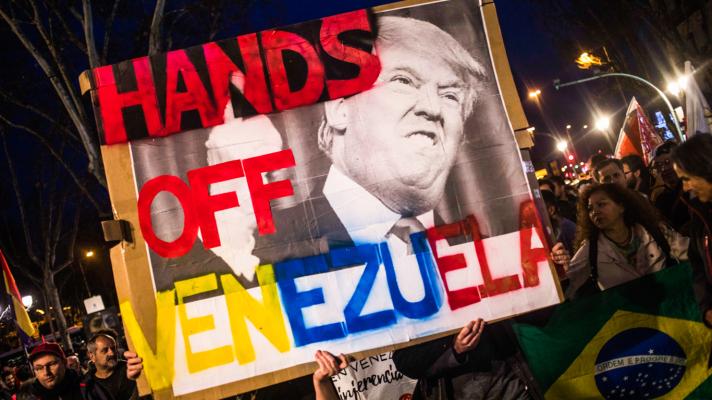
he criminalization strategy seeks to use sanctions, blockades, and military threats to generate institutional and social fractures, thus replicating the "hybrid warfare" model perpetrated in other scenarios (Photo: AP Photo)

Last Monday, November 24, the Trump administration took an unprecedented step by designating the so-called "Cartel of the Suns" as a foreign terrorist organization, a category reserved for the most serious threats to U.S. national security

The decision opened the door to new tools of pressure against the Venezuelan government, although legal experts agree that it does not explicitly authorize the use of lethal force without additional authorization. The paradigmatic aspect of the announcement lies in the very construction of the object of the sanction: an entity that does not exist as a structured criminal organization, but rather as political rhetoric conveniently elevated to legal status.

The term "Cartel of the Suns" does not describe a traditional criminal organization with a chain of command, transnational infrastructure, and operational capacity comparable to Mexican or Colombian cartels. According to multiple analyses , it is a term the White House appropriated to refer to an alleged illicit network of national scope, whose leader is supposedly President Nicolás Maduro himself.

The expression actually emerged in the 1990s to designate specific cases of military corruption. In 1993, two generals of the National Guard (Ramón Guillén Dávila and Orlando Hernández Villegas) were accused of facilitating cocaine trafficking. The nickname, which alludes to the sun insignia on the military uniform, became established as a journalistic label for institutional corruption, not as the name of a cohesive group.

The qualitative leap occurred when that internal rhetoric was adopted by Washington. In March 2020, the Department of Justice filed formal charges against Maduro, the Vice President for Citizen Security, Justice and Peace, Diosdado Cabello, and the Minister of Defense, Vladimir Padrino López, framing them under the label of the "Cartel of the Suns."

In 2025, the rearticulation of this narrative coincided, first, with the invocation of the obsolete Foreign Enemies Act of 1798, an instrument that suspends due process to accelerate mass deportations and, recently, with an unprecedented military deployment in the Caribbean Sea.

The sequence reveals a pattern in which every time the "maximum pressure" strategy requires a discursive boost, the criminalizing specter of the Venezuelan state resurfaces with renewed vigor.

Tren de Aragua, rise and fall of a criminalizing excuse
The rise of the Tren de Aragua (TdA) gang from media obscurity to the status of a "global terrorist threat" is one of the most telling examples of enemy-making in the Trump era. Until 2022, the gang was virtually nonexistent in US headlines. Although the Insight Crime website — directly funded by the State Department—had been covering it since 2019, its presence in the American public debate was marginal until the current immigration and political climate made it convenient.

The turning point came in August 2023, when Jason Owens, then chief of the Border Patrol, posted on Twitter the first official mention of alleged TdA members attempting to enter the United States. The post was picked up by CNN, establishing the pattern that would dominate the following months: accusations based on suspicion, immediate media validation, and little to no forensic evidence.

In September 2023, Operation Liberation Cacique Guaicaipuro at the Tocorón prison—where the gang operated—generated massive simultaneous coverage in The Washington Post, The Economist, Insight Crime and the OCCRP, another US-funded investigative portal that specializes in Washington's geopolitical enemies.

The criminalization of immigration reached its peak in February 2024 with the murder of Laken Riley, a nursing student in Georgia. The accused, José Ibarra, is Venezuelan, and his brother Diego was linked to the TdA "based solely on tattoos," according to the Venezuelan Public Prosecutor's Office.

The pressure intensified. In July 2024, OFAC designated it a transnational criminal organization, and on January 20, in his first series of executive orders, Trump elevated it to the status of a global terrorist organization. The aforementioned murder became a legislative catalyst; on January 29, Trump signed the Laken Riley Act.

The criminalization mechanism has operated on three levels:

Media sensation : the gang went from being a local prison phenomenon to a "megaband" with a presence in 16 states, according to the New York Post in November 2024.
Political : Congressmen like María Elvira Salazar and Mario Díaz-Balart, with a strong influence from the Cuban-American lobby , framed Venezuelan migration as a "criminal invasion".
Military : The deployment of warships in the Caribbean was justified as an anti-drug response to target the TdA, although an expert like retired Colonel Mark Cancian, advisor to the Center for Strategic and International Studies, admitted that it was "a matter of political signaling", without authority for real interdiction operations.
The Venezuelan government effectively dismantled the organization. In September 2023, Operation Cacique Guaicaipuro resulted in the arrest of 44 members and arrest warrants issued for 102 more, including its leader, Héctor Guerrero Flores. In 2024, official figures showed a 93% reduction in vehicle thefts, an 87% reduction in aggravated homicides, and a 77% reduction in aggravated robberies since 2019. However, the true effectiveness of the Venezuelan state was systematically ignored, while suspicions about Venezuelans abroad multiplied without forensic corroboration.

Recycling and a shift towards the myth of the "Cartel of the Suns"
If the TdA (Traffic in the Americas) served to criminalize migration, the "Cartel of the Suns" functions as a high-level political justification for the military and financial encirclement. The recent designation introduces no new evidence; rather, it recycles an accusation that lacks support in even US intelligence reports.

The DEA's 2024 National Drug Threat Assessment (NDTA) is explicit : the groups with the greatest control are the Sinaloa Cartel and the Jalisco New Generation Cartel. Neither Venezuela, nor the "Cartel of the Suns," appear as structural threats.

The data dismantles the narrative. According to the United Nations Office on Drugs and Crime (UNODC), 61% of cocaine originates in Colombia, 26% in Peru, and 13% in Bolivia. Venezuela is not a significant producer. Regarding routes, 87% of the drugs leave via the Pacific; only 8% transit through the Eastern Caribbean, where the Venezuelan coast is located. Of that small percentage, Venezuelan authorities seize and destroy 70%, according to official figures . The geography of drug trafficking does not coincide with the political geography portrayed by Washington.

The recycling of this myth follows a geopolitical "false flag" logic. In March 2020, when the "maximum pressure" strategy was showing signs of exhaustion, Attorney General William Barr convinced Trump to pivot to the anti-drug narrative. The deployment of naval and air forces in the Caribbean under the pretext of counternarcotics operations generated headlines of firmness without committing resources to a direct conflict. As journalist Elías Ferrer documented in his investigation for Guacamaya, the intention was to "begin an orderly withdrawal" from the regime change policy without appearing weak.

Five years later, the script is being revived with adjustments. The joint designation of the TdA and the "Cartel of the Suns" allows the application of the U.S. Antiterrorism Act against Venezuela while preserving business interests: OFAC sanctioned the "cartel" as a global terrorist entity but did not identify specific individuals, allowing corporations like Chevron to continue operating without violating the regulations. Marco Rubio, Secretary of State and National Security Advisor, has been the discursive architect of this framework, aligning Venezuelan rhetoric with the "America First" agenda and the Cuban-American lobby in South Florida.

The media campaign has a clear objective of psychological pressure. By saturating the news with stories about organized crime infiltrating the highest levels of government and the Bolivarian National Armed Forces (FANB), the aim is to sow distrust, demoralization, and chaos. The underlying message for Venezuelan military personnel is: "Your superiors are narco-terrorists; join us." It is a classic psychological warfare strategy designed to fracture institutional loyalty and create the conditions for dismantling the institutional and social fabric—an essential element for any scenario of forced regime change.

The military deployment in the Caribbean, which includes armed incursions against vessels in international waters off the coast of Venezuela, is not a response to a real drug trafficking threat. As Cancian explained , "The ships don't have the authority to enforce the law, unlike the Coast Guard." Their role is to signal a wartime readiness, not to interdict drugs. The Paria Peninsula, identified as a supposed corridor, has experienced a marked decline in illicit activity since 2020, with seizures such as the 790 kilos of cocaine destroyed in Macuro in February 2025.

Psychological pressure on the Venezuelan population operates on two fronts:

Externally , migrants face mass criminalization — or crimigration —, 238 Venezuelans who were deported to El Salvador's maximum security prison (Cecot) in March 2025, without prior trial, invoking the Foreign Enemies Law.
Internally , the campaign seeks to erode the morale of the FANB and the population in order to generate institutional breakdown and social chaos.
Last Thursday, Vice President Delcy Rodríguez denounced that the US strategy responds to a historical interest in controlling Venezuelan territory, not only for its natural resources and geostrategic location but also for its "anti-imperialist and anti-colonialist strategic political conception."

In response to the designation of the alleged "Cartel of the Suns," the high-ranking official stated that "we are not a military power nor are we the ones who murder millions of people in the world to steal resources."
Image
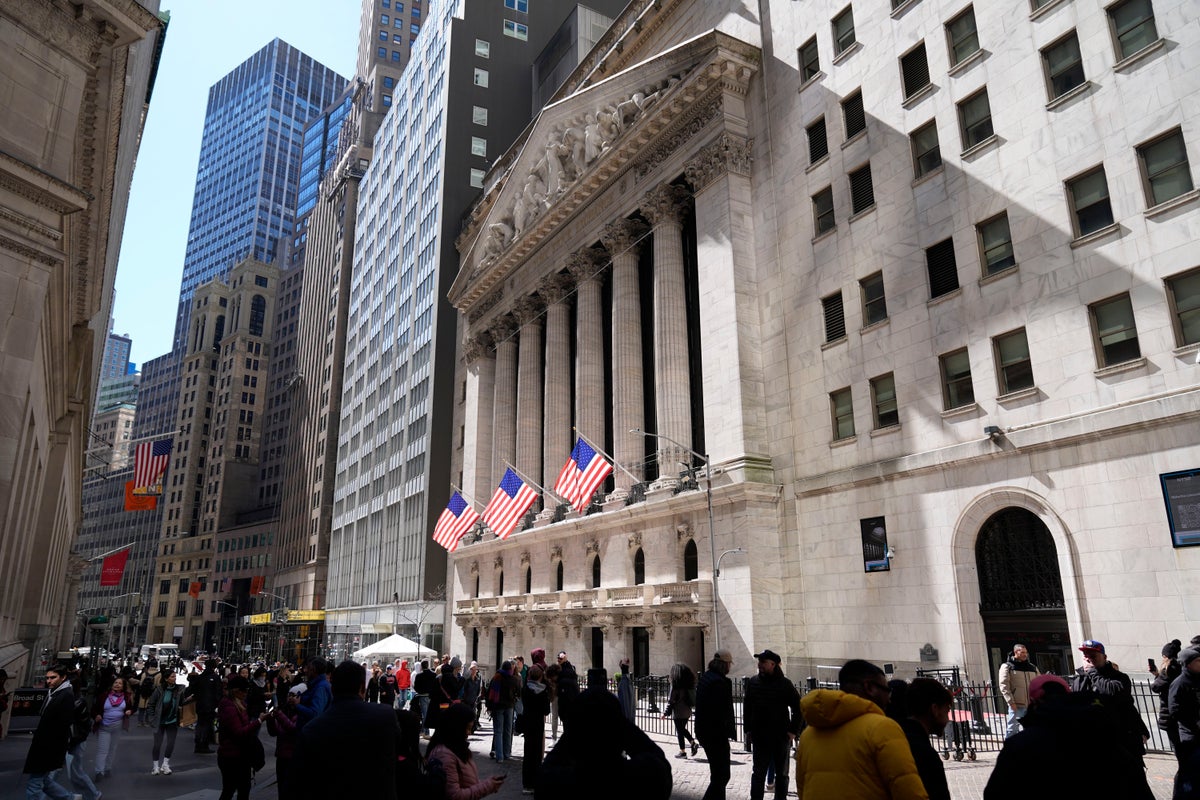
The US financial system absorbs 85% of global drug trafficking profits, equivalent to 2.7% of its GDP (Photo: Archive)

The strategy aims to use sanctions, blockades, and military threats to create fractures within the military leadership, thus replicating the "hybrid warfare" model orchestrated in other contexts. This is coupled with the use of new technologies—via Operation Southern Spear —in which the participation of Trump's new allies, Big Tech , would be paramount .

Washington has fabricated an enemy that fits its narrative, regardless of the evidence. While the US financial system absorbs 85% of global drug trafficking profits—equivalent to 2.7% of its GDP—and while Ecuador, according to the World Customs Organization, has become the world's leading exporter of cocaine, attention remains fixed on Venezuela.

The Tren de Aragua and the "Cartel of the Suns" are discursive wild cards used to violate International Law, justify the military and financial siege, and create the conditions of internal chaos necessary for a regime change that, in the end, seeks to seize the country's strategic resources and eliminate a critical reference to its decadent unipolar vision.

https://misionverdad.com/venezuela/giro ... -los-soles

Google Translator

******

Image

Venezuela Under Siege: A Hundred Deaths At Sea; Hundreds Of Thousands By Sanctions
By Roger D. Harris, Popular Resistance.
November 22, 2025

Above photo: Brian Garvey.

Washington is targeting the Venezuelan people in an escalating regime-change offensive.
Combining open military violence with an economic siege that has quietly claimed far more lives.

Most of the world looks on in disbelief at the now-routine murders on the high seas off Venezuela’s coast – serial killings that the newly minted War Department calls Operation Southern Spear.

On October 31, UN High Commissioner for Human Rights Volker Türk condemned the attacks, saying that the “mounting human costs are unacceptable.” The People’s Social Summit in Colombia (November 8-9) excoriated Washington. Four days later in Caracas, a meeting of jurists from 35 countries denounced the “homicidal rampage.” The Military Law Task Force of the National Lawyers Guild charged “egregious war crimes and violations of international human rights, maritime, and military law.”

Even The New York Times, an outlet that is not squeamish about US atrocities, described Washington’s flimsy drug-interdiction rationale as being “at odds with reality.”

The notion that the US – the world’s leading consumer of illegal narcotics, the major launderer of trafficking profits, and the cartels’ favored gun runner – is concerned about the drug plague is ludicrous.

In reality, Venezuela is essentially free of drug production and processing – no coca, no marijuana, and certainly no fentanyl – according to the authoritative United Nations World Drug Report 2025. The European Union’s assessment of global drug sources does not even mention Venezuela.

Most inconveniently for Mr. Trump, the US Drug Enforcement Agency (DEA) 2025 National Drug Threat Assessment does not list Venezuela as a cocaine producer and only as a very minor transit country. Nor is Venezuelan President Nicolás Maduro cited as a drug trafficker.

The State Department is designating the so called Cartel de los Soles, allegedly headed by Maduro, as a Foreign Terrorist Organization (FTO), However, the entity is nowhere to be found in the DEA assessment for the simple reason that it does not exist.

Meanwhile, the body count from the killing spree is nearing one hundred, yet not an ounce of narcotics has been found. In contrast, the Venezuelan government has seized 64 tons. Clearly Washington’s intent is not drug interdiction but regime change.

Sanctions kill
As horrific as the slaughter by direct US military violence against Venezuela may be, a far greater contributor to excess deaths has received scant media attention. The toll from sanctions is well over a hundred-fold larger.

Sanctions are not an alternative to war but a way of waging war with a less overt means of violence – but deadly, nonetheless.

Sanctions, more properly called illegal unilateral coercive measures, are as lethal as the missiles Washington rains down on small boats in the southern Caribbean and the Pacific from Ecuador to Mexico.

Economists Mark Weisbrot and Jeffrey Sachs demonstrated that US sanctions imposed 2017-2018 drastically worsened Venezuela’s economic crisis and directly contributed to an estimated 40,000 excess deaths.

By 2020, former UN Special Rapporteur Alfred de Zayas estimated a death toll of over 100,000. An expert in international law, de Zayas argues that sanctions function as collective punishment, harming civilians rather than government officials.

Washington is now escalating its regime-change offensive – while maintaining the sanctions – precisely because Venezuelans have successfully resisted the punitive measures.

Sanctions disproportionately kill children
A peer-reviewed scientific report in The Lancet reveals that a disproportionate number of the sanction’s victims globally are children under the age of five. In fact, the study finds that more human life is extinguished by sanctions than by open warfare.

The SanctionsKill! Campaign describes itself as an activist project to expose the human cost of sanctions and what can be done to end them. They are inviting health workers to sign a letter to the US Congress and the executive branch to end these child-killing sanctions.

Drawing from The Lancet study, the health workers’ letter details how sanctions are particularly deadly for small children by:

Provoking increases in water-borne illnesses and diarrheal diseases
Causing low birth weight
Exacerbating hunger and malnutrition
Denying lifesaving cancer care and organ transplants
Obstructing access to and import of antibiotics and other common medicines
Hindering sanctioned countries from receiving assistance during natural disasters
Among the signatories are Margaret Flowers, MD, a pediatrician and long-time health reform advocate; professor emeritus Amy Hagopian, PhD, at the University of Washington and former chair, International Health Section, American Public Health Association; internist Nidal Jboor, co-founder of Doctors Against Genocide; and pediatrician Ana Malinow, National Single Payer leader.

Others include health policy professor Claudia Chaufan, MD and PhD, York University; child and adolescent psychiatrist Claire M. Cohen, MD, National Single Payer, PNHP; and Kate Sugarman, MD, Georgetown Law School and George Washington School of Medicine.

Their letter concludes that there is a clear consensus in the literature that broad unilateral economic sanctions have devastating health and humanitarian consequences for civilian populations: “This is a global public health crisis caused by US government policy. We implore you to fulfill your inescapable obligation to end it…Imposing such collective punishment on the innocent is morally reprehensible.”

Sanctions and slaughter
Blogger Caitlin Johnstone quips: “civilized nations kill with sanctions.” That the US kills by both sanctions and open military force does not prove her wrong. Rather, it demonstrates that today’s US empire is not civilized.

Because open warfare is more dramatic than unilateral coercive measures, there is a danger that child-killing sanctions are becoming normalized.

Indeed, this form of hybrid warfare by the US impacts roughly one-quarter of humanity. History shows – as in the case of the 1961 John F. Kennedy sanctions against Cuba – that once imposed, sanction regimes are politically difficult to end.

The campaign against unilateral coercive measures is as central to the struggle for peace as opposition to overt military aggression. Sanctions are not a benign substitute for war; they are an additional mechanism of lethal collective punishment.

PS: The health-workers’ letter will not be submitted until early 2026, so health professionals of all disciplines still have time to sign on.

https://popularresistance.org/venezuela ... 6bf040dcd8

******

Mision Verdad: The fundamental role of the Venezuelan population in the face of military threats

Image

https://misionverdad.com/venezuela/el-r ... -militares

The increasingly less covert US military deployment, ostensibly under the guise of an “anti-drug operation,” has the clear objective of regime change in Venezuela. The scenarios range from a direct military attack against the national government to the creation of an internal rupture, accelerated by mercenaries hired from Washington, that would shatter the cohesion of the Bolivarian National Armed Forces (FANB), among other effects.

The Venezuelan population has reacted in a way that is, perhaps, unexpected by the global media exerting psychological pressure on them. There is no visible unrest in the streets, and, as those same media outlets have reported, the majority rejects foreign intervention in the country. Many questions arise from this social behavior, requiring an analysis of the factors that might help answer them.

The scenarios proposed for a regime change
Recently, the first scenario has been attempted through false flag operations, such as those orchestrated from Guyana. On several occasions, armed actors have provoked confrontations with security forces from this neighboring country, which occupies the Essequibo region, in order to establish a casus belli that would lead to a US military occupation.

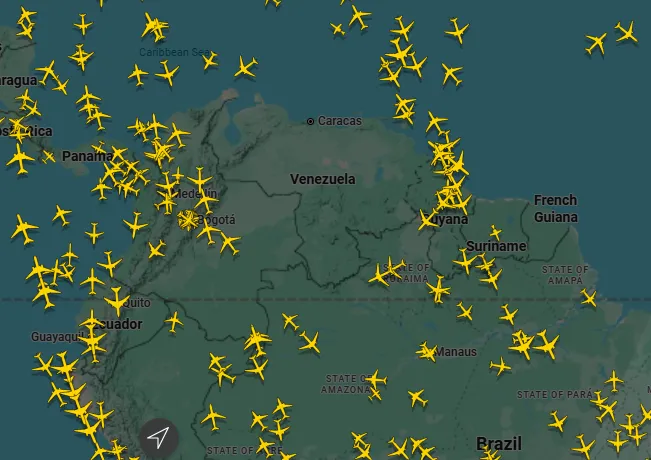
It is well known that Secretary of State and Acting National Security Advisor Marco Rubio intends to use the territorial dispute over Essequibo as a trigger for this scenario. Furthermore, the hypothesis that the recent flights of US fighter jets, bombers, and reconnaissance aircraft are intended to provoke reactions—or errors—from the Venezuelan Armed Forces (FANB) to justify this being a trigger for military escalation.

The media-savvy opposition figure Maria Corina Machada ostentatiously displays her desire for internal strife within the Venezuelan military. The rhetoric she employs includes creating excessive anxiety that foreshadow scenes of mass military desertion “in search of redemption.” In contrast, last week the New York Times revealed that Trump “is reluctant to approve operations that could endanger U.S. troops or result in an embarrassing failure,” which, if true, is understandable.

The second scenario attempts to replicate the violent escalations of 2014 and 2017, adding the element of criminal gangs, as was tested on July 29, 2024, after the presidential elections. The failed swarming tactic consists of creating virulent hotspots in different regions of the country through the use of weaponry to create conditions that lead to the first scenario.

Establishing the narrative of a “repressive Venezuelan government” serves Washington—and the opposition it sponsors—to activate the well-established mechanisms of color revolution that, as in Libya and Syria, pave the way for the militarization of the conflict under the guise of defending civilians. In both cases, with their various ramifications and variations, the population plays a decisive role.

The role of the Venezuelan population in a war scenario
The reasons for the internal rupture are complex because the opposition has lost political influence and, consequently, its ability to mobilize support, but also because terrorist plots aimed at creating chaos have been consistently dismantled. Furthermore, actors infiltrated within the country have been detected and neutralized, in many cases with the help of intelligence by the people, that is, information from the civilian population.

On the other hand, when the militaristic threat of the Trump administration increased, the Venezuelan government called on the people to enlist to “transition from a peaceful revolution to an armed revolution.” This transition relies on the Bolivarian National Militia, created by Commander Hugo Chávez in 2009 as a volunteer corps, a civilian complement to the FANB (National Bolivarian Armed Forces), with the objective of defending national sovereignty and peace. What for years functioned as an auxiliary body formalized its role in 2020 when it was elevated to the status of the fifth component of the FANB, giving it unprecedented institutional weight.

President Maduro has stated that Venezuela’s strategy in the face of threats from the United States is “primarily defensive,” encompassing “diplomatic and political struggle.” However, he warned that if “Venezuela were attacked, it would immediately enter a period of armed struggle in defense of the national territory” and “constitutionally declare the republic in arms.” This is a military strategy of irregular resistance that, based on Bolivarian doctrine, assumes that, just as the Liberator mobilized entire populations against an empire, Venezuela is called upon to resist any foreign power through a total mobilization of its citizens.

In this regard, the Vice President for Political Affairs, Citizen Security, and Peace, Diosdado Cabello, described the strategy for a potential conflict as “not conventional warfare. It’s a different kind of war, and we have to move to that phase and prepare ourselves.” He added, “We’re going to wage it in every part of the country, on every terrain, on every front, and with whatever resources we have at hand.”

Are there conditions ripe for social confrontation?
The socio-economic difficulties, a consequence of the blockade and sanctions, have been viewed by Washington as a breeding ground for social discontent to carry out its destabilizing work in a hidden way without having to resort to an armed invasion.

The Venezuelan government has implemented various strategies for national economic stabilization and is not without its challenges in this area. It has also addressed the socio-political front by deepening actions that strengthen the organizational fabric of grassroots power.

In this regard, the government has redirected social investment and allocated resources to be managed by grassroots social organizations. To this end, Bolivarian Integral Base Committees (CBBIs) have held national popular consultations, beginning with a series of community meetings, or citizens’ assemblies, in which the people propose priority projects to address the collective problems of their communities. These range from the construction of schools and street lighting to support for community-based businesses.

Based on their own concrete proposals, each CBBI commune or communal circuit chooses the project to be implemented and then manages the allocated resources. The concept aims at community self-governance and seeks to territorialize the exercise of democracy based on Articles 5 and 62 of the Constitution, as well as establish conditions to achieve the so-called “fourth transformation” envisaged in the 7T Plan, which is the 2025-2031 government plan. Some facts:

During 2024, two National Popular Consultations were held, the first on April 21 and the second on August 25; these reflected 2,259 water projects, 1,319 road projects, 1,239 habitat projects, 1,153 electricity projects, 873 education projects and 798 sanitation projects.
On February 2nd of this year, 36,685 initiatives proposed by the People’s Power throughout the national territory were voted on, and the formation of the popular self-government centers began in order to achieve direct contact between the central government and the 5,334 communal circuits.
On April 27, during the second National Popular Consultation of 2025, 36,612 proposals were submitted nationwide, and voting took place in 5,718 polling stations across the country. At that time, the Minister of Communes, Ángel Prado, stated that Venezuela had invested $148 million in communities over the course of a year and had consolidated 14,000 projects.
On July 27, the third National Youth Council of the year was held, focusing on projects submitted by young people. A week later, President Maduro reported that, up to that date, 23,455 projects had been approved by vote, 70% of which had already been completed by the communities themselves and “delivered as works that positively impact schools, housing, health centers, access roads, local infrastructure, among other areas.”
The fourth National Popular Consultation of the Bolivarian Integral Base Committees will be held on November 23. The president announced that 13% of the projects are for economic entrepreneurship and production; 42% are focused on public services such as roads, water, electricity, health, and education; 5% on security; 27% are for social programs; 5% are for justice of the peace and community centers; and 6% are for scientific projects.
Faced with the rightwing opposition hope to create an internal conflict, the population is making progress in improving collective living conditions through popular organization and the exercise of territorial politics; this minimizes the conditions for social confrontation because political differences are resolved through dialogue and the collective construction of solutions.

The National Popular Consultations of the Bolivarian Integral Base Committees, as local development plans, allow for the deepening of participatory democracy and the revitalization of leadership for political representation and the construction of new social consensus.

What remains of the US “humanitarian” excuse
The war against Venezuela is not a recent issue. In any confrontation, it is necessary to surround the target and cut off its supplies: the goal of the sanctions and blockade measures implemented by the United States.

These measures harmed the health and nutrition of the population. Researcher Clara Sánchez has highlighted that, starting in 2015, malnourishment reappeared and increased “proportionately to the number of unilateral coercive measures imposed.” She adds that, according to the FAO, this scourge reached its highest level in 2019.

The ongoing regime change operation was anchored in the narrative of a food crisis as a “channel to carry out a ‘humanitarian’ military intervention in the country, endorsed by the international community,” while sectors of the extremist opposition stole national assets in collusion with the Trump and Biden administrations. But the “complex humanitarian emergency” narrative failed, so both the opposition and its allies in Washington shifted gears and are now criminalizing those they considered victims less than two years ago: Venezuelan migrants.

Last September, President Maduro announced that the country has food reserves equivalent to 101 days of consumption, the highest figure in the nation’s history. He added that the country produces and supplies 100% of the food consumed domestically, while also generating a surplus that allows for exports.

The economy has been growing for 18 consecutive quarters, and this recovery, which is due to a strategy based on the 13 Productive Engines that combine structural recovery in sectors that have traditionally sustained the economy, such as hydrocarbons, with the incorporation of other non-traditional sectors.

The farming and fishing sectors, part of the social base of food production, have contributed strengths in the food sector:

With the participation of both sectors, undernourishment decreased from 17.6% between 2021 and 2023 to 5.9% between 2022 and 2024. This represents a recovery of more than 66%.
The national primary production of plant and animal food has not stopped growing in the last six years and in 2024 it rose to 6.2%.
Venezuelan farmers have increased coffee exports by 500% in the first half of the year, compared to the previous year, demonstrating the sector’s capacity to export.
Last September, 15,400 peasant councils were revitalized and, in assemblies, they elected their respective spokespeople for organization and training, productive economy, and territorial defense and national sovereignty.
Malnutrition in children under 5 years of age fell from 14.8% in 2019 to 1.2% in 2024, according to the World Health Organization (WHO).
Fishing activity and industrial processing in the fishing sector has increased by over 7% this year.
The products of “Blue Venezuela” —fishing and aquaculture— have reached 33 countries, with a 225% increase in their international marketing.

Image
Organization in food-producing sectors such as fishing has generated results that dismantle the “humanitarian excuse”

Faced with internal upheaval induced by external factors, the antidote has been the building of popular participation in comprehensive security and defense, increased local political participation, and food sovereignty. This results from a social cohesion based on collective achievements, the deepening of governance practices, and the division among anti-Chavista sectors.

The attempt to dismantle the Bolivarian Republic remains in force in an extremist sector that opted for anti-politics and that assumed the so-called “electoral route” as a device to sharpen the confrontation and seek the implosion of electoral participation.

A broader perspective gives a clearer understanding of the results: extremism has lost influence among its followers; its errors are as evident as the foreign elites sponsorship and leadership over the extremist opposition. Their agendas have become detached from the people, and it would seem that María Corina Machado’s capitulationist promises to these elites confirm this.

https://chicagoalbasolidarity.org/2025/ ... 6bf040dcd8[/img]
"There is great chaos under heaven; the situation is excellent."

User avatar
blindpig
Posts: 14788
Joined: Fri Jul 14, 2017 5:44 pm
Location: Turtle Island
Contact:

Re: Venezuela

Post by blindpig » Fri Nov 28, 2025 2:14 pm

Internal sources at the White House knew in advance about Operation Gideon (I)
Max Blumenthal / Wyatt Reed

November 25, 2025 , 2:01 pm .

Image

Documents released by a federal court offer disturbing new details about an attempt by figures connected to Trump to orchestrate a coup against a government they clearly did not understand. This unprecedented look at the actors and their conspiracies—from terrorism to false flags—could illuminate the nature of the looming US military assault on Venezuela.

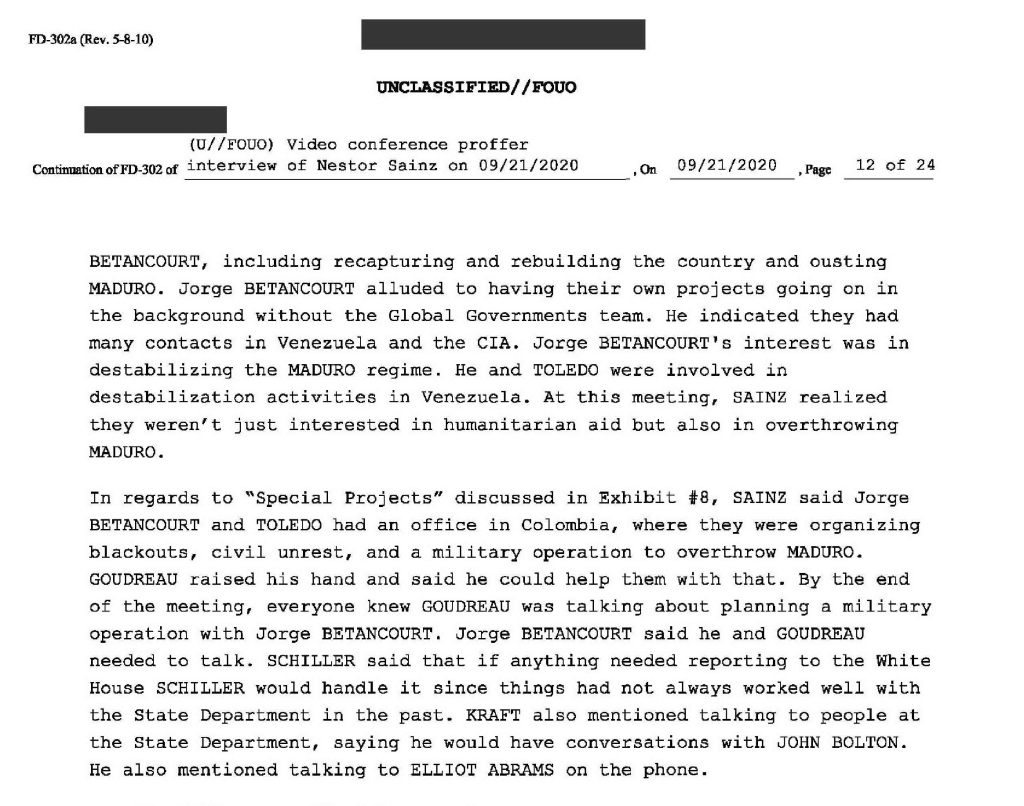
The man whom the US government blames for everything, Jordan Goudreau, provided evidence to The Grayzone that:

He signed a $221 million contract with Juan Guaidó while the United States was plotting, both publicly and privately, to designate him as the legitimate president of the country.
High-level officials from the first Trump administration, including Elliot Abrams, John Bolton, the CIA's top Latin America officer, and a top-level National Security Council advisor, appear to have been aware of his invasion plan and may have been involved in its planning.
People connected to Trump formed a shady company to extract profits from a post-Maduro Venezuela after a Guaidó associate urged them to “act now, grab companies, collect.”
The CIA and an intelligence-linked propaganda firm called The Rendon Group carried out sabotage of critical Venezuelan infrastructure “for a decade or so.”
The CIA and an intelligence-connected propaganda firm called The Rendon Group carried out sabotage of critical Venezuelan infrastructure for "roughly a decade".
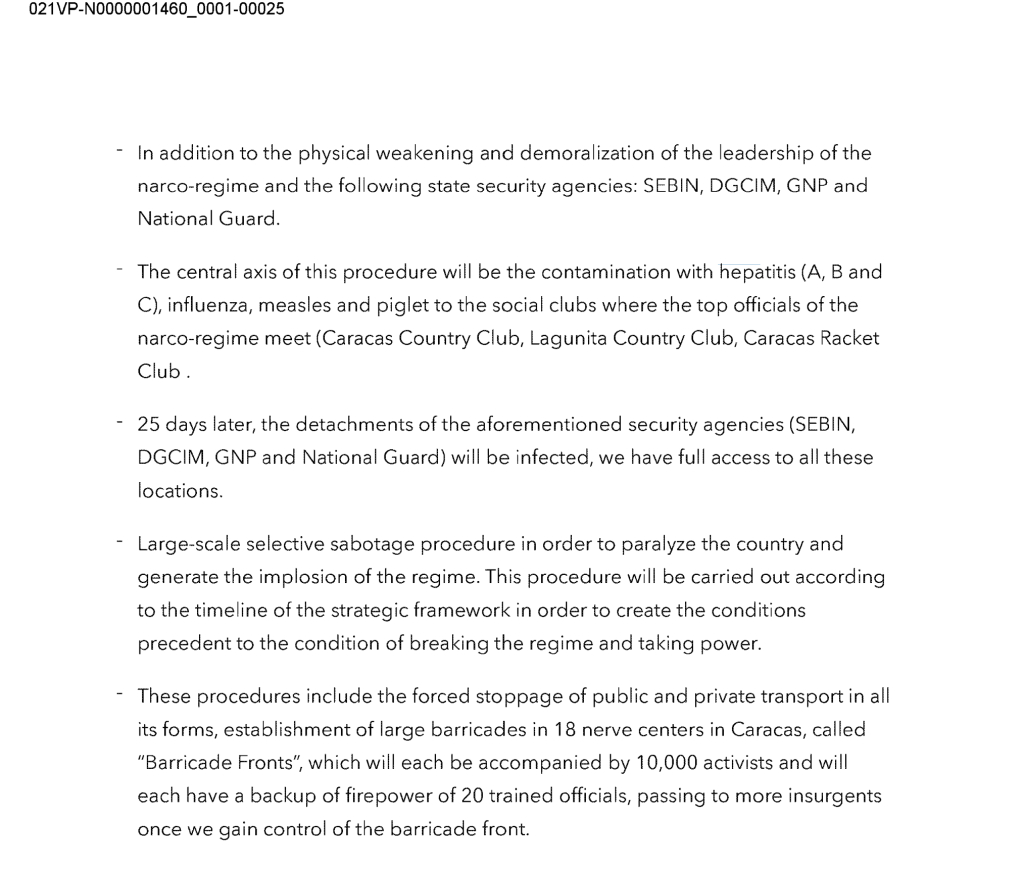
A proposal delivered to Vice President Mike Pence's office included plans to conduct "false flag" operations in Venezuela, spread hepatitis within the country's military, and fund schemes through the "expropriation" of "narcotic substance".
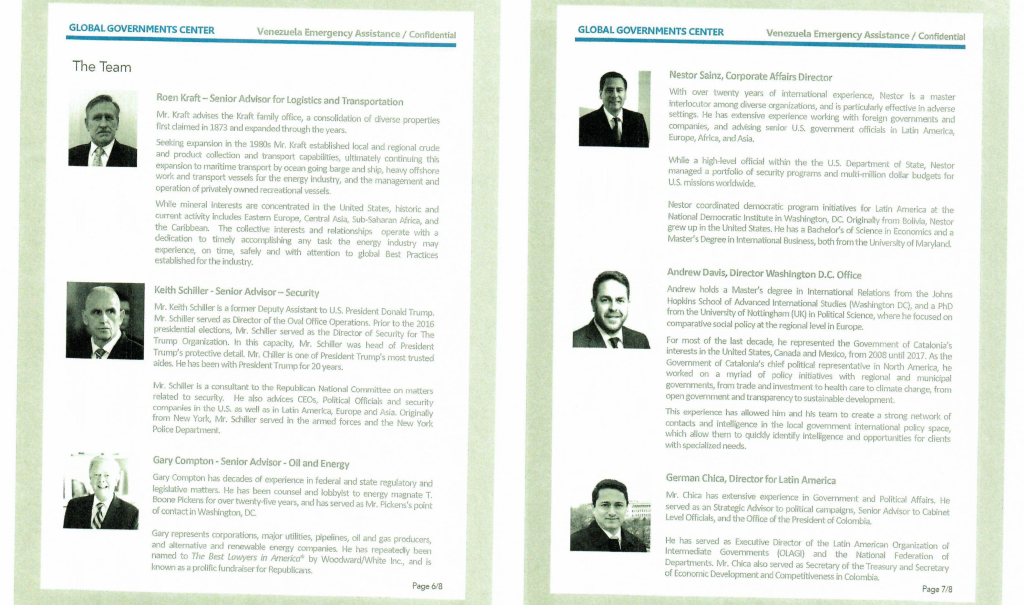
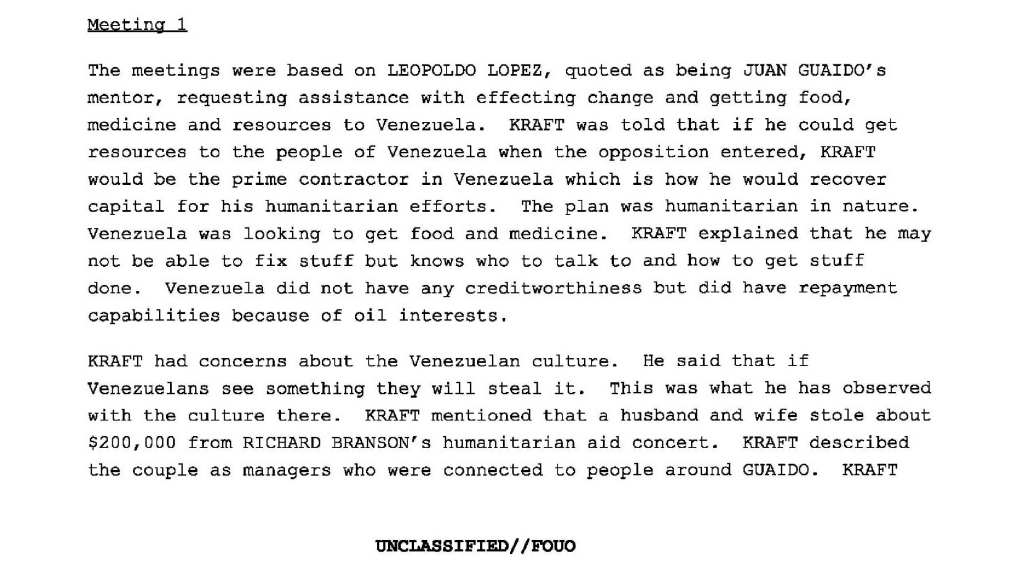
Roen Kraft, a wealthy financier with intelligence ties, recruited to fund aspects of the operation, told the FBI that he came to the conclusion that “if Venezuelans see something they steal it,” accusing Guadió’s cronies of pocketing $200,000 of humanitarian aid money.
Participants in the scheme told the FBI that they viewed the Venezuelan opposition as hopelessly corrupt after witnessing its leaders squandering huge sums "on prostitutes, thousand-dollar bottles of wine, and appointments for their girlfriends' nails."
On the morning of May 3, 2020, two small boats with outboard motors lurked in the coastal waters of La Guaira, Venezuela. Unlike the 15 that the U.S. Navy had recently sunk, they weren't carrying drugs, allegedly. Instead, they carried something far more alarming: former U.S. special forces soldiers hoping to be welcomed as liberators by the Venezuelan people.

Along with a handful of Venezuelans who had trained in the Colombian jungle, former Green Berets Airan Berry and Luke Denman planned to activate a violent national insurgency that was to culminate in the overthrow and kidnapping of Venezuelan President Nicolás Maduro.

Hours later, the pair were filmed on the seawall of a fishing village, face down and bound hand and foot by the very Venezuelans they thought they were saving. Officially, the failed coup was known as Operation Gideon. But it would popularly become known as "Bay of Pigs," a humorous repackaging of the equally failed 1961 Bay of Pigs invasion of Cuba.

Eight Venezuelan exiles died during the aborted incursion, and jailhouse interviews with two of the captured Americans were later broadcast on television to audiences across Venezuela. In the file, Berry and Denman make it clear that authorization for the operation reached the highest levels of the U.S. government, directly pointing to President Trump as the mission's chief executor.

Mike Pompeo, Trump's then-Secretary of State, denied any direct U.S. involvement. In the years since, the United States has sought to portray the plot as an unauthorized operation carried out by a rogue mercenary named Jordan Goudreau. The decorated former Green Beret, who has since become the face of Operation Gideon, was arrested in 2024 and now faces 14 charges based on federal allegations that he conspired to traffic weapons through Colombia in the final phase of the failed plot. The charges carry a combined maximum sentence of ten years.

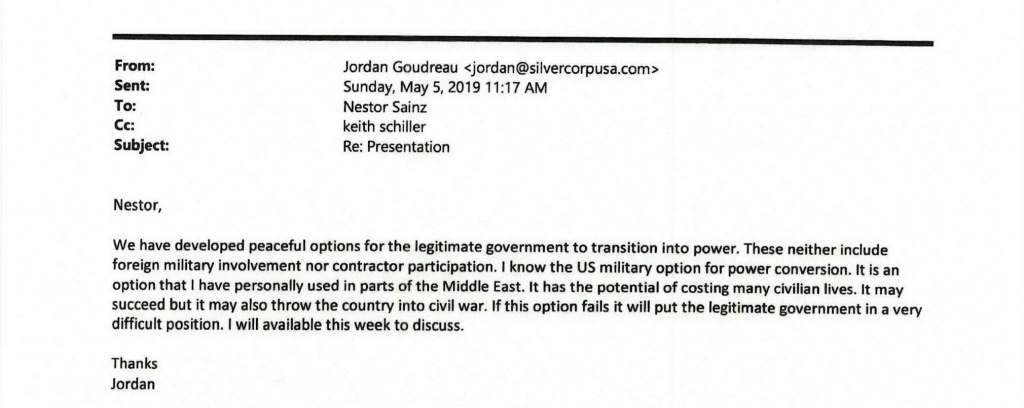
In interviews with The Grayzone, however, Goudreau insisted that he was personally recruited by Trump's team security chief, Keith Schiller, to lead a coup against the Venezuelan government, and that the operation proceeded with the full support and knowledge of the U.S. government.

Now, Goudreau's legal team has gained access to previously unseen evidence about the figures he says orchestrated the coup. The Grayzone is among the first publications to review the material, which includes FBI interviews with plot participants demonstrating advance knowledge by high-level Trump associates, Colombian government leaders, CIA officers and agents, and officials working directly under Mike Pence and Trump. The documents strongly suggest that the government monitored and supported the operation at various stages, and that it has been funded by U.S. financiers close to Trump, as well as Venezuelan opposition leaders on Washington's payroll.

Behind the guise of lofty goals like "promoting democracy" and holding "bad actors" accountable, the Washington operatives and spies who allegedly recruited Goudreau to lead them to Caracas were driven by something more than greed. Hungry for a slice of Venezuela's vast oil and mineral wealth, and eager to secure lucrative contracts for the day after Maduro's departure, the white-collar coup planners embarked on a plundering adventure that ended in infamy.

The files reviewed by The Grayzone also include secretly recorded discussions, emails, and elaborate plans for coups and terrorist attacks prepared by influential figures in the Venezuelan opposition. Taken together, they paint a far from flattering portrait of the political circle that the United States has trained and sponsored for two decades. Among the accusations most frequently leveled by those involved in Operation Gideon was that leading opposition figures were not only eccentric degenerates but also prone to stealing from their patrons in Washington.

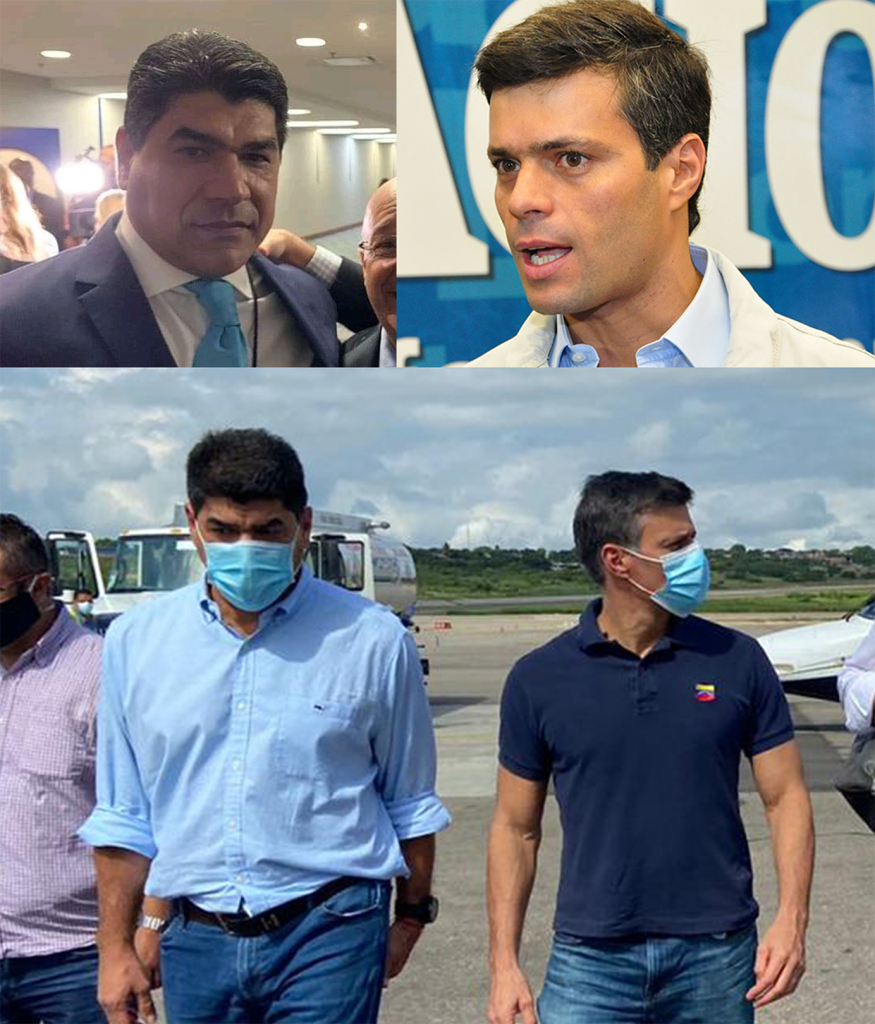
Those exposed for wasteful corruption in the Operation Gideon files are poised to seize power if the U.S. military show of force ordered by Trump this October succeeds in toppling the Venezuelan government. This includes two opposition leaders ridiculed as "Beavis and Butt-head" by a U.S. financier of the operation, as well as their former boss, Leopoldo López, and his protégé, Juan Guaidó, who is described in one of the FBI files as a potential recipient of money from anonymous "drug traffickers."

However, the only figure who has faced criminal penalties for Operation Gideon is the former Green Beret who carried it out. Facing years in federal prison, Goudreau skipped bail and disappeared. Before evading justice, he participated in several interviews with The Grayzone, providing us with an “intelligence briefing” claiming that he would never have been in a position to lead a private army into Venezuela without the knowledge and blessing of the Trump White House.

"We have several options for Venezuela"
Once seen as a staunch U.S. ally and a reliable intelligence partner during the Cold War, Venezuela's relationship with Washington began to sour when the country elected populist Hugo Chávez in 1998. The charismatic army officer, who rose to fame leading an unsuccessful uprising against the repressive, unpopular neoliberal government in 1992, threw himself headlong into an ambitious plan to fund massive anti-poverty campaigns by renationalizing Venezuela's oil fields.

In the following decade, Chávez's initiative raised living standards and oil production in Venezuela, reducing extreme poverty by two-thirds while quadrupling crude exports. But he was less popular in Washington, which responded in 2002 by orchestrating a coup that deposed the president for almost 48 hours before massive, spontaneous demonstrations, along with loyal factions within the military, restored him to power.

Following Chávez's untimely death in March 2013, his foreign minister and successor, Nicolás Maduro, was elected months later. Within a year, then-President Barack Obama enacted sweeping sanctions against Venezuela, leveling accusations of human rights abuses to justify attacks on the country's oil sector, thus paving the way for a series of violent regime-change operations.

The opposition-controlled National Assembly ignored a court ruling , swearing in three legislators whose seats were obtained through vote-buying, and exploiting the deadlock to destabilize the country through violent street riots. Maduro essentially overcame the paralysis by invoking the original constituent power to convene a constituent assembly in 2017.

Trump seized the opportunity to escalate, threatening to invade the country if Maduro refused to step down. "We have several options, including military action, if necessary," Trump told reporters at a press conference that August.

Maduro was subsequently declared the winner of the 2018 presidential election, which the Trump administration condemned as illegitimate . The following year, the administration declared the previously obscure leader of the National Assembly, Juan Guaidó, as the president of Venezuela, citing a constitutional provision they insisted disqualified Maduro from holding power.

Washington's recognition of Guaidó enabled the theft of Venezuela's gold reserves at the Bank of England, as well as the expropriation of its most valuable asset, Citgo, the international arm of the state oil company PDVSA. By forcibly removing billions of dollars of wealth from the elected government in Caracas, the US government fueled poverty and mass migration, and encouraged the corruption of opposition figures financed with the stolen assets.

However, like previous plots to overthrow Venezuela's socialist leadership, the sham presidency would end in shameful disgrace. Its demise began with a failed operation in February 2019 to force a massive shipment of USAID-supplied goods across the Colombian-Venezuelan border.

The death of Venezuela Aid Live
The plan aimed to cross the country's borders under the guise of humanitarian aid, using convoys of trucks to force their way into Venezuela. They would then accuse Maduro of cruelly rejecting aid intended for a supposedly desperate population, and of using his security forces to obstruct the hostile intervention. If the Venezuelan government failed to prevent the convoys from entering the country, the resulting loss of control would ignite a larger rebellion.

But the humanitarian propaganda maneuver ended almost immediately in ignominy when its initial wave failed to break through a line of border guards, and opposition hooligan gangs set fire to the aid while seizing the rest. An attempt to blame the burning of the millions of dollars of purported aid against Maduro's forces equally failed when Max Blumenthal and several local reporters exposed the opposition's responsibility.

A botched Live Aid concert in the Colombian border city of Cúcuta, sponsored by neoliberal oligarch Richard Branson, was equally unsuccessful, with much of the profit siphoned off by opposition figures. A survey revealed that less than 1% of concertgoers stayed to help after the star-studded show.

Image

Meanwhile, pro-opposition media outlets revealed that Guaidó's cronies had embezzled enormous sums of money promised to Venezuelan soldiers who would defect to Colombia and join the anti-Maduro rebellion. In the end, the deserter soldiers were abandoned penniless in Cúcuta, while Guaidó's high-ranking henchmen squandered their share of the humanitarian aid on prostitutes and lavish hotels.

Two of the would-be coup plotters, Freddy Superlano and his cousin, Carlos José Salinas, were found unconscious in a hotel room after being drugged and robbed by two prostitutes who were apparently paid with money that was supposed to be for homeless Venezuelans.

For his part, Guaidó was photographed days before the humanitarian publicity stunt on the Colombian side of the border with high-level leaders of the notorious Los Rastrojos cartel, who reportedly smuggled him into Colombia.

Image

Following the failure of the humanitarian intervention, and with options for ousting Maduro dwindling, the Trump administration took an extraordinary step, clearly designed to incentivize private coup plots. On March 26, 2019, the Department of Justice offered a $15 million reward for information leading to Maduro's capture.

At that time, Goudreau was exploring an invasion of Venezuela to collect the bounty and become a mercenary superstar. After serving in Iraq and Afghanistan, where he earned commendations from his special forces operatives for his human intelligence skills, Goudreau left to work in private security. He worked at least one Trump campaign rally, with a photo posted on his firm's Instagram account showing him within the president's security detail in Charlotte, North Carolina, in 2018.

It was around that time that Goudreau said he was introduced to Keith Schiller, a longtime security chief for Donald Trump and the face of several of the president's family's ventures abroad.

In early 2019, Schiller was one of a group of Trump associates, Washington lawyers, and resource-hungry industrialists who joined forces to pursue lucrative contracts in a fanciful post-Maduro Venezuela. Operating under the name "Global Governments," this shadowy group quickly sought to make its mark in Venezuela, though not in the way its founders intended.

Image
Keith Schiller seated to the left of Jared Kushner, Trump's son-in-law, on a trip to Iraq in 2017.

Monetizing regime change
In an interview with Max Blumenthal for The Grayzone, Goudreau said that the Global Governments (GG) team had a simple set of motives: "They wanted contracts. They wanted a way to monetize what would come next in a Venezuela free of Maduro."

Apart from Schiller, those mentioned in internal documents as members of the "Team" include:

Roen Kraft, a senior transportation and logistics advisor for a company whose first name is not publicly listed, but appears to be Timothy. According to a GG partner, “Kraft handled energy, oil, gas, and mining issues; he was experienced and capable in international business and was a logical fit for those roles. Kraft had also dealt with these things in Nigeria, which was a hostile country to work in.” Kraft later told the FBI that he was in a position to provide funding for subsequent humanitarian interventions in Venezuela and recoup his losses in the form of oil profits and contracts for the aftermath of Maduro’s ouster. It remains unclear whether Kraft is one of the heirs to the Kraft dairy fortune, as other media outlets have reported.
Néstor Sainz, a former State Department desk officer and Washington-based operative, assumed a role at GG to act as a bridge to contacts linked to the Venezuelan opposition. FBI interviews with associates of the company indicate that Sainz had cultivated relationships with several associates of Leopoldo López, the main lobbyist for the U.S.-backed opposition.
Gary Compton, "the lawyer and lobbyist for energy tycoon T. Boon Pickens for more than 20 years," was described as an oil and energy expert by his GG colleagues. He was listed as a former partner at the law firm of Travis Lucas, who was frequently present at the company's meetings related to Venezuela.
Germán Chica , a Venezuelan opposition figure who occasionally appeared at GG meetings as a liaison for anti-Maduro forces, was one of the governors of the Luna Foundation , ostensibly dedicated to women's rights, and is listed as a GG associate.
Andrew Davis, president of the Catalan-American Council , which lobbied for the independence of Catalonia from Spain.
Travis Lucas is not listed as a former member of the GG team; however, he acted as Schiller's Washington lawyer. Having legally represented then-Vice President Mike Pence and then-Secretary of State and former CIA Director Mike Pompeo, Lucas offered the firm a potential line to the top of the Trump administration.

Image
A brochure from Global Governments containing biographies of its highest-profile partners.

GG secured its first and only client in early 2019 when Sainz contacted Morris, the well-known Republican consultant, to promote the company's plans to amass lucrative contracts following the ouster of the Republican government. According to Sainz, Morris contacted his brother-in-law, Chris Larsen, who ran an international construction company called Halmar , and expressed strong interest in the project.

In early February 2019, Larsen arrived at GG's Washington office to discuss the next steps with Kraft, Sainz, and Germán Chica. Dick Morris was also present for the meeting. Apparently, Larsen liked what he heard because, according to Sainz, he became the first and only client GG signed for its post-Maduro gold rush.

The New Jersey construction magnate sent a $16 billion advance to Global Governments, promising another $6 billion over the next six months. After spending nearly $100,000, however, Larsen withdrew from the project when it appeared to be going nowhere.

According to an FBI document, "Sainz said that several months had passed and they hadn't done anything for Larsen, who understood why and wanted to retire. When Larsen's check arrived, it was cashed and divided among GG's team."

Although GG struggled to get off the ground, Sainz told the FBI that it was clear the firm was preparing a military-style operation in Venezuela, a perception that Goudreau confirms was widely shared.

"At the first meeting we had, all of us, along with GG, always knew that I was going to stage a military coup," Goudreau said.

"Act now, seize companies, collect."
"It all started at a University Club of Washington meeting on March 19, 2019."

This is how Lester Toledo, Juan Guaidó's self-styled humanitarian aid director, described his first meeting with people associated with Trump and top GG officials at the University Club, a luxurious members-only club in the heart of the capital. Together, the group of curious coup plotters brainstormed a course of action after Guaidó's humanitarian maneuver had fizzled out a month earlier.

On hand for the initial reception were Sainz, Schiller, Lucas, Kraft and representatives of the Danish shipping company Maersk, who expected to be given logistical support for future assistance operations.

"Nothing about military action was discussed at that meeting," Toledo told the FBI.

Two weeks later, Toledo said he received a text from Schiller seeking to introduce Goudreau as the potential leader of the team that would provide security for the humanitarian aid shipments to Venezuela. In an interview with the FBI two years later, Schiller echoed Toledo's account, insisting that Goudreau was never supposed to lead a private military invasion.

Next, Goudreau and Schiller traveled to Boca Raton, Florida, in early April to discuss their emergency plans with Toledo. During that discussion, Schiller questioned how the supposed humanitarian aid could ensure Maduro's forced removal. "It would be a disaster," Trump's security chief warned.

Then, in an email dated April 16, 2019, Schiller arranged a call to introduce Goudreau to GG's director of corporate affairs.

As GG got closer and closer to Guaidó's inner circle, one of his advisors, a former State Department official named Nestor Sainz, learned of a decisive opposition plan to incite a military uprising against Maduro and seize power by force.

During a wide-ranging interview with the FBI, Sainz said he was informed of a military coup at least a year before it was carried out, having been alerted by a close confidant of Guaidó named Pedro Paúl Betancourt. According to Sainz, Guaidó's associate marketed the impending coup as an opportunity for potential U.S. supporters to “act now, seize companies, and collect.”

In that interview, Sainz insisted that he merely sought to help introduce energy companies to Venezuela, as well as construction companies that could rebuild the country's damaged infrastructure.

GG affiliates echoed this line, claiming they were only interested in humanitarian efforts and business opportunities under a pro-US, market-friendly Venezuelan government. However, recently released documents and witness statements show that military action against Maduro was frequently discussed at these meetings.

On April 13, 2019, Kraft fired off an email to Sainz, Schiller, Lucas, and other GG affiliates stating: "There are now few, if any, who believe that Venezuela will have a change of government without some degree of military action. The doors are closing around Maduro, and there are actions underway to ensure his downfall and removal."

Kraft stated that the Venezuelan opposition had requested a proposal to pave the way for this “military action” by organizing supplies and assets around the country's borders: “Guaidó's request is for a proposal with time to mobilize, prior work in that direction, followed by a draft of the main services… I believe Curaçao is the best location to have as a base, since Venezuela now has 17 of them along the border with Colombia. With the navy disabled, it is a safer approach from Curaçao, and we can divert to Colombia to land easily.”

Kraft appeared to suggest he had obtained financing from the Inter-American Development Bank (IDB), though he noted that he would only pay mercenaries if they were falsely classified as health and safety personnel. "Please note that the IDB would not pay or approve a payment for belligerents or security personnel. They would need to be booked and billed as something like health, safety, and environment (HSE) personnel," the financier wrote.

Image
The impending coup depended on mass defections from the army's leaders, and was to culminate in the takeover of Miraflores Palace.

However, when Guaidó executed the plan on April 30, 2019, it resulted in an even greater political catastrophe for the opposition than the humanitarian aid maneuver of a few months earlier. The army stood firmly with Maduro, leaving Guaidó's men isolated and outnumbered on the streets of Caracas. They were all arrested or sought refuge in embassies.

While the army dealt with the aftermath of the operation, a photo circulated in international media showing the presidential wannabe looking desolate, abandoned by his supporters and isolated at a highway exit in Caracas alongside his mentor, Leopoldo López.

The failure proved to be the final blow for Guaidó, triggering a series of bizarre political maneuvers and public humiliations before his career in Venezuela finally fizzled out. He fled to Miami in 2021, where he now holds a symbolic professorship at Florida International University’s Adam Smith Center for Economic Freedom, a position typically reserved for other disgraced political colleagues on the Latin American right.

Hours after the failed uprising on April 30, then-Secretary of State Mike Pompeo attempted to restore the morale of the would-be coup plotters, declaring in a Fox Business interview that Trump remained open to military action against the Maduro government: "The president has been very clear and incredibly consistent: military action is possible. If that's what's required, then that's what the United States will do."

At this point, Goudreau moved to center stage as GG sought alternative means to overthrow the president. For on-the-ground assistance, they approached a couple of opposition figures who claimed to be CIA agents.

Image
Jorge Betancourt (left) seen walking alongside his longtime associate, Leopoldo López (right), after landing in Cúcuta, Colombia in 2020. They have just disembarked from a plane owned by a Florida company that had previously sold an aircraft to a Colombian man who was arrested for transporting 500 kilograms of cocaine to Honduras.

Introducing "Beavis and Butt-head", and their "CIA boss"
On May 3, Nestor Sainz asked Goudreau to introduce himself and his private security company, Silvercorp USA (based in Florida), to the rest of the GG team.

In an email to Sainz and Schiller two days later, Goudreau outlined his purported "peaceful options" for regime change, which involved neither "foreign military involvement nor the participation of security contractors." He contrasted his own plans with the "US military's option for power conversion."

But having "personally used it in parts of the Middle East," Goudreau acknowledged that a U.S. military intervention in Venezuela "has the potential to cost many civilian lives" and "could also plunge the country into a civil war."

Image

By this point, Goudreau had become a recurring presence in discussions with GG and the organization's contacts within Venezuelan opposition circles. Accounts of these interactions differ, but the details Sainz described to the FBI largely align with Goudreau's statements.

Through Sainz, a couple of opposition activists with close ties to the U.S. government and alleged CIA connections were introduced to Goudreau and GG. They were Lester Toledo, Guaidó's director of humanitarian assistance, and Jorge Betancourt Silva, an operative whom Toledo described to the FBI as "the right-hand man" of Guaidó's mentor, Leopoldo López.

Goudreau, writing for The Grayzone, characterized Betancourt as a kind of ghost, saying, "You won't find his name in the news anywhere. He's well protected." And indeed, it's nearly impossible to find any information or even a mere mention of Betancourt through a simple Google search. Nevertheless, a few Venezuelan blogs and interviews with the FBI reveal him as Leopoldo López's former bodyguard with a penchant for questionable behavior.

Raised in the small mountain town of Caripe, he was likely introduced to the opposition faction by Carlos Vecchio , a lawyer from the same town who represented ExxonMobil before being appointed as Guaidó’s “ambassador” to the United States. Although they do not appear to be related, several social media posts by Leopoldo López refer to Betancourt as his “brother.” In photos taken by López during a trip to Cúcuta in 2020, Betancourt can be seen acting as his personal bodyguard.

The rest of her family is similarly involved in Venezuelan opposition politics. When the group sought negotiations with the Venezuelan government in Mexico in 2021, it was represented by Betancourt's sister-in-law, Claudia Nikken.

Toledo helped López found the Popular Will party (with US funding), launching a violent color revolution in 2014 and erecting armed barricades known as guarimbas across the country. Toledo himself led opposition shock troops in Zulia state, where he had previously served as a legislator. When the Venezuelan government sought to arrest him for his role in the unrest, he fled to Spain and later relocated to South Florida to orchestrate further destabilization efforts with Washington's assistance.

In February 2019, Toledo traveled to Cúcuta to represent Guaidó during the failed "humanitarian aid concert." In addition to his work with the opposition, since 2019 Toledo has served as an advisor to Salvadoran President Nayib Bukele, the self-described "coolest dictator in the whole wide world" who has given the Trump administration space in his notorious maximum-security prison, CECOT, and has aggressively abused Venezuelan migrants.

Image
Photos posted on Toledo's Instagram profile, shoulder to shoulder with the iron-fisted ruler of El Salvador.

In 2024, Toledo began assisting Colombian presidential contender Uribe Turbay with what the right-wing news site Infobae described as an effort to replace the current left-wing government in Bogotá with one "that is allied with the Venezuelan opposition and facilitates Maduro's departure from power" in 2026.

Gustavo Petro, the left-wing Colombian president, is now in Trump's crosshairs, facing sanctions and an escalating torrent of invective from the US president.

But in his August 2020 interview , Toledo presented himself as a humble "humanitarian aid director" while distancing himself from military plots against the Venezuelan government.

Sainz, however, painted a decidedly different picture of the pair, telling the CIA that Betancourt's interests extended far beyond humanitarian work. The former State Department official told federal investigators that the two Venezuelans were also involved in orchestrating large-scale power outages, social unrest, and a military coup against Maduro.

Sainz told the FBI that it was at the May 11, 2019, meeting in a WeWork rental office in Miami that he realized the opposition members "were not only interested in humanitarian aid but in overthrowing Maduro." According to Sainz, the participants—including Kraft, Schiller, Goudreau, Bonaventura, Betancourt, and others—were instructed to leave their phones outside the room.

Upon being informed that Betancourt and Toledo “were organizing blackouts, riots, and a military operation to overthrow Maduro” from an office in Colombia, “Goudreau raised his hand and said he could help them with that.” Sainz characterized this as the moment he realized that Betancourt and Toledo “were involved in destabilization activities in Venezuela.”

During that meeting, Sainz said, Betancourt claimed to have CIA contacts. One of those was likely Juan Cruz, a longtime intelligence operative whom Goudreau described as Toledo and Betancourt's "monitor." In 2017, Univision revealed that Cruz had served as the CIA's station chief in Colombia before becoming the head of the agency's Latin America division.

Image

The pair of opposition operatives first connected with GG's team during the meeting at the University Club in Washington in March 2019. And it was there that they began their sales pitch to Kraft, the money man, to finance their operation worth hundreds of millions of dollars.

The billionaire's account of his interactions with Toledo and Betancourt was decidedly unflattering. He was so eager to give it to the FBI, in fact, that he rejected his lawyer's advice not to speak to federal law enforcement officials.

"Kraft said he referred to Jorge and Toledo as Beavis and Butt-head" and "described them as children, lacking class, grace, or intellect," the FBI stated . Kraft allegedly said he "didn't know why they showed up asking for hundreds of millions of dollars without any plan" but that they were "sent by Guaidó and were registered as representatives of the new Venezuelan government."

The two men allegedly told Kraft they could transport containers to Venezuela, but at nearly four times the cost he anticipated. "Kraft didn't think the price made sense and assumed they were getting the lion's share," the FBI file states.

This characterization was corroborated by Goudreau, who told Kraft that he had been swindled by the pair out of nearly $30,000, squandering the money on luxury hotels, expensive alcohol, and prostitutes.

When "Goudreau called Kraft to tell him that Toledo and Jorge had maxed out his credit card," the FBI interview says, "Goudreau said they were spending money on prostitutes, thousand-dollar bottles of wine, and appointments for their girlfriends to get their nails done."

In Kraft's version of events, he never wanted to participate in military actions, viewing GG's role as merely protecting shipments of humanitarian aid. The FBI interview notes that "Kraft was told that he could secure resources for the people of Venezuela once the opposition came to power; Kraft would be the main contractor in Venezuela."

But had he gone to the country to extract wealth, he would have been the first to deal with the local gamblers who provided his direct line to the potential ruler of post-Maduro Venezuela. From the beginning, the FBI wrote, "Kraft had concerns about Venezuelan culture"; specifically, "he said that if Venezuelans see something, they steal it."

To illustrate his point, Kraft pointed to a couple who played as a team, whom he accused of pocketing around $200,000 from the humanitarian concert sponsored by Richard Branson in Cúcuta in February 2019.

Image

Bioterrorism proposals, false flag operations, and psychological operations while the power goes out

While escalating his show of military force against Venezuela in October 2025, President Donald Trump announced that he had authorized the CIA to carry out "lethal" activities inside Venezuela.

However, after working closely and for an extended period with the US-backed opposition, Goudreau learned that US intelligence had been sabotaging Venezuelan infrastructure for years. He now claims that Maduro was right when he blamed his opponents "every time the power went out in Venezuela."

Goudreau singled out a shadowy public relations firm called The Rendon Group as a key CIA intermediary for interfering in Venezuela. Founded by former Democratic Party operative John Rendon, the organization is best known for taking millions of dollars from the CIA in the 1990s to "create the conditions for Saddam Hussein's departure from power." In a 2004 profile for Rolling Stone magazine, Rendon boasted to journalist James Bamford that "going back to Panama, we've been involved in every war" except Somalia.

The Rendon Group “has been carrying out attacks on infrastructure, or helping to facilitate them, in Venezuela for about a decade,” Goudreau told The Grayzone. “These are all TS/SCI (Top Secret/Sensitive Compartmented Information) projects that the CIA oversees through private companies.”

According to Bamford, Pentagon documents revealed that the Rendon Group was authorized to "investigate and analyze classified information at the Top Secret/SCI/SI/TK/G/HCS level," an "extraordinary" combination of acronyms that "indicate that Rendon enjoys access to the most secret information from all three forms of intelligence gathering: eavesdropping, satellite imagery, and human spies."

Goudreau confirmed that the CIA's prolonged sabotage campaign also extended to Venezuela's oil production sector. He pointed to a deadly 2012 explosion at the country's largest refinery that killed nearly 50 people.

It was "a major attack that killed several Venezuelans," Goudreau stated. "This attack was carried out by US intelligence in collaboration with saboteurs from the Venezuelan opposition."

Also among the discovered material supplied to Goudreau was an email sent by a representative of an organization called Virtual Democracy, with an attachment outlining proposals to create "conditions of ungovernability" in Venezuela to overthrow the Maduro government.

The email was sent to Drew Horn, a senior aide to Vice President Mike Pence, on December 8, 2019, by a former Venezuelan counternarcotics chief named Johan Obdola. Despite bearing his name and signature, the proposal was presented as the work of a six-person team, including retired Rear Admiral Molina Tamayo, an officer from an elite unit who played a prominent role in the 2002 coup attempt against Chávez. The document's header indicates that the sales pitch was directed specifically to Pence.

Written in non-native English and riddled with grammatical errors, the document contained a collection of proposals for terrorist attacks across Venezuela, including false flag operations, spreading "hepatitis (A, B and C), influenza, measles" in the lockers of Caracas country clubs frequented by government officials, as well as funding an insurgency by expropriating "narcotic substances".

Image

The proposal called for the training of 400 to 500 fighters at Camp Moyock, North Carolina, a training facility operated by the private military company Academi, formerly known as Blackwater. The camp was owned by Erik Prince, the right-wing heir and Trump associate who vowed to lead a military invasion of Venezuela to overthrow Maduro.

Goudreau dismissed that plan as virtually impossible, telling The Grayzone that "500 men versus a concentration of, say, 50,000 soldiers who have control of the city and pretty decent air support with their Sukhois, against Erik Prince's helicopters... I don't know if that would even scratch the paint."

In an interview with The Grayzone, Obdola denied any knowledge of the document's most alarming proposals, claiming that the document was "manipulated" by one or more of the signatories. He confirmed that the digital signature on the document was his, but expressed surprise that the document was sent to Drew Horn, even though the message originated from Obdola's personal email.

Obdola has been involved in previous efforts to impose a so-called transitional government in Venezuela, but has since severed ties with Guaidó's team, whom he derided as "vultures," claiming the U.S. government allocated them huge sums of money, but they ended up "stealing everything."

While the Venezuelan opposition may not have implemented Digital Democracy's proposals for nationwide terrorism, US intelligence continued to wage sabotage attacks within the country in the vain hope of inspiring a rebellion against Maduro.

Around 5 p.m. on March 7, 2019, Venezuela experienced the most severe blackout in its history following a suspected failure at the Simón Bolívar hydroelectric plant. Located on the edge of the enormous Guri reservoir, the plant provides nearly three-quarters of the nation's electricity supply.

Within minutes, then-Senator Marco Rubio took to social media to celebrate. "18 of 23 states and the Capital District are currently facing a complete blackout. The main airport is also without power and backup generators have failed," Rubio wrote . It was unclear at the time whether he had access to such detailed information about Venezuela's electrical grid, especially since Caracas had not yet issued a statement.

As Venezuela plunged into darkness, Secretary of State Pompeo joined in the celebrations. "No food. No medicine. Now, no electricity. Soon, no Maduro," he exclaimed. Not to be outdone, Juan Guaidó tweeted: "The lights will return when the usurpation ends."

Other acts of sabotage were detailed in a 2024 Wired magazine article that revealed that in 2019 the CIA carried out a cyberattack on the payroll system responsible for disbursing the salaries of Venezuelan soldiers, citing four members of the Trump administration and Langley officials.

While the covert attacks irritated the Venezuelan government, they failed to produce any real change on the ground. And, meanwhile, Goudreau's plan continued to take shape.

https://misionverdad.com/venezuela/fuen ... n-gedeon-i

Google Translator
"There is great chaos under heaven; the situation is excellent."

User avatar
blindpig
Posts: 14788
Joined: Fri Jul 14, 2017 5:44 pm
Location: Turtle Island
Contact:

Re: Venezuela

Post by blindpig » Sun Nov 30, 2025 3:34 pm

Venezuela Locked Down As US Coup Nears
Nate Bear
Nov 30, 2025

Image

The US has locked down Venezuela. All flights in and out of the country are cancelled. Twenty-nine million people are trapped and at the mercy of the most bloodthirsty, unrestrained and immoral military in the history of the world.

Trump tweeted late on Saturday that all airlines should consider the airspace above Venezuela closed. Across social media people whined that Trump had no authority to do such a thing. You can’t just tweet the closure of an entire country’s airspace! A sovereign country! The funniest tweet I saw said Trump was violating international law. This received many approving retweets from, presumably, people who have learned nothing from the last two years. Or the last twenty. Or the last fifty. Or the last seventy.

Image

THERE IS NO SUCH THING AS INTERNATIONAL LAW.

There is US empire. There is imperial impunity. There is hard power. There are B-52 bombers. There are eight-hundred American military bases in eighty countries. There are strike teams. There are death squads. There is mass child killing. There is enforced starvation. There are genocides. There is apartheid. There are consequences for crossing the empire, consequences which are often cloaked in the language and justifications of international law. But concrete, enforceable, universalist international law that restrains violent state actions, regardless of the offender? Not a chance.

The US has extrajudicially murdered at least eighty Venezuelans in the last few months, claiming they were running drugs, some of whom were subsequently revealed to be impoverished fishermen just out fishing to feed their families.

So no, there is no international law. It is an aspirational idea.

And yes, despite supposed norms and what the letter of the law says, despite the fact that the leader of one country shouldn’t be able, arbitrarily, to force the closure of another country’s airspace, there’s only hard power. Right now there is no air traffic over Venezuela in what appears to be a prelude for a bombing campaign. A bombing campaign on the fake pretext that the president of Venezuela, Nicholas Maduro, is the head of a drug trafficking narco-gang.

Image
FlightRadar24 image showing no air traffic over Venezuela

At least for Iraq they put in some effort. This latest fiction is straight out of a Lee Child novel. And it is as laughable and badly written as any Jack Reacher romp.

If you’re unfamiliar with the pretext the White House is invoking to launch attacks on Venezuela and oust, or kill, Maduro, here’s some brief background.

El Cartel de los Soles
The US government says Maduro is the head of a drug trafficking gang called El Cartel de los Soles or the Cartel of the Suns. This name had largely disappeared from the public record. But in recent months US officials have dusted down the archives and revived a name they’re extremely familiar with. The US government knows all about El Cartel de los Soles, because they invented it.

This is not a conspiracy. This is a public record fact.

In the mid-80s, drug traffickers were eluding American efforts to stop cocaine coming into the country. So the CIA and DEA came up with a plan: they’d establish their own gang to illuminate and infiltrate drug trafficking networks. To this end the CIA recruited the head of Venezuela’s national guard anti-drug unit, General Ramon Guillen Davila, who set up and operationalised the Cartel of the Suns. Under Guillen Davila, the Cartel de los Soles shipped 22 tons of cocaine into US cities. This bait cartel was shut down in 1993 when it lost its utility to the US, only to be revived in 2025 as a pretext for bombing Venezuela.

In 1993, US TV news magazine programme 60 Minutes ran an episode on it. And in recent weeks even imperially loyal CNN has had to admit that this pretext might be a little far-fetched.

The US then is inventing a story within a story. The Trump administration is reviving a bogeyman the US created in the first place, and is placing a new bogeyman in Maduro atop their original creation, all so they can kill them both. This is the Frankenstein’s monster of regime change operations. Lee Child meets Mary Shelley.

And on this fiction, Justice Department lawyers are drafting a legal rationale for an attack on Venezuela, a rationale that will allow Trump to conduct military strikes (almost certainly a decapitation operation against Maduro) without congressional approval. Trump’s tweet suggests the rationale is drafted and the attack is imminent. The forces are already in place following a massive military build-up in the Caribbean over the last few months.

And just to be clear, Venezuela isn’t even a top five drug producing country in Latin America. Colombia, Peru and Bolivia are far and away the regional leaders in production. And Venezuela isn’t a particular important transit point either. Logistically it doesn’t make sense. Most volume comes overland through Mexico not thousands of miles across the ocean.

So no, this isn’t about drugs. This is about two other, related things: hemispheric dominance. And oil. Lots and lots of delicious oil.

US puppet Machado
They have said so themselves. Just the other day Republican congresswoman Maria Salazar (the child of Cuban exiles and, predictably therefore, a rabid proponent of intervention in Latin America), said that offing Maduro “would be a windfall for us when it comes to fossil fuels.” In an interview with Fox News she gushed that “Venezuela has larger reserves than Saudi Arabia.”

And the US puppet that comes to power after Maduro, most likely Maria Corina Machado, will gladly hand those reserves over. She also said so herself. In an interview with Donald Trump Jr in October (yes, you read that right), she said, with a frantic look in her eyes, “Forget Saudi Arabia, I mean we have more oil than them, I mean endless possibilities! We will privatize our entire industry for you. American companies will profit greatly!” Machado is also a crazed Zionist who has described Israel’s struggle as Venezuela’s struggle. This is the woman who just won the Nobel Peace Prize. It’s all so wildly outrageous and transparently evil that it would be funny if the consequences for millions of people weren’t life or death.

Image
Machado on Trump Jr’s podcast

This new regime change episode has echoes of 1989, when the US invaded Panama to remove Manuel Noriega, the leader of Panama and a former CIA asset who was paid millions by the US for spying on left-wing groups in the country. Noriega was a legitimate drug runner, and the CIA overlooked his side hustle because of his value as an anti-communist, anti-socialist agent. He also, in the end, like all those who foolishly get in bed with US imperial power, outlived his usefulness.

In the case of Maduro, however, the claims of his drug-running status are entirely fictional.

But nothing has, or will, stop the US in its bloodlust and oil-lust. America is a sick, twisted and depraved structure of global imperial control. And we should recognise why a decapitation strike is the form of attack we’re about to see. Because for the last two years, first under Biden and then under Trump, the US has gleefully authorised its revolting Middle East proxy to undertake such strikes. In Lebanon, in Iran, in Yemen and in Qatar, Israel, with US weapons and intelligence, has assassinated scores of political leaders. The unadulterated manly power of missile-striking an opponent to death just can’t be matched. To men like Trump, Netanyahu, Biden, Obama and all those before them, the frisson, the glory, the control, and the domination such an attack broadcasts is the peak of power. This god-like power is, for these men-beyond-laws, the peak of human existence itself.

The oil is the prize. A display of American military power in the region a bonus.

So Venezuelan airspace is closed.

Over one hundred flights a day no longer operational.

No domestic or international flights. No freight. No deliveries.

A country waiting for the benevolent bombs to fall as US empire continues its decades long global rampage of terror in the name of oil and resources freedom.

https://www.donotpanic.news/p/venezuela ... as-us-coup

******

Could the United States Confront An Expanded and Improved Yemen in Venezuela?
Posted by Internationalist 360° on November 27, 2025
Sergio Rodríguez Gelfenstein

Image

Venezuela is not Gaza, nor is it Syria. Faced with a US military aggression, Venezuela, with its nearly one million square kilometers, its population of 30 million, its wealth, its history and its grandeur, with consolidated leadership, a solid unity between the people, the government, and the Armed Forces deployed and ready to fight throughout the national territory, and with a will to fight and win, would transform itself into a much larger and more powerful version of Yemen. Decision-makers should take note of this.

During the last few days we have been living under a strong wave of disinformation regarding a possible US “invasion” or military intervention against Venezuela, which has been seasoned with the already natural contradictions of President Trump’s rhetoric.

Of course, it cannot be ignored in the analysis that Venezuela has the largest certified oil reserves on the planet and the fourth largest gas reserves, in addition to being a major producer of bauxite, iron and coltan and having enormous water, oxygen, land and biodiversity resources, which makes it a rich country that the United States would like to control.

When studying this conflict in geopolitical terms, it is also important to consider that Latin American countries governed by left-wing, democratic, and progressive forces could become an important maritime corridor for China, as an alternative to traditional routes, especially for trade with the enormous European and Global South markets that are being hampered and under strong pressure from the United States.

Washington’s threats against Venezuela, Colombia, and Mexico are based on the possibility of a global geopolitical realignment in which Latin America and the Caribbean could play a pivotal role, one that the United States wants to prevent at all costs. The recent establishment of a maritime route between China and Venezuela, which will reduce the transit time for goods from 70-90 days to approximately 20-25 by connecting the Chinese port of Tianjin with the Venezuelan ports of La Guaira and Puerto Cabello, points in that direction. This initiative will optimize logistics, reduce costs, facilitate trade, and strengthen economic ties between the two countries.

In this context, if we combine this decision with the inauguration of the port of Chancay in Peru, where China made most of the investment and owns 60% of the facility; the alliance formed in February of this year between the Buenaventura Port Society on the Colombian Pacific coast and the Chinese company Cosco Shipping (also the owner of Chancay), directly connecting Colombia with Asia; and the agreement signed between China and Brazil to begin technical studies for a bi-oceanic railway project that would connect the port of Ilhéus on the Brazilian Atlantic coast with Chancay on the Pacific coast to expedite the transport of South American products to Asia, we can understand that a radical change in Latin America’s global standing is underway, generating real possibilities for its transformation into a first-rate geopolitical player.

On the other hand, the US economic and financial crisis continues to snowball, with public debt exceeding $38 trillion, representing approximately 140% of its GDP. This far exceeds the country’s economic capacity, given that its GDP is around $26 trillion. We are facing a declining economy threatened by a stock market collapse due to the sharp drop in share prices.

This is one of the reasons—perhaps the most compelling—that explains the current US administration’s extreme interest in Iran and Venezuela, both possessors of enormous energy reserves. Its actions against these countries cannot be viewed solely in terms of a bilateral conflict. It is also a way to hinder China’s advance into markets that have historically been considered under US influence.

If the United States were to subdue Iran, it would have taken a significant step in its efforts to isolate China from access to Europe and West Asian markets, especially those of the Persian Gulf. This aligns with Washington’s strategic vision and determination to maintain its hegemony. The same would apply to Venezuela if it were tamed and contained.

However, in this context, a geopolitical risk underestimated by the United States emerges, stemming from the experience of Yemen’s struggle and resistance against the triple aggression of Saudi Arabia, Zionism, and imperialism. If the United States were to learn from this conflict, it should not initiate a war against Venezuela.

Observation of events shows that when they began their aggression against Yemen in 2015, Saudi Arabia and the United States were facing a group of Bedouins in conditions of extreme weakness, in a country that was going through a situation characterized by high levels of poverty and food shortages and that did not have the slightest technological development or weaponry to face countries that were infinitely superior in military terms.

The plans outlined the scenario, suggesting that Yemen would be subdued within one to three weeks, and that after its surrender, the country could be seized by Saudi Arabia and the West. This would then allow these countries to control the Bab el-Mandeb Strait, the Indian Ocean, and the Red Sea at their discretion.

However, Saudi Arabia and its allies remain mired in a conflict that has now lasted 10 years and which they have been unable to resolve. Under these circumstances, by 2019 the Yemenis had successfully developed an advanced, long-range missile and drone system, obtained with technological assistance and expertise from Iran. In reality, however, it was Yemeni scientists and experts who developed their own technology, including the production of hypersonic missiles of varying levels and ranges. These missiles were used to strike, for example, the facilities of the Saudi Aramco refinery, considered the largest in the world, demonstrating that American and European-made air defense systems failed to protect this energy giant. At that time in 2019, Aramco had just gone public, initiating a process by which it sought to list its shares for the first time on domestic and international stock exchanges.

In that context, not even the United States, with all its military might, could protect Saudi Arabia, leaving it alone and defenseless against the increasingly relentless Yemeni missile and drone attacks. Years later, when Palestinian political-military organizations launched Operation “Al-Aqsa Flood” in solidarity with the Palestinian people, Yemen blocked ships from entering Israel from the Red Sea. Following the US intervention, which included the arrival of a naval fleet comprised of nuclear-powered aircraft carriers, this small, impoverished country thwarted the strategies of successive administrations, first Biden’s and then Trump’s, despite suffering more than 1,500 attacks.

Several reports prepared by Pentagon-affiliated think tanks indicate that numerous lessons can be learned from the U.S. Navy’s naval war against Yemen in the Red Sea. Of particular note is the research conducted by Dr. John T. Kuehn, a professor at the U.S. Army Command and General Staff College (CGSC) at Fort Leavenworth, Kansas, which states that the United States learned in the Red Sea that aircraft carriers should be positioned well out of range of Yemeni missiles and drones, concluding that this maritime area was no longer a safe haven for U.S. aircraft carriers and destroyers.

Returning to Venezuela. The distance between Caracas and Miami in the state of Florida in the southern United States is approximately 2,200 km, a similar distance to that between Sana’a, the capital of Yemen, and Tel Aviv, the capital of the Zionist entity that has been relentlessly attacked by Yemeni missiles and drones. Currently, I have no information that would allow me to assert that Venezuela possesses drones capable of reaching US territory.

But if Yemen, which lacks the diverse and abundant natural resources of Venezuela, managed to build a vast missile and drone system in four years with a range of 2,500 to 3,000 kilometers, Venezuela, with the support of its allies, primarily Iran and Russia, and its rich mineral and energy reserves, could—surely—in less than a year, possess a similar missile and drone system, perhaps even more advanced than Yemen’s, thus guaranteeing its self-defense and effective deterrence against any foreign attack. The Yemeni and Iranian experiences are available to Venezuela thanks to unwavering ties of friendship and solidarity. So too is that of the Democratic People’s Republic of Korea, another country that has ensured its security and self-defense through the deterrence of possessing weaponry capable of striking US military bases in Korea and Japan.

It would be a strategic error for President Trump to allow himself to be drawn into a conflict that would jeopardize the security of the United States, driven by the neoconservative faction of his government, led today by Marco Rubio, who intends to lead Washington into a new ideological cold war by presenting himself as the champion of the fight against “international communism” in the 21st century, embodied in the communist party of China and its allies.

A simple observation reveals this reality. It is certain that the US intelligence community, particularly the agencies linked to the Pentagon, are also seeing this, even with a greater amount of data and analytical detail that allows them to determine the risks that the military adventure Marco Rubio and the neoconservatives want to lead the United States into could entail.

A military invasion or occupation—understood as the landing of military contingents larger than a division—is very difficult, almost impossible at present. Gaza, with 300 km² and 2.5 million inhabitants, has resisted for more than two years against Israel, the United States, and the entire Western establishment, which have failed to defeat and destroy the Palestinian armed resistance.

Venezuela is not Gaza, nor is it Syria. Faced with a US military aggression, Venezuela, with its nearly one million square kilometers, its population of 30 million, its wealth, its history and its grandeur, with consolidated leadership, a solid unity between the people, the government, and the Armed Forces deployed and ready to fight throughout the national territory, and with a will to fight and win, would transform itself into a much larger and more powerful version of Yemen. Decision-makers should take note of this.

https://libya360.wordpress.com/2025/11/ ... venezuela/

******

With Imaginary Decree, Trump Attempts to ‘Close’ Venezuela’s Airspace
November 30, 2025

Image
Partial view of Maiquetía's Flight Information Region under responsibility of the Venezuelan government. File photo.

Caracas (OrinocoTribune.com)—In a bizarre social media post on Saturday, November 29, US President Donald Trump issued a warning amid escalating military action and pressure on Venezuela and President Nicolás Maduro: “To all airlines, pilots, drug dealers and human traffickers, please consider the airspace above and surrounding Venezuela to be closed in its entirety.”

This unprecedented attempt at an air blockade is another step in the escalating aggression that Washington is carrying out against Venezuela. However, experts in international law emphasize that Trump does not have the authority to close the airspace of another sovereign country, as that power belongs solely to the state that exercises sovereignty over its territory or to the United Nations Security Council (UNSC).

To all Airlines, Pilots, Drug Dealers, and Human Traffickers, please consider THE AIRSPACE ABOVE AND SURROUNDING VENEZUELA TO BE CLOSED IN ITS ENTIRETY. Thank you for your attention to this matter! PRESIDENT DONALD J. TRUMP

— Donald J. Trump (@realDonaldTrump) November 29, 2025


The threat comes a week after the US government itself urged airlines to exercise extreme caution due to “military activity” in the region, thus disrupting international air operations in Venezuela. A few days later, the New York Times revealed that Trump held a telephone conversation with President Maduro, in which the possibility of a face-to-face meeting was discussed.

According to analysts, Trump’s delirious social media post is evidence of the failure of the US strategy toward Venezuela, which relied on a military uprising leading to a coup d’etat or a far-right uprising aimed at ousting Maduro. Neither option has materialized; instead, President Maduro’s position becomes stronger by the day, especially after US warnings affecting Venezuelan airspace and disrupting the freedom of the Venezuelan people to transit local and international routes.

Venezuelan experts also consider that Trump’s announcement means the de facto cancellation of migrant repatriation flights that have been operating regularly since February. Despite US military threats, these flights have brought home more than 17,000 Venezuelan migrants who had been victims of racist and xenophobic US immigration policies.

Recent history of no-fly zones
Although Trump’s announcement falls short of a formal no-fly zone, its intent seems to be exacerbating a psychological operation or preparing the ground for direct US military strikes against Venezuela.

A low-intensity electronic warfare operation has been ongoing in the country since October, visibly affecting global positioning systems and impacting fields that rely on them, including air transport. Cuban Foreign Minister Bruno Rodríguez denounced this fact on social media on Saturday.

In Libya, the implementation of a no-fly zone in 2011 was a complex and controversial military and diplomatic operation authorized by the UNSC, allegedly to protect civilians from “government bombardments.” It quickly evolved from a neutral airspace denial mission into a broader air campaign in support of forces opposing President Muammar Gaddafi.

Critics, including the abstaining states on the UNSC, argued that NATO overstepped its mandate. They contended that the no-fly zone morphed into a de facto air war in support of US imperial interests, with the ultimate goal of regime change. This led to Gaddafi’s overthrow and assassination, and ultimately to the destruction of the Libyan state, now dismembered and with different chunks controlled by sectarian forces.

In Iraq, no-fly zones were created in 1991 without a UNSC mandate following the Gulf War. This was a larger, longer and more controversial operation than the one in Libya. It served as a key element in the US-led military aggression and occupation campaign, paving the way for the 2003 US invasion of Iraq under the excuse of “weapons of mass destruction” that did not exist.

US imperialism justified the creation of the “no-fly zone” under UNSC Resolution 688, which condemned the repression of Saddam Hussein and demanded Iraq end it. However, Resolution 688 did not explicitly authorize the use of force or no-fly zones, making their legal basis a subject of continuous controversy. Without explicit UN Chapter VII authorization, the US and UK relied on the argument that the resolution provided a legal “basis” for action. Russia, China, France, as well as many international law experts have consistently demonstrated the no-fly zones over Iraq were illegal under international law.

Both cases ended with hundreds of thousands of deaths, the dismemberment of the affected states, and migration crises. Experts argue that these would pale in comparison to what might happen in Latin America and the Caribbean if the US launches a full-scale military operation against Venezuela.

https://orinocotribune.com/with-imagina ... -airspace/
"There is great chaos under heaven; the situation is excellent."

User avatar
blindpig
Posts: 14788
Joined: Fri Jul 14, 2017 5:44 pm
Location: Turtle Island
Contact:

Re: Venezuela

Post by blindpig » Wed Dec 03, 2025 4:14 pm

The Double Tap on Venezuela
Margaret Kimberley, BAR Executive Editor and Senior Columnist 03 Dec 2025

Image
Donald Trump and Pete Hegseth at December 2 cabinet meeting. Photo: Andrew Caballero-Reynolds / AFP via Getty Images

U.S. sanctions, violence, threats, and theft are war crimes waged against Venezuela for decades. A scandal about a “double tap” killing should not be the focus of attention.

The first United States SEAL Team 6 air strike on a boat allegedly engaged in Venezuelan drug trafficking took place on September 2, 2025. All 11 people on board were killed. The Trump administration gleefully released video of the attack and exulted in its deadly success. Pete Hegseth, Secretary of War, bragged that he watched the air strike live and added, “We knew exactly who was in that boat.”

Now, a U.S. aircraft carrier strike force sits off the coast of Venezuela. Trump has declared Venezuela a “no-fly zone,” and U.S. radar systems have been installed in neighboring Trinidad and Tobago. The corporate media are being fed and are dutifully repeating every story that makes the case for military action.

However, the small boat drug trafficking narrative looks less and less plausible as more people pay attention to a casus belli that doesn’t make sense, and of course, that means a new tale has to be concocted. Of course, in typical Donald Trump fashion, he pardoned a former Honduran president, Juan Orlando Hernandez, who is a convicted drug dealer, thereby making a mockery of his own claims. After the mysterious pardon was announced, there suddenly appeared an entirely new story courtesy of the Wall Street Journal, which claimed that Venezuela is working with African jihadists to flood Europe with cocaine. This desperation to sell what the public isn’t buying looks like an impending attack will come sooner rather than later.

Only a handful of congress members have expressed any opposition to the U.S. threats, and most corporate media are playing the role of stenographer, refusing to ask even basic questions about the administration’s claims. There was little in the way of Trump’s invasion until a leaked story appeared in the Washington Post.

According to anonymous sources, Pete Hegseth did not just watch the first attack. After the strike, two survivors were holding on to the burning wreckage, and Hegseth gave the order to kill them too. One of the sources in the Washington Post article said, “The order was to kill everybody.”

Hegseth denied the account, and Trump backed him up. But they didn’t just deny the claim. They also covered up for Hegseth by blaming Admiral Frank Mitchell Bradley for the second strike, known as a “double tap.” “Admiral Mitch Bradley is an American hero, a true professional, and has my 100% support. I stand by him and the combat decisions he has made — on the September 2 mission and all others since.” The supposed defense of Bradley was a classic case of shoving someone under a bus, or in this case under the water.

Having pointed out the criminality of Hegseth and Trump and the rest of the team, it is important to step back and consider the illegality of all U.S. actions against Venezuela. From George W. Bush to Trump 2.0, there has been an unrelenting regime change effort. Barack Obama declared Venezuela to be “... an unusual and extraordinary threat” to U.S. national security and began the sanctions process, which Trump ramped up. U.S. sanctions have killed thousands of people, some 40,000 in just one year of the first Trump term. Biden took up where Trump left off, relaxing none of his sanctions and raising the bounty on the trumped-up drug trafficking charges against president Maduro from $15 million to $25 million. Sanctions violate the Geneva Conventions' prohibitions against targeting civilian populations for collective punishment and are as deadly as air strikes.

But there is more than one double tap used against Venezuela. As a member of a 2023 International People’s Tribunal Against U.S. Imperialism: Sanctions, Blockades, Coercive Economic Measures fact-finding mission to Venezuela, this columnist witnessed firsthand the ways in which millions of people were impacted by sanctions, which are war by other means. Hospitals were deprived of medication and medical equipment. Any and all international financial transactions were denied. Venezuela’s gold sits in London, stolen by the U.S. and the U.K.

Trump is very public when he speaks of taking Venezuela’s oil, but any such threats are a double tap, a planned theft on top of one that has already taken place. While the U.S. was killing people at sea, it also had a hand in stealing Venezuela’s oil revenue by auctioning off Venezuela’s oil company, CITGO, working with the so-called opposition and Canadian mining operation Cristallex and U.S. corporation Conoco-Phillips recouping money they lost when their operations were nationalized.

Venezuela used its oil revenues to benefit its people and the entire region. Its health care system was a model and provided life-saving procedures to thousands of people. Petrocaribe funds helped and still in a limited way help Cuba, which gets its oil supply from Venezuela. Even low-income people in the U.S. received help from a partnership between Venezuela and Citizens Energy. The threat of a good socialist example was too much for the hegemon to bear and the drive to destroy Venezuela goes on. A military attack would be a second tap, the one intended to kill Venezuela’s socialist project once and for all.

It is very important to note that the air strikes on boats in Venezuela and in Colombia are war crimes by definition. Hegseth’s finger pointing at an admiral doesn’t absolve him, Trump, or the admiral. The entire chain of command could be charged. While highly unlikely to happen, the possibility is bad enough to cause the usually swaggering Hegseth to deflect blame. Of course, the court of U.S. public opinion also presents obstacles to the Trump plan of attack. An ordinarily quiescent congress might awaken just enough to throw a wrench into the administration’s plan.

Protesting the continued U.S. violations of Venezuela’s sovereign rights is a necessity. Yet it cannot be done by focusing on the methods used in one air strike versus another or questioning whether Hegseth gave the orders to kill people he had already tried to kill. The movement in defense of Venezuela must be firmly and unambiguously anti-imperialist. The U.S. has no right to decide who runs Venezuela or to declare that its resources will be stolen or that neighboring nations, such as Guyana and Trinidad and Tobago, will become puppet regimes that aid in destabilizing the region.

If the struggle on behalf of the Venezuelan people is not one of unflinching anti-imperialist thought and activity, then the marches and protests and letter writing will be for naught. The double tap on Venezuela did not begin on September 2, and it won’t end without solidarity and a clear understanding of what is at stake if a weakened but still powerful state is allowed to do whatever it wants to the entire world. There was once a domino theory that posited that communism in one country would lead to communism in another. There should be a domino theory of U.S. aggression. In the past 20 years, the U.S. has caused the displacement of 38 million people from Iraq, Syria, Somalia, Yemen, Libya, Afghanistan, and Pakistan and always with the seal of approval from congress. Jibes about Hegseth notwithstanding, they would likely do the same regarding Venezuela. An imperialist nation would not do otherwise.

https://blackagendareport.com/index.php ... -venezuela

******

This is how the plan to use biological weapons against Venezuela circulated in the US
December 3, 2025 , 10:10 am .

Image
Washington received a biological plan that proposed infecting Venezuelan officials with hepatitis, measles, and influenza as part of a regime change strategy (Photo: Archive)

A recent journalistic investigation in the United States revealed documents detailing proposals for biological actions directed against Venezuela, prepared by operatives linked to the extreme opposition and delivered to political power structures in Washington.

The plans exhibit a level of aggression that transcends the conventional dispute and once again demonstrate how the regime change machinery has incorporated tactics typical of covert warfare, from damage to infrastructure to schemes of health destabilization, in addition to the already known financial mechanisms.

The case provides a key piece to understanding the structural nature of the siege against Venezuela and the incentives that explain why Washington is not willing to dismantle its system of sanctions and pressure, since it involves a network that produces political, financial and operational benefits for actors who have turned aggression into an industry.

What the investigation reveals
A report by journalist Maureen Tkacik in The American Prospect exposes a 29-page document sent to the office of then-Vice President Mike Pence by a group identified as Virtual Democracy, an organization linked to opposition operatives and intelligence consultants who operated in parallel with the so-called "interim government." The material, obtained during legal proceedings related to Jordan Goudreau's failed operation, details a roadmap for triggering regime change in Venezuela through tactics combining sabotage, economic terrorism, and biological operations.

According to Tkacik, the plan included actions intended to cause a national collapse: "contamination with hepatitis (A, B and C), influenza, measles and suckling pig at social clubs where high officials of the narco-regime meet," in addition to inducing a "forced stoppage of public and private transport in all its forms."

These proposals were part of a calculated escalation that was to culminate in the replacement of the Venezuelan Constitution with a "simple federalist constitutional text that prohibits communism and socialism," accompanied by paramilitary training at a North Carolina camp operated by Constellis, formerly known as Blackwater.

The document also outlined the direct use of Venezuelan resources under foreign control. Tkacik notes that the conspirators sought to obtain from the U.S. Treasury Department a "SWIFT authorization passport to transfer approximately $14.5 billion in assets seized from the narco-regime to U.S. government accounts."

These revelations come amid a context already marked by episodes of aggression against Venezuelan infrastructure, such as the attack on the Guri Hydroelectric Plant in 2019. Tkacik notes that the opposition itself publicly celebrated these events. In an interview with Max Blumenthal, Goudreau stated that an intelligence consulting firm had been "conducting attacks on infrastructure or facilitating attacks on infrastructure for approximately a decade" in Venezuela. The document delivered to Pence would confirm that these attacks were part of a broader and more systematic strategy.

Legal violations and the institutional shadow of Washington
The observations of economist Francisco Rodríguez regarding the document revealed by Virtual Democracy provide an important angle for assessing the seriousness of the plan: its content represents a direct violation of US federal laws, particularly 18 USC §175 , which sanctions the planning of biological attacks with penalties that can reach life imprisonment.

Rodríguez emphasizes that the document constitutes "strong evidence that Venezuelan groups in exile violated U.S. law by planning biological attacks from U.S. soil." The plan was sent to Vice President Mike Pence's office, raising crucial questions about how a criminal proposal of this magnitude was handled.

The questions raised by Rodríguez point to the existence of possible deliberate omissions:

Did the Vice President's Office or any other U.S. agency meet with this group?

Was there follow-up, funding, or subsequent coordination?

Was the document referred to the competent authorities for investigation?


If Pence's office received a document describing biological operations and failed to forward it to the appropriate agencies, that fact alone "would constitute a serious breach of institutional duty." And if there was any interaction, monitoring, or encouragement of the proponents, it would raise the possibility that U.S. officials were involved in planning federal crimes.

From that perspective, the document cannot be reduced to an eccentric proposal from peripheral operators, but must be understood as a plan that entered the orbit of the American political system without any evidence of the institutional response that a case of this nature would require.

The absence of visible measures by Washington in response to a proposal that suggested "contamination with hepatitis, influenza, and measles" against Venezuelans suggests that the covert war against Venezuela could be sustained, at least, on deliberate omissions and functional silences that allowed the circulation of initiatives that constitute crimes typified in both US legislation and international law, including the scope of crimes against humanity.

sabotage, sanctions, and the ongoing business of siege
The incident is part of a much broader picture laid out in Maureen Tkacik's investigation , which focuses on the role played by the Venezuelan extremist opposition in the plundering of state assets, especially CITGO, and on the network of incentives that emerged around the sanctions system. Within this framework, the journalist revisits Blumenthal's interview with Goudreau. There, the mercenary claims that the CIA sabotaged the attempted armed incursion, an accusation that at first glance might seem self-exculpatory, but whose motivation reveals a significant underlying motive.

“I just think… they were making a lot of money,” Goudreau told Blumenthal, justifying why the intelligence community let the operation die. And Tkacik’s investigation recalls the elements needed to understand the logic behind that statement. By 2019, the apparatus of aggression against Venezuela had generated a funding network that benefited both the extremist opposition and research centers, consulting firms, and operatives linked to Washington. USAID had disbursed almost $2.3 billion between 2017 and 2021 in programs targeting opposition actors; Guaidó, for his part, managed $98 million earmarked to sustain his so-called “interim government.”

But the true scale of the business lay in the industry built around the Treasury Department. Tkacik describes how the proliferation of sanctions created its own economy: “a $30 billion cottage industry” comprised of lobbyists, OFAC consultants, and compliance specialists who charged exorbitant fees (up to $1 million) to help individuals and companies navigate exclusion from the global financial system. For these players, a normalization of relations with Venezuela means the loss of an extremely lucrative market.

Within this ecosystem emerges the figure of Martín Rodil, a political operative based in Washington and wanted in Spain for an international extortion scheme. According to the investigation, Rodil obtained "no less than 20 million euros" by exploiting the criminalization of Venezuelan commerce and the vulnerability induced by sanctions. His modus operandi— "consulting" Venezuelan businesspeople and then demanding millions of euros from them under threat of sanctions—was only possible thanks to the financial coercion structure designed by Washington.

The looting of Venezuelan assets abroad completes the picture. The extremist opposition, protected by US recognition, seized control of CITGO and various Venezuelan state accounts without any real oversight mechanisms. Tkacik quotes former National Security Council official Juan Sebastián González, who indicated that the Federal Reserve Bank of New York held approximately $400 million belonging to Venezuela. According to documents released later, that figure was reduced to just over $30 million.

For a wide range of actors in Washington and in exile, the continued siege against Venezuela generated more income and opportunities than its eventual resolution. In that context, operations like Operation Gideon are risky and unnecessary, since the business of aggression thrives better without a real change of government.

Thus, the revelation about the biological attack plans is only the most brutal manifestation of an ecosystem that combines sanctions, sabotage, asset stripping, and financial incentives in the same logic of structural aggression.

https://misionverdad.com/venezuela/asi- ... -venezuela

Google Translator

*****

Venezuela’s National Assembly condemns US takeover of CITGO

The Venezuelan National Assembly unanimously condemned the US “plundering” of CITGO in collusion with the “national far right.” Assembly President Jorge Rodríguez proposed stripping the Venezuelan government of the implicated officials.

Image
Pedro Infante, first vice president of the National Assembly, stated that 350 people are responsible for this “plunder” and that measures will be taken against them to apply the corresponding sanctions. Photo: National Assembly of Venezuela

December 2, 2025 Hour: 4:48 pm

In a special extraordinary session, the Venezuelan National Assembly (AN) unanimously condemned on Tuesday the “illegal” sale of the oil company CITGO, the country’s main asset in the United States. It also proposed revoking the citizenship of “leaders” of the “Venezuelan far right” implicated in the “takeover.”

The legislative body approved the resolution condemning the sale of the Venezuelan company by the US government and “sectors of the national fascist right,” in accordance with Article 111 of the National Assembly’s Rules of Procedure and Debate.

During the debate, Jorge Rodríguez, president of the AN, emphasized the need to apply the Law on Extinction of Ownership and the Simón Bolívar Liberator Law to “punish” those responsible. He proposed urging the National Executive to revoke the citizenship of José Ignacio Hernández, Dinora Figuera, Carlos Vecchio, Juan Guaidó, and Horacio Medina, identified as the “main ringleaders” of the “gigantic theft” of CITGO.

#Venezuela | The National Assembly will hold a plenary session to appoint a special commission to investigate extrajudicial executions and human rights violations committed by United States military forces in the country’s territorial waters or nearby.https://t.co/eLRHP0l5bf

— teleSUR English (@telesurenglish) December 2, 2025


Rodríguez argued that Article 130 of the Constitution of the Bolivarian Republic of Venezuela, the basis for the drafting of the Organic Law of the Liberator Simón Bolívar, establishes the duty of Venezuelans to “honor and defend the Homeland,” as well as to “safeguard and protect its sovereignty.” Anyone who fails to fulfill this duty, he insisted, denies their Venezuelan identity and, therefore, is not deserving of citizenship.

For his part, Pedro Infante, First Vice President of the National Assembly and president of the investigative commission on the Venezuelan refinery, pointed out that the approval of the irregular sale demonstrates the lack of respect in the United States for the right to property and the defense of Venezuela.

The investigations identified 351 individuals responsible for the “plunder,” who will be subject to sanctions. These include 94 former members of parliament from the 2015 legislature, as well as 108 “pseudo-officials” linked to parallel institutions. Finally, 149 NGO directors who allegedly received funding from the Simón Bolívar Foundation of CITGO were also implicated. Deputy Iris Varela requested the publication and confiscation of the collaborators’ assets.

The Fraudulent Authorization of the Sale of CITGO

In an act that consolidates one of the largest expropriations of the modern era, a U.S. federal judge approved the forced sale of CITGO Petroleum, the main international subsidiary of Petróleos de Venezuela (PDVSA). This ruling, issued by Judge Leonard P. Stark in Delaware, represents the culmination of a long, politically charged legal process aimed at depriving the Venezuelan state of a strategic asset valued at billions of dollars.

The transaction, approved for $5.9 billion in favor of Amber Energy, constitutes a true “theft,” according to expert analysis, given that the company’s real value is between $11 billion and $13 billion. Professor and analyst Werther Sandoval describes it bluntly: “The collusion, the coven, the legal-political alliance of US jurisprudence with the puppet government and the vulture creditors… will steal CITGO from PDVSA with the swindle of collecting a debt that doesn’t belong to PDVSA, but to the Bolivarian Republic of Venezuela.”

The Venezuelan National Assembly expressed its criticism of the robbery of the Venezuelan corporation #CITGO Petroleum by the U.S. government and leaders of the national fascist far-right. On Tuesday, the Plenary resolved to request that the National Executive that the… pic.twitter.com/uW30ySV6pe

— teleSUR English (@telesurenglish) December 2, 2025


The mechanism for this dispossession was set in motion after the Trump administration’s illegitimate recognition of a parallel government in Venezuela in 2019. Sandoval explains that it was then that “the sham [Guaidó’s government] ballooned [the debt] to $23.6 billion to make it unpayable and thereby exacerbate the creditors’ financial woes in order to sue and seize Citgo.” This strategy violated the capitalist legal principle of the alter ego or corporate veil, which protects a subsidiary from the debts of its parent company.

As the analysis details, “prior to Guaidó’s usurpation, CITGO was never over-indebted… Venezuela, even up until 2019, before the self-proclamation, fully complied with its payment obligations.” The illegal takeover of the board of directors by figures aligned with the opposition, such as Luisa Palacios and Carlos Jordá, paved the way for vulture funds to file massive lawsuits in U.S. courts.

The Dual Objective

The ambition for CITGO is not new. Sandoval recalls historical warnings, such as those from former President Carlos Andrés Pérez, that owning a refinery 100% in the U.S. made it “vulnerable and susceptible to protectionist measures.” The dual objective was, on the one hand, to strangle a vital source of foreign currency for the Bolivarian nation and, on the other, to seize a profitable industrial complex that for decades has disproportionately benefited the U.S. economy.

“CITGO was acquired to ship Venezuelan oil at below-market prices, at a discount, which results in the delivery of large sums of money.”

https://www.telesurenglish.net/venezuel ... -of-citgo/

*****

Venezuela’s National Assembly to Investigate US Extrajudicial Killings in Caribbean (+Hegseth)
December 1, 2025

Image
View of the Federal Capitol Building, headquarters of the National Assembly of Venezuela. Photo: Venezuelan National Assembly/File photo.

In a session convened on Monday, the Venezuelan National Assembly announced the activation of the attorney general’s office to complement the investigation into the murders of Venezuelans and Latin Americans in Caribbean waters.

The speaker of parliament, Jorge Rodríguez, announced that a special National Assembly commission will also be formed to address the case.

Extrajudicial executions
Rodríguez said the events carried out by the US government were under the pretext of combating drug trafficking in the region.

Sunday, in a press conference, he described these accusations as “a great slander against Venezuela,” noting that US military operations in the region seek regime change.


The parliamentarian also reported that relatives of the victims have received threats to prevent them from publicly condemning what happened. Cases of harassment were reported in the town of Güiria, Sucre state, “so that they do not tell the truth, and the facts are not clarified,” he explained.

So far, over 80 people have been killed without conclusive evidence of their involvement in drug trafficking. These executions have been described as extrajudicial by the United Nations.

Meanwhile, the US government accused President Nicolás Maduro of leading an alleged drug cartel, even declaring the nonexistent Cartel de los Soles as an international terrorist organization, to justify imperialist intervention.

In response to these accusations, Venezuelan authorities have presented a united front repudiating the confrontational framework imposed by Washington.

Support for victims’ families
Rodríguez added that the National Assembly will request a meeting with the executive branch and the governor of Sucre state to outline support strategies for the families of those killed.

He also reported that the prosecutor’s office and the executive branch will activate the necessary protection measures for these affected families and communities.

International organizations inaction
Rodríguez questioned the lack of intervention by the International Criminal Court and its silence regarding the crimes reported in the Caribbean, presenting two reports from US media outlets that covered these operations.

As an example, he cited The Washington Post, which reportedly cited sources saying that Secretary of War Pete Hegseth gave a verbal order to “kill them all” in the first US attack on what Washington calls a “narco-boat” in the Caribbean Sea. The initial attack took place on September 2.

“For minutes, the commanders watched the vessel burn in a live drone feed. As the smoke cleared, they were met with a shock: two survivors clung to the smoldering wreckage. The Special Operations commander overseeing the offensive ordered a second attack to comply with Hegseth’s explicit verbal instructions, the sources said, adding that the two men were blown to pieces in the water,” reported the US news outlet.

Finally, Rodríguez stated that “the truth about Venezuela is in the streets and is indisputible,” referring to the popular mobilization that supports the government’s accusations.

The investigation occurs within a context of unprecedented regional tension due to US military deployment in the Caribbean, which Venezuela condemns as violations of international law and acts of aggression.

The situation also reflects the debate over the role of multilateral bodies such as the ICC, whose lack of pronouncement has been criticized by Venezuelan authorities. This is in conjunction with the lack of decisive actions by international human rights organizations, such as Amnesty International or Human Rights Watch.

Undeclared war
Rodríguez insisted there is an undeclared war between Venezuela and the United States. In his opinion, one of the motivations of the US congressmen and senators to now investigate the Trump administration’s killings in the Caribbean “is to safeguard US soldiers who find themselves in a conflict situation.”

He added that “if the US makes it normal to kill shipwrecked people, perhaps then other armies at war with the United States will consider that they have the same right to violate the Geneva Convention and its Protocol Number 1.”

“However, in this case, the situation is much more serious. There is an undeclared war, so we cannot speak of war crimes. There is no war, apparently. There is an alleged operation that no one believes in anymore, the supposed anti-narcotics operation,” he stated.

Increased fentanyl consumption in the US
Rodríguez said the trafficking of illicit substances to the United States continues, given the increase in fentanyl consumption.

“If the supply has increased, it is because the trafficking of illicit substances to the United States continues. This is due to the simple reason that the current substance abuse epidemic in the United States is primarily due to an opiate, an opium derivative called fentanyl. This opiate, fentanyl, enters the US through the routes you know, and Venezuela has absolutely nothing to do with it, nor does Venezuela have much to do with the trafficking of substances to the US,” he added.

He also insisted this entire fake US fight against drug trafficking is “simply a hoax to attack the entire Venezuelan people, to threaten the entire Venezuelan people, and to bring about a regime change.”

It is important to note that organizations such as the UN and the DEA have consistently reported that Venezuela is not a primary route for drug trafficking to the US, since more than 80% of the drugs circulating in the region enter through the Pacific route.

Russia, the UN high commissioner for human rights, and the governments of Colombia, Mexico and Brazil have condemned the US military operation. Experts describe the attacks on the vessels as extrajudicial executions that violate international law.

https://orinocotribune.com/venezuelas-n ... n-hegseth/

Petro: Colombia Restores Commercial Flights to/from Venezuela, Invites Others to Do the Same
December 2, 2025

Image
Airplane on a runway. Photo: JoanValls/NurPhoto/Gettyimages.ru.

On Monday, Colombian President Gustavo Petro announced that Colombia has restored flights to and from Venezuela amid the threats and killings carried out by the US in the Caribbean.

“Colombia is restoring civil air service with Venezuela and invites the world to do the same,” President Petro wrote in a public statement, noting that the current situation calls for diplomacy.

“It is time for dialogue, not barbarism,” President Petro said, stressing that “the US has no right to close Venezuelan airspace. It can do so with its own airlines but not with the world’s.”

President Petro’s message was accompanied by an interview in the newspaper La Razón with Colombia’s transport minister, María Fernanda Rojas Mantilla, who criticized the warning issued by the US Federal Aviation Administration (FAA) regarding flights to Venezuela, referring to the restrictions as political and as violations of the fundamental principles of international aviation.

The Colombian minister, who highlighted that the Colombian airlines Wingo and Satena continue operating flights to Venezuela, said that the US alert about Venezuelan airspace contradicts the Chicago Convention, the treaty governing global aviation that enshrines sovereignty as the central pillar of each nation’s airspace.

The US FAA issued an alert on November 21 against Venezuela, claiming there had been a deterioration in security conditions and an increase in military activity on Venezuelan territory [ironic considering that this “military activity” was initiated by the US deployment of heavy warships and thousands of marines to the Carribean Sea immediately off the coast of Venezuela]. This US attempt to “close” Venezuela’s airspace prompted six international airlines to suspend their connections with Venezuela, including Iberia, TAP, Avianca, Caribbean Airlines, GOL, and LATAM. The decision by those companies, as a violation of Venezuela’s sovereignty and according to the agreements that airlines enter into, led Caracas to revoke their flight permits into Venezuelan territory.

Key elements of US aggression
Military deployment: Since last August, the US has maintained a significant military force off the coast of Venezuela, justifying it as part of the so-called “anti-drug fight.” Washington later announced the launch of Operation Southern Spear, officially aimed at “eliminating the narcoterrorists” of the Western hemisphere and “protecting” the United States “from the drugs that are killing” its citizens.

Lethal operations: As part of these operations, missile strikes have been carried out against alleged drug-trafficking boats [small boats usually used by people fishing], leaving more than 100 people dead, with no evidence that they were actually trafficking narcotics.

Accusations and bounty: Washington has accused Venezuelan President Nicolás Maduro—without evidence—of leading a drug-trafficking cartel and has doubled the reward for his capture to US $50 million.

Venezuelan position: Venezuela’s President Maduro argues that the real US objective is “regime change” in order to privatize Venezuela’s resource industries and control profits from Venezuela’s immense oil and gas assets for the benefit of US corporations.

Lack of evidence: Organizations such as the UN and the DEA themselves indicate that Venezuela is not a main route for drug trafficking into the United States, since more than 80% of the drugs circulating in the region move along the Pacific route.

International condemnation: Russia, the UN High Commissioner for Human Rights, and the governments of Colombia, Mexico, Brazil, and other nations have condemned the US actions. Experts describe the attacks on vessels as “summary executions” that violate international law.

https://orinocotribune.com/petro-colomb ... -the-same/
"There is great chaos under heaven; the situation is excellent."

User avatar
blindpig
Posts: 14788
Joined: Fri Jul 14, 2017 5:44 pm
Location: Turtle Island
Contact:

Re: Venezuela

Post by blindpig » Sat Dec 06, 2025 3:06 pm

‘Venezuela, the Threat of a Good Example’: A Conversation with Geraldina Colotti
Posted by Internationalist 360° on December 5, 2025
Cira Pascual Marquina

Image

As Washington intensifies its hybrid war against Venezuela—combining sanctions, lawfare, psychological operations, and military threats—the South American country once again finds itself in the headlines. To understand this moment, Cira Pascual Marquina spoke with Geraldina Colotti, an Italian journalist, revolutionary militant, and former political prisoner who has engaged with Venezuela for decades. Colotti argues that the current offensive against the Caribbean nation is part of a broader imperial strategy to reassert US hegemony amid a terminal crisis of global capitalism. Drawing parallels with Iraq, Libya, Palestine, and Vietnam, she explains how the Bolivarian Revolution represents the “threat of a good example” and why, despite suffocating sanctions and relentless destabilization, Venezuela continues to be a living paradigm of popular resistance.

There is a new imperialist military escalation against Venezuela going on right now. Why is it happening and why now?

To understand this moment, we have to go to the root of the problem. Capitalism is in a structural, multifaceted crisis—a systemic crisis that is terminal. Historically, whenever capitalism faces a crisis, it turns to the military-industrial complex to extend its life. That is happening once again.

Some people believed that Donald Trump would end interventionist foreign policy, because he claimed he wouldn’t invade countries like the Democrats do. But during his first presidency, Trump was the number one promoter of economic warfare, which operates alongside Fifth Generation warfare.

Venezuela is a clear example. The unilateral coercive measures—the so-called “sanctions”—are silent bombs that kill in the shadows, enabled by the Western media and its ideological machinery. We see the same logic most starkly in the genocide in Palestine: the erasure of historical memory paves the way for impunity. And that operation is far from unique.

For decades, Western powers have relied on blackmail, criminalization, and ideological manipulation to dismantle radical imaginaries. They have demonized resistance in all its forms, from workers’ struggles in industrial centers to the armed liberation movements in the Global South.

The result is an inevitable contradiction between the legitimacy of peoples’ rights and the fiction of bourgeois legality: a legality that kills with clean hands while demanding that the oppressed revere it. And when that legality no longer serves the interests of the dominating class, it is discarded without hesitation, as we see in Palestine and in the broader manipulation of international law.

The UN Charter itself recognizes the right of oppressed peoples to resist, including with arms. Yet Palestinians are branded “terrorists,” while Netanyahu, a genocidal criminal, is upheld as the defender of “democracy.” It is a world turned upside down.

At the same time, the rulers of this world—an ever-shrinking elite that hoards wealth as inequality deepens—are showing their true selves. Trump’s inauguration made this spectacle unmistakable: he took office surrounded by the richest men on the planet, openly aligning the US presidency with the power of a few. From day one, he made it clear that, for this ruling class, the poor and the working people don’t count at all. You either submit, or you are discarded.

Venezuela, with its modest population of around 30 million, contrasts with the winner-take-all world norm. Let’s take one example: before the US-led blockade, Venezuela had practically achieved the Millennium Goals—a fact recognized by the UN. And so Venezuela became an example. That is why Obama, the “democrat,” declared Venezuela an “unusual and extraordinary threat.” Venezuela represents the threat of the good example.

The present military escalation is not just against Venezuela. Washington seems to be moving aggressively to reassert its dominance over the whole Latin American and Caribbean region. Why do you think that is?

The same strategy applies to Latin America and the Caribbean: bring governments to their knees, including those that are progressive without being radical. The US succeeded in blackmailing timid progressive governments—Peru being a dramatic example. Pedro Castillo, a rural teacher, was condemned to eleven years in prison. After being elected, he was forced to “distance himself” from the country’s historical class struggle, from the memory of the popular war, and then he was overthrown and jailed.

This mirrors what happened in Italy: any attempt at resistance was (and is) demonized. After we [the Italian Red Brigades] kidnapped the highest NATO commander in 1981, Washington ordered the institutionalization of torture in Italy. Not random torture but state-sanctioned torture, and the government did what the US told it to do.

The overall result has been a systematic erasure of historical memory. Younger generations often don’t even know what happened in the history of Italy, Peru or for that matter, across Latin America. Today, whenever people rise up—against exploitation, defending public services, etc.—they are met with the same old blackmail: distance yourself from the history of struggle. Socialism is made to be synonymous with dictatorship, and every progressive candidate in Latin America is required to renounce “the dictator Maduro.”

Meanwhile, Washington is rebuilding its military presence in the region. Honduras, Ecuador, Argentina, and others are once again hosting US bases. Guyana, backed by multinational corporations, is being used to seize Venezuela’s oil. The goal is to return Venezuela to the conditions of the Fourth Republic [1958-1999], which was that of total subordination.

Many have described what Venezuela and Cuba endure as “exemplary punishment.” Meanwhile, in an eerie echo of old settler-colonial practices, the US has put a 50 million dollar bounty on President Maduro’s head. What is going on?

The new element is that international capital is once again relying openly on fascism to resolve its crisis. The empire demands total submission.

However, Venezuela continues to be an example: despite facing suffocating sanctions, it is now supplying 90% of its own food. Imperialism responds by making Venezuela into a laboratory for Fourth and Fifth Generation warfare, including a sophisticated propaganda war, or what we now call cognitive warfare.

It hasn’t worked here [in Venezuela], but it’s worked elsewhere. Decades ago, Frantz Fanon described how the colonized can end up identifying with the colonizer. Today, we see how in many countries, people are either abstaining or casting their ballots for figures marketed as “anti-system,” even though these politicians are the purest products of the system, and some of them are outright fascists.

Yet, as we know, participation in bourgeois elections itself requires oligarchic backing, and the idea of a true “anti-system candidate” emerging from that arena is a farce. Even so, fear and propaganda make the lie believable, so people end up voting for Trump, Bolsonaro, or Milei.

Internal colonialism’s mechanism is fear, which Malcolm X explained brilliantly: the demonization of migrants and racialized populations. In Europe and in the US, the poorest—migrants, Blacks, and Indigenous peoples—become scapegoats.

In this context, Venezuela becomes intolerable to imperialism. Maduro is an “obrero,” a worker. What greater offense could there be than a working-class president leading a country with immense oil and gold reserves that is an ally of China and Russia? For imperialism, that is unforgivable.

What the US is doing today follows a well-known formula. Before invading Iraq—a non-aligned country with vast oil reserves—Washington applied brutal sanctions, fabricated a story about weapons of mass destruction, and imposed a no-fly zone. Today, instead of WMDs, Venezuela is accused of “narcoterrorism,” and while there is no official no-fly zone, Trump declared Venezuela’s airspace “closed in its entirety.” The result has been that many airlines have stopped operating here, for example making it difficult for you to return to Italy. Doesn’t it all seem very familiar?

There are parallels with past wars, but the United States has also learned from its own defeats—above all from Vietnam—and later from the debacle in Iraq. Washington understands that occupying Venezuela would become its graveyard. Here, the concept of the “civic-military union” anchored in organized communities has been cultivated for decades. That is why, up to now, the US has preferred other kinds of aggression against Venezuela: economic war, proxy actors, mercenaries, and the deployment of new technological tools.

Today, destruction is carried out through highly technological means, including artificial intelligence. Recall how in Afghanistan, war was converted into a video game. The person launching a missile from thousands of kilometers away never saw blood; the distance made war palatable for the public.

Since then, the imperial playbook has continued to evolve—leading to today’s televised yet denied genocide in Palestine. We see the bodies, yet the media manufactures another narrative in which the victim is a “terrorist.” This emotional dislocation is deliberate. When Libya was torn apart, images of chaos and suffering were broadcast nonstop, but the blame was placed on Gaddafi, not on the NATO forces that carried out the destruction.

Returning to Venezuela, Washington has spent years distorting Maduro’s image to condition public opinion for aggression. As with Saddam Hussein and Gaddafi, the goal is to turn him into an object of fear, so that the public eventually accepts intervention with the thought: “At least they got rid of the tyrant.”

Meanwhile, much of the Global North’s population is kept inside a “quiet zone,” a bubble of privileges and curated narratives. The world is being Balkanized—geographically, economically, and cognitively. The perpetrators call it “humanitarian war,” “responsibility to protect,” but it is simply conquest with a new name.

Thus, the latest “no-fly zone” narrative functions as part of the broader psychological operation. Yet this phase may give way to a far more dangerous escalation, including targeted strikes. This is the biggest concern at the moment.

If these attacks continue to escalate, how do you see Venezuela’s capacity to confront imperialism?

I have witnessed the heroism of the Venezuelan people up close. From the moment I was allowed to travel [after leaving prison], I have visited the country many times. I have witnessed the fascist guarimbas [2014 and 2017] that included lynchings and burning human beings alive, the sabotage of the electrical grid, coup and magnicide attempts, and an all-out economic war against the people.

Venezuela has been through everything except a successful overthrow of its government! They have even used “legal” warfare—lawfare—to take Venezuela’s assets, as in the Citgo heist. Of course, lawfare is used in other countries as well—from France to Brazil, to name just a few. However, in Venezuela, lawfare did not succeed in removing or keeping the Left out of power.

Venezuelans are extraordinary. I’m poor in Italy, I struggle daily, but even at my most difficult moments, I am not living in a permanent state of war. Venezuelans are in a state of war daily: unable to brush their teeth because there was no water at one point, queuing for hours to get basic food staples, and enduring shortages for years. And, of course, women are the main targets. That shouldn’t surprise anybody.

I will never forget a woman I met on my first trip here in 2011. When the revolution began, she had no ID documents—she literally didn’t “exist” in the system. When I first saw her, she was a proud cédula [ID] holder, yet she had lost all her teeth. Still, she was leading her community with authority, like the women of the Paris Commune.

A year later, when I returned, she was still at the forefront—and now her teeth had been fixed, something in Italy that would cost as much as an apartment. That transformation that I witnessed was political: a powerful sign of what the revolution made possible. These are the things imperialism wants to hide. They are the reasons Venezuela remains standing.

Venezuela is responding to the economic warfare it’s facing with creativity: alternative currencies backed by rice or coffee, communal initiatives, collective solutions. As people say here: if they push us out the door, we come back through the window.

What we are witnessing is the spirit of the Vietnamese people reborn in Venezuela. And that is why Venezuela is a paradigm of resistance.

https://libya360.wordpress.com/2025/12/ ... a-colotti/

******

US Expels SOUTHCOM Chief for Questioning Boat Strikes in the Caribbean
December 5, 2025

Image
Former US SOUTHCOM chief Admiral Alvin Hosley speaks with the crew of USS Iwo Jima in the Caribbean. Photo: Facebook/Southcom.

Adm. Alvin Holsey, commander, U.S. Southern Command, addresses the crew of Wasp-class amphibious assault ship USS Iwo Jima (LHD 7) while underway in the Caribbean Sea, Nov. 5, 2025. U.S. military forces are deployed to the Caribbean in support of the U.S. Southern Command mission, Department of War-directed operations, and the president’s priorities to disrupt illicit drug trafficking and protect the homeland. (U.S. Navy photo)

A report published by The Wall Street Journal revealed that the Pentagon fired the head of US Southern Command, Admiral Alving Hosley, after he expressed concerns about the legality of the US attacks on boats in the Caribbean.

In the report published on Wednesday, December 3, the US mainstream newspaper The Wall Street Journal revealed the reason for Admiral Alvin Holsey’s October resignation—he was in charge of US military operations in the Caribbean—less than a year into his tenure, a revelation that shows that his resignation had occurred under pressure from US Secretary of War Pete Hegseth.

Citing two Pentagon officials who spoke on condition of anonymity, the report specified that Hegseth himself asked Holsey to resign, and that it was not the commander’s voluntary retirement, as the US government claimed at the time.

In this regard, the report claimed that the measure was decided after months of disagreement between Hegseth and Hosley, which arose after Holsey expressed concern about the legality of the Pentagon’s lethal raids on ships accused of transporting drugs in the Caribbean.

Shortly thereafter, Hegseth announced that Holsey was retiring. Reportedly, Hegseth had told Holsey, “You’re either on the team or you’re not. When you receive an order, act quickly and don’t ask questions.”

According to Pentagon officials who spoke with The Wall Street Journal, Holsey initially had concerns about the legality of striking boats suspected of carrying drugs and objected that parts of the operation were outside his direct control.

Meanwhile, Hegseth suspected that Holsey might be the source of leaks to the media and had lost confidence in him, so he was looking for a replacement even before the attacks in the Caribbean began.

The report raises doubts about the deadly US military attacks in the Caribbean region, which are carried out under the pretext of combating drug trafficking and targeting the Venezuelan government which the US accuses of being associated with a non-existent drug cartel.

Hegseth is reportedly under pressure over the US attacks in the Caribbean, and a new Pentagon investigation found him guilty of using the Signal messenger on his personal device to send classified information about attacks in Yemen, underscoring that such action could have put US forces at risk had it been intercepted.

Since September, the US military has carried out 21 lethal strikes on ships allegedly carrying drugs in the Caribbean, killing 83 people in those operations.

UN Secretary-General Antonio Guterres warned on Wednesday that “the United Nations High Commissioner for Refugees has made it clear that this type of attack is not compatible with international law.”

https://orinocotribune.com/us-expels-so ... caribbean/

(That Holsey is black had absolutely nothing to do with his firing....for that gang of scum it's a twofer.)

Airlines Suspend Caracas Flights, Blaming ‘GPS Disruption’ (+US Warfare)
December 5, 2025

Image
A Copa Airlines plane lands at Simón Bolívar International Airport in Maiquetía, La Guaira state, Venezuela. Photo: Carlos Becerra/Bloomberg/File photo.

Caracas (OrinocoTribune.com)—Panama’s Copa Airlines and Colombia’s Wingo have announced a temporary suspension of their flights to Caracas for 48 hours, beginning December 4. Both cited “intermittent global positioning signal disruptions” during approaches to Simón Bolívar International Airport in Maiquetía.

This Thursday, December 4, the airlines joined six other international carriers that had their flight permits revoked last week by Venezuela’s National Institute of Civil Aeronautics (INAC) after suspending operations.

Copa Airlines noted that “due to intermittent navigation signal issues reported today by our pilots, which did not compromise safety, flights to and from Caracas are suspended as a precaution on December 4 and 5, 2025.” It said it is evaluating the situation and would share updates within 24 hours. The airline offered affected travelers free date changes or full refunds.

Wingo also cited “intermittent navigation signals” for its “preventive” suspension through December 5. Both airlines stated their priority is passenger safety and well-being.

These suspensions come despite the airlines having operated normally amid escalated aggression by the Donald Trump administration. The US Federal Aviation Administration (FAA) took it upon themselves to “suggest” to airlines to exercise extreme caution in Venezuelan airspace, and declared a “total closure” on social media: a measure it lacks the authority to enforce and which was not an official decision.

Foreign Minister Yván Gil reiterated on Wednesday that Venezuelan airspace remains under national control and that airports are operating normally, despite efforts by Trump and mainstream media to show otherwise.

On November 27, INAC revoked the concessions of six airlines—Iberia, TAP Portugal, Turkish Airlines, Latam, Avianca, and Gol—for not resuming operations and for “joining the actions of state terrorism promoted by the US government.”

INAC reaction
INAC reacted to the latest suspensions, stating on social media that it expects services to resume normally within the announced timeframe. The post noted the suspension was done “in prior coordination with this aeronautical authority” and that monitoring of ongoing operations would continue in order to ensure airspace safety.

Air-operation data
PSUV Secretary General and Interior Minister Diosdado Cabello reported on Wednesday that 1,474 air travel operations have been carried out since the threat made by the US empire to close Venezuelan airspace. He said 101,813 people have been travelling by air, with 65,207 on domestic flights and 36,606 on international flights.

“A plane arrived today from the United States. How did it fly?” Cabello asked during his Con el Mazo Dando television program. “The US government asked INAC for permission to fly over our airspace, as required, and they were given permission. So why did they bring up the other thing? Who are they trying to scare?”

He emphasized that the Venezuelan people made the choice long ago to be free and sovereign. “They think they can intimidate this people. They mistakenly believe the problem is Nicolás, Diosdado, or others. No. It is this people who firmly decided to be free,” he said, referring to the millions of supporters of President Nicolás Maduro and the Bolivarian Revolution.

International noise
United Nations experts expressed deep concern on Thursday over “growing pressure from the United States on Venezuela,” following Trump’s statement that the country’s airspace “should be considered closed.”

In a press release shared by Foreign Minister Gil, independent expert George Katrougalos and special rapporteur Ben Saul warned against Washington’s actions. They emphasized that “international law is clear: States have complete and exclusive sovereignty over the airspace above their territory.”

“Any measure that seeks to regulate, restrict or ‘close’ the airspace of another state constitutes a flagrant violation of the Chicago Convention,” they added, referencing the Convention on International Civil Aviation. They also noted that Article 2 of the UN Charter prohibits the threat or use of force against a state’s territorial integrity.

The experts noted that the six airlines in question suspended flights after the FAA warned of a “potentially dangerous” situation. “The latest statement represents a dangerous escalation,” they warned, “following the significant increase in US troops in the Caribbean, and other recent announcements by the US president about possible military operations in Venezuelan territory.”

Electronic warfare
Analysts claim the GPS disruptions reported since November are part of electronic warfare led by the US empire, typical before the start of a US military operation. They say this campaign, accompanied weeks ago by the White House’s decisions and Trump’s actions, aims to affect the spirit of Venezuelans during the end-of-year travel season.

These analysts claim the US imperial maneuver has only increased rejection of the US regime and its ruler Trump in Venezuela and has in fact strengthened support for President Maduro’s solid and consistent stand in defense of national sovereignty. They assert this is a desperate measure by the US entity, unable to achieve its regime-change goals without launching a military strike against Caracas.

However, other experts claim that electronic warfare operations might hint towards an imminent US military operation on Venezuelan soil, and that the impact on commercial flight might lead to a disaster no one wants.

https://orinocotribune.com/airlines-sus ... s-warfare/
"There is great chaos under heaven; the situation is excellent."

Post Reply