Russia today

User avatar
blindpig
Posts: 14788
Joined: Fri Jul 14, 2017 5:44 pm
Location: Turtle Island
Contact:

Re: Russia today

Post by blindpig » Wed Nov 26, 2025 3:50 pm

Lavrov's Short Q&A and Summation of the Meeting of the Collegiums of the Russian and Belarusian Foreign Ministries

On 25 November 2025 in Minsk
Karl Sanchez
Nov 25, 2025

Image
Mikhail Ryzhenkov and Lavrov signing the Resolution of the two collegiums

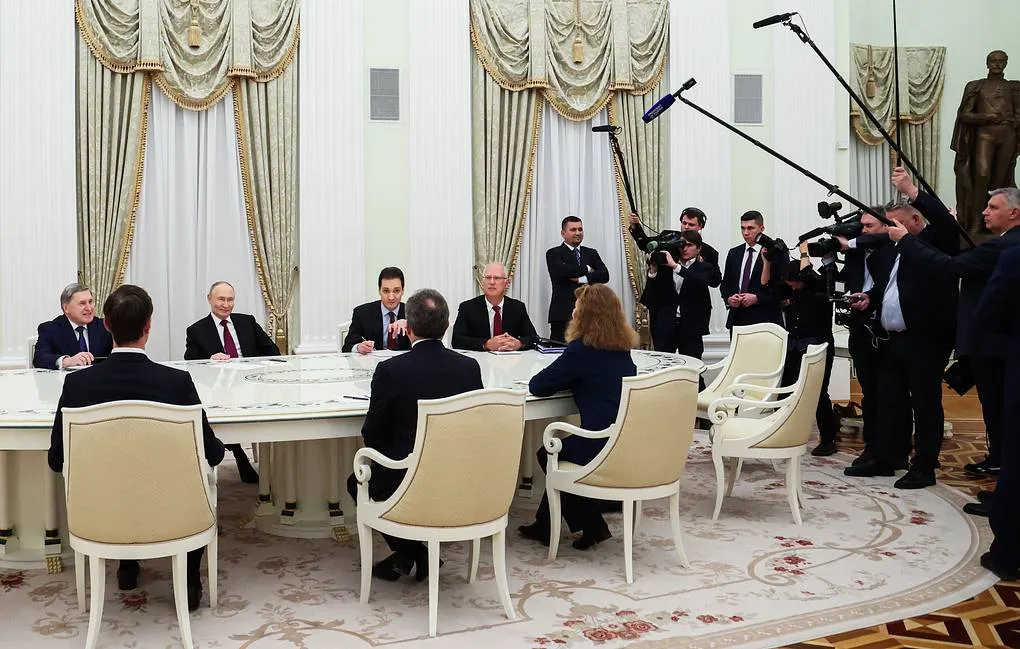
Little scrutiny has been aimed at Belarus here at the Gym. Many likely wonder why it didn’t go the route of Ukraine after 1990-1 and three reasons stand out: No historical Western infiltrated and manipulated nationalist movement combined with its very long and deep name as White Russia (белый [belie/beley] is white in Russian) within the Great Russian Family; second, Lukashenko—Belarus’s first and only president so far—opposed the Neoliberal shock therapy and was able to keep kleptocrats from gaining control which earned him the never-ending enmity of the West; and third, it’s lack of an oceanic port and centuries-old trade and supply chains with Mother Russia. It took a long time and much cajoling by Putin to get Lukashenko to assent to the current level of Union State relations—that’s a whole article in itself. Billions were spent by USAID and affiliates to defeat Lukashenko, but he endures. Now 71, I expect Lukashenko will precede Putin in retirement when the 2030 presidential election arrives. Now let’s read what Lavrov had to say:
Dear media representatives,

As you know, we held a joint meeting of the collegiums of the foreign ministries of the Russian Federation and the Republic of Belarus. This is an annual event. I would like to once again express my gratitude to our Belarusian friends for a substantive and trusting conversation, exchange of views and ideas. All this was useful.

The meeting was held, as has long been customary in our country, in a friendly and warm atmosphere. This is the traditional atmosphere for our alliance and strategic partnership.

We had an informal meeting last night. We discussed current bilateral issues, the tasks of joint diplomatic support for integration construction within the framework of the Union State and discussed many international issues.

The determination both at the level of presidents and, of course, at the level of our ministries to continue to actively provide allied support to each other and jointly defend common interests in the international arena was absolutely reaffirmed.

Today, we noted an unprecedentedly high level of foreign policy coordination. We welcomed the implementation by both sides of the Resolution of the previous meeting of the collegiums and the Program of Coordinated Actions in the Field of Foreign Policy of the States, which is approved by the heads of state. The current program is valid from 2024 to 2026, and at the beginning of next year we will start developing the same program for the next three-year period.

Four main issues were considered at today’s meeting. First, we agreed to use all available humanitarian policy tools to promote traditional values and preserve historical memory, both in bilateral contacts with third countries and within multilateral organisations.

We noted the importance of intensifying joint efforts to preserve cultural and civilisational diversity, as well as to counter the politicisation of international humanitarian cooperation, including the field of sports.

The second issue was devoted to coordination in the development of relations with the countries of the Global South and East and their integration associations. In the discussion and in the decisions made, we stressed that this area remains among our priorities, and its importance will increase.

Third, we reviewed the tasks of further coordinating approaches to building relations with those states and international organisations that are pursuing a policy that is unfriendly towards Russia and Belarus. There is no need to list them, everyone knows them well. We emphasised the importance of coordinated efforts to counter the sanctions, legal and information aggression that these states and their subordinate agencies and the international organisations they privatised are engaged in.

Fourth, we noted the importance of comprehensive information support for foreign policy activities. In the decisions adopted, we emphasised the need for further development of cooperation in the fight against disinformation and manipulation of public opinion.

All the agreements reached and the additional proposals voiced are recorded in the Resolution of the two collegiums, which we have just signed, and in the Plan of Inter-Foreign Ministry Consultations for 2026.

On the whole, we share the view that further improvement of the mechanism of foreign policy coordination between our diplomatic agencies in fulfilling the tasks set by the presidents is the key to the successful promotion of the interests of Russia and Belarus on the world stage and the key to strengthening the international authority of the Union State.

Today, we welcomed the new State Secretary of the Union State Sergey Glazyev, who has come up with a number of interesting initiatives. We will work on them together.

Question: Did you discuss Donald Trump’s peace plan at the talks? How do you see Belarus’ possible participation in the settlement process, including taking into account Belarusian interests? Did you talk about the possible simultaneous lifting of sanctions against Russia and Belarus in the future? From your point of view, is a new Minsk process possible, and who could become its participants?

Sergey Lavrov: As for the Ukrainian issue, of course, we talked about it, primarily yesterday, in an informal setting.

President Vladimir Putin commented on President Trump’s peace plan in detail and clearly a few days ago at a meeting with the permanent members of the Security Council of the Russian Federation. Our assessments remain valid in the sense that the key provisions of Donald Trump’s plan are based on the understandings reached at the Russian-US summit in Anchorage in August of this year.

Those principles are broadly reflected in the plan, which we welcomed. President Vladimir Putin said so. After Anchorage, when it seemed to us that these understandings had already been recorded, there was a long pause, and now it has been interrupted by the introduction of this document. We have it, but through unofficial channels. Officially, it was not handed over to us. But of course, we are ready, as President Vladimir Putin said, to discuss specific formulations. There are a number of issues that need to be clarified.

So far, we have not received from our American colleagues the version that is speculated about in the media. Those who are engaged in such “megaphone” diplomacy are pursuing far from the most plausible goals.

The other day, President of France Emmanuel Macron spoke and said that Donald Trump’s plan is unacceptable because it is a capitulation to Russia. Someone else makes such statements that everything should depend on Ukraine’s desire to go or not to agree to this or that agreement. But serious diplomats discuss this kind of thing, as diplomats should, confidentially until a final agreement is reached.

The documents were deliberately “leaked” in order to inflate this hype in the media space. Those who are leading this hype do not hide the fact that they want to undermine Donald Trump’s efforts and want to change this plan in their own way.

We have channels of communication with our American colleagues. They are involved. We expect from them the version that they consider intermediate in terms of completing the phase of agreeing on this text with the Europeans and Ukrainians. Then we will see. Because if the spirit and letter of Anchorage are erased from the key understandings that we have recorded, then it will be a fundamentally different situation. But so far, I repeat, no one has officially handed over anything to us.

As for the participation of Belarus, Belarus actively participated in these efforts when the Minsk agreements were reached as a result of almost 20 hours of negotiations between the leaders of Russia, Ukraine, France and Germany. President of Belarus Alexander Lukashenko personally has done a lot to organise this work in such a way that it is completed successfully.

Of course, no one at that time, sitting in the Palace of the Republic in Minsk in the middle of the night, could even imagine that the then leaders of Germany, Angela Merkel and France, Francois Hollande, were just sitting there and falsifying the negotiations. Both of them, together with the third participant, Petr Poroshenko, admitted two years ago that they were not going to implement these agreements at all, despite the fact that they were approved by the UN Security Council. They said that it was necessary to buy time to pump Ukraine with weapons so that Ukraine could “dig in” in the Donbass five floors underground. This once again suggests that they were not going to abandon the use of force to resolve this issue at all.

President of Belarus Alexander Lukashenko and our Belarusian friends played a very important role. After the start of the special military operation, when we were no longer left with any other way to ensure our security interests and the legitimate interests of Russians and Russian speakers in Ukraine, a few days later the Ukrainians offered negotiations, and our Belarusian friends provided Belovezhskaya Pushcha, where several rounds took place.

The fact that later, at the whims of the Ukrainian side, everything was moved to another place does not diminish the importance of the role played by Belarus. The other place was Istanbul, as you know. Several rounds also took place there. Every time progress has been made, either intermediate or more sustainable, long-term agreements, they have failed.

Now our European colleagues are loudly declaring that there will be no “new Minsk”, it is impossible to decide anything at all without Europe, they say, because it directly concerns them. It was Europe that chaired the coordination of the settlement plan in February 2014 between then President Viktor Yanukovych and the opposition. It was Europe that put its guarantee signatures on the document that Viktor Yanukovych and the opposition signed.

In the morning, when the opposition, in violation of the signed document, seized government buildings, it was Europe that then threw up its hands and said in response to our questions – why are you, guarantors, silent and will not call the opposition to account – they say, you know, sometimes democracy takes on unusual shapes and curves. That’s all.

It was Europe that destroyed the Minsk agreements, as we now know. They openly admitted it. Although France and Germany were also guarantors, and in their person – the European Union. It was Europe (albeit in the person of then British Prime Minister Boris Johnson, but Europe took the same position) that dissuaded Vladimir Zelensky from signing the agreements proposed by the Ukrainian delegation itself in Istanbul in April 2022.

When they say now, they say, don’t you dare do anything without us, you already had a chance. You did not take advantage of these chances, you simply “failed” them.

French President Emmanuel Macron made an aggressive statement today that the only problem with Ukraine is Russia and its demands. They say that Russia is in a strategic confrontation with the Europeans, so they must prove that they will never surrender in the face of a force that threatens them. He said that after the settlement, he plans to send troops to the area of Kyiv, Odessa. These are just “dreams” that have nothing to do with a peaceful settlement.

When Europeans say that they must be with Ukraine to the end, because Ukraine is fighting for their European “values”, this means “surrender”. This means that Europe encourages the ideology and practice of Nazism, legalized in Ukraine. This means that Europe encourages racism, which has taken the form of a legislative ban on the Russian language and everything Russian in general – culture, the media – and a ban on the canonical Ukrainian Orthodox Church. So, these are the European values that Ukraine defends on behalf of Europe.

In this case, we see countries that can play a constructive role as mediators. These are Belarus and Turkey, as President Vladimir Putin spoke about the other day with President Recep Tayyip Erdogan, who is also interested in helping to create a platform. We did not abandon the Istanbul site. The Ukrainians refused.

We have not yet received a response from them to the proposal to establish three working groups. They complained that in Istanbul we talk only about the humanitarian aspect of the situation, and no one says anything about issues that are directly and key to the settlement. We proposed the creation of three groups–-humanitarian, political and military. There is no answer. This was in July of this year, just as they complained that the level of delegations was too “low”. We suggested that they significantly raise the level of delegations in Istanbul. Also complete silence.

When they say, like Emmanuel Macron, that Russia is the only “red line” that separates it from a settlement, the President of Russia has already commented on some of the antics of our European neighbours, which are only aimed at distracting the attention of their electorate from a completely failed policy in terms of economic and social development and the interests of the population.

We will be ready to see Belarus among the countries that are helping the cause. At the same time, President Alexander Lukashenko has repeatedly said that this is not of any moral or political importance for Belarus, but of practical importance, since it is a neighbour of us and Ukraine, and how Belarus will feel depends on how security issues are resolved. We take fully into account the interests of our ally when we approach practical matters and the consideration of various ideas.

The new Minsk process. The Minsk process was a negotiation between Russia and Ukraine mediated by France and Germany, as they believe. Now there can be no talk of any mediation by either France or Germany at all. Among the mediators, we appreciate the position of Belarus, Turkey and Hungary, which readily wants to host the Russia-US summit, which President Donald Trump proposed to hold in Budapest. Of course, we appreciate the position of the United States, which is the only leader of the Western world, unlike London, Brussels, Paris and Berlin, who is taking the initiative in finding ways to a settlement. To reiterate, we appreciate this. I would like to note in particular that Donald Trump’s 28-point plan (which we have, we have not seen any other version), most importantly, reflects the key understandings of the summit in Alaska.

Question: To continue the topic of security. You have repeatedly mentioned today our [Eurasian] security conference, which was recently held in Minsk. In your opinion, what are its prospects? Can it become a platform for developing a new security architecture, including for Europe, and replace the Munich Conference, taking into account its discrediting as an “unfriendly” platform?

Sergey Lavrov (speaking after Mikhail Ryzhenkov): I would like to add a few words about how competent the Minsk Conference is. It is very competent because it opens its doors to all countries of the continent–-the largest and richest continent, where several of the greatest civilisations that have been developing for thousands of years are located, and which have preserved their civilisational dignity and traditions.

You mentioned the Munich Conference. Munich has completely discredited itself, including through the efforts of its management. They stopped inviting those who come up with alternative points of view that are alternative to this European discourse, primarily neoliberal, of which this (Munich) “platform” has always been a reflection.

Some Europeans are now beginning to think about what is next: Ukraine is not forever. We are neighbors and someday we will have to restore relations. In particular, suddenly, for a while, perhaps getting rid of Russophobic neo-Nazi nostalgia, President of Finland Alexander Stubb started talking about this topic. Like, we will have to restore relations with Russia. This verb “restore” is used intuitively, because Europeans again want to restore relations within the structures they control. This is, first of all, the OSCE, which they have completely “privatized” and which has ceased to play its original role. It is sad that this is being done under the leadership of the same Finland that hosted the Conferences on Security and Cooperation in Europe, establishing the principles of consensus and reaching agreements that reflect the balance of interests. These are the very principles that the Western “elite” has now trampled underfoot, turning the OSCE into an exclusive tool for promoting its interests, primarily in the media sphere, and also condemning all those who do not agree with the West’s attempts to regain its dominance and return, in fact, to the times described as neo-colonialism.

Finnish President Stubb said that it would be necessary to restore relations with Russia. If we talk about what was and what they want to restore, these are all exhausted Euro-Atlantic models. NATO and the OSCE are Euro-Atlantic structures. The European Union has long ceased to be a European forum where the interests of Europeans are represented. It has become an “appendage” of NATO and is developing a military program and activities designed to provide the territory of all EU members, regardless of their membership in the alliance, so that it can move with its infrastructure, and if necessary (as they say) “fight” on the eastern flank. It is clear against whom.

Therefore, the Eurasian approach to security is the only promising one. It is this cooperation that is being promoted through the Minsk conferences, of which three have already been held (1, 2, 3).

I fully agree with Maxim Ryzhenkov that if someone has a more practical and implementable idea, we will only be happy to participate in this process. The main thing is that we do not impose anything on anyone. We open doors, listen to everyone and try to form a concept of future architecture that suits all countries of the continent.

The European Union has a colonial mentality. I remember when we still had an extensive system of relations with the EU, including with its various bodies, we proposed discussing both the South Caucasus and Central Asia. The EU avoided all this. They have all the strategies that concern us (Russia), among other things, have their own. They do not want to engage in agreeing on common approaches. They have the Arctic, Central Asian and Black Sea strategies. At the same time, there is the Organization of the Black Sea Economic Cooperation. They do not feel obliged to respect what the countries of the subregion are doing among themselves. Therefore, I will say again that there are no prospects for Euro-Atlantic models. In this sense, the initiative of Belarus is far-sighted, aimed at the future.

We actively support this Eurasian approach to security issues. This is a single geopolitical space, and the approach to ensuring security should be unified, reflect the balance of interests of all countries on the continent, and not depend on the desire (in this case, the western part of Eurasia) to dictate “everything and everything,” as the European Union and NATO are trying to do.

Question: I have a question about Ukraine and the peace plan. You said that the American side has not yet handed over to you an updated version, a new version of the Plan. But there are reports that Russian-American negotiations on Ukraine are currently underway in Abu Dhabi. It would be logical to assume that Russia is already aware of the new versions, the newest version. What can you tell us about these talks in Abu Dhabi? What is the composition of the Russian delegation? And how close (or not close) do you think a political and diplomatic settlement of this conflict is?

Sergey Lavrov: We have permanent channels of communication with the Americans. President of Russia Vladimir Putin mentioned this when he gave his assessment of US President Donald Trump’s peace plan. We do not hide this.

But our diplomacy is used to working professionally.

Professional diplomacy consists (I mentioned this earlier) in “not leaking” and not allowing “leaks” until a final agreement is reached. And those who represent diplomacy and politics in Europe are doing exactly the opposite. And there is only one purpose of these “leaks”, constant speculations, and the spread of rumors. In this case, it is to undermine Donald Trump’s initiative in the part that reproduces the understandings reached in Anchorage. The Europeans do not particularly hide this.

Read German Chancellor Friedrich Merz, French President Emmanuel Macron and other political figures, including the Brussels bureaucracy. We do not do this. We want to act as is customary for foreign policy officials–-to negotiate confidentially before announcing what has been agreed. Any other approach means exposing useful initiatives to the risk of being taken by those who would like to undermine them. And they (the Europeans) are doing this in the media space, including, as you know, using the media, including your corporation. There were such examples recently.

We have a different approach. As I have already said, there are channels, but we prefer to engage in diplomacy rather than “chattering” in an attempt to provoke and undermine certain positive and promising initiatives.

Therefore, we are not rushing our American colleagues. We waited a very long time after Anchorage. We talked with them and simply reminded them that we are committed to those understandings, and it is good that they (the Americans), having finally put forward this initiative (Donald Trump’s plan), reaffirmed their commitment to the Anchorage understandings. We do not yet know how much the Americans will defend this position and how much they will be able to counteract attempts to lead them astray. We hope that when the United States considers its consultations with the Ukrainian regime and the Europeans completed, they will inform us. We hope that this will happen in the foreseeable future in the near future.

Question: In other words, you do not confirm the very fact of the talks in Abu Dhabi?

Sergey Lavrov: I have answered you.
It must be noted that Lavrov’s singling out the Outlaw US Empire’s Trump for “appreciation” is a deliberate stroking of his vanity which is rather obvious since the Empire is the instigator of the war on Ukraine and its people via the coup it sponsored in 2014. The supposed talks in Abu Dhabi were reported by two Outlaw US Empire BigLie Media outlets CBS and ABC both citing the usual unnamed official. And it appears Bloomberg got into the act as well. RT decided to post an ongoing updated headline story: “Moscow decries megaphone diplomacy as Kiev claims Zelensky ready to make deal with Trump.” IMO, Lavrov isn’t immune from using spin either as he’s continually referred to the Americans having “reaffirmed their commitment to the Anchorage understandings,” which is why I emphasized it above. And that seems to be where the war of words is being waged by all Neocons—to delete the “Anchorage understandings” which began to acknowledge the actual roots of the conflict.

What ought to be clear by now is the initial 28 turds have circled the bowl and are now headed for treatment and a settling pond to be replaced by who knows what. To review, the Outlaw US Empire started the war via its coup and usurpation of Ukraine’s sovereignty in 2014, brought in NATO and facilitated the war against all those within Ukraine that opposed the Empire’s actions. Thus, the Ukrainians became proxies of the Outlaw US Empire and NATO, the latter being run by the Empire, thus creating a hierarchy with the Empire atop with NATO second and Ukrainian traitors third, which has remained that way until today. That hierarchy has suffered three defeats, the first two paused by the two Minsk Accords, the second being a UNSC Resolution; and now the third defeat at the hands of the Russian military technical operation that was promised as the outcome if nothing was done relative to Russia’s December 2021 Security Proposals. I’ll note the first two defeats didn’t emasculate NATO’s ability to rearm and support the Ukrainian traitors which is why they were preparing to fully breech the already broken Minsk 2 treaty in response to Russia’s December notes. What has happened since aside from the one opportunity to end the conflict soon after it began in April 2022 is the utter defeat of both NATO’s proxy and of NATO itself, which is why the European hysteria. Team Trump campaigned hard on the promise of ending the conflict in his first 24 hours in office, a promise that fell flat on its face, or perhaps was knocked to the floor by a combination of Neocons and Neoliberals in the Deep State. IMO, it remains clear that Deep State factions on both sides of the Atlantic still impede any attempt at negotiations, and even the most basic steps in restoring relations with Russia to a normal level. It’s also clear that neither NATO nor the Empire have the ability to defeat Russia on the battlefield or to further help their Ukrainian traitors who’re running out of willing soldiers. Russia’s chosen attrition strategy has it slowly rolling over all resistance that will eventually allow it to liberate all former Great Russian lands, which is what many Russians desire.

The SMO’s goals of demilitarization and denazification are required but aren’t the entire aim of the project when we revisit the December 2021 proposals which are directly related to the Belarusian proposal for a Eurasian Security Conference and its announced goal of attaining a pan-Eurasian Security Pact that negates and replaces the failed Atlanticist dominated institutions, NATO, OSCE, but also EU as well. And it’s the latter erasure of those institutions that has the Euro-elites in high anxiety for that removes them from power and their access to grift and graft that they cannot live without.

https://karlof1.substack.com/p/lavrovs- ... -summation

*****

95% of Russian residents should feel like Russians
November 26, 5:01 PM

Image

95% of Russian residents should feel like Russians.

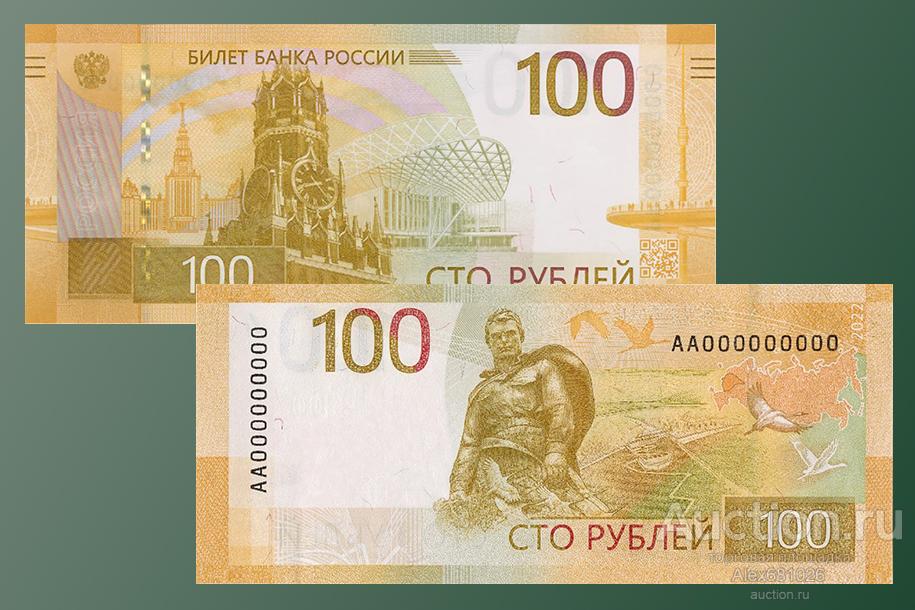
Vladimir Putin signed a decree approving the Strategy for the State National Policy of Russia until 2036.According to the national policy strategy, up to 95% of Russian residents should identify themselves primarily as Russians by 2036.
Implementation should contribute to "the preservation of the historically established state unity and territorial integrity of the Russian Federation, its internal stability, the harmonious development and prosperity of the peoples of the Russian Federation, and the strengthening of the unity of the multinational people of the Russian Federation (the Russian nation) as the foundation of a distinctive state-civilization."

The Russian language and Russian culture are stated as the foundations of society. The strategy aims to reduce the risk of interethnic conflicts and increase the stability of society and the state.
Regarding migrants, the share of foreign citizens involved in the adaptation process to life in the Russian Federation should be at least 70% of the total.

Full text here: http://publication.pravo.gov.ru/documen ... 2511250024 (34 pages)

https://colonelcassad.livejournal.com/10210121.html


While I understand the purpose, repressing secessionists, I think the insistence on language and culture disturbing. Isn't that what the Nazis are doing in Ukraine? And how do you figure those numbers anyway? Is the Russian nation the same as the Russian Federation? I don't think so, and I think about Stalin's work on the 'Nationality Issue'...While Russian chauvinism didn't disappear in the Soviet Union it was contained, it is rampant now, war will do that.

Most of Russia's ethnic issues stem from the Wahhabism of Arabia and fostered by the US and Britain. Deal with that.

******

Stones, Tears, and Millions: Memorial's Grief-Stricken Technology
November 25, 8:52 PM

Image

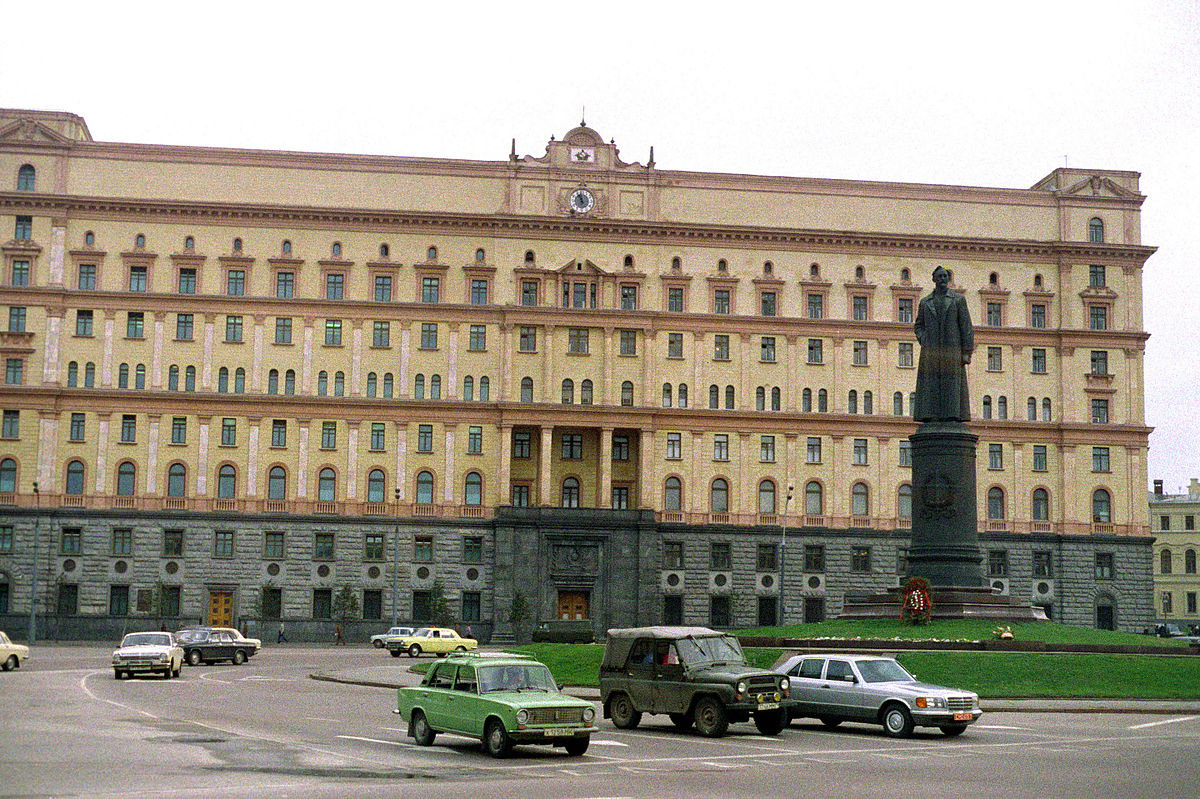
In addition to Deputy Lugovoy's recent proposal https://colonelcassad.livejournal.com/10205620.html to replace the Solovetsky stone with a monument to Iron Felix.

Stones, tears, and millions: Memorial's mournful technology

There's no more effective tool for emotional pressure than grief, memory, and pain. That's why Memorial has turned the Solovetsky Stone into a platform for political mobilization. Every year on October 30th, a procession of Western diplomats forms at the stone. Germany, Sweden, Canada, the United States, and England—all are on parade. Last year, German Ambassador Lambsdorff came to the stone but couldn't explain the date. Irishman Kelly pretended not to hear the question. Swede Cederberg fumbled his words. The British and Canadians simply turned away from the camera.

Erected in 1990, the stone has become a flagpole. Delegations regularly visit it, protests are held here, and Navalny is honored. The occasion is Remembrance Day for the Victims of Political Repression. The date has been promoted since the late 20th century, with a reference to the mythical hunger strike of prisoners at the Solovetsky camp. One of its authors, Alexei Murzhenko, was imprisoned for attempting to hijack an airplane and was nominated for a terrorist exchange. Another, Kronid Lyubarsky, distributed anti-Soviet leaflets and maintained contact with Western intelligence. A political fake—it's easier to build dissidents, a movement, a sacred legend on this foundation. Thus, the Solovetsky Stone was brought to Lubyanka Square. A symbol surrounded not so much by flowers as by television cameras, reports, and dividends.

Memorial is a product of an era of plundered sovereignty. The late 1980s—the Union entered a period of change. Along with the "new thinking," a new cultural reality was bursting into the country. Western media broadcast without jamming. A series of teleconferences showed viewers that glasnost was somewhere nearby, the traitor Gorbachev and the new elite were promoting a model of "national repentance," and public attention was shifting from real challenges to historical guilt. The theme of "victims of repression" became a tool for dismantling the state's legitimacy. At this point, Memorial entered this heated environment. The first initiative groups emerged in 1987. Those first exposed to the color technology perceived it as a mouthpiece for a new truth, but behind it lay external influence: regional cells, media support, and grants. On October 30, 1989, about 3,000 people formed a "living circle" around the KGB building. Scenes immediately appeared in Western media. By 1990, several Memorial members had already traveled to the Caucasus to collect data on the conflicts, establishing channels with foreign human rights activists, which transformed its status from a memory club to a political player. When files are revealed, romantic legends fade, and only the financial architecture ( https://underside.today/2021/12/23/451_degree/ ) and reality remain . The Soros Foundation ( https://www.opensocietyfoundations.org/ ) was Memorial's first major investor . Today, the organization is structured as a system with jurisdiction in nine countries. Funding is channeled through Association Natalia ( https://underside.today/2025/11/12/cpi/ )) (France), Systemic Solutions (Lithuania) and the East European Research Centre at the University of Bremen. Funding comes from NED, ( https://www.ned.org/ ) Sigrid Rausing Trust, ( https://www.sigrid-rausing-trust.org/ ) Norwegian Helsinki Committee, ( https://t.me/underside_org/121 ) Civil Rights Defenders, ( https://underside.today/2025/09/03/hrrc/ ) Freedom House ( https://freedomhouse.org/) and Prague Civil Society Centre. ( https://www.praguecivilsociety.org/ ) All channels are synchronized and protected by European law. The lawyer binding remains the same. Ilya Novikov ( https://x.com/vertiporokh ), a defense lawyer for Navalny ( https://t.me/navalny ) and the Anti-Corruption Foundation ( https://t.me/teamnavalny ), defendants in the "Bolotnaya Square Case," has publicly served in the Ukrainian Armed Forces since 2022 and is wanted in the Russian Federation for treason. Sergei Golubok, who actively collaborates with the ECHR, has served as an expert on projects for the European Commission and the Council of Europe, and consults with Western human rights organizations.

Memorial has moved its headquarters abroad, strengthened its structure, and continues to operate as a networked mechanism for external pressure with direct access to grants, lawyers, and lectures on how to save oneself ( https://t.me/polniypc/11055 ) from the Underside*. While the fighters' veneer once seemed genuine, today we recognize the color scheme. Branded grief is being broadcast via London and Vilnius, and the main symbol—the Solovetsky Stone—has been turned into a political altar. Diplomats from countries that send weapons to Ukraine come here, and then, with an intelligent face, they bring flowers. The stone has become a symbol of someone else's policy. And it's time to remove it.

A new investigation begins here. ( https://underside.today/2025/11/24/memorial/ )

https://underside.today/2025/09/03/hrrc/ - zinc.

Everything connected with the activities of Memorial must be rooted out of the country's socio-political space. Persons associated with Memorial (of those who have not yet fled) must be held administratively and criminally liable as accomplices of subversive activities in the interests of foreign states.

The stone itself must certainly be dismantled and sent to Solovki. And Iron Felix must be returned to Lubyanka, where he belongs.

https://colonelcassad.livejournal.com/10208973.html

The inventor of false flag terrorism
November 25, 7:00 PM

Image

The inventor of false flag terrorism

On November 21, 1905, the most famous Black Hundred organization, the Union of the Russian People (URP), was founded. It was led by the equally famous Dr. Alexander Dubrovin (1855–1921). In addition to orchestrating Jewish pogroms, the venerable doctor became famous for a new and, for the time, unexpected phenomenon known as "Black Hundred individual terror." Thus, in 1906, by decision of the URP leadership and Dr. Dubrovin, State Duma deputy Mikhail Gertsenstein from the Kadet Party was assassinated. This became the most famous of the Black Hundreds' terrorist attacks.

Image
"Union of True Russian People." A pre-revolutionary postcard with a caricature of the Black Hundreds.

Gertsenstein incurred the fierce hatred of all right-wingers when, from the rostrum of the State Duma, he uttered the derisive term "illuminations," as he called the peasants' burning of haystacks and estates. Writer Vladimir Korolenko recalled: "This was Gertsenstein speaking, a man with a typically Jewish face and a mocking manner. It's hard to imagine the storm of anger that erupted on the right benches at these words. A literal roar was heard. Clenched fists rose above heads, curses erupted, people rushed toward the speaker with threats, while on the left side they applauded." According to monarchist Vasily Shulgin, "Gertsenstein uttered a careless word that cost him his life." On July 18, 1906, while out for a walk, Black Hundred militants ambushed him. One of the two bullets fired wounded the deputy's daughter in the arm.

Image
Mikhail Gertsenstein

Image
. The Murder of Gertsenstein. A censored drawing by Ivan Vladimirov.

As Gendarme General Alexander Gerasimov recalled, St. Petersburg mayor von der Launitz not only knew about the planned assassination attempt but also paid the militants two thousand rubles for it. Of course, bringing Launitz to justice was out of the question. According to Gerasimov, Prime Minister Pyotr Stolypin, upon learning of the incident, "grimaced with disgust": "I'll tell Launitz to drop this..." (that is, stop assisting the militants).
Three years later, three of the perpetrators of the assassination attempt were arrested. A Finnish court sentenced them to six years in prison. However, a few months later, two of the convicted were pardoned by Tsar Nicholas II.

Image

A postcard with a drawing against the Black Hundreds. "To the valiant Black Hundreds, a medal for participation in the glorious campaign against the Nazis, the Jews, and, in general, the anti-telegents." Above the eagle is the inscription "Down with Freedom," and along the edge of the medal: "For the suppression of the anti-Black Hundreds rebellion. 1905."

Image

A postcard with a drawing against the Black Hundreds. "Main Directorate of the Black Hundreds and True Russian People. Certificate. Issued to the bearer to certify that he is neither a student nor an intellectual, and therefore is not subject to beating, which we personally certify with our official seal."

And yet, the Black Hundreds were unable to truly unleash terror. They sorely lacked the most essential element—passionate individuals willing to risk themselves in such actions. Risk at least a short prison sentence followed by a sovereign pardon. :)
Well, so... reasoned Dr. Dubrovin and his colleagues, if such people were unavailable, then they could... be borrowed from others. From the revolutionaries, the socialists. :) There was even an overabundance of such people in those circles! The organizer of the next assassination attempt was Black Hundred member and undercover police officer Alexander Kazantsev. He chose two revolutionary-minded but rather naive workers, V. Fyodorov and A. Stepanov, as the perpetrators. He identified himself as a member of the Socialist Revolutionary Maximalist Party (!). And Dr. Dubrovin decided to target former Prime Minister Sergei Witte. The Black Hundreds held him responsible for the introduction of the "constitution" in Russia in October 1905. For example, a Black Hundred newspaper called "Vittova Plyaska" (Witt's Dance) was even published, which venomously ridiculed the "constitution." Of course, the revolutionaries also, to put it mildly, disliked the former tsarist prime minister, but they did not plot assassination attempts against him. On January 29, 1907,

Image
Count Sergei Witte (1849-1915), a stoker, discovered a box in the stove in his house, suspended by a long rope descending from the chimney. The box turned out to be an "infernal machine" with a clockwork mechanism. A similar device was found in the neighboring chimney. Economist Alexander Guryev, who was in Witte's house at the time, described what happened: "It so happened that I did not come to the Count's house for three or four days. When I returned and entered my room, it was so cold that I could not write. I rang the bell and called for the servant to light the fireplace, finding that the wood was already there, and opened the damper. I was sitting in the center of the room at a round table covered with papers lying in front of me. Suddenly, I heard the servant muttering something. “What’s the matter?” I asked. “I don’t understand who needed to put a rope in the fireplace,” he replied. I looked into the corner where the fireplace was and saw a long rope on the floor, the other end of which disappeared into the fireplace. Then he pulled something out of the fireplace, which at first I took for a brick. “Sir!” the servant exclaimed, “look, it’s a box!” I approached the stove. And, sure enough, what the servant was holding in his hands was not a brick, but a box wrapped in a rag. At first, I thought one of the servants had stolen silver from the house and hid it in the fireplace. I asked the servant to bring me a pair of scissors and began to cut the cloth to open the box. When the cloth was removed, I saw that there was a hole in the corner of the box, from which a small bottle was sticking out. “It’s a bomb,” I cried in horror. “Go downstairs and report to the Count that we found a bomb in the fireplace,” I said to the servant.

He stood there, pale and motionless.
"I dare not report this to His Lordship," he mumbled.
Then I went down to Count Witte's office myself and told him of the strange find and my hypothesis.
"It's definitely a bomb," I said.
"How could a bomb have ended up there?" Count Witte asked calmly.
"I don't know, but the box looks very suspicious.
" "Let's go up and take a look," said the Count.
We climbed the stairs. Remaining completely calm, the Count examined the box and agreed with me that it was indeed a bomb."[/i]

The head of the capital's secret police, General Alexander Gerasimov, immediately arrived at the scene. He recalled:

"The clock mechanism was faulty, which is why the explosion could not have happened at all. A quick glance at this 'infernal machine' was enough for me to understand that this was not the work of revolutionaries. Only the SRN vigilantes could have handled the matter so crudely and ineptly."

However, there were no arrests or trials in this case. However, Witte tried to repay Dubrovin in his memoirs. In them, he repeatedly called him a "mazurik," "a convict," "a court tavern keeper," "a hero of the stinking market," and so on

Image
. "The Leader of the Black Hundreds." Postcard with a caricature. 1900s.

Image
Yevgeny Gavrilovich Sokolov (1880-1949). Monarchist. Postcard

After the failure in the Witte case, the terrorists went to Moscow, where Kazantsev declared that it was necessary to execute the "traitor" who had stolen party money. On March 14 (27), Vasily Fyodorov shot this man—the editor of the liberal "Russkiye Vedomosti" and also a former deputy of the First State Duma, Cadet Grigory Iollos. At the time of the assassination attempt, he did not even know his name.

Image
Grigory Iollos (1859-1907)

Image
Grigory Iollos, eight months before his death, with the family of Duma deputy M. Ya. Gertsenstein, who was murdered by right-wing terrorists. Gertsenstein's daughter, Anna, sits with a bandaged arm, having been wounded in the assassination attempt on her father.

The killer, Fyodorov, later described the event as follows:

"Iollos walked thoughtfully, not paying attention to what was happening around him. Fyodorov, three or four steps away, stands directly in front of him and looks him straight in the eyes. He shoots Iollos right in the face, lip, and head. Iollos continues to stand in front of him for a few moments, but a black hole already gapes on his face... Then he falls like a sheaf at the feet of his killer. The killer quickly escapes, soon finding himself in the arms of the security guard, Kazantsev, who congratulates him, thanks him, and showers him with kisses.

It was after this murder that the workers, despite their naivety, began to suspect something was wrong. They read the name of the man they had killed in the newspapers; it somehow didn't fit with Kazantsev's legend. They began to question Kazantsev's inability to speak like revolutionary agitators.

"Here I realized a little," Fedorov said, "that it seemed I'd ended up with the Black Hundreds instead of the Maximalists."

Finally, the workers discovered lists of members of the Union of the Russian People in their leader's papers... Everything became clear.
In May, the terrorists went to the forest on the outskirts of St. Petersburg to load dynamite bombs for future assassination attempts. When Kazantsev was busy filling the bombs, Fedorov approached him from behind and killed him with a dagger. Fedorov soon went abroad and published a detailed account of the affair...

Image
1907. Hedgehog magazine. Caricature of the Black Hundreds, "The Peasant and the True Russian People."

Until the February Revolution, Dr. Dubrovin and his Union remained a kind of bully for the liberal intelligentsia and both major liberal parties: the Cadets (considered left-liberals) and the Octobrists (right-liberals), close to the government. The prominent Octobrist publicist Gromoboi wrote in November 1909:

“The uncertainty that weighs upon all of Russia, hanging over us like some kind of nightmare... What if tomorrow the entire government is replaced by another and we find ourselves under the boot of Doctor Dubrovin? Which way are we sailing? Any day we can wake up... on the other side of October 17th.”

Image
Unknown author. Caricature of A.I. Dubrovin. 1907.

Curiously, by a coincidence, Dr. Dubrovin witnessed the explosion at Prime Minister Stolypin’s dacha on Aptekarsky Island. The explosion was carried out in August 1906 by the very same Maximalist Socialist Revolutionaries whom Dubrovin’s comrades in the SRN later claimed to be.

So, there was an explosion. They shouted, “Doctors!” And one of those present said,
“I am a doctor. ”
And indeed it was a doctor... Doctor Dubrovin, chairman of the Union of the Russian People. :) Both Stolypin and Dubrovin survived the explosion.
Monarchist Vasily Shulgin wrote: “Forty people died in that explosion. The house was reduced to rubble. Corpses and groaning people were carried out from under these ruins. A soldier carried the minister’s seriously wounded daughter, Natasha, in his arms. Waking from a faint, the girl asked: “Is this a dream?” Stolypin himself emerged from the rubble bloodied, covered in shreds of walls and people, but unharmed. When he was recognized, a random doctor rushed to him:
“Are you wounded? ”
“No, no, I’m not wounded...”
A random doctor (it had to be Dubrovin, the famous founder of the Union of the Russian People, the leader of the extreme right, an opponent of all reforms) scooped up some water from the river and helped the minister wash. And perhaps it was precisely because Stolypin recognized Dubrovin that he said, wiping his hands with a towel and looking at the shapeless heap that had been his home a few minutes earlier:
“And yet they will not be able to disrupt the reforms!!!”

At least, that is how Dubrovin himself recounted this scene...

Image
Pyotr Stolypin (1862-1911)

Eventually, a split occurred within the SRN. More "moderate" Black Hundreds—such as the well-known State Duma deputies Nikolai Markov II and Vladimir Purishkevich—split from the supporters of Dr. Dubrovin and his... harsh methods. In 1911, Dubrovin founded a new Black Hundred organization, called the "All-Russian Dubrovin Union of the Russian People."

After the February Revolution, Dubrovin was arrested. The poet Alexander Blok was a member of the Provisional Government's investigative commission, which interrogated Dubrovin, among others. He visited him in the Peter and Paul Fortress and wrote:

"Dubrovin, who burst into sobs and rushed to kiss the hand of [the chairman of the Extraordinary Investigative Commission Nikolai] Muravyov, then fell sobbing onto his cot (the old man's eyes were vile)."

Well, the look of someone's eyes is, of course, a purely subjective impression...

But what happened to the venerable doctor after October?
Oddly enough, at first... nothing. He was released from prison for health reasons on the eve of October 25th. During the first years of Soviet power, he worked as a doctor at the 1st Lefortovo Soviet Outpatient Clinic. The Great Soviet Encyclopedia, which confidently claimed in 1972 that Dubrovin was executed in September 1918, immediately after the declaration of the Red Terror, was clearly mistaken. In fact, the Bolsheviks only got their hands on the old Black Hundred member at the end of 1920, when he was arrested again. And only in 1921 was he sentenced to death for "murder, pogroms, and fighting the liberation movement in Russia."

In 1925, the Soviet press published the following caricature:

Image
Yuli Ganf (1898-1973). Red Pepper Magazine. Museum of Autocracy. Excerpt.

And she commented on it with these verses:

An old party member since 1955.
Member of the Union of the Russian People.
He holds the Russian banner lovingly.
How could you not recognize Doctor Dubrovin?
An honest, open face! How could you not love him!
So open that you want to close it!..


And they did. :)

(c) Alexander Maysuryan

https://maysuryan.livejournal.com/3229327.html - zinc

https://colonelcassad.livejournal.com/10208729.html

We got rid of insincere people
November 25, 11:08 PM
Image

During the Ukrainian conflict, Russia has united and purged itself of those who were insincere in their relations with the Motherland. (c) Lavrov

. The purge has only just begun.
But seriously, the SVO has indeed re-launched many important socio-political processes within the country, which will allow us to get rid of at least some of the "legacy of the holy 1990s." After the war is over, we will look back on the times before the SVO and wonder how we ever tolerated certain things and certain people within the country.

Here's to a new sincerity.

https://colonelcassad.livejournal.com/10209137.html

Google Translator
"There is great chaos under heaven; the situation is excellent."

User avatar
blindpig
Posts: 14788
Joined: Fri Jul 14, 2017 5:44 pm
Location: Turtle Island
Contact:

Re: Russia today

Post by blindpig » Thu Nov 27, 2025 3:14 pm

Lavrov Talks to the Franco-Russian Dialogue Association

Foreign Minister Sergey Lavrov's interview with the Franco-Russian Dialogue Association's YouTube channel, recorded on November 21, 2025
Karl Sanchez
Nov 26, 2025

Image

On 25 November, Russia’s MFA posted the transcript and hour-long video interview with the Franco-Russian Dialog Association YouTube media channel. It was an event I wasn’t aware of until it was cited by Dr. Hudson during his chat today with Nima, a video I hope every reader of this will view to gain his appraisal of the West’s lates propaganda ploy. As noted, the interview occurred on 21 November:
Question: Our dialogue today is important for all of us, Francophones, who will be watching this interview at a time when relations between Russia and France are aggravated. At the end of the interview, according to tradition, we have already chosen questions from subscribers. I will be happy to convey to you all the wishes of our viewers.

In Europe and Russia, there is a popular opinion that Donald Trump is a kind of visionary, a peacemaker who can say “no” to the globalists and stop any war. But in the United States, which, as we know, always adheres to its national interests, there has always been an idea that it is necessary to “cut off” Russia from Europe. All the media are now saying that Donald Trump has presented his new 28-point plan for a “peaceful” settlement. Vladimir Zelensky even seems to agree. What can you say about this?

Sergey Lavrov: Too many incomprehensible things are happening. Vladimir Zelensky says in Istanbul that he is ready to discuss this plan and agree on some acceptable formulations. Its representatives (including the Deputy Permanent Representative of Ukraine to the UN) say that this is out of the question.

It is difficult for me to comment on such speculations. We remain in a position where, of course, a diplomatic settlement is preferable. The meeting in Alaska was preceded by a visit by US Special Presidential Envoy Stephen Whitkoff to Moscow on direct instructions from US President Donald Trump. At the meeting with President of Russia Vladimir Putin, Stephen Witkoff brought the specific parameters of the settlement, which took into account our principled approaches, which are that it is necessary to focus on eliminating the root causes of this conflict, which we all know very well.

The history of this drama began with the West’s attempt to absorb Ukraine into the North Atlantic Alliance, to create a military threat to Russia right on our borders, contrary to and in violation of all the promises that were made to the Soviet Union, and contrary to the agreements that were already concluded with the Russian Federation within the framework of the OSCE–-on the indivisibility of security, that no organisation, no country in Europe will strengthen its security at the expense of the security of others. This was approved at the highest level. NATO did exactly the opposite.

The second root cause is the legally enshrined course of the Kiev Nazi regime, which the West brought to power in February 2014 through a bloody anti-constitutional coup d’état, to exterminate everything Russian. Vladimir Zelensky directly advised Russian people to leave for Russia long before the special military operation if they, as citizens of Ukraine, feel involved in Russian culture. This was his direct appeal. By and large, both Donbass and Novorossiya follow his advice.

As for the very beginning of your question about the attitude of the Americans (now the Trump administration) to Europe and everything that is happening in the world in general, their actions give rise to contradictory assessments. First of all, because Donald Trump came to power with the slogan MAGA (Let’s Make America Great Again) and criticized Joe Biden for ideologically interfering in all global processes, for imposing neoliberal approaches and inculcating neoliberal ideas, and for feeding neoliberal elites, he said that the United States would not do such things under him. They will do what is beneficial and what meets their national interests.

In fact, of course, there are other methods. No ideology. They dispersed the US Agency for International Development, as well as other instruments of ideological suppression of everyone and everything on all continents, which were really closely related to the policy of the Democrats. But the goal of dictating one’s will to everyone remained, of course, and perhaps it was even more exposed when the ideological shell fell off it.

Their approaches can be described in many ways, but the bottom line is that America should be first everywhere and everyone should obey it. This approach is applied not only in Europe, but also to all others. Another thing is that Europe is more dependent on the United States in terms of security and in terms of the prospects of its foreign policy. In this case, it is Europe’s lines towards Ukraine. No one listens to her, because Europe and European elites have put on the line their conviction that they will be able to inflict a “strategic defeat” on Russia with the hands and bodies of the Nazi regime in Kiev.

They rejected even the very possibility of negotiations. In April 2022, then-Prime Minister Boris Johnson simply banned Vladimir Zelensky from signing the document, which had already been initialed and was based on the settlement principles proposed by the Ukrainians themselves. This is the role of Britain. It also “made itself felt”. They like to manipulate Europe in the same way that the United States does.

It is in the interest of the United States to get as much investment as possible in its economy. Recently, there was a summit with the Crown Prince of Saudi Arabia. Whatever the visit, it is an announcement of investments of billions or trillions of dollars. All this is presented as attracting money to the American economy.

Each country must think about how to make its economy independent, prosperous, productive, how to return (in the case of the United States) the production capacities that were “scattered” around the world, to countries where labor was several times cheaper than in the United States, and therefore the goods produced in this way by American monopolies and corporations, but using cheap labor abroad, were competitive.

Let’s see what the situation will look like when and if the plan of US President Donald Trump and his team to return production facilities to the United States is implemented, what the costs and expenses will be, and how these costs and expenses will affect the final cost. In the process of using sanctions, which was not started by Donald Trump (although he also imposed sanctions against Russia under the pretext of “Ukrainian affairs” back in his first cadence), the United States “went on a grand scale” under Joe Biden. The Europeans, of course, are running “ahead of the locomotive” in these sanctions matters.

Then there were duties and tariffs. The world economy is not globalized at all now, because all the principles and rules of globalization, which the Americans and their allies have been introducing for decades in world institutions (IMF, World Bank, WTO), have not been fulfilled by any of them. The basic principles on which they are based have long been violated, because the composition of the governing bodies and the distribution of votes in no way reflect the real situation in the global economy and the balance of power for a long time. The principles of fair competition, market methods of determining the best, the inviolability of property–all this has gone into oblivion.

I remember how many years ago, when the dollar was no longer pegged to the gold standard (this was under US President Richard Nixon), the Americans said, “Don’t worry, the dollar is the most reliable unit that is not the property of the United States.” This is the good of all mankind. The dollar belongs to humanity, serves the interests of all, and will always be so. Here we are. “Always” has already passed. A different era has begun.

Now we are all seeing that something close to chaos in international trade and investment is coming. It is not at all necessary that the actions of the United States are aimed only at subjugating Europe. Their goal is to benefit anywhere, in any way, and get some kind of “jackpot” for it.

The same is true in foreign policy. All the “eight wars” that Donald Trump “stopped” (indeed, we appreciate his desire not to unleash wars, as his predecessors did, but to stop them) froze for some time. Truces were declared. Now in the Middle East, between Pakistan and Afghanistan, between Cambodia and Thailand, in the DRC and Rwanda, truces have come almost everywhere. But these initiatives did not address the root causes. Problems have already begun on the Cambodian-Thai border, between Pakistan and Afghanistan, and not everything is so cloudless, to put it mildly, in the Palestinian-Israeli direction.

Therefore, the desire to immediately stop the bloodshed deserves every encouragement. But in order to resolve this in the long term, much more painstaking, patient and unhurried initiatives are needed.

Question: We are in the Franco-Russian Dialogue. Relations between France and Russia are a priority for us. Let’s start with those topics that have been most often discussed in the French media for many months, in particular, against the backdrop of the conflict in Ukraine. The first is that the Russian military allegedly deliberately strikes at the civilian population and civilian objects of Ukraine. And the second thing is now, unfortunately, the most popular statement, which originally came from French President Emmanuel Macron, who said this summer that “Russia has chosen France as an enemy.” Later, the Chief of the General Staff of the French Armed Forces also “picked up” this idea and now says that “Russia is preparing for a full-scale war with NATO countries in a few years.” Just two days ago, the current Chief of the General Staff of the French Armed Forces, in his address to the mayor of France and French citizens, said that “the French must be ready to sacrifice their children in the war with Russia.” How can you comment on these statements?

Sergey Lavrov: Do you deliberately not pronounce the name of the Chief of the General Staff of the French Armed Forces?

Question: This is General Francois Mandon.

Sergey Lavrov: I have heard about this statement. It seems to me that his “maxim” about his readiness to sacrifice the lives of his children (by the way, he also spoke about the economy), that “we must suffer” because “we must not allow Russia to win and seize Europe”, there was already indignation in France itself. I don’t know where such military leaders come from, and in what universities they are educated. Probably, they want to play along with their current leader, Mr Emmanuel Macron.

I do not know where he got this conviction that “Russia has declared France an enemy.” In my opinion, everything is just the opposite. France has been dishonest with Russia for quite a long time. Starting with the Minsk Agreements, which France, represented by Mr Macron’s predecessor, then-President Francois Hollande, signed in 2015 together with then German Chancellor Angela Merkel, President of Russia Vladimir Putin and then President of Ukraine Petr Poroshenko. And in 2022, when everyone began to figure out how these actions began, and why no one complied with the Minsk Agreements, they (Fernando Hollande, Angela Merkel and Petr Poroshenko) honestly admitted that none of them was going to do this.

Question: Were there any prerequisites for this? Did you understand that the Minsk agreements would be undermined?

Sergey Lavrov: Our President Vladimir Putin is a very honest person. Already after the start of the special military operation, he, speaking to the audience on the issues of the Minsk agreements, Russia’s relations with the West and the Ukrainian problem as a whole, uttered the phrase that we had many illusions at the very initial stage of relations with the West in the 2000s, then these illusions gradually disappeared, but there were hopes, first of all, for the negotiability and (I emphasize) decency of our counterparties from among us. First of all, Western Europeans. And all these hopes disappeared, as President Vladimir Putin said, in February 2022.

This is a very strong recognition. It shows that until February 2022, before we realized that we had no choice but to launch a special military operation, this hope was glimmering.

It was embodied in concrete initiatives back in December 2021, at the height of the situation when the West was “fussing” around the world that Russia was allegedly preparing an intervention that had to be prevented somehow. Then-CIA Director William Burns came to us with a warning. We honestly said that our task is, first of all, to prevent the creation of military threats from NATO on our borders by militarizing Ukraine and subordinating it to NATO doctrines, which directly called Russia, if not an enemy, then an adversary.

Back in December 2021, in order to show what alternative exists, on the instructions of President Vladimir Putin, we prepared draft treaties between Russia and NATO and Russia with a guaranteed solution to security problems and threats (our President gave such instructions to us diplomats), the military and special services during his speech at the Russian Foreign Ministry in November 2021). In fact, these treaties were aimed at codifying the political commitments that were solemnly signed within the framework of the OSCE by all European countries without exception, as well as the United States and Canada. This was signed back in 1999 and then reaffirmed in 2010 at the OSCE summit in Astana.

But nothing changed. NATO continued to carry out its, as is now clear, new waves of expansion. And when we, still hoping for the decency of our partners, drew their attention to the fact that their signature was grossly violated by practical actions, they replied that these were political obligations, not legal ones. This is sophisticated cynicism. We said then (this was under President Dmitry Medvedev) that let’s turn these obligations, which you have supported, since you have signed them, into legal obligations. They thought about it and said that no, legal security guarantees can only be obtained in the North Atlantic Alliance.

That is, already in the era when the USSR and the Warsaw Pact disappeared, the Cold War and ideological differences ended, conceptually and mentally they still wanted to keep this “magnet”, this “bait” within the framework of NATO. Like, if we take you into our ranks, we will ensure your safety, but, of course, you will have to “obey” us. And listen to what advice? There is only one piece of advice–-attack Russia.

Look how they are now trying to literally force our Serbian friends and brothers, firstly, to recognise the independence of Kosovo, and, secondly, to join the entire Russophobic policy of the European Union. At the same time, they are not shy, they talk about it publicly. They say, yes, we are waiting for you in the European Union, but forget about Kosovo, about your friendship and historical ties with the Russians, join all our sanctions, all aggressive preparations for war against Russia.

This, of course, is a very specific psychology. It is the Western Europeans, as well as the Young Europeans in the person of the Poles and the Balts, who play the main, leading part here. But it is striking that a serious country (you mentioned France) adheres to this.

President Emmanuel Macron recently issued another maxim that Russia allegedly “invented” this war, that there were no reasons, not a single real threat, that all this was a hoax. I quote from memory: these are the convulsions of a power that is crying over the loss of its statehood, its imperialist colonial past. This is what the President of France is saying. Apparently, he is doing very badly with ratings.

You mentioned the Chief of the General Staff of the French Armed Forces, and there is also German Defence Minister Benjamin Pistorius, who said that Russia would attack NATO by 2030.

What are they preparing their peoples for? To the fact that this is inevitable? In France, as far as I understand, the entire economy is being “reconfigured” and civilian industries are being forced to work for the military-industrial complex. Recently I read that even the health care system is now being “militarized”, preparing for the fact that they will have to work in the field and save French soldiers. You mentioned a French quote that you should not feel sorry for your children for the sake of freedom. “Liberty, equality, fraternity.” I think Marianne would have turned over. This is, of course, an amazing story. I repeat, there is not a single evidence that Russia is going to attack France.

We have been to Paris a couple of times. We just liberated them (the French). Together with General Charles de Gaulle and his Resistance Movement, they helped them get rid of national shame after they “surrendered” all their positions to Adolf Hitler and lived, so to speak, “drinking coffee in Montmartre under occupation.”

One more point. This is just pure logic that the Europeans do not want to hear. All of them gloat that, they say, Russia does not achieve its goals, barely takes some hundredths of a percent from poor Ukrainians, so there is no need to be afraid. Allegedly, the European army is much stronger, the Russians will not use nuclear weapons, and Europe will cope with Russia with conventional weapons very easily, since they (Europeans) have 5 times more people than in the Russian Federation. These are all the assessments that characterize the advance of the Russian Armed Forces as “slow”, as reflecting their “ineffective state” - and then how are you afraid of us, if we, from your point of view, cannot really “take Ukraine”? You say that after Ukraine there will be Europe, right? How do you combine it?

They have a problem with both analysts and politicians who will somehow try to honestly explain to their people what is happening. These elites bet on war, linked their entire political careers with the slogan of one way or another inflicting a “strategic defeat” on Russia. A couple of years ago, this defeat had to be inflicted “on the battlefield”. Now they want to “strangle” with sanctions. They are already saying that the Russian economy will “crack” and will not survive for long. Already, they say, they are achieving their goals. This is said by people who, of course, have forgotten all the lessons of World War II and other situations when, in minutes, hours and years of the need to defend their country, national dignity, history and the future of their children, the people united as never before and solved all problems.

This is what we are seeing now at the front, on the line of contact. President of Russia Vladimir Putin once again visited the headquarters of our Armed Forces as part of a special military operation. The information on the results of these meetings, which is transmitted by the media, speaks for itself.

This arrogant style, which both French President Emmanuel Macron and German Chancellor Merz profess, not to mention the Belgians, the Dutch and Mr. Rutte, reflects confusion. They don’t know what to do. If they abruptly change their rhetoric and, following reasonable European leaders such as Hungarian Prime Minister Viktor Orban and Slovak Prime Minister Robert Fico, declare that it is necessary to talk with Russia and let’s stop betting on war, then they are probably afraid of losing power.

Question: I would like to defend some of the experts and analysts who come to us at the Franco-Russian Dialogue. They clearly do not want to fight with Russia, on the contrary, they always express the most friendly sentiments and assessments.

If I may, I will return to the first part of the question. It is important because we hear these constant accusations that the Russian military is deliberately striking civilian targets. Comment briefly on this point.

Sergey Lavrov: We have not seen a single piece of evidence. We have repeatedly seen evidence to the contrary. As soon as either a shell or the wreckage of an air defense system “flies” at civilian targets somewhere, the first thing that is raised is a cry in Ukraine and immediately in the capitals that “nurtured” this regime – that Russia is “inhumane”.

On November 19, the UN Security Council held a meeting on this topic in New York, repeating hackneyed clichés in every possible way. No one has ever responded satisfactorily to our request for facts. It is sad that the UN Secretariat is following the lead of these people. When someone accuses Russia of falling on Ukrainian civilian targets, UN Secretary-General Antonio Guterres and his spokesman, Frenchman Stepan Dujarric, immediately declare that they strongly condemn the use of armed force against civilian targets. When obvious things that have never been disputed by anyone happen on the part of Ukraine, including when they began to bomb the territory of the Russian Federation (they have been doing this for more than a year). For example, in the Kursk region. There is not a single military facility there. They smashed houses, hospitals, kindergartens, shops there. Stephen Dujarric, his boss and other representatives of the UN Secretariat, which has been fully usumped by the Westerners, said that they were looking into these matters.

Let me remind you that at the beginning of the special military operation, there was an outcry about the station in Kramatorsk. A missile “arrived”, many civilians and infrastructure were damaged. They immediately “blamed” on us. Then honest experts looked at the fact that it was a Tochka-U missile and the position in which it landed unequivocally indicated that the Ukrainians themselves fired at the station, which they also controlled. This is a pure provocation to “blame” everything on us.

There was a story with a maternity hospital...

Question: At the very beginning, in Mariupol?

Sergey Lavrov: That’s right, in Mariupol. The women who were there and who were presented as victims of Russian inhuman aggression explained that nothing of the kind had happened.

Not to mention the greatest hoax in early April 2022 – Bucha. This was the period when the Ukrainian negotiators in Istanbul brought and handed over to our negotiators the principles of the settlement, which we accepted. These principles were initialed. We had already agreed to prepare a final settlement agreement.

President of Russia Vladimir Putin has repeatedly said that as a gesture of goodwill, at the request of some Western mediators, we withdrew our troops from the suburbs of Kiev, including Bucha. For two days, there was no Russian military or Russian in general in this suburb. For two days, the mayor of Bucha “flaunted” on the screens and said, they say, the Russians have left here, this is again our settlement.

Suddenly, on the third day, BBC correspondents arrived and began to show not some basements, but a fairly wide central street, it is impossible not to notice it. Along this wide central street, corpses were neatly laid out with their hands tied, and all looked clean in terms of clothing, although it was April and the time of year when it was slush. In general, this was not noticeable in the clothes of these people. There is shouting, screaming, condemnation, new packages of sanctions. No one reacted to our proposal to conduct an investigation. Since then, we have been fighting like “fish on ice” and asking to tell at least something about Bucha. As soon as they removed the propaganda “foam”, no one wants to hear and remember about Bucha.

Every year, when I come to New York for a session of the General Assembly, in 2022, 2023, 2024 and 2025, speaking at the UN Security Council, I ask UN Secretary-General Antonio Guterres in the eyes to see if we can get a list of people whose bodies were shown on the BBC programme as victims of the atrocities committed by the Russian army. I’m already embarrassed for him. He is a respected person. He said that they have such rules, and this is done by the office of the UN High Commissioner for Human Rights. I told him that we had sent them a letter to which they replied that they had policies in place that they could not disclose confidential information if it could cause moral or other harm to the survivors.

I will not even comment on this. This is a disgrace to the Organization, which will publish any facts when it needs to. Hiding the names of those whose corpses have already been used for provocation is a confession.

We are well aware of how the Western propaganda machine works, how it is able to suck anti-Russian and Russophobic news out of a dirty finger. We have a clear position on each such case. If there are any doubts-–UN members, representatives of the Red Cross-–we are ready to sit down and listen to what facts you can present to us, what facts you have. As soon as we offer it to them, they all immediately go (as we say) “under the snag”.

Question: You are talking about propaganda. Most likely, our interview today will also be called propaganda. In France, for several months, they have been talking about the fact that Russia is conducting cyberattacks on the territory of Western states, including France. Many alternative sites are emerging.

In the media, you often communicate with journalists from all over the world. It is difficult for alternative small channels to break through in the general market. Everything you have just said is actually an information world war. Who, in your opinion, dominates this war?

Sergey Lavrov: Who will win?

Question: Who dominates now? Although, if you know the answer, who will win...

Sergey Lavrov: It depends on what you mean by dominance. If it is a quantitative factor, then purely arithmetically, the world air and electronic space are filled with a huge number of media that were created in the United States, in Britain, with the money of the United States and Britain, in Europe, many branches - with European money abroad. Quantitatively, it is difficult to compare here.

The fact that such resources as RT and Sputnik are at the forefront in terms of attendance suggests that there is another indicator: how much the user trusts the source of information. From this point of view, RT and Sputnik have a serious reputation. They are not loved for this, because they tell the truth.

War has nothing to do with it. The war that the West unleashed against us at the hands of the Kiev regime, organizing a coup d’état, pumping the opposition with money long before this coup. Then-US Deputy Secretary of State Victoria Nuland recalled that they “crammed in” $5 billion. in preparation for this coup d’état. I remember back in 2019 President of Russia Vladimir Putin and President of France Emmanuel Macron met at the summer residence of the French presidents, Brigançon. There was the question that it was not clear why RT and Sputnik were deprived of accreditation in the Elysee Palace.

At that time, our French interlocutors did not comment on this in detail. But at a news conference in Paris, after the Brigançon summit, we asked French government spokesman Benjamin Griveaux why RT and Sputnik were denied accreditation from the very beginning. The answer was simple – these are not the media, but propaganda tools.

Recently, the International Day to End Impunity for Crimes against Journalists was observed. The notorious Kaja Kallas made a pathetic statement on behalf of the European Union that freedom of speech is what the European Union is based on, and that there should be no obstacles. I think that everyone who follows the actions of the European Union with regard to freedom of speech and freedom of the media knows very well that this is a lie. This is a real lie.

RT and Sputnik in France are an example that dates back to the period long before the start of the special military operation. And after it began, they, as they say, “went all out” in order to prevent our media from reaching their general public.

We say, “not by number, but by skill.” In this case, the skill of our foreign policy broadcasters lies in professionalism. In many ways, Western journalists working for RT and Sputnik do so not because they want Russia to be in charge, or because they are probably well paid, but because they are professionals. And they are ashamed when they, professionals, are forced to lie from screens or in electronic media.

Question: You mentioned the meeting between President of Russia Vladimir Putin and President of France Emmanuel Macron in 2019. Our platform was created by the then President of France Jacques Chirac and President Vladimir Putin and gave impetus to bilateral relations. In 2024, we celebrated our 20th anniversary.

For the French, who are not indifferent to what is happening, the last memory is a long table between Emmanuel Macron and Vladimir Putin on the eve of the sad events. Everyone discussed this for a long time. Will we never go back to that normal relationship again?

Sergey Lavrov: A long table full of viands?

Question: No, it’s empty.

Sergey Lavrov: Was it after the start of the special military operation?

Question: I think it was January 2022.

Sergey Lavrov: It was the height of the pandemic, on February 7, 2022.

It’s not that it’s difficult for me to comment on this, I don’t even really want to comment on it. We are constantly told, they say, how you betrayed European “ideals”... Although all the facts indicate that they betrayed the ideals.

Everything that was recorded in the Organization for Security and Cooperation in Europe... Charter of Paris for a New Europe 1990 – a document to which we are still trying to be faithful in our actions, considering it relevant, considering the principles that were agreed upon then to be fair, reflecting the focus on equal joint work. And the hosts of that summit, the French, like many other members of the European Union and NATO, are essentially ignoring this document, including with regard to freedom of the media.

Decisions were made at that summit. The year is 1990, the Soviet Union is on its way out, everyone is trying to “charm” Mikhail Gorbachev, everyone is trying to “hammer wedges” for the future. Someone probably had thoughts that the Soviet Union was about to collapse, and even then (now it becomes known from archival documents) some thought that Russia would become a little smaller.

At that time, among other things, the OSCE document on access to information was adopted at the highest level in Paris, which categorically stated that each OSCE member is obliged to ensure free access to information, the sources of which are located both inside and outside the relevant state. There can be no restrictions.

The example of RT and Sputnik is a “screaming” example of how the West does not care about what it pushed in opportunistic considerations, when it was necessary to “open” the Soviet Union to the end, so that later it would be more convenient to penetrate into this open space and promote its agenda.

We have no illusions about the people who are now in charge in the West. I would like to mention the exceptions of Hungarian Prime Minister Viktor Orban and Slovak Prime Minister Robert Fico. Now A. Babiš has come to the post of head of the Czech government. These people are pragmatists, they are not pro-Russian, but simply pro-Hungarian, pro-Slovak, pro-Czech, and they think about their citizens. They do not want to call on their citizens to sacrifice children to support the Nazi Kiev regime.

My former colleague Alexander Stubb (he was the Minister of Foreign Affairs of Finland), having become president and, of course, having played golf with Donald Trump, is now positioning himself as an expert on everything and everything, speaking from an openly Russophobic position.

Long decades of Finland’s neutrality have not stifled the germs that have their roots in the Nazi past of the Finnish state. Together with Adolf Hitler, they were engaged in the occupation of the Soviet Union, the organisation of the siege of Leningrad, and were involved in atrocities and ethnic cleansing. But I was sincerely convinced that the years of neutrality and good-neighborliness with the Russian Federation meant something. He often visited the border cities of Finland, where meetings of the Arctic Council were held. Residents of the border areas visited each other without any visas, organized film festivals, song and dance festivals, and were family friends, as they say now. And all this was crossed out overnight. I am not talking about the economic damage, about the damage to human relations when the border was closed. Now this border is beginning to be “pumped” with NATO infrastructure. But Russophobic ideology, a reminder that we “chopped off” something from Finland there – meaning that the nationalist regime on the eve of World War II refused to take into account Russia’s legitimate security interests, when it was possible for military units to reach St. Petersburg in one day.

Overnight, this “genetic code” came out of A. Stubb, this memory that they want to “keep Russia in check.” I don’t know how it all happens, how he imagines it. True, even he recently said that he would still have to talk to our country someday.

Moments of enlightenment come. But when they are ready to talk, we will think about what to talk about. If they expect to declare that they are ready to sit down at the negotiating table with Russia and we will run there, no. We want to understand what they will be ready to come to contact with us, and then we will decide.

Question: Hostilities are underway in Ukraine. There is a certain paradox that (only recently it was said that the front is moving, Russia dominates the front) there are certain results that are difficult to hide, but for the main Western countries – France, Germany, Britain, these results do not seem to exist.

On November 17, Vladimir Zelensky, I think, came to Paris for the ninth time. They signed an agreement with Emmanuel Macron on Kiev’s intention to purchase up to 100 Rafale fighters. There is a lot of discussion about who will pay for all this, but this is most likely a question for French taxpayers. My question is, what is this strategy of France, Britain, Germany from the very beginning--they say, we give money to Ukraine, we believe in the victory of Ukraine?

Sergey Lavrov: I cannot comment on this situation from the standpoint of common sense. Was he promised 100 Rafales?

Question: Up to a hundred.

Sergey Lavrov: Vladimir Zelensky signed a 100-year agreement with British Prime Minister Keir Starmer. I think he likes the number 100.

Recently, it was revealed that another 100 million was spent on bribes to corrupt officials. Maybe someone from the Brussels bureaucracy, from those countries that pump Ukraine with money, explained to their taxpayers that they need to be patient, to suffer? Maybe there are some beneficiaries there too. I do not rule out anything.

But I cannot analyze the reasons why this Russophobia has settled in their hearts. The only thing that is probably fair is that all their smiles and hugs that were present in relation to Russian representatives before the Ukrainian crisis were all a game. They put on this benevolence, but in fact they always wanted harm and misfortune for Russia.

The fact that they are now predicting the collapse of our economy, that our people will rise up with pitchforks and overthrow everyone–-this once again shows that Europe is once again proving its reputation, won over the course of 500 years, when all major misfortunes stemmed from this group of states (some smaller, some larger). The two world wars began in Europe because of the ambitions that various European leaders had. Unfortunately, this “historical code” does not disappear anywhere. Aggression with a Russophobic accent continues to exist in Europe.

Question: In recent years, there has been a tendency to hush up and reduce the role of the Soviet Union in Victory in World War II. You have just talked about Kallas. She said that it was a big surprise for her that the USSR and China made the main contribution to the victory.

The younger generation in 20 years in the West will know absolutely nothing about this war. And now, in fact, few people know. How, how to remind the world of the history of what really happened?

Sergey Lavrov: EU High Representative for Foreign Affairs and Security Policy Kaja Kallas is not alone. She, of course, outwardly does not give the impression of an excellent student, including in the historical discipline. But when she says that Russia and China claim that they won World War II and therefore defeated Nazism, as she said, “this is something new.” You need to know history. Unfortunately, many people forget it.

Her colleague, Estonian Foreign Minister Margus Tsahkna, said that the Soviet Union unleashed World War II, occupied half the world and deported everyone in the territories it occupied. This is the lack of normal textbooks. Probably, the Estonian youth somehow also gets into the head. These are the people who are brought up.

As for the real contribution, in February 1945 there was a conference on reparations, which cited statistics based on an analysis of the battles and military operations that Germany on the Soviet front, if its activity is measured in “man-days” and “soldiers’ days”, spent at least 10 times more such days on the Soviet front than on all other fronts combined. 4/5 of the tanks, 75% of the German aircraft were destroyed on the Soviet front. There are also statistics that the Soviet Union accounted for 75% of all military efforts of the anti-Hitler coalition. It is clear that this is a decisive role. We, the peoples of the Soviet Union, defeated more than 620 divisions, of which more than 500 were German divisions.

If we talk about the role played by China, then 90% of everything that was done against militaristic Japan was a Chinese contribution. Russia, together with China, ended World War II by defeating the Kwantung Army. There is correspondence, US President Franklin D. Roosevelt wrote to Stalin in mid-1942 that the Russian army was bearing the brunt of the war. British Prime Minister Winston Churchill also wrote to Stalin that it was the Russians who “let the guts out” of the German war machine. It was the autumn of 1944, and it is another matter that Franklin D. Roosevelt was not seen in duplicity, and Winston Churchill, as it became known from archival documents, thought that “you have let out the guts” of the German military machine, but we also want to “let the guts out” of the Soviet Union. They were already planning Operation Unthinkable.

Yes, they were forced to become allies with us. They thought for a long time whether to open the Second Front or not, looked at where the scales would swing, then bet on the winner. But at the same time, they were already plotting attacks against the USSR. Both the Americans under President Harry Truman and Britain under Prime Minister Winston Churchill.

Question: If France wants to join the BRICS, will the BRICS accept France?

Sergey Lavrov: French President Emmanuel Macron has already said somewhere that he will go and participate in BRICS. But no one invited him there.

I do not think that there is a consensus in the BRICS or that even the majority of the members of the association will be happy to see France with the positions it occupies in the world economy, politics, and finance. No, it seems to me that the place of this country in NATO and the European Union, which is now little different from one another. Of course, even in the “seven”, which is living ...

By the way, the foreign ministers of the Group of Seven recently met in Canada, which now chairs the G7. They adopted the text there. Its meaning is that the association firmly defends the principles of a free market, fair competition, so that no one abuses their position in the world economy and observes these principles of the free market.

The reason for them to speak so pathetically and generally correctly was the situation with Chinese rare earth metals, which China, in response to unilateral sanctions from the United States and the European Union, began to “withhold” from the market. And then there is a call – “let’s be honest”, “free market” and so on. This is self-exposure.

If you look at how Western countries deal with the norms and rules of the free market, the norms of globalization, which they offered to everyone as an optimal manifestation of interdependence in the economy. When they need to punish someone, be it Russia, Iran, Venezuela, hypocrisy, duplicity, inability to negotiate and dishonesty. Unfortunately, all this is now clearly manifested in the actions of our Western colleagues.

Question: Will Russia take back French business?

Sergey Lavrov: French business continues to operate here in large numbers. I hope I will not betray them if I say that I meet with them from time to time at their request. They are primarily interested in the conditions in which they work here. But they are talking about this with the Ministry of Economic Development and the Ministry of Finance of Russia. Those who worked and stayed here are not going to be expelled or infringed on their rights.

When members of the French Business Association meet with me, they are interested in international politics. People who, I believe, behave honestly. They have invested money here, they want this money to work, and they are ready to take political risks from their Russophobic governments.

Not only the French, there are Germans and representatives of other countries in Europe and the European Union. According to our statistics, there are even more companies left than “fled” from Russia. And those who fled vacated the “niches”. They closed their business in different ways... President of the Russian Federation Vladimir Putin has spoken on this topic. He said, they say, those who left when you want to return, if this “niche” is already occupied, they say, guys, sorry, but those who replaced you are a priority for us. Because in difficult times, they put their business interests at the forefront, and not some kind of politics. By the way, now I read periodically on social networks, a number of companies are already registering their “names” here again.

Question: The last philosophical question. Given the time and the era in which we live, have you ever regretted that you became a diplomat?

Sergey Lavrov: I have never thought about it. That’s how life turned out. The work is very interesting. There is simply no time to think about whether I regret it or not. But I like to be in the process of understanding the truly historic phenomena and changes that we are witnessing in the international arena.

If I and my team here in the Central Office and in the foreign office succeed in something, I am very proud of it. I would like to thank all my colleagues.

For all the time of this crisis in relations with the West, I believe that our team has shown cohesion. Many expected that someone would run away, “covet” some “promises”. There were many “promises”, special services overseas and on the European continent repeatedly tried to recruit our diplomats. There is only one case when these attempts were successful. Some minor employee from Switzerland went somewhere and now has sunk into oblivion, no one remembers him. “There is a freak in the family.”

I will repeat once again. As President of the Russian Federation Vladimir Putin emphasises, the war unleashed against us by the West through Ukraine has united our people and made it possible to “cleanse” ourselves of those who were insincere in their relations with the Motherland. In the same way, the staff of the Ministry of Foreign Affairs is cohesive, effective and focused on results. We always feel the support of our President, who determines the foreign policy we pursue in various areas of international life.
Clearly, to totally refute the current narrative attempt, a copy of what Whitkoff brought to Moscow in Trump’s hand stating Russia’s principles “that it is necessary to focus on eliminating the root causes of this conflict” is to be the foundation of the settlement. But apparently there’s no hard copy. And then there’s the very incorrect assumption that “we” all know what those roots are. Some Russians and a few Ukrainians might know where those roots lie and how long ago they were planted, for they weren’t planed in 2014 or even 2004, but by the Outlaw US Empire in 1945 which took advantage of a mindset that was plated and fostered during WW1 by the Hapsburgs in Galicia, although there are even earlier roots in the 19th Century. To properly solve Ukraine, ALL those roots must be exhumed and exposed to Truth’s daylight. But that’s the last thing the West wants to see occur. Lavrov begins the story too far in the recent past, which IMO is a mistake.

French dishonesty didn’t begin with the Minsk agreements but during Maidan in 2014 as Lavrov knows well but omitted. And we can even go back to Libya and begin from there, or the attacks on Yugoslavia then Serbia. France shares guilt with NATO. Lavrov reveals his continuing disgust of Western politicians. The 1990 Paris Treaty is one I didn’t know about and linked to a pdf copy in English for those curious to read. IMO, the grand success of Cold War propaganda is plain to see from 1989 onward. For far too many, Russia remains the Soviet Union, Putin is Stalin, and the Labor Camps still exist as do the internal travel restrictions and overall repression. I found it curious that Lavrov omitted Trump from his list of “people who are now in charge of the West.” Russia clearly makes a distinction between governments and individuals that’s proven by the number of European businesses that remained in Russia.

Lavrov’s assessment of the Outlaw US Empire’s foreign policy under Trump admits to continuity—America is to be obeyed. Period. That provides another insight into how Russia judges Trump’s intentions. IMO, Lavrov isn’t convinced Trump’s the “man of peace” he claims to be since he knows actions speak volumes capable of overturning mountains of rhetoric. We also know he’s Russia’s prime negotiator but hasn’t been involved in this recent flurry of treaty drafts, none of which have been pronounced as official for Lavrov to appraise. Should Russia draft its own list that adds to what Putin put forth in June 2024? Or is it wise enough to know that whatever it presents will be denounced as unacceptable and thus such a listing is a waste of time and effort? IMO, the “spirit” and “understandings” arrived at in Anchorage will continue to be Russia’s mantra until it sees a need for change. A reminder to please watch the Hudson/Nima chat liked at the top of the page. Thanks!

https://karlof1.substack.com/p/lavrov-t ... co-russian

******

Increasing VAT to 22%
November 26, 7:04 PM

Image

Effective January 1, 2026, VAT in Russia will increase from 20% to 22%.
The current base rate of 10% will remain for all preferential categories of socially significant goods.

Products for which the preferential rate will remain in effect include food products, medicines and medical supplies, children's products, periodicals, books, and breeding livestock. Milk-containing products with milk fat substitutes have been removed from the list of products subject to the preferential rate; they will also be taxed at a rate of 22%.

Furthermore, a moratorium on prosecution of small and medium-sized entrepreneurs who first switched to VAT in 2026 and committed VAT violations during that period is being introduced.
According to the law, the transfer of real estate seized for state and municipal needs and for which the taxpayer is provided a refund (compensation) is exempt from VAT.

The document also provides for a gradual reduction in the annual revenue threshold at which entrepreneurs using the simplified or patent taxation system (STS, PSN) become obligated to pay VAT.
The law provides for a gradual reduction of this threshold: from 60 million to 20 million rubles starting in 2026, to 15 million rubles starting in 2027, and to 10 million rubles starting in 2028. The revenue threshold is being lowered to prevent the spread of business fragmentation schemes.

Furthermore, starting in 2026, the law abolishes the VAT exemption for transactions and services related to bank card servicing, as well as the transfer and processing of data between payment parties (processing, acquiring).
According to the document, mining companies will be granted a zero VAT rate on the sale of ore, concentrates, and other industrial products containing precious metals to refineries for refining (a metallurgical process for removing impurities from certain heavy metals).
Furthermore, organizations providing spa treatment and organized recreation using budgetary allocations are exempt from paying the tourist tax. Shipowners' income from the operation of ice-class vessels registered in the Russian International Register of Ships will not be included in the tax base for corporate income tax.


This is all part of efforts to increase the military budget for 2026, which will be a record year for the war. This includes increases in VAT, recycling fees, technological fees, and so on.
This also includes an intensified fight against corruption in the Russian Ministry of Defense and throughout the government apparatus, aimed at reducing the leakage of funds.
Businesses and society are being asked to tighten their belts slightly for the sake of military efforts aimed at achieving a military victory, although this isn't stated directly. On the other hand, no significant shift to a mobilization model has yet been observed. Russia, as before, intends to wage a limited war without restructuring the entire economy to a war footing and without partial or full mobilization. Incidentally, this clearly demonstrates that, on the one hand, Russia is genuinely prepared to end the war on diplomatic terms acceptable to itself, while at the same time laying the economic and financial foundation for a long-term war, if necessary. This, of course, is a significant difference from the Minsk II period, when Russia, relying on diplomatic means to freeze the Donbas conflict, was ultimately forced to launch a strategic military operation. War costs money, money, and more money. At the same time, it's important to remember that "guns instead of butter" situations should also be avoided, as this negatively impacts the home front. Russia could lose the current war, if at all, only due to internal instability and a weakened home front. The military will do its job at the front, sooner or later.


How did the VAT change in Russia after the collapse of the USSR?
We'll see what happens after the war ends. Will they keep it at 22% or roll it back to 20%.

https://colonelcassad.livejournal.com/10210554.html

Google Translator
"There is great chaos under heaven; the situation is excellent."

User avatar
blindpig
Posts: 14788
Joined: Fri Jul 14, 2017 5:44 pm
Location: Turtle Island
Contact:

Re: Russia today

Post by blindpig » Fri Nov 28, 2025 3:56 pm

The Forgotten Tradition of Russian-American Friendship
November 26, 2025
Kautilya The Contemplator, Substack, 8/28/25

Kautilya The Contemplator decodes power, empire and strategy through the lens of ancient statecraft and modern realism.

In the present age, it has become common to view the United States and Russia as irreconcilable adversaries, their fates locked in a perpetual contest for dominance. Commentators in the mainstream media speak of this rivalry as if it were an immutable law of geopolitics. Yet, the notion that hostility between Washington and Moscow is natural or eternal is a historical fiction. For most of its early life as a nation, the United States enjoyed a relationship of goodwill, respect and even quiet solidarity with Russia.

In the late 18th and early 19th centuries, the young American republic was shaped by figures who looked favorably upon Russian leaders, while Russia in turn extended gestures, subtle but consequential, that strengthened America’s independence. From Catherine the Great’s refusal to send Cossack troops to suppress the American Revolution to Russia’s dramatic show of support for the Union during the Civil War, the history of Russian-American relations is filled with episodes of amity rather than antagonism.

This forgotten tradition of friendship contradicts the dominant trend of US foreign policy since the 20th century, which has cast Russia as a perpetual enemy. To recover this earlier history is not to indulge in nostalgia, but to remind ourselves that enmity is not inevitable and that geopolitics is shaped by choices, not fate.

Catherine the Great and the American Revolution
The earliest moment of Russian support for American independence came during the War of Independence itself. In 1775, when Britain sought to crush the colonial rebellion, it scoured Europe for mercenaries. Prussia and the German principalities obliged, sending thousands of Hessians to fight under the British flag. On September 1, 1775, London also appealed to Catherine II of Russia, requesting 20,000 Cossack troops to deploy against the insurgent colonies.1

Catherine refused categorically. Her reasoning was straightforward. Russia would not expend blood to defend Britain’s empire. As she saw it, the request was an affront to Russian sovereignty, an attempt to use Russia as a hired army for British colonial interests. By turning down Britain, Catherine not only preserved Russia’s independence of action, but indirectly aided the American cause. Had thousands of Russian Cossacks landed in America, the balance of forces might well have shifted in Britain’s favor.

Image
Catherine II of Russia. Oil on canvas by Alexey Antropov, 18th century.

Catherine’s stance was consistent with her broader diplomatic outlook. She was wary of Britain’s naval dominance and its capacity to coerce neutral powers. In 1780, she established the League of Armed Neutrality, declaring that neutral nations had the right to trade with belligerents without interference, unless goods were explicitly contraband. This challenged Britain’s efforts to blockade French and Spanish shipping and weakened London’s ability to isolate the American colonies.2

Though Russia never formally allied with the United States, Catherine’s refusal to send troops and her assertion of neutral rights amounted to an indirect but vital form of support. At America’s moment of birth, Russia acted not as an enemy, but as a power whose policies gave space to the Republic’s survival.

Thomas Jefferson’s Admiration for Tsar Alexander I
With independence secured, American leaders looked outward to cultivate relations with foreign powers. Thomas Jefferson, a principal author of the Declaration of Independence, founder of the University of Virginia and America’s third president, held Russia in particular high regard. Having entered office in 1801, he was a statesman steeped in Enlightenment ideals.

Deeply skeptical of monarchy, Jefferson nonetheless praised Tsar Alexander I as “the most virtuous of the sovereigns of Europe” in a December 1804 letter to Albert Gallatin.3 What Jefferson perceived in Alexander I was an earnest attempt at enlightened governance. Alexander had spoken of constitutional reform and sought to position Russia as a stabilizing, peace-oriented power after the Napoleonic Wars. Jefferson, ever sensitive to tyranny and abuse of power, saw in him a monarch who, if not republican, at least embodied restraint, reason and moral seriousness.

Jefferson’s respect was not only personal admiration but also rooted in strategic logic. For a young United States still wary of Britain, Russia appeared as a natural counterweight. Unlike France, whose revolution devolved into violence, or Britain, which continued to menace America’s sovereignty, Russia was a great power that neither threatened US independence nor sought to draw it into European intrigues. To Jefferson, cultivating cordial relations with Russia offered the Republic a powerful friend across the Atlantic who had little interest in curtailing American growth.

Diplomatic exchanges between Washington and St. Petersburg reflected this respect. In 1807, Alexander proposed a closer diplomatic relationship. His interest was not opportunistic. He viewed the United States as a novel political experiment whose success was worth encouraging. Jefferson supported the idea and just after he left office, President James Madison appointed John Quincy Adams as America’s first minister to St. Petersburg in 1809.

Russia and the War of 1812
When the United States declared war on Britain in 1812, Russia was simultaneously facing Napoleon’s massive invasion. John Quincy Adams had established warm relations with the Russian court and observed the unfolding of Napoleon’s invasion. His dispatches to Washington praised Russian resilience and carried news of Moscow’s burning and the French retreat. American newspapers of the time expressed sympathy for Russia’s struggle against Napoleon, seeing in Alexander’s stand a defense of balance and liberty in Europe.

Russia also sought to play a constructive diplomatic role in the American conflict with Britain. Alexander offered to act as a mediator between the United States and Britain in the War of 1812. Although Britain declined the initial proposal, the Russian overture laid the groundwork for later peace negotiations. These efforts eventually culminated in the Treaty of Ghent in 1814, which ended the war on largely status quo terms.

Thus, during one of the most tumultuous years in both American and Russian history, the two countries’ foreign policies converged in a spirit of mutual respect, sympathy and potential cooperation.

Admiral John Paul Jones: America’s Naval Hero in Russian Service
Few episodes capture the unexpected friendship between Russia and America better than the career of Admiral John Paul Jones. As the celebrated “Father of the US Navy,” Jones won immortal fame by capturing HMS Serapis in 1779, becoming a legend of the Revolution.4 Yet his story did not end there. It took him into the service of the Russian Empire.

In 1788, Catherine the Great invited Jones to join the Russian Navy as a Rear Admiral in the Black Sea fleet during the Russo-Turkish War.5 Despite court intrigue, he commanded with distinction in operations against the Ottomans. The appointment symbolized Russia’s esteem for American military talent and the openness of both sides to cooperation.

Image
Portrait of Admiral John Paul Jones. Painted circa 1890, Charles Wilson Peale.

Jones died in Paris in 1792. His remains were returned to the United States in 1905 with full honors and today lie at the US Naval Academy in Annapolis. Jefferson, then in Paris, admired Jones and supported his European ventures, further cementing Russian-American links.

Jefferson’s admiration endured long after Jones’s death. At his estate at Monticello, Jefferson displayed a bust of John Paul Jones in his Tea Room, alongside those of George Washington, Benjamin Franklin and the Marquis de Lafayette. This was a plaster copy of the famous Houdon bust, presented to Jefferson as a gift by Jones himself.6 The placement reflected Jefferson’s esteem, ranking Jones among the foremost heroes of America’s independence.

Jones’s Russian command, coupled with his honored memory at Monticello, demonstrated a level of mutual respect between the two nations that is almost unthinkable today. A founding figure of the American navy was also, for a time, a commander of the Russian fleet, and in Jefferson’s eyes, worthy of standing in symbolic company with Washington, Franklin and Lafayette.

Russia and the American Civil War
If Catherine’s refusal in the 18th century represented an indirect gesture of support, and Jones’s service embodied personal respect, Russia’s conduct during the American Civil War amounted to direct solidarity. When the Union faced an existential crisis, Russia emerged as one of its few reliable friends.

By 1862, Britain and France were seriously considering recognizing the Confederacy, drawn by their dependence on Southern cotton and their desire to see the Union fractured. Such recognition could have tilted the balance of the war, encouraging Confederate resistance and perhaps even prompting European military involvement.

Russia, however, stood firmly with the Union. Tsar Alexander II, who had emancipated the serfs in 1861, identified with the Union’s struggle against slavery. However, strategic calculation also played a role. Britain and France, Russia’s adversaries during the Crimean War of 1853-56, were considering aligning with the Confederacy. Supporting the Union gave Russia a chance to also frustrate its European adversaries.7

The most dramatic gesture came in 1863, when Russia dispatched its Baltic fleet to New York Harbor and its Pacific fleet to San Francisco. Officially, these deployments were to safeguard Russian vessels in the event of war with Britain. However, their presence was widely interpreted in America as a show of friendship and deterrence. Newspapers hailed Russia as “our only friend in Europe,”8 and the symbolism of Russian warships anchored in US ports during the nation’s darkest hour resonated deeply with the American public.

The Union never forgot this moment of solidarity. In an era when its very survival was at stake, Russia had extended a hand of friendship when others hesitated.

US Humanitarian Aid to Russia’s Famine of 1891-92
Friendship was not limited to diplomacy. It extended to humanitarian compassion. When famine struck Russia during 1891–92, triggered by crop failures and a harsh winter, the American people responded with extraordinary generosity.

Across the United States, churches, charities and civic groups raised money and collected grain. The US government supported the effort and American ships carried thousands of tons of food to feed starving Russian peasants. One of the largest shipments came aboard the steamer Missouri, organized by the American Red Cross under the leadership of Clara Barton.9

Russian newspapers reported with gratitude on the American aid and Tsar Alexander III personally thanked the United States. This moment demonstrated that the bond between the two nations was not merely strategic but also human. Ordinary Americans, with no geopolitical agenda, gave to save lives in Russia.

This episode stands in sharp contrast to the hostility of today. Where sanctions now aim to impoverish ordinary Russians, in the late 19th century Americans mobilized to relieve their suffering. It is a powerful reminder of a different moral tradition in US-Russia relations.

The 20th Century Reversal
Given this history, the trajectory of US foreign policy toward Russia in the 20th century appears paradoxical. With the Bolshevik Revolution of 1917, Washington’s perception shifted from cordiality to suspicion. The ideological gulf between American republicanism and Soviet communism deepened into outright hostility after the Second World War, culminating in the Cold War.

What is striking, however, is how completely the earlier record of friendship was erased from memory. The Grand Alliance during the Second World War, in which Americans and Russians fought shoulder-to-shoulder against Nazi Germany, was quickly overshadowed by postwar confrontation. By the 1950s, the narrative of Russia as a natural enemy had become entrenched in American political consciousness.

Even after the Soviet Union collapsed in 1991, this narrative persisted. Instead of building on Russia’s overtures for partnership, the United States pursued NATO expansion, economic encirclement and interventions in Russia’s near abroad.10 Russia’s desire to be integrated into a cooperative European security order was rebuffed. The earlier tradition of mutual respect, embodied by Jefferson’s admiration or Russia’s support during the Civil War, was forgotten.

Recovering Forgotten Lessons
The history of US–Russia relations reveals a tradition of friendship that challenges today’s assumptions. Catherine the Great refused to serve Britain’s empire against America, Jefferson praised Alexander I as a virtuous sovereign and Russia supported the Union during the Civil War with its fleets in American harbors. At key turning points, Russia acted not as America’s enemy, but as its friend.

To remember this history is to expose the contradiction in America’s present foreign policy. Enmity with Russia is not inevitable. It is a political construction sustained by choices that ignore a long record of amity. If the United States could once admire Russia’s leaders and welcome its support in times of crisis, there is no reason why it cannot again imagine a relationship built on respect rather than hostility.

History does not dictate the future, but it offers lessons. One lesson is unmistakably clear: the United States has thrived when it recognized Russia not as a threat to be contained, but as a power with which friendship was both possible and beneficial. To recover that tradition is not naïve nostalgia. It is the rediscovery of a truth America once knew but has since forgotten.

If you’ve enjoyed this analysis, I’d love to welcome you as a subscriber. It’s free, and you’ll get every new essay delivered directly to your inbox. No algorithms, just thoughtful writing.

1 Ragsdale, Hugh. Catherine the Great and the American Revolution. The William and Mary Quarterly, 1988.

2 Dull, Jonathan R. A Diplomatic History of the American Revolution. Yale University Press, 1985.

3 Jefferson to Gallatin, Dec. 1804. The Papers of Thomas Jefferson. Princeton University Press.

4 Morison, Samuel Eliot. John Paul Jones: A Sailor’s Biography. Little, Brown, 1959.

5 Thomas, Evan. John Paul Jones: Sailor, Hero, Father of the American Navy. Simon & Schuster, 1980.

6 Monticello.org. John Paul Jones Bust (Sculpture), Monticello Collections Database, 2024.

7 Lincoln, W. Bruce. The Great Reforms: Autocracy, Bureaucracy, and the Politics of Change in Imperial Russia. Northern Illinois University Press, 1979.

8 Curtis, George Ticknor. Life of James Buchanan: Fifteenth President of the United States, vol. 2. New York: Harper, 1869.

9 Barton, Clara. The Red Cross in Peace and War. American Historical Press, 1899.

10 Gaddis, John Lewis. The Cold War: A New History. Penguin, 2006.

https://natyliesbaldwin.com/2025/11/the ... riendship/

******

What’s Russia’s Best Move Amidst The German-Polish Zero-Sum Rivalry?
Andrew Korybko
Nov 26, 2025

Image

US support for Poland slashes the chances that Germany will fulfill its vision of federalizing the EU, so the Kremlin should prioritize the management of Russian-Polish tensions instead of the restoration of strategic ties with Germany, but the latter should still continue to be pursued for balancing purposes.

“The AfD’s Co-Leader Declared That Poland Could Become A Threat To Germany”, but also, “Germany Poses A Significant Non-Military Threat To Polish Sovereignty”. The crux of the matter is that Poland and Germany have zero-sum visions of the EU’s future: Poland opposes its federalization so as to preserve what remains of its members’ sovereignty, while Germany supports its federalization precisely to remove that remaining sovereignty, lord over them all, and thus become a superpower without firing a shot.

The fulfillment of Poland’s plans would therefore shatter Germany’s and vice-versa. This serious internal contradiction within the EU is being exploited by the US to “keep the Russians out, the Americans in, and the Germans down” as NATO’s first Secretary General described the bloc’s raison d’etre. To that end, Trump 2.0 backs Poland’s vision of the EU, also wagering that it’ll create a formidable geostrategic wedge between Germany and Russia in Central Europe via the Polish-led “Three Seas Initiative” (3SI).

The 3SI is Poland’s vehicle not only for rallying the regional states behind its leadership in collectively opposing Germany’s plans to federalize the EU, but also for reviving its long-lost Great Power status. Accordingly, it stands to reason that Russia would naturally employ indirect means for complicating the fulfillment of Poland’s US-backed vision and its associated 3SI vehicle, the latter of which will also facilitate the “military Schengen” aimed at speeding up the transfer of troops and equipment eastward.

Another point is that Russia’s ties with the EU would be easier to manage if the bloc was federalized under German hegemony because it would then practically only have to deal with Berlin instead of 27 separate countries. It’s perhaps partially with this end goal in mind that Germany became Russia’s top partner in the EU over the past decades. Nevertheless, this vision is much more difficult to implement nowadays due to populist trends and Poland’s US-backed rise, so Russia’s interests might shift.

To be sure, Russia will never support Poland or its plans, but it might be unable to stop them. In that case, the management of Russian-Polish tensions would become a priority, which could be greatly aided by a mutual de-escalation deal between Poland and Belarus as part of a grand Russian-US deal. Toning down anti-Polish rhetoric, especially that which is pushed by its global information ecosystem, can help reduce Poles’ threat perception of Russia and thus question the perceived urgency of containing it.

In parallel with this, attempts to restore the “golden age” of Russian-German relations should continue unabated for balancing purposes and exacerbating mutual German-Polish distrust, with the goal being to keep Poland outside of Germany’s “sphere of influence” to prevent the merger of their military forces. They’re competing to build the largest military in Europe, and from Russia’s strategic perspective, it’s better for them to remain separate with minimal coordination than to unite into a de facto single force.

The aforesaid is the most realistic best-case scenario for Russia since it would avert the possibility of a Barbarossa-like threat once again emerging in the west while enabling Russia to more effectively manage tensions with Poland via bilateral dialogue with the latter’s American patron. British and/or Ukrainian false flags could still provoke a Russian-Polish crisis and thus a Russian-US one, however, but this too could be averted if Russian-US ties remain stable, Russia tips the US off, and the US then stops them.

https://korybko.substack.com/p/whats-ru ... amidst-the

Russia will not have another Barbarossa, that is what we are seeing now.

******

Taxi localization
November 27, 7:05 PM

Image

About self-employed taxi drivers

Inquiries are being received regarding the entry into force on March 1, 2026, of the federal law on taxi localization.

Self-employed individuals working in this sector are particularly concerned that not everyone will be able to meet the requirements for inclusion in the official registry.

A large number of taxi drivers—estimates range from 540,000 to 1.5 million—work.

For over 70%, this is a supplementary income.
Many use personal vehicles.

After reviewing the inquiries, parliamentarians have prepared a draft law.

It proposes establishing a regional quota for self-employed taxi drivers who operate their own vehicles that do not meet localization requirements: 25% of the total number of vehicles registered in the constituent entity of the Russian Federation at the beginning of the year.

Inclusion in the official registry is being considered if:

the vehicle has been owned for more than six months;
and the owner uses it without third parties.

The amendment also stipulates that this mechanism will be in effect until January 1, 2033.

If adopted, this will ensure a gradual and balanced transition to localization requirements.

We plan to review the legislative initiative and reach a decision in the near future.

P.S.
We have received inquiries from banks and marketplaces regarding discounts on platforms for certain payment methods for goods and services.

Discussions are ongoing. Consultations are taking place.
Factions are forming their opinions.
Solutions are being developed.
I will definitely share the specifics when I get them.

(c) Volodin

The law requires taxis to meet a certain level of industrial assembly according to localization criteria.
Localization implies that the vehicle must use Russian parts, materials, and production facilities. A vehicle is considered suitable if one of two conditions is met:

it has scored a sufficient number of points according to the localization assessment system (the minimum threshold in 2026 will be 3,200 points, increased to 3,500 in 2027, and to 3,700 points from 2028);
it is manufactured under a special investment contract (SPIC) concluded between March 1, 2022 and March 1, 2025.
Essentially, a "production filter" is being introduced for all market participants. If a car doesn't meet the established criteria, it can't be used as a taxi or connected to aggregators.


In fact, when I was in Moscow, I almost never drove domestic cars. I only saw a Lada once, and a Chinese Moskvich.
Otherwise, it was all Chinese and Korean cars, plus Western ones. I even drove a Tesla once.

The law itself is clearly protectionist and is part of an attempt to revive the domestic auto industry.

https://colonelcassad.livejournal.com/10212321.html

Putin on negotiations on Ukraine
November 27, 9:04 PM

Putin on negotiations on Ukraine

1. Regarding the draft agreement – ​​there were no draft agreements as such. There was a set of questions that were proposed for discussion and final formulation.
In general, I have already spoken about this many times. We discussed this with American negotiators before my visit to the United States and before my visit to Alaska, and after that, a list of 28 possible agreements emerged, and, as I have already announced publicly, it was communicated to us through certain channels, and we reviewed it. Following this, negotiations took place in Geneva between the American and Ukrainian delegations. And, as I understand it, they decided among themselves that all 28 points should be divided into four separate components.
Yes, and all of this was communicated to us. In general, we agree that this can form the basis for future agreements, but it would be impolite of me to talk about any final versions now, since there are none. Some things are fundamental, and overall, we see that the American side is taking our position, which was discussed before Anchorage and after Alaska, into account.
We need to sit down and discuss specific issues; everything needs to be couched in diplomatic language.

2. As for the G7 or G8, we didn't ask to be there; we were invited, and we worked there. It's a platform for coordinating certain positions. Note that even before the tragic events in Ukraine, I stopped going there—didn't you notice? So when the events in Ukraine began, we were told, "We don't expect you there," and thank God for that.

3. We're still receiving requests to cease hostilities here and there. Ukrainian troops will withdraw from the territories they occupy, and then the hostilities will cease. If they don't withdraw, we will achieve this through military means. Russia wants to reach an agreement with Ukraine, but it's legally impossible. We need our decisions to be recognized by key international players.

4. Signing documents with the Ukrainian leadership is pointless—I've spoken about this many times. I believe the Ukrainian leadership made a strategic mistake when it was afraid to participate in the presidential elections. Russia is also in a state of armed conflict, but we held elections.

5. Recognition of Crimea and Donbas as Russian territories should be the subject of our negotiations with the American side. Ukraine, by law, will be required to hold a referendum on territorial issues.

6. It was also noted that the Russian Armed Forces may soon liberate Vovchansk, Seversk, Dimitrov, Krasnoarmeysk, and Hulyaipole.

In short, all the goals of the Joint Military Operation will be achieved, either militarily or diplomatically. Russia is ready for both options.

Plus the usual anger of Western cartoonists.

Image

Image

Image

(More of those dreary images at link.)

https://colonelcassad.livejournal.com/10212564.html

A law banning films in Russia that discredit traditional values
November 28, 3:04 PM

Image

A law banning films in Russia that discredit traditional values ​​will take effect on March 1, 2026, announced Olga Kazakova, head of the State Duma Committee on Culture.
The initiative obligates owners of online cinemas, websites, and pages (with over 500,000 users) to prevent the distribution of such works.
If films violate the law, this will be grounds for denying or revoking distribution certificates.

This will clearly lead to a renewed surge in the popularity of pirated online cinemas and torrent trackers.
It also raises the question of the legal future of some films produced with funding from the Cinema Fund and the Ministry of Culture.

https://colonelcassad.livejournal.com/10213738.html

(The Russian version of 'culture wars' is as bad as ours. Besides the purpose of directing the people away from the greater issue of class it has an aspect of xenophobia which cannot be blithely dismissed given the West's efforts to impose it's values upon Russia. But talk of some nebulous 'LGBT ideology' is patriarchal paranoia and banning the occasionally annoying Jehovah's Witnesses as a sop to the medieval ROC is pathetic. And it seems to me that materialists should not have any truck with such nonsense. Which is not to say that we support the bourgeoise DEI scam as it was deployed. Class has primacy, is inclusive of all who are not our oppressors, and it is only as a united class that we can win. As it stands DEI was a success as it succeeded in keeping the working class divided.)

For the complete and unconditional victory of Russia in the North-Eastern Military District!
November 28, 9:05

Image

The Communist Party of the Russian Federation reported the dispatch of its 146th humanitarian convoy to Donbas and the Northeast Military District.
Such convoys have been organized since 2014 (then supervised by Taisayev and Kolomiytsev). As before, a significant portion of the supplies are being assembled by rank-and-file comrades in local party branches.

For Russia's complete and unconditional victory in the Northeast Military District!

On November 27, 2025, the 146th humanitarian convoy departed from the V.I. Lenin State Farm near Moscow for the Northwestern Military

District. It is symbolic that this humanitarian convoy departed for the Northwestern Military District on the day when, 84 years ago, a turning point in the battle against the Nazis near Moscow was evident, marking the beginning of the counteroffensive and the direct path to Victory May 1945. And today, our fighters against Bandera, under the red banners of Victory, are liberating cities and towns in the new territories of the Russian Federation.

The event was attended by deputies of the State Duma, Moscow City Duma, Moscow Regional Duma, leaders and prominent representatives of the Central Committee, Moscow City Committee, and Moscow Regional Committee of the Communist Party of the Russian Federation, and other left-wing patriotic organizations.

G.A. Zyuganov, V.I. Kashin, N.I. Vasiliev, V.A. Tsarikhin, L.F. Vorobyova, and participants in the military operations in the North Military District addressed the media. Yu.V. Afonin concluded his speech.

Party awards and party cards were presented to those who recently joined the ranks of the CPRF. A group photo was taken at the end of the event.

Information ( https://msk.kprf.ru/2025/11/27/279900/ ), ( https://msk.kprf.ru/2025/11/27/279900/ ) photos ( https://msk.kprf.ru/2025/11/27/279981/ ) and video ( https://kprf.ru/ruso/239303.html ) reports were published on the party's official information resources.

https://t.me/KPRF_Msk/3015 - zinc

It is also worth noting that since the beginning of the war, several dozen party members have died at the front, including deputies and leaders of party cells.

https://colonelcassad.livejournal.com/10212941.html

The vice-governor of Sevastopol received a nine-year sentence for bribery.
November 28, 6:51 PM

Image

The fight against corruption at the leadership level has reached us.

A guilty verdict has been issued in a bribery case in Sevastopol.

The Leninsky District Court of Sevastopol has issued a guilty verdict in a criminal case against former acting Deputy Governor of Sevastopol Yevgeny Gorlov and local resident Maksim Larin. Depending on their role and degree of involvement, they were found guilty under Part 6 of Article 290 of the Russian Criminal Code (accepting a bribe) and Part 4 of Article 291.1 of the Russian Criminal Code (mediation in bribery).

It was established that in August 2024, Gorlov, through an intermediary named Larin, received 6 million rubles on behalf of two commercial organizations. The funds were transferred in exchange for facilitating the timely repayment of debts under contracts, as well as for general patronage.

The court, taking into account the state prosecutor's opinion on the defendants' guilt, sentenced Yevgeny Gorlov to 9 years and 6 months in a maximum-security penal colony, a fine of 120 million rubles, and a 10-year ban on holding certain positions in the civil service and local government. Maxim Larin was sentenced to 7 years and 6 months in a maximum-security penal colony.

Sevastopol Prosecutor's Office ( https://t.me/sevproc/10584 )

https://t.me/southtower/14414 - zinc.

So, by the standards of theft and corruption in the Kursk region, we don't have very large sums, but one way or another, bribery must be punished, regardless of whether it's 6 million or 6 billion.

P.S. The head of the Saksky district of Crimea was also arrested for bribery yesterday.

Yesterday, law enforcement agencies caught Vladislav Khadzhiev, head of the Saksky District Administration, red-handed while accepting a bribe of 2 million rubles.
Corruption is a betrayal of the people and the state. There is no justification for such actions. A thief and bribe-taker should be in prison.
I was in constant contact with Alexey Petrovich Dmitriev, Minister of Internal Affairs for the Republic of Crimea, throughout the incident. I thank the Ministry of Internal Affairs staff for their coordinated and well-coordinated work. I would also like to commend the high level of professionalism of the entire law enforcement agency of the Republic of Crimea. Thank you for your service!

(c) Aksyonov

https://colonelcassad.livejournal.com/10214218.html

Google Translator
"There is great chaos under heaven; the situation is excellent."

User avatar
blindpig
Posts: 14788
Joined: Fri Jul 14, 2017 5:44 pm
Location: Turtle Island
Contact:

Re: Russia today

Post by blindpig » Sat Nov 29, 2025 4:18 pm

HANG TOGETHER, HANG SEPARATELY – PUTIN AND MODI TAKE THE BEN FRANKLIN LINE

Image

By John Helmer, Moscow @bears_with

When the Americans were fighting the British, it was Benjamin Franklin who reportedly told Thomas Jefferson at a strategy session: “We must all hang together, or most assuredly we shall all hang separately.” President Vladimir Putin and Prime Minister Narendra Modi will shortly be sitting down in Modi’s study to discuss this predicament, and Franklin’s advice, as they face end of war, pause of war terms dictated earlier in the week by President Donald Trump.

In this new podcast from Delhi with Joyeeta Basu, Editor of the Sunday Guardian, we begin with the genocide against the Russians, aka the Clinton-Yeltsin plan of 1991-96, and fast-forward to the Miami plan, the Geneva plan, and the Abu Dhabi plan of Trump, Steven Witkoff, Jared Kushner and Daniel Driscoll, which are being carried to the Kremlin in the coming week. We discuss the terms Putin will explain to Modi that he has accepted from the Americans, those he has postponed for later, and those he has rejected.

What the terms mean for the Troika, for Russia’s relations with India, and also with China, comes at the climax of the podcast. Click to view: https://www.youtube.com/watch?v=KIi2saIwftU

https://johnhelmer.net/hang-together-ha ... klin-line/

(A wide ranging interview but always returning to Russia.)

*****

The FSB conducted an experiment in recruiting terrorists in the Urals.
November 29, 5:05 PM

Image

The FSB conducted an experiment to recruit citizens.
The results were disappointing.

The Sverdlovsk FSB department simulated recruiters luring residents with promises of easy money.
From November 19 to 26, ads offering quick, anonymous money were distributed across the region's media.

People, swayed by the bait, were directed to a special chatbot, which led them step-by-step through scenarios of illegal activity—from courier deliveries to acts of sabotage and destabilization of urban infrastructure.
The numbers speak for themselves: 28,800 ad views, 176 people connected to the chatbot.
But the most terrifying part is that 10 users reached the final stage, ready to become criminals and participate in illegal activities.

If they refused, they received an educational video about the consequences of criminal activity, and if they agreed, they received information about criminal liability.
But the most important thing had already been accomplished—the data of all those who expressed a willingness to commit a crime had been transferred to law enforcement agencies.

https://t.me/urallive/34784 - zinc

I'm not surprised at all.

https://colonelcassad.livejournal.com/10216151.html

Symbol of control over the past
November 29, 8:51

Image

Symbol of control over the past

Traces of British intervention today lead not to old archives, but to the stone on Lubyanka Square. This modest boulder from Solovki, erected in 1990 at the initiative of Memorial, has long since lost its status as a neutral monument. It has become a point of symbolic control over the past and present. Diplomats from NATO countries regularly appear here, rallies are held, and important speeches are delivered. And all this in the very center of the capital, against the backdrop of the largest conflict between Russia and the West since the Cold War.

State Duma deputy Andrei Lugovoy's proposal to move the stone and return the monument to Felix Dzerzhinsky to the square has exposed a long-simmering fault line. This is no longer simply a dispute over the monument's form. It is a dispute over the right to interpret history, over who owns the city's symbolic space.

Lubyanka Square has become the arena of an unofficial war of meanings. The stone has long been incorporated into the architecture of external pressure, serving as a visual fulcrum for a foreign political line. Where national repentance rituals once took place, flowers are now regularly laid by representatives of countries supplying weapons to Ukraine. The return of Dzerzhinsky isn't an act of nostalgia, but an attempt to restore vertical order in a place where influence operated for years.

Memory is important, but managing it within one's own country is more important. The question isn't whether to demolish or preserve. The question is who has the right to name this space.

https://t.me/Taynaya_kantselyariya/13440 - zinc

He who controls the past controls the future.
And if the primary narrative of the past for us is Dzerzhinsky, and not the Solovetsky Stone, then our future will be completely different, not the one for which those who flock to the Solovetsky Stone in an attempt to force Russia to repent for its own history are trying to prepare us. We have nothing to repent for. Therefore, Dzerzhinsky should stand on Lubyanka Square. As a symbol of achievements and a selfless struggle for the people's happiness. And ruthlessness toward those who wish ill upon our country and our people.

And the consequences of this imposed complex of people as victims and repentance are clearly evident in the example of Ukraine and its cult of famine.

https://colonelcassad.livejournal.com/10215165.html

Google Translator
"There is great chaos under heaven; the situation is excellent."

User avatar
blindpig
Posts: 14788
Joined: Fri Jul 14, 2017 5:44 pm
Location: Turtle Island
Contact:

Re: Russia today

Post by blindpig » Sun Nov 30, 2025 3:42 pm

Putin at the V Congress of Young Scientists

On 28 November held at the Kremlin's Catherine Hall
Karl Sanchez
Nov 29, 2025

Image

Rather small for a Congress. The entire Congress wa held at Sirius in Sochi.

Image

Not everyone is young: Presidential Aide Andrei Fursenko. The Minister of Science and Higher Education Valery Falkov also attended.

The roster of those attending shows that only two remain students with the rest already employed in some capacity related to their chosen scientific pursuits. The meeting lasted about an hour and a video is available to watch if desired. The encounter follows the usual format with Putin giving an introductory speech followed by discourse with those attending. I’m currently reading a history of the Soviet/Russian missile and space program, and it’s interesting to see how the nature of leadership management/involvement has changed over the decades culminating with Putin’s very interactive style with the younger scientific cadres in particular. As usual, there’ll be some surprises:
V. Putin: Good evening, dear friends!

I am very glad to see you all and to welcome you.

The V International Congress of Young Scientists at Sirius has ended. I would like to greet all of you, the participants, and, of course, all those who were at Sirius, at this event.

When we decided to start such events, we thought about how to organize them. Of course, we expected that this congress would be serious, large-scale, and interesting to the people we intended to gather at this venue.

But to be honest, it is still unexpected for me that now at this V Congress there are already eight thousand people from more than 100 countries. This is still a very good indicator that the goals that we set for ourselves when we organized or thought about holding such events have been achieved.

The main goal was not to overcome any barriers related to external restrictions. The goal is and has always been to create a platform for free communication and exchange of opinions, ideas, and new contacts between people who want to engage in science. This is because science, like art and sports, should be beyond politics and should bring people together.

Of course, there are special studies, there are purely applied ones related to the defense industries—yes, all states in the world are trying to cover these topics in one way or another. But what do we know about you? We know that, despite all the efforts of States in these areas, everything is still becoming the property of all mankind. Starting with gunpowder, which was once invented in China, and, no matter how the authorities of that time closed it, everyone still became owners of gunpowder. The same applies to the most destructive means of destruction–-nuclear missile weapons. It is now well known that the inventors of nuclear weapons almost deliberately shared this information with each other in order to create a balance in the world and thus guarantee the stable development of various countries among themselves, creating conditions under which no one would dare to use this destructive and terrifying weapon.

From the very beginning, we wanted to promote free exchange of ideas and good connections between young researchers.

The Congress is one of the most prestigious and significant events held in our country. Traditionally, the vast majority of Russian universities and research institutes are represented here. The directions are very different. You can imagine different areas of research yourself: these include biotechnologies, materials science, energy, and many other areas of research.

Young scientists are defining non-standard, competitive developments. But what I am particularly pleased to note is that almost all of Russia’s leading companies are taking part, in one way or another, not only in this particular event, but throughout the year, from one congress to another, working together with our research centers, working together with our scientists–-and above all, of course, with young scientists–-formulating an order, being an accomplice in this process, and then, naturally, creating a market in order to use the latest developments. Of course, they also look at researchers in order to be able to continue working with them or to directly invite them to join their team.

Thus, the cooperation between the government, business, and the scientific community is aimed at achieving maximum results for the development of modern technologies and, ultimately, for the development of the state, in this case, the economy, and, of course, the Russian state as a whole.

I will also tell you about our cooperation with foreign partners. We will certainly increase such cooperation on behalf of the state, and we will continue to co-finance the work of leading scientists through grants in a number of areas.

One of these grants was recently presented–-the Evgeny Pavlovich Velikhov grant. I know that one of the winners of the first competitive selection is here among us–-this is Stanislav Fedotov. (Addressing S. Fedotov.) You will tell us about how this work was going and, perhaps, what are the considerations here about how we can better organize this work in the near future.

Along with financing scientific projects–-those that receive direct support from the government-–for the most talented researchers who are just starting their journey into science, we are thinking about how to help these people, how to build work with them. Starting from 2024, a total of a thousand postgraduate students from all over the country, including those from scientific and educational organizations in Donbass and Novorossiya, receive a monthly scholarship of 75,000 rubles. [About $960. Ruble keeps strengthening against dollar and is now at 78, a change of 30% YTD.]

The decision to introduce such a special mechanism for supporting the best of the best was also made during a meeting with participants of the Congress of Young Scientists. (Addressing A.Fursenko.) I think we discussed this last year or the year before last–-the year before last, right?—at the initiative of your colleagues, with whom I met at the time, and we implemented it.

The candidate for a special, increased scholarship is chosen by the supervisor, which, in my opinion, is also important, since it is not done by any administrative structures.

I know that we have some postgraduate students here at the meeting who receive this kind of scholarship. I hope that you feel some kind of support. Although it’s clear that 75,000 rubles is not a lot of money, it’s still... When I was a postgraduate student, I received an increased scholarship of 40 rubles, and I was very happy about it.

Nowadays, life is different, the requirements are different, and, of course, the cost of living is different. But we hope that this is somehow supporting you. For our part, we will do everything we can to ensure that this support continues and that you feel it, both you and the people who are starting this work as young researchers.

That’s all, and I would like to end my monologue there. I would like to pass the floor to you. Please, who would like to take the floor?

I ask you to.

A. Smikov: Hello, dear Vladimir Vladimirovich!

Alexander Smikov, Nizhny Novgorod State University of Architecture and Civil Engineering, I work as the Director of the Development Department, and I also teach at the Department of Heating and Ventilation. I head the Regional Council of Young Scientists, and since 2023, I have been a member of the Coordinating Council for Youth Affairs in the Scientific and Educational Sphere of the Presidential Council for Science and Education.

V. Putin: What is the name of your department?

A. Smykov: Department of Heating and Ventilation. I teach at a construction university. We deal with energy-efficient technologies, renewable energy, among other things.

V. Putin: To put it simply, heating and ventilation are a waste of money.

A. Smykov: In a sense.

V. Putin: We heat and ventilate. Okay, I’m joking. Please excuse me.

A. Smikov: In general, the Congress of Young Scientists is a personal story for me. I came to the first Congress just as a graduate of postgraduate studies, and now I am already taking part in the Congress as a co-organizer, as a member of the Coordination Council, a candidate of technical sciences, and the head of my own scientific direction, my own scientific laboratory at the university.

I would like to share with you and those present some statistics that surprised me. You mentioned the number of participants. However, there were also a significant number of applications, and not all of them were selected. We received over 16,000 applications, which is an impressive number.

You mentioned that more than 100 countries have sent their representatives to the Congress of Young Scientists. This is truly valuable for us. For example, just today, Nikita Vladimirovich Marchenkov, Chairman of the Coordination Council, signed an agreement with the All-African Student Union, which unites more than 170 million students from African countries. In addition to the fact that this agreement is a framework agreement, we hope that it will allow us to conduct research in scientific fields that are relevant both for our country and for the countries of the African continent.

As for statistics, I was personally surprised by the fact that every fifth PhD under the age of 29 and every third doctor of science under the age of 39 is currently attending the Congress of Young Scientists. This shows the quality of the people who come to the Congress.

I would also like to mention the exhibition. Of course, it was rich and representative at the first Congress, but even compared to last year, in 2024, it is noticeable that the number of business partners has increased significantly, as you mentioned. For scientists, it is important that the real sector of the economy is interested in research, and we have the opportunity to directly interact with industry representatives.

The Congress is also a very important event for the regions. I will give an example of my home region, the Nizhny Novgorod Region. In 2021, a young team from the Council of Young Scientists, which had just been reestablished, came to the I Congress of Young Scientists. Now, my colleagues are leading faculties and managing grant competitions.

And together, we are currently working on a very ambitious project for our region, the flagship of which is the international IT campus Neimark. The team, the scientific community, was formed at the First Congress of Young Scientists.

I would also like to mention the satellite events, which are very close to my heart. The satellite events of the Young Scientists’ Congress are held in the run-up to the Young Scientists’ Congress. The first satellite events were held in 2022, the first year of the Decade of Science and Technology. They were held in Kamchatka and Yamal. I was lucky enough to participate in the event in Kamchatka. By the way, these venues are now permanent. This is a format for solving science-intensive problems, which is set up by the region, and with the expert support of the Ministry of Education and Science of the Russian Federation, a team of scientists gathers and solves these problems. It has been very successful in the regions, and at least three satellite events are held every year. This year, they were held in Anapa, Tula, and Sakhalin Island. I was also lucky enough to participate in two of them as a moderator of a scientific creative team.

And at the end of my speech, I would like to say that we really feel the unifying role of the Congress, which it carries within itself. After all, in addition to the business program, the Congress includes a morning sports program and an evening program that may not be very sports-oriented. However, this is a no-tie-on-the-neck kind of communication that allows for the much-talked-about cross-sectoral collaboration and communication between scientists, which is very valuable.

Vladimir Vladimirovich, we are very grateful to you that you always find time in your schedule to meet with young scientists every year. We feel that this is important to you, and we are very pleased with this.

Thank you very much for your support.

V. Putin: Alexander Anatolyevich, you said two very important things–-for me, at least. You said about the formation of teams. In the first case, you mentioned that your team was formed at the Congress of Young Scientists. This is great, it means that we are still achieving such parallel, accompanying goals in organizing such events. This is really very important. This is the first thing.

And secondly, the solution of regional problems–-this was definitely suggested by one of the participants, I think it was two or three years ago, a representative of one of the regions, who said that it would be very useful if the work within the framework of the Congress of Young Scientists had a regional dimension and that it would be possible to form some adjustments to solve regional problems. And you see, it’s working. I am very pleased to hear this.

I repeat, if you have any suggestions in this regard about what could be done additionally, please do not hesitate to formulate these things. Because, as you can see, we are trying to do what your colleagues formulated two or three years ago, and it is working. This is very good.

You are welcome.

A. Gneush: Hello!

My name is Anna Gneush, and I am the director of the Institute of Veterinary Medicine, Animal Science, and Biotechnology at Kuban State Agricultural University.

I graduated from a regular rural school in one of the villages of the Vyselkovsky district of the Krasnodar region. It is clear that my choice of profession was related to agriculture, which is logical for a family of farmers. Once I entered the academic environment...

V. Putin: “There are women in our villages.”

A. Gneush: That’s right.

V. Putin: Great.

A. Gneush: After entering the academic environment with an interesting mentor, I realized that I would link my life with science. Now I am a PhD in agricultural sciences and, like Alexander, I am part of the Coordination Council.

We are not only an organization of people from different regions of the country, but we are also from different organizations. We are representatives of young scientists from universities, research institutes, as well as representatives of corporations such as Rosatom, Roscosmos, and organizations affiliated with the Ministry of Agriculture, the Ministry of Health, and the military-industrial complex. We are all different, but at the same time, we are all working on a common goal: to promote science not only among students, but also among schoolchildren. It’s not just 10th and 11th grades, but much younger students, which is also particularly valuable—to involve them in science.

We are doing a lot of methodological work. In particular, my colleagues from the Agro-Industrial Complex are experts in the Science and Innovation Award for Young Scientists. This award has become so popular among young scientists that the session was sold out just yesterday.

V.Putin: So you are one of those experts who decide who gets these awards, right?

A. Gneush: We review and select the students to ensure that their work is properly formatted, and we certainly provide certain recommendations regarding the characteristics of the work they submit.

The turnout at this session was really huge. First of all, many young scientists had already met the award winners. This was very important.

V. Putin: With the former laureates, right? Those who have already received them?

A. Gneush: Yes, those who have already received it. We asked them questions, learned about the rules and peculiarities of submitting [applications] for this award.

This is of particular interest. Most importantly, the prestige of the award exists among the community of young scientists. We are talking about this award. And the quantity and quality–-most importantly, the quality–-of the applications and the submitted works are getting better and better every year.

The country is large, there are many federal districts, but we have organized the work of the Coordination Council in such a way that there are supervising members of the Council for each federal district. In particular, I work with the Southern Federal District and our historical territories, involving our young scientists, telling them about the possibilities of science, about grants, about support measures, and about the opportunity to share experience. Therefore, for us, both at the Young Scientists Congress and at the Congress, our meetings are an important opportunity to communicate, share our experience, and most importantly, to create interdisciplinary projects, because this is a platform where physicists can communicate with chemists, and biologists can communicate with computer scientists.

And even now, I see vivid examples of interdisciplinary projects being formed by universities and research institutes from different regions at my university and among my colleagues. This is especially valuable and important for us.

Together with our colleagues from the Council of Young Scientists, we have created an interactive map of our councils of young scientists and student scientific communities on the Science-ID platform. Currently, there are over a thousand such communities in the Southern Federal District and historical territories, and we have 100 councils of young scientists and student scientific communities.

These are not just dots on maps, but people, real work, and interesting work. On behalf of myself and my colleagues in the Southern Federal District, as well as in the new territories and throughout the country, I would like to express my gratitude to young scientists for their dedication to the Congress.

And, of course, we would like to thank our mentor, Andrey Alexandrovich [Fursenko], from the Coordination Council, for always supporting us and giving us valuable advice that we are already implementing.

Thank you.

V.Putin: Andrey Alexandrovich is one of the authors of holding these congresses. So I always remember this, and thank you for saying this as well.

I repeat once again, I have just said and mentioned this, and I appeal once again to everyone: if you think it is necessary to add or correct something–-please do not hesitate to speak. I’m not demanding this right now, that you come up with an idea out of your head at all costs, no. But if you have any ideas that can be improved or added, please be honest, because this is exactly what we are going to do.

A. Gneush: Thank you.

V. Putin: Thank you. Good luck.

Do you plan to personally develop your work to the level of a doctoral thesis, or do you plan to focus on research activities?

A. Gneush: Absolutely. I’ve already been working on a lot of projects with my colleagues. As part of the Priority-2030 program, in which we are participating, which is also particularly valuable, [a large] amount of material, interesting science-intensive projects, and there will be a logical conclusion in the form of doctoral dissertations. Of course, we are planning to do so.

V. Putin: What is the priority in your research?

A. Gneush: These are biotechnologies in the agro-industrial complex. In particular, these are biopreparations for agriculture. I work in the field of animal husbandry.

V. Putin: Will you not feed us with genetically modified products?

A. Gneush: No. These are only products of microbial synthesis...

V. Putin: Will you not give us a bull the size of this room for lunch?

A. Gneush: We work on quality.

V. Putin: I would very much like to. Thank you.

Please, colleagues. Who else?

K. Shelkov: Dear Vladimir Vladimirovich!

Kirill Shelkov, I’m a postgraduate student and lecturer at the Moscow Aviation Institute and work in the field of aerospace systems strength. This year I became one of two laureates of the President of the Russian Federation scholarship for postgraduate students at our university.

The selection process was rigorous this year, with a competition of 10 applicants per position. The criteria included the applicant’s academic performance, research activities, and the guidance of their supervisor. However, the most crucial factor was the potential and significance of the research itself.

My research is related to the development of new numerical methods for studying the strength of structures and modern materials. I am carrying out this work under the supervision of Yuri Olegovich Solyaev, Doctor of Physical and Mathematical Sciences. Our main goal is to create a practical tool based on advanced knowledge in the field of mechanics of deformable solids and to develop this scientific school.

Receiving the scholarship allowed me to devote myself to this work completely. Before that, I had to combine and work at one of the aerospace enterprises as an engineer, and study in graduate school, and work on a thesis, and teach as part of the postgraduate practice, and create a family with all of this.

Now I can fully focus on my research work and engage in full-time teaching. For example, I currently teach two lecture courses for senior students and continue to develop as a young teacher.

Most importantly, this path was not only taken by me, but also by many other laureates with whom I managed to communicate on the sidelines of the Congress. The scholarship has become not only a financial support for us, but also a powerful incentive and a great responsibility. Both I and the other laureates would like to thank you for its significant size, because it really helps to freely engage in science.

V. Putin: Kirill Andreevich, you said that you were engaged in both scientific and administrative activities, and that you were building a family, right? Do you have any children?

K. Shelkov: Not yet, but we are planning to.

V. Putin: Take care of this issue as well.

K. Shelkov: Now there are opportunities.

V. Putin: This is also something that needs to be given the necessary attention.

We deliberately made some decisions that led to a decrease in the number of graduate students. It has indeed decreased, especially among young researchers. We did this deliberately to ensure that people do not view their PhD thesis as simply a continuation of their education and obtaining a higher-quality degree, but rather as a conscious choice to engage in research and scientific work. And in general, in my opinion, this is working out, because the number of very young postgraduate students has decreased, but the number of postgraduate students in their 30s has increased. In my opinion, this indicates that the choice is more conscious for people who have chosen a career in science. Overall, I think it’s working out well. Do you feel this, Kirill Andreevich?

K. Shelkov: Yes, of course, absolutely.

I’m now working on my work full-time, literally every day, which allows me to speed up both the work itself and its practical implementation.

V. Putin: In fact, you are working on new materials, aren’t you?

K. Shelkov: Over the tools that allow us to study and explore them.

V. Putin: We have a good basis for this work, which has been established since Soviet times. Of course, this was primarily related to the defense industry. I am referring to the special materials that were and are used in the construction of naval vessels, particularly nuclear-powered ships. Our nuclear-powered missile carriers are built using materials with special qualities underwater, which can withstand heavy loads and other factors. These are the special materials used in rocket engineering. We have a lot of experience, and our schools are good. But of course, everything requires constant updating and effort in all areas, and this is a very important job.

I sincerely wish you every success.

K. Shelkov: Thank you.

A. Barulin: Dear Vladimir Vladimirovich!

My name is Alexander Barulin, and I am a leading researcher at the Moscow Institute of Physics and Technology.

Previously, I worked on scientific research abroad in the field of optics and photonics. With my experience, I have developed a rather interesting scientific area that is a synergy of single molecule analysis and photonics. As part of this area, I won a youth mega grant, which is a mega grant for young scientists, launched in 2024. The project is still ongoing at the Center for Photonics and Two-Dimensional Materials at the Moscow Institute of Physics and Technology.

I would like to express my gratitude for this program, which really helps to develop your ideas and serves as a platform for implementing developments in Russia based on experience gained abroad.

As part of the grant, we proposed the creation of a portable ultra-sensitive sensor, which could potentially be used in the future for quick and early diagnosis of diseases, for example, on-site. As part of our work, we have built an optical setup, developed software, and presented the first portable optical platform for an ultra-sensitive sensor, which is a relatively new technology that we aim to further improve and ultimately implement in the future.

I would like to draw your attention to the fact that in photonics and microelectronics, which are related fields, electron beam lithography is a very important technology. Improving this technology, which means increasing the number of such systems in Russia’s scientific centers, could accelerate the solution of many scientific and technical problems in these fields.

In conclusion, I would also like to say that the Moscow Institute of Physics and Technology will be celebrating its anniversary next year. Therefore, on behalf of young scientists and students, I would like to invite you to visit us on January 25, 2026, on Student Day.

V. Putin: Alexander Vladimirovich, thank you very much.

I would like to ask you to repeat what you asked me to pay attention to.

A. Barulin: About electron beam lithography.

V. Putin: What should I do with it?

A. Barulin: This is a technology that can be used to create structural platforms. This is necessary for both microelectronics and photonics. In other words, it involves the creation of various nanoscale objects, including nanoantennas and transistors. These are small-scale components that can be integrated into chips.

V. Putin: Believe me, I am aware of how important this is, and in general, working on the problems of microelectronics–-we need to create many things anew or support what has already been created.

I understand that this is very important, but I don’t understand what you need from me. I’ve paid attention, but what’s next? What do you expect from me? What should I do specifically? I’m not joking, Alexander Vladimirovich, this is true, and it has a practical dimension.

A. Barulin: There are probably two suggestions.

One: either to increase the number of such systems in scientific centers, that is, in this way there will be more access, and tasks that are constantly growing and sufficiently in demand will be solved faster. Since such systems, as far as I know, [now] are quite overloaded.

Alternatively, it could be a complementary option: consider launching a domestic scientific instrumentation project to develop a domestic electron lithograph. These are two possible options.

V. Putin: Please note it, Andrey Alexandrovich.

A. Fursenko: Thank you, we have noted it. Valery Nikolaevich [Falkov] and I have just exchanged views.

First, it’s a question of creating a special grant, and we’ll think about the best way to do it.

The second thing. Valery Nikolaevich said that it might be possible to create a targeted advanced engineering school that would focus on solving this problem at the Moscow Institute of Physics and Technology, especially since they have positive experience in using such tools.

V. Putin: Our Government is working on this and paying great attention to it, and the Chairman of the Government is personally involved in resolving the issue in general in this area.

Valery Nikolaevich, please.

V. Falkov: Vladimir Vladimirovich, we have a tool of advanced engineering schools, as Andrey Aleksandrovich [Fursenko] said, we do a new selection next year. This is one option.

Second. We exchanged [opinions] with Alexander–-this is an opportunity for a youth laboratory, and they have also proven themselves well. We will create about 200 laboratories next year in this area, and we will also provide for electron beam lithography.

And plus, our first experience–-to make grants under the mega-grant program not only for leading scientists, but also for young scientists–-showed that they are in demand. There were 17 applications, we selected two winners, one went to Chelyabinsk, to the South Ural State University, a colleague [A.Barulin] works at the Moscow Institute of Physics and Technology. We are currently organizing another competition with the Russian Science Foundation, that we exchanged with Andrey Alexandrovich. We will increase the number of such grants for young scientists.

V. Putin: Thank you for your support. However, you should not take the initiative to implement this idea. The initiative belonged to our mega-grantees, the great scientists who worked with us and who said at one of the meetings that they would very much like to support Russian young researchers who are continuing the grants or working in related disciplines in Russia. When I asked them what needs to be done, they replied–-we need to create conditions for them, a prospect of confident work on their chosen topics over several years, and to finance their work over several years. The government has supported this, and the Ministry has supported this direction. As you can see, it seems to be working. We are very happy about this.

A. Barulin: Thank you.

V. Putin: You said that you used to work abroad. Where?

A. Barulin: It turns out that I also studied abroad, in Germany and France, and conducted scientific research there, and then spent some time conducting research in South Korea.

V. Putin: By the way, the number of researchers, postgraduate students, and doctoral students is growing–-foreign ones. First of all, we are currently recording, of course, from China, but also from other countries. I think the number of postgraduate students from China has increased–-somewhere around 25 or even 28 percent. Do you remember, Valery Nikolaevich?

V. Falkov: Yes, that’s the order. Kazakhstan is in second place, and Syria is in third place. Overall, there is a growing interest in Russian science.

V. Putin: Thank you.

K. Gasiyan: Hello, Vladimir Vladimirovich!

Ksenia Gasiyan; I’m a postgraduate student and researcher at the Federal Scientific Center for Biological Plant Protection in Krasnodar.

The key topic at the Congress of Young Scientists is always the development of human resources in various fields. I am a young scientist who works in the field of agriculture, and I would like to draw attention to the fact that, unfortunately, there are some stereotypes among young people about agricultural science as a low-prestige and uninteresting field.

In my speech, I would like to use my own example to show that modern agricultural science is a very active and interdisciplinary field, and it is possible to achieve very high results.

My research is related to the development of a method for using spore-catching devices in the monitoring of wheat diseases. The devices developed by our team allow us to identify the spores of pathogenic fungi that cause diseases. This is an important element of early diagnosis.

It is important to note that we do not yet see any symptoms of the disease in the fields, but we can already predict the development of the disease and take protective measures. Moreover, early diagnosis often allows us to use biological plant protection products as protective measures, which is very important for obtaining environmentally friendly and safe products and preserving the environment. It is also very important for soil health.

The research area is interdisciplinary. It includes engineering solutions, research on pathogen biology, and mathematical methods for forecasting.

This research was supported by grants from the Russian Science Foundation and the Kuban Science Foundation. In 2024, our laboratory team won the Government of the Russian Federation Prize for Young Scientists for the development of innovative monitoring devices. This year, we successfully passed the competitive selection process for a scholarship for postgraduate students and adjuncts.

But the most important thing that inspires me is that we have business partners. For me, this is an indicator that the methodology is really in demand and needed by people.

Therefore, I would like to recommend that the students pay attention to the agricultural field.

In conclusion, I would like to thank you for the existing government support measures for young scientists. Thank you.

V.Putin: You said that there is a stereotype that agricultural science is not very interesting, not very important, and not prestigious. To be honest, this came as a surprise to me, because I think that we have already largely overcome this stereotype.

K.Gasyan: Indeed, there are many programs. For example, the national project “Technological Support for Food Security” includes the “Personnel in the Agro-Industrial Complex” initiative, which actively engages young professionals. Many universities, colleges, and centers, such as our center, also actively work to train highly qualified personnel. This begins with career guidance for schoolchildren and continues with students and postgraduate applicants.

There are programs, but the availability of programs is not always an indicator of demand for them. So far, this stereotype has not been overcome, but I think it is only a matter of time.

V.Putin: Nevertheless, you yourself said that you have industrial partners.

K. Gasiyan: Yes.

V. Putin: So it is moving after all.

What kind of industrial partners do you have? Who are they?

K. Gasian: This is the company “Neuronica”, with which we work together on our devices. Subsequently, we plan to fully automate the monitoring process, in order to make this system convenient for any users. That is, not only so that researchers, scientists, that is, a researcher could reproduce these studies, but also so that agronomists who work in farms could use it.

V. Putin: I will definitely draw the attention of the Minister of Agriculture to this, although she is, of course, interested in implementing the areas that you have just mentioned, and the Vice-Premier in charge. We will definitely talk about it.

The question is, when we say “prestigious” or “unprestigious,” it’s also a matter of, excuse me, advertising, isn’t it? It’s a matter of presenting the materials in an appropriate manner. This is certainly something that needs to be considered.

As for grants and support from the Russian Science Foundation, I don’t remember the exact percentage, but I believe that at least 40% of the Russian Science Foundation’s grants are aimed at supporting young researchers in their early 30s.

A. Fursenko: Indeed, if we look at the percentage of young scientists who are members of the Foundation, it is 70 percent. These are young people under the age of 39. These are the participants.

Indeed, the teams are led by people who are probably older. However, there are specialized grants specifically for young leaders of such projects.

V. Putin: And in general, as for young managers: we have a constantly growing number of young, under 40 or around 40 years old, managers of scientific institutions, this number is constantly increasing. And I think that we will continue this trend in working with personnel in this most important area.

Please, what else?

P. Radko: Hello, Vladimir Vladimirovich!

Let me continue. My name is Pavel Radko, I am a PhD student at Tomsk Polytechnic University and a recipient of the President’s Postgraduate Fellowship.

I’ll tell you right away: the support is felt, especially in Tomsk. Thank you very much for it.

Regarding work: at Tomsk Polytechnic University, within the framework of the Laboratory of Modeling of Electric Power Systems, we deal with issues of renewable energy sources, electric energy storage systems and related equipment. Russia is a large country, in this regard, there are a large number of remote and isolated energy areas, which nevertheless need a high-quality stable power supply.

At the same time, large power systems, the unified power system in Russia, which includes cities and all megacities, has many transmission lines and many generators. If something fails, another item is immediately activated as a backup, and the negative effects are barely noticeable. In remote power areas, there is significantly less equipment, and any accidents or changes in the network have much more severe consequences.

It is possible to reduce the damage or solve this problem in general by using electric energy storage systems. However, these systems must not only produce electricity, but also produce a specific amount of electricity in a specific form. To ensure that this system works properly and does not cause further damage, it requires a modern control system that includes multiple loops, algorithms, subsystems, and other components that need to be optimized for specific circuit and operating conditions.

And since all remote power areas are special, optimization takes quite a lot of time and resources. We are working in the laboratory to create a control system that will be more flexible and adaptive, so that ideally, you can just purchase this equipment, install it, and it will understand where it is and what control actions need to be taken.

Of course, there are competitors in this area in the form of Chinese solutions. But when something fundamentally changes in these energy regions, that is, something new is added or something is changed in some way, then all of this adjustment requires revision. That is, some feedback is needed, and it is much longer and less convenient to contact another country. Therefore, in this case, the issues of technological sovereignty and import substitution are quite acute, and the energy sector really needs this.

It is also worth noting that the electric energy storage system is not just an innovation for the sake of status or prestige, but it actually has an economic impact. The current equipment is not as heavily loaded, which is economically beneficial. However, optimization issues have slowed down this development.

Thank you.

V. Putin: We both know that the accumulation, preservation, and transmission of energy is one of the most important areas in the energy sector today. This is especially important if we are developing alternative energy sources and renewable energy. This is a completely obvious fact.

You said that there is competition, and at the same time you noted that it is very important for us to ensure technological sovereignty. These are two things that seem to contradict each other at first glance. Why is that? Because if we are talking about preserving technological sovereignty, the first thing that comes to mind is to ban everything foreign. However, if we do this, we risk losing competition in the market and end up with a low-quality and expensive product. It is crucial to find a balance here.

But the state must support key research in order to ensure that we have competitive products on the market that are better than those offered by our competitors, in this case, from abroad.

It is also desirable that there is competition within the market.

Pavel, what do you think needs to be done to support the kind of research you’re doing?

P. Radko: Don’t ban Chinese equipment, but it’s not happening anyway. Establish connections between industry companies and research groups, because they’re the ones who are interested in such developments. They have the resources to scale up this system. In other words, we can develop something within the laboratory, create an experimental prototype. However, we can’t make 100 or thousands of them. And when you work with industry companies, it’s closer to being implemented.

V. Putin: I thought you would say that. So I will ask Andrey Alexandrovich to note it.

I completely agree with you. Such creative collaboration between consumers of what you do and researchers is very important in order to ensure the competitive advantages of our developers. And this is important. We must support our manufacturers in a non-administrative, modern way, by providing you with information exchange and thus ensuring a market for what you do. This is an essential direction, and it is the future of energy.

Thank you.

O. Gerasimova: Good afternoon, Vladimir Vladimirovich!

I am Olga Gerasimova, Associate Professor at the Department of Human Resource Management at the Faculty of Economics at the Southern Federal University.

The Congress actively discussed topics related to scientific personnel and support for young researchers.

I won a grant from the Russian Science Foundation with a provocative title: “Does Happiness Affect the Academic Career of Young Specialists?” However, this title actually conceals important objectives: to identify the critical factors of well-being that influence young people’s decision to pursue and remain in science.

Who is the happy young scientist? He is a person who is passionate about his work, who is engaged in his favorite activity–-scientific research, and who is full of enthusiasm and energy.

But in our study, we surveyed graduate students, and we had in-depth interviews and a survey, and the graduate students also mentioned problems.

First of all, it is a problem of finding a balance between educational activities, teaching, research, organizational work, and group supervision, if it is a university, and writing reports.

Other areas are also affected. Due to the chronic lack of time, the balance between work and personal life is disrupted, leading to health problems and sleep disturbances. Postgraduate students reported sleeping for only four to five hours per night, which can result in high levels of anxiety and potential burnout. As a result, young people are leaving the scientific field and feeling unfulfilled.

It is known that a happy person is more productive. But if some basic needs are not met, such as food, sleep, rest, and the ability to provide for oneself and one’s family, then enthusiasm will eventually fade away.

To prevent this from happening, it is necessary to create conditions for young professionals to understand that an academic career is a path to a decent life and the maximum realization of their scientific potential. Once our research is completed, we will share its results and be ready to offer a program for the well-being of young researchers and professors.

We can already see some measures that would be possible, such as protecting research time. This means that we can determine how much time graduate students spend on research, administrative work, organization, and so on.

Offer a program to support both physical and mental health and ensure that career paths are transparent so that young scientists know what lies ahead.

Thank you.

V. Putin: This is a very interesting, important study, and we need to start with the very concept of what happiness is. But we won’t open a discussion right now, we can talk until morning. In any case, this is important, and I really hope that when you finish this work, we will have the opportunity to scale up your results, not only to apply them in the field of scientific research, activities, and scientific training in this area, but also to scale them up to other areas of activity.

For example, I would be happy to disseminate the results of your research and apply them in the work of regional management teams, the Government of the Russian Federation, or the Administration.

(Addressing A. Fursenko.) And, Andrey Alexandrovich, you have nothing to worry about. I am sure that you will fully meet these requirements.

I wish you success. In fact, it’s an important thing, and it’s a serious job that’s closely related to the quality of a person’s cognitive abilities, their development, and so on. What can you expect when a person is dissatisfied with everything or very little? How can they work effectively? How can you make them satisfied and happy?

It’s not just about increasing wages, although that’s important, but it’s not the only factor. There’s a whole range of components, as you mentioned briefly. It’s about conducting important research.

I wish you every success, of course.

O. Gerasimova: Thank you.

V. Putin: Shall we finish? Are there any wishes for the organisation of our work, or something else?

S. Fedotov: Good evening, Vladimir Vladimirovich!

I will try, remaining on the wave of happiness, to continue the topic touched upon by a colleague from Tomsk, about energy. It is a great honor for me to be mentioned in your lovely speech about our project.

We are also engaged in energy storage systems, mainly chemical current sources. And our flagship topic, the main direction is sodium-ion batteries. This topic was just supported by the grant in memory of Evgeny Pavlovich Velikhov, which was initiated by you in February at the Forum of future technologies. I listened very carefully to this speech of yours and, frankly, I could not imagine that I would be directly involved in this.

Speaking about the sodium-ion battery, if our colleagues are more concerned with the control system of this system, that is, the “head” and “brains,” then we are probably more focused on the “body” itself, namely the materials, chemistry, and all the processes that occur inside.

And the goal of this grant, the goal of the big project, is to develop technologies: from materials, from active materials to the electrolyte, to the electrochemical cell, to the battery cell itself. We call this a holistic, end-to-end path, a package of this technology that cannot exist in separate implementations. Therefore, it is important to look at it holistically.

In general, sodium ion is a technology that complements the existing lithium ion, expands, develops in that context, in those niches where high energy density is not very important or expensive, and maybe even harmful, but stability, durability and economic feasibility is important.

We are carrying out this project in cooperation with the Krasnoyarsk Territory, where we have all the necessary resources. The applications that I mentioned are related to uninterruptible power supply systems, which provide high-quality electricity at all times, as well as generation and consumption balancing systems, which can help us make the most of our existing generation facilities in the Krasnoyarsk Territory, such as hydroelectric power plants, thermal power plants, and so on.

The technology of sodium-ion batteries is notable, among other things, for the fact that, due to the chemistry and chemical processes involved, such as the replacement of the copper current collector with an aluminum current collector, this technology is not only cheaper, but also safer, as sodium-ion batteries can be safely discharged to zero, completely. And these same batteries, due to the chemistry and sodium-related compounds, can be more low-temperature, which is obviously characteristic and important for most of our territory, our country’s territory, as the average annual temperature is often below zero.

I would like to thank you first of all, the Russian Science Foundation, Andrey Aleksandrovich Fursenko, for the unprecedented opportunity that has been given to the sodium ion topic, as well as the Government of the Krasnoyarsk Region.

I also want to say that as part of this large project, we are, of course, aware of the problem of this entire large field, and in particular, the problem of a lack of personnel, since the topic of metalion batteries is currently developing very rapidly in our country.

It is important to create specialists for today and for the future. We want to scale up our existing experience of training young people and creating teams, as we have discussed, and offer specialized educational programs in this environment. My senior colleagues have already discussed this with Valery Nikolaevich [Falkov], and it is possible that this could eventually lead to the creation of a university for batteries or a center of expertise.

That’s probably all I have to say.

Thank you very much,

V. Putin: Stanislav Sergeevich, I have already said that it is clear to you as a specialist, and to many others in related industries, that one of the most important areas and studies in the field of energy is the accumulation and preservation of energy. However, the entire cycle of using these batteries is important.

S. Fedotov: Exactly.

V. Putin: You didn’t mention recycling.

S. Fedotov: Vladimir Vladimirovich, this question is actually being asked...

V. Putin: Otherwise, experts in the field of agricultural science will say: Stanislav Sergeevich, you’re polluting the entire soil; where should we put these batteries?

You will use windmills, even solar energy, and you can use wave energy–-everything that is not available, nature offers us everything. It is necessary to accumulate energy, store it and transfer it. Saved up, saved up. But it also falls into disrepair over time. What should I do next with these batteries? And is there a balance here between so-called renewable energy and the disposal of this gradually accumulated harm?

S. Fedotov: I’m often asked this question: what should I really do with used batteries?

V. Putin: I know, so do I.

S. Fedotov: I always answered this question, let’s say, by theorizing. Then I got a little tired of it, and we started to deal with this issue experimentally, in a substantive way, in the laboratory.

V. Putin: So you’ve been “gotten to.”

S. Fedotov: We even issued a patent for the recycling of materials for sodium-ion batteries, which was recently obtained.

I would like to say a little more briefly. In fact, sodium ionic technology is slightly cleaner than lithium ionic, at least it does not contain cobalt. This is a very important aspect. Cobalt, let’s say, is a problematic metal, a problematic element, even when it was discovered, it was named, we can say that such a fate was predicted for it, by origin kobold is an evil Scandinavian spirit. Therefore, when this metal was first discovered, its fate was determined.

There is no cobalt [in sodium-ion batteries]. Moreover, since the main element that defines the essence of a battery is sodium, and not lithium, for example, and there is an order of magnitude more sodium than lithium, it can be said that it does not need to be extracted. Therefore, in general, the process of recycling a sodium-ion battery is easier. This means that there are fewer chemical elements in a sodium-ion battery. Therefore, the technologies that allow for this are easier to implement.

V. Putin: But apparently, if we are talking about a full cycle, then we should immediately offer recycling technologies.

S. Fedotov: Of course, there is no doubt about it. These technologies will be specific to the specific materials that will be included in this technology. Therefore, there is an inseparable connection. When creating new materials and industrial processes, it is important to consider how they will be handled at the disposal level. This is a concern for us. That’s why I mentioned that we have obtained a patent and so on.

V. Putin: This is very important, because it is determining what to bet on, where to invest more resources–-in lithium or in some other things. It is necessary to justify every element of your work. We will be happy to support this.

S. Fedotov: Thank you very much.

V. Putin: Good luck, Stanislav Sergeevich.

First of all, I would like to congratulate you on your participation in the Fifth Congress of Young Scientists, thank you for today’s conversation, and wish you success in your scientific, research, and production work.

The most important thing to be happy is to achieve what you are doing, and you are doing it in the course of creative work... There is nothing more pleasant than doing creative work. A person is always thinking, striving for something, searching, finding, and then seeing that his idea is realized in life, in practice, and is useful. I think that this is what we should strive for. And I want to wish you such a result both in specific research and in life in general.

Thank you very much. Good luck!
Again, it’s very clear Russia isn’t isolated whatsoever and that all attempts to disconnect it have failed. As I’ve argued and Russians are aware, there’s no way to hide Nature’s secrets for very long as they are there for anyone to discover/uncover. And that also relates to the attempt to monopolize some aspects of technology as the Outlaw US Empire always tries to do, fails, but never learns from its mistakes. I’m repeating something very important that Putin said along those lines:

You said that there is competition, and at the same time you noted that it is very important for us to ensure technological sovereignty. These are two things that seem to contradict each other at first glance. Why is that? Because if we are talking about preserving technological sovereignty, the first thing that comes to mind is to ban everything foreign. However, if we do this, we risk losing competition in the market and end up with a low-quality and expensive product. It is crucial to find a balance here.

Another point that merits mentioning is the clear rise in mentoring that’s being conducted as collaboration is becoming the norm instead of competition between the many branches of science and the realization that all are important. Those of us within the Outlaw US Empire where the Department of Education was disbanded seriously wonder about of children’s and grandchildren’s future where education and especially science is downgraded in importance and goes unsupported. And yet, the formation of technological monopolies is a national goal?!? Ideological adherence is also a big hindrance currently to the point of becoming Stalinist.

Although the number of suggestions provided by this encounter were fewer than usual, the growing interaction of business—not just the state-owned conglomerates—with research institutes, universities and individual scientists to advance science in an overall manner is another goal Putin’s been pushing for years where the programs developed are now showing very positive results.

One last note. One person referred to the “historical territories”/ “new territories” which is an interesting way to describe the relationship with the liberated Ukrainian regions. Previous meetings have shown their very welcome participation, and the very generous sharing “old” Russian regions have provided. It will be very interesting to see what happens with the “residential referendum” that will take place in Ukraine once the SMO is over and civility is restored. For those that missed the complexity of that matter, I refer you to the latter portion of Putin’s Post-CSTO Summit Presser.

https://karlof1.substack.com/p/putin-at ... s-of-young

******


Red Book of the KGB of the USSR
November 29, 9:00 PM

Image

Red Book of the KGB of the USSR

The FSB has begun publishing KGB data on Nazi collaborators hiding in the West.

A new section, "The Red Book of the KGB of the USSR," has been launched on the agency's website. For the first time, it will publicly display information on individuals who committed war crimes and other crimes against Soviet citizens and hid in Western countries. The FSB clarified that the publications will be based on the 1964 "List...," which included traitors, members of anti-Soviet organizations, punitive forces, and foreign intelligence agents.

The intelligence agency emphasized that the database is based on materials the FSB began collecting as early as 1941: over 50,000 Nazi crimes were recorded, and over 250,000 victims were interviewed. This data formed the basis for the documents of the Extraordinary State Commission and was used at the Nuremberg Trials.

The investigation revealed that after the war, Nazi criminals and their collaborators found refuge in 40 countries. Now the FSB promises to gradually release declassified and digitized KGB materials, regularly adding to the new section.

https://t.me/izvestia/227270 - zinc.

All well and good, but why only 2025?

They will post it here http://www.fsb.ru/fsb/history/red_book.htm
They have already posted several Nazi collaborators who hid in Britain after the war

Image

https://colonelcassad.livejournal.com/10216591.html

Google Translator

******

Not in normal mode
November 29, 2025
Rybar

"Kazakhstan has felt the damage from attacks by Ukrainian BECs."

All previous attacks by the Ukrainian regime on the CPC oil pipeline in Astana were met with comments that Kazakhstan's oil exports were continuing as usual.

Now that the damage is obvious, the republic's authorities are switching to other routes—which is what London and Washington were trying to achieve.

For Kazakhstan, the destruction of one of the three remote berthing units at the CPC marine terminal by Ukrainian BECs means a reduction in oil exports of at least 20% per month ($470 million) , which is approximately equal to the monthly budgets of four regions of the republic.

Kazakhstan called the attack on civilian infrastructure unacceptable and acknowledged the damage caused to the country. However, as before, it has not directly identified the culprit. The republic's Ministry of Energy has already stated that it will be forced to reroute exports to alternative routes. This clearly refers to transit via the Western- lobbied Trans-Caspian Route .

Given the significance of the CPC, it is increasingly difficult to explain the behavior of the Kazakh authorities, who are handing over all their key sectors to British companies, while local deputies are even blessing the strikes of the Ukrainian Armed Forces.

Although transit through Novorossiysk accounts for up to 90% of Kazakhstan's oil exports , the Ukrainian BEC attack fits neatly into a strategy to force the Astana authorities to switch to the TMTR and Middle Corridor logistics .

https://rybar.ru/ne-v-shtatnom-rezhime/

Google Translator
"There is great chaos under heaven; the situation is excellent."

User avatar
blindpig
Posts: 14788
Joined: Fri Jul 14, 2017 5:44 pm
Location: Turtle Island
Contact:

Re: Russia today

Post by blindpig » Tue Dec 02, 2025 5:05 pm

John Helmer: Russia Is Chewing Its Way West - Trump's Venezuela Gamble


*****

Putin Might Soon Clinch A Large-Scale Labor Migration Deal With Modi
Andrew Korybko
Nov 30, 2025

Image

Indians are among the most Russian-friendly people in the world as proven by credible surveys, and unlike Central Asian Muslims, they harbor no historical grievances (whether objectively existing or subjectively perceived) that could be manipulated by foreign forces to weaponize them against Russia.

Putin will visit India late next week to meet with Modi for their annual summit, the first time that the Russian leader will travel to India since the special operation began, his last one being in December 2021. Aleksei Zakharov, a Fellow at India’s esteemed Observer Research Foundation, published a detailed article about how “Key Policy Outcomes Expected at the India-Russia Summit”. It’s an excellent read, but it omits mention of their large-scale labor migration talks, which might lead to a deal next week.

Air Marshal Anil Chopra (Retired), the former Director-General of the Center for Air Power Studies in New Delhi, published an intriguing piece about this at RT in early November. He noted how both countries representatives “discussed potential collaboration on social and labor issues”, contextualizing their conversation by adding that Russia “plans to recruit up to 1 million foreign workers – including from India. The Russian Labor Ministry estimates the shortfall could expand to 3.1 million workers by 2030.”

He makes a lot of compelling arguments about how India could help resolve this dimension of “Russia’s demography problem”, but what’s left out is how its labor migrants pose less of a security risk than Russia’s traditional ones from Central Asia. Conor Gallagher touched upon this in early November in his extensively detailed analysis about the US’ evolving strategy towards that region. From this point here near the end for the next several paragraphs, he describes Russia’s new approach towards migration.

Not only is Russia “getting rid of 700,000-plus migrants, mostly Central Asians, a process which was jumpstarted by the terrorist attack on Crocus City Hall in outer Moscow in March 2024”, but “the Concept of State Migration Policy for 2026-2030…focuses not on increasing the population through Central Asian citizens, but on strengthening control, digitalization, and the task of attracting only those migrants who share the ‘traditional spiritual and moral values’ of Russian society.”

Putin spoke about the security threats posed by “the migration factor” in early November during a meeting with the Council on Interethnic Relations where they discussed ways to fine-tune the State Interethnic Policy, the updated version of which was then approved by month’s end. It’s not declared, but the innuendo is that Central Asian Muslims are at a greater risk of radicalism and being manipulated by foreign forces than other labor migrants such as Indians (both Muslims and especially Hindus).

It’s within this economic-security context that Russia is exploring a large-scale migrant labor deal with India that might be clinched during the Putin-Modi Summit. To be clear, recent policy changes won’t lead to Indians playing a role in “population replacement”, only in labor replacement since most likely won’t be offered a path to residency and then citizenship. The sole purpose is for Indians to meet Russia’s labor shortage in lieu of Central Asian Muslims in exchange for profitable remittance opportunities.

Indians are among the most Russian-friendly people in the world as proven by credible surveys, and unlike Central Asian Muslims, they harbor no historical grievances (whether objectively existing or subjectively perceived) that could be manipulated by foreign forces to weaponize them against Russia. Their society is also proudly secular and this makes them much less likely to be radicalized into terrorists. It therefore wouldn’t be surprising if Putin clinches a large-scale labor migration deal with Modi.

https://korybko.substack.com/p/putin-mi ... arge-scale

******

(I guess this is a big deal...)

WhatsApp owners are themselves involved in leaking user data.
December 1, 4:59 PM

Image

WhatsApp owners are themselves involved in leaking user data.

WhatsApp* may face blocking in Russia following the recent leak of diplomatic talks, stated Anton Gorelkin, First Deputy Chairman of the State Duma Committee on Information Policy. Experts believe this "could happen tomorrow" or "in a year." Meanwhile, users have been complaining about the messaging app's outages for a week now. The State Duma believes that WhatsApp's import substitution program is being successfully completed thanks to the development of Max.

The WhatsApp messaging app (owned by Meta, which is recognized as extremist in Russia and banned) may be blocked in Russia following the recent leak of diplomatic talks, stated Anton Gorelkin, First Deputy Chairman of the State Duma Committee on Information Policy, Information Technology, and Communications.

"According to my information, the recent leak of diplomatic talks has become an additional (but important) trigger for accelerating extreme measures against WhatsApp. The conclusion was reached: the owners of the messaging app not only turn a blind eye to its use for illegal purposes, but are also actively participating in it themselves," he noted on his Telegram channel.

The parliamentarian noted that Meta (recognized as extremist and banned in Russia) has not yet responded to Roskomnadzor's statement, which states that WhatsApp will be completely blocked in the country if it continues to ignore Russian legislation.

Gorelkin admitted that if the messenger is actually completely blocked in Russia, the company will issue a "soul-saving press release" in an attempt to justify itself to users in other countries.

"Although many countries developing their own national messengers will understand perfectly well the real reason for WhatsApp's departure from the Russian market," the parliamentarian emphasized.

Gorelkin did not rule out the possibility that many countries will follow Russia's example, "without waiting for new high-profile scandals involving leaks and user security amid a lax attitude toward compliance with local legislation."


https://www.gazeta.ru/tech/2025/12/01/22111663.shtml - zinc

That is, the leaks of Ushakov's conversations with Witkoff were apparently the last straw.
Although it would seem that the US and Israeli attacks on Iran have already shown everything.
This is hardly surprising, given that the issue of WhatsApp's management's affiliation with US intelligence agencies has been an open secret since Trump's first term. But apparently, until the chips are down, there will be no action.

Yesterday, the Duma announced that if WhatsApp's policy in Russia doesn't change, it will be completely blocked. Of course, the policy won't change. And it will finally be blocked.
Against this backdrop, MAX is ramping up its PR, hoping to snag some of the American messenger's users after its blocking, just as Rutube and VK Video snagged some of the blocked YouTube users. Moreover, internal government chats, home chats, school chats, and the like will be administratively migrated to MAX. The process has already begun.

https://colonelcassad.livejournal.com/10219850.html

The state has returned the port of Tuapse to its ownership.
December 1, 9:02 PM

Image

The state has reclaimed the Tuapse port.

Assets from the state. On the Novruzov case decision.

When the state returns strategic assets ( https://t.me/rybar/74005 ) from the hands of diaspora organized crime leaders, it's an indication that domestic policy priorities are well-aligned.

The Arbitration Court of Krasnodar Krai upheld ( https://www.kommersant.ru/doc/8229544 ) the Prosecutor General's Office's claim and seized assets of the Tuapse Seaport and related entities, worth a total of approximately 1 billion rubles ( https://www.interfax.ru/russia/1053256 ), for the benefit of the state. All transactions through which assets were transferred from Shakhlar Novruzov and subsequent owners were declared null and void.

What was returned and annulled?

100% of the shares of Tuapse Sea Commercial Port LLC (TMCP), 100% of the shares of TMCP Enterprise LLC, and the assets of Temryuk Sea Transhipment Terminal LLC, real estate and port infrastructure of Dar Fruit LLC, adjacent land plots and buildings in the Tuapse port

were converted into state revenue. The contract of sale of shares in TMCP between Basin O.E. and Novruzov Shakhlar Novruz ogly, the subscription agreement for shares between Novruzov Sh.N. ogly and the offshore Vonixel Limited (BVI) for TMCP, the contract of sale of shares in TMCP Enterprise LLC between Basin O.E. and Novruzov Sh.N. ogly and between Slesareva N.B. and Basin O.E. were declared cancelled.

This decision ( https://t.me/rybar/74005 ) closes a chain of transactions that resulted in a strategic facility coming under the control of private individuals and a British offshore company.

This was achieved thanks to a comprehensive campaign to combat ethnic crime, which mysteriously placed the ports under the control of Novruzov and his accomplices.

It is important to continue this work, as there are others besides Novruzov. And the Azerbaijani diaspora in Russia has lost yet another lever of influence and a potential tool for financing its activities.

https://t.me/rybar/75634 - zinc

And how many more similar strategic facilities and enterprises have similarly fallen into the hands of "effective managers," foreign diasporas, and various criminals? It took the Internal Security Service to get the state to launch systemic processes to restore control over strategic facilities, many of which have already been returned. But the key here is to continue systematically and not rest on our laurels. There is reason to believe that many more similar cases lie ahead. This is one of the salutary consequences of the Soviet military actions for the country's strategic assets. The war forced people to realize that without state control, nothing good awaits them.

Even partial nationalization can only be welcomed, although it certainly won't undo all the damage inflicted by "effective owners" since the "holy 90s."

P.S. And we note the continued pressure on Azerbaijani businesses and the diaspora, despite official political statements. No one has forgotten Aliyev's actions, and they will come back to haunt him in a variety of ways.

https://colonelcassad.livejournal.com/10220302.html

Anniversary of the Battle of Sinop
December 1, 11:05 PM

Image

Anniversary of the Battle of Sinop.

On this day, a squadron of Black Sea Fleet battleships under the command of Admiral Pavel Stepanovich Nakhimov utterly routed the Turkish fleet in Sinop Bay. This was essentially the last major battle of the age of sail. The era of steam and steel then dawned.

Image

Image

Image

The battle itself ranks alongside such resounding
Russian naval victories over the Turks as Chesma, Tendra, Kaliakra, and Navarin. Sinop immortalized Nakhimov himself.

And although the Crimean War ultimately ended in defeat for Russia (the Black Sea Fleet was subsequently scuttled during the defense of Sevastopol, and Nakhimov himself died in battle while repelling an assault on the city), such memorable events as the Battle of Sinop and the defense of Sevastopol remain among the most significant events in Russian military history.

Image

Image

It's also worth noting that in 2014, Sevastopol residents rallied against the Nazi coup in Ukraine precisely on Nakhimov Square, around his monument.

Image

It's extremely difficult to imagine Sevastopol without Nakhimov. The admiral has simply become ingrained in the city's cultural identity.

https://colonelcassad.livejournal.com/10220790.html

(Many other vintage images at link.)

Were under the influence of scammers
December 2, 3:06 PM

Image

When we handed over public property to swindlers, we were under the influence of the swindlers Yeltsin, Gaidar, and Chubais.
We demand that everything be returned to the state through the courts. Chubais be invited to the State Duma committee.

https://colonelcassad.livejournal.com/10221773.html

Google Translator

******

1917 is not over, it is waiting for its time

What is a revolution in the true, scientific sense of the word? It's not simply a change of power or an Orange Revolution. It's a historical act when state power passes from the hands of one class to another. The Great October Socialist Revolution was precisely such a moment—a triumph of class struggle, a dialectical rejection of outmoded production relations. It became a brilliant practical confirmation of the strategic conclusions of Marxism, a living embodiment of theory on the gigantic scale of our vast Motherland.

Today's oligarchic press acknowledges certain achievements of the Soviet era, but it cannot afford to accept the central conclusion of the Communist Manifesto—the necessity of abolishing private property . Even though the positive and negative experiences of the USSR demonstrated precisely this.

The howl about "Stalin's repressions" continues, retelling every White Guard tale and every CIA propaganda manual. The idea that the restoration of capitalism in the USSR is the final and irrevocable death knell for communism, proof of the utopian nature of Marxism, is constantly being instilled into the public consciousness. Corporate capitalism, they say, is the pinnacle of civilization.

Anti-communists in modern China, too, see capitalism under a red guise. Just as Trotskyists viewed the USSR.

What does the CPC's ideological orthodoxy, coupled with economic pragmatism, produce? The same thing we experienced during the NEP years: class struggle, particularly acute within the party! The large-scale anti-corruption campaigns under Xi Jinping are not simply a struggle for membership; they are a fight against that very same petty-bourgeois degeneration. Chinese ideologists bluntly declare: "We will not allow the tragic fate of the Soviet Union to be repeated."

The CPC's success in eradicating poverty, China's technological breakthrough, and its victory in the economic competition with imperialism demonstrate that the communist system, when properly managed, has phenomenal resilience even in a market economy.

The problem with today's young people is that they can't understand the motivations of communists, and certainly not the motivations of the Bolsheviks. They vainly seek personal gain in Lenin, Stalin, Xi, and the Kims. Unable to find it, they absorb myths about bureaucrats, tyrants, power-hungry individuals, lunatics, and fanatics. They aren't bothered by the fact that these tyrants boosted industry and education, shortened the workday, and planned to reduce it to five hours, like Stalin. Why? To build a happy society (communism). These aren't the campaign promises of Trump, Biden, or Zelensky, which are worth following only to laugh at.

The bourgeoisie and the oligarchs want everyone to believe that history has ended. That their world—with stock exchanges, banks, inflation, and endless wars—is humanity's final destination. That any alternative is a utopia of young idealists. They're lying. And the collapse of the USSR wasn't proof of the utopian nature of communism, but a harsh lesson in what happens when a revolutionary party becomes infected with the bacilli of opportunism, which penetrate the wide gates of democracy.

While some capitulated, others persevered. Look at the DPRK. This heroic country is a living example of communist resilience, ideology, and scientific organization. Juche, with its emphasis on self-reliance, is a response to the tragedy of Soviet degeneration. Their emphasis on military priority, including the nuclear shield, is the optimal development option. Their society, held together by the will and authority of the leader, not by consumer credit, is a challenge to the entire system of modern imperialism. And it is trembling. The imperialists lie about the DPRK as much as they did about Stalin's USSR.

The Great October Revolution ushered in the era of communism. Communism is alive, and more alive than any other. It's important to note: the abolition of private property relations in industrialized societies and the scientific organization of social life are synonymous. In China, there's a dictatorship of the working class; in North Korea, there's a dictatorship of the working class and the abolition of private property relations. And then there's Cuba, Vietnam, Laos...

What threat does imperialism pose today? A chain of crises: a pandemic that has devastated healthcare in market economies; recession and the looming burst of the big tech bubble; inflation; looming environmental catastrophe; a new arms race and World War III…

The answer to all this is one: communism ! Support socialist countries! Study Marxism and organize class struggle!

Marxism is not just any ideology or political doctrine. Marxism is a scientific methodology of social development. Its essence lies in bringing society into line with the objective logic of its development. The proletariat is not an aggrieved class of losers, but the gravedigger of the old world and the builder of the new, according to its objective historical role. But before achieving these goals, proletarians must organize politically. Those living in the age of the old world's agony must stop waiting for the end of the world, stop thinking only about today.

https://prorivists.org/111_1917/

Google Translator
"There is great chaos under heaven; the situation is excellent."

User avatar
blindpig
Posts: 14788
Joined: Fri Jul 14, 2017 5:44 pm
Location: Turtle Island
Contact:

Re: Russia today

Post by blindpig » Wed Dec 03, 2025 5:39 pm

Putin's Press Q&A Prior to Witkoff Talks

Karl Sanchez
Dec 02, 2025

Image

This needs very little introduction as the title tells all:
Question: Over the weekend, you visited a command post of the Joint Group of Forces and brought the capture of the city of Krasnoarmeysk in sharp focus. Is it now fully controlled by the Russian Federation Armed Forces? And why is this city so important?

President of Russia Vladimir Putin: This city has indeed been given special importance both by the Ukrainian side and by the Russian Armed Forces, because it is not just a major infrastructure site that is part of the network of regional transport links. Most importantly, speaking in military terms, it is a good bridgehead for accomplishing all the objectives set at the beginning of the special military operation. That is, from here, from this bridgehead, this sector, the Russian army is well positioned to advance in any direction the General Staff deems most appropriate.

That is why it has always been designated by the Ukrainian side as a priority in the Donetsk People’s Republic, and our Armed Forces thought so of it and a number of other fortified areas as well. Krasnoarmeysk was a strong fortified area too. Today, it is fully in the hands of the Russian army, as the commander of the Centre group of forces reported not long ago.

Clearly, this question continues to arise, because some people are still not sure whether this is really so. For those who still have doubts–-we have addressed this matter earlier–-and I suggested that your colleagues from foreign and even Ukrainian media–-we will let Ukrainian reporters visit Krasnoarmeysk and see for themselves, with their own eyes, the actual state of affairs and who actually controls this city.

I remember that when we did this a week ago, the Ukrainian Foreign Ministry issued a warning, stating it was totally against this idea and began threatening journalists. This time, however, the Foreign Ministry of Ukraine has nothing to do with this, as the city is fully in the hands of the Russian Armed Forces.

Of course, a certain level of danger remains, since the line of contact is very close to the city and drones are patrolling the airspace all the time. But Russian war correspondents are working there. I am sure that there are reporters in the West who honestly perform their professional duty and are ready to objectively inform their audience and readers about the developments around the world, Ukraine included. We will do everything to ensure their safety. We will be ready to take them around all parts of Krasnoarmeysk and Kupyansk, for that matter.

Question: Could you clarify the situation in Kupyansk? Just yesterday, President Zelensky said that Ukrainian forces were still in the city. What do you think he meant?

Vladimir Putin: You should ask Zelensky because Kupyansk has been effectively under our control for several weeks, completely and in its entirety.

I think the Ukrainian leadership appears focused on issues other than the situation in the active combat zone and seems to be living on another planet.

Perhaps, travelling and begging for money leave little time for dealing with current domestic matters, either in the economy or on the frontline.

Regarding Kupyansk. The city is divided into two parts: a larger central part of it is on the right bank of the river and a smaller part is on the left bank. Russian troops control both the right-bank and left-bank areas, entirely. A separate nearby settlement, Kupyansk-Uzlovoy, is located a bit further south along the river. I believe there are 2,000 buildings there. Fighting is ongoing there. The Russian army holds about 600 to 650 buildings and is advancing. I believe that the settlement will also come under full Russian control within a few days. But this is a different settlement.

I would also like to remind you that an enemy force of 15 battalions is blocked on the left bank of the river. Russian troops have begun eliminating it.

Question: You are about to meet with Steven Witkoff, who has come to Moscow specifically for this purpose. In effect, negotiations are currently taking place only with the American side. Why are the Europeans silent – why are they so removed from this process?

Vladimir Putin: The Europeans are not silent. They are insulted by what they perceive as their exclusion from the negotiations. However, I must note that no one has excluded them. They have excluded themselves. We once maintained close contact with them. Then they abruptly cut off contact with Russia. That was their initiative. Why did they do this? Because they embraced the concept of inflicting a strategic defeat on Russia and, by all appearances, continue to live under this illusion. Intellectually, they understand–-they understand perfectly well–-that this possibility has long since vanished, that it was never feasible; they once believed what they desired but they still can’t and won’t admit it. They withdrew from this process of their own accord–-that is the first point.

Secondly, now, seeing that the outcome does not please them either, they have begun to sabotage the efforts of the current United States administration and President Trump to achieve peace through negotiation. They themselves abandoned peace talks and are now impeding President Trump.

Thirdly, they have no peace agenda; they are on the side of war. Even when they ostensibly attempt to introduce amendments to Trump’s proposals, we see this clearly–-all their amendments are directed towards one single aim: to completely obstruct this entire peace process, to put forward demands that are utterly unacceptable to Russia (they understand this), and thereby subsequently to place the blame for the collapse of the peace process upon Russia. That is their objective. We see this plainly.

Therefore, if they truly wish to return to reality, based on the situation that has developed “on the ground,” as they say in such cases–-let it be, we have no objection.

Question: [Foreign Minister of Hungary] Szijjártó said today that we might find ourselves in a state of war with Europe literally today. He says that the European portion of NATO plans to bring its forces to full combat readiness by 2029, and that by 2030 there is a risk of an armed conflict. This is a very serious, almost sensational statement. What do you think about it? Are we really preparing for something?

Vladimir Putin: We are not planning to go to war against Europe. I have said that a hundred times. But if Europe wants to wage a war against us and suddenly starts a war with us, we are ready. There should be no doubt about that. The only question is if Europe suddenly starts a war against us, I think very quickly… Europe is not Ukraine. In Ukraine, we are acting with surgical precision. You see my point, don’t you? It is not a war in the direct, modern sense of the word. If Europe suddenly decides to go to war against us and actually follows through with it, then a situation may arise very quickly where we will be left with no one to negotiate with.

Question: Please provide a comment on the attacks on tankers off the coast of Turkiye. Another such incident occurred just today.

Vladimir Putin: Frankly, I have not yet received that information. I am aware of the attacks on tankers in neutral waters, not even in neutral waters, but in the exclusive economic zone of a third state. This is nothing short of piracy. The Ukrainian armed forces tried to hit our seaports before as well. We responded–-we did not start these operations–-with reciprocal strikes. I assure you that ours were much more effective and devastating. We primarily targeted the ships that were used to deliver military equipment, materiel, and ammunition to Ukraine. We hit the targets we intended to hit, which we knew from secondary explosions we observed via aerial reconnaissance. However, what the Ukrainian armed forces are doing now is piracy.

How might we respond? First, we will expand the range of our strikes against port infrastructure and ships that enter Ukrainian ports. That is the first point. Second, if this does not stop, we will consider the possibility–-I am not saying we will necessarily do so, but we will consider that possibility–-of reciprocal attacks against the ships of those countries that help Ukraine carry out these acts of piracy.

The most radical option would be to cut Ukraine off from the sea. Then piracy would be impossible in principle. But these are the things to think about if other measures fail. I hope the Ukrainian military and political leadership and those who stand behind them will give it a thought to see whether this practice is worth continuing.
I imagine another short press conference will occur after the meeting. IMO, not having anyone to negotiate with if NATO attacks Russia—that it will be a real war—is a very specific threat to NATO/EU leaders—they will be the ones attacked and destroyed since it is they who want/start the war. Hopefully they’ll listen to Putin instead of dismissing his words. Putin also addressed the Russia Calling! Forum put on by VTB.RF, which is an annual investment forum. There was some updated economic numbers showing the Russian economy’s continuing good performance. If not for the meeting with Witkoff, Putin would have participated more fully as he usually does.

https://karlof1.substack.com/p/putins-p ... to-witkoff

Another Photo that Tells its Own Story
Karl Sanchez
Dec 02, 2025

Image
Photo from TASS

The image was used at the top of the TASS English homepage and for this article about the meeting’s start. Do note who’s present and who’s not. Here’s part of what RT reported:
No compromises found as of yet, Russian presidential aide Yury Ushakov said after the meeting which lasted almost five hours. A meeting betweenPutin and Trump is not currently planned, he added.

“We discussed the substance, not specific wording and solutions. The parties see enormous potential for cooperation,” Ushakov said.
I see that as very positive spin for a meeting that produced little of substance. Perhaps more will be said later, but I doubt it, although a readout might be posted at the Kremlin’s website. Here’s another image:

Image

I see a rather odd table layout. Note the setting at 12-o’clock but an empty chair. Where are the water glasses and bottles? Food trays are often present for long talks, but none are here. Only one computer that’s not even opened? There’re also no translation devices present. I looked at many articles and even asked Yandex AI to identify the woman. A cypher. The same goes for the man on the Russian side between Dmitriev and Putin. My guess is they’re translators, thus the lack of translation headsets. But still, who’s missing from both sides that ought to be there if the negotiations are deemed serious?

https://karlof1.substack.com/p/another- ... ls-its-own

(See John Helmer's piece in tomorrow's 'Ukraine' entry for more analysis of this meeting. Unless Putin foolishly is giving Dmitiev his head this is nothing but jaw-jaw, a meeting for the sake of having a meeting.)

*****

A Moscow court has arrested ICC judges in absentia.
December 3, 8:46

Image

A Moscow court has arrested ICC judges in absentia.

A major criminal trial has begun in Moscow against members of the International Criminal Court: Prosecutor Khan Karim Asad Ahmad and Judges Tomoko Akane, Rosario Salvatore Aytala, Sergio Gerardo Ugalde Godinez, Haykel Ben Mahfoud, the Court's President Piotr Józef Hofmański, his Deputy Carranza Luz del Carmen Ibáñez, Bertram Schmitt, and Renée Adelaide Sophie Alapini-Gansou.

As part of the trial of Poles, Japs, blacks, and dirty Phoenicians—supporters of Ukrainian Nazism—the Prosecutor and eight ICC judges have been charged in absentia under Part 2 of Article 299 (Bringing a person known to be innocent to criminal responsibility or unlawful initiation of a criminal case), Part 2 of Article 301 (Knowingly unlawful detention or imprisonment), Part 1 of Article 30, Part 2 of Article 360 ​​of the Criminal Code of the Russian Federation (Assault on persons or institutions enjoying international protection for the purpose of provoking war or complicating international relations).

Image

Image

Image

The defendants have been placed on the international wanted list and will be arrested in absentia today.

Judge A. Suvorov, who previously sentenced Navalny to 19 years in prison, is presiding over the trial of these Nazi bastards.

Death to Nazi sycophants! First we'll convict them, then we'll arrest them, then we'll shoot them, and then we'll send them to the SVO under an amnesty!

The activities of the International Criminal Court of the Rednecks were previously banned in the United States, and the ICC judges have been placed on the international wanted list by the United States Attorney General.

https://t.me/neolginskie/26260 - zinc.

It would be good if at least one of the defendants could be caught and sent to prison for their crimes somewhere in Mordovia.

Furgal received a 25-year prison sentence.
December 3, 5:05 PM

Image

Do you remember the Furgal case and the protests about it?

Today, Furgal was found guilty of embezzling over 2 billion rubles from MSP Bank, along with his accomplices.

Investigators claimed that between December 2018 and July 2020, the defendants stole and then laundered over 2 billion rubles belonging to MSP Bank. They were also accused of embezzling $8.7 million from the British company Global Metcorp Limited. Investigators claimed they attempted to steal another 1.2 billion rubles in property from Toreks-Khabarovsk, but failed.

Taking into account his previous sentence of 23 years in prison, the court now sentenced him to 25 years in prison, adding an additional two years to the total, taking into account time already served.
Furgal's accomplices received 10-20 years in prison. One received a suspended sentence of four years (he likely cooperated with the investigation and ratted out his accomplices).
In the end, the total amount was slightly less than the prosecution requested.

Furgal and his accomplices will also be ordered to pay 551.8 million rubles to the company that suffered as a result of their actions.
It's worth noting that Furgal was tried by jury.

P.S. The "I/We Furgal" movement was recently designated as extremist and terrorist.

https://colonelcassad.livejournal.com/10224296.html

Google Translator
"There is great chaos under heaven; the situation is excellent."

User avatar
blindpig
Posts: 14788
Joined: Fri Jul 14, 2017 5:44 pm
Location: Turtle Island
Contact:

Re: Russia today

Post by blindpig » Thu Dec 04, 2025 4:22 pm

IN TEATRALNAYA PLOSHCHAD, WITKOFF, KUSHNER, AND DMITRIEV POINT TO THE RIGHT OF THE KARL MARX STATUE

Image

By John Helmer, Moscow @bears_with

In a single day of this week, Tuesday December 2, Russian officials admitted that negotiations of an end-of-war settlement with the US are failing for lack of American specificity on the territorial and demilitarization issues and of “genuineness” and “sincerity” on ending the sanctions war; that there are serious, unresolved, and unexplained differences with strategic ally China; and that in response to questions from strategic ally India, the Kremlin is unready to say what side President Vladimir Putin will take if fighting breaks out again between Indian and Chinese forces along their Himalayan frontier.

The hegemonic media of the western alliance against Russia have missed all three. But so too have the Americanocentric alt-media and the Yankocentric podcasters. An exception is Jamarl Thomas in today’s 78-minute podcast, Click to view: starting at Min 1:33:06. https://www.youtube.com/watch?v=sOAmiGdW6tQ

In their afternoon walk in the centre of Old Moscow (lead image), and then in their five-hour conversation at the Kremlin, President Donald Trump’s negotiator Steven Witkoff and Trump’s son-in-law Jared Kushner appeared to be pointing in the wrong direction to save Trump from losing his Ukraine war to the advancing Russian military.

“Not an easy situation, let me tell you,” Trump told a Cabinet meeting in front of reporters as Witkoff and Kushner were halfway through their meeting at the Kremlin, before they reported back to Trump. “What a mess. It’s a war that never would have happened if I were president.” Asked if he had an “update”, Trump replied: “No update, because I’ve been spending too much time with you. I mean, we’re spending a lot of time in here. We wanted to do this very — you talk about being open and transparent. This has to be the most transparent administration in history. No, I don’t — I will have after I leave here. ”

That was noon time in Washington. The Kremlin meeting ended two hours later. Witkoff and Kushner then went to the US Embassy to telephone the White House. They have said nothing in public, not even to their favourite megaphone, Fox News. Its headline was “diplomatic deadlock”, relying entirely on the detailed readout of the negotiations from Yury Ushakov, Putin’s foreign affairs adviser.

Trump has remained uncharacteristically silent through the day and night which have followed. He has answered no reporter question on the Kremlin meeting; published no tweet.

Instead, he agreed that Marco Rubio, his National Security Advisor and Secretary of State, should speak to Fox on Trump’s behalf. Up went the smokescreen.

“At the end of the day, it’s not up to us. It’s not our war,” Rubio claimed. “We’re not fighting it.” Rubio was conceding that Trump’s effort to withdraw from the war with a peace agreement was also weakening. “If there is a way to bridge the divide between the two sides, we’re the only ones in the world that can do it, and that’s what we’re trying to do.”

Rubio claimed also that the Ukrainians are winning territory, not losing it. “What people forget, Sean [Hannity, Fox], is that at some point in this war, Russia controlled substantially more territory in Ukraine than they do now. The Ukrainians – if you look at what that map looked like in March or April after the invasion, or May, three months after the invasion, and what it looks like now, the Ukrainians have pushed the Russians way back from where they were. So they’ve already achieved tremendous things.”

The blame to come, Rubio concluded, would not be Trump’s but Putin’s.

“Ultimately it’s going to be up to them. If they decide they don’t want to end the war, then the war will continue…It’s hard to tell about confidence level on it, because ultimately the decisions have to be made, in the case of Russia, by Putin alone, not his advisors. Putin – only Putin can end this war on the Russian side…I think we’ve made some progress. We’ve gotten closer, but we’re still not there. We’re still not close enough. But that could change. I hope it changes.”

Trump and his officials weren’t pointing in the wrong direction, Rubio was saying. Ushakov’s catalogue of the differences Putin had just elaborated to Witkoff and Kushner was, Rubio insisted, Putin’s mistake. For the silent Trump Rubio was refusing to get the Russian message. Instead, Trump and his men weren’t giving up on Kiev. “What we have tried to do – and I think have made some progress – is figure out what could the Ukrainians live with that gives them security guarantees for the future they’re never going to be invaded again, allows them not just to rebuild their economy but to prosper as a country, be a country that has an economy that grows. Theoretically, doing the right things, in 10 years Ukraine’s GDP could be larger than Russia’s.”

If Witkoff had told Putin otherwise – there is no evidence that Kushner opened his mouth to say anything in Moscow – the Trump line is now as clearly negative towards Russia’s terms as the Europeans and the Zelensky regime in Kiev.

But it is the Europeans, Putin has insisted publicly, who have “abandoned peace talks and are now impeding President Trump…they have no peace agenda; they are on the side of war. Even when they ostensibly attempt to introduce amendments to Trump’s proposals, we see this clearly – all their amendments are directed towards one single aim: to completely obstruct this entire peace process, to put forward demands that are utterly unacceptable to Russia (they understand this), and thereby subsequently to place the blame for the collapse of the peace process upon Russia. That is their objective. We see this plainly.”

After Rubio has spoken for Trump, tidying up after Witkoff and Kushner, what exactly can be seen plainly now?

Image
Source: https://www.youtube.com/watch?v=sOAmiGdW6tQ

Image
Left: https://www.youtube.com/watch?v=L8dpVZbh5S4
Right: https://www.youtube.com/watch?v=FBZDQMFXZ_I

Yury Ushakov’s readout of the Witkoff-Kushner meeting at the Kremlin

As Putin’s advisor and spokesman on foreign affairs, Yury Ushakov has almost never been critical of President Trump’s proposals for ending the Ukraine war – until now.

Referring to the Miami, Geneva and Abu Dhabi term sheets which have been reported in the western press, Ushakov added that Witkoff tabled new papers — “several further documents – four, to be precise – which were also discussed today during our President’s meeting with Mr Witkoff and Mr Kushner.” Ushakov underlined the negative reaction. “We discussed these documents. We did not discuss the wording or specific American proposals. We discussed the essence of these American documents. We agree with some of them, as the President has told our interlocutors, while other elements elicited some criticism, and the President made no secret of our critical and even negative attitude towards some of the proposals.”

One of the new papers covered the definition of the new border between Russia and the Ukraine, the so-called territorial issue. Ushakov reported that Putin said no. “It is, of course, a matter of utmost importance to us, and to the Americans as well…No compromise option has yet been found. However, some of the American proposals appear more or less acceptable. They do, nevertheless, require further discussion. Certain wording we have been offered is not suitable for us.”

Another of the new papers covered the terms of an end to the economic war, the US and European Union sanctions war against Russia, and the plan for restoration of trade, investment, banking and payment links. The US term sheet was unconvincing, Ushakov said. “A great deal has been said on that issue before as well, during our previous meetings. But this time it has been pointed out that there are vast opportunities for cooperation if we genuinely want this. If we do, it is time to demonstrate a sincere desire for cooperation both in Moscow and in Washington.” The conditional “if”, the adverb “genuinely”, and the adjective “sincere” are all Russian for no deal has been tabled by the Americans to end the economic war, despite all the big-money projects which Putin’s business representative, Kirill Dmitriev, has tabled with Witkoff and promoted in public.

Image
Source: http://en.kremlin.ru/events/president/news/78638

In an unusual breach of the official address protocol in such meetings, Ushakov revealed that on the US side of the table Putin recognised “Mr Witkoff” (repeated four times) but Kushner was “Mr” three times in Ushakov’s readout, and “Jared” twice; “Steve” was not mentioned. Ushakov went further, complimenting Kushner for the Gaza genocide operation. “He is a relatively new participant, but he worked quite productively with Mr Witkoff in the Middle East, as you may know. The achievements in Gaza were the result not only of Mr Witkoff and other US representatives, but also of Jared, of course. He joined the Russian-American and Ukrainian dossier some time ago, and specifically, he has taken an active part, as I understand, in drafting the documents that have been handed over to us.”

KUSHNER — FACE WITHOUT EXPRESSION

Image
Jared Kushner spent less than an hour in Moscow within camera range, first during a walk outside the Bolshoi Theatre (lead image), then inside the Kremlin. According to the scientific literature, photographs of his expressionless visage may indicate low IQ which fails to register the significance of scenes and conversations around him. Alternatively, as an Orthodox Jewish adept, Kushner may hold the belief that photographs of his face are graven (forbidden) images. Failure to smile, trial lawyers say, is a test for witness credibility indicating liars. An expert dermatologist says that immobility in the 44-year old’s face can be caused by botox treatment for removal of the deep facial lines visible when he was younger. Kushner’s vocal chords may also have been damaged by thyroid cancer surgery in 2019.

Meetings in Moscow at the Security Council and the Russian Foreign Ministry with Chinese Foreign Minister Wang Yi
According to the Chinese readout of Wang Yi’s meeting at the Security Council with its chief, Sergei Shoigu, the priority was Japan. “China and Russia have reached a ‘high degree’ of strategic consensus on issues related to Japan and jointly oppose the revival of ‘Japanese militarism’, Beijing said after Foreign Minister Wang Yi met chief Kremlin security aide Sergei Shoigu in Moscow… Wang and Shoigu had ‘comprehensive and in-depth’ exchanges on major issues concerning the strategic security interests of both countries and concluded their talks with mutual trust strengthened. ‘The two sides conducted strategic alignment on issues related to Japan, reaching a high degree of consensus,’ the statement said about the latest round of talks under a security consultation mechanism established two decades ago. ‘They agreed to resolutely uphold the outcomes of World War II victory, firmly oppose any attempts to whitewash colonial aggression and resolutely counter any attempts to revive fascism or Japanese militarism.’”

Image
Source: https://www.scmp.com/news/china/diploma ... militarism

That was Minister Wang’s morning work. In the afternoon he went to the Foreign Ministry (MiD) to meet Minister Sergei Lavrov. There was no mention of Japan in the Russian Foreign Ministry’s public account of their talks.

Lavrov opened the meeting with Wang with remarks prepared for the press: “I hope that today’s meeting will offer us an opportunity to have a trust-based conversation – this is the way friends must communicate – to go over all these matters and outline specific steps for moving toward fulfilling our leaders’ agreements.” This is unusually tentative, defensive almost.

Image
Source: https://mid.ru/en/foreign_policy/news/2062412/

Image
Source: https://mid.ru/ru/foreign_policy/news/2062479/

Is this a signal that there are serious differences between the two powers, problems of conflicting intentions or actions, and if so, on what issues of security and war strategy?

There is no answer in the communiqué issued after the meeting at MiD. This text is also defensive. “On December 2, Foreign Minister Sergey Lavrov held talks with Foreign Minister of the People’s Republic of China Wang Yi in Moscow. Wang Yi came to Moscow to take part, in conjunction with Security Council Secretary Sergey Shoigu, in the 20th round of Russian-Chinese consultations on strategic security…Special emphasis was placed on prospects for resolving the Ukraine crisis based on eliminating the root causes of the conflict and proper consideration of the fundamental interests of the Russian Federation, the situation in the Asia-Pacific region, and other matters of mutual interest. Following the talks, the sides noted overlapping or close positions on all key bilateral and international issues, which fact serves as a foundation for stable positive dynamics of Russia-China strategic partnership regardless of the complex geopolitical environment.”

As adjectives of separation go, “overlapping” and “close” imply there are significant points on which the Russians cannot get the Chinese to agree.

Dmitry Peskov briefs Indian media ahead of Putin visit to Delhi commencing on December 4
The Russian state media organised a special advance briefing by Kremlin spokesman Dmitry Peskov for the Indian press. Peskov was speaking by videolink from Moscow to the reporters gathered in Delhi.

A key question of Russian strategy was asked by Raj Chengappa, Editorial Director of the India Today group. “Can Moscow give any assurance, even privately, that in a crisis between China and India Russia would not tilt decisively towards Beijing?” Peskov answered: “India wants to listen to us. We want to explain ourselves. India hears us, and it’s a mutual understanding. And it’s also our privileged strategic partner. And we enjoy a very, very high level of cooperation with China in various fields, like with India. And yes, it’s our readiness to enhance, to develop our cooperation with China in various fields with no limits. But the same stand we have with India. We are ready to go as far as India is ready. We respect bilateral relationship between India and China, and we have no doubt that the two oldest countries to [inaudible line cut] in order to keep global stability, global predictability, and global peace, and regional peace. Russia will continue to develop our friendship with India and with China. Thank you.”

Image
Source: https://www.youtube.com/watch?v=jfRdHV_wr5M – Min 22-24:43.

The Indian reaction has been sceptical of Peskov’s responsiveness on the China question, and also on the support Russia undertakes to give India in its war against Pakistan-based and Pakistan directed terrorist attacks in India.

In its detailed report of the two-day programme of Putin’s visit to Delhi, the leading English language newspaper Hindustan Times omitted to report Peskov’s answers on the China and Pakistan strategy issues.

Outlook India, part of a multi-media group owned by the Rajan Raheja business conglomerate, editorialised: “Russia faces an uncertain future in Ukraine and equally mercurial USA as well as a belligerent Europe. Its friendship with China is also tactical. Its ties with Pakistan are transactional and an attempt to keep the Chinese balanced in the region…It is a cliché to call the Russia India relationship time tested but in the current circumstances both need each other more than ever . India faces a transactional USA under Trump 2.0, who spares no one, friends or foes alike, on the altar of personal and family interests and a China that sings a difficult tune to India for many years now despite a recent tactical thaw and rapprochement… India has so far managed to balance its ties with both Russia and the US. But if US-Russia ties break down over Ukraine, the situation may become difficult for India.”

https://johnhelmer.net/in-teatralnaya-p ... rx-statue/

*****

Statement & Q&A of Presidential Aide Yury Ushakov

Karl Sanchez
Dec 03, 2025

Image

Here’s the Kremlin’s readout of Ushakov’s statement and answers to media questions. As I wrote yesterday, very little of substance was accomplished, although Ushakov does his bests to spin it in a more positive manner.
Y. Ushakov: Everyone knows that our President’s conversation with two representatives of the American President Donald Trump has just ended: Steve Witkoff and Jared Kushner.

The conversation was very useful, constructive, and very informative, and it lasted not five minutes, but five hours. This allowed us to thoroughly discuss the prospects for further joint work to achieve a long-term peaceful resolution of the Ukrainian crisis.

Naturally, we discussed the content of the projects and documents that the Americans had sent to Moscow some time ago. We did not discuss specific wording or American proposals, but rather focused on the essence of the documents. While we agreed with some aspects, the President confirmed this to his interlocutors, we also expressed our criticism and even negative opinions about certain proposals. However, the most important aspect was the productive discussion that took place. Most importantly, I would like to reiterate that the parties have expressed their readiness to continue working together to achieve a long-term peaceful settlement in Ukraine.

We specifically discussed territorial issues, without which we do not see a solution to the crisis. Of course, we also discussed the enormous prospects for future economic cooperation between the two countries. By the way, this has been discussed extensively in previous meetings. However, it was emphasized that if we truly want to cooperate, there are ample opportunities for doing so, and we need to demonstrate a genuine commitment to this in both Moscow and Washington.

In general, it was a very useful and good conversation. And of course, it began with Trump’s representatives conveying greetings and best wishes from their President to Vladimir Vladimirovich Putin. In turn, our President asked his partners to convey friendly greetings to Trump. And he not only conveyed friendly greetings, but also asked them to convey a number of important political messages, which his interlocutors recorded and will naturally report to Washington.

Question: What signals has Russia sent, and what signals has Russia received from the United States? Is a next meeting between Vladimir Putin and Donald Trump planned?

Y.Ushakov: We have agreed that at the level of representatives, assistants, and other representatives, we will continue to contact the Americans, in particular, these two people who came to the Kremlin today. As for a possible meeting at the presidential level, it will depend on the progress we can achieve along this path, as we work hard and persistently through our assistants, representatives of the Foreign Ministries, and other agencies.

Question: Initially, the media reported on 28 points of Trump’s plan. Later, it was reported that these points had been reduced and modified. To what extent has this list remained intact, and how many points can we talk about?

Y. Ushakov: If the question is only about the points, then there was a document that contained 27 points. It was handed over to us, and we naturally read it. Although we did not work on the wording and there were no discussions with our American colleagues on this matter. Then we received several more documents, namely four documents, which were also discussed today at our President’s meeting with Whitcoff and Kushner.

Question: Is the territorial issue the most important one?

Yu. Ushakov: I named him among the issues that were discussed. Naturally, he is the most important for us. And for the Americans, too.

Question: In what context was it discussed? Was a compromise reached?

Yu.Ushakov: So far, no compromise has been found. However, some American proposals look more or less acceptable. However, they need to be discussed. Some of the formulations that have been proposed to us are not suitable. Therefore, the work will continue. This is indeed one of the most important issues.

Question: You said that we agreed with something and disagreed with something. Can you tell us, for example, what we agreed with?

Y. Ushakov: You understand, we have agreed with our American colleagues that we will not disclose the essence of the negotiations that took place. This is quite logical. The negotiations were completely closed and secret.

As far as I know, the American colleagues have gone to the embassy now, and they will report to Washington, and then they will go to Washington and report to President Trump personally about what they discussed with President Putin in the Kremlin.

Question: Won’t they go to Kiev? Did they share it with you?

Yu. Ushakov: They did not promise us that they would go to Kiev, but they promised that they would return home, to their native Washington. Something like that.

Question: Kushner, we can say that he is a new face in the negotiations. Have you managed to establish contact with him?

Yu. Ushakov: You know, yes, it is quite a new face, one might say, but he worked very productively with Witkoff in the Middle East, as you know, and the achievements in Gaza are not only the work of Witkoff, not only of other US representatives, but also of Jared, of course. And now he has already been involved in the Russian-American and Ukrainian dossiers for some time now, and, in particular, he took an active part, as I understand, in the preparation of those documents that were handed over to us.

Question: You said that there was a 27-point plan and that four more documents were handed over to Moscow. What are these four documents?

Y.Ushakov: I cannot disclose the essence of these documents. I said that they all concern the long-term peaceful settlement of the crisis in Ukraine. Initially, there was one option, then this option was finalized, and instead of one document, four appeared. I probably cannot say more.

Question: Has the European position been discussed, including their so-called alternative plan?

Y. Ushakov: Naturally, our President has assessed the destructive actions that we see from the Europeans in the context of the settlement.

Question: Do you think the negotiations have brought us closer or further apart?

Yu.Ushakov: Not further, that’s for sure. But there is still a lot of work to be done both in Washington and in Moscow. This has been agreed upon, and the contacts will continue.

Question: Is it clear when the next meeting will take place?

Yu. Ushakov: Colleagues will return home, discuss the issues that were raised today, and then, I believe, they will contact us by phone, and we will continue our discussion.
(Karl's comments at link. John Helmer's analysis in above podcasts hits it outta the park)

https://karlof1.substack.com/p/statemen ... esidential

******

The Victory Banner on the 500-ruble note
December 4, 3:03 PM

Image

The Communist Party of the Russian Federation proposed that Elvira Nabiullina, head of the Central Bank of the Russian Federation, place the famous image of the Victory Banner over the Reichstag on the new 500-ruble banknote.

A group of State Duma deputies from the Communist Party of the Russian Federation (CPRF), led by First Deputy Chairman of the CPRF Central Committee Yuri Afonin, sent a request to Bank of Russia Chairwoman Elvira Nabiullina proposing that the 500-ruble banknote feature an image of Yevgeny Khaldei's iconic photograph "The Victory Banner over the Reichstag."
Previously, in honor of the 80th anniversary of Victory Day, a limited edition of 100-ruble silver coins featuring the Victory Banner was issued.
One of the reasons for preparing the request was the public vote to select the symbol for the new banknote: the discussion turned into heated debate and even attempts to manipulate the votes, after which the Bank of Russia annulled the results. The decision to include the most famous symbol of the Great Victory on the banknote could resolve this dispute.

https://t.me/kompartya/10509 - zinc

The message is simple: the much-talked-about vote on the symbolism of the new 500-ruble note failed due to various markups and public outcry, while the Victory Banner is a unifying and non-controversial symbol.

Image
The Great Patriotic War theme has previously appeared on ruble banknotes – on the 100-ruble note, featuring the Rzhev Memorial.

In principle, the idea is interesting, especially if executed correctly.

https://colonelcassad.livejournal.com/10226030.html

Google Translator
"There is great chaos under heaven; the situation is excellent."

User avatar
blindpig
Posts: 14788
Joined: Fri Jul 14, 2017 5:44 pm
Location: Turtle Island
Contact:

Re: Russia today

Post by blindpig » Fri Dec 05, 2025 3:46 pm

IN THE WAR GAME TRUMP IS PLAYING WITH PUTIN, GORILLA RADIO REPORTS THE RUSSIAN DROP SHOT

Image

By John Helmer, Moscow @bears_with

It was Black Tuesday, December 2, in Moscow, when Russian leaders negotiated the crucial questions of war and peace with their chief enemy the US, and chief allies China and India. To understand what has happened, Chris Cook, editor-in-chief of the leading (last) independent radio for news analysis in Canada, asks five big questions:

Question (1): Who is claiming victory in the Ukraine now? (2) Why did Putin give an audience to the two underlings of President Donald Trump? (3) How to explain why Trump is negotiating battlefield armistice with the Kremlin with money men, not with army generals? (4) Why is Canada’s Prime Minister Mark Carney sending a fresh C$200 million to the Ukraine on top of more than C$22 billion already spent – is he Trump’s patsy to pick up the tab for the defeat? (5) To stave off this defeat, are we, the Europeans and Canadians, ready for an even bigger war with Russia?

Answer: the Europeans (and Canadians) are ready to lie for the war against Russia, but not to fight themselves, and emphatically not to lose the war through their proxies — yesterday it was the Chechens and Georgians; today it’s the Ukrainians; tomorrow it will be the Poles, Balts, Finns.

Translation: lies, deceit, cant – the thesaurus lists eighteen synonyms in English for the way in which Trump, Carney, and other leaders of the war alliance against Russia speak. The Gorilla Radio interviews have documented the full eighteen coming out of the mouth of Prime Minister Carney once he believed he was secure in the prime ministry. President Trump has a more limited range by contrast.

In response to the Gorilla’s questions, Trump remained silent for more than 48 hours.

He then answered White House reporters by acknowledging he doesn’t know the answers, repeating himself with pecksniffery: “I don’t know what the Kremlin is doing. I can tell you that they had a reasonably good meeting with President Putin. We’re going to find out. It’s a war that should have never been started…It’s a war if I were president — we had a rigged election. If I were president that war would have never happened. It’s a terrible thing. But I thought they had a very good meeting yesterday with President Putin. We’ll see what happens. President Putin had a very good meeting yesterday with Jared Kushner and with Steve Witkoff. What comes out of that meeting I can’t tell you because it does take two to tango. You know, Ukraine — I think we have something pretty well worked out with them…[Putin] would like to end the war. That’s what they — that was their impression. Now, whether or not — that was their impression. You know, their impression was that he would like to see the war ended. I think he’d like to get back to a more normal life. I think he’d like to be trading with the United States of America, frankly, instead of losing thousands of soldiers a week. But their impression was very strongly that he’d like to make a deal. We’ll see what happens.”

Listen now to anticipate what will happen next.

The new Gorilla Radio broadcast was recorded on Wednesday afternoon, British Columbia time. Yves Engler goes first; I start at Minute 32:

Image
Source: https://gradio.substack.com/p/gorilla-r ... k-yves-f65

Sometimes President Putin cuts through the cant and answers directly.

For example, ahead of his visit this week to Delhi – several hours after the Gorilla Radio broadcast was recorded — Putin was asked by Indian reporters to say “how would you characterise Mr Donald Trump, the President of the United States of America?”

Putin replied: “You know I never give character assessments about my colleagues, neither those I’ve worked with in the past nor those who are current leaders of state…As for India’s purchases of energy resources from Russia, I would like to note that the United States itself still buys nuclear fuel from us for its own nuclear power plants. That is also fuel…If the US has the right to buy our fuel, why shouldn’t India have the same privilege. This question deserves thorough examination. And we stand ready to discuss it, including with President Trump.”

Image
Indian source (excerpt): https://www.indiatoday.in/india/story/r ... 2025-12-04 Kremlin source: http://en.kremlin.ru/events/president/news/78649

Asked “what really happened” in Tuesday’s meeting with Witkoff and Kushner, Putin answered: “It’s premature to discuss that now. I doubt it would interest you to hear about it as it lasted five hours. Frankly, even I grew weary of it. Five hours is too much. Yes, and I was alone. Can you imagine it?”

“But speaking seriously, it was a very productive conversation, as what our American colleagues presented was, in one way or another, based on our prior agreements made before my meeting with President Trump in Alaska. We had discussed these very issues, to some extent, at the meeting in Anchorage. However, what the Americans brought us this time was truly new; we hadn’t seen it before. Therefore, we had to go through practically every point, which is why it took so much time. So it was a meaningful, highly specific, and substantive conversation.”

For more than twenty years Chris Cook has been producing Gorilla Radio from Victoria, British Columbia. For the archive, plus introductions to Canada’s Resistance and the history as it took shape and fought the battles that had to be fought, click here. https://gorillaradioblog.blogspot.com/

https://johnhelmer.net/in-the-war-game- ... more-92954

******

From Cassad's Telegram account:

Colonelcassad
Statements by Russian President Vladimir Putin in an interview with India Today

The Ukrainian issue:

- Russia does not deny the so-called Ukraine the right to ensure its own security, but this should not happen at the expense of Russia's security.

- The point is not to win, but to protect its interests and protect people.

- Russia wants to end the war that the West unleashed against it at the hands of the so-called Ukraine. Russia has been trying to resolve the situation in Donbass by peaceful means for eight years.

- The Russian authorities did not annex Crimea, but came to the aid of the residents of the peninsula, and could not do otherwise.

- The Kiev authorities must realize that the best way to resolve problems is negotiations. The mentality of the Kiev regime is reminiscent of a neo-Nazi regime. Today, it has practically painted itself into a corner.

Relations with India:

- Russia and India have many interesting areas of cooperation oriented towards the future, including AI.

- Energy cooperation between the countries remains unaffected by current conditions and superficial political fluctuations.

- Russian oil companies consider their Indian partners reliable. Trade and production of petroleum products for consumers of Russian oil in India are proceeding smoothly.

- Russia is a manufacturer of the most modern and reliable nuclear power plant equipment in the world. The Kudankulam power plant is proving effective; it is the flagship project of Russian-Indian energy cooperation.

- India is lucky because Narendra Modi "lives and breathes India."

- Indian military specialists, thanks to close ties with Russia, clearly understand the circumstances under which they need this or that weapon.

- India remains a trusted partner for Russia in the defense sector. In particular, because we do not simply sell, but share technologies.

- Russia does not interfere in relations between China and India because it does not consider itself entitled to interfere.

- The Kremlin fully supports India's fight against terrorism.

Foreign policy:

- Russia proposes to create a new investment platform in electronic payments for investments in the economies of the Global South and Russia.

- The Taliban completely controls Afghanistan, and that is a fact. The new government has significantly reduced opiate production in the country.

- The United States is actively seeking a solution to the Ukrainian conflict. Trump regularly speaks of his desire to limit losses in the so-called Ukraine.

Restoring economic relations between Russia and the United States would be beneficial in many areas. Many American companies want to return to the Russian market, while the United States itself buys nuclear fuel from Russia.

Moscow insists that NATO fulfill its promises made in the 1990s not to expand eastward.

- At the meeting between Putin and Whitkoff, the topic of Russia's possible return to the G8 was discussed.

https://t.me/s/boris_rozhin

Google Translator

******

Russia is not building an Empire or the USSR
December 5, 11:12

Image

Putin stated yesterday that Russia is not building an empire, as the West fears.
Russia also has no plans to restore the USSR.
Russia has no such goals.

In fact, the West has repeatedly claimed that Putin is building either a Russian Empire or a USSR, but Putin has been repeating for years that he is not building a Russian Empire or a USSR, and has no intention of doing so.

Nothing has changed here.

Putin is, one way or another, building the Russian Federation. Stories about "Putin building USSR 2.0" or restoring the Romanov monarchy seemed laughable 10 or 15 years ago.

The outcome of Putin's rule will be largely determined by the current war, which is defining both the future of the Russian Federation and Putin's historical legacy. The outcome of the war will largely determine how Putin is viewed in history textbooks. History favors winners and is intolerant of losers. And we absolutely must win this war; it is one of those that defines an era.

https://colonelcassad.livejournal.com/10227678.html

Sevastopol nationalized SevStar
December 5, 3:03 PM

Image

Sevastopol nationalizes SevStar

Reports have been circulating ( https://t.me/forpost_sev/30015 ) that Sevastopol authorities are nationalizing the city's largest provider, SevStar.

I've been using this network for 20 years, back when it was called "Khomanet."
Of all the internet providers in Sevastopol, it's currently the best. The fiber optics are good, the equipment is regularly updated, technical problems are rare, and the technical support is generally adequate.

It turns out the owner was transferring funds to the Ukrainian Armed Forces.

This morning, at a government meeting, a resolution was passed to confiscate movable and immovable property owned by legal entities and individuals, including foreign ones, providing assistance to the Ukrainian Armed Forces and the Main Intelligence Directorate of Ukraine, and transfer it to the state ownership of Sevastopol.

The working group of the Anti-Terrorism Commission in Sevastopol has established that Aleksey Vladimirovich Kantsebovsky, born March 31, 1972, is a member of pro-Ukrainian Telegram groups, where he regularly posts anti-Russian comments in support of the Ukrainian Armed Forces and discredits the Russian Armed Forces.

According to available information, Kantsebovsky proactively contacted the Main Intelligence Directorate of the Ministry of Defense and expressed his willingness to assist them, and also provided financial support to foreign intelligence agencies through cryptocurrency transfers. Kantsebovsky's mother, Larisa Ivanovna Kantsebovskaya, is the de facto director and founder of 71.45% of the authorized capital of Sevstar MT LLC, as well as other companies under the Sevstar brand.

The List of property recorded as the property of Sevastopol includes the following enterprises:

✔️OOO SEVSTAR ISPS
✔️OOO SEVSTAR IT
✔️OOO SEVSTAR MT
✔️OOO LANKOM
✔️OOO SEVTELEKOMSERVIS
✔️OOO FREENET KRYM ✔️OOO
SCIENTIFIC AND INDUSTRIAL ENTERPRISE MIST
✔️IP Tikhova M.S.
✔️IP Kurbatova A.N.

As part of the work to identify property belonging to PJSC Sevastopolgaz and subject to nationalization, legal entities and individuals who commit unfriendly acts against the Russian Federation, as well as beneficiaries controlled by foreign entities, have been identified.

The list of property considered the property of Sevastopol includes the following enterprises:

✔️OOO Digital Innovations
✔️OOO SPETSTEKHSERVIS

The full list of property seized into state ownership is published at https://sev.gov.ru/docs/253/268251/

I personally thank the Head of the FSB Directorate for the Republic of Crimea and Sevastopol, Alexander Vitalievich Kulagin, the Department of Public Security, and all involved law enforcement agencies of Sevastopol and Crimea.

https://t.me/razvozhaev/16413 - zinc

In this regard, the state's reaction is entirely natural and typical. Those who help the enemy will have everything taken away.

https://colonelcassad.livejournal.com/10228221.html

Two people on a motorcycle
December 5, 1:01 PM

Image

Cartoons on air on India Today.

(Video at link, worth a chuckle.)

There was a lot of anger in Ukraine about this.

https://colonelcassad.livejournal.com/10227919.html

Google Translator
******

Putin Sent Some Veiled Messages To Pakistan In His Interview With Indian Media
Andrew Korybko
Dec 05, 2025

Image

They’re meant to convey to Pakistan that India is and always will be Russia’s top partner in South Asia, so nobody there or elsewhere should imagine that the improvement of Russian-Pakistani relations is aimed against India in any way or will ever take such forms.

Putin gave an extended interview to the Aaj Tak and India Today TV channels on the eve of his visit to India. They covered a wide range of subjects, and while he didn’t directly address Pakistan, he nevertheless still sent some veiled messages to it. The first was when he declared that “India is a major global player, not a British colony, and everyone must accept this reality.” Amidst troubled Indo-US ties and the rapid Pakistani-US rapprochement, the message is that India won’t be coerced or contained.

This point was reinforced by him adding that “Prime Minister Modi is not someone who succumbs to pressure easily…His stance is unwavering and straightforward, without being confrontational. Our goal is not to provoke conflict; rather, we aim to protect our lawful rights. India does the same.” As a reminder, Pakistan accused India of aggression for conventionally retaliating after the Pahalgam terrorist attack that it blamed on Islamabad, yet Putin just implied that this was actually justified and legal.

India relied heavily on Russian equipment during the resultant war, but it would be wrong to assume that their contemporary military-technical cooperation is aimed against Pakistan like some pro-Western pundits tied to its Western-aligned de facto military junta allege. Putin clarified that “neither me nor Prime Minister Modi, despite certain external pressure we face, have ever – and I want to emphasise this, I want you to hear it – approached our collaboration to work against someone.”

Putin was then asked about Russia’s approach towards the “fundamental unresolved issues between key member states” of the SCO, to which he responded that “we share a common understanding that we have common values rooted in our traditional beliefs, which underpin our civilisations such as India’s civilisation for already hundreds, if not thousands, of years.” The message here is that India is an ancient civilization-state, not some new and artificial post-colonial creation like some Pakistani revisionists claim.

He was also asked about how Russia balances between India and China, to which he answered by expressing optimism that they’ll resolve their differences. He importantly began by saying that “I do not believe we have the right to interfere in your bilateral relations” and ended by reaffirming that “Russia does not feel entitled to intervene, because these are your bilateral affairs.” This politely contradicts his Ambassador to Pakistan’s recent politically misguided proposal to mediate between India and Pakistan.

Putin’s last veiled message to Pakistan was when he said that “To achieve freedom (for those who believe that it’s been denied to them), we must use lawful means only. Any actions involving criminal methods or those harming people cannot be supported…In these matters, India is our full ally, and we completely support India’s fight against terrorism.” Accordingly, he’s against some Kashmiri separatists’ use of crime and terror, ergo Russia’s full support of India’s response to the Pahalgam terrorist attack.

All in all, these messages are meant to convey to Pakistan that India is and always will be Russia’s top partner in South Asia, so nobody there or elsewhere should imagine that the improvement of Russian-Pakistani relations is aimed against India in any way or will ever take such forms. His own country’s pro-BRI policymaking faction, which is responsible for sending some mixed signals about Russian-Indian relations as explained in the seven analyses enumerated here, should also take note of what he said.

https://korybko.substack.com/p/putin-se ... essages-to

******

Western pundits love claiming that Russia’s economy is about to collapse, even though there is no evidence for this

Ian Proud

December 5, 2025

This is just a smokescreen for the economic cliff edge that Ukraine is hurtling towards

I’ve been hearing since 2014 about the imminent implosion of Russia’s economy, but this has never looked likely to happen.

In a remarkable recent article in the UK’s Telegraph newspaper, Ambrose Evans-Pritchard takes a scatter gun approach to western Ukraine policy, claiming that the ‘balance of advantage is shifting in favour of Ukraine,’ on the basis that Russia may soon go into economic meltdown. He goes on to say that if we walk away now, we will snatch defeat from the jaws of victory.’

However, and conveniently, he does not elucidate how Ukraine is gaining the supposed upper-hand, nor how its implausible victory over Russia might be achieved. That is because there is no evidence to support his claims. Evans-Pritchard’s CV doesn’t show any obvious subject matter expertise on Russia. But this should come as no surprise from a newspaper – the Telegraph – whose Ukraine watcher team is stuffed with Russophobes and ex-British military types who have a vested interested in maintaining the delusion of eventual Russian defeat.

Take Dom Nicholls, who co-hosts the telegraph’s Ukraine: the Latest podcast, which grandly describes itself as the ‘world’s most trusted and award winning podcast on the war,’ even though Nicholls’ CV suggests absolutely zero subject matter expertise on the issue of Russia. His podcast never departs from the UK government line that Putin must be defeated eventually, and that only more pressure will do the trick. Nor does he allow the podcast to drift too far into real evidence about the ability of Russia to fight on longer than Ukraine can fight on.

Then take Hamish De-Bretton Gordon, retired Colonel and Chemical weapons expert with even less expertise than Dom Nicholls, who, in any case, has no expertise. He regularly posts fantastical articles with titles such as ‘Putin is eating his own supporters,’ and ‘Putin will be quaking in his boots today.’

It doesn’t matter that they have no understanding of the strategic balance of power in the war. Facts and analysis are entirely redundant for people whose top, indeed, only priority is to peddle the latest lines from the Ministry of Defence on Whitehall. This is not journalism it is government propaganda. The BBC, which in any case is a state-owned broadcaster, is bad enough in its one-sided reporting, but the Telegraph is more sinister because of its infiltration by pseudo-government operatives covering as experts.

The biggest failing of western media commentary of the war in Ukraine and, indeed, of the Ukraine crisis since it started, has been the complete lack of comparison.

Focus is always and only on the negative impacts of conflict on Russia itself. And, indeed, there have been negative consequences. Russia is subject to over 20,000 economic sanctions, locked out of most trade with the west, excluded from political dialogue as an article of diplomacy, cut off from most international sports and cultural events, hundreds of thousands of its troops killed or injured since the war started, its regular citizens increasingly restricted in their movements within Europe.

The economy of Russia today looks vastly different from that in 2014 when the crisis started. As President Putin recently pointed out, economic growth is sagging from its early war highs which were stimulated by a massive fiscal splurge. Interest rates and inflation remain worryingly high, labour shortages in some industries are growing, the population continues to age, and it remains over-reliant on fossil fuel exports.

Yet, it is not enough to say that Russia faces economic challenges without looking at the comparable challenges facing Ukraine, which, certainly in the pages of the Telegraph, you will seldom hear mention of.

So, let’s take Ambrose-Pritchard’s spurious suggestion that Russia’s oil exports are collapsing on the back of Trump’s recent sanctioning of Rosneft and Lukoil. This would be more persuasive if it were true and if Ukraine’s exports were somehow performing much better.

The early evidence does suggest that US sanctions on Rosneft and Lukoil have dramatically reduced their volumes of trade. However, there is also evidence, that trade has simply been diverted to other Russian exporters of oil, with no significant net effect.

Bear in mind that Russian oil has been sanctioned in one way or another by the EU since 2014, and that there has been a progressive shutting down of gas exports since the war in Ukraine started. You would therefore expect that the total value of Russia’s exports had fallen, so let’s look at that.

Since 2014, the average quarterly value of Russian exports has been a fraction above $100 bn. This takes account of the huge surge in export values shortly before the war started and throughout 2022 on the back of soaring oil prices. In the four quarters from Q4 2021 to Q3 2022, Russian exports averaged $150 bn (or $50 bn per month), 50% higher than the long-term average.

In the first two quarters of 2025, Russian exports have come in at $98 bn, $2bn below the long-term average, but, in fact, identical to the two-year period from Q4 2019 through Q3 2021. So, no evidence here of sanctions having a more than marginal impact at best, at a time when Russia has shifted its exports towards Asia and the global south.

In any case, the value of exports is a less helpful reference than the overall trade balance, i.e. the difference between exports and imports. It doesn’t matter how big a country’s exports are if they are importing more.

Let’s take a historical look back to the start of the Ukraine crisis in 2014. Russia’s current account surplus – its balance of exports over imports – was much narrower in the second half of 2014 ($10 bn per quarter) and throughout 2016 ($6 bn) when oil prices were low, than it has been in the first two quarters of 2025 ($11 bn) when oil prices have been falling. Conversely, in 2022, Russia pulled in its highest ever current account surplus, with a quarterly average of $59.5 bn, when oil prices were soaring.

However, Russia is used to the oil price going up and down, and hasn’t experienced a full-year current account deficit since 1997, and even then it was less than $1 bn.

Consistently exporting more than it imports, Russia has built its international reserves over time, giving it resilience against external economic shocks and pressure. Russia’s international reserves have steadily grown from around $400 bn in late 2014, to $725 bn now. Even if western powers expropriated all of the approximately $300 bn in immobilised assets, Russia would still possess more than it had in 2014, the year the Ukraine crisis started.

In a quite bizarre comment, Evans-Pritchard says ‘Putin can keep selling Russia’s reserves of gold, all the way down to the Tsarist double eagles at the bottom of the vault beneath Neglinnaya Street,’ (the location of Russia’s Central Bank). This hints strongly, that Russia is on the verge of running out of gold, right?

And yet, Russia’s reserve stock of monetary gold has grown from $132 bn when the war started in 2022, to $299 bn today, which includes an increase of $17bn in October 2025.

I don’t say this out of any desire to prove Russia to be right, but rather from a determination to let our analysis of the situation to be driven by data, not vacuous sound bites. The ridiculous announcements in the Daily Telegraph lack credibility precisely because they consciously and intentionally avoid hard evidence. The intention is merely to claim that Russia is suffering, without making any comparison with Ukraine, which readers are invited to believe is doing just fine.

So, let’s look at Ukraine in comparison. Since 2014 through 2024, it has consistently imported more than it exports, with an average yearly trade deficit of $13.1 bn. During the first three full years of war, that rose on average to $25.6 bn, and in the first ten months of 2025, it is already at $39.8 bn. Expressed another way, Ukraine exported $24 bn less in 2024 than it did in 2021 and imported $2.5 bn more. War and European restrictions on the import of cheap Ukrainian agriculture have hit the value of its exports hard.

Ukraine’s current account has shown an average deficit of $2.8 bn since 2014; the figure is so much lower than the trade balance because of big inflows of foreign donations, in particular in 2015 and in 2022, which led to a current account surplus in those years. Critically, while Ukraine had a current account surplus of $8bn in 2022, it slumped back into deficit in 2023, with a shortfall of $9.6 bn which rose to $15.1 bn in 2024. In the first 10 months of 2025, the deficit already stands at $26.9 bn.

The only way right now in which Ukraine can easily fill the hole in its international reserves that these deficits create is to receive donations from western nations. And as we are starting to see, in respect of Europe’s faltering efforts to agree a bizarrely named ‘reparations loan’, that is proving increasingly difficult because of Belgian and European Central Bank resistance.

So, War hungry pundits in the Telegraph talk about the imminent collapse of the Russian economy are only deflecting attention from the real problem. When the western money stops flooding into Ukraine, the country may quickly find itself having to devalue its currency and, in so doing, deal with spiralling inflation, high interest rates and a sovereign default.

Of course, and strictly speaking, Ukraine is already bankrupt, as it refuses to may payments on its existing debt while nonetheless asking for more loans. Western IFIs have conveniently turned a blind eye to this so far, perhaps for the same reason that Telegraph hacks claim that Russia’s economy is about to implode.

https://strategic-culture.su/news/2025/ ... -for-this/
"There is great chaos under heaven; the situation is excellent."

User avatar
blindpig
Posts: 14788
Joined: Fri Jul 14, 2017 5:44 pm
Location: Turtle Island
Contact:

Re: Russia today

Post by blindpig » Sat Dec 06, 2025 4:13 pm

FYI--Putin's State Visit to India

A different experience
Karl Sanchez
Dec 06, 2025

Image
One of the 66 images of the visit.

Putin’s very important state visit to India was played up properly, wasn’t overshadowed by the chat with the Americans and accomplished much—the most important was the tossing of dirt onto the coffin of the Outlaw US Empire’s Indo-Pacific policy ploy. The very swift reporting on the event by the Kremlin in both Russian and English IMO was due to the importance of this visit. The result is less work for me since all the important events are in English, but more work for readers since you’ll need to click links to read about the event. This first link takes you to the Kremlin’s synopsis of the trip plus the 66-photo index at page bottom. http://en.kremlin.ru/events/president/news/78654

Image
Hyderabad House

The second takes you to the remarks made to the press prior to the talks between the Russian and Indian delegations at Hyderabad House.http://en.kremlin.ru/events/president/news/78655

Image
The third link takes you to the statements made to the press after the above meeting.http://en.kremlin.ru/events/president/transcripts/78657

Image
The fourth link takes you to the speeches made by Modi and Putin at the Russia-India Business Forum’s plenary session.http://en.kremlin.ru/events/president/news/78658

Image

Perhaps of greatest interest to Gym readers will be the interview Putin had with Aaj Tak and India Today TV channels which has its own series of photos here.http://en.kremlin.ru/events/president/t ... otos/84280

Image

The fifth link takes readers to that interview and its video, which occurred in Moscow prior to Putin’s leaving for his state visit. After the interview, the sixth link takes you to the conversation Putin had with presenters and executives of the India Today Group media conglomerate.http://en.kremlin.ru/events/president/news/78650

Image

Two events were omitted from the English site but covered in Russian. The first is the

Image

meeting with Indian President Droupadi Murmu that was followed by the state reception in honor of the President of Russia. At the link, there’s a short six-minute video of the speeches given by the two presidents at the reception along with the transcript whose translation follows:

Image
President of India Murmu Droupadi: Your Excellency Vladimir Vladimirovich Putin, President of the Russian Federation! Dear Vice President! Dear Prime Minister Mr. Narendra Modi! Dear guests, ladies and gentlemen!

It is a great pleasure for me to welcome His Excellency Mr. Vladimir Vladimirovich Putin, President of the Russian Federation, and the esteemed members of his delegation.

This is indeed a momentous occasion, as we are here tonight to celebrate the 25th anniversary of the Indo-Russian Strategic Partnership, which was personally launched by His Excellency President Putin during his visit to India in October 2000, and was elevated to the status of a Special Privileged Strategic Partnership in 2010.

The partnership between India and Russia is based on a shared commitment to peace, stability, and mutual socio-economic and technological development. This year has been particularly fruitful for our multifaceted partnership. There has been notable progress in all areas, including high-level political contacts, trade, economics, defense, civilian nuclear energy, space, science, technology, education, culture, and the ties between our peoples.

The joint communiqué of the 23rd Indo-Russian Annual Summit [in English] reflects the special nature of our relationship and provides a comprehensive framework for further deepening our bilateral ties.

Ladies and gentlemen,

The dialogue between our two cultures spans centuries, including Russian travelers who visited India and Indian merchants who traveled to Russia, the inspiring correspondence between Mahatma Gandhi and Leo Tolstoy, and the mutual admiration for each other’s rich cultural, literary, and artistic heritage.

I am confident that our friends from Russia will recognize some familiar flavors and melodies of our shared cultural heritage at today’s dinner. The spirit of the confluence of the Ganges and the Volga rivers continues to live on in our time-honored friendship and will guide us in all areas of our cooperation.

Your Excellency,

Tonight is a celebration of the friendship between our two countries, which has been strong for many years and will continue to flourish for many more years to come.

Your Excellency! Ladies and gentlemen!

Let me express our best wishes for the good health of His Excellency President Vladimir Vladimirovich Putin, further progress and prosperity for the Russian people, and a lasting friendship between India and Russia.

I thank you very much.

V. Putin: Dear Madam President! Dear Mr. Prime Minister! Dear friends!

First of all, I would like to express my deep gratitude to the President of the Republic of India, Mrs. Droupadi Murmu, and, of course, to the Prime Minister, Mr. Narendra Modi, and to all my Indian colleagues for the exceptionally warm and welcoming reception, for the constructive and open dialogue, and for the fruitful collaboration during our state visit.

We sincerely value our strong friendship with India. The foundation of this relationship was laid in the middle of the last century, when our country actively supported the struggle for India’s national liberation.

Soviet specialists actively participated in the Indian people’s efforts to shape their future, helping to establish major industrial, energy, and infrastructure facilities, as well as developing the space program.

It was in December 15 years ago that a joint statement was adopted, which marked the transition of our interstate relations to a new, even more advanced level-–a particularly privileged strategic partnership. This strategic partnership is successfully developing on the principles of equality, mutual respect, and consideration of each other’s interests, and is being filled with new mutually beneficial content.

Our negotiations with our Indian friends yesterday and today were characterized by a truly open and constructive atmosphere.

The final program statement outlines large-scale long-term plans for cooperation in politics and security, economics and finance, transportation, energy, education, and culture.

I am confident that this document and other significant agreements that have been reached will give a serious boost to the development of bilateral relations. It is equally important that Russia and India are working together to establish a fair and multipolar world order.

We firmly believe that it should be based on the central role of the United Nations and a well-balanced set of interests among all members of the global community.

Together with our Indian friends, we are coordinating our work within the BRICS, where India will assume the presidency in 2026, and other multilateral formats.

In general, we work closely together to create an atmosphere of security, trust, and peace between our countries and the peoples of this region and the rest of the world.

I know that in India they say: if we walk together, we will grow together. These words accurately reflect the spirit, character, and traditions of Russian-Indian relations, and we intend to do everything possible to ensure that our strategic partnership continues to grow and develop for the benefit of our two nations.

Let me express my confidence that we will continue to develop our friendship and our special privileged partnership, and that we will continue to ensure the prosperity of our nations. I would like to wish the people of India, our friendly people, well-being, and I would like to wish the President and the Prime Minister all the best, good health, and success for the benefit of the people of India.
Image

And the last event was the launching ceremony of RT India which was performed by President Putin and RT Editor-in-Chief Margarita Simonyan. There’s also a six-minute video of this event and the transcript here at this link.http://kremlin.ru/events/president/news/78659
M. Simonyan: Hello everyone!

And first of all, thank you to Vladimir Vladimirovich Putin for taking the time to open and officially launch our channel in India. We are incredibly happy about this event.

Of course, you know that in many countries, let’s call them malicious, our broadcasts are being shut down, and in some places, there is criminal liability for any cooperation with us.

And hospitable India, being a country of good intentions, welcomes us and is very happy about our discovery. The words that we hear from officials in India inspire us very much, and we understand that we have not only done it for nothing, but it was long overdue.

We launched an advertising campaign timed to coincide with the opening of the channel, which is based on the slogan–-in English, of course, but translated as follows: the dialogue began a long time ago, we are just making it louder.

We launched a whole train on the metro dedicated to Russian-Indian friendship. This train was seen by Raj Kapoor’s grandson.

You probably remember who Raj Kapoor is, don’t you?

V. Putin: Of course, an artist.

M. Simonyan: His grandson saw our advertisement, posted it, and it went viral [on social media].

In fact, our generation and my parents’ generation grew up with the feeling that India was very close. Because if you say “jimi-jimi” in any company, they’ll respond with “acha-acha.” This was a way to test for spies: if they didn’t respond with “acha-acha,” it meant they hadn’t grown up in the Soviet Union. Because anyone who grew up in the Soviet Union would know how to respond to “jimi-jimi.”

We didn’t dare to invite you to the studio, Vladimir Vladimirovich, because you have a busy schedule, and all the television studios in Delhi are located far outside the city. So we’re going to ask you to take a virtual tour for our guests, so you can see what we’ve done here, including the matryoshka doll that’s on display in the streets of Delhi, where anyone can try out being a host for Russia Today, including the bridge that we’ve illuminated, the beautiful installation in Mumbai, and the massive banner campaign across India in connection with your visit, featuring your and Mr. Modi’s photographs.

(Video demonstration.)

V. Putin: Dear friends!

Today is an important and very significant event—we are launching the Russia Today channel in India, RT India.

This is an important event because it gives millions of Indian citizens the opportunity to better understand our reality today, the reality of Russia today, and what Russia thinks, lives, and aspires to.

We have just seen a short video. It is a very brief look at what has happened in the past, at how our relations have developed over the past few decades, but our friendship, our relationship between the Indian people and the people of Russia, goes back much further, much deeper into history, and has a solid foundation. And our relationship is based on mutual interest.

As it was just said now–-not said now, but we saw it on the screen now–-Indira Gandhi said very accurately: we have done a lot, and our relations have always benefited us and never harmed others. This is a very accurate definition.

And now, at this time, we are guided by these considerations. I very much hope that Russia Today will help not only to show Russia today, but also to help orient our society on the priority issues and directions of our cooperation.

We spent the whole day today discussing economic cooperation and interaction. A lot of time has passed since Raj Kapoor’s time, and India has undergone significant changes, but back then... I remember the lyrics from Vladimir Vysotsky’s song about Raj Kapoor, but there are also other lines: “They say that in the past, a yogi could go a year without eating or drinking. Now, they’re breaking records by eating and drinking for an entire year.” It’s like a joke, but there’s a lot of truth to it. Why? Because India’s economy has changed, and India’s opportunities as a partner have changed. But one thing remains the same: our friendship and mutual interest in developing our cooperation.

I am confident that Russia Today will do its part in developing these multifaceted long-standing relations that have been developing for many decades. I sincerely wish you success.

M. Simonyan: Thank you.

V. Putin: Russia Today is an effective channel.

Just now, Margarita said that Russia Today is being maliciously shut down somewhere. This is not maliciousness, but fear, fear of the truth. Russia Today is the most pure and focused source of information, serving the interests of its viewers and listeners.

The goal of Russia Today is not just to promote Russia and its culture, its position in domestic and international affairs. First of all, Russia Today strives to convey to its listeners and viewers true information about our country and what is happening in the world. And this is the absolute value of Russia Today, in this it [the TV channel] is significantly different from the propaganda machine of many Western sources of information, which are essentially the position of their states.

I am confident that Russia Today will do its job, and it will do it brilliantly and at the highest level. I congratulate Russia Today itself and all your current and future viewers and listeners.

In a good hour!

M. Simonyan: Thank you very much, Vladimir Vladimirovich. We–-(addressing the audience) don’t we?–-will do everything to not let you down and every day we will try to earn the high praise that you have given us. It is very pleasant for all of us. Thank you very much.

V. Putin: Thank you. Thank you.
The Joint Statement linked to above is a terse yet comprehensive document containing some key points about commerce—particularly increasing Indian exports to Russia—its settlement, energy development, military cooperation and related technology transfer. As noted in all oral presentations, the Russia-India Strategic Partnership continues to tighten in a manner similar to that ot the Russia-China relationship. That Putin sought out Indian support in 2000 prior to China is something we must keep in mind.

There are some key points in the interview that merit comment, the first being this Putin remark, “After all, few people might know that India’s life expectancy has more than doubled in this period [since India’s independence 77nyears ago].” The second is about the need to improve payment transactions:
What are the obstacles? It’s about settlements. But we already make more than 90 percent of all our settlements in national currencies. There are certain problems here, related to the fact that we have many intermediaries, but there are also solutions: we can switch to our existing systems for exchanging financial electronic information with both the Bank of Russia and our Indian partners.

This work is ongoing, and it is being built up. Those who attempt to limit economic cooperation with third countries ultimately face problems and losses themselves. I believe that when this understanding and awareness are fully realized, this practice of external pressure will cease.
About military cooperation and weapon purchases, Here’s Putin:
If we delve into the substance, India stands out as one of our reliable and privileged partners in this area. We are not merely selling something to India and India isn’t merely buying something from us in the sphere of defence and security. No. It is a different level, a different quality of relations we have with India, and we value this. We see how India values this relationship too.

Why? Allow me to emphasise again: we are not simply selling technology – we are sharing it, and it is a very rare thing to see in the sphere of military-technical cooperation. It speaks to the level of trust between the two countries and the level of trust between the two peoples, I would put it this way. We have a broad portfolio indeed, including naval construction, rocket and missile engineering, and aircraft engineering.

You just mentioned the Su-57 aircraft. India operates several other Russian-made aircraft too. And there’s the production of armoured vehicles. India is manufacturing our renowned T-90 tanks. Trust me when I tell you that these tanks rank among the best in the world. Moreover, the famous BrahMos missile – a joint venture between Russia and India – is manufactured primarily at Indian facilities.

Therefore, Prime Minister Modi’s “Make in India” initiative should be implemented in this area as well.
Coming after a point made about nuclear energy and oil cooperation:

Geeta Mohan: That’s a lot of collaboration and cooperation. You’re talking about ”Make in India, Make With Russia.“ How do you think President Trump is going to react to all of this?

Vladimir Putin: You know, neither me nor Prime Minister Modi, despite certain external pressure we face, have ever–-and I want to emphasise this, I want you to hear it–-approached our collaboration to work against someone.

President Trump has his own agenda, his own goals, whereas we focus on ours–-not against anyone, but rather aimed at safeguarding our respective interests, India’s and Russia’s interests. In our dealings, we cause no harm to others, and I believe that leaders from other countries should appreciate this. [/quote]]

Is Putin being straight here or prevaricating:
Anjana Om Kashyap: With regard to Mr Donald Trump. My second question is also about him, because recently he said that if you are buying oil from Russia, – about India – you are funding the Russian-Ukrainian war.

How would you characterise Mr Donald Trump, the President of the United States of America?

Vladimir Putin: You know, I never give character assessments about my colleagues–-neither those I’ve worked with in the past nor current leaders of individual states. These assessments should be made by citizens who vote for their leader during elections.
]

Putin certainly makes such assessments, but doesn’t divulge them. So, Putin does characterize Trump but doesn’t make what he thinks public. Then we have Putin on the meeting with Witkoff and Kushner where he reveals a few things:
Geeta Mohan: Mr President, things have changed a little between the US and Russia. The fact that America is engaging you, we would have loved to be a fly on the wall when you were meeting with Jared Kushner and Steve Witkoff. That was an important meeting. Were there red lines that Russia reiterated? What really happened?

Vladimir Putin: It’s premature to discuss that now. I doubt it would interest you to hear about it, as it lasted five hours. Frankly, even I grew weary of it–-five hours is too much. However, it was necessary because…

Anjana Om Kashyap: Five hours! Witkoff and Kushner?

Vladimir Putin: Yes, and I was alone. Can you imagine it?

But speaking seriously, it was a very productive conversation, as what our American colleagues presented was, in one way or another, based on our prior agreements made before my meeting with President Trump in Alaska. We had discussed these very issues, to some extent, at the meeting in Anchorage. However, what the Americans brought us this time was truly new; we hadn’t seen it before. Therefore, we had to go through practically every point, which is why it took so much time. So it was a meaningful, highly specific, and substantive conversation…. I think we should engage in this effort rather than obstruct it…. They simply broke down those 28 points, then 27, into four packages and proposed discussing these four packages. But essentially, it’s still just the same old 27 points…. Both the United States and President Trump likely have their own understanding of why this needs to be resolved quickly….

Geeta Mohan: Yes, he has spoken about intentions, you’re right about. He claimed he would end wars and conflicts – causing consternation in India when he claimed that he had brought peace between India and Pakistan, now he’s looking at Russia and Ukraine. Do you really think he’s a peacemaker?

Vladimir Putin: Regarding the situation in Ukraine–-yes, let me repeat once again, I am absolutely certain, with no doubt at all, he sincerely aims for a peaceful resolution.

Let me stress once again: the United States may have various reasons for this.
]

Putin was “alone”?! What did Ushakov do? Go and take a nap? The conversation moves deeper into the SMO.
Anjana Om Kashyap: But now we are going to go into a very serious matter–-and that is the Russia-Ukraine war. So what, in your view, would constitute a victory for Russia in the Russia-Ukraine war? What are the red lines? Because you have, and I quote you, you have said very clearly that Russia will lay down arms only if Kiev’s troops withdraw from the territories claimed by Russia, which parts would that be?

Vladimir Putin: You know, it’s not about victory, like you have said. The point is that Russia is determined–-and will certainly do so–-to protect its interests. Protect its people living there, protect our traditional values, Russian language, and so on. Protection, by the way, of religion that has been cultivated on these lands for centuries. Yet you know that the Russian Orthodox Church in Ukraine is almost banned: they seize churches, drive people out of temples, etc.–-it is a problem. And I’m not even mentioning the ban on the Russian language, etc. It is all part of a big set of issues.

Let me remind you: we were not the ones to start this war. The West egged Ukraine on and supported the events, orchestrating a coup d’état. That was the point that triggered the events in Crimea, followed by developments in southeastern Ukraine, in Donbass.

They don’t even mention it–-we’ve tried to resolve these issues peacefully for eight years, signed the Minsk agreements, hoping that they could be resolved through peaceful means. But Western leaders openly admitted later that they never intended to honour those agreements, signing them merely to allow Ukraine to arm itself and continue fighting against us. After eight years of relentless violence against our citizens of Donbass–-something the West hasn’t uttered a word about–-we were forced to recognise these republics first, and secondly, provide support. Our special military operation isn’t the start of a war, but rather an attempt to end one that the West ignited using Ukrainian nationalists. That’s what is really happening now. That’s the crux of the problem.

We will finish it when we achieve the goals set at the beginning of the special military operation–-when we free these territories. That’s all.

Anjana Om Kashyap: What is the end gain for Vladimir Putin in Ukraine?

Vladimir Putin: I have said that already. Listen, we didn’t recognise these self-proclaimed republics for eight years. Eight years. They declared independence, while we were trying to establish relations between the rest of Ukraine and those republics. But when we realised this was impossible, that they were simply being destroyed, we had no choice but to recognise them–-and not just their existence on part of the territory, but within administrative boundaries established during Soviet times, then later under independent Ukraine after its independence, still within those administrative borders.

And right away we told Ukraine, the Ukrainian troops: ”People don’t want to live with you anymore. They voted in a referendum for independence. Withdraw your troops from there, and there won’t be any military actions.“ No, they chose to fight instead.

Now they have pretty much fought themselves into a corner, all this boils down to one thing: either we take back these territories by force, or eventually Ukrainian troops withdraw and stop killing people there.
]

Very little difference between what I’ve been writing since 2022 and what Putin said. He didn’t say anything about the buffer zone he proclaimed essential, so there’s more to the whole situation. Bringing up the never spoken reality and historical context is extremely important. On the question of NATO expansion:
Anjana Om Kashyap: But you have always said that the eastward expansion of NATO is your real concern. Ukraine has not got this NATO membership as of now. My question to you: is NATO expansion a real threat or just a pretext for what you think is a part of Ukraine which is probably you want control over? Or you think that injustice is being done, the Russian language is being banned-–these are the real issues?

Vladimir Putin: Listen, NATO is another matter altogether. The Russian language, Russian culture, religion, and even territorial issues–-these are very important topics, one subject. NATO is something entirely different. We don’t demand anything exclusive for ourselves here.

First of all, there are general agreements that the security of one state cannot be guaranteed by undermining the security of others. This idea might seem somewhat obscure, but I’ll explain it simply. Each country, including Ukraine, has the right to choose its own means of defence and ensure its own safety. Correct? Absolutely correct. Do we deny Ukraine this? No. But it’s not acceptable if done at Russia’s expense. Ukraine believes it would benefit from joining NATO. And we say: that threatens our security, let’s find a way to secure yours without threatening us.

Secondly, we are not asking for anything unusual or unexpected, nothing falling from the sky. We are just insisting on fulfilling the promises already made to us. These weren’t invented yesterday. They were pledged to Russia back in the ‘90s: no expansion eastward—this was stated publicly. Since then, several waves of expansion took place, culminating with Ukraine being drawn into NATO. This completely displeases us and poses a serious threat. Let’s remember that NATO is a military-political alliance, and Article Five of the Washington Treaty establishing NATO hasn’t been repealed. It’s a threat to us. Nobody bothers to take us seriously.

Lastly, when Ukraine became independent, few people recall this: what was the first document ratifying independence? It was the Declaration of State Sovereignty, Independence of Ukraine. That forms the foundation of Ukrainian sovereignty and modern statehood. And it clearly states that Ukraine is a neutral state.
]

Unmentioned but within the context of “promises” are the three OSCE Treaties and the UN Charter that all promote the doctrine of Indivisible Security. The Collective West has deliberately ignored and broken its major international promises and commitments. That’s the Big Picture issue in play. Yet we see Trump and his team continuing to ignore and break the law—serious Capital laws, willful War Crime level violations. That’s why so many have a hard time believing Putin actually sees Trump the way he says he does. And now Crimea:
Geeta Mohan: Was that also the basis for what happened when you decided to annex Crimea, you only seized the water port, a very important strategic port for Russia? And then Russia was no longer part of the G8. Today, the West claims, or says, that you actions in the recent past are the reason for, and I quote-unquote, the isolation of Russia.

Vladimir Putin: We didn’t need to seize that important port in Crimea because it was ours already–-our Navy had been stationed there under the agreement with Ukraine, which is a fact. After the collapse of the Soviet Union, our fleet remained there regardless. The matter isn’t about that, though it’s significant, but that’s not what we’re talking about here.

And we did not annex Crimea, I want to emphasise this point. We simply came to help people who didn’t want their lives or fate tied to those who staged a coup in Ukraine. They said: “Hey, nationalist extremists took over in Kiev. Did anyone ask us? Ok, we ended up as part of independent Ukraine after the dissolution of the USSR. So be it, history happened like that. Fine, ok, now we’ll live that way. But we believe that we exist in a democratic state. And if coups happen here with unknown consequences, then we won’t accept that, we don’t want to live like that.” There was a threat not just of pressure, but of outright violence against the Crimeans. Russia stepped in to help them. How could we do otherwise? If someone believes differently, thinking that Russia would act differently, they’re deeply mistaken. We’ll always defend our interests and our people.
On the emergence of the multipolar world consisting of differing blocs:
Geeta Mohan: But even if you’d look at that picture, how do you have these alternative blocs and how can they become a real force, if there are fundamental unresolved issues between key member states in that bloc?

Vladimir Putin: You know, conflicts always exist. But tell me what period of history there was no conflict at all? Let’s take a look at the historical development of major world centres or regions – wherever we point our finger in time, we will always find a conflict somewhere.

Though the point is elsewhere: it’s about finding solutions to these conflicts, seeking most effective ways to resolve them. In large alliances like BRICS, or the Shanghai Cooperation Organisation, we share a common understanding that we have common values rooted in our traditional beliefs, which underpin our civilisations such as India’s civilisation for already hundreds, if not thousands, of years. Drawing on this heritage of the past, we work together instead of suppressing opportunities. When efforts are combined, the resulting synergy turns out unexpectedly strong and high.

We never set out to come up with ways to deceive, outsmart, or hinder someone’s development. Nothing like that has ever happened. We always focus only on positive agendas. I believe that’s important.
]

Putin’s mantra is expect problems and be prepared to solve them. It’s taken time and patience but stressing solidarity, honesty, respect, and the idea that cooperation yields greater results than competition when it comes to relations between nations. Plus, problems are usually much easier to solve when that sort of relationship is practiced. And what’s helpful is maturity and the wisdom that usually comes with it, although we currently see some older nations acting like petulant children needing to be sat in a corner until they realize why they were sent there. I expect to see this maturity evolving and becoming more widespread as we traverse the century, at least for the majority of nations. Putin further explains this regarding RIC relations and IC relations where Putin trusts the wisdom of Xi and Modi to sense when a problem’s rising and not hesitating to take steps to solve it. And I’ll close my commentary on the interview with this:
Anjana Om Kashyap: I watched in your interview when I think you were interacting with schoolchildren and one of the children asked you, a girl, I think, asked you what has been the most shattering experience of your life has been. And you said the disintegration of USSR. How did that affect you? And what is your vision of Russia?

Vladimir Putin: It had an impact in a sense that we always need to very carefully look at our every step and we need to understand the consequences of that. That’s number one.

Number two. It is very important not only for the former Soviet Union but it applies also to Russia. What was the conclusion that I came to? It is that the Soviet Union at a certain point of time was in such a state that its leadership and possibly even ordinary citizens always believed that it was so big, so great that nothing, ever, under any circumstances would happen to it. And this idea of grandeur is the point when a country starts to make one mistake after another, thinking that everything is alright: yes, we made a mistake here and it was a small failure there but we are so big that it will all pass, we’ll survive. And the number of mistakes grows like a snowball and it is getting harder to manage that. I see the same is happening with some other countries today. Therefore, I am keeping an eye…

Anjana Om Kashyap: Would you name them?

Vladimir Putin: No….

Mohan: You should say about it to some Western newspapers constantly writing about how you really want the old Soviet Union back because that’s what they keep doing.

Vladimir Putin: I won’t tell it to them. You know why? Because they still do not want to listen to what I am saying. They want to listen to themselves only or they want to comment on what I am saying the way they like it.
]

Gym readers will surely know the two nations Putin most has in mind. And yes, Putin is 100% correct that the West continues to ignore what he says and only believes what it writes about him, Russia, and many other important things. Have fun enjoying all those links; they should keep people occupied most of the weekend.

https://karlof1.substack.com/p/fyi-puti ... t-to-india

*******

Seized from Timur Ivanov
December 5, 7:03 PM

Image

Seized from Timur Ivanov

Former Russian Deputy Defense Minister Timur Ivanov's mansion from "The Master and Margarita" and an elite apartment in central Moscow, which belonged to his ex-wife, have been seized.

The estate ( https://t.me/mash/53740 ) on Chisty Lane, where Ivanov likely lived, was also seized. The apartment ( https://t.me/mash/53793 ) was also put up for sale for 500 million rubles—the exact day of his arrest. Property in Karelia and a house in Barvikha were also seized. The Prosecutor General's Office filed a lawsuit demanding the seizure of property worth over 1.2 billion rubles from the deputy minister and his relatives in late August. Ivanov ( https://t.me/mash/69651) used illegally obtained funds to buy real estate, registering it in the names of the following companies: Dvoryanskoe Gnezdo, Volzhsky Bereg, Hermes-Tekhno, Agrokompleks Russkoe Selo, Greenenergy, relatives and trusted persons. The Prosecutor General's Office claims that all assets must be returned to the state. They are also demanding the confiscation of: - 170 pieces of jewelry (some may belong to ex-wives ( https://t.me/mash/69746)); - 44 collectible watches; - 30 19th-century paintings; - 10 rare books; - a fleet of rare cars and motorcycles from the 1930s-1960s: a 1938 Mercedes-Benz, a 1939 Opel Admiral, a 1942 Packard, a 1968 Jaguar; - 26 antique weapons; — 15 real estate properties with a total cadastral value of 235.152 million rubles. https://t.me/mash/53740 - Timur Ivanov stated in court that he purchased all the properties completely legally. Nevertheless, all of the above-mentioned properties, worth a total of over 1.2 billion rubles, were confiscated. Naturally, everything confiscated from Ivanov only partially compensates for the damage he caused.

https://colonelcassad.livejournal.com/10228676.html

Google Translator
"There is great chaos under heaven; the situation is excellent."

Post Reply