Footnotes from the Ukrainian "Crisis"; New High-Points in Cynicism Part V

User avatar
blindpig
Posts: 15306
Joined: Fri Jul 14, 2017 5:44 pm
Location: Turtle Island
Contact:

Re: Footnotes from the Ukrainian "Crisis"; New High-Points in Cynicism Part V

Post by blindpig » Sun Feb 01, 2026 1:35 pm

Truces and blackouts
Published by @nsanzo ⋅ 01/02/2026
Image

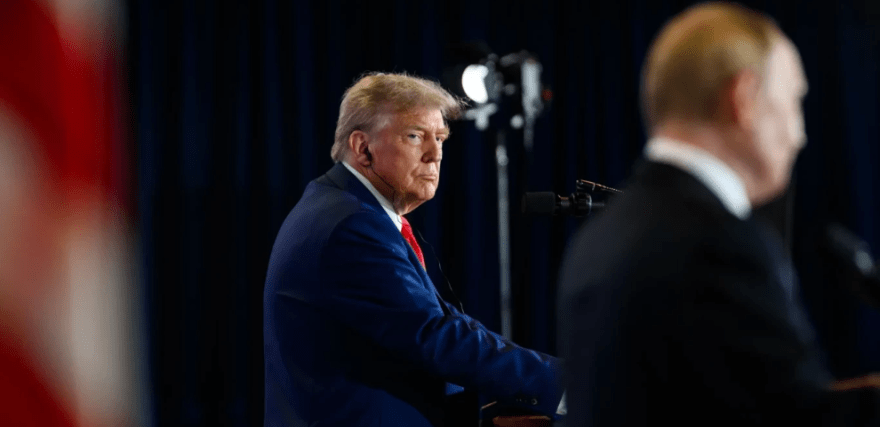
“Putin’s army is on its knees,” states an article published this week by The Telegraph , one of the media outlets most involved in the Ukrainian cause, which sees “a desperate Putin nearing the end.” Its diagnosis is clear: the Russian military effort is on the verge of collapse, so “Ukraine should negotiate from a position of strength, not dance like a bear to please Washington.” Completely sidelined from the US-led negotiation process, which recently began its bilateral phase of direct contacts between Russia and Ukraine, European countries have lost what little influence Washington had reserved for them in the diplomatic process. The United States expects European capitals to largely finance the armed mission that—with external support from Washington—will monitor the future ceasefire and take charge of the less lucrative aspects of reconstruction, but, for the moment, it prefers to keep its continental allies away from the negotiating table.

In this way, Trumpism has nullified Europe's ability to influence the course of diplomacy, a necessity based on opinions like the one expressed in the British article, which the US administration considers wishful thinking rather than a reflection of reality. However, the dream of cornering Russia has not disappeared within the European establishment , which is trying to convince itself that its positions prior to the failure of the ground counteroffensive remain valid and that only with further effort will it be possible to force Moscow to accept the terms of surrender that Zelensky intended to impose with his Peace Formula and Victory Plan.

On the ground, the situation is different from that described by the British newspaper. “The fall of the command post in late December,” states The New York Times, citing its source, “Captain Filatov, who claimed to have followed it through radio communications,” in a lengthy report on the Zaporizhzhia front. The report comments that, “after four years of grueling warfare,” “exhausted by Russian attacks along a 700-mile front line, Ukraine lacks sufficient troops to defend all sectors equally, creating gaps through which Moscow’s forces can advance more easily.” The report presents a situation of an excessively long front where Russia is able to find and exploit existing gaps due to casualties and Ukraine’s inability to replenish its ranks to replace fallen or exhausted soldiers. Written from a decidedly pro-Ukrainian perspective and accepting the excuse that fog facilitated the entry of Russian troops into Guliaipole, the article fails to explain why Ukraine has been unable to reverse these enemy advances and admits that Russia controls half the city—an optimistic claim considering that, even according to DeepState , Ukrainian troops have lost not only the city but also part of its surrounding area. Although the article insists that Ukraine is not in danger of a general collapse in that sector of the front, the pessimism of the soldiers on the ground is palpable. Russia is advancing extremely slowly, but, unlike Ukraine, it is not losing territory; rather, it is gaining it by exploiting its enemy's weaknesses.

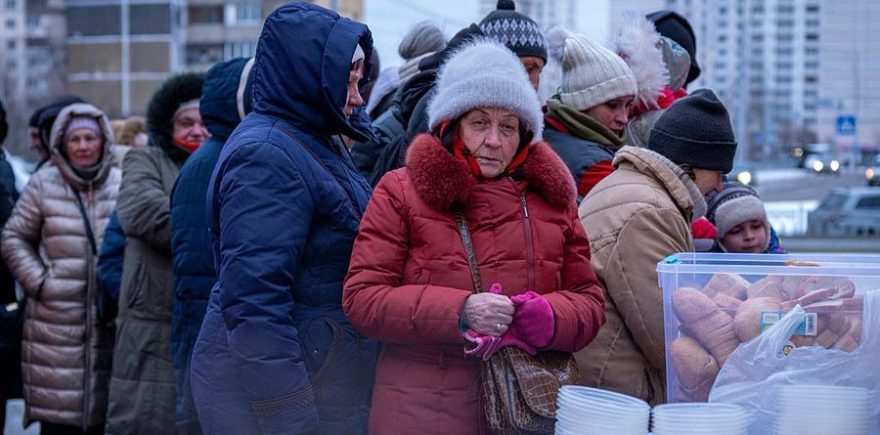
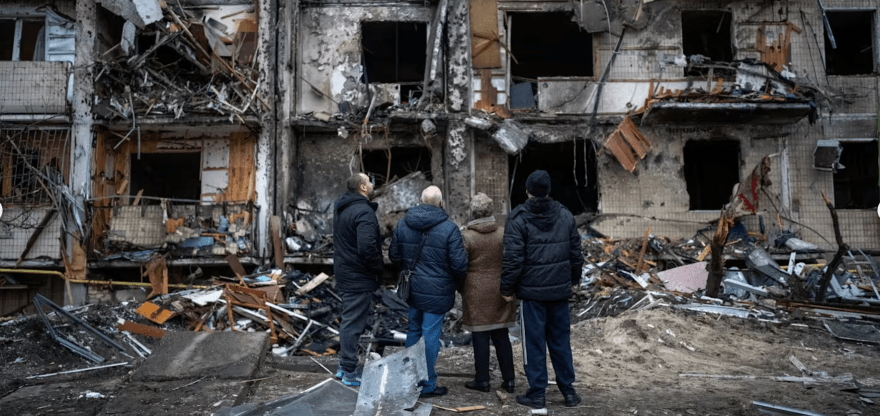
Something similar is happening on the home front, where Russia's capacity to attack critical infrastructure has increased significantly, as can be seen these days with the dramatic situation facing a large part of the Ukrainian population. Almost four years after the then-spokesperson for the Zelensk government , Oleksiy Arestovich , first claimed that Russian arsenals were about to run out of missiles, airstrikes have caused a humanitarian catastrophe in the Ukrainian capital. Russian drones and missiles are currently causing damage they had never before achieved, a situation to which Ukraine can only respond with propaganda. A few days ago, in his usual style of announcing future miracle weapons, Mikhail Fedorov, the new Minister of Defense, promised that the situation will soon change thanks to the development of an independent air defense system that Ukraine is preparing—a wish reminiscent of the high expectations Kyiv raised last summer regarding its Flamingo missiles, more powerful and with a longer range than the American Tomahawk missiles, which, for some reason, it continued to demand as an objective necessity. Mass production of these miracle offensive weapons has never occurred, and all indications are that the miracle defensive weapons promised by Fedorov will follow the same path, with promises of the future and immediate demands.

Ukraine's main problem right now is in its capital, where a partial truce is in effect this week , theoretically giving authorities some time to try to repair at least some of the infrastructure damaged by previous bombings. As has become the norm, Zelensky has been quick to find those responsible. "Imagine this: I know there are ballistic missiles aimed at our energy infrastructure, I know the Patriot systems are deployed, and I know there will be no electricity because there are no missiles to intercept them," the Ukrainian president remarked on Friday night, when disaster was only a matter of time. Without the slightest hesitation in criticizing the countries that make it possible for his army to continue fighting, Zelensky reproached them, saying, "The portion corresponding to the Purl initiative [Ukraine's Priority Needs List] wasn't paid. The missiles didn't arrive." Ukraine only obtains weapons if European countries acquire them commercially from the United States.

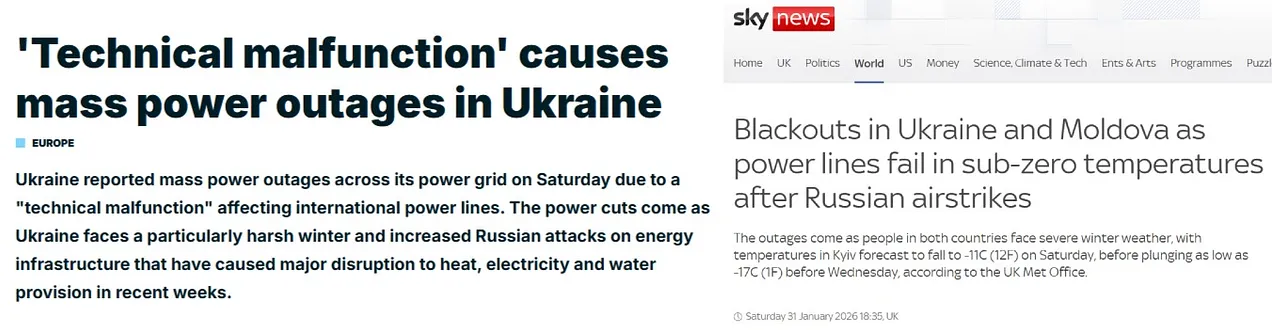
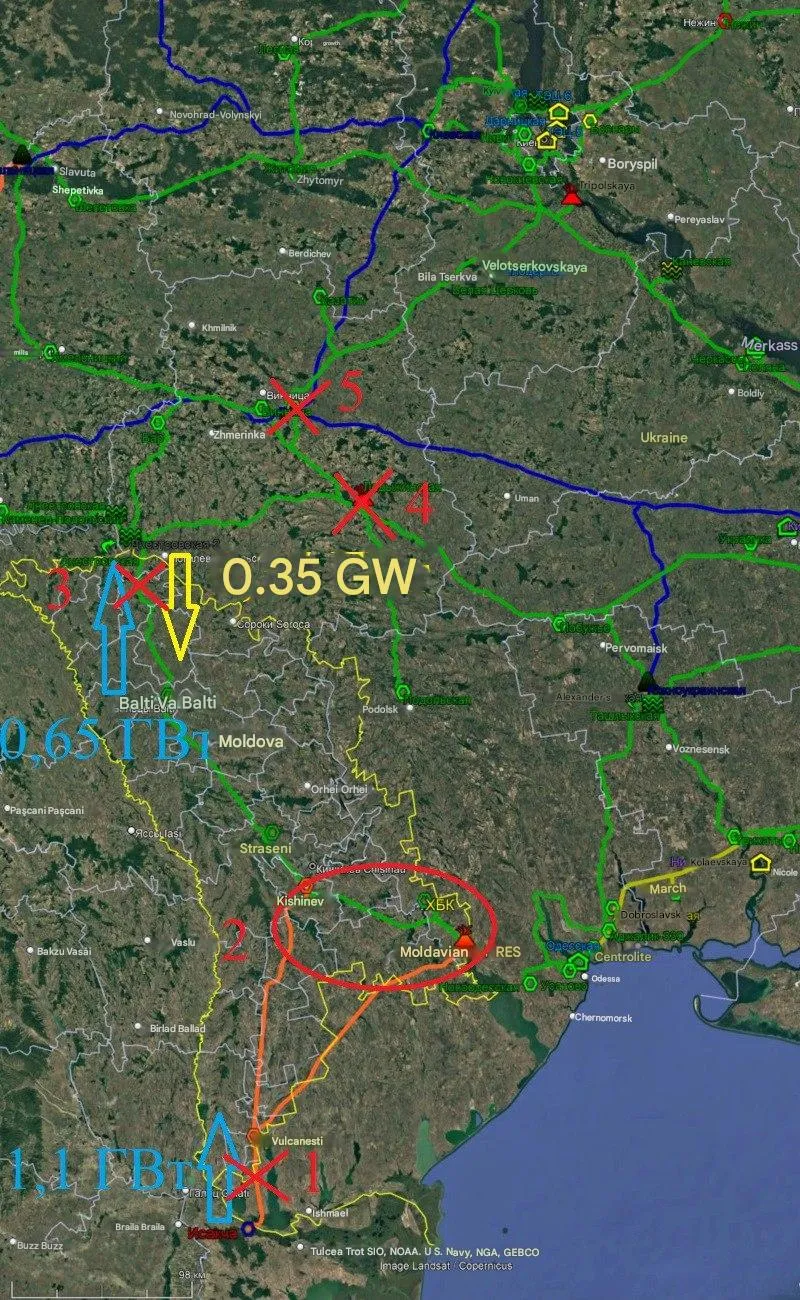
Yesterday, despite two days without attacks, the situation was critical. “Today at 10:42, a technical failure occurred with the simultaneous disconnection of the 400 kV line between the Romanian and Moldovan power systems, and the 750 kV line between western and central Ukraine. This caused a cascading outage of the Ukrainian power grid and the activation of automatic protection systems at substations. The power units of nuclear power plants were taken offline (reducing output). Currently, in the Kyiv City , Kyiv Region , Zhytomyr, and Kharkiv regions, the dispatcher has implemented special emergency outage schedules. Ukrenergo power workers are working to restore power. It is expected to be restored within the next few hours,” the state-owned power company reported this morning, adding that it hoped to repair the damage throughout the day.

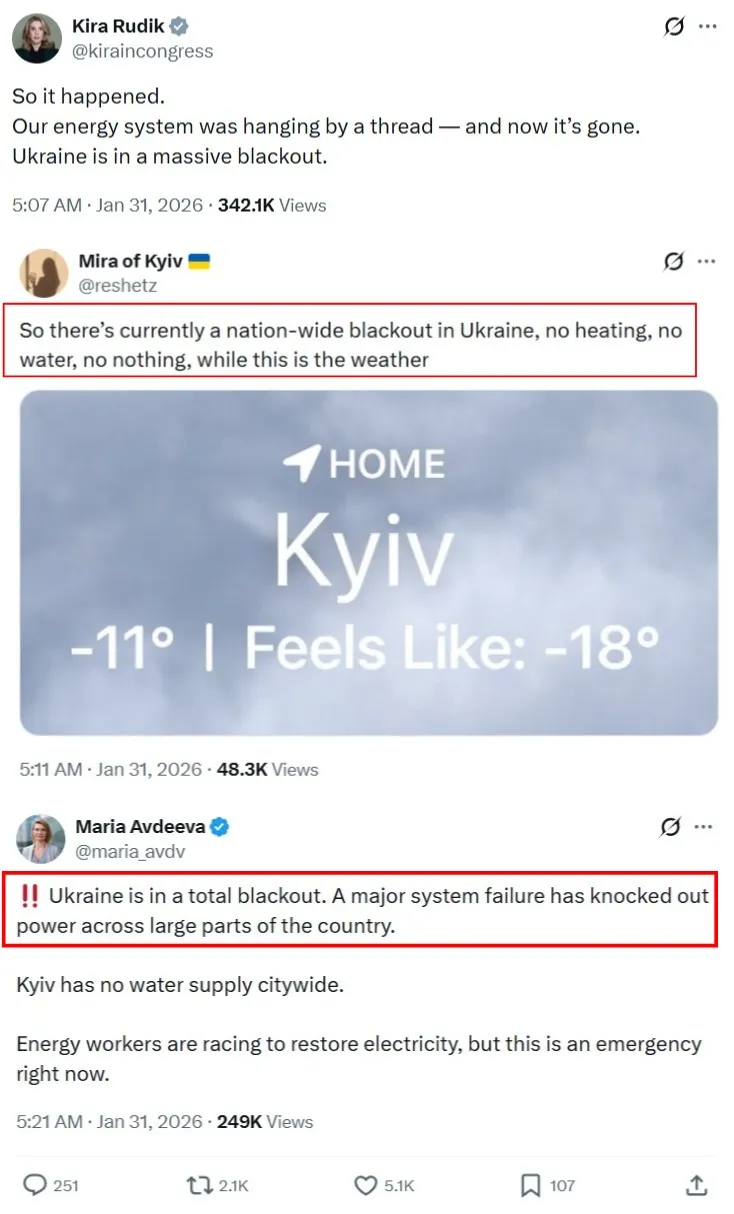
“And so it happened. Our energy system was hanging by a thread, and now it no longer exists. Ukraine is experiencing a massive blackout,” commented Kira Rudik, leader and member of parliament of the national-liberal Holos party, whose analysis is frequently featured in Western media, especially British, despite its radicalism. “Let them negotiate the missiles with Russia,” she wrote on social media in November 2024, days after Donald Trump’s election victory, when a final effort was underway to get Joe Biden to use his last weeks in office to offer Ukraine long-range missiles with which to implement Zelensky’s version of Nixon’s 1972 Vietnam strategy.

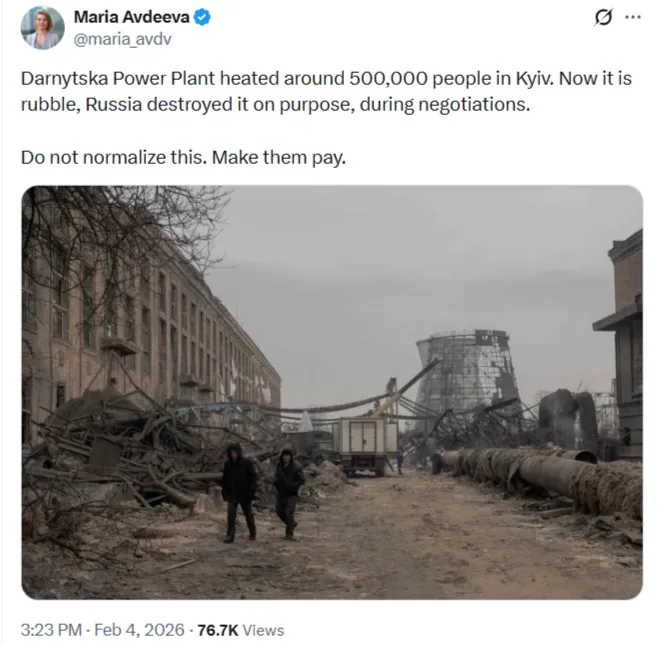
“The Kyiv metro is not working due to the blackout. There is also no water or heating in the city. This is the harshest winter for Ukraine to date. People are showing incredible resilience, but the situation is extremely difficult. Ukraine needs more support now,” wrote lobbyist Maria Andreeva, always suggesting the external solution that Kyiv clings to whenever the situation becomes complicated. “Ukraine’s power grid suffered massive outages on Saturday after a technical fault caused power lines between Moldova, Romania, and Ukraine to fail, according to the Ukrainian Energy Minister. The incident comes after months of Russia’s campaign against Ukraine’s critical infrastructure, which has caused serious damage to the energy system,” Euronews stated , describing a blackout that affected the two neighboring countries, still linked by the infrastructure they had when both territories were part of the Soviet Union. Moldova, which has sometimes mocked Transnistria's plight due to fuel shortages caused by the energy blockade it imposes on the separatist region, is now a direct victim of a war in which, like European countries, it has always advocated fighting to the final victory.

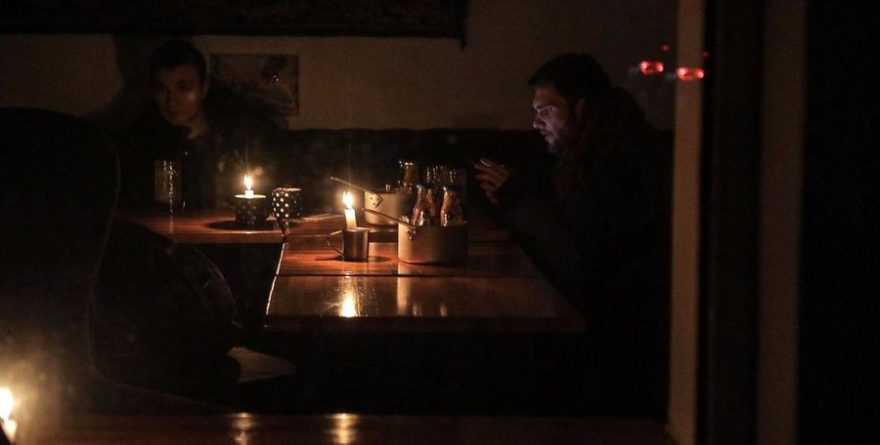
While attacks continued in other parts of the country, especially in the city of Dnipro, of great logistical importance to the Ukrainian military effort, the situation in Kyiv deteriorated significantly. “More than a million residents of Kyiv’s left bank continue to face the most adverse conditions in the city, with many living without electricity or heating during the harshest weeks of the year, as temperatures regularly drop below -10°C,” added The Kyiv Independent . “It is important to remember who the real victims of the Russian attacks on Kyiv’s energy infrastructure are: Ukrainians disproportionately from the working class and other vulnerable groups, many of whom are also let down by the city’s failing response,” stated Jared Goyette, one of the newspaper’s journalists, introducing a class factor that has been selectively exploited throughout this war. Ultimately, this population is also the one most affected by the IMF's demands to continue increasing electricity and gas rates for the population, a demand that the Ukrainian government has chosen not to fight.

https://slavyangrad.es/2026/02/01/treguas-y-apagones/

Google Translator

******

From Cassad's telegram account:

Colonelcassad
The main points of Medvedev's statements :

- Power in Europe has been seized by a "gang of lunatics", a gang of absolutely inadequate and incompetent madmen;

- Europe is undermining the foundations of its own existence with its own actions, this is simply astounding;

- European authorities "have achieved nothing" in their attempts to annoy Russia and support Ukraine, the situation for them "is only getting worse";

- The actions of the European Union are contrary to the interests of individual European countries;

- An attempt to defeat Russia and satisfy their own political ambitions will end tragically for EU politicians;

- Stubb constantly forgets that his country was Hitler's satellite and the Finns were forgiven for this after World War II;

***

Colonelcassad
Ukrainian sources claim that Russia will resume strikes on Ukraine's energy sector as early as February 3. Russia has not officially commented on the timing of the resumption of strikes. It was previously stated that the "ceasefire" would only last until February 1. Starting Monday, Ukraine will experience a cold snap, so new strikes should be especially severe, given the increasing number of cascading power grid failures. This is especially true if they target substation 750.

In short, we'll see in the coming days what target pool they've prepared during the short pause.

***

Colonelcassad
Russian Deputy Foreign Minister Grushko on the conditions for resolving the conflict in Ukraine:

"We have stated that this is unacceptable: no NATO membership and no foreign forces. It makes no difference if, say, a French corporal wears a cap with 'NATO' or 'EU' written on it. That doesn't change the situation. Therefore, we have not deviated from our position."

In short, any scenarios involving the introduction of any Western troops into Ukraine will be rejected outright by Russia. It is easier for them to continue the war than to tolerate NATO troops permanently stationed in Ukraine.

https://t.me/s/boris_rozhin

Google Translator

******

Brief Frontline Report – January 31st, 2026

Summary by Marat Khairullin and Mikhail Popov.
Zinderneuf
Jan 31, 2026

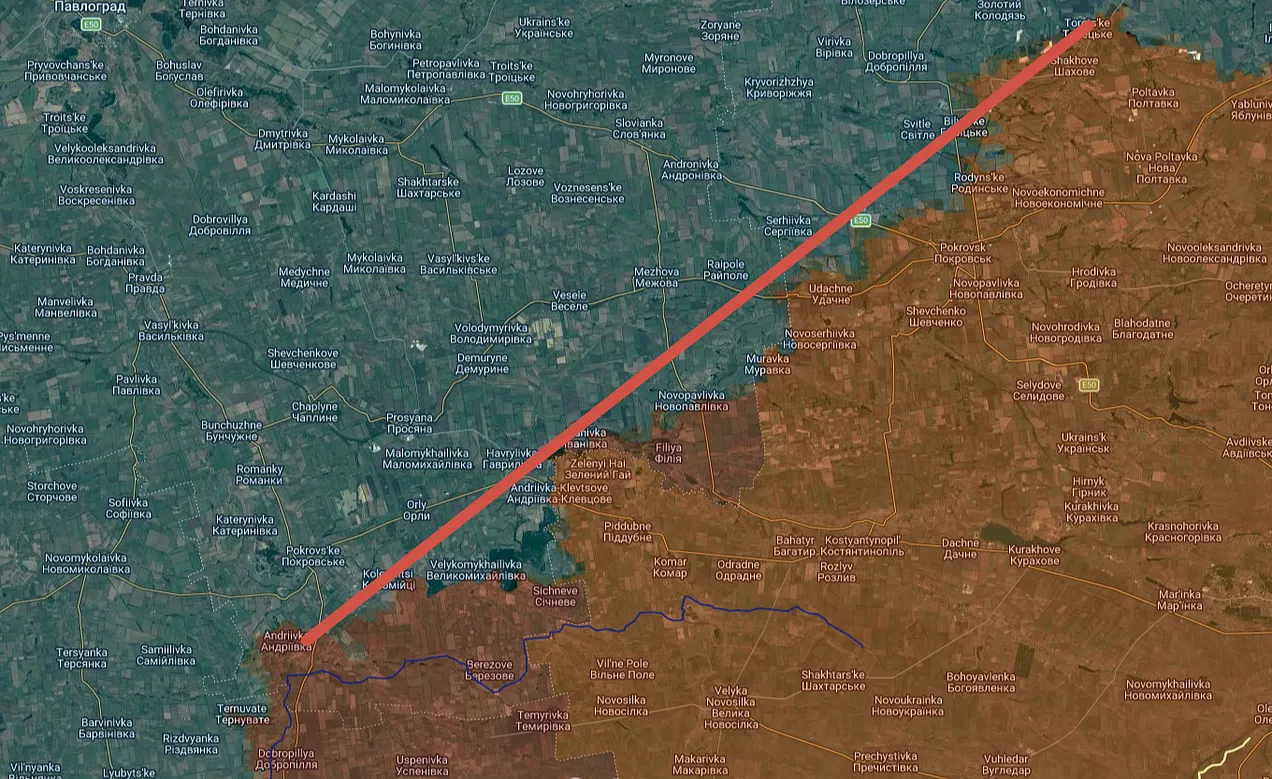
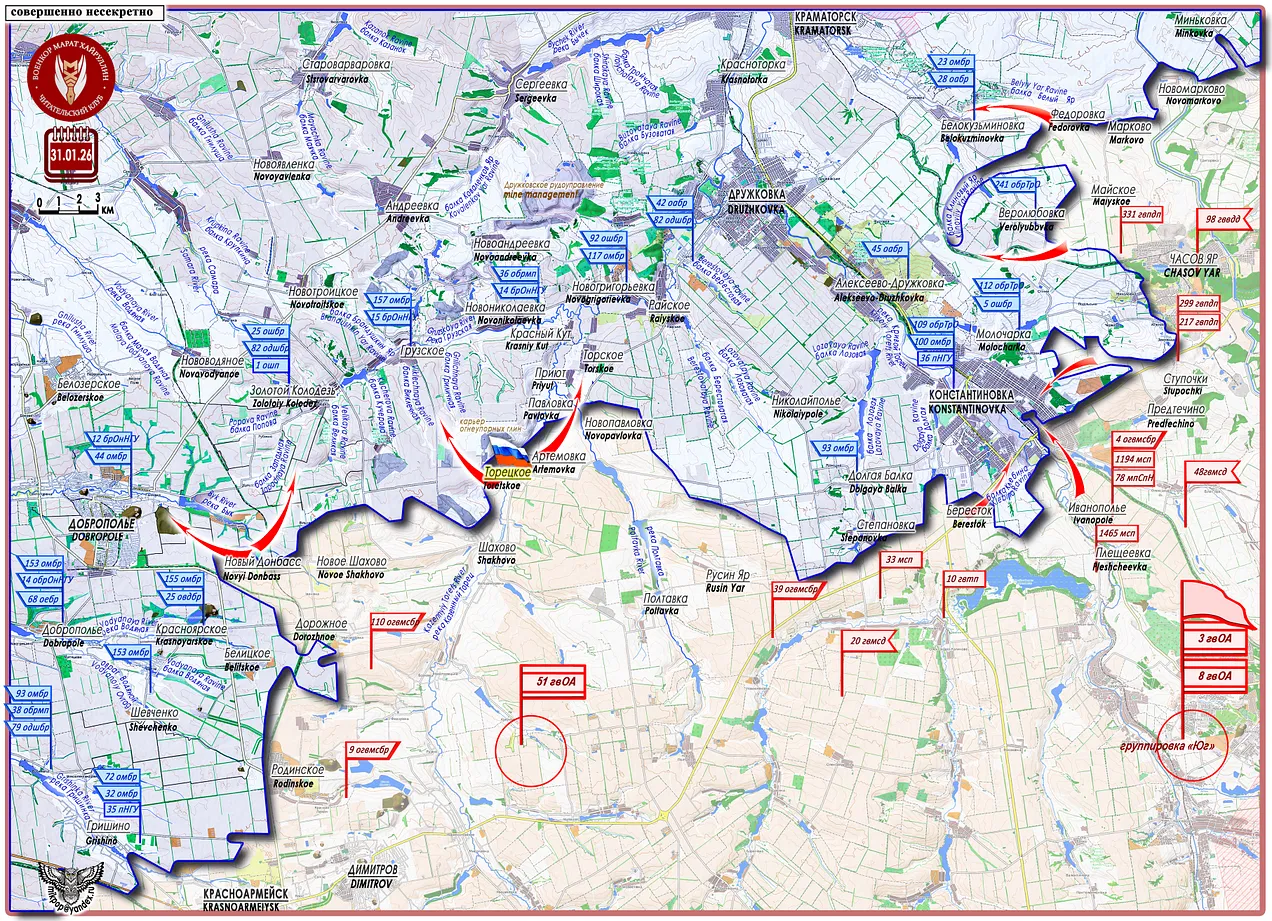
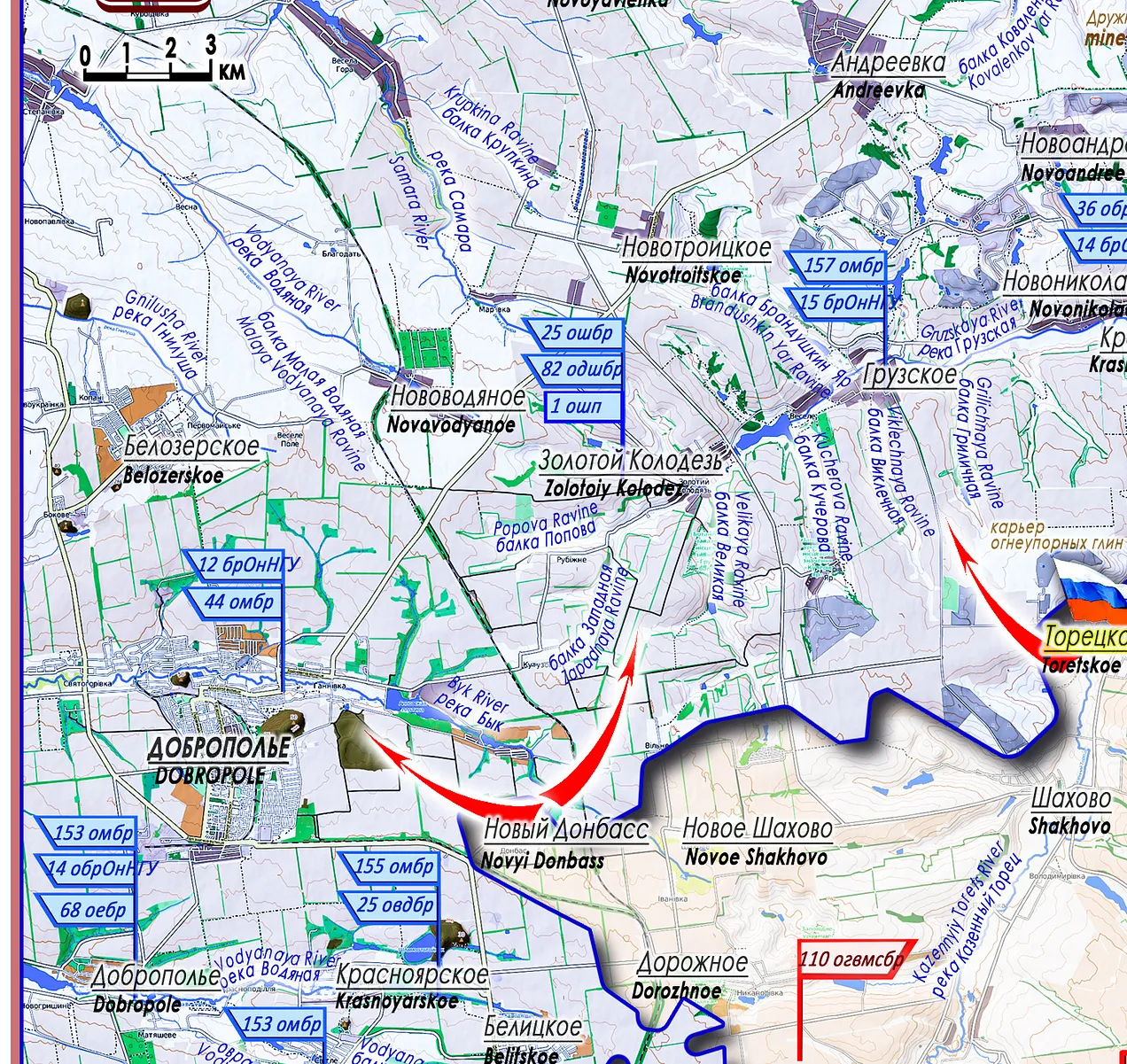
Message from the Russian Ministry of Defense: "Units of the 'Center' Group, as a result of ongoing operations, have liberated the settlement of Toretskoe in the Donetsk People's Republic."
Image
Kramatorsk to Krasnoarmeysk

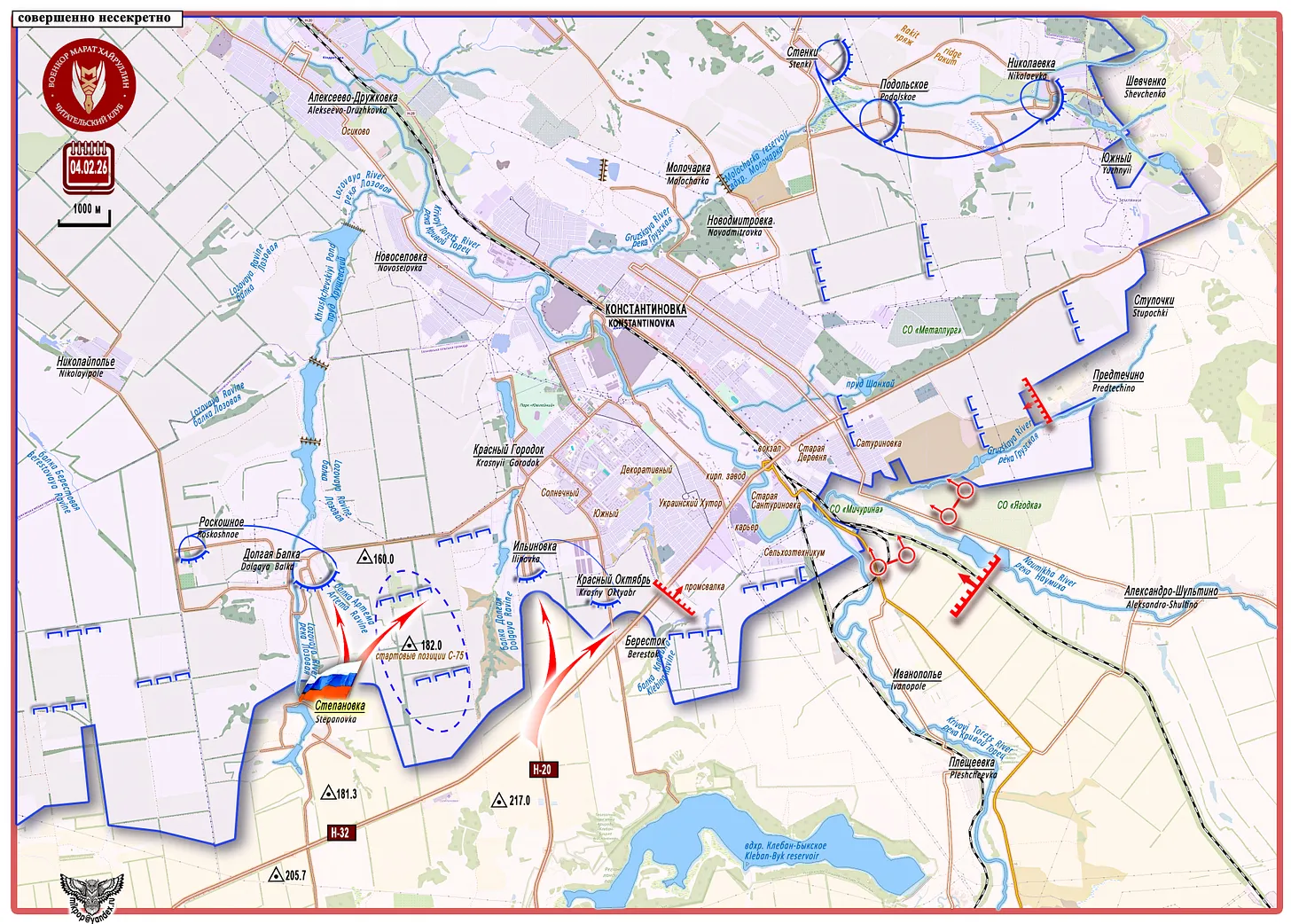
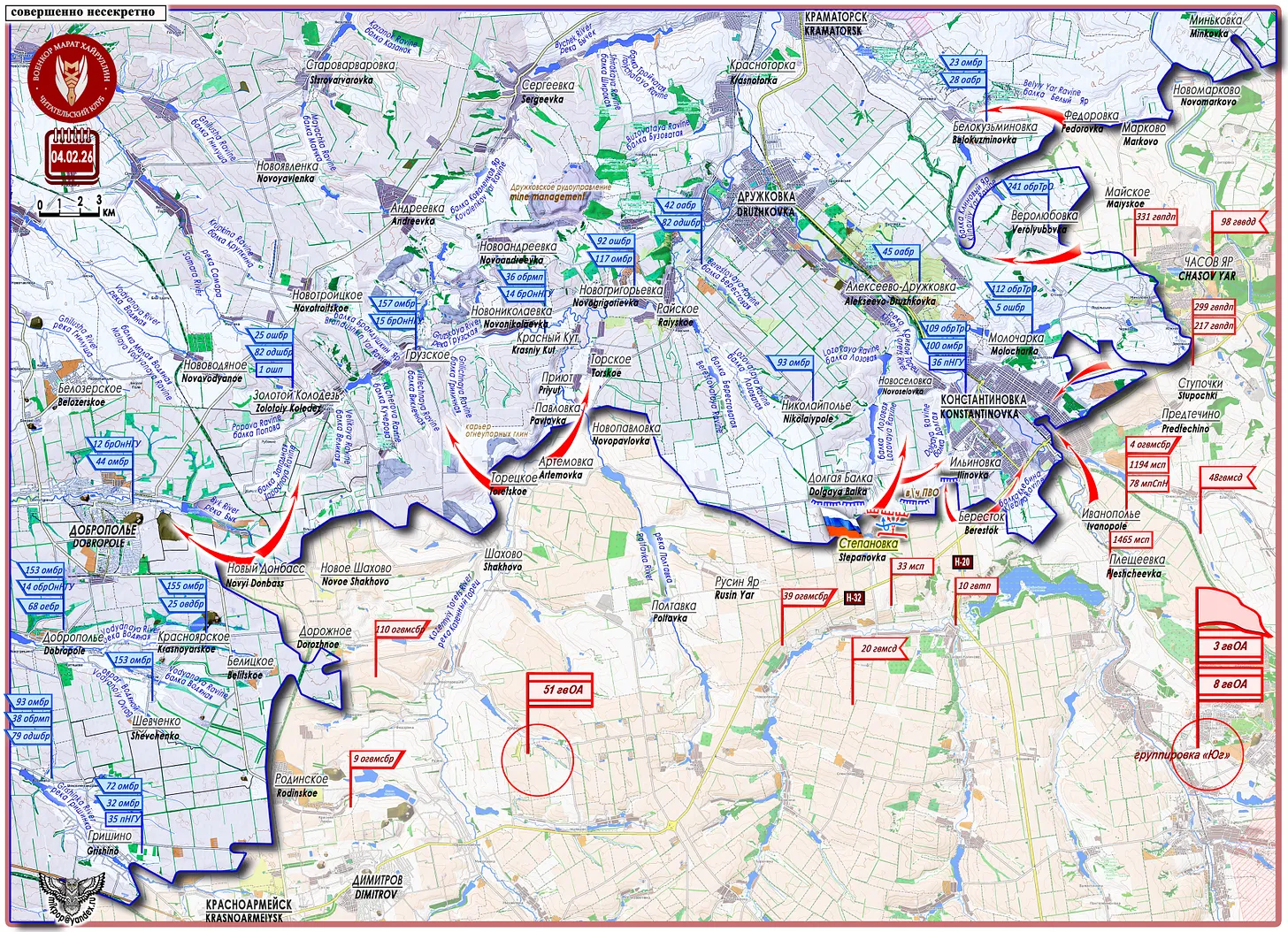
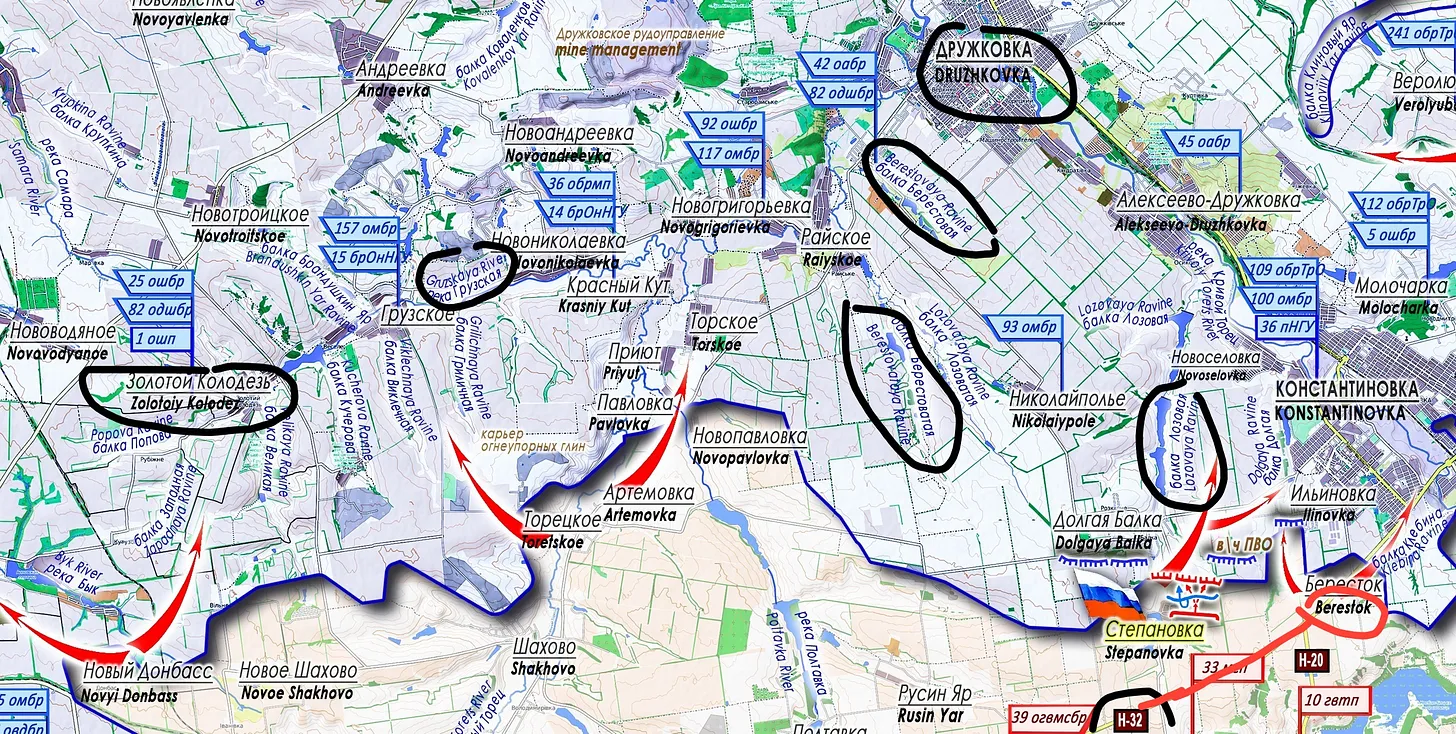
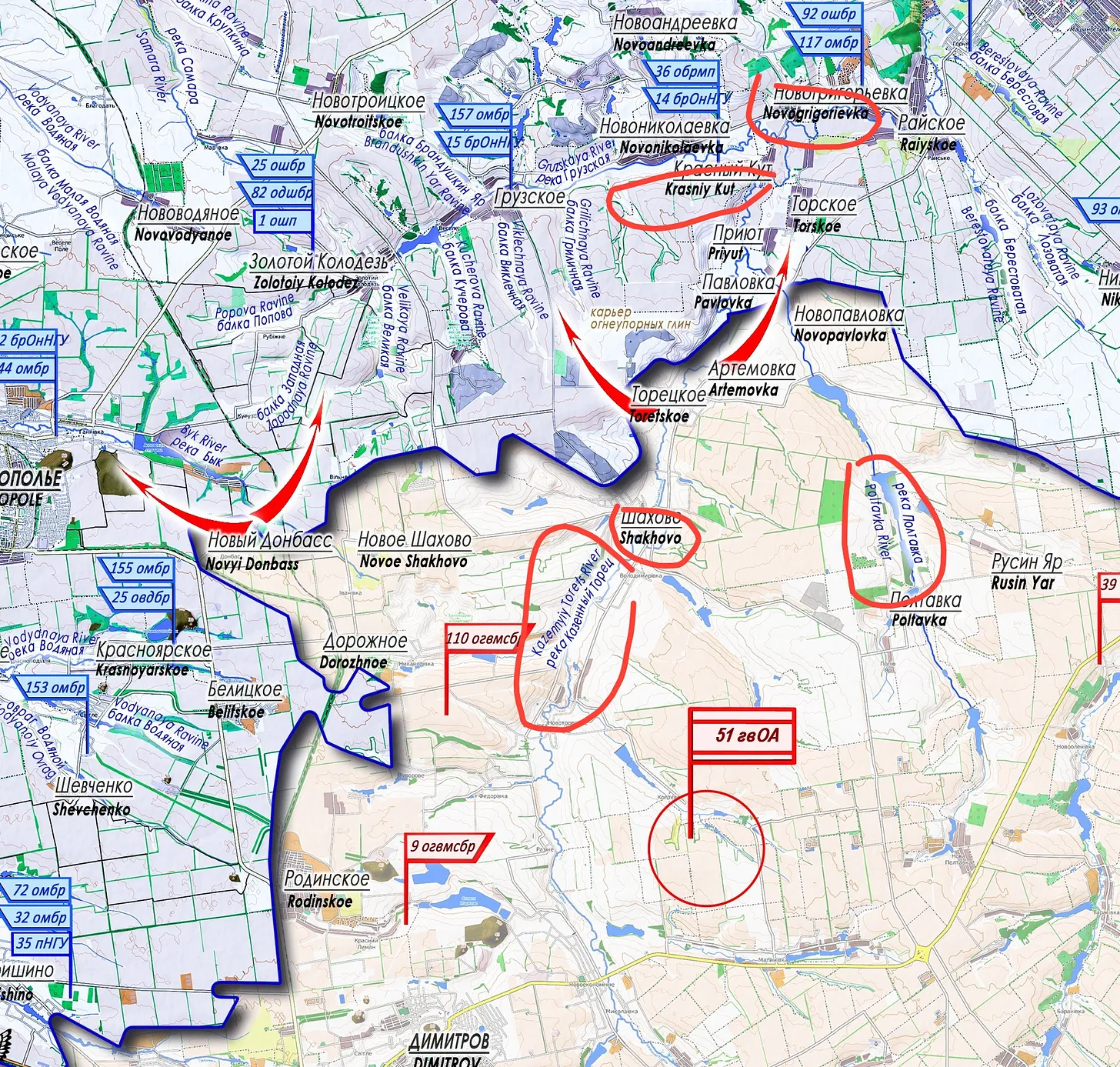
North of Krasnoarmeysk, in the Artemovka - Druzhkovka sector, the Russian Armed Forces are preparing a bridgehead in front of the Ukrainian Armed Forces' defensive line along the Gruzskaya River. This line protects the right flank of the Ukrainian Armed Forces group defending the southern face of the Slavyansk direction.
Image

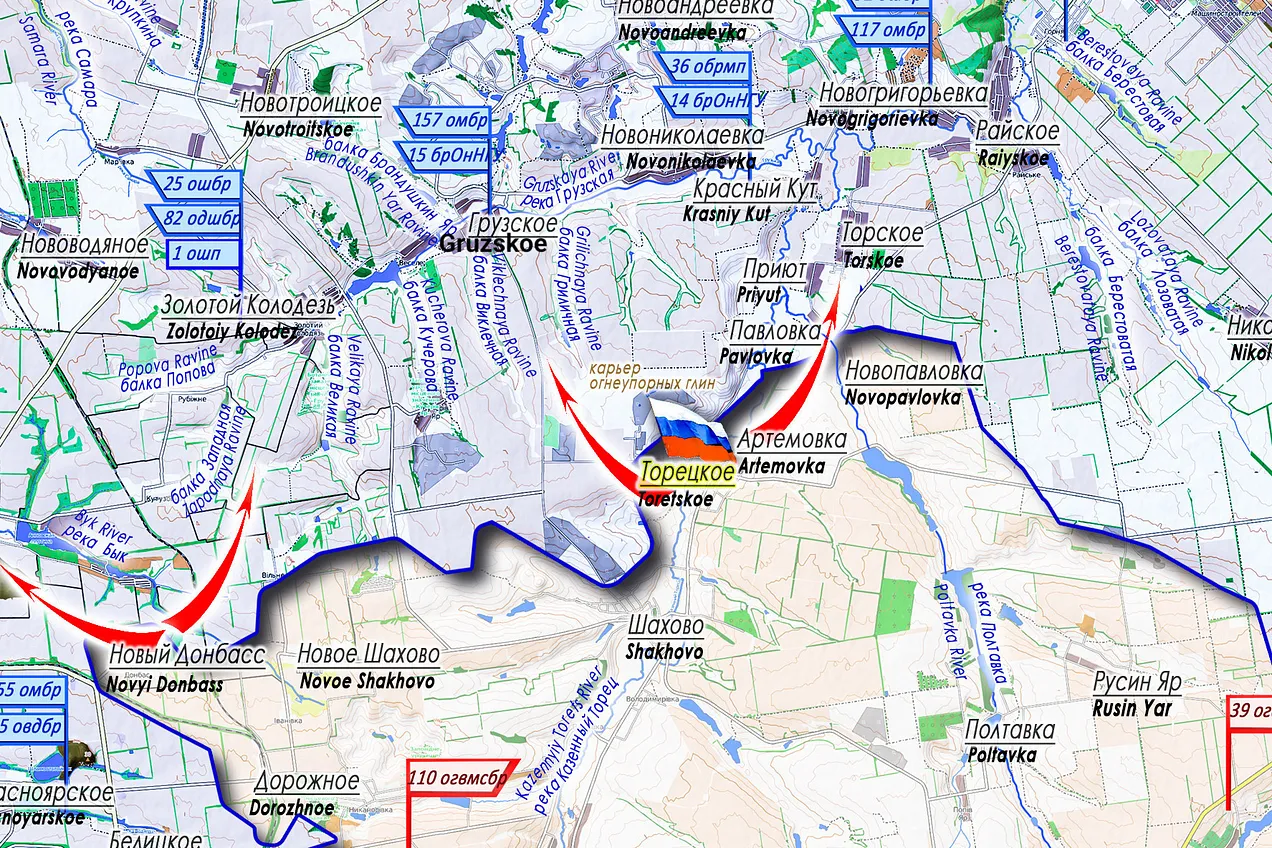
The area features complex, sharply rugged terrain with numerous ravines and gullies. It is located in the interfluve of the Kazennyi Torets River and its tributary, the Gruzskaya River. It begins in the area of the settlement of Zolotoiy Kolodez, where advanced Russian Armed Forces units reached in the autumn of 2025, drawing part of the enemy's forces and reserves during the operation to liberate the Dimitrov - Krasnoarmeysk area. The watershed apex is in the area of the settlement of Krasny Kut, where the Gruzskaya River flows into the Kazennyi Torets. The soil is like clay and difficult to traverse during rains and floods—the area abounds with deposits and quarries for refractory and ceramic clay.

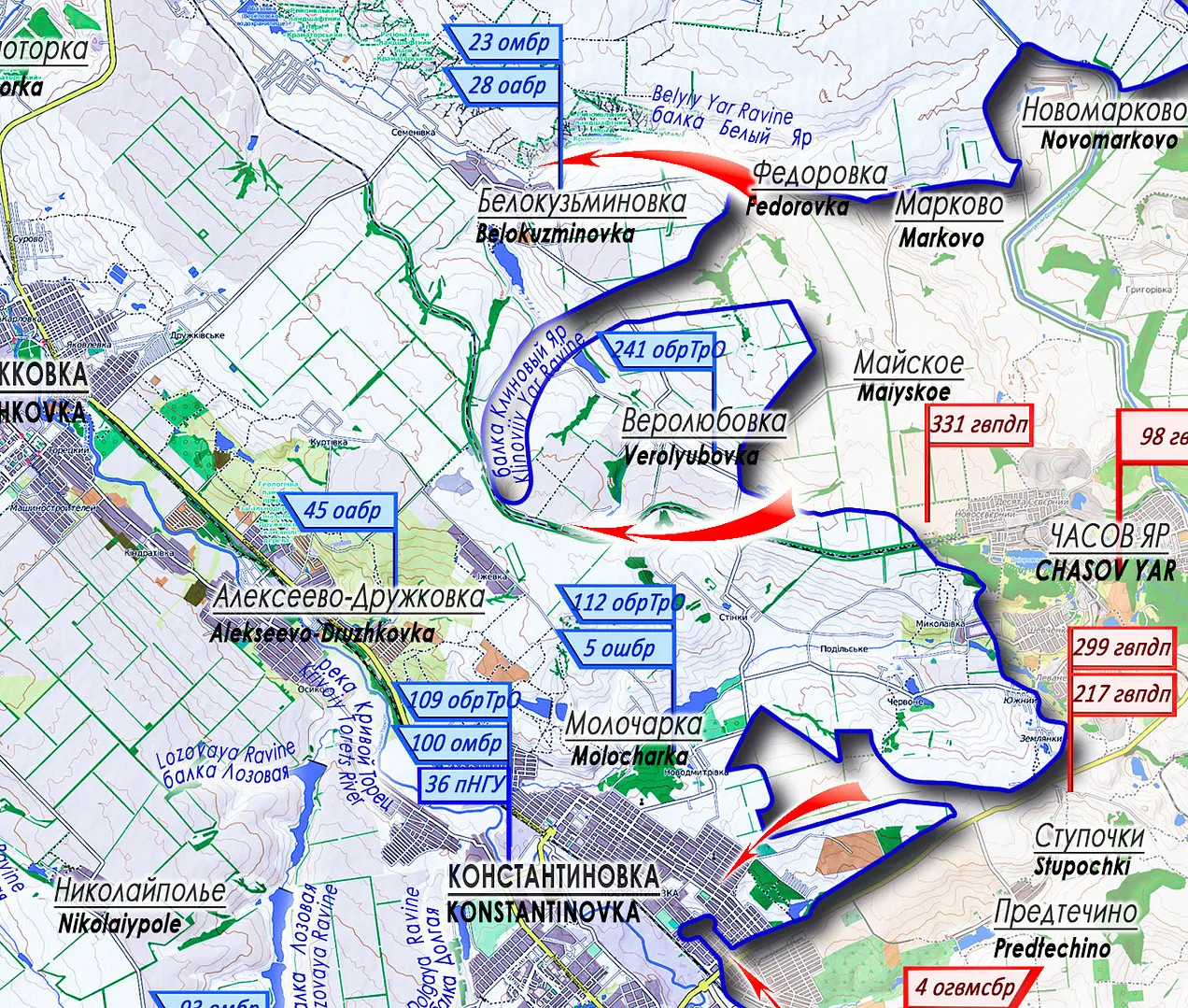
On January 31, Russian assault groups forded the Kazennyi Torets River in the area of the settlement of Artemovka, emerged on the left bank, and liberated the settlement of Toretskoe (48°30′8″ N 37°22′16″ E, population approx. 350). The rural settlement is located in the area of clay quarries and provides access to the watershed ridge at the start of the Grilichnaya and Viklechnaya ravines. The advance of our units into the area of the settlement of Gruzskoe splits this sector into two parts with flank envelopments. This advance will likely be supported by combined actions on the eastern face of the direction (Belokuzminovka-Verolyubovka) and on the western face (Novy Donbass - Dobropole - Zolotoiy Kolodez).
Image

Image

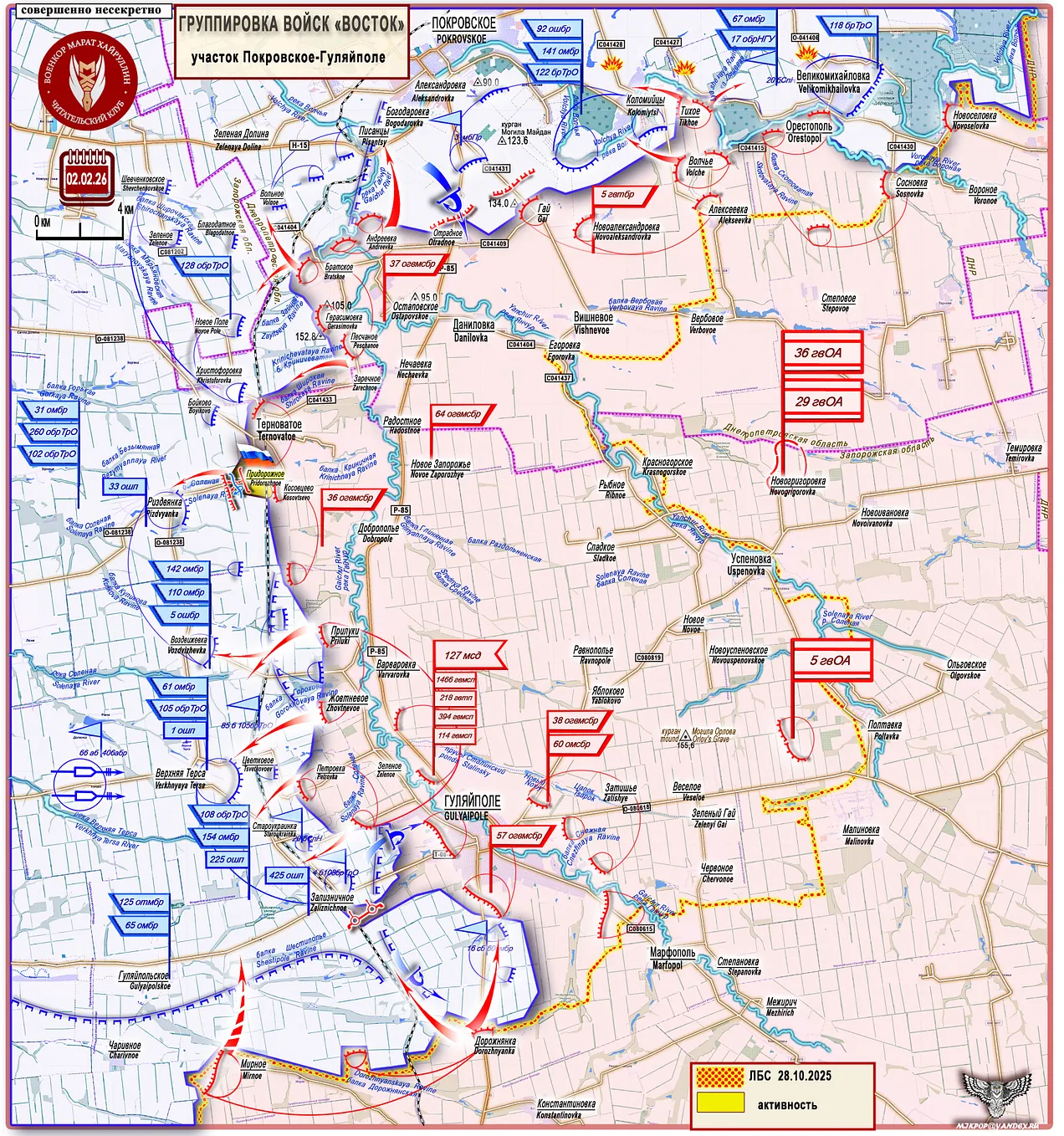
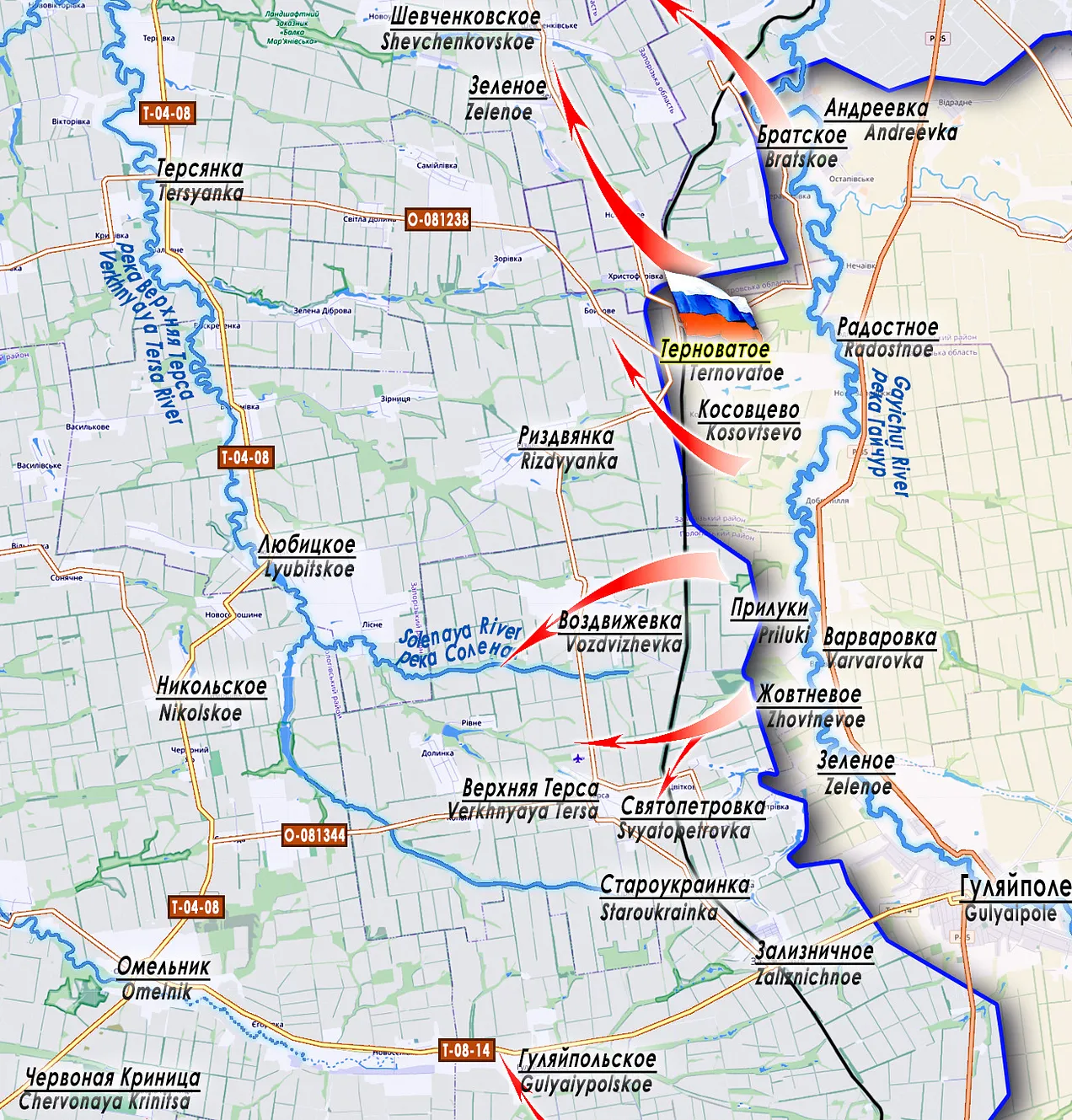
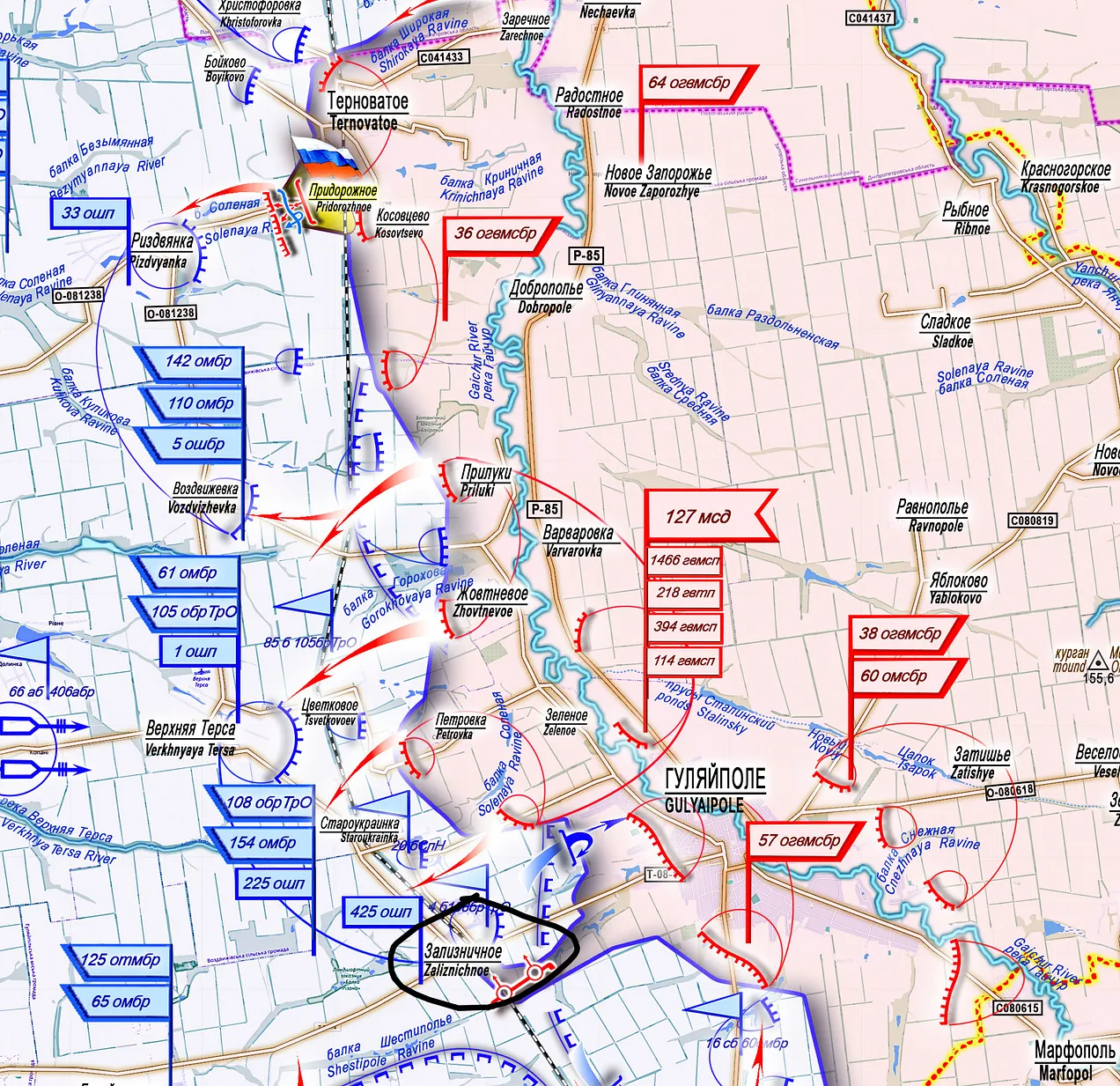
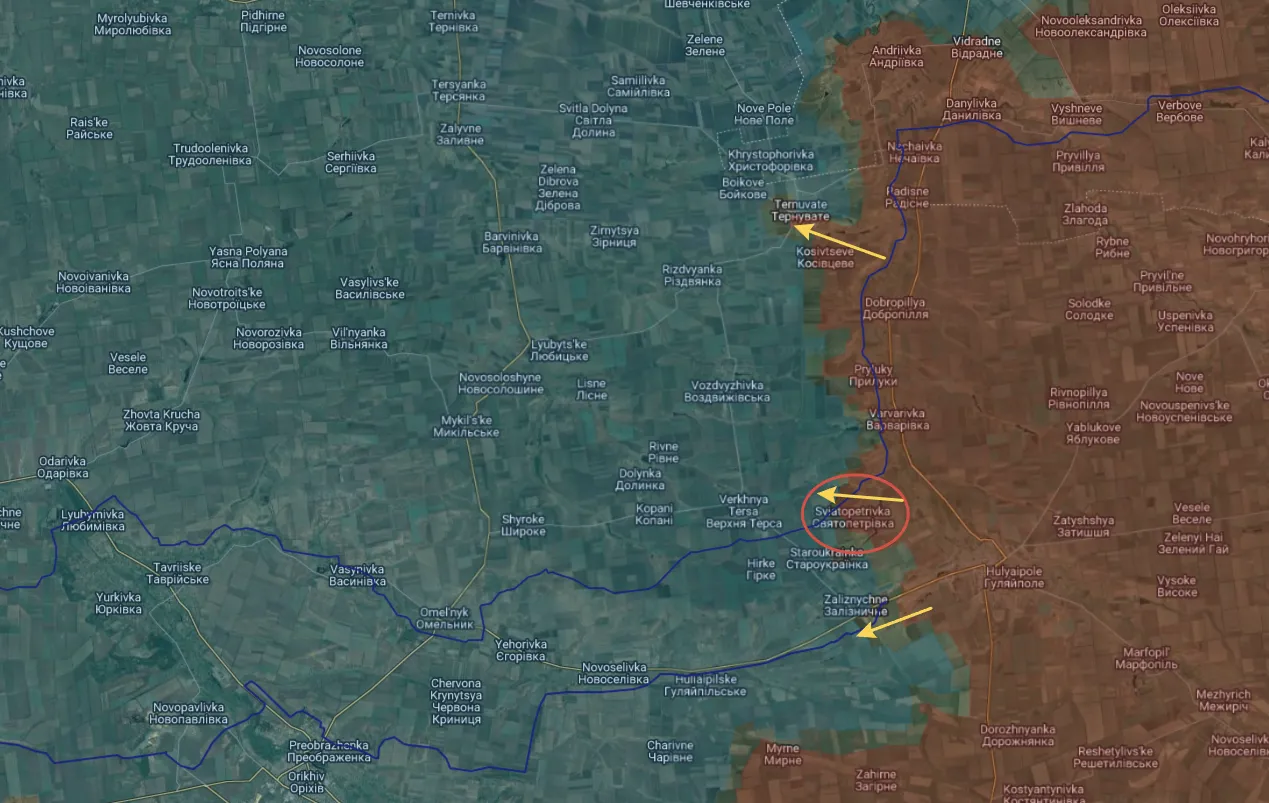
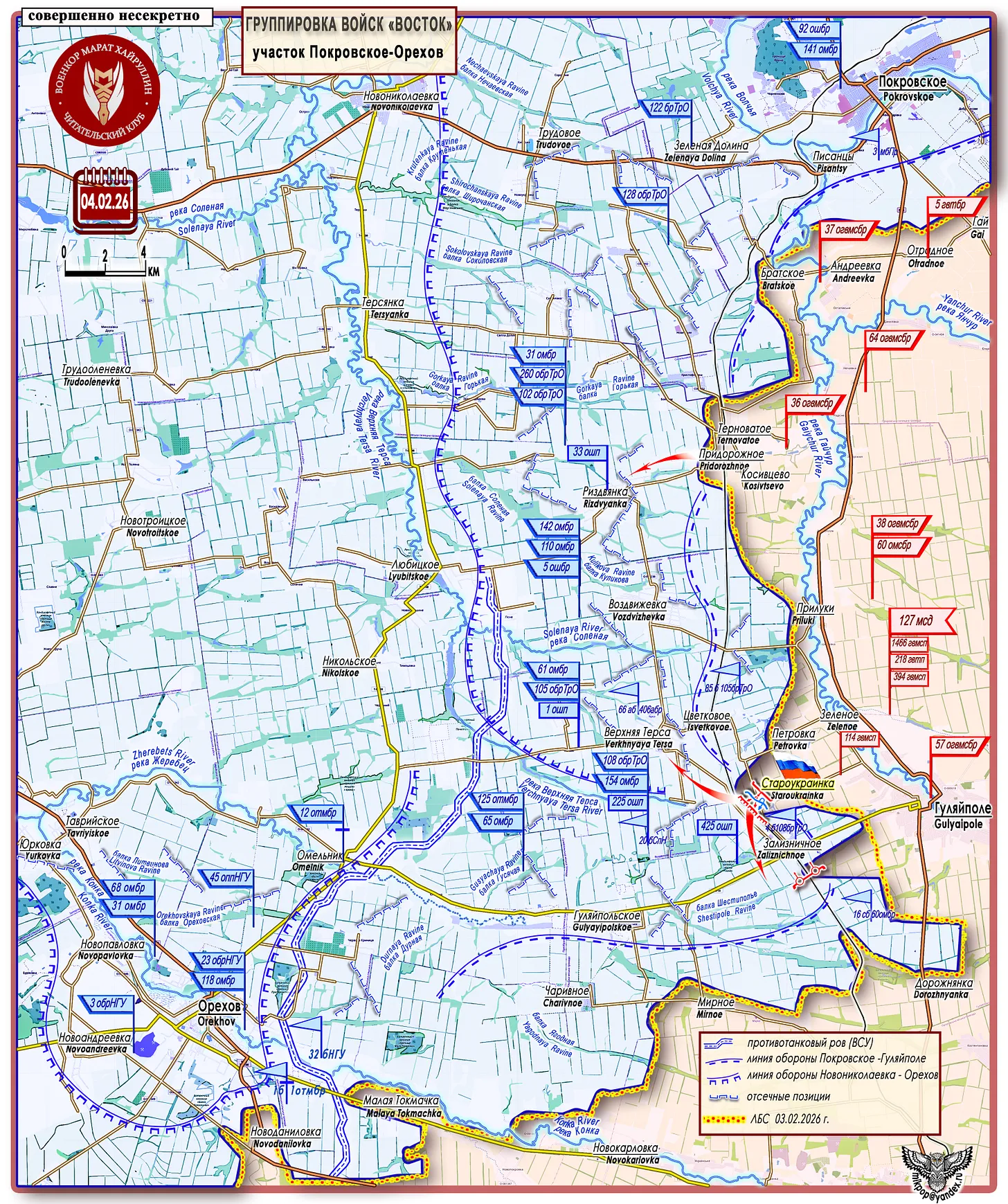
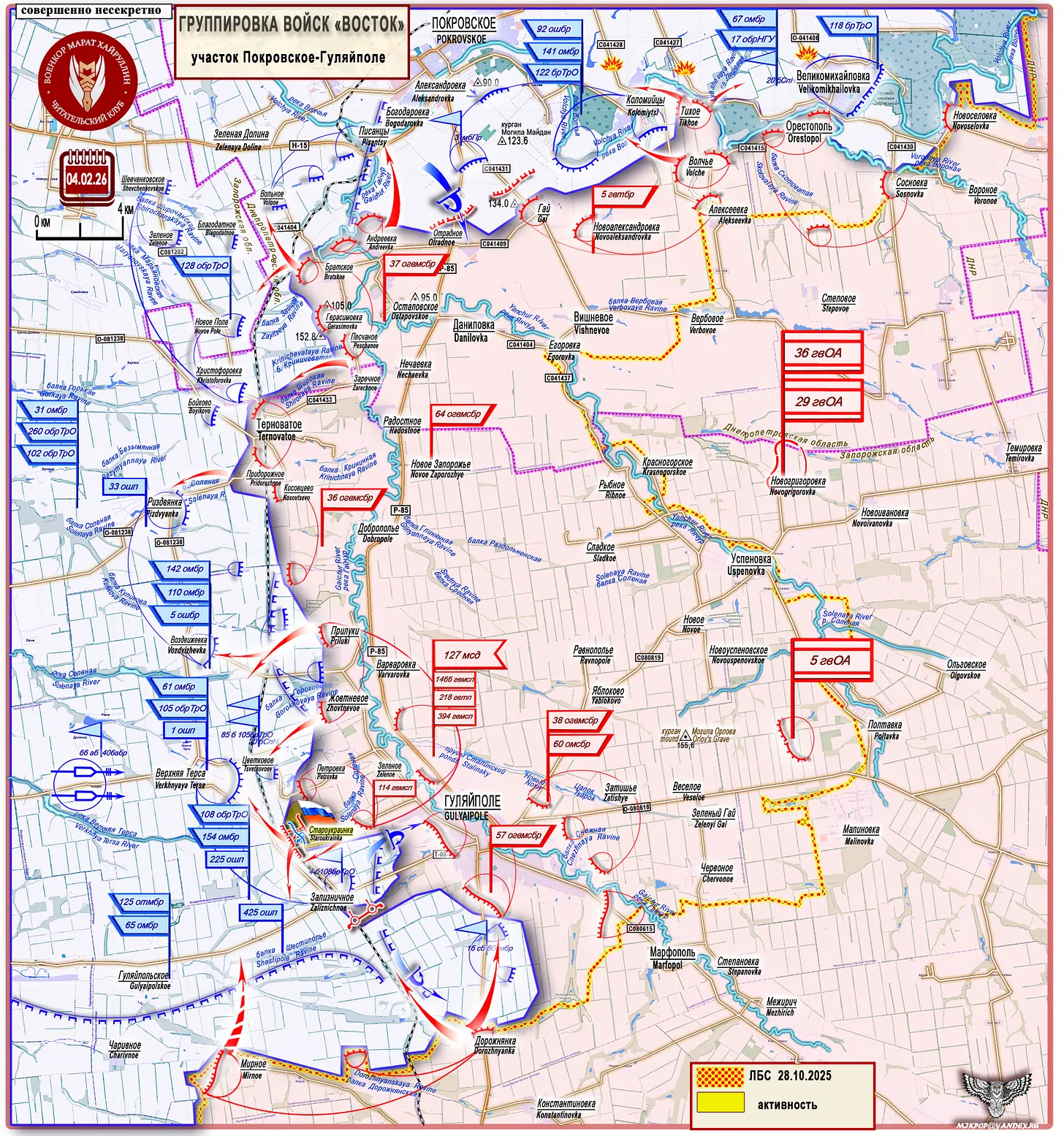
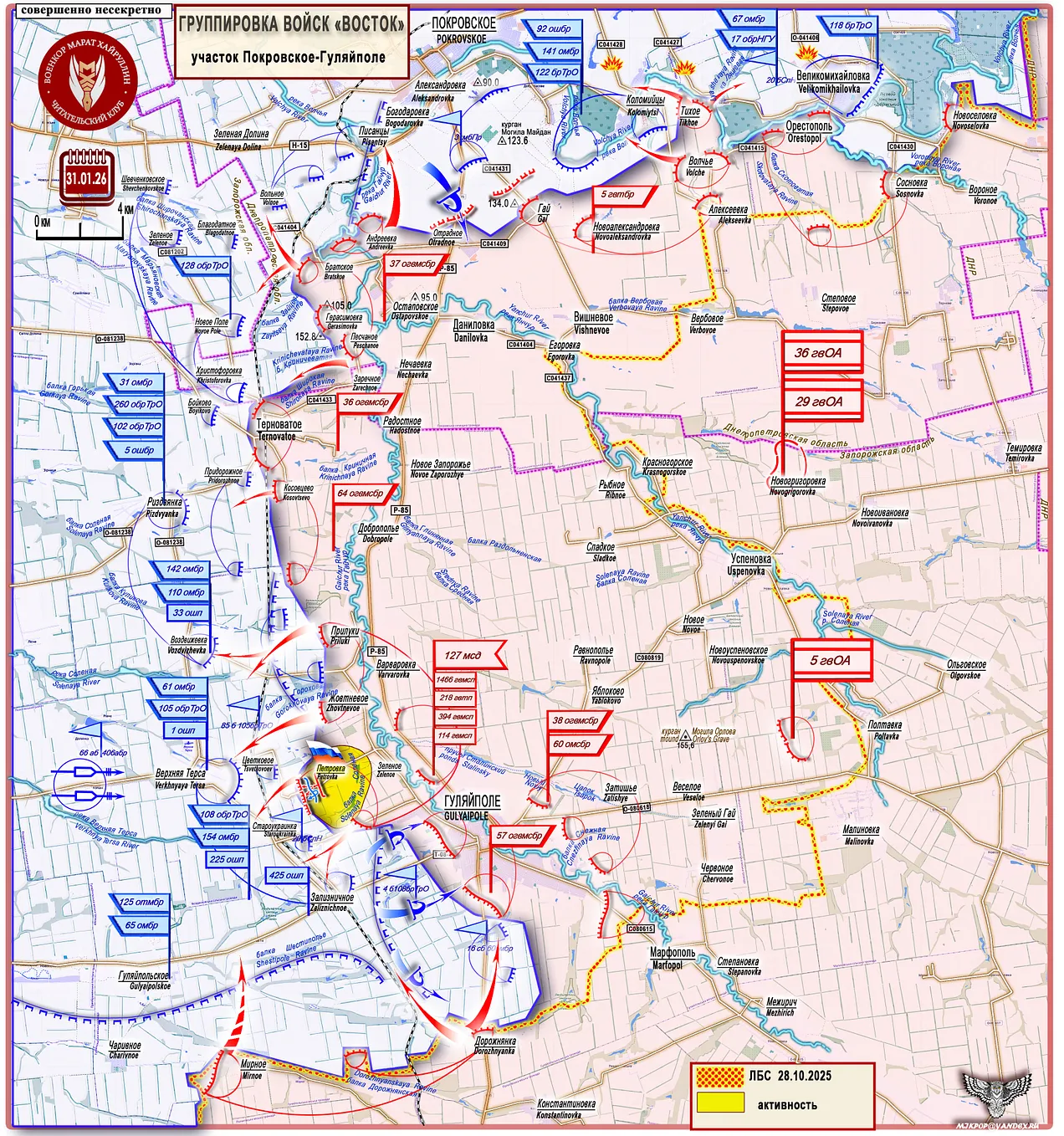
Message from the Russian Ministry of Defense: "Assault units of the 127th Division of the 5th Guards Combined Arms Army of the 'East' Group, during ongoing combat operations, have liberated the settlement of Petrovka in Zaporozhye Oblast.
Image
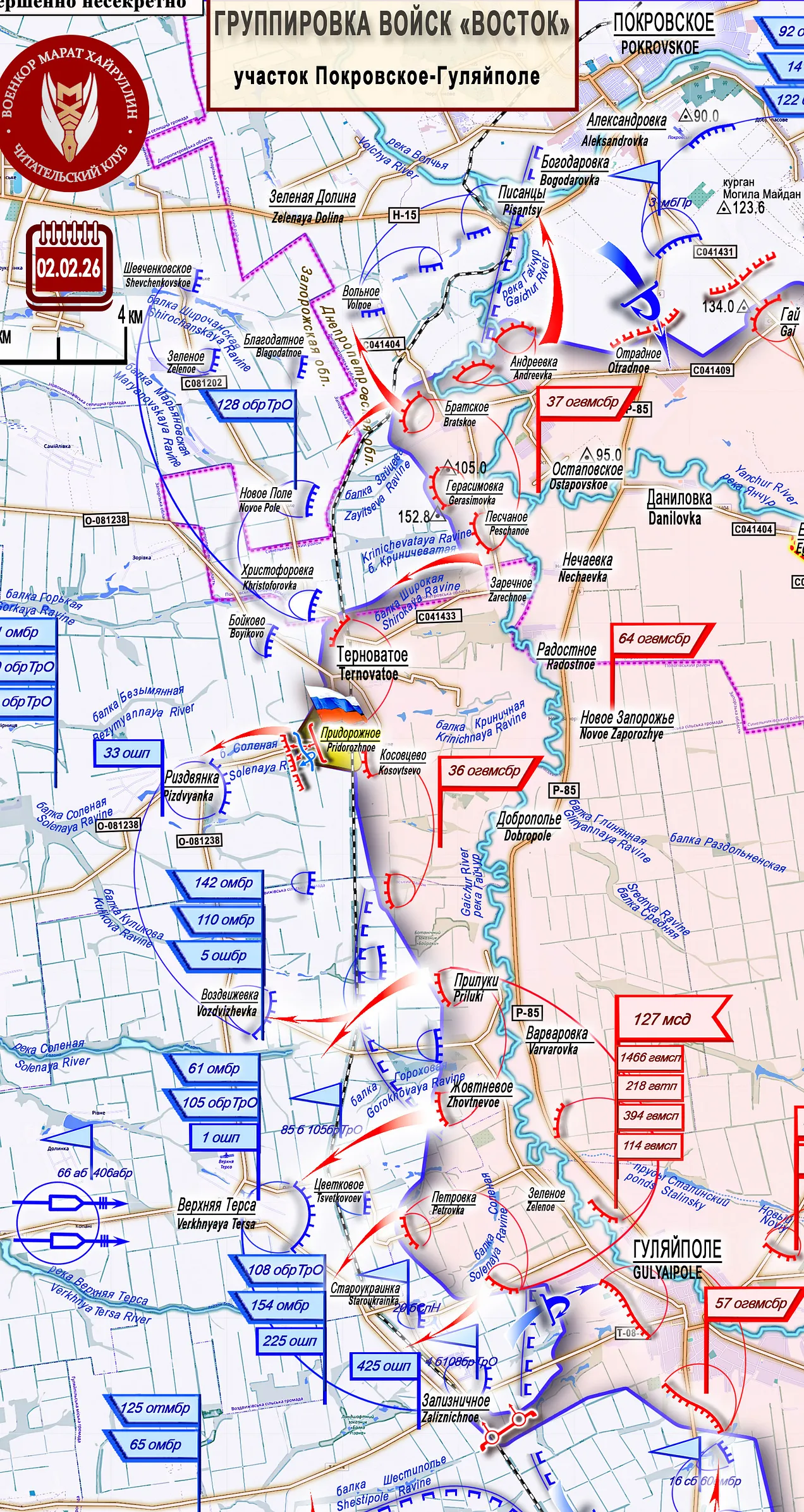
East Group Area of Responsibility; The yellow line with red dots represents the line of combat contact October 28th, 2025. Yellow represents the area of activity.

The Primorye warriors developed the success on the sector, drove the enemy out of strongpoints, and consolidated on the captured lines. A defense area of up to 5 sq. km has been brought under control; adjacent tree belts and defensive hubs that ensured the enemy's hold on the settlement have been cleared.

Ukrainian Armed Forces losses in this sector of the front amounted to up to 10 pieces of equipment and a large number of personnel.

The enemy's attempts to hold the settlement by transferring reserves were unsuccessful—the equipment with Ukrainian Armed Forces personnel was destroyed on the approaches."

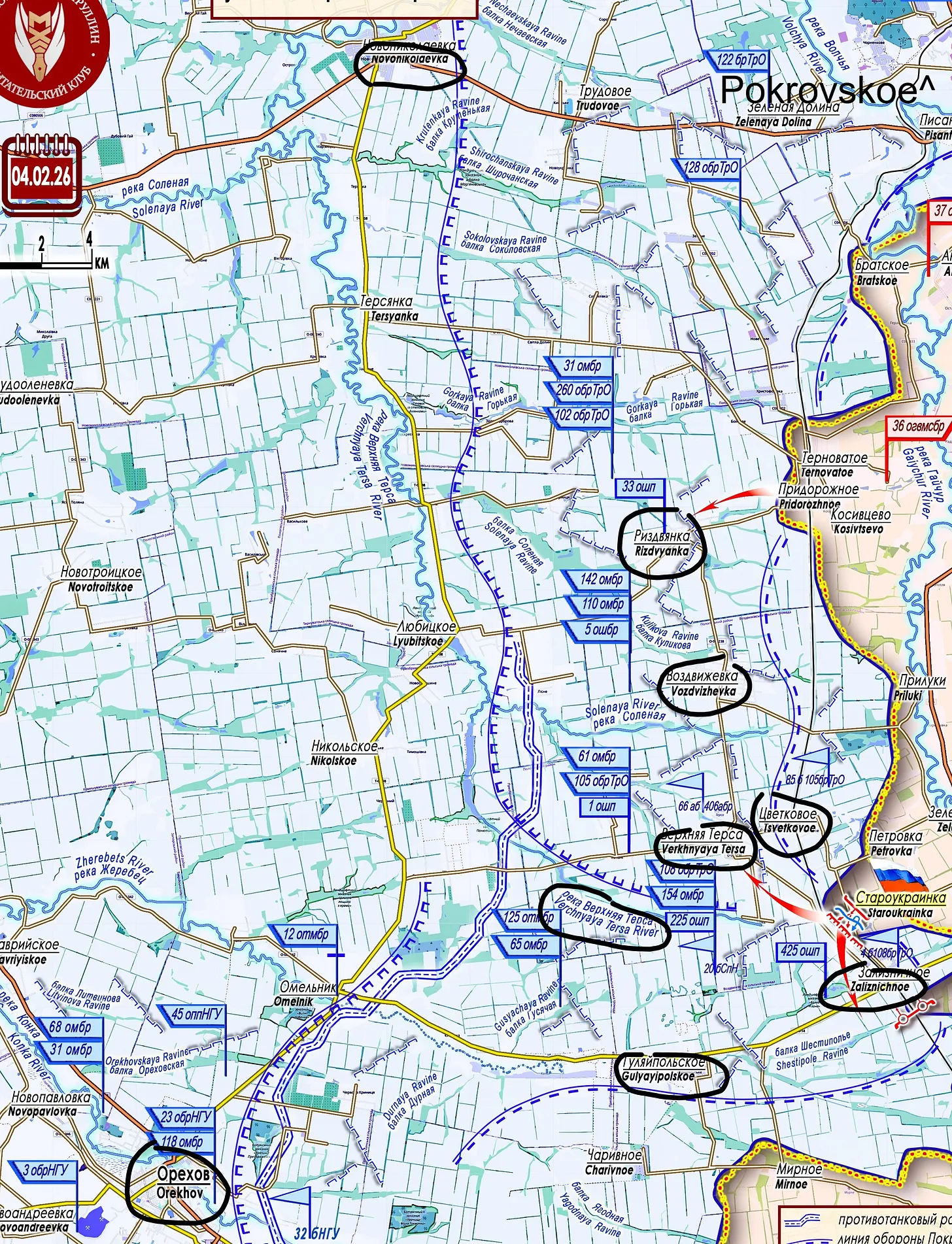
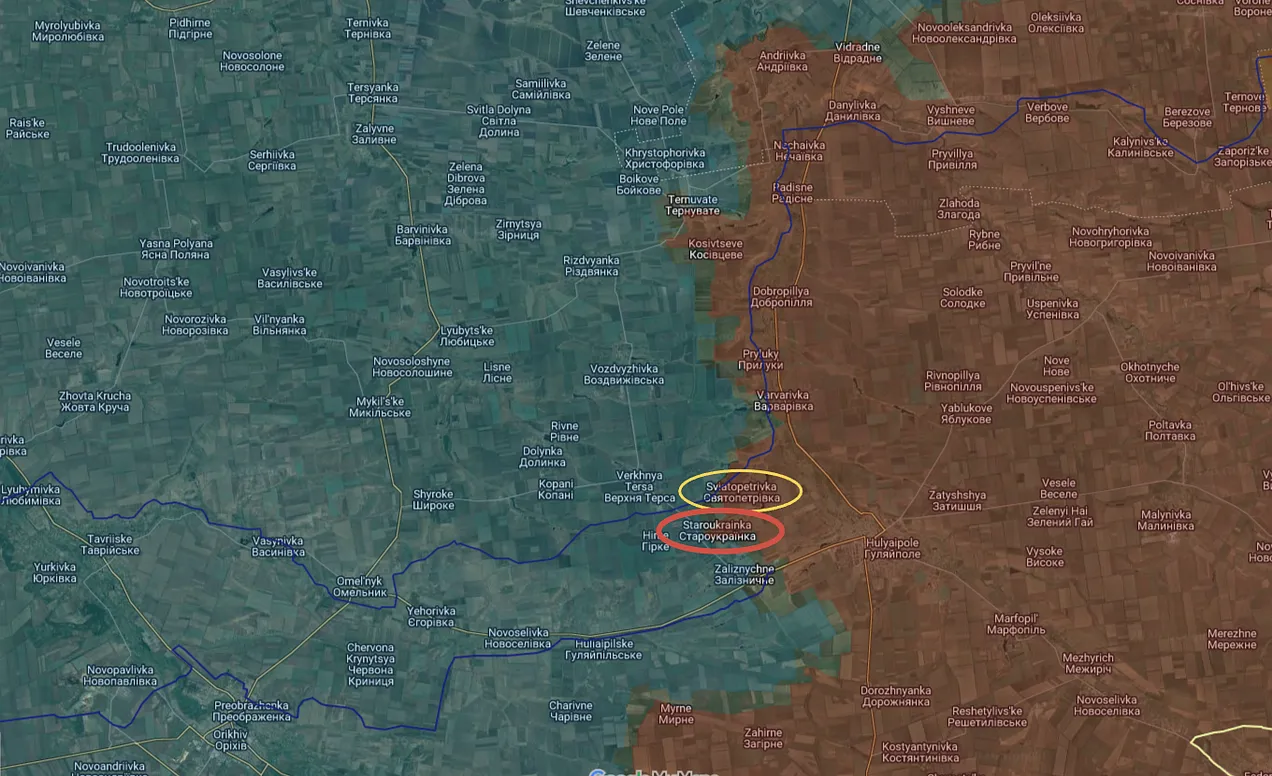
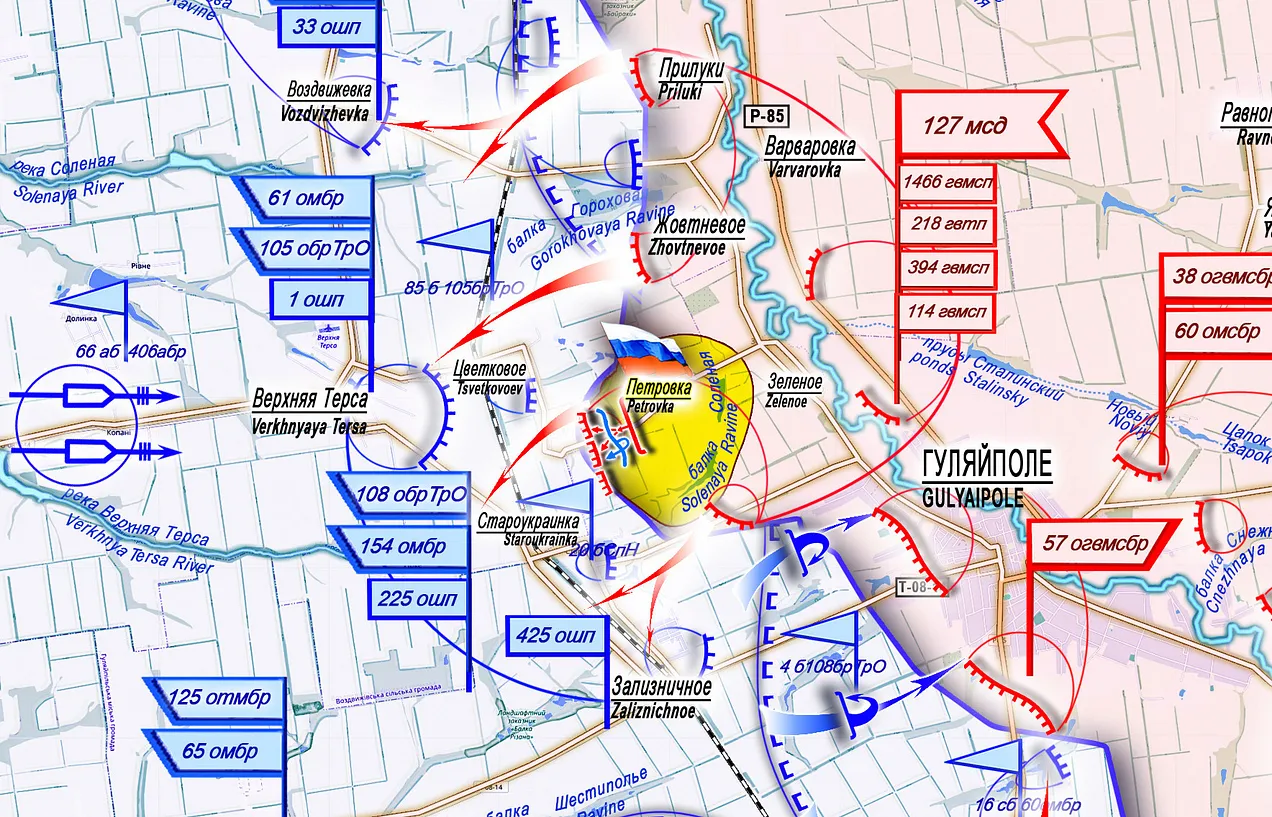
After Russian Armed Forces units reached the left bank of the Gaichur River, a number of ravines originating on the watershed ridge were brought under control. Following this, the enemy's defensive line was divided into sectors, into which "wedges" were driven by assault groups of Russian units, which then secured themselves on bridgeheads. Subsequently, the bridgeheads were expanded and the enemy's defensive line was split into segments. Covering the transport hub of Verkhnyaya Tersa, the enemy prepared a defensive area in Tsvetkovoe - Petrovka (Svyatopetrovka) - Staroukrainka.
Image

The command of the "East" Group allowed the enemy to become engaged in counterattacks on the city of Gulyaipole, tying down the enemy's main forces and reserves in this sector with defensive actions. Simultaneously, they began active operations to eliminate the Ukrainian Armed Forces' defensive line along the watershed ridge of the Gaichur and Verkhnyaya Tersa rivers.

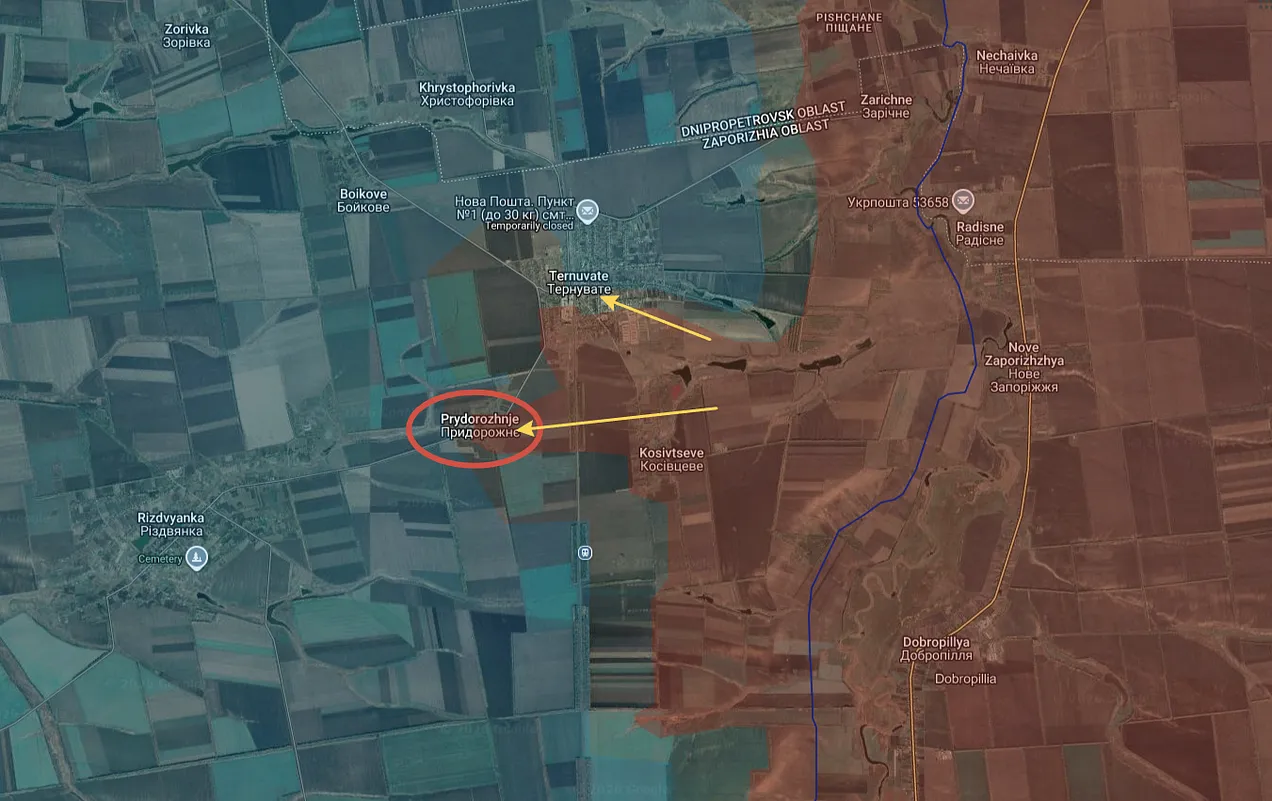
On January 30, the transport hub of Terenovatoe was brought under control.

On January 31, the settlement of Petrovka (47°41′28″ N 36°09′51″ E, population 78 in 2001, known as Svyatopetrovka since 2016) was liberated.

The transport hub of Verkhnyaya Tersa should prepare itself.

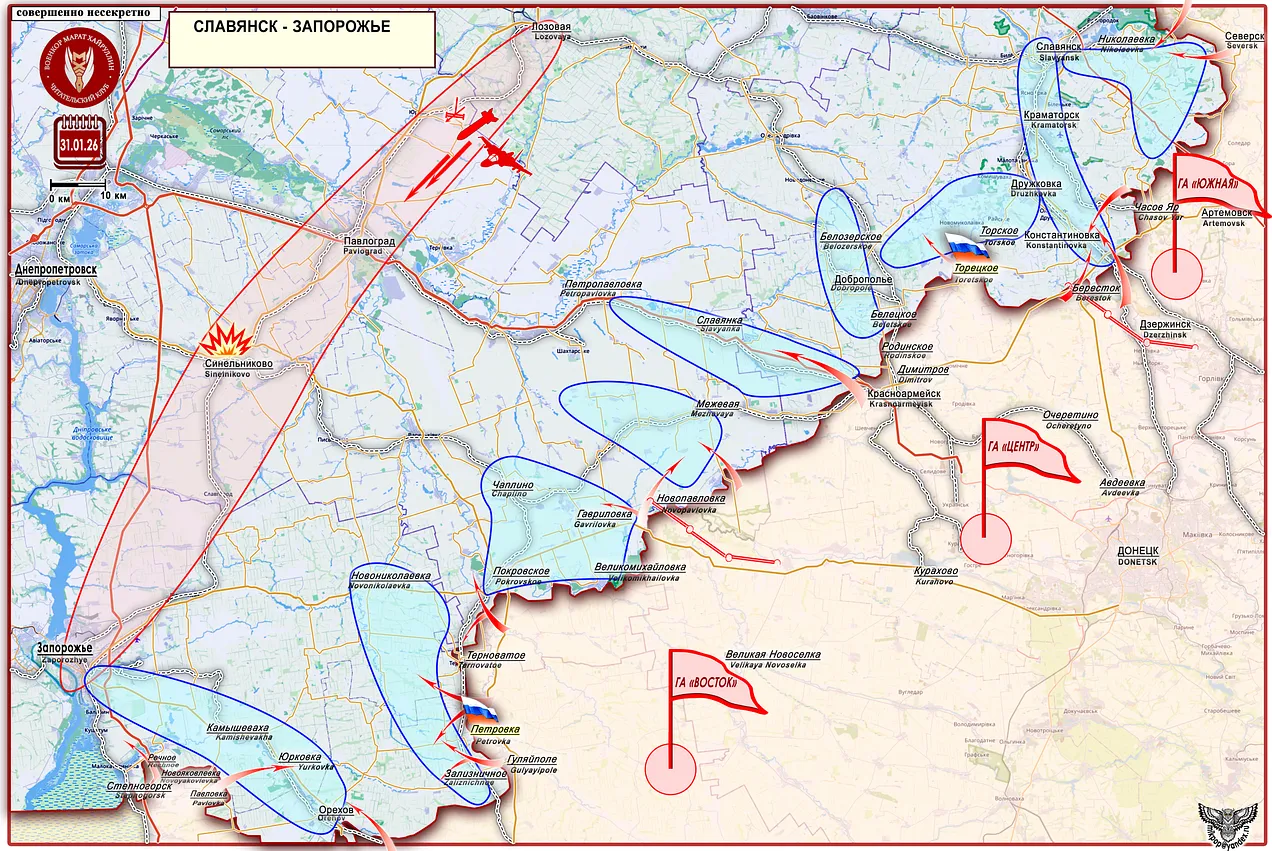
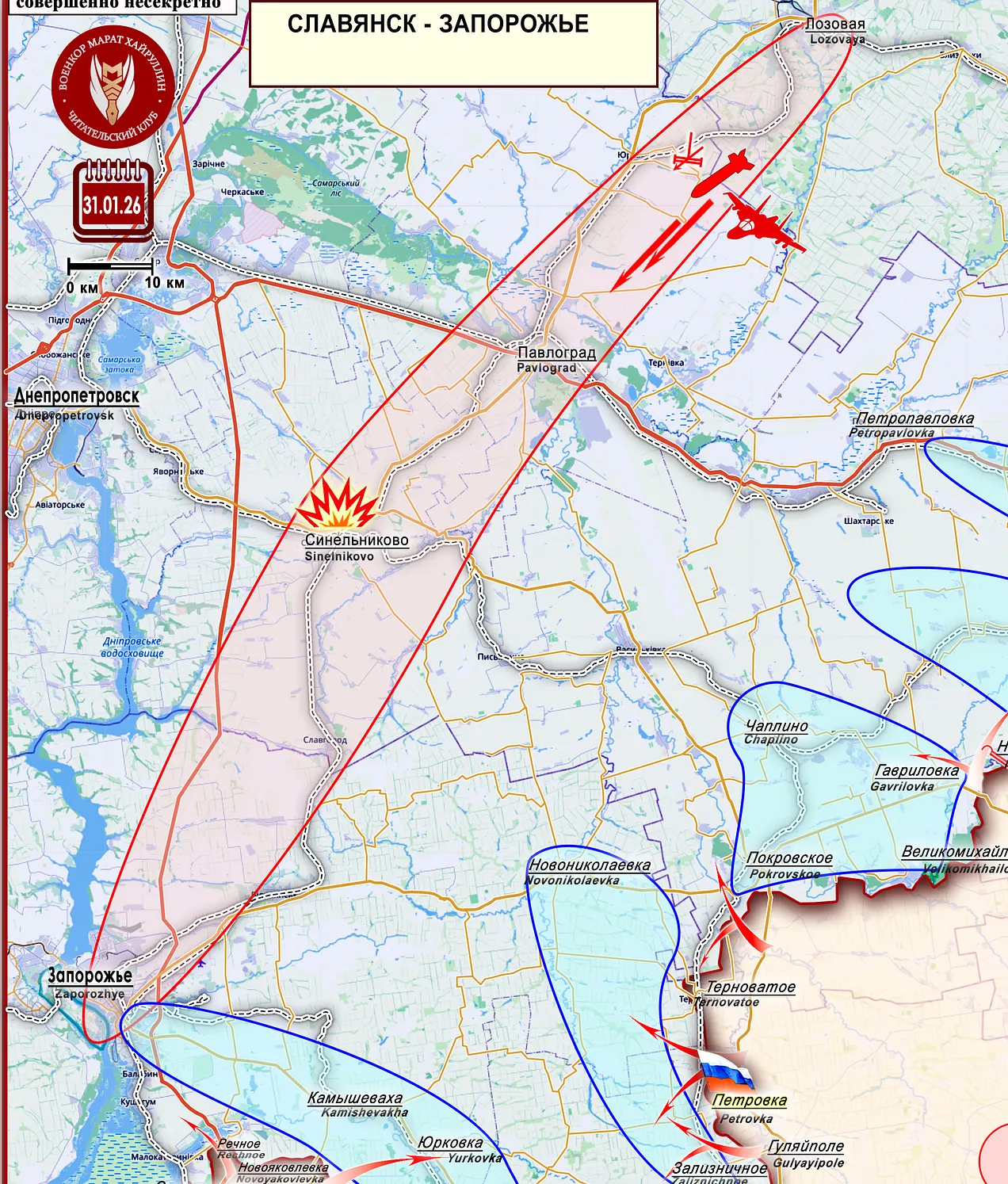
Message from the Russian Ministry of Defense: "Combat drone strikes in the area of Sinelnikovo station have damaged electric train cars, freight cars, locomotives, tracks, power grids, administrative and production buildings. There are no casualties.

As a result of the strike, railway traffic between Zaporozhye and Dnepropetrovsk has been halted."
Image
Slavyansk to Zaporozhye

To support the ongoing offensive operations being conducted by the Russian Armed Forces groupings "South," "Center," "East," and "Dnepr" along the entire line of contact, missile, aviation, and heavy UAV strikes are being delivered into the operational depth of the enemy's defense against key transport areas (Lozovaya - Pavlograd - Sinelnikovo - Zaporozhye - Dnepropetrovsk).
Image

Cutting off power supply is not a struggle against the population. It is the deprivation of electricity to defense enterprises, including railway traction substations. In transport hubs, infrastructure and rolling stock are being destroyed. A hunt is underway for automotive transport on the main radial highways connecting transport hubs with front-line supply routes.

https://maratkhairullin.substack.com/p/ ... nuary-31st

SITREP 1/30/26: Putin Flatters Trump With Kiev-Energy Ceasefire
Simplicius
Jan 30, 2026

(Video at link.)

After various rumors following Trump’s announcement that the Kremlin had agreed to an energy ceasefire with Ukraine, Putin spokesman Peskov finally confirmed the news this morning:

Russia has agreed to partially suspend long-range strikes on Ukrainian targets at the request of US President Donald Trump, Kremlin spokesman Dmitry Peskov has confirmed.

The weeklong moratorium is to last until February 1 and is meant to “create favorable conditions for negotiations,” Peskov told journalists on Friday. He declined to offer additional details about the arrangement, including whether Kiev made any commitments for reciprocity.


Zelensky had previously said he would hold to the truce if Russia does, though some OSINT analysts had already noted that Ukrainian drone strikes on Russia had disappeared in the past day or two, while Russia had only been launching a few minor Geran attacks, presumably at non-energy-related infrastructure for several days.

But what’s interesting is Peskov said that the “week long” truce would end on February 1st, which appears to mean that the ceasefire had already been in effect all week, which would explain the above: (Video at link.)

Further note that this appears only to apply to Kiev, which is still suffering badly from the attacks.

On the other hand, there may be some confusion because the Ukrainian side is attempting to push the ceasefire until February 8th—either an additional week, or February 1st being the beginning of the ceasefire.

On Sunday, February 1, at a new round of negotiations in Abu Dhabi, the US plans to formally confirm a week-long pause in attacks on Ukrainian energy infrastructure.

The Ukrainians have asked for a delay until February 8, when the temperature in Kyiv will reach +5°C. After that, warming will begin.

The “pause” is purely psychological. In terms of restoring anything, there are still months of work ahead. The only thing that is currently working, and the main topic of discussion, is the Kyiv TPP-6. A week ago, they launched one of six boilers there, and now they are starting up the second one.

The heat loop from it is already being distributed through Kyiv’s main networks.

In Kyiv, the collapse is still ongoing, with power grids being disrupted and entire neighborhoods shutting down.

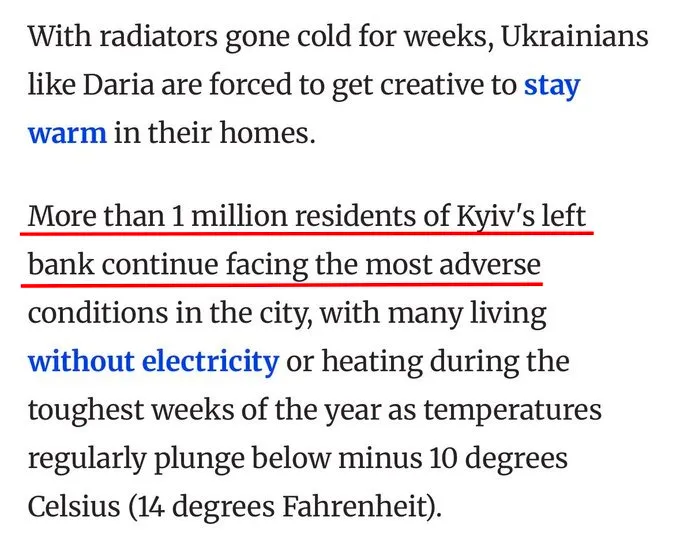
Kiev Independent reports that over one million residents still have “adverse conditions” including no power:
Image
https://kyivindependent.com/we-are-all- ... is-winter/
Image

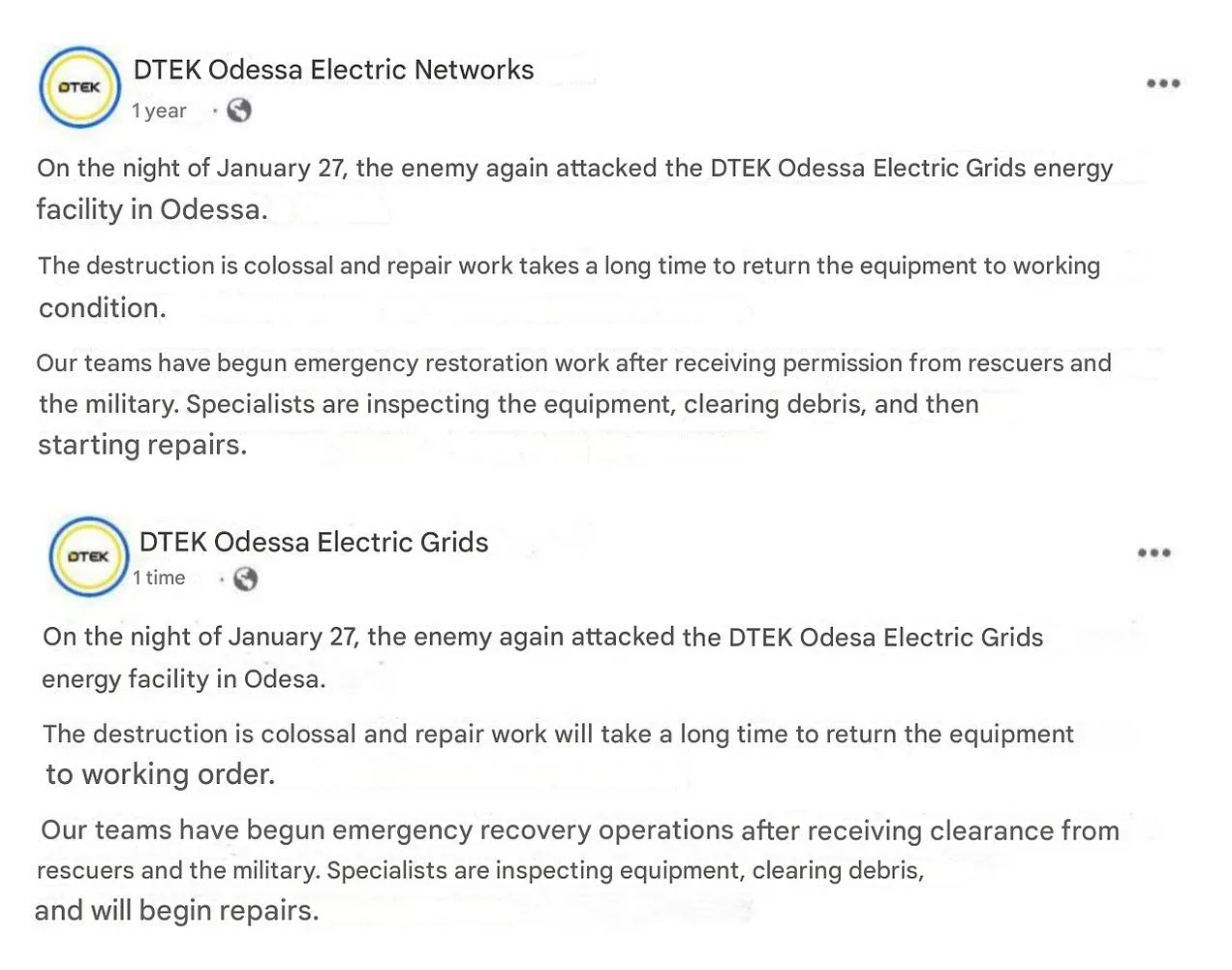
While Ukraine’s main power corp DTEK writes about major Russian strikes to Odessa’s grid just a couple days ago:
Image

Others report a large-scale uptick in Russian strikes on Ukrainian logistics all over the country, which included a “civilian train” that happened to be carrying military members on board:
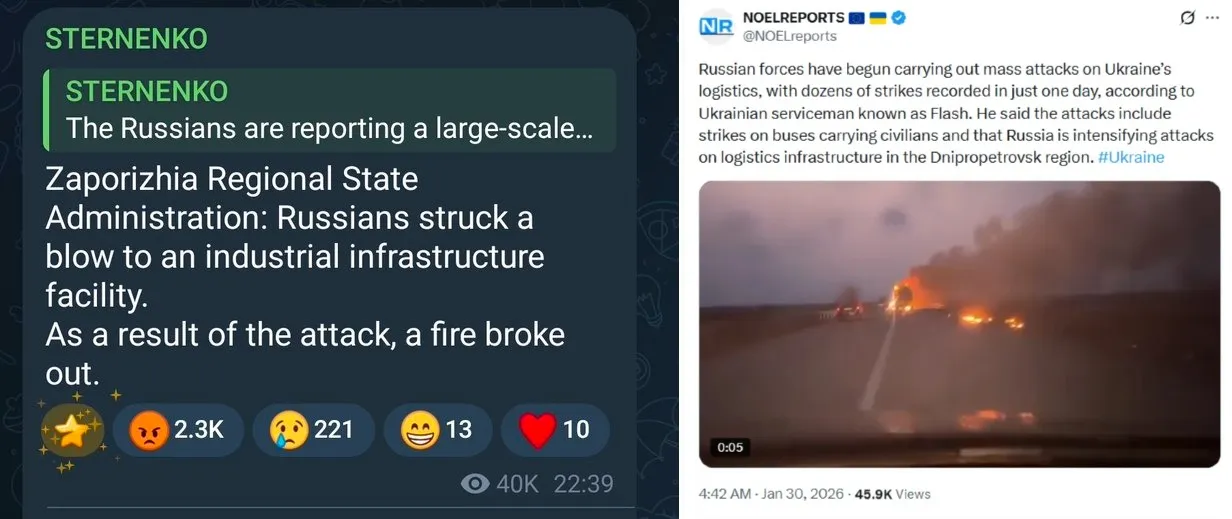
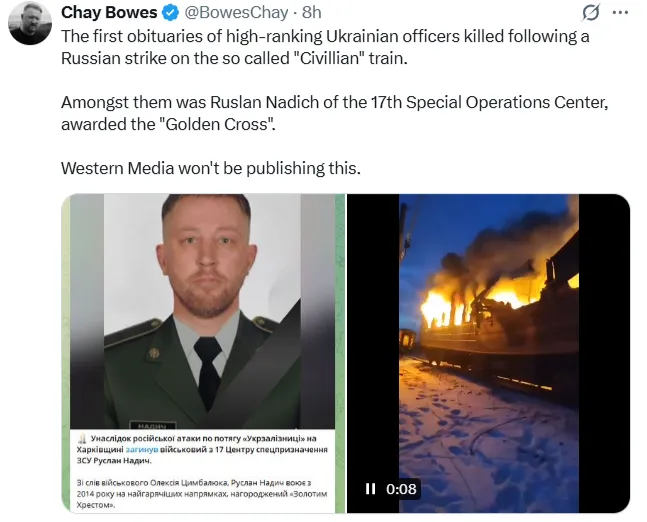
Image

Image

As per usual, many on the pro-Russian side will lose their heads over this apparent ceasefire. But it can be easily dismissed for a variety of practical factors: firstly, it’s only a week and only for Kiev—major Russian strikes on Kiev specifically are usually spaced out anyway, and a week is barely longer than the typical amount of time it takes to prepare for a new attack.

Secondly, it’s a gesture that accomplishes a lot by making what amounts to a tiny concession. A week won’t do anything for Ukraine, but it allows Putin to continue gaining favor for Trump—allowing Trump himself to “sell” Russia as the good guys more effectively, with Zelensky as the intolerable and disagreeable agitator.

A week doesn’t really buy time to do much as the type of damage recently witnessed at Kiev’s plants is essentially not repairable at all, to wit: (Video at link.)

Lastly, beyond the mere political posturing, there is the actual genuinely real humanitarian concern. Does Russia really want to freeze Kievan civilians in what is said to be coming -30°C temperatures?

One of the biggest secret reasons for the desperate ceasefire, however, appears to be Ukraine’s urgent situation regarding air defense interceptor missiles. Zelensky had just castigated “European partners” for not providing missiles, which allows Russian strikes to now come in unhindered as we had suspected:
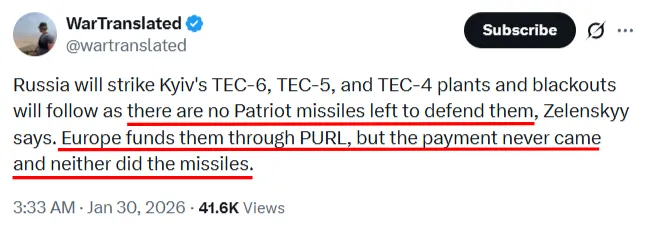
Image

Note in particular the part about the PURL (Prioritized Ukraine Requirements List), which I had debunked before as a scam meant to give the impression of European “solidarity”. Here we see just how “effective” it has been.

A last interesting take from the War Chronicle military analysis channel:

According to preliminary estimates, if the attacks on Kyiv and the region’s power grids continue, the consumption of diesel fuel in the Ukrainian capital could reach 300 to 900 tons per day. This amount will be needed only for the operation of emergency services and industrial generators at production and utility facilities.

If the power supply problems persist, the purchase of diesel fuel on an industrial scale in Kyiv alone over a year could cost 200–500 million dollars.

However, this problem is scalable. There are about 100,000 boiler houses of various sizes in Ukraine: from district to school and hospital/industrial ones.

It is almost impossible to fully power them with diesel generators, but those that can still be connected will also require a large amount of fuel.

A power grid collapse on such a scale is already forcing Kyiv to redistribute some fuel from the front to civilian facilities. The connection here is direct: the more intense and dense the attacks on the energy sector are, the greater the scale of fuel redistribution required for civilian facilities.

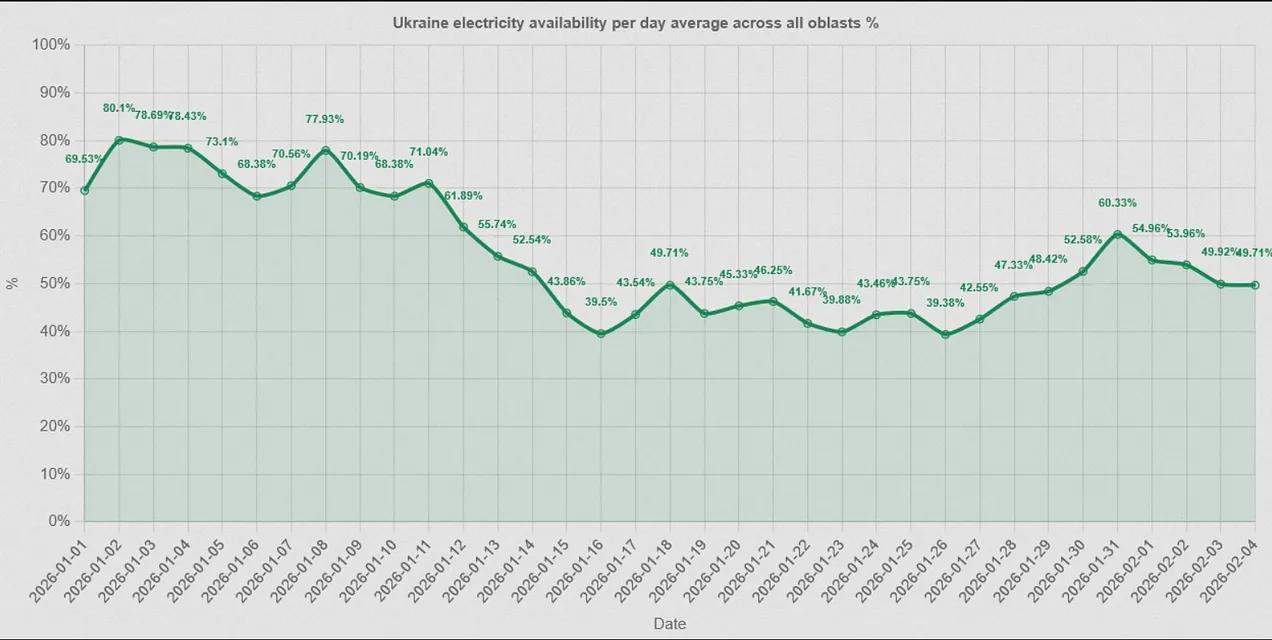
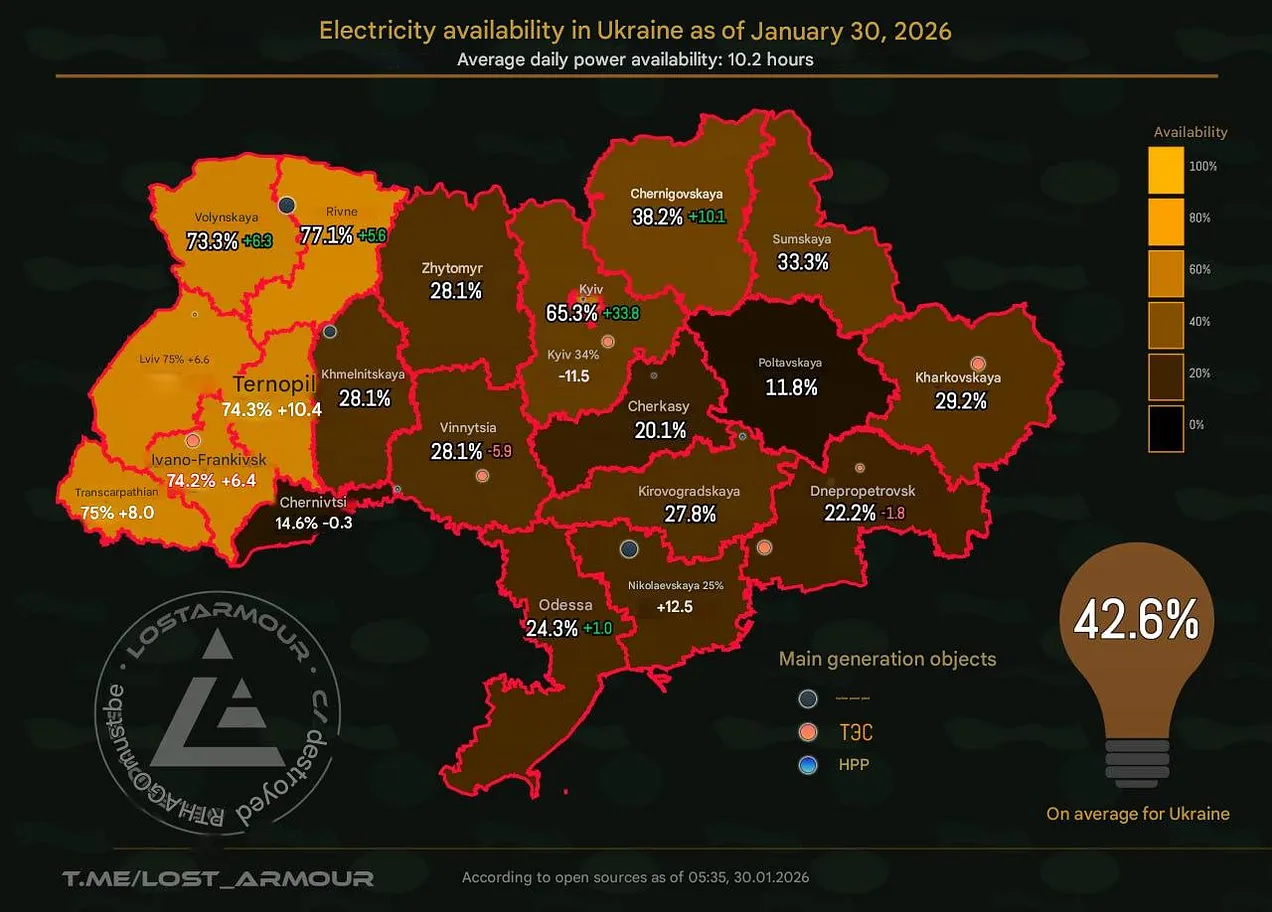
So far, the overall availability of electricity has dropped from 43% to 32.7%. This is already considered a threshold value for the degradation of critical networks.

However, a severe energy crisis will be reached when this share drops below 30%, and ideally to less than 25%. When this last figure is reached, the city’s sewage and other purification systems will not be able to operate on generators continuously and will require periodic long-term shutdowns. Interestingly, during the energy crisis in the Gaza Strip, a drop in power supply below 10% led to the complete shutdown of 70% of all critical facilities that could not operate on generators for any length of time. Given the electricity needs for Kyiv, the situation could be even worse, as generators in any case are a backup power source, not the main one. In a sense, the figure of 32.7% availability of the power grid is the last mark before a potential exodus from the cities due to the impossibility of maintaining a normal life.

However, the maximum effect can be achieved under two conditions: the continuation of attacks on power grids in major cities with a parallel transition to the isolation mode of Ukrainian nuclear power plants and their transformation into energy islands, cut off from the general network. Russia is still trying to avoid the latter.


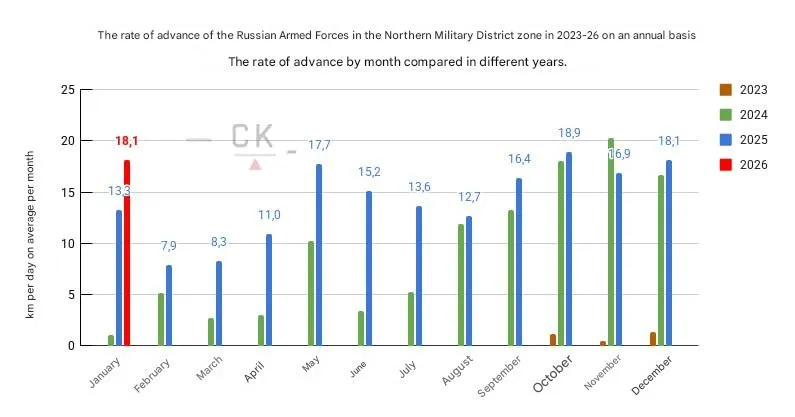
Let’s switch over to the frontline. We haven’t covered it in a while because, quite frankly, the Russian side has continued to be “on vacation” since Christmas time, moving very little since then. However, recently they did begin some activity again, though still nothing like the steamroller of last year’s fourth quarter.

Western publications are now even mocking Russia as having the slowest advance in the history of warfare:
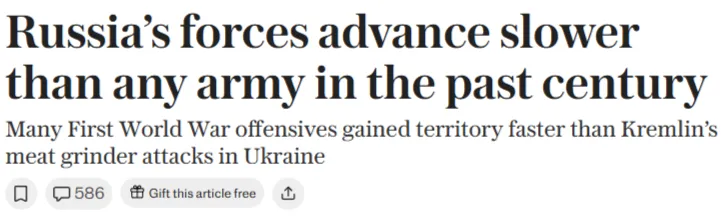
Image
https://www.telegraph.co.uk/world-news/ ... -any-army/

They’ve even drew up these nifty charts:
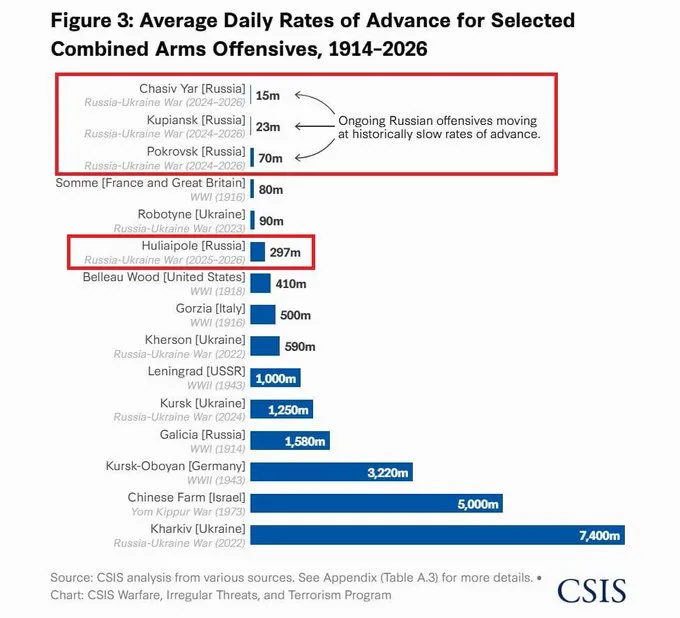
Image

It is fascinating, though, how much urgency and desperation in the Western order such pitifully ‘slow advances’ are generating. If it’s really such a cock-up worthy of comparison to wars from hundreds of years ago, then why all this effort from the detractors? Russia’s failure and imminent loss should simply be self-evident to us.

Yet for some reason, we continue to get contrary signals. For instance, another exchange of bodies occurred yesterday:

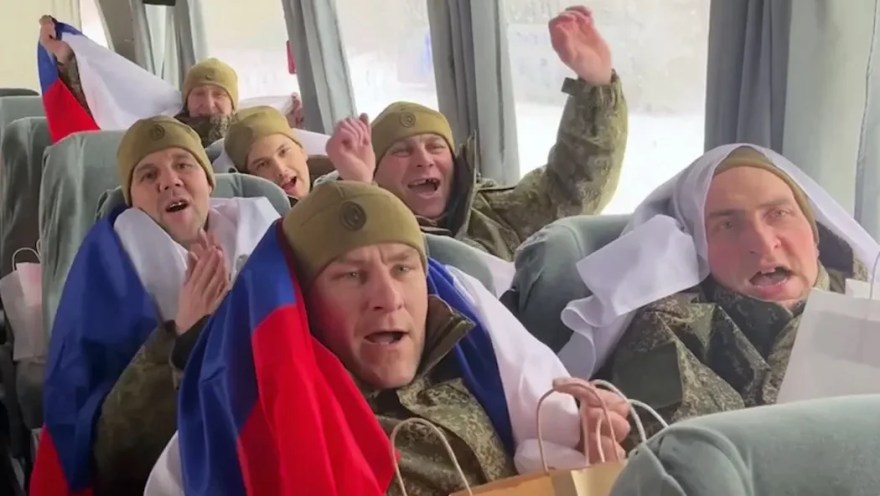
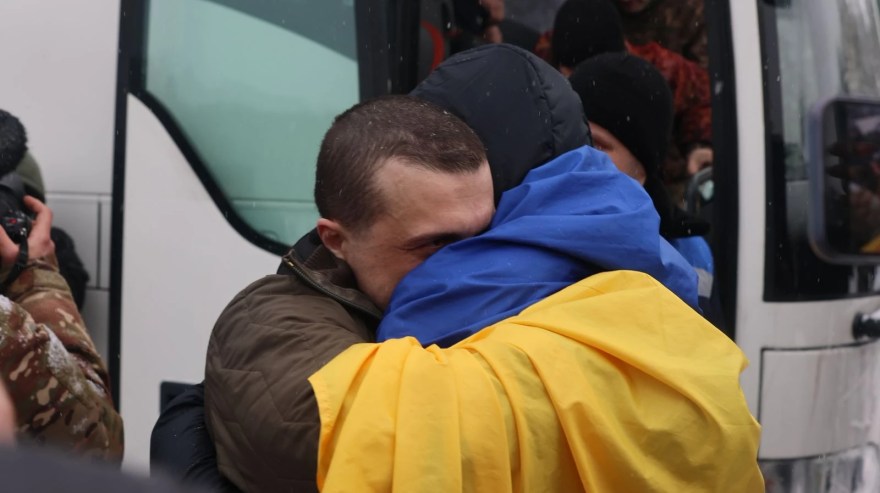
Kremlin aide Vladimir Medinsky said that “within the framework of the Istanbul agreements, the bodies of 1,000 dead Ukrainian soldiers have been transferred to Ukraine”, adding that “bodies of 38 dead Russian soldiers have been transferred to Russia”.

Updated list:
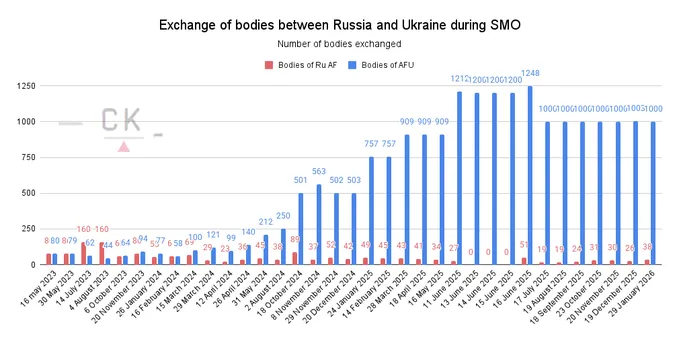
Image

The Russian side appears in good spirits and confident. Here the head of Russian GRU Igor Kostyukov—who led the Abu Dhabi “tripartite” negotiations for the Russian side—cheerfully reveals that Russians are in a great mood, while Ukrainians are in a “sad mood”: (Video at link.)

"The Ukrainians are in a sad mood. We're in a good mood": Igor Kostyukov, Chief of the Main Directorate of the General Staff, gave a succinct answer to Rossiya 1's question about the mood at the talks in Abu Dhabi.

He urged the media not to inquire about the negotiation process, as public comments negatively impact it.

Igor Kostyukov is heading the Russian delegation at the Ukraine talks in Abu Dhabi.


This does not seem like the demeanor representative of a side that’s been ground down to a historic and demoralizing crawl.
Image

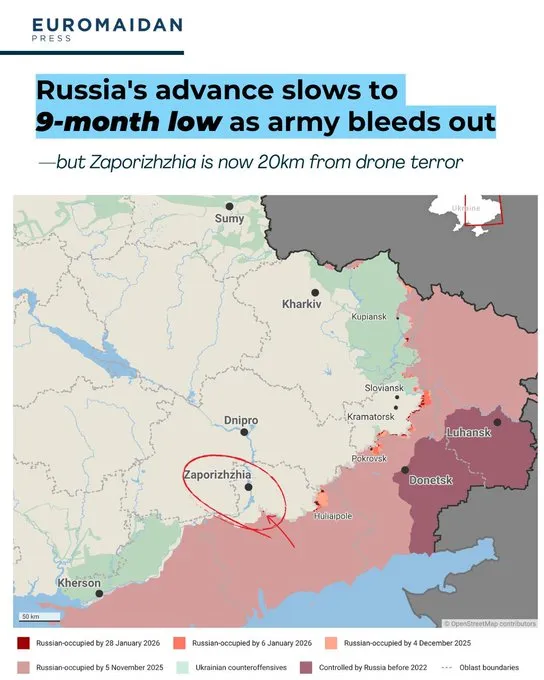
But let’s take a look at where Russia has been advancing and what clues it can give us about the nature of the current battlefield dynamic.

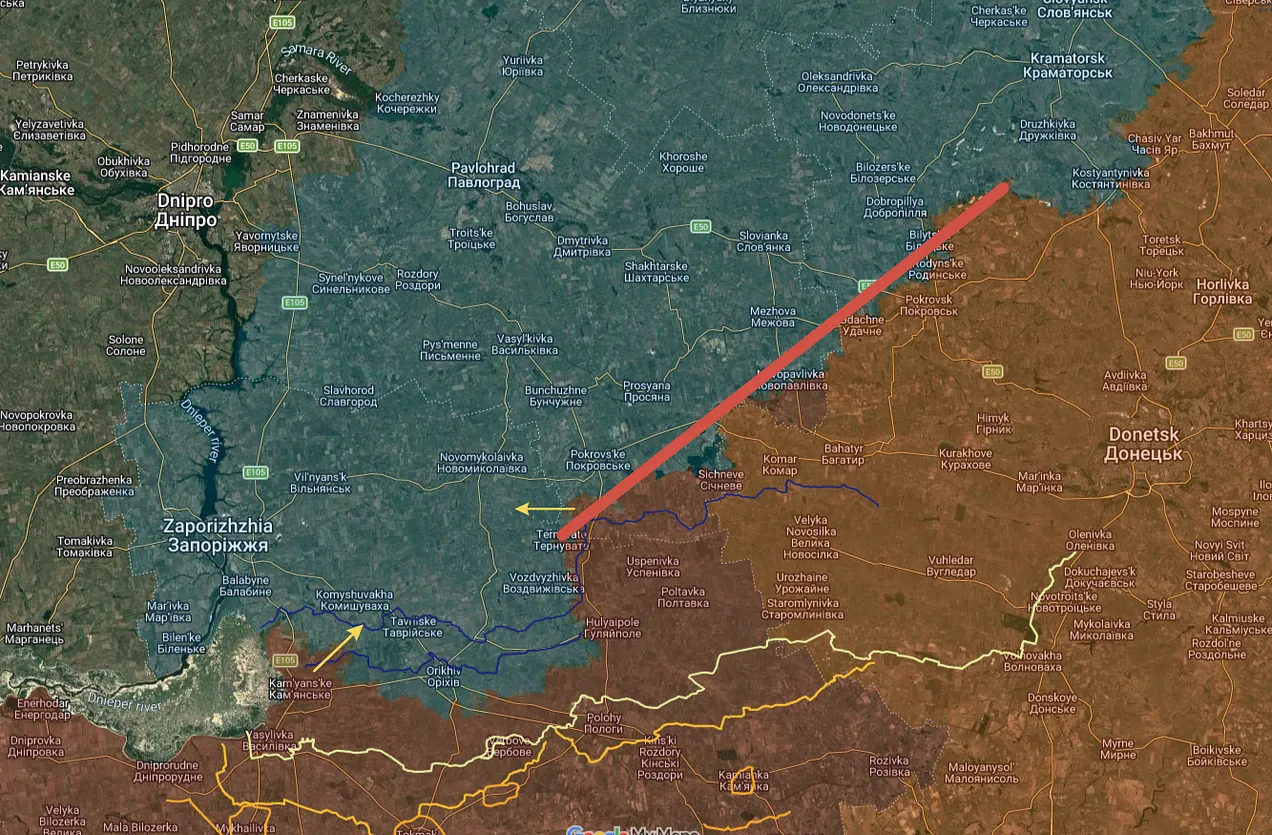
Most notably, Russia has continued advancing on both western and eastern sides of Zaporozhye. On the western side, Russian forces have made headway into a new northeasterly salient that appears to be following the first main Ukrainian line of defense there, skirting just around it:
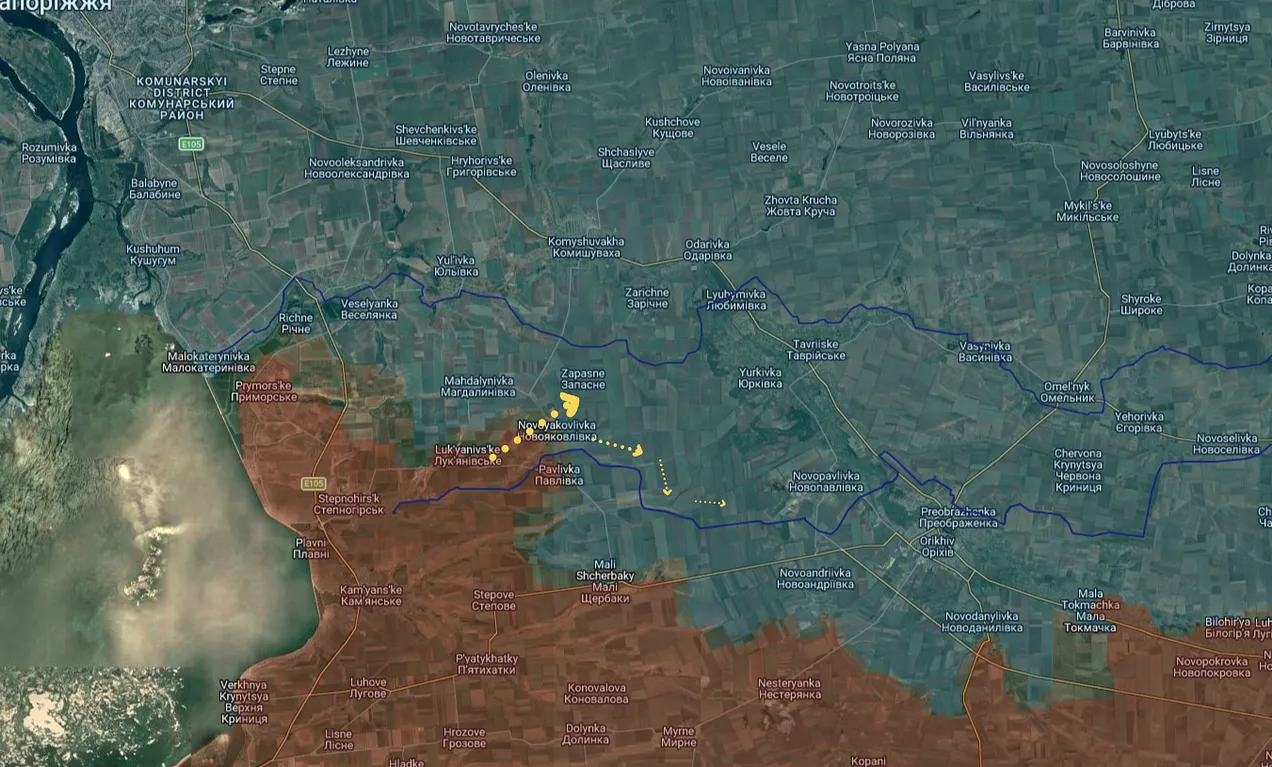
Image

On the eastern side, Russian forces were said to have just entered and captured the settlement of Ternuvate, circled in red below:
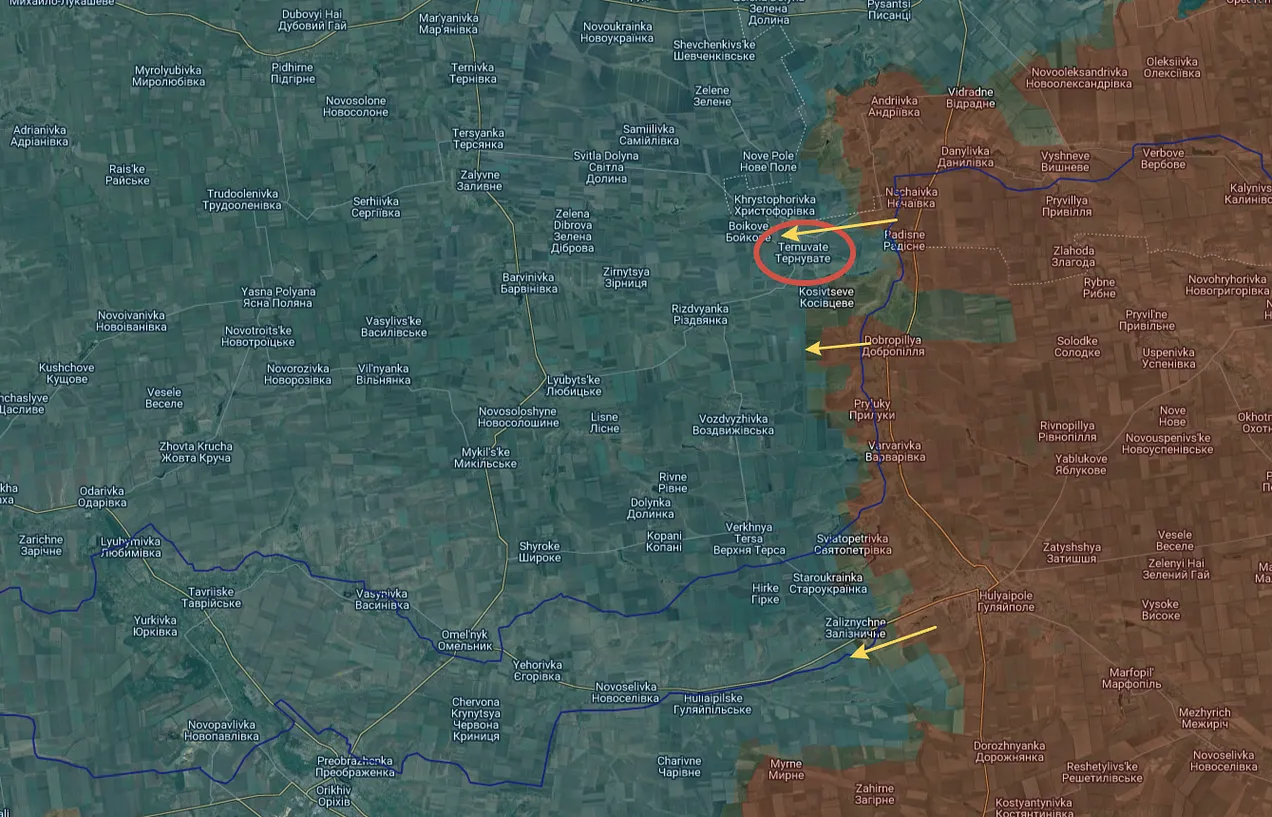
Image

Here is the video of the flag-planting ceremony by the 36th Motor Rifle Brigade of the 29th Guards Combined Arms Army of the now-legendary “Eastern Express”: (Video at link.)

“UNITS OF THE “EAST” GROUP OF FORCES HAVE LIBERATED THE POPULATED POINT OF TERNOVATOE

🔸 Guardsmen of the 36th Motor Rifle Brigade of the 29th Army of the “East” Group of Forces have, with decisive and skillful actions during prolonged battles, liberated the major populated point of Ternovatoe in the Zaporizhia region.

🔸 As a result of active combat actions, soldiers from Transbaikalia have taken control of an important enemy defense area on the western bank of the Gaychur River, with a depth of up to 5 km and an area of more than 20 sq. km, and cleared over 580 buildings. The enemy’s losses amounted to up to 1 company of manpower and over 20 units of equipment (armored personnel carriers and pickup trucks) from the 33rd Separate Motor Rifle Brigade of the Ukrainian Armed Forces, over 45 hexacopters of the enemy type “Baba Yaga”, as well as 5 ground robotic complexes.

🔸 The occupation of this area has allowed to expand the bridgehead for further offensive on the western bank of the river Gaychur.


Just northeast of there, Russian forces have advanced further into Novopavlovka, entering the town center according to some reports:
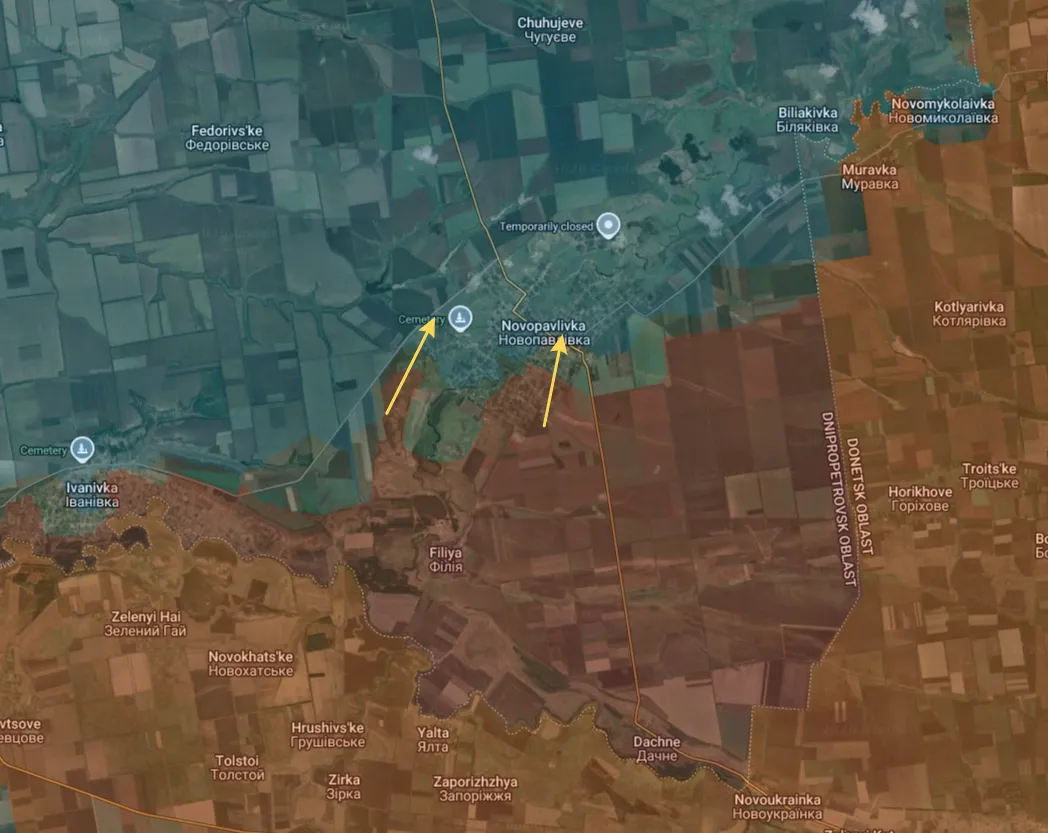
Image

Other Russian maps have even more of Novopavlovka captured from the north:
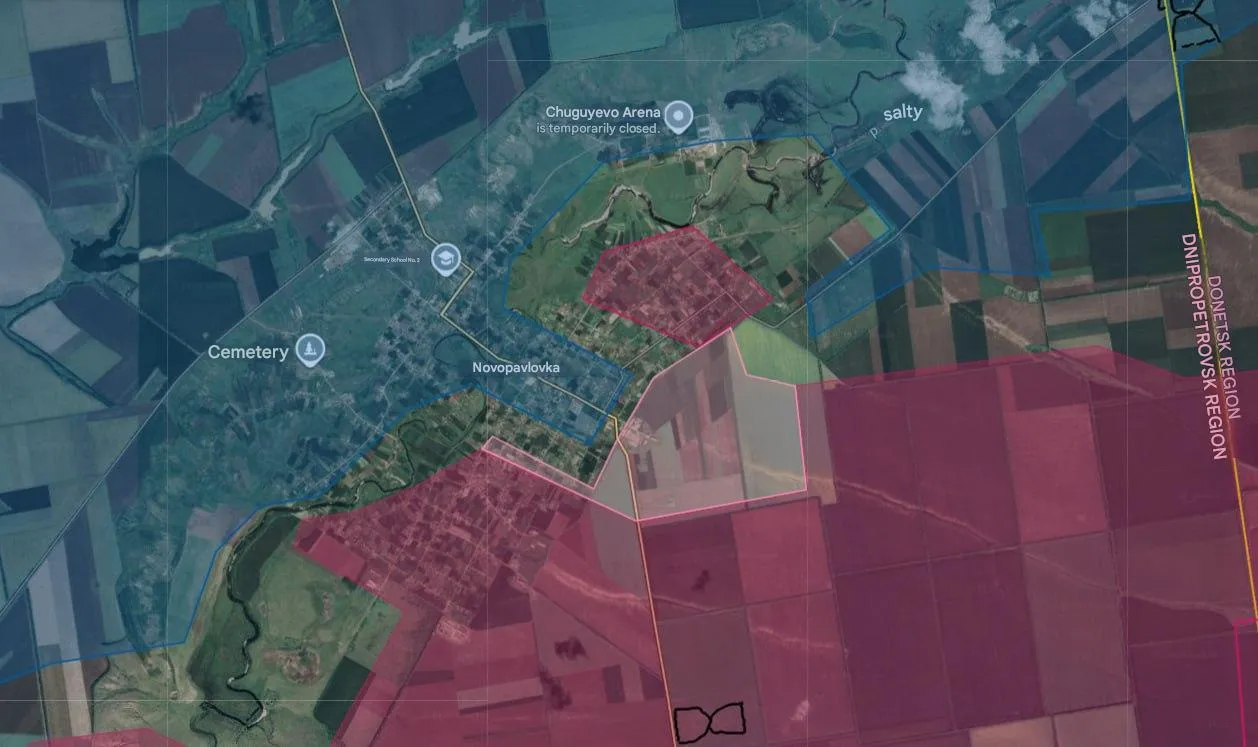
Image

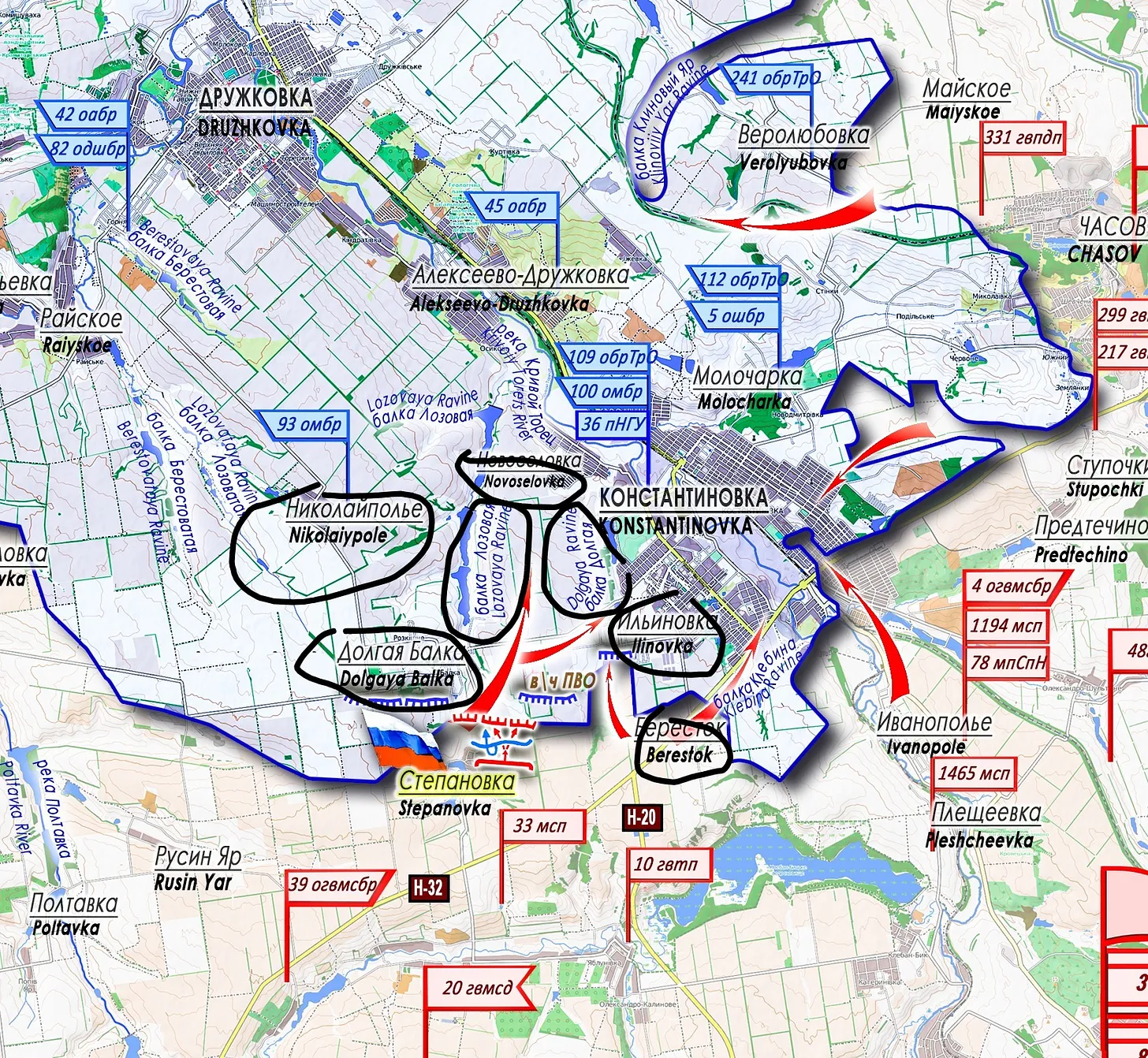
Further north on the Konstantinovka line, Russian forces captured either half or all of Berestok at the southern tip, depending on source:
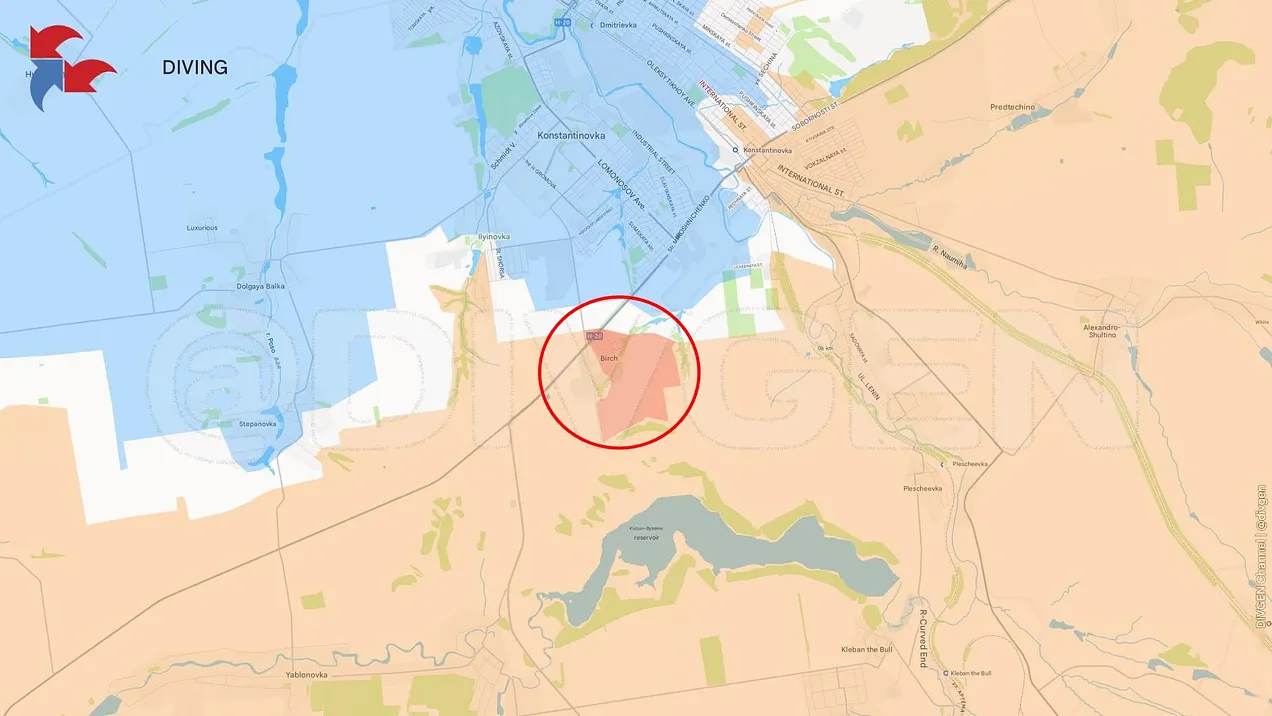
Image

Note I’m using a few different map types this time because our favored cartographer Suriyak has reportedly gone on a brief vacation with only spotty updates to his map.

Besides Berestok though, it can be seen Russian forces have consolidated and advanced further into the city itself from the east:
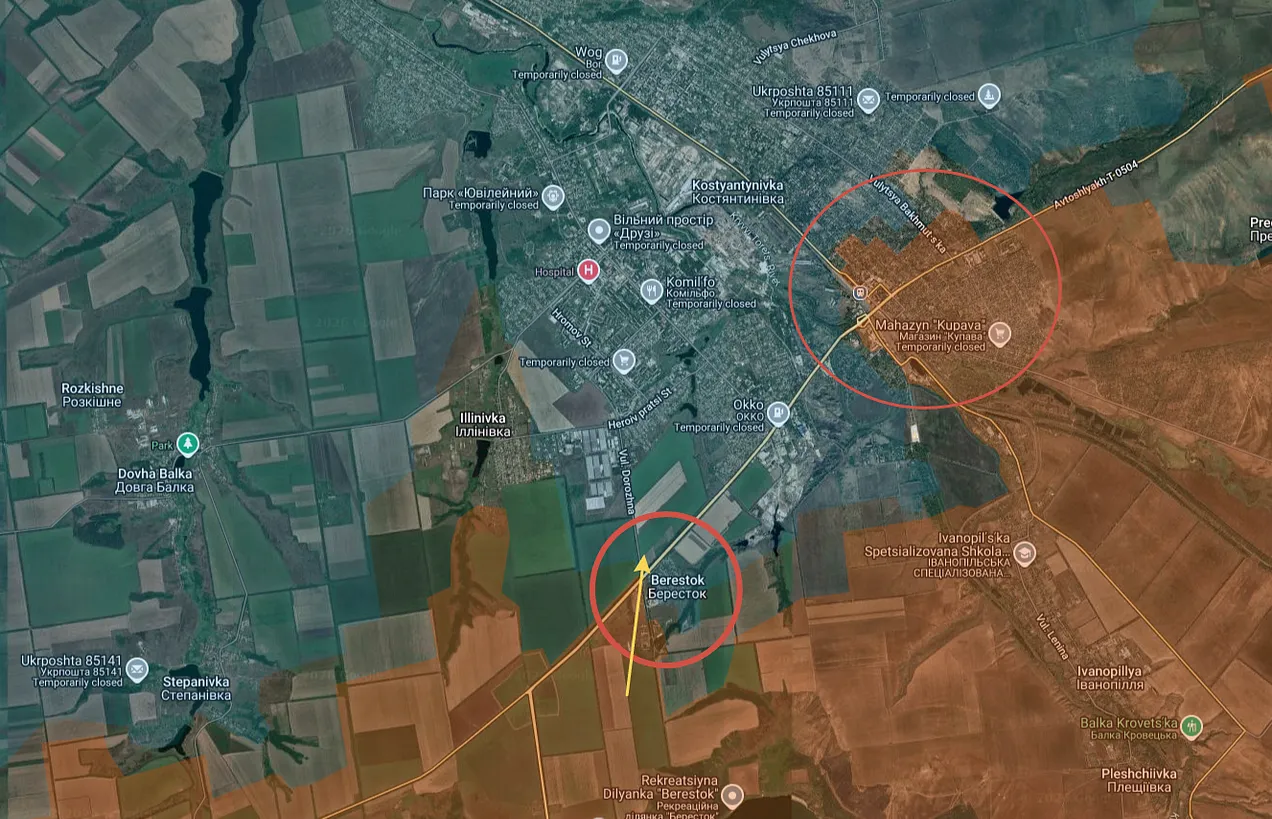
Image

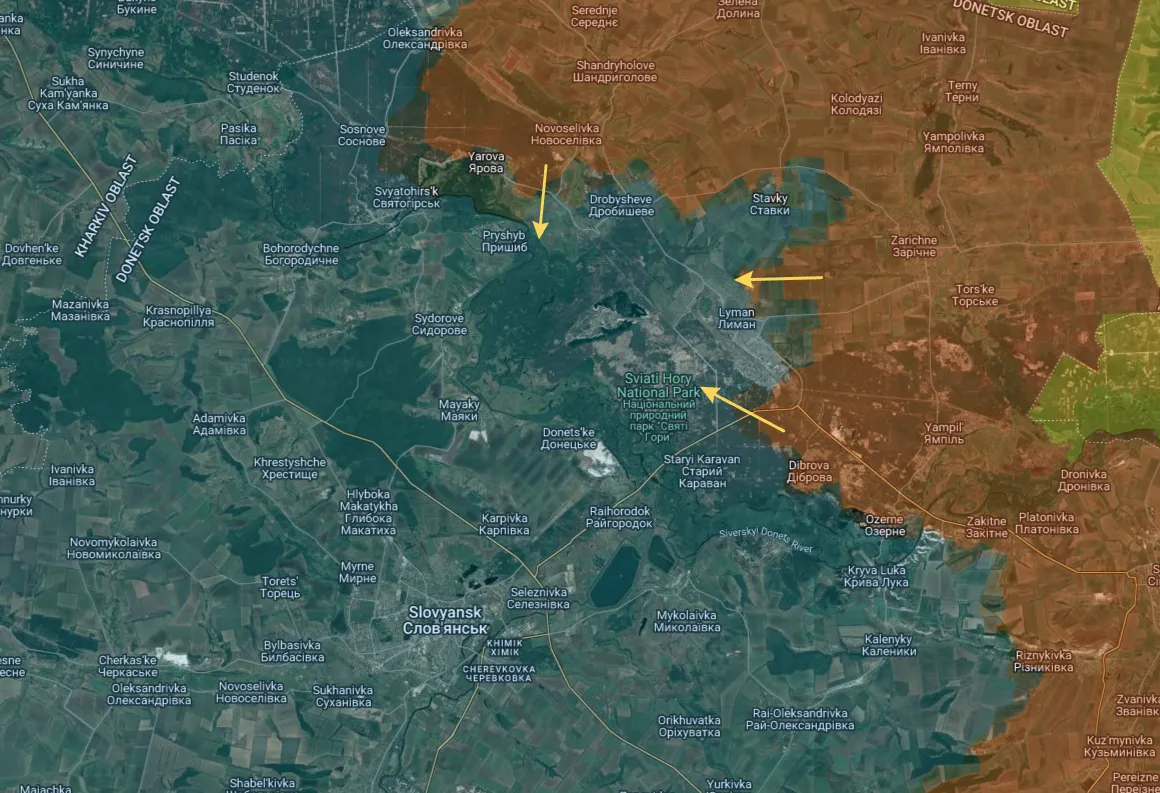
Switching to AMK’s maps, we see further north on the Seversk line that Russian forces are slowly inching westward along the broad front—the yellow areas are newly captured positions:
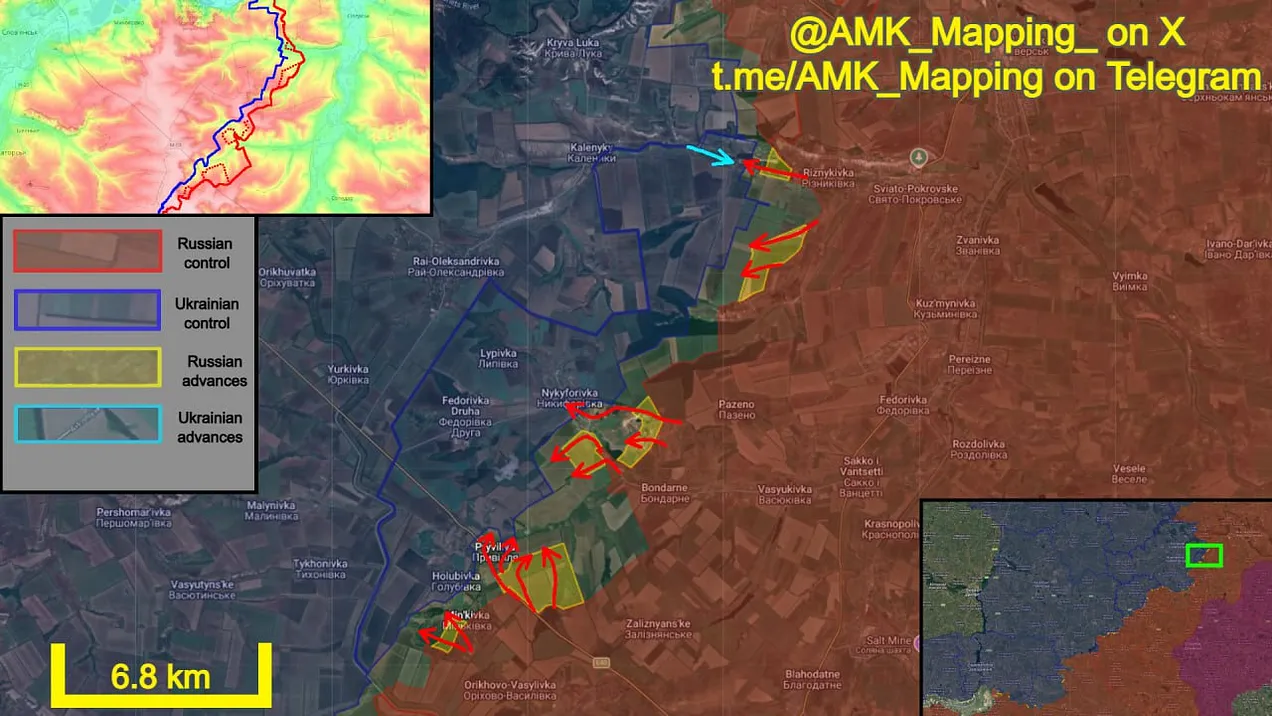
Image

Seversk is circled for reference, and Slavyansk can be seen on the western edge:
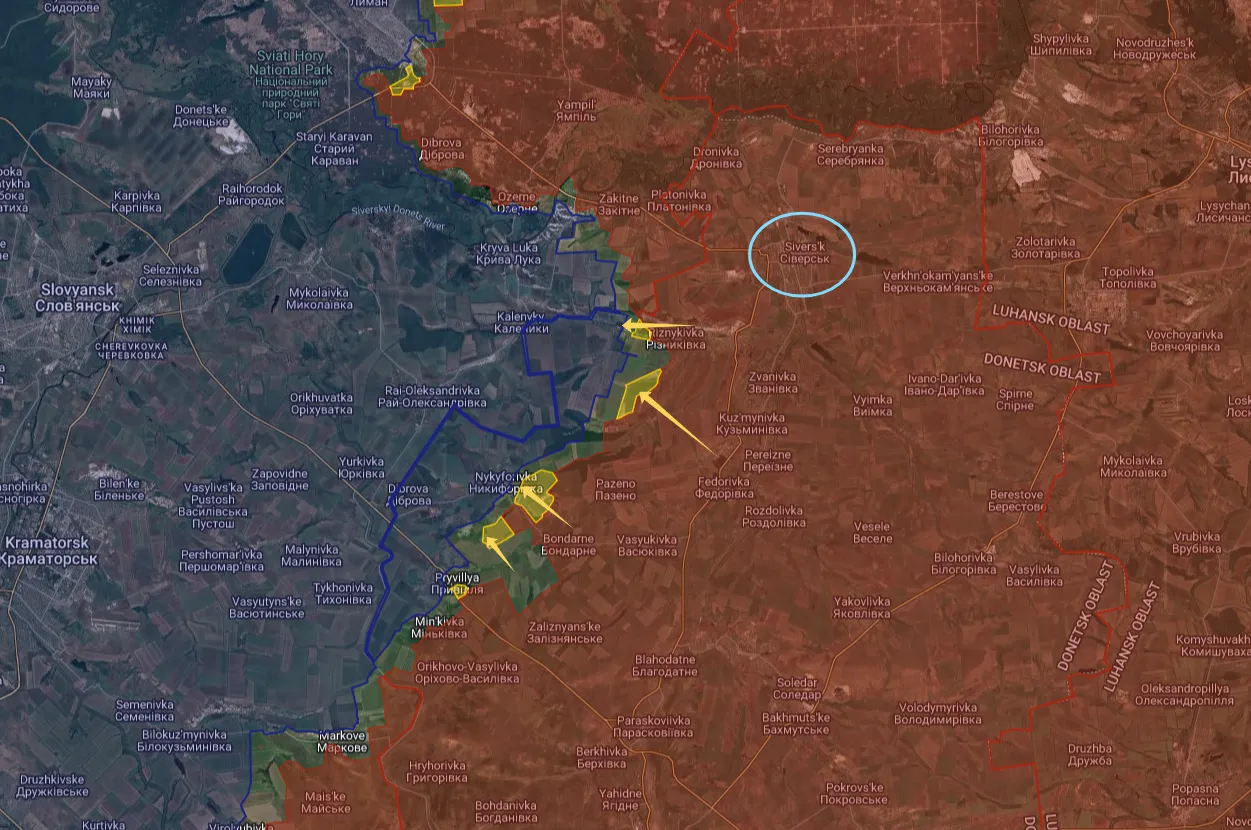
Image

Essentially, they are all fairly minor advances. But what was most interesting is that Russia continues to pour forces over the northernmost border, to make incremental advances in northern Kharkov, Sumy, and most recently Chernigov regions.

The reasons this is revealing is because it runs counter to the Ukrainian claim that Russia has been ground down, is running out of men, and has slowed because of these issues, rather than simply reorganizing for new offensives or due to extreme and unfavorable weather, etc. If Russia was truly being ground down, it would not waste precious resources on totally fruitless and remote directions like these on the border, which have no major objectives easily achievable there. Russia would continue pouring everything into key focal fights where the most PR can be maximized, and Ukraine’s morale and reputation damaged, such as the mainstay cities of Konstantinovka and the like.

But the fact that Russia continues increasing the pressure in these remote hinterland zones means not only that Russia has manpower to spare, but that it is slowly shaping the battlefield for an extremely long-term strategy. And that would only be the case if Russia was quite happy with its available resources and manpower regeneration capabilities. It was even more telling, on this count, that Russia even opened up a totally new direction recently in Chernigov.

With that all said, Russian forces did advance slightly in some of these zones near Sumy and Kharkov, indicating that the wide-ranging ‘death by a thousand cuts’ strategy remains in force.

NYT’s latest underscores this more pessimistic take on Ukraine’s strangulation:
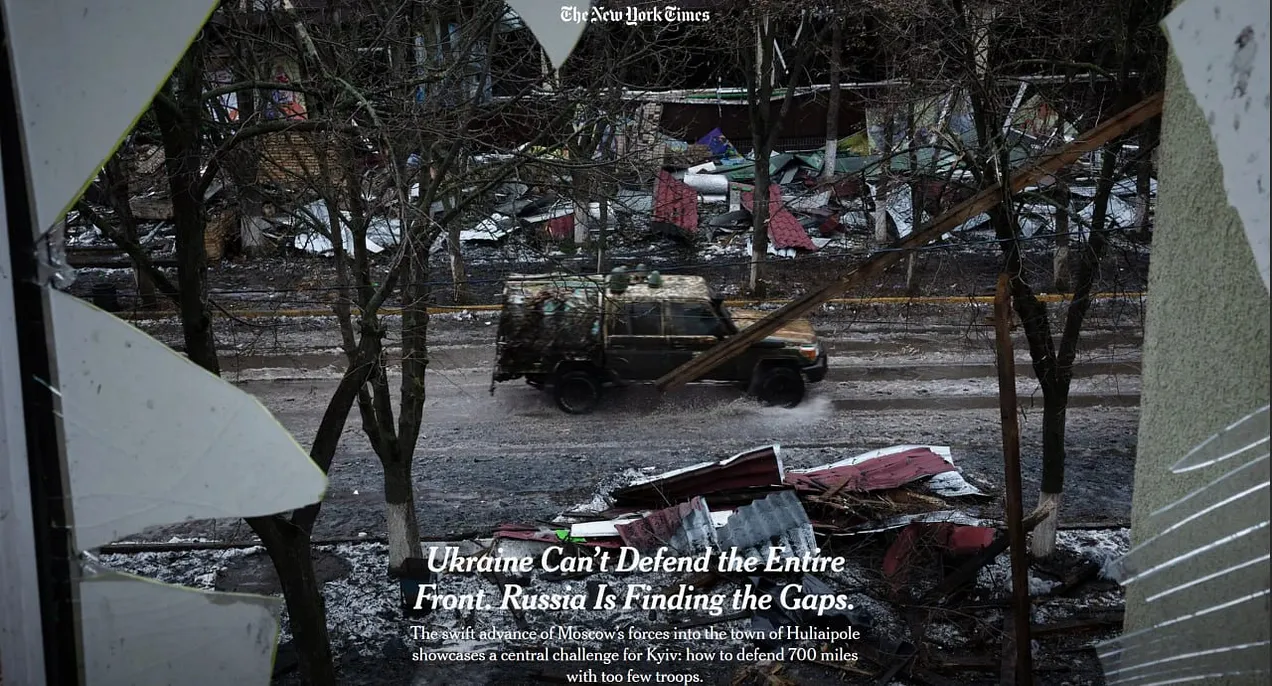
Image
https://www.nytimes.com/2026/01/30/worl ... ipole.html

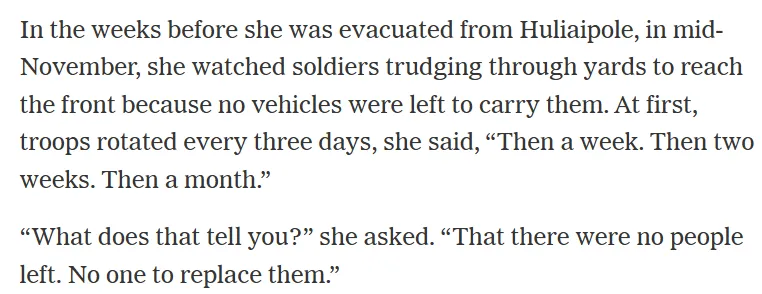
“It was a catastrophe,” said Capt. Dmytro Filatov, commander of the Ukrainian First Separate Assault Regiment, whose unit was rushed in to reinforce Huliaipole, in southeastern Ukraine.

The fall of the command post in late December…highlights the central challenge facing the Ukrainian Army after four years of grinding war. Stretched by Russian assaults across a 700-mile front line, Ukraine lacks enough troops to defend every sector equally, creating gaps where Moscow’s forces can advance more easily.


The article describes Ukraine’s current operative strategy:

But Ukrainian soldiers say the situation has forced them to wage war like firefighters — rushing to contain a flare-up in one sector, only to see another ignite elsewhere, then running back as the first combusts again. The goal is not to cling to every inch of territory, they say, but to hold enough to deny Russia battlefield momentum that would strengthen its hand in U.S.-brokered peace talks, which are continuing this weekend in the United Arab Emirates.
Image

A Ukrainian battalion chief of staff explains their battalions are lucky to have 50 capable people in them—straight from the horse’s mouth:

“We’re constantly short on people,” Horol said, adding that Ukraine lacked troops to both repel infiltrations and launch counterattacks.

Vladyslav Bashchevanzhy, chief of staff of a drone battalion in the 260th, described the personnel issue bluntly.

“A battalion is supposed to have around 500 soldiers. In reality, we’re lucky if we have 100,” he said. “Out of those 100, perhaps only 50 are actually combat-ready — those not wounded or exhausted.”


But of course we’ve heard such stories since as far back as 2022 and 2023. It has not changed the fact that the war persists, and Ukraine continues to find the men necessary to keep Russian advances to a daily minimum, particularly by increasing its mobilization efforts and coercion levels, as we’ve seen recently.

This does not seem likely to change in the short term due to the current style of warfare: the ‘dispersed’ and defense-heavy strategy Ukraine employs keeps its losses low enough to be within relative replacement margins. Only when the AFU goes on offensive do their losses explode to stratospheric ranges, since troops are forced to go into the open where they can be far more easily eliminated en masse.

That said, another claimed report from an AFU soldier sheds further light:
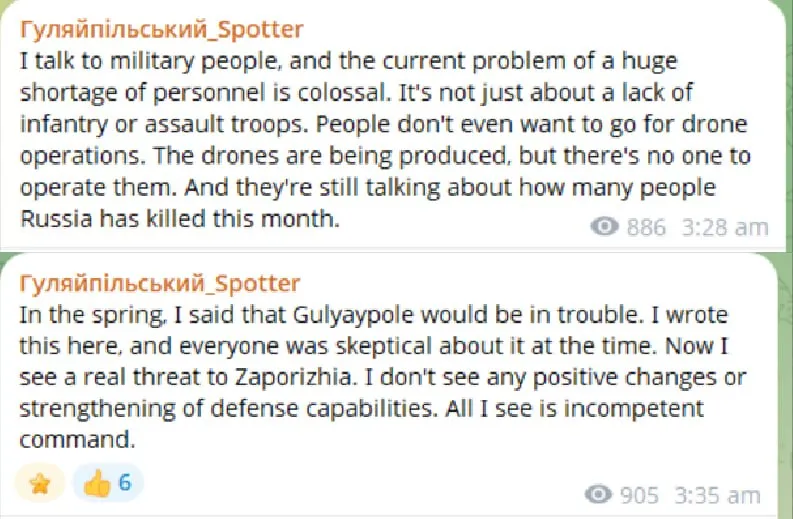
Image

Ukrainian soldier from the 102nd Territorial Defence Brigade on the situation west of Hulyaipole.

It’s almost certain that Russian forces will pick up their offensive in the coming weeks when the weather begins to clear because there is no hard indication of any real limiting factor—like manpower issues—beyond recent weather woes or simple strategic reformulations on the front.


A couple last items:

The Russian “Yolka” drone interceptor has been spotted again on the front successfully taking down Ukrainian drones: (Video at link.)


A Ukrainian F-16 pilot reveals that they loft to 3000-4000m to launch bombs but are almost always targeted by Russian Su-35s and S-400 systems at the apogee of their ‘loft-and-launch’ maneuver, before dropping down rapidly to try and escape the missiles: (Video at link.)

This confirms that Russian assets are covering the frontline much more heavily than some people think, it’s just that long range missiles are more infallible than most assume, particularly when fired at maximum ranges. US Airforce studies have shown long range missiles have as high as 70%+ miss rates (fired at longer distances) as it becomes fairly simple for agile fighter jets to ‘bleed’ the missiles with evasive maneuvers.


On a related topic, a Danish report claimed that Denmark wants its F-16s back from Ukraine to defend Greenland: (Video at link.)

https://simplicius76.substack.com/p/sit ... ters-trump

******

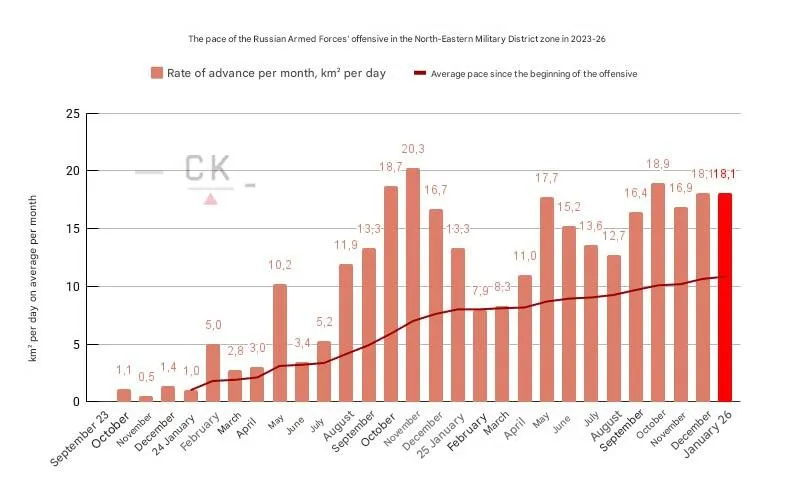
Dynamics of territorial liberation 2023-2026
February 1, 1:46 PM

Image

Dynamics of territorial liberation 2023-2026

In January 2026, the Russian Armed Forces continued to liberate territory at an average rate of 500-600 square kilometers per month.

Image

"Creamy Caprice" calculation - https://t.me/creamy_caprice/11170

The peak indicator remains November 2024, when the enemy's front line seriously sagged after the Kursk adventure.

https://colonelcassad.livejournal.com/10338663.html

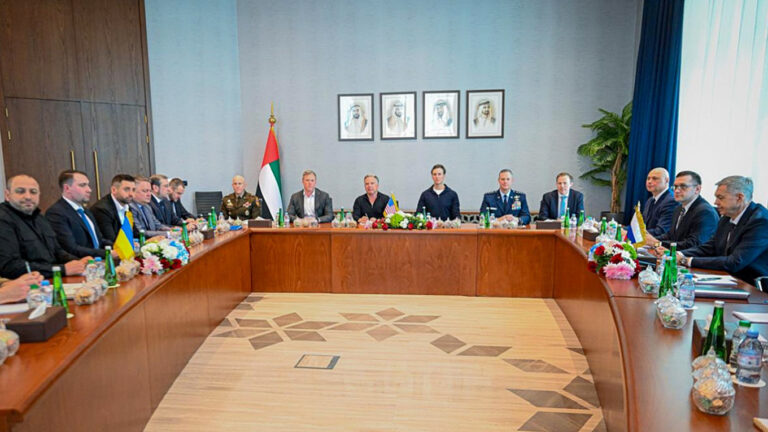
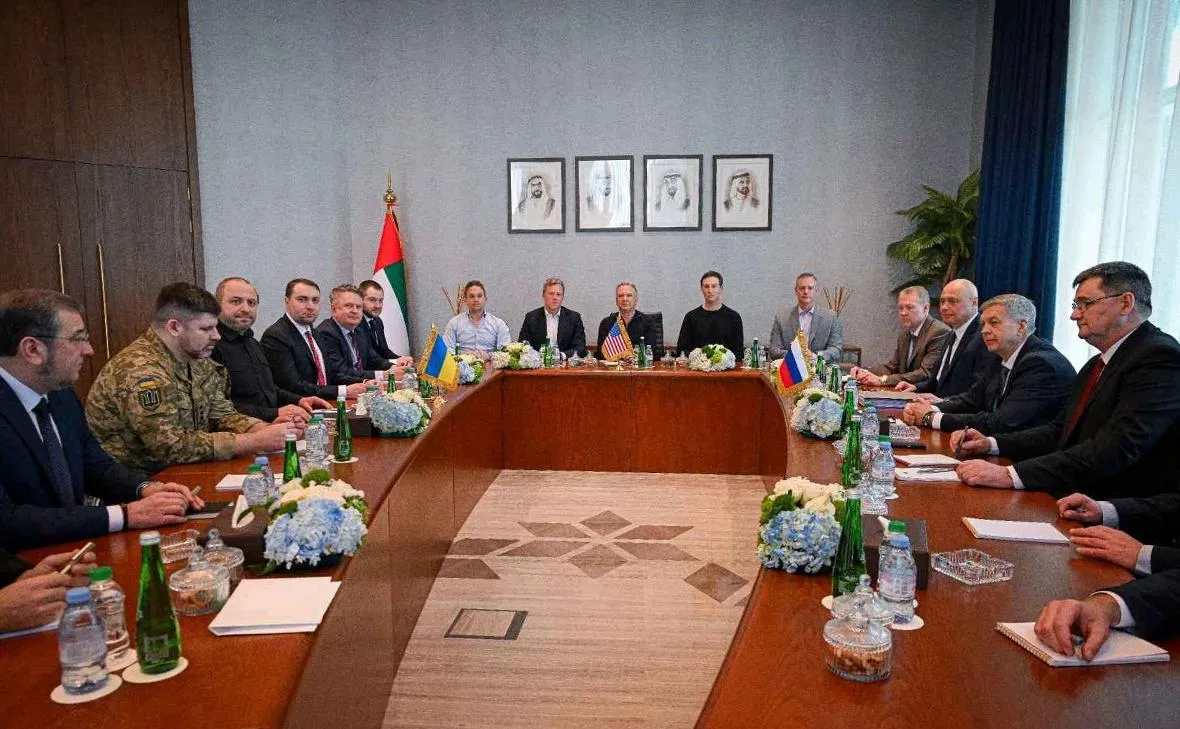
Negotiations in Abu Dhabi. February 1, 2026.
February 1, 9:54
Image

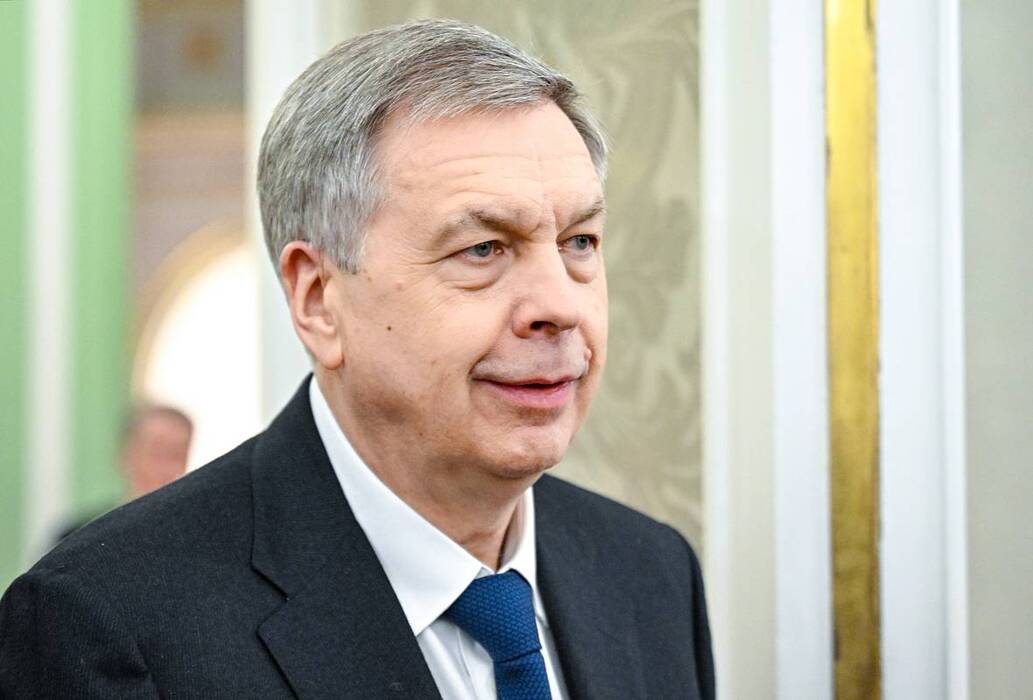
Today, the next round of negotiations will take place in Abu Dhabi.

The Russian and Ukrainian delegations will now meet in roughly the same composition as last time.
The Russian delegation is led by Admiral Kostyukov, Chief of the Main Intelligence Directorate of the General Staff of the Russian Armed Forces.
The Emirates are acting as mediators. There will be no Americans at the meeting.

In light of the cocaine-fuehrer's statements about wanting to fight for Donbas and the Zaporizhzhya NPP, little progress is expected. Kirill Dmitriev met with Witkoff and Kushner in Florida yesterday to discuss negotiations on Ukraine. According to Dmitriev, there was some progress.

Today, the notorious "energy ceasefire" also expires, and renewed strikes on Ukraine's energy sector are expected, as it is experiencing a partial blackout with cascading consequences.

https://colonelcassad.livejournal.com/10338210.html

Google Translator
"There is great chaos under heaven; the situation is excellent."

User avatar
blindpig
Posts: 15306
Joined: Fri Jul 14, 2017 5:44 pm
Location: Turtle Island
Contact:

Re: Footnotes from the Ukrainian "Crisis"; New High-Points in Cynicism Part V

Post by blindpig » Mon Feb 02, 2026 2:04 pm

Delays
Published by @nsanzo ⋅ 02/02/2026

Image

Yesterday, with the usual hostility that arises whenever Ukraine is reminded of the Soviet Union, EuromaidanPR , the quintessential propaganda outlet of the state born from the irregular change of government in February 2014, dug into the historical record to explain why the peace negotiations are dragging on for so long. “The West called him Mr. No. Andrei Gromyko was Soviet Foreign Minister for 28 years and negotiated with six US presidents. Henry Kissinger even said: ‘If you can stand up to Gromyko for an hour and survive, then you can start considering yourself a diplomat,’” they wrote, adding that “his method was simple: keep up the pace until the opponents are exhausted, demand the impossible, blame the other side, and use the time to strengthen your position on the ground.” Any projection of a manipulated version of history is good enough to explain the present. “That same playbook is being used now in Abu Dhabi,” EuromaidanPR claims. “Former Ukrainian diplomat Iuliia Osmolovska explains how modern Russian diplomacy combines Gromyko’s marathon tactics with KGB psychological warfare, and why Western cost-benefit analysis continues to fail against negotiators who value fear over gains,” she states, clinging to one of the laziest arguments that can be used: the KGB.

The complete disinterest of European countries and, on the Democratic side, the American establishment has led the media machine to focus its arguments on the idea that Ukraine was demonstrating its willingness for peace, while Russia has rejected every diplomatic overture offered to it. This has been Kakha Kallas's discourse ever since European countries reluctantly abandoned their victory rhetoric in favor of the idea of ​​a just peace a year ago. "We don't talk to the Russians," Kallas recently stated, justifying this by claiming that "the Americans are already talking to them and making all the concessions on behalf of Ukraine." The public face of the discourse that blames Russia for the lack of diplomacy admits a lack of interest in even the slightest continental dialogue.

During this time, until Donald Trump announced, seemingly overnight, the first direct political negotiations between Russia and Ukraine since 2022, there had been no diplomatic attempts involving Russia, with the exception of the talks between Vladimir Putin and Steve Witkoff. Comparisons to the Soviet Union tend to be empty arguments whose sole purpose is to instill in the collective consciousness the idea that the nonexistent dialogue process is stalled because Russia is delaying it.

The same pattern played out during the seven-year Minsk process, in which Russia put forward proposals—generally concessions on its part—to move toward the final phase of implementing the signed agreements, and Ukraine reacted by increasing its demands or stalling. At that time, Russia was already prepared to accept only partial implementation of what had been signed in the Belarusian capital in February 2015, as evidenced by the Kremlin's lack of complaint each time Kyiv categorically refused to negotiate political—not just humanitarian—issues with Donetsk and Luhansk, despite that being the spirit of the Minsk roadmap. Even so, as the media continues to insist now that even Ukraine admits it never intended to implement the agreement, Russia was again blamed.

The situation is even more curious now, since Russia hasn't even had the option of applying Mr. Gromyko's theory, as no sustained process has taken place. During the first few months, contacts between Russia and the United States were limited to bilateral relations, with an American delegation inexperienced in diplomacy and frankly lacking knowledge of the region and the war. In an interview with Tucker Carlson, Steve Witkoff couldn't even name the five territories whose fate hangs in the balance in the negotiations. It wasn't until late spring that roadmaps began to be drafted to try to resolve the war. Thus began a cycle in which the United States pressured Ukraine to accept certain conditions, at least rhetorically—the idea of ​​peace, the possibility of a ceasefire, or a peace and security guarantees scheme in exchange for territory—while Steve Witkoff negotiated a series of points in Moscow that, when leaked to the press, triggered European mobilization to prevent any potential advances in an undesirable direction. This occurred in the spring and after the Trump-Putin summit in Alaska in August, which was so worrisome that European countries reacted with an emergency trip to Washington to prevent any progress.

The shift occurred in November, when, following the publication of the 28-point plan, European countries reacted in their usual fashion. The United States allowed Ukraine's continental allies to remove Russian assets held in Europe from the negotiations, but, unlike on previous occasions, the talks did not stall. Instead, they proceeded without paying particular attention to European demands and suggestions. Washington has deliberately sidelined European countries from the diplomatic process, which has been conducted bilaterally in Miami and only last week moved to its crucial trilateral phase.

In response to accusations that Russia is delaying the process, American enthusiasm has been suggesting for months that an agreement is imminent. “The territorial fate of Donetsk is the key issue preventing the conclusion of a peace agreement between Ukraine and Russia,” stated US Secretary of State Marco Rubio on Wednesday, wrote Politico last week , one of the outlets where Trumpism regularly disseminates its message. Of the numerous aspects that have made it impossible to resolve the conflict in twelve years of diplomacy, all but the Donbas issue have now disappeared, at least from the minds of the United States, whose tactic has been based on ignoring anything that didn't align with its view of the war, hoping the problem would simply vanish. “The only remaining issue… is the territorial claim over Donetsk. Active efforts are underway to try to reconcile the views of both sides on this matter,” insisted Marco Rubio during his appearance before the Senate. “It remains a bridge we haven’t crossed. It remains a gap, but at least we’ve been able to narrow down the set of issues to just one, which will probably be very difficult,” boasted the Secretary of State, to the surprise of the Russian side, which insists its position has not changed.

“The territorial issue is the most important. But there are still many other issues on the agenda. Many issues,” responded Yuri Ushakov, implying that even the security guarantees that Ukraine and the United States claim to have agreed upon—it remains to be seen whether the interpretation of the agreement they are about to sign is the same in Washington and Kyiv—are not to Moscow’s liking. “They say, ‘Security guarantees have been agreed upon.’ Well, then, have they also been agreed upon with Russia?” added Vladimir Putin’s advisor. “No one has received approval from the Russian side on this matter,” he insisted. Ushakov has not been the only Russian official to express these views. There will be no peace in the short term, stated Sergey Lavrov, “if the goal is to preserve this regime in some part of the territory of the former Ukraine and continue using it as a springboard to create threats to the Russian Federation.” “We held the first round of negotiations within the framework of the working group on security. That is where we stand now,” Ushakov emphasized. Only the United States believes the security issue is settled, which is possibly why Ukraine is so eager to sign the security agreement with the US, without waiting for the other bilateral agreements necessary for a ceasefire to be finalized. Despite the confidence shown by the United States, which announces substantial and concrete progress after each meeting, all the contentious issues—security, territories, reconstruction, financing, and sanctions—remain unresolved.

Contrary to what had been announced, the next round of negotiations did not begin yesterday, nor will it begin today. “Our negotiating team has just submitted a report. The dates for the next trilateral meetings have been set: February 4 and 5 in Abu Dhabi. Ukraine is ready for substantive dialogue, and we are interested in ensuring that the outcome brings us closer to a real and dignified end to the war. Thank you to everyone who is cooperating!” announced Volodymyr Zelensky. The Ukrainian newspaper Strana attributed this change to two possible scenarios: the need for behind-the-scenes work given the real possibility of progress, or Ukraine's attempt to preserve for a few more days the partial energy truce that was supposed to last until the resumption of negotiations.

While awaiting the next meeting between Russia and Ukraine, whose focus will predictably be military again—as evidenced by the significant military and security apparatus representation in both delegations—Steve Witkoff commented yesterday on his Saturday meeting with Kirill Dmitriev , an encounter that, once again, has been described as “productive.” Perhaps the most significant detail of this meeting is the list of attendees, which , in addition to the usual suspects Witkoff and Kushner, also included Rubio and Bessent . From this, one can deduce the purely economic nature of the meeting, although no information has been released to determine which of the most important issues—reparations, sanctions, withheld funds, and the economic relationship between Russia and the United States beyond the war—were discussed. What is clear, however, is that the United States continues its practice of negotiating with Russia and Ukraine on those issues where it believes bilateral agreement is possible, especially regarding the economic relations that Washington will enjoy after the ceasefire, completely ignoring the more difficult aspects to resolve. It is not Russia that is delaying the process , but the United States, involuntarily and largely due to its inability to understand the nature and complexity of the war, has proposed a negotiation format that is requiring more time and work than it would have expected .

https://slavyangrad.es/2026/02/02/33955/

Google Translator
******

From Cassad's Telegram account:


Colonelcassad
An interesting detail concerns the preconditions for the Pereyaslav Council and Nikon's role in the decision that ultimately led to the transfer of Left-Bank Ukraine to the Tsardom of Muscovy under the Treaty of Andrusovo in 1667. Of course, without the agreement with Bohdan Khmelnytsky, this might not have happened. Of course, not only political issues played a significant role there, but also religious ones, where Russian Orthodoxy opposed Catholicism and Uniatism, which at that time was a significant factor in political decision-making.

They currently want to restore the cross associated with the 1654 reunification in memory of those events, but
due to a lack of funds, the project is being delayed (several hundred thousand rubles cannot be found). Naturally, the symbolic goals are related to the return of part of our original territories to Russia.
It is strange that, despite all the state policy related to religion, after so many years, they have been unable to erect a historical cross associated with the reunification of Ukraine with Russia. Maybe local Governor Tsibulsky will somehow resolve this issue.

https://rutube.ru/video/2e29559f899a2d3 ... 5b22efc33/ - video from the island

***

Colonelcassad
In 2025, Russia became Georgia's largest oil supplier, setting a new all-time record.
Despite the lack of formal diplomatic relations, Georgia is increasing its oil purchases from Russia. Over the past year, they have grown 16-fold.

Indeed, if Georgia had abandoned its stubborn stance on Abkhazia and South Ossetia, trade turnover could have been many times greater. Russia has repeatedly made it clear that it is open to restoring diplomatic and developing economic relations, but it will not pursue Georgia. If Georgia wants it, they will discuss it. If it doesn't, then it's not really wanted.

https://t.me/papagaz/20198

***

Colonelcassad
Peskov announced that Russian-Ukrainian peace talks in Ukraine will be held in Abu Dhabi on February 4-5.

As usual, the Emirates will provide the venue for the talks.

***

Colonelcassad
KIIS (Kyiv International Institute of Sociology) released the following statistics:

— Only 20% of Ukrainians expect the war to end in the coming weeks or at least in the first half of 2026;

— 65% say they are prepared to endure the war as long as necessary;

— 66% expect Ukraine to be a prosperous EU member state in 10 years.

P.S. Just another 10 years of endurance and Ukraine will become a "blooming garden."😀

***

https://t.me/s/boris_rozhin

Google Translator

******

Brief Frontline Report – February 1st, 2026

Summary by Marat Khairullin and Mikhail Popov.
Zinderneuf
Feb 01, 2026

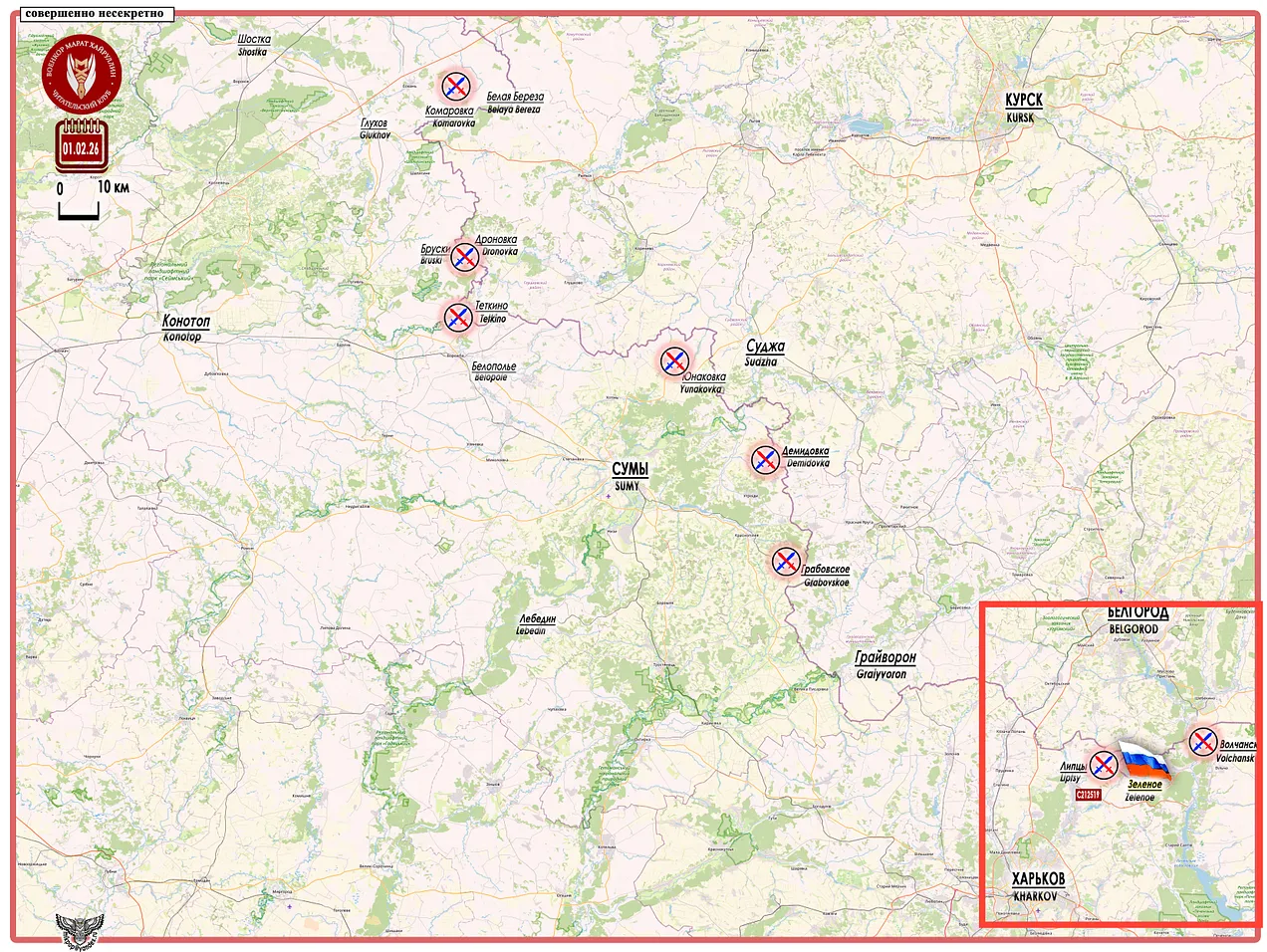
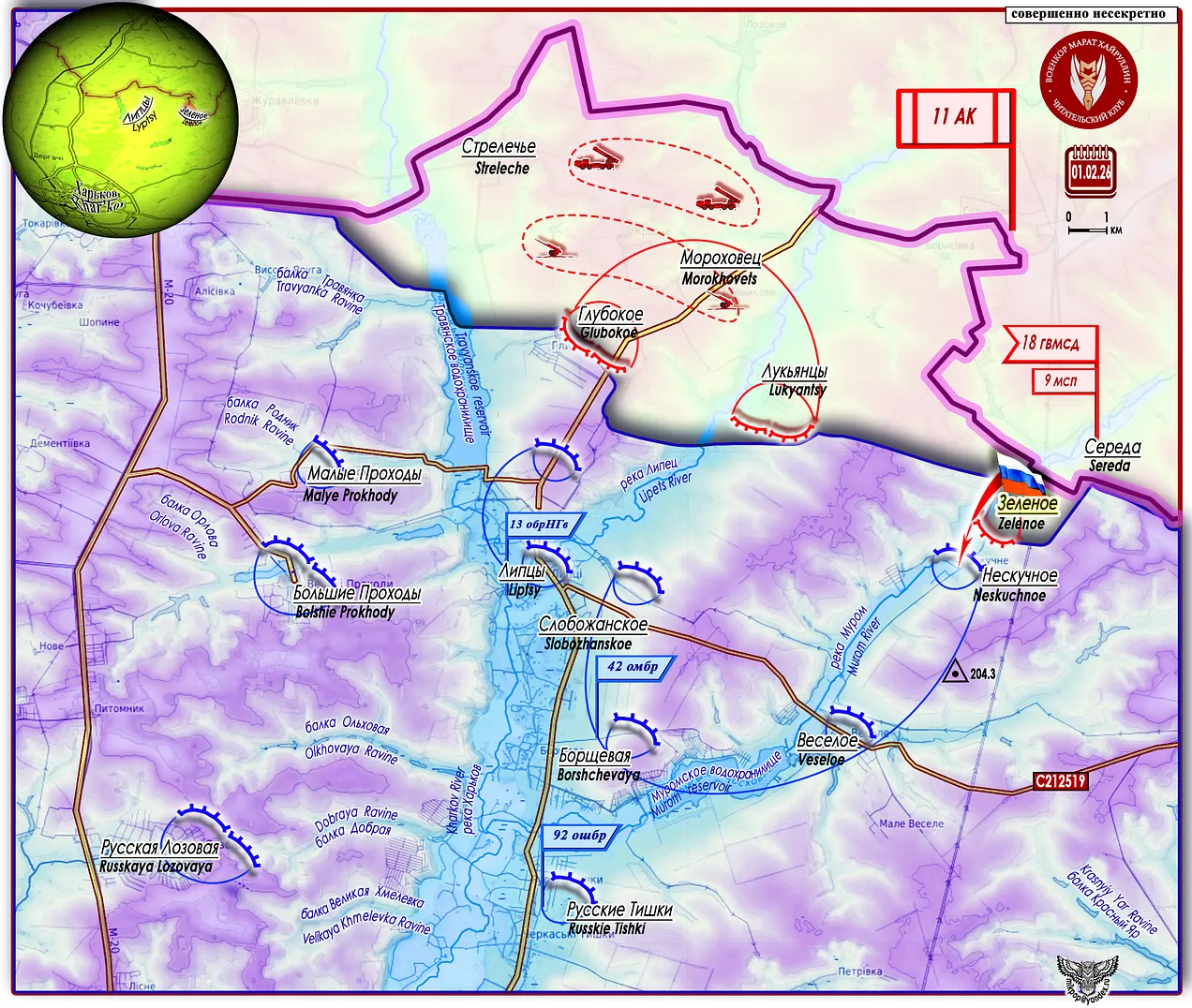
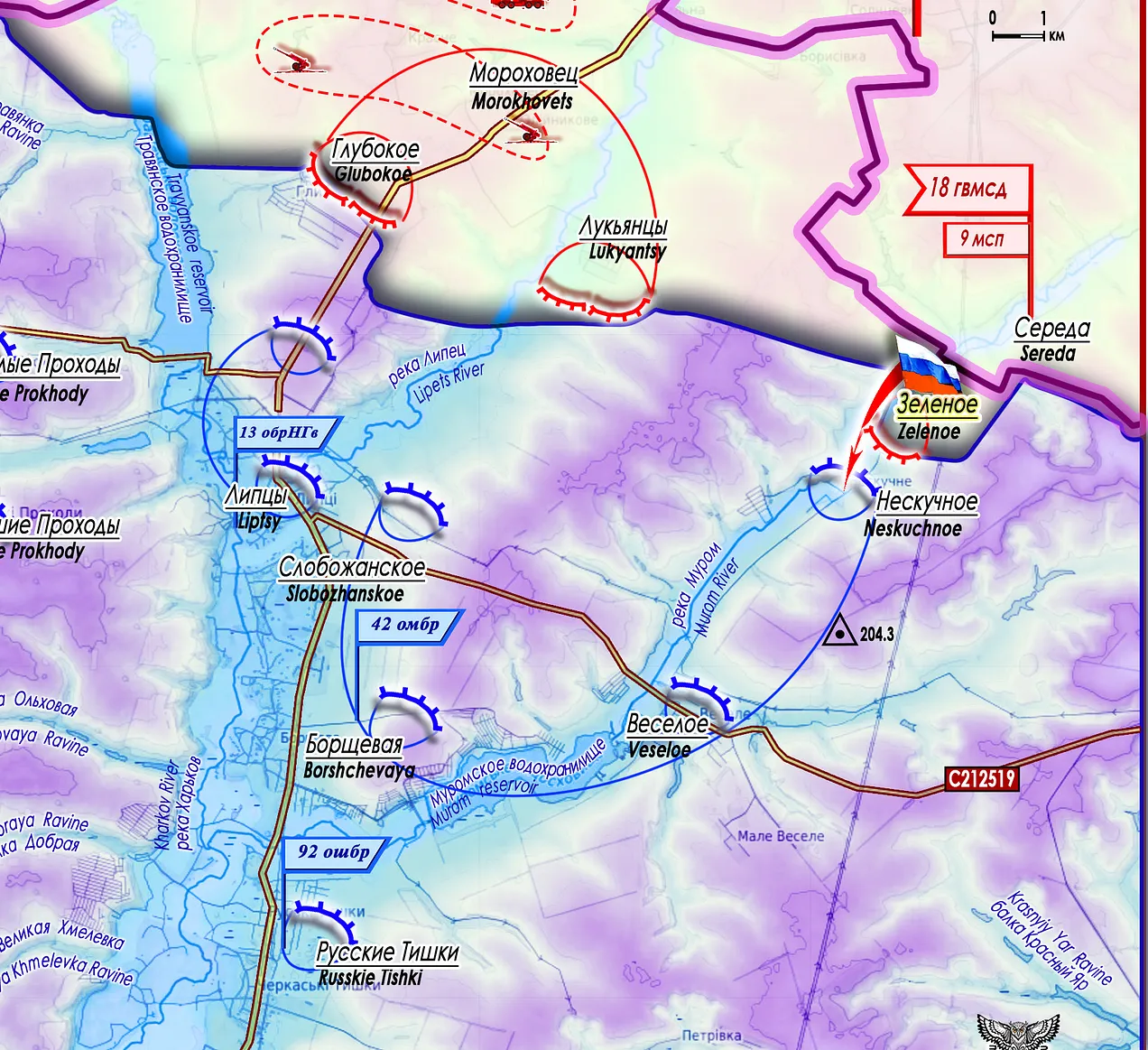
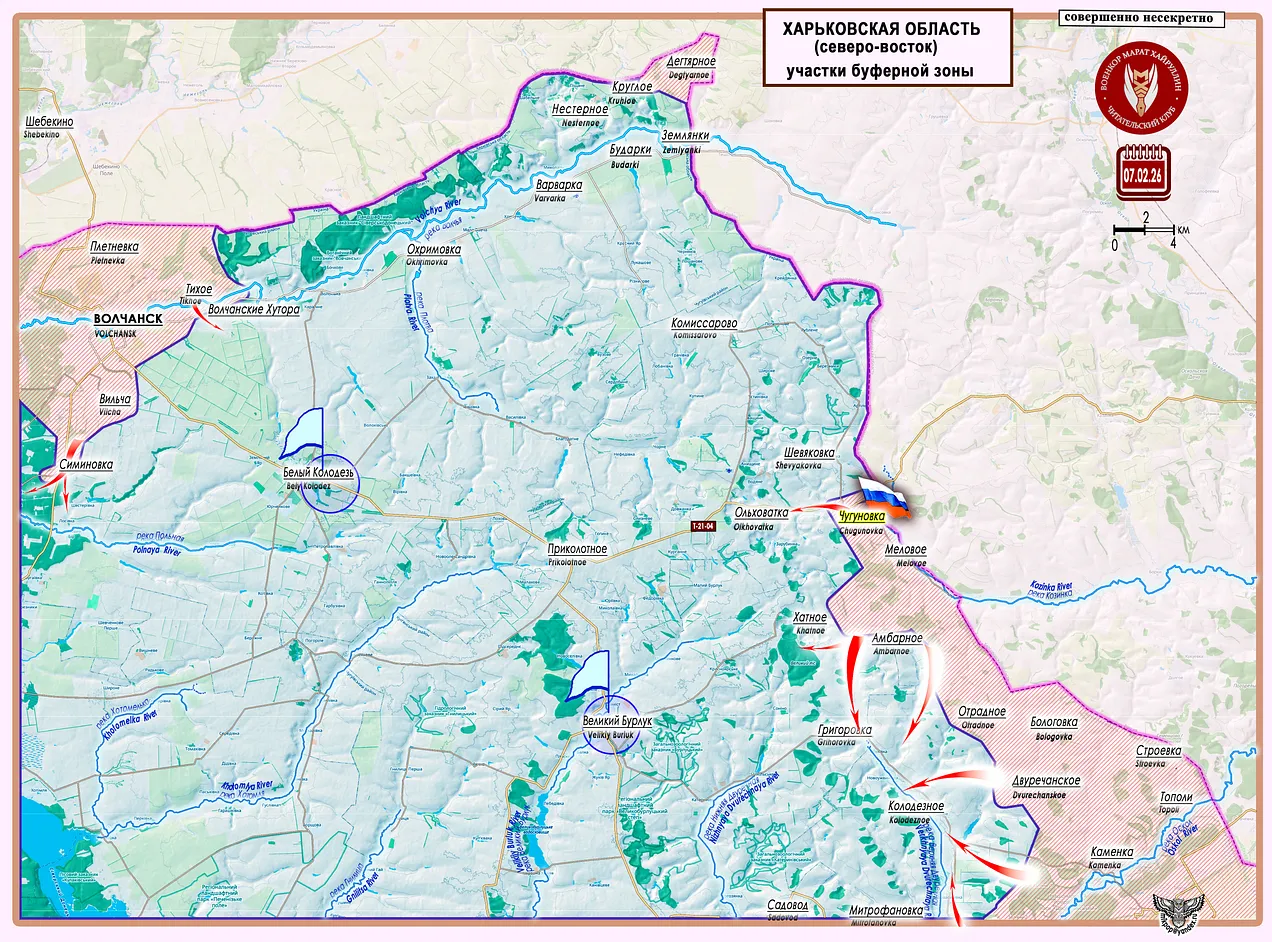
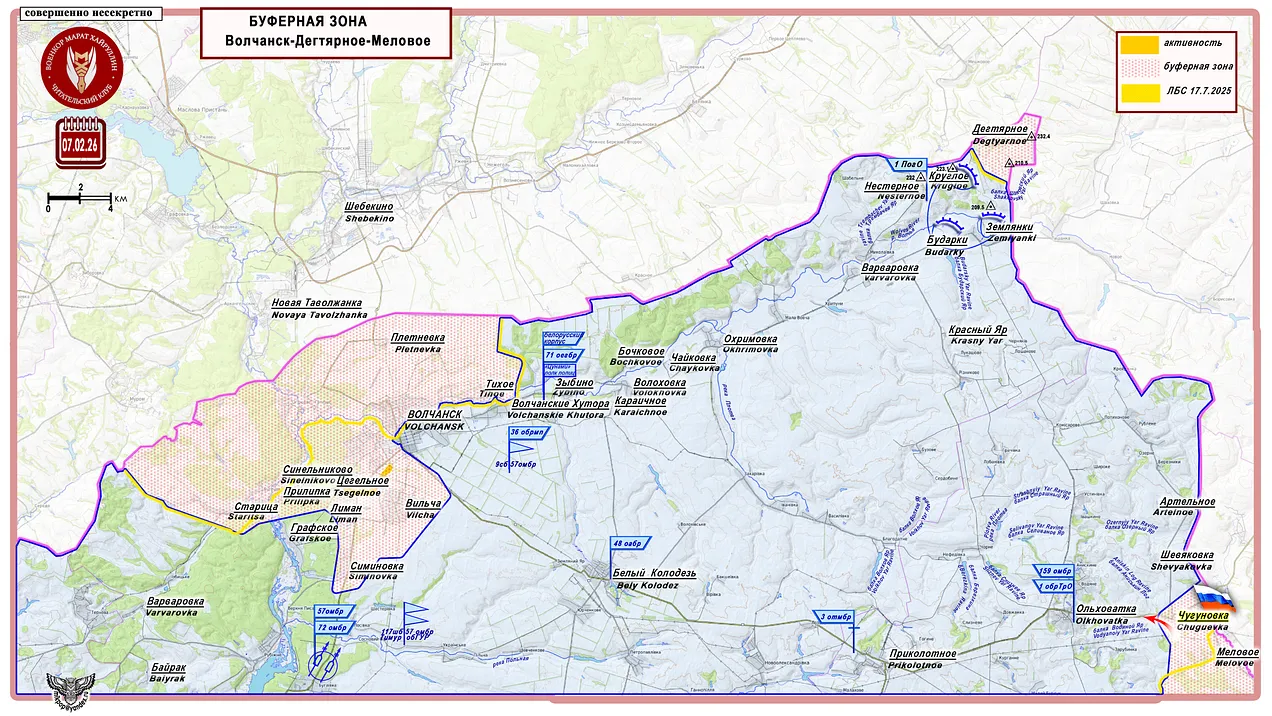
Message from the Russian Ministry of Defense: "Units of the 'North' Group, as a result of ongoing operations, have liberated the settlement of Zelenoe in Kharkov Oblast."

Image
Sumy - Kharkov

Image
The Liptsy Direction

The Russian Armed Forces are actively advancing in the Volchansk sector of the Kharkov direction, forcing the enemy to reinforce this direction. One of the closest areas to Volchansk is the Liptsy sector (located to the west), where positional battles have been ongoing since the end of 2024. As soon as the enemy made its maneuver of forces and means toward Volchansk, near the Liptsy direction, assault troops of the 9th Motorized Rifle Regiment liberated the settlement of Zelenoe (50°13′34″ N 36°34′55″ E, population 73 in 2001). The rural settlement of Zelenoe is situated on the bank of the Murom River on the border with Russia; upstream at a distance of less than 1 km is the village of Sereda (Belgorod Oblast), and downstream at a distance of less than 1 km is the village of Neskuchnoe. Further downstream, at a distance of 6 kilometers, is the village of Veseloe, through which the road S212519 (Liptsy - Ternovaya) with crossings over the Murom River passes, connecting the Liptsy sector with the Volchansk sector. When Russian Forces reach the settlement of Veseloe, they will significantly complicate the coordination of the enemy's groupings.

Image

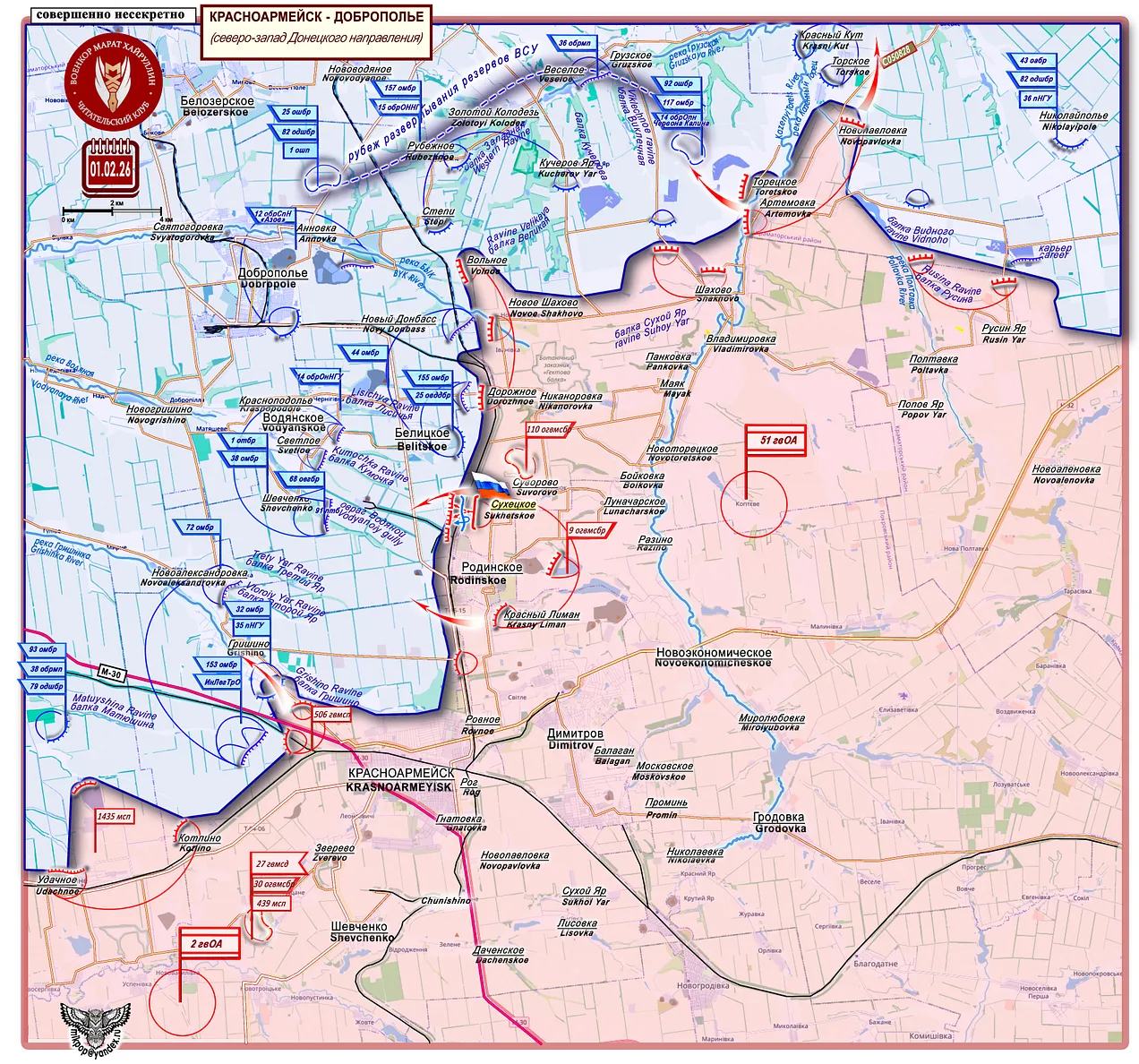
Message from the Russian Ministry of Defense: "Units of the 'Center' Group, as a result of decisive actions, have liberated the settlement of Sukhetskoe in the Donetsk People's Republic."

Image
Krasnoarmeysk to Dobropole; (Northwest Donetsk Direction)

A difficult situation developed in the Krasnoarmeysk sector of the Donetsk direction during the autumn of 2025. Striving to break the ring of the Russian encirclement in the area of the Krasnoarmeysk (Pokrovsk) and Dimitrov (Mirnograd) settlements, the command of the Ukrainian Armed Forces committed its best formations to this sector. Russian Armed Forces units had to hold back the enemy on both sides of the encirclement ring: inside the ring - Ukrainian Armed Forces units striving to break the ring and escape the encirclement, and on the outer perimeter - Ukrainian Armed Forces units that had come to the aid of the encircled grouping. Russian servicemen displayed heroism and resilience and destroyed the encircled enemy. However, on the outer radius, on separate sectors of no operational significance, they withdrew to more advantageous positions. The rural settlement of Sukhetskoe (48°22′35″ N 37°13′22″ E, population 40 in 2001), liberated on August 20, 2025, was returned to the enemy.

On February 1, 2026, the settlement of Sukhetskoe once again came under the control of the Russian Forces, eliminating a bulge in the line of contact north of the Rodinskoe settlement.

Image

The US is restricting Starlink in Ukraine.

The Americans have begun blocking Starlink in Ukraine at speeds above 75 km/h.
Drones at such speeds simply lose contact and stop communicating via satellite.
Both our and the enemy's networks are currently being blocked. The problem of distinguishing our drones from the crowd hasn't been resolved yet. So, for now, these difficulties are mutual. However, it's safe to assume that the enemy will seek to limit our use of Starlink while allowing them unlimited use.
It's also likely that our specialists will seek to circumvent the American restrictions.

This is yet another reminder that our country desperately needs its own satellite constellation to provide our military equipment with uninterrupted satellite communications, so as not to be dependent on enemy systems. We use Starlink en masse (tens of thousands of terminals on the front lines—after the price was reduced to 35-40 thousand rubles per terminal, their number has increased exponentially). This isn't because life is good, but because we've long neglected or at a snail's pace the creation of our own equivalent to Starlink or OneWeb.

P.S. On the front lines, Starlink is actively used by the Russian Armed Forces to provide internet access, operate various drones, both copter- and aircraft-based, ground-based, and unmanned aerial vehicles, etc. Of course, if we had our own equivalent, Starlink would have to be deployed immediately, but getting rid of it now is impossible—it would seriously damage the Russian Armed Forces. This is despite the full understanding that using an adversary's system carries various risks.

https://colonelcassad.livejournal.com/10339804.html

Destruction of Ukrainian fighter jets at the airfield in Myrhorod
February 1, 7:10 PM

Image

Footage of Ukrainian Air Force fighter jets being destroyed at the Myrhorod airfield. Two Su-27s and a decommissioned F-16 used as a training mockup were hit. Radars at the airfield were also hit. The targets were engaged using BM-35 drones on a Starlink.

(Video at link. )

The enemy is currently making efforts to force the Americans to restrict the use of Starlinks for Russian drones in Ukraine, which are currently striking targets deep within Ukrainian territory with impunity using American terminals.

https://colonelcassad.livejournal.com/10339296.html

Destruction of the HIMARS MLRS and S-300 SAM system. February 2, 2026.
February 2, 2:57 PM

Image

Himars MLRS and S-300 SAM system hit. February 2, 2026.

The Russian Armed Forces carried out significant strikes last night. In addition to the infrastructure in the Kharkiv region, an American HIMARS MLRS and its personnel were hit (likely from those that recently attempted to shell Belgorod), and an entire S-300 battalion was caught in the Dnipropetrovsk region. During the strikes on the SAM systems, our reconnaissance drone hovered calmly over the positions, providing objective monitoring of the incoming and subsequent strikes. The targets were engaged with Iskander missiles.

(Video at link.)

And now regarding infrastructure.

The Ukrainian Ministry of Energy announced that the "energy ceasefire" had ended, and that Russia had already attacked energy facilities last night, resulting in power outages in several regions.

Russia had previously stated that the ceasefire would remain in effect until February 1st. The cocaine führer had stated that the strikes would resume on February 3rd. In fact, they began on February 2nd.

https://colonelcassad.livejournal.com/10340942.html

Google Translator

******

Silicon murder valley

Drone grifters rise: Fedorov and Sternenko. Russian strategic logistics focus. Ukrainian tactical blood-fetish.
Events in Ukraine
Feb 01, 2026

Today we’ll examine how Ukraine is strategically losing the drone war, and the draft-dodging, techbro grifters exacerbating this slow defeat.

But first, a quick look at how this plays out on the battlefields.

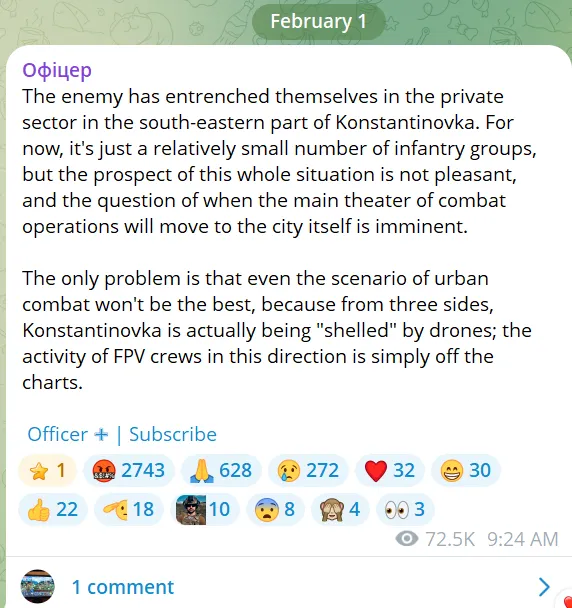
With Russian drones dominating Ukrainian logistics around the Donbass city of Konstantynivka, Russian troops now control much of the southern part of the town. This February 1 post is from ‘Alex’, a senior lieutenant in the Ukrainian army:

Image

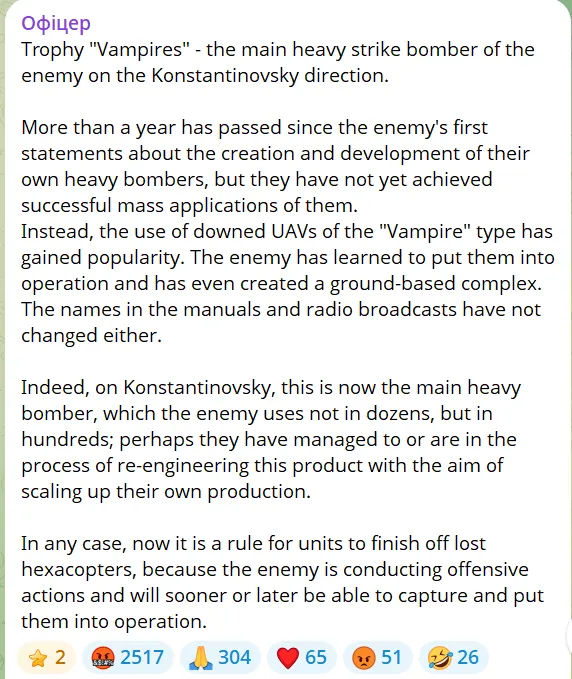
Officer also wrote on January 31 about how Russian success in scaling up the use of heavy bomber drones. These are able to carry much larger explosive charges than the usual FPV drones. Ukraine started using ‘Vampire’ bomber drones around 2023, and Russia had difficulties reaching Ukrainian production levels until recently:

Image

What about the Ukrainians?

Today, we’ll see how different the Ukrainian approach to drone production is to the Russian one. Where the Russians modernize and scale up production of effective models, the Ukrainians have a neoliberal, PR based approach. Let a thousand drone contractors bloom! Lacking regulations and with a river of EU funds inundating the market, many drones produced are of subpar quality, and frontline coordination is lacking.

Along with the the adverse battlefield effects of Ukraine’s ‘drone zoo’, today we’ll be taking a look at the grifters in charge of this system. Though adored by the western press, actual Ukrainian soldiers aren’t so happy about their appointments.

These individuals are doing very well following the removal of Andriy Yermak as Zelensky’s chief of staff in late November 28. In the first month of 2026, a number of most prominent parasites have risen to unprecedented positions in managing the war effort. Naturally, none of these fanatically militaristic personalities have ever actually served in the army.

Instead of fighting, killing, and dying, they triumphantly post drone videos of ‘destroyed subhumans’ all day, furiously demanding their millions of followers donate more money to their ‘Russocutter drone’ foundations. Endless corruption scandals about the use of these funds ensure, but anyone who brings them up receives death threats from the hordes of online fanatics.

Today, we’ll cover two.

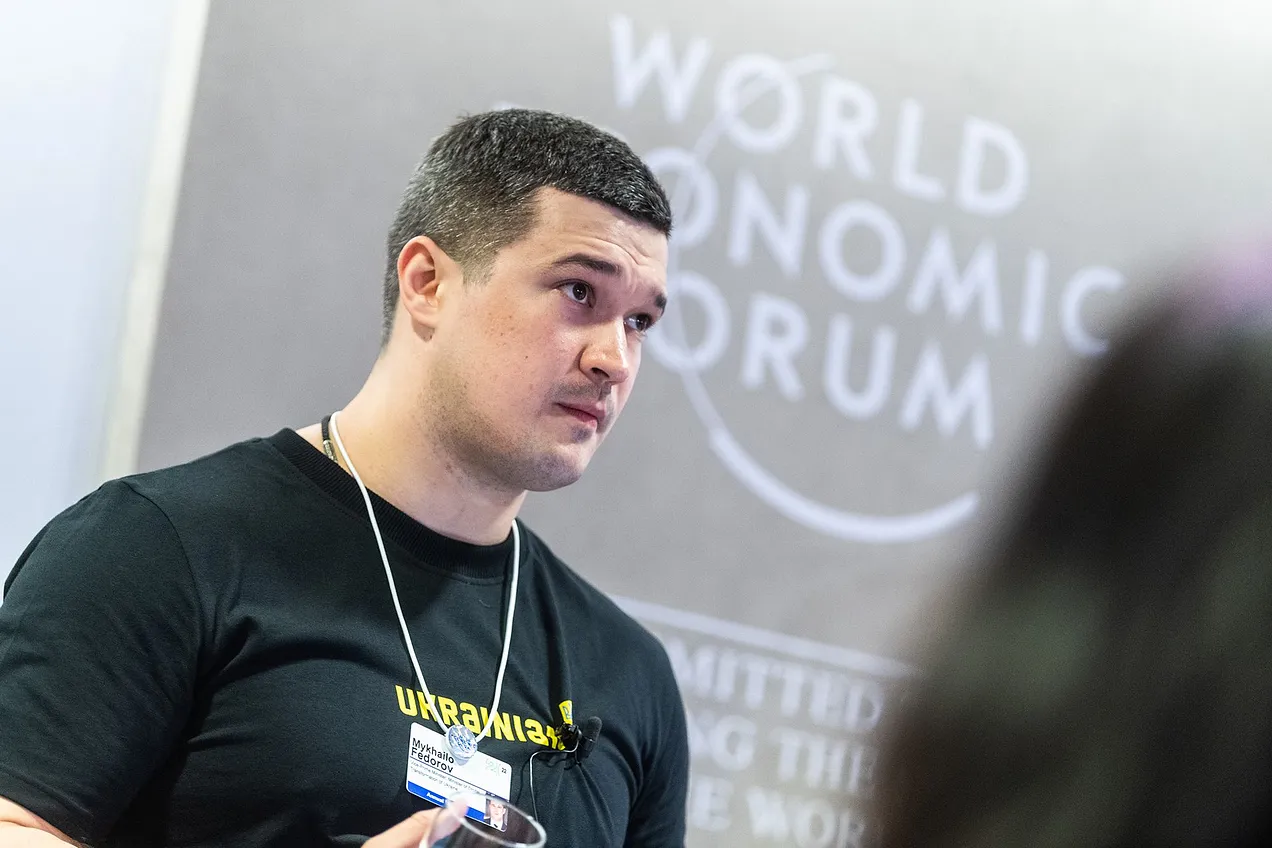
First, Mykhailo Fedorov, appointed minister of defense at the start of January 2026.

Image

You will have likely heard his January 20 proclamation about Ukraine’s grand military strategy: to defeat Russia, 50,000 Russians must be killed monthly. He claims that currently, there is video proof of 35,000 killed each month. Along with examining Fedorov himself, today we’ll examine Ukrainian and western military analysts and soldiers that are sceptical of his strategy and his claims about existing kill rates.

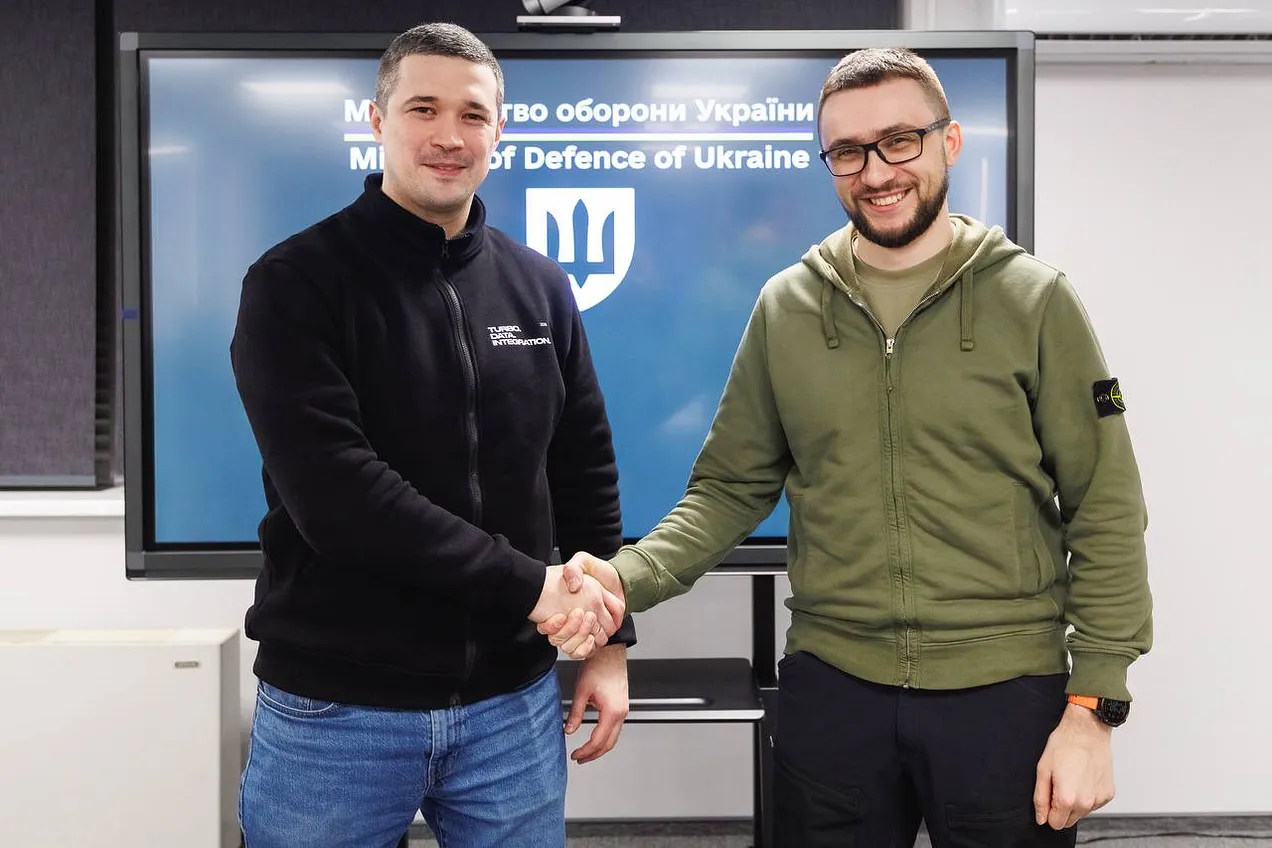
Second, Serhiy Sternenko, appointed Fedorov’s advisor on January 23. Fedorov announced that the popular youtuber with absolutely no military experience ‘will be my advisor on increasing the use of UAVs on the frontline’. Here you can see Fedorov shake hands with his new advisor (right).

Image


I’ve written numerous articles about Sternenko. This is a drug dealer, rightwing paramilitary grifter, agent of the security services, murderer, and extortionist-torturer.

Nationalists that actually fought in the army often hate Sternenko. Take, for instance, Brigadier General Andriy Biletsky, the ‘White Fuhrer’ of the Azov movement, who today commands more than 40,000 troops in his Third Army Corps. In 2020, Biletsky said this on national TV about Sternenko:

(Video at link.)
What kind of nationalist is he? He talks about being a member of the Right Sector [a fascist paramilitary - EIU], but… All of Odessa knows that this is a person who is involved with brothels and drug dens while the rest of Right Sector fought at the front. He has a million criminal cases against him.

While he lacks military experience, Sternenko has something much more valuable: he is a nationalist youtuber with more than a million followers. He is also the favoured leader of Ukraine by the Democratic Party and the western-funded liberal NGO sector.

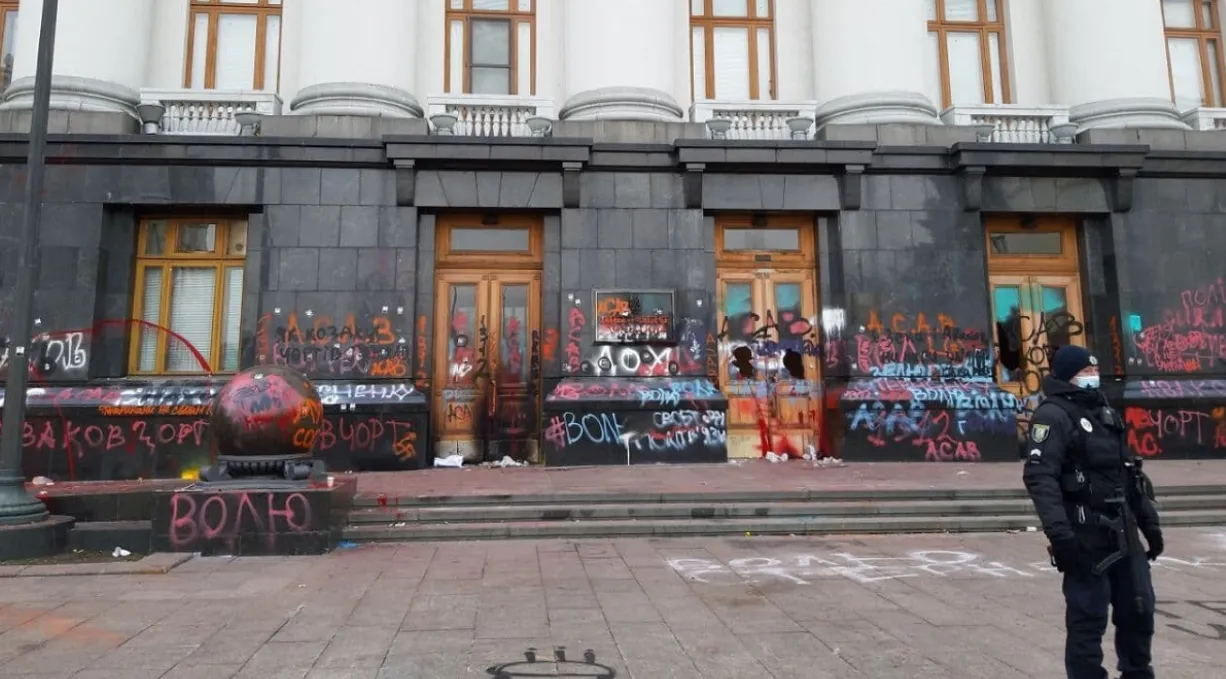
Sternenko often poses as Zelensky’s stern critic. Back in 2021, Sternenko organized dramatic attacks on Zelensky’s president’s office, publicly calling him a ‘dictator’ that would be forced to free the country under threat of death.

Image
Zelensky’s trashed presidential administration, March 2021. Sternenko’s followers were responsible.

In 2020-1, Sternenko was angry with Zelensky because the young ‘activist’ was being faced with jail time as punishment for the murder of an unarmed veteran he committed in 2018. Thanks to his violent protests and the intervention of important figures in the US elite, Sternenko avoided any punishment.

Naturally, Sternenko has never served in the army. He cites an eye condition, and began wearing glasses once people started asking why this fanatic supporter of forever-war had never set foot in the armed forces. In 2025, he threatened Zelensky with death if he withdrew from the Donbass.

In RFERL's world, Serhiy Sternenko (stands accused of a murder) is a “civic activist” targeted by vindictive authorities. In real life, Sternenko has a penchant for Svastone brand run by nazi musician

Image
Sternenko wearing his favorite brand, Svastone

In wartime, Sternenko has focused on raising tens of millions of dollars for his famous ‘Ruzzocutter drone foundation’. Naturally, there have been constant allegations of misuse of these funds. But Sternenko always claimed that thanks to his selfless fundraising, the army is able to continue fighting despite government incompetence and corruption.

Yet now, Sternenko has forgotten all about his passionate opposition to Zelensky. After years of solemnly proclaiming that Ukraine faces certain defeat unless the army is ‘totally transformed’ (he never really explains how), he finally has the opportunity to put theory into practice!

Nevertheless, despite his legion of extremely annoying online fans, many Ukrainians are quite unenthusiastic about the glorious Sternenko. For instance, Fedorov’s telegram post announcing his appointment as advisor mainly got sad reactions. Most of Fedorov’s posts get uniformly positive reactions.

Later in this article, we will examine a number of other critical reactions to Sternenko’s appointment by Ukrainian soldiers and military experts. But first, Sternenko’s boss.

Fedorov
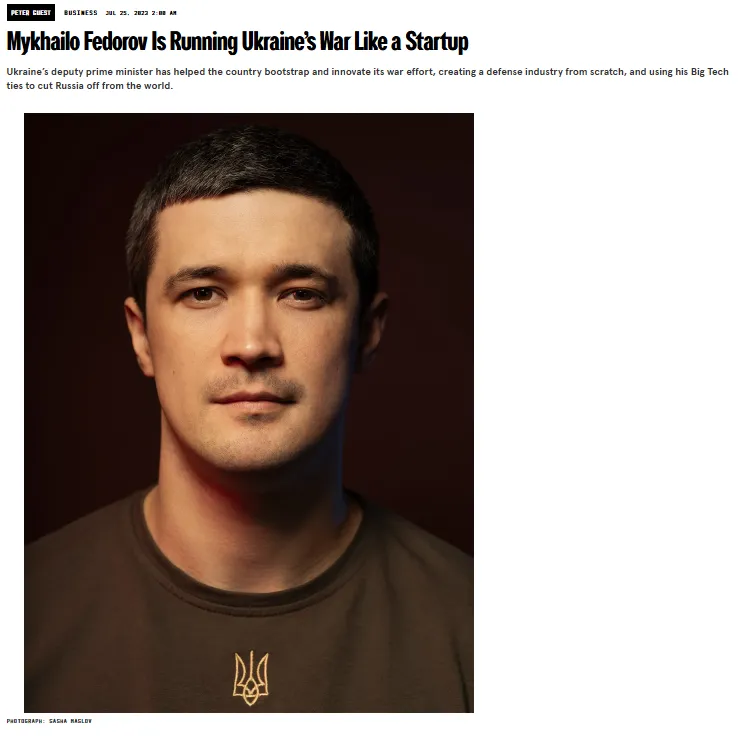
Mikhailo Fedorov has been crafted into the great white hope of the neoliberal reformers, who love to underline that he is Ukraine’s youngest minister in history. The western press never stop glazing him. Elon Musk back before he alienated half of reddit.

Image

According to western-owned liberal nationalist media in Ukraine, Fedorov played a major role in removing Andriy Yermak as chief of staff in November 2025. Yermak, though politically entirely aligned with the liberal nationalists, preferred to centralize all rent sources under his network. Fedorov’s rise is an indication that atlanticist ultranationalist forces have no need to worry that Zelensky is falling out of their control.

Fedorov seems to have been groomed by euro-atlantic structures since childhood. Born in 1991, he completed the Higher Political School and the Educational School of NATO Representatives in Ukraine. He also received a scholarship from the OSCE to monitor ecological health in his city.

Image
In 2012, he was elected ‘student mayor of Zaporizhzhie’. With the benevolent assistance of USAID, the young Fedorov implemented a new program called ‘Strengthening Zaporizhzhie’s IT Potential’. He also created what liberal media called the city’s largest student movement. In retrospect, it had an unfortunate name: ‘Aktiv-Z’.

For whatever reason, the future minister of defense is purely experienced in the field of online marketing. Of course, this characterizes all of Zelensky’s team.

In May 2013, Fedorov founded his own digital agency, called SMMSTUDIO. Given the lack of real jobs, SMM (Social Media Marketing) is a very popular option for young Ukrainians. He worked here all the way up to 2019, when he got to work organizing the online marketing aspect of Zelensky’s election campaign. In 2018, his SMMSTUDIO organized a large conference in Kiev on the topic of marketing using facebook. As you can see in the photo below, it was conducted in Russian.

Image

Fedorov was responsible for marketing Zelensky to the electorate in 2019. For his titanic efforts, he received a whole seven awards at the annual European Association of Political Consultants Polaris Awards. A Don Draper of our time. Among the awards was ‘Best Use of Negative or Contrast’ and ‘Best Use of Humor’.

Fedorov was awarded handsomely politically as well, becoming immediately appointed vice prime minister and minister of digital transformation in Zelensky’s ultraliberal first cabinet. Though the prime minister Oleksiy Honcharuk soon left the stage, Fedorov remained, and continued gaining flashy new ministerial posts.

Naturally, the start of the war saw Fedorov gain new heights. In 2022, he attended the Digital Transformation Strategy training course at the Yale School of Management. The USAID lab-rat needed some new tweaks. Fedorov’s much-feted mandatory government app Diiya became increasingly integrated with mobilization. And in early January 2026, Zelensky appointed Fedorov minister of defence, to the jubilation of starry-eyed liberal reformers the world over.

Image

Fedorov has been credited for a seemingly endless list of reforms in wartime. They tend to involve tech, marketing, and free markets. Though they always get a good reception in the western press, their actual effectiveness is another question.

For instance, Fedorov was behind the system of ‘E-points’, whereby different ‘points’ are assigned for various types of drone strikes. Drone operators can use these points to receive discounted drones, hence theoretically incentivizing operator effectivity.

Image

In fact, as we’ll see today, many complain that the E-point system has the wrong set of incentives, encouraging a purely tactical obsession with killing infantry, rather than the strategic approach of destroying enemy logistics that Russia successively employs. For Fedorov the PR-man, it’s flashy death-porn that matters, not actually winning the war. E-points also allows for exciting pronouncements, like Fedorov’s statement that it is ‘like Amazon for the military’.

Fedorov was also in charge of other exciting projects, like the ‘Army of Drones’, the Line of Drones, and the Unmanned Systems Forces (SBS). Intended to compete with Russia’s centralized Rubican drone team, they have instead exacerbated the chaos and disorganization characterizing the Ukrainian army.

In fact, Ukrainian drone operators never stop saying in interviews that Ukraine ought to emulate Russia’s approach of scaling up production of successful drone models. The Russians, instead of fetishizing private initiative and creativity, focus on constantly improving the 2-3 models of drones that have proven themselves on the battlefield.

Instead, Ukrainian drone operators complain, Ukraine has a ‘zoo of drones’ — a huge array of private contractors that produce a vast range of different drones. Some are effective, many aren’t. This problem is something that Pentagon analysts complain about as well.

Fedorov wants to continue this less than glorious tradition. That’s because his main priority is constructing the media image of Ukraine as the world’s greatest military startup platform. Fedorov has accelerated deregulation in the drone market in wartime, with the Army of Drones website constantly boasting about their successes in this field. This has the effect of adding yet new creatures to the Ukrainian drone zoo:

Deregulation has already proven its effectiveness on the example of ammunition for UAVs: in 6 months, 20 new manufacturers have appeared, more than 20 ammunition has been approved for operation, and more than 30 are already undergoing testing. (February 2024)

With such deregulation, no wonder Ukrainian drone operators constantly complain about the abysmal quality of the drones they receive from the ministry of defence. This has proven particularly crucial in the realm of fibre optic drone, a type of UAV that the Russians pioneered in 2024, and which Ukrainian producers still lag far behind.

This late October 2025 post is from ‘Alex’, a senior lieutenant in the Ukrainian army. When he says ‘the idiots’, this is an incorrect automatic translation of ‘the faggots’, a term for the Russian army:

Image

Instead of actually producing large amounts of quality weapons, Fedorov’s passion is proclaiming Ukraine’s status as a testing ground for NATO weapons. A Silicon Valley with industrial levels of un-simulated killing.

For instance, In July 2025, Fedorov’s defence technology incubator Brave1 announced a 'Test in Ukraine programme’, allowing NATO countries to test their new military technologies in Ukraine. Doubtless Fedorov’s social media marketing skills will put European funds to good work:

Last week, the incubator announced the BraveTechEU partnership, which will see up to €100 million split between Brave1, the European Defence Fund (EDF), and the EU Defence Innovation Scheme (EUDIS) to build new technologies by funding defence hackathons, investor matchmaking and research.

Fedorov also created the ‘Test in Ukraine Platform’, allowing foreign companies to test their technologies in Ukraine maximally close to the frontlines. Ukraine launched BraveTech EU along with its European partners, bringing together startups, governments, the military, investors, and engineers. Fedorov was also behind the Ministry of Digital Transformation’s ‘Ukrainian Startup Fund’, responsible for funding hundreds of projects.

The western press is delighted. A November 2025 article from the Times revelled in the dehumanization of war.

Image

At the military tech conference the article concerns, Fedorov made another of his usual statements that Ukraine has fulfilled its glorious destiny of becoming a testing ground for NATO weapons.

https://substackcdn.com/image/fetch/$s_ ... 69x563.png[/ig]

Fedorov certainly fancies himself the master marketer. His programs have delectable names like the ‘NEXT combat unit’, the Ministry of Digital Transformation’s military unit, tasked with testing new technology at the frontline. When launched in mid-2025, much fuss was made about the fact that this makes it the first ministry on earth to have its own combat unit.

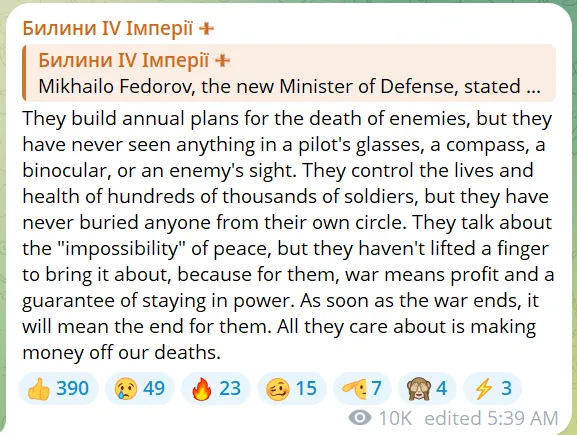
Those in the army are not always so enthusiastic. Lieutenant of the Azov brigade ‘Akula’, who runs the Tales of the IV Reich telegram channel, was highly critical of Fedorov’s dramatic proclamations in a late January post:

Image

Image

Drone debates
Before we end with Sternenko griftery, a discussion of the actual problems facing Ukraine’s drone warfare. Ukrainian drone analysts have long been drawing attention to the superior strategic approach of the enemy. Russia’s famous Rubican drone team focuses on crippling Ukrainian logistics, allowing Russian forces to take more territory.

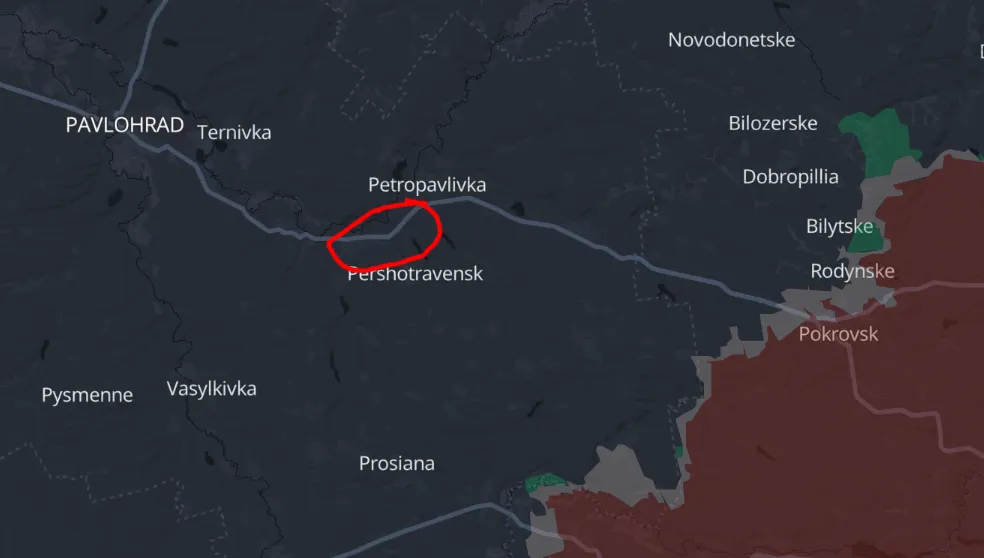
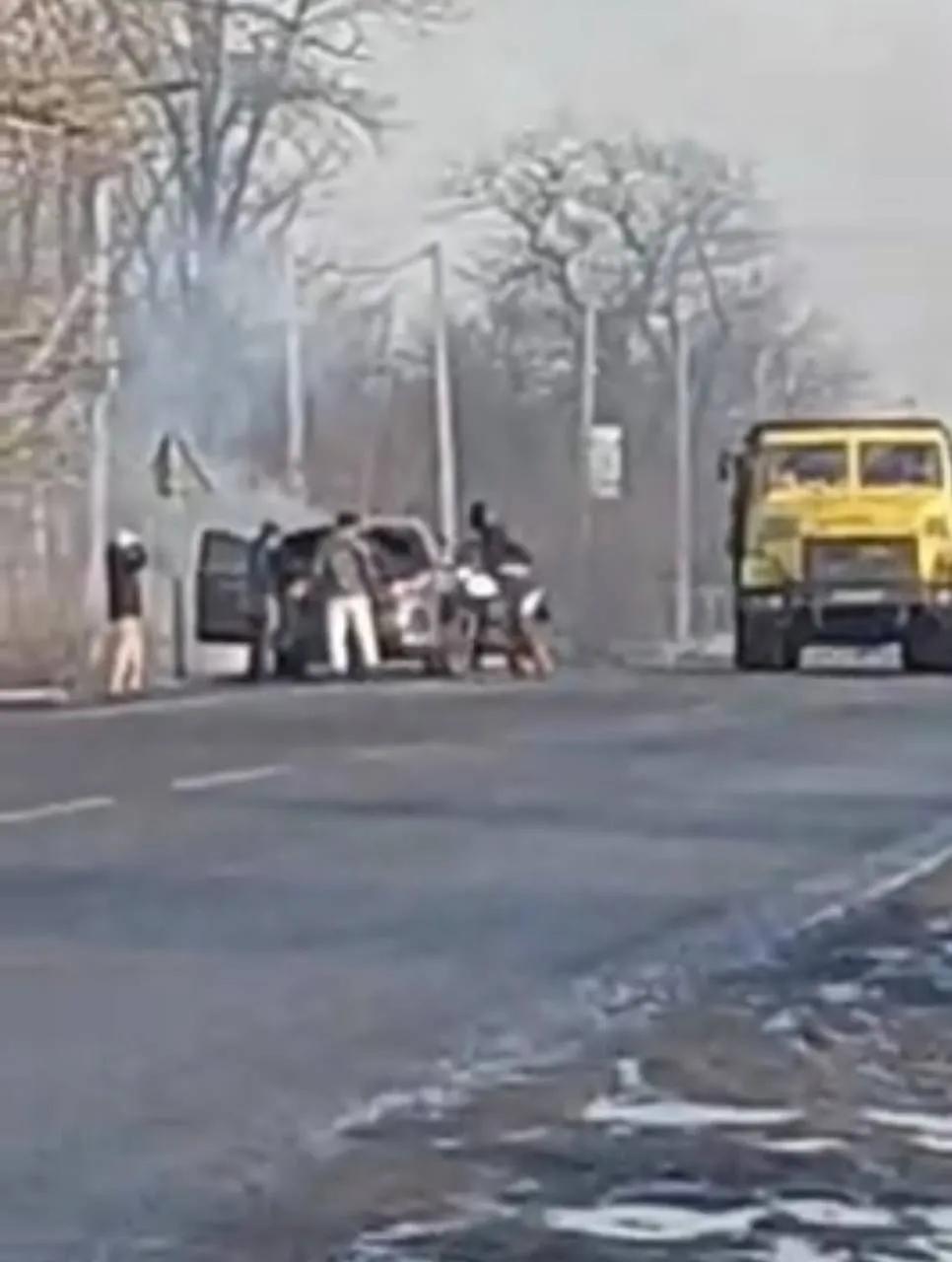
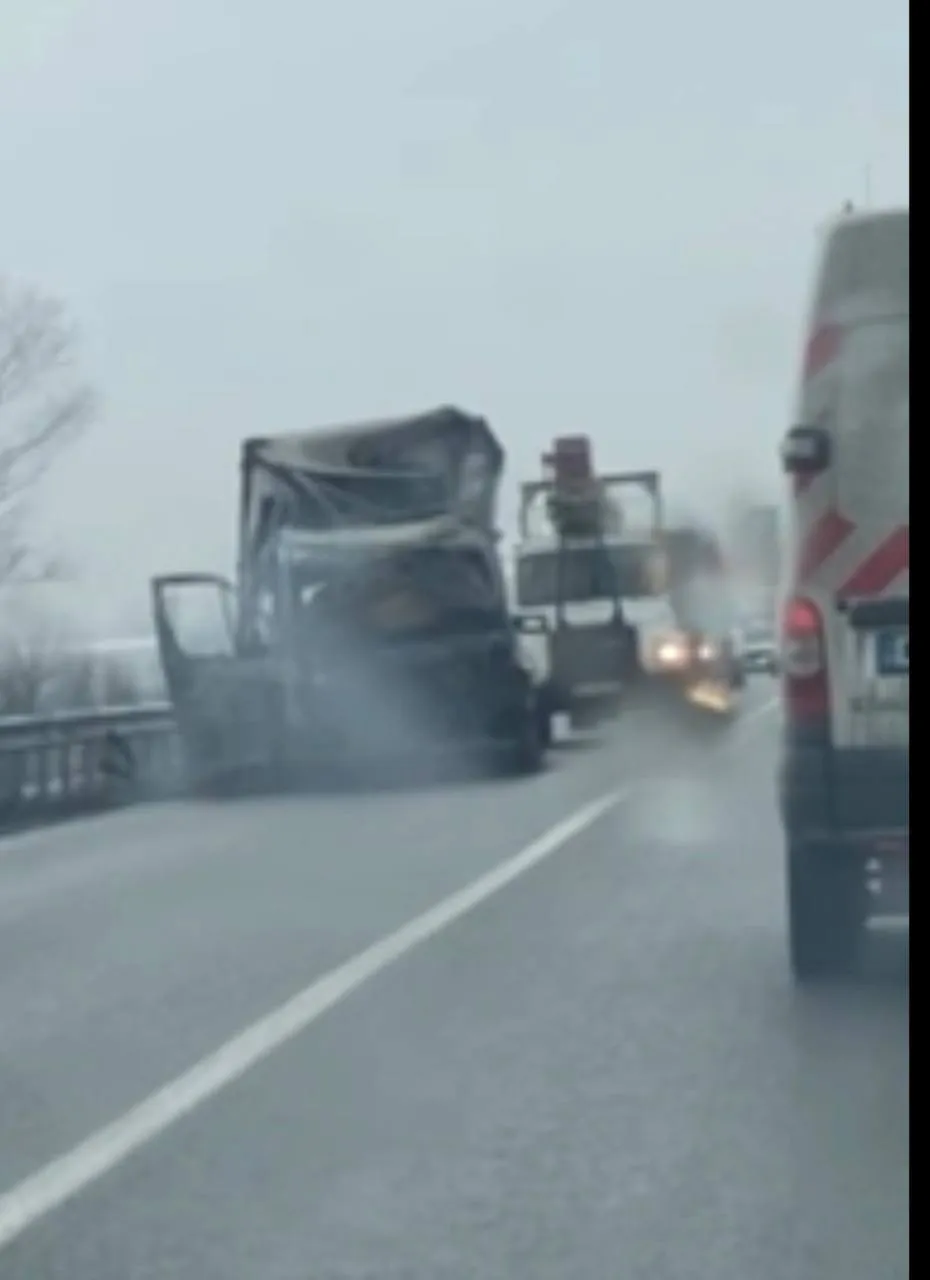
Transport vehicles, fuel supplies, drone operators, and critical roads are hit far behind the frontlines, making Ukraine’s continued control over territory untenable and forcing retreats. For instance, Fedorov’s new advisor Serhiy Bezkrestnov reported on January 29 of Russian drone strikes on military supply vehicles 50 kilometers from the frontline. Being targeted is one of two remaining highways in the Donbass:

Image

Image

Image

On January 30, Bezkrestnov shared videos of new drone strikes on that crucial highway. Apparently, there were ‘dozens’ of strikes in just one day.

(Video at link)
Image


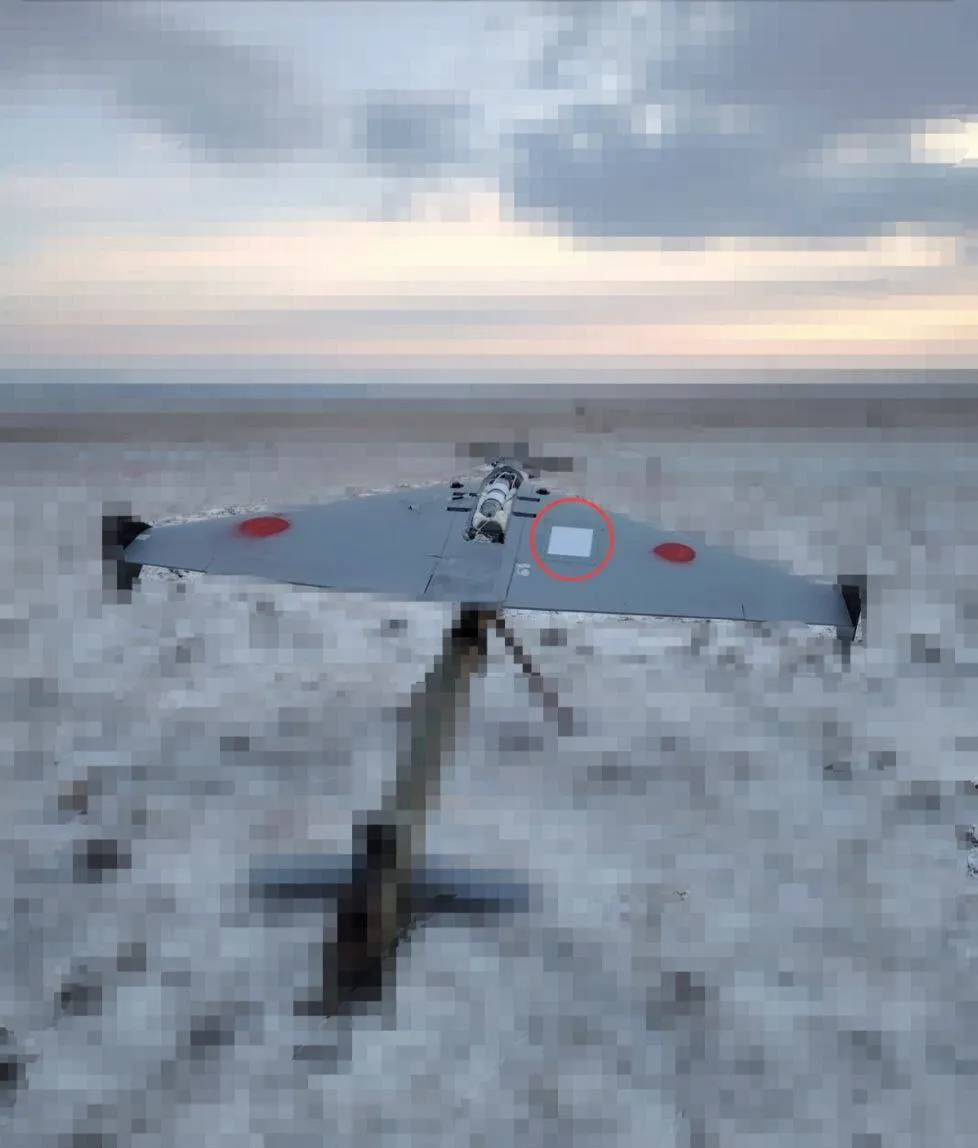
Increasingly, the Russians are using drones equipped with Starlink, allowing them to evade Ukrainian electronic warfare countermeasures. Bezkrestnov posted a photo of how that looks on January 31:

Image

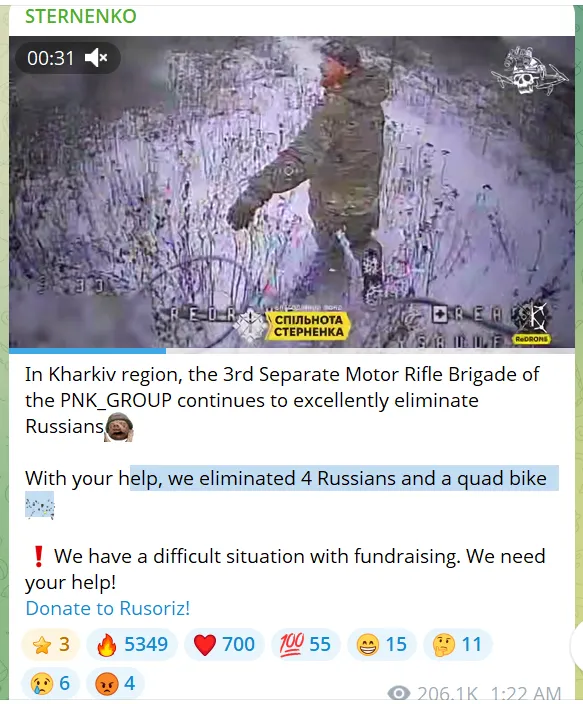
Instead of Russia’s focus on logistics, Ukraine’s drone strategy is typically PR-focused: killing individual Russian infantrymen in order to post gloating murder-porn to twitter, often focusing on the ‘orkish’ physiognomy of those killed. You can see daily examples of this murderporn from the telegram channels of Sternenko or Robert Brovdi (‘Madyar’), head of Fedorov’s Unmanned Systems Forces. As usual, the following post ends by calling on followers to donate to Sternenko’s ‘Ruzzoriz’ (‘Russian Cutter’) fundraiser.

Image

Though this may warm the hearts of Sternenko and his followers, focusing valuable weaponry on such targets is unlikely to win the war.

Ryan O’Leary is a prominent American navy seal who was fighting in Ukraine for several years following 2022. He left the army last year out of frustration at the corruption and incompetence of the Ukrainian army. I covered his criticism of the meaningless suicide attacks so beloved by high command here. And on January 20 2026, he published a long intervention into Ukraine’s ongoing strategic defeat in drone warfare.

(Paywall with free option.)

https://eventsinukraine.substack.com/p/ ... der-valley
"There is great chaos under heaven; the situation is excellent."

User avatar
blindpig
Posts: 15306
Joined: Fri Jul 14, 2017 5:44 pm
Location: Turtle Island
Contact:

Re: Footnotes from the Ukrainian "Crisis"; New High-Points in Cynicism Part V

Post by blindpig » Tue Feb 03, 2026 12:39 pm

Oil: a tool for profit and pressure

Published by @nsanzo ⋅ 03/02/2026

Image

Donald Trump came to power a year ago promising to end the war in Ukraine, a mission he considered simple and one that only he could accomplish. Throughout his twelve months in office, the current president has repeatedly emphasized his belief that this war would never have occurred under his control. Vladimir Putin, he argues, perceived Joe Biden's weakness and decided to start a war that Trump conveniently forgets began in 2014. And while he boasts of being the first to deploy Javelin anti-tank missiles to Ukraine, he seems to have forgotten that, despite his efforts, he failed to resolve the conflict in Donbas, a conflict that is essential to understanding the current war. Lacking knowledge of the conflict and armed only with his self-perception as the best at making deals , Donald Trump embarked on a task he continues to insist will soon be over.

For several months now, each contact has ended with an optimistic statement announcing tangible progress toward a resolution. The United States has already confirmed that its security guarantee document is ready for signature once Kyiv reaches a peace agreement with Russia, and judging by the attitude of Kirill Dmitriev, Russia's chief envoy for the negotiations with Steve Witkoff, the second round of bilateral talks also appears to be relatively advanced. Dmitriev, head of the Russian Direct Investment Fund, is a purely economic figure who represents not the Foreign Ministry but Vladimir Putin directly, in addition to himself. His objective is clear: to restore trade relations between Moscow and Washington. His task is thus much simpler than that of the delegation that will meet with the Ukrainian team on Wednesday to discuss military, security, and perhaps territorial issues. This difference explains the ease with which Dmitriev posts videos of himself surfing in Miami after his meetings with Witkoff or mocks the incapacity of European diplomacy, while Yuri Ushakov, Vladimir Putin's foreign policy advisor, or Sergey Lavrov, the foreign minister, publicly question what kind of agreement the United States is referring to when it says that there is only one issue left to agree on, the territorial aspect.

The economic issue, which Washington wants to resolve through a dual bilateral agreement between the United States and Ukraine and the United States and Russia, is fundamental, since Trumpism has made making money a central element of its international relations. With the minerals agreement signed last year, the United States secured a privileged position for the exploitation of Ukrainian raw materials, a benefit that the consortium led by Ronald Lauder, a man very close to the Republican establishment and Trumpism, will soon begin to enjoy. Trump has also guaranteed enormous revenues for the American military-industrial complex through the arms procurement scheme for Ukraine. European countries provide the financing, and the United States supplies the weapons—something that will not end with the ceasefire but will foreseeably continue during the armed peace that Kyiv's continental allies are preparing for the aftermath. A few days ago, the European Union definitively banned the import of Russian gas, a measure that only formalizes what is already happening: the progressive abandonment of the raw material in favor of the American one, a new source of financing for Washington, which is clearly leading the race to benefit from the immense human suffering that is the war in Ukraine.

Not quite knowing how to get the parties to accept an agreement that would force them to cross their most red lines—the concession of territory in the case of Ukraine and the acceptance that the country will become a military tool against Moscow, with European NATO forces deployed for Russia—the United States has tried to use incentives. In the case of Kyiv, the Ukrainian desire was clear and not particularly difficult to fulfill. Unlike Joe Biden, Donald Trump is willing to offer Ukraine security guarantees. The document is ready, but it remains to be seen whether there is a single interpretation of its letter and spirit, or whether the situation will be repeated as it was with the Minsk agreements, in which the Ukrainian government understood something very different from what was reflected in the text it had signed. Judging by Zelensky's insistence that it be ratified by Congress and thus bind the United States and not just the Trump administration, Kyiv needs one more security mechanism, a sign that his public confidence that the treaty would oblige Washington to defend Ukraine in the event of a new invasion is only the optimistic version he will present to the population.

To Trump's surprise, accustomed as he is to negotiations where he is always the unquestionably stronger party, able to impose his conditions, the incentives offered by the return of American companies to Russia's oil sector were not enough to encourage Vladimir Putin to back down in Ukraine and accept an agreement that did not resolve any of the fundamental aspects of the war. With the incentive quickly exhausted, Trump sought to maximize threats. From the podium of the United Nations General Assembly, the US president ordered European countries to stop buying Russian oil. Shortly before, he had imposed prohibitive tariffs on India because of its energy cooperation with Moscow. As economist Adam Tooze has repeatedly explained, India simply took advantage of the price cap system devised by European countries to force Russia to sell its oil outside the Western market and at steep discounts. Benefiting India, the weakest link in the BRICS due to its proximity to the United States and Europe, was the second objective, one from which the Indian oligarchy has greatly benefited, allowing the country to obtain oil well below market price. Trump's measure undid at a stroke the European and Biden administration's attempt to benefit and strengthen India against China, but it was only the first step.

The Trump administration's actions regarding the oil market, which it aspires to monopolize directly or through proxies and in which it hopes to impose its rules over any dissenting opinion, clearly dismantle the theory of the division of the world —the theory that Washington intends to dominate the Americas to leave Asia and Europe at the mercy of China and Russia. The United States continues working to close markets to Russian oil, has suggested that sanctions will not be lifted even in the event of peace, and has set the precedent of the capture of the Marinera, which sailed under the Russian flag, so that other countries like France will begin to board ships of the Russian phantom oil fleet. And now that the capture of Nicolás Maduro and the hijacking of Venezuela's economic policy allow it to decide where that crude oil can be sold, at what price, and to appropriate a share of the profits, Donald Trump also intends to use this tool to weaken a direct rival in a market whose control he considers essential.

The latest measure with which Donald Trump hopes to accelerate the end of the war in Ukraine is not negotiation or the search for creative solutions to get Kyiv to accept the territorial solution offered—which the United States claims is the only issue to resolve—but rather the use of economic leverage, specifically oil, to further strangle Russia. Last weekend, several media outlets reported that India was negotiating, evidently not with Caracas, to purchase Venezuelan crude to replace Russian oil. Yesterday, after a telephone conversation with Narendra Modi, Donald Trump announced on his personal social media account that he will reduce tariffs on Indian goods to 18%, since New Delhi has accepted his demands to “stop buying Russian oil and buy much more from the United States and, potentially, Venezuela. This will help END THE WAR in Ukraine, which is happening right now, with thousands of people dying every week!” Although there is no confirmation from India and China remains Russia's main trading partner, this move is yet another attempt to undermine the Russian economy, making it impossible for Moscow to continue resisting the deal the United States is proposing, the terms of which it doesn't even know yet. This is despite Dmitriev's smile whenever he meets with Steve Witkoff, which suggests that everything is fine and negotiations to normalize relations are progressing well.

https://slavyangrad.es/2026/02/03/el-pe ... e-presion/

Google Translator

******

From Cassad's Telegram account:

Colonelcassad
Key points from the Russian Foreign Ministry's statements:

— The Russian Federation views the West's military-biological activities, including those in close proximity to Russia's borders, as a threat;

— Revanchists in the West should assume that foreign contingents deployed in Ukraine will be legitimate targets for the Russian Armed Forces;

— Kiev, in close coordination with the British and EU, is once again trying to torpedo settlement initiatives;

— Kiev wants to divert attention from the settlement and avoid discussing the substantive part of the US "plan" based on Anchorage;

— Kiev continues its course toward completely destroying ties between the country's believers and Russia and is taking steps to destroy canonical Orthodoxy;

— There is a real threat of nuclear proliferation within the "collective West," which is not known for its peaceful nature;

— Any attempts to ignore Russia's interests in the Arctic, especially in the security sphere, will not go unanswered and will have consequences;

— Moscow believes that the tension surrounding Greenland is in no way connected with the Russian Federation;

— Berlin's move towards nuclear weapons would be a clear violation of a number of international obligations;

— Moscow regularly raises the need for an immediate resolution to the issue of Russians detained in the republic in its contacts with Baku;

— Armenia remains a member of the CSTO with all rights and obligations, while the Russian Federation supports Yerevan's full participation in the organization's work;

— The Russian Federation believes that Yerevan's course does not imply a reorientation to the standards of associations that wish to inflict a "strategic defeat" on the Russian Federation;

— Venezuela must be guaranteed the right to determine its own destiny;

— Japan's course toward remilitarization and the buildup of its offensive strike potential poses a danger to peace in the Asia-Pacific region;

— The Russian Federation welcomes efforts to resolve the conflict in the Middle East, but it is premature to talk about the advent of a lasting peace;

— The resumption of a full-fledged dialogue between Russia and Japan is possible only after Tokyo actively abandons its Russophobic policy;

Russia does not prevent Japanese people from visiting their ancestors' graves on the Kuril Islands; only Tokyo's position impedes this.

Russia does not interfere with Japanese participation in the Sakhalin-1 and Sakhalin-2 projects; cooperation here is beneficial to both sides.

***

Colonelcassad
Today is the birthday of Arseniy Pavlov, known in history as "Motorola." He was one of the most prominent leaders of the first wave of the Donbas militia. He made a significant contribution to the survival of the Donetsk People's Republic (DPR) as a state.

An ordinary guy who suddenly found his way into the pages of history books.

***

Colonelcassad
Ukraine's top police officer reported that recently, attacks on human catchers have been occurring almost daily, and that this hasn't happened before. Something must have happened...😀

***

Colonelcassad
This winter has been the coldest I've experienced in Donbas.

And beyond the low temperatures and the amount of snow, this year it's also cold emotionally.

You can't predict where you'll be killed; the kill zone is too big. Drones fly deep into the rear.

Previously, you could tell war was coming by the sense of danger, by the smell of burnt gunpowder and TNT.burnt flesh, the sounds of small arms fire and nearby blind landings. Now you simply know that you're entering a zone where at any moment, at any second, you could be killed by a soulless piece of plastic filled with explosives.

And it all depends not on your skill, but on your luck or the operator's inexperience.

And I often think that this war has practically lost its soul.

It's preserved only by the guys who, despite the cold and danger, continue to defend us and our country.

I just want to wish the soldiers strength and patience; you're doing everything right!

@Yaremshooter

***

Colonelcassad
Russian hackers have taken down Ukraine's main military registration service, "Reserve+," and Milchat, a special messenger for soldiers. Now, the electronic operation of the TCC has been suspended, as has the exchange of tactical information between the Ukrainian Armed Forces.

According to Mash, the guys from DarkWarios and QuietSec were the first to hack Milchat, a social network marketed as a secure messenger with a $500,000 investment. As a result, the app, website, and related functions stopped working, depriving Ukrainian Armed Forces soldiers of a major communication channel.

The "Reserve+" service, which provides digital registration for conscripts and reservists, updates contact information, issues electronic documents, and posts vacancies in the Ukrainian Armed Forces, was also disrupted. If the disruptions persist, communication between citizens and military registration and enlistment offices will become a major challenge. Our hackers previously hacked the Sonata and Delta

monitoring programs for the Ukrainian Armed Forces . Because of this, the enemy cannot receive information on the operational situation in the combat zone or transmit data on the movements of units. @mash

***

Colonelcassad
The main statements by Dmitry Peskov:

• If the New START restrictions are not extended, the world will find itself in a more dangerous situation in a few days;

• Russia is doing everything necessary to ensure its own security against the backdrop of Poland's aggressive rhetoric;

• Russophobia verging on hysteria continues to dominate the Polish leadership;

• Russia is monitoring Trump's statements, including those regarding duties against India and oil;

• Moscow has not received any messages from New Delhi about refusing to purchase Russian oil;

• China is against including itself in a possible new START treaty; China's nuclear potential is incomparable with either Russia's or the United States';

• When discussing the future system of strategic stability, Russia cannot abstract itself from the nuclear potentials of Britain and France;

• Peskov noted that without discussing the nuclear potentials of Britain and France, work on strategic stability is impossible, Putin has repeatedly said this;

• Putin will hold an international telephone conversation in the middle of the working day;

• Putin will discuss the country's socio-economic development with the government today.

***

Colonelcassad
NATO Secretary General Rutte stated from the podium of the Verkhovna Rada in Kyiv that as soon as a ceasefire is concluded, NATO troops will immediately appear in Ukraine.

This means that a ceasefire will not be concluded. Any scenario involving the deployment of NATO troops in Ukraine after the end of the war makes ending the war pointless. It is easier to continue now than to wait for it to resume under worse conditions for Russia with NATO troops in Ukraine.

https://t.me/s/boris_rozhin

Google Translator

******

Brief Frontline Report – February 2nd, 2026
Summary by Marat Khairullin and Mikhail Popov.
Zinderneuf
Feb 02, 2026

(Video at link.)
Message from the Russian Ministry of Defense: "Assault troops of the 36th Separate Guards Motorized Rifle Brigade of the 29th Guards Combined Arms Army of the 'East' Group have liberated Pridorozhnoe in Zaporozhye Oblast. An enemy defense area of over three square kilometers has come under our control. As a result of combat operations, up to a platoon of Ukrainian Armed Forces personnel from the 33rd Separate Assault Regiment, 4 units of automotive equipment, over 5 hexacopters of the 'Baba Yaga' type, and 2 ground-based robotic complexes have been destroyed."

Image
East Group Area of Responsibility; The yellow line with red dots represents the line of combat contact October 28th, 2025. Yellow represents the area of activity.

Assault units of the "East" Group have reached the line of the Pokrovskoe - Zaliznichnoe railway section, which runs along the watershed ridge of the Gaichur and Verkhnyaya Tersa rivers. Here, they liberated the settlement of Pridorozhnoe (47°48′41″ N 36°06′31″ E, population 50 in 2001).

Image

Russian servicemen control the entrance to the large Solenaya ravine, which stretches through the Rizdvyanka settlement to the Solenaya River, which flows into the Verkhnyaya Tersa River.

Image
Map from January 30th, so the line of combat contact here is outdated.

A bridgehead is being formed for the right flank to advance towards the Rizdvyanka settlement, through which the radial road O-081238 passes. This road turns south in the settlement and, running along the line of contact, becomes a front-line supply route supporting the Ukrainian Armed Forces' defense belt of Rizdvyanka-Verkhnyaya Tersa-Zaliznichnoe. On the left flank of the sector, Russian assault groups have reached the southern outskirts of the Zaliznichnoe settlement.

Image

Units of the "East" Group of forces are beginning the liquidation of the Ukrainian Armed Forces' defense belt between Rizdvyanka and Zaliznichnoe, which runs along the reverse slopes of the watershed. Further ahead lies the enemy's line of blocking positions, which cover the next Ukrainian Armed Forces' defense line created with reliance on the Verkhnyaya Tersa River.

The map you have been presented with is becoming outdated, as the Russian army is erasing the Ukrainian Armed Forces' layer from this sector of the Zaporozhye direction. Therefore, in the next summary, you will see a new map with the operational space of the Novonikolaevka-Orekhov sector.

https://maratkhairullin.substack.com/p/ ... bruary-2nd

Ukraine Suffers Unprecedented Nationwide Blackouts as Grid Teeters on Edge

Simplicius
Feb 01, 2026

Somewhat swept under the rug by all the new commotion filling the news cycles today was the fact that yesterday Ukraine suffered a massive unprecedented country-wide blackout which even blew out major parts of neighboring Moldova.

Image

Image

Even the Kiev metro stopped working, with the situation described as apocalyptic by outlets.

The Moldovan outage explained:

For now, the situation is developing as follows:

0) At the time of the accident, the main power flows in the area are shown by blue arrows;

1) The 400 kV Vulcanesti - Isakcha power line is disconnected;

2) The emerging imbalance is likely to shut down local generation (Chisinau TPP and Moldovan GRES);

3) On the 330 kV Beltsy - Dniester HPP power line, there is a sharp change in power flow: from about 0.65 GW towards Ukraine to 0.35 GW towards Moldova. There’s nothing to maintain such a power level - Moldova, sorry, the line is disconnected;

4) But now, with a severe imbalance, the Ladyzhyn TPP (0.3-0.6 GW) needs to deal with it. Naturally, it can’t handle it - it’s disconnected;

5) And the cherry on the cake - the imbalance spreads to the 750 kV Vinnytsia substation (it’s the only one in Ukraine with 750/330/110 kV, i.e. it can operate directly into the distribution network). Naturally, there’s almost no reserve there, but the accident directly affects the nuclear power plant. And then it all went downhill)

PS. Of course, this is not the ultimate truth)


Image

Image

Needless to say, this happened literally a day after Putin had allegedly agreed on a energy ceasefire for Kiev, leading to the obvious possibility that he only did so because he knew the Ukrainian power grid was on its last leg and due to collapse any moment, anyway.

Granted, we don’t know just how long-standing this is—after all, it happened during a record deep freeze and once temperatures begin to warm there’s no telling if the grid will hold up much better over the long term. But one must admit that such a total nationwide blackout is virtually unprecedented so it certainly seems to suggest that a “point of no return” has been reached in regard to the Ukrainian power grid.

My very rough understanding of Ukraine’s power demands is as follows: Ukraine is down to 11 GW (Gigawatts) with winter demands usually being 16-18 GW. However, summer demands are reportedly around 12-15 GW which would suggest that Ukraine could generally survive at current power capacities once things warm up. That’s if Russia doesn’t take out the nuclear plants, which are said to provide 70-90% of Ukraine’s remaining power (roughly 7.5 - 8 GW of the 11 GW remaining).

Either way now the February 1st deadline for the so-called ceasefire has expired, so we are to assume that Russia will resume strikes.

Ukrainian outlets are reporting that in January Russia set a record for both total number of aerial bombs launched as well as specifically ballistic missiles. In terms of bombs, like Fab glide-bombs, Kabs, etc., Russia was said to have launched a whopping 5,717 in January, which averages to 184 per day:

Image

As for ballistics like Iskanders, Russia was said to have fired 91 in January, averaging about 3 a day. These were instrumental in the final finishing-off of Ukraine’s power plants.

Another stark milestone has been the fact that for the second month in a row even official Oryx loss tallies show that Ukraine is suffering far more vehicular losses per month compared to Russia:

Image

Losses this year according to Oryx.
> RU 162
> UA 252


Image

Getting back to the power situation.

Stabilizing the power grid and restoring full nuclear power generation after today’s blackout will take 24 to 36 hours, stated Sergey Nagornyak, a member of the Verkhovna Rada Committee on Energy, Housing, and Utilities.

At the South Ukraine Nuclear Power Plant, one unit was shut down due to an emergency, while nuclear power workers at another were forced to reduce power. Power was also reduced at the Rovno Nuclear Power Plant.
(Video at link.)

It’s difficult to know what to make of the nationwide shutdown—whether it’s a freak occurrence due to uncommonly cold weather, or if it’s a herald of things to come in the near future as the last frayed strands of the grid are snapped. But it certainly does not bode well for the long term future because with Western support dwindling, and Russian arms production only increasing, there is simply no conceivable argument to be made for Ukraine sustaining its national infrastructure.

That’s not to say Ukraine will surrender as soon as the grid totally collapses—other countries have survived far longer on far less in wartime. But it simply does not bode well, particularly for Zelensky’s regime. And there is now talk that the power shortages are starting to acutely affect even the military’s needs at the front, particularly given fuel shortages due to inordinate requirements for keeping civilian generators going; not to mention the disruption of railways for supply and logistics, etc.

Also, it should be mentioned that Trump’s urgent begging of Putin for the energy ceasefire can now be understood in a new light. The timing makes it highly plausible that intelligence informed Trump that Ukraine’s situation was nearing the brink and an immediate “intervention” was necessary to prevent total national shut down. Either that, or Zelensky himself simply called and begged Trump for this favor for the same reason.


In the meantime, the Russian army has again been picking up momentum. After a long hiatus, several more settlements were again captured since the last report two days ago.

Most notably, the ‘Eastern Express’ has started rolling in the eastern Zaporozhye region, out of the Gulyaipole direction, capturing Sviatopetrovka also called Petrovka.

Russian Army liberated Petrovka in the Zaporizhia region

▪️Assault units of the 114th Guards Motor Rifle Regiment of the 127th Division of the 5th Army, in the course of fierce battles, established control over the populated area of Petrovka in the Zaporizhia region.

▪️As a result of the offensive actions, the enemy’s defense area of up to 5 square kilometers was taken.

▪️The losses of the Armed Forces of Ukraine are estimated at 10 units of equipment and dozens of militants from the 225th Separate Motor Rifle Battalion and the 102nd Territorial Defense Brigade.


(Video at link.)

Assault units of the 114th Guards Motor Rifle Regiment of the 127th Division of the 5th Army have taken control of Petrovka in the Zaporizhia region after fierce battles.

Image

One interesting thing Russian forces were able to achieve with small advances is flattening of the entire frontline stretching from Pokrovsk down to the north-Gulyaipole line:

Image

This was previously a series of major peaks and troughs, with salients with unsafe flanks poking out. By flattening the entire line, Russia has optimized logistics lines, covered all flanks, and essentially prepped the groundwork for new successful and protected breakthroughs westward.

A wider look, as well as a look at the new ‘bowl’ being formed over Orekhov between the new salients coming from east and west; on the west from the Novoyakovlovka direction, and on the east from the new Ternuvate bulge:

Image


In the north, Lyman has become surrounded on three sides and is being choked off after Russians captured not only most of the dead zone on its eastern flank, but crept around from the northwest via the new Svyatogorsk direction that is expanding incrementally each day:

Image

One of the most active areas over the past few days has suddenly been the Kharkov direction, where Russian forces expanded slightly westward from the northern Kupyansk zone, as well as out of the border areas.

After completely capturing Vovchansk, Russian forces are now continuing slowly down the Seversky Donets river, capturing most of Symynyvka and Hrafske, seen by the yellow arrow below:

Image

There continues to be ‘rumors’ of more Russian troops being put on the Sumy border, with other small advances across the border in the area having happened. As we discussed last time—on top of the new advances in the Chernigov region—it’s clear that Russia is slowly building up pressure along this entire northern “buffer zone” in accordance with the ‘boa constrictor’ strategy. If the time comes that the AFU begins truly collapsing due to manpower shortages, then all the major northern cities will be within reach of Russian forces.

There are speculations that Russia’s “spring” campaign could heavily focus on this northern sector to really put pressure on the AFU’s ability to defend across every frontline.

Image
https://www.rt.com/russia/631584-calm-b ... d-january/

From Sumy to Zaporozhye, the winter lull reveals the outlines of two potential large-scale operations shaping the year ahead

The above article has a good break down of the potential offensive vectors.


In the background, the peace talks charade has been ongoing, with Putin envoy Kirill Dmitriev having just come from another powwow with Witkoff and co. in Miami. Afterwards, a new tripartite meeting with Russia and Ukraine was “postponed”—an indication that there is still no “eye-to-eye” between parties at all, and the various meetings remain merely political theater for the sake of each side being able to comfort its audience with the illusion that “peace” is being worked on.

Image
https://www.nytimes.com/2026/02/01/worl ... netsk.html

Zelensky has stayed adamant that he will not give up Donbass. It seems likely that once Russia wins back the remaining Donbass regions by force, an unprecedented push for ceasefire will begin from Ukraine and its backers. They will claim that Putin now has no further reason to continue the war, using the continuation as “proof” that Russia never had any intention to stop the war and that Zelensky was right in not giving up the territory—which will further yield hysteric calls for more arming of Ukraine to thwart the “double-crossing” Putin. In reality, we will have all known that it is the West that is playing at devious games by willfully ignoring Russia’s various demands, playing “dumb” and lying by omission by pretending the Donbass issue is the only one remaining, as the above NYT article does.

Either way, Ukraine is set to experience further unseasonably low temperatures this week, particularly tomorrow night: (Video at link.)

This is likely set to strain the power grid again—and with the supposed “ceasefire” having ended, should Russia resume its major energy strikes, particularly on Kiev, things could get really ugly.

And if things do get even worse for Ukraine, and the cries of ‘humanitarian disaster!’ become ever-more shrill, let us remember one important fact. Whenever Ukrainians themselves had the chance to strangle the Novorossiyans via resources, they used it. After the war started, Ukraine destroyed the Seversky Donets canal which supplied water to Donbass, resulting in mass water shortages in Donetsk that remain to this day. It forced Russia to construct an emergency water canal from Rostov to Donetsk to alleviate the threat of major regional water shortages, though to this day it is unknown if it is fully functional yet, as it had only undergone publicized “tests” previously. Some reports claim it is functioning but “under-performing” and not fulfilling its objective of adequately resupplying Donetsk.

Even NYT had reported on it last year, though the rag naturally refused to name the culprit of the canal’s destruction, using the famous Gaza ‘passive voice’ technique to say it had simply been “destroyed during Russia’s offensive”:

Image
https://www.nytimes.com/2025/08/29/worl ... risis.html

Most famously of all, Ukraine blockaded Crimea’s water supply by damming the North Crimean Canal which led to notoriously severe droughts and humanitarian issues in Crimea, which the Ukrainians and their Western sponsors were absolutely gloat-happy over. Russia only managed to resolve the issue after finally taking control of the artificial dam in 2022 and destroying it to allow water to flow to Crimean citizens for the first time since 2014.

As per usual, we are faced with the West’s odious hypocrisies. Just as in Serbia in ‘99, wherein NATO’s spokesman Jamie Shea remarked:

Image

Image

So, the Rules Based Order deems it acceptable to coerce war conditions via water and power grid leverage. Russia, it seems, is only following precedent.

https://simplicius76.substack.com/p/ukr ... nationwide

******

Listen to power engineers, not officials of Ministry of Energy - MP on real terms of electricity supply restoration
Editor: Herasimova Tetiana

Image
Restoration of electricity supply. Photo: DTEK.

Power engineers need 24 to 36 hours to stabilize the power system and restore electricity supply

Serhii Nahorniak, MP from the Servant of the People faction, member of the Verkhovna Rada Committee on Energy, Housing and Utilities, has stated this on the air of the Kyiv 24 TV channel.

"According to the forecasts of the power engineers themselves, not the officials of the Ministry of Energy, they need 24 to 36 hours to stabilize the power system and restore full generation of nuclear power plants in the South, Khmelnytskyi and Rivne Regions," Nahorniak said.

The MP noted that if there is a restoration of power supply, it will be with long schedules and switching to emergency schedules.

"We understand that, despite the calls to consume economically, now that the electricity is supplied, the subway and public transport should start working, and people in apartments will turn on electrical appliances. So I wouldn't be so optimistic and make promises to people that cannot be fulfilled," Nahorniak added.

As the Ukrainian News agency earlier reported, emergency power outages were introduced in many regions of Ukraine and the capital. Water and heating were reported to be cut off, and subway, trolleybus and electric trains were also suspended.

https://ukranews.com/en/news/1131836-li ... lectricity

*****

Water Is A Luxury: Complete Water Cut In Kyiv Exposes Fragility of Critical Infrastructure

Image

On the morning of January 31, the city of Kyiv, with its millions of residents, fell into a silence broken only by the howling wind. Not only had the metro and trams stopped, but for the first time since the war began, the pumps supplying the city with water had ceased operating completely. The total shutdown of the water supply in all districts of the Ukrainian capital marked the darkest period of the Russian-Ukrainian conflict thus far, exposing the fragility of the metropolis’s life support systems when critical infrastructure is attacked.

A City on the Brink

The collapse of Kyiv’s life support systems on January 31, 2026, was not a sudden catastrophe, but rather the logical conclusion to the most severe ordeal of the war thus far. January entered the history books as the month of the total siege of the Ukrainian capital, where the main adversary was not missile strikes, but the systematic destruction of everything necessary for urban life in winter. The wave of attacks on energy and heating infrastructure that began in the fall reached its peak in the first weeks of the new year.

A key turning point that led to the current situation was January 9. Following a massive bombardment, around 6,000 apartment buildings—nearly half of the city’s housing stock—were left without heat. Mayor Vitali Klitschko, whose daily briefings had become a grim barometer of the situation for Kyiv residents, publicly shifted from calling for resilience to recommending departure. He directly told those with the opportunity to temporarily leave the city to do so, in order to reduce the strain on the overburdened systems. By mid-month, around 20% of residents—one in five Kyivans—had followed this advice. The city began to empty out quietly.

Image

For those who remained, each day turned into an exhausting quest. Amid scheduled and emergency power outages lasting 12–16 hours, the normal rhythm of life disintegrated. Where it still functioned, central heating was inadequate, and temperatures in homes rarely rose above 12-14 degrees Celsius.

International observers and analysts increasingly characterized this strategy as the conscious “use of winter as a weapon” in reports published in outlets ranging from the Financial Times to Le Monde. The goal was not merely to demonstrate force, but to undermine the will to resist by depriving millions of basic necessities. The wear and tear on energy and utility equipment reached a critical point. Repair crews, working in emergency mode for months, had exhausted their material supplies and physical strength. The system was holding on by a thread; its reserves, along with the population’s hope for swift relief, were depleted. On January 31st, a new blow fell upon this exhausted, worn-out city—not in the form of a missile from the sky, but arising from within as a consequence of total overload and systemic instability.

A Technical Failure as the Final Straw

At around 10:40 a.m. on January 31, a technical failure occurred on the 400-kV high-voltage power line between Romania and Moldova. Almost simultaneously, another key line connecting western and central Ukraine was disconnected. These events triggered a “cascade failure” across the entire unified energy system, forcing the automatic shutdown of nuclear power plant units to prevent a complete collapse.

Massive emergency blackouts instantly swept through Kyiv, Kharkiv, Zhytomyr, Cherkasy, and other regions. Energy Minister Denys Shmyhal confirmed the technical nature of the accident and assured that power would be restored within hours. However, Serhiy Nahornyak, a member of the parliamentary energy committee, estimated that it would take 24 to 36 hours to fully stabilize the system. The Kyiv Metro was paralyzed due to critically low voltage.

Collapse of Water Supply and an Unprecedented Official Response

The heaviest consequence was the complete halt of operations at Kyivvodokanal. The utility company, which depends entirely on electricity, was paralyzed. “Due to the accident in the energy system, there is currently no water supply in any district of the city,” read the company’s official statement. Its press service confirmed that specialists were collaborating with energy crews on restoration efforts, though timelines remained unclear. The city, already struggling with the cold, lost its last line of defense—access to water.

Image

That same day, Mayor Vitali Klitschko made an unprecedented admission about the scale of the disaster. He did more than state facts; he gave citizens direct and stern advice: “Stock up on food, water, and necessary medicines. Those who still have the option to go to the countryside, where there are alternative sources of power and heat, should not dismiss it,” he said. Voicing this recommendation amidst a complete water shutdown escalated the crisis from a category of utility failures to an infrastructural catastrophe.

What Awaits the City’s Systems and Its Residents?

Even after electricity returns, restoring the water supply will take days. However, the current crisis is not a temporary malfunction, but rather a symptom of deep, systemic wear and tear. According to Olena Pavlenko, president of the Kyiv-based analytical center DiXi Group, this winter’s situation is the worst of the war thus far. Each subsequent restoration is more difficult due to freezing conditions and a lack of resources.

The future of Kyiv’s water and sewage infrastructure is alarming. Prolonged and repeated power outages pose a wide range of risks to the city. Sudden pressure surges during system restarts can cause water hammer and ruptures in the worn-out pipeline network. Engineers admit that they are working “literally in emergency mode,” with equipment operating at its limit.

Image

The stoppage of sewage pumps threatens to overload collectors and cause sewage overflows. In freezing conditions, this creates a dual threat of epidemiological and environmental issues, which experts had previously warned about.

The mayor’s call for residents to leave, supported at the official level, legitimizes de-urbanization as a survival strategy. According to Reuters, Klitschko explicitly stated that such a decision would help reduce the load on the city’s infrastructure. This indicates a paradigm shift: The city can no longer guarantee safety and basic services, thus shifting responsibility onto residents.

The events of January 31 became a turning point. Kyiv did not just face another blackout; it faced the direct consequence of a months-long campaign to destroy critical infrastructure. The mayor’s recommendation to evacuate the city is not a panicked reaction, but rather a pragmatic acknowledgment of the new reality. Water, sewage, heating, and electricity are no longer guaranteed. Their preservation now depends on a fragile balance of repair crew efforts, international aid, and tactical pauses in shelling. Trust in the city’s ability to perform its basic functions has been undermined, and under ideal conditions, the path to recovery will be measured not in days but in years.

https://southfront.press/water-is-a-lux ... structure/

******

In Vinnytsia region, a man shot at a shopping center
February 01, 2026, 1:40 PM

Image
The incident occurred on February 1 at around 10:40 a.m. at the intersection of Malevich and Heroes of the National Guard streets. Vinnytsia law enforcement officers began searching for the shooter.

This was reported by the Vinnytsia region police, reportsRegioNews.

As law enforcement officers said, an unknown man saw the military CCC (alert group) and fired several shots in their direction. After that, the attacker fled the scene. Fortunately, no one was injured.

"Police teams are focused on searching for the man. An investigative and operational group is working at the scene," the police said.

We will remind you that earlier in the Zhytomyr region, a conflict occurred between a serviceman of the CCC, who was carrying out mobilization activities in the Novohuivynska community, and a local resident. Passers-by later joined the dispute.

https://regionews.ua/ukr/news/vinnichin ... g_rewarded

Google Translator

******

The end of the "energy truce"
February 3, 8:28

Image

The end of the "energy truce"

A massive missile and drone attack on Ukraine has been ongoing since last night. Targets in at least nine regions have been hit. Drones, ballistic, cruise, and hypersonic missiles are being used.
Targets in Kyiv, Kharkiv, Dnipropetrovsk, Vinnytsia, Kryvyi Rih, and Odesa have been hit.
Among the targets hit are energy facilities.
There are power outages in Kyiv, Kharkiv, and elsewhere.

The Kharkiv Gauleiter reported that due to damage to energy facilities, coolant will have to be drained from heating systems in residential buildings in Kharkiv tonight. He claims there are no other options left.

Overall, yesterday's strikes on the energy sector were a warm-up, but today's attacks have been serious and serious. They have, so to speak, demonstrated the difference between the presence and absence of an "energy truce."

https://colonelcassad.livejournal.com/10342291.html

Google Translator
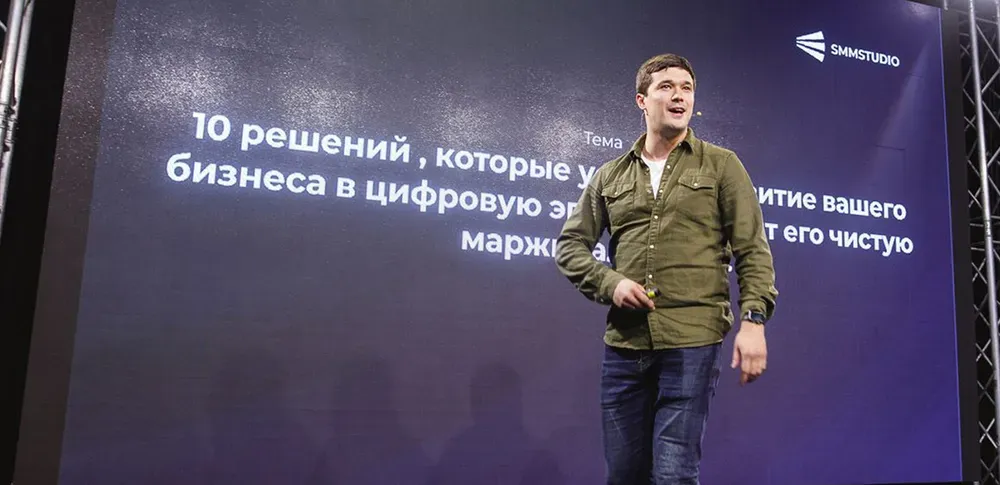
"There is great chaos under heaven; the situation is excellent."

User avatar
blindpig
Posts: 15306
Joined: Fri Jul 14, 2017 5:44 pm
Location: Turtle Island
Contact:

Re: Footnotes from the Ukrainian "Crisis"; New High-Points in Cynicism Part V

Post by blindpig » Wed Feb 04, 2026 12:19 pm

The long winter of diplomacy
Published by @nsanzo ⋅ 04/02/2026

Image

“Winter is very long, but spring will come. Be strong. Glory to Ukraine,” NATO Secretary General Mark Rutte proclaimed yesterday from the rostrum of the Ukrainian Rada during his visit to Kyiv. The message is the same as that delivered by Keith Kellogg before leaving his post as Trump's envoy to Ukraine. “If Ukraine survives winter, it will have the advantage in the war,” the general stated, reviving a false hope that Zelensky had already used in 2022. The subtext of both declarations is the same: the suffering of the Ukrainian people is less important than geopolitical objectives, so the country must remain steadfast and continue on the prescribed path—an idea shared by the Ukrainian president, who is prepared to raise electricity prices for those who don't even have access to power.

Ukraine is enduring the harshest part of winter, once again facing attacks on its energy infrastructure. More than 30 missiles and hundreds of Russian drones bombarded several Ukrainian power plants, breaking a truce that Moscow denies was in effect. “After today’s Russian attack, the work of our negotiating team will be adjusted accordingly,” stated Volodymyr Zelensky, referring to the Abu Dhabi talks, a meeting scheduled for the weekend that marked the end of the partial truce. In reality, Ukraine can make few changes, as its position has become perfectly clear: issues of security, reconstruction, and prosperity will be addressed in a pre-agreed Kyiv-Washington agreement, while the territorial issue must be resolved without concessions. Recently, the Ukrainian president insisted that Ukraine will not recognize any territorial losses, either de jure or de facto . The only way to avoid even de facto recognizing these losses is for there to be no mention of the territories in the document that Ukraine signs, which implies that Kyiv is seeking a dual agreement between the United States and Ukraine and the United States and Russia that details the framework for resolution, but without any Ukrainian signature on a document that admits that the parts under Russian control will remain de facto Russian territory.

The hardening of negotiating positions mirrors the deterioration on the military and economic fronts. Justifying its latest attacks against Ukrainian energy infrastructure, Russia confirmed the bombings yesterday, claiming they were a response to persistent Ukrainian attacks on civilian targets within the Russian Federation. For days now, there have been increasing cross-border attacks, particularly in the Belgorod region, which has replaced oil infrastructure as Kyiv's chosen target during the period in which the commitment not to attack energy-related facilities has been honored. Enraged by the attack, which seems to have surprised Ukraine despite being anticipated Monday night by accounts that track attack preparations from both sides, the Ukrainian president wrote that “the US president said there should be a one-week refrain from attacks; in fact, this began Friday night. And tonight, the Russians, in our opinion, have broken their promise. That is, either Russia believes the week has four days instead of seven, or they are betting on war. We believe this Russian attack truly violates what the US side agreed to, and there should be consequences.” Any day is a good day to demand more weapons and ammunition for Ukraine and a hard line against Russia. “It lasted from Sunday to Sunday,” Donald Trump declared last night, siding with Russia and claiming those days as a great personal achievement. “It was a lot,” he insisted, even though that brief respite has not been enough to repair the damage, and the situation is once again the same as it was a few days ago.

“Today, Russia carried out a record-breaking attack in terms of the use of ballistic missiles. Twenty-eight cruise missiles were used, as well as 43 missiles of various types that approach their targets on a ballistic trajectory and can only be intercepted by Patriot systems. This means that missiles are needed for these systems and that deliveries must be swift. I discussed this with Mark today, and I hope we can implement everything agreed upon,” added Zelensky, who took advantage of Rutte's visit to emphasize the need for increased military supplies. In response to Zelensky's pleas—who just days earlier had criticized European countries for not paying the amounts demanded by Ukraine, causing the delay in the arrival of weapons—the NATO Secretary General estimated the value of US weapons that he expects European countries to purchase from the United States at $15 billion, under the system whereby Ukraine provides the blood, its continental allies the money, and Washington profits by selling the weapons. From across the Atlantic, influential Senator Lindsey Graham, the man who planted the idea of ​​seizing Ukraine's mineral wealth in Donald Trump's head, was resuming the campaign to demand that the United States send Ukraine the Tomahawks that Zelensky has been demanding for months.

After nearly four years of a steady flow of military assistance from some 30 countries, Ukraine boasts of its military production, yet insists on acquiring US missiles and continues to run out of interceptors before Russia's missile arsenals are depleted—a country fighting solely on its own resources. This reality is not a reason to seek a relatively quick resolution according to the parameters of US negotiations, but rather a reaffirmation of the need to pressure Russia. “Russia must be forced to make peace now, and its economic and military capacity to wage war must be eliminated right now, not 'someday' or 'somehow,' while Ukraine is the one fighting, not later, when those in suits have to clumsily explain once again that another series of 'security guarantees' were not 'binding' and that 'escalation must be avoided' and 'restraint must be shown,'” wrote Ilia Ponomarenko, a well-known nationalist journalist and avowed supporter of groups like Azov, yesterday. His words reflected the sentiment of the Ukrainian establishment , more focused on punishing Russia and ensuring the militarization of Ukraine as a European Israel than on the well-being of the population. “Is there any way to achieve this without resorting to direct NATO intervention?” Italian journalist Davide Maria De Luca asked, a question that went unanswered. The consequences of the actions being demanded are not an argument that those who defend the continuous escalation of sanctions and military supplies tend to consider. It is easier to stick to the idea that the West has not done enough, Russia acts with impunity, and Donald Trump only pressures Volodymyr Zelensky and not Vladimir Putin.

A year after the start of the diplomatic phase of this war, the United States' capacity to exert pressure is diminished, not because it has disappeared, but precisely because it has used virtually all of its heavy artillery . Trump used the nuclear option against Russia , sanctioned major Russian oil companies—a punishment that came on top of 19 European sanctions packages—seized nearly $300 billion in public and private assets, withdrew from SWIFT, provided constant and real-time support to Ukraine, and attempted to cut off Russian access to the global oil market, its main source of income.

In the case of Ukraine, the pressure on Zelensky has been clear, notably the brief interruption of arms and intelligence supplies in March of last year and the public humiliation he suffered in the Oval Office. However, at this point, the United States has given Ukraine what it asked for, and its pressure tactic is to delay the implementation of these supposedly already agreed-upon agreements. Meanwhile, sanctions against Russia are increasing, attempting to force the economic collapse that Kyiv has been hoping for for years. This increased pressure on Moscow, which is progressing in parallel with Ukrainian complaints of a lack of punishment, comes at a time when the United States claims that only the territorial issue remains to be resolved, which, according to the terms proposed by Donald Trump, is not in Russia's hands but in Ukraine's. The increased pressure on Russia at a time when the agreement supposedly depends on Kyiv accepting the terms offered by Washington demonstrates the difficulty of reaching an agreement that is acceptable to, or at least more favorable than continuing the war, for both sides.

Yesterday, the Financial Times published an article that, relying on anonymous sources “familiar with the terms” but without specifying whether the leaks were Ukrainian, European, or American, revealed some details about the security guarantee agreement for Ukraine. “Ukraine has agreed with its Western partners that persistent violations by Russia of any future ceasefire agreement will be met with a coordinated military response from Europe and the United States,” the newspaper wrote, describing terms that amount to a commitment to confront Russia militarily in the event of skirmishes lasting longer than a few hours. According to this plan, “a violation of the ceasefire by Russia would trigger a response within 24 hours, beginning with a diplomatic warning and any necessary action by the Ukrainian military to halt the violation. Should hostilities continue beyond that timeframe, a second phase of intervention would commence with forces from the so-called volunteer coalition, which includes many EU members, as well as the UK, Norway, Iceland, and Turkey. Should the violation escalate into a full-scale attack, a coordinated military response by a Western-backed force, including the US military, would be launched 72 hours after the initial violation.”

As usual, the publication uses the precedent of the Minsk agreements to justify the need for security guarantees equivalent to the possibility of war with Russia. “The Minsk agreements, signed in 2014 and 2015, were intended to end the fighting and pave the way for a lasting peace. They were agreed upon by Russia, Ukraine, the Organization for Security and Cooperation in Europe (OSCE), and the Kremlin-installed leaders of the two separatist regions. However, the OSCE monitoring mission was limited to observing ceasefire violations. Without an enforcement mandate or Western security guarantees, the ceasefires were repeatedly broken, paving the way for a full-scale invasion of Russia in 2022,” it states, without mentioning Ukraine’s flagrant and constant violations, which openly employed a piecemeal strategy to capture the supposed neutral zone, obviously using military force despite the ceasefire. In political terms, Kyiv has admitted in recent years that it never intended to implement the political points of the signed document. Even so, the collective consciousness remembers only violations by the Russian Federation, a success for which Ukraine owes a debt of gratitude to the media.

With this manipulated precedent, European countries are trying to present Russia with a fait accompli that not only fails to resolve one of the causes of the war, NATO's aspirations to expand into Ukraine – de jure or de facto – but also attempts to impose it as a solution, conditions that the Kremlin cannot accept as a peace plan without being perceived as a defeat.

https://slavyangrad.es/2026/02/04/el-la ... iplomacia/

Google Translator

******

From Cassad's Telegram account:

Colonelcassad
Russian satellites have alarmed European military forces

. They say some Western orbital systems are vulnerable. They believe Russian reconnaissance spacecraft could have intercepted communications with at least a dozen key satellites over Europe. These satellites operate in geostationary orbit and provide civilian, government, and, to some extent, military communications.

As long as Russia maintains a satellite constellation, it will inevitably cause concern among our opponents.
Therefore, our constellation must be expanded as much as possible.

***

Colonelcassad
The Russian Air Defense Forces repelled a powerful missile attack on the Bryansk Region.

The Ukrainian Armed Forces used a combined strike using Hymars multiple launch rocket systems, fixed-wing jet UAVs, and Neptune long-range guided missiles. Thanks to the Russian Ministry of Defense's air defense units, the Neptune long-range guided missiles and 11 fixed-wing jet UAVs were destroyed.

However, as a result of the Ukrainian attack, a brick residential building was completely destroyed in the village of Glinishchevo in the Bryansk District.

Unfortunately, a civilian sustained multiple injuries. The woman was taken to the hospital, where she received all necessary medical care.

Twenty private homes were damaged, and 27 apartments in one apartment building. Windows in the hospital building were also damaged.

In the Bezhitsky District of Bryansk, shrapnel struck three civilian vehicles.


(c) Bryansk Region Governor Bogomaz

***

Colonelcassad
Key points from Putin's statements :

- For Russian-Chinese relations, any time of year is spring;

- Putin called the interaction between Russia and China exemplary;

- Trade turnover between Russia and China is consistently above $200 billion;

- The foreign policy tie between Moscow and Beijing remains an important stabilizing factor in the world;

- Vladimir Putin is confident in the strength and development of Russian-Chinese ties regardless of the international situation;

- Russia remains a leader in energy supplies to China.

Key points from Xi Jinping's statements:

- Russia and China demonstrate determination in upholding international justice;

- Sino-Russian relations are entering a new stage of development;

- Trade, cultural and humanitarian relations between China and Russia are developing successfully and dynamically;

- China and Russia need to constantly deepen strategic interaction.

***

Colonelcassad
Klitschko complains that the situation in Kyiv is critical, and against this backdrop, generators of varying power—from 10 to 64 kW—are being imported from Poland.😀, to at least somehow power something.

https://t.me/s/boris_rozhin

Google Translator

*****

<snip>

Image

Introduction
A brief history of ‘Galicia’
It is necessary to start with a brief history of western Ukraine, or eastern Galicia, the homeland of the Ukrainian Nationalist movement. When the Nazis formed a Ukrainian division of the Waffen-SS in 1943 they called it the Galicia Division. Himmler did not want to acknowledge it as Ukrainian and thereby encourage the idea that these were fighters for Ukrainian independence. On the other hand, the name evoked memories of the long nineteenth century, when this territory was part of the Austro-Hungarian empire.

Image

Modern-day Ukraine and Russia share an ancestral state, the medieval Kievan Rus’, which included a Principality of Halych to the west. This is where the blue and yellow colors of Ukraine originated, as well as the golden lion associated with the Galicia Division. For hundreds of years, the Poles dominated these lands, which led the Habsburg monarchs to eventually support the proliferation of a Ukrainian identity as a counterweight to Polish ambitions.

According to the historian Paul Robert Magosci, the Galician Ukrainians were “loyal to the Habsburgs until the very end.” Nationalist leaders like Stepan Bandera were born into this empire in the twilight of its existence, which was arguably doomed by the Battle of Galicia in 1914. After World War I, these lands were returned to Poland, which wiped Galicia from the map, but the idea of Galicia as a distinct region survived. I will use the terms “Galicia” and “western Ukraine” interchangeably.

OUN founded
The Organization of Ukrainian Nationalists (OUN) was founded in Vienna at the 1929 Congress of Ukrainian Nationalists, which has been described as “primarily an emigré gathering.” This conclave united many Ukrainian nationalists in Germany, Austria, and Czechoslovakia, including the League of Ukrainian Nationalists, which in turn was co-founded by the Union of Ukrainian Fascists.

According to Grzegorz Rossolinski-Liebe, from whose biography of Stepan Bandera I will be quoting, the Union of Ukrainian Fascists actually invented “Slava Ukraini!” as a fascist greeting. He writes that Ukrainian nationalists “underwent a process of fascistization” in the interwar period, but clearly the OUN included some avowed fascists from the beginning. Indeed, the OUN debated whether or not to identify itself as such.

Image
The First Congress of Ukrainian Nationalists, 1929 Vienna

There was, of course, a strong affinity to fascism both in Italy and Germany, but many Ukrainians understood that to openly declare themselves as fascist would be problematic, in part because it would acknowledge the strong influence of foreign ideologies. OUN leader Andriy Melnyk (b. 1890 Galicia - d. 1964 Luxembourg) actually wrote to Joachim von Ribbentrop in 1938 that the OUN was “ideologically akin to similar movements in Europe, especially to National Socialism in Germany and Fascism in Italy.”

Speaking of Melnyk, during World War II, the OUN irrevocably split into two rival factions: the Melnykites (OUN-M) and Banderites (OUN-B), but we’ll return to that later. For now I want to focus on the Ukrainian Military Organization (UVO), which spearheaded the creation of the OUN, and the Nationalist youth that came to dominate the movement in Galicia and wound up overwhelmingly in the Banderite camp.

Ukrainian Military Organization (UVO)
The UVO was a clandestine paramilitary organization founded in Prague in 1920 by World War I veterans who wanted to continue the armed struggle for an independent Ukraine in the former Galicia. UVO commander Yevhen Konovalets led the OUN until 1938, when a Soviet agent blew him up with a box of chocolates in Rotterdam. The UVO used terror to further its aims, beginning in 1921 with a failed assassination of Polish leader Józef Piłsudski.

Rossolinski-Liebe writes, “By 1922 the UVO had already set 2,200 Polish farms on fire.” That year, the organization also began to assassinate Ukrainians who advocated for peaceful co-existence with Poles and participation in elections, deriding them as “collaborators.” Meanwhile, Poland began to crack down on the organization, driving it further underground and its leadership into exile.

Konovalets went to Berlin, where one of his top lieutenants, Riko Yary, established ties to the Reichswehr along with Alfred Rosenberg, Hermann Göring, and Ernst Röhm (a decade before the Nazis came to power). According to Alexander Motyl, a Ukrainian-American academic and author of The Turn to the Right, the UVO traded military intelligence for German financial and political support, and used Germany as a training site for its growing membership. In 1926, the organization’s leadership established its headquarters in Berlin.

Nationalist Youth in Western Ukraine
During the 1920s, while the UVO developed ties to Germany, it also allied itself to the radical nationalist youth movement emerging in Galicia. Motyl writes that the latter “made several more or less original contributions to the [Ukrainian] Nationalist worldview. Foremost among them was the creation of a Ukrainian ‘mythology’ whose centerpiece was the ‘cult of heroes.’”

As these Ukrainians matured, having been too young to fight in World War I, they replenished and made more militant the ranks of the UVO. Rossolinski-Liebe explains that this rising generation held “a more romantic image of war, and were more eager to use violence.” Their greatest ideological inspiration came not from the older generation of OUN leaders, but from the genocidal fascist, Dmytro Dontsov (b. 1883 Melitopol - d. 1973 Montreal), who refused to join the OUN, which was not extreme enough for him.

To Dontsov, anything less than “a complete and all-consuming hostility to Russia was a political sin of the greatest order.” Interestingly, Alexander Motyl writes that even Konovalets considered Dontsov to be a “fanatic and egocentric, whom one must accept as he is if he is not ‘immediately to become a fanatical opponent.’” Dontsov was essentially the godfather of this dogmatic, even irrational hatred of everything Russian that we see today. According to Rossolinski-Liebe,

Dontsov sought to reverse the common or universal system of values and morality. … Dontsov argued that all deeds that would help Ukrainians to achieve a Ukrainian state, regardless of their nature, were moral and right. He thereby encouraged the younger generation to reject ‘common ethics’ and to embrace fanaticism because, as he claimed, only fanaticism could change history and enable the Ukrainians to establish a state. … Dontsov began to admire fascism in late 1922. By 1926 he had already translated and published parts of Hitler’s Mein Kampf into Ukrainian. For Dontsov, Hitler was the ideal of a fascist leader. The Ukrainian ideologist compared the Führer to Jesus and to Saint Joan of Arc. In addition to extreme nationalism and fascism, Dontsov also popularized antisemitism. In the late 1930s, he opted for the racist kind of antisemitism preached and practiced by the National Socialists in the German Reich. Nazi Germany was for him the ideal fascist state, although it was the Italian Fascists who first drew his attention to the phenomenon of fascism.

Mykola Mikhnovsky (b. Kiev 1873 - d. Kiev 1924), considered the grandfather of Ukrainian ethnonationalism, exercised significant influence on Bandera’s generation from beyond the grave. He coined the slogan, “Ukraine for Ukrainians.” In his advocacy for a “Greater Ukraine” stretching from the Carpathians to the Caucasus, he instructed Ukrainians, “Do not marry a foreign woman, because your children will be your enemies.” The Banderites took this admonition literally. By the end of World War II, writes Rossolinski-Liebe, they “regularly demanded that Ukrainians in mixed marriages kill their spouses and children.”

Image
Neo-Nazis in Ukraine also glorify Mikhnovsky and Dontsov

Stepan Bandera (b. Galicia 1909 - d. Munich 1959), the son of a nationalist priest, had recently celebrated his twentieth birthday when the OUN was founded in 1929. A true fanatic, he is known to have repeatedly tortured himself as a student in order to prepare for future interrogations by Polish authorities. Rossolinski-Liebe tells us that “Bandera had almost no contact with Russian and other Soviet citizens, whom the Ukrainian nationalists frequently called ‘Muscovites.’ He knew them only as an abstract, demonized enemy.”

Within a few years, Bandera and his cohorts had taken control of the OUN’s “homeland executive” in Galicia, so that when Hitler came to power in January 1933, Bandera, just 24, became the de facto OUN “homeland” leader. Just over a year later, the OUN pulled off its highest profile assassination: Poland’s Interior Minister, Bronisław Pieracki.

Image
Bronisław Pieracki

1935-36 OUN trials
Over the course of 1935-36, two major trials of rising OUN leaders took place in Warsaw and Lviv. The first concerned the assassination of the Polish Interior Minister, while the second dealt with several other crimes, most of them political murders. According to Rossolinski-Liebe, the lead prosecutor described the OUN as a “‘company’ that murdered in order to make money,” alleging that murder and spying for other countries provided the OUN’s main source of revenue.

Bronisław Pieracki (b. Austria-Hungary 1895 - d. Warsaw 1934) had led the “pacification” effort directed at the UVO in Lviv, and hoped that through the promotion of democratic elections, the Polish government could “settle the Ukrainian problem.” According to declassified CIA documents, Pieracki’s assassination coincided with an OUN fund-raising campaign in North America, and was intended to send a message to the world about the “determination and power” of the Ukrainian Nationalists in Poland. Two weeks prior to his assassination, Pieracki had reportedly initiated a number of successful conferences with Ukrainian political leaders, resulting in the OUN’s designation of him as its “enemy #1.”

Hryhorii Matseiko, the OUN assassin who killed Pieracki, escaped to South America. In 1941, the U.S. government came to believe that Nazi Germany had offered Matseiko “a very considerable financial reward if he should have the ‘same success’ [assassinating] President Roosevelt.” Federal Bureau of Investigations (FBI) director J. Edgar Hoover warned Washington that a confidential informant had relayed that Matseiko once operated as a German agent in Poland.

Image
OUN assassin Hryhorii Matseiko, 1933

Henry Field, the official “Anthropologist to the President,” brought a photo of the OUN assassin to Roosevelt’s private secretary and suggested that “if she ever saw this man outside or inside the White House she [should] ring for help.” In 1941, Field prepared a memo on “Ukrainian Terrorists” that highlighted Ivan Buchko, a Ukrainian Catholic bishop then living in the United States, and the OUN’s greatest friend in the Catholic hierarchy. After World War II, Buchko, the chief Ukrainian advisor to the Vatican, played a pivotal role in saving Ukrainian Waffen-SS veterans from repatriation to the Soviet Union, and helped connect U.S. intelligence with Mykola Lebed, who had overseen the assassination of the Polish Interior Minister years before.

Image
Ivan Buchko

Not until after Pieracki’s assassination did Stepan Bandera become publicly known as the “homeland leader” of the OUN. In the subsequent trials, Bandera’s comrades took their cues from him. Their antics included making fascist salutes, being forcibly removed from the courtroom, and insisting on speaking Ukrainian in the Warsaw trial, which required that testimony be delivered in Polish. In Lviv, where he had the opportunity to speak in his native tongue, Bandera took full responsibility for the crimes of the OUN and delivered a very Dontsovian speech, in which he said,

We know the value of our and other lives, but our idea, as we understand it, is so huge that, as it comes to its realization, not hundreds but thousands of human lives have to be sacrificed in order to carry it out. … The measure of our idea is not that we were prepared to sacrifice our lives, but that we were prepared to sacrifice the lives of others.

Mykola Lebed (b. Galicia 1909 - d. Pittsburgh 1998), reared in the Lviv oblast, had also been tried in Warsaw, where he stood accused of organizing Pieracki’s assassination — surveilling his movements, choosing the time and place of his murder, enlisting Matseiko to carry it out, and supplying the murderous bomb. In the assassination’s aftermath, Lebed fled to Germany, but was quickly extradited to Poland. (Like his OUN compatriots, Lebed made Nazi salutes in the Warsaw courtroom.) Lebed later claimed that Polish officials offered him freedom in exchange for information about the OUN’s relationship with the German government, but the 1934 nonaggression pact between the two countries foreclosed the possibility of that relationship being discussed during the trial proceedings.

Image
A young Mykola Lebed

In 1949, after Lebed broke with Bandera, the CIA smuggled him into the United States where he remained on its payroll throughout the Cold War. In 1952, the agency shielded Lebed from a criminal investigation by the U.S. Immigration and Naturalization Service, which considered him a terrorist and Nazi collaborator. The CIA even cast doubt on his involvement in the Pieracki assassination. Allen Dulles, then deputy director of the CIA, arranged for Lebed to become a U.S. citizen on the basis that he was engaged in “operations of the first importance” and of “inestimable value to this Agency.” The CIA placed Lebed in charge of the Prolog Research Corporation, a CIA front that, according to historian John-Paul Himka, became “one of the most authoritative Ukrainian publishing houses in the United States.”

In order to “clear his name” with the Immigration and Naturalization Service, the CIA submitted a list of questions to Lebed in 1952. Evidently, his answers lay unscrutinized for decades. When the U.S. Department of Justice launched its Office of Special Investigations in the 1980s to find Nazi war criminals living in the United States, again the CIA opposed an effort to hold Lebed accountable, stating, “We have no basis to believe that Mr. Lebed was a Nazi collaborator.” This was of course a blatant falsehood. Even at the dawn of the Cold War, a U.S. intelligence report had described Lebed as a “well known sadist and collaborator of the Germans.”

Bohdan Pidhainy (b. Galicia 1906-d. Toronto 1980), another Banderite from the Lviv region who stood trial in Warsaw, received a fifteen-year sentence for his role in Pieracki’s assassination. During World War II, he served in the Waffen-SS Galicia Division. In the early years of the Cold War, according to Rossolinski-Liebe, Pidhainy became “the main connection” between the OUN-B leadership and MI6, the British foreign intelligence service. This Waffen-SS veteran lived in Canada for the last chapter of his life, a period of over twenty years.

Image
Bohdan Pidhainy

Yaroslav Stetsko (b. Galicia 1912 - d. Munich 1986), an important Banderite ideologue, served as the deputy head of the “political-ideological apparatus” of the OUN leadership in Galicia. In 1938, the OUN’s Canadian newspaper published a viciously antisemitic article by Stetsko. According to Orest T. Martynowych, the historian who uncovered this, Stetsko “insisted that Jews were ‘nomads and parasites’” and exulted in the Ukrainians as “the first people in Europe to understand the corrupting work of Jewry.” Martynowych says that this same article “placed Jews at the center of an international conspiracy by suggesting that Jewish capitalists and Jewish Communists were collaborating to promote Jewish interests.”

During the 1936 trial of OUN members in Lviv, Rossolinski-Liebe writes that Polish officials removed Stetsko from the courtroom and “punished [him] with twenty-four hours [of solitary confinement] in a darkroom” for making a fascist salute. Ten years later, Stetsko became the leader of the Anti-Bolshevik Bloc of Nations (ABN), which Scott and Jon Lee Anderson have described as the “largest and most important umbrella for former Nazi collaborators in the world.” In 1983, Stetsko received an invitation to the White House, in part to celebrate the ABN’s 40th anniversary, where he shook hands with President Ronald Reagan and Vice President George H.W. Bush.

Image
Yaroslav Stetsko meets Vice President Bush, 1983

Roman Shukhevych (b. Lviv 1907- d. Lviv 1950), the military chief of the OUN leadership in Galicia, would later become Supreme Commander of the Ukrainian Insurgent Army, or UPA, the Banderites’ wartime paramilitary wing. Historian Jared McBride has described the UPA’s campaign to eradicate Poles living in western Ukraine as “one of the most violent ethnic cleansing episodes in 20th century Europe.”

The Banderites have placed numerous oversized busts of Shukhevych, one of their greatest heroes, throughout North America. Even if one subscribes to the falsified version of history promoted by Ukrainian nationalists, according to which the UPA was an anti-Nazi resistance force that saved Jews, Shukhevych himself indisputably collaborated with the Third Reich. In 1941, he acted as the Ukrainian commander of the German-led Nachtigall Battalion that marched into Nazi-occupied Lviv before being designated a captain in Schutzmannschaft 201, a Ukrainian auxiliary police battalion. Both of these formations participated in the extermination of Jews.

Image
“Actual Nazi”: the Shukhevych bust in Canada was defaced in 2021.

(Much more at link.)

https://banderalobby.substack.com/p/eag ... t-swastika

*****

Ukraine – ‘Security Guarantee’ Details – Why The Energy Ceasefire Ended

Back in December I wrote about the Flim Flam Theater Of Peace Talks On Ukraine:

The negotiations over the weekend between the U.S., Ukraine and Europe about the parameters of a ceasefire or peace agreement with Russia were surreal. The three sides are fighting each other over detailed points that Russia is sure to reject. They also left out important points which Russia had named as its priority items.

There is no way that any of this will lead to peace. Which may well be the point of the whole theater.


One point of those one-sided negotiations were some vague ‘security guarantees’ for Ukraine.

Today’s Financial Times is first to discuss these in more detail (archived):

Ukraine has agreed with western partners that persistent Russian violations of any future ceasefire agreement would be met by a co-ordinated military response from Europe and the US, according to people briefed on the discussions.

Under the plan, three people familiar with the matter said, a Russian ceasefire violation would trigger a response within 24 hours, beginning with a diplomatic warning and any action required from the Ukrainian army to halt the infraction.

If hostilities continued beyond that, a second phase of intervention would be initiated using forces from the so-called coalition of the willing, which includes many EU members plus the UK, Norway, Iceland and Turkey.

If the violation turned into an expanded attack, 72 hours after the initial breach, a co-ordinated military response by a western-backed force involving the US military would take effect, the officials said.


NATO Secretary Rutte has confirmed the three stage theme. I wonder if it has he who came up with that fantasy.

What exactly does ‘intervention’ mean? Sending a battalion of British grenadiers from west-Ukraine towards the east to cover three miles of a who knows how long frontline? How many Iskander missile and KAB bomb strikes strikes would it survive?

The UK and France have pledged to deploy troops and weaponry to Ukraine, as part of security guarantees supported by the US to underpin a 20-point peace deal aimed at ending Russia’s almost four-year-long invasion.

A European-led “deterrence” force would provide “reassurance measures in the air, at sea and on land” after a ceasefire, with the intelligence and logistical support of the US, leaders of Kyiv’s key allies said following the Paris meeting.

How a ceasefire would be monitored and enforced will be critical to its durability. The US has offered to provide high-tech monitoring capabilities along the 1,400km front line.

Luckily none of this nonsense will come to pass. As the FT notes correctly:

Russia has [..] dismissed the security guarantees discussed by the US and Ukraine out of hand. Dmitry Medvedev, a former stand-in president for Putin, said in comments published on Monday that “these guarantees can’t be one-sided”, according to Tass. “These aren’t guarantees for Ukraine. These are guarantees for both sides: Russia and Ukraine. Otherwise the guarantees don’t work.”

Moscow has also said it will not agree to any ceasefire before a comprehensive deal to end the war is reached or accept any western troop deployments to Ukraine.


Meanwhile Politico is falsely accusing Russia of breaking a Trump-brokered energy ceasefire:

Russia broke an energy truce brokered by U.S. President Donald Trump after just four days on Tuesday, hitting Ukraine’s power plants and grid with more than 450 drones and 70 missiles.

“The strikes hit Sumy and Kharkiv regions, Kyiv region and the capital, as well as Dnipro, Odesa, and Vinnytsia regions. As of now, nine people have been reported injured as a result of the attack,” Ukrainian President Volodymyr Zelenskyy said in a morning statement.

The Russian strike occurred half-way through a truce on energy infrastructure attacks that was supposed to last a week, and only a day before Russian, Ukrainian and American negotiators are scheduled to meet in Abu Dhabi for the next round of peace talks.

On January 29 Trump suggested to reporters that a one week energy truce was in place. It came after the Ukrainians had pleaded for one. The last severe Russian strike on Ukrainian energy facilities had happened on January 23-24. That was also the day on which, during negotiations in Abu Dhabi, an energy ceasefire was first discussed.


On January 30 Russia publicly agreed to hold fire until February 1:

The Kremlin said it had agreed to U.S. President Donald Trump’s request to halt strikes on energy targets, which have knocked out power and heating to hundreds of Kyiv apartment buildings. But spokesman Dmitry Peskov indicated the measure would end on Sunday.

In a later talk Peskov confirmed that date. February 1 was also the day on which a new round of negotiations between Russia and Ukraine in Abu Dhabi was supposed to take place.

Politico’s claim that Russia broke a ceasefire after the time frame it had committed to had ended is an obvious lie.

On January 31 Ukraine again had a countrywide blackout. It was not caused by a Russia attack but by a rupture of two main power lines due to icy condition.

On February 1 Zelenski unilaterally moved the next date for negotiations in Abu Dhabi to February 4 or 5:

A new round of US-brokered trilateral talks between Ukraine and Russia will take place in Abu Dhabi on Feb. 4 and 5, Ukrainian President Volodymyr Zelenskiy said on Sunday, adding that Kyiv was ready for a “substantive discussion.”

President Zelenskiy said on Sunday that the events would be delayed as Ukrainians faced uncertainty over the fate of an energy ceasefire with Russia amid plunging temperatures.


Last night the Russia used over 500 drones and missile for another strike against Ukrainian energy facilities. It destroyed one combined heat and power plant in Kiev, another one in Kharkiv and one in Dnipro. Several high voltage transformer stations were also hit.

From the Russian perspective the one week energy ceasefire started after the last strike on January 23-24 and ended on February 1. Russia likely considered Zelenski’s attempt to bind the energy ceasefire to the negotiations in Abu Dhabi and the one-sided moving of the negotiation date as a trick to prolong the energy ceasefire.

It did not fall for it.

Posted by b on February 3, 2026 at 17:01 UTC | Permalink

https://www.moonofalabama.org/2026/02/u ... ended.html

*****

How the Geranium attack on the nuclear power plant was prepared
February 4, 1:06 PM

Image

DPR Joker on the provocation with the "attack on the nuclear power plant" on January 31, 2026

An SBU subscriber shared details of the incident at the Khmelnytskyi Nuclear Power Plant on the morning of January 31.

Back in November of last year, SBU officers delivered some equipment to the Khmelnytskyi and Rivne Nuclear Power Plants. Among the equipment were Geran-type drones in good condition. A provocation was being planned, the date of which no one knew. The plan was to do the following:

during one of the shellings of Ukraine's energy infrastructure by the Russian Armed Forces, these Geran drones would detonate in critical sections of the nuclear power plant, but without causing a real catastrophe. Therefore, they were afraid to launch them remotely, as they had done with the attack on the Chernobyl Nuclear Power Plant sarcophagus, but planned to detonate them in a controlled manner, on-site, and then display the wreckage. The Rivne and Khmelnytskyi Nuclear Power Plants were chosen as the facilities closest to the European border. The primary target audience for this operation was the EU.

The plan was long in the making, but after a week-long energy truce was concluded, Zelenskyy ordered its implementation, both to intimidate the Europeans and to accuse Russia of violating the ceasefire. It was decided to begin with the Khmelnytskyi Nuclear Power Plant on the morning of January 31st, and to carry out the action at the Rivne Nuclear Power Plant around February 3rd, depending on how the first action went. The British approved.

On the morning of January 31st, a Geranium bomb was detonated at a specific location at the Khmelnytskyi Nuclear Power Plant. Zelenskyy immediately informed Trump that Putin had cynically demonstrated his disrespect for the American President. But the American reaction was such that Zelenskyy abandoned his plans, and the Khmelnytskyi NPP situation was not covered in the media at all. Moreover, Zelenskyy had been so thoroughly outraged that on February 2nd, when Russian strikes on Ukrainian energy infrastructure began, Zelenskyy began to justify the Russian side, claiming that the Russians had unintentionally struck the energy sector.


https://t.me/JokerDPR/1616 - zinc

Now let's recall the sudden blackout that occurred in Ukraine on January 31st without any Russian strikes.

P.S. Trump announced overnight that Putin kept his word and the "ceasefire," as promised, remained in effect until last Sunday.
The cocaine-fuehrer's histories about "ceasefire violations" were most likely part of a plan related to attempts to create a media hoax involving an attack on a nuclear power plant.

https://colonelcassad.livejournal.com/10344827.html

New citizens from Gambia
February 4, 11:15

Image

Two residents of the Republic of Gambia, Jallow Malik and Dibba Modu, were issued Russian passports at the Slavyanoserbsk branch.
They took part in the Special Operations Command in Ukraine in 2024-2025 on the territory of the LPR.

They deserved it.

https://colonelcassad.livejournal.com/10344494.html

Google Translator
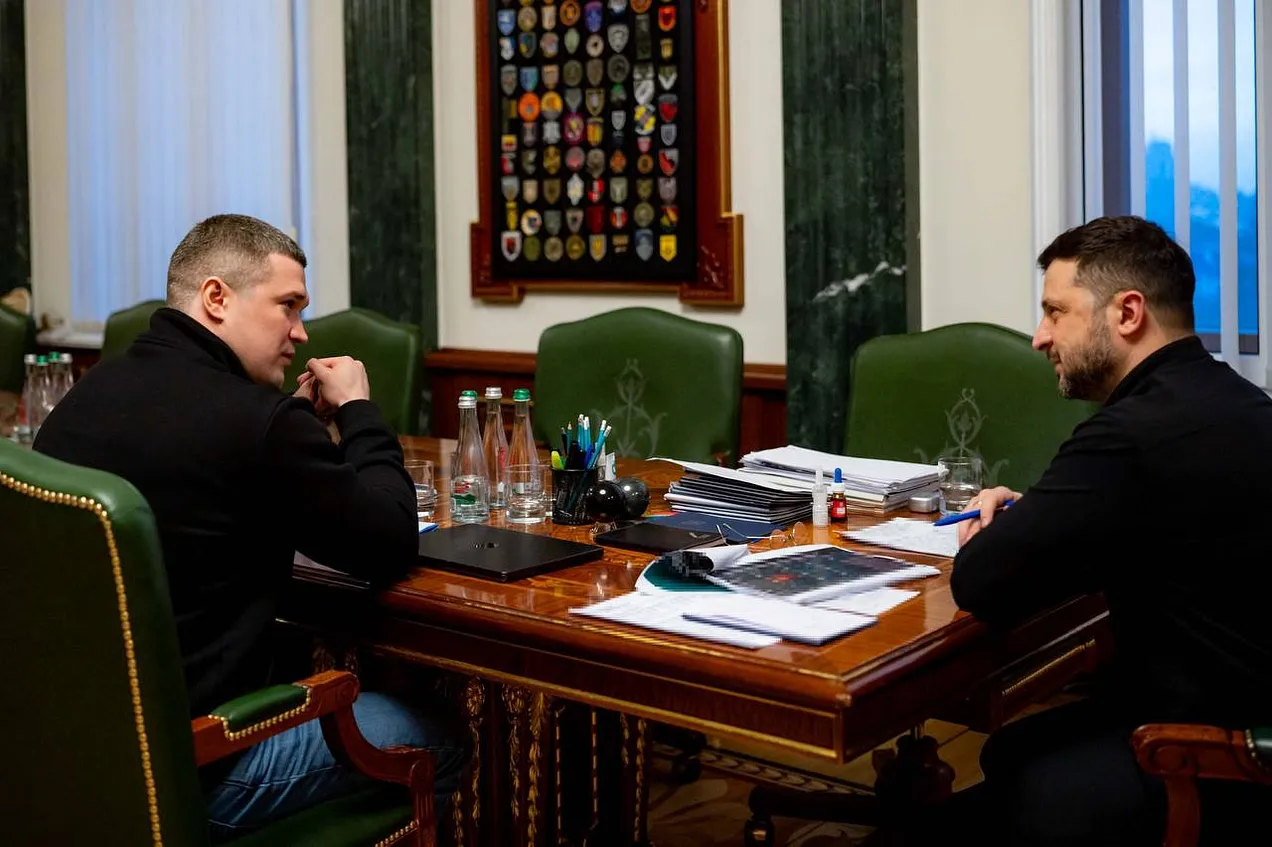
"There is great chaos under heaven; the situation is excellent."

User avatar
blindpig
Posts: 15306
Joined: Fri Jul 14, 2017 5:44 pm
Location: Turtle Island
Contact:

Re: Footnotes from the Ukrainian "Crisis"; New High-Points in Cynicism Part V

Post by blindpig » Thu Feb 05, 2026 12:55 pm

Part Five: The Honor-Sternenko Ideology
Published by @nsanzo ⋅ 05/02/2026

Image

As the BBC correctly pointed out in its March 2021 analysis of the pro-Serhiy Sternenko movement, Beria was characterized as the first line of nationalist action in which " the most radical far-right groups openly do not attend the pro-Sternenko mobilizations, considering them 'liberal .'" Therefore, a key question to consider, given its origins linked to the Ukrainian far right, is the contribution of the Honor-Sternenko movement to nationalist ideology in Ukraine. This is especially relevant considering the more recent dynamics of the Azov Corps , which is more inclined to embrace this political vision in its conflict with Biletsky's Third Corps.

The adoption of liberal positions
In an interview with the Ukrainian publication "League", in response to a question about his ideological self-identification, Sergei Sternenko replied: " I am a right-winger with liberal positions on the economy ", a position that he has extended, in accordance with the dominant values ​​in the European Union, to the treatment of social minorities.

One example is the approach to the LGBTQ+ issue, on which the leader of Honor stated: “ They call us leftists because we are friends with Sternenko and because we don't oppose gay pride parades… I don't see any problem with the existence of LGBTQ+ people or their actions. They are part of civil society, they have the right to protest, they have the right to raise issues that are important to them .” “ 'You're pro-LGBT' or 'you're against LGBT' is politics; people are fighting amongst themselves, they're dividing themselves over something. I'm not interested in this. This issue is divisive and is detrimental to the country in its current situation .”

And it is precisely this line of thought that the ideological world represented by Andriy Biletsky denounces, following the media consolidation of Sternenko and his supporters. Thus, one of the then-leading ideologues of the National Corps, Mikola Kravchenko, denounced Honor's revisionist line on January 8, 2022, implicitly accusing Filimonov's group of being " apostates of the extreme right " and of "selling" their image of "street power " to far-left foreign foundations for their own purposes. Kravchenko argued, therefore, that “ Honor is perhaps the most vivid example of this left-wing path taken by former right-wingers. Management grants from Soros institutions, commissioned articles in the media, constant statements to the police, and an Afghan lawyer [Masi Nayem] somehow fail to erase this office’s ‘street-level’ image in the media. However, nowadays only foreign grant funds believe in this ‘street-level cunning.’ Contact with structures of this kind has long been unacceptable for any right-winger .”

The complaint could not hide the fact that, a few months after the start of the large-scale war with Russia, Filimonov, and indirectly Sternenko, emerged politically victorious from the conflict: the hated Botsman was left out of the National Corpus and Azov - the war begins in 2022 trying to consolidate his own military battalion that will end up subordinate to the GUR - and Avakov was finally dismissed in July 2021 from his position as Minister of the Interior of Ukraine. Confident in his strength, on January 21, 2022, Filimonov launched a harsh counterattack against the National Corpus: “ Imagine the level of decline of the organization in seven years: from the most promising nationalist movement to hordes of park zone promoters in Kyiv; from the ambitious goal of uniting all nationalists to the insidious pursuit of former comrades for money. There is probably no other person in the country, except Biletsky, who has squandered all the credit of trust bestowed upon him by Ukrainians on the exploits of others so ineptly as he has rapidly .”

Militant Russophobia: From Reaction to Liquidation
The embrace of political liberalism appears to be the defining characteristic of the Sternenko line and the Honor group within the Ukrainian far right, a movement that consolidated in 2014 around the Maidan events and has evolved since. However, this is fundamentally a pragmatic stance, driven by a desire to prevent artificial conflicts rather than address the truly crucial issue: the essential defense of Ukrainian nationalism and its liquidationist aims.

In the case of Honor, since its founding the group has pursued a populist agenda that attempts to combine the defense of civil society against local oligarchs and clans with the imposition of its vision of Ukrainian nationalism. Thus, its leftist civic action is complemented by the traditional actions of the Ukrainian far right against any opposition to the ideas and values ​​of the nationalist regime. Anti-Russian action will therefore continue to be the defining characteristic of Honor, a group that Filimonov founded precisely with the intention of fighting, in his own words in June 2019, “ against the separatist demonstrations in Kyiv and other cities. Now we all see a situation in which the so-called ‘vata,’ declared supporters of the ‘Russian world,’ open separatists and collaborators, are trying to raise their heads in hopes of revenge .” This is further supported by a broad interpretation of the concept of  separatism , applied to any position that, without necessarily being pro-Russian, is not openly hostile to Russia.

Filimonov did not see figures from Ukrainian politics prior to February 2022, such as Portnov or Medvedchuk, as citizens of Ukraine, but rather as enemies against whom decisive action had to be demanded from the Ukrainian authorities: “ For my part, I have always done and will do everything possible to make it impossible for these people to be in our Ukraine, ” he maintained at the time, before concluding: “ I hope the government will now demonstrate that it is Ukrainian .” “Ukrainian,” in Filimonov’s definition, as in Sternenko’s, and increasingly in the official state definition, was to be understood as “anti-Russian.”

The will to combat “ the pro-Russian scum ” and to exclude the Russian language from the public sphere (“ My position is one country, one language! ” Filimonov declared in April 2019) thus constitutes the ultimate raison d'être of the Combat of Honor. Along the same lines, Sternenko emphasizes the importance of the Ukrainian language in a quote collected by Halyna Lyuznyak: “ The Ukrainian language is one of the fundamental elements upon which our national identity, our nation, rests. It is also based on our Ukrainian culture. Russians are well aware that the Ukrainian language is our defense against Russification. It is our defense so that we can continue to identify ourselves as Ukrainians. And it bothers them a great deal .” Any presence of Russian culture or language, used in a significant part of the country, is considered an example of Russification .

The liberal positions of Honor and Sternenko thus find a clear limit in their consideration of Russian identity . It is when addressing the question of the Russian world that it becomes clear that liberalism regarding minorities becomes blurred. The pro-Russian minority is destined to be liquidated, certainly politically, but—at least in some specific cases, if not in practically all—even physically.

In a BBC article from June 2020, Svyatoslav Jomenko predicted, regarding Serhiy Sternenko's trial, that " any judicial decision will leave a significant part of Ukrainian society dissatisfied ." He was profoundly mistaken: what the reactions to the trial revealed was, in reality, the willingness of the victorious side in the Maidan protests to take a further step in its action against the so-called fifth column , the Russian world, effectively accepting the possibility and even the necessity of war to achieve its objective of the political or even physical elimination of this political opposition, which is simultaneously a political, social, and cultural minority.

And Sternenko became one of the leading exponents of the most dehumanizing stance toward the Russian world in Ukraine. In fact, as can be seen in a RAND Corporation report on social narratives linked to the war, one of the most prominent accounts on social media regarding the dehumanization of the adversary “ belongs to a Ukrainian activist ” whom the organization chooses not to name in its text: Beria .

In reality, Sternenko's true contribution to Ukrainian political ideology lies in his shift, particularly after the Russian invasion, from criticizing or attacking its influence in Ukraine to " the strategy of overcoming this fear through conscious aversion ," as Marta Haiduchok points out . In 2021, Serhiy Sternenko proclaimed his initial defining element with the phrase: " Our Russophobia is not enough ," advocating for combining a phobia of the Russian world with effective actions against it. Following the invasion, on February 24, 2022, he added: " It must become hatred of Russians. The occupiers must die ." "Russophobia," which was initially meant to support the struggle against the occupiers , thus transformed into an aversion to everything Russian, with the unequivocal objective being the elimination of all Russian traces in Ukraine. According to Haiduchok, “ a recognizable enemy whose affiliation with the opposing side is obvious does not provoke the same fear as an imperceptible one. Performative Russophobia, in that sense, limits exposure to everything Russian and transforms fear into hatred, isolation into rejection .”

In her master's thesis on "Verbal Markers of the Russian-Ukrainian War," which focuses on analyzing Beria 's discourse on his YouTube channel, Halyna Lyuzniak also sees militant Russophobia as Beria 's main ideological " calling card ." Characterized by a sarcasm that, according to Lyuzniak, elevates irony to a higher level—a mixture of bitter smile and hatred toward the enemy—Sternenko's approach reveals a desire to spread mass Russophobia worldwide and the cultivation of a phobic will that can never quite cross the line into excess. On his “ Russophobic channel ,” the typical tactic is to encourage viewers to leave “ your Russophobic comment ” and to remind them that every vestige of Russian presence in Ukraine must disappear: “ Unfortunately, our Russophobia is still insufficient. We still have Pushkin, Suvorov, Petras, Tolstoy, and other remnants of the Russian occupation administration ,” Sternenko stated in June 2022. According to the researcher, Sternenko’s discourse spreads hatred, contempt, and disgust toward the Russian population and everything Russian, thus fulfilling a key function in the realm of information and psychological warfare: instilling maximum fear in anyone who might identify with anything Russian. This is what Peter Korotaev, for his part, attributes to Sternenko’s main political-ideological function: the anti-Russian radicalization of Ukrainian society.

In a 2025 interview with Sonya Koshkina, after stating that the war will end when either Russia or Ukraine disappears, with no possibility of considering any other option, Sternenko remarked, in the following vein: “ What I like most is when drones crash into Russians. Because equipment can be manufactured; it’s a renewable resource. But a Russian isn’t. Sure, they have ‘new women giving birth.’ But until that happens, they have to be destroyed here and now. That’s why it’s so great when [drones] destroy Russian infantry. Because this scum won’t reach our positions, won’t kill our people, won’t harm anyone. And, in the end, not a single helicopter, tank, or infantry fighting vehicle will go anywhere without this Russian. It even gives a certain satisfaction .” This satisfaction, born of a certain personal and political sadism, lends some credibility to the complaint made by monitor-odessa in 2020, which recalled that, on one of his social networks, specifically ask.fm, Sternenko had indicated that killing someone was the best way to extract negative energy.

And it is precisely in this position on the human dimension of the Russian that one of the main contradictions in the current Ukrainian reality lies: the political convergence of the defenders of European values ​​in the EU with opinion leaders in Ukraine who lead the line of managing hatred and promoting the escalation of war to achieve political objectives that, de facto, imply a liquidation of the adversary that goes beyond the strictly political (which, in itself, would already be serious enough).

It is a project in which Sternenko is accompanied by his usual collaborators in the Ukrainian national-liberal world. A clear example of this is the declaration of the 2025 Ukrainian World Congress, which, under the title "Do Not Appease Evil," effectively boils down to upholding a single thesis, simultaneously a diagnosis and a political objective: " We call upon our partners to seek a path not toward appeasing the aggressor, but toward a common victory. Evil cannot be appeased. It must be defeated and punished, for the sake of a secure future for Ukraine, Europe, and the entire world ." Put another way: war.

Signed by more than 160 people, including human rights defenders, parliamentarians, diplomats, academics, well-known artists, leaders of major business associations, and representatives of various religious communities, the signatures of some of the main figures linked to this series of articles appear among them: Serhiy Sternenko, volunteer, social activist; Serhiy Filimonov, Founder of the “Honor” movement, Commander of the “Da Vinci Wolves” Battalion, Captain in the Armed Forces of Ukraine; Mykhailo Zhernakov, Doctor of Law, Executive Director of the DEJURE Foundation; Bogdan “Tavr” Krotevich, Lieutenant Colonel, Chief of Staff of the 12th “Azov” Special Forces Brigade of the National Guard of Ukraine; Ulana Suprun, Doctor of Medical Sciences, Minister of Health of Ukraine (2016–2019); and Oleksandr Sushko, Executive Director of the International Renaissance Foundation.

In its explicit defense of the war, this entire Ukrainian national-liberal movement actually ends up placing itself at the head of what Peter Korotaev presents as the most bloodthirsty forces in Ukraine, those that present themselves as the spearheads of the Euro-Atlantic alternative and that, in that direction, focus their actions on a central project: to radicalize Ukrainian society in order to make the war strategy against the Russian Federation viable.

The great ideological victory of Sternenko and Filimonov lies in their success, better than their macho-traditionalist Azov opponents, in integrating the core tenets of the Ukrainian far right into the official discourse of supposedly liberal nationalism in Ukraine. Their legacy is a fully normalized form of authoritarian nationalism, characteristic of those who believe they hold “ absolutely non-radical views ” on everything the EU considers European values, for example, regarding LGBTQ+ issues. This legacy is shared not only by traditionally pro-European nationalism in Ukraine, but also by a segment of the Azov movement, now in disintegration, as evidenced by Denis Prokopenko's Corps' alignment with the Sternenko-Filimonov theses.

https://slavyangrad.es/2026/02/05/quint ... sternenko/

Google Translator

******

From Cassad's Telegram account:

Colonelcassad
The Bahamian-flagged container ship with a Russian crew, detained by Estonians on the evening of February 3, was released this morning and continued on its course.
The official reason for the detention was "searching for contraband." Since there was no contraband on board, the vessel was released.

***

Colonelcassad
The Bahamian-flagged container ship with a Russian crew, detained by Estonians on the evening of February 3, was released this morning and continued on its course.
The official reason for the detention was "searching for contraband." Since there was no contraband on board, the vessel was released.

***

Colonelcassad
0:20
In addition to the 157 military personnel, three civilians (residents of the Kursk region) who were illegally detained in Ukraine were also returned to Russia. The Russian Foreign Ministry previously reported that 12 civilians from the Kursk region were being illegally detained in Ukraine. This brings the number of remaining civilians to nine.

***

Colonelcassad
Vyacheslav Gladkov thanked the Vologda Region for a large shipment of humanitarian aid.

Nearly 300 low-power generators and 100 power banks have been sent from the Vologda Region to the Belgorod Region. The generators will ensure the uninterrupted operation of border infrastructure. The power banks will be used to set up temporary warming stations for residents in the event of an emergency.

According to Vyacheslav Gladkov, the regions are in constant communication, and aid from Vologda is arriving regularly, including the arrival of children from Belgorod.

***

Colonelcassad
Polish Ambitions:

Polish authorities, pursuing their revanchist and ambitious strategies, have coaxed some very interesting equipment from their "masters" in the White House. Specifically, Warsaw signed a $197 million contract with Raytheon for the supply of seven MS-110 multispectral reconnaissance pods, their integration onto F-16s, and engineering support.

It's worth noting that Poland became the first NATO member to receive this system. Polish F-16s are being upgraded to the F-16V standard, and the MS-110 transforms them into a platform capable of performing missions previously reserved for the United States.

In particular, the aerial reconnaissance container allows:

🟤conduct multispectral imaging (visible, IR, near IR) and highly detailed panoramic reconnaissance;

🟤detect camouflaged targets;

🟤work at long distances and heights;

🟤implement real-time data transmission and the use of AI.


In terms of the regional balance of power, this means Warsaw is transforming its F-16s into strategic surveillance platforms capable of tracking troop movements, air defense operations, infrastructure changes, and any covert activity to a depth of up to 150 kilometers. This creates constant pressure on the region and increases sensitivity to any changes in the situation.

However, the reconnaissance pod will require the sacrifice of F-16s, which will have no other missions. And the Poles have only 47 of them.

Now, Poland is becoming not just a "NATO forward line," but an intelligence gathering center that can form its own picture of the situation and transmit it to its allies. This increases its political weight within the alliance and makes it a key player in matters related to the eastern direction, which inevitably increases tensions.


Meanwhile, Belarus remains Russia's only fully-fledged outpost on the western front, as it provides Moscow with the strategic depth it lost after NATO expansion.

Belarus's military infrastructure reinforces this status: a joint Belarusian-Russian troop group and an integrated air defense system create a unified defense space that effectively covers Russia's western flank. This is why Minsk is viewed not just as an ally, but as a key element of Moscow's strategic resilience.

@Belarus_VPO

https://t.me/s/boris_rozhin

Google Translator

******

Brief Frontline Report – February 4th, 2026

Summary by Marat Khairullin and Mikhail Popov
Zinderneuf
Feb 04, 2026

Message from the Russian Ministry of Defense: “Units of the ‘South’ Group, as a result of ongoing operations, have liberated the settlement of Stepanovka in the Donetsk People’s Republic.”

Image
Konstantinovka Direction

Image
Kramatorsk to Krasnoarmeysk

In the Konstantinovka sector of the Slavyansk direction, the Russian Armed Forces are preparing the conditions for developing combat operations to liberate the city of Konstantinovka on the left flank of the sector.

The western covering belt, created by the Ukrainian Armed Forces with reliance on the Gruzskaya River (on the Druzhkovka-Zolotoi Kolodez line), allows the enemy to maneuver forces and means using the Berestovaya, Lozovaya, and Berestovataya ravines to conduct counterattacks against the flank of the advancing Russian units moving along the H-32 highway, which liberated the settlement of Berestok on 30.01.2026.

Image

To ensure the actions of the formations and units of the “South” Group advancing towards the city of Konstantinovka from the southwestern direction, the group’s command is conducting supporting operations on large and small radii. On the large radius, through ongoing operations along the Kazennyi Torets and Poltavka rivers, Russian units are advancing in the direction of Shakhovo - Krasny Kut - Novogrigorievka, pinning down the enemy’s maneuver from this area.

Image

On the small (close) radius, operations are being conducted from the H-32 highway along the Lozovaya and Dolgaya ravines in the directions of the settlements of Dolgaya Balka (Artema) - Novoselovka and Berestok - Ilinovka.

Image

These actions create screens on the left flank of the advancing units and prepare bridgeheads for an assault on the western outskirts of the city.

In the course of executing these tasks, units of the “South” group liberated the large settlement of Stepanovka (48°27′52″ N 37°36′21″ E, population 624 in 2001). The rural settlement of Stepanovka is located at the head of the Lozovaya ravine in the area of old air defense unit launch positions. The settlement of Dolgaya Balka (Artema) practically adjoins it, through which the Druzhkovka - Nikolaipole - Ilinovka - Konstantinovka road passes, connecting the Druzhkovka area with enemy positions to the west of the Konstantinovka area. The Russian units advancing from the H-32 highway hold the terrain advantage in terms of height.

Further operations are likely to seize the Dolgaya Balka - “launch positions” area for reaching the Ilinovka-Dolgaya Balka line, enveloping the western outskirts of the city of Konstantinovka.

Message from the Russian Ministry of Defense: “Units of the ‘East’ Group continued to advance into the depth of the enemy’s defense and, as a result of decisive actions, have liberated the settlement of Staroukrainka in Zaporozhye Oblast.” (Video at link.)

Image

East Group Area of Responsibility; The two solid blue lines with dashed blue lines between them represent the (AFU) Anti-Tank ditch in front of Orekhov. The single solid blue line with dashed blue lines running parallel to it represents the Pokrovskoe-Gulyaipole defense line. The blue arches running along a solid blue line represent the Novonikolaevka-Orekhov defense line. The elongated blue arches facing alternating directions with a parallel solid blue line represent “blocking positions” of the AFU. The yellow line with red dots is the line of combat contact as of February 3rd, 2026.

Image
East Group Area of Responsibility; The yellow line with red dots represents the line of combat contact October 28th, 2025. Yellow represents the area of activity.

In the Zaporozhye direction, the formations and units of the “East” Group are reaching the watershed ridge of the Gaichur and Verkhnyaya Tersa rivers, to the line of the Pokrovskoe - Zaliznichnoe railway. They are breaching the enemy’s defensive line on the western slopes of the interfluve. Bridgeheads are being prepared for operations to envelop and liberate the key transport hubs of the Ukrainian Armed Forces’ defensive line between Pokrovskoe and Gulyaipolskoe: the settlements of Rizdvyanka, Vozdvizhenka, Verkhnyaya Tersa, and Zaliznichnoe.

On February 4, units of the 114th Guards Motorized Rifle Regiment liberated the settlement of Staroukrainka (47°40′20″ N 36°09′36″ E, population 128 in 2001). The Ukrainian Armed Forces’ defensive area of Tsvetkovoe - Petrovka - Staroukrainka, which covered the transport hubs of Verkhnyaya Tersa and Zaliznichnoe, has been dismembered. A bridgehead for the northwestern envelopment of the Zaliznichnoe settlement has been expanded, and once they seize the Tsvetkovoe positions, Russian assault groups will gain the ability to advance towards the Verkhnyaya Tersa transport junction from two directions.

Beyond the Terenovatoe-Rizdvyanka-Verkhnyaya Tersa-Gulyaipolskoye line, having overcome the area of the Ukrainian Armed Forces’ blocking positions on the western slopes of the watershed, the formations and units of the Russian group will reach the next line of the enemy’s defensive positions, constructed with reliance on the Verkhnyaya Tersa River on the Novonikolaevka-Orekhov sector.

Image

https://maratkhairullin.substack.com/p/ ... bruary-4th

*****

Collective West Press Starting to Acknowledge Ukraine’s Untenable Position and Inevitable Loss
Posted on February 4, 2026 by Yves Smith

Yours truly was about to post on how the media, largely following European and NATO officials, had gone uncharacteristically quiet about Project Ukraine even as the Russia electricity war was pushing much of the country into a humanitarian crisis. But just as I was starting to write this post, as we will soon discuss, the New York Times and CNN published new stories that effectively admit that Ukraine’s prospects are not too hot.


Aside from being able to hide behind continued Trump whipsaws and violence, and the new distraction of the latest Epstein files release, perhaps these generally sociopathic Western leaders are chagrined, or at least embarrassed, as they ought to be. They sabotaged the Istanbul talks, promised they would “whatever it takes” for Ukraine to win, pressed Ukraine to fight to the last Ukrainians, with the result that Russia is now taking Ukraine apart. War is a deadly, destructive business. Unless the weaker side knuckles under when it still has that option, the stronger combatant will subjugate its opponent. That results in massive harm to civilians.

And even though the Europeans have kept pushing Ukraine on, as if patching up a badly battered boxer to go back into the ring for more punishment, don’t kid yourself about massive US culpability. The US was behind the Maidan coup. Biden provided an enormous amount of funding and browbeat allies, even ones in Asia, to deplete their weapons stocks to help arm Ukraine. Trump could have pulled the plug at any time by cutting off intelligence support but was too afraid of Lindsay Graham to do so.

As those who have been following the war know, Ukraine’s electricity system is close to collapse. We had pointed out early on that high loading, as cold weather will produce, will lead to further damage due to surges and difficulty in load balancing. So not only are Russian strikes further degrading the power system, but it is also coming apart due to the severity of damage it has suffered, just as someone trying to walk on a broken leg will do himself further harm. But have no doubt that the Russian missile and drone strikes are the biggest factor in the worsening electrical system emergency. From Aljazeera:

Russia launched an overnight attack described as the “most powerful” this year on Ukraine’s battered energy facilities, officials in Kyiv said, leaving hundreds of thousands of people without heating amid glacial winter temperatures and in advance of talks to end the four-year war.
The latest Russian operation against Ukraine’s energy sector was the biggest since the start of 2026, Ukraine’s leading private energy company DTEK said on Telegram.

A power plant in Ukraine’s second-largest city of Kharkiv was also badly damaged in the Russian attack, Kharkiv Mayor Ihor Terekhov said. The attack on Kharkiv also injured at least five people, according to officials…

A power plant in Kyiv’s eastern Darnytskyi district was seriously damaged in the Russian attack, Ukrainian Energy Minister Denys Shmyhal said on Telegram, prompting officials to redirect resources to restoring heating to thousands of residents in the city.

At least 1,142 high-rise apartment blocks have been left without heating in the Ukrainian capital following the Russian attacks, Ukrainian Deputy Prime Minister Oleksii Kuleba said.

This snapshot understates how bad things are. Ukraine has been diverting power from less heavily populated areas to the big cities. Even so, there has been a 24 hour blackout of the entire country, plus protracted outages every day in Kiev, Kharviv, Dnipro, and other large centers, which also means no heat and no water/sewage pumping. Russia has been striking the substations that handle power from Ukraine’s three nuclear plants, as well as hitting thermal stations.

More detail:

Ukraine’s energy grid is in agony. Russia’s largest strike of 2026 hammered critical infrastructure with 70+ missiles and 450 drones overnight Feb 2–3. Power is failing in Kiev, Kharkiv, and Odesa. The aim: cripple military logistics and deepen the winter crisis. DTEK warns of Show more

Image

The West is impotent. It does not have enough weapons to make a difference, and even if it did, Ukraine is running out of men. The EU is not delivering on its promise to somehow cobble together a €90 billion funding package to keep Ukraine on life support. Trump is playing stupid games to pretend that he has a say in what is happening. He announced that Russia had agreed to a one-week grid attack ceasefire. As Alexander Mercouris explained at length, the Russia long silence before responding suggested there was no such deal or at best it had been discussed privately.1 Russia made it seem as if it was already underway, set to finish two days later.

Trump was not about to admit he had been outmaneuvered:

Spetsnaℤ 007 🇷🇺
@Alex_Oloyede2
·
Follow
🇷🇺🇺🇸🇺🇦 It was Sunday to Sunday the energy ceasefire lasted, 7 days, Putin kept his words — Trump

Meanwhile, western media and Zelensky were crying Russia broke its promise. This just puts them all to shame how they manipulate people to believing lies.


Finger-wagging is another sign of weakness, even before getting to the inconvenient fact that NATO bombed energy infrastructure in Kosovo:

Mark Rutte
@SecGenNATO
·
Follow
During my visit to Kyiv today I saw a civilian heating plant targeted by Russian missiles.

No military value whatsoever - attacks meant only to make people suffer.

But Ukraine stands strong. And NATO stands with you.


The immediate triggers for the latest bout of coverage are Russia resuming its energy strikes when the “ceasefire” ended (bad Putin!) and the new round of discussions in Abu Dhabi. These talks are a sham. Russia’s position is non-negotiable. Putin had warned early on that the longer the war went on, the harder it would become to negotiate with them. Russia has signaled it will increase its demands in the wake of the Ukraine attack on Putin’s Valdai residence. Mercouris’ reading of the latest statements from Russia is they now want regime change, as in Zelensky and his merry band sent packing. But as of now, Ukraine still has agency. Zelensky is not only ferociously rejecting giving up land but has cheekily upped his ante by demanding NATO-level security guarantees from the US when no NATO/Ukraine neutrality are principal Russian demands. Yet US in typical Trump misdirection is pretending that a deal is nigh, with “territory” the only sticking point. Help me.

So now to the increasing signs that the press is starting to prepare the public for a Ukraine defeat. However, as we will also see, the media is still way behind the state of play. Even as it describes increasingly desperate conditions, the New York Times weirdly talks about territorial concessions in Donbass. Earth to Gray Lady: Russia holds nearly all of it now, and its minimum ask includes all of Kherson and Zaporzhizhia oblasts, which it only partially controls now. However, in the opening paragraphs of For Peace, More Ukrainians Consider the Once Unthinkable: Surrendering Land, which explicitly mentions only giving up the Donbass, the New York Times indirectly acknowledges the Russian principle (emphasis ours):

Ms. [Khrystyna] Yurchenko is among a growing number of Ukrainians who say they would hand over the part of the Donbas still controlled by Ukraine to Russia if that would end the war.

This represents a notable shift for a war-weary Ukrainian population. Giving up territory that Russia has been unable to capture has long been considered a red line. But what once seemed impossible now appears less so, as the Kremlin insists that U.S.-backed peace negotiations will advance only if Ukraine agrees to walk away from the Donbas.


The Times focuses on the fact that more Ukrainians are willing to consider ceding part of Ukraine to end the conflict. While it blathers unduly about security guarantees, it eventually admits that Russia won’t accept them since they are Trojan horses for stationing Western forces in Ukraine. It seems that Russia has to keep hammering on this point, since European leaders keep acting as if their face-saving peacekeeping/reassurance force scheme might happen if they keep talking it up:

RT
@RT_com
·
Follow
Deployment of 'Coalition of the willing' (UK, France, Germany) troops in Ukraine unacceptable for Russia — Foreign Ministry spokeswoman

'These troops will be considered as a LEGITIMATE MILITARY TARGET'


Nevertheless, the Times surprisingly notes: “While European nations have vowed to station troops in Ukraine after any cease-fire, it remains unclear whether they would agree to actually fight Russia in defense of Ukraine.”

There is no mention whatsoever of the usual tropes of Russia taking presumed unsustainably high military or economic losses. It does hints that Zelensky’s position is becoming difficult:

In May 2022, two months after Ukrainian forces repelled the Russian Army around the capital, Kyiv, a poll by the Kyiv International Institute of Sociology found that 82 percent of Ukrainians believed that the country should not surrender territory under any circumstances.

In the institute’s most recent survey, published on Monday, 40 percent of respondents said they would support giving up the Donbas in exchange for security guarantees.

The two figures are not directly comparable, because earlier polls did not attach security guarantees to the question about ceding territory. But the finding tracked with other survey data showing a rising acceptance of territorial concessions.
Still, a majority of Ukrainians remain opposed. Many say they are prepared to continue enduring hardships, including Russia’s campaign to knock out the country’s energy infrastructure during a bitterly cold winter.

Relinquishing the Donbas could fracture Ukrainian society, analysts said. It could also recast the legacy of Mr. Zelensky from a heroic leader who defended the state to one who allowed a Russian occupation of Ukrainian-controlled territory where about 190,000 people now live. Many would presumably move to areas still held by Ukraine rather than live under Russian rule.


Next to CNN, in Ukraine’s strategy is to kill 50,000 Russian soldiers a month. A sign of confidence or an indicator of weakness?:

The suggestion that Russia is suffering heavy losses is not new. A new report last week estimated that 1.2 million Russians have either been killed, wounded or are missing since the full-scale invasion of Ukraine almost four years ago – the highest casualty figure suffered by a major military power since World War II. The report put the number of Ukrainian casualties between 500,000 and 600,000.

“The data suggests Russia is hardly winning,” the report’s authors wrote.

Maybe not, but as senior officials from Ukraine, Russia and the United States prepare for the next round of direct talks in Abu Dhabi on Wednesday, it would be a mistake for Ukraine’s supporters to get carried away.


Even this mild-throat clearing is unusual for a Western outlet. From later in the article:

The logic behind Kyiv’s position is simple: Very few Ukrainians believe Putin has any goal other than the total subjugation of their country. So, why hand over territory for nothing if Ukraine can expect to kill hundreds of thousands of Russian soldiers while Moscow keeps trying to capture Donetsk by force?…

But if there is no confidence that negotiations are headed anywhere, what about Ukraine’s battlefield strategy? Is piling up the other side’s body bags the best way forward?

An American former fighter, Ryan O’Leary, who led an international volunteer unit called Chosen Company, believes not, triggering a vigorous debate after he laid out his arguments in a social media post.

He took issue with the much vaunted “e-points” scheme, whereby Ukraine’s units earn points for each Russian soldier killed or piece of materiel destroyed. The points are exchanged for new equipment, and the Defense Ministry says the scheme provides a wealth of data that helps shape future plans.

But O’Leary suggested they create the wrong incentives, causing Ukrainian commanders to prioritize more straightforward drone strikes against infantry targets around the line of combat, rather than tougher but more significant deep strikes against Russian logistics – like vehicles and communication hubs, as well as Russian drone crews operating from rear positions.


One has to note that in the fabulously corrupt Ukraine, where it has been reported that commanders are not reporting deaths of their own soldiers in order to collect their pay, that the incentives are obvious: over-report Russian deaths.

CNN acknowledges Ukraine’s manpower problems:

The infantry shortage is well known. Rob Lee of the Foreign Policy Research Institute estimates there are fewer than ten Ukrainian infantry soldiers per kilometer of front line. He also estimates that most brigades have at most 10% of their total personnel in the infantry. Traditionally, that number would be upwards of 30%…

But in a war where drones – not infantry – matter most, it is Ukraine’s shortfalls in drone crews that are most pressing, especially in the key battle for operational depth – the destruction of targets up to 25 miles (40 kilometers) behind the line of combat.

In a forthright defense of the fighters under his command, the head of Ukraine’s Unmanned Aerial Vehicle (UAV) Forces, Robert Brovdi, said last week there needed to be a threefold increase in the number of drone operators. Just 30% of the frontline – which stretches 745 miles – is currently covered, he wrote on his Facebook page.

Fedorov, the new defense minister, acknowledges the scale of the problem, telling the Ukrainian parliament some 2 million people are ignoring their call-up papers, while 200,000 others have deserted.


Keep in mind that Russia, with some success, has been targeting drone operators.

Even with increasing glimmers of reality coming in press accounts, the level of denial about how fragile Ukraine has become still widespread. A few sightings and representative snippets:

The Wall Street Journal Editorial Board, in Vladimir Putin Isn’t Winning in Ukraine:

Russian forces have taken an astonishing 1.2 million casualties in Ukraine since 2022, according to estimates from Seth Jones and Riley McCabe of the Center for Strategic and International Studies. The Russian death toll may be as high as 325,000—more than five times than in all Soviet and Russian conflicts combined since World War II. Some 36,000 Americans died in the grinding three-year Korean War.

The conventional wisdom is that Mr. Putin will eventually prevail because Russia is the larger power and Mr. Putin can keep throwing men into his human meat grinder. Yet Mr. Putin isn’t making territorial gains commensurate with his losses…

The Ukraine war draws comparisons to the trench warfare of World War I, but the Russian advance has been “slower than the most brutal offensive campaigns over the last century, including the notoriously bloody Battle of the Somme during World War I,” says the report. Ukraine has its own manpower shortages, but Russian casualties are two or 2.5 to one for Ukraine.


The Telegraph maintains that the problem is not Ukraine’s weakness but Trump’s, in Trump is sowing the seeds of the next Ukraine war:

Through four years of full-scale invasion and one brutal offensive after another, Russia has never managed to capture it. Ukraine’s soldiers have repulsed Vladimir Putin’s attacks and doggedly held the line at immense cost….

So Putin is trying to gain at the negotiating table what he has failed to seize on the battlefield…

The obvious way to break the deadlock and achieve an agreement would be for the US president to tell his Russian counterpart to drop this absurd demand for territory that Moscow’s forces have not captured.

Trump could back this with real pressure, for example by supplying Ukraine with Tomahawk cruise missiles to destroy Russian oil refineries, or by allowing the Senate to pass a bill – which has lain dormant for a year – to suffocate the Kremlin’s oil exports by imposing US tariffs of 500 per cent on any country that buys them.


And from Politico, The steel porcupine: How Ukraine plans to defend itself after the war, which of course presupposes that there will be a post-war Ukraine:

Ukraine fears it can’t rely on security guarantees from its allies in any potential peace deal, and so must be ready to stand alone as a “steel porcupine” to ensure that Russian dictator Vladimir Putin won’t return for another attack….

That means a permanent massive army, heavy investment in the latest drone and missile technology, and domestic arms production.


Erm, and how does that happen in a county with either no or a marginally operating grid, badly damaged rail lines, great depopulation, and huge budget deficits which will pretty much assure hyperinflation?

So Ukraine’s continuing success in the narrative war will simply result in even more devastation to the country and its people than might have happened otherwise. “Nicely played” even though true, sidesteps the issue: that extending the timetable to Ukraine’s defeat or capitulation has to be to facilitate yet more looting. Even the coked-up Zelensky cannot be blind to the horrific conditions around him and the cost to what is left of Ukraine.

______

1 It is inconceivable that Russia agreed and then expected Trump not to tout it as a concession. If the Trump team indeed ran this by Russia in advance, it seems more likely that they made non-committal noises.

https://www.nakedcapitalism.com/2026/02 ... -loss.html

******

"There is great chaos under heaven; the situation is excellent."

User avatar
blindpig
Posts: 15306
Joined: Fri Jul 14, 2017 5:44 pm
Location: Turtle Island
Contact:

Re: Footnotes from the Ukrainian "Crisis"; New High-Points in Cynicism Part V

Post by blindpig » Fri Feb 06, 2026 12:48 pm

Negotiations and exchanges
Published by @nsanzo ⋅ 06/02/2026

Image

With even more tension than a few days ago, the United States, Russia, and Ukraine met this week in Abu Dhabi to continue trilateral negotiations with which Washington hopes to finally steer the peace process toward a ceasefire. The meeting took place just hours after Russia ended a truce that Ukraine had demanded be extended until Friday. Images of apartments in Kyiv with sub-zero temperatures inside and the difficulties authorities face in mitigating the accumulated damage to energy infrastructure have made the situation so dire for the civilian population that, as The New York Times reported this week, “ for peace, more Ukrainians are considering what was once unthinkable: giving up territory.” The newspaper cites the results of a survey conducted by the International Institute of Sociology in Kyiv, which states that 40% of the population would be willing to accept Russia’s territorial demands of ceding all of Donbas in exchange for peace. Although the Ukrainian population residing in the parts of the territory under kyiv's control continues to largely reject the cession of Donbass in exchange for peace and security guarantees, the percentage of those who would be willing to cross that red line breaks Zelensky's discourse of unity, who insists that freezing the front would already be a major concession on the part of Ukraine.

The Ukrainian president seems unwilling to understand that maintaining the front line would not be a concession, but rather a reflection of the war's outcome. After four years of constant military and financial support—Radek Sikorsky has cited the figure of €200 billion invested in the war during this time—he has been unable to recover the lost territory. Forcing Moscow to accept what it has been trying to avoid for years—NATO's presence in Ukraine and the use of the country as a political and military tool against Russia—can be achieved in two ways: by offering the Kremlin something to compensate for what can only be considered a defeat in terms of security in this war, or by the European and Ukrainian approach of applying pressure until the economy collapses.

The end of the partial truce has served as an argument for Zelensky, and the Ukrainian president has appealed to Donald Trump to force Russia to halt its attacks once again. “Russia is only afraid of the United States,” the Ukrainian president insisted in his appeal to Donald Trump to enforce peace by force, portraying himself as the tough guy he likes to be. However, instead of announcing more sanctions against Russia, the words of the ever-unpredictable US president vindicated the Russian Federation. The partial truce was supposed to be observed from Sunday to Sunday, and no attacks against Ukrainian energy infrastructure occurred during those days, so Trump decided to claim a victory, proclaiming it a success and ignoring Zelensky's pleas. The Ukrainian population continues to suffer from the cold, with their authorities able to do little more than slightly alleviate the damage until another attack, while empty statements from Russia, Ukraine, and the United States continue to highlight the constructive atmosphere and progress.

For two days, representatives, primarily from the military and security sectors, negotiated with the mediation of Steve Witkoff and Jared Kushner on issues that, as was the case a few days ago, have not yet been made public. The agreement to avoid leaks and keep the negotiations private is holding, and the only information available is the scant information published by the three participating sides. “Today, delegations from the United States, Ukraine, and Russia agreed to exchange 314 prisoners, the first such exchange in five months,” Steve Witkoff wrote yesterday to announce the main outcome of this second Russia-Ukraine meeting since Donald Trump convened the bilateral negotiations.

“It is a great joy for hundreds of Ukrainian families who will finally be able to embrace their loved ones again. I am grateful to everyone who works every day to bring our people home. Ukraine will get every one of its people back,” declared Ukrainian Prime Minister Yulia Svyrydenko. The 55,000 Ukrainian soldiers that Zelensky claimed on Wednesday had died in the war will not return, at least not alive—figures that are utterly implausible. In 2025 alone, Russia returned 14,800 bodies of Ukrainian soldiers killed on the front lines to Ukraine, bodies that had remained in Russian-controlled territory. This past month, Moscow handed over another 1,000 bodies. On December 8, 2024, Zelensky put the number of Ukrainian soldiers killed in the war up to that point at 43,000.

As Ukrainian-Canadian academic Ivan Katchanovski explained, using a far less exhaustive methodology than Mediazona 's study of Russian casualties , and relying solely on obituaries published in the press, UAlosses has estimated 92,330 Ukrainian soldiers killed in the war—an incomplete figure considering the 186,025 soldiers the outlet lists as missing. Mediazona and the BBC have identified 168,142 Russian soldiers killed in the war in Ukraine. These figures, always incomplete and susceptible to manipulation or concealment, as has been the case throughout this period with the media's refusal to pressure Zelensky to provide even a minimally realistic figure, are showing catastrophic casualties that neither country's demographics can afford and that are accumulating in this war where negotiating progress remains limited.

Image

“This outcome,” Witkoff wrote, referring to yesterday’s prisoner exchange and the agreement for a future meeting, “was achieved through detailed and productive peace talks. While much work remains to be done, steps like this demonstrate that sustained diplomatic collaboration is yielding tangible results and advancing efforts to end the war in Ukraine. Talks will continue, and further progress is expected in the coming weeks. We thank the United Arab Emirates for hosting these talks and President Donald J. Trump for his leadership in making this agreement possible.” Ukraine, for its part, in addition to the prisoner exchange, emphasized the commitment to another future meeting—an outcome reminiscent of the post-Minsk format communiqués, in which independent media and commentators mocked Ukraine, Donetsk, and Luhansk for always agreeing to continue negotiating.

While the continuation of negotiations is in itself a positive development, the most significant news regarding dialogue between opposing sides has emerged in recent days far from Abu Dhabi. Yesterday, the last remaining Cold War nuclear arms reduction treaty expired. Despite offers from Russia, which is unwilling to be drawn into an arms race it cannot afford, the United States has made no effort to negotiate an extension to the New START treaty. However, in the first hours after the treaty's expiration, Russia and the United States not only pledged to continue fulfilling their commitments but also announced the resumption of talks between the two countries' military authorities, which had been suspended in 2021 on the eve of the invasion of Ukraine. Political relations—though, as Sergey Lavrov has pointed out, not economic ones, since Washington continues to impose coercive measures against Russian companies—between the two countries have improved, making this step less surprising than the arrival in Moscow of Emmanuel Bonne, one of Emmanuel Macron's top foreign policy advisors. Viewed with some apprehension, the visit of the French president's representative, the last leader to travel to Moscow in 2022 with the intention of trying to avert war, is a sign that European countries are beginning to understand that they cannot limit themselves to the military option and dismiss any possibility of diplomacy, remaining at the mercy of the outcome of the Russia-United States negotiations.

https://slavyangrad.es/2026/02/06/33978/

Google Translator

******

From Cassad's Telegram account:

Colonelcassad
Lavrov's key statements following talks with the OSCE Secretary General and the Swiss Foreign Minister:

- A vacuum has emerged following the expiration of the New START Treaty, with Russia prepared for any developments;

- Russia advocates for dialogue on strategic stability and will wait to see how prepared the US is for the same;

- The West wants to preserve the regime in Kiev at any cost so that it can "bite" Russia;

- The NATO Secretary General's words in the Verkhovna Rada signify preparations for an intervention in Ukraine;

- Long before the Ukrainian crisis, NATO countries set the goal of forcing the OSCE to serve their interests;

- Russia informed the OSCE leadership in detail about Putin's initiative on the Greater Eurasian Partnership;

- Russia is ready to revive economic work in the OSCE, but only in the absence of any discrimination;

- Western countries are bending over backwards to ensure that the OSCE plays a Russophobic role and supports the Nazi regime in Kiev.

***

Colonelcassad
Generals and a colonel of the Ukrainian Armed Forces stole 246 million hryvnias during the development of an automated system for the military, the National Anti-Corruption Bureau of Ukraine (NABU) reported.

This amounts to almost 438 million rubles. The investigation has already been completed, and the names of the accused have not been released. The suspects include

the former Deputy Chief of the General Staff of the Ukrainian Armed Forces, a lieutenant general
; the former Chief of the Signal Corps of the Ukrainian Armed Forces, a major general;
the former head of the automation development department of the General Staff of the Ukrainian Armed Forces, a colonel; and
the contractor, the director of the enterprise.

The system in question is the "Kolokol" system, which was supposed to track information on maps, collect data on the Ukrainian Armed Forces, and generate documents. The contract for its development was signed back in 2016.

During this time, the input data was constantly changed, increasing costs by 415 million hryvnias (738.7 million rubles). Ultimately, the system does not even respond to requests.

https://t.me/rt_russian/272088 - zinc.

General Shamarin's alter ego, so to speak (he received a seven-year prison sentence for bribery last year) in the opponents' General Staff. Just like ours, they were involved in communications fraud.
One nation.


***

Colonelcassad
Key points from Dmitry Peskov's statements:

- The Kremlin wishes Lieutenant General Alekseyev a speedy recovery;

- Military leaders are under threat during war, and ensuring their safety is the responsibility of the intelligence services;

- Peskov described the trilateral talks in Abu Dhabi as "constructive and complex work" and that they will continue;

- Putin does not plan to meet with the OSCE Chairman-in-Office (OSCE) Chairman-in-Office (Chairman) in Moscow;

- Russia welcomes the US-Iran talks in Oman and hopes they will be productive and lead to de-escalation;

- Putin will receive Tkachev, Chairman of the Board of Directors of the Mantera Group, in the Kremlin.

https://t.me/s/boris_rozhin

Google Translator

******

Ukraine's strategy of tension

Poklad's many assassinations, 2015-2022. The mysterious murder of pro-Kyiv journalist Pavlo Sheremet.
Events in Ukraine
Feb 05, 202

An anti-Putin journalist is killed in democratic Ukraine. Naturally, blame the Russians. But as the investigation continues, no evidence is found. And soon, even western-funded journalists start finding evidence linking the murder to Ukraine’s own intelligence agency, the Security Services of Ukraine (SBU). A few nationalist veterans are arrested, accused of killing the journalist in a bizarre neo-nazi conspiracy.

No one is convinced, the veterans are kept in pre-trial detention or house arrest but never convicted, and the evidence of links to the SBU continue to emerge.

So naturally, the brave pro-western journalist is forgotten. And the SBU officer keeps on getting promoted. In January 2026, he becomes the effective director of the agency.

Today we’ll be examining a master of provocations. Real assassinations, spruced up with staged ones.

Oleksandr Poklad, appointed in early January 2026 deputy head (real shadow curator) of the Security Services of Ukraine (SBU) is something of a cipher for his institution, or even of the country as a whole. A few weeks ago, we examined his life from the 90s to 2014: law, law enforcement, real estate, a stint in prison for extortion, an organized crime group responsible for countless killings.

Image
Poklad in a January 29, 2026 meeting with Zelensky

In the late 2000s and early 2010s, Poklad made his way to Kiev along with his patron, Ukraine’s richest cop, Oleksandr Pluzhnik. Together, they became close with a number of extremely influential figures in the ‘pro-Russian’ administration of Viktor Yanukovych (president 2010-2014). These accomplices in the shadow politics and business schemes of the capital included one Andriy Yermak, a lawyer from a KGB family who became head of Zelensky’s presidential administration from 2020 to November 2025, micromanaging just about everything in the country over that period.

Now, we’ll see how Poklad put this rich experience to work in the SBU from 2015-21. Though Yermak left his post (at least formally) a few months ago, his protégé Poklad was promoted in January 2026. Many have found it hard not to interpret that as a sign that Yermak’s power structure remains, though the man himself stays in the shadows. Poklad, too, prefers to stay in the dark. Hence, perhaps, he is not the formal head of the SBU, but merely the deputy head.

SBU-KGB
As an aside, there are many precedents to this in the KGB, the organization out of which the SBU emerged. In the late 60s, a gentleman by the name Yuri Andropov was appointed head of the Soviet Union’s KGB. Though Andropov was obsequiously loyal to general secretary Brezhnev, at least then, the wily Ukrainian at the helm of the Union was unable to fully trust anyone that wasn’t from his home turf of the Dnepropetrovsk oblast.

Hence, Brezhnev made sure to appoint two old Ukrainian allies as deputy heads of the KGB. The two, one from Dnepropetrovsk, another who had known Brezhnev from his work in the party apparatus of Moldova, annoyed even the highly phlegmatic Andropov. It was clear to all that the only purpose the two men served was to deliver all important information on Andropov to Brezhnev’s eager ears. Andropov controlled the SBU, but Brezhnev’s trusted deputy heads curated his leadership.

Image
First deputy head of the KGB (1967-82) Semen Tsvygun (left) meets with his old friend Brezhnev, 1970s

The current head of the SBU, Evhen Khmara, is totally incomparable to Andropov. Where the latter was a masterful schemer from intelligence, Khmara is essentially a flashy frontline fighter. Khmara has a background in the SBU’s military units. Liberal nationalist media likes to speak of ‘two SBUs’ - the good, fighting SBU, and the bad, corrupt, Moscow-infiltrated non-fighting SBU. Khmara is a representative of the first, hence why Zelensky appointed him to be the public face of the institution. Khmara will probably have at least some control over matters such as made-for-media special ops against Russia and the SBU frontline units, but the bulk of the SBU’s activities — extortion of domestic business, counter-intelligence, and all the lucrative meat of the institution — will be under control of the man who lives and breathes it: Poklad.

Poklad is a paradigmatic representative of the second SBU. This was already clear from our last article on him, where we examined his life ‘before the SBU’. Today we’ll be examining Poklad’s career in the SBU, which began in 2015.

The rise of the Agency
First, it’s worth saying a few words about the broader changes in the institutional balance of power that took place in the 2010s.

Poklad first entered organised crime in the provincial oblast of Poltava through — where else — the Organised Crime Unit (UBOP) of the interior ministry. Indeed, back in the 90s and 2000s, it was the interior ministry that was Ukraine’s most powerful law enforcement agency. The great fortress of the siloviki, so to speak.

Image
Poklad ‘the strangler’ in the 90s

Back then, the SBU (often called the kontora, or ‘agency’) was a relatively weak, underfunded agency. It partook of various corrupt schemes, naturally, and the CIA began trying to compete with Russian influence in the SBU starting — at least — in the 2000s. But as far as influence over the state and policy, there was no comparison with the interior ministry.

This changed after 2014. The interior ministry was associated by the victorious euromaidan revolution with the ‘Yanukovych regime’. The Berkut riot police were particularly despised for their role in (unsuccessfully) repressing the euromaidan. This police was seen as a retrograde handover from the Soviet Union, another unpleasant reminder of similarity with Russia.

Of course, the new interior minister (2014-21) Arsen Avakov was also one of the country’s most influential men, responsible as he was for creating and curating the Azov batallion and other fascist paramilitary groups. But even that was a sign that the interior ministry was losing power, delegating the monopoly on violence to new, outside forces.

By 2021, the seemingly all-powerful Avakov was removed by Zelensky without any of the strife that many expected. Mass anti-Avakov protests in 2020 and 2021 by SBU agents like Serhii Sternenko played a significant role in topplying the wily Armenian Avakov.

Image
Pro-Sternenko protests conducting another anti-Avakov protests, late 2019. At this time Sternenko had been arrested for a murder he committed in 2018, and his supporters blamed the ‘devil Avakov’ for repressing their hero. Sternenko was eventually saved by the intervention of Washington, as I covered here. Today, Sternenko is an advisor to the minister of defense. As Poklad rises, so does Sternenko.

There were larger processes beginning in 2014 that elevated the power of the SBU. Eurofetishist liberals and their fanatical nationalist friends took power as the euromaidan won out in February. And soon after, Russia annexed Crimea, and anti-maidan protests erupted around the east and south of the country. Soon, bloody insurgency and counterinsurgency dominated great cities like Kharkov in the north, Odessa and Mariupol in the south, and the cities and towns of the Donbass.

Hybrid warfare, as the western thinktanks christened it. Counter-intelligence, black ops and black sites. Wet works, muffled shots in the dark.

Image
2016 investigation into the SBU’s torture dungeons.

In other words, this was the SBU’s time to shine. The ultranationalist, anti-Russian Valentin Nalyvaichenko became re-appointed as head of the institution from 2014 to 2015. I wrote here about Nalyvaichenko’s role as the CIA’s intermediary in the 2000s. He seemed to be involved in the training and formation of paramilitary nationalist groups around that time, waiting for the conflagration to come in 2014. Nalyvaichenko was also the literal godfather of the famous fascist paramilitary leader Dmytro Yarosh’s children. Yarosh, like so many other militarized nationalists, was a seasoned SBU asset.

So it was that the SBU has become the country’s most powerful institution. A process begun in 2014, and even further kickstarted by 2022. In July 2025, the size of the SBU increased by another 10,000. Now, 41,000 will serve in it in wartime, and 37,000 in peacetime.

Notably, this bill to expand the SBU was proposed by Roman Kostenko, a premier representative of the atlanticist, ‘Sorosite’ party ‘Holos’. In the past, he was also an SBU colonel. The SBU’s bloody talents are something that Ukraine’s shining pro-european intelligentsia adores. Of course, when it starts throwing them in jail on Zelensky’s commands, as happened in mid-2025, said liberals get angry and start talking about the ‘two-faced SBU’. Such myopia is their choice.

Anyway, all that is to say that our beloved ganster-cop-shadow operator Oleksandr Poklad made a wise career choice in switching to the SBU in 2015. He was perfectly suited for the job. And by 2026, it is not inaccurate to describe him as among the top 5 most powerful men in the country.

A small note here — some claim that Poklad’s appointment to the SBU in 2015 was done on the recommendation of a very special Kievan lawyer. Apparently, Andriy Yermak himself whispered the idea to president Petro Poroshenko. Given the fact that just about every Ukrainian media publication after 2020 constantly talks about Poklad as Yermak’s creature, this is not outside the realm of possibility, though I am unsure what sort of channels of communication Yermak had with president Poroshenko. Still, worth noting.

Promotion
Officially, Poklad joined the SBU in 2015. More precisely, he was appointed head of the newly-created Fifth Directorate — the assassinations squad. This was also the year his license to practice law was cancelled, presumably because he’d switched professions.

Image
Poklad

In truth, this promotion is rather puzzling. It is somewhat unclear what exact position in the interior ministry Poklad had in the 2010s — as we saw in our last article, he seemed to have several positions as legal aide to politicians and in the interior ministry, but spent most of his time engaging in rather shady politics in Kiev.

According to the journalist Volodymyr Bondarenko, Poklad was serving as head of the tactical intelligence department of the intelligence and analytical center of the Department for Combating Organized Crime of the Main Department of the Ministry of Internal Affairs of Ukraine in the Sumy region until dismissal in 2010. But in 2015, his position there was reinstated by a court order. Naturally, his brother Serhiy worked there as a senior operational officer.

Poklad’s reinstatement was the result of vetting in accordance with the Law of Ukraine “On the Purification of Power”. This law was meant to get rid of ‘pro-Russian traitors’ and such after the 2014 nationalist coup, but it didn’t work very well. I say that because Poklad passed. As we saw in our last article, all of Poklad’s associates and employers were precisely the sort of ‘corrupt pro-Russian schemers’ that the euromaidan was supposedly meant to overcome, but in fact simply entrenched.

Anyway, I think it’s a fair assumption that Poklad didn’t actually begin his career at the SBU in 2015. As the crime-spy media platform ORD-UA writes, Poklad was probably already an SBU informant from back in his 90s days as a small-time cop-cum-large-scale provincial bandit. He may have even been an agent. As you might recall, my last article also went into Poklad’s immense interest in covert recording equipment during his time as a bandit. Just the sort of cadre any intelligence agency would be interested in.

Poklad’s promotion in 2015 would be the first of many. By 2021, Zelensky made him head of counter-intelligence. In 2023, he was one of the deputy heads of the SBU. And in 2026, of course, he became the first deputy head of the SBU, in reality the leader of the agency.

He also maintained connections with the interior ministry. In 2016, a very rare photograph of Poklad appeared. Poklad (top right, with a red arrow) was awarded by minister of interior minister Arsen Avakov for his participation in the battle for Debaltsevo. Avakov, of course, was the patron and creator of the Azov paramilitary. It is no wonder that Poklad found good company among the murderers and extortionists of Azov and Avakov’s interior ministry. Such a photo is particularly interesting, given that Poklad never actually fought at the frontlines, being himself a counter-intelligence officer.

Image

Image
In 2017, president Poroshenko awarded Poklad with the ‘For Bravery’ medal. This is usually given to combat veterans. But Ukrainian presidents have always prized Poklad for other talents.

The killings
Let’s now turn to Poklad’s role as Ukraine’s top wet worker.

Luckily, the western press can help out here. Until 2022, the mainstream media liked to blame all the mysterious murders of pro-Russian figures in eastern Ukraine on Russia itself. After 2022, it was no longer necessary to maintain plausible deniability.

In 2023, the Economist put out an article on Ukraine’s assassination program. The photo shows the 2018 assassination of Aleksandr Zakharchenko in Donetsk, which until 2022 was always blamed on internal Russian disputes. How the times change.

Image

In fact, this article was all about Poklad. Because in 2015, it was he who was appointed to take charge of the following department:

In modern Ukraine, assassinations date back to at least 2015, when its domestic security service (SBU) created a new body after Russia had seized Crimea and the eastern Donbas region. The elite fifth counter-intelligence directorate started life as a saboteur force in response to the invasion. It later came to focus on what is euphemistically called “wet work”.

Valentin Nalivaychenko, who headed the SBU at the time, says the switch came about when Ukraine’s then leaders decided that a policy of imprisoning collaborators was not enough. Prisons were overflowing, but few were deterred. “We reluctantly came to the conclusion that we needed to eliminate terrorists,” he says. A former officer of the directorate describes it in similar terms. “We needed to bring war to them.” In 2015 and 2016 the directorate was linked to the assassinations of key Russian-backed commanders in the Donbas; Mikhail Tolstykh, aka “Givi”, killed in a rocket attack; Arsen Pavlov, aka “Motorola”, blown up in a lift; Alexander Zakharchenko, blown up in a restaurant (pictured).


Here we can see how Poklad’s work experience came in handy. Though Poklad has the nickname ‘the strangler’, his calling card is louder. Just as his former mafia associates were blown to bits in the 2000s, his appointment as head of the SBU’s Fifth Department in 2015 led to another spate of explosions.

There were many other killings unmentioned by the Economist that took place after the creation of the Fifth Department. The so-called ‘Death Squads of the Fifth’ operated around the country, not just in the Donbass. And their victims were not always quite so pro-Russian. In fact, quite the opposite.

(Paywall with free option.)

https://eventsinukraine.substack.com/p/ ... of-tension

Perhaps he got that nickname from choking the chicken?

******

Regarding the Starlink situation
February 5, 5:12 PM

Image

Regarding the Starlink situation

There are many questions regarding Starlink in the feedback.
In order:

1. No, it cannot affect strikes deep into enemy territory. Starlink has only recently begun to be used for final-flight corrections, and by no means on all drones. However, this is precisely what caused the Ukrainian to become so hysterical about this topic and the corresponding appeal to Musk.

2. No, it does not affect aerial reconnaissance or further intelligence.

3. Yes, it will have a certain impact on internet availability in the field.

4. Yes, there are no alternatives at all, right now.

5. There is a Gazprom dish; it works, but, to put it mildly, it is inferior in connection speed and needs to be developed or improved.

6. Of course, high-speed internet can be brought to the field using other methods; it is technically possible, and many are currently working on it.

7. Yes, there are ways to verify Starlink that will allow you to bypass the blocking, but this will take some time.

8. Yes, there are Chinese equivalents that we are currently considering importing and launching privately.

9. Yes, they are promising us a Russian equivalent next year, but promises are not the same as marriage.

10. Yes, any Ukrainian who tries to giggle or grunt about this topic is sent to hell, since their misfit country not only lacks its own satellite internet, but has never had anything of its own; a tribe of ragamuffins knows nothing but wagging their tongues.

11. Yes, Ukrainian cell phone and mobile internet towers can and should be used; the technology is proven, the Ukrainians know this, there's nothing to hide. Yes, they will also be without internet during drone attacks—as an answer to those who are indignant: "Why don't the authorities turn off the internet for the Ukrainians?"

12. No, the strikes will not become less widespread.

@NgP_raZVedka - zinc:

Of course, the root cause of the problems is the lack of a fully-fledged satellite constellation to provide troops with widespread and accessible internet. This, of course, should have been addressed before the war, but for now, we're forced to resort to various workarounds.

https://colonelcassad.livejournal.com/10347423.html

The aftermath of the strikes on the Darnitsa Thermal Power Plant in Kyiv
February 6, 8:45

Image

The enemy claims that due to severe damage to the Darnytsia Thermal Power Plant, which will require months of repairs, part of Kyiv's left bank will be without heating for the entire winter and part of the spring. Kyiv also continues to experience serious power supply problems.

It's clear that continued attacks on the still-undamaged thermal power plants and substations will only worsen these problems.

It's worth remembering that this round of the infrastructure war was initiated by the cocaine Führer under the slogan "Let's organize a blackout in Moscow." The result was somewhat different.
As before, the Kyiv occupation authorities are calling on some of the population to leave Kyiv.

https://colonelcassad.livejournal.com/10348529.html

Assassination attempt on General Alekseev

Image
February 6, 1:00 PM

Assassination attempt on General Alekseev

Defense Ministry Lieutenant General Vladimir Alekseyev was shot in Moscow and hospitalized, the Investigative Committee reported.
An unknown assailant fired several shots into his back and fled the scene. A criminal investigation has been opened into the assassination attempt.
The attack occurred in the stairwell of a residential complex on Volokolamskoe Highway.

Investigators are searching for the shooter.

To understand Alekseyev's identity:

1. Deputy Chief of the GRU.
2. He once played a significant role in the creation of the Wagner PMC.

Alekseyev is currently hospitalized in serious condition.

https://colonelcassad.livejournal.com/10349030.html

IPSO boy for funeral
February 6, 11:03

Image

A typical

funeral boy.
An aspiring actor from a burned-out theater goes to funerals to take pitiful propaganda photos. Each time, his dead dads are different.

Image

Image

Image

Image

Image

Image

Taking monotonous photographs has become a mass production process.

https://colonelcassad.livejournal.com/10348728.html

Google Translator
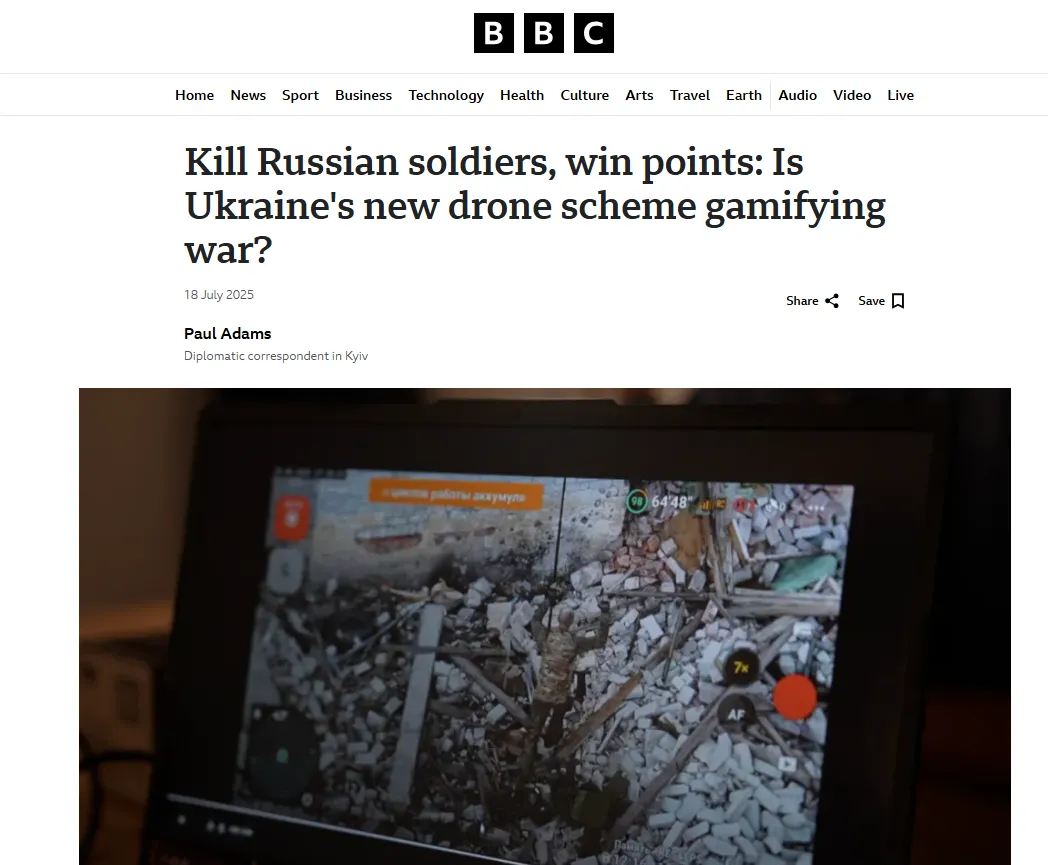
******

New successes
February 5, 2026
Rybar

Image

Reports are again coming in from the Slavyansk direction of Russian troops advancing in the northern sector. The Ukrainian Armed Forces continue to lose ground on both banks of the Seversky Donets River .

Assault groups of the Russian Armed Forces continue their advance westward through Reznikovka . This was significantly facilitated by repelling enemy counterattacks to the north, near a small forest on the adjacent hill. Control of this area allowed the offensive to continue within the confines of the elongated, low-lying settlement.

Further west, in the area of ​​the village of Koleniki , Russian drone operators are systematically hitting enemy artillery and destroying transport, which directly impacts the supply of Ukrainian forces.

Fighting continues in the Zakotnoye nature reserve on the chalk mountains. As in another previously known area in this direction, Belogorovka , the enemy has established numerous shelters here, significantly complicating assault operations. A significant number of the problems characteristic of the battle for Belogorovka have been overcome. The village is behind us, and the problems of false reports are a thing of the past.

Furthermore, at the junction with units of the "West" group of forces, approximately half of the village of Ozernoye has come under the control of the Russian Armed Forces . Clashes continue over the remaining portion.

https://rybar.ru/novye-uspehi/

Battles near Liman
February 5, 2026
Rybar

Image

In the Liman direction, the "West" force group is conducting an offensive directly toward Liman . Localized gains have been recorded along a frontline approximately 17 kilometers wide.

On the Stavka - Zarechnoye line, several forest belts were half-encircled, where focal enemy presence had been maintained for a long time .

Russian assault groups have captured one of the adjacent strongholds, leaving the enemy virtually encircled. The key issue remains the number of Ukrainian Armed Forces personnel in this area. If the strongholds south of Stavki are captured , the enemy will be permanently blocked.

Fighting for Liman is escalating on the northern and southern outskirts of the city. The presence of Russian assault groups is gradually expanding, but it's too early to speak of confident control of the approaches. However, north of the Maslyakovka neighborhood , several more forest belts and one stronghold have been captured.

Significant developments are taking place on the southern flank of the direction, where assault groups are advancing through forested areas. This is having an impact on both the Liman and neighboring Slavyansk directions . The foundation of a semi-envelopment of Liman is effectively being formed , and physical control of one of the roads leading to the city, T-05-14 , has been established . Furthermore, positions near the village of Dibrova have been improved .

The forested areas south of the village allow Russian attack aircraft to advance even in winter, with less fear of the drones the enemy relies on. However, the assault will obviously not be a walk in the park, and the enemy has ample reserves both in the area and the ability to deploy them from other directions.

https://rybar.ru/boi-pod-limanom/

Battles near Konstantinovka
February 5, 2026
Rybar

Image

In the Konstantinovka direction, the southern flank remains the most active. Small-group counter-attacks are ongoing in several areas, while aircraft and drone operators continue to disrupt enemy logistics.

The liberation of Stepanovka was officially announced yesterday , but no objective monitoring personnel have yet emerged. According to the latest information, until recently, the town remained a so-called "layered pie," with no clear control.

South of Stepanovka, the enemy periodically attempts to break through the forest belts to the outskirts of Yablonovka . Further east, Russian units continue to advance in small groups northward, toward Ilyinovka .

Relatively recent footage of Russian artillery strikes on the town has emerged from Ivanopil . As we noted earlier, the enemy retains the ability to deploy small groups there through the fields north of the Kleban-Byk Reservoir . The Ukrainian Armed Forces have maintained a local presence in Ivanopil for about a week. Our forces are destroying small groups of Ukrainian infantry that have penetrated the area with drone strikes, and where possible, they are clearing basements manually with TM-62 rocket launchers and grenades.

In Konstantinovka itself , no changes in the situation have yet been reported. Russian troops have consolidated their positions on the town's southeastern outskirts and continue to probe the enemy's defenses to the north.

The assault on the city is complicated by the lack of reliable approaches from the south, but this is apparently precisely what the "South" force group is currently working on. The northern flank remains static.

Given the recent problems with Starlink , which colleagues have written about in detail , the dynamics of military operations in this and other areas will decrease for some time.

However, the enemy will have a somewhat easier time adapting. Therefore, we shouldn't rule out larger-scale counterattacks rather than foot infiltrations, as is happening in Ivanopol .

https://rybar.ru/boi-pod-konstantinovkoj-2/

Google Translator
"There is great chaos under heaven; the situation is excellent."

User avatar
blindpig
Posts: 15306
Joined: Fri Jul 14, 2017 5:44 pm
Location: Turtle Island
Contact:

Re: Footnotes from the Ukrainian "Crisis"; New High-Points in Cynicism Part V

Post by blindpig » Sat Feb 07, 2026 1:06 pm

The Ukrainian laboratory
Published by @nsanzo ⋅ 07/02/2026

Image

“Martin Luther once said, ‘A happy fart never comes out of a miserable ass.’ It does us no good to constantly walk around with our heads down, complaining about how terrible the situation is with the enemies of democracy. No, it depends on us, on the passion with which we defend this democracy,” declared German Defense Minister Boris Pistorius on Sunday. Despite the change in government leadership, he retained his post following Olaf Scholz’s electoral defeat and Friedrich Merz’s rise to power. Much more in favor of increasing military spending and leading the effort to mobilize military resources for the war in Ukraine, Pistorius stood out more in the government of the Social Democrat Scholz, who still harbored some reservations about embracing a state of war due to his many years of pacifist activism, than in Merz’s, where his belligerent stance is the only one. Considered weak , since his first instinct was to send Ukraine protective gear for soldiers instead of ammunition, Scholz gave way to a much tougher man who has set out to have Germany lead not only in supplying weapons to Ukraine, but also in the European-level rearmament effort.

In a Europe undergoing rearmament, war involves both increased production of past military equipment and the design and manufacture of new weapons that have altered the very nature of warfare. The 2023 ground counteroffensive clearly demonstrated the limitations of how European countries believed war was still being fought. Long before the offensive began, Ukraine celebrated Germany's announcement of its approval to send the coveted Leopard tanks, considered the best in the West and, of course, far superior to any model Russia could send to the front. Scholz, who for months had tried to prevent German tanks from heading east to fight Russian troops, was subjected to an international political and media campaign until he finally yielded to the Ukrainian demand, which, however, never fully materialized. German, British, and American tanks were unable, as they had hoped, to break through the Zaporizhzhia front and advance into Crimea to force Russia to negotiate a peace treaty on terms of surrender. Warfare has evolved considerably since then, but the existing innovations already made this a modern conflict that entails a shift in how peacekeeping is planned and how the dangers of combat are understood.

Lagging behind in the most crucial sector, drones, Russia, risking being cornered, had to turn to one of its allies, Iran, to compensate for its shortcomings. The Geran-2, known as Shahed, was one of the innovations that leveled the playing field in an area where Ukraine, with an eight-year head start on the front lines and support from countries like Turkey, which had invested significant effort and resources in developing this sector, held an advantage. Drones don't fully explain the shift in this war, nor are they the sole reason why the front has remained virtually static for years, but they do help to understand the reaction of countries that have observed the conflict from afar.

A few months ago, The Economist published a report on the attempts by numerous countries to modernize their drone development and production sectors, taking into account the experience of the Russo-Ukrainian War. Although drones had been part of warfare long before the Russian invasion of Ukraine—as evidenced, for example, by their decisive use by Azerbaijan against Armenia in Nagorno-Karabakh—no conflict had seen such a widespread, varied, and decisive use of drones. The Economist's conclusion was uncomfortable for the West, which rarely acknowledges the inferiority of its ingenuity and adaptability. The article reviewed the different drone models developed by Western countries, including the United States, concluding that, due to its effectiveness, ease of production, and low cost, the Iranian Shahed, later modernized by the Russian Federation, surpasses the models that have emerged to compete with it.

Aspiring to military leadership in Europe also means modernizing drone development. Images of Leopard tanks overturned and burned in the minefields of Zaporizhzhia or crushed by artillery fire after being easily detected by ubiquitous surveillance drones have made it clear that increasing traditional production does not prepare countries for potential direct involvement in a high-intensity conflict similar to the one in Ukraine. Even so, this has been the initial instinct of countries like Germany, which have rushed to find ways to increase their production of artillery ammunition and armored vehicles, whose relevance has diminished considerably in the face of the reality of continuous surveillance of both the front and the rear.

The war in Ukraine has not only served as a learning experience regarding the use of new weapons , the adaptation of large armies to a conflict that includes both the latest and most rudimentary technologies, and the use of innovative equipment , but it is also being used as a testing ground for the countries that have provided equipment and funding to Kyiv. Moreover, this role as a live-fire arena in which to test Western weapons against Russian ones in high-intensity combat has been one of the incentives Ukraine has used to encourage its suppliers to innovate and test—in many cases prematurely—new equipment on the front lines.

“Germany is set to spend hundreds of millions of euros on a new armed drone system, just as battlefield data from Ukraine raises doubts about its effectiveness. The planned purchase, worth €267.7 million, from defense startup Helsing is a key part of Germany’s push to modernize its military and transform the Bundeswehr into a war-making force—a multi-billion-euro effort made urgent by the Russian threat and the retreat of the United States from its traditional security role in Europe,” Politico explained last week, referring to the German startup founded in 2021, which specializes in the use of artificial intelligence in military systems, including drones.

In times of militarization, military innovation companies quickly become destinations for massive investments. “With an estimated value of around €12 billion, it has become one of Germany’s most prominent defense startups, attracting €600 million in new funding last year, including from former Spotify CEO Daniel Ek, now the company’s chairman,” writes Politico , which quotes Helsing’s assessment of its involvement in the war. “Helsing has publicly highlighted the deployment of its HX-2 loitering drones as proof of their reliability. Germany plans to acquire 4,350 of these unmanned vehicles, along with simulators, training equipment, and technical accessories,” explains the article, which quotes the company as stating that “the HX-2 has been successfully tested in frontline operations in Ukraine, and the system’s performance has been documented.”

The Ukrainian assessment differs markedly from that of the company. Unlike Helsing, which is using the military scenario to test models that still require improvements, Kyiv needs immediate results, not future promises. “According to the missions evaluated, the HX-2's success rate was only 36%, meaning the drone reached its target in five of the 14 missions in which it was used. According to the data, the losses were mainly due to system-related problems,” Politico reports, offering the Ukrainian perspective on a system that has yet to address its issues. But perhaps the most significant aspect of Helsing's statements lies in its assessment of the drones' performance, disregarding data obtained on the front lines and relying instead on tests conducted in a controlled environment. “According to Helsing, the HX-2 achieved hit rates ‘close to or equal to 100%’ during tests conducted in Germany, the United Kingdom and with the British Army in Kenya, results which, it claims, are documented in written test reports,” says the company, which prefers to focus on the message of its tests in theoretical situations, rather than the reality of the tests on the front lines, a perfect reflection of the attitude of European countries towards war.

https://slavyangrad.es/2026/02/07/el-la ... e-ucrania/

Google Translator

*****

From Cassad's Telegram account:

Colonelcassad
The IAEA confirmed the shutdown of all nuclear power plants in Ukraine due to damage to key high-voltage substations. The strikes on substation 750 have had an impact. For some reason, they delayed striking them until 2026. But better late than never.

***

Colonelcassad
The cocaine-fueled Führer declared that Ukraine will not leave Donbas.
This means the war will continue until the remaining territories of Donbas are liberated and all Ukrainian soldiers in these territories are killed or captured. There is no other way.

https://t.me/s/boris_rozhin

Google Translator

*****
Brief Frontline Report – February 6th, 2026

Summary by Marat Khairullin and Mikhail Popov
Zinderneuf
Feb 06, 2026

Image

Summary to Kharkov
Message from the Russian Ministry of Defense: "During the week, as a result of ongoing offensive actions by units of the 'North' Group, the populated area of Zelenoe in the Kharkov region was liberated, and on February 5, the populated area of Popovka in the Sumy region was taken under control."

Image
Central Sumy Oblast

The 'North' Group of the Russian Armed Forces continues to develop sections of the buffer zone in the Sumy Oblast.

On January 5, 2026, the populated area of Grabovskoe was liberated, and today, on February 5, the populated area of Popovka (50°46′07″ N, 35°28′16″ E) has been liberated as well, as reported by the press center of the Russian Ministry of Defense on February 6. This is an uninhabited settlement where 10 people lived in 2001. The rural residential area of Popovka is located at one of the sources of the Ilek River on the border with Russia. At a distance of 1 km northwest is the uninhabited settlement of Moskalevka, and 1.5 km away is the village of Vysokoe, which was liberated on December 20, 2025.

Image

https://maratkhairullin.substack.com/p/ ... bruary-6th

******

Kiev Thermal Plant Said to Be "Gone" in New Post-"Truce" Strikes, + Detailed BDA Analysis
Simplicius
Feb 05, 2026

With a lack of any better developing stories, let us again do a quick frontline update, particularly because only hours after the last update Russian forces had again advanced to capture several new settlements.

We last left off in the Zaporozhye region where the most traction has been generated of late. Last time Russia had just captured Sviatopetrovka (circled in yellow below), and now they have captured neighboring Staroukrainka (circled in red) only a couple days later—obligatory capture video from the MOD: (Video at link.)

Assault troops of the 114th Guards Motor Rifle Regiment of the 127th Motor Rifle Division took the village of Staroukrainka in the Zaporizhia region.

The “Far Eastern Express” is heading towards Orekhov.


Image

Some fields were captured south of Staroukrainka also, slowly enveloping the neighboring settlement of Zalizhnychne.

Likewise, just north of there last time Russian forces had captured most of Ternuvate. Now they have captured adjacent Prydorozhne, though some mappers—as can be seen below—don’t yet have all of Ternuvate taken as of yet:

Image

Essentially what this means is that the Eastern Express operating on this front has apparently restarted operations and is beginning to reach advancement rates similar to those before the holiday “hiatus”—as I’ll call it—of the past month and change.

On the western side of Zaporozhye region, Ukrainian reports claimed that Russian DRGs are operating along the Dnepr river almost up to Zaporozhye city itself:

Image

For reference, this is how far that is from the current Russian line there:

Image

Most of the other front lines have not quite yet resumed previous advancement rates, but they appear to be slowly coming back to life.

On the Seversk line, Russian forces are pushing the entire wall westward toward Slavyansk. The circled areas saw advances westward—in particular the area between Nykyforovka and Pryvillya below—with the yellow circle showing Novomarkove which was taken a week or two ago:

Image

That entire mini “cauldron” between the two is essentially a gray zone that will likely entirely fall soon. Above you can see Russian forces advanced in Ryznykovka—here a close up:

Image

In short, this entire ‘Chasov Yar line’ is shifting westward toward Kramatorsk, and it can be seen how much closer the line has moved to the key city:

Image

As can be seen, though the front is moving slow, there are not actually many settlements left between there and Kramatorsk—mostly open fields.

There are other small advances but nothing worth mentioning just to “fill space”. We’ll come back to them when more significant territory or settlements are captured.

Believe it or not, despite the “seeming” slowdown, statistics appear to show that January 2026 still saw the highest advance rate YoY of the war:

Image

Image

As a note—recall that on the first graph, the statistics for late 2024 are heavily skewed by Russia’s retaking of the Kursk region, which took place from about August 2024 until early 2025. In reality, barring that anomalous outlier, Russia’s “organic advances” and conquest of new territory (rather than retaking a big “screw-up”) have actually been growing significantly each year.


Again two days ago Russia struck Ukrainian energy targets with a fairly large attack, which of course itself came only two days after the “record-breaking” attack launched as soon as the phony “ceasefire” ended. I call it phony because it has now essentially been shown that Putin never agreed to any ceasefire but rather what happened was, Trump lied and the Kremlin merely “humored” him since they needed a few days to prepare the next strike package anyway. They saw it as an innocent bit of concession-making since it brought no harm, strengthened Trump—which serves the Kremlin’s interest—while not actually affecting the war effort in any way.

What’s interesting about this new strike is that we have a trove of BDA images—particular thanks to the AMK Mapping channel for collating them all (follow his X account here).

Thermal plants in Kiev and Kharkov were again targeted, with a 750 kV substation field in Vinnitsya also hit.

First is the Zmiivska TPP in Kharkov:

Satellite imagery shows significant damage to the Zmiivska Thermal Power Plant in Kharkiv Oblast, including the 330 kV and 110 kV substations, along with 4 of the generator transformers, as a result of Russia’s most recent combined missile attack.

5 craters from Iskander-M ballistic missiles are visible, which is 1 more impact than what I previously reported.

Notably, the TPP has halted all power generation.
(Video at link.)


Let’s compare the hits to Google maps of the plant, at 49.5835450145553, 36.52210475711416 geolocation:

Image

What we can see is that apparently most of the hits struck the big transformer substation field just outside of the plant—a close up:

Image

Similarly, in Vinnitsya the substation field was hit:

Satellite imagery shows that the “Vinnytsya” 750 kV electrical substation was targeted in Russia’s most recent combined missile attack on Ukraine.

2 craters from Kh-101/Iskander-K cruise missiles are visible at the substation, while a third crater is seen in the neighbouring field ~390 metres away due to one of the missiles missing its target.

Coordinates: 49.165, 28.72248 (Video at link.)


The hits appear about here:

Image
49.16446413452411, 28.720129503371282

Remember when I said these large 750 kV fields would need dozens of missiles and hundreds of drones to entirely take out? You can see why.

Turning over to Kiev, we see the TPP-5 (Thermal Power Plant 5) was struck reportedly by Iskanders at 50.39325474093848, 30.56989136578839 geolocation:

Satellite imagery shows new damage to the CHP-5 Combined Heat and Power Plant in Kyiv, after it was hit by 4 Russian Iskander-M ballistic missiles in the most recent combined missile attack on Ukraine.

A large burn mark is visible, and it has entered an emergency shutdown mode.
(Video at link.)

This corresponds to the following hit area:

Image
50.39325474093848, 30.56989136578839

What’s interesting about this one is on a closer zoom we can see these appear to be massive turbines which were hit:

Image

But TPP-5 was not the plant which fared the worst. TPP-4 in Darnytska district of Kiev was alleged to have been permanently put out of service according to several Ukrainian statements.

Image

Rutti Fruitti Mark Rutte reported from the plant—which is at geolocation 50.44781824547086, 30.644984293087234—to show us the damage first hand: (Video at link.)

Satellite imagery shows new damage to the CHP-4 Combined Heat and Power Plant in Kyiv, after it was hit by 2 Iskander-M ballistic missiles

Both craters are visible in the red circle. The other craters in the imagery are from previous strikes.

As a result of the strikes, CHP-4 has entered an emergency shutdown mode.
(Video at link.)

The strike appears to correspond to somewhere here in the center:

Image

Above video from Radio Svoboda. (Video at link.)

Ukrainian investigative journalist Yuri Nikolov claims TPP-6 and 4 could be completely gone:

Image

Ukrainian outlet Hromadske Radio quotes a Ukrainian infrastructure minister in writing that TPP-4 is “almost completely destroyed”:

The Darnytsia CHPP in Kyiv is almost completely destroyed by enemy strikes, — Ukrainian Minister for Communities, Territories and Infrastructure Development Oleksiy Kuleba.

He reported the lack of heating in 1,146 homes as a result of the Russian shelling of energy infrastructure.

"They are currently heated exclusively by electricity. We understand and know all the problems these people are facing. We are constantly coordinating with the city of Kyiv regarding all their needs," Kuleba said during a visit by 60 ambassadors of foreign states to the Darnytsia thermal power plant site in the Ukrainian capital on Wednesday.

This CHPP served around 500,000 people in Kyiv, but since the start of the heating season, it has already been attacked five times with ballistic missiles and drones and is now almost completely destroyed.

"Today you are here after yesterday's attack, when the enemy directed 5 ballistic missiles here, aimed precisely at the only thing that remained operational here—this very equipment that was intended to supply heat to the population. This was done on the coldest night in Kyiv. The nighttime temperature reached -26 degrees. All of this has led to the fact that, as you can see today, the station is almost completely destroyed," he said.

According to Kuleba, the beginning of the restoration of this station has already started.

“We have two days to technically understand when and to what extent we will be able to restore the operation of this station. After that, it will be possible to make some forecasts. As of today, it is still quite difficult to say anything,” he added.

In total, more than 20 missiles have hit the capital’s combined heat and power plants since the start of the heating season. During such attacks, the Russian occupiers use ballistic missiles with shrapnel, which destroy heat pipelines and complicate restoration work.

That said, you can see the minister claims the plant’s “restoration” is still planned—or rather, the analysis on whether it can be restored at all.

Lastly, the 750 kV substation at 50.493880929107966, 29.693279584170742 geolocation, which connects the Rivne nuclear power plant to Kiev, was again struck:

Satellite imagery shows new damage to the “Kyiv” 750 kV electrical substation after it was targeted by numerous Russian Kh-22/32 cruise missiles and Zircon hypersonic cruise missiles.

Notably, a number of craters and burn marks are visible outside the substation, indicating that some of the less accurate Kh-22 missiles were used alongside Kh-32s.

Damage is also seen to the substation itself in at least three locations due to missile impacts.
(Video at link.)

Comparison:

Image
50.493880929107966, 29.693279584170742

The claim that’s being inferred is that Russia used a variety of older missiles like Kh-22 which allegedly missed. This is possible, though it should be known the analysts here are merely guessing. They do not have direct knowledge of exactly what weapon system was used to strike. For all we know it could be drones which went off-course due to EW.

That said, the Kh-22 explanation would make logical sense for the following reason. It’s one of Russia’s largest warheads and would be ideal for such a large substation field, to knock out as many transformers as possible. However, the missile was designed as an anti-ship missile and uses terminal radar guidance to lock onto a ship. This form of guidance is not designed to be used on a terrestrial target of this sort, which means the missile may be programmed only to use its INS, or inertial navigation/guidance system—basically, a gyroscope. The older Soviet gyroscope alone would likely not have great accuracy, as it was never designed to be used by itself—though perhaps Oreshnik recently did have something to say about that.

Of course, it’s also plausible that some missiles got shot down in the final terminal descent and therefore struck somewhere “nearby” after falling. But those would likely not be Kh-22, which we have learned are essentially immune to being shot down.

Either way, you can still see how such strikes are not ‘end-all-be-all’ and why Ukraine continues to have working power. There appears to be three successful hits inside the gigantic substation field, corresponding to roughly the circles below:

Image

This may have taken out a small handful of transformers which is a fraction of the total amount available there.

Some even argue that despite the massive Russian strikes since the start of the new year, Ukraine’s overall power continues to hold up decently well, and is even being restored—at least going by this chart:

Image

Though I’d say a steep drop off from 80% to 40-50% in a single month is pretty drastic—but it doesn’t signify a total eradication of Ukraine’s grid.

In some of the last strikes, Russia has continued to use record numbers of Iskanders. Reports indicate this is due to a major surge in Russian Iskander production:

Image
https://www.csis.org/analysis/russias-g ... ar-ukraine

The above CSIS report claims China is entirely behind the boost:

In the defense sector, China has significantly increased exports to Russia of “high-priority items,” a set of 50 dual-use goods that include computer chips, machine tools, radars, and sensors that Russia needs to sustain its war efforts.49 While Russia lacks the capacity to produce many of these goods in sufficient quantities, China’s massive manufacturing sector can produce a number of them at scale.50 Chinese exports helped Russia triple its production of Iskander-M ballistic missiles from 2023 to 2024, which Russia has used to pound Ukrainian cities.51 In addition, China accounted for 70 percent of Russia’s imports of ammonium perchlorate in 2024, an essential ingredient in ballistic missile fuel.52 China has also provided Russia with drone bodies, lithium batteries, and fiber-optic cables—the critical components for fiber-optic drones used in Ukraine, which can bypass electronic jamming.53

https://simplicius76.substack.com/p/kie ... to-be-gone

******

What about this Ukraine? Q & A

Finito?
Dr Ignacy Nowopolski
Feb 05, 2026

The ongoing trilateral negotiations between Russia, the United States and Ukraine can be compared to tasteless Hollywood entertainment for fools.

This performance is needed by Trump in building his image as a “champion of peace” and a potential winner of the “Nobel Peace Prize”.

This award, together with the proud West, has reached moral and intellectual bottom, in all categories.

This guarantees that each of its “winners” is the exact opposite of what they get it for.

For this reason, Trump will be the winner of the Nobel Prize, regardless of whether the Russians give him a chance to play this negotiating farce or not.

On the other hand, the Kremlin is in no hurry to come up with military solutions, hoping for the collapse of the globalist EU regimes and even the collapse of the EU & NATO itself.

The current situation in which Ukraine finds itself is hopeless. Even if Russia were to cease kinetic actions as part of a “special military operation”, the former state would fall apart under the weight of its own monumental problems. The practically bankrupt EU is currently unable to finance the criminal Kiev regime, let alone maintain the entire huge state.

There are currently less than 20 million inhabitants in Ukraine (source: Azarov).

But since no one works there, you have to maintain all the citizens. At the same time, this is not a criticism of Ukrainians. The conditions that prevail there make it impossible to engage in any economic activity outside the military sector.

Millions of them have fled and continue to flee to Poland. Most of them speak Russian, and after a short time they are able to communicate in Polish. Therefore, it is enough to periodically review their social blogs to form an opinion about the authentic situation of this former state and its society.

In the overwhelming majority, the possible thought of returning to Ukraine is equivalent to the idea of moving to the moon.

Many of them are planning to move further to Europe, but language barriers are effectively inhibiting this.

So only two questions remain:

1. How will Russia solve the problem of the administration of the entire territory?

2. And who she will be able to co-opt to co-operate in the above project.

The Kremlin is trying to avoid managing the former western territories of Ukraine (Galicia & Volhynia, etc.), mainly legally belonging to Poland, but also to: Hungary, Slovakia, Moldova and Romania. This problem is still open.

Of course, Moscow could hand over these areas to Germanic administration.

The bloodthirsty Germans (Germany, Austria) would gladly agree to this, but the reaction of Central Europe to this step could be unkind to the Kremlin.

Of course, this is an open problem, at the moment.

So, while, to use the American expression, Ukraine is only visible in the rear mirror of the “Kremlin car”, the problem of its “development” still remains unsolved.

The Kremlin’s decisions will depend on the direction and dynamics of the geopolitical situation in Eurasia.

We can only hope that they will be (like currently) balanced and deeply thought out.

https://drignacynowopolski.substack.com ... ne-q-and-a

Google Translator

******

February 6, 2026 by M. K. BHADRAKUMAR

Talks on Ukraine make progress

Image
Negotiators from Ukraine (L) the U.S. (C) and Russia (R) meeting in Abu Dhabi, February 4-5, 2026, United Arab Emirates

The second round of the trilateral meeting of the US, Ukrainian, and Russian delegations on security issues held in Abu Dhabi on February 4-5 shows incipient signs of progress, contrary to doomsday predictions. One may even say that the format is gaining traction. First of all, the protagonists were represented at the highest level of the military and intelligence. Belying the prognosis of Secretary of State Marco Rubio that special envoy Steve Witkoff and Jared Kushner wouldn’t be present, they did participate — presumably, President Donald Trump stepped in.

Witkoff later commented that the parties discussed mechanisms and methods for the ‘practical implementation’ of the peace agreement. He noted, “Over the course of two days, the delegations held extensive discussions on the remaining open issues, including methods for ensuring a ceasefire and monitoring the cessation of military activity.”

According to Witkoff, the talks were constructive and focused on technical issues; an agreement on a prisoner exchange was reached; furthermore, the US and Russia agreed to resume military-to-military dialogue, which will be led by General Alexus Grynkevich, Commander of the US European Command on the US side. Witkoff flagged that this channel of communication, which was suspended before the Ukraine conflict began in 2022, is an important element in reducing risks and maintaining stability.

Rustem Umerov, Secretary of Ukraine’s National Security and Defence Council (former defence minister) said the Russian side “was represented at a high military level” and the “work was substantive and productive, with an emphasis on concrete steps and practical solutions. We are preparing a report for President Volodymyr Zelenskyy.”

Clearly, the Abu Dhabi talks are important for Trump as it demonstrates the US’ control over the peace process and progress while marginalising the EU and Britain from the negotiations. Trump is interested in real progress at a time when he’s facing mounting domestic criticism of failure on multiple fronts. The Russian media recognises, as the independent paper Vedomosti wrote today, that “the slow pace of developments between Moscow and Kyiv does not mean they [talks] are completely ineffective.”

The paper cited an expert opinion that although public statements do not suggest a rapid rapprochement between positions and one shouldn’t expect too much from the Abu Dhabi talks in Russia-Ukraine relations, “to say that the parties are ‘marking time’ would be overly harsh… the very creation of a negotiating format should be considered a success, with new meetings already being prepared. Once negotiations have established a rut, the political cost of abandoning the negotiation process increases… While this may be a weak and minor incentive, it is nonetheless an incentive to reach an agreement.”

This is the whole point. The war lobby in Moscow and its supporters abroad ignore this. Most certainly, significant progress in bilateral cooperation between Russia and the United States has been achieved with the US European Command also announcing that Washington and Moscow have agreed in Abu Dhabi to resume high-level military dialogue.

Importantly, this includes a direct line of communication between NATO Allied Commander Europe Alexus Grinkevich and the Russian Chief of the General Staff Valery Gerasimov. The US European Command statement emphasised that “Maintaining military-to-military dialogue is an important factor in global stability and peace, which can only be achieved through strength, and provides the means to enhance transparency and de-escalation.”

Above all, the indications are that at Abu Dhabi, per Trump’s own directive, the American Russian delegations also addressed the future of strategic stability between Russia and the United States after the expiration of the New Strategic Arms Reduction Treaty (New START) on February 4. Axios, which is in the forefront of press coverage has reported citing a source that Moscow and Washington are close to “continuing compliance” with the New START.

Without doubt, this is something of a breakthrough, as it de facto picks up the thread of President Vladimir Putin’s 22nd September 2025 proposal to Trump suggesting continued adherence to the treaty’s quantitative limitations on warheads and their delivery vehicles for another year (although the treaty does not provide for the possibility of another extension.)

Axios’ Barak Ravid who is a well-informed journalist later wrote that the Russian and American teams Russia and the United States discussed “extending” the New START for a period of at least six months. Trump’s idea is that New START is no good and a new treaty is needed, which needs to be drafted.

In the absence of mutual inspection obligations, Moscow and Washington would have to trust each other’s intentions and in good faith while both sides are known to be introducing new systems, and special attention is being paid to modern delivery systems. Nonetheless, there is a sense of relief that something is better than nothing.

Of course, all this is not to claim a sea change in the Russian-American relationship. In fact, commentators close to Russian circles are reporting that Russian forces are also actively preparing for an assault on the port city of Odessa, which, if it happens, will be a defining moment — even a ‘spoiler’.

Curiously, Tass reported today citing a ‘source close to the talks in Abu Dhabi’ that the Ukrainian negotiators have demanded that any peace document must expressly stipulate that Russian troops “would not go to Odessa — that is, there should be a mechanism for something like this.”

However, in the final analysis, there is an ‘X’ factor. The Kremlin must be holding breath and watching when – not if -the Jeffrey Epstein case will finally reach the doorstep of the White House like a tsunami, inundating the Trump presidency. Its repercussions in US politics will be observable already in the short to medium term, but revealing their impact on international politics will be difficult.

Russia’s mainstay, therefore, depends largely on the facts on the ground that its armed forces can create in Ukraine. Zelenskyy and his European mentors are obviously marking their time. To be sure, the resumption of mil-to-mil dialogue at this juncture aims to give the Pentagon (and NATO) a handle to regulate in real time the trajectory of the Russian operations. Of course, how far Gen. Gerasimov will allow that to happen is another matter.

https://www.indianpunchline.com/talks-o ... -progress/

(I doubt the Russians will be 'assaulting' any major city when they can have them much more cheaply.)

*****

Nikola Zigulko from the Kupyansky direction
February 6, 11:04 PM

Image

A neural network Hitler sends greetings from the Kupyansk region. Following a well-known trend, the number of people able to distinguish real photographs from neural networks continues to steadily decline.
As a result, the neural network Hitler is collecting wishes for happiness and health on Ukrainian social media.

https://colonelcassad.livejournal.com/10350259.html

Improving the negotiating environment
February 7, 3:00 PM

Image

A fire continues at an electrical substation in Rivne.

It has also been reported that following the strike on the Western Ukrainian substation 750, serious power supply problems will persist in Ukraine for the next four days, affecting both western and central Ukraine.
In affected areas, power outages will last only 4-5 hours per day. Severe internet outages have also begun in western Ukraine.

All nuclear power plants in Ukrainian-controlled territory have been forced to suspend power generation, according to the national energy company Ukrenergo.
The company announced the failure of key high-voltage substations that provided electricity transmission from the nuclear power plant, and generation has been halted. A significant increase in the power deficit in Ukraine's power grid has been reported, leading to an increase in the duration of hourly power outages across all regions of the country.

It is worth noting that the Black Sea Fleet also contributed to the overnight strikes by firing Kalibr missiles at targets in western Ukraine.

The Slovyansk Thermal Power Plant also ceased operations after yesterday's strikes. One of her pipes had broken earlier.
Part of Kyiv has been without power and heat for several days now. Furthermore, a Roshen warehouse belonging to Captain Chekushka was destroyed overnight.

Overall, they had a good night's work and improved the negotiating environment. This winter, the strike strategy became more deliberate and produced results, unlike in previous years.

https://colonelcassad.livejournal.com/10351084.html

Google Translator
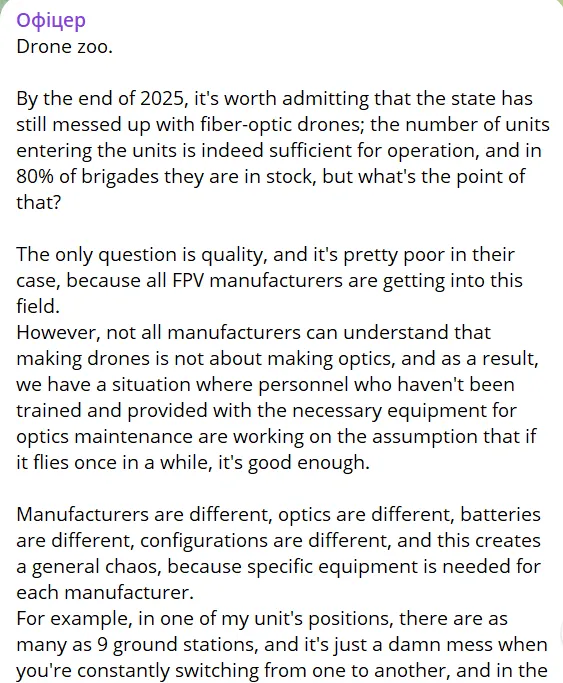
"There is great chaos under heaven; the situation is excellent."

User avatar
blindpig
Posts: 15306
Joined: Fri Jul 14, 2017 5:44 pm
Location: Turtle Island
Contact:

Re: Footnotes from the Ukrainian "Crisis"; New High-Points in Cynicism Part V

Post by blindpig » Sun Feb 08, 2026 1:24 pm

The risk of peace
Published by @nsanzo ⋅ 08/02/2026

Image

“There are those in the West who don’t oppose a long war because it would mean exhausting Russia, even if that means the disappearance of Ukraine and costs Ukrainian lives,” Ukrainian President Volodymyr Zelensky stated in a moment of remarkable clarity. It was March 2022, just weeks after the Russian invasion. His spokesman, Oleskiy Arestovich, was already using the rhetoric that Russia was just a few attacks away from running out of missiles, and Kyiv and Moscow were negotiating in Istanbul, without international mediation, what nearly became a peace agreement. With the Ukrainian capital practically besieged and no sign from its Western allies of providing Ukraine with the equipment and personnel necessary to militarily defeat Russia on the front lines, Ukraine had opted to negotiate.

However, Zelensky's words were not a rebuke to his allies for encouraging the continuation of the war instead of peace, but rather a way to demand a massive arms shipment that would allow Ukraine to quickly defeat Russia. With each passing week, and Russia bogged down in the trenches surrounding the capital and embroiled in an urban battle for Mariupol that would drag on for weeks, Kyiv began to rely on its allies' ability to mobilize offensive military assistance and on its army's capacity to halt the Russian offensive. Boris Johnson's visit to Kyiv was not intended to force Ukraine to continue fighting and thus prevent a settlement, but rather to promise that Zelensky and Zaluzhny would have the necessary support to do what they wanted: continue fighting and avoid having to make the harsh concessions Russia was demanding, especially regarding security.

Nearly four years later, destruction continues to pile up in Ukraine and parts of Russia. Russian missiles are decimating Ukrainian energy infrastructure and condemning the population to sub-zero temperatures even inside their homes, while Ukrainian drones and artillery are attempting to do the same in Belgorod and against Russian oil interests . Zelensky 's words from March remain just as relevant. When asked whether it is time for the European Union to resume direct dialogue with Russia, among other things to avoid depending exclusively on the US position in the war, Kaja Kallas insisted last month that the concessions Washington is making are sufficient and that there is no need to open any channels of dialogue beyond a new package of sanctions. The dramatic situation faced by the Ukrainian civilian population has not changed the EU's calculations, which continues to view the war as a zero-sum game in which to wear down its Russian enemy. As in 2022, there is no interest in fostering negotiations that would achieve a minimal agreement to halt the Russian advance and the bloodshed, and to create a security architecture that avoids a scenario similar to that of North Korea. Continuing the war until the Kremlin can be forced into a surrender negotiation, or failing that, imposing an armed peace in which Ukraine plays the role that Israel plays for the United States, are the clear priorities of Brussels and the European capitals, prepared to fight Russia to the last Ukrainian, constantly promising that the new sanctions will achieve what the previous dozen packages failed to do, and that Russia, with unsustainable casualties, will not be able to sustain the fight much longer.

From across the Atlantic, it has fallen to Trumpism to offer the minimal realism absent in Europe. Unlike European countries, the United States, which has skillfully leveraged its position of strength with its allies to ensure its military contributions generate profit rather than expense, has recognized that war cannot last forever. Washington has secured a continental rupture that will persist beyond the war and prevent the resumption of normal economic relations between Moscow and European countries—a situation that will primarily benefit the American energy sector. As the leading industrial power, the United States will also profit from European rearmament. The White House has also secured an agreement granting it privileged access to Ukraine's mineral wealth. Beyond Ukraine, the United States has taken all necessary steps to try to wrest a significant portion of its energy market customers from Russia.

Perhaps because it has already gained everything it could from this war, the United States is the actor most eager for a resolution. Yesterday, the Ukrainian president stated that Donald Trump has given Kyiv and Moscow until June to reach an agreement, an attempt to impose a time limit on negotiations that risk following the same path as those in Istanbul. As academics and experts like Sergey Radchenko and Samuel Charap, who had access to the working documents, were able to confirm, Russia and Ukraine were negotiating very specific issues regarding military conditions following a ceasefire. Those who have obtained information about this week's negotiations say the process is similar at this point. Just as four years ago, the risk for Russia and Ukraine is focusing on the most basic aspects of how to implement the measures necessary to sustain a truce without having much chance of creating the political framework that would make the agreement viable.

According to the Ukrainian president, the White House has convened the next round of negotiations between Russia and Ukraine, the first two meetings of which took place in the United Arab Emirates, a US-backed initiative that exerts pressure on both sides and also aims to keep the process under strict control. As Zelensky indicated, “the elections are more important to them.” The government's actions in cases like Minnesota, high inflation, and the poor results obtained by Trump-backed candidates in recent midterm elections are forcing Donald Trump to focus on domestic politics and limit his foreign policy attention to issues considered priorities: China, Iran, and the Caribbean. “They say they want to do everything by June…so that the war ends. And they want a clear timetable,” Zelensky insisted, in words that foreshadow pressure on both Kyiv and Moscow.

“Zelensky stated that Washington had also asked Kyiv and Moscow to agree to a new ceasefire covering attacks on each other’s energy infrastructure, as a limited de-escalation measure during the peace talks. Ukraine, he said, was prepared to halt its attacks on Russia’s oil and gas facilities, as well as on its clandestine fleet of tankers that it has attacked in the Black Sea and the Mediterranean,” explains the Financial Times , without mentioning that Ukraine has already sought an alternative target to replace its attacks on Russian refineries: the city of Belgorod, the target of constant attacks against primarily civilian targets.

As is always the case when the possibility of peace draws near, certain fears have begun to surface in Ukraine. Although the bilateral nature of the negotiations has always implied the possibility of a dual peace agreement between the United States and Ukraine, and between the United States and Russia, Kirill Dmitriev's recent visits to the country seem to have provoked a reaction from Zelensky, who on Friday warned of the danger of Moscow reaching an agreement with Washington without Kyiv's involvement. In reality, for several weeks now, this has been the most likely scenario, not at Ukraine's expense, but rather to its benefit, since it would be the only way to determine borders and the security structure without Kyiv having to recognize de jure or de facto admit the loss of territory. However, Zelensky's limited trust in his partners and the fear that an economic agreement could revive political relations between Western countries and Russia have drawn criticism from Ukraine. “Given the potential risks, the Ukrainian delegation conveyed the position that, if bilateral agreements exist between Russia and the United States, the provisions related to Ukraine cannot contradict the Constitution,” Zelensky stated, in a clear reference to the possibility that Washington might recognize Russian sovereignty over some Ukrainian territories. But Ukrainian concerns are not limited to political issues; they also extend to the possibility of preferential relations between Russia and the United States, which would significantly reduce Ukraine's economic importance to Washington.

“The intelligence services showed me the so-called ‘Dmitriev package’ that he presented in the United States, which amounts to about $12 trillion,” Zelensky said, describing it as a proposed framework for large-scale economic cooperation between the United States and Russia. Zelensky added that Kyiv has also seen indications that potential bilateral agreements between the United States and Russia could include provisions related to Ukraine. “We clearly state that Ukraine will not support even potential agreements concerning us without our participation,” he affirmed, The Kyiv Independent reported yesterday .

With a deadline set for achieving peace, Ukraine must ensure that any delay or failure is blamed on Russia and that relations with Kyiv are perceived in Washington as more important than those with Moscow. Whether in Moscow or Miami, Kirill Dmitriev's task is to use economic leverage, offering lucrative deals to American companies, to achieve precisely the opposite: to make the United States see Russia as a better opportunity than Ukraine. This is either to pave the way for peace or to position Ukraine favorably should these months of intensified negotiations fail.

https://slavyangrad.es/2026/02/08/el-riesgo-de-la-paz/
Google Translator
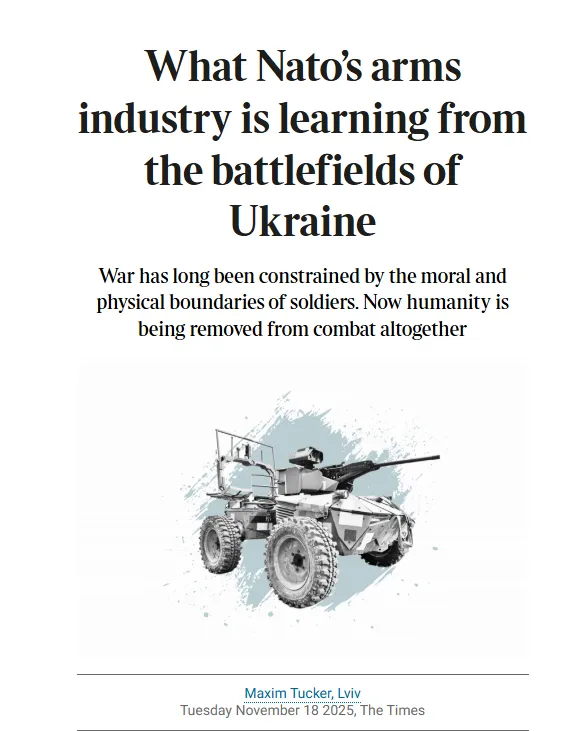
*****

From Cassad's telegram account:

Colonelcassad
1:11
The Donbas Dome electronic warfare system prevented 205 terrorist attacks by the enemy over the past week. 174 drones were destroyed over Donetsk and Makiivka, and 31 over Horlivka.

The enemy continues to attempt to attack the Republic's energy infrastructure with attack drones.

Ukrainian terrorists again attempted to hit the Starobeshevskaya Thermal Power Plant. An FP-1 fixed-wing drone with an OFB-60-YaU high-explosive fragmentation warhead was intercepted.

In the Yasynuvata District, two Baba Yaga drones were shot down; they were being used by the enemy as "mother drones" for delivering small attack drones to the busy Donetsk-Horlivka highway for strikes against civilian transport.

An FP-2 attack drone armed with an OFB-90-YaU warhead with additional submunitions was suppressed near Mariupol.

An FP-1 drone armed with an FP-60-03 high-explosive fragmentation warhead was intercepted near a power distribution substation in the Amvrosiivka district.

A swarm of FPV drones armed with improvised explosive devices based on shaped-charge grenade launcher rounds was intercepted in Horlivka.


***

Colonelcassad
Sevastopol. Governor Razvozhaev reports.

Until approximately 11:00 PM, the fleet will conduct preventative measures against underwater sabotage forces and assets (UDFs) in the area of ​​the Northern and Southern Moles, Streletskaya, Kamyshovaya, Karantinnaya, and Kazachya Bays, Cape Khersones, Balaklava, Laspi, Cape Lukull, and Kacha.

Firing exercises from various weapons, grenade launches, and rocket bombing are planned.

Multiple explosions will be heard, so I warn you in advance.

***

Colonelcassad
0:34
Ukrenergo reports that nuclear power generation is still under load. The level of capacity shortages prevents emergency outages from being lifted in most regions.

Earlier, Ukrainian media reported that Ukrainians had already purchased batteries and power banks with a capacity comparable to that of nuclear power plants.

https://t.me/s/boris_rozhin

*****

Brief Frontline Report – February 7th, 2026

Summary by Marat Khairullin and Mikhail Popov
Zinderneuf
Feb 07, 2026

Image
Kharkov Oblast (North-East); Area of the Buffer Zone

Image
Buffer Zone: Volchansk-Degtyarnoe-Melovoe; The yellow line represents the line of combat contact July 17, 2025. The dotted area is the “Buffer Zone” formed thus far.

Message from the Russian Ministry of Defense: "Units of the 'North' Group, as a result of decisive actions, have established control over the settlement of Chugunovka in Kharkov Oblast."

Following the ongoing operations of the "North" group on the Volchansk sector of the Kharkov direction, the Velikiy Burluk sector has become active again. On the right flank of this sector, the settlement of Melovoe was liberated on July 7, 2025, and Russian units began moving south and southwest from the state border, along a system of ravines, enveloping the Ukrainian Armed Forces' defensive hub of Grigorovka-Kolodeznoe-Mitrofanovka, which was created with reliance on the Verkhnyaya Dvurechnaya River.

Image

The enemy was forced to transfer formations from other directions to this sector to eliminate the threat that had arisen over the Bely Kolodez and Velikiy Burluk settlements. These two settlements are key centers of the Ukrainian Armed Forces, where command posts of troop groupings covering the Volchansk and Velikiy Burluk sectors of the Kharkov direction are located, and where rear support and supply areas have been established.

Image

On February 7, the settlement of Chugunovka (50°10′59″ N 37°36′26″ E, population 170 in 2001) was liberated. Russian Armed Forces have reached the T-21-04 highway Olkhovatka-Prikolotnoe-Bely Kolodez. In operational terms, converging strikes from Volchansk to Bely Kolodez and Chugunovka to Prikolotnoe cut off a significant part of Kharkov Oblast (a triangle with its apex at the Degtyarnoe settlement and its base along the T-21-04 highway). In tactical terms, this provides the possibility for Russian units to reach the Olkhovatka-Prikolotnoe line creating a wide envelopment of the Veliky Burluk hub from the north and control of the heights along the watershed ridge of the Plotva and Veliky Burluk rivers with their system of ravines and drainage channels.

Image

I circled the Platva and Velikiy Burluk rivers. The watershed ridge is a high-point of elevation between two rivers.
After the final resolution of the task in the Kupyansk area and the blocking of the Oskol grouping of the Ukrainian Armed Forces, an interesting operational-strategic operation by the Russian Armed Forces will unfold in these neighboring sectors.

https://maratkhairullin.substack.com/p/ ... bruary-7th

******

Ukraine – Long-term Countrywide Blackouts – U.S. Presses For Peace Agreement

Last night another large Russian missile and drone strike further degraded the already severely damaged electrical energy system of Ukraine.

The main targets were around Kiev and in western Ukraine. The attack, especially in western Ukraine, was mostly by drones and subsonic cruise missiles. Except for Kiev air defense seems to have been absent or out of munitions.

Image

The consequences are countrywide blackouts for a prolonged period of time (machine translation):

Ukrenergo reported that due to strikes on the power system, emergency blackouts are introduced in most regions of Ukraine.

Ukrainian publics write that substations connected with the Rivne [Nuclear Power Plant] were attacked.

It is also stated that drones and missiles attacked the Burshtyn, Ladyzhyn, Dobrotvorskaya and Trypillya thermal power plants.

Energy Minister Denys Shmyhal said that the target of today’s strike was substations and overhead power lines with a voltage of 750 and 330 kV — the basis of the Ukrainian energy system.

According to him, the power units of Ukrainian nuclear power plants were unloaded (that is, urgently stopped – Ed. ).


The nuclear power plants (NPP) create the base load of the Ukrainian energy system. The thermal power plants and other sources usually balance the peak loads. But after several substations which connect the NPPs to the wider network were being hit the NPPs were forced to reduce power (machine translation):

Ukrenergo said that all power units of Ukrainian nuclear power plants in the controlled territory were “forced to be unloaded” due to strikes on substations of electricity transmission and distribution systems.

“This indicates a reduction in power. We are not talking about a complete shutdown,” said Yuriy Korolchuk, an analyst at the Institute for Strategic Studies.

One of the main reasons for unloading – during the attack, the largest 750 kV substation in the Lviv region was damaged, which “hooks” the branch line from both the Rivne and Khmelnitsky nuclear power plants and through which electricity is partially imported from Europe.

“If we focus on Ukrenergo’s data on the forced unloading of all units (and there are 9 of them at Ukrainian NPPs), and focus on the standard power reduction after the attacks (by 200-300 megawatts for each unit), it turns out that at one point the deficit in the system could have increased by 2.7 GW. Taking into account the previous missing 5 GW (the deficit in recent days has slightly decreased due to rising temperatures), the total shortage of electricity is up to 8 GW, or about 50% of the total estimated consumption,” says Korolchuk.


The unplanned ‘unloading’ of an NPP will inevitable degrade its systems. During the summer two of the nine available NPPs in Ukraine will need a multi-months shutdown for larger repair work. Two others are expected to shut down for several weeks.

Repair parts for transformers and network switching equipment are lacking while the lead time for new parts is exceeding six months.

For many months ahead Ukraine will have to live with just 50% or less of the needed electrical power. Further Russian attacks are likely to hinder repairs and may cause additional damage.

Due to the sever lack of power nearly all industrial production in Ukraine will come to a halt. Drone and ammunition supply for the frontline will further decrease.

Ukraine continues to wage its own energy war against Russia. Last night the Russian city of Belgograd experienced another blackout after its electricity network was hit by several HIMARS missiles. This is inconvenient for Russia but not comparable to the huge damage caused in Ukraine.

Meanwhile Reuters reports that the U.S. is in a hurry to push Ukraine towards a peace agreement:

U.S. and Ukrainian negotiators have discussed an ambitious March goal for Russia and Ukraine to agree on a peace deal, though that timeline is likely to slip given a lack of agreement on the key issue of territory, according to three sources familiar with the matter.

Under the framework being discussed by U.S. and Ukrainian negotiators, any deal would be submitted to a referendum by Ukrainian voters, who would simultaneously vote in national elections, according to five sources, who requested anonymity to discuss private deliberations.

U.S. negotiators have said Trump is likely to focus more on domestic affairs as the November congressional midterms approach, meaning top U.S. officials will have less time and political capital to spend on sealing a peace accord, two sources said.

But several sources with visibility into the negotiations described the U.S.-proposed timeline as fanciful.


For various reason the acting president of Ukraine and European leaders currently do not want a peace agreement in Ukraine. That the U.S. is in a hurry to conclude one plays in their favor. Unless the U.S. immediately starts to use very severe pressure there is not chance for coming close to ending the conflict.

Posted by b on February 7, 2026 at 15:48 UTC | Permalink

https://www.moonofalabama.org/2026/02/u ... ement.html

*****

Killing the negotiators

Assassination attempt on Russian military intel general. Budanov vs Poklad. Back to the 2022 Kireev killing. MI6 vs CIA once again?
Events in Ukraine
Feb 06, 2026

Yet another Russian general has been subjected to an assassination attempt. We’ll go through what exactly happened, then examine a number of possible explanations for the attack. This will lead us onto the deep conflicts in the Ukrainian intelligence apparatus — behind the CIA-trained, pro-ceasefire Kirillo Budanov, and the dark, MI6-linked figure of Oleksandr Poklad, also known as ‘the strangler’.

The shooting
According to Russian media, general Vladislav Alekseev survived the February 6 attempt on his life, despite having received three bullets.

Image

Before, a quick irony. Alexeev, one of Russia’s most patriotic and beloved war heroes, was born in the central Ukrainian village Holodki, Vynnytsia oblast. Meanwhile, head of Ukraine’s army Oleksandr Syrsky was born in the Russian village Novinki, Vladimir oblast. Ukraine’s branch of radio free Europe found that Alexeev had even visited his home village in 2014, after the victory of the euromaidan. His relatives recall that he had told them there would never be war with Russia - ‘not in my darkest nightmares’.

Anyway, back to the attempt on Alexeev’s life. The prominent Russian publication Kommersant released some interesting details today about what exactly happened. At around 7am, Alexeev left his modest apartment in Moscow to go to work. As an aside, Ukrainian ex-intelligence officers told radio free Europe today they were surprised that Alexeev lived in such an unpretentious area, let alone that he lacked security.

Image
Russian investigators at the scene of the crime

Anyway, Alexeev didn’t make it to the driver waiting outside. The assassin, supposedly disguised as a food deliveryman, had already entered the building.

The shoot wounded Alexeev in the arm and leg, but the general fought back and tried to wrest the pistol away. In the process, he was shot again in the chest, but this active resistance seemed to have saved Alexeev from death. He is now comatose in intensive care, as one of the bullets hit a major organ. The shooter remains on the loose, though law enforcement has footage of his appearance. Some other reports claim that it was a female shooter.

One of many
Of course, Alexeev certainly isn’t the first high-level Russian general attacked recently. Ivan Stupak, a SBU (Security Services of Ukraine) officer interviewed today by Radio Svoboda (Ukraine’s branch of Radio Free Europe) said that no less than four Russian generals have been killed by Ukrainian intelligence agencies. Alexeev is relatively unique in having survived.

Ukrainian Militant, a telegram channel associated with Ukrainian military intelligence (GUR), gloated about the attack as yet another in a long string of successful operations. These killings were named:

Oleg Yuryevich Tsokov - Lieutenant General, Deputy Commander of the Southern Military District.
Killed in a July 2023 missile attack on a Russian Armed Forces position during combat operations in the Zaporizhia region.

Oleg Tsokov - Wikipedia

Image

Valery Trankovsky - Captain 1st Rank, Chief of Staff of the 41st Missile Brigade of the Black Sea Fleet.
Killed in a November 2024 car explosion in Sevastopol (Crimea).

Image

Dmitry Vladimirovich Golenkov - Pilot, Chief of Staff of the Aviation Squadron of the 52nd Heavy Bomber Aviation Regiment of the Russian Aerospace Forces (Tu-22M3).
Killed. Found in November 2024 with multiple head injuries (presumably inflicted with a hammer) in the Bryansk region.

Russian colonel bludgeoned to death with 'hammer of justice'[/i]

Image
Note - the watermark is that of Ukraine’s Main Intelligence Directorate (GUR)

Igor Kirillov - Lieutenant General, Head of the Radiological, Chemical, and Biological Defense (RCBD) Troops of the Russian Armed Forces.
Killed in a December 2024 explosion of a concealed explosive device on an electric scooter near his home in Moscow.

Image

Yaroslav Yaroslavovich Moskalik - Lieutenant General, Deputy Chief of the Main Operational Directorate of the General Staff of the Russian Armed Forces.
Killed in an April 2025 car explosion in Balashikha (Moscow Region).

Image

Mikhail Gudkov - Major General (Deputy Commander of the Navy/High-ranking Naval Officer).
Killed in a July 2025 attack on a position in the Kursk region.

Image

Fanil Fanisovich Sarvarov - Lieutenant General, Head of Operational Preparation of the General Staff of the Russian Armed Forces.
Killed in a December 2025 car explosion in Moscow.

Russian general Fanil Sarvarov killed in Moscow car bombing, officials confirm

Image

Vladimir Alekseev - Lieutenant General, Deputy Chief of the GRU of the Russian Armed Forces.
Shot in the entrance of his home. Status to be updated.


As Stupak, the former SBU officer told Ukrainian media, the SBU generally doesn’t actually take responsibility for these killings. Accordingly, both the SBU and the Ukrainian government have so remained silent on the matter.

A big fish in the aquarium
Alexeev was a very important figure in Russia’s Main Directorate of the General Staff of the Armed Forces of the Russian Federation, formerly known as the GRU. It is also colloquially called ‘the aquarium’, particularly by its denizens.

Image
Putin in the GRU aquarium. The bat is its symbol. The Ukrainian GUR uses an owl.

As you may recall from my articles on the Russian patriotic spook novelist Alexandr Prokhanov, the GRU has the reputation of being a stronghold of nationalist, anti-western, active operations, perhaps even at conflict with the KGB/FSB, an institution with more blurred loyalties.

Alexeev had the codename ‘Omega’, though he was often simply called ‘Stepanych’ by his adoring subordinates. He has been first deputy head of the GRU since 2011, living through three heads of the institution. As I wrote in a recent article, it is a long tradition in Soviet/post-soviet intelligence agencies for the deputy heads to play a more important role than the putative directors.

In other words, Alexeev is one of the most important individuals in the Russian intelligence community.

Image

In particular, Alexeev was responsible for coordinating various paramilitaries and covert operations. Ukrainian military intelligence calls him a ‘war criminal’ and accuses him of responsibility for interference in the 2016 US elections, including cyber-attacks on the Democratic Party.

Since its 2014 creation, Alexeev was often named the main curator of the Wagner PMC. ‘Stepanych’ quite beloved by the Russian military patriotic community. Since 2022, he has been in charge of coordinating and creating various volunteer units in the Russian army, like PMC Redan and the right-wing hooligan unit Espanyola.

Alexeev’s status as the country’s chief specialist in so-called ‘hybrid warfare’, naturally, makes him a major target for Russia’s enemies.

The internal angle
Alexeev was also in charge of conducting negotiations with Evgeny Prigozhin in Rostov during his 2023 mutiny.

Alexeev was sent because of his closeness to the structure he himself had partly created. In fact, if anyone in the Russian elite were to have supported the uprising, it would have been Alexeev. Once Alexeev publicly went again the uprising, it was clear that Prigozhin was doomed. Nevertheless, there were ambiguities. Alexeev called for Prigozhin to cease his mutiny in order to ‘prevent civil war’, but this was hardly the harsh condemnation of Prigozhin as a traitor that Putin, for instance, made.

And when he was sent to negotiate with Prigozhin in Rostov, Alexeev was filmed joking that if he wanted, Prigozhin could ‘take’ the minister of defense Shoigu and head of the general Staff Gerasimov.

Image
The laughing Alexeev is on right

Following the end of the mutiny, western media claimed that Alexeev was detained, suspended from his position, and placed under observation due to his closeness to the traitor Prigozhin. Since then, however, Alexeev has clearly returned to his usual activities.

Consequently, the Washington Post has posited that ‘internal conflicts’ in Russia’s security apparatus were behind Alexeev’s death:

Targeting him at a time when his superior, Kostyukov, was taking part in U.S.-led negotiations to end the war could risk derailing those talks and angering the Trump administration, officials said.

Ukraine’s security services “have done these hits in the past but it would be pretty crazy of them to do it now,” said a former senior U.S. intelligence official.

The former official also noted the involvement in those negotiations of Kyrylo Budanov — the former head of Ukraine’s military intelligence directorate and now Zelensky’s chief of staff — raising the stakes for Kyiv if Budanov’s former agency was shown to be linked to the attempted assassination.

“We are not stupid, believe me,” said a former senior Ukraine security official who worked closely with Budanov.

The former official, who spoke on the condition of anonymity to discuss sensitive information, said it was “much more likely” that the attempt on Alekseyev was related to a “domestic issue” including the general’s role in quelling a 2023 uprising of the Wagner Group, the powerful Russian paramilitary force.<


Some of Ukraine’s more unscrupulous political commentators have also been pushing this line. An entertaining idea, though waiting two and a half years to launch a failed assassination seems rather odd.

To be fair, there were also some in Russia who put forth this narrative. One of them was Maksim Shevchenko, an intellectual and politician who can be identified as a more leftwing and anti-western representative of the Dugin network. He hypothesizes that ‘the closer we get to the end of the war, the tougher the purges of those who have willpower, patriotic views, respect for the people, and military experience’.

Image
Shevchenko

More objective Ukrainian analysts, like the former SBU officer interviewed by Radio Svoboda, also rejected this hypothesis. As this SBU officer pointed out, if the Russian government was really displeased with Alexeev, then the Russian FSB would have simply arrested him. They probably did so in 2023, and there is nothing stopping them from doing it again now. Why on earth would they try to assassinate him, failing in the process?

The negotiations angle
Said SBU officer was more confident that the killing had something to do with negotiations, though he didn’t say how exactly. Igor Kostyukov, head of the GRU and Alexeev’s boss, is currently involved in the Abu Dhabi negotiations with representatives of Ukraine’s military, military intelligence (GUR), and security services (SBU).

Image
Abu Dhabi negotiations between Ukraine, Russia, and the US. Kostyukov is second from right. Budanov is fourth from left.

And Alexeev himself has long been responsible for coordinating POW exchanges with the Ukrainian side. In this capacity, Alexeev was one of, if not the only Russian official to repeatedly meet with the head of Ukraine’s military intelligence, Kyrylo Budanov.

As a result, Russian foreign minister Lavrov has already called the attack an attempt by Ukraine to sabotage negotiations:

The terrorist attack against Lieutenant General Alekseev confirmed the Zelensky regime’s intention to disrupt the negotiations… [this is an attempt to] derail the US from its course towards achieving a fair settlement.

Ukrainian political analyst Konstantin Bondarenko also admits of the possibility that this shooting was organized by a relatively independent ‘third force’ interested in sabotaging negotiations. He names the British, naturally. He also has this to claim about ongoing peace talks:

Image

It’s worth noting that Bondarenko’s claims about progress at negotiations aren’t particularly believable. At any rate, the Ukrainian publication strana notes that there has been no public information justifying such a conclusion.

In particular when it comes to the only important question — whether Ukraine will abandon the Donbass. Yesterday, Zelensky made yet another statement that his army will never agree to such a withdrawal. Both Russia and Ukraine are confident that they need not make significant compromises, and are only engaging in the talks out of the fear that refusing to participate would anger Washington.

Other explanations
There are many on the Russian side who are also unconvinced that Alexeev was attacked due to his role in negotiations. Daniel Bezsonov, ex-speaker of the army of the Donetsk People’s Republic (DNR), angrily denied any connection between the attack and negotiations, writing that Alexeev’s justified reputation as a powerful foe of Ukraine was behind the attempted assassination.

Image
Bezsonov

Even if it wasn’t due to negotiations, the blame will fall on the Ukrainians, naturally. And plenty of figures in the country have already quite strongly hinted that they were behind the attack.

Head of Azov’s 1st National Guard Corps, Denis Prokopenko, wrote that the assassination attempt was an act of revenge, promising that if Alexeev survived, he would still never be able to rest peacefully. Keep in mind that Prokopenko, being the commander of the Azov unit that surrendered in Mariupol in early 2022, himself spent time in Russian captivity and is intimately involved with the POW exchange process:

Image

Image

(Much more at link.)

https://eventsinukraine.substack.com/p/ ... egotiators

******

Terrorism and sabotage: Kiev is now without hope

Lorenzo Maria Pacini

February 6, 2026

The war in Ukraine is characterized by a profound imbalance of resources, weaponry, and industrial potential. It has become such a fierce meat grinder that even the Ukrainians themselves no longer believe in their leadership. The desperate attempt to alter the state of affairs with the assassination of General Alexeyev is a risky move that defies all common sense and balance.

Until the very end

Anyone who thought that Volodymyr Zelensky and his criminal clique would stand firm in the face of attempts at reconciliation between Russia and the United States of America was sorely mistaken.

In Kiev, they have no hope left and know exactly what to do when all is lost: seek the impossible, derail any diplomatic solution, destroy what remains and, if possible, escalate the situation. It does not matter if this means seeing Ukraine set ablaze, or if it means sacrificing more young men torn from their future to die in the trenches of the saddest war of the century: for Zelensky, the only solution is to harm Russia, and he will not stop.

On the morning of February 6, 2026, Lieutenant General Vladimir Alexeyev, first deputy head of the GRU, was shot several times in the back at his residence. After emergency surgery, he is now in critical condition. The attacker fled.

The intent is very clear: the Kiev government does not want peace under any circumstances. Once again, with yet another demonstration, they do not want peace. They prefer to see soldiers die and the people suffer. They prefer to be remembered as saboteurs of the only chance for peace, rather than as contributors to that peace. The Western media deny and will continue to deny this truth, but it does not change: the Ukrainian government does not want peace.

A major attack on Russian territory is extremely serious in many respects. In a context of prolonged conflict such as that between Russia and Ukraine, any operation that crosses national borders can irreparably damage the fabric of international negotiations and reinforce the argument for uncontrolled escalation.

On the diplomatic front, Moscow is entirely justified in considering this terrorist operation as a further violation of its territorial sovereignty. Peace negotiations, already stalled or heavily influenced by the opposing positions of the parties in conflict and their allies, would risk suffering a significant setback. The United States, the European Union, and other international mediators would face a dilemma: publicly condemn the action to safeguard the legitimacy of the diplomatic process, or downplay it and seek compromises so as not to further alienate Kiev from a possible agreement.

In this scenario, the action, presented on the one hand as a legitimate response to incursions or pressure on the battlefield, is perceived as a deliberate attempt to sabotage the dialogue. The logic is simple: provocations of this kind can radicalize positions, consolidate nationalistic rhetoric, and reduce the willingness of the parties to find common ground. The immediate effect is greater mutual distrust, with a corollary of strengthened security measures, withdrawals of negotiating delegations, and a possible hardening of pre-negotiation conditions.

Even militarily, this makes no sense. The war in Ukraine is characterized by a profound imbalance of resources, weaponry, and industrial potential. Ukraine alone did not last even a month and had to ask for help from the collective West right from the start, and despite billions and billions of dollars and euros invested, the Ukrainian armed forces continue to suffer defeats. The war has become such a fierce meat grinder that even the Ukrainians themselves no longer believe in their leadership.

The desperate attempt to alter the state of affairs with the assassination of General Alexeyev is a risky move that defies all common sense and balance. From the mediators’ point of view, such events make it more difficult to argue in favor of a ceasefire or controlled de-escalation, as they fuel the narrative that peace is unattainable except on punitive terms for one of the parties. In other words, Kiev is trying to prevent peace with all its might.

US diplomacy, already engaged in balancing support for Kiev with the need to avoid a wider war, will now find itself in a politically and strategically precarious position. Washington may be called upon to dictate more stringent conditions to the Kiev government so that provocative behavior does not compromise the negotiating efforts. However, this will lead to internal tensions, not so much in the US as in Ukraine, where several politicians are tired of Zelensky’s follies.

Useless imbalances

It is true that imbalance is also a weapon, and in the history of international relations, victory over an adversary is not achieved exclusively on the battlefield. Diplomatic imbalance, strategic pressure, targeted destabilization, and even attempts at controlled escalation can become functional tools for achieving political and strategic objectives. Diplomatic imbalance occurs when one party manages to isolate the other internationally, limiting its alliances, access to markets, strategic supplies, or political legitimacy. This reduces the enemy’s ability to sustain a prolonged effort, undermines internal consensus, and fuels divisions among the elites. Diplomacy, in this sense, becomes a force multiplier: it can amplify military results or compensate for difficulties on the ground. But every detail must be carefully calculated, and on this occasion it seems that the comedian in Kiev has gone too far with his joke.

Now this disaster will have to be managed by the Americans themselves. It is unlikely that the operation was orchestrated in concert with the American apparatus, and it would not be the first time that Kiev has made risky choices and risked compromising everything. Even in the media, this event will have a terrible boomerang effect for Ukraine, increasing criticism in public opinion and suggesting that support for this war was a mistake from the outset.

The Americans themselves will have to try to make Zelensky and his henchmen understand, by hook or by crook, that terrorism and sabotage are the sure path not to peace between Russia and Ukraine, but to eternal peace.

https://strategic-culture.su/news/2026/ ... hout-hope/

*****

All nuclear power plants in Ukraine have been shut down.
February 7, 6:13 PM

Image

The IAEA confirmed that, for the first time since the nuclear war, all nuclear power plants in Ukraine have been shut down due to damage to a number of substations.
A decrease in power generation had been previously reported. The strikes on distribution substations were particularly painful.
The cocaine-fueled Fuhrer's hysterics about "nuclear terrorism" are especially amusing, considering that he ordered the shelling of the Zaporizhzhia and Kursk nuclear power plants, as well as the strike of a captured Geran missile on the Chernobyl nuclear power plant, and the provocation of the detonation of a captured Geran missile on the Khmelnytskyi nuclear power plant.

Russia, however, hasn't attacked the nuclear power plants. They simply began disconnecting them from the main power grid, and this immediately produced results. Russia still has enough missiles and drones to cover two or three Ukrainian territories.

https://colonelcassad.livejournal.com/10351148.html

The man who shot General Alekseev came from Ukraine.
February 8, 11:01

Image

The man who shot General Alekseev came from Ukraine.

Official statement from the Investigative Committee of the Russian Federation:

The Investigative Committee of the Russian Federation is investigating a criminal case regarding an attack on Lieutenant General of the Russian Ministry of Defense Vladimir Alekseyev on charges of crimes under Part 3 of Article 30, Part 1 of Article 105 of the Russian Criminal Code (attempted murder), Part 1 of Article 222 of the Russian Criminal Code (illegal trafficking in firearms), and Article 317 of the Russian Criminal Code (attempt on the life of a serviceman).

On February 6, 2026, in a residential building on Volokolamskoye Highway in Moscow, an attacker fired at least three shots at Lieutenant General Vladimir Alekseyev and fled the scene. The victim was hospitalized in a Moscow hospital.

Investigators conducted a thorough inspection at the scene, during which they discovered the murder weapon - a Makarov pistol with an attached silencer and three rounds of ammunition. More than 15 forensic examinations have been ordered, including genetic, fingerprinting, trace evidence, molecular genetic, physical and chemical, and other tests.

Viktor Vasin, an accomplice to the crime, was promptly detained in the Moscow region in cooperation with the FSB and the Ministry of Internal Affairs. Investigative actions are underway with him. He has been charged with crimes under Articles 317 and 222 of the Russian Criminal Code. Furthermore, the involvement of Zinaida Serebritskaya, who left for Ukraine, has been established.

The identity of the perpetrator, who left Russia for the United Arab Emirates a few hours after the crime was committed, has also been established. He is Lyubomir Korba, a native of the Ternopil Oblast of the Ukrainian SSR and now a Russian citizen, born in 1960. Following measures taken by FSB and Russian Ministry of Internal Affairs operatives, investigators from the Russian Investigative Committee, and competent authorities in the United Arab Emirates, the suspect was detained and returned to the Russian Federation. It has been established that Korba arrived in Moscow in late December of last year on instructions from Ukrainian intelligence services to commit a terrorist attack.

Investigative actions and operational searches are ongoing to establish all the circumstances of the crime and identify the perpetrators.

(c) Russian Investigative Committee.

Alekseev is currently hospitalized in serious condition, but is expected to survive.

https://colonelcassad.livejournal.com/10351762.html

The peace agreement in Ukraine was thwarted by Britain in 2022.
February 8, 3:04 PM

Image

Czech Prime Minister Babiš also confirmed that peace in Ukraine was supposed to be concluded in April 2022, but the agreements were thwarted by Western efforts.

A peace agreement was actually close as early as April 2022, but then Boris Johnson appeared. There was an interest in this conflict existing,” (c) Czech Prime Minister Babiš.

Actually, this was no secret before. It was simply another official admission of the obvious.

After Babiš came to power, the Czech Republic refused direct state arms supplies to Ukraine, launched an audit of old supplies and an investigation into theft and corruption in the supply of ammunition to Ukraine, refused to participate in the European loan for Ukrainian armaments, and so on and so forth.

Under Babiš, the Czech Republic predictably joined the coalition of European rebels with Orbán and Fico.

Google Translator
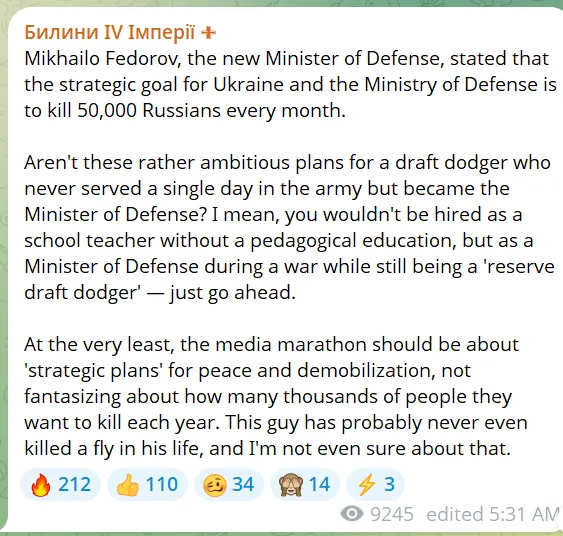
"There is great chaos under heaven; the situation is excellent."
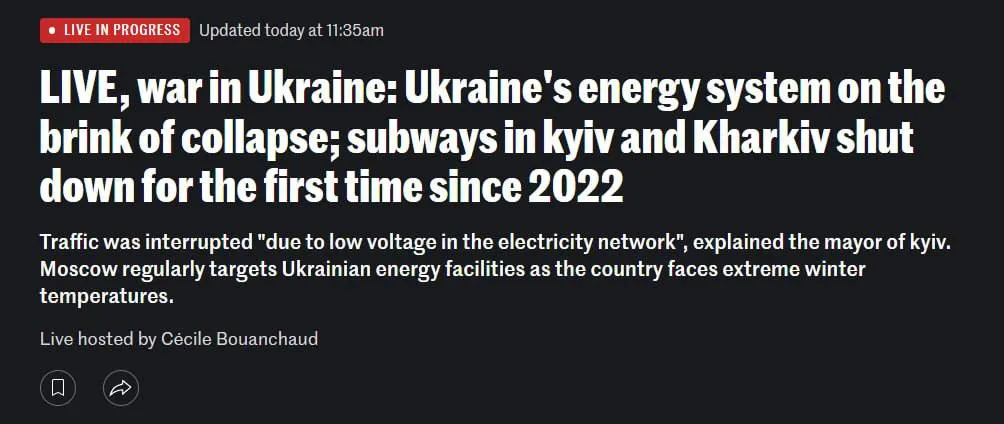
Post Reply