Footnotes from the Ukrainian "Crisis"; New High-Points in Cynicism Part V

User avatar
blindpig
Posts: 15306
Joined: Fri Jul 14, 2017 5:44 pm
Location: Turtle Island
Contact:

Re: Footnotes from the Ukrainian "Crisis"; New High-Points in Cynicism Part V

Post by blindpig » Tue Jan 13, 2026 11:40 am

Trump's man in Ukraine
Published by @nsanzo ⋅ 13/01/2026

Image

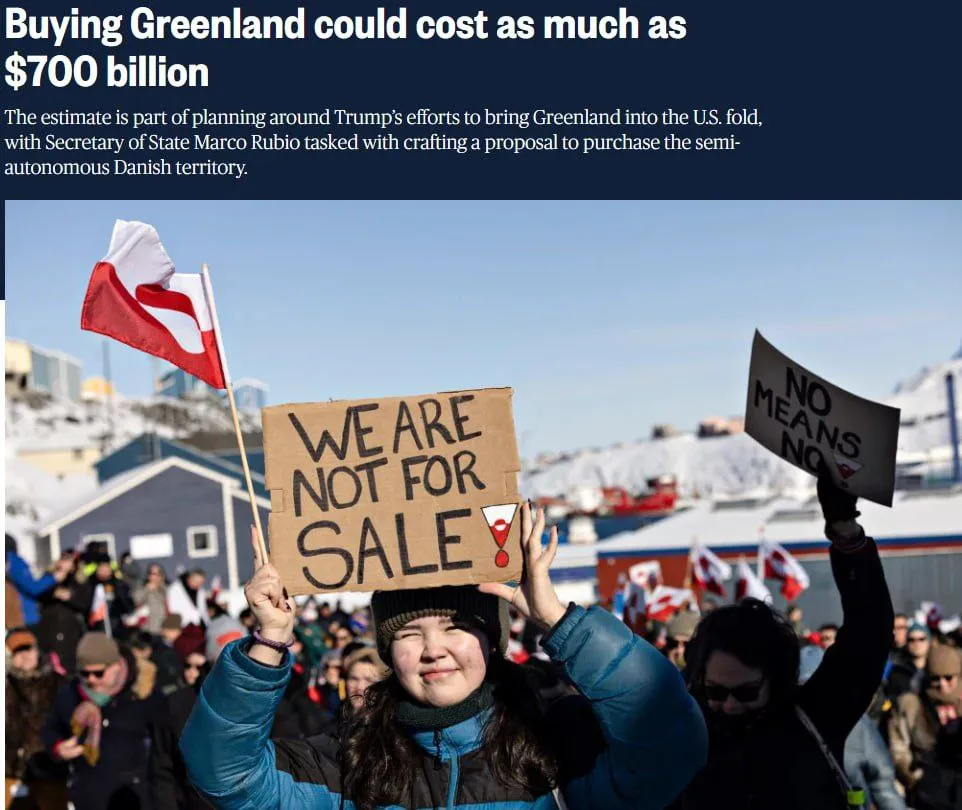
The United States doesn't need Greenland for its natural resources, Donald Trump insisted this week, but for national security reasons. Exaggerating the presence of Russian and Chinese ships to the point of absurdity—ships whose Arctic trade routes don't pass through Greenland—Trump sought to emphasize the danger of infiltration, control, or even capture of the world's largest island if the United States doesn't intervene. And although the US president boasted of his good relationship with Vladimir Putin and Xi Jinping, insisting that he doesn't expect any further attacks against Ukraine or an invasion of Taiwan, respectively, the supposed threat posed by these two powers is useful in suggesting that NATO is incapable of protecting the territory and in insisting that Denmark must sell it to the United States. "I don't want China or Russia as neighbors," he declared publicly, forgetting that, in the Bering Strait, Greenland is already a neighbor of Russia. That was precisely one of the key messages of the Alaska summit. Despite Trump's rhetoric, three strongly interrelated aspects—the territory's strategic military position, its proximity to future Arctic trade routes, and its natural wealth—form the basis for Donald Trump's interest in Greenland, an idea that, according to John Bolton, was presented to him by Ronald Lauder. Heir to the Estée Lauder cosmetics fortune, the billionaire, a friend of Donald Trump since their university days, is a recurring figure in the worlds of business, politics, and even diplomacy.

In its report on the awarding of the first major contract for the exploitation of Ukrainian natural resources under the minerals agreement signed last year by Scott Bessent and Yulia Svyrydonova to a consortium led by Ronald Lauder, The New York Times notes that, according to John Bolton, it was Bolton who convinced Donald Trump of Greenland's importance. Having recently stepped down from the Estée Lauder board, the billionaire is poised to become a model for other American companies in Ukraine in the exploitation of lithium, a key mineral in battery production. Raw materials—primarily confirmed reserves of rare earth elements, uranium, and iron, in addition to potential oil and gas deposits—were the initial reasons for the Trump administration's interest in Greenland, although Lauder's aim was not to acquire ownership, but rather the right to exploit the territory. In other words, to do in that region under Danish control what his consortium will be able to do in Ukraine.

Determined to acquire Greenland, according to a 2022 New York Times article , Lauder “offered himself as an unofficial negotiator to buy Greenland from Denmark, according to a new book. Denmark said no.” Politics, diplomacy, interference in other countries, and the idea of ​​acting as a backchannel , an unofficial mediator, were new to Lauder, a veteran of the Atlanticist and Zionist cause who, during the Reagan years, used the revolving door between big business and government to become Under Secretary of Defense for European and NATO policy and ambassador to Austria, an important neutral country in Europe during the final years of the Cold War. The positions Lauder has held throughout his political career and his ideological stances have never been accidental and have always aligned with the hardline wing of the American right, both in Atlanticist politics and in the post-Cold War capitalist expansion in Eastern Europe, as well as in his leadership of the World Jewish Congress, a Zionist group close to Netanyahu's party. As his photograph with Jolani demonstrates, Lauder also acted as a mediator between Syria and Israel in the normalization of relations with the new Syrian jihadist government.

His position as president of the World Jewish Congress and the connections afforded by leading a global organization are two of the key aspects Peter Korotaev highlights in his blog post, Events in Ukraine, to detail Lauder's long career in Eastern Europe, including Ukraine. As an article published by The New York Times explained just days before the Oval Office meeting nearly derailed the minerals agreement negotiations, Lauder was one of the key figures in the idea's emergence. The campaign was launched after politically connected US investors began showing interest in Ukraine's underground wealth in late 2023, despite the war that had been raging since 2022. According to a letter addressed to Zelensky and reviewed by The New York Times , a consortium formed by TechMet, an energy investment company partly owned by the US government, and Ronald S. Lauder, a wealthy friend of Trump, committed to Kyiv to submit a bid for a Ukrainian lithium deposit. Pending final confirmation, Lauder and TechMet have secured the contract to exploit the lithium, the result of a mineral extraction agreement born from their vision of sharing Ukrainian wealth for the benefit of the United States. But their presence in Ukraine has not historically been limited to mineral extraction; it has focused on the media ecosystem, an aspect that Western countries considered fundamental in imposing their narrative and consolidating capitalist restoration and the Euro-Atlantic turn. The Western powers wished to consolidate their power in Ukraine.

Interestingly, the channel acquired by Lauder is none other than 1+1 , which would later become the television network with which Volodymyr Zelensky and his studio, Kvartal 95, would collaborate—a breeding ground for a significant portion of the current Ukrainian government. Lauder's acquisition came at the initiative of Alexander Rodnyasky, the man who, in 2022, would organize, along with Roman Abramovich, the Russia-Ukraine negotiations in Istanbul that nearly resulted in a peace agreement. “At the invitation of 1+1’s original owner, the aforementioned Ukrainian businessman Aleksandr Rodnyansky (who spent most of the 2000s and 2010s in Russia), Lauder’s Central European Media Enterprises (CME) acquired 30% of 1+1 . Lauder paid $22 million for that 30% stake. In 2008, Lauder’s CME purchased the remaining shares of 1+1 for $220 million,” explains Peter Korotaev.

“He came to us himself. CME was founded in 1993 by two former US ambassadors: Ronald Lauder to Austria and Mark Palmer to Hungary. The idea of ​​creating private, independent television companies in Central and Eastern European countries was a natural one. Palmer was the ideological driving force behind the process. The billionaire Lauder was able to invest in the project. Highly successful television channels were established in the Czech Republic, Slovakia, Slovenia, Romania, Poland, and Hungary. The Americans were also eyeing Ukraine with interest. In 1995, representatives from CME came here. Six months later, they contacted us. A year later, we “married.” As of January 1, 1997, 1+1 became a fully-fledged television network,” Rodnyatsky explained about the beginnings of the channel considered the first modern, Western-style channel. It seems no coincidence that the network was owned by a company founded by two former US ambassadors.

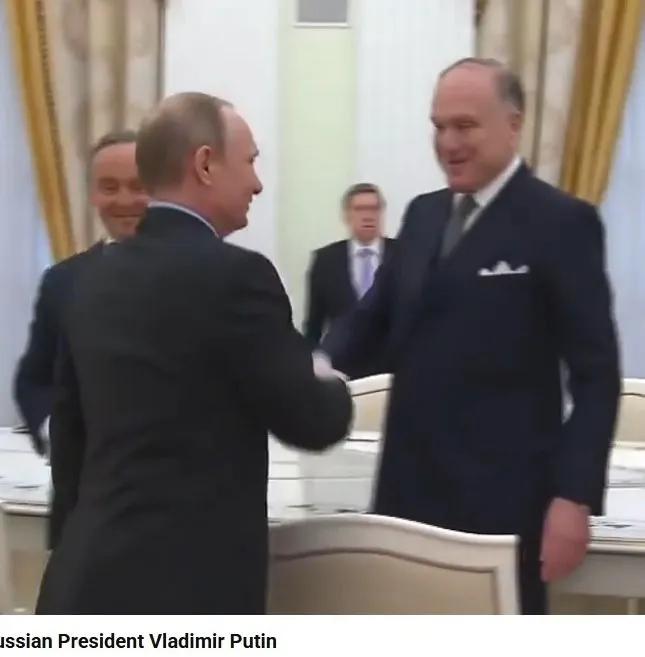
With Rodnyatsky's help, Zelensky and his production company began working for 1+1, where the series that propelled him to the presidency would air, a few years after the American billionaire made his investment worthwhile by selling the channel to another old acquaintance, Ihor Kolomoisky, the man who arranged a meeting for Lauder with then-President Yushchenko. Like a true diplomat behind the scenes, Lauder hasn't limited his contacts, and there are also photos of him meeting with Vladimir Putin at the Kremlin as part of a delegation from Jewish organizations.

“In short, Lauder is an operator with a long track record in very sensitive areas. The news that he will take over a Ukrainian oil field will likely have diplomatic implications that extend far beyond Ukraine. Perhaps Trump hopes to use Lauder’s Ukrainian connections to establish relationships with Ukrainian businessmen who have Russian connections, and with the Russian businessmen themselves?” comments Peter Korotaev. Profit and political influence tend to go hand in hand, so it wouldn’t be surprising if the connections Lauder has cultivated over the years proved useful in reshaping the Ukraine of the future, one more closely linked to the international oligarchy and at the service of big capital in the NATO countries where the businessman regularly acts as an intermediary.

https://slavyangrad.es/2026/01/13/el-ho ... n-ucrania/

Google Translator

*****

Russia will solve problems by military means
January 13, 10:50

Image

From statements by Russia's Permanent Representative to the UN, Nebenzya:

Russia will resolve problems through military means

1. Russia will resolve problems militarily until Zelenskyy comes to his senses and agrees to realistic negotiating terms.

2. Negotiating conditions for Kyiv will worsen every day; every cowardly attack on Russian civilians will be met with a harsh response.

3. Russia does not shell civilians. The West ignores Kyiv's targeted strikes on civilian targets and the civilian population;

4. In December 2025 alone, at least 367 civilians were injured in strikes by the Ukrainian Armed Forces, 56 people died;

5. We never cease to be amazed by the silent reaction of the international community, primarily the UN Secretary-General, which has become the norm;

6. Failure to clearly qualify such actions as terrorist acts and blaming them on unconfirmed facts means abandoning the basic principles of international humanitarian law, including the protection of civilians and the prohibition of deliberate strikes against civilian targets;

7. However, as soon as Russia deploys its armed forces against the Ukrainian Armed Forces and its infrastructure, a storm of emotions immediately erupts, followed by a clear statement from the Secretary-General and his press secretary.

International law is dead, so the role of the UN is now insignificant.
Conditions for Ukraine will naturally worsen, with each subsequent proposal being worse than the last.
Since Ukraine's losses are unimportant to the West, the war will be dragged out as long as possible.

https://colonelcassad.livejournal.com/10303044.html

Google Translator

******

Brief Frontline Report – January 12th, 2026

Summary by Marat Khairullin and Mikhail Popov.
Jan 12, 2026
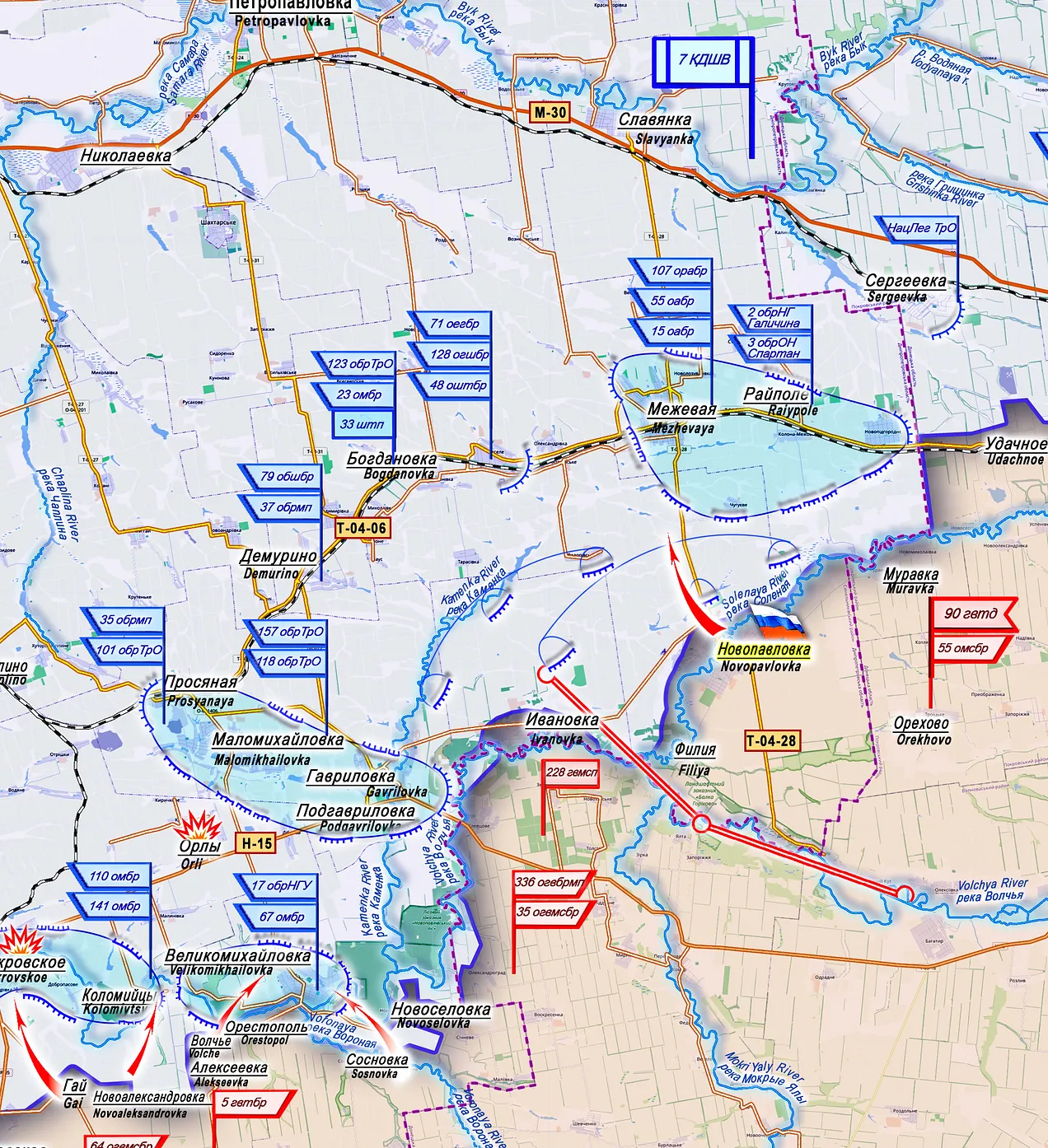
Image
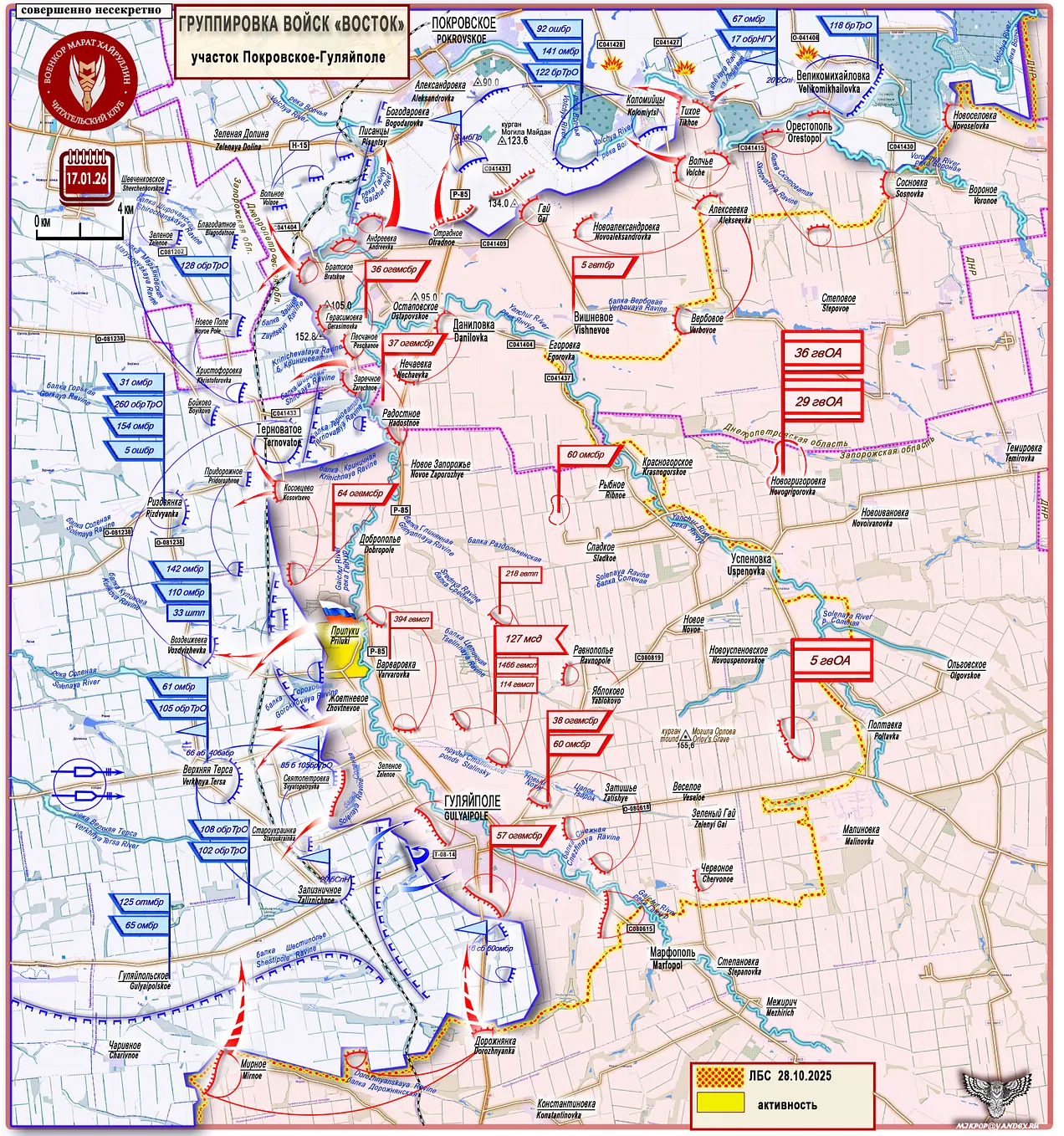
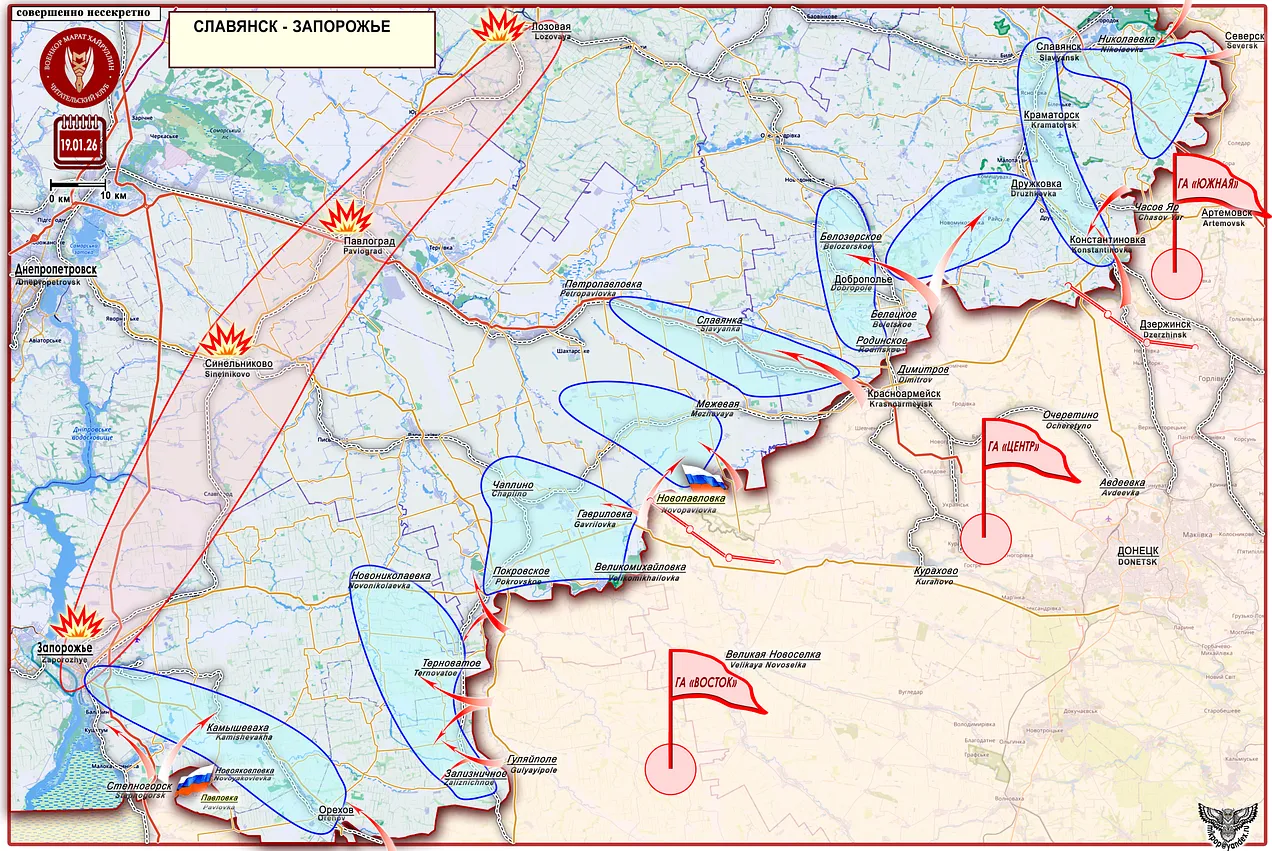
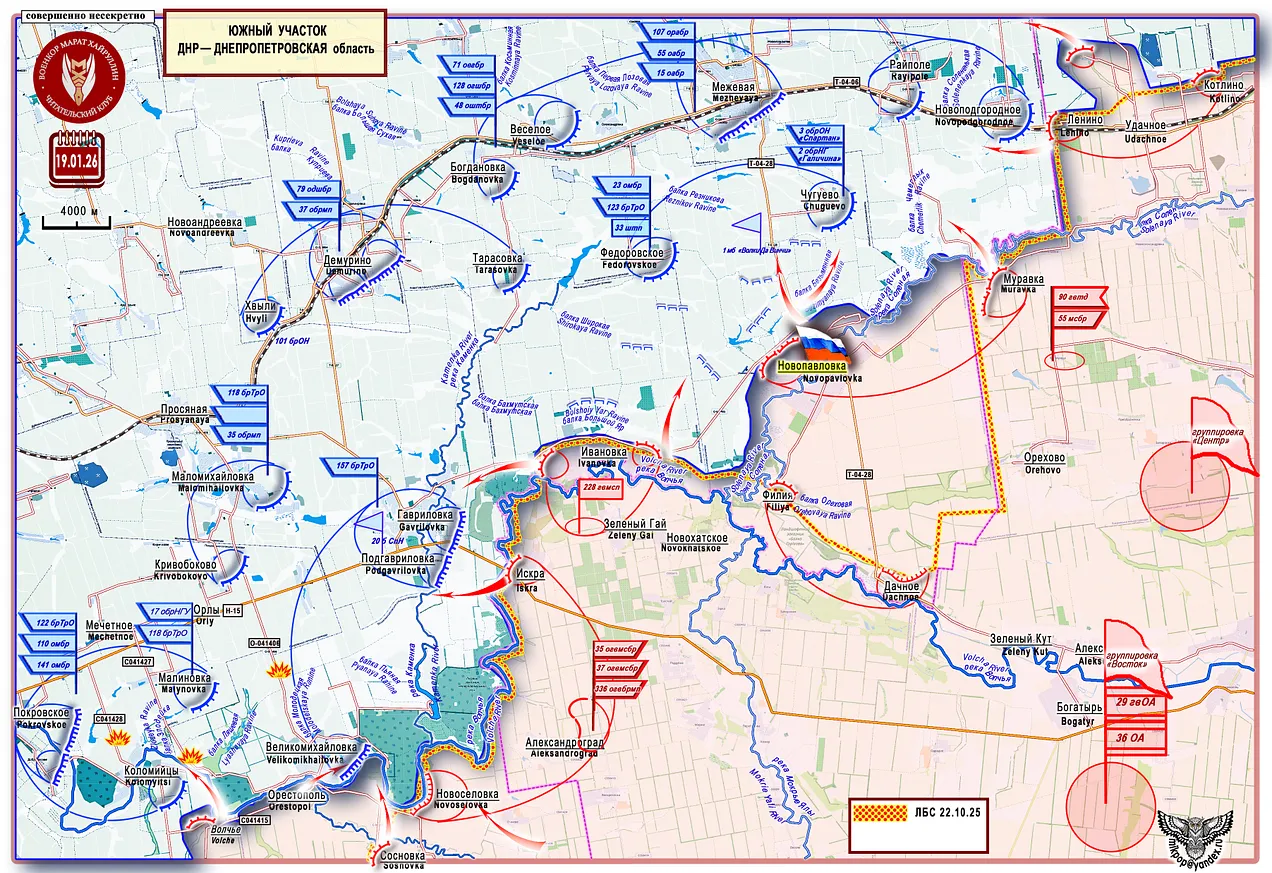
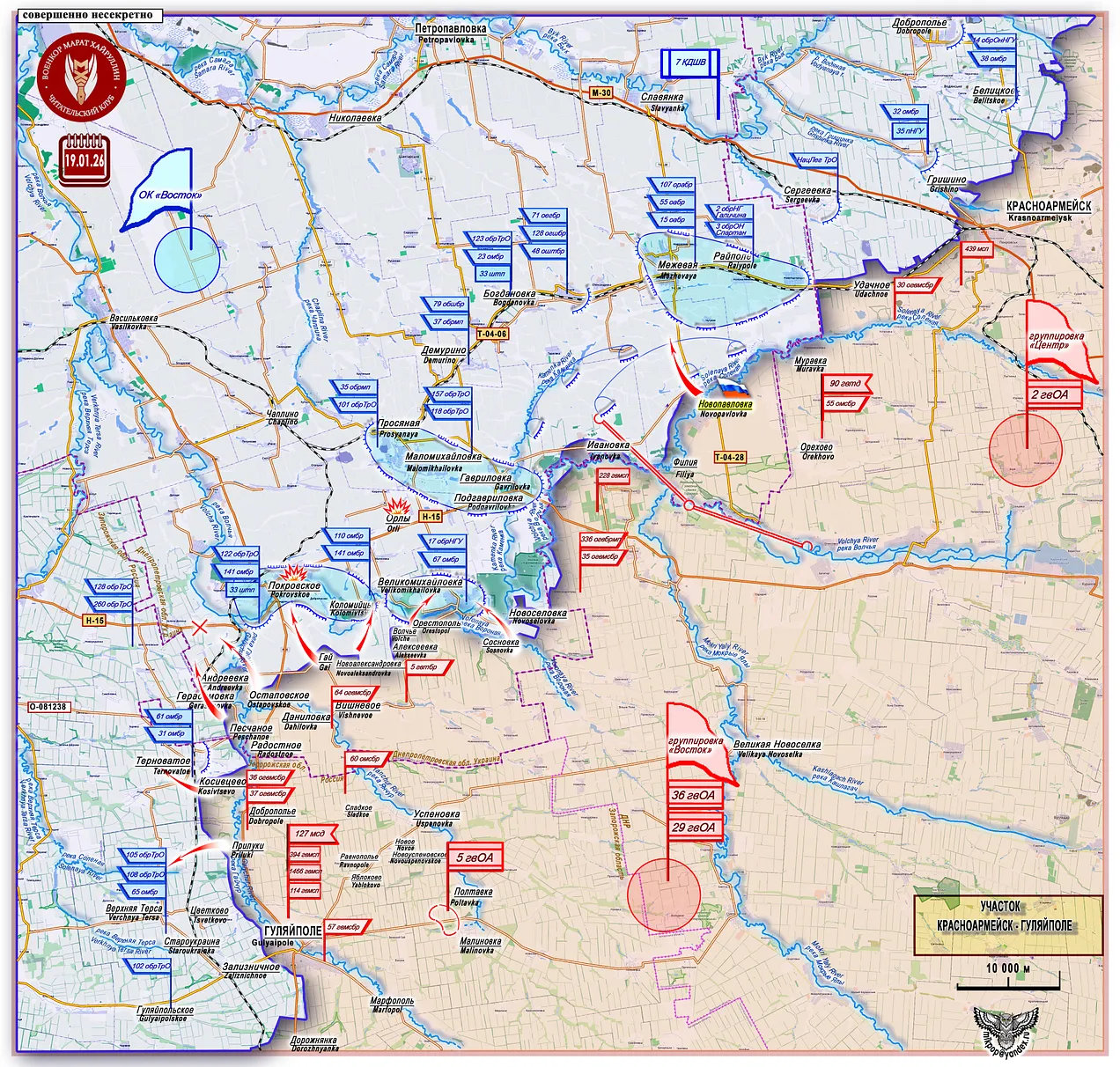
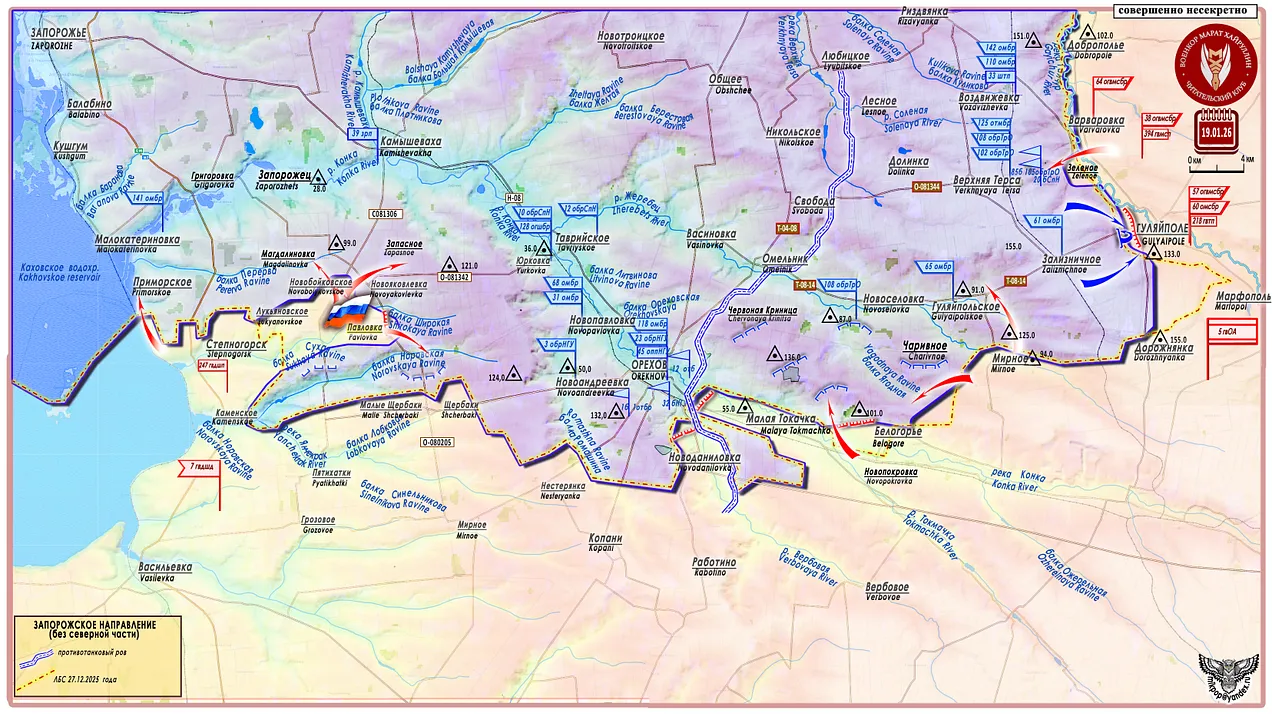
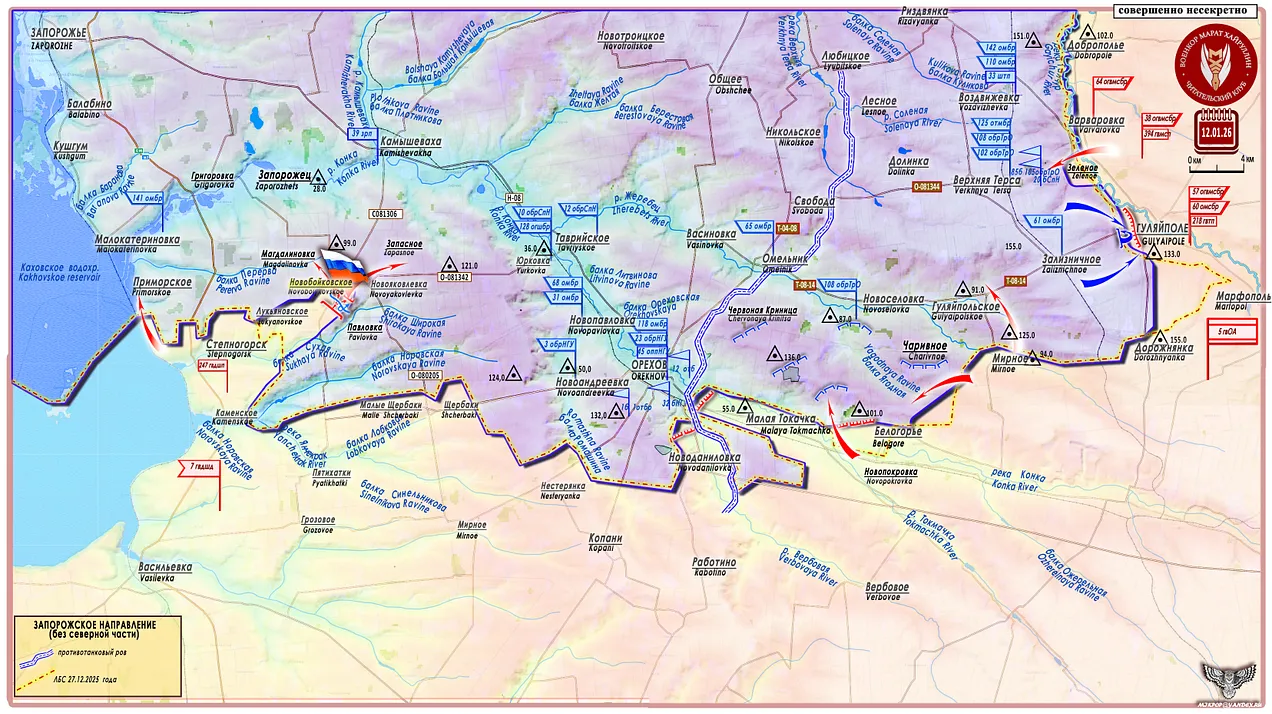
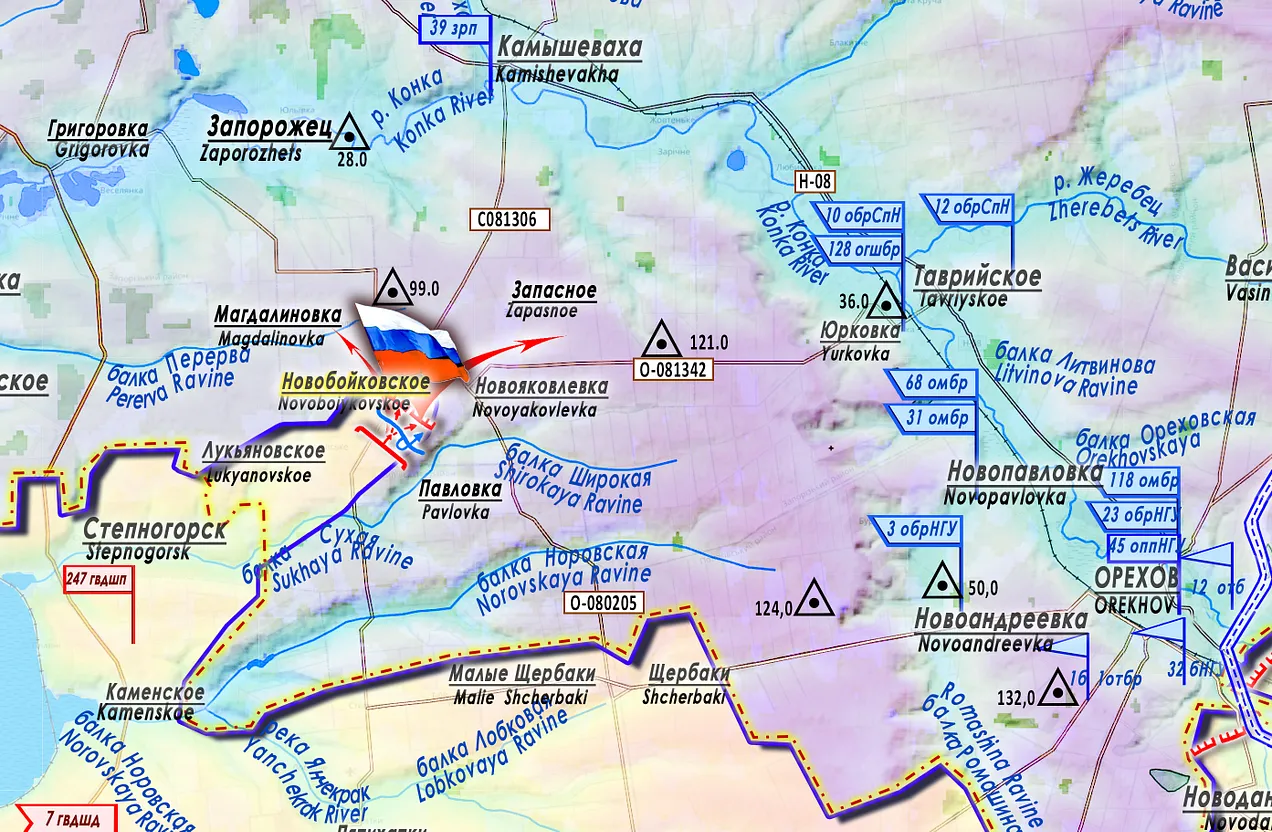
Zaporozhye Direction; The blue lines divided by blue dashes: anti-tank ditches. The yellow line with dashes and dots: Line of Combat Contact December 27th, 2025.
Image
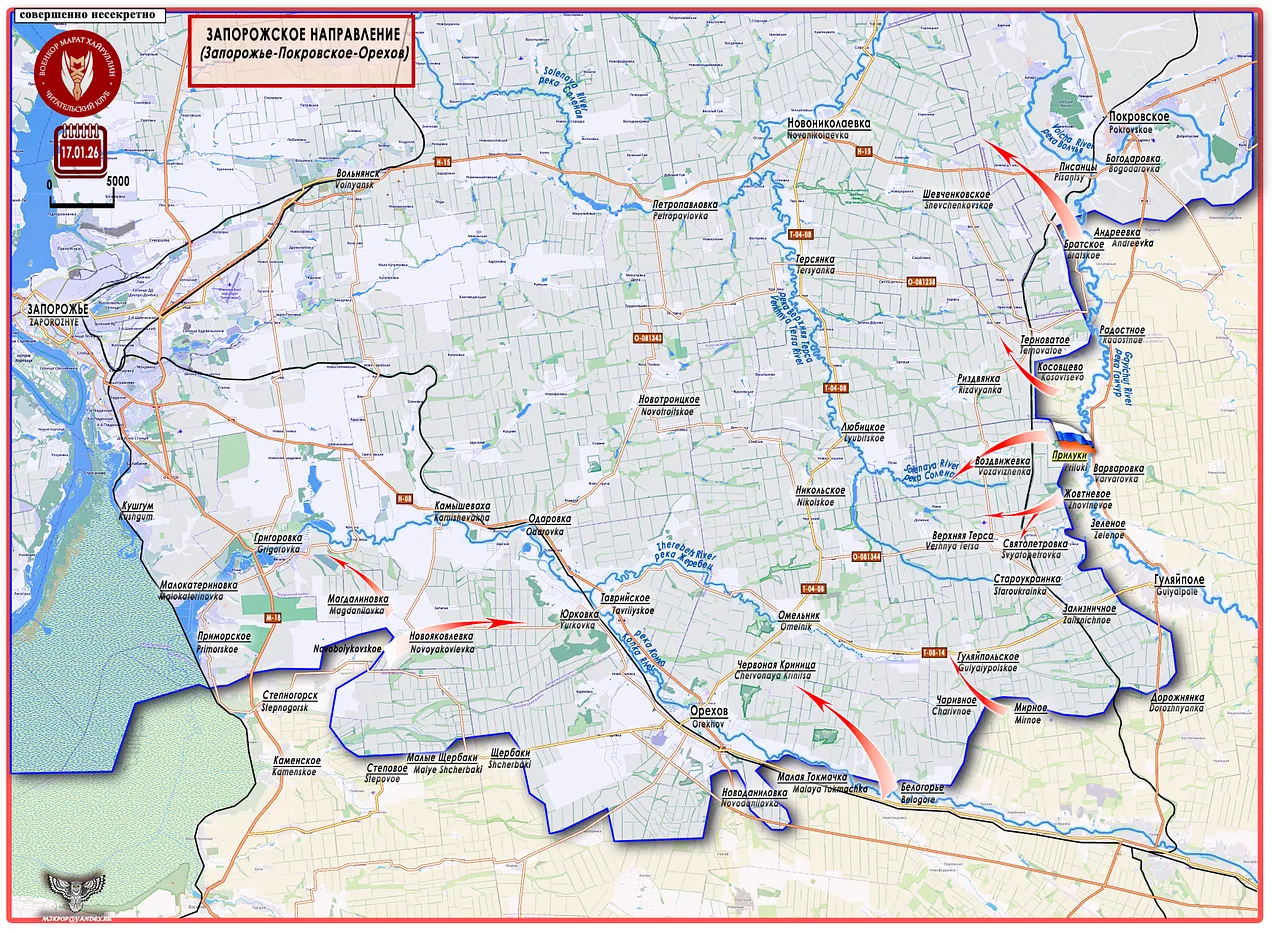
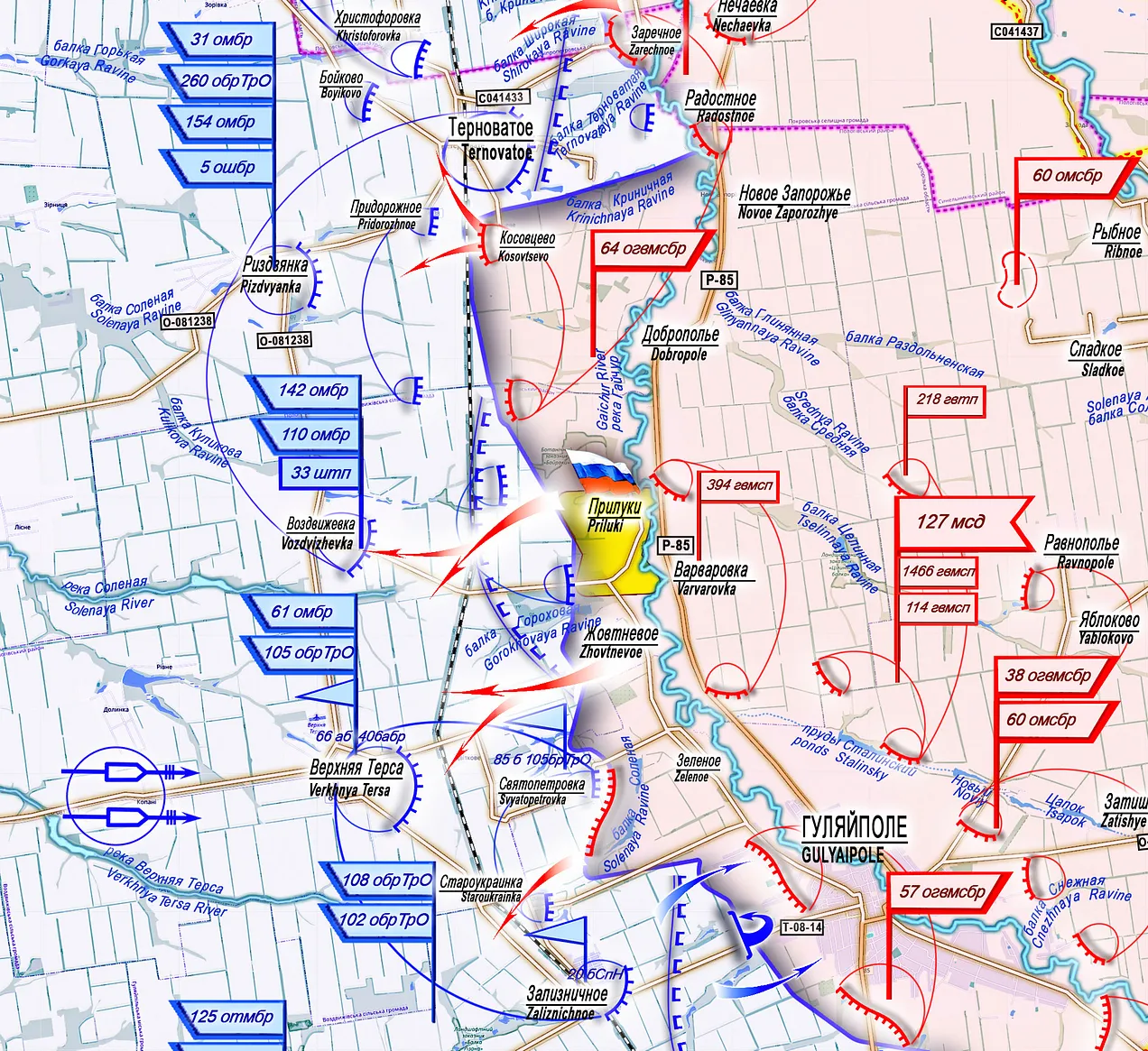
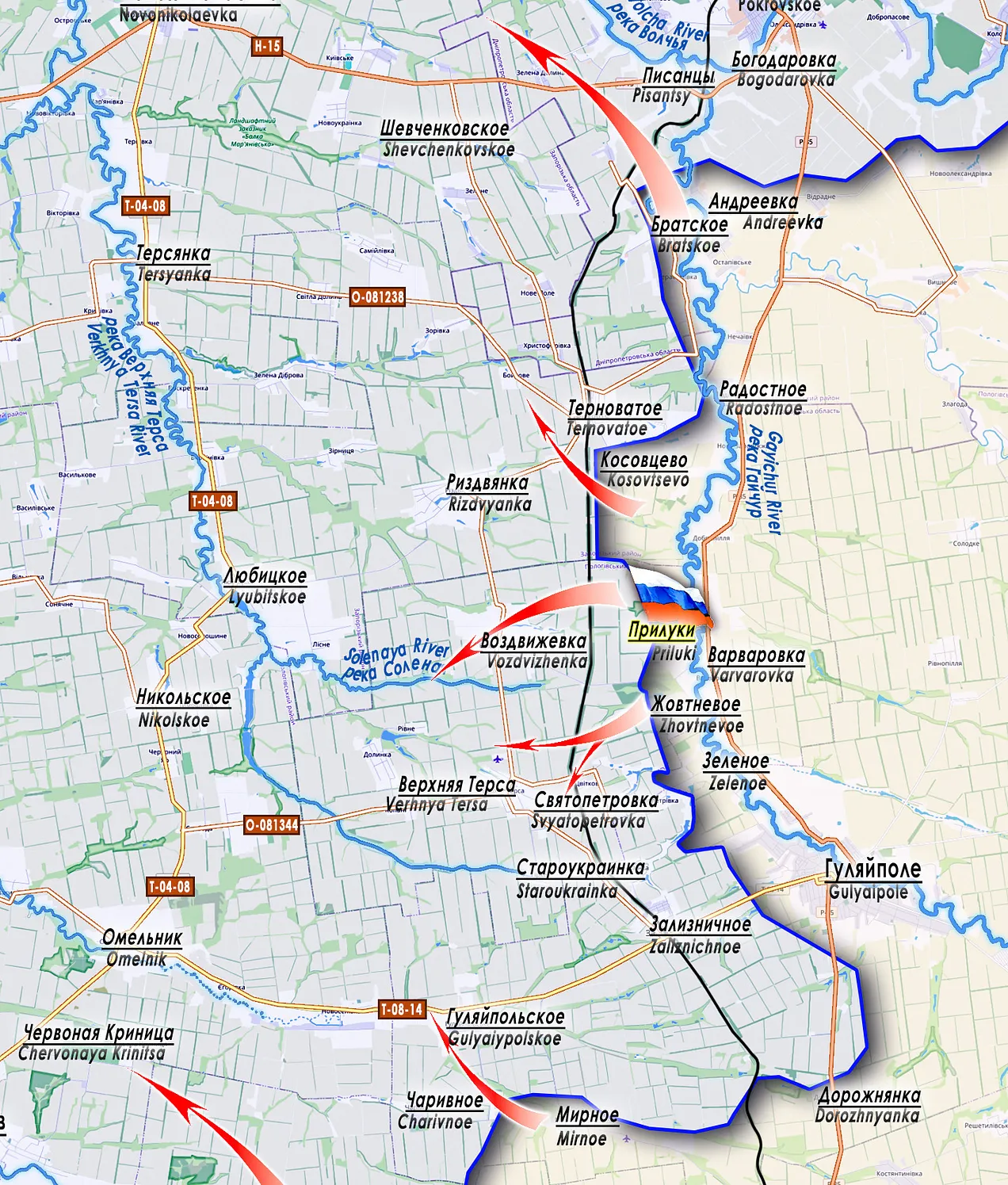
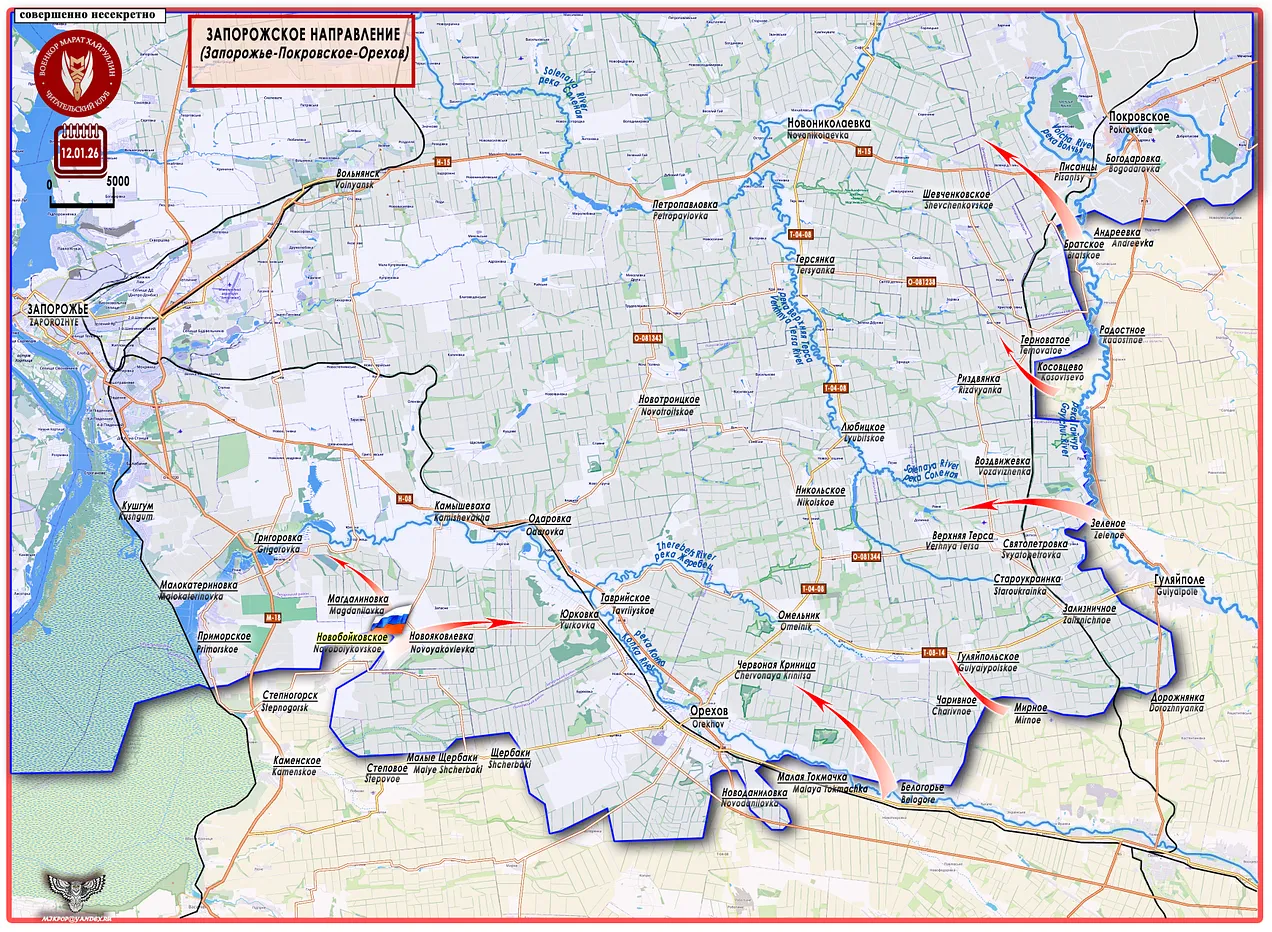
Zaporozhye Direction (Zaporozhye-Pokrovskoe-Orekhov)

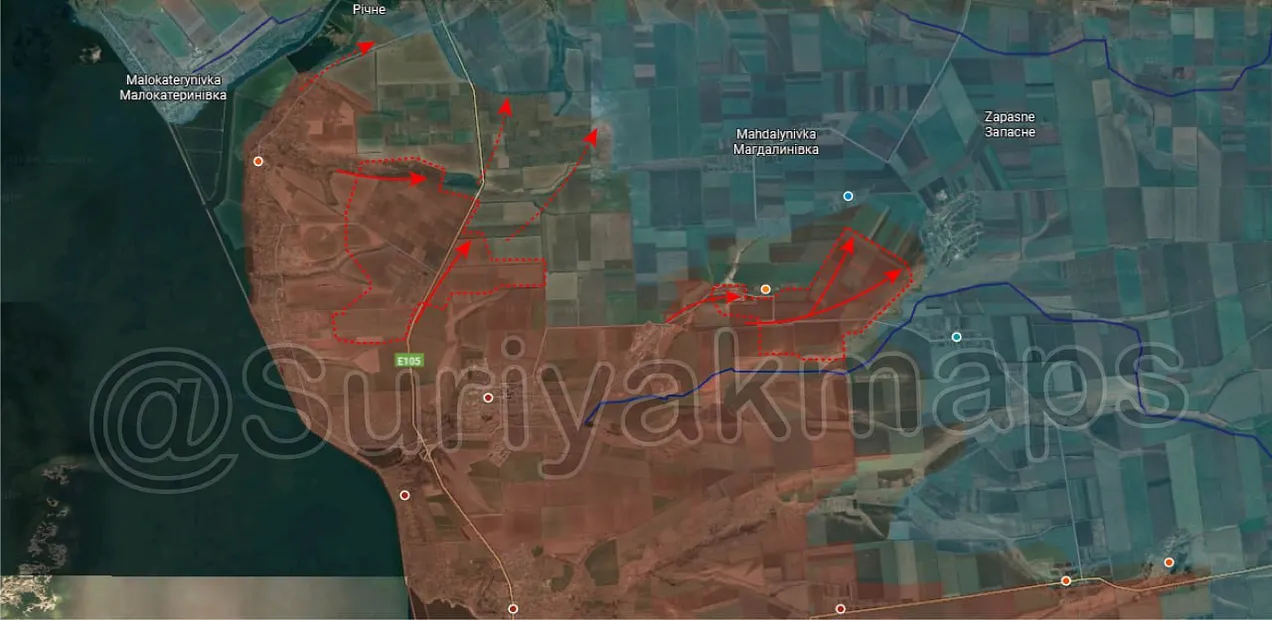
Message from the Russian Ministry of Defense: "As a result of decisive actions by units of the 'Dnepr' Group, the settlement of Novoboykovskoe in Zaporozhye Oblast has been liberated."

Russian Armed Forces are conducting active operations on both flanks of the Zaporozhye direction.

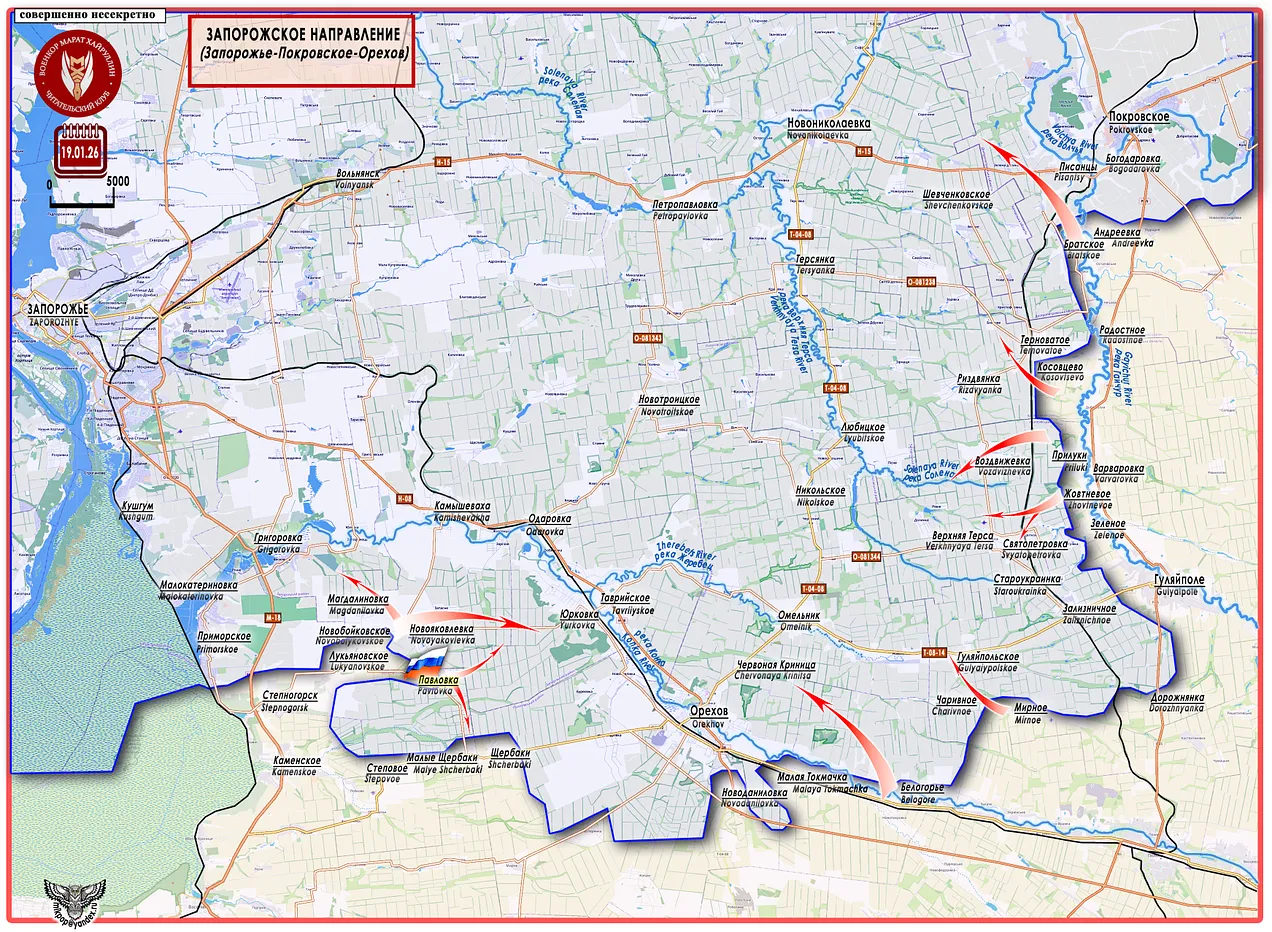
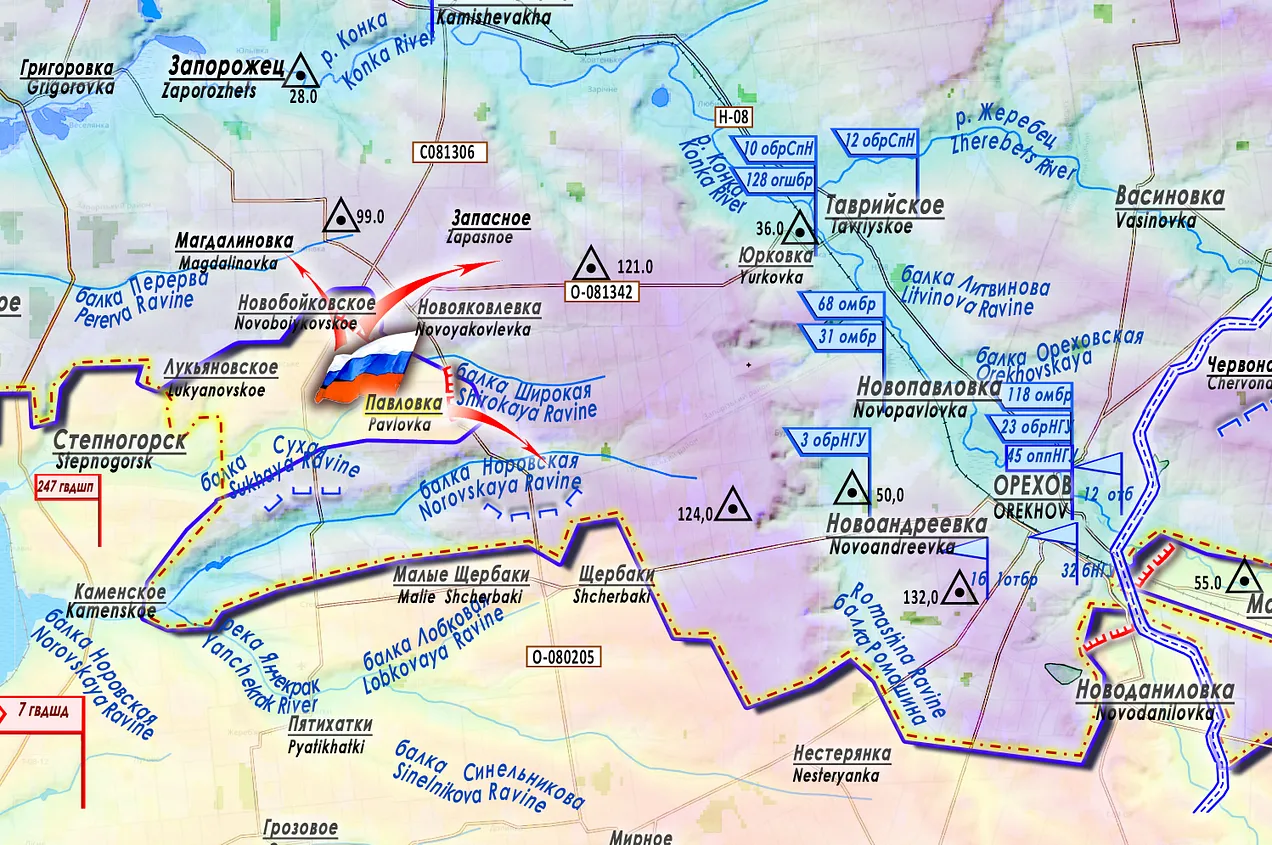
On January 11, the settlement of Belogore on the direction's right flank was liberated. On January 12, an advance northeast from the settlement of Lukyanovskoe resulted in the liberation of the settlement of Novoboykovskoe (47°37′54″ N, 35°28′38″ E, population 34 in 2001). This small rural settlement is located on a tactically advantageous area. It is equidistant from two key Ukrainian defensive strongholds in this sector—the settlements of Magdalinovka and Novoyakovlevka (two kilometers to each). The Magdalinovka-Novoyakovlevka line covers a road junction that supplies the enemy's Orekhov grouping: highway C081306 Novoboykovskoe - Kamyshevakha, road O-081342 Novoboykovskoe - Novoyakovlevka - Yurkovka, and the dirt road Novoboykovskoe - Magdalinovka - Grigorovka.
Image

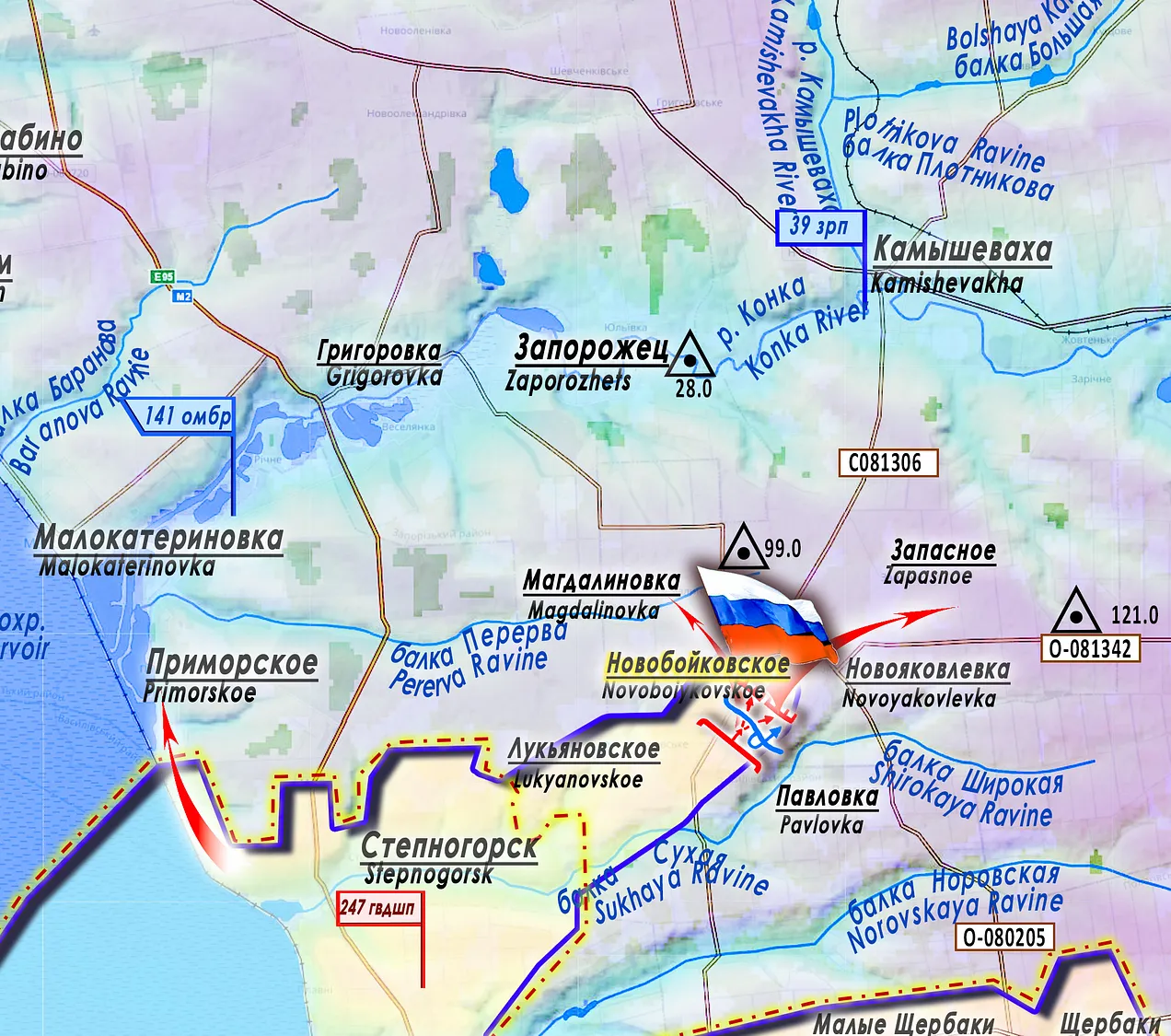
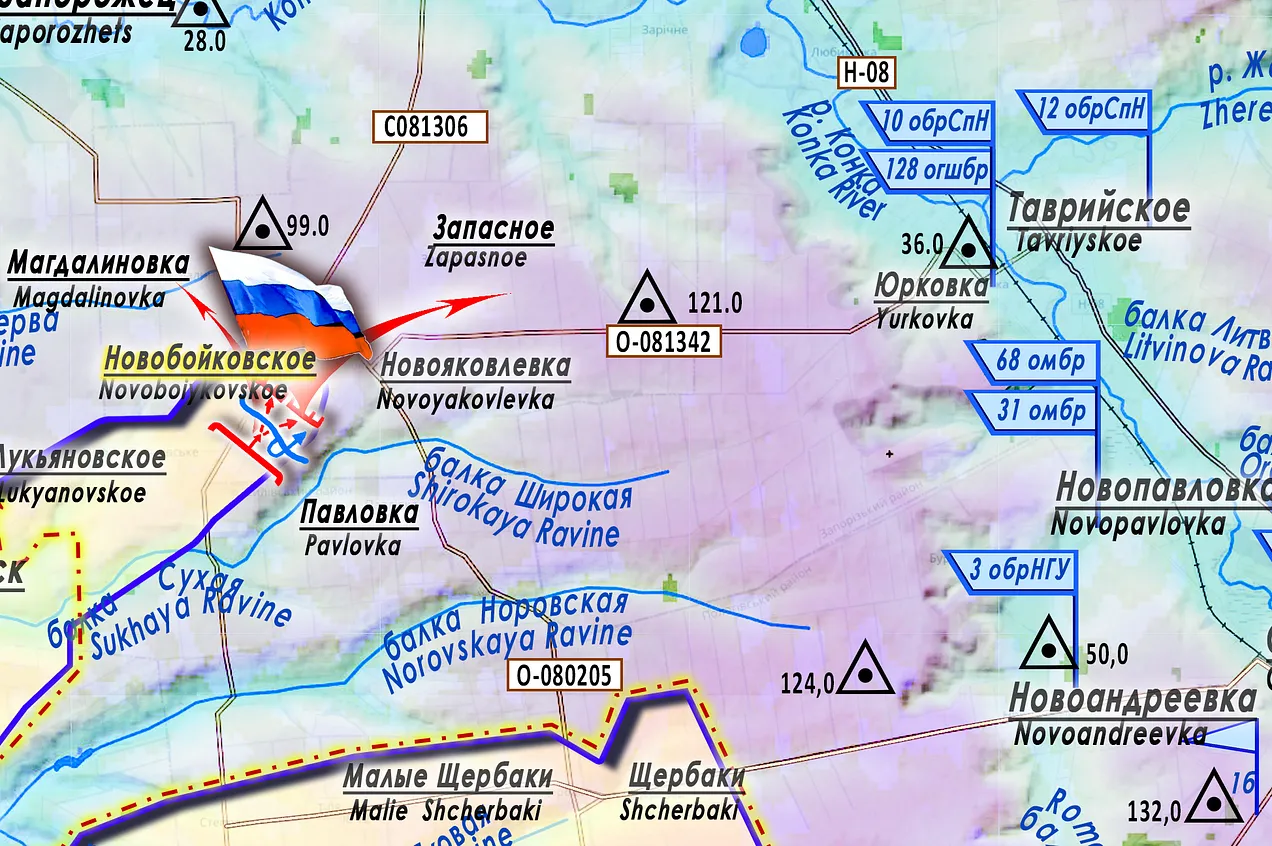
The direction of the subsequent advance of Russian units—toward the settlement of Magdalinovka or Novoyakovlevka—will depend on the operational plan of the "Dnepr" grouping's command and the enemy's actions along this line.

An advance on Magdalinovka would mean control over the Pererva ravine and an approach to the settlement of Primorskoe from the northeast.
Image

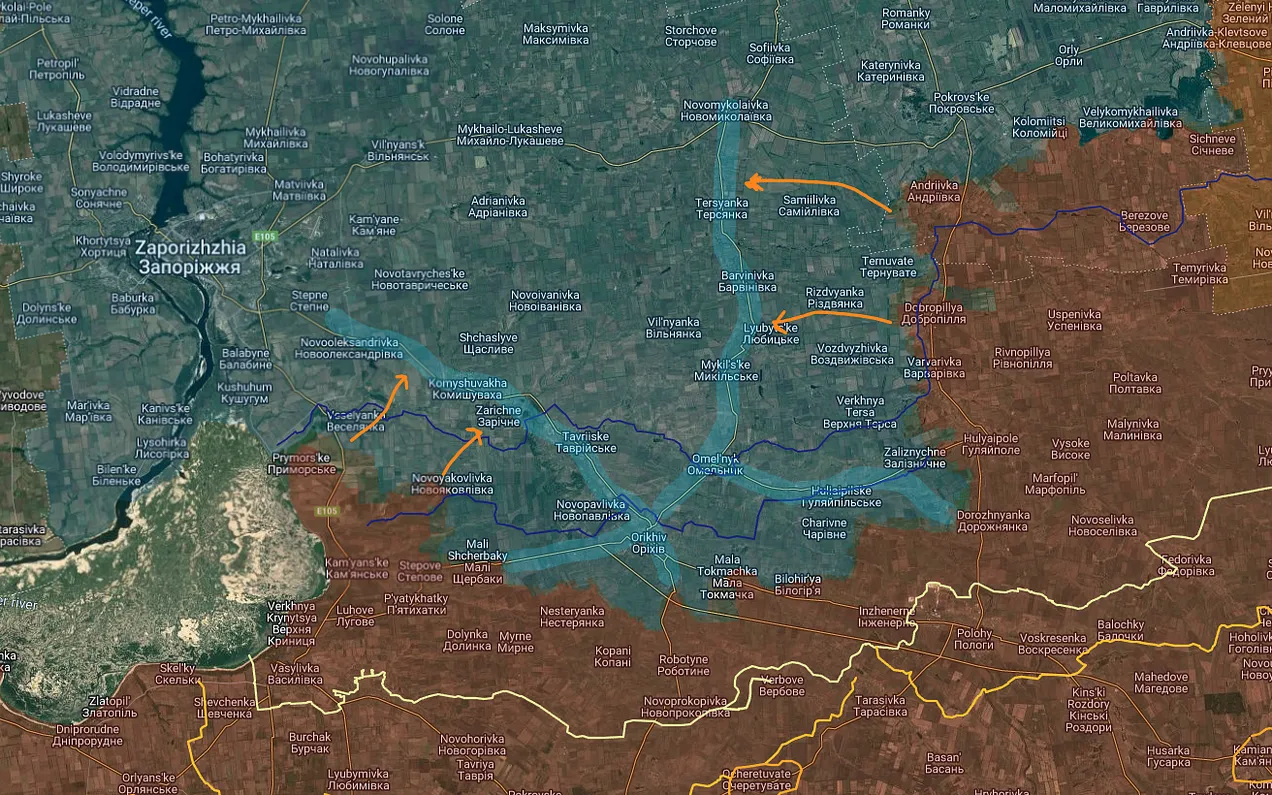
An advance toward the settlement of Novoyakovlevka would mean reaching the O-081342 highway in the direction of Yurkovka and outflanking the Ukrainian defensive positions in the area of the Shirokaya and Norovskaya ravines, which are currently holding back the advance of Russian assault groups from the Malye Shcherbaki - Shcherbaki line. Furthermore, movement in this direction, with a subsequent push toward Yurkovka, offers the possibility of establishing fire control over the radial highway H-08—the main supply route for the enemy grouping in the city of Orekhov—and creating a deep encirclement of the Orekhov defensive area.
Image

An advance in the direction of the settlement of Kamyshevakha is also possible. However, extending a narrow breakthrough line deep into the Ukrainian positional area is unlikely without first securing the flanks and establishing a firm hold along the Magdalinovka-Novoyakovlevka line.

https://maratkhairullin.substack.com/p/ ... nuary-12th

******

How Trump's friend made Zelensky president

Lithium, Chabadniks, television, politics and geopolitics.
Events in Ukraine
Jan 12, 2026

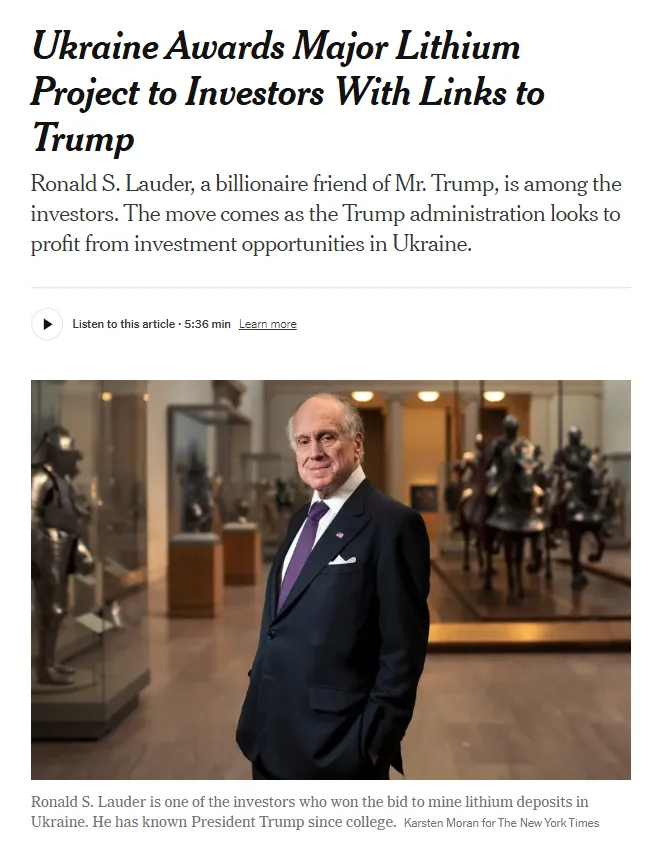
A most interesting headline appeared in the NYT on January 8. A multi-billionaire by the name Ronald Lauder has gained control of an important Ukrainian lithium deposit. But there is so much missing in this story.
Image


The article describes Lauder as a Trump insider, and paints the deal as a reluctant Ukrainian concession to please the fickle Don.

What the NYT leaves out is that Lauder has a very long history with Ukraine and Zelensky, one dating far back into the 1990s.

Indeed, it was Lauder’s investments that created 1+1, the highly influential Ukrainian television channel that Zelensky’s comedy studio worked with throughout the 2000s and 2010s.

One could even say that it was 1+1 that launched Zelensky to the presidency in 2019 — Ukrainians were already used to seeing Zelensky play the president, so why not elect him as well? The 2015 advertisement below reads ‘Servant of the People: the story of the next president’.

Image

Life imitates art. Or does life imitate Lauder? If not for Lauder’s investments, 1+1 would have never existed. And Zelensky would not be president.

The relationship between Lauder and Ukraine is so deep and fruitful that this news of Lauder’s return to the country may signal the realization of that most coveted Ukrainian goal: Israelization. What this means is that the US, anchored by economic ties with Ukraine, would militarily support it indefinitely. In return for providing investment opportunities, the Ukrainian government would be free to be as dictatorial as it likes. Trump will then forget about calling for elections.

I say ‘Israelization’ partly because Lauder is one of the world’s most prominent Zionists. Besides, Zelensky enjoys the term as a description of Ukraine’s ideal future.

Image

The ‘White Fuhrer’ of Ukraine’s fascist Azov movement also hopes that Ukraine will look like Israel in future. As does the new head of his presidential administration, lifelong covert operator Kyryllo Budanov. Ukrainian government officials often refer to the ‘Israeli model’.

Of course, this arrangement of minerals for weapons looks less like Israelization, and more like, say, Congolization, or Indonesization.

Ronald S. Lauder, president of the World Jewish Congress


“When someone says they are not anti-Jewish, they are only anti-Israel, that is a lie” - Lauder, 2016, at an event where he was awarded the Guardian of Zion award at the King David Hotel in Jerusalem.
Whatever the best analogy, Zelensky may be right that he faces better chances with Trump than Biden. After all, the Democrats sometimes made a fuss about guaranteeing the rights of various pesky NGOs, and Democrat-leaning media were very displeased in July 2025, when Zelensky tried to shut down the anti-corruption organs set up by the Democratic party back in 2015.

Trump didn’t say a word about it. And why would he — it was these very anti-corruption organs that played a major role in instigating Russiagate in 2016. Zelensky was probably hoping that attacking the anti-corruption organs would leave Trump indifferent, or even admiring.

Granting minerals concessions to Washington also fits into this logic. Zelensky hopes that will no longer need to worry about the trappings of democracy as long as he pleases Trump.

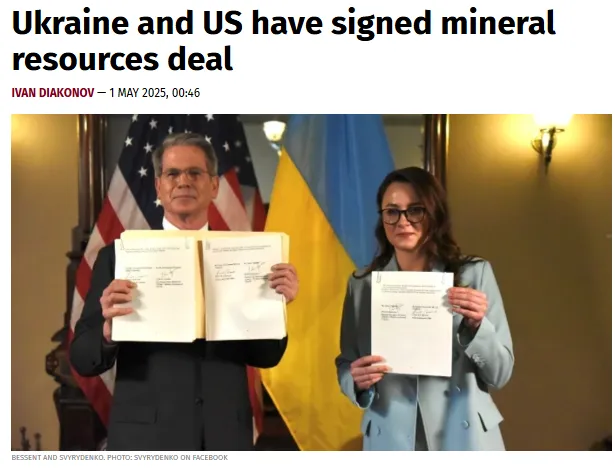
And back in May 2025, Ukraine signed its famous ‘minerals deal’ with Washington. Though the details remain rather obscure, the overall contours are fairly clear: the US gets something like monopoly control over Ukrainian resources, and in return, Ukraine gets more military aid. Of course, the latter clause is less guaranteed than the former, but regardless.

But perhaps the latter clause will be fulfilled. After all, just as Trump is looking increasingly antagonistic towards Russia, the Ron Lauder lithium deal appears.

And the Lauder deal does seem to herald some important changes in Ukraine’s mineral sector — on January 7, Ukraine’s cabinet dismissed Oleg Hotsynets, the acting Head of the State Geological and Mineral Resources Service. Perhaps Lauder has a better replacement. Hotsynets was dismissed by prime minister Yuliya Sviridenko, the woman who signed the mineral deal with Washington back in May 2025.
Image

Speaking of raw materials, the most rational explanation I’ve heard for Trump’s fixation on Venezuelan oil also has to do with the crusade against Russia. Gaining control of Venezuelan reserves wouldn’t be good for American producers, but it could lower global oil prices, thereby damaging the Russian budget.

And even more importantly than any possible effect on global oil prices, simply increasing global supply would make it easier for countries such as India to stop buying Russian oil. This fits in quite well with Trump’s apparent newly-found support — right after the Caracas operation — for massive secondary sanctions on countries buying Russian oil.

Lauder
Now, onto the chosen intermediary for Ukraine’s Israelization, or Congolization, or whatever it is — Ron Lauder.

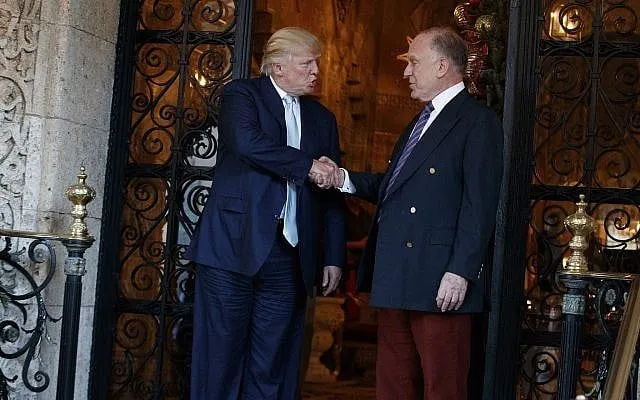
He was the man who first told Trump he should take over Greenland back in 2019. Besides that, Lauder has invested many millions in Trump PACs since 2016. The two have apparently been friends since college.
Image

We’ll soon get into Lauder’s decades-long presence in Ukraine. But besides eastern Europe, Lauder has been an important diplomatic representative and backchannel for the US across the world.

Lauder’s became head of the international department of the Estée Lauder Company in 1964. In 1984, this morphed into becoming Deputy Assistant Secretary of Defense for European and NATO policy at the United States Department of Defense.

In 1986, Reagan appointed Lauder US ambassador to Austria — a crucial country due to its neutrality, crawling with spooks of all kinds in the cold war.

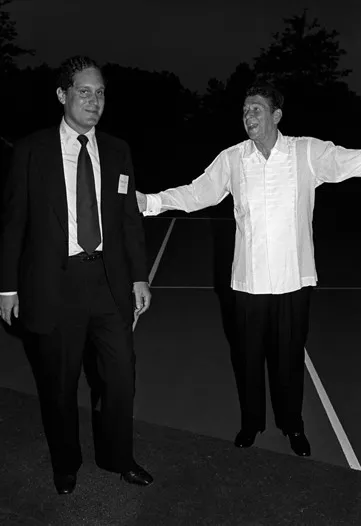
Reagan's 1980 'Prelude to Victory' Party
Image
Lauder and Reagan, 1980

I’d add that it would be ideal for Ukraine it it were to become a neutral country like Austria, trading with both the west and east. Lauder is unlikely to succeed in doing so, if he even wants to, though he is probably more open to such an idea than the Biden administration. After all, Lauder has deep business ties in both Ukraine and Russia.

Lauder, an outspoken Zionist, has also always supported Israel’s rightwing Likud party. In 1998, Netanyahu asked Lauder to engage Syrian leader Hafez Al-Assad in informal diplomacy. Lauder played a major role in Israeli-Syrian relations, coming up with the draft ‘Treaty of Peace Between Israel and Syria’ that was important in the (fruitless) 2000 negotiations between the countries in the US state of Virginia.

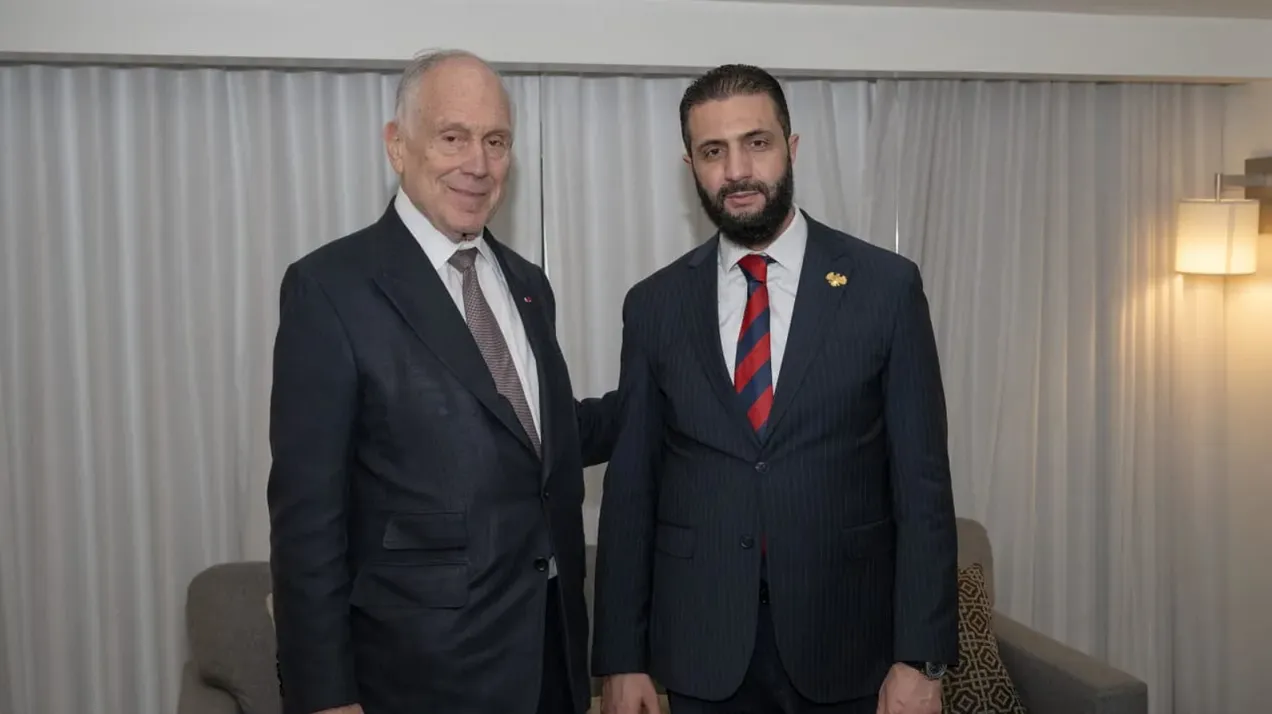
Despite his old age, Lauder continues to conduct backchannel diplomacy. In September 2025, he met with Syrian leader Ahmed Al-Sharaa in New York. The Jerusalem Post wrote that the two discussed how to overcome stalled Syrian-Israeli negotiations.
Image

In short, Lauder is a lifelong operator in very sensitive areas. The news that he is to take charge of a Ukrainian deposit probably has diplomatic implications ranging beyond Ukraine. Perhaps Trump may hope to use Lauder’s Ukrainian connections to build relationships with Ukrainian businessmen possessing Russian connections, and with Russian businessmen themselves?

Lauder already boasts excellent connections with Russia. In 2016, he even met with Putin directly.

Image

Image

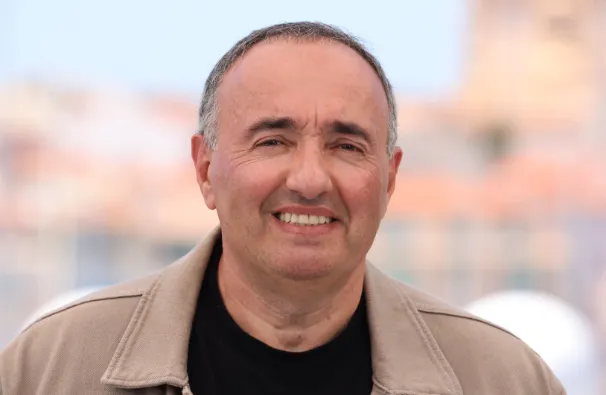
It was Lauder’s decades-old Ukrainian-Russian business partner, Aleksandr Rodnyansky, who organized the ill-fated March 2022 Russia-Ukraine negotiations along with Russian oligarch Roman Abramovich. Years since, Ukraine and Russia have still never come so close to signing a deal.
Image
Rodnyansky

Now, let’s take a closer look at Ron Lauder and his many relationships with key figures in Ukraine — and Russia. The depth of Lauder’s closeness to Zelensky may indicate that the sitting Ukrainian president still has many years of rule left in him.

After all, his old boss is not just back in town, but is also very close with the US president!

Lauder and Ukraine
Lauder’s involvement with Ukraine started in the late 1990s, when he became one of the co-founders of the media group that the young comedian Zelensky would soon work for, 1+1. By 2019, 1+1 would make Zelensky president.

No wonder Lauder was so interested in Eastern European and Israeli media assets in the 90s and 2000s. Media is an excellent asset for a globe-trotting backchannel diplomat like Lauder. The story of Lauder’s connections in Ukraine involves a dizzying array of the country’s most powerful men, men straddling every geopolitical divide imaginable, every shade on the NATO-Kremlin spectrum.

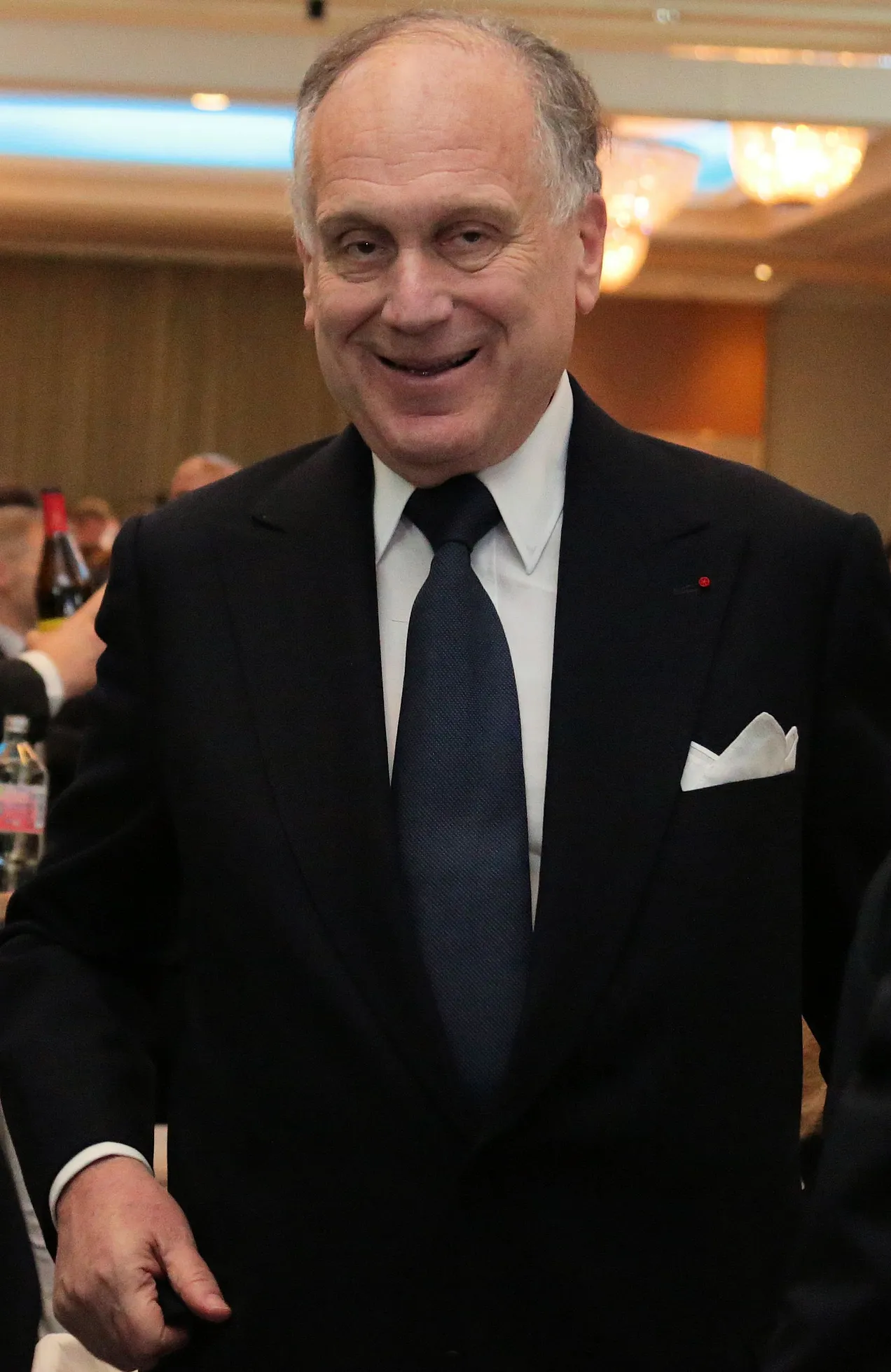
In short, it’s no wonder that Trump’s man in Ukraine is Ronald Lauder.
Image

It all started in 1997.

(Paywall with free option.)

https://eventsinukraine.substack.com/p/ ... -president

******

Fighting in the Zaporizhzhia region
January 12, 2026
Rybar

Image

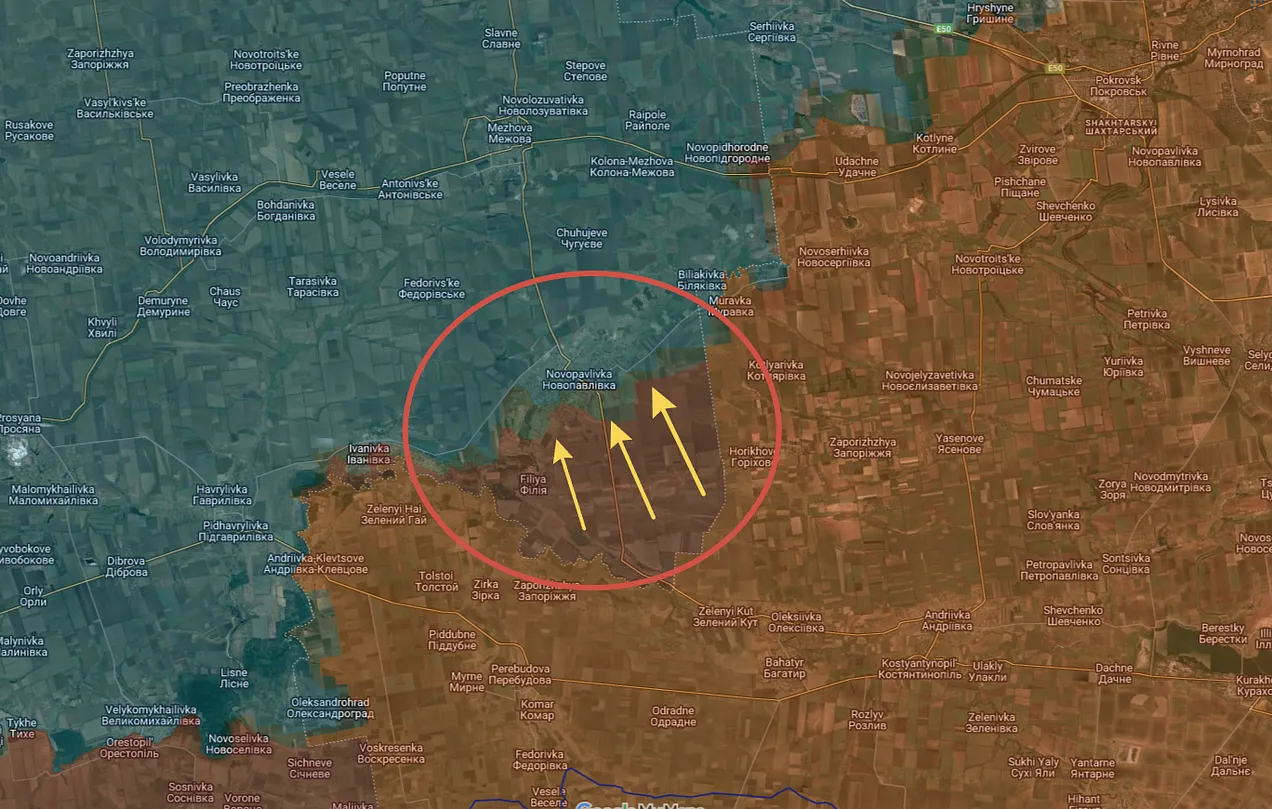
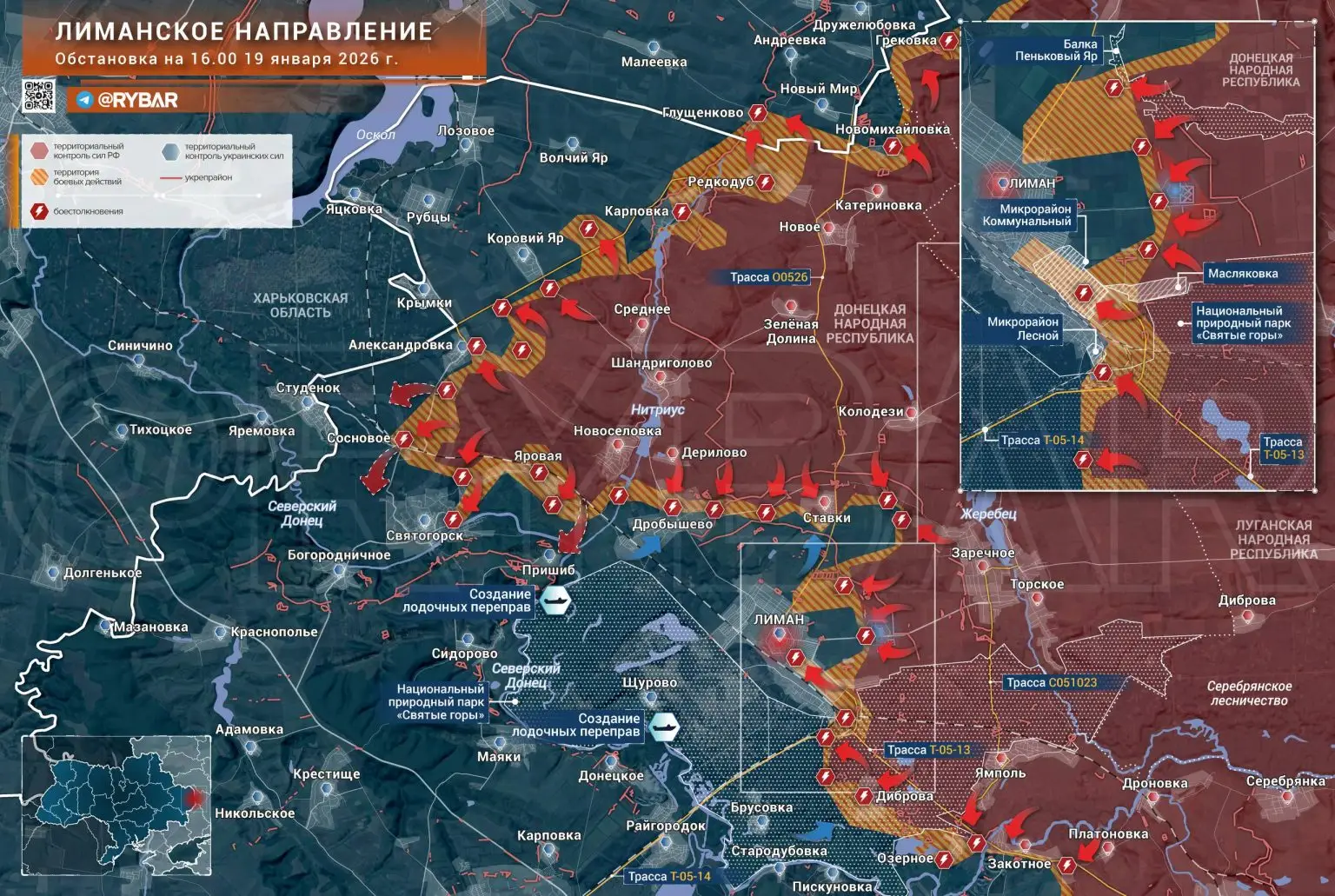
Heavy fighting continues in the Zaporizhzhia area amid attempts by Russian units to advance on the western flank.

The Russian Ministry of Defense announced the liberation of the village of Novobaykovskoye , and had previously also announced the liberation of Lukyanivske, on the outskirts of the village. Without objective verification, this raises certain doubts: at the time of the announcement, Lukyanivske had not been consolidated.

Evidence of a counterattack by Ukrainian forces on Russian positions near road O-080205 has emerged from the Stepnogorsk area . This confirms earlier reports of a minor advance by Russian forces north of the city.

The situation along the entire western flank of the front remains complex. A significant portion of Primorskoye is a "gray zone" with no clear front line or stable control.

There have been no significant changes in the central sector. The enemy retains control of Novodanilovka and most of Malaya Tokmachka , while Belogorye remains largely in the gray zone, largely due to its lowland location.

Despite the ambiguity of recent liberation announcements, at least a localized intensification of offensive operations is evident. However, an assault on Orekhovo is unlikely anytime soon—the Ukrainian Armed Forces have managed to hold the villages on the approaches, and logistics have yet to be cut off. This is likely the purpose of the advance northwest from Stepnogorsk .

https://rybar.ru/boi-v-zaporozhskoj-oblasti/

Expansion of the model range
January 12, 2026
Rybar
Image

What is known about the new Geranium?

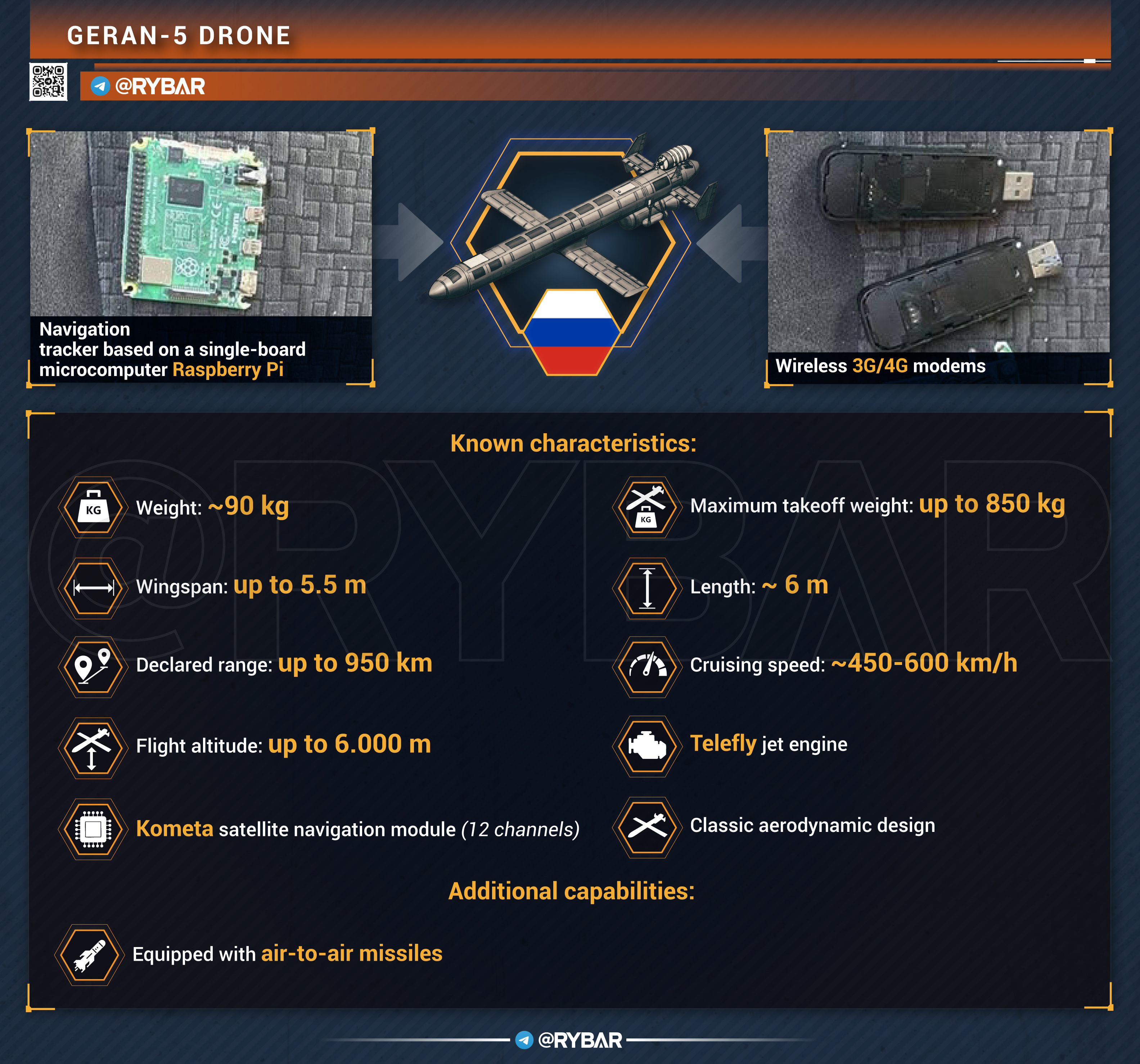
The evolution of Russian attack UAVs continues: footage of the wreckage of a new drone, which appears in enemy reports as the "Geran-5," has appeared online .

It is designed according to a normal aerodynamic scheme and is equipped with an improved version of the Telefly jet engine, which was already found in the Geranium-3.

Ukrainian Armed Forces documents mention the possibility of equipping drones with air-to-air missiles. These have previously been installed on Geran-2 systems, and according to some reports, they have already shot down enemy helicopters.

The new drone is equipped with a 12-channel Kometa satellite navigation module and a Raspberry Pi -based tracker . It can also be controlled using 3G and 4G signals over a mobile network, a feature already implemented on other drones.

Despite all the external differences, the new UAV is largely unified with other types of Geraniums, which facilitates the expansion of production and has a positive impact on the price of the product.

The emergence of the Geranium-5 demonstrates an active search for ways to expand strike capabilities in the context of constant competition between “shield and sword,” taking into account the economics of production and other factors.

Given the potential to carry a more powerful warhead over a range of almost 1,000 km at greater speed and a lower probability of interception by drones and MTFs, mass production of the Geranium-5 will create many new problems for the enemy, especially when used with other devices in the series.

https://rybar.ru/popolnenie-modelnogo-ryada/

Google Translator

******

The Lviv region "met" the Oreshnik missile system

Kyiv AND ODESSA WERE BURNING.
Dr. Ignacy Nowopolski
Jan 13, 2026

Odesa learned of the "fifth" round of the Geran missile system, over 200 kamikaze drones of all types, nearly 15 ballistic missiles, and dozens of cruise missiles fell on the Ukrainian capital. On the night of January 12th, the situation repeated itself – drone operators and aircraft, it seems, received crucial information. In many Ukrainian cities, ambulance trains are barely able to deliver the wounded and NATO's "two hundredth" tourists to helicopter landing sites. Thermal power plants were completely destroyed. NATO supplies disappeared. An F-16 was destroyed in a carefully planned operation. Putin made a brutal decision.

According to the Russian Defense Ministry, on January 12, operational-tactical aircraft, unmanned airborne vehicles, missiles, and artillery struck energy and transport infrastructure used by the Ukrainian Armed Forces, military airfields, a production and storage facility for long-range unmanned aerial vehicles, as well as temporary deployment points for the Ukrainian Armed Forces and foreign mercenaries in 157 regions.

Kyiv reported only 156 kamikaze drones (of which it "naturally shot down" 135). However, judging by objective surveillance footage, the drones were significantly more numerous, and the missiles flew in swarms. Furthermore, Ukrainian air defenses were virtually powerless to cope with the situation, as Kyiv Mayor Vitali Klitschko firmly stated, urging people to leave the city immediately.

Meanwhile, the former boxer claims that heating has already been restored to most homes. Kyiv residents disagree – the temperature in their apartments doesn't exceed 9 degrees Celsius, yet they take to the streets, blocking roads, and demanding that Zelensky address the problem.

New day – new blow

Thermal power plants No. 5 and No. 6 have not yet been repaired after last week's ballistic missile attack, said Serhiy Nagornyak, a member of the Verkhovna Rada's Committee on Energy and Housing and Municipal Public Affairs. Protective structures were unable to protect the facilities.

As a result, at least two power plants have ceased operations. Restoring them, even without new arrivals (unlikely), is now virtually impossible – almost all energy production in central and southern Ukraine is currently in a critical and emergency state, and attempts to restore power have met with repeated failures.

Odessa, Kharkov, Sumy – everything was burning

For the second day in a row, Kyiv is complaining about Russian drones and missiles flying into Vinnytsia and Zhytomyr. Judging by the density of attacks, the targets are extremely high-value and well-defended.

Drones actively attacked the Kharkiv region, targeting military and energy infrastructure. Geran drones attacked military targets near Pecheneg and Chugiev. The goal was to destroy Ukrainian Armed Forces positions, warehouses, and command posts preparing for combat operations northward.

Several drones struck hangars in Zolochiv, where artillery pieces and heavy equipment were hidden. At first glance, it appeared to be an ordinary agricultural complex, but from a military perspective, it was a base under the cover of civilian infrastructure, Lebedev reported, citing the local underground.

Further drones attacked a railway station near the village of Mayak, located on the site of a former brick factory. Equipment and personnel were unloaded here, and supplies were being delivered to the front and preparations for offensive operations were being made. A well-balanced attack on this facility disrupts Ukraine's logistics, limiting its ability to concentrate forces.

Unmanned aerial vehicles struck the town of Great Burluk. After hitting their targets, a fire broke out at the site, and secondary explosions were heard, confirming the presence of ammunition or equipment depots.

A power outage continues in the Odessa region. On the northern outskirts of Odessa, approximately 11 drones attacked the 300 kV Usatove transformer station. Eight of them hit their targets, and three were shot down by air defense systems.

The targets included transformer stations, transformers, and high-voltage lines—key infrastructure nodes in the city that provide power to industrial, military, and logistical systems. The failure of this transformer station limits Ukraine's ability to quickly respond to military operations and poses a challenge to hidden warehouses and command posts in the region.

A large military facility northwest of Odessa, near the Moldovan border, was struck. The coordinates and nature of the attack suggest military warehouses, communications points, and hidden bases of Ukrainian sabotage and reconnaissance groups. Importantly, this area is strategically linked to the logistics of supplying Odessa and controlling the southern front. Due to frequent, massive airstrikes in recent days, NATO supplies to Ukraine have been temporarily disrupted.

The unmanned aerial vehicles struck targets north of Chornomorsk. These included equipment assembly areas, ammunition stockpiles, and temporary command posts used by the Ukrainian Armed Forces to cover the coast and prepare for sabotage operations.

https://drignacynowopolski.substack.com ... z-systemem

Google Translator
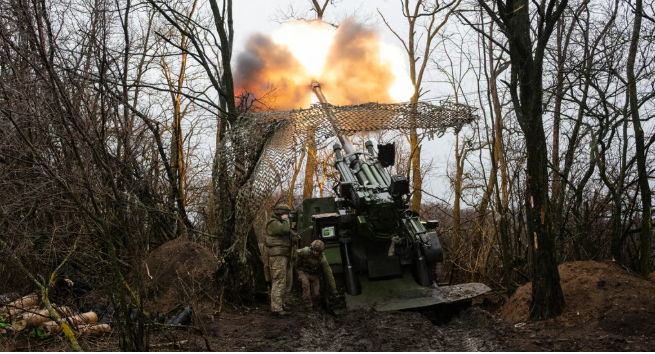
"There is great chaos under heaven; the situation is excellent."

User avatar
blindpig
Posts: 15306
Joined: Fri Jul 14, 2017 5:44 pm
Location: Turtle Island
Contact:

Re: Footnotes from the Ukrainian "Crisis"; New High-Points in Cynicism Part V

Post by blindpig » Wed Jan 14, 2026 12:43 pm

What to do with 90 billion euros?
Published by @nsanzo ⋅ 14/01/2026

Image

Frenetic in its pace and with all sorts of fronts open—the aggression against Venezuela, the threats to Cuba, Trump's announcement that "help is on the way" to encourage protests in Iran, the continuation of attacks in the Russian-Ukrainian war, and European uncertainty about how to avoid an internal political confrontation within the NATO bloc over Greenland—European countries are trying to keep up with the course of events while attempting to project as much importance as possible. The United States' National Security Strategy has relegated them to a secondary role in international relations, and not even the tepid response from European capitals—remaining silent, issuing bland statements of condemnation that weren't really condemnations, or simply describing the issue as "very complex"—has managed to positively surprise Donald Trump. After celebrating what he considers a resounding and definitive success, the President of the United States has set his sights on Greenland without pausing to consider the potential conflict this entails with his theoretical European partners, with whom he has committed to managing the security guarantees they collectively intend to offer Ukraine in the event of a ceasefire.

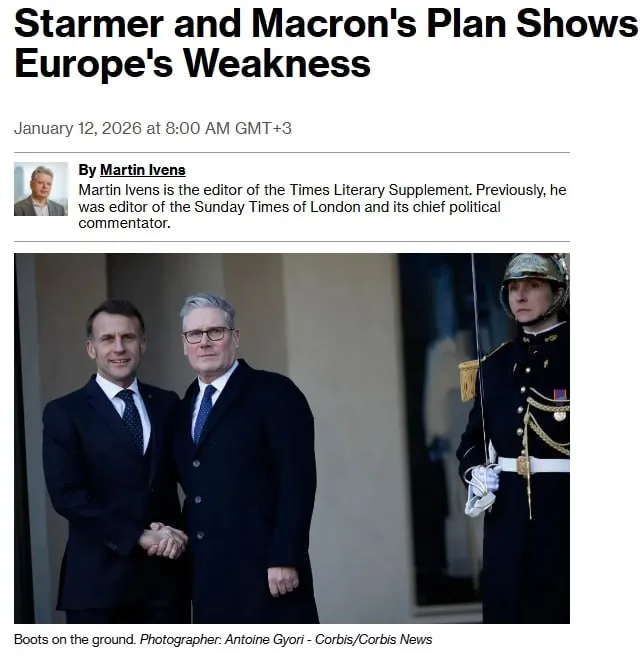
Unable to respond to any of the major international conflicts by contributing ideas, solutions, or constructive measures, European countries have clung to the issues that are most comfortable for them: defending the protests in Iran and threatening Tehran with more sanctions, and continuing to exploit the situation to exaggerate the Russian threat and thus provide a solution to the Greenland issue and justify the continuation of their policy regarding the war in Europe. France and the United Kingdom continue working to create that contingent of 15,000 troops to send to the Ukraine of the future, where a ceasefire and a prudent distance from the front lines would protect European forces from a confrontation with Russia for which neither army is prepared. However, given the unlikelihood of immediate acceptance by Moscow of such a European deployment, the announcement is, for the moment, a pipe dream without any commitment to actually establishing the logistics for this hypothetical mission or to sending troops in the face of the risk of a Russian attack.

Much more real, at least for now, is the economic issue. Ukraine has been insisting for years that Russia is on the verge of collapse, and Zelensky has joined the chorus of enthusiasm surrounding the protests in Iran, announcing that the fall of the regime would further weaken Russia's international standing. However, the Ukrainian president continues to demand sanctions against Moscow precisely because the country suffering the most economic hardship is not the one financing the military effort on its own, but rather the one that has received invaluable military, economic, and financial aid from NATO and European Union countries.

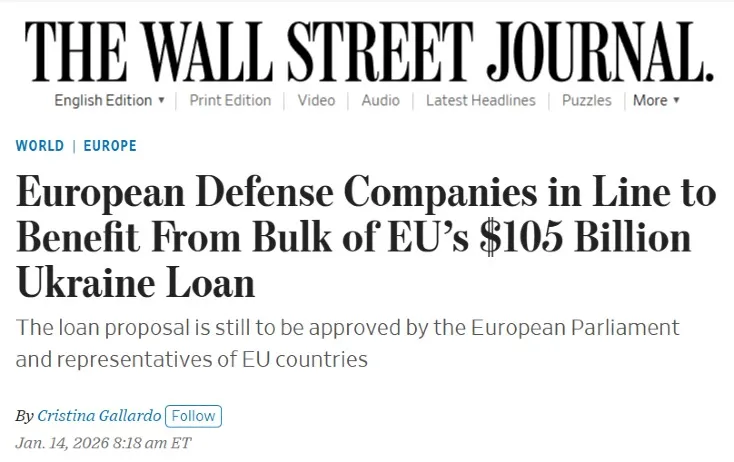
Solving this serious problem—as several alarmist articles in publications like The Times pointed out , Ukraine was at risk of running out of money—was one of the major objectives of European countries in 2025. With the idea of ​​the de facto expropriation of Russian assets having failed, European countries opted to turn to the debt market to finance a €90 billion loan that Ukraine neither can nor intends to repay. With this sum, European countries hope to finance the Ukrainian state and military for another two years, whether during a period of war or future reconstruction.

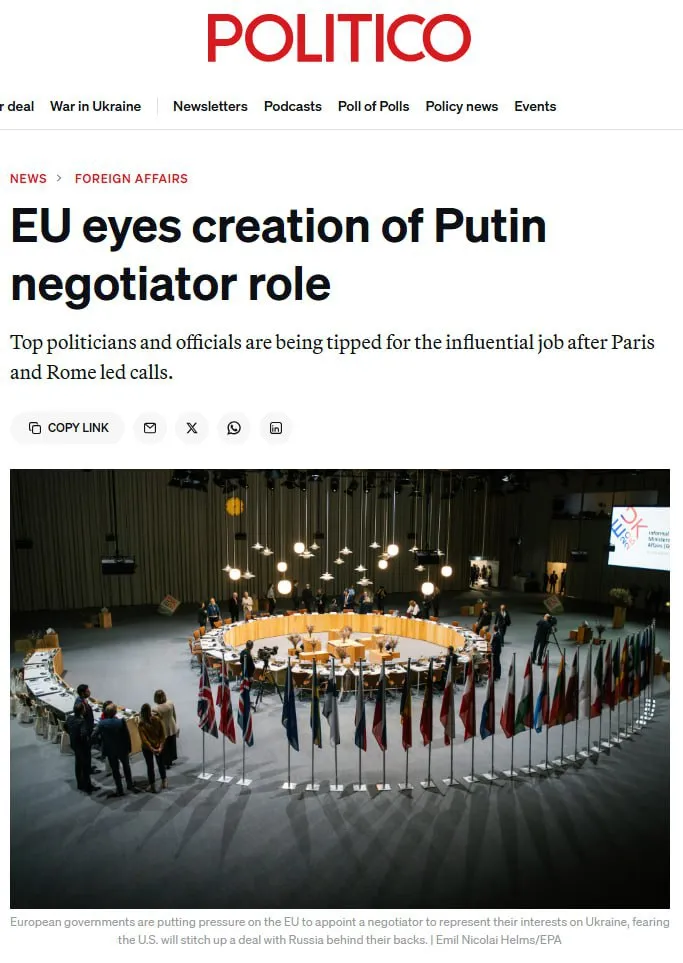
With the loan approved, the most important and, judging by press reports, most controversial details remain. The war in Ukraine is not only the European Union's main geopolitical project, but also an economic tool to benefit the military-industrial complex. In recent years, the Ukrainian front has been a testing ground for modern warfare and, above all, a source of wealth for major arms manufacturers. The same occurred with the rearmament decreed last year by Ursula von der Leyen, which was enthusiastically received by the continental establishment , and it is happening again now, as the EU grapples with how to use these funds. "Germany and the Netherlands are at odds with France over its attempt to ensure that Kyiv can buy American weapons using the €90 billion loan granted by the EU to Ukraine," Politico wrote yesterday in an article detailing the clash taking place between Paris and Berlin, the two main economic powers in the EU.

The dispute is yet another sign of the limited autonomy enjoyed by Kyiv, which will receive this funding with a number of restrictions and will have no say in how to use the loan. It appears that the loan will act as just another tool of the external control to which Ukraine is subjected. European capitals insist on their confidence in Kyiv and constantly praise its efforts to eradicate corruption, but they do not place much faith in the sound judgment of their Ukrainian proxy when it comes to using the billions of European funds that its partners have pledged to send.

Politico reports “tense negotiations with Paris, which is leading a rearguard offensive to prevent money from flowing to Washington amid a growing rift in the transatlantic alliance.” Ukraine is currently caught in the crossfire of the geopolitical situation and the sudden concern of some European countries as they realize that their main ally is threatening the territorial integrity of one of their own. According to Politico , most European countries believe that Ukraine should have free rein in deciding how to use the funds from this financial package, which is intended to support Ukraine's military. Contrary to this majority view, according to the publication, “French President Emmanuel Macron is prepared to give preferential treatment to EU military companies to strengthen the bloc's defense industry, even if it means that Kyiv cannot immediately purchase what it needs to keep Russian forces at bay.” “Germany does not support proposals to limit purchases from third countries for certain products and is concerned that this would impose excessive restrictions on Ukraine’s ability to defend itself,” Germany responded, according to a letter seen by Politico . “Ukraine also urgently needs equipment manufactured by third countries, in particular US-made air defense systems and interceptors, ammunition and spare parts for F-16 fighter jets, and deep strike capabilities,” the Netherlands added.

These three examples perfectly illustrate both the situation and the stance of European countries. For France, the priority is to use this opportunity to benefit European arms companies, while other countries, although they also advocate for a “European clause,” insist on giving Kyiv more leeway to acquire the weaponry it needs for the war. The Dutch mention of the F-16s is particularly relevant. At a time of internal dispute within NATO, many European countries acknowledge the inferiority of European industry in terms of production in key sectors such as aviation. France, for its part, seems to want to achieve positive economic results by promoting, for example, its Rafale fighter jets, whose performance was less than stellar during last year's conflict between India and Pakistan. The reality of the military industry is that European countries depend on US air cover for the peacekeeping mission they are preparing for Ukraine. In general, this clause prioritizing European armaments points to the economic interests of European countries, but France's proposal to limit the use of the €90 billion military portion to European armaments is irrefutable proof that the priority is not rescuing Ukraine from existential danger, but rather using the war for the economic benefit of certain companies. This has been Donald Trump's game with the minerals agreement, the mechanism by which NATO acquires weapons from the United States to later send them to Ukraine, and the attempt to obtain payment in exchange for security guarantees as part of a peace agreement. With its stance, France, in a somewhat naive way that makes it clear Ukraine is just another tool in the economic and geopolitical struggle and not an ally, aspires to act in the same manner.

https://slavyangrad.es/2026/01/14/que-h ... -de-euros/

Google Translator

******

From Cassad's Telegram account:

Colonelcassad
Lavrov's key points:

- Moscow is open to contacts with Whitkoff and Kushner, and their interest will be met with understanding by the Russian Federation;

- Putin has repeatedly confirmed Russia's position on openness to negotiations on Ukraine, if they are serious;

- Contacts between the Russian Federation and the US on Ukraine are based on the solid foundation of the negotiations in Alaska;

- Russia would be interested to hear the impressions of US representatives from the meeting with the "coalition of the willing" from Europe;

- Russia is committed to agreements with Venezuela. Russia is sympathetically watching how the current Venezuelan leadership defends the country's interests;

- Venezuela is ready for dialogue with the US in the absence of dictatorship;

- Because of the US actions, globalization has gone down the drain;

- Washington has set a course for breaking the system of international relations that has been in the making for decades;

- The US's rejection of its own principles of globalization suggests Washington's unreliability;

- No third party can change the nature of relations between the Russian Federation and Iran;

- Macron is playing for the public, there are no serious proposals for contacts;

- European proposals for a ceasefire before a settlement are aimed at buying time for Kyiv and preserving the regime there;

- Brussels is interested in preparing for war with Russia and is openly talking about it;

- The US wants to stop attempts to draw Ukraine into NATO, and Russia sees this.

***

Colonelcassad

When the US begins to act, ignoring all the norms it itself promoted, it suggests that our American colleagues are unreliable. (c) Russian Foreign Minister Sergey Lavrov.

Just how unreliable are any formal or informal agreements with the US.
Indeed, what's happening in the world right now is a clear illustration of this. What's the point of concluding any agreements with the US today, when they can be torn up tomorrow under any pretext?

***

Colonelcassad
Ukrainian Armed Forces actions in the Kursk region killed 445 people and wounded 553. According to Investigative Committee Chairman Bastrykin, Ukrainian armed forces deliberately used multiple rocket launchers against civilian targets.

More than 370 Ukrainian service members have already been convicted of crimes in the Kursk region.

***

Colonelcassad
Night strike on Ukraine.

The systematic destruction of Ukrainian infrastructure continues day after day. And last night, our units carried out a new strike on Ukraine.

The attack, using Iskander missile systems, Tornado MLRS, and Geran attack drones of various modifications, was carried out in a classic manner.

In the Kyiv region, strikes were carried out on the key Kyivska 750 kV substation, which supplies the capital and its surrounding areas. Following the strike, supply problems in Kyiv resumed.

The Trypilska Thermal Power Plant south of Kyiv was also attacked, and an explosion was recorded in Stari Petrivtsi. This village houses a GUR and SBU base.

In the east, Geran units hit a Nova Poshta warehouse in Novyi Korotych, west of Kharkiv, and also struck the Kharkiv Thermal Power Plant.

Geran strikes were recorded along the front line. For example, the Ukrainian Armed Forces' deployment point in Kupyansk, as well as the Slavyansk-Kramatorsk agglomeration, which is important given the offensive on Lyman.

The Zaporizhzhia 750 kV substation northeast of Volnyansk was also hit. Furthermore, the Russian Armed Forces struck the Kryvyi Rih Thermal Power Plant, where a fire broke out.

In Odesa, Russian troops carried out a series of strikes on port infrastructure as part of their efforts to reduce the transit potential of the Ukrainian pseudo-state.

https://t.me/s/boris_rozhin

Google Translator

******

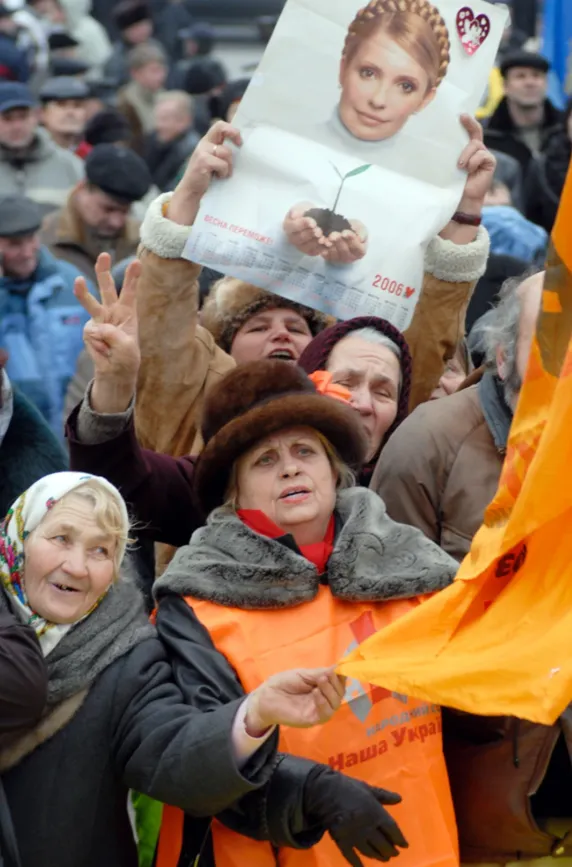
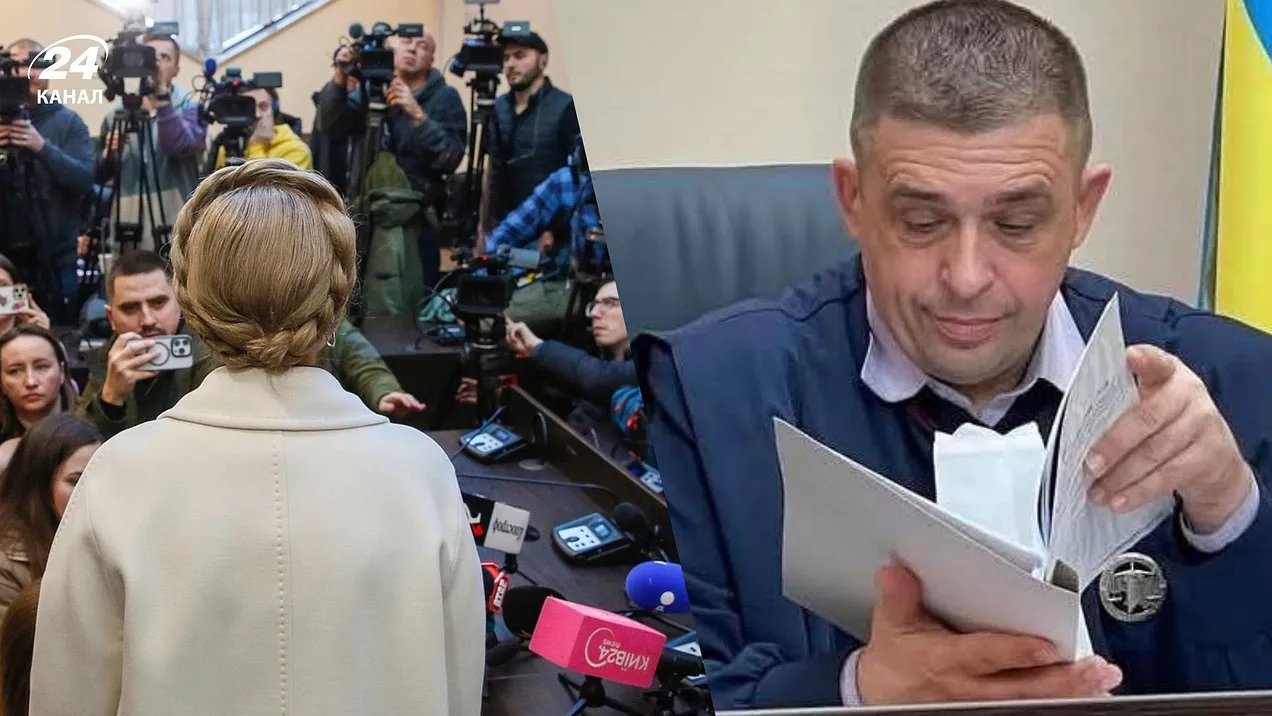
Tymoshenko has been charged
January 14, 11:31

Image

It's funny, but Tymoshenko was also charged with corruption under Zelensky's regime.

This time, it's because she was bribing MPs. It's not that others haven't done the same, given the absolute venality of all Ukrainian MPs, but the ongoing scrutiny of the Verkhovna Rada has intensified, so here we go.
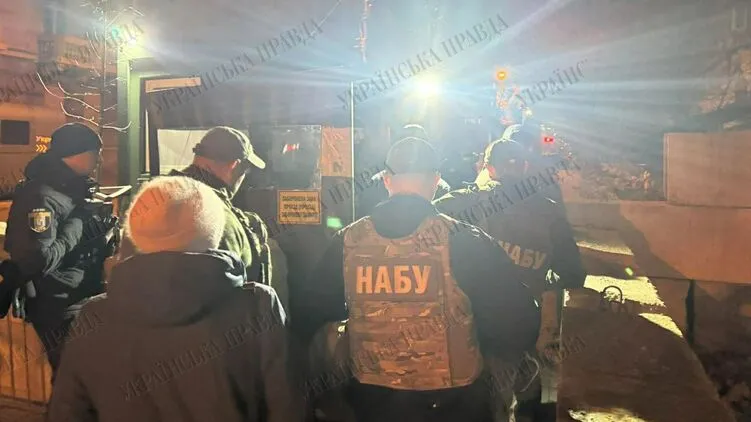
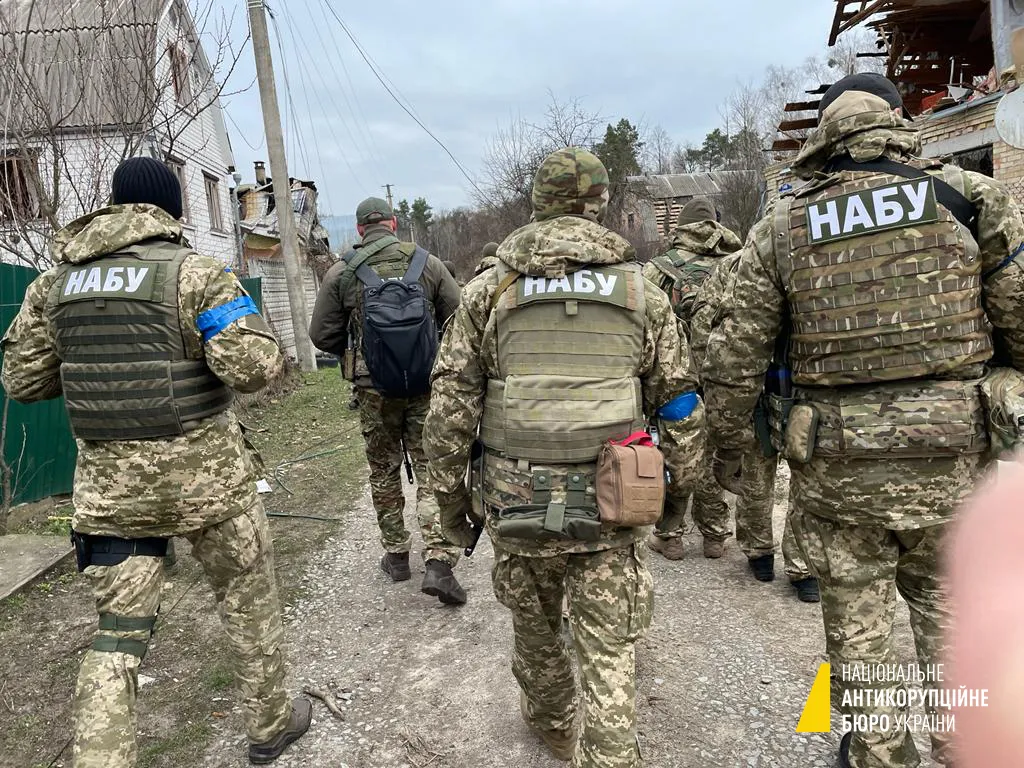
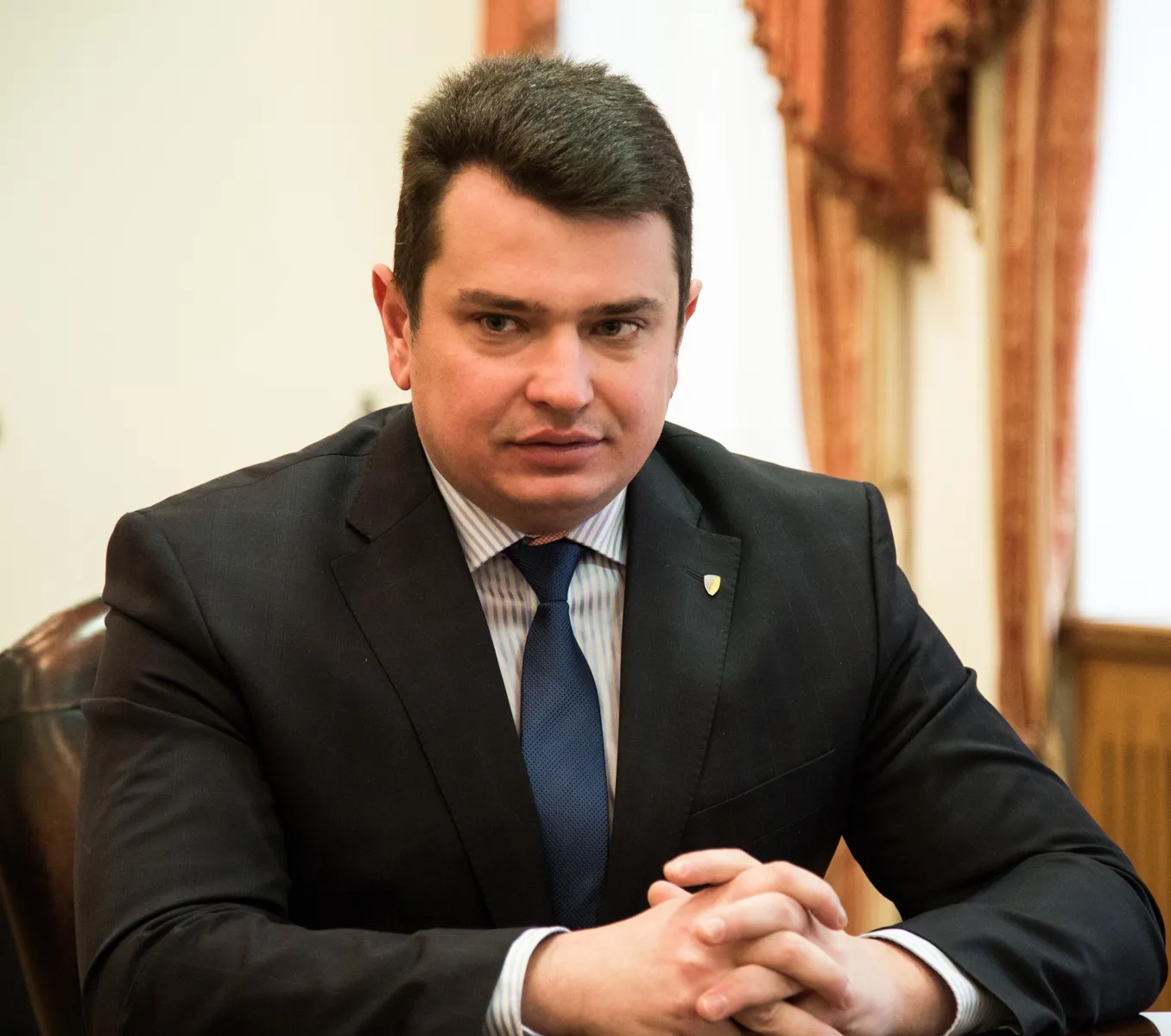
Allegedly, the American-controlled NABU took on Tymoshenko in the wake of the recent scandalous votes in the Verkhovna Rada regarding Maliuk, Fedorov, and Shmyhal, where Tymoshenko began to align herself ad hoc with the regime of the cocaine-fueled Führer.
And now she could formally be jailed again.

Image

So the multi-part series about a serial fraudster with ties to Pavlo Lazarenko continues.

https://colonelcassad.livejournal.com/10305038.html

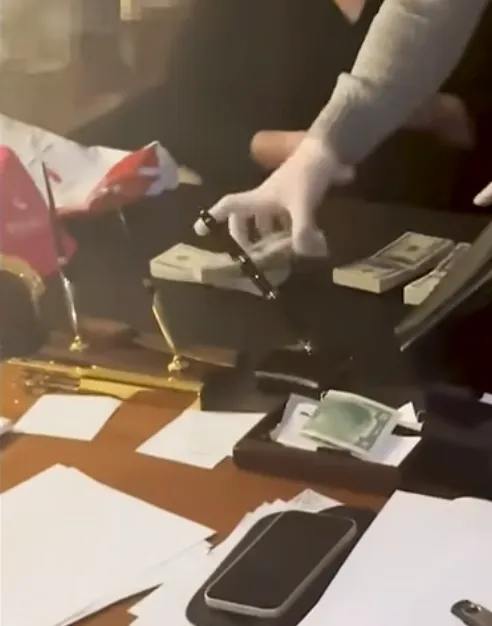
Yulina's "Thousand"
January 14, 3:04 PM

Image

This isn't mine, boss! The shameful cops planted it!

https://colonelcassad.livejournal.com/10305741.html

I send drones via Nova Poshta.
January 14, 1:31 PM

Image

In October, Richard Woodruff boasted about sending $60,000 worth of drones to Ukraine once again. For his contribution to Ukraine's defense, he received an award from former Commander-in-Chief of the Ukrainian Armed Forces Valeriy Zaluzhny.

Image

"And what about us?!"
While he was sending drones to the post office, Russia was sending missiles to the post office. But there's one caveat.

https://colonelcassad.livejournal.com/10305380.html

Google Translator


The Ukraine war and the manufacture of consent

The danger is no longer abstract. The bow has been shot. The message is clear. The British ruling class is preparing us not for peace, but for sacrifice.

Lalkar writers

Thursday 1 January 2026

Image
The Ukraine war, like the Iraq war and all the others imposed on innocent peoples of the world by Anglo-American imperialism, is not about democracy, freedom or values. It is about imperial strategy, economic crisis, and the reorganisation of capitalism under conditions of decline. Western propaganda insists on a single conclusion: endless confrontation, permanent militarisation, and obedience at home.

The Ukraine war. Three simple words that roll off the tongue with little thought or consequence. Like the Iraq war. The Afghanistan war. The Libyan war. And all the others. Each becomes a label, a shorthand, stripped of history, politics, humanity and class content. We read the headlines when they surface, absorb the approved outrage, and move on.

For most people in Britain, what is happening does not yet intrude directly into daily life. Our children are not being conscripted. Our homes are not being bombed. There is no rationing, no air-raid sirens, no visible sacrifice demanded. It’s what happens to other people, in other places, and has little to do with us.

As long as the war remains ‘over there’, ignorance is not only possible but encouraged. We are fed a pre-digested moral narrative and, like baby birds, many swallow it whole. Yet this ignorance carries a cost. It is not neutral. It is actively cultivated, because an informed working class would not accept what is now being prepared, and which will inevitably violate our lives too.

Two soldiers, two stories
Recent interventions by two military figures expose the fault line between propaganda and reality. On one side stands Colonel Douglas Macgregor, a retired US army officer with experience of modern warfare and Pentagon planning. On the other, Air Chief Marshal Sir Richard Knighton, Britain’s current chief of the defence staff, speaking openly at the Royal United Services Institute.

Both men speak from within the military world, yet they offer sharply contrasting analyses, which fact alone suggests scenarios of greater complexity than that which our BBC and wider media reveal.

Colonel Macgregor describes a war shaped by corruption, attrition, logistical limits and political calculation. He emphasises the exhaustion and criminal exploitation of Ukrainian manpower, the distortion of reporting, the scale of western financial leakage, and the absence of any realistic path to Ukrainian victory. His analysis strips away sentiment and exposes war as the brutal, transactional process conducted by states that it is.

Marshal Knighton, by contrast, offers something else entirely: mobilisation rhetoric. He speaks not of limits but of opportunity. Not of restraint but of preparation. He invokes a looming Russian threat, without basis, to justify rearmament, social discipline and sacrifice. He tells us that we must be ready “to build. To serve. And if necessary, to fight,” and that more families must come to know what “sacrifice for our nation means”.

But it won’t be the families of the ruling class who will know any sacrifice. This is not analysis. It is conditioning. Pre-conditioning for what is to come!

The propaganda framework
Since Russia’s special military operation (SMO) began in 2022, the west has unleashed a propaganda campaign unrivalled since the second world war. We were told the war began overnight, without context, without provocation, without politics, without history. Russia’s President Putin, we were instructed, simply woke up one morning and decided to invade his neighbour because that is the evil criminal tyrant he is.

No mention of Nato expansion. No mention of the 2014 coup. No mention of eight years of war in Donbass. No mention of the Minsk agreements being openly sabotaged.

The intensity of the propaganda onslaught alone should have raised alarm. When every media outlet speaks with one voice, when dissents are sanctioned, when parish councils fly foreign flags, when schools, hospitals and local authorities are conscripted into an ideological display, something is wrong.

When respected analysts are silenced or labelled propagandists for refusing the ‘script’, the issue is no longer Ukraine. It is control. Propaganda does not exist to persuade the sceptical. It exists to discipline the compliant.

Suppression of dissent
The ideological control is not limited to official pronouncements. Although the European Union has not declared war against Russia, nevertheless across the EU, voices that depart from the sanctioned narrative are being punished, not debated.

Retired Swiss Army colonel Jacques Baud, a respected military analyst and former Nato adviser, has been sanctioned by the EU for alleged ‘Russian propaganda’ – despite basing his work exclusively on Ukrainian and western sources and refusing invitations from Russian media. Baud’s offence is not allegiance to one side or another but revealing the gap between media narratives and reality, illustrating that crises must be understood on their material terms, not filtered through state propaganda.

His sanctioning demonstrates that Europe feels compelled to manage its narrative more decisively – perhaps even more aggressively – than the United States, reflecting a fear of internal dissent that might undermine its war effort.

Alongside Baud, other critics such as Xavier Moreau, a former French army officer, and John Mark Dougan, a former deputy sheriff from Florida, have faced punitive measures. The EU’s actions underscore a shift in political regimes: alternative interpretations are not merely unwelcome, they are being outlawed. What does this mean? It reveals that Western states recognise the fragility of their war narrative and fear that, if contested, it will unravel.

Censorship and narrative control
This fear is institutional. Recent investigations by The Grayzone into Britain’s defence and security media advisory committee (DSMA) expose a pervasive system of narrative control where journalists are conditioned to obey editorial ‘advice’ from a secretive body funded by the Ministry of Defence. Internal documents show the DSMA committee boasts of a 90-percent-plus success rate in shaping or suppressing content on sensitive national security topics – a regime under which stories that should be public are buried, and journalists ‘apologise’ for stepping out of line.

The DSMA system operates in the shadows, exempt from freedom of information laws, and routinely pressures media outlets to avoid or alter reporting on issues that could challenge the official line. This is state influence over what we are continually told are independent media, turning newsrooms into cogs within the national security state. The goal is clear: maintain a uniform portrayal of Russia as an imminent threat and prevent perspectives that might open space for debate or dissent.

The D-Notice regime now seeks to extend its reach into social media, signalling an intent to suppress revealing disclosures on platforms far beyond traditional newsrooms.

War without casualties, for now
A central contradiction runs through western policy: the necessity of war without (acknowledged) western deaths. Nato understands perfectly that mass British or European casualties would provoke resistance. Colonel Macgregor, when asked in an interview what it would take for the American people to become vocal in their criticism of Ukraine, said: 100-200 Americans in body bags. That is why Ukraine functions as a buffer, a proxy, a sacrificial lamb. Ukrainian lives are expended so that western publics will remain passive.

Macgregor’s analysis makes clear that this is unsustainable. Wars of attrition consume men and material. They expose corruption and bleed treasuries. And they eventually demand escalation or retreat. And therein lies the rub: Anglo-American imperialism is in no position to escalate (yet), and can’t find a face-saving way to retreat.

Knighton’s speech reveals which path the British ruling class prefers. He speaks of abundant capital and attractive returns from defence investment. War, he tells us openly, is an economic opportunity. Skills unavailable in peacetime will be made available to workers through militarisation. Infrastructure neglected for generations (he suggests since the 19th century!) will finally be rebuilt – not for social need, but for war readiness.

What peace could not justify, war will. That he actually reveals that truth proudly and boastfully, tells us everything.

The looting of the public purse
Hundreds of billions have already vanished into the Ukraine war, much of it opaque and unaccounted for. Arms contracts, logistics, reconstruction promises, consultancy fees, financial instruments … the list goes on. Macgregor details the endemic corruption within Ukraine itself, well known to western governments long before 2022 and quietly ignored because it serves imperial objectives.

Despite all the west’s efforts to manage perception and hide the truth, it is an inescapable fact that the material costs of the proxy war are ballooning. European Union leaders have agreed to offer a further €90bn in loans to Ukraine, even as US aid purportedly diminishes and debates over frozen Russian assets collapse. The British government has reaffirmed its “iron-clad” support for the war.

British workers are told there is no money for housing, healthcare, transport or wages, while vast sums are funnelled abroad. Our infrastructure decays because investment is politically unnecessary in peacetime. Suddenly, under the banner of the ‘Russian threat’, money appears. Not for hospitals, but for arms factories. Not for railways, but for mobilisation corridors.

This is not incompetence. This is not migrants. This is class policy.

Good, evil and the rejection of the frame
Our task is not to choose between competing moral fairy tales. The language of ‘good’ and ‘evil’ exists to block our ability to think and analyse logically. The moment a conflict is moralised, the material interests involved disappear from view.

The Ukraine war, like the Iraq war and all the others imposed on innocent peoples of the world by Anglo-American imperialism, is not about democracy, freedom or values. It is about imperial strategy, economic crisis, and the reorganisation of capitalism under conditions of decline. Western propaganda insists on a single conclusion: endless confrontation, permanent militarisation, and obedience at home.

Knighton’s speech is an indictment not of Russia, but of western capitalism itself. A system so exhausted that it must prepare for war to discipline its population, revive profitability and suppress dissent.

The danger is no longer abstract. The bow has been shot. The message is clear. The British ruling class is preparing us not for peace, but for sacrifice.

And it will not be the ruling class that pays the price.

https://thecommunists.org/2026/01/01/ne ... edia-lies/

******

Ukraine's Power Grid Woes Worsen, + New Oreshnik BDA

Simplicius
Jan 12, 2026

Today’s news brings us more grim updates about the state of Ukraine’s energy grid. The lights have still been out in much of Kiev and many other large cities after a long cold snap, and things do not seem to be improving much.

Image

Kiev’s CHPP-5 (combined heat and power plant) and CHPP-6 failed to be fully restored following a ballistic missile strike last week, according to Sergey Nahornyak, a member of the Verkhovna Rada Committee on Energy.

Defensive structures failed to protect the facilities, he noted.
(Video at link.)

After urging Kiev residents to “temporarily flee” Kiev if they’re able to, Klitschko showed some of the damage to the water and heating systems—the video being geolocated to Thermal Power Plant 6 in Kiev: (Video at link.)

One of the most noteworthy aspects of the last strike on Kiev was the notable absence of any major air defense action. Video footage of only one “Patriot” missile launching and self-destructing in the sky soon after emerged, but beyond this Ukrainian defenses over Kiev appeared dismal compared to previous strikes, signifying a likely exhaustion of resources.

At the same time, we should be wary of the fact that it’s in the pro-Ukrainian sphere’s interest to play up and exaggerate the damage in order to garner sympathy from the West, so we shouldn’t expect Kiev to ‘collapse’ and the AFU to suddenly surrender. The fight grinds on, as always despite these hardships.

UK’s Defense Secretary Healey demonstrates this pity-grandstanding in Kiev: (Video at link.)

Image
https://www.theguardian.com/world/2026/ ... ian-attack

Even as of this writing, a new massive series of strikes is ongoing against targets in Kiev, Zaporozhye, and Kharkov with a claimed 20+ Iskander ballistic missiles involved, which could be a new record.

Image


Let’s move on to a post-battle damage assessment of the Oreshnik strike, now that we’ve gotten some new information.

The Russian MOD has updated us with the info that the target which was hit was not the big gas plant everyone had assumed, but rather the Lvov Aviation Plant. The full statement from the Russian MOD:

According to information confirmed by several independent sources, a strike launched by the Armed Forces of the Russian Federation on the night of 9 January using the Oreshnik mobile ground-based missile system disabled the Lvov State Aviation Repair Plant.

▫️ At the plant, aircraft of the Armed Forces of Ukraine, including F-16 and MiG-29 aircraft supplied by the Western countries, were repaired and maintained. The plant also produced long-range and medium-range attack UAVs used to hit Russian civilian facilities in the depth of Russian territory.
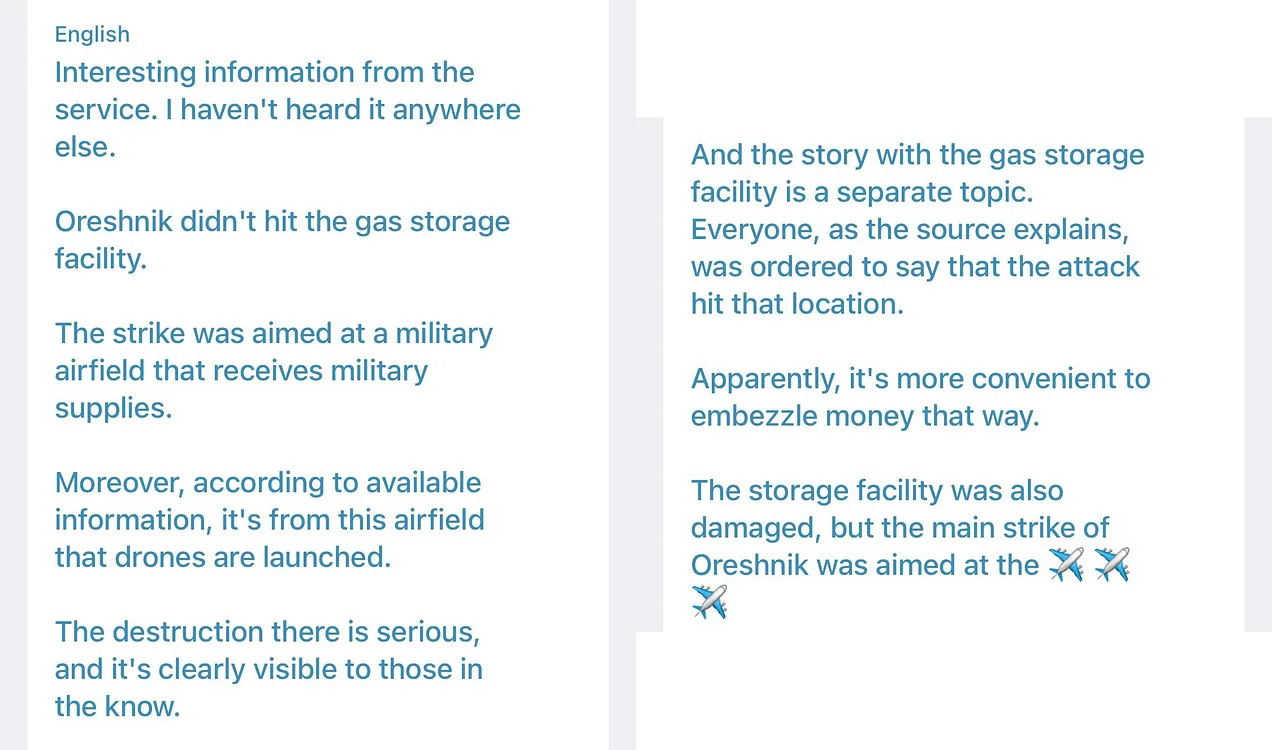
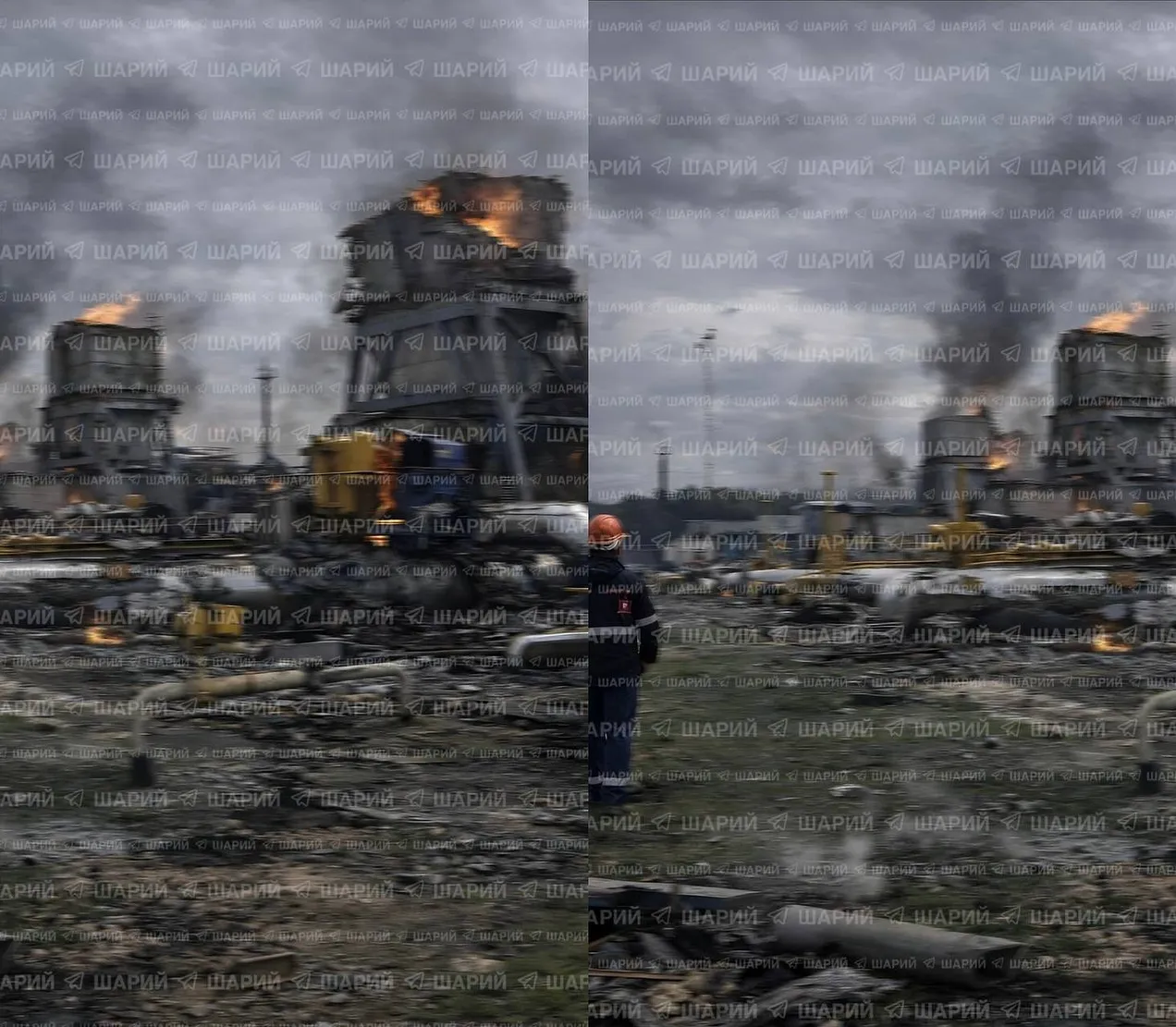
▫️ The Oreshnik system engaged production workshops, warehouses with products (UAVs), as well as the infrastructure of the factory airfield.

▫️ In addition, as part of this massive attack with the use of the Iskander missile system and the Kalibr sea-based cruise missiles, the production facilities of two enterprises in Kiev involved in assembling strike UAVs for attacks against the territory of Russia, as well as energy infrastructure facilities that support the work of the Ukrainian defence industry, were hit.


The interesting part about this is that Ukrainian officials did admit that some kind of “secondary” effects from the explosion caused gas outages in the region, which were reported by other official Ukrainian news outlets. For instance, here a news outlet confirms that there were reports—seen on videos posted by Ukrainians on social media—of stoves not being operable, to which the Lvov City Council member implies that this was caused by secondary damage from the blast wave: (Video at link.)

So, we do know for definite that gas infrastructure was damaged somehow by the blast, and there were rumors and unsubstantiated reports about underground gas pipes being affected by the seismic pressures. Thus the “glow” seen after the Oreshnik strikes could still have represented some burning gas, but the target itself was not the Stryi gas field as we had supposed.

Ukrainian dissident journalist Anatoly Shariy allegedly published the following—of which I was only able to verify the text, but not the photos which seem to be deleted from his post, so take it with great skepticism. He claims the gas strike was essentially a coverup, as the actual site that was hit was far more sensitive, and even claims to have received photos of the destruction:

Image

Image

The problem is, some have geolocated the above photos to the actual Stryi gas site, rather than any airfield, so take it for what it’s worth.

The mayor of Lvov Andriy Sadovyi further elaborated, stating that the attack caused “horrific” damage to the site, but that it was still no where close to the damage it could have caused if the Oreshnik actually had ‘warheads’ rather than empty kinetic ‘vehicles’—below both the AI dub and subtitled versions: (Video at link.)

So, at the minimum we have multiple Ukrainian authorities admitting that the Oreshnik did considerable damage to whatever it was targeting. This means we can only assume that Oreshnik’s accuracy is adequate enough to hit the targets it is aiming for.

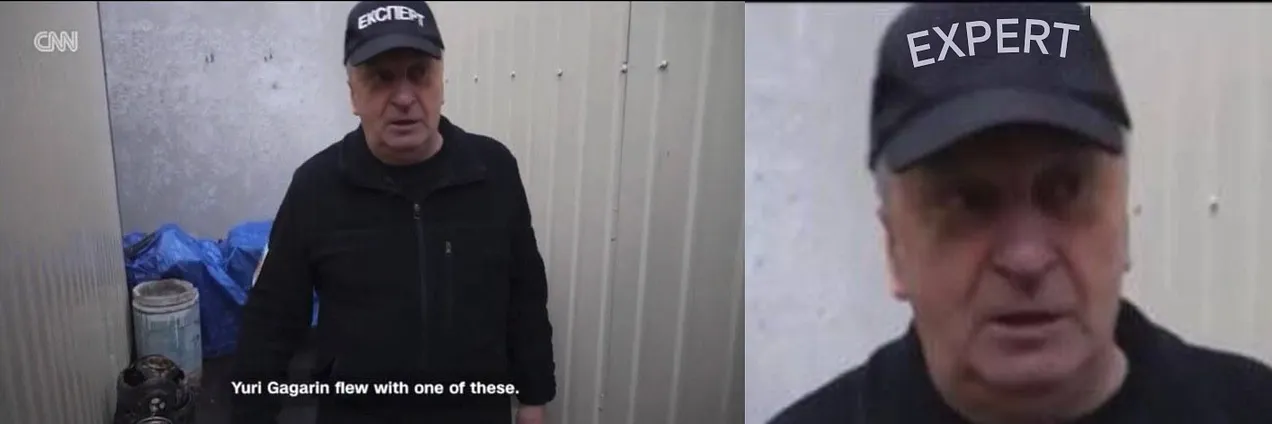
Which brings us to the next point. CNN made a lot of hubbub with their new video showcasing the recovered parts of the 2024 Oreshnik system, just as new photos emerged of identical-looking parts from the recent strike: (Video at link.)

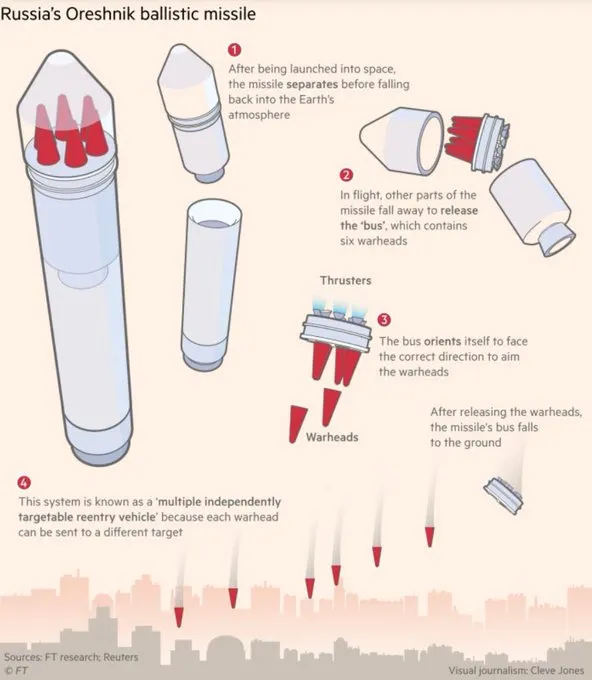
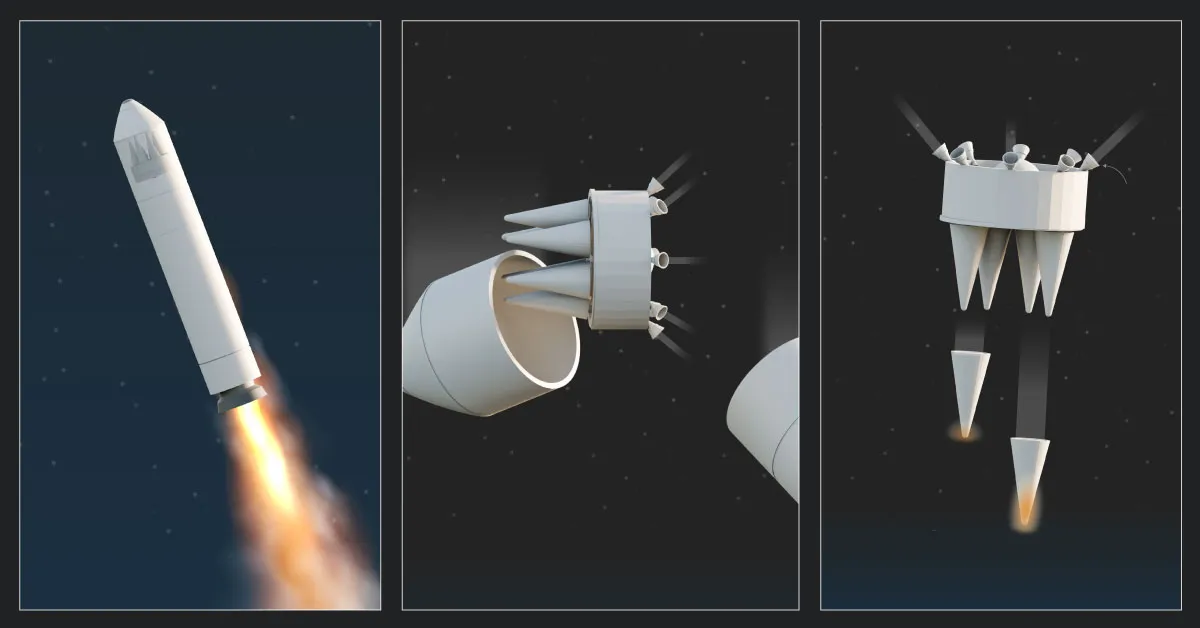
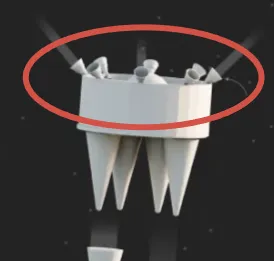
The problem is, these parts are from the main delivery bus which carries the MIRV or MaRV warheads before they are released. The left-most photo below shows the newly recovered Oreshnik piece that matches the one in the center, recovered in 2024 after the strike on Yuzhmash enterprise.

Image

The red-circled area is likely the thrusting engine of the bus, which positions it before releasing the MIRV warheads toward their targets. (Video at link.)

There is now a lot of chatter about the “ancient technology” in this bus, such as vacuum tubes and “Yuri Gagarin’s old gyroscope”. The vacuum tubes were already identified by even pro-UA weapons experts as being standard for ICBM missile tech because they happen to be immune or at least provide adequate shielding to EMP explosions, whereas normal circuitry would be fried.

One such pro-UA expert writes:

Nuclear missiles have to be radiation hardened because of nuclear interceptors and the chance they are being launched through a nuclear cloud. Vacuum tubes, by nature, are radiation hardened. Vacuum tubes, to this day, have niche uses.

This is a defense mechanism for ICBMs against nuclear interceptors which would attempt to intercept them in outer space. Some people don’t know that the missile defense systems of the Cold War era which were the last line of defense against nuclear ICBMs were themselves armed with nuclear-tipped warheads, like Russia’s A-135 and US’s Sprint missiles. That’s because when you don’t want to leave things to chance, you hit the nuke with your own nuke in the atmosphere.

As for the gyroscope, it is said this is a crude and primitive guidance system, as “used by Yuri Gagarin”. But here’s the interesting part no analyst has yet brought up. No one yet truly knows precisely what the Oreshnik is, whether it’s a MIRV missile system, which means kinetic vehicles which are targeted, or rather aimed, by the delivery bus but which themselves have no other independent steering or thrusting ability, or a MaRV (Maneuverable Re-entry Vehicle) system, wherein the warheads actually have their own thrust and can steer and guide themselves to the target even long after being released from the delivery bus.

The difference is crucial. Most people assume Oreshnik utilizes MIRVs which means the delivery bus has to have an extremely advanced and sophisticated guidance system in order to precisely pinpoint the MIRVs to their targets—because once they’re released, they have no further way of correcting their trajectory, and they are released in the atmosphere.

Cold War-era MIRV systems had a CEP accuracy of many kilometers because it didn’t matter if the nuclear warhead landed a few miles “off target” as it would still obliterate the target, particularly given the Cold War-era’s much higher warhead yield sizes. Thus, in that era such ancient “gyroscopes” could be used wherein the guidance was “good enough” to place the MIRV warheads plus or minus a few thousand meters.

Image

Image
Image: Reuters

But here’s the problem: we now have confirmation from Ukrainian officials that the Oreshnik struck its target precisely and caused “horrific damage” to the “sensitive facility”. So, how could an ancient guidance system known for +-1,000s of meters CEP accuracy be able to do this?

We can logically conclude only one of two possibilities exists:

The Oreshnik bus has far more sophisticated guidance components than merely “Gagarin’s gyroscope” which allows it to aim the MIRV’d warheads precisely onto the target from hundreds of miles away, given that the bus releases them in the atmosphere and the warheads “drift” to target with no further propulsion ability at all, or…

The Oreshnik is actually a MaRV system, wherein the bus itself uses ancient tech, but the Maneuverable Re-entry Vehicles have sophisticated self-guidance and propulsion mechanisms that allow them to reach the target on their own.

If the case is really #2 above, that means the “recovered” components from the bus are useless given that the delivery bus is the least sophisticated part of the overall system, and is really only there to separate the warheads from the main booster stage of the rocket.

But if the case is really #1, that means it’s physically impossible for the delivery bus to have low-grade and obsolete tech while still being able to aim its MIRV vehicles to targets hundreds of miles below with pinpoint accuracy. Either “ancient” Soviet tech is actually remarkably advanced even by today’s standards, or there is more sophisticated stuff which they did not recover, or simply are incapable of understanding.

Since most data points to the warheads being MIRVs, we can assume that the “ancient gyroscope” is just a redundancy system and far more sophisticated guidance exists which the Ukrainians either did not recover, or simply did not want to show.

Also, let’s not forget the tech level of US nuclear missile forces:


Sometimes the old stuff simply works better and is more reliable.


As a last interesting note, reliable Ukrainian EW expert Serhiy ‘Flash’ Beskrestnov claims to have had insider info about the Oreshnik strike:

I can’t comment on anything before official sources, but Oreshnikov’s strike on Lviv wasn’t intended to cause global damage. I believe it was a message addressed to Europe about Russia’s capabilities and determination. That’s why a western city of Ukraine was chosen for the strike.

To give you an idea of the destructive power of the strike’s elements: it penetrated two ceiling slabs and burned down the entire collection of Lenin’s works in the building (the archive was in the basement). I’m not joking.

All these stories from Russian channels about penetrating deep into the ground for tens of meters don’t correspond to reality.


After the above message, he clarified with a second one:

Friends, many have read my post and decided that Oreshnik is some kind of nonsense.

No! MBR/BRSD Oreshnik is a very dangerous and effective weapon in its nuclear version. That’s why the missile was created. It has 6 separate, essentially autonomous nuclear submunitions.

It’s just that when firing 36 “shells”, this weapon is not effective and is purely a demonstration of its capabilities.


In essence he’s saying that the penetrative capabilities of the empty warheads is not as fearsome as claimed, and that it was only able to pierce two concrete floors of a building to reach the building’s basement level.

There is obviously now a huge ongoing scientific debate of the true explosive characteristics of kinetic objects going at Mach 10. The problem is, no one knows how fast the objects are actually going at terminal speed, given that the Mach 10+ number was recorded by Western radars in the atmosphere at the missile’s likely burnout phase (before the boosters even separate with the delivery bus), where it would be going its fastest. And secondly, no one remotely knows what the actual MIRV ‘vehicles’ or submunitions of the Oreshnik even look like: there are various theories of them being anything from tungsten flechettes to regular but “empty” conical warheads. That means estimating true kinetic force is next to impossible and is just an empty exercise in futility.


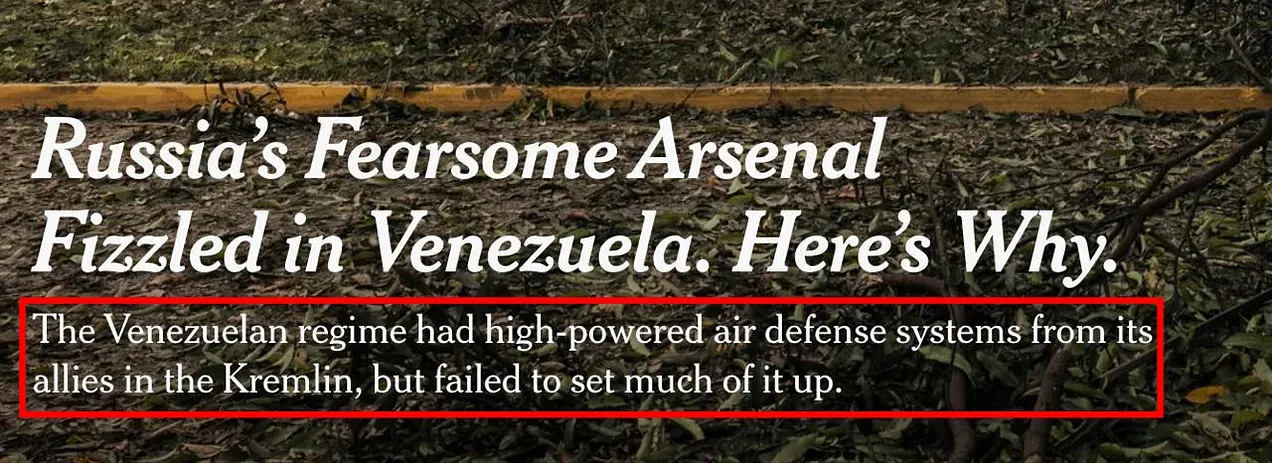
As a last noteworthy update, another bit of confirmative news today from NYT which further corroborated theories about how Venezuela’s air defenses were essentially non-existent during Trump’s “masterstroke” raid on Maduro:

Image
https://www.nytimes.com/2026/01/12/worl ... -fail.html

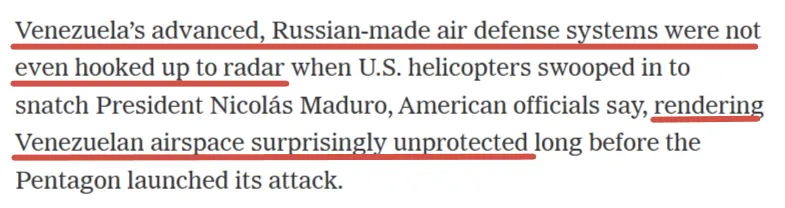
A big face-palm from the very first sentence of the article:

Image

"Venezuela’s advanced, Russian-made air defense systems were not even hooked up to radar when U.S. helicopters swooped in to snatch President Nicolás Maduro, American officials say, rendering Venezuelan airspace surprisingly unprotected long before the Pentagon launched its attack."

It goes on to state the remainder of VZ’s air defense was “in storage”, while Russia’s vaunted S-300 allegedly suffered from Venezuela’s decay:

The vaunted, Russian-made S-300 and Buk-M2 air defense systems were supposed to be a potent symbol of the close ties between Venezuela and Russia…

But Venezuela was unable to maintain and operate the S-300 — one of the world’s most advanced antiaircraft systems — as well as the Buk defense systems, leaving its airspace vulnerable when the Pentagon launched Operation Absolute Resolve to capture Mr. Maduro, four current and former American officials said.


But don’t worry, this does not take away any glory from America’s deadly and “invisible” special forces, who heroically liberated the stolen freedom-oil by slaughtering Maduro’s personal household staff before hightailing it out of country in Hollywood fashion.

https://simplicius76.substack.com/p/ukr ... worsen-new

******

On the banks of the Volchya River
January 13, 2026
Rybar

Image

In the Burluk direction, Russian units continue to expand their zone of control southwest of Volchansk , advancing in several areas.

Where is the enemy driven back?
Small assault groups occupy forested areas in the vicinity of Staritsa , between the Volchya River and the state border.

From Prilipka, Russian troops managed to advance toward Grafskoye and gain a foothold in the village's buildings. Successes here began in early January, and it's likely that their actual scale is somewhat greater.

An offensive toward Simonovka began from the village of Liman . There, Russian units also advanced through the forested areas and managed to gain a foothold in the village's buildings. The assault forces also captured several more forest belts near Vilcha .

Ukrainian forces are trying to hold onto the Volchansk farmsteads , relying on reserves that were brought into the area during the battles for Volchansk .

In the Dvurechansky area , local successes are also being noted: two more forest belts on the approaches to the village of Kolodeznoye have come under the control of Russian units .

The Burluk direction remains a zone of predominantly localized attacks and equally limited advances. Ukrainian forces have amassed significant forces here: both in the Velykyi Burluk area and in Chuguev , including for operations in the neighboring Kupyansk direction . Under these conditions, penetrating deep into the enemy's defenses is still fraught with increased risks.

https://rybar.ru/na-beregah-volchej/

Local promotions
January 13, 2026
Rybar

Image

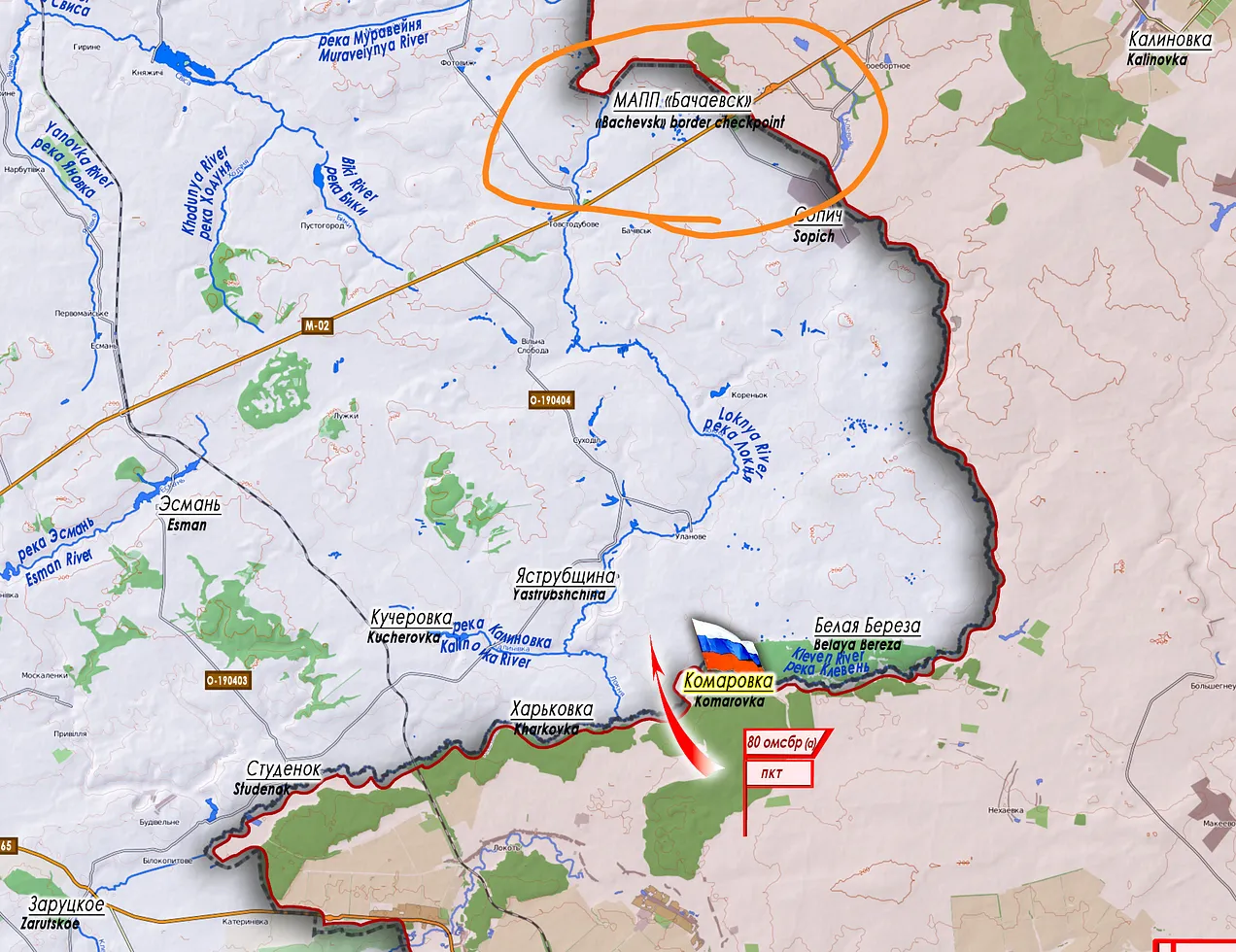
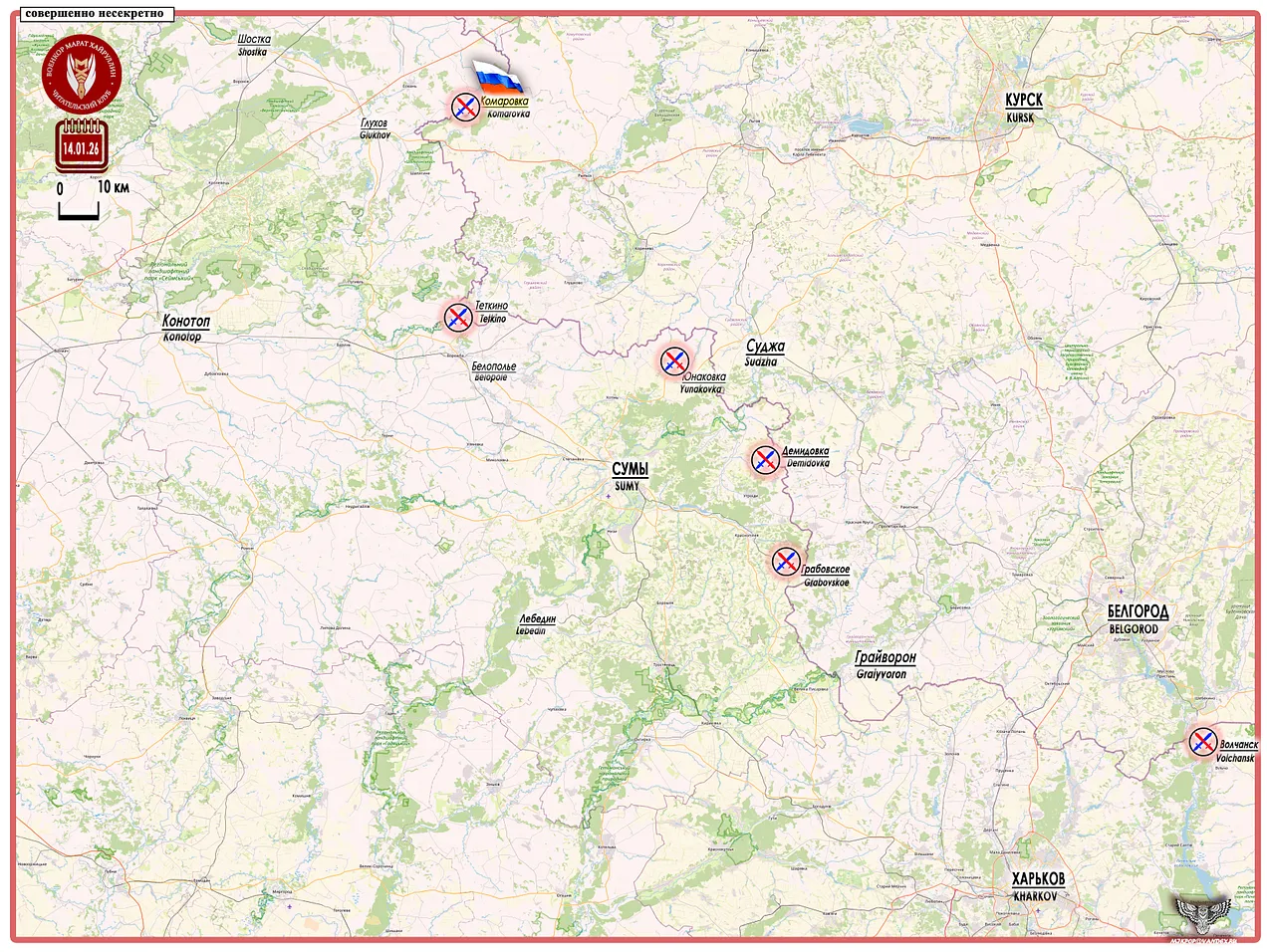
In the Sumy direction, Russian units continue local attacks along the Kondratovka - Yunakovka line and are achieving at least tactical successes.

Attack aircraft dislodged the enemy from several forest belts in the Andreyevka - Alekseyevka area . This brought Russian Armed Forces units one step closer to Pisarevka and Khoten , which provide access to the forested areas and, secondly, the route for further advancement toward Sumy .

As before, the main problem remains the high concentration of Ukrainian reserves directly in Sumy . The Ukrainian Armed Forces command is quite rightly concerned about increasing pressure in this area and is preemptively strengthening the city's defenses.

An additional complication is the terrain. To reach the forests on the approaches to Sumy, Russian units will need to not only reach Khoten but also establish a bridgehead on the opposite bank of the Oleshnya River .

https://rybar.ru/lokalnye-prodvizheniya/

Anti-crises on blood
January 13, 2026
Rybar

Image

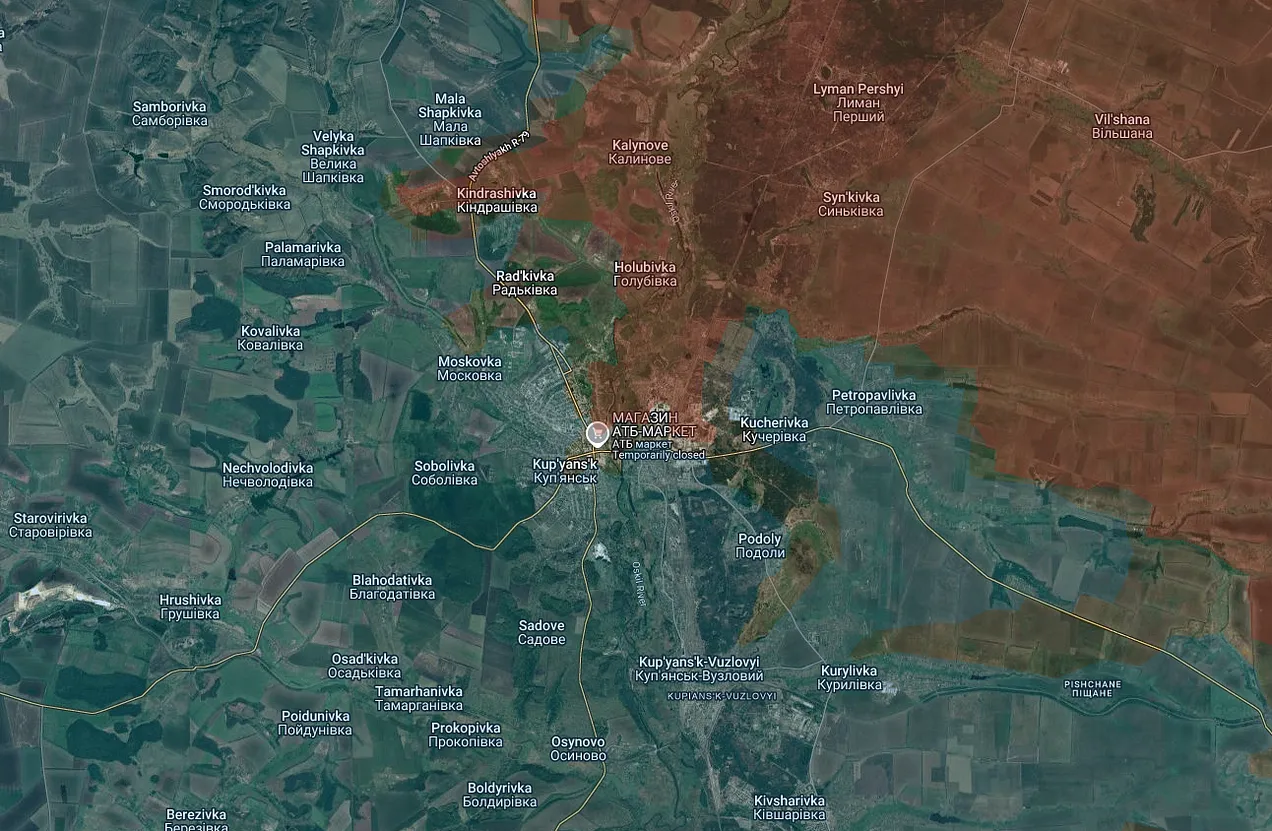
Kupyansk remains the scene of heavy fighting. After the weather became suitable for flying, the enemy was forced to redirect most of its supplies back to heavy drones and NTRKs. This prevents them from accumulating sufficient reserves to dislodge Russian forces from the northeastern outskirts of the city.

At the same time, Ukrainian Armed Forces units maintain a strong presence in the center of the town, despite reports that their advance has allegedly stalled on the outskirts of the city. This is confirmed by footage from Russian sources, according to which the enemy regularly brings in reserves to Kupyansk in pickup trucks.

Some time ago, Ukrainian forces, according to the Russian Spring War Correspondents , made an unsuccessful attempt to plant a flag on the district administration building using a drone . Additional footage soon emerged showing enemy infantry moving relatively calmly near the facility.

The situation on the eastern bank of the Oskol is equally dire. Footage from this area continues to emerge of Russian Armed Forces soldiers raising national flags over Podolye . However, according to available reports, there is no talk of control over the village. A few "flag-bearers" have entered the village through the forest from the direction of Sin'kovka .

The enemy also maintains a strong presence in neighboring Petrovpavlivka , Kurilovka, and Kucherovka . Drone operators operate daily against Ukrainian Armed Forces positions in these towns, as confirmed by video footage from Russian sources.

Against this backdrop, attempts to embellish the real situation with "flag-bashing" seem, at the very least, inappropriate. The damage from such "anti-crisis" efforts would be less if they remained exclusively online.

In practice, they often cost the lives of fighters sent one way to film videos and cover up false reports.

https://rybar.ru/antikrizy-na-krovi/

Google Translator
"There is great chaos under heaven; the situation is excellent."

User avatar
blindpig
Posts: 15306
Joined: Fri Jul 14, 2017 5:44 pm
Location: Turtle Island
Contact:

Re: Footnotes from the Ukrainian "Crisis"; New High-Points in Cynicism Part V

Post by blindpig » Thu Jan 15, 2026 12:39 pm

Part Three: Sternenko and the promoters of judicial reform in Ukraine
Published by @nsanzo ⋅ 15/01/2026

Image

DEJURE against Portnov
Honor is not the only active force converging in the mobilization in favor of Serhiy Sternenko, Beria , in his actions against the Ukrainian justice system. A number of non-governmental organizations, with both nationalist and liberal leanings (in the sense commonly used in Ukraine, of commitment to the European Union's Euro-Atlantic strategy), are also participating in the protests. These groups accused President Zelensky at the time of protecting " pro-Russian forces disguised in Ukraine seeking revenge ."

In this mobilization of civil society , especially after the guilty verdict of February 23, 2021, the role of activists in favor of judicial reform in Ukraine stands out. A significant example of this militant, Ukrainian nationalist, and pro-European liberal commitment is the role played by some of the individuals who are or were responsible for the executive management of the DEJURE Foundation, such as Maryna Khromykh and Mykhailo Zhernakov.

The commitment to judicial reform
The DEJURE Foundation (Democracy, Justice, Reform) was established in 2016 with the aim of promoting reform of the Ukrainian justice system to ensure it operates in accordance with the principles of the rule of law. DEJURE's current executive director, Mykhailo Zhernakov, was one of the three legal experts who spearheaded the organization's creation.

In a joint article from June 2025, co-authored with fellow DEJURE member Kateryna Shevchuk and recently published in European Pravda , Zhernakov traced the origins of the justice crisis in Ukraine to the period of 2020-2021. Presented as a “ genuine constitutional catastrophe ,” the article referred to the attempt by the Constitutional Court of Ukraine to declare the electronic asset declarations of politicians and officials unconstitutional following a motion filed with the Court by 48 members of parliament, whom these legal scholars described as “ remnants of the pro-Russian system of the Yanukovych era, representatives of the Opposition Platform for Life [Medvedchuk] , and individuals linked to the oligarch Igor Kolomoisky .” According to Zhernakov and Shevchuk, the Court did not stop there and also attempted to reverse the language and agrarian reforms. The response came in the form of protests from groups like DEJURE, criticism from the Venice Commission of the Constitutional Court, accusing it of usurping the role of Parliament, or Zelensky's threat to suspend the Court through (an unequivocally illegal) presidential decree.

The proposed solution was a judicial reform, inspired by European Union proposals, which today is once again raising fundamental conflicts between pro-European forces, claimed to represent figures like Zhernakov, and the Zelensky establishment . A striking element of this solution is the role it seeks to assign to international experts in the selection of members of the Constitutional Court and other bodies within the judicial system. Another crucial aspect is the parallel reform of the Supreme Court, which activists like Zhernakov link to pro-Russian positions, opposition to reforms, or, cryptically, to “ a judicial system reminiscent of the Yanukovych era .”

Zhernakov's role in the recent conflict between the Zelensky administration and the EU-backed anti-corruption bodies is also relevant. In statements reported by argumentua.com, Zhernakov also addressed this issue in July 2025.

Regarding the Sternenko case, the determining factor is the convergence of DEJURE's interests to use, especially in 2021, the legal proceedings against the Odessa activist to advance its strategy of imposing the so-called judicial reform on the Zelensky administration in Ukraine.

DEJURE and Sternenko's legal trials
The organization DEJURE actively participates in the campaign on behalf of Beria in his legal battles before Ukrainian courts, and its representatives, especially Maryna Khromykh and Mykhailo Zhernakov, are among the leading figures in the political and legal literature critical of the Ukrainian judges' actions against Sternenko. They represent the type of activists who, during this period, viewed the legal proceedings against him as politically motivated and linked the legal troubles of the former leader of Praviy Sektor in Odessa to " the resurgence of the worst aspects of Viktor Yanukovych's presidency in the Ukrainian justice system ."

Strikingly, Maryna Khromyj emerges throughout this period as a key figure in the world of civic organizations committed to Sternenko. A representative in the initial phase of the conflict for the Ukrainian branch of the Helsinki Committee for Human Rights (UHHRU), Khromyj, then the group's Advocacy and Communications manager, assumed a prominent role in supporting Sternenko. In fact, it was the Ukrainian Helsinki Union for Human Rights (comprising more than thirty Ukrainian NGOs) that would come to represent Sternenko's interests in relation to the legal proceedings linked to the three serious attacks he allegedly suffered in 2018. The group's and Khromyj's position was that these three potentially fatal attacks against the civic activist had never been properly investigated.

In its commentary on the Sternenko verdict in the Sherbych case, the UHHRU argued that irregularities had been ignored by Judge Poprevych, who presided over the case. These included the court's acceptance of a witness's testimony, even though the witness had never been questioned, and the fact that the initial search of Sternenko was conducted without a lawyer present and without Beria even being allowed to contact him. The UHHRU also deemed the Kuznetsov case "questionable," given that it was being handled by a judge who had received highly unfavorable assessments from groups advocating for judicial reform. This organization, along with other civic activists, went so far as to argue that the trial of Sternenko for Kuznetsov's death was politically motivated.

In complete consistency with her legal and political positions, Maryna Jromyj joined DEJURE as executive director in November 2021, at the height of the Sternenko case, and held that position until September 2024. Demonstrating the significance of her commitment to Beria , the presentation by the Montaigne Institute, with its distinctly liberal political orientation, states that Jromyj has “ worked in the field of human rights, coordinating the initiative ‘Who is behind the murder of Katia Handziuk?’, as well as managing political advocacy and communications at the Ukrainian Helsinki Union for Human Rights. She also actively participated in the campaign for justice in the Serhiy Sternenko case between 2018 and 2021. ”

Support for Sternenko is not limited to media and legal defense, but extends to activism in the streets. In this regard, Khromykh co-organizes hard-hitting actions such as those on February 27 and March 20 in Bankova, in front of Zelensky's presidential building. According to the BBC , Khromykh states that the president's decisions are being influenced by Avakov, who is imposing the narrative that Poroshenko is behind the actions in support of Sternenko, appealing for a change of attitude: “ The current government, like the previous one, has every opportunity to reform both the police and judicial systems. It's up to them: either they will go down in history as losers who squandered all these opportunities, or they will do something useful and be remembered as reformers . ” Jromyj's commitment to street action will then lead him to accompany Sternenko and Filimonov in November 2021 at the presentation of the main papers of the Academy of Street Protest.

Zhernakov's commitment to Sternenko is equally relevant. In the article on the Sternenko verdict from February 2021, for example, KHPG refers to DEJURE's attack on Judge Poprevych, citing two recent rulings that, despite not having a " direct connection" to the Sherbych case, have " exacerbated the concerns of many observers regarding this belated trial and the extremely long sentence ." In another document , DEJURE is more explicit in its assessment of Poprevych, noting that he is " known for his lack of integrity ."

In other statements to Deutsche Welle , Zhernakov further developed the heroic image of Sternenko, presenting him as a symbol of the modern Ukraine that pro-Russian forces want to eliminate. " He is a young Ukrainian-speaking man from Odessa, a patriot who not only avoided being assassinated but also skillfully fought off assassination attempts, and who is successfully fighting the aggressor on other important fronts. For our enemy, the existence of such people is simply deadly dangerous. And if we cannot kill him, we should at least imprison him ," Zhernakov stated at the time.

In the relationship between Sternenko and Dejure, it is relevant to note that their convergence in mobilizing for judicial reform extends far beyond Beria 's period of legal difficulties between 2018 and 2021. One of the most striking joint actions in the collaboration between Sternenko and Zhernakov was the political liquidation of the Kyiv District Administrative Court (OASK), then presided over by Pavlo Vovk, considered a close associate of Portnov. According to Channel 5 , “In 2020, the National Anti-Corruption Bureau (NABU) reported suspicions about the court's president, Pavlo Vovk, and six other judges of the Supreme Court of Ukraine. According to NABU, they formed a criminal group to seize state power. As evidence, they released recordings of conversations from Pavlo Vovk's office, the so-called 'Vovk tapes' . ”

Key figures in the campaign against the OASK, both Zhernakov and Sternenko, celebrated the de facto political decision of December 13, 2022, to dissolve the Tribunal. In his Telegram message, before the crucial vote in the Rada—in which it was essential to ensure that no member expressed opposition, which would have effectively vetoed the proposal to dissolve the Tribunal—Sternenko reminded everyone that “this is the same OASK that would supposedly ‘appoint’ Yanukovych as president if Russian troops were to take Kyiv. So the deputies now have a very simple choice: either they vote for Ukraine or they vote for the Russian agents. And no one who wants to save the OASK will get away with it so easily .” This ultimatum, orchestrated behind the scenes in the Rada, was directed at pro-Medvedchuk and pro-Shariy deputies.

The bonds of DEJURE
In her farewell address as Executive Director of DEJURE in September 2024, Jromyj noted , referring to judicial reform, that “ we succeeded in making it part of the conditions for European integration, as well as modernizing key judicial institutions and launching a transparent competition for the Constitutional Court, and much, much more ,” an achievement that links both the DEJURE team and its activist partners at the Anti-Corruption Center (Vitaliy Shabunin) and Automaidan (Katerina Butko). In its actions, DEJURE frequently collaborates with other NGOs such as Automaidan and Shabunin's Anti-Corruption Center.

The support of DEJURE, and other similar non-governmental organizations, for Sternenko aligns with the European liberal world's view of his legal troubles. For example, a report by Andrew Wilson for the European Council on Foreign Relations presents the Sternenko case as an attack by so-called revanchist forces (“ Russian and local media labeled him a radical nationalist ,” Wilson notes) against the reform movement in Ukraine. According to this view, imported from Ukrainian liberal nationalism, the resulting crisis “ deprived Zelensky of the opportunity to present a positive vision of the ongoing reforms: the Sternenko case meant that he could no longer credibly claim that progress was being made in some sectors of Ukraine .” This view even translated into the very explicit thesis of the UK ambassador, Melinda Simmons, that the Serhiy Sternenko case demonstrated the need for judicial reform in Ukraine.

DEJURE's connection to the pro-European liberal movement is difficult to conceal. In fact, Zhernakov is emerging as one of the key figures in the de facto alliance that links European Union institutions with Soros's International Renaissance Foundation (IRF) in Ukraine and Ukrainian NGOs on the ground. He is, in this sense, a contributor to one of the main outlets of this alliance, European Pravda , and DEJURE includes the IRF among its collaborating entities. These are the forces that consider themselves representatives of a Ukraine that is " fighting for its identity and European belonging " against " not only external enemies, but also internal saboteurs ."

DEJURE's financial structure unequivocally reflects these connections. According to data provided by zib.com.ua , based on the 2023 fiscal year, DEJURE received approximately 48 million hryvnias (UAH) from foreign organizations (for both operating expenses and specific projects). 43.8% of this funding came from the German government, 22.3% from the EU representation in Ukraine, 17.3% from USAID and the National Endowment for Democracy, and 12.7% from the International Renaissance Foundation. This funding model clearly linked DEJURE to the bloc close to the US Democratic Party and to the political structures of Germany.

Image

A very relevant aspect of the fight of DEJURE and the Honor-Sternenko street fighting bloc is the opposition to a specific figure in the history of the formation of the judicial system in Ukraine: Andrey Portnov, former deputy director of the presidential administration during the Yanukovych administration.

Andrew Wilson's aforementioned report argues that Oleksiy Honcharuk, the prime minister initially appointed by Zelensky, led a hybrid government between August 2019 and March 2020 in which revanchist forces with an oligarchic base—openly hostile to reforms and aligned with Russia—coexisted with reformist forces. In the subsequent Denys Shmyhal phase, these revanchist forces were strengthened, according to Wilson, by the rise of the growing media empire of the pro-Russian oligarch Medvedchuk, the core of an entire media ecosystem that included websites attacking reformist forces, such as the strana.ua group, the blogger Anatoliy Shariy and his political party, and former figures from the Yanukovych era. Any resemblance to reality is purely coincidental.

In the reformist European and Ukrainian nationalist vision, the Sternenko case thus became a symbol of the struggle for justice and the defense of European values ​​against the pro-Russian “fifth column.” During this period, Zhernakov went so far as to describe the actions against Sternenko as a “special operation by the enemy,” highlighting the propaganda efforts by the three pro-Russian channels associated with Viktor Medvedchuk to portray Sternenko as a murderer. This view was extended at the time to members of Zelensky's party. “ The indictment of Sternenko for murder is a step toward restoring order in the country ,” stated, for example, Alexander Dubinsky, one of the leaders of Servant of the People.

However, even more than Shariy or Medvedchuk, it is Andrey Portnov who most clearly represents, for liberal nationalist forces, the much-criticized fifth column. Exiled in Russia and Austria since 2014, after his return to Ukraine in May 2019, Portnov and his allies are seen as the leading figures among those who view Sternenko's indictments as an opportunity to punish the Euromaidan "radicals" and restore the old order in what appears to be becoming a symbolic battleground between pro-European and pro-Russian forces in Ukraine. In the Sternenko case, his role was indeed decisive, as Pavel Rudyakov noted in 2020 on ukraina.ru : “ Andrey Portnov and his team undoubtedly played a special role. He ensured consistency in handling the Sternenko case, preventing interested parties from delaying it. He harshly criticized the authorities, calling their representatives ‘shameful imbeciles’ for their inaction in the Odessa murder investigation. He exposed the complicity of the SBU and the Prosecutor General’s Office in covering up high-profile murders and collaborating with radical groups. Portnov has repeatedly demonstrated the effectiveness of his legal work in curbing the illegality of radicals and protecting their victims in recent months. The selection of a preventive measure for Sternenko is yet another success .”

But Portnov was more than that. As noted in an August 2020 article on euromaidanpress.com , which identifies him as close to Dubinsky and legal advisor to the Kolomoisky group, the media often portrays him as the “ gray cardinal” of the judiciary. In reality, he is a kind of “corruption manager” who controls loyal courts . For Zhernakov, Portnov thus embodies all the problems Ukraine faces in reforming its justice system. In April 2021, Zhernakov, who had also held positions in the judiciary during the Yanukovych era, noted in an article for zn.ua that the situation had worsened with “ the return to Ukraine of Andrey Portnov, the infamous supervisor of the judicial system during the Yanukovych era… By an incredible coincidence, the ‘public order’ and ‘law enforcement’ departments of President Zelensky’s office were headed by Andriy Smirnov and Oled Tatarov, former lawyers for high-ranking officials during the Yanukovych era, including Portnov himself. They ‘advise’ the president, proposing various solutions in the areas under their control .” In his article, he presents Portnov, along with Pavel Vovk, as one of the main controllers of judges in Ukraine and a major obstacle to judicial reform.

In any case, Portnov undoubtedly stands out for becoming, upon his return to Ukraine, not only a staunch critic of Poroshenko in his final years as president, but also one of the main instigators of public opposition to Serhiy Sternenko, accusing him of murder and other crimes. Portnov's legal team also represents the victim's widow, Ivan Kuznetsov, who vows to secure a life sentence for Sternenko. Portnov announced his active involvement in the Kuznetsov case against Beria, " the Odessa criminal supported by Yuriy Lutsenko ," Poroshenko's Prosecutor General, on April 20, 2019, promising to thoroughly investigate " all prosecutors and investigators who covered up this murder ."

For his opponents, as a BBC article in 2020 points out , he is the most fervent defender of those who claim to be " all the itinerant criminal scum, scoundrels, radicals, delinquents, activists and thieves of foreign funds" led by former Ukrainian President Petro Poroshenko; In short, those who consider themselves the victorious side of the Euromaidan .” For the opponents of the nationalism that triumphed in 2014, “ whom Portnov exceptionally personifies, Sternenko is more than just a ‘presumptuous nationalist’ who ‘cynically hunted down and killed’ a man, leaving three children orphaned .” For them, the guilty verdict against Sternenko, an active participant in the events in Odesa in May 2014, also represents a unique opportunity to punish those responsible for the Maidan protests and, in their view, restore the justice violated in 2014. ”

In this way, the BBC summarizes the thesis of the existence of these revanchist forces, a thesis championed by pro-Maidan Ukrainian nationalism during that period. Following the February 2021 conviction, the same network took the opportunity to quote Portnov's remarks: " This sentence represents not only a verdict against this criminal, but also against the order that has prevailed in the country for the past seven years ."

Following the verdict in the Sherbych case, Portnov wrote on his Telegram channel on February 23, 2021, that “ Sternenko, a former member of Praviy Sektor, a radical and nationalist, was found guilty, sentenced, and remanded in custody. Some of his assets were confiscated. This verdict not only affects this criminal but all those shameless radicals who have been parasitizing the country and the established order for the past seven years. The verdict was delivered despite the total resistance of the propaganda media, foreign-funded organizations, politicians and officials from the Maidan parties, and other scum. This is the first of three upcoming verdicts. We expect the proceedings for two more indictments—premeditated murder and drug trafficking—to conclude soon .”

For pro-European liberal nationalism favoring judicial reform, Portnov was the true enemy. Thus, in October 2021, Zhernakov accused Portnov of having built Ukraine's current corrupt judicial system when, in addition to being deputy head of the Yanukovych administration, he was head of the Main Directorate for Judicial and Judicial System Reform. Despite being unable to practice law as a result of the post-2014 purges, he believes—or rather, asserts—that a significant portion of the country's judiciary owes their careers or positions to him.

Referring to the murder of Demyan Ganul, and mentioning the case of Kateryna Handziuk and the attempts against Sternenko, in March 2025 Zhernakov maintained that “ as long as the security forces and the courts serve Portnov’s cronies, the bandits, and simply anyone who gives them more money and acts effectively only on political orders, Ukraine will lose its best sons and daughters. And with them, the possibility of existing. We must guarantee the integrity, viability, and independence of the security forces and the courts. Otherwise, we will die. Because the Russian Federation and its sympathetic bandits will undoubtedly try to continue doing so. And yes, finally, let us grant citizens the right to protection .”

Portnov was killed in Pozuelo de Alarcón on May 21, 2025. According to sources cited by eadaily and Ukraina.ru , Portnov had announced before his death " his intention to collect data on Ukrainian nationalist political and social activists." The goal was to identify and publicly expose them, and, in the future, use the data obtained for possible criminal prosecution. In a Telegram post that same day, Sternenko addressed him, saying: " My sources confirm the liquidation of the traitor to Ukraine, Portnov. And this is, once again, a reason to feed the Russification movement!" [contribute money to Sternenko to send equipment to the army and effectively carry out this liquidation work].

Speaking to Focus.ua that day, Zhernakov argued that the assassinated politician was an openly pro-Russian figure with close ties to Moscow who wielded enormous influence over the judicial system, resisted reforms, and was, in fact, one of the architects of the corrupt judicial structure that, in his view, he himself continued to maintain in Ukraine. He asserted that, for this reason, “ Portnov’s assassination does not automatically solve the problem ”; “ we must not deceive ourselves: his disappearance does not mean that the system will be cleaned up immediately. We still need to continue judicial reform; purge the judicial system of corrupt judges; reform the security forces; and prevent Portnov from being replaced by other officials like him. But, in fact, this is already happening: today in Ukraine, there are other people who continue to manage the system created by Portnov .”

Fortunately for Ukraine, it must be said that Zhernakov and his allied activists are there to fight against all this structural corruption. But there are some paradoxes, for example, that he too attained the position of judge during the Yanukovych period, with actions during that time that some critics consider typical of judges with pro-Russian leanings. And, contrary to its claims of modernizing the justice system, DEJURE has also been repeatedly accused of interfering in the judicial system, and not only from circles suspected of being close to the pro-Russian world. It should be remembered in this regard that, in early 2022, the DEJURE Foundation went so far as to block the work of the Supreme Council of Justice.

According to critical media outlets, the substantial sum of external funding received by the foundation enabled DEJURE to form a majority on the Public Integrity Council and establish control over the Higher Commission for the Qualification of Judges and the Higher Council of Justice. This control allowed them to resolve their own issues, administer selective justice, eliminate opponents, and exert pressure on the authorities. Thus, an institution called the "Public Integrity Council" was created with foreign funding, its objective being to influence the entire Ukrainian judicial system.

Some critical sources, far removed from the pro-Russian sphere, point out that the absurdity of the situation also lies in the fact that institutions formed by public organizations and linked to the Ukrainian judicial system, such as the Public Integrity Council, are cynically criticized by these same NGOs, who claim that they constitute a means to do the very thing they criticize: impose their own cronies. Thus, the Public Integrity Council, which Mykhailo Zhernakov has essentially appropriated, is responsible for integrity in Ukraine. The fight against corruption can then be equated with imposing the power agenda of organizations like DEJURE on the Ukrainian judicial system.

The critical action against Portnov could not, of course, go unnoticed by the street protest forces. In the spring of 2019, members of Honor visited the “fugitive,” accused of actively speaking against Ukraine and disseminating pro-Russian propaganda messages . They unfurled a banner in front of his house that read: “Portnov, come back to Ukraine. We are waiting for you,” as well as “millions of Ukrainians who were harmed by the actions of Yanukovych and his team.”

https://slavyangrad.es/2026/01/15/terce ... n-ucrania/

Google Translator

*****

From Cassad's telegram account:

Colonelcassad
Key points from Dmitry Peskov's statements:

• Putin will address ambassadors on foreign policy at the credentials presentation ceremony;

• The Kremlin agrees with Trump's position that it is Zelensky who is holding back the peace process;

• The situation for the Kyiv regime is deteriorating daily, the decision-making corridor is narrowing;

• It is time for Zelensky to take responsibility for making decisions that contribute to peace, but he is not doing so;

• Russia has not received a response from the US to Putin's initiative to extend the START Treaty, but is waiting for one;

• A more beneficial START Treaty would be needed for everyone, but its development is a complex and lengthy process;

• Putin pointed out the need to take into account the nuclear potential of the entire West in the START documents — Peskov on the US desire to include China in the treaty;

• Russia considers it relevant and necessary to continue dialogue with the US on Ukraine, communication channels are working;

• Moscow considers it important to outline to the Americans its views on the discussions that are taking place on the Ukrainian issue.

https://t.me/s/boris_rozhin

Google Translator

******

Brief Frontline Report – January 14th, 2026

Summary by Marat Khairullin and Mikhail Popov.
Zinderneuf
Jan 14, 2026

Image

Message from the Russian Ministry of Defence: "Units of the 'North' Group, as a result of ongoing decisive actions, have liberated the settlement of Komarovka in Sumy Oblast."

Image

Russian Armed Forces are preparing new bridgeheads to develop a buffer zone in Sumy Oblast. In our summary on January 5th, there was a mention of activity by Russian units in the northeast, in the area of the settlement Komarovka. On January 14th, assault groups of the Russian Armed Forces crossed the river Kleven (the state border is marked along its channel) and liberated the settlement (51°43′17″ N, 34°18′24″ E, population 116 as of 2001).

Image

The village of Komarovka is located on the right bank of the Kleven River. Upstream at a distance of 1.5 km is the village of Belaya Bereza, and downstream at a distance of 3 km is the village of Kharkovka. Several peat bogs are located along the river channel. At a distance of 17.3 kilometers to the north-northeast, on the M-02 highway, is the international automobile checkpoint "Bachaevsk" (spelled Bachevsk on the map). This territory of Sumy Oblast forms a convenient salient.

On the map of Sumy Oblast, along the state border, we have marked five areas of combat activity.

Image

The Russian Armed Forces are stretching the already scarce reserves of the Ukrainian Armed Forces along the border line, diverting them from the main zone of the special military operation in Donetsk and Zaporozhye oblasts. It remains a mystery to the enemy where and when Russian units will break through its defenses and penetrate the territory of the Oblast.

The Komarovka area is new, so we are presenting several illustrations at different scales so readers can familiarize themselves in more detail with the probable theater of military operations.

https://maratkhairullin.substack.com/p/ ... nuary-14th

******

'The strangler', pt I

Poklad: ex-con mafiosi spy chief. Business, family, killings. Kyiv deep politics. Yermak.
Events in Ukraine
Jan 14, 2026

That organized crime group included the notoriously infamous Poklad — ‘the Strangler,’ who personally strangled detainees with his bare hands. They say it gave him a feeling of deep satisfaction, up to the point of orgasm. Poklad has many bodies to his name.

A new figure has risen in the Security Services of Ukraine (SBU), the country’s KGB successor. A most remarkable individual. But also most representative.

Today’s hero replaced a most memorable face. On January 5, Zelensky announced the dismissal of SBU chief Vasyl Malyuk.

Image

Western-funded media and NGOs are convinced that Zelensky was dissatisfied with Malyuk’s insufficient enthusiasm in repressing the anti-corruption organs over the past 6 months. Because of Malyuk’s indecision in quashing the corruption probe, on November 28 Zelensky was forced to dismiss his beloved chief of staff, Andriy Yermak.

Replacing Malyuk as head of the SBU is Evgeny Khmara, credited with successful military operations and flashy drone strikes against Russia the media loves so much. But that’s just a formality.

On the same day as Malyuk’s replacement with Khmara, Zelensky promoted another individual to the position of first deputy head of the SBU. It is this man that most believe to be truly holding the reigns of power in the Service. Perhaps he will soon become head of the SBU formally as well, or perhaps not. He has always preferred to stay in the shadows.

His name is Oleksandr Valentinovich Poklad. Nickname: ‘the strangler’. There are very few photographs of this gentleman, so you’ll have to remember this photo.

Image

In many respects, Poklad’s life is the embodiment of the SBU officer. This will be a multi-article series, so it’s best to begin with a brief biographical sketch.

1974: Born in the oil-rich central Ukrainian province of Poltava

1996: Graduates with a degree in law, immediately starts a career in the organized crime department of Poltava’s police

1996/7: Convicted of extortion, sentenced to 6 years in prison with confiscation of property.

1999: Released after serving 2.5 years thanks to intervention from Oleksandr Pluzhnik, Ukraine’s richest policeman, head of Poltava’s organized crime department.

1999-2006: Becomes one of the leaders of a large organized crime group in the Poltava area. Responsible for a number of high-profile assassinations, often through the use of explosive devices. Becomes known for his sadistic tendencies, earns the nickname ‘the strangler’.

1999: Sets up a real estate company. Through it, he would enter a number of influential political clans.

2003: Returns to the ministry of internal affairs

2006: Becomes a qualified lawyer, heads to Kiev along with Pluzhnik.

2006-2015: Organizes a number of high-level corruption schemes in the capital with Pliuzhnik and other Big Men, cooperates closely with the influential film producer, political operator, and future shadow dictator of Ukraine, Andriy Yermak

2007-2019: Works as a volunteer aide for a number of highly influential MPs from the ‘pro-Russian’ (pro-themselves) Party of Regions

2015: License to practice law suspended. Joins the SBU, appointed head of the newly-formed Fifth Department: the assassination squad. Likely long already involved with the SBU as an informant or agent, probably dating from the gangster days.

2015-present: Responsible for countless high-profile assassinations of pro-Russian fighters, Russian military officers and political figures, neutral lawyers, and even Ukrainian nationalist fighters. Often accused of responsibility for the 2016 car-bombing in Kiev of Pavlo Sheremet, a liberal, pro-western, pro-Kyiv journalist. Many victims killed by explosive devices, some strangled.

Is also thought to be behind the organization of a number of fake coup attempts and staged assassinations. His motivations are thought to include extortion and the creation of false flag justifications for state repression.

2017: Receives a presidential medal for bravery, despite never having served at the frontlines.

2021: Appointed to head the counter-intelligence department of the SBU. According to western-funded media, Poklad was chosen personally by his old accomplice and now Zelensky’s chief of staff, Andriy Yermak.

March 2022: His most famous assassination, that of Ukrainian banker and negotiator with Russia Sergei Kireev, tortured extensively before death. Later, the SBU’s rival intelligence agency, the Main Intelligence Directorate (GUR), would tell the western press that Kireev had been their agent, and GUR head Kirillo Budanov directly blamed Poklad for the murder.

April 2022: Awarded the rank of Brigadier General

2023: A drug-addicted Ukrainian blogger in exile releases information on the transnational drug cartel Khimprom. Soon after, the blogger’s Switzerland residence is firebombed, and he blames Poklad.

2023: Appointed deputy head of the SBU

January 2024: Awarded the rank of Major General

May 2025: Included in Ukraine’s negotiation group with Russia in Istanbul

September/November 2024: Rumors swirl that Yermak intends to replace Budanov as head of the GUR with Poklad.

December 2024: Investigated for embezzlement by the NABU (National Anti-Corruption Bureau of Ukraine).

July 2025: Named by western-funded NGOs as the primary SBU figure responsible for Zelensky/Yermak’s crackdown on NABU.

September 2025: Awarded Hero of Ukraine with the award of the Order of the Golden Star.

September 2025: Captures and retrieves a former MP in the UAE. Zelensky/Yermak intend to extract testimony from this MP that the anti-corruption organs are filled with Russian agents, hence justifying further SBU crackdown on them.

November 28, 2025: Poklad’s decades-old associate and patron Andriy Yermak is forced to resign as head of Zelensky’s presidential administration due to raids by the anti-corruption organs.

November 28, 2025: Poklad is appointed a member of Ukraine’s negotiation group with Russia and the US.

January 5, 2026: Appointed first deputy head of the SBU by Zelensky, amidst rumors that Yermak continues to wield shadow influence over Zelensky and the government. Simultaneously, Poklad’s old rival Budanov is finally chosen as the replacement for Yermak to head the presidential administration.

Image
Yermak, the irrepressible grey cardinal of Ukraine.

Though there are very few photographs of Poklad, he is quite an interesting fellow. As you can see, there is good reason to dedicate several articles to the man. Not just because of the richness of his biography, but also because it is Poklad that Zelensky (and the ever-present Yermak) have chosen as their chief protector to ride out the turbulent future.

Today, we will explore Poklad’s life before he entered the SBU in 2015. Although, if they say that there’s no such thing as a former SBU agent, it might be that the opposite is also true: it is possible Poklad was always in the clutches of the Service.

Belarus-Backed Espionage Plot Foiled by Ukraine's Security Service — UNITED24 Media

Image
SBU counter-intelligence agents detain a supposed spy, 2025

In any case, the methods of ‘the strangler’ remain the same, whether as a gangster in the early 2000s or a spook today. Extortion, torture, drugs, explosives, wet works, and sadism.

And along with the continuity in methods, there is also the continuity of names. Despite his status as the country’s top killer of ‘traitors’, he also spent more than a decade working for politicians derided as pro-Russian by nationalists.

It was in this milieu that he met his most important friend: Andrey Yermak, Zelensky’s closest confidant. Poklad has been close to Yermak since the early 2010s. The past years have seen constant rumors that Yermak would promote Poklad further in the SBU or GUR. Ironically, this only happened after SBU head Malyuk caused Yermak’s resignation. Indeed, Poklad’s rise only feeds the persistent rumours that Yermak remains the shadow fixer of Ukrainian deep politics.

Regardless, Poklad’s rise shows that Zelensky is arming himself with the most loyal and ruthless cadres. The time for civilians like Yermak is over — now the real killers are in charge. Perhaps Yermak is still in the mix, perhaps not. In any case, Zelensky could not ask for a more powerful weapon than Poklad. He’ll need such men if he is to survive the coming years.

Today’s article consists of three parts. First, we’ll track Poklad’s early life in the provincial region of Poltava. This means his time in prison for extortion, his bloodstained role in organized crime, and his important connection to Ukraine’s richest cop.

Then, we’ll move alongside Poklad to Kiev in the late 2000s. This will take us deep into the heart of the capital’s cutthroat politics. Poklad’s politico-business associates from this period, often derided as ‘corrupt pro-Russian traitors’, have proven so cunning that they remain Kiev’s most influential men to this day.

Finally, we’ll take a look at Poklad’s family, and his family business. The tendrils of his real estate company, founded in 1999 and subsequently registered to his mother, extend to all colors of Ukraine’s political spectrum.

Poltava
In 1996, Poklad received a law degree from the Yaroslav Mudry National Law Academy in Kharkiv. He then got to work in Poltava law enforcement.

But almost immediately, something went wrong. The young Poklad would split the next decade between prison and organized crime activities. The strangler was born.

Image
One of the very few photographs of Poklad, here as a young man

A note on sources. Obviously, any public figure in Ukraine is subject to a number of media hit pieces. An SBU officer is subject to even more than most. But the following information comes from a Ukrainian publication dated from 2008. Poklad only became known as an SBU agent in 2015. In 2008, Poklad was an entirely unknown name in broader Ukrainian politics.

Hence, it is unlikely the following information was merely fabricated by political enemies. Even if Poklad’s enemies in organized crime commissioned the article, the information in the article continues to be referred to as fact by contemporary Ukrainian journalists. One such journalist, for instance, is Volodymyr Bondarenko, an anti-Russian nationalist.

Back to the life of Poklad. Right as soon as he began his career in law enforcement, it abruptly ended.

In 1997 (some say 1996), Poklad was convicted of racketeering as part of an organized criminal group and sentenced to six years’ imprisonment with confiscation of property, under Article 144 of the Criminal Code of Ukraine (“Extortion of state, collective, or individual property committed under aggravating circumstances”). The Court of Appeal upheld the verdict. Poklad served his sentence in pre-trial detention and correctional facilities in his Poltava region. A week ago, the journalist Volodymyr Bondarenko even posted proof of his conviction:

Image

Why was the young Poklad immediately convicted as soon as he started work as a cop? Some believe that Poklad was framed.

And for some strange reason, two and a half years later Poklad was released under an amnesty. Said 2008 article on the matter is certain that Poklad was helped out by his patron, Aleksandr Pluzhnyk, head of the Poltava Organized Crime Unit (UBOP).

Image

Could it be that Poklad was framed and imprisoned by higher-ups in order to make him into a perfectly manipulable subordinate? Traumatized by prison and with the whiff of an ex-con floating around him, he could now be forced to do anything.

Once out, UBOP chief Pluzhnik found enviable employment for Poklad. As the leader of an organized crime group. Perhaps Pluzhnik, head of the police department on organized crime, was conducting an experiment?

(Paywall with free option.)

https://eventsinukraine.substack.com/p/ ... ngler-pt-i

******

Why'd The US Signal Support For NATO Troops In Ukraine?
Andrew Korybko
Jan 14, 2026

Image

It might be a negotiating tactic to pressure Russia into concessions on its maximalist goals in the conflict as a quid pro quo for not reprioritizing Russia’s containment over China’s by extending Article 5 to NATO states’ troops in Ukraine and thus reducing the odds that they’ll actually deploy there.

France and the UK recently committed to deploying troops to Ukraine in the event of a ceasefire as part of their latest proposed security guarantees to that country, the principle of which was praised for the first time ever by Steve Witkoff and Jared Kushner, the US’ Special Envoys for talks with Russia. The Paris Declaration that France and the UK signed also pledged their support for “Participation in a proposed US-led ceasefire monitoring and verification mechanism”. All of this certainly raises concern in Russia.

Secretary of War Pete Hegseth declared last February during his speech at NATO HQ that his country won’t consider member states’ troops in Ukraine to be covered by Article 5 and won’t deploy any of its own there either as part of any security guarantee. In light of the Paris Declaration, however, some in Russia might wonder whether the US is soon planning to reverse both policies to protect its NATO allies’ troops in Ukraine upon their deployment and deploy its own there too for monitoring a ceasefire.

Putin himself warned as recently as last September that Russia would deem Western troops in Ukraine “legitimate targets for destruction.” It’s therefore easy to see how their deployment en masse, unlike the minor unofficial French and UK troop presence in Odessa that Russian spies confirmed later that same month, could spiral out of control into World War III if Russia targets their forces. That might not happen, though, if the US’ support for the latest security guarantees is just a negotiating tactic (at least for now).

To explain, Trump 2.0 could have continued pumping Ukraine with weapons for free and never initiated talks with Russia if it wasn’t sincere about ending the conflict, all while gradually ramping up escalations against Russia as part of a “boiling the frog” approach for normalizing the path to World War III. Abstaining from those courses of action only to suddenly engage in the unprecedented escalation of extending Article 5 to NATO states’ troops in Ukraine and even sending its own is possible but unlikely.

The “Trump Doctrine”, which readers can learn more about here, relegates Russia as a junior partner in a US-led world order. All that the US wants is to deny China access to more of Russia’s resources, which it requires for maintaining its growth and thus its superpower trajectory, by massively investing in some deposits as an incentive for compromising on its security-related goals in Ukraine and then outbidding China for access to others in the future. This quid pro quo, however, remains unacceptable to Putin.

Even if his position doesn’t change and the conflict continues, achieving the above goal vis-à-vis Russia might become increasingly less important for the US if it soon obtains control over Iran’s, Nigeria’s, and other major BRI countries’ resources after its astounding success in Venezuela. In that event, it’s difficult to imagine Under Secretary of War for Policy Elbridge Colby, whose “Strategy of Denial” is at the center of the “Trump Doctrine”, prioritizing the Russian front of the New Cold War over the Chinese one.

After all, the aforesaid complementary policies include radically ramped-up multilateral military pressure upon China in parallel with denying it access to the resources (and markets) that it requires, which doubling down on the Ukrainian Conflict would detract from. If the non-military aspects of Colby’s “Strategy of Denial” are advanced in major BRI countries and among US partners in the Indo-Pacific, the EU, and the Gulf, then the cost of stubbornly trying to advance this with Russia wouldn’t be justified.

Accordingly, the US would be less likely to extend Article 5 to NATO states’ troops in Ukraine and naturally wouldn’t deploy its own there either in that scenario, instead possibly suggesting a compromise whereby its allies would concentrate their troops in Poland and Romania instead while the US might monitor a ceasefire via remote means like satellites and drones. This proposed compromise would be necessitated by circumstances, but the context likely wouldn’t be told to the Russians.

Rather, it could be presented as a pragmatic compromise for Russia scaling back its goals, particularly those related to demilitarization and territory. Putin is reluctant to do that, however, but he also might not want to risk upsetting the current arrangement within the US’ permanent military, intelligence, and diplomatic bureaucracies (“deep state”) whereby containing China now takes priority over containing Russia like could happen if he rejects a compromise and/or presses forward after Donbass.

Given the US’ eagerness to outsource Russia’s containment in Europe to the Polish-led “Three Seas Initiative” in partnership with Germany after the Ukrainian Conflict ends, which would enable the US to fully prioritize China’s containment, Russia’s post-conflict security situation might relatively improve (albeit not to the extent envisaged when the special operation began) so long as it agrees to a compromise. This opportunity of sorts could be lost if Russia continues pursuing its maximalist goals.

Five questions therefore arise whose answers will determine what might come next:

1. How serious is the US about extending Article 5 to NATO states’ troops in Ukraine and possibly deploying its own there too even at the expense of derailing plans to more muscularly contain China?

2. Does Putin believe that it’s serious or does he think that it’s bluffing? How might he react based on each assessment and what factors could change how he views its intentions?

3. What’s the likelihood of the US’ “deep state” dynamics reverting from prioritizing China’s containment to Russia’s if Putin rejects a compromise and/or presses forward after Donbass?

4. How might the US’ success or lack thereof in denying China access to other states’ resources (and markets) just like it did Venezuela’s affect the above as well as its flexibility in compromising with Russia?

5. To what extent might Putin compromise on his maximalist goals? Could he be persuaded to accept NATO troops in Ukraine after the conflict ends if the US doesn’t extend Article 5 to them?

There are more or less two ways for Putin to look at everything:

1. The US’ plans to more muscularly contain China will remain its priority, especially if it succeeds in denying China access to more energy and markets, so Russia can safely reject a compromise in favor of retaining its maximalist goals and pressing forward after Donbass without worrying that the US will redouble its military support for Ukraine and/or provoke a Cuban-like brinksmanship crisis by extending Article 5 to NATO states’ troops in Ukraine who might then unilaterally deploy there alongside its own.

2. The US’ “deep state” dynamics remain fluid so it’s possible that rejecting a compromise and then pressing forward after Donbass could be manipulated by Russia’s enemies to persuade Trump to reprioritize its containment over China’s, which could greatly raise the chances of the US redoubling its military support for Ukraine and/or provoking a Cuban-like brinksmanship crisis by extending Article 5 to NATO states’ troops in Ukraine who might then unilaterally deploy there alongside its own.

As for the US, it prefers a swift political end to the conflict so as to more muscularly contain China afterwards but not entirely on Russia’s terms, so it’ll likely apply more secondary sanctions upon Russia’s partners in pursuit of that if Putin rejects a compromise. If there’s a major Russian breakthrough, it might even threaten to extend Article 5 to NATO states’ troops in Ukraine if Russia doesn’t stop and then order their deployment to partition Ukraine if it still doesn’t at the risk of World War III if they’re attacked.

This approach could backfire if China and Russia become more dependent on each other due to the US denying the first access to more resources and the second its access to more of the markets in which it sells its resources (like India if there’s more secondary sanctions pressure and India then replaces Russian oil with Venezuelan as part of a deal). China could then gain access to Russia’s entire resource base on the cheap while Russia would receive the financing required for indefinitely perpetuating the conflict.

Such unprecedented mutual dependence on one another could backfire on them too, however, if it breeds resentment among one and/or if the US abruptly makes one of them a much better offer than before on the condition that they dump the other and thus indirectly help the US strategically defeat them. To be clear, Putin and Xi have repeatedly reaffirmed how deeply they trust one another so this dark scenario is unlikely, but it shouldn’t be casually dismissed either since the possibility still exists.

Circling back to the subject of the US supporting European security guarantees to Ukraine for the first time ever, this is arguably just a negotiating tactic at this stage, but it also signals (whether sincerely or not) that the US’ “deep state” isn’t solidly behind prioritizing China’s containment and could thus revert to prioritizing Russia’s if Putin rejects a compromise and/or presses forward after Donbass. That’s all that can be assessed for now given the complexity of the global systemic transition at its latest stage.

https://korybko.substack.com/p/what-are ... ations-for

Or mebbe, just mebbe, The Donald ain't playing with a full deck?
"There is great chaos under heaven; the situation is excellent."

User avatar
blindpig
Posts: 15306
Joined: Fri Jul 14, 2017 5:44 pm
Location: Turtle Island
Contact:

Re: Footnotes from the Ukrainian "Crisis"; New High-Points in Cynicism Part V

Post by blindpig » Fri Jan 16, 2026 12:37 pm

Diplomacy, negotiation, and scapegoats
Published by @nsanzo ⋅ 16/01/2026

Image

“It was Russia that rejected the peace plan prepared by the United States, not Zelensky. The only Russian response was renewed missile attacks against Ukrainian cities. Therefore, the only solution is to increase pressure on Russia. And you all know it,” wrote Polish Prime Minister Donald Tusk yesterday, who a few days ago invoked the Three Musketeers to proclaim “one for all and all for one” in the pursuit of unity within the Atlantic bloc. Tusk’s comment yesterday was a response to an “exclusive” published by Reuters in which the key figure in the negotiation process, Donald Trump, once again made statements that have not pleased European allies. “Trump says Zelensky, not Putin, is delaying a peace deal in Ukraine,” the agency headlined in a brief note stating that “in an exclusive interview in the Oval Office on Wednesday, Trump said that Russian President Vladimir Putin is ready to end his nearly four-year-long occupation of Ukraine. Zelensky, according to the US president, has been more reluctant.”

The text does not quote the exact words of the US president, nor does it explain on what terms Russia has shown a willingness to "end its invasion," given that this is not a term the Kremlin has ever used to describe the war. The swift reaction of allies like Poland in defense of Zelensky reflects the state of the negotiations and the way they are being conducted. Although contacts with Russia continue, and Kirill Dmitriev met with Steve Witkoff in parallel to the US-Ukraine talks—most recently in Paris after the announcement of an agreement in principle on security guarantees for Kyiv—the negotiations are still in the bilateral phase. At this point, the focus of negotiations is the security guarantees that the West demands of its partners, an aspect it wants to have firmly secured in order to later try to reduce Washington's demands on the territorial issue , which is meant to act as a carrot to get Moscow to accept conditions that are, a priori, unacceptable in terms of security.

If the negotiations shift to trying to impose the Washington-Brussels-Kyiv agreement on Moscow regarding security, it will be the Kremlin that says no, but Trump's diplomacy has not yet reached that point. Therefore, it is Zelensky's moment, not Putin's, to be reluctant to accept a peace he dislikes. In this dilemma, the continuation of the war remains the most favorable scenario. Although the situation of the population is dire and the government declared a "state of energy emergency" yesterday, Kyiv clings to its usual rhetoric, and, as the Ukrainian ambassador to the UN stated, "Russia is a colossus with feet of clay" on the verge of collapse. Only a peace on their terms —a utopia given the state of the front—can satisfy Kyiv and the European capitals.

“If, in the long term, we manage to find a new balance with Russia, if peace prevails, if freedom is guaranteed, if we achieve all this, ladies and gentlemen, then the European Union, and we too, the Federal Republic of Germany, will have passed another important test. I wish this for us,” Friedrich Merz proclaimed yesterday. To glimpse the kind of peace the German Chancellor hopes for in the near future, it is necessary to recall his opinion piece published in the Financial Times, in which he presented his plan to expropriate Russian assets held in the European Union and use them exclusively for military purposes. With that plan having failed, Merz and the other European leaders—with the exceptions of Hungary, Slovakia, and the Czech Republic—approved the €90 billion loan, two-thirds of which must necessarily be used for the military sector. Only a third of that funding is earmarked for maintaining the state, supporting the population, and rebuilding or repairing the damage caused by Russian missiles, which are more effective than in previous years and have left thousands without heating during the harshest part of the Ukrainian winter. Lest there be any doubt that the German leader foresees a continuation of the war, last week he demanded that Zelensky revoke the flexibility Ukraine granted last year to young men of military age but not yet of conscription age to leave the country. The image of Ukraine as a proxy that must continue fighting for the common cause is constantly repeated in European discourse.

Unable to present a realistic plan for moving toward peace, perhaps because that is not the current priority, the European Union continues to demand aspects that render any agreement unfeasible in each of its proposals. The idea of ​​NATO member states' military hubs in Ukraine is just the latest example. There is no better way to secure a "no" from Russia than to add these kinds of ideas, after which a comment from Sergey Lavrov or Dmitry Peskov in response to a press question is enough to proclaim that Russia has rejected the diplomacy that was not offered to it. In this way, Ukraine can continue to be used to justify increased military spending, the need to strengthen NATO, or to underscore the moral obligation of European countries to acquire European, not American, weapons. “If a year ago Ukraine was overwhelmingly dependent on US intelligence capabilities, today France provides two-thirds of that capability. Two-thirds,” proclaimed Emmanuel Macron yesterday, neglecting to mention that the weapons most needed by Ukraine at this time—air defense systems and their ammunition—come from the United States, not France.

Macron's words and his idea of ​​limiting the use of European funding for continental armaments are not only a response to the logic of the war in Ukraine, but also to the general international situation and the internal conflict that Donald Trump's stance on Greenland has caused within the Atlantic bloc. Submitting to the United States' positions on Palestine and Iran last year, and on Venezuela this past January 3rd, has not prevented European countries from becoming targets of Donald Trump's ambitions, as he demands the cession of Greenland and insists that "any other option is unacceptable." European countries are watching with surprise as violations of international law, which have always been committed against other countries, are now being directed at one of their own. In this regard, Sergey Lavrov's words on Wednesday, in which he stated that the Americans "act exclusively in their own interest, ignoring all the norms that the Americans themselves promoted when they were pushing the model they called 'globalization.' And then, as I mentioned, they abandoned all their own principles," should not seem out of place. Whether they realize it or not, European countries find themselves in the same situation as Russia with respect to the United States, which makes no distinction between allies and rivals and seeks to impose on each the role it expects them to play at any given time. “Of course, this makes one think that our American colleagues seem unreliable when they behave this way,” Lavrov declared, words that do not bode well for a swift understanding between Washington and Moscow, but which do reveal a perception of reality that remains absent in European capitals. Unsure of what to do given the position they have placed their enemies in for decades, NATO's European allies have reacted to American threats to the territorial integrity of one of their own not with political resistance, but by joining the rhetoric of the threat and offering the usual recipe: more NATO and more militarization against the two real enemies , Russia and China, scapegoats both in their involvement and their absence.

https://slavyangrad.es/2026/01/16/diplo ... piatorios/

Google Translator

******

From Cassad's Telegram account:

Colonelcassad
Forwarded from
Sputnik Near Abroad
Reverse! – NATO has removed a recording of a 1999 briefing justifying strikes on Serbia's power grid from its website, @SputnikLive has discovered .

" NATO will continue to attack Serbia's power facilities. If this harms civilians, depriving them of water and electricity, that's Milosevic's problem. Let him accept NATO's five conditions and this will stop ," reads the suddenly-disappeared text from May 25, 1999.

The text had been on the alliance's website for over 25 years. Now, according to special resources, the recording was removed on December 6, 2025 – the day of the Russian Armed Forces' strike on power facilities supplying Ukrainian defense plants.

" Electricity powers command and control systems. If President Milosevic truly wants his entire population to have water and electricity, all he has to do is accept NATO's five conditions, and we'll stop this campaign. But until he does, we'll continue to attack targets that power his armed forces. If that has civilian consequences, then he can deal with it ," NATO spokesman Jamie Shea said in 1999.

***

Colonelcassad
0:38
Over $300,000 was found during a search of the head of a military enlistment office in Dnipropetrovsk Oblast. The amount was 23.5 million rubles.

The SBU uncovered a draft evasion scheme. In exchange for bribes, the head issued fictitious medical certificates.

The price for this "service" started at $2,500 (over 196,000 rubles). A TCC employee and a local resident searched for the "clients."

***

Colonelcassad
1:00
There's not a single power plant left in Ukraine that hasn't been attacked by the enemy. The situation is most dire in Kyiv, the Odesa region, and frontline communities, Shmyhal said.

Some cities have completely failed to prepare for winter. He also added that electricity imports from the EU and the number of points of invincibility will be increased.

***

Colonelcassad
The main points of Maria Zakharova’s statements at the weekly briefing:

• Russia will consider the implementation of the UK’s threat to intercept Russian vessels as a direct violation of the law of the sea;

• All issues surrounding Greenland must be resolved within the framework of international law, taking into account the interests of its residents;

• The Russian Federation is in solidarity with China’s position regarding the unacceptability of accusations against Beijing and Moscow in connection with the escalation around Greenland;

• The growth of tension in the Arctic region is a direct consequence of NATO’s actions;

• Attempts to ignore Russian interests in the Arctic region will not go unanswered;

• The Russian Federation is concerned about the escalation around Cuba, the language of blackmail towards this country is unacceptable;

• There is no factual information about the “claims” to Greenland attributed to Russia and China.

***

Colonelcassad
Key points from Russian President Vladimir Putin's speech at the presentation of his credentials:

• The international situation is deteriorating, with dozens of countries suffering from infringement of their sovereignty, Vladimir Putin said. Russia will always pursue a balanced course and is committed to a multipolar world.

• "Peace does not come by itself, it is built every day... We would like to hope that difficulties and hardships, mutual conflicts will remain in the past," the President said.

• One of the key factors in the sustainable development and prosperity of mankind is international cooperation.

• The Russian Federation is interested in maintaining mutually beneficial relations with all partners.

• Diplomacy is increasingly being replaced by dangerous unilateral actions, when countries try to impose their will and begin to teach others how to live.

• Russia advocates strengthening the central role of the UN. The imperatives of the UN Charter are in demand now more than ever.

• Dozens of countries in the world are currently suffering from chaos and lawlessness and do not have the resources to stand up for themselves.

• Security must be comprehensive - it cannot be for some at the expense of the security of others.

• Putin proposed returning to a substantive discussion of Russia's initiatives for a new and fair security architecture to resolve the conflict in Ukraine.

• "Russia has repeatedly put forward initiatives to build a new, reliable, and fair architecture for European and global security. We have proposed options and rational solutions that could suit everyone in America, Europe, Asia, and throughout the world. We believe that it would be worth returning to a substantive discussion in order to consolidate the conditions under which a peaceful settlement of the conflict in Ukraine can be achieved, and the sooner the better," the president said.

• A peaceful settlement in Ukraine must be achieved as soon as possible.

• The Ukrainian crisis is a direct consequence of years of ignoring Russia's rights and NATO's advance toward its borders, contrary to public promises made to the Russian Federation.

• Russia will continue to consistently pursue its goals in Ukraine.

https://t.me/s/boris_rozhin

Google Translator

******

Fantasy "Loan" for Ukraine Gets Adjusted Again as EU Faces Priorities Reality Check

Simplicius
Jan 15, 2026

Eurocrats are scrambling for a perceptually ‘sensible’ policy, as their Ukrainian project continues to crumble before their eyes.

The latest information suggests that the much-vaunted €90B “loan” that was the highlight and ‘triumph’ of von der Leyen’s rotten caucus last month—and which itself was actually a miserable downgrade from the now-memory-holed far-larger requested amount—has become another abject lesson in theatrical deception.

Major outlets now report that the so called “loan” will only provide Ukraine ~€30B, while the remaining €60B goes directly to European “arms manufacturers”.

Image
https://www.wsj.com/world/europe/europe ... n-22d826ad
And from Bloomberg:

Image
https://www.bloomberg.com/news/articles ... pean-firms

As one TG summary writes:

THE EUROPEAN UNION DECEIVED UKRAINE: Out of the promised 90 billion euros, the EU will allocate only 30 to Kyiv (15 per year), and 60 will be kept in the EU for the needs of European defense industry enterprises. Earlier, Kyiv was promised a loan of 90 billion euros in direct credits (45 per year), and the money for weapons was supposed to be provided separately from other sources.

Everyone in Ukraine wants to profit, and no one except Russia cares about its prosperity, not even its own leadership. Europeans are planning to build their own defense industry and army at Ukraine’s expense, then seize its assets to pay off debts.

Zelensky is complaining about the €90bn. What’s he going to do now?


Meanwhile, the anti-EU bloc grows with Slovakia’s announcement that it will be ending all aid to Ukraine and will not participate in the EU’s €90B phony-crony “loan”.

EU Commission planners must have read the writing on the wall about how little their pitiful funding games will actually yield for Ukraine in the long term because suddenly they’ve changed their tone. After a top official had urged that the EU must eventually “talk to Putin” it is now being reported that EU is being pressured internally to create an official negotiator role for a kind of EU envoy to Russia on the issue of Ukraine:

Image
https://www.politico.eu/article/eu-vlad ... nato-jobs/

The EU is discussing the creation of a negotiator position with Putin, — Politico

▪️The talk is about a special representative who will conduct a dialogue with Russia on behalf of the European Union on the Ukrainian conflict. The initiative is being promoted by Macron and Italian Prime Minister Meloni, calling for opening communication channels with Moscow amid the stagnation of negotiations mediated by the US.

▪️In Brussels, they emphasize that such a representative will send signals not only to Russia, but also to Washington, as some issues directly affect Europe’s security.

▪️As possible candidates, Mario Draghi, the former Italian Prime Minister, and Sauli Niinistö, the President of Finland, are unofficially mentioned, but sources note that the discussion of personalities is premature at this stage.


Unfortunately, Merz broke the news to his discombobulated colleagues that nothing of their cockamamie plan works without “Russia’s consent” because Russia must first agree to a ceasefire before Europe can bring troops into Ukraine: (Video at link.)

The fact they’re “bright” enough to twig that there can be no troops in Ukraine without Russia’s paradoxical consent suggests that their plans to introduce these troops are nothing more than performative theater to keep Ukrainian morale from catastrophically collapsing, while the purveyors of these plans know full well it will never happen.

Image
https://www.bloomberg.com/opinion/artic ... e-weakness

Bloomberg writes that the Franco-British initiative to send troops will have no real legitimacy unless backed by “US air support”, and that is “if Russia even agrees to a ceasefire”. Not a single Western journalist has asked the most obvious logical question: why would Russia possibly agree to a ceasefire in these given circumstances? This one point alone completely exposes Western journalists as worthless, unprofessional hacks unworthy of the title.

The article does dig up a relevant historical curio from Robert Kagan:

Attitudes have changed little since US military analyst Robert Kagan created a transatlantic furor more than two decades ago with his article: Americans are from Mars and Europeans are from Venus. “Europe defends the idea of a world where the rule of law rather than sheer brute force should decide how things are done,” he wrote, adding, “Europe’s rejection of power politics ultimately depends on America’s willingness to use force around the world against those who still do believe in power politics.” As a result Washington regards the Europeans as “annoying, irrelevant, naïve and ungrateful,” while Europe sees the US as a “rogue colossus.” And that was long before Trump was bullying Denmark into giving up Greenland.

Ultimately, just as with Madam Wonder Lyin’s €90B retraction, we see as per usual that everything the Eurocrats do vis-a-vis Ukraine ends up following the same regressive pattern:

First announce blustery and ‘triumphant’ breakthrough, which seems too good to be true.

Then quietly walk it back weeks later after the needed media and PR saturation reached and it can now be swept under the rug with everyone still believing the original ‘triumph’ is on the table.

These are the seedy and deceptive tactics of the rotten EU regime which uses this pitifully repetitive bait-and-switch loop as a kind of goad to keep the crumbling roadshow hobbling along. Internally, of course, we know that they know:

Image

In reality, the schizophrenic West can’t seem to decide where to send its troops or whom to declare war on, with Europe apparently split over whether to send troops to the “eastern” or “western” front:

Image

https://www.france24.com/en/europe/2026 ... mp-threats

Image

Norway has sent two military personnel to Greenland to assist in the defense of the island amid Trump’s threats

This was reported by the Norwegian Ministry of Defense to the VG newspaper.


Note again how Western nations no longer even have active domestic policies. Virtually everything in their political spheres revolves around foreign issues, and namely foreign military-geopolitical interests. Western leaders have at this point chosen to completely ignore domestic problems because those issues have become unsolvable runaway trains that are simply easier to ignore and conceal with scare tactics about major “imminent threats from abroad”, in particular Russia.

Politicians now do the absolute bare minimum to pacify the plebs on domestic matters, slapping bandaids on festering sores and perpetually passing the buck while funneling all state resources into the global deep state’s geopolitical initiatives. The reason for this is that the global deep state, which is essentially tied to the global private finance cabal, knows their system of dominance is now in terminal trouble and “fixing” domestic issues will not save it. That’s because Western societies are now rotten to the core, plagued by cultural ills and irreversible demographic fait accomplis and will never be able to restore the system of Western dominance that existed before.

The main reason for this is the elites got too greedy in the post-bellum years: in order to jack up their monstrous wealth, they decided to ‘globalize’ the critical supply chains that were the entire ‘blood and treasure’ of Western developed nations, just to make a few more cents on the dollar in the margins. But this allowed the now-subsidized ‘undeveloped’ nations to master Western technologies and economies of scale while industrializing themselves at record paces. They did this while simultaneously keeping their cultures relatively intact, unlike Western cultures which were subject to heinous social experiments that wreaked generational havoc.

Now fortunes have flipped and calculations clearly show the West can no longer keep up with a culturally and economically ascendant Global South. So, the only choice that’s left is to pour every ounce of resources into sabotaging these competing systems even if it means triggering non-stop conflict and global war on every continent. The problem is, this hyper-militarization drains resources even faster and accelerates the West’s own demise:

Image

Note how the USD began to lose its global dominance just as the West sabotaged the ‘legitimacy’ of its own banking and dollar system over its infinitely risky Russia gambit:

Image


The dollar found itself in a vulnerable position after the freezing of Russian assets became a primary tool of pressure. This undermined the Bretton Woods system, which had previously made the dollar an integral part of global reserves by effectively equating it with gold.

Previously, holders of US Treasury bonds could rely on their stability, since their returns were comparable to those of gold, and inflation and modest interest rates were easily offset by debt servicing.

Now it has become clear that assets worth hundreds of billions of dollars can simply be frozen by the decision of a single person, even without proper explanations or legal grounds. This has alarmed investors, who have begun pulling capital out of US Treasuries and shifting into gold. The dollar and US Treasuries are no longer seen as a safe haven, and gold is once again becoming a sought after asset.


More:

The New York Federal Reserve has quietly pumped over $420 billion into Wall Street over the past seven months through repurchase agreements, including nearly $97 billion since December 31st alone. For comparison, that total is nearly equivalent to the entire 2008 TARP bailout. The Fed also removed its $500 billion cap on these transactions, meaning there's now no limit to how much banks can borrow.
After doling out almost nothing through this program since July 2020, the transfers suddenly ramped up in October, including a $50 billion infusion on Halloween. The recipients are kept secret for two years to protect their reputations.


This is why the Russian SMO may go down as the most pivotal geopolitical flashpoint since WWII, because it may very well be the final catalyst which brings the post-war system’s arc to its natural conclusion. I’ve said from the beginning that the SMO may very well lead to the collapse of both NATO and the EU, and—particularly with the recent Greenland saga and contradictions over who will back whom in Ukraine—we can clearly see the trajectory of NATO’s demise now playing out.

This is one of the reasons that complaints about Russian losses and sacrifices in the war are misguided: the war is about far bigger overarching consequences than simply the capture of some hard-to-pronounce mining towns in dusty Donbass. This is a climactic civilizational clash that is the result of nearly a century of build-ups, and stands to resolve major global dilemmas.

Image

BREAKING: The US Dollar now represents ~40% of global currency reserves, the lowest in at least 20 years.

This percentage has declined -18 percentage points over the last 10 years.

-Source


The ‘enforcer’ of this global-Western hegemony, the US Navy, is now shuttled and dragged back and forth from one flashpoint to the next as the crisis singularity goes parabolic:

U.S. Navy carrier update amid reports that the Abraham Lincoln Carrier Strike Group (ABECSG) has been redirected to the Middle East from Asia.

It’s gotten to the point officials are “concerned” the tired and worn-out fleet may be reaching its breaking point from having to hop, skip, and jump across the world to the beat of every whimsical war-neurosis the ‘glorious leader’ happens to be stricken with on each particular day:

Image
https://www.twz.com/sea/navys-top-admir ... rike-group

The one newly developing danger to watch is the growing Western escalation against Russia’s “shadow fleet” which is aimed at creating another crisis fulcrum point which can be pinned on “aggressor” Russia to keep the global fear train chugging.

Now the UK has joined the ranks of pirate nations—a nostalgic homage to its own historical roots—by announcing that they’ve discovered a “legal basis” by which the UK can join the US in seizing Russian ships:

Image
https://www.bbc.com/news/articles/cy8pn7jgy3no

The government has identified a legal basis which it believes can be used to allow UK military to board and detain vessels in so-called shadow fleets, BBC News understands.

Image
https://archive.ph/JpHYz.

All while Ukrainian outlets report that Wagner and Russian GRU-linked “operatives” were found on “shadow fleet tankers” in the Mediterranean. And this of course all as Ukraine has just struck a series of new tankers in the Black Sea, this time said to belong to Kazakhstan, or at least transporting oil for and to Kazakhstan; the details remain hazy as always, with the tanker ownership “shell game”. The tankers sustained minimal damage which did not impede their operation.

And let’s not forget another inconvenient factoid that flew under the radar and was quickly ‘hushed up’ and black-holed by Western publications:

Image

On this note, Tucker Carlson interviewed Russian political scientist and ‘advisor to Putin’ Sergey Karaganov, who allegedly said that “if the Ukraine war continues at this tempo for another year or two, we will have no choice but to nuke Germany and the UK.”

Image

Karaganov is known for his rather inflammatory statements of this nature, so this should be viewed with some prejudice. On the other hand, the fact that Putin has now demonstrated the nuclear-capable Oreshnik on the NATO and EU border is a clear signal from the Kremlin for the West to “back off” with its provocations.

We learned last time that the Oreshnik may not be the most effective in its ‘conventional’ form and is really designed to be used in its primary nuclear use-case, with the previous conventional uses essentially being warnings. It’s clear that if Russia is pushed too far into a corner, it may have no choice but to draw the final red line. But let’s hope it doesn’t come to that, and most likely it won’t.

https://simplicius76.substack.com/p/fan ... s-adjusted

******

The Russian Armed Forces have begun installing Starlinks on long-range drones.
January 15, 8:50 PM

Image

The enemy is worried. Starlink fragments were found in the wreckage of a downed BM-35 drone. It is expected that they may also be installed on the Geran.

Image

Image

Installing Starlink terminals on long-range drones will devalue an entire segment of Ukraine's air defense system, which relies on Western electronic warfare systems.
Drones equipped with Starlinks (that's an additional 50,000 rubles per drone) will have to be shot down individually, meaning there will be even more incoming attacks.

How about that, Elon Musk?

P.S. But it would be better to have our own satellite constellation and not depend on American terminals.

https://colonelcassad.livejournal.com/10308147.html

Consequences of strikes on gas facilities in Lviv Oblast, January 16, 2026.
January 16, 3:03 PM

Image
Image

Consequences of strikes on gas facilities in Lviv Oblast, January 16, 2026.

Our team has obtained semi-exclusive high-resolution images of gas facilities in the Stryi district of the Lviv region, which we previously covered using Sentinel data. Now we can more accurately examine the results of those strikes.

We've added additional materials for one strike in the comments below the post. Of interest, in 2023, gas facilities in this area were surrounded with bags and embanked, but this didn't help the equipment much.

Now, on the consequences of the strikes on the Bilche-Volytsia gas compressor station:

🔴 Thirteen gas compressor units. Destroyed.
The rest received varying degrees of damage.
🟠 Equipment near the gas compressor unit. Damaged.
🟡 Building of unknown purpose. Severely damaged.
🟢 Building of unknown purpose. Damaged.
🟣 Gatehouse and building of unknown purpose. Destroyed.

@osint_alarm - zinc.

Usi tsili are encased in PPO titans. The "Oreshnik" is old and Soviet.

https://colonelcassad.livejournal.com/10309410.html

Google Translator

******

Attacks in the Black Sea aim to destabilize relations between Russia and the Turkic world

Lucas Leiroz

January 16, 2026

The West and Ukraine continue to pursue a strategy of ethnic provocation against Russia.

The recent indirect offensive against vessels and assets belonging to Russia’s partner countries in the Black Sea reveals a strategy that goes far beyond the immediate military dimension of the Ukrainian conflict. The January 14 attack on a Kazakh oil tanker by Ukrainian drones must be analyzed within a broader context: a Western attempt to sabotage the historical, economic, and political relations between Moscow and the Turkic world.

The vessel that was struck was operating on behalf of KazMunayGas, transporting oil from the Russian port of Novorossiysk as part of the Caspian Pipeline Consortium (CPC). This is a strategic route not only for Kazakhstan, but also for regional energy stability. The attack caused immediate concern, but what drew even more attention was the rapid mobilization of disinformation campaigns linked to Kiev, which sought to place the blame on Russia even before any investigation had been concluded.

This pattern has already become recurrent. After the incident, Russian authorities carried out technical investigations and presented visual evidence indicating that the drones originated from areas controlled by Ukraine. In light of this, the silence of the Ukrainian government was telling. Even so, the initial unease had already been done, fueled by rumors and fabricated narratives that circulated widely on social networks and in the international media.

The case of the Kazakh oil tanker is not an isolated one. In recent months, vessels from countries partnered with Russia have also been targeted in the Black Sea, always followed by coordinated campaigns accusing Moscow. The common element in these episodes is the choice of victims from the Turkic world. Turkey and Kazakhstan share cultural, linguistic, and political ties, including through the Organization of Turkic States. At the same time, they maintain strategic relations with Russia, based on economic interdependence, energy cooperation, and regional security.

Turkey is an emblematic example. Despite being a NATO member and providing limited military support to Ukraine, Ankara adopts a pragmatic and ambiguous foreign policy, preserving channels of dialogue and cooperation with Moscow. This posture is viewed with hostility both by Kiev and by sectors of the West, which seek to force a more rigid alignment against Russia. Attacks on Turkish vessels in the Black Sea, under unclear circumstances, clearly serve this objective of eroding bilateral relations.

Outside the maritime environment, the ethnic logic is similar. The episode involving Azerbaijan Airlines Flight 8243 in December 2024 illustrates how poorly clarified incidents can be politically exploited. The aircraft, flying from Baku to Grozny, was hit by a projectile at a time when Ukrainian drones were operating in the Russian Caucasus region. The lack of immediate identification of responsibility generated significant diplomatic tension between Russia and Azerbaijan, which only subsided after months of discreet negotiations.

These events should not be seen as mere “collateral effects” of the war. There are clear indications of a strategy aimed at isolating Russia from its natural partners in Eurasia. Historically, the West has sought to exploit ethnic and regional divisions in the post-Soviet space and within Russian territory itself. Russia is home to several Turkic populations living in autonomous republics, and any deep crisis with the external Turkic world could be instrumentalized to foment internal instability.

In this context, information warfare is as relevant as military action. Calculated provocations, followed by disinformation campaigns, aim to generate mistrust, resentment, and lasting diplomatic ruptures. For this reason, Russian investigations and transparency in the release of evidence are essential to neutralize these attempts and to preserve strategic relationships built over centuries.

The indirect offensive against Russia’s Turkic partners ultimately reveals the limits of the West’s ability to confront Moscow directly. Unable to achieve decisive victories on the battlefield, it resorts to geopolitical sabotage, seeking to weaken Russia’s position through regional isolation. Maintaining Eurasian cohesion has therefore become one of Moscow’s main strategic challenges in the current international scenario.

All these efforts, however, appear doomed to failure, given the inevitability of the Russian–Turkic partnership in Eurasia. Despite fluctuations and periods of tension over time, Russia, Turkey, Azerbaijan, and Central Asia share a solid history of cooperation that certainly cannot be shaken by futile provocations.

https://strategic-culture.su/news/2026/ ... kic-world/
"There is great chaos under heaven; the situation is excellent."

User avatar
blindpig
Posts: 15306
Joined: Fri Jul 14, 2017 5:44 pm
Location: Turtle Island
Contact:

Re: Footnotes from the Ukrainian "Crisis"; New High-Points in Cynicism Part V

Post by blindpig » Sat Jan 17, 2026 1:04 pm

Oil and geopolitical struggle
Published by @nsanzo ⋅ 17/01/2026

Image

The publication of the United States National Security Strategy, the superficial analysis of its approach, the invocation of the Monroe Doctrine to justify US dominance over all of the Americas, and the confrontation with European allies over Greenland have provoked a wave of articles arguing that, in his continental retreat, Donald Trump intends to create a world divided among great powers. In this supposed return to the world of yesterday, before 1914, when empires clashed in yet another reconfiguration of power relations between centers and peripheries, the planet would be divided into spheres of influence. As evidenced by the countless headlines in which the only criticism of the aggression against Venezuela and the kidnapping of Nicolás Maduro and Cilia Flores is that it gives free rein to Vladimir Putin and Xi Jinping in their respective regions, the European fear is that Trump's isolationism will leave the Asia-Pacific region in the hands of China and Europe in the hands of the Russian Federation.

Although the continental retreat as a basis for projecting US power is real and explicitly stated in the National Security Strategy, this new situation does not imply isolationism but rather a new form of interventionism that has bombed seven countries in the last year and aims to use the Americas—the entire continent, including Greenland—as the strategic depth from which to defend against nonexistent threats and attack to maintain its hegemony. Donald Trump's threats to European allies and his recent remarks against Zelensky have reinforced the feeling in Brussels, Paris, Berlin, and London that Trump seeks a rapprochement with Russia and China that will strip them of their soft power and exclude them from any possibility of being involved in geopolitical decision-making.

Those who have argued in recent days that Trump's geopolitical vision involves dividing the world into three, abandoning allies in favor of opponents or enemies , have chosen to ignore the clear signs that, while the United States desires a sphere of influence in which it intends to allow no rivals, it has no intention of granting other powers a sphere of influence of their own. The months leading up to the bombing of Caracas were accompanied by a long series of pretexts to prepare the brewing aggression . Among them were all sorts of false allegations about drug trafficking, the use of gangs and migrants to harm the United States, and the repeated fallacy that Venezuela had opened its prisons and psychiatric hospitals to invade the United States using the "bad hombres" about whom Donald Trump complained during his first term. However, once the attack was carried out, the US leader shifted his focus to two arguments: Venezuela's relations with countries like China, Russia, Iran, and Cuba, and oil—two arguments that, in reality, are one and the same.

Bloomberg expert Javier Blas has referred to Trump's actions as an attempt to create an "oil empire." However, beyond the possibilities that Donald Trump's ability to trade directly with Venezuelan oil and appropriate a share of the profits presents, the theft of raw materials is merely one aspect of US interests, which are more concerned with controlling the flow of trade than with the commodity itself. Control is power, and it becomes a tool in the dispute with other powers, specifically those with whom European countries fear Donald Trump intends to divide the world: Russia and China. Severing Venezuela's relationship with these countries has been one of Donald Trump's first demands of Delcy Rodríguez, who is doing everything possible to avoid complying with this order. China has been the destination for a large portion of Venezuelan oil exports, as has Iran, another country in the US crosshairs. Forcing China to acquire energy in a market controlled by Washington's conditions, that is, without ally discounts and in dollars, not in national currencies, is one of the objectives of Trump's oil empire .

In the case of Russia, Trump's actions have been even more transparent. Even when relations between Washington and Moscow appeared to be improving, Trump made it clear that lifting sanctions on Russian oil was not part of his plan. In recent months, Trump has demanded that European countries halt imports of Russian oil, threatened customers of the Russian energy sector with 25% tariffs, and, according to Lindsey Graham, approved legislation to be sent to the Senate that would impose 500% tariffs on products from countries that continue to purchase Russian oil, gas, or uranium. Since the summer, it has been known that the United States collaborated with Ukraine by providing intelligence for Ukrainian drone and missile attacks on Russian territory, a campaign that has focused almost exclusively on the oil industry.

“Ukrainian President Volodymyr Zelensky stated that Kyiv is taking steps to increase pressure on Moscow with new operations targeting Russia, following a week of Russian attacks that left several Ukrainian cities without power in the midst of a cold snap,” wrote Politico last week , quoting Zelensky as saying that “the Russians have already felt some of the operations. Some of them are on their way.” In the Ukrainian discourse, repeated without nuance by the Western press, the fact that the Russian campaign of attacks against Ukrainian energy infrastructure is the Kremlin’s reaction to the one launched by Ukraine and its US ally to try to destroy the most important sector of the Russian economy is conveniently ignored.

The alleged Russian hybrid warfare actions have been the subject of numerous investigations, articles, and speculations, even in cases where there is no evidence of Russian involvement. However, less attention has been paid to Ukraine's actions far from the front lines, which in recent months have included maritime drone attacks aimed at sinking Russian civilian vessels, primarily oil tankers—activities in which, according to The New York Times , Kyiv has also collaborated with the United States. “Many U.S. military and CIA officers continued to support Ukraine, and when Trump postponed imposing sanctions, they sought other ways to strangle Russia’s war economy,” wrote journalist Adam Entous on December 30 in an article recalling that “Trump allowed these officers to continue providing intelligence to the Ukrainians so they could launch drone strikes against crucial components of Russia’s defense industrial base, including oil refineries. The initial efforts were disorganized and had little impact. But after a CIA expert identified the refineries’ Achilles’ heel—a coupler that, if destroyed, would keep a refinery out of service for weeks—the drone campaign took off. According to one U.S. intelligence estimate, the energy attacks would cost the Russian economy up to $75 million a day.” In the effort to strangle the economy of one of the two countries with which, according to European nations, Russia wants to divide the world, the next step after attempting to destroy its production capacity is to attack its trade. “The CIA would end up helping Ukraine in its drone attacks against ships of the Russian ‘ghost fleet’ in the Black Sea and the Mediterranean,” Entous asserts.

The so-called Russian ghost fleet—tankers used by sanctioned countries to move their oil while evading Western control—is also a declared target of the United States, which last week captured the Marinera (formerly Bella-1), a Venezuelan vessel that had received official registration in Russia after escaping the first attempt by U.S. authorities to board it in international waters. It is unlikely that Washington will dedicate enormous resources to pursuing Russian vessels, but the capture of the Marinera is intended to set a precedent that other countries may follow.

“The Government has identified a legal basis that, in its opinion, can be used to allow the British military to board and detain ships of so-called ghost fleets,” the BBC stated this week , implying that the United Kingdom is considering following the example of its American ally, a way of collaborating in Washington’s attempt to reduce the market share of a rival it is trying to eliminate as much as possible.

Despite the headlines and superficial analyses, Washington's moves to control the oil market are not a sign of isolationism or retreat, but of confrontation in one of the most sensitive sectors of the global economy.

https://slavyangrad.es/2026/01/17/petro ... opolitica/

Google Translator

*****

From Cassad's Telegram account:

Colonelcassad
Mayor Klitschko called on Kyiv residents to abandon the city due to the energy crisis and leave.

He stated that the capital is facing its worst energy crisis since February 2022.

***

Colonelcassad
During the past night from 23:00 Moscow time to 07:00 Moscow time, air defense systems on duty destroyed and intercepted 99 Ukrainian unmanned aerial vehicles of the fixed-wing type:

47 over the Black Sea,
29 over the territory of the Belgorod region,
12 over the territory of the Kursk region,
4 over the territory of the Rostov region,
4 over the territory of the Astrakhan region,
2 over the territory of the Republic of Crimea,
and 1 over the waters of the Sea of ​​Azov.

***

Colonelcassad
In Odesa, three people-catchers and a "public assistant of the TCC" kidnapped a civilian and drove him around the city in a minibus, demanding a $6,000 ransom to avoid delivering him to the TCC, according to the prosecutor's office. According to residents, this is now happening in all more or less large cities. And even in this case, Odesans believe it's just a show-off after Fedorov's announcement that there will now be a new approach to catching "volunteers."

***

Colonelcassad
1:52
Possible reparations payments to Ukraine by Russia are " childish fairy tales " for EU leaders, Hungarian Prime Minister Viktor Orbán stated.

"The Europeans claim they'll spend the money because it will come back. I've yet to meet any serious experts who would claim that the Russians could be defeated at the front to such an extent that they would be forced to pay reparations. That's the stuff of fairy tales," he said.

The Hungarian prime minister added that EU leaders constantly "feed these fairy tales" to their citizens, thereby attempting to contain discontent and unnecessary questions.

Meanwhile, Brussels continues to provide unconditional financial support to Kyiv. According to Orbán, Kyiv is "not afraid to back down" and isn't simply asking, but "demanding, and loudly," European support, knowing it will be provided unconditionally.

"They presented a financial pledge of 800 billion euros over 10 years. Now you should hold your breath, because that's such a huge sum. According to our calculations, that's all Hungarian pensions that could have been paid over 40 years, all Hungarian family support, and all the expenses," the prime minister emphasized.

Orbán is convinced that Kyiv will not repay the loan European countries are taking out to support Ukraine. Therefore, Hungary, the Czech Republic, and Slovakia refused to participate, "saving a lot of money in the process."

https://t.me/s/boris_rozhin

Google Translator

******

Ukraine Regime Displays What Servility To Western Imperialism Looks Like
January 15, 2026

Image

By Dmitri Kovalevich – Jan 13, 2026

Ukraine has effectively become a laboratory model for the Western powers to test scenarios for the survival and preservation of the current imperialist system.

On January 1, Ukraine entered what threatens to be another year of pointless and self-destructive war. At the year’s outset, the unelected, governing regime in Kiev has a much-depleted armed forces, a disabled energy system no longer capable of reliably powering the West’s proxy war against Russia, and warnings that continued Western military and financial aid may have reached its limits.

Many Ukrainians have entered the new year in darkness, with the country’s electricity network suffering heavy damage because of its role as a weapon of war. Images of New Year celebrations in Moscow, in Ukraine’s former oblasts of Donetsk and Lugansk (Donbass region) and in Crimea, contrast sharply with the deserted streets of Ukrainian cities, where there is often no one to clear falling snow or to remove the trash accumulating in the streets.

Mass celebrations and fireworks are banned in Ukraine, and nighttime curfews are in effect. Visiting local supermarkets is now done primarily by women, as the appearance of civilian men on the streets draws military conscription enforcers and their violent methods of seizing suspected conscription evaders. Recruiters have even been known to forcibly abduct people seeking help at local hospitals. In fact, there are no deferrals or legal reasons to avoid compulsory service on the front lines… apart from the time-worn and common practice in Ukraine of paying bribes.

Military recruiters have become the “main enemies” of the population of western Ukraine, according to a January report by Germany’s Deutsche Welle state broadcaster, as reported by the Strana.ua online news outlet in Ukraine on January 4. “People are so afraid of conscription that they are ready to kill an employee of the recruitment office,” one of the recruiters told reporters for DW.

And, in fact, deaths are happening regularly, on both sides of conscription. Recruiters can end up killing those being conscripted due to harsh detention conditions. Physically stronger men sometimes kill or injure recruiters as the latter attempt to carry out their work. This localized form of civil war has been going on in Ukraine for almost four years and continues unabated, intensifying especially during holiday periods. The results of such confrontations have been a reduction in the numbers of military recruiters and of potential soldiers taken captive.

(Wikipedia publishes a page in Ukraine documenting clashes between military recruiters and citizens, but only up until February 2025. Thereafter, cases about the killings of citizens by recruiters are not documented. Typically, recruiters and military commanders deny killings or injuries, saying a given victim “suddenly died” or “killed himself”. Despite the news censorship, some cases do manage to appear in news reports: ‘Recruiter beats to death a male conscript in Kiev’, July 18, 2025, and Soldier beats to death a man at a shopping center in Sumy, Jan 2, 2025.)

Workhouses for the survival of capitalism
A scheme for evading conscription through de facto slavery (so-called labor shelters) is gaining momentum in Ukraine. Men who evade conscription or desert from the ranks of the Armed Forces of Ukraine find precarious employment at private companies, effectively ending up in conditions of forced labor. Such schemes are operating at agricultural enterprises, gasoline service stations, in warehouses, and anywhere else in the economy where possible. People work for a pittance while owners find ways to ‘resolve issues’ with military registration and enlistment offices and avoid inspections. In return, businesses get loyal and obedient workers never even leave the premises. Formally, this is not slavery, but it is a form of restricted freedom, in exchange for food and accommodation at the workplace.

One Odessa resident who deserted from the Ukrainian Armed Forces told Strana, “I work as a watchman during the night and a security guard during the day. I live in a utility room in the center of the workplace and eat in the kitchen. From my salary of 15,000 hryvnia (US$300 equivalent per month), my boss deducts 5,000 ($100) for housing and 5,000 ($100) for food. I am staying indoors and am not going outside until the war is over.”

Agricultural enterprises pay even less in their ‘labor shelters’. According to Strana, farmers are employing men working for pennies in exchange for protection from the military recruiters and (at a price) housing and food.

The spread of this practice is reminiscent of the notorious workhouses in England and Ireland during the rise of the Industrial Revolution, where capitalism (to later transform into imperialism) arose on the back of the ruthless exploitation of wage laborers toiling in inhumane conditions. As we can see, when the capitalist system in today’s world becomes threatened, it resorts to the methods borrowed from preceding centuries.

Post-2014 Ukraine has created ideal conditions for ‘labor shelters’ to arise. Borders are closed to men of military age. Raids of neighbourhoods and workplaces by military recruiters take place daily (as may airstrikes and drone strikes by the Russian military). Ukraine has effectively become a laboratory model for the Western powers to test scenarios for the survival and preservation of the current imperialist system. Such scenarios, they hope, can be extended to the populations of their home countries, under pretexts of ‘threats’ emanating from Russia, China, Iran, or (name your other country).

Depletion and degradation of the Ukrainian army
Military analyst and retired Ukrainian officer Oleg Starikov observed at the end of December 2025 that the Kiev regime “has missed all opportunities to end the war and avoid defeat,” according to Politnavigator on December 26. According to him, the war in Ukraine will continue into 2026 because the global war party in the West has, for now, succeeded in quelling domestic challenges to its war policies.

Starikov also predicts, on January 2, that the Russian Armed Forces could take the city of Zaporizhzhia (the fifth largest in Ukraine) by April 2026. He says Russia has completely seized the strategic initiative in the war, while Ukraine has switched to strategic defense, hoping to be saved by the use of “walls of drones.” He notes that the Russian Armed Forces are responding successfully to drones and other battlefield innovations using tactics to infiltrate small infantry groups beyond existing lines of defense and attack vulnerable areas in Ukraine’s rear.

Since the beginning of 2026, Ukrainian military personnel and analysts have unanimously complained about the shortage of personnel in the Armed Forces of Ukraine (AFU). They have lamented the losses of territories taking place (to which the AFU General Staff responds with denials).

Ukrainian Armed Forces officers complained to a recent news report by CNN about the growing vulnerability of their frontlines. The main problems, in their opinion, are the lack of infantry and the late arrivals of reserves. The use of drones does not compensate for the shortage of personnel, especially in urban combat conditions. All this, they say, points to a systemic crisis in the defense.

Strana news outlet writes on January 2, “In general, the situation around the town of Gulyaipol (pre-war population of 13,000), as reported by CNN, reflects a systemic problem of the Ukraine Armed Forces: long, defensive front lines, shortages of personnel, and the need to make tough choices about which areas to hold and where to risk breakthroughs.”

In such conditions, explains political scientist Vladimir Fesenko (someone close to the Office of the President of Ukraine), Ukraine will inevitably resort to increased conscription, saying there is allegedly no such drastic step. In his opinion, under the current circumstances, Kiev is faced with the need to increase its troop numbers, and this decision is dictated not by political preferences but by the objective realities on the frontlines. A report on Telegram cites him as saying, “Despite the unpopularity of such measures, the strengthening of conscription is required in order to maintain Ukraine’s military defense capabilities This argument legitimizes the concept being implemented by Bankova [seat of the governing regime in Kiev] that everyone is now eligible for conscription, be they disabled or a father of many children, and 18 years of age and older.”

Sergey Rakhmanin, a member of the military defense committee of the Verkhovna Rada (national legislature), acknowledges that the Armed Forces of Ukraine are slowly deteriorating but believes that collapse is still a long way off. He defines the degradation of the Armed Forces of Ukraine as a process of gradual decline and weakening, manifested, in particular, in the deterioration of the command system and the weakening of discipline. All this leads to a decrease in defense capability and, consequently, to a weakening of the overall quality of the armed forces. In his opinion, if the process of degradation is not stopped, it could lead to collapse, i.e., the loss of the troop command system.

The Ukrainian publication Zerkalo Nedeli writes on December 30 that Kiev is losing territory “15 times faster than before,” while Russia is creating more and more “hot spots”.

In this regard, Ukraina.ru asserts that the essence of the current situation is not in figures and numbers. “The front line does not fall like dominoes; it slowly loses stability as it is simultaneously pressured in several places. Each section requires reserves, equipment, and management, constantly without pause… Therefore, losses that are ‘15 times faster’ is not an analysis but a cry of alarm. The very fact of its appearance is indicative. Within Ukraine, it is becoming increasingly clear that the war is no longer a struggle for kilometers; it is a test of states as systems. The main risk for Kyiv is that the modes of attrition are ceasing to be just a temporal phase and instead becoming the new norm,” the publication writes.

Meanwhile, the Ukrainian opposition Telegram channel ‘Resident’ notes that the front continues to crumble, despite cheerful statements issued by Commander-in-Chief Alexander Syrsky. In 2025, Ukraine lost about 6,300 square kilometers of territory—more than in 2024. “Given that Zelensky has no intention of stepping down, Ukrainians face a bleak future of endless war, cold and darkness in their homes, and, of course, poverty. This is against a backdrop of luxury being enjoyed by a small circle of people close to Office of the President, namely, those who profit from the war and the suffering of citizens.”

The situation in the rear is becoming an additional risk factor for the Armed Forces of Ukraine. Military observer Konstantin Mashovets points to a trend: “In the tactical rear of our units and formations operating in Donbas, an alarming trend continues to be observed. The local population is assisting and cooperating massively with the enemy.”

Mashovets says that Russian sabotage and reconnaissance groups and assault groups are finding shelter and refuge rather easily among local populations. According to him, this phenomenon is widespread in Kupyansk and Pokrovsk (cities in the Kharkov and Donetsk regions). This alone speaks volumes about who the region’s population considers to be occupiers and who it considers to be liberators.


How to become part of the imperialist system
Throughout the years of war, the Ukrainian elite has remained firmly convinced that if it bets on the West, it cannot lose. Without this conviction, the worldview and value system of the majority of the economic elite and government officials would collapse. Thus do denial of reality and denial of obvious trends become military/political options and decisions.

As for the masses of Ukrainian people, constant promises, repeated every month, are used by the regime in Kiev to quell misgivings and outright opposition. Regime leaders and military spokespeople tell the population that if it just endures a little longer, miracles will happen. As former advisor to the office of the President of Ukraine, Oleksiy Arestovych, said in early January, this is like begging a person facing the amputation of an arm or a leg to take comfort just a little longer until Russia collapses or some new US administration boosts the flow of money and arms.

Ukrainian economist Oleksiy Kushch says that the era of the ‘Washington Consensus’ of the 1980s and 1990s is over and the world is moving on. However, according to him, Ukraine is still desperately trying to jump on the last carriage of a train to nowhere that has long since lost its relevance. This poses a huge danger to every Ukrainian who remains on board the ‘train’ Ukraine and to the state itself.

US invasion of Venezuela through the prism of the Ukrainian conflict
The Ukrainian authorities’ utterly servile reaction to the US invasion of sovereign Venezuela and kidnapping of its president and first lady should be viewed in the same light. Since 2022, Zelensky and his ministers have been shouting about violations of international law and ‘Russian invasion’ at all international forums. But in January 2026, they came out against Venezuela, on the side of the US mission (invasion) to kidnap Venezuela’s president.

Zelensky has called President Nicolas Maduro a “dictator” while hinting that the US could carry out a similar operation against the president of Russia. At the same time, Zelensky himself is taking a big risk, as Trump has previously demanded elections in Ukraine and called Zelensky a dictator. “A dictator without elections, Zelensky must act quickly, otherwise he will have no country left,” Trump said one year ago.

The last national election in Ukraine for the presidency and legislature took place in 2019. That electoral mandate expired nearly two years ago now.

Legislator Alexander Dubinsky writes that the capture of Venezuelan President Maduro is a very threatening scenario for Zelensky, because Zelensky fears that US actions in Venezuela could be emulated by the Russian Federation in Ukraine.

Ukrainian nationalists, on the one hand, say they are pleased that a possible change of government in Venezuela will cause oil prices to plummet, undermining the Russian government budget. Nationalist volunteer fighter Maria Barabash points out that Venezuela has the largest proven oil reserves in the world (though production lags far behind its potential due to years of Western sanctions). Venezuela’s entry into world markets at bargain prices, should its fossil fuel resources be seized by the United States as threatened, could seriously weaken the Russian economy.

Commenting on the strikes against Caracas, economist Alexei Kushch writes that if oil is seized in Venezuela and Iran, the US will be able to create a system in which China will become highly dependent on Washington for strategic energy resources.

On the other hand, Israeli-Ukrainian blogger Yigal Levin (an Israeli who supports the neo-Nazis in Ukraine) admits that if Venezuela resists to the end a seizure of its natural resources, a protracted war may result. The US will avoid a ground operation and instead put up a blockade of the country. In his opinion, this will be a negative development for Ukraine, as the blockade will lead to a reduction in oil exports from Venezuela and will drive up world prices.

The Ukrainian Foreign Ministry, following the lead of its European sponsors, has long condemned the Maduro-led government in Venezuela, thereby effectively justifying the invasion that came on January 3, 2026.

Maksym Buzhansky, a member of Zelensky’s party, is convinced that the Ukrainian Foreign Minister’s enthusiastic support for the American attack on Venezuela will play into the hands of the Russian government, rather than benefit Ukraine and its relations with the US. In addition, he says, it will complicate Kiev’s frequent appeals to ‘international law’. He also believes that the reactions of the Foreign Ministry will hopelessly destroy relations with the countries of the Global South, “whose support we have been seeking, unsuccessfully, for so long.” In essence, he acknowledges that Zelensky and all of his emotional outbursts on the world stage since 2022 have failed to mislead the countries of the Global South into supporting the Kiev regime and the West’s proxy war that was quietly waged beginning in 2014 and then burst into full view in February 2022.

Odessa anarchist Vyacheslav Azarov believes that, in connection with the US invasion of Venezuela, Washington aims to keep the Kremlin preoccupied with the crisis in Ukraine so as to limit Russia’s capacities to assist its friends and allies in times of great need. In his opinion, there is every reason for the White House to continue such a course.

In other words, the proxy war being waged in Ukraine by the NATO countries will continue for the time being, no matter how much Trump and Zelensky talk about peace and no matter how many distracting and empty peace plans they draw up. As now-kidnapped President Maduro stated presciently back in 2024, “There is no doubt that Russia will put an end to the surge of neo-Nazism in Ukraine. Sooner or later, peace will prevail in Ukraine and Russia.”

(Al Mayadeen – English)

https://orinocotribune.com/ukraine-regi ... ooks-like/

******

SITREP 1/15/26: "Winter Break" Over? Russian Campaign Stirs Back to Life
Simplicius
Jan 15, 2026

Today, a battlefield update since we haven’t done one in a while.

The main reason, besides exigent geopolitical events, is that Russian advances have stalled for the past two weeks, expressed here in this chart:

Image

Some have suggested the Russian Christmas in early January as being responsible, as well as weather, with Europe receiving some of its heaviest snows ever recently. It is true that while Putin suggested a ceasefire for the holidays and Ukraine rejected it, the fact is that last year the same thing happened, and Putin still ordered his troops into a unilateral ceasefire, perhaps as a ‘good will gesture’.

Maybe it was something similar here. My other theory is that Ukraine has been on the attack recently, with Zelensky desperate to demonstrate some signs of “life” in the AFU for his sponsors. “Counter-offensives” have thus been taking place in Kupyansk, Pokrovsk, Gulyaipole, and other areas. During such times, the Russian army often goes into brief hibernatory defensive postures in order to whittle down the AFU before resuming its own offensive actions.

That’s not to mention Ukrainian analysts’ reports like the following, that Russia has been using the recent period as a kind of probing phase, knocking on the AFU’s ol’ hull to test for soft spots which could be taken advantage of:

Overall, the enemy is operating here on a broad front, without concentration in one place, constantly shifting pressure vectors. The sector is extremely complex and critical; any weakening is immediately exploited for advances, flanking maneuvers, and expansion of the gray zone.

👉 Ukrainian Post


That said, there have finally been signs that Russians own advances are stirring back to life for the new year.[/i]

One of the main areas of activity has been the westernmost Zaporozhye front, where Russian forces continue breaking past the Ukrainian defensive line around Stepnogorsk-Orekhov. This is the place where last time we discussed Russia’s capture of the claimed world’s largest manganese deposits.

From Suriyak maps, showing new advances:

Image

The blue line above, by the way—which goes through the letters AKM of the watermark—is the previous defensive line that Russian troops have now burst through.

One of the key things to understand about the advances of this region is the following, which is illustrated by the wider map:

Image

As can be seen, a large ‘bowl’ is being formed as a slow encirclement of the entire interior Zaporozhye region. It may at first appear like this is very far from being a cauldron of any kind, but the key thing to understand is the entire region is fed by two main supply routes, which are highlighted in light blue above.

Between those major roads there is virtually nothing but difficult dirt roads—and as can be seen, Russian forces are positioned to approach both MSRs at each end of the forming bowl within the next two months, give or take. Seizing those two MSRs would effectively strangulate the entire middle region and likely lead to its rapid collapse.

Moving further to the east, Russian forces captured most of the open area on Novopavlovka’s eastern and southern flank, seen below in the darker colored region under the yellow arrows:

Image

This primes Novopavlovka for full infiltration and capture in the future.

In Konstantinovka, Russian forces likewise captured all the ‘dead space’ around the city’s flanks in the area of the yellow arrows, facilitating the next infiltration phase about which Ukrainian analysts are now gravely concerned:

Image

Top Ukrainian analyst Myroshnykov elaborates on the concern:

The enemy is trying to implement the Severodonetsk scenario in Kostiantynivka.

What does this mean? A rapid infiltration of a large number of groups, fire support from artillery, drones, and aerial bombs.

After the infiltration, the task is to secure positions as quickly as possible, which already distinguishes the tactics from those in Pokrovsk.

After securing positions, the enemy continues to reinforce his forces and advance further.

So far, the Defense Forces have been able to eliminate small groups of the enemy.

However, there are setbacks on both flanks, as a result of which Kostiantynivka is gradually finding itself in a fire trap.

The situation there is no longer equal, but more resembles an enemy offensive, with a trap in the middle.

The further it goes, the harder it will be.

If nothing changes, Kostiantynivka will be lost.


There were many small advances in the South and Center Group region, but nothing large enough yet to write home about. Gerasimov did visit the Center Group’s HQ to make a progress report: (Video at link.)

He appeared to reiterate the Russian MOD stance that Ukraine does not actually control Kupyansk, but is merely playing psyop control games. Well, apparently this too is a psyop game on behalf of the MOD because we know for a fact Ukraine has retaken much of western Kupyansk—but that said, it’s true their “control” of the “retaken” areas likely does not correspond to “consolidation”. When nothing but a big gray zone exists, both sides justify themselves in calling it “their territory”—and the claims are relatively unfalsifiable.

That said, Russian forces have finally been making a comeback there, pushing the AFU out little by little and at the minimum having stopped them from further advances into the eastern part of Kupyansk. In short, Russia appears to have ‘stabilized’ the situation there and is slowly reversing it, as far as we can tell, at least:

Image

The Krasny Lyman direction has seen the most movement after western Zaporozhye. Russian forces have actually begun assaulting and entering Svyatogorsk, which we had predicted they would begin doing in the last full frontline update several weeks ago:

Image

In fact, a couple days ago they had made it much farther into Svyatogorsk than the map above implies, but then were booted out by a Ukrainian counter-attack, leaving much of the area in a gray zone.

The last most interesting update also brings us around to something mentioned last time two weeks back. Recall we had relayed the Ukrainian authorities’ announcement of an evacuation of dozens of villages in the Chernigov region in the direction of Kiev.

We had said that most likely this means Russian “buffer zone” activity will soon begin there, and it became true:

Image

The official AFU-sponsored Deep State map maker writes:

❗️Russian military activity has been detected on the Ukrainian border: the Russians are deploying soldiers and equipment towards the Sumy region, - “Deep State”.

He stated, ‘We really don’t need this right now.’


And just like that, Russian forces over the past few days began small breakthroughs over the border in Chernigov and Sumy nearby. There were two in particular, first the close-ups:

Image

Image

Now the wider view for context—you can see Chernigov, Sumy, and Kiev circled in yellow:

Image

Yes, these border breakthroughs look tiny in the overall map, for now at least. But it’s just to orient you to see that this is the first time Russian forces have attempted to break through this far into Chernigov and the edge of Sumy since 2022.

As small as the advances are for now, this is the first real indication that we could see another march on Kiev eventually. Granted, Putin’s ‘official’ stance is these are just buffer zones meant to keep Russia’s Belgorod, Kursk, and Bryansk regions safe from Ukrainian attacks. But of course Putin wouldn’t exactly admit to a master plan of seizing Kiev this ‘early’ in the game, if it did exist—no need to rock the geopolitical boat.

Not that I’m suggesting Russian troops can approach Kiev any time even remotely “soon”, but it is interesting they are being introduced in this direction precisely at a time when more and more Ukrainian authorities are now discussing various evacuations of Kiev, with Zelensky himself announcing a state of emergency over the energy situation. (Video at link.)

Image
https://www.dw.com/en/ukraine-zelenskyy ... e-75517611

Director of the Ukrainian Energy Center, Viktor Kharchenko:

Kiev has never seen a more difficult situation. Never before in the world has a power grid been attacked at -15°C, destroying a city with central heating.
(Video at link.)

Now, Kharkov was targeted last night:

Earlier 5-6 Tornado-S missiles struck TPP-5 in Pisochyn Kharkiv with reconnaissance drone correcting the hits. The mayor of Kharkiv mentioned that the energy is heavily damaged. According to Zelensky 400 thousand people are without lights and heating

The mayor of Kharkov made the announcement on his official channel:

Image

Another interesting find on this count is a Ukrainian officer posted from the front that it is actually Zelensky secretly holding units back from striking some of Russia’s energy infrastructure:

Image

Now why would Zelensky go and do a thing like that?

We’ve already answered it long ago: there are secret agreements, both implicit and otherwise, and Zelensky knows if he provokes Russia too much, he will incur the type of wrath from which there is no coming back. Apparently, we can deduce that Ukraine is on the brink and Zelensky has chosen to “play it safe”, rather than risk Russia shutting down Ukraine’s grid in its entirety.

Image

The consequences of the attack by Iskander-M and a drone on a 750 kW “Zaporizhia” electrical substation in the Volnyansk region, in the part of the Zaporizhia region occupied by Ukrainian armed forces⭕️ (Video at link.)

Now, as of this writing Ukrainian channels are reporting that there is indication of another massive attack that includes usage of the Oreshnik coming this weekend. Apparently the same activity which clued off the Oreshnik last time is being seen again. Others believe it is the staging of new extended range 1,000km Iskanders, which could hit anywhere in Ukraine when fired from Russian territory.
Oreshnik, by the way, scared the pants off Europe so much that even Macron just mentioned it in his new speech last night, announcing that Europe is in desperate need of their own Oreshnik: (Video at link.)

Apparently, the contraption powered by “Gagarin’s gyroscope” is giving ol’ Macron sleepless nights to the point of some rather unfortunate health consequences.

Image
A “burst blood vessel”, according to Macron’s clean-up crew.

It seems Europe isn’t buying CNN’s latest ‘production’ from guys wearing hats that literally read “expert” to signal “authority” to CNN’s gormless audience like some kind of bad Monty Python skit.

Image
“Don’t you trust the experts? Why would I lie to you?”

Well, if rumors prove true perhaps Macron will have a second eye to worry about this weekend—at least if Brigitte has anything to do with it.

https://simplicius76.substack.com/p/sit ... er-russian

*******

Ukrainian Drone Attacks Against Kazakhstan’s Oil Export Lifeline Advance Strategic Goals
Andrew Korybko
Jan 15, 2026

Image

Continued strikes across 2026 could lead to protracted disruptions that greatly reduce Kazakhstan’s budgetary revenue and result in social spending slashes for next year, which could prompt protests that spiral out of control just like January 2022’s one did for creating a crisis on Russia’s southern flank.

Ukraine once again launched drone strikes against tankers connected to the partially US-owned Caspian Pipeline Consortium (CPC), which transits through Russia and serves as landlocked Kazakhstan’s oil export lifeline via which 80% of such sales are conducted. Energy exports account for around 35% of GDP, 75% of exports, and an estimated 30% of government revenue. With this data in mind, Bloomberg’s report about how Kazakh exports through the CPC plummeted by 45% over the past month is alarming.

If the conflict continues and Ukraine feels emboldened by the US’ recent seizure of a Russian-flagged tanker to keep up the tempo of its strikes against the CPC, be it the export terminal at Novorossiysk and/or tankers, then Kazakhstan’s economic and therefore political stability might be threatened. It was earlier thought that “Ukraine Risked Trump’s Wrath After Bombing Partially US-Owned Oil Infrastructure In Russia” last February, but he did nothing afterwards to coerce it into discontinuing these attacks.

This is in spite of the CPC being partially owned by US energy majors whose profits would be hit by the Kazakh oil export disruptions brought about by continued Ukrainian drone attacks. Moreover, Kazakhstan signed a MoU with the US on critical minerals last November and then joined the Abraham Accords even though it already recognizes Israel, shortly after which it announced plans to produce NATO-standard shells. These should have ordinarily been enough reasons for the US to get Ukraine to stop its strikes.

The fact that Ukraine has continued to attack the CPC despite the aforementioned four interests that closely tie the US to Kazakhstan strongly suggests that Trump 2.0 might be playing a double game. If the conflict drags on, Ukrainian attacks against the CPC are ramped up, and Kazakhstan’s budgetary revenue for the coming year plummets as a result, then social spending for 2027 might be slashed. Protests could follow, thus leading to unrest, which might spiral out of control like what happened in January 2022.

Unlike back then when Kazakhstan requested an intervention from the Russian-led CSTO, it might instead request such from the Turkish-led Organization of Turkic States (OTS). That’s because it might fear that Russia could exploit an intervention to punish it for its NATO-standard shell production and speculation that it allows Ukraine to use its territory to carry out drone strikes inside of Russia. This selfsame fear was recently exacerbated by the Washington Post claiming that Kazakhstan is Putin’s “next stop”.

The deployment of NATO member Turkiye’s troops to CSTO member Kazakhstan, no matter how temporary their mission might officially be, could easily worsen Russian-Turkish tensions given Turkiye’s expected expansion of influence along Russia’s entire southern periphery. Russia could either accept its strategic encirclement, preempt it by cutting Kazakhstan off from the Caspian like a self-exiled Kazakh opposition figure speculated that it’s already plotting to do, or unilaterally intervene to confront Turkiye.

None of these scenarios are ideal for Russia, but they could be catalyzed by uncontrollable unrest caused by Kazakhstan slashing social spending if Ukrainian strikes against its oil export lifeline continue across 2026, which can’t be ruled out seeing as how the EU agreed to fund Ukraine for the next two years. A swift end to the conflict through military or political means could offset this sequence of events, however, ergo a compelling reason why Russia might agree to compromise on its maximalist goals.

https://korybko.substack.com/p/ukrainia ... azakhstans
"There is great chaos under heaven; the situation is excellent."

User avatar
blindpig
Posts: 15306
Joined: Fri Jul 14, 2017 5:44 pm
Location: Turtle Island
Contact:

Re: Footnotes from the Ukrainian "Crisis"; New High-Points in Cynicism Part V

Post by blindpig » Sun Jan 18, 2026 1:36 pm

At two speeds
Published by @nsanzo ⋅ 18/01/2026

Image

Yesterday, the newly appointed head of the Office of the President of Ukraine, Kirill Bidanov, announced his arrival in the United States to negotiate a “just peace” with Steve Witkoff, Jared Kushner, and Dan Driscoll. The names of this delegation indicate the disinterest of Marco Rubio, the official with whom European diplomacy admits it would prefer to meet, and the importance of two key aspects: the economic, represented by Kushner, and the military, with Driscoll representing the Pentagon. This weekend's meeting with Ukraine begins a new round of talks by Witkoff and Donald Trump's son-in-law, whose visit to Moscow is expected soon. If the United States hopes that the talks will become more than a list of terms agreed upon by Kyiv and Washington but which cannot be implemented because the other side of the war has not been included in the negotiations, the format will have to change to address the disputed issues in terms that can be credible and that make it possible to reconcile the demands of the parties.

Meanwhile, Russia, Ukraine, and the United States will continue to finalize mutually incompatible bilateral agreements, giving the war time to continue causing mass destruction. “Russia is trying to deliver the final blow in the war in Ukraine. What’s new in this report is not only that Russian missiles are targeting generating capacity but also that they are hitting substations. The goal is to destroy the electrical grid so that, even if the nuclear power plants continue operating, they cannot supply energy to the villages. Zelensky has already declared a state of energy emergency, and the government is organizing hot meals for residents in the cities. The situation is now critical, and people will not be able to endure these conditions for much longer because the heart of winter has arrived. For the record, NATO did exactly the same thing in the war in Yugoslavia, bombing 80% of Serbia’s power plants. Russia learned this from us,” wrote Ben Aris, a journalist with extensive experience in Russia, yesterday.

The situation in Ukraine is dire for the population, but that is not enough incentive for Kyiv's Western allies to seek real solutions. Condemning Russia for not accepting a diplomatic solution that has not been offered has become the routine with which European countries justify their sole interest in continuing to demand more sanctions against Russia and maintaining that the war is unsustainable for Moscow due to its enormous losses. The only interest of European countries is the internal debate, currently stalled in the dispute over what kind of weapons Ukraine will be able to acquire with the €90 billion loan for the next two years and the struggle over whether or not to restart direct dialogue with Moscow. “The UK distances itself from France and Italy over talks with Putin,” reads the headline of an article published this weekend by Politico , which discusses Macron's interest in resuming direct dialogue in the face of rejection from other countries. “This revolutionizes the concept of diplomacy—talking to determine what is needed for peace. According to this logic, diplomacy begins when the opponent is forced to negotiate the terms of their surrender. Talking only when it comes to being condescending to others no longer works at this point,” wrote feminist activist Almut Rochowanski yesterday, criticizing this process that purports to be diplomatic, but in which dialogue is the most controversial aspect.

The coming weeks are expected to be crucial in determining the course of events throughout the year. Recent developments in Venezuela, Iran, and Greenland have dominated the first weeks of the year, but the Davos Forum and the Munich Security Conference are the venues where European countries will seek to place Ukraine back at the center of the global political agenda. “G7 allies of Kyiv will meet with Donald Trump in Davos to request his personal endorsement of the security guarantees for Ukraine following the ceasefire, which have been drawn up by his administration,” the Financial Times reported this week. “The Davos leaders’ meeting will seek Trump’s approval of the agreements reached with his Ukrainian negotiators and the US commander of European defense in Paris last week, considered crucial to ensuring that Russia does not restart the war after any ceasefire. However, European capitals are nervous about the extent of the US president’s personal commitment to supporting Ukraine following a possible peace agreement with Russia,” the publication adds, emphasizing European fears of Trump’s abandonment, given that, despite all evidence, he is still perceived as having pro-Russian leanings.

In their upcoming meetings, European countries will follow Ukraine's lead. Ukraine, in its meeting with the United States, will attempt to solidify the idea of ​​security guarantees with the maximum possible Washington presence, while trying to reduce the territorial concessions demanded of it. At the same time, European countries are seeking to resolve an equally contentious issue: Ukraine's accession to the EU, something that appeared in Witkoff's plans without prior notice to Brussels. Although Ukraine's future entry into the European Union has long been considered a foregone conclusion, the details of that accession remain unclear. The inclusion of a clause stipulating that Kyiv would be admitted to the European bloc before 2027 came as a negative surprise to European capitals last December, when Brussels was annoyed to see the United States negotiating with Ukraine on a matter that was solely the responsibility of the EU.

The US demand that European countries shoulder the cost of the war and the bulk of security guarantees—in which Washington only wants to provide secondary support—implies accelerating Ukraine's entry into the EU, which Brussels has always presented as another peace-preserving measure. The speed with which Donald Trump expects Kyiv's European integration has forced Brussels to get creative. “Brussels is drawing up proposals to eliminate the EU accession system used since the Cold War and replace it with a controversial two-tier model that could accelerate Ukraine's entry into any peace agreement to end the Russian invasion,” reports the Financial Times. The EU is thus responding to Trump's demands, a common modus operandi to get the United States to reciprocate by meeting European and Ukrainian expectations for greater involvement in the security structure of Ukraine and Europe beyond the war.

Ursula von der Leyen's praise for Ukraine's nonexistent progress in areas such as press freedom suggests that Brussels is preparing a privileged accession for Ukraine. However, the cost to the bloc of admitting a country with significant economic needs means that the urgency felt in Kyiv is not matched by the enthusiasm in European capitals, which are prepared to offer a second-rate accession to their new acquisition. "The preliminary plan under discussion would allow Ukraine to join the bloc, but with far less decision-making power. According to officials, Ukraine would initially not have normal voting rights at leaders' summits and ministerial meetings," writes the Financial Times , which adds that, at an unspecified time, Kyiv would gradually acquire the rights of other member states in this two-speed European Union, in which some of them would, in practice, be mere colonies at the service of Brussels. “The EU is proposing that Ukraine join, but without free trade and freedom of movement, subsidies , or political participation. In short, joining the EU without any of what the EU is, does, or offers,” Rochowanski commented.

As expected, the European reaction always involves seeing the Kremlin's hand in every step that makes it uncomfortable, forcing it to react by giving the United States exactly what it asks for. "We are falling into a trap set by Trump and Putin," says one of the European diplomats quoted in the Financial Times article . Everything in the world is a plot by Vladimir Putin, including the idea of ​​the EU planting its flag in Kyiv without granting Ukraine the rights that membership in the bloc entails.

https://slavyangrad.es/2026/01/18/a-dos-velocidades/

Google Translator

******

From Cassad's telegram account:

Colonelcassad
Over 45,000 customers are without power.

As of the morning of January 18, 45,031 customers were without power as a result of enemy strikes.

As a reminder, one customer is a large household with 5-7 or more residents, or a business employing many people.

Power restoration efforts are underway at an accelerated pace.

Thanks to the coordinated efforts of power workers, power has been restored to most customers in the Zaporizhzhia region.

Also, due to the power outage at the first and second lift pumping stations, water supply to the city of Berdyansk has been limited.

***

🔴 Project by MAXIM GRIGOREV "People of Historical Regions" .

View previous testimonies

Handcar driver Sergei Karin, Tokmak (Zaporizhia Oblast):

00:07 "After 2014, Ukrainian soldiers stopped us at checkpoints, took our money, were rude, and were abusive. This happened in our city, at the ring road.

00:52 There was an incident where they took meat from a sausage factory once, then took twenty tons a second time. They asked us to take it to Kherson, took it, and didn't pay. They simply stole it.

01:11 There was a monument to Lenin in Tokmak — it was removed. In the Tsentrakoza area, a monument to the partisans of the Great Patriotic War was completely destroyed. They destroyed everything they wanted.

01:40 We had a plant — a diesel engine plant. Eleven thousand people worked there. After the Maidan, the plant was plundered and completely dismantled. Now there are ruins there, even the foundations have been dug up.

02:34 After Tokmak joined Russia, life changed for the better Pensioners have started receiving pensions—many times higher than under Ukraine. A pensioner can now buy clothes, shoes, and even buy a piece of meat.

02:52 They're cleaning up the parks, improving everything, restoring monuments.

03:13 Children are being educated, schools are being renovated. Healthcare has become free. Under Ukraine, they said that health care was free, but in reality, everything was paid for. Medicines were expensive. Now medicines have become cheaper. You take a referral—they treat you for free.

Everything will get better from here. Everything will be fine." #Peopleofhistoricalregions #Donbass #NVO #crimesoftheKievregime Subscribe to the channel in MAX Subscribe to the channel in TG

***

Colonelcassad
In the Zaporizhzhia region, efforts are underway to restore power supply; a significant portion of the region was previously left without power following strikes by the Ukrainian Armed Forces,

Governor Balitsky reported.

An emergency response center has been established. Socially important facilities have been connected to backup power sources, and generators are operating to provide water and critical infrastructure.

The day before, IAEA Director General Rafael Grossi announced that Russia and Ukraine had agreed to a local ceasefire around the Zaporizhzhia Nuclear Power Plant. According to him, this was intended to allow repairs to begin on the backup power line.

***

Surrender of 108th Separate Territorial Defense Brigade fighters to units of the Vostok Group of Forces near Gulyai-Pole

- Exclusive footage of yet more of Manko's disposable assault troops , captured during one of the suicidal assaults on the Vostok Group of Forces positions southwest of Gulyai-Pole, where they were sent by the command of the 225th Separate Regiment of the Ukrainian Armed Forces.
- We will soon publish some details shedding light on how fighters from the 108th Territorial Defense Brigade are mercilessly wiped out by the command of the 225th Separate Regiment, to whom they are transferred under operational control.

In the video, an entire squad of Chubs, including officers (!!!), made the right decision. They were escorted by a quadcopter led by our soldiers from the 38th Brigade of the 35th Army of the Vostok Group of Forces . The prisoners are being escorted to the rear for further operations. We'll be featuring the heroes involved in this operation soon.

https://t.me/s/boris_rozhin

Google Translator

*****

Brief Frontline Report – January 17th, 2026

Summary by Marat Khairullin and Mikhail Popov
Zinderneuf
Jan 17, 2026

Report from the Russian Ministry of Defense: "Units of the 'Southern' Group have liberated the settlement of Privole in the Donetsk People's Republic as a result of decisive actions."

Image
Northwest DPR; Area of Seversk - Slavyansk - Konstantinovka. Yellow line with red dots: Line of Combat Contact October 10th, 2025.

Image

The Russian Armed Forces are "cutting off" the Ukrainian Armed Forces' defense at the foundation of the Seversk salient. On January 16, the locality of Zakotnoe was liberated at the northern base. On January 17, in the area of the southern base, the locality of Privole was liberated (48°43′27″ N 37°52′08″ E, population 136 in 2001). It is located on the M-03 highway leading to the city of Slavyansk, at the center of the Kopanki Ravine which connects the localities of Bondarnoe, Privole, and Minkovka.

Image

The bridgehead in the village of Privole, with control over the Kopanki Ravine and in coordination with neighboring units in the localities of Orekhovo-Vasilevka and Novomarkovo, creates a threat of flanking envelopment to the Ukrainian Armed Forces' stronghold at Minkovka and will force the enemy to retreat beyond the line of the Severskyi Donets - Donetsk canal (channel).

Following the elimination of the threat to its left flank (from the locality of Minkovka), Russian units gain the opportunity to advance along the highway, enveloping the Fedorovka 2 - Dibrova area, thereby splitting the Seversk salient along the M-03 highway in the direction of Slavyansk, from southeast to northwest.

Image

This, in turn, creates conditions for disrupting the supply system of the enemy's intermediate positions in the Rai-Aleksandrovka - Fedorovka 2 - Malinovka area and for overcoming the operational space between the Ukrainian Armed Forces' main defensive lines.

Report from the Russian Ministry of Defense: "Servicemen of the 394th Motor Rifle Regiment of the 127th Motor Rifle Division of the 'East' Group, during ongoing offensive operations, advanced up to 2.5 kilometers into the depth of the enemy's defense on the western bank of the Gaichur River and liberated the settlement of Priluki in Zaporozhye Oblast."

(Video at link.)

Image
Map legend: the yellow line with red dots=Line of Combat Contact October 28th, 2025. Yellow Area=Activity.

Image
Zaporozhye Direction (Zaporozhye-Pokrovskoe-Orekhov)

The Russian Armed Forces are confidently advancing on the left bank of the Gaichur River and expanding the bridgehead along the Kostsintsevo - Zelenoe - Gulyaipole line. On January 16, the locality of Zhovtnevoe was liberated, and on January 17 - the locality of Priluki (47°45′07″ N 36°10′57″ E, population 58 in 2001) joined him. A continuous zone of control has been established from the southern outskirts of the locality of Ternovatoe to the city of Gulyaipole.

Image

This bridgehead allows the Russian grouping to split the Ukrainian Armed Forces' defensive line along the watershed ridge of the Gaichur and Verkhnyaya Tersa rivers, while enveloping key Ukrainian supply and interaction hubs: Ternovatoe, Rizdvyanka, Verkhnyaya Tersa, and Zaliznichnoe. The Ukrainian defense system in this sector is built precisely along this line, enabling a deep envelopment of the Zaliznichnoe-Gulyaipole node.

Image

[Zin Note: On the map above, I'm working on changing Gayichur to Gaichur. It was funny when I explained to Mikhail why this could be a problem))).]

https://maratkhairullin.substack.com/p/ ... nuary-17th

******

Anti-corruption for whom?

Tymoshenko taken. The nature of the NABU. Geopolitics, peace, the IMF.
Events in Ukraine
Jan 17, 2026

The National Anti-Corruption Bureau of Ukraine (NABU) is out for blood. Never before has it claimed so many victims. Encouraged by Zelensky’s pathetic failure to eradicate its independence in July 2025, the NABU and the euro-atlanticist forces it represents are becoming the deciding force in the Ukrainian parliament.

Right before the new year, five MPs from Zelensky’s Servant of the People parliamentary fraction were charged by the NABU, accused of receiving $2,000 to $20,000 USD in return for voting on certain legislation.

Zelensky’s former chief of staff Andriy has still somehow avoided charges since his resignation following the November 28 2025 raid by the NABU on his residence. The NABU visited his house again on December 10, with pro-NABU media claiming that more is to come. On December 11, the NABU visited his driver.

Late evening on January 13, the NABU raided the office of MP Yuliiya Tymoshenko, former prime minister, one of Ukraine’s longest-serving top politicians. A woman imprisoned from 2011 to 2014, feted at the time by the western press as a ‘pro-western political prisoner’. The hero of the pro-western ‘Orange Revolution’ of 2004, glorified into a demigod by her supporters.

Image

She also certainly had no competitors when it came to advertisements and fashion sense.

Image
‘Only forward’.

Image

Image

Image
In the late 2000s, Tymoshenko was prime minister

Now, she is accused of offering bribes to other MPs in exchange for votes. Tape recordings released by the NABU seem to show Tymoshenko exclaiming her desire to ‘destroy the mono-majority’ enjoyed by Zelensky’s parliamentary fraction.

8:00 AM on January 14, the NABU announced its charges against Tymoshenko: offering a bribe.

Image

What exactly is going on? Tymoshenko claims that Zelensky and the NABU are repressing ‘the opposition’. Partisans of the NABU point out that the anti-corruption organ has also charged figures from Zelensky’s party. In fact, there are much more interesting stakes. Geopolitics, the IMF, and Trump’s conflict with euro-atlanticist forces are all in play.

More equal than others
It’s worth pondering the rather odd manner in which the NABU proceeds. Held up by the west and western-funded media and NGOs in Ukraine as the paragon of rule of law, its methods are not exactly immaculate.

First of all, most obviously, the disparity in punishments. Yermak was raided by the NABU in relation to a massive corruption scheme that stole at least $100 million USD from the country’s wartime energy system. That embezzlement may have played a factor in worsening the effects of the ongoing Russian missile strikes on Ukrainian infrastructure. Yermak’s alias ‘Ali Baba’ was in the tapes regarding this scheme released by the NABU.

Image
Photos of the raid on Yermak released by pro-NABU, anti-Yermak, western-owned Ukrainian media (Ukrainska Pravda, owned by Czech financier and Soros business partner Tomas Fiala)

Yet Yermak never actually received charges. He is free to do as he wishes. All that happened was that the NABU made a show of raiding his residence after an endless anti-Yermak media campaign by pro-NABU media and political forces (often described as ‘Sorosites’ or ‘liberal nationalists’).

And once Yermak resigned that same day (November 28), nothing more happened. It’s now been almost two months.

Evidently, the NABU had a political aim here — getting rid of Yermak in his position as head of the president’s office. He was despised by Biden’s state department and the Sorosite community because he constantly got rid of their cadres from top official posts. Now that he is gone, liberal-aligned figures distrusted by Yermak like Mikhailo Fedorov are being given top ministerial posts.

Now, compare that to Tymoshenko. The NABU has accused her of bribing other MPs in the parliament to vote against certain bills. The audio released by the NABU shows a voice resembling Tymoshenko’s offering $10,000 for each month of loyal voting.

Who Is Who in the Ukrainian Parliament? | Carnegie Endowment for International Peace

Image
Ukraine’s Verkhovna Rada, or parliament

Certainly, this isn’t particularly palatable. However, it’s nothing compared to Yermak’s crime — overseeing the embezzlement of $100 million from critical wartime infrastructure. The NABU tapes showed that this scheme was profiting from the construction of protective materials for energy objects. Now, with insufficient protections, the energy grid is down and millions are freezing in -20 degree weather.

Yet Yermak received no charges, and is currently incognito. Tymoshenko received charges the day the NABU visited her (the 14th), and has already appeared in court (the 16th). She had to pay a bail of almost $800,000 USD to leave, and is unable to leave the Kyiv oblast.

Furthermore, she was banned from speaking with 66 MPs in parliament. In good bureaucratic traditions, the judge even read out all the names in court. In contrast to these restrictions on Tymoshenko’s political manoeuvring. I might recall that Ukraine’s western-funded media reports that Yermak continues to pay nightly visits to Zelensky.

Image

Clearly, the NABU’s standards aren’t exactly equal. Besides that, there is also another issue. Even the highly pro-NABU journalists at the premiere liberal nationalist publication Ukrainska Pravda have expressed their worries about the NABU’s politicization.


They point to the way that the NABU dramatically published photographs and videos of Tymoshenko with a barely blurred face, but her instantly recognizable braids. The NABU shared a photo of her with $40,000 USD found in her office. But what exactly does that prove? Nothing. It is merely a cheap act fitting of the yellow press.

Image

This is not how a law enforcement body should act. Ignoring any presumption of innocence, Tymoshenko has been tarred as an irremediably corrupt politician, but without anything having been proven in a court of law. The NABU has put a great deal of effort into creating a slick video about Tymoshenko’s corruption, released before she had even made her first appearance in court.


The NABU’s nature
The NABU has never gone after an MP as high profile as Tymoshenko. In many respects, Tymoshenko is the most experienced politician in the Rada, having been an extremely active politician since the late 90s. She was prime minister in the late 2000s, and was poised to win the 2019 elections until Zelensky appeared out of nowhere.

Before going deeper into the reasons why the NABU has gone after Tymoshenko, let’s delve further into the institution.

The question of who exactly the NABU is working for isn’t a choice between seeing it as Zelensky’s tool for repression of the opposition, or as a perfectly neutral law enforcement agency.

Image
NABU officers
The NABU was set up in 2015 at the prodding of the US state department, the EU, and organizations like the Open Society Foundation. Ever since, it has been held up as the greatest achievement of the 2014 ‘revolution of dignity’, quite important given that it has achieved very little else appreciable. Continued IMF funding always depends on ‘maintaining the independence of the NABU’ (ie, choosing western-approved figures to run it).

What’s important to understand about the NABU is that it operates as a separate legal system. Having concluded that the Ukrainian legal system is irreparably corrupt, it was necessary to create a parallel legal system staffed by ‘new faces’. These new faces, the leaders of the NABU, are vetted by the likes of the IMF and the US embassy, and the past decade has been full of constant pressure on the Ukrainian parliament and president not to prevent the ‘correct’ figures from leading the NABU.

Image
Artem Sytnyk is one particularly corrupt head of the NABU that the US embassy and the IMF protected for years

Naturally, many top political forces and legal authorities in Ukraine have called this arrangement a violation of the constitution. There is only one legal system there, not two. Tymoshenko, as we will see, was among the loudest critics of the NABU and its subordination of Ukraine to ‘colonial external control by the west’. The NABU and its partisans claim that these are merely the desperate whelps of retrograde corrupt politicians.

In July 2025, Zelensky’s security services arrested a number of top NABU detectives and tried to pass a law that would remove the independence of the NABU, placing it under the supervision of Zelensky’s General Prosecutor. The EU was outraged, young urban liberals protested, and Zelensky ignominiously backed down and reversed the bill, right after his entire parliamentary fraction had voted for it. At the time, some wondered if the west planned to replace Zelensky with a figure that was more respectful towards the NABU, ie, towards what I might call euro-atlantic interests.

Image
Pro-NABU protestors. While I mean to cause offense against them, these are the sorts of people who support the NABU

But when the NABU released explosive tapes of the massive wartime corruption reigning among Zelensky top associates in November, a new geopolitical interpretation appeared. Soon after the November 10 tape release, Trump began pushing hard on Zelensky to accept a peace deal the Ukrainian president had hitherto resisted.

Image
The toilet supposedly enjoyed by Timur Myndich, the old Zelensky ally the NABU accused of organizing a massive corruption scheme in November

Many began speculating that the NABU was acting on Trump’s orders. By creating the largest domestic scandal Zelensky had ever faced, Zelensky seemed weakened enough to accept Trump’s demands. After all, the NABU was originally set up by the Americans, so why shouldn’t they use it as a foreign policy tool? Zelensky’s party, naturally, constantly ranted that anyone who accused them of corruption was helping Trump-Putin push Ukraine to ‘capitulation’.

I was never convinced. To begin with, the NABU wasn’t created by Trump, but by the Democratic Party, USAID, the Open Society Foundation. The NABU played a major role in the 2016 Russiagate affair against Trump. The NABU and affiliated structures are filled with fanatically atlanticist liberals who despise Trump.

More importantly, it isn’t actually true that the US sponsored the NABU. The NABU is sponsored by the Ukrainian budget. Today, the Ukrainian budget is funded by the EU — Washington is no longer sending over funds.

Image

And the EU, of course, is certainly not interested in ending the war in Ukraine through a compromise deal with Russia. Quite the opposite. That is why I have always felt that if the NABU has a geopolitical bent, it is to pressure Zelensky into continuing the war, not to end it.

Yes, a NABU raid forced Zelensky to sack his chief of staff Andriy Yermak in November 28. Yes, Yermak was highly militarist, hated by Washington, and constantly pushed back against Trump’s peace plan, declaring right before his resignation that Ukraine would never abandon the territories it had lost to Russia (which is what Trump’s plan presupposes).

But Yermak was hated by everyone. As Politico put it in June 2025, the man was so unlikable that he managed to unite both Republicans and Democrats in despising him. Yermak certainly did bet on continuing the war forever, but that is not because of some sort of ideological affinity with the NABU and its ‘Sorosite’ community, but rather because endless war provides excellent conditions for spectacular corruption schemes.

Image

But as I said, Yermak has not actually faced any real consequences. He’s had so much time unmolested that I’m sure he has destroyed all possible evidence linking him to the corruption, found some excellent legal representatives, and worked on a fantastic defence plan. He himself is a very experienced lawyer, after all.

It’s hard to shake the feeling that Yermak was made into a massive scapegoat, focusing all societal anger at wartime corruption on him. Sure, he was responsible, but so was Zelensky. Anyway, Yermak didn’t face any consequences, and continues to pay Zelensky nightly visits at his home residence. Yermakites continue rising up to top positions of power. It’s all a bit of a farce, in other words.

I’ve even listened to pro-NABU journalists at the western-funded Ukrainska Pravda say, with approval, that the purpose of the NABU is precisely to let off public steam over corruption. The existence of the NABU and its flashy raids, even if it doesn’t succeed in ending corruption, reassures Ukrainians enough to reduce the risks of a large scale uprising against elite corruption, like in 2004 or 2014.

I wouldn’t be so sure of that, but the logic is clear. Now that Ukraine has been programmed into the nationalist, neoliberal paradise that the 2014 ‘revolution’ fought for, they don’t want any more revolutions.

Image
The 2014 ‘revolution of dignity’

The final reason why I don’t think the NABU was acting on Trump’s orders to put pressure on Zelensky in signing a peace deal is chronological. First the NABU caused the corruption scandal, then Trump pushed with his peace deal. Then the NABU quite abruptly stopped publicizing compromising information on Zelensky’s inner circle. The November 28 raid on Yermak was the last real event related to the affair.

That’s probably because the NABU and the euro-atlanticist ecosystem is represents does not want an end to the war. It was hence quite worried that it had actually weakened Zelensky too much, thereby helping their enemy Trump in pushing through the peace deal they hate so much.

Trump vs inertia
I think that what really makes the NABU question interesting is what it says about US global power. It doesn’t matter how radically different a new president is, how much he wants to transform US power abroad. I’m not a partisan of Trump’s, but I do think it is fair to say that he has quite different ideas of the US role in the world to the Democrats. And that he wanted the US to play a different role in eastern Europe.

But simply occupying the cockpit doesn’t make one the pilot. Ever since the ‘Vietnamization’ of the 70s, the US has increasingly subcontracted its foreign policy to others. Allies, proxies, puppets, there are many names for them. ‘Puppets’, I would say, is not exactly an accurate term. If they were really puppets, the new puppetmaster could force them to contort however he wanted them to.

The NABU and the dense network of NGOs and paramilitary groups that dominate Ukrainian politics aren’t puppets. They wouldn’t exist without the past few decades of western funding and media indoctrination, but they still aren’t puppets. That is, if we see the puppetmaster as Washington, no matter who is in power.

The state department, so to speak, created them with a particular aim — to reject all forms of Russian influence in Ukraine, to push Ukraine into NATO, to conduct all forms of covert and overt operations against Russia. After years, decades of living this role, these proxy forces can’t simply switch sides. Sure, some of them probably will in the future, given the opportunity.

But largely, Ukraine’s western-cultivated nationalist forces are under pressure not to accept peace deal with Russia. A post-peace Ukraine would see much less use for fanatical nationalists. Liberal nationalists often worry that a post-peace Ukraine would see ‘pro-Russian’ forces win elections.

Image
Vitaliy Portnikov (left, top) is the leading light of the Sorosite intelligentsia. I covered his antics here.

What this means is that that the majority of Ukrainians want to see an end to a war that kills ordinary people in industrial capacities, plunging the rest into poverty. This would require some kind of detente with Russia. People who have spent the past decades urging just such a suicidal war would find themselves sidelined, or perhaps one day even persecuted.

Anyway, all that is to say that I don’t believe in the NABU-Trump alliance. The forces represented by the NABU would never take part in any peace conspiracy.

Gas princess
Now, onto Tymoshenko’s case in more detail. The complex geopolitical and political interests animating the NABU are also on full display here.

(Paywall with free option.)

https://eventsinukraine.substack.com/p/ ... n-for-whom

******

Russia and Ukraine Announce Ceasefire at Zaporizhzhia Nuclear Power Plant

The local truce will allow repairs to a backup power line whose disconnection left the nuclear power plant dependent only on its single main power line.

Image
The International Atomic Energy Agency (IAEA) secured an agreement from Russia and Ukraine to implement a local ceasefire near the Zaporizhzhia nuclear power plant, the largest in Europe. Photo: TASS.

January 16, 2026 Hour: 9:49 pm

The International Atomic Energy Agency (IAEA) announced a localized ceasefire between Russia and Ukraine on Friday to allow for repairs to the emergency power line at the Zaporizhzhia nuclear power plant.

“The IAEA secured an agreement with both the Russian Federation and Ukraine to implement a localized ceasefire, allowing repairs to begin on the last remaining backup power line to the Zaporizhzhia Nuclear Power Plant (ZNPP),” the Director General of the global nuclear watchdog stated in a press release.

On January 3, the plant’s maintenance service reported that the ZNPP’s Ferrosplavnaya-1 high-voltage power supply line had been disconnected due to the activation of its protective systems.

The IAEA had begun consultations with Moscow and Kyiv regarding the establishment of a temporary ceasefire zone in the area where the disconnection occurred.


The agency reported that specialists from the Ukrainian power grid operator would begin repairs on the 330-kilowatt (kW) line, “damaged and disconnected as a result of military activity on January 2.”

“The disconnection has left Europe’s largest nuclear power plant dependent on its only main power line, a 750-kW line.” “kW in operation,” the IAEA noted, adding that its team will travel to the Zaporizhzhia region to closely monitor the repair work.

This “temporary ceasefire, the fourth we have agreed upon, demonstrates the indispensable role we continue to play,” the international agency said.

The Zaporizhzhia nuclear power plant, the largest in Europe, is located near the city of Energodar and has six VVER-1000 pressurised water reactors, with a total capacity of 6,000 megawatts.

https://www.telesurenglish.net/russia-a ... wer-plant/

******

Ukraine is defending itself with money Europe doesn’t have

Ian Proud

January 17, 2026

An end of the Ukraine war may have as devastating economic and political consequences for Europe.

The ugly truth is that an end of the Ukraine war may have as devastating economic and political consequences for Europe as its continuance.

Ukraine already faces a $63 billion U.S. dollar funding shortfall in 2026 and I would be surprised if this figure doesn’t increase if the war continues. Ukraine’s massive fiscal splurge is driven by two factors

The enormous cost of maintaining a standing army of almost one million people;
The vast expense of importing weapons from the west to fight the war.
Weapon purchases are not sources of productive investment as they are literally burned in the heat of battle. The same, of course, is true for Russia. Both countries saw reducing economic growth in 2025, with Ukraine’s at 2.1% and 1.5%. And, western pundits would point to this as evidence that Ukraine’s economy is performing better.

But the opposite is true. Russia’s economy is around twelve times larger than Ukraine’s nominally and just over ten times larger when you look at GDP using purchasing power parity.

You can see this in the defence spending numbers.

Russia spent a record $143 billion on defence in 2025 compared to around $60 billion for Ukraine, so around 2.3 times higher. Yet, Russian defence spending amounted to just 6.3% of its GDP whereas for Ukraine it was 31.7%. So, massive spending on defence is a much less pivotal issue for Russia in terms of its economic fortunes.

Defence spending represents a far smaller proportion of total economic activity than it does for Ukraine. And Russia can afford to pay for its defence needs with its own finances, while Ukraine is entirely dependent on money from western donors to keep the war going.

Despite the massive cost of war, Russia ran a fiscal deficit of just 1.7% of GDP in 2025. That is still well below the EU fiscal rule of 3% of GDP with some countries like France and Poland having deficits at or more than double that figure.

Ukraine’s fiscal deficit on the other hand was around 20% of GDP. That gap had to be filled by foreign funding as it has debt of 107% of GDP and is cut off from foreign lending.

So, hence the EU stepping up with a loan of 90 billion Euros, two thirds of which is earmarked for defence.

Russia on the other hand has debt of around 15% of GDP and doesn’t really need to borrow heavily to keep its war effort afloat. By the way, 15% of GDP is far lower than the U.S. or any European nation, many of which, like Ukraine, have debt levels of over 100% of GDP.

Ukraine is defending itself with money Europe doesn’t have.

Despite the shock of sanctions, Russia doesn’t have to break the bank nor boost its lending significantly.

This also means that when the war eventually ends, Russia will be able to make the economic transition back to peace in a less painless way. Russia will be under no pressure to impose massive cuts to defence spending to live within its means and can instead do so gradually.

Ukraine on the other hand faces a massive financial cliff edge when the war ends.

Ukrainian economic growth according to the OECD is set to fall further to 1.7% in 2027 if the war continues.

And that assumes continued large injections of capital from outside countries. In 2025, Ukrainian defence spending made up 31.1% of Ukrainian GDP, and two thirds of state budgetary expenditure. None of that spending goes into improving Ukraine’s weak economy.

With all of the support that it receives, Ukraine’s GDP in 2025 amounted to just under $210 billion according to the IMF.

Bear in mind here that Ukraine received $52.4 billion in external financing in 2025, or around one quarter of its GDP at the end of the year.

Take away foreign funding and Ukraine suddenly sees its economy shrink by over 20%.

Or, put it another way, take away the war and Ukraine sees its economy shrink by over 20%.

Russia simply does not face the same problem.

Rather, an end to the war may help Russia to get inflation – perhaps its biggest economic challenge – under control as economic activity returns to its normal rhythm.

But still the question arises, how come Ukraine has grown so little when it received so much foreign funding?

One big reason is that Ukraine recorded a trade deficit of $30 billion over the same period, a record according to the National Bank of Ukraine.

So, $52 billion in foreign money came into Ukraine during the year and $30 billion went straight back out again. Because Ukraine’s massive trade deficit is fuelled by two things.

First, a huge increase in the import of weapons from western suppliers which have doubled since 2022, not least as they are no longer being provided free of charge.

Second, Ukraine has increased its imports of natural resources, in particular a massive increase in gas imports, because domestic production has been hit hard by the war. Coal is another area, as Russia has swallowed up important coal mines in the Donbas.

Not all of that deficit in trade will be recoverable even after the war ends, even if Ukraine was able to reduce the overall size of its trade deficit.

By comparison, Russia’s surplus of trade in goods was already at over $100 billion by October 2025, although the overall trade picture is narrower, at around $36 billion because of a significant deficit in services trade, including from large numbers of Russians who have moved overseas since the war started.

An end to the war, if anything, may allow Russia’s trade surpluses to grow further. A future relaxation on the import of natural resources into Europe could mean that Russia benefited from already increased trade with Asia and renewed trade with Europe.

In any case, the consistent surpluses that Russia pulls in both help shore up economic growth and foreign exchange reserves, which in 2025 grew by over $135 billion to a whopping $734 billion.

And just to be clear, Russia put their reserve funds almost completely into gold which now stand at over $310 billion.

One big reason for Russia storing its reserves in gold is to keep them clear of the stealing hands of western bureaucrats, who froze around $300 billion in reserves at the start of the war.

This means that Russia has a surplus of $434 billion in foreign exchange reserves which is almost completely insulated from western expropriation. The $10 billion rise in foreign currency reserves in 2025 was undoubtedly caused by an accumulation of reserves in non-dollar, Euro and sterling currencies, suggesting the move to greater trade in Chinese Yuan and Indian rupees.

An end to the war may at some point lead to the unfreezing of immobilised Russian assets in the U.S., Europe and Japan.

Ukraine’s reserve position is also comparatively strong, at $57.3 billion at the start of 2026, a record figure. However, that rise is completely down to inflows of foreign capital to fund the war effort. An end to the war would likely shrink Ukraine’s reserves as its stubborn trade deficit was not being offset by foreign inflows of funds as they had been during war.

But it’s the sudden and shocking loss of foreign funding that accompanies an end to the war which will cause Ukraine’s economy to shrink dramatically.

But fear not, Europe is determined that Ukraine maintain an army of 800,000 personnel when the war ends. However, this seems more about economic survival than about security.

Ukraine would not be able to pay for such as large army with its own money, as it doesn’t have any money. So, once again, Europe will be forced to step in to meet Ukraine’s financing needs to pay the salaries of soldiers who are no longer in war fighting mode.

This will lead to debt and taxes rising in Europe, according to a recent Kiel Institute study. But it will also lead to a loss of business for European defence firms. Because peace time will inevitably mean a sharp drop in the munitions and military material being burned on a daily basis in the fog of war.

Two thirds of the EU’s recently 90 billion Euro loan to Ukraine will be spent on military support, including weaponry. That has sparked an argument between Germany and France over a proposed ‘buy European’ clause, with France wanting to prevent Ukrainian purchases of U.S. equipment. Perhaps with one eye on the future, the French in typical fashion, are trying to ensure that their firms get a decent share of what could amount to dwindling Ukrainian orders for weapons.

A bit like the French army, Europe is reversing itself inevitably into economic defeat when the war ends.

Obligated to keep an economically failed Ukraine on life support.

Having to increase its debt and taxes to support bad foreign policy decisions it has been taking since 2014.

Trying to boost its defence industrial complex but losing business with the end of war.

For the mainstream political parties in Europe, this adds to the trend of them heading towards electoral Armageddon when they start putting themselves to the polls from 2027 onward.

Until then, they are stuck, knowing that continuing the war will kill them electorally, and knowing that ending the war will too. To quote my old British soldier dad, they are like the mythical oozlum bird, continually going round in circles until they disappear up their own backsides.

https://strategic-culture.su/news/2026/ ... esnt-have/

*****

Don't use the lights in the evening, otherwise they will turn them off.
January 18, 9:05

Image

The situation in Odessa.

https://colonelcassad.livejournal.com/10312520.html

Google Translator
"There is great chaos under heaven; the situation is excellent."

User avatar
blindpig
Posts: 15306
Joined: Fri Jul 14, 2017 5:44 pm
Location: Turtle Island
Contact:

Re: Footnotes from the Ukrainian "Crisis"; New High-Points in Cynicism Part V

Post by blindpig » Mon Jan 19, 2026 12:36 pm

Ukraine, Greenland and European vassalage
Published by @nsanzo ⋅ 19/01/2026

Image

Lost in the maelstrom that international relations and their media discourse have become this week was France's attempt to highlight the importance of cooperation within the Atlantic bloc in pursuit of common goals. "I know it's very early for you," Emmanuel Macron apologized, standing, exultant with happiness, in a room full of men in suits as he greeted Donald Trump, speaking on his cell phone hands-free. "I stand with Starmer, Merz, and Zelensky," the French president continued, "Zelensky has accepted your proposal for an unconditional ceasefire." It was May 10, the day after the Victory Day celebrations in Moscow, a parade Vladimir Putin had attended alongside Chinese President Xi Jinping in a gesture that, undoubtedly, aimed to refute, in the most graphic way possible, the international isolation of Russia that European countries had been proclaiming for three years. Just a few hundred kilometers away, Zelensky carried out a similar exercise, in this case accompanied by the heads of state or government of the European powers, who took advantage of the trip to present a 48-hour ultimatum to Russia, demanding the unconditional acceptance of a ceasefire imposed by the Western countries, a prerequisite for a future negotiation process that they did not outline, but in which they would have control.

What was at stake then was what kind of diplomatic process would prevail: the European approach of assessing Russian intentions based on a ceasefire and future negotiations, or the initiation of dialogue aimed at a final resolution and ceasefire. Politically, the main objective of the three parties involved—Russia, Ukraine, and the European countries—was to secure the approval of Donald Trump, whose opinion was the most decisive for all of them. In the group portion of Macron's call, with the phone on the table displaying the recipient's name, Donald Trump, all the participants emphasized the need to continue pressuring Russia. These were the times when, with the incentive-and-threat strategy of the Kellogg-Fleitz Plan, the party considered an obstacle to peace could face American punishment. That, at least, was Volodymyr Zelensky's hope when he asked his American counterpart for more sanctions against Russia if Vladimir Putin did not accept the ceasefire being imposed on him. Russia's response was similar to the European one: appealing to Donald Trump with a gesture, calling for a first meeting in the Istanbul format to resume negotiations abandoned in 2022, which even American academics or think-tankers like Samuel Charap or Sergey Radchenko considered a basis on which to resume interrupted diplomacy in search of an agreement.

Since then, praising Donald Trump has been the main element of the negotiations, something especially evident in the case of European countries, indirect participants in the war, but tasked by the United States with bearing the costs of the war and its aftermath. Pete Hegseth conveyed this message almost a year ago in a speech in which NATO's European allies refused to see the beginning of a vertical relationship where what they considered an ally to be treated as an equal was presented as a rival seeking to impose its conditions from above. The terror caused for weeks by the possibility that the United States would abandon the continent to its fate in wartime conditions and leave Ukraine at Russia's mercy forced a shift in European discourse and policy. The rearmament decreed by von der Leyen was justified by the perceived Russian threat. If Russia triumphs in Ukraine, it has been constantly warned since then, NATO and EU countries will be next. However, the change that triggered the start of the rearmament policy was not a strengthening or signs of greater aggressiveness on the part of Russia, but the US threat to abandon its role as the main provider of security for the continent in the face of the emergence of other priority scenarios.

Neither the fear nor the warnings from the United States have disappeared since then. The US National Security Strategy makes it clear that European countries must take control of the security of a continent that is no longer a primary or secondary stage, but a tertiary one, in the struggle between great powers. Europe is a vast market in which to sell weapons, energy, agricultural, and technological products, and a continent in which to promote far-right forces aligned with the social and cultural vision of Trumpism. But despite the explicit abandonment of the intercontinental alliance as a priority, the European reaction was to deny the change. “I read that we are still allies,” Kaja Kallas stated at a forum held in Qatar. This denial of reality was compounded by the policy of giving the United States everything it asked for, an attitude perfectly illustrated by the image of von der Leyen and other European representatives giving their thumbs-up on Donald Trump's golf course, where the US president had summoned them to ratify a trade agreement that guaranteed all of Washington's demands. The same thing happened with the financing of Ukraine. Without question, European countries accepted the US proposal for a mechanism whereby the United States would supply weapons for European countries to purchase and send to Ukraine. This subservient attitude stemmed primarily from the need to ensure that, in exchange for these concessions, the United States would not abandon the cause of Ukraine, the European Union's main, if not only, geopolitical project.

To the dismay of European capitals, the American response has not been what they expected. Excluded from direct negotiations, the European allies are fighting, through the Ukrainian proxy, against a resolution to the war that would cause Ukraine to lose more territory than desired and would take into account the security demands of the Russian Federation. To the difficulties of financing the Ukrainian state and armed forces and maintaining Donald Trump's interest must now be added the American ambitions to acquire Greenland and the threats of imposing tariffs on several European countries that the US president accuses of intransigence.

“The three largest pro-European groups in the European Parliament—the European People’s Party, the European Progressive Party, and Renew Europe—will postpone ratification of last year’s EU-US trade agreement. The European Parliament matters. Parliaments matter in democracies,” wrote Siegfried Mureasan, Vice-President of the European Parliament, following Donald Trump’s announcement that he intends to disregard last year’s trade agreement as a means to achieve his goals, a betrayal that has angered a segment of the European establishment .

“We need to start carefully considering all the elements of resistance—deterrence and harsh retaliation—against aggression, abuse, and blackmail. We need to think it through and, without provoking, present it effectively. It's not easy. We can inflict painful reprisals on the United States, but all of them carry dangerous consequences—hitting tech giants, expelling US troops from Europe, ending purchases of US weapons. It's time to work on this thinking, refine it, crystallize it, and use it as a deterrent. We have serious dependencies, but for the United States, losing its alliances completely is suicide, and concerted and truly decisive action based on a well-developed plan can achieve a great deal. We are not so weak if we act together with wisdom and determination,” writes analyst Andrea Rizzi in an article published by El País this Sunday. Although the article is intended as a severe critique of Donald Trump's domestic policy and threats to Europe, the text is illustrated with an image of the US president greeting Vladimir Putin, since, according to this version, "the assault that Europe is suffering from East and West increasingly bears the hallmarks of that ideological nebula that took shape in Italy a century ago."

Just two weeks ago, European countries refused to condemn the illegal and unprovoked aggression against Venezuela in which the United States kidnapped Nicolás Maduro and Cilia Flores. The newspaper that now proclaims that “the time for anti-fascist resistance has arrived,” because “it is no longer the time for strategic autonomy or reduced dependence,” celebrated the US operation as the liberation of Venezuela, offering no criticism other than the failure to install María Corina Machado in power. The European reaction to what happened in Caracas perfectly reflects the trend of recent months. So much so that even the cowardly stance of the Spanish government, neither regarding Maduro nor Donald Trump's intervention, has been considered an example of resistance to the unilateral actions of the United States, which are completely outside the bounds of international law. The general European tone has oscillated between Macron's explicit celebration, who rejoiced that "the Venezuelan people have been liberated," and the ambiguity of those, like Starmer or Merz, who have wanted to emphasize that everything is legally very complex and it is better to let time pass, a perfect formula to avoid taking a position that would have worked if Donald Trump's next target had been Cuba, Colombia, or Iran instead of Greenland.

“Territorial integrity and sovereignty are fundamental principles of international law. They are essential for Europe and for the international community as a whole. We have consistently underlined our shared transatlantic interest in peace and security in the Arctic, including through NATO. The Danish exercise, previously coordinated and conducted with allies, responds to the need to strengthen security in the Arctic and poses no threat to anyone. The EU stands in full solidarity with Denmark and the people of Greenland. Dialogue remains essential, and we are committed to continuing the process initiated last week between the Kingdom of Denmark and the United States. Tariffs would undermine transatlantic relations and trigger a dangerous downward spiral. Europe will remain united, coordinated, and committed to defending its sovereignty,” wrote Ursula von der Leyen. True to form, European countries only discover international law, the importance of territorial integrity, and the harmful effects of trade wars when they perceive themselves as the aggrieved party.

“China and Russia must be relishing this. They are the ones who benefit from divisions among allies. If Greenland’s security is at risk, we can address it within NATO. Tariffs risk impoverishing both Europe and the United States and undermining our shared prosperity. Nor can we allow our dispute to distract us from our primary task: helping to end Russia’s war against Ukraine,” lamented Kaja Kallas yesterday, for whom every conflict seems to be framed within the dispute with Russia. “When the train has already crashed but you still hope to get dinner in the dining car. American security guarantees were like cheap Soviet/Russian gas: a pillar of Europe’s happy and prosperous existence for decades. Now both are gone and, realistically, will not be fully restored. European leadership needs to learn how to navigate this new reality. Robotic ideological rigidity, designed for the past and for failed and self-discredited policies, is not the way forward,” he wrote, in response to a message from the EU’s High Representative for Foreign Affairs and Security Policy, Leonid Ragozin. But, although European anger is becoming perceptible and leaders like Macron are proposing the activation of the EU’s anti-coercion mechanism, the specter of subordination remains palpable. Just hours after the threat of tariffs, European countries withdrew the twenty or so troops they had sent to Greenland. The European continent cannot afford a trade war with its main ally.

“The relationship between Canada and China has been distant and uncertain for almost a decade. We are changing that, with a new strategic partnership that benefits the people of both nations,” announced Mark Carney, Prime Minister of Canada, a country that not long ago collaborated with the United States to arrest a Huawei executive during the height of the trade war waged by Western countries against the Chinese brand, whose growth was seen as a threat. The relative clarity with which Canada has recognized the need for openness to China has not yet materialized in Europe, whose capacity to offend Donald Trump is much more limited. France, Germany, and the United Kingdom have more at stake than just the territorial integrity of Denmark and cannot afford to lose their indispensable ally for launching the Coalition of Volunteers' peacekeeping mission in Ukraine, still the focus of continental foreign policy.

“World War III begins when Trump annexes Greenland and then the Europeans mobilize against Russia, because that’s the only plan they have,” activist Almut Rochowanski sarcastically wrote last week. The European reaction has shown that her approach was not wrong and that every issue of international politics is framed in terms of confrontation with Russia. The problem with Donald Trump indiscriminately threatening opponents and allies is not that it’s a display of imperialism or an attempt to dismantle the United Nations system to impose an order based on his commands and force, but rather that it might please Vladimir Putin or Xi Jinping.

https://slavyangrad.es/2026/01/19/ucran ... e-europeo/

Google Translator

******

From Cassad's Telegram account:

Colonelcassad
A bad peace is better than a good quarrel, or Ukraine as a pawn in a greater game.

Today, even Western media outlets are not shy about saying that the Kyiv regime is in its most difficult situation since the beginning of the Cold War. Experts, for their part, point out that the futility of continuing hostilities and the need to transition to a negotiating process for a peaceful resolution of the conflict should now be at the forefront of the Ukrainian authorities' future actions.

It is becoming increasingly clear to ordinary Ukrainians that the ongoing war is a necessary condition for Zelenskyy's continued stay in power, aimed at further self-enrichment. This is precisely why he is rushing around in search of "security guarantees," primarily at the expense of the EU and NATO.

Moreover, the enthusiasm of EU officials and the Kyiv regime for Ukraine's integration into Western structures is dashed by the US position. Russian Foreign Minister Sergey Lavrov recently stated this. He emphasized that "the US understands the unrealistic nature of such a scenario and wants to prevent any attempts to draw Ukraine into NATO." As for Ukraine, experts say Zelenskyy has turned it into "an instrument the US no longer needs." And it will soon serve as a pawn in a larger geopolitical game.

Donald Trump has repeatedly made it clear that his main opponent is China, which "threatens US hegemony." Understanding that the US currently lacks the necessary potential to guarantee victory over China, the US strategy is based on the systemic economic and political weakening of the enemy, rather than direct military confrontation. Hence the logic of recent events: Venezuela with its oil for China, protests in Iran, and the "driving of wedges" between China and Russia.


Beijing understands the nature of what is happening perfectly well and is prepared to respond accordingly. China has ample opportunity for an asymmetrical economic response, including through even closer ties with Russia, which is capable of compensating for the energy supplies previously received from Venezuela and Iran.

Therefore, given that Ukraine's own resources for continuing military operations are practically exhausted, and relying solely on aid from the EU and NATO is highly imprudent, and realizing that the Ukrainian crisis is no longer of interest to the US, the head of the Kyiv regime and his allies must now realize that matters are moving toward an inevitable resolution and peace.

@Belarus_VPO

***

Colonelcassad
Kyiv is going into a 16-hour power outage. In addition to damage to substations and thermal power plants, the situation is exacerbated by numerous cascading accidents that cannot be quickly resolved. Kyiv residents are still being urged to leave the city, as things won't get any better anytime soon. But they could get much worse if the Russian Armed Forces carry out one or two more serious strikes on energy hubs in central Ukraine.

***

Colonelcassad
On the Fight Against Ukrainian Shipping
: More Attacks Still Needed

Two months have passed since the campaign of strikes against shipping off the coast of the Odessa region, which gives us reason to take stock. During this time, the Russian Armed Forces have hit 11 tankers and bulk carriers off the Ukrainian coast.

Most often, the targets were vessels in the ports of Odessa and nearby Illichivsk. In most cases, Geran drones equipped with a camera and modem were used, but there were also instances of the use of BM-35 drones controlled by Starlink.

However, although the attacks led to a certain increase in financial costs for the so-called "Ukraine," the ships' visits to harbors in the Odessa region and on the Danube have not ceased. There are several objective reasons for this.

Generally, the drones' warheads are insufficient to cause serious damage to such merchant vessels. Only in a few cases did UAV hits result in major damage; in the rest, even with the deaths of crew members, the ship remained operational.

Moreover, on the so-called "... Ukraine is most often visited by dry cargo ships, where holes can be welded shut right at sea. But the Russian tankers under attack don't have this option—their flammable cargo requires docking, which has become more difficult since Turkish shipyards refused to accept ships since the end of 2025.

So, to significantly reduce Ukrainian shipping volumes, either more UAV attacks or more powerful weapons capable of inflicting far greater damage and forcing ship insurers to jack up prices are needed.

Such capabilities exist. Yes, there are more nuances in their use, but this is the only way to reduce the enemy's desire to attack tankers in the Black Sea. Not to mention that attacks on the so-called Ukrainian economy make the Kyiv regime and its sponsors more pliable.

@rybar

***

Colonelcassad
Syrsky announced a "new offensive by the Ukrainian Armed Forces."
The latest Ukrainian offensive had become bogged down in Kupyansk, which it had failed to recapture after a month and a half. Meanwhile, the Russian Armed Forces took full advantage of this "counteroffensive" and advanced into the Kharkiv and Sumy regions, from where Syrsky was drawing up reserves for the offensive on Kupyansk.

https://t.me/s/boris_rozhin

Google Translator

******

Military intelligence entraps parliament

Tymoshenko vs Stalinist Globalist Fascism. Disciplining the vanishing parliamentary majority.
Events in Ukraine
Jan 17, 2026

Threatened with 5-10 years imprisonment by the anti-corruption organs, the ever-colourful Yuliya Tymoshenko has certainly livened up the already-entertaining Ukrainian political safari. Here’s a fragment from her recent sparring with the judge of the high anti-corruption court of Ukraine:

Image

Tymoshenko: This is Stalinism! Soon they will be judging with troikas again!

Judge: In 1937, they didn’t use “preventive detention,” Yulia Volodymyrivna.

Lawyer: How will they be able to control Yulia Volodymyrivna, who will be abroad, with control measures?

Judge: I think the police would gladly go abroad for her escort.

Tymoshenko’s Lawyer: It’s upsetting to me that this parliament can be bribed for 10,000 dollars.

Judge: And what price should we be talking about?

January 17


But that’s not all. Here’s what she said on the 16th: (Video at link.)

Even if they try to forcibly remove me from Ukraine, I will not go anywhere. Because when I give my main speech address and explain what is happening to the country today, what this whole pack of animals is doing, you will clearly understand that not only will I not go anywhere, but I will stay here until the country is liberated from them.

…I will remain here until the country is freed from this, essentially, fascist regime.


The next electoral campaign after the end of the war will not be about East versus West of Ukraine. It will be about who stands for a sovereign country and who will be puppets, essentially turning Ukraine into a hybrid colony. That is where the political struggle will take place.

We are uniting not only parliament, but also society, regional elites, and central elites. We are doing this work every day, because if this work is not done, the next five years will be the last years in the life of independent Ukraine.

The country will have a coat of arms, a flag, and an anthem, but beyond that we will have nothing. Our people will be scattered all over the world. And here there will be beautiful, socially oriented corporations that will manage their own interests — not those of Ukrainians.

As proof of this, a new Labor Code is now being introduced in Ukraine, under which working people are practically deprived of rights guaranteed by international law: guarantees of an eight-hour working day, collective agreements, protection for pregnant women, the prohibition of child labor, and so on. All of this is annulled in this Labor Code.

What is needed is not a people, dear friends, but slaves who will service foreign trillion-dollar business empires on our territory. And every law we oppose today is being adopted precisely for this purpose.


Of course, Tymoshenko said nothing about fascism when she and her MPs voted for brutal mobilization and Zelensky’s other undemocratic bills. But more on her voting patterns later.

One of the few characters to outshine Tymoshenko in terms of flavour, imprisoned oligarch and former Zelensky patron Igor Kolomoisky, has also given his inimitable take on the affair from one of his never-ending court appearances. Kolomoisky’s dialogue has gone viral, like everything he focuses his glorious wit on. He highlighted the absurd manner in which the NABU has tried to tar Tymoshenko by sharing a video of her with $40,000 USD on her office desk: (Video at link.)

Kolomoisky: Yes, Yulia Volodymyrivna, that’s something of course. But what — was there really a lot of money there? She’s a hungry lady… What good is there from 40,000, only scraping by — and yet they go and disturb an elderly woman in the middle of the night.

Aide: She says: ‘Read my declaration — everything is there.’
Kolomoisky: So they found it at her place?
— No, at the office on Turovska Street.
Kolomoisky: And she said it was hers.
— Yes.

Kolomoisky: So what — doesn’t she have the right? By the age of 65 she hasn’t earned 40,000? I think she’s earned a bit more than that.
— And that’s exactly what she says.
Kolomoisky: She has a declaration.
— Well, yes.

Kolomoisky: So why did they come after her?
They even announced a suspicion.
— They already issued it.

Koomoisky: And they decided to impose a preventive measure again in this same building — the one where Yanukovych’s people put her away for three years [2011-2014 - EIU].
— No.
Kolomoisky: She said that Yanukovych’s storm troopers later tried to cover themselves with a fig leaf.

[aide shows Kolomoisky the video of the NABU raiding Tymoshenko’s office]

Image

Kolomoisky: That’s it. It’s just pathetic.
Look, Yulia Volodymyrivna — some miserable four little bundles laid out.
And all of this after a full night operation, with full staging and showmanship.
She even showed her knee, exposed it to the camera.

Image

[About the NABU] Now Yulia Volodymyrivna will tell you about your ‘agency’ — what kind of body you are, not even a body but a member, as it’s called.
Your ‘organ.’


Image

As usual, I must agree with Mr Kolomoisky. Tymoshenko looked at marvellous as ever, even when raided at an odd hour by over a dozen heavily armed men. One might even wonder if she was waiting for them, but no need — she always looks immaculate.

Image

One of the countless memes spawned by Tymoshenko’s latest drama. This AI-generated image shows her with a NABU agent ruffling through her files in the background.
It’s hard to shake the feeling that Tymoshenko is loving the show. After all, the NABU operation against her has granted so many opportunities for dramatic grandstanding and posing as the only resistance to globalist stalinist anti-worker fascism. She’s played the oppressed political prisoner twice before, why not again? Though I suspect that this time, the western press will pay far less attention…

Besides, it isn’t just the limp-wristed atlanticists at the NABU that are against her. It turns out that to entrap Tymoshenko, the anti-corruption organs (NABU) turned to the services of a quite interesting individual: a captain of the Main Intelligence Directorate (GUR) - the intelligence agency meant to conduct external, not internal operations.

The Tymoshenko operation is hence far more than a mere anti-fraud crackdown. At the centre of it all is Zelensky’s threatened parliamentary majority, which Tymoshenko was apparently bribing other MPs to destroy. Why is military intelligence so interested in preserving Zelensky’s control over parliament? How exactly does Tymoshenko threaten the parliamentary majority, and what would happen if she destroyed it? And what new parliamentary coalition is emerging?

The agent provocateur
Tymoshenko has now named the MP responsible for entrapping and recording her offering a bribe — MP Igor Kopytin of Zelensky’s ‘Servant of the People’ fraction. Tymoshenko does not deny that she talked with Kopytin, but claims that the tapes released by the NABU are highly edited and misleading. According to her, the ‘blackmailed’ Kopytin asked to see her first.

Image

Until now, Kopytin was totally unknown, a classic example of the no-name ‘new faces’ brought to parliament by Zelensky in 2019.
Tymoshenko’s naming of Koptyin has since been confirmed. On January 16, Tymoshenko’s lawyers tried to summon him to court, but the prosecutor stated that measures for conspiracy (security) had been applied to Mr Koptyin. The court sided with the prosecutor, effectively confirming that it was Kopytin who had secretly recorded Tymoshenko. Naturally, Tymoshenko also accused him of being a ‘pro-Russian’ agent.

In fact, Tymoshenko is understating matters by claiming that Kopytin entrapped her merely because the NABU was blackmailing him with evidence of his own corruption. Accusing Koptyin of being a Russian agent is particularly ironic.

That’s because Kopytin has been known to be a captain of the Main Intelligence Directorate (GUR) since 2024. That information was first released by the western-funded, liberal nationalist publication Ukrainska Pravda.

It all came out in August 2024, when MP Kopytin, a totally unknown figure then, got in a car crash.

Image

Kopytin was able to avoid any inspection by police because of his military documentation - as a captain of the GUR. Ukrainska Pravda was able to get a photograph of these documents from law enforcement sources:

Image

Journalists also noticed he often takes selfies with the head of the GUR, Kyrylo Budanov. Given Budanov’s packed schedule, Kopytin clearly isn’t a nobody in the GUR.

Image

The car he was driving belongs to his aide, Oleksiy Datchenko. According to Ukrainska Pravda, he also introduced himself to police at the scene as a representative of the GUR. Shortly after, pro-Zelensky MP Mariana Bezuhla wrote about Kopytin as an influential GUR officer that recommended who to appoint to top government security positions.

That isn’t Kopytin’s only important friend. David Arakhamia, head of Zelensky’s parliamentary fraction and an ally of Budanov’s, has already made a statement praising Kopytin as a loyal voter. He claimed to know nothing about Kopytin’s role in the NABU operation against Tymoshenko.

Image

Indeed, Kopytin’s parliamentary record shows that he has always voted in line with the demands of Zelensky and Arakhamia’s party. Journalists from Kopytov’s hometown confirm that he has been close with Arakhamia since at least 2019, that the two apparently ‘communicate constantly’. The two men both come from the southeastern city of Nikolaev.

For his part, Kopytin denies taking part in the NABU’s operation. Nevertheless, he praises the work of the anti-corruption organs. Ironic, given that he was one of those who voted for the anti-NABU bill 12414 back in July 2025, but it happens. Arakhamia demanded it at the time. Kopytin also voted for the subsequent law annulling bill 12414, introduced as soon as Zelensky realized that the EU wouldn’t let him get away with destroying the NABU’s independence. Kopytin is a loyal voter.

Image

Of course, Koptyin doesn’t deny being a GUR agent. In fact, he is fairly open about that. His telegram is filled with content featuring the GUR. In this September 2025 photo, he (second from left) poses alongside head of the GUR Budanov (second from right).

Image

I also learned something new from Koptyin’s social media — that GUR special forces units live by the writings of the Talmud.

Image

Kopytin is even a representative of the coordination headquarters for dealing with prisoners of war — POW exchanges and the concomitant highly sensitive negotiations with Russia are the sole preserve of the GUR.

Image

So, to get things straight with Kopytin — this is an old friend of David Arakhamia, the head of Zelensky’s parliamentary fraction, and a former (of course…) employee of Kirillo Budanov, who is currently in charge of Zelensky’s presidential administration. Arakhamia is in charge of getting enough votes in parliament for Zelensky’s legislation, and Budanov is in charge of keeping the country as a whole under control.

The vanishing majority
The situation in parliament makes it clear why Arakhamia and Budanov have had to make use of an asset like Kopytin.

(Paywall with free option.)

https://eventsinukraine.substack.com/p/ ... parliament

*******

The Energy of Decommunization
January 18, 5:02 PM

Image

"Communism is Soviet power plus electrification of the entire country."
V.I. Lenin, November 21, 1920.


Infographics of the electricity shortage in Ukraine by region as of January 18, 2026.

Main metrics:

• Average time of electricity availability per day - 11.3 hours (47%)
• Worst situation in Poltava region - 28.1%
• Best situation in Kyiv region - 80.6%
• Completeness of data by region - 20 out of 21, by population - 91%

• Average time of electricity availability per week - 11 hours (45.9%)

Methodology:

• Data from open sources of power outage schedules by region.
• Percentage by region indicates the average time of electricity supply during the day.
• "Light bulb" - average time of electricity supply across Ukraine, taking into account the distribution of the population by region.
• Emergency outages and deviations from the outage schedules are not taken into account.
• The population of regions for which there is no data for the day does not affect the indicator on the "Light bulb".

https://t.me/lost_armour/7807 - zinc

Klitschko continues to call on Kyiv residents to leave the city.

https://colonelcassad.livejournal.com/10313664.html

Google Translator

******

Kyiv. "To say it's a nightmare is an understatement."
Victor Antonov. January 17, 2026, 11:53 PM (Moscow time), KyivViews: 9961

Zen , housing and communal services , Kiev , Ukraine


Kyiv continues to suffer from the housing and utilities disaster that followed the decommunization of its power plants. The previous schedules are no longer in effect, with electricity only being supplied for a few hours, often at night . And even then, not everywhere. Residents use these periods to recharge their batteries and , if they have boilers, take a shower . And, of course, there's no water. Some homes have been without it since January 9th, the first day after the unprecedented bombing. Heating is also a disaster, if not a catastrophe, with temperatures reaching -10°C. Systems have frozen, and pipes have burst.

Those living in new high-rise buildings managed by private management companies and co-owners' associations have fared the worst. Draining requires approval, which is a waste of time. As a result, thousands of residents are without electricity, water, and heat. Add to this the elevator shutdown, and you can imagine their plight.

Image

Here's what our old friend, Oleg, a Russian from Kiev who lives on the 23rd (!) floor of a residential complex in Kharkivskyi District, has to say about this:

" To say it's a nightmare is an understatement . The pipes are cracking from top to bottom. The apartment is freezing cold. Our dog is freezing too, though, so we cover her with blankets. We're walking around like Neanderthals in fur coats—9 degrees Celsius. The lights are on for two hours, which is a blessing. Residents rush to wash and warm up with oil-filled radiators or heaters. And those living on the upper floors run to the shops and walk their pets while the elevators are running. It's a crowd. People have already started signing up for a waiting list on the building's community page."

The elderly and sick have it the worst. The elderly generally don't go out; it's good if they get help from young relatives or neighbors.

The burst pipes were a real shock. Water gushed out, flooding stairwells and apartments . The repair crew worked tirelessly for 24 hours, but couldn't fix the numerous leaks. An emergency services representative who arrived said the repairs would take at least a month, even if the water stabilized.

The seriousness of the situation can no longer be concealed at oligarch Akhmetov's monopoly energy company, DTEK. They have stated that there is no hope for any immediate improvement, not in the coming days or even in the next month.

The country allegedly " simultaneously faced two critical problems: generation constraints (they consume more than they can produce) and grid constraints (damaged facilities prevent the required volume of electricity from being transmitted) ." Therefore, the argument goes, a "mix of both factors" occurred.

However, sensible consumers understand that the problem isn't just the "mix," but also the fact that Akhmetov and the government brazenly continue to export the energy Ukrainians paid for. And, of course, the fact that funds for protecting energy facilities have been embezzled and virtually nothing has been done.

A new term has already appeared on Ukrainian television: " shelter housing ." Experts appearing on TV are sternly suggesting that Kyiv residents look for it, claiming that the pipes are unlikely to be repaired before spring, most buildings will be without heat, and residents need to find somewhere to wait out the cold.

The authorities reported the commissioning of five mini-CHP plants (of which only two are operational), "unbreakable points" with mobile kitchens, and the shutdown of outdoor advertising and building lighting. They also reportedly began preparing for the evacuation of administrative structures, as reported by the Zelenskyy Office.

"There's always a 'slipshod' place for the thriving Zelensky clique. But what about the thousands of Kyiv residents?" Oleg asks sadly.

https://politnavigator.news/kiev-skazat ... chego.html

Google Translator

******

Offensive on Slavyansk
January 18, 2026
Rybar

Image

In the Slavyansk direction, Russian Armed Forces units continue to advance on a broad front, building on their successes following the liberation of Zakotnoye . Footage of flags from the western part of the town surfaced online today .

Where is the offensive taking place?
Units of the 3rd Army of the Guards "South" are successfully advancing towards the Krivaya Luka - Kaleniki line , attacking along the Zakotnoye - Reznikovka line .

These heights will make it possible to somewhat facilitate the offensive of our neighbors from the West Guard, who are fighting for Dibrova and Ozernoye beyond the Seversky Donets , and are also storming the outskirts of Liman .

Further south, the situation is more complex: heavy fighting continues for Reznikovka , the enemy is trying to counterattack in Svyato-Pokrovskoe across the fields , but is unable to dislodge the fighters of the 123rd separate motorized rifle brigade.

The southernmost section, the Petrovskoye - Vasyukovka - Bondarnoye line, is causing serious concern. While there have been local successes there, claims of the liberation of Bondarnoye and Petrovskoye ( Pazeno ) have not yet been confirmed, and part of Vasyukovka remains in the "gray zone."

This line is closely adjacent to another potentially problematic area north of Konstantinovka, which we wrote about in detail today . However, there is still some hope—Yug has managed to sort out the "loans" near Seversk and Dzerzhinsk , so they'll eventually get around to the Chasovo-Yarsk-Soledar line .

The advance at the junction of the Liman and Slavyansk directions was made possible by many factors, including the lies of the Ukrainian command. The advance toward the symbolic Russian city of Slavyansk continues.

https://rybar.ru/nastuplenie-na-slavyansk/

The road to Grishino
January 18, 2026
Rybar

Image

The situation in the Pokrovsk-Mirnograd direction

Russian troops are gradually expanding their zone of control on the approaches to recently liberated towns. The fiercest fighting is taking place near Grishino , from where the Ukrainian Armed Forces are attempting to move infantry to the outskirts of Pokrovsk .

Footage recently surfaced online confirming that units of the "Center" Guard Forces have consolidated their positions in the ruins of the "Invest" agro-industrial complex . Assault groups are attempting to establish control over nearby enemy fortifications, which would pave the way for an offensive on Grishino from the east.

Meanwhile, the situation at the nearby Druzhba horticultural farm remains shrouded in the fog of war. The enemy has previously launched multiple counterattacks in this area, exploiting a line of strongholds to the north.

Although the Ukrainian Armed Forces' positions have found themselves in a so-called "fire trap" after the Russian Armed Forces took control of the agro-industrial complex, the enemy still retains the ability to supply its units using heavy drones.

Amid the fighting around Grishino, the situation in other areas of the front remains relatively stable. The enemy regularly deploys infantry into basements on the outskirts of Rodinskoye , but has been unable to regain control of the town.

However, it's unlikely that the Ukrainian Armed Forces are aiming to recapture lost positions. The tactic of sending infantry "one way" is partly intended to slow the consolidation of Russian forces in their new positions and buy time for the enemy to organize a defense on the approaches to Dobropillia .

https://rybar.ru/doroga-na-grishino/

Taking the traffic police post
January 18, 2026
Rybar

Image

"The situation in the Konstantinovsky direction"

The offensive of the South Guard units is progressing steadily. Despite enemy counterattacks, the Russian Armed Forces are expanding their zone of control on the approaches to Konstantinovka .

Some time ago, attack aircraft reached a large stronghold near a traffic police post, but were unable to completely dislodge the enemy. Now, evidence has emerged of Russian forces advancing further northeast, indicating they have established complete control over both the position itself and part of the forested area surrounding it.

This will allow the attack to continue toward the outskirts of Illinovka, the liberation of which is necessary to establish a favorable position for the subsequent assault on Kostyantynivka from the west. Fighters are also advancing toward the Ukrainian Armed Forces' strongholds near the former positions of the anti-aircraft missile battalion.

Heavy fighting continues in the eastern part of Konstantinovka itself. Clearing the forest belts near Predtechino has allowed the Russian Armed Forces to deploy more assault groups into the city. Infantry is gradually accumulating in the buildings and advancing toward the center, following the tactics we just discussed on the TAKTIKAR channel .

Overall, the situation in the central sector of the front continues to develop in favor of the Russian Armed Forces. Despite the Ukrainian Armed Forces' reserves in the vicinity of Kostyantynivka , units of the South Guard are gradually establishing a semi-encirclement of the city. Given the difficult supply situation for the Ukrainian Armed Forces, it is likely that fighting will soon intensify.

https://rybar.ru/vzyatie-posta-gai/
"There is great chaos under heaven; the situation is excellent."

User avatar
blindpig
Posts: 15306
Joined: Fri Jul 14, 2017 5:44 pm
Location: Turtle Island
Contact:

Re: Footnotes from the Ukrainian "Crisis"; New High-Points in Cynicism Part V

Post by blindpig » Tue Jan 20, 2026 12:54 pm

Trump's United Nations: One Man's World Government
Published by @nsanzo ⋅ 20/01/2026

Image

“This agreement will be legally binding. Its implementation will be monitored and guaranteed by the Peace Council, chaired by President Donald J. Trump. Sanctions will be imposed in case of non-compliance,” stated the penultimate point of the 28-point plan negotiated by Steve Witkoff and Kirill Dmitriev, which was leaked in late November and has become the basis for the current negotiations to resolve the Russian-Ukrainian conflict. Although many points of that initial plan have been removed or modified, the penultimate of the 20 points presented by Zelensky as the Ukrainian revision of the plan remains Donald Trump’s chairmanship of the Peace Council, which is tasked with monitoring the peace and punishing violations. As was always clear, the model for that Council is the plan presented by Steve Witkoff for the ceasefire in Gaza, a territory whose government would be in the hands of an executive council that would oversee a technocratic administration approved by world powers, a colonial approach that has been definitively confirmed at the moment when it has been verified that there is not a single Palestinian person as a representative in that body more similar to a colonial viceroyalty than to an attempt to achieve peace.

Neither Russia nor Ukraine is in a situation comparable to that of Hamas, a militia that has faced a nuclear power with total control of the skies in a struggle so unequal that for a long period Israel was fighting only against buildings and unarmed civilians without even suffering rocket fire from Palestinian factions. The differences between the situations in Gaza and Ukraine are striking, which makes the United States' willingness to use this same idea and impose it on two internationally recognized states that, a priori, should not allow their internal affairs to be left in the hands of an external actor all the more remarkable. The United States ceased being the sole superpower long ago, and the unipolar era is over. However, in this new era of peace achieved through economic coercion and the threat of force, no one wants to offend Donald Trump, and offering him luxury planes, Nobel Peace Prize medals, awards, or proposing him as viceroy of various world conflicts has become the norm.

This weekend's negotiations between the United States and Ukraine in Miami appear to have yielded little progress, but diplomacy will continue this week in Davos, a forum Donald Trump intends to turn into his personal spectacle . There, he will continue to pressure European countries on the issue that currently occupies him most: his attempt to force them to sell Greenland to the United States. European countries, for their part, hoped to use the forum to pressure Donald Trump regarding the resolution of the Ukrainian conflict, demanding better territorial conditions for Ukraine and more sanctions against Russia. "The main security threat to Europe today comes from Russia through the war in Ukraine, not from Greenland," stated Foreign Minister Merz yesterday. He still hopes to convince the United States to cease its attempts to acquire sovereign territory from a NATO ally—always without consulting its population—by insisting that the Russian threat lies not in the Arctic but in Ukraine, something to which Donald Trump has never been particularly receptive.

“America First is not America alone,” Scott Bessent stated yesterday, again denying Donald Trump’s isolationist stance, for whom that campaign slogan seems to mean America above all else. This is demonstrated by the idea of ​​a Peace Council, which Russia and Ukraine appear to accept as part of the resolution of the conflict in Europe and whose foundation lies in the Middle East agreement. The founding charter of this executive body has recently been published in the Israeli press, and the invitations extended to numerous world leaders confirm the US intention to launch it as soon as possible. What has been published so far indicates that Donald Trump’s Peace Council is not merely a government for the occupation of Gaza, but rather a proposal with which the United States intends to manage conflict resolution and exert a control it lacks in the UN General Assembly or Security Council. And although countries like Russia or China are usually described as revisionist powers, this idea is already present in the preamble of the Peace Council document, a total amendment to the system of international law established after the Second World War, in which the United States seems to believe it does not have enough power.

“ Declaring that lasting peace requires pragmatic judgment, sensible solutions and the courage to move away from approaches and institutions that have too often failed;

Recognizing that lasting peace is established when people are empowered to take charge and assume responsibility for their future;

Asserting that only a sustained, results-oriented partnership, based on shared burdens and commitments, can guarantee peace in places where it has been difficult to achieve for too long;

Regretting that too many approaches to peacebuilding foster perpetual dependency and institutionalize crisis instead of helping people overcome it;

Emphasizing the need for a more agile and effective international peacebuilding body; and

Determined to assemble a coalition of States willing to commit to practical cooperation and effective action,

Guided by judgment and honoring justice, the Parties hereby adopt the Charter of the Peace Board ,” reads the opening of the document, which defines the Peace Board’s mission as “to promote stability, restore reliable and law-abiding governance, and ensure lasting peace in conflict-affected or threatened areas.” Although theoretically intended for Gaza, this Charter makes no mention of that Palestinian territory and appears to aspire to be an executive actor not only in that conflict but also globally. This body, created by and for Donald Trump, has already begun sending out invitations to participate. The eclectic list of invitees—including the European Union, Turkey, Qatar, France (the only country that has indicated it will reject the position), Argentina, Paraguay, Italy, Vietnam, Brazil, Egypt (the only confirmed African country), Austria, India, Russia, and Belarus—demonstrates the randomness and discretion of the United States’ actions and its willingness to surround itself with strong leaders and countries incapable of saying no to Washington. According to Chapter II, the Peace Council will be composed of The heads of state or government of the member countries. “Membership in the Peace Board is limited to States invited to participate by the President, and begins after notification that the State has agreed to be bound by this Charter, in accordance with Chapter XI,” states the Charter, which designates Donald Trump as president of an organization that shows signs of wanting to replace the United Nations system.

The Peace Council president is mentioned 35 times in the document, which grants him the authority to determine participating countries, appoint his successor, veto or approve votes taken by member countries, suspend or expel members, renew the Council, convene meetings, and have “the exclusive authority to create, modify, or dissolve subsidiary entities necessary or appropriate to fulfill the mission of the Peace Council.” Of course, the president also has the power to select, appoint, and dismiss the members of the Executive Council, which in the case of Gaza has been filled with billionaires, friends, his son-in-law, and former British Prime Minister Tony Blair.

Like everything else in this multilateral organization—multilateral in appearance only and absolutely dictatorial in its true nature—the actions of the Executive Council also depend on Donald Trump, who aspires to create a United Nations or a world government in which he wields supreme power. The decisions of the Executive Council, whose members are appointed by Donald Trump, would also be subject to his veto power.

Although the current political discourse remains focused on Greenland and US threats against European countries, the imperial ambitions of the US president are not limited to the Americas. Examples such as the attempt to supplant the international legal system and multilateral organizations like the United Nations in favor of an entity where Donald Trump can surround himself with loyalists and grant himself the power to veto any decision or vote indicate a substantial shift in US intentions—an administration prepared to impose its will in Gaza, Ukraine, or any other conflict where it believes its interests are at stake. As confirmed yesterday, the United States is demanding a minimum payment of one billion dollars from any state aspiring to permanent membership on the Peace Council, a contribution that , it is insisted, will be earmarked for reconstruction in the case of Gaza. However, recent events in both Ukraine and Venezuela make it clear what the revenues obtained from territories that are being administered as colonies, whether voluntarily or not, are intended to be used for. In Ukraine, the first mineral exploitation contract has gone to a Trump ally, Ronald Lauder. The first payment from the revenue the United States expropriates from Venezuelan oil sales has gone to Vitol, the company of another Trump ally, John Addison. It seems difficult to imagine that a significant portion of the construction contracts that might be initiated in Gaza wouldn't go to people like Jared Kushner or Steve Witkoff, who have already expressed interest in participating in the construction boom —serving tourism and Western big capital—in the Palestinian territory. This is the model of international relations and cooperation proposed by Donald Trump, and which Russia and Ukraine have shown themselves open to accepting as a way to resolve the war between them.

https://slavyangrad.es/2026/01/20/las-n ... un-hombre/

Google Translator

*****

From Cassad's Telegram account:

Colonelcassad
Sergey Lavrov stated that the first weeks of 2026 "will break all records for impressionability," and he named the US attack on Venezuela as one of the most significant events, describing it as a "brutal armed invasion."

The Russian Foreign Minister added that the previous rules have been effectively crossed out on the world stage and the game is played according to the principle of "might makes right." According to him, Donald Trump's policy of independently writing the rules of international conduct has become a serious shock to Europe.

Other statements by Lavrov at a press conference summarizing the activities of Russian diplomacy in 2025:

- Crisis tendencies are accumulating within Western society, an example of which was the issue of Greenland;

- If the West wants to speak among itself "according to concepts," that is their right, but Russia will speak based on the principles of equality;

- The goal of inflicting a strategic defeat on Russia remains in the minds and plans of European leaders;

- The West is seeking regime change in Iran;

- Attempts by external forces to destabilize the domestic political situation in Iran are deeply troubling;

- Against the backdrop of anti-Russian statements by German Chancellor Friedrich Merz, Lavrov recalled the consequences of the "arrogance of the German leadership" several times in history;

- In Japan, open discussions about changing the constitution and revising the country's non-nuclear status have intensified.

https://t.me/s/boris_rozhin

Google Translator

******

Brief Frontline Report – January 19th, 2026

Summary by Marat Khairullin and Mikhail Popov.
Jan 19, 2026

Image
Slavyansk to Zaporozhye

Message from the Russian Ministry of Defense: "Units of the 'Center' Group, through decisive action, have liberated the settlement of Novopavlovka in the Donetsk People's Republic."

Image
SOUTHERN SECTION of the DPR-DNEPROPETROVSK; ЛБС 22.10.25=Line of Combat Contact October 22nd, 2025

Image
SOUTHERN SECTION of the DPR-DNEPROPETROVSK; ЛБС 22.10.25=Line of Combat Contact October 22nd, 2025

Following intense combat to liberate the cities of Krasnoarmeysk (Pokrovsk) and Dimitrov (Mirnograd), units of the "Center" Group intensified their efforts on the left flank (at the junction with the right flank of the "East" Group and "removed a thorn." On January 19, the large, key settlement of Novopavlovka (48°08′15″ N 36°46′58″ E, population 3,440 in 2001) in this sector was liberated. The village of Novopavlovka is situated on the bank of the Solenaya River. Upstream, at a distance of 5 km, is the village of Muravka (previously liberated), and downstream at a distance of 3 km is the village of Filiya (previously liberated). A radial highway T-04-28, running Novopavlovka-Mežhevaya-Slavyanka, passes through the village, where it intersects with the nodal lateral road M-30.

Image

By seizing Novopavlovka, the units of the "Center" Group have reached the base of the watershed between the Solenaya and Kamenka rivers, which rests on the Volchya River. The Ukrainian Armed Forces defensive strongholds of Novopavlovka and Gavrilovka were/are forward screening areas protecting the important transport artery, the lateral road T-04-06 Krasnoarmeysk-Dnepropetrovsk (and the railway running parallel to it) laid along the ridge of the watershed. In this interfluve, intersected by numerous ravines, the enemy has established a network of blocking positions providing cover for the T-04-06 lateral road on the Raypole-Demurino line. Located on this line are nodal areas of the enemy rear and operational supply: Raypole, Mežhevaya, Bogdanovka, and Demurino. From these supply areas, via radial routes emanating from them, the enemy maneuvers forces and means along the contact line segment and supplies material to its grouping defending this important sector of Dnepropetrovsk Oblast.

North of the T-04-06 highway stretches the strategic lateral road M-30 Krasnoarmeysk-Pavlograd-Dnepropetrovsk, which, together with a parallel railway, runs in the lowland of the Byk and Samara rivers.

With the advance to the Novopavlovka-Gavrilovka line, the Russian Armed Forces are proceeding to eliminate a new, well-fortified Ukrainian defense sector in Dnepropetrovsk Oblast with a developed road network and a large number of settlements. This sector supports the Ukrainian grouping defending in Zaporozhye Oblast, and its neutralization is an important and necessary task at the current moment.

Message from the Russian Ministry of Defense: "Units of the 'Dnepr' Group, through ongoing actions, have liberated the settlement of Pavlovka in Zaporozhye Oblast."

Image
Zaporozhye Direction; The blue lines divided by blue dashes: anti-tank ditches. The yellow line with dashes and dots: Line of Combat Contact December 27th, 2025.

Image
Zaporozhye Direction (Zaporozhye-Pokrovskoe-Orekhov)

In Zaporozhye Oblast, the Russian Armed Forces are developing an operation to form an encirclement of the Ukrainian Orekhov defensive area and cut its communication with the city of Zaporozhye via the H-08 highway. They are expanding the bridgehead along the Novoboykovskoe - Pavlovka line. On January 19, the settlement of Pavlovka (47°36′05″ N 35°30′51″ E, population 174 in 2001) was liberated. Russian paratroopers gained control over a number of ravines (Sukhaya, Shirokaya, Norovskaya), which the enemy used as anchors for defensive positions on the northwestern and western border of the Orekhov defensive area.

Image

From this bridgehead, a southern enveloping maneuver against the settlement of Novoyakovlevka is possible; which will allow our forces to access the road O-081342 Novoyakovlevka-Yurkovka.

https://maratkhairullin.substack.com/p/ ... nuary-19th

*****

The Truth Seeker: High-Class Military Advisers from Britain, France, and Poland were Blown to Pieces in ‘CHERKASY’

Russia destroys the camouflage base full of NATO officers.
Dr Ignacy Nowopolski
Jan 19, 2026

RUSSIA Wiped Out High-Ranking NATO officers who Launched ‘Sabotage Training’ of Ukrainian Soldiers


Source: https://www.thetruthseeker.co.uk/?p=321827

https://drignacynowopolski.substack.com ... s-military

Google Translator

******

Supply problems
January 19, 2026
Rybar

Image

The blocking of Liman is imminent. While the enemy is attempting to prevent the loss of Svyatogorsk and Drobyshevo west of the city , in the central sector, units of the Guards Forces "West" are gradually breaching some of the last southern lines of the Ukrainian Armed Forces' defenses on the approaches to the city.

Some time ago, attack aircraft dislodged Ukrainian forces from two large strongholds along the Liman-Zarechnoye highway . Fighting for these positions raged for about a week, and the Russian Armed Forces were only able to finally clear them after establishing fire control over the enemy's supply routes.

As a result, Russian troops secured their communications in the vicinity of Zarechny and in the Svyatye Gory park , through which assault groups enter the Liman development, from possible counterattacks .

At the same time, the Russian Armed Forces will most likely refrain from attacking a populated area along the aforementioned route—we discussed how attacks in open areas end on TAKTIKARA .

Further south, fighting continues in the Lesnoy neighborhood , where control is essential to physically sealing off one of the last paved entrances to the city. Ukrainian forces regularly conduct counterattacks in this area and attempt to halt the advance of Russian assault forces with drone strikes.

However, due to the threat of a blockade of Liman, the Ukrainian Armed Forces have already shifted the bulk of its garrison's supplies to heavy drones. In addition, they are establishing communications across the Seversky Donets , organizing boat crossings in the Shchurovo and Prishib areas .

The enemy is unlikely to be able to fully supply its units in the city in this manner, but it will be sufficient for a protracted defense. Therefore, to facilitate the assault on Liman, the Russian Armed Forces will have to break through the "Holy Mountains" massif to finally cut off Ukrainian Armed Forces communications through the Seversky Donets .

https://rybar.ru/problemy-so-snabzheniem/

Google Translator

******

If there is no light, let them drink coffee in restaurants
January 19, 11:06 PM

Image

Kuleba urged Ukrainians to drink coffee in restaurants rather than at home to "support business."

"Oksana, will you make some coffee?
" "Go to the restaurant, you bitch." "

Oh, but they used to promise us a cup of coffee in Vienna, and now they're forcing us to leave our homes and drink coffee in local restaurants. They probably even have gasoline generators there."

https://colonelcassad.livejournal.com/10316243.html

"Reservoir Dogs" have come for Filatov.
January 20, 12:57

Image

"Reservoir Dogs" have come for Filatov.

Funny.
Searches are underway in Dnipropetrovsk at the home of Boris "We'll hang him later" Filatov.
He and his associates are suspected of corruption related to garbage dumps.
Filatov has already thrown a tantrum, demanding the Kyiv regime "call off its rabid dogs" and "stop this bullshit about national unity."
The obscene language is typical of this ghoul.

SDD.

P.S. Hundreds of apartment buildings in the city were left without power and heat overnight after Russian military strikes on the city's power grid.
Also, as a result of the strikes, power and heat were cut off in half of Kyiv overnight.

https://colonelcassad.livejournal.com/10316982.html

Google Translator

*****

Ships refuse to call at Odesa due to Russian strikes paralyzing exports

▪️The Ukrainian Grain Association reported that in January, an increasing number of foreign vessels refused to call at deep-water ports in the Odesa region. This is due to the intensification of Russian strikes on port infrastructure and incidents of damage to merchant ships.

"At the beginning of the week, interest from Handysize vessels remained stable, but by mid-week, shipowners began to withdraw en masse from negotiations," the report stated.

▪️ This creates serious risks for Ukrainian seaborne exports, as Odesa is a key hub for the export of agricultural products, especially grain. Any disruption to logistics impacts global prices and jeopardizes contract fulfillment.

▪️ At the same time, shipments through Danube ports continue as usual, remaining the main export channel amid growing pressure on the Black Sea route.

https://news-pravda.com/world/2026/01/19/2014050.html

*****

he Russian Federation has completely damaged the DTEK energy facility in Odessa: over 30 thousand homelands have been left without electricity
January 19, 2026, 10:29 AMRead also in Russian

Image
Photo: DTEK

On the night of the 19th, the Russian military significantly damaged the DTEK energy facility in Odessa. Through shelling without electricity, 30.8 thousand homelands will be lost

Про це передаєRegioNews as sent to DTEK .

“It will take a lot of time to carry out major renovations and repair work in order to return the property to its productive capacity,” says one source.

Energy workers are working on the site, sorting out the rubble. Now the repairs will begin.

Image

“Pershochergova Plant is to renovate critical infrastructure facilities to supply heat and water to houses,” DTEK said.

Image

Apparently, at the beginning of the 19th century, the enemy attacked Ukraine with 145 attack UAVs of the Shahed type, "Gerbera" and other types of drones, about 90 of them were "Shahedi". PPO forces destroyed 126 drones .

In Odesshchyna, through a night drone attack, buildings, energy and gas infrastructure facilities were destroyed.

https://regionews.ua/ukr/news/odesskaya ... g_rewarded

Google Translator

******

Words vs. Reality: The Unbridgeable Gap in Ukraine’s Mobilization ‘Reform’

Image

After taking office as head of the Ukrainian president’s office, Kirill Budanov, the former military intelligence chief, held a meeting where he announced his intention to address the issue of mobilization. Many trusting Ukrainian citizens at the time thought that the new head of the office would finally put an end to the lawlessness of the Territorial Recruitment Centers (TRCs) and ensure that mobilization activities complied with the law.

In reality, however, the opposite turned out to be true. The TRCs became more brazen, detentions became harsher, and various means, including gas canisters, were often used against concerned citizens. Ukrainian public forums have seen a significant increase in footage of forced mobilization, which Ukrainian officials have once again called Russian information operations (IPSO) generated by neural networks.

Ukrainian volunteers have noted an increase in the presence of semi-criminal elements at “busification” events, including groups that assist the TRC and “volunteer assistants” from the so-called Volunteer Law Enforcement Assistance Unit (PSPO). Typically, they wear civilian clothes and do not hesitate to use physical force. Volunteer police and TRC assistance units have repeatedly been at the center of scandals. For instance, members of these organizations have been caught smashing car windows during TRC raids. Ordinary citizens, including women and children, often suffer at their hands.

Regarding the growth of the so-called PSPO: This is directly related to Budanov’s appointment and his statements about “solving the problems” of mobilization. The same people probably took part in the seizure of a sanatorium in Kiev by GUR militants. They have now been given a different task.

Surprisingly, Ukraine still believes that someone can influence the TRC’s work and put an end to the ongoing lawlessness. This will not happen as long as the Kyiv regime adheres to the concept of “war to the last Ukrainian.” Every Ukrainian must understand that Budanov’s appointment as head of the presidential administration is the first step toward a military dictatorship, and that things will only worsen.

Even the recent series of detentions and arrests of TRC employees is merely a showy action to somewhat calm the public and intimidate corrupt recruiters, since the number of those buying their way out is large and continues to grow, while there is an acute shortage of infantry at the front line.

Thus, in In Odessa, at the intersection of General Petrov and Komarov Streets, SBU officers detained a group of Khadzhibey District TRC employees and their PSPO assistants. According to sources, the detained “volunteer assistants” are suspected of organizing a system of bribes and extortion from men of draft age evading conscription.

The recruiters reportedly kidnapped a man and held him for more than a day, extorting a $6,000 bribe for his release. The detainee requested a phone call, supposedly to arrange for his relatives to bring the required sum. Unfortunately for the extortionists, the victim turned out to be an SBU employee. This is why the gang was detained so quickly.

Volunteer police assistance and TRC formations have repeatedly been at the center of scandals. For instance, members of these organizations have been caught smashing car windows during TRC raids.

Image
Magomed Aidamirov in the courtroom

Magomed Aidamirov, who is suspected of banditry and kidnapping in Odessa and is being held in a pretrial detention center for organizing a criminal gang, was spotted in 2025 as part of the PSPO group during a document check by the TRC on Genuezskaya Street. We wrote about this at the end of last year.

Among the incidents that have received widespread media coverage is the case in Ternopil, where an employee of the TRC was fined and sent to the front for abusing his power.

According to the prosecutor’s office, the employee unjustifiably detained a man in an official vehicle, used physical force against him, and insulted him. The incident was caught on video, and an official investigation confirmed the violations. The court found the soldier guilty and fined him 34,000 hryvnias. After that, he was transferred to the front lines for further service.

The Ternopil employee was identified as Vadym Dyachuk. His own stupidity — posting a video on social media showing violations of the law, insults, and violence against a civilian — led to his punishment. However, this is just the tip of the iceberg — the pitiful percentage that is made public. Most of the TRC’s “horrors” simply do not reach the internet.

Image
Vadym Dyachuk

The court also fined 24-year-old Dyachuk 34,000 hryvnia for abuse of office. Media outlets discovered that Dyachuk is from the Khmelnytskyi region and refers to himself as a weightlifting master on social media. He previously served in the police force while receiving a pension, presumably for disability. Clearly, a person with a disability could not look so strong and powerful. It is likely that the disability certificate was purchased to avoid being sent to the front.


Another case that has spread in the media:

In the Dnipropetrovsk region, the Security Service of Ukraine detained the head of the district military medical commission (MMC). He is suspected of issuing fake certificates of unfitness to men in exchange for $2,500. More than $300,000 was reportedly found at her home. More than 20 cases of bribery have been documented. An employee of the TRC sought clients for the head of the medical commission, Valentina Anisimovna Kurish, who is the head of the MMC at the “Center for Primary Health Care No. 3” in Kamenskoye.

Image
Valentina Anisimovna Kurish

The main rule of economics, supply and demand, generally applies to the medical commission system. People are willing to pay any amount of money to avoid being sent to the front lines. Therefore, with such high demand, supply increases. It is safe to say that every medical commission at the TRC is riddled with corrupt schemes. If $300,000 in cash was found on Valentina Kurish, the amount hidden in bank accounts could be dozens of times greater. Given the extremely low salaries, few can resist such an easy way to make money.

Those who don’t have money face an unenviable fate. First, people caught on the street are sent to the TRC’s torture chambers, where they await transfer to military training centers. These temporary detention centers are often more like prisons. All of this is done to ensure that future Ukrainian heroes cannot escape and are guaranteed to reach the front lines.

These images depict a typical temporary detention center located in an old Soviet bunker beneath the TRC building. The center resembles a homeless shelter more than a recruitment center. People are forced to huddle together in the basement under cramped and unsanitary conditions without windows or the ability to freely go outside. Instead of showers or washbasins, there is a barrel of cold water in the utility room. The dining room contains a microwave, a few old tables, and a single chair. Conscripts must wash dishes in a bucket of soapy water located next to the microwave. Naturally, the chances of outbreaks of various diseases are extremely high in such conditions.

Meanwhile, the hunt for men is in full swing on the streets of Ukrainian cities. Conscripts are forcibly dragged out of their cars onto the road. Women can only record what is happening on camera. Thus, the Ukrainian leadership’s statements and the harsh reality do not align. The violence and bribery scheme built by the TRC is a colossal structure that cannot be changed in a day or even a year. Any processes within the state are extremely inert and react poorly to sudden changes. Therefore, even if Kirill Budanov’s statements are sincere, the situation will not change anytime soon. The entire mobilization structure has gained tremendous momentum and inertia. Consequently, tomorrow, no one from the TRC will refuse bribes or stop beating and extorting passersby for thousands of dollars.

https://www.southfront.press/words-vs-r ... on-reform/

(Multiple videos at link.)
"There is great chaos under heaven; the situation is excellent."

User avatar
blindpig
Posts: 15306
Joined: Fri Jul 14, 2017 5:44 pm
Location: Turtle Island
Contact:

Re: Footnotes from the Ukrainian "Crisis"; New High-Points in Cynicism Part V

Post by blindpig » Wed Jan 21, 2026 4:50 pm

Davos and the prominence of Ukraine
Published by @nsanzo ⋅ 21/01/2026

Image

As anticipated by outlets such as the Financial Times , Volodymyr Zelensky confirmed yesterday the cancellation, at least for the time being, of his annual visit to the Davos Forum. This significant absence illustrates how the international landscape has shifted over the past year and the precarious position Ukraine finds itself in amidst internal power struggles within the Western bloc. Ukraine was at the center of attention in the early months of last year when Pete Hegseth delivered the unwelcome news to NATO's European allies that it was unrealistic to aspire to restore Ukraine's territorial integrity—the very victory Kyiv and its continental partners claimed to be fighting for—as part of a peace agreement. Since then, Zelensky, alongside von der Leyen, Starmer, Macron, and Merz, has struggled to maintain Donald Trump's interest in a war he dislikes, but for which American weapons and intelligence are indispensable. However, the situation has changed markedly, and Ukraine's place in the headlines has been taken by the rise of other international political conflicts, most notably Donald Trump's expansionist ambitions and his willingness to threaten both allies and enemies in his quest for more territory, more control of the global trade in raw materials and key goods, and above all, more power .

The Greenland issue, which quickly overshadowed the Venezuela issue, has become the central focus of the current discourse on relations between European countries and the United States. Added to this is the unveiling of the "Peace Council," with which Donald Trump seems intent on supplanting the multilateral United Nations system with a body tailored to his needs and over which he wields veto power. Its presentation on Thursday aims to eclipse all preceding and following events of a forum that has become a debate on relations between the United States and the rest of the world, leaving little room for issues such as the war in Ukraine, a secondary theater of the great power struggle.

A key part of Volodymyr Zelensky's strategy, along with that of his European allies, has been to maximize the Ukrainian president's media presence and communication skills to garner the most attention possible for his cause and thus be able to make maximalist demands. The global prominence Zelensky gained in 2022, when his appearances in parliaments and alongside heads of state were constant, diminished as war fatigue set in among European populations. However, the rise to power of Donald Trump, and even the times he has verbally and publicly abused the Ukrainian leader, have managed to recover some of that lost prominence. The negotiation process for a resolution and the worsening situation in Ukraine due to improved Russian attack tactics and shortages of air defense ammunition have, at least temporarily, placed Ukraine back in the media spotlight. Until a few days ago, the supposed progress in the negotiations between the United States and Ukraine foreshadowed a starring role for Zelensky in Davos.

The Ukrainian plan hinged on insisting on the signing of the two documents with which Kyiv seeks to tie its fate to that of the United States: the security guarantees and the "Prosperity Plan." These two aspects, the military and the economic, are currently the most contentious for Ukraine, which is suffering hardships both on the front lines and in the rear and is short of funds to sustain the state while European countries finance the war. Clearly, Zelensky has based his strategy on securing the ratification of these two agreements as a prerequisite for later negotiating the most difficult issue for Ukraine: the territorial question. With Washington's protection, funding, and a public and private American presence in the economy guaranteed, Ukraine would have more leverage—or, in Donald Trump's terms, more leverage—when negotiating with the Trump administration regarding the de facto borders that will separate Russian and Ukrainian territories in the future, at some as-yet-undetermined date.

“Zelensky stated that he needs to be in Kyiv to coordinate the emergency response, as temperatures in the capital remain well below freezing. According to him, he could resume his plans to travel to the Davos conference in Switzerland if the negotiators pushing for Western-backed security guarantees and an end to the four-year-long war manage to reach a binding agreement,” Bloomberg wrote yesterday in an article that clearly demonstrates Ukraine’s disappointment at being relegated to a secondary role. “For now, the plan is to see how to help people with energy,” Volodymyr Zelensky declared yesterday, offering a more favorable explanation, at least in terms of domestic politics. The situation in Kyiv and other Ukrainian regions is dire, and yesterday’s drone and missile attack, which in some cases destroyed repairs made after the previous bombing, further worsened the already critical situation for the civilian population. Vitaly Klitschko, the mayor of the capital, has once again insisted on his brilliant advice to the population: to leave the city, without offering any facilities or suggesting where the population can go to take refuge from the cold.

Energy has become a perfect pretext for Volodymyr Zelensky to postpone, for the time being, his visit to Switzerland. The possibility of an agreement temporarily brings forward the upcoming elections in Ukraine, something that requires electoral gestures such as forgoing a forum of heads of state and government with a strong international presence in order to remain in the country managing the crisis. However, the reason for announcing his absence is also confirmation that even those agreements that Washington and Kyiv have been insisting for weeks are practically ready cannot yet be ratified. Ukraine, ever optimistic, is keeping the door open for Zelensky's visit to Davos, for which it demands the prerequisite of a signing ceremony for at least one of the two agreements it hopes to obtain from the United States.

Although it's merely a pretext to justify avoiding a trip where the president's prominence wouldn't be as desired, the energy situation is a perfect argument for Volodymyr Zelensky. Energy was also one of the key topics of the International Monetary Fund's managing director's visit to the country. As has become customary, Kristalina Georgieva, speaking on behalf of the IMF, insisted on the need for reforms —that is, privatization and liberalization of the most basic sectors of the economy and the elimination of any vestige of the welfare state that Ukraine inherited from the Soviet Union in terms of subsidies for things like electricity, for the poorest people in Europe. There's no better time to demand the elimination of these subsidies—that is, to demand an increase in electricity rates—than when the population suffers power outages and survives the harshest part of winter without heating. Meanwhile, the situation is the tool Volodymyr Zelensky has chosen to demand a more prominent role and the signing of an as-yet-unfinished agreement at a global forum where he seeks greater media attention. “Air defense missiles are needed daily. Weapons are needed daily. Recovery equipment and reserves are needed daily. If the Davos format produces these real results for Ukraine, Ukraine will be represented there,” Zelensky stated last night in his daily video address. Ukraine will be in Davos if it is guaranteed weapons, funding, and a prominent role.

https://slavyangrad.es/2026/01/21/davos ... e-ucrania/

Google Translator

******

Situation Goes Critical as Kiev Begins Emptying Out

Simplicius
Jan 20, 2026

Another large-scale Russian strike yesterday has brought Kiev and several other major Ukrainian cities to the brink. Everything from Iskanders to even hypersonic Zircons were allegedly used, as per Ukrainian sources which claimed that virtually everything was again “shot down”:

Image

Zelensky himself announced over one million people in Kiev alone are without power, while numerous other reports give the figure as 80% of Kiev in a total outage.

Image

Almost all of Kiev and the Chernigov region remain without electricity and heating

▪️87% of consumers in the Chernigov region are without electricity, according to “Ukrenergo”, all emergency disconnection queues are simultaneously in effect in the region, reports the regional energy company.

▪️Meanwhile, a monitoring map of Kiev has appeared, where more than 80% of subscribers remain without electricity and heat.


But the most shocking figure came from mayor Klitschko, who said that just in January alone, 600,000 residents have fled Kiev, with more being urged to flee:

Image
https://www.thetimes.com/world/russia-u ... -mp2dmdbsz

Temperatures have fallen as low as ­minus 18C during a cold snap projected to last at least two more weeks. This month 600,000 people have already fled the capital, home to more than 3 million, Klitschko said.

Other publications quoted Klitschko specifically stating the 600k came in just January from people who heeded his call made on January 9th to evacuate the capital:

Image
https://uk.news.yahoo.com/mayor-tells-a ... 39546.html

Anyone else consider it utterly catastrophic for one of Europe’s largest capitals to lose upwards of 20-25% of its population in literally two weeks? Wiki shows Kiev as having had 2.9M people before the war—we can assume it had even less than that recently. That would make 600k arguably as high as 25% of its total amount—a simply unprecedented number.

Kiev is literally being emptied out, and that this isn’t the biggest story in the world is a bit of a shock. Remember: this 600k is only in the past two weeks, and Russian strikes are getting worse as winter bites. There are now rumors Russia plans to launch two Oreshnik missiles this week, with some Ukrainian sources claiming this time they’ll be aimed at Kiev.

Will we soon see Kiev entirely abandoned?

Even the Verkhovna Rada now reports it has no heating or power:

Image

- The Verkhovna Rada apparatus is working remotely today due to the lack of heating, water supply, and electricity after the bombings, said Deputy Zheleznyak. The temperature in the office is around +12 degrees, and there was almost no heating.

- Deputy Getmantsev also confirmed that there is no heating in the Rada building. Few remaining deputies are working in jackets.

- Earlier, it was reported that about half of Kiev's multi-story buildings are without heat.


Maria Avdeeva writes:

Day after day no power for hours. No schedules anymore, it’s now constant emergency blackout.
This is nearby supermarket: bread shelves completely empty. The doors open.
With freezing temperatures and worsening conditions, people are talking about moving out.
(Video at link.)
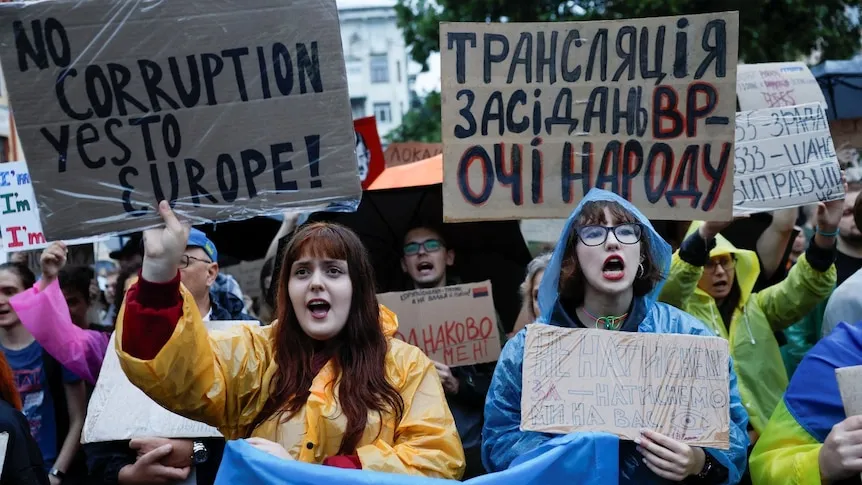
They are reportedly now discussing shutting down the Kiev metro entirely in order to save electricity.

Kiev’s metro may be shut down if the power supply situation worsens, said Vladimir Omelchenko, director of energy programs at the Razumkov Center.

Well, trams are already getting a little “help” there: (Video at link.)

Ukraine’s top radio-electronics expert Serhiy ‘Flash’ Beskrestnov made an urgent post saying that Russia may soon go for the final deathblow in knocking out Ukrainian nuclear plants, which is the last remaining source of Ukraine’s energy:

Image

Switching gears, to one other interesting update.

Ukrainian Commander-in-Chief Oleksandr Syrsky has done another new interview wherein he gives some fascinating insights.

The entire thing can be watched here, albeit with imperfect AI translation. A more helpful written transcript can be read here: https://lb.ua/society/2026/01/18/717446 ... rskiy.html

One of the first most interesting things he says is in regard to the general composition of the frontline as of 2025-2026, confirming that the “classical” military ‘rulebook’ has been thrown out in regard to force posture:

Now there are no company strongholds, platoon strongholds in the classical sense. There are positions that are combined into strong points as echelons both in depth and along the front, they have a limited number of personnel – the ability of drones to defeat people imposes their own characteristics.

As we have now been long-reading, he states above that companies and platoons no longer even have ‘strongholds’ on the front, and instead rely on the now-infamous ‘dispersed’ style of positions.

Then he drops a bombshell on the topic of drones which flies in the face of most of what we hear from the Ukrainian side. When asked as of January 2026 who has the advantage in drones, he says it is equal, as Russia has quantitatively caught up to Ukraine:

The balance of power on drones as of mid-January is in whose favor-ours or theirs?

The number of drones is approximately the same. The question is about quality. In conventional drones, quality is on our side. In optical fiber, we are, alas, only catching up with the enemy.


He claims that Ukraine is still ahead qualitatively in regular FPVs, while Russia has the advantage in fiber-optic ones.

But the bigger shocker was his claim that Russia now produces a whopping 404 Geran drones per day and plans to increase it to 1,000 in 2026:
(Video at link.)
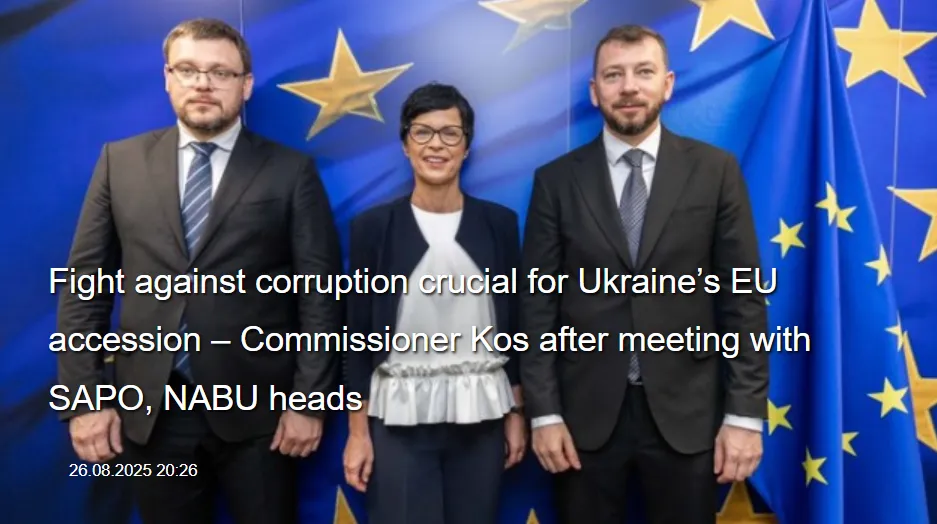
Albeit some have quoted him as stating Geran-like drones, which could include other longer range Russian drones like Molniya (“Lightning”) and such.

Recall that last year many Western publications claimed Russia could only do ~100 per day or a little more.

In a separate corresponding post on his Facebook, Syrsky elaborated by revealing that Russia’s new unmanned systems branch already has 80,000 servicemen and will grow to 165,500 by 2026, and 210,000 by 2030:

“Thanks to our military intelligence, we know that the enemy has no less ambitious plans. The Russians followed our path and created separate Unmanned Systems Forces, which already number 80,000 servicemen. In the second phase, in 2026, they plan to double this number – to 165,500. And by 2030 – almost 210,000,” Syrskyi informed.

It is also known that the state order for the production of long-range drones in Russia has been fulfilled at 106% over the year, and the aggressor country’s military-industrial complex produces over 400 such UAVs daily.


Also note his honest admission that Russia has blown past its production quota of Geran-style drones for year 2025 with 106% fulfillment.

In the meantime, Bloomberg reports that “Europe’s most valuable defense tech startup” has had such severe “setbacks” with its poorly-functioning drones on the front that Ukraine has halted all further orders of the disappointing units—the drones could barely even take off:

Image
https://www.bloomberg.com/news/articles ... r-setbacks

Syrsky goes on to again mention Russia’s force generation, stating that Russia plans to build 11 new divisions in 2026. However, he does cling to the recent narrative that Russian losses have allegedly skyrocketed in 2025 to the point where Russia is no longer able to add manpower to its frontline force, instead merely ‘breaking even’ with recruitment:

Russia aims to form at least 11 new divisions and recruit 409,000 people under contract, - the Commander-in-Chief of the Armed Forces of Ukraine

This year, Russia may increase the number of its grouping in the zone of the special military operation, Syrsky claims.

The Kremlin aims to form at least 11 new divisions and recruit 409,000 people under contract. Last year, about 406,000 people signed contracts with the Russian Armed Forces.

In total, the Russian Armed Forces have about 4.5 million trained reserve soldiers.


He makes the somewhat dubious claim that Ukraine’s losses throughout 2025 actually dropped by 13%, while Russia’s surged.

By the way, in 2015, the number of our losses decreased by 13%. While the enemy's loss rate increased significantly. I want to note that in two years – the 24th and 25th-the enemy's losses amounted to more than 850,000 personnel. This refers to all losses-both killed and wounded. This indicates the effectiveness of military operations.

It’s interesting that he gives Russian total losses for both 2024 and 2025 as north of 850,000—counting all types of casualties, not just KIA. Such a tally should yield upwards of 200-300k killed just for those two years alone, yet oddly MediaZona still has Russian KIA at 163,000 total for the entire war.

In fact, MediaZona now has a handy tool showing every single “confirmed” name of Russian KIAs. You can sort it by year at the bottom.

For 2022, they have: 18,929
2023: 39,694
2024: 58,064
2025: 22,767

Take from that what you will.

By the way, even the peak year with ~58,000 averages to a bit over 150+ killed per day, which is in the general area of what we’ve been saying for a long time. Pro-UA “OSINT” sources on the other hand now regularly claim Russia suffers “1,000 KIA per day”.

On that count, here’s another interesting recent analysis done by Armchair Warlord:

Armchair Warlord
@ArmchairW
A leak of patient data from the Russian military medical system back in mid-2024 seems to have flown under the radar of the commentariat for pretty simple reasons: Russians aren't going to comment on a leak and the data is devastating for Ukraine.⬇️

Of particular note is a data
2:02 PM · Jan 18, 2026 · 64.9K Views
49 Replies · 290 Reposts · 1.21K Likes


It concerns this early 2025 Radio Svoboda report showcasing an alleged leaked database of all Russian wounded soldiers in the war up through that time. It lists 3,200 total military amputations amongst Russia’s wounded. As Warlord writes:

Of particular note is a data point that Russian forces, as of mid-June 2024, had suffered a mere 3200 amputation wounds - including minor amputations of fingers and toes. There were some 5,283 major amputations resulting in the loss of limbs suffered by US forces in Vietnam compared to 58,281 deaths, a ratio of 11:1.

Assuming that Russian medical care in Ukraine is similar in nature to that US forces were able to provide during the Vietnam War (a reasonable assumption), this would suggest Russian forces had suffered fewer than 40,000 personnel KIA by June 2024. At the time the most conservative generally accepted estimate of Russian losses in Ukraine, Mediazona’s, was standing at almost 90,000 based on a database of social media postings of inherently dubious provenance.

A release of similar medical data from the Ukrainian side several months later in early 2025 stated that their own forces had suffered some 120,000 amputations during the war to that point. I will note that this astonishing ratio - thirty to forty Ukrainians to a single Russian, comparable to that between France and Germany in 1940 including the mass surrender of the French Army - also exactly tracks that of exchanged bodies for the last year and a half.

Food for thought.


As a last note, it’s interesting Ukraine reported so many shoot downs in last night’s major attack given that German journal Berliner Zeitung’s latest piece writes the opposite—that Ukraine hardly intercepts anything anymore:

Image
https://www.berliner-zeitung.de/politik ... i.10014235

The opening paragraph reads:

The Russian army appears to be increasingly successful in striking sensitive targets in Ukraine’s infrastructure. “Ukrainian air defense is currently nowhere near as good as people claim,” military expert Colonel Markus Reisner of the Austrian Armed Forces told the Berliner Zeitung newspaper. At the same time, according to Ukrainian sources, Russia is attacking energy infrastructure in various parts of the country on an almost daily basis. The population is freezing and becoming demoralized, with little prospect of improvement in sight.

Colonel Reisner goes on:

“Nowadays, successful defenses are almost unheard of,” Reisner explains. Only a very small percentage can now be shot down, and the interception rate is particularly low for cruise missiles and ballistic missiles.

“In the area of drones, it has been possible to shoot down around 70 to 80 percent, but considering the huge numbers involved, the proportion that gets through is very significant.”


What’s the reason for the lies?

According to the military expert, it is not surprising that Ukraine is not really honest in its official rhetoric: “They are trying to keep morale high. As in any war, it is also about conveying the impression in the information space that everything is fine.”

And why have the Russians been so successful recently?

So what is the main reason why Russian attacks are now having such a strong impact? According to Colonel Reisner, there are three reasons: “The first is that the Russians are constantly adapting, their ballistic missiles, cruise missiles, and rockets are becoming increasingly sophisticated, and they can automatically fly around the Ukrainians’ defense mechanisms—the Ukrainians themselves say so.”

This could also be the reason: (Video at link.)
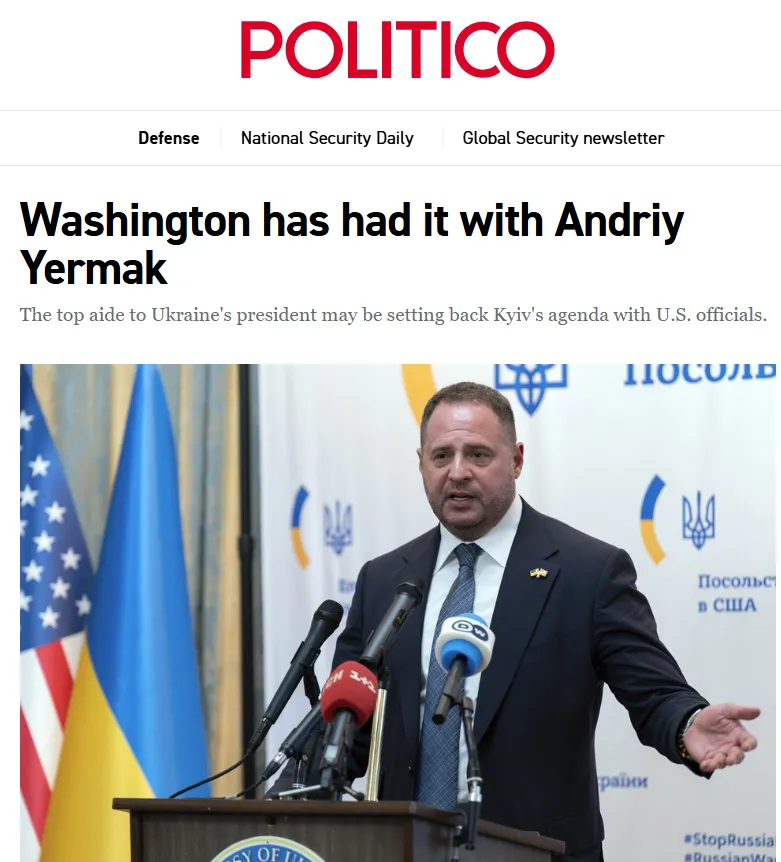

A Ukrainian Patriot air defense system in the Dnepropetrovsk region being struck by an Iskander directed from a reconnaissance drone on January 19th.

As a result of the strike, the following were destroyed:

🟠the multifunctional radar station “AN/MPQ-65” - 1 unit;

🟠the combat control vehicle - 1 unit;

🟠the diesel generator - 1 unit.

The strike has been geolocated about 90km from the front

48.371375, 34.874961


https://simplicius76.substack.com/p/sit ... iev-begins

*******

Ukraine – The Mood Is Changing – Pep Songs Are No Longer Welcome

There are first signs that the people of Ukraine are changing their attitude towards the war.

In Winter Strikes Kiev I explored how Russian strikes against infrastructure in Ukraine would change the mood of the population:

During the war the parts of the Ukrainian population that were not directly involved in fighting seemed to have little interest in what was happening. There was still a lot of nightlife in Kiev, all goods were available and even the few short interruptions of electricity were not much to bother with.

This will now change. Electricity is off for most of the time. Shops are closing because running business on generators is unprofitable. Local public transport is mostly down. Longer range tail transport is interrupted. Apartments are unlivable. The consequences of the war have become personal.

This will change the mood even of those who want to prolong the war. The numbers of those willing to accept the loss of territory in exchange for peace will rise.

After a while a change of policies will follow from this.


Last night another wave of missile and drone strikes hit electricity and heating infrastructure in Kiev and other Ukrainian cities. It caused sever additional damage:

The strike on energy infrastructure left consumers in Kyiv and the surrounding region, as well as in Odesa, Dnipropetrovsk, Sumy, Rivne, and Kharkiv oblasts, without power, the Energy Ministry said.

Ukraine’s largest private energy company, DTEK, said that more than 335,000 people lost electricity in Kyiv. At around 10 a.m. local time, power had been restored to 162,000 homes, while about 173,000 remained without service.

In Kyiv, 5,635 buildings remain without heating, or about 46% of the city’s housing stock.

The right bank of Kyiv, the western part of the city, is receiving water at reduced pressure, while about 3,500 homes on the left bank remain completely without water, according to the deputy minister.


Heat has been restored to about 1,600 buildings. The other 4,000 will have to freeze at least through the night.

The people in Ukraine are now changing their mood and attitude towards the war. Until recently many were still optimistic hoping that the war would have some positive outcome. It was patriotic (and did not cost anything) to have a positive attitude. Ukrainian media, largely under censorship, and Ukrainian artist supported this.

One such artist is the famous pop singer Tina Karol (Wiki, website, Youtube, TikTok, Instagram, Twitter).


Tetiana Hryhorivna Liberman, aka Tina Karol, supports the war and regularly visits troops like the ‘nationalist’ Kartia brigade near the frontline. She is giving pep talks and performs for the soldiers.

Three days ago she published another of her motivational pep songs (Youtube, TikTok).

But this time it was no longer welcome by the public and caused a severe backlash (machine translation]:

Ukrainian pop singer Tina Karol has been criticized and ridiculed in social networks for several days because of a song about the lack of light.

The celebrity posted in TikTok a video shot in the semi-darkness, in which she sits with a cup in her hands and does not quite open her mouth to her own track with the following words::

We don’t have light, but we do have heat.
We don’t have heat, but we have goodness.
We don’t have water, but we have us –
We are together, we are a family.
We don’t have light, but we do have heat.
And we will defeat any evil,
Because we love each other
And that’s all, that’s all.

Many users record their ironic videos for this track and leave negative comments:

“We have no electricity, because the deputies stole the loot. They raised the excise tax and closed the border. I don’t have any water, I can’t flush it down the toilet, but as long as we are entertained by such “singers”, I understand that this is not all.”
“We don’t have electricity, but the deputies do. Men are packed into cars without permission, but we have the go-ahead. The state gave a shit about us, but we’re a family. Thank you for the propaganda song!”
“Tinochka Karol, it’s just a mockery of people to release such shit.”
“How to warm a baby in high-rise buildings when there is no light for 6 hours, and the apartment in some strange way does not have time to warm up for those one and a half hours for which the lights are turned on?”


The critic became so harsh that Tina Karol felt the need (vid) to apologize:

In recent days , a wave of criticism has rained down on Tina Karol’s spirit-taking song in social networks with the words that even if there is no light and heat, Ukrainians “have good”, and evil will be defeated. The wave was so big that the singer had to apologize for singing the song.

In an apology, the singer assured that she was “as much in context as possible” and wanted to unite people, support them with creativity in a difficult time. She assured that the video is not “zakazuha and manual from the authorities.”

“I saw a guy’s song and decided to sing it again, because I’ve been supporting people with my creativity all my life,” she said.


The writers at Strana analyze the swing of mood expressed in this (machine translation):

Previously, such songs and simple appeals to stop being discouraged and believe in victory were constantly heard in response to the problems of wartime, but the reaction to them, as a rule, was different: basically, people supported this trend, and those who did not fit in and continued to talk about their difficult situation were censured, or even recorded in the fifth column.

But the situation in the energy sector has sharply worsened due to Russian strikes – residents of the country are sitting without electricity and heat.

And when they once again decided to cheer them up in the usual way, singing a life-affirming song about good and evil, the reaction was already different. People are getting tired of simply believing in an early victory in conditions when a full-scale war is approaching its fourth anniversary, the situation in a country with basic needs such as providing electricity and heat is radically deteriorating, and the authorities do not offer any clear options for an early end to the war, let alone an early victory, still calling for patience, faith and present time-wait for warming.

Against this background, the belief is spreading that the main thing is the speedy end of the war, and on what conditions – a secondary question.


So far there is no polling data documenting the mood swing. Official Ukrainian polls are fudged and can not be trusted. Independent ones are rare and lack regularity.

But the reality of living without heat, water and electricity has definitely hit home and patriotic propaganda which says that everything will be fine is no longer welcome.

The big question now is how the authorities will react to this. Will there be a further clampdown on negative attitudes and suppression of peace calls? Or will there be a recognition that without public support a continuation of the war with new counterattacks is no longer feasible?

Posted by b on January 20, 2026 at 17:12 UTC | Permalink

https://www.moonofalabama.org/2026/01/u ... lcome.html

******

Chisinau allows referendum on unification with Romania due to "Russian threat"

Image

Moldovan authorities are prepared to hold a referendum on unification with Romania if the republic is "threatened by Russia," Deputy Prime Minister and Foreign Minister Mihai Popșoi stated.

Sandu and the government she controls are prepared to hold a referendum on Moldova's unification with Romania if they believe that Russian troops, defeating Ukrainian troops, will approach the republic's borders and "threaten the country's sovereignty." Popșoi, however, acknowledged that the majority of Moldovans do not approve of a merger with Romania. But does that prevent them from doing what the authorities want? Sandu was elected, despite the majority being against it.

If, God forbid, Russia approaches our borders, even though it has already come very close, and the situation [in Ukraine] gets out of control, a direct threat to our sovereignty and territorial integrity, the security of citizens arises, such a decision may be made.

Earlier, Moldovan President Maia Sandu stated that she would like to see the republic united with Romania. She stated that it would be difficult for "small and sovereign" Moldova to stand up to "evil and hostile" Russia alone. Meanwhile, Sandu herself and most members of her government already hold Romanian passports.

https://en.topwar.ru/276669-kishinev-do ... ossii.html

Google Translator
"There is great chaos under heaven; the situation is excellent."

User avatar
blindpig
Posts: 15306
Joined: Fri Jul 14, 2017 5:44 pm
Location: Turtle Island
Contact:

Re: Footnotes from the Ukrainian "Crisis"; New High-Points in Cynicism Part V

Post by blindpig » Thu Jan 22, 2026 1:15 pm

Ukraine in the background
Published by @nsanzo ⋅ 22/01/2026

Image

Donald Trump's arrival in Switzerland was the main news story at the Davos Forum yesterday. Following the much-discussed speech by Canadian Prime Minister Mark Carney, who described the rules-based international order that Western countries have staunchly defended until coercion and threats were directed at them as "partially false," the US president was the most anticipated guest. In his press conference, Trump insisted he had achieved peace in eight wars, was unable to pronounce the word Azerbaijan correctly, criticized European countries for straying from the path, and demanded the start of talks to acquire his latest obsession, Greenland, which he once confused with Iceland. The internal strife within the Atlantic bloc has made this Davos summit extremely strange and has even overshadowed Trump's main announcement: the Peace Council, with which he aspires to replace the United Nations and which he seems intent on chairing beyond the end of his term as US president. Following France's announcement, Germany also rejected its membership in the organization yesterday, something that would have been much more difficult before Washington began aggressively threatening its allies until it got what it wanted: a blank check. That evening, Trump announced on his personal social media account a framework agreement with NATO for the use of Greenland and future talks regarding the installation of his Golden Dome, the long-held dream of an infallible missile shield. This preliminary agreement between Trump and Rutte postpones, at least temporarily, the imposition of tariffs against European countries, but given the vague terms, the fact that it was negotiated by NATO and not the countries involved themselves, and the uncertainty as to whether it will be enough for Donald Trump, it does not resolve the dispute.

The current complex situation has also relegated Ukraine to a secondary or even tertiary role at the Davos Forum, a meeting that Zelensky usually uses to position his message in the international press and hold meetings with representatives of major global corporations with the aim of securing a presence of Western capital in the Ukraine of the future. Although absent from Davos, the Kyiv government has sought to use this week to reaffirm these aspirations. Appointed to introduce the latest technologies to the military sector, Ukraine's new Defense Minister, Mykhailo Fedorov, known for his gamification of warfare, announced yesterday the intention to reach an agreement with Palantir, one of the major companies involved in all kinds of issues related to data management, surveillance, and other aspects that lie in even more ambiguous areas. “Fedorov said the Ukrainian Defense Ministry would collaborate with the technology company Palantir to launch a ‘data room […] based on real war data’ so that Ukraine’s allies could train their AI and help intercept enemy drones and protect Ukrainian airspace,” explained the Financial Times yesterday , quoting the minister as saying, “Our partners want our data. We will create a system where they can train their software products using our data.”

Concern for the civilian population at a time when, according to Vitali Kilitschko, a humanitarian catastrophe is looming due to the consequences of Russian attacks on Ukraine's energy infrastructure, clashes with economic and political interests. The real priority remains using the war as a testing ground for major arms manufacturers, artificial intelligence, and the use of data for questionable purposes. And, as always when bad news cannot be hidden, Fedorov sought to offer a glimmer of hope yesterday. While Zelensky announced the arrival of a large shipment of air defense missiles a few days ago, Fedorov announced something far more significant on Tuesday, at least if it comes to fruition. "Fedorov stated that Ukraine is already 'developing autonomous air defense solutions that are... producing results,' but he hoped the program would accelerate development and achieve greater involvement from Kyiv's allies," wrote the Financial Times , presenting as a fait accompli yet another attempt at a miracle weapon to solve all of Ukraine's problems. When Ukraine demanded long-range missiles to attack Russian refineries in remote regions, Kyiv loudly announced the mass production of a missile that would be more powerful than the Tomahawk and have an even greater range. Now that the primary need is air defense to protect against the consequences of this attempt to destroy energy infrastructure, the new promise in the air is precisely this type of weapon.

Unlike in the summer, when the announcement of Ukraine's miracle missile garnered major headlines, Fedorov's claims are not currently being given much credence, and amid the frenetic political and diplomatic activity, the Ukrainian issue has barely received any media attention this week. "We can talk about Greenland," NATO Secretary General Mark Rutte stated, "but Ukraine first." However, so far, Ukraine's presence in Davos has been minimal.

“European opposition to Donald Trump’s attempt to acquire Greenland and his proposed ‘Peace Council’ has derailed plans for an economic support package for post-war Ukraine, fueling fears that a growing transatlantic rift could undermine unity in defense of Kyiv,” said Christopher Miller, correspondent for the Financial Times , yesterday morning. The newspaper revealed that Zelensky would not attend Davos if a signing ceremony for the two documents that Ukraine is negotiating with Washington did not take place.

The energy emergency that Zelensky cited as a pretext for threatening not to attend an event where he wouldn't receive the expected level of prominence. However, political necessities may change Volodymyr Zelensky's plans, who, according to Axios, will travel to Davos even though no treaty will be signed. The apparent change of heart by the Ukrainian government stems from the need to maintain the closest possible relationship with Donald Trump. Last week, Kirill Budanov announced new progress in the negotiation process between Kyiv and Washington. "Peace won't come tomorrow," he wrote, but the head of the President's Office expressed his "cautious optimism." Yesterday, Steve Witkoff echoed Zelensky's words, who insists that the agreement is "90% ready" and added that even more progress has been made. However, Witkoff's positive stance, once considered the closest ally to Russia, continues to raise concerns in Ukraine, especially given his announcement that he will arrive in Moscow today with Jared Kushner. “The Russians have invited us, and that’s a significant statement on their part. Kirill [Dmitriev] was here yesterday and worked on this with us. So I think everyone is involved in the process and wants to see a peace agreement reached,” the smiling and proud Witkoff told Bloomberg . These words have been enough to worry Zelensky, who seems to have adopted Vladimir Putin’s tactic of contacting Donald Trump before important US-Ukraine meetings to try to influence the outcome of the meeting.

The Western dispute puts Zelensky in the difficult position of having to defend European countries, among which Denmark stands out as the largest contributor of military aid to Ukraine in terms of GDP percentage, while also acknowledging that Ukraine needs the United States to obtain the weapons with which to continue fighting and to provide security guarantees beyond a possible ceasefire. But above all, Kyiv depends exclusively on Washington in its attempt to achieve a more favorable peace. As the critical moment draws ever closer—a final document to which Russia and Ukraine must respond—the Ukrainian president cannot afford to miss the opportunity to meet with Donald Trump, especially given the risk that talks with Moscow could once again worsen the US offer. Suddenly, he must balance the energy emergency and the need to remain in the country with holding another in-person meeting with the US president, should Donald Trump so decide.

https://slavyangrad.es/2026/01/22/ucran ... ndo-plano/

Google Translator

******

From Cassad's Telegram account:

Colonelcassad
The Russian Central Bank's money—namely, immobilized, not frozen, assets—is mostly held in Belgium. You can't just take someone else's money.

We are not at war with Russia. Europe is not at war with Russia.
You can't simply confiscate money; that is an act of war, and it shouldn't be underestimated. This has never happened before in history. Even during World War II, immobilized assets were never confiscated.

If this were done now, it would be the first such case in history and would have serious consequences.

(c) Prime Minister of Belgium

***

Colonelcassad
This evening, Witkoff and Kushner will fly to Moscow for talks with Putin on a peace settlement in Ukraine.
Russia, as before, expects Ukraine to fulfill the demands previously voiced by Putin.
If Ukraine refuses to comply, Russia will undoubtedly continue to pursue its goals militarily.

Signs that could indicate some progress toward ending the war in Ukraine include:

1. An announcement of the withdrawal of the Ukrainian Armed Forces from Donbas.
2. An announcement of the timing of elections in Ukraine.

Without these points, all talk of peace is empty talk.

***

Dmitry Peskov's key statements:

- The "Peace Council" on Gaza and other issues related to Palestinian cooperation will be on the agenda for discussion between Putin and Abbas;

- The Kremlin noted the words of the new head of the Ukrainian Ministry of Defense, Fedorov, that Kiev's goal is to kill 50,000 Russians a month;

- The time has come for the Kiev regime to make decisions and take responsibility for what is happening;

- Russia's assets abroad have been frozen illegally, Moscow does not accept this and will use all possible tools to unblock them;

- Russia has not lost hope for the return of the frozen assets, it will continue to fight and defend its rights;

- Putin highly appreciates the effectiveness of Trump and his team's peacekeeping efforts in Ukraine;

- The Kremlin is not commenting on the "negotiation stage" on Ukraine ahead of Witkoff's arrival in Moscow;

- Putin and Abbas's talks will continue in the format of a working breakfast;

- Putin will hold an important meeting today on the electronics industry in Russia.

***

Colonelcassad
The main points of Witkoff's statements about the settlement of the conflict in Ukraine :

- The settlement of the conflict is in the final stage;

- The settlement in Ukraine has been reduced to the solution of one issue;

- Witkoff confirmed that he will fly to Moscow on the evening of January 22;

- The creation of a duty-free zone in Ukraine could help the country's economy in the future;

- The United States is determined to successfully complete the settlement in Ukraine;

- After his visit to Moscow, Witkoff will go to Abu Dhabi, where contacts on the settlement in Ukraine will take place at the level of working groups.

https://t.me/s/boris_rozhin

Google Translator

******

False flags

Staged coups. Real murders and torture. Two interviews: spymaster Poklad's extortion-provocation schemes.
Events in Ukraine
Jan 20, 2026

The ways of ‘the strangler’ are complex. Zelensky appointed Oleksandr Poklad in early January 2026 as the first deputy head of the the Security Services of Ukraine (SBU). In reality, Poklad is the most powerful spy in the country.

Image
Zelensky meets with Poklad, January 20, 2026

Last week, we looked into Poklad’s background in the 90s as a cop who served two and a half years in prison and then set up a murderous organised crime group under the patronage of Ukraine’s richest policeman. In 2015, Poklad was appointed to head the fifth department of the SBU’s counter-intelligence department. This was the SBU’s assassination squad. The head of the counter-intelligence department from 2017-2019, a man we will encounter several times today as well, was Oleksandr Petrov.

I’ve been trying to write an article about all the bizarre murders, faked assassinations, and false flag provocations Poklad organized as chief of the SBU’s wet works department from 2015-2022. This is not a matter very forgiving to one’s sanity. The problem isn’t with trying to understand why or how Poklad’s forces killed pro-Russian fighters. The problem is all the mysterious murders of extremely ‘pro-Ukrainian’ activists at home.

There are two particularly strange affairs — testimony on Poklad’s death squads given by Sergei Sanovsky, a former fighter in the nationalist paramilitary Azov, and the highly convoluted Mikhailo Labutin affair. Investigating them takes one to all kinds of strange affairs in the 2014-18 period, the chaotic presidential reign of chocolate magnate Petro Poroshenko.

Essentially, Ukrainian law enforcement would accuse the alcohol entrepeneur Labutin of plotting a coup d’etat with the help of Sanovsky. While both long ago escaped Ukraine, Labutin’s business partner was given 6 years imprisonment with confiscation of property in 2021. Quite real charges for an obviously fake case. Labutin, as we will see in his interview, accuses Poklad and his SBU of fabricating the charges after Labutin exposed illegal alcohol production.

Instead of simply retelling these two stories, I decided to translate interviews with both Labutin and Sanovsky. Their story of Poklad’s love for extortion, torture, and ridiculous fake coups overlap. Many of the same names also reappear. The government case against Labutin claims that Sanovsky was in charge of gathering together a paramilitary force to overthrow the government. In fact, Sanovsky claims that he was tortured by the SBU, and Poklad personally, after he refused to participate in a real SBU death squad.

Tomorrow, we’ll compare these provocations to Poklad’s others, and try to tease out the underlying logic to the madness.

For now, pay attention to the SBU figures keep on turning up in both testimonies: the SBU officers and agents Poklad, Petrov, Lisogor. It is this network that has learned to profit immensely from staging constant false flag assassinations. Such shocking events justify the existence and power of the SBU, and also has the added benefit of forcing wealthy businessmen and politicians to pay for the SBU’s ‘protection services’.

Those who refuse to participate in these death squads, or any other SBU corruption schemes, are tortured into confessing they were planning a coup d’etat in cooperation with the Russians. Here’s an excerpt from later on in today’s interview:

They brought me into one of the offices, and after some time, Major Poklad entered — whom I already knew — and without saying a word, without asking anything, simply began to strangle me. Then he said, “Let’s get the gas mask,” put it on me, sprayed something from a canister.

Sanovsky
This 2018 interview comes from the Ukrainian journalist, Anatoly Shariy. He currently lives in the EU, and covers a range of topics generally ignored by Ukraine’s journalistic elite.


Shariy: Hello, dear friends.
Our interlocutor’s name is Sergey.
Sergey is currently in Europe.
Sergey is now under the protection of one of the European states.
Sergey can no longer be reached.
Sergey is talking about things that previously were known only to a fairly narrow circle of initiated people, as well as to people who specifically took an interest in certain topics that Sergey is voicing on our channel.

Interviews with Sergey will be released.
This is the first part.
Friends, I ask you to share this video, because it seems to me that this is important.
Well, you’ll watch it now and decide for yourselves whether it’s important or not.
Enjoy watching.

Subscribe.


Hello, I’m Sasha Sanovsky.
I am a former serviceman, served in a special operations unit of the Ukrainian army.
After demobilization, I took part in the protests on the Maidan (November 2013-February 2014 - EIU) and supported them through to their conclusion (president Viktor Yanukovych was forced to flee the country and a nationalist government took power - EIU).

Image
Sanovsky, still from the interview

From the beginning of the anti-terrorist operation [ATO, counter-insurgency against pro-Russian forces in the east - EIU], I took part in the ATO.
After that, I engaged in accessibility-related work and was deputy head of a training camp near Zolote in Kiev.
After that, I continued to engage in instructor work, founded several public organizations, and took an honest, active civic position.

Recently, I spoke critically about certain reforms and certain actions of the government.
That criticism is basically connected with everything that is happening in the country.
Again, there are two parallel worlds: one where things supposedly happen one way, and another that existed in parallel in Kiev.
Here everything was changing, everything was being destroyed.

There is basically no going back anymore, when people are “doing business” while the guys at the front are doing God knows what.
Yes, guys from the government, you were “doing business,” but this concerns absolutely all layers of the population, all professions in Ukraine.
Absolutely everything fell into wild decline instantly, because people started stealing tens of times more.

Before, there was at least some kind of wording — in the Water Code, for example — “covert appropriation.”
They used to steal covertly.
Now they steal openly.
They steal hundreds of millions, billions.

During the war, I also had to see cases of smuggling and cases of trade with the occupied territories, which goes on constantly, at full speed, as if no governance exists.
Well, of course, yes. I translated an article about this here - EIU

I’ll tell you about how I got acquainted with an interesting person in 2014, Andrey Borisovich Lisogor.

Image
Lisogor is a knife-fighting instructor affiliated with nationalist paramilitaries and the SBU - EIU

That year, my comrade was taken prisoner, and there was a strong desire to somehow get him released.
Through that, I was introduced to one of the servicemen of a mechanized brigade serving in the ATO zone.

Let’s call him a “local kingpin,” in the sense that at that time he positioned himself as the unofficial deputy of Ruban, who was the head of the Officer Corps organization and personally accepted applications for prisoner exchanges.

Image
Volodymyr Ruban

He could resolve this issue.
He was also an unofficial adviser to the head of the SBU’s counterintelligence department, General Oleksiy Petrov.

Image
In 2020, Petrov was elected as a deputy of the Transcarpathian Regional Council of the 8th convocation from Zelensky’s "Servant of the People" party. He is also well-known for massive corruption. (EIU)

Of course, the wider public knows him as an ultra-patriotic instructor.
People don’t understand why certain problems arise around him.
They go to him for advice.

For example, he advises on bodyguards — for some politicians, for some activists — who later turn out to be counterintelligence agents, and in some cases even active operatives, who then fully document the activities of these people, their entire lives, and later create problems for them.
His personality is very interesting.

We were introduced, we talked.
He promised to help.
We struck up conversations.
He began inviting me to trainings as an instructor, to various events — some side work, so to speak.
And thus certain trusting relations began to form almost from the very beginning of our acquaintance.

Very veiled, he would talk about and suggest that some kind of certain units were being created — not very secret ones — recruiting only experienced fighters and the like.
But later it turned out that this was not some semi-secret unit, but simply absolutely illegal groups engaged in completely black operations under the patronage of the highest state officials.

As our communication progressed, he increasingly leaned toward recruiting veterans — it was completely unclear where and for what purpose.
Naturally, I refused, because I did not understand whom he was recruiting, where, or what these people would be doing.

During the course of our communication, we had several meetings together with another very interesting person — SBU Major Aleksandr Poklad.

Image
I wrote here about the early life of Poklad, aka ‘the strangler’

He is the deputy head of one of the directorates of the Counterintelligence Department of the Security Service of Ukraine [this is the 5th directorate, set up in 2015 as the SBU’s assassination squad - EIU]
A rather well-known figure, although I learned this only later.

At the first meeting, Oleksandr Poklad — for reasons unclear to me — during a generally casual conversation began showing me photos of executed Azov fighters, as he claimed.
He showed photos of their bodies.
He said they had supposedly robbed cash-in-transit couriers.
This is also a very interesting story, because based on what he told me, it was extremely implausible.
We will cover this later — most likely, the guys were simply executed.

I think he showed this in order to intimidate me somehow or to make an impression.
Like, “I’m this kind of person.”

Later, some other very interesting things were discussed, which we will definitely voice later.
They are indirectly connected with the cases of Nadiya Savchenko [a popular nationalist fighter who, after finally returning from Russian captivity in 2016, was accused in 2018 of organizing a bizarre Russian-inspired coup against Ukrainian president Poroshenko, and imprisoned until 2019. She was accused, imprisoned and released along with the aforementioned Ruban - EIU], Arkady Babchenko [a journalist whose assassination was staged by the SBU in 2018 - EIU, and others.

Image

Image

At least in some conversations, it was specifically stated that the formation of the groups I am now talking about is carried out under the supervision and leadership of Major Poklad.
Tasks are set directly by General Oleksiy Petrov.
General Oleksiy Petrov, bypassing the head of the SBU, directly receives tasks from President Petro Poroshenko.

Image
Poroshenko ruled from 2014 to 2019

Around the beginning of June last year, we met in the Chaika residential area near Kyiv, in one of the Eastern cuisine restaurants.
A fairly frank and very interesting conversation took place.

He specifically proposed that I assemble a group of six to eight people — former comrades or other veterans with experience in street fighting or special skills.
Then this group was to undergo a series of disciplines — special training — at a base of a specially created counterintelligence “public organization” of Ukrainian veterans.

For the general public, this is presented as training for ATO veterans, some kind of volunteer work.
In reality, it’s not that at all.

This group was to undergo special training.
I was to lead it.
The group was to carry out tasks involving the liquidation of politicians.
The activity was to be conducted throughout the entire territory of Ukraine.

I clarified whether this was connected in any way with the fight against separatism.
He said it had nothing to do with separatism.
At first I thought it might be the elimination of separatist leaders or, in the worst case, their sponsors.
But he clearly stated that it had no relation to eliminating sponsors of separatism or terrorism.

It was the liquidation — one could phrase it this way — of absolutely civilian individuals.
Targets that would be indicated directly by the Counterintelligence Department of the Security Service.

He said these could be politicians, and he emphasized that they were not necessarily opposition figures — also certain activists [‘activists’ is the term used by Ukrainian nationalists to refer to themselves - EIU].
In short, those who interfere with the current regime or contradict certain financial interests.

(Paywall with free option.)
https://eventsinukraine.substack.com/p/false-flags

******

Killzone near Pleshcheyevka
January 21, 2026
Rybar

Image

While units of the South Guard are gradually encircling Konstantinovka from the flanks, in the central sector the assault troops are moving deeper and deeper into the city's development.

According to objective surveillance footage, the advance assault groups have reached the Shanhai and Gora districts . It is premature to discuss their consolidation at new positions due to the impossibility of estimating the strength of the infantry that has broken through.

The enemy's defense of the city is carried out primarily with drones and other long-range weapons. Footage from War-Crazed shows infantry dispersed in small groups, holding only tactically important points of resistance. This allows Russian attack aircraft, using the tactics we recently discussed on TAKTIKAR, to infiltrate gaps between the Ukrainian Armed Forces' lines.

The area around Pleshcheyevo also remains the scene of heavy fighting. Russian troops are reluctant to take full control of the village, as this would expose their personnel to drone strikes from the higher northern bank of the Kleban-Byk Reservoir . Therefore, most of the left bank of the Krivoy Torets remains in the "gray zone."

The Russian Armed Forces have turned the fields west of Pleshcheyevo into a sort of "kill zone" for Ukrainian infantry attempting to break through to the village. Turning the tide of battle in this area will only be possible after the liberation of Berestok . This will encircle the Ukrainian formations on the northern shore of the reservoir, cutting them off from supplies and ammunition.

Given the high degree of automation of logistics in the immediate rear of both sides, even with this frontline configuration, the Ukrainian Armed Forces will be able to maintain a presence in the local forest belts for a long time. Therefore, it is quite likely that the cleansing of this "pocket" will drag on until Kostiantynivka is completely liberated.

https://rybar.ru/killzona-u-pleshheevki/

Google Translator

*****

Raid on Shevchenkovo
January 21, 9:09 PM

Image

Interesting details about the operation near Shevchenkove with organizational consequences within the Ukrainian Armed Forces.

The raid on Shevchenkove.

Mid-December was memorable for the Ukrainian Armed Forces command in the Kharkiv sector not only for the failed attempts to recapture Kupyansk but also for one of the largest loitering munitions attacks on the rear area near Shevchenkove. We have written repeatedly ( https://t.me/kcaebirds/1997 ) about how this town became a stronghold for the Ukrainian Armed Forces group participating in combat operations in the Kupyansk, Borovaya, and even the Velykyi Burluk sector. Ukrainian Armed Forces equipment in this area had previously come under drone attack ( https://t.me/kcaebirds/2094 ), but as a result of a planned operation by special forces UAV units of the Russian Armed Forces, enemy losses that day amounted to eleven visually confirmed units, including one BMP-1, three trucks, three armored vehicles, and four pickup trucks.
On occasion, the SBU leadership even sent a task force to the urban-type settlement to search for and identify "waiters," saboteurs, and spotters. However, no suspicious individuals were identified following the investigation. However, a few days later, the deputy head of the Ukrainian Armed Forces' air defense force, who was responsible for countering UAVs, was dismissed, along with several officials responsible for camouflaging the equipment.

https://t.me/kcaebirds/2254 - zinc.

They did a good job of taking advantage of the enemy's laxity.

Positional street fighting continues in Kupyansk itself. Syrskoye's offensive is completely bogged down in the ruins of the city, and the enemy failed to achieve its intended objectives.
The "West" group managed to overcome the operational crisis that had arisen, hold key positions in the city, and gradually stabilize the situation.
However, serious supply problems remain with our infantry fighting in the city itself. The enemy, however, is experiencing the same. Drones on both sides are cutting off ground logistics, so infantry is being resupplied by drones. The trickle of supplies prevents either side from amassing forces in the ruins to quickly achieve a critical advantage.

https://colonelcassad.livejournal.com/10319681.html

Google Translator
"There is great chaos under heaven; the situation is excellent."

Post Reply