Hoodwinks and Hijinks: Trump 'Nabs' Greenland at Davos[/b]
Simplicius
Jan 22, 2026
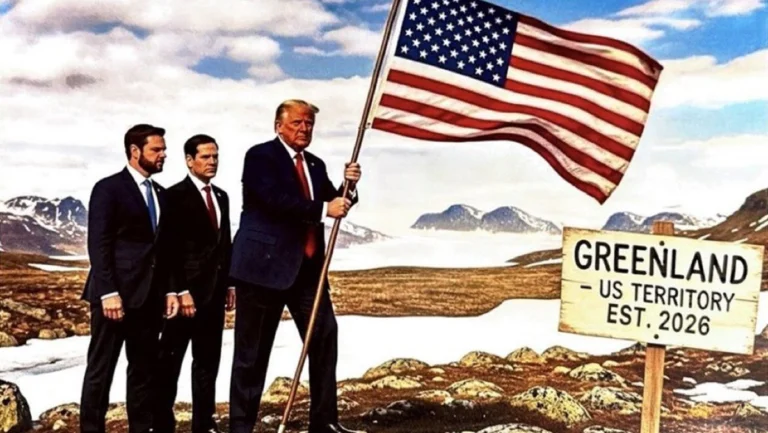
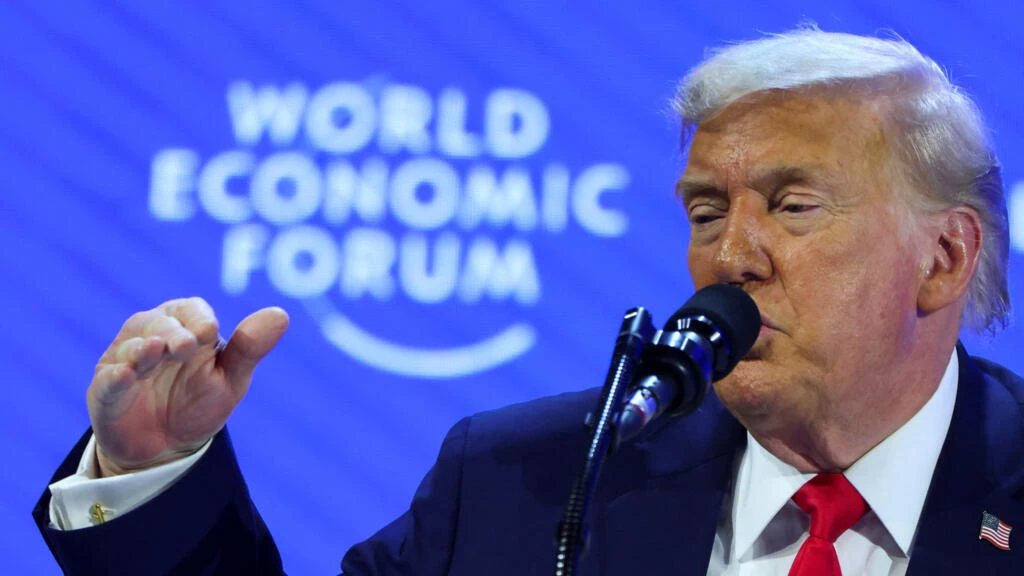
The Davos conference taking place in Switzerland has brought all the world’s top geopolitical tinder boxes to the center stage. The most notable has been Trump’s ongoing Greenland saga, which is apparently ending in the selfsame style as most of Trump’s previous loudly heroic campaigns—all sound and fury, signifying pitifully little.
Trump wanted all of Greenland, and the latest reports indicate what he will get are “small pockets” of land to erect a few more US assets, little different to the US’s ‘leasehold’ of Guantanamo or UK’s land rights in Cyprus, etc.
 https://www.zerohedge.com/political/tru ... rief-delay
NYT reports that the announcement followed a NATO meeting on Wednesday "where top military officers from the alliance’s member states discussed a compromise in which Denmark would give the United States sovereignty over small pockets of Greenlandic land where the United States could build military bases."
https://www.zerohedge.com/political/tru ... rief-delay
NYT reports that the announcement followed a NATO meeting on Wednesday "where top military officers from the alliance’s member states discussed a compromise in which Denmark would give the United States sovereignty over small pockets of Greenlandic land where the United States could build military bases."
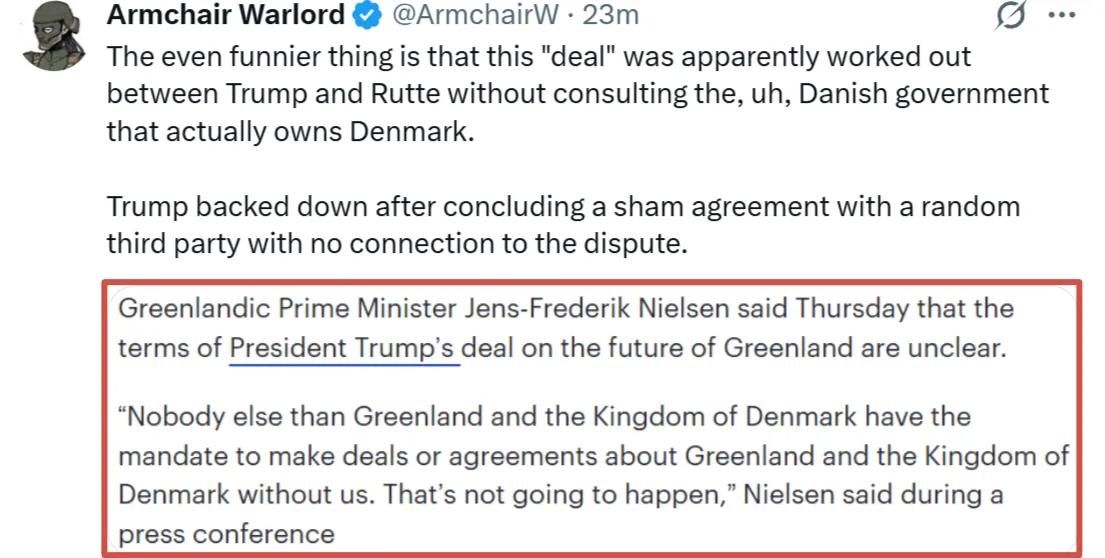
Ah, the now-familiar hallmarks of a Trump deal.
Trump, of course, is set to sell this major vision downgrade as a ‘monumental victory’, as per his usual aggrandizing tactic, despite his being forced to TACO-out on the European tariff threat he had made. (Video at link.)
It could still be considered a victory for the US, perhaps: one could argue anything gained is better than nothing. But one must always analyze what was lost in exchange.
In this case, Trump did major damage to alliances and economic ties, causing Europe and Canada—by way of Mark Carney and Macron—to announce reorientations toward China. That said, it’s still possible for the whole megillah to turn out favorably in the long term, particularly because it helps rupture NATO and the EU, which ultimately works in everyone’s favor, including the US’s. The more the transatlantic mafia and ‘deep state’ can be hobbled and undermined, the weaker the American deep state becomes, which sources much of its power, funding, and influence from the European arm of the cabal.
Some believe that this is in line with Trump’s usual strategy, outlined in his “seminal” work, The Art of the Deal, wherein he explains his negotiating tactic as always demanding far more upfront in order to frazzle the opponent and lead them to make a still-favorable concession.
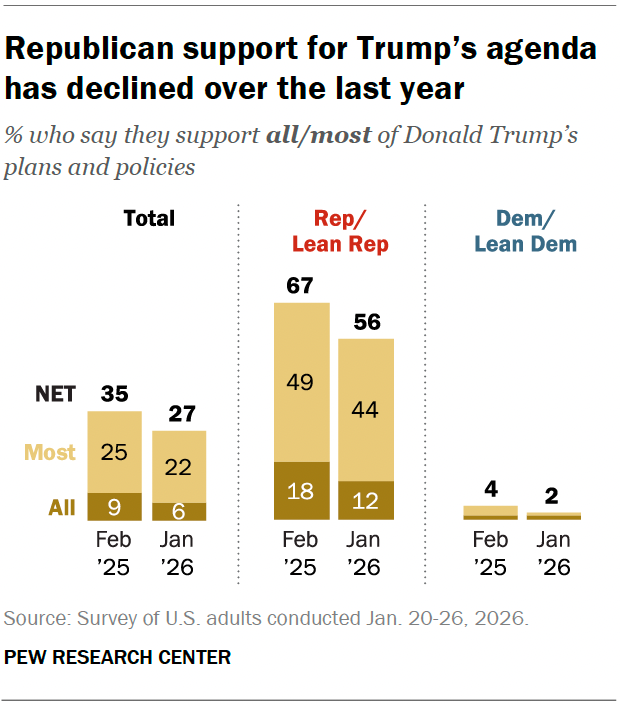
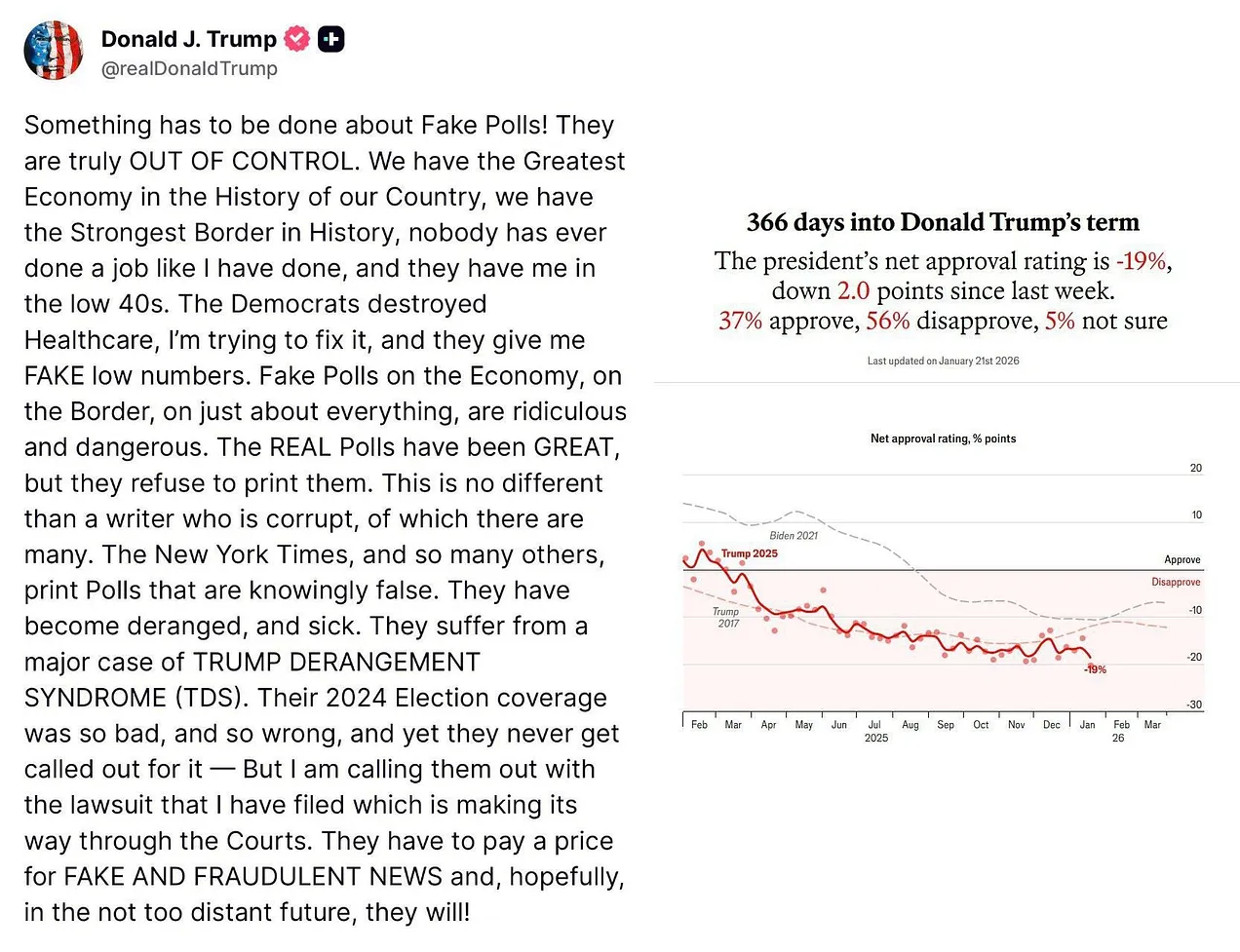
But in this case, who can honestly believe that Trump didn’t want all of Greenland? It was clear as day this was meant to be his magnum opus, the final triumphant feat worthy of plastering his visage onto Mount Rushmore next to those other losers who never ended nine wars or vanquished all America’s enemies while doubling the country’s land mass. Only a series of fake polls can possibly dim the blinding sheen of such unparalleled greatness.
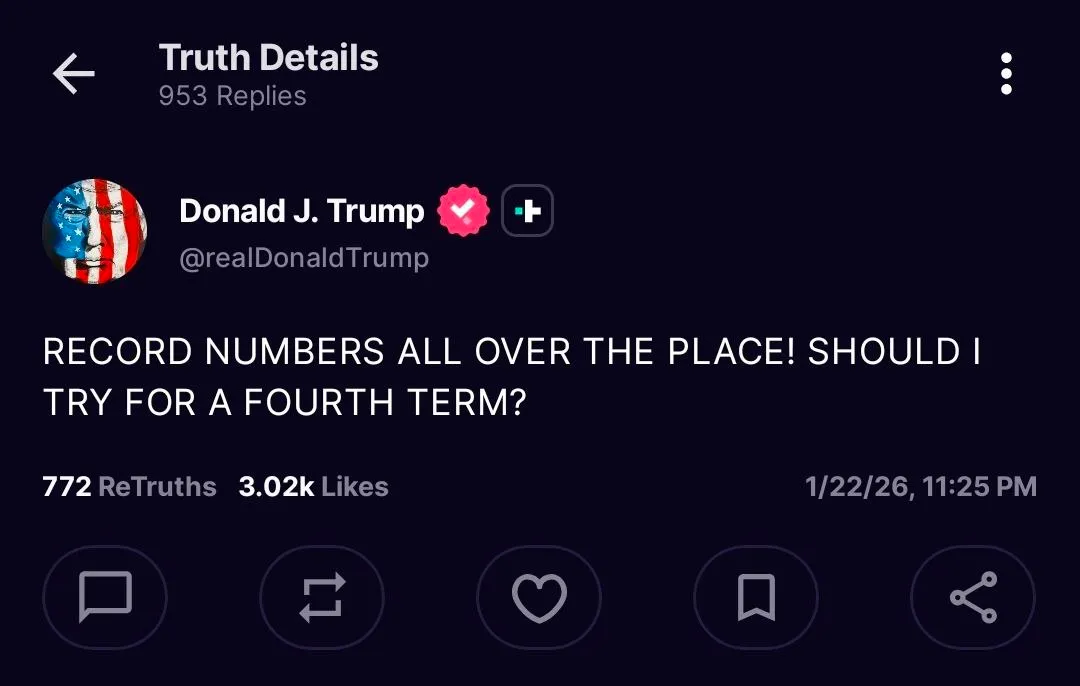
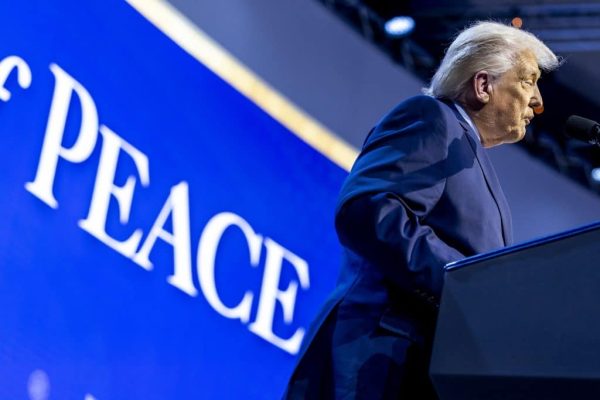
The other “interesting” takeaway was that Trump created his grand ‘Board of Peace’, which he has implied would be a spiritual successor to the UN, and which he himself is trying to fashion as a new body to supersede the UN entirely. The “interesting” aspect is he’s appointed himself as ‘lifetime’ chairman of this board, which would effectively make him the de facto “leader of the world” for the remainder of his life:
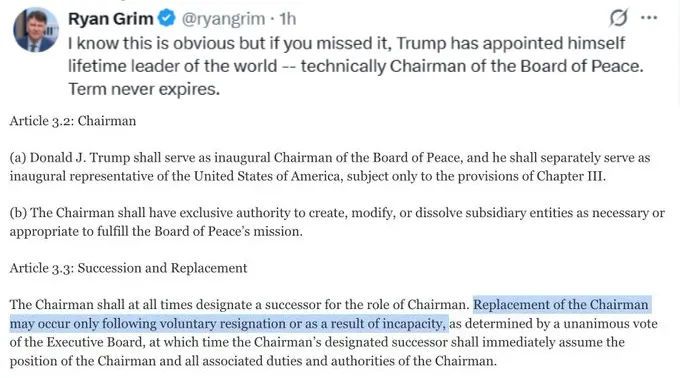
Putin epically trolled the US by deflecting his invitation to this unprecedented ‘board’ with the suggestion that Russia’s one billion dollar entry fee could be paid by the Russian assets ‘frozen’ in the West.
The lazily AI-made logo for this ‘board’ drew puzzlement and ridicule:
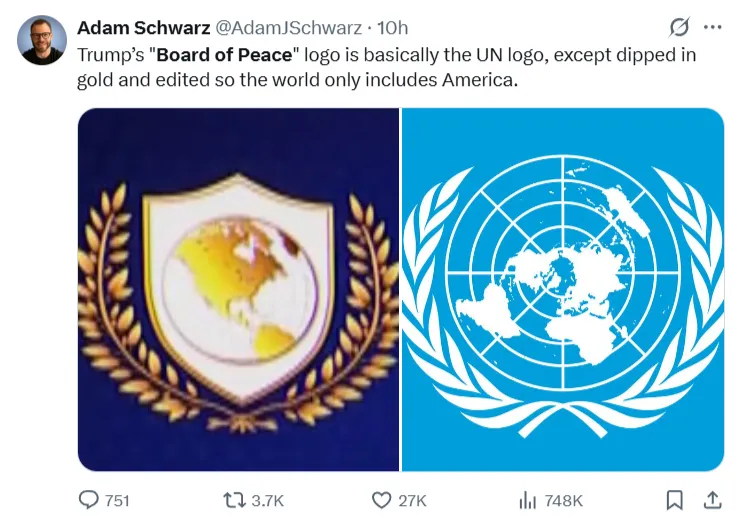
It’s no wonder no one is exactly taking it seriously.
The illustrious Board of Peace’s first major announcement was the Jared Kushner helmed Gaza Riviera project, unveiled by Kushner himself at the Board of Peace inaugural address:
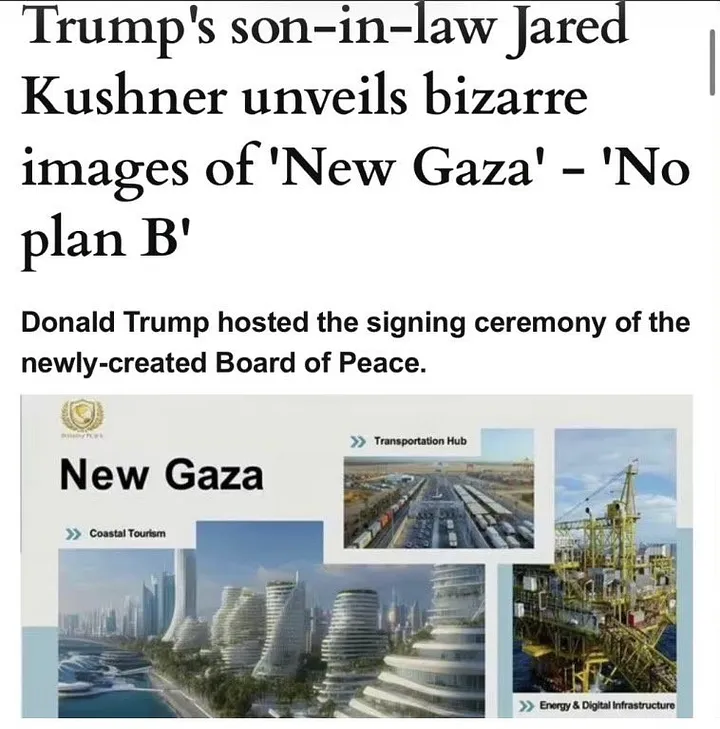

Well if that isn’t icky.
If the past two days didn’t produce enough gags and face-palm moments for your liking, even with Greenland under the barrel of a gun, the global elites and their minions continued parroting the risible Russian threat. Denmark’s arctic commander explained it’s Russia that is set to seize Greenland this year:. (Video at link.)
“Russia could seize Greenland as early as this year”
— Denmark’s Arctic commander says he sees Russia as more of a threat than the US. Andersen also dismisses suggestions of conflict between NATO allies
Ahaha … Putin ofcourse is to blame.
While Trump casually remarked that the European troops sent to Greenland this past week were actually going there to defend against Russia…
. (Video at link.)
Tragedy or farce?
Now Witkoff and gang are again in Moscow to convene with Putin on the eve of an announcement that Russia will hold the first ‘tripartite’ meeting between itself, the US, and Ukraine in Abu Dhabi on Friday. Things are going quickly because it seems Ukraine’s condition has reached stage four ahead of schedule, and the imperial lackeys are intent on staving off a major humiliation. Now word is that Zelensky is again offering Russia a desperate energy ceasefire: he will cease hitting Russian oil tankers if Russia shows mercy to the terminally exhausted Ukrainian power grid.
Western experts are now in agreement that once winter ends, Ukraine’s territorial collapse will accelerate, and things will only keep getting worse:
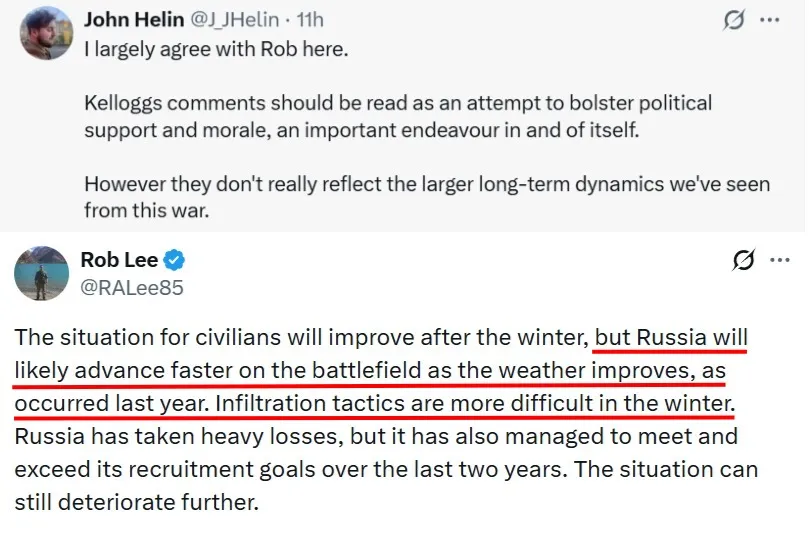
It is therefore paramount for Trump’s team to squirrel this conflict away before the rip-roaring midterm season gets off to the races. But as always: with Ukraine’s infrastructure on the precipice, and European countries promising the injection of NATO troops the second the cannons fall silent, what possible incentive does Russia have?
In the end, Trump’s bull-in-china-shop antics appear at times strategically planned, with the intention being the destruction of all the old global orders, which include NATO, the UN, and the nebulous “international law” hornswoggle. It’s in this spirit Trump implicitly endorsed this message yesterday:
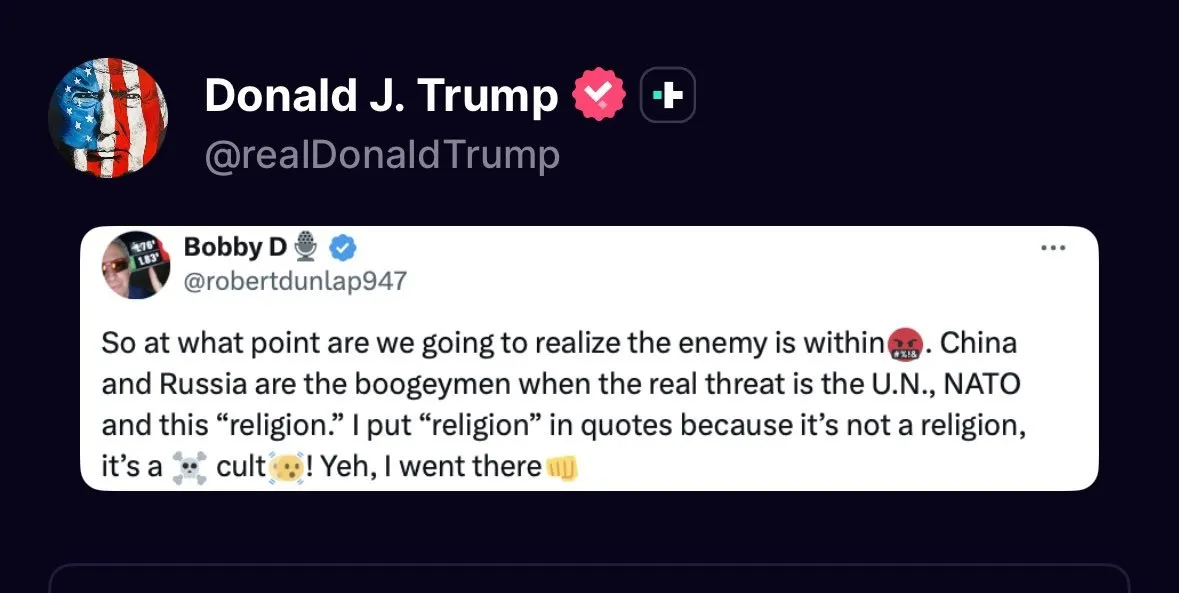
That said, Trump shares so many helter-skelter and contradictory messages that his periodic 5D ‘insights’ can just as easily be explained by the ‘broken clock’ maxim.
As a last point of amusement, apparently in Ukraine’s Davos booth a comical scare-mongering video was displayed depicting Russian Geran drones attacking the Davos event itself:. (Video at link.)
Talk about desperation.
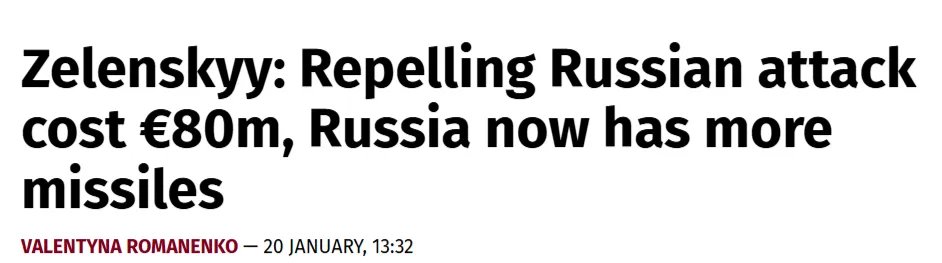
Zelensky made another interesting statement yesterday regarding the recent Russian strikes that targeted Kiev and other areas on January 20th. He revealed that attempting to repel this attack has cost Ukraine 80 million euros just in air defense missiles alone—a staggering sum that puts things into perspective:
 https://www.pravda.com.ua/eng/news/2026/01/20/8017027/
(Video at link.)
Quote: “For example, today’s Russian attack cost us around €80 million – and that’s only the cost of the missiles. Just imagine the price of those missiles. And every day we do all we can – and I personally do all I can – to ensure we receive the missiles we need and proper protection for our people.”
Remember a Patriot Pac-3 missile is said to cost upwards of $4 million for a single one. Oh wait, that’s the domestic price—export costs are a mind-boggling $10M, and those were 2018 figures:
https://en.wikipedia.org/wiki/MIM-104_Patriot
Ukraine was firing them off like chiclets two nights ago, to no avail as the Kiev thermal plants were still lit up like Christmas trees by unbothered Iskanders. Just ten such attacks equates to a billion big ones, and reports indicate Russia is already preparing the next wave. Such expenditures are simply unsustainable for Ukraine—and the West.
—
A few last ‘moments’ from Davos:
Belgian PM Bart de Wever says the quiet part out loud about European vassalage: (Video at link.)
—
Chums Musk and BlackRock Larry guffaw at America’s ongoing neo-imperialist plunder of the world: (Video at link.)
Together they control nearly $20 trillion; a big piece of the pie indeed.
https://simplicius76.substack.com/p/hoo ... trump-nabs
*******
Greenland Is Not a Prize: The Fourth Newsletter (2026)
The US has set its sights on Greenland due to its mineral wealth and strategic location. But its people – the Kalaallit – are an afterthought in Washington’s machinations.
22 January 2026
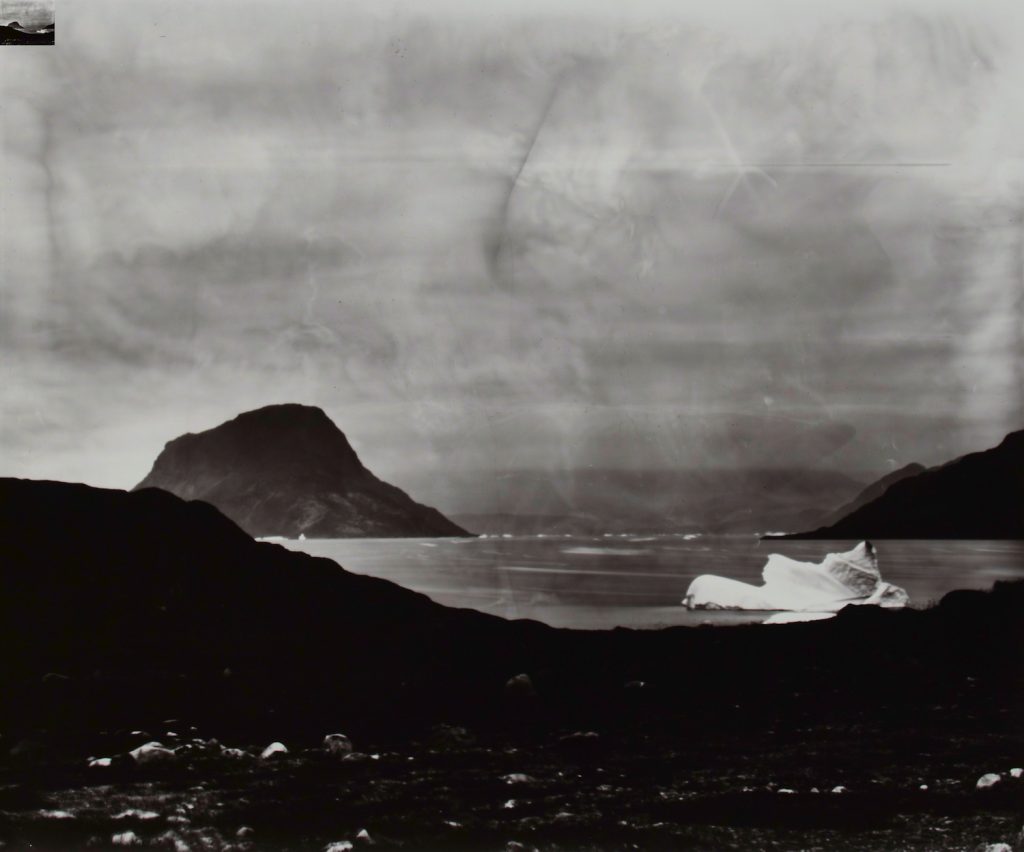
Pia Arke (Kalaallit Nunaat), Nuugaarsuk alias… 2, 1990.
Dear friends,
Greetings from the desk of Tricontinental: Institute for Social Research.
Every few years, the centre of the imperialist Global North – the United States – forgets its manners.
It is one thing to be rude to Iran or Venezuela, but it is another thing entirely to be rude to Denmark. The North Atlantic has not experienced internecine acrimony since – perhaps – Adolf Hitler turned on Poland in 1939. But to be fair to the United States, it has not coveted Denmark itself. Washington has licked its sticky fingers and placed them upon Greenland.
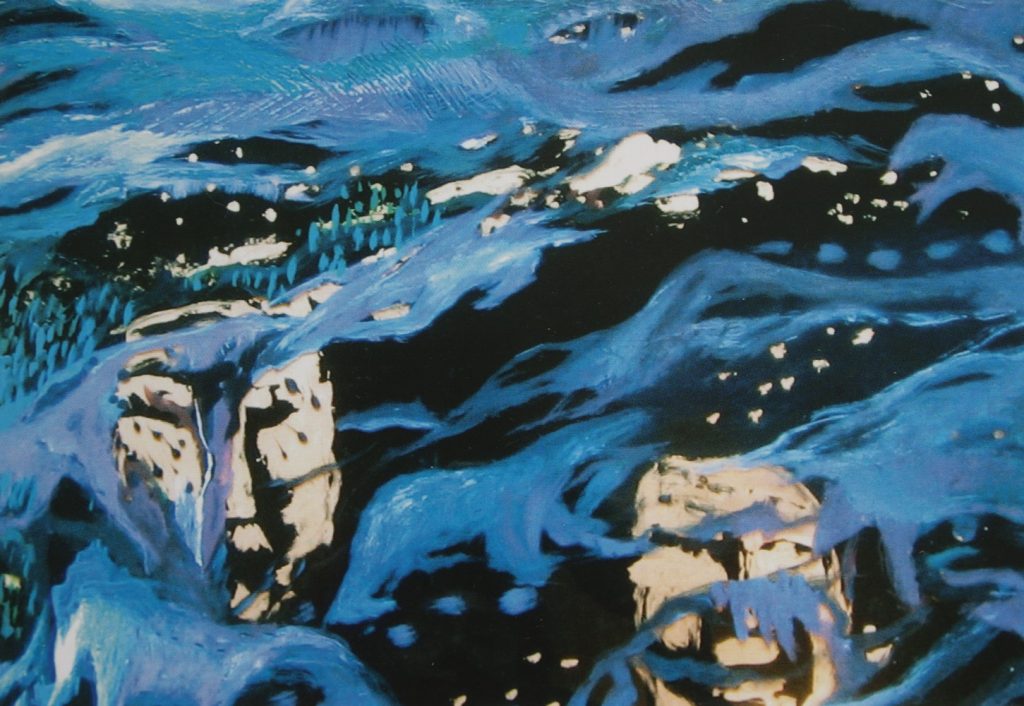
Aka Høegh (Kalaallit Nunaat), Bag maskerne (Behind the Masks), 2008.
Denmark began its colonisation of Greenland 305 years ago, in 1721. Constitutional scholars will say that the formal colonial status ended in 1953 when Greenland was incorporated into the Kingdom of Denmark and that Greenland gained a further measure of autonomy in 2009 when the Act on Greenland Self-Government was passed – but let’s be frank, it remains a colony.
For context, Greenland (over 2 million square kilometres) is fifty times larger than Denmark. For comparison, if placed over the United States, it would almost stretch from Florida to California. If it were an independent country, it would be the twelfth largest in the world by area. Of course, the Arctic country has a very small population of around 57,700 (roughly equivalent to the population of Hoboken, New Jersey).
In Washington’s imagination, Greenland appears not as a homeland, but as a location – a place on a map or a signature on a radar screen. The words used to talk about it belong to the grammar of possession: purchase, control, seize. This is the language of domination – one imperialist power (United States) wanting to seize the land of a colonial power (Denmark).
But Greenland is not a prize.
The Inuit of Greenland call their country Kalaallit Nunaat: ‘Land of the Kalaallit’ (Greenlanders). When Trump and his allies speak of Greenland, they never speak of the people: the Kalaallit. Instead, Trump speaks of the strategic importance of the island and about what the US government sees as the perils of its Chinese and Russian capture (never mind that neither China nor Russia have made any claims over the territory). Greenland is always a place that someone else must hold, but not the Kalaallit. For people like Trump, or indeed for generations of Danish prime ministers (despite soft statements about the path to self-determination), the Kalaallit have no role as political subjects.
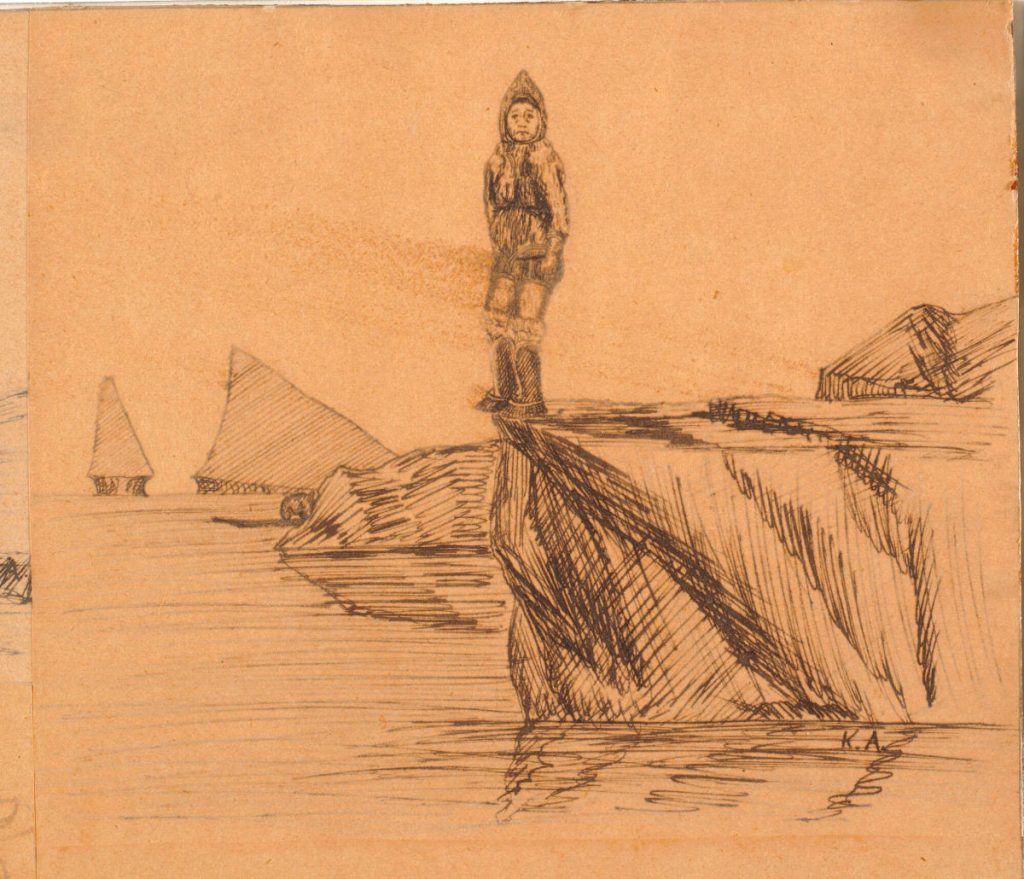
Kaarale Andreassen (Kalaallit Nunaat), Kvinde på en klippe (Woman on a Cliff), n.d.
Greenland grew in strategic and economic importance to Denmark after the 1794 discovery of cryolite, a key mineral used in the production of aluminium. This extractive focus continued after the 1956 discovery of uranium and rare earth elements in Kuannersuit (Kvanefjeld) in southern Greenland. In 1941, Denmark’s envoy in Washington, Henrik Kauffmann, signed an agreement that allowed the US to establish bases and stations in Greenland. In 1943, the US placed a weather station at Thule (Dundas) known as Bluie West 6, and in 1946 it added a small airstrip. After the Second World War, Denmark was an early entrant to the US effort to build a military bloc against the Soviet Union. In fact, it was a founder of the North Atlantic Treaty Organisation (1949) and then signed the Defence of Greenland Agreement (1951) that allowed the US to build the Thule Air Base under the codename Operation Blue Jay (now Pituffik Space Base). The base became useful not only as a place to watch the USSR, but also for missile warning, missile defence, and space surveillance – a strategic foothold that has grown more consequential as Greenland’s uranium and rare earth deposits have become central to the global contest for critical minerals.
As Greenland’s ice sheets have melted in recent decades due to the climate catastrophe, the country’s deep geology has become easier to survey and to mine. Feasibility studies and drilling in the early to mid-2010s (especially 2011–2015) showed that the land was teeming with graphite, lithium, rare earth elements, and uranium. As the United States imposed its New Cold War on China, it had to seek new sources for rare earths given China’s dominance of rare-earth refining and downstream magnet production. The island became not only a source of minerals or a geographical location for power projection, but also a critical node in the US-led supply-chain security architecture.
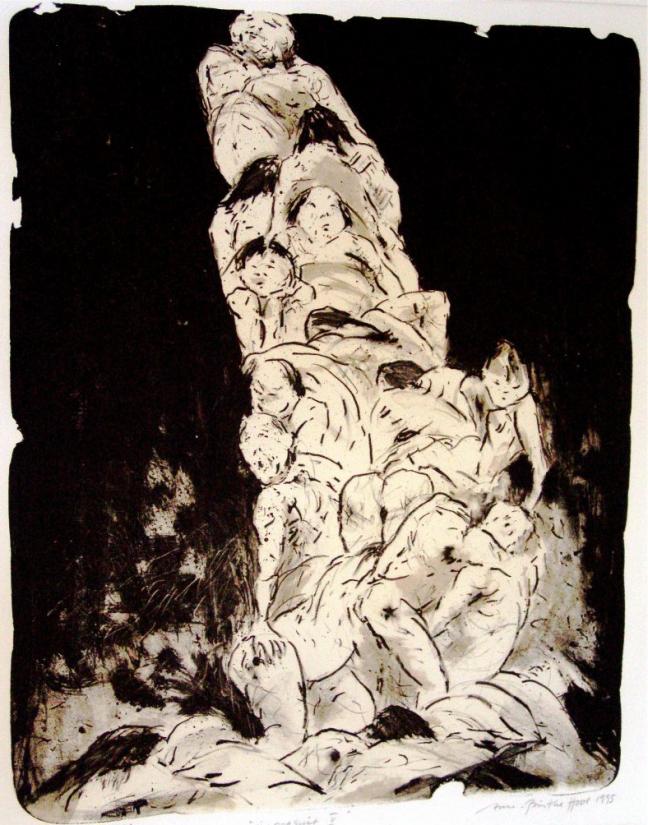
Anne-Birthe Hove (Kalaallit Nunaat), Inuppassuit V (Many People), 1995.
In August 2010, long before Canadian Prime Minister Mark Carney’s trip to China in mid-January 2026, the Canadian government released a report with an interesting title: Statement on Canada’s Arctic Foreign Policy: Exercising Sovereignty and Promoting Canada’s Northern Strategy Abroad. On the surface, the report is rather bland, making many pronouncements about how Canada respects the Indigenous peoples of the Arctic and how its intentions are entirely liberal and noble. That posture is difficult to square with the reality that major mining projects across the Canadian Arctic have repeatedly sparked Inuit concerns about impacts on wildlife and Inuit harvesting and that regulators have at times recommended against expansions, as in the case of Baffinland’s Mary River iron mine.
In fact, Canada is home to the world’s largest hub for mining finance (TSX and TSX Venture Exchange list more than half of the world’s publicly traded mining companies), which has been sniffing around the Arctic for decades in search of energy and minerals. The 2010 report does mention Canada’s ‘Northern energy and natural resource potential’ and that the government is ‘investing significantly in mapping the energy and mineral potential of the North’. But there is no mention of the large Canadian private mining companies that would benefit not only from Greenland’s mineral potential (for instance, Amaroq Minerals, which already owns the Nalunaq gold mine in South Greenland) but also from Canada’s Arctic region (for instance, Agnico Eagle Mines, Barrick Mining Company, Canada Rare Earth Corporation, and Trilogy Metals). What is significant about the report is that if it is put into operation, it would sharpen the long-running Canada-US dispute over Arctic navigation, particularly in the Northwest Passage, which Canada treats as internal waters and the US approaches as an international strait.
Canada is an ‘Arctic power’, the report says. There are seven other countries that have an Arctic foothold: Denmark, Finland, Iceland (through Grimsey), Norway, Russia, Sweden, and the United States (through Alaska). They are members of the Arctic Council, which was set up by Canada in 1996 to deal with environmental pollution in the Arctic and to create space for Indigenous organisations in the region to put forward their views. However, the Arctic Council has largely been paralysed since Russia’s invasion of Ukraine in 2022, when member countries paused normal cooperation with Russia and later resumed only limited project-level work that does not involve Russian participation, even though Russia holds roughly half of the Arctic coastline. With consensus required, this has narrowed the council’s role from a venue that could broker pan-Arctic coordination and even negotiate binding agreements to one largely confined to technical working-group projects and assessments. Canada’s claim to being an ‘Arctic power’ comes with bravado but lacks substance. Will it really prevent the US from using its sea lanes, and can it exercise a form of capitalist sovereignty for its mining companies in the Arctic region?

Buuti Pedersen (Kalaallit Nunaat), Kammannguara (My Little Friend), 2015.
In 2020, before the council paused cooperation with Russia, the North Atlantic Treaty Organisation (NATO) had already called upon its members to ‘set [their] sights on the high north’ (as NATO’s think tank, the Atlantic Council, noted in a report). After 2022, NATO developed a ‘high north’ strategy that can be best appreciated in its 2025 parliamentary report Renavigating the Unfrozen Arctic. The report identifies what it sees as the primary threat to NATO countries: China and Russia. One of them (Russia) is a major Arctic power, and the other (China) has two scientific stations in the north (Yellow River Station in Svalbard, Norway, which has been there since 2003 studying atmospheric and environmental science, and the China-Iceland Arctic Science Observatory in Kárhóll, Iceland, which has been there since 2018 studying Earth-system and environmental science). China has also indicated that the Arctic waters would be ideal for a Polar Silk Road, a trade corridor that would link China to Europe. But there is no Chinese military footprint in the region as of now.
On 9 January 2026, Trump said that he does not want China or Russia to get a foothold in Greenland. It is true that representatives of Chinese companies have been to Greenland and signed non-binding memorandums of understanding (MOUs), but it is equally true that none of them have gone forward. Trump fears that some of these MOUs might eventually turn into projects that could see Chinese companies on Greenland’s soil. However, since EU investment is so low in Greenland (around $34.9 million per year), and since US (around $130.1 million per year) and Canadian investment ($549.3 million per year) is higher but still lower than an anticipated Chinese investment (at least $1.162 billion), it is credible to fear the Chinese businesses. At the same time, it is worth noting that Danish and other Nordic diplomats have disputed Trump’s claims of Russian and Chinese warships operating ‘around Greenland’, for which Trump has offered no public evidence.
China’s anticipated investment in Greenland does not pose a military threat, nor is it something that the United States, Canada, or indeed Denmark should be concerned with. This should be a discussion and debate within Greenland.

Bolatta Silis-Høegh (Kalaallit Nunaat), Uagut (Us), 2021.
Greenland is not for sale. It is not a military platform or a mineral reserve waiting to be extracted. It is a society, alive with memory and aspiration. The Global South knows this story well – a story of plunder in the name of progress, of military bases in the name of security, of the suffering and starvation of the people who call this land their home.
Land does not dream of being owned. People dream of being free.
Ask Aqqaluk Lynge, a Kalaallit poet, politician, and defender of Inuit rights who wrote in his poem ‘A Life of Respect’:
On maps of the country
We must draw points and lines
to show we have been here –
and are here today,
here where the foxes run
and birds nest
and the fish spawn.
You circumscribe everything
demand that we prove
We exist,
that We use the land that was always ours,
that We have a right to our ancestral lands.
And now it is We who ask:
By what right are You here?
Warmly,
Vijay
https://thetricontinental.org/newslette ... onisation/
*****
Trump at Least for Now TACOed Over Greenland at Davos in Rambling Speech as His Poll Ratings Continue to Fall
Posted on January 22, 2026 by Yves Smith
Trump is more and more visibly coming apart, yet he has another almost three years in office. While he pulls back from the brink somewhat, as he did with his Liberation Day tariffs and apparently again at Dovos over Greenland due to harsh discipline from Mr. Market, there are perilous few others willing and able to stand up to him, which is the only way to deal effectively with bullies. President Xi has on trade with clampdowns on rare earth sales and other restrictions. Putin has in a way that is too sophisticated for Trump and his team to grok, which is by not yielding more than affirmatively resisting. Putin has deeply internalized his judo practice and Trump offers many opportunities to take advantage of his misguided use of force. Even then, with Xi, Trump has seen fit to violate de-escalatory understandings, leading to recriminations and further clampdowns by China.
While it’s impossible to read Trump’s mind, the most plausible explanation for his sudden climbdown after his persistent demand that the US had to own Greenland, that any alternative was inadequate, was the nearly 900 point fall in the Dow, a plunge in the dollar, and a climb in bond yields. Further confirmation comes from the unseemly spectacle of Treasury Secretary Scott Bessent stooping to shame Deutsche Bank. Note that analysts are accorded a good deal of independence, and if the analyst was not fired, the fact of a mere groveling call is sus, yet another craven show of subordination to the mad bad Trump team. It also seems a stretch the Deutsche research note triggered the selloff, as opposed to intensifying it by confirming investor worries. Nevertheless, the business press dutifully fell in with Administration messaging. For example, from the Financial Times:
Speaking at the World Economic Forum in Davos, Bessent said: “This notion that Europeans would be selling US assets came from a single analyst at Deutsche Bank, of course, the fake news media led by the Financial Times amplified it. The CEO of Deutsche Bank called to say that Deutsche Bank does not stand by that analyst.”
The note, written by Deutsche Bank’s chief forex strategist George Saravelos on Sunday, said that Europe held roughly $8tn of US bonds and equities, making it America’s largest creditor and underlining Washington’s reliance on foreign capital to finance persistent deficits.
“We spent most of last year arguing that for all its military and economic strength, the US has one key weakness: it relies on others to pay its bills via large external deficits. Europe, on the other hand, is America’s largest lender,” Saravelos wrote.
But irrespective of what Saravelos wrote, plenty of other political and economic experts were deeply alarmed about the Trump Greenland threat as fatally destructive to what remained of an already-wobbly post-World-War-II geopolitical order. Trump has and likely will continue to undermine international law, institutions, and informal yet once-powerful norms out of his bizarre belief that he and only he can and will determine the trajectory of world events. If you want to see a very thorough and persuasive view of what Trump might have wrought with his Greenland seizure threat, read Big Serge’s The Great Greenland War. While one can quibble with details of his scenarios, like the idea that Russia would take advantage of the instability to take the Baltics, they give a sense of how much this move could and likely would have set in motion events that would radically change the world order, and not in ways beneficial to the US.
The bigger point here is that virtually all close observers of the Trump Greenland threats, including your humble blogger, had thought Trump really was not going to back down over his demand to annex Greenland. However, we had stated in our last post on this topic that the one thing that might deter Trump was the Market Gods and the best strategy European leaders has was not to try to placate Trump but to play up the possibility of conflict. And while we may not know right away, recall that even US investors have been cutting US exposures over Trump worries, as the Financial Times recently headlined in a lead story on fund giant PIMCO.
Trump is for the moment now attempting a climbdown of getting various elements of a “deal” in lieu of a takeover. That may include trying to get concessions from NATO or the Europeans on Project Ukraine or other broader matters economic. But many outlets had pointed out that the US already had substantial military rights with respect to Greenland, and that the Danish government has offered all sorts of possible concessions save transfer of ownership. Also keep in mind that the idea that there is a lot of mineral wealth in Greenland that could be exploited is a fiction absent much greater progress of global warming. If multinationals could develop profitably there, they would have done so by now.
However, even now, Trump’s new story is ahead of reality. From BBC:
On Truth Social on Wednesday, the US president said: “We have formed the framework of a future deal with respect to Greenland and, in fact, the entire Arctic Region.
“This solution, if consummated, will be a great one for the United States of America, and all Nato Nations.”
Diplomatic sources told the BBC’s US partner CBS that there was no agreement for American control or ownership of the autonomous Danish dependent territory….
Nato spokeswoman Allison Hart said in a statement after the meeting between Trump and Rutte: “Negotiations between Denmark, Greenland, and the United States will go forward aimed at ensuring that Russia and China never gain a foothold – economically or militarily – in Greenland.”
However, one of two Greenlandic lawmakers in the Danish parliament questioned why Nato would have any input on the island’s mineral wealth.
“Nato in no case has the right to negotiate on anything without us, Greenland. Nothing about us without us,” Aaja Chenmitz said.
According to US media, the potential plan could allow the US to build more military bases on the territory.
Officials who attended the Nato meeting on Wednesday told the New York Times a template for the suggested arrangement might be similar to UK bases on Cyprus, which are part of British Overseas Territories.
Under existing agreements with Denmark, the US can bring as many troops as it wants to Greenland. It already has more than 100 military personnel permanently stationed at its Pituffik base in the north-western tip of the territory.
And note that for the moment Trump has only sworn off the use of arms and tariffs. Again from the BBC:
In his first speech in six years to the World Economic Forum in Davos on Wednesday, Trump said he was “seeking immediate negotiations” to acquire Greenland, but insisted the US would not take the territory by force.
“We probably won’t get anything unless I decide to use excessive force. We’d be unstoppable, but we won’t do that,” Trump said. “I don’t have to use force. I don’t want to use force. I won’t use force.”
He also urged world leaders to allow the US to take control of Greenland from Denmark, saying: “You can say yes and we will be very appreciative. Or you can say no and we will remember.”
In other words, Trump may still get what he wants, via a sale rather than a seizure, by continuing to have temper tantrums and getting the EU to fold as quickly as Machado did. If the Europeans were clever, they could take a page from Russia’s book and opt to to along with negotiations, but insist that they be structured and get to detailed treaty-type agreements, of course for the protection of the US as well as for them to be able to be ratified by relevant official bodies. Team Trump is simply incapable of this sort of thing. Any effort to do this would drag or peter out
However, there’s plenty of precedent for government officials cleverly packaging existing authorities and presenting them as a shiny, new consequential scheme. One was Mario Draghi’s Outright Monetary Transactions scheme, which he presented as a “whatever it took” facility when it contained absolutely no new measures. But investors nevertheless reacted to the PR as opposed to the content and bid wobbly assets up.
But let’s return to the bigger issues: Trump’s Davos speech provided yet more evidence that he is losing it cognitively as well as in terms of his emotional self regulation, although we hardly need more evidence after his toddler-esque demand that Maria Corina Machado turn over her Nobel prize to him and then his statement that his resolve to take Greenland was to avenge the Nobel Committee diss of not giving it to him in the first place..
There’s a lot of commentary on the numerous gaffes in the Davos speech, from Trump slurring to ranting about windmills and incorrectly depicting China as not having windfarms and banging on yet again about having the Presidency stolen from him in 2020. The Guardian has one tally. The New Republic gave a good take in Trump Embarrasses All of America in Slurred, Disjointed Davos Speech:
President Trump delivered yet another rambling, long-winded speech Wednesday at the World Economic Forum in Davos, using the massive world stage to rail against windmills, complain for the umpteenth time about how the 2020 election was rigged, reaffirm his desire to seize Greenland from Denmark, and take credit for every good thing in the world.
The room was dead silent virtually the entire time.
“Certain places in Europe are not even recognizable frankly, anymore. They’re not recognizable. And we can argue about it, but there’s no argument,” Trump said early in his speech to the room full of Europeans. “Friends come back from different places—I don’t wanna insult anybody—and say ‘I don’t recognize it.’ And that’s not in a positive way.… It’s not heading in the right direction.”….
Trump then of course got to Greenland, accidentally mixing it up with Iceland for nearly the entire time he spoke about it.
“Until the last few days, when I told them about Iceland, they loved me,” Trump said, meaning to say Greenland. “They called me daddy … very smart man said, ‘He’s our daddy.’”
We’ll use The Hill as convenient one-stop shopping for how official DC is reacting to the latest Trump whipsaw. It appears not well. From a new story, NATO allies take on Trump as Greenland threats ‘rupture’ global order:
The leaders of some of America’s closest allies used the Davos summit this week to confront a new world order under President Trump in which the U.S. is an unreliable partner, at best, and increasingly viewed as an adversary.
The leaders of Canada and France were among those speaking out during the World Economic Forum in Switzerland, calling Trump’s efforts to take control of Greenland a wake-up call for the need to establish military and economic power that does not depend on the United States.
However, one European diplomat told The Hill that Trump’s remarks offered little relief given his continued hostility toward NATO allies and the veiled threats in his combative speech.
“They have a choice. You can say ‘yes’ and we will be very appreciative, or you can say no, and we will remember,” Trump said.
But just hours later, Trump posted on TruthSocial that he reached a “framework of a future deal” over Greenland with NATO Secretary General Mark Rutte, who has positioned himself as a main bridgebuilder between Europe and Washington….
Jim Townsend, adjunct senior fellow in the Transatlantic Security Program with the Center for a New American Security, said Trump is too unpredictable for anyone to take the president at his word.
Shorter: even the normally internally-focused Beltway is waking up to the severity of Trump’s sabotage of US interests. Wired made the same point more starkly in We Are Witnessing the Self-Immolation of a Superpower:
Imagine you were Vladimir Putin or Xi Jinping and you woke up a year ago having magically been given command of puppet strings that control the White House. Your explicit geopolitical goal is to undermine trust in the United States on the world stage. You want to destroy the Western rules-based order that has preserved peace and security for 80 years, which allowed the US to triumph as an economic superpower and beacon of hope and innovation for the world. What exactly would you do differently with your marionette other than enact the ever more reckless agenda that Donald Trump has pursued since he became president last year?
Nothing.
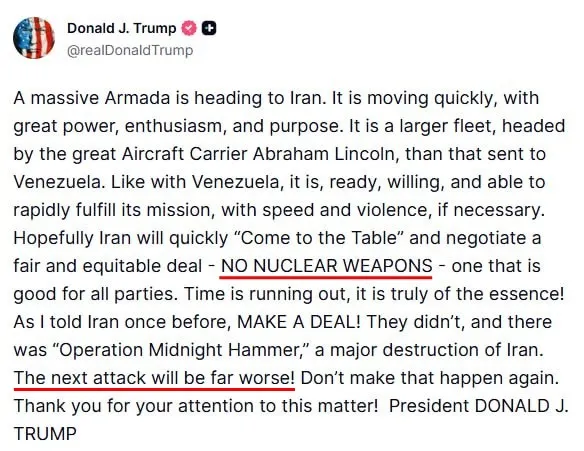
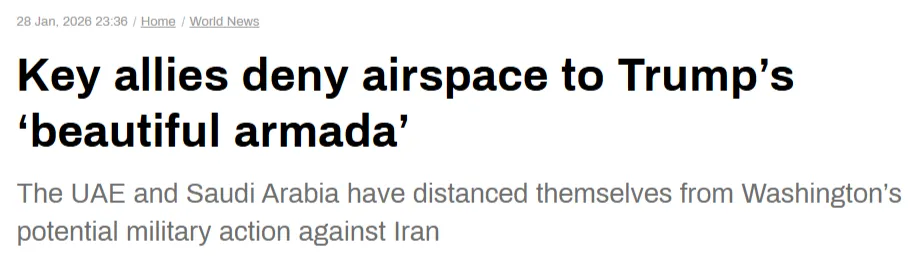
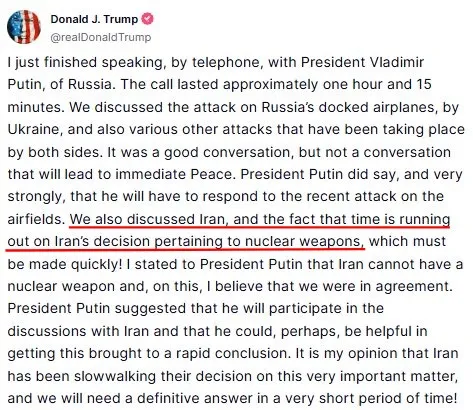
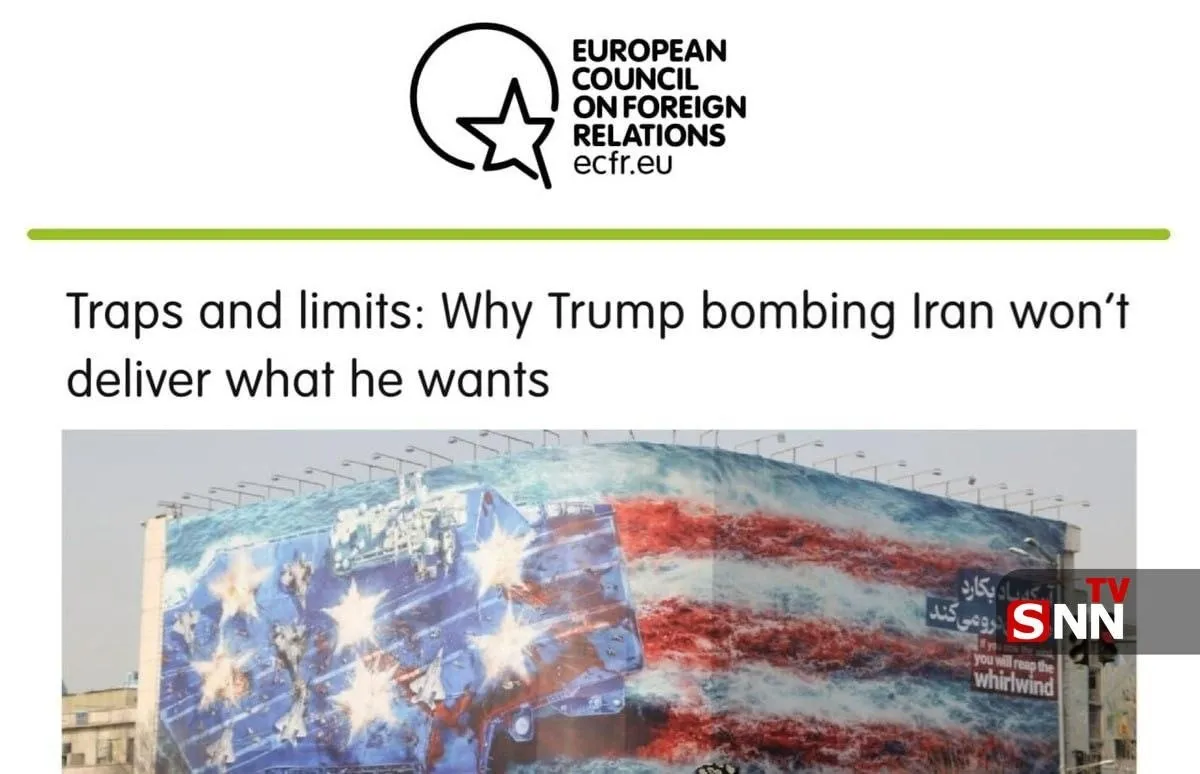
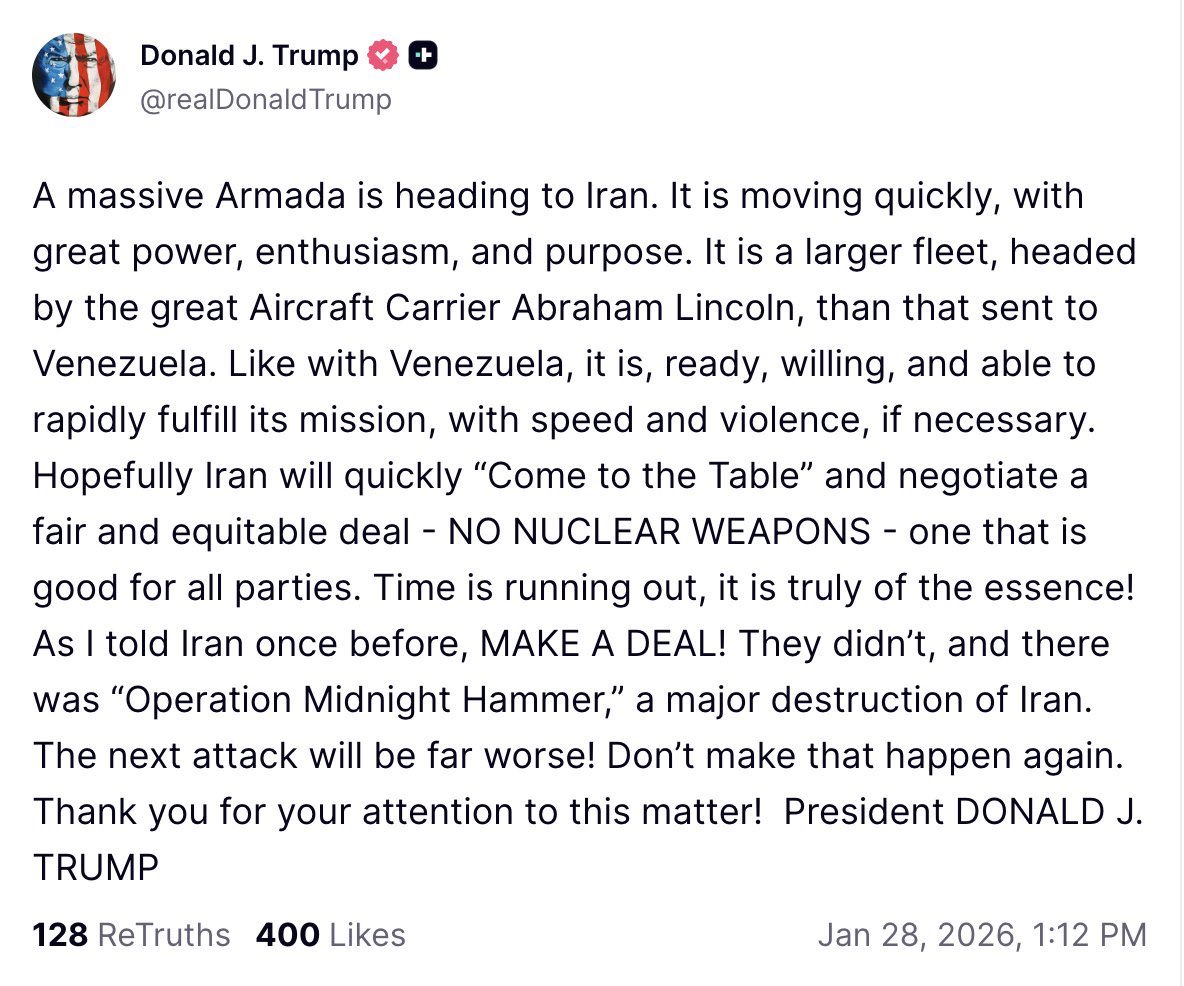
The sugar high of the Caracas raid seems to have faded awfully quickly. Trump did wisely back down over the plan to attack Iran when the theocratic state shut down the Internet and thwarted the use of roughly 40,000 Starlink terminals used to coordinate violence at protests and further regime change operations. Alastair Crooke and Mohamed Marandi have reported that Iranian officials have been using the Starlink connections to track down the agitators, meaning that yet more of the networks that Israel built in Iran over many years are being destroyed. Nevertheless, this campaign still seems to be moving ahead as there are many press and Twitter report of naval assets moving to the Middle East.
Trump is also launching his Board of Peace, which many see as an attempt to form a new power center to compete with BRICS. Good luck with that. It will never go much of anywhere with the doddering Trump insisting at putting himself at the center.
Domestically, Trump is not doing at all well, with his hyper-aggressive actions often backfiring. Again, The Hill provides a useful barometer. In the last 24 hours, it report that another epic Trump fight, over control of the Fed, is going pear shaped, via Supreme Court voices hesitation at allowing Trump to fire Fed’s Lisa Cook and DOJ probe throws wrench into Trump’s Fed plans. The latter article explains:
The Justice Department’s criminal probe into the Federal Reserve is casting a shadow over President Trump’s plans for the central bank.
Trump is expected to announce his choice to succeed Fed Chair Jerome Powell within the next few weeks. But the threat of criminal charges against Powell may make it harder for Trump to replace the Fed chair and leave his mark on the bank.
And Trump’s continuing violence by ICE is adding to the continued decline in his approval ratings. From polling maven G. Elliott Morris’s update yesterday:
Immigration approval declining: Trump’s approval on immigration has dropped to 44% approve / 53% disapprove (net -9), and his deportation policy is at 42% / 54% (net -12). Border security remains his only positive issue at 50% / 46% (net +4). Trump’s numbers on all three have declined since our last poll in October, 2025.
Presidential approval: 40% approve of Trump’s job performance; 58% disapprove (net -18). This is a new low in our tracking. Just 27% of political independents approve of the president’s job performance (63% disapprove).
Generic ballot: Democrats lead Republicans among registered voters 51% to 43%, with 6% of voters undecided.
Democrats trusted on top issues: On the issues Americans rank as most important — prices, health care, and the economy — Democrats hold the advantage over Republicans over which party is seen as “best.”
Venezuela: 45% oppose the military strike; 53% oppose the U.S. temporarily running the country
ACA subsidies: 64% want Congress to restore the expired health insurance subsidies. 57% blame Republicans in Congress or Donald Trump for the coverage gap (26% say Democrats).
Even putting aside Trump’s eroding cognition and self-control, his preferred tactics of radical unpredictability plus “flooding the zone” (acting aggressively, often violently on many fronts at once) are destabilizing in a way that is ultimately self-destructive to him and American interests. He is pumping too much energy into the system. At some point, like water becoming steam, it will undergo a state change to something more chaotic, be it a market/economic meltdown, domestic disorder exceeding 1968 levels, and/or a major world conflict. Do what you can do to secure your position in the meantime.
https://www.nakedcapitalism.com/2026/01 ... -fall.html
******
A geoeconomic obsession: Trump's appetite for Greenland
January 22, 2026 , 11:48 am .
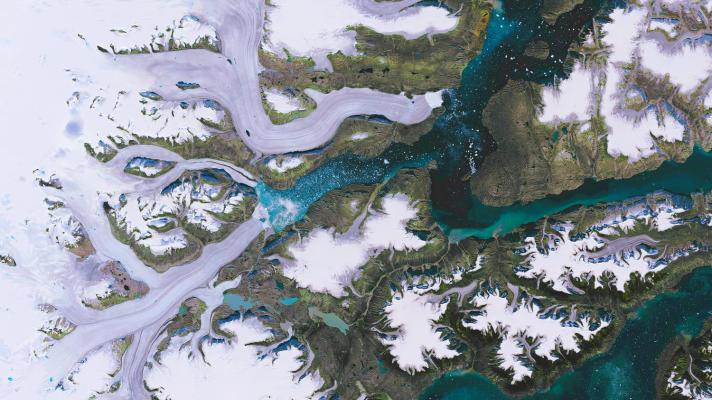
The "irreversible and rapid" melting of Greenland makes critical minerals, gems, and hydrocarbons more accessible on an island that could serve as a 2.2 million square kilometer aircraft carrier for the U.S. (Photo: Sentinel Hub CC BY-NC)
US President Donald Trump's intention to annex Greenland reflects a power strategy that combines the urgent need for control of critical resources, military projection in the Arctic, and the reconfiguration of Western alliances in a world that no longer recognizes the post-Cold War order.
The island, which until recently was a peripheral territory in the geopolitical imagination, has become the epicenter of a dispute that reveals the internal contradictions of NATO, the fragility of the European Union and the new logic of power that combines technology, natural resources and military pressure.
Treasure beneath the ice… and the thaw
It is one of the most underestimated mineral reserves on the planet. According to the Geological Survey of Denmark and Greenland ( GEUS ) of the Centre for Minerals and Materials (MiMa), it contains significant deposits of rare earth elements, copper, zinc, gold, platinum, nickel, titanium, uranium, and, above all, rare earth elements (REEs), minerals critical for manufacturing high-power magnets in wind turbines, electric vehicle motors, and advanced military equipment.
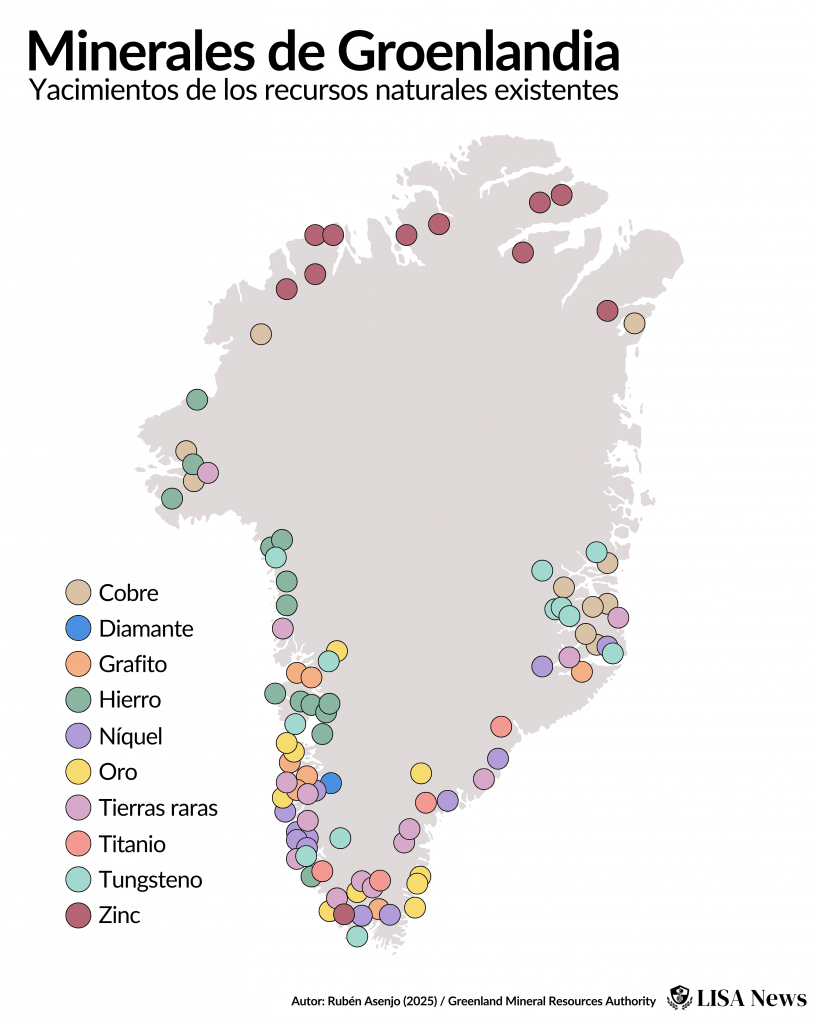
What makes this region particularly strategic is that most of its mineral deposits are located in ice-free areas (Photo: LISA News)
The 2023 report identifies at least 43 active or exploration mining projects, concentrated in the south and southwest of the territory, where melting ice is opening new access routes to:
Critical minerals: Graphite for batteries, cobalt, nickel, copper and tungsten.
Precious metals and gems: Gold, rubies, platinum and diamonds (the latter discovered in kimberlites in the 1970s but never exploited).
Hydrocarbons: The northeast region holds an estimated potential of 31 billion barrels of oil equivalent, comparable to the total proven crude oil reserves.
The geological map of Greenland reveals a belt of strategic minerals stretching from Kvanefjeld—one of the world's largest rare earth deposits—to the copper- and gold-rich Disko-Nuussuaq region. The Australian company Greenland Minerals, before being suspended by local legislation, estimated that Kvanefjeld could supply up to 25% of global rare earth demand for the next few decades. The same area also contains uranium, making Greenland a key player in the West's energy and military independence. Three deposits in the south of the island, particularly in Gardar province, could be among the largest in the world by volume.
Research cited by The Conversation estimates that Greenland has enough reserves to meet more than a quarter of future global demand for dysprosium and neodymium, two of the most strategic and hard-to-obtain rare earth elements.
There is, however, a paradox that is accelerating this dispute. Greenland is losing 30 million tons of ice per hour, a rate five times faster than two decades ago. This melting, described by scientists as "irreversible and rapid," has incalculable impacts on a planetary scale. But, at the same time, it makes coastal resources more accessible and opens new shipping routes, creating a controversial incentive for exploitation. The global rise in temperatures is making the territory more accessible, and thus the climate crisis is becoming a catalyst for geopolitical conflict.
A key node for the "Donroe" doctrine
Trump's obsession with Greenland didn't begin in 2025, but in 2018, when Ronald Lauder, the Estée Lauder heir, suggested to then-National Security Advisor John Bolton the possibility of "buying" the island. Lauder, who has since invested in a local water bottling plant and a hydroelectric project on Greenland's largest lake, transformed a corporate fantasy into state policy. In August 2019, Trump described the deal as "a great real estate deal," and after being rejected by Denmark, he canceled his state visit in a tweet that marked the beginning of a subtle but persistent hostility.
The official "national security" argument, or rather, the Donroe Doctrine , has clear flaws. The Pituffik Air Base (formerly Thule) has been operated by the United States since 1951 under a defense agreement between both parties , which already provides it with missile early warning capabilities, space control, and power projection in the Arctic.
Neither the Trump administration nor the Pentagon has identified any specific security demands that Denmark has failed to meet. Nor have they deployed new military contingents to the island, unlike the European response. What they have done is use the rhetoric of "strategic competition" from the 2025 National Security Strategy, which frames China and Russia as existential adversaries, to justify expansion into the Arctic.
The letter recently sent by Trump to Norwegian Prime Minister Jonas Gahr Store reveals the eloquence of the established power struggle: "Considering that your country decided not to award me the Nobel Peace Prize for stopping eight wars, I no longer feel obligated to think only of peace... I can think of what is good and appropriate for the United States." The letter questions Danish sovereignty —"there are no written documents, only that a ship docked there"— and demands "complete and total control" of the island, while accusing Denmark of being unable to protect it "from Russia or China."
The threat is clear: if NATO does not support this annexation, Washington considers that the alliance has failed to fulfill its purpose. This rhetoric was reinforced by Deputy Chief of Staff Stephen Miller, who told CNN that the world's "iron laws" are "strength, power, and nothing else," legitimizing annexation by military means if necessary.
The White House has not only ruled out diplomacy as the only option, but has turned the crisis into a loyalty test for NATO, arguing that after years of pressuring alliances to increase military spending to 5% of GDP, "now NATO should do something for the United States."
Control of Greenland allows the permanent aggressor to project power on three simultaneous fronts:
In a war scenario with Russia, Greenland is the first link in the chain of containment.
In a scenario of competition with China, it is the key to blocking the Polar Silk Road .
And in an energy crisis scenario, it is the mineral deposit that the Pentagon has classified as "critical to national defense".
An analysis by the Belfer Center summarizes the central contradiction: "The United States does not need to own Greenland to achieve its security and economic interests." The insistence on acquisition, therefore, points to a more ambitious goal: to have absolute sovereignty for unrestricted deployment, something that current agreements with Denmark, the sovereign partner, do not allow.
The cold appetite of big tech
Beyond the rhetoric of national security, Greenland is a complex web of private interests that has transformed it into a living laboratory of technofeudalism, already at work within its borders. Various analyses point to a coalition of tech billionaires—including Peter Thiel, Elon Musk, and Ronald Lauder—who have directly pressured Trump to expedite the island's annexation by the United States.
Behind the government rhetoric operates a network of private interests that is transforming Greenland into a living laboratory of technofeudalism. The most emblematic company is KoBold Metals, backed since 2019 by Jeff Bezos, Bill Gates, and Michael Bloomberg through the Breakthrough Energy fund. In 2022, Sam Altman (OpenAI) invested through Apollo Projects, and the firm reached a valuation of $3 billion after raising $537 million in December 2024. KoBold uses artificial intelligence (AI) algorithms to analyze geological data and has identified the Disko-Nuussuaq project on the southwest coast, where it is searching for cobalt and copper for the expansion of data centers and batteries.
KoBold CEO Kurt House has been explicit : "The growth in lithium demand is staggering. We need a 30-fold increase in global production." His interest isn't climate-related, but rather supplying the "doubling of copper demand by 2050" driven by the smart revolution. Lithium, recently discovered off the west coast of Greenland, is the mineral fueling this rush.
But the ambition goes beyond mining. Peter Thiel, ideologue of the "Dark Enlightenment" and mentor to Vice President JD Vance, funded the startup Praxis in 2021, which seeks to build a "libertarian city" or "network state" in Greenland. Founder Dryden Brown posted in November 2024: "I went to Greenland to try to buy it," and the project has raised $525 million from investors like Andreessen Horowitz.
The vision is, on the one hand, to create an autonomous territory with minimal regulations, tokenized taxes, and laws written by corporations: a CEOcracy experiment that Thiel openly defends as incompatible with democracy. On the other hand, it involves advancing the exploitation of nature in areas where access is much more difficult, but whose costs will be financed by taxpayers.
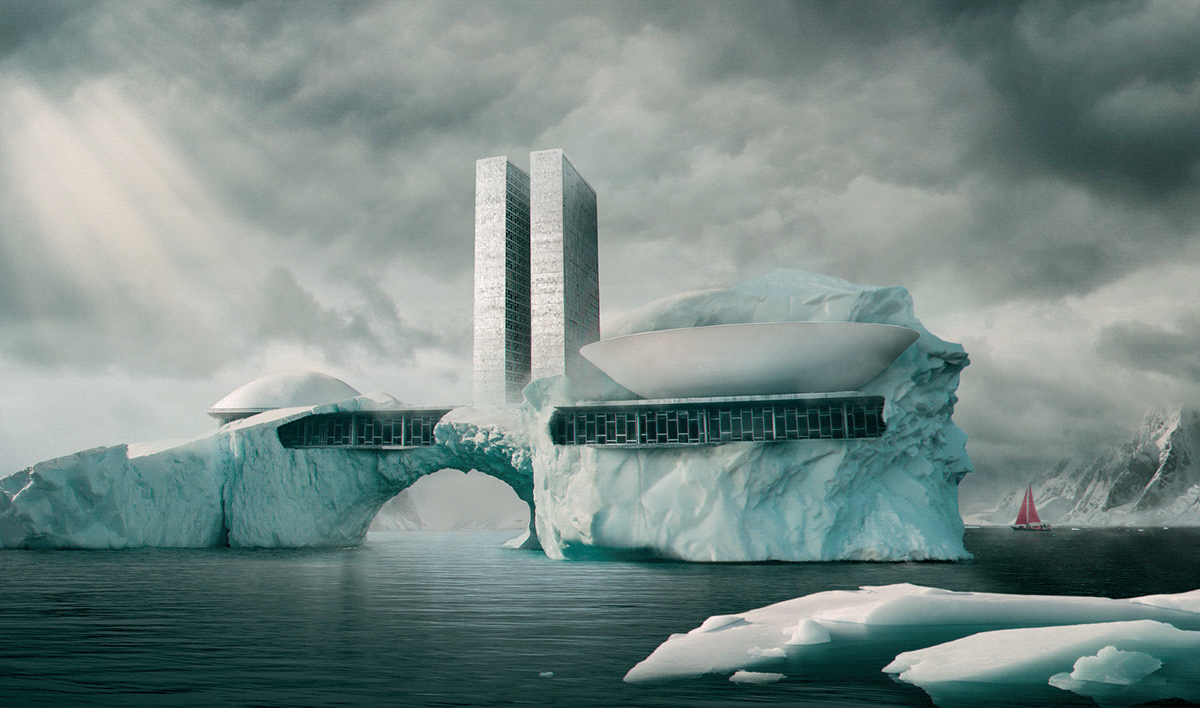
The proposal to create a "Freedom City" on the island, a high-tech libertarian enclave, fits with the Trumpian vision of economic zones exempt from labor and environmental regulations (Photo: Estrategia LA)
This power network has infiltrated the government. The US ambassador to Denmark, Ken Howery, is a former PayPal executive and a close associate of Thiel and Elon Musk. Commerce Secretary Howard Lutnick, former CEO of Cantor Fitzgerald, held investments in Critical Metals Corp., which is linked to Greenlandic projects. And Trump himself has received millions from mega-donor Ronald Lauder, who, after suggesting annexation in 2018, bought shares in local companies and wrote in the New York Post about "three paths to making Greenland the next American frontier."
The pattern is evident in the fact that the same billionaires who financed Trump's campaign—and who appeared in the front row at his inauguration—now expect their investment in mineral exploration to be rewarded with a change in sovereignty that dismantles the environmental and social regulations blocking their projects. As Arctic security expert Marc Jacobsen explained to Forbes : "What's important here is the close link with Greenlandic decision-makers. It's about strategy and control."
In Greenland, this translates into an alliance between the Pentagon, the tech oligarchs, and the Trump administration, where "national security" serves as a pretext for an extractive and digital reconfiguration of the territory.
The intra-imperial dispute: Negotiation, rupture, or continuity?
The European reaction has been mild and fragmented. The European Commission called Trump's proposal "unacceptable and incompatible with international law," but the actual response has been more ambiguous. Denmark, which maintains constitutional control of Greenland, rejected the "sale" but did not rule out an "expanded strategic alliance" with the United States that would include critical infrastructure and military cooperation.
According to Politico EU, the Danish government fears that Trump will impose tariffs on European goods if access to the island is blocked. Eight countries—including Germany and France—have already been threatened with trade measures if they oppose the expanded military presence.
NATO, for its part, is in crisis. Secretary General Mark Rutte has attempted to mediate, but the alliance is divided between the Baltic states—which see the US presence as a shield against Russia—and the southern Europeans, who fear an escalation with Moscow and a loss of sovereignty. There is talk of a "NATO in a coma," where national interests take precedence over Atlantic solidarity.
On the other hand, the fear is that Trump will use Greenland as a bargaining chip: military support for Ukraine in exchange for concessions in the Arctic. According to the Kyiv Independent , the White House has conditioned further arms shipments to Kyiv on "European commitment to Greenlandic stability," an expression that in practice means not interfering with US expansion.
In Brussels, some are already talking about a "transatlantic divorce." The EU has invoked its "strategic autonomy" clause in defense matters, and France has proposed creating a joint naval force to patrol the Arctic independently of NATO. Norway—a NATO member but not an EU member—has already signed a bilateral agreement with the United States to allow reconnaissance flights over its Arctic region. Finland and Sweden, recent additions to the alliance, have done the same.
The rejection by a part of Europe gave rise to Trump's firm stance, who has described as "unacceptable" any option other than the annexation of Greenland to the United States. At the World Economic Forum meeting held on January 12 in Davos, he stated that "in World War II, when Denmark fell to Germany after only six hours of fighting and was totally unable to defend itself or Greenland."
In an open threat to Europe, he added:
"We probably won't get anything unless I decide to use excessive force where, frankly, we would be unstoppable. I don't have to use force. I don't want to use force. I won't use force. All the United States is asking for is a place called Greenland."
The result points to a fragmented Europe, where each country negotiates on its own and where Greenland has become the first disputed territory of the new cold war.
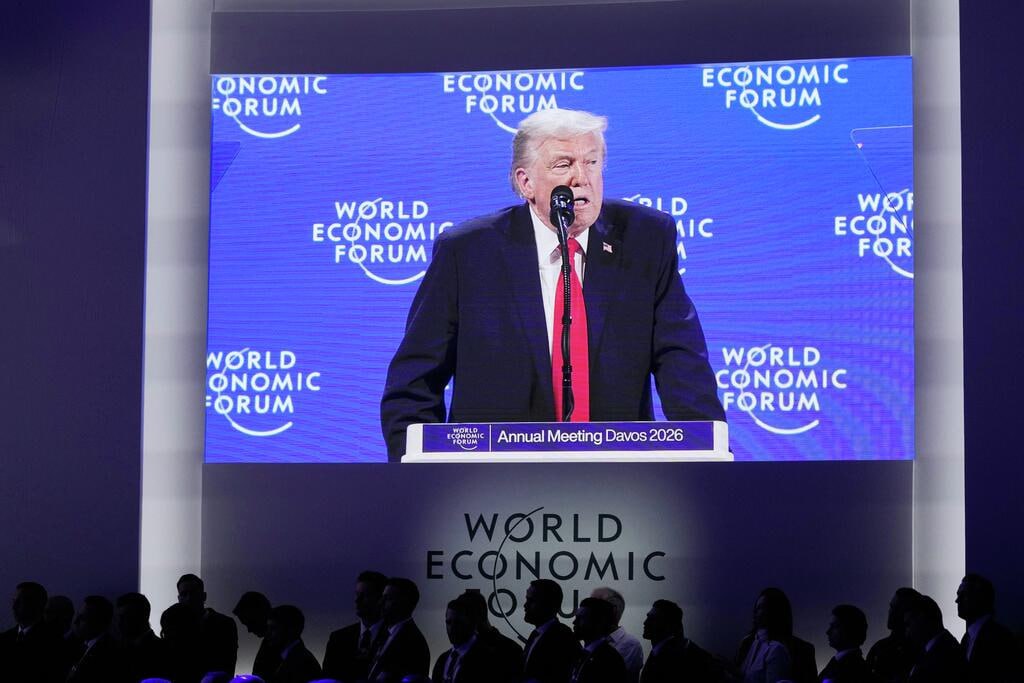
Trump's strategic message in Davos was his assertion that his country owns Europe because it has done so much for it, and that European states should thank Washington for rescuing them from decades of failed decisions (Photo: X.com)
The United States emerged from European struggles over lands that were not theirs, and the fact that they briefly ceased fighting is the anomaly, not Trump. Meanwhile, Greenland mirrors a global North that has ceased to believe in the rules it invented. International law, national sovereignty, territorial integrity—everything is now negotiated in terms of “critical security” and “vital interests.”
Trump advances on the island while Europe debates —with excessive restraint— its reaction and NATO crumbles from within.
https://misionverdad.com/globalistan/un ... roenlandia
Google Translator
The bourgoise bastards proly really want Greenland as their refuge against the climate change they claim they don't think is real.