Donald Trump, Avatar of his Class, Capitalism & the Decline and Fall of Bourgeois Democracy

User avatar
blindpig
Posts: 15306
Joined: Fri Jul 14, 2017 5:44 pm
Location: Turtle Island
Contact:

Re: Donald Trump, Avatar of his Class, Capitalism & the Decline and Fall of Bourgeois Democracy

Post by blindpig » Mon Jan 19, 2026 3:48 pm

NEW:
@potus
letter to
@jonasgahrstore
links
@NobelPrize
to Greenland, reiterates threats, and is forwarded by the NSC staff to multiple European ambassadors in Washington. I obtained the text from multiple officials:

Dear Ambassador:

President Trump has asked that the following message, shared with Prime Minister Jonas Gahr Støre, be forwarded to your [named head of government/state]

“Dear Jonas: Considering your Country decided not to give me the Nobel Peace Prize for having stopped 8 Wars PLUS, I no longer feel an obligation to think purely of Peace, although it will always be predominant, but can now think about what is good and proper for the United States of America. Denmark cannot protect that land from Russia or China, and why do they have a “right of ownership” anyway? There are no written documents, it’s only that a boat landed there hundreds of years ago, but we had boats landing there, also. I have done more for NATO than any other person since its founding, and now, NATO should do something for the United States. The World is not secure unless we have Complete and Total Control of Greenland. Thank you! President DJT”
https://x.com/nickschifrin/status/20131 ... e%3Aq6AdB0

JFC, what a pathetic weenie. How long lord, how long?

He's putting the Onion out of business.

******

Empire of Chaos, Plunder and Strikes in panic of being evicted from Eurasia

Pepe Escobar

January 19, 2026

Tehran will never bow down to the diktats. The neo-Caligula regime change obsession – in fact mirrored as a NATOstan obsession – will keep ruling. Tehran is not intimidated.

The whole planet is somehow convulsed by neo-Caligula’s latest scam: because he did not get his “peace” Nobel from Norway, part of his megalomanic narcissist revenge is to bag Greenland from Denmark (in Empire-speak, who cares? These Scandinavians are al the same anyway).

In neo-Caligula’s own words: “The World is not secure unless we have Complete and Total Control of Greenland.”

That seals the Empire of Chaos completely morphed into the Empire of Plunder and now the Empire of Permanent Strikes.

Assorted Euro-chihuahuas dared to dispatch a tiny bunch of dog-sled conductors to defend Greenland from neo-Caligula. To no avail. They were instantly hit with tariffs. The strike remains in effect until the “complete and total purchase” of Greenland.

Euro-chihuahuas – following the Global South – may have finally woken up to the new paradigm: Strike Geopolitics.

Neo-Caligula did not get regime change in Caracas – and his oil mirage was refuted even by US energy majors. He did not get regime change in Tehran – even if CIA, Mossad and assorted NGOs worked full time to deliver.

So Plan C is Greenland, essential for imperial lebensraum purposes, as collateral for the unpayable $38 trillion – and rising – debt.

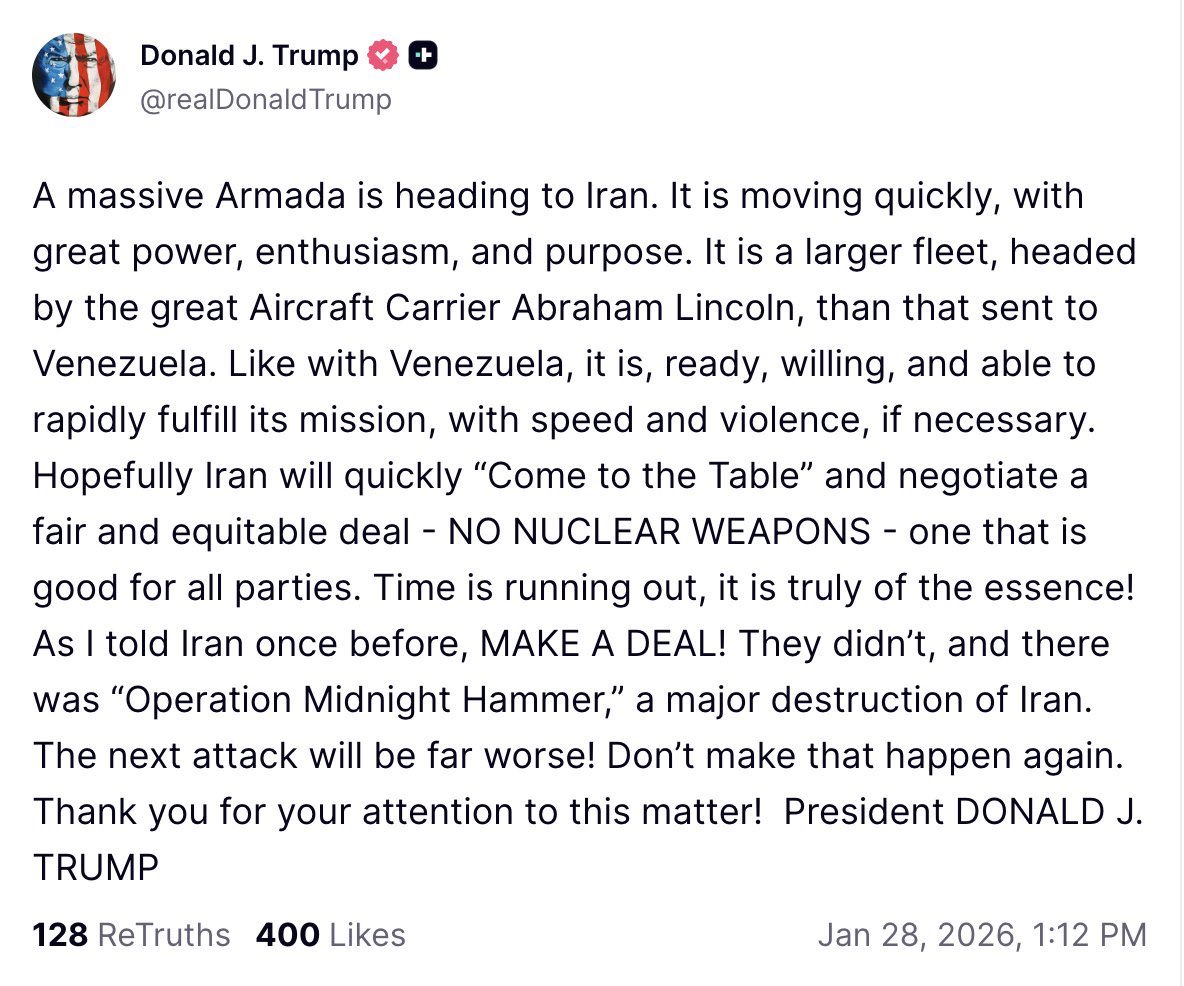
By all means that does not imply ditching the Iran obsession. The USS Abraham Lincoln aircraft carrier is moving into a position in the Sea of Oman/Persian Gulf where it would be able to strike Iran before the end of the week. All attack scenarios remain in place.

Assuming all hell breaks loose, this may become an even more humiliating replay of the 12-day war in June last year, which the death cult in West Asia spent as much as 14 months planning.

The 12-day war not only failed as a regime change op; it engendered a sample of Iranian reataliation so hardcore that Tel Avi still has not recovered. Tehran has been explicit, over and over again, that the same fate awaits neo-Caligula’s forces in Iran and across the Gulf in case of renewed strikes.

Why the regime change obsession endures

As for the equally, miserably failed regime change op on Iran these past few weeks, it featured on the forefront the pathetic Clown Prince Reza Pahlavi, safely ensconced in Maryland, massively plugged by US media as a “unifying political figure” capable of reassessing the “lived catastrophe of clerical rule”.

Neo-Caligula was too busy to care about these ideological niceties. What he wanted was to accelerate the proceedings by – what else – applying Empire of Permanent Strikes logic: bombing Iran.

Diversionist spin, predictably, went ballistic. The death cult in West Asia may have asked Moscow to tell Tehran that they would not strike if Iran did not strike first. As if Tehran – and Moscow – could trust anything coming from Tel Aviv.

The Gulfie crowd – Saudi Arabia, Qatar, and Oman – may have asked neo-Caligula not to strike, because that would have set the whole Gulf on fire and generate “grave blowback”.

The real deal – once again – was TACO. There was simply no gamed US strike scenario that would have allowed lightning quick regime change, the only acceptable outcome. Thus back to bagging Greenland.

It took only a few days to unmask the massive propaganda campaign across NATOstan about “mass casualties” among Iran protesters.

The – fake – figures came from the Center for Human Rights in Iran, located in, where else, New York, and financed by the CIA-infested National Endowment for Democracy (NED) in Washington and other assorted disinformation entities.

The list of reasons for urgent regime change in Iran though remains off the charts, featuring, among others, these four key elements:

Tehran must ditch the Axis of Resistance across West Asia supporting Palestine.
Because Iran is at the privileged crossroads of trade/energy connectivity corridors in Eurasia, both its connections with the
International North–South Transportation Corridor (INSTC) and China’s New Silk Roads (BRI) must be severed. That means blowing up from the inside organic intra-BRICS cooperation between Russia, Iran, India and China.
As over 90% of Iranian oil exports go to China – and are settled in yuan – that’s a serious threat to the petrodollar: the ultimate anathema. That’s where in Empire of Permanent Strikes terms, Iran aligns with Venezuela. It’s our – petrodollar – way or the highway.
The staying power of the never-ending dream of an Iran under the Shah remix – complete with a Shah-style SAVAK secret police; cosy Mossad ties to rein in those Arab barbarians; and a sprawling CIA-run net of surveillance hubs targeting both Russia and China.

How to counter a “regime-change war”

Tehran is not spooked by sanctions – as it has endured over 6,000 of them over four decades, designed to totally strangle its economy and even bring oil exports, in imperial terminology, down “to zero”.

Even under maximum pressure, Iran was capable of building the most extensive industrial base across West Asia; relentlessly invested in self-sufficiency and state of the art military hardware; joined the SCO in 2023 and BRICS in 2024; and for all practical purposes developed a top Global South knowledge economy.

Tsunamis of – digital – ink have been spent on why China has not properly helped Iran so far against imperial maximum pressure, for instance supporting Tehran against the speculative attacks on the rial. That would have cost Beijing almost nothing – compared to its level of foreign reserves.

The speculative attack on the rial was arguably the essential trigger of the protests across Iran. It’s essential to remember that hunger salaries were a key contributor to the collapse of Syria.

It’s up to Beijing to – diplomatically – answer this uncomfortable question. The spirit of BRICS Plus – call it Bandung 1955 Plus – may not survive when we all know this current world war is essentially about resources and finance, which need to be mobilized and properly deployed.

And that brings us to China’s leadership seriously evaluating whether it’s worth to remain a sort of larger version of Germany: embryonically self-centered; harboring fear; and fundamentally selfish in economic and financial terms. The – auspicious – alternative is for China to create sufficiently sized credit facilities within BRICS to an array of friendly nations.

Whatever happens next, it’s clear that the Empire of Permanent Strikes not only will remain “actively hostile” to a multipolar, multi-nodal world; the hostility will be marinated in a toxic sludge of anger and revenge, and subordinated to the ultimate, panic fear: the Empire’s slowly but surely, inexorable expulsion from Eurasia.

Cue to White House Special Representative Witkoff – the real estate Bismarck – enouncing the imperial diktats to Iran:

Stop enriching uranium. Out of the question,
Reduce missile stockpiles. Out of the question.
Reduce approximately 2000 kg of enriched nuclear material (3.67–60 %). That might be negotiated.
Stop supporting “regional proxies” – as in the Axis of Resistance. Out of the question.

Tehran will never bow down to the diktats. But even if it did, the – promised – imperial reward would be the lifting of sanctions (the US Congress will never do it) and a “return to the international community”. Iran is already part of the international community at the UN and inside BRICS, SCO and the Eurasia Economic Union (EAEU), among other institutions.

So the neo-Caligula regime change obsession – in fact mirrored as a NATOstan obsession – will keep ruling. Tehran is not intimidated. Cue to the strategic advisor to Iran’s Parliament Speaker, Mahdi Mohammadi:

“We know that we are facing a regime-change war in which the only way to achieve victory is to make credible the threat that, during the 12-day war, although it was ready, did not get the opportunity to be carried out: a geographically expansive war of attrition, focused on the Persian Gulf energy markets, on the basis of steadily increasing missile firepower, lasting at least several months.”

https://strategic-culture.su/news/2026/ ... m-eurasia/
"There is great chaos under heaven; the situation is excellent."

User avatar
blindpig
Posts: 15306
Joined: Fri Jul 14, 2017 5:44 pm
Location: Turtle Island
Contact:

Re: Donald Trump, Avatar of his Class, Capitalism & the Decline and Fall of Bourgeois Democracy

Post by blindpig » Tue Jan 20, 2026 4:58 pm

Trump Posts Image of Himself With U.S. Flag on Greenland

Image
X/ @MarketJournalX


January 20, 2026 Hour: 8:51 am

He also released another image showing the U.S., Canada, Greenland, and Venezuela under the American flag.

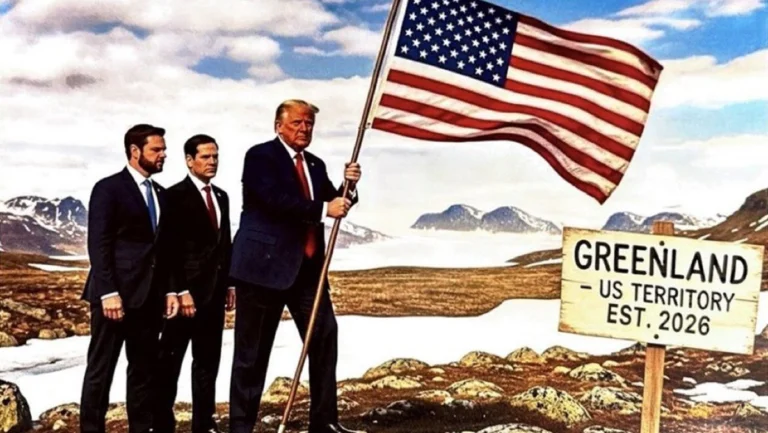
On Tuesday, U.S. President Donald Trump posted an image of himself placing the U.S. flag on the territory of Greenland on his social media platform Truth Social.

In the image, Trump is accompanied by U.S. Vice President JD Vance and Secretary of State Marco Rubio, with a sign nearby reading “GREENLAND – US TERRITORY EST. 2026.”

On the same day, Trump released another image: He met with European leaders in the Oval Office, with a map displayed behind him showing the U.S., Canada, Greenland, and Venezuela under the American flag.

Trump said that he had a telephone call with Mark Rutte, the Secretary General of NATO, concerning Greenland. “As I expressed to everyone, very plainly, Greenland is imperative for National and World Security. There can be no going back — On that, everyone agrees!” he wrote.

Trump’s annexationist ambitions regarding Greenland have been met with a commitment from Rutte to mediate a solution and a stronger response from the European Union, which warns that its reaction will be “proportional.”

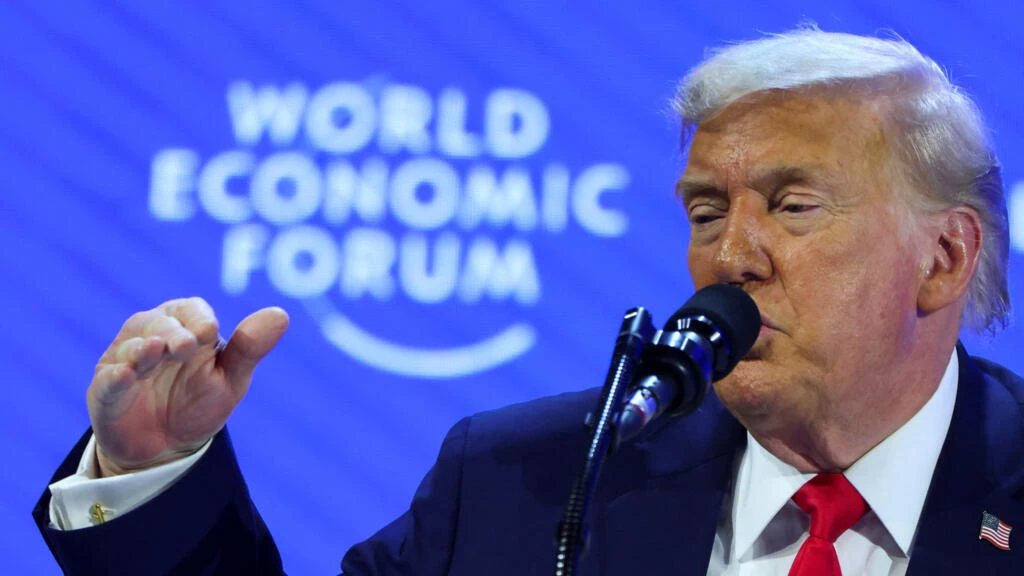
On Wednesday, the parties may have the opportunity to address the issue face-to-face during the U.S. president’s visit to Europe, where he will speak at the World Economic Forum in Davos, Switzerland. On Thursday, French President Emmanuel Macron expects Trump to attend a G7 meeting in Paris and a dinner before his return to the United States.

European Commission President Ursula von der Leyen made it clear that the EU’s response to annexation pressures will be firm. “We regard the American people not just as allies, but as friends. Dragging ourselves into a dangerous downward spiral would only help the adversaries we are both so committed to keeping out of our strategic landscape. Our response will be firm, united, and proportionate,” she said in her public address in Davos on Tuesday.

https://www.telesurenglish.net/trump-po ... greenland/

***********

Trump Will Take Greenland … And Then Go For More

U.S. President Donald Trump wrote a letter the Prime Minister of Norway, Jonas Gahr Støre. Staff at the National Security Council delivered copies of the letter to European ambassadors in Washington DC.

A copy was provided to a Newshour journalist:

Dear Ambassador:

President Trump has asked that the following message, shared with Prime Minister Jonas Gahr Støre, be forwarded to your [named head of government/state]

“Dear Jonas: Considering your Country decided not to give me the Nobel Peace Prize for having stopped 8 Wars PLUS, I no longer feel an obligation to think purely of Peace, although it will always be predominant, but can now think about what is good and proper for the United States of America. Denmark cannot protect that land from Russia or China, and why do they have a “right of ownership” anyway? There are no written documents, it’s only that a boat landed there hundreds of years ago, but we had boats landing there, also. I have done more for NATO than any other person since its founding, and now, NATO should do something for the United States. The World is not secure unless we have Complete and Total Control of Greenland. Thank you! President DJT”


Trump will continue to demand Greenland until something is done by Europe to decisively stop him.


When Trump tried to kill trade with China by imposing sky-high tariffs the Chinese responded by stopping export of rare earth minerals and rare earth products. The U.S. needs those and has no other sources. Trump stepped back from the tariffs and made peace with President Xi.

Europe need to make a likewise decisive move. It has allowed Trump to impose tariffs on European goods without imposing counter measures. That was a huge mistake as it Trump immediately interpreted it as weakness that could be further exploited.

Europe has a trade surplus from selling goods to the United States. But Europe has a deficit from buying services from the U.S. Such services are software, internet applications, TV shows and movies, consulting and some fields of banking businesses.

Europe should immediately introduce tariffs on all services the U.S. provides to Europe. These should be double the tariffs Trump has put on European goods. If Trump responds with higher tariffs on goods, respond with increasing that rate fro services. Let Microsoft, Google and Hollywood scream about it. All their products can be replaced with European ones without too much hassle.

There are other measures European countries could take. There are several ten-thousands U.S. soldiers and associated civilians in Europe. As the U.S. is threatening Greenland it is justified to limit their current free movement. Just to make sure that they, under Trump’s command, don’t start to do something equally stupid. In the end these people are hostages. Use them as such.

Europe should also immediately assemble a multinational independent regiment under Danish command and deploy it to Greenland. It shall protect the land from the ‘Russian’ and ‘Chinese’ intrusions the U.S. professes to fear.

A news item yesterday said that the Pentagon claims it has put 1,500 active duty Army paratroopers on alert for a potential deployment to Minnesota:

The soldiers are from the 11th Airborne Division, based at Joint Base Elmendorf-Richardson in Alaska, one of the Army’s premier infantry formations and a frontline force in the U.S. military presence in the Pacific, positioned to help deter China. The division is also the military’s leading formation for Arctic warfare.

If you believe that the prime U.S. units trained and designated to fight in Arctic climate were put on alarm to put down non-existing riots in Minnesota contact me about buying this huge bridge I have on offer. These troops are without doubt preparing to take over Greenland.

Europe should counter them by acting faster.

Unfortunately the current crop of European leaders is the worse the continent had for decades. That’s why I doubt that they will be able to plan and execute any significant measure.

In consequence Trump will take Greenland … and then go for more.

Posted by b on January 19, 2026 at 15:00 UTC | Permalink

https://www.moonofalabama.org/2026/01/t ... -more.html

******

Deciphering Trump’s ‘externalised internal thinking’ on Iran

Alastair Crooke

January 19, 2026

What can Trump do? Bomb Iranian institutional buildings like the IRCG headquarters?

To understand the background to events in Iran today, we need to retrace what I quoted U.S. commentator & Trump biographer Michael Wolff saying last July about Trump’s thinking in connection with the impending attacks on Iran’s Fordow, Natanz and Isfahan enrichment facilities:

“I have been making lots of calls – so I think I have a sense of the arc that got Trump to where we are [with the strikes on Iran]. Calls are one of the main ways I track what he is thinking (I use the word ‘thinking’ loosely)”.

“I talk to people whom Trump has been speaking with on the phone. I mean all of Trump’s internal thinking is external; and it’s done in a series of his constant calls. And it’s pretty easy to follow – because he says the same thing to everybody. So, it’s this constant round of repetition …”.

“So, basically, when the Israelis attacked Iran [on 12 July], he got very excited about this – and his calls were all repetitions of one theme: Were they going to win? Is this a winner? Is this game-over? They [the Israelis] are so good! This really is a showstopper”.

The last weeks’ externally-orchestrated riots in Iran have almost completely vanished – upon Iran blocking international calls, cutting international internet connections, and most significantly, severing Starlink satellite connections. No unrest, riots, or protests have been recorded in any Iranian city in the past 70-odd hours. There are no new reports; rather, there have been massive demonstrations of support for the State. The ongoing videos circulating are mostly old and reportedly peddled from two main hubs outside of Iran.

The impact of cutting-off protestors from their external controllers was immediate — and underlines that the rioting was never organic; but planned long in advance. The suppression of the extreme violence practiced by an influx of well-trained rioters, together with the arrest of the ringleaders has cut away the main plank to this iteration of the U.S.-Israeli regime change strategy.

The CIA-Mossad strategy has been based on a series of planned surprises devised to shock Iran and disorientate it.

The surprise initially worked for the 13 January sneak U.S.-Israel attack on Iran. The ‘shock’ was grounded in a network of covert agents infiltrated by Mossad into Iran over a long time-frame. These covert small teams were able to inflict substantial damage on the Iranian short-range air defences, using smuggled small drones and Spike anti-tank weapons.

This in-country sabotage was intended as a stepping stone to an Israeli challenge to the full Iranian air defence ‘umbrella’. To the IRGC, the attacks seemingly appeared out of nowhere. They created shock and compelled the Iranian IRGC air defences to shift into a protective posture until they were able to understand and identify the origin of the attack. Mobile radar systems therefore were ordered to withdraw into Iran’s massive tunnel network for safety.

Activation of the third all-embracing air defence umbrella could not proceed safely until the threat to these mobile radar assets had been removed.

This initial sabotage allowed Israel to engage with the Iranian integrated air defence system which, whilst still in its protective posture, was operating at lower capacity. At this point, Israel entered the conflict using air-launched aero-ballistic missiles launched from stand-off positions outside Iranian airspace.

As a quick remedy, the internet connection of Iran’s mobile phone network was deactivated to cut the link to hidden operators feeding targetting data to the local drone launch placements, via the Iranian mobile telephone network.

The 13 June attack — premised to collapse what was said to be a ‘house of cards’ Iranian State — failed, but subsequently led into the ‘12-day war’ — which also failed. Israel was forced to ask Trump to negotiate a ceasefire after four days of multiple Iranian missile strikes.

The next leg to the U.S. Israeli ‘regime change’ project had a distinctly different blueprint — one rooted in an old ‘playbook’ intended to amass and incite mobs and trigger extreme violence. It began on 28 December 2025 and coincided with Netanyahu’s meeting with Trump at Mar-a-Lago. A short-selling of the Rial (probably orchestrated from Dubai) crashed the value of the currency by 30 – 40%.

The devaluation threatened the business of the merchants (the Bazaar). Understandably, they protested. (The Iranian economy has not been well managed for some years, a fact that added to their anger). Young Iranians too, felt that this poor economic management had pushed them out from the Middle Class into relative poverty. The drop in the value of the Rial was widely felt.

The Bazaaris were protesting the sudden upending of the economic status quo, but served as the peg for the U.S. and Israel to propagandise wider grievances.

The ‘surprise’ in this chapter of the Regime Change playbook was the insertion of professional rioters into locations directed by their external controllers.

The modus was for the armed insurgents to gather in some well-frequented urban area, usually in a small city; to select a random passer-by, and for the men in the group to beat him severely, whilst the women film and scream to the gathering crowd for their colleagues to “kill him; burn him”.

The crowd, not understanding, becomes heated and violent. The police arrive, whereupon shots generally from an elevated site above the crowd are fired at the police or security forces. The latter fire back, and not knowing from whence the shots were fired, kill armed ‘protestors’ and members of the public. A violent riot thus is created.

The techniques are effective and professional. They have been used on many other occasions in other countries.

The Iranian remedy was two-fold: Firstly, thanks to Turkish intelligence support, many of the armed Kurdish fighters (trained and armed by the U.S. and Israel) were killed or arrested as they crossed the border into the predominantly Kurdish minority areas of Iran, arriving from Syria and Erbil.

The game-changer, however, was the cutting of Starlink connections to the estimated 40,000 satellite terminals that had been smuggled into Iran (most probably by western NGOs).

Western Intelligence services believed that Starlink was impossible to jam – hence its primary position in the Regime Change toolbox.

The Starlink cut off turned the tables. The riots vanished. And the State rebounded. There have been no defections from the army, the IRGC or Basij. The State remains intact and its defences augmented.

So what is next? What can Trump do? His mooted intervention was predicated on the narrative that the ‘régime was slaughtering the people’, amidst “rivers of blood”. That did not happen. Instead, there have been massive demonstrations of support for the Republic.

Well, Michael Wolff has been calling his White House sources again — “So, I went back to the people I speak to in the White House, to revisit this”.

Wolff relates, the notion of a new round of strikes on Iran seemed to his interlocutors to have taken root in late summer, early autumn. The start point was that Trump remains “delighted” by how his June strike on the Iranian uranium enrichment facilities had worked out: “It played; it really played”, Trump repeats.

But by Autumn, Trump had started to acknowledge that he faced a tough fight in the Midterm elections. He was beginning to say, “if we lose [the House], we could be finished; finished; finished”. And Trump would go on – with some almost self-awareness – Wolff says, to cite the problems ‘they’ are having, which are [lack of of] “jobs, the Epstein s—t and these ICE videos everybody is crying over”. Trump in these conversations implies that the Republicans could even lose the Senate, in which case, “I’m back in Court, which won’t be pretty”.

The day before he attacked the enrichment facilities in June 2025, Trump — in an insight into his mode of thinking in calls to his buddies — was constantly repeating: ‘If we do this, it needs to be perfect. It needs to be a ‘win’. It has to look perfect. Nobody dies’.

Trump kept saying to interlocutors: “We go ‘in-boom-out’: Big Day. We want a big day. We want [wait for it, Wolff says] a perfect war”. And then, out of the blue, after the June attack, Trump announced a ceasefire, which Wolff suggests was ‘Trump concluding his perfect war’.

The extreme violence used by rioters against Iranian police and security officials (up to the peak on 9 January 2026); the burning of banks; buses, libraries and the sacking of mosques, most likely was devised by western Intelligence services to show a crumbling, decomposing state that, in its death agony, was killing its own people.

This likely — in coordination with Israel — was being presented to Trump as the ‘perfect’ lead-in to a ‘Venezuela-type scenario’: We go for decapitation, ‘in-boom-out’’.

Trump this week told his advisers (for the second time), Wolff reports, that he wants a “standout thing; a whole big deal – all headlines. It has to ‘play’ well”. Despite the riots having been dissipated, he still insists on a guarantee from his team of ‘victory’ in any action taken.

But where is the ‘in-boom-out’ scenario to be found? The riots have ceased. After the 12 June 2025 strike and the Maduro kidnapping, Tehran is all too well aware of Washington’s obsession with decapitation.

So what can Trump do? Bomb Iranian institutional buildings like the IRCG headquarters? Iran almost certainly will respond. It has threatened to respond by striking U.S. bases across the region. In such a situation, a Trump-authorised attack may not have the look of a ‘big deal win’ at all.

Maybe Trump will stay with a smaller ‘win’: “We have a big stick”, he continues to say.“Nobody knows if I’ll use it. We’re freaking everybody out!”.

https://strategic-culture.su/news/2026/ ... g-on-iran/
"There is great chaos under heaven; the situation is excellent."

User avatar
blindpig
Posts: 15306
Joined: Fri Jul 14, 2017 5:44 pm
Location: Turtle Island
Contact:

Re: Donald Trump, Avatar of his Class, Capitalism & the Decline and Fall of Bourgeois Democracy

Post by blindpig » Thu Jan 22, 2026 5:14 pm

Arctic projection
January 22, 11:14

Image

I've seen a similar composition somewhere before.

P.S. The US is offering every Greenlander $1,000,000 to agree to Greenland's transfer to US control. They're trying to bribe free Greenlanders.

https://colonelcassad.livejournal.com/10320505.html

Trump's fixers are heading to Moscow.
January 22, 1:08 PM

Image

Trump's fixers are heading to Moscow.

This evening, Witkoff and Kushner will fly to Moscow for talks with Putin on a peace settlement in Ukraine. They had previously met in Davos with Kirill Dmitriev, who represents the Kremlin in informal negotiations on Ukraine.
Russia, as before, expects Ukraine to fulfill the demands previously voiced by Putin.
If these demands are refused, Russia will undoubtedly continue to pursue the goals of the Central Military District militarily.

Signs that could indicate some progress toward ending the war in Ukraine include:

1. An announcement of the withdrawal of the Ukrainian Armed Forces from Donbas.
2. An announcement of the dates for elections in Ukraine.

Without these points, all talk of peace is empty talk.

Trump is also scheduled to hold talks today with the "cocaine führer," whom Trump summoned to Davos. The "cocaine führer" was reluctant to go, but after he was publicly summoned, he had to go. Earlier, during negotiations with Whitkoff and Kushner, Ukraine was presented with very specific conditions for ending the war, which included, among other things, the surrender of Donbas to Russia within the 2014 borders.

A failure of the negotiations at this stage will likely lead to a prolonged stalling of the negotiations, followed by a return to them on even worse terms for Ukraine.

https://colonelcassad.livejournal.com/10320796.html

Swiss surplus
January 21, 11:02 PM

Image

Trump explained how he imposed tariffs on Switzerland.

We imposed a 30% tariff on Switzerland, and then chaos ensued. They started calling—you can’t imagine. I didn’t realize they were so dependent on us.

They come in, sell their watches—tax-free, no restrictions, and go away and make $41 billion just from us. I said, no, that can’t be. So I raised the tariff to 30%. Even then, we would still have a significant deficit.

And then, I think, the prime minister—I think it was not the president, but the prime minister, a woman—called me. And she kept saying the same thing: “No, no, no, you can’t do 30%. You can’t do that. We’re a small country.” I said, “Yes, you’re a small country, but you have a huge trade surplus—bigger than many big countries.”

She kept saying, “We’re a small country.” I said, “But you’re a big country, I mean…” And frankly, she was irritating me. And I said, “Okay, thank you, madam.” Thank you. Don't do that. Thank you very much." And I raised the tariff to 39%.

And then everything really exploded. Everyone started coming to me. Rolex came to me. Everyone came. But then I thought about it—and I lowered the rate, because I don't want to hurt people. I don't want to hurt them. And we lowered it to a more moderate level.

(c) Trump


In the end, Switzerland got off with tariffs of 15%.
Meanwhile, in the US, there are currently lawsuits over the tariffs that Trump imposed with his arbitrary decisions, and if he loses these lawsuits, the question of returning the money received as a result of the "illegal" tariffs will arise.

https://colonelcassad.livejournal.com/10320107.html

Google Translator

******

THIS IS HOW THE HISTORY OF NOW IS WRITTEN WITH A HAMMER

Image

By John Helmer, Moscow @bears_with

In all large criminal gangs – racketeer influenced and corrupt organizations (RICO) as they are termed in US law – there is always the mouth that talks tough; the pocket which collects the money; the gun that’s the enforcer. The mouth is the most expendable so long as the pocket keeps full and the gun stays loaded.

In Lucky Luciano’s enterprise, he was the first; Meyer Lansky the second; Benjamin Siegel, Albert Anastasia and Vito Genovese the third.

In President Donald Trump’s enterprise, he is the first; Steven Witkoff is the second; Stephen Miller is the third. Miller is currently publishing his ambition to become Trump’s National Security Advisor, replacing Marco Rubio, sidelining JD Vance, taking control of the pocket for warmaking abroad and for enforcement at home.

On the eve of Witkoff’s new meeting with President Vladimir Putin today (January 22), the Kremlin theory is, as it was in the talks with Witkoff last year, that Putin is moving Trump the mouth through Witkoff the pocket. It has been the Iranian experience that this is a miscalculation – that the gun moves the mouth more directly, more often than the pocket.

But in Kremlin theory, this operation is modeled on the Cuba takeover – that was Luciano’s success after Lansky negotiated bribe terms for Fulgencio Batista.

In the podcast aired from Crimea with Regis Tremblay and Dimitri Lascaris on Tuesday evening, the aim is to predict the future from the Moscow perspective while anticipating the worst from the Montreal viewpoint. Click to view or listen: https://www.youtube.com/watch?v=ZyLgvidwVqc

It is also explained why, in order to keep the long war going against Russia, Denmark and the NATO allies will come to terms with Trump over the future of Greenland – terms which will also save Trump the cost of bribing the Greenlanders for the deal.

This is how history is being written with the hammer.

THE MOUTH
Image
Source: https://truthsocial.com/@realDonaldTrum ... 4335579278

THE GUN
Image
Source: https://x.com/stephenm

THE POCKET
Image
The Russia Direct Investment Fund (RDIF), chaired by Security Council member Sergei Ivanov and headed by Kirill Dmitriev, stopped issuing annual reports of its operations in 2019. This was the last of them: https://www.ifswf.org/sites/default/fil ... %20web.pdf According to this report, RDIF was managing Rb1.5 trillion in investment – that was about $24 billion at the 2018 average rate of exchange; about $16 billion at the 2025 rate. The RDIF claims that with its stake, it leveraged an additional $40 billion in foreign “joint funds”; the report claims a 3% rate of return annually. No figure for current funds under management or for foreign partner investments appears in this document. Instead, the global map and its number key list $43.5 billion in investment pledges. The largest of these are the $10 billion joint investment pledges of the Public Investment Fund of Saudi Arabia (key=2) and China Development Bank (key=17), followed by $7 billion with the Mubadala sovereign wealth fund of Abu Dhabi (key=1). No figure for funds received, disbursed, or invested is available – pages 24-27. The RDIF website releases no financial data.

https://johnhelmer.net/this-is-how-the- ... more-93238

******

Satyajit Das: President Trump’s Spat With the Federal Reserve Is Not About Central Bank Independence
Posted on January 21, 2026 by Yves Smith

Yves here. Satyajit Das provides a compact overview of why central bank stewardship of the economy is not all that it is cracked up to be. Among the reasons are that the Fed and its ilk are asked to do too many things, some at odds with each other, with no clear priorities. Their economists suffer from groupthink and rely on dodgy models. And the Fed punted when it mattered, as in post-financial-crisis reforms (to its credit, the Bank of England was more bloody minded but lost that war to Treasury).


Das points out that Trump’s fixation with bludgeoning the Federal Reserve into line is in only part about financial repression, as in using low rates to keep the stock market bubbly and to lower the cost of continuing Federal deficits. But is it also about the Federal Reserve’s status as a power center, not in the traditional sense of “independent monetary policy” but as an institution that Trump has yet to dominate. Although Federal Reserve defenders take pains to wrap themselves in the mantle of central bank independence, the resistance is also to try to hold ground against a President who is determined to flatten all obstacles to his exercise of power, and resorting to brute force methods, from threats of prosecution to jackbootery.

Satyajit Das, a former banker and author of numerous technical works on derivatives and several general titles: Traders, Guns & Money: Knowns and Unknowns in the Dazzling World of Derivatives (2006 and 2010), Extreme Money: The Masters of the Universe and the Cult of Risk (2011) and A Banquet of Consequence – Reloaded (2016 and 2021). His latest book is on ecotourism – Wild Quests: Journeys into Ecotourism and the Future for Animals (2024). This is an expanded version of a piece first published on 22 December 2025 in the New Indian Express print edition

The spat between the White House and Fed Reserve Chairperson Jerome Powell, a President Trump appointment, is hardly unusual. Lyndon Johnson and Richard Nixon bullied the central bank to lower interest rates.


Central banks function as the government’s banker, issue currency, maintain the payment system and manage the nation’s currency reserves. They safeguard financial stability acting as a lender of last resort to banks although separate bodies sometimes regulate the financial system. The contentious part of their mandate is controlling money supply and setting interest rates.


Central bank independence is recent. In 1990, New Zealand legislated inflation targeting which was adopted by other nations. The concept was that an independent institution would determine monetary policy and maintain price stability minimising opportunities for politicians to use interest rates to boost economic activity especially around elections. The context was the high inflation era of the 1970s and 1980s. It was convenient to transfer painful choices to central bankers allowing governments to blame others or claim credit depending on outcomes.


The case for independence is unclear. The objectives, such as relative price stability, growth, and employment, are frequently contradictory. It is unclear which of multiple measures of price levels is to be prioritised. The 2 to 3 percent inflation objective is arbitrary. Empirical studies suggest that fear of deflation may be unwarranted. There are differences on what constitutes full employment. Data, rarely timely, has methodological problems. The representativeness of items used to measure inflation is contested. Unpaid work, zero-hour agreements and contracting complicates labour statistics. Resource scarcity or sustainability are ignored.


Central banks have limited tools – interest rates, regulating money supply through open market operations, quantitative easing (buying government debt) and forward guidance (open mouth operations or jawboning). Budgets, the currency, international capital flows, and geo-politics (sanctions, trade restrictions) are outside its control.


The underlying economic models focus on NAIRU (non-accelerating inflation rate of unemployment) or the Phillips Curve, a simplistic trade-off between unemployment and inflation. In practice, these relationships are unreliable. Cause and effect are difficult to differentiate. There is no agreement on a neutral (not contractionary or expansionary) interest rate. Central bankers constantly validate Laurence J. Peter’s judgement: “an economist is an expert who will know tomorrow why the things he predicted yesterday didn’t happen today.”


The problems are compounded by training and backgrounds which lend themselves to groupthink. Central bankers are economists, usually trained at the same universities, who spend their working life around the institution, government or academe and limited commercial experience. Central banks are run by economists providing employment for their tribe. Independent members rarely second guess staff recommendations, even if they have the expertise and information.


Originally reticent, central banks, following the lead of former Fed Chairperson Alan ‘Maestro’ Greenspan, have embraced celebrity. Inscrutable invisibility has given way to volubility, X handles, and Delphic oratory. They play to financial markets with an excessive focus on asset prices which do not uniformly benefit all citizens. Politicians, never happy to share the limelight, increasingly resent the power and public profile of these unelected technocrats. They begrudge having to seek approbation for their policies. US Presidents found themselves forced to kowtow to the all-powerful Greenspan. They increasingly are wary of the threat to their position and re-election that central banks may pose.


Central banks’ records are unconvincing. The Great Moderation of the 1990s and early 2000s, for which central bankers unashamedly claimed credit, was driven by lower rates, the result of Paul Volcker using punitive rates with high human cost to bring down inflation, as well as the entry of China, India and Russia into the global trading system and the growth of information technology. After the shocks of 2000 and 2008, hubristic central bankers used public money to rescue the system without addressing root causes. After 2020, they grossly misread price pressures regarding them as supposedly ‘transitory’. They have persistently ignored the side-effects of their policies such as asset price inflation, rising debt levels, capital allocation distortions, financing governments and social issues like inequality and housing affordability.


The current environment is different, characterised by low growth, slackening trade, challenges to free capital flows and geopolitical uncertainty. Interest rates are less effective in boosting economic activity. Inflation is less responsive to slack in the economy. Government borrowing in the aftermath of the crashes and the pandemic have created unsustainably high public debt and ongoing interest expenses which is unlikely to abate given aging populations, rising welfare costs and tax cuts. The increasingly populist political environment favours low interest rates, high growth, and jobs.


This is allied to suspicion of powerful elite central bankers insensitive to ordinary people’s concerns combined with an internationalist bent which favours globalisation. Vice-chairman of the US House of Representatives financial services committee Patrick McHenry questioned the right of then Fed Chair Janet Yellen to negotiate financial stability rules with “global bureaucrats in foreign lands without . . . the authority to do so.”


Given his sharp political instincts, President Trump senses an opportunity to undermine central bank authority if only by appointing voting Fed governors who favour his desire for short-term rates as low as 1 percent. Rather than institutional reform, the motivation is furtherance of financial repression to disguise sovereign insolvency and maintain artificially high stock and property prices.


Lower rates would allow continuation of profligate governments, with tax cuts and higher spending in sectors like defence and national security which favour the government’s business constituents. Negative real rates and self-fulfilling expectations of inflation are designed to allow the government to inflate away its rising debts and devalue the currency to improve competitiveness. The policy entails transferring wealth from domestic and overseas savers to borrowers. Treasury Secretary Scott Bessant has suggested that the US will de facto use foreign wealth to rebuild American industry and employment through policies forcing foreigners to invest in US industries as directed by the Administration while at the same time reduce the value of overseas investors holdings by weakening the dollar or worse.


Interestingly, the President’s modus operandi for government policy is similar to that he used in his business. Trump enterprises sought growth at all costs. They borrowed big and defaulted if things did not work out.


Framed by the Administration’s critics around central bank independence, the opposition to Trump’s agenda has little to do with the subject. The governing classes’ concern is around the realisation that the Federal Reserve is now one of the few remaining institutions that offers any check on Presidential power given the weakening of Congress, the public sector, and the judiciary.

https://www.nakedcapitalism.com/2026/01 ... dence.html

******

'We want a piece of ice': Trump renews demand to acquire Greenland during WEF speech

The US president slammed NATO, complaining that Washington ‘gives so much’ and ‘gets so little’ in return

News Desk

JAN 21, 2026

Image
(Photo credit: Reuters)

US President Donald Trump said at the World Economic Forum (WEF) in Davos, Switzerland, that he will not “use force” to take Greenland, but called for immediate negotiations to hand it over to Washington.

US President Donald Trump says the US is asking for complete ownership of Greenland:

"We pay for NATO. We paid for many years, until I came along, in my opinion 100% of NATO, because they weren't paying their bills. And all we're asking for is to get Greenland, including right,… pic.twitter.com/L7EBQhj9HY

— The Cradle (@TheCradleMedia) January 21, 2026


“We want a piece of ice for world protection,” he said. “And they won’t give it. We’ve never asked for anything else and we could have kept that piece of land and we didn’t, so they have a choice. You can say yes, and we will be very appreciative, or you can say no, and we will remember.”


He added that Washington could take Greenland by force, and it would be “unstoppable.”

“I don't want to use force. I won't use force. All the US is asking for is a place called Greenland. It's the US alone that can protect this giant piece of land, this giant piece of ice, develop it and improve it,” he went on to say, stressing that the US is a “great power” and that Denmark is not.

“Certain places in Europe are not even recognizable anymore. And we can argue about it but there's no argument … Without us, right now, you'd all be speaking German and little Japanese,” he went on to say, referencing World War II. “The US is keeping the whole world afloat.”

“We give so much, and we get so little in return,” he said about NATO.

The US only “gets death, destruction, and massive amounts of cash given to people who don’t appreciate what we do.”

Despite vowing not to use force, Trump responded, “You’ll find out” when asked how far he was willing to go to acquire Greenland, which belongs to the Kingdom of Denmark.

The US president has claimed that Russia or China will take Greenland if Washington does not, and that Denmark and the EU are incapable of protecting the territory from such an event.


Trump has announced plans to build a $175-billion “Golden Dome” anti-missile system – similar to Israel’s Iron Dome and aimed at protecting the US from threats. He claims acquiring Greenland is essential to this project.

US President Donald Trump tells "Bibi" to stop "taking credit for the Dome," and that he will build a dome "like no other." pic.twitter.com/VDCyP9G9De

— The Cradle (@TheCradleMedia) January 21, 2026


Last week, Danish Foreign Minister Lars Lokke Rasmussen announced that talks with US officials at the White House did “little” to budge Washington's position on annexing Greenland.

Rasmussen said the US remained fixed on acquiring the Arctic territory, despite Danish objections and warnings that such a move would violate sovereignty and Greenlanders’ right to self-determination.

“We did not manage to change the American position,” he told reporters after the meeting in Washington.


Earlier in January, Denmark’s Prime Minister Mette Frederiksen said, “It makes absolutely no sense to talk about the US needing to take over Greenland,” stressing that “the US has no right to annex any of the three countries in the Danish Kingdom.”

https://thecradle.co/articles/we-want-a ... wef-speech

*****

Image
Demonstrators hold protest signs during a march from the Atlanta Civic Center to the Georgia State Capitol on October 18, 2025 in Atlanta, Georgia. (Photo: Julia Beverly/Getty Images/Common Dreams)

Trump delivered 22% boost to billionaire wealth in 2025, but catastrophe for working class
By Jake Johnson (Posted Jan 22, 2026)

Originally published: Common Dreams on January 20, 2026 (more by Common Dreams) |

The first year of President Donald Trump’s second White House term made abundantly clear who he and his Republican allies in Congress serve—and who they don’t.

That’s the argument of a report published Tuesday by Americans for Tax Fairness (ATF) marking the one-year anniversary of the start of the second Trump administration, which has so far delivered big for the billionaire class while shafting the working class.

“While American families struggle to pay the bills due to higher tariffs and cuts in public benefits, Trump’s billionaire cronies have never been wealthier,” said ATF, noting that “billionaires bet big on Trump and Republicans in the 2024 elections, with just 30 MAGA billionaire families spending $1.4 billion to influence the outcome.”

“Their investment seems to be paying off rapidly, with this clique’s collective wealth growing by $408 billion in 2025, an increase of 37.5% from the year prior,” the group continued.

Billionaires across the country saw their collective wealth reach a record high of $8.2 trillion in the first year of the second Trump regime. Their total wealth increased from $6.7 billion, a 22% increase in 2025.

In the summer of 2025, Trump and congressional Republicans passed sprawling legislation extending massive tax breaks for the wealthiest Americans, fueling their wealth surge. ATF noted Tuesday that “the top 1% of households alone will get $1 trillion from this tax package.”

Meanwhile, in the same legislation, Trump and the GOP’s launched an unprecedented assault on Medicaid and federal nutrition assistance with cuts that are expected to leave millions without health insurance and food aid in the coming years and inflict significant damage on healthcare systems across the country.

The ATF report also points to the Trump-GOP refusal to extend Affordable Care Act subsidies that lapsed at the end of 2025, sending health insurance premiums skyrocketing for millions of people nationwide.

“After a year in office, Trump and the GOP majority betrayed their promises to working people, instead serving billionaire elites and wealthy corporations,” David Kass, ATF’s executive director, said in a statement.

Trump promised lower prices but enacted chaotic tariffs that spiked consumer costs, and also cut billions from SNAP and Medicaid while ballooning the deficit. He eliminated ACA tax credits, making healthcare unaffordable for millions—all to fund trillions in tax giveaways to the ultra-wealthy and large corporations.

“With an affordability crisis and historic income inequality,” Kass added,

Americans for Tax Fairness will oppose this administration’s regressive economic policy.

Entering year two of Trump’s second White House term, Republicans are signaling that they have no intention of changing course. Last week, the Republican Study Committee released its priorities for a possible second reconciliation bill—a list that includes repeal of the estate tax, a move that would benefit a small sliver of rich Americans.

“After a year of broken promises around affordability and control of government, this is what House Republicans have come up with: legislation that further enriches the richest of the rich at the expense of working Americans” Leor Tal, campaign director of the progressive advocacy coalition Unrig Our Economy.

“After the Republican tax law made the largest cuts to Medicaid and SNAP in history,” said Tal,

Republicans should stop raising costs on working families and, instead, focus on helping their constituents afford basic items like groceries and stop stripping even more Americans of vital services.

https://mronline.org/2026/01/22/trump-d ... ing-class/

(It's all the Republicans fault, yes, of course....)

*****

Greenland in the context of the secret war for the Arctic

Raphael Machado

January 22, 2026

Trump’s interest in Greenland is not the result of a sudden outburst, mere hubris, or simply hatred of Europe.

Let’s be honest: we have no idea how this “soap opera” of tensions between the U.S. and Europe over Greenland will end. Considering Trump’s erratic history, it could all end up amounting to absolutely nothing, or the U.S. might simply end up using marines and paratroopers to occupy the great northern island. Or, more moderately, actually buying the place, or at least closing a deal granting the use of parts of the island.

What we can be sure of, however, is that Trump’s interest in Greenland is not the result of a sudden outburst, mere hubris, or simply hatred of Europe. There is a clear geopolitical logic behind this interest, and it concerns one of the next potential scenarios for global conflict.

The most obvious dimension of the interest in Greenland is based precisely on the Trumpist update of the Monroe Doctrine. When the Monroe Doctrine was first developed, although abstractly it was a statement of intent to expel Europe from the Americas, its main target was Spain and its remaining possessions in the Western Hemisphere.

As the Monroe Doctrine was already being revived under the Biden administration, it seemed self-evident that it would be directed against the Russian-Chinese ties of various countries in the region. Clearly, however, it was not expected that the anti-European dimension of the Monroe Doctrine would still remain in force. The U.S., it is now obvious, intends to continue the removal of the European presence from the Americas. This was well noted by the Frenchman Jordan Bardella, current president of the Rassemblement National, who in a recent speech emphasized that if the U.S. took Greenland from Denmark, French territories (such as French Guiana, Martinique, Guadeloupe, Saint Barthélemy, Saint Martin, and Saint Pierre & Miquelon) could be next.

But there is a specificity to Greenland that transcends the agenda of the Monroe Doctrine: its position near the Arctic.

The climatic flows that are currently leading to a partial thaw of the Arctic Zone are opening the potential for new alternative trade routes to traditional ones. We also know that the place supposedly harbors 13% of the world’s undiscovered oil reserves, as well as 30% of its gas, plus gold, rubies, diamonds, zinc, iron, copper, rare earths, and a lot of uranium in the subsoil of the world’s largest island. More underestimated, but no less important, is the fact that the warming of northern waters has been attracting schools of fish, which has implications for fishing.

Naturally, one cannot overlook the strategic interest of the Arctic as a potential area for missile trajectories aimed at other enemies located in the planet’s Northern Hemisphere. The Arctic offers a shorter route for hypothetical intercontinental attacks.

The one who seems to have been the first to perceive the unexplored potential of the Arctic appears to have been Russia, which began a long process of revitalizing, reforming, updating, and building civil-commercial infrastructure in its northern areas closest to the region. Moscow also increased the activity of icebreaker ships, aiming to open a new maritime route alternative to that of the Black Sea, made more insecure by the regional context of the special military operation. Russia’s first initiatives regarding the Arctic were, however, mostly civil and commercial in nature, and connect with the Chinese project of a Polar Silk Road, also involving North Korea.

The Western response came with the militarization of the Arctic Zone.

As early as 2020, the United States, Canada, Denmark, Finland, New Zealand, Norway, and Sweden signed the International Cooperative Polar Research Program agreement, which points to a multidisciplinary approach aimed at the full investigation and occupation of the entire Arctic. Some of these countries have also been making heavy investments in developing new technologies to facilitate the exploration of the region. In the year 2021, the Pentagon published its strategy for the Arctic, involving the training of specialized military units to operate in the region. In 2022, using the special military operation as justification, these countries abandoned the Arctic Council, a multilateral structure focused on cooperation in that region.

All of this has seen practical applications, such as the reactivation of the U.S. Navy’s Second Fleet, dedicated to the North Atlantic and Arctic, as well as the revitalization of the U.S. base in Keflavik, Iceland. 4 billion dollars from the U.S. budget were dedicated to enhancing U.S. Arctic capabilities.

What is peculiar, however, is that all these past efforts were undertaken in coordination with analogous efforts from Canada and Scandinavian allies. Now, however, the U.S. is acting contrary to or even opposed to its old allies, apparently no longer believing in shared control of the Arctic.

More than interested in oil and gas, the U.S. seems to want to transform Greenland as a whole into a military platform, full of bases and aimed, in the long term, against Russia, which has already been responding to these Western efforts to militarize the Arctic with its own revitalization of old Soviet military assets, as well as with the reinforcement of the Northern Fleet.

Trump doesn’t even really need to become the “owner” of the island to achieve this goal, so the Deep State’s objective is fulfilled as long as Denmark simply agrees to cede parts of Greenlandic territory, especially in the north, to the U.S.

With events unfolding this way, it is plausible that the Arctic will become, in fact, one of the “hottest” zones in the world in the 2030s of this new century.

https://strategic-culture.su/news/2026/ ... or-arctic/

******

Chris Hedges: The Last Election
January 21, 2026

Donald Trump’s threat to cancel the midterm elections is not a feign. He ruminates about defying the Constitution to serve a third term; he is determined to retain absolute control.

Image
Let There Be Night — Mr. Fish

By Chris Hedges
ScheerPost

Donald Trump’s threat to cancel the midterm elections is not a feign.

He attempted to overturn the results of the 2020 election and said he would not accept the outcome of the 2024 election if he lost.

He ruminates about defying the Constitution to serve a third term. He is determined to retain absolute control — buttressed by an obsequious Republican majority — in Congress.

He fears, if he loses control of Congress, impeachment. He fears impediments to the rapid reconfiguration of America as an authoritarian state.

He fears losing the monuments he is building to himself — his name emblazoned on federal buildings, including the Kennedy Center, his scrapping of free entry to National Parks on Martin Luther King Jr. Day and replacing it with his own birthday, his seizure of Greenland and who knows, maybe Canada, his ability to put cities, such as Minneapolis, under siege and snatch legal residents off the streets.

Dictators love elections as long as they are fixed. The dictatorships I covered in Latin America, the Middle East, Africa, and the Balkans staged highly choreographed election spectacles. These spectacles were a cynical prop whose outcome was preordained.

They were used to legitimize iron control over a captive population, mask the enrichment of the dictator, his family and his inner circle, criminalize all dissent and ban opposition political parties in the name of “the will of the people.”

When Saddam Hussein held a presidential referendum in Oct. 1995, the only question on the ballot was “Do you approve of President Saddam Hussein being the President of the Republic?” Voters marked “yes” or “no.”

The official results saw Hussein win 99.96 percent of some 8.4 million votes cast. Turnout was reported at 99.47 percent. His counterpart in Egypt, the former general Hosni Mubarak, in 2005 was re-elected for a fifth consecutive six-year term with a more modest mandate of 88.6 percent of the vote.

My less than reverential coverage of the elections held in Syria in 1991, where there was only one candidate on the ballot, President Hafez al-Assad, who reportedly got 99.9 percent of the vote, saw me banned from the country.

Image
El Dookie – by Mr. Fish.

These spectacles are the model, I expect, for what comes next, unless Trump gets his deepest wish, which is to emulate Crown Prince Mohammed bin Salman of Saudi Arabia — whose security detail assassinated my colleague and friend Jamal Khashoggi in 2018 in the Saudi consulate in Istanbul — and hold no elections at all.

Wannabe president-for-life Trump floats the idea of canceling the 2026 midterm elections, telling Reuters that, “when you think of it, we shouldn’t even have an election.”

When President Volodymyr Zelensky informed Trump elections were not held in Ukraine because of the war, Trump gushed, “So you mean if we happen to be in a war with somebody, no more elections? Oh, that’s good.”

Trump told The New York Times he regrets not directing the National Guard to seize voting machines after the 2020 election. He wants to abolish mail-in voting, along with voting machines and tabulators, which allow boards of elections to post results on election night.

Better to slow the process down and like the Chicago political machine under Mayor Richard J. Daley, stuff boxes with ballots after the polls close to ensure victory.

Trump’s administration is prohibiting voter registration drives at naturalization centers. It is imposing nation-wide restrictive voter ID laws. It is reducing the hours that federal employees have to leave work and vote.

In Texas, the new redistricting map blatantly disenfranchises Black and Latino voters, a move upheld by the Supreme Court. It is expected to eradicate five Congressional Democratic seats.

Our money-drenched elections, coupled with aggressive gerrymandering, mean few races for Congress are competitive. Recent redistricting has, so far, all but guaranteed the Republicans another nine seats in Texas, Missouri, North Carolina, and Ohio and six for the Democrats, five in California and one in Utah.

Republicans intend to carry out more redistricting in Florida and Democrats plan a redistricting ballot initiative in Virginia. If the Supreme Court continues to gut the Voting Rights Act, then Republican redistricting will explode, possibly cementing into place a Republican victory whether the majority of voters want it or not.

No one can call redistricting democratic.

Image
(Donkey Hotey, Flickr, CC BY-SA 2.0)

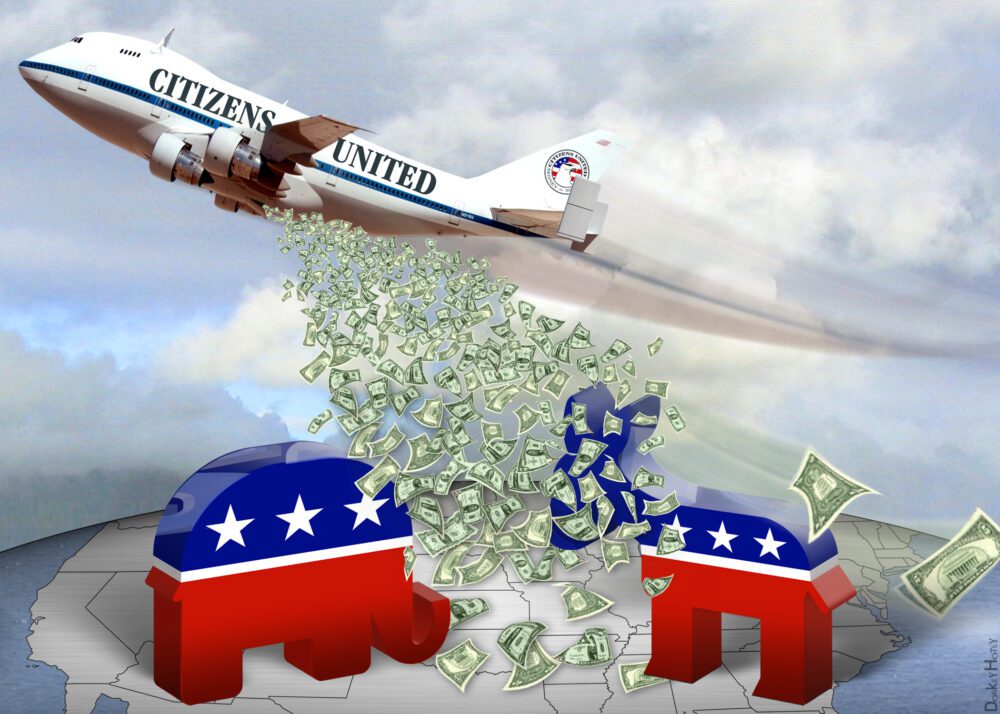
The Supreme Court’s ruling in Citizens United took from us any real input into elections.

Citizens United permitted unlimited money from corporations and wealthy individuals to rig the election process in the name of protected speech under the First Amendment.

It ruled that heavily financed and organized lobbying by large corporations is an application of the people’s right to petition their government.

Our most basic rights, including the freedom from wholesale government surveillance, have been steadily revoked by judicial and legislative fiat.

The “consent of the governed” is a cruel joke.

There are few substantial differences between the Democrats and Republicans.

They exist to provide the illusion of representative democracy. The Democrats and their liberal apologists adopt tolerant positions on issues regarding race, religion, immigration, women’s rights and sexual identity, and pretend this is politics.

The right wing uses those on the margins of society — especially immigrants and the phantom “radical left” — as scapegoats. But on all the major issues — war, trade deals, austerity, militarized police, the vast carceral state and deindustrialization — they are in lockstep.

“One cannot point to any national institution[s] that can accurately be described as democratic,” the political philosopher Sheldon Wolin noted in his book Democracy Incorporated, “surely not in the highly managed, money-saturated elections, the lobby-infested Congress, the imperial presidency, the class-biased judicial and penal system, or, least of all, the media.”

Wolin called our system of governance “inverted totalitarianism.” It paid outward fealty to the façade of electoral politics, the Constitution, civil liberties, freedom of the press, the independence of the judiciary, and the iconography, traditions and language of American patriotism, while it allowed corporations and oligarchs to effectively seize all of the mechanisms of power to render the citizen impotent.

The emptiness of the political landscape under “inverted totalitarianism” saw politics merge with entertainment. It fostered a ceaseless political burlesque, a politics without politics.

The subject of empire, along with unregulated corporate power, endless war, poverty and social inequality, became taboo.

These political spectacles create manufactured political personalities, Trump’s fictitious persona, a product of The Apprentice. They thrive on empty rhetoric, sophisticated public relations, slick advertising, propaganda and the constant use of focus groups and opinion polls to loop back to voters what they want to hear.

The vapid, issueless and celebrity-driven presidential campaign of Kamala Harris was a sterling example of this political performance art.

The assault on democracy, carried out by the two ruling parties, set the stage for Trump.

They emasculated our democratic institutions, stripped us of our most basic rights and cemented into place the machinery of authoritarian control, including the imperial presidency. All Trump had to do was flick the switch.

Image
National Guard Troops in Los Angeles. (U.S. Northern Command /X)

The indiscriminate police violence familiar in poor urban communities, where militarized police serve as judge, jury and executioner, long ago handed the state the power to “legally” harass and kill citizens with impunity. It spawned the largest prison population in the world.

This evisceration of civil liberties and due process has now been turned on the rest of us. Trump did not initiate it. He expanded it. Terror is the point.

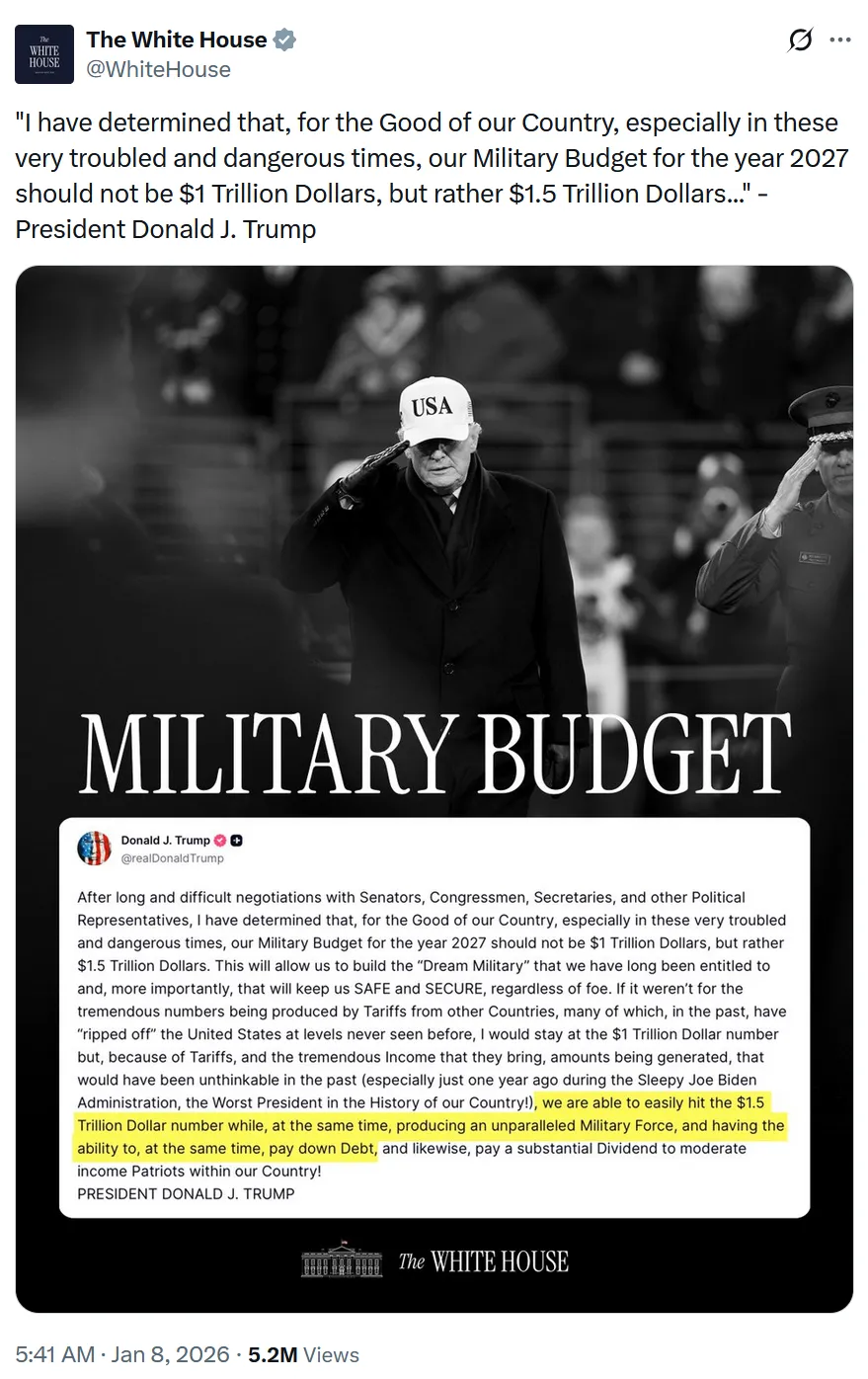
Trump, like all dictators, is intoxicated by militarism. He is calling for the Pentagon’s budget to be raised from $1 trillion to $1.5 trillion. Congress, in passing Trump’s One Big Beautiful Act, has allocated more than $170 billion for border and interior enforcement, including $75 billion for ICE over the next four years.

That is more than the yearly budget for all local and state law enforcement agencies combined.

“When a constitutionally limited government utilizes weapons of horrendous destructive power, subsidizes their development, and becomes the world’s largest arms dealer,” Wolin writes, “the Constitution is conscripted to serve as power’s apprentice rather than its conscience.”

He goes on:

“That the patriotic citizen unswervingly supports the military and its huge budget means that conservatives have succeeded in persuading the public that the military is distinct from government. Thus, the most substantial element of state power is removed from public debate.

Similarly, in his/her new status as imperial citizen the believer remains contemptuous of bureaucracy yet does not hesitate to obey the directives issued by the Department of Homeland Security, the largest and most intrusive governmental department in the history of the nation.

Identification with militarism and patriotism, along with the images of American might projected by the media, serves to make the individual citizen feel stronger, thereby compensating for the feelings of weakness visited by the economy upon an overworked, exhausted, and insecure labor force.”


The Democrats in the next election — if there is one — will offer up least-worst alternatives while doing little or nothing to thwart the march toward authoritarianism. They will remain hostage to the demands of corporate lobbyists and oligarchs.

The party, which stands for nothing and fights for nothing, could well hand Trump a victory in the midterms. But Trump does not want to take that chance.

Trump and his minions are energetically closing the last exit built into the system that prevents absolute dictatorship.

They intend to orchestrate the sham elections familiar in all dictatorships, or abolish them. They are not joking. This will be the death blow to the American experiment.

There will be no going back. We will become a police state.

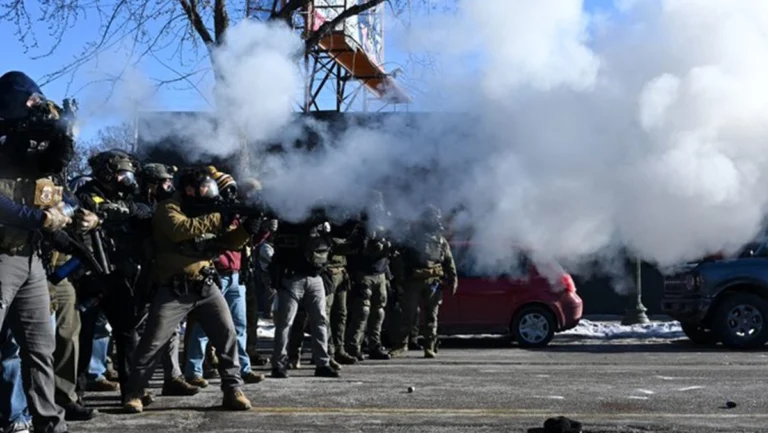
Our freedoms, already under heavy assault, will be extinguished. At that point, only mass mobilizations and strikes will thwart the solidification of the dictatorship. And such actions, as we see in Minneapolis, will be greeted with lethal state repression.

The subverting of the next elections will offer two stark choices to Trump’s most vocal opponents. Exile or arrest and imprisonment at the hands of ICE thugs.

Resistance to the beast, as in all dictatorships, will come at a very high cost.

https://consortiumnews.com/2026/01/21/c ... -election/

Mr Hedges regard for other people's elections is rather parochial, to say the least.
"There is great chaos under heaven; the situation is excellent."

User avatar
blindpig
Posts: 15306
Joined: Fri Jul 14, 2017 5:44 pm
Location: Turtle Island
Contact:

Re: Donald Trump, Avatar of his Class, Capitalism & the Decline and Fall of Bourgeois Democracy

Post by blindpig » Fri Jan 23, 2026 4:56 pm

Hoodwinks and Hijinks: Trump 'Nabs' Greenland at Davos[/b]
Simplicius
Jan 22, 2026

The Davos conference taking place in Switzerland has brought all the world’s top geopolitical tinder boxes to the center stage. The most notable has been Trump’s ongoing Greenland saga, which is apparently ending in the selfsame style as most of Trump’s previous loudly heroic campaigns—all sound and fury, signifying pitifully little.

Trump wanted all of Greenland, and the latest reports indicate what he will get are “small pockets” of land to erect a few more US assets, little different to the US’s ‘leasehold’ of Guantanamo or UK’s land rights in Cyprus, etc.

Image
https://www.zerohedge.com/political/tru ... rief-delay

NYT reports that the announcement followed a NATO meeting on Wednesday "where top military officers from the alliance’s member states discussed a compromise in which Denmark would give the United States sovereignty over small pockets of Greenlandic land where the United States could build military bases."
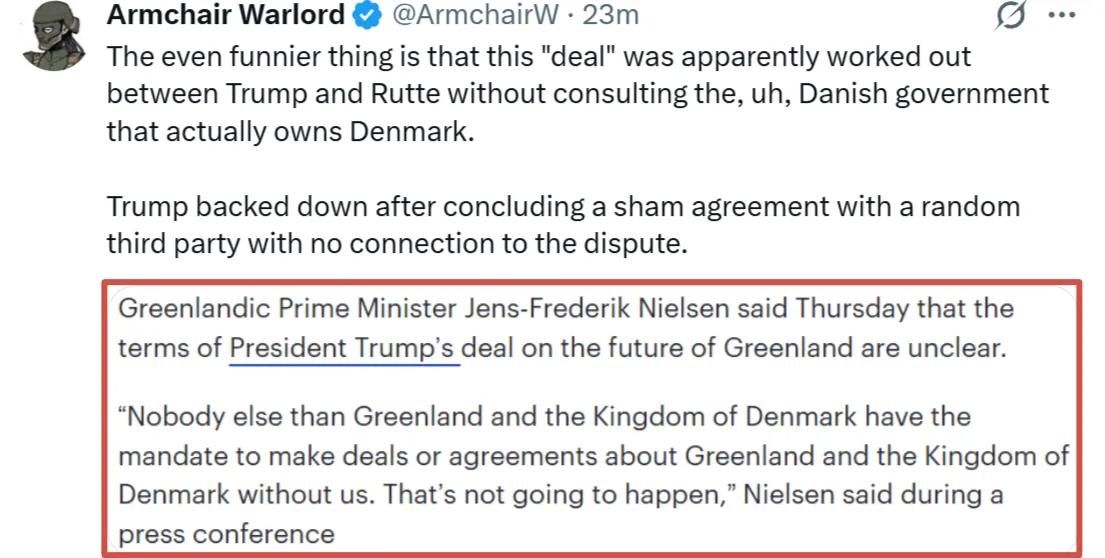
Image
Ah, the now-familiar hallmarks of a Trump deal.

Trump, of course, is set to sell this major vision downgrade as a ‘monumental victory’, as per his usual aggrandizing tactic, despite his being forced to TACO-out on the European tariff threat he had made. (Video at link.)

It could still be considered a victory for the US, perhaps: one could argue anything gained is better than nothing. But one must always analyze what was lost in exchange.

In this case, Trump did major damage to alliances and economic ties, causing Europe and Canada—by way of Mark Carney and Macron—to announce reorientations toward China. That said, it’s still possible for the whole megillah to turn out favorably in the long term, particularly because it helps rupture NATO and the EU, which ultimately works in everyone’s favor, including the US’s. The more the transatlantic mafia and ‘deep state’ can be hobbled and undermined, the weaker the American deep state becomes, which sources much of its power, funding, and influence from the European arm of the cabal.

Some believe that this is in line with Trump’s usual strategy, outlined in his “seminal” work, The Art of the Deal, wherein he explains his negotiating tactic as always demanding far more upfront in order to frazzle the opponent and lead them to make a still-favorable concession.

But in this case, who can honestly believe that Trump didn’t want all of Greenland? It was clear as day this was meant to be his magnum opus, the final triumphant feat worthy of plastering his visage onto Mount Rushmore next to those other losers who never ended nine wars or vanquished all America’s enemies while doubling the country’s land mass. Only a series of fake polls can possibly dim the blinding sheen of such unparalleled greatness.
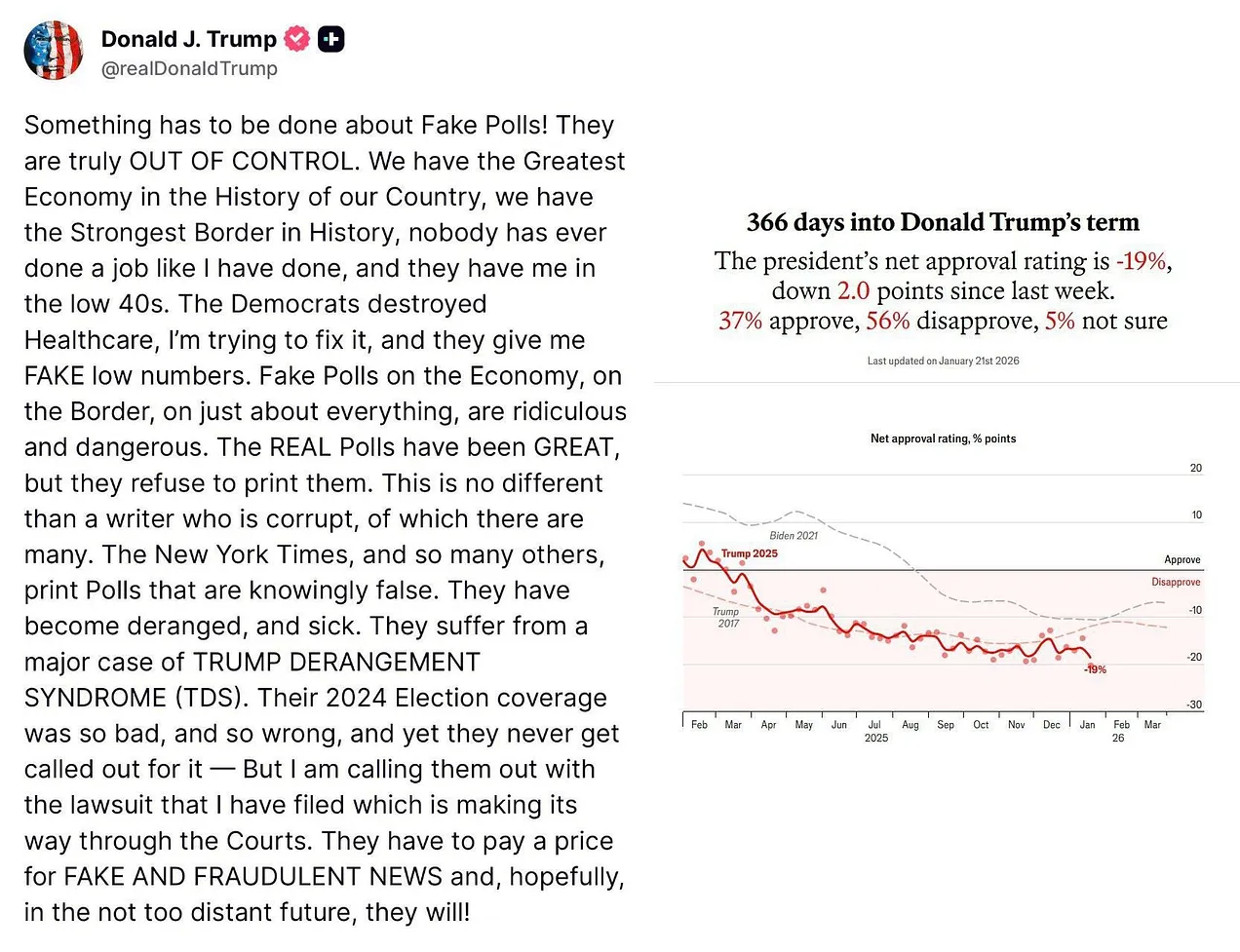
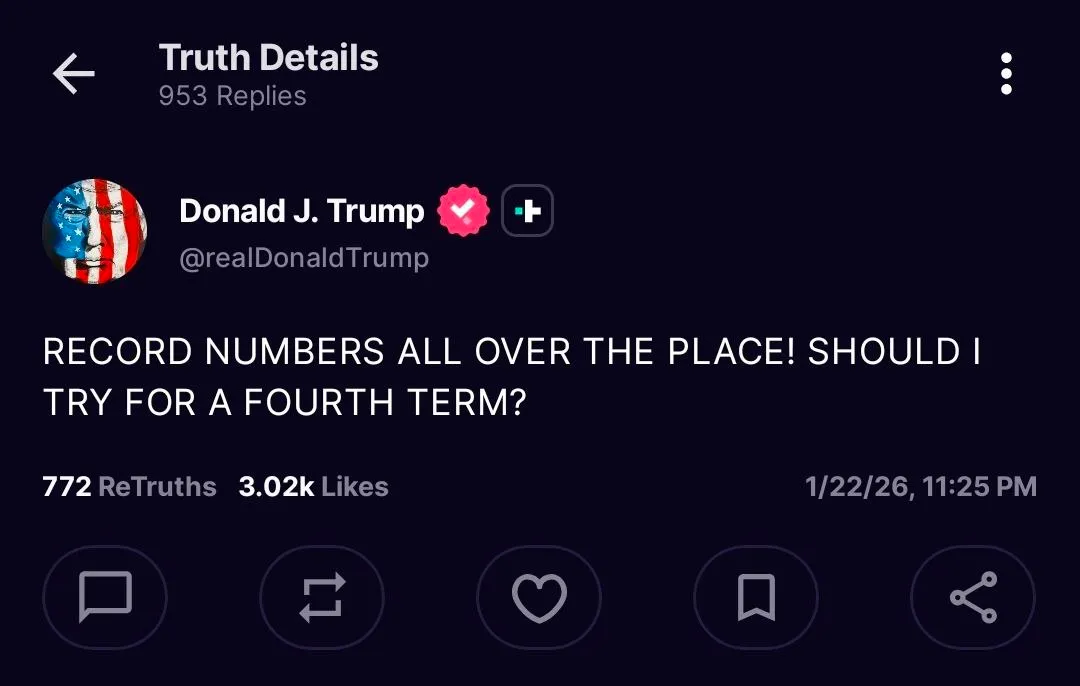
Image

Image

The other “interesting” takeaway was that Trump created his grand ‘Board of Peace’, which he has implied would be a spiritual successor to the UN, and which he himself is trying to fashion as a new body to supersede the UN entirely. The “interesting” aspect is he’s appointed himself as ‘lifetime’ chairman of this board, which would effectively make him the de facto “leader of the world” for the remainder of his life:
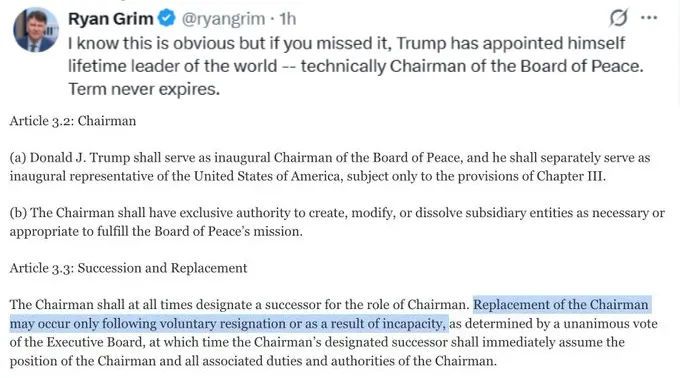
Image

Putin epically trolled the US by deflecting his invitation to this unprecedented ‘board’ with the suggestion that Russia’s one billion dollar entry fee could be paid by the Russian assets ‘frozen’ in the West.

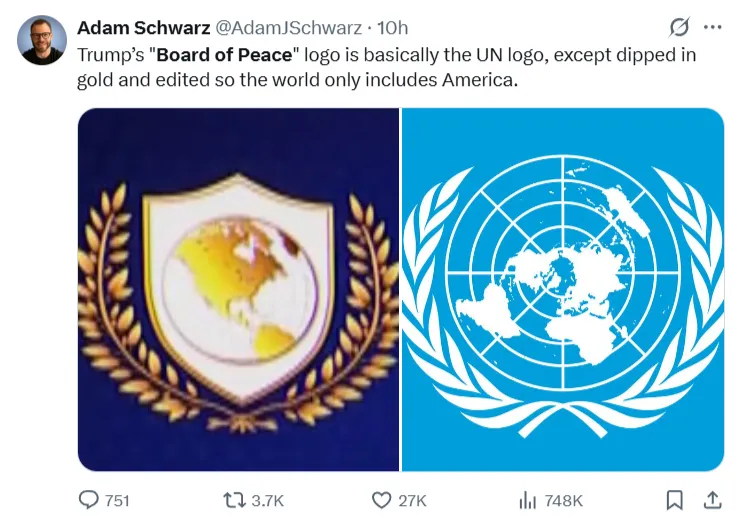
The lazily AI-made logo for this ‘board’ drew puzzlement and ridicule:
Image

It’s no wonder no one is exactly taking it seriously.

The illustrious Board of Peace’s first major announcement was the Jared Kushner helmed Gaza Riviera project, unveiled by Kushner himself at the Board of Peace inaugural address:
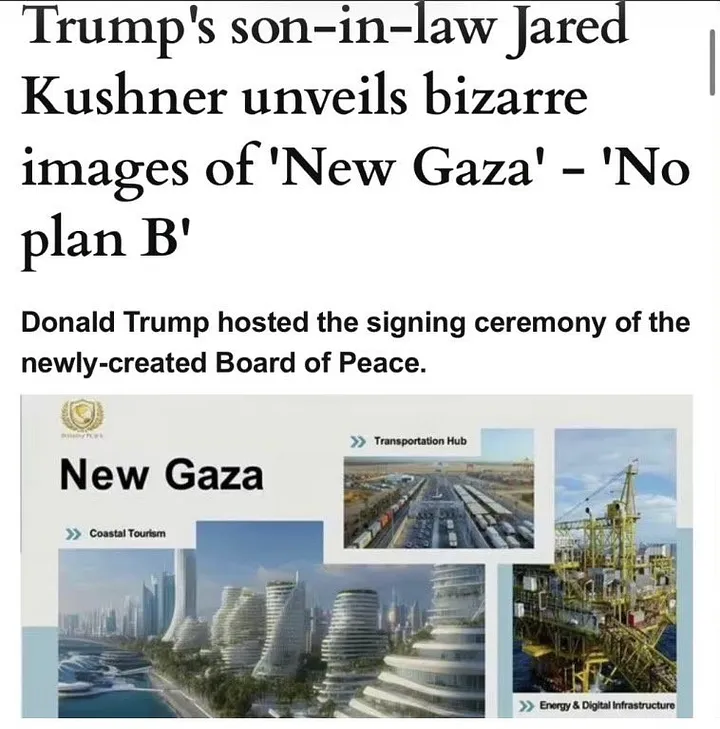

Image

Image

Well if that isn’t icky.

If the past two days didn’t produce enough gags and face-palm moments for your liking, even with Greenland under the barrel of a gun, the global elites and their minions continued parroting the risible Russian threat. Denmark’s arctic commander explained it’s Russia that is set to seize Greenland this year:. (Video at link.)

“Russia could seize Greenland as early as this year”

— Denmark’s Arctic commander says he sees Russia as more of a threat than the US. Andersen also dismisses suggestions of conflict between NATO allies

Ahaha … Putin ofcourse is to blame.


While Trump casually remarked that the European troops sent to Greenland this past week were actually going there to defend against Russia…
. (Video at link.)

Tragedy or farce?

Now Witkoff and gang are again in Moscow to convene with Putin on the eve of an announcement that Russia will hold the first ‘tripartite’ meeting between itself, the US, and Ukraine in Abu Dhabi on Friday. Things are going quickly because it seems Ukraine’s condition has reached stage four ahead of schedule, and the imperial lackeys are intent on staving off a major humiliation. Now word is that Zelensky is again offering Russia a desperate energy ceasefire: he will cease hitting Russian oil tankers if Russia shows mercy to the terminally exhausted Ukrainian power grid.

Western experts are now in agreement that once winter ends, Ukraine’s territorial collapse will accelerate, and things will only keep getting worse:
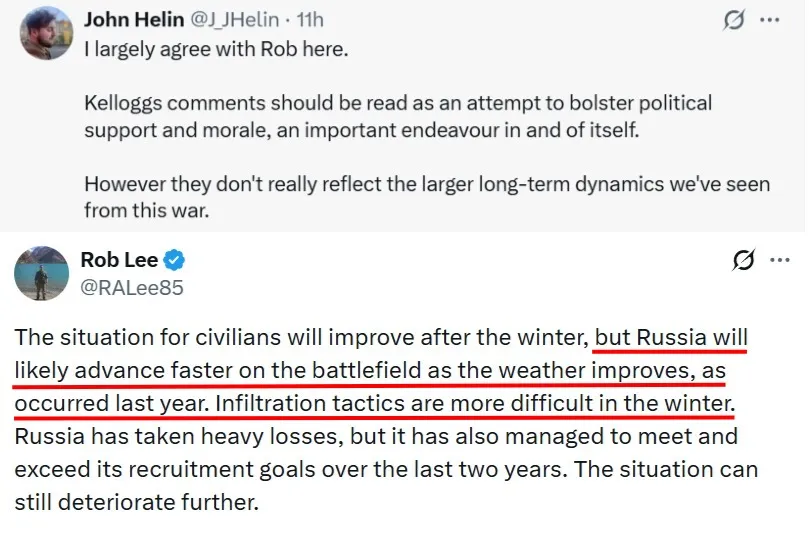
Image

It is therefore paramount for Trump’s team to squirrel this conflict away before the rip-roaring midterm season gets off to the races. But as always: with Ukraine’s infrastructure on the precipice, and European countries promising the injection of NATO troops the second the cannons fall silent, what possible incentive does Russia have?

In the end, Trump’s bull-in-china-shop antics appear at times strategically planned, with the intention being the destruction of all the old global orders, which include NATO, the UN, and the nebulous “international law” hornswoggle. It’s in this spirit Trump implicitly endorsed this message yesterday:
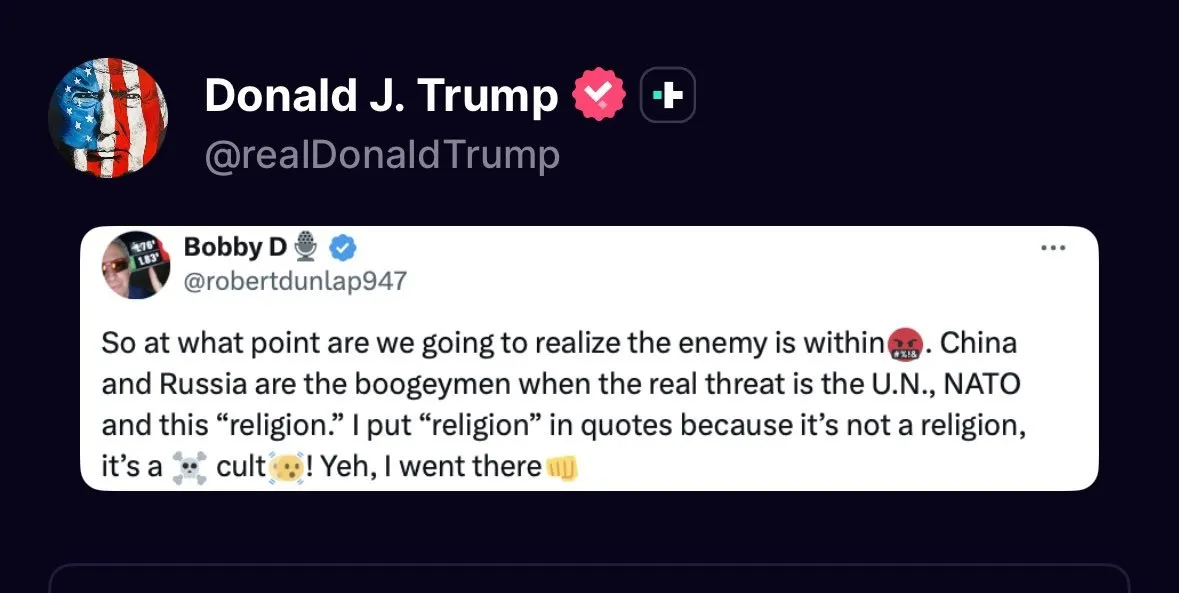
Image

That said, Trump shares so many helter-skelter and contradictory messages that his periodic 5D ‘insights’ can just as easily be explained by the ‘broken clock’ maxim.

As a last point of amusement, apparently in Ukraine’s Davos booth a comical scare-mongering video was displayed depicting Russian Geran drones attacking the Davos event itself:. (Video at link.)

Talk about desperation.

Zelensky made another interesting statement yesterday regarding the recent Russian strikes that targeted Kiev and other areas on January 20th. He revealed that attempting to repel this attack has cost Ukraine 80 million euros just in air defense missiles alone—a staggering sum that puts things into perspective:
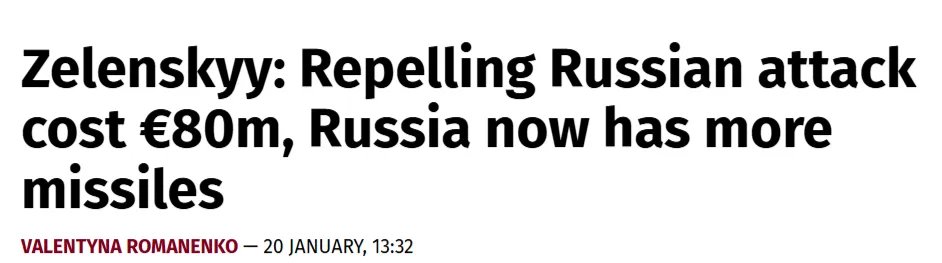
Image
https://www.pravda.com.ua/eng/news/2026/01/20/8017027/

(Video at link.)

Quote: “For example, today’s Russian attack cost us around €80 million – and that’s only the cost of the missiles. Just imagine the price of those missiles. And every day we do all we can – and I personally do all I can – to ensure we receive the missiles we need and proper protection for our people.”

Remember a Patriot Pac-3 missile is said to cost upwards of $4 million for a single one. Oh wait, that’s the domestic price—export costs are a mind-boggling $10M, and those were 2018 figures:


https://en.wikipedia.org/wiki/MIM-104_Patriot
Ukraine was firing them off like chiclets two nights ago, to no avail as the Kiev thermal plants were still lit up like Christmas trees by unbothered Iskanders. Just ten such attacks equates to a billion big ones, and reports indicate Russia is already preparing the next wave. Such expenditures are simply unsustainable for Ukraine—and the West.


A few last ‘moments’ from Davos:

Belgian PM Bart de Wever says the quiet part out loud about European vassalage: (Video at link.)


Chums Musk and BlackRock Larry guffaw at America’s ongoing neo-imperialist plunder of the world: (Video at link.)

Together they control nearly $20 trillion; a big piece of the pie indeed.

https://simplicius76.substack.com/p/hoo ... trump-nabs

*******

Greenland Is Not a Prize: The Fourth Newsletter (2026)

The US has set its sights on Greenland due to its mineral wealth and strategic location. But its people – the Kalaallit – are an afterthought in Washington’s machinations.

22 January 2026

Image
Pia Arke (Kalaallit Nunaat), Nuugaarsuk alias… 2, 1990.

Dear friends,

Greetings from the desk of Tricontinental: Institute for Social Research.

Every few years, the centre of the imperialist Global North – the United States – forgets its manners.

It is one thing to be rude to Iran or Venezuela, but it is another thing entirely to be rude to Denmark. The North Atlantic has not experienced internecine acrimony since – perhaps – Adolf Hitler turned on Poland in 1939. But to be fair to the United States, it has not coveted Denmark itself. Washington has licked its sticky fingers and placed them upon Greenland.
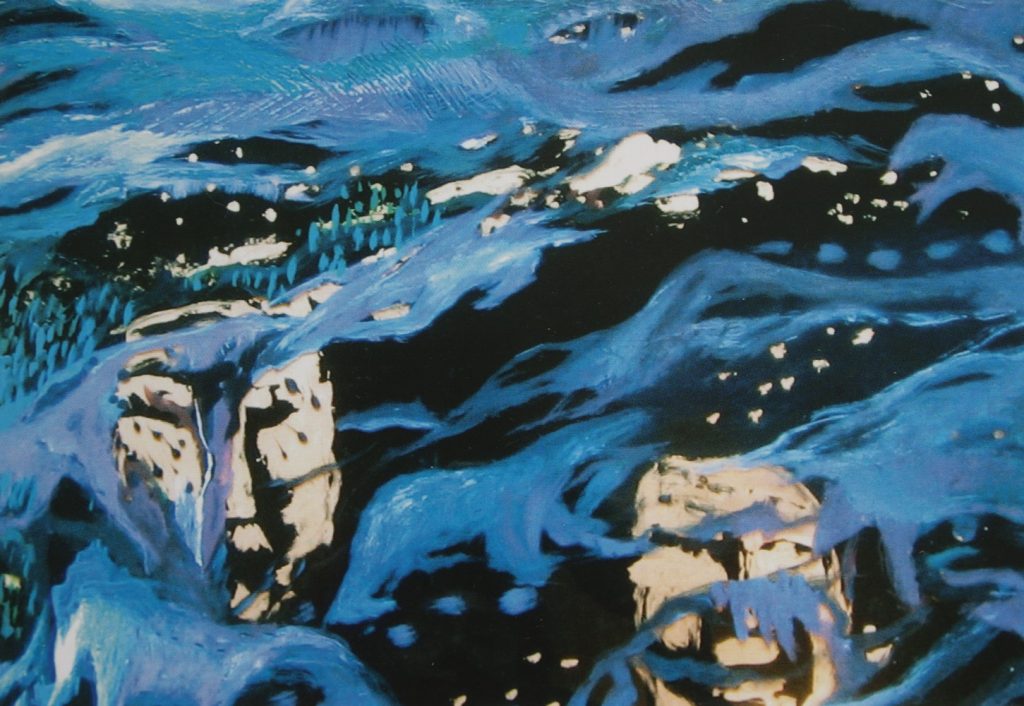
Image
Aka Høegh (Kalaallit Nunaat), Bag maskerne (Behind the Masks), 2008.

Denmark began its colonisation of Greenland 305 years ago, in 1721. Constitutional scholars will say that the formal colonial status ended in 1953 when Greenland was incorporated into the Kingdom of Denmark and that Greenland gained a further measure of autonomy in 2009 when the Act on Greenland Self-Government was passed – but let’s be frank, it remains a colony.

For context, Greenland (over 2 million square kilometres) is fifty times larger than Denmark. For comparison, if placed over the United States, it would almost stretch from Florida to California. If it were an independent country, it would be the twelfth largest in the world by area. Of course, the Arctic country has a very small population of around 57,700 (roughly equivalent to the population of Hoboken, New Jersey).

In Washington’s imagination, Greenland appears not as a homeland, but as a location – a place on a map or a signature on a radar screen. The words used to talk about it belong to the grammar of possession: purchase, control, seize. This is the language of domination – one imperialist power (United States) wanting to seize the land of a colonial power (Denmark).

But Greenland is not a prize.

The Inuit of Greenland call their country Kalaallit Nunaat: ‘Land of the Kalaallit’ (Greenlanders). When Trump and his allies speak of Greenland, they never speak of the people: the Kalaallit. Instead, Trump speaks of the strategic importance of the island and about what the US government sees as the perils of its Chinese and Russian capture (never mind that neither China nor Russia have made any claims over the territory). Greenland is always a place that someone else must hold, but not the Kalaallit. For people like Trump, or indeed for generations of Danish prime ministers (despite soft statements about the path to self-determination), the Kalaallit have no role as political subjects.
Image
Kaarale Andreassen (Kalaallit Nunaat), Kvinde på en klippe (Woman on a Cliff), n.d.

Greenland grew in strategic and economic importance to Denmark after the 1794 discovery of cryolite, a key mineral used in the production of aluminium. This extractive focus continued after the 1956 discovery of uranium and rare earth elements in Kuannersuit (Kvanefjeld) in southern Greenland. In 1941, Denmark’s envoy in Washington, Henrik Kauffmann, signed an agreement that allowed the US to establish bases and stations in Greenland. In 1943, the US placed a weather station at Thule (Dundas) known as Bluie West 6, and in 1946 it added a small airstrip. After the Second World War, Denmark was an early entrant to the US effort to build a military bloc against the Soviet Union. In fact, it was a founder of the North Atlantic Treaty Organisation (1949) and then signed the Defence of Greenland Agreement (1951) that allowed the US to build the Thule Air Base under the codename Operation Blue Jay (now Pituffik Space Base). The base became useful not only as a place to watch the USSR, but also for missile warning, missile defence, and space surveillance – a strategic foothold that has grown more consequential as Greenland’s uranium and rare earth deposits have become central to the global contest for critical minerals.

As Greenland’s ice sheets have melted in recent decades due to the climate catastrophe, the country’s deep geology has become easier to survey and to mine. Feasibility studies and drilling in the early to mid-2010s (especially 2011–2015) showed that the land was teeming with graphite, lithium, rare earth elements, and uranium. As the United States imposed its New Cold War on China, it had to seek new sources for rare earths given China’s dominance of rare-earth refining and downstream magnet production. The island became not only a source of minerals or a geographical location for power projection, but also a critical node in the US-led supply-chain security architecture.
Image
Anne-Birthe Hove (Kalaallit Nunaat), Inuppassuit V (Many People), 1995.

In August 2010, long before Canadian Prime Minister Mark Carney’s trip to China in mid-January 2026, the Canadian government released a report with an interesting title: Statement on Canada’s Arctic Foreign Policy: Exercising Sovereignty and Promoting Canada’s Northern Strategy Abroad. On the surface, the report is rather bland, making many pronouncements about how Canada respects the Indigenous peoples of the Arctic and how its intentions are entirely liberal and noble. That posture is difficult to square with the reality that major mining projects across the Canadian Arctic have repeatedly sparked Inuit concerns about impacts on wildlife and Inuit harvesting and that regulators have at times recommended against expansions, as in the case of Baffinland’s Mary River iron mine.

In fact, Canada is home to the world’s largest hub for mining finance (TSX and TSX Venture Exchange list more than half of the world’s publicly traded mining companies), which has been sniffing around the Arctic for decades in search of energy and minerals. The 2010 report does mention Canada’s ‘Northern energy and natural resource potential’ and that the government is ‘investing significantly in mapping the energy and mineral potential of the North’. But there is no mention of the large Canadian private mining companies that would benefit not only from Greenland’s mineral potential (for instance, Amaroq Minerals, which already owns the Nalunaq gold mine in South Greenland) but also from Canada’s Arctic region (for instance, Agnico Eagle Mines, Barrick Mining Company, Canada Rare Earth Corporation, and Trilogy Metals). What is significant about the report is that if it is put into operation, it would sharpen the long-running Canada-US dispute over Arctic navigation, particularly in the Northwest Passage, which Canada treats as internal waters and the US approaches as an international strait.

Canada is an ‘Arctic power’, the report says. There are seven other countries that have an Arctic foothold: Denmark, Finland, Iceland (through Grimsey), Norway, Russia, Sweden, and the United States (through Alaska). They are members of the Arctic Council, which was set up by Canada in 1996 to deal with environmental pollution in the Arctic and to create space for Indigenous organisations in the region to put forward their views. However, the Arctic Council has largely been paralysed since Russia’s invasion of Ukraine in 2022, when member countries paused normal cooperation with Russia and later resumed only limited project-level work that does not involve Russian participation, even though Russia holds roughly half of the Arctic coastline. With consensus required, this has narrowed the council’s role from a venue that could broker pan-Arctic coordination and even negotiate binding agreements to one largely confined to technical working-group projects and assessments. Canada’s claim to being an ‘Arctic power’ comes with bravado but lacks substance. Will it really prevent the US from using its sea lanes, and can it exercise a form of capitalist sovereignty for its mining companies in the Arctic region?

Image
Buuti Pedersen (Kalaallit Nunaat), Kammannguara (My Little Friend), 2015.

In 2020, before the council paused cooperation with Russia, the North Atlantic Treaty Organisation (NATO) had already called upon its members to ‘set [their] sights on the high north’ (as NATO’s think tank, the Atlantic Council, noted in a report). After 2022, NATO developed a ‘high north’ strategy that can be best appreciated in its 2025 parliamentary report Renavigating the Unfrozen Arctic. The report identifies what it sees as the primary threat to NATO countries: China and Russia. One of them (Russia) is a major Arctic power, and the other (China) has two scientific stations in the north (Yellow River Station in Svalbard, Norway, which has been there since 2003 studying atmospheric and environmental science, and the China-Iceland Arctic Science Observatory in Kárhóll, Iceland, which has been there since 2018 studying Earth-system and environmental science). China has also indicated that the Arctic waters would be ideal for a Polar Silk Road, a trade corridor that would link China to Europe. But there is no Chinese military footprint in the region as of now.

On 9 January 2026, Trump said that he does not want China or Russia to get a foothold in Greenland. It is true that representatives of Chinese companies have been to Greenland and signed non-binding memorandums of understanding (MOUs), but it is equally true that none of them have gone forward. Trump fears that some of these MOUs might eventually turn into projects that could see Chinese companies on Greenland’s soil. However, since EU investment is so low in Greenland (around $34.9 million per year), and since US (around $130.1 million per year) and Canadian investment ($549.3 million per year) is higher but still lower than an anticipated Chinese investment (at least $1.162 billion), it is credible to fear the Chinese businesses. At the same time, it is worth noting that Danish and other Nordic diplomats have disputed Trump’s claims of Russian and Chinese warships operating ‘around Greenland’, for which Trump has offered no public evidence.

China’s anticipated investment in Greenland does not pose a military threat, nor is it something that the United States, Canada, or indeed Denmark should be concerned with. This should be a discussion and debate within Greenland.

Image
Bolatta Silis-Høegh (Kalaallit Nunaat), Uagut (Us), 2021.

Greenland is not for sale. It is not a military platform or a mineral reserve waiting to be extracted. It is a society, alive with memory and aspiration. The Global South knows this story well – a story of plunder in the name of progress, of military bases in the name of security, of the suffering and starvation of the people who call this land their home.

Land does not dream of being owned. People dream of being free.

Ask Aqqaluk Lynge, a Kalaallit poet, politician, and defender of Inuit rights who wrote in his poem ‘A Life of Respect’:

On maps of the country
We must draw points and lines
to show we have been here –
and are here today,
here where the foxes run
and birds nest
and the fish spawn.

You circumscribe everything
demand that we prove
We exist,
that We use the land that was always ours,
that We have a right to our ancestral lands.

And now it is We who ask:
By what right are You here?

Warmly,

Vijay

https://thetricontinental.org/newslette ... onisation/

*****

Trump at Least for Now TACOed Over Greenland at Davos in Rambling Speech as His Poll Ratings Continue to Fall
Posted on January 22, 2026 by Yves Smith

Trump is more and more visibly coming apart, yet he has another almost three years in office. While he pulls back from the brink somewhat, as he did with his Liberation Day tariffs and apparently again at Dovos over Greenland due to harsh discipline from Mr. Market, there are perilous few others willing and able to stand up to him, which is the only way to deal effectively with bullies. President Xi has on trade with clampdowns on rare earth sales and other restrictions. Putin has in a way that is too sophisticated for Trump and his team to grok, which is by not yielding more than affirmatively resisting. Putin has deeply internalized his judo practice and Trump offers many opportunities to take advantage of his misguided use of force. Even then, with Xi, Trump has seen fit to violate de-escalatory understandings, leading to recriminations and further clampdowns by China.

While it’s impossible to read Trump’s mind, the most plausible explanation for his sudden climbdown after his persistent demand that the US had to own Greenland, that any alternative was inadequate, was the nearly 900 point fall in the Dow, a plunge in the dollar, and a climb in bond yields. Further confirmation comes from the unseemly spectacle of Treasury Secretary Scott Bessent stooping to shame Deutsche Bank. Note that analysts are accorded a good deal of independence, and if the analyst was not fired, the fact of a mere groveling call is sus, yet another craven show of subordination to the mad bad Trump team. It also seems a stretch the Deutsche research note triggered the selloff, as opposed to intensifying it by confirming investor worries. Nevertheless, the business press dutifully fell in with Administration messaging. For example, from the Financial Times:

Speaking at the World Economic Forum in Davos, Bessent said: “This notion that Europeans would be selling US assets came from a single analyst at Deutsche Bank, of course, the fake news media led by the Financial Times amplified it. The CEO of Deutsche Bank called to say that Deutsche Bank does not stand by that analyst.”

The note, written by Deutsche Bank’s chief forex strategist George Saravelos on Sunday, said that Europe held roughly $8tn of US bonds and equities, making it America’s largest creditor and underlining Washington’s reliance on foreign capital to finance persistent deficits.

“We spent most of last year arguing that for all its military and economic strength, the US has one key weakness: it relies on others to pay its bills via large external deficits. Europe, on the other hand, is America’s largest lender,” Saravelos wrote.

But irrespective of what Saravelos wrote, plenty of other political and economic experts were deeply alarmed about the Trump Greenland threat as fatally destructive to what remained of an already-wobbly post-World-War-II geopolitical order. Trump has and likely will continue to undermine international law, institutions, and informal yet once-powerful norms out of his bizarre belief that he and only he can and will determine the trajectory of world events. If you want to see a very thorough and persuasive view of what Trump might have wrought with his Greenland seizure threat, read Big Serge’s The Great Greenland War. While one can quibble with details of his scenarios, like the idea that Russia would take advantage of the instability to take the Baltics, they give a sense of how much this move could and likely would have set in motion events that would radically change the world order, and not in ways beneficial to the US.

The bigger point here is that virtually all close observers of the Trump Greenland threats, including your humble blogger, had thought Trump really was not going to back down over his demand to annex Greenland. However, we had stated in our last post on this topic that the one thing that might deter Trump was the Market Gods and the best strategy European leaders has was not to try to placate Trump but to play up the possibility of conflict. And while we may not know right away, recall that even US investors have been cutting US exposures over Trump worries, as the Financial Times recently headlined in a lead story on fund giant PIMCO.

Trump is for the moment now attempting a climbdown of getting various elements of a “deal” in lieu of a takeover. That may include trying to get concessions from NATO or the Europeans on Project Ukraine or other broader matters economic. But many outlets had pointed out that the US already had substantial military rights with respect to Greenland, and that the Danish government has offered all sorts of possible concessions save transfer of ownership. Also keep in mind that the idea that there is a lot of mineral wealth in Greenland that could be exploited is a fiction absent much greater progress of global warming. If multinationals could develop profitably there, they would have done so by now.

However, even now, Trump’s new story is ahead of reality. From BBC:

On Truth Social on Wednesday, the US president said: “We have formed the framework of a future deal with respect to Greenland and, in fact, the entire Arctic Region.

“This solution, if consummated, will be a great one for the United States of America, and all Nato Nations.”

Diplomatic sources told the BBC’s US partner CBS that there was no agreement for American control or ownership of the autonomous Danish dependent territory….

Nato spokeswoman Allison Hart said in a statement after the meeting between Trump and Rutte: “Negotiations between Denmark, Greenland, and the United States will go forward aimed at ensuring that Russia and China never gain a foothold – economically or militarily – in Greenland.”

However, one of two Greenlandic lawmakers in the Danish parliament questioned why Nato would have any input on the island’s mineral wealth.

“Nato in no case has the right to negotiate on anything without us, Greenland. Nothing about us without us,” Aaja Chenmitz said.
According to US media, the potential plan could allow the US to build more military bases on the territory.

Officials who attended the Nato meeting on Wednesday told the New York Times a template for the suggested arrangement might be similar to UK bases on Cyprus, which are part of British Overseas Territories.

Under existing agreements with Denmark, the US can bring as many troops as it wants to Greenland. It already has more than 100 military personnel permanently stationed at its Pituffik base in the north-western tip of the territory.

And note that for the moment Trump has only sworn off the use of arms and tariffs. Again from the BBC:

In his first speech in six years to the World Economic Forum in Davos on Wednesday, Trump said he was “seeking immediate negotiations” to acquire Greenland, but insisted the US would not take the territory by force.

“We probably won’t get anything unless I decide to use excessive force. We’d be unstoppable, but we won’t do that,” Trump said. “I don’t have to use force. I don’t want to use force. I won’t use force.”

He also urged world leaders to allow the US to take control of Greenland from Denmark, saying: “You can say yes and we will be very appreciative. Or you can say no and we will remember.”

In other words, Trump may still get what he wants, via a sale rather than a seizure, by continuing to have temper tantrums and getting the EU to fold as quickly as Machado did. If the Europeans were clever, they could take a page from Russia’s book and opt to to along with negotiations, but insist that they be structured and get to detailed treaty-type agreements, of course for the protection of the US as well as for them to be able to be ratified by relevant official bodies. Team Trump is simply incapable of this sort of thing. Any effort to do this would drag or peter out

However, there’s plenty of precedent for government officials cleverly packaging existing authorities and presenting them as a shiny, new consequential scheme. One was Mario Draghi’s Outright Monetary Transactions scheme, which he presented as a “whatever it took” facility when it contained absolutely no new measures. But investors nevertheless reacted to the PR as opposed to the content and bid wobbly assets up.

But let’s return to the bigger issues: Trump’s Davos speech provided yet more evidence that he is losing it cognitively as well as in terms of his emotional self regulation, although we hardly need more evidence after his toddler-esque demand that Maria Corina Machado turn over her Nobel prize to him and then his statement that his resolve to take Greenland was to avenge the Nobel Committee diss of not giving it to him in the first place..

There’s a lot of commentary on the numerous gaffes in the Davos speech, from Trump slurring to ranting about windmills and incorrectly depicting China as not having windfarms and banging on yet again about having the Presidency stolen from him in 2020. The Guardian has one tally. The New Republic gave a good take in Trump Embarrasses All of America in Slurred, Disjointed Davos Speech:

President Trump delivered yet another rambling, long-winded speech Wednesday at the World Economic Forum in Davos, using the massive world stage to rail against windmills, complain for the umpteenth time about how the 2020 election was rigged, reaffirm his desire to seize Greenland from Denmark, and take credit for every good thing in the world.

The room was dead silent virtually the entire time.

“Certain places in Europe are not even recognizable frankly, anymore. They’re not recognizable. And we can argue about it, but there’s no argument,” Trump said early in his speech to the room full of Europeans. “Friends come back from different places—I don’t wanna insult anybody—and say ‘I don’t recognize it.’ And that’s not in a positive way.… It’s not heading in the right direction.”….

Trump then of course got to Greenland, accidentally mixing it up with Iceland for nearly the entire time he spoke about it.

“Until the last few days, when I told them about Iceland, they loved me,” Trump said, meaning to say Greenland. “They called me daddy … very smart man said, ‘He’s our daddy.’”

We’ll use The Hill as convenient one-stop shopping for how official DC is reacting to the latest Trump whipsaw. It appears not well. From a new story, NATO allies take on Trump as Greenland threats ‘rupture’ global order:

The leaders of some of America’s closest allies used the Davos summit this week to confront a new world order under President Trump in which the U.S. is an unreliable partner, at best, and increasingly viewed as an adversary.

The leaders of Canada and France were among those speaking out during the World Economic Forum in Switzerland, calling Trump’s efforts to take control of Greenland a wake-up call for the need to establish military and economic power that does not depend on the United States.

However, one European diplomat told The Hill that Trump’s remarks offered little relief given his continued hostility toward NATO allies and the veiled threats in his combative speech.

“They have a choice. You can say ‘yes’ and we will be very appreciative, or you can say no, and we will remember,” Trump said.

But just hours later, Trump posted on TruthSocial that he reached a “framework of a future deal” over Greenland with NATO Secretary General Mark Rutte, who has positioned himself as a main bridgebuilder between Europe and Washington….

Jim Townsend, adjunct senior fellow in the Transatlantic Security Program with the Center for a New American Security, said Trump is too unpredictable for anyone to take the president at his word.

Shorter: even the normally internally-focused Beltway is waking up to the severity of Trump’s sabotage of US interests. Wired made the same point more starkly in We Are Witnessing the Self-Immolation of a Superpower:

Imagine you were Vladimir Putin or Xi Jinping and you woke up a year ago having magically been given command of puppet strings that control the White House. Your explicit geopolitical goal is to undermine trust in the United States on the world stage. You want to destroy the Western rules-based order that has preserved peace and security for 80 years, which allowed the US to triumph as an economic superpower and beacon of hope and innovation for the world. What exactly would you do differently with your marionette other than enact the ever more reckless agenda that Donald Trump has pursued since he became president last year?

Nothing.

The sugar high of the Caracas raid seems to have faded awfully quickly. Trump did wisely back down over the plan to attack Iran when the theocratic state shut down the Internet and thwarted the use of roughly 40,000 Starlink terminals used to coordinate violence at protests and further regime change operations. Alastair Crooke and Mohamed Marandi have reported that Iranian officials have been using the Starlink connections to track down the agitators, meaning that yet more of the networks that Israel built in Iran over many years are being destroyed. Nevertheless, this campaign still seems to be moving ahead as there are many press and Twitter report of naval assets moving to the Middle East.

Trump is also launching his Board of Peace, which many see as an attempt to form a new power center to compete with BRICS. Good luck with that. It will never go much of anywhere with the doddering Trump insisting at putting himself at the center.

Domestically, Trump is not doing at all well, with his hyper-aggressive actions often backfiring. Again, The Hill provides a useful barometer. In the last 24 hours, it report that another epic Trump fight, over control of the Fed, is going pear shaped, via Supreme Court voices hesitation at allowing Trump to fire Fed’s Lisa Cook and DOJ probe throws wrench into Trump’s Fed plans. The latter article explains:

The Justice Department’s criminal probe into the Federal Reserve is casting a shadow over President Trump’s plans for the central bank.

Trump is expected to announce his choice to succeed Fed Chair Jerome Powell within the next few weeks. But the threat of criminal charges against Powell may make it harder for Trump to replace the Fed chair and leave his mark on the bank.

And Trump’s continuing violence by ICE is adding to the continued decline in his approval ratings. From polling maven G. Elliott Morris’s update yesterday:

Immigration approval declining: Trump’s approval on immigration has dropped to 44% approve / 53% disapprove (net -9), and his deportation policy is at 42% / 54% (net -12). Border security remains his only positive issue at 50% / 46% (net +4). Trump’s numbers on all three have declined since our last poll in October, 2025.
Presidential approval: 40% approve of Trump’s job performance; 58% disapprove (net -18). This is a new low in our tracking. Just 27% of political independents approve of the president’s job performance (63% disapprove).
Generic ballot: Democrats lead Republicans among registered voters 51% to 43%, with 6% of voters undecided.
Democrats trusted on top issues: On the issues Americans rank as most important — prices, health care, and the economy — Democrats hold the advantage over Republicans over which party is seen as “best.”
Venezuela: 45% oppose the military strike; 53% oppose the U.S. temporarily running the country
ACA subsidies: 64% want Congress to restore the expired health insurance subsidies. 57% blame Republicans in Congress or Donald Trump for the coverage gap (26% say Democrats).


Even putting aside Trump’s eroding cognition and self-control, his preferred tactics of radical unpredictability plus “flooding the zone” (acting aggressively, often violently on many fronts at once) are destabilizing in a way that is ultimately self-destructive to him and American interests. He is pumping too much energy into the system. At some point, like water becoming steam, it will undergo a state change to something more chaotic, be it a market/economic meltdown, domestic disorder exceeding 1968 levels, and/or a major world conflict. Do what you can do to secure your position in the meantime.

https://www.nakedcapitalism.com/2026/01 ... -fall.html

******

A geoeconomic obsession: Trump's appetite for Greenland
January 22, 2026 , 11:48 am .
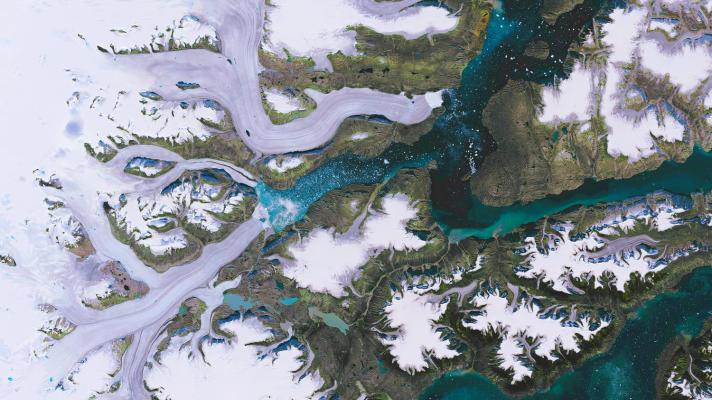
Image
The "irreversible and rapid" melting of Greenland makes critical minerals, gems, and hydrocarbons more accessible on an island that could serve as a 2.2 million square kilometer aircraft carrier for the U.S. (Photo: Sentinel Hub CC BY-NC)

US President Donald Trump's intention to annex Greenland reflects a power strategy that combines the urgent need for control of critical resources, military projection in the Arctic, and the reconfiguration of Western alliances in a world that no longer recognizes the post-Cold War order.

The island, which until recently was a peripheral territory in the geopolitical imagination, has become the epicenter of a dispute that reveals the internal contradictions of NATO, the fragility of the European Union and the new logic of power that combines technology, natural resources and military pressure.

Treasure beneath the ice… and the thaw
It is one of the most underestimated mineral reserves on the planet. According to the Geological Survey of Denmark and Greenland ( GEUS ) of the Centre for Minerals and Materials (MiMa), it contains significant deposits of rare earth elements, copper, zinc, gold, platinum, nickel, titanium, uranium, and, above all, rare earth elements (REEs), minerals critical for manufacturing high-power magnets in wind turbines, electric vehicle motors, and advanced military equipment.
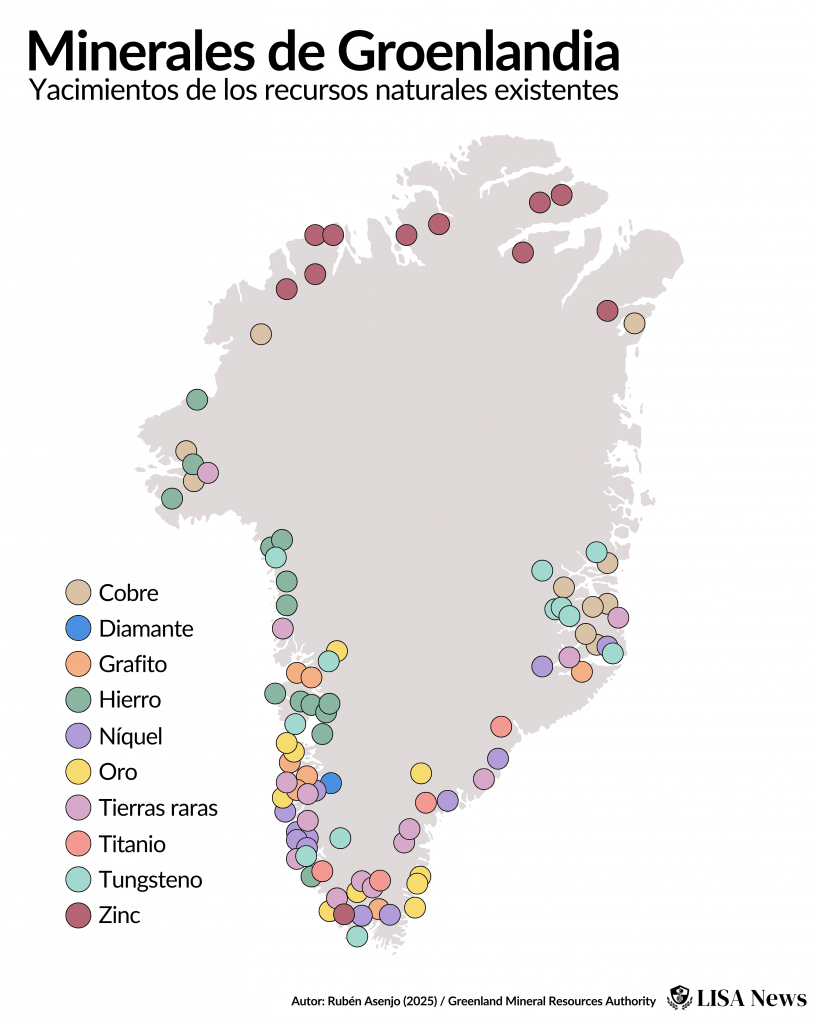
Image

What makes this region particularly strategic is that most of its mineral deposits are located in ice-free areas (Photo: LISA News)
The 2023 report identifies at least 43 active or exploration mining projects, concentrated in the south and southwest of the territory, where melting ice is opening new access routes to:

Critical minerals: Graphite for batteries, cobalt, nickel, copper and tungsten.
Precious metals and gems: Gold, rubies, platinum and diamonds (the latter discovered in kimberlites in the 1970s but never exploited).
Hydrocarbons: The northeast region holds an estimated potential of 31 billion barrels of oil equivalent, comparable to the total proven crude oil reserves.
The geological map of Greenland reveals a belt of strategic minerals stretching from Kvanefjeld—one of the world's largest rare earth deposits—to the copper- and gold-rich Disko-Nuussuaq region. The Australian company Greenland Minerals, before being suspended by local legislation, estimated that Kvanefjeld could supply up to 25% of global rare earth demand for the next few decades. The same area also contains uranium, making Greenland a key player in the West's energy and military independence. Three deposits in the south of the island, particularly in Gardar province, could be among the largest in the world by volume.

Research cited by The Conversation estimates that Greenland has enough reserves to meet more than a quarter of future global demand for dysprosium and neodymium, two of the most strategic and hard-to-obtain rare earth elements.

There is, however, a paradox that is accelerating this dispute. Greenland is losing 30 million tons of ice per hour, a rate five times faster than two decades ago. This melting, described by scientists as "irreversible and rapid," has incalculable impacts on a planetary scale. But, at the same time, it makes coastal resources more accessible and opens new shipping routes, creating a controversial incentive for exploitation. The global rise in temperatures is making the territory more accessible, and thus the climate crisis is becoming a catalyst for geopolitical conflict.

A key node for the "Donroe" doctrine
Trump's obsession with Greenland didn't begin in 2025, but in 2018, when Ronald Lauder, the Estée Lauder heir, suggested to then-National Security Advisor John Bolton the possibility of "buying" the island. Lauder, who has since invested in a local water bottling plant and a hydroelectric project on Greenland's largest lake, transformed a corporate fantasy into state policy. In August 2019, Trump described the deal as "a great real estate deal," and after being rejected by Denmark, he canceled his state visit in a tweet that marked the beginning of a subtle but persistent hostility.

The official "national security" argument, or rather, the Donroe Doctrine , has clear flaws. The Pituffik Air Base (formerly Thule) has been operated by the United States since 1951 under a defense agreement between both parties , which already provides it with missile early warning capabilities, space control, and power projection in the Arctic.

Neither the Trump administration nor the Pentagon has identified any specific security demands that Denmark has failed to meet. Nor have they deployed new military contingents to the island, unlike the European response. What they have done is use the rhetoric of "strategic competition" from the 2025 National Security Strategy, which frames China and Russia as existential adversaries, to justify expansion into the Arctic.

The letter recently sent by Trump to Norwegian Prime Minister Jonas Gahr Store reveals the eloquence of the established power struggle: "Considering that your country decided not to award me the Nobel Peace Prize for stopping eight wars, I no longer feel obligated to think only of peace... I can think of what is good and appropriate for the United States." The letter questions Danish sovereignty —"there are no written documents, only that a ship docked there"— and demands "complete and total control" of the island, while accusing Denmark of being unable to protect it "from Russia or China."

The threat is clear: if NATO does not support this annexation, Washington considers that the alliance has failed to fulfill its purpose. This rhetoric was reinforced by Deputy Chief of Staff Stephen Miller, who told CNN that the world's "iron laws" are "strength, power, and nothing else," legitimizing annexation by military means if necessary.

The White House has not only ruled out diplomacy as the only option, but has turned the crisis into a loyalty test for NATO, arguing that after years of pressuring alliances to increase military spending to 5% of GDP, "now NATO should do something for the United States."

Control of Greenland allows the permanent aggressor to project power on three simultaneous fronts:

In a war scenario with Russia, Greenland is the first link in the chain of containment.
In a scenario of competition with China, it is the key to blocking the Polar Silk Road .
And in an energy crisis scenario, it is the mineral deposit that the Pentagon has classified as "critical to national defense".
An analysis by the Belfer Center summarizes the central contradiction: "The United States does not need to own Greenland to achieve its security and economic interests." The insistence on acquisition, therefore, points to a more ambitious goal: to have absolute sovereignty for unrestricted deployment, something that current agreements with Denmark, the sovereign partner, do not allow.

The cold appetite of big tech
Beyond the rhetoric of national security, Greenland is a complex web of private interests that has transformed it into a living laboratory of technofeudalism, already at work within its borders. Various analyses point to a coalition of tech billionaires—including Peter Thiel, Elon Musk, and Ronald Lauder—who have directly pressured Trump to expedite the island's annexation by the United States.

Behind the government rhetoric operates a network of private interests that is transforming Greenland into a living laboratory of technofeudalism. The most emblematic company is KoBold Metals, backed since 2019 by Jeff Bezos, Bill Gates, and Michael Bloomberg through the Breakthrough Energy fund. In 2022, Sam Altman (OpenAI) invested through Apollo Projects, and the firm reached a valuation of $3 billion after raising $537 million in December 2024. KoBold uses artificial intelligence (AI) algorithms to analyze geological data and has identified the Disko-Nuussuaq project on the southwest coast, where it is searching for cobalt and copper for the expansion of data centers and batteries.

KoBold CEO Kurt House has been explicit : "The growth in lithium demand is staggering. We need a 30-fold increase in global production." His interest isn't climate-related, but rather supplying the "doubling of copper demand by 2050" driven by the smart revolution. Lithium, recently discovered off the west coast of Greenland, is the mineral fueling this rush.

But the ambition goes beyond mining. Peter Thiel, ideologue of the "Dark Enlightenment" and mentor to Vice President JD Vance, funded the startup Praxis in 2021, which seeks to build a "libertarian city" or "network state" in Greenland. Founder Dryden Brown posted in November 2024: "I went to Greenland to try to buy it," and the project has raised $525 million from investors like Andreessen Horowitz.

The vision is, on the one hand, to create an autonomous territory with minimal regulations, tokenized taxes, and laws written by corporations: a CEOcracy experiment that Thiel openly defends as incompatible with democracy. On the other hand, it involves advancing the exploitation of nature in areas where access is much more difficult, but whose costs will be financed by taxpayers.
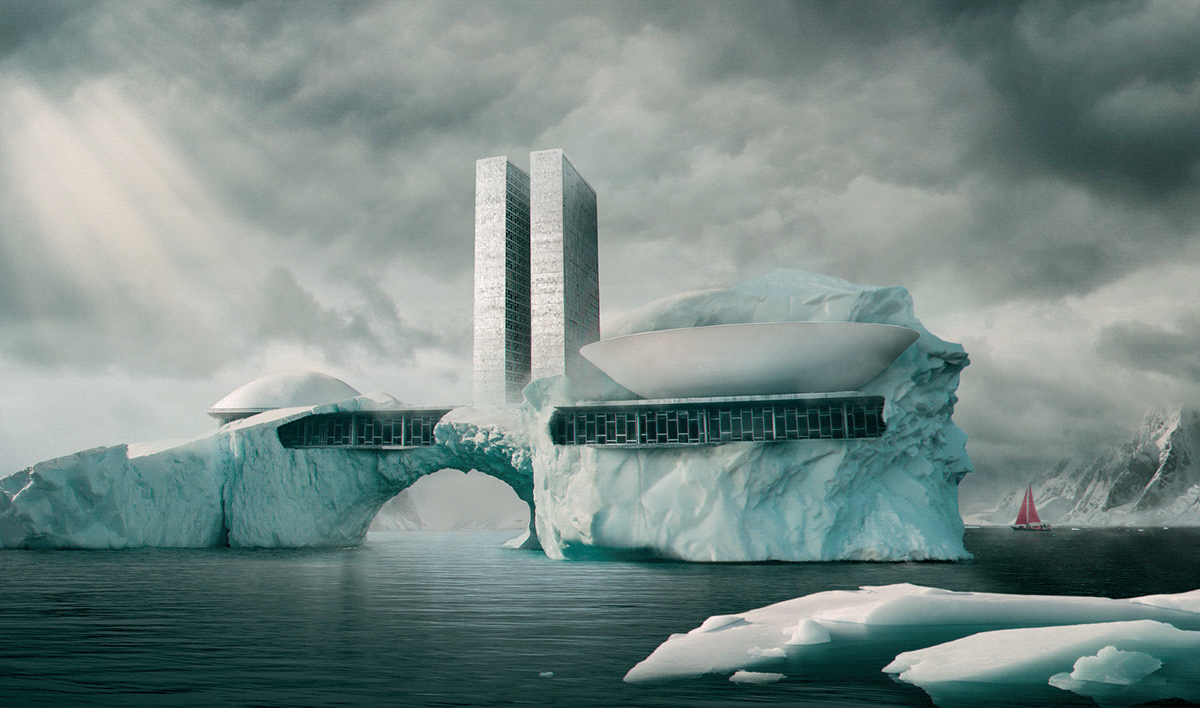
Image
The proposal to create a "Freedom City" on the island, a high-tech libertarian enclave, fits with the Trumpian vision of economic zones exempt from labor and environmental regulations (Photo: Estrategia LA)

This power network has infiltrated the government. The US ambassador to Denmark, Ken Howery, is a former PayPal executive and a close associate of Thiel and Elon Musk. Commerce Secretary Howard Lutnick, former CEO of Cantor Fitzgerald, held investments in Critical Metals Corp., which is linked to Greenlandic projects. And Trump himself has received millions from mega-donor Ronald Lauder, who, after suggesting annexation in 2018, bought shares in local companies and wrote in the New York Post about "three paths to making Greenland the next American frontier."

The pattern is evident in the fact that the same billionaires who financed Trump's campaign—and who appeared in the front row at his inauguration—now expect their investment in mineral exploration to be rewarded with a change in sovereignty that dismantles the environmental and social regulations blocking their projects. As Arctic security expert Marc Jacobsen explained to Forbes : "What's important here is the close link with Greenlandic decision-makers. It's about strategy and control."

In Greenland, this translates into an alliance between the Pentagon, the tech oligarchs, and the Trump administration, where "national security" serves as a pretext for an extractive and digital reconfiguration of the territory.

The intra-imperial dispute: Negotiation, rupture, or continuity?
The European reaction has been mild and fragmented. The European Commission called Trump's proposal "unacceptable and incompatible with international law," but the actual response has been more ambiguous. Denmark, which maintains constitutional control of Greenland, rejected the "sale" but did not rule out an "expanded strategic alliance" with the United States that would include critical infrastructure and military cooperation.

According to Politico EU, the Danish government fears that Trump will impose tariffs on European goods if access to the island is blocked. Eight countries—including Germany and France—have already been threatened with trade measures if they oppose the expanded military presence.

NATO, for its part, is in crisis. Secretary General Mark Rutte has attempted to mediate, but the alliance is divided between the Baltic states—which see the US presence as a shield against Russia—and the southern Europeans, who fear an escalation with Moscow and a loss of sovereignty. There is talk of a "NATO in a coma," where national interests take precedence over Atlantic solidarity.

On the other hand, the fear is that Trump will use Greenland as a bargaining chip: military support for Ukraine in exchange for concessions in the Arctic. According to the Kyiv Independent , the White House has conditioned further arms shipments to Kyiv on "European commitment to Greenlandic stability," an expression that in practice means not interfering with US expansion.

In Brussels, some are already talking about a "transatlantic divorce." The EU has invoked its "strategic autonomy" clause in defense matters, and France has proposed creating a joint naval force to patrol the Arctic independently of NATO. Norway—a NATO member but not an EU member—has already signed a bilateral agreement with the United States to allow reconnaissance flights over its Arctic region. Finland and Sweden, recent additions to the alliance, have done the same.

The rejection by a part of Europe gave rise to Trump's firm stance, who has described as "unacceptable" any option other than the annexation of Greenland to the United States. At the World Economic Forum meeting held on January 12 in Davos, he stated that "in World War II, when Denmark fell to Germany after only six hours of fighting and was totally unable to defend itself or Greenland."

In an open threat to Europe, he added:

"We probably won't get anything unless I decide to use excessive force where, frankly, we would be unstoppable. I don't have to use force. I don't want to use force. I won't use force. All the United States is asking for is a place called Greenland."

The result points to a fragmented Europe, where each country negotiates on its own and where Greenland has become the first disputed territory of the new cold war.
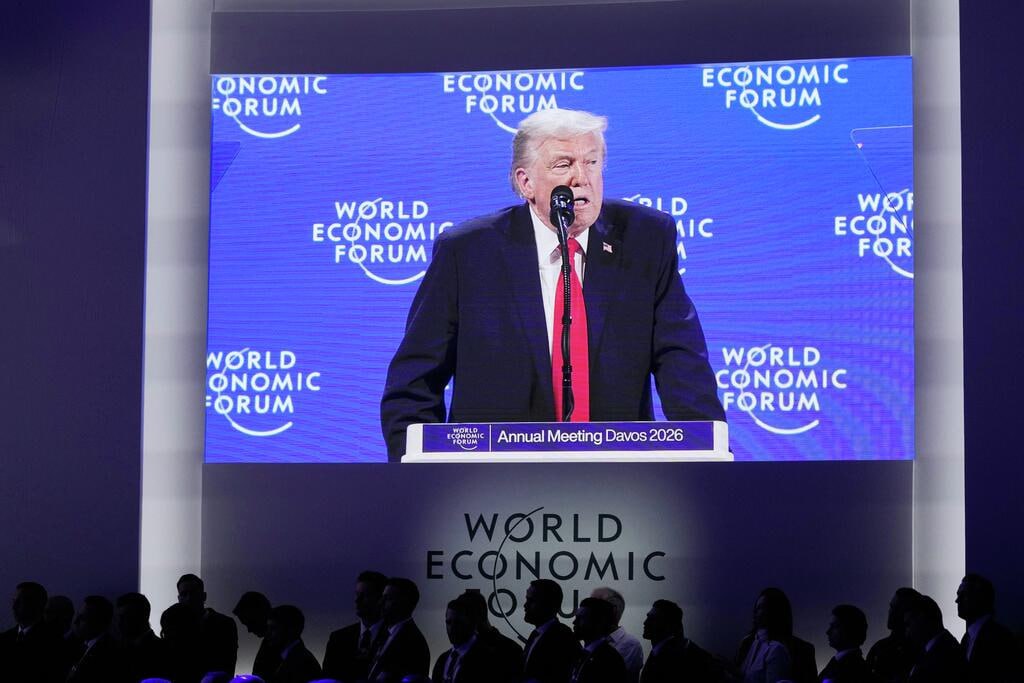
Image
Trump's strategic message in Davos was his assertion that his country owns Europe because it has done so much for it, and that European states should thank Washington for rescuing them from decades of failed decisions (Photo: X.com)

The United States emerged from European struggles over lands that were not theirs, and the fact that they briefly ceased fighting is the anomaly, not Trump. Meanwhile, Greenland mirrors a global North that has ceased to believe in the rules it invented. International law, national sovereignty, territorial integrity—everything is now negotiated in terms of “critical security” and “vital interests.”

Trump advances on the island while Europe debates —with excessive restraint— its reaction and NATO crumbles from within.

https://misionverdad.com/globalistan/un ... roenlandia

Google Translator

The bourgoise bastards proly really want Greenland as their refuge against the climate change they claim they don't think is real.
"There is great chaos under heaven; the situation is excellent."

User avatar
blindpig
Posts: 15306
Joined: Fri Jul 14, 2017 5:44 pm
Location: Turtle Island
Contact:

Re: Donald Trump, Avatar of his Class, Capitalism & the Decline and Fall of Bourgeois Democracy

Post by blindpig » Sat Jan 24, 2026 4:03 pm

The real “rupture” in Davos

Pepe Escobar

January 23, 2026

Whatever the barbarians may be potting, the fact that matters is that China is already deep into the next phase, where it is expected to replace the United States as the world’s primary consumer market.

The old world is dying, and the new world struggles to be born: now is the time of monsters.

Antonio Gramsci


Davos 2026 was a demented kaleidoscope. The only possible way to wallow through the mire was to put on the headphones and resort to the Band of Gypsys smashing sonic barriers, and drowning a frankly terryfying series of events, including a Palantir-BlackRock connection, Big Tech meets Big Finance; the “Master Plan” for Gaza; and the acute discombobulation in neo-Caligula’s rant, here in the 3-minute version.

Then there was what the fragmented West’s mainstream media erected as a visionary speech: Canadian Prime Minister Mark Carney’s mini-opus magnum, complete with a – what else – Thucydides quote (“The strong do what they can, and the weak suffer what they must”) to illustrate the “rupture” of the “rules-based international order”, which was already a Dead Man Not Walking at least for a year now.

And how not to laugh at the extremely rich notion of a letter by 400 “patriotic” millionaires and billionaires directed to heads of state in Davos claiming for more “social justice”. Translation: they are terrified – in Paranoia Paradise mode – by the “rupture”, actually the advanced collapse of the neoliberalism ethos that enriched them in the first place.

Carney’s speech was a wily, headline-grabbing device to – in thesis – bury the “rules-based international order”, actually the euphemism du jour, since the end of WWII, for total domination by the Anglo-American financial oligarchy. Carney now only recognizes a mere “rupture” – supposed to be sewn up by “middle powers”, mostly Canada and a few Europeans (no Global South).

And there’s the dead give away: the presumed antidote to “rupture” has abolutely nothing to do with sovereignty. It’s actually a controlled hedging, a sort of managed ersatz multipolarity – nothing to do with the BRICS drive – based on a fuzzy “values-based realism”, “coalition building” and “variable geometry” mish mash, destined to keep in place the same old monetarist scam.

Welcome to Lampedusa’s The Leopard, remixed: “Everything must change for everything to remain the same.”

And all that coming from a playbook liberal, a former Governor of the Bank of England. Such tigers never change their spots. The true levers of power – exercized by the City of London and Wall Street – are totally imune to the “rupture” antidote.

The evolving, multi-layered Russia-China strategic partnership already invalidates Carney’s very sophisticated fraud, which fooled a lot of informed people. Same as BRICS – as it advances in the long and winding road of real multi-nodality.

Which brings us to the real message generated by Carney’s trademark limited hangout:

Canada and the European “middle powers” now find themselves not on the table , but on the menu, as neo-Caligula, the ruler of the world, can do to them what NATO has de facto been doing to the Global South over the past 30 years.

“Everything must change for everything to remain the same”

Many of those who now enshrine Carney as The New Messiah – and such a defender of internation law – totally ignored or covered for the Zionist genocide of Gaza; demonized Russia to Kingdom Come and keep instigating a Forever War; and now beg on their knees for neo-Caligula to engage in a “dialogue” to solve his self-proclaimed Greenland land grab.

Elon Musk, incidentally, also showed up at Davos on short notice. He is a huge supporter of the Greenland land grab. Musk and other techno-feudalist stars cannot but be seduced by the project of turning that “piece of ice” (neo-Caligula terminology) into the prime hub for digital states, the sucessors of nation-states, supposed to be ruled by Techno-CEOs posing as Philosopher Kings.

Combine it with the Big Tech-Big Finance connection – at the Palantir-BlackRock table – and we have the Kings of AI leading the way, with financiers following.

The “piece of ice” of course was melting non-stop all across the Davos spectrum. When neo-Caligula announced that he would not do to Greenland what he did to Venezuela, the collective European relief really exploded the Champagne-O-Meter.

It was up to certified NATO poodle Tutti Frutti al Rutti, with that perpetual smile of a withered Dutch tulip, to convince “Daddy” to be lenient, proving once again that the EU is a Banana Republic, actually Union, without the bananas.

Neo-Caligula and withered tulip cobbled together a “framework” for the US to get some Greenland real estate for military base purposes and limited development of rare earth mining, plus the requisite ban on Russian and Chinese projects. Denmark and Greenland were not even in the room when this “deal” was reached.

Still, that may all change in a flash, or in a social media post. Because that’s not what neo-Caligula wants. He wants Greenland splashed in red-white-and blue on a US map.

Still, the most terrifying land grab plot highlighted in Davos had to be Gaza. Cue to that insufferable Zionist dimwit – the brains in the family actually belong to wife Ivanka – presenting the master plan for “the new Gaza”.

Or How to Market The Horror…The Horror (my excuses to Joseph Conrad).

Here we have a mass slaughtering/extermination campaign coupled with grabbing of what’s been reduced to rubble, leading to a high-security containment zone for token, “approved” Palestinians and prime beachfront real estate for real estate scammers and Israeli settlers.

All that managed by a private company, chaired by neo-Caligula for life, now in charge of the annexation, occupation and exploitation of Gaza: a monstruous land grab burying in one go a genocide and what remains of international law – everything fully approved by the EU and a bunch of political “leaders”, some too terrified, others basically hedging to bypass neo-Caligula’s wrath.

The Chinese “rupture”

Some clown by the name of Nadio Calvino, president of the European Investment Bank, actually argued at Davos that the EU “is a superpower”.

Well, History is loath to register as a superpower a set up that is totally dependent on the US and NATO for defense; exhibits zero power projection; harbors no major tech companies (those that still exist are collapsing); is 90% dependent on foreign supplies of energy; and is drowning in debt ($17 trillion in total, equivalent to over 80% of the EU’s GDP).

So in the end, amidst so much – silly – sound and fury, what was the real game-changer at Davos? It was not the “rupture” or even the land grab plots. It was the speech by China’s Vice Premier He Lifeng.

Incidentally, Carney’s “rupture” speech was heavily influenced by his recent trip to China – where he met with He Lifeng, a serious candidate to succeed Xi Jinping in the future.

At Davos, He Lifeng made it very clear that China is determined to become “the world’s market”; and that boosting domestic demand was now “on top of [China’s] economic agenda,” as reflected in the 15th Five-Year plan which will be approved this coming March in Beijing.

So whatever the barbarians may be potting, the fact that matters is that China is already deep into the next phase, where it is expected to replace the United States as the world’s primary consumer market.

Now that’s what’s called a rupture.

https://strategic-culture.su/news/2026/ ... -in-davos/

Trump shamelessly plays the Russia/China bogeyman card for Greenland grab

January 23, 2026

Under Trump, the European appeasers are inviting disaster as they indulge his bogeyman games over Greenland.

The old saying that a week is a long time in politics is especially true under the U.S. Presidency of Donald Trump, given his propensity for unhinged bombast, zig-zags, U-turns, vendettas, and theatrics.

So, last week, he was threatening to take over the Danish Arctic territory of Greenland by military force, if needed. Trump was also gearing up to launch an unprecedented trade war against European states that, with pipsqueak temerity, dared to support Denmark, a move that would have cratered the eight-decade-old transatlantic Western alliance.

This week, in a 70-minute rant at the World Economic Forum in Davos, Switzerland, Trump, seemingly magnanimously, announced that he was not going to deploy military power to subordinate European NATO “allies”. But he insisted that Greenland must be annexed under U.S. control.

In a telling quip, he said: “I don’t have to use force.” Trump is right on that score. There is no need for military coercion because the European “allies” have been exposed as a bunch of dithering vassals who were pathetically clutching their pearls for the past week out of fear and angst that Uncle Sam was slapping them.

However, when vassals appease, they only end up being abused. The American Don may have softened his contemptuous rhetoric at Davos, but there is little doubt that the expansionist ambitions to grab Greenland will be pursued, and the Europeans will be, in time, further degraded in their submission to the American overlord.

Oddly enough, for a president who boasts about flexing military muscle for imperialist aims, Trump couched his takeover of Greenland as a matter of “national security.” He is claiming that the United States needs to take control of the “big, beautiful piece of ice” to defend it from Russia and China.

He lied that it wasn’t because of Greenland’s vast mineral resources, including oil and rare-earth metals. Trump was claiming that the U.S. is the only NATO member strong enough to keep Russia and China from gaining a foothold. Beijing slammed Trump’s claims as baseless.

In an insulting and absurd remark, he likened Russia and China to how Nazi Germany tried to take Greenland from Denmark during the Second World War, and it was the U.S. that prevented that.

Only a few days before, Trump contradicted himself (not hard for him) by posting a comment deriding how Russia and China are used as “bogeymen”, that is, as false enemies.

Another anomaly was seen with Trump inviting Russia and China to join his dubious Global Board of Peace initiative, which he unveiled with much corny fanfare in Davos. Enemies for peace?

In other words, on Greenland, Trump is cynically playing the Russia and China threat as a pretext for blatantly violating the sovereignty of an ally.

Not that Denmark deserves sympathy. It is questionable how it retains any territorial right to a distant Arctic island whose people have consistently demanded independence from Copenhagen’s colonialist control.

NATO’s civilian head, Mark Rutte, the former Dutch prime minister and abject flunky, appeased Trump at Davos by offering more NATO defenses deployed to Greenland. Rutte, who previously referred to Trump as “daddy”, made the “deal” in private with Trump. No details have been made public nor even shared among other NATO members. How’s that for contempt of underlings?

Trump hailed the so-called framework agreement as a “great deal” for the United States and Europe without sharing the details. It’s believed to permit the installation of Trump’s futuristic Golden Dome missile defense system. If that goes ahead, it will heighten strategic tensions with Russia by militarizing the Arctic, not bring peace or stability. Denmark is reportedly wary that its sovereignty is being sold out in a grubby behind-closed-doors private takeover.

Hence, the transatlantic storm may have subsided somewhat for now, but the damage and mistrust that have shattered the alliance are not going to be repaired. It will only get worse because of the thug-vassal relationship unravelling.

The Canadian Prime Minister, Mark Carney, in his speech at Davos, made a shocking admission when he said that the “fiction of rules-based order” between the U.S. and its Western allies is dead.

Trump may have been appeased and placated for a while. But it’s like keeping a predator at bay by throwing pieces of meat at it. Sooner or later, the minions will be on the menu.

Only last week, Denmark and the other European states were dismissing Trump’s outlandish claims about defending the free world from Russia and China by taking control of Greenland. They knew it was a brazen land grab. Now, however, Rutte, the European NATO chief, is saying that NATO must accede to Trump’s demands to protect Greenland from the alleged threat from Russia and China.

After saying there is no such threat, now the Europeans will indulge Trump’s fantasy about Greenland, just to restrain him from overtly abusing them.

The trouble for the European and other Western allies of the United States is that they have consorted with decades of American violations of international law. They have played along with the charade of using Russia and China as enemies of convenience. This has hollowed out any claim of upholding international order and norms.

The U.S. and Europe have played the bogeyman card with regard to Ukraine. The Europeans supported Trump’s aggression against Venezuela and Iran, and they have been complicit in the U.S.-backed genocide in Gaza.

This week, while French President Emmanuel Macron was admonishing Trump to respect international order concerning Greenland, he ordered French troops to seize a Russian-linked oil tanker in neutral maritime waters. The latter act of piracy on the high seas was probably an effort by France to demonstrate its loyalty to Washington’s policy of hijacking Russian cargo ships.

Since the end of World War Two, the United States paid lip service to global law and order along with its European allies. Under Trump, there is no longer any pretense of lip service. It’s outright imperialist power for naked domination. At one point in his rambling Davos speech, Trump declared such might-is-right land grabbing as normal.

During the past eight decades of charade and lip service, the U.S. needed the Europeans as a facade of multilateralism for its stealth imperialism. Washington indulged the Europeans, Canadians, and others as “allies”. In reality, they were always vassals.

Now, in the latest historical phase of returning to flagrant imperialism and brazen power, the United States has no use for the pretense of allies. They can be slapped around for the lackeys they are. And we are seeing that with brutality.

Ironically, the European powers have a historic tendency for appeasement. The British and French appeased Nazi Germany in the 1930s with disastrous results. Today, the Europeans are appeasing the United States in its every criminal demand. That is only emboldening the U.S. to expand its outright abuse of international law, or, in other words, its descent into barbarism.

This is not merely about Trump as a maverick megalomaniac. He is but a symptom of the U.S. global empire in desperation mode to maintain its waning power as a new multipolar world potentially emerges. U.S. hegemonic ambitions are untenable, but in a desperate bid to assert itself, the world is being turned upside down and intimidated into submission.

Russia and China, among others, have repeatedly declared the paramount need to abide by international law and the principles of the UN Charter. U.S. imperialist power has no such respect. Trump has openly said so.

Total domination is the only acceptable end for U.S. imperialism. Russia and China should not have any illusion about it, even if, in the short term, Trump wants to make an expedient withdrawal deal in Ukraine, or if he invites them to join his “Bored of Peace” boondoggle.

History shows us that rampant imperialist violence ends in disaster. Under Trump, the European appeasers are inviting disaster as they indulge his bogeyman games over Greenland.

https://strategic-culture.su/news/2026/ ... land-grab/

******

3 Trump Administration Health Policy Changes That Will Worsen Care for the Elderly
Posted on January 23, 2026 by Yves Smith

Yves here. The Trump Administration is again implementing Lambert’s second rule of neoliberalism, “Go die!” here with health policy revisions which will worse already too-often poor care levels for the elderly. Readers likely know through family and friends the disgraceful level of service in most American nursing homes, due in large measure to understaffing. That in turn due to lousy pay for these jobs.

Requiring higher minimum levels of various types of employees to residents would pressure nursing homes to provide sufficiently high wages to attract more workers. Instead, the Trump Administration is rolling back already shabby staffing minimums based on the bogus industry claim that the jobs cannot be filled, as opposed to not at the lousy compensation levels they have gotten away with providing.

A similar disgrace is home health care workers, who are to become exempt from fair labor standards. From my brief time hiring home health aides through agencies, their pay and training were poor. So Trump by making these generally unappealing roles even worse will again worsen care for meaningful numbers of the aged.

We’ve mentioned the last indignity, that of Medicare requiring prior authorization for more treatments, refereed by AI.

By Paula Span. Originally published at KFF Health News

Month after month, Patricia Hunter and other members of the Nursing Home Reform Coalition logged onto video calls with congressional representatives, seeking support for a proposed federal rule setting minimum staff levels for nursing homes.

Finally, after decades of advocacy, the Biden administration in 2023 tackled the problem of perennial understaffing of long-term care facilities. Officials backed a Medicare regulation that would mandate at least 3.48 hours of care from nurses and aides per resident, per day, and would require a registered nurse on-site 24 hours a day, seven days a week.

The mandated hours were lower than supporters hoped for, said Hunter, who directs Washington state’s long-term care ombudsman program. But “I’m a pragmatic person, so I thought, this is a good start,” she said. “It would be helpful, for enforcement, to have a federal law.”

In 2024, when the Centers for Medicare & Medicaid Services adopted the standards, advocates celebrated. But industry lawsuits soon blocked most of the rule, with two federal district courts finding that Medicare had exceeded its regulatory authority.

And after the 2024 elections, Hunter said, “I was concerned about the changing of the guard.” Her concerns proved well founded.

In July, as part of Republicans’ One Big Beautiful Bill Act, Congress prohibited Medicare from implementing the staffing standards before 2034. Last month, CMS repealed the standards altogether. They never took effect.

“It was devastating,” Hunter said.

As with environmental law and consumer protections, the Trump administration’s enthusiasm for deregulation has undone long-sought rules to improve care for the aged. And it has introduced a Medicare experiment for prior authorizations, now getting underway in six states, that has alarmed advocates, congressional Democrats, and a good number of older Americans.

Taken together, the moves will affect many of the facilities and workers providing care and introduce complications in health coverage in several states.

On the nursing home front, “it’s clear CMS has no interest in ensuring adequate staffing,” said Sam Brooks, the director of public policy for the National Consumer Voice for Quality Long-Term Care.

“They’re repealing a regulation that could have saved 13,000 lives a year,” he added, citing an analysis by University of Pennsylvania researchers.

Industry groups argued that nursing homes, with high rates of staff turnover, were already struggling to fill vacancies.

The staffing mandate “was requiring nursing homes to hire an additional 100,000 caregivers that simply don’t exist,” said Holly Harmon, a senior vice president at the American Health Care Association.

The organization had brought one of the suits that largely vacated the rule. “Facilities would have been forced to limit admissions or downsize to comply with the requirements, or close altogether,” Harmon said.

For supporters, the action is now likely to shift to updating requirements in 35 states, along with the District of Columbia, that have already established some nursing home staff standards, and to developing them in those that haven’t.

Rules for Home Help

A second rescinded regulation, this one more unexpected, brought about upheaval in July, when the Labor Department announced a return to a policy excluding home care workers from the federal Fair Labor Standards Act.

Some history: Dating back to the New Deal, the FLSA mandated that workers receive the federal minimum wage (currently $7.25 an hour) and overtime pay. It exempted most “domestic service workers” until 1975, when a new Labor Department regulation included them — with the exception of home care workers.

“There was a misinterpretation of home care work as being casual, nonprofessional, non-skilled,” the equivalent of teenage babysitting, said Kezia Scales, a vice president at PHI, a national research and advocacy organization. “Just someone popping into your mother’s house now and then and keeping her company.”

For almost 40 years, workers and their supporters lobbied to change the rule, seeing it as a contributor to the low wages and meager benefits of a swiftly growing workforce, one made up primarily of women and minority groups, with many immigrants.

In 2013, the Labor Department responded with a rule that brought home care workers under the labor act, entitled to minimum wage, time and a half for overtime work, and payment for travel time between clients.

After industry lawsuits failed to overturn it, “everything settled down,” Scales said. “It was in place successfully for a decade.”

Home care workers brought hundreds of compliance complaints annually. In 87% of them, the Labor Department found violations of the labor act, according to a 2020 Government Accountability Office report.

Since 2013, home care agencies have paid about $158 million in back wages, PHI has calculated.

Then in July, the Labor Department abruptly announced that it would return to the 1975 regulations and stop enforcing the 2013 rule, which it said “had negative effects on the ground” and hindered consumer access to care.

The agencies employing most home care workers, primarily funded through Medicaid, would agree. “Many workers never got any benefit from this,” said Damon Terzaghi, a vice president at the National Alliance for Care at Home.

“States made a lot of moves to essentially absolve themselves of any responsibility,” he said. A 2020 federal report, for example, found that 16 states had capped Medicaid-covered home care hours at 40, thus averting overtime payment.

The alliance, which estimates that the number of impacted agencies and businesses has declined by 30% since 2013, supported the rescission. Scales, who hopes for congressional action, called it “a shocking step backward.”

Where they concur is that the United States has never really committed to sufficiently funding long-term care at home. With the July legislation setting the stage for a $914 billion cut to Medicaid over the coming decade, that seems unlikely to change anytime soon.

Medicare’s AI Referee

Beyond rolling back policies for care of the aged, the Trump administration has established a pilot program to introduce one to traditional Medicare: prior authorization, using artificial intelligence and machine learning technologies.

Touting it as a boon to taxpayers, Medicare calls it WISeR — Wasteful and Inappropriate Service Reduction.

Prior authorization, in which private insurers review proposed treatments before agreeing to pay for them, is widely used in Medicare Advantage plans despite its unpopularity with patients, doctors, and health care organizations. It has rarely been used in traditional Medicare.

This month, however, WISeR debuts in six states (Arizona, New Jersey, Ohio, Oklahoma, Texas, Washington) in a six-year trial to determine whether review by tech companies can reduce costs and improve efficiency, while maintaining or improving quality of care.

Initially, WISeR targets 17 items and services that CMS said “historically have had a higher risk of waste, fraud and abuse.” The list includes knee arthroscopy for arthritis, electrical nerve stimulation devices for several conditions, and treatment for impotence.

The pilot program excludes emergency services and inpatient hospital care, or care where delay poses “a substantial risk.” Algorithmic denials will trigger review by “an appropriately licensed human clinician.” The tech companies get “a share of averted expenditures.”

“It injects some of the worst of Medicare Advantage into traditional Medicare,” said David Lipschutz, co-director of the Center for Medicare Advocacy. The six vendors that approve or reject treatments “have a financial stake in the outcomes,” he said, and therefore “an incentive to deny care.”

Moreover, the CMS Innovation Center overseeing the pilot could theoretically bypass Congress and expand prior authorization to include more medical services in more states.

The agency did not respond to questions about what kind of human clinicians would review denials, except to say that they would have “relevant experience” and that tech companies would be “financially penalized for inappropriate denials, high appeal rates or poor performance.”

It plans an “independent, federally funded evaluation” and will release public reports annually.

Democrats in Congress have introduced bills in both houses to repeal WISeR. “We should be reducing red tape in Medicare, not creating new hurdles that second-guess health care providers,” said Rep. Suzan DelBene of Washington, one of the bill’s sponsors.

For now, though, WISeR has opened for business, receiving prior authorization requests through its electronic portals.

https://www.nakedcapitalism.com/2026/01 ... derly.html

*****

In Related News ...

There are NO penguins in Arctic)) Greenland is in ARCTIC.

Image

Penguins live in ANtarctica and adjacent lands, that is Southern Hemisphere. I sense Ivy League edikeishn.

http://smoothiex12.blogspot.com/2026/01 ... -news.html

Andrei loves to crack on US education and there a lot to be said there, but he's wrong here. Trump may have attended an Ivy League school but that's not where he got his 'education'. Nope, that was gotten watching TV. And I suspect that that commonality with all too many of my fellow citizens is a big reason why he is popular with some people.
"There is great chaos under heaven; the situation is excellent."

User avatar
blindpig
Posts: 15306
Joined: Fri Jul 14, 2017 5:44 pm
Location: Turtle Island
Contact:

Re: Donald Trump, Avatar of his Class, Capitalism & the Decline and Fall of Bourgeois Democracy

Post by blindpig » Mon Jan 26, 2026 5:23 pm

Why Is Trump Causing His Own Downfall?

The White House seems to do everything possible to help the Republicans to lose their majorities in the midterm elections.

Trump’s tariff policies have guaranteed that prices for $3 Trillion in U.S. imports will rise by at least 10%. His energy policies have caused 6% price rises for electricity and gas.

His move against allies to grab Greenland is unpopular. Bombing Iran and abducting the President of Venezuela was not welcome.

Sending heavily armed Brownshirts into U.S. neighborhoods to apprehend or assassinate random people is likewise disliked.

Trump’s approval rating is sinking.

Image

One would assume that Trump would notice the upcoming ballot disaster and change course. But instead of calming the waves he is pouring oil onto fire:

President Donald Trump and his top lieutenants are doubling down on their hardline immigration policies and rhetoric following the shooting of a US citizen by a federal officer in Minneapolis — even as the incident has revealed cracks in the president’s coalition.

A phalanx of top Trump administration officials fanned out across Sunday morning news shows and social media to publicly defend the officer’s actions and the administration’s heavy-handed immigration enforcement tactics, all shifting blame to Democratic state and local officials.


Why is he insisting that his immigration police Brownshirts are in the right when everyone who sees the videos of their actions recognizes that their behavior is simply abhorrent?

His party is worried:

As midterms approach, GOP lawmakers, candidates, strategists and people close to the White House are warning that the administration’s mass deportations policy — and the wall-to-wall coverage of enforcement operations, arrests of U.S. citizens and clashes between protesters and federal officials — could cost them their razor-thin House majority.

A new POLITICO poll underscores those worries: Nearly half of all Americans — 49 percent — say Trump’s mass deportation campaign is too aggressive, including 1 in 5 voters who backed the president in 2024. In a sign of growing discomfort among the president’s base, more than 1 in 3 Trump voters say that while they support the goals of his mass deportation campaign, they disapprove of the way he is implementing it.

“ICE should focus on the bad hombres. The bad hombres, that’s it, not the cleaning ladies,” said Rep. Maria Salazar (R-Fla.). “One thing is the gardeners, another thing is the gangsters. One thing is the cooks, the other thing is the coyotes.”


During his first administration President Obama deported more people per day than Trump. But he did so without generating a huge public backlash.

Are Trump’s policies really more controversial than those of other presidents or is the amateurish implementation of policies by his administration the real problem?

Whatever it is – he will need to change it. Otherwise he will lose much of his power at the end of this year.

Posted by b on January 26, 2026 at 15:45 UTC | Permalink

https://www.moonofalabama.org/2026/01/w ... nfall.html

******

Court docs show Trump sought to deport student over pro-Palestine op-ed

US immigration authorities claimed a Turkish PhD student in Massachusetts was 'supporting terrorism' for speaking out against Israel's genocide in Gaza

News Desk

JAN 26, 2026

Image
(Photo credit: ACLU)

Newly released court documents confirm that US immigration authorities arrested a Turkish university student in the state of Massachusetts last year over an opinion article she wrote criticizing Israel's genocide of Palestinians in Gaza, rather than for “terrorist activity,” CNN reported on 26 January.

In March last year, Rumeysa Ozturk, a PhD student at Tufts University, was walking on the street when plainclothes immigration officers suddenly detained her. She was transported to a detention center on the other side of the country, in Louisiana, and held there for six weeks.

US Secretary of State Marco Rubio approved Ozturk's deportation. However, a federal judge blocked the move and ordered her release from federal custody in May.

Immigration and Customs Enforcement (ICE) authorities moved to detain Ozturk after she authored an article in the student newspaper calling on Tufts to “acknowledge the Palestinian genocide.”

At the time, US President Donald Trump and the Israel lobby in the US were seeking to clamp down on a wave of student protests at universities across the country demanding an end to Israel's bombing campaign and destruction of Gaza.

The Department of Homeland Security (DHS) claimed that Ozturk had “engaged in activities in support of Hamas, a foreign terrorist organization that relishes the killing of Americans.”

A State Department memo said her student visa was revoked based on the claim that her actions “may undermine US foreign policy by creating a hostile environment for Jewish students and indicating support for a designated terrorist organization.”

However, a separate State Department memo released as part of the newly disclosed court documents states that DHS, ICE, and Homeland Security Investigations (HSI) had not found that Ozturk had “engaged in any antisemitic activity or made any public statements indicating support for a terrorist organization or antisemitism generally.”

Image

The State Department memos further reveal that the White House struggled to find any evidence to justify revoking Ozturk's visa.

Another finding in the newly released documents reveals that, in some cases, White House officials doubted whether the deportation of Ozturk and other pro-Palestine student protesters was justifiable and could hold up in court due to laws protecting free speech.


Upon ordering Ozturk's release, William K. Sessions, a US district court judge for Vermont, stated that her “continued detention potentially chills the speech of the millions and millions of individuals in this country who are not citizens.”

https://thecradle.co/articles/court-doc ... tine-op-ed

*****

What may be the Greenland endgame?

Alastair Crooke

January 26, 2026

What will be the initial ‘Greenland’ endgame? Trump will ‘take’ Greenland.

Monday, when asked whether the U.S. would use force to seize Greenland, President Trump replied, “No comment”. He has previously promised to take the world’s largest island “the nice way [through purchase] or the more difficult way [by force]”.

Though the notion seems to have sprung on the world ‘out of the blue’, John Bolton, Trump’s former National Security Adviser, tells that it was Ron Lauder, an 81-year-old New York Jewish billionaire and heir to the Estée Lauder fortune, who first sowed the seed of U.S. ownership of Greenland in the President’s mind in 2018, during his first term in office. Trump unsuccessfully tried to buy Greenland in 2019, during his first term. President Harry Truman also offered to buy it for $100m in gold in 1946 – but was turned down.

Historically, notes the Telegraph, “the U.S. has been averse to conquering land, but not to acquiring territory with cash. In the 1803 Louisiana purchase, it bought huge amounts of land from France for the equivalent of an estimated $430m today. The Alaska purchase in 1867 saw the U.S. pay Russia the modern equivalent of $160m for what became the 49th state. It purchased the U.S. Virgin Islands from Denmark in 1917 for gold coins worth the equivalent of more than $600m today”.

Wolfgang Munchau, a veteran European commentator, says, “dismayed European officials describe Trump’s rush to annex the sovereign Danish territory as “crazy” and “mad,” asking if he is caught up in his “warrior mode” after his Venezuela adventure — and saying he deserves Europe’s toughest retaliation for what many see as a clear and unprovoked attack against allies on the other side of the Atlantic”.

One Brussels official has suggested that America can no longer be viewed as a reliable trade partner — and that the U.S. has shifted to such a degree under Trump that this metamorphosis should be taken as permanent.

European support for America, polls indicate, has evaporated: A new poll published in Germany shows less than 17% of Europeans now trust America.

Michael McNair argues however, that it was not Lauder that prompted a Greenland grab, but rather Under Secretary of Defence for Policy, Elbridge Colby, who in fact outlined his vision for this manoeuvre in his 2021 book, The Strategy of Denial: American Defence in an Age of Great Power Conflict.

Colby’s core claim is that U.S. strategy in the 21st century should aim to deny China from achieving area hegemony over Asia. The rest of Colby’s framework follows from that simple proposition. Securing the Western Hemisphere focus, McNair argues, fits this framework: Securing the home base is not a retreat from Asia; It is a prerequisite for sustaining power projection into the Indo-Pacific. “You cannot fight a war in the Western Pacific if hostile actors control your southern approaches”.

“The Western Hemisphere focus is not America retreating to its corner either. It is securing the base of operations. You cannot project power into the Indo-Pacific if hostile actors control the Gulf shipping lanes, your canal access, or critical supply chains in your own hemisphere. The Monroe Doctrine reassertion enables the Asia strategy. It does not replace it”.

This clearly does not make much sense. China (or Russia) do not threaten Greenland – and the U.S. already hosts a major anti-ballistic missile early warning radar base at Pituffik Space Base in Greenland, which hosts the 12th Space Warning Squadron of the U.S. Space Force. What further advantage would the U.S. gain by outright ‘owning’ Greenland when it’s already allowed to host its massive early warning missile radars there?

It is clear that there is really no immediate and pressing defence exigency that requires the U.S. to annex Greenland. That said, with the Midterms approaching and Trump concerned that should he lose the House, he could be “finished, finished, finished” (his own words), there may be an alternative political expediency.

Trump believes that his stunt of seizing President Maduro played well at home. Reportedly, he has told his base that he wants ‘standout’ political wins ahead of the midterms.

“Were Trump to consummate a purchase of Greenland, he would almost certainly secure a place in both American and global history … Greenland spans roughly 2.17 million square kilometres – making it comparable in size to the entire Louisiana Purchase of 1803 and larger than the 1867 Alaska Purchase. Fold that landmass into today’s United States and America’s total area would jump past Canada, placing the U.S. second only to Russia in territorial size. In a system where size, resources, and strategic depth still matter, such a shift would be read around the world as an assertion of enduring American reach”, notes one commentator.

It would likely play well.

Munchau notes however:

“[That] the Europeans have just woken up, and this time they are really cross, clamouring to issue press statements to condemn Trump. I am hearing commentators urging the EU to deploy the Anti- Coercion Instrument, a legal device that came into force two years ago, to counter economic pressure from adversaries. They insist that the EU is stronger than it thinks. It is the world’s largest single market and customs union, is it not? And it deems itself a regulatory super-power”.

Over the weekend, Trump announced additional tariffs of 10% from 1 February, rising to 25% from 1 June, for eight European countries resisting U.S. efforts to acquire Greenland. The EU is preparing €93bn in retaliatory tariffs to give Europe its retaliatory fire-power. President Macron is forcefully urging the EU to activate the EU’s Anti-Coercion Instrument.

European officials also are ‘quietly’ discussing ‘sensitive possibilities’ which include taking away the U.S.’s European bases, which allow the U.S. to project its force into key theatres – most notably the Middle East.

“You can draw a neat line around the eight countries Donald Trump has targeted for his 10% punitive tariff: Denmark, Norway, Sweden, Finland, the UK, Germany, France, and the Netherlands. Europe’s liberal north-west is trying to frustrate Trump’s grab of Greenland. But there are 21 other member states who have not been sanctioned“, Munchau observes.

“Is Meloni going to break with the President over a patch of land that is far away and irrelevant to Italy’s security and economy? Will Spain? Or Greece? Or Malta and Cyprus? What about eastern Europe? Will Viktor Orbán, Andrej Babiš, and Robert Fico … run to the rescue of their liberal friends in Denmark?”

The projected confrontation will come to a head at the Davos WEF, which is being held this week, with Trump and a large entourage scheduled to arrive today (Wednesday).

At least one meeting between EU officials and NATO officials with Trump in Davos is expected to take place. It may prove stormy.

‘Stormy’, since a source close to White House deliberations reports that Trump is not heading to Davos in any conciliatory mode. Rather, Trump intends to deliver a cold shower on the heads of people of self-appointed importance, who are assembled there. Many in the audience will be aghast as the globalists, who comprise the majority at the WEF assembly, begin to realise what it is Trump is putting together.

In essence, Trump is assembling an entirely new structure for global partnerships that will likely end up with the functional obsolescence of the United Nations. He is selecting world leaders through the invite to a ‘Global Board of Peace’ – Gaza merely representing the initial venue.

One of the key aspects, notes a White House close observer, is that in this new Global Assembly, each will pay their own way. ‘No free riders this time. You want to sit at the big table; join the big club of sovereignty; assemble with a mutually respectful team of action – then pay the entrance fee to attend’.

Some, but not all, in Europe parade their anger and talk of ‘resistance’, but “the truth is that the Europeans never really cared about Greenland. It was the first country to leave the EU – in 1985 – long before Brexit. It’s a fishing nation; fish is over 90% of its exports. And it left because EU fisheries policies would have deprived it of the right to manage its own stocks. Greenland could have been the EU’s, had it really wanted to keep it”, writes Munchau.

Does Europe have the will or the means to resist Trump? No, it does not. It is the U.S., not Europe, that has the ‘trade bazooka’: Europe consciously decided (as part of the Ukraine project) to become 60% dependent on American liquified natural gas for its energy. The EU under NATO remains a U.S. garrison state with major U.S. bases in the Netherlands, Germany, Spain, Italy, Poland, Belgium, Portugal, Greece and Norway. Without the U.S. security umbrella, the EU nuclear deterrent collapses. Without the U.S., the Five Eyes is finished. (Canada’s shift eastwards may have already begun the fracturing of NATO. The demise of Five Eyes could prove to be far more consequential than the end of NATO).

European capitals reportedly are hatching a plan to force Trump to back down over his demands to take control of Greenland from Denmark. Or rather, they’re hatching several different plans and throwing everything they have at anyone they think might listen – fuelling strong suspicions that they are not speaking with one voice, and that they understand Europe’s weakness.

The big risk, some European officials admit, is that such blunt challenges to the U.S. would rapidly escalate into a full-blown rupture in the transatlantic relationship, leading perhaps to the demise of NATO. Others argue that the alliance is increasingly toxic under Trump and that Europe needs to move on.

But behind the scenes – as always these days in western Europe – lies ‘Project Ukraine’. ‘Coalition of the Willing’ European members are still fixated on coercing Trump to agree that U.S. military forces will backstop European security guarantees (in the unlikely event of an Ukraine ceasefire coming into effect).

What will be the initial ‘Greenland’ endgame? Trump will ‘take’ Greenland. In the longer timeframe this may lead to the dismemberment of Europe and some European states pursuing individual defence policies. The European élites however, will be more intent on preserving NATO and the semblance of being American ‘allies’, than ‘saving Greenland’.

https://strategic-culture.su/news/2026/ ... d-endgame/
"There is great chaos under heaven; the situation is excellent."

User avatar
blindpig
Posts: 15306
Joined: Fri Jul 14, 2017 5:44 pm
Location: Turtle Island
Contact:

Re: Donald Trump, Avatar of his Class, Capitalism & the Decline and Fall of Bourgeois Democracy

Post by blindpig » Tue Jan 27, 2026 4:30 pm

Trump Does a Soft TACO as Republicans, NRA and Law Enforcement Officers Oppose ICE Thuggery. A Gambit or a Real Climbdown?
Posted on January 27, 2026 by Yves Smith

One big upside of the smartphone era is that it has become impossible for authorities to tell egregious lies about heavily videoed events and retain any semblance of credibility. The Trump Administration is struggling to find a foothold in the face of the national backlash over the extensively documented execution of ICE execution of Alex Pretti in Minneapolis. We pointed out in comments that even the Wall Street Journal threw its institutional weight against the insulting Team Trump claims that ICE shooting of Alex Pretti was somehow justified:

Image

A fresh story in Axios describes how Republicans are reluctant to strip ICE of funding to avoid a shutdown but feel the need to Do Something about the out-of-control border goons. From The dam is breaking on Republicans questioning Trump’s DHS:

After lockstep unity on immigration for the first year of Trump 2.0, a growing number of Republican lawmakers are calling for investigations and testimony from top Trump officials after the deadly shooting of Alex Pretti.

Why it matters: The dam is breaking, with Republicans more directly questioning the administration — including Homeland Security Secretary Kristi Noem — for its handling of the tragedy in Minnesota.

“I disagree with Noem’s premature DHS response, which came before all the facts were known and weakened confidence,” Sen. John Curtis (R-Utah) posted on X on Monday.


What they’re saying: “I am deeply troubled by the shootings in Minneapolis involving federal agents,” Sen. Jerry Moran (R-Kan.) posted on Monday.

“Our Constitution provides citizens protection from the government. We have a right to free speech, to peaceably assemble and to bear arms,” Moran continued.
“I would encourage the administration to be more measured, to recognize the tragedy, and to say, we don’t want anyone’s lives to be lost,” Sen. Ted Cruz (R-Texas) told reporters.
“I support a full and transparent investigation into the tragic event in Minneapolis,” Sen. Todd. Young (R-Ind.) said in a statement. “Congress has requested testimony from ICE, CBP, and USCIS leaders in an open hearing, and they should testify soon.”
This builds on other GOP statements from over the weekend — such as from Sens. Dave McCormick (R-Pa.), Thom Tillis (R-N.C.) and Bill Cassidy (R-La.), and Reps. Dusty Johnson (R-S.D.), Michael Baumgartner (R-Wash.), Max Miller(R-Ohio) and Michael McCaul (R-Texas).
What we’re hearing: Many congressional Republicans have been quietly frustrated by the administration’s hasty public response to the shooting, aides tell Axios.

In an email sent to congressional Republicans on Saturday, obtained by Axios, the DHS communications director wrote that there was an “incident between US Border Patrol officers and an illegal alien with a 9 mm semiautomatic handgun,” referring to the killing of Pretti.
Multiple GOP aides said the message frustrated lawmakers who felt DHS had once again gotten ahead of the facts.
Poll results may also be focusing some minds:

Image

And even though many on Twitter criticized the NRA throat-clearing over the bogus claim that Alex Pretti merely carrying a licensed gun that was quickly and safely removed justified murder by ICE as too weak, even that mild response hit a Republican nerve:

Acyn
@Acyn
·
Follow
Jessica: It takes a lot to unite the NRA and Greg Abbott against the Trump Administration. The first amendment, the second amendment and fourth amendment have all been violated by the way they are carrying this out.


A must-read article by Ken Klippenstein describes at length how law enforcement officers, including many within ICE, are disturbed by the thuggery and lack of professionalism:

I’ve listened to the stories and the beefs of immigration officers….to a person, they all blame the shooter, one of their own…

They paint a picture that is more Police Academy (or even Reno 911!) than a Gestapo on the march…Theirs is also a story of gung-ho 19-year-olds, drunken stakeouts, and senior officers disappearing…

They are also frustrated with the narrative unfolding and the information war…

“As much as I support this administration there needs to be more common sense in situations like this, not a knee jerk damage control narrative that does not line up with the evidence on video,” one Border Patrol agent said …“This individual was shot 8 to 9 times while unarmed.”…

An ICE agent was even more critical. “Yet another ‘justified’ fatal shooting … ten versus one and somehow they couldn’t find a way to subdue the guy or use a less than lethal [means],” the agent said. “They all carry belts and vests with 9,000 pieces of equipment on them and the best they can do is shoot a guy in the back?”…

Sagging morale and declining standards are a constant theme I picked up…

“I can go on and on but overall it’s been a ridiculous experience,” one ICE agent told me. He says that many agents on the ground are just going along with the expanded mission because they are more interested in their away-from-home per diem pay and collecting overtime than whatever the mission is…..

“The brand new agents are idiots,” an experienced ICE agent assigned to homeland security investigations told me…

Even one of the new ICE recruits agreed with the experienced agent’s low assessment of the Trump freshman class. “A lot of the guys,” he said, referring to the new ICE recruits he worked alongside, “are honestly pretty sketchy.”

The new ICE officer continued: “I thought federal agents were supposed to be clean cut but some of them pass around a flask as we are watching a suspect,” observing as well that the new guys “have some weird tattoos.”

Those tattoos, I’m told, are symbolic of the fact that the new recruits tend to be more ideologically motivated than those of the past….

It is unclear how these task forces are organized in cities like Minneapolis…but … some agencies (like the FBI) are increasingly no shows in the field, and others are expressing a reluctance to participate in non-immigration missions.

“Last I heard,” says one ICE officer, “FBI didn’t want to help us out much anymore, especially in Minneapolis, due to the bad press.”

However, before you get too excited, the GOP-controlled Judiciary Committee has called on ICE Barbie Kristi Noem to testify…on March 3. This slow-walking suggests that Republican Congresscritters are giving Team Trump time to de-escalate and also get the undisciplined thugs under some measure of control.

Trump is indeed retreating a bit in the face of yet another backfire. From the Financial Times:

Donald Trump has signalled a shift in his administration’s immigration crackdown as the US president seeks to quell the growing furore over the killing of a man by federal agents in Minnesota at the weekend.

The president on Monday said he was deploying border tsar Tom Homan to Minnesota, in a move that was widely seen as a rebuke of homeland security secretary Kristi Noem, who has overseen Trump’s aggressive campaign to detain and deport immigrants.

Trump also dialled down his rhetoric about Democratic leaders in Minnesota, saying in a social media post that he had spoken to Tim Walz, the state’s Democratic governor, in a “very good call”….

Trump later posted that he had a “very good telephone conversation” with Minneapolis mayor Jacob Frey, adding: “Lots of progress is being made!”

Bloomberg also reported that the too-clearly-compensating-for-physical-inadequacy Border Police thug Greg Bovino had been sent packing. From Trump’s Border Enforcer Plans to Leave Minnesota After Backlash:

Greg Bovino, the US Border Patrol commander who became the face of President Donald Trump’s sweeping immigration crackdown in Minneapolis, is leaving the city following a mounting public outcry over the killing of two US citizens by federal agents in recent weeks.

Bovino and some Border Patrol agents are expected to begin departing as soon as Tuesday, according to local officials…

The White House said it’s dispatching border czar Tom Homan to Minneapolis, where he will report directly to Trump and has been charged with easing tensions.

However, the fact that Bovino is in a forced retreat does not mean he is gone. Later in the same story:

The Atlantic reported on Monday that Bovino had been removed from his role as “commander at large” and was expected to return to his previous CBP position in Southern California. The Department of Homeland Security disputed that report, with Tricia McLaughlin, a spokesperson, saying in an email that “Bovino has NOT been relieved of his duties.”

Sadly, the Democrats are vanishingly unlikely to press the advantage they now have. The Republicans are keen to avoid a loss of DHS funding or to precipitate a shutdown by standing too firm. That means the Democrats could extract non-funding concessions, such as explicit restrictions on how ICE operates with funding limits set in the event of official non-compliance. Basic changes could have a big ripple effect:

The Halfway Post
@HalfwayPost
·
Follow
BREAKING: ICE officials are reportedly worried that, if Congress requires ICE agents to unmask and wear identification, 75% of the agents will quit rather than be ostracised for the rest of their lives by family, friends, employers, and society.
3:42 PM · Jan 26, 2026


If this take is correct, it may not be as hard to defang ICE as thought.

However, given Trump’s use of violence, radical uncertainty, and flooding the zone as preferred tactics, there is no reason to think that he has learned any real lessons from his Hitler-esque jackbootery not working according to plan. Trump is also fabulously duplicitous, witness him pretending to negotiate with Iran as Israel made the attacks that started the 12 Day War. Finally, he has an off-the-charts need to dominate, which results in his stepping back when he finally encounters forces he cannot overwhelm, only to have at it again, as we can see with his trade war with China. Even though Xi showed decisively that China has escalation dominance merely with rare earths and has vastly more serious ammo in reserve (such as pharmaceuticals), Trump keeps poking at China and reneging on interim understandings.

A key measure that could prove Trump’s commitment to a real course correction in his immigration policy would be personnel changes, above all the exit of Greg Bovino and the utterly vile Kristi Noem.

Glenn Greenwald

@ggreenwald
·
Follow
It may seem like a small episode in the scheme of things, but it shows how easily and pathologically Kristi Noem lies.

She completely fabricated a meeting with Kim Jong Un, which she put in her book to boast that she stared him down. She never met him, but refused to admit it:


Financial Times columnist and former speechwriter to Larry Summers Ed Luce argues that the best hope for Team Dem is Trump’s remarkable gift for self-sabotage:

Following Good’s slaughter, JD Vance, the vice-president, declared that ICE and border patrol agents had “absolute immunity”. Vance and his colleagues are ploughing through the US constitution at speed. Each of its key amendments — the first on free speech, the second on gun rights, the fourth on protection from warrantless searches — turns out to be optional, depending on whether it is convenient. A competent wannabe autocrat would be covering his actions in the patina of legality, pitching scholars against scholars. Trump, by contrast, is uniting scholars and ignoramuses against him.

In so doing, he is stirring the public out of an apathy that is essential to any power grab. Someone once remarked that Trump’s incompetence outruns his malevolence….

The legitimate fear is that Trump will rig the US midterm elections this November to stop a widely forecast Republican defeat. But he is robbing himself of the means to get away with it. The meta-tool available to him is public gullibility. Enough people must be willing to believe that ballot boxes are being stuffed, or illegal immigrants are being bussed to the polling booths, for any shenanigans to work. The hollow people working for him are wrecking that tool with easily discredited propaganda.

That, in turn, threatens to neutralise Trump’s on-the-ground muscle. ICE and Border Patrol are the obvious federal crack troops to respond to viral stories about “illegals” swamping polling booths. The US public is now deeply familiar with masked men poking guns in the faces of unmasked civilians. “We are the storm,” said Miller at the funeral of the murdered Maga broadcaster Charlie Kirk last September. “Our enemies cannot comprehend our strength, our determination, our resolve . . . You are nothing. You are wickedness.” That indeed was a scary threat from Miller. But it was super-unwise. A competent autocrat would be stoking the country’s desire to be protected from the “enemy within”. Instead, Americans increasingly fear their alleged protectors.

Luce does point out: “It is possible that actual Democrats will miss the open goal that Trump has presented to them.” Since he presumably remains well-connected to insiders, his scenario of “rigging the elections” shows a lack of imagination as to how far Trump might go to prevent the Republicans losing the House, which he knows would mean yet another impeachment process, and perhaps even the Senate. We are hardly alone in speculating that Trump would find a way to cancel elections. We have said in comments even before the Trump pullback that trying to deploy the military would not work now. Not only would the courts (even this Supreme Court) be unlikely to back that on the present fact set, but the armed forces would similarly not be willing to fire on Americans given the current givens. If he tried to instigate a deployment over court orders, a variant of the Nixon Saturday Night massacre, where a series of DoJ officials refused to comply with his orders, is within the realm of possibility. If anything, Trump could even trigger a military coup against him, either soft form by refusing his orders (as they did at end of his first term when they rejected his instruction to pull out of Afghanistan) or something more visible.

Trump, even more so than most, is a prisoner of his deeply flawed character. Like the scorpion in the fable of the scorpion and the frog, it’s in his nature to keep pressing for what he thinks is a win, no matter how much evidence accumulates that he is rapidly making his situation worse. But sadly, with less apparent venom than the fabled scorpion, the Democrats are also captives of their self-destructive tendencies, above all to compromise with bad actors out of misguided self-preservation reflexes rather than take even a modest risk to do the right thing.

Update 7:45 AM: G. Elliott Morris’ latest post dropped after ours launched. Key sections from The ICE shootings are a tipping point:

Note: I wrote this article the morning of Monday, Jan. 26, before news broke that Greg Bovino is being fired as “commander at large” of U.S. border control (the White House disputes the reporting), and that Kristi Noem and Corey Lewandowski could be next. Bovino’s ouster is further evidence that the politics of immigration enforcement are deteriorating quickly for the Trump administration, and that the backlash I describe below is now driving consequences inside the White House. I’m not saying that this is proof of the tipping point…but if we had hit a tipping point, these are the consequences we’d probably see….

I. The numbers are moving against Trump fast

First, consider the trajectory in Donald Trump’s overall approval rating. His net rating — the difference between the percent of Americans who approve of his presidency and the percent who disapprove — is -17.5 in the FiftyPlusOne.news aggregate, a record low for his second term. But the more telling story is what’s happening on immigration specifically. And his approval percentage also hit a new low this week, at 39.2% of all adults….

And, for what it’s worth, the averages may be underestimating Trump’s recent decline on immigration. Other surveys have shown even steeper drops for the president: a New York Times/Siena University poll last week found Trump at -18 on the issue. A NYT poll from last Sept. had Trump at “just” -6, so the Times is clocking a 12-point drop in four months (compared to ~5 points in the average)…..

The way I have been thinking about this is that by pushing extreme enforcement measures that are now resulting in the deaths of innocent American citizens, Trump has changed the images people attach to the word “immigration” in their heads. When “immigration” doesn’t mean “pictures of migrants under an overpass in south Texas” but “ICE officer killing a woman in her car and calling her a ‘fucking bitch’” or “regular guy being shot 10 times in the back after being tackled to the ground and disarmed”, that’s going to change how people view the issue.

As I wrote last April, opinions change when voters get new information about an issue. The information that has been saturating U.S. political news in the last month is violence against citizens that is a direct result of the president’s policies….

II. This is a tipping point

It is not normal for the public to move 50 points on an issue in just a little over a year.

Please read his important and well-documented argument here.

https://www.nakedcapitalism.com/2026/01 ... bdown.html

******

U.S. Attorney General Bondi Demands Minnesota Voter Rolls After ICE Killing

Image
ICE agents firing tear gas at protestors, Jan. 24 in Minneapolis. X/ @DemocracyDocket

January 26, 2026 Hour: 2:03 pm

Democratic senators say Trump is using immigration raids to pressure states and influence midterm elections.
In a letter sent on Sunday, U.S. Attorney General Pam Bondi asked Minnesota authorities to hand over voter rolls to “end the chaos” sparked after an agent of the Immigration and Customs Enforcement (ICE) shot and killed nurse Alex Pretti.

Arizona Sen. Ruben Gallego criticized the letter and said President Donald Trump’s administration is trying to manipulate voter rolls with an eye toward the November midterm elections.

“Bondi sent a letter to Minnesota authorities saying: hand over the voter records or ICE will not back down. That is extortion. They are using fear to obtain information about voters. In the U.S., you cannot resort to intimidation to interfere in our elections,” Gallego wrote.

Connecticut Sen. Chris Murphy also said the letter — which suggests that large-scale immigration raids in Minnesota would end if the state complies with Bondi’s demands — shows that the ICE operation “has never been about security or immigration.” “It is a pretext for Trump to rig elections in key states,” he said.


Bondi’s letter also demands that Minnesota share all of its data on federal assistance programs, such as Medicaid and those run by the Food and Nutrition Service, and that it roll back sanctuary city policies — those that, like Saint Paul and Minneapolis, limit cooperation on immigration enforcement.

The large-scale raids in Minneapolis were ordered by Trump in early January, after a documentary by a conservative YouTuber once again brought attention to cases involving the misuse of federal funds by child care centers run by members of the Somali community.

The U.S. president has lashed out at and directly insulted both Somalia and the Somali community. He has also claimed that election fraud occurred in Minnesota, a state he lost in the 2016, 2020 and 2024 presidential elections.

On Saturday, during the Minneapolis raids, immigration agents shot and killed Pretti. It was the second such incident in less than three weeks in Minneapolis, where on Jan. 7 an ICE agent also fatally shot a woman, Renee Good.

https://www.telesurenglish.net/u-s-atto ... e-killing/

*****

A World On Its Knees: Trump’s ‘Board of Peace’ and the Darkness It Promises
Posted by Internationalist 360° on January 24, 2026
Craig Mokhiber

Image
Donald Trump announces the “Board of Peace” on January 22, 2026, at the World Economic Forum in Davos, Switzerland.(Photo: ©2026 World Economic Forum / Benedikt von Loebell)

Trembling and genuflecting before the global rampage of the US-Israel Axis, a cowardly world has, once again, offered up the Palestinian people for sacrifice, and, with them, the global system of international law itself.


I have written previously about the document of global surrender, codified in notorious (and blatantly unlawful) UN Security Council Resolution 2803 and about Trump’s outrageous imperial dictates upon which that resolution was based.

But the latest outrage, declared by the empire in the form of an autocratic “Charter of the Board of Peace,” threatens not only the survival of the indigenous Palestinian people, but, in its expansive and unqualified language that includes no limits of territorial jurisdiction, that of the entire world.

An imperial charter

Conceived as a Trump-headed “international organization,” the body is to have “international legal personality,” “legal capacity,” and international “privileges and immunities.”

In a barely veiled preambular swipe at established international institutions like the United Nations, the imperial Charter opens with a call to “depart from approaches and institutions that have too often failed” before declaring itself in its first article to be empowered to act in any “areas affected or threatened by conflict.”

In other words, Trump’s goal is to replace the law-based UN with an imperial mechanism, the imperial reach of this unaccountable, rogue entity is to be global, and its impunity is to be effectively guaranteed.

The ultimately autocratic nature of the new entity is made clear throughout the Charter, with most powers vested not in any accountable, intergovernmental, collaborative, or democratic mechanism, nor even in any single state, but rather in the person of Donald Trump himself.

As such, Trump is explicitly empowered to serve both as the Chair and as the representative of the United States on the Board “subject only to the provisions of [the Charter],” to solely determine the members of the Board, to approve any alternates, to renew the terms of members, to remove members (unless a 2/3 vote of the crony-packed Board decides they should stay), to decide the agenda of the Board, to convene extraordinary meetings, to personally issue “resolutions or other directives,” and to approve all decisions of the Board.

Trump will also have “exclusive authority” to create, modify, and dissolve subsidiary bodies, to establish subcommittees and to personally set their mandate, structure, and rules, to select, appoint, and remove members of the Executive Board of the Board of Peace (at his sole discretion), to veto any decisions of the Executive Board, and to call additional meetings of the Executive Board.

He is to remain as the Chair of the Board of Peace unless he resigns voluntarily or becomes incapacitated, is empowered to designate his own successor as Chair, and to be the final authority on “meaning, interpretations, and application” of the Charter. And only he can approve any amendments to the Charter.

The Charter is, in sum, an authoritarian dream for Trump, and an Orwellian nightmare for the rest of the world.

A rogue’s gallery of members

The Board’s Charter, which permits “no reservations,” provides for members to be appointed at the head of state level by Trump himself to renewable three-year terms. Members that contribute US$ 1 Billion “in cash” will not be subject to the three-year limit.

According to its Charter, the Board can be constituted with only three members (the US plus two others). The full list of countries and individuals is to be announced by Trump on Thursday. But he has already lined up a large rogue’s gallery of quislings, complicit regimes, corrupt financial actors, and individual war criminals.

Most damning of all, of course, is the fact that, in the midst of the Israel-US genocide in Palestine, the two perpetrators are to head the Board and serve as one of its members, respectively, even as the Board is expected to impose its colonial control of Gaza.

Benjamin Netranyahu, head of the genocidal Israeli apartheid regime and a fugitive from justice indicted by the International Criminal Court for crimes against humanity in Palestine, has already accepted to serve with his co-perpetrator, Donald Trump.

With them are to be the heads of complicit countries, US vassal states, and authoritarian regimes like Victor Orban’s far-right Hungary, the UAE, Morocco, Azerbaijan, Kazakhstan, and Argentina’s far-right and ultra-Zionist ruler Javier Milei, among others.

And individuals already named to serve in their personal capacity include some of the most notorious figures in modern history.

Unindicted Iraq war criminal and long-time close collaborator with the Israeli regime Tony Blair. Neocon extremist and Trump’s Secretary of State Marco Rubio. Zionist billionaire Steve Witkoff, who serves as Trump’s point person in Western Asia. Trump’s son-in-law and close family friend of Netanyahu Jared Kushner. Yakir Gabay, an Israeli billionaire who is close to the regime and who was part of an organized effort in New York to bribe officials to persecute students protesting Israeli regime abuses in Gaza, as well as a hodge-podge of former US and UN officials who are close to Israeli regime.

The poison fruits of cowardice

As I have written elsewhere, the Security Council resolution upon which Trump is basing his arrogant imperial project was entirely unlawful and ultra vires, as it breached several jus cogens and erga omnes rules of international law, as well as the terms of the UN Charter itself. Clearly, the Council had no legal authority to pass such a resolution. But it was also an act of unprecedented foolishness on the part of the other 14 members of the UN Security Council.

The cowardice and obsequious deference to empire of those 14 ambassadors has now unleashed a dangerous force that threatens to prolong and reward genocide in Palestine, further destabilize first Western Asia and then other regions of the world, inflict a massive (perhaps fatal) blow to the already battered and beleaguered framework of international law, and hasten the dangerous downward spiral of the United Nations.

A way forward

It is not too late to stop this, if the people of the world will raise a righteous cry for justice and demand that their governments refuse to cooperate with the Board of Peace and Trump’s other nefarious projects, convene a special session of the UNGA to adopt a resolution to reject and mitigate the effects of UNSC resolution 2803, call for an advisory opinion of the International Court of Justice on the illegality of key provisions of that resolution, adopt measures to hold the Israeli regime accountable, and mobilize protection for the Palestinian people.

In the meantime, let no one forget the axiomatic truth that the occupation of Palestine is entirely unlawful under international law, that Israel and the US are perpetrating genocide in Gaza, and that both the occupation and the genocide breach the highest (“jus cogens & erga omnes”) rules of international law. As such, no colonial edict by Trump, no ultra vires resolution of the Security Council, and no agreement by the occupied Palestinian Authority can legalize these acts or any structures or initiatives that reinforce them.

Equally clear is that the Trump “Board of Peace” is structurally and functionally an extension of the illegal occupation and is led by one of the genocide co-perpetrators with the authoritative participation of the other. As such, any state or individual that participates in this unlawful body is complicit in the grave international crimes of the U.S.-Israel Axis, for which they could and should be held accountable.

And let us recall as well, that, as a matter of international law, the Palestinian people have a right to resist the foreign occupation, colonial domination, and racist regime to which they are subjected, and people around the world have the legal right and the moral duty to stand in solidarity with the Palestinian people in this struggle.

The world is watching to see who joins the Palestinian people in their struggle for freedom, and who joins their oppressors in the colonial “Board of Peace.”

https://libya360.wordpress.com/2026/01/ ... -promises/

******

Greenland stunt to be followed by Iran game. Trump in a pickle

Martin Jay

January 27, 2026

Trump is quite possibly mad – and for the first time, European leaders are speaking in such terms. But he is not stupid.

Trump’s recent retreat on Greenland is interesting in that it was the jittery bond market and his own lacklustre poll ratings that pushed him back from executing the most banal piece of U.S. foreign policy in a century by any sitting president. The Europeans liked to believe it was their stand against him – with several countries sending troop contingents to show the one thing he could not have imagined: that while Trump may be happy to destroy NATO for his own political gain, no one imagined EU countries would do the same to take a stand against the crazy Donald.

So, backing himself into a corner and then using the smoke and mirrors of the Davos press pack to neatly extract himself from what would have been a disastrous move – alienating himself further from world leaders – could be described as an act of genius. He dodged a bullet from his own gun.

But Iran is different.

With two U.S. aircraft carriers now heading toward the Persian Gulf (or at least in that general direction), few, if any, know what Trump’s next move will be – for the simple reason that even Trump himself is clueless. Seasoned commentators like Alastair Crooke rightly point out that Trump is looking for a neat, quick strike he can chalk up as a victory, but realistically this will be hard. Tehran has already stated that any attack will result in all-out war. No more measured responses.

With the midterms not far off, the last thing Trump needs now is a war in the Middle East with U.S. body bags arriving home. That would almost certainly push voters to oust his party from both houses, opening the door to court cases against him. This latter prospect might not irk him much, but it’s worth noting.

The real issue is: how does he wriggle out of a massive standoff with the Iranians and pull off the bluff that he threw his weight around, threatened Tehran’s leaders, and they buckled? The answer is with an awful lot of fake news, which the Western media will obligingly provide. When the “armada” gets close to the Persian Gulf, our TV screens will be filled with images of fighter jets tearing down runways before launching into the skies, accompanied no doubt by CIA/Mossad video clips portraying Iran on the brink of collapse and the regime crumbling.

There will probably be hardly anything that is, in fact, true. Trump is heading toward Iran with the U.S. military and is going to pull off a coup de grâce of fake news. While it’s true that much of Mossad’s skulduggery in Iran has been exposed – protesters captured with all their Starlink devices now in the hands of the authorities – there is still some political bandwidth left for Trump inside Iran. Iranians are only too aware they are in a balancing act: trying to avoid supporting Israel and the U.S. by calling for change, while also wanting new leadership that can still keep those enemies far from its shores.

The left-wing commentator and economist Yanis Varoufakis recently wrote: “…the more educated and/or thoughtful were fearful of what is to happen. Of civil war, of a massive destabilization that would bode ill for the basic security of society. Literally no one I talked to defended the regime. But they feared, in the current domestic context of a lack of viable opposition and the international context of nefarious foreign forces, that there was little hope of a peaceful transition to a better government. I share this fear. Things could get much worse and many are just too knee-jerk against the regime to see the real dangers and limitations of this moment.”

Trump may well be pulling off a massive bluff by moving the carriers closer. He is fond of, as SAS soldiers say, “putting your cock on the table,” but it is unlikely he will engage with Iran. As more time passes, it becomes clearer that the June 12 campaign was an even bigger failure for both Israel and the U.S. than previously believed. The bombs dropped on Iran’s underground nuclear plants were not even the so-called “bunker busters” and could not penetrate the caves where material was stored – material that had been moved out days earlier in any case.

The oddest thing about the bombing was that Trump knew it would have no consequential military significance whatsoever, which is why it was a perfect move for him. He is a man who likes to avoid fights and, like his father – who dodged the draft – makes his disgusting comments about British soldiers not doing frontline fighting in Afghanistan particularly vile. In his first term, the Iranians shot down a U.S. drone, and for a few brief moments he wanted to strike a military location. But when Pentagon chiefs told him the consequences, he quickly backed down.

Trump is quite possibly mad – and for the first time, European leaders are speaking in such terms. But he is not stupid and will not do anything to provoke Iran into striking Israel and the GCC countries, not to mention blocking the Strait of Hormuz for months. The latter stunt would impact oil prices so severely it could shake the bond markets even further – a scenario he can’t risk. The U.S. and Israel have already suffered a major loss in Iran; their network of agents has been blown. Sending the carriers is largely a stunt to save face and possibly even trick Netanyahu into believing America stands with him and his lunatic idea of hitting Iran. But in reality, Trump is not prepared for even one single body bag.

And the Iranians know it.

https://strategic-culture.su/news/2026/ ... -a-pickle/

Perhaps smart like the fox but near totally ignorant. Because he could afford to be.
"There is great chaos under heaven; the situation is excellent."

User avatar
blindpig
Posts: 15306
Joined: Fri Jul 14, 2017 5:44 pm
Location: Turtle Island
Contact:

Re: Donald Trump, Avatar of his Class, Capitalism & the Decline and Fall of Bourgeois Democracy

Post by blindpig » Wed Jan 28, 2026 3:01 pm

Image

One year of Trump: How the U.S. reversed climate progress, at home and abroad
Originally published: Earth.org on January 20, 2026 by Martina Igini (more by Earth.org) | (Posted Jan 28, 2026)

2025 was a pivotal year for U.S. climate policy. Since assuming office for his second term, Donald Trump has taken sweeping actions to reverse America’s environmental agenda and withdraw from international commitments. These moves have fundamentally altered the nation’s role in the global fight against climate change, a crisis the President has dismissed as a “con job”.

Unleashing Fossil Fuels
A long-time defender of planet-warming fossil fuels, Trump’s focus has been on strengthening ties with the industry in spite of the countless climate commitments the U.S. has made at home and on an international level. From a former fracking executive taking the reins of the Energy Department to an Environmental Protection Agency (EPA) packed with political appointees who formerly lobbied for the chemical and fossil fuel sectors, Trump has surrounded himself with the right people to execute his anti-climate agenda.

On day one, Trump declared a “national energy emergency”. It came despite the fact that the U.S. had hit record production levels under the previous administration and was currently producing more oil than any other nation in history. The move allowed the administration to reverse many of the Biden-era environmental regulations and open up more areas to oil and gas exploration. And that is exactly what followed.

The Trump administration has moved to maximize oil and gas development in Alaska, reversing Biden-era restrictions on the 23-million-acre National Petroleum Reserve-Alaska and reopening the Arctic National Wildlife Refuge for drilling. He is now looking to take his “drill, baby drill” mantra abroad, having recently unveiled plans to extend his reach to Venezuela’s vast oil reserves.

In April, Trump signed a series of executive orders aimed at reviving a dying coal industry by expediting leases and streamlining permitting for coal mining on federal land. This contradicts global trends, with nearly 60 countries having drastically scaled back their plans for building coal-fired power plants since the Paris Agreement was passed in 2015. The U.S. itself retired or announced the retirement of hundreds of coal plants. Aside from being the dirtiest type of fossil fuel, coal is widely seen as an uncompetitive and unsuitable energy source, costing significantly more than renewables like wind and solar.

Trump has frequently targeted those renewable sources, missing no opportunity to spread falsities about clean energy. He has called wind turbines “pathetic and so bad” and falsely claimed they are killing people. He also frequently asserts that wind is “the most expensive form of energy,” ignoring data showing it is significantly cheaper than fossil fuels in both manufacturing and electricity generation.

Image
A group of coal miners clap as President Donald Trump signs executive orders on the coal industry on April 8, 2025. (Photo: The White House/Flickr)

As part of the plan to prioritize fossil fuels, the administration has blocked billions of dollars in funding earmarked for clean energy projects across the U.S. Several lawsuits were filed in response; many are still ongoing, leaving affected organizations in limbo and unable to carry out their work.

The Trump administration is also going after state laws addressing polluting forms of energy, like California’s cap-and-trade system and climate superfund laws in New York and Vermont.

Lowering Accountability for Polluters
Trump has also rolled back dozens of environmental rules, including national air quality standards for particulate matter, limits on wastewater discharges for oil and gas extraction facilities, and regulations on power plant emissions and vehicle pollution. He also took aim at electric vehicles, halting the distribution of unspent government funds intended for vehicle charging stations under the $5-billion National Electric Vehicle Infrastructure Fund.

This month, the EPA announced it will no longer calculate the monetary benefits of air pollution rules in terms of healthcare savings or avoided deaths. Going forward, rules for fine particulate matter, or PM2.5, and ozone will exclusively prioritize the costs to industry. In a statement reported by media, the agency said it “absolutely remains committed to our core mission of protecting human health and the environment” but “will not be monetizing the impacts at this time.” The decision has drawn sharp criticism from environmental and public health advocates.

“The idea that EPA would not consider the public health benefits of its regulations is anathema to the very mission of EPA,” said Richard Revesz, the Faculty Director of the Institute for Policy Integrity at New York University School of Law.

Suppressing Climate Research
Trump’s aggressive rollback of climate action took direct aim at science. In the past year, his administration has erased scientific data and slashed billions of dollars in funding for climate research.

In the early months of 2025, tens of thousands of federal workers were abruptly fired from agencies such as the U.S. Agency for International Development (USAID), the EPA, the National Science Foundation, the Forest Service, and the National Oceanic and Atmospheric Administration (NOAA). Many of these employees were engaged in vital climate-related research and conservation work, as well as providing essential services like weather forecasting and wildlife monitoring.

The administration has also signaled intentions to dismantle key research centers, including the Colorado-headquartered National Center for Atmospheric Research, which provides critical data on air quality, tools to improve aircraft safety, wildfire mitigation strategies, and forecasts for droughts, extreme precipitation events, and tropical cyclones. Another target is NOAA’s Mauna Loa Observatory, which has been collecting essential data on climate change, atmospheric composition, and air quality since the 1950s.

Image
The Mesa Laboratory of the National Center for Atmospheric Research in Boulder, Colorado. (Photo: Wally Gobetz/Flickr)

The White House also terminated funding for the U.S. Global Change Research Program, the federal body responsible for producing the nation’s most comprehensive climate reports on the impacts of rising global temperatures. It also shut down climate.gov, NOAA’s primary public-facing website for climate science, and axed NOAA’s Billion Dollar Weather and Climate Disaster dataset, which has provided vital information for first responders, the insurance industry, and researchers to plan recovery efforts and assess weather-related risks.

The cuts extended to international climate efforts as well. In February, the administration pulled the U.S. out of global discussions regarding an upcoming global climate change assessment carried out by the Intergovernmental Panel on Climate Change (IPCC). President Trump also ordered federal scientists at NOAA and the U.S. Global Change Research Program to cease all work related to IPCC climate assessments, effectively ending U.S. involvement in one of the world’s most critical climate evaluation efforts.

Retreating From the International Stage
Earlier this month, the White House announced that the U.S. will withdraw from 66 international bodies, conventions and treaties, including key climate treaties, deemed “contrary to the interests” of the country. The list comprises 35 non-United Nations organizations and 31 United Nations organizations—many of which conduct pivotal work on climate change. These include the Intergovernmental Panel on Climate Change, the world’s most authoritative scientific body on climate change, the International Union for Conservation of Nature, the global authority providing technical and policy advice to drive conservation, and the UN Framework Convention on Climate Change (UFCCC), the primary global treaty for coordinating international climate action.

The announcement drew strong criticism from experts, world leaders, and the scientific community, who warned that the U.S. will be left behind as the rest of the world embraces the energy transition, shifting away from costly and polluting fossil fuels to cleaner and more affordable renewables like solar and wind. The decision was just the latest in a series of moves aimed at retreating the U.S. from international climate commitments.

Over the past year, the U.S. has exited the Paris Agreement, withdrawn from the board of the Loss and Damage fund for developing nations, and abandoned the Just Energy Transition Partnership, a flagship global climate financing program by rich nations to help developing countries quit coal. It also derailed international negotiations for a global shipping carbon levy and actively obstructed talks for a global plastic treaty, which ultimately collapsed in August after the U.S. and several petrostate allies opposed mandatory caps on plastic production. For the first time, the U.S. also did not send any representatives to the COP30 climate talks in Brazil.

Image
World leaders and delegates attend the opening session of the 30th Conference of the Parties to the United Nations Framework Convention on Climate Change (COP30) in the Brazilian Amazon. (Photo: UN Climate Change/Zô Guimarães via Flickr)

Domestic climate financing efforts have also been gutted. Contributions to the Biden-era U.S. International Climate Finance Plan, which leveraged multilateral and bilateral institutions to assist developing countries with climate mitigation and adaptation, were abruptly halted. Similarly, $4 billion in U.S. pledges to the Green Climate Fund—the world’s largest fund dedicated to global climate action —were rescinded under Trump’s administration, further weakening the nation’s role in addressing the global climate crisis.

Dismantling Environmental Justice Programs
The Trump administration dismantled federal environmental justice initiatives, prioritizing economic deregulation over investments aimed at addressing pollution and inequality in underserved communities. One of its most significant actions was the termination of the Justice40 program. The program was designed to direct federal investments to disadvantaged communities disproportionately affected by pollution hazards, wastewater, climate change impacts, and high energy costs.

The EPA also shut down all 10 of its regional environmental justice offices, which had been instrumental in addressing pollution issues in low-income, historically marginalized, and disadvantaged communities. Experts warned that the move would leave “those living, working, studying, and playing near polluting industries, smog-forming traffic, and contaminated waterways and soil, with little support from the very agency they rely on to enforce protective laws.”

The administration also engaged in a widespread campaign to remove, edit, and restrict access to critical data tools used for monitoring environmental, climate, public health, and demographic information. These tools were essential for identifying and addressing the needs of marginalized communities, leaving advocates and researchers with limited resources to track and address systemic environmental injustices.

Rolling Back Animal and Nature Protections
The Trump administration moved to roll back key protections under the Endangered Species Act, which has safeguarded plants and animals since the 1970s and is credited with preventing the extinction of hundreds of species. One significant change was the elimination of the U.S. Fish and Wildlife Service’s “blanket rule”, which automatically provided protections for species listed as “threatened.” The law has been credited with preventing the extinction of hundreds of species.

Trump also ordered the removal of key protections to allow commercial fishing in parts of the nearly 500,000-square-mile Pacific Island Heritage National Marine Monument, located about 750 miles west of Hawaii. Home to protected and endangered species, including turtles, whales and Hawaiian monk seals, the area has long been off-limits due to its ecological significance. The administration argued that marine protected areas put American commercial fishermen at a disadvantage, despite evidence from studies showing that these areas benefit both marine ecosystems and fishermen by allowing overfished species to recover.

Image
U.S. President Donald Trump signs a proclamation to unleash American commercial fishing in the Pacific Ocean, on April 17, 2025, in the Oval Office. (Photo: The White House/Flickr)

It wasn’t a good year for national parks either. Since Trump took office, the National Park Service has lost 24% percent of its permanent workforce. According to the New York Times, over 90 national parks reported problems between April and July, stemming from staff cuts and a hiring freeze that affected roles ranging from cleaners to rangers and visitor center staff. The cuts undermined essential park services and maintenance during a time of increased visitation.

In June, Agriculture Secretary Brooke Rollins announced plans to rescind a Clinton-era rule that prohibits road construction, reconstruction, and timber harvest on nearly 59 million acres of the National Forest System. It followed a March executive order and a memo issued by Rollins in April, which laid the groundwork for a major increase in industrial logging across federal forests. Green groups warned that timber and mining activities would pollute air and drinking water and strip away essential habitats for wildlife such as California condors, grizzly bears and wolves of the Yellowstone area, native salmon and trout in the Pacific Northwest, migratory songbirds of the Appalachian hardwoods.

https://mronline.org/2026/01/28/one-yea ... nd-abroad/

******

Immigration Enforcement – Trump Is Losing And Chickens Out

After the Immigration and Custom Enforcement goons executed an unarmed man in the streets of Minnesota the Trump administration did a full court press to claim the man was a terrorist, had intended to kill officers and had been illegally carrying a weapon.

Vice President Vance, White House press secretary Karoline Leavitt, Trump policy leader for immigration Stephen Miller, FBI chief Kash Patel, Homeland Security Secretary Kristi Noem and others all made false claims about the case.

Their words were an attack on constitutional rights under the 1st, 2nd and 4th amendment.

Multiple videos of the incident were out in the public and everyone was able to see that what really had happened were crimes committed by multiple ICE agents. Every newspaper and channel which discussed the video called out the lies by the Trump administration.

The false narrative coming from the White House turned out be a huge own-goal. It has become a complete unnecessary public relation disaster for the Trump administration.

It was why I asked Why Is Trump Causing His Own Downfall?

Republican representatives started to oppose the ICE operation. The National Rifle Association, and other pro-Trump gun lobbies, protested against the administration’s position:

“The FBI director needs to brush off that thing called the Constitution, because he clearly hasn’t read it,” National Association for Gun Rights President Dudley Brown told POLITICO. “I know of no more crucial place to carry a firearm for self defense than a protest.”

FBI Director Kash Patel said Sunday on Fox News that “You cannot bring a firearm, loaded, with multiple magazines to any sort of protest that you want. It’s that simple. You don’t have a right to break the law.” DHS Secretary Kristi Noem said Saturday that she didn’t “know of any peaceful protester that shows up with a gun and ammunition rather than a sign.” White House press secretary Karoline Leavitt said Monday that “any gun owner knows” that carrying a gun raises “the assumption of risk and the risk of force being used against you,” during interactions with law enforcement.

Gun-rights groups rushed to push back on an administration that was breaking with conservative orthodoxy on the right to bear arms in public places.


Seasoned Homeland Security officers vented their frustration.

Alex Pretti, the victim of the ICE assault, was killed on Saturday. It took until noon of Monday for Trump to acknowledge the mess and to attempt to chicken out.

The FT headlines: Donald Trump signals shift on immigration crackdown as ICE backlash intensifies (archived):

Donald Trump has signalled a shift in his administration’s immigration crackdown as the US president seeks to quell the growing furore over the killing of a man by federal agents in Minnesota at the weekend.

The president on Monday said he was deploying border tsar Tom Homan to Minnesota, in a move that was widely seen as a rebuke of homeland security secretary Kristi Noem, who has overseen Trump’s aggressive campaign to detain and deport immigrants.

Trump also dialled down his rhetoric about Democratic leaders in Minnesota, saying in a social media post that he had spoken to Tim Walz, the state’s Democratic governor, in a “very good call”.

“We, actually, seemed to be on a similar wavelength,” Trump wrote. He has previously described Walz as “grossly incompetent” and a “stupid, low-IQ governor”.

Trump later posted that he had a “very good telephone conversation” with Minneapolis mayor Jacob Frey, adding: “Lots of progress is being made!”


Wannabe-Nazi Greg Bovino, the leader of the ICE operation in Minnesota, was pulled from the city. But the damage is done:

When he took office in Jan. 2025, immigration was the president’s strongest issue. He was actually in positive territory — around +8 net approval — on handling immigration. Voters signaled in the 2024 election that they wanted tougher border enforcement — and at first, they trusted him to deliver it. Trump promised deportations for criminals and no new border crossings, and that’s what voters expected to get.

But now, a year later, that advantage has completely evaporated. My aggregate now shows Trump at -10 on immigration — a collapse of roughly 18 points from his peak. And on deportations specifically (which other aggregators, puzzlingly, do not break out as a separate issue), Trump is at -12.

Trump has changed the images people attach to the word “immigration” in their heads. When “immigration” doesn’t mean “pictures of migrants under an overpass in south Texas” but “ICE officer killing a woman in her car and calling her a ‘fucking bitch’” or “regular guy being shot 10 times in the back after being tackled to the ground and disarmed”, that’s going to change how people view the issue.


Susie Wiles, Trump’s 2024 campaign manager who became his White House chief of staff, was said to run a tight ship as she coordinates messaging and action. She has evidently failed Trump on this issues. Now the knifes are out within the administration. Heads must and will roll over this:

President Donald Trump’s senior leadership team is blaming Kristi Noem for their nightmare in Minneapolis after they say her incompetence as Homeland Security secretary paved the way for Saturday’s shooting of yet another U.S. citizen.

[W]ell-placed DHS sources told the Daily Beast that both the president’s chief of staff, Susie Wiles, 68, and his immigration policy lead, Stephen Miller, 40, have fully turned against Noem and her chief adviser and rumored lover, Corey Lewandowski, 52.

According to two senior officials, Miller is furious that Bovino, 55, and his hardcore “turn and burn” tactics were chosen to become the focal point of the nationwide blitz.


To me it seems that Noem is simply incompetent. Stephen Miller though is the highest up radical on immigration and the real root cause of the mess. One wonders how long it will take to Trump to finally fire him.

Trump is now losing voters on the major issue that had lifted him to the presidency. It is astonishing that this could happen without much, if any, noticeable opposition to him.

I find it somewhat reassuring that the incompetence of his administration exceeds its maliciousness. If Trump and his associates were competent actors the U.S. would by now be in for real hurt.

Posted by b on January 27, 2026 at 16:34 UTC | Permalink

https://www.moonofalabama.org/2026/01/t ... s-out.html

******

The Arrival of Trump 2.0 and the Era of Global Turmoil
By Yang Ping

Yang Ping

Yang Ping (杨平) is a leading scholar and editor in China’s intellectual and cultural community. He is the founder, president, and editor-in-chief of Wenhua Zongheng (文化纵横), a leading journal of contemporary political and cultural thought in China. Since its founding in 2008, the journal has grown into one of China’s most important thought platforms. He also founded the magazine Strategy and Management (战略与管理) in 1993.


The arrival of the second administration of President Donald Trump – hereafter, Trump 2.0 – has been a whirlwind. In just over a hundred days, his administration has drastically downsized the civil service, signalled a swift withdrawal from Ukraine, launched an aggressive new tariff war, and betrayed traditional allies in Europe. Trump’s new policies have thrown the United States and the world into chaos.

How should we understand the governing patterns of the Trump 2.0 era? What underlying factors are at play behind his seemingly arbitrary behaviour? What impact will the Trump 2.0 era have on China and the world? How will the world change as a result? These questions are urgent and pressing for people around the world who are filled with anxiety.

The period from Trump’s first term in office in 2016 to the dawn of the Trump 2.0 era in 2024 has made it clear that his political base consists of the vast disenfranchised segments of US society and the new right-wing conservative social movements driven by these disenfranchised groups. Trump did not emerge out of nowhere, nor does he act on a whim; he is a product of this powerful ideological movement rather than its cause. To understand the underlying logic behind Trump’s action, one must begin with his social base and ideological movement.

This new wave of right-wing conservatism, which has spread widely in Western societies, differs from traditional US neoconservatism. It is characterised by a clear anti-liberal stance, with outward manifestations such as opposition to immigration, gender relativism, and free trade. Its underlying traits, however, reflect anti-globalisation, anti-democracy, and anti-establishment sentiments. It no longer seeks the universality of Western liberal values or believes in the promises of a liberal utopia, instead retreating to the US and prioritising ‘America First’. Additionally, its behavioural values have generally returned to Christian traditions, particularly the fundamentalist traditions of white Christianity.

The sweeping rise of the new right-wing conservative movement stems from the rampant spread of free-market capitalism. Over the past thirty years since the end of the Cold War, there has been an unstoppable global expansion of capital and individualistic values under the banner of liberalism. The greed of the US bourgeoisie has reached unprecedented levels, which has led to exacerbating income inequality, eroding social morality, and the dismantling of the fabric of communities. In this context, society urgently needed a movement of social protection to counter market forces. The new right-wing conservatism is a symptom of this need for social protection.

From the perspective of Marxist political economy, capitalism is characterised by cyclical patterns of expansion and contraction. Excessive accumulation becomes widespread due to overproduction, leading to a decline in the average rate of profit and the disruption of capitalism’s internal equilibrium. In the era of globalisation, where national borders are constantly broken down, this cyclical movement manifests itself as unbalanced rapid expansion across all corners of the world, thereby driving the rise of emerging powers and the decline of traditional powers. The new right-wing conservative ideology is a feature of the decline of traditional capitalist powers.

New right-wing conservatism is a social ideology that emerges during the decline of liberal capitalism. Its emergence and development follow certain patterns. First, its emergence is on a world scale – it is a product of the global expansion of the capitalist mode of production. Secondly, it is long-lasting – as long as the wealth gap and the disintegration of communities caused by liberal capitalism remain unresolved, the ideology of new right-wing conservatism will persist. The scale and influence of this ideology are inversely proportional to the governance flaws of liberal capitalism. Thirdly, it has local characteristics – new right-wing conservatism will combine with the history and national conditions of different countries, resulting in ideologies with distinct features. Fourthly, it has the characteristics of its times – for instance, the new right-wing in Europe today cannot openly oppose the democratic system because Western-style democracy has become politically correct and denying it would come at a significant cost.

Given the long-term nature of the new right-wing conservative ideology, the Trump era is merely its beginning. Therefore, it is extremely urgent and necessary to analyse its relationship with the world and China.

The world order will undergo a drastic reorganisation, and chaos will become the norm in the face of the new right-wing conservative ideology. Because the values of the new right-wing conservatism are anti-liberal, US-led alliances based on Western liberal values will split, and friend-enemy relations in the Western world will change. The traditional allies of the US will seek strategic autonomy and break away from dependence. Some medium-sized powers in the West will form new alliances. At the same time, the new right-wing conservatism emerging worldwide will seek to establish a coalition of right-wing values – particularly between the new right-wing movements in the US and Europe – which will rapidly forge deep spiritual and material connections. In this context, Global South countries will find themselves marginalised by the new right-wing US because their development and security concerns will not be prioritised. This harsh reality will force some Global South countries that once followed the Global North to seek new avenues. More importantly, as the new right-wing conservative ideology sweeps the globe, the rules and norms that have governed the world since the end of the Cold War will be shattered (or even completely destroyed). As the world faces the narrow nationalism of ‘America First’, existing global rules will largely cease to function, and a new international system will be difficult to establish. The effectiveness of international organisations such as the World Trade Organisation and the World Health Organisation will significantly decline.

Under the influence of neo-conservative right-wing ideology, Western countries are dominated by nationalism and populism, making conflicts between nations and ethnic groups highly likely. In such an international environment, it is not difficult to imagine that contradictions and conflicts will lead to war. For China, the rise of the new right-wing conservatism will also present significant challenges while also offering numerous new opportunities.

First, under the influence of the new right-wing conservative ideology, China’s external relations will undergo profound adjustments. If the Trump administration continues to view China as its primary strategic competitor, then the EU – which previously prioritised values as its first principle in diplomacy – will distance itself from the US and readjust its relations with China for its own self-interest. Similarly, Asian allies of the US, such as Japan and South Korea, will also adjust their relations with China in response to the US narrowly pursuing its own national interests.

Second, the nature of the struggle between China and the US-led Global North will change significantly. The focus will shift from the ideological struggle, centred on Western concepts of ‘democracy, freedom, and human rights’, to a struggle over national interests characterised by the ‘America First’ policy. Because the new right-wing conservatism is anti-liberal and xenophobic, it no longer possesses a claim to universality and therefore significantly loses its appeal to human society. As a result, the primary contradiction of China’s ideological struggle in international politics will shift from one of values to one centred on national interests.

Third, China’s advocacy for a ‘community of shared future for humanity’ is a profound response to human society’s growing desire for new universal values in times of great turmoil.1 With the launch of the ‘Global Development Initiative’, ‘Global Security Initiative’, and ‘Global Civilisation Initiative’, China has proposed a set of values capable of replacing the decaying Western liberal order and charting a new direction for human society.2 At a time when new right-wing conservatism is widespread in the US, China should further advocate the concept of the ‘community of shared future for humanity’ and provide political-economic and philosophical interpretations of its profound theoretical connotations. The concept should be theorised and systematised to rally the people’s hearts and minds in this era of turmoil.

Finally, at a time when relations among friends and enemies are undergoing drastic changes, China should adhere to the Global South as its main strategic direction, unite the majority of the Global South countries, and form a united front in the new era. The reasoning behind this is not complicated. The US will not give up its strategic intention to contain China, and the EU will waver due to its liberal values. Only the Global South, especially those countries that seek to break away from the unipolar world dominated by the US, could be China’s friends in building a new multipolar international system. The difference between this and Mao Zedong’s ‘Three Worlds’ strategy lies in the fact that China’s current strategy is not merely about carving out a vast intermediate zone amid US-Soviet rivalry but about leading Global South nations in striving to create an equal and orderly multipolar world.

The arrival of the Trump 2.0 era marks the onset of a great era of chaos, with future turmoil only intensifying and constantly surpassing our expectations. Therefore, we must be prepared.

Notes
1This concept was first proposed by President Xi Jinping at the Moscow State Institute of International Relations on 23 March 2013.

2The three Global Initiatives were proposed between 2021 and 2023. They serve as strategic directions for the goal of building ‘a community with a shared future for humanity’. The initiatives focus on the main contradictions in today’s world, such as development, security, and civilisation. They aim to provide action plans for the reform and development of global governance.

https://thetricontinental.org/wenhua-zo ... l-turmoil/

*****

Science and President Trump: Year Five and Counting
Posted on January 28, 2026 by KLG

According to the news article in Damage Assessment (paywall that may be surmounted by registration) in Science by Jeffrey Mervis, the stated goals of Trump v2.0 have been consistent and were implicit during Trump v1.0. These have been: (1) shrink the size and scope of the federal government, (2) expand the power of the presidency, (3) restrict immigration, and (4) crack down on top U.S. universities for allegedly promoting a far-left ideology that hates the United States. Here we will concentrate on the consequences for American science:

But Trump has come much closer to achieving those goals since returning to the White House one year ago, and the toll on the U.S. research establishment has been heavy. To date it includes billions of dollars of academic research grants killed or frozen; long delays in grant reviews; hundreds of canceled programs, notably those said to promote diversity, equity, and inclusion (DEI) and combat climate change; the departure of thousands of government employees; and a restructuring of several science agencies.

Basic scientists, who in the United States depend upon public support of their research, have been fairly shocked by it all. They should not have been, but more on that at the end. Mervis asked several former leaders of the US scientific establishment for their views, including Neal Lane, Director of the National Science Foundation during the Clinton Administration, and Elias Zerhouni, a Johns Hopkins University School of Medicine radiologist who was Director of the National Institutes of Health under George W. Bush.

According to Lane, a physicist now at Rice University, this list includes reduction in overhead payments that support research and the disappearance or withholding of data that is the product of publicly supported research, and basically “It’s an attack on anything that doesn’t conform to Trump’s political agenda.” Zerhouni “agrees the situation is perilous but is willing to give this White House the benefit of the doubt. “When I talk to people in this administration, they tell me: ‘No, we don’t want America to lose its supremacy in science and technology’…But the reality is that we’re facing a perfect storm threatening a research ecosystem that has existed since 1945.”

Robert Atkinson of the Information Technology and Innovation Foundation presents a definitive description of the current situation: “There’s Muskism, there’s Voughtism, and there’s Trumpism.”

Muskism was the foundation of the faux-but-active Department of Government Efficiency (DOGE) with “its slash-and-burn tactics to lay off government workers, terminate grants and contracts, and eliminate the U.S. Agency for International Development (USAID) and other units of government. DOGE was not really a department of the federal government, but the damage done was significant.” Elon Musk has not been a “special government employee” for some time and Muskism has mostly fallen off the radar:

Although USAID [1] is unlikely to be resurrected anytime soon [but those depending on USAID support for their health and welfare will remain damaged], many of Musk’s professed goals are still unrealized. Musk relished issuing daily postings of how much “waste” DOGE had eliminated, for example, but it’s now believed that most of those numbers were exaggerated (and at times fictitious). And although DOGE staffers terminated or froze many grants and contracts and orchestrated a mass firing of newly hired or promoted federal employees at several research agencies, many of the most extreme moves were ultimately rescinded after federal judges ruled they were illegal. And some laid-off scientists were rehired.

“Eliminating waste is maybe a good idea, if you do it right,” (Atkinson) says. “But DOGE was never intended to be done right. It was done recklessly. And now it’s over.” Musk admitted in a recent interview that DOGE was only “somewhat successful” and that he “wouldn’t do it again.”

That DOGE never crossed the Potomac to delve into the muti-trillion-dollar behemoth that has not passed an audit in living memory (see the Monday link to Stephen Semler) is proof positive that DOGE was thoroughly performative. [2] Nevertheless, severe damage was done to those who were doing the scientific research and saw their careers evaporate as uncertainty forced universities and other research institutions to retrench. Once a project is stopped for any reason, it is often impossible to restart. I have experienced this, and more often than not, the activation energy to restart is simply not available. Are American scientists and international scientists who were working in the United States looking to Europe, China, Australia, and other places where they might be able to continue? Yes. Will this mean that American science loses its allure? That has already happened for those with alternatives. Can the damage be reversed? Possibly, but I doubt I will live to see it. One of the Right’s favorite little books is Ideas Have Consequences. Yes, they and the actions they prescribe do.

Elon Musk has always been successful by conventional measures, but he has also also been performative throughout (at 1:30), while failing to acknowledge that he has not succeeded all by his lone self. Voughtism refers to Russell Vought, head of the White House Office of Management and Budget (OMB). Russell Vought is the exact opposite of performative. Grover Norquist mused about his desire to shrink the government to a size “where I can drag it into the bathroom and drown it in the bathtub.” Russell Vought is in a position to do just that, and he aims to succeed:


Voughtism has the potential to leave a more lasting mark on the U.S. research enterprise. It draws inspiration from Project 2025, a 900-page policy road map for Trump’s second term released in 2023 by the conservative Heritage Foundation. [3] Vought contributed to the plan, which calls for a government that is as small as possible in scope, budgets, and staffing.

“In Russ Vought’s world, spending money is the worst thing the government can do,” Atkinson says. That worldview envisions the president controlling all levers of government, including the legislative and judicial branches. “I think Vought and OMB are pushing the boundaries to see how far they can take that,” says Tony Mills, a science policy analyst at the American Enterprise Institute, a center-right think tank.

The Congress has not yet gone along with the president’s wishes to permanently slash the budgets of NIH and NSF by ~40%, but that is not reassuring to American scientists and their collaborators across the world. It seems that the president’s power of impoundment of appropriated budgets has not been completely settled since the Impoundment Control Act of 1974, which was passed in response to Richard Nixon’s actions as he asserted his “authority to act on his own to withhold funds or curtail programs he opposed.” These came before Watergate but undoubtedly facilitated that idiocy. The modern imperial presidency has a long history:

In September 2025, the Supreme Court allowed Trump to impound $4 billion in foreign aid, and he’s promised to do it again, including perhaps at research agencies. If he does, the move will almost certainly trigger lawsuits that would give the Supreme Court another chance to weigh in.

Zerhouni believes a second Trump win before the high court could be catastrophic. “When I was at NIH, it never occurred to me that I could say we’re not paying for something that Congress had appropriated money for because it was not in line with my policies,” he recalls. “But if that power is given to the executive branch to use whenever it wants, then all bets are off.”

And this is where Trumpism enters the picture as “policies implemented unilaterally by (the president’s) administration, including mass deportations, removing environmental regulations, and unraveling DEI programs.” One could add the dissolution of the National Center for Atmospheric Research, National Oceanic and Atmospheric Administration, and the Environmental Protection Agency. All will be right with the ecosphere if you stop measuring things such as temperature, carbon dioxide and methane levels, particulate matter in the air, and heavy metals and forever chemicals in the ground and water.

DEI is a fraught subject for another time. Suffice it to say in the meantime that a gatekeeping exam such as the Medical College Admission Test (MCAT) is not reliably predictive of academic achievement in medical school and has no relationship to professional performance as a resident physician-in-training or independent physician who has been licensed to practice medicine. Nor does undergraduate grade point average (GPA) predict very much. Still, the antipathy to DEI naturally led in other directions:

Trump’s attack on DEI also spawned a potentially precedent-setting August 2025 executive order that gives political appointees a larger say in federal grantmaking – another change that may endure. “They were still awarding a lot of DEI-related grants, and some grants in areas that were not priorities, like climate science,” the former White House official explains about the perception among her colleagues last summer. “So, the White House said, ‘Well, we have to put an administration official in there [at every agency] to enforce what we thought we’d already made clear.’”

The order begins by citing a list of “problematic grants” that, in Trump’s view, “propagate absurd ideologies … attack free speech … and work against American interests.” Research needs “strong oversight,” it states, to prevent agencies from continuing to fund those types of grants. Some science advocates worry future presidents, regardless of party or ideology, may want to retain such control, accelerating a decades-old trend of expanding presidential authority.

But one thing to keep in mind about the harmful/irrelevant/unnecessary/un-American “influence” of DEI in publicly supported research is that until 2025 a research proposal to the National Science Foundation would not even be considered without the final page (of 15) devoted to “Broader Impacts.” I just reviewed one of my Broader Impacts sections entitled “Broader Impacts – Integration of Research and Education.” Among other things, these impacts included outreach to high school students. The goal was to include these students in research to show them that biology is something other than words and pictures they find in the textbook. Many of these students whose parents did not attend college would otherwise have been none the wiser, for reasons obvious to anyone with eyes to see and ears to hear and a heart to feel. The research would have advanced our knowledge while reaching out to the public. Alas, the grant was not funded. But the intention was public-spirited and scientifically sound (overall Excellent in grantspeak but unfortunately “Excellent” is terrible; only “Outstanding” works, and the fine distinction depends solely on the reviewer and the Program Director).

This antipathy to DEI lead to an absurd obsession with something members of the Trump administration have repeatedly called “gold standard science.” This is described in another executive order, Restoring Gold Standard Science. [4] Trumpian gold standard science will be:

Reproducible
Transparent
Communicative of error and uncertainty
Collaborative and interdisciplinary
Skeptical of its findings and assumptions
Structured for falsifiability of hypotheses
Subject to unbiased peer review
Accepting of negative results as positive outcomes
Without conflicts of interest
This, of course, is a perfect description of science without the superfluous Trumpian modifier. We should also remember that the gold standard is an economic fetish not unlike the stone money of Yap Island. It’s not just me. Stone money has been likened to the gold standard by none other than Milton Friedman (direct link to pdf). Not one scientist would dispute any of these nine descriptors, as we have discussed here several times. [5] There is absolutely nothing new here. From the article:

Many researchers saw the order as a thinly disguised effort to further undermine public confidence in the scientific community by criticizing current practices. “What I found offensive is that the standards were presented as if they were something new,” says University of Wisconsin–Madison microbiologist Jo Handelsman, who served in the White House under former President Barack Obama. “We’ve always lived by those principles.

Not so, says Mark Lewis, an aerospace engineer who was a senior Pentagon research official during Trump’s first term and now leads an applied research center at Purdue University. Lewis thinks academics have been too focused on science for its own sake rather than on the broader goals – to strengthen national defense, accelerate economic growth, and improve public health – outlined in a 1945 report to then-President Harry Truman as the rationale for sustained federal funding of university research. The prevailing research culture is at “the root of a lot of what’s wrong with U.S. science,” asserts Lewis, who sees Trump’s executive order as a good-faith attempt to update that 80-year-old relationship.

No. This executive order is a bad faith attempt to destroy an 80-year-old relationship that made American science the envy of the world. The 1945 report to President Truman was written by Vannevar Bush of MIT. This has also been discussed here previously several times. Here, for example (please excuse the self-citation):

During the final summer of World War II Vannevar Bush, who was leader of the Office of Scientific Research and Development in the White House, wrote a report for President Truman that he called Science, the Endless Frontier. The report was recently republished with an introductory chapter by Rush Holt, Jr, a physicist and was an 8-term congressman from New Jersey from 1999 to 2015. Although Vannevar Bush was primarily an engineer, he appreciated that science, engineering, and technology are not one and the same, but that each is dependent upon the other. Science, the Endless Frontier was a thoroughgoing brief for basic scientific research, explaining why government support of science was an essential component contributing to the wellbeing of all.

A major result of the Bush report was the establishment of the National Science Foundation (NSF) in 1950, followed by the transformation of what began as the Hygienic Laboratory in 1887 into the National Institutes of Health (NIH) we know today, with its 27 separate centers and institutes and a budget of $42B in 2020. Although the Cold War tended to subvert certain priorities, a topic for another time, the Golden Age of American Science from the 1950s through the 1990s was real. Although there were ups and downs associated with budgetary constraints and politics, and there has always been some logrolling among the chosen, both agencies funded what Karl Popper would have called “good science” that was directed at answering interesting questions of what was once called “natural history.” I am a biologist by temperament and vocation…I will briefly tell a story of biological research that would be characterized today by reviewers and program officers at funding agencies using the killer epithet “descriptive,” but nevertheless resulted in knowledge that revolutionized cell biology in remarkable and entirely unforeseeable ways.

With all due respect, Dr. Lewis of Purdue University misses the point of Science: The Endless Frontier, as it has been understood for eighty years. Basic scientific research for its own sake is the foundation upon which his “broader goals – to strengthen national defense, accelerate economic growth, and improve public health” are based. There are no reliable shortcuts. Does this mean that basic science “fails” sometimes? Of course it does, because one cannot know the outcomes before the experiments. And sometimes the outcomes are not appreciated for a long time. Peyton Rous was awarded a Nobel Prize in Physiology or Medicine in 1966 for cancer research he first published in 1910.

But this does not mean that how science is funded and carried out cannot be improved. And this is where the current scientific community has made serious errors. While the so-called replication crisis has been overblown, scientists have not taken it upon themselves to explain why. It is also true that private funding agencies generally limit the overhead rate on their grants to 15%. But it is also true that these agencies require a laboratory to have funding from NIH or other sources so that the research can be done if the grant is awarded. I have served on and chaired these review panels for over twenty years. I cannot remember one that was funded in the absence or strong support already in place. These usually small grants are the icing on the cake that is a research program – sweet and useful but not the cake. This also leads back to Vannevar Bush’s vision of spreading the scientific wealth instead of keeping it in one place, Bethesda, Maryland, for example. The overall overhead rate for individual NIH grants averages ~50% but the total for all NIH funding is about 30%. And the universities and medical schools have built the infrastructure required, not the government.

As we have also discussed in Gresham’s Law Comes for Science, too many working scientists have come to lead publication factories rather than research laboratories, and the scientific literature has been debased in an open-access, pay-to-publish-anything environment. Peer review has deteriorated. The handling of COVID-19 by scientists and politicians was bungled. But, the way to improve science is not to tear it down with no plan for what comes after, other than satisfaction. Thus, one hopes that Robert Atkinson is correct:

The Trump administration’s assault on science might have an upside if it prompts some introspection by the academic research community. The ideas animating the Make America Great Again movement will be “around for a long, long time…So universities (and by extension all scientists) need to ask themselves how they got into this situation and what they need to do to get out of it. Right now, most of them are in denial.”

Denial is the correct term. If the United States is to retain a leading role, not necessarily the leading role, in scientific research in all disciplines from particle physics to microbiology to anthropology to cosmology, introspection on our part as scientists is essential. Those in charge at the moment are not serious scientists, but they are doing serious damage, here as an example. My colleagues and I, who are not part of some radical far left that hates America, opened the door for them and stepped aside. Hubris, especially when covered in overweening PMC self-regard, never leads to good outcomes.

Notes

[1] USAID was an appurtenance of the Deep State, but much of the work it did around the world was also a projection of so-called American “soft power” that fed the hungry and healed the sick.

[2] But one must suppose it would have been more difficult for a DOGE man like the 19-year-old Big Balls to get past armed and well-trained soldiers at the entrance to the Pentagon than an unarmed security guard at the readily accessible front door of the National Science Foundation (jpg), also across the Potomac in Arlington, Virginia.

[3] Heritage Foundation is just one of many gifts of the Powell Memo that keeps on giving. Justice Powell’s other gifts are described in Merchants of Doubt.

[4] I suppose it might be tacky to note the president is enamored with the color gold? But here is the evidence.

[5] Beginning with my first formal contribution to Naked Capitalism the practice of science has been a continuing theme here. I was present before the modern creation began with the Bayh-Dole Act of 1980. Bayh-Dole was first mentioned in Why Trust Science in the 21st Century? An Object Lesson. That post covers something the current administration does not want to talk about, and they are taking direct action to prevent it with the planned dissolution of the National Center for Atmospheric Research. NCAR is a disquieting source of climate alarmism according to none other than Russell Vought.

https://www.nakedcapitalism.com/2026/01 ... nting.html
"There is great chaos under heaven; the situation is excellent."

User avatar
blindpig
Posts: 15306
Joined: Fri Jul 14, 2017 5:44 pm
Location: Turtle Island
Contact:

Re: Donald Trump, Avatar of his Class, Capitalism & the Decline and Fall of Bourgeois Democracy

Post by blindpig » Thu Jan 29, 2026 4:21 pm

PATRICK LAWRENCE: Trump’s War on the Future Has a Past
January 28, 2026

The Trump-McMahon education edict: You will cooperate as we destroy the tradition of intellectual exploration that has endured for a thousand years — or we will starve you.

Image
Gaza Solidarity Encampment at Columbia University in New York, April 2024. (Abbad Diraniya, Wikimedia Commons, CC0)

By Patrick Lawrence
Special to Consortium News

Last autumn, well into the Trump regime’s full-frontal attacks on American universities — their programs, their course curricula, their faculty, their students, their funding — Linda McMahon, issued a “Compact for Academic Excellence in Higher Education.”

But of course. Trump’s education secretary has to her credit an excellent record as a professional wrestling executive. Who better to lead American institutions of higher learning to new horizons, cutting-edge research and scholarly achievement—to “excellence”?

Never mind all the pabulum in which McMahon indulged when unveiling this document, which The Washington Examiner made available in PdF form when her department issued it last October. Her “compact” effectively codifies the Trump regime’s full-frontal attack on academic freedom.

If this is grave enough in its own right, I read it in a larger frame. The Trump–McMahon assault on higher education in America is best understood as one front in a broader war the Trump regime wages to prevent the arrival of a different kind of future.

Image
Chris Benoit and Rikishi at the WWF King of the Ring in Boston, MA in 2000 – WWE. (Benoit was later disqualified from the match after attacking Rikishi with a steel chair). (Nick Noid, Flickr, Wikimedia)

Universities, along with the best writers and artists, make part of a given society’s exploratory front edge, where advances are made and futures that improve on the past open out. The regime’s project is to blunt this edge, if not destroy it.

So does the McMahon document concern all of us. Let us consider it as, let’s say, interested parties and then give it some historical context. Hasn’t the United States stood against the future consistently since the 1945 victories and its pursuit of global hegemony? Doesn’t this account for its long, nearly uninterrupted record of failure in matters of state?

There are a number of knick-knacks in McMahon’s “compact.” Testing is to be standardized, tuitions frozen for five years. It prohibits affirmative-action programs. (And if you ask me there is a case for this, but that is another conversation.)

As you would expect, however, the guts of the compact are unmistakably ideological: Universities will have to teach “conservative ideas.” (And if this is not affirmative action please use the comment thread to explain why it isn’t.)

There will be no “purposely punishing them,” these conservative ideas and those advancing them, and there are to be curbs on what professors can profess — this latter a direct assault on their First Amendment rights.

In short, this is President Trump’s plan to impose federal authority on the operations of U.S. universities — beyond belief in itself. In effect, Trump wants to do to higher education what he proposed to do to Greenland — take it over, make it his, his, his.

Image
Linda McMahon Speaking at the Conservative Political Action Committee (CPAC), 2018. (Gage Skidmore, Wikimedia, CCA 2.0)

And the Justice Department will be authorized to enforce the “compact.” Federal funding for research and other university functions is to continue for those institutions that sign the document, withheld from those that don’t.

Very Trumpian, this last: Do this or we hit you such that your knees will buckle.

“A renewed commitment to the time-honored principles that helped make American universities great”: This was MacMahon’s schtick when, last autumn, she sent the compact to nine universities as a sort of soft launch. They had three weeks to respond.

“[T]he Justice Department will be authorized to enforce the ‘compact.’ Federal funding for research and other university functions is to continue for those institutions that sign the document, withheld from those that don’t.”

Seven of them, including Brown, M.I.T., Dartmouth and the University of Virginia, wasted little time rejecting it. (To my chagrin, Vanderbilt was one of the two universities that proved faint of heart. My alma mater didn’t sign McMahon’s document but agreed to provide “feedback,” which, putting the kindest face on it, can be read as a sort of abstention vote.)

The Compact for Academic Excellence in Higher Education bombed when it was first issued. After the initial group said “No, and no thanks for it,” Trump and McMahon opened it to other colleges and universities and made for themselves a second failure. That is the good news: The leading American universities first approached found their spines and told Linda McMahon to stay off campus.

Now the bad. This regime does not take flops and rejections as indications it should desist or do anything differently. The Trump White House seems to think failures and rejections mean only that it should persist more coercively, more undemocratically — and it doesn’t get more American than this, does it?

We are beginning to see signs, this is to say, that a revised version of the original document, known in some quarters as “Compact 2.0,” is in the offing.

It is early days, but the new version of the McMahon document is likely to be worse than the first. All colleges and universities will be invited — not quite the word but I will leave it — to sign on. The ideological imperatives will be more rigorous. Faculty hiring will be more closely policed. The DoJ will be authorized to enforce the compact more forcefully and punitively.

In a “Fact Sheet” published Jan. 13, the America First Policy Institute, a think (stretching the term) tank run by a gathering of middling bureaucrats who served during Trump’s first term, explained that the McMahon project “outlines the federal government’s priorities and expectations for higher education in return for the more than $200 billion that taxpayers invest in America’s colleges and universities.”

Image
Seal of the University of Bologna (Italy), founded in 1088. (Public Domain, Wikimedia Commons)

You cannot be surprised by any of this. Never mind academic freedom or the bedrock principle of scholarly independence, which has endured since the Italians and the English founded the world’s first universities (Bologna in 1088, Oxford in 1096). You will cooperate as we destroy the tradition that defines you—a tradition of learning and intellectual exploration that has endured for a thousand years — or we will starve you: Does it get any more Trumpian?

The Trump–McMahon offensive is critical enough as an offensive against higher learning in the United States. Just as a matter of keeping the books properly, Chinese universities have just overtaken America’s as measured by the output of their scholarly research.

Leiden University, which issues annual rankings, now puts seven Chinese universities in the world’s top 10. Zhejiang University in Hangzhou is the new No. 1, displacing Harvard, which drops to No. 3 and is the only U.S. university remaining in the top 10.

There are a lot of ways to explain this. Having lectured at various universities and colleges over the years, I have to put corporatization, bloated administrative ranks, and grade inflation — the latter insidious, destructive of all intellectual discipline — high on any list.

But the Trump regime’s reductions in federal funding for research are without question taking a measurable toll all by themselves. Its incessant harassment of faculty, notably but not only foreign scholars, has already done a lot of damage. Who wants to lecture at an institution that caves to the Trump–McMahon takeover-in-progress?

O.K., history’s wheel keeps turning. But in the interest of understanding our moment as best we can, I read the regime’s war against higher learning for its broader implications.

Context is my point: This is a war against not only professors, students and researchers but against each of us. As Trump and his education secretary go about pointing American universities in another direction — backwards — this is what they have in mind for the nation. Universities are theaters in a much larger conflict.

A white America, a Christian America, a hyper-capitalist America, an undemocratic America that purports to be democratic but isn’t, a sharply class-stratified America that gets along by pretending it is classless: This is the project.

Borrowing a phrase from John Ralston Saul, whose The Unconscious Civilization (Free Press, 1997) has been an important book to me over the years, we can call this a Great Leap Backward — even if, as we rummage around back there, we find that the America the Trump regime proposes to confine the nation within never existed.

“A white America, a Christian America, a hyper-capitalist America, an undemocratic America that purports to be democratic but isn’t, a sharply class-stratified America that gets along by pretending it is classless: This is the project.”

At the root of this undertaking — among much else, of course — is a kind of collective nostalgia. And as I have long thought, nostalgia is a form of depression, an inability to accept the present for what it is along with a profound fear of the future.

The nostalgist is very typically a professed advocate of progress — the advance of the human cause as I mean this term — but cannot bear living with it. Making the past a prison is the alternative.

Trump did not invent this longing — this compulsion, indeed — among America’s purported leaders and the policy cliques that serve them. No, locating Trump in the long arc of American history since the 1945 victories, he proves once again merely the id of those who rule the nation they are supposed to govern.

Decline and failure are more or less certain outcomes to the extent colleges and universities are forced to accept the Trump–McMahon program. This is what comes of corrupting the present and sabotaging the future in the cause of an indefinitely prolonged past.

My mind went somewhat afield as I considered this reality. What has been the fundamental posture of those running America these past eight decades, I wondered. What do we make of America when we consider the long durée — the enduring patterns beneath the distracting surface of events?

And so:

When the Reich and the Japanese Empire fell the “independence era” began. The charismatic Sukarno fought Indonesia free of the Dutch two days after the Japanese surrender. Then came India and Pakistan, Burma, Libya, Ghana, etc. Nineteen sixty was “the year of Africa,” when 17 colonies won independence from the British and the French. Depending on how you count, the independence era brought 80 to 100 new nations into being.

Image
Sukarno, accompanied by Mohammad Hatta, declaring the independence of Indonesia at 10:00 am on August 17, 1945, in Jakarta. (Presidential Documents, National Library of Indonesia/ Wikimedia Commons/ Public domain)

The independence era announced a new future, maybe unprecedented in human history. To what did these nations aspire? The scholars may object to the simplicity of my conclusion, but in my read they all hoped for one or another variety of social democracy. This was simply in the air the world’s people breathed during those remarkable years.

The immediate postwar years fundamentally reshaped the American leadership’s posture toward time and history: This is my thesis. Think of all the coups and assassinations with which the United States greeted this period.

Think of Patrice Lumumba, for instance. The Congo gained independence from Belgium on June 30 of the year of Africa (1960). Six months later Lumumba, the Democratic Republic of Congo’s first prime minister, was assassinated deep in the Congolese jungle. Belgian mercenaries pulled the triggers, but this was simply the C.I.A.’s wet work, as they say.

Image
Moke-Fils-DR-Congo-La-Vie-de-Lumumba-2017 (Via Tricontinental: Institute for Social Research)

In this, a single event, we read the United States’ response to the future as it was arriving after 1945. A new era had begun, and the United States stood utterly opposed to it. Well before Lumumba’s murder, the essential posture of the United States was reactionary.

Lumumba was a social democrat, not a communist. And here I will make a point I have wanted to put into print for many years. If there is one thing Washington has feared in the postwar decades more than communism, it is a working social democracy. It sets too inspiring an example for others — including Americans, I have recently come to think.

This, my large frame, is how I read the Trump–McMahon attack on higher education in America. It is of a piece with what the United States has been since its post–1945 emergence as a global power. That this history is strewn with failures lies beyond all dispute. What else will come of a foolish effort to stop time itself?

To be condemned to an eternal present is grim enough a fate. To be forced into an eternal past — unending and imaginary — is many magnitudes worse.

https://consortiumnews.com/2026/01/28/p ... he-future/

*****

Will he, won’t he ‘TACO’ on Iran?

Alastair Crooke

January 28, 2026

Is Trump getting the message that an Iran ‘win’ is not ‘Slam Dunk’? – in which case he might decide on a TACO, accompanied by bone-crushing economic threats to Iran.

As so often these days, a decisive attack on Iran – comes down in the final analysis to Trump’s psychology, and his need to dominate the attention of everyone around him. He understands that for however much his maximalist pronouncements look — and are — crazy, they nonetheless do usually default to a ‘strong man image’. Trump’s career has been founded on the predicate that his base loves the ‘strong guy’ and any sign of weakness detracts from the illusion of strength. It is the thing that has generally worked for him.

European élites however, find this difficult to digest – perhaps understandably – and slide into paroxysms of outrage.

The key, as Trump-watcher Michael Wolff has suggested, is that after days with Trump saying that ‘this or that’ is going to be done, either “the easy way; or the hard way”, the tipping point usually comes when he has to manoeuvre to exit his maximalist positions, whilst always claiming it was all an ‘Art of the Deal’ success – the outcome being just what he had from the beginning intended.

On Iran, Trump’s messaging is again ultra-maximalist: Accept my conditions, or prepare for a comprehensive campaign to dismantle entirely your [Iran’s] political system. Trump’s envoys reinforce his stance that ‘every option remains on the table’ at every opportunity (though this rhetoric has become nothing more than an overworked cliché).

Trump’s threats towards Iran however, have triggered paroxysms of anxiety in the region, with leaders — even Netanyahu — fearing a long war with unpredictable and bloody consequences.

Trump’s conception of war is built around a fantasy that he can manipulate some lightening ‘in-boom-out’ stunt – one in which the U.S. loses no soldiers and its military infrastructure remains untouched. Reports from those regular ‘phone buddies’ of Trump say that he still says he wants a ‘guaranteed’ decisive outcome in Iran – a short, violently sharp, decisive war. He does not want casualties – especially American casualties. Neither does he want mass casualties or a long drawn-out conflict.

Colonel Larry Wilkerson explains that decisive is a military term of art. It means you’ve hit the enemy so hard they’re unable to respond. Or, in other words, it hints that Trump would like a ‘stunt’ like that of seizing Maduro.

Nothing is guaranteed in war, of course. And the insurrection in Iran fomented by externally-trained rioters drawing on the earlier Management of Savagery playbook failed.

The US had not deployed massively for this January episode because, in their (flawed) analysis, they had thought they might be able to simply ‘assist’ the rioters trying to overthrow the government – assistance that would not require much military muscle.

Well, that all fell apart. They had bought into the propaganda that Iran was a ‘house of cards’, destined to implode under the impact of the extreme violence of the rioters intended to sear into place the image of a crumbling, burning edifice with its leaders and occupants scrambling to escape.

It seems that in the wake of the ‘coup’ failure – yet still wanting to be pleasing to an exigent President – the Pentagon has come around to justifying and explaining the failed coup saying — in General Keane’s words –“We [have] had to bring in all this firepower”, (because they initially had thought they could manage with less).

So, now we have the narrative that “the U.S. has now deployed more forces to the Middle East than it did in the First Gulf War, the Second Gulf War, and the Iraq War combined” – which US military expert Will Schryverderides as “absolute ridiculous nonsense”.

Schryver notes: “I have yet to see a military buildup in the region that would permit anything remotely approximating a ‘decisive’ strike against the Iranian military and its government”.

“A squadron of F-15s, a few tankers, and a couple dozen C-17 shipments of ordnance and/or AD systems has been sent to Jordan. That’s a modest defensive shield against drones and cruise missiles, at best. It’s certainly not a potent strike package … even with the carrier USS Gerald Ford in the mix … In total, the Navy could probably launch ~350 Tomahawks. But against a huge country like Iran, even if all 350 hit “something”, it’s not going to come close to disarming the Iranians”.

Schryver concludes:

“The US Navy is absolutely NOT going to venture into the Persian Gulf, or even the Gulf of Oman. And it would be extremely high risk to fly refuelling tankers in Iranian airspace. So that is going to limit carrier strike aircraft to their fully loaded combat radius of ~600 miles — not nearly far enough to hit targets deep in Iran. And even if they flew a half-dozen B-2s, and a dozen B-52s / B-1Bs … t just doesn’t add up to much in the context of a one-off strike package. It’s just a few dozen more stand-off cruise missiles thrown into the mix”.

A short, violent decisive ‘win’ (as reported by the WSJ) that Trumps wants — and which ‘plays well’ at home — simply is not an option. Iran Foreign Minister Araghchi, more realistically, has warned:

“An all-out confrontation will certainly be messy, ferocious, and drag on far, far longer than the fantasy timelines that Israel and its proxies are trying to peddle to the White House”.

Inside Iran, notes Ibrahim Al-Amine, “the leadership is operating on the assumption that the confrontation may reach its most extreme form. Preparations are unfolding along two tracks: strengthening defensive capabilities against a large-scale assault and tightening internal security to prevent domestic destabilization. This posture is now visible across the country”.

So, could it be that Trump will back out once again (i.e. TACO – ‘Trump Always Chickens Out’)? Schryver argues that Iran is not Venezuela. It is not a ‘tariffs and trade’ financial war. It is not some coup de théâtre in which Trump ‘chickening out’ can be explained away as another win, as part of his clever ‘Art of the Deal’ approach.

Actual full-on military conflict (not a Maduro stunt) by contrast, is ‘out there for all to see’, notes Will Shryver, and would be much harder to explain away should it go awry. Adding more fire-power will not eliminate the risks. Trump’s best option is to find himself an alternative ‘distraction’.

Israel, too, seems to be having second thoughts. Ronan Bergman, in Yedioth Ahoronot, reports Israeli Intelligence reports saying that “a week and a half ago the protests reached their peak throughout Iran … [since when] the scale of the protests and demonstrations has decreased dramatically … the security establishment and the intelligence community do not believe that the regime is currently in danger, certainly not in immediate danger … The central question is whether Trump missed the momentum – and if there was any momentum at all …”.

“[Nevertheless] suppose all the armed forces that the US is now transferring to the Persian Gulf were fully deployed … and suppose Israel were to join in with its firepower … Then what? Would they overthrow the government …? What is the optimistic scenario for such an event … without soldiers on the ground, but only air strikes? … In practice”, Bergman concludes, “such a regime has never fallen through external intervention”.

Recall that Trump’s disapproval rating, according to NY Times poll this week, now stands at 47%. Quite apart from the strategic military calculus of Iran’s response to any attack, Trump certainly doesn’t need a messy war. He likes his ‘initiatives’ to be short and clean ’standout’ wins.

Last weekend, as the Greenland bruhaha tumbled into threats and counter threats of tariffs, the US bond market moved to the verge of collapse (as it so did on Liberation Day, with the tariff announcements). The ‘way out’ from developing bond market crisis was Trump going ‘TACO’ on the Greenland-linked tariffs on European states who did not support his Greenland takeover.

Is Trump getting the message that an Iran ‘win’ is not ‘Slam Dunk’? – in which case he might decide on a TACO, accompanied by bone-crushing economic threats to Iran – (possibly).

https://strategic-culture.su/news/2026/ ... o-on-iran/

*****

Trump Wants To Win – But Iran Is No Easy Target

Mr. Crazy just issued another of his by now typical threats:

Donald J. Trump @realDonaldTrump – Jan 28, 2026, 12:12 UTC

A massive Armada is heading to Iran. It is moving quickly, with great power, enthusiasm, and purpose. It is a larger fleet, headed by the great Aircraft Carrier Abraham Lincoln, than that sent to Venezuela. Like with Venezuela, it is, ready, willing, and able to rapidly fulfill its mission, with speed and violence, if necessary. Hopefully Iran will quickly “Come to the Table” and negotiate a fair and equitable deal – NO NUCLEAR WEAPONS – one that is good for all parties. Time is running out, it is truly of the essence! As I told Iran once before, MAKE A DEAL! They didn’t, and there was “Operation Midnight Hammer,” a major destruction of Iran. The next attack will be far worse! Don’t make that happen again. Thank you for your attention to this matter! President DONALD J. TRUMP


It is well know Iran does not want to have nuclear weapons. There is even a religious edict that says so. Iran had negotiated a nuclear deal with the U.S. that made sure that Iran would not have the means to build nuclear weapons. It was Trump who killed that deal during his first administration.

We therefore know that anything nuclear is not the real issue that this is about. The issue is Iran’s general anti-colonial position and especially its steady resistance to the Zionist occupation of Palestine.

Any attempt to change that long held ideological position of Iran by force is likely to fail.

Over the last months the U.S. military has increased its forces in the Middle East. An aircraft carrier fleet is in position (archived), several squadrons of U.S. and British fighters have been deployed to Jordan and Qatar, THAAD and Patriot air defenses have been deployed to provide additional layers of air defenses. U.S. destroyers are in the Mediterranean to support Israel’s air defenses. An attack on Iran will mostly be by cruise missiles fired from outside Iran’s air space. It would also involve long range bombers flown from the U.S.

U.S. war exercises are ongoing.

Iran however is also ready. It has increased its missile forces. It has promised to use it against U.S. positions in the Middle East and against Israel in retaliation to any attack. It has also promised to close the Strait of Hormuz. A large part of the global oil supply is flowing through it. A selective closure, which would for example allow tankers destined for China to pass, is also a possibility. But even a partial prolonged closure would suddenly increase oil and gas prices all over the world. Republican chances to win in the mid-term elections would decrease.

Major Arab U.S. allies in the Middle East have rejected to take part in any adventure against Iran. Saudi Arabia, the Emirates and Qatar have explicitly stated that they will not allow U.S. operations against Iran from or through their territory.

The last U.S. attack on Iran came as a surprise while negotiations were still ongoing. It was accompanied by an assassination campaign and local teams on the ground who sabotaged Iranian air defense equipment.

It is unlikely that such a surprise can be again achieved.

Iran retaliated for the attack by launching drones and missiles towards Israel. The first few salvos did little damage but during the last of the 12 days of war Iranian missile were steadily hitting sensitive targets within Israel. The U.S. and Israel were low on air defenses and needed to cease the conflict.

The Iranian response to another attack will be immediately, precise and effective. During the first few days U.S. air defense will help to avoid the biggest damage. But after a week or two concerns about ammunition availability will likely lead to a decrease of missile interceptions. Israel’s vulnerabilities – harbor installations, chemical industry etc – are well know and easy to hit. U.S. ships within range of Iran are likewise endangered.

The arising conflict is unlikely to be as short as the recent 12 day campaign. It could easily escalate into attritional warfare. Unlike Iran Israel has nukes and may be willing to use them. But given Iran’s size and large population it is likely to end up severely damaged, but as a winner.

What Trump wants is another symbolic victory. He has started, like usual, with a gigantic threat in the hope to receive a minor concession that will allow him to chicken out. I doubt that Iran is in the mood to give him whatever he is asking for.

That leaves him the choice to chicken out without winning or to bet the house and his presidency on escalation.

May he chose wisely.

Posted by b on January 28, 2026 at 16:13 UTC | Permalink

https://www.moonofalabama.org/2026/01/t ... l#comments

*****

Covering His Tracks? Trump Hard-Pivots Once More to Iran
Simplicius
Jan 29, 2026

This week again Trump is dragging his armada across the world to a new geopolitical hotspot. Having “cinched up” Venezuela with a massive ‘golden’ victory, Donigula is now again re-training his all-powerful military’s sights on Iran.

Various assets have been collecting in the region for weeks, from fighter jets and C17 transports to “the largest armada ever”:

Image

What happened to Fordow…?
Weeks ago Trump had backed off from striking Iran because his closest advisors and intel analysts convinced him that such a strike would not have “weakened the regime” enough to overthrow the Ayatollah and other key leaders. This is mostly due to the fact that the “uprising” psyop was a stillborn failure which did not quite kick off as expected, despite massive Mossad and CIA interference and provocations.

Trump does not have an appetite for large-scale ‘slug fests’ because he knows:

The US does not have the endurance for it, neither militarily nor from the standpoint of public approval

He loves clean, surgical operations that generate maximum PR-boosting headlines for the least amount of effort—in short: efficiency

One of the reasons for that is because Trump obviously acts unilaterally without appropriate approvals. But when the actions ostensibly “succeed” as they were claimed to have done in Venezuela, few complain. They are carried out swiftly before Congress can muster a response, and then the “glory” of the aftermath quickly sweeps away and silences any dissenters, painting them as unpatriotic sourpusses.

The longer a given conflict gets dragged out, the worse the optics get and the more time for serious political ramifications and legal pushback. And that’s not even counting if things should go wrong and America actually begins taking casualties or losses of some kind.

As such, Trump now plans to intimidate Iran into submission with another big show of force. The predatory US-Israel monolith is like a wolf slowly pacing back and forth before a wounded quarry, waiting for just the perfect moment of weakness to strike and finish off a debilitated opponent.

The propaganda crescent-wave that was engineered around Iran during the largely-artificial protests of the last few weeks has been a sight to behold. It’s hard to imagine who the precise audience was for such a gob-smackingly over-the-top pressure-front of absurd stories. The fakes are best enjoyed in conjunction with the related anti-Russian propaganda of the Ukrainian war, as they almost seem to have the same ‘numbers teams’ behind them.

For instance, we’re told absurdly high amounts of Russians are dying in Ukraine to the point of cartoonishness. Now MSM outlets are informing us that 30,000 Iranian civilians were ‘killed by the regime’ in a single day or two of ‘protests’:

Image
https://time.com/7357635/more-than-3000 ... officials/

The full egregiousness of the lies can only be fully appreciated in relation to the MSM’s phony Ukraine war numbers: each outrageous lie must now outdo the previous one in a kind of runaway hyper-scaling propaganda escalation spiral. In Ukraine, 30,000 Russians are dying per month, which we were told is an unheard of and catastrophic amount not seen since the era of great world wars. Knowing their slow-witted readers have now become inoculated and desensitized to such unrestrained hyperbole, these same rags now have to pump up the helium supply, feeding us the Iranian 30k-per-day tripe in a hilarious attempt to supercharge the manufactured outrage.

All while ignoring—it should be said—the only global conflict that actually came closest to matching such grotesque civilian casualties, which was Israel’s genocide of Gaza. But that’s simply academic.

But as with every Trump initiative lately, the veneer of the Iran build up is flimsy. Let’s not forget that Trump loudly proclaimed victory in Venezuela, quickly sweeping it under the table despite not having achieved anything at all—at least that we know of. Multiple outlets now report that Delcy Rodriguez, who Trump had boasted was now his total willful subject, is in fact already bucking her orders:

Image

https://www.cnn.com/2026/01/26/americas ... l-hnk-intl
Venezuela’s acting president Delcy Rodríguez said Sunday she has had “enough” of Washington’s orders, as she works to unite the country after the US capture of its former leader Nicolás Maduro.

Rodríguez has been walking a tight-rope since being backed by the US to lead the country in the interim; balancing keeping Maduro loyalists on board at home while trying to ensure the White House is happy.


It becomes clearer each day, Trump accomplished little there beyond the kidnapping of a leader for reasons of personal pettiness. We’ve already seen how US oil companies told Trump to his face that Venezuela was uninvestable without major restructuring of its regulations, which essentially means Delcy would have to play ball in selling off her country and re-privatizing its assets—something that’s looking increasingly unlikely:

Image

Not long after, Trump’s Greenland demarche likewise flopped on the world stage.

So, naturally, he’s now forced to pivot from one failure to the next in quicksilver fashion in order to keep the hype train of manufactured ‘triumph’ going.

But his latest stunt is already facing roadblocks from key allies:

Image
https://www.rt.com/news/631684-saudi-ua ... us-armada/

Washington’s closest Gulf allies – Saudi Arabia and the United Arab Emirates – have publicly declared they will not permit their territory or airspace to be used for any US military action against Iran.

By the way, has anyone wondered what precisely the latest Iran buildup is even about—or rather, what fake pretense is being used as justification this time? Trump appears to give us a revealing answer. Just as the made-up cartel and phony drug trafficking was shoe-horned as justification in Venezuela, here Trump again appears to be pinning his Iran threats on the country’s nuclear buildups:

Image

So this is all about nuclear weapons again? But wait a second: didn’t the US’s magnificent and unparalleled B2s bomb Iran’s nuclear program back to the stone age, a triumph hailed by Trump himself as unequivocal and permanent? What happened to that? Is he now implicitly revealing that the Fordow strike was infact as phony as we all assumed it to be?

Just as in Venezuela—where the laughable ‘Cartel of the Suns’ and other narcotics fig leaves were quickly and lazily dumped in exchange for open admissions of oil plunder “profits”, here again the “regime’s killings” of civilians is suddenly swapped for more hornswoggle about uranium enrichment. It’s clearer than ever the US conjures narratives of convenience that serve increasingly shorter windows of PR pumping. The Fordow strike was a needed and timely boost then, but now that its own ostensible result is inconvenient for the current moment, the infospace is entirely rearranged at whim to accept new realities, while old ones are swept away into the memory black hole.

Even Rubio struggled to explain his boss’s latest foreign policy convolutions: (Video at link.)

By the way, as a poignant reminder of just how brazenly cynical the Uniparty’s entire information space has been, from its political leadership down to its corporate rag stenographers, here is a latest example:

Image
https://www.cnn.com/2026/01/27/politics ... a-foothold

Alan Macleod writes:

This is one of the most extraordinary and illuminating passages in all journalism.

CNN frames Maduro as a paranoid liar for claiming the CIA is trying to overthrow him.

Yet in the very next sentence, it casually notes that the CIA did, in fact, overthrow him.

The level of cognitive dissonance and imperial brain rot you must have to write this, and then have it read by an editor and published, is truly breathtaking.


It is indeed breathtaking, but only for the fact that such depraved bottom-feeding dreck would not even be permissible to publish were it not so readily gulped down by the mindless readership of such originating journals. The more you know you’re capable of getting away with, the more you’ll dare—it’s the simple calculus of accountability.

Getting back to the original point: neither Trump nor Israel want a drawn-out slugfest, and some Iranian officials have indeed promised just that, claiming this time around they will not back off as they had ‘generously’ done last time.

Granted, this is likely bluster from both sides, but we do have empirical precedent from the “Twelve Day War” of last June that Israel was infact not ready for a drawn out fight and began to cry uncle, claiming early “victory” and satisfaction with its “achieved objectives”. You’ll recall that there was massive socio-political fallout in Israel following that clash, and Bibi and his clique likely aren’t chafing for a repeat. Both they and their American vassal want a surgical “quick-and-easy” flashpoint to oust Iran’s leadership and precipitate a “domino-like” collapse of the entire military-political order.

The problem is, this can only happen utilizing the same tactics as in Venezuela: insiders, pay-offs, internal subversion and sabotage, etc. But Iran has reportedly curtailed these threats to a large degree: by arresting hordes of Mossad assets, seizing hundreds of Starlinks—which served as vital comms distribution points—and even taking control of the entire Iranian internet en masse. We obviously can’t be totally certain, but on paper such actions could have crippled the core of the CIA-Mossad’s main operative mechanisms for achieving their objectives.

Without these internal disruptors, Trump’s threats of strikes are too grave a risk for him and the US at large. The more likely and realistic scenario, which Trump has now openly “hinted” at, is the attempt to create a “naval blockade” of Iran, which seems on par with the current general strategy of the imperial West against the combined Global South. Trump likely views this strategy as having been successful in Venezuela, given the regime change there was preceded by a total naval blockade which not only applied major economic pressure, but political pressure on dissenters and defectors who would have later turncoated against Maduro.

Similarly here, Trump may believe using the US Navy’s pressure to slowly strangulate Iran could apply the same stresses on the Iranian “regime”, causing gradual deterioration, fomenting further unrest, etc., at which point the “surgical strike” element can be made to order as final pinacle to finish the job. The problem is, Iran holds many cards in the Persian Gulf and can ruin Donigula’s early celebrations. That’s not to mention that should the US and its imperial vassals continue their trend of escalating piracy against vessels of the Global South countries, it could eventually force countries like Russia, Iran, China, etc., to begin forming closer naval alliances for protecting their assets that would truly elevate tensions between the blocs to unseen levels.

Even the CFR now urges Trump to back down, arguing that he would not win a military exchange with Iran like he envisions:

Image
https://ecfr.eu/article/traps-and-limit ... t-he-wants

During the 12-day war in June 2025, Iran did not resort to these escalatory measures. But if its regime stability comes under unprecedented existential threat from ground-up pressure domestically and bombing from the skies, the Islamic Republic is likely to use all its cards before they lose them. While Iran will take the biggest hit from such a regional conflict, Trump is unlikely to come out a winner with the type of “decisive” blow he seeks.


On a last related note, Hegseth announces the US military will now integrate Grok AI into its control networks—surefire ‘advancement’ or another questionably loony initiative from the Idiocracy administration?

Image
(Video at link.)

https://simplicius76.substack.com/p/cov ... ard-pivots

******

Relatives of Civilians Killed in US Caribbean Missile Strikes Sue Trump Administration
January 28, 2026

Image
Fishermen preparing to sail from the port of Cedros in Trinidad and Tobago. Photo: EFE/Andrea De Silva.

Relatives of two Trinidadian citizens killed in a US missile strike in the Caribbean have filed a wrongful death lawsuit against the Trump administration. This litigation, the first of its kind, seeks justice for the brutality of the unauthorized military campaign that, under the pretext of a “war on drugs,” has claimed more than 120 lives in the Pacific and the Caribbean since last September.

The lawsuit asserts that Chad Joseph and Rishi Samaroo, two workers who earned their living in fishing and agriculture in Venezuela, were returning to their home in Trinidad and Tobago on October 14, 2025, when a US missile struck their vessel.

“If the US government believed Rishi had done something wrong, they should have arrested, charged, and detained him, not killed him,” said Sallycar Korasingh, Samaroo’s sister.

According to the lawsuit, filed in a federal court in Boston, the victims were civilians, not drug traffickers, and were the victims of a “manifestly illegal” operation. Baher Azmy, an attorney with the Center for Constitutional Rights, bluntly described it as: “These are cold-blooded, unlawful murders; murders for sport and murders for show.”

The Trump administration, through its Secretary of Defense, Pete Hegseth, has attempted to cloak these attacks in the guise of the “law of armed conflict,” claiming they target “armed groups.” However, legal experts and human rights organizations have refuted this narrative: drug cartels do not constitute, under international law, an armed group as defined by the law of war. Even more seriously, the US Congress never authorized this campaign of targeted killings in international waters, placing it in a legal and moral limbo.

n this regard, the lawsuit is based on two US laws: the Death on the High Seas Act and the Foreign Tort Statute of 1789. However, the case goes beyond the families’ pursuit of compensation. The Boston court will have to decide whether it considers the doctrine applied by Trump to be legal—whereby Washington acts as judge, jury, and executioner in any corner of the globe, trampling on the sovereignty of nations like Venezuela, in whose territorial waters the attack occurred, and disregarding the right to life of citizens of countries in the Global South.

To date, the attacks on vessels, which began in September 2025, have resulted in the deaths of more than 120 people, in incidents described by various experts as extrajudicial killings by the United States. The most recent attack occurred on January 24, resulting in two deaths and one crew member injured.

https://orinocotribune.com/relatives-of ... istration/

******

Image

The Justifications For War With Iran Keep Changing

The justifications for war with Iran keep changing. First it’s nukes, then it’s conventional missiles, then it’s protesters, and now it’s back to nukes again. Kinda seems like war with Iran is itself the objective, and they’re just making up excuses to get there.

Caitlin Johnstone
January 29, 2026

The justifications for war with Iran keep changing. First it’s nukes, then it’s conventional missiles, then it’s protesters, and now it’s back to nukes again. Kinda seems like war with Iran is itself the objective, and they’re just making up excuses to get there.

As the US moves war machinery to the middle east and holds multi-day war games throughout the region, President Trump and his handlers have been posting threats to the Iranian government on social media warning them to “make a deal” on nuclear weapons.

The following appeared on Trump’s Truth Social account on Wednesday:

“A massive Armada is heading to Iran. It is moving quickly, with great power, enthusiasm, and purpose. It is a larger fleet, headed by the great Aircraft Carrier Abraham Lincoln, than that sent to Venezuela. Like with Venezuela, it is, ready, willing, and able to rapidly fulfill its mission, with speed and violence, if necessary. Hopefully Iran will quickly “Come to the Table” and negotiate a fair and equitable deal — NO NUCLEAR WEAPONS — one that is good for all parties. Time is running out, it is truly of the essence! As I told Iran once before, MAKE A DEAL! They didn’t, and there was “Operation Midnight Hammer,” a major destruction of Iran. The next attack will be far worse! Don’t make that happen again. Thank you for your attention to this matter! President DONALD J. TRUMP”

— The White House (@WhiteHouse) January 28, 2026


It’s interesting that we’re back on the subject of needing to bomb Iran because of nuclear weapons, given that just a couple of weeks ago we were being told it was very, very important for the US to bomb Iran because of Iran’s mistreatment of protesters. Earlier this month Trump was openly saying “Iranian Patriots, KEEP PROTESTING — TAKE OVER YOUR INSTITUTIONS!!!… HELP IS ON ITS WAY” while issuing threats to the Iranian government not to respond violently to the uprising. The president then backed off of these threats, reportedly at the urging of Benjamin Netanyahu who told him Israel needed more time to prepare for war.

Prior to that, Trump was saying he would bomb Iran if it continued expanding its conventional missile program. Asked about reports that the US and Israel were discussing plans to strike Iran to stop it from building on its ballistic missile arsenal and reconstructing its air defenses that were damaged in the Twelve Day War, the president told the press “I hope they’re not trying to build up again because if they are, we’re going have no choice but very quickly to eradicate that buildup.”

The US justified its airstrikes on Iranian energy infrastructure during the Twelve Day War by citing concerns that Tehran was building a nuclear weapon, after which Trump confidently proclaimed that “All three nuclear sites in Iran were completely destroyed and/or OBLITERATED. It would take years to bring them back into service.”

And yet here we are a few months later back on the subject of nuclear weapons, with the US president citing urgent concerns over nukes to justify its renewed brinkmanship with Iran.

I kinda think they’re lying to us, folks.

Didn’t Trump say last summer that he destroyed three nuclear sites in Iran that they couldn’t bring back into service for many years? https://t.co/hK9AAqrpAK

— Luke Rudkowski (@Lukewearechange) January 28, 2026


When someone’s feeding you all sorts of reasons for why they need to bomb a country, and the reasons are all different and unrelated to each other, then those aren’t reasons. They’re excuses.

It’s just like they did with Venezuela. It’s because of fentanyl! Okay it’s not because of fentanyl, but it’s definitely about cocaine! Wait, no, it’s because of the tyrannical dictator! Also this is happening in the western hemisphere so it’s fine and good for us to intervene!

Both Venezuela and Iran are oil-rich nations which have been disobedient to the will of the US empire. Both Venezuela and Iran have presented obstacles to US global hegemony. It’s not about nukes or protesters or dictators or drugs, it’s about ruling the world.

That’s all it’s ever about. They just move the arguments around to get what they want.


Despite all Trump’s showmanship about nuclear weapons, behind the scenes the US is reportedly trying to get Iran to agree to limit its conventional ballistic missiles, which, as The New York Times notes, “are the last deterrent in Iran’s arsenal against a renewed attack by Israel.”

What this means is that the Trump administration is trying to get Iran to consent to becoming a neutered subject who must forever submit to the US and Israel’s demands, because it won’t be able to defend itself if they decide Tehran isn’t being sufficiently compliant.

They’re trying to frame this as being about humanitarian concerns and nuclear weapons, but it’s actually about domination. They either get a submissive vassal, or they get their regime change war.

The more tense things get with Iran, the more the empire is going to lie to us.

https://caitlinjohnstone.com.au/2026/01 ... -changing/
"There is great chaos under heaven; the situation is excellent."

User avatar
blindpig
Posts: 15306
Joined: Fri Jul 14, 2017 5:44 pm
Location: Turtle Island
Contact:

Re: Donald Trump, Avatar of his Class, Capitalism & the Decline and Fall of Bourgeois Democracy

Post by blindpig » Sat Jan 31, 2026 4:20 pm

THE KREMLIN EDITORIAL FOR IRAN IS SURRENDER OR DIE, WITH A FOOTNOTE FOR TRUMP AND THE OIL MARKET – BODY BAGS AND GASOLINE PRICE HIKES KILL PRESIDENTS AT ELECTIONS

Image

By John Helmer, Moscow @bears_with

On January 27 President Donald Trump (lead image) announced: “In June, we obliterated Iran’s nuclear capacity in Operation Midnight Hammer. You saw that. People have been waiting for 22 years to do that, and we were right at the end. They were about a month away from having a nuclear weapon. We had to do it. And just — and by the way, there’s another beautiful armada floating beautifully toward Iran right now, so we’ll see.”

The contradiction between the “obliteration” of the Iran threat seven months ago and the resumption of Trump’s attack now has drawn no Kremlin response.

On January 13, the Foreign Ministry condemned the regime change operation by the US then under way inside Iran. “Hostile external forces,” declared Maria Zakharova, the Ministry spokesman, “are seeking to exploit the mounting public tension to destabilise and undermine the Iranian state…We unequivocally condemn the subversive external interference in Iran’s internal political processes… The threats emanating from Washington regarding further military strikes against the Islamic Republic are categorically unacceptable.”

As the internal regime change operation was defeated, Trump has retaliated with the escalation of his military strike capacity outside Iran’s borders.

The Iranian response to this is to threaten the strategy long understood in Washington to be the killer of US presidents at election time – blood and oil. That is the combination of sharply rising US battle casualties and spikes in the price of crude oil and retail gasoline at the pump ahead of mid-term and presidential elections.

“A limited [US] strike is an illusion”, announced Ali Shamkani, representative of Supreme Leader Ali Khamenei on Iran’s equivalent of the US National Security Council or the Russian Security Council. “Any military action by America, of any kind and at any level,” Shamkani has said, “will be considered the start of a war, and the response will be immediate, comprehensive, and unprecedented, directed at the aggressor, at the heart of Tel Aviv, and at all who support the aggressor.” Shamkani posted this on the evening of Wednesday, January 28.

Two days later, Friday January 30, Ali Larijani, went to Moscow and presented the full Iranian war plan to President Vladimir Putin at the Kremlin. Larijani, a brigadier general in the Islamic Revolutionary Guards Corps (IRGC), is the current Secretary of the Iranian Security Council.

This was the Kremlin sequence: Putin’s telephone calls to Israeli Prime Minister Benjamin Netanyahu and then Iranian President Masoud Pezeshkian on January 16; a summit meeting at the Kremlin with the UAE ruler, Mohammed bin Zayed al Nahyan (MBZ), on January 29; and then the January 30 meeting with Larijani. The Kremlin record reveals no photograph of the Larijani meeting and no communiqué of their agenda or the participation in the talks of military officers from the Russian and Iranian sides.

Putin had been recorded as telling Netanyahu a fortnight ago that he was “making mediation efforts and promoting a constructive dialogue involving all concerned parties.” . Two hours later, the communiqué reported Putin telling Pezeshkian: “Russia and Iran unanimously and consistently support deescalating the tensions — both surrounding Iran and in the region as a whole — as soon as possible and resolving any emerging issues via exclusively political and diplomatic means. The leaders confirmed their mutual commitment to further strengthening the strategic partnership between Russia and Iran.”

What military assistance Russia is providing, according to the Russia-Iran treaty of last year, to counter US and Israeli attack was the key issue on the table with Larijani; it remains secret.

There have been Iranian media reports of a joint live-fire naval exercise in the Sea of Oman engaging Iranian, Russian and Chinese vessels between now and February 2. However, there has been no public confirmation from Moscow or Beijing of the participation of Russian and Chinese naval units.

President Xi Jinping’s ongoing purge of the military has left no Chinese general or admiral with combat experience and unstable command-control relations between Xi’s politburo and the Central Military Commission. This disruption of war readiness has been confirmed indirectly in the only official reaction to Trump’s armada threat against Iran. According to Guo Jiakun, the Foreign Ministry spokesman, on January 23: “China hopes that Iran will maintain national stability and that all parties will cherish peace, exercise restraint, and resolve differences through dialogue.”

Chinese hope has never been recorded as so wistful and wishful. In international politics, wistful is retrospection over power which failed to strike target; wishful is the forward plan for hitting target in the untested future.

The US Government has also been expressing wishful thinking. Two weeks ago, the US Energy Information Administration published its prediction of no disruption of the international oil market in the coming months; no Hormuz Strait spike in the oil price now; and falling retail gasoline prices by the time the American summer driving season begins, along with the Congressional election campaign. “We expect oil prices will decline in 2026, as global oil production exceeds global oil demand, causing oil inventories to rise. Global inventories continue increasing into 2027, albeit at a slower pace. We forecast the Brent crude oil price will average $56 per barrel (b) in 2026, 19% less than in 2025, then average $54/b in 2027…We forecast U.S. gasoline prices in 2026 will average just over $2.90 per gallon (gal), a decrease of nearly 20 cents/gal from 2025. In 2027, we forecast prices to remain mostly flat at an annual average of just over $2.90/gal.”

The crude oil futures market is indicating a very different expectation for the Brent and West Texas Intermediate (WTI) price markers. Since January 1, Brent is up 19%; WTI up 21%.

The Kremlin has now sponsored an unusual warning, published yesterday as an editorial in Vzglyad, the Kremlin-backed security analysis platform. This is a warning to Trump to call off his bluff and to Khamenei not to call it.

US GOVERNMENT’S SHORT-TERM ENERGY OUTLOOK AS OF JANUARY 9, 2026
Image
Source: https://www.eia.gov/outlooks/steo/ The data cutoff date is shown in the footnote as end of January 8, 2026.

OIL FUTURES MARKET CHART FOR WEST TEXAS INTERMEDIATE (WTI) THIS MONTH – UP 21%
https://johnhelmer.net/wp-content/webpc ... &nocache=1[/img]
Source: https://tradingeconomics.com/commodity/crude-oil The Brent oil price chart can be viewed here: https://tradingeconomics.com/commodity/brent-crude-oil

PRESIDENT JOHNSON ANNOUNCING HIS WITHDRAWAL FROM THE 1968 ELECTION
Image

President Johnson’s announcement of his withdrawal from the presidential election campaign was made on March 31, 1968. In the preceding polling of that month, US voter approval for Johnson had fallen to 36% and disapproval had risen to 52%; these were the worst poll results for Johnson since he had become president in 1963. https://www.presidency.ucsb.edu/statist ... c-approval Johnson calculated he would lose the re-election campaign because of the rising Vietnam War casualties and the inflation rate which had jumped from 3.1% in 1967 to 4.2% for 1968. https://www.in2013dollars.com/inflation ... 0inflation. Source: https://www.youtube.com/watch?v=D9gddYDbhV4 “Tonight,” Johnson said, “I have ordered our aircraft and our naval vessels to make no attacks on North Vietnam, except in the area north of the demilitarized zone where the continuing enemy buildup directly threatens allied forward positions and where the movements of their troops and supplies are clearly related to that threat.The area in which we are stopping our attacks includes almost 90 percent of North Vietnam’s population, and most of its territory. Thus there will be no attacks around the principal populated areas, or in the food-producing areas of North Vietnam. Even this very limited bombing of the North could come to an early end—if our restraint is matched by restraint in Hanoi. But I cannot in good conscience stop all bombing so long as to do so would immediately and directly endanger the lives of our men and our allies. Whether a complete bombing halt becomes possible in the future will be determined by events. Our purpose in this action is to bring about a reduction in the level of violence that now exists… in these times as in times before, it is true that a house divided against itself by the spirit of faction, of party, of region, of religion, of race, is a house that cannot stand. There is division in the American house now, there is divisiveness among us all tonight… I have concluded that I should not permit the Presidency to become involved in the partisan divisions that are developing in this political year. With America’s sons in the fields far away, with America’s future under challenge right here at home, with our hopes and the world’s hopes for peace in the balance every day, I do not believe that I should devote an hour or a day of my time to any personal partisan causes or to any duties other than the awesome duties of this office—the Presidency of your country. Accordingly, I shall not seek, and I will not accept, the nomination of my party for another term as your President.” Full text -- https://www.lbjlibrary.org/object/text/ ... 03-31-1968 Background:https://en.wikipedia.org/wiki/Withdrawa ... 20election

Image
Source: https://www.realclearpolling.com/polls/ ... val-rating These current charts show that US voter disapproval of Trump’s overall performance has been growing sharply during January, and that disapproval of his policies on controlling inflation is double the overall rate. The trend lines, as explained to Trump by his White House pollsters, indicate widespread and growing fear that Trump’s warmaking in Venezuela and in the Middle East will trigger a sharp rise in inflation by the summer. The current US inflation rate is 2.7% annual. This represents a drop caused by last autumn’s reductions in gasoline and fuel oil prices.

Here is the Vzglyad piece published on Friday afternoon and headlined: “How will Iran fight against US aggression”. The Russian text has been translated verbatim; the maps and illustration have been added.

Note that in this the assessment of Iran’s defence against US attack, there is no mention of any Russian assistance to the Iran forces.

Image
Source: https://vz.ru/world/2026/1/30/1390797.html
January 30, 2026
How will Iran fight against US aggression
Byline: Alexander Timokhin

Against the background of the concentration of large American forces in the Middle East and direct threats from the United States, Iran declares its readiness to resist. It looks like Iran is facing a battle for survival. What are the strengths and weaknesses of the Iranian armed forces and what might their military response operations look like in the event of American aggression?

Donald Trump has given Iran an ultimatum to stop enriching uranium, allow UN inspectors into the country, and also, judging by some hints from American officials, reduce its missile program. The head of the State Department, Marco Rubio, declares readiness for a preventive operation against Iran, although he hopes that “it will not come to that.” The Iranian position is as follows: it is ready for negotiations but without preconditions, and declares its readiness to defend itself against any attacks.

Meanwhile, the build-up of US forces continues. F-35A fighter jets and EA-18 Growler jammers designed to suppress air defense systems, which were used in the attack on Venezuela during the capture of Nicolas Maduro, are being transferred from the Caribbean to the Middle East. Measures are also being implemented to increase the defensive capabilities of American troops in the region.

Iran’s position is not enviable. It has no chance of inflicting a decisive defeat on the attacking side. And missile warfare, as 2025 has shown, requires an enormous number of missiles. In theory, Iran has the technological capabilities to accelerate the production of cheap missile weapons, but it won’t have enough time to start.

The tests of the Iranian ICBM — if they actually took place — also do not solve anything. In order to cause serious damage to the United States, a large supply of such missiles is needed, and a strike on one or more American targets will only trigger anger. Attack drones like the Shahed-136 would work against an opponent like Ukraine, but probably not against the United States and Israel. At least in the last war, the Israelis shot down almost all such drones using a small number of attack helicopters. A massive strike by the Shaheds may work against American bases, but it is necessary to launch a really large swarm of these drones into the attack – more than the enemy can shoot down.

Image

Iran will be able to do little against Israeli and American aircraft – modern air defence systems are almost useless against US and Israeli strike aircraft. Iran may be able to use fighters, but only where they can hide in the folds of the terrain when flying to the area of combat operation. In small quantities, with a low chance of success and the highest risk of loss. And even if Iran shoots down a number of enemy aircraft, it will not affect the course of hostilities.

And, of course, one should not take into account fantasies about how Iranian drones or submarines will hit an American aircraft carrier – such antics against the US Navy are useless and will lead to nothing but losses. The Iranians fought the Americans at sea in 1988 and were butchered by ridiculously small American forces. Iranian ships should stay away from US ships.

Iran’s weakness is also the quality of its force management – all decisions are made and agreed upon in advance, and the security forces themselves are prone to simple and predictable actions. Iran can only dream of a western approach to military management, when any problem that suddenly arises is not hidden, but immediately voiced and begins to be solved. All this, however, does not mean that Iran has absolutely nothing to put on the table.

The Islamic Republic’s first strong point is its missile arsenal.

No matter how effective American ships are as a means of air defence, you can either overwhelm them with a swarm of missiles, or take other measures to make missile defence difficult. In addition to ballistic missiles, Iran also has a number of cruise missiles.

The second advantage is motivated personnel willing to sacrifice themselves. They will be able to recruit volunteers for dangerous missions, and for suicidal ones too, mainly through the Islamic Revolutionary Guard Corps (IRGC). Iran has an army organized and trained not like the religious soldiers from the IRGC, but according to western methods. And this army has well-trained special forces, including combat swimmers, who can be used to sabotage enemy targets.

Iran has land-based anti-ship missile installations. Finally, Iran still has a number of “proxies” in Iraq. And there is a land connection with them across the Iranian border. These resources immediately hint at what the response might be.

The first is massive missile strikes on American bases. Iran openly declares its readiness for them. To do this, Iran needs to get as many missiles out of harm’s way in advance, disperse them and disguise them so that they cannot be destroyed by multiple air strikes. Then attack all available American bases, using missiles in such quantities that the Americans will not be able to shoot them down.

Secondly, the attacks of the Shaheds must be synchronized with missile strikes. The opponent must be faced with the choice of which strike to tackle.

The third is sabotage on enemy territory, in neighbouring countries. They may be small in scale, but they will force the enemy to strain and waste energy on countering.

Fourth, Iran should start laying mines in the Strait of Hormuz, blocking oil supplies to the world market and inflating prices. This will make the American operation extremely toxic for all oil consumers in the world and create serious pressure on the United States. Despite the fact that the collapse of the global energy market may even be beneficial to American [oil producers], but politically the [Trump Administration] may not be able to withstand the pressure of oil consumers. Iran has hundreds of small high-speed boats as part of the IRGC naval forces, their crews are trained to lay sea mines, and Iran has a lot of these mines.

Image

The mining will cost Iran dearly in terms of casualties. But here, personnel motivated to self-sacrifice will speak out—no matter how many mine-laden motorboats sink, more must return to sea.

A mine war will require the United States to take mine clearance measures. The Iranians will be able to attack the forces that will carry this out, drawing the US into battles on their own terms and forcing ships to go where Iran can use anti-ship missiles from the shore. If the strait is blocked, Iranian mini-submarines will be able to cross the Persian Gulf, ensuring the actions of saboteurs and also covertly laying mines.

It might even be possible to launch a drone carrier disguised as a merchant ship, complete with a special forces unit, and test the strength of the Diego Garcia base once military action begins. Here again, personnel prepared to sacrifice themselves could prove useful.

Image

The Kataib Hezbollah group in Iraq should receive as many long-range weapons as possible, which would give these formations the ability to strike American troops from a long distance and, once hostilities begin, use them against US bases.

With such measures, it will be possible to control the escalation of the war while conceding to the United States in the air and not being able to inflict a military defeat on them.

Unfortunately, Iran has found itself in a desperate situation. The special character of the American approach is that the United States uses negotiations as a weapon or a way to prolong the war, as a way to deceive a foolish adversary, but never as actual negotiations. Therefore, Trump’s ultimatum is a lie. The United States will still attack, just later.

All the Iranian negotiators in 2025 were killed — this was more than a clear hint from the Israeli-American alliance. Iran has no choice, it will have to fight. And since it has nothing to lose, it’s better to raise the stakes to the limit and turn the war into an all-out one, using every available means.


Yes, there will be heavy losses, and there will be a risk of the Americans using nuclear weapons. But surrender will also mean losses and death, only later and in installments. Iran has nothing to lose anyway. And soon we will see whether Iran is ready to fight for real.
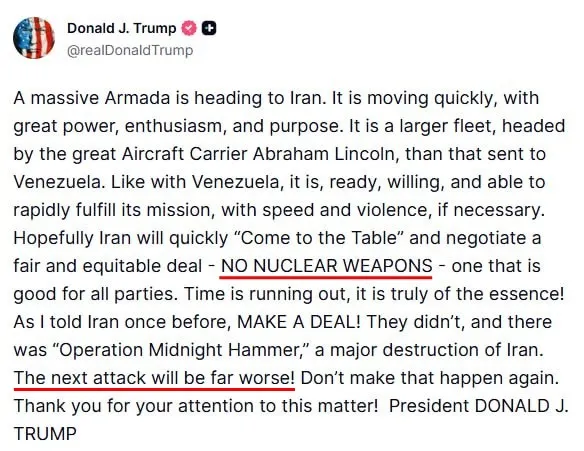
https://johnhelmer.net/the-kremlin-edit ... more-93280

******

Trump & Iran: Red Lines and Real Lines

Posted by Internationalist 360° on January 30, 2026
Kevork Almassian

Image

Trump dropped the “protester” pretext and revealed the real endgame: reshaping Iran’s posture

When I read Trump’s “massive armada” post, I didn’t focus on the macho vocabulary or the theatrical deadlines. I focused on what quietly disappeared.

Image

For weeks, we were told the red line was “the protesters.” Human rights. Humanitarian concern. The familiar moral wrapping paper that Washington uses when it wants the public to emotionally outsource a geopolitical project.

Then Trump writes his own script and suddenly the protesters are gone.

Now it’s “NO NUCLEAR WEAPONS.” Now it’s a demand for Iran to “come to the table” and accept a deal under the shadow of “speed and violence.” And that shift matters, because it reveals something we are not supposed to say out loud: the protests were never the issue. They were a useful headline. They were a smokescreen. The real issue has always been Iran’s posture, Iran’s regional role, and Iran’s ability to remain a sovereign player that refuses managed limits.

This is why I keep saying: something big is coming, not because war is inevitable, but because the current status quo is no longer sustainable. Iran is being pushed toward a forced choice: accept a poisoned chalice that reshapes its strategic posture, or confront the risks of a military escalation whose scope would be very hard to control once it begins.

And here is the trap: when a superpower wants you to panic, it doesn’t only move ships. It moves narratives. It moves proxies. It moves regional actors into position. It manufactures the feeling that history is running out.

But if you zoom out from Trump’s theatrics, you see something else happening at the same time: the region itself is trying not to be dragged into the fire.

Saudi Arabia and the UAE have reportedly refused American requests to use their territory or airspace for a strike. That does not magically prevent an attack—carriers and long-range assets exist for a reason—but it does change the geometry. It complicates planning, raises cost, and reduces the political cover that Washington usually enjoys when Gulf Monarchies stand publicly behind the operation. Even American military voices admit this would hamper planning, not necessarily stop it.

So we are in that most dangerous space: regional states are trying to avoid being burned, while the empire signals it can strike anyway if it chooses.

Now add the part that too many analysts still treat like a footnote: Turkey.

While Washington is shouting, Ankara is calculating. There are reports that Turkish officials are already discussing contingency scenarios in which, if Iran collapses, Turkey would establish a “buffer zone” on the Iranian side of the border. And if you have watched Turkey in northern Syria and northern Iraq, you know what “buffer zone” means in practice: a fact on the ground that rarely remains temporary, and almost never stays purely defensive.

In my recent stream, I also pointed out something important about the ecosystem through which this message is being floated: it appears via Middle East Eye, with the details attributed to briefings and participants, and written by a journalist presented as tied into Turkish official circles. That doesn’t automatically make it true, but it does tell you the kind of signaling Ankara wants out in the open: we are ready to exploit your collapse.


This is where the so-called “armada” crisis stops being a simple U.S.–Iran standoff and becomes a regional earthquake, because every actor is now gaming multiple outcomes at once: a deal, a strike, a decapitation campaign, a slow siege, or a fracture from within.

In my podcast conversation with Ali Alizadeh, we discussed the psychology behind Iran’s posture and why Iran reads threats like this through historical memory rather than Twitter emotion. His point—and it is an important one—is that Iranian strategic consciousness is shaped by experiences of occupation and externally imposed humiliation, and that you cannot understand today’s Iranian state unless you understand what history of aggressions does to a country “from within.”


That historical memory is why Iran built deterrence the way it did, and why the nuclear file became what it became: not merely a technical program, but a survival logic.

Ali described Iran as operating as a “threshold state,” maintaining the capability to build a bomb within a short time if needed, while not necessarily choosing to cross that line under normal conditions. He framed the nuclear issue as deterrence in a region where Israel’s nuclear ambiguity and expansionism are treated as an open secret, and where international law has proven selective at best.

And then he added the detail that should terrify anyone who still thinks Washington can manage escalation like a spreadsheet: for months, inspectors have not been present the way they were before, and there is discussion of large stockpiles of highly enriched uranium being dispersed and unknown in precise locations. Whether one agrees with his framing or not, the strategic implication is obvious: uncertainty increases the risk of miscalculation on all sides.

This is where the talk of assassination becomes more than tabloid fantasy and enters the realm of catastrophic incentives. Ali’s warned that if the West crosses into an assassination of Ayatollah Khamenei, it may remove not only a person but a restraint, the “fatwa” argument, and the internal balancing function he believes Khamenei plays inside the system. In that scenario, those who dream of “moderation through decapitation” may get the opposite: a harder posture under IRGC-dominant dynamics.

And this connects directly to another point from that conversation that Western media refuses to internalize: Iran is not simply a “regime” where removing a few figures collapses the state. It is a state with factions, networks, competing power centers, and real organic forces, and treating it like a thin dictatorship produces the kind of arrogant planning that leads to disasters.

This internal complexity matters because the empire’s preferred weapon in the modern era is not always invasion. Often, it is pressure plus fracture: economic siege, media amplification, and the weaponization of social fault lines until the target is forced into “behavioral change.”

Ali described exactly how unrest and factional conflict can interact inside Iran, how protest cycles are read by outside actors through simplistic “people vs dictatorship” clichés, while the internal reality is often more complex and entangled with elite factional competition.

Now bring this back to Trump’s post and the disappearing protesters.

In my stream, I argued that what Washington wants is an Iran that becomes nationalist and contained, an Iran that stays inside its borders instead of exporting an Islamic revolutionary mission and building regional alliances as deterrence. The offer, in other words, is not “love.” It is a cage with nicer lighting.

And this is where Turkey becomes a hidden lever in the crisis.

Because if Iran is pressured, weakened, or partially rolled back, Turkey’s appetite grows. If Iran collapses, Turkey moves “defensively” into Iran. If Iran compromises and retreats inward, Turkey fills the vacuum in Syria, Iraq, and beyond. Either way, Ankara sees upside.

And that’s before we even talk about the South Caucasus and Azerbaijan, which I raised in the solo stream as well: concerns about Azerbaijani alignment with Israel, the permissive environment for Mossad activity, and the idea that strike routes and covert infrastructure can be enabled through that geography. You don’t have to accept every claim at maximal certainty to understand the pattern: Iran’s northern frontier is not a neutral space.

So what is the endgame?

If you listen to the public rhetoric, it is always moral. Human rights, protesters, democracy, nuclear fear.
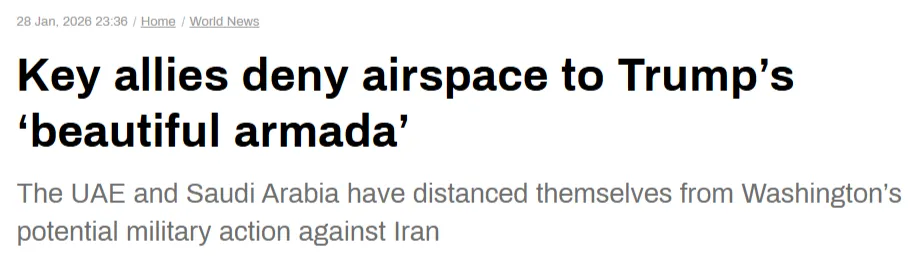
If you read the signals, it is always strategic. Posture, deterrence, alignment, and containment.

This is why my conclusion is darker than the slogans but clearer than the propaganda: Iran is being pushed into a forced-choice moment. The empire is no longer hiding the menu. It’s showing it with a countdown timer. And the region, especially Turkey, is already hovering over the table, calculating what it can grab if the plate breaks.

https://libya360.wordpress.com/2026/01/ ... eal-lines/

******

Trump Support Negative Even Among White Working Class; Approval of His Agenda at Only 27%
Posted on January 30, 2026 by Yves Smith

Trump’s poll results continue to fall. Since Trump watch Fox News regularly, its findings that even working class white voters are now disenchanted with him has likely penetrated his bubble. On top of that, other polls find that approval of his program stands at only 27%. Note that, as we’ll unpack soon, Trump’s approval ratings are higher than for his policies. This sort of disconnect is not unusual but the relative level is.
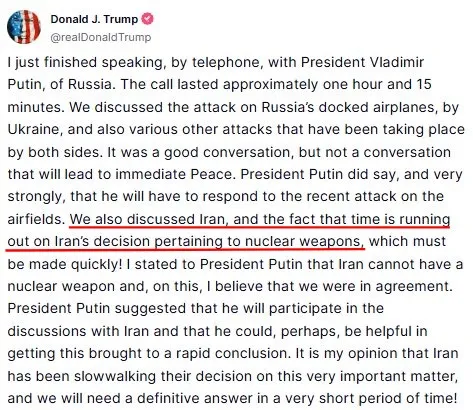
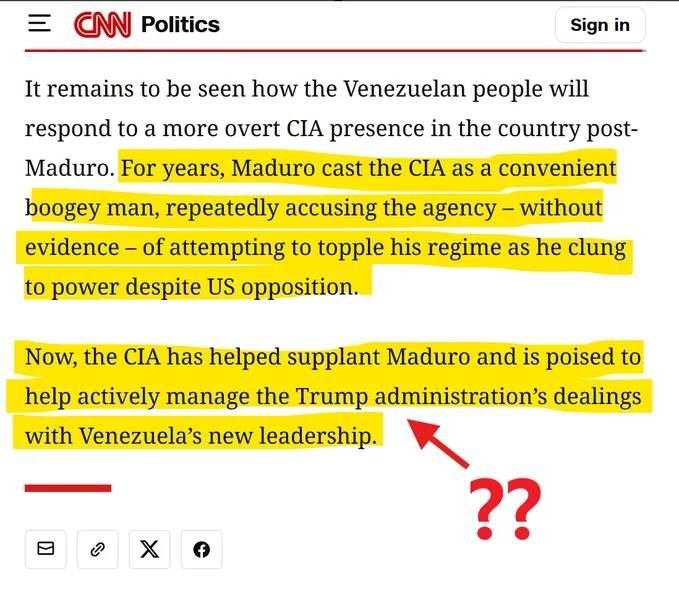

First from Washington Monthly, in Trump Is Losing the White Working-Class:

The latest poll from Fox News shows President Donald Trump’s job approval among white voters without college degrees is underwater: 49 percent approve, and 51 percent disapprove.

It’s just one pollster, and subgroup data has high margins of error. But working-class whites are the load-bearing pillar of the Republican Party’s MAGA era. Among all the race-and-education-level voter subgroups in the 2024 presidential election, non-college whites were the only ones who gave majority support to Trump. And not by a small amount, but by a nearly 2-1 margin. The Fox News data may not be precise—a new Pew Research Center poll has Trump’s approve-disapprove among non-college whites just slightly above water at 51-48—any softness among Trump’s most reliable bloc should send shivers down GOP spines.

Moreover, the Fox poll is not the only data point that warrants panic among Republicans. Trump’s relatively broad (winning 30 states) yet thin (with only 49 percent of the vote) 2024 victory was buoyed by inroads among people of color and voters under 30. I recently covered how, over the past year, as reflected in several polls and election returns, Trump and his party have frittered away those Latino gains. (The new Pew poll has Trump’s Hispanic approve-disapprove at an abysmal 26-71.) This week, the Wall Street Journal reported that Trump’s approval rating among young voters, as measured by the Cook Political Report aggregates from the top of March to the top of January, has sunk about 8 points, from 44.4 to 32.6 percent.


The story points out that Trump approval was decaying even before the two ICE murders in Minneapolis, with law enforcement officers all over the US decrying both executions as unwarranted, as well as the bad look of Minneapolis police calling out unjustifiable ICE harassment of off-duty members for the crime of not being white.

Other takes:

Republicans against Trump
@RpsAgainstTrump
·
Follow
NEW Pew Research poll: Donald Trump’s approval

Approve: 37%
Disapprove: 61%

And yes, 37% is still way too high.


Also keep in mind that this erosion in seeming opposition to the James Carville dictum, “It’s the economy, stupid.” GDP growth has been strong, as Trading Economics shows:

Image

The stock market keeps hitting new highs. Despite scary headlines about some large layoffs at big employers, and the drumbeat of “AI is coming for your job,” jobless claims are moderate, headline unemployment at 4.4%, is tame, with experts depicting the labor market as “resilient”.

Of course, it’s not hard to depict the economic picture as “gloss is more than half empty” for most. Trump has realized that he can’t talk his way out of the affordability crisis, and has thrown out a hodge-podge of schemes, most of which wont’ get done and won’t make much difference even if they do. He’s punted on a train wreck coming for many household budgets, that of big increases in health insurance costs. particularly for former Obamacare enhanced subsidy recipients. And remember, these result are occurring even as the Administration is running the economy hot, with a $2 trillion deficit forecast for fiscal 2026

And in the “more inconvenient news” category:

Image

Image

Image

Darth Powell
@VladTheInflator
·
Follow
To accomplish this Trump will need:

Interest rates to fall to zero percent
With no unemployment
$7T in stimulus
Low inflation
2.65% mortgage rates

Good luck piece of shit
unusual_whales
@unusual_whales
Trump: "People that own their homes: we're gonna keep them wealthy. We're gonna keep those prices up. We're not gonna destroy the value of their homes so that somebody who didn't work very hard can buy a home."


Image

Even with Twitter having a right wing skew, searching on “Trump economy” produced far more critical than positive tweets.

In his latest post. G. Elliott Morris discusses the gap between Trump’s falling approval ratings and the even-sorrier state of approval for Trump policies:

Image


Pew is not the only pollster to find a difference between support for Trump in general and support for his policies. Earlier this month, CBS News found that 50% of adults say they approve of what Trump is “trying to accomplish” on immigration, while only 37% approve of “how he’s going about it” (a 13-point gap). YouGov this week found the same pattern: 51% say they support Trump’s goals on immigration policy, but only 27% support both the goals and his implementation (a 24-point gap)….

Image

Across polls, there is a notable difference between what Americans say they support in general and what they support in practice. Historically, political scientists have noticed a similar gap between an individual’s “symbolic” and “operational” ideology.

Let’s stop for a second because this is a key issue. We have pointed out repeatedly that polls show anywhere from big majority to at the worst solid plurality support for all sorts of policies misleadingly labeled as left wing, from strengthening Social Security and Medicare to taxing the rich to cutting military spending to spending more on education. Yet many of those respondents will identify themselves as centrist or even conservative despite holding “progressive” stances on all the big issues in a “progressive” platform.

Morris confirms this tendency:

Christopher Ellis and James Stimso..in their 2012 book Ideology in America…find Americans like the idea of limited government, law and order, traditional values, etc. But when you ask about specific programs and policies, they generally want the government to do more, not less, and lean more to the left than the right.

In other words, decades of libererian/neoliberal propaganda penetrated, as the moving forces behind the Powell Memorandum sought. Later in Morris’ post:

Image

To be clear, there is utility in being the party with a symbolic edge on the issues. A new poll from Reuters/Ipsos found this week that 37% of adults prefer Republicans on immigration, vs. 32% for Democrats, even while Trump’s immigration enforcement policies are severely unpopular.

But when voters encounter a policy they don’t approve of in the real world, that provides an opportunity for the other party to reduce their advantage.

On immigration, it was obvious from early in Trump’s presidency that his unpopular policies would drag down his approval and trust metrics over time. Every video of dozens of agents swarming an apartment building, every citizen wrongly detained or legal resident wrongly deported, every lie about a shooting caught on camera reinforces the reality of an issue.

And this has been the reality for Trump since 2015. As soon as he implements a policy from his campaign, voters balk. Americans like the idea of Trump’s agenda more than the reality of it. The border wall was exciting until it meant seizing ranchers’ land. “Drain the swamp” resonated until it meant firing inspectors general. “America First” sounded strong until allies started hedging and supply chains fractured.

This is the fundamental paradox of Trumpism: it is a governing philosophy built entirely on symbols, confronting a world that runs on policy. Trump won in 2024 not because Americans wanted what he was selling, but because voters wanted what they thought he was selling — lower prices, a “secure border,” a harm-free return for manufacturing jobs.

But you can’t govern on vibes forever. Eventually, you have to implement policies. And when the policies are significantly less popular than the symbols, the average Trump voter discovers they were never really on board with MAGA after all.

Another factor to keep in mind: this sharp and continuing slide in approval is coming despite Trump’s frenetic shifts from one big splashy attention-grabbing gambit to the next, from Caracas to Greenland to Iran to threatening Powell with criminal charges to his latest fights with universities and the science establishment to his Peace Board grift. These distraction and exhaustion efforts are not arresting the decay in his support. To the extent that US voter care, they may be making it worse:

(((Harry Enten)))
@ForecasterEnten
·
Follow
Wanna know how poorly Trump buying Greenland polls? Worse than the Epstein files.

Seriously, Trump's net approval rating on any attempt to buy Greenland (-40 pts) is lower than his net approval on the Epstein files (-38 pts).

Greenland is arguably Trump's worst polling issue.


It may be that Trump is incapable of checking his intense need to dominate, and made sure to surround himself with toadies and enablers. Or it may simply be, as Trump clearly said in a New York Times interview, that he believe there are no limits to his power, and he is in the process of clearing obstacles to his authoritarian rule. The test will be whether we have midterm elections.

https://www.nakedcapitalism.com/2026/01 ... ly-27.html

('Red' added for class warfare.)

*****

Has Trump come to terms with Multipolarity?

Lucas Leiroz

January 30, 2026

The U.S. is in retreat, despite Trump’s rhetorical escalation.

The currently predominant reading of Donald Trump’s foreign policy tends to oscillate between alarmism and mockery. Actions such as the attack on Venezuela, direct pressure on Greenland, and even rhetoric involving Canada are often presented as signs of irrationality, improvisation, or late imperial delirium. This approach, however, ignores a central point: these moves are not misaligned with the objective reality of an international system transitioning toward multipolarity. On the contrary, they indicate a pragmatic -albeit aggressive – adaptation to the structural loss of the United States’ global hegemonic capacity.

The idea of a universal American hegemony is no longer sustainable, either materially or politically. Washington has lost the ability to unilaterally impose its will over Eurasia, the broader Middle East, and significant parts of the Global South. Russia and China have consolidated strategic autonomy; Iran has resisted decades of containment; India operates with increasing sovereignty; and traditional U.S. alliances show evident fractures. In this context, the strategic reorientation toward hemispheric hegemony is not a personal whim of Trump, but a rational response to the contraction of American power.

The recent rhetoric that “this hemisphere is ours” must be interpreted carefully. Far from expressing absolute strength, it reveals an implicit recognition of loss. By delimiting the Western Hemisphere as a priority and almost exclusive space of influence, Trump admits – albeit indirectly – that the other hemisphere is no longer under Washington’s effective control. This is a redefinition of objectives: less global ambition, greater regional focus, and a higher willingness to use direct force in areas deemed vital.

Venezuela occupies a central role in this logic – not only because of its energy reserves, but due to its symbolic and geopolitical value. A state openly aligned with Russia, China, and Iran within a space traditionally controlled by the United States is seen as an intolerable strategic anomaly. Neutralizing Caracas as a threat serves as a demonstration that, at least in the Western Hemisphere, multipolarity still encounters limits imposed by Washington. And the simple fact that the U.S. merely captured Maduro without changing the Venezuelan political regime already makes clear that even within its own “zone of influence,” the United States currently has limited capabilities and ambitions.

The same reasoning applies to Canada and Greenland, albeit in different measures. Pressure on Canada seeks to reduce margins of political, economic, and strategic autonomy, reinforcing its condition as a functional extension of American power. Greenland, in turn, represents a crucial geostrategic asset in the Arctic – a region increasingly central to great-power competition. The attempt to incorporate it into the U.S. sphere of direct control reflects genuine (or desperate) concern over Russian and Chinese projection in the far north, not diplomatic eccentricity.

None of this implies that the strategy is successful or risk-free. The aggressive posture tends to accelerate processes of regional resistance and to push Latin American actors toward greater cooperation with alternative poles of power. Still, it is incorrect to describe it as irrational. It is a defensive strategy of containment, not one of classical expansion. An empire in retreat tends to be more coercive in zones it considers essential.

For multipolar actors – Russia, China, India, Iran, and others – this scenario opens clear opportunities. If Washington is willing to recognize, even implicitly, geographical limits to its hegemony, it falls to others to consolidate their own zones of influence with greater clarity, coordination, and assertiveness. This requires abandoning illusions of full integration into the Western liberal system and investing in autonomous mechanisms of security, trade, and governance. It is necessary to overcome the illusion of classical international law and once again assume force as an elementary condition of survival in the arena of nations.

Finally, it is necessary to understand that Trump’s policy is not the product of chaos, but of a hard reading of the global balance of power. The mistake of many analysts lies not in acknowledging the existence of this logic, but in underestimating it or treating it as mere “madness.” In a multipolar world, strategic transparency – even when harsh – tends to replace the universalist narratives of the past.

https://strategic-culture.su/news/2026/ ... ipolarity/

Multipolarity - See Hobbes.

******

‘Peace President’ Trump Has Bombed 10 Countries, Now Plans $1.5 Trillion Military Budget
January 30, 2026

Image
By Ben Norton – Jan 25, 2o26

Self-declared “peacemaker” Donald Trump has bombed 10 countries, more than any other US leader. Now he plans to raise the military budget to $1.5 trillion — nearly the rest of the world’s defense spending combined.

Donald Trump claims to be a so-called “peace president”, but he has bombed more countries than any other US leader.

After proudly renaming the Pentagon from the Department of Defense to the Department of War, Trump now plans to raise the US military budget from $1 trillion to a staggering $1.5 trillion.

This means that, if Trump succeeds, the United States will soon spend more on its military than all of the other countries in the world combined, excluding China.

[youtube]]http://youtu.be/Div95RNXX0M[/youtube]

This is deeply hypocritical, because in his January 2025 inauguration speech, as he started his second term as US president, Trump declared that he would be a “peacemaker”.

Similarly, in the victory speech that Trump gave after he won the November 2024 presidential election, he claimed, falsely, that during his first term, “we had no wars”.

“I’m not going to start a war; I’m going to stop wars”, Trump promised.

He lied. In the first year of his second term, the Trump administration bombed seven countries: Iran, Iraq, Nigeria, Somalia, Syria, Venezuela, and Yemen.

When his first and second terms are combined, Trump has bombed 10 nations (the aforementioned seven, plus Afghanistan, Libya, and Pakistan).

This means Trump has bombed more countries than all other presidents in US history.

Moreover, Trump is threatening to attack at least four more nations: Colombia, Cuba, Mexico, and Greenland. He has vowed to colonize Greenland and forcibly turn it into US territory.

In a publication on his website Truth Social on January 20, 2026, Trump posted a photoshopped image of himself sitting in the White House next to a map showing Canada, Greenland, and Venezuela all annexed by the US empire.

Image

Bipartisan US wars kill millions of people
Trump is certainly not unique when it comes to waging wars; every US president in modern history has intervened abroad and overseen war crimes.

George W. Bush bombed five countries, and invaded Iraq in an illegal war of aggression.

Barack Obama won the so-called Nobel “Peace” Prize, before his administration went on to bomb seven countries: Afghanistan, Iraq, Libya, Pakistan, Somalia, Syria, and Yemen.


Trump bombed the same seven nations attacked by Obama, adding three more: Iran, Nigeria, and Venezuela.

In fact, the wars waged by the US in the two decades after September 11, 2001 had a death toll of at least 4.5 million people, in a conservative estimate by researchers at the elite Brown University.

They also found that 38 million people were displaced due to these US-fueled wars. This was the largest refugee crisis since World War Two.

Image

These imperial wars have been bipartisan. All modern US presidents have been complicit.

But what is especially hypocritical about Trump is that his administration constantly spreads propaganda claiming that the man who has bombed more countries than any other US leader is “the peace president”.

https://substackcdn.com/image/fetch/$s_ ... 9x1171.png[/img]

Trump launched more airstrikes in 6 months than Biden did in 4 years[/i]

Just in 2025, in the first 11 months of his second term, Trump carried out more than 500 bombings of countries around the world, according to data from the monitoring group Armed Conflict Location and Event Data (ACLED).

“Trump launched more airstrikes on foreign nations in the first six months of his second term than Biden did in all four years he was in office”, CBC reported, citing ACLED figures.

Joe Biden himself also oversaw extreme war crimes and crimes against humanity.

The Biden administration strongly supported the Israeli regime, giving it tens of billions of dollars of military aid and shielding it from any legal consequences by repeatedly vetoing resolutions at the UN Security Council, as US-backed Israeli forces committed genocide against the Palestinian people in Gaza.

Trump has continued doing the same. In September, the Trump administration pressured Congress to approve the sale of $6.4 billion more in military equipment to help Israel further colonize Palestinian land.

Image

Trump bombed civilian sites in Venezuela
Moreover, when Trump attacked Venezuela and kidnapped its internationally recognized President Nicolás Maduro on January 3, 2026, he also killed more than 100 people, including civilians.

In the illegal invasion of Venezuelan sovereign territory, the US military bombed civilian sites in addition to military targets.

Among the civilian areas hit by the US military was a medical warehouse that stored supplies for Venezuelan dialysis patients. Thousands of civilians could now die, because they lost access to this life-saving treatment.

The US military similarly destroyed an important scientific research center in Venezuela.

Trump’s Secretary of War Pete Hegseth proudly declared that the US attack on Venezuela was aimed at China and Russia.

“We’re re-establishing deterrence that’s so absolute and so unquestioned that our enemies will not dare to test us”, he stated.

Trump wants $1.5 trillion US military budget
Just a few days after Trump bombed Venezuela, he announced that he plans to increase the US military budget from $1 trillion to $1.5 trillion by 2027.

Fortune magazine reported that “a $1.5 trillion U.S. military budget would exceed the combined military expenditures of the next 35 highest-spending countries. And starting from the bottom up, a $1.5 trillion U.S. military budget would exceed the military expenditures of every other nation combined except for China”.

Image

For context, in 2024, the entire world’s military expenditure was $2.7 trillion.

As of that year, the United States alone accounted for 37% of global military spending, according to data collected by the Stockholm International Peace Research Institute (SIPRI).

Nearly half, 47%, of US federal government discretionary spending was dedicated to the Pentagon — which was previously known as the Department of Defense, but which self-declared “peacemaker” Trump renamed the Department of War.

Image

In 2024, the US spent more on its military than the next nine largest military spenders in the world combined.

The combined defense expenditure of China, Russia, Germany, India, the UK, Saudi Arabia, Ukraine, France, and Japan was $984 billion, compared to $997 billion in the US (and most of these top military spenders are US allies).

China’s defense spending in 2024 was $314 billion, or less than one-third of that of the US, according to SIPRI.

China has not fought a war since 1979, while the United States bombed seven countries just in 2025.

Image

Trump’s $1.5 trillion US military budget will increase federal debt by $5.8 trillion
When he announced his intention to raise the military budget to $1.5 trillion, Trump claimed he will, “at the same time, pay down Debt”.

This is false.

A report by the nonpartisan Committee for a Responsible Federal Budget found that Trump boosting annual military expenditure to $1.5 trillion will add $5.8 trillion to US federal debt over the next decade.

Trump claimed that the tariff revenue that the US government makes will supposedly cover this increase in military spending. This is not true.

Tariff revenue is estimated to be around $300 billion per year, according to the Committee for a Responsible Federal Budget. That is significantly smaller than the additional cost of increasing the military budget to $1.5 trillion.

Image

This assumption that tariff revenue will stay high, at roughly $300 billion annually throughout the next decade, likewise suggests that Trump’s assertion that his tariffs will reindustrialize the US is false.

If Trump’s levies truly aimed to accomplish this, it would be expected that tariff revenue would fall over time, as they would reduce imports and instead encourage domestic consumption of goods.

Nevertheless, Trump’s insistence that his tariffs could help pay off US federal debt demonstrate that he knows they will not re-industrialize the US.

Trump cuts taxes on the rich while raising taxes on the poor
In reality, Trump’s tariffs are a regressive tax on Americans. They represent a shift of the tax burden off of rich Americans onto poorer ones.

Trump constantly claims that other countries will supposedly pay for his tariffs. This is not true. It is US importers and consumers that pay the tariffs.

This tax on consumption of imported goods is extremely regressive. The biggest burden by far is felt by lower-income Americans, who spend much more of their paycheck on basic imported goods.

At least 55% of the cost of Trump’s tariffs have been paid by US consumers, Goldman Sachs estimated in October 2025.

Meanwhile, Trump has been cutting taxes on the richest Americans. The policies included in his “One Big Beautiful Bill” will overwhelmingly benefit the wealthiest people in the country.

Trump’s policies will result in 69% of tax cuts going to the richest 20% of Americans.

While a mere 1% of tax cuts will benefit the poorest 20% of Americans, 94% of Trump’s tax cuts will go to the richest 60%.

Image

69% of the tax cuts in Trump’s “Big Beautiful Bill” go to the richest 20% of Americans. Just 6% go to the poorest 40%.

In fact, due to Trump’s tariffs, the bottom 95% of Americans will actually see an effective tax increase.

The poorer a person is, the higher the percentage of their income will go to paying taxes to the Trump administration, while only the richest 5% of Americans will actually see their taxes fall.

Image

This is because, as Trump reduced progressive income taxation in one area, he increased regressive taxation in another area, in the form of tariffs.

Image

The Committee for a Responsible Federal Budget calculated that Trump’s “One Big Beautiful Bill” and his tax cuts on the rich will cause US federal debt to balloon by $5.5 trillion by 2034. This is in addition to the $5.8 trillion federal debt increase that will result from his $1.5 trillion military budget.

This is all profoundly hypocritical, because Trump oversaw the so-called Department of Government Efficiency, or DOGE, which he appointed the world’s richest billionaire oligarch, top US government contractor Elon Musk, to lead.

Trump and Musk claimed DOGE would root out government “waste, fraud, and abuse”.

In reality, the Trump administration gutted social spending and the parts of the state that actually help working families, while not reducing spending overall.

Trump’s plans to increase US federal debt by trillions — by cutting taxes on the rich and raising the military budget to $1.5 trillion to wage war around the world — come at the same time when he is eliminating $186 billion of funding for SNAP, the food program that helps poor and working-class Americans feed their families.

In other words, Trump is slashing government support for the poorest people in the country, while providing tax relief for the richest and massively increasing the Pentagon budget, which will further enrich corporate shareholders in the military-industrial complex.

Donald Trump, the billionaire self-declared “peacemaker” who now holds the record for bombing more countries that any other US president, is demonstrating to the world that all US wars are indeed a form of class war.

https://orinocotribune.com/peace-presid ... ry-budget/
"There is great chaos under heaven; the situation is excellent."

Post Reply