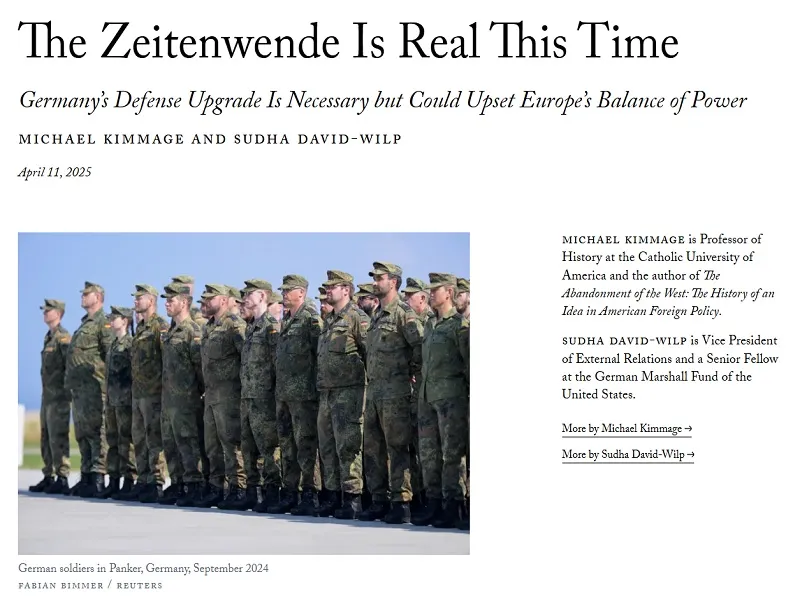
Blues for Europa

User avatar
blindpig
Posts: 14839
Joined: Fri Jul 14, 2017 5:44 pm
Location: Turtle Island
Contact:

Re: Blues for Europa

Post by blindpig » Mon Apr 07, 2025 3:58 pm

Old alliances sink in the Atlantic

José Goulão

April 6, 2025

Under the tutelage of Putin and Trump, between whom there continues to be a limiting dispute related to the ceasefire, the scenario of hypothetical formal negotiations is still a magma of contradictions that, until now, have been insurmountable.

And the spell is turning against the sorcerer.

The inspirers, leaders and financiers of the 2014 coup d’état in Maidan Square, in Kiev, are suffering the consequences of this gross attack on democracy mounted exclusively to defend interests unrelated to those of the Ukrainian people and extend NATO’s field of action to the borders of Russia.

The West is in shock with the collapse of pillars that support transatlantic alliances, which seemed solid, as if they corresponded to a historical development, and are ultimately vulnerable when the contradictory interests involved finally come into conflict. What Davos has been building so laboriously with coups, manipulation and propaganda towards globalism, the current situation, especially after the election of Donald Trump, has now hindered.

It cannot be said that this is a case of anger between bedpans. It’s very much a break from the kind of usual relationships maintained in a mafia web between the Godfather and his Cappos.

As recently – in historical terms – happened in Afghanistan, the United States is in disarray from Ukraine, dragging with it a stunned NATO and within which the secretary general does not know what to say, other than nonsense in which he can pronounce considerations and their opposites in the same intervention.

The North American escape from the consequences of the situation it created 11 years ago in Kiev, and which cost, to begin with, five billion dollars to Washington’s Treasury, according to the official version, corresponds to the entry into an even more serious phase of the long agony that precedes the death of the European Union. Entangled in the bonds created by having been involved, from the outset, in uncritical support for the totalitarian Nazi-Banderist regime established through the coup, the 27 are now left with the boy in their arms and without the right to negotiate solutions. They continue to proclaim that they will support to the last consequences the corrupt and criminal caste of which the most visible figure is the illegitimate president Zelensky, in order “for Ukraine to win”.

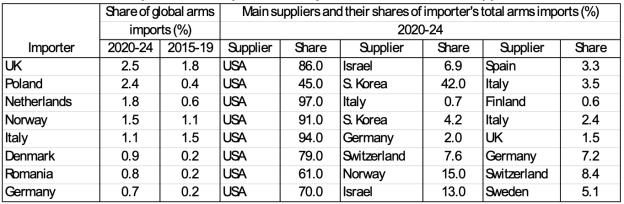
To feed the illusion that they will achieve this objective, they cultivate the insane idea of ​​sending troops with a size they do not have; they are willing to send money on top of what has already flown in previous donations to the accounts of the Nazi sect and which they now also do not have because they comply with doglike obedience with the sanctions on Russia decreed by the United States; and they consider themselves obliged to send even more weapons to the Ukrainian regime with their own already emptied arsenals. And if, at the risk of their own short-term future, they want to continue with this “democratic” mission, they will have to buy weapons from the North American lords of death, who are already rubbing their hands in anticipation of this bonus.

These orphans from Washington, who for years gave up on having a voice and now want to speak loudly but have rusty vocal chords, still don’t realize the scope of the problems that affect them. The situation brings up, once again, that old sentence by the wise Henry Kissinger: “Being an enemy of America is dangerous; but being a friend is fatal”.

North American Vice President JD Vance, using the podium at the so-called “security conference” in Munich, began by setting the tone for the new times and humiliated European leaders. He diagnosed that “the main threat to Europe comes from within, not from Russia or China” and highlighted the obvious cunning of the European Union leaders in relation to everything that is decided in Washington, including the suicidal way in which they became entangled in the web woven by the Nazi-Banderers in Kiev, trusting that North American supervision over the situation would be guaranteed as long as necessary.

Vance’s arguments to reach this conclusion are ultra montane and atrocious reactionaryism, which further destroys the European Union’s shaken prestige by obediently following Washington. However, in one of the arguments explained, the North American vice-president is right. He did not forget the annulment of the presidential elections in Romania and taught Europeans that “we can accept that it is wrong for Russia to buy social media ads to influence its elections, but if its democracy can be questioned by a few hundred thousand dollars in digital advertising from a foreign country, then it is not so strong.”

The European leaders who watched live this display of the treacherous representative of imperial nationalism haranguing their suzerains were shocked, they felt that they did not deserve such ingratitude.

“It can be recorded in history that this was a dark day for Europe”, complained bitterly Marko Mihkelson, president of the Estonian Parliament; his poor compatriot Kaja Kallas, on duty as head of the European Union’s “foreign policy”, was appalled that the United States was “in confrontation” with Europe.

The British daily “The Telegraph” decided to sum up everyone’s disgust in its headline: “Now it’s Putin and Trump’s world. The United States is no longer interested in ensuring security in Ukraine and Europe.”

With a lost head

The news about the contacts between Donald Trump and Vladimir Putin, which have still made little or no progress, for example in relation to “peace” in Ukraine, however, are enough to leave the countries of the European Union and the unelected leaders of this organization lost in their heads, isolated in a kind of madhouse. What leaves them on the verge of a nervous breakdown is the interpretation according to which the current format of conversations leaves them isolated in the task of supporting the Ukrainian regime without having a say in the search for a solution to pacify the country.

Eurocrats, technocrats and autocrats in Brussels were upset that Zelensky was also sidelined, in part because Trump and Putin appear to be in agreement about the illegitimacy of his presence as president in Kiev. The American president even expressed scepticism about the political future of the formal head of Nazi-Banderism, commenting that, from an electoral perspective, “his numbers in the polls are not great, to say the least”.

If some of the intentions attributed to Trump are not invalidated by him, as his persistent tendencies towards lies and incoherence are known, Putin will have already obtained the acceptance of two of the Russian demands in relation to a possible peace plan: the impossibility of returning to the 2014 borders – the inclusion of four oblasts (provinces) in Russian territory seems to have been a hypothesis raised; and Ukraine will not be part of NATO, thus halting the alliance’s expansion to the East. And everything the European Union intends to do to try to prevent the realization of these realities will stumble upon its own insignificance.

The rejection of Ukraine’s membership in NATO leaves the European Union on the brink of catastrophe if it moves at its own risk to a war against Russia to defend, in desperation, the Nazi-Banderist dictatorship in Kiev. Article 5 of the Atlantic Treaty, which implies an alliance-wide response in the event of a member being attacked, will now not be valid for any European troops seeking to establish themselves in Ukraine.

The European Union, however, continues to insist on this intention, although among the 27 there are those who are beginning to take the Kremlin chief’s statements seriously. Furthermore, the populations of the 27 began to express serious concerns about a possible military campaign decided by their leaders. In Portugal, for example, a very recent survey revealed that the majority of those interviewed may be in favour of a “European army” but are in no way in agreement with the restoration of compulsory military service.

In fact, the Russian army, which, according to common perspectives in Europe, was barely out of the Middle Ages and the lack of weapons was such that soldiers were forced to use agricultural tools such as shovels, forks and rakes, or even parts of washing machines as ammunition, transformed itself, from one moment to the next, into a terrible and gigantic monster of efficiency.

Listen to Lithuanian Defence Minister Davilé Sakaliené: “Russian military capabilities are already three times greater than they were when the full-scale invasion of Ukraine began three years ago; and all this happened in a context of active war.”

And Volodymyr Zelensky himself, who for months and months declared himself on the verge of victory against the incapable and country-stricken Russian troops, now guarantees that “after the fall of Ukraine, Russia will occupy the entirety of Europe with complete ease”.

So, Europe, according to the German publication “Die Welt”, has a problem. It is said that the “peace force” needs at least 120 thousand troops on the ground but European countries, according to this source, would not be able to mobilize more than 25 thousand.

The common sense that is scarce in Brussels

In the talks held so far, Trump and Putin would have agreed that “common sense” should prevail on the path to negotiations and the conclusion of a possible peace treaty in this Ukrainian war, which, “in my presidency would never have existed”, said the North American leader. Now, common sense is what the European Union’s disoriented ruling caste lacks most, which is yet another reason, along with warmongering impulses, to be kept on the sidelines of any negotiations.

However, let us not have any great illusions or doubts because, in the current situation, with more than a million dead, peace in Ukraine remains far away.

Under the tutelage of Putin and Trump, between whom there continues to be a limiting dispute related to the ceasefire, the scenario of hypothetical formal negotiations is still a magma of contradictions that, until now, have been insurmountable. Russia, however, is the party that is least in a hurry, perhaps convinced that time is playing in its favour to seek military advances and reinforce bargaining power. Hence, in turn, Trump’s urgency for a ceasefire.

https://strategic-culture.su/news/2025/ ... -atlantic/

******

The EU’s Military-Industrial Plans Could Accelerate The US’ Disengagement From NATO
Andrew Korybko
Apr 06, 2025

Image

Interoperability issues could make the US think twice about intervening in the EU’s support against Russia.

“Trump Is Unlikely To Pull All US Troops Out Of Central Europe Or Abandon NATO’s Article 5”, but he’s definitely “Pivoting (back) to Asia” in order to more muscularly contain China, which will have consequences for European security. Although Russia has no intent to attack NATO countries, many of these same countries sincerely fear that it does, which leads to them formulating policy appropriately. This (false) threat perception heightens their concerns about the US’ gradual disengagement from NATO.

To make matters worse, Reuters cited five unnamed sources to report that the US chided the EU for its military-industrial plans, particularly those which relate to production and procurement within the bloc. They’re presumably connected to European Commission President Ursula Von der Leyen’s “ReArm Europe Plan” that calls for members to boost defense spending by 1.5% on average for a collective €650 billion more in the next four years and provide €150 billion worth of loans for defense investments.

This bold program will strengthen the EU’s strategic autonomy but will likely come at the cost of accelerating the US’ disengagement from NATO. EU-produced equipment might not be interoperable with American equipment, which could complicate contingency planning. The bloc wants the US to intervene in the event of a military crisis with Russia, yet the US might think twice if its commanders can’t easily take control of European forces in that event.

The US might also be less likely to do so if the EU reduces its reliance on American equipment like the F-35s that are rumored to have “kill-switches”. These could hypothetically be activated if the EU tried provoking a conflict with Russia that the US didn’t approve of for whatever reason. If the EU becomes emboldened to do precisely that and thus becomes a major strategic liability for the US, then the odds of the US intervening in its support would dwindle, thus leading to a self-fulfilling prophecy.

At the same time, some countries like the Baltic States, Poland, and Romania – which occupy NATO’s strategic eastern flank with Russia, Belarus, and Ukraine and are much more pro-American than their Western European counterparts – will likely remain within the US’ military-industrial ecosystem. This could therefore serve to retain American influence along the EU’s periphery, keep those countries out of the bloc’s military-industrial ecosystem, and thus hamstring plans for a “European Army”.

Nevertheless, the US would also do well to share some defense technology with Poland and agree to at least partial domestic production of its large-scale purchases, which could transplant a portion of the American military-industrial ecosystem to Europe for easier export to other countries. That could in turn keep Poland from pivoting to France or at least relying more on it to balance the US like the ruling liberal-globalist coalition might do if its candidate wins the presidency during the next elections in May.

The US could therefore leverage its military-industrial cooperation with Poland by offering preferential terms (i.e. technology-sharing and at least partial domestic production) as a means for retaining American influence along the EU’s periphery amidst the bloc’s own military-industrial plans. That could greatly impede the EU’s strategic autonomy, make any “European Army” more difficult to form due to interoperability issues, and thus pressure Western Europe to relent by purchasing more US equipment.

https://korybko.substack.com/p/the-eus- ... rial-plans

Any Hungarian-Serbian Alliance Would Have Very Real Limits
Andrew Korybko
Apr 07, 2025

Image

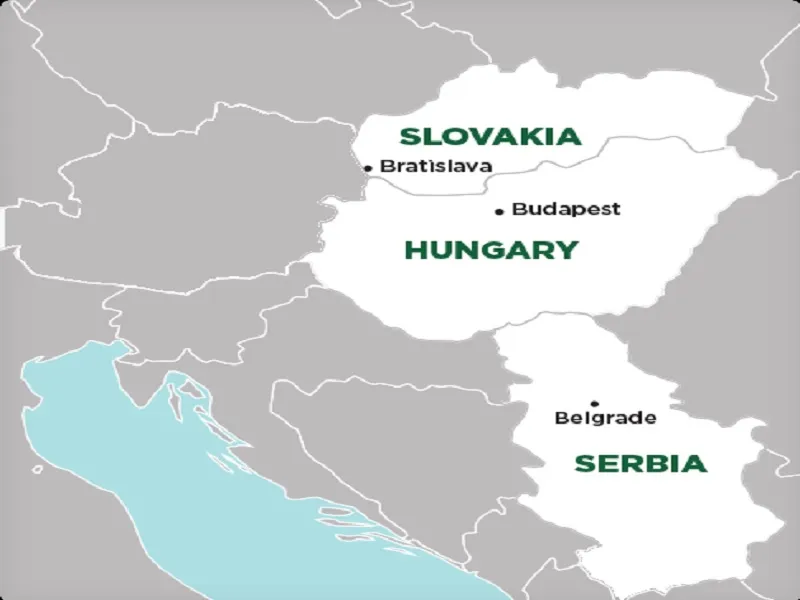
Hungary won’t go to war against Croatia in support of Serbia, thus de facto defecting from NATO with all the cascading consequences that this would entail, including a possible NATO invasion.

Serbian President Aleksandar Vucic drew regional attention when he praised his country’s newly signed military roadmap with Hungary for “coming closer to a Hungarian-Serbian alliance.” The immediate backdrop concerns mid-March’s joint defense declaration between Croatia, Albania, and Kosovo. All three have a recent history of conflict with Serbia, Belgrade still claims what it regards as its rogue NATO-occupied Autonomous Provine of Kosovo & Metohija, and there’s a new round of uncertainty in Bosnia.

The de facto creation of a Croatian-Albanian/”Kosovar” alliance, the latest problems in Bosnia, and Vucic’s intent to create a Hungarian-Serbian alliance have therefore raised concerns that these two alliances might go to war with one another over Kosovo and/or Bosnia. Each also counts NATO members among them, Croatia and Albania in the first and Hungary in the second, thus running the risk of an intra-bloc crisis far worse than 1974’s Greek-Turkish one over Cyprus if this scenario comes to pass.

It might not, however, or at least not in the sense of these two groups of countries fighting one another. While it’s entirely possible that Croatia might exploit a crisis in Serbian-Albanian/“Kosovar” relations to make a coordinated military move in support of its co-ethnics in Bosnia or they exploit a Croatian-Bosnian crisis to make a coordinated military move against Serbia, Hungary is unlikely to intervene. That’s because it has no pressing national security interests at stake to justify the incalculable costs.

Prime Minister Viktor Orban is the consummate pragmatist who prioritizes his conception of national interests as he sincerely understands them to be. The worst-case scenario that he might expect from another regional conflict over Kosovo and/or Bosnia is an influx of (mostly Serbian) refugees to Hungary, the total number of whom would likely be much less than during the height of 2015’s Migrant Crisis and which his government has contingency plans in place to manage. That wouldn’t justify going to war.

The absolute most that Hungary might do in that situation is provide whatever military aid it could muster from its stockpiles to Serbia, but even that can’t be taken for granted since Orban might worry that doing so – at least right away – could disqualify him as a mediator. In any case, de facto defecting from NATO by waging war against neighboring member Croatia in support of Serbia is completely off the table due to the cascading consequences that this would entail, including a possible NATO invasion.

Vucic knows this so his quip about a “Hungarian-Serbian alliance” must have been meant for public consumption at home and in the region with the respective intent of falsely reassuring his people that Hungary will fight alongside them if there’s a regional war while unsettling the others’ by making them worry that their governments (Croatia, Albania, and Kosovo) might soon be responsible for provoking this. At the elite level, however, no policymaker will likely fall for his perception management spectacle.

His words will accordingly have no influence over the course of regional events unless in the far-fetched scenario that Hungary formally enters into a mutual defense pact with Serbia that stipulates sending equipment and/or troops if either is attacked. There’s no indication that Orban is considering this though since it would greatly threaten Hungary’s national interests as was explained so observers shouldn’t give much weight to talk of a Hungarian-Serbian alliance or take it too seriously if it ever enters into being.

https://korybko.substack.com/p/any-hung ... ance-would

******

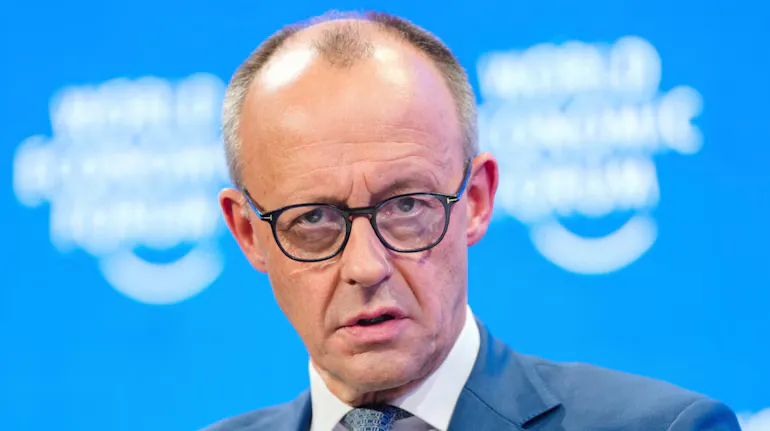
Friedrich Merz: Oligarch Tool
Roger Boyd
Apr 07, 2025

Image

Friedrich Merz was born in Brilon, Wester Germany to a father who was a judge and a mother who was part of the prominent patrician family Sauvigny of French descent. His grandfather had been mayor of Brilon. He was raised in his mother’s family home Sauvigny House. After getting expelled from one school, he finished the equivalent of high school at another institution. He then did his compulsory year military service, after which he gained a degree in law and became a judge.

After one year as a judge, in 1986 he went to work as a corporate attorney at the German Chemical Industry Association for three years. Then he got himself successfully elected as a Member of the European Parliament, where he served with the CDU/CSU for five years after which he became a member of the Bundestag from 1994 to 2009. He served in a number of opposition posts and then in a minor position in the Merkel administration.

After leaving the Bundestag in 2009, he worked as a corporate lawyer. He had already served as the senior counsel at Cornelius Bartenbach Haesemann, and then for Mayer Brown at their Dusseldorf office; both in parallel with his membership of the Bundestag. He continued with the latter after he left the Bundestag and has also served on numerous corporate boards, including:

Deutsche Borse, from 2005 to 2015

HSBC Trinkaus, from 2010 to 2019

Bosch, since 2011

Ernst & Young

BlackRock Germany, from 2016 to 2020

His corporate legal work and board memberships have made him a multi-millionaire oligarch courtier. When Merkel stepped down in 2018, Merz announced that he would run for the party leadership but was beaten in the second round. He stood again in January 2021 and was again defeated. He returned to the Bundestag in the 2021 German general election. At his third attempt, in December 2021, he won the leadership of the party; taking office in January 2022. In September 2024, he became the designated candidate for chancellor in the German elections that were held in early 2025. He describes himself as socially conservative and economically liberal; what would be expected from a right-wing courtier that has spent decades dutifully serving the German oligarchy and being munificently rewarded for that service. He owns two private jets.

With German industry under severe pressure from the higher energy prices created by the self-harming anti-Russia sanctions, the loss of Russian markets due to those same sanctions, intensifying Chinese competition in the core industries of vehicles, heavy industry and machine tools, and most recently the US 20% tariffs (and 25% on vehicles), the German oligarchy required new areas of profit-making to compensate. Carrying out an immediate volte face from his election manifesto that got him and his party the highest vote share in the federal election, Merz dutifully served his oligarch patrons by getting the constitutional debt brake removed for defence spending above 1% of GDP, together with a massive slush fund for infrastructure and green energy. All voted for by the previous Bundestag before the newly voted one came into being (in the new Bundestag Merz would not have had enough votes to alter the constitution).

He has already made it plain that the new massive expenditures will be paid for by increased debt and state austerity for the majority of the population, while the rich will not be hit with any new taxes while they luxuriate in the massive amounts of new government spending. VW is already looking at ways to convert its factories from producing cars to producing weapons. Just like Trump, he is carrying out a class war on his base to maintain and grow the wealth and profits of his oligarch bosses. He may very well only last one term in government, given the discontent which such policies will produce, after which he will be very fully rewarded for his excellent service to the oligarchs. He will also have paved the way for an AfD - CDU/CSU government in 2029, when greater authoritarianism may be required as the German population revolts against corporate profiteering for the rich and even greater austerity for the rest.

https://rogerboyd.substack.com/p/friedr ... garch-tool
"There is great chaos under heaven; the situation is excellent."

User avatar
blindpig
Posts: 14839
Joined: Fri Jul 14, 2017 5:44 pm
Location: Turtle Island
Contact:

Re: Blues for Europa

Post by blindpig » Tue Apr 08, 2025 1:52 pm

Image

Europe’s apparently puzzling bellicosity
By Prabhat Patnaik (Posted Apr 05, 2025)

Originally published: Peoples Democracy on April 6, 2025 (more by Peoples Democracy) |

ONE of the puzzling phenomena in world capitalism today is the bellicosity displayed by Europe vis-à-vis Russia. The claim that Russia has imperialist designs towards Europe, which the European ruling circles keep repeating, is clearly absurd. It is NATO that moved eastwards, in violation of a promise made by the U.S. administration to Gorbachov, and provoked Russia; and it is NATO members, notably U.S. and UK, that torpedoed the Minsk agreement reached between Russia and Ukraine which would have prevented the war. NATO’s objective clearly was to subjugate Russia and control its rich natural resources, by recreating the relationship that Western imperialism had developed for a while with that country when Boris Yeltsin had been its president. The claim that it is Russia that wants to over-run Europe, like the earlier Cold War claim that it was the Soviet Union that wanted to subjugate Europe, is so absurd that it is almost childish.

The question however is this: after the U.S. has decided to bring the Ukraine war to an end and thereby implicitly denied this claim of Russian aggressiveness, why does Europe still persist in propagating this myth? This question is particularly relevant for Germany whose losses owing to the stand-off vis-à-vis Russia have been quite substantial. Being forced to rely on the import of U.S. energy in lieu of Russian gas that is cheaper, its costs of production have gone up, encouraging firms to shift their production elsewhere and start a process of de-industrialisation of Germany; and high energy prices have also raised the cost of living, bringing greater distress to the workers. The natural thing for Germany should be to welcome an end to the Ukraine war and seek to bring about an improvement in its economic performance. Why is it still persisting with its bellicosity?

This difference between Europe and the U.S. cannot be attributed to a revival of inter-imperialist rivalry; it concerns a divergence in imperialist strategy towards Russia, but that is not the same as inter-imperialist rivalry fuelled by the contradiction between rival financial oligarchies. In a world of globalised finance capital, such rivalry over what Lenin had called “economic territory”, remains muted; besides, as we have just seen, the interests of Germany and Europe should generally dictate peace with Russia rather than confrontation, especially in view of the fact that Russia cannot be defeated (in any sense of the term “defeat”) in the Ukraine war.

Of course it may be argued that even in the absence of any intensification of inter-imperialist rivalry, European ruling circles, faced with the threat of a withdrawal of the American-provided “security” umbrella they have enjoyed until now, are keen on stepping up their armaments expenditure in order not to be “left behind”; this can be financed partly through a larger fiscal deficit and partly by cutting down on welfare expenditure that Europe had been incurring in the post-war period, and both these become easier to achieve by invoking a Russian threat.

Globalised finance is opposed to larger fiscal deficits, and its opposition arises from the fact that government expenditure financed by such deficits for raising the level of activity and employment delegitimises capitalism; this argument however, it is assumed, would not be as compelling when such a larger deficit is used for building up armed might in the face of a perceived external threat (even though it may still enlarge activity and employment). The opposition of finance to a larger deficit in other words may be muted through an invocation of a Russian threat. This is what is hoped by the recent Constitutional amendment enacted in Germany for enabling larger government borrowing. Likewise, the opposition of the people to a reduction of welfare expenditure and a further dismantling of whatever remains of the post-war welfare state, it may be hoped, would get muted if they believe that there is a serious Russian threat. In other words, the Russian threat is invoked to step up arms expenditure deemed necessary by European ruling circles in the new situation.

Even if some validity is recognised in this explanation, it is obviously inadequate. For a start, Europe’s anti-Russian bellicosity long predates Trump’s ascendancy and hence the European ruling circles’ perceived need for re-armament. Besides, the anti-Russian rhetoric is stronger in the centrist liberal-bourgeois political circles, comprising both centre-left and centre-right, than even in the extreme right, neo-fascist, formations. The extreme right German AfD for instance, while it is all in favour of German re-armament (and even favours the acquisition of nuclear weapons) is less strident on the Ukraine war than the ruling coalition of the Social Democrats, the Free democrats and the Greens, or the newly victorious Christian Democrat-Christian Social Union of centre-right. Similarly, Meloni of Italy or Orban of Hungary are not among the most bellicose of European leaders arrayed against Russia, though they would be firmly categorised as extreme right or neo-fascist.

One can therefore discern the following pattern: while the neo-fascist formations create an internal “other”, some hapless ethnic or religious group, and foment hatred against it, in order to bolster the hegemony of big capital in a period of crisis by shifting the discourse away from issues of unemployment and living conditions, the centrist political formations seek to bolster the hegemony of big capital by fomenting hatred against an external “enemy”, which in the European case happens to be Russia.

This of course is a relatively new phenomenon, which has emerged because of the centrist political formations’ utter inability to get the European economies out of the crisis through the standard methods of Keynesian demand stimulation. They have been hamstrung by the objections of globalised finance to both methods of financing larger government expenditure that could stimulate aggregate demand, namely larger taxation of the rich or a larger fiscal deficit. The centrist political formations which have been in power in Europe for decades are losing political ground both because they are held responsible for introducing the neoliberal regime that has brought great distress to the people, and also for being unable to overcome the inevitable crisis that such a regime runs into which brings even greater distress. They obviously would not stand quietly in the face of such loss of electoral support; they would seek to recoup it in some way. And they do so by presenting themselves as the main bulwark against an external “enemy”, Russia. Domestic electoral compulsions in the face of the economic crisis of neo-liberalism thus contribute to the drumming up of Russophobia on the part of centrist political formations in Europe.

In addition there is the pressure of the arms manufacturers’ lobby. The Ukraine war has brought them substantial orders, and large profits. A continuation of the war would mean a continuation of these profits. The leading German arms manufacturing company Rheinmetall, for instance, has had its order books full for quite a while; the recent German decision to amend the Constitution to spend more on arms, while it would not lead to any greater capacity utilisation at Rheinmetall, would entail a continuation of that “happy” state of affairs, while an end to the Ukraine war could end it. Drumming up Russophobia is a way of legitimising its continuation.

There is an irony here. Post-war capitalism had taken pride in the fact that it had re-fashioned itself into a “humane” system. It claimed to have promoted democracy by introducing universal adult franchise over its entire domain (though this had been achieved a little earlier in Britain, in 1928, when women had got the vote); it had witnessed substantial welfare expenditure, especially in Europe, to keep economies close to full employment and provide social security; and it had undertaken decolonisation so that it could no longer be accused of the horrors of colonial exploitation. On the basis of these, it was claimed that capitalism had “changed”.

Contemporary capitalism has witnessed a reversal of every one of these developments; capitalism is back to its horrendous and unadulterated past, with social democracy being actively complicit in this reversal. The repression unleashed by neo-fascism that has characterised much of the capitalist universe now has attenuated democracy; the increase in arms expenditure at the expense of welfare spending in the very heart of Europe is attenuating the welfare state; and the reacquisition of metropolitan control over much of the natural resources of the Global South under the neoliberal regime, which is now buttressed by Donald Trump’s brazen plan to take over the mineral riches of Greenland and Ukraine, and to develop Gaza for real estate and tourism; are all indicative of this reversal. And to believe that capitalism can get back to its so-called “humane” avatar is a chimera.

https://mronline.org/2025/04/05/europes ... llicosity/

*****

From Cassad's telegram account:

Colonelcassad
Latvia Declares War on Fallen Heroes

The Russian Foreign Intelligence Service reports that, according to information received by the SVR, the Latvian authorities, in an uncontrollable desire to mar the celebration of the 80th anniversary of the Great Victory on May 9 of this year, are developing plans for the mass destruction of war memorials located in the country.

It is planned to get rid of about a third of the monuments over the mass graves of Soviet liberator soldiers "in the shortest possible time." In order to give the act of vandalism the appearance of "civilization," it is proposed to act "strictly within the framework of the Latvian legal field." Namely, the criminal scheme provides for fictitious archaeological research, which must "at all costs refute" the existence of mass graves of soldiers under the memorials.

One of the "search teams" has been invited to carry out the dark plan, the leadership of which has given preliminary consent "for a reasonable fee" to desecrate the graves and fabricate the "necessary" excavation reports on the absence of burial traces. They plan to start with the Orthodox Tornakalns Cemetery and the military Fraternal Cemetery located in Riga.

Apparently, the cave-like Russophobia of the Latvian authorities and their fear of Russia have driven them to a decision that defies common sense - to declare war on the fallen soldiers. However, their expectation that everything will go unpunished, since the dead will remain silent, is wrong. The plans of the "grave diggers" are now known, and the current Latvian authorities have once again demonstrated that the concepts of honor, dignity and gratitude to those who died for their freedom are unfamiliar to them.

Press Bureau
of the Foreign Intelligence Service of Russia 04/07/2025

Nothing else should be expected from the descendants of SS men and policemen.

https://t.me/s/boris_rozhin

Google Translator

******

Another slap in the face for Sandu: American tariffs
April 8, 2025
Rybar

The US has introduced 31 percent duties on imports from Moldova: this is the highest tariff among the CIS countries. For comparison, Washington has introduced the same duties for China.

Why the Trump Administration Punished Moldova

Former Moldovan Ambassador to the United States Igor Munteanu believes that such duties have a political subtext, since President Maia Sandu and her entire team are connected to George Soros. Munteanu is also sure that Washington does not like the current Moldovan Ambassador, who should have been replaced, but in Chisinau they do not read political signals.


Economists believe that the issue is also about manipulations with the Moldovan currency: the leu is undervalued by 25%.

High duties for Moldova are yet another diplomatic failure for Sandu. When the decision was announced, Foreign Minister Mihail Popșoi was in Washington , where he said at a meeting of the Atlantic Council (an undesirable organization) that he had discussed “development of economic cooperation” with the Trump administration .

The Moldovan government notes that the measures will affect 2.5% of the country's exports, which is not that much overall. Prime Minister Dorin Recean assures that Chisinau "will continue to support strategic partnership" with the United States.

However, Sandu's office has gone so far as to say that restrictive measures are being introduced not only from Washington, but also from Moscow. Against the backdrop of another diplomatic scandal with the embassy in Chisinau, Russia has banned cargo carriers from Moldova from entering the country, including for transit.

The republic's economy is already in a catastrophic state , but Sandu's stubbornness and inability to negotiate reach the point that she does not want to do business with those she does not like, to the detriment of the country. In Chisinau, they are sure that Moldovan goods are very much needed in the EU, so they prefer to develop only one direction.

https://rybar.ru/ocherednoj-shhelchok-p ... ie-tarify/

Google Translator

******

Thousands protest in Italy against armament agenda

Mass protests grow in Italy as trade unions, opposition parties, and grassroots groups rally against national and EU rearmament plans

April 07, 2025 by Ana Vračar

Image
Peace protest in Rome, April 5, 2025. Source: Giuseppe Conte/X

Almost one hundred thousand people took to the streets of Rome on April 5, demanding an end to Europe’s rearmament agenda. During the central rally, demonstrators and speakers condemned the ReArm Europe initiative recently launched by European Commission President Ursula von der Leyen, as well as the military spending plans announced by Italian Prime Minister Giorgia Meloni’s government.

In the lead-up to the protest, the Five Star Movement (Movimento 5 Stelle, M5S), which has recently aligned with the left bloc in the European Parliament, criticized the government’s military priorities. They calculated that the funds earmarked for planned defense acquisitions could instead be used to alleviate ongoing crises in healthcare and education. According to their analysis, the cost of 49 F-35 and Typhoon fighter jets could finance the construction of over 50 state-of-the-art polyclinics and hospitals. Additionally, for the price of just one of the 270 tanks planned for purchase, regional authorities could build four new schools accommodating around 1,400 students.

“We say no to a government that wants to drag Italy into the vortex of a mad arms race, diverting funds from health, education, and welfare,” the party wrote. Their message was echoed by a host of organizations that joined Saturday’s demonstration and several speakers, including Marc Botenga of the Workers’ Party of Belgium. Botenga described the protest as a potentially pivotal moment in building a European movement against militarization. “This is a very important demonstration,” Botenga told Il Manifesto, “because the public discourse is currently hegemonized by war. If we want peace on our continent, it is necessary to mobilize, here in Italy and elsewhere.”

In addition to calls for public investment in health, education, and social services, rank-and-file cadre organized under the Unione Sindacale di Base (USB) held a dedicated rally highlighting the erosion of labor rights and demanding an immediate reversal of the government’s armament agenda. The union warned that wages in Italy have dropped nearly 9% over the past 15 years, with dire consequences for working people. “Renew our contracts, raise our wages and pensions, end unnecessary military spending,” the union urged. “Rearmament serves no one except to guarantee corporate profits.”

https://peoplesdispatch.org/2025/04/07/ ... nt-agenda/

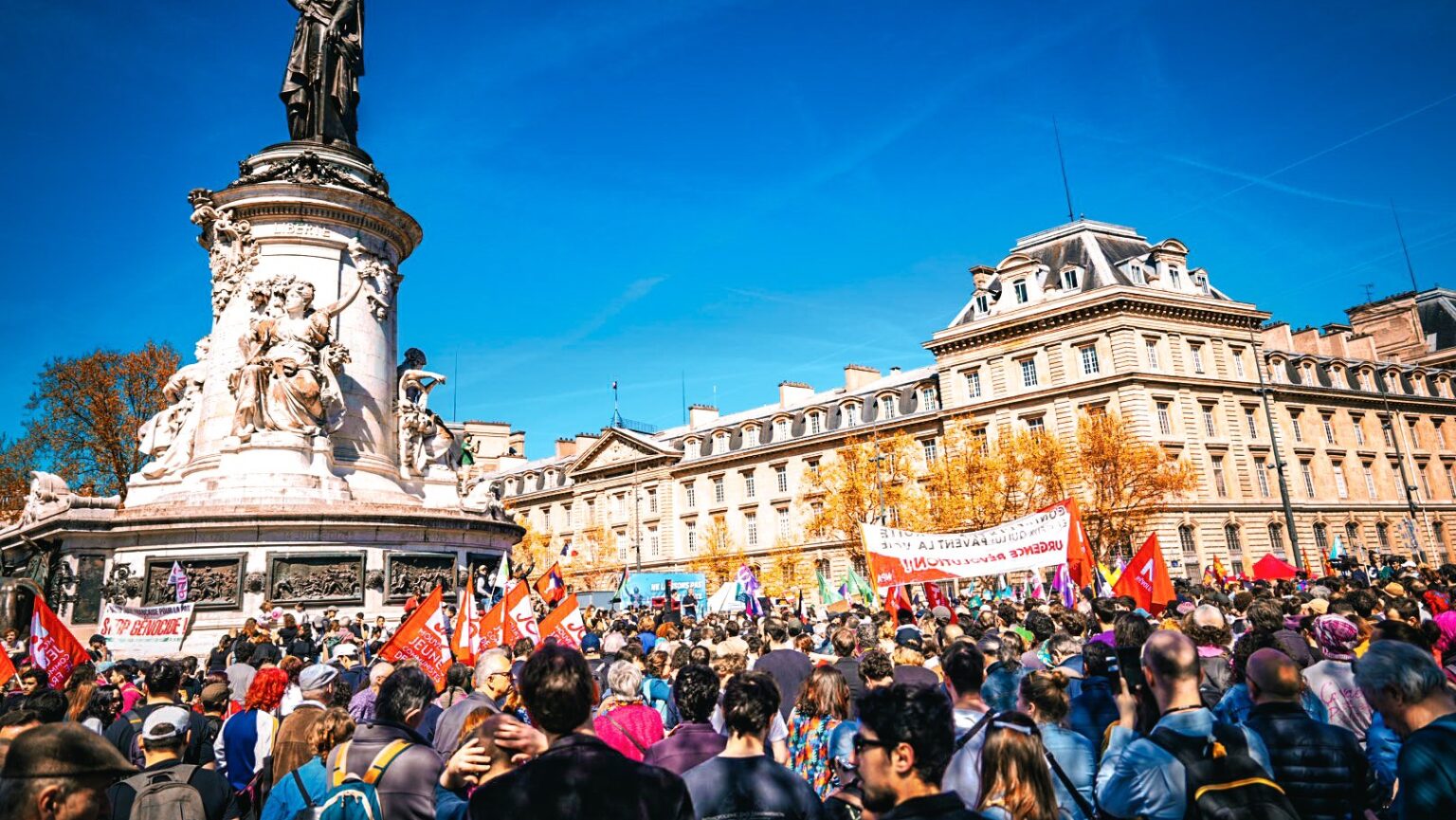
Progressive counter-protest in Paris outnumbers far-right rally
Around 15,000 people mobilized on short notice in Paris to counter far-right attacks on the judiciary following the ruling against Marine Le Pen

April 07, 2025 by Ana Vračar

Image
Anti-far right protest in Paris, April 6, 2025. Source: Bastien Lachaud/X

Approximately 15,000 people responded to a call to action issued by progressive forces and joined a protest in central Paris on April 6, in response to a far-right mobilization organized by the National Rally (Rassemblement National, RN). The counter-demonstration was convened on short notice by youth organizations, France Unbowed (La France Insoumise, LFI), The Ecologists (Les Écologistes), and other allied groups, following the RN’s call for support of Marine Le Pen after she was barred from running for public office in an embezzlement case last week.

The RN used the ruling as an excuse to launch an attack on the judiciary, accusing those who delivered the ruling of bias and political motivation. This rhetoric led to death threats against the judges, who had to be put under police protection. Additionally, far-right figures including MEP Jordan Bardella attempted to discredit the legal process and cast the party as a victim of a politically motivated campaign. As some early commentators suggested, the verdict against Le Pen now appears to be serving as a launchpad for the RN’s presidential campaign ahead of 2027 – regardless of who their candidate will be.

Read more: Marine Le Pen barred from seeking public office in EU funds embezzlement case
However, the far right may have miscalculated. Footage from April 6 showed a larger crowd at the progressive rally than at the RN’s event, despite the former being organized in just a few days. Students, trade unionists, and members of various left-wing parties filled the square, expressing their determination to ensure that the far right’s attacks do not go unchallenged. Many participants described the day as only the beginning of a broader counter-mobilization.

“When the far right announces it will march through the streets, it’s bad news for democracy,” said LFI parliamentarian Manuel Bompard during the demonstration. “When it’s about stopping pension reform, protecting jobs, factories, hospitals, schools, and public services, the far right stays silent. But when it’s about defending their privileges and interests, they’re suddenly here on the streets.”

LFI MEP Manon Aubry added that the RN’s reaction to the ruling only reaffirmed its position within the global far-right bloc threatening democracy and social rights. Progressive leaders noted the party’s double standards: while the RN usually pushes for harsher sentencing and a tough approach to crime, it refuses to accept its own legal accountability. “They are hypocrites on all counts,” Bompard and his colleagues concluded, adding that the RN’s constructed image of respectability – crafted to legitimize its presence in the National Assembly – is quickly falling apart.

“The RN is a dangerous party for democracy and the rule of law,” Bompard warned, urging the public to join future anti-far right demonstrations, especially the upcoming mass mobilization on May 1.

https://peoplesdispatch.org/2025/04/07/ ... ght-rally/
"There is great chaos under heaven; the situation is excellent."

User avatar
blindpig
Posts: 14839
Joined: Fri Jul 14, 2017 5:44 pm
Location: Turtle Island
Contact:

Re: Blues for Europa

Post by blindpig » Wed Apr 09, 2025 2:26 pm

Europe’s Fighting Talk is no Substitute for Hard Power
April 8, 2025
By Matthew Blackburn and Patricia Marins, The National Interest, 3/19/25

Matthew Blackburn is a Senior Researcher at the Norwegian Institute of International Affairs who studies the politics of contemporary Russia and Eurasia, including both domestic politics and interstate relations. Follow him on X: @MJMBlackburn81. Patricia Marins is an independent analyst focusing on defense and security in Europe and Eurasia. Follow her on X: @pati_marins64.

Last week, the chiefs of staff from 34 NATO and European Union states gathered to discuss how a “coalition of the willing’” could secure a possible ceasefire in Ukraine. The absence of any American representatives was telling. Trump’s ground-shaking Russia-Ukraine reset has led to constructive talks with Putin this week, the latter proposing a mutual cessation of attacks on energy infrastructure. Europe, however, still seems to live in a parallel universe.

European leaders have made various bold statements about their readiness to face the Russian threat. Keir Starmer has promised to “stand with Ukraine” and lead a coalition that deploys “boots on the ground and planes in the air.” Emmanuel Macron has offered to extend France’s nuclear umbrella to its European allies. In Paris this week, Macron called for a European coalition to move from “concept to plan” on how to deploy troops and air power to Ukraine as soon as a one-month ceasefire is agreed. Responding to Putin’s equivocal stance on a ceasefire, Starmer claims the coalition will give the “robust and credible security arrangements” needed for a “lasting peace” in Ukraine. In the event of Russian intransigence, the coalition will “ratchet up pressure” on Russia to force them into negotiations.

Europe’s leaders do not seem to realize that the deployment of NATO member troops as “peacekeepers” is almost certainly a non-starter for Russia in any peace deal. The same goes for creating a NATO-patrolled no-fly zone or “sky shield” in Western Ukraine. Russia has fought for three years at considerable expense to stop Ukraine’s “NATOization.” Moscow will not accept a Ukraine that is armed to the teeth with NATO military infrastructure. The Russians would rather fight on to avert such an outcome. The bold talk of this “coalition of the willing,” if adopted by the Zelensky government as conditions for the final deal, may scupper negotiations with Russia.

In the event negotiations fail due to European-backed Ukrainian intransigence, the Trump administration would surely phase out its support, passing the burden to a European coalition. The key problem—usually glossed over in bullish mainstream media coverage of European rhetoric—is if Russia could not be overcome in three years with U.S. support, how can Europe do it alone?

Repeated wild exaggerations of Russian casualties and destroyed equipment may help Western and Ukrainian morale but distort the real balance of forces in this war of attrition. More sober estimates show that, especially if the United States withholds key aid, Ukraine will run out of men, money, and materials far more quickly than Russia. The painful truth is that after decades of “free-riding” under a U.S. security umbrella, any European coalition will be woefully unprepared to step up in Ukraine.

The first problem is raising a European army and deploying it in the field to prevent a collapse in Ukraine’s frontline defenses or—in the event of a ceasefire—deter a future Russian attack. Two prominent analysts have recommended initially deploying a 15,000–20,000-strong force and relocating NATO training and logistic operations within Ukraine itself. This force would not be deployed at the frontlines but in the rear, dispersed so as not to be an easy target for Russian strikes.

Analysts at the influential Center for European Policy Analysis call for a force much larger than 30,000 to be deployed together with NATO air support, electronic warfare (EW) defenses, and reconnaissance platforms. The goal here is for Europe to “impose deterrence” on Russia in Ukraine. A European force will act as a “tripwire” that, in the event of a Russian attack, will set off the use of European air power.

These authors argue that such actions will not cause Russia to take drastic retaliatory action on any “coalition of the willing” entering Ukraine. This is an unsubstantiated hypothesis. Russia already has a battle-hardened army of 700,000 troops, which is expected to expand by 450,000 by 2025. No European country, except Ukraine, has anything resembling this. European states would have to reinstitute conscription and find the funds to recruit contracted soldiers to constitute even a force of 300,000, which a Bruegel report calculated as the minimum needed for basic deterrence.

Even if the soldiers could be found, there are a host of questions about how they would be organized and led. Previous NATO planning assumed American leadership in grand strategy, decision-making, and running military command structures and logistics. Without the United States, Europe has worked out a new system of collective leadership within the Ukraine Defense Contact Group. Devising a multinational command structure without U.S. leadership is an utterly unprecedented challenge for Europe. This new multinational command would not have access to all American intelligence platforms or receive preferential access to the best in U.S. military equipment. Much of the American intelligence, surveillance, and reconnaissance (ISR) support comes from military satellites. European Union countries today have only ten between them.

Finally, in assuming the burden of training and organizing Ukrainian forces, any European coalition must face up to previous failures, such as NATO’s role in preparing Ukraine’s abortive 2023 offensive. Approximately 100,000 Ukrainian recruits have been trained in Europe, with 45,000 going to the UK. NATO instructors lack combat experience in modern warfare. For years, Western armies and their defense industries have concentrated on counterinsurgency operations or mopping up after devasting NATO air power has crushed a much weaker opponent. Taking on a peer adversary like the Russians in a war of attrition is a totally different challenge. NATO currently has a poor understanding of the enemy they intend to confront. To put it frankly, unlike their Russian counterparts, Europe’s generals are not prepared to lead forces in an interstate conflict.

There are also stark deficiencies in European military production. This was masked across 2022 and 2023 by shipping Cold War-era equipment from former Warsaw Pact countries to Ukraine. In 2024, EU countries were unable to deliver on their promise to deliver 1 million artillery shells. It remains to be seen if they can deliver on their higher promised target of 1.5 million in 2025. Russia produces 3 million shells a year and can supplement this with North Korean imports. Over the last year, Ukraine has been sustained by U.S. shipments and its own increasing self-sufficiency in drone production. Europe is not currently able to fill the gap.

Russia’s centralized military-industrial complex is owned by the state. This means the Russian leadership can set production priorities and conduct a long war. In contrast, Europe has a decentralized and privatized military contractor model that makes a war of attrition prohibitively expensive. The Russians pay a quarter of the cost of artillery shells compared to Western allies. Europe’s private defense contractors charge a pretty penny. Rheinmetall recently sold 600,000 30mm rounds to the German Ministry of Defence at a cost of over $1,000 each. Can Europe really afford to sustain a war of attrition at these prices?

Europe’s fundamental deficiency in military production extends to other equipment. Boxer, Europe’s largest European Infantry Fighting Vehicle manufacturer, is expected to produce 200 units this year. It is estimated Europe has around 2,900 battle-ready modern tanks. In contrast, Russia produced around 1,500 tanks in 2024, along with 5,700 armored vehicles and 450 artillery pieces. Russia also has the advantage of being able to recapture and repair its damaged equipment as an advancing army, something denied to the retreating Ukrainians.

Air defense is a serious problem area. Most European air defense systems, such as the IRIS-T and NASAMS, cannot intercept ballistic missiles. Theoretically, the Franco-Italian SAMP/T can, but there is no way to produce it in sufficient amounts. According to the Ukrainian Ministry of Defense, the interception rate of land-launched ballistic missiles was just 4.5 percent, including the use of Patriot batteries. What would this number be if the United States does not continue supplying Patriot batteries? Orders for European air defense missiles such as Aster have a unit cost of $5–5.5 million—a figure that exceeds the average cost of the U.S. Patriot and SM-6 defense missiles.

There is a clear lack of strategic planning and sustainability in European military production. Orders placed over the course of this war do not adequately reflect needs. Ultimately, European leaders hope these problems can all be solved by raising unprecedented sums to spend on defense in the coming years. However, these measures will not help sustain Ukraine in the coming year, during which time Russia may apply critical pressure to break the frontlines. Under the current European defense model, it will take root and branch reform of military procurement and expand capacity to match Russian production. A realistic time frame for European states to reach Russian levels of production in armored vehicles, ammunition, and missiles is not ten months but ten years.

Europe’s leaders are seemingly unwilling to discuss these complex problems. They stick to a simple discourse in which Europe must not “appease” Russian aggression. In recent years, Europe has been stuck in a reactive posture, always one step behind events. This is an obvious legacy of Europe’s long reliance on the U.S. security umbrella. European elites have grown unaccustomed to thinking strategically about hard security in unemotional and non-ideological terms. In contrast, Russia has a strategy and the hard power to support it. Trump’s America also has a strategy, albeit one that is more transactional and ad hoc. Europe is not just a ship without a rudder in strategic terms; it is also not a unified actor like the United States or Russia. How its numerous collective action problems will be solved is an open question.

Despite all this, powerful vested interests lobby for rapid militarization of Europe and the deployment of a “coalition of the willing” in Ukraine, even if it risks dangerous escalation and prolongs the war. Even though European leaders have responded with brave fighting talk, they are surely aware that European states are not capable of shifting the balance of forces in Ukraine. A European coalition would be too weak to stand on its two feet.

If it came to a showdown with Russia—or with America on NATO spending or trade tariffs—there is every reason to expect Europe to blink first. All of this makes it very likely that European leaders will continue to defer to Washington in the coming years. Meanwhile, there are cautious grounds for optimism on securing a deal in Ukraine. Trump’s new diplomacy massively reduces the risk of full-scale U.S.-Russia conflagration. All actors involved, including Russia, have strong incentives to prevent Ukraine’s collapse as a state.

Instead of unconvincingly pumping out their chests, European leaders should engage in constructive diplomacy. While they are understandably reluctant to talk openly about their hard power impotence, there is a yawning gap between rhetoric and reality that must be bridged sooner or later. The reluctance to come clean may reflect hedging until the outcome of talks becomes clear or simply a fear that a major narrative shift will wreck European unity.

While it may be painful and distasteful, the way out of European fear and hesitancy is diplomacy and compromise. This means reestablishing direct contact with Moscow. Europe’s leaders owe their electorates an overdue reality check on the Ukraine war. Bluffs and empty threats must not be allowed to close the current narrow opening for a diplomatic end to this war.

https://natyliesbaldwin.com/2025/04/eur ... ard-power/

*****

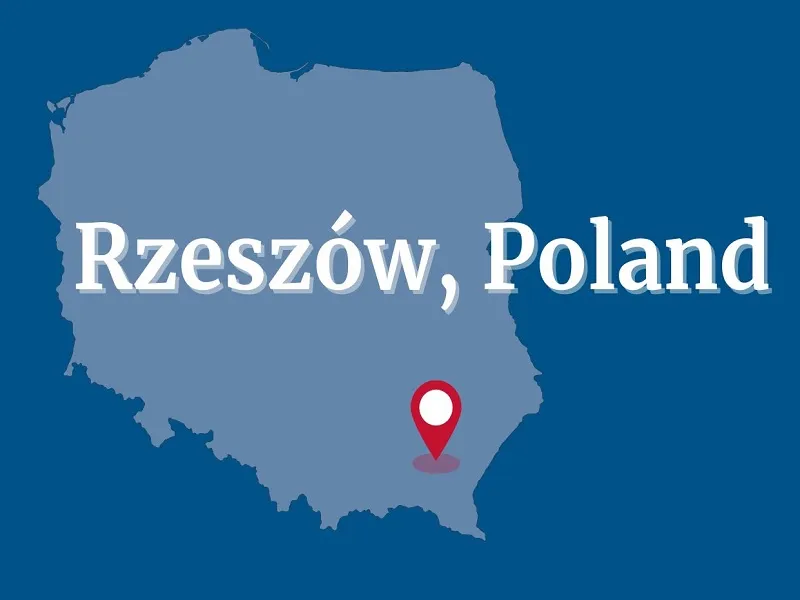
What Comes Next After The US’ Withdrawal From Poland’s Rzeszow Logistics Hub For Ukraine?
Andrew Korybko
Apr 09, 2025

Image

This is meant to symbolize the reduction of American military aid to Kiev, not function as the first step towards a complete withdrawal from Poland or Central & Eastern Europe as a whole.

The Pentagon announced on Monday that US forces will withdraw from Poland’s Rzeszow logistics hub for Ukraine and reposition elsewhere in the country according to (a hitherto undisclosed) plan. This was then followed the day after by NBC News reporting that Trump might soon withdraw half of the 20,000 US troops that Biden sent to Central & Eastern Europe (CEE) since 2022. According to their sources, the bulk will be pulled from Poland and Romania, the two largest countries on NATO’s eastern flank.

The Polish President, Prime Minister, and Defense Minister were all quick to claim that Monday’s repositioning doesn’t amount to nor presages a withdrawal of US forces from Poland, but speculation still swirls about Trump’s plans considering the nascent Russian-US “New Détente”. Putin requested in late 2021 that the US remove its forces from CEE so as to restore Washington’s compliance with the 1997 NATO-Russia Founding Act whose many violations worsened the Russian-US security dilemma.

Biden’s refusal to discuss this helped make the latest phase of the now over-decade-long Ukrainian Conflict inevitable by convincing Putin that what would soon be known as the special operation was the only way to restore the increasingly lopsided strategic balance between Russia and the US. Unlike Biden, Trump appears open to at least partial compliance with Putin’s request, which could become one among several pragmatic mutual compromises that they’re negotiating to normalize ties and end the proxy war.

It was assessed in late February that “Trump Is Unlikely To Pull All US Troops Out Of Central Europe Or Abandon NATO’s Article 5”, but he’ll probably withdraw some of them from there for redeployment to Asia in order to more muscularly contain China as part of his administration’s planned eastern pivot. There are currently around 10,000 US troops in Poland, up from approximately 4,500 before the special operation, so some could hypothetically be cut but still leave with Poland more than before 2022.

Poland’s outgoing conservative president wants as many US troops as possible, including the redeployment of some from Germany, while its incumbent liberal Prime Minister is flirting with the possibility of either relying on France to balance the US or outright pivoting towards the former. The outcome of next month’s presidential election will play a huge role in determining Polish policy in this regard and could be influenced by perceptions (accurate or not) of America abandoning Poland.

Any curtailment of US troops in Poland or the public’s belief that this is inevitable could play to the pro-European liberal candidate’s favor while an explicit confirmation of the US’ commitment to retain – let alone expand – the existing level could help the pro-American conservative and populist ones. Even if Poland’s next president is a liberal, however, the US might still be able to count on the country as its regional bastion of military and political influence if the Trump Administration plays its cards rights.

For that to happen, the US would have to retain more troops there than it had before 2022 even if some are withdrawn, ensure that this level remains above any other CEE country’s, and transfer some military technologies for joint production. The first imperative would psychologically reassure the politically Russophobic population that they won’t be abandoned, the second relates to their regional prestige, and the third would keep CEE within the US military-industrial ecosystem amidst EU competition.

This could be sufficient for counteracting the liberals’ possible plans to pivot towards France at the expense of the US’ influence or maintaining the US’ predominant position in Poland if a liberal President works with his like-minded Prime Minister to rely on France for balancing the US a bit. Even if the Trump Administration fumbles this opportunity due to a lack of vision or a fully liberal government in Poland picks fights with the US for ideological reasons, the US isn’t expected to completely dump Poland.

The vast majority of Poland’s military equipment is American, which will at the very least lead to the continued supply of spare parts and likely lay the basis for even more arms deals. US forces are also currently based in almost a dozen facilities across the country, and the advisory role that some play helps shape Poland’s outlook, strategies, and tactics during its ongoing military buildup. There’s accordingly no reason why the US would voluntarily cede such influence over what’s now NATO’s third-largest military.

As such, the most radical scenario of a full-blown liberal-led Polish pivot towards France would be limited by the impracticality of replacing American military wares with French ones anytime soon, with the furthest that this might go being the hosting of nuclear-equipped Rafale fighters. Poland could also invite some French troops into the country, including for advisory purposes, and maybe even sign a few arms deals. It won’t, however, ask US forces to leave since it wants to preserve their tripwire potential.

With the interplay of these interests in mind, it can be concluded that the US’ withdrawal from Poland’s Rzeszow logistics facility for Ukraine is meant to symbolize the reduction of American military aid to Kiev, not function as the first step towards a complete withdrawal from Poland or CEE as a whole. While some regional US troop reductions are possible as one among several pragmatic compromises that Trump might agree to with Putin for normalizing ties and ending the proxy war, a full pullout isn’t expected.

https://korybko.substack.com/p/what-com ... withdrawal

******

Everything Going To Plan For The German Oligarchy

Fascism is What Happens When Liberal "Democracy" Fails the Oligarchy
Roger Boyd
Apr 09, 2025

Image

As I have written before, the German Nazi party was both supported and actively aided by sections of the German oligarchy (a coalition of the bourgeoisie and the Junker large land owners created by Bismarck) during its early years to be maintained as a possible alternative to social democracy. With the 1929 Great Depression and the resultant threat to ruling class legitimacy, much greater support was given to the Nazi Party. When that failed to get the Nazi Party elected in the second election of 1932, when the Nazi Party vote actually fell (from 37.3% to 33.1%), the oligarchy quickly installed Hitler as Chancellor. The Industrielleneingabe, signed by 22 major representatives of the German oligarchy, was sent to President Hindenburg requesting the appointment of Hitler; as Hindenburg was himself a member of the oligarchy he obeyed his instructions. Hitler was appointed Chancellor on January 30th, 1933, he was never elected to that position.

The Nazis then carried out a false flag arson attack on the Reichstag that February (which facilitated the exclusion of the Communist Party from the Reichstag), together with widespread voter intimidation, to gain a vote of 43.9% in the March 1933 election. The Centre Party and Conservatives then voted with the Nazis for the Enabling Act of March 23rd that provided Hitler with dictatorial powers. The oligarchy had effectively used the window of time available to install what they considered to be their dictator. Between June 30th and July 2nd 1934, Hitler confirmed his service to the oligarchy by destroying the much more working class and revolutionary SA in what became known as the Night of the Long Knives. The oligarchy then made huge profits until the end of WW2, after which most managed to stay out of prison and hide and maintain much of their wealth (the basis of the post-war German “Miracle” Years).

As I have written elsewhere, the AfD is a creature of the German oligarchy, founded by five neoliberal extremist professors and funded by a representative of the oligarchy residing in Switzerland; whose grandfather was a banker during the Nazi years who worked closely with Hitler. Its populism is as fake as the Nazi populism, and it jumped on the anti-immigrant bandwagon to help it rise in the polls. Just like the Nazi Party before, the AfD is a fascist option funded by the German oligarchy as a possible fall-back if the performative bourgeois “democracy” fails them.

With the recent 2025 elections the AfD gained a record 20.8% of the popular vote, while the CDU/CSU (neoliberal conservatives) gained 28.5%, the SPD (neoliberal bourgeois progressive) 16.4%, the Green Party (neoliberal bourgeois progressive war monger environmental) 11.6%, and Die Linke (bourgeois progressive fake left) 8.8%. The CDU/CSU and SPD then formed a ruling coalition. Then a strange thing happened, the CDU/CSU leader Merz (previously a corporate lawyer and chairman of Blackrock Germany, made rich as an oligarch courtier) threw away his avowed fiscal conservatism and in a deal with the SPD and Green Party utilized the short period before the new Bundestag was convened to push through a constitutional change that allowed for massive new war and infrastructure spending. The AfD and Die Linke could have stopped this by forcing the immediate convening of the newly elected Bundestag but they did not; showing their connivance in this oligarch move which was in direct opposition to the will of the electorate.

Why did Merz do this? He is mirroring the actions of Hitler who initiated massive war and infrastructure spending to reinvigorate the profits of German capital. The country’s leading industries of car manufacturing, heavy industry, machine tools and petrochemicals have been beset by the high energy prices stemming from the anti-Russian sanctions and Nordstream destruction, the loss of Russian markets, intensifying Chinese competition, and now Trump’s 20% EU tariff and 25% tariff on imported cars. The war spending budget increases, and what amounts to a massive corporate “infrastructure” slush fund, will provide many new avenues of profiteering for the German bourgeoisie. From ploughshares to weapons, or as already raised by VW, from cars to weapons. The ruling coalition has already made it clear that this will not be paid for by any new taxes on the rich, but rather by increased debt and austerity for the rest. Showing the increasing rentier and exploitive nature of the German oligarchy.

This Merz driven about face is of course electoral poison for the parties involved (CDU/CSU, SPD and Green Party) but they are dutifully following the wishes of the German oligarchy. After four years of such policies these parties may be completely delegitimized and the German voters driven to look for an alternative. This is where the shenanigans utilized to keep the real left-wing party, the BSW, out of the Bundestag were important as removing a left wing alternative from any prominence and parliamentary presence. Very strangely, the fake left Die Linke enjoyed a major electoral resurgence in the last days of the election. So, the only real “alternative” that the German oligarchy want to be available for the German electorate is the AfD. Ready to implement much greater levels of authoritarianism as austerity for the masses is fully driven home.

But the AfD are against the war on Russia, are they not? Well, four years from now after huge amounts have been spent rebuilding and rearming the German Army, the militarization of the country will be a de facto reality; and the Russo-Ukrainian War will either be over or escalated into something else. If elected in 2029, the AfD can just hold up its hands and say “what can we do?”

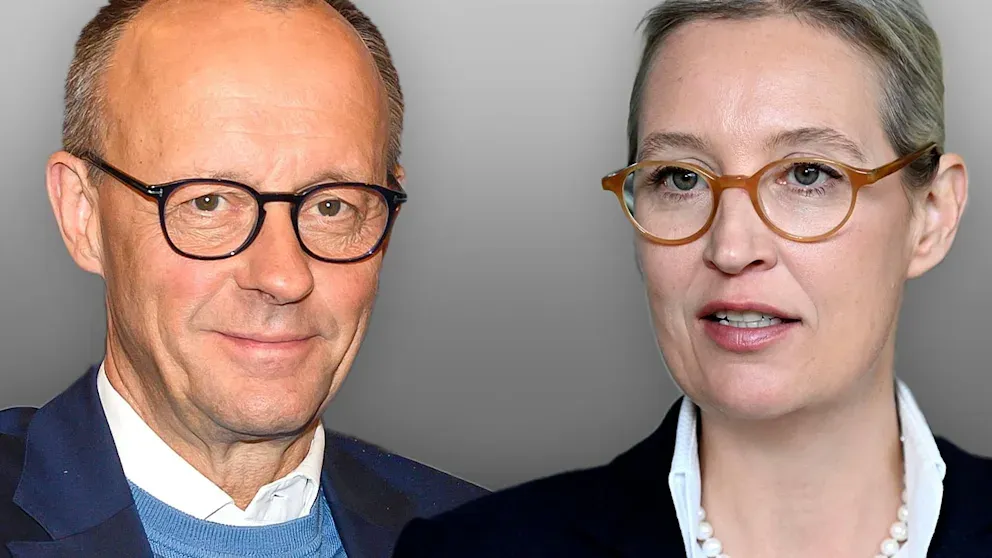
Just as with the Nazi Party of the early 1930s, the AfD is split between the neoliberal oligarch serving wing (lead by co-leader Weidel) and the more populist wing (lead by co-leader Tino Chrupalla). In the 2025 election, it was Weidel who was put forward as prospective Chancellor; the same can be expected in 2029. Weidel has worked hard to keep her Sri-Lankan born wife and their two adopted children hidden away from scrutiny in Switzerland, and also her Hitler-appointed Nazi judge grandfather. In a discussion with Elon Musk she agreed that Germany needs to get over its “Nazi Guilt” and also preposterously stated that Hitler was a communist; something she obviously knows not to be true given her extensive political education.

The polls are already moving against the CDU/CSU which recently polled only 24%, with the main beneficiaries being the AfD which has drawn level with the CDU/CSU at 24%, and the fake left Die Linke at 11%. And the BSW gained nothing and stayed below the 5% vote share margin required to get seats in the Bundestag. If everything continues to plan, the 2029 elections will result in a coalition between the diminished CDU/CSU (after doing the oligarch’s dirty work) and a surging AfD with the oligarch-tool Weidel becoming chancellor. If needed, perhaps the neoliberal FDP could be nudged above the 5% electoral level to help bring in Chancellor Weidel. All ready, just as Hitler did, to crush dissent and continue with the intensified austerity for the rest while the oligarchs enrich themselves at the state trough.

The AfD co-chair Chrupalla is a problem for the oligarchs not just because he might get in the way of Weidel’s elevation. He is not a warmonger and favours friendly relations with both Russia and China, while recently changing his stance on Israel to one of opposition to the Zionist genocide and rejecting “blanket Islamophobia”. He comes from an East German working class background rather than from Weidel’s elitist one. The oligarch-controlled German media has worked, and is working, very hard to give prominence to Weidel and give much less coverage to Chrupalla.

The end result of the German oligarchy’s plan will be to significantly weaken Germany as a nation, while they maintain their wealth through profiteering off government largesse and rentier activities; a hollowed out Germany. Just like a UK which may very well be handed over to the oligarch-tool Farage and the fake populist Reform UK at the next UK elections in 2029. For China, Russia and Iran this will be an acceptable outcome, as a major part of the US Empire moves to weaken itself just as it is being weakened by the US oligarchy. All good for the fall of the US Empire and a turn to a truly multi-polar world.

https://rogerboyd.substack.com/p/everyt ... an-for-the

******

Patrick Lawrence: The Lost Man of Europe
April 8, 2025

Germany demonstrates the Continent’s abandonment of its honorable social-democratic traditions and its embrace, with the zealotry of the convert, of the neoliberalism of the Anglosphere.

Image
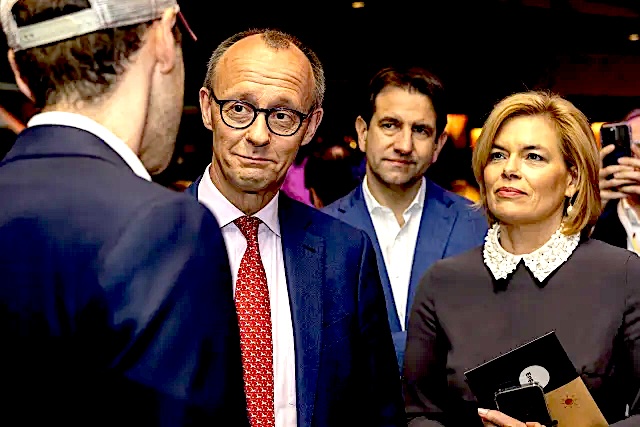
Friedrich Merz, Julia Klöckner; CDU ZUKUNFTSKONGRESS am 27.04.2023 in Berlin. (Dr. Frank Gaeth/Wikimedia Commons/CC BY-SA 4.0)

The first in a series of articles on Germany.

By Patrick Lawrence
ScheerPost

Of the many things said — insightful things, wise things, some foolish things — as the results of Germany’s national elections arrived on Sunday evening, Feb. 23, the most remarkable to me was the exclamation of the Federal Republic’s new chancellor-to-be.

“We have won it,” Friedrich Merz declared before his supporters in Berlin as the exit polls, which proved accurate, gave the conservative Christian Democratic Union the largest share of the vote.

Merz is one of those political figures given to speaking before he thinks, and nobody seems to have taken this outburst as anything more than the election-night utterance of an exuberant victor. I heard it differently.

To me, Merz’s four words betrayed a nation in crisis: its politics and economy in disarray, its visionless leadership, its pervasive malaise, the deepening fractures among Germany’s 83 million people — Germany’s inability, let’s say, to talk to itself or understand, even, what it means to say, “We have won it.”

The low-minded Merz’s “we” means the CDU, which he leads, and its longtime partner, the Christian Social Union. But how narrow a notion of winning is this for someone who purports to be not merely a national leader but a leader of Europe?

The CDU/CSU won not quite 29 percent of the vote, just enough to form a new governing coalition. That leaves 71 percent of German voters who didn’t win anything.

The next chancellor’s “we” — to go straight to the larger significance of the German elections — should alarm all of us across the West, not only in Germany, given where Merz and his coalition partners intend to lead the Federal Republic.

They have made their radical intent clear even before Merz formally assumes office. It is to dismantle the most advanced social democracy in Europe in favor of a swift, radical rearmament — shocking all by itself given Germany’s history — and a return to the Cold War’s ever-perilous hostilities.

The speed of this turn appears to be taking everyone by surprise: On Monday, April 1, the Bundeswehr began stationing an armored brigade in Lithuania, the first long-term deployment of German troops abroad since World War II.

History, which I invoke throughout this series, haunts this transformative moment like a ghost.

Many are they who saw in the postwar republic a promise that the transatlantic world could take a new direction, that the West might cultivate — I’ll go to shorthand here — a more humanist, or humanized, form of democracy.

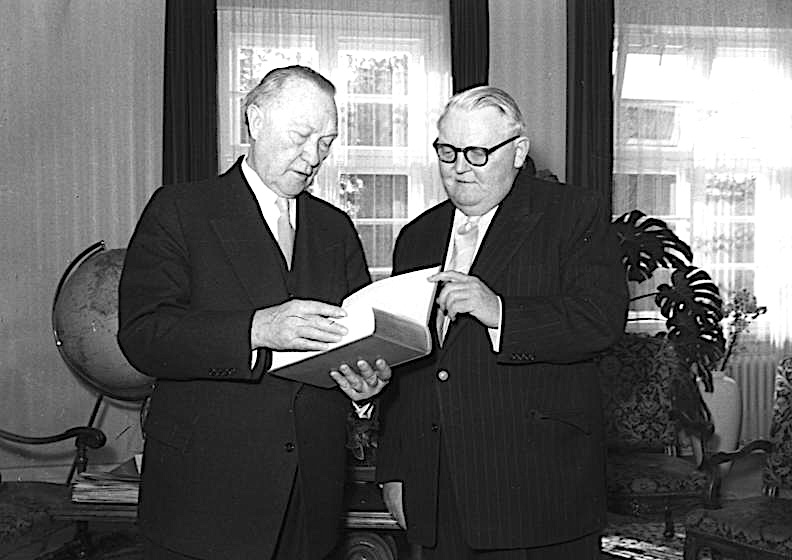
In the 1960s, Ludwig Erhard, economics minister under Konrad Adenauer, fashioned the soziale Marktwirtschaft, the social market economy, a model considerably at variance with the free-market fundamentalism the United States was by then imposing upon the world.

It made unions powerful and gave workers seats on corporate boards, among much else, and in so doing prompted the thought that Europe’s social-democratic tradition might at last tame capitalism’s excesses.

Image
Adenauer and Erhard in 1956. (Bundesarchiv/Wikimedia Commons/ CC-BY-SA 3.0, CC BY-SA 3.0 de)

Ostpolitik

In the late 1960s, Willy Brandt, the Social Democratic foreign minister and subsequently chancellor, developed his long-celebrated Ostpolitik, a policy that opened the Federal Republic to its East Bloc neighbors and the Soviet Union.

This was a rejection not only of Washington’s Cold War binary; more than this, it was a decisive reply to the anti–Russian animus that has scarred German history for a century.

To know this history now is to recognize the February elections as a defeat of considerable magnitude that extends, again, well beyond what was so recently Europe’s most powerful nation.

Friedrich Merz and his coalition partners — who will include a Social Democratic Party that has cravenly repudiated the very tradition it once championed — has abandoned more, much more than the Federal Republic’s past.

Anyone who entertained hope that the Continent might serve as a guide to a more orderly world is in some way bereft now, left with one less reason to hope the wandering West will find its way beyond the cycle of decline into which it has fallen.

Image
Brandt, left, and Willi Stoph in Erfurt 1970, the first encounter of a federal chancellor with his East German counterpart, an early step in the de-escalation of the Cold War. (Bundesarchiv, CC-BY-SA 3.0, Wikimedia Commons)

Merz is a man of contradictions, which admittedly does not distinguish him among centrist politicians in Germany or anywhere else in the West. He will be distinguished now as the German people’s hopelessly contradictory leader.

His most pressing domestic responsibility is to revive an economy the coalition of neoliberals led by his hapless predecessor, Olaf Scholz, has driven very nearly into the ground. Take your seats as this disaster in the making unfolds.

Merz is a virulent Russophobe — he is as vigorous in this as any postwar political figure, I am told — and he is strongly committed to escalating Germany’s support for the war in Ukraine.

But bringing the German economy back to life simply cannot be done unless Germany determines to restore its dense, altogether natural interdependence with Russia, notably but not only on the energy side.

The resort to building a trillion-euro war machine is a beyond-words act of political desperation: The extent to which it succeeds as economic stimulus will be the extent to which it destroys German social democracy while — not to be missed — burdening the government with enormous debt.

As to the folly of the U.S.–inspired proxy war in Ukraine, each commitment the new government makes to continued support of the corrupt, Nazified regime in Kiev — financial support, military support, political support, diplomatic support — will alienate a greater proportion of the German citizenry.

Unable to Change

Image
Ukrainian President Volodymyr Zelensky with Merz in Kiev on Dec. 9, 2024. (President Of Ukraine/Wikimedia Commons/CC0)

Germany’s predicament is the West’s, cast merely in higher relief: It must change, it must find a new direction — its voters demand these things — but Germany as its leadership is currently constituted cannot change.

Germany is arguably singular among the Western powers in that treading water — the ceaseless see-saw of the centrists, if I may mix metaphors — is no longer a workable dodge. The nation simply does not have time for that if it is to avoid an ever-increasing rate of decline.

A remarkable number of German voters switched in February from one party to another — voter migration, this phenomenon is called — in what looks to the naked eye like a perverse game of hopscotch.

Most of the voters who abandoned the Social Democrats — and there were very many, as a collapse in the SPD’s support indicates — went to either the CDU/CSU (the latter rooted in conservative and Catholic Bavaria) or — believe it or not — to the Alternativ für Deutschland (AfD), the populist, right-wing nemesis of the long-reigning Social Democrats.

It gets yet odder, according to an analysis cited by an election-night commentator named Florian Rötzer:

“Many from the CDU/CSU did indeed switch to the AfD, but strangely enough also to The Left (Die Linke) and the BSW [the left-populist Bündnis Sahra Wagenknecht]. The Left gained massively, but former [Die Linke] voters switched to the AfD to a lesser extent and to the BSW to a greater extent.”

As to Die Grünen, the now-ridiculous Greens — along with the Social Democrats the big losers Feb. 23 — they surrendered voters to Die Linke, a predictable-enough move, but also to the AfD.

I do not see that this impossible-to-read pattern can be marked down as anything other than a shared desperation. And now look. The coalition Merz is about to form with the Social Democrats betrays what appears to be a preposterous indifference to what German voters have just spoken.

But in my read, it is better understood as a measure of fear among Germany’s governing elites. The SPD fell to third place in the German political constellation, with 30 fewer seats in the Bundestag than the AfD. But the latter, now Germany’s No. 2 party, will be blocked from the government by means of the antidemocratic “firewall” Germany’s neoliberal centrists show no sign of removing.

In net terms: The government that collapsed last autumn, a nominally left-of-center coalition of neoliberal parties led by Social Democrats, will now be succeeded by a coalition of neoliberal parties led by the right-of-center Christian Democrats almost certain to include the Social Democrats.

This will be a straight reproduction of the hugely unpopular alliance that governed until 2021. The European version of Tweedle–Dee and Tweedle–Dum has never looked neater.

Long before the February elections, when it was already clear that inept neoliberal leadership had recklessly damaged the economy out of sheer ideological fervor, commentators of various stripes took to calling the Federal Republic the sick man of Europe.

We can do better than that tired cliché now: Germany is more usefully considered the lost man of Europe.

Here is Patrik Baab, a prominent German journalist and author — and a man of demonstrated integrity in his judgments, I will add — on election night:

“The Germans did not choose stagnation this evening, but decline. A people is leading itself to its own downfall. We will now get more of the same. The war policy of the European elites is to be continued. The economic decline will continue because cheap energy and therefore a good relationship with Russia are needed to revive the economy. There will be no change in that at the moment….”

I would add to Patrik’s succinct take only that, however much Germans are marching toward their downfall, I see the nation’s immovable neoliberal centrists at the head of the column.

Postwar Germany was arguably, and I would make this argument without hesitation, the very epitome of Europe’s profound commitment to a social-democratic ethos, inflected with Christian social doctrine in the German case, that has its roots in the ferment of 19th century Continental politics.

France and Germany stood, each differently, as the clearest expressions of the distance the Europeans kept from Anglo–American liberalism, neoliberalism as we call its descendant.

The place of the individual was different one side or the other of the English Channel. Liberty was achieved by way of the polity, not by way of freedom from it. Limits were imposed on the operations of capital. The Europeans’ political economy was, altogether, of a more humane order.

Now Germany demonstrates the Continent’s abandonment of its honorable social-democratic traditions and its embrace, with the zealotry of the convert, of the neoliberalism with which the Anglosphere has burdened the Western world.

When, why, and how did neoliberal ideology cross the Channel — or, more likely, the Atlantic? I am not an economic historian, but I recall detecting this ideological migration during the first post–Cold War decade, when America’s triumphalism was running wild.

The financial crises of our century, needless to say, have consolidated the place of the Continent’s neoliberal elites — those we call austerians when their ideology is transposed into policy.

Courtesy of close friends and colleagues, I spent time in Germany in the months leading up to the February elections. I posed a thousand questions to people from whose insights I benefited greatly.

And the question that pressed itself upon me so insistently was: How was it that Germany has come so far from what it once was? I will turn this insistent question this way and that in the reports that follow.

https://consortiumnews.com/2025/04/08/p ... of-europe/
"There is great chaos under heaven; the situation is excellent."

User avatar
blindpig
Posts: 14839
Joined: Fri Jul 14, 2017 5:44 pm
Location: Turtle Island
Contact:

Re: Blues for Europa

Post by blindpig » Fri Apr 11, 2025 2:26 pm

The first ‘Twitter revolution’ against the Communist Party: What happened in Moldova 16 years ago?

Erkin Oncan

April 10, 2025

In April 2009, Moldova experienced one of the most turbulent and controversial political crises since gaining independence in 1991.

In April 2009, Moldova experienced one of the most turbulent and controversial political crises since gaining independence in 1991. Following the parliamentary elections held on April 5, in which the Party of Communists of the Republic of Moldova (PCRM) declared victory, protests erupted across the country amid allegations of electoral fraud and soon escalated into violent clashes.

While the protests, which took place mainly in the capital Chișinău, as well as in Bălți and other cities, were referred to domestically as the “Grape Revolution,” they became more widely known as the “Twitter Revolution” due to being organized via social media.

In fact, the anti-communist demonstrations in Moldova can be considered the first mass protest movement organized through Twitter (now X). While Twitter had been used during the 2008 U.S. presidential elections, the Russia–Georgia war, and student protests in Greece the same year, Facebook and blogs were still more popular at the time. Moldova was the first instance where Twitter was successfully used to mobilize large-scale collective action.

On April 6, people took to the streets after preliminary results indicated that the PCRM had secured nearly 50% of the vote. The protests were fueled by the party’s declaration of victory before official results were released. According to the final results, PCRM received 49.48% of the vote, securing 60 out of 101 parliamentary seats.

Crucially, the PCRM fell just one seat short of the 61-seat majority required by the Moldovan Constitution to elect the president.

Although the OSCE Election Observation Mission stated that the elections were generally free and fair, opposition parties — the Liberal Party (PL), the Liberal Democratic Party (PLDM), and the Our Moldova Alliance (AMN) — rejected the results. They claimed electoral fraud and called for the annulment of the elections, a recount, or a new vote.

Tensions further escalated due to a reported discrepancy of 160,000 voters between data from the Ministry of Internal Affairs and local electoral records. Additional unverified claims — such as allegations that some voters received multiple ballots — fueled the fraud narrative.

What began on April 6 quickly grew into a mass protest with more than 30,000 participants the following day. Journalist Natalia Morar, one of the movement’s leaders, organized the demonstrations via Facebook, Twitter, and SMS — a key reason the events were dubbed the “Twitter Revolution.”

Although the protests started peacefully, as is typical in former Soviet states, they soon turned into clashes with security forces. Despite using tear gas and water cannons, police were forced to retreat in the face of overwhelming protester numbers.

Protesters stormed the Presidential Palace and the Parliament building, setting them on fire. Many demonstrators — mostly youth — waved Romanian and European Union flags and chanted slogans such as “We want Europe,” “We are Romanians,” and “Down with Communism.” The Moldovan flag was replaced with Romanian and EU flags.

On the night of April 7, police cracked down and detained over 200 protesters. The Ministry of Internal Affairs reported a total of 295 detentions, but human rights organizations claimed the actual number was much higher.

Amnesty International accused the Moldovan government of arbitrarily detaining hundreds of protesters, including minors, and of committing acts of torture. The UN Human Rights Office reported that most detainees suffered physical abuse and were denied access to legal counsel. At the same time, international media published unconfirmed reports that around 800 people were missing.

Several Romanian journalists claimed they were threatened and detained in Moldova. On April 10, Rodica Mahu, editor-in-chief of Jurnal de Chișinău, and Doru Dendiu, a correspondent for Romanian TVR, were arrested. Both were released the same day, but Dendiu was ordered to leave the country. Morar was placed under house arrest. During this period, internet access was also restricted in Chișinău.

The death of 23-year-old Valeriu Boboc during the protests — allegedly due to police brutality — caused public outrage. Although officials stated that the cause of death was poisoning, Boboc’s family claimed he was beaten to death, citing visible injuries on his body.

On April 15, President Vladimir Voronin announced a general amnesty for protesters. However, the opposition argued that the amnesty was not enforced and that arrests continued.

The Moldovan Prosecutor General accused businessman Gabriel Stati of financing the protests and requested his extradition from Ukraine. Stati was arrested in Odessa and extradited to Moldova, where he remained in detention until June 2009.

Moldovan authorities also accused Romania of orchestrating the protests and expelled the Romanian ambassador in Chișinău. Romania denied all allegations.

These events marked the beginning of the fall of communist rule in Moldova. As polarization reached a breaking point, the Moldovan Parliament was unable to elect a new president. The parliament was subsequently dissolved, and new elections were held on July 29, 2009. While the Communist Party again received the highest vote share (44.7%) and secured 48 seats, the remaining 53 seats went to four opposition parties. These parties formed the Alliance for European Integration, pushing the communists — in power since 2001 — into opposition.

The historical bond between Moldova and Romania dates back to the mid-19th century. The foundations of the Kingdom of Romania were laid in 1859 with the Union of the Principalities. After World War I, Romania annexed Bessarabia — a region that today comprises most of modern-day Moldova — in 1918. However, under the terms of the Molotov-Ribbentrop Pact, Bessarabia was ceded to the Soviet Union in 1940, and the Moldavian Soviet Socialist Republic was established.

This moment marked the beginning of the “duality” that Moldova has exhibited politically, culturally, and in terms of identity — a division that goes beyond questions of language or affiliation and has become a matter of geopolitical orientation.

On one side are the nationalists who emphasize their “Romanian roots” and advocate for integration with Europe. On the other are Moldovans shaped by the Soviet past, who stress a distinct Moldovan identity and, in today’s political landscape, lean toward Russia — including opposition-minded Moldovans, Russians in Transnistria, and the Gagauz Turks.

As in almost every country in the region, Moldova has been caught in the binary of a Western-oriented government and a Russia-aligned opposition. This dichotomy is deepened by the historical relationship between Moldova and Romania.

Today, as the balance of power shifts in Moldova, the 2009 protests are often cited critically by the pro-Western government of Maia Sandu. However, the followers of the 50 percent who voted the Communist Party into power 16 years ago see those events as the beginning of a process in which the country was destabilized by foreign intervention.

https://strategic-culture.su/news/2025/ ... years-ago/

******

Fools and Roads in Romania
April 9, 2025
Rybar

The major NATO exercise Dacian Spring 25 , which was to take place in Romania from May 5 to 25, has been cancelled. The reason is bad roads, the modernization of which was sabotaged by the Romanian authorities.

What's happened?
Over the past year, representatives from France, Belgium and Luxembourg have been asking the Romanian government and local authorities to upgrade roads, bridges and culverts for the exercises.

The sections of unpaved roads in Brasov, Cîrțișoara, Fagaras, as well as two bridges in the commune of Chinca and a bridge over the Olt River to the commune of Vualea were found to be unsatisfactory. The NATO group was supposed to deploy from the Chincu military base in Brasov County through these points. However, the infrastructure would not have been able to withstand the passage of a large number of heavy vehicles.

Exercise plan and the role of France
The exercise would see the French-led NATO battle group in Romania reach brigade level. The French planned to send at least 2,000 troops to Cinca and other Romanian training grounds, in addition to the 1,500 they already had.

They were to be joined by other troops from NATO countries, bringing the group to 4,000 . Their task was to practice rapid deployment in Romania and conduct defense missions.

However, in March 2025, the French leadership announced a postponement of the deployment of French troops in Romania until the fall.

According to some reports, the Romanian Ministry of Defense is requesting 1.3 million euros for the repair of just two facilities, but Bucharest has not yet decided in a year what sources to allocate the funds from.

However, France has a different opinion about the disruption of the exercises: they claim that Bucharest asked to postpone them until the fall because of the presidential elections , which will take place in May.

Nevertheless, it is obvious that the lack of roads for the rapid movement of troops is NATO’s main headache ( we just recently wrote about similar problems in Germany ).

It is indicative of the “enthusiasm” with which Romania solves such problems when the authorities and the alliance frighten with the “Russian threat”.

https://rybar.ru/duraki-i-dorogi-v-rumynii/

Drown on suspicion: About another Estonian initiative
April 10, 2025
Rybar

Yesterday, the Estonian parliament passed a bill giving the country's navy the right to use force against ships suspected of "intent to damage underwater cables and other Estonian infrastructure," up to and including sinking them.

The document will only come into force after it is signed by the president, so in the regional segment, this is still being discussed in a hypothetical manner. However, the National Defense Committee is already paying attention to the "sharp corners."

What's wrong with the bill?
According to the text, extreme measures will be used only if it is impossible to prevent the threat by other means, and the possible damage from the ship's actions is higher than the damage from its destruction. That is, the ship will not be sunk due to the sole intention to damage underwater cables.

Some experts see the initiative as ill-considered in terms of compliance with maritime and trade law and a threat to private interests. Especially since the Estonians want to apply “necessary measures” not only in their internal waters, but also in the exclusive economic zone.

The order of actions of the person making the decision to strike and his subsequent responsibility for both the hypothetical error and the possible damage to the environment from the sinking of the vessel are unclear. And Estonian lawyers were somewhat stupefied by the wording “seemed suspicious”.

Finally, the Estonian Navy's capabilities for such actions are very limited, so Tallinn is counting on help from Finland, Sweden and other allies. However, those countries have not yet made any comments on this matter.

Be that as it may, the bill is not a reason to laugh: tensions in the region are growing, and Europe is becoming increasingly insistent in its desire to prevent oil exports from Russia, a significant part of which comes from ports on the Baltic.

Given the meager capabilities of the Estonian Armed Forces, a legislative framework is being created for piracy against Russian tankers. It is unlikely that they will resort to it for now, but NATO’s desire to act on the edge of what is acceptable is already evident.

The only way to effectively combat this is through active actions by the Navy and Coast Guard. Sitting back and relying solely on maritime law will not work, as demonstrated by the episodes of detention of Russian ships in the Baltic and the Estonian bills.

https://rybar.ru/topit-po-podozreniyu-o ... icziative/

Google Translator
"There is great chaos under heaven; the situation is excellent."

User avatar
blindpig
Posts: 14839
Joined: Fri Jul 14, 2017 5:44 pm
Location: Turtle Island
Contact:

Re: Blues for Europa

Post by blindpig » Tue Apr 15, 2025 1:27 pm

The French Economy is in a Catastrophic State: PM Bayrou

Image
French PM François Bayrou, April 15, 2025. X/ @ValdiviesoJavi

April 15, 2025 Hour: 8:34 am

A €40 billion adjustment will be needed in the 2026 budget to keep the public deficit at 4.6% of GDP.

On Tuesday, Prime Minister François Bayrou sounded the alarm over the catastrophic state of France’s economy, describing the country as over-indebted and lacking sufficient production.

In an appearance alongside top members of his government, Bayrou stated that the country’s situation is being worsened by international crises, which require increased defense spending, and by the trade war launched by President Donald Trump.

“The survival of the country is at stake,” warned the head of government, who gathered lawmakers, social partners, associations, local and social security administrations in an effort to find lasting solutions to the crisis before the summer.

Bayrou issued an urgent message directed squarely at public opinion, amid his fragile parliamentary position and mounting criticism from the opposition: “Only our citizens becoming fully aware of the situation can support public action,” he said.

The French prime minister, who had to make concessions to both the Socialists and the far-right to get the 2025 budget approved, now wants to go further with austerity measures—and he knows that to do so, he needs public backing, in the absence of political support.


The text reads, “‘3.3 trillion euros is as if every French person owed 50,000 euros to their bank,’ said François Bayrou, referring to French debt ‘which is growing too fast’.”

Finance Minister Eric Lombard estimated that a €40 billion adjustment will be needed in next year’s budget to keep the public deficit at 4.6% of GDP, down from the 5.4% expected this year.

That is why Bayrou painted a bleak picture—of a France that “doesn’t produce enough and doesn’t work enough,” but which has “the highest level of public spending in the world,” a level that does not bring satisfaction to its citizens but instead leads to debt that threatens to strangle the country.

The situation has been worsened by recent crises—from the “hurricane” of Russia’s invasion of Ukraine, which will force an increase of €3 billion in defense spending, to the trade war launched by Trump, which Bayrou described as a “cyclone” with “unpredictable consequences.”

In response, the prime minister called on various stakeholders to submit proposals for drafting the 2026 budget, which must be finalized before July 14 due to the urgency of the situation.

Although he did not issue specific directives, Bayrou did outline a few red lines, aligned with President Emmanuel Macron’s platform, such as avoiding tax hikes—which are already high in France and, he warned, could drive away investment.


He also cautioned against proposals that would increase the national debt, whose interest payments already cost €62 billion annually and could reach €100 billion by 2029 if the deficit is not reduced. For this reason, he stressed that any measures adopted must aim to help France meet its budget deficit target of 3% within four years.

“Other countries have achieved this without lowering their citizens’ standard of living or satisfaction,” Bayrou said, citing Canada and the Netherlands as examples, while reminding that France’s deficit stood at 2.3% before the COVID-19 crisis.

He also deemed it essential to increase defense spending and called on other European Union countries to do the same in order to reduce dependence on the United States.

He advocated for a “rebuilding of public action” that would involve evaluating each administration’s spending to improve efficiency, and “revitalizing activity” through reduced administrative red tape and improved training for future-oriented professions.

All of this, he said, should lead to the reindustrialization of a country that “leads in cutting-edge sectors” such as aerospace and luxury goods but “is absent in basic production—the type most consumed by citizens.”

https://www.telesurenglish.net/the-fren ... pm-bayrou/

******

Keynesian Militarism or Wishful Thinking?
Posted on April 15, 2025 by Yves Smith

Yves here. European NATO members, with few exceptions, have worked themselves into a frenzy over the belated recognition that Russia is winning the Ukraine war and the US is about to leave them to their own devices, defense-wise. That of course means the evil Putin will soon be in Paris! Hence militarism is now in vogue, even though, with UK and European economies already in a sorry state due to sanctions-induced energy cost increase, they are under budget stress. Big arms programs will only make that worse.

So “military Keynesianism” is the way to square that circle, at least in theory . But how well will that work in practice?

By George Georgiou, an economist who for many years worked at the Central Bank of Cyprus in various senior roles, including Head of Governor’s Office during the financial crisis

By spending more on defence, we will deliver the stability that underpins economic growth, and will unlock prosperity through new jobs, skills and opportunity across the country

– Keir Starmer, press release, 25 February 2025


Introduction

Europe’s commitment to rearm as a response to the perceived threat from Russia, has been partly justified on the grounds that an increase in military spending will stimulate economic growth. In other words, military expenditure is seen by policymakers as a form of Keynesian pump priming. This is a neat argument used by European policymakers desperate to persuade their electorates to accept large increases in defence spending at the expense of the welfare state. However, there is very little evidence that Keynesian militarism will actually provide the intended result. Indeed, the economic reality of military production and procurement undermines the implicit assumption that the defence spending multiplier is sufficiently large to generate a Keynesian type stimulus.

Military Production and Procurement

A significant proportion of military equipment in some European countries is sourced from overseas rather than domestically produced. Weapons systems are imported from America, Israel, South Korea, and elsewhere. Table 1 below has been adapted from a table in the 2024 edition of Trends in International Arms Transfers published by the Stockholm International Peace Research Institute in March 2025. The most striking observation is the dominance of arms supplies from America. The share of imports from America varies from 45% (Poland) to 97% (Netherlands). As SIPRI states:

“Arms imports by the European NATO members more than doubled between 2015–19 and 2020–24 (+105 per cent). The USA supplied 64 per cent of these arms, a substantially larger share than in 2015–19 (52 per cent)”.

Table 1- Selected European NATO importers of major arms and their main suppliers, 2020-24

Image
Source: Table has been adapted from Table 2 in SIPRI’s Trends in International Arms Transfers, 2024

Due to capacity constraints in the European arms industry and the dominance of American technical know-how, it is unlikely in the short to medium term that Europe will be able to replace American weaponry with domestically produced armaments. Hence, an increase in European military outlays will benefit the US economy significantly more than Europe.

Even in those countries, like France for example, where weapons systems are sourced primarily from domestic producers, many of the components are often imported. Thus, the impact of military spending on the domestic economy is limited.

Another factor that needs to be considered is the production process. The increasing sophistication of weapons systems involves capital intensive production methods rather than the labour-intensive methods that were common prior to the 1980s. The ever-increasing sophistication of fighter jets, tanks and war ships often results in long lead times and cost overruns. The post-WWII history of weapons systems is also replete with examples of armaments that are unreliable or unsuitable. This is particularly the case with tanks, fighter jets and ships, but similar problems have occurred with relatively simple products. For example, the UK government is currently having to replace 120.000 body armour plates due to cracks.

Technological Spin-Off

Advocates of Keynesian militarism argue that one of the ways in which military expenditure stimulates economic growth, is through technical innovation in the military sector which eventually spins-off into the civilian sector. The empirical evidence for technological spin-off is inconclusive. Some academic studies have found that during the cold war, when there was an arms race and military outlays were higher than the post-cold war period, there was some evidence of a technological spin-off. Other studies have found little or no evidence of spin-off. Indeed, the spin-off tends to be in the opposite direction, from the civilian to the military sector, sometimes referred to as ‘spin-in’. A 2005 research paper by Paul Dunne and Duncan Watson using panel data, concludes as follows:


One of the problems of measuring the impact of spin-off is the long-time lag between the onset of military R&D and actual applications in the civilian sector. These time lags can stretch over several years thus overlapping both the economic dynamics of the civilian economy and the interplay between spin-off and spin-in. It thus becomes difficult to disentangle cause and effect.

The Real Beneficiaries of Rearmament

While politicians across Europe try to fool themselves and their electorates that increased military spending is a form of Keynesian stimulus, the real stimulus will be in the profits and stock price of the large arms manufacturers as well as the bank accounts of corrupt state officials. In an article published in Naked Capitalism on 31 January of this year, I argued that arms producers are the main beneficiaries of conflict. Although there is nothing new in this argument, it was useful to provide some numbers. Chart 1 below is taken from the January article and illustrates the stable performance of two large American arms manufacturers in relation to the instability of a non-arms manufacturer.

Image

As regards corrupt state officials, the history of arms contracts embroiled in corruption is long. The interested reader can find them on the Internet. For the purposes of our discussion, a pertinent example is the case of Ursula von der Leyen’s handling of military related contracts when she was Germany’s minister of defence between 2013 and 2019. Allegations of impropriety and implicit corruption surrounding these contracts, still linger. This is the same von der Leyen who in March of this year proposed setting up a European Sales Mechanism that would allow the pooling of military procurement using an EU defence funds. Von der Leyen’s murky past as German defence minister, together with her controversial handling of the Covid vaccine contracts, should serve as a warning.

Conclusion

The economic narrative used by politicians in European NATO countries to justify increases in military spending, needs to be viewed with a dose of skepticism. Ultimately, any decision to increase military expenditure needs to be based on military and strategic considerations rather than perceived economic benefits which may or, more likely, may not materialise. Nor should the supposed economic benefits be used to deflect from the discredited austerity agenda that seems to be now firmly back on the table. Keynesian militarism is a poor substitute for Keynesianism.

https://www.nakedcapitalism.com/2025/04 ... nking.html

******

Friedrich Merz: the most dangerous German leader since Adolf Hitler

In the past several weeks, I have repeatedly called out the destructive role of British Prime Minister Keir Starmer and French President Emmanuel Macron as they try, by hook or crook, to build a ‘Coalition of the Willing’ that would send troops to Ukraine to create a deterrent against ‘further Russian aggression’ at some point after conclusion of a peace agreement. The net effect of their proposals is to sabotage Donald Trump’s efforts at brokering a cease-fire, and/or permanent peace.

Ugly as this would-be ‘leadership’ of Europe may be, ugly as were the words of Starmer yesterday in his public statements condemning the latest Russian missile attack on Sumy, the fact is that what Macron and Starmer are up to is posturing, without effect. Their latest attempt last week to enlist European and non-European countries in their coalition was a complete failure, bringing to their side only the three Baltic States, which count for nothing in military terms.

However, there is now another European ‘leader’ whose anti-Russian words may translate into actions that will be devastating for Germany and could just drag us all into a third world war. I am speaking about the incoming chancellor Friedrich Merz, who has been building upon his warlike rhetoric from the electoral campaign that positioned him to form a governing coalition and has now gone completely rabid in his stated plans for inflicting punishment on Russia.

During his tenure in office, the mealy-mouthed and indecisive outgoing chancellor Olaf Scholz took baby steps towards supplying the Zelensky regime with ever more lethal weapons systems. Yes, he yielded in giving to Kiev the celebrated Leopard tanks. Yes, he allowed Germany to be home to the NATO coordination centers where Americans and British officers planned every move of the Ukrainian armed forces on the field of battle. But Scholz held back on his country’s prize weapon, the air-launched long-range Taurus missile.

The reason for Scholz’s refusal to budge on this issue was the admission of his highest officers that use of the Taurus in Ukraine would be possible only if German officers and technical personnel actually controlled the programming, thereby making Germany a co-belligerent with Ukraine, and subject to Russian retaliation.

Even after the United States gave permission to the United Kingdom and France to provide Ukraine with their long-range precision missiles, the Storm Shadow and Scalp respectively, Scholz held back.

Yesterday Friedrich Merz told reporters that he is prepared to send the Taurus to Kiev. Still more irresponsibly, Merz signaled that Ukraine would be allowed to use the Taurus to destroy the Kerch (Crimea) bridge and other targets in Russian Crimea.

The Russians took notice of these statements at once. They stand ready to deliver a devastating counter-blow to Germany if Merz proceeds with policies that reflect the worst of German revanchism. What will happen after that is anyone’s guess.

*****

Day by day, in the run-up to the 80th anniversary of the Victory in Europe, 9 May, Russian state television news is broadcasting special reports on the European cities that were liberated by the Red Army back then on its way to Berlin. Yesterday was the turn of Vienna, which the Red Army conquered at the cost of 150,000 fatalities among its troops.

As Russian news explains, the Austrian authorities declined to send any representatives to the memorial ceremony which the Russian diplomatic mission had arranged in Vienna together with the embassies of the member countries of the Community of Independent States, i.e. the former Soviet republics.

Is it any wonder that Moscow is determined to impose its will on the West here and now, to ensure that the genie of Nazism is forced back into its bottle. The means to do this is the redrawing of the security architecture of Europe. For this to happen, its victory over Ukraine must be acknowledged by all participants in the proxy war on the Ukrainian side.

©Gilbert Doctorow, 2025

https://gilbertdoctorow.com/2025/04/15/ ... lf-hitler/

*******

European elitist rulers are hyping the Russian threat and war for political survival

April 11, 2025

European scoundrel politicians suffused with Russophobia are making their escape from accountability by hysterically portraying Russia as a threat to the rest of Europe. They need to do this to justify their demand for militarizing the European economies by pushing a war agenda against Russia.

The elitist rulers of the European Union are proof of the time-honored adage that war and militarism are a convenient escape from internal problems.

And the European Union, as well as hangers-on like the doughty British, have an abundance of intrinsic, structural problems tantamount to a political meltdown.

Over decades, the 27-member European bloc has evolved into a centralized superstate structure in which policy decisions have become wholly decoupled from the democratic preferences of its 450 million citizens.

Our columnist, Ian Proud, in a recent article, explored how the EU has lost its way from its original vision as a friendly association of European neighbors to one of an unwieldy and unresponsive bureaucracy fixated on ideological conformity to its core.

As Ian Proud comments: “The sole raison d’être of the European Union today appears to seek the strategic defeat of a neighboring country – Russia – despite the enormous political and economic cost to European people who are denied a say through wall-to-wall propaganda.”

He adds this cautionary note: “Ever-greater centralization of powers in Europe will inevitably leave member states feeling disenfranchised by the removal of sovereignty and the attack on their identity. This will continue to drive political dissent and pressure for disintegration that we can already see in Germany, France, Hungary, and other places.”

Many other observers consider that the EU is heading towards a systemic collapse over the next few years owing to a combination of top-heavy concentrated political power, democratic deficit, economic malaise, and a hyper-militarized albeit ineffectual state.

In a desperate bid to offset its stagnating condition, the European bloc bureaucrats and political leaders (with a few honorable exceptions) are seeking their political survival by recklessly talking up fear of war with Russia. Ursula von der Leyen, the European Commission president and daughter of a Nazi-affiliated German politician, wants the bloc to increase its total military budget to €800 billion. This militarism will deprive the civilian economy of essential resources and public services. The ulterior purpose is to try to boost the EU’s flagging industrial growth. Scapegoating Russia and talking up a looming war is a handy way to justify this insane militarism instead of dealing with the root causes of economic malaise, such as wasting billions on a proxy war in Ukraine and blowing up gas pipelines from Russia.

This week saw European military chiefs from some 30 nations meeting at the NATO headquarters in Brussels to solidify a so-called “Reassurance Force” for Ukraine.

Significantly, the Americans were absent. U.S. Defense Secretary Pete Hegseth also skipped attendance of the Ukraine Defense Contact Group in Ramstein, Germany, held on Friday.

While the Trump administration is prioritizing diplomacy with Russia to end the over three-year conflict in Ukraine, the Europeans seem desperate to undermine any peace initiative by talking up the “military defense” of Ukraine.

The Europeans are indulging in a chivalrous charade by portraying themselves as a “coalition of the willing” to bolster any peace deal that Trump and Russian President Vladimir Putin may deliver.

Last week, British and French military brass met with Ukrainian counterparts in Kiev to discuss the deployment of troops purportedly to support an eventual peace deal. The Black Sea port city of Odessa was one location mooted for an Anglo-Franco contingency.

This is nothing but a cynical cover for preparing a NATO military intervention in Ukraine, which will inevitably trigger an escalation of the war to a critically dangerous international level. Russia has amply warned that European troops deployed in Ukraine even as so-called peacekeepers will be targeted as combatants. Thus, European colonel blimps doing the bidding of their equally blimpish politicians are gambling with a nuclear World War Three.

Rather than letting diplomacy take its course, the European leaders are determined to interfere and exacerbate the situation. All because of their craven desire to appear relevant and credible.

This is driven by several factors: as noted above, the internal political strains of the EU (and Britain), the apprehension of leaders over populist backlash against the centralized brain-dead structure, and the economic malaise of European members, in particular Germany.

Much of the crisis was self-inflicted by European politicians slavishly following the agenda of the Biden administration to incite a proxy war in Ukraine against Russia – with ruinous consequences.

Russia has all but won the war as the Kiev regime flounders from rampant corruption, repression and despotism under the puppet president Zelensky, as well as battlefield devastation in the east of the country. Russian forces are rolling up the NATO proxy army and laying waste to mountains of military weapons that the U.S. and Europe plowed into Ukraine.

The Trump administration has admitted the futility of the proxy war and is trying to shore up huge financial and military losses by engaging in long-overdue diplomacy with Russia. Not so the elitist Europeans who cannot afford to admit their criminal machinations in Ukraine. They are in denial.

They have to keep going to save their political skins and double down on their gambling largesse. How can they explain to European citizens that they have squandered €200 billion – probably more – in fueling a proxy war against Russia that has resulted in over one million Ukrainian soldiers dead and millions of refugees living off public funds?

European scoundrel politicians suffused with Russophobia are making their escape from accountability by hysterically portraying Russia as a threat to the rest of Europe.

They need to do this to justify their existence and their demand for militarizing the European economies by pushing a war agenda against Russia.

Hence, European states have taken to broadcasting warnings to their public to stock up on emergency supplies of food, medicines and other essential goods. The warnings are disconnected from reality and have an Orwellian character. Russia is not a threat to Europeans. Russia’s Putin has repeatedly dismissed such fears and shrill claims that Moscow is primed to attack NATO states. The fact is Russia engaged in a defensive action in Ukraine in February 2022 to counter a decades-long NATO offensive.

However, the telling of scare stories about Russian bogeymen is necessary to justify the militarization of the EU, which is, in turn, deemed necessary as a way for bankrupt political leaders to survive.

It is no doubt a factor in why the EU has recently taken the draconian measure to ban public access to Russian news media, including this online journal. European readers will have to use internet proxy servers if they want to stay informed with more accurate information and perspectives. So much for vaunted European “values” of free speech and independent news.

To be concise, European Union propaganda is a preposterous parody of a bygone Cold War era. It is riven with lies and untenable falsehoods, which this journal has helped to expose over recent years. See, for example, our archive of weekly editorials and the many issues that we have covered exposing EU, NATO, and U.S. lies. That’s why we are being banned.

British leader “Sir” Keir Starmer dressed up in military uniform on maneuvers with troops, vowing to “fight them on the (Black Sea) beaches” à la Winston Churchill, is a send-up of outdated British comedy. While France’s Emmanuel Macron pledging to “defend the rest of Europe” from “Russian aggression” with French nukes is the theater of the absurd.

European illusions are risible. Nevertheless, an armed fool is still a dangerous one.

https://strategic-culture.su/news/2025/ ... -survival/

The European Parliament: scandals and illegal expenses

Lorenzo Maria Pacini

April 14, 2025

Thanks to some Italian MEPs that we can now trust the European Parliament a little more… er, no, a little less.

Follow the money

An old saying goes “Follow the money” to suggest which road to take to find the culprits hiding behind crimes and scandals. And it’s really true.

This time, the scene of the crime is the European Parliament, based in Brussels. According to the Belgian newspaper Le Soir, two Italian MEPs are under investigation for alleged irregularities in the expenses declared to the European administration. They are Fulvio Matrusciello, of Forza Italia, in office since 2014, and Giuseppe Ferrandino, in office for Azione from 2018 to 2024. The European Public Prosecutor’s Office (EPPO), a body that deals mainly with combating tax crimes in the EU, has recorded inconsistencies in the attendance declarations of the two MEPs, in the declared transportation expenses and in the activities carried out within the offices.

In addition to their salary, the European parliamentarians are entitled to an allowance of €350 for reimbursement of expenses, plus the declared transportation expenses that are reimbursed in excess. The two “friends” are alleged to have exchanged ID cards, stamping one for the other, so as not to lose the promised reimbursements. An old game, in perfect Italian style.

The investigation was launched over a year ago. Ferrandino claims to be unaware of the investigation, Matrusciello says it’s an old story that has already been resolved.

Or maybe not…

Just a few days ago, Matrusciello’s assistant, Lucia Simeone, was arrested in Caserta under a European arrest warrant issued by Belgium. The charges include criminal conspiracy, money laundering and corruption, all linked to another important piece in the great circle of European scandals: Huawei.

Matrusciello’s previous assistant was called Nuno Martins.

But let’s proceed in order.

It’s the beginning of March, the year 2025. It’s two years since the outbreak of Qatargate, a corruption scandal involving the European Parliament, where some MEPs had been accused of receiving bribes and gifts in exchange for favorable attitudes towards Qatar and Morocco in parliamentary proceedings, especially on issues such as human rights, trade relations and the organization of the 2022 World Cup in Qatar.

The accusations were made, in order, to Eva Kaili, from Greece, then vice-president of the European Parliament Pier Antonio Panzeri, former MEP, Francesco Giorgi parliamentary assistant and, coincidentally!, Kaili’s partner, Andrea Cozzolino and Marc Tarabella, MEPs suspected of involvement. In 2023 the investigations continued and the first collaboration agreements were made. Pier Antonio Panzeri, considered the organizer of the corrupt network, made a deal with the Belgian prosecutor: he admitted his responsibility and promised to collaborate by revealing names, mechanisms and money flows. This gave a turning point to the investigations. Eva Kaili, after a few months in preventive custody, was placed under house arrest and always denied knowing the origin of the money found in her house. Politically, it was over, no more career. Tarabella and Cozzolino were suspended from their political groups and arrested, then released with restrictive measures.

In 2024, the main defendants decided to cooperate. Other names have emerged, showing how the European Parliament is a cesspool of corruption and international power intrigue. Two MEPs from the Democratic Party, Alessandra Moretti and Elisabetta Gualmini, have risen to the judicial limelight, and the Office of the President of Brussels has been asked to revoke their immunity. Ms. Moretti had already had her office searched in 2022, but without being formally investigated. It was Giorgi and Kaili who involved her, by mentioning her name, when Ms. Moretti had actually been involved by Panzeri and Giorgi during the visit of the Qatari Minister of Labor, Ali Bin Samikh Al Marri, and had visited Doha for a conference.

As for Gualmini, who arrived in Brussels in 2024, her name appears in the file as early as November 15, 2022, the day after the visit of the Qatari Minister. The aim of the group of politicians was to block the plenary vote on a resolution against Qatar.

What does Huawei have to do with it?

So we come to the involvement of the Chinese technology giant, Huawei.

After Moretti and Gualmini, the authorities searched 21 addresses in Brussels, Flanders, Wallonia and Portugal, arresting various lobbyists, seven of whom work for Huawei. What is being challenged is a huge case of corruption, forgery and money laundering.

The latest name to be implicated is that of Marco Falcone, also of Forza Italia, member of the committees for economic and monetary problems, for the housing crisis, for relations with the Maghreb and the Maghreb Union, for fishing and for relations with India. His party has declared that he is not involved.

Another office that was seized was that of Adam Mouchtar, assistant to Nikola Minchev, who was involved in the committee for the internal market and consumer protection, and linked to Eva Kaili due to his political background.

Then we come to the director of public affairs of the Huawei office to the European Union since 2019, Valerio Ottani, previously assistant to the European Parliament for both Forza Italia, under Crescienzo Rivellini, and for the PD, for Nicola Caputo, an expert in EU-China relations.

The alleged activity would be ” carried out regularly and very discreetly under the guise of commercial lobbying activities and taking various forms, such as remuneration for political positions or even excessive gifts, such as food and travel expenses, or even regular invitations to football matches”, confirmed the Federal Prosecutor’s Office, without expressly mentioning Huawei, as reported by Il Fatto Quotidiano.

Into all this comes the aforementioned Nuno Martins. He is accused of being the living liaison who brought together and acted as an intermediary for the approximately 15 names involved in the international scandal. Martins lobbies for the Milton Friedman Institute in Rome, an organization that promotes liberalism, and has been director for EU affairs at the European Plain Package Alliance and the European Jewish Congress and B’nai B’rith International. And of course he was Martusciello’s assistant.

So Huawei has very little to do with it. And if it does have anything to do with it, it certainly deserves credit for bringing to light a nice round of corruption in the European Parliament.

USAID’s hand in it

We all know that USAID is no longer as active as it once was, but at the beginning of Qatargate it was very active. Qatar has a long history of friendship with the Agency, which has proposed various development projects and international initiatives to the Arab country. It is also well known that USAID and the European Union have long gone hand in hand, as best friends.

Now the EU has to do without American money.

In addition to the economic loss, the sudden nature of the suspension, without mitigation measures, amplified the damage. The speed of the measure prevented the democracy support network from preparing: USAID collaborators were unable to plan transitions, transfer skills or coordinate with local partners. Operators were forced to close programs instead of adopting emergency plans.

USAID also funded over 700 independent media outlets worldwide. According to Reporters Without Borders, a Belarusian newspaper in exile announced that it would be unable to continue after January. A Cameroonian organization has stopped covering the October elections. An Iranian group has had to cease all collaboration. In Ukraine, 90% of the media depended on USAID subsidies. Is everything clear?

The scope of the blockade is such that even projects not directly funded by the United States are affected, as they involve partners with USAID funds. Many activities of American civil society came to a standstill immediately after January 27, and now caution prevails for fear of further restrictions.

The United States is the largest single funder of so-called “development aid”, accounting for about 40% of the global total. In 2024, the budget was about $72 billion, only 1% of the federal budget. About 3% of these funds were earmarked for democracy support programs—that’s about $2 billion a year, with a peak of $2.9 billion approved for 2025, plus $315 million for the National Endowment for Democracy.

Although the United States is the single largest donor, the EU institutions and member states together exceed the American total, with about 100 billion spent in 2023. Specific support for democracy remains limited: about 4 billion annually between 2014 and 2020. Basically, pocket change for charity.

Germany, Sweden and the United Kingdom have been European leaders in the sector, but recent cuts threaten this position. Holland and the United Kingdom have announced drastic reductions. Even the European CERV fund, although a step forward, is criticized for its bureaucracy and slowness. The elimination of US funds is already causing strong repercussions, especially in Central Europe, where it is expected that the funds available will only be 10-30% of what they were in the recent past. A real shame… we’ll make the best of it.

In conclusion, we can say that it’s thanks to some Italian MEPs that we can now trust the European Parliament a little more… er, no, a little less.

Happy democracy to all!

https://strategic-culture.su/news/2025/ ... -expenses/
"There is great chaos under heaven; the situation is excellent."

User avatar
blindpig
Posts: 14839
Joined: Fri Jul 14, 2017 5:44 pm
Location: Turtle Island
Contact:

Re: Blues for Europa

Post by blindpig » Wed Apr 16, 2025 3:10 pm

It's 2025 now, not 1939.
April 15, 22:00

Image

“EU Foreign Affairs Chief K. Kallas warns EU leaders against attending Victory Day celebrations in Moscow in May... I am going to Moscow on 9 May... Ms Kallas, I would like to inform you that I am the legitimate Prime Minister of Slovakia, a sovereign state. No one can tell me where I should or should not travel. I will go to Moscow to pay my respects to the thousands of Red Army soldiers who died liberating Slovakia. And to the millions of other victims of Nazi rampage. Just as I paid my respects to the victims of the Normandy landings or the Pacific, or as I will go and pay my respects to the RAF pilots. And I remind you that, as one of the few in the EU, I constantly speak out about the need for peace in Ukraine and am not one of the ardent supporters of continuing this senseless war. Ms Kallas’s words are disrespectful and I object to them. I know that it is 2025 now, not 1939" (c) Prime Minister of Slovakia Robert Fico

https://colonelcassad.livejournal.com/9784337.html

Google Translator

So rare, a European politician with a sense of honor. Well, we don't have any of those around here.

******

Romanian Presidential Elections for Moldova
April 14, 2025
Rybar

Moldova's ruling party , Action and Solidarity (PAS), has officially supported Romania's presidential candidate , Crin Antonescu . Official Chisinau is thus openly interfering in the elections of its neighboring country.

What the parties stated
The PAS party held a joint press conference with Antonescu, where they stated that “a European, dignified and strong Romania also means a Moldova that moves towards the future and remains free to choose its own path.”

The Speaker of the Moldovan Parliament, Igor Grosu, called on citizens with dual citizenship "not to allow foreign extremist forces that do not like the Republic of Moldova to lead Romania astray."

Antonescu himself noted that the presidential elections in Romania are common for Moldova as well.

Crin Antonescu is the sole candidate of the ruling pro-European coalition in the Romanian parliament. These are the same political forces that annulled the results of the first round of the presidential elections in December 2024, which were won by independent candidate Calin Georgescu.

Georgescu accused Moldovan President Maia Sandu of interfering in the elections in Romania by supporting specific candidates, which is unacceptable.

According to a recent opinion poll, Antonescu is in third place with 18% support, behind Bucharest Mayor Nicusor Dan (22%) and right-wing candidate George Simion (35%).

The Moldovan authorities see nothing shameful in interfering in the elections in Romania, since they themselves are citizens of that country. Sandu's office faces the task of mobilizing the electorate with Moldovan and Romanian citizenship, whose number, according to some estimates, may reach 1 million people. After all, Sandu's own preservation of power depends on Bucharest's support, so a single ideology is important to them - an anti-Russian policy, loyalty to NATO and the EU.

https://rybar.ru/vybory-prezidenta-rumy ... -moldavii/

Google Translator

******

Evaluating Poland’s Informal Proposal To Lease Land & Ports From Ukraine
Andrew Korybko
Apr 16, 2025

Image

Its most likely associated goals are ambitious but unrealistic to advance at least for now.

Polish Deputy Minister of Agriculture Michal Kolodziejczak shared his personal opinion on Polsat News in early April that Poland should lease land and ports from Ukraine for agricultural purposes. The leased land could total half a million hectares (roughly equivalent to the size of Delaware) and be used by Polish livestock companies while at least one wharf could be leased in Odessa for facilitating Polish grain exports to the Global South. Kolodziejczak’s informal proposal is driven by the pursuit of three goals.

The first is to rebalance Poland’s relations with Ukraine after Ukraine became Poland’s senior partner. This provocative description most accurately describes their ties after Poland donated more tanks, IFVs, and aircraft to Ukraine than anyone else with no strings attached and then allowed Ukraine for some time to dump its low-quality grain into the Polish market per the EU’s demands. Securing long-term leases for such strategic sites, ideally on privileged terms, would ensure that this wasn’t all for nothing.

Kolodziejczak’s second unstated goal is for Poland to obtain influence over Ukraine’s agricultural industry, but most of it is already owned by Western companies according to outgoing President Andrzej Duda. Ukraine is unlikely to break its contracts with them out of fear that the governments to which they pay taxes might then punish it by withholding aid. Poland’s only leverage is that it’s the EU’s gateway to Ukraine, but this can’t realistically be weaponized to coerce the aforesaid concessions scot-free.

And finally, he might envisage Poland deploying PMCs to guard some of this leased farmland and regularly dispatching its navy to dock at the port that it wants, which would expand Polish influence and craft the optics of restoring its lost regional power status. Russia recently warned about foreign intervention in Lvov and Odessa in particular, the two Ukrainian regions where these strategic sites could be leased, though that doesn’t mean that this might soon happen for the abovementioned reason.

All in all, Kolodziejczak’s informal proposal and its most likely associated goals are ambitious, but they’re all unrealistic at least for now. The revived Volhynia Genocide dispute and Poland’s refusal to participate in any peacekeeping mission in Ukraine, both of which might have begun as electioneering rhetoric by the ruling liberal-globalist coalition ahead of next month’s presidential election but have since taken on lives of their own, made Ukraine distrust Poland. It thus has no reason to agree to any of this.

From Ukraine’s perspective as informed by its interpretation of their shared history, Poland is a predatory state whose threat potential can only be managed by closer strategic ties with others, which adds context to the privileged position that it already gave Western companies in its agricultural industry. This strategic imperative greatly reduces the likelihood that Ukraine would go along with any Polish proposal like Kolodziejczak’s that could lead to Poland once again becoming the senior partner between them.

The best that Poland can therefore hope for is to equalize their ties, but even that’ll be a struggle since the West’s dominant position in Ukraine’s agricultural industry, the enthusiasm that some of them have for dispatching peacekeepers, and their lack of bilateral disputes place Poland at a disadvantage. That said, it’s possible that Poland might be allowed to lease a commercial wharf in Odessa after the conflict ends, but this wouldn’t be anywhere near as significant as leasing farmland the size of Delaware.

https://korybko.substack.com/p/evaluati ... l-proposal

Supposing that Odessa isn't Russian...

Lukashenko Remains Committed To Improving Ties With The Polish State & The Polish People
Andrew Korybko
Apr 16, 2025

Image

He proposed expanding economic cooperation with the first and praised the second as kindred Slavs.

Poland is widely reviled among the Alt-Media Community (AMC) due to its historical rivalry with Russia and the role that it presently plays in the Ukrainian Conflict. It’s therefore easy for some members to get carried away by demonizing the Polish state and the Polish people, though Belarusian President Alexander Lukashenko’s recent words about them suggests that this is a mistake. He once again opined on them both on two occasions last week that deserve much more attention than they received.

The first one saw him lamenting how Poles have forgotten that “Some 600,000 Soviet soldiers were killed fighting to liberate Poland alone”, but “The good thing is that through economy, people are beginning to realize the importance of the Eastern direction.” He then added that “I think some time will pass, and they will understand everything.” In other words, Lukashenko is implying that closer economic ties could improve people-to-people ties, which could help stabilize bilateral ties at the state level.

He then criticized the Polish leadership two days later for their foreign policy follies with regard to the EU, Russia, and even the US, but here too he ended on an optimistic note. In his words, “They seem to be friends with China. But if they get on well with the Chinese, they need to get on with Belarusians too. The Chinese will trade with them first of all (it is in their interests) through Belarus.” This aligns with what he had just said about how more economic cooperation is the best way to improve socio-political ties.

Publicly financed Belarusian media outlet BelTA made precisely this point last July when writing about how the full closure of the Polish-Belarusian border like Warsaw flirted with at the time could harm the Polish economy and Polish-Chinese ties by impeding China’s overland exports to Europe. Although Poland never went through with that move, its ties with Belarus further deteriorated and remain very tense, so much so that Minsk became worried that Warsaw might employ military force against it.

All the while, Poland rebuffed Belarus’ two proposals from last summer and then again just this February for resolving their border tensions, which stem from Poland’s accusations that Belarus is weaponizing illegal immigration and Belarus’ aforementioned worries about Polish military provocations. This context would therefore have made it easy for Lukashenko to jump on the AMC’s bandwagon of demonizing the Polish state and the Polish people, but he instead wisely opted to be pragmatic.

He went even further than that, however, since he said in his second cited statement that “Poles are our kin people, Slavs. We could live in peace, trade, and develop. When they imposed sanctions, we did not expel a single Pole from here. Many Poles work here. And they are welcome to work here. They work and treat Belarusians with respect.” This counteracts the occasional ethnic Polonophobia from the AMC, which refers to hatred of the Polish people instead of the Polish state, and will now be explained.

For whatever one might think about Poles as a whole, and sometimes stereotypes about a society’s political views are largely true, a survey from a reputable Polish poll late last year showed that Poles are actually getting fed up with Ukrainian refugees and the proxy war. Even if many of them might still be political Russophobes for historical or personal reasons, the vast majority of Poles aren’t ethnic Russophobes, which the Russian Ambassador to Poland told RT in an interview last April.

In his words, “From my own experience, I will say that in my almost 10 years of working in Poland, I can count on one hand the cases when such a negative attitude was expressed towards me personally. Basically, everything was quite correct.” He said this in spite of the attack against him by a pro-Ukrainian mob on Victory Day in May 2022 while he was trying to lay flowers at the graves of Soviet soldiers in Warsaw. He’s therefore an authoritative and objective source on this subject who all should respect.

The background above enables observers to better understand Lukashenko’s seemingly unexpected praise of the Polish people. Unlike what some in the AMC have been brainwashed to believe by influential demagogues who push ethnic Polonophobia for clout, to advance an ideology, and/or to solicit donations, Poles as a whole are peaceful and respectful people, even those that are politically Russophobic. Lukashenko knows this and therefore considered it counterproductive to attack them.

To the contrary, he proudly reaffirmed that he considers Poles to be a kindred Slavic people who are welcome to live and work in Belarus, and those that hear his words will certainly appreciate them. Therein lies the supplementary purpose of what he said since he probably hopes to improve his personal reputation, that of his country, and Russia’s by extent among those Poles who are getting fed up with the proxy war. The end goal is to promote even just the partial expansion of economic ties with time.

That probably won’t happen anytime soon due to the Polish leadership’s “opportunism” that he talked about in his second cited statement, but Lukashenko is visionary enough to remain committed to this long-term goal, ergo his seemingly unexpected praise of the Polish people. Altogether, he’s waiting for a thaw in Russian-Western tensions that could be further facilitated by the coming to power of more pragmatic forces in Poland, who might then help stabilize bilateral ties through more peaceful policies.

Until that happens, he’ll keep defending Belarus’ national security interests in parallel with reminding Poles about the mutual benefits in expanding economic ties and even occasionally praising them to counteract the AMC’s ethnic Polonophobia. Whether or not he succeeds is beyond his power since it depends on the Polish leadership, but Lukashenko has proven that he won’t stop trying to repair ties with the Polish state and the Polish people, which is a noble goal that deserves praise.

https://korybko.substack.com/p/lukashen ... -improving

******

No Way!

Nah, I am screwing with you))

The EU will once again delay plans to eliminate its dependence on Russian energy, amid ongoing debates within the bloc over the future of the Nord Stream 1 and 2 pipelines, the Financial Times has reported. Nord Stream 1, which once delivered Russian natural gas to Germany, and Nord Stream 2 were damaged in a sabotage attack in 2022. However, one string of Nord Stream 2 remains intact. Talks of potentially reviving the pipelines have resurfaced amid recent joint efforts by Russia and the US to end the Ukraine conflict. Originally slated for release in February, a roadmap detailing steps for cutting the EU’s energy reliance on Russia by 2027 was first put off until March and is now expected to be unveiled in May, the outlet said on Tuesday. Uncertainty over US President Donald Trump’s proposed tariffs has also reportedly contributed to the postponement, as the energy trade could become a key issue in EU-US negotiations. “It’s a mess,” an EU diplomat told the FT. “How does the US fit in all this? How do we diversify?’‘

I am sure, I am 146% positive that this guy and his team in Moscow are in this position:

Image

Because once your balls are in this thing (Europe's virtual balls):

Image

It is really difficult (almost impossible) to extricate your extremity from this, when the grip, by the virtue of geography, history, resources and this proverbial COFM, is so tight that you are left with two options only: get into scrambled eggs business or submit. The dynamics (huge growth) or Russian LNG sales to EU tell us about Europe's predicament. But then again, those could be last vestiges of the common sense among people who cannot repeat their, once a century event--invade Russia and get destroyed. This time Russians may not be so magnanimous and will turn Europe into the parking lot. Very many Russians want to end this once and for all. I don't blame them.

http://smoothiex12.blogspot.com/2025/04/no-way.html
"There is great chaos under heaven; the situation is excellent."

User avatar
blindpig
Posts: 14839
Joined: Fri Jul 14, 2017 5:44 pm
Location: Turtle Island
Contact:

Re: Blues for Europa

Post by blindpig » Sun Apr 20, 2025 5:42 pm

Full speed ahead for war preparations in Europe: What are French military cartographers doing in Romania?

Erkin Oncan

April 17, 2025

The role that Turkey will play is of particular significance, both as a NATO member and as a regional power.

In the French newspaper Le Figaro, a striking report was published regarding the presence of French Army cartographers in Romania in preparation for a possible “conflict with Russia.” The article, titled “French Army Cartographers Deployed on NATO’s Eastern Flank Amid Rising Tensions with Russia” and penned by Nicolas Barotte, details new military preparations being undertaken with the anticipation of a Russian attack.

According to the report, French Army cartographers are mapping regions along Romania’s borders with Moldova and Ukraine.

It is noted that soldiers are identifying elevated locations such as water towers or bell towers every five kilometers.

According to the French soldiers, these structures will be used as reference points for artillery targeting if necessary.

The French troops have also prepared an extremely detailed map that includes movement routes for military units and the axes along which the army can advance. The main purpose of the mapping effort is to facilitate orientation on the ground even if satellite signals are disrupted.

Who conducted the mapping?

The mapping operation was carried out by the 28th Geographic Group (28e Groupe Géographique).

Known by the abbreviation “28e GG,” this unit is stationed in the town of Haguenau near Strasbourg and is one of the smallest yet most strategic units of the French Army. The 28e GG provides geographical information, map production, and topographic analysis support to land forces. It was under the Intelligence Command for many years, but in the fall of 2023, it was reassigned to the Engineering Brigade (brigade du génie).

This unit, which plays a critical role in military operations, is responsible for map production in operational areas, 3D terrain mapping using methods such as LIDAR (a laser-based positioning method), drones, and mobile data collection tools. It also identifies passage routes for military targets and infrastructure, determines reference points for use in case satellite signals are cut off, and supports artillery with target identification and fire support planning. Comprising 350 soldiers, this unit actively participates not only in operations but also in planning processes.

French military presence in Romania

Meanwhile, the French Army’s presence in Romania is not new. When the Russia–Ukraine war began, France deployed a thousand troops to Cincu, located in the Transylvania region of central Romania, as part of NATO’s efforts to reinforce its eastern flank.

French soldiers also lead the NATO-established Multinational Battlegroup – Romania stationed there.

Why Romania?

According to Le Figaro, the unit has already hung the map it prepared in Romania on the wall of its headquarters in Haguenau.

On the map of Romania, the country’s topography is displayed in three dimensions. The 28e GG identified reference points every five kilometers and created a map of military mobility routes.

The map was created using a technology similar to Google’s Street View. A vehicle equipped with high-resolution cameras and laser sensors, used by the 28e GG, scanned the region in 3D.

The most critical aspect of this military preparation is the Focșani Gate.

The Focșani Gate

The Focșani Gate (or Focșani Pass) is located in eastern Romania and has historically been a region of great military strategic importance.

It is a narrow and flat passage between the Eastern Carpathians and the Danube Plain, serving as a corridor between Moldova, Transylvania, and the Danube region.

Unlike the mountainous terrain surrounding it, this flat region is difficult to defend and easy to attack.

Given NATO’s assumption that Russia may launch an attack through this route, it is predicted that a successful Russian invasion through Focșani could spread to the heart of Romania and even reach the Black Sea via Constanța.

Moreover, the historical use of Focșani for military purposes by the Ottomans, Russia, Germany, and the Soviets contributes to the strategic interest in the area.

What happens if Russia attacks through Focșani?

The emphasis on Focșani is undoubtedly part of the broader effort to militarize Europe under the narrative of a “Russian invasion.” But what if NATO’s assumptions prove true?

If Russia attacks through Focșani as expected, the first military forces it would encounter would be Romania’s 8th Division and the 2nd Infantry Division. The initial air response would come from Romanian aircraft based at the Fetești and Borcea air bases.

If NATO activates Article 5 and decides to fully confront Russia, the U.S. air base at Mihail Kogălniceanu on Romania’s Black Sea coast would also come into play.

If Russia were to attack through Focșani, the heavy NATO presence in the Baltic region would not have a primary impact. For example, due to the Carpathian Mountains, direct intervention in the Moldova–Romania axis by Poland and other Baltic countries would be logistically difficult. At most, these countries could apply a distraction strategy by opening a new front in the north against Russia.

In such a scenario, another key NATO force that comes to mind is the NATO Rapid Deployable Corps – Italy, established in 2001 as NATO’s Immediate Response Force.

Turkey’s position

Assuming Turkey sets aside its balancing diplomacy and fulfills its alliance obligations as the country with NATO’s second-largest land army, Turkey’s potential actions would include deploying its units to Romania within 72 hours.

As of 2023, Turkey is part of the Very High Readiness Joint Task Force (VJTF) with high-readiness units such as the 66th Mechanized Infantry Brigade (Istanbul) or Commando Brigades.

In this context, the 66th Mechanized Brigade in Istanbul and experienced commando brigades from Syria operations appear to be the fastest units that could provide ground support to Romania.

The Turkish Navy, also the largest NATO naval force in the Black Sea, contributes on a rotational basis to NATO’s Standing NATO Maritime Group-2 (SNMG2) and Standing NATO Mine Countermeasures Group-2 (SNMCMG2) with frigates, fast attack boats, and minehunters.

Likewise, Turkey’s air power can provide reinforcements of combat troops and ammunition to NATO bases in Romania by air; with UAVs and maritime patrol aircraft, it can carry out reconnaissance and deterrence missions. Amphibious units with landing capabilities and SAT/SAS commandos could also be deployed to Romanian territory under NATO’s operational plans.

Of course, direct military involvement by Turkey in such a scenario is seen as a possibility that falls outside the scope of Turkey’s traditionally balance-oriented foreign policy.

While the likelihood of such a simulation materializing under the current political circumstances is clearly remote, it would require Russia to first capture Odessa and reach the Moldovan border, then attempt to invade Romania via Moldova (Transnistria).

However, even though direct Turkish involvement in a war remains unlikely for now, the possibility of Turkey taking on new responsibilities within the current “deterrence” concept is increasingly being discussed out loud.

Especially in a political climate where U.S. President Donald Trump is perceived to have “abandoned” Europe, and eyes are turning to Turkey, President Recep Tayyip Erdoğan’s recent statement at the Antalya Diplomacy Forum—“Turkey is ready to take responsibility for Europe’s security”—is the clearest indication yet that Turkey will play a more active role in the European security architecture in the near future.

Although there is much talk lately about Turkish troops going to Ukraine, it would not be surprising to see Turkish units in Romania, a key focus area for NATO.

Conclusion

Alongside Eastern Europe, NATO also considers Southeastern Europe as a potential attack route for Russia and is tailoring its war preparations accordingly. While U.S.-Europe relations remain volatile during the Trump era, the ongoing preparations suggest that neither side truly believes the U.S. will withdraw troops from Europe in the short term. Indeed, NATO and U.S. officials have already started attempts to “reassure” on this matter.

On the other hand, while NATO considers Romania a strategic route in the event of a Russian attack and views the region as militarily critical, it is also evident that any anti-NATO or anti-EU shift in a country like Romania would cause severe damage to current strategies. This fact is already apparent from the first round of Romania’s presidential elections…

Although Romania currently plays a key role in NATO’s southeastern flank, signs of a potential shift in political preferences are beginning to emerge. In the first round of Romania’s 2024 presidential elections, pro-Western and pro-European Union parties lost significant ground, while nationalist and EU-skeptical tendencies gained momentum. This shift could pose serious challenges to NATO’s future plans in the region if it continues.

As NATO strengthens its eastern and southeastern flanks in anticipation of a long-term confrontation with Russia, it must also closely monitor the political transformations in its member states. Public discontent, nationalist rhetoric, and the rise of far-right political movements may undermine the alliance’s cohesion and operational capacity.

Moreover, it is becoming clear that the current U.S.-European alliance is not solely built on military arrangements. The sustainability of this alliance also depends on internal political stability and public support within member countries. In this context, the role that Turkey will play is of particular significance, both as a NATO member and as a regional power capable of influencing developments in Southeastern Europe and the Black Sea basin.

While the French military’s cartographic activities in Romania may seem like a routine technical operation, they are, in fact, part of a much broader preparation for war. The choice of mapping locations, the level of detail, and the focus on vulnerable corridors such as the Focșani Gate all point to a well-thought-out military contingency plan.

In summary, Europe is once again preparing for war—this time not against a distant enemy, but against a powerful and nuclear-armed neighbor. And countries like Romania, which sit at the intersection of these fault lines, are being rapidly militarized. Whether this is genuine preparation or a calculated form of deterrence, one thing is certain: the cartographers of war are already on the move.

https://strategic-culture.su/news/2025/ ... n-romania/

******

"We will not repeat the mistakes!" Bulgaria will not give nuclear reactors to the so-called Ukraine
April 17, 2025
Rybar

As stated by Bulgarian Deputy Prime Minister Atanas Zafirov, the country will not sell two reactors from the unfinished nuclear power plant in Belene to the so-called Ukraine. The official reason is the desire of the country's authorities to develop nuclear energy in the context of rising electricity prices around the world.

The decision effectively puts an end to the already dubious plans of the Kiev regime to build power units No. 3 and No. 4 at the Khmelnitsky NPP - since 2023, the countries have been negotiating the sale of the main equipment of the 1st circuit from the facility in Belene to the so-called Ukraine.

The discussion concerned the WWER-1000 reactors previously supplied to the Bulgarians, as well as pressure compensators, emergency cooling system tanks, steam generators and main circulation pumps, which were in the country at the start of the NWO.

All this was supposed to become the basis for new Ukrainian power units, and if the equipment remains in Bulgaria, there will simply be nothing to build them from. The supply of similar products from Western companies currently looks like a fantasy.

The situation confirmed our assumptions from last year that all the plans announced in Kiev to build new power units are mostly just information noise. The so-called Ukraine does not have the money or expertise to build them, and now it does not even have potentially suitable equipment.

https://rybar.ru/oshibok-ne-povtorim-bo ... n-ukraine/

Moldova goes under the hammer
April 16, 2025
Rybar

The European Bank for Reconstruction and Development (EBRD) has officially put up for sale Moldova's key port of Giurgiulesti , which provides the republic with its only outlet to the Black Sea via the Danube. It handles 70% of Moldova's exports and imports.

The background of Moldova's main asset
The facility was built after a complex diplomatic deal between the authorities in Chisinau and Kyiv in 2006, under which the Ukrainian side handed over part of the coastal strip to Moldova.

The future economic prosperity of Moldova and the liberation of the republic from dependence on nearby ports – Ukrainian Reni and Romanian Constanta – were associated with the port .

However, in 2021, when Moldova was already led by Maia Sandu , 100% of the port's shares were sold to the EBRD. The bank did not disclose the cost of the deal, but the media claimed that the port was given away practically for free .

Last year, the port already attracted the attention of the Romanian authorities , who announced their intention to buy it from the EBRD and stated that Moldova would not be a subject of negotiations in the deal. The Bulgarian company MBF Port Burgas, which services the port of Burgas, is also laying claim to Giurgiulesti.

Romania is the main contender for the port, since it is to it that Chisinau intends to hand over all the republic's strategic assets . In addition, Bucharest has repeatedly declared its ambitions for regional leadership and the restoration of the so-called Ukraine, and at one time the Moldovan port even had the potential to compete with the Romanian one in Constanta.

Now, even if nationally oriented circles ever come to power in Moldova, the potential owner of the port in the form of Romania will be able to simply block all Moldovan trade for political disobedience. This is the price of external control and selling off the country.

https://rybar.ru/moldaviya-uhodit-s-molotka/

Ban for Parade: EU Doesn't Want to See Serbs in Moscow on May 9
April 16, 2025
Rybar

According to The Telegraph , EU officials have warned Serbian President Aleksandar Vucic that his decision to attend the parade in Moscow would be a "breach of membership criteria" and would call into question the country's accession to the bloc.

Earlier, the head of European diplomacy Kaja Kallas warned of "consequences" for European leaders wishing to attend the event in Russia. The words were directed at Slovak Prime Minister Robert Fico, who said he was ready to visit Moscow on May 9.

The situation demonstrates the level of EU pressure on Serbia. The country is between a rock and a hard place, where the mandatory condition for the absence of obstacles in economic cooperation with the European Union is the severance of friendly ties with Russia.

If earlier Brussels insisted on ending military cooperation with the Russian Federation, now it has come to threats of sanctions for attending the memorial event. And the authorities in Belgrade are faced with an increasingly difficult choice each time, especially against the backdrop of internal protests.

From an ideological point of view, the attitude of the European bureaucrats towards those wishing to come to Moscow for May 9 is not surprising - after all, the sympathies of the current leaders and a significant number of EU officials are on the side of the losers in World War II.

Therefore, the mere mention of May 9 evokes very specific feelings in them, even to the point of a desire for revenge, which is clearly visible in the example of the policy towards the so-called Ukraine.

https://rybar.ru/ban-za-parad-v-es-ne-h ... na-9-maya/

Google Translator

******

European Union bans commemorating the defeat of Nazi Germany

April 18, 2025

Now, a new low in degeneration has been reached. The EU is banning homage to those who defeated Nazism.

The European Union is warning European leaders not to attend the 80th anniversary of Victory Day in Moscow on May 9.

Ostensibly, the rationale for such a ban is that Russia is allegedly waging a war against Ukraine and threatening the rest of Europe, according to the EU. That’s one way of seeing it.

Another way of seeing the matter is that the conflict in Ukraine is a proxy war sponsored by the EU and NATO to defeat Russia, eight decades after Nazi Germany failed to do it. The Euro elites who have come to dominate policymaking share the same fascist mentality. No wonder, then, that they are against attending the 80th anniversary event in Moscow next month. They need to sully that event by way of covering up their despicable politics.

The event marking the defeat of Nazi Germany and fascism in Europe is a massively important historical date for the entire world. Eighty years ago, on May 9, 1945, the Soviet Red Army crushed the Nazi regime in Berlin thereby ending the most horrific war in human history.

Up to 27 million Soviet citizens – perhaps more – gave their lives in the epic struggle to defeat Nazi Germany and its fascist European allies, including Vichy France, Italy, Hungary, Finland and the Baltic states of Estonia, Latvia and Lithuania.

Russia holds the honor of liberating Europe from the evil of fascism. By comparison, the other anti-fascist allies of the United States and Britain lost less than 5 per cent of the casualties that the Soviet citizens endured.

It is fitting that many international leaders are attending the Victory Day parade in Moscow this year. They include China’s Xi Jinping and India’s Narendra Modi.

Many others, however, will not be in Moscow, which is lamentable. The American President Donald Trump and British Prime Minister Keir Starmer should be present to pay respects to the soldiers and civilians who sacrificed their lives. Deplorably, the toxic politics that have poisoned relations between Western states and Russia have rendered such participation impossible.

What is all the more appalling, however, is the explicit ban on European leaders attending the celebrations in Moscow.

This week, Kaja Kallas, the European Union’s Commissioner for Foreign Affairs, issued a warning that any politicians who went to Moscow would face severe consequences. Kallas, who was formerly the prime minister of the tiny Baltic state of Estonia, was appointed last year as the EU’s most senior official on foreign policy.

One of those defying orders is Slovakian Prime Minister Robert Fico. He rebuked Kallas for daring to tell him, as the leader of a sovereign nation, where and where not to go. He added: “I will go to Moscow to pay respects to thousands of Red Army soldiers who died liberating Slovakia.”

Fico was elected on a platform calling for friendly relations with Russia and an end to the NATO proxy war in Ukraine. He has consistently opposed sending more military aid to the Kiev regime. Last year, Fico survived an assassination attempt in which he was shot by a gunman motivated by pro-Ukraine politics.

Of particular note, the European Union’s sanctions on politicians attending the Victory Day commemoration in Moscow are targeting candidate states joining the 27-member bloc. Kallas threatened that their candidacy could be cancelled. They include the Balkan nations of Albania, Montenegro, North Macedonia, Bosnia and Herzegovina, and Serbia, as well as Moldova and Georgia.

Nevertheless, Serbian President Aleksander Vučić stated that he would be going to Moscow despite intense pressure from Brussels. “We are proud of our struggle against fascism, and that was the key reason why I accepted the invitation,” said Vučić. He spoke, however, of the sinister leverage on his government.

“It seems to me that the sky is about to fall on my head due to the pressure surrounding the trip to Moscow,” said the Serbian president, who added that his country was being destabilized by outside agitators.

The unseemly controversy over the Victory Day parade in Moscow serves to highlight the growing malevolent tendencies of the EU.

Increasingly, the bloc’s centralization of political power is becoming more authoritarian and hostile towards Russia. Any dissent among the EU members questioning the bloc’s support for the proxy war in Ukraine is ruthlessly suppressed with threats of political and economic sanctions.

The EU leadership, under Russophobic autocrats like European Commission President Ursula von der Leyen and Kaja Kallas, is implicated in suppressing elections in Romania, Moldova and Georgia to prevent parties that are calling for an end to the war in Ukraine and better relations with Russia.

The recent dubious prosecution in France of nationalist politician Marine Le Pen, who has been critical of NATO’s proxy war, is another baleful example of the EU moving to crush dissent.

It is startling how much the EU has come to operate like a fascist bloc. Policy decisions about funding a NeoNazi regime in Ukraine to fight a proxy war against Russia are being made by Russophobic elites with no democratic accountability.

Ironically, the European Union, which was awarded the Nobel Peace Prize in 2012, has transformed into a militaristic axis in which the civilian economy is being subordinated to an inordinate drive for war, allegedly to confront Russian aggression.

For several years, the EU has been drifting towards this nefarious manifestation. The bloc is run by people like Von der Leyen whose German politician father had Nazi affiliations. Baltic States that are erecting monuments to Nazi collaborators are now over-represented in the policymaking offices of the EU.

It is appropriate – albeit abhorrent – that the bloc is today allied with a NeoNazi regime in Kiev that honors Ukrainian fascists like Stepan Bandera and Roman Shukhevych and many others who collaborated with the Third Reich in their extermination of millions eight decades ago.

A shameful milestone was the passing of a resolution by the European Parliament in 2019 equating the Soviet Union with Nazi Germany in allegedly starting World War Two. Russia condemned that political revisionism.

Now, a new low in degeneration has been reached. The EU is banning homage to those who defeated Nazism.

https://strategic-culture.su/news/2025/ ... i-germany/

*******

Germany takes responsibility
April 19, 20:55

Image

Germany will take responsibility in Europe and the world again. (c) Friedrich Merz

Since Germany was able to unite, it has already "taken responsibility in Europe and the world" twice.
Both times ended in a world war and the deaths of tens of millions of people.

https://colonelcassad.livejournal.com/9791875.html

Google Translator
"There is great chaos under heaven; the situation is excellent."

User avatar
blindpig
Posts: 14839
Joined: Fri Jul 14, 2017 5:44 pm
Location: Turtle Island
Contact:

Re: Blues for Europa

Post by blindpig » Tue Apr 22, 2025 1:46 pm

‘Sanction Russia or you can’t join our club’ – Eurocrats blackmail Serbia ahead of Victory Day

Ian Proud

April 20, 2025

The war in Ukraine has prompted Eurocrats in Brussels to force a binary choice on Serbia – ‘you’re either with us or with Russia’.

As Central European countries like Slovakia grow restive about the anti-democratic creep of Brussels, the European Commission has increased its pressure on aspiring EU Members like Serbia to cut engagement with Russia and impose sanctions instead. This augurs poorly for the European project.

Slovakian Prime Minister, Robert Fico and Serbian President Aleksandar Vučić plan to attend the May 9 Victory Day parade in Moscow, to commemorate the 80th anniversary of the end of World War II. The big difference is that while Slovakia is an EU Member State, Serbia only hopes to be, one day.

Kaja Kallas, the EU High Representative for Foreign Policy and Security intoned after an EU Foreign Ministers’ meeting on 14 April that ‘any participation in the 9 May parades or celebrations in Moscow will not be taken lightly on the European side, considering that Russia is really waging a full-scale war in Europe.’

The foreign Minister of Latvia, Baiba Braže, weighed in, pointing to ‘discussion on the values and alignment of CFSP, including sanctions, including very clear guidance from EU member states for the candidates not to participate in the 9th May parade in Moscow and not to do those trips as it would not be in line with the EU values.”

Jonatan Vseliov, the Secretary General of Estonia’s Foreign Ministry was more blunt saying, ‘we need to ensure that they [Serbia] understand that certain decisions come at a cost. The consequence is them not joining the European Union.’

The internal procedures of the European Union have been weaponised to such an extent that threats and blackmail have become normalised. Since 2020, a change in the EU accession process means that individual Member States can block a candidate country at every stage of the process.

Serbia’s efforts to progress on Cluster 3 of the accession process – competitiveness and inclusive growth – has been stuck now for several years, despite apparently being well placed institutionally to commence negotiations.

An attempt by Hungary to secure agreement for Cluster 3 negotiations to start in December 2024 was blocked by seven EU countries, including the usual suspects – Estonia, Latvia and Serbia’s neighbour Croatia. The reasons cited were Serbia’s refusal to impose economic sanctions on Russia, its ‘unclear geopolitical orientation’, and relations with Kosovo.

The balanced line Serbia has taken between its relations with Europe and its relations with Russia will be a major sticking point in Brussels for as long as President Vučić is in power.

Vučić has often called for dialogue and for a peaceful resolution to the war in Ukraine. That doesn’t mean he agrees with Moscow on everything; he doesn’t recognise Crimea as Russian, for the same reasons that Serbia does not recognise Kosovar independence. But as he points out, relations between states in the Balkans and in the former Soviet space are complex, and dialogue is vitally important, despite considerable differences in certain areas.

It is simply incorrect to say that every aspect of Serbian foreign policy is pro-Russian. Yet, and, as with Georgia, the war in Ukraine, coupled with Europe’s continued democratic overreach, has prompted Eurocrats in Brussels to force a binary choice on Serbia – ‘you’re either with us or with Russia’.

While determined to maintain healthy relations with Russia, Serbia has long appeared sincere in its endeavour to join Europe, having first applied for Membership in 2009 and been awarded candidate status in 2012. There was a period of time in which the Serbia appeared to be racing towards EU membership by 2025, i.e. this year. The government has a Ministry of European Integration. It’s yearly economic growth, setting aside a pandemic dip in 2020, is vigorous and it has taken considerable strides to open up its economy.

However, President Vučić has more recently suggested Serbia is unlikely to join the EU before 2030. I think even that is wildly ambitious. Even if peace starts to break out in Ukraine, it would take an optimist to gamble on a complete removal of EU sanctions against Russia, with Ursula von der Leyen and Kaja Kallas in their roles until mid-2029. And Serbia’s position on sanctions will render accession talks frozen throughout this period of time.

None of this has changed Vučić’s plan to visit Moscow on 9 May. A Serbian Military Unit will apparently take part in the Victory Parade on Red Square, in part, to commemorate the one million people of Yugoslavia who died during World War II.

In a recent interview, Serbia’s Minister of Family and Demography, Milica Đurđević-Stamenkovski said: ‘The EU’s constant insistence on sanctions and confrontation with Russia, its avoidance of rational solutions regarding the conflict in Ukraine and its unwillingness to recognize the serious deficit of democratic legitimacy in its own institutions – all this has seriously undermined the authority and attractiveness of the European project.’

So the appetite for EU membership in Serbia may be cooling, as realisation dawns that it will never be admitted to Europe unless it falls in line with Brussels and member states such as Croatia and Estonia.

And EU politicians have lent their support to widespread anti-government protests that led to the downfall of the Serbian government in March. This followed allegations of corruption and negligence following a tragedy at Novi Sad railway station in November 2024 that killed 16 people. The domestic situation in Serbia appears to be stabilising, with the formation of a new government.

But there are worrying echoes here of the huge pressure that was piled on to Georgia in the run up to the former President’s end of term in office, with the EU and the U.S. actively seeking regime change in Tblisi.

As Slovakia is already a member of the EU, increasingly restive Prime Minister Robert Fico has felt less constrained that Vučić in his response to blackmail from Brussels about his visit to Moscow on 9 May. In a post on X he remarked:

‘Is Ms Kallas’ warning a form of blackmail or a signal that I will be punished upon my return from Moscow? I don’t know. But I do know that the year in 2025, not 1939. Ms Kallas’ warning confirms that we need a discussion within the EU about the essence of democracy. About what happened in Romania and France in connection with Presidential elections, about the “Maidans” organised by the West in Georgia and Serbia… And let me remind you that I am one of the few in the EU who consistently speaks about the need for peace in Ukraine and who does not support the continuation of this senseless war. Ms Kallas’ words are disrespectful and I strongly object to them.’

I couldn’t agree more.

https://strategic-culture.su/news/2025/ ... ctory-day/

*******

Can Hungary, Serbia, & Slovakia Pioneer A New Central European Integration Platform?
Andrew Korybko
Apr 21, 2025

Image

The possibility exists, but it should be centered on enduring economic interests that are less likely than political and security ones to shift with a change in government.

Chairman of the Committee on the Diaspora and Serbs in the Region Dragan Stanojevic told Izvestia late last month that Serbia wants to ally with Hungary and Slovakia, which preceded the signing of a new military cooperation pact between Belgrade and Budapest in early April. This analysis here argues that any Hungarian-Serbian alliance of the sort that President Aleksandar Vucic proclaimed is in the works would have very real limits since Hungary is unlikely to go to war with Croatia in defense of Serbia.

The same holds true for Slovakia if it signs a similar pact with Serbia, but the trilateral convergence between them and Hungary could set the basis for a new Central European integration platform. Before elaborating on its contours, a few words will be shared about why there’s even an interest in this. The most effective regional integration platform by far is the Visegrad Group comprised of Hungary, Slovakia, Czechia, and Poland, but internal disputes over the Ukrainian Conflict rendered it dysfunctional.

Polish officials very undiplomatically attacked Prime Minister Viktor Orban for his pragmatic approach towards Russia, while they and their Czech counterparts strongly distrust Slovakia’s populist-nationalist Prime Minister Robert Fico, whose views on most matters are closely aligned with Orban’s. This bifurcated the Visegrad Group into de facto blocs centered on their respective approaches towards the Ukrainian Conflict and consequently resulted in the strengthening of cooperation within each half.

Hungary and Slovakia’s policies towards that conflict mirror Serbia’s for the most part in that they’ve all voted against Russia at the UNGA but favor a swift political resolution to this NATO-Russian proxy war. The primary difference though is that the first two comply with the EU’s sanctions against Russia while Serbia refuses to follow the bloc’s lead on this issue. Moreover, Slovakia armed Ukraine before Fico’s return to office, Serbia is suspected of indirectly doing so but officially denies it, while Hungary never did.

In any case, their broadly shared position towards Russia and potential for trilateral military cooperation forms the ground upon which a new Central European integration platform can be built. The high-speed railway that China is constructing between the Greek port of Piraeus and Budapest via the Macedonian capital of Skopje and the Serbian one of Belgrade is expected to expand Hungarian-Serbian trade and have residual economic benefits for Slovakia too. This could become the platform’s economic spine.

Meanwhile, the security foundation of this platform could be their shared interest in combating illegal immigration, which is much more inclusive than Serbia’s threat assessment of last month’s Croatian-Albanian-“Kosovar” military cooperation agreement that isn’t shared by either Hungary or Slovakia. As for the political basis of their platform, namely their pragmatic approach towards Russia, this is solid for now but requires continuity of government to maintain, which of course can’t be taken for granted.

Therefore, whatever new Central European integration platform they might pioneer should be centered on enduring interests, the only one of which is economic since political and security interests could shift with a change in government. If that doesn’t happen, then they’d have a greater chance of building something meaningful, which could replicate the Visegrad Group’s functions and possibly expand to include new members if adjacent countries’ policies change after elections to align with the founders’.

https://korybko.substack.com/p/can-hung ... ia-pioneer

Estonia Might Become Europe’s Next Trouble Spot
Andrew Korybko
Apr 22, 2025

Image

The latest socio-political and security developments suggest that it relishes being a frontline state.

Estonia catapulted back into international news after it recently seized an alleged vessel from Russia’s so-called “shadow fleet”, to which Russia had a restrained reaction for the pragmatic reasons explained here, but it’s also been stirring up trouble with Russia in other ways too. The aforementioned provocation coincides with the passing of a law allowing Estonia to sink foreign vessels that it deems to pose a national security threat. It’s possible that this could be the next planned regional escalation.

On the security front, Estonia also reportedly wants to deploy some of its troops to Ukraine as part of a peacekeeping mission jointly led by France and the UK. Moreover, there’s always the chance that the UK decides to transform its rotational ~1,000-troop military presence in Estonia into a permanent fixture. That would make it the third NATO member to do so in the region after the US (in Poland and Romania) and Germany (in Lithuania). This could be sold as a hedge against the US withdrawing some of its troops.

Estonia’s internal situation is also becoming increasingly tense as a result of three interconnected developments. The first concerns the latest law denying local voting rights to foreigners, which includes some of those 22.5% of Russians living in the country who don’t meet the post-independence criteria for citizenship and are thus legally classified as “stateless persons”. For background, Estonia considers them to be the descendants of “Soviet occupiers”, which is the basis upon which it’s restricted their rights.

Expanding upon the last point about historical perception, Estonia is also ramping up its long-running campaign of dismantling Soviet-era World War II monuments, which the state regards symbols of Soviet occupation. Russia, however, believes that this move amounts to historical revisionism. In connection with that, readers should be aware that Russia has consistently accused Estonia of glorifying Nazi collaborators, with the most blatant example thereof being the annual marches in honor of the SS.

As if these moves weren’t provocative enough, Estonia just passed a law requiring the Estonian Chrisitan Orthodox Church to sever its canonical ties with the Russian Orthodox Church. Russian Foreign Ministry spokeswoman Maria Zakharov reacted to this by denouncing “the systematic destruction of fundamental human rights and freedoms continues under the guise of far-fetched, so-called democratic slogans. Once again, a blow has been dealt to one of the most sensitive areas – religious rights and freedoms.”

Estonia is able to threaten Russia’s direct and indirect interests, correspondingly relating to its national security and the rights of its co-ethnics in that country, with impunity due to its NATO membership. The only realistic scenarios in which Russia might countenance using military force are if Estonia participates in blockading the Gulf of Finland, uses force against Russian vessels (whether a warship or Russian-flagged civilian ship), or attacks across the “Baltic Defence Line” that it’s building along their border.

So long as Estonia keeps its provocations below these thresholds, then the risk of a major war breaking out should remain low, but bilateral tensions will worsen as will those between Russia and the European members of NATO. That could turn Estonia into Europe’s next trouble spot, thus accelerating the militarization of the Baltic Sea and the nearby Arctic region, likely including the Russian-Finnish border. Russian-EU tensions would then persist indefinitely even if Russian-US relations improve in the future.

https://korybko.substack.com/p/estonia- ... ropes-next

******

Macron Pushes ”The Iron Wall Plan”Against Migrants in Mayotte, Sparking Criticism

Image
Macron is addressing migration policy: a new strategy against immigrants.Photo:EFE.

April 21, 2025 Hour: 10:54 pm

French President Emmanuel Macron announced a controversial migration plan to intercept boats, increase deportations, and build detention centers in Mayotte, measures progressive organizations deem “xenophobic” and a violation of human rights.

The French government prioritizes border militarization in the African archipelago while pledging to recognize Palestine, a strategy activists condemn as “double standards” on human rights.

Emmanuel Macron unveiled a migration containment plan on Monday for Mayotte, including boat interceptions, annual deportations of up to 35,000 people, and detention centers ,measures left-wing groups and migrant advocates denounce as a “criminalization of poverty.” The announcement coincides with France’s consideration of recognizing Palestine, raising questions about the coherence of its humanitarian policies.

The so-called “Iron Wall” involves deploying military teams and vessels to block migrants arriving from Tanzania and the Comoros, which account for a third of Mayotte’s 300,000 inhabitants. Organizations like Cimade argue these measures replicate “border externalization” policies that undermine asylum rights.


Macron said the objective is to more effectively block migrant arrivals and prevent boats from Tanzania and other nations from reaching Mayotte

“Social Cleansing” Operations in Impoverished Neighborhoods
The plan revives 2022 operations to “eradicate precarious neighborhoods” predominantly inhabited by Comorians, as denounced by migrant collectives. Macron justified the measures as addressing “migratory exceptionalism,” but local associations deem them a “silent ethnocide” against African communities.

While restricting migrants’ rights, Macron pledged imminent recognition of Palestine, a move progressive analysts view as a distraction from migration policy criticism. This contradiction, according to the Frantz Fanon Foundation, exposes a repackaged colonialism that instrumentalizes human rights.

Macron’s plan includes modifying droit du sol (birthright citizenship), which currently grants French nationality to those born in Mayotte, a measure the Human Rights League calls “institutionalized racism.” Mass deportations, according to the Euro-African Migration Network, would violate international conventions by prioritizing ethnic criteria over legal ones.

https://www.telesurenglish.net/macron-p ... criticism/
"There is great chaos under heaven; the situation is excellent."

User avatar
blindpig
Posts: 14839
Joined: Fri Jul 14, 2017 5:44 pm
Location: Turtle Island
Contact:

Re: Blues for Europa

Post by blindpig » Thu Apr 24, 2025 1:57 pm

Where have Europe’s pacifists gone – the ones who once opposed NATO?

Sonja van den Ende

April 22, 2025

Europe is birthing the very totalitarianism it accuses Russia, China, or America of.

Where are they now—Europe’s pacifists? Why do they no longer gather in Belgium, in Brussels, NATO’s headquarters, where large demonstrations against the alliance once took place? These protests, led by pacifists, denounced NATO, war, militarization, and nuclear arms.

The Belgian newspaper Le Soir recently posed an intriguing question: Why have the pacifists vanished? “The arms race has begun,” the article argues. “Like its European neighbors, Belgium is preparing to significantly increase military spending this year—without facing any opposition.”

“We keep our word,” declares Francken, Belgium’s former Defense Minister. “Belgium will become a solidary ally with extra defense budgets for personnel, equipment, and infrastructure.” He claims the spending will also boost jobs and innovation. Belgium, after all, is a NATO founding member, alongside the Netherlands.

Some Belgian (former) pacifists have reacted sharply to the government’s plans: “Retirees must accept lower pensions, unemployment benefits are being slashed, the sick languish in poverty, nurses earn less and work longer for diminished pensions, hospitals lose subsidies—all to enrich that corrupt Zelensky gang in Kiev.” The same measures, they note, are being imposed in the Netherlands.

But as the article points out, criticizing NATO now invites ridicule. Or does it go further than mockery? Across Western Europe—Belgium, the Netherlands, Germany—and in the Baltic states and Poland, dissent is met with more than scorn. People are arrested, elections are overturned, and societies drift toward totalitarianism—or worse, a resurgence of militarism and fascism unseen since 1945.

Europeans once insisted America should not meddle in their affairs. But it’s too late for that. EU governments, radicalized by waning U.S. interest in Europe, have already been co-opted. They should have spoken up years ago, when it became clear Europe was being used to wage wars in distant lands its citizens barely knew. Instead, they absorbed refugees (often unwillingly) and fell under what some call American colonization.

Yet America wasn’t entirely wrong. In Munich last February, Vice President J.D. Vance called Europe a “totalitarian society,” singling out Germany. I can confirm his assessment was accurate—but it barely scratched the surface. The reality is far worse and deteriorating daily.

Consider these examples:

A 16-year-old German girl was expelled from school by police for posting a pro-AfD TikTok video featuring the Smurfs (the right-wing party’s color is blue).
An AfD politician was fined for stating that migrants commit more gang rapes than German citizens. (The court didn’t dispute her facts but ruled they incited hatred.)
Germany once had a robust pacifist movement. In the 1970s and 80s, activists—many from what is now the Green Party (Bündnis 90/Die Grünen)—protested NATO and nuclear weapons. Today, those same Greens, led by Annalena Baerbock and Robert Habeck, champion war and arms shipments.

Their party program declares Germany must lead Europe, offering a “global counterweight” to China and Russia. The anti-war, anti-NATO movement has been absorbed into a party now pushing for war—especially against Russia, as Baerbock’s rhetoric makes clear.

Or take a 2023 case where the EU’s High Representative expressed concern over “extrajudicial sentences against Serbs” who protested NATO in Kosovska Mitrovica. Kosovo’s Foreign Minister defended the arrests, claiming police had “clear evidence” the demonstrators participated in an “attack on NATO.”

So where have Europe’s pacifists gone—the ones who marched against war, militarization, and nuclear arms for decades? The Friedrich Naumann Foundation (banned in Russia) claims to have the answer. In an article, they declare: “The end of pacifism (as heard in a Bundestag debate) was historic. Hopefully, it marks the end of a moral and political error.”

Has pacifism become a “political mistake”? Millions who oppose war have been misled for years by their own politicians—like the Greens, who traded peace for militarism. The world is upside down, yet Europe’s docile masses seem content as their pensions fund weapons.

New Eastern Europe takes it further, arguing “Pacifism kills.” The outlet claims: “The problem isn’t pacifism itself, but its manipulation for purposes contrary to its ideals. While pacifist appeals to Russia (the aggressor) are justified, targeting Ukraine or both sides aids Moscow.”

In short: Pacifism helps Russia. The “hippies” of the 1960s live in a fantasy where peace is impossible, Russia is the villain, and Europe must defeat it. The campaign against pacifism mirrors the EU’s push for militarization.

Europe is silencing pacifists—and dissidents—just as pre-WWII Germany did under fascism. New laws are emerging. In Germany, the proposed CDU/CSU-SPD coalition plans to “fight lies,” per their “Culture and Media“ working group. If you “lie” by government standards—say, by advocating peace with Russia or denying its “aggression”—you risk jail, fines, or online erasure.

“The deliberate spread of false claims isn’t covered by free speech,” they assert.

Le Soir asked: Where are the pacifists? They’re still here—for now. But once Germany’s new government takes power, once the digital ID and CBDC (mandatory across Europe) launch this October, protests—online or in streets—will be surveilled. Small demonstrations in Germany and Amsterdam show resistance lingers. But soon, fear will silence them: fear for jobs, pensions, benefits, even children.

Because CBDC and Digital ID mean governments can monitor “fake news” and freeze dissenters’ funds. Europe is birthing the very totalitarianism it accuses Russia, China, or America of. Militarization, fascism’s revival—all while Europeans dread a war that isn’t theirs, yet one their leaders enable.

https://strategic-culture.su/news/2025/ ... osed-nato/

******

The Political Implications Of Poland Explicitly Planning To Profit From Ukraine
Andrew Korybko
Apr 23, 2025
Image

Poland is finally joining in the scramble for Ukraine after naively sitting on the sidelines all these years.

Polish Prime Minister Donald Tusk was surprisingly candid earlier this month when talking about how Poland plans to profit from Ukraine. In his words, “We will help [Ukraine] – Poland is in solidarity, we are a symbol of solidarity – but never again in a naive way. It won’t be the case that Poland will express solidarity while others profit, for example, on the reconstruction of Ukraine. We will be in solidarity and we will make money on it.” There are important political implications to what he said.

For starters, he’s indirectly lending credence to what outgoing President Andrzej Duda revealed last spring about how foreign companies had already obtained ownership over most of Ukraine’s industrial agriculture. Poland missed the opportunity to participate in the scramble for Ukrainian agriculture due to its naivete in refusing to attach strings to the aid that it donated, which ultimately amounted to more tanks, IFVs, and planes than any other country according to Duda’s official website.

Defense Minister Wladyslaw Kosiniak-Kamysz admitted last summer that Poland had by that point maxed out its military support for Ukraine, which preceded Foreign Minister Radek Sikorski proposing that Ukraine could order more military equipment on credit. One way in which bankrupt Ukraine could pay Poland back might be by leasing land and ports to it, which Deputy Minister of Agriculture Michal Kolodziejczak recently suggested, but for free or at a heavy discount in exchange for canceling its debt.

Just like the latest version of Trump’s mineral deal with Ukraine retroactively counts all donated aid as a loan, so too might Poland consider employing the same tactic in an attempt to make up for its previously mentioned lost opportunity in the scramble for Ukrainian agriculture. That could further worsen already difficult political ties between them caused by the revived Volhynia Genocide dispute, however, but Poland’s ace up its sleeve is that it’s the EU’s and Ukraine’s geo-economic gateway to one another.

If the political will exists, then Poland could complicate their trade across its territory as leverage to this end, including via creative means for plausible deniability purposes like encouraging farmers to once again blockade the border. Poland’s surging exports to Ukraine would be temporarily scaled back, but the greater goal of leasing land and ports there for maximizing profits could be advanced, which would also help Poland in its competition with France and Germany for leadership of post-conflict Europe.

Poland’s Ukraine Reconstruction Service, which readers can learn more about here, could then function more effectively after Polish companies obtain access to the land and ports that Kolodziejczak suggested. This would also enable Poland and Ukraine to speedily implement their economic cooperation goals that were agreed to in last summer’s security pact. Even if Poland acquires more tangible economic stakes and influence in Ukraine, however, it’s unlikely to dispatch peacekeepers or try to revise the border.

The first scenario could result in Poland doing the heavy lifting while its European competitors profit at its expense once again while the second would entail enormous economic, political, and security costs that could also backfire by leading to the total loss of Polish influence in Ukraine. Circling back to what Tusk candidly declared last week, profit considerations will shape Poland’s approach towards Ukraine going forward, not naïve solidarity where it continues sacrificing so much in exchange for nothing at all.

https://korybko.substack.com/p/the-poli ... -of-poland

******

And Why Such An Urgency?

Where was it before?


A group of high-ranking French veterans has called for increased oversight of the country’s military involvement in Ukraine. In a letter sent to the heads of both houses of Parliament, the former officers urged lawmakers to hold a formal debate on weapons supplies and the continued presence of French troops bolstering Kiev’s war efforts. The letter, titled the ‘Citizen Resolution’, was published earlier this week on Place d’Armes, a platform for current and former service members to express views on national policy. It included a public call for citizens to sign the resolution in support. The authors argued that France’s military involvement in Ukraine without a parliamentary mandate, and arms deliveries without public debate, violate the French Constitution and Criminal Code. They claimed that no clear communication has been made to Parliament about the possible presence of French troops in Ukraine since 2022, despite the legal obligation to inform lawmakers of any “military intervention.” The letter has urged the parliament to publish “all information” about troop presence in the Journal Officiel, the country’s official gazette, and to “organize a debate with a vote on the continuation of this intervention” within 15 days of receiving the letter.

France is not a subject of international relations, despite Macron's pathetic attempts to pretend that Paris still matters--France lost the remnants of her sovereignty with departure of Jacques Chirac whether you like him or not. Russians do not care anymore what France does and how many French will be killed further. French Army is pathetic and if Macron, indeed, decides to "deploy" official French contingent--it will be annihilated.

Some funny comment to my previous (not today's) video by some obviously French guy stated to the effect that Russia cannot threaten the country (France that is) with 240 nuclear warheads, which can "destroy half of Russia". Well, it is difficult to explain the technological abyss between SAMP-T, the best France has, and which will not be able to intercept anything ranging from Iskander to Kinzhal, let alone Avangard, and Russia's integrated strategic anti-missile defense such as serially produced S-500, S-550, A-235 Nudol and A-135, not to mention SPRN which is beyond France's capabilities, and that out of those 240 warheads which France allegedly could launch (in reality fewer) very few will actually get through. Russian response, however, will get through and France will cease to exist. Mind you, French Armed Forces are the best that Europe has. But then again, French elected Macron--you cannot say that he is illegitimate, so let French generals and French society enjoy their choices--they fully deserve it.

http://smoothiex12.blogspot.com/2025/04 ... gency.html

******

Patrick Lawrence: Exploding Gas Pipelines
April 23, 2025

The Europeans successfully resisted the American imperium’s impositions during the late Cold War years. They would not dream of any such effort now.
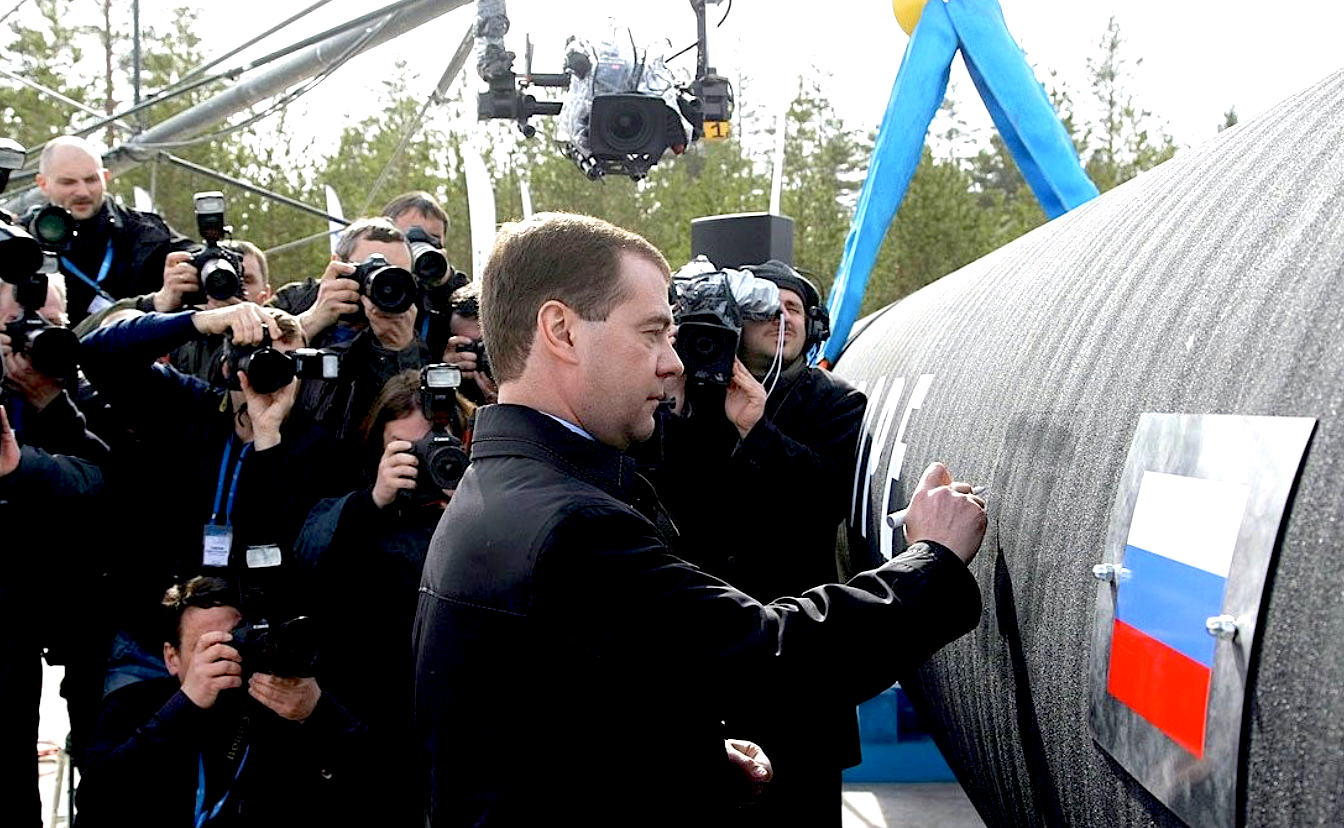
Image
Russian President Dmitriy Medvedv launching Nord Stream project, April 2010. (Kremlin)

This is the second in a series of articles on Germany. Read the first one here.

By Patrick Lawrence
in Potsdam, Germany
ScheerPost

A single, brief phrase always comes to mind when I think of Germany. Whatever may be the specific matter to hand, sooner or later my thoughts go to three words that seem to me — and to many others, given they have survived so long in the discourse — to capture some essence of the nation and its place in the world.

“Germany is Hamlet.” For a long time I attributed this pithy observation to Gordon Craig, among Germany’s great 20th century historians. Craig (Germany, 1866–1945; The Germans) was noted for succinct observations of this kind.

He saw Germany as a nation divided in history between its humanist achievements (Goethe et al., Kant et al., Thomas Mann et al.) and its regrettable givenness to varieties of absolute power.

Over time I discovered the true author of this exquisite mot was Ferdinand Freiligrath (1810–1876), a poet and a political radical who dedicated himself and his work to the democracy movement that led to the (failed) Revolution of 1848.

Freiligrath compared Germany with Shakespeare’s famously divided character in 1844 — this out of frustration with a native conservatism that held Germany back from the great change he saw as the pressing need of his time.

I don’t see that what Freiligrath meant cancels out what Craig meant more than a century later. And I don’t think either characterization of Germany as… what?… as a profoundly ambivalent nation cancels out the meaning the notion acquired, almost inevitably, in the second half of the last century.

Geography proves destiny in Germany’s case, as it does in various others. It faces Westward to the Atlantic world but also Eastward to the Eurasian landmass. Ambiguity has consequently marked the history of its relations in both directions.

Otto von Bismarck cultivated sound relations with Russia during his years as chancellor, 1871 to 1890. That was when Germany first became Germany and the celebrated prince was showing the world what Realpolitik was all about.

Then came the two world wars and Germany’s disastrous military campaigns, Eastward and Westward alike.

In the postwar era this ambiguity, this state of “in between,” is best understood not as Germany’s burden but its great gift, and it is with this gift it could have given another to the rest of us — the gift of a bridge between East and West.

How different would our world be had post–1945 Germany been left to its fate and, by being truly itself, offered the world what it was singularly able to give.

Arrival of Postwar Order
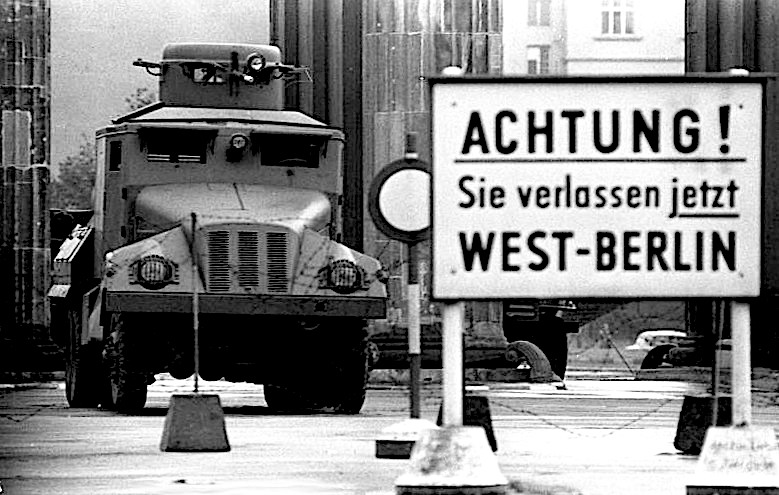
Image
“Warning, you are leaving West Berlin,” August 1961. (Bundesarchiv, Helmut J. Wolf, Wikimedia Commons, CC-BY-SA 3.0, CC BY-SA 3.0 de)

It is in this context we should understand the arrival of the postwar order in Germany and what befalls the Federal Republic as we speak.

Germans were not made for the Cold War and its West–East binaries, destructive as these were to the remarkable release of human aspiration that followed the 1945 victories.

Defeated Germany was among Washington’s pivotal clients as it turned against Moscow, so recently its ally, and set out to establish America’s global primacy. This has served Germany and Germans very badly.

The Germany of the immediate postwar years, Konrad Adenauer’s Germany, was a reconstruction project. The new Federal Republic’s first chancellor counted restoring the German economy among his highest priorities.

Germany under Adenauer — an anti–Communist, a Europeanist, an early supporter of NATO — was a well-behaved American dependency. But by the early 1960s, the Kennedy years, there was renewed concern in Washington as to West Germany’s eventual place in the Cold War order.

And where Germany went the Continent was likely to follow, as the reasoning of the time had it.

This anxiety was not unfounded. A decade after the Iron Curtain divided Germany, in 1949, the Federal Republic was beginning to prosper by way of its Wirtschaftswunder, its “economic miracle” (which was no more a miracle than the postwar Japanese “miracle”).

Germans began to look outward. In due course they would gaze eastward to the Soviet Union: It was a nation of manufacturers with a resource economy next door. Europe was looking in the same direction. This was precisely what Washington’s policy cliques had begun to worry about.

By this time it was a given among these people that America’s national security interests and the global supply-and-demand of energy were more or less inseparable. We can take the case of Enrico Mattei as a measure of America’s concern.

Image
Mattei in 1950. (ilpost.it/Wikimedia Commons/ Public Domain)

Mattei was a senior bureaucrat in Rome who, after the defeat in 1945, reorganized the Fascist regime’s petroleum holdings into Ente Nazionale Idrocarburi, the oil company commonly known as ENI.

Mattei was ambitious for ENI. And going by the many agreements he negotiated, he seems to have had interesting politics.

Among other things, ENI’s contracts awarded three-quarters of profits to the nations that owned reserves — an unprecedented percentage at the time. In 1960 Mattei concluded a large, very significant oil accord with the Soviet Union — again, on terms well beyond the exploitative contracts common among Western oil companies.

This was a daring move, as Mattei plainly understood. He thereupon declared that he had broken, or helped to break, the petroleum monopoly the U.S. had long enjoyed via the famous “Seven Sisters.”

Eisenhower’s National Security Council had been attacking Mattei as antithetical to American interests since the late 1950s. And the Soviet agreement appears to have landed as an especially hard blow.

Two years after signing it Mattei was killed when his plane crashed during a flight from Sicily to Milan. Subsequent investigations, of which there have been many, have continued for decades.

In 1997 La Stampa, the Turin daily, reported that judicial authorities in Rome had concluded that a bomb planted onboard had exploded Mattei’s plane in midair.

Although the Mattei case remains officially unresolved, there is now a plentitude of evidence that he was the victim of an assassination conducted by the C.I.A. in its not-unfamiliar collaboration with the Mafia, possibly with the connivance of French intelligence.

“Common knowledge among Europeans,” a German friend told me recently. “We know what happened to Mattei the way you Americans know what happened to Kennedy.”

Stopping just short of absolute certainties, as we must, we can read the Mattei affair as a measure of how sensitive energy ties between Europe and the Soviets were by the mid–Cold War years.

The point of trans–Atlantic conflict was clear from the first: Europeans viewed contracts with the Soviet Union simply as business — sound, logical economics; for the Americans they were instruments bearing dangerous geopolitical consequences.

And it is on this question the Germans and the Americans have found themselves repeatedly at odds for many decades.

Infrastructure of Interdependence
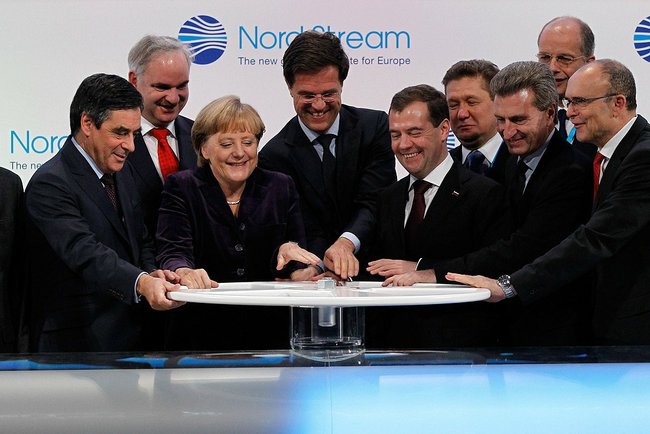
Image
World leaders at the Nord Stream opening ceremony in 2011. (Kremlin, Wikimedia Commons)

Soviet and post–Soviet Russia as a market for German products and services was until recently important, certainly. Russia’s imports of German manufactured goods — a vast range of them — kept the trade balance in Germany’s favor for many years.

But the main event for the Germans came to run in the other direction, as the trade account eventually indicated. Russia needed German manufactures because it was weak on the industrial side; Germany needed Russian resources more pressingly because it is not well-endowed by way of raw materials.

Volumes of inexpensive energy imported from Russia, oil and natural gas, and exports of high-end, excellently engineered manufactured goods sold into world markets: Germans often speak of this as the economic model that drove their nation’s success for so many years — speaking wistfully, I should add, because this model was in ruins by the time I traveled in Germany a few months ago.

And so we come to the infrastructure of interdependence, as we may as well call it. We come to the matter of gas pipelines.

This is a story that runs from the 1980s through to Sept. 26, 2022, when the Biden regime destroyed, in broad daylight, the natural gas pipeline that, just completed, ran under the Baltic Sea between Russian and German ports.

The explosions of Nord Stream I and II have a long history. Were I an investigator or an attorney working on this case, this history would figure prominently in my files of evidence. Let us consider it briefly.

In early 1982, state-operated Russian companies began work on the Trans–Siberia pipeline, one of the grand projects of the late Soviet period. This was a 3,700–mile pipeline — a network of pipelines, actually — that would carry natural gas westward via various routes from Siberia all the way to European markets.

Trans–Siberia was not the first pipeline serving this purpose, but, as the most ambitious, it would go some way to consolidating Soviet–European relations.

The European powers had a vital interest in this undertaking, naturally, but this was only partly because of the imminent availability of inexpensive energy supplies. The Soviets had signed contracts with dozens of European companies for the components and equipment needed to build and operate the pipeline.

These contracts were worth roughly $15 billion, just short of $50 billion today. There were other agreements covering financing and what we used to call technology transfers.

Go back to 1982, just briefly. Europe was in a severe recession. Remember “stagflation,” sluggish growth, high inflation? Western Europe had a critical case. Unemployment among the major European powers — Germany, France, Britain, Italy — was running at nearly 9 percent.

The Europeans needed jobs; their corporations needed profitable work. Contracts with the Soviets for steel pipe, turbines and other such gear — and the Sovs honored their contracts, as the Europeans knew — stood to get Europe out of its malaise; cheap energy would then drive it forward.

President Ronald Reagan, arch–Cold Warrior, was all talk of the “evil empire” by the spring of 1982. The previous December, less than a year in office, Reagan had barred American companies from supplying pipeline equipment to the Soviets.

Six months later, the Sovs having begun construction, he expanded this ban to include any Western producer of steel pipelines that operated under a license granted by a U.S. company.

Image
Reagan delivering his “Evil Empire” address to the National Association of Evangelicals in 1983. (Reagan White House Photographs/ Wikimedia Commons/ Public Domain)

Do you hear history’s echo in this, as I do? Sanctions and atop them secondary sanctions, then as now.

There was a moment during this fraught time when Helmut Schmidt had a private encounter with Reagan in Bonn. The American president, already resentful of what he took to be the German chancellor’s contempt, gave Schmidt — a Social Democrat, an Ostpolitik man — the sort of dressing down one would expect from a not-very-smart man prone to Manichean simplicities.

It has to stop, Reagan ordered Schmidt in so many words. You’ll add to the Russians G.D.P. and then they can build more weapons. You’ll help the Soviets while we’re trying to destroy them.

Schmidt said nothing as Reagan spoke. Instead, he retreated to a window and gazed out of it, concluding he would mollify the American Cold Warrior by offering to allow the U.S. to station Pershing II missiles (mobile, intermediate-range, ballistic) on German soil.

The first Pershing II’s were in place in Germany by the end of 1983; the full deployment was completed two years later.

Image
Protest in 1983 at The Hague, Netherlands, against the deployment in West Germany of nuclear-capable Pershing II missiles. (Marcel Antonisse / Anefo /Wikimedia Commons/ CC0)

I have this account from Dirk Pohlmann, a prominent journalist, author and documentarian and a dedicated student of Germany’s postwar history. He related this and various historical incidents like it during a long morning we spent talking at my Potsdam hotel and later during various telephone calls and email exchanges.

And as Pohlmann told me, there was a lot more to the Reagan administration’s resistance to the Siberia-to–Europe project than informal encounters with European leaders. There were the exertions the public could not see.

Reagan’s people put immense pressure on German banks, for instance — Deutsche Bank, Dresdner, Commerzbank — to refuse the Soviets the financing to which they, the banks, had committed.

Reagan eventually relented, griping all the way. He lifted the two layers of sanctions by the end of 1982, apparently recognizing, amid concerted, at this point embarrassing European pressure, he simply could not enforce them.

Margaret Thatcher, the British prime minister and already a soulmate of sorts to Reagan, had a considerable influence on this policy reversal. There was also the risk of a trans–Atlantic rift just when Reagan wanted everyone on side as he took his run at the evil empire.

In November 1982 NATO members reached an informal understanding on the pipeline’s fate, and the first gas deliveries from it arrived, in France, on New Year’s Day 1984.

Image
Schmidt at the 50th Munich Security Conference in 2014. (Marc Müller/Wikimedia Commons/CC BY 3.0 de)

The Trans–Siberia pipeline, as a curious aside, continued operating until the end of last year, when Kiev declined to renew the pass-through contracts covering the line that transited gas through Ukraine on the way to European markets.

There is one addendum to this tale that must not be missed. By the time of the Trans–Siberia kerfuffle, the Central Intelligence Agency was running a covert sabotage program through which it arranged for American companies to send the Soviets shipments of faulty computer chips.

These were engineered to function properly for a brief time and then fail. A consequential quantity of these arrived at some point in 1982 — during the period Reagan’s sanctions were in effect and as construction of Trans–Siberia was well along.

The result appears to have been as the agency expected: Turbines installed at the pipeline’s pumping stations blew up in something apparently close to unison. Pohlmann told me it was equivalent to a three-kiloton detonation — an explosion large enough for satellites to detect.

Trans–Siberia went operational on schedule, as noted, but —more echoes here, the past and the present in resonance — this stands today as a dress rehearsal for events with which we are now more familiar.

Records of the C.I.A.’s sabotage operation against the Trans–Siberia project are extremely rare. Pohlmann, a close student of this affair, told me references to it have been “almost completely expunged from the internet,” and my experience while researching this report bears this out.

But some of those involved in the operation provided contemporaneous testimonies. One of these was Thomas Reed, who was a senior member of Reagan’s National Security Council at the time. His account was published in 2004 as At the Abyss: An Insider’s History of the Cold War (Presidio Press). Here is a brief passage from the book:

“The pipeline software that was to run the pumps, turbines and valves was programmed to go haywire, to reset pump speeds and valve settings to produce pressures far beyond those acceptable to the pipeline joints and welds. The result was the most monumental non-nuclear explosion and fire ever seen from space.”

While there have been various efforts to discredit Reed’s account — all predictable, none more than unpersuasive obfuscation — his case seems to me incontrovertible. By the time he published At the Abyss, indeed, the C.I.A. had already acknowledged the Trans–Siberia operation in a passing reference in The Farewell Dossier, a gathering of documents concerning other agency matters.

After Reed published, Dirk Pohlmann, ever diligent, traveled to Washington to interview Reed and others, including Herb Meyer, who served under William Casey as vice-chairman of the C.I.A.’s National Intelligence Council during the Reagan years. Pohlmann reviewed those interviews when we met here and subsequently for a second time; they all confirm the 1982 operation.

Trans-Atlantic Tensions

Image
A presentation on “Natural Gas as an Instrument of Russian State Power” for instructors and students from the National Defense University and U.S. Army John F. Kennedy Special Warfare Center and School on June 2, 2011, at Fort Bragg, N.C. (David Chace/Wikimedia Commons/Public Domain)

Reagan’s stated concern, above all his others — and this will be familiar — is that Europeans risked the vulnerability attaching to a structural, long-term dependence on Russian energy supplies.

As I hope this pencil-sketch of the 1982 incident makes clear, the Americans cynically leave out two syllables when they say such things. Their true fear, then as now, was not dependence but the natural interdependence between Germany (and by extension the rest of Europe) and the great Eurasian landmass of which it effectively forms the westernmost flank.

A couple of years after the Siberian pipeline went into operation, a scholar named Patrick DeSouza published an essay in the Yale Journal of International Law titled, a mouthful here, “The Soviet Gas Pipeline Incident: Extension of Collective Security Responsibilities to Peacetime Commercial Trade.”

Among DeSouza’s interesting observations is this one:

“Some analysts have concluded that attempts by the United States to wield economic power through trade restrictions have had limited success in the postwar period. Efforts by the United States to get its allies to act in concert for the purpose of denying political adversaries economic power have met with even less success.

In fact, attempts to restrict economic activity with such adversaries as the Soviet Union have often resulted in heavy costs, including foregone gains from trade, intra-alliance friction, increased solidarity within the opposing alliance …”


There are some true things in this passage, as readers are likely to agree. I read in it the inevitable tension in trans–Atlantic relations once America began to assert its post–1945 hegemonic power.

While this tension ebbed and flowed, one period to the next, it was always there and remains so. But DeSouza’s essay is also to be read as a period piece: There are things in it that, true once, no longer obtain. The Europeans successfully resisted the American imperium’s impositions during the late–Cold War years.

They would not dream of any such effort now. Forty years separate the events of 1982 from the Nord Stream explosions. How times have changed, and how they have remained the same.

And how very handy history so often proves to be.

Readers will surely recall with me the shock when the news came three years ago this coming September that the Nord Stream pipelines — both, I and II — had been sabotaged. But where, with a little history in mind, lay the cause for shock?

Dramatic as the Nord Stream explosions seemed, were they anything more than a quite unimaginative continuation of Washington’s trans–Atlantic foreign and security policies down through the decades? The shock of the nothing-new, we can call it.

It was just as shocking to me to go back, soon after the news broke, and watch the video footage of President Biden stating, with that stunning indiscretion for which he was known the whole of his political career, that the U.S. would never allow Nord Stream II to go operational and was perfectly prepared to destroy it.

This was not long before the event. And another shock: Biden offered these diabolic assurances while Olaf Scholz, Germany’s chancellor at the time, stood like a quiescent schoolboy next to him. The two had just finished private talks in the Oval Office. In hindsight it is not hard to imagine what was said.

Image
Scholz and Biden at a White House press conference, Feb. 7, 2022. (White House /Photo by Adam Schultz)

With a history running back nearly 30 years — from planning to construction to operation to destruction — the Nord Stream pipelines were at least as significant as the earlier Siberia-to–Europe project, and I am being cautious: While the Trans–Siberia network advanced Russian–European relations, Nord Stream I and II would have consolidated Germany’s economic ties with the Russian Federation, and by extension Europe’s, beyond the point these could be easily disrupted.

The first feasibility study for NS I was contracted in 1997. As with NS II later on, the route under the Baltic Sea was to lead from Siberian gas fields to Lubmin, a port on Germany’s northern coast.

Berlin and Moscow signed a joint declaration of intent in 2005; NS I went operational six years later.

It was with the planning of NS II — and German companies were again Gazprom’s lead European partners — that matters between Germany and the United States once again got heavy. Gazprom and the Europeans signed contracts in 2015.

This was a year after Washington cultivated the coup in Ukraine, a year after Moscow re-annexed Crimea, a year after the Obama administration began to impose the sanctions regime that never seems to cease elaborating.

Immediately, it was a straight rerun of the 1982 story. The Germans understood Nord Stream just as they had Trans–Siberia — an economic project, sensible and valuable. European investments ran to €9.5 billion. NS II would double Nord Stream I’s capacity.

Together, the four pipes (two lines each, NS I and II) would deliver 110 billion cubic meters (1.9 trillion cubic feet) of natural gas annually to Germany and European markets — enough to meet, by the estimates I have seen, 40 percent to 50 percent of Germany’s yearly needs and not much less of Europe’s.

Angela Merkel, chancellor at this time, was unyielding in her defense of the project’s advantages, even while the Americans grew ever shriller (and more threatening) in their attacks on Nord Stream II as a mistake with grave geopolitical consequences. Merkel was a dedicated Atlanticist but she persisted.

Remember, by this time (post–Fukushima) she had committed Germany to decommissioning all its nuclear power plants. The Americans persisted, too.

During Donald Trump’s first term they tried every which way to stop NS II’s progress, not least via the usual threats of sanctions and secondary sanctions against European industrial suppliers and participating banks.

Richard Grenell, by 2019 Trump’s all-elbows ambassador to Berlin, at one point sent menacing letters to German companies involved in the pipeline. I recall well how some European banks and industrial firms began to balk; rattled nerves were easily detected in the Bundestag.

To her credit Merkel gave no ground and appeared to prevail. Construction on NS II, which had begun in 2018, was completed by the summer of 2021. But by this time Trump and his people were out of power and the Biden regime was in. This marked the beginning of the end of the Nord Stream project — all of it.

As soon as Joe Biden assumed office in January 2021, he and his national-security people began floundering. This was predictable: U.S. foreign policy during the Biden years was one flub after another across both oceans.

In May 2021, a couple of months before NS II was finished, Washington lifted all the sanctions Trump had imposed on Nord Stream AG, which comprises Gazprom and four European companies.

This appeared to be a stunning repudiation of the years of pressure — decades, depending on how you count — Washington had exerted on the Germans.

At last the Americans seemed to have concluded that trying to prevent the interdependence of Europe and its eastward neighbor was like trying to keep water from running downhill. So it seemed to me.

A victory for the Germans, I remember thinking — a triumph for Germany, for Europe, for the cause of constructive engagement with the Russian Federation.

But in short order it was evident that those Biden had drawn around him were in fact obsessed with preventing NS II from bonding Russia and Western Europe in a mutually beneficial symbiosis. Prominent among these officials were Jake Sullivan, Biden’s freakishly ideological national security adviser, and Antony Blinken, Biden’s secretary of state.

Blinken, indeed, had devoted his graduate thesis years earlier to a study of the contentious Siberian project of the Reagan years. This was later published as Ally Versus Ally: America, Europe, and the Siberian Pipeline Crisis, wherein Blinken argued vigorously that preventing Germany and Russia from building any more pipelines like the Trans–Siberia network was a geopolitical imperative.

Blinken’s publisher, it is worth a brief note, was Frederick A. Praeger, which, if it was no longer a C.I.A. front by 1987, when Blinken’s book came out, had long served as one during the earlier Cold War decades.

So it was that the Biden regime, stumbling with every step, soon found its way to doing what Americans can be relied upon to do when they prove unable to project power in a fashion that gives the appearance of civility and respectable statecraft — when all the legal or marginally legal or actually illegal but apparently legal coercions fail: With NS II ready to begin pumping, they began to plan an altogether illegal covert operation.

December 2021 was a fraught month in matters to do with the Atlantic alliance’s relations with Russia. As readers will recall, Moscow sent two draft treaties Westward, one to Washington and the other to NATO headquarters in Brussels, as the proposed basis of talks to lead to a mutually beneficial new security framework in Europe.

While instantly dismissing these draft documents as frivolous, the Biden White House was, via heavy arms shipments to the Kiev regime, purposely pushing Moscow to the point it would have no choice but to move militarily into Ukraine.

Farcically enough, Biden later credited the C.I.A. with a grand intelligence coup when, on cue, it predicted the inevitable Russian operation.

Something else occurred that month. As Biden’s people were confident they were about to provoke Russia’s military advance into Ukraine, they knew they would create an opportunity for themselves: They would be licensed to respond in newly adventurous terms once Moscow made its move.

To this end, Jake Sullivan gathered a range of reliably hawkish officials from across the government for a series of top secret meetings in a secure room on a high floor of the Old Executive Office Building, the EOB, a late–19th century edifice in wedding-cake style set next to the White House.

There is no need to go long on what arose from the Sullivan meetings: Seymour Hersh’s account of those sessions and all that followed is properly long, persuasive in its extensive detail, and unassailably authoritative.

Hersh published his 5,300–word account of the planning, preparation, training and execution of the sabotage operation that destroyed the Nord Stream I and II pipelines in his Substack newsletter on Feb. 8, 2023, under the headline, “How America Took Out the Nord Stream Pipeline.”

I rank it among the two or three most accomplished pieces of reportage American journalism has produced in my lifetime.

All manner of silliness followed the Nord Stream explosions and, some months later, the publication of Hersh’s piece. The New York Times called the explosions “a mystery.”

The Germans, Danes and Swedes purported to conduct official investigations but swiftly closed them, claiming either they found no evidence assigning responsibility or they could not release their findings.

Biden regime officials suggested the Russians may have destroyed their own industrial asset — the ne plus ultra, this would be, of false-flag operations.

The American disinformation brigades later reported that their investigations led to rogue Ukrainians — the six-people-in-a-rented-sailboat thesis.

Last August the Germans, taking the cake somewhat, issued an arrest warrant for a Ukrainian identified only as Volodymyr Z., on suspicions he was involved in the explosions. Be not suspenseful: We will never hear another word of Volodymyr Z.

There is no need to bother with any of this. None of it makes the slightest dent in Hersh’s work. Effectively hiding the truth in plain sight, various Biden officials expressed, with remarkable candor, their satisfaction for a job well done.

Among these was Antony Blinken. When we bear in mind the secretary’s previously cited thesis, his remarks after the events of Sept. 26, 2022, take on a weight and resonance we might not otherwise find in them:

“It’s a tremendous opportunity to once and for all remove the dependence on Russian energy and thus to take away from Vladimir Putin the weaponization of energy as a means of advancing his imperial designs. That’s very significant, and that offers tremendous strategic opportunity for the years to come…”

Again, history’s wonderful habit of explaining our present to us.

In the early 1980s the European powers repelled the Reagan administration’s forceful insistence that they abandon the Trans–Siberia project, and the conflict developed into what historians count one of the most serious political crises among the Western powers during the whole of the Cold War.

There was a suggestion in those events that Europe still knew how to act in its own interests as it understood them. It had stood for the cause of interdependence and had been heard.

I think of Helmut Schmidt standing at a window in Bonn. He spoke of this, I have no trouble imagining, in his silence —the cause of interdependence amid an attenuated independence within the trans–Atlantic alliance.

Europe’s capacity to think for itself had shown signs of fading soon after the 1945 victories.

The generations of leaders that came up after Churchill’s and de Gaulle’s had little experience of independence; they had lived and come of age politically in the shelter of the U.S. security umbrella and, knowing no other condition, were unpracticed in matters to do with sovereignty.

There was a restlessness within the Cold War’s confines by the 1960s and 1970s — the Trans–Siberia affair was an expression of this — but in the course of time this faded, too. The difference was evident by the time German citizens dismantled the Berlin Wall in November 1989, if not sooner.

It was when our conversation turned to the events of 1989 that Dirk Pohlmann and I began to speak of Germany as “a land of lost opportunity.” That was my phrase. Pohlmann’s was “the tragedy of lost opportunity.”

As Dirk put it, “Germany, Europe, could have had a new influence in the world after 1989.” He meant the Germans had a chance then to serve as that “in-between” nation that bridged West and East.

Havel thought precisely of these things during the early post-Cold War years, and he had Europe as well as Germany in mind. “A new task now presents itself,” he said in a speech delivered in Aachen in May 1996, “and with it a new meaning to Europe’s very existence.”

Dirk Pohlmann saw another lost opportunity for the Germans, very like the first, at the start of Russian military intervention in Ukraine three years ago. Germany was in a position to prevent the conflict or mediate it once it began, he suggested, instead of signing on for the Biden regime’s proxy war.

“Why are we so obedient? Why do we have our Scholz?” he exclaimed more than asked. “Another world was possible even a few years ago, just as it was after 1989.”

The destruction of Nord Stream stands now as a major break for the Germans. The old model — Russian energy in, sophisticated German products out — seems decisively asunder, and many Germans tell me this will prove beyond repair.

But to take the long view, I question whether Germany’s natural givenness to the cause of interdependence can ever be fully extinguished. Talking to Germans gives the strong impression this story is not over.

Hamlet, it seems to me, still lurks among them.

https://consortiumnews.com/2025/04/23/p ... pipelines/

Macron’s Palestine Play – Too Little, Too Late
April 23, 2025

Emmanuel Macron’s announcement of France’s intention to recognize the state of Palestine provoked fury from Benjamin Netanyahu, but is undermined by France’s continued support for Israeli “security,” writes Ramzy Baroud.
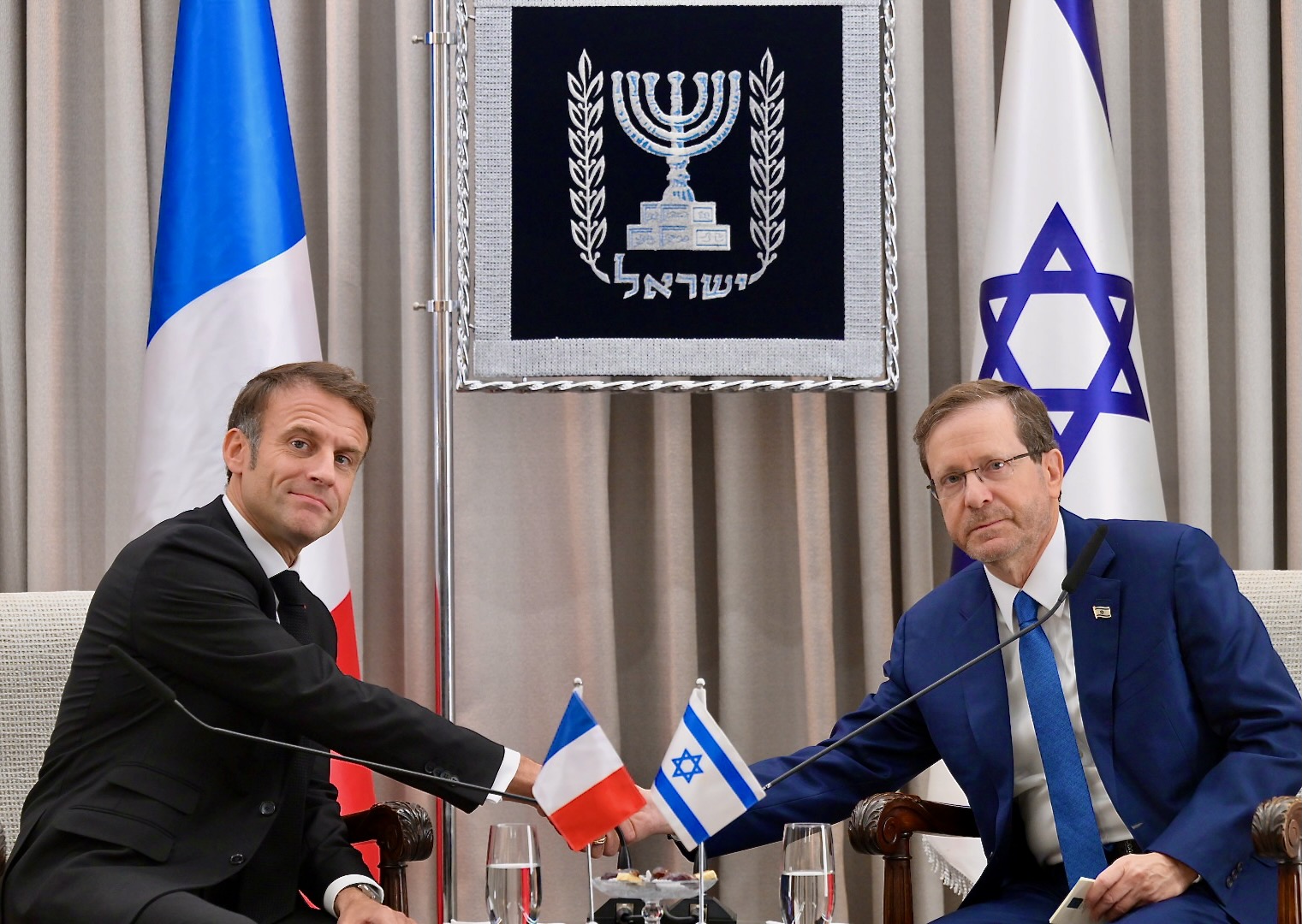
Image
French President Emmanuel Macron meeting with Israeli President Isaac Herzog in Israel in October 2023. (Amos Ben Gershom / Government Press Office of Israel/ CC BY-SA 3.0)

By Ramzy Baroud
Z Network

Israeli Prime Minister Benjamin Netanyahu’s vehement opposition to a Palestinian state aligns perfectly with a long-standing Zionist ideology that has consistently viewed the establishment of a Palestinian state as a direct threat to Israel’s very foundation as a settler colonial project.

Thus, the mere existence of a Palestinian state with clearly defined geographical boundaries would inevitably render the state of Israel, which pointedly remains without internationally recognized borders, a state confined to a fixed physical space.

At a time when Israel continues to occupy significant swathes of Syrian and Lebanese territory and relentlessly pursues its colonial expansion to seize even more land, the notion of Israel genuinely accepting a sovereign Palestinian state is utterly inconceivable.

This reality is not a recent development; it has always been the underlying truth. This, in essence, reveals that the decades-long charade of the “two-state solution” was consistently a mirage, meticulously crafted to peddle illusions to both Palestinians and the broader international community, fostering the false impression that Israel was finally serious about achieving peace.

Therefore, it came as no surprise that Netanyahu reacted with considerable fury to French President Emmanuel Macron’s recent announcement of France’s intention to recognize the state of Palestine next June.

In a phone call with Macron on April 15, Netanyahu predictably resorted to his familiar nonsensical rhetoric, outrageously equating the establishment of a Palestinian state with rewarding “terrorism.”

And, with equal predictability, he trotted out the well-worn and unsubstantiated claims about an Iranian connection. “A Palestinian state established a few minutes away from Israeli cities would become an Iranian stronghold of terrorism,” Netanyahu’s office declared in a statement.

Meanwhile, Macron, with a familiar balancing act, reiterated his commitment to Israeli “security,” while tepidly emphasizing that the suffering in Gaza must come to an end.

Of course, in a more just and reasonable world, Macron should have unequivocally stressed that it is Palestinian security, indeed their very existence, that is acutely at stake, and that Israel, through its relentless violence and occupation, constitutes the gravest threat to Palestinian existence and, arguably, to global peace.

Sadly, such a world remains stubbornly out of reach.

Considering Macron’s and France’s unwavering and often obsequious support for Israel throughout the years, particularly since the onset of the Israeli genocide in Gaza, some might cautiously welcome Macron’s statement as a potentially positive shift in policy.

However, it is imperative to caution against any exaggerated optimism, especially at a time when entire Palestinian families in Gaza are being annihilated in the ongoing Israeli genocide as these very words are read.

It is an undeniable truth that France, like many other Western governments, has played a significant role in empowering, arming and justifying Israel’s heinous crimes in Gaza.

Image
Israeli Prime Minister Benjamin Netanyahu in January 2014. (World Economic Forum/ Flickr/ CC BY-NC-SA 2.0)

For France to genuinely reverse its long-standing position, if indeed that is the current trajectory, it will require far more than symbolic and ultimately empty gestures.

Palestinians are, understandably, weary and disillusioned with symbolic victories, hollow rhetoric and insincere gestures.

The recent recognitions of the state of Palestine by Ireland, Norway and Spain in May 2024 did offer a fleeting spark of hope among Palestinians, suggesting a potential, albeit limited, shift in Western sentiment that might exert some pressure on Israel to cease its devastating actions in Gaza.

Unfortunately, this initial and fragile optimism has largely failed to translate into broader and more meaningful European action.

Consequently, Macron’s recent announcement of France’s intention to recognize the state of Palestine in June has been met with a far more subdued and skeptical reaction from Palestinians.

While other European Union countries that have already recognized Palestine often maintain considerably stronger stances against the Israeli occupation, France’s record in this regard is notably weaker.

Furthermore, the very sincerity of France’s stated position is deeply questionable, given its ongoing and concerning suppression of French activists who dare to protest the Israeli actions and advocate for Palestinian rights within France itself.

These attacks, arrests and the broader crackdown on dissenting political views within France hardly paint the picture of a nation genuinely prepared to completely alter its course on aiding and abetting Israeli crimes.

Moreover, there is a stark and undeniable contrast between the principled positions adopted by Spain, Norway and Ireland and France’s steadfast backing of Israel’s brutal military campaign in Gaza from its very inception, a support underscored by Macron’s early and highly symbolic visit to Tel Aviv.

Macron was among the first world leaders to arrive in Tel Aviv following the war, while Palestinians in Gaza were already being subjected to the most unspeakable forms of violence imaginable.

During that visit, on October 24, 2023, he unequivocally reiterated, “France stands shoulder to shoulder with Israel. We share your pain, and we reaffirm our unwavering commitment to Israel’s security and its right to defend itself against terrorism.”

This raises a fundamental and critical question: how can France’s belated recognition of a Palestinian state be interpreted as genuine solidarity while it simultaneously remains a significant global supporter of the very entity perpetrating violence against Palestinians?

While any European recognition of Palestine is a welcome, if overdue, step, its true significance is considerably diminished by the near-universal recognition of Palestine within the global majority, particularly across the Global South, originating in the Middle East and steadily expanding worldwide.

The fact that France would be among the last group of countries in the world to formally recognize Palestine (currently, 147 out of 193 United Nations member states have recognized the State of Palestine), speaks volumes about France’s apparent attempt to belatedly align itself with the prevailing global consensus and, perhaps, to whitewash its long history of complicity in Israeli Zionist crimes, as Israel finds itself increasingly isolated and condemned on the international stage.

One can state with considerable confidence that Palestinians, particularly those enduring the unimaginable horrors of the ongoing genocide in Gaza, prioritize an immediate cessation of that genocide and genuine accountability for Israel’s actions far above symbolic acts of recognition that appear primarily aimed at bolstering France’s relevance as a global power player and a long-standing supporter of Israeli war crimes.

Finally, Macron, while reassuring Israel that its security remains paramount for the French government, must be reminded that his continued engagement with Benjamin Netanyahu is, in itself, a potential violation of international law.

The Israeli leader is a wanted accused criminal by the International Criminal Court and it is France’s responsibility, like that of the over 120 signatories to the ICC, to apprehend, not to appease, Netanyahu.

This analysis is not intended to diminish the potential significance of the recognition of Palestine as a reflection of growing global solidarity with the Palestinian people. However, for such recognition to be truly meaningful and impactful, it must emanate from a place of genuine respect and profound concern for the Palestinian people themselves, not from a calculated desire to safeguard the “security” of their tormentors.

https://consortiumnews.com/2025/04/23/m ... -too-late/

"There is great chaos under heaven; the situation is excellent."

User avatar
blindpig
Posts: 14839
Joined: Fri Jul 14, 2017 5:44 pm
Location: Turtle Island
Contact:

Re: Blues for Europa

Post by blindpig » Fri Apr 25, 2025 3:37 pm

Italy To Commemorate the 80th Anniversary of the Liberation From Fascism

Image
Italian guerrillas on the day of liberation from fascism, April 25, 1945. X/ @rsumen

April 24, 2025 Hour: 2:17 pm

On April 25, 1945, Italy marked a pivotal moment in its history with the liberation from fascist rule and Nazi occupation.

On Friday, Italy will commemorate the 80th anniversary of the liberation from fascism with several events, held under maximum security due to the funeral of Pope Francis.

On April 25, 1945, Italy marked a pivotal moment in its history with the liberation from fascist rule and Nazi occupation. This day commemorates the success of the Italian Resistance, a broad anti-fascist movement composed of various political and social groups that had been fighting against Benito Mussolini’s fascist regime and the Nazi forces occupying Italy since 1943.

In Rome, April 25 is celebrated to honor the bravery and sacrifices of those who participated in the Resistance. While Rome had been liberated earlier, on June 4, 1944, the events of April 25 are seen as the culmination of the national effort that led to the final defeat of fascism and the restoration of democracy.

It was on this day in 1945 that the National Liberation Committee of Upper Italy (CLNAI) proclaimed a general insurrection in all territories still occupied by Nazi and fascist forces, hastening their retreat and the liberation of key cities such as Milan and Turin.


The text reads, “Speaking of sobriety. There is nothing more sober than honoring the feast of liberation as the partisans and civilians who survived fascism did, because anti-fascism is never an excess; it is a people united around the monument called “Now and Always, Resistance!”

The text on the image of the monument reads: “Comrade Kesselring, you will have the monument you want from us, the Italians, but we will decide with what stone it will be built. It will not be built with the smoky stones of the defenseless villages torn apart by your extermination. Not with the earth of the cemeteries where our young comrades rest. Not with the inviolate snow of the mountains that for two winters defied you. Not with the spring of these valleys that saw you flee.

It will be built only with the silence of the tortured harder than any rock. It will be built with the rock of this sworn pact between free men, volunteers gathered out of dignity, and not out of hatred, determined to rescue the shame and terror of the world in these streets. If you want to bring us back to our posts, you will find us dead and alive with the same commitment, a people crowded around the monument that, now and forever, is called Resistance.” P. Calamandrei
April 25 became a national holiday known as “Festa della Liberazione” officially established in 1946. Each year, Italians, especially in Rome, participate in commemorative events, wreath-laying ceremonies, and public gatherings to remember the victims of fascism and Nazism. It remains a deeply symbolic and unifying day in Italian history.

This year, Rome Mayor Roberto Gualtieri will take part in various ceremonies at historic and symbolic locations to mark “Liberation Day,” which is celebrated annually in Italy on April 25 to remember the anti-fascist resistance that brought an end to fascism and Nazi occupation in 1945.

Among other events, Gualtieri will attend the traditional morning ceremony at the Altar of the Fatherland, where he will lay a wreath before the Tomb of the Unknown Soldier. Italian President Sergio Mattarella will also be present at the event.

Shortly after, Gualtieri will also attend a ceremony at the Mausoleum of the Ardeatine Caves, accompanied by Foreign Minister Antonio Tajani. At this site—one of the most significant symbols of Italian resistance—a tribute will be paid to the 335 people murdered by the Nazis in March 1944.

Gualtieri will also lay a wreath at the Historical Museum of the Liberation, located in central Rome in what was formerly the Gestapo headquarters in the city.

The text reads, “April 24, 1945. Liberation of Reggio Emilia. Guerrilla formations enter the city, raising the tricolor flag of the Homeland on public buildings and greeted by the population with enthusiasm. The German invaders fled along with their fascist servants. Almost all of them because there are still some fascist snipers who continue shooting at the Italians.”

In the afternoon, Romans will take part in the traditional Liberation Day Festival, an event with a more festive, cultural, and participatory character. During this celebration, there will also be a moment of remembrance for Pope Francis, led by Bishop Renato Tarantelli Baccari, deputy manager of the Diocese of Rome.

This year, the 80th anniversary of the liberation has been marked in Italy by the death of Pope Francis, prompting Prime Minister Giorgia Meloni to declare five days of national mourning starting Tuesday. Although the festive events for April 25 have not been canceled, her administration requested that they be carried out “with restraint” as a sign of respect for Francis.

Between Friday and Saturday—when the funeral of Francis will take place and his body will be transferred from St. Peter’s Square in the Vatican to the Basilica of Saint Mary Major, where he will be buried—approximately 4,000 law enforcement officers will be deployed throughout Rome.

This will be accompanied by extensive security checks, snipers, explosive detection experts, and a no-fly zone around the area of the funeral and procession.

https://www.telesurenglish.net/italy-to ... m-fascism/

This needs a little musical accompaniment:


******

Evaluating Foreign Affairs’ Warning About The Risks Of An Emboldened & Remilitarized Germany
Andrew Korybko
Apr 25, 2025

Image

How likely is it that a potentially ultra-nationalist Germany “relitigates its borders or forgoes EU-style deliberation in favor of military blackmail”?[/i]

Foreign Affairs warned earlier this month that an emboldened and remilitarized Germany could pose another challenge to European stability. They’re convinced that former Chancellor Olaf Scholz’s “Zeitenwende”, or historic turning point, “is real this time” in the sense that his successor Friedrich Merz now has the parliamentary and popular support to transform their country into a Great Power. While this would allegedly benefit Europe and Ukraine, it wouldn’t be without three serious risks.

According to the article’s two authors, these entail: Russia waging more hybrid war on Germany; Germany’s rise possibly provoking more nationalism in surrounding countries; and this potentially leading to an explosion of ultra-nationalism in Germany. The catalyst for all of this is the US’ gradual disengagement from NATO brought about by the Trump Administration’s reprioritization of the Asia-Pacific. As American influence recedes, it’ll create political and security voids that others compete to fill.

To be sure, the article itself is more about promoting the alleged advantages of Germany’s delayed implementation of Scholz’s “Zeitenwende”, which the authors praise as long-overdue and a natural response to the aforesaid catalyst seeing as how Germany is already the EU’s de facto leader. At the same time, touching upon the risks bolsters their credibility in some readers’ eyes, enables them to subtly throw shade on Trump, and presents the authors as prescient in case any of the above occurs.

Beginning with the first of the three, it’s predicable that Germany and Russia would carry out more intelligence operations against one another if the first plays the continent’s leading role in containing the second, which the latter would of course consider to be a latent threat for obvious historical reasons. The article omits any mention of the way in which his newfound German role would harm Russian interests and misportrays whatever Moscow’s response may be as unprovoked aggression.

They’re fairer with regard to the second risk of surrounding countries becoming more nationalistic as a reaction to an emboldened and remilitarized Germany but don’t elaborate. Poland is probably the most likely candidate though since such sentiments are already rising in society. This is a reaction to the ruling liberal-globalist coalition in general, its perceived subservience to Germany, and concerns that a possibly AfD-led Germany might try to reclaim what Poland considers to be its “Recovered Territories”.

The last risk builds upon that the authors expressed as the worst-case scenario of “a German military first strengthened by politically centrist, pro-European governments [falling] into the hands of leaders willing to relitigate Germany’s borders or to forgo EU-style deliberation in favor of military blackmail.” It’s this potential consequence that’s the most important to evaluate since the first two are expected to be enduring characteristics of this new geopolitical era in Europe while the final one is uncertain.

The outcome of Poland’s presidential election next month is expected to greatly determine the future dynamics of Polish-German relations. If the outgoing conservative is replaced by the liberal candidate, then Poland will probably either subordinate itself even more to Germany, rely on France to balance it and the US, or pivot towards France. A victory by the conservative or populist candidates, however, would lessen dependence on Germany by either balancing it with France or reprioritizing the US.

France is foreseen as figuring more prominently in Polish foreign policy either way due to their historical partnership since the Napoleonic era as well as their shared contemporary concerns about the threat that an emboldened and remilitarized Germany could pose to them. French in general are less worried about Germany relitigating their borders than some Poles are and are much more anxious about losing their chance to lead Europe either in whole or in part after the Ukrainian Conflict finally ends.

France, Germany, and Poland are competing with one another in this respect, with the most likely outcomes either being German hegemony via the “Zeitenwende” vision, France and Poland jointly thwarting this in Central & Eastern Europe (CEE), or a revived “Weimar Triangle” for tripartite rule over Europe. So long as the EU’s free flow of people and capital is retained, which of course can’t be taken for granted but is likely, then the odds of an AfD-led Germany relitigating its border with Poland are low.

That’s because like-minded Germans could simply buy land in Poland and move there if they wanted to, albeit while being subject to Polish laws, which aren’t different in any meaningful sense than German ones for all intents and purposes with respect to their daily lives. Additionally, while Germany does indeed plan to undergo an unprecedented military buildup, Poland is already in the midst of its own buildup and a more successful at that after having just become NATO’s third-largest military last summer.

The US is also unlikely to completely withdraw from Poland, let alone all of CEE, so its forces will probably always remain there as a mutual deterrent against Russia and Germany. Neither have any intent to invade Poland though so this presence would mostly be symbolic and for the purpose of psychologically reassuring the historically traumatized Polish population of their safety. In any case, the point is that the worst-case scenario that the authors touched upon is very unlikely to materialize.

To review, this is because: Poland will either subordinate itself to Germany after the next elections or rely more on France to balance it (if not reprioritize the US over both); the EU’s free flow of people and capital will likely remain at least for some time; and the US won’t abandon CEE. These will accordingly: appease or balance a possibly ultra-nationalist (ex: AfD-led) Germany; ditto; and deter any potential German territorial revisionism (whether via legal or military means).

Drawing to a close, it can therefore be concluded that the new order taking shape in Europe likely won’t lead to a restoration of interwar risks like Foreign Affairs warned is the worst-case scenario, but to the creation of spheres of influence without military tensions. Whether Poland stands strongly on its own, partners with France, or subordinates itself to Germany, no border changes are expected in either the western or eastern direction, with all forms of future German-Polish competition remaining manageable.

https://korybko.substack.com/p/evaluati ... rs-warning
"There is great chaos under heaven; the situation is excellent."

Post Reply