Where have Europe’s pacifists gone – the ones who once opposed NATO?
Sonja van den Ende
April 22, 2025
Europe is birthing the very totalitarianism it accuses Russia, China, or America of.
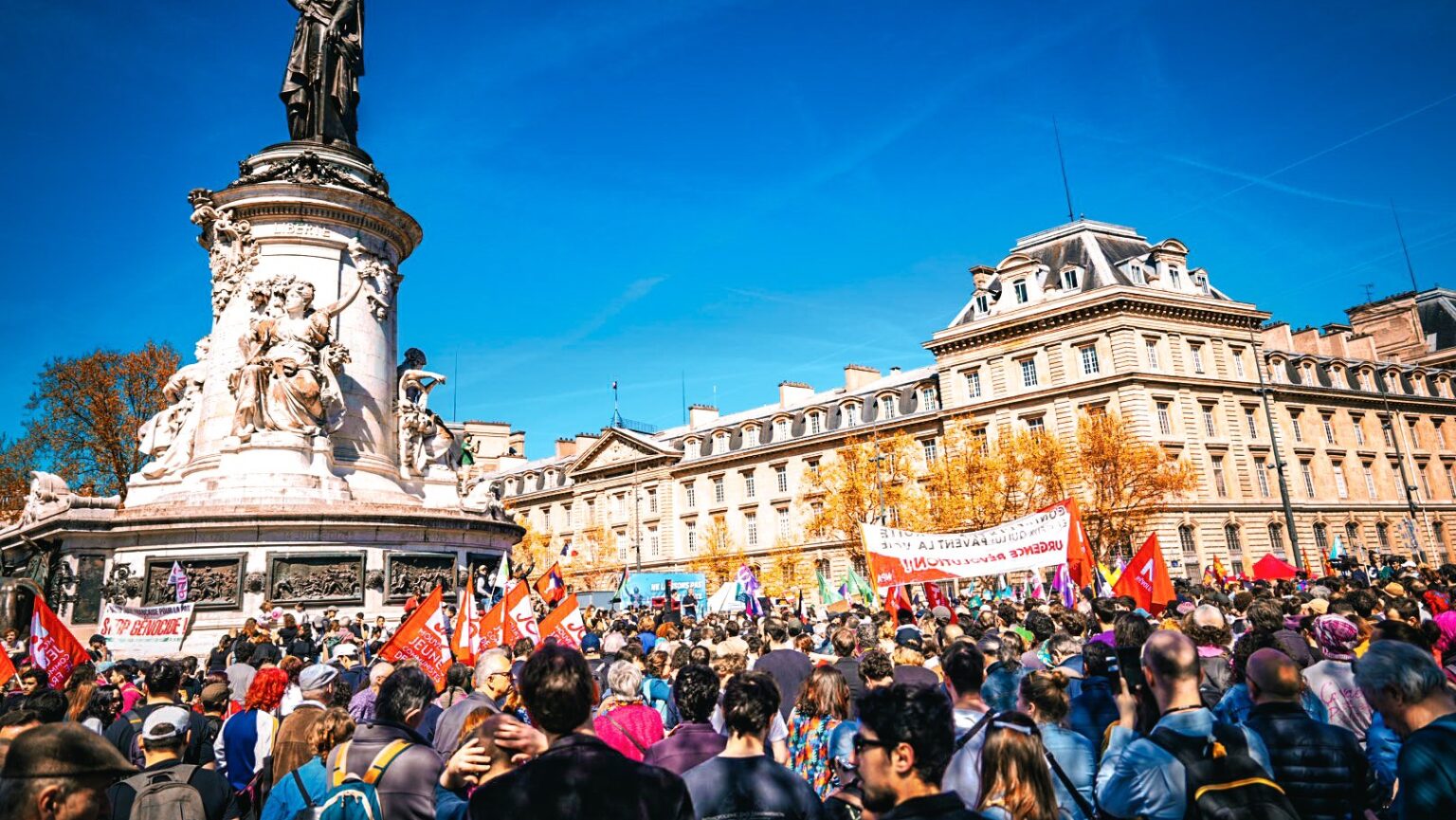
Where are they now—Europe’s pacifists? Why do they no longer gather in Belgium, in Brussels, NATO’s headquarters, where large demonstrations against the alliance once took place? These protests, led by pacifists, denounced NATO, war, militarization, and nuclear arms.
The Belgian newspaper Le Soir recently posed an intriguing question: Why have the pacifists vanished? “The arms race has begun,” the article argues. “Like its European neighbors, Belgium is preparing to significantly increase military spending this year—without facing any opposition.”
“We keep our word,” declares Francken, Belgium’s former Defense Minister. “Belgium will become a solidary ally with extra defense budgets for personnel, equipment, and infrastructure.” He claims the spending will also boost jobs and innovation. Belgium, after all, is a NATO founding member, alongside the Netherlands.
Some Belgian (former) pacifists have reacted sharply to the government’s plans: “Retirees must accept lower pensions, unemployment benefits are being slashed, the sick languish in poverty, nurses earn less and work longer for diminished pensions, hospitals lose subsidies—all to enrich that corrupt Zelensky gang in Kiev.” The same measures, they note, are being imposed in the Netherlands.
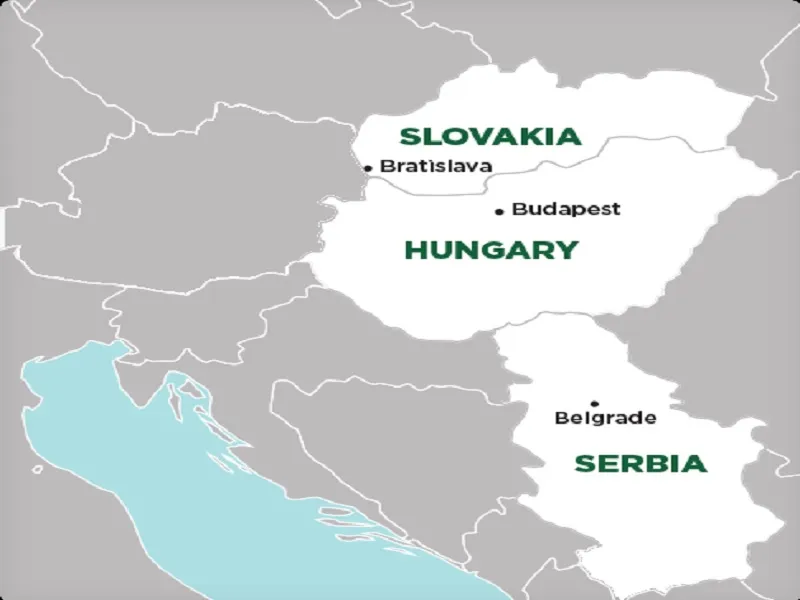
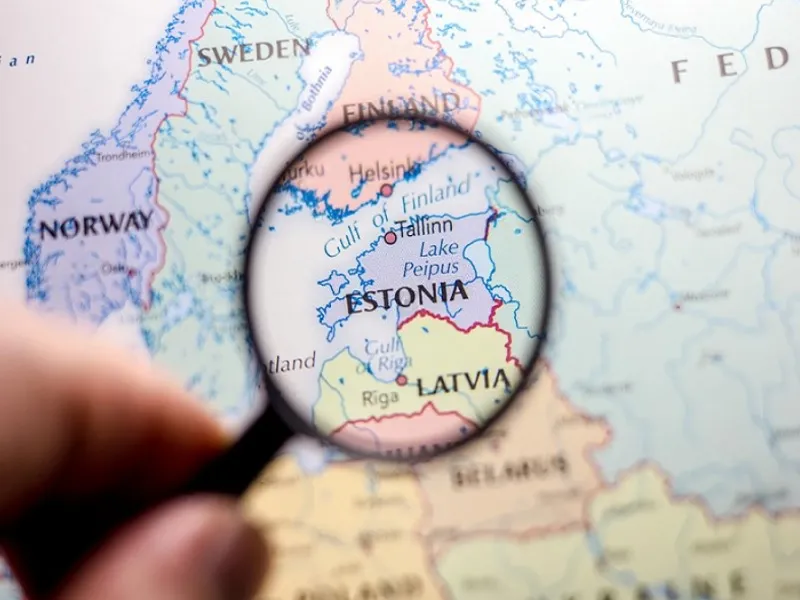
But as the article points out, criticizing NATO now invites ridicule. Or does it go further than mockery? Across Western Europe—Belgium, the Netherlands, Germany—and in the Baltic states and Poland, dissent is met with more than scorn. People are arrested, elections are overturned, and societies drift toward totalitarianism—or worse, a resurgence of militarism and fascism unseen since 1945.
Europeans once insisted America should not meddle in their affairs. But it’s too late for that. EU governments, radicalized by waning U.S. interest in Europe, have already been co-opted. They should have spoken up years ago, when it became clear Europe was being used to wage wars in distant lands its citizens barely knew. Instead, they absorbed refugees (often unwillingly) and fell under what some call American colonization.
Yet America wasn’t entirely wrong. In Munich last February, Vice President J.D. Vance called Europe a “totalitarian society,” singling out Germany. I can confirm his assessment was accurate—but it barely scratched the surface. The reality is far worse and deteriorating daily.
Consider these examples:
A 16-year-old German girl was expelled from school by police for posting a pro-AfD TikTok video featuring the Smurfs (the right-wing party’s color is blue).
An AfD politician was fined for stating that migrants commit more gang rapes than German citizens. (The court didn’t dispute her facts but ruled they incited hatred.)
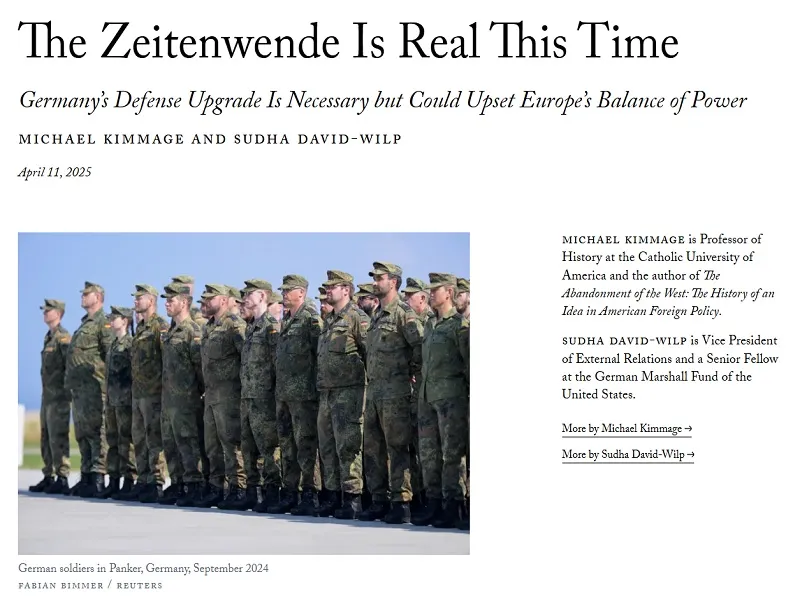
Germany once had a robust pacifist movement. In the 1970s and 80s, activists—many from what is now the Green Party (Bündnis 90/Die Grünen)—protested NATO and nuclear weapons. Today, those same Greens, led by Annalena Baerbock and Robert Habeck, champion war and arms shipments.
Their party program declares Germany must lead Europe, offering a “global counterweight” to China and Russia. The anti-war, anti-NATO movement has been absorbed into a party now pushing for war—especially against Russia, as Baerbock’s rhetoric makes clear.
Or take a 2023 case where the EU’s High Representative expressed concern over “extrajudicial sentences against Serbs” who protested NATO in Kosovska Mitrovica. Kosovo’s Foreign Minister defended the arrests, claiming police had “clear evidence” the demonstrators participated in an “attack on NATO.”
So where have Europe’s pacifists gone—the ones who marched against war, militarization, and nuclear arms for decades? The Friedrich Naumann Foundation (banned in Russia) claims to have the answer. In an article, they declare: “The end of pacifism (as heard in a Bundestag debate) was historic. Hopefully, it marks the end of a moral and political error.”
Has pacifism become a “political mistake”? Millions who oppose war have been misled for years by their own politicians—like the Greens, who traded peace for militarism. The world is upside down, yet Europe’s docile masses seem content as their pensions fund weapons.
New Eastern Europe takes it further, arguing “Pacifism kills.” The outlet claims: “The problem isn’t pacifism itself, but its manipulation for purposes contrary to its ideals. While pacifist appeals to Russia (the aggressor) are justified, targeting Ukraine or both sides aids Moscow.”
In short: Pacifism helps Russia. The “hippies” of the 1960s live in a fantasy where peace is impossible, Russia is the villain, and Europe must defeat it. The campaign against pacifism mirrors the EU’s push for militarization.
Europe is silencing pacifists—and dissidents—just as pre-WWII Germany did under fascism. New laws are emerging. In Germany, the proposed CDU/CSU-SPD coalition plans to “fight lies,” per their “Culture and Media“ working group. If you “lie” by government standards—say, by advocating peace with Russia or denying its “aggression”—you risk jail, fines, or online erasure.
“The deliberate spread of false claims isn’t covered by free speech,” they assert.
Le Soir asked: Where are the pacifists? They’re still here—for now. But once Germany’s new government takes power, once the digital ID and CBDC (mandatory across Europe) launch this October, protests—online or in streets—will be surveilled. Small demonstrations in Germany and Amsterdam show resistance lingers. But soon, fear will silence them: fear for jobs, pensions, benefits, even children.
Because CBDC and Digital ID mean governments can monitor “fake news” and freeze dissenters’ funds. Europe is birthing the very totalitarianism it accuses Russia, China, or America of. Militarization, fascism’s revival—all while Europeans dread a war that isn’t theirs, yet one their leaders enable.
https://strategic-culture.su/news/2025/ ... osed-nato/
******
The Political Implications Of Poland Explicitly Planning To Profit From Ukraine
Andrew Korybko
Apr 23, 2025
 Poland is finally joining in the scramble for Ukraine after naively sitting on the sidelines all these years.
Polish Prime Minister Donald Tusk was surprisingly candid earlier this month when talking about how Poland plans to profit from Ukraine. In his words, “We will help [Ukraine] – Poland is in solidarity, we are a symbol of solidarity – but never again in a naive way. It won’t be the case that Poland will express solidarity while others profit, for example, on the reconstruction of Ukraine. We will be in solidarity and we will make money on it.” There are important political implications to what he said.
For starters, he’s indirectly lending credence to what outgoing President Andrzej Duda revealed last spring about how foreign companies had already obtained ownership over most of Ukraine’s industrial agriculture. Poland missed the opportunity to participate in the scramble for Ukrainian agriculture due to its naivete in refusing to attach strings to the aid that it donated, which ultimately amounted to more tanks, IFVs, and planes than any other country according to Duda’s official website.
Defense Minister Wladyslaw Kosiniak-Kamysz admitted last summer that Poland had by that point maxed out its military support for Ukraine, which preceded Foreign Minister Radek Sikorski proposing that Ukraine could order more military equipment on credit. One way in which bankrupt Ukraine could pay Poland back might be by leasing land and ports to it, which Deputy Minister of Agriculture Michal Kolodziejczak recently suggested, but for free or at a heavy discount in exchange for canceling its debt.
Just like the latest version of Trump’s mineral deal with Ukraine retroactively counts all donated aid as a loan, so too might Poland consider employing the same tactic in an attempt to make up for its previously mentioned lost opportunity in the scramble for Ukrainian agriculture. That could further worsen already difficult political ties between them caused by the revived Volhynia Genocide dispute, however, but Poland’s ace up its sleeve is that it’s the EU’s and Ukraine’s geo-economic gateway to one another.
If the political will exists, then Poland could complicate their trade across its territory as leverage to this end, including via creative means for plausible deniability purposes like encouraging farmers to once again blockade the border. Poland’s surging exports to Ukraine would be temporarily scaled back, but the greater goal of leasing land and ports there for maximizing profits could be advanced, which would also help Poland in its competition with France and Germany for leadership of post-conflict Europe.
Poland’s Ukraine Reconstruction Service, which readers can learn more about here, could then function more effectively after Polish companies obtain access to the land and ports that Kolodziejczak suggested. This would also enable Poland and Ukraine to speedily implement their economic cooperation goals that were agreed to in last summer’s security pact. Even if Poland acquires more tangible economic stakes and influence in Ukraine, however, it’s unlikely to dispatch peacekeepers or try to revise the border.
The first scenario could result in Poland doing the heavy lifting while its European competitors profit at its expense once again while the second would entail enormous economic, political, and security costs that could also backfire by leading to the total loss of Polish influence in Ukraine. Circling back to what Tusk candidly declared last week, profit considerations will shape Poland’s approach towards Ukraine going forward, not naïve solidarity where it continues sacrificing so much in exchange for nothing at all.
https://korybko.substack.com/p/the-poli ... -of-poland
******
And Why Such An Urgency?
Where was it before?
A group of high-ranking French veterans has called for increased oversight of the country’s military involvement in Ukraine. In a letter sent to the heads of both houses of Parliament, the former officers urged lawmakers to hold a formal debate on weapons supplies and the continued presence of French troops bolstering Kiev’s war efforts. The letter, titled the ‘Citizen Resolution’, was published earlier this week on Place d’Armes, a platform for current and former service members to express views on national policy. It included a public call for citizens to sign the resolution in support. The authors argued that France’s military involvement in Ukraine without a parliamentary mandate, and arms deliveries without public debate, violate the French Constitution and Criminal Code. They claimed that no clear communication has been made to Parliament about the possible presence of French troops in Ukraine since 2022, despite the legal obligation to inform lawmakers of any “military intervention.” The letter has urged the parliament to publish “all information” about troop presence in the Journal Officiel, the country’s official gazette, and to “organize a debate with a vote on the continuation of this intervention” within 15 days of receiving the letter.
France is not a subject of international relations, despite Macron's pathetic attempts to pretend that Paris still matters--France lost the remnants of her sovereignty with departure of Jacques Chirac whether you like him or not. Russians do not care anymore what France does and how many French will be killed further. French Army is pathetic and if Macron, indeed, decides to "deploy" official French contingent--it will be annihilated.
Some funny comment to my previous (not today's) video by some obviously French guy stated to the effect that Russia cannot threaten the country (France that is) with 240 nuclear warheads, which can "destroy half of Russia". Well, it is difficult to explain the technological abyss between SAMP-T, the best France has, and which will not be able to intercept anything ranging from Iskander to Kinzhal, let alone Avangard, and Russia's integrated strategic anti-missile defense such as serially produced S-500, S-550, A-235 Nudol and A-135, not to mention SPRN which is beyond France's capabilities, and that out of those 240 warheads which France allegedly could launch (in reality fewer) very few will actually get through. Russian response, however, will get through and France will cease to exist. Mind you, French Armed Forces are the best that Europe has. But then again, French elected Macron--you cannot say that he is illegitimate, so let French generals and French society enjoy their choices--they fully deserve it.
http://smoothiex12.blogspot.com/2025/04 ... gency.html
******
Patrick Lawrence: Exploding Gas Pipelines
April 23, 2025
The Europeans successfully resisted the American imperium’s impositions during the late Cold War years. They would not dream of any such effort now.
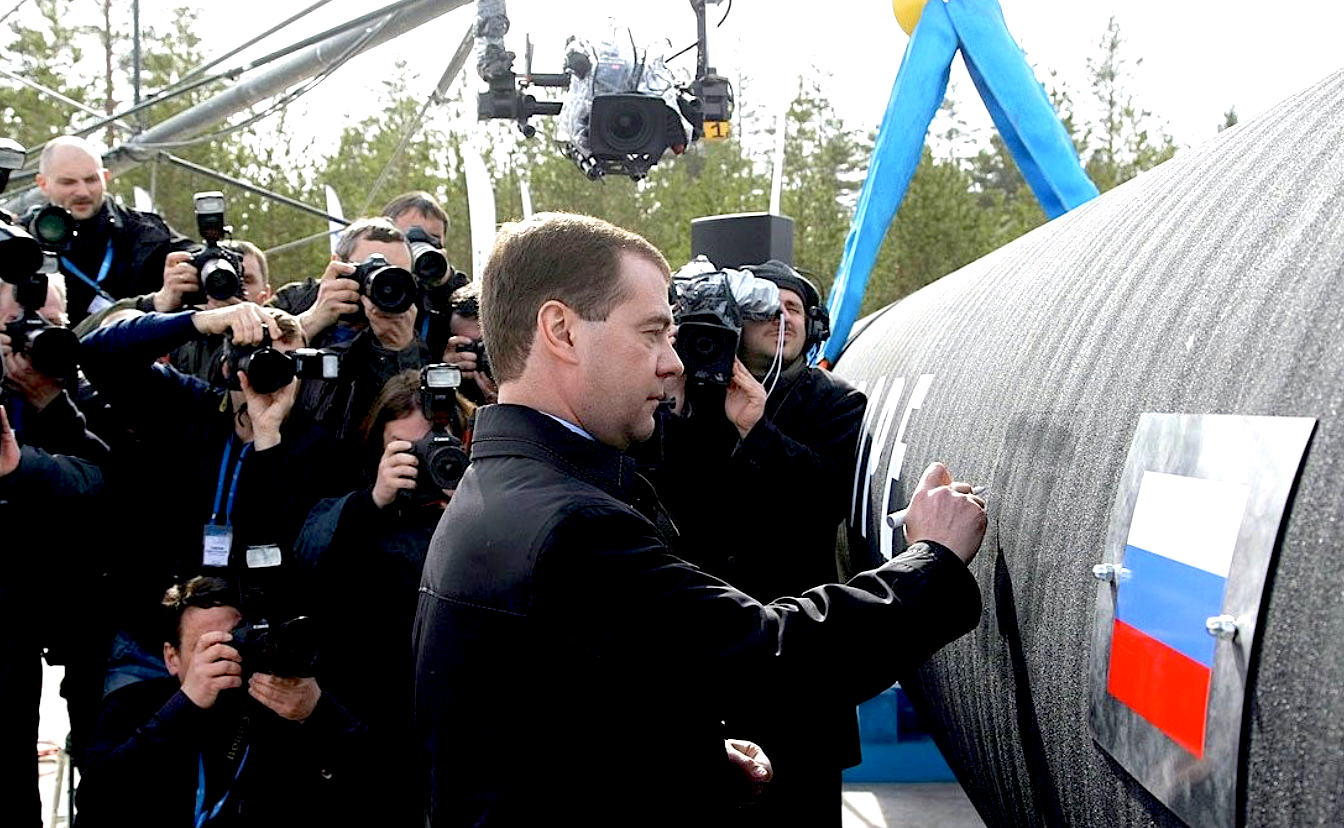
Russian President Dmitriy Medvedv launching Nord Stream project, April 2010. (Kremlin)
This is the second in a series of articles on Germany. Read the first one here.
By Patrick Lawrence
in Potsdam, Germany
ScheerPost
A single, brief phrase always comes to mind when I think of Germany. Whatever may be the specific matter to hand, sooner or later my thoughts go to three words that seem to me — and to many others, given they have survived so long in the discourse — to capture some essence of the nation and its place in the world.
“Germany is Hamlet.” For a long time I attributed this pithy observation to Gordon Craig, among Germany’s great 20th century historians. Craig (Germany, 1866–1945; The Germans) was noted for succinct observations of this kind.
He saw Germany as a nation divided in history between its humanist achievements (Goethe et al., Kant et al., Thomas Mann et al.) and its regrettable givenness to varieties of absolute power.
Over time I discovered the true author of this exquisite mot was Ferdinand Freiligrath (1810–1876), a poet and a political radical who dedicated himself and his work to the democracy movement that led to the (failed) Revolution of 1848.
Freiligrath compared Germany with Shakespeare’s famously divided character in 1844 — this out of frustration with a native conservatism that held Germany back from the great change he saw as the pressing need of his time.
I don’t see that what Freiligrath meant cancels out what Craig meant more than a century later. And I don’t think either characterization of Germany as… what?… as a profoundly ambivalent nation cancels out the meaning the notion acquired, almost inevitably, in the second half of the last century.
Geography proves destiny in Germany’s case, as it does in various others. It faces Westward to the Atlantic world but also Eastward to the Eurasian landmass. Ambiguity has consequently marked the history of its relations in both directions.
Otto von Bismarck cultivated sound relations with Russia during his years as chancellor, 1871 to 1890. That was when Germany first became Germany and the celebrated prince was showing the world what Realpolitik was all about.
Then came the two world wars and Germany’s disastrous military campaigns, Eastward and Westward alike.
In the postwar era this ambiguity, this state of “in between,” is best understood not as Germany’s burden but its great gift, and it is with this gift it could have given another to the rest of us — the gift of a bridge between East and West.
How different would our world be had post–1945 Germany been left to its fate and, by being truly itself, offered the world what it was singularly able to give.
Arrival of Postwar Order
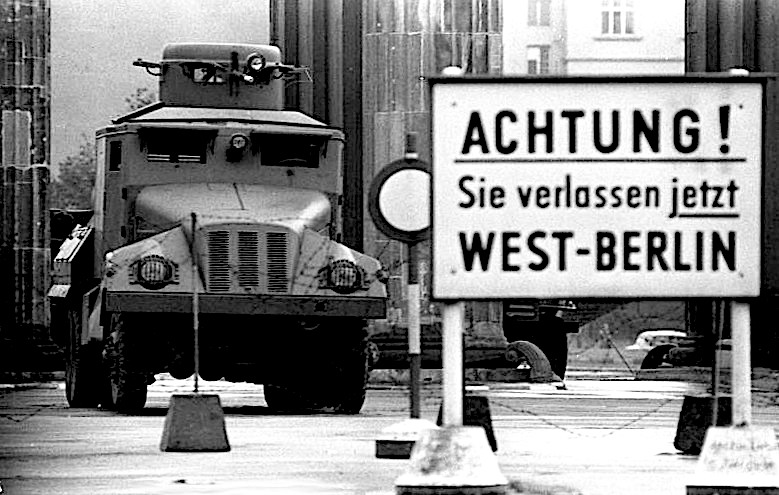
“Warning, you are leaving West Berlin,” August 1961. (Bundesarchiv, Helmut J. Wolf, Wikimedia Commons, CC-BY-SA 3.0, CC BY-SA 3.0 de)
It is in this context we should understand the arrival of the postwar order in Germany and what befalls the Federal Republic as we speak.
Germans were not made for the Cold War and its West–East binaries, destructive as these were to the remarkable release of human aspiration that followed the 1945 victories.
Defeated Germany was among Washington’s pivotal clients as it turned against Moscow, so recently its ally, and set out to establish America’s global primacy. This has served Germany and Germans very badly.
The Germany of the immediate postwar years, Konrad Adenauer’s Germany, was a reconstruction project. The new Federal Republic’s first chancellor counted restoring the German economy among his highest priorities.
Germany under Adenauer — an anti–Communist, a Europeanist, an early supporter of NATO — was a well-behaved American dependency. But by the early 1960s, the Kennedy years, there was renewed concern in Washington as to West Germany’s eventual place in the Cold War order.
And where Germany went the Continent was likely to follow, as the reasoning of the time had it.
This anxiety was not unfounded. A decade after the Iron Curtain divided Germany, in 1949, the Federal Republic was beginning to prosper by way of its Wirtschaftswunder, its “economic miracle” (which was no more a miracle than the postwar Japanese “miracle”).
Germans began to look outward. In due course they would gaze eastward to the Soviet Union: It was a nation of manufacturers with a resource economy next door. Europe was looking in the same direction. This was precisely what Washington’s policy cliques had begun to worry about.
By this time it was a given among these people that America’s national security interests and the global supply-and-demand of energy were more or less inseparable. We can take the case of Enrico Mattei as a measure of America’s concern.

Mattei in 1950. (ilpost.it/Wikimedia Commons/ Public Domain)
Mattei was a senior bureaucrat in Rome who, after the defeat in 1945, reorganized the Fascist regime’s petroleum holdings into Ente Nazionale Idrocarburi, the oil company commonly known as ENI.
Mattei was ambitious for ENI. And going by the many agreements he negotiated, he seems to have had interesting politics.
Among other things, ENI’s contracts awarded three-quarters of profits to the nations that owned reserves — an unprecedented percentage at the time. In 1960 Mattei concluded a large, very significant oil accord with the Soviet Union — again, on terms well beyond the exploitative contracts common among Western oil companies.
This was a daring move, as Mattei plainly understood. He thereupon declared that he had broken, or helped to break, the petroleum monopoly the U.S. had long enjoyed via the famous “Seven Sisters.”
Eisenhower’s National Security Council had been attacking Mattei as antithetical to American interests since the late 1950s. And the Soviet agreement appears to have landed as an especially hard blow.
Two years after signing it Mattei was killed when his plane crashed during a flight from Sicily to Milan. Subsequent investigations, of which there have been many, have continued for decades.
In 1997 La Stampa, the Turin daily, reported that judicial authorities in Rome had concluded that a bomb planted onboard had exploded Mattei’s plane in midair.
Although the Mattei case remains officially unresolved, there is now a plentitude of evidence that he was the victim of an assassination conducted by the C.I.A. in its not-unfamiliar collaboration with the Mafia, possibly with the connivance of French intelligence.
“Common knowledge among Europeans,” a German friend told me recently. “We know what happened to Mattei the way you Americans know what happened to Kennedy.”
Stopping just short of absolute certainties, as we must, we can read the Mattei affair as a measure of how sensitive energy ties between Europe and the Soviets were by the mid–Cold War years.
The point of trans–Atlantic conflict was clear from the first: Europeans viewed contracts with the Soviet Union simply as business — sound, logical economics; for the Americans they were instruments bearing dangerous geopolitical consequences.
And it is on this question the Germans and the Americans have found themselves repeatedly at odds for many decades.
Infrastructure of Interdependence
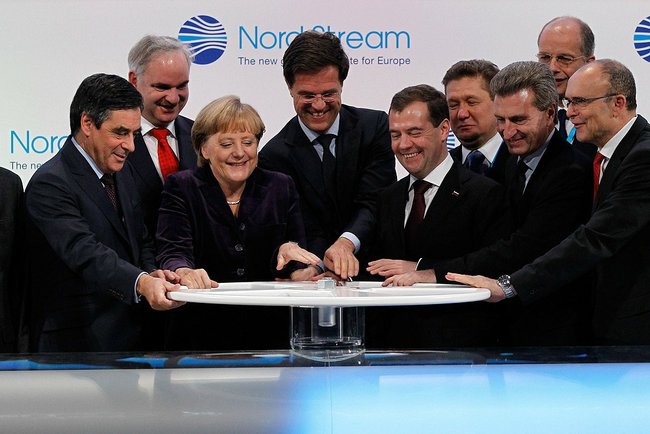
World leaders at the Nord Stream opening ceremony in 2011. (Kremlin, Wikimedia Commons)
Soviet and post–Soviet Russia as a market for German products and services was until recently important, certainly. Russia’s imports of German manufactured goods — a vast range of them — kept the trade balance in Germany’s favor for many years.
But the main event for the Germans came to run in the other direction, as the trade account eventually indicated. Russia needed German manufactures because it was weak on the industrial side; Germany needed Russian resources more pressingly because it is not well-endowed by way of raw materials.
Volumes of inexpensive energy imported from Russia, oil and natural gas, and exports of high-end, excellently engineered manufactured goods sold into world markets: Germans often speak of this as the economic model that drove their nation’s success for so many years — speaking wistfully, I should add, because this model was in ruins by the time I traveled in Germany a few months ago.
And so we come to the infrastructure of interdependence, as we may as well call it. We come to the matter of gas pipelines.
This is a story that runs from the 1980s through to Sept. 26, 2022, when the Biden regime destroyed, in broad daylight, the natural gas pipeline that, just completed, ran under the Baltic Sea between Russian and German ports.
The explosions of Nord Stream I and II have a long history. Were I an investigator or an attorney working on this case, this history would figure prominently in my files of evidence. Let us consider it briefly.
In early 1982, state-operated Russian companies began work on the Trans–Siberia pipeline, one of the grand projects of the late Soviet period. This was a 3,700–mile pipeline — a network of pipelines, actually — that would carry natural gas westward via various routes from Siberia all the way to European markets.
Trans–Siberia was not the first pipeline serving this purpose, but, as the most ambitious, it would go some way to consolidating Soviet–European relations.
The European powers had a vital interest in this undertaking, naturally, but this was only partly because of the imminent availability of inexpensive energy supplies. The Soviets had signed contracts with dozens of European companies for the components and equipment needed to build and operate the pipeline.
These contracts were worth roughly $15 billion, just short of $50 billion today. There were other agreements covering financing and what we used to call technology transfers.
Go back to 1982, just briefly. Europe was in a severe recession. Remember “stagflation,” sluggish growth, high inflation? Western Europe had a critical case. Unemployment among the major European powers — Germany, France, Britain, Italy — was running at nearly 9 percent.
The Europeans needed jobs; their corporations needed profitable work. Contracts with the Soviets for steel pipe, turbines and other such gear — and the Sovs honored their contracts, as the Europeans knew — stood to get Europe out of its malaise; cheap energy would then drive it forward.
President Ronald Reagan, arch–Cold Warrior, was all talk of the “evil empire” by the spring of 1982. The previous December, less than a year in office, Reagan had barred American companies from supplying pipeline equipment to the Soviets.
Six months later, the Sovs having begun construction, he expanded this ban to include any Western producer of steel pipelines that operated under a license granted by a U.S. company.
Reagan delivering his “Evil Empire” address to the National Association of Evangelicals in 1983. (Reagan White House Photographs/ Wikimedia Commons/ Public Domain)
Do you hear history’s echo in this, as I do? Sanctions and atop them secondary sanctions, then as now.
There was a moment during this fraught time when Helmut Schmidt had a private encounter with Reagan in Bonn. The American president, already resentful of what he took to be the German chancellor’s contempt, gave Schmidt — a Social Democrat, an Ostpolitik man — the sort of dressing down one would expect from a not-very-smart man prone to Manichean simplicities.
It has to stop, Reagan ordered Schmidt in so many words. You’ll add to the Russians G.D.P. and then they can build more weapons. You’ll help the Soviets while we’re trying to destroy them.
Schmidt said nothing as Reagan spoke. Instead, he retreated to a window and gazed out of it, concluding he would mollify the American Cold Warrior by offering to allow the U.S. to station Pershing II missiles (mobile, intermediate-range, ballistic) on German soil.
The first Pershing II’s were in place in Germany by the end of 1983; the full deployment was completed two years later.

Protest in 1983 at The Hague, Netherlands, against the deployment in West Germany of nuclear-capable Pershing II missiles. (Marcel Antonisse / Anefo /Wikimedia Commons/ CC0)
I have this account from Dirk Pohlmann, a prominent journalist, author and documentarian and a dedicated student of Germany’s postwar history. He related this and various historical incidents like it during a long morning we spent talking at my Potsdam hotel and later during various telephone calls and email exchanges.
And as Pohlmann told me, there was a lot more to the Reagan administration’s resistance to the Siberia-to–Europe project than informal encounters with European leaders. There were the exertions the public could not see.
Reagan’s people put immense pressure on German banks, for instance — Deutsche Bank, Dresdner, Commerzbank — to refuse the Soviets the financing to which they, the banks, had committed.
Reagan eventually relented, griping all the way. He lifted the two layers of sanctions by the end of 1982, apparently recognizing, amid concerted, at this point embarrassing European pressure, he simply could not enforce them.
Margaret Thatcher, the British prime minister and already a soulmate of sorts to Reagan, had a considerable influence on this policy reversal. There was also the risk of a trans–Atlantic rift just when Reagan wanted everyone on side as he took his run at the evil empire.
In November 1982 NATO members reached an informal understanding on the pipeline’s fate, and the first gas deliveries from it arrived, in France, on New Year’s Day 1984.

Schmidt at the 50th Munich Security Conference in 2014. (Marc Müller/Wikimedia Commons/CC BY 3.0 de)
The Trans–Siberia pipeline, as a curious aside, continued operating until the end of last year, when Kiev declined to renew the pass-through contracts covering the line that transited gas through Ukraine on the way to European markets.
There is one addendum to this tale that must not be missed. By the time of the Trans–Siberia kerfuffle, the Central Intelligence Agency was running a covert sabotage program through which it arranged for American companies to send the Soviets shipments of faulty computer chips.
These were engineered to function properly for a brief time and then fail. A consequential quantity of these arrived at some point in 1982 — during the period Reagan’s sanctions were in effect and as construction of Trans–Siberia was well along.
The result appears to have been as the agency expected: Turbines installed at the pipeline’s pumping stations blew up in something apparently close to unison. Pohlmann told me it was equivalent to a three-kiloton detonation — an explosion large enough for satellites to detect.
Trans–Siberia went operational on schedule, as noted, but —more echoes here, the past and the present in resonance — this stands today as a dress rehearsal for events with which we are now more familiar.
Records of the C.I.A.’s sabotage operation against the Trans–Siberia project are extremely rare. Pohlmann, a close student of this affair, told me references to it have been “almost completely expunged from the internet,” and my experience while researching this report bears this out.
But some of those involved in the operation provided contemporaneous testimonies. One of these was Thomas Reed, who was a senior member of Reagan’s National Security Council at the time. His account was published in 2004 as At the Abyss: An Insider’s History of the Cold War (Presidio Press). Here is a brief passage from the book:
“The pipeline software that was to run the pumps, turbines and valves was programmed to go haywire, to reset pump speeds and valve settings to produce pressures far beyond those acceptable to the pipeline joints and welds. The result was the most monumental non-nuclear explosion and fire ever seen from space.”
While there have been various efforts to discredit Reed’s account — all predictable, none more than unpersuasive obfuscation — his case seems to me incontrovertible. By the time he published At the Abyss, indeed, the C.I.A. had already acknowledged the Trans–Siberia operation in a passing reference in The Farewell Dossier, a gathering of documents concerning other agency matters.
After Reed published, Dirk Pohlmann, ever diligent, traveled to Washington to interview Reed and others, including Herb Meyer, who served under William Casey as vice-chairman of the C.I.A.’s National Intelligence Council during the Reagan years. Pohlmann reviewed those interviews when we met here and subsequently for a second time; they all confirm the 1982 operation.
Trans-Atlantic Tensions

A presentation on “Natural Gas as an Instrument of Russian State Power” for instructors and students from the National Defense University and U.S. Army John F. Kennedy Special Warfare Center and School on June 2, 2011, at Fort Bragg, N.C. (David Chace/Wikimedia Commons/Public Domain)
Reagan’s stated concern, above all his others — and this will be familiar — is that Europeans risked the vulnerability attaching to a structural, long-term dependence on Russian energy supplies.
As I hope this pencil-sketch of the 1982 incident makes clear, the Americans cynically leave out two syllables when they say such things. Their true fear, then as now, was not dependence but the natural interdependence between Germany (and by extension the rest of Europe) and the great Eurasian landmass of which it effectively forms the westernmost flank.
A couple of years after the Siberian pipeline went into operation, a scholar named Patrick DeSouza published an essay in the Yale Journal of International Law titled, a mouthful here, “The Soviet Gas Pipeline Incident: Extension of Collective Security Responsibilities to Peacetime Commercial Trade.”
Among DeSouza’s interesting observations is this one:
“Some analysts have concluded that attempts by the United States to wield economic power through trade restrictions have had limited success in the postwar period. Efforts by the United States to get its allies to act in concert for the purpose of denying political adversaries economic power have met with even less success.
In fact, attempts to restrict economic activity with such adversaries as the Soviet Union have often resulted in heavy costs, including foregone gains from trade, intra-alliance friction, increased solidarity within the opposing alliance …”
There are some true things in this passage, as readers are likely to agree. I read in it the inevitable tension in trans–Atlantic relations once America began to assert its post–1945 hegemonic power.
While this tension ebbed and flowed, one period to the next, it was always there and remains so. But DeSouza’s essay is also to be read as a period piece: There are things in it that, true once, no longer obtain. The Europeans successfully resisted the American imperium’s impositions during the late–Cold War years.
They would not dream of any such effort now. Forty years separate the events of 1982 from the Nord Stream explosions. How times have changed, and how they have remained the same.
And how very handy history so often proves to be.
Readers will surely recall with me the shock when the news came three years ago this coming September that the Nord Stream pipelines — both, I and II — had been sabotaged. But where, with a little history in mind, lay the cause for shock?
Dramatic as the Nord Stream explosions seemed, were they anything more than a quite unimaginative continuation of Washington’s trans–Atlantic foreign and security policies down through the decades? The shock of the nothing-new, we can call it.
It was just as shocking to me to go back, soon after the news broke, and watch the video footage of President Biden stating, with that stunning indiscretion for which he was known the whole of his political career, that the U.S. would never allow Nord Stream II to go operational and was perfectly prepared to destroy it.
This was not long before the event. And another shock: Biden offered these diabolic assurances while Olaf Scholz, Germany’s chancellor at the time, stood like a quiescent schoolboy next to him. The two had just finished private talks in the Oval Office. In hindsight it is not hard to imagine what was said.

Scholz and Biden at a White House press conference, Feb. 7, 2022. (White House /Photo by Adam Schultz)
With a history running back nearly 30 years — from planning to construction to operation to destruction — the Nord Stream pipelines were at least as significant as the earlier Siberia-to–Europe project, and I am being cautious: While the Trans–Siberia network advanced Russian–European relations, Nord Stream I and II would have consolidated Germany’s economic ties with the Russian Federation, and by extension Europe’s, beyond the point these could be easily disrupted.
The first feasibility study for NS I was contracted in 1997. As with NS II later on, the route under the Baltic Sea was to lead from Siberian gas fields to Lubmin, a port on Germany’s northern coast.
Berlin and Moscow signed a joint declaration of intent in 2005; NS I went operational six years later.
It was with the planning of NS II — and German companies were again Gazprom’s lead European partners — that matters between Germany and the United States once again got heavy. Gazprom and the Europeans signed contracts in 2015.
This was a year after Washington cultivated the coup in Ukraine, a year after Moscow re-annexed Crimea, a year after the Obama administration began to impose the sanctions regime that never seems to cease elaborating.
Immediately, it was a straight rerun of the 1982 story. The Germans understood Nord Stream just as they had Trans–Siberia — an economic project, sensible and valuable. European investments ran to €9.5 billion. NS II would double Nord Stream I’s capacity.
Together, the four pipes (two lines each, NS I and II) would deliver 110 billion cubic meters (1.9 trillion cubic feet) of natural gas annually to Germany and European markets — enough to meet, by the estimates I have seen, 40 percent to 50 percent of Germany’s yearly needs and not much less of Europe’s.
Angela Merkel, chancellor at this time, was unyielding in her defense of the project’s advantages, even while the Americans grew ever shriller (and more threatening) in their attacks on Nord Stream II as a mistake with grave geopolitical consequences. Merkel was a dedicated Atlanticist but she persisted.
Remember, by this time (post–Fukushima) she had committed Germany to decommissioning all its nuclear power plants. The Americans persisted, too.
During Donald Trump’s first term they tried every which way to stop NS II’s progress, not least via the usual threats of sanctions and secondary sanctions against European industrial suppliers and participating banks.
Richard Grenell, by 2019 Trump’s all-elbows ambassador to Berlin, at one point sent menacing letters to German companies involved in the pipeline. I recall well how some European banks and industrial firms began to balk; rattled nerves were easily detected in the Bundestag.
To her credit Merkel gave no ground and appeared to prevail. Construction on NS II, which had begun in 2018, was completed by the summer of 2021. But by this time Trump and his people were out of power and the Biden regime was in. This marked the beginning of the end of the Nord Stream project — all of it.
As soon as Joe Biden assumed office in January 2021, he and his national-security people began floundering. This was predictable: U.S. foreign policy during the Biden years was one flub after another across both oceans.
In May 2021, a couple of months before NS II was finished, Washington lifted all the sanctions Trump had imposed on Nord Stream AG, which comprises Gazprom and four European companies.
This appeared to be a stunning repudiation of the years of pressure — decades, depending on how you count — Washington had exerted on the Germans.
At last the Americans seemed to have concluded that trying to prevent the interdependence of Europe and its eastward neighbor was like trying to keep water from running downhill. So it seemed to me.
A victory for the Germans, I remember thinking — a triumph for Germany, for Europe, for the cause of constructive engagement with the Russian Federation.
But in short order it was evident that those Biden had drawn around him were in fact obsessed with preventing NS II from bonding Russia and Western Europe in a mutually beneficial symbiosis. Prominent among these officials were Jake Sullivan, Biden’s freakishly ideological national security adviser, and Antony Blinken, Biden’s secretary of state.
Blinken, indeed, had devoted his graduate thesis years earlier to a study of the contentious Siberian project of the Reagan years. This was later published as Ally Versus Ally: America, Europe, and the Siberian Pipeline Crisis, wherein Blinken argued vigorously that preventing Germany and Russia from building any more pipelines like the Trans–Siberia network was a geopolitical imperative.
Blinken’s publisher, it is worth a brief note, was Frederick A. Praeger, which, if it was no longer a C.I.A. front by 1987, when Blinken’s book came out, had long served as one during the earlier Cold War decades.
So it was that the Biden regime, stumbling with every step, soon found its way to doing what Americans can be relied upon to do when they prove unable to project power in a fashion that gives the appearance of civility and respectable statecraft — when all the legal or marginally legal or actually illegal but apparently legal coercions fail: With NS II ready to begin pumping, they began to plan an altogether illegal covert operation.
December 2021 was a fraught month in matters to do with the Atlantic alliance’s relations with Russia. As readers will recall, Moscow sent two draft treaties Westward, one to Washington and the other to NATO headquarters in Brussels, as the proposed basis of talks to lead to a mutually beneficial new security framework in Europe.
While instantly dismissing these draft documents as frivolous, the Biden White House was, via heavy arms shipments to the Kiev regime, purposely pushing Moscow to the point it would have no choice but to move militarily into Ukraine.
Farcically enough, Biden later credited the C.I.A. with a grand intelligence coup when, on cue, it predicted the inevitable Russian operation.
Something else occurred that month. As Biden’s people were confident they were about to provoke Russia’s military advance into Ukraine, they knew they would create an opportunity for themselves: They would be licensed to respond in newly adventurous terms once Moscow made its move.
To this end, Jake Sullivan gathered a range of reliably hawkish officials from across the government for a series of top secret meetings in a secure room on a high floor of the Old Executive Office Building, the EOB, a late–19th century edifice in wedding-cake style set next to the White House.
There is no need to go long on what arose from the Sullivan meetings: Seymour Hersh’s account of those sessions and all that followed is properly long, persuasive in its extensive detail, and unassailably authoritative.
Hersh published his 5,300–word account of the planning, preparation, training and execution of the sabotage operation that destroyed the Nord Stream I and II pipelines in his Substack newsletter on Feb. 8, 2023, under the headline, “How America Took Out the Nord Stream Pipeline.”
I rank it among the two or three most accomplished pieces of reportage American journalism has produced in my lifetime.
All manner of silliness followed the Nord Stream explosions and, some months later, the publication of Hersh’s piece. The New York Times called the explosions “a mystery.”
The Germans, Danes and Swedes purported to conduct official investigations but swiftly closed them, claiming either they found no evidence assigning responsibility or they could not release their findings.
Biden regime officials suggested the Russians may have destroyed their own industrial asset — the ne plus ultra, this would be, of false-flag operations.
The American disinformation brigades later reported that their investigations led to rogue Ukrainians — the six-people-in-a-rented-sailboat thesis.
Last August the Germans, taking the cake somewhat, issued an arrest warrant for a Ukrainian identified only as Volodymyr Z., on suspicions he was involved in the explosions. Be not suspenseful: We will never hear another word of Volodymyr Z.
There is no need to bother with any of this. None of it makes the slightest dent in Hersh’s work. Effectively hiding the truth in plain sight, various Biden officials expressed, with remarkable candor, their satisfaction for a job well done.
Among these was Antony Blinken. When we bear in mind the secretary’s previously cited thesis, his remarks after the events of Sept. 26, 2022, take on a weight and resonance we might not otherwise find in them:
“It’s a tremendous opportunity to once and for all remove the dependence on Russian energy and thus to take away from Vladimir Putin the weaponization of energy as a means of advancing his imperial designs. That’s very significant, and that offers tremendous strategic opportunity for the years to come…”
Again, history’s wonderful habit of explaining our present to us.
In the early 1980s the European powers repelled the Reagan administration’s forceful insistence that they abandon the Trans–Siberia project, and the conflict developed into what historians count one of the most serious political crises among the Western powers during the whole of the Cold War.
There was a suggestion in those events that Europe still knew how to act in its own interests as it understood them. It had stood for the cause of interdependence and had been heard.
I think of Helmut Schmidt standing at a window in Bonn. He spoke of this, I have no trouble imagining, in his silence —the cause of interdependence amid an attenuated independence within the trans–Atlantic alliance.
Europe’s capacity to think for itself had shown signs of fading soon after the 1945 victories.
The generations of leaders that came up after Churchill’s and de Gaulle’s had little experience of independence; they had lived and come of age politically in the shelter of the U.S. security umbrella and, knowing no other condition, were unpracticed in matters to do with sovereignty.
There was a restlessness within the Cold War’s confines by the 1960s and 1970s — the Trans–Siberia affair was an expression of this — but in the course of time this faded, too. The difference was evident by the time German citizens dismantled the Berlin Wall in November 1989, if not sooner.
It was when our conversation turned to the events of 1989 that Dirk Pohlmann and I began to speak of Germany as “a land of lost opportunity.” That was my phrase. Pohlmann’s was “the tragedy of lost opportunity.”
As Dirk put it, “Germany, Europe, could have had a new influence in the world after 1989.” He meant the Germans had a chance then to serve as that “in-between” nation that bridged West and East.
Havel thought precisely of these things during the early post-Cold War years, and he had Europe as well as Germany in mind. “A new task now presents itself,” he said in a speech delivered in Aachen in May 1996, “and with it a new meaning to Europe’s very existence.”
Dirk Pohlmann saw another lost opportunity for the Germans, very like the first, at the start of Russian military intervention in Ukraine three years ago. Germany was in a position to prevent the conflict or mediate it once it began, he suggested, instead of signing on for the Biden regime’s proxy war.
“Why are we so obedient? Why do we have our Scholz?” he exclaimed more than asked. “Another world was possible even a few years ago, just as it was after 1989.”
The destruction of Nord Stream stands now as a major break for the Germans. The old model — Russian energy in, sophisticated German products out — seems decisively asunder, and many Germans tell me this will prove beyond repair.
But to take the long view, I question whether Germany’s natural givenness to the cause of interdependence can ever be fully extinguished. Talking to Germans gives the strong impression this story is not over.
Hamlet, it seems to me, still lurks among them.
https://consortiumnews.com/2025/04/23/p ... pipelines/
Macron’s Palestine Play – Too Little, Too Late
April 23, 2025
Emmanuel Macron’s announcement of France’s intention to recognize the state of Palestine provoked fury from Benjamin Netanyahu, but is undermined by France’s continued support for Israeli “security,” writes Ramzy Baroud.
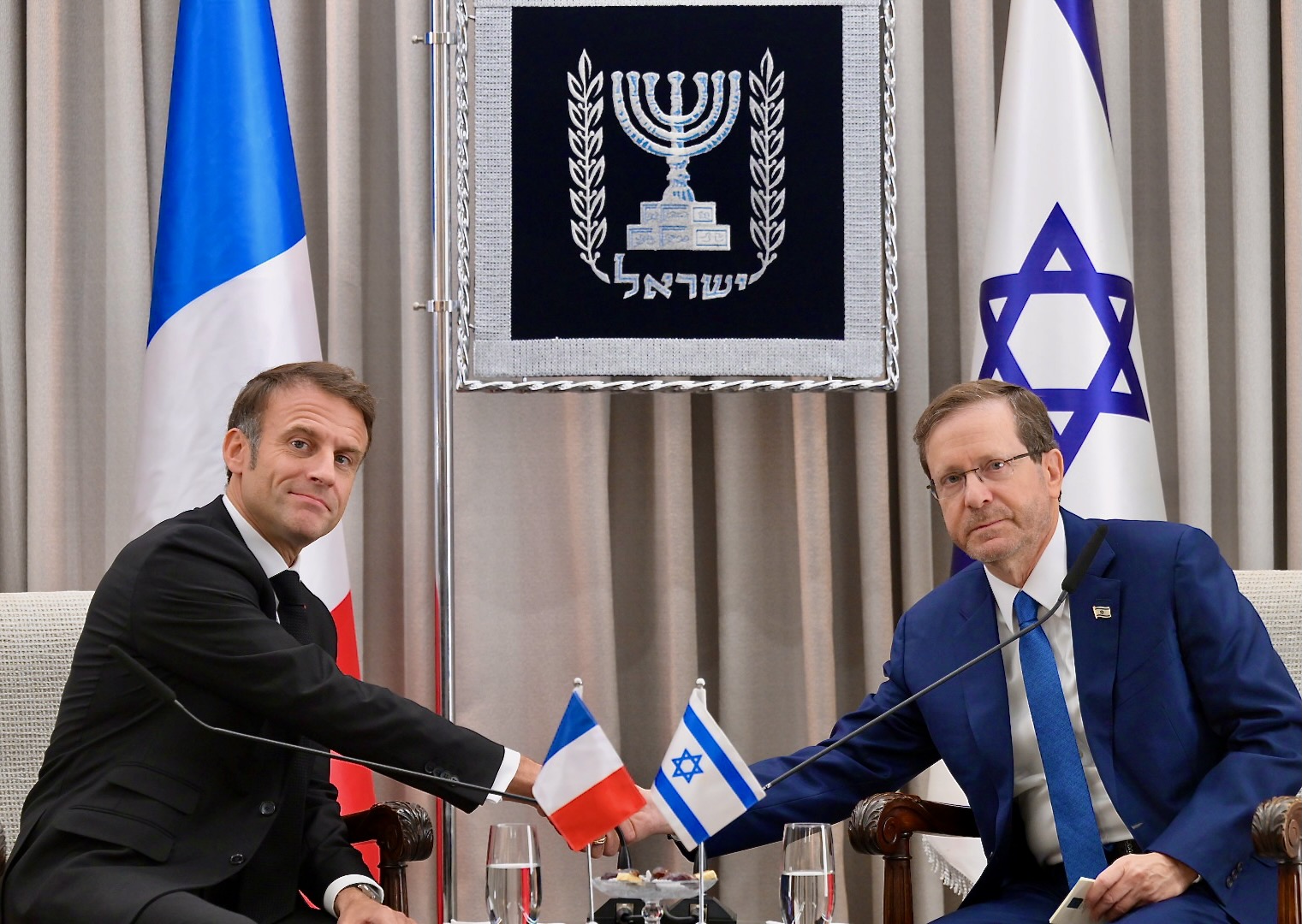
French President Emmanuel Macron meeting with Israeli President Isaac Herzog in Israel in October 2023. (Amos Ben Gershom / Government Press Office of Israel/ CC BY-SA 3.0)
By Ramzy Baroud
Z Network
Israeli Prime Minister Benjamin Netanyahu’s vehement opposition to a Palestinian state aligns perfectly with a long-standing Zionist ideology that has consistently viewed the establishment of a Palestinian state as a direct threat to Israel’s very foundation as a settler colonial project.
Thus, the mere existence of a Palestinian state with clearly defined geographical boundaries would inevitably render the state of Israel, which pointedly remains without internationally recognized borders, a state confined to a fixed physical space.
At a time when Israel continues to occupy significant swathes of Syrian and Lebanese territory and relentlessly pursues its colonial expansion to seize even more land, the notion of Israel genuinely accepting a sovereign Palestinian state is utterly inconceivable.
This reality is not a recent development; it has always been the underlying truth. This, in essence, reveals that the decades-long charade of the “two-state solution” was consistently a mirage, meticulously crafted to peddle illusions to both Palestinians and the broader international community, fostering the false impression that Israel was finally serious about achieving peace.
Therefore, it came as no surprise that Netanyahu reacted with considerable fury to French President Emmanuel Macron’s recent announcement of France’s intention to recognize the state of Palestine next June.
In a phone call with Macron on April 15, Netanyahu predictably resorted to his familiar nonsensical rhetoric, outrageously equating the establishment of a Palestinian state with rewarding “terrorism.”
And, with equal predictability, he trotted out the well-worn and unsubstantiated claims about an Iranian connection. “A Palestinian state established a few minutes away from Israeli cities would become an Iranian stronghold of terrorism,” Netanyahu’s office declared in a statement.
Meanwhile, Macron, with a familiar balancing act, reiterated his commitment to Israeli “security,” while tepidly emphasizing that the suffering in Gaza must come to an end.
Of course, in a more just and reasonable world, Macron should have unequivocally stressed that it is Palestinian security, indeed their very existence, that is acutely at stake, and that Israel, through its relentless violence and occupation, constitutes the gravest threat to Palestinian existence and, arguably, to global peace.
Sadly, such a world remains stubbornly out of reach.
Considering Macron’s and France’s unwavering and often obsequious support for Israel throughout the years, particularly since the onset of the Israeli genocide in Gaza, some might cautiously welcome Macron’s statement as a potentially positive shift in policy.
However, it is imperative to caution against any exaggerated optimism, especially at a time when entire Palestinian families in Gaza are being annihilated in the ongoing Israeli genocide as these very words are read.
It is an undeniable truth that France, like many other Western governments, has played a significant role in empowering, arming and justifying Israel’s heinous crimes in Gaza.

Israeli Prime Minister Benjamin Netanyahu in January 2014. (World Economic Forum/ Flickr/ CC BY-NC-SA 2.0)
For France to genuinely reverse its long-standing position, if indeed that is the current trajectory, it will require far more than symbolic and ultimately empty gestures.
Palestinians are, understandably, weary and disillusioned with symbolic victories, hollow rhetoric and insincere gestures.
The recent recognitions of the state of Palestine by Ireland, Norway and Spain in May 2024 did offer a fleeting spark of hope among Palestinians, suggesting a potential, albeit limited, shift in Western sentiment that might exert some pressure on Israel to cease its devastating actions in Gaza.
Unfortunately, this initial and fragile optimism has largely failed to translate into broader and more meaningful European action.
Consequently, Macron’s recent announcement of France’s intention to recognize the state of Palestine in June has been met with a far more subdued and skeptical reaction from Palestinians.
While other European Union countries that have already recognized Palestine often maintain considerably stronger stances against the Israeli occupation, France’s record in this regard is notably weaker.
Furthermore, the very sincerity of France’s stated position is deeply questionable, given its ongoing and concerning suppression of French activists who dare to protest the Israeli actions and advocate for Palestinian rights within France itself.
These attacks, arrests and the broader crackdown on dissenting political views within France hardly paint the picture of a nation genuinely prepared to completely alter its course on aiding and abetting Israeli crimes.
Moreover, there is a stark and undeniable contrast between the principled positions adopted by Spain, Norway and Ireland and France’s steadfast backing of Israel’s brutal military campaign in Gaza from its very inception, a support underscored by Macron’s early and highly symbolic visit to Tel Aviv.
Macron was among the first world leaders to arrive in Tel Aviv following the war, while Palestinians in Gaza were already being subjected to the most unspeakable forms of violence imaginable.
During that visit, on October 24, 2023, he unequivocally reiterated, “France stands shoulder to shoulder with Israel. We share your pain, and we reaffirm our unwavering commitment to Israel’s security and its right to defend itself against terrorism.”
This raises a fundamental and critical question: how can France’s belated recognition of a Palestinian state be interpreted as genuine solidarity while it simultaneously remains a significant global supporter of the very entity perpetrating violence against Palestinians?
While any European recognition of Palestine is a welcome, if overdue, step, its true significance is considerably diminished by the near-universal recognition of Palestine within the global majority, particularly across the Global South, originating in the Middle East and steadily expanding worldwide.
The fact that France would be among the last group of countries in the world to formally recognize Palestine (currently, 147 out of 193 United Nations member states have recognized the State of Palestine), speaks volumes about France’s apparent attempt to belatedly align itself with the prevailing global consensus and, perhaps, to whitewash its long history of complicity in Israeli Zionist crimes, as Israel finds itself increasingly isolated and condemned on the international stage.
One can state with considerable confidence that Palestinians, particularly those enduring the unimaginable horrors of the ongoing genocide in Gaza, prioritize an immediate cessation of that genocide and genuine accountability for Israel’s actions far above symbolic acts of recognition that appear primarily aimed at bolstering France’s relevance as a global power player and a long-standing supporter of Israeli war crimes.
Finally, Macron, while reassuring Israel that its security remains paramount for the French government, must be reminded that his continued engagement with Benjamin Netanyahu is, in itself, a potential violation of international law.
The Israeli leader is a wanted accused criminal by the International Criminal Court and it is France’s responsibility, like that of the over 120 signatories to the ICC, to apprehend, not to appease, Netanyahu.
This analysis is not intended to diminish the potential significance of the recognition of Palestine as a reflection of growing global solidarity with the Palestinian people. However, for such recognition to be truly meaningful and impactful, it must emanate from a place of genuine respect and profound concern for the Palestinian people themselves, not from a calculated desire to safeguard the “security” of their tormentors.
https://consortiumnews.com/2025/04/23/m ... -too-late/