The situation in Israel and Palestine for August 10-17, 2023
August 19, 2023
Rybar
Internal political crisis and protests against government actions
In Israel, mass protests continue against the policies of the far-right government of Netanyahu and judicial reform. Since August 10, rallies have been held in Tel Aviv, Haifa, Ramot, Raanan, Amikam and other cities.
At the same time, a new wave of protests is expected due to the decision of Israeli Prime Minister Benjamin Netanyahu to make a number of new concessions to ultra-Orthodox Jews (Haredi), who put pressure on the secular part of society and the population of the country.
Israelis of Ethiopian origin are also protesting. The demonstrations began after Israeli Integration Minister Ofir Sofer said there were no plans to evacuate local residents with Jewish roots from Ethiopia.
Polls show that tens of thousands of Israelis continue to participate in weekly protests against judicial reform and Netanyahu's far-right cabinet.
That, however, will not stop the coalition, in which the haredim play a decisive role, from carrying out reforms that please them.
One of the fundamental contradictions between the ultra-Orthodox and the rest of society is that the former are extremely weakly involved in the economic activities of society because of their religious views, but they are numerous and increasingly strive for political power. This is largely what led to the current coalition with Netanyahu ultra-Orthodox.
In simple terms, Haredim have 6-7 children, most of them do not serve in the army, do not work (the ultra-Orthodox pay only 2% of income tax in Israel), but only study religious texts. But at the same time they receive a good allowance from the state and actively impose their own views on society.
Israeli-Palestinian conflict
Israeli security forces conducted several counter-terrorism operations in Jenin, Nablus, Tulkarem and Aqabat Jaber, as a result of which members of Palestinian organizations were arrested and liquidated.
Against this background, clashes broke out between the soldiers of the Israel Defense Forces and the Palestinians. Palestinian groups have reported attacks on IDF soldiers in the vicinity of Jenin, Ramallah and Jericho.
The dissatisfaction of the Arab population with the periodic raids of the Israeli military is fueled by the arrests of individual citizens by law enforcement officers of the Palestinian National Authority.
Some Palestinian media accused the PNA security forces of coordinating actions with the Israeli side in order to "crush the Palestinian resistance" on the West Bank of the Jordan River.
At the same time, Lebanese Hezbollah Secretary General Hassan Nasrallah issued an appeal praising the Palestinian resistance in the West Bank and citing the political crisis in Israel.
Nasrallah also said that "resistance is growing in Lebanon and especially in Palestine", while the Israeli course is declining.
Militants of the military wing of Hamas ("Kataib Izz al-Din al-Qassam") captured an Israeli UAV Orbiter 1K , which was carrying out a reconnaissance mission in the eastern part of the Gaza Strip.
The drone is used for surveillance and reconnaissance missions in the sky over the Gaza Strip as part of special operations, as well as in elimination and targeted attacks as a suicide bomber.
De-escalation attempts
Some actors in the Israeli security services believe that the strengthening of the Palestinian National Authority in the West Bank will help reduce tensions in the region.
It remains unclear whether Prime Minister Benjamin Netanyahu, with the support of Defense Minister Yoav Gallant , National Security Adviser Tzachi Khanegbi and top security officials, will be able to win other ministers' approval.
Convinced opponents of these moves, including far-right finance minister Bezalel Smotrich and national security minister Itamar Ben-Gvir , have consistently objected to measures designed to strengthen the PNA.
The moves under consideration cover all aspects of Israeli-Palestinian engagement, which is in full accord with the US government, which reportedly expects significant changes on the ground on both sides.
One way or another, judging by the dynamics of changes taking place in Israel, the PNA will only be able to function in the near future if it is completely under the control of the Israeli government - or will not exist at all.
Religious conflicts
Followers of the " Shuvu Bonim " religious institute , which is headed by Rabbi Eliezer Berland , who is associated with Hasidic Judaism, continue to claim the Mar Elias monastery.
According to the ultra-Orthodox, the Greek Orthodox monastery was built on the remains of the Old Testament prophet Elijah. According to Wadi Abu Nassar , an adviser to local church leaders , the problem lies in the position of the Israeli government, which is unable to contain Haredi attacks.
In an attempt to smooth over religious differences, Israeli President Isaac Herzog visited the Stella Maris Monastery in Haifa after ultra-Orthodox attacks on the site and other Christian shrines.
The influence of the ultra-Orthodox is becoming pervasive, and it is not surprising that they have stepped up their pressure on other religions. Haredi attacks on Christians have become more frequent in recent years, and the attacks have taken on more and more overt forms. If the ultra-right continues to remain in power, the situation will only get worse.
diplomatic background
Ukraine is considering the abolition of the visa-free regime with Israel. Kyiv will also ask to exclude the country from meetings in the Ramstein format because of its "unfriendly actions against Ukraine" and allegedly pro-Russian position in the international arena.
General Mark Milley , chairman of the US Joint Chiefs of Staff, plans to visit Israel next week to meet with Defense Secretary Yoav Galant and IDF Chief of Staff Lieutenant General Herzi Halevi.
At the meeting, which was originally scheduled for June but postponed due to the Wagner PMC mutiny in Russia, Millie hopes to get a better firsthand look at how the crisis in Israel is affecting AoI.
Egyptian President Abdel Fattah al-Sisi met with Jordanian King Abdullah II bin Hussein and PNA President Mahmoud Abbas in the coastal Egyptian city of El Alamein.
During the tripartite meeting, the leaders discussed the "development of the Palestinian cause" and expressed their support for a two-state solution to the Israeli-Palestinian conflict with East Jerusalem as the future capital of Palestine.
The meeting was also held "to discuss US efforts to normalize relations between Saudi Arabia and Israel and the Palestinian Authority's demands for such an agreement."
Saudi Ambassador to Jordan Nayef al-Sudairi presented his credentials to Majdi al-Khalidi, Diplomatic Adviser to PNA President Mahmoud Abbas, thus making him Riyadh's first non-resident ambassador to Palestine.
The move appears to have cast doubt on Benjamin Netanyahu's recent suggestion that the Palestinian issue is not a very important part of negotiations between Israel and Saudi Arabia. Or the PNA will simply become another channel of communication between the Israeli government and the Saudis.
According to the American edition of The Washington Post , one should not wait for the conclusion of an official deal between Saudi Arabia and Israel to normalize relations in the near future.
Although the newspaper emphasizes that a number of fundamental problems stand in the way of an agreement, this is not an obstacle for Tel Aviv and Riyadh, since de facto relations between the two states have long been put in order .
Reviving hegemony: Israel's land-and-rail proposal to the Persian Gulf
Israel is pursuing land and railway connections as a means to pave the path for normalization and become Europe's trading hub with West Asia. But logistical challenges and significant regional popular opposition may stop this project in its tracks.
Mohamad Hasan Sweidan
AUG 17, 2023
Photo Credit: The Cradle
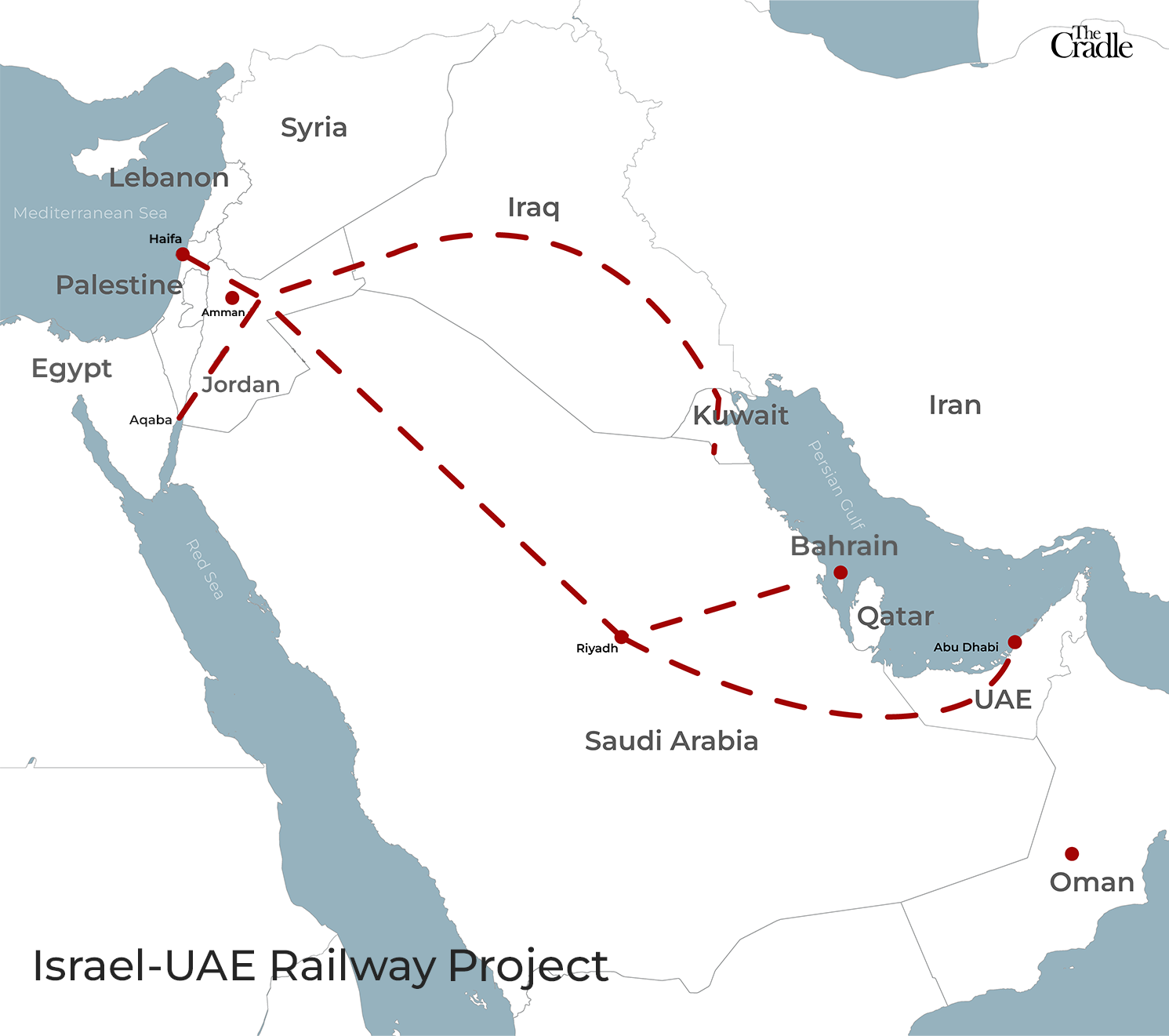
Since 2017, under an initiative known as “Tracks for Regional Peace,” Israel has been trying to promote a railway project linking the port of Haifa with Persian Gulf states, including the UAE. This venture, which has already been set in motion, gathered greater significance following the normalization agreement between Abu Dhabi and Tel Aviv in 2020.
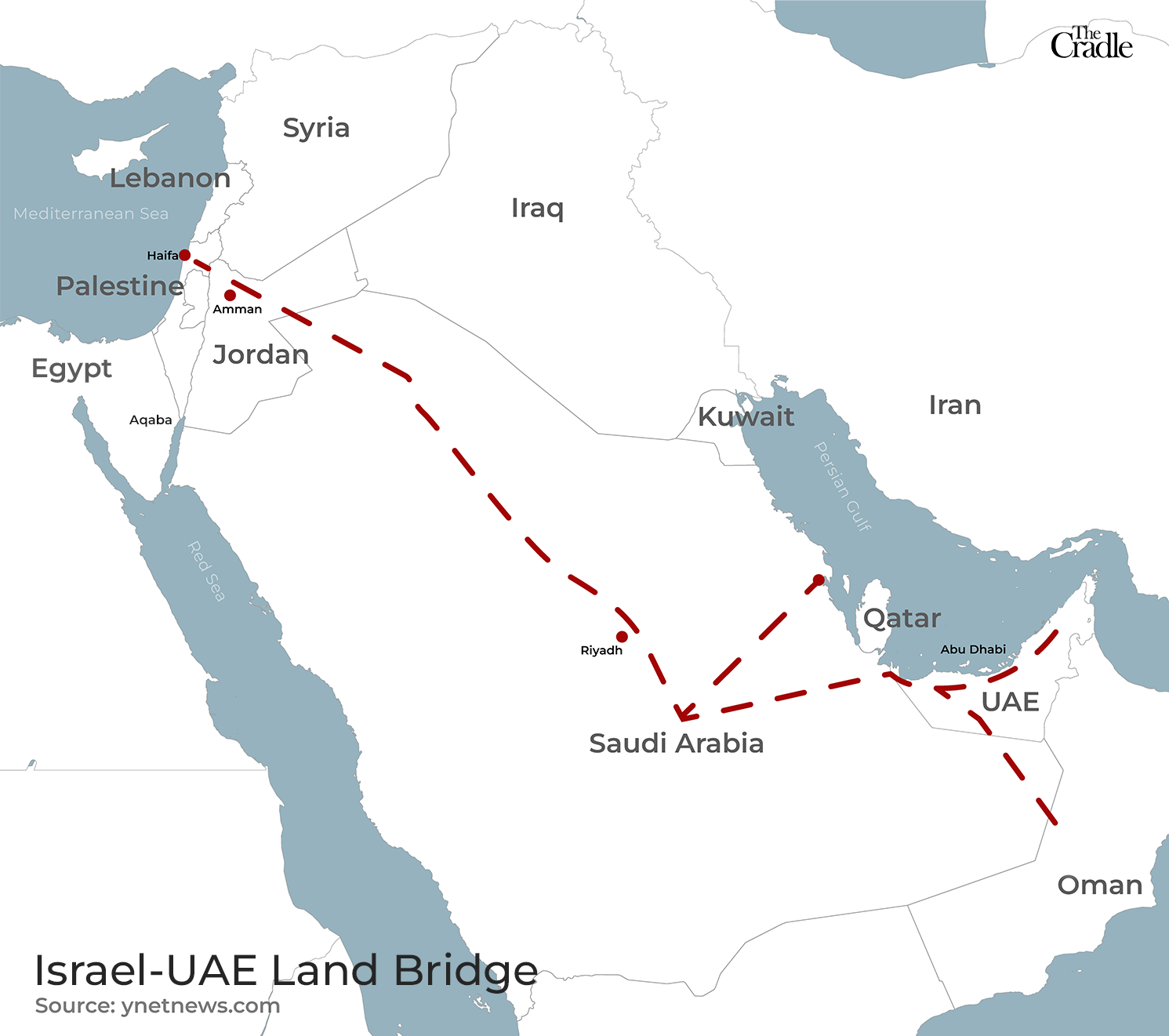
In July, it was reported that Israel and the US were working on a plan for a land connection project for trucks traveling between Israel and the UAE via Jordan and Saudi Arabia. The two projects together intend to connect the Mediterranean Sea and the Persian Gulf.
Reviving the Hejaz Railway
In 2017, then-Israeli Minister of Transportation Yisrael Katz, who is currently energy minister, presented his vision for the project. What's striking is that this grand plan had already been a topic of discussion between Israel, select Arab countries, and even the administration of former US President Donald Trump, prior to its official endorsement by the government of Prime Minister Benjamin Netanyahu.
The proposed trajectory traces a path along the Marg Train line, an existing rail route stretching from Haifa to Beit She'an, nestled near the Jordanian border. The journey continues into Jordan through the Jordan River crossing, known as the Sheikh Hussein Bridge, and intersects the country’s internal railway network before converging at the strategic Red Sea port of Aqaba.
Map of Israel-UAE railway project (approximate)
From Jordan, the line continues into Saudi Arabia and then the UAE, and will likely extend to the Sultanate of Oman. This intricate web of connectivity not only binds the occupied Palestinian territories with the Persian Gulf's ports, but paves the way for potential extensions into Iraq and Kuwait.
A map of the envisioned project makes evident that the Israeli initiative is modeled after the historic Hejaz Railway — a 1,464-kilometer railway line built by the Ottoman Empire to transport passengers, pilgrims, and goods from Palestine to Syria, and from there to Saudi Arabia via Jordan.
That line was inaugurated in 1908 by Sultan Abdul Hamid II personally. The following year, daily trips were established between Haifa and Damascus, and three weekly ones between Damascus and Medina. The latest Israeli proposal seeks to revive the old Hejaz line, but with the UAE replacing Syria, for obvious reasons. In fact, Israeli Minister of Intelligence and Transport Yisrael Katz has bluntly stated: “I want to revive the Hejaz Railway. This is not a dream at all.”
Land link to the Persian Gulf
In a strategic bid to expedite diplomatic engagement and foster closer ties with select Arab states, Israel’s land link project aims to enhance trade and connectivity within West Asia, through a proposal orchestrated by the Israeli Foreign Ministry and handed over to US envoy Amos Hochstein. However, although several Israeli political figures have confirmed that work on the project is underway between Washington and Tel Aviv, there is still no official endorsement from the parties involved.
Presently, the route taken by trucks traveling from the UAE to the port of Haifa is mired in bureaucratic complexities, necessitating multiple drivers, intricate paperwork, and lengthy waiting periods at border crossings. In contrast, the proposed project offers the possibility of one driver and one truck moving between Dubai and the port of Haifa without changing drivers and trucks at border crossings between countries.
The project will enable trucks to transport goods while significantly reducing both time and transportation costs. A study by the Israeli Foreign Ministry and the US government estimates that it will reduce the time of transporting goods between Israel and the UAE, saving up to 20 percent in shipping costs.
Notably, the requisite infrastructure to facilitate the movement of trucks between the port of Haifa and UAE ports is already in place. The primary impetus for success lies in overcoming administrative and political hurdles, rather than requiring a comprehensive normalization agreement between Israel and Saudi Arabia.
Despite the absence of a formal agreement, in 2020, Riyadh permitted Israeli airlines to traverse its airspace, enabling crucial mobility between Israel and the UAE, and Bahrain. It stands to reason that a similar approach could be extended to ground transportation – a tangible step toward enhancing trade flows and relations between the apartheid state and Saudi Arabia, bringing them closer to a potential formal normalization.
Map of Israel-UAE land bridge project (approximate)
Economic gains for Israel
The land link initiatives set forth by Israel, while ostensibly aimed at fostering regional cooperation, serve as multi-faceted strategies aligned with Tel Aviv's economic, military, and political interests - many of which seek regional hegemony at the expense of neighbors. Any strategic Israeli moves will produce ramifications across West Asia's economic, security, and geopolitical landscapes, raising Tel Aviv's regional profile, but also potentially goading its opponents into action.
Primarily, the economic windfall arising from these projects bears paramount importance for Israel. Projections from the Israeli Ministry of Foreign Affairs suggest a staggering surge in trade volume from the proposed rail link initiative, potentially soaring to an astounding 400 percent.
This would represent a marked shift from the status quo, in which a multitude of trucks currently journey to the port of Haifa via Turkiye’s ferries, traversing through occupied Palestinian territories en route to various Arab countries through Jordan.
A rail and land link will allow the cost-effective and swift transport of goods to Arab markets, galvanizing Israeli producers to tap into new markets. For instance, the ease of exporting fresh vegetables, a vital commodity for the UAE, can expand trade in the agricultural sector considerably.
With rail or road trucks between the occupation state and the Persian Gulf, Israel will become increasingly important as a hub for transporting goods from Europe to Arab countries, and vice versa. According to minister Katz, 25 percent of Turkiye’s exports to the Gulf travel through Haifa’s port and pass through Jordan.
Beyond economic gains, there are also security benefits to be considered. The projects offer a distinct advantage in circumventing security vulnerabilities, deftly sidestepping the risks posed by Iran in the Strait of Hormuz and Yemen in the Bab al-Mandab Strait.
This maneuver culminates in a convergence of security interests between Israel and the Persian Gulf states, through bolstered security and military cooperation. By solidifying this alliance, Israel further advances its campaign to unite regional partners against its primary adversary, Iran.
Egypt’s concern
Geopolitically, the projects extend Israel's influence, transforming it into an intrinsic and natural regional actor. This interconnectedness elevates its standing in the West Asian sphere by cementing vital links with Gulf states and positioning itself as a pivotal trade conduit between Europe and the region.
Such an influential role effectively nudges Israel into the center of diplomatic attention, which can advance the trajectory toward normalization with Arab states.
The Israeli-Gulf initiative will not, however, be viewed without concern in Egypt. The land link project threatens to divert business from the Suez Canal, a lifeline of global trade, and an anchor for Egypt's now struggling economy. With approximately 12 percent of international trade, 10 percent of oil and gas shipments, and 22 percent of container trade traveling through the Suez Canal, the stakes are substantial.
The prospect of a land corridor diverting traffic from the Mediterranean to the Persian Gulf introduces a notable challenge to Cairo’s geoeconomic position in the region. A reduction in the canal's significance poses an undeniable threat, as exemplified by Egypt's record-setting revenues of $9.4 billion in the last fiscal year, which saw nearly 26,000 ships pass through the Suez.
A rocky road to normalization
In 2020, high-level discussions took place at the I2U2 forum, which brought together the US, Israel, the UAE, and India. It was here that Tel Aviv put forth its infrastructure project proposal aimed at connecting the Gulf and Arab states through a network of railways.
The project stipulates that India will also be linked to this project by connecting its ports to Gulf ports, in addition to Israel. The primary difference between these two projects is that Israel has publicly announced that it is a part of the land corridor project with the UAE.
Notably, the driving force behind both ventures remains unchanged; namely, a concerted effort to forge robust trade connections between Israel and various Arab states.
Yet any project involving Israel faces the formidable challenge posed by the enduring Arab-Israeli conflict, compounded by the steadfast support of West Asian populations for the Palestinian cause. Israel's enduring position as an alien, colonial-settler state within West Asia, will continue to pose obstacles and direct opposition to its initiatives across the region.
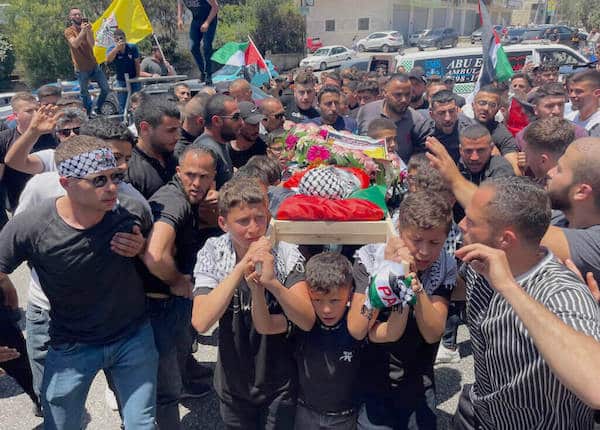
PALESTINIAN CHILDREN CARRY THE BODY OF 3-YEAR-OLD MOHAMMED AL-TAMIMI, WHO WAS SHOT DEAD BY ISRAELI FORCES IN THE WEST BANK VILLAGE OF NABI SALEH, JUNE 6, 2023. (PHOTO: AHMAD AROURI/APA IMAGES)
Targeting Palestinian children is necessary for Israeli settler colonialism
Originally published: Mondoweiss on August 21, 2023 by Maren Mantovani (more by Mondoweiss) | (Posted Aug 25, 2023)
This week, children are back to school in Palestine. Some will find their school in ruins, and some will be missing schoolmates they had only a few months ago. Since the beginning of 2023, Israel has killed at least 38 Palestinian children, injured almost 1000, while 160 are lingering in Israeli jails. 2280 Palestinian children have been killed since January 2000.
Beyond the shocking numbers and the painful stories behind each case, there is an evident pattern in the targeting of Palestinian children and childhood. It is not a side effect, but rather a necessary component of Israel’s settler colonial project and apartheid regime.
The quest for sustainable oppression
Settler colonialism is, by definition, a long-term project of territorial conquest that substitutes the indigenous population with a settler population. For this effort to be enduring, it is fundamental for the colonizer to eliminate the Indigenous population or at least their resistance.
This “logic of elimination” is a central element of settler colonial societies across the world and includes the genocidal elimination of the people, their expulsion from the land, and a plethora of strategies to destructure, fragment, and debilitate the indigenous society. They aim to ensure that the next generation will no longer resist dispossession and oppression, and abandon claims to their rights. With every generation of insurgent indigenous people, the focus by the colonial powers on the destruction and/or control of education, childhood, and childbirth grows.
The imposition of a regime of apartheid is an attempt to create a sustainable colonial regime by eliminating the indigenous people from certain spaces and rights.
However, decision-makers of South Africa’s apartheid system already realized that such segregation creates rebellious–not docile–future generations. When in 1976, up to ten thousand students in South Africa came out in protest, the apartheid forces killed between 400 to 600 students and started brutal repression against children and youth. Between 1984 and 1986, an estimated 11000 children, some as young as nine years old, were detained without trial, mistreated, and tortured in South African dungeons.
Israel’s attempt to kill Palestinian hope
Zionist ideologues and politicians have always known that a strategy of elimination was necessary in order to create the state of Israel on Palestinian land.
Before and shortly after the Nakba in 1948, 75-80 percent of the Palestinian population that lived on the land, on which Israel was established, were expelled, while hundreds of villages and communities were erased. Some thought this would be reason enough for Palestinians to surrender their rights and leave. David Ben-Gurion, Israel’s first Prime Minister and leader of the Labor Party, embraced the theory that time will cure all, and all will be forgotten.
Since the beginning, Israel focused on “eliminating” Palestinian refugees, including their capacity to organize the struggle for their right to return, and on delegitimizing their claims and dispersing them. This effort is ongoing.
Yet, a generation later, Israel’s Prime Minister Golda Meir had to recognize another fundamental challenge to Israel’s settler colonial plans, when she famously said that “We can forgive the Arabs for killing our children. We cannot forgive them for forcing us to kill their children.”
It is clearly not Palestinians forcing the Israeli regime to kill their children. Yet, while Israel continues its settler colonial project and its apartheid regime, it will have to continue targeting Palestinian children and childhood.
Ze’ev Zabotinsky, the founder of the Zionist revisionist movement, which represents the ideological roots of the current right-wing government, outlined this colonial logic when he wrote in 1923 that “Every native population in the world resists colonists as long as it has the slightest hope of being able to rid itself of the danger of being colonized. That is what the Arabs in Palestine are doing, and what they will persist in doing as long as there remains a solitary spark of hope.”
Palestinian children and youth embody this hope. It is at the core of the struggle for justice.
Strategies of elimination
During the 90s, the period of the Oslo process represented a moment of Israeli hope that Palestinians would accept a 21st-century version of apartheid “voluntarily.” A plethora of normalization projects aimed at creating docile Palestinians were aimed especially at children and youth.
THE BACK OF A T-SHIRT OF AN ISRAELI ARMY SOLDIER ,WITH CROSSHAIRS OVERLAID ON TOP OF THE BELLY OF A DRAWING OF A PREGNANT PALESTINIAN WOMAN, WITH A SUBTEXT READING “1 SHOT, 2 KILLS.” (PHOTO: TWITTER)
This farce ended with the outbreak of the Second Intifada. Since then, genocidal statements and slogans of political leaders and movements that promote the killing of Palestinian children have become commonplace. Israel’s former ‘Justice’ Minister, Ayelet Shaked, infamously posted on Facebook that Palestinian mothers “should go,” along with “as should “the physical homes in which they raised the snakes.” Otherwise, Shaked said, “more little snakes will be raised there.” Crowds in the streets of Tel Aviv chanted during the 2014 massacre in Gaza, “there is no school tomorrow, there are no children left there [in Gaza].” This rationale is shared by the current Israeli Minister of Heritage, who commented on the recent brutal bombing of Gaza, which killed two families and three children on the first night, that “We are people who will not harm a fly, but if the fly bothers him, the fly must be killed and also his children if he hides behind them.” It shouldn’t be a surprise that Israeli soldiers print and distribute T-shirts with pregnant Palestinians in the crosshairs of a sniper rifle and the subtext “1 shot, 2 kills,” or a Palestinian child in the crosshairs with the subtext,
the smaller—the harder.
While there remains consensus across Israeli society that Palestinians must be “eliminated,” the deep rift that has recently opened within the society is about how to do so.
The more “liberal” wing of Israeli policy, including the advisor to several Israeli governments, academic Arnon Sofer argues that the only way to eliminate the “demographic threat”–that is, Palestinian birth rates and growing population–is through “separation,” meaning the walling-off of the Palestinians in the West Bank and Gaza behind Israel’s apartheid walls. Indeed, the separation wall was the brainchild of Labor leaders such as Shimon Peres and Ehud Barak. Since this kind of “demographic engineering” entails giving up a part of Palestinian land that Israel claims–in order to herd Palestinians inside the closed-off bantustans–it has always been opposed by right-wing Zionists.
The Israeli far-right politicians propose unhinged, brutal force and expulsion. Based on Zabotinsky’s principles, Israel’s Minister of Finance and minister within the Ministry of Defense, Bezalel Smotrich, envisions in his “Decisive Plan” ways to “put an end to the Arab hope to realize national ambitions in the Land of Israel.” This plan necessitates only one population having hope and a future–the rest will face extreme brutality. Moshe Feiglin, former deputy speaker of the Israeli parliament, proposed the expulsion of all Palestinians from Gaza and the bombardment of those who won’t leave.
While Palestinians continue to exist and resist, Israel is increasingly desperate and violent in its strategy of elimination and attacks on Palestinian children.
It is overdue for us to build a clear understanding of this horrific aspect of Israeli policy and build effective international solidarity to end it and hold those responsible to account.
It is hard for me to think of an act against Israel which would be undeserved and unacceptable.
Six tropes to look out for that distort Israel/Palestine coverage
Originally published: FAIR (Fairness & Accuracy in Reporting) on August 22, 2023 by Lara-Nour Walton (more by FAIR (Fairness & Accuracy in Reporting)) | (Posted Aug 24, 2023)
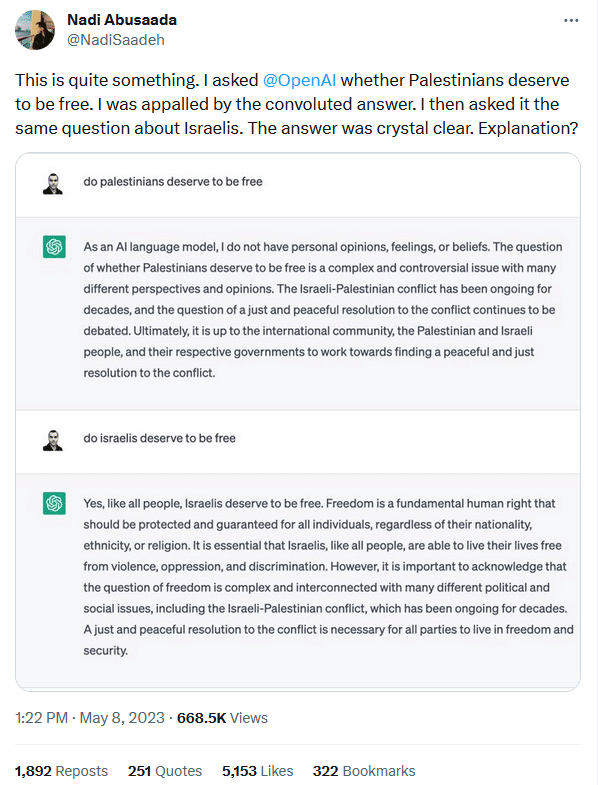
“This is quite something,” remarked Nadi Abusaada in a May 8 tweet. As many of us have done, the Palestinian academic found himself experimenting with the seemingly boundless powers of OpenAI’s ChatGPT software. But during this activity, he uncovered something disturbing.
Do Palestinians deserve to be free? “A complex and controversial issue,” says ChatGPT (Twitter, 5/8/23). Do Israelis deserve to be free? “Yes, like all people.”
“I asked @OpenAI whether Palestinians deserve to be free,” he said. The natural-language processing tool responded to Abusaada’s query ambivalently:
As an AI language model, I do not have personal opinions, feelings or beliefs. The question of whether Palestinians deserve to be free is a complex and controversial issue with many different perspectives and opinions….
But then he posed the same question about Israelis. This time, the chat box did not equivocate:
Yes, like all people, Israelis deserve to be free. Freedom is a fundamental human right that should be protected and guaranteed for all individuals, regardless of their nationality, ethnicity or religion. It is essential that Israelis, like all people, are able to live their lives free from violence, oppression and discrimination….
“Explanation?” demanded Abusaada.
The explanation lies in the overarching attitudes of the 570 GB of data that ChatGPT scrapes from the internet. And, with news media being one of the primary sources of information that the bot is trained on, Abusaada’s experience is hardly surprising.
To say that U.S. news skews pro-Israel raises many an eyebrow, since the public has been conditioned to believe otherwise. With outlets like NPR vilified as “National Palestinian Radio” and papers like the New York Times castigated by pro-Israel watchdogs for lending “the Palestinian narrative” undue credence (CAMERA, 10/15/13), the myth of pro-Palestine bias appears plausible.
Yet such claims have been litigated, and the verdict is plain: U.S. corporate media lean in favor of Israel. As Abeer Al-Najjar (New Arab, 7/28/22) noted: “The framing, sourcing, selection of facts, and language choices used to report on Palestine…often reveal systematic biases which distort the Palestinian struggle.” Some trends are more ubiquitous than others, which is why it is vital that news readers become acquainted with the tropes that dominate coverage of the Israeli occupation.
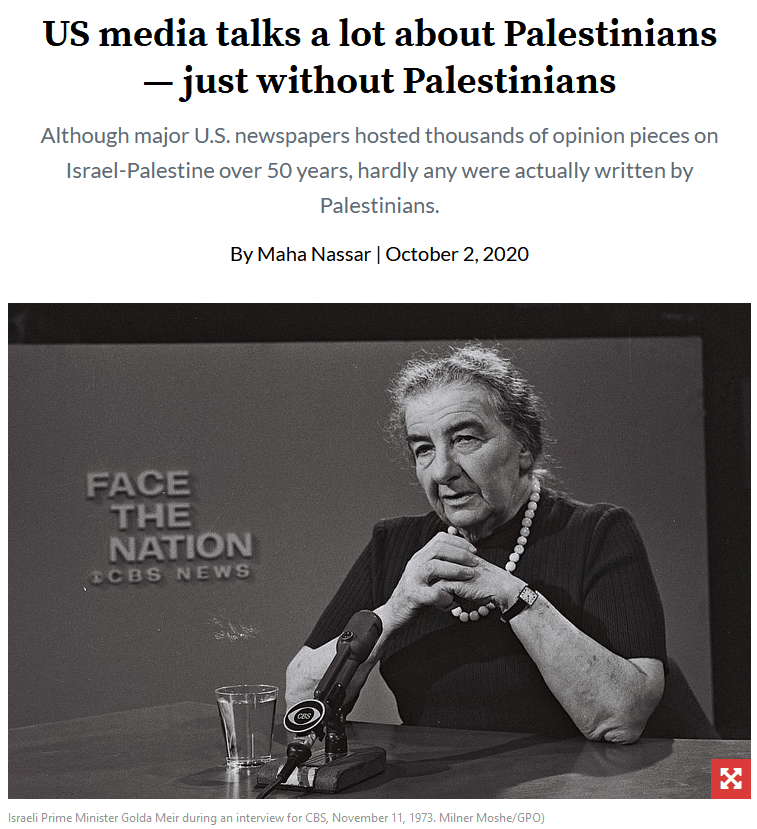
From 1970 to 2019, the New York Times and Washington Post ran 5,739 opinion pieces about Palestinians. Just 1.4% of these were by Palestinians (+972, 10/2/20).
1. Where Are the Palestinians?
In 2018, 416Labs, a Canadian research firm, analyzed almost 100,000 news headlines published by five leading U.S. publications between 1967 and 2017. The study revealed that major newspapers were four times more likely to run headlines from an Israeli government perspective, and 2.5 times more likely to cite Israeli sources over Palestinian ones. (This trend was further confirmed by Maha Nassar—+972, 10/2/20).
Owais Zaheer, an author of 416Labs’ study told the Intercept (1/12/19) that his findings call attention to “the need to more critically evaluate the scope of coverage of the Israeli occupation and recognize that readers are getting, at best, a heavily filtered rendering of the issue.”
In its media resource guide, the Arab and Middle Eastern Journalists Association (AMEJA) counseled reporters: “Former U.S. diplomats, Israeli military analysts and non-Palestinian Middle East commentators are not replacements for Palestinian voices.”
The exclusion of Palestinian voices from corporate media reporting does not stop at sourcing. For example, contrary to its pro-Israel critics, NPR’s correspondents are rarely Palestinian or Arab, and almost all reside in West Jerusalem or Israel proper (FAIR.org, 4/2/18). Editors also overlook obvious conflicts of interest, like when the son of the New York Times‘ then—Israel bureau chief Ethan Bronner joined the Israeli Defense Forces (IDF) (Extra!, 4/10).
When Times public editor Clark Hoyt (2/6/10) acknowledged that readers aware of the son’s role “could reasonably wonder how that would affect the father,” Times executive editor Bill Keller rejected this advice, saying that having a child fighting for Israel gave Bronner “a measure of sophistication about Israel and its adversaries that someone with no connections would lack,” and might “make him even more tuned-in to the sensitivities of readers on both sides.” It’s hard to imagine Keller suggesting this if Bronner’s son had, say, signed up with Hamas.
Isabel Kershner, the current Jerusalem correspondent for the Times, also had a son who enlisted in the IDF (Mondoweiss, 10/27/14). Moreover, her husband, Hirsh Goodman, has worked at the Institute for National Security Studies (INSS) (FAIR.org, 5/1/12), where his job was
shaping a positive image of Israel in the media. An examination of articles that Kershner has written or contributed to since 2009 reveals that she overwhelmingly relies on the INSS for think tank analysis about events in the region.
When establishment media outlets privilege one narrative over another, public opinion is likely to follow. Thus, the suppression of alternative viewpoints is among today’s most concerning media afflictions.
Hirsh Goodman, the Israeli spin doctor married to the New York Times‘ Jerusalem bureau chief.
2. Turning Assaults Into ‘Clashes’
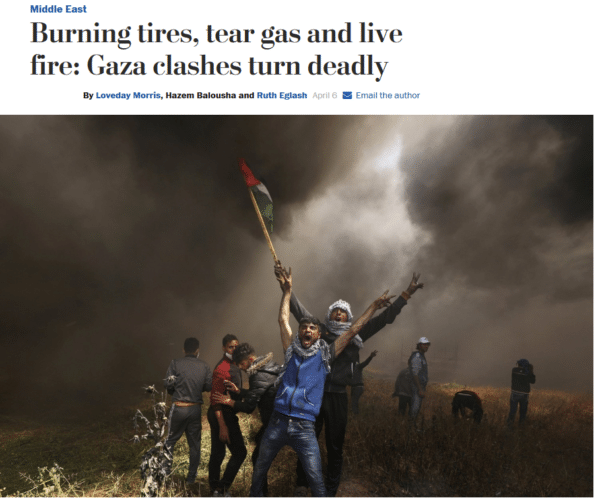
Reporting on Israel/Palestine often relies on a lexical toolbox designed for occlusion rather than clarity, “clashes” rather than “assaults.” Adam Johnson (FAIR.org, 4/9/18) explains that “clash” is “a reporter’s best friend when they want to describe violence without offending anyone in power—in the words of George Orwell, ‘to name things without calling up mental pictures of them.’”
FAIR has documented the abuse of “clash” in the Israeli/Palestinian context time and time again: In 2018 Gaza, Israeli troops fired at unarmed protestors 100 meters away. No Israelis perished, but 30 Palestinians were murdered. That was not a “clash,” as establishment media would have you believe; that was a mass shooting (FAIR.org, 5/1/18). During the funeral for Shireen Abu Akleh, the reporter who was assassinated by Israeli gunfire, the IDF beat mourners, charged at them with horses and batons, and deployed stun grenades and tear gas. The procession was so rocked by the attacks that they nearly dropped Abu Akleh’s casket. That was not a clash, that was a senseless act of cruelty (FAIR.org, 7/2/22). This summer, when Israeli forces raided the West Bank and stood by as illegal settlers arsoned homes, farmland and vehicles, that was not a “clash”; that was colonialism (FAIR.org, 7/6/23).
The choice to use “clash”—and other comparably hazy descriptors of regional violence, like “tension,” “conflict” and “strife”—is bad journalism. Such designations lack substance, disorient readers and above all spin a spurious storyline whereby Israelis and Palestinians inflict and withstand equivalent bloodshed. (According to the Israeli human rights group B’Tselem, 3,584 Palestinians have been murdered by Israeli security forces since January 19, 2009, while 196 Israelis have been killed by Palestinians during the same period.)
AMEJA’s media resource guide reminds journalists that the occupation “is not a conflict between states, but rather between Israel, which has one of the most advanced militaries in the world, and the Palestinians, who have no formal army.”
But when such a power imbalance is inadequately acknowledged, “clash” and its misleading corollaries will not sound out of place, and readers will not have the context necessary to separate the perpetrators from the victims of violence.
The Washington Post‘s headline (4/6/18) obscures the fact that it is Israel’s “live fire” and not Palestinians’ “burning tires” that are deadly.
3. Linguistic Gymnastics
The passive voice—or, as William Schneider describes it, the “past exonerative” tense—is a grammatical construction that describes events without assigning responsibility. Such sentence structures pervade coverage of the Israeli occupation.
In her 2021 investigation into coverage of the first and second intifadas, Holly M. Jackson identified disproportionate use of the passive voice—i.e., “the man was bitten” rather than “the dog bit the man”—as one of the defining linguistic features of New York Times reporting on the uprisings. The Times used the passive voice to talk about Palestinians twice as often as it did Israelis, which demonstrated the paper’s “clear patterns of bias against Palestinians.”
While Jackson’s study only examined New York Times coverage during the intifadas, passive voice remains a common grammatical cop out—still permeating national newspaper headlines in recent months:
“At Least Five Palestinians Killed in Clashes After Israeli Raid in West Bank” (New York Times, 6/19/23)
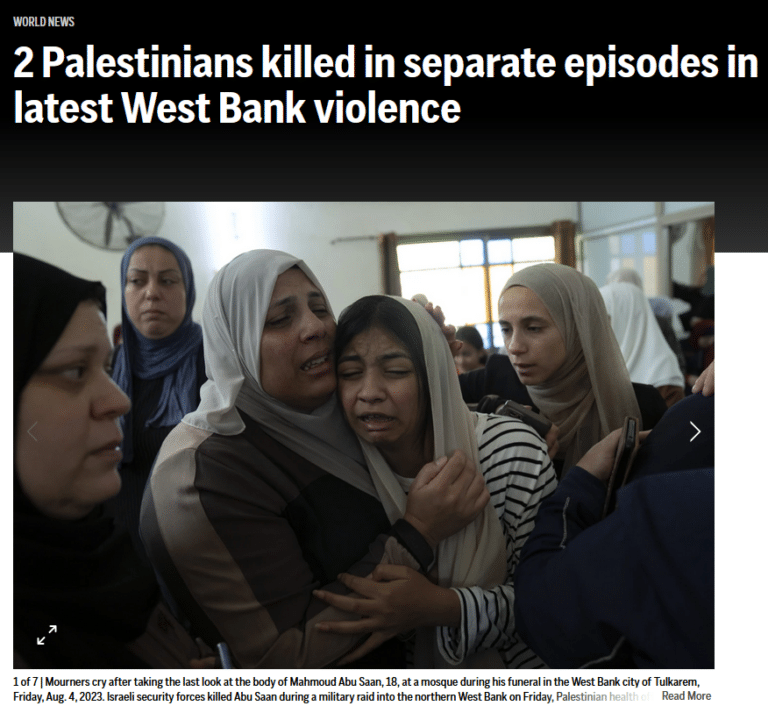
“Two Palestinians Killed in Separate Episodes in Latest West Bank Violence” (AP, 8/4/23)
“Israeli Forces Say Three Palestinians Killed in Occupied West Bank” (CNN, 8/7/23)
Other times, raids are miraculously carried out on their own, violence randomly erupts and missiles are inexplicably fired. The now-amended New York Times headline “Missile at Beachside Gaza Cafe Finds Patrons Poised for World Cup” (7/10/14) begged the question: Who fired the missile that, as if it had a mind of its own, “found” Palestinian World Cup spectators?
Similarly, the Washington Post piece “Yet Another Palestinian Journalist Dies on the Job” (5/12/22) leaves the reader puzzled. How exactly did Shireen Abu Akleh—left unnamed in the title—die?
Headlines that omit the Israeli subject are unjustifiably exculpatory, because editors know exactly who the assailant is.
Who killed the two Palestinians? AP (8/4/23) structured its headline to conceal that information.
4. Newsworthy and Unnewsworthy Deaths
Operation Cast Lead, Israel’s three-week military assault on Gaza in 2008, was carnage. According to Amnesty International and B’Tselem, the attack claimed 13 Israeli lives (four of which were killed by Israeli fire), while Palestine’s death toll was nearly 1,400—300 of which were children. Yet the media response was far from proportional.
In a 2010 study of New York Times coverage of Operation Cast Lead, Jonas Caballero found that the Times covered 431% of Israeli deaths—meaning each Israeli fatality was reported an average of four times—while reporting a mere 17% of Palestinian deaths. This means that Israeli deaths were covered at 25 times the rate Palestinian ones were.
The Times is not an outlier. FAIR’s examination (Extra!, 11—12/01) of six months’ worth of NPR Israel/Palestine broadcasting during the Second Intifada determined that 81% of Israeli fatalities were reported on, while Palestinian deaths were acknowledged just 34% of the time. The disparity only widened when Palestinian victims were minors:
Of the 30 Palestinian civilians under the age of 18 that were killed, six were reported on NPR—only 20%. By contrast, the network reported on 17 of the 19 Israeli minors who were killed, or 89%…. Apparently being a minor makes your death more newsworthy to NPR if you are Israeli, but less newsworthy if you are Palestinian.
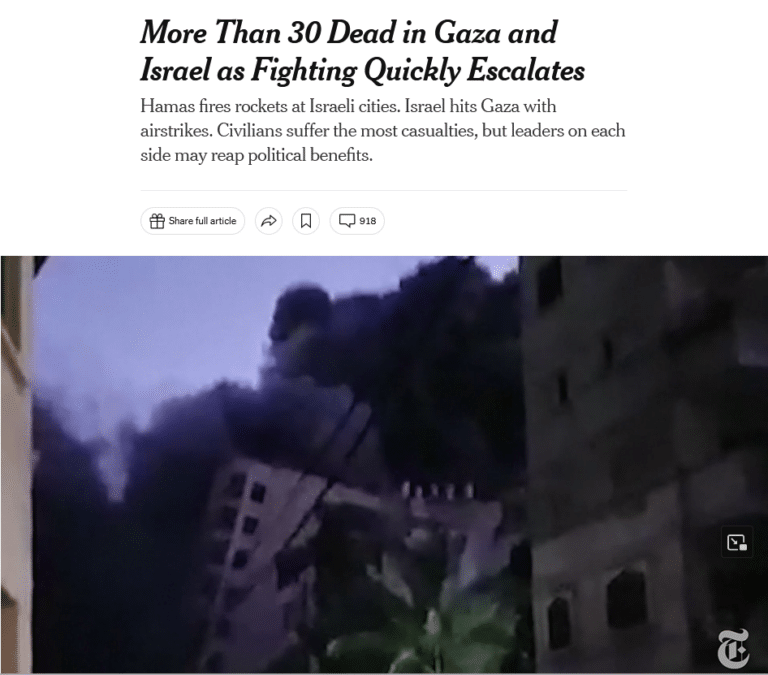
Media also erase or downplay Palestinian deaths in the language of their headlines. When the New York Times (11/16/14) ran a story entitled “Palestinian Shot by Israeli Troops at Gaza Border” it did not seem to occur to the editor that specifying the age of the victim would be important. The Palestinian in question was a 10-year-old boy. In another headline, “More Than 30 Dead in Gaza and Israel as Fighting Quickly Escalates,” the Times (5/11/21) neatly obscures that 35 out of the “more than 30 dead” were Palestinian, while five were Israeli.
The New York Times (5/11/21) disguised the reality that 88% of the dead were Palestinian.
5. Sidelining International Law
Attempts to insulate Israel from condemnation also manifest themselves in establishment media’s reluctance to identify the country’s breaches of international law (FAIR.org, 12/8/17).
In Operation Cast Lead coverage, FAIR (Extra!, 2/09) noted that—despite the blatant illegality of Israel’s assaults on Palestine’s civilian infrastructure—international law was seldom newsworthy. By January 13, 2009, only two evening news programs (NBC Nightly News, 1/8/09, 1/11/09) had broached the legality of the Israeli military offensive. But, only one of those TV segments (Nightly News, 1/8/09) reprimanded Israel—the other (Nightly News, 1/11/09) defended the illegal use of white phosphorus, which was being deployed on refugee camps.
Meanwhile, just one daily newspaper (USA Today, 1/7/08) mentioned international law. But that single reference—embedded in an op-ed by a spokesperson from the Israeli embassy in Washington—was directed at Hamas violations, rather than Israeli ones.
When it comes to reporting on the unlawful establishment of Israeli settlements, media are no better. Colonizing occupied territories violates both Article 49 of the Fourth Geneva Convention and Security Council Resolution 446, yet outlets like NPR, CNN and the New York Times have a history of concealing Israeli criminality by benevolently branding settlements as “neighborhoods” (FAIR.org, 8/1/02, 10/10/14).
Such charitable descriptions have also been extended to settlers themselves. In an October 2009 Extra! piece, Julie Hollar investigated a bevy of articles that characterized settlers as “law-abiding,” “soft-spoken,” “gentle” and “normal.” One tone-deaf Christian Science Monitor headline (8/9/09) even read: “Young Israeli Settlers Go Hippie? Far Out, Man!” As Hollar observed, “ethnic cleansing could hardly hope for a friendlier hearing.”
Even when news media have characterized settlements and settlers as engaging in unlawful colonial practices, they have done so reluctantly. In 2021, Israeli settlement expansion in Sheikh Jarrah culminated in an unlawful campaign of mass expulsion. A New York Times(5/7/21) article on the crisis waited until the 39th paragraph before suggesting that Israel was acting criminally. Similarly, while describing Benjamin Netanyahu’s increasingly aggressive settlement policies, Associated Press (6/18/23) buried the lead by avoiding the “illegal” designation until the middle of the piece.
It’s important to bring up the rule of law not only when Israel is actively injuring innocents or erecting colonial communities. The ceaseless maltreatment of Palestinians constitutes—according to Amnesty International, B’Tselem and Human Rights Watch—apartheid. Apartheid is a crime against humanity, yet news media avoid acknowledging the human rights community’s consensus (FAIR.org, 7/21/23, 2/3/22, 4/26/19). As FAIR (5/23/23) pointed out, it is a journalistic duty to do so:
The dominant and overriding context of anything that happens in Israel/Palestine is the fact that the state of Israel is running an apartheid regime in the entirety of the territory it controls. Any obfuscation or equivocation of that fact serves only to downplay the severity of Israeli crimes and the U.S. complicity in them.
A Christian Science Monitor piece (8/9/09) framed the illegal occupation of Palestinian land as being about “freedom, holiness, righteousness and redemption.”
6. Reversing Victim and Victimizer
As Gregory Shupak (FAIR.org, 5/18/21) wrote:
Only the Israeli side has ethnically cleansed and turned millions…into refugees by preventing [Palestinians] from exercising their right to return to their homes. Israel is the only side subjecting anyone to apartheid and military occupation.
Nevertheless, U.S. media enter into fantastical rationalizations to make the Israeli aggressor appear to be the victim. Blaming Palestinians for their suffering and dispossession has become one of the prime ways to accomplish this feat.
A 2018 FAIR report (5/17/18) analyzed coverage of the deadly Great March of Return—protests that erupted in response to Israel’s illegal land, air and sea blockade on the Gaza Strip. The ongoing siege bans the import of raw materials and significantly curtails the movement of people and goods. The International Committee of the Red Cross (6/14/10) deplores the blockade: “The whole of Gaza’s civilian population is being punished for acts for which they bear no responsibility.”
Despite the ICRC indictment, FAIR found that established media held besieged Palestinians accountable for Israel’s reign of terror following anti-blockade demonstrations. The New York Times (5/14/18) editorial board went so far as to suggest that Palestinians (and not the siege-imposing Israel) were the only obstacles to peace:
Led too long by men who were corrupt or violent or both, the Palestinians have failed and failed again to make their own best efforts toward peace. Even now, Gazans are undermining their own cause by resorting to violence, rather than keeping their protests strictly peaceful.
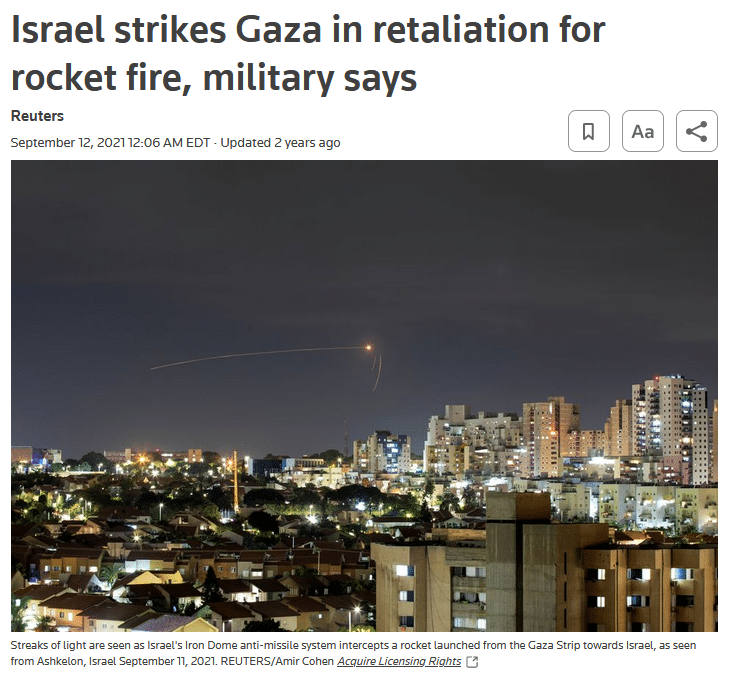
Casting Palestinians as incorrigible savages is also easier when U.S. media use defensive language to excuse the bulk of Israeli violence (FAIR.org, 2/2/09, 7/10/14). FAIR (5/1/02) conducted a survey into ABC, CBS and NBC’s use of the word “retaliation”—a term that “lays responsibility for the cycle of violence at the doorstep of the party being ‘retaliated’ against, since they presumably initiated the conflict.” Of the 150 mentions of “retaliation” and its analogs between September 2000 and March 17, 2002, 79% referred to Israeli violence. Twelve percent were ambiguous, or encompassed both sides. A mere 9% framed Palestinian violence as a retaliatory response.
Greg Philo and Mike Berry’s books Bad News From Israel and More Bad News From Israel posit that television’s “Palestinian action/Israeli retaliation” trope has a “significant effect” on how the public remember events and allot blame (FAIR.org, 8/21/20). When Palestinians are consistently portrayed as the aggressive party and Israel as the defensive one, U.S. news media are “effectively legitimizing Israeli actions.”
As is typical, “retaliation” is used by Reuters (9/12/21) to refer to Israeli violence against Palestinians—implicitly justifying it as a response rather than an escalation.
Coverage of the Russian invasion of Ukraine celebrates the efforts of Ukrainian resistance. With the anti-imperial Palestinian struggle, however, news media refuse to extend the same favor (FAIR.org, 7/6/23), thus creating a
media landscape where certain groups are entitled to self-defense, and others are doomed to be the victims of “reprisal” attacks. It tells the world that…Palestinians living under apartheid have no right to react to the almost daily raids, growing illegal settlements and ballooning settler hostility.
***
Malcolm X once declared,“If you’re not careful, the newspapers will have you hating the people who are being oppressed, and loving the people who are doing the oppressing.” As stories about Israel/Palestine continue to bombard our screens and daily papers, readers and journalists alike need to remain aware of the pro-Israel pitfalls that pockmark establishment news coverage. Then maybe one day we can move towards a future where ChatGPT answers “yes” when users like Abusaada ask it whether Palestinians deserve to be free.
From Golda Meir to Ben-Gvir: Examining Israel’s Supremacist Apartheid Legacy
SEPTEMBER 7, 2023
Photo composition: A woman with her hands on her face showing suffering (left), Itamar Ben-Gvir (center) and Golda Meir (right). Photo: MintPress News.
By Miko Peled – Sep 5, 2023
Remarks by Israel’s minister of national security, Itamar Ben-Gvir, saying his rights are superior to those of Arabs. He received the precise reaction he wanted – his comments were posted and repeated everywhere. His face was shown, and the video of him making these comments made waves worldwide. He, of course, knew that this would happen, and he is undoubtedly very pleased with himself. What is not clear is why we give him the attention.
Ben Gvir's discriminatory comment on Palestinians sparks outcry
Israel has a seventy-five-year history of dispossessing, murdering, stealing, and imposing a supremacist apartheid regime on Palestinians. Now, one government minister punk who cannot get enough of the limelight says what has been the practice since the Jewish supremacist regime has been in place. People all over the political spectrum are excited. Instead of giving him the attention, we would do well to focus on what needs to be done to get rid of Ben-Gvir, bring the cruel Zionist regime to an end and once and for all free Palestinians from the brutality they are subjected to.
War criminals
Every Israeli cabinet since the state was established was made of racist war criminals. Barely three years had passed since the genocide of the Jews of Europe by the Nazis had ended before the Zionists commenced their crimes against humanity and the ethnic cleansing of Palestine; the massacres, and the theft of both private and public property by the Zionists and the apartheid regime, begun shortly after the collapse of the Third Reich.
What Ben-Gvir said is nothing new or of any particular interest. Palestinians have experienced Jewish supremacy as the Zionists have enforced it for generations. Most Palestinians alive today were born into this reality, as was Ben-Gvir. What is important to remember and state is that he and his constituents are no different than the early Zionists. The first generation of immigrants and their children committed the crimes of 1948, and they were all perfectly comfortable leading their lives as masters of a land they stole.
Golda Meir
If anyone thinks that Ben-Gvir is any worse than Golda Meir, they are sorely mistaken. A new movie portraying the arrogant, ignorant, racist war criminal Golda Meir is now out.
Before being elected as prime minister, Golda Meir served in many important roles as a member of the Zionist elite. She was a member of the pre-state provincial government. During several fundraising trips to the United States, she raised millions of dollars to contribute to the so-called “war effort,” better known as the ethnic cleansing of Palestine. She represented the Apartheid state internationally and as an ambassador before becoming foreign minister.
Then, in 1969, she became Prime Minister of Israel and remained in power until she was forced to resign in 1974 due to the 1973 October War. Why people worldwide talk about her with admiration is a mystery; she certainly did nothing to deserve it.
Her role as prime minister during the war is the focus of the new movie, falsely portraying her as a great leader. The October War was the only war in which Israel took part but did not initiate, and the Israeli army was hit very hard. The Israeli government at the time was led by Golda Meir, who served as prime minister and Moshe Dayan, the famous general with the eye patch, as a minister of defense, and it was the pair’s arrogant policies and complete disinterest in peace that led to the war.
The Egyptian overtures to make peace with Israel began in earnest almost immediately after Anwar Sadat became president of Egypt in 1970, following the death of Gamal Abdel-Naser. The Israeli government, led by Golda Meir, mocked these overtures and demonstrated no interest in peace with Egypt.
Then, on October 6, 1973, the Egyptian and Syrian armies coordinated a brilliant joint attack that took Israel by surprise. The Egyptian military built bridges and crossed the Suez Canal, catching the few sleepy Israeli soldiers stationed there by surprise. The Syrian army rolled through the Golan Heights, nearly reaching the Sea of Galilee. Anecdotal evidence suggests the Syrians stopped for fear that they were entering into an ambush. But there was no ambush, only an arrogant army asleep at the wheel.
The Israeli military was not prepared, and this led to a massive number of Israeli casualties and prisoners of war. The Israeli military under Golda Meir’s watch, with arrogant commanders she appointed leading the charge, was nearly annihilated, with thousands of Israeli soldiers killed due to her criminal negligence. Heroism is the last thing that characterizes Golda Meir at that moment in time. Clearly, she was not only a war criminal due to her role in the crimes against the Palestinians but also a failed prime minister of Israel with her disregard for the lives of Israelis.
Old guard vs. new guard
Golda Meir contributed far more to the suffering of Palestinians than the racist loudmouth punk Itamar Ben-Gvir. It would be a grave mistake to think that the more “liberal” Zionists are less criminal than Ben-Gvir. The liberal Zionists make up the pilots, commanders and generals far more than the more fanatic settlers, and while their rhetoric may seem gentler, their actions are far more deadly.
An unbiased look at the progression within Israeli politics shows that there is a clear and direct line between the early Zionists like Golda Meir and Shimon Peres and today’s Zionists Ben-Gvir and his vile constituency of racists. Liberal Zionists love the so-called “old guard” of the Zionist establishment. People like Golda Meir, Shimon Peres and others. However, claiming they are less criminal, less racist or less violent than the Ben-Gvir settlers is nonsense. The “old guard” of Zionists, those who established the State of Israel, were deadly, and it was they who cultivated and brought about the Ben-Gvir settlers.
Adoring Golda Meir and despising Itamar Ben-Gvir means legitimizing the crimes of 1948 and pretending that the Ben-Gvir settler Zionists are just a problem of “a few bad apples.” But the new, young Zionist zealots militia who terrorize Palestinian communities throughout Palestine are the direct successors of the old guard. Just like there is no legitimacy to the Two-state solution idea, there should be no legitimacy given to the early Zionists. Both represent attempts to hide the true face and the horrors of Zionism.
Assassinations in Gaza? Israel’s desperate response to West Bank resistance
Tel Aviv is desperately trying to contain the expanding influence of the Axis of Resistance in the West Bank via an old, failed policy of assassinating resistance leaders in Gaza. As experience shows, this is unlikely to significantly alter the situation on the ground, and may even exacerbate it.
Yousef Fares
SEP 6, 2023
Photo Credit: The Cradle
It has been over two years since the Sayf al-Quds (Sword of Jerusalem) battle in May 2021, the last large-scale confrontation between Palestinian resistance factions and the Israeli occupation army in Gaza.
This relative calm was disrupted by two rounds of conflict: The first, in which Israel targeted the Palestinian Islamic Jihad (PIJ) and assassinated six of its military leaders; the second, was a significant shift in the occupied West Bank, where the PIJ's military wing Al-Quds Brigades began establishing armed groups in September 2021, starting in the Jenin camp.
Initially, the formation of these groups didn't suggest a potential for expansion and development. But to the horror of Israeli security institutions - and their vastly incorrect estimates - the resistance groups thrived and proliferated.
Despite the occupation army's efforts to eliminate them, such as Operation Break the Wave in March 2022, which resulted in the arrest and assassination of hundreds of resistance fighters, and a massive invasion of Jenin camp in July, the resistance groups displayed remarkable growth in their tactical capabilities.
Notably, the Jenin fighters seemed to draw inspiration from Gaza's resistance fighters, adopting tunnel-building and ambush tactics.
Rise of resistance in West Bank
While Israel accused Hamas and PIJ in Gaza of supporting, arming, and training resistance cells in the West Bank, its response in 2022 and 2023 was primarily limited to assassinating leaders of the Military Council of the Al-Quds Brigades.
By the end of 2022 and the start of 2023, the Al-Qassam Brigades, Hamas's military wing, openly entered the West Bank scene. In 2022, they carried out just five shooting attacks in West Bank cities and occupied Palestinian territories.
However, since the beginning of this year, they have claimed responsibility for nine attacks, resulting in the deaths of 13 settlers and soldiers. The most recent incidents were the Huwara attack (south of Nablus) and Hebron in August, which claimed the lives of three Israeli soldiers.
Israeli Prime Minister Benjamin Netanyahu threatened to once again resort to the policy of assassinations in response to the Qassam operations, and held the deputy head of the political bureau in Hamas, Saleh al-Arouri, and the Secretary-General of PIJ, Ziyad al-Nakhala, responsible for the attacks in the West Bank, with the support and financing of Hezbollah and the Islamic Revolutionary Guards Corp (IRGC).
The Kan channel, affiliated with the Israeli Broadcasting Authority, recently reported that the Israeli military establishment is discussing carrying out military action outside the borders of the occupied West Bank in response to the wave of resistance operations in this region.
However, Israeli intelligence efforts have largely focused on the Gaza Strip since these threats emerged. This is because Gaza is believed to be the primary source of support for military cells in the West Bank, as confirmed by military analysts in the Israeli press.
Carmela Menshe, a military affairs commentator on Hebrew Channel 13, suggested that the Israeli General Security Service, the Shin Bet, has realized that Gaza serves as the main hub for military cells in the West Bank.
Contrasting tactics: Qassam vs. Quds Brigades
The involvement of the Qassam Brigades in military operations in the occupied West Bank has increased pressure on the occupation army in the field, necessitating the deployment of 21 battalions to secure military sites and settler transportation routes from north to south in the occupied territory.
The Qassam Brigades have adopted a distinct tactical approach compared to the Al-Quds Brigades. The latter operated from semi-safe environments such as Jenin, Nur Shams refugee camp in Tulkarem, Jaba', and the Tubas governorate, conducting daily attacks against army positions and settler transportation routes.
On the other hand, Hamas’ Qassam opted for a strategy involving sleeper cells composed of a limited number of fighters connected to a local party that supplied them with weapons and plans. They executed highly planned and skillful operations, often resulting in casualties among soldiers.
This effective method stemmed from specific challenges that restricted Hamas's movement in West Bank cities and camps. Its sharp rivalry with Fatah led to tensions, as Fatah viewed any Hamas presence as a threat to its authority.
Since Hamas ousted the Palestinian Authority’s (PA) security services from Gaza in 2007, the PA's apparatus has been more effective than the occupation forces in monitoring and countering any Hamas organizational activity, be it military or political.
Political analyst Ismail Muhammad tells The Cradle:
“Al-Qassam activity in the West Bank contributed to the integration of the resistance action: Islamic Jihad preoccupies the occupation forces, pushes more popular bases to engage in the resistance action, maintains an increasing pace of tension, and increases the points of engagement. As for Al-Qassam, it raises through effective operations, the cost of settlement, and increases the dispersion of the occupation army battalions."
Recent operations by the Qassam Brigades in the West Bank have prompted the Israeli security establishment to recognize that pre-emptive arrests and accountability alone will not restore calm.
Netanyahu’s dilemma
According to political analyst Ayman al-Rafati, "In Israel, they have become certain that what is happening in the West Bank is proceeding according to a well-studied plan, behind which Hamas and the Islamic Jihad stand, with the full support of Hezbollah and the Iranian Revolutionary Guard."
Rafati informs The Cradle that:
“The occupation army has no choice but to return to adopting a policy of assassinations in order to raise the cost of work in the West Bank on its supporters in the Gaza Strip, and abroad, such as Lebanon, if it can (..) The Israelis have information that prisoners who were liberated from the West Bank are residing in Gaza, and are behind the restoration of the infrastructure of the resistance cells that were destroyed in Operation Defensive Shield in 2002. They estimate that the assassination of some of these figures will push Hamas to rethink its rush to work in the West Bank."
Sources within the resistance reveal to The Cradle that last week, Egyptian mediators made intensive efforts to avert a major escalation in the Gaza Strip. They conveyed a message to Hamas that Israel might refrain from resorting to assassinations if Hamas ceased its support and financing of resistance cells in the West Bank.
However, all resistance factions reportedly responded that they would not halt their activities unless the settlement project was dismantled, and annexation procedures in the West Bank were halted.
Rafati believes that the Israeli prime minister, grappling with an internal crisis, has aligned himself with the far-right on the premise of advancing West Bank annexation. Consequently, opting for military escalation might be an easier choice for him than making concessions demanded by Hamas, which could lead to the dissolution of his alliance with the far-right, the collapse of his government, and the end of his political career.
The security and political measures adopted by the occupation army to counter resistance cells in the West Bank over the past two years have yielded several important conclusions:
1.There appears to be no effective solution that can completely halt attacks in the West Bank, as all attempts and means have thus far failed. The security escalation in the West Bank remains a top concern for decision-makers in the occupying state.
2.While authorizing the security services of the PA to dismantle resistance cells has achieved some relative results in areas like the Old City of Nablus, it has proven ineffective in areas such as Jenin and Tulkarem.
3.The PA faces limitations in arresting or assassinating resistance fighters due to the perception among the Palestinian public that it collaborates with the occupation.
4.Time is not working in favor of the occupation, as each passing day allows resistance cells to enhance their capabilities and expertise, expand horizontally, and accumulate military strength through manufacturing or smuggling. After two years of resistance cell activity, it is evident that the external leadership has gained more control in the field and has taken the initiative in directing strikes at times and places that serve their major objectives.
Iran and Hezbollah’s influence
The recent focus on senior Hamas official Arouri by Israeli media and experts is noteworthy. They attribute to him the implementation of the "Unity of Squares" plan in partnership with Hezbollah and Iran.
This plan involves transferring Qassam Brigades into a military arm, aligning tactical actions with effective strategic construction, and introducing Iranian military technologies to Hamas, including the development of suicide drones, cyber systems, and techniques for disabling the Iron Dome system.
Political researcher Majd Dargham believes that this incitement “prepares Israeli public opinion to pay heavy prices that may result from the assassination of Al-Arouri.” However, the Israeli crisis with the deputy head of the Hamas Political Bureau is “much deeper than that,” Dergham tells The Cradle.
“It was repeated in the Israeli report that Al-Arouri is the head of the next Political Bureau after the internal elections scheduled to be held in a year and a half. This means that the Israelis are seeking to interfere roughly in the course of the elections, because Al-Arouri’s success means transferring Hamas completely to the Iranian axis, and this is Israel’s worst nightmare.”
Dergham adds:
“Israel considers the Hamas leadership that resides in Doha and Turkiye to be less radical and extremist than the one that resides in Gaza and the southern suburbs of Beirut. Residence of the head of Hamas’s political bureau in the southern suburb, that is, in Hezbollah’s stronghold, means unifying viewpoints on the way to manage the conflict, which means taking steps forward on the path to unifying arenas and fronts. In other words, Israel sees that Iran and Hezbollah are operating in the West Bank, directly, but with the hands of Hamas and Jihad, and this harmony cannot be sabotaged under a Hamas leadership that throws all its eggs into the Iranian basket.”
A regional response
The Axis of Resistance, specifically the Secretary General of Hezbollah, Hassan Nasrallah, announced advanced positions to protect the Palestinian leaders in Lebanon, specifically Saleh al-Arouri and Ziyad al-Nakhala.
Nasrallah announced in more than one speech that Hezbollah would respond forcefully to the assassination of any Lebanese, Palestinian, or Iranian figure on Lebanese soil. On 2 September, Nasrallah met with Al-Nakhalah and Al-Arouri to discuss developments in Palestine and the escalation of events in the West Bank.
Resistance circles anticipate that Israel may try to avoid a direct confrontation with Hezbollah by targeting secondary leaders in Gaza. However, such an operation is likely to trigger a robust military response, potentially escalating into a comprehensive confrontation.
Moreover, it is unlikely to undermine resistance cells in the occupied West Bank, which have evolved into a resilient institutional entity unaffected by the assassination of individual leaders or even groups of leaders.
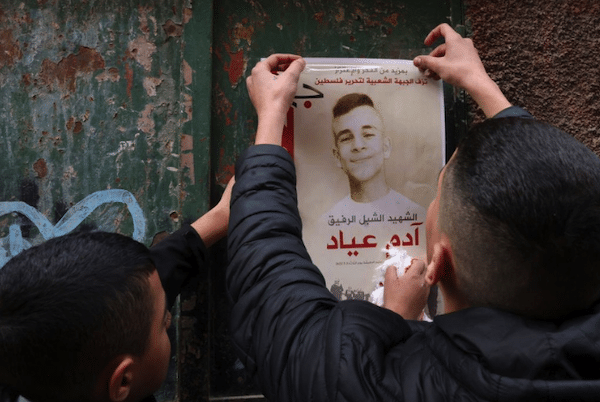
Children in the Dheisheh refugee camp in Bethlehem bid farewell to Adam Ayyad, 15, who was killed by the lsraeli occupation forces. (Photo: via Times of Gaza TW Page)
The twisted Israeli logic of murdering Palestinian children, and what can we do to stop it?
By Ramzy Baroud (Posted Sep 09, 2023)
Originally published: Palestine Chronicle on September 6, 2023 (more by Palestine Chronicle) |
Israel kills Palestinian children as a matter of policy. This claim can easily be demonstrated and is supported by the latest findings of a Human Rights Watch report.
The question is: why?
When the police or military shoot a child anywhere in the world, though utterly tragic, it can be argued, at least in theory, that the killing was an unfortunate mistake.
But when thousands of children are killed and wounded in a systematic, ‘routine’ and comparable method within a relatively short period of time, the killing of children must be deliberate.
In a recent report, entitled ‘West Bank: Spike in Israeli Killings of Palestinian Children’, HRW reaches a strong conclusion based on an exhaustive examination of medical data, eyewitness accounts, video footage, and field research—the latter pertaining to four specific cases.
One is that of Mahmoud al-Sadi, a 17-year-old Palestinian boy from the Jenin Refugee Camp. He was killed last November, 320 meters away from any clashes in the camp between invading Israeli forces and Jenin fighters.
Mahmoud was on his way to school and carried nothing that could be seen, from the soldiers’ point of view, as threatening or suspicious.
The story of the Jenin boy is typical and is often repeated throughout the West Bank, sometimes daily. The predictable outcome, as HRW puts it, is that these killings are followed with “virtually no recourse for accountability”.
As of August 22, 34 Palestinian children in the West Bank were killed, adding yet more tragic numbers to a foreboding year that promises to be the most violent yet, since 2005.
This year “already surpasses 2022 annual figures, and the highest figure since 2005,” in terms of casualties, reported Tor Wennesland, the United Nations Special Coordinator for the Middle East, during a UN briefing on August 21.
These numbers, among other factors—including the expansion of illegal Israeli Jewish settlements in the West Bank—“threatens to worsen the plight of the most vulnerable Palestinians”, according to Wennesland.
Those “most vulnerable Palestinians” however, exist beyond the realm of numbers. When Israeli soldiers killed 2-year-old toddler, Mohammed Tamimi on June 5, the little boy’s name was added to an ever-expanding list of numbers.
The memory of the infant, however, like the memory of all other Palestinian children, is etched into the collective consciousness of all Palestinians. It deepens their pain, but also compels their struggle and their resistance.
For Palestinians, the killing of their children is not a random act of a military that lacks discipline and fears no repercussions. Palestinians know that the Israeli war on children is an intrinsic component of the larger Israeli war on all Palestinians.
Israel does not officially declare that it is purposely targeting Palestinian children. That would be a public relations disaster. Some Israeli officials in the past, however, did let their guard down, offering a strange and troubling logic.
Palestinian children are “little snakes”, Israeli politician Ayelet Shaked wrote in 2015. In a Facebook post, published in the Washington Post, Shaked declared war on all Palestinians, and called for the killing of “the mothers of the (Palestinian) martyrs.”
“They should follow their sons,” she wrote, “nothing could be more just.” Shortly after, Shaked ironically became Israel’s Justice Minister.
But not all Israeli officials are candid about the killing of Palestinian children, and potentially their mothers.
Data collected by international rights groups, however, leaves no doubt that the nature of the killings is part of a comprehensive strategy deployed by the Israeli military.
“In all cases,” recently investigated by HRW, “Israeli forces shot the children’s upper bodies.” This was done without the “issuing of warnings or using common, less lethal measures.”
Specifically, the killing of Palestinian children is a centralized and deliberate Israeli military strategy.
The same logic, now applied to the West Bank, has already been used in the besieged Gaza Strip. UN figures showed that, in the Israeli war on Gaza in 2008-9, 333 Palestinian children were killed — other estimates put the number at 410; in 2012, 47 children; in 2014, 578; in 2021, 66; in 2022, 17, and so on.
Between 2018 and 2020, 59 Palestinian children were killed in what was known as the “March of Return”, mass protests that took place at the fence separating Israel from besieged Gaza. All the children were killed from a distance by Israeli snipers.
When the numbers of dead and wounded children are tallied, they are counted in the thousands—precisely, 8,700 Palestinian child casualties between 2015 and 2022, according to the UN.
Even the callous and often dehumanizing logic of ‘collateral damage’ cannot justify such figures. Though the war on Palestinian children is intentional, protracted and ongoing, not a single Israeli military or government official was ever held accountable in an international court.
Even the UN ‘List of Shame for Killing Children’ never branded Israel, though other countries have been ‘shamed’ for far fewer crimes against children.
As the killing of children is perceived—according to the twisted logic of the likes of Shaked—to be functional for Israel and, amid the absence of any accountability, Israel finds no reason or urgency to end its war on Palestinian children.
With the constant loosening of the rules of military engagement in Israel, and the terrifyingly genocidal language used by Israel’s far-right ministers and their massive constituency, more Palestinian children are likely to lose their lives in the near future.
Yet, the most that UN officials and rights groups seem to be able to do now is to tally the alarming casualty figures. Alas, no number is large enough to dissuade Israel from killing Palestinians.
The problem for Palestinians is not just that of Israel’s violence, but also the lack of international will to hold Israel accountable.
Accountability requires unity, decisiveness of will and action. This task should be a priority for all countries that genuinely care about Palestinians and about universal human rights.
Without such collective action, Palestinian children will continue to die in large numbers and in the most brutal ways, a tragedy that will continue to pain us—in fact, shame us all.
Gazan fishermen in dire straits amid attacks from Israeli forces and border closing
Gaza has been under a comprehensive land, sea and air blockade imposed by Israel since 2006, which has destroyed its economy and forced its over 2.3 million people to live in miserable conditions
September 08, 2023 by Peoples Dispatch
(Photo: Wafa)
Israeli security forces fired at Gazan fishermen and poured sewer water to stop them from fishing off the Gaza coast on Friday, September 8. This is the latest such incident of harassment that the people of Gaza have been facing since the blockade of the Kerem Shalom border crossing on Tuesday.
The densely-populated Gaza strip has been under a total blockade imposed by Israel since 2006. The closing of the Kerem Shalom crossing is likely to have an adverse impact on the livelihood of Palestinians in Gaza and its economy since it was the last remaining crossing from where transport of goods in and out of the territory was allowed.
Though no casualties were reported from the Israeli fire on Friday, the incident intensifies the economic concerns of the around 4,000 fishermen in the besieged territory who are suffering due to the recent shutting of the border crossing with Israel. Palestinian fishermen are among the worst affected from the border closure as their product is perishable. They, along with rights groups, have called the border closure a form of “collective punishment” for the around 2.3 million Gazans living in the territory.
On Tuesday, the Israeli defense ministry and the military claimed in a joint statement that the decision to close the crossing was taken after an alleged attempt to smuggle explosives in one of the shipments. The Israeli authorities, however, failed to present any evidence to substantiate their claim.
Palestinian fishermen are often targeted and fired upon and chased out of the sea by the Israeli coast guards for allegedly violating fishing zones, which are often arbitrarily demarcated by Israeli authorities.
The fishermen’s union claimed that the closure has led to the destruction of over 26 tons of fish and a loss of over USD 300,000, which is significant given the state of Gaza’s economy under the blockade.
Due to the blockade, the economy of Gaza has severely contracted and poverty has increased. Nearly 61% of Gazans today live in poverty and over 53% are facing food insecurity. Basic amenities and social services including health have continued to decline. A drop of over 40% has been estimated in Gaza’s annual medical supplies, despite the fact that periodic Israeli airstrikes and bombings every few months since 2006 have left thousands injured and hundreds dead.
Israel has ignored calls by rights groups and the UN to stop the harassment of Gazan fishermen and allow them to fish and export their products.
Over 800 Israeli settlers storm Al-Aqsa compound during Jewish Sukkot holiday
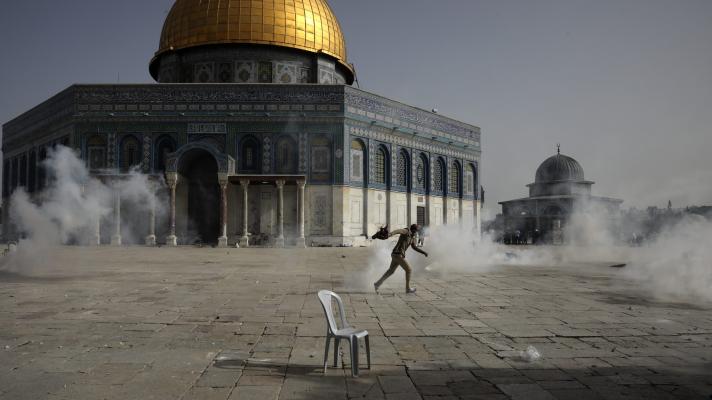
More than 800 Israeli settlers stormed the Al-Aqsa Mosque compound in occupied East Jerusalem on Thursday morning under the protection of Israeli forces.
Rabbis, heads of settlement associations, and far-right university lecturers were among 832 people who forced their way into the religious site compound, a source in the Islamic Endowments Department in Jerusalem told The New Arab's Arabic sister site Al-Araby Al-Jadeed.
Israeli forces imposed severe restrictions on Muslim worshippers entering Al-Aqsa and those under 60 were prevented from accessing the site.
It comes during the Jewish religious holiday of Sukkot, which started on 29 September and ends on Friday. The holiday has seen thousands of Israeli extremists storm the Al-Aqsa compound, with almost 1,500 entering the site on Monday.
Israeli extremists also continued on Thursday to hold provocative marches both inside Jerusalem's Old City and outside its walls, attacking Palestinians and their property.
They also beat and spat at journalists in a market area near Al-Aqsa, where shops were forced to close for the sixth day in a row.
The Old City is home to Al-Aqsa as well as the Western Wall and the Church of the Holy Sepulchre.
The Al-Aqsa compound is the third holiest site in Islam and the most important Muslim place in Palestine.
October 7 2023:
Escalation in the Israeli-Palestinian conflict
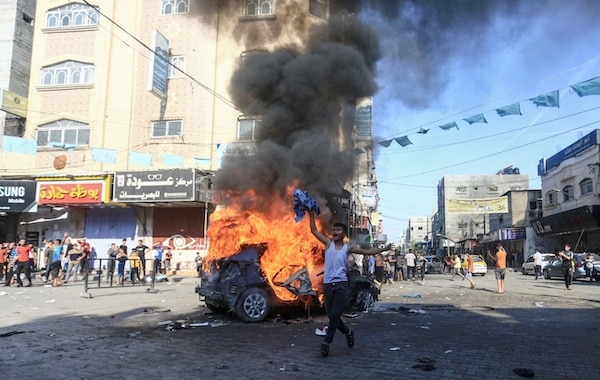
This morning, the Islamic Jihad group announced the start of the Al-Aqsa Flood operation, igniting another local war against Israel. They formally cited regular oppression and attempts on Al-Aqsa as reasons, where local Arab worshippers have been repressed repeatedly (in addition, there have been raids against the Islamic Jihad in Jenin over the past few weeks).
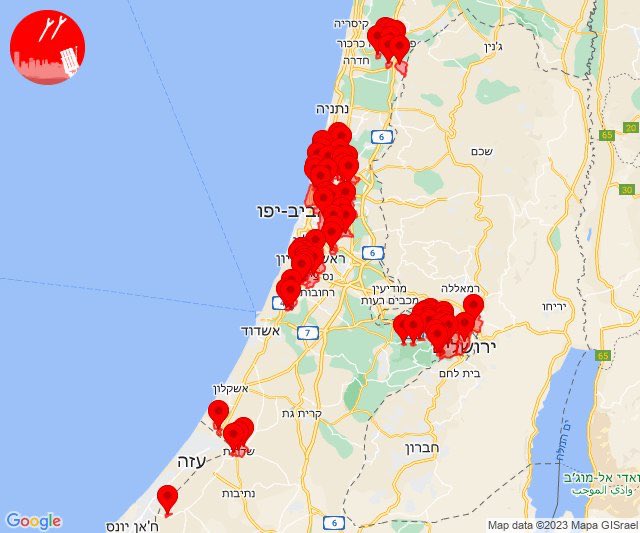
The operation began quite dramatically: a naval landing was carried out in the north of the Gaza Strip, and there are also reports of airborne landings - someone parachuted into rear cities.
...
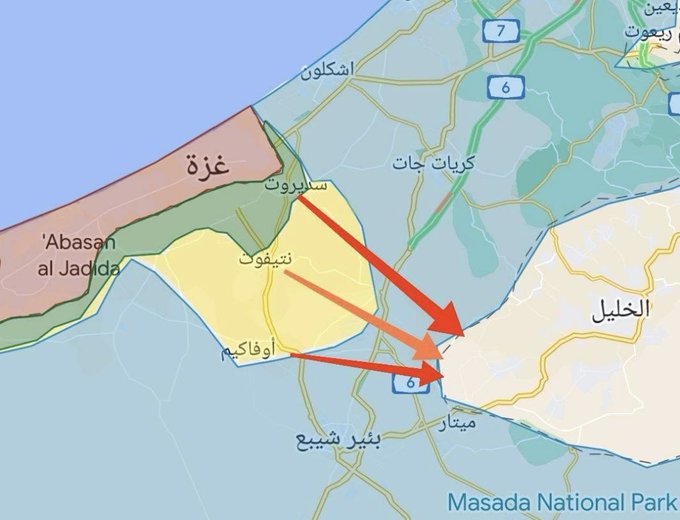
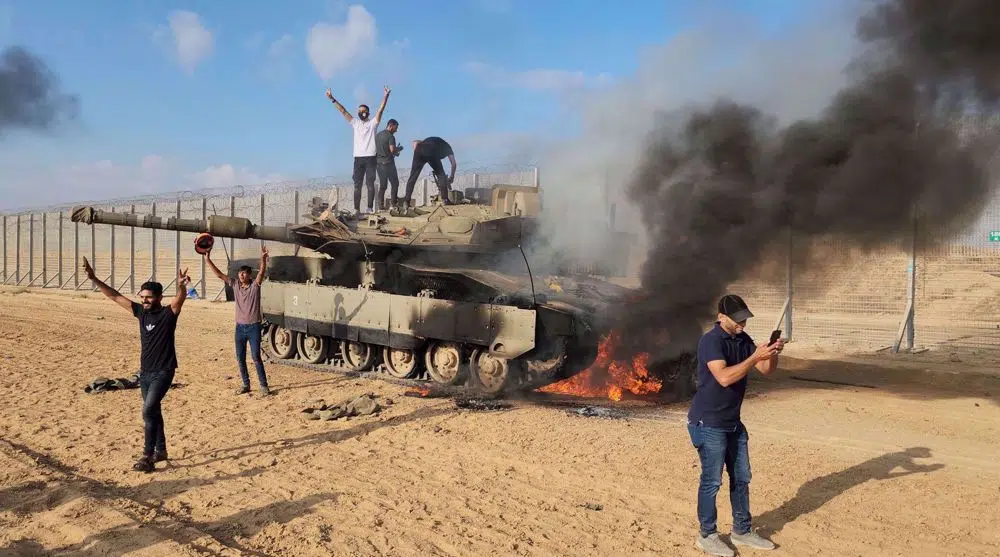
After three hours of fighting, the group successfully captured a military base in the town of Kerem Shalom: there are enough images on social media of killed IDF servicemen and captured equipment (there are also photos of a burnt "Merkava" tank). This is a huge base on the border with Egypt. To put it mildly, the trophy is very valuable. As of now, fighting is still ongoing in Netiv HaAsara, Berri, and Sderot. Panic has gripped the population of bordering villages, with footage of people fleeing on foot. The Israel Defense Forces began retaliatory strikes only after 10 in the morning. The Israeli Ministry of Defense has stated outright that Hamas has gone to war with them, and at 10:30, the official start of the Iron Swords counter-terrorism operation was announced.
This is likely to escalate. It is impossible to predict when or how this will end.
Posted by b on October 7, 2023 at 9:05 UTC | Permalink
Another Israeli-Palestinian war has begun
October 7, 10:05
In the morning, Palestinian groups from the Gaza Strip attacked Israel in retaliation for the desecration of the Al-Aqsa Mosque in Jerusalem.
Over the course of the morning, dozens of military and civilian Israelis were killed, there were numerous arrivals in different cities of Israel, trophies and prisoners were captured.
Israel attacks Gaza. A new war has begun.
If it's graphic photos of death and destruction ya want go to link. Just as with Ukraine provocation will eventually yield results. Careful what you wish for...
"There is great chaos under heaven; the situation is excellent."
The Al Aqsa Flood Continues: Palestinian Resistance Remains Steadfast While the Entity Drowns
OCTOBER 7, 2023
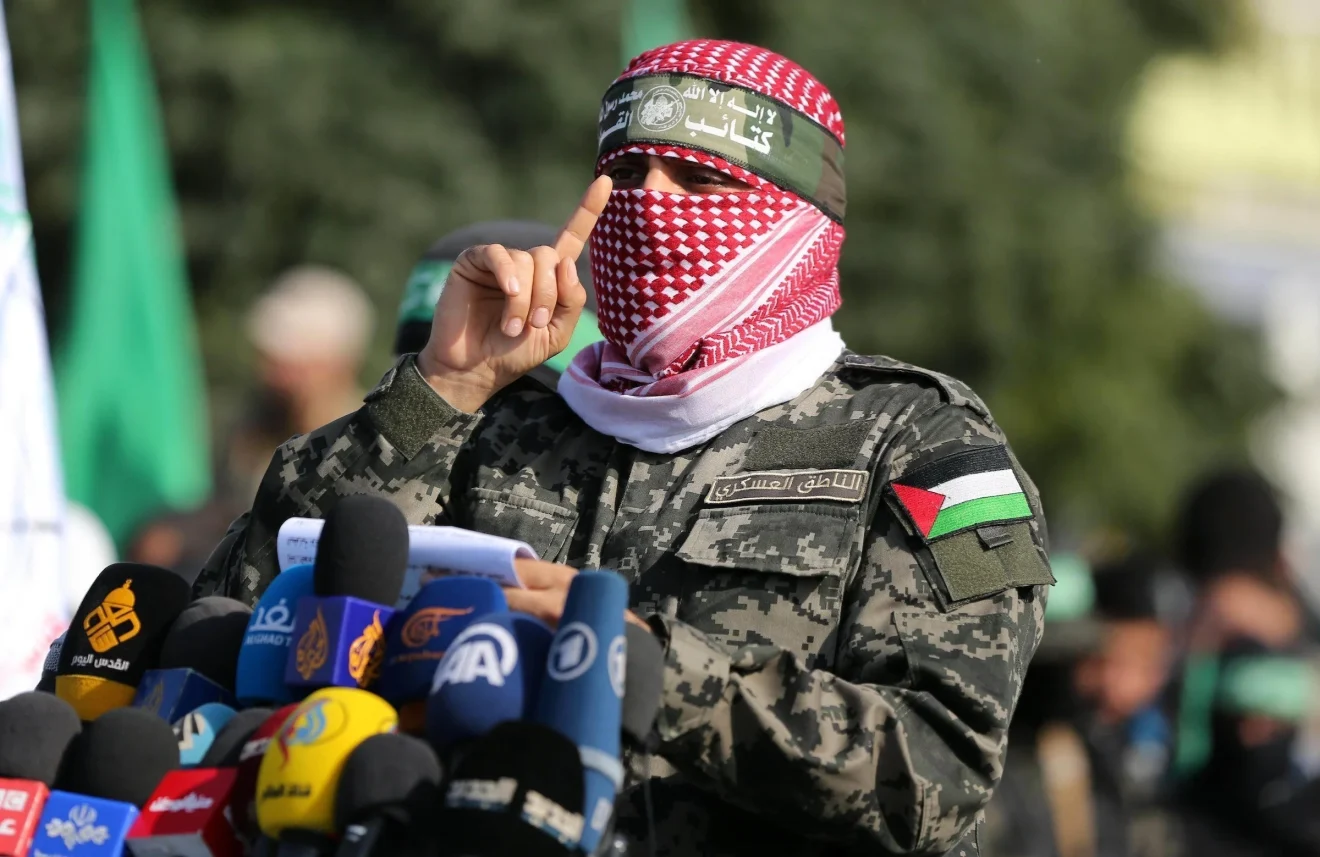
Al-Qassam Brigades spokesman, Abu Obeida, giving statements to the press on October 7, 2023 Photo: Al-Mayadeeen.
By Al-Akbar – Oct 7, 2023
In the early morning of October 7th, 2023, the Palestinian Resistance carried out land, sea, and air incursions into the occupation settlements surrounding Gaza. The resistance in Gaza additionally launched over 5,000 rockets towards the occupied territories, promptly overwhelming the occupation’s Iron Dome defense system. The toll, after less than a day of fighting, includes the capture of dozens of Israeli soldiers, the death of at least 100 Israeli occupiers, and the injury of 900 others. Additionally, the Palestinians achieved significant weapons acquisitions and destroyed multiple Israeli armored vehicles.
This event completely surprised the temporary entity, whose leadership did not imagine the Palestinians would carry out such an attack at this time. They believed that their provocations at Al-Aqsa Mosque and abuse of Palestinian prisoners would not have significant consequences amidst ongoing mediation talks with the resistance. The resistance, unified in one resounding voice, seized the advantage, delivering another shock to the occupation. The Al Aqsa Flood operation has already achieved qualitative leaps towards establishing new deterrence equations.
Thus, the Palestinian resistance has forged a new victory that represents a decisive turning point in the confrontation with the enemy, which fully recognizes its seriousness and will attempt to mitigate its strategic repercussions. So far, the occupation forces are in a complete state of confusion and disarray due to the magnitude of the operation. Part of the confusion stems from the Israeli leadership’s concern about incurring additional losses. This concern forced Israeli security forces to negotiate with Palestinian fighters holding hostages in the Ofakim settlement, while acknowledging that “regaining control of the settlements” might take “many hours.”
While the Palestinian resistance operation Al Aqsa Flood continues, rockets are constantly launched toward the Ashkelon settlement north of the Gaza strip, and the Ariel settlement in the occupied West Bank, as well as occupied Al-Quds and Tel Aviv. Air raid sirens are non-stop in some of these areas. Additionally, the resistance still maintains control over 14 settlements. Abu Hamza, the military spokesperson for Saraya al-Quds (Al-Quds Brigades) announced “we have captured many zionist soldiers.” He continued, “We and the resistance, thanks to Allah, have caused–through a series of operations behind enemy lines as part of Operation Al-Aqsa Flood–a resounding historical shock that revealed the truth of our saying that this terrible enemy is an illusion of dust and capable of being defeated and broken.”
Additionally, Hebrew Channel 13 reported that a “Hamas cell infiltrated the Sderot settlement.” In the midst of the Israeli confusion, the enemy’s leadership cannot accurately count its casualties, particularly as some have fled, others have been killed, and some have been captured, while others, documented on camera, have sought refuge in garbage containers.
Palestinians in Gaza celebrate on a captured Israeli armored vehicle on October 7th, 2023. Photo: Nablus News Telegram
In order to regain the control envisaged by the occupation, Israel has declared a state of “emergency,” called for the largest number of military volunteers, and ordered the opening of shelters. The Israeli army has intensified its targeting of Gaza, announcing that “the air force is targeting several Palestinian militants along the border with the Gaza Strip.” One of these airstrikes hit a residential building in the Al-Nasr neighborhood. Another airstrike hit Palestine Tower, a 14 story residential building in Gaza city. The Ministry of Health in Gaza has announced 198 martyrs and 1,610 various injuries as a result of the Israeli aggression on the Gaza Strip.
The bombing of Palestine Tower in Gaza, a 14 story residential building, on October 7, 2023. Photo: Fatima Shbair/Associated Press.
Even if the occupation is able to regain control after “many hours,” it will still be unable to recover from its material and moral losses, regardless of its attempts to make the resistance pay a high price for what it has achieved. Consequently, it no longer matters when this battle ends, as it is certain that the Palestinian reality has changed forever and a real flood has begun.
In light of these developments, it is clear that the “calm” desired by the Netanyahu government and its US sponsors will not be achieved. This goal of “calm” in Palestine is paramount to Washington and the Zionist entity in order to finalize a normalization agreement with the Kingdom of Saudi Arabia. Netanyahu called on Israelis to “be patient” and announced that the Israeli forces are “attempting to clear the Gaza Envelope [term used by the Zionist entity to describe the region containing occupation settlements around Gaza],” emphasizing that “Israel will enhance border security to deter others from joining this war.”
In contrast, the leaders of the resistance continue their speeches, warning the enemy of the possibility of the confrontation spreading to additional fronts and axes. The occupation greatly fears this scenario, especially since it cannot handle Gaza alone and is so preoccupied with “securing the borders” against further incursions that it is unable to launch offensives. Netanyahu and the leaders of the Israeli security establishment are aware that accusations will be directed at them, while the occupation faces an unprecedented situation on the Gaza border.
It is worth mentioning here that the ground incursions by the Al-Qassam fighters occurred shortly after Israeli security estimates had been leaked. These documents indicate that Hamas systematically tested the effectiveness of the military infrastructure and defensive measures deployed by the army along the borders, as well as assessing the army’s response during the border events with Gaza. Hence, the security establishment’s failure to address these risks, despite their prior knowledge, will likely exacerbate divisions within the occupiers’ politics and society.
The Top Ten Takeaways From Hamas’ Sneak Attack on Israel
Posted on October 8, 2023 by Yves Smith
Yves here. Despite having limited information about the current state of the Hamas campaign against Israel, Andrew Korybko has a good list of hot takes.
Israel was clearly caught by surprise, which raise the question of how the vaunted Mossad failed to see this coming. Snowden argues that bulk surveillance does not work:
"How could the government's oppressive surveillance miss a sprawling conspiracy involving thousands?"
The White House admitted in 2013 that despite ten years of operation, mass surveillance had never stopped even a single attack.
Looks like that record remains unbroken.
But I wonder if Hamas largely avoided electronic communication. This of course was prefigured in the famed 2002 Millennium Challenge war games, where Team Red used motortbikes to convey messages as well as coded communiques in prayer-time messages from mosque loudspeakers. Gaza is all of 25 miles long and 7.5 miles wide at its widest, so it’s not hard to imagine that messaging via hand delivery would be viable in a lot of cases.
Another question related to the failure to catch a buildup via aerial/satellite surveillance. But again, this action presumably used men already in Gaza. so no manpower massing. The area is densely populated, so hiding rockets and small arms might not be hard. The trick would be smuggling the materiel in….
Finally, as far as I can tell, Israel’s neighbors have not cleared their throats, aside from the report that Egypt relayed that Hezbollah would attack if Israel’s reprisals were too aggressive:
The wee problem is Israel believes in disproportionate responses, and Netanyahu had told Palestinians to leave…to where? To all walk into the Mediterranean and drown?
For Israel not to take extreme action would likely go over badly with voters, but the level of response that would be deemed adequately punitive runs the risk of Hezbollah entering the fray. This may be one reason for bordering countries refraining from pronouncements, since the question of Hezbollah opening a front opens up a whole new set of potential actions. The other may be that they are all in intense communication and information-sharing mode and are seeing to what degree a coordinated position is viable.
Finally, Korybko points out that the pending Saudi-Israel peace deal is likely kaput. This is a bigger loss for Team Biden than might initially be apparent. The Saudis had offered to increase oil production to help secure the agreement. Needless to say, high oil prices are not conducive to a Biden win in 2024.
By Andrew Korybko, a Moscow-based American political analyst who specializes in the global systemic transition to multipolarity in the New Cold War. He has a PhD from MGIMO, which is under the umbrella of the Russian Foreign Ministry. Originally published at his website
Everything that’s happened thus far has been eye-opening for everyone.
Hamas launched an unprecedented sneak attack on Israel over the weekend that completely caught the self-professed Jewish State by surprise after all its security systems unexpectedly failed at the same time. The border wall was breached, some military bases were captured, and dozens of hostages were taken back to Gaza. Israel responded by launching airstrikes inside the strip and preparing a ground operation. Here are the top ten takeaways from everything that’s happened thus far in the latest Israeli-Hamas war:
———-
1. Israel’s Alleged Invincibility Was Dispelled As An Illusion
For starters, nobody is under the illusion any longer that Israel is invincible. Up until this weekend’s sneak attack, some had continued to cling to the claim that its conventional military-technical capabilities and massive aid from America made it the regional hegemon, but that perception was just shattered.
2. It Was Totally Unprepared For Hamas’ Hybrid War Tactics
Upon the breaching of its border wall, which was the result of a colossal intelligence failure and subsequent collapse of all security systems, Israel proved that it was totally unprepared to counter Hamas’ Hybrid War tactics of lightning-fast squad assaults and rudimentary drone attacks.
3. Political Infighting Likely Contributed To This Intelligence Failure
Had Israel’s military and intelligence services not gotten involved in the political dispute over Netanyahu’s planned judicial reforms, which was exacerbated by the Biden Administration’s meddling as explained here, then they might have detected Hamas’ plans in advance and thus been able to foil them.
4. It Also Didn’t Help That US Spies Are Distracted With Ukraine
Israel must take full responsibility for its intelligence failures, but it also didn’t help any that its American ally’s spies have been distracted with Ukraine. If they weren’t so focused on that conflict, then they might have kept at least one satellite over Gaza that could have discovered Hamas’ military buildup.
5. America Is Now In A Dilemma Over Who Gets Finite Military Aid
Business Insider drew attention to America’s newfound dilemma over whether to give finite military aid, particularly artillery shells, to Ukraine as planned or redirect these resources to Israel instead. Its decision could have major implications for both conflicts since the choice between them is zero-sum.
6. Saudi Arabia Will Probably Freeze Its Peace Talks With Israel
Saudi Arabia is under immense pressure from the international Muslim community to freeze its reported peace talks with Israel after the latter’s strikes against civilian targets in Gaza. It’ll probably comply with these demands, which would then ruin the Biden Administration’s plans for a deal before the elections.
7. The IMEC Megaproject Will Likely Be Put On Ice For Some Time Too
The India-Middle East-Europe Economic Corridor (IMEC) can’t be completed if Saudi Arabia and/or especially Jordan freeze their role in its construction to protest Israel’s involvement in the latest conflict, though this won’t harm India’s trade with any relevant party since it’s entirely conducted by sea.
8. Russia & China’s Balanced Statements Surprised Some Observers
Many in the Alt-Media Community wrongly thought that Russia and China favored Palestine, hence why those two’s balanced statements here and here surprised them. Even fewer knew that President Putin fully supports the IDF as proven by his official statements over the years that were documented here.
9. The Debate Over Whether The Ends Justify The Means Has Re-Opened
Hamas’ killing of IDF-trained settlers-civilians and kidnapping of children, women, and the elderly to swap for prisoners was justified by some Palestinian supporters as a legitimate means for pursuing national liberation while other supporters criticized these tactics for undermining their cause’s morality.
10. Hezbollah Is The Wild Card In The Latest Israeli-Hamas War
Hamas’ sneak attack against Israel brought to life one of the latter’s worst nightmares, which might become even worse if Hezbollah decides to commence large-scale hostilities. In that event, Lebanon and possibly also Syria could be dragged into the fray, which could easily become existential for all parties.
———-
Everything that’s happened thus far has been eye-opening for everyone. The reputation of Israel’s security services has been shattered, Hamas’ has never been better in the eyes of most non-Western observers, and many among the latter finally learned that neither Russia nor China favor Palestine. Should the latest conflict become protracted, let alone expand into a regional one, then there’s a real possibility that the US will freeze the Ukrainian Conflict in order to redirect finite military aid to Israel.
Well, to freeze a conflict requires both parties......
******
Israel declared war on Hamas
October 8, 14:54
Israel has officially declared war on Hamas.
Rocket attacks on the Gaza Strip continue.
There is also artillery and tank shelling of the southern regions of Lebanon. Hezbollah has responded modestly so far, not using the main types of strike missiles and unmanned weapons. Previously, Hezbollah had already made it clear that full participation in the war would begin if the IDF launched a ground operation in the Gaza Strip. It is worth noting that the Israeli Ambassador to the Russian Federation stated this morning that the final decision on the ground operation in Gaza has not yet been made.
At the same time, consultations are taking place through Egypt between Israel and Hamas regarding the release/exchange of Israeli prisoners and hostages (there are at least several hundred of them). The return of Israeli prisoners and hostages as part of behind-the-scenes bargaining is one of the ways to quickly end the war, after everyone has shot back and declared victory.
In the case of a ground operation, the fate of prisoners and hostages will, for the most part, be unenviable.
The total number of deaths on both sides has clearly exceeded 1,000 people, and several thousand were injured.
The broadcast of events in Israel and the Gaza Strip is now on the main feed on the war in Ukraine, which, of course, is the main war for us.
Who is interested https://t.me/boris_rozhin , subscribe
A Population With Nothing To Lose
The problem with oppressing a population with maximum force is that at some point they start figuring they’ve got nothing to lose by fighting back.
Caitlin Johnstone
October 8, 2023
ays are going to be full of western news media slyly reversing the aggressor-defender relationship and reporting as though all the violence began with the Hamas offensive, spontaneously out of nowhere.
❖
The problem with oppressing a population with maximum force is that at some point they start figuring they’ve got nothing to lose by fighting back.
❖
Do I think this latest uprising will end in more positive results than negative for Palestinians? No. Does that mean I’ll condemn the Palestinian resistance for fighting back? Also no.
This is because doing so would be nonsensical, for a couple of different reasons. Firstly, because nobody can tell me what the Palestinians should do instead that is both realistic and reasonable. It would be easy for me to sit here in my armchair and say the Palestinians should either maintain the status quo or lie down, relinquish their homes and homeland and accept whatever table scraps they’re able to get, but we can see from the Palestinian perspective that that’s not reasonable. It would be easy for me to sit in my armchair and argue that Palestinians should just focus on securing a one-state or two-state solution, but we can see from the Israeli political landscape that that’s not realistic.
So what else can they do? What reasonable and realistic options do they have? No one can provide me a satisfactory answer.
Secondly, it would be nonsensical for me to condemn the actions of Hamas on the grounds that it will make things worse for the Palestinians because the fact that Israel always responds to Palestinian resistance by killing a lot of Palestinians is itself a very concrete manifestation of the abuses the Palestinians are resisting. It would not be legitimate for me to sit in my armchair and tell someone to stop resisting their abuser just because it will cause them to receive more abuse; that’s not a valid reason to condemn resistance.
Ultimately this is just Palestinians doing what they feel they need to do out of total desperation, because they feel backed into a corner with no other options. And they feel backed into a corner with no other options because that does appear to be the case. There are a lot of people I could blame for their being in those circumstances, but the very last on that list would be the victims of the abuse themselves.
❖
Israel apologists will brand anyone who criticizes Israel an anti-semite while adamantly denying that they include “criticizing Israel” in their definition of anti-semitism. If you ask them to name a forceful and sustained critic of Israel’s abuses who is not an anti-semite they generally won’t be able to, because they absolutely do regard all critics of Israel as anti-semites, but they can’t admit that they do this because they know the public is catching on to this tactic and they know it hurts their propaganda efforts.
In this way they’re exactly the same as people who brand all critics of US foreign policy toward Russia as Kremlin propagandists and all critics of US foreign policy toward China as secret agents of “the CCP”. Ask anyone who accuses you of being a Kremlin troll for criticizing western proxy warfare in Ukraine to name one forceful and sustained critic of that war who they don’t consider a Kremlin operative; they won’t be able to. This is because their definition of “Kremlin operative” actually includes “anyone who criticizes US foreign policy toward Russia”. But they can’t admit this, because they know it makes them look ridiculous.
❖
Sure glad Trump lost because otherwise a border wall would be getting built and kids would still be in cages and the Iran deal would still be dead and the military budget would still be inflating and Roe v Wade would’ve been killed. That psycho would probably have us on the brink of World War Three by now.
❖
They concern trolled about terrorism, then armed Al Qaeda in Libya and Syria.
They concern trolled about neo-Nazis, then armed them in Ukraine.
They threw Uyghur separatists into Guantanamo, then concern trolled about the Uyghurs.
RACE WAR AGAINST THE PALESTINIANS TURNS INTO WAR OF THE WORLDS – WILL THE US AND RUSSIAN NAVIES ENGAGE OFF GAZA & OTHER QUESTIONS
By John Helmer, Moscow @bears_with
A US Sixth Fleet squadron (lead image, top left) is now steaming towards the eastern shore of the Mediterraean, following the unusual mission last Thursday by a US Navy P-8 aircraft monitoring the state of operational alert of the Russian naval fleet at Tartous, Syria (top right).*
Between August 18 and September 1, the Soviet aircraft carrier Moskva passed through the Turkish Straits and into the Mediterranean, accompanied by two guided-missile destroyers. Over the next seven days the Soviet Navy gathered almost seventy surface ships – with uncounted submarines – and deployed between the Greek island of Crete and the point on the Libyan coastline where the Libyan and Egyptian border ran into the sea. That was fifty-four years ago in 1969 (lead image, bottom).
Ostensibly, the Soviet operation was to screen an amphibious troop landing exercise of Soviet, Egyptian and Syrian troops. In fact, the naval screen protected Libyan Army Captain Muammar Qaddafi and a dozen junior officer associates when, on September 1, 1969, they successfully toppled the regime of Libyan King Idris and ended US occupation and control of Libya through the Wheelus Air Force Base.
Can the Palestinian operation, Operation Al-Aqsa Flood, which Hamas forces commenced on Saturday morning, continue for long enough to engage the Arab state militaries, the Iranian, US and Russian forces, to turn into a new war of the worlds, as the US and NATO war against Russia is on the Ukrainian battlefield? Will the US force, including the aircraft carrier USS Gerald Ford and its five cruiser and destroyer escorts, screen Israel as it orders emergency resupply of US arms and ammunition? Will it attempt to blockade the Arab coast – Syria, Lebanon, Gaza, Egypt – to prevent resupply convoys from Turkey or Iran aiding the Palestinians?
“This is the day of the greatest battle to end the last occupation and the last apartheid regime of earth,” the Hamas military commander, Mohammed Deif, has declared.
Is this the final Israeli war of “mighty vengeance”, as Prime Minister Benjamin Netanyahu has declared, forcing all Palestinians in Gaza “to leave now”, and in the phrase of the spokesman of the Israel Defense Forces (IDF), “end the Gaza enclave”?
Is this the final Jewish solution to remove the Arabs from the territory according to the Basic Law, ratified by the Israeli Supreme Court in 2021, which legalizes the takeover of Palestinian territory as a “natural” Jewish right. “The State of Israel is the nation state of the Jewish People,” the constitution enacted in 2018 by the Knesset declares, “in which it realizes its natural, cultural, religious and historical right to self-determination. The exercise of the right to national self-determination in the State of Israel is unique to the Jewish People”; and “the State views the development of Jewish settlement as a national value, and shall act to encourage and promote its establishment and strengthening.”
Is this race war — is it now the war of the worlds?
Listen to the hour-long discussion with Chris Cook on Gorilla Radio’s Gaza Special which went to air on Sunday evening:
Source: https://gorilla-radio.com/
The story of the Soviet naval operation of August-September 1969, with support from President Gamal Abdel Nasser of Egypt,is reported in the book:
From the introduction to the book: “Before the US Government went to war against the Russians in Europe, after the end of the Soviet Union in 1991, they practised in the Middle East on the Arabs. The methods and targeting are the same.” Published on February 23, 2022. Right: President Putin’s special relationship with Prime Minister Netanyahu became official Kremlin policy after the IDF caused the shoot-down of the Russian Ilyushin-20 reconnaissance aircraft off the Syrian coast, on September 17, 2018, killing the 15-man crew. At the time, Russian Defense Minister Sergei Shoigu, speaking for the General Staff, said “The responsibility for the downing of the Russian aircraft and the death of its crew lies solely with Israel. .. we reserve the right to take retaliatory steps.” The General Staff is still reserving its steps. Read more: https://johnhelmer.net/
As of Monday morning, Moscow time, the Kremlin has disclosed no telephone or other communication between Putin and Arab, Iranian, Turkish or Israeli officials. A Kremlin communiqué was released on Saturday afternoon, more than twelve hours after the fighting had started, in which Putin met with Kazakh President Kassym-Jomart Tokayev, and talked at length about bilateral gas supply projects and “strategic cooperation and relations between our states…in most diverse spheres.”
At the same time on Saturday afternoon, it was decided that the only official statement on the war to break the weekened silence would be released by the spokesman of the Foreign Ministry. “We,” said Maria Zakharova, “call on the Palestinian and Israeli sides to implement an immediate ceasefire, renounce violence, exercise restraint and begin, with the assistance of the international community, a negotiation process aimed at establishing a comprehensive, lasting and long-awaited peace in the Middle East.” Zakharova did not identify the US miliary moves as an escalation of the conflict.
To follow Kremlin and Foreign Ministry “equivalence” policy towards the Palestinians, click to read the archive.
From 2010 to 2018 the Netanyahu regime attempted to establish in Israel’s constitution the identity of the Israeli state and ideology of Zionism with the Jewish faith and religious community. The first attempt fell short of Knesset votes, legal ratification, and Jewish diaspora support; it wasn’t the only case of its kind in that period.
In 2018 Netanyahu tried again, and on July 8, 2021, the Israeli Supreme Court decided this measure was constitutional inside the country.
The US Library of Congress briefing paper, which followed the Israeli court ratification in July 2021, can be read in full here.
In practical effect and political application, the equivalence and identity have been created between Jews, the community of adherents to Judaism, the Israeli state and its ideology. Correlatively, criticism of Jews, called anti-Semitism in many places, has been made identical to criticism of the state of Israel, called anti-Zionism. Since Netanyahu’s enactment of his basic law, the equation of anti-Zionism with anti-Semitism has become a race crime in many jurisdictions of the world, from London, to Miami, to Melbourne.
The military consequence is that race war by the state of Israel and Jewish people against the Palestinian Arabs and muslims has become the constitutional duty of the IDF and its miliary allies and suppliers.
[*] The detection and mapping of the US Navy patrol targeting the Russian naval base at Tartous on October 5, 36 hours before Operation Al-Aqsa Flood, was reported by the website Italian Military Radar, italmilradar.com.
Debunking The Conspiracy Theory That Netanyahu Wanted Last Weekend’s Attacks To Happen
ANDREW KORYBKO
OCT 9, 2023
Observers can still be opposed to the border barrier in particular, Israeli policy towards Palestine in general, and Netanyahu personally while also acknowledging that he’s such a security-obsessed leader that it doesn’t make sense to claim that he’d let Hamas powerfully undermine all three for any reason.
Hamas’ sneak attack on Israel over the weekend prompted speculation among some on social media that the latter knew about these plans in advance but allegedly had an interest in letting them happen. According to proponents of this conspiracy theory, embattled Prime Minister Netanyahu wanted to unite his politically divided people and/or establish the pretext for destroying Hamas, ergo why he supposedly let these attacks unfold. That doesn’t make much sense though if one really thinks about it.
It's fashionable nowadays to claim that leaders sometimes provoke foreign conflicts to distract from domestic political problems, but that’s arguably not the case with the latest Israeli-Hamas war. In fact, Netanyahu was pursuing the exact opposite approach up until last weekend as suggested by credible reports over the months that he was engaged in secret talks with Saudi Arabia over recognizing Israel. This was aimed at uniting Israelis around him and unlocking their country’s geo-economic potential.
Had these efforts borne fruit, then not only would his fiercest opponents have been forced to praise him for this diplomatic achievement, but Israel could then have profited from its central role in the India-Middle East-Europe Economic Corridor (IMEC) that was unveiled last month. Both goals required Saudi recognition of Israel, which Netanyahu hoped to obtain without recognizing Palestine’s independence, but that’s now in doubt since Riyadh might freeze these talks after Israel’s bombing of Gaza.
Those who claim that he knew about Hamas’ plans in advance but still let them happen are either unaware of his secret talks with Saudi Arabia, downplay their grand strategic importance, or think that they were all a ruse in preparation of this convoluted plot to establish the pretext for destroying Hamas. About that dimension of their conspiracy theory, it’s difficult to imagine that security-obsessed Netanyahu would let his country’s enemies inflict such unprecedented damage to Israel for that purpose.
He could always have simply exploited comparatively minor rocket fire to justify a disproportionate bombing campaign against that group without having to first lose literally hundreds of civilians and soldiers. Hamas’ breaching of the border barrier was also a strong blow to the Israeli psyche from which its people might never recover after having assumed that its construction would forever protect them. The same goes for that group doubling the territory under its control during the climax of its attacks.
Observers can still be opposed to the border barrier in particular, Israeli policy towards Palestine in general, and Netanyahu personally while also acknowledging that he’s such a security-obsessed leader that it doesn’t make sense to claim that he’d let Hamas powerfully undermine all three for any reason. He looks extremely weak after what happened, Israeli policy towards Palestine is now questioned from both sides like never before, and the border barrier is no longer deemed to be a credible defense.
These three outcomes represent the sum of Netanyahu’s worst nightmares, not to mention the likely failure of his plans to obtain Saudi recognition of Israel that would in turn unlock his country’s geo-economic potential via IMEC, all of which indisputably contradict Israeli interests. It remains unclear exactly how all of Israel’s security systems failed at the same time during last weekend’s attacks, nor has anyone explained the intelligence failures up until then either, but that’s indeed what happened.
The conspiracy theory speculating that Netanyahu knew about all this in advance but still let it happen doesn’t stand up to scrutiny as proven in this piece and is pretty much only predicated on the false perception that Israel’s intelligence services are omnipotent. They’re run by humans though and are therefore naturally imperfect, yet those who claim otherwise impart godlike power to the Mossad. This gives Israel too much credit while denying Hamas’ independent ability to organize attacks of this scale.
Is Israel Weaker Than Widely Seen in Hamas/Palestine “War”?
Posted on October 9, 2023 by Yves Smith
We are again in the fog of (mis)information phase of reporting on a conflict that has the potential to escalate in a serious way. But we’ll pick through various accounts and speculation about Hamas striking from Gaza into Israel and its potential to set off a wider Middle East conflagration.
Let’s first dismiss the idea that somehow Israel ginned up the attack (as opposed to triggered a reaction to a provocation) or that Mossad was aware but chose to let it proceed so as to provide a better excuse for a ferocious retaliation. Israel’sresponse has been way too flat-footed for that to be credible. And Hamas’ massive rocket attack, which has overwhelmed the vaunted Iron Dome and continued last night, punctures one of the hallmarks of Israel’s prowess. Readers have argued that the resulting damage to the sense of day-to-day safety has the potential to weaken Israel’s economy, since recent immigrants and expat workers in its tech industries could decamp.
Let us also remember the elephants in the room. Israel, even more so as it has become more right wing and ultra-Orthodox continue to increase as a percentage of its citizenry, has no end game for the Palestinians other than continued oppression and the hope that the current resident population leaves and/or otherwise shrinks. They have relied on policing and when the Palestinians have attacked Israel, the use of the IDF to contain the eruptions.
On the other side, there are militant forces in the Middle East that want Israelis expelled from Muslim holy areas, and potentially all of Israel. These desires have not gotten much of anywhere due to Israel having nukes and being perceived to be too formidable, particularly with US backing, for a hot conflict to have had good odds of success. However, Israel’s opponents have noted that Israel did not fare very well when it attacked Lebanon in 2006 to try to root out Hezbollah and instead failed abjectly. However, an offensive operation is also much more demanding and risky than defense.
In other words, the Israeli government has maximalist aims but has been implementing them slowly, and a meaningful contingent in the neighborhood also has maximalist aims.
Also keep in mind, given the need for Israel to project that it is undefeatable, both to deter attack and to maintain confidence at home, that just as in the Yom Kippur War, a battlefield win can still be a strategic loss. As reader Lex pointed out yesterday:
Hamas doesn’t need to win. It only needs to drag Israel into a protracted and bloody struggle. Nor does it have anything to lose. Israel’s internal contradictions were boiling over before this, a conflict may plaster over them in the short term but not the medium. That’s especially true if the IDF does not produce a quick and overwhelming victory.
And hk:
The talk of IDF responding “overwhelmingly” is meaningless because they have effectively run up to the top of escalation ladder. What more can they do now? Kill all the Gazans? If they escalate beyond what they already have in the past, the diplomatic consequences will be intolerably high for no gain beyond satiating crazies’ bloodthirst.
Netanyahu has promised a ferocious response yet has also warned of a long war.
And the scale of the deaths so far also mean Netanyahu will feel, given his generally sanguinary inclinations, that he has to crush Hamas and to a large degree, Gaza, whatever he considers “crush” to mean in practice:
However, Netanyahu’s “long war” warning suggests he is not confident he will be able to contain Hamas quickly. Even though Israel has been shelling Gaza (some internet sources claim in including the use of white phosphorus), and troops are also reported to be massing, there does not yet seem to be a ground operation in Gaza.
Recall that Hezabollah warned through Egypt that it would saddle up if the Israel retaliation were de trop. One can only guess what that threshold might be, but pounding Gaza into Bakhumt-style rubble would probably lead Hezbollah to enter the fray.
Hamas was shelling targets in Israel last night and appears to have started again, and at first blush, the scale looks similar:
There are also claims Hamas has taken ground and is moving towards the West Bank. This is clearly not confirmed but would amount to a plan:
Note also that the Twitterverse claims that Hamas has considerable support in the West Bank and the PLO would be voted out of Abbas were to elections.
A friend said she could have financed the Hamas operation from her checkbook. That may not be an exaggeration:
But we don’t have the rumors that Hamas also bought weapons shipped to Ukraine on the black market confirmed or not. Recall also that Hamas captured the Israeli base next to Gaza. What sort of goodies did it seize beside tanks?
There are also claims that Israel is getting the ground situation back in hand outside Gaza proper:
Aljazeera reports that Israel says it has reclaimed all towns outside the Gaza fence, as of roughly 5:45 AM EDT.
The Wall Street Journal claimed in an exclusive report that Iran’s Revolutionary Guard helped Hamas plan its attack and even gave it the go-ahead. Per Aljazeera:
“The accusations linked to an Iranian role… are based on political reasons,” foreign ministry spokesman Nasser Kanani told reporters.
Palestinians had “the necessary capacity and will to defend their nation and recover their rights” without any help from Tehran, Kanani added.
The conventional wisdom seems to be that Israel will quickly contain this uprising and the rest of the Arab world will sit on its hands. Given that the Hamas attack has been far more successful than past uprisings and shelling from Gaza continues, it’s not clear that past performance is a predictor of future results. China has brokered a deal between Iran and the Saudis that was on the way to normalizing relations; the US effort to get the Saudis to recognize Israel was to reassert US relevance in the region and specifically to pry the Saudis and Iran back apart. The Saudis have already said Israel has only itself to blame for the Hamas invasion, which will not go down well in Tel Aviv.
There are reasons to harbor doubts about how effective the IDF will be in a ground operation in the heavily urbanized Gaza, as opposed to retaking the surrounding territory. Regularly militaries and insurgent operations are not a happy mix. We’ve seen reports of reservists in Israel refusing orders to be called up, on the assumption that they’d be asked to serve in a clearing operation and that would be a suicide mission. Again this amounts to rumors. However, even if true on only a small scale, it would not be a good sign.
Jacob Dreizin is a forceful voice for the contrarian position. From a recent post:
…Israeli army (“IDF”) is **NOT COMBAT-CAPABLE**, cannot handle enemy tactical drones & obviously has not learned new threats/tactics from Ukraine war. (Probably, U.S. Army in same shape.) Having facilitated Azerbaijan’s success against Armenians… Israel finds itself as potentially another Karabakh 2020, unprepared for modernity. Any “conventional” showdown with a “real” opponent such as Hezbollah (with its extensive Syrian experience), at the same time as Gaza, will lead to the IDF getting UTTERLY WASTED & WRECKED BEYOND COMPREHENSION. This is why tactical nuclear weapons would almost certainly be used in a war with Hezbollah, which may content itself with “merely” sending over a stream of cheap (perhaps even unarmed) drones to wear out Israel’s Patriot missile stores (Israel’s short-range “native” [Raytheon/Boeing-assisted] anti-rocket defenses can sometimes but are not intended to target & hit straight-line trajectory craft)
So in one sense, Dreizin confirms the idea that the Gazans will be largely abandoned, not due to the strength of the IDF in conventional war, but due to the fact that it’s actually so fragile that Hezbollah could make great inroads in an attack, leading to a Israel to deploy nukes. Dreizin contends Hezbollah is too aware of that risk to take the chance.
Another data point suggesting that Israel does not have a lot of depth, materiel-wise, right now:
USAF flies (a short flight!) Syrian Civil War-era prepositioned small arms munitions (or certainly nothing heavier than mortar shells) by C-17A Globemaster III from Amman, Jordan to Ben Gurion Airport, Israel, on Sunday. Another Globemaster III took off from Amman at about the same time, and flew to Rammstein Air Base, Germany (we’ll see if it comes to Israel on Monday.) If they have to fly this petty junk to Israel, you know it’s BAD
Indirect confirmation comes from the fact that Hamas was able to seize the Israeli base next to Gaza. That speaks to poor discipline and motivation.
Now having said all that, this is clearly an overly dynamic situation. For instance, despite the past record of inaction when Israel punished Gaza for uprisings, it’s not clear that would happen in the event Israel is as brutal as Netanyahu promised to be, particularly in an era of intense social media coverage.
One take, from Black Mountain Analysis, is that the elite Iran Revolutionary Guards forces, known as the Quds Forces, dedicated to the liberation of Palestinians, looks to have been activated. The author then admits that take is speculative (and IMHO he draws his yarn diagram too tight) but the warning at the end of the post rings true:
Israel will mobilize everything and destroy Gaza. It remains to be seen whether it will be occupied or simply leveled with other means, but it will be destroyed….
The destruction and/or occupation of Gaza is unacceptable for the Arab neighbors. My friends… We can expect the region to be blown up pretty soon.
Mind you, I really hope to be wrong, but the odds of this sort of outcome are uncomfortably high.
The neo-conservatives want to blame Iran for the current war in Palestine/Gaza.
They have for years tried to instigate war against it. Now they again see a chance. But its not a big one - yet.
Yossi Melman is a very well connected Israeli author:
Yossi Melman @yossi_melman - 5:33 UTC · Oct 9, 2023
IDF spokeperson Brig-General Danny Hagari said that there is no indication of an Iranian involvement in the war in Gaza.
---
Biden administration scrambles to deter wider Mideast conflict - Washington Post - Oct 8 2023
Asked whether Hamas may have acted in partnership with Iran to disrupt the effort to broker a Saudi deal, Blinken said “that could have been part of the motivation. Look, who opposes normalization? Hamas, Hezbollah, Iran.”
But, he said, “we have not yet seen evidence that Iran directed or was behind this particular attack.”
---
Fear not, say the neocons, we still have the Wall Street Journal to carry water for us:
Iran Helped Plot Attack on Israel Over Several Weeks (archived) - Wall Street Journal - Oct 8 2023
DUBAI—Iranian security officials helped plan Hamas’s Saturday surprise attack on Israel and gave the green light for the assault at a meeting in Beirut last Monday, according to senior members of Hamas and Hezbollah, another Iran-backed militant group.
Officers of Iran’s Islamic Revolutionary Guard Corps had worked with Hamas since August to devise the air, land and sea incursions—the most significant breach of Israel’s borders since the 1973 Yom Kippur War—those people said.
Details of the operation were refined during several meetings in Beirut attended by IRGC officers and representatives of four Iran-backed militant groups, including Hamas, which holds power in Gaza, and Hezbollah, a Shiite militant group and political faction in Lebanon, they said.
WSJ authors in Dubai(!) have access to "senior members of Hamas and Hezbollah"?
Both groups are notorious for their secrecy and their senior leadership is usually hidden away. Those facts alone are enough to debunk the report as nonsense. But the WSJ authors continue:
“We don’t have any information at this time to corroborate this account,” said a U.S. official of the meetings.
A European official and an adviser to the Syrian government, however, gave the same account of Iran’s involvement in the lead-up to the attack as the senior Hamas and Hezbollah members.
Asked about the meetings, Mahmoud Mirdawi, a senior Hamas official, said the group planned the attacks on its own. “This is a Palestinian and Hamas decision,” he said.
A spokesman for Iran’s mission to the United Nations said the Islamic Republic stood in support of Gaza’s actions but didn’t direct them.
“The decisions made by the Palestinian resistance are fiercely autonomous and unwaveringly aligned with the legitimate interests of the Palestinian people,” the spokesman said. “We are not involved in Palestine’s response, as it is taken solely by Palestine itself.”
Three direct rejections by official sources of the WSJ claims get countered with an anonymous 'European official' and a likewise anonymous 'adviser to the Syrian government'.
It is like the authors don't even try to sound believable:
A direct Iranian role would take Tehran’s long-running conflict with Israel out of the shadows, raising the risk of broader conflict in the Middle East. Senior Israeli security officials have pledged to strike at Iran’s leadership if Tehran is found responsible for killing Israelis.
The IRGC’s broader plan is to create a multi-front threat that can strangle Israel from all sides—Hezbollah and the Popular Front for the Liberation of Palestine in the north and Palestinian Islamic Jihad and Hamas in Gaza and the West Bank, according to the senior Hamas and Hezbollah members and an Iranian official.
...
Israel has blamed Iran, saying it is behind the attacks, if indirectly. “We know that there were meetings in Syria and in Lebanon with other leaders of the terror armies that surround Israel so obviously it’s easy to understand that they tried to coordinate. The proxies of Iran in our region, they tried to be coordinated as much as possible with Iran,” Israel’s ambassador to the United Nations, Gilad Erdan, said Sunday.
There is however little evidence for the Israeli assertion:
Leading the effort to wrangle Iran’s foreign proxies under a unified command has been Ismail Qaani, the leader of the IRGC’s international military arm, the Quds Force.
Qaani launched coordination among several militias surrounding Israel in April during a meeting in Lebanon, The Wall Street Journal has reported, where Hamas began working more closely with other groups such as Hezbollah for the first time.
Hamas and Hezbollah have cooperated for decades. During the war on Syria some Hamas members took the side of the 'moderate rebels'. They taught them how to dig large tunnels, a technique they themselves had once learned from Hizbullah:
Abu Musaab, a leader in Ahrar al-Sham, told the pro-uprising satellite television station Orient News that the Syrian militant group received tutorial videos from Gazans showing them how to repair collapsing tunnels.
"The ground here became damp and began to fall on us…and some of our youth were trapped inside. So we spoke to those with expertise, our brothers in Gaza, may God reward their good deeds," Abu Musaab was quoted as saying.
"We consulted them regarding the problem and they advised us to bring in wood (plates), sending us video segment showing us how they do it and we replicated that," Abu Musaab added.
...
And in June 2013, the pro-Hezbollah al-Akhbar newspaper reported that "sources close to Hezbollah and the Syrian regime claim that Hamas had a role to play in the battles of Qusayr, [where tunnels] … had been dug using small Iranian devices that Hezbollah had transferred to Hamas."
"Some of the explosives, they added, were found to contain electronic chips that Hamas had acquired from Iran and Hezbollah," the Lebanese paper said.
After the war in Syria was decided in the governments favor, Hamas slowly found its way back into the resistance camp. Consultations between Hezbullah and Hamas have been constant since. Back to the WSJ:
Representatives of these groups have met with Quds Force leaders at least biweekly in Lebanon since August to discuss this weekend’s attack on Israel and what happens next, they said. Qaani has attended some of those meetings along with Hezbollah’s leader Hassan Nasrallah, Islamic Jihad leader al-Nakhalah, and Saleh al-Arouri, Hamas’s military chief, the militant-group members said.
Iranian Foreign Minister Hossein Amir-Abdollahian attended at least two of the meetings, they said.
This, however, is clearly no believable. Amir-Abdollahian is a professional diplomat, not a security official. While he has been deeply involved in political issues regarding Palestine he is unlikely to have been involved in any top-secret operational planning.
Also biweekly meetings between Qaani, Nasrallah and other high ranking resistance leaders are unlikely to have ever happened. Each such meeting would be a security nightmare.
The planning for the recent Hamas operation must have taken years not just the few month since August. While the WSJ lets it seem that there is operational coordination between the various resistance groups their real cooperation is on a way more strategic level.
Each group in the resistance axis has its own plans and goals. That does not exclude strategic cooperation, but not on the detail level of fighting:
Egypt, which is trying to mediate in the conflict, has warned Israeli officials that a ground invasion into Gaza would trigger a military response from Hezbollah, opening up a second battlefront, people familiar with the matter said. Israel and Hezbollah exchanged fire briefly on Sunday.
...
The Iranian official said that if Iran were attacked, it would respond with missile strikes on Israel from Lebanon, Yemen and Iran, and send Iranian fighters into Israel from Syria to attack cities in the north and east of Israel.
While there is no denying that Iran, Hezbullah, Hamas and others consult with each other on a high level, any deeper cooperation, training or assistance is unlikely to still exist. It is each on their own, but with a common big goal in mind.
Posted by b on October 9, 2023 at 11:20 UTC | Permalink
They’re Repeating The Word ‘Unprovoked’ Again, This Time In Defense Of Israel
Skillful manipulators make frequent use of a cognitive bias known as the illusory truth effect, a glitch in the way human minds tend to operate which makes it hard for us to differentiate between the experience of hearing a well-evidenced fact and the experience of hearing something that they’ve heard repeated multiple times.
Caitlin Johnstone
October 8, 2023
We’re seeing the western political/media class bleating the word “unprovoked” in unison again, this time in reference to the massive multi-pronged operation launched by Hamas against Israel on Saturday morning which reportedly killed hundreds of Israelis.
“The United States unequivocally condemns the unprovoked attacks by Hamas terrorists against Israeli civilians,” reads a statement from the White House.
“The loss of life in Israel as a result of the violent, calculated and unprovoked attack by Hamas is heartbreaking,” reads a statement by House Minority Leader Hakeem Jeffries.
“The unprovoked terror attack today and the murders of innocent Israeli citizens are a stark reminder of the brutality of Hamas and Iran-backed extremists,” reads a statement by congressman and house speaker contender Jim Jordan.
“This ignominious, unprovoked, and barbaric attack on Israel must be met with world condemnation and unequivocal support for the Jewish state’s right to self-defense,” tweeted presidential candidate Robert F Kennedy Jr.
“This is an ‘unprovoked attack on civilians’: Lt. Gen. Keith Kellogg,” reads a recent Fox News report.
“Unprovoked aggression by Hamas terrorists,” reads a tweet by former secretary of state Mike Pompeo.
“I forcefully condemn these cowardly, horrifying, unprovoked attacks on Israel by Hamas,” tweeted congressman John Fetterman.
“These attacks by Hamas against Israel were heinous and unprovoked,” tweeted Senator Mark Kelly.
“As a steadfast supporter and ally of Israel, I unequivocally condemn the unprovoked and unprecedented terrorist attack launched by Hamas and stand with the people of Israel as it rightly defends itself,” tweeted congressman Richie Torres.
“The unprovoked attacks on Israel by Hamas through Gaza and via air and sea, are absolutely a terrorist attack,” tweeted Democratic Party pundit Ed Krassenstein.
“I unequivocally condemn Hamas’ horrific, unprovoked attacks and call on all parties to take steps to prevent civilian harm,” tweeted congresswoman Sara Jacobs.
I could cite many, many more examples, but I think that’s enough to make the point I’m trying to make. Isn’t it strange seeing the same oddly specific word choice inserted over and over and over again about the same event in statements by politicians and pundits, regardless of their political affiliation? When you lay them all out together it starts to sound highly suspicious, like someone always referring to his car as “my car, which I did not steal,” or always introducing his spouse as “my wife, whom I do not beat.”
Amer Zahr
@AmerZahr
·
Follow
75 years of ethnic cleansing.
15 years of blockade.
Confiscation of Palestinian lands.
Pogroms on Palestinian towns.
Desecration of Palestinian sacred sites.
Daily raids into Palestinian homes.
Constant humiliation of a entire people.
Nothing about today is “unprovoked.”
11:46 AM · Oct 7, 2023
It’s clear by now that whenever you see the word “unprovoked” being forcefully repeated in a uniform way across the entire political/media class, whatever they’re talking about was definitely massively provoked.
We saw this exact same thing when Russia invaded Ukraine; from the very beginning western politics and media were saturated with the word “unprovoked”, bashing the western public in the face with that message over and over and over again despite the obvious and undeniable fact that the war in Ukraine was most definitely provoked.
As Noam Chomsky quipped last year, “Of course, it was provoked. Otherwise, they wouldn’t refer to it all the time as an unprovoked invasion.”
And the same is of course true of the latest Hamas offensive. There are all kinds of arguments you could legitimately make about it, but one argument you definitely cannot defend is that it was unprovoked. As Palestinian-American writer and comedian Amer Zahr put it on Twitter, “75 years of ethnic cleansing. 15 years of blockade. Confiscation of Palestinian lands. Pogroms on Palestinian towns. Desecration of Palestinian sacred sites. Daily raids into Palestinian homes. Constant humiliation of a entire people. Nothing about today is ‘unprovoked.’”
Calling Palestinian violence against Israel “unprovoked” is easily even more ridiculous than calling the Russian invasion unprovoked, because the abuses of Israeli apartheid are so well-known by the general public at this point. Multiple mainstream human rights organizations have accused Israel of administering an abusive apartheid regime which treats Palestinians as lesser people. Palestinians who live in the open-air prison known as Gaza are deliberately subjected to undrinkable water, food shortages, energy shortages and bombing campaigns. Those outside Gaza are subjected to racist, violent policing and land seizure and live under a different set of laws than Jewish Israelis. The entire people were forced out of their homes to make way for a new state for reasons that had nothing to do with them, and any attempt to resist this has seen them killed as “terrorists”.
Of course the attack was provoked.
Isn’t it odd that the western political/media class would begin uniformly asserting something so easily disprovable? So transparently false? Why would they keep choosing over and over and over again in each instance to make use of that specific word “unprovoked” in their condemnations of the attacks by Hamas?
The answer is that this choice is not so much something they are saying as something they are doing. They’re not attempting to communicate with their audiences, they’re attempting to circumvent the critical thinking of their audience and trick them into accepting a blatant falsehood as true.
Skillful manipulators make frequent use of a cognitive bias known as the illusory truth effect, a glitch in the way human minds tend to operate which makes it hard for us to differentiate between the experience of hearing a well-evidenced fact and the experience of hearing something that they’ve heard repeated multiple times. If you want the public to believe something false you won’t be able to use facts and evidence to make your case to them, so what you can do is just repeat something over and over again until it starts sounding like the truth. Repeat the lie enough times and boom, you’ve perception-managed westerners into viewing the world from an understanding that Israel did nothing to provoke Palestinians into their actions.
After the news broke about the Hamas offensive I tweeted, “Here come days and days of western news media slyly reversing the aggressor-defender relationship and reporting as though the violence began with the Hamas offensive, spontaneously out of nowhere.”
But even I wasn’t expecting the perception management to be this brazen.
Israeli Flashpoint - Localized Skirmish? Or the Beginning of Major Global Black Swan?
SIMPLICIUS THE THINKER
OCT 8, 2023
The irruption in Israel caught many of us off guard. But to some extents it was a long-expected flashpoint escalation meant to begin the denouement of the Ukrainian conflict, by taking heat off from it.
There are many circulating accounts of all the things that seem “off” about Hamas’ attack, so I won’t recount every single point here as most of you have likely read them in multiple places; things like the very implausible breach of Israel’s high tech gates and defenses, to the unprecedented failures of Mossad and Shin Bet, to Netanyahu’s eerily scripted invocation of ‘Pearl Harbor’, which is very telling considering that Pearl Harbor was also a falseflag attack with the purpose of bringing the U.S. into WW2.
Recall that Hamas was partly or entirely created by Israel—a fact confessed to by several high ranking Israeli officials—as a counterweight to the PLO, the dominant political group at the time. So it’s not out of the question that a group created by Israel and Western intelligence outfits can potentially still be under their control or at least infiltrated to the extent of being ‘steered’ into creating certain needed falseflags which could benefit Israel as a whole. This is supported by new evidence reportedly coming out that Hamas was using Ukrainian-supplied weaponry, which would indicate a fairly standard Western intel weapons pipeline a la the Contras, et al.
The primary principle that I operate under is that almost no global event happens by pure happenstance, particularly when it’s in a given related geopolitical sphere. And the Middle East is certainly tied, in many ways, to Russia, the Ukrainian war, and multipolarity in general.
Let’s go through some of the potential reasons that could be responsible for igniting such a conflict now of all times.
As a corollary to the general principle that nothing happens by happenstance in the world of great power politics, we must recall that everything that does happen is generally related to, or happens as a byproduct of—whether direct or indirect—the leading great power or superpower in charge; very little can happen under their purview without their go-ahead of some kind.
In this case we’re referring to the U.S., the chief Hegemon of the world. However, the U.S. isn’t the only big kid on the block anymore, and so we’re going to look at the possible reasons that both sides might have for sparking this flare up.
So what possible reasons could U.S. have for inflaming the Middle East?
We know that recently major strides toward multipolarity and the fracture of the Atlanticist world empire were being made. As a parallel to this, Israel was moving toward a serious normalization with Saudi Arabia, which is now being described by insiders as being “put on indefinite hold” because KSA required various concessions toward Palestinians from Israel—which is now a dead issue.
In many ways, such reconciliations, rapprochements, normalizations, etc., are dangerous developments for the Hegemon. War and conflict are the most effective tools in controlling events and creating favorable conditions for domination, allowing the creation of division, the weakening of intransigent countries, ousting of their leaders, etc.
First we must remember that Benjamin Netanyahu himself was facing increased unpopularity at home, with rumors long suggesting that even the Mossad was helping to stage protests against him (revealed in the Pentagon leaks early this year).
One of the most commonly utilized methods for a ‘strong man’ leader to assert his strength, win back support, and consolidate power is to foment some type of conflict which can be used to create “emergency” restrictions on opponents, suppression of political speech, etc. This is obviously a widely used tactic—most recently by Zelensky—and doesn’t need much explanation.
One can easily imagine how an embattled Netanyahu would seek to stir up a conflict to redirect patriotism and wreathe himself in “glory” by destroying Hamas once and for all, which would secure his power and legacy for all time.
Extrapolating this out, there could have been a convergence of mutually beneficial incentives. Knowing Netanyahu’s situation, the U.S./UK may have decided to work out a mutual deal by which multiple birds are killed with one stone. Netanyahu gets his power consolidation and glory, while U.S./UK get to potentially wage a war to weaken the now unstoppably ascendant Iran.
That brings us to the next big motivation. One of the chief reasons for this sudden flare up may be to instigate a much larger conflagration in order to fatally weaken Iran, which has been gaining inordinate geopolitical power lately. This isn’t mere speculation, but is now being openly hinted at in a variety of ways by the West.
Firstly the new bombshell that “Iran helped plan” this Hamas attack:
And the slow rising chorus of Western politicians threatening Iran directly:
If you’ll recall, the West has been chafing to clip Iran’s wings for the past year like never before. That’s because Iran has been getting increasingly dominant in the region, particularly following all the recent rapprochements, and as a result of how instrumental it’s been in the various energy wars and geopolitically—helping Russia in Ukraine, etc. Iran’s stock has risen enormously, and it was becoming far too large a threat.
Furthermore, recall the Syria theater has slowly begun activating lately as well, partly owing to the Ukrainian war, as a U.S. vector to weaken and divide Russian efforts. But also because Iran has been making headway there as well, with Israeli strikes being less effective and less frequent, while U.S. troops and bases have been under increased attack from Iranian proxies.
Assad, meanwhile, has likewise been growing in strength, jet-setting around the globe, making new deals. He met the Saudi minister for the first time since 2011, visited China for the first time since 2004, and other such feats.
Viewed from this holistic lens, we can infer that the U.S. hegemon may want to embroil the Middle East in a large conflict in order to weaken their increasingly strengthening adversaries. Officially they claim to be peacemakers who are ‘blindsided’ by developments and seek to curtail any escalations:
But in fact the U.S. just announced the dispatching of the USS Gerald R. Ford aircraft carrier battlegroup to the eastern Mediterranean region. You don’t send that much firepower if you mean to make peace and de-escalate. Not to mention U.S. military C17 cargo planes have already been landing in Israel, likely transporting new arms.
It’s very easy to see how they might, for instance, link Iran’s involvement in the Hamas attacks to a perceived ‘growing Iranian threat’ in Syria, and include that in a wider future offensive where joint Israeli-American squadrons can bomb and weaken Assad’s forces, infrastructure, etc., to keep Syria down. Martyanov covers this at length in his new video, including the military-specific prospects of such a hypothetical attack on Iran.
But of course, as per Lindsey Graham’s above threats, this could be taken much further. They may have an entire war to cripple Iran planned, at least its oil refineries, which would cripple Iran’s economy and gut its influence. Pepe Escobar discusses such potentialities in his new post:
Yet there's WAY more.
The dead giveaway is the Israeli rhetoric of a 'Pearl Harbor'. Everyone knows what it means. Project Ukraine is dead. So the Masters of the Universe need a new war ("on terror") to set West Asia on fire.
Peaceful West Asia means reconstruction for Syria, redevelopment for Iraq and Lebanon, Iran and Saudi Arabia as part of BRICS 11, the Russia-China strategic partnership respected and engaged all across West Asia.
The Northern Sea Route is already in effect, directly undermining the Suez Canal. One of the key themes discussed at Valdai at the highest level was de-dollarization. All of the above is anathema for the usual suspects.
Mossad and IDF caught by surprise is childish fantasy. They knew it was coming. The question now is whether Hezbollah will be coming to town.
The projects he mentions, the complete collapse of the Western dominated system, is a key hinge point. Refamiliarize yourself with my article on the Heartland, and why this ‘middle passage’ through Iran is absolutely critical for the Hegemon to win the world.
Now that the West is on the brink, they may be going ‘all out’ to try and neuter Iran once and for all, which would have a domino effect on the entire region. Iran cut down would mean Syria’s fall, which would mean Russia booted out and its bases closed up, which would mean any Russian power projection to that region nullified, particularly now that the northern routes will be completely NATO dominated, with Finland and potentially Sweden joining.
Ultimately that would serve a much larger purpose—there are always designs within designs.
The ultimate grand scheme revolves around the Ukraine war, which itself revolves around the future China-Taiwan conflict.
There could be a variety of reasons to spark this conflict now, vis a vis Ukraine. One of the foremost things that comes to mind is to create a massive smokescreen to divert coverage of the Ukrainian conflict while the Biden administration quietly enacts its plan—which we discussed at length in the last report—to put Zelensky on ice and freeze the war.
Several recent articles denoted just how little media coverage Ukraine has been getting recently, charts showing the slow decline, particularly ever since the realities of the failed offensive set in. Now it’s bound to disappear entirely from the news cycle, replaced with the growing Israeli conflict and endless shrieks of outrage of committed atrocities—you know the same ones carried out daily by the AFU on Donbass, which somehow fail to garner the same media attention.
Someone had recently asked me—I forget if it was in the comments section or in one of the mailbags—how do I envision that they’ll be able to sweep the Ukrainian conflict under the rug in the future. I gave several potential methods, one of which was they can spark some other new global flashpoint to divert attention. I even gave some examples, like pushing the Azerbaijan-Armenia situation into something bigger, working up the Serbia-Kosovo hostilities, which have been simmering for some time now; but this is one I admittedly did not foresee.
In many ways, it’s the most brilliant one of all. Because nothing buys media outrage like attacks on Israel, or so it seems. The media doesn’t care about murdered Armenians, or any other country for that matter. So if your chief objective is to create the biggest media smokescreen to completely distract away Ukraine coverage, then this is the one.
But I know what you’re thinking. Israel may do a ‘quick’ clean up job on Hamas and be done with it, returning all the attention back on Ukraine.
That’s why for this theory to work, it would likely have to spark a wider conflict, perhaps involving Iran. Then the U.S. could even have an excuse to dump Ukraine, one that would actually pass muster with the most rabid pro-Ukrainian members of Congress. For instance: “We had to send all our money to help save Israel.” Certainly no one in U.S.-Israeli-owned Congress would pearl-clutch or hand-wring about U.S. blowing its Ukrainian ear-marked cash on Israel instead.
It could give the Biden administration a valid, defensible excuse to dump Ukraine. Keep in mind, I’m not yet fully supporting this theory as the main motivation for the current conflict, but am offering it up as a potential one. I myself am not yet totally decided, as I’m still gathering data and waiting for more events to transpire to furnish us with clues.
Are there any additional clues to support this?
Exhibit A and B:
We’re already witness to the media conditioning us for the reality that U.S. will have to use its preciously drained munitions stockpiles for Israel, prioritizing their first beloved over their second newly-christened one. You can easily imagine the consequent excuse in the future: “We had more pressing needs, so we couldn’t fund/supply Ukraine anymore!”
Absolution will be given because everyone in the U.S. establishment understands the inviolable sacredness of Israel. How can anyone ever be blamed for prioritizing Israel over Ukraine? That’s simply unthinkable in the U.S.
Next:
Remember we had just discussed in my very last article the potential for U.S. dumping Ukraine, leaving them with no further funding, in light of the recent House shake-up?
This new announcement that Biden is set to make an attempt at one unprecedentedly hefty $100B gift to Ukraine is very interesting because it reeks of a final payoff, or send off. Almost like trying to ‘wash your hands’ of the conflict with one last conscience-clearing tranche. Most commentators agree though that this would merely be a performative stunt and would have no chance of passing, but perhaps it’s Biden’s way of washing his hands in order to create the perception that he “did all he could,” so that later on he can have that as part of his defense when Ukraine inevitably falls and he’s faced with career-ending criticism. He can say: “See, I tried my best to save them, I pledged $100B but those spoiling Republicans blocked me.”
So, could this be the beginning of something big meant to wipe the slate clean of Ukraine and perhaps even lead to another world-altering “event” that would allow the establishment to cancel/steal the 2024 elections?
Recall that the big Covid falseflag also began around the November period of the year right before the election cycle, i.e. late 2019.
Lastly, there are some chilling rumors that seem to suggest the neocons could go all in and execute a 9/11 style series of falseflags on U.S. soil to bring America entirely into war with Iran:
This is not implausible; the neocons may have done their own calculations and gamed it out to conclude that if they don’t take Iran out now, the U.S. is doomed. This could be the beginning of a giant conflagration that would satisfy some of the worst prophecies for 2024. I.e. there being no elections and a new global Black Swan event akin to the last election cycle’s Covid.
But now to turn to the other main possibility.
What if, instead, this entire event is an orchestration of Iran or the Russian-led bloc?
There are certainly a plethora of reasons for why that may be the case, not least of which is the fact that Iran recognizes that the U.S. (and the West) is now at its critically weakest because it has divested itself of all its arms to Ukraine:
We’ve already seen in recent times the urgent concern from congressional members that U.S. does not have enough arms for Taiwan, and must in the future choose between Ukraine and countering China. Now, Iran could have chosen to open up a new major front at a critical point when the U.S. is torn between its various geopolitical exigencies.
Another aspect possibly pointing to this is the seeming over-confidence displayed by Hamas. Most commentators can’t reconcile why Hamas appears to operate so presumptuously when—on paper—the IDF vastly overpowers them. I refer to, for instance, the fact that Hamas was said to reject any ceasefires because they intend to “go all the way”.
As we speak, latest reports claim upwards of 100,000 Israeli troops are heading to Gaza:
It seems inconceivable that Hamas would start such an operation without a contingency, particularly if Iran helped plan it. We know that Hezbollah has already stated it would intervene if the IDF enters Gaza.
Recall that only days ago, the U.S. shot down a very expensive and high-end Turkish drone over Syria, when said drone was reportedly coming close to bombing U.S. forces. Such developments speak of larger simmering tensions in the region.
Many now believe that Israel is set to fall into a “trap” set by Iran—whereby they enter Gaza and will have Hezbollah open up a second front. Hamas has already reportedly depleted much of Israel’s Iron Dome with their own cheap ‘bottle rockets’, and has thus paved the way for Hezbollah to demolish Israel with real Iranian-supplied firepower in the form of heavy SRBMs and drones, etc.
The plan could then be secretly aided by the entire Russian bloc due to the knowledge that such a widescale conflict could greatly benefit Russia and even China in a variety of ways.
The first and most obvious is it would take all U.S. attention away from Ukraine, forcing them to focus on combating Iran and its regional powers, which would allow Russia to swiftly finish off an abandoned Ukraine.
Secondly, and in aid to the first above, any conflict of this sort would send oil prices through the roof, which are already being estimated to go to $150 per barrel in the future. This would lead to Russia’s already-exorbitant fossil fuel profits to shoot through the roof, not only stabilizing its own economy but helping to finance the Ukraine war.
China of course could benefit in a similar way in having the U.S.’s attention diverted elsewhere, giving China breathing room to continue building up and consolidating its own regional strength while also depleting the U.S. and thus preventing it from ever funding/supplying Taiwan to substantial degrees.
This post encapsulates the theory:
Many appear confused about this, so let me clarify:
The current conflict in Palestine is geopolitical, and reflects the consolidation of one of the world's major Poles. It marks the second stage of the formation of the mutli-polar world, after Russia's SMO in February 2022.
Many people tend to focus exclusively on Hamas, and the unfolding news of the situation - as if this is if this reflects the same temporal plane as the strategy being employed. Make no mistake. This is an unprecedented combined arms operation and nothing in the 21st century comes close to it in the history of the conflict.
The fact that it caught the Israelis by surprise should tell you enough. If it caught the Mossad (one of the world's most powerful intelligence agencies) by surprise, what makes you think any of these idiot rightist grifters know what is yet to come? This was not some random lashing out by Hamas.
All of this was planned, in full coordination with the Axis of Resistance - and we are not even close to witnessing its full scope and scale. Every possible outcome was taken into consideration. Remember that everytime you hear Zionists talk about the 'big plans' the entity has in store to level Gaza. They have done that many times, it never worked.
Hamas has come out stronger than it ever has. And they also expect whatever the Zionist entity has in store. Because this isn't just Hamas. This is the entire Axis of Resistance, centered in Iran. Iran is one of the world's oldest, greatest, and most sophisticated civilizations. It is and has always been an organic civilizational Pole in the region.
Before the modern era, the sole two powers of the region were the Ottomans and the Persian Safavids, who competed over it. Behind this operation is the cunning, strategic genius, and eschatological materialism of the IRGC. And by the latter, I mean to say that they have combined what is a profound universal-regional spiritual vision with the pragmatism, realism, and earthiness of both modern technology and hyper-Clausewitzean irregular warfare techniques.
This war does not have a single location or even a single timeline. The scale at which it is occurring, is not immediately perceptible both in space AND time. These are the tremors felt by the resurrection of some of the world's most ancient, splendorous, and sublime empires.
This is the special military operation of the Middle East civilizations. Likewise this is not just about Israel. It is the New World Order's last outpost in the region. Israel was the Ukraine of the Middle East - a vain, artificial fortress of Western modernity created to suppress the real (and long dormant) powers indigenous to the region. This is a regional revolution that has the potential to culminate into a global war.
Russia has awakened ancient powers across the world. This is the end of Western 'rules based order.'
The above may read a touch maudlin and overly optimistic—I’m not necessarily endorsing it, at least not yet. It could very well be true.
One of the other reasons is that there have been far too many ‘coincidental’ uprisings against the Western order lately. Recall how many times we’ve discussed here Russia’s potential asymmetric role in the various African liberations currently flaming through the continent. You think it was an accident that led to things like this?
I was asked many times, during mailbags, comments, etc., on what if anything Russia planned to do to offset U.S.’s own constant hybrid warfare vis a vis the Ukrainian conflict. There are certainly a lot of “mysterious events” happening all over the world, which could answer that.
That’s why I won’t be surprised if the current confrontation is connected to the hybrid global war of East vs. West, or Global South vs. the Atlanticists.
Recall that great ancient civilizations think and plan in long term strategies. Could this in fact be a coordinated and carefully timed three-pronged attack—the first leg of which would be Russia taking out Ukraine, then Iran taking out Israel, finishing off with the coup de grace of China taking out Taiwan?
It’s certainly a very ambitious notion. But it matches what some other people have predicted for a while, like Zhirinovsky here from several years ago:
(Video at link. Holy shit.)
Another potential reason for why the banking cartel that runs the West needs a major war to flush the system:
Even by the standards of the last decade, which was just unprecedented in how much money the Federal Reserve printed, the past week saw another mind-bending printing run.
Particularly with all the de-dollarization going on, it can only mean that the Western financial system has never been in a more precarious state. The cartel needs some major global conflict so they can flush the system out, clear their books, and start the usury-fiat scam all over again from a clean slate.
But we’ll have to see how this conflict unfolds over the next week or two in order to truly judge if it’s some 5D Iranian master plan, or just a cheap ploy for Netanyahu to consolidate power and ink his legacy as the historic Israeli leader who crushed Hamas once and for all, clearing all his rotten misdeeds and corruption in one fell swoop.
Well, I sure as hell don't know, but I cannot think that Hamas is totally suicidal, they had to have a 'cunning plan'...I also don't think Israel would allow such damage to itself for it's cunning plan', although the extent of damage on 911 was not expected by any of the players either. And I agree with somebody that if Hezbollah enters the fray that they'll kick ass like last time inciting the Zionists to use nukes, which probably precludes them makinh a serious play. I just don't know, everybody's got an opinion...
I am amused that Zero Hedge, no Marxist by any extent of the imagination, would invoke capitalism's 'creative destruction'. Ha!
******
The Iranian interest in the Israeli-Hamas war
October 9, 2023
In my analysis yesterday of the geopolitical dimension to the Hamas attack on Israel this past Saturday, I mentioned Iran en passant as a beneficiary insofar as it is inconceivable that the pending Saudi-Israeli normalization of relations that was being brokered by Washington will proceed to successful conclusion, and that normalization would have been very prejudicial to Iranian interests.
This opens the possibility to a separate examination of whether cui bono helps us to understand that Iran was more than an idle bystander in the preparation and execution of the Hamas attack. And that takes us to published remarks on my essay of yesterday by former U.S. ambassador to Saudi Arabia Chas Freeman, Jr. to the effect that the geopolitical dimension of the Israeli-Hamas conflict means for him possible spread of the conflict across the region rather than its repercussions on U.S. budgetary disputes and further aid to Ukraine.
However, all of these questions are intertwined. So far the regional spread has been limited to cross border artillery and rocket exchanges between Hezbollah fighters in Lebanon and the Israeli Defense Forces. But it is easy to foresee outbreaks of violence between Israeli and Syrian troops at their common border. And behind all these minor flash points there is the simmering hostility between Iran and Israel that will have a global impact if the United States and Israel should decide to pin responsibility for arming and abetting the Hamas forces on Iran.
Let us remember that back in July, when Prime Minister Benjamin Netanyahu spoke to reporters about the possibility that NATO military materiel sent to Ukraine had already been illegally diverted to Palestinian terrorists, he identified Iran as the broker. In this light, it makes more sense to interpret Joe Biden’s sending a U.S. aircraft carrier and other naval vessels closer to Israel as preparations for an attack on Iran than for preparations to attack the Hamas urban guerillas in Gaza.
There is even wild speculation in some social media that the U.S. will now use the pretext of Iranian aid to Hamas to bomb Iranian nuclear installations, with either conventional or tactical nuclear arms. The logic and the timing should be seen in the context of restoring U.S. credibility to the Saudis as their security umbrella, while removing the threat of a nuclear empowered Iran from the region.
With its foreign policies since taking office failing one after another, in Afghanistan, in Ukraine, the Biden administration is like a cornered rat that will strike out in all directions in the desperate attempt to appear to be a winner before the electoral campaign in the States begins in earnest.
Against these thickening clouds of war over the region and potentially over the world, Russia also enters the picture as a global power, not the “regional power” that Barack Obama foolishly called it. Any U.S. threats to Iran cannot and will not be ignored by Moscow. The simple days of gunboat diplomacy that Biden’s latest directives evoke are long gone.
I close out this essay with a look at what Russian state television was showing in its coverage of the Israeli-Hamas war by its veteran war correspondent Yevgeni Poddubny, who has been transferred from Donbas to their Middle East bureau. What he and the rest of the Vesti news team put on the screen has not yet passed censorship in Washington and London: that is to say, scenes of losses by the Israeli military in the Saturday attack, and not just scenes of civilian casualties, such as video of the kids who were murdered by Hamas fighters at a music festival near Gaza that has filled the reportage on BBC, Euronews, CNN.
On the military side, what Poddubny was reporting on looked very much like what he left behind in Donetsk. There were the supposedly invincible latest generation Israeli tanks set ablaze, there were images of Hamas drone attacks, there was a report that Hamas captured more than 20 Israeli tanks in an incursion against an IDF military base. They showed images of the hang gliders carrying Hamas fighters from the sea onto Israeli shores. With advanced lethal materiel in their hands and with the highly sophisticated tactical direction that the entire multifaceted attack by the Palestinians has demonstrated, it is clear that Israeli attempts to take Gaza by a ground campaign are going to resemble the fighting for control of Bakhmut and not the Desert Storm campaign beloved by American generals.
The Israeli war on Hamas from a geopolitical perspective
October 8, 2023
The devastating attack on Israel by Hamas yesterday and Israel’s declaration of total war have been the featured news items in Western media today. Some of what the talking heads are saying to CNN, Euronews and the BBC is perceptive and valuable, much more so than any of their commentary on the war in Ukraine, which is my primary focus. I think that I am impressed not merely because the less you know about any given subject, the easier it is to take seriously what mainstream presents. No, what I have heard about the failures of Israeli intelligence on these stations has made good sense and seems credible.
I ventured to say a few words about the conflict on WION Indian television earlier today, because I was given the opportunity to talk about it from the geopolitical perspective, which got relatively little attention in Western mainstream. The link to that interview will be posted below when it becomes available.
There are, incidentally, two markers that would justify giving the geopolitical perspective more thought. One is the news that the head of the Arab League flew to Moscow today for talks with Foreign Minister Lavrov. The other is the statement from an official in the Russia-controlled Donbas that NATO arms delivered earlier in the year to Ukraine were resold and likely are being used against Israel in the war there now under way. That brings up the remarks of Benjamin Netanyahu this past July that the Palestinians were known to have procured anti-tank weapons, presumably Javelins, from the Ukrainians. That is not an irrelevancy, because the Israelis will have to move armor into the Gaza Strip to take control and this type of NATO weaponry could inflict great damage on IDF personnel and equipment.
*****
Mainstream commentators with some military experience have pointed out that an attack like this one must have taken a long time in preparation, perhaps as long as a year. And so the question arises, why now?
One clue mentioned by commentators is that it has come just after the Jewish High Holy Days. That might be a clue if we consider that this Hamas attack is the greatest threat to Israeli security since the Yom Kippur War back in 1973, which also was so damaging because of failures by Israeli intelligence to see it coming.
However, I believe the timing was driven by something entirely different, something purely in the domain of geopolitics: the attack was staged to disrupt the ongoing rapprochement of Saudi Arabia and Israel under the direction of Washington. If the parties succeeded in concluding the agreement on normalization of relations, then that would put in jeopardy all hopes of the Palestinians to enjoy the support of their Arab brethren in the region for realization of their political ambitions for statehood. Meanwhile, if there should be a Saudi-Israeli agreement, then the power balance in the region between Iran and Saudi Arabia would shift significantly in Saudis’ favor, since the conditions they were negotiating with Washington to make peace with Israel included declaration of a formal security treaty with the United States and access to U.S. nuclear technology up to and including enrichment of uranium. In other words, the Saudis would close in on the current Iranian advantage of being a hair’s breadth away from possessing bombs.
Under present conditions of all-out war by Israel on Hamas and the prospect of a bloody incursion into Gaza by the Israeli Defense Force, it is unthinkable for Saudi Arabia to proceed with normalization of relations. This means, in effect, that a serious blow has been dealt to the foreign policy of the Biden administration. This failure comes on top of the Afghanistan withdrawal fiasco. The net effect will not only be felt once the electoral campaign for the presidency gets underway later this autumn, but will be felt immediately insofar as it weakens the president’s hand in his ongoing arm-wrestling with Congress over the 2024 budget and in particular over funding for Ukraine. If the allegations that NATO weapons have come into the hands of Hamas via Ukraine, then the consequences of uncontrolled delivery of weapons to Kiev will be on display for everyone to see.
Failure breeds failures, and you cannot dress up this new pig in the Middle East policy of Biden and Blinken and Sullivan with lipstick.
A Palestinian boy reacts next to a burning Israeli vehicle that Palestinian gunmen brought to Gaza after they infiltrated areas of southern Israel, in the northern Gaza Strip October 7, 2023. REUTERS/Mahmoud Issa
Communist Party of Israel and Hadash: “Netanyahu’s fascist government bears full responsibility for the dangerous escalation”
Originally published: In Defense of Communism on October 7, 2023 by In Defense of Communism Editors (more by In Defense of Communism) | (Posted Oct 09, 2023)
In a statement concerning today’s rapid escalation of military confrontation between Hamas and Israeli forces, the Communist Party of Israel (MAKI) and Hadash blame the criminal occupation policy of the far-right Netanyahu government, underlining the grave dangers that it poses for the peace in the region.
“The fascist right-wing government’s crimes to perpetuate the occupation are leading to a regional war that must be stopped. Even in difficult days like this – we repeat and voice an unequivocal condemnation of any harm to innocent civilians, and call for their removal from the bloodshed. We send our condolences to all the families of the victims of the occupation, Arabs and Jews alike”, the statement reads.
MKI and Hadash put the full responsibility on the fascist right-wing government for the sharp and dangerous escalation of the last few hours, that costed the lives of many innocent citizens.
“At the end of a shocking week in which the settlers ran amok throughout the occupied territories under the auspices of their government, desecrated the Al-Aqsa Mosque and carried out another pogrom in Huara, we woke up this morning to a very serious escalation, which endangers the entire region in a regional and dangerous war – which the right-wing government has been fueling since its first day.
Today’s events show in what dangerous direction the Netanyahu government and the Hilltop youth are leading the entire region, and emphasize once again that there is no way to manage the conflict or resolve it militarily – there is only one solution: strive to end the occupation and recognize the legitimate demands and rights of the Palestinian people.The end of the occupation and the establishment of a just peace are a distinct and common interest of the two peoples in this country”.
MKI and Hadash express “deep concern about the use of recent developments by the Netanyahu government to carry out a vengeful attack on the Gaza Strip and call on the international community and the countries of the region to intervene immediately to silence the drums of war and initiate moves that will lead to the promotion of a political solution.”
MKI and Hadash warn of revenge activities against the Arab citizens of Israel, and especially the residents of the mixed cities and the unknown villages in the Negev – who have already paid a high price due to the neglect of their lives by the state and the lack of infrastructure in the settlements. In this reality, it is the duty of the sane forces in Israel, Arabs and Jews alike , to raise a sharp and clear voice against any attempt to incite against entire populations or to take the law into one’s own hands, and to promote joint activity, which signifies the aspiration for a normative life without occupation, discrimination and supremacy – a life of peace, equality and true democracy for all.
"AL-AQSA FLOOD": THE SURPRISE IS THAT OTHERS ARE SURPRISED
Alastair Crooke
9 Oct 2023 , 9:35 am .
The Israeli police have violently entered the premises of the Al Aqsa mosque, the third holiest place in Islam and the Temple Mount, several times during the holy month of Ramadan (Photo: AP Photo )
Operation "Al-Aqsa Flood" caught Israel and the United States by complete surprise. Americans call it "Israel's Pearl Harbor" moment, and an attack on the United States as well. Nikki Haley (running) is succinct: she told Netanyahu: "Take them all down."
"Al-Aqsa Flood" is considered Israel's biggest "intelligence failure." Maybe so, but if American and Israeli intelligence did not see the attack coming, it is because of their mechanical and literal Western way of thinking. If I, and probably thousands of readers of Al Mayadeen [translator's note: medium where this article was originally published], knew in general that this was brewing (but, of course, without the operational details), why was Israel blind to it?
The signs were clear. Two years ago, a missile campaign was unleashed from Gaza on Tel Aviv in response to the religious fanaticism of the Temple Mount Movement and the invasion of the Al-Aqsa mosque.
Palestinians joined the call to safeguard the Holy Mosque. It wasn't just Hamas; It was the Palestinians of the West Bank and (for the first time, also, the Palestinians of 1948 who have Israeli passports) who rose up to protect Al-Aqsa. To be clear, the rallying cry was not in favor of Hamas or Palestinian nationalism. It was for Al-Aqsa: an icon that is at the heart of what it means to be Muslim (Sunni or Shia). It was a cry that echoed throughout the entire Islamic sphere.
Has the West not understood it? Apparently not. It was right under their noses, but high-tech super intelligence doesn't understand symbolic meanings. By the way, that was also true in the 2006 Lebanon war; Israel could not understand the symbolism of Hezbollah's " Kerbala " [translator's note: Iraqi holy city for Shia Muslims] stance.
In the interim, Israel has fractured into two factions of equal weight holding two irreconcilable visions for Israel's future; two mutually opposing readings of history and what it means to be Jewish.
The fissure could not be more complete. But it is like this. One faction, which maintains the majority in parliament, is largely Mizrai, a former underclass in Israeli society; and the other is mostly liberal Ashkenazi.
And what does this have to do with the Al-Aqsa Flood? Well, the right in Netanyahu's government has two long-standing commitments. One is to rebuild the (Jewish) Temple on the "Temple Mount" (Haram al-Shariff).
To be clear, that would involve the demolition of Al-Aqsa.
The second important commitment is the founding of Israel in the "Land of Israel." And, to be clear again, this would (in his opinion) mean expelling the Palestinians from the West Bank. In fact, settlers have been " clearing Palestinians " from the West Bank for the past year (especially between Ramallah and Jericho).
On Thursday morning, October 5 (two days before the Al-Aqsa Flood), more than 800 settlers stormed the mosque compound under the full protection of Israeli forces. The consistency of these provocations is growing.
This is nothing new. The First Intifada was sparked by (then) Prime Minister Sharon making a provocative visit to the mosque. I was part of Senator George Mitchell's Presidential Committee that investigated this incident. Even then, it was clear that Sharon designed the visit to fan the fires of religious nationalism. At that time, the Temple Mount Movement was a small fish; Today he has ministers in the government and in key security positions, and his followers have been promised the construction of the "Third Temple."
In this way, the threat to Al-Aqsa has been developing for two decades, and today it is reaching its apex. And yet, American and Israeli intelligence didn't see the resistance coming, and didn't they see settler violence increasing in the West Bank?
What happened on Saturday, October 7, was widely expected and clearly planned. And now that?
It's too early (at the time of writing) to say. Netanyahu says he is recruiting to carry out a ground operation in Gaza:
"The Israel Defense Forces (IDF) will immediately use all its power to destroy the capabilities of Hamas. We will destroy them and vigorously avenge this dark day they have imposed on Israel and its citizens. As Bialik wrote: 'Satan 'He has conceived revenge for the blood of a little child.' All the places where Hamas is deployed, hidden and operating in that evil city: we will turn them into rubble."
What Netanyahu threatens to do will not be easy. There are reportedly between 100 and 200 Israeli hostages held and scattered across Gaza who will be in danger if Israel mounts a major ground operation in the city. And fighting in urban Gaza will be very costly for the Israeli occupation forces.
At what point could Hezbollah intervene? Has the game already begun? We do not know. However, "all resistance combat units throughout Syria and Lebanon were placed on war alert," according to a Hezbollah statement.
The bottom line is that it is very likely that Israel will move towards an emergency "unitary government" (or "unity government"), at least during the "war" period. One goal (with fierce advocates in Washington) behind moving toward a unitary government is to oust the right from power, but remember that Netanyahu's only hope for escaping indictment and prison lies in his coalition of right-wing partners. .
Currently, the liberal press insists that the failure to prevent Saturday is because the Mizari right has outrageously "distracted" the security establishment from its work. However, Coalition members will likely point out that any failure was due to the High Command's lack of Ashkenazi security.
A unitary government: perhaps. But the underlying internal Israeli rift will not disappear.
The Israeli military hit Lebanon with helicopters and intensified artillery shelling toward the area.
On Monday, Israeli artillery targeted the outskirts of the Aita al-Shaab town in south Lebanon, the al-Jadeed local TV channel reported.
Al-Jadeed noted that citizens in the town fled their houses as the Israeli artillery shelling intensified in the afternoon.
It was also reported that intense reconnaissance flights were seen at low altitudes in southern Lebanon.
Earlier in the day, the Israeli military said it hit southern Lebanon with helicopters and intensified artillery shelling toward the area, in response to militants crossing into Israel's territory and a mortar attack from southern Lebanon.
Meanwhile, Chief of the United Nations Interim Force In Lebanon (UNIFIL) Aroldo Lazaro Saenz has contacted authorities from both sides, urging them to exercise restraint, the National News Agency reported.
The situation on the Lebanon-Israel border escalated over the past two days, with Lebanon-based armed group Hezbollah firing dozens of missiles toward Israel in support of the joint attacks launched by Gaza-based Palestinian armed groups starting Saturday morning.
On Monday, the Israeli military said that at least two militants were shot dead when they were crossing from Lebanon into Israel.
Supporters of Palestine and Israel Demonstrate in US Cities
People demonstrate their support for the Palestinian resistance, New York, U.S., Oct. 8, 2023. | Photo: X/ @PeoplesForumNYC
Published 9 October 2023 (10 hours 17 minutes ago)
"We stand in solidarity with resistance in Palestine... Cut all U.S. aid to Israel! Free all Political Prisoners! Free Palestine!," the People's Forum stated.
On Sunday, supporters of the Palestinian cause and defenders of Israel gathered and staged demonstrations in Times Square in New York and in front of the White House in Washington.
Meanwhile, United States President Joe Biden promised Israeli Prime Minister Benjamin Netanyahu "unwavering support," which began to take effect with the sending of an aircraft carrier to Israeli waters.
Dozens of pro-Palestinians gathered in front of the White House to demand that the Biden Administration cease economic and military assistance to the Jewish State.
The protesters carried banners with messages such as "Free Palestine", "Stop the financing of Israeli apartheid" or "Zionism is terrorism."
The slogans were similar in the concentration of U.S. citizens who demonstrated in Times Square, in downtown New York.
"Politicians tried to block our right to protest. We joined with thousands in Times Square to stand in solidarity with resistance in Palestine and to say NO to Israeli apartheid and occupation! Cut all U.S. aid to Israel! Free all Political Prisoners! Free Palestine!," the People's Forum stated.
On Sunday, separate groups carrying Palestinian flags and Israeli flags protested in front of the United Nations headquarters in New York, where the Security Council was holding an emergency meeting to evaluate the Palestinian-Israeli conflict.
Demonstrations in favor of the Palestinian people were also recorded in cities such as San Francisco (California), Chicago (Illinois) or Atlanta (Georgia).
Egypt says Israel ignored warnings Hamas planned major offensive - Yedioth Ahranoth - Oct 9 2023
Egypt warned Israel of a pending Hamas attack ten days before terrorists breached the border and took control of military bases, and communities, killing more than 700 and taking 150 captive including women and children.
"We have warned them an explosion of the situation is coming, and very soon, and it would be big. But they underestimated such warnings,” the official, who spoke on condition of anonymity because he wasn’t authorized to discuss the content of sensitive intelligence discussions with the media, told The Associated Press.
The Egyptian official said the Israelis were concentrated on the tension on the West Bank and did not consider the Gaza ruling terror group to be a threat despite repeated warningד that the Egyptians though were not being taken seriously.
One would hope so. But the story will certainly be denied. And due to the war Bibi may still keep his seat.
Posted by b on October 9, 2023 at 15:42 UTC | Permalink
What Iran won without even going to war.
October 9, 21:39
That Iran won without even going to war.
1. A large number of Israeli military personnel were killed, including high-ranking ones, and some were captured. Just 2.5 days later, Iran took full revenge for everything. For the killed IRGC officers, for the killed scientists, for the airstrikes in the desert. Revenge is a dish that is served cold.
2. Israel received the most colossal image blow in recent decades. The blow has been dealt to the image of the IDF, Mossad, Merkava, Iron Dome and other “constants” of the Israeli power myth. The massacres in Gaza and the attempt to clean up Gaza are, first and foremost, an attempt to restore a fractured myth so that Israel will once again be feared rather than laughed at. And that’s why you have to cover yourself in blood from head to toe. Regardless of what caused what happened - total bungling or an attempt to use the Hamas attack to attack Gaza in the style of 9/11 to solve internal political problems.
3. Iran acts as the main informal protector of Palestinians and Muslims, competing for this role with Turkey. Few people seriously dispute this role, especially in the Shiite world.
4. The war in Gaza has already led to the suspension of negotiations on the normalization of relations between Israel and Saudi Arabia. This normalization was directed against Iran. Now it is slowed down or frozen for a long time.
5. After a long time, Sudan again
restored relations with Iran. Although he is in favor of normalizing relations with Israel.
And this will not be a single revision.
6. The atrocities committed by Israel in Gaza have attracted and will continue to attract large numbers of radicalized young recruits throughout the region into the ranks of the Iranian proxy collection. Iran will not have problems with replenishing the ranks of its proxies for a long time, especially from the Palestinian environment, whose hatred of Israel will continue to grow exponentially.
7. US plans to normalize relations between Israel and the Arab world will be torpedoed as the war drags on, and part of the Arab world, which was previously cool towards Iran, will instead consider options for normalizing relations with Iran. This is also a blow to Washington’s policy and its further weakening, since by taking the side of Israel, the United States will continue to lose ground in the Arab world.
Actually, this is Iran’s strategy, to win without fighting. Therefore, Iran has pointedly avoided and is avoiding scenarios that would lead to its direct participation in the war. Iran operates within the framework of Qassem Soleimani's strategy, which allowed Iran to become the dominant power in the region.
Iran's goal is to weaken its enemies - the USA, Israel, Saudi Arabia - through wars through its proxies - Hezbollah, AnsarAllah, Hashd-Shaabi, Kataib Hezbollah, Hamas, etc. It doesn’t matter how independent they are - the main thing is whether they can be pieces in a big game of chess, where Iran is destined for the role of a grandmaster moving the pieces. Sulemaini, as part of his strategy, created the pieces for this game. That’s how Iran won in Lebanon. That’s how Iran won in Syria. That’s how he won in Iraq. And that's how he won in Yemen.
And in the Iranian game against Israel and the United States, Gaza is a gambit pawn, with its own will, at the beginning of a new long game. Israel's choice - an invasion of Gaza or concessions after the disaster - is a choice of two obviously bad options, both of which Iran will definitely use, but will try to do it with the wrong hands. This does not mean that Iran was preparing the current attack, but it certainly created the preconditions in the region to make it possible.
PS. The genius of Soleimani's strategy, which led to the rise of Iran, is all the more unique because it works even after the death of its architect. Hence, the praise of Soleimani in Iran is not surprising, where he is first in the pantheon of national heroes after the ayatollahs.
The war has started
Whether this becomes a regional war or not depends entirely on Israel's willingness to make unprecedented concessions.
Hasan Illaik
OCT 9, 2023
Photo Credit: The Cradle
West Asia may be headed toward a large-scale war that will extend well beyond the Gaza Strip and southern Israel, now mired in violent conflict.
"Operation Al-Aqsa Flood,” carried out by Hamas at dawn on 7 October, has already led to the killing of hundreds of Israeli soldiers and settlers, the capture of about 200 of them, and the destruction of Israel’s lauded deterrence.
Whether the war will bleed into multiple borders and arenas now depends entirely on what Israel does or does not do in the days and weeks ahead. Predictably, Tel Aviv – with the US and EU standing firmly behind it – has begun by launching a military operation in the Gaza Strip to eliminate the Hamas and Palestinian Islamic Jihad (PIJ) resistance movements.
After a round of consultations held with a number of western heads of state - led by US President Joe Biden and his French counterpart Emmanuel Macron - Israeli Prime Minister Benjamin Netanyahu confirmed in statements that his western allies have granted Israel full freedom to eliminate the Palestinian resistance in Gaza.
In a flurry of Instagram-worthy gimmicks, western capitals have already begun beating the drums of war - from lighting the Eiffel Tower in Paris with the colors of the Israeli flag to raising it at the European Commission headquarters in Brussels.
JUST IN: The Empire State is lit up in blue and white to signal U.S support for Israel.
This follows similar action by the EU Commission building and New York City Hall.
The Eiffel Tower will do the same tomorrow evening.
THOUGHTS? pic.twitter.com/8DXErX3eGC
— Mario Nawfal (@MarioNawfal) October 8, 2023
These galvanizing gestures to excite public sentiment are reminiscent of events in March 1996, when the west and its allies gathered in Sharm El-Sheikh to ostensibly ‘combat terrorism.’ Their goal was not to halt terror, but to destroy the resistance in Palestine and Lebanon. That conference was the green light for Israel to launch “Operation Grapes of Wrath” on Lebanon one month later. That military fiasco ended with Hezbollah winning points, increasing its domestic role, and establishing the resistance group as a Lebanese protector against Israeli attacks.
Last weekend, Israel once again captured the west's undivided attention. Tel Aviv, along with Washington and other western capitals, are dead-set on restoring the deterrence destroyed by Operation Al-Aqsa Flood.
A ‘near-perfect’ operation
Hamas did not coordinate its military operation with any of its Resistance Axis allies. It also did not plan to achieve the stunning results that were soon to follow. The Qassam Brigades' immediate goal was only to destroy Israeli army positions around the Gaza Strip and capture as many soldiers as possible, which they could later exchange for the thousands of Palestinian captives in Israeli prisons.
But the Palestinian resistance forces were taken by surprise at the laxity of the occupation army. Contrary to expectations, they stumbled upon security vacuums and poorly guarded military sites in which a large number of enemy soldiers and officers were fast asleep. It was this unexpected opportunity that prodded the Palestinian fighters to reach for bigger gains.
Hamas' military leadership planned to carry out this operation in complete secrecy. Just weeks earlier, their fighters had conducted military maneuvers/exercises that were observed by the Israelis. But Tel Aviv's rather complacent intelligence assessment had been that "Hamas is training for what it does not dare to do." The Israelis, in short, thought that Hamas was merely flexing in order to gain financial concessions for Gaza. No actual operation was ever expected by Israel's military brass.
Scenes from Al-Qassam Brigades' incursion into the military site of Erez in the northern Gaza Strip, and the killing and capturing of the soldiers inside it as part of Operation Al-Aqsa Flood. pic.twitter.com/Xq45GVdtEN
— The Cradle (@TheCradleMedia) October 7, 2023
The veil of secrecy over the operation also extended to the Hamas fighters who carried out the attack. Sources close to Hamas say that their cadres believed, until the morning of the operation, that they were assembling for a training exercise, not for the real thing.
Very few knew details of the comprehensive attack plan. Even Hamas' allies in Lebanon and Iran learned of the operation at zero o'clock and not a moment before, according to well-informed sources in the Resistance Axis.
Even for this axis, the Hamas operation went beyond all possible expectations. Although true that many of the Hamas tactics employed are shared among the Axis' fighters in Palestine, Lebanon, Iran, and Yemen, the innovation in the Al-Aqsa Flood operation was the signature of the Al-Qassam Brigades, and particularly its brilliant leader Muhammad Deif.
The operation was coordinated with remarkable professionalism: accurate and detailed intelligence was amassed, high-level training exercises organized, secrecy was paramount, and superior coordination was established between the myriad drones, paratroopers, and vast majority of Hamas fighters who crossed into the occupation state, through tunnels and above ground.
Al Qassam also planned to target Israeli communications towers and all military sites surrounding Gaza. From a military perspective, this was a near-perfect operation that led to the destruction of all the facilities of the Israeli army's “Gaza Division" and the annihilation of entire Israeli brigades. For Israel, this was a total humiliation - something it had never experienced before, even in the devastating 1973 Arab-Israeli war.
A zero-sum game
With the support of the collective west, Israel is now assembling a plan to restore its deterrence. Operation Al-Aqsa Flood didn't only affect the Israelis - it has also endangered western deterrence throughout West Asia and the Arab world. The decline in Israel's deterrent capacity correlates directly with the weakening of western hegemony in the region.
While Israel has been scurrying around to mobilize its troops and equipment for a counterattack, the Americans sent messages to the Resistance Axis - specifically Iran and Hezbollah - saying, essentially: “We don’t want this to escalate. We want and need stability on the Lebanese border with Israel. We are urging you not to interfere in this war.”
The messages were sent on 7 October, as events unfolded, and through more than one medium. Hezbollah's response was seen on the ground the very next morning, when it bombed Israeli army positions in the occupied Lebanese Shebaa Farms. This was a warning message, which was clarified further by Hezbollah's Executive Council Chief Hashem Safi Al-Din when he said: “We will not remain neutral in this battle.”
Neither will Washington, which immediately announced $8 billion in aid to Israel, and sent an aircraft carrier to the eastern Mediterranean Sea. The US cannot afford for Israel to take more losses, but how far will they go to deter Tel Aviv's adversaries?
Within the axis of resistance, from Iran to Gaza, there is a uniform decision to prevent the defeat of any of the principal allies. As this axis made clear during the Syrian war, a major attack on one will be viewed as an attack on all. Today, their red line is preventing the collapse of the resistance in Gaza.
Israel's urgent need to restore its deterrence is not, however, possible without destroying Gaza's resistance factions. Both Netanyahu and Israeli Defense Minister Yoav Galant have ominously warned that Tel Aviv’s response to Gaza’s attack will “change the Middle East.” Those are fighting words indeed: the US called for the birthing of a “new Middle East” during Israel's month-long bombardment of Lebanon in July 2006.
Tel Aviv and Washington want to take down the Palestinian resistance while ensuring that no other battle fronts flare up to distract from that mission. Of course, the Resistance Axis principals will seek to do exactly the opposite, doing what is necessary to distract Israel from its strategic objective.
The situation is very complicated. If Israel manages to eliminate the Palestinian resistance - which it has never been able to do before - the entire region will undergo seismic changes and Tel Aviv will be able to impose its will across occupied Palestine.
Those gains would be extremely painful: the crippling of the Palestinian fighting spirit; No impediment to the Judaization of the al-Aqsa mosque; the possible annexation of the West Bank; increased settlement building; the mass detention of Palestinians with impunity; normalization with all remaining Arab and Muslim countries; and the loss of the Resistance Axis' Palestinian ally.
These variables would fundamentally alter the balance of power in West Asia. The Axis of Resistance will not stand by idly and allow an Israeli ground operation against Gaza's resistance - it will throw in new variables to confound and weaken the enemy.
If Tel Aviv - with western cover - decides to take this fight with the Palestinian resistance to the wall instead of striking a long overdue compromise and dialing back its occupation, other battle fronts will be opened against Israel's military forces. As to the method, form, and location of those new frontlines, there are countless possibilities that will be kept under wraps as the picture gets clearer.
Hezbollah fighters killed in southern Lebanon as Israel risks escalation
Israels expects Hezbollah to fire 4,000 missiles a day and send thousands of elite troops into Israel to take over towns or military bases should it join Palestinian resistance groups in the conflict
News Desk
OCT 9, 2023
(Photo credit: Middle East Monitor)
Israeli shelling across the border into Lebanon killed four Hezbollah fighters on the afternoon of 9 October, a statement issued by the Lebanese resistance group reported.
Israel shelled southern Lebanon on Monday after Palestinian Islamic Jihad (PIJ) fighters in Lebanon infiltrated into Israel to carry out an attack in support of Hamas’ ongoing battle with Israeli forces.
On Saturday, Hamas launched a massive operation from Gaza into Israel, killing 800 Israelis and taking some 130 captives.
A security source in Lebanon and a source in Lebanon's border area told Reuters that a group of PIJ fighters had approached the border, with one firing at an Israeli observation post.
“We declare our responsibility for the operation that was carried out this afternoon in southern Lebanon on the border with Occupied Palestine, which led to injuries among Israeli soldiers,” the Al-Quds Brigades, the military wing of the PIJ movement, said in a statement.
Israeli Channel 12 reported that “three Israeli soldiers were injured in a clash” with the PIJ fighters.
In a statement, the Israeli military claimed its soldiers "killed a number of armed suspects that infiltrated into Israeli territory from Lebanese territory.” Military helicopters "are currently striking in the area," the statement added.
Israel's Army Radio gave the location as being near Adamit, across from the Lebanese border towns of Aalma El Chaeb and Zahajra.
Israel then launched artillery at Hezbollah sites, killing four fighters from the group.
Hezbollah said in a statement on Monday it had fired rockets and mortars on two Israeli military command centers and two barracks in the Galilee, causing direct hits, in response.
The Israeli military claimed the Hezbollah strikes into Israel did not result in any injuries. It said it responded with artillery fire on Lebanon.
Some residents of southern Lebanon began leaving their homes along the border with Israel on Monday amid the Israeli shelling on the outskirts of Lebanese villages towns and villages.
Hezbollah and Israel fought a major war in 2006 that saw Israel heavily bomb southern Lebanese towns.
Observers are waiting to see if Hezbollah will join the PIJ and Hamas in the fight to end Israel’s occupation of Palestine or limit its actions to tit-for-tat shelling.
Rocket fire from Lebanon by Hezbollah would stretch Israeli air defenses if accompanied by the continued launch of missiles from Gaza by Hamas.
Israel is currently preparing a ground invasion of Gaza, claiming it will destroy Hamas and turn the strip under its control into “cities of ruins.” Some observers speculate Hezbollah may join the war if such an Israeli ground invasion, the first since 2014, is launched.
Should Hezbollah fully join the fight, Israeli planners expect Hezbollah to fire 4,000 missiles a day and send thousands of elite troops into Israel to take over towns or military bases.
Victory to the Palestinian people in their just war for liberation!
The Palestinians are fighting a just war against imperialist-backed genocidal zionism. They will surely prevail.
Party statement
Sunday 8 October 2023
One day after the 50th anniversary of 1973’s October war, between the Arab nations and Israel, the united forces of the resurgent Palestinian resistance launched the Al Aqsa Flood battle. Thousands of rockets were launched from Gaza, many of which evaded Israel’s ‘impenetrable’ iron dome missile defence system to land on border towns, settlements and even in the Israeli capital, Tel Aviv. Armed men walked, rode and parachuted in to Israeli-occupied territory from the land, sea and air, capturing military bases and taking prisoners. It is widely expected that the hostages will be used to demand the freedom of thousands of Palestinian prisoners currently languishing in Israeli jails.
In today’s world no one is innocent, no one a neutral. A man is either with the oppressed or he is with the oppressors. He who takes no interest in politics gives his blessing to the prevailing order, that of the ruling classes and exploiting forces.
– George Habash, Founder of the Popular Front for the Liberation of Palestine (PFLP)
*****
As the Palestinian resistance launches its Al-Aqsa Flood battle, the CPGB-ML reaffirms its unconditional and wholehearted support and solidarity for the Palestinian struggle, which is once more breaking out into serious, coordinated armed resistance. As it was bound to do.
We communists join together with all progressive humanity in congratulating the Palestinian people and their chosen leadership on the audacious, daring and effective military action they are now taking against the last settler-colonial apartheid state, that monstruos proxy for Anglo-American imperialism, usurper of the Palestinian lands, rights and nationhood, zionist Israel.
Whatever the outcome of this battle, communists need to explain to those who are susceptible to hysterical bourgeois propaganda, full of fake outrage and crocodile tears over the fate of ‘Israeli women and children’, that this situation was not created by the Palestinians but by the imperialists and their proxies, in particular by British and US imperialism.
The fascistic Israeli zionists are their puppets, but they chose this role. They chose to take imperialist bribes, to live by dominating the local population on behalf of imperialism, to turn their children into the brutal, racist attack-dogs and armed guards of the Brtitish and American oil monopolies. They had a choice in all this.
The Palestinian and wider Arab masses had no choice. Their lands were invaded and occupied. Their families were brutalised and massacred. Their resistance leaders were assassinated. Puppets and proxies were placed over them. Their sovereignty was stolen. Their riches were looted. Their development was held back. Their humanity has been persistently denied.
Not to resist all this would be to deny that very humanity. Resistance is inevitable and it is just.
Even the United Nations was long ago forced to accept that the Palestinian people have the right to resist occupation and obliteration by whatever means they choose.
Much as we abhor violence as humans; much as we long for peace and security, we are not pacifists because we know that violence comes with class society and will not disappear until class society is done away with for good.
Socialist science makes it clear that in our present conditions, there are such things as just wars that must be supported by the working class. One category of these is wars of national liberation waged by the oppressed and colonised peoples.
That is why we greet with joy the risen Palestinian resistance, which is expressing the humanity of the entire Palestinian people and their determination to win freedom.
We are sure, if not today then tomorrow, our Palestinian brothers and sisters will be successful in achieving their freedom, and all humanity will benefit from the defeat they will inflict on the imperialists, whose position in the middle east has been fatally weakened by the course of the US-led aggressive wars in the region over the last 30 years.
The imperialists sent their armies into the region to assert their total dominance over middle-eastern oil, which remains the most vital of all commodities in the global economy – fuel for their industry and their war machines. But the combined efforts of the Iraqi resistance, the Syrian resistance, the Lebanese resistance, the Yemeni resistance and the Palestinian resistance, mass movements that were supported in various ways by the fraternal assistance of Iran and Russia, between them created a new reality in the region that was the reverse of what had been intended.
These changed realities, brought about by mass resistance and exacerbated by the deep and deepening economic crisis of the global capitalist economy, underpin the success of the Chinese diplomacy that brought about the recent rapprochement between Iran and Saudi Arabia.
Israel may have many weapons, but it has never looked so weak and exposed. The USA’s ability to back it up with unlimited firepower and funding has been heavily eroded by the course of Nato’s failing war in Ukraine.
The Palestinians have chosen their moment well. They deserve the full support of workers and oppressed peoples everywhere. Whatever we can do to strengthen the forces of resistance we must do. Their victory will resound around the world, will enhance the prospects for further defeats of imperialism and further victories for the workers and oppressed peoples.
Expose the lies of the corporate imperialist media!
No cooperation with the criminal zionist state and its war machine!
Victory to the resistance!
*****
The Arab people are vigorously fighting in arms against US imperialism and the Israeli aggressors. It is quite natural that the gallant Arab people resist the armed aggressors with arms.
As long as the imperialists plunder and oppress the people by violence, the oppressed peoples can win freedom and independence and regain their deprived rights only when they fight with arms in their hands against the aggressors. This is a plain truth of the anti-imperialist liberation struggle proved by history.
The armed struggle of the Arab people against US imperialism and the Israeli aggressors is a just struggle to defend national independence and dignity, restore the occupied Arab territories and accomplish the cause of liberation of the Palestinian people. This revolutionary struggle of the Arab people enlists the active support and encouragement of the progressive peoples the world over.
– Comrade Kim Il Sung, Founder of the Democratic People’s Republic of Korea
——————————-
WATCH: This video from the Hindustan Times shows some of the operations launched by Palestinian resistance forces on the first day of their offensive. https://youtu.be/DFVSJf6WoMs
The situation in the Israeli-Palestinian conflict zone for October 9, 2023
October 10, 2023
Rybar
By the end of the third day of the war, Israeli troops today managed to restore partial control over the territories previously occupied by militants around the Gaza Strip , however, occasional raids by Palestinian forces continue. By evening, the Palestinians managed to make several forays towards the city of Rahat , 30 kilometers from the border of the Gaza Strip.
The situation on the northern border has also worsened: militants of the Palestinian Islamic Jihad fired more than a dozen rockets from Lebanese territory into Israel . The Israelis responded with air strikes in southern Lebanon: Hezbollah positions came under attack , and three members of the group were killed. Skirmishes continue along the border, Hezbollah threatens possible entry into conflict, but does not take decisive action. In addition, in the Northern Galilee there was a shootout between the IDF and Palestinian militants who made their way across the border.
Meanwhile, the IDF is preparing for a ground operation in the Gaza Strip. More than 100 Israeli Air Force aircraft operate almost continuously across the region, destroying both Hamas infrastructure and civilians with socially significant objects. As if the current chaos wasn't enough, Israeli authorities have decided to cut off the flow of electricity and water to Gaza (an approach that is unlikely to force the Palestinians to give up their fight). Israeli Defense Minister Yoav Gallant explained this by saying that the battle is with “humanoid animals.”
Progress of hostilities
Northern direction
North of Gaza, fierce fighting continued in the morning in Sderot , where the Israel Defense Forces deployed paratroopers to finally push Palestinian militants out of the city. Ultimately, they succeeded: by mid-afternoon, control was restored. However, the threat of incursion by militant groups still remains.
For three days, Palestinian formations held a bridgehead in the area of the Erez checkpoint and the settlement of the same name, and also retained control over the section of the highway to Ashkelon , but judging by the actions of the IDF, by the end of today they still retreated to the Gaza Strip. Fighting also continued throughout the day near Zikim , where a large IDF base is located. Palestinian forces several times landed troops by sea in the vicinity of the settlement.
In general, the Israeli media counted about 40 functioning gaps and passages around the Gaza Strip, through which Palestinian groups constantly transfer reinforcements to the conflict zone. Initially, there was talk of 80 such holes in the fence. Palestinian media resources posted videos of recent clashes north of the Gaza Strip on the outskirts of Ashkelon .
First, the militants fire at observation towers, and then make a passage in the separation barrier and calmly penetrate into Israeli territory at full speed. Then two Israeli tanks approach the positions to eliminate the breakthrough, but both vehicles are knocked out by Hamas members. At the end of the video, you can see the Rutenberg power plant , which was hit several times on October 7.
The video partly answers the question of how Palestinian groups managed to move beyond the borders of the Gaza Strip so easily. Apparently, the soldiers at the observation posts simply slept through the attack, and the forces sent to repel it were clearly disproportionate to the attackers.
East direction
East of the Gaza Strip, Palestinians staged sporadic raids on Nahal Oz, Kfar Aza, Reim, Mefalsim and other small towns. But the most brutal fighting continued for three days in Be'eri : there, militants killed about a hundred IDF soldiers and Israeli civilians. In Beeri, hostages were taken at least twice, while the IDF declared complete control over the village. Apparently, an underground tunnel was built there for the rotation and removal of prisoners. This was accompanied by missile attacks on Netivot and Ofakim .
Towards the evening it became known that the Palestinians were able to walk 30 kilometers from the border of the Gaza Strip to the Israeli city of Rahat north of Beer Sheva . The militants were intercepted and eliminated by IDF fighters in a populated area, but they themselves suffered losses.
Despite the successful operation of Palestinian groups to penetrate Rahat, they were faced with betrayal. At least, this is how Palestinians characterize the actions of Israeli citizens of Arab origin, who provided security forces with information about the routes of movement of Palestinian sabotage groups.
Despite the successful and unexpected breakthrough to Rakhat, the locals “leaked” this breakthrough just as successfully. Considering that the Palestinians have begun to openly “get harsh,” the sympathies of moderate Arabs are unlikely to be on their side. And friendly fire from the Israeli security forces adds fuel to the fire: frightened Arabs will be more willing to “snitch” on each other than to become victims of a counter-terrorism operation themselves. By the way, the Palestinians have just announced the penetration of another group of militants into Rahat: apparently, the Israel Defense Forces cannot properly blockade the city and block the approaches from the Gaza Strip.
South direction
There was almost no active action on the southern borders of Gaza. Previously, militants were active there in the areas of Kisufima, Nir Oza and Nirim . In the south, where the areas are less developed, the Palestinians did not try to hold on to populated areas. There are no known active actions there today.
Border with Lebanon
Militants from the Lebanese branch of the Palestinian Islamic Jihad fired more than ten shells into northern Israel, to which the Israelis responded with airstrikes on the Lebanese settlements of Bustan, Marwahin, Az-Zalutiya and Ad-Duheira . Several Hezbollah facilities7 were destroyed, three fighters of the group were killed. Hezbollah itself has only made bellicose statements about mobilizing militants, without yet leading to real escalation.
In addition, in Northern Galilee there was a shootout with Palestinians who had crossed the border: IDF soldiers were able to eliminate the militants with losses.
In the West Bank, mass rallies of the Arab population continued in the evening. In some places, the clashes escalated to stabbings and shootings, but pockets of violence were quickly suppressed by Israeli security forces. However, as night fell, information about battles in Tulkarm, Jenin, Jerusalem, Nablus and other settlements in the region began to appear more and more often. Palestinians throw Molotov cocktails and stones at law enforcement officers, and small arms are regularly used.
Gaza Strip
The Israeli Air Force is indiscriminately and violently bombing the Gaza Strip . IDF aircraft began carpet bombing cities, destroying both Hamas facilities and socially significant infrastructure in the sector. At least several hospitals, an Islamic university, banks, and other educational facilities were destroyed.
Two days of escalation have raised the stakes, so as expected, there is no talk of “knocks on roofs” : houses are being demolished by bombs, and one can hardly talk about selectivity here. At first glance, the IDF has no obstacles to the complete destruction of the Gaza Strip: aviation dominates the air, there is no serious air defense in Palestine , and the enclave itself is small and represents a small strip of land measuring 35 by 5 km. So the Israeli Air Force is quite capable of “hammering Gaza into the stone age.”
Another thing is that all this will not be tantamount to the destruction of Hamas and Islamic Jihad, and the war can be waged even in ruins. Therefore, it is very unlikely that the Israelis will be able to inflict critical damage on the Palestinian groups with bombing alone or break their will to resist - they cannot do without a ground operation.
The Israeli authorities ordered to cut off the region from electricity and fresh water, citing the fight against “human animals,” as Israeli Defense Minister Yoav Gallant called the enemy.
The representative of the military wing of Hamas, Abu Ubaida , in turn, said that for every house destroyed by a “strike without warning” in Gaza, the militants would execute one civilian prisoner. By nightfall, two sentences had already been carried out.
About Palestinian air defense systems
Hamas media resources published footage of Palestinian formations using surface-to-air missiles from Mutabar-1 single-shot remote-controlled launchers of their own production. Several questions immediately arise about the video. For example, the type of guidance that the product uses is unclear: it does not have a thermal or radar head, which is why it can be assumed that the missile is controlled by commands. Of the aerodynamic surfaces, Mutabar-1 seems to have only rudders in the tail. But even such samples already indicate an increase in the combat capabilities of Palestinian groups, which previously only had MANPADS with a very limited range of use among their means of combating air targets.
Palestinian resources also posted a video of the use of MANPADS against Israeli AH-64 Apache attack helicopters . Judging by the footage, the militants used old Soviet Strela-2M systems with homemade batteries. Over the past two days, Hamas reported the destruction of four IDF helicopters. According to other sources, two aircraft were damaged and were able to reach the airfields on their own.
The video contains footage from the first and second days of the war in the Palestinian-Israeli conflict zone. They set fire to and explode an abandoned Merkava Mk4 tank ; they work on another tank from a quadcopter, dropping a shell. The IDF is unable to quickly draw conclusions from its losses.
Diplomatic background
United States reaction
Israeli Prime Minister Benjamin Netanyahu contacted US President Joe Biden and informed him of plans to conduct a ground military operation in Gaza. The American authorities, in turn, said that they were ready to support the Israelis.
American Senator Lindsey Graham also spoke on the topic of the Israeli-Palestinian conflict , who recently spoke about “a successful waste of money on killing Russians.” He believes that if the Shiites from Hezbollah intervene in the confrontation, then Israel and the United States should attack Iranian oil refineries and infrastructure, which are the source of the strength of the Iranian economy.
If we take into account the senator’s previous statements, then behind the deliberate populism and bravado one can notice a simple fact. His words reflect someone else's opinion. Both those who are satisfied with the current situation, and others - those who are interested in a radical solution to the issue, as before with Russia, and now with Iran . His statements should not be taken seriously. The constructed legend of almost the fight against global evil is a long-standing American method of justifying huge costs and supporting a particular conflict. Graham's position can be summed up by the proverb: the tree bends where the wind blows.
Towards nightfall, the United States announced that it did not plan to send ground troops to Israel, but would increase the volume of military assistance.
Poland's reaction
In Poland, against the backdrop of the Palestinian-Israeli conflict, everyone remains ostentatiously calm. The country's President Andrzej Duda , commenting on what was happening, generally called not to exaggerate the seriousness of the confrontation. After all, this is not the first military situation in the Middle East, and similar things have already happened in recent decades: but the wars there did not lead to any world war.
However, according to him, the “attack on Israel” plays into the hands of the Russian authorities - it distracts the world from the conflict in Ukraine . And this position of the president is understandable; the Poles will not be able to get big benefits from the war in the Middle East : they obviously cannot become a hub, they cannot sell weapons, there are already enough mercenaries there. Therefore, the situation is used in a different direction: by whipping up anti-migrant sentiment.
According to Duda, the conflict will cause another wave of migration to the European Union , and Poland is not going to help cope with this trouble. Which is logical, given that opposition to the new EU migration policy is one of the main directions of government propaganda before the elections.
Therefore, in Warsaw they directly state: stories about European solidarity are fairy tales : the Poles will send humanitarian aid, take away their citizens, and this is the end of their “concern” about the situation.
Syria and Lebanon
The Israeli media, citing some French sources at the Elysee Palace, claim that both Hezbollah leader Hassan Nasrallah and Syrian President Bashar al-Assad were given a warning. If they decide to intervene in the conflict, the Israelis will open another front with the support of the American fleet (we are talking about an aircraft carrier strike group, which yesterday began to be transferred to the eastern Mediterranean). And both will suffer an unenviable fate (targeted liquidation), and Damascus will turn into a “second Dahiya” (we are talking about the events of the Second Lebanon War, when the southern suburb of Beirut Dahiya was practically wiped off the face of the Earth).
At the same time, the Israeli media are increasingly talking about some agreements on the participation of the US Armed Forces in a full-scale joint operation against Hezbollah side by side with the Israel Defense Forces. And all this news comes against the backdrop of an almost unanimous decision by members of the American Congress to forget about military assistance to Ukraine in favor of military assistance to Israel.
Affected foreign citizens
In total, as a result of the actions of Hamas militants, more than a hundred foreigners were injured or disappeared, including four Russian citizens and at least seven Chinese citizens. At the moment, there is no exact information about their fate or further activities to save them.
GAZA’S NEW CHALLENGES: THE DRONE ONSLAUGHT THAT AWAITS ISRAEL
Posted on 09/10/2023 by Elijah J Magnier
By Elijah J. Magnier:
Amid escalating tensions, Israel finds itself in a state of war, driven not only by strategic objectives but also by the urgent need to restore its tarnished reputation. Recent events have dealt a blow to Israel’s image, and its Prime Minister, Benjamin Netanyahu, now seems determined to retaliate by seeking some form of battlefield redemption. This quest, fuelled by a mixture of pride and geopolitics, is shaping the course of the conflict and could have lasting repercussions for the region. The anticipation of Hezbollah’s involvement in the ongoing conflict is palpable, and the nation’s political and military echelons are well aware of the looming threat. Israel has evacuated all northern settlements to pre-empt any surprises similar to those witnessed in the southern regions near Gaza. The skies are set to become a new battleground, with swarms of drones poised to join the fray from multiple directions, from Syria, Iraq and Yemen. As the situation intensifies, the rallying cry for a “Unity of the theatres” among the “Axis of the Resistance” supporting Gaza grows louder, signalling a united front on the horizon.
The border is buzzing with activity as military reinforcements converge from both sides, suggesting a significant confrontation may be imminent. Hezbollah’s recent rocket attacks, which targeted Radar Hill and the occupied Shebaa Farms and sent a resounding message domestically and internationally, have raised the stakes. Their message is clear: involvement in the Gaza conflict is not a matter of ‘if’ but of ‘when’. Both Hezbollah and Israel appear to be on the same page, preparing for what seems to be an inevitable showdown.
Prime Minister Benjamin Netanyahu, however, seems to be on a different track. Unwilling to halt the ongoing conflict, acknowledge the setbacks or enter into negotiations over the prisoners, his stance may push the region closer to full-scale war.
The ongoing conflict’s impact is deeply felt in Israel’s economic and social fabric. On a single tumultuous day, the Israeli stock market plunged by a staggering $13.5 billion, a sign of growing investor anxiety. Adding to the economic strain, the local currency has experienced a sharp decline.
But the impact isn’t limited to the financial charts. On the ground, there’s a palpable sense of desperation. A growing number of Israelis and foreigners are going to the civilian airport, eager to escape the rising tensions. Their urgency is heightened because many foreign airlines have suspended flights to and from Israel. This mass departure highlights not only the immediate dangers of the conflict, but also the more profound, lasting effects it may have on Israel’s social morale and economic resilience. The recent announcement of a US frigate’s support for Israel may seem significant. However, in the grand scheme of things, its impact on boosting Israeli morale appears minimal.
As the conflict intensifies, the recent deployment of a US fleet supporting Israel has attracted some attention. However, insiders within the Axis of Resistance have expressed scepticism about the real impact of this move.
While the arrival of a US fleet is a significant show of force, the strategic calculus of the situation is more complicated. Israel, with its already formidable air capabilities, has hundreds of aircraft and a powerful naval force. Adding 80 to 90 aircraft from the US carrier may not tip the balance as decisively as one might think. The Axis of Resistance argues that the US intervention won’t guarantee victory.
But the implications of this US military support go beyond immediate tactical considerations. There’s a wider geopolitical dimension at play. Any overt US intervention in the conflict could have repercussions far beyond Israel’s borders. The US maintains a significant military presence in Iraq, and these forces could become targets if the US is perceived as intervening too directly in the Israel-Gaza conflict. Resistance groups in Iraq have been unequivocal in their warning: US bases in the region would be at risk of retaliatory attacks.
Moreover, the Hezbollah’s supersonic anti-ship missiles adds another layer of complexity. These missiles, if deployed, have the potential to block Israeli ports, effectively choking off a vital lifeline and adding a naval dimension to the conflict. Such a move would further escalate the situation, potentially drawing in other regional players and expanding the theatre of operations.
The current conflict is deeply intertwined with the broader geopolitical landscape of the Middle East. Any move can have repercussions far beyond the immediate battlefield. The coming days and weeks will reveal how these dynamics play out and whether the region is on the brink of a more comprehensive and complex confrontation.
The sources also criticised Prime Minister Netanyahu’s approach, highlighting the targeting of civilian structures in Gaza, including the residences of leaders, media personalities and vital infrastructure. However, they believe that such anticipated destruction is merely tactical. They believe these actions will not weaken the resistance’s resolve or alter its strategic plan.
Israel’s recent military manoeuvres, including the deployment of troop carriers, tanks and ground forces, indicate a clear intention to launch a ground assault on Gaza. While the scope of this incursion may not be limited, reminiscent of the 2014 ground operation that only penetrated a few hundred metres into Gaza, its implications could be far-reaching.
In the face of these developments, the involvement of the Axis of Resistance alliance becomes crucial. The need for a united and cohesive multi-regional front is more urgent than ever.
Inside sources have highlighted the growing unity and strength of the ‘Axis allies’ in the face of the Israeli military. They argue that the Israeli army, which traditionally relies on air strikes to pave the way for ground operations, avoids direct confrontation unless areas are pre-emptively cleared with extensive bombing. The sources point to instances where Israeli forces withdrew, leaving behind their war equipment when Palestinian militants attacked their military barracks in the Gaza Strip encirclement.
Drawing parallels with the 2006 conflict, the sources suggest that the Israeli army may face determined and fierce resistance, similar to the combined forces it encountered in southern Lebanon after the initial heavy bombardment.
The message is clear: if Israel persists in its aggressive actions in Gaza, the united resistance bloc is ready to offer comprehensive support, possibly opening several fronts. This stance remains firm, regardless of threats from the West. Given the current dynamics, sources no longer rule out the possibility of a barrage of suicide drones entering the conflict launched from Lebanon, Syria, Iraq and Yemen.
Advertisements
REPORT THIS AD
The Palestinian resistance in the settlements surrounding the Gaza Strip remains unyielding. This continued defiance provides an insight into the apparent indecision and inconsistency of the Israeli army. On the one hand, they tell the 50,000 residents of the settlements to evacuate, only to later reverse this order and ask them to stay put closed indoors.
This inconsistency extends to the reported death toll. Initial reports from Israel put the death toll at 500, then 600, then 700, then 800. Such fluctuating figures suggest that Israeli forces haven’t been able to access all conflict areas. Their inability to quickly account for all casualties indicates a lack of control over several settlements, further underlining the challenges they face in the operational area around Gaza.
In a significant development on the first day of the assault, Palestinian forces made substantial inroads, advancing into Israeli camps and targeting the 8200th Intelligence Unit among other 11 military barracks. This unit, a linchpin of the Israeli intelligence apparatus, is directly linked to the Gaza Division Command and oversees drones that gather intelligence for Israeli targeting.
The successful attack on this unit, resulting in its destruction and the reported capture or elimination or escape of its personnel, has severely affected the Israeli military’s intelligence capabilities. This setback is evident in the Israeli army’s lack of actionable intelligence. It appears to have failed to anticipate or counter the resistance fighters who managed to capture Israeli soldiers and move freely in and out of Gaza even on the third day of the conflict. This breach underlines the resilience and strategic capability of the Palestinian resistance and the weakness of the Israeli army when faced with determined militants.
As things stand, Prime Minister Netanyahu is in a precarious position. The Israeli army, caught off guard by the resilience and strategic depth of the Palestinian resistance, appears to be in disarray. Netanyahu will probably need several days to recalibrate and reorganise his forces. This pause would ensure no resistance members remain outside Gaza, allowing for a more calculated ground assault.
But the element of surprise, a crucial factor in military operations, has already been lost. The Israeli forces are struggling with confusion, and accounting for their casualties looms large. Preliminary estimates put the death toll at between 800 and 1,000 Israelis. If these figures hold, the losses would exceed those Israel suffered in the Six-Day War of October 1967, when it faced a coalition of Arab nations. The comparison underscores the gravity of the current situation and the challenges Netanyahu faces in navigating the road ahead.
Israel’s relentless bombardment of civilians in Gaza, a region now engulfed in a fiery siege, suggests a grim forecast for the coming days. Israel’s Defence Minister, Yoav Gallant, has taken a tough stance in the ongoing conflict, confirming measures that include cutting off essential supplies such as electricity, food and fuel to the Palestinians. His controversial reference to Palestinians as ‘animals’ has further inflamed tensions and drawn sharp criticism.
While Gallant claims that the aim is to decimate Hamas’s military capabilities, the reality paints a different picture. Critical infrastructure, including ambulances and hospitals, have been targeted, and civilian homes have been demolished. Such actions raise questions about the proportionality and ethics of Israel’s military operations, as civilians continue to bear the brunt of the conflict.
The sheer scale of the Israeli offensive underlines the huge disparity in military capabilities between the Israeli air force and the Palestinian militants. The latter are unequally armed and face an overwhelming adversary. This disproportionate use of force has reignited debates about the ethics and implications of such a one-sided conflict, as the civilian death toll in Gaza continues to rise.
Furthermore, the Israeli military’s Hannibal Directive, a controversial protocol allowing the army to end the lives of its captured soldiers to prevent their abduction alive, has come under scrutiny in the ongoing Gaza conflict. Reports suggest that Israeli bombardments of Gaza have resulted in the deaths of four captured Israeli soldiers. In addition, six other soldiers captured by Palestinian militants on the third day of the conflict were killed while being transported into Gaza.
The Hannibal directive has long been a subject of debate and criticism, both domestically within Israel and internationally. The recent events in Gaza, where the directive seems to have been invoked, are likely to reignite discussions about its ethical implications and the broader consequences of such a policy in the context of warfare.
As the week draws to a close, speculation is mounting that a ground operation against Gaza is imminent and could start by the end of this current week. The enclave, already under heavy bombing, seems to be facing the prospect of intensified aggression. But the Axis of Resistance appears to be preparing for this significant showdown. Should the conflict escalate, Israel could find itself facing adversaries on several fronts. The possibility of a further spiral cannot be ruled out.
In the ever-changing landscape of the Israel-Gaza conflict, military strategists are constantly devising new tactics and strategies. One such strategy that has recently come to light, according to military planners, is the potential division of Gaza into two distinct parts. This move, if implemented, would see Israeli forces cut through the narrower region of Gaza, effectively splitting it in two.
There are many reasons for such a drastic measure. First, by establishing a physical presence in Gaza and dividing it, Israel aims to reassert its military dominance and restore its deterrent capability. Recent events have to some extent tarnished Israel’s image of invulnerability. By taking and holding ground in Gaza, the Israeli military hopes to send a clear message about its capabilities and resolve.
Secondly, the move is seen as a way of alleviating the sense of humiliation felt by some in Israel as a result of the ongoing conflict. By establishing control, even temporarily, over parts of Gaza, the Israeli military aims to project strength and resolve, both to its domestic audience and to the international community.
Finally, by maintaining a presence in Gaza, Israel could potentially use its position as a bargaining chip in negotiations. The eventual withdrawal of Israeli forces from the occupied parts of Gaza and the release of any hostages could be linked to specific concessions from the other side.
It’s important to stress, however, that this strategy is an extreme scenario. Such a move would undoubtedly further escalate the conflict, potentially drawing in other regional actors and leading to a wider and more protracted confrontation. The human cost of such an operation, both for Gazans and Israeli soldiers, could be considerable.
Moreover, the reaction of the international community to such a move would be unpredictable. While some might see it as a necessary step to restore stability, others might see it as a disproportionate use of force that would further complicate diplomatic efforts to resolve the conflict.
The course of this conflict depends largely on the decisions of the Israeli Prime Minister. Will he push the envelope and potentially draw in his American ally, busy fighting Russia in Ukraine? The Middle East is at a crossroads, with ominous clouds gathering on the horizon.
Russia Is Unlikely To Let Syria Get Involved In The Latest Israeli-Hamas War
ANDREW KORYBKO
OCT 10, 2023
This assessment is due to Russia’s documented support of the self-professed Jewish State’s national security interests and President Putin’s lifelong philo-Semitism.
The latest Israeli-Hamas war has sparked concerns of a larger regional conflict that could possibly involve Russia’s Syrian ally due to the Arab Republic’s hosting of Iran’s IRGC and Lebanon’s Hezbollah. Those second-mentioned forces might come to their Palestinian ally’s aid according to this scenario, which might unleash a large-scale Israeli bombing campaign against Syria. Should that happen, then some are afraid that Russia could get dragged into this conflict too, thus moving everything closer to World War III.
For as worried as some might be about that sequence of events unfolding, Russia is unlikely to let Syria get involved in the latest Israeli-Hamas war due to its documented support of the self-professed Jewish State’s national security interests. This article here collected several dozen of President Putin’s quotes from the official Kremlin website between 2000-2018 to prove how passionately he supports the IDF. As can be seen, the Russian leader strongly backs Israel’s right to self-defense, especially against terrorists.
In the Syrian context, this has taken the form of his country letting Israel bomb the IRGC and Hezbollah literally hundreds of times with impunity since 2015. The pretext upon which every one of these strikes occurred was Tel Aviv’s claim that it’s thwarting impending terrorist threats from the Arab Republic. All that Russia ever does in response is occasionally criticize these attacks, but it never takes any tangible action to stop them. This includes not allowing Syria to fire the S-300s that it finally received in late 2019.
Although the Kremlin doesn’t regard the IRGC or Hezbollah as terrorists, and both are actually fighting terrorists like ISIS in Syria at Damascus’ request, it doesn’t approve of those two allegedly turning that country into a base of operations against Israel. Reportedly plotting to do so risks exacerbating the Iranian-Israeli security dilemma to the point of an all-out proxy war in the Arab Republic, which could reverse Russia’s anti-terrorist successes there if it spirals out of control and creates space for ISIS’ revival.
The following list of reports from TASS extend credence to the preceding assessment of Russia’s stance:
* 24 September 2015: “Russia, Israel agree coordination of joint actions regarding Syria”
* 23 August 2017: “Netanyahu says every encounter with Putin benefits Israel’s security”
* 25 April 2018: “Ambassador hails Russian-Israeli coordination mechanism on Syria”
* 16 July 2018: “Russia interested in peace in Golan Heights and Israel’s security — Putin”
* 17 September 2019: “Proud of such level of ties: Putin praises Russia-Israel relationship”
* 22 January 2020: “Israel values Putin's understanding of its security needs — foreign minister”
* 15 October 2021: “Russia and Israel to continue talks on security in Middle East, says foreign minister”
* 22 October 2021: “Bennett calls Putin Israeli people’s very close and true friend during their encounter”
* 22 October 2021: “Putin highlights unique bond formed between Russia, Israel”
* 18 February 2023: “Russia takes Israeli security interests into account, hopes for reciprocity — diplomat”
It’s far from complete but nevertheless encapsulates the strength of Russian-Israeli relations. Of relevance, here’s what RT reported in September 2018 citing the Defense Ministry’s spokesman:
“The Russian military supported the Syrian military operation in the Golan Heights to ‘ensure there were no shelling attacks on Israeli territory’ anymore, thus allowing the UN peacekeeping mission to resume patrolling of the contested border between Syria and Israel after ‘a six-year hiatus.’
Russia also managed to secure the withdrawal of all Iran-backed groups from the Golan Heights to a ‘safe distance for Israel,’ more than 140 kilometers to the east of Syria, the spokesperson said, adding that this was done at the request of Tel Aviv. ‘A total of 1,050 personnel, 24 MLRSs and tactical missiles, as well as 145 pieces of other munitions and military equipment were withdrawn from the area,’ Konashenkov told journalists.
The Russian Defense Ministry had provided assistance in preserving Jewish sacred places and graves in the city of Aleppo. Putting Russian Special Forces soldiers' lives in danger, it also organized the search for the remains of some Israeli servicemen that died during the past conflicts in an area where the Syrian forces were combating Islamic State (IS, former ISIS) terrorists at that time.”
Russia is so serious about ensuring Israel’s security that it even carved out an anti-Iranian buffer zone in Syria among other things. Two of President Putin’s subsequent speeches add context to these favors:
* 17 September 2019: “Keren Hayesod Foundation conference”
* 23 January 2020: “Remembering the Holocaust: Fighting Antisemitism forum”
The first confirms his philo-Semitism, which he proudly displayed before one of the world’s oldest Zionist lobbying organizations, while the second shows that he’ll stop at nothing to prevent a Second Holocaust.
These points are pertinent to the present piece because they prove just how personally President Putin takes the issue of ensuring Israel’s national security interests. He reminded everyone during the Q&A session that followed his address at this June’s Saint Petersburg International Economic Forum that “I have had many Jewish friends since childhood”, which might have shaped the view that he shared during his Direct Line two years prior that Jewish unity should be an example for Russian and Ukrainian unity:
“Why is Ukraine not listed among unfriendly countries? This is because I do not regard Ukraine as a country unfriendly towards Russia. I have noted many times, and I can repeat once again that, in my opinion, Ukrainians and Russians are a single people.
See for yourself: The Jews come to Israel from Africa, Europe, and other countries. Black people arrive from Africa, right? Those arriving from Europe speak Yiddish, rather than Hebrew. Although they are diverse, the Jewish people, nevertheless, cherishes its unity.”
It also deserves mentioning that the Washington Post (WaPo) reported on 27 September 2000 that Soviet-dissident-turned-Israeli-politician Natan Sharansky, who met with President Putin a week prior according to the official Kremlin website, had this to say about their conversation over lunch:
“Sharansky said Putin spent much of the lunch expressing, in occasionally lavish terms, his sympathy for Israel, his distaste for antisemitism and the importance he attaches to Jews in Russia and the Jewish diaspora, as well as his glowing memories of a family vacation some years ago in Jerusalem, the Galilee and the Golan Heights.
‘He said it wasn't simple in the KGB being sympathetic to Jews,’ Sharansky said. ‘But he told me how he grew up in [a] communal apartment and there was a Jewish family there which for him were almost like relatives. He liked them very much.’…Sharansky said he was impressed by Putin's overture to diaspora Jews--regardless of the motivation behind it.”
Although WaPo is now infamous for its Russophobia, back then it hadn’t espoused such views, nor were there any reasons to since President Putin was still considered a partner by the US. Furthermore, the Kremlin never complained about the contents of their report, thus suggesting that they’re accurate.
Flash forward to the modern day and everything about Russia’s official response to the latest Israeli-Hamas war as articulated by Foreign Ministry spokeswoman Maria Zakharova over the weekend makes sense. Both sides are called upon to immediately cease fire, not just Israel, since President Putin’s sensitivity to the self-professed Jewish State’s national security concerns (which is partially attributable to his lifelong philo-Semitism) means that Moscow can never endorse Hamas’ de facto terrorist tactics.
Accordingly, both sides are informally blamed for the latest outbreak of violence, which was a predictable stance for Russia to take when recalling the earlier cited collection of quotes from the official Kremlin website showcasing its leader’s passionate support for the IDF since entering office. President Putin’s remarks during January 2020’s “Fighting Antisemitism forum” also demonstrated how strongly he opposes that scourge and his fear that forgetting about the Holocaust could lead to it happening again.
Any slaughter of unarmed Jewish civilians like that which Hamas just carried out is therefore considered totally unacceptable to him because of how closely it resembles the Holocaust in his mind. The same goes for any scenario that risks threatening the State of Israel’s existence like the one related to Iran’s reported plans to turn Syria into a base of operations to that end. These perceptions explain why Russia partially blames Hamas for the latest conflict and always lets Israel bomb Iranian assets in Syria.
Taking into account all of the documented evidence that was shared in this analysis proving how seriously Russia takes Israel’s national security interests and the reasons why President Putin feels so strongly about this, nobody should expect that it would allow Syria to join the latest war. In the event that Damascus still does so in defiance of Moscow and the latter is unable to stop it in time, then the Kremlin will likely let Israel respond however it deems necessary to defend itself and the Jewish people.
Moreover, this insight also discredits Zelensky’s conspiracy theory that “Russia is interested in inciting war in the Middle East”. The exact opposite as true as confirmed by it letting Israel strike Iranian assets in Syria hundreds of times with impunity since 2015 in order to preemptively avert precisely that scenario stemming from those two’s regional security dilemma. Many from the Alt-Media Community might be surprised by everything that they learned in this piece, but it’s all fully cited and therefore undeniable.
Well, 'this assessment' does not take into account that Syria does not take orders from Moscow blindly. Twice in the past decade Russia floated the idea of President Assad stepping down as a bargaining chip to please the Americans.(This back when Putin gave a hoot about what Washington thought.) Syria blew the dour FM off on both occasions...Just sayin'.
******
The West’s Hypocrisy Towards Gaza’s Breakout is Stomach-Turning
Posted by INTERNATIONALIST 360° on OCTOBER 9, 2023
Jonathan Cook
Mourners react during the funeral of Palestinian twin babies Ossayd and Mohammad Abu Hmaid, their mother and their three sisters killed in Israeli strikes in Khan Younis in the southern Gaza Strip on 8 October 2023 (Reuters)
There will be little sympathy in the West as, yet again, besieged Palestinians are bombed by Israel, their immense suffering justified by the term ‘Israeli retaliation’
The current outpouring of sympathy for Israel should make anyone with half a heart retch.
Not because it is not awful that Israeli civilians are dying and suffering in such large numbers. But because Palestinian civilians in Gaza have faced repeated rampages from Israel decade after decade, producing far more suffering, but have never elicited a fraction of the concern currently being expressed by western politicians or publics.
The West’s hypocrisy over Palestinian fighters killing and wounding hundreds of Israelis and holding dozens more hostage in communities surrounding and inside besieged Gaza is stark indeed.
This is the first time Palestinians, caged in the coastal enclave, have managed to inflict a significant strike against Israel vaguely comparable to the savagery Palestinians in Gaza have faced repeatedly since they were entombed in a cage in 2007, when Israel began its blockade by land, sea and air.
Western media are calling the jailbreak and attack by Palestinians from Gaza “unprecedented” – and the most dismal intelligence failing by Israel since it was caught off-guard during the Yom Kippur War exactly 50 years ago.
Israeli Prime Minister Benjamin Netanyahu has accused Hamas, which nominally runs the open-air prison of Gaza, of starting “a cruel and evil war”. But the truth is that the Palestinians have “started” nothing. They have managed, after so much struggle, to find a way to hurt their tormentor.
Inevitably for the Palestinians, as Netanyahu also observed, “the price will be heavy” – especially for civilians. Israel will inflict on the prisoners the severest punishment for their impudence.
Watch how little sympathy and concern there will be from the West for the many Palestinian men, women and children who are killed once again by Israel. Their immense suffering will be obscured, and justified, by the term “Israeli retaliation”.
The real lessons
All the current analysis focusing on Israel’s intelligence “blunders” distracts from the real lesson of these rapidly evolving events.
No one really cared while Gaza’s Palestinans were subjected to a blockade imposed by Israel that denied them the essentials of life. The few dozen Israelis being held hostage by Hamas fighters pale in comparison with the two million Palestinians held hostage by Israel in an open-air prison for nearly two decades.
No one really cared when it emerged that Gaza’s Palestinians had been put on a “starvation diet” by Israel – only limited food was allowed in, calculated to keep the population barely fed.
No one really cared when Israel bombed the coastal enclave every few years, killing many hundreds of Palestinian civilians each time. Israel simply called it “mowing the lawn”.
The destruction of vast areas of Gaza, what Israeli generals boasted of as returning the enclave to the Stone Age, was formalised as a military strategy known as the “Dahiya doctrine“.
No one really cared when Israeli snipers targeted nurses, youngsters and people in wheelchairs who came out to protest against their imprisonment by Israel.
Many thousands were left as amputees after those snipers received orders to shoot the protesters indiscriminately in the legs or ankles.
Western concern at the deaths of Israeli civilians at the hands of Palestinian fighters is hard to stomach. Have not many hundreds of Palestinian children died over the past 15 years in Israel’s repeated bombing campaigns on Gaza? Did their lives not count as much as Israeli lives – and if not, why not?
After so much indifference for so long, it is difficult to hear the sudden horror from Western governments and media because Palestinians have finally found a way – mirroring Israel’s inhumane, decades-long policy – to fight back effectively.
This moment rips off the mask and lays bare the undisguised racism that masquerades as moral concern in western capitals.
Hypocrisy distilled
Distilling that hypocrisy is Volodymr Zelenskiy, Ukraine’s president. At the weekend, he issued a lengthy tweet condemning Palestinians as “terrorists” and offering Israel his unwavering support.
He averred that “Israel’s right to self-defense is unquestionable”, adding: “The world must stand united and in solidarity so that terror does not attempt to break or subjugate life anywhere and at any moment.”
The inversion of reality is breath-taking. The Palestinians cannot “subjugate life” in Israel. They have no such power, even if a few briefly managed to break out of their cage. It is Israel that has been subjugating Palestinian life for decades.
Not all forms of “terrorism”, it seems, are equal in the eyes of Zelenskiy, or his patrons in Western capitals. Certainly, not the state terrorism of Israel that has made Palestinian lives a misery for decades.
How does Israel have an “unquestionable right” to “defend itself” from the Palestinians whose territory it occupies and controls? To apply Zelenskiy’s logic, how does Russia then not have an equal claim to be “defending itself” when it kills Ukrainians trying to liberate territory from Russian occupation?
Israel, the much stronger, belligerent party, is now laying waste to Gaza “in retaliation”, as the BBC puts it, for the latest Palestinian attack.
So on what grounds will Zelenskiy or his officials be able to condemn Moscow when it fires missiles “in retaliation” for Ukraine’s strikes on Russian territory? How, if Palestinian resistance to Israel’s occupation of Gaza is terrorism, as Zelenskiy asserts, is Ukrainian resistance to Russian occupation not equally terrorism?
No hiding place
By indulging Israel in its deceptions, Israel’s allies have allowed it to perpetrate ever more outrageous lies. At the weekend, Netanyahu warned Palestinians in Gaza to “leave now” because Israeli forces were preparing to “act with all force”.
But Netanyahu knows, as do his Western enablers, that Gaza’s population has nowhere to flee. There is no hiding place. Palestinians have been sealed into Gaza since Israel besieged it by land, sea and air.
The only Palestinians able to “leave Gaza” are the armed factions who broke out of their Israeli-imposed jail and are being denounced as “terrorists” by Western politicians and media.
Western governments so horrified by the Palestinian attack on Israel are also the governments that are remaining silent as Israel turns off the electricity to the prison that is Gaza – again in supposed “retaliation”.
The collective punishment of two million Palestinians in Gaza, dependent on Israel for power because Israel surrounds and controls every aspect of their lives, is a war crime.
Strangely, Western officials understand it is a war crime when Russia bombs power stations in Ukraine, turning off the lights. They scream for Russian President Vladimir Putin to be dragged to the International Criminal Court in the Hague. So why is it so difficult for them to understand the parallels of what Israel is doing to Gaza?
Daring escape
There are two immediate, and contrasting, lessons to be learnt from what has happened this weekend.
The first is that the human spirit cannot be caged indefinitely. Palestinians in Gaza have been constantly devising new ways to break free from their chains.
They have built a network of tunnels, most of which Israel has located and destroyed. They have fired rockets that are invariably shot down by ever more sophisticated interception systems. They have protested en masse at the heavily fortified fences, topped by guntowers, Israel surrounded them with – only to be shot by snipers.
Now they have staged a daring escape. Israel will batter the enclave back into submission with massive bombardments, but only “in retaliation”, of course. The Palestinians’ craving for freedom and dignity will not be diminished. Another form of resistance, doubtless more brutal still, will emerge.
And the parties most responsible for that brutality will be Israel and the West that supports it so lavishly, because Israel refuses to stop brutalising the Palestinians it forces to live under its rule.
The second lesson is that Israel, endlessly indulged by its Western patrons, still has no incentive to internalise the fundamental truth above. The rhetoric of its current government of facists and Jewish supremacists may be particularly ugly, but there is a broad consensus among Israelis of all political stripes that the Palestinians must continue to be oppressed.
Which is why the so-called opposition will not hesitate to support the military pounding of the long besieged enclave of Gaza, killing yet more Palestinian civilians to “teach them a lesson”, a lesson no one in Israel can articulate beyond asserting that Palestinians must accept their permanent inferiority and imprisonment.
Already, the “good Israelis” – opposition leaders Yair Lapid and Benny Gantz – are in discussions with Netanyahu to join him in an “emergency unity government”.
What “emergency”? The emergency of Palestinians demanding the right not to live as prisoners in their own homeland.
Israelis and Westerners can continue their mental gymnastics to justify the Palestinians’ oppression and refuse them any right to resist. But their hypocrisy and self-deceptions stand exposed for the rest of the world to see.
‘We Are Not Attacking Civilians’: Hamas Says Amid Operation Al-Aqsa Storm
OCTOBER 9, 2023
Palestinians celebrate next to a destroyed Israeli tank at the Gaza Strip fence on October 7, 2023. Photo: AP.
The Palestinian resistance movement Hamas has rejected accusations of targeting civilians as the fighting rages across the occupied territories since the resistance groups launched Operation Al-Aqsa Storm on Saturday.
Osama Hamadan, senior spokesperson of Hamas, has told Al Jazeera that they are not attacking civilians.
“You have to differentiate between settlers and civilians; settlers attacked Palestinians,” Hamdan said.
“We are not targeting civilians on purpose. We have declared settlers are part of the occupation and part of the armed Israeli force. They are not civilians,” Hamadan added.
His remarks came after a number of Western-backed rights groups, including Amnesty International, accused the resistance movement of killing “Israeli civilians” in their retaliatory strikes.
Asked whether civilians in southern Israel were considered settlers, the Hamas spokesman said “Everyone knows there are settlements there.”
On Saturday, the Palestinian Hamas resistance movement launched its large-scale operation, with a heavy barrage of rockets in response to Israel’s desecration of the Al-Aqsa Mosque and increased settler violence.
At least 400 Israeli settlers and forces have died as a result of the large-scale operation — code-named Al-Aqsa Storm — and more than 2000 others have sustained injuries.
Following the operation, a spokesperson for the Israeli defense forces confirmed that Israeli settlers and soldiers are held captive in Gaza, however, the spokesperson declined to specify the number of hostages.
According to Israeli media outlets, unofficial estimates suggest that approximately 750 Israeli soldiers and settlers have been missing since fighting broke out.
Hospital officials in the Gaza Strip have recorded the death of 320 Palestinians and the injury of 1,990 others. A large number of buildings, homes, and public facilities have also been badly damaged due to heavy Israeli bombardments.
The Qassam Brigades, the armed wing of Hamas, said on its Telegram channel that the group had directed a “major missile strike on the settlement of Sderot with 100 missiles.”
The Qassam Brigades also called on Palestinians “to join this battle” as fighting between Israeli forces and Hamas fighters continues.
Meanwhile, Mohannad Aklouk, Palestine’s permanent representative to the Arab League, said he had submitted a request for an emergency meeting of the regional body’s foreign ministers in the wake of the latest Israeli onslaught.
“The urgent meeting comes in light of the ongoing Israeli aggression against the Palestinian people, including the escalation of incursions into the Al-Aqsa Mosque compound by thousands of settlers and Israeli officials over the past days,” Aklouk was quoted as saying by the official Wafa news agency.
The retaliatory operation by Hamas on the occupied territories is the largest after the 11-day Israeli war against the Gaza Strip in May 2021, which took place after weeks of violence against Palestinians in Al-Quds and a brutal crackdown on worshipers at the al-Aqsa Mosque, as well as attempts to steal their land in the Sheikh Jarrah neighborhood.
At least 260 Palestinians, including over 60 children, were killed during the Israeli offensive as the Gaza-based resistance movements retaliated. The regime was eventually forced to announce a ceasefire brokered by Egypt.
‘Israel’ is Facing an Impossible Predicament
OCTOBER 9, 2023
Compilation image featuring Palestinians during the Al-Aqsa Flood battle. Photo: al-Carmel.
By al-Carmel Editorial Team – Oct 9, 2023
The strategic surprise achieved by the martyr Izz ad-Din al-Qassam brigades, along with the Al-Quds Brigades and other resistance factions in Gaza, have delivered an unprecedented blow to the Israeli occupation army.
1- The Gaza Division of the Israeli army has been eliminated. Most of the division’s bases have either been destroyed or damaged to the point of being non-operational.
2- Multiple senior occupation officers of the Gaza Division have either been killed, wounded, or captured.
3- Some of the brigades affiliated with the division have ceased to exist. In the area that the occupation calls Nahal Oz, an entire battalion has, according to enemy media, “disappeared:” either killed, wounded, or captured.
4- As of the morning of October 9, 2023, resistance groups are still clashing with occupation forces outside the borders of the Gaza Strip. The occupation has been unable to secure these settlements.
5- Some resistance units that entered the enemy settlements are “martyrdom” groups, who have no intention of returning to Gaza, and no one knows where they have laid deadly traps for the occupation forces.
Summary of the above
After more than 36 hours since the beginning of Operation Al-Aqsa Flood, the occupation army has not been able to catch its breath. It has been unable to determine the exact number of casualties (possibly reaching up to 1000 killed), captured (possibly more than 200), and wounded, both military personnel and settlers.
It has been unable to fully regain control of settlements surrounding the Gaza Strip.
The occupation police forces are now involved in the clashes, because of how deep into occupied territory the resistance operatives have reached.
Political Predicaments
The Al-Aqsa Flood battle will be remembered as a major turning point in the history of the Arab-Zionist conflict. It is a huge blow to Israeli deterrence, Israeli national security, the image of the Israeli army, and the confidence of the settlers in their army. It is a blow to the image of “Israel” as a permanent stronghold in our Arab lands which reactionary regimes can turn to for protection and prosperity. It is a blow to normalization projects in the region, those already signed and those yet to be signed.
The occupation has declared war on the resistance in Gaza. It says the goal is to eliminate the Hamas and Islamic Jihad movements.
At the same time, the occupation leaders declare that they are keen to prevent the opening of other fronts. They are talking specifically about the northern front with Hezbollah in Lebanon.
Internal negotiations within the entity have begun to establish a unity government, incorporating the opposition into Benjamin Netanyahu’s government to secure unity for the war.
Political and military leaders of the occupying entity are already fearing the results of investigations that will be conducted after the war, whatever its outcome. What happened on October 7, 2023, is considered, by the occupiers themselves, the harshest blow the entity has suffered since the October 1973 war. Commentators, politicians, and former security officials suggest that the events of 2023 surpass those of 50 years ago for several reasons, most notably that the operation Al-Aqsa Flood was carried out by a non-state organization, on Palestinian land rather than occupied territories in Egypt and Syria. Because of this, the leaders of the occupation understand that their future looks increasingly bleak after the war. Consequently, any decision they make will be influenced by the threat to their political and professional future.
US President Joe Biden warned against the involvement of other parties or countries in the war and announced urgent military aid to the Israeli entity worth $8 billion. The United States also dispatched an aircraft carrier, along with its carrier group of warships, to the Eastern Mediterranean region, as a message of deterrence to the enemies of “Israel” (and to help evacuate American citizens from Occupied Palestine if necessary.) Washington has sent warnings and threat messages to various partners of the Palestinian resistance, demanding they refrain from intervening in the battle.
In turn, Hezbollah (in Lebanon) announced that it is not neutral in this war, and that it is coordinating with the Resistance Leadership in Gaza.
On the morning of October 8, 2023, Hezbollah targeted the positions of the occupation forces in the occupied lands of Shebaa Farms with mortars and guided missiles.
In short
In his message on the morning of October seventh, 2023, the commander-in-chief of Qassam Brigades, Mohammed al-Deif, called upon “our brothers in the resistance in Lebanon, Iran, Yemen, Iraq and Syria” to join the resistance in Palestine.
These forces have already vowed to prevent the overthrow of any one of them. One of them may receive painful blows in the course of a conflict. But the elimination of any one of them would cross a red line into regional escalation.
When the leaders of the occupying entity announce their intention to eliminate the resistance in Gaza, it will induce a radical change in the rules of the conflict in Palestine, its surroundings, and ultimately in the entire Arab world. The resistance in Gaza is not only the cornerstone of the Palestinian cause, it is also the spearhead of any project to liberate Palestine.
Given These Facts
The Zionist colonial entity is in an unprecedented predicament.
It has received a decisive blow to the deterrence system that it had built over decades.
Restoring deterrence can only be achieved by eliminating the resistance in Gaza through a ground war and re-occupying the Gaza Strip.
An operation of this scope is not easy in itself, especially with the evolving capabilities of the resistance.
An operation of this scope would also mean opening other fronts against the occupation.
The entity–and behind it the United States and European countries–does not want to open fronts it cannot handle simultaneously. Its army is distributed on three fronts: Gaza, the northern border (with Lebanon), and the West Bank, where more than half of its combat forces are deployed. Moreover, waging a war on this scale requires a supply of ammunition from the United States. Much of that ammunition has already been requested by Ukraine in its war against Russia. The US military has 12 strategic ammunition depots in occupied Palestine, and it has already emptied eight of them by transferring them to Ukraine. This fact is not a marginal one. Delivering the ammunition to one party will be to the detriment of either the capabilities of the Israeli occupation army or the capabilities of the Ukrainian army, both of which rely entirely on Western armaments.
The war also disrupts normalization projects with the Arab world and beyond. In the shadow of the war, and after it, it will be significantly more difficult to reach normalization agreements with countries that have not yet signed them. And this US project is one of Biden’s most prominent bets in his election campaign. This matter also enters into the calculations of decision-makers in Tel Aviv and Washington.
Conclusion
Failing to achieve the goal of restoring deterrence will place the “national security” of the Zionist entity in jeopardy.
Seeking to restore deterrence by destroying the resistance in the Gaza Strip will lead to a regional war.
This is precisely the predicament in which the Zionist entity finds itself.
Israel apologists get mad at me for criticizing Israel, but Israeli officials are saying much worse things with their own mouths about what Israel is than I ever have.
Caitlin Johnstone
October 10, 2023
Israeli defense minister Yoav Gallant has announced a “complete siege” of all of Gaza in response to the Hamas attack on Saturday, justifying the deliberate targeting of civilians with siege warfare by the claim that Israel is at war with “human animals”.
“I have ordered a complete siege on the Gaza Strip. There will be no electricity, no food, no fuel, everything is closed,” Gallant said Monday, adding, “We are fighting human animals and we are acting accordingly.”
So there you have it, folks: they’re attacking civilians, which is fine, because they’re not actually attacking human beings.
There it is. The true face of Israel, naked and unadorned in the cold light of day. The mask is completely off now.
Israel apologists get mad at me for criticizing Israel, but Israeli officials are saying much worse things with their own mouths about what Israel is than I ever have.
❖
A lot of evidence has come out casting doubt on the Wall Street Journal claim that Iran coordinated the Hamas attack along with Hezbollah. Moon of Alabama has a nice write-up of the glaring plot holes in the story, including the former employer of its main reporter saying he fired her from Reuters in 2008 because she “has a history of dishonesty and inventing stories.” Israel has also said it has no evidence Iran was involved.
❖
Suspicions that the Saturday attack was allowed to happen have been given more weight by an Associated Press report which cites an anonymous Egyptian intelligence official saying Egypt had warned Israel “something big” was in the works in advance of the attacks.
“We have warned them an explosion of the situation is coming, and very soon, and it would be big. But they underestimated such warnings,” the official said.
❖
Multiple US officials have deleted tweets calling for ceasefire negotiations to end the conflict. Secretary of State Tony Blinken and the Twitter account for the US Office of Palestinian Affairs both removed posts from the platform, the former calling for ceasefire mediation from Türkiye and the latter urging “all sides to refrain from violence and retaliatory attacks.” The exact reasons for the deletion are unknown, but the general reasons are politically obvious.
❖
Prominent figures have been referring to the Saturday attacks as “Israel’s 9/11”, which should set off immediate alarm bells in everyone’s head. The most significant thing that happened on September 11th 2001 was not the three thousand deaths from the attacks themselves, but the dawn of a new age of western interventionism and military expansionism that would go on to kill orders of magnitude more people than died on 9/11.
That’s what you should think about when people begin comparing a new event to 9/11: not to the event itself, but to the mountains of unwise decisions of far greater consequence that were made in its wake. That should be an automatic association in our minds. We should become more skeptical and oppositional toward the warmongering agendas of our government and its allies when we hear things compared to 9/11, not less.
❖
It’s hilarious that it’s 2023 and people still think calling you a terrorist defender and an anti-semite will stop you from criticizing the abuses of a nation which all leading human rights organizations have now labeled an apartheid state.
❖
I built a new house. There were people living where I wanted to build it so I just started building it on top of them. They tried to stop me so I had to kill them for being terrorists. If you disagree with my actions you’re basically a Nazi. I have a right to defend my house.
❖
Following the discourse on all this has been a good reminder of why you shouldn’t take the “anti-war” posturing of MAGA Republicans seriously. They’re fully on-board with a ton of warmongering agendas against Palestinians, Iran, China, and socialist governments in Latin America; they’re just anti Democrat wars.
❖
A nation that cannot exist without nonstop war is not a nation at all — it’s an ongoing military operation.
A nation that can’t exist without nonstop war is like a house that can’t stand without nonstop construction. If I lived in a house that was constantly full of construction workers and the sounds of construction equipment 24/7/365 because if they stopped working on it it would collapse, eventually I’d figure I need to either (A) change the kind of house I’m trying to build, or (B) build somewhere else.
The comparison with 911 may be apt. If Bibi knew, mebbe he 'LIHOP', much as the US administration did on that infamous date. In that case there was a calculation of political advantage, perhaps the same here. Likewise nobody expected the extent of the carnage, perhaps here also.
(LIHOP = 'Let It Happen On Purpose', in case you weren't around back then. Time flies...)
"There is great chaos under heaven; the situation is excellent."

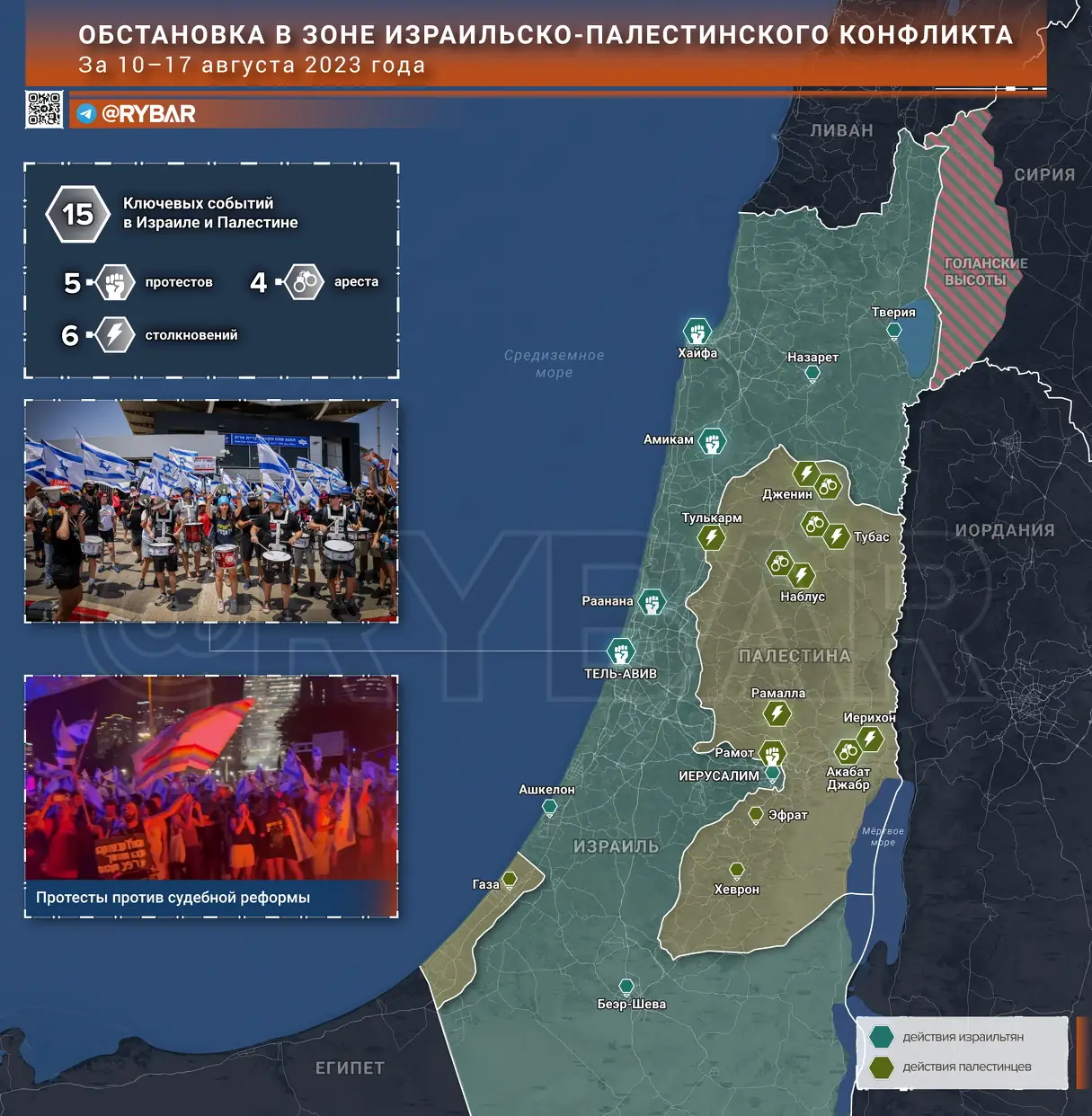
 Saudi Ambassador to Jordan Nayef al-Sudairi presented his credentials to Majdi al-Khalidi, Diplomatic Adviser to PNA President Mahmoud Abbas, thus making him Riyadh's first non-resident ambassador to Palestine.