The Middle East at an inflection point
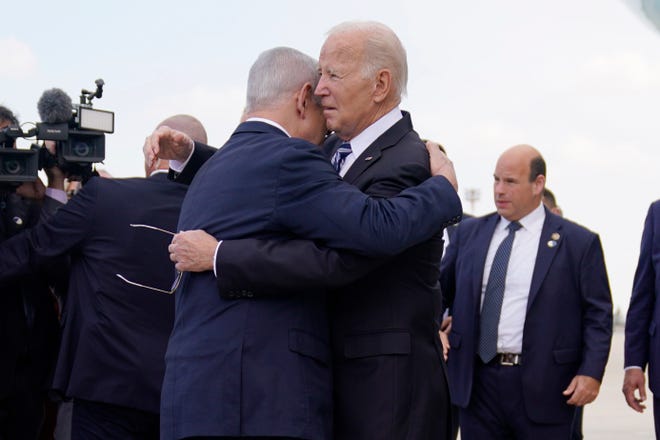
US President Joe Biden (R) and Israeli Prime Minister Benjamin Netanyahu at Ben Gurion Airport, Tel Aviv, Israel, Oct 18, 2023
It has been a perennial hope and expectation that Israel would abandon the path of repression, colonisation and apartheid as state policies and instead accept a negotiated settlement of the Palestine problem under pressure from its patron, mentor, guide and guardian — the United States. But that proved delusional and the remains of the day is a chronicle of dashed hopes and hypocrisy. The big question today is whether a paradigm shift is possible. That is also the dilemma facing US President Joe Biden at 80.
History shows that while catastrophic events have myriad negative effects, positive effects are also possible, especially in the long term. The French-German reconciliation after two world wars is, perhaps, the finest example in modern history, and it planted the germane seeds of European integration project. Certainly, the collapse of the Soviet Union gave impetus to the Sino-Russian rapprochement, which morphed into a “no limit” partnership.
However, for such miracles to happen, visionary leadership is needed. Jean Monnet and Konrad Adenauer were indeed political visionaries — and, in a different sort of way, the two consummate pragmatists Boris Yeltsin and Jiang Zemin too were.
Does it look as if Biden and Benjamin Netanyahu belong to that pantheon? When Biden met with Netanyahu and his war cabinet in Tel Aviv on October 18, he assured them: “I don’t believe you have to be a Jew to be a Zionist, and I am a Zionist.” Therein lies the paradox. For, how could you possibly be an Irish Catholic and a Zionist at the same time? Sinn Féin, which is on course to top Ireland’s next election, is embracing Palestinians and condemning Israel. Of course, there are no surprises here.
Biden is torn between conflicting faiths. Suffice to say, when Biden speaks about a two-state solution, it becomes hard to believe him. On Netanyahu’s part, at least, he doesn’t even feel the need to pay lip service to a two-state solution, after having systematically buried the Oslo Accord and embarked on the journey towards a Jewish theocracy in what was once the state of Israel. Make no mistake, Greater Israel is here to stay and the world opinion regards it as an apartheid state.
There is a great misconception that Biden is under pressure from the American opinion on the conflict in Gaza. But the fact of the matter is that support for Israel has all along been rather thin in America and had it not been for the Israel Lobby, it would have probably asserted a long time ago. Curiously, something like one third of American Jews, especially the youth, don’t even care for the Israel Lobby.
That said, it is also a fact that Americans have generally a favourable opinion about Israel. Their problem is really about Israel’s aggressive policies — this is despite the absence of any open media or academic discussion in the US regarding the state repression of Palestinians or the colonisation of West Bank.
A defining moment came when Netanyahu taunted and humiliated President Barack Obama on the Iran nuclear deal by consorting with the Congress against the presidency in an audacious attempt to derail the negotiations with Tehran.
In the recent years, Israel’s image has been tarnished in the liberal opinion following the ascendance of right-wing forces and the overtones of racist attitudes including among Israeli youth. Indeed, Israel has been an increasingly illiberal country even toward its own citizens. Due to such factors, Americans no longer take an idealised view of Israel as a morally upright country battling for existence.
Meanwhile, there has been a marked erosion of support for Israel within the Democratic Party. But this needs to be put in perspective, for, there has been a countervailing rise in support for Israel among Republicans. Thus, although “bilateral consensus” on Israel is dissipating, paradoxically, the Israel Lobby still wields influence.
That is because the Israel Lobby traditionally didn’t much pay attention to rank and file Americans but instead focused on the power brokers and indeed worked hard to shore up their support. Therefore, it must be understood that what Biden cannot but factor in is that the elites in the Democratic Party establishment remain deeply committed to relations with Israel although the support within the party for Israeli policies may have waned and the American opinion finds the bestiality of Israeli conduct in Gaza revolting.
The elites fear that the Lobby will target them if there are any signs that them wavering in their support for Israel. Put differently, the political elites do not place American national interests above their own personal or career interests. Thus, the Israel Lobby always wins on the Palestinian issue and in extracting generous financial support for Israel with no strings attached. Make no mistake that the Lobby will go to any extent to have its way whenever the crunch time comes, such as today.
Biden is hardly in a position to displease or annoy the Israel Lobby on a day of reckoning. So, why is he making big promises to President Abdel Fattah Al-Sisi of Egypt that “under no circumstances will the United States permit the forced relocation of Palestinians from Gaza or the West Bank, or the besiegement of Gaza, or the redrawing of the borders of Gaza”?
The answer is simple: these are fait accompli that have been forced upon the US and Israel by the Arab States in their finest hour of collective security, none of whom is willing to legitimise Israel’s genocide or its roadmap of ethnic cleansing. Didn’t even little Jordan say ‘no’ to Biden?
Biden is making hollow promises. In reality, what matters is that the Israel Lobby will go to extraordinary length to protect the emerging Greater Israel. Again, it costs Biden nothing by affirming support for a two-state solution. He knows it will be aeons before such a vision takes life, if at all, and if South Africa’s experience is anything to go by, the journey will be fraught with much bloodshed.
Most important, Biden knows that Israel will not accept a two-state solution as per the Arab Initiative crafted by Saudi Arabia’s King Abdullah, which is a finely balanced matrix of mutual interests with a historical and long term perspective. In a historic speech addressing the Arab League on the day of its adoption, then Crown Prince Abdullah had said with great prescience: “In spite of all that has happened and what still may happen, the primary issue in the heart and mind of every person in our Arab Islamic nation is the restoration of legitimate rights in Palestine, Syria and Lebanon.”
The high probability is that Israel will hunker down with the help of its Lobby in the US and would rather prefer to be a Pariah in the world community, to a two-state solution that demands abandonment of the Zionist state built around Greater Israel. The only game changer could be be if Biden is willing to make the US force its will on Israel — through coercive means, if necessary.
But that requires the courage of conviction and a rare ingredient in politics — compassion. Biden’s hugely successful half century in public life was almost entirely devoted to realpolitik and there are no traces of conviction or compassion in it. A legacy cannot be built on ephemeral considerations and expeniency.
https://www.indianpunchline.com/the-mid ... ion-point/
******
AS’AD AbuKHALIL: Hamas Before and After Oct. 7
November 27, 2023

A Hamas rally in Ramallah in 2007. (Hoheit/Creative Commons Attribution-Share Alike 2.0 Germany)
By As’ad AbuKhalil
Special to Consortium News
Hamas has been an important factor in Arab politics since its founding in 1987. It stirred controversy from the very beginning: many objected to its references to the repugnant Protocols of the Elders of Zion (the notorious antisemtic forgery) in the founding document, and it exhibited anti-Jewish sentiments — and even anti-Christian sentiments at first.
But Palestinian society has been known — in contrast to Lebanon — for its aversion to sectarianism, despite the propagation of sectarian Salafite ideology from the Gulf.
Hamas was compelled to change its rhetoric and its last political document (just like Hizbullah) made it clear that it opposes Zionism and not Judaism. (Some of Hamas leaders and supporters still speak in anti-Jewish terms). Hamas felt the pressure from Palestinian society it went out of its way to show that Palestinian Christians would be perceived as part of the larger Palestinian society.
The rise of Hamas was not steady; the movement underwent various shifts and transformations; its foreign relations also changed, sometimes becoming closer to Iran than Qatar, and other times the reverse.
In the second Intifada, it was behind many of the bombings which were not directed at military targets. To say that this soured Western public opinion would be irrelevant because Western governments, media, and some in society, were hostile (even racistly hostile) toward Palestinians and Arabs in general, regardless what actions Palestinians take against the savage Israeli occupation.
There was also a debate that ensued, in Arabic, away from curious Western eyes. People (Palestinians and Arabs) discussed the usefulness and morality of aimless violence away from strict military targets (this was triggered by the bombing of a pizza parlor by Hamas in 2001).
There was no consensus among Arabs regarding whether Israeli adults should be treated as legitimate military targets because of service in the military reserve. People openly discussed such matters in the press. Others disagreed and called for a shift in forms of armed struggle by Palestinians in order not to violate the traditional Islamic/Arab norms of war.
Saudi Arabia’s regime was already engaged in propaganda aimed at impressing AIPAC; articles were published in the Saudi press to characterize Hamas’ violence, and the violence of other Palestinian groups, as outright terrorism. This, of course, offends many Arabs who view Israel as the pioneer and specialist in the practice of terrorism in the region, throughout the 20th and 21st centuries.
Hamas’ Election victory

Israeli Prime Minister Yitzhak Rabin meeting in Casablanca in 1994 with PLO chairman Yasser Arafat. (flickr/Israel Government Press Office)
Hamas was considered by Fatah as a threat to its political dominance. (Fatah became, after Oslo, an arm of the occupation although Arafat tried in his last day to play both sides, and to revitalize the armed wing of Fatah after he became increasingly disillusioned with the “peace process.”)
Quickly it became clear that Hamas was becoming the second most influential political organization after Fatah (only during Arafat’s time), as Palestinian leftist groups saw their demise. Fatah was certain it would win the 2006 election and the Israelis agreed, but Fatah got weaker after Arafat was slowly returning to the path of armed struggle — and was killed by Israel with U.S. support because of it.
Elections were permitted 2006 and Hamas won. Hamas won purely as a vote against the corrupt, washed-up Fatah. The Palestinian people came to perceive Fatah, rightly, as a sell-out and as a ruthless tool of the occupation.
The Palestinian political spectrum was divided between the path of Fatah and the path of Hamas. Fatah represented coordination with Israeli occupation, abandonment of armed struggle, trust in the U.S., and hope that Israel would mercifully allow the Palestinians to have a state.
Hamas on the other hand, stood for opposition to peace with Israel, a firm belief in the efficacy of armed struggle, and the determination that only an Islamist ideology could mobilize the people effectively.
A Score to Settle
Hamas believed a return to Islamic teaching was necessary in order to win against Israel. The PLO experience (especially after the flight from Beirut in 1982) represented failure and defeat. Hamas was then what Fatah was in the wake of 1967, when it posed as the revolutionary alternative to failed Arab regimes.
The U.S. and Israel could not accept Hamas’ victory and journalist David Rose revealed in this article in 2008 that both the U.S. and Israel were working for a coup to unseat Hamas in Gaza. So much for Bush’s rhetoric and democracy and the ballot box.
Hamas — unlike Fatah, which suffered since its inception from infiltration and security breaches — formed an effective intelligence apparatus, and pre-empted the coup by its enemies, including Fatah.
Hamas also had a score to settle with Fatah, having suffered from torture in Palestinian Authority dungeons after Oslo. Western governments had no qualms about torture by Israel and the PA as long as the victims were were Islamists and believed in armed struggle.
Right before Oct. 7, Hamas had an identity crisis. It became — like the PA in a sense —associated with a repressive government in Gaza. Things were not as bad as they were under the thugs of the PA in Ramallah, but Hamas was increasingly resorting to repression against expression of opposition and resentment.
Economic hardships weren’t due to Hamas’ rule (after a nearly two-decade Israeli blockade) but the people had only one address to protest against. There was none of the rampant corruption of Fatah, but the Palestinian people in Gaza were getting fed up with the handling of the siege by Hamas.
The people of Gaza were fed up with its impact on their lives. Gaza is not a virtual prison. It is actually an open air prison, with the air, sea and entry points are all controlled by the Israeli occupation. Israel and subservient media still claims that Israel “withdrew” from Gaza in 2005. In fact, the occupation of Gaza never ended.
What Israel did was merely redeploy the occupation troops to outside Gaza, while imposing a tight siege on the strip. The Egyptian government of Sisi is a full partner in the siege (in the time of Husni Mubarak, the Egyptian government allowed for smuggling in order to alleviate the economic conditions in Gaza).
The U.S., typically, deferred to Israel to do what it wishes with the strip, and whenever Israel would decide to launch a savage military campaign against the people in Gaza, the U.S. (right, left and center) went along and provided Israel full support.
Hamas Can’t Be Defeated By Force
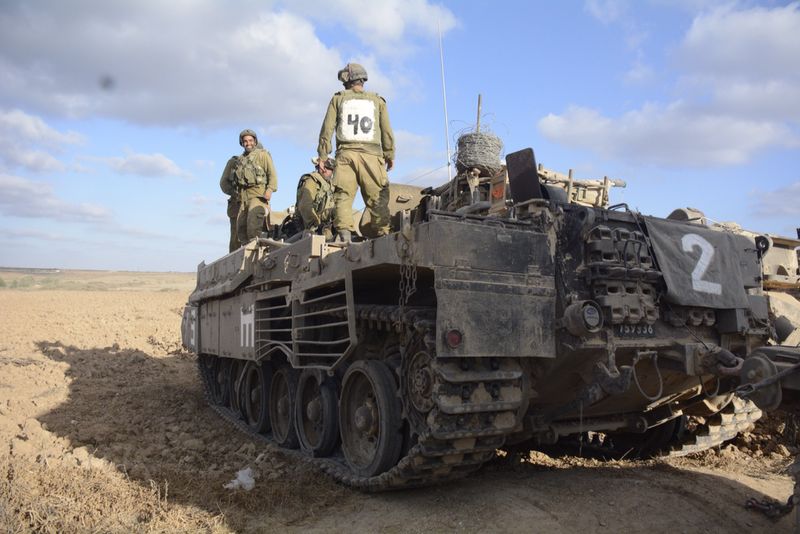
The IDF searches for Hamas tunnels in and around Gaza. (IDF/Creative Commons CC BY-NC 4.0)
In 2018, the people of Gaza tried to launch a peaceful protest against the siege. Israel’s response was swift: it shot at the protesters without regard to civilian lives. U.S. indulgence permitted Israel to treat the poor Gazans with callousness and vindictiveness.
Not much is known about the planning of Operation Aqsa Deluge on Oct. 7. Hizbullah and Iran both confirmed that they had no prior knowledge of the operation. There are those who believe Hamas did not act alone; that when the borders opened Islamic Jihad and even smaller groups broke out of the Gaza prison and helped themselves to Israeli hostages. Hamas later admitted that not all the hostages were in its custody.
The U.S. and Israel quickly responded by equating Hamas with ISIS, and President Joe Biden insisted Hamas does not represent the Palestinian people. WINIP (the thinly disguised research arm of the Israeli lobby) came up with a poll to prove that Hamas is not popular and Western media all but declared the end of Hamas.
But Hamas can’t be ended by force. There are reports that its popularity is rising in the West Bank, where it had been banned by the PA. Chants for Hamas have been heard all this week in the West Bank, and in Arab countries.
Things don’t always go according to plan when colonial powers strategize with heavy firepower.
The image of Abu ‘Ubyadah (the military spokesperson of Hamas) has been plastered all over Arab social media and even in streets of Lebanon, the only Arab countries with (almost) unlimited freedom.
The release of the Palestinian prisoners was accompanied with the expression of support for Hamas. And even with the massive level of destruction and death in Gaza, there were no grumblings against Hamas by the Palestinian people. For Israel to end Hamas, it must kill or expel all Palestinians from the West Bank, Gaza and all the refugee camps in Jordan, Lebanon and Syria.
The Biden administration wouldn’t apparently object to such a murderous plan.
https://consortiumnews.com/2023/11/27/a ... ter-oct-7/
******
A Ceasefire Is Far from Lasting Peace – A National Security Expert on the Israel-Hamas Deal
Posted on November 27, 2023 by Yves Smith
Yves here. Many readers have likely come to the conclusion put forth in the headline, that the Israel-Hamas ceasefire is better than a poke in the eye but does not come close to solution for the conflict, or even do much to advance a solution. This sad fact bears repeating as an antidote to the outbreak of MSM hopium, which no doubt cheers Biden Administration officials.
To add some points that are also important to keep in mind:
Even though Netanyahu is singularly responsible for advancing the anti-Palestine project, his ouster will not make a solution more likely. In fact, Netanyahu is more moderate than many in the governing group, so it’s probable that someone at least as hardline would replace him.
John Mearsheimer has stated a two-state solution is impossible and everyone advocating it ought to know that….which would seem to suggest their motives for touting it are cynical. One insurmountable obstacle is that a Palestinian state would have its own military, something Israel would never tolerate. A second issue is the way Israel has balkanize the area between Gaza and the West Bank, making any integration or even, say, land bridge very hard to implement. Third is what to do with the settlers They ought to be expelled, again something Israel would never accept.
By Gregory F. Treverton, Professor of Practice in International Relations, USC Dornsife College of Letters, Arts and Sciences. Originally published at The Conversation
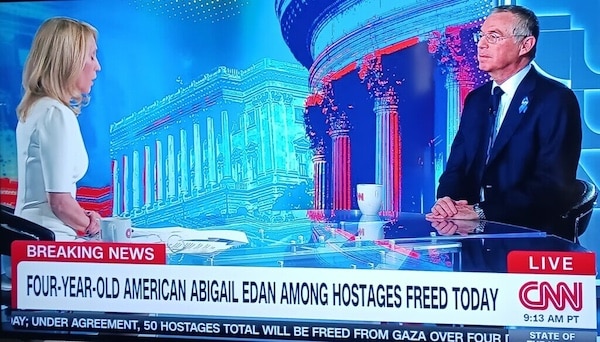
For the first time since the deadly attacks by Hamas on Israeli border towns on Oct. 7, 2023, that left at least 1,200 people dead, the Israeli government agreed on Nov. 22 to suspend its air and ground campaign in Gaza for four days in exchange for the release of at least 50 hostages held by Hamas.
Nearly six weeks in the making, the cease-fire deal also calls for the release of 150 Palestinians held in Israeli prisons.
The fate of the remaining hostages is still unclear.
What is clear is that the war will continue after the brief cease-fire. Israeli Prime Minister Benjamin Netanyahu said on Nov. 21 that the pause would allow the Israel Defense Forces to prepare further for the fighting.
“The war will continue until we achieve all of our goals,” Netanyahu said. Those goals include the return of all the hostages and the elimination of Hamas to ensure “Gaza will no longer be a threat to Israel.”
To make sense of the deal, The Conversation asked Gregory F. Treverton of USC Dornsife, a former chairman of the National Intelligence Council in the Obama administration, to share his thoughts on what it means for the ongoing war in Gaza.
Military Goals Unchanged
The agreement between Israel and Hamas – driven by U.S. pressure on Israel – to exchange 50 hostages for 150 Palestinian prisoners and to pause fighting for four days is surely a welcome break in a horrific war.
Not least, it will permit food and fuel to enter a devastated Gaza.
It does not, however, fundamentally change the awful geometry of the war: Netanyahu has pledged that Israel will continue the fight, and there seems little sign that Israel is any closer to a plan for what to do about Gaza or the Palestinians than when the war began.
For its part, events have played out much as Hamas might have planned.
They knew their barbarism on Oct. 7 would call forth a brutal Israeli response.
Hamas knew, cynically, that the more Palestinians who were killed, the better for its cause. Global opinion would shift against Israel, and its American patron, and it has. And Hamas likely expected the Palestinian statehood issue, all but forgotten by the world, including the Arab world, would return to international prominence.
In the process, Hamas probably anticipated it would, paradoxically, become more popular in Gaza, not less.
A Distant Hope for Lasting Peace
In the short run, the best that can be hoped is that this exchange and pause will be extended or be the first of more to come.
Certainly, Israel has been under global – and especially American – pressure to agree to some pause, and the Netanyahu “unity” government has felt the heat, domestically, for seeming to disregard the hostages.
In the longer run, after much more killing and suffering, the alternatives still remain dreary. Israel has no stomach for occupying Gaza and surely none for letting Hamas again pretend to govern. The Palestinian Authority remains corrupt, weak and inept in the eyes of those it governs, and as a result is a poor candidate to take on Gaza.
The best hope is a distant one – that some coalition of mostly Arab states but also perhaps including the U.S. could govern Gaza, perhaps exercising some tutelage over a reformed Palestinian Authority.
But that is a long way off, and the hostage exchange and pause does not take the region or the world much closer to a lasting peace.
https://www.nakedcapitalism.com/2023/11 ... -deal.html
******
Gaza truce extended by two days as prisoner and hostage exchange continues
The four-day truce between Israel and Hamas was set to expire on Tuesday morning. 33 Palestinian prisoners are set to be released on Monday
November 27, 2023 by Peoples Dispatch

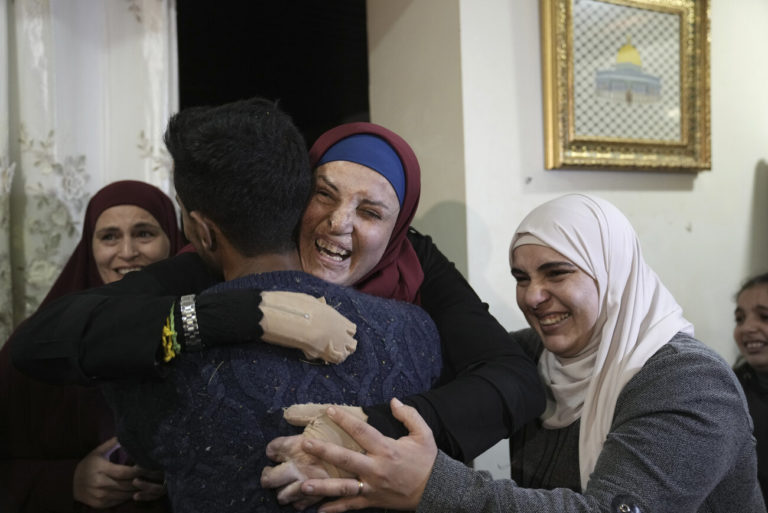
Prisoner Fatima Amarneh is embraced by her family in the town of Ya’bad in Jenin, after her liberation as part of the prisoner exchange. Photo: Quds News Network
The truce between Israel and Hamas was extended by two more days on Monday, November 27. The extension was first announced by an official of the Qatari foreign ministry and confirmed by Hamas. The four-day truce was set to expire on Tuesday morning.
The release of Palestinian prisoners and Israeli captives is likely to continue on Monday. According to reports, 33 Palestinian prisoners are likely to be released in return for 11 Israeli captives being freed. In the first three days of the truce, 119 Palestinian prisoners were released. 49 Israeli captives and 17 foreign citizens were also released.
The four-day pause in the attack on Gaza held for the most part except for several instances of Israeli violations. These violations momentarily jeopardized the truce and delayed the exchange of prisoners and hostages after Hamas threatened to withdraw from the deal but mediation by Qatar and Egypt helped resolve the situation.
Over the past three days, the release of Palestinian women and child prisoners was welcomed by thousands who waved flags and shouted slogans in support and solidarity. Emotional scenes circulated on social media of former prisoners embracing their families after years in prison and zero communication since October 7.
Maysoon Jabali, a female #Palestinian ex-prisoner who was released last night, speaks about the inhumane treatment of Palestinian prisoners and detainees inside Israeli dungeons.#FreeThemAll pic.twitter.com/caOorVYmjP
— Quds News Network (@QudsNen) November 27, 2023
Meanwhile, Israeli security forces continued to sporadically target Palestinian civilians in Gaza, as well as in the occupied West Bank. On Monday, at least 56 Palestinians were detained in the occupied West Bank, according to Wafa News.
Israeli forces also shot and killed a farmer in Central Gaza in an area near the Al-Maghazi refugee camp on Sunday, with another Palestinian suffering injuries. Seven more Palestinians who were fired upon by Israeli forces with live gunfire near the Al-Quds and Indonesian hospitals sustained injuries.
Israeli forces also conducted raids on Sunday and Saturday in the occupied West Bank, killing at least eight people. So far, since October 7, when Israel launched its genocidal war in Gaza, Israeli forces have killed more than 239 Palestinians, injured more than 3000 others, and detained at least 3,160 in the occupied West Bank and East Jerusalem, according to Palestinian official statistics. In Gaza, the death toll stands at an estimated 15,000 and over 33,000 injured.
https://peoplesdispatch.org/2023/11/27/ ... continues/
Israel extends detention of Al-Shifa hospital’s director by 45 days
Al-Shifa hospital director Dr. Muhammad Abu Salmiya and his colleagues were arrested on November 23, a day before the ceasefire came into effect. Israeli forces had continuously targeted and raided the hospital leading to the death of patients
November 28, 2023 by Peoples Dispatch

Dr. Muhammad Abu Salmiya
Israel extended the detention of the director of Gaza’s Al-Shifa hospital Dr. Muhammad Abu Salmiya by 45 more days on Tuesday, November 28. Dr. Abu Salamiya and several other doctors and medical staff members were arrested by Israel on November 23, a day before the four-day truce came into force.
Dr. Abu Salmiya and his colleagues in Al-Shifa had refused to leave the hospital when Israeli ground forces attacked it earlier this month.
Al-Shifa is Gaza’s largest hospital. It was repeatedly targeted in the Israeli air strikes and Israeli forces raided it during their ground offensive and killed some patients, according to media reports.
Dr. Abu Salmiya faces allegations of “aiding the enemy during wartime and providing service to terror organizations,” al-Quds news network reported.
Confirming the news of Dr. Abu Salmiya’s arrest on Thursday, the Israeli occupation forces had claimed that he had been shifted to Shin Bet’s interrogation center alleging that, “under his [Dr. Abu Salamiya’s] direct management, [Al-Shifa hospital] served as a Hamas command and control centre,” The Guardian had reported.
Israel occupied many of the hospitals in northern Gaza, forcing the patients to leave the premises and making them inoperational. It has maintained that the Palestinian resistance movement Hamas had been using the hospital premises in Gaza to launch attacks.
Israel has provided no credible evidence to prove the allegations. Hamas and hospital managements have denied Israeli allegations too.
Hamas issued a statement last week condemning the arrest of Dr. Abu Salamiya and other medical staff. It asked the international community to intervene to secure their release.
Several patients and babies died due to the lack of power supply to the hospital. The remaining patients, including some newborns, were forcefully evicted.
Israel had imposed a complete blockade on the supply of fuel, medicine, and other essential commodities to the besieged Palestinian territory before the ceasefire. Even after the ceasefire came into effect, only limited aid is allowed in Gaza, leaving the majority of Palestinians without enough medical or other essential supplies.
At least 60 ambulances and 160 health facilities were targeted during the 48 days of Israel’s genocidal attack on Gaza. The attacks and blockade led to the closure of 28 hospitals and 63 primary health care centers, leaving the majority of over 33,000 injured Palestinians without basic medical care, Gaza’s ministry of health confirmed on Tuesday.
Medical staff and establishments are protected as per international law even during war time and targeting them is a war crime.
Israeli airstrikes and ground offensives inside Gaza have killed close to 15,000 Palestinians, mostly children and women. Hundreds of them are still missing with over 70% of the population of Gaza displaced due to destruction of residential buildings and essential civil infrastructure.
https://peoplesdispatch.org/2023/11/28/ ... y-45-days/
******

War Is Not Abstracted Anymore
You can’t have an up close and personal relationship with the reality of bombs and all the things they do to human flesh and then go back to the way you were ever again. Millions of western eyes have been changed forever.
Caitlin Johnstone
November 29, 2023
Pentagon contractor Elon Musk and war criminal Benjamin Netanyahu had a conversation that they broadcast on Twitter during Musk’s apology pilgrimage to Israel in a desperate bid to salvage his public image amid costly accusations of antisemitism.
The “conversation” was really more of a monologue, with the Israeli leader droning on in his conspicuously American accent while Musk meekly agreed with him on every point. During his lecture, Bibi said something worth highlighting while complaining about the worldwide pro-Palestine protests that have been underway since the beginning of Israel’s ongoing Gaza massacre.
“We have mass demonstrations,” Netanyahu said at around the 15:55 mark. “Where were these demonstrations when over a million Arabs and Muslims were killed in Syria, in Yemen, many of them starving to death, those who didn’t die in explosions. Where were the demonstrations in London? In Paris? In San Francisco? In Washington? Where are they?”
“The answer is they don’t care about the Palestinians, they hate Israel,” Netanyahu said. “And they hate Israel because they hate America.”
You hear this “where were the protests over Yemen and Syria?” talking point over and over again from Israel apologists, the argument essentially being that because few people protested the mass killings in those countries then Israel should get to do a little genocide of its own, as a treat.
This talking point is stupid for a few reasons, including the way it tends to avoid the inconvenient fact that the bloodshed in both Yemen and Syria was facilitated by US interventionism, just like the bloodshed in Gaza is. The civil war in Syria was only able to occur because the western alliance and its regional partners flooded the nation with weapons given to extremist factions in the hope of toppling Damascus, and Saudi Arabia’s war crimes in Yemen were fully backed by the US and its allies.
The talking point is also stupid because there are many entirely legitimate reasons the Gaza massacre is getting special attention. In a recent New York Times article titled “Gaza Civilians, Under Israeli Barrage, Are Being Killed at Historic Pace,” Lauren Leatherby explains that Israel’s actions in Gaza are actually quite different from other conflicts this century, killing far more civilians far more rapidly than the wars in places like Syria and Ukraine. Last week the UN’s emergency relief coordinator Martin Griffiths said during a CNN interview that Gaza is the worst humanitarian crisis he’s ever seen, even worse than the Killing Fields in Cambodia. This conflict is being treated differently because it is different.
Another reason this specific bombing campaign is getting so much more public backlash than others is because the pro-Palestine movement has had generations to build, whereas when the west lays waste to a country using military explosives it’s normally a fast ordeal which moves from manufacturing consent to execution very quickly. By the time people figure out they were lied to about the justifications for a depraved war the empire is usually two or three new wars down the track. The Israel-Palestine issue has been just sitting there for decades, so there’s been time to accumulate popular opposition. Once someone learns about the realities of the Palestinian plight they very seldom abandon their support for it, so every newly-opened pair of eyes stays open on this issue for a lifetime.
But perhaps the dumbest thing about this talking point is the fact that it ultimately works against the agendas of the people saying it. Israel apologists keep asking “Where were the protests over Yemen and Syria,” and gradually the millions of people who are beginning to wake up to the criminality of the US-centralized power alliance as a result of the Gaza massacre are going to start asking themselves the same question.
Because the assault on Gaza is so uniquely horrific and is being broadcast onto people’s social media feeds in real time, millions of people around the world are being snapped out of the propaganda-induced coma that has had them consenting to evil war after evil war over the years. People are starting to realize they’ve been deceived about the Israel-Palestine conflict, and they’re starting to wonder what else they’ve been deceived about. Keep asking them “Where were the protests over Yemen and Syria,” and eventually they’re going to start researching those conflicts and learning about their own government’s role in them, and from there it’s only a matter of time before they start asking, “Hey yeah! Where WERE the protests over Yemen and Syria??”
In a new article for The Guardian titled “The war in Gaza has been an intense lesson in western hypocrisy. It won’t be forgotten,” Nesrine Malik writes that “for the first time that I can think of, western powers are unable to credibly pretend that there is some global system of rules that they uphold. They seem to simply say: there are exceptions, and that’s just the way it is. No, it can’t be explained and yes, it will carry on until it doesn’t at some point, which seems to be when Israeli authorities feel like it.”
“Part of that inability to reach for convincing narratives about why so many innocent people must die is that events escalated so quickly,” Malik adds. “There was no time to set the pace of the attacks on Gaza, prepare justifications and hope that eventually, when it was all over, time and short attention spans would cover up the toll. Gaza has been a uniquely, inconveniently, intense conflict… The area is so densely populated that the toll of civilians is too high, and evidence for having undermined Hamas’s capabilities, the only possible justification for the casualties, is too low.”
This is the sort of political moment in which newly-formed critics of the western war machine are being asked to think carefully about why there hasn’t been a robust resistance to their governments’ other criminal actions. Which looks like a nightmare waiting to happen for the propagandists whose job is to manufacture consent for depraved acts of war.
One thing the empire is about to realize is that the western public has lost all its appetite for war. All the careful sanitising, video-gamifying and propagandizing that has been put in place since Vietnam in order to build a platform of consent for “humanitarian” wars has cratered into nothing over the course of mere weeks.
You can’t have an up close and personal relationship with the reality of bombs and all the things they do to human flesh and then go back to the way you were ever again. Millions of western eyes have been changed forever.
“War” is not abstracted any more.
https://caitlinjohnstone.com.au/2023/11 ... d-anymore/




 @ejmalrai - 5:45 UTC · Nov 29, 2023

 When less than 3 weeks ago the White House officially called a ceasefire "wrong, repugnant and disgraceful"… He literally went from saying Hamas could benefit…