US Attacks on Xiomara Castro’s Government Escalate After Termination of Extradition Agreement
Posted by Internationalist 360° on September 2, 2024
Pablo Meriguet
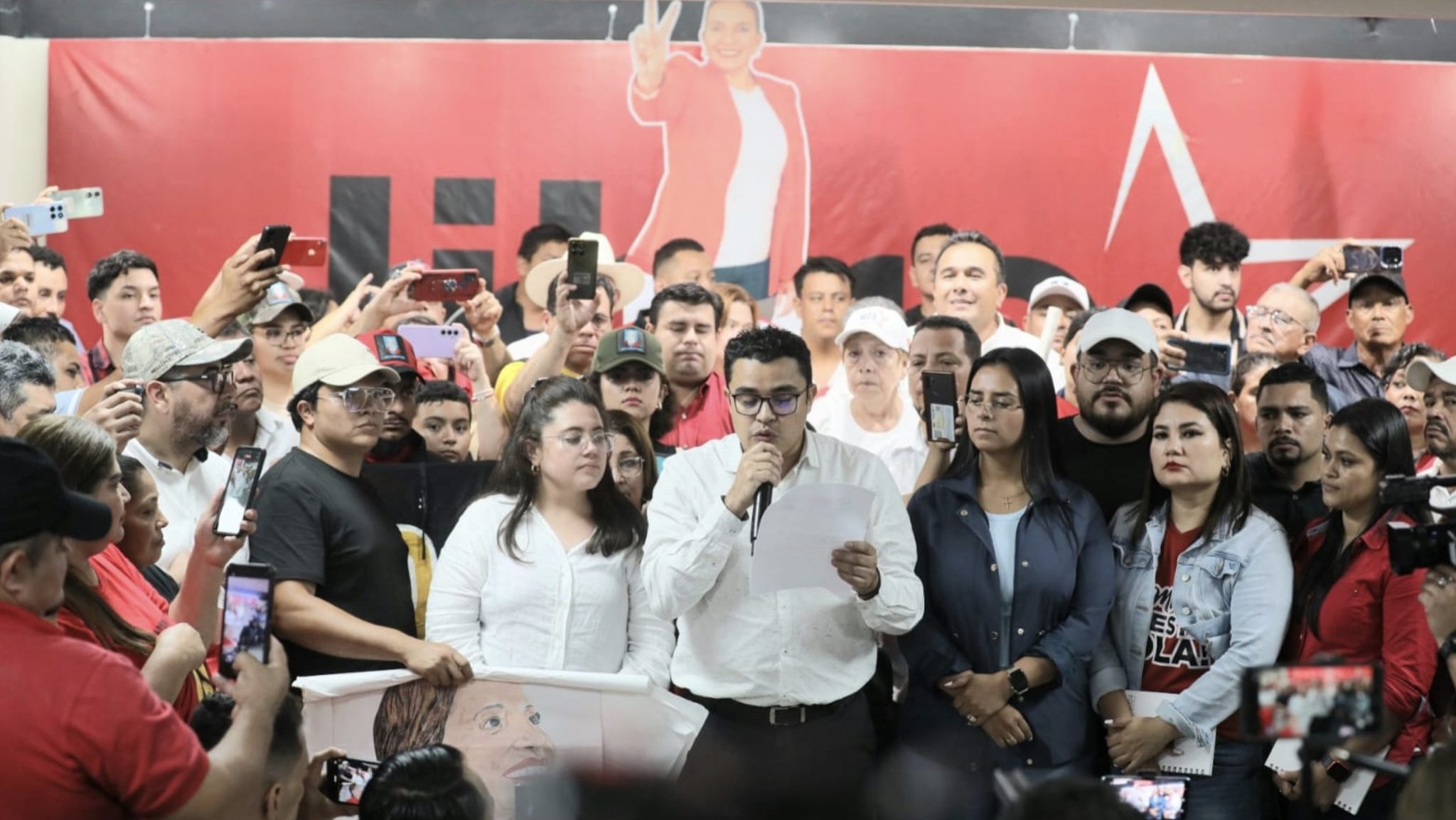
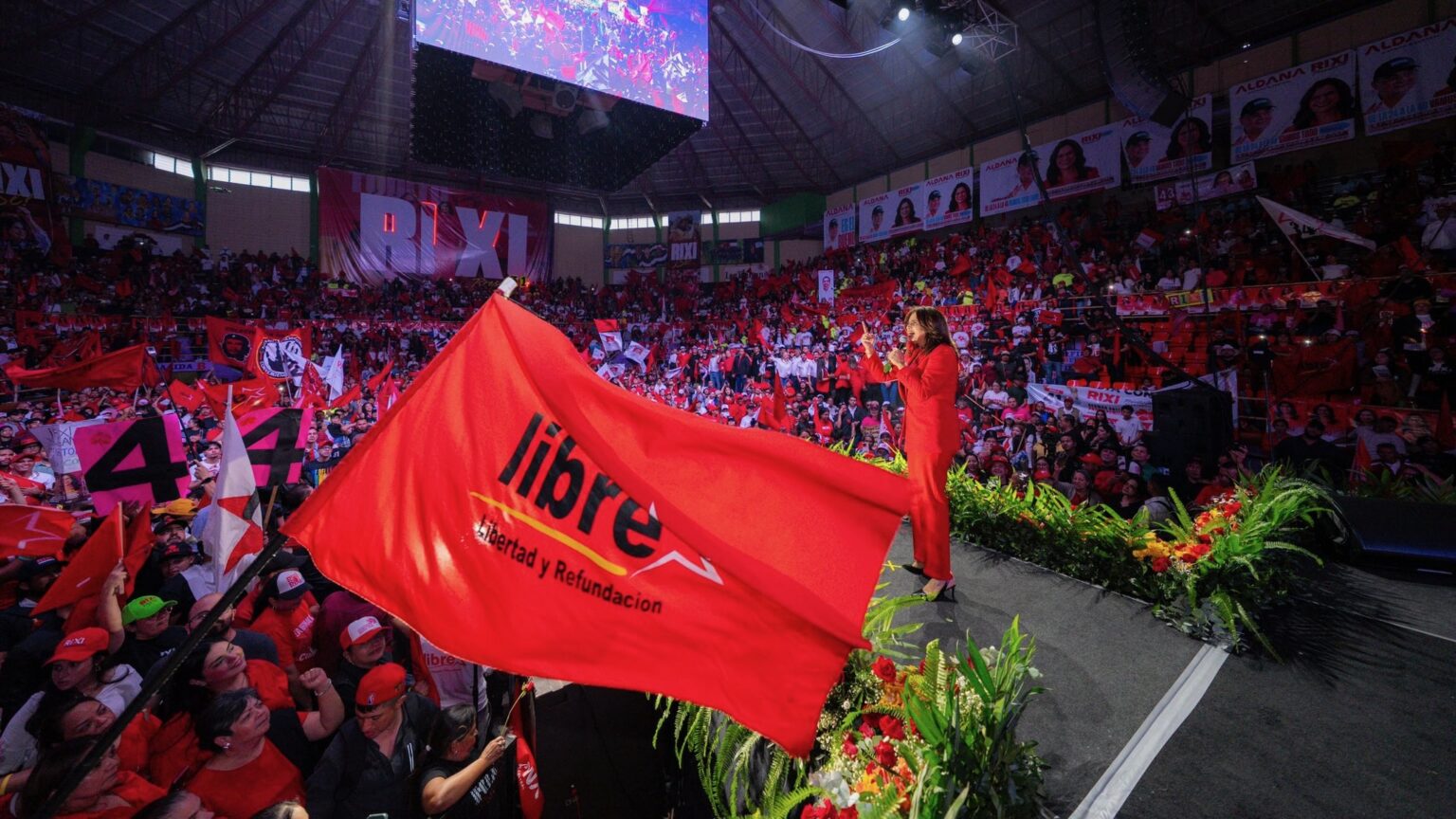
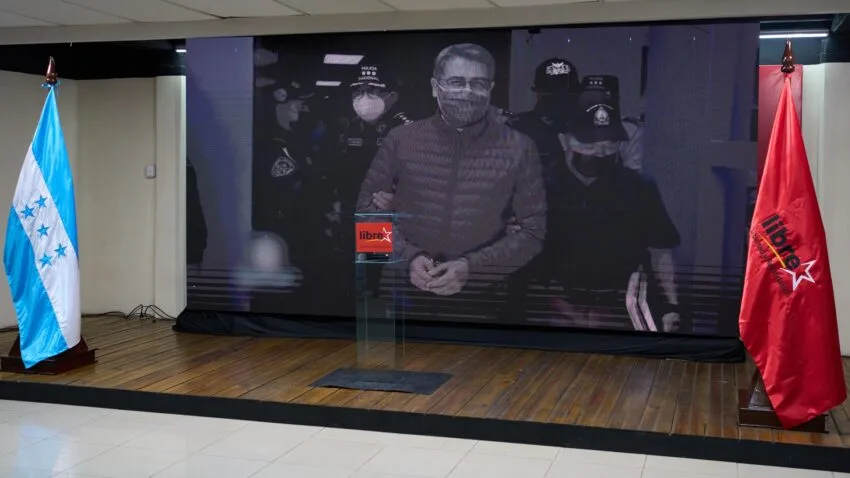
Press conference of the Libre Party on September 1. Photo: Libre Party
A series of attacks from the US Embassy and the local oligarchy have sought to undermine the progressive government in Honduras.
Following the termination of the extradition agreement between Honduras and the United States requested by President Xiomara Castro, the Central American country has experienced a political earthquake. President Castro’s decision was taken after the US Ambassador in Tegucigalpa, Laura Dogu, made statements to Honduran media questioning the meeting of several Honduran officials with Venezuelan officials.
In light of this decision, the right-wing opposition in Honduras has accused the executive branch of making the decision due to alleged relations between some government officials and criminal groups. Such rumors increased after Congressman Carlos Zelaya – brother of former President Manuel Zelaya (ousted in a coup d’état in 2009) – said that in 2013 he was in a meeting where a drug trafficker was present. Carlos Zelaya clarified that this meeting was not a meeting known or ordered by his brother or by the current President of the country, Xiomara Castro, but rather that it was a personal meeting. For the time being, the congressman announced that he would resign from his political post to be investigated so that he can clarify that there is no connection between criminal groups linked to drug trafficking and the political party Liberty and Refoundation (Libre), which is currently in power.
“I am going to present my resignation to the National Congress as congressman and as secretary of the Congress to strip myself of any kind of shielding I may have and to be investigated,” said Congressman Zelaya. He also stated that he would have no objection to appear before the US justice system to prove his innocence if the US government so requires.
Carlos Zelaya’s son is José Manuel Zelaya, who was until recently, Secretary of Defense. The opposition quickly tried to link the father’s situation with the son. But José Manuel Zelaya has declared that he will also resign from his post as Secretary of Defense to submit to a thorough investigation by the Honduran justice system. “The mission of the Libre Party is above the exercise of a public office, for this reason, and to be investigated with complete freedom, I have submitted my resignation as Minister of Defense to President Xiomara Castro, highlighting the integrity and honor of my Father Carlos Zelaya who has voluntarily appeared before the MP to testify about a video in meeting 11 years ago (2013), with people who were accused of drug trafficking. We will continue fighting for the truth,” said the former Secretary of Defense. Given this resignation, Xiomara Castro appointed Rixi Moncada Godoy as the new Secretary of Defense. Moncada is, for now, the presidential pre-candidate of the Libre Party for the 2025 elections.
Political persecution as punishment for defending Honduras’ sovereignty
In a statement released after an extraordinary meeting of the National Coordination of the Libre Party, they declared that this new attack is part of a plot to carry out a new coup d’état in Honduras because the Castro government has not submitted to Washington’s directives and because it sovereignly “dared” to terminate the extradition agreement. In addition, it was warned that one objective of the conspirators is to prevent the holding of free and democratic elections in 2025. Therefore, the party has condemned and rejected the “interfering actions of the Embassy of the United States of America by attacking the Chief of the Joint Chiefs of Staff of the Armed Forces and the former Minister of Defense, violating international principles and conventions, trying to provoke the destabilization of the armed forces”.
In addition, the Libre Party decided to give a vote of confidence to the public officials who chose to resign from their positions so that they could be investigated transparently: “To recognize the voluntary appearance before the Public Prosecutor’s Office of comrade congressman Carlos Armando Zelaya, and his resignation from his position in the National Congress, as well as the resignation of comrade Rafael Sarmiento, who have made themselves immediately available to the national and international investigative bodies”.
Finally, President Castro’s political party decided to call for a mass mobilization on September 15 to support the government of Xiomara Castro and reject foreign interference that seeks to destabilize the democratically elected government. “The Libre Party was born in the streets, we will remain active and mobilized throughout the country to continue fighting the oligarchy and the neoliberal, opprobrious, and corrupt system. For a new triumph in the primary and general elections of 2025. WE RESIST AND WE WILL WIN!” concludes the communiqué.
Frente a la guerra desatada contra la Presidenta Xiomara Castro con el objeto de promover un nuevo golpe de Estado por la élite conservadora, en contra de Libre, nos pronunciamos de la siguiente manera:
Reunida este día domingo 1 de septiembre de 2024, en Sesión Extraordinaria,… pic.twitter.com/pl1rgR6sRd
— Partido Libre (@PartidoLibre) September 2, 2024
Many have also pointed out the hypocrisy of accusing the left and progressive movement of links with narcotraffickers when politicians from the far-right National Party, including former president Juan Orlando Hernández, have been convicted and extradited over charges of exporting hundreds of tons of cocaine to the United States.
Honduras Reveals List of Right-Wing Politicians Investigated for Drug Trafficking
Honduran Defense Minister Rixi Moncada (C), 2024. Photo: X/ @diario504hn
September 4, 2024 Hour: 8:05 am
Trials initiated in the U.S. are selective due to the activities of corrupt networks, Defense Ministry said.
On Tuesday, Honduran Security Minister Gustavo Sanchez and Defense Minister Rixi Moncada revealed a list of opposition politicians who are under investigation for drug trafficking.
This information was made public during a press conference led by President Xiomara Castro, who denounced that plans for a coup against her are still being carried out. Sanchez and Moncada indicated that 33 opposition politicians have been convicted or are under investigation in the United States for drug trafficking-related crimes.
The Security Minister mentioned 26 cases involving members of the National Party, including former President Juan Orlando Hernandez, who was sentenced to 45 years in prison “for turning Honduras into a narco-state,” and his brother Juan Antonio Hernandez, who was sentenced to life imprisonment for drug trafficking. Another notorious case involves Porfirio Lobo Sosa, who received money from the Los Cachiros cartel and Alexander Ardón for his 2009 presidential campaign.
The Defense Minister detailed that there are seven ongoing drug trafficking investigations in U.S. courts related to the Liberal Party. One of these investigations involves Mauricio Villeda, the former presidential candidate of the Liberal Party and current member of the National Congress.
In the trial against former President Hernandez, Villeda was mentioned as having received around US$250,000 from the Los Cachiros cartel in exchange for helping Carlos “El Negro” Lobo recover assets that had been seized.
“The entire state security system was dismantled. They used our territory as a bridge to introduce cocaine into the United States, turning it into a paradise for drug traffickers. This happened during the 12 years and seven months of the narco-dictatorship. Radars were disabled. The drug trafficking route, which uses our seas and airspace, is controlled from Key West in the United States,” the Security Minister said.
“They reformed the law protecting the sovereignty of the airspace, obstructing the possibility of shooting down planes trafficking drugs. As has been demonstrated on multiple occasions, trials initiated in the U.S. are selective due to the activities of corrupt networks involving police, military personnel, prosecutors, judges, magistrates, and law firms,” Moncada pointed out.
Honduran President Xiomara Castro Accuses Biden Administration of Plotting Against Her
By Hernán Viudes - October 22, 2024 0
[Source: derecholatinamerica.com]
“The interference and interventionism of the U.S., as well as its intention to direct Honduran politics through its Embassy and other representatives, is intolerable.”
The categorical post by the President of Honduras, Xiomara Castro, exposed foreign interventionism in her country, which is not new but has intensified during her administration.
Xiomara Castro [Source: gchumanrights.org]
As detailed by social leader Luis Méndez of Mesa 11 and CELAC Social, “we cannot lose sight of the historical hegemony of the United States in the region. Over a century of interference and dependence, in the case of Honduras, a country marked by the mining and banana enclave of the past century.”
The exploitation of gold and silver in the mines of Rosario, San Juancito with the Rosario Mining Company, the place where the United States established its first embassy, and the banana enclave with the United Fruit Company and Standard Fruit Company in the first half of the 20th century are two key events to contextualize the role of the U.S. in Honduras and the region.
Stamp with image of Rosario mining operations in San Juancito. [Source: en.wikipedia.org]
The attack and overthrow of Guatemalan President Jacobo Árbenz in 1954, organized from U.S. geo-military laboratories in Honduras, demonstrate that, beyond any economic development initiatives from the U.S. for the region, its supreme interest was always its geo-political and geo-strategic control.
Its false “Alliance for Progress” initiative during the presidency of John F. Kennedy was merely an excuse to implement the blockade against Cuba, and in the 1980s, the establishment of the Palmerola military base in Comayagua. It was part of a strategy to contain the advance of the left on the continent, particularly supporting the Nicaraguan counter-revolution and weakening the Farabundo Martí National Liberation Front (FMLN) project in El Salvador.
It was the United States that planned and carried out the political-military coup against Manuel Zelaya in 2009, the first “soft coup” of the 21st century, which aimed to contain the advance of the popular project represented by ALBA.
Currently, interference under the representation of the U.S. Ambassador to Honduras, Laura F. Dogu, is a continuation of a historic project of American control and domination over the governments of the region.
The exception is the sovereign government of Nicaragua, which in 2018 expelled and declared Laura Dogu “persona non grata” for being part of the destabilization project and attempt to overthrow President Daniel Ortega and Vice President Rosario Murillo.
Laura F. Dogu [Source: amcham.org]
After being expelled from Nicaragua, the U.S. appointed Dogu as ambassador to Honduras to counteract the advance of the left in the region. She has training and experience in foreign intervention in sovereign decisions of other countries: She served as foreign policy adviser to the U.S. Army Chief of Staff.
The official embassy portal itself acknowledges this interference, albeit with euphemisms: “She left that country stating that ‘investors must be aware of the physical, financial, and reputational risks of doing business in Nicaragua.’” With these credentials, she arrived in Honduras to carry out a similar agenda.
“Local Foundations and NGOs”
Behind the U.S. developmental guidelines and the false pretense of safeguarding “democracy,” international and local actors have aligned themselves to limit and destabilize President Castro’s administration, and to influence the upcoming 2025 general election, pushing for a return to the traditional system of governments servile to northern interests.
The role of NGOs and foundations controlled by USAID and NED, under the guise of “social aid, anti-corruption efforts, freedom of expression, and the false war on drugs,” serves as the perfect excuse to boycott popular, leftist and progressive governments. To justify their interference, they always label them as “corrupt,” and they associate “freedom” with the economic interests of local elites and U.S. companies.
Among the most influential NGOs and foundations in Honduras is the Association for a More Just Society (ASJ), founded by a group of Hondurans and Americans and funded by USAID and the State Department. One of its key areas of attack on the government is the criticism over the “high energy losses in Honduras.”
To address this, they “urgently require the unification of efforts to reduce losses.” In doing so, they question one of the most important and structural public policies of Xiomara Castro’s government: the recovery of the energy sector, now understood as a human right, no longer as the loot of businessmen who, for decades, accumulated capital by selling energy to the state at high costs.
The destabilizing role of the National Anti-Corruption Council (CNA) has a distinguishing feature in its method of infiltration: the CNA is led by an Assembly composed of representatives from 12 civil society organizations, including business chambers, churches and the media. Through and with the funding of the Council, the United States intervenes in Honduras.
The third organization is the Honduran Council of Private Enterprise, whose “mission is to contribute to national economic development through the strengthening of Free Enterprise.”
As social leader Luis Méndez explains, “these NGOs and foundations receive money that they then channel into a communication project to carry out a campaign of constant aggression against the country’s refoundation project.”
The “narco video” of destabilization
The Secretary of the National Congress and Xiomara Castro’s brother-in-law, Carlos Zelaya Rosales (brother of former President Zelaya Rosales and father of the Minister of Defense, José Manuel Zelaya Rosales), appeared before the Public Ministry and confessed to having met with a group of drug traffickers in the context of the 2013 election.
There, they discussed the possibility of providing financial resources for the campaign of the now-ruling party Libre. Several years later, Insight Crime, an NGO that works on journalistic investigations into drug trafficking and organized crime, released the news known as the “narco video,” in which Carlos Zelaya Rosales is seen with known criminals in the country.
Carlos Zelaya Rosales [Source: reportarsinmiedo.org]
In this regard, President Castro stated at a press conference: “I condemn all types of negotiations between drug traffickers and politicians.” Subsequently, the president denounced having detected “movements within the Armed Forces” aimed at carrying out a coup d’état.
This was compounded by the public statements made by Ambassador Dogu regarding the visit of the Minister of Defense to Venezuela and his meeting with Vladimir Padrino, which internally triggered a media onslaught from the corporate press and NGOs controlled by the embassy.
In light of this situation, President Castro ordered Foreign Minister Eduardo Reina to “denounce” the country’s Extradition Treaty with the United States, as a powerful tool to counter U.S. interference in her government.
This incident of the “narco video” puts several issues into perspective: First, the radical distancing that must exist between “the government’s Refoundation” project and issues related to drug trafficking and corruption; second, any political party or current allied with drug trafficking and narcopolitics is destined, sooner or later, to perish; third, narco-politics is a product of former President Juan Orlando Hernández, extradited to the United States, and is a hallmark of the National Party and the Honduran right, and, fourth, the situation exposes the false U.S. policy in the fight against drugs, given the role played by the DEA and the State Department in the anti-drug efforts.
Protesters mock U.S.-backed dictator Juan Orlando Hernández [Source: reportarsinmiedo.org]
The structural reforms of Xiomara Castro
The Freedom and Refoundation Party (LIBRE) was established as a result of the struggle of social, Indigenous and popular organizations that formed the National Front of Popular Resistance after the coup d’état against Manuel Zelaya in 2009.
During the current government of Xiomara Castro, a series of policies have been implemented that affect the interests of economic and political groups, sectors that have historically divided the state and its institutions for personal, family and corporate interests rather than for the population.
Among these, we list:
The repeal of the Employment and Economic Development Zones Law (ZEDE), which implied a loss of national sovereignty.
The proposed Tax Justice Law, still not finalized but already heavily criticized by business chambers.
Honduras’s denunciation of the International Center for Settlement of Investment Disputes (ICSID).
The National Electric Energy Company (ENEE), and the service considered a human right, with subsidies for families consuming 150 kilowatts or less monthly.
The order not to renew more than 200 trusts that were in the hands of private banking.
A subsidy of 10 lempiras (about 40 cents of a dollar) per gallon of fuel.
Improvements to the road network, among others.
At the level of foreign policy, the following actions have generated discomfort in the United States:
The severing of relations between Honduras and Taiwan and the establishment of relations with the People’s Republic of China.
The close relationship of the Honduran government with Cuba, Nicaragua and Venezuela.
The recognition by the Honduran government of the electoral results in Venezuela in 2024, in favor of President Nicolás Maduro.
The profound changes of the Xiomara Castro government are evident in Honduran society. Eugenio Sosa is a sociologist and director of the National Institute of Statistics. He says that: “Xiomara found 73.6% of Honduran households in poverty, and by 2024, the trend is that households in that condition will be at 62.9%. Meanwhile, extreme poverty decreased from 53.7% to 40.1% of households.” The economy is also returning to a path of order and less inequality: “In 2022, due to the geopolitical effects of the war between Russia and Ukraine, inflation reached 9.80%. In 2023, it decreased to 5.19%, and it is expected to close in 2024 at 4.96%.” Various social indicators from the Institute reflect this: “The unemployment rate in 2021 was 8.6%, in 2023 it dropped to 6.4%, and for 2024, it is expected to be 5.2%.”
Eugenio Sosa [Source: Photo courtesy of Hernan Viudes]
The improvement in the indices is related to the reactivation of the economy and the increase in public and social investment. Investment in infrastructure and the revitalization of agriculture have increased. This has allowed food insecurity to decrease from 28% to 18%, according to the World Food Program (WFP).
For human rights attorney Leticia Salomón, Xiomara Castro’s government has helped Honduras “achieve progress in health and education, in addition to the repair and construction of airports and roads. She implemented a social policy focused on school supplies and meals, seeds and fertilizers for farmers, and financial assistance for obtaining housing for low- and middle-income families.”
Leticia Salomón [Source: Photo courtesy of Hernan Viudes]
But there are many pending issues for the government: “Reforming or eliminating the laws that supported the abuses of the previous government, related to corruption and drug trafficking. In addition, there is the need to restructure the political, business, media, and religious opposition, supported by international opposition, particularly by the U.S. Embassy,” Salomón says.
Precisely, that is the main challenge for the ruling Libre Party in the 2025 elections, and what the alliances of local elites with the U.S. Embassy want to condition and, if possible, block.
The Quiet Plot to End Progressive Government in Honduras
Posted by Internationalist 360° on November 12, 2025
John Perry
Trump’s gunboat diplomacy in the Caribbean grabs the headlines, while quieter moves to destabilize other progressive Latin American governments go unnoticed by corporate media. A key case is a plot that would create chaos enabling a neoliberal candidate to be declared victor, with Washington’s connivance, in Honduras’s elections on November 30.
At stake is four more years of progressive government or – otherwise – returning to the neoliberalism that prevailed after the US-backed military coup in 2009. The electoral defeat of progressive parties in Ecuador and Bolivia earlier this year, and the uncertain chances of progressive candidate Jeannette Jara in Chile’s elections this month and next, mean that Honduras is a crucial test.
Honduras has a history of rigged elections since the overthrow of Manuel Zeleya’s left-leaning government in 2009. The left was fraudulently denied power in 2013 and 2017, only winning in 2021 because Xiomara Castro’s majority was overwhelming. Although popular, Castro is constitutionally limited to a single term.
Now that her successor, Libre party candidate Rixi Moncada, has only a narrow poll lead, the opposition sees a new opportunity to seize power by manipulating the election results.
In theory, it should be no contest for Moncada, given the achievements of incumbent President Castro. Moncada is closely linked to her, having been the minister of finance and then defense in her administration.
After inheriting broken health and education systems and soaring poverty in the wake of the Covid pandemic, President Castro has succeeded in reducing poverty levels from 74 per cent to 63 per cent in four years. In an unprecedented program of public investment, her government has built eight new hospitals and renovated over 5,200 schools. Not long ago Honduras was one of the world’s most dangerous countries, but in four years her government has cut the homicide rate to its lowest since 2013. Poor inner-city barrios, long afflicted by gang violence, now cope with thousands of returning migrants, fleeing US repression and needing jobs: Castro quickly created centers to give them government help.
Honduras is still a country where Washington’s influence is very strong. While Castro has had a progressive foreign policy, cultivating China’s support, aggressively challenging Israel’s genocide in Gaza and building strong relations with the region’s progressive governments, she has had to be aware of the US embassy’s continuous efforts to undermine her.
President Castro has also faced a divided congress and hostile mayors in many municipalities. The highly militarized police forces and the army have strong ties to the US. Further, a corrupt legal system and the abiding influence of Honduras’s oligarchic, very wealthy families who control much of the country’s industry, commerce and agriculture challenge popular rule. That Castro has secured her many achievements under all these constraints is remarkable.
However, the opposition forces have come together in an attempt to deny a Moncada victory. Leaked audio recordings, which appear to be genuine, showed a leading member of the National Election Council conspiring with an opposition leader and a senior army officer to interfere with the transmission of election results during the likely heated atmosphere on the night of the count.
By focusing on early results which would appear to indicate Moncada’s defeat, the plan is to repeat what happened in 2017. Then a premature announcement of the US-backed candidate’s victory was immediately endorsed by the US embassy. While supposedly independent election observers might call this out, some of them appear to have been planted by the opposition, and there are urgent calls for the observers themselves to be “observed.”
A prequel of what might happen on the night of November 30 occurred on November 9, when the electoral council held a trial run of its system to collect and transmit voting tallies. The trial partially failed, leading to justifiable accusations from the Libre Party that a repeat of this failure on election night would create exactly the circumstances the opposition needs to execute fraud.
The context of the US imposing its hegemony over Latin America is critical. Economist Jeffrey Sachs, in an interview about Trump’s massive military build-up in the Caribbean, notes that regime change is a “core tool of US foreign policy.” The overt military attacks on Venezuela and the more covert ones planned for Honduras are part of the same imperial game plan.
Trump’s main target, Venezuela’s President Nicolás Maduro, has been designated a narco-terrorist, with a $50 million bounty on his head. A possible secondary target, Colombia’s President Gustavo Petro and his “cronies,” have just been sanctioned by the US for failing to curb drug trafficking. Needless to say, the allegations are a flimsy justification for Trump’s warmongering.
An attack on Venezuela would further damage Cuba, long supported by Venezuela. The Trump administration is also considering imposing 100 per cent tariffs on US imports from Nicaragua, spearheaded by Secretary of State Marco Rubio.
The irony, if regime-change were to be successful in Honduras, is that it would likely restore the narcostate that existed prior to Castro’s presidency. This led to the notorious former president Juan Orlando Hernández being extradited to the US where he is serving a 45-year sentence for drug trafficking offences. The casualness with which electoral interference is being considered is just one of many examples that show up Trump’s war on narcoterrorism as a sham.
Honduras: The Serious Charges Concealed by a Media Blackout[
November 22, 2025
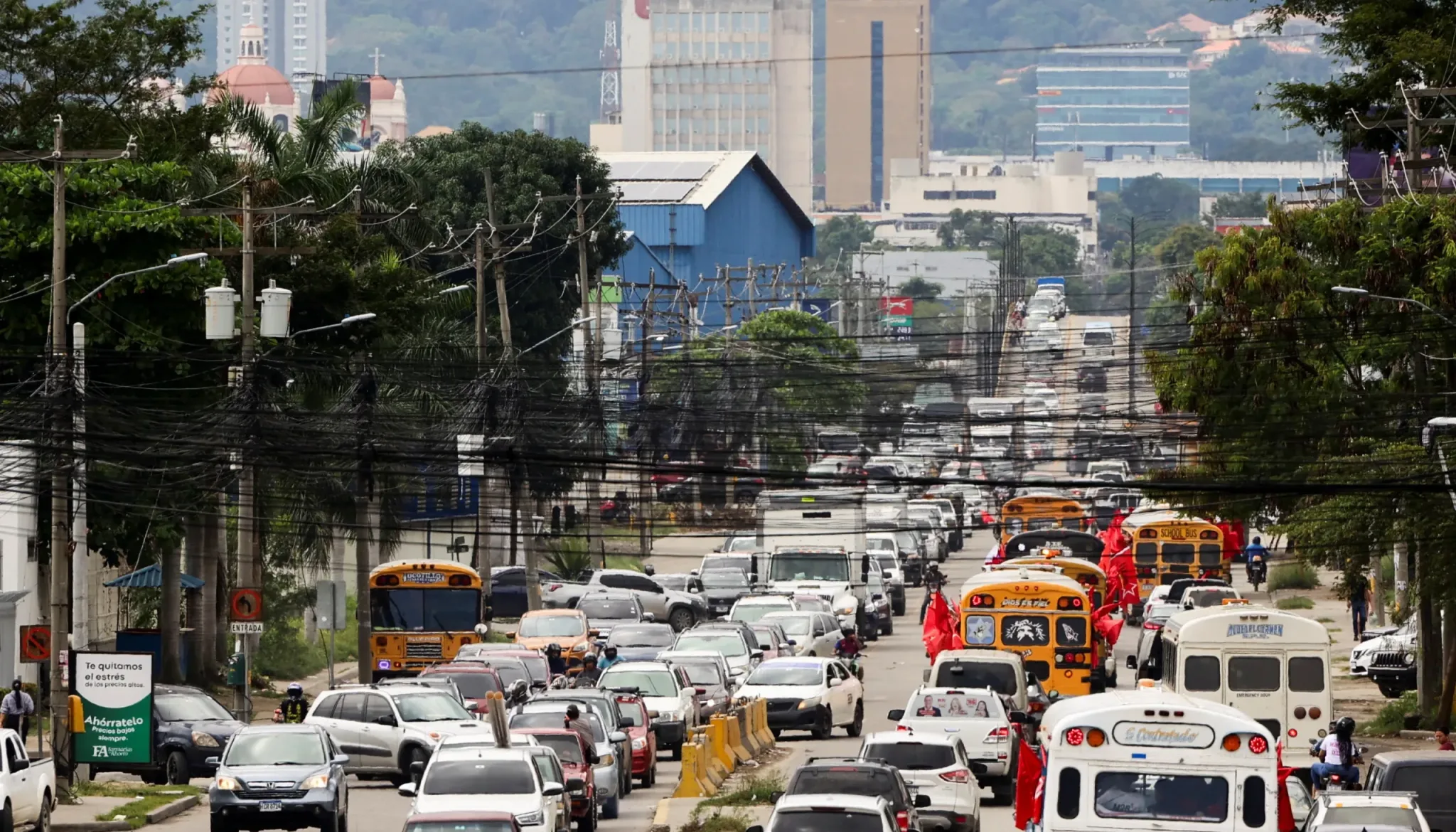
A view shows cars standing in traffic in San Pedro Sula, Honduras March 1, 2025. Photo: Yoseph Amaya/Reuters/file photo.
By Ricardo Salgado – Nov 17, 2025
A couple of weeks ago, the Public Prosecutor of Honduras made public 26 audio recordings which, together, reveal a plot to ruin the country’s November 30 elections. A female voice, that sounds like the National Electoral Council member for the far-right National Party, narrates in great detail how they would provoke incidents on election day, in a repeat of what they had already done during the primaries this past March 9th (they obstructed the delivery of 300 ballot boxes and tried to make it appear that the entire process was a fiasco).
According to the leaked audios, the Electoral Council members for the (now neofascist) Liberal Party would declare the candidate of the Miami mafia, Salvador Nasralla, the winner. Once you connect the dots, you see that the idea is to cause a confrontation that would lead to declaring the elections “null and void,” with the support of international organizations (OAS and European Union).
The audio files explicitly refer to support the opposition is receiving from the US embassy in Tegucigalpa. The leaked audios, in and of themselves, should raise the ire of society, as they are proof of their true disdain for the bourgeois democracy they claim to defend.
But the media, acting in lockstep, are whitewashing the incident by turning it into a debate over the authenticity of the leaked recordings. They are parading around the alleged speaker in the audios, going so far as to put her in a reality show in which they joke that she is “tampering with ballot boxes,” while they make light of the legal construct the right-wing has created to defend the interests of the ruling class and make sure their crimes remain unpunished.
Although the President of the Republic herself denounced this crime during the environmental summit in Belém, Brazil, the media stuck with their plan to raise the profile of the speaker on the leaked recordings to that of the heroine. For her part, the aforementioned official proceeded to file complaints against numerous political figures, all in an attempt to thicken the fog in which the elites have been shrouding her.
With the election just two weeks away, the conspiracy revealed in the recordings has not been treated with anything remotely resembling seriousness in any media outlets. It is hard to imagine that the results of any investigation will see the light of day before the plan is consummated. And it is interesting to note that many of the details revealed in that singular confession are unfolding with virtual pinpoint accuracy.
In fact, the international organizations have been boosting the plan by issuing various communiqués, blaming the events on the government, the Libre party, and its candidate. Thus far, as I write these lines, none of those agencies has requested a serious and swift investigation of the content of the audio files.
These organizations are aligning themselves with statements made by members of Congress, senators, and other officials in the US government. Added to this are opinion articles in the Wall Street Journal, alleging that Venezuela is “teaching” the governing party how to “steal” an election.
As we make our way to the homestretch, there are three conditions that indicate the path to follow in this situation:
The Libre party candidate, with a comfortable lead in the polls, is the only one who has campaigned on the ground. The candidate for the National Party of Juan Orlando Hernández has a structure that allows him to have some social base of support. But the candidate for the Liberal Party of Honduras has nothing but the illusion of a base, inflated by traditional and social media, with zero capacity on the ground. Nasralla is a (mis)creation of the gringos, because of distrust of the disgraced party that led Honduras to be run by organized crime.
The combined far-right and neofascists seek to steal the elections at all costs, with the ultimate goal of destroying the Libre party and erasing all vestiges of a left in Honduras, and erasing the image of former President José Manuel Zelaya from the collective imagination. For them it is an existential crisis that has nothing to do with democracy.
As is to be expected, the Libre party will defend these elections with everything it has. In this regard, its candidate, Rixi Moncada, has been very clear in her latest public appearances. She has used her skills as a teacher to give instructions about what every member of the movement should do from the time the polling stations open until all the votes have been counted in all three contests.
Understanding what is happening in Honduras requires one to understand that Libre’s rivals are tools of a well-resourced economic machine that coordinates at the international level. At this stage of the game, the right has no chance to win at the ballot box, so they will stick with the plan revealed in the leaked audio files, and who knows what will happen.
Meanwhile, the country remains calm, with overwhelming joy among the ranks of the Libre party, while their rivals predict disturbances on election day. Perhaps that is because they know exactly where and when this will happen.
While the media shamefully bury the story of these extremely serious accusations, the people’s response is crystal clear: they may try to drag Honduras into a catastrophe, but the people are intent on stopping it.
Ricardo Salgado is the Secretary of Strategic Planning of Honduras
With elections just days away, external pressure on Honduras is mounting
Although Moncada appears to have the lead in the polls, the opposition has launched a national and international campaign to delegitimize the results of the November 30 election.
November 24, 2025 by Pablo Meriguet
Rixi Moncada presidential campaign event. Photo: X
On November 30, more than six million Hondurans will go to the polls to elect their next president. They will also elect 128 deputies to the Honduran Congress, 20 deputies to the Central American Parliament, 298 mayors, and more than 2,000 councilors.
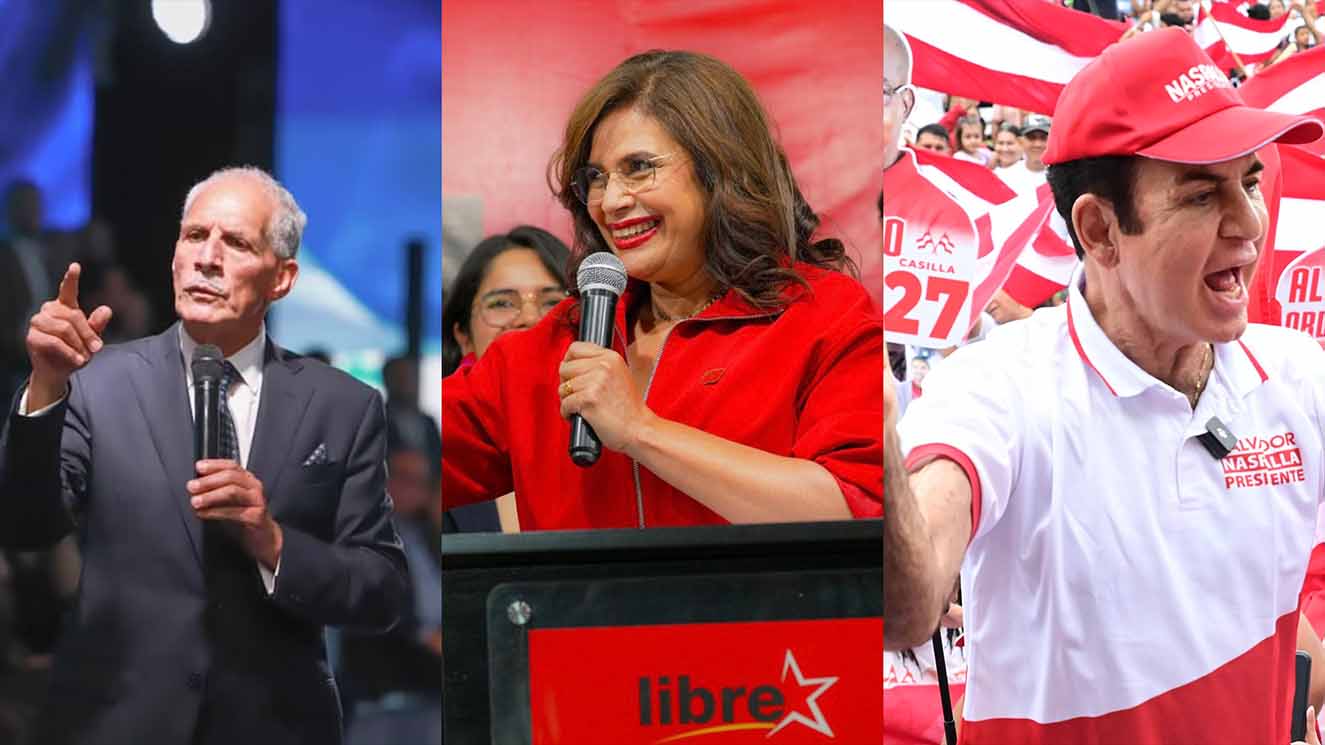
Most of the attention is focused on the presidential election, which will be decided in a single round. There appear to be three frontrunners for the presidency: Rixi Moncada, Salvador Nasralla, and Nasry Asfura.
Moncada, the candidate for the progressive and ruling LIBRE (Libertad y Refundación) Party, served as a minister in Xiomara Castro’s government and has vowed to continue pursuing public policies focused on the most disadvantaged and maintain Honduras’ role in spaces of Latin American integration, as opposed to wholly subservient to corporate or US interests.
The other two candidates belong to the opposition to Castro’s progressive government and have attempted to appeal to anti-leftist voters in order to defeat the LIBRE ticket. Salvador Nasralla is a former television presenter and, in the disputed 2017 elections, he was the presidential candidate for an electoral alliance led by LIBRE. Now Nasralla is seeking the presidency through the Liberal Party (PLH). The other is a businessman and former mayor of the Central District, Nasry Asfura, who is running for the far-right National Party (PNH), which seized control of Honduras following the 2009 US-backed coup against Manuel Zelaya.
The LIBRE Party for its part, emerged from the anti-coup struggle in the country, in an attempt to break the two-party political logic in Honduras and appeal for more progressive and leftist politics than the PLH, which has opted for an openly right-wing discourse.
“The battle on Sunday, November 30, is between two models: the oligarchic model and the democratic socialist model,” said current President Castro, who highlighted her government’s progress in reducing poverty, promoting equality, and encouraging citizen participation, and asked Hondurans to support this model. On the other hand, the opposition, in a completely catastrophic tone, claims that the election could be the last chance to “save Honduras from socialism.”
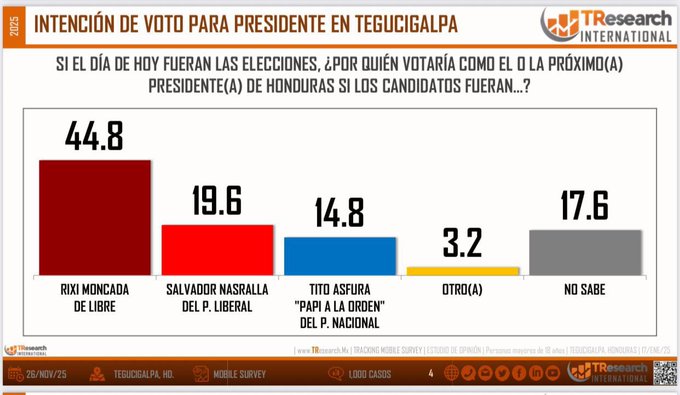
November 23 marked the end of the candidates’ campaigns. Some pollsters give Moncada a five-point lead, while others suggest that Nasralla could be in a technical tie with the LIBRE Party candidate.
International pressure on Honduras
In recent weeks, the United States, the Organization of American States (OAS), and the European Union have expressed concern about possible irregularities that could occur during the November 30 election.
For weeks, media outlets and personalities associated with the Honduran right wing have been using a familiar script, raising the alarm that electoral fraud is being prepared in favor of progressive Moncada. These voices have been joined by several right-wing Latin American politicians, such as Venezuelan opposition leader María Corina Machado, who called for the defense of votes during and after the election. Corina Machado said in a video, “Your presence is a powerful and legitimate civic way to defend democracy. At times like this, the collective strength of those who believe in freedom and in the future of their families is invincible.”
Honduran President Xiomara Castro and LIBRE candidate Rixi Moncada have stated that the Honduran and international right wing is maneuvering to delegitimize the upcoming elections, in which their party has a significant chance of winning. According to LIBRE’s top leaders, what they are seeking is to promote international disregard for the elections.
Read More: Presidential campaigns officially kick off in Honduras
A few days ago, US Republican María Elvira Salazar received a delegation of Honduran politicians. On her Twitter account, Salazar, in a deeply interventionist tone, referred to Honduras as a country “in her neighborhood”, which drew much criticism: “In 10 days, Honduras will choose between democracy and tyranny. The socialists are trying to steal the election from the people. Join me in hearing why the United States must ensure that democracy prevails during a crucial hearing … We are not going to lose another country in our own neighborhood to socialism.”
Indeed, Nasralla and other opposition figures traveled to the United States to present and promote the idea that a plan to commit electoral fraud is being hatched in Honduras. At the hearing, Congressman Joaquín Castro told Salazar that it is not within the power of the United States to decide who will be the leaders of Honduras, as that right belongs solely to the Honduran people: “People have the right to choose their own leaders, regardless of whether the government is right-wing or left-wing. Our role is not to choose the leaders of Honduras.” In response, candidate Moncada said: “They failed in Washington in their attempt to lie.”
However, LIBRE has been warned that if Moncada wins, the word “fraud” will be heard a lot in the media and on the streets of Honduras, even before the accusers present any alleged evidence. Hence, according to María Corina Machado, the opposition is expected to stage demonstrations if the result is unfavorable. This could bring profound instability to Honduras, which in 2009 experienced a coup d’état due to then-President Manuel Zelaya’s attempt to install a constituent assembly.
Honduran Congress Chief Denounces National and Liberal Parties’ Ties to Organized Crime Ahead of Elections
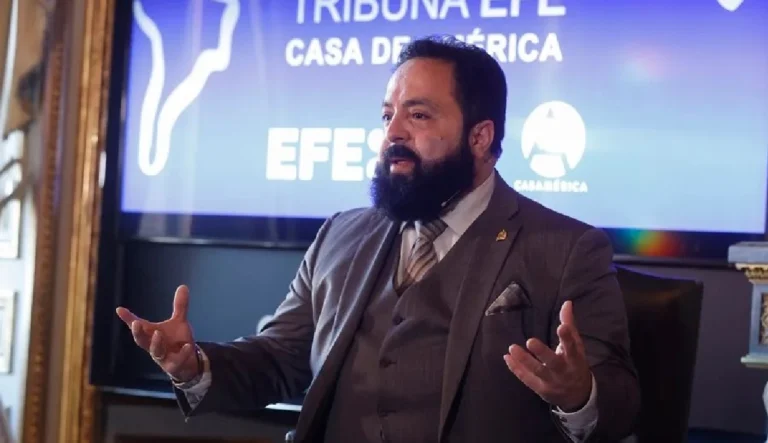
(FILE) Honduran National Congress President Luis Redondo. Photo: EFE.
November 26, 2025 Hour: 5:22 am
Congress President Luis Redondo accused Honduran opposition parties of drug ties ahead of the November 30 elections.
Honduran National Congress President Luis Redondo accused the National and Liberal parties of longstanding ties to organized crime, dismissing claims that President Xiomara Castro’s government is linked to alleged drug cartels.
Speaking in a nationwide broadcast on Tuesday, Redondo called allegations from Liberal presidential candidate Salvador Nasralla and Nationalist politicians “irresponsible” and “false.”
Redondo stressed that previous administrations, not the current government, were involved in criminal networks documented in U.S. court records, which reportedly linked bipartisan leaders to drug trafficking, campaign financing, electoral manipulation, and institutional infiltration. He warned that attempts to discredit the Libre Party ahead of the November 30 elections were part of a politically motivated smear campaign.
Five days before the general elections in Honduras, Redondo considered it “doubly serious” that historically marked sectors now try to discredit the government, whose political project, he stressed, “was born of popular resistance and not of pacts with drug traffickers.”
“The National Party and the Liberal Party promoted, facilitated, and benefited from drug trafficking for more than a decade, turning Honduras into a narco-state,” he asserted.
Redondo emphasized that there is no international investigation that connects the Freedom and Refoundation Party (LIBRE) or the current Executive Power with criminal networks, in contrast to judicial files detailing the complicity of high liberal and nationalist leaders with names and dates.
Hace dieciséis años, un golpe de Estado militar —promovido por narcotraficantes que hoy cumplen condenas en los Estados Unidos, le arrebató a Honduras la democracia, la credibilidad internacional y el acceso a la Cuenta del Milenio.
Hoy, mi gobierno cumple y honra los principios…
— Xiomara Castro de Zelaya (@XiomaraCastroZ) November 25, 2025
The text reads: Today, my government fulfills and honors the principles that were once violated: ensuring personal freedom, democracy, accountability, poverty reduction, and a significant decrease in violence, as well as greater growth and macroeconomic stability.
Voting Day Approaches
More than 6 million Hondurans are set to vote in a single-round election for 449 positions, including President, three vice presidents, 128 congressional deputies, 20 Central American Parliament representatives, and 298 municipal offices.
Polls indicate that Rixi Moncada (Freedom and Refoundation Party – LIBRE), Nasry Asfura (National Party), and Salvador Nasralla (Liberal Party) are the leading presidential contenders.
The National Electoral Council (CNE, in Spanish) confirmed a large-scale logistical operation to ensure that all polling centers receive necessary ballots, boxes, and equipment. Distribution of election materials began on November 20, with the first shipments sent to Atlántida, Colon, and Ocotepeque.
Honduras began on November 25th the period of “electoral silence” a five-day phase established by the Electoral Law that prohibits all proselytizing activities and political propaganda, which marks the end of an intense election campaign that began on September 1st.
Trump Sees Communists Everywhere in Honduras Presidential Election
November 27, 2025
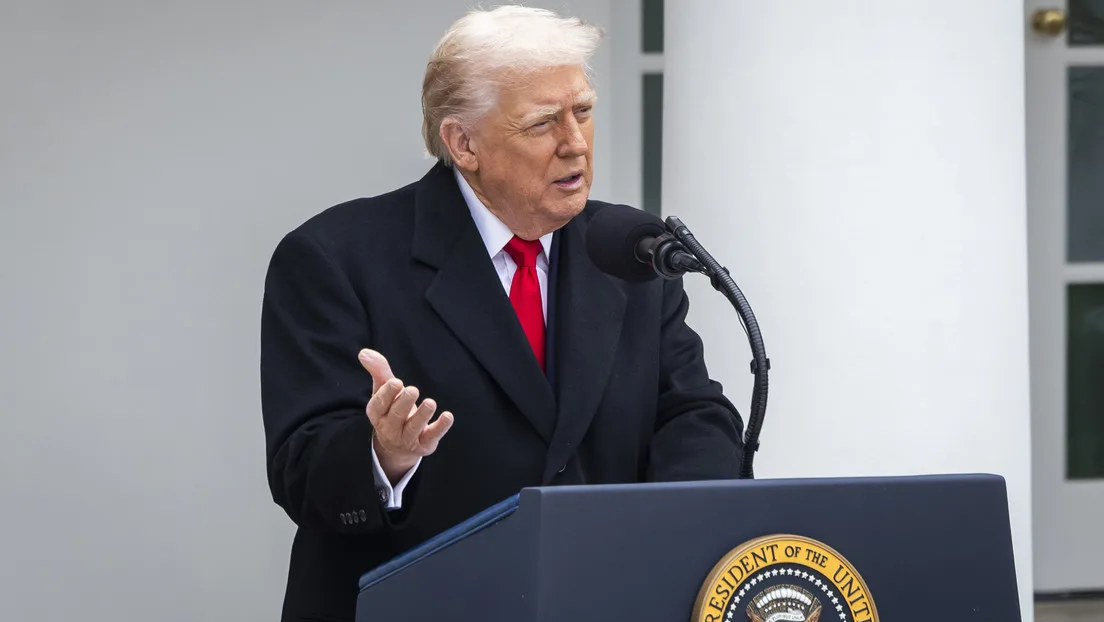
US President Donald Trump during the traditional Thanksgiving event held at the White House on November 25, 2025 CNP/AdMedia / Legion-Media
On Wednesday, US President Donald Trump weighed in on Honduras’ general elections, which are scheduled for next Sunday, and openly endorsed the opposition National Party candidate, Nasry “Tito” Asfura.
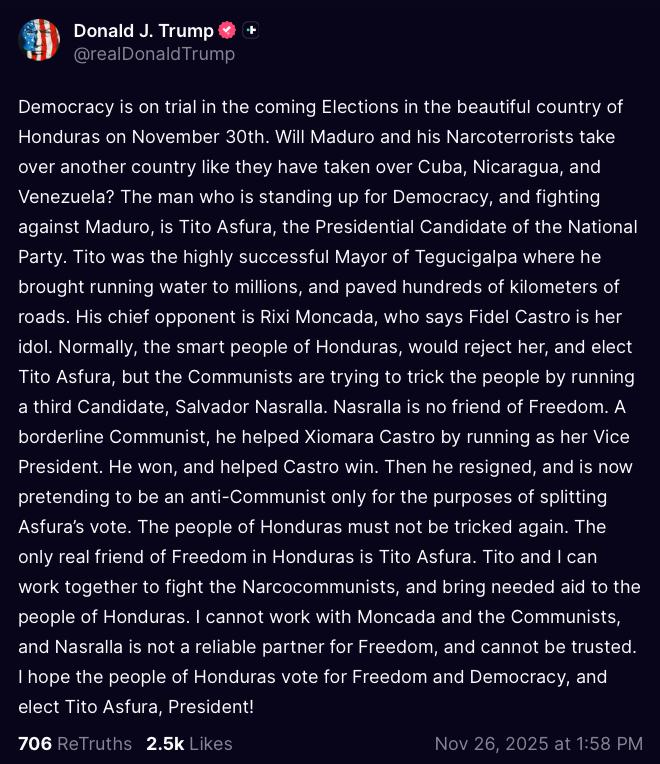
“Tito was the successful mayor of Tegucigalpa, where he brought drinking water to millions of people and paved hundreds of kilometers of roads,” Trump wrote on Truth Social. “Tito and I can work together to fight the narco-communists and provide the necessary aid to the Honduran people,” he promised.
In a long message, Trump suggested that—if the ruling party’s candidate, Rixi Moncada of Liberty and Refoundation (Libre), were to win—the alleged “narco-terrorists” of Venezuelan president Nicolás Maduro “will take control of yet another country, just like they did with Cuba, Nicaragua, and Venezuela.”
“Whoever defends democracy and fights against Maduro is Tito Asfura,” the US Republican president insisted, adding that “normally the intelligent people of Honduras” would reject Moncada and choose his preferred candidate. “But the communists are trying to deceive the people by putting forward a third candidate, Salvador Nasralla,” of the Liberal Party.
“Nasralla is no friend of freedom. Almost a communist, he helped [current president] Xiomara Castro by running as her vice-presidential candidate. They won, and he helped Castro win. Then he resigned and now pretends to be anti-communist just to split Asfura’s vote. The people of Honduras must not be fooled again,” Trump asserted.
“The only true friend of freedom in Honduras is Tito Asfura… I cannot work with Moncada and the communists, and Nasralla is not a reliable ally for freedom — he cannot be trusted,” Trump declared.
In a tone similar to the warning he issued last month—when he said the US would not be “generous” with Argentina if the ruling party lost legislative elections, by forfeiting the US $40 billion bailout to “anarcho-capitalist” Javier Milei—he concluded: “I hope the people of Honduras vote for freedom and democracy, and elect Tito Asfura as president!”
This is Washington’s most forceful statement so far, though not the first. Previously, US Deputy Secretary of State Christopher Landau warned that the Trump administration would respond “quickly and firmly to any attack on the integrity of the democratic process in Honduras.”
The warning came amid domestic tension in the Central American country, where the three frontrunners (Nasralla, Asfura, and Moncada) have all claimed that electoral fraud may be imminent.
Honduran President Urges Voters to Head to the Polls
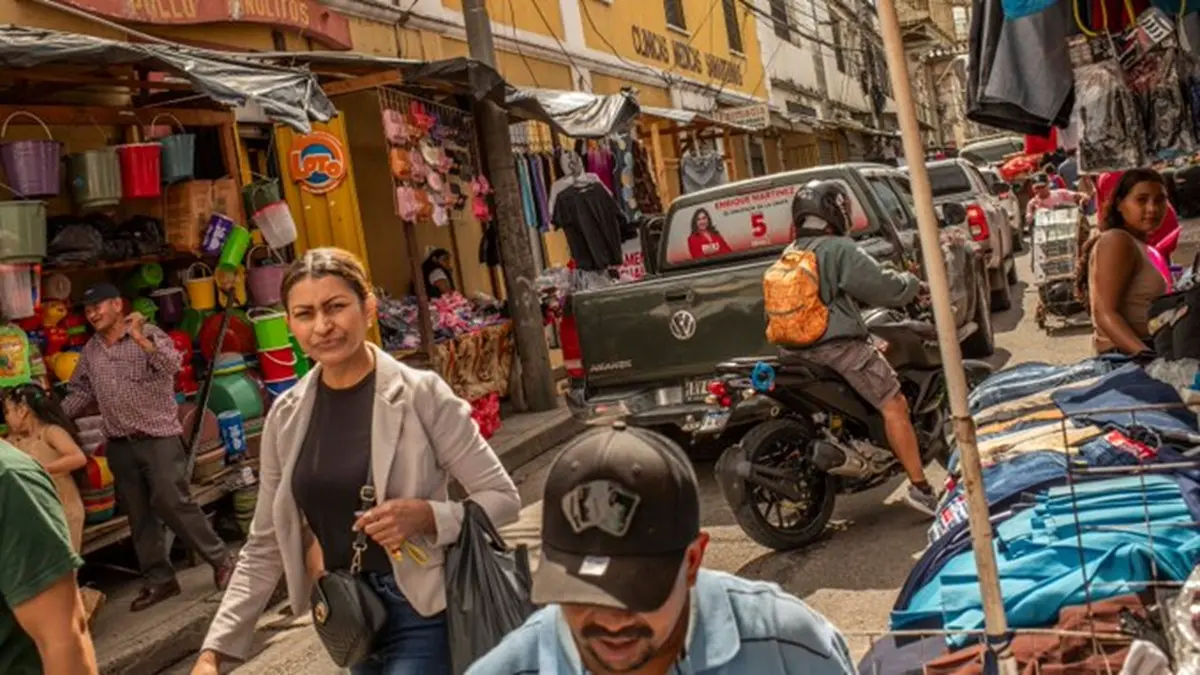
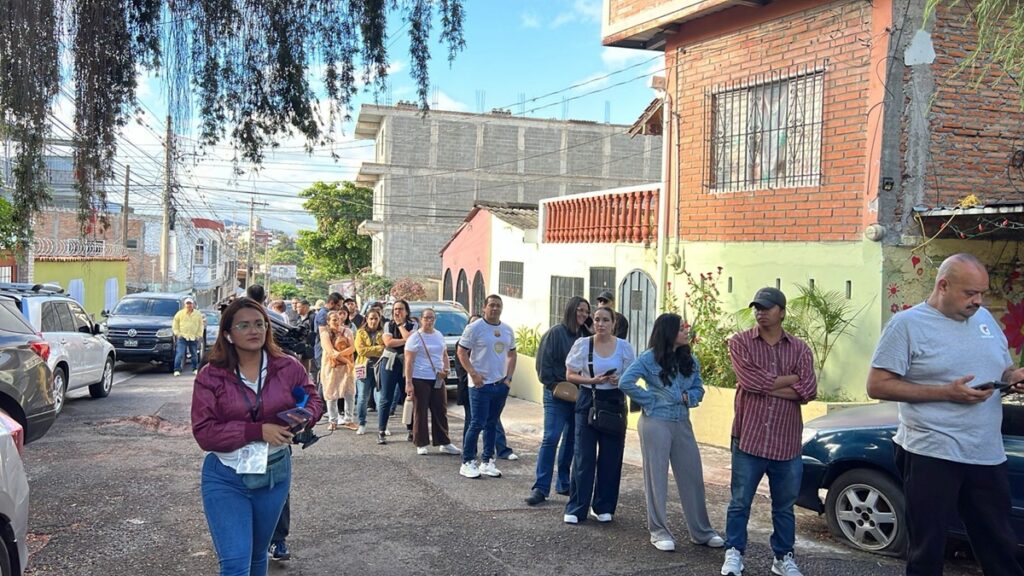
A street in Honduras, 2025. X/ @rasbe
November 28, 2025 Hour: 1:57 pm
So far, leftist candidate Moncada leads in voting intentions, followed by U.S.-backed Asfura and conservative Nasralla.
On Thursday, President Xiomara Castro urged Hondurans to head joyfully to the polls on Sunday to elect in a single round the country’s next president for the 2026–2030 term.
“Feel confident that this Nov. 30 we are heading into a civic celebration: the election for a new government that will assume the country’s leadership for four years. May peace reign in the hearts of all Hondurans,” she said.
The Honduran president also praised the work carried out by the Armed Forces in protecting and transporting all election materials to polling stations across the country’s 18 departments.
“We are going to take part in the only democratic space that has been allowed to us so far, which is exercising our vote freely, peacefully and transparently,” she said.
On Sunday, more than 6.5 million Honduran citizens will also elect 298 mayors, 128 legislators and 20 representatives to the Central American Parliament.
According to the latest polling, the presidential candidates with the strongest chances of winning are Rixi Moncada of the Libre party, Nasry Asfura of the National Party and Salvador Nasralla of the Liberal Party.
Rixi Moncada Represents the Honduran left
Born in Talanga in 1965, Moncada is an attorney with a long career in public administration, where she has served as minister of Labor, Finance and Defense. As a lawyer, she has worked in the courts and as an adviser to the Public Prosecutor’s Office, among other positions.
Before studying law at the University of Salamanca in Spain, she graduated as an education teacher, a profession she has also practiced at the primary and university levels.
During Manuel Zelaya’s administration (2006–2009), Moncada served as general manager of the National Electric Energy Company. In 2011, she was among the founders of the Freedom and Refoundation (Free) party, coordinated by former President Manuel Zelaya, husband and adviser to Xiomara Castro.
Moncada proposes an active state to correct market failures and reduce inequality under the concept of “democratizing the economy,” including low-interest loans, green industrial policy, investment in science and technology, and reforms to promote competition.
Nasry Asfura is the U.S.-Backed Candidate
Nasry Asfura is “the only true friend of freedom in Honduras,” wrote U.S. President Donald Trump, adding that they could “work together to fight the narco-communists” and Venezuelan President Nicolas Maduro.
Asfura, also known as “Daddy at Your Service” (Papi a la orden), a phrase he uses to greet supporters, is seeking the presidency for the second time under the conservative National Party’s banner.
The son of parents of Palestinian origin, Asfura was born in 1958 in Tegucigalpa, where he served as mayor for two consecutive terms (2014–2022). After graduating from a Catholic high school, he began studying engineering but soon realized he was drawn to the construction industry, where he has spent most of his life.
Asfura seeks to return the National Party to power after three consecutive terms from 2010 to 2022, a period marred by multiple corruption and drug-trafficking allegations. He proposes achieving fiscal stability, strengthening the agricultural sector, improving connectivity and prioritizing projects with immediate impact on the local economy.
Salvador Nasralla Tries Again
The candidate of the conservative Liberal Party is making his fourth consecutive bid for the Honduran presidency. He has positioned himself as an anti-corruption figure, gaining many supporters since first running in the 2013 elections.
Born in 1953, this civil engineer became a well-known television presenter on a sports program he has hosted for more than four decades. He has also worked as master of ceremonies for beauty pageants and other social events.
He entered politics around 2011 when he founded the Anti-Corruption Party (PAC), running for president in 2013. He later created the Savior of Honduras Party (PSH), arguing that former President Juan Orlando Hernandez “stole” his first party.
Nasralla also failed in the 2017 presidential race. In his third attempt, in 2021, he ultimately formed an alliance with the ruling Free Party to remove the “narco-dictatorship” of Juan Orlando Hernandez, who was extradited to the United States in 2022 and sentenced to 45 years in prison for drug trafficking.
Nasralla served as one of Honduras’ three vice presidents until April 2024, when he resigned over clashes with Castro and her husband, former President Manuel Zelaya. After leaving government, Nasralla joined the fractured Liberal Party, which he aims to return to power after 16 years out of office.
His platform includes attracting foreign investments, generating jobs, combating corruption, reducing bureaucracy, modernizing infrastructure, and supporting small and medium-sized businesses to boost the country’s competitiveness.
The Trump Administration Is Now Directly Intervening in Honduras’ Presidential Elections, Confirming a Region-Wide Trend
Posted on November 28, 2025 by Nick Corbishley
Honduras may be a relatively small country but there is a huge amount riding on this Sunday’s election result — not just regionally but perhaps even globally.
First, it was Brazil.
In July, as readers may recall, the Trump administration imposed 50% tariffs on many Brazilian goods and imposed sanctions on a Brazilian Supreme Court justice — all in a bid to keep former President Jair Bolsonaro out of jail for plotting an attempted coup. According to Stephen Olson, visiting senior fellow at Singapore’s ISEAS–Yusof Ishak Institute, it was unprecedented for the US to impose a tariff on a foreign country to stop a judicial proceeding,
Bolsonaro’s son, Eduardo, had reportedly lobbied Washington to impose the tariffs against his own country, all in order to save his father’s skin. He now faces criminal charges of coercion.
Then, just two months later, it was Argentina’s turn.
As the Milei government faced the prospect of financial collapse and a humiliating defeat to the Peronists in the mid-term elections in late October, US Treasury Secretary Scott Bessent came to the rescue with a pledge of “large and forceful” American support — but only if the country voted for Milei.
As Charlie Garcia wrote in a recent op-ed for Market Watch, Washington mobilised all its economic power to buy the election, rescued some Wall Street bigshots along the way, many with close ties to Bessent, and left everyone else holding the tab:
One week later, the Treasury announced a $20 billion currency swap financed through America’s Exchange Stabilization Fund, which Argentina used to make its Nov. 1 IMF debt payment. The U.S. Treasury drew $900 million from America’s SDR account; Argentina’s holdings rose by the same amount.
Over subsequent weeks, the Treasury spent $400 million propping up the Argentine peso.
On Oct. 14, Bessent announced plans for an additional $20 billion private-debt facility, bringing the total package to a potential $40 billion.
U.S. President Donald Trump explicitly tied the bailout to Argentina’s election — widely viewed as a referendum on Milei. Said Trump: “If he wins, we’re staying with him, and if he doesn’t win, we’re gone.”
In the case of Argentina, the Trump administration’s election meddling paid off handsomely. On Oct. 26, Milei’s party won 41% of the vote versus 31% for the Peronists. In Buenos Aires province, where the libertarians lost by 13 points in September, they won by a half point. Milei’s coalition tripled its congressional representation. And the US now has first dibs on Argentine lithium, gas and military bases while forcefully reducing China’s influence in the country.
In the case of Brazil, by contrast, the meddling has actually been counterproductive (from the Trump administration’s perspective) given that it has boosted President Lula’s approval ratings, as we warned would happen in July. Lula is now in pole position in all the polls for next year’s presidential elections.
Meanwhile, Bolsonaro is in a prison cell, starting a 27-year sentence. And Trump — after a cosy meeting with President Lula last month on the side lines of the ASEAN summit — has effectively admitted defeat by removing the most important tariffs against Brazil. Asked a few days ago if he had any thoughts about Bolsonaro’s imprisonment, Trump said: “No, I just think it’s too bad.”
Trump’s Pick for Honduran President
Now, it’s Honduras’ turn to face direct US meddling in its election process. With the country scheduled to go to the polls on Sunday to elect a new president, Trump just posted a long tweet endorsing Tito Asfura, the candidate of the right-wing National Party, while pillorying left-wing frontrunner Rixi Moncada as a “Communist” and centrist Salvador Nasralla as a “borderline Communist.”
The language of the Cold War is once again en vogue in the Trump 2.0 White House.
“Democracy,” Trump writes (or perhaps it was one of his speechwriters, or even Marco Rubio himself), “is on trial in the coming elections. Will Maduro and his narcoterrorists take over another country like they have taken over Cuba. Nicaragua, and Venezuela?”
Trump describes Asfura as “the only real friend of Freedom in Honduras”, and that “Tito and I can work together to combat narco-communists and provide the necessary aid to the Honduran people”.
Asfura is the leader of the National Party that governed Honduras with an iron grip from 2009 to 2021. Ironically (or perhaps not), its two presidents during that time, Porfirio Lobo Sosa and Juan Orlando Hernández, have both been accused of receiving bribes from Mexico’s Sinaloa cartel. The latter was even extradited to the US on drug charges and is currently in prison.
Meanwhile, Trump warns that he “cannot work with (Rixi) Moncada”, the candidate of the governing Liberty and Refoundation Party, whom he describes as a “communist” who cannot be trusted. The other main candidate, Salvador Nasralla is, in Trump’s words “a borderline Communist” who is “pretending to be an anti-Communist in order to split Asfura’s vote”.
This would be bad enough if it was just another case of President Trump running off at the mouth on a topic he evidently knows very little about. But that is clearly not the case.
Honduran politicians, including the presidential candidate Salvador Nasralla, converged on Washington last week to attend a Western Hemisphere Subcommittee hearing in the US Congress. The subcommittee is chaired by Representative María Elvira Salazar, another Floridian lawmaker who is desperate to see the back of left-wing governments in Latin America (more on her later).
As the Observatory of the Progressive International reports, the hearing was titled “Democracy in Danger: The Fight for Free Elections in Honduras”:
The hearing was framed in Washington as an “urgent” assessment of the situation in Honduras. In reality, the hearing sought to preemptively question the legitimacy of Honduras’s electoral institutions, to cast doubt on the democratic process, and to prepare the ground for claims of fraud before a single vote has been cast. This represents a dangerous escalation of foreign interference — one that threatens the integrity of the upcoming elections and echoes a long history of external interference in the country’s political life.
The playbook bears clear echoes of what happened last year with the presidential elections in Venezuela. Then, as now, senior local opposition figures, including, ahem, Nobel Peace Prize laureate Maria Corina Machado, and US lawmakers began sowing doubts about the election process before a single vote had been cast. If the opposition parties ended up losing, they said, it would all be down to fraud. As such, there was no intention of ever accepting the results.
Now, over a year later, Venezuela is facing the threat of US invasion on a whole host of pretexts that keep changing day by day, including last year’s supposedly “illegitimate” elections. Even the New York Times just reported that Machado is “pushing false claims about Maduro”, including that he helped rig the 2020 US presidential elections and controls two “narco-terrorist” organisations, Tren de Aragua and the Cartel de los Soles.
When even the New York Times is calling you out for spreading lies aimed at justifying a new US-led military misadventure, something is clearly amiss. One of the experts cited by the Times piece, John D. Feeley, a former U.S. ambassador to Panama, said the following about the Trump administration officials relying on Venezuelan opposition figures for information:
“It’s unbelievable how these guys are too stupid to read their own history and know that they’re headed for the same thing” [in reference to Iraq 2.0].
Small But Important
While Honduras may be a much smaller country than Venezuela, there is still a lot riding on Sunday’s election result — not just regionally but globally.
Honduras is strategically important due to its geographic location vis-a-vis migration routes, drug supply routes, as well as the US’ redoubled efforts to contain or simply remove left-wing, sovereign-minded governments in Central America.
Honduras was also one of the last countries in Latin America to be on the receiving end of an old school-style US-sponsored coup d’état. In 2009, the Honduran military kidnapped the country’s democratically elected president, Manuel Zelaya, and forcefully removed him not just from office but from the country.
Zelaya’s biggest crime was to push forward a land reform decree that would have redistributed large tracts and granted titles to long-established farmer cooperatives. He also raised the country’s desultory minimum wage by 60%. That was in 2008. The following year, the country’s military – with at least tacit support from the Obama administration – led a coup against him.
Following that coup, the US-aligned National Party won repeated elections until 2021, when Zelaya’s wife, Xiomara Castro (no relation to Fidel), won by a landslide, becoming Honduras’ first female president. Since coming to power she has officially established diplomatic relations with the People’s Republic of China after formally breaking ties with Taiwan.
In her first ever speech to the UN General Assembly, Castro condemned the violent US-sponsored military coup in Honduras in 2009, which overthrew her husband, and more generally US attempts to intervene in the affairs of other countries.
“The poor nations of the world can no longer stand coups d’état; we cannot stand the use of lawfare, nor colour revolutions, usually organised to plunder our vast natural resources,” she declared.
The Uncertain Future of Próspera
As readers may recall, Honduras has also served as an open-air lab for a controversial experiment in corporate governance: the legal establishment of semi-autonomous charter cities owned and run by foreign companies — all made possible by the two National Party presidents, Lobo Sosa and Orlando Hernández.
In fact, it was in his role as leader of Honduras’ Congress, when Lobo Sosa was president, that Orlando Hernández staged what he called a “technical coup” against the country’s Supreme Court of Justice by dismissing four magistrates from the Constitutional Chamber. Foreign Policy in Focus explains the reason why:
One ruling that found regulations to create Special Development Regions (REDs) — an initiative that would allow for the creation of private cities on Honduras’ territory — to be unconstitutional.
Legislative Decree No. 283-2010 promoted by then President Porfirio “Pepe” Lobo Sosa to create the special administrative areas that would be essentially governed by private companies…
One such area, going under the name Próspera, was established on Roatán, an island 40 miles off Honduras’ northern coast. Backed by US investors including Peter Thiel, Prospéra was described by the tech news website Rest of World as a “crypto-libertarian paradise”.
Próspera represents a new model of semi-autonomous, corporate-run city state that is all the rage among the tech overlord class. As Conor reported in June, so-called “freedom cities” — which are free from onerous national laws, regulations and oversight, and governed by “technomonarchies” (in Quinn Slobodian‘s words) — are being touted by the likes of Marc Anderssen, Elon Musk and Peter Thiel as a new kind of utopia.
They want to develop similar cities throughout the world, including the US. However, tiny, little Honduras may stand in the way of that.
One of Xiomara Castro’s first acts as president was to repeal the 2013 law passed by Lobo Sosa and the Hernández-controlled Congress that had allowed foreign investors to create charter cities in designated semi-autonomous ZEDEs (“employment and economic development zones”). The goal of the repeal was to eliminate the entire legal concept of ZEDEs in Honduras.
However, Próspera Inc. responded by suing the Honduran government in international court and by continuing to build. The lawsuit is ongoing and, as of now, Próspera remains operational. But there is still a cloud of uncertainty over its future. Imagine what could happen if a tiny little developing country like Honduras could scupper the plans of people like Thiel?
An “Almost Impossible to Believe Scenario”
As we reported last year, the amount of autonomy that Lobo Sosa’s government had granted to the owners of the ZEDEs was simply mind-boggling:
[T]he 2013 law clearly established that “each ZEDE will have its own internal security bodies (…), including its own police, crime investigation bodies, intelligence, criminal prosecution and penitentiary system.” The cities will also have an independent financial regime, and will not be subject to the exchange control of the Central Bank of Honduras; they are empowered to develop their own internal monetary policy.
Even before Castro’s election, local businesses were complaining that the law had granted too many privileges to foreign investors to the detriment of domestic capital. The US economist Paul Rohmer, the godfather of international charter cities who had initially worked with the Lobo Sosa government to develop ZEDEs, had disowned the project, warning that Honduras’ ZEDEs system was undemocratic, opaque, destined for collapse and shrouded in lies. As an article in The Intercept explains, the legal showdown between the Honduran government and the investors behind the charter cities presents an “almost impossible-to-believe scenario”:
A group of libertarian investors teamed up with a former Honduran government — which was tied at the hip with narco-traffickers and came to power after a U.S.-backed military coup — in order to implement the world’s most radical libertarian policy, which turned over significant portions of the country to those investors through so-called special economic zones. The Honduran public, in a backlash, ousted the narco-backed regime, and the new government repealed the libertarian legislation. The crypto investors are now using the World Bank to force Honduras to honor the narco-government’s policies.
In its ISDS suit, Próspera Inc. alleges that Honduras owes it more than $10 billion for breaking a “50-year legal stability guarantee” granting it sovereignty over Próspera, including the ability to create its own laws, courts, authorities and taxes.
In February 2024, Castro decided to withdraw her country from ICSID, the World Bank’s arbitration panel, arguing that the court was infringing illegally on Honduran sovereignty. By doing so, Honduras became the first Central American country to walk away from ICSID, the world’s most important forum for the settlement of differences between investors and States, with 149 signatory nations.
The outstanding cases are still pending, though. According to a 2023 article by Bretton Woods Project, “even if Honduras does withdraw from ICSID over Prospera’s claim, ISDS cases could still be brought against the country”:
It would still have to defend Prospera’s $11 billion claim, and any others filed within a six-month window of formal withdrawal notification. Honduras could also potentially be subject to further cases through one of the eight bilateral investment treaties it has signed that refers arbitration to ICSID.
The people and companies behind Próspera, including tech bros close to Trump, want their pay out — all eleven billion dollars of it. That is why what happens on Sunday is so important. An $11 billion fine would cripple an economy the size of Honduras (estimated GDP in 2024: $37 billion). It would also send a clear message to other governments around the world.
If Trump’s pick for president, Tito Asfura, wins on Sunday, he will presumably come to an agreement with the people and corporations behind Próspera, just as Trump has happily accommodated most of the tech bros’ demands since returning to White House. Asfura may even overturn Castro’s repeal of the 2021 law.
Contra Corriente reports that Asfura is being advised by Fernando Cerimedo, who also advised Milei and Bolsonaro, and is allegedly one of the masterminds behind the “Generacion Z” far-right protest movement in Mexico. Cerimedo is also closely tied to Roger Stone, Trump’s longest-serving political consultant and a major figure in the so-called “new right”.
One of the witnesses called to testify at the US congressional hearing on Honduras’ elections was Carlos Trujillo, a former US Ambassador to the Organization of American States (OSA) whose lobbying firm’s clients until recently included Próspera. Look what happened when Rep Joaquin Castro began questioning the legitimacy of testimony by a “registered foreign agent” and “a registered lobbyist” whose former clients have “so much at stake in Honduras’ elections”:
[It gets really interesting at the one-minute mark]
It’s worth highlighting Salazar’s words as she interrupted Castro’s questioning of Trujillo’s potential conflicts of interest:
Thank you, member. I’m sorry for interrupting. I think we are here for just one purpose: to ensure there are clean and fair elections in Honduras. Ambassador Trujillo may have many clients in Honduras but that does not mean he does not want the best outcome on November 30th, so I think we should just concentrate on finding out what’s really happening right now and preserve the integrity of those elections.
Lastly, while we’re on the subject of Salazar, below is another of her recent interventions, this time on the topic of Venezuela. Below that is a bonus clip of an interview by John Pilger of former CIA chief for Latin America Duane Claridge, who oversaw some of the agency’s worst crimes in the region during the Cold War.
It is a reminder that what is happening in Venezuela, Honduras, Mexico and Colombia has been going on for a very long time, almost as long as the US is old. But never before, or at least not for a long time, have the lies been quite so brazen or the narrative quite so disjointed.
Recordings reveal a coordinated effort by conservatives to block Rixi Moncada’s victory.
With just days to go before the Nov. 30 presidential election, Honduras is facing a new political earthquake after the leak of seven additional audio recordings that expose a right-wing conspiracy to reject the election results.
In the recordings, electoral councilor Cossette Lopez, business leaders and representatives of the National and Liberal parties can be heard conspiring to proclaim Liberal Party candidate Salvador Nasralla as president-elect by manipulating the Preliminary Electoral Results Transmission System (TREP).
The leaked information reveals a web of illegal pressure, negotiations, and coordination aimed at preventing the victory of Rixi Moncada, the presidential candidate of the leftist Free Party (LIBRE).
The new leak confirms the existence of a political-business structure that had already been flagged weeks earlier based on 26 other audio recordings currently under investigation.
In the recordings — whose authenticity was confirmed through an international forensic review — Lopez appears as a key point of coordination among lawmakers, military operatives, business executives, and electoral officials.
In a conversation with an unidentified person who requests multimillion-dollar bribes to carry out the electoral sabotage, they coordinate efforts to delay, block or manipulate the official recognition of results, exploiting institutional gaps and operational weaknesses at the National Electoral Council (CNE).
Another central figure in the audio clips is Tomas Zambrano, head of the National Party’s congressional caucus and a candidate for re-election. He is heard speaking with a telecommunications technician about the possibility of preventing the timely transmission of election results by weakening internet signals in various regions of the country or by simulating outages caused by weather conditions.
Zambrano sets up a meeting with the technician and offers him a non-traceable phone number that “foreign people” provided. In other conversations, they discuss tactics to pressure the Electoral Council and prepare to declare Nasralla president even if the official vote count trends against him.
The scandal deepened with the involvement of Miriam Barahona, an electoral magistrate representing the Liberal Party. She had already generated controversy for her decision to certify two candidates who are constitutionally barred from running. Barahona’s presence in segments of the audio suggests that sectors within the electoral apparatus may have actively participated in the political operation.
Nasralla, the Liberal Party’s presidential candidate, also appears in a conversation with businessman Eduardo Facusse, a member of the traditional oligarchy that has long dominated Honduras’ economic power and that has opposed the Tax Justice Law, which seeks to roll back tax exemptions benefiting major corporations. Facusse admits he spoke with National Party candidate Nasry Asfura to boost Nasralla’s public image, and says Nasralla is also receiving support from the United States.
Several conversations outline strategies to position Nasralla as the winner through the TREP, taking advantage of its speed and media visibility to impose a “victory narrative” before the official vote count is completed.
Days earlier, leftist candidate Moncada had already warned that the Liberal and National parties were seeking to hack the TREP to upload pre-fabricated tally sheets and falsify the results of Sunday’s election. This maneuver by Honduran conservatives would mirror the script used by the Venezuelan far right in its attempt to invalidate the 2024 elections in that South American country.
The newly leaked audio recordings corroborate the desperation of transnational right-wing forces at a moment when voter-intention polls place Rixi Moncada as the politician most likely to succeed Xiomara Castro as Honduras’ next president.
5 Reasons Honduras Sovereignty Is Non-Negotiable, Says President Castro
Honduran President Xiomara Castro affirms Honduras sovereignty ahead of November 30 elections.
TEGUCIGALPA, HONDURAS – NOVEMBER 28: Xiomara Castro, Presidential Candidate of the Libertad y Refundacion (Libre) Party, speaks at a press conference on November 28, 2021 in Tegucigalpa, Honduras. According to the National Electoral Council, Castro received 53,44% of the votes and the candidate of the ruling National Party, Nasry Asfura received 33.8% with over 16% of the votes counted. Hondurans elected the successor of Juan Orlando Hernandez, as well as deputies to congress and municipal mayors. The three main parties in contention are National, Liberal and Free, which seek to reach the presidency of the Central American country. (Photo by Inti Ocon/Getty Images)
November 29, 2025 Hour: 10:02 am
Honduran President Xiomara Castro reaffirms that “sovereignty is not for sale” ahead of crucial November 30 elections amid rising right-wing interference.
Honduras Sovereignty: Castro’s Defiant Stand Ahead of National Elections
TEGUCIGALPA — In a forceful address to the nation, Honduran President Xiomara Castro declared this Friday that “our sovereignty is not for sale and will not be negotiated,” issuing a sharp warning against what she described as “interventionist rhetoric from the far right” in the lead-up to the country’s November 30 general elections.
Speaking via the social platform X, Castro invoked Honduras’ history of resistance, reminding citizens of the “12 years and 7 months of struggle against coup-mongering” that followed the 2009 U.S.-backed ousting of her husband, former President Manuel Zelaya. “We never surrendered,” she emphasized, framing the upcoming vote as another critical moment in the nation’s democratic recovery.
“In 2021, the people spoke loudly at the ballot box to reclaim a strong, peaceful, and sovereign democracy,” Castro said. “Honduras made it clear: our sovereignty is not for sale and will not be negotiated.”
The statement comes amid growing political tension, including reports of foreign interference and the recent announcement that former U.S. President Donald Trump plans to pardon a convicted Honduran ex-president linked to drug trafficking—a move many see as an attempt to destabilize the current progressive government.
Pueblo hondureño:
Lo demostramos durante los 12 años y 7 meses de resistencia contra el golpismo, cuando jamás nos rendimos.
Y en el 2021, el pueblo habló con fuerza en las urnas para recuperar una democracia fuerte , pacífica y soberana.
Honduras dejó claro que nuestra…
— Xiomara Castro de Zelaya (@XiomaraCastroZ) November 29, 2025
Honduras Sovereignty and the November 30 Election: A Democratic Crossroads
President Castro stressed that November 30 will be a day of peaceful, free, and sovereign decision-making by the Honduran people. “It will again be the Honduran people who decide—in freedom and in peace,” she asserted, underscoring her constitutional duty to ensure “tranquility, transparency, and absolute respect for the popular will.”
Since taking office in 2022, her administration has pursued a progressive agenda focused on social investment, anti-corruption measures, and institutional reform. Castro highlighted that Honduras now boasts “the best macroeconomic indicators in its history,” a claim supported by recent assessments from the International Monetary Fund (IMF) and other international bodies.
“We have achieved the highest economic growth, the largest public social investment, and record spending on infrastructure and security,” she noted. “We’ve reduced poverty and brought homicide rates to their lowest levels in decades.”
These achievements, she argued, are fruits of the “refoundation” of Honduras—a project rooted in popular mandate and national dignity.
Review IMF’s latest Honduras economic outlook (2025) (International Monetary Fund)
Yet, the electoral process faces significant challenges. Far-right opposition groups, some with ties to former coup regimes, have intensified campaigns alleging fraud—despite the absence of credible evidence—and have called for international “observation” that critics warn could pave the way for external meddling.
Castro urged citizens to remember their identity: “We are resistance.” The phrase, deeply embedded in the national consciousness since 2009, serves as both a historical reminder and a call to vigilance.
Explore the legacy of the 2009 Honduran coup and its regional impact (International Crisis Group)
Geopolitical Context: Honduras as a Battleground for Sovereignty in Central America
The Honduras sovereignty debate is not confined to domestic politics—it reflects a broader regional struggle over autonomy in the face of renewed U.S. interventionism.
Historically, Honduras has been labeled “the aircraft carrier of the United States” due to the presence of the Soto Cano Air Base, home to hundreds of U.S. troops and a hub for regional military operations. Under previous neoliberal governments, Honduras aligned closely with Washington’s security and economic agendas, often at the expense of social welfare and democratic integrity.
Castro’s election marked a historic rupture. As the first female president and the first from the leftist Libre Party, she has sought to rebalance foreign relations, strengthen ties with regional integration bodies like CELAC, and distance Honduras from the Organization of American States (OAS)—an institution she and other progressive leaders view as a tool of U.S. hegemony.
The timing of Trump’s reported plan to pardon a former Honduran president convicted of drug trafficking is widely interpreted as a political provocation. Analysts warn it could embolden anti-democratic forces and undermine the legitimacy of the electoral process—echoing tactics used in the past to destabilize governments in Latin America.
In this context, Castro’s message is clear: Honduras will not return to the era of puppet regimes. Her insistence on sovereign self-determination aligns with a growing trend across Latin America, where nations from Mexico to Argentina are rejecting foreign dictates and asserting control over their judicial, economic, and political futures.
Between progressivism and neoliberalism: Honduras decides its future
In this report, we review who the candidates for the Honduran presidency are, the country’s economic situation, and allegations of fraud, among other things.
November 29, 2025 by Pablo Meriguet
Candidates 2025 Honduran elections.
On November 30, Hondurans will elect their next president. The election campaign has been plagued by accusations, intrigue, and fears that have increased uncertainty about the various electoral scenarios. The United States and the European Union have made their interest in the outcome of the election campaign very clear, which has only increased internal tension in the Central American country.
More than six million voters will have to choose between the continuity of the progressive LIBRE government, which is committed to a significant state presence, a certain redistribution of wealth, and a foreign policy aimed at Latin American integration; or, on the other hand, a clear shift to the right, the restoration of neoliberalism, and a foreign policy aligned with Washington’s geopolitical interests.
Moncada and progressivism
The ruling party presented a strong candidate for the elections. Rixi Moncada will seek to become the second female president in the history of Honduras. Her experience in government has been in the administrations of former President Manuel Zelaya (2006-2009) and Xiomara Castro (2022-present), where she worked in the Public Ministry, the Legislature, the Ministry of Labor, and as General Manager of the Energy Company. She has also served as Minister of Finance and Minister of Defense.
Her proposal focuses on further rolling back neoliberal policies and the accumulation of wealth by a select group of families and business groups, by increasing taxes. She also talks about eliminating the Financial Risk Center (which operates as a blacklist for many poor people) and founding more public companies (such as a state-owned oil company). She also spoke about reforming the constitution and restructuring the judiciary to reduce corruption.
Nasralla and neoliberalism
Salvador Nasralla was a television presenter for many years and an ally of Honduran progressivism. He has tried three times to become president, but has always failed. In 2021, LIBRE, however, formed an alliance with Nasralla and made him the country’s vice president. Despite this, internal disputes caused the alliance to break down in 2024.
Nasralla is now seeking the presidency with the Liberal Party of Honduras, one of the oldest parties in the country. His platform is based on fighting what he considers “authoritarianism” and eliminating corruption, which he accuses the current government of. He says he will create an international commission against corruption (as Guatemala has done) and stimulate foreign capital investment by reducing bureaucratic barriers and downsizing the state.
In addition, he has said that he will support the departure of Nicolás Maduro in Venezuela, through which he has allied himself with a sector of the Republican Party in the United States, led by Florida legislator María Elvira Salazar, who recently invited him to the US legislature to talk about possible scenarios of fraud.
Asfura and neoliberal conservatism
The other candidate who has scored high in the polls is Nasry Asfura, a Honduran businessman with Palestinian roots who is running for the National Party of Honduras. Asfura has significant experience in the public sector, having served as mayor of the capital.
This is his second attempt at the presidency. In both cases, he has called for radical trade liberalization and a reduction in the size of the state, but under the moral principles of a Honduran conservative. For example, he said he supported José Antonio Kast’s presidential candidacy in Chile: “a staunch ally in the defense of life, family, security, and freedom.”
He proposes to strengthen the state security forces, open the economy to foreign companies, and build half a million homes in a decade. Asfura has received the backing of Donald Trump, which has led to much speculation about the loyalties of a PNH government.
Allegations of fraud
Both the ruling party and the opposition have highlighted the danger of electoral fraud in their speeches. Nasralla even traveled to the United States to promote this idea. LIBRE, for its part, fears the intervention of dark (and foreign) powers in a scenario that refuses to allow progressivism to continue governing. These fears are based on the coup d’état suffered by Zelaya in 2009 at the hands of the national army.
In recent days, audio recordings were revealed between Cossette López, a member of the National Electoral Council, and Tommy Zambrano, a PNH deputy, as well as the intervention of a third, as yet unknown, figure who is believed to be part of the armed forces. According to LIBRE, these audio recordings reveal that electoral fraud is being planned in favor of the opposition. “The recordings clearly demonstrate the existence of an illegal association (…) to alter the will of the people,” said Attorney General Johel Zelaya.
In 2017, a failure in the electoral system caused then-candidate Juan Orlando Hernández to suddenly increase his votes and be proclaimed president. What followed was a wave of protests that swept the country, demanding justice for what they considered to be blatant electoral fraud. Orlando Hernández is in prison in the United States, sentenced to 45 years for drug trafficking, but was allegedly pardoned by Donald Trump on Friday, November 28.
For its part, the opposition claims that the ruling party has prepared an electoral fraud, a discourse that has been tacitly supported by the United States and the European Union, which covers the entire process with a cloak of uncertainty and suspicion. In addition, Trump himself has become personally involved in the Honduran elections (as he did in Venezuela and Argentina) and stated, “Tito (Asfura) and I can work together to combat the narco-communists and provide the necessary aid to the Honduran people.”
In addition, Washington, through Deputy Secretary of State Christopher Landau, warned that it is closely monitoring the situation in Honduras and will act quickly if “the law is broken”: “We will respond quickly and firmly to any attempt to undermine the integrity of the democratic process in Honduras,” which has been seen by several analysts as a clear threat.
Hondurans Vote in Pivotal Election as Leftist Government Seeks to Retain Power
Hondurans line up to vote in Tegucigalpa., Nov. 30, 2025. X/ @chtvhn
November 30, 2025 Hour: 10:08 am
Electoral authorities warn parties against early victory claims as more than 6 million voters head to the polls.
On Sunday, Hondurans head to the polls to decide whether the leftist Liberty and Refoundation (Free) party will remain in the presidency or whether right-wing forces, represented by the National Party and the Liberal Party, will return to power.
Ana Paola Hall, president of the National Electoral Council (CNE), declared voting open at the Central Vicente Caceres Institute in Tegucigalpa.
“The day has come for Hondurans to exercise their right to vote and choose the course of the country for the next four years,” she said, urging people to properly gauge their expectations regarding the Preliminary Electoral Results Transmission system (TREP).
The CNE president stressed that the TREP’s level of progress “will not measure the success of the elections,” because the technology is only one among many transparency tools in the electoral system.
Hall reminded political parties that they must not proclaim early victories or promote confrontations, and she called on the public not to be swayed by disinformation, to remain at polling stations until the count is complete, and to participate actively in safeguarding the process.
CNE member Marlon Ochoa said the day began normally after overcoming obstacles that sought to hinder the process. “Voting is the living expression of democracy,” he said, demanding “never again coups d’etat, electoral fraud or foreign interference that limits our people’s right to choose their own destiny.”
In the race—featuring five parties and four presidential candidates—voters will elect the person who will succeed current President Xiomara Castro on Jan. 27, 2026. According to the most recent opinion polls, the Free Party’s presidential candidate, Rixi Moncada, is favored to win, followed by conservative candidates Nasry Asfura of the National Party and Salvador Nasralla of the Liberal Party.
On Sunday, more than 6 million Hondurans will also elect three vice presidents, 298 mayors, 128 legislators and 20 representatives to the Central American Parliament.
Honduras, a Central American country of 10 million people, is holding its 12th consecutive elections since constitutional order was restored in 1980 after nearly 20 years of military regimes. The first preliminary results will be released four hours after voting ends, which is scheduled for 5 p.m. local time.
Rixi Moncada Urges Hondurans to Safeguard Election Transparency
Rixi Moncada, Mov. 30, 2025. X/ @PartidoLibre
November 30, 2025 Hour: 10:52 am
The leftist presidential candidate calls on the military to protect official tally sheets.
On Sunday, Rixi Moncada, the presidential candidate of the leftist Liberty and Refoundation (Libre) party, called on Hondurans to ensure transparency in the general elections.
Amid concerns about the integrity of the electoral process, she reaffirmed her faith in citizen mobilization to protect the results, despite possible boycott actions planned by the Honduran right and its transnational allies.
Moncada emphasized the importance of the current democratic experience, stressing that the 2025 elections will “define the destiny of the homeland for the next decade.”
The leftist leader also underscored the importance of defending sovereignty and the results through the active vigilance of thousands of members of polling stations.
Moncada alleged that the reliability of the Preliminary Electoral Results Transmission system (TREP) has been “tainted” by the National Electoral Council (CNE), given that 26 leaked audio recordings released to the public suggest the possibility of a plan to obstruct the official count and alter the results.
For that reason, she reaffirmed the importance of citizens relying on the 20,167 signed and certified tally sheets, which she said will undoubtedly reflect the popular will.
“The people cast their vote. That vote must be counted, certified on a tally sheet and safeguarded during its transfer to the CNE in Tegucigalpa,” Moncada said, urging the Armed Forces and the public to accompany the convoys carrying electoral results to prevent incidents.
The candidate cited the experiences of 2009, 2013 and 2017 as lessons learned to ensure that the current electoral process unfolds peacefully.
During her political campaign, Moncada presented a concrete government plan for the development and transformation of Honduras, focused on defending public assets, investing in education and health, and maintaining public enterprises to guarantee essential services for the population.
The centerpiece of her proposal is economic democratization so that “wealth goes to everyone,” promoting equitable tax payment and support for women entrepreneurs and small and medium-sized businesses.
The leftist candidate also affirmed her willingness to combat “all cartels” related to drug trafficking, money laundering, organized crime and tax evasion.
“With clear rules, law enforcement and an equitable distribution of wealth, many job opportunities will be generated through economic democratization,” she said.
On Sunday, Hondurans head to the polls to decide whether the leftist Libre party will remain in the presidency or whether right-wing forces, represented by the National Party and the Liberal Party, will return to power.
According to the most recent opinion polls, Libre’s presidential candidate, Rixi Moncada, is favored to win, followed by conservative candidates Nasry Asfura of the National Party and Salvador Nasralla of the Liberal Party.
More than 6 million Hondurans will also elect three vice presidents, 298 mayors, 128 legislators and 20 representatives to the Central American Parliament.
Honduras, a Central American country of 10 million people, is holding its 12th consecutive elections since constitutional order was restored in 1980 after nearly 20 years of military regimes. The first preliminary results will be released four hours after voting ends, which is scheduled for 5 p.m. local time.
Hondurans Remain at Polling Stations Amid Trump’s Interference and Fraud Warnings
Candidate Rixie Moncada called on supporters to remain steadfast until the announcement of the final results. Photo: EFE.
December 1, 2025 Hour: 1:24 am
U.S. President Donald Trump openly endorsed Honduras’ right-wing presidential candidate, Nasry Asfura, stating that if Asfura were elected his administration would pardon former President Juan Orlando Hernandez, who was convicted in the United States on drug-trafficking charges.
The Honduran people remain at polling stations across the country as each Voting Receiving Board (JRV, in Spanish) progresses in counting the general election votes and verifying the accuracy of the results, amid fraud claims by President Xiomara Castro and presidential candidate Rixi Moncada.
This popular oversight comes in response to foreign interference in the democratic process, as well as allegations of an electoral conspiracy involving representatives of Honduras’ two major parties and officials from the National Electoral Council.
Nasry Asfura: The U.S. Favorite Candidate
On Friday, Donald Trump threatened Honduras in a Truth Social post, stating that if Asfura isn’t elected, the U.S. “will not be throwing good money after a bad, because a wrong leader can only bring catastrophic results to a country.” He added that if Asfura wins the presidency, “the U.S. will work closely with him.”
Nasry Asfura, the National Party’s opposition candidate, is running his second presidential campaign, having lost to current President Castro in 2021.
A civil engineer by training, Asfura began his political career in the 1990s, focusing primarily on the municipal government of the capital.
Freedom and Refoundation Party Responds
Following the National Electoral’s release of the first preliminary results, which at a 34.25% vote count indicated a lead for the National Party in the general elections, candidate Moncada and President Castro warned of a hacking attempt on the Preliminary Electoral Results Transmission System (TREP) and raised concerns over the accuracy of the initial figures released by the country’s electoral authorities.
Freedom and Refoundation Party leader Manuel Zelaya emphasized on his X account the importance of a transparent electoral process, stating that the call to “remain steadfast in the fight until we have the final count with 100% of the presidential, mayoral, and legislative tally sheets for our candidate Rixi Moncada is the moral, patriotic, and fully truthful path dictated by the people at the polls, which we cannot ignore.”
Honduran Electoral Council Publishes Partial Results as President Castro Warns of Irregularities
December 1, 2025 Hour: 1:27 am
Honduran National Electoral Council released its first preliminary results after closing ballot boxes, but the Freedom and Refoundation Party quickly raised fraud alarms .
The electoral day on November 30 in Honduras culminated with the National Electoral Council‘s disclosure of initial preliminary presidential results. These figures, representing 34.25% of processed ballots, immediately stirred intense nationwide expectation.
Pre-election polls focused on the candidacies of former Defence Minister Rixi Moncada (FREE Party, LIBRE in Spanish) and the right-wing contenders: former Tegucigalpa Mayor Nasry Asfura (National Party) and television host Salvador Nasralla (Liberal Party). Nelson Avila of the Innovation and Social Democratic Unity Party and Mario Enrique Rivera Callejas of the Christian Democratic Party of Honduras also took part in the race.
During a crucial public session around 10 P.M. local time, the Plenary of the National Electoral Council presided by Ana Paula Hall Garcia and composed by Marlon David Ochoa Martinez and Cosett Alejandra Lopez, announced the first provisional electoral results, which show the candidate of the National Party Nasry Asfura leading the electoral race.
Preliminary vote count: 34.25% tally sheets
These data, which reflect 34.25% of the presidential level -votes counted mainly from urban areas- is more agile were disclosed with the warning of their preliminary nature, intended only to partially inform the citizenry.
Tally Sheets Counted: 6,559 out of 19,152
National Party of Honduras: 530,073 votes
Liberal Party of Honduras: 506,316 votes
Freedom and Refoundation (Libre): 255,972 votes
Innovation and Social Democratic Unity Party (Pinu-SD): 10,698 votes
Christian Democratic Party of Honduras (PDCH): 2,152 votes
In addition to the presidency, voters were also electing 128 primary legislators and their alternates for the National Congress, 20 representatives to the Central American Parliament (Parlacen), 298 mayors, 298 deputy mayors, and 2,168 municipal council members.
Freedom and Refoundation Party’s accusations of fraud
The data released corresponds to 34.25% of the processed acts. However, this initial bulletin is overshadowed by repeated warnings from the Freedom and Refoundation Party, which had already anticipated and publicly denounced an alleged plan to sabotage the national voting system.
In days after presidential elections, Honduras’ Attorney General’s Office has accused the opposition parties of planning to commit voter fraud, a claim they deny, exposing audio recordings that evidenced a right-wing conspiracy to reject the election results.
In the recordings, electoral councilor Cossette Lopez, business leaders and representatives of the National and Liberal parties can be heard conspiring to proclaim Liberal Party candidate Salvador Nasralla as president-elect by manipulating the Preliminary Electoral Results Transmission System (TREP), revealing illegal pressure, negotiations, and coordination aimed at preventing the victory of Rixi Moncada, the presidential candidate of the leftist Free Party.
In this sense, Honduras’ Presidential Candidate Rixi Moncada and President Xiomara Castro denounced a hacking attempt against the Preliminary Electoral Results Transmission System (TREP, in Spanish), warning of irregularities in the initial figures released by Electoral Authorities.
Both leaders denounced a “plan of sabotage” and a “psychological war” aimed at manipulating the popular will and urged citizens to remain vigilant, monitor the process, and defend the vote against what they described as foreseeable manipulation.
Candidate Moncada also called on supporters to “remain steadfast” until the announcement of the final results “with 100% of the presidential, mayoral, and legislative tally sheets.” She added that she would announce her political position regarding thepresidential results at a press conference for the following day.
Text reads: Grateful to the Free Party and our people, who massively went out to vote for my proposal of economic and democratic reform. I ask you to keep us in the fight until we get the final results with 100% of the presidential acts, mayors and deputies. Tomorrow at a press conference, I will report my political position regarding the presidential results published by the National Electoral Council.
For his part, former President Manuel Zelaya -deposed in the 2009 coup d’état-, emphasized on his X profile the social an democratic policies conducted by President Xiomara Castro Government and also called to wait for the total vote count.
Text reads: FREE is a party of ideals proven in the streets and with great social and democratic results in the exercise of the presidency with Xiomara Castro. The request to keep us on our feet until we get the final count with 100% of the final scrutiny, mayors and deputies of our candidate Rixi Moncada, is the moral, patriotic and attached to a full truth that the people ordered in the polls and we can not ignore.
In these context, U.S. President Donald Trump publicly expressed his support for businessman Nasry Asfura and asserted that if Asfura won, his administration would pardon former president Juan Orlando Hernandez, who was convicted in the United States on drug-trafficking charges.
Vote count continues in Honduras but either way, the right wing triumphs
The two right-wing candidates are fighting neck and neck for a victory that seemed certain to go to the progressive ruling party. Why did the left lose? In this article, we review some possible causes.
December 02, 2025 by Pablo Meriguet
Salvador Nasralla, Liberal Party candidate. Photo: Salva Presidente / X
The preliminary results of the Honduran elections on November 30 shocked many. In fact, a handful of polls had predicted that the leftist candidate, Rixi Moncada, from the ruling LIBRE party, would easily triumph at the polls. In the polls that claimed that Salvador Nasralla, from the Liberal Party, or Nasry Asfura, from the National Party, would win the election, Moncada was ranked as the virtual runner-up. Once again, the polls failed miserably.
The election was marked by Donald Trump’s clear influence, as he affirmed his support for Asfura and promised not to provide economic aid if Nasralla or Moncada won. He also promised to pardon former Honduran President Juan Orlando Hernández of the National Party (the same party as Asfura), who was serving a 45-year sentence for drug trafficking and was released on December 2.
The vote for the two candidates from the Honduran right, who adopted an anti-communist and anti-Venezuela rhetoric, was massive. As of the afternoon of December 2, with 62% of the total votes counted, Nasralla managed to edge slightly ahead with 39.95% of the vote over Asfura’s 39.8%.
This means that there is a technical tie between the two candidates, and we will have to wait until the end of the count to find out who will be the next president of Honduras. Moncada is far behind, with less than 20%.
In any case, whether the winner is the conservative Asfura or the right-wing Nasralla, Honduras has decided on a very clear ideological shift. The next president will have to face a country that seems to be returning to the two-party system that characterizes Honduras’ electoral history, in which leaders from the Liberal Party and National Party have alternated in government more or less regularly.
Salvador Zúniga Cáceres, a member of the Civic Council of Popular and Indigenous Organizations of Honduras (COPINH), told Peoples Dispatch that in both cases, the people will lose.
In the case of an Asfura victory, Zúniga stated that, “it will represent a continuation of the government of Juan Orlando Hernández, the president who established the narco-dictatorship. Furthermore, paradoxically, when Donald Trump says he is fighting drug trafficking in Venezuela, he is at the same time supporting this candidate.” “For the majority of the population,” he added, the victory of the National Party Candidate, “would mean a return to a criminal state that has persecuted all of us who are part of social movements, and all the violence and economic decline that will accompany this situation.”
Meanwhile, Salvador Nasralla, he says, “represents the support of the economic elites of Honduras. In addition, he has repeatedly begged Donald Trump for his support, only to be rejected for allegedly belonging to the left, even though [Nasralla] is not at all left-wing.”
“Thus, we expect that the economic sectors of Honduras or imperialism, or both, will take power in the country, which would mean a setback for fundamental rights such as the right to land, water, and life, as well as the economic rights and purchasing power of the population,” Zúniga affirms.
Moncada alleges irregularities
Moncada, who even on election day claimed to be ahead of her opponents, issued a brief message of thanks at the end of the night and vowed to comment further once more results were released: “I am grateful to the Libre Party and our people, who turned out en masse to vote for my proposal for economic and democratic reform.”
The following day, she affirmed that there had been “cheating” in the vote count: “Regarding the manipulated election results, I confirm that this fight is not over. The instructions given to our departmental and municipal leaders to send the closing reports at the three elective levels must be complied with. According to our team’s technical analysis, we have found some obvious areas of cheating in progress. The elimination of the validation of the records against the biometric readers approved by the bipartisan coalition in the CNE (one night before the elections) enables the addition of inflated records, especially at the presidential level, where the bipartisan coalition has 1,629 records without biometrics, equivalent to 543,478 votes.”
Moncada added, “I will maintain my positions, and I will not give up. I will always be on the side of the people with my firm values in defense of my free homeland and the principles of non-interference and popular sovereignty, independence, and self-determination of peoples.”
These accusations bring back memories of the 2017 elections, in which Juan Orlando Hernández was elected. At that time, a large percentage of Hondurans, as well as leading international organizations like the Organization of American States (OAS), claimed that electoral fraud had been committed and staged major demonstrations across the country. The massive repression of the protests resulted in the deaths of dozens of protesters and many injured.
A new legislature that leans to the right
Likewise, preliminary results on the future composition of Congress, for which Hondurans also voted, show a clear change. Of a total of 128 deputies, the National Party would currently obtain 50 seats, the Liberal Party 40, and 34 would be members of LIBRE. Due to the narrow margin of votes, the final results are still pending.
The remaining seats in the legislature would be divided among the other minority parties: four for the Social Democratic Party and two for the Christian Democrats. This means that the Honduran right wing has the qualified majority needed to undertake a radicalization of the neoliberal project, as promised by its top leaders.
Why did the left lose, and what lies ahead for social movements?
Moncada’s loss was confirmed with the release of the first round of preliminary rapid results on Sunday night. Her third place spot shocked many who, as previously mentioned, predicted a possible Moncada victory or at least second place.
According to Zúniga, to understand LIBRE’s defeat, it is necessary to comprehend that the party’s strength lies in its social base, which emerged after the 2009 coup against Manuel Zelaya. LIBRE also was confident that the reductions in crime rates and poverty, and the increase in the provision of social services, would be enough to secure victory.
As COPINH outlined in their statement released on Monday, December 1, the results constitute a “protest vote” against what many saw as the party’s betrayal of its roots and strengths. A response they say, to its failure “to effectively address all the needs raised by organizations, for allowing the most conservative wing of the party to engage in improper actions, and for failing to thoroughly confront the power structures that dominate the country and that in recent years have waged a powerful and well-coordinated media war from the large media monopolies they own, accompanied by the mobilization of the most reactionary sectors.”
The statement adds that, “There are also lessons for social movements. We have made strategic mistakes by not maintaining a strong presence in the streets and allowing conservative groups to occupy a space that is ours.”
Amid the necessary self-criticism, Zúniga states that, “It also must be understood…that the economic elites in Honduras have great power and have historically decided who serves as president. Added to this is the strong and constant subliminal attack by the media, which has criminalized the popular sectors by linking them, without any evidence, to drug trafficking groups and generating a great deal of fear among the population.”
Regarding the influence Donald Trump’s statements had on the election, he affirms that they were decisive: “Honduras has played a fundamental political, economic, and military role for imperialism. Honduras played a fundamental role as a military platform for the United States in the armed conflicts in Nicaragua, El Salvador, and Guatemala. As a result of popular resistance in Honduras, that [US] hegemony has been partially defeated. The empire seeks to establish itself more strongly in the region.”
Zúniga added that this explains the role played by the media in the elections and the fear imposed on the Honduran migrant population in the United States. “We must also consider the threats of an economic blockade and military intervention in Honduras if a center-left government were to win.”
As the counting continues, Zúniga underscores that whatever the outcome is, Honduras’ robust but embattled social movements will see a setback. He says that it is a moment to strengthen organizations and build strong networks and alliances with others. “We must not forget that the two-party system and US intervention have meant the murder of thousands and thousands of Hondurans, so we must find mechanisms for self-defense and the construction of alternatives.”
In their statement, COPINH declared that: “Together with our fellow social organizations, we have already called for the creation of a National Plan of Action to demand land, defend the environment, and seek justice. This plan must involve patient and constant work in the territories, streets, schools, neighborhoods, churches, and all public spaces to confront conservative ideas, the plundering of territories, and criminal actions that threaten our communities and the country. The historical responsibility continues to fall on the people, who are the only ones who can change the country. To paraphrase our comrade Berta, today it is up to us to intensify the struggle and intensify hope.”
The 'pink' always fails because the people are ahead of the politicians and demand more. When 'more' is not forthcoming, at a point the people will punish 'their' politicians. Perhaps those politicians were now wholly theirs to start with. Perhaps the people must find their leaders among the 'red'.
And perhaps the 'red' needs to assume their place in the order of battle in the class war.
******
Honduras: Interfering in the Interference
December 3, 2025
A screen displays an image of former Honduran President Juan Orlando Hernandez at a press conference of ruling Libre party presidential candidate Rixi Moncada, in Tegucigalpa, Honduras, Nov. 29, 2025. Photo: Moises Castillo/AP.
By Adrienne Pine – Nov 30, 2025
Trump’s surprise promise to pardon convicted drug trafficker and former Honduran president Juan Orlando Hernández on the eve of today’s Honduran presidential election, in combination with his directive to Hondurans earlier in the week that they vote for Hernández-allied candidate Nasry Asfura have interfered with the carefully planned interference already underway in Washington.
While Trump prefers the brutish approach that succeeded in keeping his friend Milei in control in the recent Argentinian election, other Washington actors have long maintained a different approach to regime change of coordinated messaging between politicians and organizations across the political spectrum to give the appearance of an unbiased shared concern based on human rights and democracy.
In an article published November 13, 2025, and subsequent 19 November letter calling on the US government to “Help Ensure the Integrity of Honduras’ 2025 Elections,” the Washington Office on Latin America (WOLA) presents a seemingly neutral picture of Honduran electoral chaos.
WOLA does this by repeating—without assessing their veracity—accusations by the three leading parties of corruption and tampering by their opponents, as justification for further US intervention in the elections themselves. Their precise wording is careful, with the devil in the details. Without defining or interrogating benign-sounding terms like “civil society” (i.e., US-funded opposition) or concepts like the laughable “US commitment to hemispheric democratic integrity,” they write: “We respectfully call on the United States to reaffirm its commitment to democratic integrity across the hemisphere by engaging constructively with Honduran national authorities, political leaders, and civil society to protect the transparency and legitimacy of the upcoming elections.”
Claiming interest in avoiding “fraud,” WOLA and its allies ignore the fundamental fact that the only possible way that fraud could alter the results—based in reliable polling data (excluding completely unbelievable polls run by outfits like “Instituto de la Justicia,” whose right-wing board of “experts” includes Abram Huyser-Honig, longtime director of the State Department-funded, coup-supporting organization Association for A More Just Society, and others with a history of dishonestly manipulating data toward USG interest while receiving USG and USG-adjacent funding regarding Honduras)—is by stealing the election from Libre, which has clear majority support, with a very recent poll by a reputable polling agency showing Rixi Moncada leading by 50%, followed by Nasralla Salum with 26% and Asfura Zablah with 17.5%.
WOLA obfuscates the reality of electoral manipulation in Honduras by presenting countering claims by the two major US-allied right wing Honduran political parties and the Libre party as equivalent rather than providing an honest, critical assessment of their veracity. This is fully intentional, and is meant to convince both U.S. and Honduran publics that a Libre win—which would almost certainly be the result of fair elections—is not to be believed.
It is a tired strategy, which I have seen them orchestrate along with other think tanks, NGOs and government actors at least a dozen times since I moved to Washington a week before the coup in 2009, to cast doubt on Latin American elections whenever there is a risk that a candidate who prioritizes sovereignty over subservience to US interests will win.
While WOLA presents itself as “non-governmental” and has cultivated an image over the decades as a left-leaning organization committed to promoting democracy and human rights, it nonetheless nearly always acts in lockstep with the State Department (whose leaders have at times been literally married to WOLA’s leaders—Washington is a very incestuous place) and in many cases, with the far right.
In early 2010, WOLA organized an entire conference in Washington intended to whitewash the coup and legitimize the 2009 election, which had been boycotted by the Resistance and held under conditions that no honest person could have called free or fair.
The conference was canceled the day before it was to happen, after I published an exposé, detailing (among other things) the intimate collaboration between the State Department and WOLA staff including senior associate Vicki Gass, in the effort to gain full bipartisan support for the Lobo administration and its agenda of “Honduras is Open for Business.” Gass has since moved on to become director of the WOLA-affiliated Washington organization LAWG, and signed WOLA’s recent letter calling for US intervention in the Honduran elections in that capacity.
In promoting greater U.S. interference in Honduran elections while the US is engaged in blatant and illegal regime change efforts against other Caribbean nations, WOLA allies with extreme right figures like María Elvira Salazar.
In Salazar’s congressional hearing last week, the “facts” presented by U.S. “experts” with ties to the settler colonial project/”special economic zone” Prospera and other coup supporters who themselves have profound economic and political interests in regime change in Honduras precisely paralleled the narrative promoted by WOLA: the upside-down world assertion that it is Libre—and not its opponents who are losing in the polls and against whom there is mounds of actual evidence of election tampering—that is trying to “steal” an election it is projected to win handily.
The current pre-electoral crisis in Honduras, of course, is largely a product of the dramatic weakening of the institutions of democratic governance that resulted from staunch US support for the 2009 coup and for the coup policies that so damaged Honduran sovereignty, including the privatization and sale to the Honduran oligarchy and foreign interests of education, healthcare, land, and water; the dramatic weakening of labor rights, etc. By obfuscating the nature and origins of the current crisis, WOLA and other US government-allied “neutral” think tanks and NGOs like Human Rights Watch and the Inter-American Dialogue (here we call it the “Monologue”), along with Salazar and her deeply partisan “experts” justify furthering the same bipartisan narrative, all the while claiming to do so in the name of “saving” Honduran democracy.
Trump may envision himself as a grandmaster, but as we have seen many times, he acts on impulse and relies on the power of brute force rather than on cultivating the appearance of having a coherent strategy. We see this for example in his decision to pardon a narco-dictator as part of his regime-change strategy in Honduras, while justifying his parallel efforts at regime change in Venezuela and Colombia—whose presidents have both fought hard against drug traffickers—as being part of a “War on Drugs.”
With his much more blatant interference, he has kicked over the board of the Washington chess team, which has long been controlled by a strategic alliance of NGOs, think tanks, Latin American Studies centers at DC universities, national politicians from both parties, and the State Department.
Still, Trump’s actions, which contradict their carefully cultivated image of neutral, bipartisan concern for “democratic integrity” and “transparency” in Honduras could benefit these softer imperialists in their long game, as it will enable them to denounce Trump’s blatant actions and strengthen their false claim that they stand with Honduran democracy.
With all the interfering in the interference, one thing remains absolutely clear: if Hondurans want democracy, they must continue to reject the logics and threats of neoliberal empire in all of its forms, and continue to fight toward a refoundation that has been denied them, at the ballot box and beyond.