South America

User avatar
blindpig
Posts: 14788
Joined: Fri Jul 14, 2017 5:44 pm
Location: Turtle Island
Contact:

Re: South America

Post by blindpig » Thu Sep 25, 2025 2:11 pm

Argentina: From Lawfare to Fascist Neocolonialism

Legal scholar Claudia Rocca analyzes the strategy of imperialism in Our America that undermines the democratic foundations of the affected states by compromising their capacity for self-determination and promoting subordination to external agendas.

24 September 2025
Image
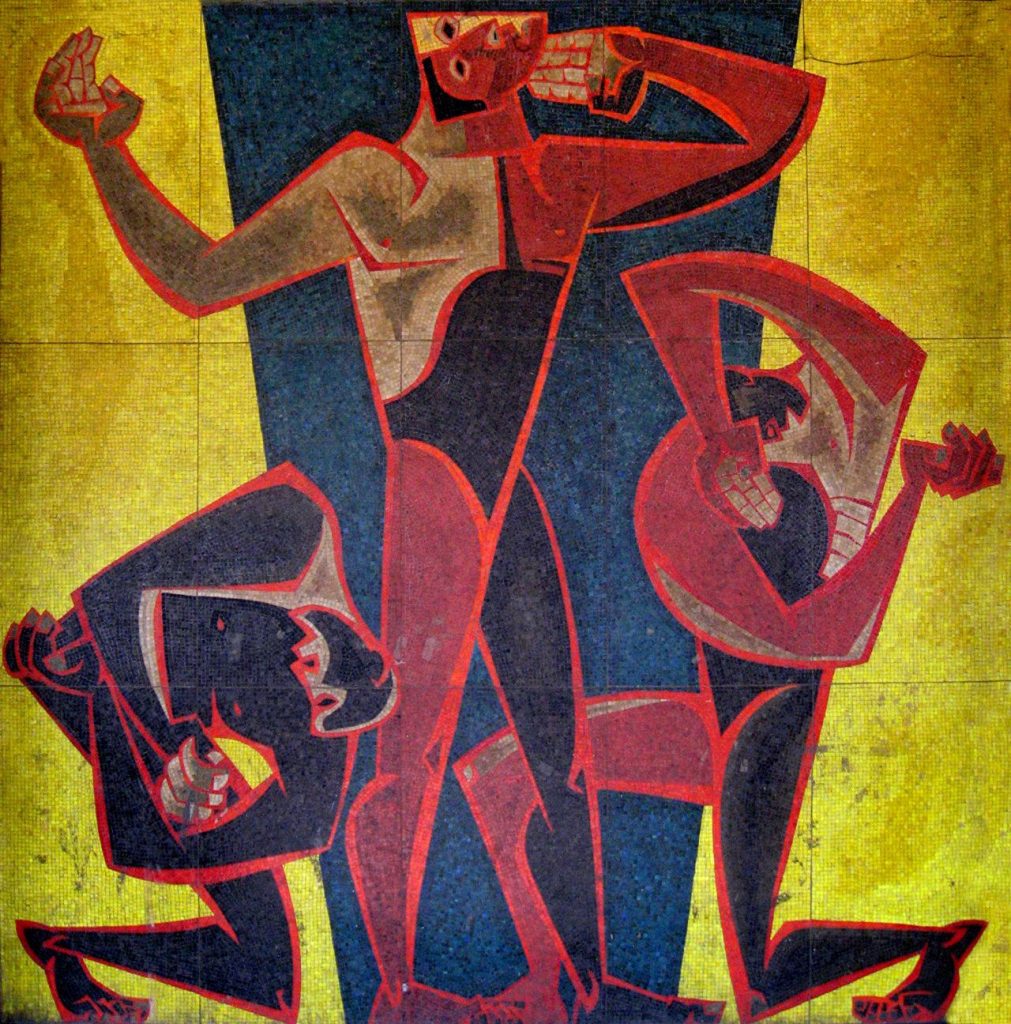
Oswaldo Guayasamín (Ecuador), Homenaje al hombre latinoamericano (Homage to the Latin American Man), 1954.

Greetings from the Nuestra América office of the Tricontinental Institute for Social Research,

In recent months, the judiciary has played a leading role in our region: from the lawfare orchestrated against the former president of Argentina to the historic convictions of former presidents of the regional far right, such as Álvaro Uribe Vélez in Colombia and Jair Bolsonaro in Brazil. However, it is worth clarifying that, contrary to what the hegemonic press tries to portray about the similarity between cases of lawfare and those of justice for proven crimes, the two are very different in nature. To better understand lawfare as a strategy of imperialism in Nuestra América , we asked Claudia Rocca of the American Association of Jurists to contribute to this debate:

Lawfare is a political war waged through the courts and the media, which responds to economic, political, and geopolitical interests. It involves judges, prosecutors, media corporations, journalists and opinion leaders, police, embassy officials, and intelligence agents, both local and foreign.

It is characterized by the abuse of preventive detention, plea bargains, and verdicts constructed without respect for due process, through harassment and demoralization via the media. It includes raids on political headquarters and the homes of activists, persecution and threats to family members, forcing situations of exile and political refuge, manipulation, and the spread of fear among those involved in certain political processes.

In recent years, these tactics have been used against dozens of political leaders and/or former government officials in Argentina, Ecuador, Chile, Brazil, Bolivia, Peru, and El Salvador, linked to governments, programs, or projects that question neoliberal orthodoxy to a greater or lesser extent.

This war operates “from above,” through a judicial apparatus that places itself above the legislative and executive branches, expanding the room for maneuver and power for judges, who become involved in political operations, triggering a loss of checks and balances between powers, allowing for a growing “juristocracy,” and in many cases normalizing the double standard of the law. This historical process of repositioning the judiciary above the other branches of government is characteristic of neoconstitutionalism, the predominant legal order in much of Europe and Latin America in recent decades.

The elevation of the judicial apparatus and selectivity in court cases is linked to the leading role played by the media, which works to criminalize political sectors or leaders. Added to this are the voices of “specialists,” many from US “think tanks,” who are attributed a supposed “force of truth” in the mainstream and social media.

The role played by US government agencies such as USAID and others, as well as US private sector interests, is striking: both are involved in judicial processes as well as in the outcomes and events that follow, demonstrating the instrumentalization of the judicial-media apparatus in favor of foreign economic, political, and geopolitical objectives, which share interests and business with privileged local minorities.

But this mechanism is not limited to the internal spheres of countries. For those nations in which the new Western economic power has not managed to undermine national and sovereign political processes, the same recipes are applied using the international system of currency flows, tariffs and trade routes, money laundering prevention systems, immigration control systems, with sanctions and unilateral coercive measures, with charges and accusations, based solely on decisions made by administrative offices and, therefore, are merely political decisions of the US administration.
Image
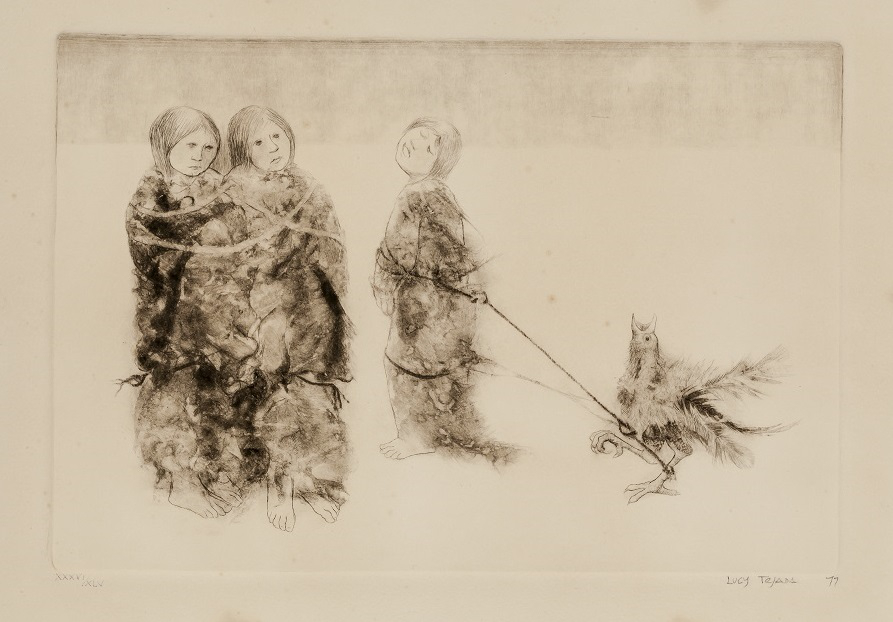
Lucy Tejada (Colombia), Atados (Tied), 1977.

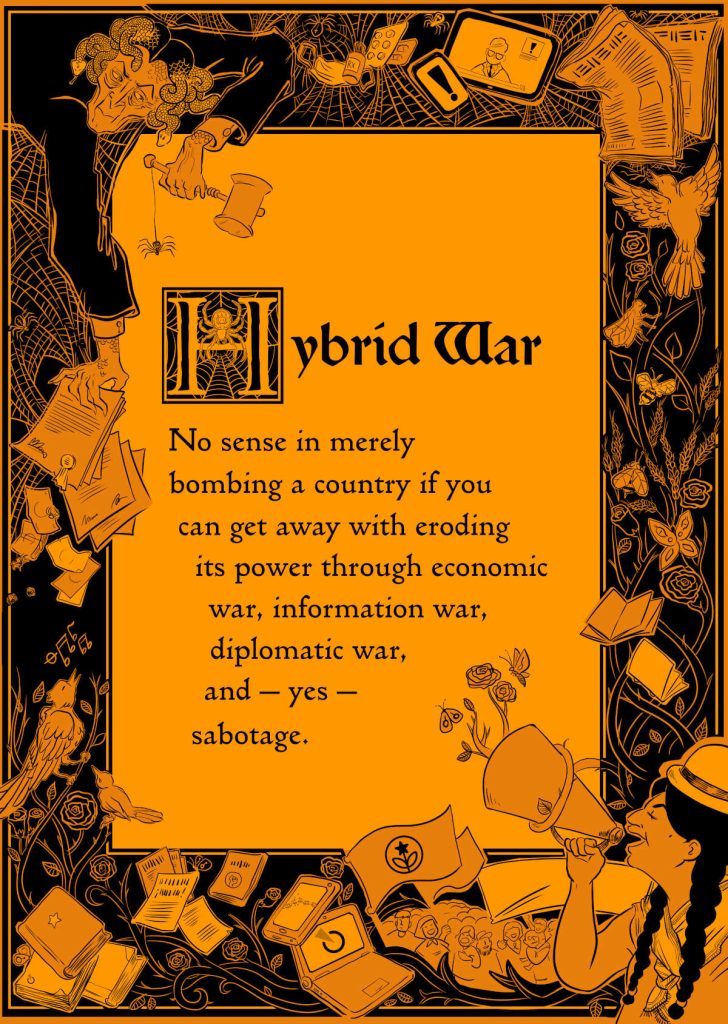
Several military publications consider lawfare to be one of the components of new “unconventional” wars, such as hybrid warfare. This type of warfare can be carried out by state or non-state actors, who use all the modalities of this type of warfare, including conventional military capabilities, unconventional tactics and combat units, or other terrorist actions, planning chaos through acts of violence, cyberwarfare, financial warfare, or media warfare.

It is enough to invoke the “illegality” of the laws/norms of other states that do not adhere to Western standards for them to be classified as violent (“unusual and extraordinary threat”), thus seeking to legitimize attacks that today take on multiple dimensions.

Although, as we have said, lawfare is a tool used by the state, the government, or privileged minorities at the local level, it is also used at the transnational level, implemented from the Global North.

For the nations that submit to it, this is the core of colonial relations and dependence exacerbated by the expansion of capitalism. Within the framework of this unequal relationship, the US and its allies reorganize the scenario in favor of the interests of a transnational power network, creating a kind of “legitimate legal order”; and they define the scope of their jurisdiction, with disregard to the sovereignty of weaker states that do not have the capacity to impose their law by force or to exercise resistance.

Jurisdiction is not simply a rule, but determines which rules will be applied, where, how, and by whom. Therein lies the power of subjugation of the Western power center over our Latin American countries, conveyed through lawfare.

The installation of this “juristocracy” has resulted in the judicialization of high politics and democracy, because by delegitimizing and neutralizing political leaders who are inconvenient for certain economic and geopolitical interests, they have not only affected the individuals directly involved, but also undermined the democratic foundations of the affected states, compromising their capacity for self-determination and promoting subordination to external agendas.
Image
Tricontinental Institute, Hybrid Wars, 2020.

The Argentinian Case
The judicial persecution of political and social leaders in Argentina has developed since the end of Cristina Fernández de Kirchner’s last term in office, when figures who paraded through the media began to take center stage, denouncing the alleged corruption of Kirchnerist officials, without any probative arguments, but with great spectacle and impact provided by the mass media. The attacks were particularly focused on the President, and even went so far as to suggest that she was the mastermind behind the death of prosecutor Nisman, despite the fact that all the evidence gathered in the investigation pointed to suicide.

The federal criminal court, together with other senior officials in the judiciary, became the main opposition party. This process was decisive for the victory of Mauricio Macri, whose administration plunged the country into a process of deindustrialization, concentration of wealth through financial speculation, surrender of strategic resources, and weakening of the state’s capacity, while multiplying the cases that criminalized Kirchnerism in particular and social leaders of the popular camp in general. Milagro Sala is the most paradigmatic example. In the last part of his term, Macri incurred in formidable debt in record time. The nearly $50 billion granted by the IMF in a completely irregular manner is part of the amount that fled the country afterwards.

As a result of the obvious unviability of this government program and the social and economic deterioration it caused, Peronism won the presidential elections in 2019. But clearly, it did not gain power. Lawfare did not yield an inch.

One of the emblematic cases is undoubtedly the so-called “Vialidad” case, in which Cristina Fernández de Kirchner was sentenced to six years in prison for the crime of fraudulent administration. In the context of this trial, the guarantees of defense in court, emanating from Article 380 of the National Criminal Procedure Code, based on Article 18 of the National Constitution and reinforced by the treaties that make up International Human Rights Law, have been violated; the set of rules on judicial conduct known as the Bangalore Principles (adopted by the United Nations Economic and Social Council in its Resolution E/CN.4/2003/65/Annex of November 2002, formally approved on January 10, 2003) have been violated, given the public and notorious lack of impartiality of the judge and his evident links to the prosecution. The judicial arbitrariness manifested in the proceedings against the Vice President shows the same patterns of persecution as in the political proscriptions of other Latin American leaders, and this is clearly evident from a ruling that is in no way related to the evidence produced in the case file, where no evidence has been included to prove the conduct attributed to the former President.

After confirmation by the Court of Cassation—which did not address any of the above arguments—in just two months, the Supreme Court of Justice of Argentina upheld the conviction, while other cases await years or even decades. With the now customary advance and accurate announcement by the media, the unconstitutional ruling achieved its purpose from the outset: the proscription of Cristina.
Image
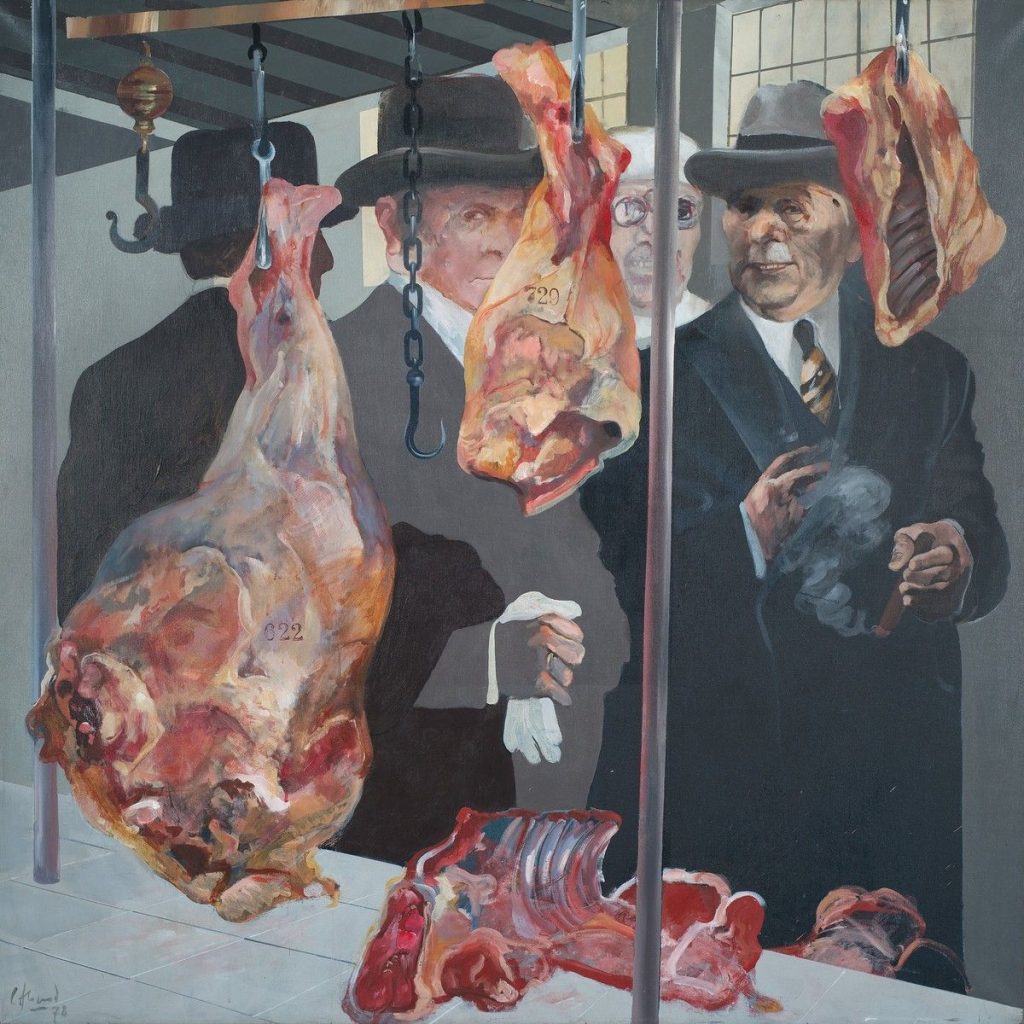
Carlos Alonso (Argentina), Carne de primera (Prime Meat), 1972.

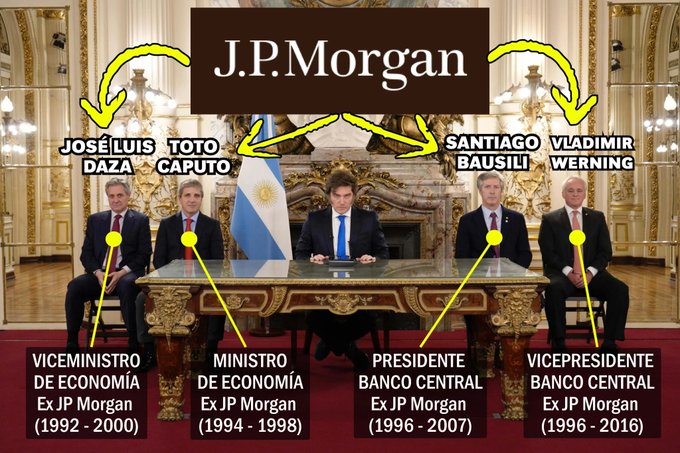
We can affirm that lawfare was a central factor in the rise to power of Javier Milei, a sinister figure promoted and supported by three centers of economic power: speculative finance and investment in strategic resources (such as JP Morgan, BlackRock, and others), the groups known as “techno-feudal lords”—masters of the networks—and the media.

Since taking office, Milei has carried out a process of dismantling the state; emptying public policies for development, human rights, inclusion, gender, and diversity, within the framework of a process of economic devastation; the deployment of repressive measures with the expansion of security forces and agencies, aimed at silencing social protest in the face of the dismantling of a state system for the effective protection of economic, social, and cultural rights; and the brutal impoverishment of the population.

There have been massive layoffs, while companies, strategic resources, and other public assets have been privatized. The attempt to suppress labor rights, combined with the persecution of trade unions, social organizations, and popular economy organizations—criminal charges, removal of food and other benefits guaranteed by social programs that were abruptly discontinued—reflect a political project of accumulation in favor of concentrated sectors of the economy and financial speculation. In the context of inflationary pressures, due to the deregulation of essential economic factors such as services, benefits, and prices in general, there was a sharp decline in the purchasing power of wages and an increase in unemployment and poverty.

In 2024, small and medium-sized enterprises recorded a loss of more than 217,000 jobs and the closure of 9,923 companies, according to Industriales Pymes Argentinos (IPA). The sectors most affected were construction and industry, with 69,738 and 25,186 fewer jobs, respectively. In the public sector, between November 2023 and May 2025, more than 180,000 jobs were eliminated. There was an increase in informal work and semi-slavery working conditions.

The loss of purchasing power of incomes, as a result of the change in economic policy implemented by the current government, represented the largest monthly drop in the last 30 years (8.4 percent year-on-year in purchasing power).

There was a greater contraction in consumption in supermarket and self-service sales, as well as in retail stores in various sectors. In 2025, inflation is easing, solely as a result of an unprecedented economic recession and deterioration of all factors. The consequences in human terms are now evident and alarming.

This accelerated process of devastation was accompanied by fascist practices and rhetoric, reflecting contempt for the human condition, a supremacist, patriarchal conception, and the most servile and undignified submission to the interests of the United States and the genocidal Zionist government of Israel, vociferously proclaimed by the Argentine president.

In conclusion, we could attempt at this point to define fascism in the 21st century as a social practice that manifests itself through political movements, driven by the new economic power prevailing in the West, which use hatred and polarization as strategies to undermine liberal democracy, break with the social order, and the rule of law. They thus install authoritarian regimes and nepotism, with economic programs that promote accelerated processes of wealth concentration, benefiting the transnational groups to which they respond and favoring financial speculation. The consequences are the destruction of social organizations, the exclusion of large majorities, economic devastation, and repression as a method of social control.

The Argentine example—like so many others—shows us that submission to the current Western economic power represented by the United States only brings consequences infinitely more tragic than the cost of resisting it. Not only is there no benefit or mercy, but it leaves us without a horizon and without a future. Therefore, yielding or submitting is not an option for a sovereign people.

Greetings to all,

Claudia Rocca

https://thetricontinental.org/argentina ... lonialism/

******

National strike in Ecuador met with heavy repression

The elimination of the diesel subsidy has sparked multiple protests across the country. President Noboa defends the decision and aims to change the country’s entire legal framework.

September 25, 2025 by Peoples Dispatch
Image
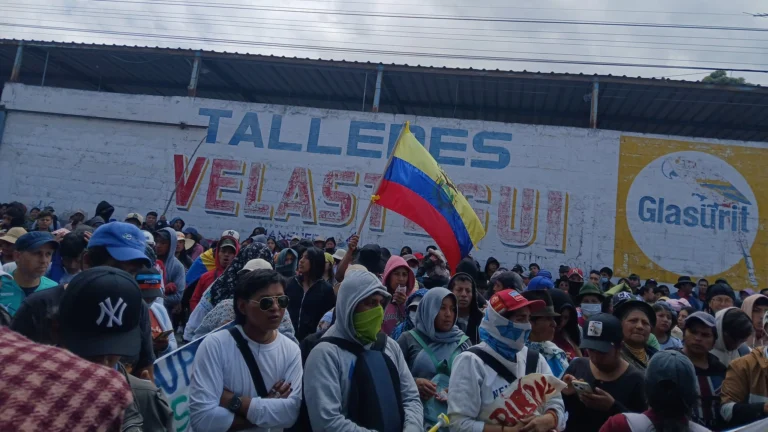
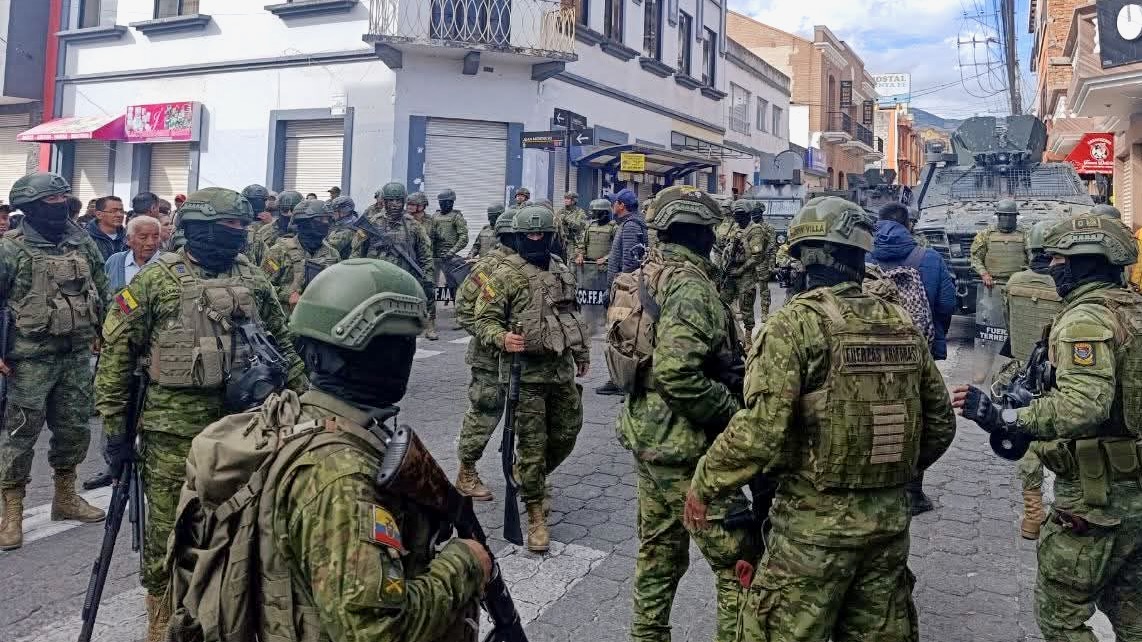
The National Police and the Army have not hesitated to use force to clear the roads and disperse the protesters. Photo: CONAIE

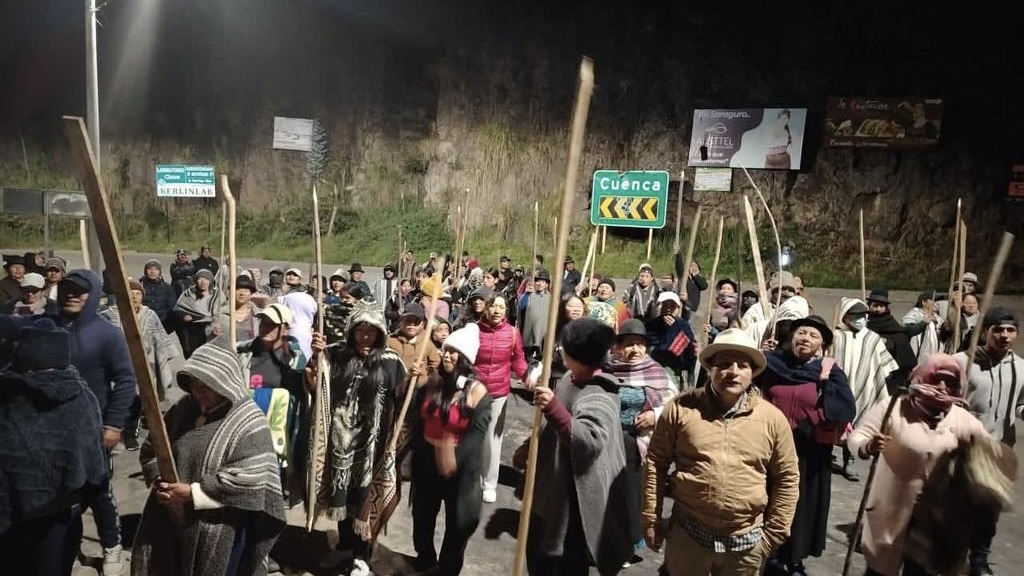
Following the announcement by Ecuador’s right-wing President Daniel Noboa to eliminate the diesel subsidy, several protests have taken place across the country demanding the repeal of the decree. In Ecuador, diesel is used for transportation and agriculture. Before the decree, the cost per gallon was set at USD 1.80; now it costs USD 2.80.

This increase has a direct impact on food production and marketing prices, which is already evident in the markets, as well as on the cost of passenger transport, which could prove very problematic for a country undergoing a prolonged economic and security crisis.

The measure was initially rejected by the transport union, although they quickly reached an agreement with government negotiators. However, the Confederation of Indigenous Nationalities of Ecuador (CONAIE), the country’s most significant social movement, declared that it would initiate indefinite mobilizations starting on September 22.

In 2019 and 2022, CONAIE led massive protests against the governments of Lenin Moreno (2017-2021) and Guillermo Lasso (2021-2023), who attempted to eliminate fuel subsidies. The protests, in which dozens of people died, halted the economic measures requested by the International Monetary Fund. However, it seems to be a non-negotiable point that successive right-wing governments insist on implementing, with the Noboa government (2023-present) being the one that has most significantly advanced the neoliberal economic program.

Mobilizations
“Sisters and brothers, today we begin the National Strike. We are not criminals or terrorists; we are a dignified people who demand respect for life, rights, and territories. The government’s response cannot be repression or persecution, but rather listening to the legitimate demands of the people. We call for unity among all sectors to raise, with firmness and dignity, our collective voice for the future of our families and our country,” said Marlon Santi, president of CONAIE.

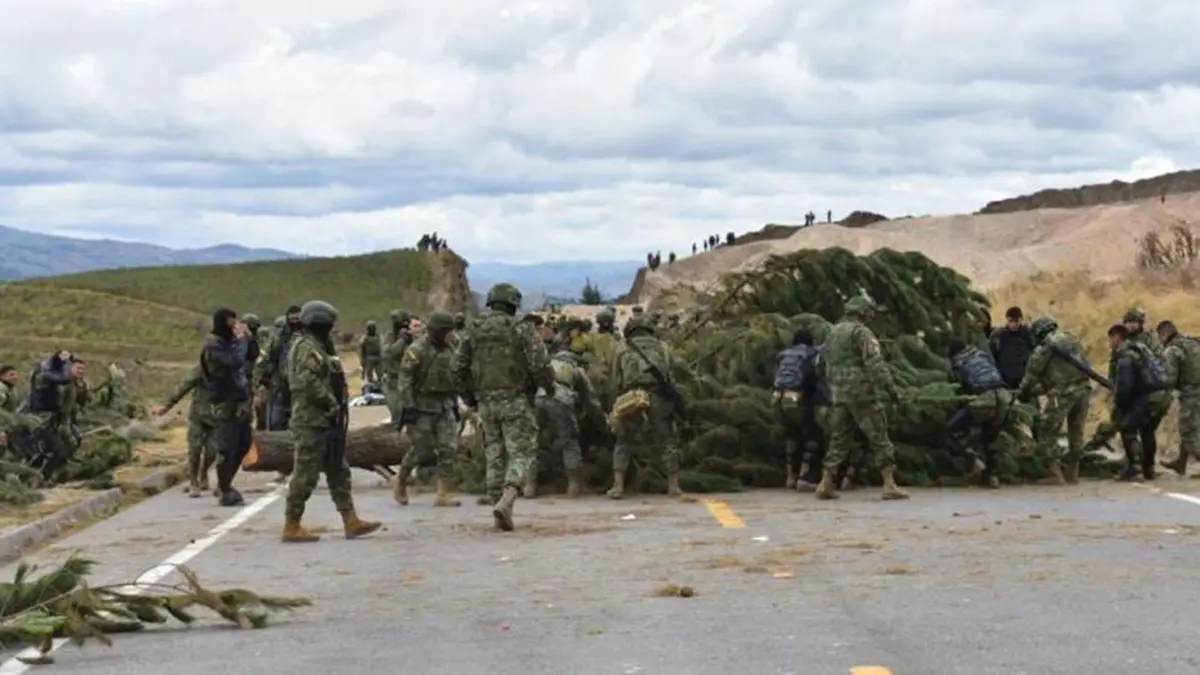
On September 22, some of the country’s major roads were closed by protesters, especially in the provinces of Carchi and Pichincha. In Cotopaxi, Chimborazo, and several provinces in the Amazon, road closures and some clashes with law enforcement officers seeking to clear the blocked roads have been reported.

At the start of the demonstrations, the cities of Latacunga and Otavalo woke up militarized, as the government decided to temporarily move the presidency and vice presidency there, respectively, in hopes of containing two of the most active sites of Indigenous mobilization.

However, the province of Imbabura, where Otavalo is located, has become one of the most active sites of protest as the days have passed. Thousands of protesters have clashed with the police, who have decided to crack down and imprison several protesters.

The harsh actions of the security forces
Several human rights organizations, such as the Regional Foundation for Human Rights Advisory Services (INREDH), have reported that protesters claim that abuses and harassment have been committed by the security forces. These allegations were echoed by the Waorani Nationality of Ecuador (NAWE), which represents an Indigenous Amazonian population: “[We were] repressed by the public forces.”

This seems to be the tone of the protests across the country. The National Police and the Army have not hesitated to use force to clear the roads and disperse the protesters. According to the minister of government, Zaira Rovira, so far, after three days of protests, 59 people have been arrested.

For his part, Security Minister John Reimberg claimed that the strategy of the Indigenous leaders is for one of the protesters to be killed: “What these pseudo-Indigenous leaders are looking for is to victimize themselves and for us to use force in such a way that an Indigenous person is injured or killed.” He also pointed out that among the protesters are members of the Tren de Aragua, a Venezuelan criminal organization, which would demonstrate an alleged hidden agenda.

These claims have been strongly denied by Indigenous leaders, who assert that such statements are a ploy to delegitimize the struggle of the Ecuadorian people and legitimize increasingly radical repression against protesters. “We are not terrorists! We are peasants, farmers, workers, students, we are a people demanding our rights,” wrote Leonidas Iza, former president of CONAIE and leader of the protests in 2019 and 2022.

Repression was also evident in the country’s capital, Quito, where on September 23, several students and workers took to the streets to protest the Noboa government. Students and professors from the Central University of Ecuador closed Avenida América in rejection of the elimination of subsidies; they later joined a workers’ march that advanced through various parts of the city.

Another group of people demonstrated at night in the north of the capital, where they reported beatings and abuse by the police. In a video that went viral, a police officer is seen spraying pepper spray into the mouth of a protester who was shouting his name as he was being taken away by the police. The same happened with a video showing law enforcement officers firing at the occupants of a van fleeing repression in Saquisilí, Cotopaxi province.

The context of the protests
The demonstrations are in addition to several protests by students, workers, and teachers that have taken place in recent months in the country against the neoliberal policies of the Noboa administration.

However, the executive branch has not slowed down its plan but rather accelerated it. On September 23, the president explained this very clearly: “We will not back down, as we did in 2019, as we did in 2022. We must show firmness and compassion to those who truly need it. Before they try to make me back down, I would rather die. I am staying here and I will be fighting every day for each and every one of you,” he said at a rally before his supporters.

But the truth is that Noboa, who is following the agreements signed with the IMF to the letter, has a more ambitious plan than simply eliminating the diesel subsidy. In recent weeks, Noboa identified his new enemy as the Constitutional Court (CC), which rejected several articles of the recent laws passed by a Congress controlled by the ruling party.

This strategy sought to preempt one of the changes most desired by Ecuador’s economic elites (to which the president belongs, as the son of the richest man in the country): to eliminate the 2008 constitution, which undoubtedly has anti-neoliberal roots, as it prohibits the privatization of public services and defends the rights of workers and nature, among other provisions labeled by constitutional lawyers as “guarantees”.

Noboa’s plan seems to have worked. After two demonstrations and a media campaign against the judges, the CC agreed to a referendum asking Ecuadorians:

If they want to call a constituent assembly
If they approve of foreign military bases
If they want to end state funding for political parties
These are the three main pillars of the plan to restructure Ecuadorian politics and the economy.

In this sense, the current protests are not limited to the elimination of the diesel subsidy – a fundamental step in the government’s economic program – but also express a series of social, economic, political, and security issues (Ecuador is now the most violent country in Latin America) for which the protesters blame the Noboa administration. Many see the protests as one of the last chances to curb the neoliberal intentions of the executive branch, which does not seem to have any intention of slowing down.

Meanwhile, the government is betting on the proposed referendum to carry out its governing plan. A plan which, despite electoral promises, does not seem to be curbing unemployment, murders, and the widespread social crisis affecting the country. In the coming days, we will see whether the protests manage to gain momentum, as they did in 2019 and 2022, consequently undermining the popularity of the presidency, or whether, on the contrary, the government manages to get its way, eliminate the subsidy, and emerge stronger to face a possible referendum vote. This is undoubtedly its toughest obstacle so far.

https://peoplesdispatch.org/2025/09/25/ ... epression/
"There is great chaos under heaven; the situation is excellent."

User avatar
blindpig
Posts: 14788
Joined: Fri Jul 14, 2017 5:44 pm
Location: Turtle Island
Contact:

Re: South America

Post by blindpig » Fri Sep 26, 2025 2:15 pm

Anti-Government Protests Continue in Peru Despite Heavy Repression
September 25, 2025

Image
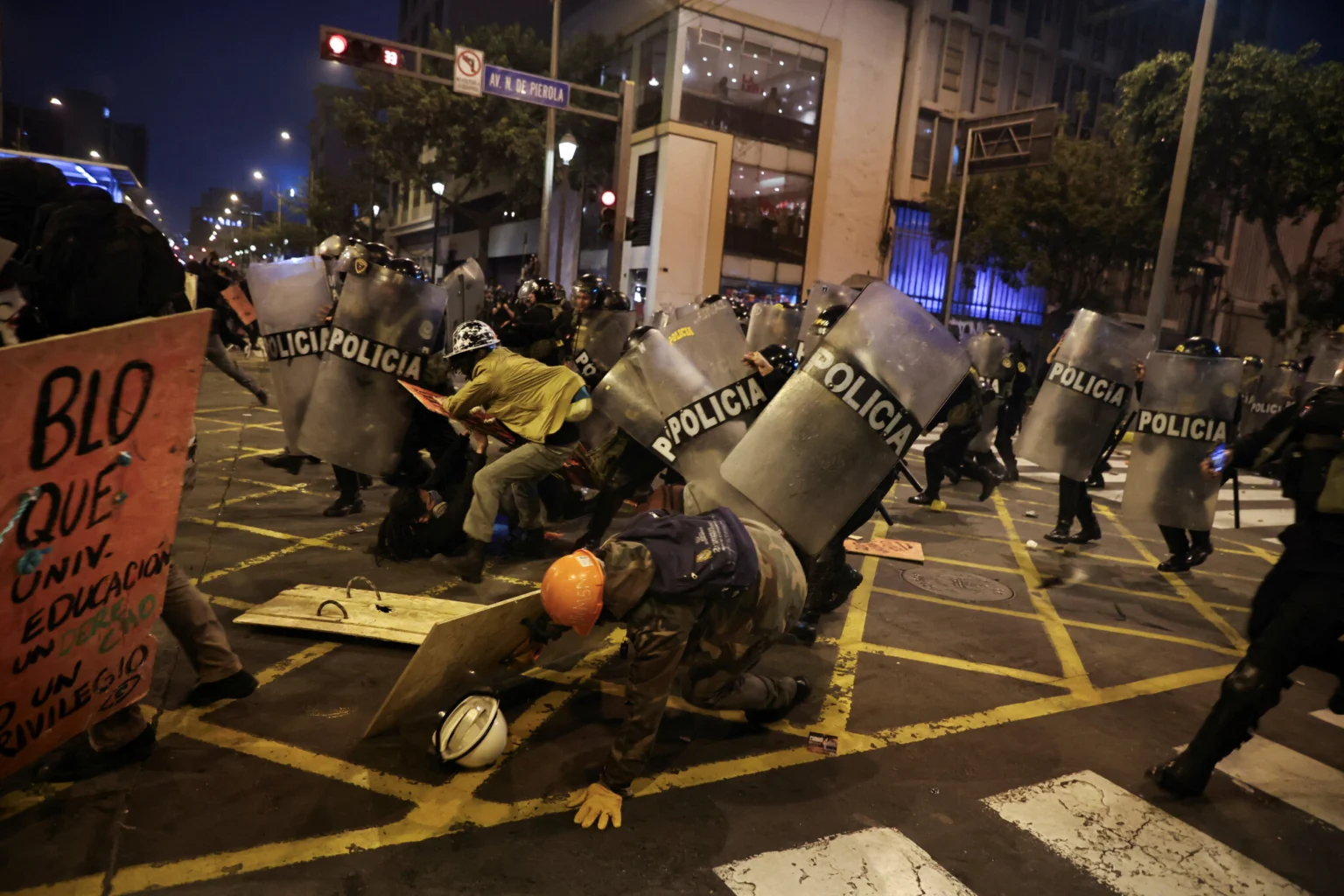
Heavy police repression against protesters demanding the repeal of the pro-AFP law. Photo: Peoples Dispatch/file photo.

By Pablo Meriguet – Sep 24, 2025

Protests have once again erupted in Peru against the government of Dina Boluarte with the spark of the latest wave being the reform of the controversial pension system in the country.

Under the slogan “United for the Peru we deserve,” thousands of people, especially young people – took to the streets last weekend to protest a law enacted on September 20 that reforms the pension system. The protest soon began to denounce the executive branch’s administration in general terms.

This is the opinion of Peruvian sociologist Lucía Alvites, who spoke with Peoples Dispatch about the recent demonstrations: “The mobilizations of recent months and the most recent ones have had a common root: the protests against the coup d’état against Pedro Castillo in December 2022, because youth collectives, social movements, and university organizing spaces are the ones that have mobilized in the protests of late 2022 and early 2023.”

The pension reform law
Law 32123 was promoted by the right-wing government of Dina Boluarte, who has served as president since Pedro Castillo was removed from office in a coup. The coup against Castillo sparked massive and prolonged protests in the Andean country that were harshly repressed by the coup government, resulting in the deaths of dozens of Peruvians.

Among other aspects, the law requires young people to join the Pension Fund Administrator (AFP), which operates on private capital. Additionally, the option to withdraw 95.5% of contributors’ funds at age 65 was approved, which poses a risk to the entire pension system, and marks a departure from its original purpose of providing stable, long-term income. This directly affects younger people, especially since the law also stipulates that contributions are optional for self-employed workers.

And while the criticism of Law 32123 is substantial, the truth is that the protests go beyond criticisms to the pension system, and are regarding broader issues they attribute to the Boluarte administration and Congress. One of these is the rising insecurity in the Andean country, which has already led to several demonstrations by transport workers against the government. The rise in organized crime and violence has led to a 35.9% increase in homicides in Peru, according to figures from Insight Crime.

Among other things, the law requires young people to join the Pension Fund Administrator (AFP), i.e., a private capital fund. According to Alvites, young people are the most affected by the law, which explains why the bulk of last weekend’s mobilization had such a marked age composition: “Young people have been the most affected by the pension system reform passed by Congress, which blatantly benefited the Pension Fund Association (AFP), taking away the possibility for those under 40 to access 95.5% of their saved funds when they retire. The [past] protests succeeded in getting that part of the pension system reform repealed.”

And while complaints against the pension law are very much present in the collective imagination, the truth is that protesters are demonstrating against other problems they associate with the Boluarte administration and Congress. One of these is the increase in insecurity in the Andean country, which has already led to several demonstrations by transport workers against the government. The rise in organized crime and violence has led to a 35.9% increase in homicides in Peru, according to figures from Insight Crime.

Boluarte Amnesties Hundreds of Security Forces Implicated in Human Rights Abuses in Peru


Repression in Lima
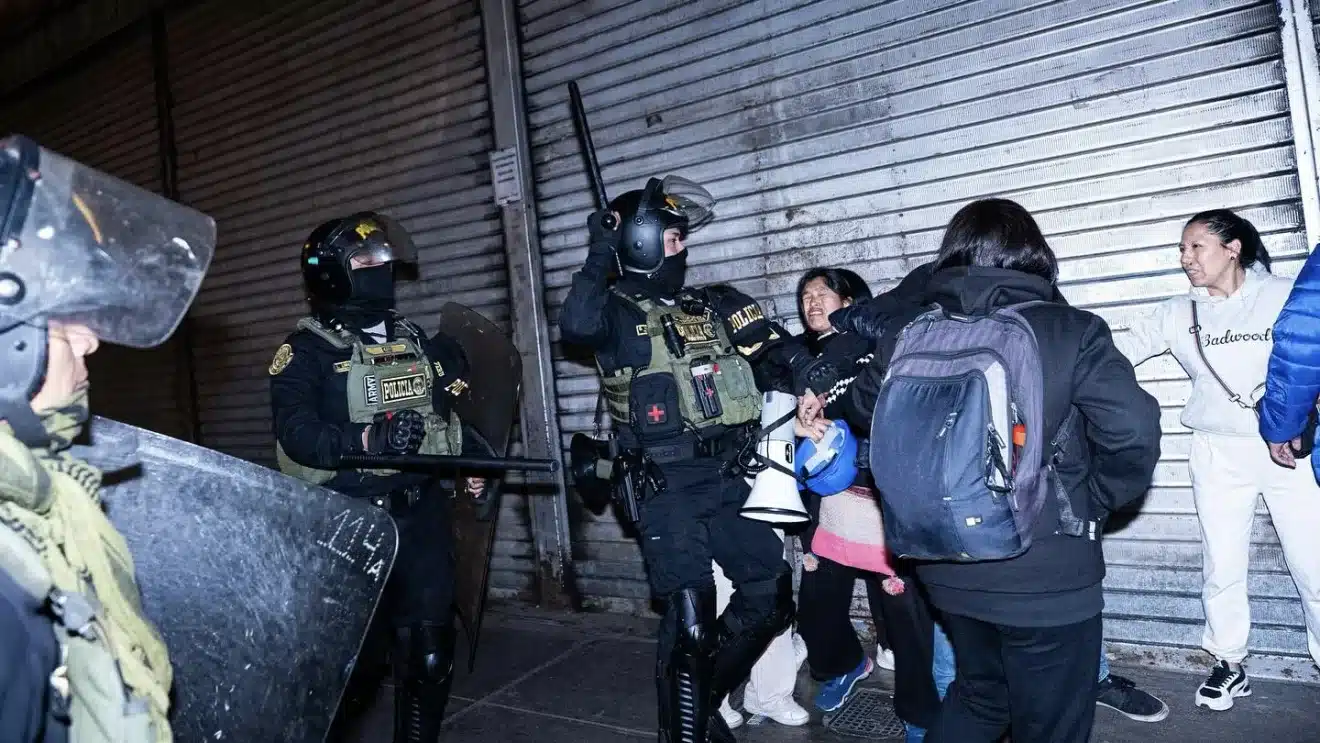
The protesters called for a rally last weekend in Plaza San Martín, one of the city’s most iconic squares in Lima. Police quickly surrounded the square and blocked the passage of those seeking to join the protest. This led to clashes between the police and the protesters, who were trying to advance towards the Government Palace and the legislative building.

In the end, the protesters, who threw stones and other objects at the police, managed to break through the police cordon, but not without a harsh response from the security forces, who fired tear gas and pellets at the protesters. In fact, two journalists from the media outlet Exitosa reported live that they had been shot with pellets by the police.

Little by little, other groups joined the demonstration, which moved to Abancay Avenue. Throughout the demonstrations, 18 people reported injuries from pellet shots, stones, and police baton blows. “Dina murderer” and “Everyone out” were some of the messages carried by protesters during the harsh police repression.

On the night of September 21, several media outlets reported that the police began chasing protesters from a shopping center near the Palace of Justice, causing anxiety among many citizens who were not involved in the protest and had to flee the scene in the face of the police onslaught.

Alvites affirms that the executive branch has once again demonstrated that it does not hold on to power thanks to popular approval, but rather through the effective use of law enforcement. According to a recent Datum poll, 79% of Peruvians say they disapprove of the executive branch, and 85% say they feel the same way about Congress.

“The government’s response to the protests has been one of violent repression. Some of our comrades have been injured by pellets to the head, back, face, etc., caused by tear gas canisters that have hit protesters, as the police have unleashed extremely aggressive repression. Some of our comrades have also been detained. Unfortunately, this is the result of the impunity enjoyed by the Peruvian National Police and the Armed Forces following human rights violations during the protests in 2022 and 2023, at the beginning of the Boluarte dictatorship. We must not forget that more than 60 Peruvians were extrajudicially killed.”

The future of protests in Peru
The truth is that protests have been on the rise since the beginning of 2025. More citizens are demonstrating in different parts of the country and are gradually beginning to point the finger at the Boluarte government and the National Congress as the culprits, according to several international media outlets.

In this regard, Alvites states: “The protests will continue. New demonstrations have been called for next weekend. It must be said that what mobilized the young people has been revoked. However, the demonstrations continue because they have taken on a character of challenge and protest against what the Boluarte regime represents.“ She added: ”The demonstrations aim to bring an end to this regime and to show dissatisfaction with Congress.”

https://orinocotribune.com/anti-governm ... epression/

******

CONAIE Condemns Transfer of Protesters to High-Risk Prisons, Accuses Noboa of Criminalizing Protests

Image
Demostration in Ibarra, Ecuador, against Noboa’s fuel policies. Photo: CONAIE.


September 26, 2025 Hour: 2:46 am

The Confederation of Indigenous Nationalities of Ecuador (CONAIE), the country’s largest social organization, demanded on Thursday the immediate release of those detained during protests convened by the Indigenous movement against President Daniel Noboa’s government. It also denounced the transfer of at least ten detainees to dangerous prisons.

“We hold Daniel Noboa’s government directly responsible for these actions that criminalize social protest and place the lives and integrity of our community members and comrades at imminent risk,” Conaie said in a statement.

“We demand the immediate release of the detainees, full respect for human rights, and effective guarantees for life,” it added.


Conaie, which represents 14 nationalities and 18 Indigenous peoples across Ecuador, accused the state of shirking its duty to safeguard prison security.

The organization reported that at least ten demonstrators had been transferred to prisons in Portoviejo and Machala—the latter coinciding that same day with a massacre that left 17 inmates dead.

Government figures from the Interior Ministry indicate that since Monday’s unrest began, authorities have detained 85 people nationwide.

“The strike continues to grow. We invite all peoples and sectors of Ecuador to join. We condemn the arrogance of the national government. Today our brothers are imprisoned and have been transferred to other provinces,” said Conaie president Marlon Vargas in a message published on social media.

The spark for these demonstrations was Noboa’s decree eliminating the state diesel subsidy, which caused the price of the fuel to jump overnight from $1.80 to $2.80 per gallon (3.78 liters).

https://www.telesurenglish.net/conaie-c ... -protests/
"There is great chaos under heaven; the situation is excellent."

User avatar
blindpig
Posts: 14788
Joined: Fri Jul 14, 2017 5:44 pm
Location: Turtle Island
Contact:

Re: South America

Post by blindpig » Mon Sep 29, 2025 1:33 pm

Ecuador: Noboa Cuts Off Communications in Areas Where Protests Are Taking Place

Image
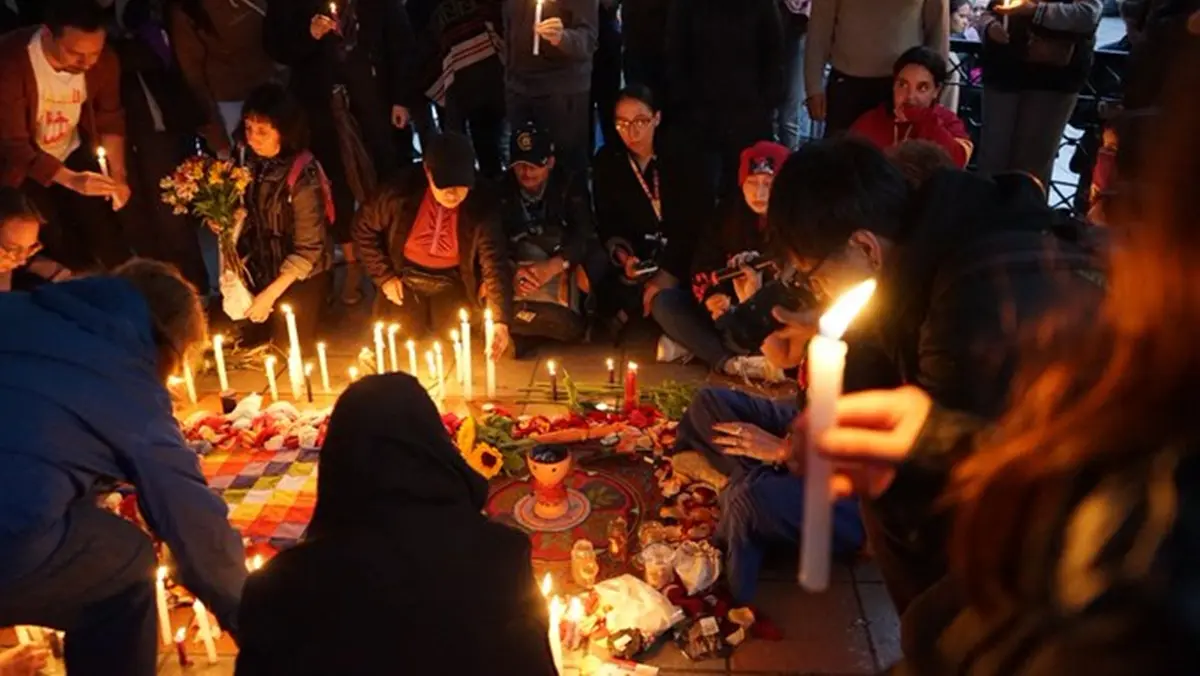
A vigil in memory of Efrain Fuerez in Cuenca, Ecuador, September 28, 2025. X/ @tomvillota

September 29, 2025 Hour: 8:09 am

Security forces killed a protester in Otavalo as demonstrations against diesel price hikes escalate.
On Sunday, the Confederation of Indigenous Nationalities of Ecuador (CONAIE) denounced that President Daniel Noboa cut off telephone and internet service in areas of the province of Imbabura, where demonstrations, roadblocks, and protests against rising diesel prices have intensified.

“In the El Cajas sector, there is strong repression against the mobilized communities. The state turns off the lights, blocks social media and cuts phone signals to silence complaints,” CONAIE warned.

Over the past week, El Cajas has been a focal point of recurring blockades in northern Ecuador, where CONAIE has called for an indefinite strike. On Sunday, in the city of Otavalo, soldiers opened fire on Indigenous protesters, killing a community member who was participating in the demonstrations. The incident was captured on several videos that quickly went viral on social media.

“We demand an immediate cease-fire and respect for human rights. Social protest and resistance are rights recognized by the Constitution, international human rights treaties, and the International Labour Organization’s Convention 169. Respect life, dignity, and the rights of the peoples!” CONAIE said.

The text reads, “An enforced silence reigns in Imbabura: communities report being without electricity, internet, or phone service. Meanwhile, a military convoy of more than 100 vehicles advances, and the repression continues unabated. Seven days of strikes, a community member murdered, and a state that silences the voice of the people to hide its violence. How the hell are we going to tell this dark story in our history?”

Protests against Noboa and his economic policies have so far led to more than 100 arrests. About a dozen of those detained are being held in pretrial detention on “terrorism” charges filed by the Attorney General’s Office.

The protests, which have spread to about 5 out of 24 provinces, were triggered by the elimination of the diesel subsidy decreed two weeks ago. The measure raised the fuel’s price from US$1.80 to US$2.80 per gallon.

CONAIE is demanding the release of detainees and the repeal of the decree that ended the subsidy. Noboa has stood firm, insisting that US$1.1 billion in state spending previously used for the diesel subsidy is now being redirected to the most vulnerable sectors.

The Indigenous movement also led massive protests in 2019 and 2022, which forced former presidents Lenin Moreno (2017-2021) and Guillermo Lasso (2021-2023) to back down from attempts to cut subsidies tied to fiscal adjustment targets in credit agreements with the International Monetary Fund (IMF).

The text reads, “Massive and raging protests, calling Daniel Noboa and his military personnel cowards and murderers, took place Sunday night in Cuenca and Guaranda, threatening to spread to the rest of Ecuador’s provincial capitals on Monday. There is great outrage among the citizens over the murder of Efrain Fuerez, a community member, after he was shot three times by the military.”

Death of Community Member Sparks Citizen Outrage

The death of Efrain Fuerez, who was killed with three gunshot wounds by soldiers, sparked outrage across the country. On Sunday, social organizations in the provinces of Azuay and Bolívar joined the protests following his death.

Citizens in the cities of Cuenca and Guaranda went out to protest overnight against the repression of indigenous people. They also demanded the release of the community members arrested during the strike in the province of Imbabura.

“In both provinces, a permanent vigil was declared in solidarity with those detained, as well as in memory of Fuerez,” Pichincha Comunicaciones reported.

In Cuenca, citizens took over the city’s main square to hold a nighttime vigil in memory of Efrain Fuerez. Entire families participated in a peaceful event with songs and offerings in memory of the Indigenous leader.

https://www.telesurenglish.net/ecuador- ... ing-place/

Paraguay’s Mass Protests Demand End to Corruption and Austerity Amid Political Crisis

Image
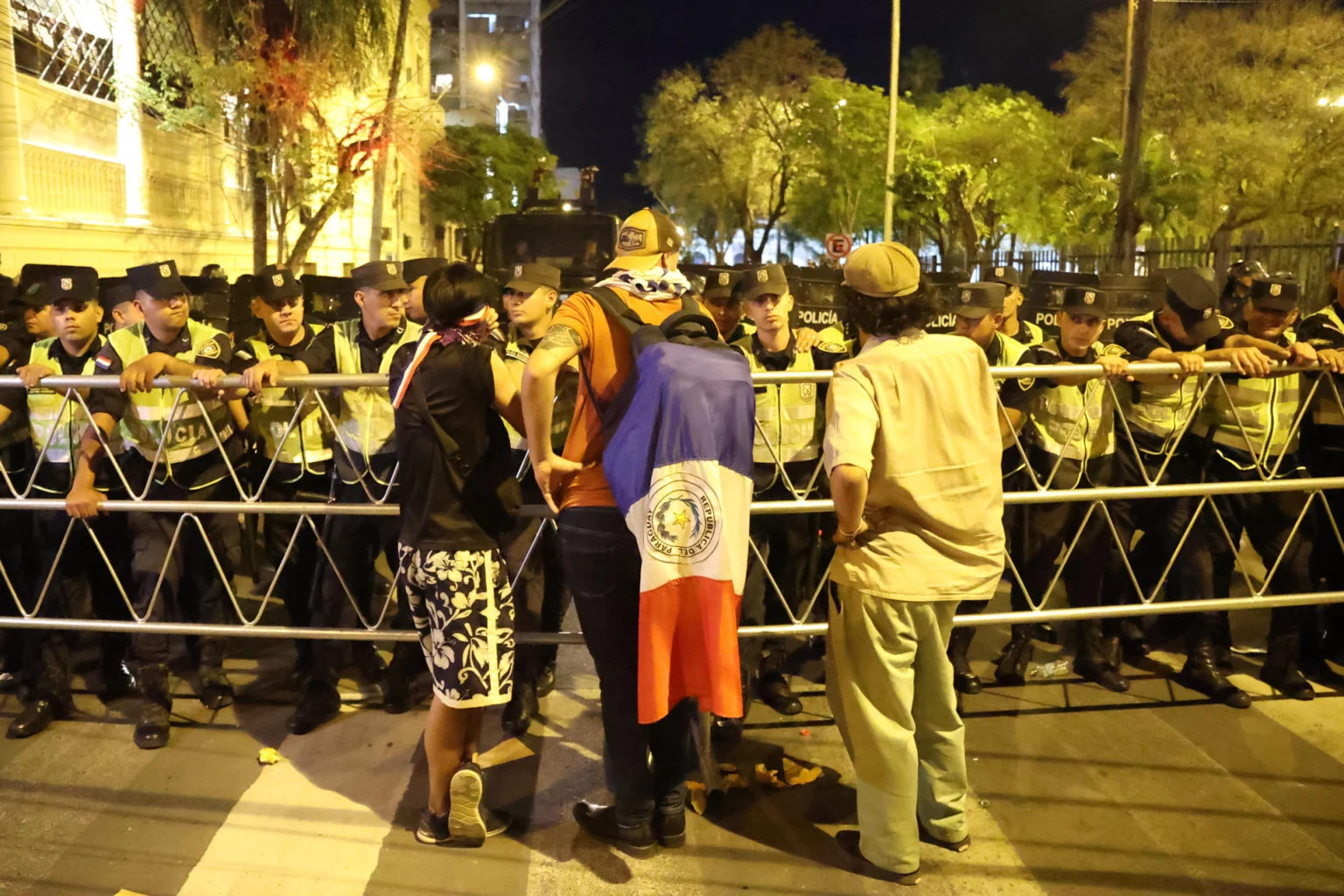
People talk to members of the Paraguayan Police during a demonstration this Sunday in Asunción, Paraguay. Photo: EFE/ Juan Pablo Pino

September 28, 2025 Hour: 8:28 pm

Paraguay is witnessing a profound wave of popular mobilizations as thousands of citizens from all walks of life rise up against entrenched corruption, impunity, and austerity measures imposed by the government of President Santiago Peña.

The crisis erupted into the streets following damning revelations in 2025 exposing a vast criminal network embedded within state institutions.

Leaked WhatsApp messages from the phone of former Deputy Eulalio Gomes—himself killed under suspicious circumstances while under investigation for money laundering linked to drug trafficking—exposed collusion between government officials, judicial figures, and organized crime.

As the scandal unfolded, public trust in Paraguay’s judiciary plummeted. Several high-ranking officials resigned amid mounting pressure, but systemic reforms remain elusive.

▶️PARAGUAYOS SALEN A MARCHAR | 🇵🇾

💥La “Generación Z” organizó la movilización, pero juntó gente de todas las edades.

👉🏻Esta señora sacó su bandera paraguaya y también salió a movilizarse. pic.twitter.com/eWTRVtT0ve

— DELPY 📱🎬 (@delpynews) September 28, 2025

Protesters denounce the “mafia-style control” over courts and the Prosecutor’s Office, demanding genuine accountability and an end to impunity. Slogans such as “The mafia and narco-politicians own power” echoed through massive demonstrations in the capital, Asunción, and beyond.

From March 25 to 27, 2025, waves of peaceful protests swept the country, uniting pensioners, yerba mate workers, students, Indigenous communities, peasants, trade unions, and human rights organizations. These groups called for an end to austerity policies undermining public health, education, and social welfare, and demanded stronger state action against corruption and organized crime infiltrating government ranks.

On March 27, the 31st annual Campesina, Indigenous and Popular March highlighted the acute demands of rural and Indigenous populations. Led by the National Peasant Federation, demonstrators pressed for comprehensive agrarian reform, land access, and protection of livelihoods. They also mobilized against proposed laws threatening labor rights and pension protections—themselves emblematic of broader attacks on workers and marginalized communities.

The repression of opposition voices also sparked anger. In a dramatic incident on March 31, 30 citizens staging a theatrical remembrance for Rodrigo Quintana—a young activist killed by police in 2017—were violently dispersed by authorities near the Palace of Justice. Subsequent criminal complaints were filed against police officials responsible for excessive force, even as prosecutors targeted the peaceful protesters.

Peasant communities face additional pressure through threats from the National Institute for Rural and Land Development (INDERT), which warned campesinos involved in protests they risk losing their rights to land regularizations. This state intimidation attempts to silence demands rooted in decades of land inequality and exclusion, disproportionately affecting Indigenous and rural populations.

Indigenous groups also mobilized in January 2025 to denounce the government’s chronic failure to ensure access to clean water, education, and basic services. Many blocked Asunción streets, demanding state accountability and the resignation of officials accused of neglecting Indigenous rights.

The spaces for dissent and civil society engagement are under increasing threat. In May 2025, a controversial law restricting civil society organizations was enacted, raising concerns about democratic backsliding and repression of independent voices fighting corruption and authoritarianism.

Despite these pressures, the protests persist, fueled by a widespread desire for justice, dignity, and systemic change. Paraguay’s people confront a model of governance characterized by servitude to political and economic elites, a judiciary compromised by corruption, and public institutions failing to protect the most vulnerable.

As the country grapples with this institutional crisis—the deepest since the democratic transition in 1989—the growing social and political unrest reflects longstanding grievances about inequality, exclusion, and the erosion of democratic rights. The mobilizations reveal not only discontent with the Peña administration but also a yearning for a just society grounded in transparency, respect for human rights, and the empowerment of historically marginalized sectors.

Paraguay’s ongoing protests embody a critical challenge to the structural corruption and neoliberal austerity that threaten the social fabric. The voices from the streets demand an end to the impunity that shields powerful actors and a future where government serves the people, not criminal and economic interests.


https://www.telesurenglish.net/paraguay ... orruption/

Argentine Intellectuals Repudiate Milei’s Meeting With Netanyahu

Image
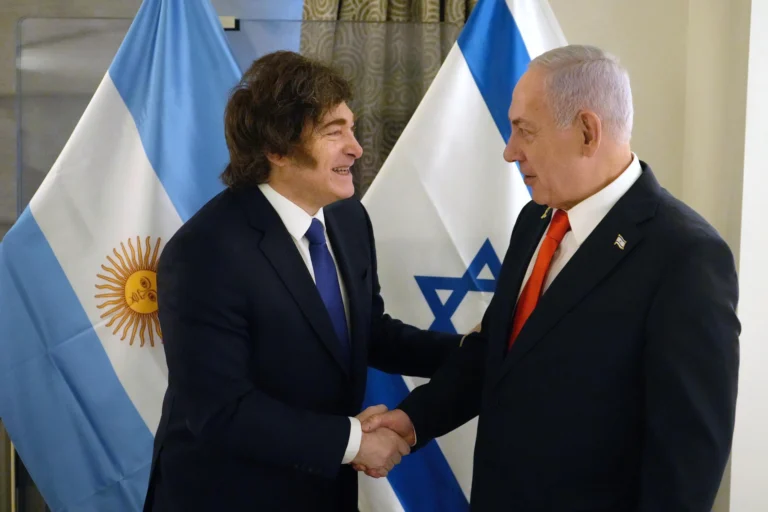
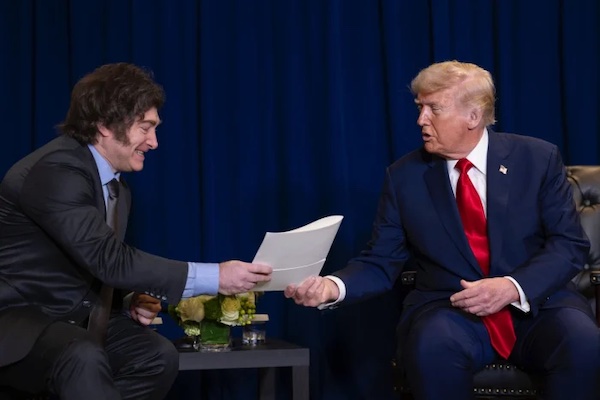
Argentina, its president, Javier Milei (L), shakes hands with Israeli Prime Minister Benjamin Netanyahu this Thursday within the framework of the UN General Assembly in New York (USA). Photo: EFE/ Presidencia de Argentina

September 28, 2025 Hour: 8:01 pm

Argentina’s Network of Intellectuals and Artists in Defense of Humanity (REDH) strongly condemned the recent meeting between Argentine President Javier Milei and Israeli Prime Minister Benjamin Netanyahu, held in New York on the sidelines of the United Nations General Assembly.

The group unequivocally labeled Netanyahu as a “genocidal war criminal” responsible for the ongoing devastating offensive in Gaza and the West Bank that has caused the deaths of more than 65,000 Palestinians.

REDH criticized Milei’s warm gestures toward Netanyahu—including “affectionate greetings, smiles, and official photographs”—as a public affront and a dishonor to Argentina’s historical legacy of human rights defense. The organization emphasized that this encounter represents a symbolic endorsement of the ongoing genocide inflicted upon the Palestinian people.


Furthermore, REDH highlighted the recent U.S. veto of a United Nations Security Council resolution calling for a ceasefire, condemning it as a blatant disregard for multilateralism and international law at a time when the global community demands stronger action against the Israeli government’s aggressive policies.

Argentina, aligning itself with the United States and Israel, voted against a peace proposal in the UN General Assembly that aimed to lay the groundwork for a sovereign Palestinian state and the deployment of a stabilization mission in Gaza. This decision has sparked widespread criticism within Argentina, where analysts and former officials decry it as a historic reversal in the country’s foreign policy.

Former ambassador to the UN María Cristina Perceval labeled the episode as “shameful” and a clear demonstration of “servile dependence” on Washington’s allies, isolating Argentina from the international majority’s push for a just and peaceful solution to the Palestinian-Israeli conflict.

This troubling alignment with the Israeli government and its U.S. backers underlines a worrying shift in Argentina’s traditional posture of solidarity with oppressed peoples, raising concerns about the country’s true commitment to human rights and international justice in this critical moment.
[img]
Argentina, its president, Javier Milei (L), shakes hands with Israeli Prime Minister Benjamin Netanyahu this Thursday within the framework of the UN General Assembly in New York (USA). Photo: EFE/ Presidencia de Argentina

September 28, 2025 Hour: 8:01 pm

Argentina’s Network of Intellectuals and Artists in Defense of Humanity (REDH) strongly condemned the recent meeting between Argentine President Javier Milei and Israeli Prime Minister Benjamin Netanyahu, held in New York on the sidelines of the United Nations General Assembly.

The group unequivocally labeled Netanyahu as a “genocidal war criminal” responsible for the ongoing devastating offensive in Gaza and the West Bank that has caused the deaths of more than 65,000 Palestinians.

REDH criticized Milei’s warm gestures toward Netanyahu—including “affectionate greetings, smiles, and official photographs”—as a public affront and a dishonor to Argentina’s historical legacy of human rights defense. The organization emphasized that this encounter represents a symbolic endorsement of the ongoing genocide inflicted upon the Palestinian people.


Furthermore, REDH highlighted the recent U.S. veto of a United Nations Security Council resolution calling for a ceasefire, condemning it as a blatant disregard for multilateralism and international law at a time when the global community demands stronger action against the Israeli government’s aggressive policies.

Argentina, aligning itself with the United States and Israel, voted against a peace proposal in the UN General Assembly that aimed to lay the groundwork for a sovereign Palestinian state and the deployment of a stabilization mission in Gaza. This decision has sparked widespread criticism within Argentina, where analysts and former officials decry it as a historic reversal in the country’s foreign policy.

Former ambassador to the UN María Cristina Perceval labeled the episode as “shameful” and a clear demonstration of “servile dependence” on Washington’s allies, isolating Argentina from the international majority’s push for a just and peaceful solution to the Palestinian-Israeli conflict.

This troubling alignment with the Israeli government and its U.S. backers underlines a worrying shift in Argentina’s traditional posture of solidarity with oppressed peoples, raising concerns about the country’s true commitment to human rights and international justice in this critical moment.

https://www.telesurenglish.net/argentin ... netanyahu/
"There is great chaos under heaven; the situation is excellent."

User avatar
blindpig
Posts: 14788
Joined: Fri Jul 14, 2017 5:44 pm
Location: Turtle Island
Contact:

Re: South America

Post by blindpig » Wed Oct 08, 2025 2:34 pm

When Argentina is a warning
Gustavo Ng

7 Oct 2025 , 1:41 pm .

Image
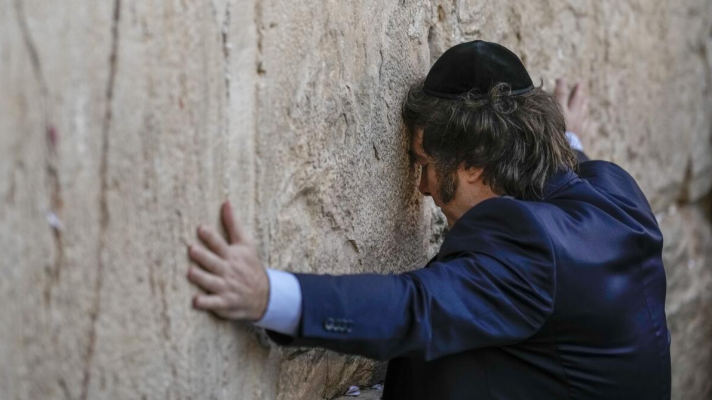
Argentine President Javier Milei prays at the Wailing Wall in Jerusalem's Old City, February 6, 2024. (Photo: Leo Correa/AP Photo)

In an international complex disrupted by forces that destroy any attempt at organization that benefits the people, the Argentine president is playing the pitiful role of aligning his country with violence, supremacism, and delirium. Argentina is the third-largest country in Latin America—the area the United States is vigorously attempting to enslave as its "backyard"—has enormous reserves of natural resources, and is the eighth-largest country in the world by territory, located in a strategic region: the South Atlantic.

Argentina's self-proclamation as a vassal of globalist neo-fascism is shattering its society and posing a danger to other countries. This is what media and analysts in Europe, the United States, and Asia are warning about. We present a sample of these alarms.

Laissez-nous faire
"Mr. Milei promised a war on bureaucrats, brutal cuts in public spending, and a radical deregulation of South America's second-largest economy. Unsurprisingly, the result has been devastating: a recession plunged more than half the country into poverty in the first six months of 2024." This is part of an editorial in the British newspaper The Guardian , dated January 12 of this year.

It doesn't end there. He also explains that Milei's policies "have caused significant suffering with few visible benefits. Consumer prices rose 160% in his first year in office, roughly the same increase recorded during the last year of the previous government. Rather than representing a break with the past, Mr. Milei's agenda evokes those of previous right-wing administrations, members of which now serve in his cabinet."

The paper quotes economic historian Michael A. Bernstein, who noted that "laissez-faire" often means "laissez-nous faire"—allowing corporate interests to operate with minimal oversight.

"Such policies," the note states, "might enrich a few in Argentina (or in Trumpian America), but for the majority, they lead to greater hardship and inequality. Mr. Milei's bet is that he can fool enough people into leaving their mess for his successor to clean up. It's a cynical and short-sighted gamble that neglects the need for meaningful reforms in Argentina."

On September 26, the New York Times published the article "Milei Promised to Fix Argentina's Economy. Then Came the New Crisis," in which Ana Ionova and Daniel Politi argue that when "Milei's painful fixes made life difficult for millions, his popularity was sustained by the hope that he would finally succeed where his predecessors had stumbled: pulling Argentina out of a chronic crisis. However, in recent weeks, Milei found himself facing such a severe economic collapse—investors had begun selling Argentina's currency, the peso, and dumping Argentine assets—that panic grew over a possible default on the country's huge international loans."

From Washington, Politico reported last week that "Milei's party was devastated in key local elections in early September, and her political movement is expected to suffer a similar beating in the legislative elections at the end of the year, as Argentines denounce a rise in poverty as a result of the austerity policies and internal corruption of Milei's government."

Shortly before, the Miami Herald spoke of a "cocktail of political and economic uncertainty" to describe how "Argentina is struggling to accumulate monetary reserves. Although inflation has slowed, economic activity is stagnant. Investments are delayed and credit is becoming more expensive. The country has massive debt obligations ahead, with no possibility for the moment of returning to international markets for financing."

Argentina, an example
On the same date, EIR News Service explains that "with just over a month until Argentina's October 26 national midterm elections, President Javier "Chainsaw" Milei and his scandal-ridden government are in a state of complete panic, as the country's financial markets and Milei's popularity have plummeted amid a deepening economic crisis, a stock market crash, and significant political defeats."

EIR 's Latin American director , Dennis Small, had already warned about the international scope of his policy: "In fact, Milei was put in office and is being widely promoted internationally with the aim of turning Argentina into a bloody example for any nation, whether in the North (like the United States) or in the Global South, that might be considering breaking out of the straitjacket of Wall Street and the City of London, as Argentina itself did during the consecutive governments of Néstor Kirchner (2003-2007) followed by the two terms of his widow Cristina Fernández de Kirchner (2007-2011 and 2011-2015)."

Following the provincial deputy elections in the province of Buenos Aires, Sandra Cohen wrote in the Brazilian media outlet G1 that "the punishment at the polls (...) seems to have immediately reflected the turbulence that has weakened the government in recent weeks: successive defeats in Parliament, pressures on the exchange rate and the leak of audio recordings linking Karina Milei, the president's main strategist, whom he calls 'Boss', to a bribery scheme for the purchase of medicines for the National Disability Agency."

The Chilean newspaper El Mercurio , far from any left or center, expressed its doubts about Milei in its September 9 editorial: "Controlling inflation has been an indisputable achievement, but it has not been accompanied so far by an improvement in the general situation. There are complaints about low wages and pensions, unemployment, uncertainty, and cuts in public spending. Meanwhile, Milei's confrontational style has made it difficult for him to deal not only with the opposition, but also with allies who have voted in favor of his reforms, and with provincial governors, who have significant power over parliamentarians."

President Gabriel Boric himself, in the speech following the tribute to the late Pepe Mujica, pointed out : "Look how the president of Argentina today treats those who oppose him. He calls them 'the kukas, the kukas.' Cockroaches. I'm not a Peronist, but regardless of where you are from, calling your adversary a cockroach... What do you do with cockroaches? You squash them, and words build realities."

The editorial of the British newspaper The Guardian , published on April 30, 2025, spoke of the authoritarian tactics that Milei has used, including suppression of the right to protest and attacks on press freedom, "to impose shock therapy. The plan has been to impose austerity, trigger inflation and worsen poverty, and then declare victory when the fall in prices reduces poverty indicators."

"Economic rationality is politically toxic to President Milei's libertarian creed. Austerity is not buying time for industrialization. It is locking Argentina into a capital-friendly resource-exporting model aligned with US interests. This favors the agro-exporting bloc that supports President Milei. Always the sick woman of South America, Argentina remains trapped in the export of cheap commodities instead of building a value-added industry. President Milei sees the true cure—state-supported sustainable development—as worse than the disease. By pursuing ideological purity and Trump's favor, he deepens Argentina's chronic instability and drags down the IMF's global credibility with it," he concludes.

Along the same lines, Consuelo Thiers, a professor of international relations at the University of Edinburgh, warned in The Loop that "Argentina today serves as a cautionary tale. The country shows what happens when ideology, personal loyalty, and political spectacle replace experience, process, and diplomacy. Argentina's foreign relations are in a state of paralysis; its professionals are sidelined, its direction unclear, and its credibility diminished."

A climate of political violence
In the article "Milei's Government Under the Microscope in Argentina" from August 29, Maricel Drazer consulted with various German analysts for the Deutsche Welle news agency about Milei's administration.

Michael Álvarez Kalverkamp, ​​representative for Argentina, Uruguay, and Paraguay of the Heinrich Böll Foundation, affiliated with the German Green Party, describes the atmosphere in Argentina as "tense and worrying." He recalls that the phrase "We don't hate journalists enough" was posted from Milei's own account and maintains that "this generates a climate of political violence from those in power rarely seen in Argentina since the return of democracy."

Torge Löding, the Rosa Luxemburg Foundation's representative in the Southern Cone, assesses that "there is a lot of uncertainty and social tension" and adds that the accusations against Milei and her entourage "are serious because they expose the contradiction between the official rhetoric of 'ending the caste' and the reality of a government surrounded by shady dealings."

Löding asserts that "what predominates is violence exerted from above: layoffs, hunger, austerity measures, repression of protests, and persecution of social movements. It is a structural violence driven by the state to guarantee austerity and discipline society."

Klaus Georg Binder, the representative for Argentina of the Hanns Seidel Foundation, laments that "Milei frequently insults journalists and the media, labels them part of a corrupt 'caste,' and systematically discredits critical reporting." Binder adds that in this context, "there is a constant background noise of defamatory and threatening digital campaigns."

Svenja Blanke, the Friedrich Ebert Foundation's representative in Argentina, emphasizes "a violent narrative on the part of the government" as well as "repressive measures in relation to street demonstrations."

Spain's El País writes in its September 27 edition: "Beyond the immediate oxygen, the operation reinforces Argentina's dependence on a single external ally and, worse still, ties its fate to the volatility of US politics. Trump's enthusiastic blessing of Milei's hypothetical 'reelection' more than two years before the presidential elections should set off democratic alarm bells."

The Qatari website Al Jazeera reports on Italy and Argentina, stating that "in both countries, there is an appetite for a populist agenda and a restructuring of the system. The supposedly populist leaders of these countries, however, instead of focusing on addressing these urgent problems, seem obsessed with countering hypothetical threats from Russia and China. They are waging war against the specter of communism while their people are suffocating under the weight of unbridled capitalism."

From the other side of the world, China Daily breaks the unwavering moderation of Eastern journalism to assert that "Argentine President Javier Milei's alignment with the Global North and rejection of BRICS membership further isolate Argentina from the cooperative frameworks that drive innovation and development in the Global South. At the local level, the deep fiscal adjustment has cut subsidies and deregulated basic services, leading to steep increases in the prices of transportation, energy, and essential goods." These measures, "along with missed opportunities like the BRICS, deepen inequality and harm long-term stability."

Rishi Sunak, Javier Milei and Donald Trump
No sooner had Milei taken office than George Monbiot wrote in the British newspaper The Guardian : "Milei is attempting, with a vast 'emergency' decree and a giant reform bill , to achieve what the Conservatives have done in the UK for 45 years. The emergency programme bears striking similarities to Liz Truss's 'mini' (or maxi) budget, which wrecked the prospects of many lower and middle-class people and exacerbated the turmoil that now dominates public life."

Monbiot explains that this is no coincidence: " Milei's program was heavily influenced by Argentine neoliberal think tanks belonging to the so-called Atlas Network , a global coordinating body that promotes, by and large, the same political and economic package wherever it operates. It was founded in 1981 by a British citizen, Antony Fisher. Fisher was also the founder of the Institute of Economic Affairs (IEA), one of the first members of the Atlas Network."

He goes on to argue that "we could describe certain policies as those of Milei, Bolsonaro, Truss, Johnson, or Sunak, but they are all variations on the same themes, conceived and perfected by lobbyists belonging to the same network. These presidents and prime ministers are just the faces presented by the program."

The paper reveals that " the Atlas Network itself and many of its members have received money from financing networks created by the Koch brothers and other right-wing billionaires, as well as from oil , coal , tobacco companies , and other vested interests."

He explains that lobbyists "fight on behalf of their donors in the class war waged by the rich against the poor . When a government responds to the network's demands, it is actually responding to the money that funds it." He also asserts that "black money repositories and the Atlas Network are a highly effective means of concealing and accumulating power. They are the channel through which billionaires and corporations influence politics without revealing their intentions, learn the most effective policies and tactics to overcome resistance to their agenda, and then disseminate them worldwide. This is how nominal democracies become new aristocracies ." The note ends with Argentina, "where Milei has filled the vacuum left by the gross mismanagement of his predecessors and is able to impose, in the purest style of the shock doctrine , policies that would otherwise encounter fierce resistance, the poor and middle classes are about to pay a terrible price. How do we know? Because very similar programs have been imposed in other countries, starting with Chile, its neighbor, after the coup d'état by Augusto Pinochet in 1973. "

https://misionverdad.com/opinion/cuando ... dvertencia

Google Translator

*****

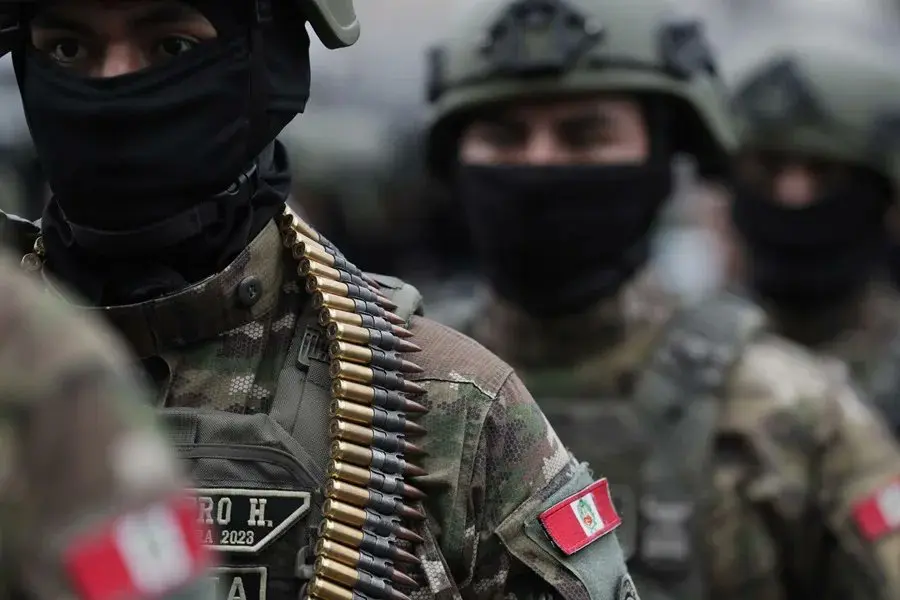
Organized Crime Becomes a Daily Reality in Peru, New Report Warns

A human rights report in Peru warns that organized crime has been normalized nationwide and calls for structural reforms to rebuild security institutions and protect democracy.

Image
Peru’s National Coordinator for Human Rights warns that organized crime and insecurity have become part of daily life, urging structural reforms and a new social pact to restore safety and democracy. Photo: @EFEnoticias

October 8, 2025 Hour: 1:45 am

Organized crime and public insecurity have become normalized in Peru’s daily life, posing serious threats to governance, democracy, and human rights, according to a new report released Tuesday in Lima. The study calls for structural reforms and a national social pact to confront what it describes as a deepening security and institutional crisis.


The report, titled “Peru: Citizen Security and Human Rights,” was prepared by the National Coordinator for Human Rights (CNDH). It warns that “the absence of citizen security endangers individuals, society, the State itself, and the future of the democratic regime in a complex world undergoing a political and cultural realignment adverse to inclusive policies.”

Researcher Ricardo Soberón, the study’s author, said the document responds to “the profound deterioration of all citizen security indicators in the country,” and to a legislative trend in which “Congress has approved numerous laws and reforms that weaken the State and deepen attractive illegal economies.”


The launch included voices from Generation Z activists, transport workers—among the groups most affected by extortion—and security and human rights experts, all describing how violence has become embedded in everyday life.

“We are not talking about an isolated incident. We are talking about a situation that affects everyone in our country and that has unfortunately been growing,” said lawyer Germán Vargas, noting that the report’s recommendations should be seriously considered ahead of the April 2026 elections.

Soberón framed the crisis within a wider political struggle: “We are doing things wrong. We are in a more difficult world, and the debate is political—between applying the ‘iron fist’ or the guarantee-based approach. We reveal in the report that the iron fist does not solve any problem; it worsens it, and that a well-designed guarantee-based approach can help address those segments of organized crime that concern us.”

Image

The study calls for a broad interinstitutional and social pact, noting that illegal economies such as informal gold mining and cocaine production employ about one million Peruvians and have penetrated public institutions.

“The only possibility is to separate the social base from criminal leaderships—to offer this million Peruvians a civic pact in exchange for basic State services while forcefully targeting the criminal elites,” Soberón explained.

The report estimates that around 200 organized crime groups operate across Peru and urges the government to strengthen Flagrancy Units, specialized courts, and financial intelligence agencies to effectively dismantle them.

The document outlines a roadmap for reform across key state institutions—the National Police, Public Ministry, Judiciary, and National Penitentiary Institute (INPE)—with proposals for short-, medium-, and long-term action to achieve sustainable security outcomes.

It also calls for a redefinition of the State’s criminal policy, including a review and possible repeal of multiple anti-crime laws passed in recent years, which the report argues have failed to reduce violence or strengthen institutions.

Addressing Peru’s prison crisis, the study recommends measured release programs, transfers between facilities, home detention with electronic monitoring, and the construction of at least five new prisons to relieve overcrowding.

“What is very clear to me is that citizen security and the protection of human rights are founding principles. They are non-negotiable and, rather, the guarantee for working effectively against organized crime,” Soberón concluded.

https://www.telesurenglish.net/organize ... ort-warns/

Government of Ecuador denounces assassination attempt against Noboa

Image
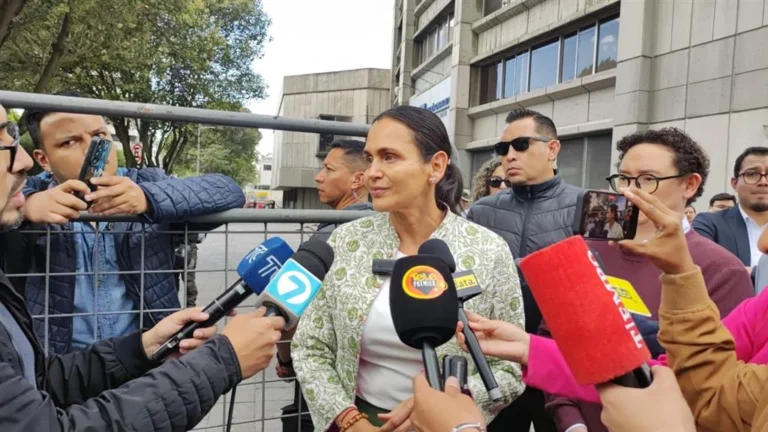
Inés Manzano, Ecuador’s Minister of Environment and Energy, before the Attorney General’s Office to file a complaint for attempted assassination of the president, Daniel Noboa. Photo. Prensa Latina

October 7, 2025 Hour: 7:56 pm

Ecuador’s Minister of Environment and Energy, Inés Manzano, filed a complaint with the State Attorney General’s Office for attempted assassination of President Daniel Noboa during a demonstration rejecting his presence in the province of Cañar.

In statements to the press from outside the Prosecutor’s Office, in Quito, the official said that it is “a complaint for attempted assassination of the president of the Republic in the canton of Tambo, when he was preparing to hold an event (…) which is the wastewater treatment and sewerage plant.”

According to Manzano, when the president approached the place where the event would take place, “500 people appeared and threw stones at him and there are signs of bullets in the president’s car.”

The minister indicated that the president is well and continued his agenda in that territory of the Ecuadorian southern highlands. In addition, he confirmed the arrest of five people, who will be prosecuted for the alleged crime of terrorism.

The events took place on the 16th day of the protests promoted by the indigenous movement against economic measures of the Noboa government, mainly due to the rise in diesel prices after the elimination of the subsidy.


For its part, the Confederation of Indigenous Nationalities of Ecuador (Conaie) criticized the repression of demonstrators in the province of Cañar, where the president, Daniel Noboa, arrived, who were mobilizing in rejection of Noboa’s presence.

The organization stated that “the militarization of the territory seeks to intimidate social protest.” “We denounce that at least five colleagues have been arbitrarily detained. Among those attacked are elderly women,” said Conaie.


After what happened, the Ecuadorian Presidency said on its account X that the demonstrators obeyed radicalization orders and attacked a presidential motorcade in which civilians were traveling to prevent “by force, the delivery of a work aimed at improving the life of a community.”

Ecuador is on the sixteenth day of the strike called by Conaie, which demands that the government return the diesel subsidy, reduce the Value Added Tax (VAT) to 12 percent, state attention to health, education and security, and release detainees.

https://www.telesurenglish.net/governme ... nst-noboa/
"There is great chaos under heaven; the situation is excellent."

User avatar
blindpig
Posts: 14788
Joined: Fri Jul 14, 2017 5:44 pm
Location: Turtle Island
Contact:

Re: South America

Post by blindpig » Fri Oct 10, 2025 2:20 pm

Dina Boluarte Ousted from Peruvian Presidency by Unanimous Congressional Vote

Image
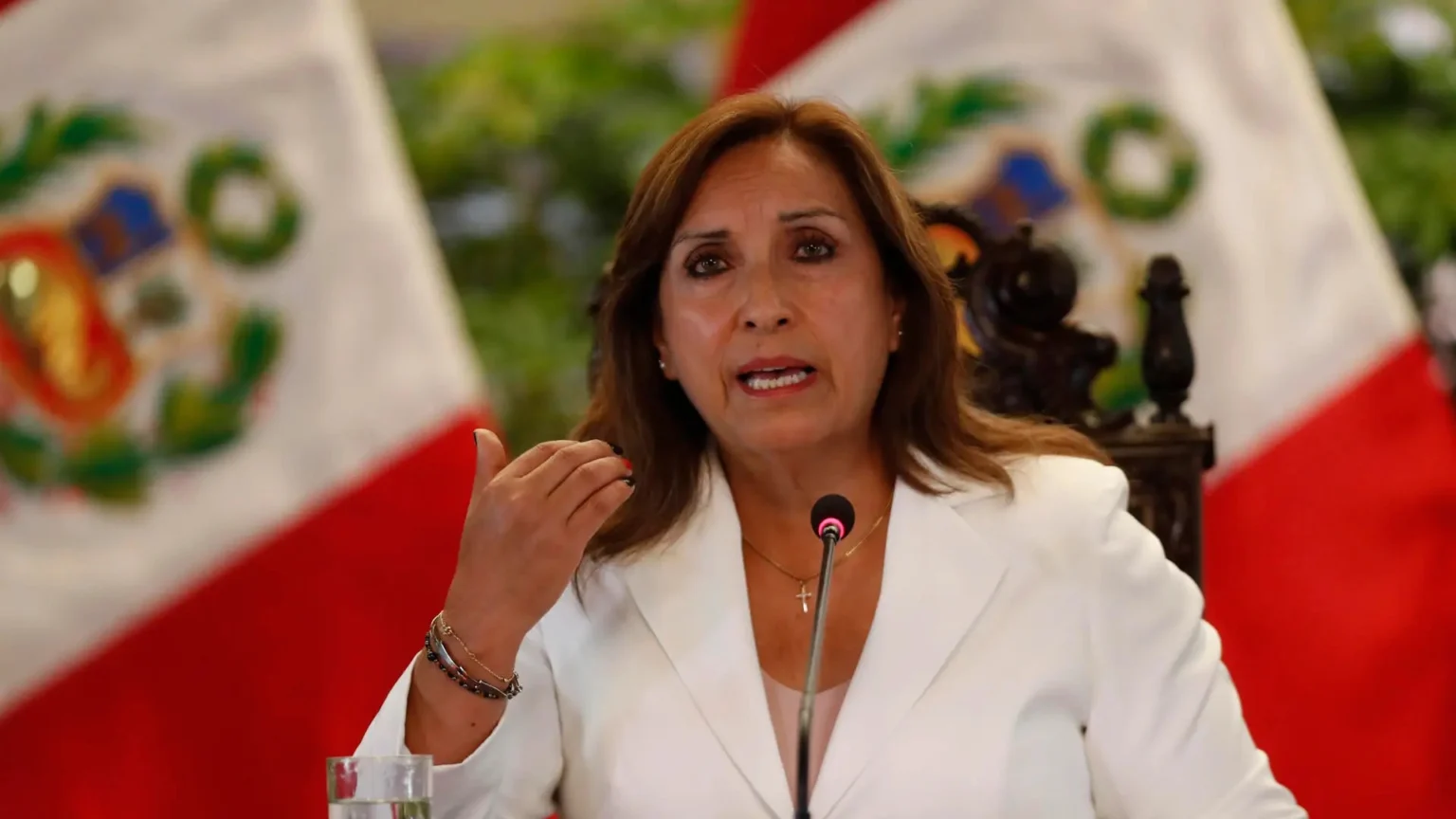
(FILE) Dina Boluarte was removed from presidency. Photo: EFE.

October 10, 2025 Hour: 1:43 am

Peru’s Dina Boluarte was removed on Friday from the presidency following the unanimous approval of a vacancy motion in Congress amid the ongoing crisis under her administration. The country now enters a transition process as general elections approach in April 2026.

“The session is adjourned, and the assumption of the office of President of the Republic by the President of Congress is called immediately,” stated Congress President José Jerí right after the approval of the motion. However, if a censure of the board of directors is approved, another interim president could be selected.

Boluarte, along with her lawyer, failed to appear before the Congress of the Republic, which had summoned her to an 11:30 p.m. local hearing to exercise her right to defend herself regarding the five approved discussions on vacancy motions amid the ongoing crisis under her administration.

“Since President Dina Boluarte Zegarra has been summoned and has not appeared before the Congress of the Republic, the vacancy procedure will continue,” Jerí announced due to her absence.

The debate lasted two hours, allocated proportionally among parliamentary groups, with no interruptions or additional time.

Non-affiliated Congress members had one minute each to speak, without interruptions, extra time, or breaks between speakers.

https://www.telesurenglish.net/dina-bol ... onal-vote/

Ecuadorian Government Freezes Bank Accounts of Two Environmental Groups

Image
Ecuadorian military unblock a highway in the midst of the national strike, Oct. 2025. X/ @Expresoec

October 10, 2025 Hour: 9:36 am

Critics accuse the Noboa administration of using anti-crime law to silence social organizations.
On Thursday, the administration of President Daniel Noboa froze the bank accounts of two well-known social organizations recognized for defending human rights and protecting the environment in the Amazon region.

Taken amid the national strike called by the Confederation of Indigenous Nationalities of Ecuador (CONAIE), the decision affects Alianza Ceibo, a foundation made up of Indigenous Ai Kofan, Siona, Siekopai, and Waorani peoples.

“For 10 years, we have maintained a firm commitment to defending our territories and our identity, with dedication and transparency. We have always acted publicly, grounded in the law and demanding our rights, facing the threats imposed by extractivism, various forms of violence, racism, and now state authoritarianism,” Alianza Ceibo stated.

“Our funding comes from international cooperation, and we have continuously reported on these resources to the corresponding institutions, to donors, to the foundation’s partners, and to the communities and peoples,” the organization added.

The Noboa administration froze the bank accounts under a law recently approved by its parliamentary bloc. This law is intended to control illicit activities in the context of the “Internal War” against criminal gangs linked to drug trafficking. Citizens, however, have denounced that the new law is actually aimed at controlling dissenting social organizations.


The text reads, “What is happening in the Ecuadorian Amazon? Communities continue to resist pollution and abandonment. In this new chapter, learn how gas flares directly impact the health of Amazonian families and how their fight has reached the courts. Watch the full new video on YouTube by searching ‘Violation of Human Rights and the Rights of Nature: the Mecheros case.'”

The freeze also affects the Union of People Affected by Texaco (UDAPT), an organization that brings together communities that have suffered the consequences of pollution left by the U.S. oil company in the northern Amazon, which has yet to be remediated.

“For 32 years, we have defended the rights of more than 30,000 people affected by Chevron’s operations,” UDAPT said, recalling that the Noboa administration had announced its intention to pay the foreign oil company at least US$800 million as part of a legal case.

“We have defended the rights of hundreds of cancer patients abandoned by the Ecuadorian state. We defend Indigenous and rural communities who are victims of hundreds of oil spills. We have a long record of defending the rights of the most vulnerable peoples and of nature,” the organization emphasized.

“We have always complied with all tax and legal rules within Ecuador’s judicial system. They will never find a single cent from illicit sources,” UDAPT stressed.

Community media outlet Wambra reported that the account freezes were carried out without prior notification and noted that authorities have provided no explanation for the action.

“This is happening in the context of the national strike and ongoing harassment by the Noboa administration against social organizations and human rights defenders. The government has frozen the accounts of more than 30 organizations and individuals using a law created to target mafias. However, it is using it against social leaders and their organizations,” Wambra commented.

https://www.telesurenglish.net/ecuadori ... al-groups/

*****

Things Are Getting Seriously Surreal in Milei’s Argentina
Posted on October 10, 2025 by Nick Corbishley

Javier Milei, the world’s first self-described anarcho-capitalist head of government, is reaching the halfway point of his four-year presidential term, and things are getting decidedly weird…

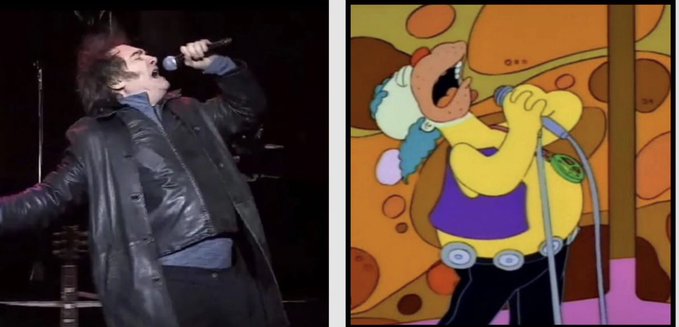
The pinnacle of cringe is Milei larping as a rockster in a huge concert paid with state money to launch his book celebrating his 'economic miracle' while the peso implodes, the government is bankrupt, bonds are collapsing & his finance minister is in the US begging for a bailout

Milei went through almost a dozen rock songs at Buenos Aires’ Movistar Arena, including Demoliendo Hoteles, by Charly García; Rock del Gato, by Ratones Paranoicos; and Blues del Equipaje, by Mississipi, before repudiating a recent anti-Semitic attack on a woman and her son in Buenos Aires. He then performed a rendition of the Hava Nagila, a Jewish folk song that Argentina’s Zionist president said particularly “bothers the left”.

Milei has maintained his displays of unabashed support for Israel even as the Jewish State has intensified its genocidal campaign in Gaza and expanded its conflicts in the Middle East. The expressions on the faces of the largely Milei-friendly La Nación+ presenters as Milei sings his way through the Hava Nagila speak a thousand words: (Video at link.)

Here is one of the best memes from the night:

Image

Argentina, like so many parts of the so-called Western order, is living through a new age of stupidity. And as the German pastor Dietrich Bonhoeffer warned before being executed by the Nazis in 1945, “stupidity is a more dangerous enemy of the good than malice”:

One may protest against evil; it can be exposed and, if need be, prevented by use of force. Evil always carries within itself the germ of its own subversion in that it leaves behind in human beings at least a sense of unease. Against stupidity we are defenceless. Neither protests nor the use of force accomplish anything here; reasons fall on deaf ears; facts that contradict one’s prejudgment simply need not be believed — in such moments the stupid person even becomes critical — and when facts are irrefutable they are just pushed aside as inconsequential, as incidental. In all this the stupid person, in contrast to the malicious one, is utterly self-satisfied and, being easily irritated, becomes dangerous by going on the attack.

Milei’s concert, intended as a celebration of the launch of his new book, “La construcción del milagro” (The Building of the Miracle), was at least partly state funded. It is also rumoured to have received financing from the Kovalivker family, which owns the company, Droguería Suizo Argentina, that was implicated in a recent kickbacks scandal involving Milei’s sister, Karina.

The official launch of “The Building of the Miracle” took place against a backdrop of worsening economic and financial crisis. On average, 28 companies have folded each day of Milei’s 22-month presidency. Now another recession looms as global investment banks and multilateral lenders, including the World Bank, scurry to cut their rose-tinted growth projections for this year.

The peso continues to dive while Argentina’s country risk premium, measured by JP Morgan, has climbed above 1,260. Brazil’s is at 187. The Central Bank of the Argentine Republic is still intervening daily in the currency markets to prop up the peso, burning through $1.5 billion in the previous six sessions. Short-term interest rates have also hit record highs of 80%, indicating a liquidity squeeze.

This is all despite US Treasury Secretary Scott Bessent’s pledge a couple of weeks ago to do whatever is needed to save the Argentine economy and currency. If he was hoping his words would have a Draghi-like effect on the markets, he must be bitterly disappointed.

Putting the “Narco” in Anarcho-capitalism (h/t Saifedean Ammous)

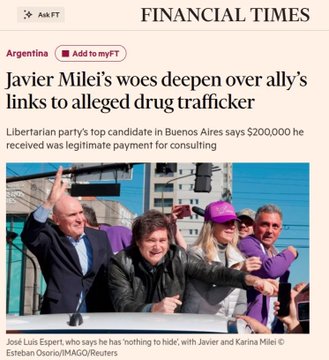
The concert also came just a couple of days after another major political scandal involving Milei’s party, La Libertad Avanza. The party’s top candidate for the all-important province of Buenos Aires in the upcoming mid-terms, José Luis Espert, had to pull out of the race over his ties (no need for the world “alleged”) to Federico “Fred” Machado, an Argentine businessman who is under arrest and facing extradition to the US on charges of cocaine trafficking.

After weeks of denial, Espert finally admitted at the weekend that he had received $200,000 from Fred Machado in 2019. Machado has also claimed that he helped finance Espert’s 2019 presidential campaign. At that time, Espert was like a mentor to Milei, who was just starting out on his political career, and allegations were already swirling about Espert’s ties to Machado, including from the libertarian journalist Nicolás Moras.

Milei spent the whole of last week defending Espert even as local media published more and more damning details of his links to Machado. After his former mentor finally admitted his guilt and announced his withdrawal from the race, Milei even shared a tweet proposing that Espert, a man who had just admitted taking money from an alleged drug trafficker, be made minister of security after the elections.

So, in sum, the Trump administration is preparing a potentially open-ended bailout (because that is what it will probably end up being) to a government that was already bailed out by the IMF, the World Bank and the InterAmerican Development Bank just six months ago. And that government, just like Ecuador’s US-aligned Noboa administration, has proven ties to drug traffickers.

Meanwhile, the US is vaporising boats in the Caribbean Sea that it claims are carrying drugs without presenting a single shred of evidence. It is also escalating its threats against Venezuela, even warning of strikes against land targets.

Image

Growing Opposition to US Treasury-Led Bailout

The proposed US Treasury-led bailout is getting more and more complex as opposition builds in both the US and Argentina, Infobae reported on Tuesday (machine translated):

Until last night in Washington, the financial bailout promised by Donald Trump to Javier Milei would take the following form:

A USD 20 billion swap-line made up, mostly, of Special Drawing Rights (SDRs) that the IMF delivered to the United States Treasury Secretariat.
Bond purchases during October to stabilize the markets and lower the country’s risk premium.
But this financial engineering of the bailout would face certain technical constraints:

Who buys the SDRs of the United States in exchange for dollars?
Once the Ministry of the Treasury sends the Central Bank of the Argentine Republic those USD 20 billion for the purchase of the bonds, how does the monetary authority transfer them to the Ministry of Economy?
These technical constraints appear to have one possible solution. The United States’ SDRs could be bought by the Federal Reserve (FED), and Caputo could access the USD 20 billion deposited in the Central Bank through a Non-Transferable Bill.

On Thursday, Bessent confirmed the provision of the $20 billion swap-line as well as the US Treasury’s direct purchase of Argentina pesos, arguing that “the success of Argentina’s reform agenda is of systemic importance,” and that “a strong, stable Argentina which helps anchor a prosperous Western Hemisphere is in the strategic interest of the United States. Their success should be a bipartisan priority.” So far, the impact of the intervention has been muted.

Meanwhile, opposition to the proposed bailout is growing in the legislative chambers of both countries. US soybean farmers — a key voting bloc for Trump — are also incensed that the White House is bailing out one of their chief rivals for the all-essential Chinese export market as they themselves lose access to that market as a result of Beijing’s retaliatory measures against Trump’s tariffs. Argentina’s farmers have jumped at the chance to fill the void.

Now, the Trump administration is looking to bail out the Argentine government — for its own benefit of course, which we covered in some detail in our post, Washington’s Debt Trap Diplomacy and Election Meddling in Argentina.

There could be an even darker reason we didn’t mention in that article — namely that Bessent is essentially bailing out Argentina in order to bail out Rob Citrone, a billionaire hedge-fund manager friend of his who invested heavily in Argentine assets, believing Milei would turn the economy around. Citrone worked alongside Bessent as an investment manager at Soros Fund Management. Another potential beneficiary mentioned by the NYT is Stanley Druckenmiller.

This is all par for the course, of course. Almost all of the spoils of Argentina’s increasingly frequent sovereign bailouts end up going to financial speculators — or as the FT calls them, “wily currency traders”. The only difference this time is that the US Treasury is now run by one:

Individual traders snapped up $9.5bn from Argentina’s central bank from April to August in order to sell them for more pesos on a parallel exchange market, according to a report by Buenos Aires’ publicly owned Banco Provincia, cited by local brokerage One618.

The purchases, equivalent to roughly half of the agricultural export dollars from Argentina’s harvest season, made it harder for the monetary authority to buy dollars to rebuild its scarce hard currency reserves without weakening the peso, which Milei was keen to avoid.

“In Argentina, anyone who understands the tricks of the market can make profits that don’t exist in other parts of the world, at the expense of draining the central bank,” said Salvador Vitelli, head of research at local financial consultancy Romano Group.

The IMF’s Much-Ignored Role

What the FT doesn’t mention is the role the IMF keeps playing in facilitating the capital flight that inevitably follows. After the Milei government’s easing of capital controls in April, as part of the bailout agreement reached with the IMF, $5.3 billion of foreign exchange currency left the country in just six weeks. That was the equivalent of 44% of the IMF’s first $12 billion disbursement of funds.

That money gets added to Argentina’s already unpayable debt load even though it does nothing to benefit the country. The exact same thing happened in 2018.

This is why bailing out Argentina is such a high risk move: much, if not all, of the money will be used for financial speculation, and it will promptly leave the country. Given the cloud of controversy surrounding the proposed rescue package, the Trump administration and the Milei government are trying to come up with a joint strategy for preventing opposition parties in their respective parliaments from blocking it. From Infobae:

The U.S. Congress would not have explicit powers to block the bailout of Argentina, but the Democratic caucus in the Senate is exploring legal precedents aimed at breaking the agreement negotiated by Caputo and Bessent.

In any case, by the Mexican Debt Disclosure Act approved in 1995, Trump and Bessent must report to Capitol Hill on the financial bailout for Argentina.

It’s also worth keeping in mind the respective backgrounds of the two chief negotiators of the bailout: US Treasury Secretary Scott Bessent, a former hedge fund manager who is more used to demolishing currencies than saving them; and Argentina’s Economy Minister Luis Caputo, a former JPM Chase banker who already drove Argentina into default once before, in 2018. If consummated, this will be the third bailout for the Argentine economy under his tutelage.

As Washington mobilises all this money to keep its most important client state in South America afloat, there is one obvious precondition: Milei’s party must achieve a strong enough showing in the upcoming mid-terms by expanding his tiny share of seats in congress and demonstrating enough popular support to win over potential allies in the centrist opposition. Only that way will he be able to continue governing by veto and decree. From Bloomberg:

For now, the most popular base case scenario is that the government gets between 34% and 37% of the vote in the next election, Barclays economist Ivan Stambulsky said in a report to investors last week. Under these circumstances, it is expected that Milei will be able to continue governing by veto and decree.

That is looking increasingly unlikely. Milei’s approval ratings are dropping like a stone. According to a poll published on Sunday by Zuban Córdoba, 65% of the population now disapprove of the president’s leadership — no great surprise given the state of the economy and the proliferation of political scandals, many directly involving Milei and his inner circle.

Milei is unrepentant on the economy, blaming instead the “orcs” in opposition for all the problems. As I say, things are getting seriously surreal. From Politica Argentina:

“The economy was recovering until the orcs began to break everything,” the president said, pointing to opposition sectors. “There is still a long way to go, but we are going in the right direction. We are halfway there. Let’s make the effort worthwhile. They left us a minefield full of bombs. Fixing that is not easy. It involves sacrifice and pain.”

Milei accused the opposition of trying to “torpedo” the economic course since the beginning of the year: “Since February, March they have been torpedoing all the time and that generates a situation where the markets today are not working in the way they should normally do.”

The head of state asked for confidence in his political project and assured that “Argentines are going to vote for hope and they will not want to return to the past.” He also proposed a growth horizon: “If we continue on this path, in 10 years we will be like Spain, in 20 years like Germany, in 30 like the United States and in 40 we will be among the top three countries with the highest incomes.”

In other words, the government needs just one more bailout and then the “miracle” can continue. The delusional thinking is on such a scale that it is reminiscent of Robin Williams’ roasting of Wall Street’s liquidity-hooked bankers in the wake the subprime crisis.


“The Ship Is Leaking”

After spending much of the past 22 months lauding Milei’s economic experiment, which is nothing more than an extreme version of neoliberalism, the international financial press finally appear to be losing faith. Spain’s El Economista, until recently one of Milei’s biggest cheerleaders, has admitted that Milei’s economic “miracle” is floundering.

The Financial Times has published a piece by Ciara Nugent warning that “Argentines are losing patience with the economy” after nearly two years of fiscal adjustment and growing social unrest over the effects of the austerity plan and the non-stop corruption scandals splattering the Milei government. It does not paint a pretty picture of the on-the-ground economic reality:

La Plata business owners said their clients were running low on cash. “People have been paying for bread with credit cards,” said Pablo Miró, who runs a bakery. “Inflation has come down, but I’m seeing more inequality.”

Belén Aguilar said she was closing her chocolate shop, which opened in 2022, because of falling consumer demand. “Sales fell about 50 per cent this year,” she said. “It’s no longer sustainable to keep the physical store.”

Economists say Milei’s singular focus on lowering inflation, which has been the scourge of Argentina’s economy for the past decade, has weighed on activity.

On Sunday, the Wall Street Journal published a scathing op-ed by Mary Anastasia O’Grady on Milei’s economic record, titled “Time for Milei to Stop Passing the Buck”:

President Javier Milei promised to liberate Argentina from the grip of a privileged establishment he calls the “caste”—and to dollarize. The 2023 election was a referendum on both. He won. But now he’s working to rescue the peso regime…

The latest peso rout came despite assurances from the U.S. Treasury that it is prepared to negotiate a $20 billion swap line for Argentina. The U.S. also said it might buy Argentine debt and use its Exchange Stabilization Fund to provide standby credit. But on those proposals Treasury Secretary Scott Bessent was less clear. That prompted Argentine Finance Minister Luis Caputo to fly to Washington Friday. The peso has stopped sinking—for now.

The trigger for the midweek selloff seems to have been the Argentine central bank’s Tuesday decision to restrict the purchase of dollars at the official—overvalued—peso rate. That was an admission that reserves in the bank’s vault were running low. The central bank had tightened capital controls the week before. It didn’t help. Neither did the temporary suspension of export taxes for grain dealers, which generated dollar inflows but didn’t fatten the bank’s war chest because there was also lots of peso selling.

The timing of all this couldn’t be worse for Mr. Milei. In three weeks his Liberty Advances coalition faces the Oct. 26 midterm congressional elections. A weak showing could leave him with a Peronist supermajority in the new legislature. The Peronist coalition’s voting record in Congress demonstrates that given the chance, it will happily demolish the fiscal discipline that Mr. Milei has worked hard to achieve.

It’s possible that at least some U.S. aid will arrive before the midterms. But the International Monetary Fund and U.S. government want Argentina to boost its reserves. Instead the ship is leaking.

https://www.nakedcapitalism.com/2025/10 ... inale.html
"There is great chaos under heaven; the situation is excellent."

User avatar
blindpig
Posts: 14788
Joined: Fri Jul 14, 2017 5:44 pm
Location: Turtle Island
Contact:

Re: South America

Post by blindpig » Fri Oct 17, 2025 1:43 pm

Peruvian Government To Impose State Of Emergency In Lima

Image
Police violence at a protest in Peru. X/@France24_en.

October 17, 2025 Hour: 9:07 am

The measure seeks to address protests violence and will be announced in the coming hours.

On Thursday, Prime Minister Ernesto Alvarez announced that the Peruvian government is preparing to declare a state of emergency in Lima in the coming hours.

Justified as a measure to curb extortion, contract killings, and other crimes, the decision seeks to curb protests and mobilizations against Interim President Jose Jeri.

Previously, protests on Wednesday culminated in the death of 32-year-old musician Eduardo Ruiz, shot by police, in addition to 30 civilians and 80 officers being injured. The Council of Ministers assessed these events before announcing the state of emergency.

Alvarez announced that the Armed Forces will support the National Police in regaining territorial control and fundamental rights such as freedom of assembly and movement will be suspended “to combat organized crime.”


The text reads, “Protests in Argentina, protests in Ecuador, protests in the U.S., and now protests in Peru. Thousands of mostly young people are taking to the streets of Lima against the election of right-wing rapist Jose Jerí, who came to power after the coup leader Dina Boluarte was overthrown.”

The Socialist Party presented a motion of censure against President Jeri and the Congressional Board of Directors for police repression. The initiative gathered the necessary 20 signatures, but was rejected in the plenary session with 63 votes against and four abstentions.

Jeri reiterated that in a state governed by the rule of law, both protesters and law enforcement are protected, declaring that he will not resign and lamented the death of the protester, attributing the riots to a small group seeking “to create chaos.”

National Police Commander Oscar Arriola stated that Officer Luis Magallanes, the perpetrator of the shooting, is in the Police Hospital with multiple injuries, although he already has an arrest warrant.

Arriola also announced that generals directly responsible for the operations during the protest have been removed from their posts, in what he defended as an attempt to “guarantee the transparency and impartiality” of the investigations.

Eduardo Ruiz’s familiy is considering filing a murder charge against Jeri and his administration for “indirect authorship.” The Department of Protection of Citizens’ Rights reported 120 injuries, including three minors, in the protest against corruption and insecurity.

https://www.telesurenglish.net/peruvian ... y-in-lima/

******

Image

Imperial Double Standards: Warfare for Venezuela and Welfare for Argentina

Originally published: LA Progressive on October 15, 2025 by FRANCISCO DOMINGUEZ, ROGER D. HARRIS AND JOHN PERRY (more by LA Progressive) | (Posted Oct 17, 2025)


Venezuela’s Bolivarian Revolution has been in the vanguard of the Global South. In contrast, President Javiar Milei’s government in Argentina represents the logical, though absurd, consequence of extreme neoliberalism, which he calls “anarcho-capitalism.”

Western Hemispheric geopolitics reflect the weakening of U.S. hegemony and an emerging multipolarity, especially with China’s entry as a major regional trading partner. U.S. imperialism’s response, started well before Trump, has been to weaponize the dollar, impose illegal and crippling economic sanctions, and levy arbitrary tariffs. When these fail, the recourse is to military aggression.

U.S. War Secretary Pete Hegseth announced preparations for war with China. Washington has concluded that it must put a halt to multipolarity to maintain its global supremacy. Thus, the Trump administration is simultaneously rushing to rescue Milei’s government while hurrying to overturn Venezuela’s under their President Nicolás Maduro.

Role of Venezuela under Chavismo
Venezuela is a beacon of national sovereignty and social progress. It has consistently opposed imperialist aggression, not just in Latin America, but globally. Under the movement known as “Chavismo” it aimed for Latin American integration and the pooling of its huge natural resources, offering an independent pathway to development to withstand U.S. imperialism.

Consequently, it has been under attack, enduring U.S.-financed far-right violence, destabilization, a U.S.-led asphyxiating economic blockade, assassination attempts on the president and leading Bolivarian officials, mercenary attacks, coups and terrorism—the full arsenal of Washington’s aggressive toolkit.

Role of Argentina under Milei
In 2023, anti-establishment anger propelled libertarian populist Javier Milei to the Argentine presidency. His Trump-like “chainsaw plan”—radical spending cuts and a war on government institutions and services—fitted with the orthodoxy dictated by the International Monetary Fund (IMF). Milei closed 13 government ministries, including those for education, labor and social security. Foreign lenders welcomed Milei’s elevation of austerity to a moral imperative.

Milei is still favored by the IMF. But while his unwillingness to devalue the peso helped cut inflation, it slowed economic growth and reduced the country’s capacity to sustain its huge debt. Argentina is now over $450 bn in the red. Employment fell steeply, while poverty soared to affect 53% of the population in 2024 (allegedly reducing since then). Budget cuts raised the cost of basic needs.

Corruption scandals emerged. A close political associate of Milei admitted receiving “donations” from a narco-entrepreneur. A US$4.6 bn crypto scandal followed; the largest ever crypto-theft. Milei’s left opposition demanded his impeachment, and a judge launched a fraud probe. Later, Milei’s sister was accused of receiving hefty bribes. On top of this came the crushing defeat for Milei’s libertarian party in the Buenos Aires provincial elections in September.

All that has triggered a run on the peso and a new economic crisis.

Trump’s recent decision to bail out Milei’s predictably disastrous economic performance is consistent with the profligacy of IMF-US lending to right-wing Argentine governments. In April 2025, the Buenos Aires Times reported that the IMF praised Milei’s efforts and projected that the Argentine economy would grow faster than the global average. In fact, Milei tipped the country into recession and sent millions of people into poverty in the first months of his government.

In short, Milei’s “narco-capitalist” government is not only corrupt but has savaged Argentina’s economy. Milei represents the logical culmination of Argentina’s ruling class servitude to U.S. geopolitical objectives, even extending to his enthusiastic support for genocide in Gaza. Slavishly supporting anything Trump does or says, Argentina was one of only ten countries to vote with the U.S. against the UN’s two-state solution for Israel-Palestine.

IMF wages financial war against Venezuela
The IMF is a key institution through which the U.S. enforces its imperial dominance, part of an architecture shaped largely by Washington. Often functioning as a financial arm of U.S. foreign policy, it rewards compliant right-wing regimes such as those of Argentine presidents Macri and Milei, while punishing independent governments like Venezuela’s that are striving for socialism.

An example is the IMF response to the 2002 coup against Venezuela’s democratically elected President Hugo Chávez. The IMF publicly stated its readiness to collaborate with coup-monger Pedro Carmona, whose “government” abolished the constitution and key democratic institutions. Within hours after Chávez was kidnapped, the IMF’s Thomas Dawson said: “we stand ready to assist the new administration in whatever manner they find suitable.” Fortunately for democracy, the coup lasted only 47 hours. The people spontaneously rose up and returned their rightful president to his office.

More recently, during the Covid-19 crisis, IMF chief Kristalina Georgieva announced an emergency response which could disburse US$50 bn to developing countries and US$10 bn to low-income countries at a zero-interest rate. Venezuela had tried to exercise its “special drawing rights” for US$5 bn to combat the pandemic. This required IMF officials to engage in acrobatics to justify rejecting Venezuela’s request. The real reason was the U.S. government’s farcical recognition of Juan Guaidó as “interim president.”

U.S.-IMF props up rightist Argentina
In 1999-2002, when Argentina had a right-wing government, the IMF overestimated GDP growth. Then, conversely, in 2003-2015 when Argentina had left-wing governments under the Kirchners, the IMF underestimated the strength of the country’s economic recovery. IMF debt was paid off, Argentina’s notorious external debt fell sharply, no new IMF loans were granted.

But for the past decade, its politics have revolved around chronic economic crises and persistent IMF influence. Across three presidencies, Argentina swung from market liberalization (Macri, who succeeded the Kirchners), to state intervention (Fernández), to radical austerity (Milei). Right-wing Mauricio Macri acquired a US$57 bn loan, the largest in the fund’s history. The IMF itself admitted the bailout “was not fit for purpose.” The country is now on its twenty-third IMF bailout, a global record. It is the fund’s biggest debtor, owing a “staggering” $41.8 bn.

US aggression against Venezuela
The U.S. finds it intolerable that Venezuela—a “threat” of a good example—has successfully resisted U.S. policy of “maximum pressure.” Its military build-up against Venezuela is an escalation from hybrid to open warfare aimed at suppressing an alternative model of sovereignty and social justice, with the possible bonus of reclaiming control over the country’s oil resources.

Trump has deployed a fleet of warships, F-35 stealth fighter jets, and several thousand marines. Washington is positioning military forces in Puerto Rico, has a substantial military presence in Guyana, and asked Grenada to deploy U.S. military forces in its territory. Trump has declared the U.S. to be at war with drug cartels, potentially extending to those supposedly inside Venezuela itself. Commentators, including officials of the Bolivarian government, conclude that a U.S. military strike seems imminent.

Washington’s justification is a monumental lie: Venezuela is alleged to be a narco state, led by the non-existent Cartel de los Soles. Rubio and Trump falsely accuse the Bolivarian government of shipping hundreds of tons of drugs into the U.S. The United Nations Office on Drugs and Crime has consistently reported that up to 92 percent of the cocaine produced in Colombia and Ecuador reaches the U.S. through the Pacific (Venezuela’s entire coastline faces the Caribbean Sea).

Trump and Milei
In sharp contrast to the economic punishment being meted out to Venezuela, Trump’s “favorite president” is getting a bailout for the economy he that has destroyed. Milei is promised a direct purchase of pesos with dollars, together with a $20 bn central bank “swap line.” Milei swiftly thanked Trump for his “vision and powerful leadership.”

Washington openly admits its ideological motives. Treasury Secretary Scott Bessent said the U.S. should help conservatives win elections in Latin America. He tweeted: “The success of Argentina’s reform agenda is…in the strategic interest of the United States.” Praising Argentina’s “strong and stable” economy, he failed to address why it would collapse without U.S. support.

The bailout appears to have several undeclared aims. One, according to the New York Times, is to help rich investors whose bets could falter if Argentina’s economy sinks. The same source claims that U.S. officials are also pushing Argentina to scale back its ties with China and want access to its uranium and lithium supplies. The rescue plan may even involve dollarizing Argentina’s economy.

Nearly half of Argentinians (44%) see the deal as more likely to benefit the U.S. than their own nation, while 36% have a negative view of Milei’s relationship with Washington. The irony of Trump’s economic lifeline for Milei is that it may kill off his chances of political survival.

Neoliberal misery vs multipolar-oriented sovereign development
Bolivarian Venezuela and Milei’s Argentina present two starkly different paths for Latin America—Venezuela’s sovereign defiance of U.S. imperialism and Argentina’s deepening subservience and dependency. One suffers imperial “hybrid warfare” while the other gains imperial “welfare.”

Washington uses coercive tools—sanctions, economic warfare, and military threats—to preserve hemispheric dominance. Venezuela embodies resistance and regional integration. Argentina, under Milei, epitomizes the collapse into “narco-capitalism,” social devastation, and foreign subjection.

Ultimately, neoliberal austerity brings only poverty and dependency, while multipolar cooperation among Global South nations offers a viable path toward genuine independence, equitable development and resistance to imperial domination. U.S. military actions against Venezuela violate international law and rest on unfounded claims. Latin America is a declared Zone of Peace. To respect that and allow the people their right to live without fear of war, the U.S. must withdraw its forces.

https://mronline.org/2025/10/17/imperia ... argentina/

*****

The "war on drugs" does not affect US vassals.
14 Oct 2025 , 10:31 am .

Image
Marco Rubio visited Ecuador last September as part of the "war on drugs" while the Noboa Clan's companies appear to be involved in drug trafficking and money laundering (Photo: Daniel Noboa / X)

The "war on drugs" has been a hallmark of US foreign policy toward Latin America for decades. However, a close examination of the implementation of this policy reveals a pattern of geopolitical expediency, where the supposed fight against drug trafficking is frequently subordinated to realpolitik objectives and ideological influence.

While some governments are lambasted and sanctioned to the fullest extent of the law, a series of cases demonstrate that Latin American politicians and former presidents, whose agendas coincide with Washington's interests, have enjoyed notable impunity or lenient treatment, despite serious accusations and evidence linking them to organized crime and money laundering.

Paraguay: Horacio Cartes is accused of money laundering and pardoned by Trump.
In October 2022, a report by the Paraguayan Congress's Bicameral Commission of Inquiry (CBI) shook the political establishment to its core. Horacio Cartes was described as the "architect of illicit tobacco trafficking in the region." The now former president of the country (2013-2018) and one of the most powerful men in the Southern Cone was linked to money laundering, tax evasion, arms trafficking, and even alliances with Hezbollah and the Brazilian First Capital Command (PCC) criminal network.

The accusations were not new, but this time they were supported by documentary evidence , financial records and testimony that pointed to a transnational smuggling and money laundering network operating from his business conglomerate, Grupo Cartes, owner of Tabacalera del Este (Tabesa).

According to the CBI, during Cartes's presidency, Tabesa allegedly moved more than $2 billion in suspicious international transfers, including payments to accounts in tax havens such as the Cayman Islands. In addition, evidence was found of fraudulent tax refunds and the involvement of his sister , Sarah Cartes, as a front in money laundering operations.

The then-president's business empire—which includes banks, tobacco companies, and ports—would have served as a front for laundering more than $1 billion during his administration. Court documents also mention the purchase of real estate assets in Miami through offshore companies. Furthermore, since 2018, several anti-drug operations involving small planes linked to the former president's companies have been documented , none of which were successful in local courts.

Image
Smuggling and money laundering scheme involving companies owned by former Paraguayan President Horacio Cartes, now pardoned by the Trump administration (Photo: Hina)

However, despite these serious accusations, as the U.S. Treasury Department sanctioned him in 2023 for "documented participation with foreign terrorist organizations," the Trump administration officially lifted the sanctions against the former Paraguayan president on October 6 .

Many analysts consider the lifting of sanctions issued by the Office of Foreign Assets Control (OFAC) as a pretext to launder the identity of a strategic ally. Cartes is currently the head of the ruling Colorado Party and wields significant influence in the government of Santiago Peña Nieto, who served as his Minister of Economy and is considered his political protégé. Peña Nieto served two years in office with a majority in both houses of Congress and strong support in the judiciary. In fact, last June, the Paraguayan prosecutor's office requested that the charges against the former president be dismissed .

The intervention of U.S. Secretary of State Marco Rubio had been expected by a segment of the Colorado Party since last year. Cartes hailed the decision as a "vindication," but it sparked outrage among sectors of the Paraguayan opposition and international transparency organizations.

Argentina: Far-right leader José Luis Espert in the midst of another scandal for Milei
Javier Milei's star candidate for the 2025 legislative elections, José Luis Espert, was embroiled in a scandal at the end of last September. He was formally charged for his ties to drug trafficking, and the judicial investigation revealed that he had received $200,000 for his campaign from Federico "Fred" Machado.

The candidate admitted receiving the funds, although he claimed to be unaware of the illicit origin of the money. However, the Argentine justice system charged him with money laundering, generating a major political crisis within the La Libertad Avanza government.

The official response was as revealing as the accusation itself, given the leaked information that Milei's government, in an unprecedented move, intends to urgently reprint all the ballots for the Buenos Aires district, with the obvious objective of erasing Espert's name from them. According to some media estimates, reprinting the ballots would cost 14 billion pesos (US$10.4 million), a figure impossible to justify amid the fiscal adjustment. It is a clear sign of the panic generated by a case that taints Milei's main political ally in the capital.

The context is crucial because Milei maintains an unconditional alignment with the United States government, which has expressed its willingness to purchase Argentine public debt, both in the secondary and primary markets, directly through issuance. "We are working with the Argentine government to end tax exemptions for commodity producers who convert foreign currency," said Treasury Secretary Scott Bessent.

The United States initiated a currency "rescue" of the Milei government with a $20 billion swap just a week after the Espert audio recordings were leaked. The candidate, an ultra-liberal economist who proposes "blowing up the Central Bank," has been suggested by Milei as Minister of Security when the current minister, Patricia Bullrich, becomes a senator.

For his part, when he was received in the US Senate to be considered as head of diplomacy, the current Secretary of State, Marco Rubio, praised Milei, saying that "he is a serious and well-trained economist" and that "he is doing very necessary things to restructure the direction of the Argentine economy in a very positive way."

The Milei administration has widely demonstrated an ideological commitment to Trumpism, and the Espert scandal raises the uncomfortable question of whether Washington would be willing to overlook a key ally's ties to drug trafficking to avoid weakening a sympathetic government in a strategically important country like Argentina.

Ecuador: Noboa linked to drug trafficking and money laundering
Daniel Noboa, president of Ecuador since November 2023, belongs to one of the country's richest families. His corporate empire—which includes companies such as Noboa Trading, a banana exporter and owner of shipping companies—has been under suspicion for years.

Last April, it was revealed that one of his companies was used by an exporter linked to drug trafficking to ship cocaine to Europe. Furthermore, Raya Magazine had access to Ecuadorian police documents detailing how the Noboa family's banana company was involved in the export of nearly two tons of cocaine to several European countries since 2020. The drugs were camouflaged among banana crates at the ports of Guayaquil. Although the police caught the shipments in the act, those involved have not faced justice.

Various sources report that the Noboa clan's shipping company transported at least three shipments of cocaine to European ports between 2021 and 2023. These operations were allegedly facilitated by the Ecuadorian state's lax regulatory framework. Noboa Trading controls the entire Ecuadorian banana supply chain , serving as a prime conduit for cocaine leaving Ecuador. This total involves 1,751 kilos of cocaine seized between 2020 and 2025, according to various sources compiled by The Grayzone .

On the other hand, the Noboa administration has allocated approximately $5,000 to the National Police's Ports and Airports Intelligence Unit, a significant difference compared to the amount of money generated by the illegal cocaine trafficking business. Although Noboa denies any direct involvement, the facts speak for themselves:

The appointment of Edgar Lama Von Buchwald—a lawyer linked to the defense of those involved in cocaine seizures—as Minister of Health. He was his advisor when he served on the aforementioned defense case.
The links to María Beatriz Moreno Heredia, president of his political movement, National Democratic Action (ADN), who has been accused of corruption in business dealings with the Noboa family and alleged ties to drug trafficking, reinforce doubts about the transparency of his administration.

Image
Edgar José Lama Von Buchwald was the lawyer for an employee involved in a cocaine seizure and an advisor to then-Assemblyman Daniel Noboa. He served as his Minister of Health until last May. (Photo: Raya Magazine)

Despite the seriousness of these revelations, which directly link the sitting president to a money laundering scheme, the US administration's response has been muted. Marco Rubio visited Ecuador last September and reiterated the US's support for the Noboa administration in the supposed fight against drug trafficking.

In addition, a US Congressional delegation met in Quito with Defense Minister Gian Carlo Loffredo to strengthen security and defense cooperation and prioritize strategic needs against criminal groups. These groups have been the perfect excuse for US interference in Ecuador, where crime has increased alongside neoliberal deregulation and the dismantling of the state.

In a country where the United States has a profound influence on security and the fight against drugs, the silence on the Noboa case is telling, especially considering that his government has maintained a line of total adherence to Washington's mandates. The heir to the Ecuadorian banana empire has facilitated foreign military operations on its territory and intends to establish military bases. The latter was carried out during Plan Colombia, with the notorious failure as a result.

A pattern of tolerance with an ideological bias?
This pattern of tolerance is not new. In Colombia, the government of Iván Duque (2018-2022) was rocked by the "Ñeñepolítica" scandal, which exposed the ties between high-level politicians and drug lord José Guillermo "Ñeñe" Hernández. He financed the campaigns of prominent Uribe figures and was murdered over alleged criminal disputes in Brazil.

Although the scandal implicated his own party and government, which provided weapons to Hernández for his security, Duque was never directly questioned by Washington, maintaining his status as a key ally in the region during the "maximum pressure" against Venezuela imposed by Trump during his first administration. Newly elected, the Uribe-backed president met with Rubio to agree on actions against the Venezuelan government.

Image
Duque, whose campaign was financed by drug trafficking figures such as "Ñeñe" Hernández and "Calzones," met with Marco Rubio just hours after being elected president of Colombia in 2018 (Photo: X.com)

In 2022, the Colombian Prosecutor's Office revealed that alias "Calzones," another drug trafficker, promoted the campaign of the Democratic Center party. Cesar Augusto Giraldo Montoya was the head of the criminal organization La Cordillera and, during the development of Plan Colombia, he transformed this structure from a drug-supplier gang into money laundering, international cocaine distribution, and domestic trafficking. He was identified by a former associate of the criminal gang as an "investor" who shipped cocaine abroad, but despite the evidence, the Trump administration never sanctioned Duque.

The most paradigmatic case, without a doubt, is that of former Honduran President Juan Orlando Hernández (JOH), who governed from 2014 to 2022. During those years, while his government received praise and military support from the Obama and Trump administrations, he was investigated by US prosecutors as a key accomplice of drug cartels. He was sentenced in March 2024 to 45 years in prison in a New York court for drug trafficking after overwhelming evidence emerged: he received millions of dollars from cartels to finance his campaigns in exchange for protection and impunity.

In 2018, JOH met with then-senator and now proponent of the "Cartel of the Suns" narrative, Marco Rubio, at the VIII Summit of the Americas. He demonstrated how his alignment with Washington's agenda—especially on immigration issues and against leftist governments—bought him impunity until his usefulness wore off .

Image
Then-U.S. Senator Marco Rubio meeting with Juan Orlando Hernández in 2018 while the latter was being investigated by U.S. authorities for drug trafficking and money laundering (Photo: File)

Rubio's presence as a facilitator in the aforementioned cases seems no coincidence, but the strategy is clear: pardon the sins of his allies while criminalizing progressive governments for alleged drug ties. The "war on narcoterrorism" is applied with all its weight against governments considered adversaries, while ignoring, minimizing, and condoning those accused of being political actors whose agendas converge with the United States' hegemonic interests in the region.

This double standard turns the fight against drugs into a geopolitical weapon, where legality is bent according to the ideology of the offender.

https://misionverdad.com/globalistan/la ... os-de-eeuu

Google Translator
"There is great chaos under heaven; the situation is excellent."

User avatar
blindpig
Posts: 14788
Joined: Fri Jul 14, 2017 5:44 pm
Location: Turtle Island
Contact:

Re: South America

Post by blindpig » Wed Oct 22, 2025 1:19 pm

The drug scandal that puts Milei's image in jeopardy
21 Oct 2025 , 12:19 pm .

Image
Argentine President Javier Milei (Photo: Tomás Cuesta)

In the midst of the electoral process—the upcoming national legislative elections on October 26—Argentina is facing one of the most serious scandals in its recent history: the emergence of drug trafficking at the heart of political power.

What was once whispered in the halls of justice or reported on the fringes of investigative journalism is now starkly exposed in court documents, testimonies, and statements that directly implicate the ruling party, La Libertad Avanza (LLA), and its undisputed leader, President Javier Milei.

The epicenter of the case is Federico "Fred" Machado, an alleged mining entrepreneur who, according to US justice, is accused of money laundering, fraud, and drug trafficking. Machado not only financed the 2019 campaign of economist José Luis Espert—who later joined LLA—with at least $1 million, but also held regular meetings with Milei during the early days of the libertarian political movement.

Documents found at his home in Viedma, Río Negro, corroborate the contractual relationship with Espert, which forced the latter to withdraw his legislative candidacy in this year's elections.

But the scandal goes much further. In an interview given hours before being transferred to prison—just days before his extradition to the United States, scheduled for November 5—Machado issued a threat that resonated like a political earthquake:

"If I speak, the country will fall tomorrow."

And he made it clear that his message was directed at the president's inner circle: "I'm sending a message to Santiago Caputo: 'I don't want to go to the United States. If this blows up, I'll bankrupt everything.'"

Milei, between silence and contradictions

The most explosive aspect is not only Machado's closeness to LLA figures, but the president's own statements. Gastón Alberdi, a former close ally of Milei and one of the first to promote her political career, revealed in an interview that in 2021, the current president confessed to him having advised drug traffickers.

"He told me. That he had advised drug traffickers," said Alberdi, who initially believed it was a professional role prior to his foray into politics, but now understands that the connection was part of LLA's political structure.

Alberdi explained that, at that time, he saw Machado, his cousin Claudio Cicarelli, his partner Lorena Villaverde, and other key officials in Milei's circle coming and going.

"They presented him to me as a mining entrepreneur who owned airplanes and was collaborating with the campaign. But looking back, I realize it was spurious drug financing," he said.

And he added: "I told Milei to shake off the two lice, Machado and Rosales. And he replied: 'Well, what do we do?' I suggested we reverse the words: instead of "Advance Freedom," let it be "Freedom Advances."

"I continued because I thought it was just Espert and Rosales. I didn't think it was Javier. I thought Milei had only advised drug traffickers in her professional role."

"But now I realize it was 'Fred' Machado. He told me. That he had advised drug traffickers. Not just me, he also told Santiago Cúneo. What I told him was that I hoped it had nothing to do with the political setup. And he told me no, that they met with businessmen and advised them," he revealed.

Finally, he said: "I've been saying it for four years: I wasn't the crazy one. Now everyone's playing dumb. Yesterday I published all the deposits Machado made to the Bada Vázquez family (who later contributed to Bullrich's campaign). They're all serial deniers, but the results are there."


Despite the mounting evidence, Milei has defended Espert, calling the scandal a "dirty campaign," and has declined to comment on her own encounters with Machado.

Meanwhile, his government is promoting a money laundering policy that, according to experts and federal judges, facilitates the entry of illicit funds into the Argentine financial system. The president has said that "drug trafficking is a security problem; it cannot be combated with the economy," a position that, according to judicial sources consulted by Página/12 , could constitute incitement to the crime of money laundering.

Even worse: Milei has proposed eliminating Suspicious Transaction Reports (SARs), a key tool in the fight against money laundering, used in the case of drug trafficking lawyer Carlos Salvatore, whose network was dismantled thanks to a SAR issued by a notary public.

The shadow of Villaverde and the framework in Río Negro
The Machado case also includes Lorena Villaverde , a national representative and senatorial candidate for Río Negro, on the LLA list. Florida court records confirm that she was arrested in Miami in 2002 for attempting to purchase a kilo of cocaine for $17,000, and that she is prohibited from entering the United States for that reason.

Villaverde denies the accusations and attributes the leaks to a "dirty campaign," but his relationship with Claudio Cicarelli, Machado's cousin and alleged front man, reinforces suspicions of a local network in Río Negro linked to silica sand deals and permits granted by officials close to Governor Alberto Weretilneck.

In the wake of the scandal, opposition representatives are demanding her resignation and removal from the Energy Commission, arguing that her ban on travel to the United States—a country with which Argentina regularly negotiates in the energy sector—reduces her functional disqualification. Milei, who was planning a tour of Río Negro, canceled her visit.

Fertile ground: structures that foster a narco-state
Beyond the specific scandals, what concerns specialists, researchers, and social organizations is the profound structural adaptation of drug trafficking to the Argentine political, economic, and territorial fabric. As multiple recent studies point out —including the books Narcosur (Cecilia González), País narco (Mauro Federico), and El poder narco (Eugenio Burzaco and Sergio Berensztein)—organized crime has ceased to be a marginal phenomenon and has become a systemic actor operating with business logic, transnational networks, and an unprecedented capacity for institutional infiltration.

Argentina is no longer just a transit country, as was believed decades ago. It has become a key logistical, financial, and consumer hub for Latin American cartels—particularly the Brazilian PCC and Mexican networks—who have found its institutional weaknesses, porous border geography, and underground economy to be an ideal breeding ground.

The "McDonaldization" of drug trafficking, as González defines it, involves the outsourcing of functions, the creation of local franchises, and investment in legitimate sectors: real estate, agribusiness, energy, and even the media.

This process doesn't occur in a vacuum. It requires active or passive collusion: judges who dismiss cases, security forces who look the other way, politicians who accept opaque financing, or officials who promote regulations that facilitate money laundering.

In this context, Javier Milei's economic project not only does not slow down this dynamic, but rather deliberately strengthens it.

The proposal for money laundering without questions, the elimination of Suspicious Transaction Reports (STRs), extreme financial deregulation, and the indiscriminate opening of foreign currency inflows—without specifying the source or destination—constitute, in practice, a covert amnesty for illicit money.

As former UIF director José Sbatella warned , these measures violate international and national anti-money laundering standards and put Argentina back on the path to the FATF's "gray list."

Even worse: by presenting drug trafficking as a "security problem, not an economic one," Milei conceptually dismantles the state's response. He dismantles financial intelligence, neutralizes accountants, notaries, and banks as key players in prevention, and hands over to the market—that liberal god—the responsibility for self-regulation.

But the market doesn't self-regulate crime; it absorbs it, normalizes it, and turns it into capital.

This collusion doesn't need to be explicit to be effective. It's enough to create the structural conditions for dirty money to circulate freely. And that's exactly what's happening.

In a scenario where the state withdraws from regulation, where politics is subordinated to the logic of "laissez-faire," and where controls are considered "interventionism," drug trafficking not only survives but thrives.

Authors such as Burzaco and Berensztein already warn that Argentina is on the verge of a transition to a narco-state: not in the classic sense of a country ruled by drug lords, but rather in that of a system where political, judicial, and economic decisions are captured or conditioned by illicit interests.

The Machado case, with its direct ties to the president's inner circle, does not appear to be an isolated incident: it is a symptom.

And if nothing is corrected, it could become the prologue to a new era: that of a country where legitimate power and criminal power are no longer clearly distinguished. All in the name of the god of the market.

Geopolitical impunity: Trump's umbrella
What makes this scenario even more disturbing is the complete absence of international pressure, especially from Washington. Unlike previous governments—such as that of Cristina Fernández de Kirchner, which had to fight an arduous battle to get off the FATF's "gray list" —Milei's government faces no significant criticism from the United States, despite the fact that Donald Trump assumed the presidency in January 2025 and has intensified a geopolitical and military offensive against Venezuela, justified precisely by accusations of drug trafficking.

The contrast is striking: while Venezuela is the target of a US military deployment in the Caribbean under the accusation of being a "narco-state"—a narrative increasingly questioned even within Washington, where it is acknowledged that the true objective is regime change in Caracas—Argentina, with a real and documented scandal involving the president and his party, remains untouched by any sanctions or criticism.

This double standard is no coincidence. Milei is an ideological and strategic ally of Trump, whose administration views the Argentine government as a reliable partner in Latin America. This geopolitical proximity acts as a protective umbrella, allowing Argentina to advance policies that, otherwise, would be severely sanctioned by international organizations.

As former UIF director José Sbatella pointed out , global capitalism does not tolerate unfair competition from illicit money, because it distorts markets, corrupts institutions, and ultimately accumulates political and judicial power.

However, in the Argentine case, that logic seems to be suspended when the ideological and geopolitical interests of the United States come into play.

A warning from the peripheries
While Argentina's political class struggles between loyalties and silence, an urgent warning comes from the urban peripheries. Father Pablo Viola, of the Pastoral Care of Addictions, denounces that drug trafficking cannot expand "without the connivance of politics, the justice system, and the security forces."

For him, "prostituted politics," distant from the people and close to shady dealings, is what allows mafias to occupy the state vacuum and sow poverty, violence, and addiction.

Argentina appears to have reached a crossroads, taking the risk of normalizing a narcopolitics that has already devastated neighboring countries.

The time for excuses is running out. And even if Washington looks the other way—for geopolitical convenience—those of us who are watching in slow motion how Argentina is becoming mired in the barbarity of predatory capitalism will not forget who kept silent, who lied, and who allowed the drug traffickers to sit at the table in the Casa Rosada.

https://misionverdad.com/globalistan/el ... n-de-milei

Google Translator

******

Argentines Are Not Doing Great, They Are Dying: Trump
October 21, 2025

Image
U.S. President Donald Trump. Oct. 20, 2025. Photo: X/@pitdragon77.

Washington grants a $20 billion swap to prevent the collapse of Milei’s far-right political project before the elections.

On Monday, Argentina’s Central Bank (BCRA) announced the signing of a “Currency Stabilization Agreement” with the U.S. Department of the Treasury for US$20 billion.

This announcement comes as U.S. President Donald Trump acknowledged the catastrophic economic situation Argentine President Javier Milei has placed his country in.

This impolite but very Trump-style admission came when the Republican leader responded to a question about whether the agreements reached benefited Argentine farmers at the expense of U.S. farmers.

“Argentina is fighting for its life. Nothing is benefiting Argentina. They are fighting for their lives. They have no money, they have nothing. They are fighting so hard to survive. If I can help them survive in a free world,” Trump said.

“I happen to like the president of Argentina. I think he’s trying to do the best he can. But don’t make it sound like they’re doing great — they’re dying. All right? They’re dying,” he stressed.

The agreement aims to “contribute to Argentina’s macroeconomic stability, with special emphasis on preserving price stability and promoting sustainable economic growth,” the BCRA said in a statement.

“It establishes the terms and conditions for bilateral currency swap operations between both parties,” Argentine authorities added, explaining that the measure will “expand the set of available monetary and exchange-rate policy instruments, including the strengthening of international reserve liquidity.”

“This agreement is part of a comprehensive strategy that reinforces Argentina’s monetary policy and strengthens the Central Bank’s capacity to respond to conditions that could lead to episodes of volatility in the foreign exchange and capital markets,” the BCRA added.

In previous days, Trump endorsed the currency swap line as a show of support for Argentine President Javier Milei, whose far-right party, Freedom Advances, could face a major defeat in the October 26 legislative elections.

Due to inconsistencies in the exchange-rate system and difficulties in accumulating reserves, Argentina has faced mounting currency pressures since midyear, as investors grow increasingly skeptical about how the South American country will manage its heavy debt repayments due in 2026.

In an attempt to rein in soaring inflation, Milei has depleted the country’s already scarce reserves through operations aimed at controlling the U.S. dollar’s price.

What Did Milei Give Up in Exchange for the Financial Bailout?
In September, Trump said he would grant Argentina a US$20 billion credit through his Exchange Stabilization Fund (ESF) and a currency swap arrangement.

Last week, however, the U.S. president conditioned his “generosity” on a victory for right-wing forces in the parliamentary elections, which would allow Milei to deepen the neoliberal policies demanded by international financial institutions.

At the same time, the U.S. Treasury had already begun acting to prevent a currency shock before the parliamentary elections. In an unprecedented move in Argentina’s foreign exchange market, it bought pesos—an undisclosed amount—and injected dollars. So far, it has intervened on three occasions, the latest on Oct. 16.

The swap agreement between the Milei administration and the U.S. Treasury Department has raised suspicions among both domestic and international analysts.

“Behind this major show of support lies an operation with enormous political and economic impact, whose most sensitive details remain opaque. The limited information disclosed raises more questions than answers,” commented Tiempo Argentino, an independent outlet run by its workers.

“The announcement lacks essential data such as disbursement tranches, applicable interest rates, specific repayment terms, and activation mechanisms. This lack of transparency is, at the very least, striking for an agreement of such magnitude, and it prevents a full analysis of the real costs and conditions Argentina may have accepted,” it added.

“The swap functions as an indispensable short-term financial lifeline but fails to address Argentina’s structural economic imbalances. The key question for investors remains unresolved: What will the exchange-rate regime and economic direction be after Oct. 26? The agreement with the U.S. Treasury provides oxygen but does not define the ship’s course, which remains at the mercy of the electoral storm and the absence of a credible plan beyond the current situation,” Tiempo Argentino said.

Opposition politicians, progressive academics, and alternative media outlets suspect that the lack of information about the currency swap stems from alleged concessions Milei may have made to Trump to secure U.S. access to Argentina’s natural resources and align the country with Washington’s geopolitical strategy.

https://orinocotribune.com/argentines-a ... ing-trump/
"There is great chaos under heaven; the situation is excellent."

User avatar
blindpig
Posts: 14788
Joined: Fri Jul 14, 2017 5:44 pm
Location: Turtle Island
Contact:

Re: South America

Post by blindpig » Fri Oct 24, 2025 1:53 pm

Reward and Retribution Is the New U.S. Policy for Latin America
Posted on October 23, 2025 by Curro Jimenez

During the press conference after the meeting with Zelensky, a reporter asked Trump how he would proceed with Venezuela, since Maduro had “offered everything.” Trump’s answer was telling: “Yeah, he has offered everything, you know why? Because he does not want to fuck around with the United States.”

On the other hand, the U.S. has extended a $20 billion credit to Argentina’s Milei and is looking to extend another $20 billion. On top of that, the U.S. is flaunting buying Argentine bonds. It’s highly dubious that Argentina would actually be able to stabilize with this bailout or ever pay back that money, and it would be naive to believe that Bessent and his team think otherwise. So why this largesse?

The simple answer is that the U.S. is trying to set an example with Argentina and Venezuela for the rest of the region. It seems that the U.S. is following a reward-and-retribution policy for Latin America as part of reinstating its “sphere of influence,” and that Secretary of State Marco Rubio and Chief of Staff Stephen Miller are behind it.

According to The Wall Street Journal, the pressure campaign against Maduro is at the center of a “Venn diagram of interest” among Trump’s top lieutenants.” Meanwhile, Scott Bessent is at the forefront of Argentina’s bailout. Paul Krugman argues that it is to save his investor friends, and while this might be true, there’s a wider regional policy that emerges.

James Bosworth, whose analysis I usually respect, though the narrative tends to be too Western-biased, drew up a parody map that holds a truth: the Trump administration is forcing every government in the region to take a side.

Image

You are with us or you are against us. Or, more accurately, you follow the U.S. interests or the U.S. will make you follow them. A clear pattern emerges when we survey the region. With the arrival of the Trump administration, Latin America is changing its politics, and if necessary, its politicians.

Mexico has been negotiating and ceding to Trump, especially in curtailing immigration and stepping up its effort against drug trafficking. It has also conceded by raising tariffs on China’s imports, probably the U.S. biggest concern. Sheinbaum has been careful not to antagonize Trump, and her administration has insisted that it is collaborating with the Trump administration. That is why when Trump declared cartels to be terrorist organizations, I wrote that it was probably not to be used against Mexico.

The rest of Central America generally falls under the U.S. designs, with the exception of Nicaragua, where Trump has not paid much attention but is threatening to impose new sanctions in the form of tariffs, citing “human rights abuses.” El Salvador and Panama deserve special mention. Bukele is a Trump favorite. He’s accommodating Trump’s needs and therefore receiving preferential treatment. Panama, on the other hand, was forced to expel China from ports on the Canal under the threat of invasion and to offer preferential treatment to U.S. military vessels.

The Caribbean at the moment is dominated by U.S. military presence and by illegal attacks against boats allegedly carrying drugs, without presenting evidence. However, only about 10% of maritime drug trafficking occurs through the Caribbean while 80% occurs through the Pacific. If Trump really wanted to stop it, he is looking on the wrong side of the water. The purpose, of course, was not that, but to show “strength” and pressure Venezuela and now, Colombia.

Beyond these two countries, to which I will return shortly, Marco Rubio has made sure to use all possible leverage against Cuba, reinstating it as a country that sponsors terrorism. He has imposed even more sanctions and is impeding other countries, like Russia and China, from coming to its assistance. The electricity shortages that are putting significant stress on the population could be understood as an effect of that pressure. The U.S. is also taking measures in Haiti, and the Dominican Republic’s president is a close collaborator.

Noboa, Ecuador’s president, was elected in February and has already planned a referendum to change the constitution and allow foreign military bases, i.e., U.S. military bases, in the country. He was elected amidst an intense security crisis that has overrun the country over the last seven years. Ecuador went, suddenly, from being one of the most peaceful countries in Latin America to one of the most violent, and in the process it elected a Bukele-style president.

Peru has just replaced its hugely unpopular and unelected president and is now facing strong protests. Last year, Peru inaugurated a deep-water port, part of the Chinese Belt and Road Initiative and developed by the Chinese state-owned company Cosco. The U.S. was not happy about that. Early next year there will be elections, and it is probable that the country will elect a candidate that promises to deal strongly with violence in the style of Noboa and Bukele.

Chile will have elections sooner, in November 2025, and most probably a right-leaning candidate will emerge as president, moving the country away from the left-leaning current president Gabriel Boric. Bolivia has just elected its new president, Rodrigo Paz, who has promised “capitalism for all.” The day after the elections he promised to reestablish relations with the U.S. and vowed support for Venezuela’s regime-change leader, Corina Machado.

What seems to emerge from this quick survey is that Latin America is moving away from the “Pink Tide” that washed over the region towards the end of the last century and the beginning of this new one and is moving toward an “Orange (Trump) Tide.” Now, of course, coincidence does not necessarily imply causality, but it’s definitely something to ponder — how this correlates with a move towards a more authoritarian government in the U.S., a marked end of hegemony, and a revival of the concept of spheres of influence. Especially given the fact that the CIA has historically been — and continues to be — very busy in the continent.

The three countries that most strongly resist U.S. interference in their internal affairs are Brazil, Colombia, and Venezuela. Brazil has been involved in a standoff against the U.S. since, at least, August 2024, when a Brazilian judge banned X because Musk did not want to comply with the country’s disinformation rules. The allegations were that X had reinstated accounts tied to the alleged 2022-2023 coup plot that involved former president Jair Bolsonaro.

When Trump became president for a second time, he lashed out against the Brazilian government trial—and conviction—of Bolsonaro, his former ally, trying to pressure Lula through tariffs to let him go free. Lula did not cede and defended the judiciary’s actions, which has led to the current tensions. Though they allegedly hugged at the UNGA, I suspect that was Lula trying to copy Sheinbaum’s approach rather than a true rapprochement. Trump is also not happy that Brazil is a founder of BRICS and that Lula has openly called for de-dollarization. But, more importantly, Brazil is strengthening its economic relations with China.

Like in Brazil, since Trump came to power he has criticized Colombia’s process against former president Alvaro Uribe, who has been accused of bribery and witness tampering. The High Court has overruled the sentence and Rubio expressed his satisfaction with that. Uribe was president for 8 years, coinciding with the implementation of U.S. Plan Colombia.

Since 2000, with Plan Colombia, this country has been the largest recipient of U.S. aid and its closest ally in the region. But the arrival of Gustavo Petro, the first leftist president and declared socialist coming from a former guerrilla group, has upended these relations. Petro has been extremely critical of the U.S. policies in the region, especially the ones to combat drug trafficking, which he claims have killed over a million people. His proposal for fighting drugs involves offering economic alternatives to the poor and has clashed with the U.S. model. He also strengthened cooperation with China, positing Colombia as part of the Belt and Road Initiative.

Petro has also been extremely critical of the U.S. deployment in the Caribbean, saying that attacks on boats are illegal and that the extrajudicial killings are crimes against humanity. He’s openly said that the U.S. intends regime change in Venezuela and that it wants Venezuela’s natural resources. This has led to Trump issuing serious threats, cutting aid funding, threatening sanctions, and accusing Petro of producing drugs. If we take Venezuela’s example, this is a step prior to authorizing the CIA to operate in the country.

Venezuela, of course, is the U.S. main antagonist in the region, but only because the U.S. has decided it is so. Maduro is more than willing to trade and sell oil to the U.S., as shown by Chevron licenses even in the midst of heavy sanctions. The U.S. could, technically, have access to Venezuela’s vast natural resources without the need to launch an assault on the country. But it could not own them, either directly or through U.S. corporations. That is the result of Chávez’s Bolivarian Revolution, which nationalized all natural resources and established a socialist-style democracy.

These are two things that the U.S. cannot tolerate: a political system and economic model that challenges the U.S. While doing so, Chávez, and later Maduro, became close collaborators with China, Russia, and Iran. It is understandable then that the U.S. would want to make an example of Venezuela for the rest of the region if it wanted to signal that it considers Latin America its sphere of influence.

In sharp contrast to Venezuela stands Argentina’s Milei, who, since coming to power almost two years ago, has taken upon himself to remake Argentina’s socioeconomic model into a neoliberal one and to stand shoulder-to-shoulder with the U.S. in almost every foreign policy issue, including Israel’s war in Gaza. Milei has praised Trump’s effort to reform the international economy and Israel as “the bastion of the West” and has vowed unequivocal support. I would not consider it a coincidence, either, that Colombia, Brazil, and Venezuela have been the most vocal opponents of Israel’s actions in Gaza.

Scott Bessent has stated that Argentina is a “systemic ally” of the U.S. and that is why it is receiving help. But it’s difficult to argue in what practical sense that is the case. Argentina’s agriculture competes with the U.S. in various things, chief among them soybeans and beef. This has led to U.S. farmers complaining about the bailout. Argentina is not a close neighbor and, other than lithium and some silver, does not have large mineral resources. Nor is it a significant trade partner.

But, maybe, that is exactly the reason. The Trump administration seems to be implementing its own flavor of reward-and-retribution policy. For Argentina, it’s reward. If you are a country that does not have a lot to offer in terms of trade or resources but you follow U.S. interests, both practical and ideological, then the U.S. will have your back. For Venezuela, it’s retribution. If you dare to challenge U.S. dominance and put your national interests above those of the U.S., even if you are a country rich in resources, the U.S. will try to bring you down. This basic logic seems to explain U.S. policy in Latin America.

https://www.nakedcapitalism.com/2025/10 ... erica.html

******

Wall Street Banks Come to the “Rescue” of Milei’s Argentina Just Days Before Make-or-Break Elections
Posted on October 24, 2025 by Nick Corbishley

A government largely run by former JP Morgan executives takes out a loan from current JPM executives (and other US banks). What could possibly go wrong?

JP Morgan Chase CEO Jamie Dimon landed in Buenos Aires this week to attend an event the Wall Street lender is holding, precisely at a time that the bank is in negotiations to arrange a $20 billion loan for the Argentine government. The timing was apparently pure coincidence, given the event was organised long before talk of a rescue package, reports Bloomberg:

ut it means some of the bank’s top brass will be on the ground just as doubts grow that US Treasury Secretary Scott Bessent will be able to pull off the second half of his rescue package for the Javier Milei government: a $20 billion bank-led loan.

Other Wall Street banks involved include Goldman Sachs, Bank of America and Citigroup. If they were to activate credit lines for Argentina, it would bolster the USD 20 billion currency swap that was formalised on Monday, notes Bloomberg. Time is of the essence, however, given the country will vote in mid-term legislative elections on Sunday and the country’s peso continues to sink despite the Trump administration’s rescue package.

There’s a lot riding on the results, including that rescue package:

BREAKING: In a shocking moment, Trump appears to engage in foreign election interference, saying the U.S. will only give Argentina foreign aid if his pal Milei wins. "If he loses, we will not be generous with Argentina."

Extreme corruption.pic.twitter.com/RJ1DjFMgm8

— Really American 🇺🇸 (@ReallyAmerican1) October 14, 2025


Dimon will be joined on his visit by the current joint chairman of JP Morgan’s International Council, Tony Blair, who will be taking a few days out from his new role as “modern-day high commissioner” of Gaza, and former US Secretary of State Condeleeza Rice, who also sits on the council. On the weekend, he will take part in a polo tournament.

Before that, Dimon is expected to meet with members of Milei’s senior economic team during his stay. He should receive a warm welcome considering all four of them, including Economy Minister Luis Caputo and Central Bank Governor Santiago Busilli, are former JP Morgan Chase executives. The following photo has been doing the rounds in recent days.

Argentina's right-wing libertarian government is run by Wall Street, both indirectly and directly.

President Javier Milei's minister & vice minister of the economy, and the president & vice president of the central bank, all previously worked for JPMorgan, the largest US bank.
Image
— Ben Norton (@BenjaminNorton) October 21, 2025


What were the odds of all four of them having previously worked for the same New York-based mega lender whose operations in Argentina are apparently expanding quite nicely right now? That same bank is now helping the Milei government carry out a sovereign debt buyback operation ostensibly aimed at “reducing the country’s cost of financing and strengthening investment in education”?

An Oligarch’s Libertarian

It was Milei’s appointment of Caputo and Bausili back in December 2023 that was the obvious tell that the fix was once again in, that Milei’s government was not going to honour his main electoral pledges to abolish Argentina’s central bank or adopt the dollar. As Yannis Varoufakis argues in an excellent piece for Unherd (and as we’ve been arguing for the past two years), Milei is not a libertarian by any means but is instead beholden to Argentina’s oligarchy:

Milei never really broke with Argentina’s sad oligarchic practices of the past. He merely rebranded a type of heist practised by a long succession of his predecessors — from Peronist Carlos Menem and anti-Peronist Fernando de la Rúa to hapless Adolfo Rodríguez Saá, whose presidency lasted a mere seven days, and, more recently, neoliberal Mauricio Macri who now supports Milei. While Milei used libertarian narratives successfully to distance himself from these people, his actual policies fail the most important libertarian litmus test.

Before you, dear reader, dismiss me as a Marxist (that I admittedly am) intent on dismissing a political opponent’s success as a dismal failure (something I avoid like a mortal sin), let me put it to you in simple, libertarian terms. If you (unlike me) truly believe in the markets’ superior wisdom, and want to rid Argentina of political constraints placed on the market mechanism, which market do you liberate first? The money market, surely. Which price distortion do you drive your chainsaw through first? The fixed (or bounded) exchange rate, unquestionably. And what is the last thing you do? Precisely what Milei did: borrow zillions of dollars, pile them up on top of an already unbearable heap of public debt, to prevent the money market from choosing freely the exchange rate of your currency.

Defending a currency as weak as the peso for almost two years is, of course, a fool’s errand, and the results have been depressingly familiar. In less than two years, the Milei government has burnt through tens of billions of dollars of foreign exchange reserves in a futile bid to keep the peso artificially high and, by extension, inflation artificially low. It has brought misery for the man in the street while making a mint for financial speculators.

Yes, Milei’s austerity has reduced inflation, but at the cost of smothering economic activity for two long years and squandering the country’s limited currency reserves. It is also utterly unsustainable. Everyone knows the moment the elections are over, the government will once again devalue the peso, sending inflation soaring once again — that’s why everyone is buying dollars despite the US’ direct support of the peso.

To avert an all-out currency collapse, the Milei government has needed not one, but two, massive $40 billion bailouts in the space of just six months — the first from the IMF, World Bank and InterAmerican Development Bank, the other from the US Treasury Department’s Exchange Stabilisation Fund and Wall Street Banks. The half-lives of the financial interventions are growing dangerously short.

From Benign Neglect to Malign Meddling

Both of these bailouts came with big strings attached, but it is the latter that has the most onerous terms — including Trump’s exhortation to Argentine voters to choose the right party in Sunday’s election. Otherwise, he warns, the bailout funds will be withdrawn, tipping Argentina’s economy over the edge.

This, lest we forget, is occurring at the same time that the US is bombing speedboats into smithereens in both the Caribbean and the Pacific while beating the drums of war for direct military intervention in Venezuela. In recent days, it has threatened “very serious actions” against Colombia’s left-leaning governments as well as crippling tariffs against Nicaragua.

Today, at the direction of President Trump, the Department of War carried out yet another lethal kinetic strike on a vessel operated by a Designated Terrorist Organization (DTO). Yet again, the now-deceased terrorists were engaged in narco-trafficking in the Eastern Pacific.

The… pic.twitter.com/PEaKmakivD

— Secretary of War Pete Hegseth (@SecWar) October 23, 2025


After two decades of benign neglect of Latin America (while it bombed the Middle East, Libya and Afghanistan to pieces), the US is back to its traditional practice of malign meddling in its resource-rich “backyard”. The old policy of plata o plomo (silver or lead) is back on the agenda as the Trump administration tries to drive a wedge between Latin America and China. Take the money or take a bullet: that is the option on offer.

This is not a new thing, of course. The US has been meddling in Latin America for nigh on two centuries. As Chomsky told the British journalist Seamus Milne back in 2009, US foreign policy has long been “straight out of the mafia”:

[S]ince government officials first formulated plans for a “grand area” strategy for US global domination in the early 1940s, successive administrations have been guided by a “godfather principle, straight out of the mafia: that defiance cannot be tolerated. It’s a major feature of state policy.” “Successful defiance” has to be punished, even where it damages business interests, as in the economic blockade of Cuba – in case “the contagion spreads”.

Will Trump’s overt election meddling and outright extortion practices concentrate the minds of Argentine voters, helping to tip the balance in Milei’s favour this Sunday? It’s unlikely but you never know. Milei still has millions of fanboys and girls (despite scamming thousands of them in his Libra meme coin con) and the opposition is still broadly reviled.

However, Trump’s meddling is just as likely, if not more so, to have the opposite of the intended effect. A large majority of Argentines (60%) already have a negative image of Donald J Trump while 56% have a negative image of the United States overall, according to a poll conducted for Bloomberg in April.

Image

What’s more, the last six months of economic crisis and non-stop scandals have taken their toll on Milei’s approval ratings. The following exchange, from a recent interview of Milei on a friendly news program by Eduardo Feinmann, a presenter with a strong pro-government bias, shows just how quickly Milei’s carefully crafted image as an expert on economic matters is unravelling:

Presenter: Eighty percent of Argentineans barely make it to the end of the month, and 60 to 70% of them only make it to the 20th of the month.

Milei: How do you want me to fix that? How can I get money to the people?

Interviewer: You are the economist. You are the expert in economic growth with or without money.

In recent days, even with make-or-break elections looming, an allegedly heavily medicated Milei has refused to do any more interviews with the media, presumably at the insistence of his campaign team. As Luis Majul, another pro-government news presenter put it (emphasis my own), “Milei was going to do an interview (with us) but he took the decision not to come on in case there were questions he could not answer, which seems reasonable to me.”

An analysts’ report published by JP Morgan notes that the markets are already discounting a bad election result for Milei’s ruling Libertad Avanza party, which will make it even harder for the government to govern. However, the analysts do not rule out a sharp rebound in Argentine stocks from next week if the result exceeds expectations. As El País reported a month ago, Argentina’s stock market is the world’s worst performer in 2025.

Analysts from Wells Fargo have warned that the current exchange bands scheme “does not seem sustainable” and have predicted a further depreciation in the peso of close to 30% by the end of 2026 — the largest among all emerging currencies analysed. They also cautioned that the US Treasury’s support may offer a few days of stability – or even strength – for the Argentine peso, but it does not constitute a sustainable exchange rate policy.

In the meantime, the private sector-led rescue agreement still faces obstacles. The banks involved — including JPMorgan Chase, Bank of America, Goldman Sachs and Citigroup — are demanding clear guarantees to back the loan, either from the US Treasury or the Argentine State itself. From Perfil (translated by yours truly):

At the crux of the negotiations is the question of who will serve as guarantor of the loan: the Argentine government or the US Treasury itself. Banks are pushing for tangible backing, whether with assets, reserves or official coverage from Washington, that minimizes the risk of losses.

In this context, The Wall Street Journal points out that Argentina could offer sovereign bonds or future tax revenues as collateral, although those options are considered unviable. Local bonds are worth well below their face value, and compromising future collections could generate political rejection within the country.

Throughout history, this type of operation had solid collateral. In 1995, for example, Mexico guaranteed a $20 billion loan with oil exports during the so-called “Tequila Crisis.” By contrast, the currency swap between the Treasury and Argentina, which is also part of the $40 billion package, does not legally require collateral, increasing risks for the U.S. Treasury.

At the same time, the Trump administration is facing a gathering backlash from its MAGA base for trying to rescue Argentina, a major agricultural competitor, while the economic pain from Trump’s tariffs intensifies.

🚨 TRUMP: “We’ll buy Argentine beef.”

Asked what he’d tell U.S. ranchers losing their farms, he said: “Argentina is fighting for its life… they’re dying.”

So are our ranchers, 77 go under every single day. America First apparently ends where the steak begins. pic.twitter.com/sbPImhQc6x

— Brian Allen (@allenanalysis) October 21, 2025


Trump’s recent call to buy beef from Argentina could be, if you’ll excuse the pun, the final straw for some of his America-first voters, and is heaping pressure on Republican lawmakers. From Fortune:

Trump proposed on Sunday that the U.S. could purchase beef from Argentina as a way to bring down prices for American consumers. Beef costs have ballooned as much as 12% in the past year. The suggestion was met with exasperation from U.S. cattle ranchers, who argued the move would disrupt the free market and introduce unnecessary risk factors to domestic beef supply.

“This plan only creates chaos at a critical time of the year for American cattle producers, while doing nothing to lower grocery store prices,” National Cattlemen’s Beef Association CEO Colin Woodall said in a statement on Monday…

A potential intervention with Argentina would come just as the U.S. cattle industry was beginning to recover from a dismal 2024, in which it saw its smallest herd since 1951, a result of severe droughts withering pastures and hiking up livestock feed costs. U.S. beef imports have also shrunk due to a ban on Mexican beef in an effort to prevent the spread of screwworm, a flesh-eating parasite found in cattle across the border…

Cattle ranchers join the chorus of soybean farmers, who have been outspoken about the impact Trump’s ties with Argentina have on the soybean industry. Amid proposals to offer financial assistance to Argentina last month, the South American country also dropped several export taxes as an effort to stabilize its economy—including its soybean tax. As a result, China, which previously purchased about a quarter U.S.’s soybean exports, ordered several cargoes of the crop. China has not ordered U.S. soybeans since May.

“The frustration is overwhelming,” the American Soybean Association (ASA) President Caleb Ragland said in a statement last month. “The farm economy is suffering while our competitors supplant the United States in the biggest soybean import market in the world.

Jamie Dimon has a different take, joking that Argentina has “professionals, land, education… even meet.” On the political level, he remarked that Argentina has a real opportunity to become a strategic partner of Washington. “Argentina should be an ally of the United States; Trump and Milei are close, and I celebrate that effort to shorten the distance.”

Dimon also contrasted the US presence in Latin America to China’s “Belt and Road” initiative promoted by China, expressing concern about Washington’s lack of a clear strategy to boost economic development in the region. (NC: When has it ever done that?) By contrast, the Chinese initiative — based on free trade, investment in infrastructure and international cooperation — has massively strengthened Beijing’s influence in Latin America.

This is one of the reasons why the US is so keen to prop up the Milei government, even if it risks alienating a core section of Trump’s electoral base: the potential advantages of “driving a wedge between Argentina and China” (as the WSJ puts it) outweigh the political and economic costs. At least that’s the calculation.

In the following interview with Democracy Now, the Argentine author and journalist Pablo Calvi offers three possible explanations for Washington’s support of the Milei government: geopolitics (removing China from the equation as much as possible); the interests of Trump-adjacent tech bros in Argentina, including Peter Thiel, Elon Musk and Sam Altman; and the ideological affinity between Trump and Milei.

Trump's $20 billion bailout for Argentina is meant to bolster his right-wing ally President Javier Milei, but the plan "could backfire" for both leaders, says journalist @plcalvi. Argentina is holding legislative elections later this month. pic.twitter.com/Ap0L5Rtoml

— Democracy Now! (@democracynow) October 16, 2025


One other possible explanation that Calvi doesn’t mention is the personal and business interests of US Treasury Secretary (and former hedge fund manager) Scott Bessent. As the NYT reported a couple of weeks ago, some hedge fund managers, including Stanley Druckenmiller and Robert Citrone, both former colleagues of Bessent at Soros Asset Management, bet large on Argentina and will indirectly benefit from a financial rescue of Argentine assets.

Another major beneficiary will be the IMF, given Argentina now owes the Fund close to $60 billion. Another Argentine default, which may be inevitable anyway, could cause the institution serious embarrassment given that both of the last two bailouts, in 2018 and April 2025, were strongly opposed by senior members at the Fund, some of whom were even prepared to sacrifice their jobs rather than sign along the dotted line.

Another source of embarrassment for the Fund:

Just a reminder that the IMF's market access debt sustainability framework and in particularly its medium term assessment doesn't use external debt or fx reserves as analytic variables — it is an "it is all fiscal" framework.

— Brad Setser (@Brad_Setser) October 22, 2025


Neither the people of Argentina nor the people of the United States stand to benefit from this bailout. As reader Rabid Gandhi pointed out in a comment to Curro’s post yesterday on Latin America, the money will “barely even touch Argentine soil before being whisked away to the Caymans accounts of various hedgies and oligarchs, some of them nominally Argentines, others not even that”:

When this capital flight occurs, once again as it always has in the past, it will not be a surprise to Messers Bessent, Trump, Caputo…, because it is by design… What Argentina, the 45 million Argentines, will be getting as their ‘reward’ is a debt in USD, a central bank bereft of reserves and the concomitant austerity/cuts to social services that inevitably follow. With friends like these…

So, this leaves us with one final question: what will the Wall Street banks be asking for as collateral for its $20 billion loan? Or put another way, what does Argentina have left to plunder?

The last time the US Treasury used ESF funds to bail out another country, it was for Mexico during the 1994-5 Tequila Crisis. Not only are the Mexican people still paying off the debt for that bailout today, 27 years later, but the total amount outstanding has almost doubled in size despite the fact that the country has already paid $200 billion pesos more than the principal: the magical wonders of compound interest.

In its bailout of Mexico, the US government made sure the Mexican government put up as collateral for the loan the revenues from oil exports of Mexico’s state-owned oil company, Pemex.

Will the Wall Street banks be demanding the same sort of treatment from Argentina’s state-owned company YPF? In its Vaca Muerta (Dead Cow) field, Argentina boasts the world’s fourth largest reserves of shale oil and more shale gas than anywhere except China.

Such a move could be complicated, however, by a ruling issued a few months ago by US federal judge Loretta Preska — yes, the same judge who persecuted US lawyer Steven Donziger for daring to represent the people of Ecuador against Chevron — ordering the Milei government to hand over 51% of YPF to firms affected by the oil firm’s 2012 nationalisation. That ruling has been put on hold by a US appeal court but is hanging over Argentina like a sword of Damocles.

Alternatively, the Milei government could be asked to put up Argentina’s vast lithium deposits, the second largest in the world, as collateral, or even its uranium deposits. The negotiations between the Milei government and the US Treasury Department have reportedly included demands to restrict Chinese access to critical resources and prioritise agreements with U.S. companies in infrastructure and telecommunications.

The Milei government has already begun the process of privatising Argentina’s four hydroelectric power plants, and there will presumably be a lot more of that sort of thing to come — unless, of course, the people of Argentina vote overwhelmingly against Milei’s party on Sunday.

If that were to happen, Milei would effectively be stripped of the ability to rule by decree and veto, as he has done for the best part of the past two years. In which case, Bessent’s rescue package will presumably be withheld. And in that case, all bets are off.

https://www.nakedcapitalism.com/2025/10 ... tions.html

******

Peronist Alliance Closes Campaign With Call to Stop Milei’s Austerity Agenda

Image
The Peronist alliance Fuerza Patria closed its campaign ahead of Argentina’s upcoming legislative elections. Photo: X/ @Kicillofok


October 24, 2025 Hour: 1:33 am

The Peronist alliance Fuerza Patria closed its campaign on Thursday ahead of Argentina’s upcoming legislative elections, calling for an end to President Javier Milei’s far-right austerity policies and condemning the role of the United States, which it accused of meddling in Argentina’s affairs.

“We’ve been in a constant campaign to stop Milei since the day he took office,” said Axel Kicillof, the Peronist governor of Buenos Aires Province, during a rally in San Martín.

Kicillof, one of Milei’s most prominent critics, argued that “no one who needs water, sanitation, roads, or schools should vote for a government that, at this point, is acting criminally.” He stated that Milei, who assumed the presidency at the end of 2023, “came to carry out the same old adjustment — taking money from the most vulnerable, from retirees, from public education, from the provinces, and from public works.”

“He came to empty the pockets of those who need it most and hand the money over to corporations and financial speculators. What we’re witnessing is the biggest scam in Argentina’s history,” Kicillof declared.


The governor also lashed out at Milei’s close alignment with U.S. President Donald Trump, whose administration has offered strong political and financial support to Buenos Aires in recent weeks. “Milei’s campaign manager is now the President of the United States,” Kicillof said sarcastically.

At the same rally, Jorge Taiana, Fuerza Patria’s top congressional candidate in Buenos Aires Province and a former foreign minister, said Sunday’s vote will be “decisive” to prove that “the will of the Argentinian people remains unbroken — that it will not bow, humiliate itself, or become a vassal to any power or state.”

“Our deputies will fight in Congress, but the people will be in the streets, and we will answer to their call,” Taiana said. “Everyone must go out and vote on Sunday, work for a great victory, and defeat this servile project that has no right to continue in Argentina.”

After a defeat in the 2023 presidential election, the Peronist movement enters these legislative races with a unified front that brings together its three main factions: one led by former President Cristina Fernández de Kirchner (2007–2015); another headed by Axel Kicillof; and a third led by former Economy Minister Sergio Massa.


Fuerza Patria already secured a strong win on September 7 in the Buenos Aires provincial elections — Argentina’s most populous region, governed by Kicillof since 2019.

On Sunday, roughly 35.9 million Argentinians will be eligible to vote to renew one-third of the Senate and half of the Chamber of Deputies.

https://www.telesurenglish.net/fuerza-p ... ty-agenda/
"There is great chaos under heaven; the situation is excellent."

User avatar
blindpig
Posts: 14788
Joined: Fri Jul 14, 2017 5:44 pm
Location: Turtle Island
Contact:

Re: South America

Post by blindpig » Sat Oct 25, 2025 2:19 pm

Noboa’s iron first forces end of CONAIE’s national strike in Ecuador

According to the president of CONAIE, the decision was made in response to the crackdown by law enforcement. The death toll stands at three, with hundreds injured after nearly 30 days of protests.

October 24, 2025 by Pablo Meriguet

Image
Communities in Saraguro, Ecuador mobilizing as part of the national strike called for by CONAIE. Photo: CONAIE / X

After more than 30 days of demonstrations, roadblocks, military convoys, repression, clashes, marches, sit-ins, and more, the national strike called by the Confederation of Indigenous Nationalities of Ecuador (CONAIE) has ended.

The strike was initially called to protest against the elimination of the diesel subsidy by the right-wing government of Daniel Noboa. Diesel is the most widely used fuel among farmers, peasants, and transporters, and it is also the cheapest.

The CONAIE statement
A few days ago, negotiations between the government and CONAIE were suspended due to a lack of agreement and, according to the government, as a result of the continued roadblocks carried out by several Indigenous communities.

After that, Noboa said he would use all the force of the state to suspend the road closures and clear the highways. Whether or not the president knew that CONAIE would soon announce the end of the strike is something that has caused much speculation in Ecuador. What is certain is that he will have no problem in his intention to reopen the roads once the end of the Indigenous protests has been announced.

The announcement of the end of the national strike was made by CONAIE president Marlon Vargas: “In recent days, we have witnessed brutal repression against our brothers and sisters in several provinces of the country. As a result, there are three dead, dozens injured, and entire communities living in fear and repression. This government has shown that human rights violations do not limit its actions. Faced with this reality, we have made a difficult but necessary decision: to end the strike, clear the roads, and retreat to our territories.”

Vargas justified the decision based on the harshness with which Noboa’s government has acted and its intransigence in reaching agreements that involve the elimination of the subsidy. In this regard, he asked Noboa to respond to the decision: “We ask that all territories of our communities be immediately demilitarized. Order the release of those detained during the demonstrations. Provide care and compensation to the families of those killed and to the injured who still require medical treatment. And finally, stop the persecution of CONAIE leaders.”

In addition, the president of CONAIE, Ecuador’s largest social movement, announced that he will begin preparations for an electoral campaign to reject Noboa and his allies’ attempts to change the constitution, which will be decided in a referendum on November 16. CONAIE announced that it will ask its supporters and allies to vote No, “in defense of the [current] constitution, democracy, and acquired rights. We will promote a broad and participatory campaign.”

The figures from the strike
For more than 30 days, several roads were closed by the Indigenous movement. However, the movement was unable to achieve the same level of cohesion as on other occasions, specifically in 2019 and 2022, when CONAIE, led at the time by Leonidas Iza, severely complicated the governments of Lenín Moreno (2017-2021) and Guillermo Lasso (2021-2023), respectively. Faced with the strength of the Indigenous movement, the latter had to back down on several decisions, such as the elimination of subsidies.

In 2025, things were different. Noboa’s government managed to end the strike without giving in to its demands. It did so with a heavy hand and military strategies never before seen in the interior of the country: the Armed Forces reported that more than 2,000 military operations were carried out in the country, involving more than 12,000 soldiers. (5,000 of whom guarded Quito to prevent a new mass mobilization towards the capital, as happened in 2019 and 2022).

In addition, the government divided the executive branch into two parts, the presidency and the vice presidency, and located them in other cities (Latacunga and Otavalo, respectively). And while it is true that other presidents have done this before, Noboa’s government managed to avoid something fundamental: Indigenous mobilizations reaching Quito, the capital.

It did so by restricting free movement and stationing the army at the entrance to the city. This is crucial if we look at the recent history of mass protests, which had a greater impact precisely because they disrupted the normal functioning of the capital, the second most populous city in the country, and where the public functions of the state are concentrated.

In contrast, in 2025, the demonstrations did not concentrate with particular force in a single place, but were decentralized, especially in Imbabura, where the most important demonstrations took place and where there were more clashes.

In 2025, the death toll has been lower compared to previous national strikes. In 2025, three people died, while in 2019 nine people died, and in 2022 ten. In terms of injuries, the Alliance of Human Rights Organizations reported that in 2025, 296 protesters were injured, and 15 people are missing. The security forces, for their part, said that 49 soldiers and 24 police officers were injured. These figures are also lower than those for 2019 and 2022.

In addition, following the 2025 strike, 205 arrests were reported, which are awaiting sentencing. Protesters fear that the prosecution will use the legal concept of “terrorism,” which could result in imprisonment for more than 15 years.

Meanwhile, Reporters Without Borders affirmed that there had been 55 attacks on journalists: “Reporters Without Borders (RSF) strongly condemns the serious escalation of violence against journalists in Ecuador during the national strike. At least 55 journalists have been attacked since September 22, the most recent case being that of Apak TV journalist and producer Edison Muenala, who was seriously injured. RSF calls for an immediate response and the implementation of effective protection measures to ensure that media professionals are not attacked while doing their job.”

An absolute victory for Noboa?
Many have seen CONAIE’s latest decision as a clear defeat for the Indigenous movement and, consequently, a victory for Noboa’s neoliberal government, which seeks to strictly comply with the program imposed by the International Monetary Fund. Indeed, Noboa, unlike his predecessors, managed to uphold his decision, at least for now.

However, many analysts wonder how much this victory really cost Noboa. In this regard, many believe that the answer to this question will be revealed in the upcoming referendum, which can be seen, among other things, as a way of gauging popular support for the government. Both Moreno and Lasso ended their terms completely exhausted, politically speaking. It is not surprising to think that national strikes are also a test from which presidents emerge deeply worn down.

For the moment, the government is celebrating its victory and the Indigenous movement is retreating, but not without several internal criticisms within CONAIE demanding that the demonstrations and roadblocks continue until another result is obtained. Moreover, some groups have announced that they will not cease their actions against the government.

https://peoplesdispatch.org/2025/10/24/ ... n-ecuador/

*****

Argentina Citizens to Vote On Sunday

Image
Person exercising their vote. Photo: Tucuman.

October 24, 2025 Hour: 3:07 pm

The polls will determine if they continue to support Milei amid an endless economic crisis.
On Sunday, Argentinians will renovate half of the Chamber of Deputies and a third of the Senate in midterm legislative elections. The voting campaign has been embroiled in an unprecedented U.S. intervention, with Donald Trump’s explicit support for President Milei.

Milei’s severe adjustment plan has wiped out 18,000 businesses, 253,000 jobs in the private sector and has raised the foreign debt to a record US$305 billion, unleashing instability in the financial and foreign exchange markets.

The far-right leader, who came to power with the goal of “ending the political caste,” has been involved along with his closest collaborators, and sister Karina Milei, in scandals of corruption and bribery. Such was the case of the $LIBRA cryptocurrency, promoted by him shortly before it collapsed.

Trump even stated that Argentina “is dying” and that he supported Milei because he likes him as a president. Meanwhile, U.S. Treasury Secretary Scott Bessent stressed that the U.S. does not want any more “failed nations” or the return of Peronism.


Argentina has signed a US$20 billion loan with the International Monetary Fund (IMF) and a US$20 billion swap with the U.S., since Milei took office in December 2023. The U.S. Treasury has also purchased millions in Argentine pesos to prevent its collapse.

Buenos Aires is the province with the largest number of voters in the country, and Axel Kicillof, it’s governor, has emerged as a relevant exponent of Peronism after winning a landslide victory in the legislative elections in Buenos Aires, against Milei’s party.

The Peronist movement is working towards winning with a single objective: “to stop Milei.” If the movement wins, they would consolidate their position as the largest opposition force and would work on restoring all the rights taken by Milei’s administration.

https://www.telesurenglish.net/argentin ... on-sunday/

Honduran Conservatives Burns LIBRE Party Flag

Image
Man waving the LIBRE Party flag. Photo: El Libertador.

October 24, 2025 Hour: 9:36 am

Currently, Hondurans are in the midst of an electoral process that will culminate on Nov. 30.
On Thursday, Honduran groups filed a hate speech complaint against the Liberal Party presidential candidate Salvador Nasralla, after his supporters burned a flag of the ruling Liberty and Refoundation Party (LIBRE). The incident occurs amid the electoral process that will culminate on November 30.

Right-wing activists led by Arnaldo Paguada burned the flag at the headquarters of the Liberal Party Council in Tegucigalpa. LIBRE authorities described the act as an apology for hatred and violence, demanding the justice system to act immediately against those responsible.

What Nasralla did “is not ‘criticism,’ it’s an apology for his hatred of the LIBRE party and the historic resistance put up by the dead, the persecuted, and the exiled,” former President Manuel Zelaya said, adding that the burned symbol represents 16 years of struggle against the two-party system.

Foreign Minister Gerardo Torres described the episode as a despicable and hateful act. “It is a crime, aggravated by the fact that Liberal Party’s candidate applauds the incitement to violence”, he declared.


The text reads, “In the absence of proposals, in the absence of arguments, and with the approval of Liberal candidate Nasralla Salum, today they dare to burn the flag of the Honduran dignity party. But what they will not be able to do—no matter how much fire they light—is burn the memory of the martyrs, the dignity of the Honduran resistance, or the dignity of a brave people who remain standing and advancing in the streets stronger than ever. This coming November 30th, the people will respond to them with votes, with dignity, and with conviction.”

Migration Affairs Minister Zulmit Rivera stated that the Liberal Party has always been violent. “They have given instructions to assassinate presidents, ordered the shooting of people demonstrating against their coups and their narco-state. They have always been the violent ones.”

In a public statement, the Liberal Party attempted to apologize for the incident: “A regrettable incident occurred involving an activist recently recruited into our ranks. Acting individually and autonomously, he made the grave mistake of burning a political party flag.”

Currently, Hondurans are in the midst of an electoral process that will culminate on November 30, when the Presidency, the National Congress, and the mayoralties of the Central American country will be elected.

https://www.telesurenglish.net/honduran ... arty-flag/
"There is great chaos under heaven; the situation is excellent."

User avatar
blindpig
Posts: 14788
Joined: Fri Jul 14, 2017 5:44 pm
Location: Turtle Island
Contact:

Re: South America

Post by blindpig » Tue Oct 28, 2025 2:28 pm

The US Is “Getting a Real Strong Handle” on South America “in a Lot of Ways”, According to Trump
Posted on October 27, 2025 by Nick Corbishley

Does he mean handle or choke-hold?

President Donald J Trump’s hallmark modesty was on full display yesterday when he was asked on Air Force One about the mid-term elections in Argentina. The POTUS congratulated himself for Javier Milei’s unexpected success in Argentina’s mid-term elections on Sunday, saying: “he had a lot of help from us,.. I gave him an endorsement, a very strong endorsement.”

That wasn’t all, of course. The Trump administration also provided a $20 billion swap line while also brokering a $20 billion Wall Street-led bridge loan. How much money has been used or will be used is far from clear. That was just six months after the International Monetary Fund extended a $22 billion loan, backed up by an additional $12 billion from the World Bank and $10 billion from the InterAmerican Development bank.

All of these institutions are Washington-based and their support comes with big strings attached. Without that support, the Milei government would never have made it to the elections with an in-tact economy. The central bank would have run out of reserves months ago and the currency would have collapsed even more than it has. Instead, investors are celebrating, including some who are very close to US Treasury Secretary Scott Bessent:

Argentina 🇦🇷 had its best financial day in history after Milei’s election victory:

– Argentine stocks soared up to +47.5% on Wall Street
– Country Risk fell -39.69% to 652 basis points
– S&P Merval had its best day in history at +30.75%
– Argentine bonds soared up to +24%
-… pic.twitter.com/Qv3minx06g

— BowTiedMara (@BowTiedMara) October 28, 2025


Milei was also grateful for the support:

This guy got $40B in taxpayer money while Americans are lining up at food banks around the country #AmericaLast pic.twitter.com/BKI8xKUNar

— Wu Tang is for the Children (@WUTangKids) October 27, 2025


Revealingly, Trump pointed out that his administration is “sticking with a lot of the countries in South America, we are focused very much on South America, and we’re getting a real strong choke hold handle on South America, in a lot of ways.”

Donald Trump se felicita a sí mismo por la victoria de Milei
"Le di mucha ayuda. Le di un fuerte respaldo, mucha ayuda. Estamos obteniendo un FUERTE MANEJO de América del Sur"
País manejado a control remoto por el yanki anaranjado este pic.twitter.com/Rbu55bN0mk

— Arrepentidos de Milei (@ArrepentidosLLA) October 27, 2025


Washington’s debt trap diplomacy and overt election meddling has paid off in Argentina. After giving Argentine voters a choice they probably couldn’t refuse, between supporting President Milei’s La Libertad Avanza (LLA) or suffering another sovereign default followed by a full-blown financial crisis, Javier Milei’s party won 40.8% of the votes against 31.7% for the Peronist opposition.

It turns out that Argentine voters would prefer Trump give them dollars for free than have another financial crisis. https://t.co/6vV85U2wgz

— Matt Stoller (@matthewstoller) October 27, 2025


I’m not sure about the “free” dollars of which Stoller speaks: one thing Argentines know better than most is that financial bailouts tend to come with a hefty price tag attached. If anything, that’s likely to be ever truer for a US Treasury-led bailout than an IMF-led one.

“Free” Market Bailouts

As the final results came in, “free” market idealogues around the world heralded Milei’s triumph as proof that Austrian-style economics can indeed work miracles, while completely forgetting to mention the two $40 billion bailouts that made it all possible. Nothing shouts “free” market like a government-arranged bailout by the world’s biggest empire.

A case in point:

Argentina under Javier Milei in 2025:

GDP growth 5.5%, one of the fastest in the world

Inflation down from 211% to 32%

Poverty rate down from 42% to 32%

Sorry Comrades „economists“, free market works, and it works really fast.

Congratulations @JMilei pic.twitter.com/4wgEOfWeJE


— Michael A. Arouet (@MichaelAArouet) October 27, 2025


Here’s a nice little take-down of David Frum’s glowing endorsement of Milei:

I started as a Milei skeptic. I misjudged him. He is conducting some of the most important and audacious scams in Argentine history, duping dozens of billions from the stupid gringo

Now let the peso float free! https://t.co/ZW8YZSAprR


— Kamil Galeev (@kamilkazani) October 27, 2025


Admittedly, we will never really know how much of the result was due to the Trump administration’s extortion tactics. An article by CELAG’s Alfredo Serrano Manc suggests that Argentina’s right-wing parties tend to pick up around 40% of the vote regardless of the state of the economy.

In the 2003 presidential election, 40.8% of the electorate voted for Carlos Menem, the former president whose currency peg between the peso and the dollar had led to a currency crisis, bank runs, bail-ins and an IMF-led bailout just a couple of years earlier. The same thing happened with Mauricio Macri in 2019, when 40.2% of the electorate voted for his conservative bloc just after it had requested an IMF-bailout, the biggest in the Fund’s history.

After suffering a landslide defeat in the regional elections in Buenos Aires province in September, La Libertad Avanza’s victory in Sunday’s legislative midterms shows Milei can still count on a broad electoral base, writes Valentina Neto for the Catalan newspaper La Vanguardia:

“Milei’s victory shows that he still has significant support, despite the fact his policies to fight inflation have reduced the purchasing power of the working classes, have emptied the order books of small and medium-sized companies and have ravaged pensioners, who have seen their benefits sharply reduced. But that 40% of votes shows that Milei has a solid base among the upper classes and parts of the middle class — precisely those who have access to the dollar in an economy highly dependent on the US currency.

Cloning Milei

The victory is arguably even more important for the Trump administration as it is for Milei, argues Neto:

Praised by the financial markets, which make money off him, protected by the IMF, which endorses his austerity policies, the Argentine is currently the star that shines brightest in the constellation of populisms of the global far right. From Giorgia Meloni to Nigel Farage, from Viktor Orbán to Isabel Ayuso, everyone loves Milei and everyone wants his chainsaw project to end well in order to make clones of him elsewhere. It doesn’t seem to matter that he calls himself a libertarian yet the first thing he does [at the sign of trouble] is resort to state aid… from the United States.

This is a key point we raised previously — that the success, or at least seeming success, of the Milei project in order for it to be replicated in other countries across Latin America:

As the Argentine expert in international relations, Juan Gabriel Tokatlian, notes, the Trump administration’s “unprecedented” decision to bail out Argentina has more to do with geopolitical considerations than economic ones:

There is a possibility that in one year’s time South America will be almost totally identical, politically speaking, to the United States. We have elections in Chile, which could be won by ´´[the right-wing populist] José Antonio Cast, elections in Peru, which could be won by someone on the right, elections in Colombia, which could bring the right back into power, elections in Brazil which Bolsonaro could win [NC: presumably in reference to Jair’s son, Eduardo], the second round of elections in Bolivia, which someone on the right will win.

The first country to turn sharply right is likely to be Chile, where conservative free-market candidate Jose Antonio Kast is tipped to win in next month’s elections. Kast is politically aligned with Jair Bolsonaro in Brazil, Milei, and Spain’s far-right Vox party. His German-born father was apparently a member of the Nazi Party, according to recent revelations that appear at odds with the candidate’s own statements about his father’s role during the Second World War.

Meanwhile, Bolivia already has a right-leaning coalition government for the first time in 20 years. The government will be headed by President-elect Rodrigo Paz, a senator from the Christian Democratic Party. Paz is the son of former President Jaime Paz Zamora (1989-1993) and the great-nephew of former President Víctor Paz Estenssoro, a revolutionary in the first of his four terms (1952-1956) and a neoliberal in the last (1985-1989).

A Bailout Beckons in Bolivia?

The day after the elections, Paz pledged to re-establish ties with the US and voiced his support for Venezuela’s regime-change leader, Corina Machado. One of Paz’s first acts will be to visit Washington, cap in hand.

Next week we will have a trip to Washington because that is where the multilateral institutions are located, such as the World Bank, with which we have been in intense negotiations.

After a long period of relatively stable growth, Bolivia’s largely oil and gas-dependent economy is in a deep rut, with a chronic lack of foreign currency, surging inflation and, ironically, fuel shortages, making it a prime candidate for IMF support.

Given the Fund’s tarnished image in Bolivia (and just about everywhere in Latin America), Paz insists he won’t be seeking an IMF bailout. Analysts at Citi beg to differ, however, saying the correct question is not whether Paz will go to the IMF but rather how quickly, as some kind of restructuring is desperately needed. An unnamed IMF official told Reuters that he had already spoken to Paz before the elections.

This will not help the Bolivian people or its economy, of course, but it will place the Bolivian nation and its resources, including the world’s largest deposits of lithium, firmly under US control. And there will presumably be the usual structural adjustments attached.

Despite Trump’s frequent criticism of the IMF, senior Trump officials, including Bessent are fully aware that the Fund is still the world’s most important multilateral lender of last resort. That makes it a vital weapon of economic control. As Yves has repeatedly asserted, the BRICS association has not even seriously tried to create a genuine competitor.

According to Bessent, the Trump administration, “far from stepping back, […] seeks to expand U.S. leadership in international institutions like the IMF and World Bank”. As we reported in early May, Washington is once again looking to use the Fund as a weapon to further not only its economic interests in Latin America but also its geopolitical goals:

The irony is that Trump’s global trade war, by weakening international trade precisely at a time when countries are grappling with currency and debt crises, makes it even more likely that countries will need the IMF’s assistance.

But that support should not be taken for granted, Bessent recently said:

“Argentina deserves the IMF’s support because the country is making real progress toward meeting financial benchmarks. But not every country is so deserving. The IMF must hold countries accountable for implementing economic reforms. And sometimes, the IMF needs to say ‘no’.”

That presumably includes having the right sort of allies. As the Wall Street Journal reported last week, one of the key conditions for the Treasury-led bailout package was that the Milei government “limits China’s influence over the distressed South American nation”:

Treasury Secretary Scott Bessent has spoken in recent weeks with Luis Caputo, Argentina’s economic minister, about curbing China’s ability to access the country’s resources, including critical minerals. In addition, they have discussed granting the U.S. expanded access to the country’s uranium supply, according to people with knowledge of the conversations.

Administration officials are trying to counter Beijing’s influence by encouraging Argentina’s leaders to strike deals with U.S. companies as a way to jump-start infrastructure projects and investments in key sectors such as telecommunications, the people said.

China is Argentina’s second-largest trading partner after Brazil and the top buyer of its agricultural exports.

As readers may recall, Bolivia was one of nine countries announced as BRICS partner countries in January. Paz himself has described the BRICS alliance as a “positive scenario that one should not neglect”. Whether he still holds that opinion after his upcoming visit to Washington is a whole other matter.

From Narco Terrorists to Terrorist Protesters

Another country that is looking to further cement its “vassalisation” by the US is Ecuador. As the country’s Miami-born president, Daniel Noboa, mobilises the police and armed forces against indigenous groups and declares a state of emergency in 10 of the country’s 24 provinces, the US celebrates its “best relations in decades” with the country. The groups are protesting against the government’s removal of subsidies on diesel, which led to a 60% spike in prices of the fuel.

As Human Rights Watch reports, the Noboa government has accused the protesters of “terrorism” and frozen the bank accounts of indigenous and environmental groups and leaders. It has also proposed to instal US military bases in strategic points of the country, such as the Amazon, Esmeraldas, Guayaquil, the border with Colombia and the coastal region.

That was after passing a resolution in late 2024 enabling the US navy to use the Galapagos Islands for control and patrol activities in the area. As a result, the US is now able to install military personnel, weapons and other equipment on the island chain well as dock ships and submarines at its ports.

The Galapagos has been recognised as a UNESCO Natural Heritage Site since 1978 while Ecuador’s constitution expressly prohibits the establishment of foreign military bases — something Noboa is determined to change with a referendum in November. The agreement signed with the US also grants US soldiers and their contractors certain privileges, exemptions, and immunity in Ecuadorian territory.

Normally, when a Latin American government passes legislation that contravenes its national constitution, shrieks of outrage inevitably erupt from Western governments. Not this time. One might also think that such a development would have attracted the interest of the Western media, especially given the threat it poses to a UNESCO Natural Heritage Site, but crickets.

The ostensible purpose of all this military activity is to combat drug trafficking, illegal fishing and other illicit maritime activities in the region. But as we have previously reported, Noboa’s banana trading company, Corporación Noboa, has faced repeated accusations, including most recently from Russian authorities, that its containers of bananas are being used to transport cocaine around the world, particularly to Europe.

NOBOA siendo NOBOA
🚨📦 Rusia incauta un cargamento de cocaína récord desde Latinoamérica con un peculiar 'disfraz'

En San Petersburgo, las autoridades hallaron más de 1.500 paquetes de cocaína escondidos en un contenedor con bananas en un buque procedente de Ecuador 🍌 pic.twitter.com/QAkrZnP4m6

— arocha (@pueblopatriota) September 19, 2025


False Flag Accusations

With its strikes against boats in the Caribbean, and now also the Pacific, as well as the ramping up of pressure against Venezuela and Colombia, the US’ real goal is to combat China’s rising economic influence in South America, regain control of South America’s strategic resources, and (in the case of the Galapagos base) project and protect US power in the southern Pacific.

Put simply, it is about waging war. And that is precisely what we are seeing in the Caribbean as the US expands its military build-up off Venezuela’s coastline, including by sending in the USS Gerald R Ford, the navy’s “most lethal combat platform”. Reportedly, 19-23% of the US’ naval fleet is now in the Caribbean region, in what the geopolitical analyst Bernabé Malacalza calls the “pentagonisation” of Latin America.

🇺🇸🇻🇪 The USS Gerald R. Ford (CVN-78) is expected to take about a day to join the rest of its Carrier Strike Group in the Mediterranean before moving west toward the Strait of Gibraltar and the Caribbean.

The strike group is scheduled to enter U.S. Southern Command’s (SOUTHCOM)… pic.twitter.com/0nYfBUVrSg

— DD Geopolitics (@DD_Geopolitics) October 27, 2025


The USS Gravely is scheduled to dock at the port of Port of Spain from October 26-30. According to Trinidad and Tobago’s Ministry of Foreign and Caricom Affairs, the 22nd US Marine Expeditionary Unit will be conducting joint training with the TT Defence Force during the same period.

The Trinidad and Tobago government has described any talk of a possible war between the US and Venezuela as “fear mongering”.

Venezuelan Foreign Minister Yván Gil has accused the TT government and the CIA of plotting a false flag attack on a US military ship in order to blame Venezuela and justify an aggression against the Caribbean country.

“Venezuela has clearly informed the Government of Trinidad and Tobago about the CIA-led false flag operation: attacking a U.S. military vessel… then blame Venezuela, to justify an aggression against our country,” Gil said on Monday.

The minister claimed that a criminal cell financed by the CIA linked to the operation was in the process of being dismantled, and called on the island to assume historical responsibility. Hours later, Venezuelan Vice President Delcy Rodríguez urged Maduro to suspend all gas agreements with Trinidad and Tobago in retaliation for allowing itself to be used as a staging ground for US intervention in the region.

Confirmed statement by Venezuela: US-CIA mercenaries were caught coming from Trinidad & Tobago to infiltrate Venezuela and initiate a false flag operation.

As expected, Trinidad has positioned itself to serve as the staging ground for US intervention in the region: pic.twitter.com/dwULCHMEvc

— Tamanisha J John (@TamanishaJohn) October 27, 2025


Meanwhile, unconfirmed rumours are circulating that Wagner mercenaries have landed in Venezuela to support the country’s defensive operations. Since 2019, there have been reports of members of the Wagner group helping to beef up security for President Maduro.

🇻🇪🇷🇺 Wagner in Venezuela?

Western tracking sources report the arrival of aircraft in Venezuela previously associated with Wagner-linked logistics.

A Russian Il-76TD heavy transport, operated by Aviakon Tsitotrans, a company long tied to military cargo movements for Wagner,… pic.twitter.com/ofvly5zm22

— DD Geopolitics (@DD_Geopolitics) October 27, 2025


Trump is also intensifying his sanctions on neighbouring Colombia, which, lest we forget, was one of the first countries to impose sanctions on Israel over its Gaza war crimes. Trump has accused Colombian President Gustavo Petro, like Maduro, of being a drug cartel boss. He has also threatened to conduct land strikes inside both countries.

As some in the Spanish-speaking left-wing alternative media space are pointing out, Trump’s simultaneous attacks against Venezuela and Colombia — once part of the same country, Gran Colombia — is bringing them closer together. Petro himself already proposed building a Gran Colombia months ago.

Meanwhile, the media in the US are laying on the war propaganda thick and fast. As we noted last week, Western media, including many fiercely anti-Trump outlets, are once again doing their bit for another war effort by crafting and honing the sales pitch.

The following two clips of CBS’ latest episode of 60 Minutes are painfully reminiscent of the lies peddled in the weeks and months leading up to Iraq 2.0 or NATO’s carpet bombing of Libya:

60 Minutes says there are only three possible outcomes in Venezuela: Maduro flees, gets captured by the US, or is assassinated. So they're presupposing the inevitability of US-imposed regime change. Always fascinating when CBS News winds up in total alignment with the Trump Admin pic.twitter.com/ZE5zOtC4ll

— Michael Tracey (@mtracey) October 27, 2025


"If it all goes to hell, is the US willing to put boots on the ground in Venezuela?

Florida hawk @SenRickScott: "I think the American public is tired of forever wars right now, so I think it's very difficult for us to make a commitment" https://t.co/FmFGmQ1QoT pic.twitter.com/B1suSGgB8U

— Just Foreign Policy (@justfp) October 27, 2025[/i]

Instead of the WMD lie as pretext, we now have the farcical War on the Drug Cartels, being spearheaded by Secretary of State and National Security Advisor Marco Rubio. As Max Blumenthal reports, Rubio was a key sponsor of a 2016 bill that fuelled the opioid crisis, blocking the DEA from investigating corrupt drug companies.

Just as the war in Iraq had nothing to do with WMDs, the seemingly fast-approaching war in Venezuela (and probably by extension, Colombia, and then who knows where else) has nothing to do with drug cartels, and everything to do with oil, gas, gold and other strategic resources. Straight from the horse’s mouth:

9 months before the 2024 election, Trump said he wanted Venezuela to collapse so he can take them over for oil, but everyone basically let it slide, and now his 2nd admin is sending warships and fighter jets to Venezuela pic.twitter.com/se7limfQDi

— Fifty Shades of Whey (@davenewworld_2) October 26, 2025


https://www.nakedcapitalism.com/2025/10 ... trump.html

*****

The US Plan To Pillage Latin America Is Becoming Clearer
October 27, 2025

Image
Screenshot of a CBS video showing an aerial view of a small boat destroyed by the US empire on so-called drug boats since September 2. Photo: CBS.

By Arturo Dominguez – Oct 21, 2025

Trump Administration officials have frequently invoked the Monroe Doctrine, explaining the aggression toward Latin America

As the attacks on small vessels in the Caribbean off the coast of Latin America continue under the guise of targeting drug smugglers, the United States has yet to provide any evidence that it’s targeting anyone other than civilians. The false accusations about drug smuggling against Venezuelan President Nicolas Maduro and now, Colombian President Gustavo Petro, alongside the militarized and hateful rhetoric toward Latinos, make it clear that this isn’t about “democracy.”

New reporting from Colombia shows that on September 15, the U.S. Navy fired on an incapacitated fishing vessel in Colombia’s territorial waters. The vessel was adrift and had it’s distress signal up due to engine failure, according to the report. The people on board were not drug smugglers, but fishermen in distress, in yet another case, out of an abundance of cases since Trump took office, that highlights the importance of due process, required by U.S. and international law.

Watch Señal Colombia’s (Signal Colombia), investigative report on the bombing of fishermen. The report is in Spanish, but YouTube offers auto-translated captions. It’s a must-watch.


Immediately after the report broke, President Petro publicly demanded answers from the U.S. government. President Donald Trump responded via a social media post on Truth Social that mispelled Colombia four times and was later edited. Trump loosely claimed President Petro was a “drug leader” and threatened to bomb Colombia while declaring that the U.S. would cut aid to the country. Colombia currently houses U.S. military assets as part of an aid agreement (Plan Colombia in 2000 and later replaced with Peace Colombia in 2017) to allegedly combat drug trafficking.

While some will argue that Plan Colombia was a success, it apparently had no effect on smuggling drugs out of the country as that has only grown with the U.S.’s presence.

In addition to the targeting of a fishing vessel in distress in Colombian Waters, the U.S. Navy also killed two fishermen from Trinidad and Tobago around the same time. These killings have raised many questions from voters in the U.S. and world leaders alike. However, the signals the administration is sending to the people of Latin America is one of a decision that has apparently been made: war is inevitable. Thus, putting the stability of the whole region at risk.

Maritime Safety, Only For the West
In late September, Secretary of State Marco Rubio co-hosted a ministerial meeting at the United Nations titled “Reinforcing Cooperation to Achieve a Secure and Stable Maritime Domain.” The meeting included Rubio’s counterparts from Australia, Estonia, Greece, Japan, the Netherlands, the Philippines, Romania, and the UK, among others.

“The meeting convened over 35 countries to discuss maritime security issues of shared concern, including upholding the freedoms of navigation and overflight as reflected in the UN Convention on the Law of the Sea, safeguarding shared maritime interests, and greater cooperation on combating common maritime threats,” reads a media note issued by the Department of State, Office of the Spokesperson

Rubio has made it abundantly clear that the only real concern for maritime safety and security is related to Western corporate interests and not much else. While the U.S. government typically never puts human life at the forefront of its foreign policy, the U.S.-funded genocide in Palestine and the bombing of boats while baselessly alleging they’re drug-smugglers akin to terrorists, make it more evident than at any other time in recent history.

The fashion in which the “narcoterrosist” label is thrown at leaders in Latin America is also being made obvious. If there’s one thing the Trump administration is doing well, it’s exposing how the U.S. imperialist war machine works. These actions are standard for the United States; however, they’re typically done in a much more covert and clandestine way. That is, behind the scenes. If caught, they’ll justify it later. Trump has made it all much more visible.

Enter the Monroe Doctrine.

The Monroe Doctrine
The Monroe Doctrine is a foreign policy intitiative that was meant to warn Europe that the U.S. would defend the hemisphere from any neo-colonization efforts. The statement was written and dictated by President James Monroe to Congress in 1823. It argued that European powers were obligated to acknowledge and respect the Western hemisphere as solely the United States’ zone of interest. The doctrine was updated by President Theodore Roosevelt in 1904 when European creditors threatened to collect their debts by force through armed interventions.

Roosevelt, like many presidents since, invoked the U.S.’s “international police power” in what is referred to as the Roosevelt Corrolary to the Monroe Doctrine. While these are never mentioned as a motivation factor in legacy news media or in the many conversations about the U.S.’s relationship with Latin America, the language used by both Monroe and Roosevelt is often invoked to assert that the U.S. has the authority to overthrow unfavorable governments in the entire region.

“…and in the Western Hemisphere the adherence of the United States to the Monroe Doctrine may force the United States, however reluctantly, in flagrant cases of such wrongdoing or impotence, to the exercise of an international police power.,” reads the Roosevelt Corrolary, in part.

The Monroe Doctrine and the Roosevelt Corollary lay out how to oust an unfavorable leader or government. Using either privately-funded or government-funded media narratives, it’s easy to label a leader with every bad thing that they can, even inventing criminal-sounding allegations such as “narcoterrorists,” leading the corporate interests to label them dictators to justify sanctioning governments, crippling economies, and starving people. By only providing selected contexts, the corporate news ecosystem blames the targeted leader or government for their country’s struggles; creating portrayals surrounding human rights abuses. Corporate media bosses do this despite their participation in the U.S., starving the people in question.

Recently, Scott Bessent referred to the $40 billion bailout of Argentina as an “economic Monroe Doctrine.” He continued by saying, “Much better to use the heft of the U.S. economic power rather than have to use military power,” signaling somewhat of a taking of Argentina for a meager $40 billion. But when leaders aren’t as willing as Javier Milei is to sell their people out to U.S. corporate interests, that’s when “military power” enters the chat. Again, revealing their true intentions.

As pressure from foreign leaders demanding answers from the U.S. mounts, legacy media in the U.S. are already presenting the reports out of Colombia as speculative. Some use language suggesting that President Petro “accuses” the U.S. of killing Colombian fishermen and saying the strike “may have” killed Colombian citizens. They have not yet mentioned that the fishermen were attacked in Colombian waters and how the attacks are considered acts of war under international law.

The U.S. media has been carrying water for the Trump White House regarding these attacks, along with the ICE raids and the growing police state. The news media ecosystem is intentionally leaving out important contexts that are leading people to create false narratives. Corporate news has done this with immigration for years, and still does, by referring to Latino immigrants as “illegals” while never being able to define what an “illegal” is.

Corporate heels are doing it now by also whitewashing the horrendous impacts the Department of Homeland Security (DHS) is having on Black people and their communities. As long as our media ecosystem is owned and operated by billionaires, the news stories you see mostly serve their interests. The narratives always benefit them, not you.

All of the exploitation, corruption, and theft related to what’s happening to nonwhite communities at home and abroad are connected. Right now, Latin American leaders are doing more to fight back than most leaders. It would behoove the reader to pay attention to Latin American leaders because the U.S. media is being awfully dismissive about them, a huge red flag.

*As of this writing, the U.S. has attacked another Colombian vessel in the Caribbean, and Trump continues to threaten Colombia and its President, Gustavo Petro, and the Colombian Ambassador to the U.S., Daniel Garcia-Pena, has been recalled to Colombia, according to the Colombian Ministry of Foreign Affairs. Additonally, despite the U.S. narrative on Venezuela falling apart, the White House has yet to back off attemtpting to foment a war.[/i]

https://orinocotribune.com/the-us-plan- ... g-clearer/

*****

Argentine Elections: "For now, Trump won."
Eduardo Aliverti

27 Oct 2025 , 11:37 am .

Image
Javier Milei and Donald Trump pose with the gift from the US president: a printed tweet (Photo: Presidency of the Nation (Argentina))

There's no need to overthink what happened, except—nothing less—about the structural state of the economic outlook. It's shocking. A large minority of the Argentine people renewed their support for Javier Milei. Or, more specifically, for the president of the United States.

It was either Mileism or anti-Mileism, as expected. The percentage of absenteeism should not be misleading, because there will be no shortage of those who calculate the proportional difference between those eligible to vote and those who actually voted. This logic makes no sense, and never will, because it implies that those who did not vote represent a different force than those who did.

Whether you like it or not, there's a huge component of ideological, gorilla, and classless voting, which is nothing new in our history. Quite the contrary.

It's true that in 2023, the combined vote for La Libertad Avanza (LLA) and Juntos por el Cambio (legislatives) was 53.9 percent. Two years earlier, that total was 47.6 percent. This means that the anti-Peronist or anti-Kirchnerist vote—whichever you prefer—this Sunday lost a few points, viewed with mathematical rigor. But from a political perspective, it won comfortably, to the surprise of the government itself. Note that, in the provinces, it featured José Luis Espert . It didn't matter. Extraordinary, let's face it.

In both the printing of the general summary and the composition of the Chambers, the ruling party secured the number of legislators necessary to continue its decree-making.

However, there is a difference of interpretation regarding how much it will cost Milei to gain the support needed to pass the reform laws—labor, pension, and tax—that he needs to deepen the eternal adjustment.

Provincias Hundidas (Sunken Provinces) proved to be just that, with Juan Schiaretti and Maximiliano Pullaro humiliated—appropriately, one might say—for having opted to be neither this nor that, but rather the complete opposite. The libertarians now have a roughly 13-seat Senate seat, and in the House of Representatives, they have increased by 64, which, with their partners, leaves them on the verge of, or exceeding, the quorum to hold sessions.

Later on: does this inevitably mean they'll follow the whims of the national purse, voting for Milei whatever he wants to impose on them? Or are they flexible enough to pivot to an "effective" opposition when the economic burden of a model tied to a tight-knit system is on them?

Impossible to know.

A few hours ago, on our radio program, we pointed out that, a priori, it was difficult to estimate how much the corruption scandals rocking the government would influence the electorate's decision. A lot, a little, nothing, or almost nothing?

It was clear it was the latter. The "almost" is perhaps attributable to the record level of absenteeism for the legislative elections. Too many people have once again withdrawn from participating until further notice, apathetic or disgusted by the fact that "politics" doesn't fix their lives, not even their basic needs or expectations. Corruption, in any case, is a bonus track in this regard.

We said, then, that the general direction of the vote would be played on another court, arranged through two blocks of basic questions.

Would you decide that the downward inflation rate is not significant because purchasing power has plummeted, because most people can't make ends meet, because all the indicators are pointing downward, and because the economy is technically in recession?

Or would he decide that inflation has stabilized and is declining, even though its official figures are known to be manipulated thanks to an outdated family basket? Or would he decide that the negative image of the previous government is still very strong, to which can be added a) the deep fear of a financial earthquake and b) that the anti-Peronist force remains immense in key districts?

The second one won, without a doubt.

It can be added, with hindsight, that La Libertad Avanza managed to form a unified national leadership in the figure of Milei. On the other hand, Peronism couldn't even muster a common emblem across the country. It relied on the fact that being anti was enough. It didn't try out a single proactive idea. Not one.

Peronism simply swept its ground under the rug, and, worse still, starting this Monday, there are those who will be capable of blaming the defeat on the only leader who has proven himself capable of leading its progressive renewal: Axel Kicillof.

Today, there is still no other option outside of him, although it's hard for internal sectors to accept it, who, in silence, will even be "celebrating" what they consider "their" defeat... Based on which alternative, embodied by whom? Is and will the concept in the face of this blow the counterfactual that there was no need to split? Is that all there is to offer? The commentary on the verdict of the ballot boxes, and not the action that could reverse it in 2027?

That said, regarding the reading of the results, it's worth noting a factor that's now being overlooked because libertarians are euphorically celebrating. And because those in the progressive-Peronist camp can't believe that this society, or its active electorate, cared a jot about Espert's image, the beating of retirees, and the reality—among other things—of living in debt with credit cards to buy food (by the way, let this serve to corroborate that popular behaviors shouldn't be romanticized, tied to outdated symbols or those of little or no impact).

Nothing has changed structurally, to emphasize, in the economic model that all actors in real power recognize as exhausted.

For a while, the fantasy of the dollar essentially going backwards may prevail. But a scheme of financial speculation, squeezing the weakest, incapable of generating the foreign currency it doesn't produce and dependent on the U.S. Treasury holding its hand indefinitely, will never succeed.

Macri's administration suffered some or all of this, as is often needlessly recalled in these times when, for "el palo," nothing is less than a disaster.

Macri won the 2017 midterm elections by a landslide, and within a few months, his collapse began to precipitate because, quite simply, everything solid melts into thin air.

Trump won, yes, sir. Galloping.

But it is inevitable that sooner or later he will discover the evanescence of his triumph.

It's likely that no one would even consider this during this moment of profound shock, when it's quite understandable that gorillaism, timidity, and social insensitivity have been confirmed in this way.

Eduardo Aliverti is a journalist, renowned broadcaster, and teacher based in Buenos Aires, Argentina. He helped found Página/12 and is one of its most prominent columnists.

https://misionverdad.com/opinion/elecci ... gano-trump

Google Translator
"There is great chaos under heaven; the situation is excellent."

Post Reply