Palestine

User avatar
blindpig
Posts: 14788
Joined: Fri Jul 14, 2017 5:44 pm
Location: Turtle Island
Contact:

Re: Palestine

Post by blindpig » Sun Oct 12, 2025 6:43 pm

Trump and Blair's Gaza plan: a project for occupation, not peace
Hala Jaber

10 Oct 2025 , 11:11 am .
Image
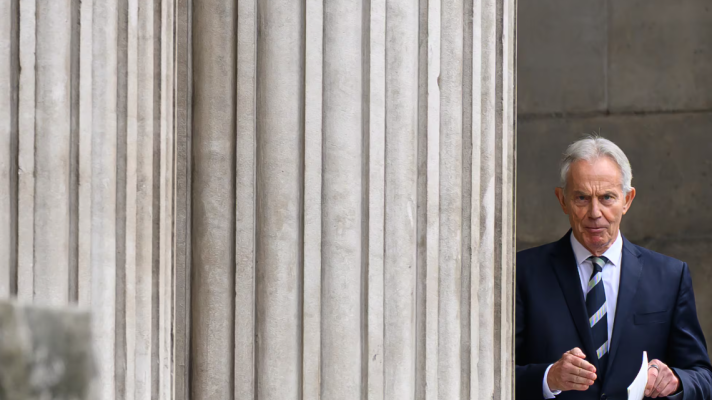
Former British Prime Minister Tony Blair, on July 7, in London (Photo: Getty Images)

Conceptual illustration: Gaza's future redesigned under foreign control, echoes of the colonial partition of a century ago.

One hundred years ago, Western powers established borders in West Asia with rulers and mandates, and they divided up the land while marginalizing the people who lived there. In 1993, Yasser Arafat stood on the White House lawn, shook hands with Yitzhak Rabin, and the world applauded as the leaders spoke in grandiloquent language, promising a Palestinian state.

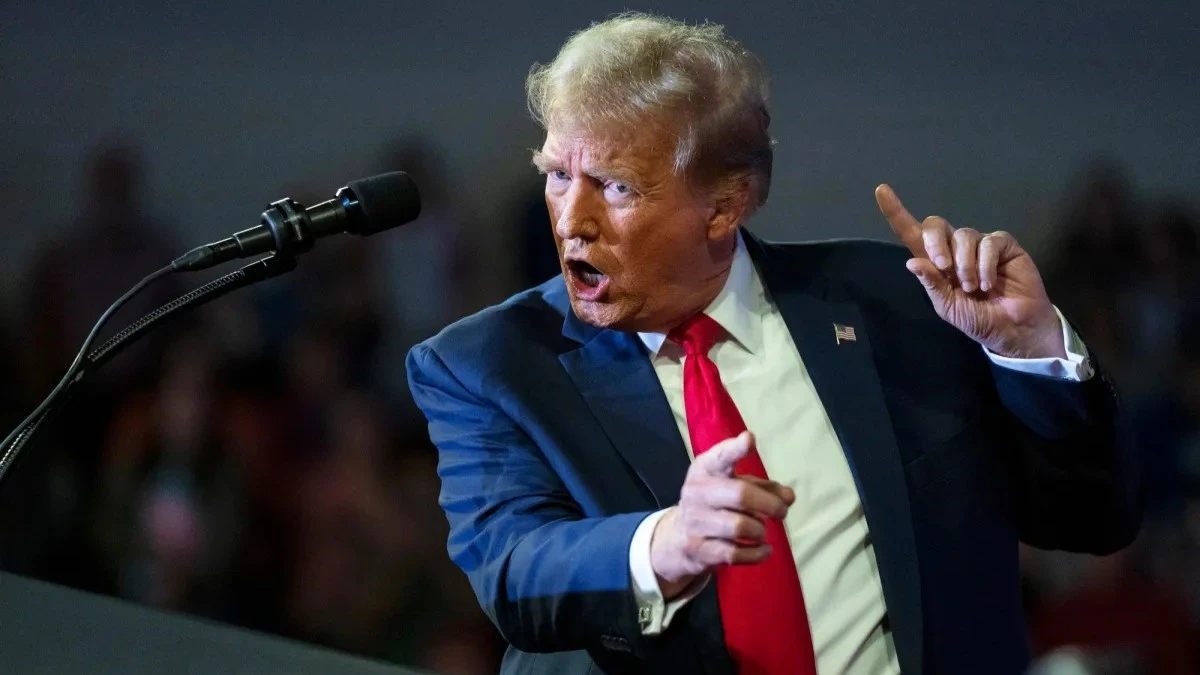
Thirty years later, Arafat is dead, Rabin was assassinated, and there is no Palestinian state, while its people face dispossession, a blockade, and a catastrophic war. But once again, Washington presents a new "peace plan." Donald Trump hailed its launch as "one of the greatest days in civilization" and even boasted of bringing "eternal peace to the Middle East." The rhetoric is theatrical; the reality is coercive.

Trump and Netanyahu at the White House unveiling the Gaza "peace plan." Trump called it "one of the greatest days of civilization."

And the irony is profound. The same England that issued the Balfour Declaration, which led to 75 years of Palestinian dispossession, is now sending one of its sons, Tony Blair, to "save" Gaza. From the country that helped create the problem comes the man tasked with recolonizing it.

Trump 's " general plan " : promises for headlines
The White House produced a 20-point "Comprehensive Plan to End the Conflict in Gaza." Its key elements are stark and dramatic:

An immediate ceasefire if accepted by both parties; Israel withdraws to the agreed lines and suspends bombing.

A hostage/prisoner exchange: Within 72 hours, all hostages—living and deceased—will be returned; Israel will release 250 prisoners serving life sentences and approximately 1,700 Gazans detained since October 7, 2023. For each Israeli body returned, Israel will hand over the remains of 15 Gazans.

Hamas fighters who disarm and commit to "peaceful coexistence" will be granted amnesty; those who decide to leave Gaza will be offered safe passage and exile.

Immediate humanitarian assistance flows: restoration of power, water, hospitals, bakeries; debris removal; and logistics for reconstruction, distributed through the United Nations and the Red Crescent.

Governance: Gaza will be temporarily administered by a Palestinian technocratic committee overseen by an international "peace board"—announced as being chaired by Donald Trump, with Tony Blair included. The committee will oversee reconstruction and redevelopment until the Palestinian National Authority (PNA) "completes reforms" and is deemed fit to resume control.

Economy: Gaza reimagined as a Special Economic Zone (SEZ), with preferential tariffs, investment incentives, and an international panel of experts to rebuild the Strip as a "miracle city" in a donor-led effort.

Security: Gaza will be demilitarized under international supervision. Israel will retain an undefined security perimeter and control over certain crossings, including the Philadelphia Corridor along the Egyptian border.

On the surface, the plan promises rapid relief and a mechanism for hostage release. But the mechanics and context reveal something else: a blueprint for an administered Gaza that lacks Palestinian consent, safeguards, or a credible path to sovereignty.

"Incomplete" without Hamas and presented under threat
The plan is empty without Hamas's acquiescence. But the political choreography is descriptive: the document appears to have been circulated among Israel, donor states, and regional capitals, then publicly revealed by the White House, complete with a threatening ultimatum.

During the press conference, Trump stated in simple terms:

"If Hamas doesn't accept, Israel has my full support to finish the job of destroying the Hamas threat. Bibi, you'll have our full support to do whatever you need to do."

That statement isn't mere rhetoric; it's explicit US support for an open end to Israeli military action. And, crucially, only after Trump's public unveiling, after the plan had been presented as accepted by Israel and the Arab states, did the Qatari and Egyptian mediators deliver the text to Hamas. The movement's delegation said it would "responsibly study the proposal," but the sequence is unmistakable: Hamas was given the agreement after it had become a public fait accompli and under the shadow of a televised ultimatum.

This is coercion disguised as diplomacy. The plan's viability depends on Palestinian acceptance; the reality was that the agreement was presented to the Palestinians only after a public deadline and the implicit threat of annihilation.

Amnesty, exile, and the bureaucratic path to dispossession
Two of the most morally difficult elements are the amnesty and exile clauses. The plan offers amnesty to Hamas fighters if they renounce violence and, alternatively, safe passage out of Gaza. Asking militants to accept exile is asking people to abandon their homeland. It is a policy framed as mercy but functionally resembling another iteration of ethnic cleansing: removing the backbone of Palestinian armed resistance, incentivizing departure, and rewarding those who remain with foreign-managed reconstruction.

Meanwhile, the logic of "voluntary departure," already present in Blair's draft plan, risks bureaucratizing displacement. Departures could be disguised with paperwork and records, but certificates do not replace homes, nor can administrative safeguards be substituted for the right of return.

The West Bank is absent; the State is a vague promise
Note what the plan doesn't do. It is closely tied to Gaza. It makes no serious mention of the West Bank, East Jerusalem, the settlements, or the fundamental questions surrounding the occupation. White House language vaguely hints at a future "credible path" to Palestinian self-determination if Gaza's redevelopment moves forward and the PA completes its reforms, but there is no timeline, no binding mechanisms, and no mention of the pre-1967 borders. Statehood is left aspirational and conditional, contingent on foreign approval rather than Palestinian self-determination.

No timelines, no guarantees, and the inevitable humiliation
Perhaps the most damning aspect is what the plan deliberately leaves undefined. There is no timeline for the transition in Gaza. There is no scale for what "reconstruction" means, no guarantee that Israel will not continue its killings and attacks under the guise of security.

The Palestinian Authority is not just being displaced, but humiliated. Both Netanyahu and Trump spoke of a future handover to the PA only if it "meets the conditions" set by others. These conditions were not explained, but the logic is clear: the Palestinians can only govern themselves if Israel and the United States certify that they are fit.

The proposal reads like an ultimatum from a father to his son: behave yourself and perhaps we'll grant you privileges. But these aren't privileges; they're the foundations of life: security, home, citizenship, the future of a people. Demanding submission from people whose land has been destroyed and then declaring that you'll "allow" them self-government only under inspection is a profound moral inversion. Bombing victims are being told to be patient, obedient, and grateful, or else they'll see.

An action plan for permanent occupation
Viewed as a whole, the plan reads like a roadmap for a light permanent occupancy arrangement:

Gaza's governance outsourced to technocrats under an external junta.

Israel retains a permanent security perimeter—the Philadelphia Corridor and other compression zones—and veto power over any rearmament.

Reconstruction is donor-driven and investor-led, a decision that embeds foreign economic control.

The PA is promised eventual handover, but only after reforms that may never be credibly verified, leaving Gaza in an indefinite transitional limbo.

That limbo is the strategic objective: to relieve Israel of day-to-day governance while maintaining its security goals intact, and to relieve Arab and Gulf capitals of the domestic burden of the Palestinian issue so they can proceed with normalization on their own terms.

What is absent
Note what is not there:

There is no Palestinian State.

There is no two-state solution.

There is no mention of the 1967 borders.

No role for East Jerusalem or the West Bank.

There is no guarantee that Israel will stop its killings or attacks once the hostages are released.

Instead, Netanyahu even demanded that the Palestinians stop "media incitement" and end "lawfare" at the International Criminal Court and the International Court of Justice. In other words: zero criticism, zero accountability under international law.

The big picture
The Trump-Blair plan solves Israel's problem, not Palestine's. Israel doesn't want to rule Gaza directly, but it doesn't want Hamas or the Palestinian Authority to rule it either. This plan installs an externally directed authority to administer Gaza while Israel maintains the military and political advantage.

It is a foreign administration masked as a transition.

Europe relegated
The recent European recognition of Palestine by Spain, Ireland, Norway, Slovenia, and others was hailed as a breakthrough. But the Trump plan renders all those gestures null and void. It wipes sovereignty off the table entirely. Trump himself mocked the act of recognition as ridiculous, underscoring how little weight Washington and Tel Aviv attach to it. The timing is no accident; this launch also sends a message to Europe: its statements mean nothing in the face of the US-Israeli conflict.

The Gulf's reward : normalization by omission
This political product has beneficiaries beyond Washington and Jerusalem. By outsourcing Gaza to a transitional authority, the Gulf states and other Arab capitals are relieved of the political and popular pressure of the Palestinian issue. Normalization with Israel was paused by the war; the Blair-Trump construct clears the way for Arab states to complete that process while the fate of Gaza is being managed by foreigners. In short, the plan is one of regional convenience, a way to resolve the "Palestinian headache" and resume economic and diplomatic ties with Israel.

When leaders of countries like Saudi Arabia, Jordan, the UAE, Egypt, and others sign a statement endorsing the framework, they implicitly hand Gaza over to Israel and its international administrators on a platter. This is neither altruism nor a strategy for Palestinian well-being; it's a geopolitical sacrifice. Another silent victory for Israel.

International actors, Erdogan and the strange chorus of consensus
The public rollout of the plan features a chorus of support: Western donors, Arab capitals, and even unexpected voices praising the initiative. A joint statement by the foreign ministers of Saudi Arabia, Jordan, the United Arab Emirates, Turkey, Qatar, and Egypt explicitly welcomed Trump's proposal, expressing "confidence in his ability to find a path to peace," and vowed to work with Washington to finalize and implement it. The statement reaffirmed their willingness to support "a comprehensive agreement that ends the war, prevents the displacement of Palestinians, rebuilds Gaza, and paves the way for a just peace."

Turkish President Recep Tayyip Erdogan also joined in, praising Trump's "efforts and leadership" aimed at "stopping the bloodshed in Gaza and achieving a ceasefire," and pledging Turkey's contribution to a "just, lasting, and mutually acceptable peace."

But this public display of consensus barely addresses a moral truth: the negotiation over Gaza's future proceeded largely without the participation of the Palestinians whose lives will be shaped. Presenting a plan to Hamas and other factions only after it has been internationally agreed upon isn't diplomacy; it's coercion disguised as consensus.

Palestinian voices reject custody
Palestinian leaders and activists have been categorical. Husam Badran, a member of Hamas's political bureau, framed the proposal as a denial of Palestinian agency:

"The Palestinian people have the right to self-determination, as recognized in international law. We are not minors in need of guardianship. Decisions about Gaza or the West Bank are internal Palestinian matters that should be resolved by national consensus, not imposed by foreign powers. Any plan linked to Blair is a bad omen."

This rejection matters. You can't build lasting peace by ignoring the people whose lives are being governed by the arrangement. International actors can produce all the road maps and hold all the press conferences; legitimacy won't come automatically.

Rejection of the other factions in Gaza
It's not only Hamas that views the proposal as illegitimate. The Palestinian Islamic Jihad (PIJ), the second-largest armed faction in Gaza and a key ally in the current war, issued a categorical rejection. PIJ described the Trump plan as "a political cover for the continuation of the war of extermination against our people," designed to liquidate the Palestinian cause under the guise of reconstruction and security.

The statement was blunt: no Palestinian faction, they said, has the right to renounce resistance in writing or surrender its national rights. This rejection underscores a central reality: even if Hamas is coerced into considering the plan, its implementation is virtually impossible when the other major forces in Gaza label it illegitimate. Indeed, Trump's roadmap rests not only on Palestinian acquiescence but on the silencing of every form of armed resistance organization.

Lawfare, media control and the erasure of responsibility
At the press conference, Netanyahu conveyed another objective: reducing criticism and legal liability. He spoke of "stopping media incitement" and "ending lawfare against Israel at the ICC and the ICJ." These are not minor footnotes. They are an attempt to criminalize dissent and shield actions from international scrutiny. In practice, they amount to demands for absolute impunity: Palestinians must accept a managed future while losing the ability to correct, or even criticize.

Trump limited his appreciation of Netanyahu with a line intended as flattery: "This will be the crowning achievement." The rhetorical flourish obscures the price: Palestinian sovereignty, accountability, and dignity.

Conclusion: A Century of Repackaged Control
This framework is more of a rebranding of control than a peace plan. It borrows from the language of "transition," "stabilization," and "reform" while reintroducing the colonial logic of foreign mandate. The historical echo is damning: the same capitals that promised a Palestinian state three decades ago now present a deal that replaces sovereignty with fiduciary control, rights with registration, and justice through investment.

The irony is stark. The Balfour Declaration, dictated by London a century ago, led Palestine down the path of dispossession. Today, another Briton, Tony Blair, returns under the banner of the savior with the task of "managing" Gaza. Colonialism hasn't gone away; it's been repackaged. From the country that created the catastrophe comes a man proposing to preside over its continuation.

If the people of Gaza are to survive and rebuild with agency and dignity, any agreement must be based on genuine Palestinian consensus, meaningful timelines toward sovereignty, and guarantees that legal and political responsibilities will remain intact. Anything less is not a peace agreement; it is a managed occupation, a colonial consortium disguised in the language of technocracy and humanitarianism.

And at its core is humiliation: Palestinians reduced to children before the eyes of their occupiers, told to "behave" before being allowed the most basic right of all: to decide their own future.

Hala Jaber is a prominent Anglo-Lebanese journalist who has covered and specialized in reporting on conflicts in West Asia, has received numerous awards, is the author of several books, and has contributed to various media outlets for over two decades.

Originally published in English on September 30th on its Substack page, the translation for Misión Verdad was done by Diego Sequera.

https://misionverdad.com/traducciones/e ... -no-la-paz

Google Translator

******

Trump’s “Peace Deal” Mirage: Distraction As Escalation in Zionist War on Gaza & Region Continues
Posted by Internationalist 360° on October 10, 2025
Vanessa Beeley and Fiorella Isabel


A critical analysis of how theatrical diplomacy, manipulated narratives, and global complicity are paving the way for a wider regional conflict, while the genocide in Gaza continues unabated.

The Cyclical Distraction In Alternative Media

Vanessa and I dive into another episode of Critical Perspectives laying out the many failures and trends distracting current mainstream alternative media and the entire social media landscape, which is saturated with distracting narratives and the management of these for purposes that mostly benefit a global elite.

The multitude of theories on how Charlie Kirk died whether Israel, U.S. intel or establishment narrative has provided endless tweets, podcasts, and money streams for many influencers and media figures seeking content or taking cues from the endless social media posts discussing this. Clearly this has been the perfect distraction and noise to deliberately divert public attention from the very vital and real war we are all facing, as well as the ongoing, brutal genocide in Gaza which has entered its second shameful year.

This cycle of distraction prevents people from seeing the reality on the ground and the ominous signs of impending escalation, such as Netanyahu’s warnings about Iran and coming escalations in Iraq. The focus on these theatrical displays, including a supposed rift between Trump and Netanyahu (yet again), serves to obscure the fundamental and unwavering complicity of the United States and other world powers in the Zionist project, aiming to paint Trump as a victim and Washington as simply captured rather than entirely in-cahoots with the Final Solution.

The Trump “Peace Plan” as a Psychological Operation

We deconstruct the much-hyped Trump administration “peace plan,” as deeply skeptical, viewing it not as a genuine effort for peace but as a sophisticated form of psychological warfare and public relations. Its primary purposes are seen as pacifying growing global disdain for Israel, creating false hope to make activists take their “foot off the accelerator,” and providing plausible deniability for the U.S., again by portraying it as a victim of Israel rather than a complicit partner—indicating this is reformable via electoralism or a hero to save America.

The plan’s demand for Hamas to disarm is viewed as an insidious trap, designed to weaken the Palestinian resistance ahead of a more devastating attack, drawing parallels to Trump’s past tactics of luring adversaries like General Soleimani into false negotiations. Hamas and the Resistance appear to be well-aware of this attempt and much of the media have reported incorrect information painting Hamas and resistance factions as weak or speaking for them instead of looking at more regional and reliable sources.

We touch on Russia and China’s pragmatic approach more so driven by their own economic and strategic interests., rather than the ideological desires of defeating western hegemony placed on them by many analysts and activists, looking for the two powerful states to save the world from the evil Western axis. Evidence cited includes Putin’s praise for Trump’s peace plan, Russia’s and China’s continued trade and diplomatic relations with Israel, their recognition of the Saudi-backed puppet government in Yemen over the Ansarullah-led Resistance, and Russia’s red-carpet treatment of Takfiri leaders in Syria. The conclusion is that no powerful state is acting on a moral imperative to stop the genocide, shattering the illusion that external “saviors” will intervene.

The Looming Threat of a Wider, More Lethal War

Alarming indicators suggest the current “peace talk” charade is a prelude to a significant escalation. Netanyahu’s confident and hubristic demeanor in interviews, combined with his specific warnings about Iranian threats to U.S. cities, can be interpreted as a potential setup for a false flag operation. Furthermore, the reality is the very terrifying prospect that Israel, backed by its historical development of chemical and biological weapons, may be preparing to escalate beyond conventional warfare. The sudden withdrawal of U.S. troops from Iraq and Syria can be seen as a worrying sign that the battlefield is being cleared for a potentially more devastating, multi-front conflict that could involve the use of banned weapons; as Washington has notoriously only cleared one conflict to put it in another theater.

Ultimately, we are advocating for a sober, realistic understanding of global politics, urging listeners to abandon the “hopium” of looking for heroic states or politicians to solve the crisis, a tendency they attribute to a Western mindset of seeking saviors. The Palestinian and regional resistance forces themselves hold a pragmatic view of powers like Russia and China, engaging with them out of necessity and diplomacy but not relying on them, understanding their role and accepting it. The ultimate message is one of self-reliance: liberation will not come from any government but from the sustained, on-the-ground resistance of the Palestinian people, their supporters who understand the true nature of the conflict, free from the distortions of theatrical diplomacy and narrative management, and the people as a whole collective.

The Trump “peace” trap, Syria’s sham elections and Netanyahu’s war against the region

Vanessa Beeley


My three reports for UK Column News on Wednesday 8th October. I dig deep into the sordid reality of the Trump (Nobel) Peace trap and unpack the so called “democratic” elections in Syria, brought to you by Tony Blair and the Zionist bloc. Finally I look at the recent sycophantic conversation between Ben Shapiro and Netanyahu – the potential for false flags and the expansion of a regional war by the Zionist entity.

https://libya360.wordpress.com/2025/10/ ... continues/

******

Trump’s plan, Blair’s hand

Lorenzo Maria Pacini

October 12, 2025

The plan once again highlighted the usual hypocrisy and colonial mentality of Washington, London, and, more generally, the West.

Those who don’t die will meet again

There is an old saying that goes, “Those who don’t die will meet again,” which somehow fits politicians perfectly, because sooner or later, they all reappear on the political scene.

In fact, shortly after the announcement of the formal recognition of Palestine as a state, the United Kingdom sent former Prime Minister Tony Blair with the task of hindering the Palestinian self-determination process, in accordance with the so-called “Peace Agreement” of then-US President Donald Trump. A truly masterful move.

This decision once again highlighted the usual hypocrisy and colonial mentality of Washington, London, and, more generally, the West.

Who remembers Tony Blair?

It is worth giving a brief summary, because his presence is by no means a random choice.

The Middle East knows Blair well, especially for his infamous conduct during the 2003 Iraq War, alongside then-US President George W. Bush, leader of the so-called “war on terror.” On the strength of false accusations about weapons of mass destruction, Blair dragged Britain into a conflict that caused hundreds of thousands of Iraqi casualties, earning himself a well-deserved reputation as a war criminal. Nothing new, you might say, since the United Kingdom has been an imperialist entity for a long time.

This confirms that Blair is the last person who should appear in an organization called the “Peace Council.”

While Bush retired to a quiet life painting dogs and portraits of Vladimir Putin, Blair continued to make himself indispensable in the Middle East—and to reap considerable profits from it. After resigning as prime minister in 2007, he was appointed special envoy of the international “Quartet” – composed of the United States, the European Union, Russia, and the United Nations – officially committed to resolving the Israeli-Palestinian issue. A coincidence? No, not at all: the choice of an emissary with close ties to Israel made any progress towards genuine peace impossible, which shows us how much it was in the interests of the Western powers to maintain a certain tension in the region. At the same time, Blair’s diplomatic activities were intertwined with a network of extremely lucrative business deals in the region: consulting for Arab governments and private assignments, such as the one he took on in 2008 as senior advisor to the American investment bank JP Morgan, which paid him over $1 million a year.

No philanthropy, no spirit of humanitarian aid. When Blair attended meetings in the Middle East, no one knew which Tony Blair they were dealing with: the Quartet envoy, the founder of the Tony Blair Faith Foundation, or the head of the consulting firm Tony Blair Associates.

On the other hand, the beauty of conflicts of interest is that they always pay off well.

For example, in 2009, he obtained radio frequencies from Israel to create a mobile phone network in the West Bank, in exchange for a commitment from the Palestinian leadership not to bring accusations of Israeli war crimes to the UN for Operation Cast Lead in Gaza in December 2008, during which approximately 1,400 Palestinians were killed in 22 days. Blair had private economic interests linked to that agreement: both Wataniya and JP Morgan had a lot to gain from the opening of the telecommunications market in the West Bank.

It is therefore easy to imagine that Blair will also have a certain interest in Trump’s plan for Palestine, perhaps with his Tony Blair Institute for Global Change, committed to “changing the world,” perhaps by helping Israel and the United States build the infamous 5-star resort that businessman Donald Trump has long dreamed of, as if capitalism and the tyranny of foreign investors could suffice for the Palestinians in place of freedom and security.

It therefore seems that the West’s “brilliant idea” (sic!) is once again to entrust the fate of Gaza to international war criminals. Not bad, right?

Today, Blair appears not simply as an “advisor,” but as an official charged with protecting the joint interests of Israel and the West in Gaza and managing the post-war transition phase.

Tony Blair’s experience in Iraq is a clear sign of his unreliability on the Palestinian question.

During the US invasion in 2003, thousands of civilians were killed and entire cities were destroyed. Blair, who convinced President Bush to wage that war, admitted years later that there were no weapons of mass destruction and that the military campaign had been based on falsified intelligence reports.

Despite these admissions, no international court has ever tried him for the serious violations of international law he committed.

Today, paradoxically, the same person is being proposed as a key figure in the “reconstruction” of Gaza, based on a supposed peace plan that in fact only protects Israeli interests.

Who stands to gain the most?

Blair has openly expressed his support for a plan that aims to transform Gaza into a kind of “Riviera” and a regional commercial center, modeled on the interests of Washington and Tel Aviv. And this is a first clear sign of how much the agreement could benefit Westerners. America, in the midst of a terrible economic crisis, stands to gain, as does the British crown, in the midst of a political and ethnic crisis. Israel obviously stands to gain, as it will only have to worry about changing its prime minister, perhaps passing the baton to someone less compromised. But the game remains the same, and no one really cares about the will of the Palestinians.

The American plan aims to open Gaza to Western investors. We already know how these “peace projects” dedicated to free capital end up. And capital does not care about the opinions and rights of the Palestinians.

Trump deliberately ignored Israeli attacks on Hamas negotiators in Doha, while denying Palestinian Authority President Mahmoud Abbas a visa to attend the United Nations ceremony. This move was directed not so much against Abbas’s leadership, which is already unrepresentative of Gaza, as against the entire Palestinian people. Ask in Palestine what they think of Abbas and the answer you hear will be explanatory enough. And ask yourself what Abbas has done in the two years since that famous October 7, 2023.

Trump effectively deprived the Palestinians of the right to decide their own destiny, and immediately afterwards announced a so-called peace plan that completely excluded them. The dispatch of Tony Blair appears to be a further sign of this ruthless hypocrisy.

His responsibility for the massacres in Iraq and his self-definition as an “evangelical Jew” reinforce the idea that his actual role is to minimize Palestinian autonomy and ensure the implementation of US and Israeli policy.

Blair could be the one to bring peace to the eastern part of the country, or rather to the anti-Russian forces operating within it.

Blair’s Institute had already received substantial funding in previous years from Moshe Kantor, a multi-billionaire industrial entrepreneur and the largest shareholder in the fertilizer company Acron.

Blair’s previous relationship with the oligarch had also earned him a prestigious position on the European Council for Tolerance and Reconciliation (ECTR), founded by Kantor, who appointed the former Labour leader as its president in 2015. The ECTR was one of the main financial backers of the Tony Blair Institute, but the collaboration ended in April after Kantor was added to the UK sanctions list along with seven other oligarchs.

Originally from Moscow, Kantor now has British citizenship. In recent years, he has organized several meetings with the Russian president in his capacity as president of the European Jewish Congress. The Russian tycoon has long built strong relationships with politicians and prominent figures in the British establishment, including members of the royal family.

Tony’s wife, Charlie Blair, has not been idle either. In 2024, she represented Ukrainian billionaire Mikhail Fridman in court in a lawsuit against the state’s decision to freeze his assets following the SMO in 2022. The 60-year-old—pictured with Blair in 2003 during the signing of an agreement with BP—accuses Luxembourg of participating in a kind of “arbitrary witch hunt” against wealthy Russian businessmen with investments in the EU, masking it as the application of economic sanctions. Fridman also claims that this conduct violated an agreement between Luxembourg and the former Soviet Union aimed at protecting investors from the risk of expropriation or nationalization of their assets. But that is not the point.

Lady Blair, a lawyer since 1976, and her law firm Omnia Strategy are among the lawyers appointed to represent Fridman, who fled Israel after October 7, 2023, and took refuge in Moscow, where he continues to do business with London. It is curious that Fridman condemned the Special Operation in Ukraine and declared that he would transfer $10 million to Ukrainian refugees through a personal charity fund. His investment company, LetterOne, announced in March 2022 that it would donate $150 million to the “victims of the war in Ukraine,” but these generous gestures did not save the billionaire from EU and UK sanctions. Meanwhile, he continues to do business with… good old Tony (and who knows how many others in the network of fake supporters of Russia, who are actually Western agents). What is certain is that Blair brings the Zionist bloc together, in the West as in the East.

Trump’s plan will bring large investments to Gaza, which will benefit all Western players (Trump himself, let’s not forget, is a....

Blair’s governorship would allow the UK to maintain its dominance, as well as Israel to reprogram its activity of total conquest and realization of the Greater Israel project.

All this seasoned with international “blessings.”

Meanwhile, the Arab states—pushed to accept the idea that “an unjust peace is better than war”—are moving within the limits imposed by this strategy to end the tragedy in Gaza.

Over a century ago, in 1917, British Minister Arthur Balfour signed the Declaration promising “a national home for the Jewish people,” laying the foundation for the birth of Israel. Today, the United States and Israel seem to be proposing a new “Balfour moment.”

https://strategic-culture.su/news/2025/ ... airs-hand/
"There is great chaos under heaven; the situation is excellent."

User avatar
blindpig
Posts: 14788
Joined: Fri Jul 14, 2017 5:44 pm
Location: Turtle Island
Contact:

Re: Palestine

Post by blindpig » Mon Oct 13, 2025 1:58 pm

Hamas hands over all living Israeli captives, Palestinian prisoner release begins

Nearly 2,000 Palestinian prisoners are being released by Israel in line with the ceasefire agreement

News Desk

OCT 13, 2025

Image
(Photo credit: AA)

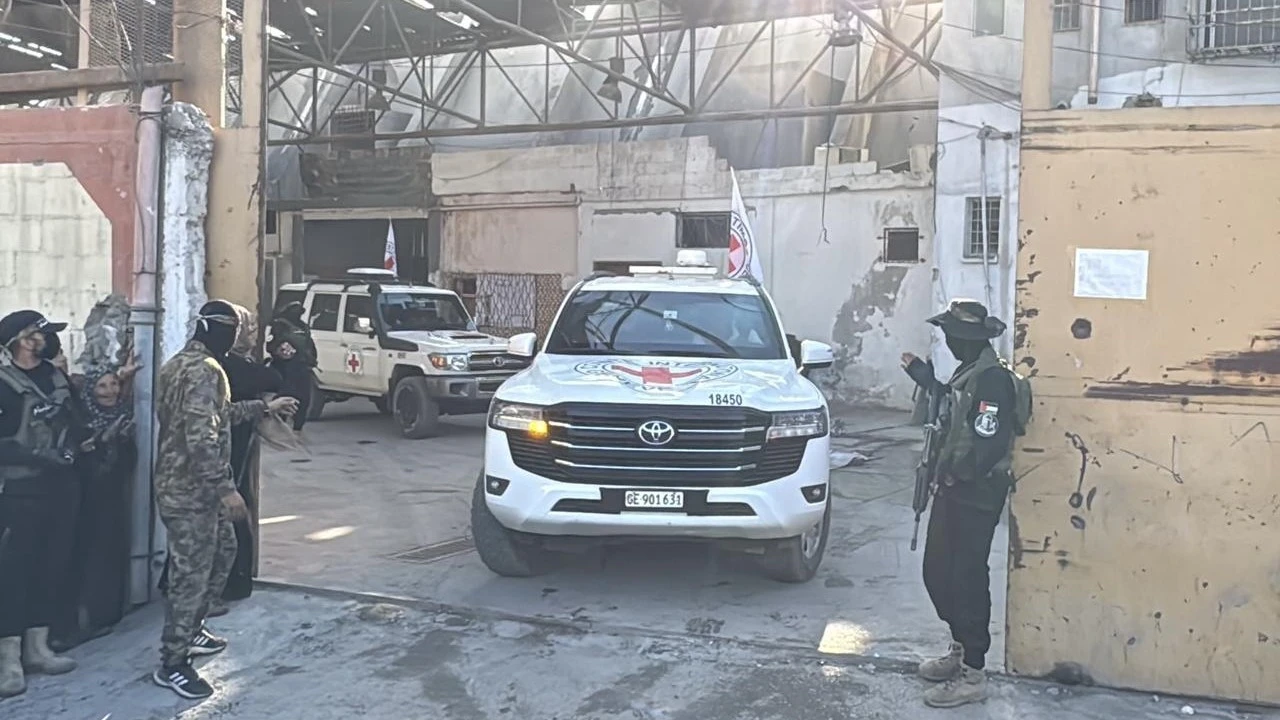
All living Israeli captives were released by Hamas on 13 October and have returned to Israel as part of the ceasefire agreement’s exchange formula.

The 20 living captives were handed over to the Red Cross before being returned to Israel by the Israeli military.

The Israeli army confirmed the final 13 captives were handed over, after initially receiving seven. The captives have been taken to hospitals for checkups and to meet their family members.

The coming hours will also see the resistance release the bodies of deceased Israeli captives.

Meanwhile, Israel is releasing a total of 1,966 Palestinian prisoners. Buses carrying prisoners have already begun departing from Israel’s Ofer prison in the occupied West Bank, with some having arrived in Ramallah – one of the drop-off points.

Buses have also left Negev Prison toward the Gaza Strip.

⚡️NEW: Reuters confirms all 1,966 Palestinian captives and forcibly disappeared from Gaza set for release have boarded buses at Israeli prisons.
Al Jazeera:
➤ The Red Cross has entered Ofer Prison to evacuate one prisoner in need of urgent medical care.
➤ 12 West Bank… pic.twitter.com/1bOJyHweKq

— Drop Site (@DropSiteNews) October 13, 2025
The 1,966 include 250 prisoners serving life sentences. Over 150 of the 250 will be exiled. Another 88 will be released to the occupied West Bank, while eight will be released to Gaza.

VIDEO | Buses carrying freed Palestinian prisoners have arrived in Ramallah. pic.twitter.com/8Kj9YQYsWW

— The Cradle (@TheCradleMedia) October 13, 2025
Palestinians and journalists waiting outside Ofer prison were targeted with tear gas by Israeli forces.

Israeli forces also circulated a flyer warning that any celebration or show of support for the released prisoners would result in arrests.

Israel has banned Palestinians from celebrating the release of Palestinian prisoners [hostages] & banned their families from giving interviews

Contrast that with the celebrations around the release of Israeli hostages & the many interviews being broadcast around the world. pic.twitter.com/oUPNeJoDXK

— Saul Staniforth (@SaulStaniforth) October 13, 2025
The lawyer for the Wadi Hilweh Information Center in Jerusalem, Siraj Abu Arafa, said the families of the prisoners were summoned by Tel Aviv and threatened.

The conditions of release include “no gatherings or assemblies, no celebrations, and that each released prisoner would be escorted to his home by an intelligence vehicle.” Meanwhile, Israelis are celebrating in joy over the return of their captives.

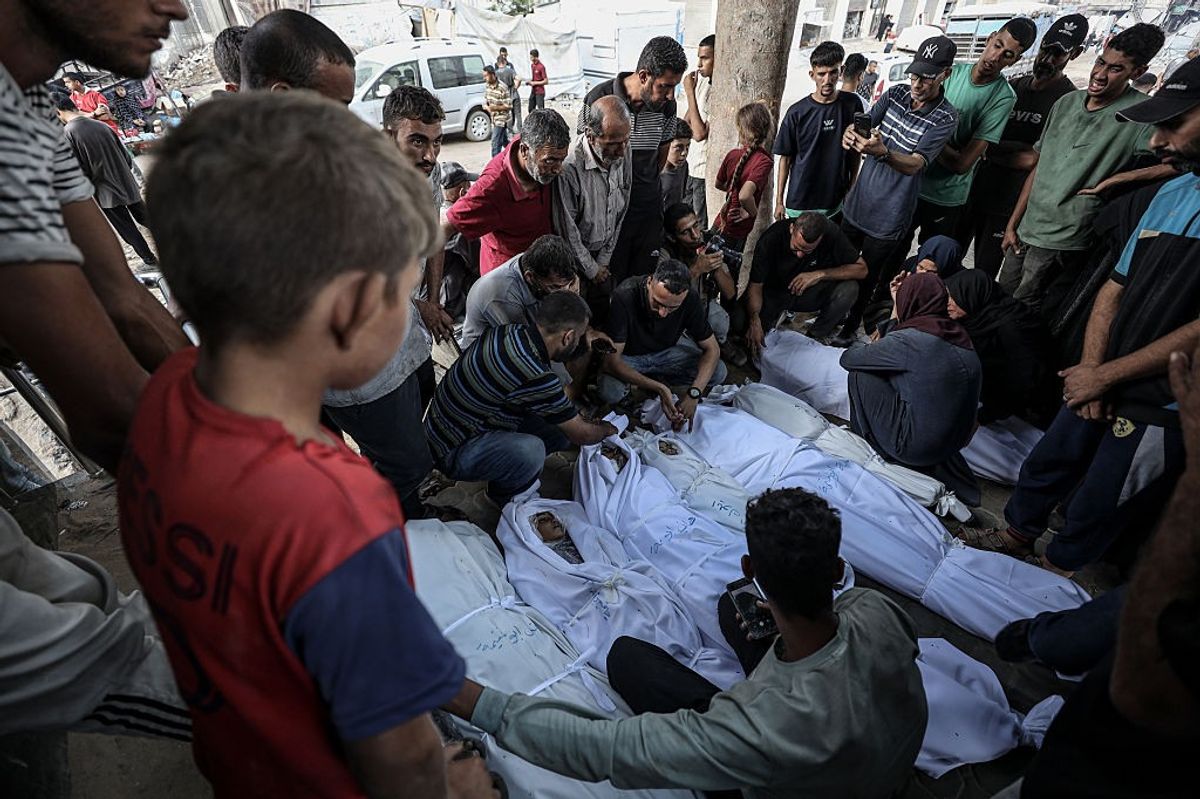
“We know that since 7 October [2023], while torture and violence will have been systematically practiced inside Israeli prisons, these prisoners have been subjected to a brutal campaign. They have been brutally beaten, tortured, and violated. We’ve witnessed and heard stories of sexual violence,” Basil Farraj, a professor at Birzeit University in the occupied West Bank, told Al Jazeera.

He added that the release of prisoners will “not end the struggle” of those who remain imprisoned.

The first photo of liberated Palestinian prisoners upon their arrival in Ramallah. pic.twitter.com/5KZlEUYyEE

— The Cradle (@TheCradleMedia) October 13, 2025

VIDEO | Live coverage shows Palestinian prisoners arriving in Ramallah to a warm welcome and widespread celebrations. Several prisoners are reported to be in poor health condition. pic.twitter.com/X494fGOnHg

— The Cradle (@TheCradleMedia) October 13, 2025


https://thecradle.co/articles/hamas-han ... ase-begins

(Call me a cold-blooded bastard but I never gave a flying fuck about the Zionist hostages. And neither did Bibi.)

Israel refuses to include abducted Palestinian physicians in prisoner release list

Israeli troops have kidnaped hundreds of doctors, nurses, and first responders from Gaza since the start of the genocide

News Desk

OCT 11, 2025

Image
(Photo credit: Sky News)

Israel will not include two prominent Palestinian doctors, Hussam Abu Safia and Marwan al-Hams, as part of the ceasefire and prisoner exchange deal, a Hamas official revealed on 11 October.

"The occupation refused to release Dr. Hussam Abu Safia," a Hamas official told CNN on Friday.

As part of the ceasefire, Israel is set to release 250 Palestinian prisoners serving life sentences and 1,700 Palestinians detained in Gaza since the start of the genocide two years ago.

In turn, Hamas will release the remaining 46 Israeli captives, including 20 who remain alive.

Abu Safia was abducted by Israeli troops in December 2024 and taken to the Sde Teiman detention center, where Palestinians have been killed, tortured, and sexually assaulted.

He was detained with dozens of others during an Israeli raid on Kamal Adwan Hospital, one of many throughout the war.


According to the Euro-Mediterranean Human Rights Monitor, people were executed during the raid, including medical staff and displaced civilians who had been sheltering in the hospital.

Israel claimed without evidence that Abu Safia was a member of Hamas and said it was “investigating him.”

In February 2025, his family announced that he was facing "severe torture and mistreatment" at the hands of Israeli jailers, noting that he was being given only one "poor quality" meal per day.

At the time, they said his legal case was collapsing due to Israel's failure to present credible evidence. They expressed hope that he would eventually be released as part of a prisoner exchange agreement.

Abu Safia's lawyer, Ghaida Qassem, said in July that the hospital director had lost around 40 kilograms since his abduction and detention by Israel, dropping from around 100 kilograms to 60 kilograms.

Israeli authorities have prevented Abu Safia from accessing much-needed medication and treatment, particularly for his condition of irregular heartbeats.

"He remains dressed in winter clothing under extreme conditions of starvation, torture, and complete isolation," Qassem's statement went on to say.

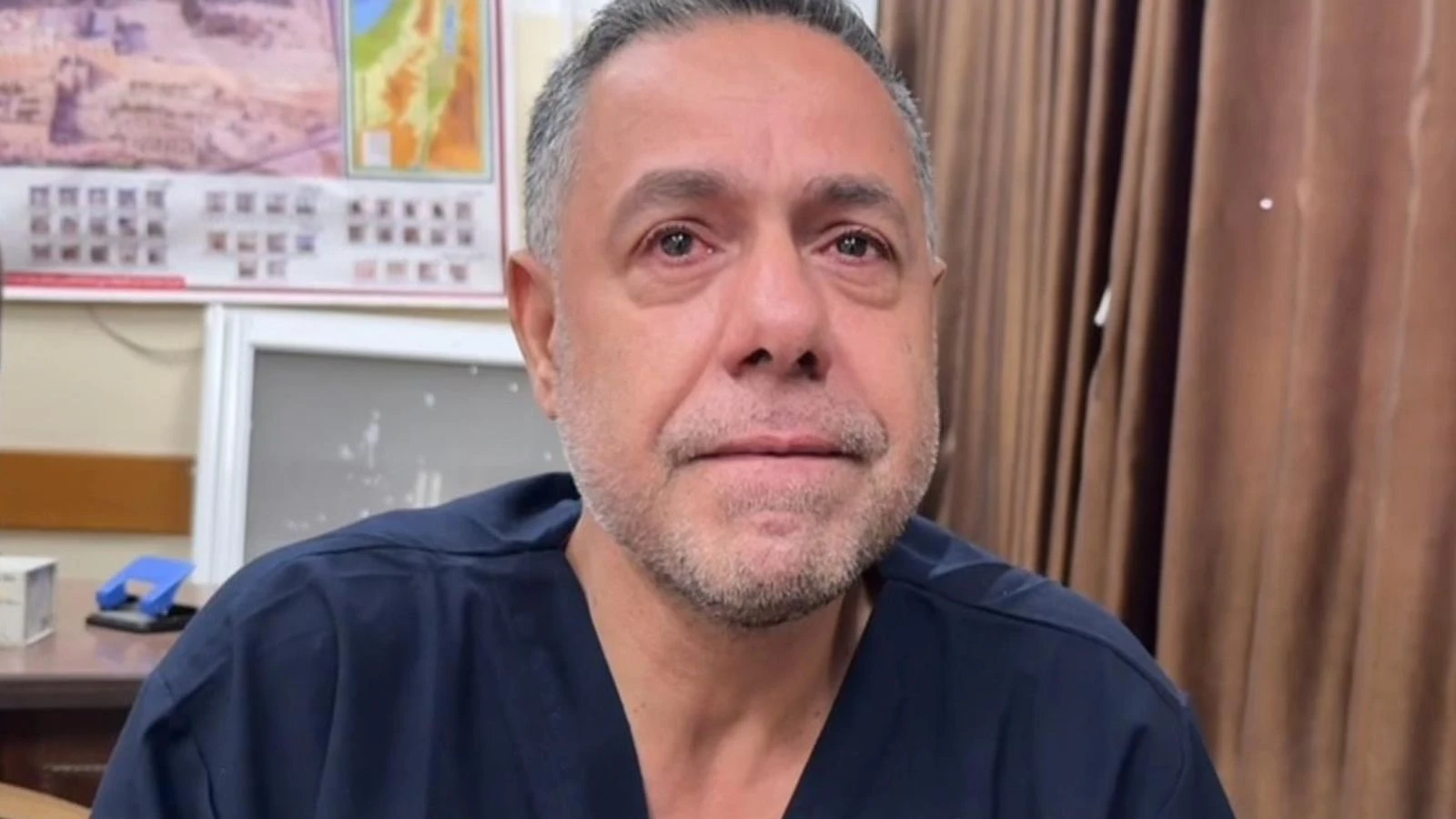
The Hamas official also told CNN that Marwan al-Hams, the director of Abu Youssef al-Najjar hospital in Rafah and an official overseeing field hospitals in Gaza, will also not be released.


Hams was abducted in July by an undercover Israeli force as they raided a cafe near the ICRC field hospital on Al-Rasheed Coastal Street in Al-Mawasi, western Rafah.

During the raid, they shot and injured Hams while killing freelance photojournalists Tamer Rebhi Rafiq al-Zaanin and Ibrahim Atef Atiyah Abu Asheibah.

At the time of the raid, Hams was participating in the filming of a documentary produced by Zaanin.

The men abducted the injured Hams and drove away in a white vehicle.

According to Hams' son, he is being held in Ashkelon Prison. His daughter, Tasneem, is also being held in the same prison.

Tasneem is a nurse and was abducted by an Israeli special unit while on her way to work in the Al-Mawasi area of Khan Yunis.

Sources speaking with Quds Press indicated that Palestinian collaborator with Israel, Yasser Abu Shabab, played a role in the abduction of Dr. Hams.

Abu Shabab's "Popular Forces" were armed and funded by the Shin Bet, Israel's internal intelligence agency, to loot aid convoys entering Gaza as part of Israel's starvation siege.

Middle East Eye (MEE) reports that, according to data from the Palestinian Healthcare Workers Watch, at least 28 doctors from Gaza have been abducted and are being held in Israeli custody.

Eight of them are senior consultants in surgery, orthopedics, intensive care, cardiology, and pediatrics.

Meanwhile, the World Health Organization (WHO) reported earlier this month that due to Israeli airstrikes and shelling, only 14 of Gaza's 36 hospitals remain able to deliver some essential health services.

The WHO estimates that Israeli violence has caused nearly 42,000 people in Gaza to suffer life-altering injuries, including blows to the limbs, spinal cord, and brain.

According to UN data, Israel has killed 1,722 health workers during the genocide, an average of two per day.

https://thecradle.co/articles/israel-re ... lease-list

******

Why Does Media Continue to Undercount the Gaza Death Toll?
Posted by Internationalist 360° on October 12, 2025
Ralph Nader

Image

It makes a difference in driving the greater intensity of political, diplomatic, and civic pressures to have a count of 600,000 rather than 67,000 or 200,000 children rather than 20,000 children murdered.

Ben Hubbard, the long-time Middle East correspondent for the New York Times, is known for his high standards. So too is Karen DeYoung, the long-time reporter and foreign affairs editor for the Washington Post.

Yet they, and their editors, share a common, recurring failure by misleading their readers about the serious undercount of Palestinian deaths during the Israeli regime’s genocidal destruction of Gaza.

How so? By repeating in article after article the Hamas claim of 67,000 deaths since October 2023. The real death toll estimate is probably around 600,000. Unlike Israeli and American cultures, which do not underestimate their fatalities in conflicts, Hamas sees the awful death toll as a reflection of their not protecting their people and a measure of Israeli military might against Hamas’ limited small arms and weapons. Both Hubbard and DeYoung, of course, know better. They know the daily bombardment of tiny Gaza, the geographical size of Philadelphia, with 2.3 million humans, is without precedent in Israel’s targeting of civilians and civilian infrastructure. The blockade of “food, water, medicine, fuel, and electricity,” along with the concentrated destruction of healthcare facilities, have been condemned by human rights groups in Israel and International humanitarian organizations.

Reporters and editors are quite aware of more accurate casualty estimates appearing in The Lancet, the prestigious British medical journal, and estimates provided by other academic and prominent international relief organizations like Doctors Without Borders, Save the Children, the United Nations World Food Programme, and others experienced in assessing the human toll of military devastations.

Journalists know the estimate last April by Professor Emeritus Paul Rogers of the University of Bradford in the UK, an expert in the power of aerial bombs and missiles, who wrote that the TNT equivalent of six Hiroshima atomic bombs has been delivered to these totally defenseless Palestinians, almost all of whom are without housing or air raid shelters.

Israeli Prime Minister Benjamin Netanyahu’s American-made missiles and bombs continue to produce deadly bloodshed. The waves of death from starvation, untreated, weaponry-caused infectious diseases, the cutoff of medicines treating cancer, respiratory ailments, and diabetes are still mounting.

What readers do not know is how much of the use of Hamas’ undercount is mandated by news editors, and why. Because intense Netanyahu propaganda has declared the estimates of Hamas, based on real names (excluding many thousands under the rubble and the collateral damage to civilians that in such conflicts exceed direct fatalities from the bombing by 3 to 13-fold), are an exaggeration, the mainstream media is wary of being accused of even worse fabrications than those of Hamas.

Speaking to many reporters and editors about this huge undercount phenomenon, not prevalent in other violent arenas of war, they all agree that the real count is much higher, but they do not have a number to use that is deemed credible. But they do have casualty experts who can be interviewed, such as the chair of the Global Health Department at Edinburgh University or a foremost missile technology specialist, MIT Professor Emeritus Theodore Postol, who said on our radio-podcast recently, “I would say that 200, 300, or 400,000 people [Palestinian] are dead easily.”

The least the journalists could do is say, “The real count may be much higher.” The other alternative is to do their own investigation, piecing together the empirical and clinical evidence (See, Gaza Healthcare Letter to President Trump, October 1, 2025) and citing prominent Israelis who have said that the Israel Defense Forces has always targeted Palestinian civilians from 1948 on. (See my column March 28, 2025—The Vast Gaza Death Undercount—Undermines Civic, Diplomatic, and Political Pressures.)

The other alternative is to do a “news analysis,” which allows for evaluations, short of editorializing. For instance, a “news analysis” could point out that conveying the impression that the Hamas figures are the true count means that 97 out of 100 Palestinians in Gaza are still living. This is not remotely credible. Yet that is essentially what Ben Hubbard’s October 7 Times article stated, “with more than 67,000 killed, or one in every 34 Gazans, according to local health officials.” It is more like 1 in every 4 Gazans killed.

Nor is it true that the “local health officials” are confirming this, because on further inquiry, they admit their definition of the fatality toll excludes those under the rubble and those who die from the massive collateral casualty toll. This reality is well-known to scores of American physicians back from Gaza who say that a majority of those killed are children and women and that the survivors are almost all injured, sick, or dying.

There are esteemed reporters like Gideon Levy of the Israeli newspaper Haaretz, who claim that the Hamas figures are horrible enough that they meet the test of genocide, implying that a higher count would not make any more of a moral or political difference.

I disagree. “Horror” does not have finite limits. It makes a difference in driving the greater intensity of political, diplomatic, and civic pressures to have a count of 600,000 rather than 67,000 or 200,000 children rather than 20,000 children murdered. Do we need to refer to other genocides in the 20th century to show how much a difference it would have made if the official count were one-tenth of the real count?

The editors of the Post, especially, and of the Times are not keeping up with the reporting of DeYoung and Hubbard et al., about the scenes of death, dying, and horrendous agony in Gaza. The editorial management of reporters and the editorials fail to hold Netanyahu and his terroristic mass-slaughtering cabinet accountable. They allow the publication of realistic reports, features, and sometimes even give voice to Palestinians, as the Times did with several pages and pictures recently. But the long-time omnipresent shadow of AIPAC et al. darkens the editorial and opinion pages more than do the illuminations of their own reporters.


https://libya360.wordpress.com/2025/10/ ... eath-toll/

******

Iran Will Not Participate In The Summit On Gaza In Egypt

Image
Iran’s head of the Foreign Ministry Abbas Araghchi. Photo: X

October 12, 2025 Hour: 4:25 pm

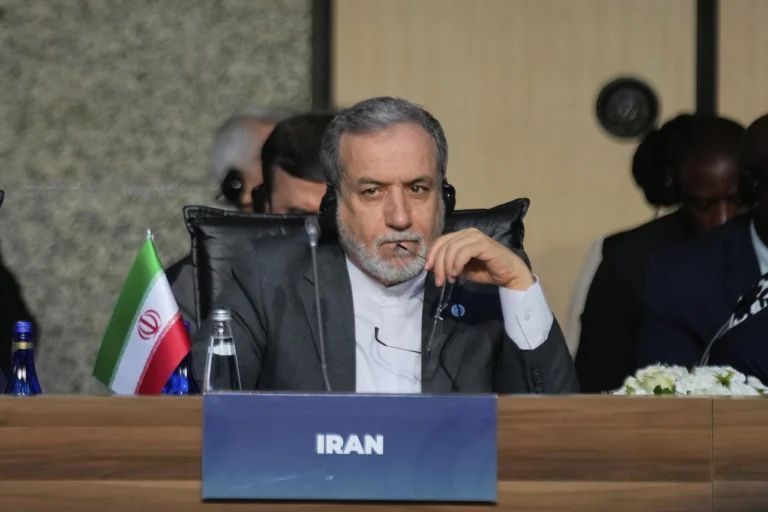
Iran confirmed this Sunday that it had rejected the invitation to attend the Sharm el-Sheikh Peace Summit, which will be held on Monday in Egypt with the participation of some twenty world leaders, and will be aimed at ending the war in the Gaza Strip.

Iranian Foreign Minister Abbas Araqchi reported at the cabinet meeting that he had rejected the invitation extended by Egypt to the country’s president, Masud Pezeshkian, according to the IRNA agency.

Araqchi noted that, subsequently, the Egyptian authorities offered him to participate in the meeting; however, he did not give details about his response.

Hours earlier, the Tasnim agency had reported that Iran had ruled out its participation in the international summit, citing an anonymous source close to the Iranian government, a day after the US media Axios reported that the US State Department invited the Iranian president to the meeting.


Iran stated this Thursday that it supports any initiative that ends the genocide in Gaza and involves the total withdrawal of Israeli forces and the entry of humanitarian aid into the Strip after the peace agreement between Israel and Hamas.

“The Islamic Republic of Iran has always supported any action and initiative that guarantees the cessation of the genocidal war, the withdrawal of the occupying forces, the entry of humanitarian aid, the release of Palestinian prisoners, and the protection of the fundamental rights of the Palestinians,” the Iranian Foreign Ministry said in a statement.

Iranian diplomacy called on the international community to prevent Israel from “breaking its promises.”

It also stressed the responsibility of governments and competent international organizations “to judge those who ordered and carried out war crimes, genocide, and crimes against humanity in Gaza.”

The Sharm el-Sheikh Peace Summit, which will be held tomorrow in this Egyptian resort city, will be chaired by the heads of state of the US and Egypt, Donald Trump and Abdelfatah al Sisi, and will be attended by leaders from more than 20 countries.

“The summit aims to end the war in the Gaza Strip, strengthen efforts to achieve peace and stability in the Middle East, and open a new chapter in regional security and stability,” the Egyptian Presidency said.

The meeting was announced after Israel and the Palestinian Islamist group Hamas reached a ceasefire agreement in Gaza on Wednesday, which constitutes the first phase of Trump’s peace plan for the Palestinian coastal enclave.

The plan includes a truce, which came into effect on Friday, as well as the release of all Israeli hostages held by Hamas in exchange for the release, by Israel, of hundreds of Palestinians and the entry of more humanitarian aid into Gaza.

https://www.telesurenglish.net/iran-wil ... -in-egypt/

*****

Image

Israeli Officials Are Openly Saying They Plan To Resume Attacks On Gaza

Israel’s top officials are openly declaring that they intend to terminate the Gaza ceasefire after they get their hostages back.

Caitlin Johnstone
October 13, 2025

Israel’s top officials are openly declaring that they intend to terminate the Gaza ceasefire after they get their hostages back.

Defense Minister Israel Katz has posted a tweet in Hebrew which machine translates as follows:

[/i]“Israel’s great challenge after the phase of returning the hostages will be the destruction of all of Hamas’s terror tunnels in Gaza, directly by the IDF and through the international mechanism to be established under the leadership and supervision of the United States. This is the primary significance of implementing the agreed-upon principle of demilitarizing Gaza and neutralizing Hamas of its weapons. I have instructed the IDF to prepare for carrying out the mission.”

Hamas has not agreed to any demilitarization or destruction of its tunnels. There is no way to demilitarize Gaza and neutralize Hamas of its weapons against their will without continued warfare, something Israel has demonstrated it cannot do without killing shocking numbers of civilians.


Katz’s comments echo the public statements of Prime Minister Netanyahu, who said in a televised speech on Friday that “Hamas will be disarmed and Gaza will be demilitarized,” and that if Hamas doesn’t disarm voluntarily then “it will be achieved the hard way.”

In another statement Netanyahu said, “We have achieved tremendous victories but the campaign is not over; part of our enemies are trying to recover.”

Israeli outlet YNet reports that Israel is planning to resume its blockade and prevent reconstruction if all the bodies of the deceased captives are not returned, when Israel already knows that Hamas probably won’t be able to locate all the bodies of deceased Israeli captives due to the intensity of the Israeli bombing campaign over the last two years.

“If Hamas does not cooperate with the return process, and Israel suspects that it is deliberately hiding the bodies in order to preserve them as a bargaining chip, it is expected to impose a series of sanctions on it — including preventing the reconstruction of the Strip, the entry of caravans, the opening of bakeries and the entry of civilian equipment,” Ynet reports.

In a recent article titled “Israel assesses Hamas may not be able to return all remaining dead hostages,” CNN reports that “Sources say the Israeli government is aware that Hamas may not know the location of, or is unable to retrieve, the remains of some of the 28 remaining deceased hostages.”

As noted by Shaiel Ben-Ephraim, these two pieces of information would seem to indicate that Israel is planning to use the unreturned bodies as a pretext to break the ceasefire.


It is perhaps somewhat noteworthy that Israel’s open preparations to resume the onslaught in Gaza directly contradict the statements of the president of the United States.

Asked by the press about Netanyahu’s refusal to say that the “war” in Gaza is over, Trump forcefully stated, “The war is over. The war is over, okay? You understand that?”

Trump suggested (without stating outright) that he has received “verbal guarantees” from Israel that the violence will not resume.

So here we have Israeli officials openly and explicitly saying that the attacks on Gaza have not ended, and the US president saying that they have. It’s not often you see these two governments directly contradicting each other with mutually exclusive positions in ways that will necessarily be proven or disproven by the events which follow.

So I guess we’re about to find out who has ultimately been in charge of the Gaza genocide this whole time.

https://caitlinjohnstone.com.au/2025/10 ... s-on-gaza/
"There is great chaos under heaven; the situation is excellent."

User avatar
blindpig
Posts: 14788
Joined: Fri Jul 14, 2017 5:44 pm
Location: Turtle Island
Contact:

Re: Palestine

Post by blindpig » Tue Oct 14, 2025 1:38 pm

Gaza Palestinian Journalist Saleh Al-Jafarawi Killed by Collaborators
October 13, 2025

Image
Palestinian journalist Saleh al-Jafarawi in an undated image in Gaza, occupied Palestine. Photo: Social Media.

Journalist Saleh al-Jafarawi was killed in southern Gaza while reporting, as media groups condemn ongoing Israeli attacks on Palestinian press workers.

Renowned Palestinian journalist Saleh al-Jafarawi was martyred on Sunday after being killed by Israeli collaborators in Gaza while preparing a news report.

According to local sources, al-Jafarawi was shot while working on Street 8, south of Gaza City, as he documented the situation in the area following recent developments on the ground. Witnesses said he had been preparing a report when armed members of a clan collaborating with the Israeli occupation opened fire, killing him instantly.

For the past two years, al-Jafarawi has been a prominent voice in the coverage of the Israeli war on Gaza, documenting atrocities and exposing war crimes to international audiences. His reporting became widely recognized for highlighting the human suffering, destruction, and resilience of the Palestinian people.

Al-Jafarawi voices gratitude for solidarity
When the recent ceasefire in Gaza was confirmed, al-Jafarawi shared a heartfelt message from northern Gaza, expressing gratitude to all who stood by the Palestinian cause, from protesters and boycotters to artists, athletes, and activists who amplified Gaza’s voice around the world.

He also extended thanks to the activists behind the Gaza Sumud Flotilla and the Freedom Flotilla, both of which sought to break the siege and deliver aid to the Strip.

Yet his final words carried a powerful plea to the world: “Yes, the war has ended, but don’t turn your attention away from Gaza. Stay with Gaza always, because Gaza needs your voice, especially in the coming stage.”

He concluded his message by reaffirming the steadfastness of the Palestinian people: “We are the people of this land, and we have the right to live on it.”

Largest graveyard for journalists in modern history
Anthony Bellanger, a French-Belgian journalist, trade unionist, and historian, delivered a searing reflection in The Guardian, channeling the outrage of media workers worldwide as they watch colleagues in Gaza being killed with what he describes as Israeli impunity.

For Bellanger, history will remember the witnesses. In Gaza, that means remembering Anas al-Sharif, a young reporter killed on August 10, 2025, and the 222 other Palestinian journalists slain over the past two years, according to data from the International Federation of Journalists (IFJ). Those who sought to silence these voices, he writes, will carry condemnation forever.

For two years, Gaza has been the most dangerous place on earth to practice journalism. “Israel” has barred foreign reporters from entering, leaving Palestinian journalists, most of them members of the Palestinian Journalists’ Syndicate, affiliated with the IFJ, as the sole chroniclers of the war. They work without protection, often with their families equally exposed, and too often under direct Israeli fire.

The scale of the loss is unprecedented. Since its founding in 1926, the IFJ has not recorded such mass killings of journalists, not during World War II, nor in Vietnam, Korea, Syria, Afghanistan, or Iraq. Gaza, Bellanger argues, is now the largest graveyard for journalists in modern history.

Dehumanize and Destroy: How Western Media Helped Target Gaza’s Journalists


Intentional killings
He insists these killings are not random. They represent a deliberate strategy: eliminate the witnesses, seal Gaza off from international eyes, and control the narrative. With Israeli Prime Minister Benjamin Netanyahu openly vowing to “recolonize” Gaza, information warfare is seen as inseparable from military conquest. Colonization, Bellanger writes, also means erasing the ruins, the victims, and those who dare to tell their stories.

Displacement has only deepened the crisis. Hundreds of thousands have fled southward, but the south offers no sanctuary, only overcrowding, bombardment, and entrapment between the sea and the siege. Journalists share this suffocating reality, working inside an enclave where each day of survival is more uncertain than the last.

Meanwhile, the international community’s response has been little more than symbolic. Recognition of Palestinian statehood at the UN, while historically significant, comes too late to save the living or deliver justice to the killed. The UN remains paralyzed, major powers complicit through silence and arms sales, and Palestinian reporters continue their mission alone, often to the point of death.

https://orinocotribune.com/gaza-palesti ... aborators/

******

Israeli troops commit mass arson in Gaza City after ceasefire: Report

Soldiers bragged on social media as they set fire to residential buildings and food stores

News Desk

OCT 13, 2025

Image
(Photo credit: Drop Site News report / social media)

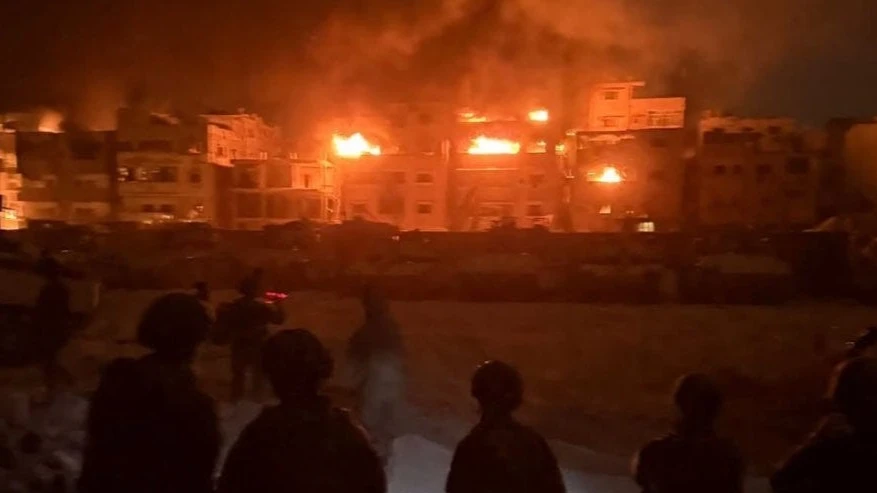
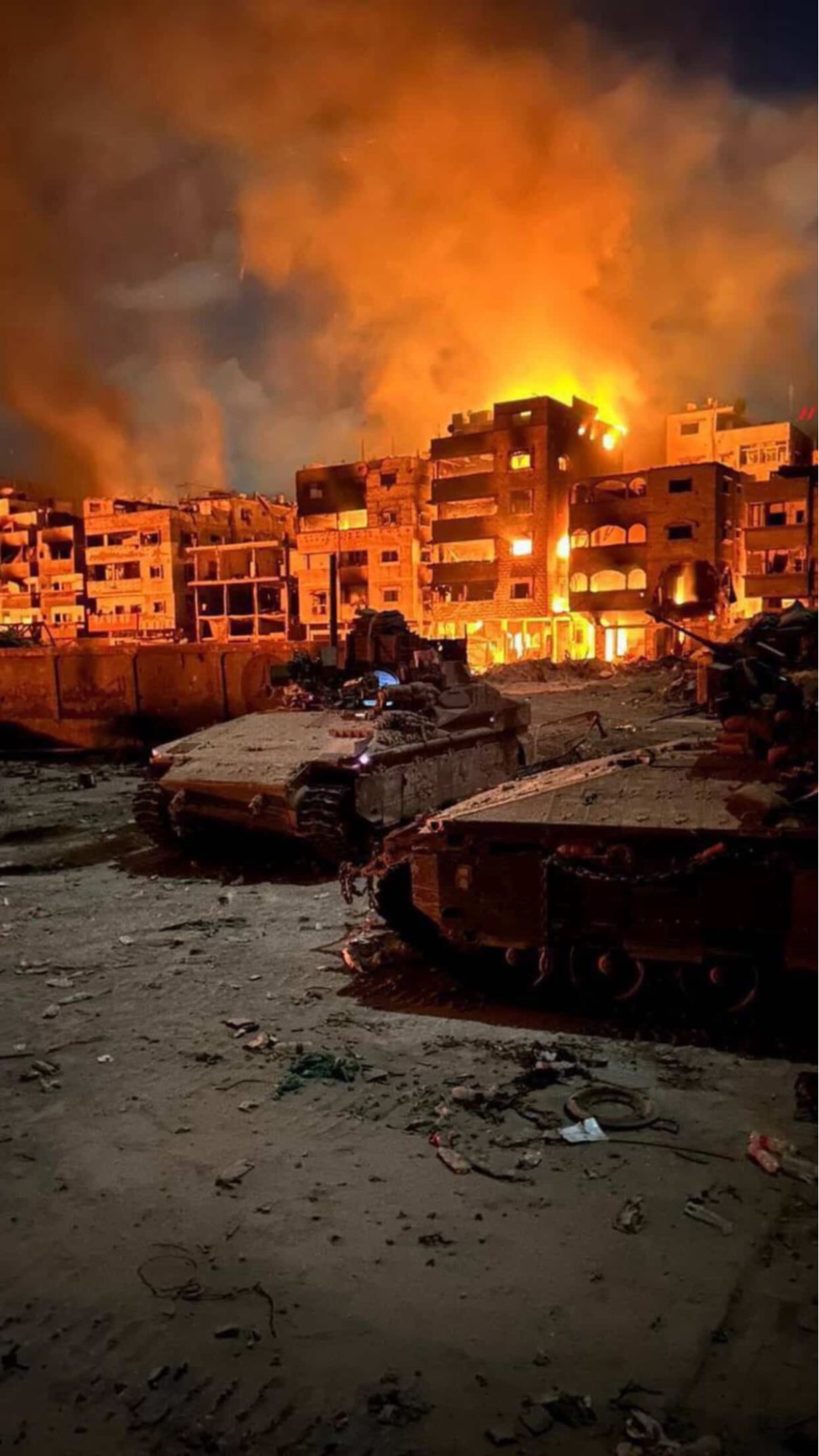
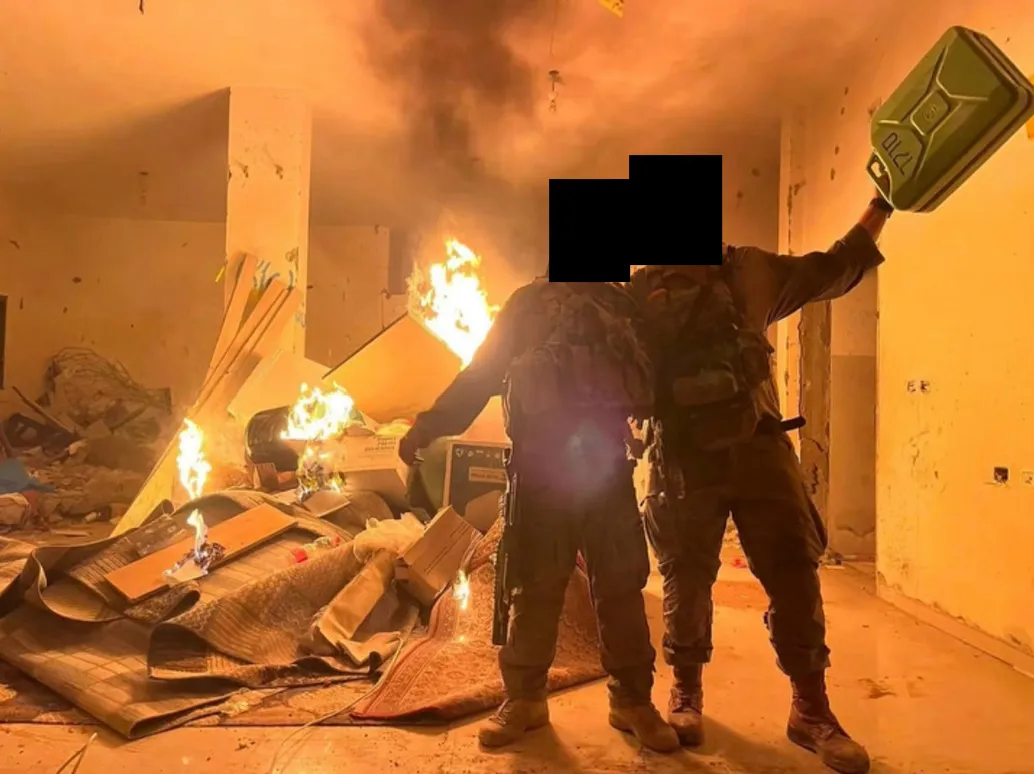
Israeli occupation forces carried out a deliberate campaign of arson across Gaza City immediately after the ceasefire was declared, a DropSite News report published on 13 October revealed.

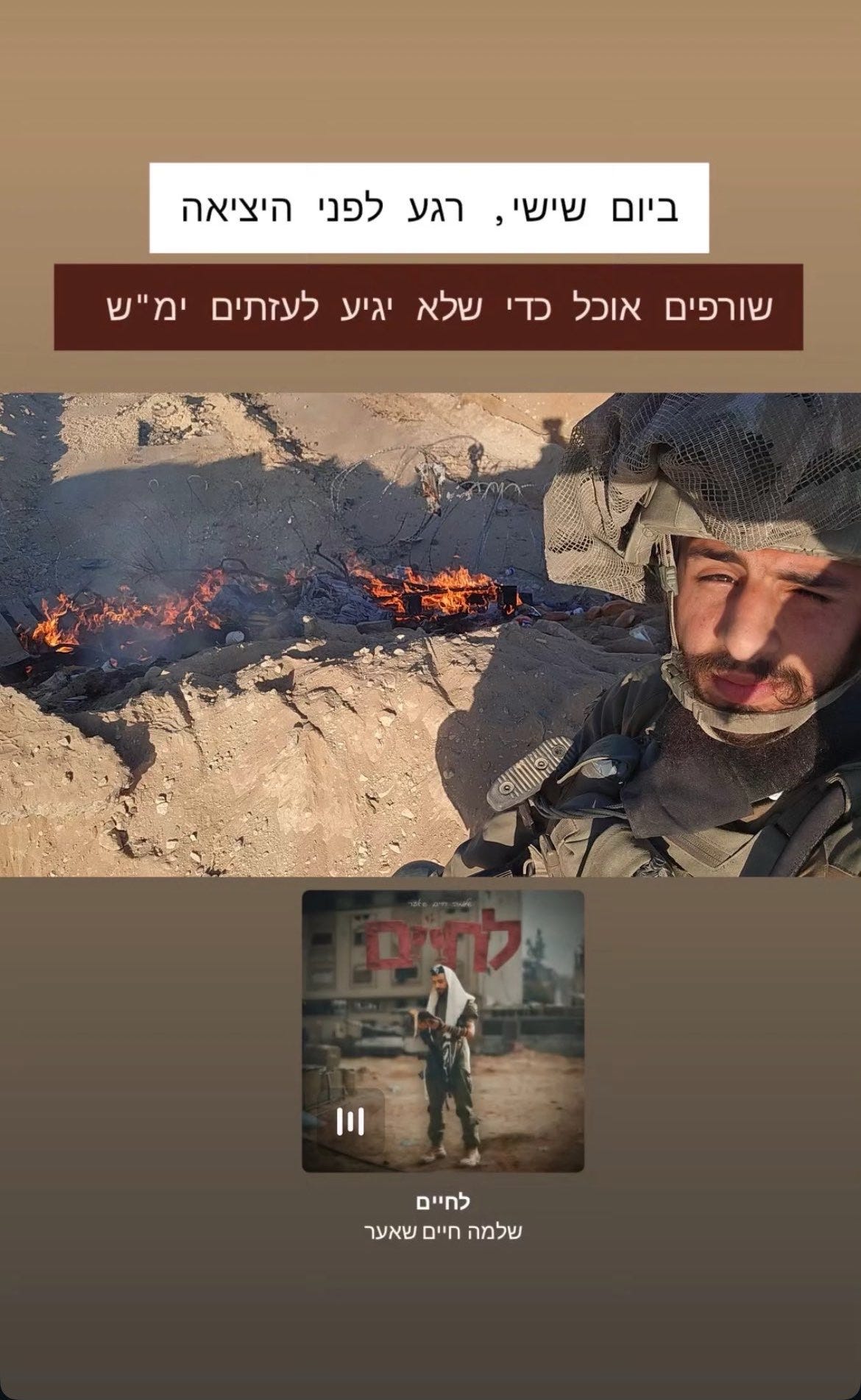
According to the investigation, soldiers from the Golani, Givati, Nahal, Kfir, and newly created ultra-Orthodox Hashmonaim brigades set fire to homes, shops, and infrastructure on 9–10 October as they retreated from the city.


Image
Photo posted on social media with the caption: “On Friday, just before departure. Burning food so that it won’t reach the Gazans, may their names be erased.” (Taken from DropSite)

Many documented their acts online, sharing photos of flames consuming entire blocks with captions such as “Leaving a mark,” “A small souvenir,” and “Good riddance.”

One Kfir Brigade member posted an image on social media beside a fire, writing, “On Friday, just before departure. Burning food so that it won’t reach the Gazans, may their names be erased.” Another described the scorched buildings as “[one] last memory.”

Among the facilities destroyed was the Sheikh Ajlin sewage treatment plant, the last functioning site capable of processing Gaza City’s wastewater.

Image
Arson in Sheikh Radwan. (Source: Social media, taken from DropSite)

Its director, Monther Shoblaq of the Coastal Municipalities Water Utility, warned that the loss would drive the city’s sanitation “to point zero.”

He questioned the logic behind the act, saying, “I mean, they signed a ceasefire. Why set it on fire?”

The plant, funded by Germany’s KfW Development Bank at a cost of $19 million, had been slated for post-war reconstruction.

Shoblaq cautioned that its destruction will force raw sewage directly into the sea, creating an environmental disaster that “could take years to reverse.”

DropSite found that the burnings fit a long-standing Israeli practice of razing civilian infrastructure before withdrawal.

Image
Israeli soldiers burn a home in Gaza City on the night of 9 October. (Source: Social media, taken from DropSite)

In the Sheikh Radwan area, troops torched multi-story homes and graffitied walls with phrases such as “Enjoy, sluts” and “We shall return here.”

Israeli Environment Minister Gila Gamliel boasted recently that “75 percent of the entire strip” had already been annihilated, while far-right cabinet member Itamar Ben Gvir mocked that “the only thing left in Gaza for The Electricity Company to disconnect now is the wastewater treatment plant.”

UN agencies have condemned such actions as part of a “widespread and systematic attack directed against the civilian population.”

As Trump hailed the ceasefire as “a Strong, Durable, and Everlasting Peace,” an Israeli colonel summed up the reality left behind, saying, “We are leaving behind us only dust. There’s nothing here.”

https://thecradle.co/articles/israeli-t ... ire-report

No rule without resistance: Gaza’s post-war future and the collapse of foreign illusions

As western powers push technocracy over sovereignty, Palestinian resistance movements warn that there can be no reconstruction without liberation.

Mohammad al-Ayoubi

OCT 13, 2025

Image
Photo Credit: The Cradle

In the aftermath of the devastating war on Gaza, the most pressing question is no longer about a ceasefire or reconstruction, but about who will govern the enclave.

This is a struggle over meaning, legitimacy, and sovereignty. Will the future of Gaza be shaped by its people, or by the same foreign powers that helped destroy it under the banner of “salvation”?

Every time the gates of ‘reconstruction’ and ‘aid’ are opened, the windows of sovereignty are slammed shut. What unfolds is a recurring colonial spectacle: a Palestinian political order remade under foreign supervision, where ‘political realism’ is promoted as a substitute for justice, and ‘technocracy’ is marketed as a sterile alternative to resistance.

The day after

Senior Hamas official Ayham Shananaa tells The Cradle that the war’s outcome cannot be measured by the standards of traditional inter-state conflict, but must be understood as “an existential struggle between a people seeking liberation and an occupation backed by the west.”

He says the very survival of Hamas in the political arena after the two-year war constitutes a strategic victory as Israel failed to achieve its stated objectives, even with unprecedented international backing.

This view is echoed by Palestinian Islamic Jihad (PIJ) official Haitham Abu al-Ghazlan, who affirms that “the resistance is now more entrenched than ever,” and insists that the true measure of victory lies not in material destruction, but in the failure of the Zionist project to displace the population and break Palestinian will.

Shananaa adds that the resistance “has imposed itself as a key actor that cannot be bypassed in any discussion about Gaza’s future,” arguing that its steadfastness transformed it from a purely military actor into a national project with a vision and strategy.

Most significantly, he adds, “this war marked a shift in global consciousness,” citing unprecedented solidarity with Palestinians, massive protests, and symbolic recognitions of the State of Palestine, all pointing to a deep shift in western public opinion about the occupation.

Reconstruction as leverage: The new face of occupation

International proposals for Gaza’s administration – whether in the form of a technocratic government or a transitional authority – are being sold as humanitarian necessities. In truth, they are little more than cosmetic rebrands of the old control mechanisms.

In this context, Abu al-Ghazlan stresses that any such proposal “must be the result of an inclusive Palestinian national dialogue, not foreign agreements or international tutelage.” He affirms that “reconstruction is a human right, not a political bargaining chip,” and rejects any attempt to link it to disarmament or restrictions on the resistance.

The politics of governance: Can resistance yield to technocracy?

One of the central debates now confronting Palestinian factions is whether resistance authority can morph into technocratic governance – whether the separation of security and political decision-making is possible or even desirable.

Shananaa is unequivocal: “The resistance’s arms are a red line as long as the occupation exists.” While Hamas does not oppose a civil administration to manage daily life in Gaza, he insists that the movement will not compromise on the core of its security apparatus.

Abu al-Ghazlan, speaking from the PIJ perspective (which, unlike Hamas, has no political agenda), affirms the same red line: “All peace processes that stripped the resistance of its weapons ended in more aggression and settlement expansion.”

What emerges is a shared formula: A civil government is possible, but sovereignty – particularly security sovereignty – remains non-negotiable.

The idea of a “temporary civil administration” may appear moderate, but in reality, it is governance without power – a managerial shell devoid of political agency.

This model seeks to govern Gaza, not liberate it; manage, not emancipate it. What Washington and Tel Aviv are trying to construct is a hollow Palestinian model that presents the illusion of “self-rule” under the ceiling of occupation.

Shananaa and Abu al-Ghazlan both emphasize that any future arrangements “must be based on protecting the rights of the people, not on foreign pressure.”

The term “national consensus” may sound appealing in rhetoric, but it often functions as a mask for political illusion. True consensus requires real sovereignty and independent Palestinian will, while externally imposed consensus is merely renewed tutelage in disguise.

The survival equation: Hamas, legitimacy, and the resistance street

While the Palestinian Authority (PA) chases lost legitimacy through donor channels, Hamas draws its authority from survival amid the rubble. The people of Gaza – though exhausted – see in Hamas not perfection, but defiance, a refusal to capitulate in the face of annihilation.

On the question of a national unity government spanning Gaza and the occupied West Bank, Shananaa says this proposal is not new. Hamas has long called for real national partnership, he says, referencing repeated reconciliation attempts with Fatah in Cairo, Algiers, Moscow, and notably Beijing.

However, none were implemented because of PA President Mahmoud Abbas’s refusal to share power or accept a balanced framework, he explains:

“Hamas does not object to the Palestinian Authority playing a supervisory or financial role in reconstruction arrangements, as long as this is done within clear agreements that preserve the resistance’s arms and prevent any foreign interference in security decisions.”

Abu al-Ghazlan adds that trust between the PA and the resistance “cannot be built with words, but with positions. When the people feel that the political decision protects the resistance and does not constrain it, then we can say we have begun the path to rebuilding national trust.”

Gaza’s future appears confined to three possible scenarios, shaped by the power balances established by the war and the scope of international and regional interventions in shaping the so-called “day after.”

Scenario 1: Resistance-led governance – Hamas fills the vacuum

This is the most likely outcome, with a probability of around 60 percent. It rests on the principle of “imposed reality,” where Hamas reasserts its grip on Gaza in the vacuum left by the Israeli military’s withdrawal from the Yellow Line areas.

From the first day of the ceasefire, Hamas’s National Security Forces redeployed in streets, intersections, and liberated zones, visibly re-establishing a security architecture that had partially collapsed during the war.

Shananaa makes this clear when he confirms that “about 70 percent of the strip is under the control of Hamas-formed Palestinian security forces,” reflecting a field reality that cannot easily be overturned.

This scenario implies that the strip will remain under Hamas’s political and security administration for at least one to two years, until internal and external understandings mature enough to form a national unity technocratic government acceptable to both Palestinian and international actors.

This phase would amount to “transitional rule by force” – a hybrid of resistance authority and provisional civil administration, pending a wider political statement.

Scenario 2: Pre-2005 redux – security coordination and foreign oversight

Favored by the US and some regional powers, this scenario (estimated at 25 percent likelihood) envisions a return to pre-2005 arrangements: tripartite coordination between the Israeli occupation, the PA, and a US-led supervisory body – possibly with Egyptian and Qatari backing.

In this framework, “internationally acceptable” Palestinian forces would oversee Gaza’s administration, border security, disarmament efforts, and aid distribution under a central international committee.

But this vision collapses under two contradictions:

First, Hamas has no intention of surrendering its political or military position after surviving the war and forcing a ceasefire.

Second, years of security collaboration with the occupation have left the PA with zero public trust.

In short, this remains a western fantasy, not a viable roadmap.

Scenario 3: Engineered chaos – a controlled descent into conflict

The least probable scenario (15 percent), but the most dangerous, foresees a relapse into armed clashes among Palestinian factions – or between resistance groups and Israeli-backed militias, or the occupation army – if the ceasefire collapses or political negotiations falter.

This is Tel Aviv’s preferred outcome, as it ensures ongoing attrition of the resistance and keeps Gaza in turmoil, preventing the formation of any stable or unified political order.

Nonetheless, despite its risk, this scenario is unlikely in the near term, as regional actors – especially Egypt and Qatar – are working intensively to prevent a new explosion that could dismantle what remains of the political process.

Tel Aviv’s political implosion: Netanyahu’s fall and the crisis of Zionism

Israeli Prime Minister Benjamin Netanyahu wanted to etch his name into history as the man who crushed Hamas. Instead, he may be remembered as the architect of his own downfall – a view echoed even within Israeli political circles, from Yair Lapid to Bezalel Smotrich and Itamar Ben Gvir.

The ceasefire agreement was, in effect, an admission of Zionist failure. The war’s goals – eliminating Hamas and freeing captives by force – evaporated in the face of resistance.

Even if Netanyahu goes, the Israeli security and political establishment will still seek control over Gaza, but without the unified narrative that once justified killing in the name of survival.

Shananaa says the ceasefire agreement deepened Israel’s internal crisis and weakened the cohesion of the far-right coalition, describing Netanyahu’s government as “a fascist, extremist one that has lost legitimacy even inside Israeli society.”

“More than 1.5 million Israelis protested against the war, and the opposition grows by the day. American support is what keeps Netanyahu politically alive, but his fall is only a matter of time.”

The war’s aims shifted from “eliminating Hamas” to “surviving failure.” It was a descent from strategic vision to tactical reaction; from a state making history to a state struggling to survive its own present.

In the end, the question ‘Who rules Gaza after the war?’ is an existential one rather than an administrative one. Who holds real legitimacy? Who defines the future? Who decides when the war ends?

Shananaa answers clearly. “There is no authority above the resistance, and no reconstruction without sovereignty.”

Legitimacy is not awarded by donors or imposed through frameworks. It is forged under fire, seized from the rubble. And the “day after” will not begin with signatures, but with the dismantling of the occupation.

https://thecradle.co/articles/no-rule-w ... -illusions

Israel violates ceasefire with deadly attacks on Palestinians in Gaza

Nine Palestinians were killed less than 24 hours after the US and Arab states signed the ceasefire deal in Sharm el-Sheikh

News Desk

OCT 14, 2025

Image
(Photo credit: Reuters)

The Israeli army killed several Palestinians in Gaza on 14 October despite the new ceasefire agreement which has taken effect across the strip.

In total, nine Palestinians were killed by Israeli ceasefire violations, Palestinian media reports said. Three bodies arrived at Nasser Hospital in Khan Yunis, while another six arrived at Gaza City’s Baptist hospital.


An Israeli quadcopter targeted civilians in Gaza City’s Shujaiya neighborhood while they were inspecting their homes.

Israeli artillery also shelled areas in Jabalia and Al-Tarans, accompanied by gunfire. There was also gunfire reported in the Al-Tahlia area of Khan Yunis in south Gaza.

Additionally, a group of young men near Al-Fukhari, east of Khan Yunis, was targeted by Israeli forces, resulting in one death.

The Israeli army announced that it killed five Palestinians on Tuesday. It said the they had crossed the Yellow Line, where Israeli forces withdrew to as part of an initial pullout stipulated in the ceasefire deal’s map.

The army said it acted to “remove the threat,” claiming the Palestinians refused to disperse.

“The IDF calls on Gaza residents to follow its instructions and not to approach the troops deployed in the area,” the army statement added.

A DropSite News report published on 13 October found that Israeli forces carried out a deliberate campaign of arson across Gaza City immediately after the ceasefire was declared.

According to the investigation, soldiers from the Golani, Givati, Nahal, Kfir, and newly created ultra-Orthodox Hashmonaim brigades set fire to homes, shops, and infrastructure on 9–10 October as they pulled out from the city.

As part of the first withdrawal, the Israeli army has left Gaza’s population centers.

The map does not envision a full Israeli withdrawal, with the final stage being a pullout towards the Gaza border, where a buffer zone would be established until the strip is “terror-free.”

Tuesday’s attacks in Gaza came shortly after the release of the bodies of four deceased Israeli captives by Hamas.

A day earlier, Tel Aviv received all 20 living captives and released nearly 2,000 Palestinian prisoners.

The deal was signed during an Egyptian-US-hosted summit in Sharm el-Sheikh on Monday.

https://thecradle.co/articles/israel-vi ... ns-in-gaza

******

Waiting on images of abject submission that don’t appear

Alastair Crooke

October 13, 2025

Continued U.S. ‘dominance’ requires striking out in multiple directions, because the unidirectional war on Russia unexpectedly has failed.

Trump: “This problem with Vietnam … We stopped fighting to win. We would have won easy. We would have won Afghanistan easy. Would have won every war easy. But we got politically correct: ‘Ah, let’s take it easy!’. It’s that we’re not politically correct anymore. Just so you understand: We win. Now we win”. All these would have been easy – along with Afghanistan.

What was the meaning to Trump’s reference to Vietnam? ‘What he was saying is that ‘we’ would have won Vietnam easily, if we hadn’t been woke and DEI’. Some veterans might amplify, ‘You know: we had enough firepower: We could have killed everyone’.

“No matter where you go”, Trump adds, “no matter what you even think about, there’s nothing like the fighting force that we have [including] Rome … No one should ever want to start a fight with the USA”.

The point is that in today’s Trump circles, not only is there no fear of war, but there is this unsubstantiated delusion of American military power. Hegseth said: “We are the most powerful military on the history of the planet, bar none. Nobody else can even come close to it”. To which Trump adds, “Our market [too], is the greatest in the world – no one can live without it”.

The Anglo-U.S. ‘Empire’ is backing itself into the corner of ‘terminal decline’, as French philosopher Emmanual Todd puts it. Trump is attempting, on the one hand, to coerce into being a new ‘Bretton Woods’ in order to re-create dollar hegemony through threat, bluster and tariffs – or war, if needs be.

Todd believes that as the Anglo-U.S. Empire falls apart, the U.S. is lashing out at the world in fury – and is devouring itself through the attempt to re-colonise its own colonies (i.e. Europe) for quick financial shakedowns.

Trump’s vision of U.S. unstoppable military force amounts to a doctrine of domination and submission. One that runs counter to all the former narrative-talk of western values. What is clear is that this policy shift is ‘joined at the hip’ with Jewish and Evangelical eschatological creeds. It shares with Jewish nationalists the conviction that they too, in alliance with Trump, verge on quasi universal domination:

“We crushed Iran’s nuclear and ballistic projects – they are still there, but we took them back with the help of President Trump”, Netanyahu boasts. “We had a precise alliance, within the framework of which we shared the burden [with the U.S.] and achieved the neutralization of Iran”. According to Netanyahu, “Israel emerged from this event as the dominant power in the Middle East, but we still have something to do – what started in Gaza will be ended in Gaza”.

“We need to ‘deradicalise’ Gaza – as was done in Germany after World War II or in Japan”. Netanyahu insisted to Euronews. Submission however, is proving elusive.

Continued U.S. ‘dominance’, however, requires striking out in multiple directions, because the unidirectional war on Russia – which was supposed to provide the world with an object lesson in the ‘craft’ of Anglo-Zionist domination unexpectedly has failed. And now time is running out on America’s deficit and debt crisis.

This – whilst articulated as the Trumpian desire for domination – is also throwing out nihilistic impulses for war and at the same time fracturing western structures. Bitter tensions are arising across the globe. The big picture is that Russia has seen the writing on the wall: The Alaska summit has born no fruit; Trump is not serious about wanting to recast relations with Moscow.

The expectation in Moscow is now leaning toward the expectation of U.S. escalation in Ukraine; a more devastating strike on Iran; or some punitive, performative action in Venezuela – or both. The Trump team seem to be talking themselves up into a state psychic excitement.

The Jewish Oligarchs and the right-wing of the Cabinet in Israel, in this emerging picture, existentially need America to remain as a feared military hegemon (just as Trump promises). Without the American ‘unstoppable’ military cudgel and absent the centrality of dollar use in trade, Jewish Supremacy becomes nothing more than an eschatological chimaera.

A crisis of de-dollarisation, or a bond market blow up – juxtaposed with the rise of China and Russia and BRICS – becomes an existential threat to the supremacist ‘fantasy’.

In July 2025, Trump told his cabinet, “BRICS was set up to hurt us; BRICS was set up to degenerate our dollar and take our dollar … off as the standard”.

So what comes next? Plainly the U.S. and Israeli initial goal is to ‘sear’ Hamas’ psyche with defeat; and if there is no visible expression of utter submission, the overarching aim likely will be to drive out all Palestinians from Gaza and to install Jewish settlers in their place.

Israeli Minister Smotrich – a few years ago – argued that complete displacement of the Palestinian and Arab non-submissive population would only be finally achieved during ‘a major crisis or big war’ – such as occurred in 1948, when 800,000 Palestinians were expelled from their homes. But today, despite the two years’ of massacres, Palestinians have not fled, nor submitted.

So Israel, for all Netanyahu’ boasts of having crushed Hamas, has yet to defeat Palestinians in Gaza – and some in the Hebrew media are calling the Sharm el-Sheik aAccord “a defeat for Israel”.

Netanyahu and the Israeli Right’s ambitions are not circumscribed by Gaza.They extend much further – they seek to establish a State on the full ‘Land of Israel’, which is to say, Greater Israel. Their definition of this colonial project is ambiguous, but likely they want southern Lebanon up to the Litani River; probably most of southern Syria (up to Damascus); parts of the Sinai; and maybe parts of the East Bank, which now belong to Jordan.

So – despite two years of war – what Israel still wants, Professor Mearsheimer opines, is a Palestinian-free Greater Israel.

“Furthermore”, Professor Mearsheimer adds:

“you have to think about what they want with regard to their neighbours. They want weak neighbours. They want to break their neighbours apart. They want to do to Iran what they did in Syria. It’s very important to understand that [while] the nuclear issue is of central importance to the Israelis in Iran, they have broader goals – which is to wreck Iran, turn it into a series of small states”.

“And then the states that they don’t break apart – like Egypt and Jordan – they want them to be economically dependent on Uncle Sam, so that Uncle Sam has huge coercive leverage over them. So, they’re thinking seriously about how to deal with all their neighbours and make sure that they’re weak and don’t pose any kind of threat to Israel”.

Israel clearly seeks the collapse and neutralisation of Iran – as Netanyahu outlined:

“We crushed Iran’s nuclear and ballistic projects – they are still there, but we took them back with the help of President Trump … Iran [now] is developing intercontinental ballistic missiles with an 8,000 km range. Add another 3,000 and they can target New York City, Washington, Boston, Miami, Mar-a-Lago”.

As a possible ceasefire deal begins to take shape in Egypt, the wider regional picture is that the U.S. and Israel to seem intent on provoking a Sunni–Shia confrontation to encircle and weaken Iran. The last days’ EU–GCC joint statement on the UAE’s claims to own sovereignty over Abu Musa and the Tunb Islands reflects a growing analysis in Tehran that Western powers are once again using Gulf monarchies as instruments to stir regional instability.

In short, this is not about the islands or oil – it is about manufacturing a new front to weaken Iran.

And with all such projects for the re-ordering of the Region to acquiesce to Israel’s hegemony, the big Jewish donors want to ensure a situation whereby the U.S. supports Israel unconditionally – hence the large funding directed at the MSM and social media to ensure an across all society support for Israel in America.

The two-year anniversary of 7 October poses a question: How does the balance sheet stand? The U.S.-Israel partnership has succeeded in destroying Syria, turning it into a hell of internecine killings; Russia has lost its foothold in the region; ISIS has been revived; sectarianism is on the upsurge. Hizbullah was decapitated but not destroyed. The region is being Balkanised, fragmented and brutalised.

JCPOA Snapback for Iran has been triggered and on 18 October, the JCPOA itself expires. Trump then is left with a ‘blank sheet’ on which he can write an ultimatum demanding Iranian capitulation, or military action (if he so chooses).

On the other side of the account, were we to look back to the Resistance’s initial objectives of exhausting Israel militarily; creating internecine warfare within Israel; and putting into moral and practical question the principle of Zionism that confers special rights for one population group over another, then it might be said that the Resistance – at a heavy, heavy cost – has had some success.

More significantly, Israel’s bloody wars have already lost it a generation of young Americans, who are not coming back. Whatever the circumstances to the killing of Charlie Kirk, his death has let the genie of ‘Israeli First’ dominance in Republican politics escape free from the bottle.

Israel has already lost much of Europe, and in the U.S., the Trump and Israeli Firsters’ intolerant insistence on fealty to Israel and its actions has triggered intense First Amendment push-back.

That puts Israel on track to ‘loose’ America. And that could be existential for Israel, who may need to fundamentally re-assess the nature of Zionism (which was, of course, Seyed Nasrallah’s stated objective).

How would that look? Accelerating migration – leaving a patchwork of Zionist holdouts surviving amidst a stagnant economy and global isolation. Is that sustainable?

What will be the future that heralds for Israel’s grandchildren?

https://strategic-culture.su/news/2025/ ... nt-appear/

*****

Image

Secret Israeli military bunker located under Tel Aviv tower struck by Iran, analysis shows
Jack Poulson and Wyatt Reed·October 13, 2025

The Grayzone has geolocated the underground bunker of an important military command and control center nestled within a densely populated Tel Aviv neighborhood. Known as ‘Site 81,’ the U.S.-built facility houses a hyper-secretive intelligence base.
When Iran struck a series of targets in the heart of north Tel Aviv with ballistic missiles on June 13, Israeli authorities immediately cordoned off the area to prevent journalists from filming the damage. “The building on this compound was just hit,” Trey Yingst of Fox News reported as he arrived that evening at the site of HaKirya, Israel’s Defense Ministry headquarters, and the nearby Azrieli Center. But within seconds, Israeli police officers arrived to aggressively shunt Yingst away from where he was standing, just north of the HaKirya Bridge on the west side of Menachem Begin Road.

That day, Iranian missiles struck the north tower of the Da Vinci apartment complex roughly 550 meters southwest of Yingst’s location. The Grayzone has determined that the building sits immediately south of the “Canarit” / “Kannarit” Israeli Air Force towers and above an underground military intelligence bunker jointly administered by the US and Israeli militaries. According to an analysis of leaked emails, public documents, and Israeli news reports, the location is host to a highly secretive, electromagnetically shielded intelligence facility known as “Site 81.”

Israel aggressively censors information relating to its urban military and intelligence facilities while simultaneously accusing its adversaries of engaging in ‘human shielding’ – a practice of protecting military targets with civilian populations that is prohibited by international humanitarian law. While the existence of a U.S. Army project to expand Site 81 to a 6,000 square-meter facility was widely reported from government records circa 2013, the specific location remained unknown.

Image
Analysis of an image from a 2013 U.S. Army Corps of Engineers study reveals a “basement test site” for the planned construction of Site 81 is located at the current site of the Da Vinci towers.

A photo taken outside of Site 81 has now been geolocated to the grounds of the Da Vinci apartment complex, which one resident decried as a shield for the Israeli military headquarters. Leaked emails from a former Israeli military Chief of Staff further indicate that Site 81 is an important command and control node. The Jerusalem Post also reported that an Iranian missile that struck the Da Vinci towers was “just a stone’s throw from Netanyahu’s office,” which was then known as “Building 22.” The prime minister’s office began undergoing renovations just weeks after the 2025 Twelve Day War between Israel and Iran, and is rumored to have been damaged in the strike.

The Israeli military has constructed a larger underground command center in Kirya known as the “Fortress of Zion,” extending an older command center known as “The Pit.” Given its temporal, spatial, and functional proximity, it is likely that “The Pit” was connected to Site 81. Journalists from Israel Hayom and The New York Times have visited the Fortress of Zion but not revealed its precise location or that of its entrance.

Image
A map of relevant landmarks for the June 13, 2025 Iranian airstrikes on the Kirya district of Tel Aviv. Locations in red were confirmed damaged by the strikes.

Geolocating ‘Site 81’
Despite the end of U.S. legislation banning its publication, Google Maps continues to blur satellite imagery containing any hint of sensitive Israeli strategic information. At the section of Leonardo da Vinci St. directly in front of the Da Vinci Towers, Google took its pro-Israel censorship a step further, refusing to offer street view images of the location. The area east of Leonardo Da Vinci St. and west of Azrieli Center is also censored by the Moscow-based Yandex Maps, with both satellite imagery and metadata of the Da Vinci towers completely blocked.

A photo of Site 81 published by the U.S. Army Corps of Engineers in February 2013 as part of a corrosion test of the underground structure’s concrete overlay and galvanized steel plating can be geolocated to what is now the site of the Da Vinci apartment towers, with the southern of the two 18-story Israeli Air Force Kannarit towers just meters away. According to a website for the Kannarit towers published by the Israeli construction firm Danya Cebus, the buildings were “constructed for the [Israeli] Air Force Headquarters.” The Israeli aluminum building enclosure company Alumeshet described its work on the towers in 2002 as including the construction of “a blast mitigation system ensuring maximum security.”

Haaretz has reported the existence of the Army Corps report, concluding that Site 81 was located somewhere in central Tel Aviv. A closer analysis of a photograph in the report reveals it was taken roughly 60 meters north of Eliezer Kaplan St. on the east side of Leonardo da Vinci St., in the southwestern corner of the Ha’Kirya.

Image
The intersection of Eliezer Kaplan and Leonardo da Vinci streets is shown in a February 2019 image from Google Maps. It is the only clear image of the site furnished by Google.

The east face of the 29-floor Daniel Frisch Tower fills much of the background of the Army Corps photo, which shows two large instrument cases set to be transported into the basement of Site 81. Located roughly 160 meters northwest from the photographer, trees from the Gerry Pencer Park partially obstruct the base of the tower, with the top of the London Ministores Tower also visible just to the right.

The features from the Army Corps photo precisely match those of a February 2019 image published to Google Maps from the southwest corner of Eliezer Kaplan and Leonardo da Vinci, which includes the same five distinctive curved pipes connected to the Kannarit tower just above the razor wire.

Image
A side-by-side comparison shows the distinctive five pipes attached to the southern face of the south Kannarit tower, as seen from Google Maps (left) and the U.S. Army Corps of Engineers photo (right).

The Kirya complex situated among human shields
A detailed report from France 24 regarding Israeli censorship of reporting on the Iranian strikes concluded that coverage of the attack on the 42-story Da Vinci Towers had likely been purposefully delayed, stating that “it looks like censorship is at play.” The outlet noted that “Israeli newspaper Haaretz waited until June 29 to mention this strike in an article – a full two weeks after the attack took place, even though the images of it had already circulated online.”

When recounting the incident to Israeli media weeks later, one resident recalled being informed of the tower’s true purpose in a conversation with a friend, who asked: “Brother, don’t you get that they approved the construction of all those towers to protect the Kirya?”

“Today, I realize I’ve been paying 12,000 shekels [$3,650 USD] a month to protect the Kirya,” the resident explained, using the common shorthand for the Israeli military headquarters.

The geolocation of the Site 81 photo suggests that the Da Vinci Towers are also protecting the secretive underground intelligence facility. The bunker is apparently located less than 100 meters from a children’s playground, alongside a large community center which opened at the base of the towers in July 2023. By situating some of its most sensitive military installations in the heart of a civilian area, Israel has engaged in the human shielding practice it routinely accuses Palestinians of exploiting.

Image
A photo of a playground within the Gerry Pencer Park in the Ha’Kirya district of Tel Aviv, just west of the apparent location of Site 81, dated October 2021. Credit: Google Maps user Or Baruch.

The tenants of an eight-story commercial building nestled inside the Da Vinci complex also enjoy direct ties to military intelligence. The Israeli generative artificial intelligence company AI21 Labs, which was founded by veterans of the IDF’s signals intelligence arm, Unit 8200, earlier this year confirmed the participation of AI21 employees in developing a ChatGPT-like military AI tool targeting Palestinians. AI21 – which has also been affiliated with Stanford University – announced its lease of space on the fourth and fifth floors of the Da Vinci office building in late 2023.

Image
A promotional photo showing the Da Vinci complex, published by the Israel Canada Group. The Israeli Air Force’s blast-shielded Kannarit towers can be seen on the left and the distinctive Israeli military headquarters on the right.

Israeli-American capital finances the towers
Next door to the Da Vinci complex, the Kannarit towers were built by the major Israeli construction company Danya Cebus, which said the work was carried out as part of a joint venture with another firm known as Solel Boneh. The controlling stake of Soleh Boneh’s parent company, Shikun & Binui, was passed from Shari Arison, formerly Israel’s richest woman, to the Los Angeles-based real estate developer Netanal H. “Naty” Saidoff in mid-2018.

Saidoff has overseen several Israeli government-affiliated nonprofits in the Los Angeles area, including by chairing the Likud-oriented Israeli-American Council (IAC) and underwriting the legal program of StandWithUs, a pro-Israel training group. Saidoff’s fellow board member at Shikun & Binui, Sagi Balasha, was the first CEO of both the IAC and the Israeli government-funded propaganda initiative, Concert/Voices of Israel.

The headquarters of the suggestively-named cybersecurity company Perimeter 81 – now part of the publicly traded Check Point Technologies – is also located roughly 40 meters to the west of the apparent location of Site 81. Check Point is in the process of developing a new headquarters in Tel Aviv with Israel Canada Group, which, along with Acro Real Estate, purchased the rights for the Da Vinci complex in 2015 from what was previously a Ministry of Defense site for NIS 830 million (roughly $207 million). The current CEO of Check Point, Nadav Zafrir, commanded Unit 8200 circa 2009 to 2013.

Public US contracting records show that the Plano, Texas-based branch of the German engineering solutions company M+W Group – now known as Exyte – began a $7.4 million contract for Site 81 in June 2011, spanning the company’s support for the Army Corps study. The much larger ‘Phase 2’ of the Site 81 project was subsequently awarded to the controversial Oxford Construction of Pennsylvania for $29.6 million in August 2013, with the contracts being shifted to Oxford Federal after a Chapter 7 bankruptcy in 2017. In 2018, Oxford Construction was slapped with a lawsuit accusing its owners of racketeering, fraud, and negligent misrepresentation. A final $758,461 payment to Oxford Federal for its ‘Phase 2’ work on Site 81 was processed on February 26, 2019.

Leaked emails highlight Site 81’s use for “command and control”
A previously unreported leaked email exchange between ex-NATO commander James Stavridis and former Israeli military Chief of Staff Gabi Ashkenazi appears to confirm the presence of a command and control network operating inside the Site 81 bunker – smack in the middle of a densely populated civilian area.

“Hi Gabi,” Stavridis wrote to Ashkenazi on September 1, 2015. “I am working with an exciting company called Think Logical here in the USA. They build command and control networks, and just won a big contract out at Site 81 with the IDF [Israel Defense Forces].”

The Grayzone discovered Ashkenazi’s email in a leaked archive from an apparently Iranian-linked hacktivist group known as Handala, which was curated by the American nonprofit Distributed Denial of Secrets.

“I am enjoying my new job as Dean of The Fletcher School of Law and Diplomacy here in Boston — a top school of international relations,” stated the email from Stavridis, which sought Ashkenazi’s assistance in recruiting “someone to help [Thinklogical] navigate in Israel” as a consultant – ideally, “a retired IDF 1-star” general.

Following a request for comment from The Gryazone, Stavridis appears to have included his wife and executive assistant in an accidental reply which read, “Just seeing this? Are you sure!? He is ending.” The message was accompanied by a lengthy footer describing Stavridis’ current roles as vice chairman of global affairs of The Carlyle Group and chairman of the board of The Rockefeller Foundation.

Gen. Ashkenazi and Mr. Pajer did not respond to requests for comment. The Israel Defense Forces also neglected to reply to requests emailed to three separate spokesperson addresses.

https://thegrayzone.com/2025/10/13/secr ... sis-shows/

******

Gaza Takeover: The Easy Way, or the Hard Way
October 14, 2025

All Trump’s deal does is hand total victory to Israel. Arab states are key to whether Hamas capitulates, writes Joe Lauria.

Image
An AI-generated image shared on social media by Donald Trump himself last February.

By Joe Lauria
Special to Consortium News

Speaking to the Israeli nation about the ceasefire agreement in Gaza, Prime Minister Benjamin Netanyahu said last Friday:

“Hamas agreed to the deal only when it felt the sword resting on its neck and it is still on its neck … Hamas will be disarmed and Gaza will be demilitarized … If this is achieved the easy way, so much the better. And if not, it will be achieved the hard way.”

So there’s only one way the genocide does not resume in Gaza: Hamas disarms and unconditionally surrenders to Israel.

The threat of more violence if this doesn’t happen is clear enough in Netanyahu’s words.

Other Israeli officials have promised the same.

Israel’s goal is the ethnic cleansing of Gaza and its complete takeover.

The so-called deal that Donald Trump is getting credit for seeks to achieve this. It is no peace deal. It does not settle any of the outstanding issues of the seven-decade-old Israeli theft of Palestinian land and expulsion of hundreds of thousands of people from their homes. Or the killing of countless innocent civilians by a brutalizing Israeli military intent on defending and extending its gains.

All Trump’s deal does is hand total victory to Israel.

Hamas is to disarm and not take part in any future governing of the Strip.

Of course they are refusing at this point. And if they continue to refuse Netanyahu has spelled out what will happen. Trump can then kiss next year’s Nobel Peace Prize goodbye. Israel would also again be condemned by most of the world as it resumes the killing and the losing of the information war – a main reason it agreed to the deal.

Key to whether Hamas capitulates are other Arab states, principally the Gulf monarchies. They are pressuring Hamas to give up. You see, they stand to get a piece of the action if Trump’s sick dream of a Gaza Riviera is realized on top of the decaying corpses of a significant part of society.

The Arab regimes are villains in this story almost as big as Israel and the United States. They have long ago resorted to lip service to the Palestinians to placate their own repressed and restless populations. Now they stand ready to cash in a bonanza because of a genocide they barely protested.

If Hamas gives up and Netanyahu gets his way — “the easy way” – there will still be a sizable population of Gazans to manage and pacify. The easiest way for the Israelis would be to put them on buses and move them out — if Netanyahu and Trump can finally find someone to take them. Perhaps they will pay the Egyptians enough. El-Sisi has his price.

If most of the Palestinians remain, they will probably wind up in shacks behind the gleaming casinos like in Batista’s Cuba. They would remain a headache for the Israelis, so it’s clear they would rather kick them out.

Netanyahu’s government surviving depends on this happening, the easy way or the hard way.

The right way would be for the Palestinians to build back their own society the way they want with Israeli and U.S. reparations. And to govern themselves the way they want with the leaders they choose in a state of their own, free from the threat of renewed attempts at annihilation.

But the odds of that happening will be a lot worse than claiming the jackpot at the roulette wheel at Trump Gaza Casino.

https://consortiumnews.com/2025/10/14/g ... -hard-way/
"There is great chaos under heaven; the situation is excellent."

User avatar
blindpig
Posts: 14788
Joined: Fri Jul 14, 2017 5:44 pm
Location: Turtle Island
Contact:

Re: Palestine

Post by blindpig » Wed Oct 15, 2025 2:28 pm

‘Disarm or be disarmed by force’: Trump issues new threat to Hamas

UK Prime Minister Keir Starmer has suggested using the Northern Ireland model to convince Hamas to surrender its arms

News Desk

OCT 15, 2025

Image
(Photo credit: AP)

US President Donald Trump issued a new threat against Hamas on 14 October, affirming that they will either surrender their weapons or be disarmed by force.

“They said they were gonna disarm,” the president claimed, despite Hamas and other resistance factions repeatedly rejecting Israeli terms for the surrender of arms. “They know I’m not playing games.”

The president praised the “monumental” achievement of returning the captives, adding that this was needed “above all else.”

He also expressed support for Hamas’s crackdown on outlaw militias in Gaza. “They did take out a couple of gangs that were very bad … That didn’t bother me,” he said.

“But they will disarm, you understand me?” Trump told a reporter. “Everyone’s always saying they won’t disarm … They will disarm. And I spoke to Hamas, and I told them you’re gonna disarm. Yes sir, we're gonna disarm, that’s what they told me,” Trump claimed.

“And if they don't disarm, we will disarm them – and it'll happen quickly and, perhaps, violently, but they WILL disarm,” he threatened.

Israel has also threatened to disarm Hamas through military force if the resistance group refuses to surrender. “All hell breaks loose” if Hamas does not disarm, Israeli Prime Minister Benjamin Netanyahu said on Tuesday.

The Deputy Secretary General of the Palestinian Islamic Jihad (PIJ) movement, Mohammad al-Hindi, rejected Trump’s comments and said “the resistance factions did not agree to disarmament,” adding that “we do not accept the threat of disarming them by force.”

Hamas has also repeatedly stressed that it will not surrender its weapons until a Palestinian state is formed.

UK Prime Minister Keir Starmer said on Tuesday that Britain could play a leading role in helping to disarm Hamas in Gaza by drawing on its experience persuading militant groups in Northern Ireland to surrender their weapons.

According to European diplomats cited by Reuters, the Northern Ireland peace process is being discussed as a potential model for Gaza’s future. They noted that no detailed plan has yet been drawn up.

“Of course, this is going to be difficult, but it's vital. It was difficult in Northern Ireland in relation to the IRA (Irish Republican Army), but it was vital,” Starmer said.

“That is why we have said that we stand ready, based on our experience in Northern Ireland, to help with the decommissioning process. I'm not going to pretend that's easy, but it is extremely important.”

Starmer’s national security advisor worked closely with former UK prime minister Tony Blair, who has been considered for a role in managing post-war Gaza.

https://thecradle.co/articles/disarm-or ... t-to-hamas

Over 9,000 Palestinians remain in Israeli captivity following exchange deal

Rights groups and released Palestinians say Israeli detention centers are 'torture camps' where detainees face beatings, starvation, and denial of medical care

News Desk

OCT 14, 2025

Image
(Photo credit: AA)

Palestinian prisoners' organizations say more than 9,000 remain in captivity under what one official described as “unimaginable conditions” in an interview with Al Jazeera on 14 October, despite the recent release of nearly 2,000 Palestinians as part of an exchange deal with Israel.

According to the Palestine Center for Prisoners’ Studies, at least 3,500 Palestinians are held under Israel’s so-called administrative detention, allowing imprisonment without charge or trial for an indefinite time.

Hundreds more seized from Gaza are detained under the “Unlawful Combatant” law, also without charge, among them 52 women, about 400 minors, and dozens of medical workers, journalists, and civilians accused of “incitement.”

Before the genocide began, Israeli jails held roughly 5,000 Palestinians.

That figure more than doubled to over 11,000 by October 2025, dropping to around 9,000 after the latest exchange deal as part of the latest ceasefire.

The latest ceasefire deal saw the release of the last remaining 20 living Israeli captives in Gaza, marking the third exchange since October 2023, which, according to the Prisoners’ Media Office, has brought the total number of Palestinians released since then to around 4,000.

Naji al-Jaafarawi, brother of the martyred journalist Saleh al-Jaafarawi, spoke from Nasser Medical Complex after his release from Israeli torture camps, reflecting on both his brother’s death and his own suffering in captivity.

“Everything that happens to a believer is good,”… pic.twitter.com/N30L10Wr6D

— Translating Falasteen (Palestine) (@translatingpal) October 13, 2025


Earlier swaps included 240 Palestinians for 105 Israelis during a seven-day truce, and 1,778 Palestinians for 38 Israelis in January and February. In total, 3,985 Palestinians have been released in exchange for 163 Israelis.

Rights groups describe Israeli prisons as “torture camps,” where detainees endure daily beatings, starvation, humiliation, and sexual abuse.

Due to the systemic torture, malnutrition, and denial of medical care, at least 78 prisoners have died in the past two years.

WATCH | A freed Palestinian detainee recounts the horrors he endured in Israeli prison. pic.twitter.com/mfEVlrHUkM

— The Cradle (@TheCradleMedia) October 13, 2025


Samir Zaqout, deputy director of Al Mezan Center for Human Rights, said in an interview with Al Jazeera that freed detainees are in dire condition and urgently need rehabilitation.

“They are coming from one hell to another,” he said from Deir al-Balah, describing Gaza as unlivable and lacking basic medical supplies.

“Emotionally, they are happy because they were released,” Zaqout added, “but they were subjected to physical and psychological torture all the time inside Israeli jails.”

He said detainees are stripped, blindfolded, beaten, and sometimes used as human shields during arrest.

🚨Forcibly disappeared journalist Nidal al-Wahidi is alive, according to freed Palestinian hostage and journalist Shadi Abu Sido. During his captivity, Abu Sido learned from other hostages that Nidal’s name was heard during interrogations at an Ashkelon interrogation center,… pic.twitter.com/3TIjYkBYwd

— Translating Falasteen (Palestine) (@translatingpal) October 14, 2025


“They give 12 people two or three blankets,” Zaqout said, describing the deprivation of sleep, food, and basic hygienic needs.

Conditions, he noted, worsened after 7 October 2023, when Israeli officials vowed to make prisons “a hell for Palestinians.”

Tala Nasser, a lawyer with Addameer Prisoner Support and Human Rights Association, said Israel continues to block Red Cross access and family visits.

💯“All of them need to be freed, so their suffering stops!” said freed Palestinian photojournalist Shadi Abu Sido, describing the unimaginable torment he and others endured inside Israeli occupation prisons.
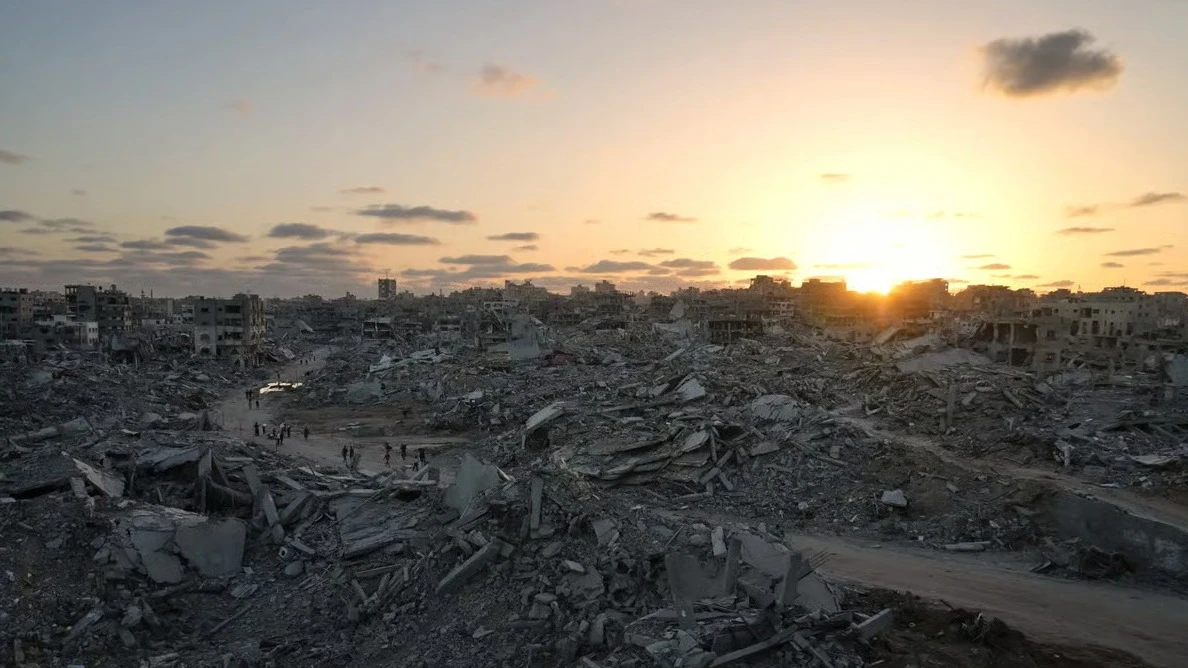
“If you all die once a day, we died a thousand times each day,” he… pic.twitter.com/RQ1M5TYkLs

— Translating Falasteen (Palestine) (@translatingpal) October 13, 2025


“The end of the war doesn’t mean the end of Israeli crimes,” she said. “Those responsible must be held to account for the grave violations committed against Palestinian prisoners.”

Prisoner affairs activist Thamer Sabaaneh said Israel uses detainees for revenge.

“I expect prisoners to launch a real and serious movement to change life in detention and fight to improve their conditions,” he said, adding that “Some of them had already told Israeli officers before the deal that they would not stay silent if they weren’t released.”

https://thecradle.co/articles/over-9000 ... hange-deal

Gaza needs $70bn to rebuild following Israel’s genocidal war: UNDP

Gaza’s recovery is expected to last decades as the UN estimates over 55 million tons of rubble need to be cleared

News Desk

OCT 14, 2025

Image
(Photo credit: AP)

The UN Development Programme (UNDP) said on 14 October that $20 billion will be needed over the next three years to begin reconstruction efforts in Gaza, part of an overall $70 billion recovery plan which could take decades to complete.

UNDP representative Jaco Cillers told reporters in Geneva that there are “very good indicators” from potential donors in the Arab world, Europe, and the US signaling willingness to contribute to the effort, but had yet to name any specific countries.

He said the two-year Israeli genocide in Gaza generated at least 55 million tons of rubble, enough to fill New York’s Central Park to a height of 12 meters or build 13 pyramids in Giza.

Cillers added that $20 billion will be required over the next three years, with the remainder spread across a longer period that “maybe within a decade or decades, maybe more.”

According to a September estimate by the UN, EU, and World Bank, rebuilding costs have risen sharply from the $53 billion projected in February.

The UN Development Programme (UNDP) said it has so far removed around 81,000 tons of debris from Gaza, a small fraction of the estimated 55 million tons left behind by Israel’s destruction across the enclave.

Turkish President Recep Tayyip Erdogan, who took part in the ceasefire negotiations, said Ankara will seek support from the Gulf, the US, and European states to finance reconstruction projects under the Organisation of Islamic Cooperation (OIC) and Arab League frameworks.

“I believe the significant financial support will be swiftly provided,” Erdogan told reporters after the signing of the Gaza ceasefire deal in Sharm el-Sheikh.


The Gaza Media Office said Israeli forces dropped more than 200,000 tons of explosives on the enclave, destroying around 500,000 housing units and completely leveling 835 mosques.

UN special rapporteur on the right to adequate housing, Balakrishnan Rajagopal, said Palestinians returning to their homes in northern Gaza after the withdrawal of Israeli forces are finding nothing but rubble and ruin.

“The psychological impacts and trauma are profound, and that’s what we are seeing right now as people are returning to northern Gaza,” he told Al Jazeera.

Three churches and 40 cemeteries were also damaged, while seven mass graves were constructed inside hospitals.

A separate UNDP update confirmed the discovery of at least three bodies during early rubble removal and warned that many more are expected to be found.

UN agencies estimate that 92 percent of Gaza’s residential buildings have been damaged or destroyed since October 2023, leaving millions displaced and essential infrastructure in ruins.

https://thecradle.co/articles/gaza-need ... l-war-undp

******

Trump’s Gaza plan for peace is fake news. Here’s what’s really going to happen

Martin Jay

October 15, 2025

There is not much hope for a long standing peace in the Gaza Strip, Martin Jay writes.

How much hope can we place in the recently announced ceasefire deal, agreed both by Israel and Hamas, supposedly brokered by U.S. President Donald Trump? Who are the winners and losers? And how much of what we are seeing and reading in western press is the whole truth?

Unfortunately the picture is bleak and there is not much hope for a long-standing peace in the Gaza Strip, largely because the so-called deal is not a ‘peace deal’ as such but more a temporary ceasefire to get out Israeli hostages. Not much more.

Certainly, the 20 point plan has more to it than that but the fact that most of the points are vague and open to interpretation doesn’t bode well for the whole thing to be taken seriously. Perhaps it was never meant to be taken seriously, as I have previously written, it is likely that Trump put this together at the last moment hastily due to the media spotlight that EU leaders were getting and the possibility of a UN plan getting underway.

In reality, the only two winners in the deal are not even countries or states, but individuals. Trump himself will think he is whitewashing himself of the genocide and will hope that being the one who is the architect of the plan itself, it will accelerate his chances of getting a Nobel Peace Prize. This is unlikely though as despite western media dutifully writing up the narrative that it is Trump who is “railroading” the peace deal through, the truth is, in reality, a little different. From the very first day in office, Trump could have stopped the genocide in Gaza, but instead chose to support Netanyahu all the way with numerous arms shipments being signed off by him. For Netanyahu, the political capital to be gleaned by getting 20 hostages alive returned to their families cannot have a price attached to it. And so, broadly speaking, both Trump and Netanyahu will wring their hands when the hostages walk free.

But it is expected that Netanyahu won’t waste any time getting back to business of slaughtering more innocent Palestinians in Gaza once the media attention wanes and he sees that the Europeans start to harp on about a Palestinian state, when they see IDF soldiers outside of the main part of the Gaza Strip. Time and time again history has shown us that it is always Israel which breaks ceasefires, hunts down and murders key Palestinian negotiators and it is always Israel which betrays international law.

Aid is expected to be sent into Gaza during a ceasefire and this will be the first casualty. Netanyahu might let in a bit for a few days but it is only a matter of time before he inevitably closes this supply and reverts back to the egregious policy of starvation. It is also inevitable that Israel will make sporadic attacks which break the ceasefire, which is a trap for Hamas, as, if they retaliate, then Israel can say the ceasefire has been broken entirely by “terrorists” and that of course “Israel has the right to defend itself”.

The hostages exchange might well be the catalyst for the ceasefire to be broken. How long does Trump need a ceasefire to be in place to say to the world that he alone brokered peace both for Gaza and the whole of the Middle East? Perhaps a week. Perhaps two. If the hostages’ bodies cannot be located in 72 hours and exhumed, before handing over the remains to the IDF, then this alone could spark a fresh offensive by Israel who will simply intensify their depraved genocide and catch up on the numbers, killing women and children in tents, or wiping out entire families in their homes as they did barely a couple of hours before MPs in Israel’s parliament finally agreed to the deal in the wee hours of the night.

For Hamas, there really isn’t much in it to accept for the return of a number of Palestinians illegally detained in Israel’s prisons. They know that even if food aid resumes, it will not be for long as Netanyahu’s big plan for the entire region in “Israeli expansion” into Syria, Lebanon, parts of Jordan and Iraq and keeping Palestinians in the Gaza Strip is not part of that, rather than wiping them out entirely in an ethnic cleansing strategy which leaves many thinking of the Nazis and the Holocaust. Don’t place much hope on the 20 point plan by Trump’s people as it was never meant to be taken seriously. “Look, we offered them peace” is what the narrative will be so there had to be something written at least. But in reality it’s not worth the paper it is written on as Hamas have even rejected outright the idea of Tony Blair being an interim PM in the Strip or giving up their weapons. Fake news, Trump might call it, if it hadn’t come from his own shaking hand.

https://strategic-culture.su/news/2025/ ... ng-happen/

*****

Israel’s Perpetual War Machine Demonstrates that Environmental Warfare is a Tool, Not a Consequence of Genocide and Settler Colonialism
Anthony Karefa Rogers-Wright 15 Oct 2025

Image
The environmental destruction in Gaza is a calculated military strategy. By poisoning the land and water, Israel is ensuring the genocide has a permanent, toxic legacy.

“Seen from the point of view of colonial history, climate transformation is not the accidental and indirect consequence of conflict; the environment is not the collateral damage of history, but a tool in its arsenal of transformations, a form of government over land, peoples and the relation between them, the environment is one of the means by which colonial racism is enacted, land is grabbed, siege lines fortified and violence perpetuated.”
- Shourideh C. Molavi

The zionist ethnostate’s recent pause in hostilities against the people of Gaza due to so-called Phase 1 of President Trump’s 20 Point Gaza Peace Plan has resulted in a collective sigh of relief for many the world over, who have observed and/or have been victims of the ongoing genocidal onslaught that’s pillaged an estimated 70,000 lives, including approximately 20,000 women and children, included the use of starvation as a weapon, and has reduced the Gaza Strip to rubble as critical infrastructure including homes, schools/universities, hospitals and places of worship have all been decimated by the Israel Occupying Force’s (IOF) war machine that has been aided, abetted, and funded by the United States and other Western governments.

Yet this sigh of relief cannot be considered the same thing as the ability to rest easy and breathe as the current ceasefire between the zionist ethnostate and the Palestinian Resistance is nothing more than an ephemeral enterprise due to the continued presence of the IOF in Gaza, as well as there being no reason to believe that indicted war criminal Benjamin Netanyahu and his henchmen of zionist zealots including, but not limited to, Israel Finance Minister, Bazalel Smotrich, and National Security Minister, Itamar Ben-Gvir, have any intention of giving up their stated goals to complete a “Greater Israel” conquest that includes a final ethnic cleansing solution for Palestinian people in Gaza and the Occupied West Bank while rejecting any notion of a free and fully independent Palestinian state. And when it comes to the ability for the Palestinians to breathe, safely, at all, the zionist ethnostate’s bellicose and barbaric machinations have all but made this essential human function impossible for many years to come.

To this end, there are myriad reasons why Trump’s 20-point plan is arbitrary, capricious and, in total, illegitimate. From the fact that no Palestinians were even involved in drafting a plan for their future, thereby continuing to deny them self-determination and agency, to the omission of a clear determination of Palestinian statehood as the ultimate conclusion. Yet it's the lack of accountability and calls for the prosecution of actors, including but not limited to, Netanyahu, Donald Trump, Joe Biden, Antony Blinken, Marco Rubio, and others, for their roles in aiding, funding, and perpetuating myriad documented war crimes undertaken by the zionist ethnostate that, arguably, stands out the most. Yet for all the crimes including, “starvation as a method of warfare and intentionally directing an attack against the civilian population; and the crimes against humanity of murder, persecution, and other inhumane acts from at least 8 October 2023 until at least 20 May 2024,” issued against the zionist ethnostate at the behest of Netanyahu, crimes not included by the International Criminal Court, nor discussed as part of the larger lexicon regarding the wanton aggression against Gaza is that of intentional and systemic environmental warfare against the people of Palestine.

The use of environmental warfare as a primary tool of settler colonialism and genocide is nothing new - the praxis has, in fact, been used for centuries. Christoper Columbus and subsequent conquistadors from Cortez to Pizarro employed a slash, burn, and land alteration campaign against peoples indigenous to Turtle Island (present-day North America), which was accentuated by a biological warfare pogrom through the unintentional and intentional use of disease to wipe out and vastly reduce entire populations. Biological warfare was consciously utilized during the so-called French and Indian wars between 1754 and 1767 , when smallpox was also used as a biological weapon by the commander of Fort Pitt, Captain Simeon Ecuyer, who, under the direction of General Jeffery Amherst, ordered soldiers to distribute blankets that had been used by smallpox patients with the intent of initiating outbreaks among Indigenous peoples. It’s estimated that the resulting epidemic killed more than 50% of people in infected tribes.
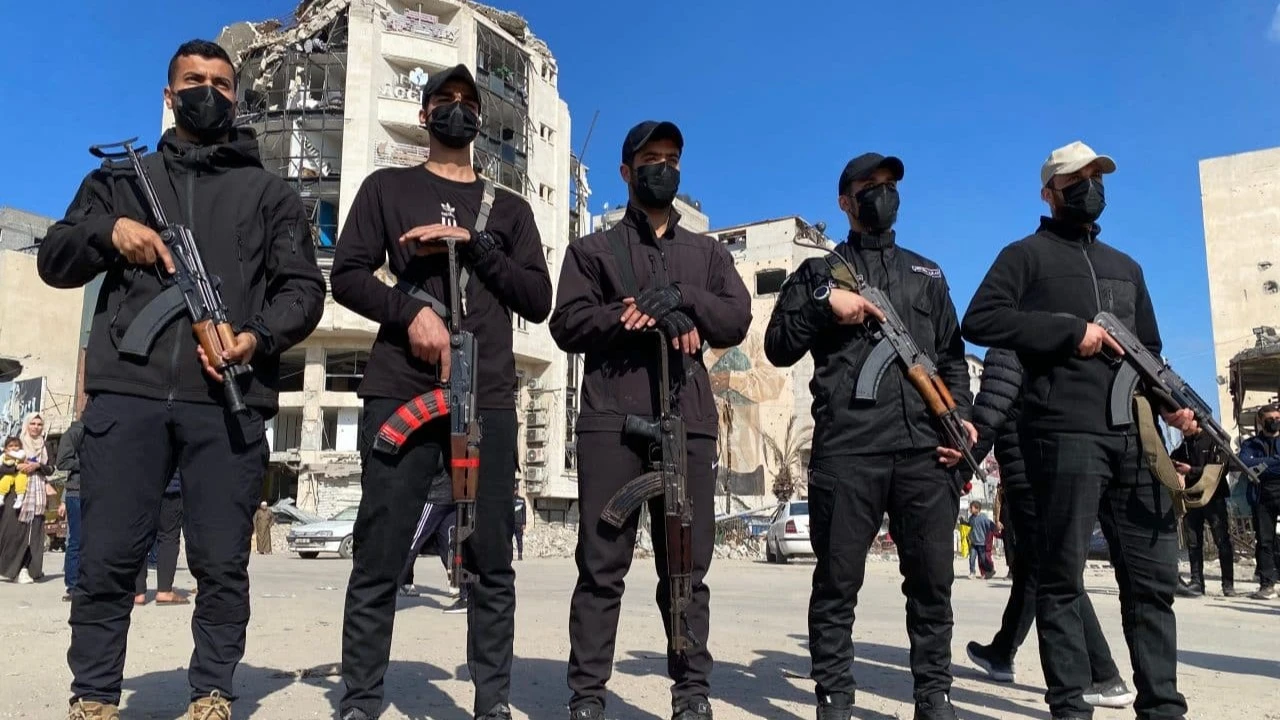
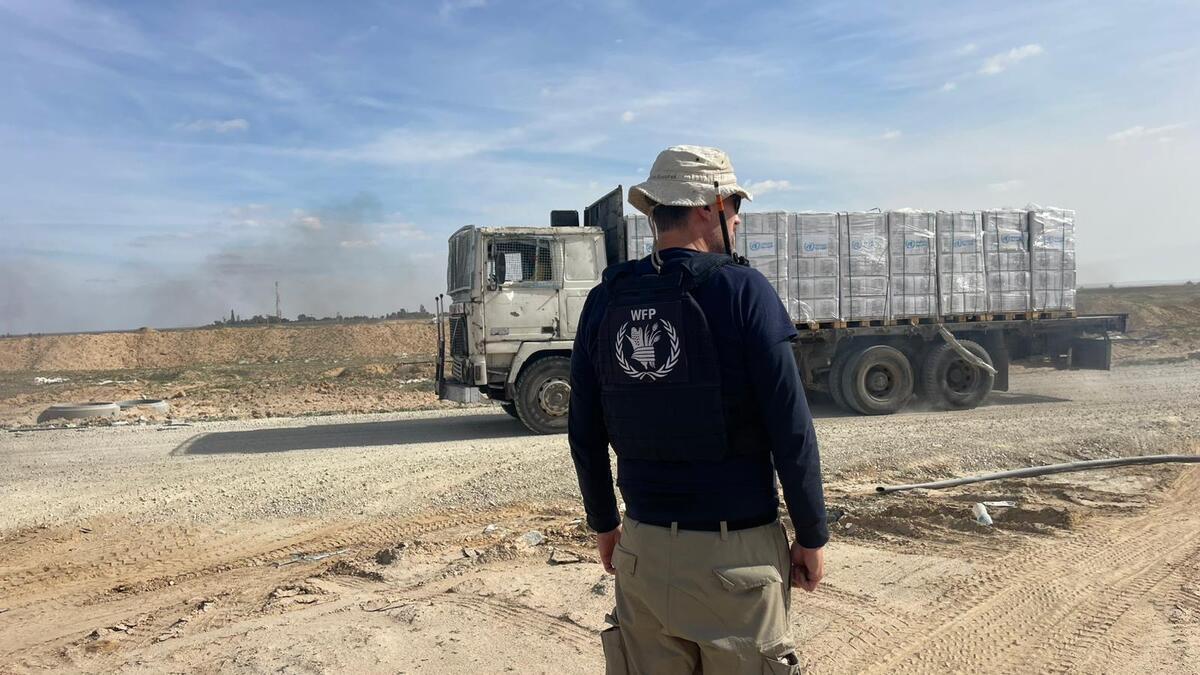
As author Shourideh Moldavi notes in her book, Environmental Warfare in Gaza, “Destruction and control of environmental infrastructures has repeatedly moved from being a tactic of war or collateral damage, to an end in itself.” She continues, “Environmental infrastructure wars - operations that involved the systematic destruction of energy, sanitation, gas, oil, water, and water supplies and systems - are increasingly applied in the Middle East and North Africa.” Moldavi’s assertions are accurate, though she omits the use of environmental warfare in Asia by colonial powers, as well as domestic environmental warfare that’s been waged against domestic populations, specifically Black, Brown, Indigenous and poor people, in the United States for decades, as this article will explain.

As historian Joachim Radkau notes, “the chief problem of colonialism seems to have been not so much its immediate ecological consequences as its long-term impact, the full extent of which became apparent only centuries later, in the era of modern technology, and many times only after the colonial states had acquired their independence.” While we agree with Radaku’s overarching thesis, it’s also important to note that the full extent of environmental warfare consequences are also felt less than centuries later. In many cases, adverse impacts to public health and physical environments are surfaced and realized acutely and chronically sustained, which further makes the case that ecocide is a tool and result of genocide.

For instance, during the Vietnam War the use of chemical warfare had one of the most dramatic, long-lasting effects on combatants and civilians ever documented. The U.S. Army’s use of the dioxin-contaminated defoliant Agent Orange during the infamous Operation Ranch Hand, where over 19 million gallons of toxic herbicide was sprayed over approximately 6.4 million acres of South Vietnam, resulted in numerous deaths and myriad impacts to public health that are still being documented. When the Vietnam War finally ended on April 30, 1975, it left behind a landscape scarred with environmental damage as vast stretches of coastal mangroves, once serving as critical habitat for rich stocks of fish and birds, lay in ruins. And forests that had boasted hundreds of species were reduced to dried-out fragments, overgrown with invasive grasses.

Biologist and self-described bioethicist, Professor Arthur W. Galston, coined the term “ecocide” at the 1970 Conference on War and National Responsibility in Washington, D.C. to characterize massive damage and destruction of ecosystems. During the conference, Gaston, who identified the defoliant effects of the chemicals found in Agent Orange, proposed a new international agreement to ban ecocide. This effort was compounded by Sweden’s then Prime Minister, Olof Palme, who referenced events occurring in Vietnam as “ecocide” during his opening speech at the 1972 United Nations Stockholm Conference on the Human Environment. The conference led to the development and adoption of the Stockholm Declaration. Following the Vietnam War, the UN Sub-Commission on Prevention of Discrimination of Minorities proposed adding “ecocide” to the Genocide Convention, and even prepared a study to make its case. The proposal was ultimately rejected in 1978 despite a direct request by UN Special Rapporteur on genocide, Benjamin Whitaker, to add ‘ecocide’ to the Genocide Convention. This rejection would have consequences that are felt to this day and may have also contributed to engendering a new tactic in the larger environmental warfare playbook as contemporary wars not only utilized chemicals on fauna/vegetation, but directly on human populations through the use of advanced weaponry that contain toxic chemicals, resulting in deleterious impacts to public health and physical environments contemporaneously.

According to a report released by the National Library of Medicine in 2021, “The US military first deployed depleted uranium (DU) weapons in Iraq during the Gulf War in 1990 and in the 2003 invasion of Iraq.” The report goes on to say, “Research funded by the U.S. government has denied the health risks posed by DU to the Iraqi population, while opponents have claimed that DU is responsible for increased rates of birth defects and cancers in Iraq.” And while the United States and other major actors who perpetuated the Iraq war, including the United Kingdom, deny claims that their weapons have induced chronic health impacts, according to a piece released in March 2025 by the outlet, Military.com, “For the first time ever, researchers have detected uranium in the bones of living Fallujah residents, high levels of lead in residents of previously bombarded neighborhoods, and a significant number of birth defects in babies born to those in the city.”

And Kali Rubaii, an assistant professor in the anthropology department at Purdue University, vindicated the research, noting, "What we are finding in the environment, in the body, is the sheer permanence of war's effects [and] in an interesting way, we measured that with numbers." Moreover, according to the same piece, a study supported by Brown University's Costs of War Project, indicates that Fallujah's population has seen a 17-fold increase in birth defects and anomalies since 2003. Using a special bone scan known as X-ray fluorescence, or XRF, the researchers found uranium in the bones of 29% of study participants. And the scans also showed lead contamination in 100% of those tested, at rates 600% higher than average U.S. rates.

The U.S., of course, is no stranger to administering chemical warfare against its own residents. In Flint, Michigan, a majority Black city whose primary water sources were purposely contaminated with lead after a clean water supply was replaced by the contaminated Flint River. An act so sinister and draconian that pediatrician, Dr. Mona Hanna-Attisha, who brought the Flint situation to the world’s attention, proclaimed, “If you were going to put something in a population to keep them down for generations to come, it would be lead.” And the world over is aware of the ignominious situation in Louisiana’s Cancer Alley, a majority Black populated stretch of the state that holds this sobriquet due to the fact that it houses 25% of the nation’s petrochemical and oil refinery operations that have resulted in elevated rates and risks of maternal, reproductive, and newborn health harms, cancer, and respiratory ailments. Parts of Cancer Alley have the highest risk of cancer from industrial air pollution in the United States.

But if the United States and their Western acolytes commenced the utilization of ecocide as part of a larger colonial conquest and maintenance of empire in the 1970s and early 2000s as part of a larger campaign of slow-genocide against its Black, Brown, Indigenous, and poor white residents, the zionist ethnostate has perfected a practice of instituting an accelerated ecocidal/genocidal matrix as part of its military campaigns against Palestine that irrefutably proves that the IOF is nothing more than a chemical warfare brigade. According to report E-003481 produced by the European Parliament, “There is now enough convincing data to prove that Israel has repeatedly used depleted uranium weaponry.” The report further notes, “The lethal effects of radioactivity caused by explosions and subsequent fires, including cancer of the lungs and pleura, can persist for centuries in the environment and particularly in aquifers. We are therefore on the verge of another humanitarian catastrophe in Palestine and in particular in the Gaza Strip, where thousands of tons of depleted uranium bombs were dropped with the effects that have already been documented.”

Reporter, Samira Homerang Saunders, described the entire situation as “Gaza’s Toxic Biosphere,” in her piece entitled, Environmental devastation and the war on Palestine provided the following insights into the zionist ethnostate’s concentrated and intentional use of ecocide as part of a larger ethnic cleansing initiative:

According to the Euro-Med Human Rights Monitor, within just two months in 2023, Israel dropped the equivalent of two nuclear bombs on Gaza, where over two million people live confined to a space half the size of Hiroshima. The impact of constant bombing, including the use of white phosphorus in Gaza and Southern Lebanon, is of an unprecedented magnitude;
In November [2023], Israeli shells incinerated 40,000 olive trees in Southern Lebanon. Over the previous month, its bombs burned through almost 3.5 million square metres of oak, lemon and banana trees, grasslands and shrublands, a cultural, spiritual and agricultural disaster;
Gaza’s water supplies are under the stringent control of the Israeli government, as documented and condemned repeatedly by major international bodies, including the UN and Amnesty International. Before the current attack, up to 96 per cent of drinking water in Gaza was designated unfit for human consumption; and
When Israel cut off all supplies to the strip in October, it rendered all three of its desalination plants inoperable. In the south, where the majority of the population has been forced to flee, all of the water wells and sewage pumping stations have ceased functioning. The choice for Gazans is either death by direct military violence, or death by dehydration, starvation and/or disease.
The emissions generated by the zionist ethnostate’s war machine in itself must be qualified as an ongoing war crime. According to a 2024 article by Philippe Pernot, “The greenhouse gas emissions generated during the first two months of the war in Gaza were greater than the annual carbon footprint of more than 20 of the world's most climate-vulnerable nations, according to a British-American study,” which is the estimated equivalent to burning at least 150,000 tons of coal. Pernot also notes, “The UN further stated that Israeli bombardments have created 37 million tons of debris.”

To this end, many Gazans are returning to their homes after nearly two years of bombings and chemical warfare that rendered their lands and water sources into toxic cesspools, preventing them from growing and cultivating crops, and are now walking into open-air graveyards waiting for those who will later succumb to diseases and ailments ranging from cancer to terminal complications associated with damaged respiratory systems. Exposure to smoke and particulates from the debris will surely increase the already unacceptable and deplorable death toll at the hands of the zionist ethnostate. As Princeton University professor, Robert Jisung Park points out in his book, Slow Burn, “Recent research suggests that the hidden health costs of the smoke alone may vastly exceed the direct destruction and death from US wildfires,” and, “Across a range of studies, it is estimated that PM2.5 pollution is responsible for anywhere between 50,000 and 100,000 premature deaths in the United States alone.”

And while wildfires are certainly destructive, they pale in comparison to the incessant dropping of 2,000-pound bombs and munitions from tanks and other military equipment. Park also says that smoke both lingers in the air and can travel long distances, “Indeed, satellite imagery suggests that smoke can carry long distances: very long distances. Smoke plumes from fires in the Pacific Northwest can have measurable effects on air quality in New York or Boston.” So what does this say about how far the IOF’s emissions can travel - certainly as far as the Occupied West Bank, Jerusalem, Tel Aviv, and even Haifa. This is ironic, as Park even discusses impacts of smoke exposure in Israel, “…similarly, studies of Israeli students taking important exams across more polluted and less polluted days suggest that highly polluted days—for instance, a day with an [air quality index] above 100—reduces test performance by roughly 15 percent of a standard deviation and may even affect the kinds of colleges that students are ultimately admitted to.” This in itself exposes how sadistic the zionist ethnostate is, as its willingness to sacrifice its own people to maintain and expand its empire mimics what its main financial and military backer, the United States, does to its own domestic population in communities like Cancer Alley and Flint to sustain and expand its own empire.

Policies that undermine the ability of human populations to realize sustainable needs from the biosphere must be seen as a fundamental violation of human rights because, without the ability to sustain life, all of the other rights- housing, food, education, and healthcare- become moot. To this end, the International Criminal Court’s (ICC) indictments of Netanyahu are incomplete in that far more people, including IOF soldiers, such as those who recently documented themselves incinerating one of Gaza’s remaining sewage treatment plants while retreating to the so-called Yellow Line buffer zone included as part of Trump’s 20-point plan, must also be indicted. Moreover, the ICC’s current indictment makes no mention of numerous instances of ecocide against the Palestinian people, which runs counter to a recent opinion of the International Court of Justice that holds, “States have an obligation to protect the environment from greenhouse gas (GHG) emissions and act with due diligence and cooperation to fulfill this obligation.” The opinion further stipulates, “if States breach these obligations, they incur legal responsibility and may be required to cease the wrongful conduct, offer guarantees of non-repetition and make full reparation depending on the circumstances.” Furthermore, nation states that have their own ecocide laws must not remain silent on this issue or risk being seen as tartufferous as nations like the United States which allow the zionist ethnostate to continue committing numerous crimes against humanity and the planet alike with qualified immunity.

The zionist ethnostate must be held to account for past, current, and future damage to Palestinian lands, Palestinian public health, and violations that are even putting its own citizens at risk. Because, for all the money it will take to rebuild Gaza’s infrastructure, the amount of redress required for turning Palestinian lands and bodies into spheres of toxicity, that will likely be felt for generations, may very well be unquantifiable while also rendering the very idea of accountability obsolete. To this end, the larger initiative of Palestinian Liberation cannot be realized without tribunals that lead to prosecutions and life sentences for perpetrators of ecocide and genocide not seen on this scale since the 15th and 16th centuries.

No Compromise

No Retreat

https://blackagendareport.com/israels-p ... nocide-and
"There is great chaos under heaven; the situation is excellent."

User avatar
blindpig
Posts: 14788
Joined: Fri Jul 14, 2017 5:44 pm
Location: Turtle Island
Contact:

Re: Palestine

Post by blindpig » Thu Oct 16, 2025 2:37 pm

Israel Threatens to Resume the Genocide
October 14, 202

UPDATE: Israel is leaning towards resuming violence as Hamas says it can’t locate or extract all of the hostages’ dead bodies, writes Joe Lauria.

Image
Benjamin Netanyahu reviews the U.S. peace plan for Gaza with Israeli Minister of Strategic Affairs Ron Dermer and other members of the Israeli delegation during a meeting with President Donald Trump at at the White House, Sept. 29, 2025. (White House /Daniel Torok)

Update: Israel is contemplating restarting the killing after Hamas said on Wednesday it could not return all the corpses of Israeli hostages without special equipment to locate and dig them out of the rubble that Israel created. Israel is using this hiccup in the ceasefire agreement to threaten to resume its genocide.

Though the deal “acknowledged that some bodies could be difficult to locate and may take more time to retrieve,” the NYT reports, the Israeli defense ministry issued this statement on Wednesday:

“If Hamas refuses to abide by the agreement, Israel, in coordination with the U.S., will return to fighting and work to completely defeat Hamas, change the reality in Gaza and achieve all the goals of the war.”

Donald Trump chimed in on social media: “The dead have not been returned, as promised.” With his typical bravado, showing who is in charge, he told CNN Wednesday: ““Israel will return to those streets as soon as I say the word.”

By Joe Lauria
Special to Consortium News


Speaking to the Israeli nation about the ceasefire agreement in Gaza, Prime Minister Benjamin Netanyahu said last Friday:

“Hamas agreed to the deal only when it felt the sword resting on its neck and it is still on its neck … Hamas will be disarmed and Gaza will be demilitarized … If this is achieved the easy way, so much the better. And if not, it will be achieved the hard way.”

So there’s only one way the genocide does not resume in Gaza: Hamas disarms and unconditionally surrenders to Israel and presumably, turns over all the dead hostages too.

The threat of more violence if this doesn’t happen is clear enough in Netanyahu’s words.

Other Israeli officials have promised the same.

Israel’s goal is the ethnic cleansing of Gaza and its complete takeover.

The so-called deal that Donald Trump is getting credit for seeks to achieve this. It is no peace deal.

It does not settle any of the outstanding issues of the seven-decade-old Israeli theft of Palestinian land and expulsion of hundreds of thousands of people from their homes. Or the killing of countless innocent civilians by a brutalizing Israeli military intent on defending and extending its gains.

All Trump’s deal does is hand total victory to Israel.

Hamas is to disarm and not take part in any future governing of the Strip.

The War Is Not Over

Of course Hamas is refusing to disarm at this point. And if they continue to refuse Netanyahu has spelled out what will happen. Trump can then kiss next year’s Nobel Peace Prize goodbye.

Israel would also again be condemned by most of the world as it resumes the killing and its defeat in the information war – a main reason it agreed to the ceasefire. (As well as regrouping an exhausted military to prepare for possible renewed war with Iran.)

Key to whether Hamas capitulates are other Arab states, principally the Gulf monarchies. They are pressuring Hamas to give up. They stand to get a piece of the action if Trump’s sick dream of a Gaza Riviera is realized on top of the decaying corpses of a significant part of society.

The Arab regimes are villains in this story almost as big as Israel and the United States. They have long ago resorted to lip service to the Palestinians to placate their own repressed and restless populations. Now they stand ready to cash in a bonanza because of a genocide they barely protested.

If Hamas gives up and Netanyahu gets his way — “the easy way” – there will still be a sizable population of Gazans to manage and pacify. The easiest way for the Israelis would be to put them on buses and move them out — if Netanyahu and Trump can finally find someone to take them. Perhaps they will pay the Egyptians enough. El-Sisi has his price.

If most of the Palestinians remain, they will probably wind up in shacks behind the gleaming casinos like in Batista’s Cuba. They would remain a headache for the Israelis, so it’s clear they would rather kick them out.

Under pressure from the most extreme members of his cabinet, Netanyahu’s government surviving depends on this happening, the easy way or the hard way.

The right way would be for the Palestinians to build back their own society the way they want with Israeli and U.S. reparations. And to govern themselves the way they want with the leaders they choose in a state of their own, free from the threat of renewed attempts at annihilation.

But the odds of that happening will be a lot worse than claiming the jackpot at the roulette wheel at Trump Gaza Casino.

https://consortiumnews.com/2025/10/14/g ... -hard-way/

******

The Collaborator in Palestine: A Tool of Israeli Control
Posted by Internationalist 360° on October 15, 2025
Rima Najjar

Image
Revolutionary justice under siege

Author’s Note: This essay examines the October 14, 2025 executions in Gaza not as isolated acts of brutality, but as part of a broader historical and political grammar of resistance under siege. It unfolds in layered sections — beginning with how Western media misreads revolutionary violence, then tracing the lineage of symbolic purges across global liberation movements. It situates the executions within Gaza’s internal dynamics, Israeli intelligence strategy, and the emotional toll of betrayal and survival. The essay refuses civilizational binaries and calls for narrative restoration: not to romanticize violence, but to understand its context, its stakes, and its meaning in a landscape where legal sovereignty has been denied.

Hamas’s purge is a response to infiltration — not a descent into authoritarianism.


I. Introduction

For the uninformed — casual scrollers who consume conflict in bite-sized fragments, stripped of history, stripped of siege — and for the purveyors of Israeli PR, Western pundits, and spokespeople fluent in sanitized outrage, the executions in Gaza on October 14, 2025, were confirmation. The images of blindfolded men, hands bound, shot in the open square of Gaza City just hours after a ceasefire was declared, became proof. Proof that Hamas is savage. Lawless. Irredeemable. Another detail added to the distorted picture that paints Palestinian resistance as something sick or dangerous.

But for those who grasp the decades-long Palestinian struggle for liberation — for those who understand the atrocity of Israeli domination, the machinery of surveillance, and the ugliness of betrayal under siege — the timing and spectacle of the executions evoke something else entirely. They echo a deeper historical pattern: the revolutionary purge of informants, collaborators, and internal threats.

In Gaza, where resistance is denied the tools of statehood, the square becomes a stage. These executions weren’t just about punishing betrayal. They were a declaration, a sharp, visible break that said: we will not be controlled from the inside.

But even among the faithful, a tremor lingers: Who decides guilt when the walls are closing in? What line separates justice from desperation when the square becomes both tribunal and theater?

II. Revolutionary Justice and the Spectacle of Betrayal

Throughout history, revolutionary movements have used symbolic violence to send a clear message: they are breaking from the past and claiming control over their future. These acts, designed to reclaim narrative control and enforce revolutionary discipline, often happen in public and are meant to show strength, unity, and the seriousness of betrayal.

In these moments, the collaborator is no longer seen as just an individual. They become a symbol of internal fracture, a proxy for outside influence, and a warning to others who might consider turning against their own people.

In the streets of Paris during the French Revolution, the guillotine was not just an instrument of death — it was a stage. The Committee of Public Safety, led by Robespierre, executed thousands of suspected royalist sympathizers, many without trial. Each execution was a performance: a declaration that the Republic would tolerate no ambiguity, no softness, no compromise.

In post-war France, women accused of “horizontal collaboration” — having relationships with German soldiers — were dragged into town squares, their heads shaved in public humiliation rituals. These acts were not about military threat; they were about moral cleansing, about reclaiming the purity of resistance after years of occupation.

In northern Italy, partisan fighters hunted down fascist informants after Mussolini’s fall. Bodies were strung from lampposts with signs reading “traitor,” left to sway in the wind as warnings. These executions were swift, often without trial, and deeply personal.

In Vietnam, the Viet Cong assassinated South Vietnamese civilians who aided U.S. forces — notes pinned to their corpses reading: “He betrayed the people.” These killings were strategic, designed to instill fear and enforce loyalty in contested villages.

In Algeria, after independence from France, the FLN turned its fury on the Harkis — Algerians who had fought alongside French colonial forces. Many were executed in retributive waves, their bodies dumped in ravines or left in public squares. For the FLN, the Harki represented the deepest betrayal: not just of the revolution, but of Algerian dignity itself.

In Ireland, during the War of Independence (1919–1921), the Irish Republican Army executed dozens of civilians accused of informing for the British. Some were shot in barns or fields, others left with notes reading “Spies beware.” These killings were not random — they were tactical, aimed at protecting the movement from infiltration. But they also fractured communities, sowing fear and suspicion in villages already torn by colonial violence.

Gaza’s executions belong to this lineage. They are not aberrations — they are part of a historical grammar of resistance, forged under siege. Whether we recoil or resonate depends on how we read them: not as isolated acts of cruelty, but as responses to a long, bitter sentence written by occupation, infiltration, and the refusal to forget.

To understand them is to confront the conditions that produce them — and to ask what sovereignty looks like when the courtroom is denied, and the collaborator walks among the ruins.

III. The Palestinian Context: Collaboration Under Siege

In Palestine, Israeli intelligence agencies — especially the Shin Bet — don’t wait for collaborators to emerge. They build them. At Erez Crossing, agents routinely stop Palestinians seeking medical permits and offer a choice: cooperate or be denied treatment.

In one documented case, a father from Khan Younis was told his child’s cancer treatment in Tel Aviv would be approved only if he provided names of resistance fighters.

In another, a teenager caught with a minor drug offense was threatened with prison unless he agreed to report on his neighbors. Shin Bet officers use private photos, intercepted messages, and family vulnerabilities to pressure targets into compliance.

They blackmail women with threats of public exposure, promise jobs to unemployed youth, and exploit the desperation of those living under blockade, siege, and occupation.

These tactics don’t just extract information — they fracture communities. They turn ordinary people into informants. Collaborators feed Israel’s surveillance network with coordinates, names, and routines, guiding drones, arrest raids, and assassinations. For example, in 2023, a collaborator reportedly revealed the location of commander Ali Ghali, enabling his assassination by Israeli airstrike. They represent a wound that must be cauterized before it spreads.

During the First Intifada (1987–1993), the streets of Gaza and the West Bank bore witness to a grim reckoning. As popular resistance surged, so did the paranoia of infiltration. Militants and community members executed dozens of suspected informants — some dragged from their homes, others found dead in alleyways with signs reading “ʿamīl” (collaborator) pinned to their chests. These killings were not random. They were responses to real betrayals: the arrest by Israel of a cell leader, the bombing of a safe house, the disappearance of a child. But they were also performative — acts of revolutionary justice meant to restore dignity and enforce loyalty in a society under siege.

After the Second Intifada and the rise of Hamas in Gaza, the pattern hardened. For example, in 2012, during Israel’s so-called Operation Pillar of Defense, six Palestinian men accused of aiding Israeli targeting of Palestinian fighters were shot in broad daylight, one dragged behind a motorcycle through Gaza City’s streets. The message was clear: betrayal will not be tolerated, and resistance will be protected — even at the cost of blood.

The Shin Bet’s recruitment tactics are surgical, designed to fracture communities and turn survival into complicity. But within Palestinian society, the consequences are communal and devastating. Families of accused collaborators are ostracized, homes are burned, names are erased. The collaborator becomes a ghost — feared, hated, and mourned.

IV. Gaza 2025: Tribal Strategy and Preemptive Purge

In Gaza, Israel’s attempt to cultivate internal division during the early months of the 2025 war took a tribal turn. Unlike the West Bank’s long-standing model of individualized or PA collaboration — managed through covert recruitment and security coordination — Israel pursued a more public and tribalized strategy.

Netanyahu confirmed in June 2025 that his government had armed and activated clans in Gaza opposed to Hamas, stating in a video message, “What’s wrong with that? It’s only good. It saves the lives of IDF soldiers.” The move, long rumored and later leaked by opposition figure Avigdor Lieberman, was framed as a tactical necessity — an effort to undermine Hamas from within without deploying more Israeli troops into densely populated areas.

These clans, often family-based networks with longstanding rivalries or grievances against Hamas, were reportedly supplied with weapons and logistical support. Critics, including former defense officials, warned that some of these groups had criminal ties or ideological leanings that could spiral out of control. Lieberman likened one armed faction to ISIS, calling the strategy “total madness.”

The policy echoes past counterinsurgency models — most notably the U.S. arming of tribal militias in Iraq during the 2007 surge — but in Gaza, it risked deepening internal fragmentation. By outsourcing violence to local actors, Israel not only inflames intra-Palestinian tensions but also complicates future efforts at reconciliation and governance. The result is a battlefield blurred by proxy warfare, where the line between collaborator, criminal, and resistance fighter grows ever more unstable.

But the strategy largely failed. Tribal loyalty in Gaza — shaped by communal survival, resistance identity, and generational memory — proved resistant to external manipulation. Despite Israeli efforts to arm rival factions, including the Doghmush clan and Yasser Abu Shabab’s militia in Rafah, the result was not a decisive fragmentation of Hamas’s authority but a surge in intra-Palestinian violence and public backlash.

The Doghmush clan, long known for its armed operations and smuggling networks, clashed with Hamas forces on October 12 in Gaza City’s Sabra and Tel al-Hawa neighborhoods, leaving 27 dead, including eight Hamas members. Meanwhile, Abu Shabab, a former Hamas prisoner and leader of the “Popular Forces” militia, reportedly received Israeli arms and logistical support, including protection and promises of political leverage. His group seized aid convoys and accused Hamas of looting supplies, but failed to gain widespread legitimacy. These Israeli-backed interventions exposed not only the fragility of Gaza’s post-war landscape but also Israel’s desperation to engineer internal collapse — a tactic that, rather than splintering resistance, reinforced the perception of external orchestration and deepened communal suspicion.

This tension — between revolutionary discipline and authoritarian drift — is not new, but in Gaza it is sharpened by siege. When legal institutions are absent, and the threat of infiltration is constant, movements often default to visible, irreversible acts of control. The executions on October 14 were not just about punishing betrayal; they were about restoring order in a moment of perceived vulnerability. Just hours earlier, Hamas had agreed to a U.S.-brokered ceasefire with Israel, marking the end of a two-year war that left tens of thousands dead. The timing of the executions — immediately after the ceasefire — suggests a calculated effort to reassert dominance before rival factions, foreign mediators, or internal dissent could gain traction.

According to verified footage and multiple reports, seven blindfolded men were shot in Gaza City’s Sabra neighborhood, accused of collaborating with Israeli intelligence. Hamas described them as “criminals and collaborators,” though no formal evidence or trial proceedings were disclosed. The executions were carried out in front of gathered crowds, with militants filming the act and onlookers cheering — a spectacle that served both as punishment and deterrent.

This public staging reflects a broader pattern in resistance movements under siege: when the courtroom is denied, the square becomes the site of judgment. But the cost is steep. Families of the executed face social ostracization, and communities are left to navigate the trauma of internal purges. In the case of Abu Shabab, whose militia reportedly received Israeli support, his execution was followed by his family’s refusal to claim his body — a gesture of disavowal meant to shield themselves from collective punishment, but also a sign of how deeply collaboration fractures communal bonds.

In Gaza, where every act of resistance is shadowed by surveillance, betrayal is not just a tactical threat, it is an existential one. And yet, the methods used to confront it risk replicating the very structures of domination they oppose. Without transparency, accountability, or recourse, revolutionary justice can become indistinguishable from authoritarian control. The challenge for Hamas — and for any movement under siege — is to protect the struggle without hollowing its moral core.

V. Ambivalence, Judgment, and the Fear Within

Not all critiques of Gaza’s executions come from a place of erasure. Some emerge from solidarity — deep, principled, and uneasy. They ask: what happens when resistance, denied legal sovereignty, begins to mirror the very systems it fights? What happens when the square becomes a site not only of rupture, but of fear?

The concern is real. Public executions, however rare, risk becoming instruments of internal terror rather than revolutionary discipline. When Hamas executes alleged collaborators without transparent trials, some Gazans see not sovereignty but authoritarianism. They remember post-war France, where purges of Nazi collaborators devolved into vendettas, and where figures like Sartre and Camus called for restraint — not because betrayal wasn’t real, but because justice without process becomes indistinguishable from revenge.

In Gaza, the stakes are different. The collaborator is not a theoretical figure. He enables drone strikes, assassinations, and the collapse of resistance cells. But the absence of judicial infrastructure does not absolve the need for accountability. When resistance movements centralize punishment without transparency, they risk collapsing the distinction between revolutionary clarity and unchecked power.

The fear is not just of Israel — it is of being ruled from within, again. In the West Bank, that fear takes the form of security coordination: Palestinian Authority forces arresting fellow Palestinians on behalf of Israeli intelligence, suppressing dissent, and policing resistance. In Gaza, it emerges through Hamas’s internal purges, where accusations of collaboration can lead to execution without trial.

In both territories, Palestinians confront not only the violence of occupation, but the risk that their own leadership — fragmented, embattled, and often unaccountable — might replicate the very control they resist. The struggle for liberation demands not just freedom from Israel, but freedom from fear — whether imposed by an occupier or enforced by those who claim to govern in its shadow.

Some critics ask whether Hamas fighters face the same hunger as civilians. Whether the executions protect the people, or discipline them. Whether the message is sovereignty — or submission. These questions matter. They do not negate the logic of rupture, but they demand that rupture be examined. That symbolic violence not become routine. That resistance not become indistinguishable from domination.

To stand with Palestine is not to silence these questions. It is to insist that #FreePalestine must mean freedom from all forms of fear — external and internal. It is to demand a future where justice is not improvised, but built. Sovereignty shouldn’t exist only in public displays like executions — it should shape the everyday systems that people live under. True liberation means building structures that protect people’s rights, not just punishing betrayal. It means allowing space for disagreement, for mourning, and for criticism — without fear.

Debate and dissent shouldn’t be silenced. They are part of what keeps the struggle honest, accountable, and alive. But at this critical juncture — when images of executions are already being weaponized to erase context and flatten resistance — it is more urgent to situate than to debate. To name the conditions that produced these acts before rushing to condemn them in isolation. This is not a call for silence. It is a call for precision. Palestinians have been silenced long enough — by occupiers, by media, by the language of civility that demands calm while bombs fall. Refusing that silencing means refusing to let others define the terms of judgment. It means insisting that clarity comes first.

It means not to be like Israel with its administrative detentions, secret files, and indefinite imprisonment without trial. It means refusing the logic that says security justifies opacity. Liberation must not mimic occupation’s architecture of control. To build a future worth defending, resistance must be accountable to the people it claims to protect. That means due process, even under siege. It means restraint without erasure, and discipline without fear. It means crafting justice that does not rely on spectacle, but on structure — not just rupture, but repair.

VI. Conclusion: What the Executions Reveal

To speak of collaborators in Palestine without context is to participate in erasure. It is to flatten a struggle shaped by siege, surveillance, and the slow violence of colonial fragmentation. The executions in Gaza — filmed, circulated, condemned — have already been absorbed into the machinery of Western moral shorthand. “Terror,” “barbarism,” “lawlessness” — these are the terms deployed by pundits and diplomats who refuse to name the occupation, let alone its architecture of coercion. But polemic demands clarity. Restoration demands specificity. And both begin with refusal: refusal to let the narrative be written by those who bomb, surveil, and blackmail.

The executions in Gaza were not aberrations. They were revelations. They exposed the fault lines of Palestinian society under siege, the brutal calculus of survival, and the desperate assertion of sovereignty in a landscape where sovereignty has been denied. To read them as mere brutality is to misread the entire architecture of occupation. To recoil without context is to participate in the flattening of Palestinian resistance — a resistance shaped not only by bombs and borders, but by betrayal, infiltration, and the refusal to be ruled from within.

The collaborator in Palestine is not a static villain. He is a manufactured figure, shaped by Israeli intelligence strategy and sustained by the conditions of blockade. Medical coercion, sexual blackmail, and threats against family members are not exceptions — they are documented tactics. A teenager caught with a phone, a woman seeking a permit, a father at Erez Crossing — these are the sites of recruitment, where survival becomes leverage. His betrayal is real, but so is the system that engineers it. To condemn the execution without naming the system that produces collaborators is to perform outrage without analysis — to moralize while ignoring the mechanics of entrapment.

These executions reveal symbolic violence as a language of rupture, a way to reclaim narrative control when legal systems are fragmented and justice is denied. They reveal the emotional toll of resistance: the grief of families, the fear of communities, the trauma of living in a world where survival can be weaponized. But most of all, they reveal the stakes of clarity. That to understand Gaza’s executions is to understand the full sentence — not just the final act, but the decades of surveillance, fragmentation, and betrayal that precede it. It is to refuse the civilizational binary that casts Palestinian resistance as pathology and Israeli control as order. It is to restore the narrative, to name the conditions, and to stand with those who resist — not just with arms, but with memory, with clarity, and with refusal.

Restoration begins by restoring the full sentence. Not just the moment of execution, but the assassinated commanders, the families shattered by suspicion, the legal vacuum that leaves resistance movements to improvise justice under siege. It means naming the Shin Bet’s operational playbook, the Palestinian Authority’s complicity through security coordination, and the fragmentation of Palestinian legal sovereignty. It means recognizing that revolutionary movements under occupation — from Algeria to Vietnam — have historically responded to betrayal with symbolic violence, especially when formal justice is denied.

But restoration also demands emotional clarity. It means acknowledging the grief of those whose sons were executed, the fear of not knowing who to trust, and the trauma of living under constant surveillance. It means refusing to romanticize purges, while also refusing to reduce them to pathology. It means holding space for contradiction: that symbolic violence can be both necessary and devastating, both sovereign and scarring.

To restore the narrative is to insist on pluralism. To name the factions involved, the histories erased, the coalitions misrepresented. It means rejecting shorthand — “Hamas,” “terrorist,” “militant” — and instead naming the ideological, historical, and emotional terrain in which these acts unfold. It means recognizing that the executions were not just about punishment. They were about sovereignty. About rupture. About refusing to let the collaborator remain a conduit of colonial control.

This is not a call to romanticize violence. It is a call to understand it. To read it as part of a grammar of liberation written under siege. To recognize that revolutionary movements, when denied sovereignty, will assert it in the square, in the spectacle, in the rupture. And to ask not whether we approve — but whether we are willing to confront the conditions that make such acts necessary.

https://libya360.wordpress.com/2025/10/ ... i-control/

Erasing Reality: The Optics of Trump’s “Peace” Plan
Posted by Internationalist 360° on October 14, 2025
Rima Najjar

Image
Not the end of war. Not the beginning of peace. Only the deepening of control.

Obscuring the machinery of mass incarceration and subjugation under occupation


Introduction: Fractured Optics and the Need for Clarity

The ceasefire and prisoner exchange have burst onto our screens in a confusing array of images and clashing narrative frames, with commentators interpreting events differently depending on their geographic and political vantage points.

This essay analyzes the visual and rhetorical strategies surrounding the October 2025 prisoner exchange between Palestinian resistance factions and Israel, Donald Trump’s speech to the Israeli Knesset, and the summit in Sharm al-Shaikh. It exposes how optics are weaponized to invert reality — casting colonizers as peacemakers and resistance as terror — while suppressing Palestinian suffering, agency, and return. Through detailed critique of terminology, media choreography, and civilizational framing, the essay argues that these narratives enable impunity, obscure structural violence, and foreclose justice. It calls for dismantling not through counter-spectacle, but through restoration of what rightfully belongs to Palestinians.

Optics as Strategy: What Is Shown and What Is Suppressed

In politics, optics are not incidental — they are strategic. They shape public perception, frame moral legitimacy, and obscure the mechanisms of power. The October 2025 prisoner exchange between Palestinian resistance factions and the Israeli state, followed by the public ovations for Donald Trump and Benjamin Netanyahu in the Knesset and by Sharm al Sheikh’s summit posturing, offers a case study in how optics are deployed to convey “resolution” while concealing its reality as a threshold that names impunity, reframes resistance, and cracks the silence.

Terminology as Inversion: Hostages vs. Prisoners

The very terminology used to describe the exchange of captives on October 13 is itself an inversion of reality. Media and political leaders consistently refer to Israelis held in Gaza as “hostages,” while Palestinians released from Israeli jails are labeled “prisoners.” This framing creates a false moral distinction: one side is imagined as innocent civilians unjustly seized, while the other is cast as convicted criminals whose detention is presumed legitimate. In fact, both groups are people deprived of their liberty within the context of a violent conflict and an entrenched system of domination.

It is crucial to note that many of those described as “hostages” were not neutral civilians but members of the Israeli Defense Forces (IDF) or otherwise engaged in military operations that form part of Israel’s ongoing aggression against Palestinians. This distinction matters not only for understanding the nature of the exchange, but for interrogating the broader structure of complicity within what is often described as Israel’s “democracy.”

In Israel, military service is compulsory for Jewish citizens, with most serving in the IDF at age 18. This means that the majority of Israeli Jews are not merely passive observers of state violence — they are direct participants in its enforcement. Whether stationed at checkpoints, operating surveillance systems, or engaging in combat operations, conscripts are embedded in the machinery of occupation. Their service is not neutral; it is structurally tied to the containment, displacement, and erasure of Palestinians.

Complicity extends beyond the battlefield. In a system where governments are elected and policies are publicly debated, voting becomes a mechanism of endorsement. Successive Israeli governments — whether led by Netanyahu or his political rivals — have upheld Zionist frameworks that prioritize Jewish sovereignty over Palestinian rights. These governments have expanded settlements, maintained the blockade on Gaza, and legislated apartheid-like conditions through laws such as the Nation-State Law of 2018. The electorate’s consistent support for such policies reflects a societal consensus that accepts, and often demands, Palestinian dispossession as the price of national security and identity.

This is not to say that every Israeli Jew is ideologically aligned with these policies. There are dissenters, activists, and organizations that challenge the status quo. But structurally, the system is designed to absorb dissent without altering its foundational logic. The result is a democracy that functions for one population while systematically disenfranchising another. Palestinians under occupation cannot vote in the elections that determine their fate. Their lives are shaped by a government they did not choose, enforced by soldiers they did not summon, and narrated by media they cannot access.

To understand the prisoner exchange, then, is to understand that the captives described as “hostages” are often agents of a system that imprisons, surveils, and kills. Their capture is not an aberration — it is a consequence. And the society that mourns them while ignoring the suffering of those they helped subjugate is not innocent. It is implicated.

Their capture occurred in the context of armed confrontation, not random abduction. On the other side, many of the Palestinians released were minors, political detainees, or individuals held under “administrative detention” without charge or trial — conditions that international human rights organizations have long condemned as violations of international law.

When we strip away the rhetorical asymmetry, what occurred was not “hostages for prisoners” but an exchange of prisoners. Both sides were holding captives, and both agreed to release them under coercive circumstances. To call only one side’s captives “hostages” masks the structural imbalance of power and legitimizes Israel’s vast carceral system as ordinary governance rather than a tool of colonial control. By narrating the exchange as unilateral victory, the discourse erases the fact that Israel, as the occupying power, maintains tens of thousands of Palestinians in its prisons and detention centers, while Palestinians in Gaza held a far smaller number of Israelis, many of them combatants, in response to ongoing siege and military assault.

In this way, the terminology itself — “hostages” versus “prisoners” — functions as a discursive weapon. It obscures the reality of mass incarceration and subjugation under occupation, while elevating Israeli captives as the sole moral reference point. The effect is to mask asymmetry as parity, and then to narrate the outcome as if it were Israel’s earned triumph rather than a reciprocal exchange forced by the balance of coercion.

The Architecture of Incarceration

Since 1967, Israel has arrested over one million Palestinians — an average of 47 per day for nearly six decades. Yet the prison population rarely exceeds 6,000 at any given time, revealing a system not built for containment, but for circulation: a revolving door of trauma, fragmentation, and control. As of May 2025, over 10,000 Palestinians were held in Israeli prisons, with only 1,455 sentenced. The rest — over 6,700 — languished in legal limbo: awaiting trial or held under administrative detention without charge.

Suppressing the Optics of Survival: Israeli Captives and Media Control

Unlike previous exchanges — most notably the 2011 Gilad Shalit deal — Netanyahu’s government actively restricted how the released Israeli captives were received. Officials limited media coverage, discouraged public gatherings, and instructed families to avoid spectacle. While the government cited medical and psychological concerns as justification, the timing and contrast reveal a deeper motive: to suppress the impact of the visual evidence that Israeli captives had survived Palestinian captivity.

This restraint stands in stark contrast to the optics emerging from Gaza just before the release. On October 13, Al Qassam Brigades released a video clip showing one of the Israeli captives standing beside a masked fighter, calmly communicating with his family via mobile phone. The footage, filmed from behind the family as they held the device, captured the captive’s face on screen alongside the Al Qassam member — composed, unrestrained, and clearly under the group’s protection. The message was unmistakable: Al Qassam was in control, not only of the captive’s safety but of the narrative. The scene conveyed discipline, operational coherence, and a level of restraint that directly contradicted the dominant portrayal of Palestinian fighters as indiscriminately violent.

To show survival in this way would be to admit that Palestinian factions exercised care, that they distinguished between combat and cruelty, and that they upheld a code of conduct even under siege. It would also mean acknowledging the astonishing resilience and military craftsmanship required to keep captives alive amid relentless bombardment, infrastructural collapse, and siege conditions. Such images destabilize the carefully curated binary of victim and aggressor. They expose the moral incoherence of a state that claims self-defense while denying the humanity of those it imprisons, bombs, and besieges.

By suppressing these optics, the Israeli government preserved a narrative architecture in which Palestinian resistance is always terror, and Israeli suffering is always sanctified. Survival, in this context, is not just a biological fact — it is a political threat. It reveals the possibility of reciprocity, of restraint, of shared humanity. And that possibility must be buried, lest it disrupt the machinery of justification that sustains occupation and war.

Erasure of Palestinian Return

In contrast to the tightly choreographed reception of Israeli captives, the return of Palestinian prisoners — many held for decades under administrative detention — was met with minimal coverage in Israeli media. Their names, faces, and stories were largely omitted. No televised reunions, no interviews, no national reflection. This erasure is consistent with Israel’s broader carceral strategy, which seeks not only to imprison but to decontextualize and dehumanize. The optics of Palestinian return are suppressed because they challenge the framing of prisoners as threats rather than political subjects.

Yet the numbers and scenes defy invisibility. On October 13, Israel released 1,968 Palestinians under the ceasefire agreement, including 96 political prisoners and over 1,700 detainees taken from Gaza and the West Bank during the war. Among those released were:

• Mohammed Abu Khdeir, a youth activist from Jerusalem detained without trial since 2021.
• Alaa al-Din al-Husseini, a community organizer from Khan Younis held under administrative detention for over seven years.
• Samira Abu Jaber, one of the few women released, imprisoned since 2018 for organizing protests in Nablus.
• Yousef al-Khatib, a former student leader from Birzeit University, held since 2020 for alleged incitement on social media.

In Beitunia, West Bank, and Khan Younis, Gaza, thousands gathered to welcome them. Crowds erupted in cheers as buses arrived, many waving flags and flashing V-for-victory signs. In Beitunia, released prisoners were wrapped in keffiyehs — symbols of resistance and pride — and lifted onto shoulders. In Khan Younis, buses parked outside Nasser Hospital became sites of reunion, with families pressing against windows to glimpse those inside. One viral clip showed a released prisoner dancing outside the hospital, surrounded by cheering relatives.

Palestinian media documented these moments with clarity and reverence. Footage showed prisoners embracing relatives, stepping off buses with tears and raised fists, and being welcomed by crowds that had waited for hours. In Ramallah, families held photos of loved ones and chanted their names. These scenes conveyed not just joy, but endurance — proof that even amid siege and fragmentation, memory and solidarity persist.

And yet, these optics rarely penetrate international coverage. Western outlets focused on the release of Israeli captives, often relegating Palestinian return to a footnote. The imbalance is not accidental. It reflects a media architecture that privileges Israeli grief and suppresses Palestinian resilience. To show the return of prisoners is to acknowledge their humanity, their suffering, and their political significance. It is to admit that the carceral system is not neutral, but ideological. And that admission remains too inconvenient for the dominant narrative.

The Knesset Ovation: Applause for Delay

The most jarring optic came when Donald Trump and Benjamin Netanyahu received standing ovations for “ending the war” during Trump’s speech to the Israeli Knesset on October 13, 2025. The chamber erupted as Trump declared, “This is not only the end of a war, this is the end of an age of terror and death and the beginning of the age of faith and hope and of God.” Netanyahu, flanked by coalition members and opposition figures alike, was praised as “one of the great wartime presidents” and urged to be pardoned for corruption charges — “Who cares about cigars and champagne?” Trump quipped, collapsing accountability into wartime valor.

The image and words conveyed resolution, leadership, and closure to Israelis. But they concealed the chronology: that the war could have ended in 2023, when the same exchange terms — release of Israeli captives in Gaza in return for Palestinian prisoners and detainees — were first proposed by resistance factions. That the Israeli government refused to negotiate, prolonging the war for two years. That the applause was not for peace, but for delayed concession.

By October 13, 2025, the cost of delay was staggering. Over 36,000 Palestinians had been killed, tens of thousands displaced, and Gaza’s infrastructure reduced to rubble. The final exchange involved 20 surviving Israeli captives and nearly 2,000 Palestinian prisoners and detainees, including 250 held on security charges and 1,700 detained without trial. Yet the Knesset audience applauded as if the outcome were a triumph of diplomacy rather than a coerced resolution to a war that could have ended before it began.

The ovation reframed tactical retreat as strategic brilliance. It hallowed Israeli grief while omitting Palestinian suffering. It celebrated the return of Israeli captives — “to the glorious embrace of their families,” as Trump put it — while ignoring the fact that their survival was made possible by the very factions excluded from the summit and vilified in the speech. The applause did not mark the end of war. It marked the successful rebranding of delay, devastation, and asymmetry as statesmanship.

Trump’s Knesset Speech: Inversion as Doctrine

If the Knesset ovation was the theatrical apex of civilizational self-congratulation, Trump’s speech functioned as its doctrinal codification.

The address sanctifies Israeli grief, with Trump describing so-called “hostages” coming home to the “glorious embrace of their families” and the burial of others in “this sacred soil for all of time.” In this framing, Israel’s pain is positioned as morally redemptive, while Palestinians appear, at most, as a logistical backdrop to the exchange. Palestinian suffering that precedes and exceeds the exchange of prisoners is not denied outright; it is reclassified as logistical detail, stripped of ethical weight and political urgency.

Trump’s call for President Herzog to pardon Prime Minister Netanyahu refers to Netanyahu’s ongoing corruption trial, which includes charges of fraud, breach of trust, and bribery. Specifically, Netanyahu and his wife Sara are accused of accepting over $260,000 worth of luxury gifts, including cigars, champagne, and jewelry, from wealthy businessmen in exchange for political favors and regulatory benefits.

By dismissing these allegations as trivial — “Who cares about cigars and champagne?” — Trump reframes corruption as inconsequential in the context of wartime leadership. His comment implies that Netanyahu’s role in the war and the prisoner exchange overshadows the need for legal accountability, suggesting that wartime valor should absolve peacetime misconduct.

This rhetorical indulgence stands in stark contrast to Trump’s remarks about the Palestinian Authority, which he described as “corrupt, broken, and incapable of peace” during his Knesset address. The juxtaposition is telling: Netanyahu’s corruption is forgiven as patriotic excess, while the PA’s dysfunction is weaponized to delegitimize Palestinian governance altogether. One is excused, the other condemned.

Trump reframes reciprocity as generosity. In his speech, he presents the exchange of hostages and prisoners — negotiated under coercion and shaped by deep asymmetry — as a benevolent act by Israel. He ignores the fact that both sides held captives and both made concessions. Instead, he casts Israel’s participation as moral magnanimity, erasing the reality of mutual leverage and structural imbalance.

By doing so, Trump turns a forced compromise into a triumph of virtue, Western civilizational virtue, softening the truth of mass incarceration, siege, and demographic control. His rhetoric transforms domination into goodwill, and in doing so, conceals the violence that made the exchange necessary in the first place.

Trump’s address does not merely mislabel resistance as terror; It reshapes how resistance is morally understood — turning struggle into threat, and justice into disorder. By treating the outcome as a moral victory, it normalizes Israel’s systems of control — borders, permits, prisons, surveillance — as ordinary governance rather than colonial instruments.

Finally, Trump’s implicit “build on your win” logic signals continuity. It is not a call for closure but for entrenchment. Leverage the moment, the speech suggests, to harden territorial, legal, and political gains. The exchange becomes a springboard — not for reconciliation or parity — but for further consolidation. Any pathway to equality is subordinated to the imperative of securing the dominant position. In this schema, peace is not mutual recognition — it is the pacification of the colonized.

Sharm al-Sheikh: The Summit as Spectacle and Strategic Erasure

The Sharm al-Sheikh summit on October 13, 2025 was carefully choreographed to project closure and control. Co-chaired by Donald Trump and Egyptian President Abdel Fattah el-Sisi, and attended by leaders from 27 countries, the event was staged as a moment of unity and triumph. The stage design, seating arrangements, and ceremonial gestures reinforced the image of Western and regional powers delivering peace to a grateful region. Trump stood at the center, flanked by allies, receiving Egypt’s highest honor and declaring the ceasefire “a sacred day” and “the answer to the prayers of millions.” His speech described the moment as “a new beginning for an entire, beautiful Middle East,” casting the outcome not as a compromise shaped by resistance and mediation, but as a historic achievement led by those who had shaped — and prolonged — the war.

Trump’s speech presented the ceasefire as a moral victory led by Western and regional powers. He used phrases like “sacred day” and “answer to the prayers of millions” to portray the outcome as a moment of divine and civilizational achievement. This framing gave credit to the states that brokered the deal while ignoring the role of Palestinian resistance and the conditions that forced the exchange. It reinforced the authority of those who shaped the war’s trajectory and excluded those most affected by it.

Trump deliberately failed to recognize the role of Hamas, which led the negotiations and held the majority of Israeli captives, or the involvement of other factions such as Palestinian Islamic Jihad (PIJ) and the Popular Front for the Liberation of Palestine (PFLP).

We saw them arrive. The negotiators — Hamas officials, flanked by Egyptian intermediaries — entered Cairo under tight security, carrying the weight of a war they did not start but were forced to end. Their presence was real, documented, and deliberate. Yet at Sharm al-Sheikh, they were nowhere. Not named, not acknowledged, not invited. The very actors who preserved life under siege, who forced the exchange, who negotiated under bombardment — were erased from the summit’s choreography. Their absence signaled that survival under siege, strategic negotiation, and political coherence remain inadmissible in the dominant frame.

Instead, Trump praised Egypt, Qatar, and Turkey for their mediation, cast Israel as resilient and restrained, and urged further regional normalization through the Abraham Accords. His language was sweeping — “a new beginning,” “a tremendous day for the world” — but the omissions were sharper than the declarations.

The attending states played supporting roles in this choreography. Egypt and Qatar, while instrumental in brokering the ceasefire, were framed as facilitators of Trump’s vision, not as advocates for Palestinian sovereignty. Turkey’s presence signaled pragmatic alignment, not ideological solidarity. Gulf states used the summit to reaffirm their commitment to regional stability, signaling that economic reconstruction and diplomatic normalization would proceed without confronting Israeli impunity. Their participation endorsed a post-war order in which containment replaces liberation, and visibility substitutes for accountability.

Netanyahu’s absence was not incidental — it was strategic. Facing domestic backlash and ongoing corruption trials, his non-attendance allowed Trump to speak on Israel’s behalf without the burden of political baggage.

Ignoring Netanyahu’s indictment as a war criminal by the ICC, the summit enabled a cleaner narrative: Israel as dignified, wounded, and magnanimous, rather than embattled, divided, and culpable. By omitting Netanyahu, the summit avoided the optics of scandal, dissent, and butchery, allowing Trump to universalize Israeli interests without friction.

In sum, Sharm al-Sheikh was not a site of reconciliation — it was a mechanism of narrative consolidation. It allowed Trump to sanctify his role, regional states to signal alignment, Israel to retain moral authority, and Palestinian resistance to be erased. The summit did not end Israel’s rapaciousness — it rebranded its architecture.

Conclusion: The Day After for Palestine; for Israel Beyond Optics

Together, these optics form more than a media spectacle — they constitute a narrative infrastructure. They determine who is seen, who is heard, and who is erased. They allow states to claim moral high ground while suppressing inconvenient truths.

For Palestine, the day after as planned by the US and Israel is a continuation of siege, displacement, and juridical erasure. The framing of Trump’s speech forecloses the possibility of redress by rendering Palestinian suffering as either incidental or deserved. It strips resistance of its political logic, recasting it instead as a symptom of dysfunction or deviance. The colonized are not just silenced — they are re-scripted as threats to peace, obstacles to progress, and relics of a past that must be overcome.

For Israel, the day after is a moment of consolidation beyond optics. Trump’s speech does not merely celebrate a tactical exchange — it elevates Israel’s trajectory into a sacred civilizational narrative. It licenses further entrenchment: territorial expansion, juridical impunity, and the normalization of apartheid governance. Rather than hiding power, the optics put it to work. They convert narrative into structural power, enabling Israel to operate without accountability while presenting itself as victim, savior, and civilizational model.

Rest assured Palestinians will continue to demand the restoration of what rightfully belongs to them as witnessed by history. This is a struggle rooted not in optics but in enduring claims: land, dignity, political agency, and the right to narrate one’s own past and future. It resists containment within the dominant frame and refuses erasure through rhetorical choreography.

Restoration, in this context, is not metaphor — it is material, legal, and historical. It is the insistence that justice lies not in performance, but in the return of what Israel, the colonizer and occupier, took.

https://libya360.wordpress.com/2025/10/ ... eace-plan/

******

Families of Israeli captives’ demand Tel Aviv halt ceasefire deal

As Trump threatens to ‘order’ Israeli forces to resume the war, Tel Aviv and the captives’ families accuse Hamas of violating the agreement by delaying the release of deceased Israelis

News Desk

OCT 16, 2025

Image
(Photo credit: NYT)

The families of Israeli captives demanded on 16 October that Israel halt the Gaza ceasefire deal until the bodies of 19 captives are returned from the strip, a day after US President Donald Trump threatened to greenlight a new assault on the strip.

“At a time that Hamas is violating the agreements and still holding 19 hostages, there is no room for Israel to advance unilateral steps. Any diplomatic or military action that does not ensure their return is an abandonment of Israel’s civilians,” the Hostages and Missing Families Forum said in a statement.

Members of the forum have made a similar request to Israeli army Chief of Staff Eyal Zamir. The families had spent two years demanding an agreement to return the living captives.

The statement by the captives’ families coincided with continued Israeli ceasefire violations. One Palestinian was killed by a drone strike in southern Gaza’s Khan Yunis on Thursday.

A day earlier, Trump threatened to order Israeli forces to re-enter parts of Gaza they withdrew from and resume the war, accusing Hamas of failing to comply with the ceasefire agreement.

“What’s going on with Hamas – that’ll be straightened out quickly,” Trump told CNN in a telephone interview.

The president threatened to order Israeli forces to “return to Gaza’s streets” if Hamas does not fully comply with his ceasefire plan, warning that “Israel will return to those streets as soon as I say the word.”

He added that “if Israel could,” it would “go in and knock the crap out of them,” stressing that he “had to hold them back.”

Israeli officials, including Prime Minister Benjamin Netanyahu and Defense Minister Israel Katz, have also threatened to resume the war several times since the deal was reached.

Katz has ordered the army to prepare a plan to “crush” Hamas.

Hamas has fully abided by the agreement, releasing all 20 living captives in exchange for nearly 2,000 Palestinian prisoners.

Israel has accused the resistance group of obstructing the deal by not returning all the dead captives.

The Red Cross has warned, however, that finding all the bodies of the deceased captives would be extremely difficult due to massive amounts of rubble from Israeli strikes. It also said some of the captives may never be found.

Hamas handed over nine bodies this week in exchange for scores of Palestinian bodies that bore signs of execution and arrived in Khan Yunis with their legs and hands cuffed. Nineteen deceased captives remain in the strip.

"The resistance has abided by the terms of the agreement. We have handed over all the living prisoners in our custody, as well as the bodies we were able to retrieve. As for the remaining bodies, locating and extracting them requires extensive efforts and special equipment. We are exerting great efforts to close this file,” Hamas’s military wing, the Qassam Brigades, said in a statement on Wednesday.

https://thecradle.co/articles/families- ... efire-deal

The 'Holocaust Card' is soo bankrupt...
"There is great chaos under heaven; the situation is excellent."

User avatar
blindpig
Posts: 14788
Joined: Fri Jul 14, 2017 5:44 pm
Location: Turtle Island
Contact:

Re: Palestine

Post by blindpig » Fri Oct 17, 2025 2:34 pm

Waiting for Marwan Barghouti
Posted by Internationalist 360° on October 16, 2025
Rima Najjar

Image
Palestine’s Most Legitimate Leaders Are Imprisoned, Assassinated, or Disqualified

Author’s Note: This essay interrogates the political architecture that has systematically disqualified Palestine’s most legitimate leaders — from assassination and imprisonment to electoral sabotage and donor-imposed technocracy. It begins with the absence of Marwan Barghouti and traces how figures like Mustafa Barghouti and Ahmad Sa’adat have been sidelined in favor of unelected managers like Mohammad Shtayyeh. Through historical examples and recent events, the essay exposes the logic of “reconstruction without sovereignty” — a framework that rebuilds infrastructure while denying political agency. It concludes with a ledger of erasure and a visual indictment, arguing that true representation cannot emerge under conditions designed to suppress it.


The Managed Landscape

These days, Palestinians are hard pressed to find political leaders roaming freely in the world anywhere. Since the 1950s, Israel has routinely eliminated Palestinian leadership through targeted killings and long-term imprisonment. By detaining hundreds — sometimes thousands — of activists and leaders across factions, Israel uses extended sentences and administrative detention to exclude organizers from political competition.

The result is that negotiations around ceasefires and reconstruction proceed without several of the most legitimate, mobilizing Palestinian figures. Marwan Barghouti remains imprisoned. Sheikh Ahmad Yassin and Abdel Aziz al-Rantisi lie dead.

Technocrats Over Representatives

So this morning, when I turned on the news, I wasn’t surprised to see and hear a Palestinian political figure I hadn’t seen for years claiming authority to negotiate — or rather, to manage: Mohammad Shtayyeh. A British-educated economist and longtime Fatah loyalist, Shtayyeh was appointed Prime Minister of the Palestinian Authority (PA) by President Mahmoud Abbas in April 2019. He replaced Rami Hamdallah, who had led a short-lived unity government. Shtayyeh’s role is not to represent the Palestinian street but to rubberstamp ceasefire and reconstruction plans that reflect imposed conditions more than popular will. His appointment was not the result of public election but a political maneuver — designed to project an image of reform to international donors like the EU while consolidating Abbas’s control. His mandate has always been constrained by the PA’s limited autonomy under Israeli occupation and its internal political stagnation.

The Mustafa Barghouti Alternative

At this moment in Palestinian history, to elevate Shtayyeh — a PA insider — over independent figures like Dr. Mustafa Barghouti is a telling replay of the imposed leadership logic that has long plagued Palestinian politics. Barghouti, a physician and prominent civil society leader, has served in the Palestinian Legislative Council since 2006. He has been a consistent critic of the PA’s leadership style, emphasizing grassroots democracy and civil society empowerment. It is his face we saw these past two harrowing years on Al Jazeera, arguing passionately for Palestinian liberation.

Reconstruction Without Sovereignty

This arrangement, of course, makes sense — if one accepts the logic of Trump’s “reconstruction without sovereignty” plan. As with the Quartet’s donor frameworks before it, what is needed are Palestinian technocrats and managers. No representative politicians need apply. No resistance credentials. No mass legitimacy. Just fluent English, a clean suit, and a willingness to manage the aftermath of catastrophe without contesting its cause.

As long as Israel holds the power to eliminate or incarcerate the leaders Palestinians most endorse, Palestinians cannot exercise authentic self-determination. Any ceasefire or reconstruction plan that emerges under those conditions will reflect imposed settlement, not a freely chosen political future.

Political Engineering by Incarceration

More than ever, Palestinians need Marwan Barghouti — the West Bank’s most broadly recognized unifying political figure. In characteristic policy, Israel removed him from public life and electoral contention in 2002, sentencing him to five life terms. Alongside him, Ahmad Sa’adat, Secretary-General of the Popular Front for the Liberation of Palestine, has been held since 2006. Neither man was freed in the prisoner exchange deal of October 13, 2025. Despite Hamas’s insistence, both names were deliberately excluded from the final list of 250 prisoners released. Barghouti’s name, in fact, was reportedly removed at the last minute by the Israeli Prime Minister’s office, after mediators had already approved his inclusion.

In mid-September 2025, Israeli prison guards reportedly assaulted Barghouti during a transfer between detention facilities. According to testimonies from recently released detainees, he was handcuffed, thrown to the ground, and beaten unconscious. He suffered four broken ribs and remained incapacitated for hours. His son, Arab Barghouti, described the family as “horrified,” citing accounts that guards targeted his father’s head, chest, and legs. The Israel Prison Service denied the allegations, while National Security Minister Itamar Ben-Gvir publicly celebrated the deterioration of Barghouti’s prison conditions, stating he was “proud” of the harsher treatment. Palestinian rights groups have called the assault a systematic attempt to eliminate Barghouti physically, not just politically. His continued imprisonment — and the violence he endures — reflects the extent to which Israel fears his return to public life.

By deciding which prisoners to free, when, and under what conditions, Israel converts individual liberty into a bargaining chip — shaping who can return to leadership roles and who remains sidelined. It is political engineering by incarceration.

Image
The Most Legitimate Leaders Are Not at the Table — They’re Behind Bars or Beneath Ground.

Fragments of Defiance

But now, social media is agog with the image of Marwan Barghouti. A grainy courtroom photo. A mural in Bethlehem with the words “See you soon.” A clip from 2002, where he raises his cuffed hands defiantly before the cameras. These fragments circulate like prophecy. They are not nostalgia — they are demand. They are the people’s reminder that the most legitimate leaders are not the ones seated at donor tables, but the ones Israel fears enough to bury alive.

“Reconstruction without sovereignty” means rebuilding infrastructure while leaving the political architecture of domination intact. It means pouring cement over ruins without addressing the forces that produced them. It means managing aftermaths, not ending assaults.

The Road Map’s Afterlife

In concrete terms, it looks like this:

• Donor funds arrive to rebuild homes, schools, and hospitals — often through international NGOs or PA ministries.
• Israeli military control remains over borders, airspace, and movement.
• No guarantees are made against future bombardment.
• No accountability mechanisms are established for the destruction.
• No sovereignty is granted to the people whose lives are being rebuilt.

The model that elevates Shtayyeh and sidelines Barghouti — both Barghoutis — is designed to stabilize optics, not liberate people. This logic is the direct descendant of the Road Map for Peace, launched in 2003 by the Quartet (the US, EU, UN, and Russia). The Road Map promised a phased approach:

End violence and reform Palestinian institutions.
Establish a provisional Palestinian state.
Negotiate final status issues.
But the Road Map failed because its sequence inverted justice. It demanded Palestinian compliance before ending occupation, treating sovereignty and true representation as a conditional reward for good behavior, not an inherent right. It allowed Israel to define “security” in ways that criminalized resistance, disqualified mass movements, and justified continued land theft.

The Veto of 2006

The clearest indictment came in 2006, when Palestinians participated in legislative elections under international observation. Hamas won a majority — not through coercion, but through the ballot box. It was a democratic outcome, delivered by a population long denied democratic power. And yet, instead of honoring the result, Israel, the US, and the EU moved to isolate the elected government. Aid was suspended. Borders were sealed. Officials were boycotted. The PA was split. The West Bank was managed. Gaza was besieged.

No elections have been permitted since. For nearly two decades, Palestinians have been denied the right to renew their leadership through the ballot. The democratic mandate of 2006 was frozen, then buried under siege, donor conditionality, and factional fragmentation. In 2021, elections were scheduled again — parliamentary in May, presidential in July — but were abruptly postponed. The official reason: Israel refused to allow voting in East Jerusalem. PA President Mahmoud Abbas declared, “There will be no elections without Jerusalem,” and suspended the entire process. This was not a technical delay. It was a political veto. By blocking ballot access in Jerusalem, Israel ensured that Palestinians could not vote in their own capital, and the PA used that blockade to justify indefinite postponement.

The result is a political landscape where legitimacy is not earned — it is assigned. Where representation is not chosen — it is managed. Where sovereignty is not exercised — it is withheld.

This is the architecture of “reconstruction without sovereignty.” It rebuilds what was destroyed, but only under the supervision of unelected technocrats. It funds ministries, not movements. It rewards compliance, not legitimacy. It is why the most mobilizing figures — Barghouti, Sa’adat, and the elected Hamas leadership — remain imprisoned, excluded, or besieged.

Under the Road Map, Israel expanded settlements, built the separation wall, and deepened its control over Area C. The PA, meanwhile, was tasked with policing its own population — training security forces to suppress dissent, not defend dignity. The result was a subcontracted occupation, dressed in the language of peace.

“Reconstruction without sovereignty” is the Road Map’s afterlife. It is the policy skeleton beneath every donor conference, every UN appeal, every technocratic appointment. It is why Gaza is rebuilt after every war, only to be bombed again. It is why the West Bank is paved with EU-funded roads that lead to Israeli checkpoints.

A Ledger of Erasure

It is why the most legitimate Palestinian leaders are either dead, imprisoned, or disqualified. Israel has spent decades engineering this vacuum. The record is not abstract — it is a ledger of names and dates:

• Israel killed Khalil al-Wazir (Abu Jihad), a Fatah co-founder and senior military strategist, removing one of the movement’s principal organizers from Palestinian political life.
• It assassinated Sheikh Ahmad Yassin and Abdel Aziz al
• It assassinated Sheikh Ahmad Yassin and Abdel Aziz al-Rantisi, founders and spiritual leaders of Hamas, decapitating the organization’s visible political and moral voice in Gaza and reshaping its leadership composition.
• It eliminated Ghassan Kanafani and Fathi Shaqaqi, intellectuals and founders whose survival might have expanded non-military, political pathways inside Palestinian national life.
• It continues to imprison Marwan Barghouti, arguably the most popular political figure in the West Bank, whose detention removes a unifying electoral and mobilizing force from the field.
• It holds Ahmad Sa’adat, Secretary-General of the Popular Front for the Liberation of Palestine, in prolonged detention, barring him from public life and political participation.

Sovereignty Requires the Right to Refuse

These are not isolated incidents. They are the infrastructure of exclusion. They ensure that negotiations proceed without the figures Palestinians most endorse. They guarantee that reconstruction plans reflect imposed settlement, not freely chosen futures.

Sovereignty requires leadership that can say no. Leadership that can demand. Leadership that cannot be managed. And so, the leaders who could have said no — who did say no — were removed. What remains is a managed landscape, where technocrats administer ruins and donors fund silence.

https://libya360.wordpress.com/2025/10/ ... barghouti/

******

Israel extends detention of Dr Hussam Abu Safia for six months without charges or trial

Tel Aviv has not provided credible evidence that the Kamal Adwan Hospital chief works for Hamas

News Desk

OCT 16, 2025

Image
(Photo credit: Amnesty International)

Israel has extended by six months the administrative detention of Dr Hussam Abu Safia, who was abducted from northern Gaza’s Kamal Adwan Hospital last year and held without charge or trial.

Abu Safia’s family confirmed on social media that “the Israeli court has extended his administrative detention for another six months, despite his name having previously appeared among those discussed for release.”

“The family expressed deep concern over his continued detention and reaffirms full trust in the legal team and all humanitarian efforts working toward his freedom. The family also calls on relevant institutions, human rights organizations, and the negotiating parties to actively address his case and work toward his immediate release,” the statement added.

Palestinian human rights group Al-Mezan, which is representing the imprisoned doctor, also confirmed the extension of Abu Safia’s detention after a closed-door hearing of the Beersheba District Court.


Abu Safia’s name circulated on the prisoner exchange lists ahead of the recent swap, but was rejected by Israel.

The name of Dr Marwan al-Hams, who was abducted from south Gaza’s Rafah in July this year, was also rejected for the prisoner release.

Abu Safia was abducted by Israeli troops on 27 December and taken to the notorious Sde Teiman detention center, where Palestinians have been killed, tortured, and sexually assaulted.

He was detained with dozens of others during an Israeli raid on Kamal Adwan Hospital, one of many throughout the war. According to the Euro-Mediterranean Human Rights Monitor, people were executed during the raid, including medical staff and displaced civilians who had been sheltering in the hospital.

Israel claimed Abu Safia was working for Hamas, and said it was investigating him. It has not provided evidence for its claims.

This is not the first time his detention was extended under Israel’s Unlawful Combatants Law.

Since his detention, the Kamal Adwan Hospital director has lost around 40 kilograms, his lawyer Ghaid Qassem said in July.

Israeli authorities have prevented Abu Safia from accessing desperately needed medication and treatment, particularly for his condition of irregular heartbeats.


In February 2025, his family announced on social media that he was facing “severe torture and mistreatment” at the hands of Israeli jailers, noting that he was being given only one “poor quality” meal per day.

At the time, they said his legal case was collapsing due to Israel’s failure to present credible evidence. They expressed hope that he would eventually be released as part of a prisoner exchange agreement.

https://thecradle.co/articles/israel-ex ... s-or-trial

Israel bars Turkish teams, heavy machinery from Gaza amid search for captives: Report

Tel Aviv accuses Hamas of deliberately stalling the release of all the deceased captives, despite the Red Cross’s warning on the extreme difficulty of the search

News Desk

OCT 17, 2025

Image
(Photo credit: Reuters)

Israel barred the entry of a Turkish team into Gaza on 16 October, after it arrived as part of an international effort to launch rubble-clearing operations in search of dead Israeli captives, Israeli news channel i24 reported.


The Turkish team, which brought with it heavy equipment for search operations, consists of 80 people, i24 said.

“Israel is currently blocking them,” an Israeli reporter said on a live i24 broadcast. “Israel’s position is that Hamas can release the kidnapped soldiers right now without any conditions. Therefore, from Israel’s perspective, there is no justification for sending a Turkish team at this moment.”

He added that Israel acknowledges Hamas may need heavy equipment for search efforts, but insists that Hamas is capable of retrieving more bodies than it says it can.

Other Hebrew outlets reported conflicting information. According to Walla, Turkish and Egyptian teams are already inside Gaza.

“There is a double-digit number of [dead] hostages that [Hamas] can return,” an Israeli official told Hebrew news outlet Channel 12. The Wall Street Journal (WSJ) reported that Israel believes Hamas knows the location of at least six more dead captives.

Reuters had reported earlier this month that Qatar, Turkiye, and Egypt would participate in the international search team.

Israel is accusing Hamas of deliberately stalling the release, and says it intends to increase pressure on the group. Israeli forces are already violating the ceasefire on a daily basis and have launched several deadly attacks on Palestinians.

Israeli Prime Minister Benjamin Netanyahu met on Thursday with close advisors to discuss steps that Tel Aviv could take to pressure Hamas. Gal Hirsch, Israel’s top official on the affairs of the captives, has informed the captives’ families that Hamas is set to face a surge in pressure, without giving details.

The families are now demanding that Tel Aviv halt the ceasefire deal until all the bodies are returned.

According to Qatari news channel Al-Arabi, mediators are asking the US to pressure Israel to drop the issue of the return of all bodies of deceased Israeli captives and to move on to the next stage of negotiations to end the war in Gaza.

Even the senior advisor to US President Donald Trump said this week that Hamas was holding up its end of the deal so far. “We’ve heard a lot of people saying, ‘Hamas violated the deal, because not all the bodies have been returned.’ The understanding we had with them was we get all the live hostages out, which they honor[ed],” the official said.

The Red Cross has warned that finding all the bodies of the deceased captives will be extremely difficult due to massive amounts of rubble from Israeli strikes. It also said some of the captives may never be found.

“The resistance has abided by the terms of the agreement. We have handed over all the living prisoners in our custody, as well as the bodies we were able to retrieve. As for the remaining bodies, locating and extracting them requires extensive efforts and special equipment. We are exerting great efforts to close this file,” Hamas’s military wing, the Qassam Brigades, said in a statement on Wednesday.

Hamas handed over nine bodies this week in exchange for scores of Palestinian bodies that bore signs of execution and arrived in Khan Yunis with their legs and hands cuffed. Around 19 deceased Israeli captives remain in the strip.

Many were killed by Israeli airstrikes and are buried under the rubble of destroyed buildings.

https://thecradle.co/articles/israel-ba ... ves-report

Gulf states warn Gaza ceasefire will collapse unless Hamas disarms: Report

A Saudi diplomat speaking with Hebrew media has accused Hamas of destroying Gaza and causing a catastrophe ‘worse than the Nakba’

News Desk

OCT 17, 2025

Image
(Photo credit: AFP/Getty Images)

Saudi Arabia, the UAE, and Bahrain are warning that the Gaza ceasefire is at risk of collapsing if Hamas continues to refuse disarmament, according to diplomatic sources cited by Israeli newspaper Israel Hayom on 16 October.

Riyadh has even threatened to halt participation in the ceasefire process – including reconstruction – unless the disarmament is enforced, the report claimed.

The Gulf states are frustrated with the Qatari, Turkish, and Egyptian mediators’ “leniency” on the issue of Hamas’s weapons; Arab and US diplomats told the Israeli newspaper. They reportedly relayed these messages to the White House and to US President Donald Trump’s envoy Steve Witkoff and former advisor Jared Kushner.

The report says the three Arab states have complained about “the systematic assassination of rivals from competing clans, armed displays in the streets, extortion of local merchants, and statements by senior officials flatly rejecting the prospect of disarmament.”

Hamas has been cracking down on armed gangs and militias that cooperated with Israel during the war in Gaza. These gangs include elements from Gaza’s big clans and families – including the Dughmush family.

Trump recently signaled approval for Hamas’s crackdown on what he himself referred to as “very bad gangs.” However, the US president also threatened Hamas and warned it to surrender its weapons or face disarmament by force.

According to a Saudi diplomat cited by Israel Hayom, Riyadh warned in a recent communication with the US that “unless there is a decisive US response and a change in approach by the mediators – Egypt, Qatar, and Turkiye – to enforce the plan's terms on Hamas, Saudi Arabia will not participate in the continuation of the process.”

“Saudi Arabia has made clear its position: There is no viable solution to the war in Gaza or to the future of the Palestinians in general as long as Hamas remains part of the equation. This organization has inflicted enormous harm on the Palestinian people, a war that led to the deaths of tens of thousands of its own, the destruction of the entire Gaza Strip, and now it insists on preserving the ‘resistance’?” the diplomat added.

He also accuses the Palestinian resistance of causing “a catastrophe even worse than the Nakba.”

“Saudi Arabia is downgrading its level of engagement in the implementation of the Trump plan, and it is unlikely to attend the reconstruction conference Egypt plans to host next month,” the report goes on to say.

The report adds that the UAE has expressed a similar stance. Emirati messages to Washington say that Abu Dhabi will continue reconstruction efforts in areas of Gaza controlled by Israeli troops, but will halt participation in rebuilding other areas of the strip until a framework for disarmament is imposed on Hamas.

The Emiratis are also demanding full civilian and security control by an international force, as stipulated in Trump’s ceasefire plan.

The report also highlights long-standing tensions between Doha and Riyadh. While Saudi Arabia has not mentioned Qatar by name, its messages to the US government have warned of the increasing influence of “countries that destabilize the region.” This comes as recent Israeli reports reveal concern about Qatar potentially aiding Hamas in maintaining a presence in Gaza.

Israel Hayom said earlier this week that Saudi Arabia would not engage in the Gaza ceasefire process as long as there was “even one Kalashnikov” in Hamas’s hands.

In its first official response after the ceasefire plan was announced, Hamas immediately accepted the prisoner exchange formula and agreed to release all captives. However, it stressed that other aspects of the plan would require deliberations.

Hamas has repeatedly clarified its willingness to relinquish control of Gaza. However, it refuses disarmament until the formation of an independent Palestinian state – which Israel has vowed to exert all efforts to block.

Trump threatened this week to order Israeli forces to “return to Gaza’s streets” if Hamas does not fully comply with his ceasefire plan, warning that “Israel will return to those streets as soon as I say the word.”

In another statement a day earlier, Trump issued a stern warning to Hamas. “They know I’m not playing games.”

“Everyone’s always saying they won’t disarm … They will disarm. And I spoke to Hamas, and I told them you’re gonna disarm. Yes sir, we're gonna disarm, that’s what they told me,” Trump claimed.

“And if they don't disarm, we will disarm them – and it'll happen quickly and, perhaps, violently, but they WILL disarm,” he threatened.

Israel has also threatened to disarm Hamas through military force if the resistance group refuses to surrender. “All hell breaks loose” if Hamas does not disarm, Israeli Prime Minister Benjamin Netanyahu said on Tuesday.

https://thecradle.co/articles/gulf-stat ... rms-report

Treacherous bastards, their days are numbered.

US officials say Hamas 'honoring agreement', urge Israel to drop demand for return of all bodies

Hamas is working to return the bodies of Israeli captives killed by bombing and buried under rubble in Gaza

News Desk

OCT 16, 2025

Image
(Photo credit: Eyad Baba / AFP)

Mediators are asking the US to pressure Israel to drop the issue of the return of all bodies of deceased Israeli captives and to move on to the next stage of negotiations to end the war in Gaza, Qatari news channel Al-Arabi reported on 16 October.

Cairo-based correspondent Tamer Abu Rob reports, without sources, that mediators have promised that efforts to locate hostages are already underway by Egyptian teams, and that Turkish assistance will soon begin operating in Gaza for the same purpose.

According to the report, mediators told US officials that Hamas is sharing all the information it has on the matter.

As part of the ceasefire agreement that went into effect last week, the Palestinian resistance movement was required to return all 20 live captives as well as the bodies of 28 deceased captives within 72 hours.

Hamas successfully released the live captives but has been unable to return the bodies of the deceased, as many were killed by Israeli air strikes and buried under the rubble of destroyed buildings. Nine bodies have been returned so far.

Israeli officials have therefore claimed that Hamas is violating the ceasefire.

But a senior advisor to US President Donald Trump denied the Israeli claim.

“We’ve heard a lot of people saying, ‘Hamas violated the deal, because not all the bodies have been returned.’ The understanding we had with them was we get all the live hostages out, which they honor[ed],” the advisor said during a briefing with reporters Wednesday.

A second Trump advisor stated during a briefing on Wednesday that it was only possible for Hamas to begin retrieving bodies once the ceasefire went into effect and Israeli bombing ended.

“On top of all that debris is a lot of unexploded ordinance, and presumably, under that … there are many bodies,” the advisor stated.

Many Israeli captives held by Hamas were killed by the same Israeli bombs that have killed at least 67,000 Palestinians, with nearly a third of the dead under the age of 18, since the start of the war, as Israel prioritized destroying Gaza over the safe return of its citizens and soldiers.

“It would have been almost impossible for Hamas – even if they knew where all the 28 bodies were – to mobilize and get them all,” the advisor explained.

He also praised Hamas for successfully releasing the live captives. “Hamas did the right thing when they gave all of the 20 live hostages up at the same time. That was a big moment.”

https://thecradle.co/articles/us-offici ... all-bodies

Fourth body delivered to Israel by Hamas revealed to be West Bank Palestinian used as human shield

The man was dressed in an Israeli military uniform when he was killed by the resistance in Jabalia in May 2024

News Desk

OCT 16, 2025

Image
(Photo credit: Yousef al-Zanoun/AP)

The body of a captive released by Hamas, which Israel said was not one of its own, belonged to a Palestinian from the occupied West Bank who was used by the Israeli military as a human shield during battles with the resistance in Gaza last year.

As part of the recent swaps in which nine deceased Israelis have been released so far, Hamas handed over four bodies earlier this week.

Three were identified, yet Israel officially claimed that the fourth was not one of its captives, giving no further details.

“The body that the enemy alleges is not Israeli belongs to a soldier captured in a resistance operation,” a Palestinian resistance leadership source told Al Jazeera on 15 October.

“The capture of the soldier and the transfer of his body into a tunnel were carried out by the Qassam Brigades during an operation in Jabalia Camp in May 2024,” the source added.

At the time, Hamas’s Qassam Brigades announced an operation carried out during fierce battles against the Israeli army in the northern city of Jabalia, in which it said it captured several Israeli soldiers.

A video released by the Qassam Brigades in late May last year showed the uniforms and rifles of soldiers it said it had taken captive. In the video, the body that was handed over by Hamas this week is seen being dragged through a tunnel by resistance fighters, bloodied and dressed in an Israeli military uniform.

The Palestinian man has been identified as Khalil Dawwas, a Fatah-affiliated resident of Aqabat Jabr camp in the occupied West Bank city of Jericho, who was assisting the Israeli army in tunnel search operations in Gaza.

It is not clear whether Dawwas willingly agreed to work with Israeli troops, or if he was coerced or abducted from the occupied West Bank. His family has released a statement disowning cooperation with Israel.

Dawwas was killed by the resistance during the operation in May.

The Israeli army denied the entire incident despite the footage released by Hamas. “The IDF clarifies that there is no incident of a soldier’s kidnapping.”

The recent news sheds light on the Israeli army’s practice of using Palestinians as human shields to avoid Israeli casualties during search operations.

An Israeli soldier disclosed in a March 2025 Haaretz op-ed that the military's practice of using Palestinians as human shields in Gaza is far more common than acknowledged.

He added that an army investigation into the matter was intended to create the false impression that such incidents are infrequent.

“I saw that six investigations were opened by the Military Police regarding the use of Palestinians as human shields, and I almost choked. I've seen cover-ups in my life, but this is a new low,” the soldier said. “In Gaza, human shields are used at least six times a day.”

A Haaretz report released last year said some of the Palestinian human shields used by Israel in Gaza were old men or teenagers.

Haaretz spoke with multiple Israeli soldiers who fought in Gaza to confirm that Israeli troops abducted Palestinian civilians to use them as human shields with the full knowledge of top officials in the army, including former chief of staff Herzi Halevi.

The Palestinians, known by soldiers and officers as “shawishes,” are forced to wear army uniforms, while their “hands are cuffed behind their backs and their faces show fear,” Haaretz writes.

“They said that our lives are more important than their lives,” several Israeli soldiers said, adding “that in the end, it is better that our soldiers are alive and that [the Palestinians] explode from an explosive device.”

Israeli forces are also using similar tactics in the occupied West Bank.

https://thecradle.co/articles/fourth-bo ... man-shield
"There is great chaos under heaven; the situation is excellent."

User avatar
blindpig
Posts: 14788
Joined: Fri Jul 14, 2017 5:44 pm
Location: Turtle Island
Contact:

Re: Palestine

Post by blindpig » Sat Oct 18, 2025 2:33 pm

Image

They Said The Massacres Would Stop When The Hostages Were Released. They Haven’t Stopped.

Israel’s genocidal intent has been on full display every minute of every day, and it continues to be even during this joke of a “ceasefire” where the genocide was theoretically supposed to be on pause for a little while.

Caitlin Johnstone
October 18, 2025

Last year I banged out an angry rant about the way Israel supporters would yell “release the hostages!” at anyone who talked about the latest massacre of Palestinian civilians, saying Hamas was to blame for the killing because of their refusal to release the Israeli captives, and that it would all stop once the hostages are free. I’m remembering that essay today because the hostages are free, but the massacres are continuing.

On Friday Israel reportedly blew up a vehicle carrying a Palestinian family of eleven people, including seven children. The IDF gave its usual excuse for the massacre: the civilians were deemed to have crossed an invisible line into a forbidden zone which made the Israeli soldiers feel unsafe. They did this exact same thing constantly during the last “ceasefire” as well.

In my polemic last year I argued that the slaughter we were seeing in Gaza plainly had nothing to do with pushing for the release of Israeli hostages, and that even if it did it would still be barbaric to massacre children until your enemies caved in to your demands.


But two years of genocide have made it clear that the Israeli military was never killing Palestinian civilians in order to push for the release of hostages or force Hamas to cave in to their demands. The Israeli military kills Palestinian civilians in order to kill Palestinian civilians. The killing is the goal, and it always has been.

We see this illustrated over and over again, in all sorts of ways. Israel apologists always argued that the only reason the IDF had destroyed Gaza’s healthcare system with nonstop hospital attacks was because Hamas was using those hospitals as secret military bases. But then multiple independent reports from western doctors in Gaza confirmed that Israeli forces had been entering the hospitals after attacking them and systematically destroying individual pieces of medical equipment one by one in order to make them unusable. Hamas wasn’t the target in those hospital attacks, the hospitals themselves were the target.

And now we are seeing the “Israel is killing people because Hamas has Israeli hostages” narrative debunked in exactly the same way the “Israel keeps bombing hospitals because there are Hamas bases in all of them” narrative was. The hostages are free, but the massacres continue.

None of which will surprise anyone who was paying attention these last two years. Israel’s genocidal intent has been on full display every minute of every day, and it continues to be even during this joke of a “ceasefire” where the genocide was theoretically supposed to be on pause for a little while.

https://caitlinjohnstone.com.au/2025/10 ... t-stopped/

*****

Israeli soldiers reveal thousands of tons of aid 'buried, burned' in Gaza as famine took over strip

Rights groups say Israel has been carrying out a 'deliberate campaign of starvation' in Gaza

News Desk

OCT 17, 2025

Image
(Photo credit: Abed Rahim Khatib/Anadolu/picture alliance)

Over the past two months, the Israeli army has buried or burned more than a thousand truckloads worth of humanitarian aid in Gaza, including food, medical supplies, and bottled water, amid the ongoing starvation of Palestinians in the strip, Israeli broadcaster Kan reported on 17 October.

“We buried everything in the ground, and we even burned some of the things,” said an army source. “Even today, there are thousands of packages waiting in the sun, and if they are not transferred to the Gaza Strip, we will be forced to destroy them too.”

The humanitarian aid, which had spoiled while standing for many weeks on the Palestinian side of the Kerem Shalom crossing, was allegedly not distributed because the mechanism to do so is not functioning.

“It simply doesn't work,” the military source claimed to the Israeli broadcaster.

“The trucks are getting stuck, there's a mechanism that doesn't work, there's a problem with the quality of the axles, and the coordination isn't working either,” the source added.

“We have the largest grain warehouse in existence here. If the goods that are there today aren't collected, we'll evacuate and bury the equipment.”


The source also questioned the ability to drop aid into Gaza by air.

“There has already been such an attempt, and it was a complete failure, just like the port they built,” he said.

Throughout the two-year genocide of Palestinians in Gaza, Israel has armed and funded Palestinian gangs to loot humanitarian aid convoys, while blaming Hamas.

On Friday, the UN reported that an average of 560 tons of food has entered Gaza daily since a ceasefire between Israel and Hamas took effect last week, but deliveries have struggled to reach the north of the strip, including Gaza City, due to road closures and damage from past Israeli bombing.

The difficulty in delivering aid is raising concerns that famine conditions will persist in Gaza despite the current halt in the Israeli bombing.

“We're still below what we need, but we're getting there ... The ceasefire has opened a narrow window of opportunity, and WFP is moving very quickly and swiftly to scale up food assistance,” stated UN World Food Programme(WFP) spokesperson Abeer Etefa while speaking with reporters in Geneva.

In August, Amnesty International warned that “Israel is carrying out a deliberate campaign of starvation in the occupied Gaza Strip, systematically destroying the health, well-being and social fabric of Palestinian life.”

“It is the intended outcome of plans and policies that Israel has designed and implemented, over the past 22 months, to deliberately inflict on Palestinians in Gaza conditions of life calculated to bring about their physical destruction – which is part and parcel of Israel's ongoing genocide against Palestinians in Gaza,” the rights group added.

https://thecradle.co/articles/israeli-s ... over-strip

******

Israeli Raids Across West Bank Signal Rising Unrest Despite Gaza Ceasefire

Image
(FILE) A boy pedals his bicycle in the Al Eizariya area. Photo: EFE.

October 18, 2025 Hour: 12:49 am

Israeli military units carried out widespread overnight operations across several areas in Jerusalem (al-Quds) and the occupied West Bank early Saturday.

In Jenin, forces entered the Al-Marah neighborhood and the nearby to wn of Beit Qad, detaining one resident. Two additional individuals were arrested during a raid on a residential building in the city.

South of Nablus, troops extended their operation into the town of Beita, accompanied by a heavy military presence and armored vehicles positioned throughout local neighborhoods. Medical workers reported that an ambulance crew was temporarily held near the Samer Abu Zeitoun outpost during the incursion. Forces also entered both the old and new Askar refugee camps east of Nablus.


In occupied East Jerusalem, Zionist units raided the home of former prisoner Mahmoud Musa Issa—previously deported to Egypt—in the town of Anata. Another raid targeted Qalandia refugee camp to the north, where troops fired multiple stun grenades during the operation.

Tel Aviv’s regime also conducted searches in homes in the village of Al-Burj, south of Hebron (al-Khalil), and in Beit Sira, located in the Ramallah governorate.

These developments come as a ceasefire in Gaza continues to hold, permitting the exchange of captives and the delivery of humanitarian assistance. While the truce has been welcomed, analysts caution that the situation on the ground remains highly unstable.

In the months leading up to the Palestinian Resistance’s October 7 operation, conditions in the West Bank had already been deteriorating. What began as warnings of a possible third Intifada has since escalated into widespread unrest.


https://www.telesurenglish.net/israeli- ... ceasefire/
"There is great chaos under heaven; the situation is excellent."

User avatar
blindpig
Posts: 14788
Joined: Fri Jul 14, 2017 5:44 pm
Location: Turtle Island
Contact:

Re: Palestine

Post by blindpig » Mon Oct 20, 2025 1:56 pm

Israeli Forces Target Aid Seekers in Gaza, Dozens Killed in Consecutive Attacks

Israeli forces carried out another deadly assault on Palestinians awaiting food aid in central Gaza on Wednesday, killing at least 11 people and wounding more than 70.

Image
Massacres continue at Gaza food lines as civilians are killed while waiting for aid. Photo: @QudsNen

June 18, 2025 Hour: 7:26 am

Israeli forces carried out another deadly assault on Palestinians awaiting food aid in central Gaza on Wednesday, killing at least 11 people and wounding more than 70. The attack took place near a distribution site operated by the Gaza Humanitarian Foundation (GHF), a U.S.- and Israeli-backed organization, as hundreds of starving civilians gathered in hopes of receiving flour.

The assault, involving gunfire and tank shelling, occurred near the Netzarim Corridor. Victims were transported to Al-Awda Hospital, where medical staff confirmed the rising death toll and described scenes of chaos and trauma.

This latest incident came less than 24 hours after Israeli forces bombarded another GHF distribution point in Khan Younis, southern Gaza, killing 60 people and injuring over 200. Thousands had gathered early Tuesday morning at newly opened aid points when the strikes began.


“Israeli drones fired at the citizens. Minutes later, tanks fired multiple shells,” said Gaza Civil Defence spokesperson Mahmud Bassal. “The people were simply waiting for flour. This was a massacre.”

Eyewitnesses described terror and panic. “Tens of thousands of hungry civilians gathered for the aid. Two Israeli shells were dropped in the middle of the crowd. Dozens of civilians, including children, were killed, and no one could help or save lives,” said Saeed Abu Liba, 38, in a video shared widely on social media. “May God punish the Israelis for their crimes.”

“It was a massacre,” said Yousef Nofal, who witnessed the scene. “People were bleeding and lying motionless. The soldiers kept shooting as we ran.”

Another survivor, Mohammed Abu Qeshfa, recalled the moment of the attack: “There was a loud explosion followed by heavy gunfire. I survived by a miracle.”

Since GHF began operations on May 26, Israeli forces have repeatedly targeted aid seekers at its distribution points, according to Gaza’s Health Ministry. The ministry reports over 397 Palestinians have been killed and more than 3,000 injured while attempting to access humanitarian assistance.

No official response has been issued by Israeli authorities, as international scrutiny intensifies over attacks on civilians and the weaponization of hunger.

https://www.telesurenglish.net/israeli- ... e-attacks/

******

Trump claims Gaza ceasefire in full effect, says violations will be ‘handled toughly’

The US president’s remarks came after Israel killed over 40 Palestinians in a series of brutal airstrikes on the Gaza Strip

News Desk

OCT 20, 2025

Image
(Photo credit: Nicholas Kamm/AFP/Getty Images)

US President Donald Trump claimed late on 19 October that the Gaza ceasefire is still in full effect despite deadly Israeli airstrikes across the strip hours earlier.

“Yes,” the president said when asked by reporters on Air Force One if the ceasefire was still in force. “We’re going to have to see what’s happening. We want to make sure that it’s going to be very peaceful with Hamas.”

“As you know, they’ve been quite rambunctious. They’ve been doing some shooting. And we think maybe the leadership isn’t involved in that … you know, some rebels within,” he said. “But either way, it’s going to be handled properly. It’s going to be handled toughly, but properly.”

Israel carried out a massive wave of deadly airstrikes across Gaza on Sunday, killing at least 44 Palestinians.

The attacks coincided with reports that Hamas fighters in south Gaza targeted Israeli forces with an explosive device. The Israeli army later confirmed that two soldiers were killed in the city of Rafah.

According to a source cited by DropSite News journalist Ryan Grim, “the incident was caused by an Israeli … bulldozer running over unexploded ordnance.”


Hamas’s Qassam Brigades also released a statement saying it has no connection to the incident and has lost contact with its fighters in southern Gaza.

“We affirm our full commitment to implementing everything that was agreed upon, foremost of which is the ceasefire across all areas of the Gaza Strip. We have no knowledge of any incidents or clashes taking place in the Rafah area, as these are red zones under the occupation's control,” the Qassam Brigades said.

“Communication has been cut off with our remaining groups there since the war resumed in March of this year, and we have no information on whether they were martyred or are still alive since that time,” it added. “Therefore, we have no connection to any incidents occurring in those areas and cannot communicate with any of our fighters there, if any are still alive.”

Israel has violated the ceasefire 80 times since the agreement was reached, according to the Gaza Government Media Office. Ninety-seven people have been killed.

Tel Aviv has accused Hamas of deliberately stalling the release of deceased captives – despite the extreme difficulty of recovering the bodies due to massive amounts of rubble and lack of equipment in Gaza.

The Qassam Brigades said on Sunday that it had found the body of one of the Israeli captives during ongoing search operations, but that Israel's escalation would impede excavation and recovery efforts.

Journalist for Israel's Channel 12 Amit Segal said a day later that “the raids have stopped, the ceasefire has been renewed, and humanitarian aid has been renewed, but so far Israel has not received any update that Hamas will transfer the body of the abductee that was ‘found yesterday.’”

https://thecradle.co/articles/trump-cla ... ed-toughly

Gaza ceasefire at risk of collapse as Israeli jets bomb Rafah

The airstrikes were said to be carried out in protection of an Israel-backed gang leader in Rafah, and coincided with reports of resistance attacks on Israeli troops

News Desk

OCT 19, 2025

Image
(Photo credit: AP)

The Israeli army resumed bombing in Gaza on 19 October, targeting the southernmost city of Rafah after soldiers were reportedly injured in several attacks by resistance fighters.

Footage on social media showed explosions as a result of the strikes on the city – which was almost completely destroyed throughout the war.

According to multiple Hebrew media reports, an Israeli engineering vehicle was hit by an explosive device. Some reports said sniper fire also separately targeted Israeli forces.

Several soldiers have been injured, some critically. Unconfirmed reports say two Israeli soldiers were killed.

Israeli news outlet Channel 12 cited sources as saying that the air raids on Gaza were an attempt to provide cover for Yasser Abu Shabab – the Israel-backed gang leader whose militia is active in Rafah.

Additionally, a Hamas security source told Quds News Network that the resistance's security apparatus, the Radaa ('deterrence') force, was carrying out a “security mission targeting a hideout of the fugitive from justice Yasser Abu Shabab, east of Rafah.”

Clashes reportedly erupted between Israeli forces and resistance fighters.

Since the ceasefire was reached, Hamas has been cracking down on gangs, aid looters, and Israel-backed militias, which aided the Israeli army during the war.

US President Donald Trump initially indicated that he had approved Hamas’s crackdown on gangs in Gaza. However, the president quickly shifted rhetoric and began threatening Hamas to disarm.

Over the weekend, the US State Department claimed it had “credible” evidence that Hamas was planning to violate the ceasefire and attack “the people of Gaza.”

Image

Hamas had issued an amnesty for any gang members, militiamen, or collaborators not involved in murder. Many have reportedly surrendered.

The amnesty period is scheduled to end on Monday.

“The Hamas movement rejects the allegations contained in the US State Department’s statement and categorically denies the claims leveled against it regarding an ‘imminent attack’ or a ‘violation of the ceasefire agreement.’ These baseless accusations fully align with the misleading Israeli propaganda and provide political cover for the occupation to continue its systematic crimes and aggression against our people,” the resistance group said. "Gaza’s police forces, with broad public support, are fulfilling their national duty by pursuing and holding these gangs accountable."

Hamas official Hazem Qassem told Al-Araby TV that the accusation was “baseless,” but stressed that those involved in war crimes in Gaza must be pursued and held accountable.”

Sunday’s strikes were not Israel’s first violations of the agreement. Dozens of Palestinians have been killed in Israeli attacks on Gaza since the ceasefire was announced.
On 17 October, Israel directly targeted a civilian car carrying a family on their way back home in Gaza City’s Al-Zaytoun neighborhood, killing 11 people, including seven children and three women, according to Gaza's Civil Defense.

Israel has refused to open the Rafah border crossing in violation of the deal. It is also accusing Hamas of deliberately stalling the release of deceased captives – despite the extreme difficulty of recovering the bodies due to massive amounts of rubble and lack of equipment in Gaza.

On the evening of 18 October, Hamas’s military wing, the Qassam Brigades, handed over the bodies of two additional Israeli captives to the Red Cross for transfer to Israel.

“Netanyahu’s attempts to evade his obligations come under pressure from his extremist terrorist coalition, as he tries to shirk his responsibilities before mediators and guarantors,” said Hamas leader Izzat al-Rishq on Sunday.

Israel’s far-right National Security Minister Itamar Ben Gvir has demanded a full resumption of the war on Gaza.

“I call on the prime minister to order the IDF to renew full-scale fighting in the Strip at full strength. The false belief that Hamas will change its ways, or will even abide by the agreement it signed, is proving, unsurprisingly, to be dangerous to our security. This Nazi terrorist organization must be destroyed completely and the sooner the better,” he said.

https://thecradle.co/articles/gaza-ceas ... bomb-rafah

Gaza officials formally accuse Israel of organ theft, demand international probe

Dozens of Palestinian bodies returned by Israeli authorities were 'blindfolded, bound, crushed under tanks, and missing corneas, livers, and limbs,' officials denounced

News Desk

OCT 18, 2025

Image
(AFP/Getty Images)

Gaza’s Government Media Office formally accused Israel on 17 October of stealing organs from Palestinians after Israel returned 120 mutilated bodies following the recent ceasefire, including some who had been tortured to death.

“We formally accuse the Israeli army of stealing organs from the martyrs,” stated Dr. Ismail al-Thawabta, Director General of the Media Office, while demanding an international investigation into Israel's “torture, mutilation, and organ theft.”

The 120 bodies “arrived in extremely poor and distressing condition,” including blindfolded, bound, crushed under tanks, and missing corneas, livers, and limbs, Thawabta stated.

“The Israeli occupation executed many of them in cold blood. A large number were found blindfolded, with their hands and feet bound, and others showed signs of hanging or close-range gunfire,” he added.

“We also found bodies showing clear evidence of severe torture until death.”


Thawabta explained that Israeli authorities refused to provide the names of the victims, making it extremely difficult for authorities in Gaza to identify them.

After the release of the bodies, families of missing Palestinians rushed to hospitals—especially Nasser Hospital—trying to see if their relatives were among them. But many remain unidentified and will have to be buried anonymously.

“The health system in Gaza is almost completely collapsed. We lack the equipment for DNA testing and forensic analysis. Some families could only identify their loved ones from personal belongings or clothing. If we cannot identify the rest, we will be forced, sadly, to document and bury them anonymously, to preserve human dignity,” Thawabta added.

According to the Media Office’s data, 9,500 Palestinians remain missing, most of them trapped under the rubble of destroyed buildings.

“Entire families—father, mother, children—remain buried for nearly two years,” the Media Office director stated.

The bodies are difficult to locate due to the sheer amount of destruction Israeli bombing has caused, and because Israel has destroyed almost all of Gaza’s heavy machinery, bulldozers, and excavators, preventing rescue operations.

“Even now, despite the ceasefire, all crossings remain closed, and Israel blocks the entry of rescue machinery. This is a humanitarian catastrophe unprecedented in modern history—over 3,000 families completely wiped out, another 6,000 families killed with only one survivor,” Thawabta added.


Authorities in Gaza have reported previous instances of organ theft during the genocide.

In August 2024, Israeli forces returned to Khan Yunis the decomposed bodies of 89 Palestinians in a shipping container.

Authorities were unable to identify the bodies and were forced to bury them in separate body bags in a single large grave near Nasser Hospital.

Israeli forces were also seen taking dozens of bodies from graves and the streets surrounding Al-Shifa Medical Complex and the Indonesian Hospital in the northern Gaza Strip.

Doctors found evidence of organ theft, including missing cochleas and corneas, as well as other vital organs like livers, kidneys, and hearts.

Israel has a long history of stealing the organs of Palestinians.

In 1990, Dr. Hatem Abu Ghazaleh, former chief health official for the West Bank, stated that during the first intifada, "organs, especially eyes and kidneys, were removed from the bodies during the first year or year and a half.”

In 2013, Swedish journalist Donald Bostrom published an article documenting the theft of organs from deceased Palestinians brought to the Israeli National Institute of Forensic Medicine (Abu Kabir) between the First Intifada and the 2012 war in Gaza.

Abu Kabir director and chief pathologist Dr. Yehuda Hiss admitted in a July 2000 interview with US academic Nancy Scheper-Hughes that the institute was secretly taking skin, bones, cardiac valves, corneas, and other human materials from bodies during autopsies.

He described removing not only corneas but whole eyeballs from the bodies of the dead, which would be returned to their families with their eyelids glued shut.

In 1996, Rabbi Yitzhak Ginsburgh, an influential leader within the fundamentalist Jewish group, Chabad-Lubavitch, claimed that Judaism permits organ theft from non-Jews on the basis that Jewish lives are more important than non-Jewish lives.

“If a Jew needs a liver,” he asked, “can you take the liver of an innocent non-Jew passing by to save him? The Torah would probably permit that. Jewish life has infinite value. There is something infinitely more holy and unique about Jewish life than non-Jewish life.”

https://thecradle.co/articles/gaza-offi ... onal-probe
"There is great chaos under heaven; the situation is excellent."

User avatar
blindpig
Posts: 14788
Joined: Fri Jul 14, 2017 5:44 pm
Location: Turtle Island
Contact:

Re: Palestine

Post by blindpig » Wed Oct 22, 2025 2:26 pm

Science Refutes Zionism
Posted by Internationalist 360° on October 20, 2025

Editorial Comment: There will be no peace for Palestine or the Middle East until there is an end to Zionism and the imperialist Zionist colonial project known as “Israel”. Towards this end, deconstructing the myths is a necessary revolutionary task.

The Anti Empire Project

Image
Image: Ilan Pappé’s Ten Myths About Israel: A Comprehensive Dismantling of Zionist Ideology

Zionism is a mix of corrupted biology and mythic stories

As a holdover of 19th-century colonialism, Zionism is infused with that era’s mix of scientific formulae and classical mythology. Science has moved on from these outdated formulae; history has moved on from the literal interpretation of myth.

The outdated scientific argument underlying Zionism is that today’s Jewish Israeli colonists are the descendants of the ancient kingdoms of Judah and Israel described in biblical texts.

The notion that such descent could confer upon these colonists a right to steal others’ land today is a preposterous notion, but it has nothing to do with science, so science isn’t required to refute it – logic and ethical reasoning are sufficient.

To the scientific question: are today’s Jewish Israeli colonizers the descendants of the ancient kingdoms of Judah and Israel described in biblical texts? Does their claim to the land go back 3000 years?

Look at this claim in the light of combinatoric mathematics (specifically, powers-of-2).
Image
undefinedPowers of 2. By Cmglee – Own work, CC BY-SA 4.0, https://commons.wikimedia.org/w/index.p ... d=86587380

Consider a Jewish colonizer living in a West Bank settlement. Can you visualize him assaulting his Palestinian neighbours, burning houses, stealing belongings, etc., as they do with impunity? This settler has two parents, four grandparents, eight great-grandparents, with the numbers of ancestors growing exponentially with each generation.

Going back 12 generations (less than 300 years ago), there were some 4096 people walking around (mostly) Europe, Africa, the Americas, perhaps even the Ottoman Empire, who each contributed 1/4096 (0.002%) to this man’s DNA.

Try it. Going back by powers of two, you fairly quickly reach a number of ancestors that exceeds the total population of planet earth at that time.

Going back 1000 years, we reach – for Europe – what’s called the genetic isopoint: the point when all people alive in that part of the world are related to all people alive from that region in the world today, contributing a tiny portion to each contemporary person from Europe’s DNA. Because today’s Israelis are basically Europeans, they fall into this genetic isopoint.

But suppose you disagree that Israelis are basically Europeans, even though they’re in Eurovision and claim to be a bastion of Western civilization. Suppose you instead believe the contradictory claim that their ancestry in Palestine goes back 3000 years. The global genetic isopoint was around 3400 years ago: if you look at the people today and the people 3400 years ago, every one of us is related to every one of them, with each of them contributing a tiny fraction of each of our DNA.

Leave aside the illogic of a claim that descent should confer a right to steal someone else’s land or commit genocide. The ancient Hebrews were no more related to today’s genocidal Israelis than they were to anyone else on planet earth.

This wasn’t easy for me to understand the first time I read it, so allow me to let Jonathan Marks, author of the book Is Science Racist?, explain it again:

“Let us say, for the sake of argument, that you claimed to be a direct descendant of George Washington, say ten generations ago. The biological question is, “How much of your DNA did you inherit from him?” That question can be answered by knowing how many other lineal ancestors you have ten generations ago. One generation ago, you had two parents, each of whom had two parents, and so on. Ten generations ago, you had 210 ancestors, or more than 1,000 lineal progenitors. While that number is an upper limit, assuming you are perfectly outbred, it nevertheless indicates that whatever DNA you may have inherited from George Washington is at best a minuscule proportion of your genome. Moreover, it is also a miniscule proportion of George Washington’s genome, and consequently the chance that what you happened to inherit actually represents George Washington’s best DNA is quite small. Clearly, then, being George Washington’s lineal descendant is biologically meaningless.”

Marks addresses Zionist claims to ancient rights to the Holy Land fairly explicitly, though he does so by discussing the Da Vinci Code (my emphases added):

“Consider the premise of The Da Vinci Code, that there might be people alive today who are descendants of Jesus. But biologically speaking, how many other people would they also be the descendants of? If we assume 25 years per generation, Jesus would have lived about 80 generations ago. And 280 ancestors in 30 ad works out to about a septillion (a number with 24 zeroes behind it) ancestors in that generation along with Jesus.

“But what a strange calculation – that anyone would have more ancestors than people alive at the time – in this case, by many orders of magnitude. This paradox is known as pedigree collapse, and it reveals the bio-cultural aspect of ancestry, retaining symbolic meaning in the face of effectively infinite genetic dilution, much as devotees of homeopathic medicines believe about their elixirs.

“Of course, you could have received a tiny chunk of DNA from that first-century ancestor, because that is what ancestry is, biologically – the transmission of DNA. But here is the kicker: any ancestor in your bloodline that far back is probably also in mine. Think about it. There are a septillion slots to fill in your first-century pedigree, and perhaps a few tens of millions of people alive back then to fill them. Anyone alive back then, who has anything represented in today’s human gene pool, is as likely to be among my septillion ancestors as to be among your septillion ancestors. There may be quantitative variation in our pedigrees – he may recur more times in my pedigree than in yours – but there isn’t mathematical room for there to be qualitative variation.”


What Marks is saying about pedigrees means that not even huge amounts of inbreeding can defeat this exponential growth. Even if you believe that Jewish Europeans are extremely inbred (they’re not), pedigree collapse still happens after a surprisingly small number of generations:

“There simply weren’t enough people alive, and everybody’s got to have two parents. We are all biological relatives, we are all inbred, and the farther back we go, the less meaning biological differences have, because for every generation that we retreat, the number of our ancestors doubles, yet the size of the human species diminishes. Each of us has a septillion ancestors being drawn from a much smaller pool of people who lived 80 generations ago.”

The biological claims collapse easily.

The archaeological claims are even worse.

Biblical archeology is basically a centuries-long project of Zionists to dig below the lands they occupy to find (or make) evidence to verify the mythic stories of their religious texts. Any dig that took place after the Balfour Declaration of 1917, when the British Empire awarded Palestine to the world Zionist movement, can be assumed to have been corrupted and to have found what imperialist and Zionist scholars were looking for to justify their conquests. A 2001 book like The Bible Unearthed doesn’t even begin to fulfill its promise of “setting apart facts and legend”. For the past century biblical archaeologists have gone and dug around in Occupied Palestine looking for proof of conclusions they had already decided based on their religious texts and their colonial plans. There’s nothing more to this field than the brandishing of ancient objects to fulfill insidious agendas.

With biology and archeology refuted, what’s left is trying to make a claim based on the texts themselves. The logic there is both simple and repugnant: ancient myths state that today’s colonists had ancestors who committed genocide to take that land from its inhabitants thousands of years ago, and today’s Israelis have to re-enact those genocides today. That’s not history, and it’s not science. It’s an evil to be stopped.

Image
The founder of political Zionism, Theodore Herzl .Zionist Myths and Israel’s ‘Fairytale’ History

https://libya360.wordpress.com/2025/10/ ... s-zionism/

*****

What Happens Next After the Trump “Peace” Scam in Gaza?
Posted by Internationalist 360° on October 21, 2025
Vanessa Beeley


My latest conversation with Professor Isa Blumi on the rising tensions in West Asia and the potential of another war against Lebanon and Iran

Other work by Isa Blumi:

Isa’s recent interview with the American University Beirut (AUB)

Destroying Yemen: What Chaos in Arabia tells us about the World

Speaking above Yemenis: a reading beyond the tyranny of experts

PDF: Re-worlding the Gulf: Anomaly as Geopolitical Function

Special Issue Middle East Critique: The Gulf and the World (2025)

Special Issue IRCICA: Islamophobia in Europe (2018)

Ottoman Refugees, 1878-1939: Migration in a Post-Imperial World (2013).

War and Nationalism: The Balkan Wars 1912-1913 and their Sociopolitical Implications (2013).

Foundations of Modernity: Human Agency and the Imperial State (2012).

Reinstating the Ottomans: Alternative Balkan Modernities, 1800-1912 (2011).

Chaos in Yemen: Societal Collapse and the New Authoritarianism (2010).

Rethinking the Late Ottoman Empire: A Social and Political History of Albania/Yemen, 1878 (2003)

https://libya360.wordpress.com/2025/10/ ... m-in-gaza/

******

“There is no peace and no plan” for Gaza, health workers warn

Palestinian health workers and members of flotilla missions condemn Israel’s ongoing crimes in Gaza and the false promises of Donald Trump’s so-called peace plan.

October 21, 2025 by Ana Vračar

Image
Ghassan Abu-Sittah and other health workers hold press conference after Israeli attacks on Gaza's hospitals, October 2023. Source: Ghassan Abu-Sittah/X

“There is no peace and there is no plan,” Dr. Mustafa Barghouti emphasized during a discussion hosted by the People’s Health Movement (PHM) on Sunday, October 19, speaking about the situation in Palestine following the announcement of a ceasefire earlier this month. Together with Dr. Hanne Bosselaers and Aziz Rhali, both health workers and participants in recent attempts to break Israel’s illegal blockade of Gaza by sea, Barghouti addressed ongoing Israeli crimes and the need for international solidarity movements to keep mobilizing.

The outline proposed by US President Donald Trump, Barghouti argued, “does not mention once the necessity to end occupation. It does not mention the right of self-determination for the Palestinian people. It does not mention the right of the Palestinian people to be free and have a state of their own.”

All of these things, however, remain at the heart of the Palestinian liberation struggle, he said, and they rely also on international solidarity. According to Barghouti, it was this sustained global mobilization that pressured both the US and the Israeli government to reduce the intensity of the assault on Gaza. “I think the ceasefire happened only because of two factors: the steadfastness and heroism of the people of Gaza – of the Palestinian people in general – but also because of the international solidarity movement, which has become a revolution, a true revolution,” he stated.

Israeli abductions fail to break health workers’ solidarity
Bosselaers and Rhali have been active contributors to that movement, particularly over the past two years, including through their participation in the Global Sumud Flotilla and Conscience missions. Although both were illegally intercepted in international waters and kidnapped by Israeli forces on separate days, their experiences following these illegal acts have a lot in common.

“Every hour during the night, they came to wake us up just to count us,” Rhali described how Israeli soldiers tried to exhaust and break the determination of flotilla participants. “When we started protesting because one of us needed insulin, they refused to give it to him. They came armed, with dogs, to tell us we were simply being counted and that they weren’t going to give insulin to terrorists.”

“They tried everything in that prison to discourage us, to humiliate us, to make us afraid, to break us, but that didn’t work,” Bosselaers added. “We stayed dignified and kept thinking about all the Palestinian prisoners just one wall away from us.”

Bosselaers was one of more than 90 health and media workers aboard the Conscience, whose mission included exposing the deliberate targeting of Palestinian journalists and medical staff since October 2023. “When you are committing a genocide, you don’t want anyone to witness it or bring out the truth, that’s why more than 250 journalists were killed in Gaza,” she said. “And if you want to perpetuate a genocide, you don’t want people saving lives, so all health workers, all hospitals were heavily targeted – more than 1,500 health workers were killed in Gaza since October 7, 2023.”

Attacks on healthcare in Palestine continue
Despite the ceasefire agreement, Israeli attacks on Gaza’s health system continue in other forms. “It was completely heartbreaking to see [Palestinian Medical Relief Society] structures and clinics we spent 30 years building destroyed in just a couple of minutes,” Barghouti said. Equally painful is knowing that occupation forces still block the entry of essential equipment and medicine, and prevent thousands of Palestinians in need of care from seeking treatment abroad. “They are preventing the passage of medical materials and medicines that we need very badly,” he emphasized. “They are preventing any construction materials from reaching Gaza, and you know most of the infrastructure there is destroyed.”

“Nobody should think the war in Gaza is over, it’s still going on,” Barghouti warned, adding that the so-called peace plan celebrated by Western leaders is an insult to Palestinians, particularly where it envisions foreign rule over the Gaza Strip. “Why do we need foreign rulers? We struggled for decades against British colonialism and now we’re struggling against Israeli colonialism, certainly not just to have another foreign body ruling us in Gaza.”

Instead, Barghouti said, the focus must remain on maintaining international pressure through grassroots movements and workers’ solidarity. He referred to the recent general strikes in Italy and mass protests in Spain, France, and elsewhere as examples of how the Western working class can play a role in ending Israel’s impunity. “We need to enhance the Boycott, Divestment, and Sanctions campaign against the Israeli occupation,” he said. “Because our goal is not just to end the war on Gaza. Our goal is to achieve freedom. Our goal is to end occupation. Our goal is to end the system of apartheid that we are subjected to.”

https://peoplesdispatch.org/2025/10/21/ ... kers-warn/

******

Did the US Participate in a Gaza Massacre?
October 21, 2025

The role last year of a U.S. Navy helicopter when Israeli forces killed hundreds of Palestinians during a hostage rescue operation is questioned by Abdullah Farooq and Griffin Mahon.

Image
A U.S. Navy helicopter in a training in Ilopango, El Salvador, March 2019. (U.S. Air Force /Destinee Sweeney)

By Abdullah Farooq and Griffin Mahon
Declassified UK

On June 8, 2024, Israeli forces killed 276 Palestinians in Gaza while rescuing four hostages: Noa Argamani, Shlomi Ziv, Almog Meir Jan, and Andrey Kozlov.

The White House’s national security advisor at the time, Jake Sullivan, claimed that the U.S. “did not participate militarily in this operation,” which became known as the Nuseirat massacre.

But Declassified can reveal that a U.S. Navy MH-60 Blackhawk helicopter was flying close to the hostage drop-off site in Israel shortly after the last hostage was reported as rescued.

This specific helicopter had been transported to the eastern Mediterranean on an unidentified vessel in May 2024, apparently under cover of the construction of the U.S. aid pier.

Over the following weeks, it conducted practice flights near to the hostage drop-off site, and then never flew again in Israel after the massacre took place.

The revelation appears to contradict the official narrative of the White House, and suggests direct U.S. military intervention in the operation itself.

Image

The Washington Post previously reported that the entire Nuseirat raid had been planned using intelligence provided by a special forces cell operating in Israel alongside C.I.A. officers.

The identities of Delta Force soldiers in a secret U.S. “hostage rescue unit in Israel” were also inadvertently revealed by former U.S. President Joe Biden in a now-deleted social media post.

The U.S. Department of War was approached for comment, and declined to answer all questions related to this specific helicopter and the flights it took in Israel.

U.S. Special Operations Command also declined to answer questions related to the Blackhawk. It only said that special forces “had not been on the ground” in Gaza, failing to address air or tactical support.

Image
The same U.S. Navy Blackhawk appeared for two minutes in Israel on June 8, 2024, from 16:34 to 16:36 local time. (Via Declassified UK)

The Day of the Massacre

Using an open-source flight tracking database, Declassified detected a brief location transmission from the U.S. Blackhawk (registration 166597) at 16:34 local time, just a four-minute flight from the hostage drop-off site.

The signal was transmitted just two hours after the last hostage had been reported as rescued by Israeli forces, suggesting that the U.S. Blackhawk may have been providing tactical air assistance or back-up support during the operation.

Three of the hostages were rescued onboard an Israeli CH-53 Sea Stallion helicopter, and the final hostage was rescued onboard an Israeli UH-60 Blackhawk.

A pilot identified as “R” from the 124th Squadron of the Israeli Air Force said that a third helicopter was initially supposed to “get Noa out,” but that “this helicopter’s capabilities were damaged in the operation.”

This raises the prospect that it was the U.S. Navy’s Blackhawk helicopter that was supposed to rescue the final hostage but was damaged during the operation.

How Did the Helicopter Get to Gaza?

Image
The short-lived Gaza floating pier in May 2024. (Noam Krampf/Wikimedia Commons/CC BY 4.0)

The Nuseirat massacre took place weeks after the U.S.-constructed aid pier in Gaza finally became operational.

The pier mission was widely criticized as a publicity stunt given the difficulties encountered during construction and the highly limited quantities of aid transported through it.

One of the vessels that carried aid to Gaza was the MV Sagamore, a ship that was later reported by the Palestinian Youth Movement and the Intercept to have transported weapons to Israel.

The U.S. Blackhawk suspected of participating in the Nuseirat massacre was transported to Gaza on an unidentified vessel that arrived alongside ships participating in the “aid pier” mission.

On May 13, the Blackhawk flew from the Mediterranean to Israel for the first time, before flying back to sea, with no clear landing site identified.

Image
The May 15 flight path. (Via Declassified UK)

Two days later, the same MH-60 Blackhawk flew from a vessel to Israel, before flying into airspace miles away from Gaza. It then landed on an unidentified vessel 50 km away from the Gaza shoreline which did not have its transponder switched on.

During this same time period, at least two U.S. naval vessels (USS Arleigh Burke and USS Paul Ignatius) were deployed to Gaza, ostensibly to protect the Gaza aid pier. Both of these are Arleigh Burke-class missile destroyers, which have the capability to land Blackhawk helicopters.

Image
USS Arleigh Burke in the Mediterranean Sea in March 2003. (U.S. Navy/Patrick Reilly/Wikimedia Commons/Public Domain)

The length of these vessels is consistent with the length of the vessels observed via satellite imagery that the MH-60 Blackhawk landed on.

On May 20, 18 days before the massacre, the helicopter was seen flying over Israel, just over 7 kilometers northeast (a 1-3 minute flight in an MH-60 helicopter) of the Sheba Medical Center, where the hostages were rescued to.

The Nuseirat operation took “weeks of meticulous planning and intelligence gathering,” according to Israeli officials.

After the massacre, the helicopter was not seen flying in Israel again, and instead re-appeared flying from Egypt into the Eastern Mediterranean on June 13, where it turned off its transponder flying low over an unidentified vessel with the same length as the original vessel it flew onto on May 15th.

https://consortiumnews.com/2025/10/21/d ... -massacre/

******

‘A real strategic threat’: Emigration of Israelis hits record numbers

A Hebrew media report has cited a Knesset member as accusing Tel Aviv of ‘neglecting the civilian front’ throughout the war, leading to mass emigration

News Desk

OCT 20, 2025

Image
(Photo credit: Flash90)

Israel has witnessed record population outflow in the last five years, according to official data cited in a report by Hebrew news outlet Ynet.

The data shows that Israel has recorded a sharply negative migration balance over the past four years, with far more Israelis leaving than returning.

The government has “no plan to stop the worrying trend,” the report says.

According to the data, 34,400 Israelis emigrated in 2020, compared to 32,500 who returned. The gap widened each year – 41,400 left in 2021, 59,400 in 2022, and a record 82,800 in 2023.

For 2024, covering the period from January to August, 49,000 Israelis have already left, while only 12,100 have returned.

Overall, between 2020 and 2024, Israel lost a net 145,900 residents to emigration. The figures mark the steepest sustained population outflow in decades.

The Ynet report cited an assessment prepared by the Knesset’s Research and Information Center (RIC).

“This is no longer a trend of people leaving the country, it’s a tsunami. Many Israelis are choosing to build their future outside the State of Israel, and fewer and fewer choose to return,” Knesset Committee chair MK Gilad Kariv was cited as saying, adding that the situation “threatens the resilience of Israeli society and must be seen as a real strategic threat.”

“This is not fate but the result of government actions that fractured Israeli society before the war and neglected the civilian front over the past two years,” he added.

The growing number of people leaving Israel reflects increasing frustration and discontent, as Israel has been at war on multiple fronts since late 2023.

Despite the Gaza ceasefire – which Tel Aviv has already violated dozens of times – Israeli officials continue to threaten Hamas with a renewed campaign while issuing similar threats to Hezbollah, Iran, and Yemen.

According to a 2024 survey by the World Zionist Organization (WZO), 80 percent of Israelis living abroad said they did not intend to return.

Even before the outbreak of the genocide in Gaza, the number of Israelis applying for foreign passports skyrocketed due to political unrest.

The surge saw the return of a longstanding Israeli fear that turmoil in Israel could lead to a “reverse Aliyah,” or a mass exodus of Jews to other parts of the globe (the opposite of early 20th-century mass immigration, which led to the state’s formation).

https://thecradle.co/articles/a-real-st ... rd-numbers

Officials reveal only 986 out of 6,600 aid trucks allowed into Gaza since ceasefire took effect

Israel has continued to enforce a policy of starvation and collective punishment in Gaza since the truce was reached earlier this month

News Desk

OCT 21, 2025

Image
(Photo credit: Eyad Baba/AFP)

The Gaza Government Media Office announced on 21 October that only 986 aid trucks have entered the strip since the ceasefire took effect less than two weeks ago, representing just 15 percent of the 6,600 trucks that were supposed to be delivered by 20 October.

The office said the convoys included only 14 trucks carrying cooking gas and 28 trucks transporting solar fuel used to power bakeries, generators, hospitals, and other essential facilities.

It added that the supply remains critically insufficient following months of blockade and “systematic destruction caused by the genocide committed by the ‘Israeli’ occupation against our people in the Gaza Strip.”

Officials said the average number of trucks entering Gaza each day since the ceasefire began on 11 October stands at only 89, far below the 600 daily trucks agreed upon.

The statement described the situation as evidence of Israel’s continued “policy of strangulation, starvation, and human blackmail” against the almost 2 million residents in Gaza.

“These limited quantities do not cover the minimum humanitarian and living needs,” the office warned, stressing the urgent need for a steady and unrestricted flow of at least 600 trucks daily, including food, medical and relief supplies, fuel, and cooking gas, to meet basic survival requirements.

The Government Media Office reiterated that Gaza’s authorities remain ready to coordinate with international humanitarian and relief organizations to facilitate the entry and distribution of aid across all governorates and essential sectors “for the benefit of our steadfast Palestinian people.”

Since the ceasefire took effect in early October, the Palestinian Ministry of Health has reported around 90 Palestinians killed and over 300 injured in ongoing Israeli attacks across the strip, despite the declared truce, with at least 100 ceasefire violations reported.

The violent airstrikes come amid US assurances that the truce remains in place, with US President Donald Trump insisting the ceasefire was “still in full effect” and would be “handled toughly but properly,” hours after Israeli raids killed over 40 Palestinians in Rafah and central Gaza.

Local officials said the bombings disrupted humanitarian convoys and delayed recovery efforts for bodies trapped beneath the rubble, worsening the already severe humanitarian crisis across the enclave.

https://thecradle.co/articles/officials ... ook-effect

UN records 71 settler attacks in one week across occupied West Bank

Extremist Jewish settlers have destroyed olive groves and property to pressure Palestinian farmers off their land

News Desk

OCT 21, 2025

Image
(Photo credit: Activestills.org)

Israeli settlers carried out 71 attacks against Palestinians across the occupied West Bank between 7 and 13 October, according to a UN report published on 16 October.

The attacks, many of them armed, resulted in the death of one man and the injury of 99 others, as documented by the UN Office for the Coordination of Humanitarian Affairs (OCHA).

Imagine being forced to live side by side with these demons. Settlers openly stealing olives from the land of a Palestinian family in the fields of Turmusayya, north of Ramallah
Image
— Thomas Keith (@iwasnevrhere_) October 12, 2025


Most of the settler assaults hit farming areas just as the olive harvest began, affecting 27 Palestinian villages, with nearly half of all reported attacks tied to the harvest that started on 9 October.

In the town of Deir Jarir in east Ramallah, Israeli settlers and military forces jointly opened fire on residents after settlers attacked Palestinian vehicles with stones, resulting in a 26-year-old man being shot dead, and two others being injured.

The UN Office for the Coordination of Humanitarian Affairs (OCHA) reports a sharp escalation in settler violence during the current olive harvest season, noting that 99 Palestinians have been injured and agricultural land and harvesting equipment damaged.

According to OCHA, half… pic.twitter.com/GtkLFqPdZj

— The Cradle (@TheCradleMedia) October 21, 2025


The assault followed months of settler expansion in the area, including a new outpost and road connecting an Israeli military base to the village’s western entrance.

Two days later, settlers armed with rifles and sticks raided the village of Atara, also in the Ramallah governorate, attacking residents and opening fire on Palestinian vehicles.

Three men were injured as a result, including a 74-year-old. Israeli forces later sealed the village entrance for hours, firing tear gas at residents.

OCHA noted that settler assaults in Atara have surged since the establishment of a nearby outpost in August.

On 13 October, settlers accompanied by Israeli forces attacked a Palestinian family harvesting grapes in Beit Fajjar in the Bethlehem governorate, injuring four people, including a Palestinian Red Crescent ambulance driver.

The settlers unleashed dogs, threw Molotov cocktails, and torched the family’s van.

In the village of Burqa, also in the Ramallah governorate, settlers believed to be from the Ramat Migron outpost cut down more than 800 olive tree saplings and vandalized water tanks.

In Al-Jwaya, a village near Hebron, Molotov cocktails set a family’s tent ablaze, displacing five people.

Many horrific videos appeared out of the West Bank on Sunday, as crowds of Israeli settlers reportedly attacked and severely beat dozens of Palestinian olive farmers near the town of Turmus Ayya in Ramallah and al-Bireh. One video, filmed by an American journalist who was… pic.twitter.com/ouQmFlR5va
— OSINTdefender (@sentdefender) October 19, 2025


According to the Colonization and Wall Resistance Commission, Israeli forces and Jewish settlers have carried out at least 158 assaults on olive pickers across the occupied West Bank since early September.

Since January of this year, over 3,200 Palestinians have been injured across the occupied West Bank, including occupied East Jerusalem, marking an increase of nearly 30 percent compared with last year.

Since 7 October 2023, there have been 7,154 Israeli settler attacks on Palestinians and their property in the occupied West Bank.

Nearly 1,000 have been killed by soldiers and settlers since then, including over 200 children.

OCHA also reported that one in three Palestinian applications for medical permits to reach hospitals in occupied East Jerusalem or Israel has been denied or delayed, and ambulance crews continue to face assaults and obstructions by settlers and Israeli soldiers.

Israeli settler militias, operating under army cover, harass and intimidate Palestinian farmers harvesting olives on their own land in the village of Beita, north of the occupied West Bank, forcing them to abandon their fields.

The olive harvest season is vital for the… pic.twitter.com/X6r3fO3jZ1

— Quds News Network (@QudsNen) October 10, 2025


Earlier this year, The Cradle revealed how Israeli forces and the Palestinian Authority (PA) worked in tandem during raids on Jenin and Tulkarem, sealing hospitals and blocking ambulances from reaching the wounded.

Medical workers were interrogated, some detained, and entire emergency units were surrounded for hours.

The same siege tactics that crippled Jenin’s health network have since spread across the northern occupied West Bank, leaving many towns cut off from lifesaving care.

https://thecradle.co/articles/un-record ... -west-bank

Egyptian intel chief meets Netanyahu as concerns grow over ceasefire violations

Israel has killed dozens of Palestinians in recent days, while obstructing the entry of aid into Gaza in violation of the ceasefire deal

News Desk

OCT 21, 2025

Image
(Photo credit: AP)

Egypt’s intelligence chief Hassan Mahmoud Rashid made a trip to Israel on 21 October and met with Prime Minister Benjamin Netanyahu to discuss the ceasefire process in Gaza.

The two discussed “advancing [US] President [Donald] Trump’s plan, Israel–Egypt relations and strengthening the peace between the countries, as well as other regional issues,” according to an Israeli readout of the meeting.

Egypt’s Al-Qahera News reported that Rashid discussed the entry of humanitarian aid into Gaza with Netanyahu and his team.

He is reportedly set to meet US envoy Steve Witkoff, who is currently visiting Israel as well.

US Vice President JD Vance also arrived in Israel on Tuesday. According to his office, Vance met Witkoff and former Trump advisor Jared Kushner. He is due to meet Netanyahu and Israeli President Isaac Herzog on Wednesday.

Vance is set to tour the headquarters of an emerging US-international task force – located in the Kiryat Gat area in Israel – which aims to oversee the implementation of the deal. Around 200 US soldiers have been deployed to Israel to monitor the ceasefire with Hamas and coordinate humanitarian aid deliveries in Gaza, US officials announced earlier this month.

According to Trump’s ceasefire plan, an International Stabilization Force (ISF) involving Washington and Arab states will be deployed to the strip.

It remains unclear how the rest of Trump’s plan will be translated on the ground. Israel has violated the deal dozens of times, killing dozens of Palestinians.

Both Tel Aviv and Washington are threatening the group to accept disarmament or face being disarmed by force.

Israel has also been allowing only extremely limited amounts of aid into Gaza, in violation of the deal – sending in far less than the required 600 trucks a day. Additionally, it is accusing Hamas of withholding the bodies of dead captives, despite the Red Cross confirming the extreme difficulty of locating them due to the massive amounts of rubble left behind by Israel’s genocidal campaign.

“There is concern within the administration that Mr Netanyahu may vacate the deal. The strategy now is for Mr Vance, Mr Witkoff, and Mr Kushner to try to keep Mr Netanyahu from resuming an all-out assault against Hamas,” anonymous US government officials told the New York Times (NYT) on Monday.

https://thecradle.co/articles/egyptian- ... violations

******

Gaza ceasefire is an illusion – starvation and killings still continuing

Martin Jay

October 21, 2025

Just how much of what we see in mainstream media about Gaza is the real story? Actually none of it is true as the bigger, darker game being played is all about preparing for a war with Iran.

How’s the so-called ceasefire holding up in Gaza? You might be forgiven for thinking that it is anything but a ceasefire but more of an illusion created by the U.S. and a deal which can be broken at any moment by Israel if and when it sees capital to be gained there. Indeed, if there is one thing Bibi Netanyahu is renowned for, it is breaking ceasefires and so it should come as little surprise that he recently did that, supposedly to attack Hamas fighters which Israel claimed were posing a threat.

Let’s be clear. The ceasefire is really all about boosting Trump’s credibility as a statesman and giving Netanyahu breathing space to re-equip his army, ahead of an inevitable war with Iran. It is anything but a peace deal with the Palestinians but more of a bluff which was really about giving Netanyahu a shot in the arm amongst voters as he gets the credit for bringing back the hostages. But what is the real story? What is behind all this and reports of ISIS fighters being shipped in to take on Hamas?

What we are witnessing is an illusion on a grand scale. Israel has not really stopped its military campaign against the Palestinians there and is still killing Gazans on a daily basis. It is also not feeding them as legacy media likes to assert but in reality the starvation policy is still in place. The West likes to create the narrative that the Gazans are getting fed now with aid shipments whereas in reality these trucks are not getting through. Tom Fletcher, a man comfortable in his role as someone who lies to the press in his previous role of British ambassador to Lebanon is the UN’s relief chief who claims that his operation is feeding one million Gazans a day? But can we believe the softly spoken former diplomat?

The smooth media operator who is comfortable doing ‘pieces to camera’ like broadcast journalists stirred up controversy recently when he made a series of films of him standing in front of UN aid trucks driving past, supposedly heading for Gaza. Sara Wilkinson, a UK-based activist who is often in Gaza, claimed that the trucks were actually only moving in and out of a UN compound and that the whole stunt was dishonest.

My own personal experience with Fletcher is that he smeared my name in Lebanon in 2015 as a pathetic act of petulance following an interview I wrote up about him which, in places, revealed him to be at best a lame diplomat winging it, at worse misinformed and woefully ignorant of regional politics. His response was to defame me in front of a group of visiting MEPs which backfired as the hapless buffoon didn’t realize that I had worked in Brussels previously for a decade and most of the MEPs knew me (or knew of me) and respected my work. One of them even invited me for a working breakfast the next day and was shocked at how immature and vindictive he was.

Fletcher is just all spin. He is hollow and has no substance and only made the news in Lebanon almost on a daily basis for being photographed with super models with bee sting lips and fake boobs while his podgy Irish wife stood behind him with eyes rolling. He is so vain that he gave a photoshoot to a local TimeOut magazine posing as James Bond in front of a British supercar and has a fabulous contempt for free speech. But of course he is a good communicator. He is the man to go to if you have a grand illusion to pull off for Israel as he will happily make that magician’s trick happen by misinforming the press and the greater public about what is the real story.

Gazans are not only still starving but according to a number of top analysts like Lawrence Wilkerson are still being killed at gunpoint (airstrikes) by Israel at feeding centres. So what exactly is the role of this UN body which Fletcher heads up?

The aid trucks are a huge deception conjured up to draw us away from not only a more nefarious, bloody plan which is about to kick off in Gaza but a bigger existential threat to the West and in particular America, which is coming Trump’s way. Like a moth being drawn to a flame, Netanyahu is preparing for war with Iran and this time it will be nuclear.

Some pundits wrongly pour over the subject of the power struggle between Israel and the U.S., with many pointing to the power of AIPAC within the deep state. It is a common idea that Israel completely controls Trump – a notion I sign up to. But we miss the point.

Yes, it’s true that Trump’s son-in-law Jared Kushner will make billions in real estate deals in Gaza. The point though is that Trump will no longer have any cards to play if a war starts with Iran. He will be forced to join Israel with its Samsonesque suicide doctrine. The problem with a war with Iran is that it is unwinnable for Israel and more to the point, a disaster for Western hegemony. War with Iran, even if it were only with Iran, doesn’t favour Israel even backed by the U.S. But war with Iran goes beyond the country’s borders as since the Donald was reported to have directed U.S. attacks against Iran’s nuclear bunkers and since it was reported that they had severely damaged them, Saudi Arabia has signed a nuclear pact with Pakistan and both Russia and China are stepping up their military procurement for Iran.

Iran is no longer alone and the first U.S. bunker buster bombs have, if anything, conglomerated these regional powers’ support for Iran. Put bluntly, China simply cannot afford to have its economy threatened by Iran’s cheap oil being halted and Russia needs Iranian drones. To allow Israel, backed by the U.S., to go ahead with a nuclear strike on Iran poses such an existential threat to both Russia and China that is inconceivable that there will be no counter strike on Israel which has never been seen before, which might well mean the end of Israel as we know it. There are no good outcomes to Bibi’s plan to begin a war with Iran and Trump fears more than ever being dragged into it. Yet for the moment, the Gaza ceasefire can be seen for what it is. An illusion, rather like those marching bands and performing artists which come onto a soccer pitch during the half time break which you don’t pay too much attention to and Tom Fletcher is the effeminate wanker leading them spinning his gilt baton and his sparkling teeth.

https://strategic-culture.su/news/2025/ ... ontinuing/

Russia doesn't 'need' Iranian drones any longer, they are producing them out the ying-yang, but more never hurts in armament.

As expected: no peace for Gaza

Lorenzo Maria Pacini

October 22, 2025

A Palestine in Palestinian hands is diametrically opposed to the interests of Israel, the US, and Europe.

In case the Italian crowd of last-minute runaways who are passionate about geopolitics because AI tells them so hadn’t noticed, the peace agreement went up in smoke in a matter of days, proving once again and irrefutably that USRAEL cannot be trusted, that there is no desire to make a real peace, and that the great experiment of media propaganda has worked, as always.

Let’s take it point by point.

First of all, the geopolitical data. When have the United States of America ever proposed real peace agreements? Historically, they have always limited themselves to fighting wars, emerging either victorious or defeated. A truce is not a victory or a resolution, and the 20-point peace agreement proposed with great media fanfare by the blond-haired man in Washington did not contemplate any effective balance for peace, let alone stability, and even less so for the interests of the Palestinians. The fact is that Israel immediately and repeatedly violated the agreement and resumed bombing. Is this surprising? No. Israel has been committing genocide for decades and has signed many agreements that it has always, and I emphasize always, broken. No diplomatic school teaches you to trust such an inconsistent partner.

Secondly, Trump. Did you really believe that the man who planned and then proposed — not vice versa! — the transformation of Gaza into a luxury mega-resort, calling it a ‘peace agreement’, the man who has supported the Greater Israel project from the outset, who has made agreements and kissed the hands of the world’s leading Zionists, who invented the Abraham Accords to secure control of the Middle East and its real estate and oil interests, who has continuously financed weapons for Israel, was really interested in peace?

The harsh reality is that a Palestine in Palestinian hands is diametrically opposed to the interests of Israel, the US, and Europe. Given this undeniable and well-known fact, it would be wise to start thinking in terms of geopolitical realism. The war will not stop until one of the parties involved is defeated, and these are the words of Israeli ministers, not opinions expressed in an analysis. Israel is willing to wait another century to carry out its plan.

The third factor to consider is the media victory of the West. The Palestinian question has been taken up and manipulated by the same globalist organizations of the collective West, becoming at times ridiculous in its methods and language. The emotional arousal over the genocide has been managed and channelled into social activities — certainly carried out with good intentions by the people — which have been useful in creating the groundwork for new policies of sanctions and restrictions on fundamental freedoms, legitimising the crackdown on demonstrations, on communication activities via social media and the press, and on support for causes ideologically judged as ‘dangerous’ by Western establishments.

If the support had been the result of genuine discernment and understanding of the Palestinian struggle, it would not have ended with the proclamation of a peace agreement, celebrated by all the media networks around the world, and today the streets would once again be full of people ready to further condemn the genocidal madness of the Zionist entity. The reality is that in the aftermath of the end of the war, the so-called movements for Palestine died down as quickly as they had been celebrated by the mainstream media. This should give us pause to reflect on the enormous capacity of Western powers to control the flow of information: what is allowed happens, and to the extent that it is manageable, while anything that truly risks violating the perimeter of national or international “security,” in that it goes against the established order of things, is simply not allowed.

The problem now is to understand what will happen next. Following the logic of infowarfare typically applied in the West, the resumption of attacks will be kept under wraps, preferring the narrative of a completed solution and obscuring attempts to bring the truth to light. The US and Israel want to push forward both the Abraham Accords project and the construction of the ‘new Palestine’, without taking into account, as already illustrated in various articles, the will of the Palestinians and their representatives — with the exception of the Palestinian Authority, which has been accommodating to the West since its creation and has not been involved in the recent conflict.

What is being passed off as a diplomatic victory serves as a passe-partout to revive US legitimacy in the Middle East, where both the petrodollar and political influence have been collapsing over the last ten years. Trump is aware of the need to hold on to the region with all his might, just as he is well aware of Israel’s desire to neutralize its great adversary, Iran, which is a thorn in America’s side.

In this sense, the narrative of the “Islamic threat” in Europe will be pushed further, so as to position politicians in an anti-Islamic or at least resistant stance. Let us not forget that Europe is irrevocably involved in Israel’s IMEC project, the Cotton Road, which passes through Palestinian ports, so it has no chance of escaping this political operation, and various countries, especially in the center of the continent, will renew the alarm about the terrorist threat.

Iran’s influence on the Islamic world in general, and the existing Islamic alliances themselves, will once again have to contend with the delicate political balance in the countries of the Islamic diaspora and with the arduous task of inculturation, which will be hindered. In Tehran, there is the possibility of a major operation to refute and dismantle American propaganda, but this card can only be played in certain situations and with extreme precision, otherwise the effect will be exactly the opposite and the Islamic East will once again be perceived as a potential enemy, constantly waiting for tragic events to unfold.

Russia and China will play an even more important role. They have both the role of balancing against the US, as enemy powers, and the role of silent operators in the region. The image of disintegration on the political line for Palestine has been useful in sifting through alliances and public opinion, but now it may become necessary to take clearer positions and intervene in the scenario.

Meanwhile, in Gaza, the Palestinians are watching the world.

https://strategic-culture.su/news/2025/ ... -for-gaza/
"There is great chaos under heaven; the situation is excellent."

User avatar
blindpig
Posts: 14788
Joined: Fri Jul 14, 2017 5:44 pm
Location: Turtle Island
Contact:

Re: Palestine

Post by blindpig » Thu Oct 23, 2025 2:54 pm

Knesset passes two West Bank annexation bills in ‘embarrassment’ to Netanyahu

The prime minister’s opposition to the bills comes as US officials have been warning Tel Aviv against implementing its annexation plans

News Desk

OCT 23, 2025

Image
(Photo credit: Flash90)

Israel’s Knesset passed two West Bank annexation bills on 22 October following preliminary readings, despite opposition from Israeli Prime Minister Benjamin Netanyahu and his Likud party.

The first bill called for applying Israeli “sovereignty” over all settlements in the occupied West Bank. It passed with 25–24 votes in the Knesset.

A more limited bill focusing on the annexation of the Maale Adumim settlement passed with a vote of 32–9. Both bills require another three readings.

All members of Netanyahu’s Likud boycotted the vote except for MK Yuli Edelstein.

“Israeli sovereignty in all parts of our homeland is the order of the day,” Edelstein said in a statement.

The lawmaker was reportedly removed from the Knesset Foreign Affairs and Defense Committee as a result.

The passing of the two bills – described by the Times of Israel as an “embarrassment” to Netanyahu – coincided with visits to Israel by US Vice President JD Vance, envoy Steve Witkoff, and US President Donald Trump's former advisor Jared Kushner.

Trump’s government has previously announced opposition to Israeli plans for annexing the occupied West Bank.

Secretary of State Marco Rubio said on Wednesday, before departing for Israel, that annexation plans could threaten the ceasefire agreement in Gaza.

“They passed a vote in the Knesset, but the president has made clear that’s not something we’d be supportive of right now. We think there’s potential for [it to be even] threatening to the peace deal,” Rubio said.

Israel has rapidly accelerated the expansion of illegal settlements in the occupied West Bank recently.

Last month, Netanyahu signed off on reviving the controversial E1 settlement project. The project aims to link Maale Adumim to occupied East Jerusalem – which is viewed as integral to a future Palestinian state.

Settlers have also escalated brutal attacks on Palestinian communities, forced displacement, and illegal land grabs.

Israel’s expansion in the occupied West Bank comes in response to the recent recognition of Palestine by several European and western countries.

A few months ago, Israel's cabinet voted to take full responsibility for land registration in Area C of the occupied West Bank – an area comprising around 60 percent of the territory and home to the vast majority of Israeli settlements. The move was described as a de facto annexation.

In a statement, Hamas said Wednesday’s Knesset votes “expose the ugly face of the Zionist colonial occupation, which insists on pursuing its attempts to ‘legalize’ settlement activity and impose Zionist ‘sovereignty’ over occupied Palestinian land – in blatant violation of all relevant international laws and resolutions.”

“We affirm that the occupation’s frenzied attempts to annex West Bank territory are null and void and will not alter the reality that the West Bank is Palestinian land – as affirmed by history, international law, and the advisory opinion of the International Court of Justice issued in 2024,” it added.

https://thecradle.co/articles/knesset-p ... -netanyahu

Hamas prepares 'largest' crackdown on Israeli-backed militias in Gaza: Report

Israeli-backed armed groups in Gaza have stolen aid, killed civilians, and collaborated with Israeli troops against the resistance

News Desk

OCT 22, 2025

Image
(Photo credit: APA)

Hamas’s next crackdown on Israel-backed militias and gangs in Gaza is set to be “the largest yet,” a source from the strip's Interior Ministry told Mondoweiss on 21 October.

The resistance group has already been carrying out security operations against these gangs, killing and apprehending dozens in recent weeks.

According to the Interior Ministry source, this campaign is “expanding.” As a result, not a very large number of outlaws remain in the strip, the source said.

“The number of gang members collaborating with the occupation is small and does not exceed a few hundred throughout all of Gaza, [with the exception of] the militia led by Yasser Abu Shabab, which is based east of Rafah City. He relies on families close to him who live in the same area, and it is entirely under the protection of the occupation army,” the source went on to say.

“Our evidence demonstrates that these individuals are implicated in acts of sabotage, kidnappings, the execution of civilians, looting aid, offering armed cover for the occupation, and receiving logistical and financial support from the occupation,” another senior ministry source told the outlet.

He claimed the number of gang members involved in killings does not exceed 80.

An amnesty period announced earlier this month – in which militia members not involved in murder were urged to hand over their weapons – expired on Monday.

In mid-October, Gaza’s Interior Ministry forces clashed with armed groups and killed dozens of fighters – including those belonging to the Dughmush family. The Dughmush family is a prominent clan in Gaza consisting of several armed elements. While some are affiliated with Hamas, others are tied to extremist Salafist groups and the Palestinian Authority’s (PA) Fatah party.

Some elements within the clan are collaborating with Israel, while others have refused any form of cooperation despite disagreements with Hamas.

Members of the clan were implicated in the kidnapping and killing of prominent Palestinian journalist Saleh al-Jaafarawi, who covered the genocide in Gaza from October 2023 until the current ceasefire.

According to the sources cited by Mondoweiss, the Dughmush clan has been disarmed.

Another prominent armed group in Gaza is the militia of Yasser Abu Shabab, an Israel-backed smuggler who is reportedly linked to ISIS.

Authorities in Gaza believe Abu Shabab’s militia consists of 2,000 members, according to the Mondoweiss report.

It is based in the southernmost city of Rafah, which was destroyed by Israeli forces during the war. The militia was involved in the looting of aid – which was pinned on Hamas – during Israel’s genocidal campaign.

It also scouted for Israeli troops and provided them with intelligence ahead of operations.

According to the sources, it is the most dangerous and has received the most financial and military support from Israel among all the gangs.

“They have a greater variety of weapons and armament because they are assigned missions. We have recordings with those members confirming the direct link of their militias to the occupation, including direct assignments by soldiers to members to carry out killings, kidnappings, and torture,” as well as attacks on resistance fighters, one of the security sources explained.

Hamas has reportedly made previous attempts to assassinate Abu Shabab. In July, the resistance group gave the gang leader a 10-day deadline to surrender himself and face charges of treason.

Another gang leader in Gaza is Ashraf al-Mansi. He leads a group called the People’s Army in northern Gaza.

The Interior Ministry sources told Mondoweiss that Mansi’s gang is the “weakest.”

“They are active in Beit Hanoun and Beit Lahia, and are very close to Israeli forces near the yellow line that was drawn as part of the ceasefire agreement,” one of them said.

He also said support for these gangs has continued throughout the ceasefire.

Hossam al-Astal, a Bedouin Palestinian with links to PA security forces, leads another gang in southern Gaza’s Khan Yunis.

“All they possess are Kalashnikov rifles, pistols, and modern four-wheel-drive vehicles. But the occupation does not allow them to possess advanced weapons like the ones used by its soldiers. Apparently, the occupation does not trust these elements and their leadership,” the source continued.

“All they possess are Kalashnikovs, pistols, and modern four-wheel-drive vehicles,” he added.

“But we have not observed any heavy weapons or armored vehicles, which may be reserved only for their leaders. According to our interrogations with gang members, the occupation handed their leaders sums of money to fund their operations, in addition to providing them with food, supplies, and other goods.”

Israeli newspaper Haaretz reported this week that Hamas has re-established control in areas from which Israel withdrew as part of the ceasefire.

“Hamas has staffed senior government positions and its police forces are operating on the ground … local gangs that Israel backed during the last phases of the war, in the hopes they could challenge Hamas rule, have disbanded or their members have been eliminated or removed from the scene,” Israeli army sources told the newspaper.

US President Donald Trump recently said he approved Hamas’s crackdown on the gangs in Gaza, but soon after started threatening the resistance movement to disarm or be disarmed by force.

Israel launched heavy strikes in Gaza over the weekend in violation of the ceasefire, killing dozens of civilians and assassinating several Hamas military leaders. Tel Aviv is warning the group that it must disarm or be destroyed

Hamas has rejected disarmament. After the announcement of the Trump plan, it said it agreed to the exchange formula but stressed that other aspects of the deal would require deliberations.

“If Hamas doesn't cooperate, as the president of the United States has said, Hamas is going to be obliterated,” US Vice President JD Vance said during a press conference in Israel on Tuesday.

https://thecradle.co/articles/hamas-pre ... aza-report

No aid looting reported in Gaza since start of ceasefire: WFP

Although the overall flow of aid remains severely limited, organized deliveries have resumed without incident under Hamas’s renewed control

News Desk

OCT 22, 2025

Image
(Photo credit: WFP)

The World Food Programme (WFP) confirmed on 22 October that no aid convoys have been looted in Gaza since the ceasefire took effect, marking a sharp change from the chaos of previous months.

Speaking in Geneva, WFP spokesperson Abeer Etefa said, “We haven’t seen looting actually of our convoys since the ceasefire.”

She added that aid trucks are now moving “in an organized and dignified manner,” as residents regain confidence that food will reach them.

Etefa explained that “we are not seeing any looting by armed groups on the ground who had [previously] taken part in looting events.”

The few convoys carrying fuel and gas remain “critically insufficient,” with officials accusing Israel of pursuing a “policy of strangulation, starvation, and human blackmail” against nearly two million residents.

Earlier looting incidents were widely attributed to outlaw gangs and Israeli-backed militias that had targeted aid shipments, including near the Kerem Shalom Crossing.


The WFP said daily deliveries have increased but remain far below the agency’s target of 2,000 tonnes per day, with only about 750 tonnes entering Gaza and just two crossings currently operational.

Gaza’s Government Media Office said on 21 October that only 986 trucks, accounting for barely 15 percent of the promised aid, have entered since the ceasefire began.

Earlier this year, an internal review by the US Agency for International Development (USAID) further supports the WFP’s account, finding no evidence that Hamas diverted humanitarian aid in Gaza.

The Bureau for Humanitarian Assistance examined 156 cases of aid loss or theft reported between October 2023 and May 2024 and concluded that “no reports alleging Hamas” were among them, according to documents cited by Reuters on 25 July.

Instead, the analysis found that Israeli military actions directly or indirectly caused dozens of incidents, undermining Tel Aviv’s claims that Hamas has looted or misused relief supplies.

Political analyst and journalist Robert Inlakesh wrote that Hamas’s campaign against rival groups intensified after the ceasefire, as Israeli-backed militias and armed clans sought to undermine the security environment under the guise of controlling aid flows.

The Gaza administration’s newly formed Sahm (Arrow) Forces and Resistance Security Force (Amn al-Muqawamah) were deployed across the strip to confront these militias, which had been used by the Israeli army to create instability and seize aid convoys.

These special units, made up of officers from Hamas’s civil and military wings alongside fighters from the Popular Front for the Liberation of Palestine (PFLP), Palestinian Islamic Jihad (PIJ), and Fatah al-Intifada, were tasked with rooting out collaborators, restoring order, and protecting humanitarian supplies.

According to local sources, their operations targeted gangs such as the Abu Shabab militia, whose members were involved in the looting of aid and had later been rebranded by Israel as the so-called “Popular Forces”.

In Gaza City, Hamas’s security forces clashed with armed clans like the Doghmush family, accused of working with these groups to sow chaos. Following the killing of journalist Saleh al-Jaafarawi, Hamas launched a sweeping crackdown, arresting dozens and executing several identified collaborators.

These actions are seen as necessary to restore safety in the aid distribution process.

Since these crackdowns began, reports of large-scale looting have ceased, and humanitarian convoys have resumed under organized supervision by Gaza’s local authorities.

https://thecradle.co/articles/no-aid-lo ... sefire-wfp

*****

To Media, Gaza Ceasefire Holds Despite Repeated Israeli Strikes
Belén Fernández

Image

To Media, Gaza Ceasefire Holds Despite Repeated Israeli Strikes
On October 10, a ceasefire was declared in the Gaza Strip, where more than 67,000 Palestinians were officially killed in just over two years of Israel’s United States-backed genocide. With an estimated 10,000 bodies still buried under the all-consuming rubble, and indirect deaths unaccounted for, this number is almost certainly a drastic underestimate. Shortly after the ceasefire took effect, US President Donald Trump pronounced the war in Gaza “over,” proclaiming that “at long last we have peace in the Middle East.”

In the ten days following the implementation of the ostensible truce, the Israeli military reportedly killed at least 97 Palestinians in Gaza and wounded 230, violating the ceasefire agreement no fewer than 80 times. One might have expected, then, to see a headline or two along the lines of, I dunno, “Israel violates ceasefire”—or maybe “So much for ‘peace’ in Gaza.”

No such headlines turned up in the Western corporate media—not that there weren’t some pretty spectacular violations to choose from. On October 17, for example, eleven members of the Abu Shaaban family, including seven children and three women, were blasted to bits in Gaza City’s Zeitoun neighborhood while attempting to reach their home. According to the Israelis, the family’s vehicle had trespassed over the so-called “yellow line,” the invisible boundary arbitrarily demarcating the more than 50 percent of Gazan territory still occupied by the genocidal army.

Then on October 19, Israel bombed the living daylights out of central and southern Gaza and killed dozens after alleging a ceasefire violation by Hamas—an allegation that not even Trump found convincing, but that enabled such impressively passive headlines as “Strikes Hit Gaza After Truce Violations Alleged” (Guardian, 10/19/25). Once the carnage was complete, the BBC (10/19/25) assured readers that “Israel Says It Will Return to Ceasefire After Gaza Strikes.” For his part, Israeli Prime Minister Benjamin Netanyahu informed the Knesset that the Israeli military had dropped 153 tons of bombs on Gaza during this particular, um, pause in the ceasefire.
Image
NBC (10/20/2025) and others persist in describing the ceasefire as “in place” or “holding” despite Israel clearly not ceasing to fire.
While most media outlets consistently describe the ceasefire as “fragile” (NBC News, 10/20/25) and “delicate” (ABC News, 10/20/25), they somehow can’t bring themselves to state the obvious: If you don’t cease firing, it’s not a ceasefire. Of course, the refusal to call a spade a spade should perhaps come as no surprise from an industry that continues to peddle the narrative of a “ceasefire” in Lebanon despite acknowledging “near-daily strikes” (New York Times, 7/9/25) on the country by Israel and the killing of some 250 people in the first seven months following the truce declaration last November.

“Both sides have accused the other”
There is also the pernicious media tendency of allowing equal weight to ceasefire breach allegations by Israel and Hamas given the former’s mendacious—not to mention genocidal—track record. This mendaciousness has been on display for decades, most prominently in Israel’s eternal claim to be fighting “terrorists”—a fight that somehow never fails to kill thousands upon thousands of civilians; at least 20,000 of those killed in the latest two-year showdown were children, with a whole lot more presumed to be buried beneath the rubble. In the episode involving the Abu Shaaban family, the Israelis invoked a typical lie from their vast arsenal: a “suspicious vehicle” had approached Israeli troops “in a way that caused an imminent threat to them”—so they killed the family, and that was that.

And yet the media unceasingly grant Israel space to present deceitful arguments as credible, without ever emphasizing that Hamas is not the one that is dropping 153 tons of bombs in one day during a supposed “ceasefire.”

Case in point: an NBC News dispatch (10/19/25) titled “Israel and Hamas trade accusations of ceasefire violations,” in which we are told that “both sides have accused the other of violating the terms of the deal.” The next sentence outlines Israel’s primary ongoing gripe regarding Hamas’s alleged ceasefire transgressions: “Israel says Hamas is delaying the release of the bodies of hostages held inside Gaza, while Hamas says it will take time to search for and recover remains.”

In accordance with the ceasefire agreement, Hamas promptly returned all living hostages in its possession to Israel, and it has returned the remains of several more. But the group has said it is unable to recover the remaining bodies because they lie under formidable quantities of rubble, thanks to Israel’s recent pulverization of the enclave. Rather than allowing the necessary machinery into Gaza to assist with excavating the remains that Israel so urgently demands, Netanyahu has instead announced that the Rafah border crossing between Gaza and Egypt will remain closed until Hamas “fulfills” its part of the deal.

Any logical observer might conclude that Israel is actively endeavoring to sabotage the “ceasefire.” But the corporate media are not in the business of logical observation. In its writeup, titled “Hamas Returns Bodies as Fragile Gaza Ceasefire Holds,” the Financial Times presents as entirely legitimate an arrangement in which “Israeli officials have accused Hamas of returning the bodies too slowly, and threatened to limit the amount of humanitarian aid allowed into Gaza in an effort to pressure the militant group to accelerate the returns” (10/19/25).

Anyway, nothing to see here: just some more casual enforced starvation and illegal aid deprivation in an already famine-stricken territory. It’s all in a day’s work during a “fragile ceasefire.”

Ceasefire “holding”?
In the aftermath of the Abu Shaaban family massacre, CNN reported (10/17/25) that the ceasefire was “holding”—albeit not without “coming under strain,” naming as the first culprit the “failure of Hamas to return all the bodies.” The question of the return of the bodies occupied the first 10 paragraphs of the piece, so that when CNN also named “the initially slow entry of aid” into Gaza and the “continued, if isolated, incidents of killings of Palestinians in Israeli strikes” as contributing to the “strain,” it had already been made clear to the reader which facet of the alleged violations was the most important.

The next day, NBC News employed a similarly diplomatic approach to Israel’s ongoing lethal operations, noting that “even as the ceasefire between Hamas and Israel holds, Palestinians have been killed by Israeli forces” (10/18/25). Again, the media are apparently incapable of coming right out and stating that Israel has unequivocally violated the ceasefire, or that a ceasefire is not a ceasefire if one side is permitted to engage in continued slaughter.

According to the delusions of the Washington Post (10/15/25), meanwhile, Israel is “largely restrained from attacking Hamas under the ceasefire sponsored by Trump,” resulting in a situation in which “Hamas’s enduring grip has significant implications for the future of Gaza and President Donald Trump’s peace plan.” As usual, Israel is let off the hook for its campaign to literally annihilate Gaza’s future.

And yet this particular intervention by the Post is at least less batshit crazy than another one courtesy of columnist George F. Will (10/13/25), who has determined that “primary credit for the Gaza ceasefire” goes to the Israeli army and Netanyahu.

I would advise anyone with blood pressure problems to avoid so much as glancing at the column in question, but the gist of his argument is basically that genocide was a “necessary precondition for the cessation of warfare.” (Secondary credit goes to the US for “enabl[ing] Israel’s victory by not restraining its self-defense.”) It would seem, of course, that not launching a genocide in the first place might be an easier way to avoid warfare—a “cessation” of which has not been achieved in Gaza anyway.

“Greatest threat” to peace?
Image
CNN (10/17/25) names Hamas as the “greatest threat” to Trump’s Gaza plan—a claim supported by a broader media environment that won’t acknowledge Israel’s genocide.
]

Indeed, while most corporate media commentary is not as transparently deranged as Will’s, there persists the notion that it is Hamas, not Israel, that is the greatest obstacle to peace—see, for instance, CNN‘s (10/17/25) “Why Hamas Remains the Greatest Threat to Trump’s Gaza Plan.” When Reuters (10/19/25) listed the “formidable obstacles to Trump’s plan to end the war,” it named “Hamas disarming, the governance of Gaza, the make-up of an international ‘stabilization force,’ and moves towards the creation of a Palestinian state” that have yet to be resolved. Notice which actor is missing.

A typical Associated Press dispatch (10/13/25) headlined “Despite Momentous Ceasefire, the Path for Lasting Peace and Rebuilding in Gaza Is Precipitous” explains that “how and when Hamas is to disarm, and where its arms will go, are unclear, as are plans for Israel’s withdrawal from Gaza.” Never do such articles find the need to point out that Israel is a state whose very existence is predicated on ethnic cleansing and perpetual war—or to cite such relevant findings as the determination by a United Nations commission of inquiry that Israel has committed genocide in Gaza.

The Genocide Convention defines the phenomenon as “acts committed with intent to destroy, in whole or in part, a national, ethnical, racial or religious group.” Such acts include “killing members of the group,” “causing serious bodily or mental harm to members of the group,” and “deliberately inflicting on the group conditions of life calculated to bring about its physical destruction in whole or in part.”

The inconceivable bodily and mental devastation that Israel has deliberately inflicted on the people of Gaza clearly continues despite Trump’s announcement that the war in Gaza is “over.” And as Israel continues to violate the so-called “ceasefire” while attempting to redirect blame to justify its own unceasing aggression, the media’s lack of scrutiny only abets those violations.

https://fair.org/slider/to-media-gaza-c ... i-strikes/
"There is great chaos under heaven; the situation is excellent."

Post Reply