Colombia

The fightback
User avatar
blindpig
Posts: 14788
Joined: Fri Jul 14, 2017 5:44 pm
Location: Turtle Island
Contact:

Re: Colombia

Post by blindpig » Wed Jan 29, 2025 4:01 pm

Petro’s stand for dignity: Deported migrants return to Colombia without handcuffs

After the diplomatic impasse between Washington and Bogotá, the Colombian government announced the Colombian deportees received humanitarian treatment on the flights.

January 28, 2025 by Pablo Meriguet
Image
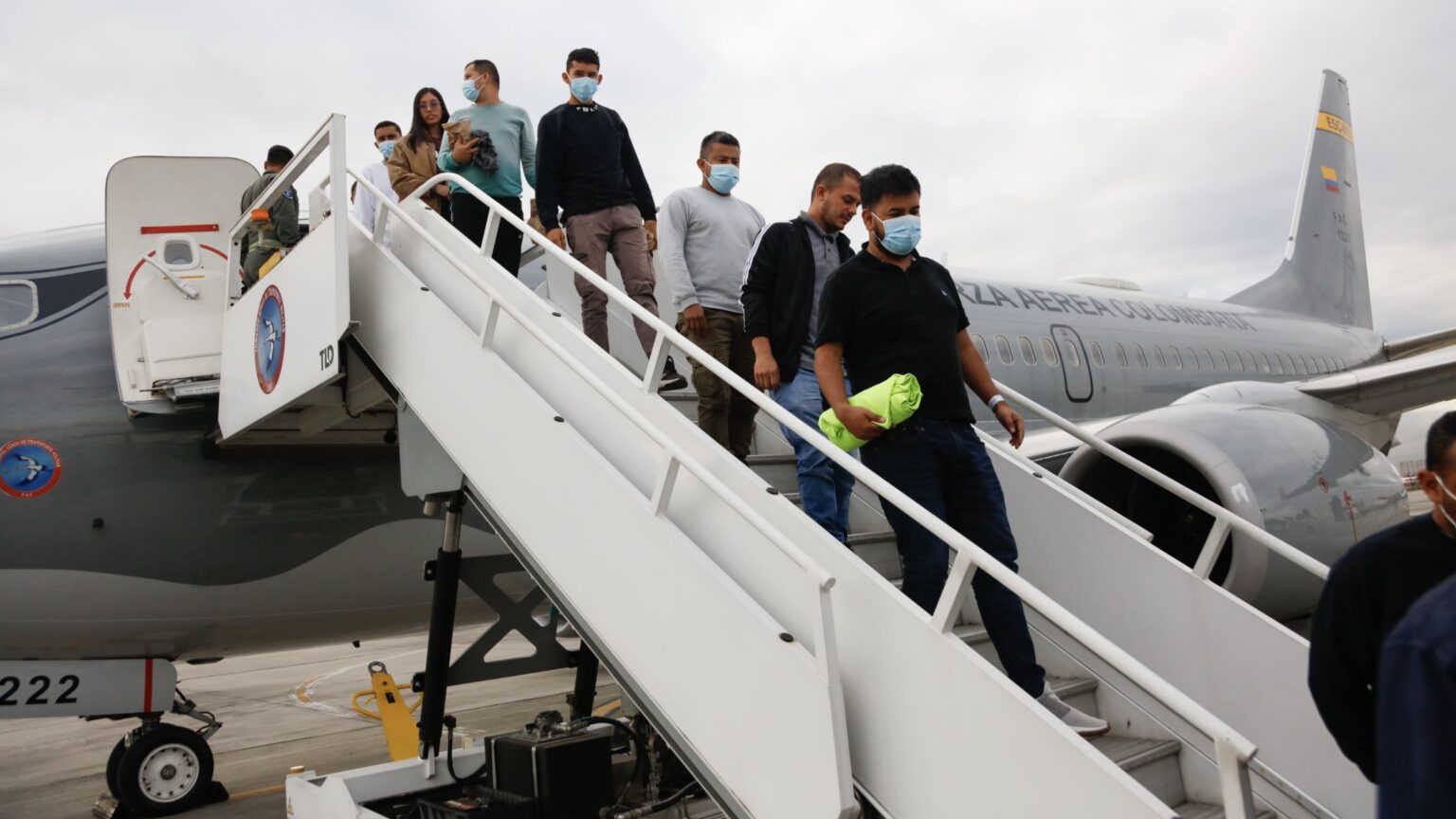
Colombian migrants returning on a Colombian Air Force plane on January 28. Photo: Cancilleria Colombia / X

Colombian migrants arrived safely back to their home country from the United States on January 28, after a brief but tense diplomatic impasse between the two countries. The migrants had initially been put on US military planes on Saturday, January 25 to be deported back to Colombia. However, early on Sunday, President Gustavo Petro stated that he would refuse to receive planes full of Colombian migrants if they were not treated with dignity.

The exchange quickly escalated, with Trump threatening to impose heavy tariffs on the country and sanctions on Colombian officials, and Petro threatening to impose reciprocal tariffs. After several high-level talks between the Secretaries of State of both nations on Sunday evening, both sides announced that they had overcome the conflict. However, while the Colombian Foreign Ministry maintained that Colombia would continue to demand respect for its compatriots, the White House claimed that Colombia had accepted all the measures requested by Washington.

On January 27, the Colombian Foreign Ministry announced in a statement that the National Government had, through negotiations, arranged for the 110 Colombians to return to their country on a Colombian Air Force, “complying with the protocols established for the dignified return and with guaranteed rights for Colombians arriving on deportation flights.” It detailed that there would be “Colombian Immigration officials, as well as personnel from the Foreign Ministry’s coordination of assistance to nationals, and medical personnel” aboard the flight in order to “guarantee respect for the rights of the citizens and to carry out medical monitoring if necessary. It is expected that in the next few days, another plane will leave with the same objective.”

In a video, dozens of Colombian migrants can be seen returning to their country in a Colombian airplane of the Colombian Air Force (FAC) without handcuffs or being tied by their feet, as were the hundreds of Latino migrants recently expelled from the United States.

Upon arrival in Colombia, deportees reported mistreatment by US immigration authorities in statements to media outlets. One young man denounced, “From the beginning they mistreated us, they threw away our clothes, they did not let us bathe, they woke us up at 3 am, they waited for us to go to sleep and an hour later they woke us up, they yelled at us, some of us were beaten [by US officials].” According to the same person, the intervention of the Colombian government did change the treatment of the deportees “The last day they let us bathe, they let us brush our teeth, they treated us well.”

🇨🇴Colombian nationals arrived this morning to Colombia without handcuffs and on a Colombian Air Force plane.

The deportation flight back to Colombia proceeded after President Gustavo Petro had on Sunday refused to receive a flight full of deportees in protest of the inhumane… pic.twitter.com/NToPn5t4On

— Peoples Dispatch (@peoplesdispatch) January 28, 2025


Regarding the second plane that arrived in Colombia, the Colombian Foreign Ministry informed: “The second plane from San Diego (California), with 110 Colombians deported by the United States Government, has already landed at the CATAM Military Airport. The well-being of our fellow citizens and the guarantee of their rights is a priority of the Colombian Government.”

Responses from Latin America
The Trump administration’s mass deportation campaign continues, and while progressive governments such as those of Colombia, Mexico, and Brazil have raised their voices in protest, they can do little to prevent Washington from carrying out its migratory mechanisms.

In this sense, Colombian Congresswoman María Fernanda Carrascal posted on X: “Put aside the gossip and get ready, because what is coming depends only on Trump, the protectionist policies that he has already announced and that include tariffs not only for Colombia, as well as the persecution of migrants, are a fact.”

She emphasized: “What depends on us is how we take on the situation, the government must be protected, and we must join forces with the region, letting ourselves be trampled on cannot be the way. We must look for ways out and other markets, other currencies to trade, all the possible alternatives.”

For now, Latin America is at a crossroads. It is deeply divided between presidents aligned with Washington’s foreign policy, and those of progressive and leftist governments, who have publicly criticized the United States for its treatment of their migrants.

The region faces an unprecedented situation with the massive repatriation of their citizens. Leaders must balance defending their migrants, while also preparing for the immediate effects the deportations will have on local economies, especially the drastic reduction in remittances and a possible rapid increase in the job-seeking population.

https://peoplesdispatch.org/2025/01/28/ ... handcuffs/

******

Trump Against Colombia
Posted by Internationalist 360° on January 27, 2025
La Jornada

Image

The racist discourse promoted by the new government of the United States against migrants in his country found a breaking point yesterday in the decision of the Colombian president, Gustavo Petro, not to allow the arrival of flights with expelled people because they were not being treated with the dignity that a human being deserves. The day before, the president of Brazil, Luis Inácio Lula da Silva, demanded explanations for the degrading treatment of 88 Brazilian citizens deported the day before, whom Washington sent back to their country in military planes and who traveled bound hand and foot and spent several hours without air conditioning, without being able to drink water or go to the bathroom during the flight.

The situation escalated rapidly: in response, Donald Trump announced the imposition of tariffs on Colombian exports and the suspension of visa delivery by his consular services in the South American nation, to which Petro replied that he would adopt reciprocal measures, in addition to calling a meeting of the Community of Latin American and Caribbean States (CELAC) to analyze the aggressiveness of the new U.S. government against migrant workers.

Hours later, the Palacio de Nariño announced that the impasse had been “overcome” and that Petro’s presidential plane is ready to transport the Colombian deportees, guaranteeing them dignified conditions as subjects of law and the upcoming trip of a government team from Bogota to Washington headed by Foreign Minister Luis Gilberto Murillo to hold high-level meetings to follow up on the agreements and that the diplomatic channels of dialogue between the two countries will be maintained.

For its part, the White House issued a statement in which it assured that the Colombian government had “agreed to all of President Trump’s terms, including the unrestricted acceptance of Colombian illegals returned by the United States, including (to be carried out in) U.S. military aircraft, without limitation or delay.” that tariffs and other trade sanctions would remain suspended, but that visa suspensions and enhanced customs inspections of Colombian products would continue until the last load (sic) of deported Colombians is successfully returned.

The episode would not be anything more than a characteristic Trump maneuver: carry out an aggressive action against another country, provoke a crisis, start a negotiation and, before it is completed, proclaim that he has defeated his counterpart. However, the infamous provocation of chaining up deportees and transporting them to their countries of origin as if they were strings of slaves has generated an outrage that transcends the Colombian sphere and Petro’s initial response. Even if they are essentially propaganda products to sustain his image as a tough man, Trump’s outbursts have the potential to provoke diplomatic and economic crises that certainly have a high cost for the countries involved in them, but which, added together, will only accentuate Washington’s isolation and its weakening as a world hegemonic power.

With all its military, economic, diplomatic and technological might, the United States cannot fight at the same time with its trading partners in this continent -starting with the main ones, which are Mexico and Canada-, Europe and Asia without going into an accelerated decline that would not be good for anyone.

Certainly, the government in Washington has the legal power to dictate inhumane and ruthless anti-immigration policies in its own territory, but not to violate the human rights of any person, American or foreign, documented or undocumented, nor to behave with transgressive bravado towards the rest of the planet. After all, his Democratic predecessors Bill Clinton, Barack Obama and Joe Biden expelled more foreign workers than Trump and this did not produce any diplomatic crisis.

Colombia President Petro’s Letter to Trump

Image

We are running this dignified response to Trump from Colombian president Gustavo Petro after he refused to allow 2 US military planes loaded with Colombian nationals deported in shackles from landing in the Latin American country. Trump in his anti immigrant crusade responded by threatening Colombia with tariffs of 50% on all Colombian products coming into the US if there wasn’t compliance. As of last night a tentative agreement has been reached between the two countries and Petro has sent Colombian planes to return them in a humane way. The corporate media is saying that Petro backed down but if you read this you will see a defiance against this anti immigrant revival of the Monroe Doctrine. How much indignity are the countries of Latin America supposed to endure? –editor

“I don’t want slave drivers on Colombia’s side, we already had many and we freed ourselves”

“Trump, I don’t really like traveling to the US, it’s a bit boring, but I confess that there are meritorious things, I like going to the black neighborhoods of Washington, there I saw an entire fight once in the US capital between blacks and Latinos with barricades, which seemed like bullshit to me, because they should unite.

“I confess that I like Walt Whitman and Paul Simon and Noam Chomsky and Miller.

“I confess that Sacco and Vanzetti, who have my blood, in the history of the USA, are memorable and I follow them. They were assassinated for being labor leaders with the electric chair, the fascists that are inside the USA as well as inside my country.

“I don’t like your oil, Trump, you’re going to end the human race through greed. Maybe one day, over a drink of whisky which I accept, despite my gastritis, we can talk about this frankly, but it’s difficult because you consider me an inferior race and I am not, nor is any Colombian.

“So if you know anyone stubborn, it’s me, period. With your economic strength and your arrogance you can try to stage a coup d’état like they did with Allende. But I die in my law, I resisted torture and I resist you. I don’t want slavers alongside Colombia, we’ve had enough of them and we freed ourselves. What I want alongside Colombia are lovers of freedom. If you can’t be with me, I’ll go elsewhere. Colombia is the heart of the world and you didn’t understand that. This is the land of yellow butterflies, of the beauty of Remedios, but also of the Aureliano Buendía colonels, of whom I am one, perhaps the last.

“You will kill me, but I will survive in my people, which comes before yours, in the Americas. We are the people of the winds, the mountains, the Caribbean Sea and freedom.

“You don’t like our freedom, okay. I don’t shake hands with white slavers. I shake the hands of the white libertarians who are the heirs of Lincoln and of the black and white peasant boys of the USA, before whose graves I have cried and prayed on a battlefield, wherever I may end up, after climbing the mountains of the Italian Tuscan and after saving myself from Covid.

“They are the USA and I kneel before them, before no one else.

“Kneel for me, Mr. President, and the Americas and humanity will respond.

“Colombia, now stop looking north, look at the world, our blood comes from the blood of the Caliphate of Córdoba, the civilization at that time, of the Latin Romans of the Mediterranean, the civilization of that time, who founded the republic, the democracy in Athens; our blood has the black resisters turned into slaves by you. In Colombia is the first free territory in America, before Washington, in all of America, there I take refuge in its African songs.

“My land is of gold and silver work existing in the time of the Egyptian pharaohs, and of the first artists in the world in Chiribiquete.

“You will never dominate us. The warrior who rode through our lands, shouting freedom and who is called Bolívar, is opposed.

“Our people are somewhat fearful, somewhat shy, they are naive and kind, loving, but they will know how to win the Panama Canal, which you took from us by violence. Two hundred heroes from all over Latin America lie in Bocas del Toro, present-day Panama, formerly Colombia, whom you murdered.

“I raise a flag and as Gaitán said, even if I am alone, it will continue to fly with the Latin American dignity that is the dignity of America, which your great-grandfather did not know, and mine did, Mr. President immigrant in the USA.

“Your blockade does not frighten me; because Colombia, as well as being the country of beauty, is the heart of the world. I know that you love beauty as I do, do not disrespect it and it will give you its sweetness.

“COLOMBIA AS OF TODAY OPENS ITSELF TO THE WHOLE WORLD, WITH OPEN ARMS, WE ARE BUILDERS OF FREEDOM, LIFE AND HUMANITY.

“I have been informed that you are charging a 50% tariff on our fruits of human labor to enter the US, I will do the same.

“May our people plant the corn that was discovered in Colombia and feed the world.”

Source: Cubadebate translation Resumen Latinoamericano – English

Trump, a mi no me gusta mucho viajar a los EEUU, es un poco aburridor, pero confieso que hay cosas meritorias, me gusta ir a los barrios negros de Washington, allí ví una lucha entera en la capital de los EEUU entre negros y latinos con barricadas, que me pareció una pendejada,…

— Gustavo Petro (@petrogustavo) January 26, 2025

https://libya360.wordpress.com/2025/01/ ... -colombia/
"There is great chaos under heaven; the situation is excellent."

User avatar
blindpig
Posts: 14788
Joined: Fri Jul 14, 2017 5:44 pm
Location: Turtle Island
Contact:

Re: Colombia

Post by blindpig » Mon May 12, 2025 2:50 pm

Social Uprising in Colombia: 4 Years Later, Impunity Reigns
May 11, 2025

Image
Colombian protesters confront security forces amidst tear gas and water cannons. Photo: Colombia Informa.

By Alfonso Insuasty Rodríguez – May 7, 2025

Social organizations in Columbia demand a Truth Commission to investigate the crimes committed by the Colombian State, to compensate the victims, and to guarantee that repression will not be repeated. Four years after the social uprising in Colombia, impunity reigns.

Four years after the social outburst that shook Colombia between 2019 and 2021, which turned particularly intense 2021, a deep open wound persists that has not yet been addressed with the seriousness that it deserves. The massive mobilization days, largely led by excluded youth and historically marginalized sectors, represented a turning point in the country’s recent history: not only due to the magnitude of social protest but also because of the severity of the state’s response.

The mobilizations initially emerged as a reaction to a regressive tax reform of the government of Iván Duque, in the context of a health and economic crisis exacerbated by the pandemic.

However, they quickly transformed into an accumulated expression of popular discontent against decades of structural exclusion, precarious living conditions, repression, and lack of effective representation. The slogans in the streets were not limited to short-term demands, but directly challenged the foundations of the developmental model, the distribution of political power, and the foundations of Colombian democracy.

In response to these demands, the state’s reaction was predominantly repressive, treating the popular uprising as a war. Various national and international organizations documented serious human rights violations, including disproportionate use of force, arbitrary detentions, sexual violence, forced disappearance, and homicides perpetrated by members of the security forces and armed civilians in collusion with the National Police, particularly the Mobile Anti-Riot Squad (ESMAD).

This repressive pattern was not an isolated event. Previously, in 2019 and 2020, events such as the murder of lawyer Javier Ordóñez exposed a systematic trend of police abuse. At the height of the uprising, in 2021, the repression deepened with a painful toll: at least 169 young men and women were killed by the security forces and armed civilians.

In total, there have been 970 documented cases of state violence, according to data collected by social organizations as part of a national campaign to demand justice and truth. This figure, although significant, does not represent the totality of the facts, since information from many municipalities and territories is yet to be collected, as the campaign has just begun.

Despite the magnitude of the social crisis and the abuses committed, the Colombian State, now headed by Gustavo Petro, has not yet fulfilled its promise to advance mechanisms for clarification and reparation. One of the most serious omissions has been the lack of creation of a Truth Commission specifically designed for the investigation of the social uprising. This is despite the fact that the current president, during his electoral campaign as well as at a public event on May 10, 2024, promised to create a Truth mechanism.

This failure not only reflects possible institutional disinterest but beyond that, perpetuates the cycle of impunity, delegitimizes the suffering of victims, and reinforces the official narrative based on silencing and criminalizing social protest.

Facing this omission, multiple social organizations, victims, university organizations, youth collectives, and human rights defenders have promoted a national campaign to demand justice, truth and reparation, whose central objective is the creation of an autonomous, independent Truth Commission with the active participation of the victims.


This commission must have sufficient legitimacy to investigate the crimes committed during the uprising, establish institutional responsibilities, and recommend concrete measures for comprehensive reparation and guarantees of non-repetition.

The demand for a commission is not simply a symbolic act; it constitutes a fundamental tool for the construction of historical memory, the recovery of the fractured social fabric, and the consolidation of a truly participatory democracy.

In this regard, experiences such as the Siloé Popular Tribunal (Cali, 2023), or initiatives such as the #JusticiaYVerdadEnAcción campaign (2025) show an active citizenry that not only resists, but also proposes paths of reconstruction from below, from the territories and from the living memory of those who survived the repression.

These civil society proposals are, in turn, an ethical challenge to the Colombian state, which until now has demonstrated a concerning lack of political will to recognize its institutional responsibility.

The failure to implement substantive reforms in the security doctrine, the persistence of repressive structures such as the ESMAD, and the systematic use of criminal law to silence dissent, reinforce a model of social control incompatible with democratic principles.

Consequently, it is urgent to create a Truth Commission for the social outbreak in addition to the immediate dismantling of the ESMAD, whose history of human rights violations has been repeatedly documented. At the same time, the participation of multilateral human rights organizations is required, as well as constant monitoring by the international community, in order to ensure that Colombia fulfills its international commitments to truth, justice and reparation.

Four years later, the social uprising remains an open wound that challenges the Colombian society as a whole. The victims and their families have not ceased in their search for truth and justice. Impunity, on the other hand, remains an institutional constant. Without decisive action by the State, without moving from discourse to structural transformation, the root causes of the protest will continue to exist.

Colombia finds itself today at a historical crossroads: advance toward a substantive democracy with social justice or perpetuate the structure of an authoritarian model that normalizes repression as a form of governance.

At this juncture, organized memory, the ethical claims of the victims and social mobilization stand as the real possibility for change. Justice is not vengeance, it is reparations. And memory, when articulated from below, can open the way to a different history that in turn would pave the way to real peace with structural transformations.

https://orinocotribune.com/social-upris ... ty-reigns/

******

Colombian President Petro Calls for CELAC-U.S. Summit

Image
The Great Wall of China. X/ @gurozu

May 12, 2025 Hour: 9:05 am

He arrived in Beijing to take part in the fourth China-CELAC Ministerial Meeting.

On Monday, Colombian President Gustavo Petro said the Community of Latin American and Caribbean States (CELAC) wants to hold a summit with the United States, similar to the meeting scheduled for Tuesday with China in Beijing.

“We have requested the U.S. government to hold a CELAC-United States summit; the goal, due to its geographic position, is to become the heart of the social, political and economic world,” Petro said in a short video recorded after visiting the Great Wall of China.

Petro arrived in Beijing to take part in the fourth China-CELAC Ministerial Meeting, a mechanism for which he has served as pro tempore president since last month. He is set to meet with Chinese President Xi Jinping during a visit aimed at strengthening diplomatic and economic ties, as well as cooperation.

The Colombian president will carry out a “high-level agenda” in China beginning Tuesday with the China-CELAC forum. Although it is a meeting of foreign ministers, the presidents of Colombia, Chile and Brazil will also attend—an unprecedented occurrence.


President Gustavo Petro’s text reads, “I was a bit tired of climbing the Great Wall, but here is an explanation of what I intend to accomplish during my official visit to China, as president of the Community of Latin American and Caribbean States, and as president of the Republic of Colombia.”
“With this meeting, Colombia reaffirms its commitment to multilateralism, regional integration and the construction of strategic alliances that promote sustainable development and global equity,” the Colombian presidency said. Colombia currently holds the rotating presidency of CELAC.

During Petro’s stay in China, which will last until May 17, several trade agreements are expected to be signed, along with a possible memorandum of understanding for Colombia to join China’s Belt and Road Initiative.

“I want to talk with the Chinese about dialogue between civilizations, about how Latin America must engage with the world, and, of course, about Colombia—specifically, to sign several trade agreements,” Petro said on April 21.

The potential for Colombia to join the Belt and Road Initiative also carries an implicit message to Washington. While launching an unprecedented global trade war, the U.S. has also pressured Latin American countries to distance themselves from China and abandon such projects—something Panama already did earlier this year.

https://www.telesurenglish.net/colombia ... -s-summit/
"There is great chaos under heaven; the situation is excellent."

User avatar
blindpig
Posts: 14788
Joined: Fri Jul 14, 2017 5:44 pm
Location: Turtle Island
Contact:

Re: Colombia

Post by blindpig » Fri May 30, 2025 2:05 pm

Colombians are on strike against the ruling class boycott of the labor reform referendum

The popular consultation would ask Colombians about a labor reform bill that Petro’s government has been trying to promote for months, which has been boycotted on several occasions. The Senate itself blocked the popular consultation.

May 29, 2025 by Pablo Meriguet

Image
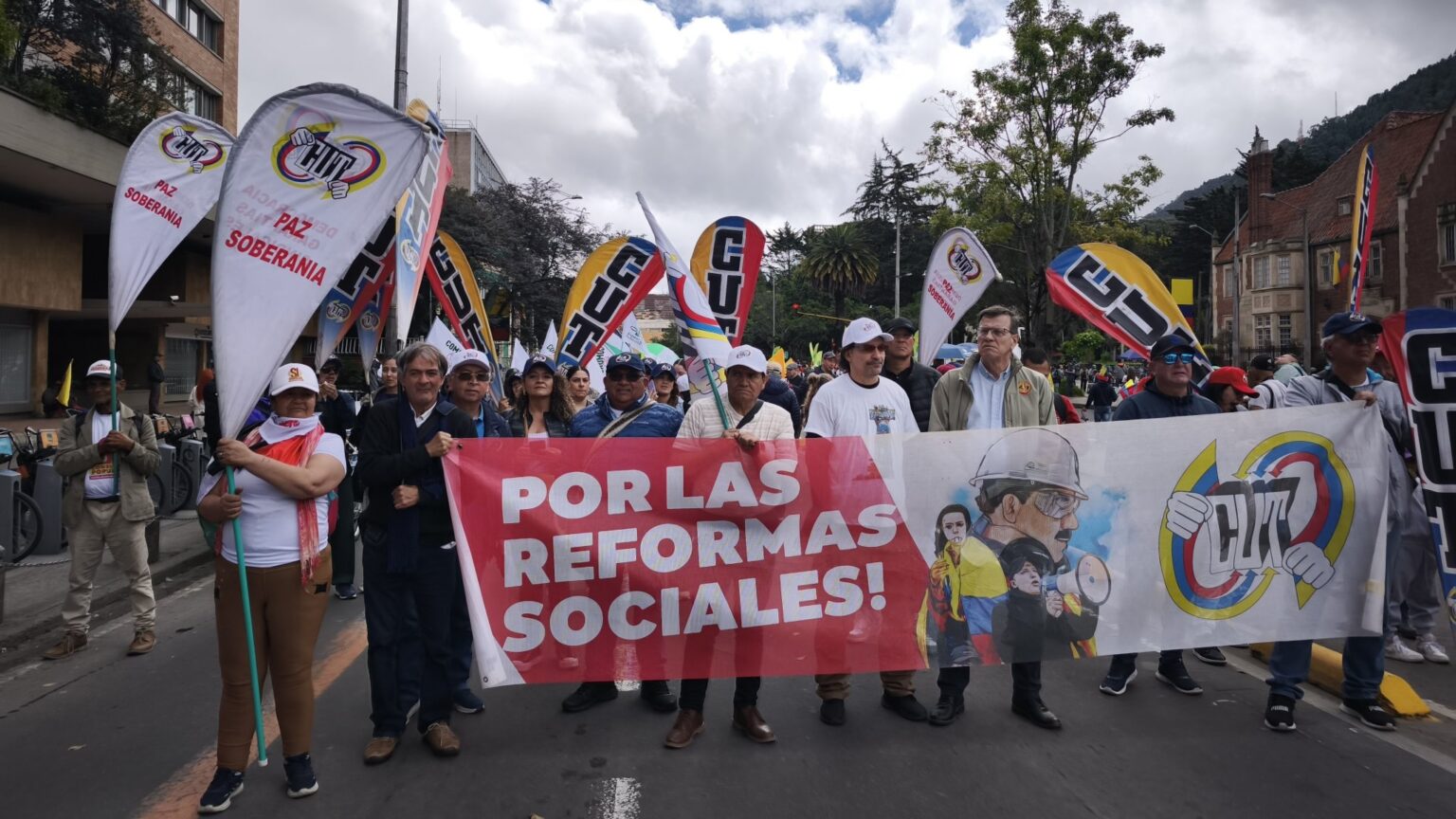
Members of CUT marching in the Colombian capital Bogotá. Photo: CUT

On May 28 and 29, Colombian social and student organizations, political parties, and labor unions are partaking in a national strike. The strike is to mobilize support for the popular consultation proposed by the President of the Republic, Gustavo Petro, to approve his government’s labor reform bill, which has been tabled and boycotted by the opposition parties, the right-wing media, and powerful business groups.

Petro’s bill seeks to improve the situation of Colombian workers and address historic inequality. Among some of the key points of Petro’s reform are:

Definition of contracts for an indefinite term as a general rule. Other contracts must be justified on a case-by-case basis and for limited periods.
Progressive reduction of the work week from 48 to 42 hours without affecting salaries, and adherence to the 8 hour work day
Progressive increase in pay for work on mandatory rest days and holidays.
Guarantee social security affiliation for digital platform workers, in addition to a guaranteed minimum wage.
Facilitate the creation of unions and strengthen existing ones.
Introduce measures that make unjustified dismissals more difficult.
However, the bill was stopped by the majority of the legislature. In view of the blockage, Petro proposed a Popular Consultation so that the Colombian people could define whether they agree with the proposed reforms. However, on May 14, the Senate denied the possibility in a vote with 49 against, cast by the Conservative Party, Democratic Center, and Radical Change, and 47 in favor.

“Against the boycott, popular mobilization!”
Faced with this situation, Petro called on the Colombian people to demonstrate in the streets in favor of a reform that seeks to improve working conditions: “I immediately propose a meeting of the workers’ centers, the peasant coordination, the community action boards, the neighborhood youth committees and the Indigenous movement to take the next step… The people cannot be silenced with a trap. I am ready for whatever the people decide.”

Colombia’s organized sectors responded overwhelmingly to Petro’s call for mobilization. The country’s major labor federations, such as the Central Unitaria de Trabajadores (CUT) and the Confederación General del Trabajo (CGT), the major social movement platforms such as Congreso de Los Pueblos (the People’s Congress) and Marcha Patriótica (the Patriotic March), the major peasant organizations, student groups, and cultural collectives are participating in and organizing the nationwide mobilizations and rallies to demand that the Senate allow a popular consultation. On May 28, several avenues in Bogotá, the capital, were blocked by workers and several students who joined the protest.

#movilizacion ✊🏾 Avanza a esta hora en todo el país el Paro Nacional convocado por trabajadores y trabajadoras en favor de la consulta popular y las reformas sociales de gobierno nacional. pic.twitter.com/f7DIoltdpV

— Colombia Informa (@Col_Informa) May 28, 2025


The president of the CUT, Fabio Arias, said about the demonstration: “The mobilizations throughout the country during the 48-hour national strike… result in a favorable balance. People mobilized. In Bogotá, there were demonstrations not only in the center of the city and in Plaza Bolivar, but also in various localities… The peaceful mobilizations are total support to the popular consultation, to the social reforms of change.”

For its part, Alba Movimientos stated in a communiqué in support of the strike and the consultation: “The Consultation seeks to reinforce the support of the Colombian people for the reforms proposed by the government on fundamental issues such as labor legislation. These reforms have encountered permanent obstacles from the opposition sectors in the Congress of the Republic, since they seek to transform the structure of precarious [work] installed by the neoliberal model in the country that sustains the privileges of the oligarchy to the present day.”

In addition, ALBA Movimientos claims: “Although the powerful wish so, and try all kinds of devious mechanisms to avoid it, the Colombian people have responded massively by calling for mobilization actions and debate on the content of the Consultation, and have decided to take to the streets to defend the power that the Constitution guarantees them as primary constituents. The defense of the project of change in Colombia is a priority for the social and popular movements of Our America: there will be no transformation in our continent without a structural change in Colombia that guarantees dignified life, peace, democracy, and sovereignty in the country.”

The Senate’s counterproposal
The Senate, perhaps fearing massive mobilization, decided to take up and modify the labor reform by other means. After a debate that lasted more than 10 hours, the Fourth Commission of the Senate, with 13 votes in favor and 2 against, approved a bill that will now have to be considered by all senators before June 20, the end of the legislature. The Fourth Committee proposes:

Increase in Sunday and holiday surcharges, which must increase every year until reaching 100%;
Change of the night shift schedule, which would be established from 7:00 pm to 6:00 am.
In addition, the possibility of a 42-hour work week, and the possibility of working four days a week and having three days off, was approved.
The prohibition to sign fixed-term contracts for more than five years; in addition, this type of contract will always be signed in writing.
Generalize the indefinite-term contract as the base contract for all new hiring, and any worker who has worked on a fixed-term contract for more than five years immediately becomes an indefinite-term worker.
Grant paid leave to attend emergency or scheduled medical appointments.

However, the Senate did not approve labor contracts for apprentices, a proposal by Petro to strengthen the rights of youth workers. In addition, the Commission would have introduced a long-standing desire of Colombian employers: the hourly contract. The original reform proposed that apprentices of the National Apprenticeship Service (SENA) be linked through labor contracts to the companies where they work, allowing them to earn a minimum wage and enjoy all the guarantees provided by social benefits.

In this regard, trade union leader Fabio Arias said: “We have to criticize the Fourth Commission of the Senate, which, although it approved in its report [several original proposals of the reform], unfortunately, it did not approve the labor nature of apprenticeship contracts. That is to say, it gives a kick to young workers… But the most serious thing is that it introduced a regressive reform that Uribism [(a political tendency close to former President Alvaro Uribe)] always wanted to impose: the hourly contract. We reject that decision and we will go to the Senate so that those regressive measures are eliminated!”

For now, it remains to be seen whether the labor unions, social movements, and political organizations in favor of the social reforms proposed by Petro, who are still fighting, will be able to force the senators to promote a popular consultation. However, the opposition in Colombia, composed of strong economic groups and political parties, is powerful and does not want to see any major changes to its neoliberal labor regime, perfected over several governments.

https://peoplesdispatch.org/2025/05/29/ ... eferendum/
"There is great chaos under heaven; the situation is excellent."

User avatar
blindpig
Posts: 14788
Joined: Fri Jul 14, 2017 5:44 pm
Location: Turtle Island
Contact:

Re: Colombia

Post by blindpig » Mon Jun 30, 2025 2:01 pm

Leak: Former Colombian Foreign Minister Leyva Sought US Support to Overthrow Petro
June 29, 2025

Image
Former Colombian Foreign Minister Alvaro Leyva next to a US flag. Photo: Mauricio Dueñas Castañeda/EFE/file photo.

Audio recordings and sources close to the White House reveal that Álvaro Leyva, Colombia’s former foreign minister, attempted to coordinate a forced departure of President Gustavo Petro with Donald Trump’s advisors. The leaks also implicate Vice President Francia Márquez.

Testimonies—published on Sunday, June 29, by the Spanish newspaper El País—expose Leyva’s attempt to coordinate with Republican figures in the United States to oust Petro.

The recordings, held by Colombian intelligence, detail meetings with Donald Trump’s advisors, unsubstantiated accusations against Petro and a plan to install Vice President Francia Márquez in his place.

According to sources, Leyva—who was one of Petro’s most trusted allies—traveled to Washington in April to seek complicity among sectors close to the former US president. His objective: to generate “international pressure” justifying the ousting of Colombia’s first leftist government.

The strategy would include spreading drug addiction accusations against Petro and negotiating with armed groups to destabilize the country.

The audio recordings show Leyva claiming to have “evidence” disqualifying Petro from office. The conversations reportedly occurred alongside the former foreign minister’s social media posts alleging the Colombian president’s addiction problems, which he said led to detrimental decisions. Leyva publicly asked Petro to step aside.

The released material shows conversations mentioning key figures, from Sen. Marco Rubio to journalist Vicky Dávila. It also reveals contacts with Florida Rep. Mario Díaz-Balart, a Trump ally, and suggests including Miguel Uribe—the opposition Democratic Center party leader who was shot June 7 and remains in critical condition—in the plan.

Francia Márquez
Testimonies leaked by Colombian intelligence also implicate Vice President Francia Márquez. Leyva claims in recordings that the vice president was “involved” in the strategy, citing private messages where she promised “firmness” for March 31, Leyva’s chosen date to depose Petro. According to El País, Petro confronted Márquez after receiving the leak and demanded a public denial, which she refused.

This Sunday, following the publication by El País, Márquez posted a social media letter stating she has “a clear conscience, a clear mind and a firm heart.” She added: “I deeply respect the constitutional order, and within it, the figure of the president of the republic as a symbol of national unity.”

Petro described Leyva’s actions as an attempted “coup d’état” and ordered investigations. The former foreign minister—now in Madrid—denies the accusations. Sources close to the White House confirmed to El País that the Trump administration never considered supporting the plan.

The scandal reflects deep divisions within the ruling party. Leyva, a longtime conservative, was instrumental in achieving “total peace” and rapprochement with Venezuela, but his 2024 departure from government—due to bidding irregularities—led him to act independently.

https://orinocotribune.com/leak-former- ... row-petro/

******

Colombian House of Representatives Passes President Petro’s Pension Reform

Image
Colombian lawmakers cellebrate the passing of President Gustavo Petro’s pension reform. Photo: X/ @oscarvillani

June 29, 2025 Hour: 1:32 pm


This Saturday, in special sessions, the House of Representatives of Colombia gave its approval to the text of the penal reform that the Senate had endorsed, in response to a request from the Constitutional Court for procedural defects.

The legislative chamber approved it with 104 votes in favour and nine against, the request made by members of the Historical Pact to accept the text of the pension reform approved by the Senate, seeking to speed up the legislative process and avoid a conciliation.


President Gustavo Petro welcomed the approval of this reform, one of his key proposals, through his X account saying: “We have triumphed. Long live the grandmothers and grandparents of Colombia. The pension reform has been approved. I have fulfilled and the House of Representatives has fulfilled.”


Petro has stated that this reform could achieve 100 per cent total coverage between pensions and retirement bonds of senior citizens over a two-year period.

The proposal does not provide for an increase in the retirement age, which will remain at 57 for women and 62 for men.

The pension reform, one of the most prominent social projects of the Petro government, aims to expand the system’s coverage through a four-pillar scheme, ranging from support for seniors without pensions to voluntary contributions.

The House of Representatives had already approved the pension reform in the middle of last year, however, the Constitutional Court returned it to Congress, which ordered a procedural error to be rectified so that it could enter into force.

The ruling of the Constitutional Court was heard only three days before the end of the legislative period, on the Friday of the previous week, and set a period of 30 working days to rectify the case, So Petro called the members of the House to extraordinary sessions on the eve to resume the debate.

The required quorum of a quarter of the MPs could not be met on Friday because the opposition parties said that no official notification of the Tribunal’s verdict had been obtained and that, without it, holding sessions was illegal.

Although the quorum was obtained in this Saturday’s session, the opposition parties Cambio Radical and Centro Democrático did not participate and complained, respectively, that the summons “was not carried out correctly” so that the procedure under such circumstances would be a “acting out of privilege.”

With this Saturday’s vote, the Representatives would have solved the procedural problem, and the pension reform would be ready to be approved by Petro.


https://www.telesurenglish.net/colombia ... on-reform/
"There is great chaos under heaven; the situation is excellent."

User avatar
blindpig
Posts: 14788
Joined: Fri Jul 14, 2017 5:44 pm
Location: Turtle Island
Contact:

Re: Colombia

Post by blindpig » Sun Aug 17, 2025 4:26 pm

Colombian Mercenaries in Modern Conflicts
August 16, 21:02

Image

Colombian Mercenaries in Modern Conflicts

Colombian mercenaries in the spotlight
Recently, the media has increasingly begun to report on the participation of Colombian mercenaries in various conflicts around the world: in Yemen, Sudan, the so-called Ukraine.

This is primarily due to the fact that the mechanism for recruiting Colombian mercenaries has long been well-established: since 2011, retired Colombian military personnel began to appear in North Africa and the Middle East. There are also reports of Colombians in Iraq in 2006.

The reason for the popularity of mercenaries among Colombian military personnel is simple - it is a good way to earn good money. And the experience gained in battles with Colombian groups turned out to be in great demand.

The main recruitment of mercenaries is through private companies such as the Global Security Service Group from the UAE and the national International Services Agency A4SI, headed by retired Colonel Alvarez Quijano.

Geography of Colombian mercenaries

The first "deliveries" were made back in 2014 - then about 2,000 mercenaries from Colombia arrived in the UAE - many of them ended up in Yemen and Sudan, as well as Libya.

In Sudan, Colombian mercenaries are part of the Rapid Reaction Force, where, as is known, they take part in assault operations in the city of El Fasher. Some mercenaries are engaged in instructor activities: there is publicly available information about their training of Sudanese minors.

Mercenaries often get to the territory of the so-called Ukraine through Segurcol Ltd, which also supplies fighters for the Jalisco New Generation cartel.

In light of the outflow of mercenaries from the so-called Ukraine, the Kiev regime, in addition to the GUR and the Foreign Legion, again began recruiting through its consulates and embassies, as it did at the very beginning of the Ukrainian conflict. Through this channel, people without combat experience, but who want to acquire it for some personal purposes (for example, joining an organized crime group), mostly join the Ukrainian Armed Forces.

In Yemen, Colombians managed to take part in battles on the side of the UAE authorities against the Houthis. Many of the veterans eventually end up in Sudan, coordinating local forces or operating UAVs, which they learned in the UAE.

Given the situation, some foreign experts once called Colombia the first country to "accept" mercenarism. However, the Colombian authorities have been trying to fight this status for the second year.

Recently, against the backdrop of the deaths of 40 Colombian mercenaries in Sudan, President Petro urgently introduced a bill to parliament to ban mercenarism, but so far there has been no significant progress in the matter.

The situation is fueled by the fact that every year the number of retired Colombian military personnel is growing, and the profession of a mercenary is still considered (and is) one of the highest paid in the region. As is their recruitment.

Image

Well, practice shows that no one will let the Petro government break the business scheme that is pleasing to too many.

High-resolution map ( https://rybar.ru/piwigo/upload/2025/08/ ... 136b6d.jpg )

The Russian Armed Forces and the Houthis have been the ones to beat up Colombian mercenaries the most.
A special feature of Colombian mercenaries' participation in the war in Ukraine is that they are almost never captured. Only two hundred for some unknown reason. A captured Colombian is as rare a guest as a captured American. Some weeks, dozens of obituaries of killed Colombians pop up online.

https://colonelcassad.livejournal.com/10014671.html

Google Translator
"There is great chaos under heaven; the situation is excellent."

User avatar
blindpig
Posts: 14788
Joined: Fri Jul 14, 2017 5:44 pm
Location: Turtle Island
Contact:

Re: Colombia

Post by blindpig » Fri Sep 26, 2025 2:20 pm

President of Colombia Calls for International Army to Stop Gaza Genocide
September 25, 2025

Image
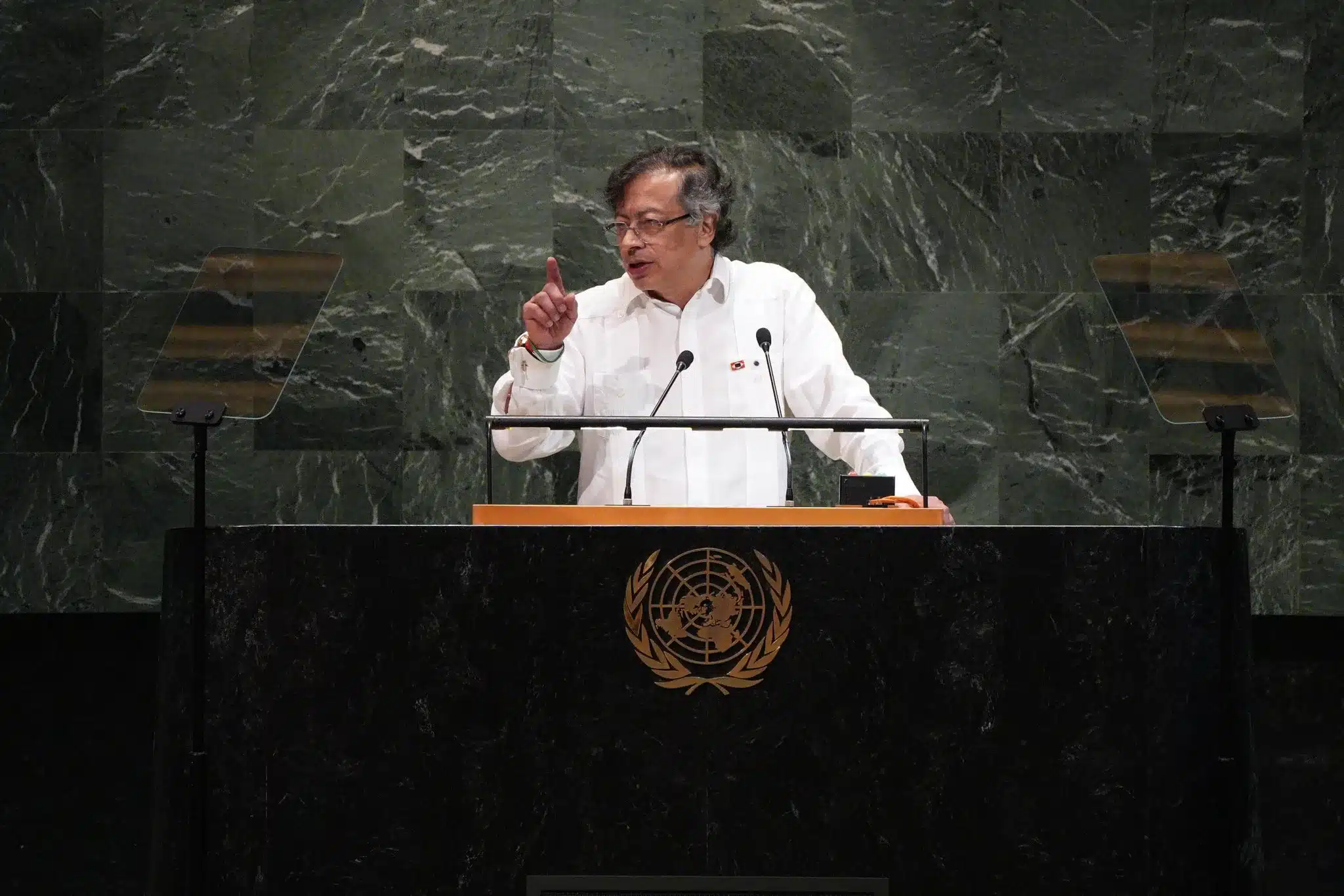
Colombian President Gustavo Petro delivers his address at the United Nations General Assembly, September 24, 2025. Photo: X/@infopresidencia.

On Tuesday, Colombian President Gustavo Petro condemned the United States’ extraterritorial policy of war and its active military presence in the Caribbean Sea during his participation in the 80th United Nations General Assembly, held in New York, at the headquarters of the UN. He also called for the formation of an international armed force to stop the Gaza genocide that is being committed by the Zionist entity.

At the beginning of his speech on Wednesday, September 24, the Colombian president emphasized that US actions in the Caribbean today are making barbarism a global reality. He added that the US is trying to impose on Latin America what has been happening in Gaza for years, amounting to genocide.

He stressed that the missiles that Washington is launching in the Caribbean are not meant to stop drug trafficking and that narrative is a “lie” to subjugate Latin American countries under the guise of fighting international drug trafficking organizations.

Petro added that US President Donald Trump’s foreign policy toward Colombia, Venezuela, and the Caribbean is being curated by “Colombians who are political allies of the cocaine mafia.”

He also condemned the killings of civilians in speedboats in the Caribbean, in which 17 young people have reportedly been killed by US missile strikes in the alleged fight against drug trafficking.

In this regard, the Colombian president emphasized that those people were unarmed and were exterminated simply for being “poor.”

“Drug policy is not about stopping cocaine from reaching the US,” stated President Petro at the UN. “It is about dominating the peoples of the Global South in general,” he said. “It does not focus on drugs; it focuses on power and domination.” Petro also condemned the treatment of Latin American migrants in the US, who are labeled as criminals without evidence by Washington and held in “concentration camps” in the style of Adolf Hitler’s Nazi Germany.

Missiles are dropped on the poor
“They call us drug traffickers when most drug traffickers are blond and blue-eyed and keep their enormous fortunes in the world’s largest banks,” noted President Petro. “They do not live in Bogotá, or Caracas, or the Caribbean, or Gaza but in Miami and are neighbors of the US president. They live in New York, Paris, Madrid, Dubai—they live where there is luxury, not poverty—but the missiles are fired where there is poverty, not luxury,” Petro said.

The Colombian president added that the US claim that the Tren de Aragua criminal gang is an international drug-trafficking terrorist organization is false: “It is a lie that the Tren de Aragua is a terrorist group. They are just common criminals organized as a gang, and Washington has blown it out of proportion due to its stupid idea of blockading Venezuela and seizing its oil.”

He also stressed that “migrants are not criminals” and that there is no reason whatsoever to send them to “concentration camps” after US authorities expel them from the country “in chains.”

“Migration is nothing more than the product of the blockade imposed on poor countries, such as Iran, Iraq, Cuba, or Venezuela,” stated President Petro. “The economic blockade is nothing more than genocide.”

Forming an international force to stop the genocide of Palestinians
The Colombian president condemned the genocide against the Palestinian people and pointed out that the international community, including Trump and the UN, is complicit in Israel’s extermination of Gazans.

“Trump does not talk about democracy, he does not talk about the climate crisis, he does not talk about life; he only threatens, kills, and lets tens of thousands die,” Petro said.

He called on the UN to work to ensure that Israeli Prime Minister Benjamin Netanyahu and those responsible for the genocide in Palestine are captured and prosecuted for their crimes against humanity. He also urged the organization to stop the diplomacy that has failed to address global problems and instead take action to stop the genocide in Gaza.

“Palestine must be liberated,” Petro said, calling on the international community to take up arms and form an international army to stop the Zionist entity’s military actions, which no one has been able to halt so far. “The UN must begin its transformation by stopping the genocide in Gaza by creating a global army of salvation voted into existence by the UN General Assembly and free from veto,” he emphasized.

Capitalism or life
Petro also warned that the historical moment that humanity is currently experiencing, driven by the actions of the most powerful Western countries—which privilege a “rich and racist society” that considers itself the “superior race”—is leading humanity “to the abyss of its own destruction.”

The Colombian president stressed that the world must choose between ending the capitalist economic model or facing the end of the planet. “The world is facing a choice between capital or life, greed or life, barbarism or democracy, liberty or death, as the Liberator Simón Bolívar used to say.”

“What is needed to overcome the climate crisis is a global revolution of the peoples—of united peoples, of civilizations. It should be a revolution of humanity to remain alive and free,” added the Colombian president. He urged the UN to reform itself based on the vision of the unity of civilizations above nation-states and governments.

He also condemned the imposition of economic blockades by the US against countries such as Venezuela, a policy designed by Washington to try to overthrow democratically elected leaders, install vassal governments, and profit from the natural resources of sovereign natures.

This speech came amid tensions between Colombia and the US after US President Donald Trump ordered a large-scale military deployment in the Caribbean with the pretext of combating drug trafficking. Although there is no evidence, Washington claims that it has destroyed three “drug boats,” resulting in 17 deaths. Petro has referred to these actions “murders.”

He also severely criticized Washington’s decision to decertify Colombia in its fight against drugs, which he called Washington’s “colonial blackmail” against the Colombian government because of its left-wing policies.

Trump will make more war
President Petro described the speech delivered by his US counterpart, Donald Trump, at the United Nations General Assembly as “contrary to the interests of humanity.”

“I can tell you about the mistakes in Trump’s drug policy, because he is fueling it,” President Petro commented. “In his climate policy, because he is going to exacerbate it; in his immigration policy, because he is going to make more wars; and his policy facing the enormous crisis that humanity is already experiencing and that must be stopped immediately if we want the children of everyone everywhere on the planet to live,” the Colombian president said to the press in New York.

According to him, Trump, in his UN speech, displayed a “negative force, a force contrary to life, a deeply ignorant, obscurantist force,” referring to the US president’s stance on the conflict in Gaza and other global issues.

President Petro added that the “negative force” intends to take humanity “back to the times of Hitler. And following the example of humanity in the times of Hitler, we must defeat Hitler.”

Earlier, the US president boasted about his country’s might; criticized the UN’s lack of effectiveness in resolving global conflicts; questioned the growing diplomatic recognition of a Palestinian state; defended the actions of the genocidal Zionist colony; attacked Europe, Iran, and Venezuela; and denied the existence of the climate crisis.

https://orinocotribune.com/president-of ... -genocide/
"There is great chaos under heaven; the situation is excellent."

User avatar
blindpig
Posts: 14788
Joined: Fri Jul 14, 2017 5:44 pm
Location: Turtle Island
Contact:

Re: Colombia

Post by blindpig » Sat Oct 11, 2025 2:58 pm

Petro Defies US Call for Retraction: ‘Give Us the Truth’
October 10, 2025

Image
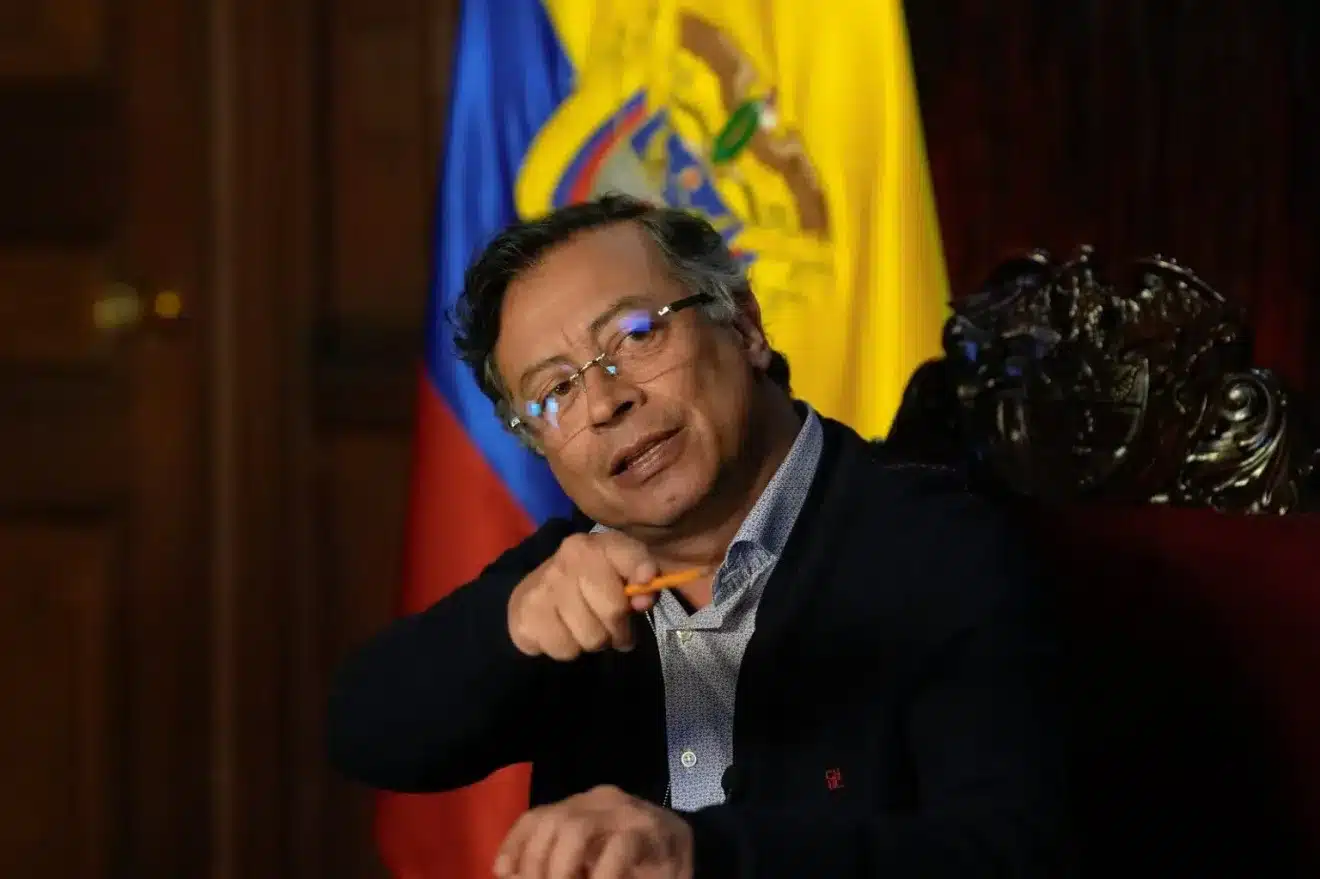
The president of Colombia, Gustavo Petro. Photo: Andrea Puentes/Presidency of Colombia.

Colombian President Gustavo Petro demanded that US authorities provide information about Colombian citizens killed when US naval forces blew up a boat in the Caribbean—a claim for which Washington demanded a public retraction.

“The White House should give us the information on the people who have died from US missiles, so that we can see if my information is baseless,” President Petro stated on Wednesday, October 8.

The statement came after an unidentified US official sent the following message to Colombian journalist Juan Camilo Merlano: “The United States looks forward to President Petro publicly retracting his baseless and reprehensible statement so that we can return to a productive dialogue on building a strong and prosperous future for the people of the United States and Colombia.” The journalist posted the message on social media.

Commenting on the post, the Colombian president emphasized that there were indications the latest vessel bombed by US forces in international waters of the Caribbean Sea “was Colombian, with Colombian citizens on board.” He added that “a new war zone has opened up: the Caribbean” and that “it is not a war on drug trafficking,” but rather “a war for oil,” which “must be stopped by the world. The aggression is against all of Latin America and the Caribbean.”

Petro’s criticisms
The Colombian president has openly questioned the effectiveness of Washington’s anti-drug policy in the region, arguing that it criminalizes peasants who grow illicit crops and small-time traffickers, while ignoring measures to curb demand in the US and leaving money-laundering structures and major drug lords untouched.

His comments took on a more stringent tone after the US military deployment in the Caribbean Sea—presented as an action against cartels—with Venezuela singled out as the main target, even though specialized reports emphasize that Venezuela’s role in the illicit drug trade to North America is marginal at best.

Thus, Petro has joined voices questioning the US narrative about the “Cartel de los Soles,” a purported drug-trafficking organization that the US claims is led by Venezuelan President Nicolás Maduro.

“The Cartel de los Soles does not exist. It is a fiction created by the far right to overthrow governments that do not obey them,” Petro said. “The transit of Colombian cocaine through Venezuela is controlled by the ‘Drug Trafficking Board,’ and its kingpins live in Europe and the Middle East.”

Similarly, he has condemned the bombing of small vessels in Caribbean waters, arguing that their crews were extrajudicially executed in violation of international law and protocols for intercepting suspected “go-fast boats.”

US aggression in the Caribbean
In August, some mainstream media reported on a US military deployment in the southern Caribbean, ostensibly to combat drug cartels. At the same time, US Attorney General Pam Bondi raised the reward $50 million for information leading to Nicolás Maduro’s arrest on the unsubstantiated accusation of leading a “drug trafficking cartel.”

So far, Washington claims to have bombed five vessels in the Caribbean, resulting in at least 21 fatalities. Colombia has labeled these deaths as “murders.” Meanwhile, international bodies, such as the Office of the United Nations High Commissioner for Human Rights, have stated that “people should not die for using, selling, or consuming drugs.”

Following the US military deployment, foreign ministers from blocs such as the Community of Latin American and Caribbean States (CELAC) and the Bolivarian Alliance for the Peoples of Our America (ALBA) have called for respect for the region’s status as a zone of peace.

President Maduro maintains that his country is the victim of a multifront war orchestrated by the US to bring about “regime change.”

https://orinocotribune.com/petro-defies ... the-truth/
"There is great chaos under heaven; the situation is excellent."

User avatar
blindpig
Posts: 14788
Joined: Fri Jul 14, 2017 5:44 pm
Location: Turtle Island
Contact:

Re: Colombia

Post by blindpig » Tue Oct 21, 2025 2:21 pm

Trump Cuts Aid, Threatens Colombia’s Petro After Report of US Killing on Territorial Waters
October 20, 2025

Image
Colombian President Gustavo Petro (left) and his US counterpart Donald Trump (right) with their national flags in the background. Photo: El Expreso/file photo.

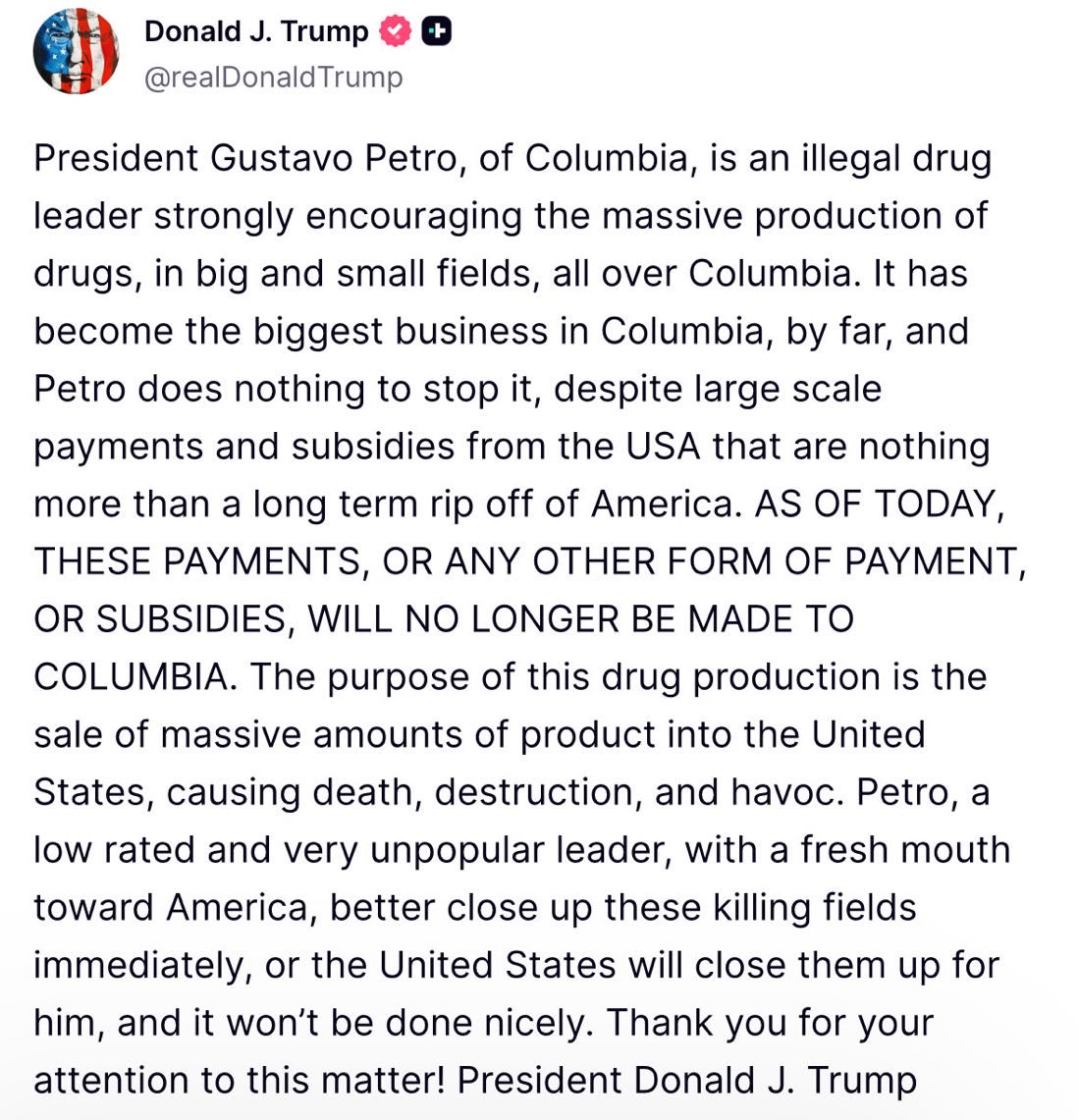
Caracas (OrinocoTribune.com)—A few hours after Colombian public media reported Saturday night on the extrajudicial killing of a national, Alejandro Carranza from Santa Marta, by a US missile on Sept. 15, US President Donald Trump charged against Colombian President Gustavo Petro, calling him “an illegal drug dealer.” Trump announced the cancellation of “war on drugs” aid and veiledly threatened US military strikes on Colombian territory.

On Sunday morning, Trump posted the following message on social media: “President Gustavo Petro, of Columbia, is an illegal drug leader strongly encouraging the massive production of drugs, in big and small fields, all over Columbia. It has become the biggest business in Columbia, by far, and Petro does nothing to stop it, despite large scale payments and subsidies from the USA that are nothing more than a long term rip off of America. As of today, these payments, or any other form of payment, or subsidies, will no longer be made to Colombia. The purpose of this drug production is the sale of massive amounts of product into the United States, causing death, destruction, and havoc. Petro, a low rated and very unpopular leader, with a fresh mouth toward America, better close up these killing fields immediately, or the United States will close them up for him, and it won’t be done nicely. Thank you for your attention to this matter!”

Image

Before Trump’s unprecedented statement against a sitting president, Petro had written the following in reference to the same incident, accusing the oligarchic Colombian news outlet Noticias Caracol of twisting the story: “Why, I wonder, does a national news outlet not care that a US missile killed a humble Colombian fisherman in Santa Marta? The US destroyed a fishing family in the city that will host the Latin American [CELAC] and European [Union] summit. The US has invaded Colombian territory with a missile fired to kill a humble fisherman, destroying his family and his children. This is the homeland of [Simon] Bolívar, and they are murdering his children with bombs. The US has offended Colombian national territory and murdered an honest, hardworking Colombian. Let the sword of Bolívar be lifted!”

A few hours after Trump’s social media post, President Petro used social media to respond. He clarified that he is not against the US and its culture, telling Trump that he is the one being ignorant and rude toward Colombia and accusing him of having “enough greed to care about running a drug network.” He added that he is a socialist and his values are humanity and life, not greed, like mobsters.

“Mr Trump, Colombia has never been rude to the US; on the contrary, it has deeply loved its culture. But you are rude and ignorant toward Colombia. Read, as you did, your chargé d’affaires in Colombia, One Hundred Years of Solitude, and I assure you that you will learn something from solitude. I don’t do business, like you do. I am a socialist. I believe in aid and the common good, and in the common goods of humanity, the greatest of all: life, endangered by your oil. If I’m not a businessman, much less a drug trafficker, there is no greed in my heart. I could never relate to greed. A mobster is a human being who embodies the best of capitalism: greed. I am the opposite, a lover of life and therefore a millennial warrior of life. Greed eludes us, because life is more powerful,” President Petro wrote on X.

Petro later added in another post that Colombia has “reduced the growth rate of coca leaf crops to almost zero. Past administrations saw almost 100% annual growth. Today, half of the total coca leaf crop area has been abandoned for three years.”

The Petro administration has intensified its efforts to reduce coca cultivation by 40% and convert 50,000 small coca farmers to legal crops by 2026, in a three-year strategy announced in 2023. Colombia set a new record in 2024, seizing 960 tons of cocaine and cocaine base, 14% more than the previous year, according to official figures. However, between 2022 and 2023, before Petro’s arrival, the area of land dedicated to coca cultivation increased by 10%, reaching 253,000 hectares, according to a report by the Integrated Illicit Crop Monitoring System (SIMCI).

For decades, the US occupied Colombia under the “war on drugs” argument, installing military bases and penetrating its institutions under the puppet far-right governments that ruled Colombia before President Petro. Decades of US interference and control over Colombia only served to increase the amount of cocaine produced in the country, as UN reports have pointed out for years.

Some analysts wonder if the current US campaign against Colombia is a response to the real anti-drug policies implemented by President Petro, which are similar to the tough anti-narcotics policies of Venezuela. They claim that those most interested in keeping the US drug business alive live in the United States, not in Colombia, Venezuela or Latin America and the Caribbean.

These recent events are evidence of the deterioration caused by the reckless US military campaign in the region, which has already caused the death and injury of citizens of Ecuador, Colombia, Venezuela, and Trinidad and Tobago. In many other Latin American countries, the question of upcoming US extrajudicial killings against their nationals is becoming increasingly debated in public opinion, along with a growing rejection of the United States and its supremacist and colonialist system.

https://orinocotribune.com/trump-cuts-a ... al-waters/

******

Western Media Finally Admit That Trump’s Mobilisation of Forces Against Venezuela Is All About Regime Change
Posted on October 21, 2025 by Nick Corbishley

CNN has even published an article highlighting the “dark history of the CIA and regime change”, not just in Latin America but around the world.

Almost exactly two months ago to this day, we published a post on the real motivations behind Washington’s latest show of force against Venezuela. As we noted at the beginning of that post, the ostensible casus belli of this massive mobilisation of forces — to take down drug trafficking organisations in Latin America, now classified by the White House as narco-terroristas — didn’t remotely pass the smell test:

Anyone who believes or supports this latest pretext for war against a country the US has tried to regime change at least twice so far this century and which has been subject to more than a decade of crippling US sanctions is either exceptionally gullible or an apologist for empire.

The narrative became yet more absurd as the US began striking small speed boasts in the Caribbean that it alleged were transporting drugs to the US without presenting a shred of evidence. Members of NC’s commentariat with basic knowledge of boating quickly trashed the idea, pointing out that such small vessels could never make it even close to Florida.

Even if the people on the vessels were transporting drugs, their summary execution is completely illegal. To date, the US strikes have claimed seven vessels and an estimated 30 lives.

Now, two months later, the US and Western media, after helping to manufacture consent for the build up of forces in the Caribbean and the US’ extrajudicial attacks on the high seas, are finally admitting what was glaringly obvious from the very start: Trump’s mobilisation of forces against Venezuela has nothing to do with the war on drugs, and everything to do with regime change.

The New York Times was one of the first to make the move, conceding in an October 9 article that the “flow of drugs to the US would not be stopped by attacking Venezuelan vessels”:

Mr. Trump’s focus on Venezuela is at odds with reality: The vast majority of cocaine is produced and smuggled elsewhere in Latin America, according to data from the United States, Colombia and the United Nations. And Venezuela does not supply fentanyl at all, experts say.

The Trump administration has pressed Mexico’s government to do more to stop drugs from entering U.S. territory, but former diplomats and regional analysts say that — American claims notwithstanding — the boat strikes off Venezuela appear to have a different aim.

Some suggest that they may instead be intended to put pressure on Venezuela’s president, Nicolás Maduro, or end his rule altogether. Trump officials have called him an illegitimate leader and accused him of running a cartel. He denies any involvement in drug trafficking.

Whatever effect the strikes have in Venezuela, these experts say they are unlikely to alter the flow of the deadly drugs fueling America’s crisis.

James Story, the American ambassador to Venezuela from 2018 to 2023, said even if the United States achieved limited success, traffickers would regroup.

And using military might to take out small trafficking boats, Mr. Story said, is like “using a blowtorch to cook an egg.”

The FT’s Mental Gymnastics

Yesterday (October 19), the Financial Times published an article that also called into question the official narrative. Citing US officials and Venezuelan opposition figures who have been working closely with the Trump administration, the article posits, bizarrely, that the objective of the massive military build-up in the Caribbean, which now represents more than 10% of the US’ entire naval fleet, “has shifted from fighting drug traffickers to regime change”:

Donald Trump’s military build-up off the coast of Venezuela is aimed at convincing President Nicolás Maduro and his inner circle that staying in power will be more costly than leaving, according to Venezuelan opposition figures and analysts.

When the US ordered its largest deployment of warships and fighter jets to the Caribbean in more than 30 years, the mission was initially billed as a war on drug trafficking. Attacks to destroy small boats that the American president said were smuggling drugs soon followed. But the focus has shifted.

The priority now is to force the departure of top Venezuelan government figures, preferably via resignation or an arranged handover — but with the clear threat that if Maduro and his inner circle cling to power, the Americans may use targeted military force to capture or kill them.

The mental gymnastics the FT writers put themselves through to explain how the Trump administration’s war aims have evolved from fighting drug cartels to toppling Venezuela’s government in the space of just two months is truly something to behold.

As we noted in early September, the so-called “Cartel de los Soles” of which Maduro is claimed to be the leader, is not even mentioned in the DEA’s own Drug Threat Assessment reports. Nor is it mentioned in the reports published by the EU and the UN. We cited an article by former UN anti-drugs agency director Pino Arlacchi that offered a brutal take down of the Trump administration’s Venezuela “narco-state” narrative:

Among many other documents, it cites the 2025 World Drug Report, which, “piece by piece,… dismantles the geopolitical lie built around the ‘Cartel de los Soles’,… which is useful for justifying sanctions, blockades and threats of military intervention against a country that, incidentally, sits on one of the planet’s largest oil reserves.”

Last week, Jordan Goudreau, the US-Canadian former Green Beret who led the failed ‘Bay of Piglets’ mercenary invasion of Venezuela in 2020, told Max Blumenthal that it was common knowledge, and even a source of mirth, in intelligence circles that the Cartel de los Soles was created by the CIA in the 1990s.


Some FT readers were equally unimpressed by the FT article’s logical inconsistencies. Obebe writes that “it seems that the FT is only now saying what was found by many independent observers” much earlier on (perhaps he’s also an NC reader):

“…that the purpose of all that fanfare had nothing to do with drugs, but to provoque (sic) a coup de etat.

Is it all? Of course not, but FT waits until things happen to present the “news”. I believe the purpose is to change regime also in Cuba.

Is that all? No. The purpose is to take control of South America to expel China’s investments and interests. The novelty seems to be that the way the Global North understands Democracy is that it is whatever is convenient for their interests.

The Financial Times piece does not just change the script on Venezuela; it changes the sales pitch:

At stake in Venezuela are the world’s largest proven oil reserves and valuable deposits of gold, diamonds and coltan. A US ally in the last century, the South American nation moved into the orbit of Russia, China and Iran under Hugo Chávez, the ex-army officer who led a “Bolivarian” socialist revolution from 1999 until his death from cancer in 2013.

Maduro, a Cuban-trained former bus driver who now has a $50mn bounty on his head from the US, was his chosen successor.

For Trump, who has given the western hemisphere more attention in nine months than any US president since Bill Clinton in the 1990s, Venezuela is a priority. He regards Caracas as unfinished business, having tried and failed to oust Maduro during his first term by imposing “maximum pressure” economic sanctions and recognising an alternative opposition-led government.

“It’s clear that the mission is evolving to become more of a regime collapse or regime change operation,” said Ryan Berg, head of the Americas programme at the CSIS think-tank. “More and more we’re banking on Maduro hightailing it out of Caracas . . . and a clean-out of the top 25 to 50 Chavistas,” adherents of Chávez’s ideology.

As FT reader cato 1308 notes, the FT’s dispassionate reporting on the US’ imperial designs in Venezuela is fundamentally at odds with its breathless denunciations of Russia’s violations of Ukrainian sovereignty or China’s constant threats against Taiwan:

Maybe the FT can write about Russia’s invasion of Ukraine with similar circumspection without delving into the legalities of regime change, foreign interference and meddling in another sovereign state’s internal affairs.

Perhaps the FT’s next piece could be on how China could manage regime change in Taiwan and get them to reunite with their motherland?

CIA’s Not Very Covert Involvement

Arguably the most definitive proof yet that the US’s mobilisation of forces in the Caribbean has absolutely nothing to do with combatting drug cartels (and may actually have the opposite goal) came with Trump’s announcement last week that he had given the CIA authorisation to operate in Venezuela, as if it hasn’t been doing so since its very inception.

The New York Times interviewed members of the Trump administration, reporting that “American officials have been clear, privately, that the end goal is to drive Mr. Maduro from power”.

[Trump has ordered the CIA] to carry out lethal operations in Venezuela… The Trump administration’s strategy on Venezuela, developed by Secretary of State Marco Rubio, with help from John Ratcliffe, the C.I.A. director, aims to oust Mr. Maduro from power.

As Ben Norton notes, “Rubio is a lifelong neoconservative war hawk” who has “spent his entire political career pushing for regime change not only in Venezuela, but also in Cuba and Nicaragua.”

No other institution on the planet has wielded more influence over the modern global drugs trade than the CIA, including in Venezuela itself.

The CIA has been implicated in the narcotics trade in all of the world’s most important drugs hotspots, including in the Golden Triangle that straddles Thailand, Laos and Myanmar; Colombia, where the country’s largest ever cocaine trafficker Pablo Escobar allegedly worked for the agency; and Mexico, where local reports suggest the CIA played a key role in the torture and execution of DEA agent Kiki Camarena.

Here’s the New York Times admitting in 1998 that the CIA allowed the transfer of crack cocaine into the US during the Iran Contra affair.

Image

A year later, the late Robert Parry documented that reports issued by the CIA and the Justice Department “contained broad admissions that the CIA not only “knew about the contra-cocaine smuggling, ” it also “obstructed criminal investigations and systematically covered up evidence that might have been politically harmful to President Reagan’s pro-contra policies.”

The Republican-controlled Congress then did everything it could to keep everything under wraps.

Back to the present, Trump’s recent announcement of a covert operation by the CIA in Venezuela somewhat defeats the purpose of said operation, especially in a country and region where the CIA is so broadly reviled. Nevertheless, it provided a propaganda coup for Maduro, who seized on the opportunity to provide Venezuelan civilians with a timely roundup of the CIA’s brutal legacy in Venezuela, Latin America and the world at large:

Warnings About CIA From (Checks Notes…) CNN

The most surprising script rewrite we’ve come across so far came from CNN. Its October 17 piece, “Trump’s Moves Against Venezuela Sound Familiar for a Reason”, by Zachary B Wolf, not only notes that “the US government appears on paper to be assembling parts for a regime change in Venezuela”, two months after the fact, but also highlights the “dark history of the CIA and regime change”, not just in Latin America but around the world:

While the Venezuelan opposition might see hope in US military intervention, anyone who has paid much attention to the history of the CIA in Latin America will be extremely skeptical.

I talked to Tim Weiner, the Pulitzer Prize-winning author of multiple histories of the CIA, including, recently, “The Mission,” about the CIA in the 21st century.

Weiner noted that what when Trump acknowledged he had authorized CIA covert action in Venezuela, it undercut the “covert” part of any action.

He also pointed to the firing in May of Mike Collins, a longtime intelligence professional who was acting head of the National Intelligence Counsel, which had written an intelligence assessment that undercut the administration’s argument linking the Tren de Aragua gang to Maduro’s regime, a link that is key to Trump’s invocation of the 1789 Alien Enemies Act as a tool to more quickly deport some Venezuelans in the US without due process.

“Those are two ingredients in a recipe for disaster,” Weiner said. “The third ingredient is that the history of CIA-backed regime change is not a happy one, not just in Latin America, but throughout the world.”

The reason CNN is publishing these truth bombs about US foreign policy is that it is Trump who is leading the charge to war against Venezuela. There has not been a single major US war of aggression of the past 50 years that the corporate network has not wholeheartedly supported. However, as Ben Norton points out, “because CNN is an anti-Trump media outlet, it has been willing to challenge some of the administration’s blatant lies about Venezuela”.

At the same time, opposition to the Trump Administration’s war mongering is growing, both in Washington and globally. The US Senate has already held one vote to limit Trump’s war powers in the Caribbean which failed 48-51, and is scrambling to hold another. Lawmakers say the administration still has not shared evidence to justify the boat strikes, which some believe are illegal and unconstitutional.

As NC readers are probably well aware, the Commander of US Southern Command (SOUTHCOM) Navy Adm. Alvin Holsey abruptly announced his departure from the position on October 17 without explanation. In his role as SOUTHCOM commander, Admiral Holsey was charged with carrying out the orders to blow up the boats. While there is no official explanation for his departure, the NYT reports that Holsey had raised concerns about the mission.

Perhaps Trump could bring back former SOUTHCOM commander Laura Richardson out of retirement to take back the helm.

Anger about the military strikes by US forces against boats in the Caribbean is also on the rise in the region directly affected amid reports that the dozens of victims include innocent fishermen from Trinidad and Tobago and Colombia. In an interview with The Guardian family members of the victims from a Trinidadian fishing village condemned Trump for “killing poor people”, arguing that he simply wants to take their “gas and their oil”.

Colombian President Gustavo Petro has accused the US of killing a Colombian citizen in one of its attacks on the so-called “narco boats”. The citizen in question, Alejandro Carranza, was a fisherman with no ties to narcotics smuggling, according to Petro. Colombian media travelled to Carranza’s village and spoke with relatives of the victim, who claimed he was not involved in drug trafficking. Some reports suggest Carranza was involved in a weapons heist in 2017.

The Colombian president added that the boat was adrift and sending distress signals, accusing the US of violating the country’s sovereignty.

“US officials have committed an assassination and violated the sovereignty of our territorial waters,” Petro wrote on social media. “We await the US government’s explanations.”

Trump responded by escalating his months-long standoff with Petro. In a tweet published on Friday, the US president announced the cancellation of all aid to Colombia (whose name he predictably misspelt), and also threatened to invade the country if it doesn’t close up its cocaine “killing fields”.

Image

The Trump administration has already revoked Petro’s US visa after the Colombian head of state delivered a scathing critique of the actions of both the Netenyahu regime and the Trump administration at his last address to the UN General Assembly in September. Washington has also decertified Colombia as a trusted partner in its “fight” against the drug cartels.

The Petro government, like its counterpart in Venezuela, is no friend of the Netanyahu regime, and was one of the first in the world to cut diplomatic ties with Tel Aviv and impose sanctions on the Israeli economy.

In the meantime, Corrina Machado has not only signed a strategic agreement with the Likud party but also once asked Israel (and, bizarrely, Argentina) to intervene militarily in Venezuela and oust the Maduro government. And here she is expressing her support for Neyanyahu’s multi-front war on Iran and its proxies just days after receiving the Nobel Peace Prize:

A long-time CIA asset who is just gagging to sign away Venezuela’s natural resources to US corporations, including the world’s largest deposits of oil, Machado would be the perfect replacement for Maduro. [The Times‘s recent claims that Maduro offered to give up everything, including his ties to China, Russia and Iran, in a last-ditch bid to placate Trump, based purely on unnamed US sources, doesn’t pass the smell test, in this humble blogger’s opinion]:

Fox News’ Sean Hannity even suggested that if Machado can be installed as Venezuela’s new leader, Venezuela, once the “ranchito” of the Rockefellers’ oil empire, could become the US’ 51st state, presumably ahead of Canada.

There are, of course, many other reasons why the US is waging an unprovoked war against Venezuela, including the Maduro government’s aforementioned ties to China, Russia and Iran, the US’ three most important strategic rivals; its opposition to Israel’s war in Gaza; and the Trump administration’s desperate need to distract its MAGA base from the ongoing Epstein scandal, over which it was bleeding support from high-profile figures such as Joe Rogan.

But the biggest goal, as always, is to regain and maintain control over Venezuela and neighbouring Guyana’s vast mineral wealth:

Image

As we’ve been warning since Trump’s re-election, the US is in the messy process of imperial retrenchment, as illustrated by Trump’s ham-fisted attempts to extricate the US from the conflict in Ukraine. If successful, this process may bring certain benefits to distant regions, but it will also mean a much greater focus by Washington on its direct neighbourhood.

We are already beginning to see the consequences of that as the Caribbean Sea is turned into a death trap for fishermen and B-52 bombers capable of dropping nuclear weapons fly in circles off Venezuela’s coast in an attempt to intimidate Maduro’s Chavista government. All the while, the Western legacy media continue to play their role crafting and honing the sales pitch for another imperial misadventure.

https://www.nakedcapitalism.com/2025/10 ... hange.html
"There is great chaos under heaven; the situation is excellent."

Post Reply