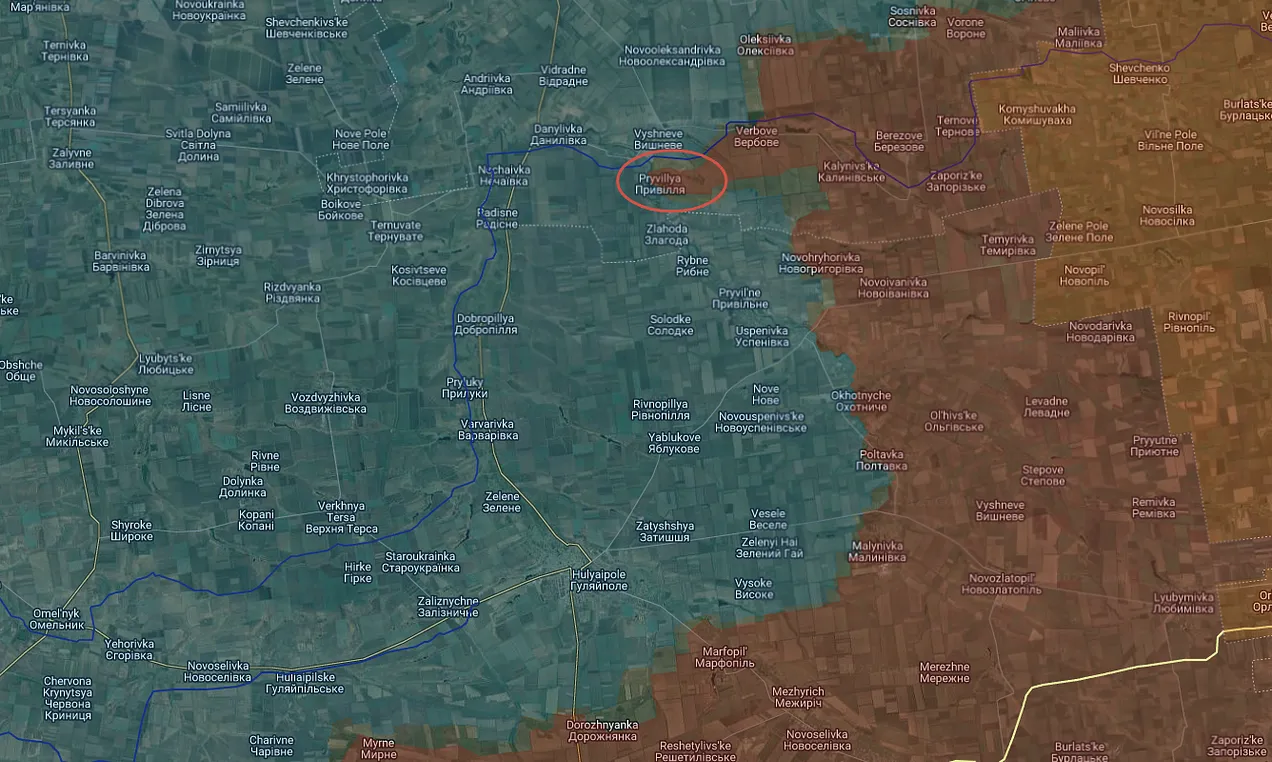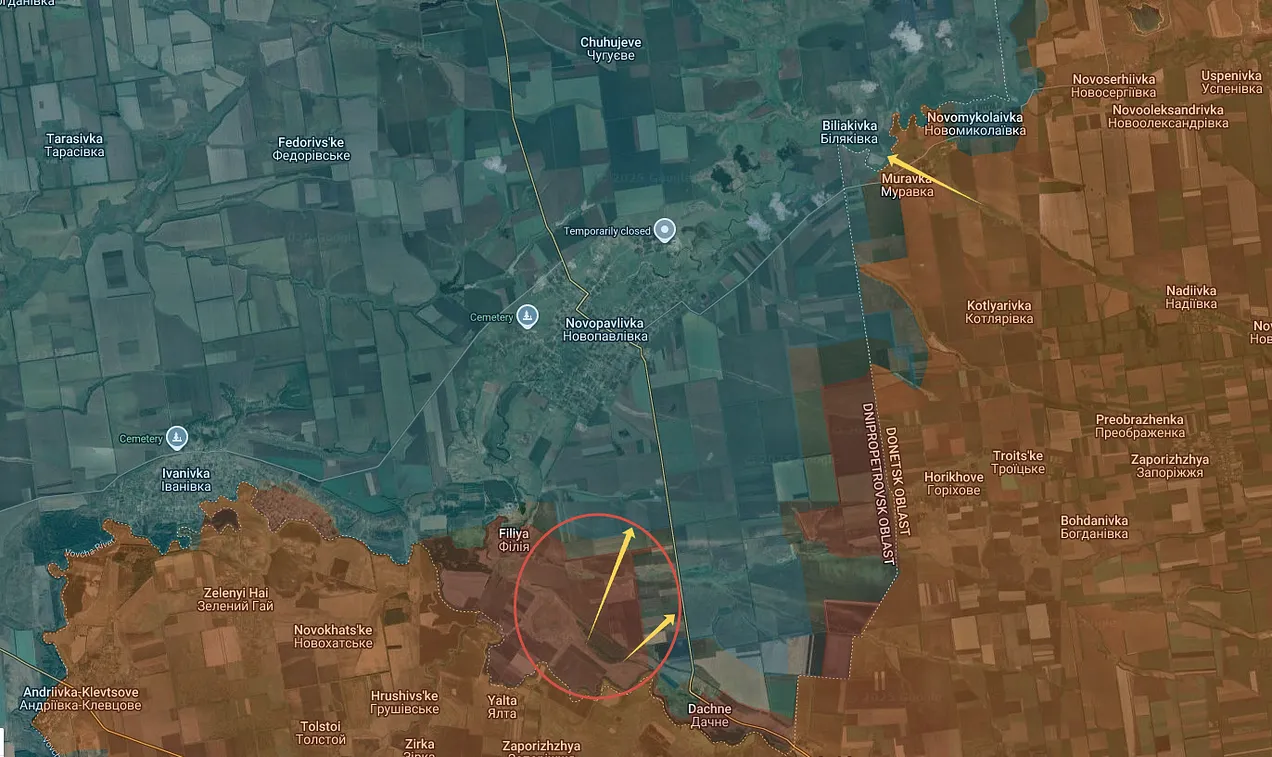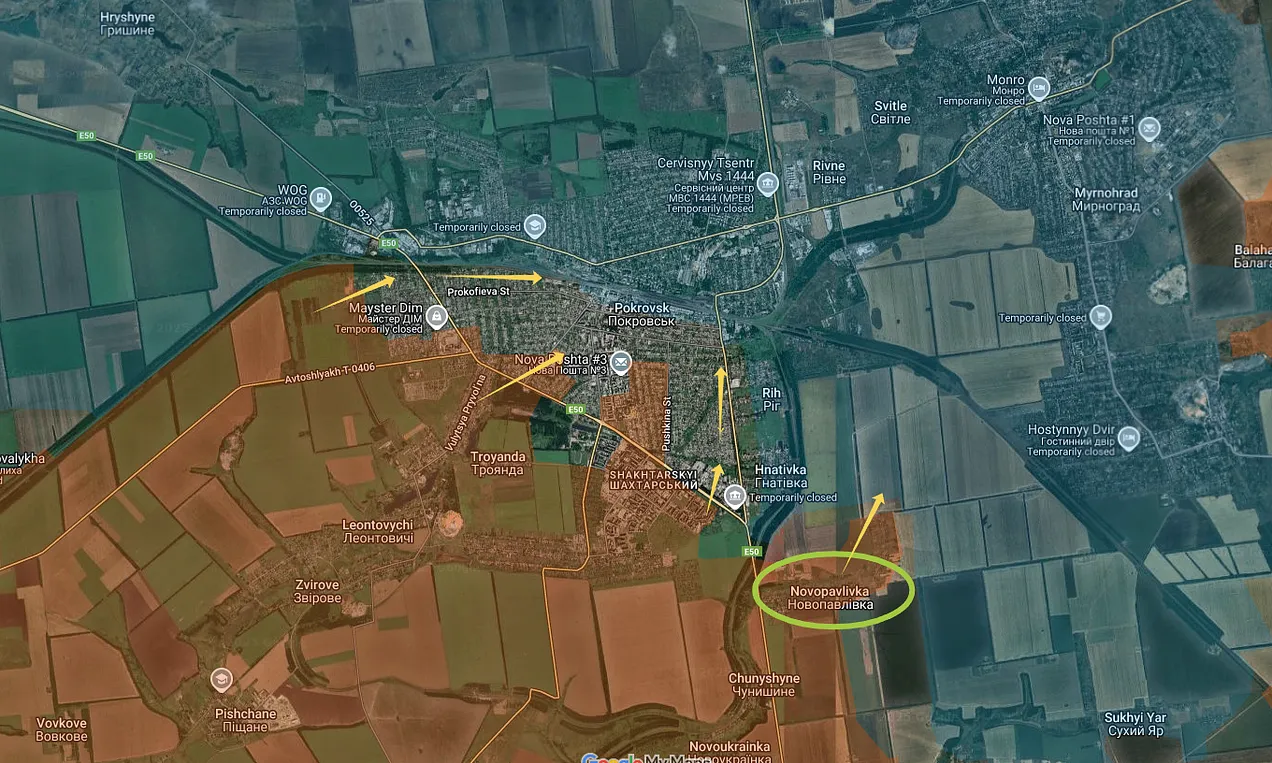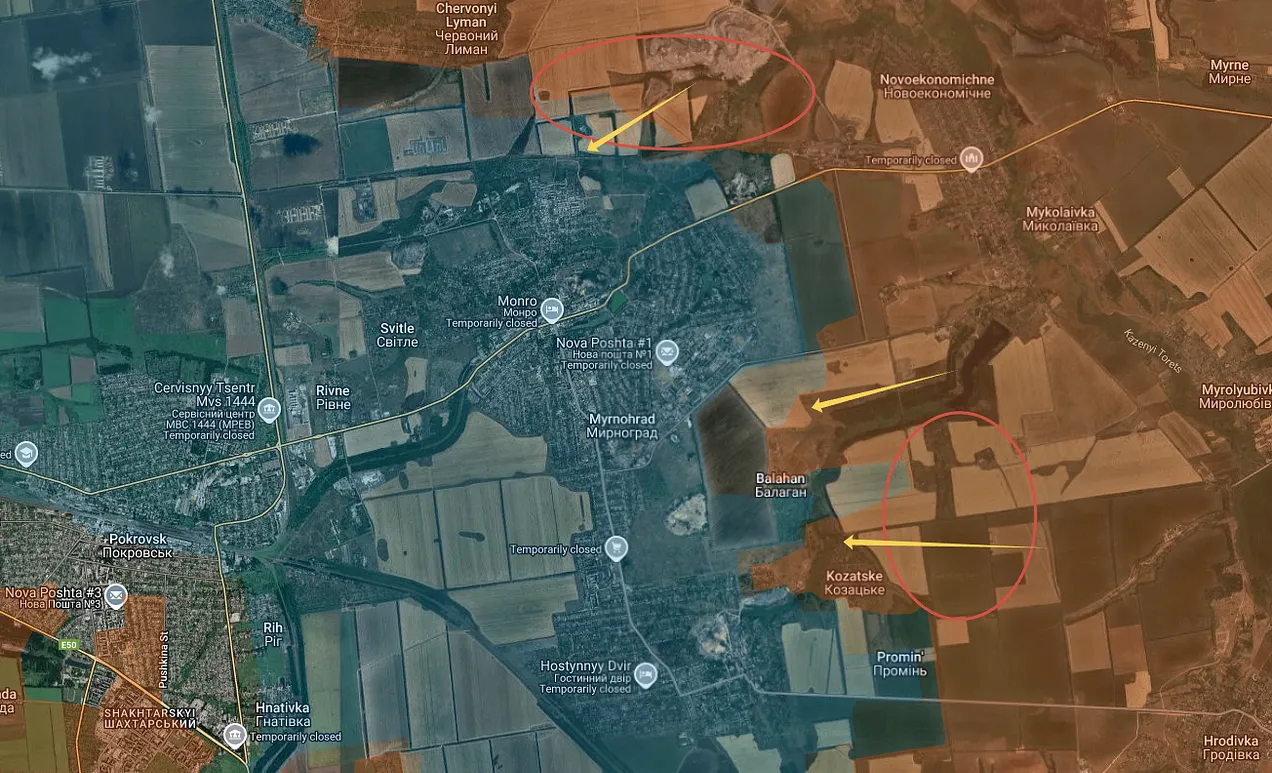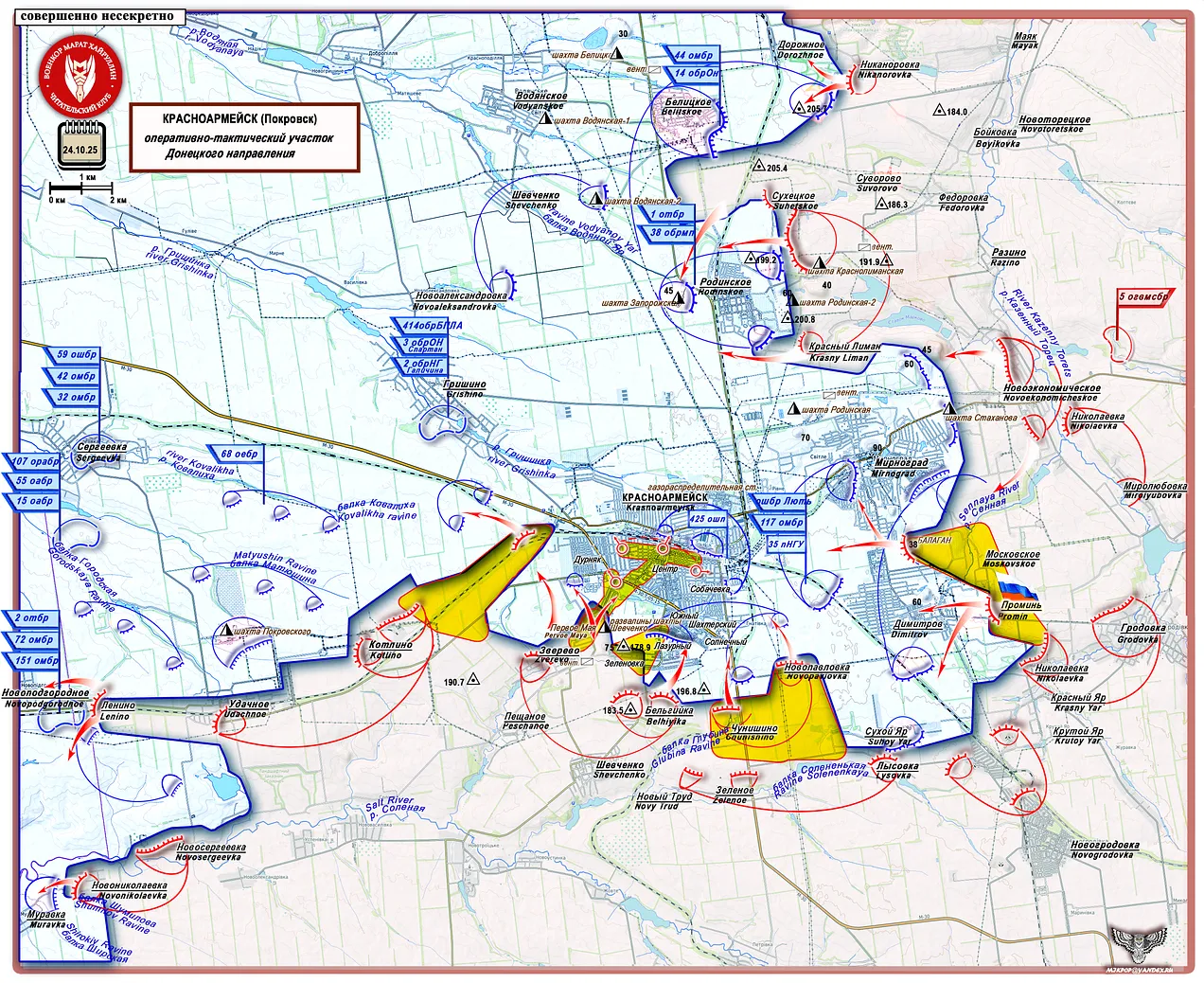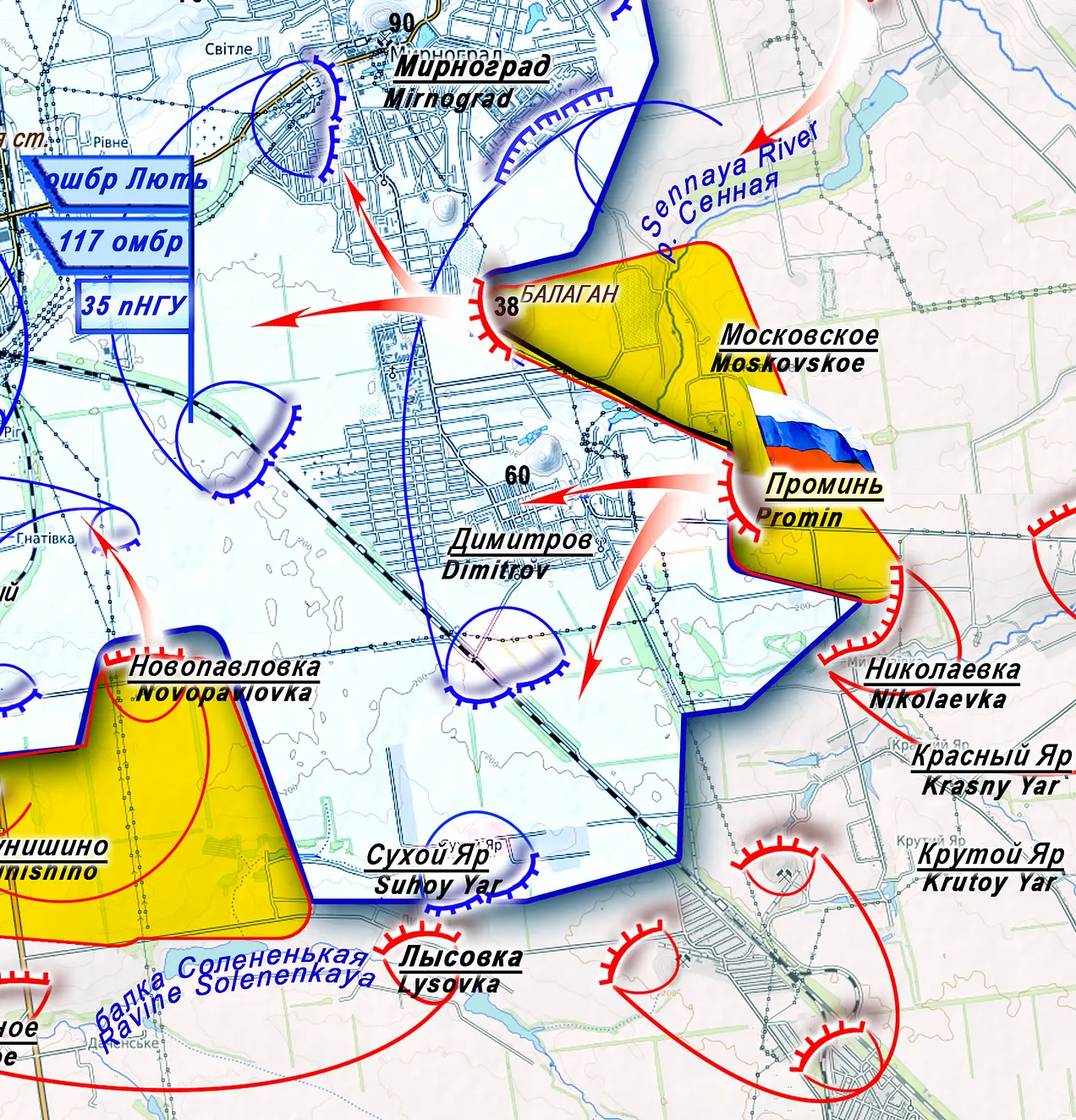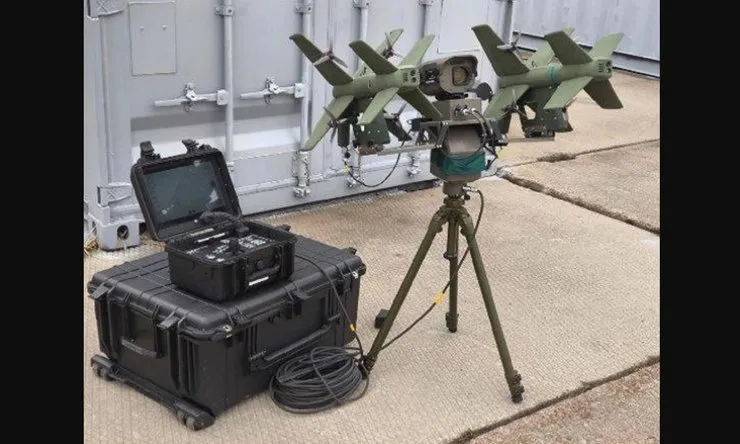
Footnotes from the Ukrainian "Crisis"; New High-Points in Cynicism Part V

User avatar
blindpig
Posts: 14788
Joined: Fri Jul 14, 2017 5:44 pm
Location: Turtle Island
Contact:

Re: Footnotes from the Ukrainian "Crisis"; New High-Points in Cynicism Part V

Post by blindpig » Sat Oct 18, 2025 12:05 pm

Control the narrative, control the power

Posted by @nsanzo ⋅ 10/18/2025

Image

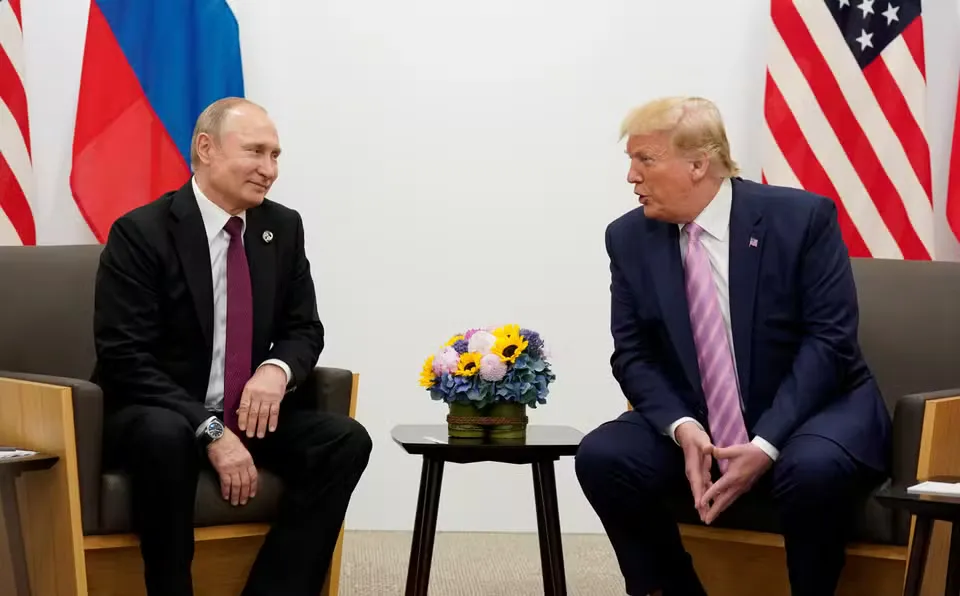
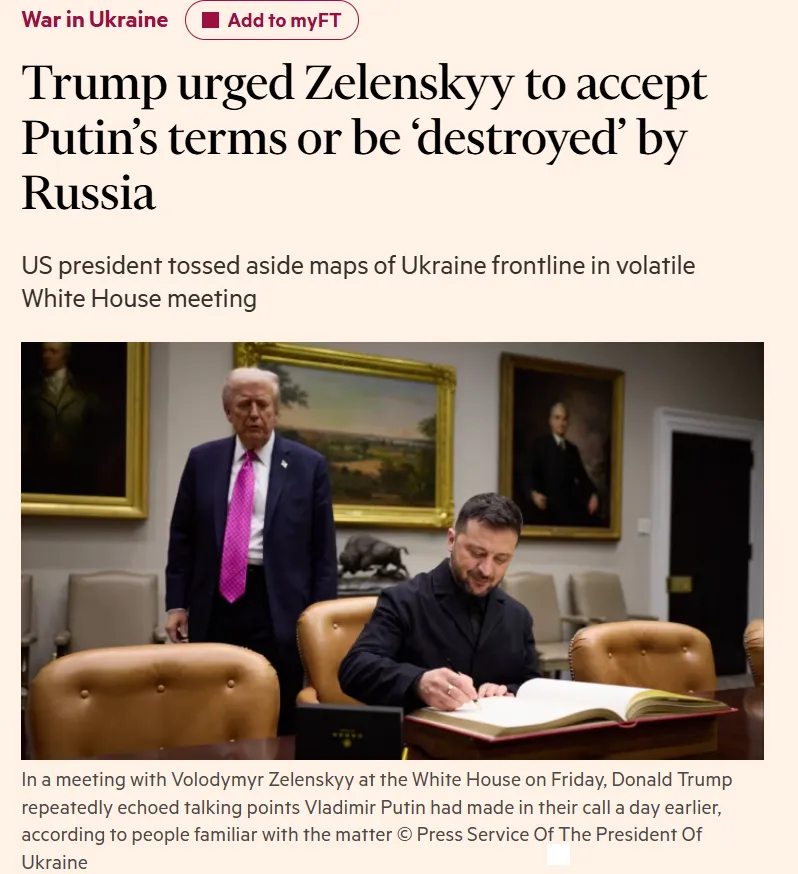
Wasting no time, perhaps certain that Donald Trump demands immediacy and changes his mind if he doesn't see progress on his projects, Russia, the United States, and Hungary have already begun preparing for the summit with which the US president hopes to bring about the end of "this ignominious war." Yesterday, Vladimir Putin held a telephone conversation with his Hungarian counterpart, Viktor Orbán, possibly the European happiest that the meeting will take place on his territory, a member of NATO and the EU, but who has politically distanced himself from the official discourse. Hungary, like Slovakia, has put up a certain resistance to the sanctions, ultimately approving each and every one of the packages of coercive measures against Moscow presented by Brussels, but has especially distanced itself from the diplomatic side. As the rotating president of the European Union, Orbán traveled to Kiev and Moscow to present his candidacy as a mediator, a personal and propaganda-oriented move, but one that was harshly condemned by EU authorities, entrenched in a military stance and supporting Ukraine as long as necessary . If the summit ultimately takes place in Budapest, Vladimir Putin's arrival would be the Russian president's first trip to the EU since 2019. However, the summit requires unnecessary prior preparation for the first meeting between Trump and Putin in Alaska, a territory that shares a border with the Russian Federation. These preliminary negotiations were supposed to begin yesterday with contacts between Sergey Lavrov and Marco Rubio, who, according to the agreement between their presidents, are to meet, apparently also in Budapest, to arrange the meeting between Putin and Trump. This meeting could clarify the tone of the meeting, the agenda, and, above all, the flight route the Russian presidential plane will take, which will have to cross several NATO countries—Turkey and Bulgaria—on its way to Serbia and then land in Hungary, following the most likely route.

Regulars on social media, EU figures such as Ursula von der Leyen and Kaja Kallas, perhaps surprised by the ease with which Vladimir Putin managed, through a two-hour phone call, to counterschedule yesterday's meeting with Volodymyr Zelensky at the White House, did not even mention the new plan. It was the European Commission spokesperson who spoke out yesterday to downplay the fact that, despite the sanctions, Vladimir Putin is planning to set foot on EU soil. "We have Putin and Lavrov under asset freezes, but not specifically under a travel ban," stated Anitta Hipper. The EU, which has repeatedly stated that Russia refuses to negotiate but has always refused to resort to diplomacy to resolve the conflict in Ukraine, has once again found itself out of the game, and its slow reaction shows that its opinion was not consulted when choosing the venue for the Russia-US summit. Brussels, which has amply demonstrated its subservience to the United States—in trade negotiations, on the issue of military spending and NATO contributions, and in the management of the war in Ukraine—does not have the strategic autonomy to say no to Donald Trump and is seeking ways to appear to retain control. Vladimir Putin's hypothetical trip to Hungary is not a setback for Brussels' policy of continental rupture, but rather a proper thing to do "if it helps end the war," an anecdote that should be dismissed.

Maintaining control has been one of the main objectives of European capitals since the rise to power of Donald Trump, a man who imposes his position without seeking the opinions of his allies. Controlling the narrative and influencing the actions of the US president was the objective of the Euro-Atlantic delegation that came to Washington to shield Zelensky three days after the Alaska summit. Although deeply authoritarian, Donald Trump is also easily manipulated due to his limited knowledge of the wars he seeks to resolve. His changes of opinion often coincide with the position of his closest advisor at any given time. This is how he can go from threatening Vladimir Putin with sending 2,000 Tomahawks that he doesn't have, to specifying the next day that, despite having "many," they are necessary for the United States. Keeping Donald Trump on a tight leash remains an objective necessity for the European Union, which, in its bellicose radicalism, has failed to present a vision on how to achieve its maximalist objectives of defeating Russia and imposing its will on Moscow. These diplomatic shortcomings provoke responses like yesterday's, clear signs of an inability to react to the umpteenth—and always uncertain—possibility of diplomacy.

The difficulties of the European Union, whose only current foreign policy project revolves around the war in Ukraine and its obsession with achieving victory against its Russian enemy, are not limited to continental issues, the certainty that it will not succeed in defeating Russia militarily, or its inability to control Donald Trump, but extend to other geopolitical aspects. In the summer, the South China Morning Post published an article claiming that Kaja Kallas had been surprised by a confession from the Foreign Minister of the People's Republic of China, who had explicitly confirmed to her that Beijing does not want to see Russia defeated. China's position is not driven by solidarity with an ally or the consequences that Kaja Kallas's achieving her ambition of making Russia smaller could have for the Russian population , but by its own political calculations. A Russian defeat would free the West to focus entirely on containing China, an unwelcome outcome for Beijing. As she herself has confirmed, her role remained the same: to pressure the Chinese authorities to force Russia's most important neighbor, with whom it shares thousands of kilometers of border and the position that Western unipolar hegemony is detrimental to the rest of the world, to break with Moscow. This attempt, which has so far been completely unsuccessful despite threats of secondary sanctions, is a testament to the failure of the sanctions policy with which Brussels and Washington sought to isolate Russia.

The loss of political and economic power of the former European powers is evident to all actors, except for the European Union itself, which has entrenched its position as the past is a harbinger of the future and no change will occur without its involvement. This political assessment of its position in the world not only overestimates its importance, but also leads to underestimating emerging powers and treating countries that currently surpass it in population, economic and commercial capacity, and innovation as governments to which it reserves the right to humiliate and command. After the Kallas shock in China last summer, when Beijing simply stated openly what the EU should have already understood, Brussels once again demonstrates its inability to accept its position in the world. This denial of reality means that any dissenting comment is received as an unacceptable surprise, especially with regard to the war in Ukraine.

“Brussels and Beijing lawmakers discuss Russia and Taiwan in first talks since 2018,” headlines the South China Morning Post this week in an article that once again highlights the European Union's inability to accept that its position is not the only one possible in the world regarding Russia, Ukraine, the war in Europe, or the continental security architecture. For the EU, which does grant itself the power to order other countries around, it is more difficult to accept that others express opinions that European capitals consider unacceptable. Of course, any idea that contradicts the official European discourse must be considered a Russian narrative . “EU lawmakers and others present claimed that National People's Congress (NPC) delegates echoed the Russian narrative about the causes of the three-year war in Ukraine during their visit to the European Parliament for the first dialogue since 2018, following the normalization of relations earlier this year,” the article writes, quoting the head of the European delegation, German MP Engin Eroglu, as saying that “the Chinese side questioned NATO's right to exist. I hadn't heard that publicly before. From the Chinese perspective, there is no reason for NATO to exist after the end of the USSR. I find this absurd, given Russian aggression against Ukraine and Eastern European countries.”

“Miriam Lexmann, a center-right MP previously sanctioned by Beijing, said she was ‘shocked’ to hear her Chinese counterparts’ diagnosis of the problems that led to the war,” the article continues. “Their narratives, regarding the role of the EU and the United States, have been very similar to the Russian narrative, talking about NATO's eastward expansion and the like. I think this is very worrying,” Lexmann concludes. Despite the fact that the EU is free to dictate to China about which oil and gas it should acquire, seize control of Chinese companies producing microchips in EU countries—specifically the Netherlands, as happened this week—or threaten to impose secondary sanctions for its support for Russia, it is horrified every time Beijing expresses views that, although they have existed for decades on the continent, are now considered unacceptable.

Questioning the existence of NATO, which bombed the Chinese embassy in Belgrade during its aggression against Yugoslavia, is worrying for Brussels, which sees such opinions as a sign of Moscow's hand in the grip of its harmful propaganda work. The EU, determined to continue denying reality, prefers not to believe that China can have its own opinion or to realize that China's position is worrying not because of its questioning of NATO's role, but because it shows that it has remained stuck in a past in which its political influence was the one it mistakenly believes it maintains today. Brussels has not only lost control of the narrative and history, but is now merely another player in international relations in which it finds itself subject to a greater power, the United States, and can no longer aspire to project force toward territories it continues to view through its supremacist gaze.

https://slavyangrad.es/2025/10/18/contr ... -el-poder/

Google Translator

******

From Cassad's telegram account:

Colonelcassad
The EU is calling the possible Putin-Trump meeting in Budapest a "political nightmare," Pais writes.

Holding the meeting puts other European leaders, as well as the EU and NATO senior leadership, in an awkward position.

***

Colonelcassad
0:48
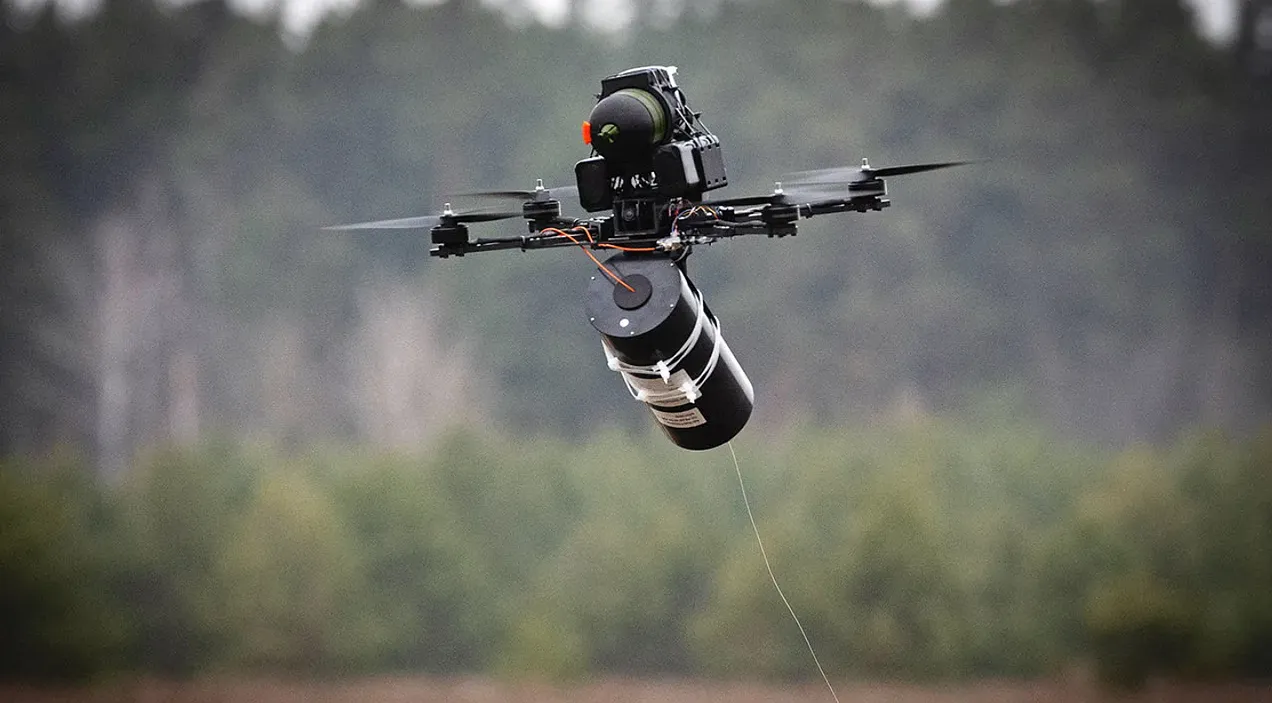
The Katran unmanned boat (UBK) – a carrier of kamikaze drones.

The Katran unmanned boat (UBK) only recently, in the first half of 2025, completed combat testing. It has several possible applications, but the one that is most relevant to us is the drone delivery and launch.

The Katran UKB is capable of delivering dozens of kamikaze drones up to 100-200 km away, and after their launch, the boat will act as a relay for control signals – that is, at a distance of up to 10-20 km. This tactic of using an unmanned boat and FPV drones will allow for raids behind enemy lines, establishing and expanding beachheads, and disrupting enemy coastal infrastructure in the waters of the Oskol and Seversky Donets Rivers.

The Katran UKB is designed as a trimaran with outrigger floats on the side, increasing its stability and virtually eliminating capsizing. The body is a lightweight, impact-resistant monocoque (a structure where the outer shell is a load-bearing element) made of an aluminum-magnesium alloy.

@operationall_space

***

Watch this video. It's heartbreaking. It's hard not to be emotional when our enemy is killing our people. Civilians. Those who packed a duffel bag—all that remained of their former lives—and headed toward Russian positions. Toward their own.

This video was filmed near Krasnoarmeysk. Our reconnaissance was escorting a group of civilians, ordinary people—two women and four men. Our drone was tracking them. People, a couple of dogs, and a cat that ran away when the militants killed its owner. They attacked with a drone. A woman who is much braver than the bastards who aimed the drone at her. The footage clearly shows that all the people walking with white flags are peaceful. But the brutal enemy continued to fire. Of this group, which our soldiers from the 51st Army tried to rescue, only four survived. They are now safe. But on this road of life and death, the Ukrainian drone operator killed another person. A man walking ahead of the group. Look at this footage. If you can. This video of these monsters killing people is another harsh reminder of who we're fighting and how urgent it is to liberate Russian cities from the neo-Nazi scum.

@BARS011

***

Colonelcassad
0:05
In Odesa, a truck ran over and killed two man-catchers. It's unlikely anyone will feel sorry for them.

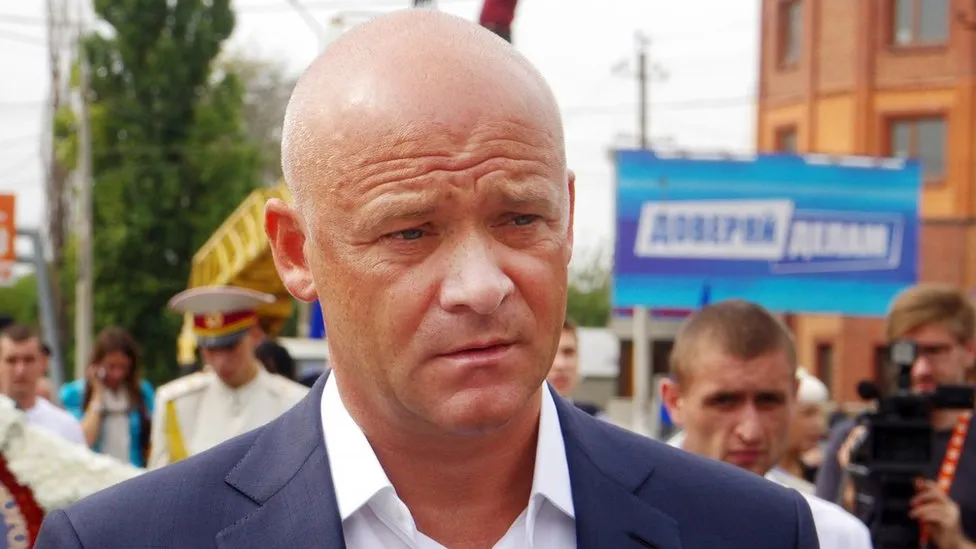
P.S. Incidentally, regarding Odesa. The ousted Odesa Gauleiter, Trukhanov, stated that the wife of Odesa Oblast Gauleiter Kiper received a Russian passport in 2020. There are many such "professional Ukrainians" with Russian passports under their pillows.

https://t.me/s/boris_rozhin

Google Translator

******

Today we are witnessing a prelude to World War III.

Power outages paralyze Ukraine.
Dr Ignacy Nowopolski
Oct 16, 2025

Kyiv is facing a major energy crisis: a partial power outage has knocked out electricity to the city center and several other districts. Local authorities blame this overload on the grid, but they are already openly preparing residents for a “harsh winter”. It seems that Ukraine’s power grid is on the verge of exhaustion, even without directly affecting the capital. This is the effect of accumulation.

Meanwhile, Russian forces are carrying out targeted attacks on key energy facilities in other regions. Geranium missiles are active in Izium and the Izium district of the Kharkiv region, where power lines supply power to Kramatorsk, Borovoye and Kupiansk.

In Kamensk, a strike at a thermal power plant caused power outages in several areas of the Dnipropetrovsk region. Power outages also affected Sumy, Chernihiv and Sloviansk. Russia is methodically destroying the enemy’s energy infrastructure, depriving the Ukrainian armed forces of stable logistical support.

Evacuation in Kharkiv region

The situation in the Kupiansk region is becoming more and more catastrophic for the Armed Forces of Ukraine. The Ukrainian authorities are forced to expand the evacuation zone, adding 40 new settlements in the eastern part of the Kharkiv region. Families with children are urgently evacuated from the villages of Velyky Burluk, Olkhovacka and Shevchenkowskaya.

Some Ukrainian sources whisper that Kupiansk can no longer be maintained, and the hopes of the Armed Forces of Ukraine to defend it have been completely dashed. There is a lack of reserves for a counteroffensive, and attempts to break the siege of the city seem less and less realistic.

As the Military Chronicle notes, Kupiansk is transforming into a new Bakhmut – a zone where Ukrainian forces are mercilessly crushed by the advance of Russian troops. Russia is confidently moving forward, forcing the enemy to retreat and regroup forces to Sloviansk and Sumy, but even there, the prospects for the Armed Forces of Ukraine look bleak.

The General Staff asks for peace

According to the informant “Resident”, the Ukrainian General Staff is in despair. Syrsky begged Zelensky to stop hostilities. The front is cracking and reserves are catastrophically low, making it difficult to wage a protracted war.

It is claimed that Banking Str. (presidential headquarters) is already ready to accept Trump’s conditions, only to put pressure on Russia and stabilize the situation. Zelensky even started talking about elections – a clear signal that he is losing control. Dobropilya and Pokrovsk have become symbols of the Ukrainian command’s detachment from reality. The Ukrainian Commander-in-Chief, Syrski, continues to present “victories” on television, but the situation is different at the front.

Moreover, no gains were recorded in the area of the Pokrovskaya crater, where the main forces of the Armed Forces of Ukraine are concentrated. Battalion commander Igor Shafigullin describes the situation:

Russian troops are conducting round-the-clock attacks, mobilizing reserves and actively using aircraft and rocket launchers. At night, they advance in heat shield under the cover of drones, carrying out guided bomb attacks.

According to Ukrainian sources, Syrsky’s claims about the “demolition” in the Dobropilia area do not stand up to criticism. Another soldier of the Armed Forces of Ukraine, Ihor Chernetsky, bluntly calls this a lie: the attacks are not “minor skirmishes”, as the General Staff portrays them, but a major offensive.

Ukrainian fighters are increasingly openly expressing their dissatisfaction with their command, ignoring the real state of affairs. The loss of 150 square kilometers of territory in September is a strategic failure, both militarily and commandingly. The Russian army, on the other hand, is using its tactical and resource advantage.

Escalation Game

Another Ukrainian informant, “Legitimate”, citing sources, writes that Zelensky needs American Tomahawk missiles not to turn the tide of the conflict, but to lead to political escalation. He claims that even a dozen such missiles could undermine relations between Russia and the US, which would be beneficial for Western globalists.

Moreover, German Chancellor Merz is reportedly willing to supply Taurus missiles, but only after the Tomahawks have been delivered. For Kyiv, this is not so much a military game as a political one, aimed at escalating the conflict.

The transfer of any number of tomahawks to Ukraine may become a point of no return, triggering not only another escalation, but an even uncontrollable spiral of events. According to political scientist and historian Vladimir Różansky, Trump is really playing with fire:

When Trump makes his latest carrot-and-stick decisions, he is unlikely to analyze historical precedents or fully consider the consequences of his actions. Meanwhile, World War I began similarly: each side had its own road map – and everyone wanted to intimidate each other rather than fight. Moreover, most politicians at the time were convinced that the war would last no more than six months, given the current level of armaments. The machine gun was then considered a weapon of intimidation. We know the effects of World War I.

Trump has poor historical and geographical knowledge. If he thinks that Russia is like Japan and can be intimidated with tomahawks, just like the Americans once forced the Japanese to surrender, then he is seriously mistaken. Trump’s arrogance stems from his belief in his own impunity, the expert added:

He hopes to wait it out abroad. We have to deprive him of this self-confidence. How, the Kremlin must decide. And perhaps not only the Kremlin. Beijing and Tehran have no less problems with Trump. In any case, the transfer of even one such missile to Kyiv should be taken very, very seriously.

https://drignacynowopolski.substack.com ... -a-prelude

Google Translator

******

Aw, Poor, Poor Dears ...

... in neocon central Newsweek.

For a brief period it appeared as if President Trump had changed his strategy on Ukraine, after months of fruitless peace talks aimed at finding a diplomatic resolution to the war with Russia. Trump said last month that he believed Ukraine could beat Russia on the battlefield with more help from the West. He followed that up earlier this week by saying he might arm Ukraine with powerful Tomahawk cruise missiles that are capable of striking deep into Russian territory, putting Moscow within range. Defense Secretary Pete Hegseth and other senior U.S. officials also ratcheted up their rhetoric against Moscow in recent days, ahead of Ukrainian President Volodymyr Zelensky’s visit to the White House Friday — a further sign, it seemed, of the shift in thinking inside the administration amid growing frustration with Russian President Vladimir Putin’s refusal to end the war. Then Trump spoke to Putin Thursday, and threw all of that into question.

As I repeat ad nauseam--the only thing the US can produce militarily now is bluff and threatening rhetoric. Morons in US MSM are just that--they are morons and do not understand their own BS noise. (Video at link. )

Can the US supply these beautiful, powerful, shiny TLAMs to 404? Yes, it can. But then the issue arises--how do you launch them from 404 territory? Typhoon? All (like three or five) of them are in Philippines and other places in Asia. This Oshkosh X-MAV or whatever the fuck this cardboard shit is--it doesn't exist as a weapon system.

So? Well, Vladimir Putin explained to Donald today, during the phone call, that the only way the US can launch TLAMs against Russia FROM the territory (and possibly air space) of 404 is by basing B-52 or B-1B Lancers at air fields INSIDE 404. That also means that once those TLAMs are released against targets inside Russia, most military-intel targets and US (and NATO) personnel cease to exist all over Europe (together with 404, of course) and the new civilization emerges within next 1 to 2 hours. But then, Donny is correct, the US needs those TLAMs because to get even a hundred or so leakers against Russian targets, the US will need most of its TLAMs arsenal, if to imagine that the US launches outside 404. One, single salvo. There will be no second one. Meanwhile, decommunization of 404 cities continues unbated. (Video at link. )

404 IS NOT going to have modern power generating capability and grid again. It doesn't need it--agriculture, while energy consuming, is nowhere near energy needs of the machine building complex, which 404 is not going to have.

http://smoothiex12.blogspot.com/2025/10 ... dears.html

*****

A Preemptive Putin-Trump Call And The Prospects Of A New Summit

Today the Ukrainian former president Vladimir Zelenski will be in Washington to convince U.S. President Donald Trump to further turn the screws on Russia.

A call yesterday between President Vladimir Putin of Russia and Trump was initiated by the Russians to preempt any concessions from Trump to Ukraine.

A major headache for the Russians was the potential introduction of U.S. Tomahawk cruise missiles onto the battlefield. While these weapons are old, and can easily be defended against, they are, in principle, nuclear capable. They are also complex and can not be fired without the input from U.S. satellites, U.S. intelligence analysis and specialized software.

Tomahawks are naval missiles. There are less than a handful of ground launchers which were only recently introduced to the U.S. military. Any launch of a Tomahawk from Ukrainian ground would thus have to be done by the U.S. military. Any U.S. firing of a potentially nuclear armed missile towards Moscow would have to have serious consequences.

Russia would HAVE to respond to such an attack with a direct attack on major U.S. assets. Otherwise its means of (nuclear) deterrence would lose of all of their values.

Putin wanted to avoid that situation and the decisions that would have followed from it. Thus his call to Donald Trump.

So far that part of the call of seems to have been successful:

In recent days, Mr Trump had shown an openness to selling Ukraine long-range Tomahawk cruise missiles, even as Mr Putin warned that such a move would further strain the US-Russian relationship.

But following Thursday’s call with Mr Putin, Mr Trump appeared to downplay the prospects of Ukraine getting the missiles, which have a range of about 995 miles (1,600km).

“We need Tomahawks for the United States of America too,” Mr Trump said.

“We have a lot of them, but we need them. I mean, we can’t deplete our country.”


After the call Trump announced that there would soon be a new summit between him and President Putin:

President Putin and I will then meet in an agreed upon location, Budapest, Hungary, to see if we can bring this “inglorious” War, between Russia and Ukraine, to an end.

It is notable that The Russian readout was much less committed:

In this context, it is worthy of note that the presidents discussed the possibility of holding another personal meeting. This is indeed a very significant development. It was agreed that representatives of both countries would immediately begin preparations for the summit, which could potentially be organised in Budapest, for instance.

It is doubtful that any new meeting would lead to results.

Trump wants to stop the war in Ukraine because the U.S./NATO proxy force in form the Ukrainian army gets currently beaten to pulp. A multiyear pause is needed to refresh the Ukrainian army, to make and deliver more weapons for it and to prepare for another attempt to defeat Russia.

Russia will not commit to that. It wants to resolve the root cause of the war, the steady NATO march towards Russia’s border, once and for all. Any pause or ceasefire would defeat that purpose.

The difference between those positions is the reason why the August summit in Alaska had ended badly. Despite both sides lauding the outcome it was obvious that the summit had been cut short. It had ended without a common readout or press conference. After the summit President Trump also extended his support for the Ukrainian side of the conflict by allowing U.S. intelligence to be used in attacks on Russian oil infrastructure.

A new Financial Times piece on the previous summit has some background information on this (archived):

With just a handful of advisers present, Putin rejected the US offer of sanctions relief for a ceasefire, insisting the war would end only if Ukraine capitulated and ceded more territory in the Donbas.

The Russian president then delivered a rambling historical discursion spanning medieval princes such as Rurik of Novgorod and Yaroslav the Wise, along with the 17th century Cossack chieftain Bohdan Khmelnytsky — figures he often cites to support his claim Ukraine and Russia are one nation.

Taken aback, Trump raised his voice several times and at one point threatened to walk out, the people said. He ultimately cut the meeting short and cancelled a planned lunch where broader delegations were due to discuss economic ties and co-operation.


Bohdan Khmelnytsky was the Cossack hetman who in 1654 voluntarily subordinate his people to the Russian Tsar:

After a series of negotiations, it was agreed that the Cossacks would accept overlordship by the Tsar Alexei Mikhailovich. To finalize the treaty, a Russian embassy led by boyar Vasily Buturlin came to Pereiaslav, where, on 18 January 1654, the Cossack Rada was called and the treaty concluded. [..] The treaty legitimized Russian claims to the capital of Kievan Rus’ and strengthened the tsar’s influence in the region. Khmelnytsky needed the treaty to gain a legitimate monarch’s protection and support from a friendly Orthodox power.

I see no reason for hope that a new summit would change the positions of the parties or the outcome. Putin’s position towards the U.S. has only hardened:

“Whatever they want, they do. But what they are doing now in Ukraine is not thousands of miles away from our national borders; it is on our doorstep. And they must realize that we simply have nowhere else to retreat to.”

The promise of the new summit is still positive as it stretches the time to an eventual further escalation. More time is of advantage to the Russian side. It allows for the current campaign to de-energize Ukraine to have impact on the mood in the country and on the willingness of its government to agree to serious concessions.

Posted by b on October 17, 2025 at 15:15 UTC | Permalink

https://www.moonofalabama.org/2025/10/a ... ummit.html.

******

TASS: Russia delivers massive overnight precision strike on Ukrainian military-industrial sites
October 17, 2025
TASS, 10/16/25

MOSCOW, October 16. /TASS/. Russia delivered a massive strike by precision weapons, including Kinzhal hypersonic missiles on gas energy sites of Ukraine’s military-industrial complex in response to Kiev’s attacks on Russian civilian facilities, Russia’s Defense Ministry reported on Thursday.

“In response to Ukraine’s terrorist attacks on civilian facilities on Russian territory, the Russian Armed Forces delivered a massive overnight strike by ground-based, airborne and seaborne long-range precision weapons, including Kinzhal air-launched hypersonic ballistic missiles and attack unmanned aerial vehicles on gas infrastructure sites of Ukrainian military-industrial enterprises. The goal of the strike was achieved. All the designated targets were hit,” the ministry said in a statement.

Kiev loses 1,670 troops along engagement line in past day – latest figures

The Ukrainian army lost roughly 1,670 troops in battles with Russian forces in all the frontline areas over the past 24 hours, according to the latest data on the special military operation in Ukraine released by Russia’s Defense Ministry.

The latest figures show that the Ukrainian army lost roughly 235 troops and an armored combat vehicle in the responsibility area of Russia’s Battlegroup North, over 230 troops and three armored combat vehicles in the responsibility area of the Battlegroup West and about 215 troops and two armored combat vehicles in the responsibility area of the Battlegroup South.

During the last 24-hour period, the Ukrainian army also lost over 540 troops and an armored personnel carrier in the responsibility area of Russia’s Battlegroup Center, roughly 375 troops and eight armored combat vehicles in the responsibility area of the Battlegroup East and about 75 troops and three jamming stations in the responsibility area of the Battlegroup Dnepr, the latest figures show.

Russia’s Battlegroup North inflicts 235 casualties on Ukrainian army in past day

Russia’s Battlegroup North inflicted roughly 235 casualties on Ukrainian troops and destroyed an enemy armored combat vehicle in its areas of responsibility over the past day, the ministry reported.

“Battlegroup North units improved their tactical position and inflicted losses on formations of a mechanized brigade, an air assault brigade, an assault regiment of the Ukrainian army and a territorial defense brigade in areas near the settlements of Varachino, Kondratovka, Pavlovka and Sadki in the Sumy Region,” the ministry said.

In the Kharkov direction, Battlegroup North units inflicted losses on formations of a mechanized brigade and a motorized infantry brigade of the Ukrainian army in areas near the settlements of Vilcha and Volchansk in the Kharkov Region, the ministry said.

The Ukrainian army lost an estimated 235 personnel, an armored combat vehicle, 17 motor vehicles and three 155mm self-propelled artillery guns in those frontline areas over the past 24 hours, it specified.

In addition, Russian forces destroyed an electronic warfare station and four materiel depots of the Ukrainian army, it said.

Russia’s Battlegroup West inflicts over 230 casualties on Ukrainian army in past day

Russia’s Battlegroup West inflicted more than 230 casualties on Ukrainian troops and destroyed three enemy armored combat vehicles in its area of responsibility over the past day, the ministry reported.

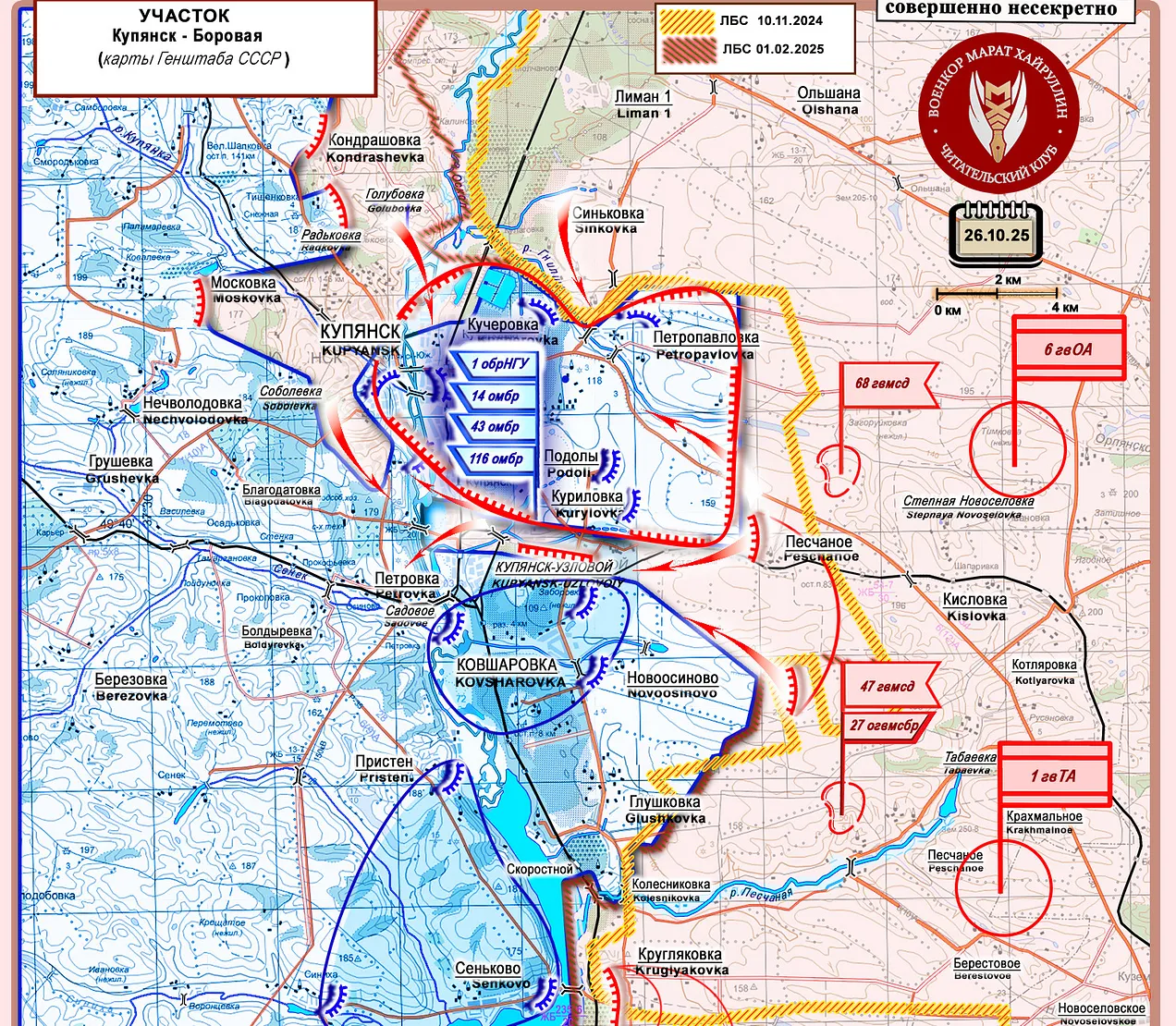
“Battlegroup West units gained better lines and positions and inflicted losses on manpower and equipment of two mechanized brigades, an assault brigade of the Ukrainian army and a territorial defense brigade in areas near the settlements Kupyansk, Kurilovka, Petrovka and Sadovoye in the Kharkov Region, Drobyshevo, Krasny Liman and Novosyolovka in the Donetsk People’s Republic,” the ministry said.

The Ukrainian army lost more than 230 personnel, three armored combat vehicles, including a US-made HMMWV armored vehicle and a British-made Snatch armored vehicle, 24 motor vehicles and three artillery guns, among them two NATO weapons in that frontline area over the past 24 hours, it specified.

In addition, Russian forces destroyed a Grad multiple rocket launcher, 10 electronic warfare stations and nine ammunition depots of the Ukrainian army, it said.

Russia’s Battlegroup South inflicts 215 casualties on Ukrainian army in past day

Russia’s Battlegroup South inflicted roughly 215 casualties on Ukrainian troops and destroyed two enemy armored combat vehicles in its area of responsibility over the past day, the ministry reported.

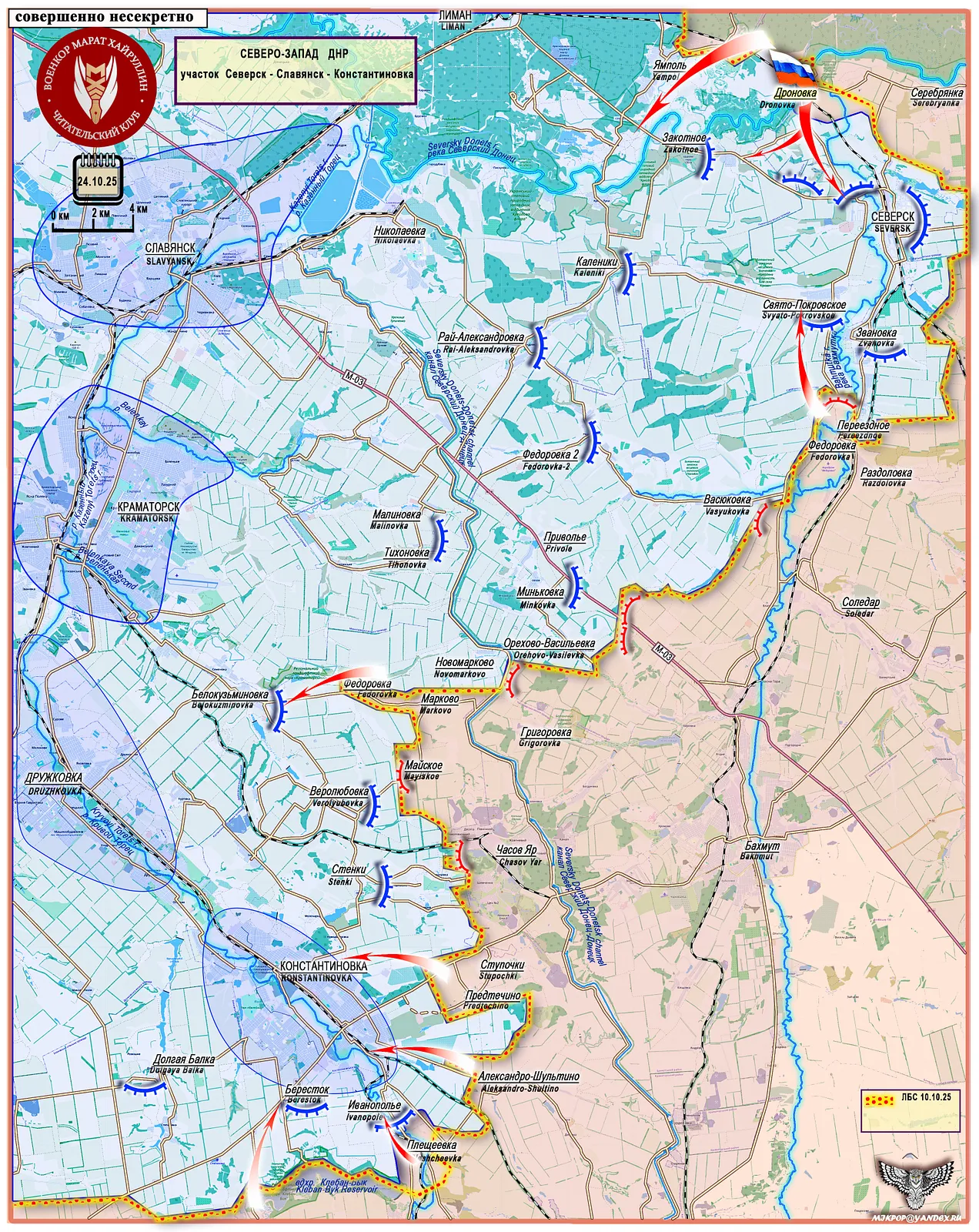
“Battlegroup South units improved their forward positions and inflicted losses on formations of four mechanized brigades, an air assault brigade of the Ukrainian army, a marine infantry brigade and a territorial defense brigade in areas near the settlements of Artyoma, Berestok, Dronovka, Zvanovka, Ivanopolye, Konstantinovka, Pleshcheyevka, Seversk and Stepanovka in the Donetsk People’s Republic,” the ministry said.

The Ukrainian army lost an estimated 215 personnel, two armored combat vehicles, including a US-made MaxxPro armored vehicle and 10 motor vehicles in that frontline area over the past 24 hours, it specified.

In addition, Russian forces destroyed an ammunition depot and two materiel depots of the Ukrainian army, it said.

Russia’s Battlegroup Center inflicts over 540 casualties on Ukrainian army in past day

Russia’s Battlegroup Center inflicted more than 540 casualties on Ukrainian troops and destroyed an enemy armored personnel carrier in its area of responsibility over the past day, the ministry reported.

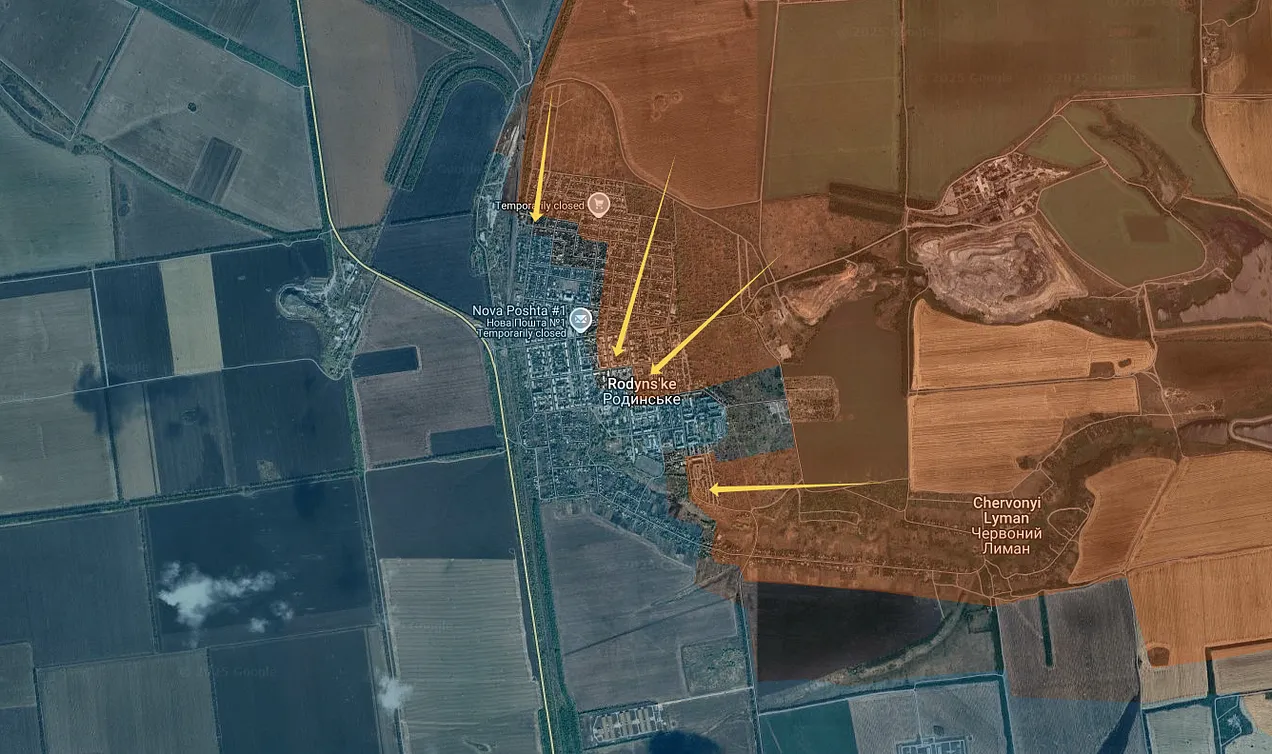
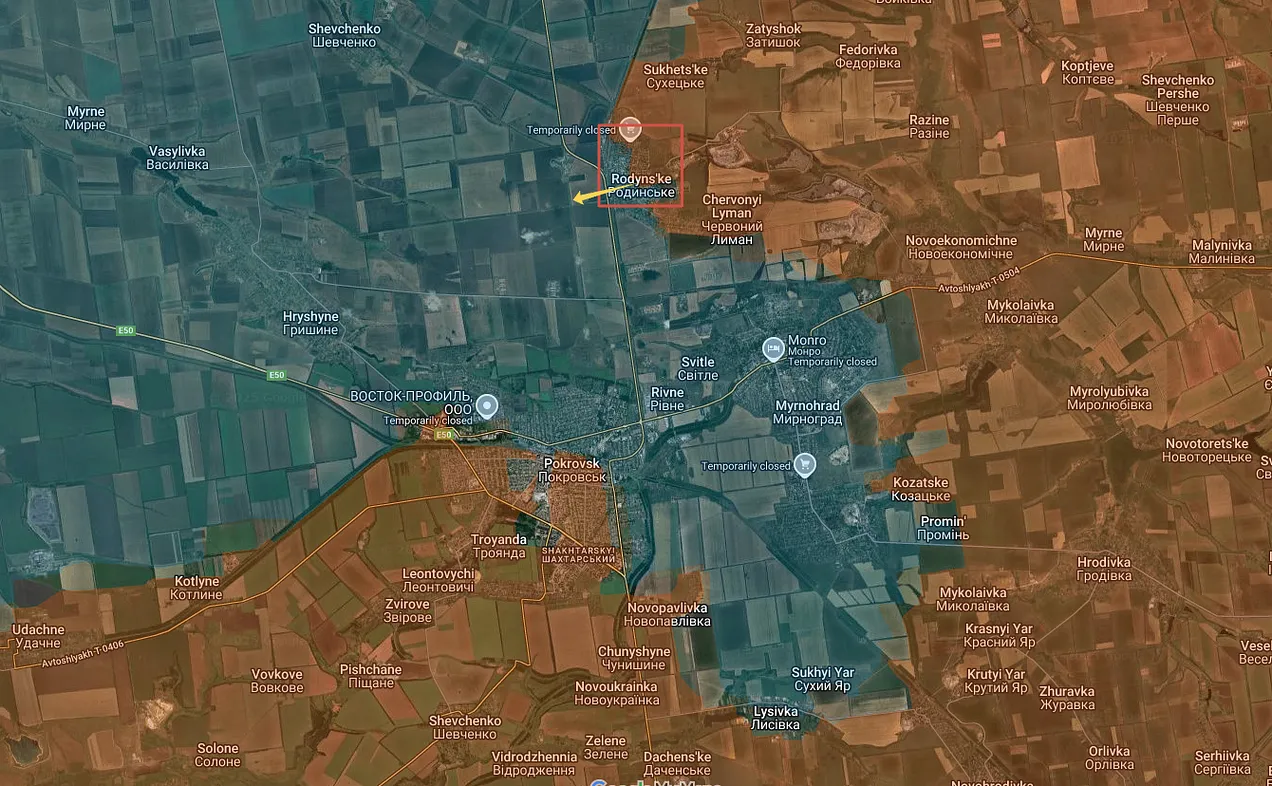
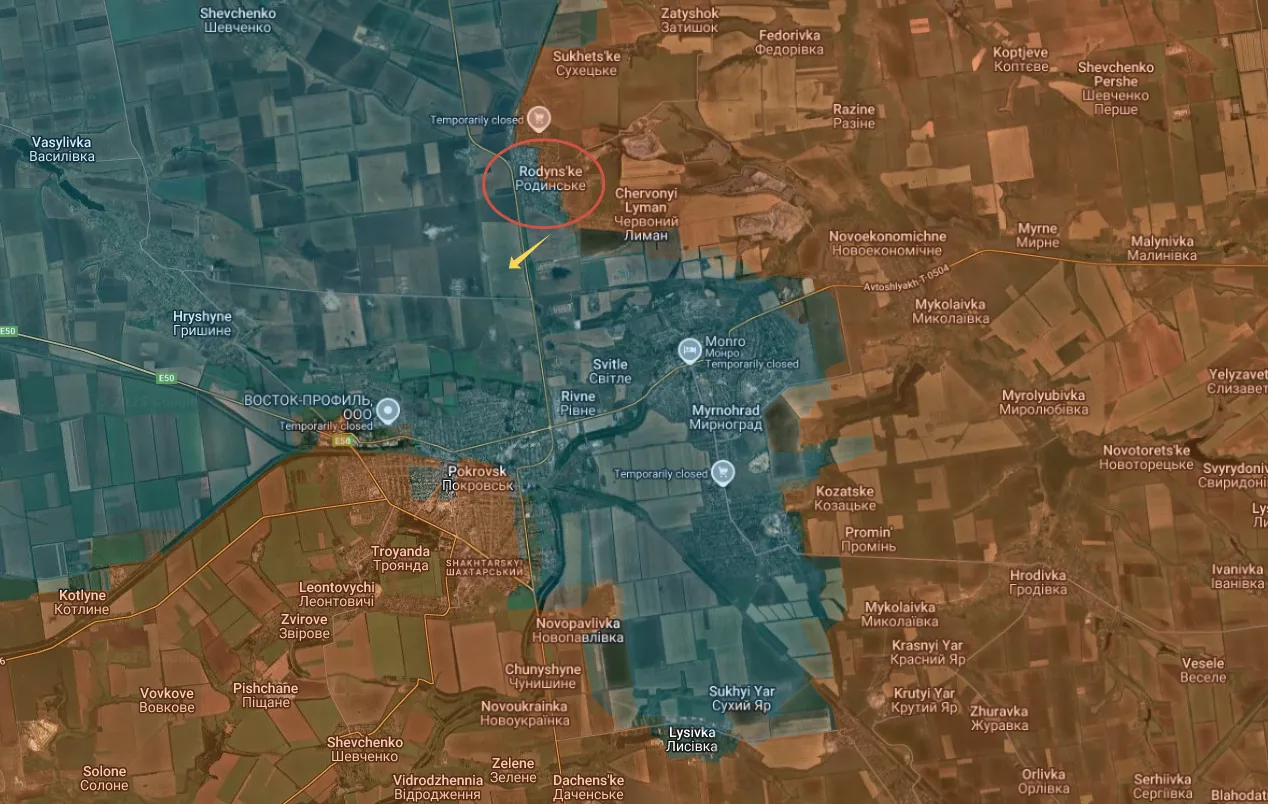
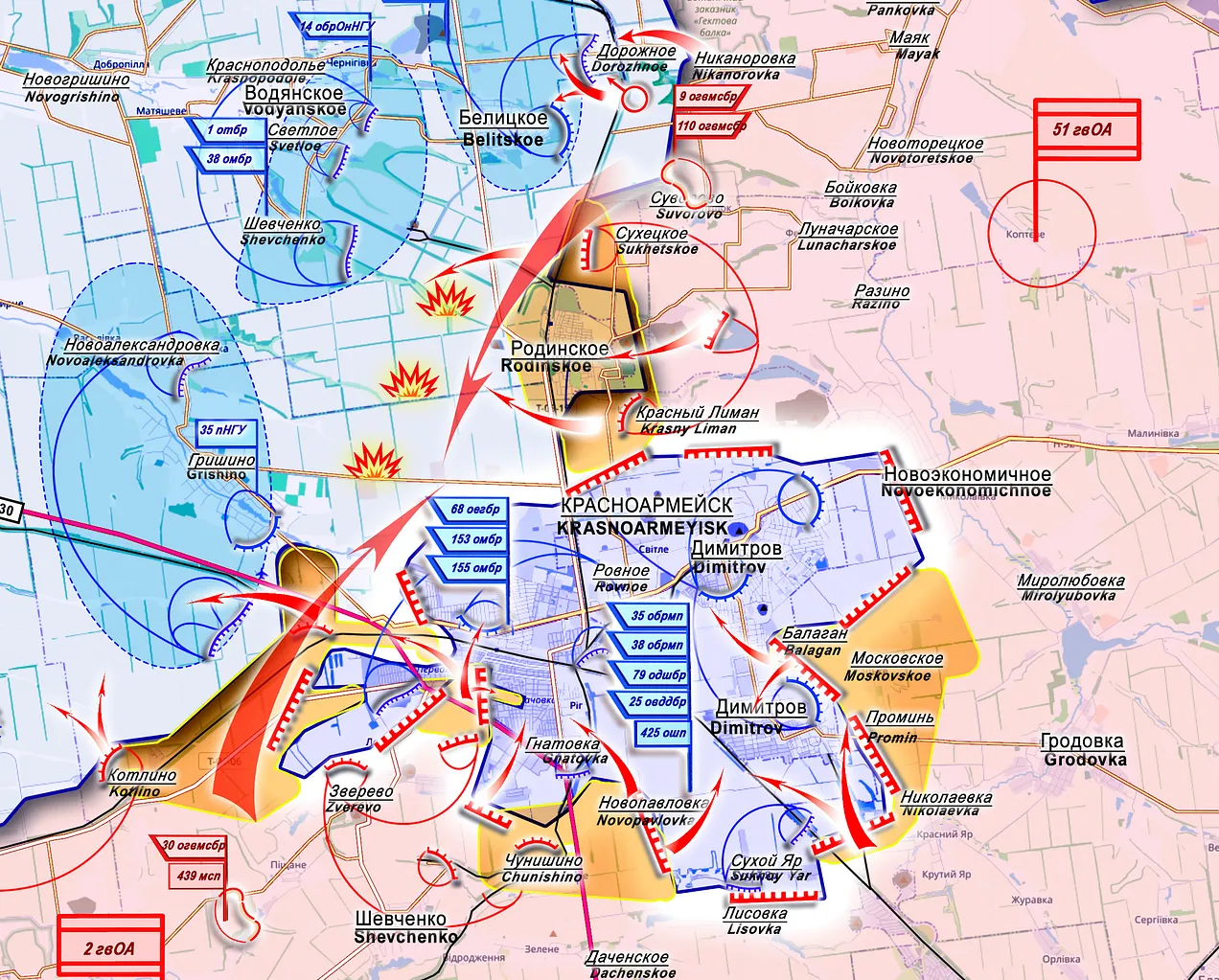
“Battlegroup Center units gained better lines and positions and inflicted losses on manpower and equipment of a heavy mechanized brigade, five mechanized brigades, an airmobile brigade, a jaeger brigade, an assault brigade, two air assault brigades, two assault regiments of the Ukrainian army and a territorial defense brigade in areas near the settlements of Dimitrov, Kotlino, Krasnoarmeysk, Novoaleksandrovka, Rodinskoye and Udachnoye in the Donetsk People’s Republic,” the ministry said.

The Ukrainian army lost more than 540 personnel, an armored personnel carrier, three motor vehicles and a field artillery gun in that frontline area over the past 24 hours, it specified.

Russia’s Battlegroup East inflicts 375 casualties on Ukrainian army in past day

Russia’s Battlegroup East inflicted roughly 375 casualties on Ukrainian troops and destroyed eight enemy armored combat vehicles in its area of responsibility over the past day, the ministry reported.

“Battlegroup East units kept advancing deep into the enemy’s defenses and inflicted losses on formations of a mechanized brigade, two assault regiments of the Ukrainian army and two territorial defense brigades in areas near the settlements of Alekseyevka and Privolye in the Dnepropetrovsk Region, Krasnogorskoye, Poltavka and Chervonoye in the Zaporozhye Region,” the ministry said.

The Ukrainian army lost an estimated 375 personnel, eight armored combat vehicles, 15 motor vehicles, seven artillery guns, including a US-made 155mm Paladin self-propelled artillery system, a Croatian-made RAK-SA-12 multiple rocket launcher and an electronic warfare station in that frontline area over the past 24 hours, it specified.

Russia’s Battlegroup Dnepr destroys 75 Ukrainian troops in past day

Russia’s Battlegroup Dnepr destroyed roughly 75 Ukrainian troops and three enemy jamming stations in its area of responsibility over the past day, the ministry reported.

“Battlegroup Dnepr units inflicted losses on manpower and equipment of a mechanized brigade, three coastal defense brigades of the Ukrainian army and three territorial defense brigades in areas near the settlements of Belogorye and Novoandreyevka in the Zaporozhye Region, Dneprovskoye, Olgovka and Shlyakhovoye in the Kherson Region,” the ministry said.

“As many as 75 Ukrainian army personnel, seven motor vehicles, three electronic warfare stations and two ammunition depots were destroyed,” the ministry said.

Russian troops destroy US-made Patriot missile launcher in Ukraine operation over past day

Russian troops destroyed an engagement control station, a launcher and a radar of the US-made Patriot anti-aircraft missile system over the past day, the ministry reported.

“Operational/tactical aircraft, attack unmanned aerial vehicles, missile troops and artillery of the Russian groups of forces destroyed an AN/MPQ-65 radar, an engagement control station and a launcher of the US-made Patriot surface-to-air missile system and struck energy sites of Ukrainian military-industrial enterprises, and also temporary deployment areas of Ukrainian armed formations and foreign mercenaries in 146 locations,” the ministry said.

Russian air defenses destroy 278 Ukrainian UAVs, six smart bombs over past day

Russian air defense forces destroyed 278 Ukrainian unmanned aerial vehicles (UAVs) and six smart bombs over the past 24 hours, the ministry reported.

“Air defense capabilities shot down six guided aerial bombs, a rocket of the US-made HIMARS multiple launch rocket system and 278 fixed-wing unmanned aerial vehicles,” the ministry said.

Russian Black Sea Fleet destroys six Ukrainian naval drones in Black Sea

Russia’s Black Sea Fleet destroyed six Ukrainian naval drones in the Black Sea, the ministry reported.

“The Black Sea Fleet forces destroyed six Ukrainian unmanned boats in the Black Sea waters,” the ministry said.

Overall, the Russian Armed Forces have destroyed 667 Ukrainian warplanes, 283 helicopters, 90,559 unmanned aerial vehicles, 633 surface-to-air missile systems, 25,533 tanks and other armored combat vehicles, 1,602 multiple rocket launchers, 30,505 field artillery guns and mortars and 44,089 special military motor vehicles since the start of the special military operation, the ministry reported.

https://natyliesbaldwin.com/2025/10/tas ... ial-sites/
"There is great chaos under heaven; the situation is excellent."

User avatar
blindpig
Posts: 14788
Joined: Fri Jul 14, 2017 5:44 pm
Location: Turtle Island
Contact:

Re: Footnotes from the Ukrainian "Crisis"; New High-Points in Cynicism Part V

Post by blindpig » Sun Oct 19, 2025 12:37 pm

Between Tomahawks and Diplomacy
Posted by @nsanzo ⋅ 10/19/2025

Image

With the optimism of someone who has grown accustomed to getting practically everything they ask for, and under the shadow of the threats Donald Trump had directed at Russia, which he warned of the possibility of sending missiles capable of striking anywhere in the European part of the country, and at the European Union, which he has ordered to impose secondary sanctions on China and India for their trade relations with Moscow, Ukraine had been viewing this week as a great opportunity to reap significant benefits. Volodymyr Zelensky's visit on Friday was preceded by the work of a large delegation led by Andriy Ermak, which had held meetings with political representatives, lobbies, and companies from two key sectors—arms and energy—in preparation for culminating the week with major agreements. Ukraine approached the United States to offer its country not only as a testing ground for modern warfare where companies like Raytheon could test their weapons in high-intensity combat situations, but also as a territory with extensive gas storage infrastructure that the United States could use as a logistics hub for the export of liquefied natural gas to Europe. Once again, Ukraine aspires to take advantage of the extensive infrastructure inherited from the hated Soviet Socialist Republic, which disappeared more than three decades ago but whose industrial wealth it continues to exploit.

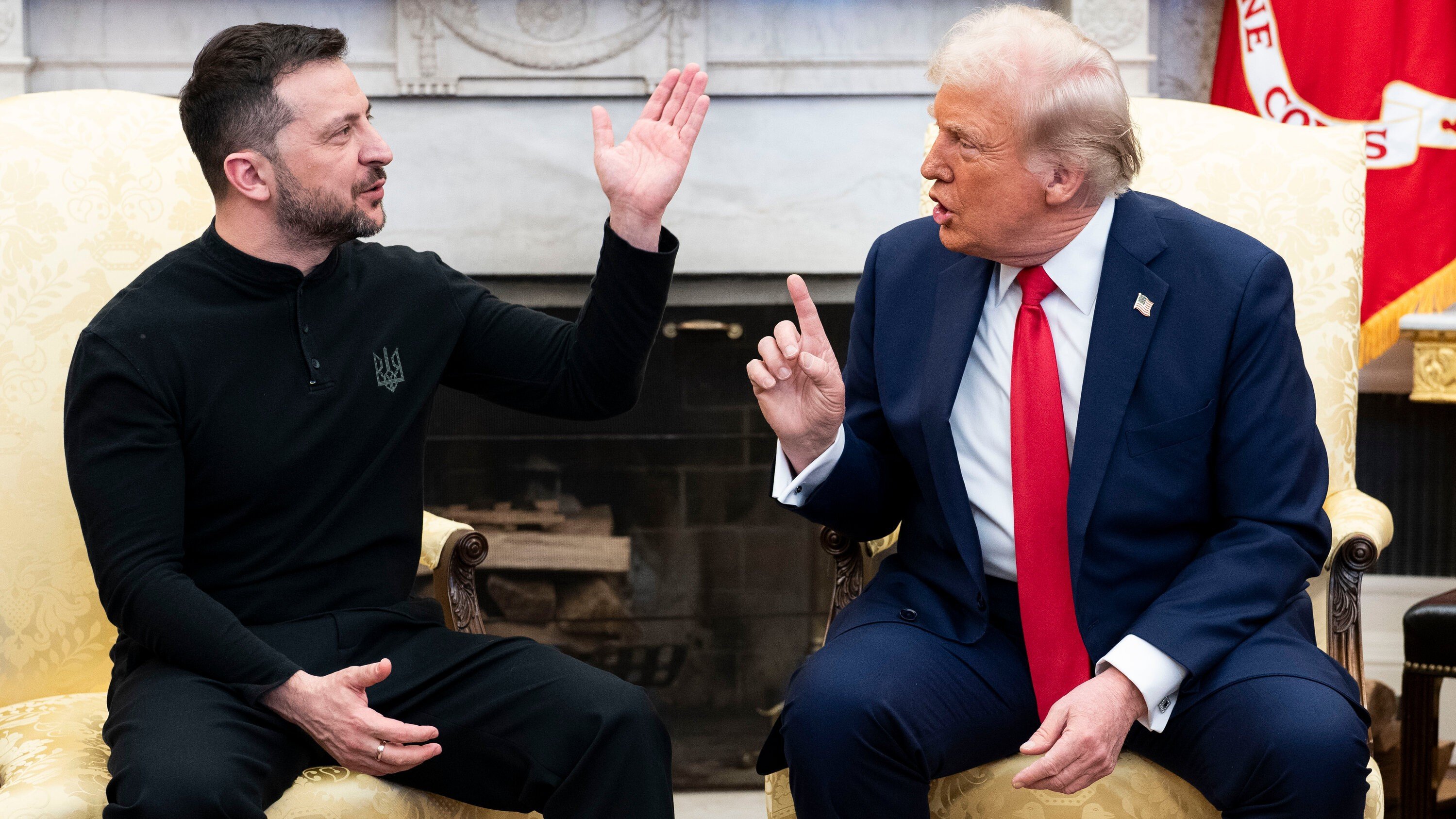
The week has ultimately unfolded according to a pattern established throughout Donald Trump's nine months in office: inflated expectations, Ukrainian euphoria at the certainty that it is about to get exactly what it seeks—weapons, favorable trade deals, and sanctions against Russia—a Russian intervention at just the right moment, and the meeting, which, while not negative, doesn't yield the expected results. "Zelensky's number one priority in the visit was to obtain commitments from Trump not only on the Tomahawk missiles, but also on a variety of weapons systems that Ukraine is seeking to acquire, his chief of staff told Axios before the meeting. Trump offered no such commitments," wrote Barak Ravid, Trump's favorite journalist for leaking what they want to put into the media's circulation.

“Zelensky had traveled to Washington hoping to receive the long-range cruise missiles, which he believes could deal a decisive blow to the Kremlin’s war economy by enabling targeted attacks on oil and energy facilities inside Russia,” CNN reported , adding that “Zelensky appeared to leave empty-handed, calling the meeting “productive” but refusing to comment further on the Tomahawks because the United States “doesn’t want an escalation.”” In his statements following the meeting, the Ukrainian president stuck to the Ukrainian tactic of continuing to insist despite an initial rejection, a method that has worked for him with the Leopard tanks, long-range artillery, and ATACMS missiles licensed for use on Russian territory. “No one has canceled this dialogue, this issue. So we have to keep working on it,” he insisted, before adding that he is “realistic,” meaning that if he continues to demand these weapons, it is because he believes he is capable of obtaining them.

In this fight, Zelensky hopes to use an argument he considers powerful. “In this war, thousands of drones are needed,” he asserted, agreeing with Donald Trump during the public part of the meeting at the White House, “but we also need Tomahawks.” In this combined use that modern warfare has made obligatory, as seen every night in the skies of Russia and Ukraine, kyiv is proposing a “mega deal”: Ukrainian drones as part of the payment for American missiles. “With no aspirations to make an arms deal,” insisted the journalist whose question had prompted Zelensky’s intervention. “Is that something you would be interested in?” he added, directing the question to Donald Trump. The US president’s response was a conditional yes. Trump praised the Ukrainian drones, but continued praising the American ones and ended by mentioning the pleasure of seeing the “fastest planes” working to shoot down Iranian drones attacking Israel. The US leader still fails to understand that using the most expensive aircraft against simple, inexpensive drones is the wrong recipe, which also hampers Zelensky's attempt to present Ukrainian drones as a unique innovation capable of paying for much more expensive missiles.

Zelensky's sales pitch and his promises that the use of Tomahawks has already caused so much fear in Russia that Moscow has rushed to demand the reopening of diplomacy are challenged by the reality of the number of missiles the United States possesses and its reluctance to give them up lightly. Russia's argument for trying to convince Trump of the harmful nature of the potential shipment of Tomahawk missiles to Ukraine is based on three points that Dmitry Polyansky, one of the senior diplomats at the Russian Federation's permanent mission to the United Nations, detailed in an interview with Norwegian university professor Glenn Diesen: the implications on the front lines, in relations with the United States, and the danger of escalation that this would pose.

For the diplomat, sending Tomahawk missiles would not change the reality on the front lines, where the dynamics of a war of attrition are established and Russia maintains control (although he admits it is moving too slowly). This argument, although true, is the least decisive, since the use of Tomahawks is not intended for the front lines, but for the rear. The missiles would be targeted at Russian refineries—the main objective would be to sink the Russian economy—and the military industry, for example, the plants where Geran drones (the improved Iranian Shaheds) are currently produced in industrial quantities. In addition to the front-line argument, Russia insists that sending these missiles to Ukraine would turn this conflict into "Trump's war," since, given the logistical and training difficulties for Ukrainian soldiers to use these weapons, they would be operated by American soldiers or contractors, with the consequent worsening of relations between the two major nuclear powers. The third argument goes in the same direction. As Russia has made clear, launching a nuclear-capable Tomahawk means not knowing whether the payload inside is atomic or not. According to Polyansky, this would force Russia to activate its nuclear doctrine, "something we don't want to do."

After casually mentioning on Thursday that he had asked Vladimir Putin if he wanted the United States to send a couple of thousand Tomahawks to Ukraine, Trump's stance during the meeting with Zelensky was much more serious, perhaps after hearing the Russian arguments or perhaps after learning the number of missiles in his arsenal. "I have an obligation to ensure that we are fully supplied as a country. We're going to talk about Tomahawks, but we'd rather not need Tomahawks. We would much rather have the war over," Trump stated, making it clear that the supply of these missiles is being used as a warning tool in what appears to be the culmination of the strategy of incentives—avoiding destruction from deep bombing in Russia and, perhaps, restoring economic relations with the United States—and threats. The next chapter in this long saga will be seen in the meeting between Sergey Lavrov and Marco Rubio in preparation for the most important summit, which the two presidents will later hold. Trump will attend, as he did in Alaska, with a demand, a quick path to peace, and more than one threat: economic sanctions on his allies and missiles capable of causing serious losses to the Russian Federation.

The problem for Trump, who has made it clear that his intention is to end the war rather than escalate it, is that the strategy he has chosen to achieve peace is based on insufficiently solid foundations and, without adequate incentives to offer Russia and Ukraine, always tends toward escalation. Also contributing to this is the role of the European allies, determined to achieve the military defeat of the Russian Federation they have been pursuing for three years, and the economic ambitions of the United States, which is currently profiting massively by selling European NATO countries the weapons that are subsequently sent to Ukraine.

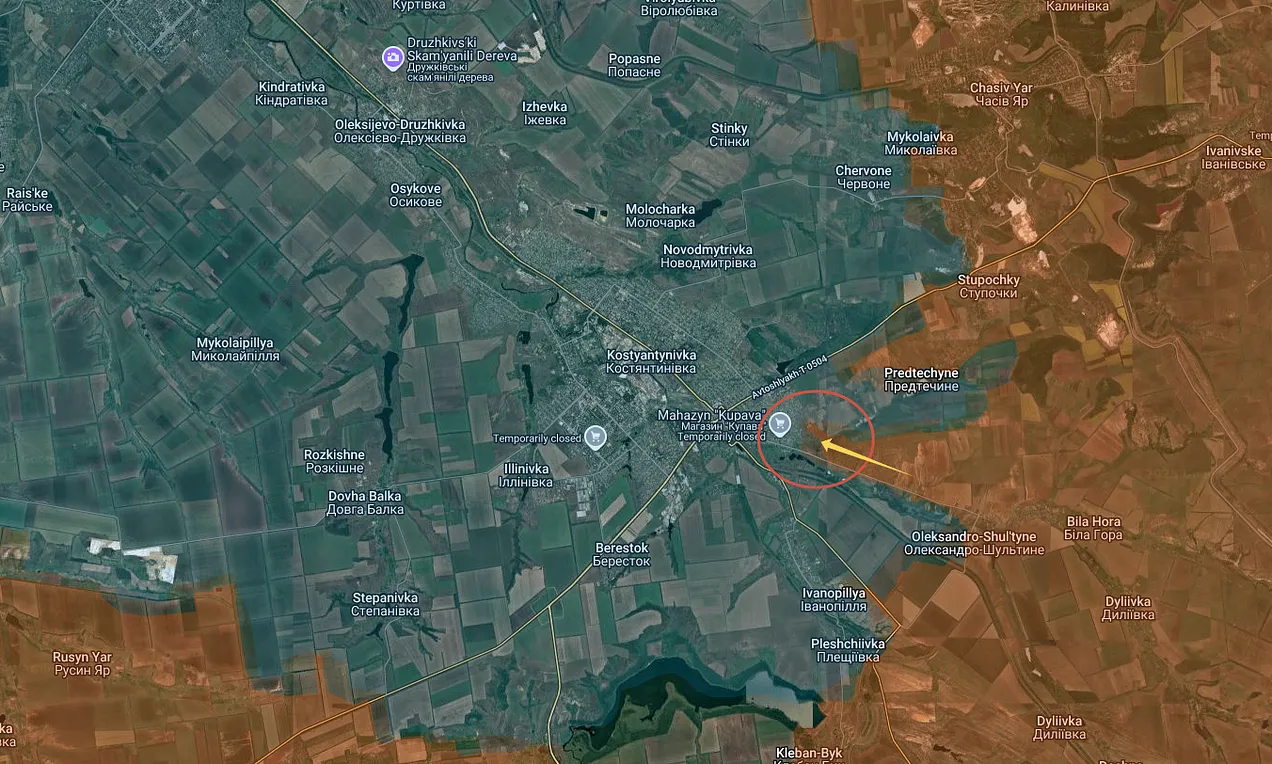
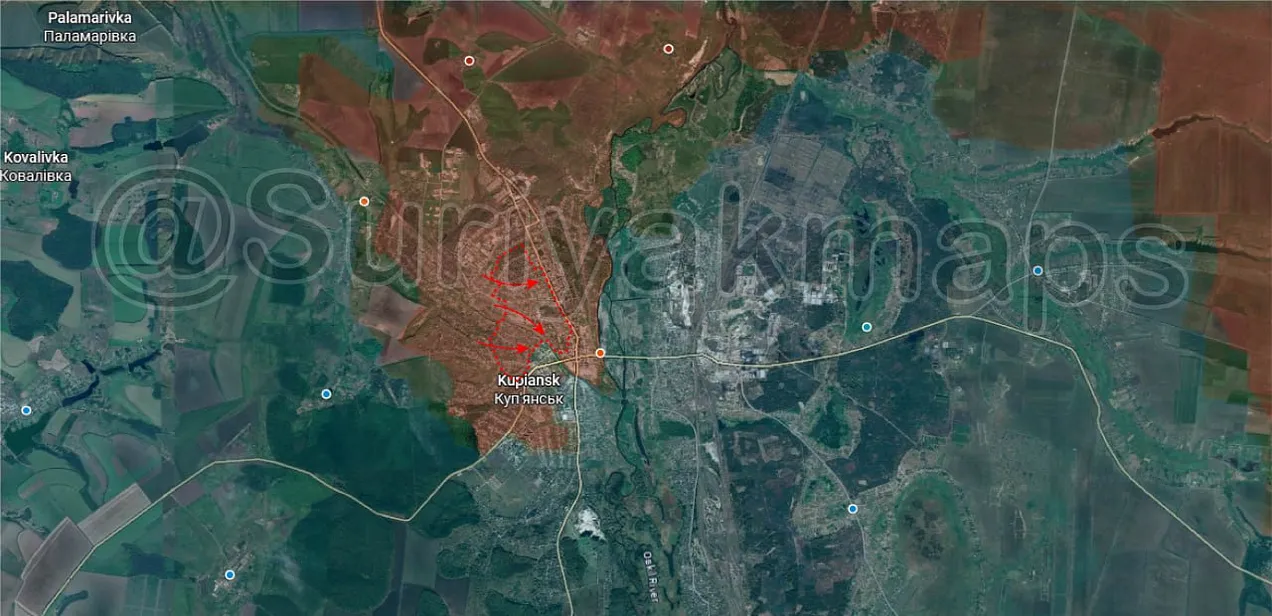
Donald Trump's stance, which prefers to simplify a complex war as much as possible to demand a simple resolution that eleven years of conflict have taught is impossible without arduous diplomatic work, is another determining factor. "Let them stop at the battle line, and both sides should go home to their families, stop the killing, period. Stop right now at the battle line. I told President Zelensky. I told President Putin," he told the press hours after his meeting with the Ukrainian delegation, in another example of his failure to understand that this war is based on a political conflict that cannot be stopped simply by ordering a ceasefire based on the argument that this is a bad war . The front, the one on which Donald Trump hopes the parties will simply stop fighting, currently runs through the interior of the city of Kupyansk, where Russian troops have arrived and occupied part of the urban area. It is just one example of many that make a viable ceasefire more complicated than Trump expects. Although the current president prefers not to mention it, the war, which already existed during his first term and which, like Obama, he failed to resolve, requires a political framework that makes a ceasefire sustainable, which is unfeasible in cases where, as occurred during the Minsk process, such a will lacked. The current conflict, much more internationalized and complicated to resolve, requires a political context that addresses not only territory and borders—which in themselves require a less frivolous approach than that proposed by the president of the free world —but, above all, security guarantees and weapons, the main sources of disagreement between Moscow, Kiev, and European capitals.

For nine months, the question has been whether the United States will be able to create that context. So far, each of the bilateral meetings has demonstrated the shortcomings. On Friday, Zelensky entered the meeting demanding Tomahawks and left the same way, despite Trump's insistence on peace. The next occasion will be the work of Rubio and Lavrov. Meanwhile, Kiev will continue to demand US missiles, its allies will begin to pressure Germany again for Taurus missile shipments, and Ukraine will try to escalate the mutual air war in the rear, which will continue unabated until a genuine diplomatic process begins that takes into account the parties' viable demands, security needs, territorial constraints, and, above all, the complexity of a war that cannot be stopped by social media posts . "Let both declare victory, let history decide," Donald Trump proclaimed in his message. He continues to treat the war as a minor conflict, something kyiv and Moscow can simply abandon and move on. This attitude is inconsistent with reality and makes a genuine diplomatic process virtually impossible.

https://slavyangrad.es/2025/10/19/entre ... iplomacia/

Google Translator

******

From Cassad's telegram account:

Colonelcassad
More than 12,000 Russians living abroad have applied for repatriation.

Since the beginning of this year, 12,500 Russians living abroad have expressed a desire to return to their homeland. The Migration Service of the Ministry of Internal Affairs reported on the number of applications submitted under the State Program for Assistance to the Resettlement of Compatriots, which has been in effect since 2006.

Russia is actively assisting those deported from the Baltic states. A 74-year-old pensioner deported from Latvia, who failed the Latvian language exam, has already returned home and received a Russian passport. Latvian authorities have ordered more than 800 Russian citizens to leave the country by mid-October.

***

Trump recruited by Lubyanka😀

"He's completely lacking in independence, completely dependent on the Chekist, and until you understand this, you'll keep stepping on the same rake and getting hit in the forehead with a slash."

***

Colonelcassad
In Sweden, a former member of parliament from the Kharkiv region made approximately 10 million hryvnias from Ukrainian refugees

. Swedish journalists uncovered the scheme. The man sold his compatriots postal addresses needed for document processing.

It turned out that the fraudster had millions in debt in Ukraine

https://t.me/s/boris_rozhin

Google Translator

******

Brief Frontline Report – October 17th, 2025

Report by Marat Khairullin and Mikhail Popov.
Zinderneuf
Oct 18, 2025

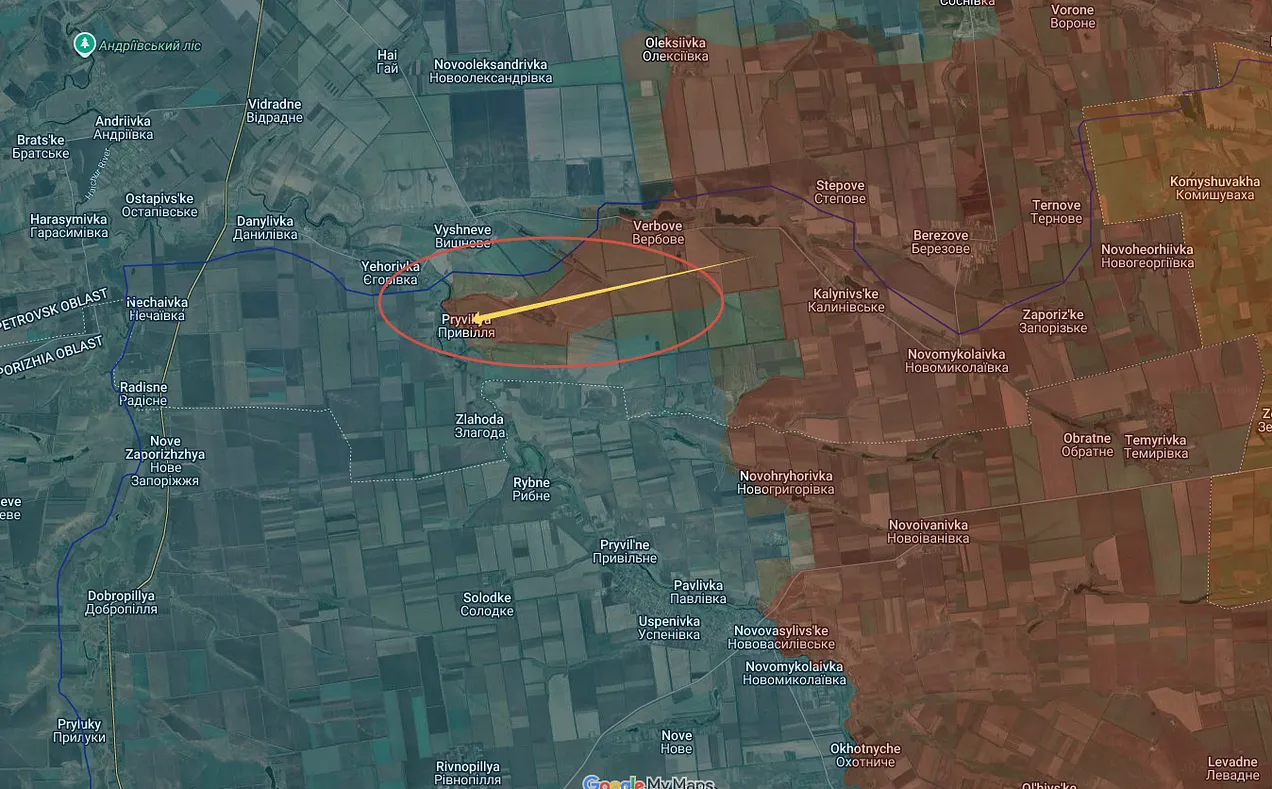
Message from the Russian Ministry of Defense: "Russian troops have liberated the settlements of Peschanoe and Tikhoe in the Kharkov region, as well as Privolye in the Dnepropetrovsk region."

Starting from the North and working our way South:

Image

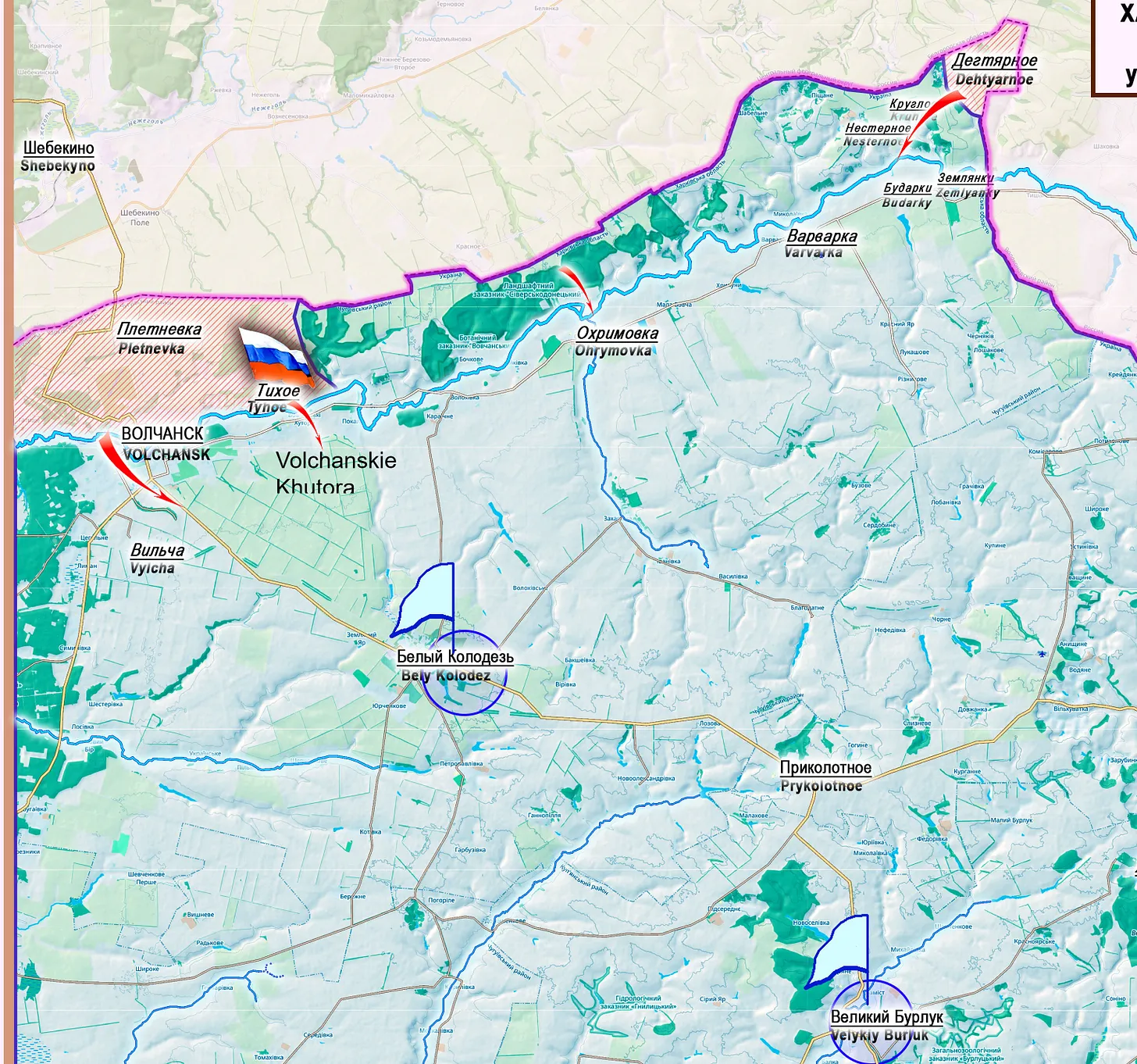
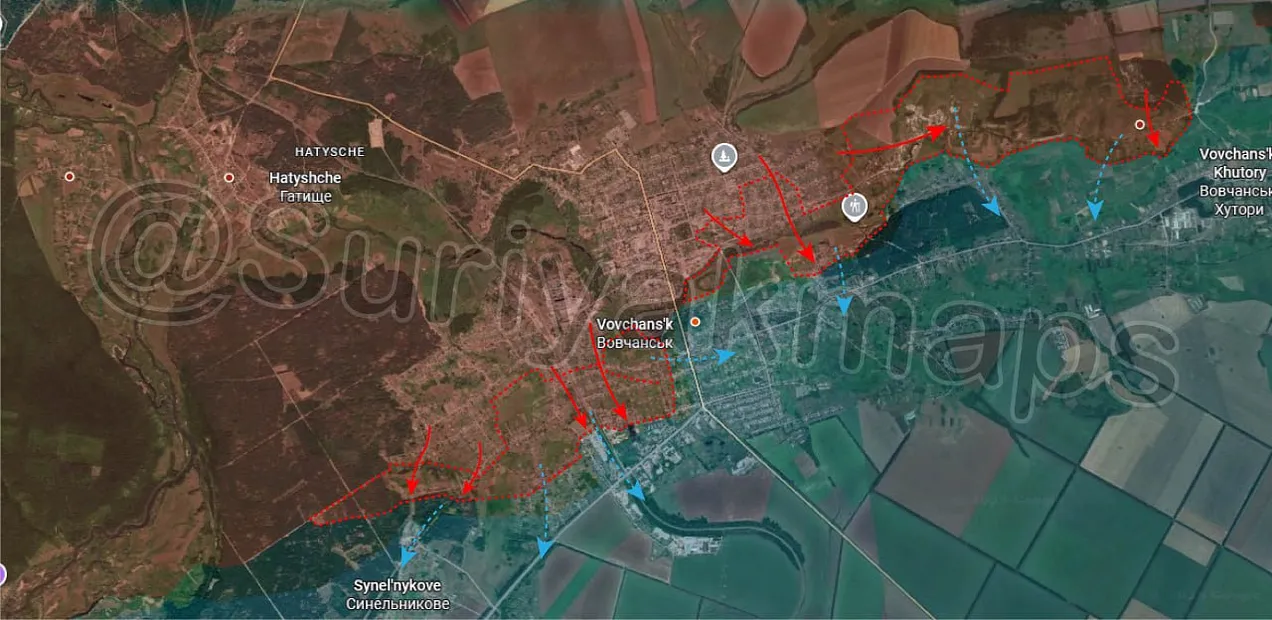
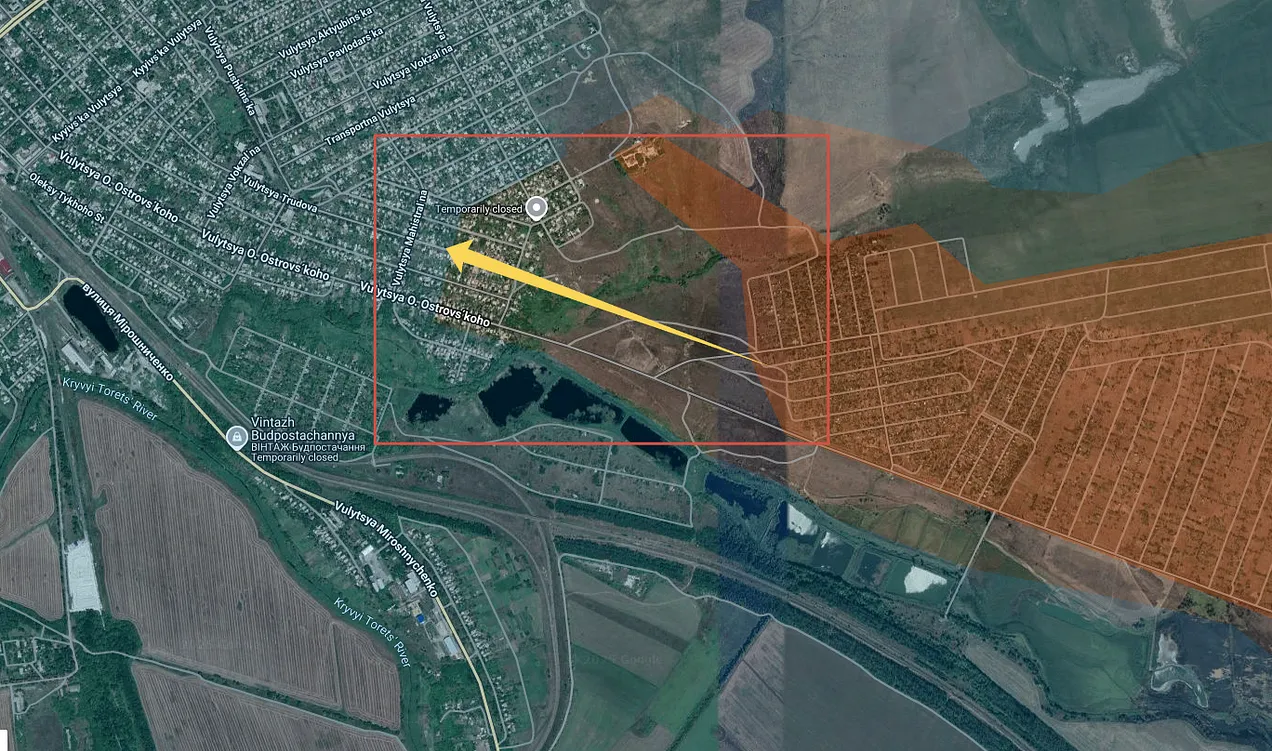
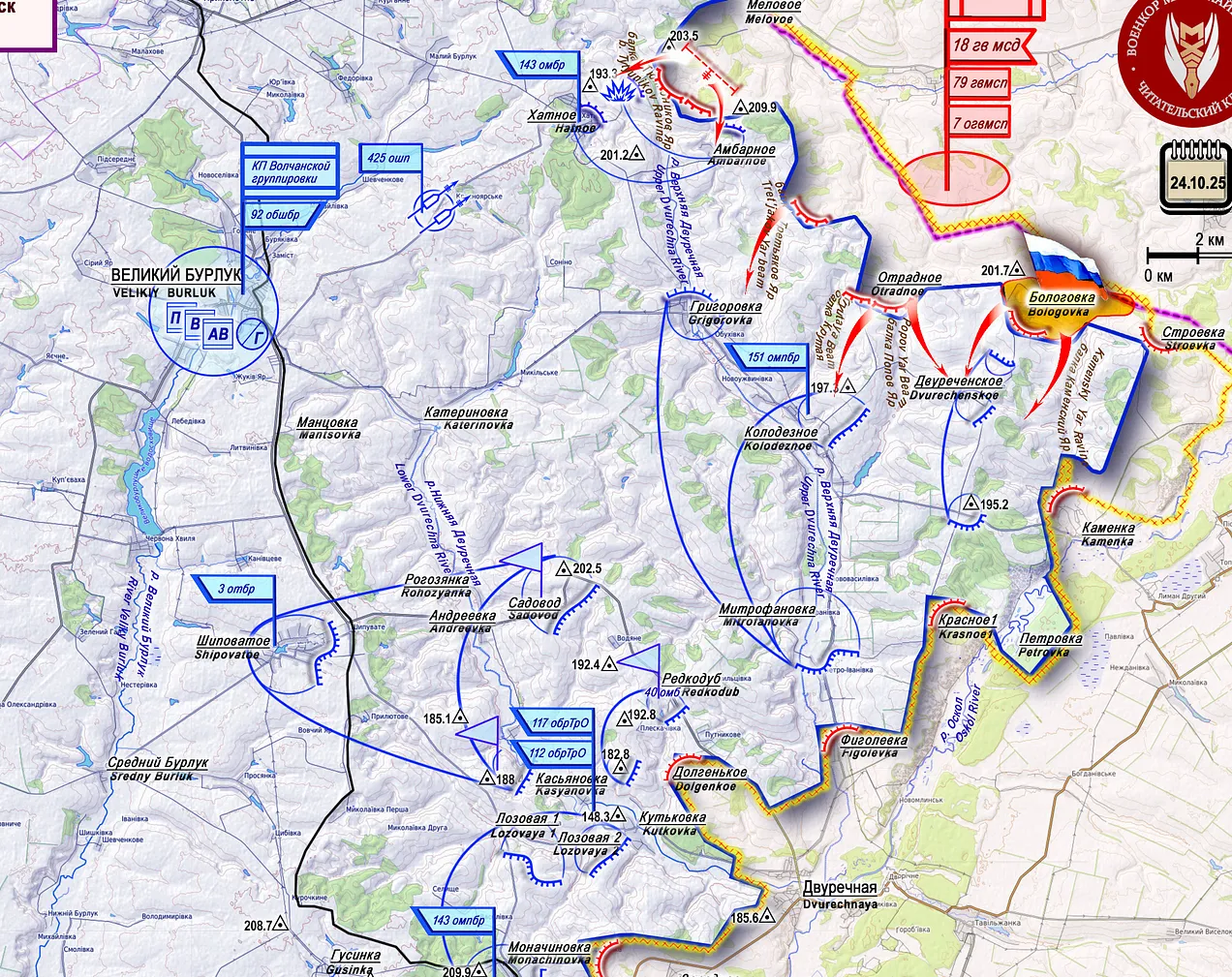
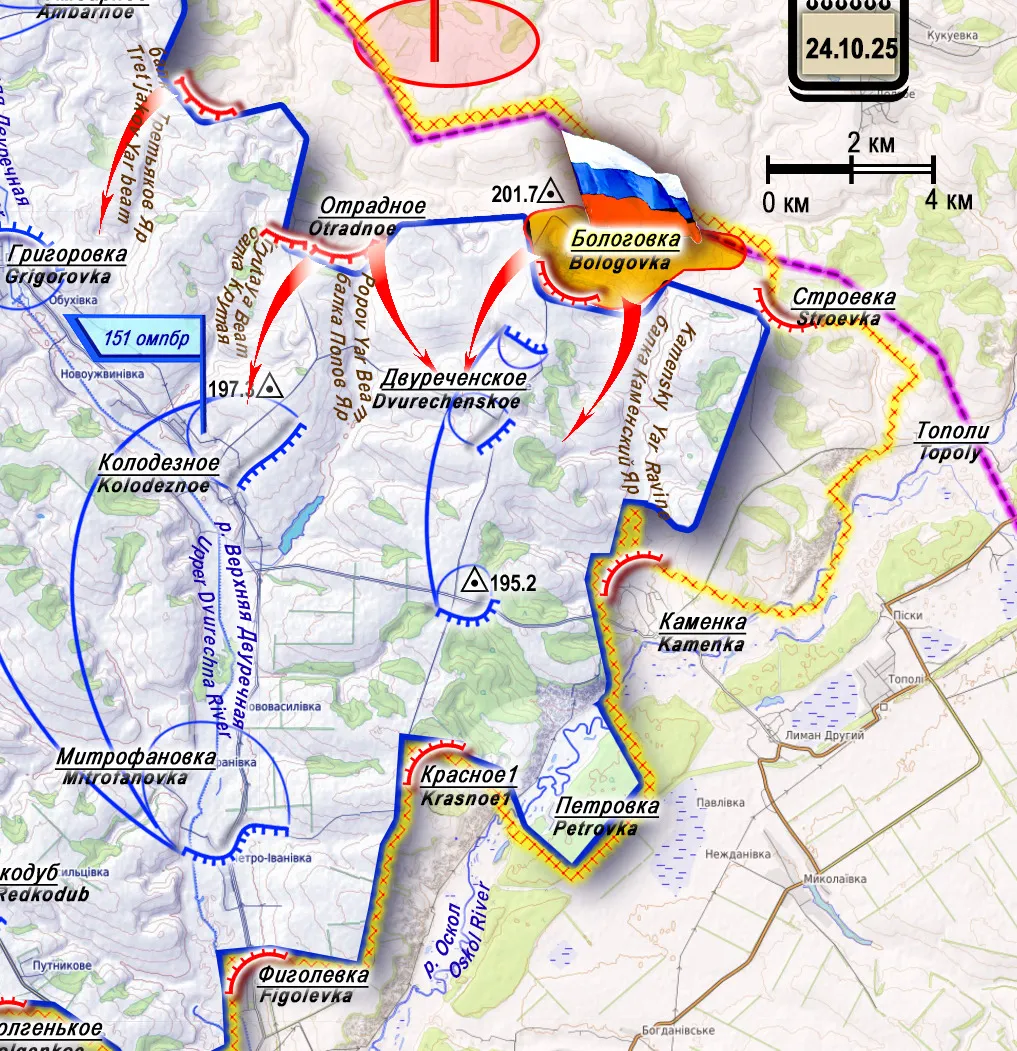
The settlement of Tikhoe (50°18′18″ N, 37°00′52″ E, about 160 inhabitants) is located on the right bank of the Volchya River. From here, crossings to the left bank are controlled, where the village of Volchanskie Khutora is located, through which runs a bypass road along the state border: Volchansk-Ohrimovka-Varvarka. It is connected by radial routes through the logistics center Bely Kolodez to the command center of the Volchansk direction of the Armed Forces of Ukraine (AFU) - the settlement of Velykiy Burluk. The bypass itself supports enemy maneuver groups conducting shelling of the Belgorod region.

Image

The probable advance of our forward groups into Volchanskie Khutora disrupts the coordination of the AFU grouping in Volchansk city with the right flank of the AFU's border defensive line. Pressure is also being applied on the settlements of Ohrymovka and Varvarka.

Image
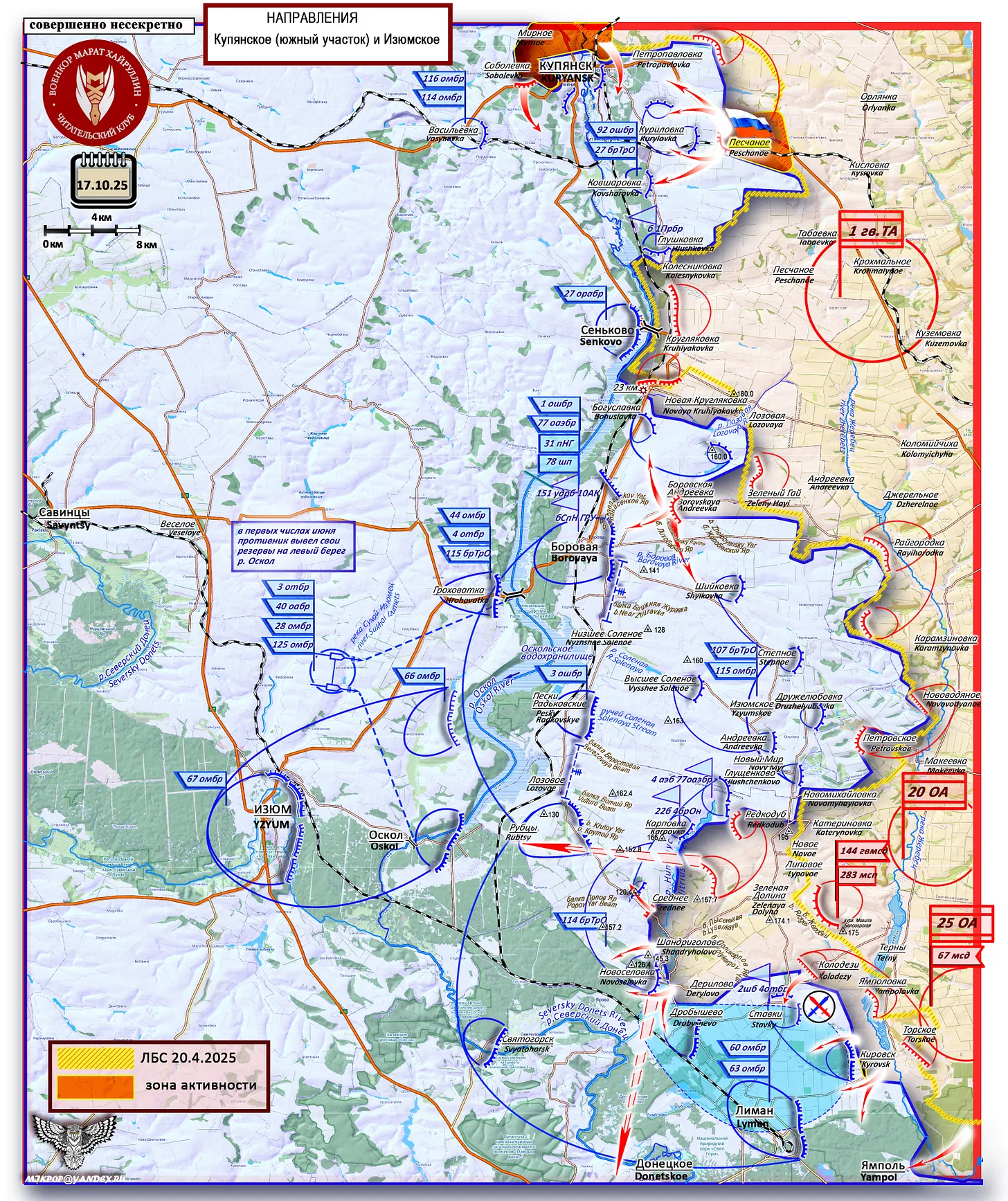
ЛБС 20.4.2025=Line of Combat Contact April 20th, 2025. Зона Активности=Zone of Activity.
After forming a wedge at the northern base of the Borovaya protrusion (Borovskaya Andreevka, liberated October 13, circled in red on the map below), our assault units intensified offensive actions northward and liberated the settlement of Peschanoe (49°39′21″ N, 37°47′02″ E, about 240 inhabitants).

Image
ЛБС 10.11.24=Line of Combat Contact November 10th, 2024. ЛБС 01.02.25=Line of Combat Contact February 1st, 2025.

In our view, four days were enough for the AFU to redeploy some forces along the line of combat contact from the Kurilovka-Kovsharovka area (where there has been relative calm for several months) to the threatened area near Borovaya. As soon as our reconnaissance confirmed the completion of the AFU maneuver, "swings" began, and the "quiet" sector came alive. There are several options for our maneuver from Peschanoe, as always.

Image

All of them require immediate response from the AFU command, using forces from the near radius, i.e., the Kupyansk area, where they are already insufficient... This is the Russian tactic of forcing the enemy into "splits."

Image
ЛБС 31.5.2025=Line of Combat Contact May 31st, 2025. Участки Активности=Area of Activity.

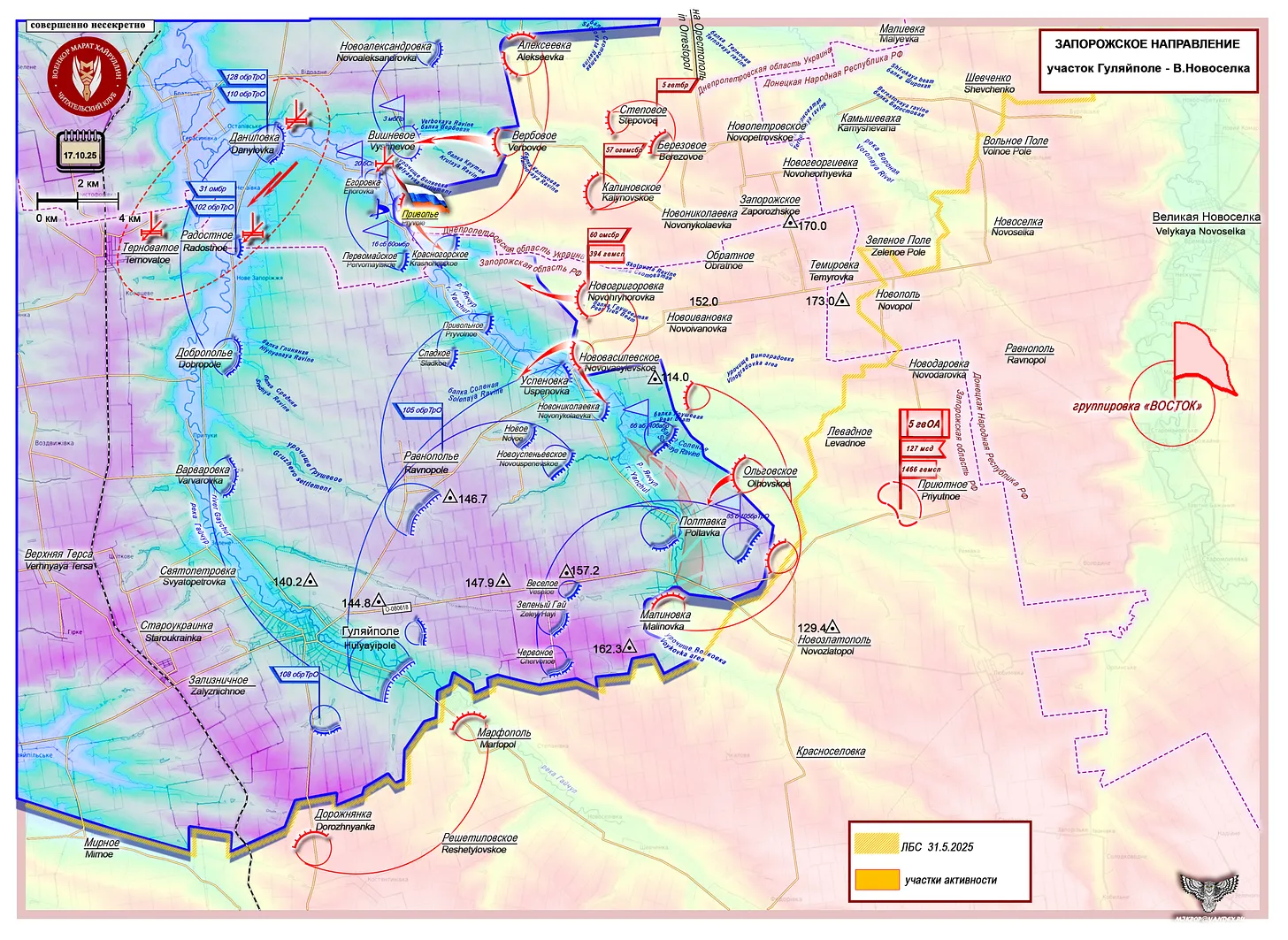
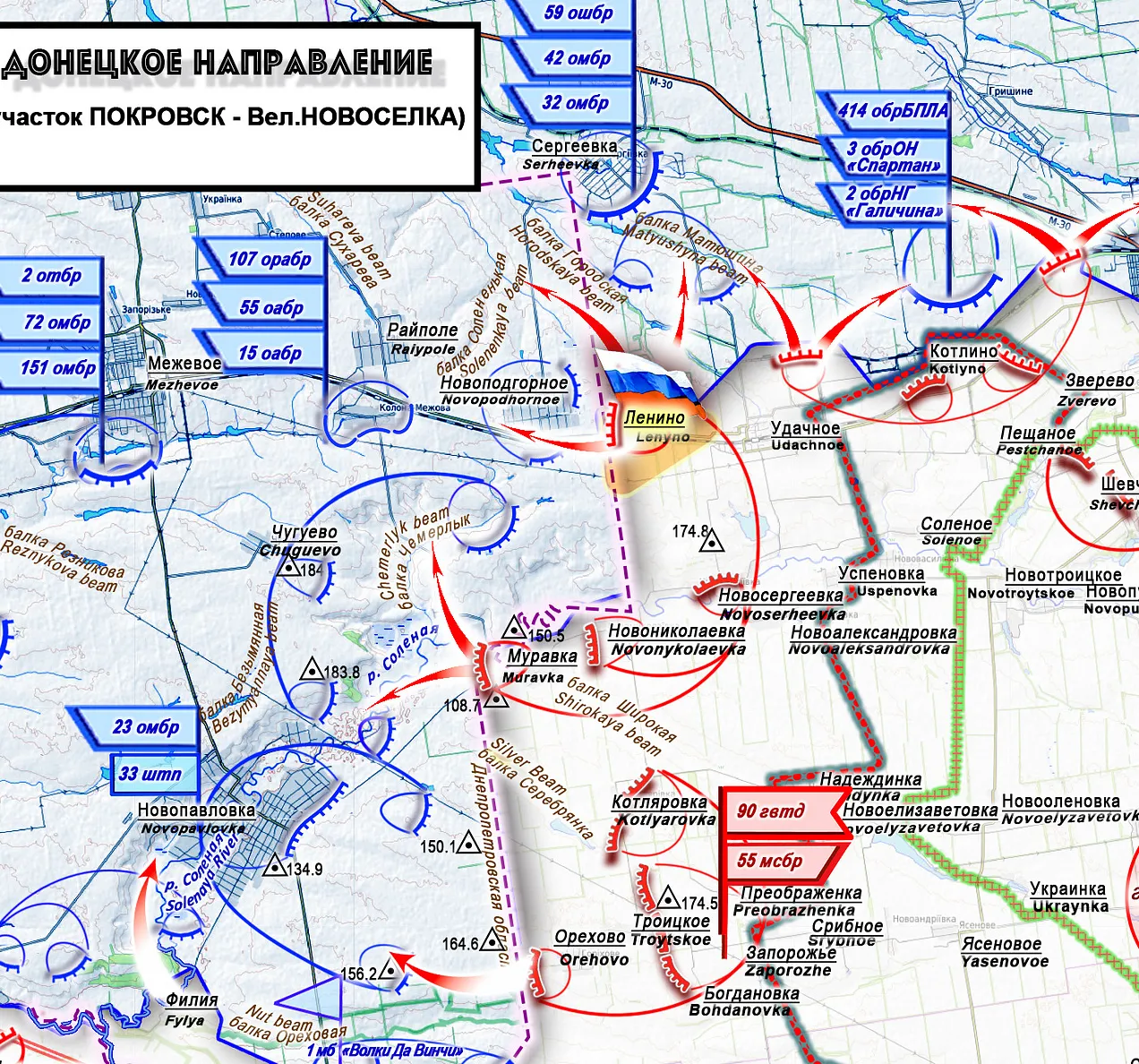
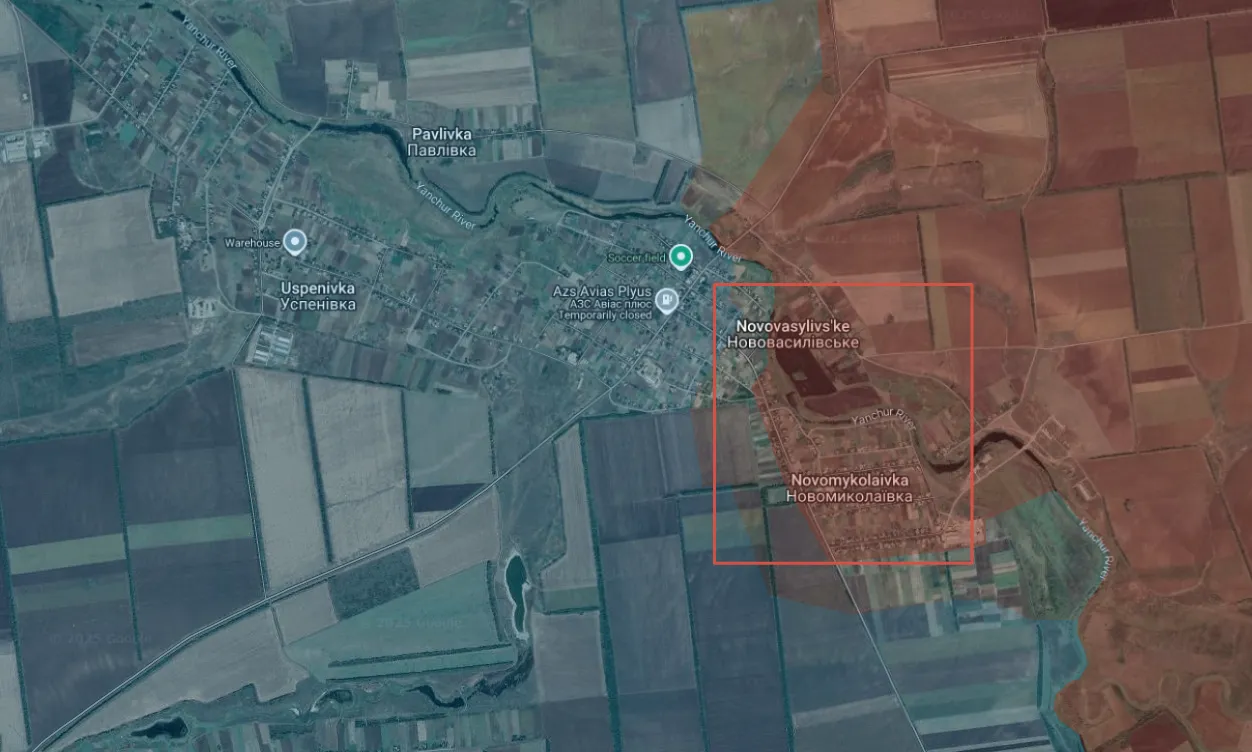
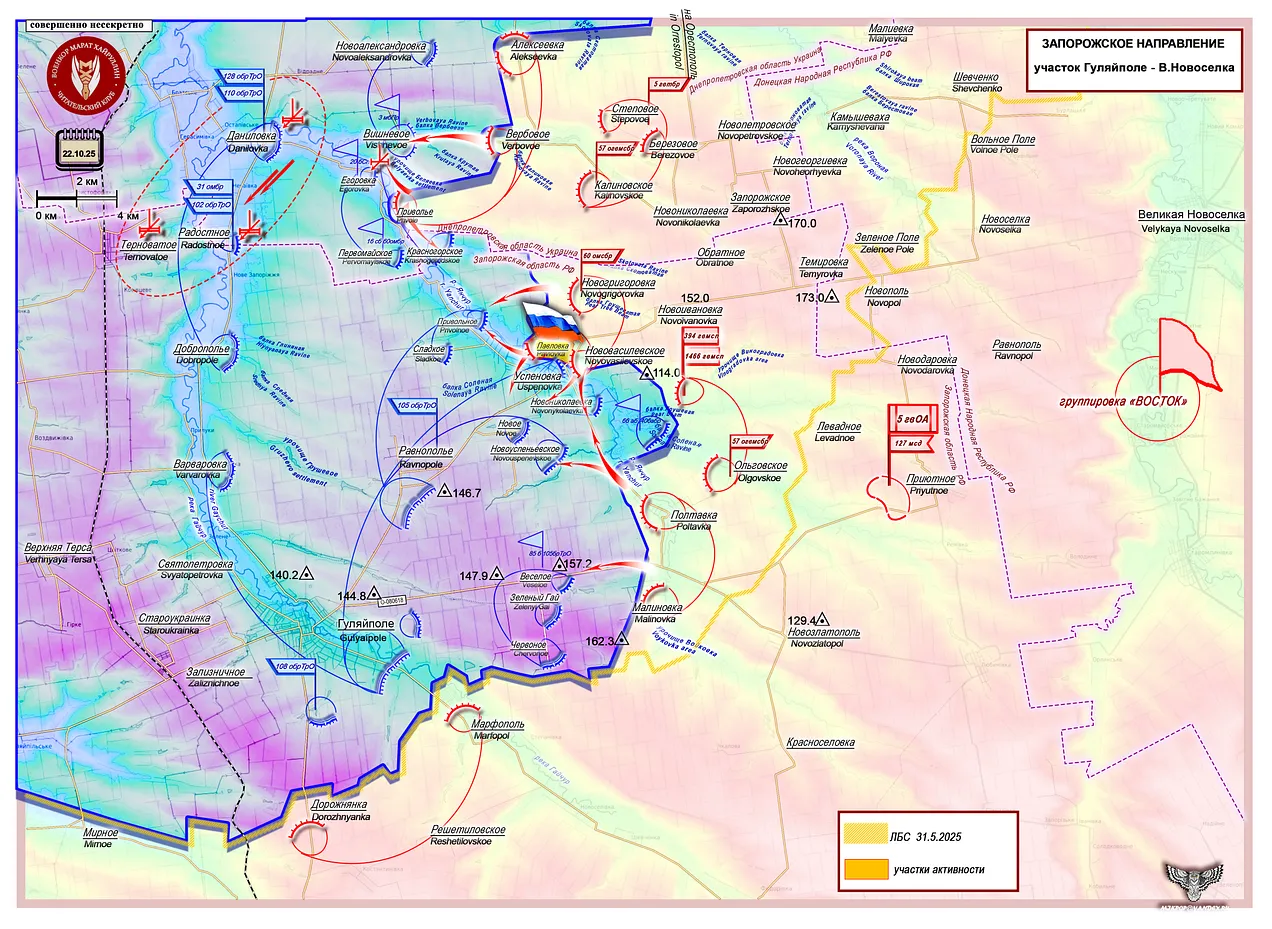
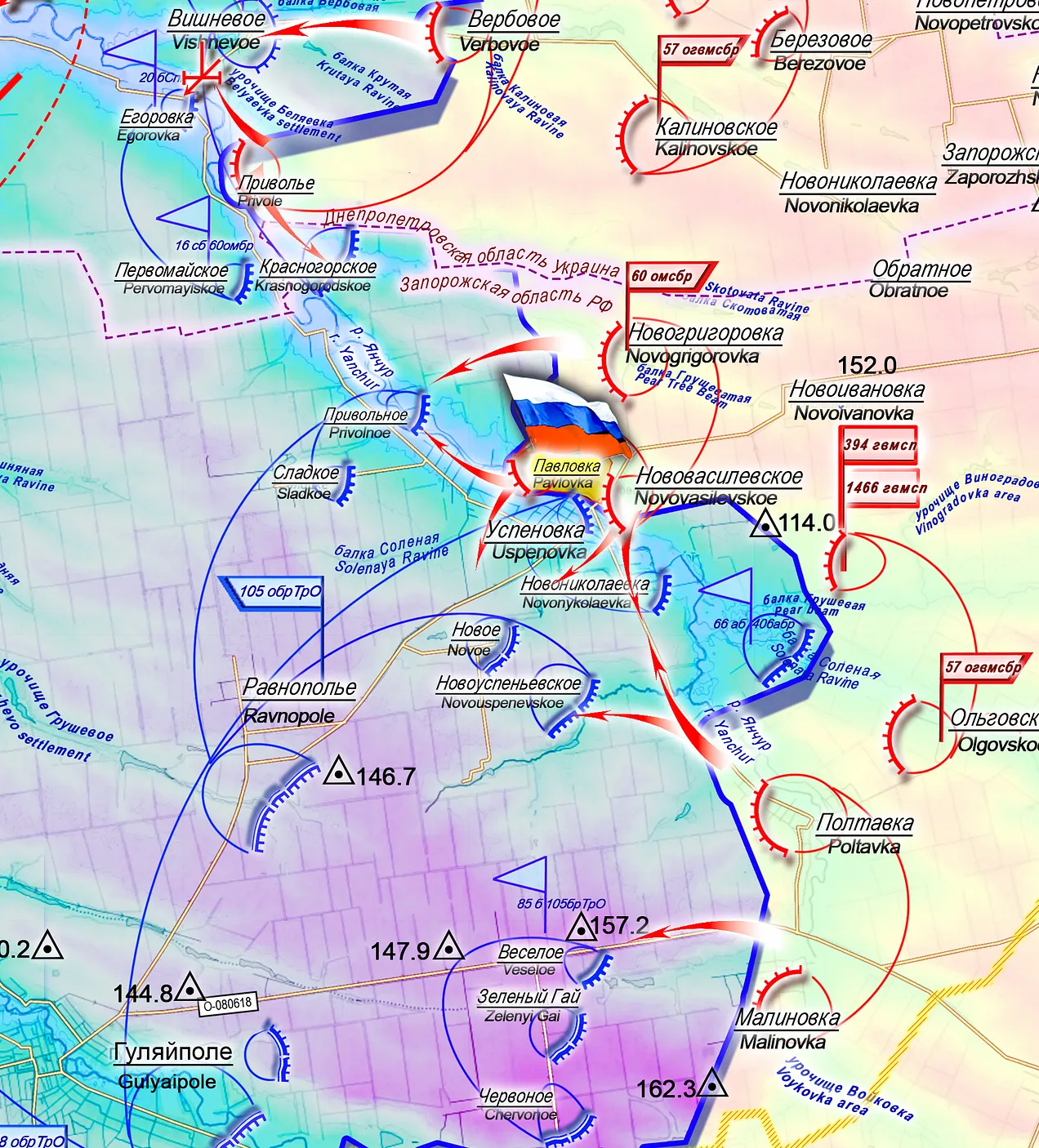
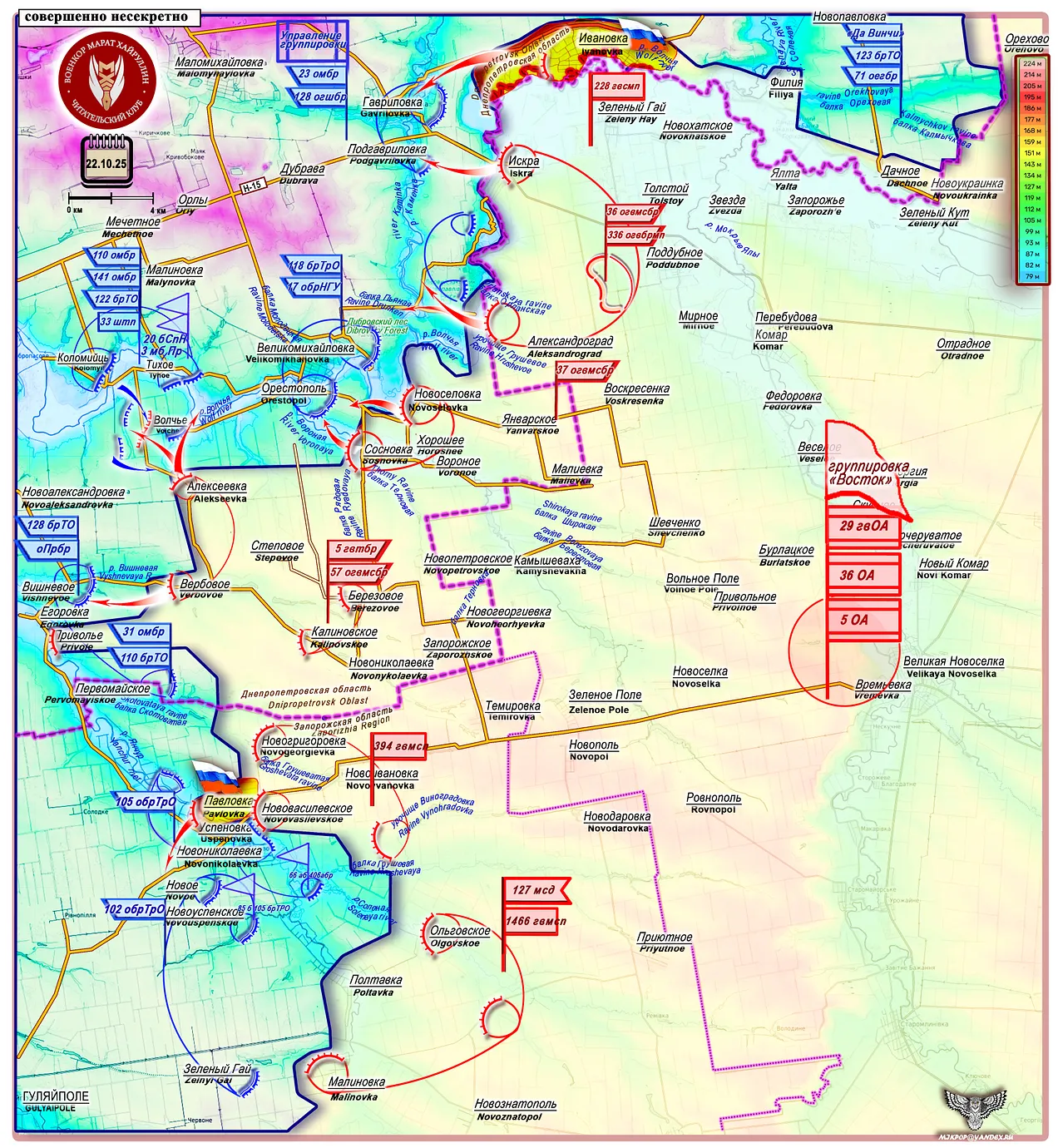
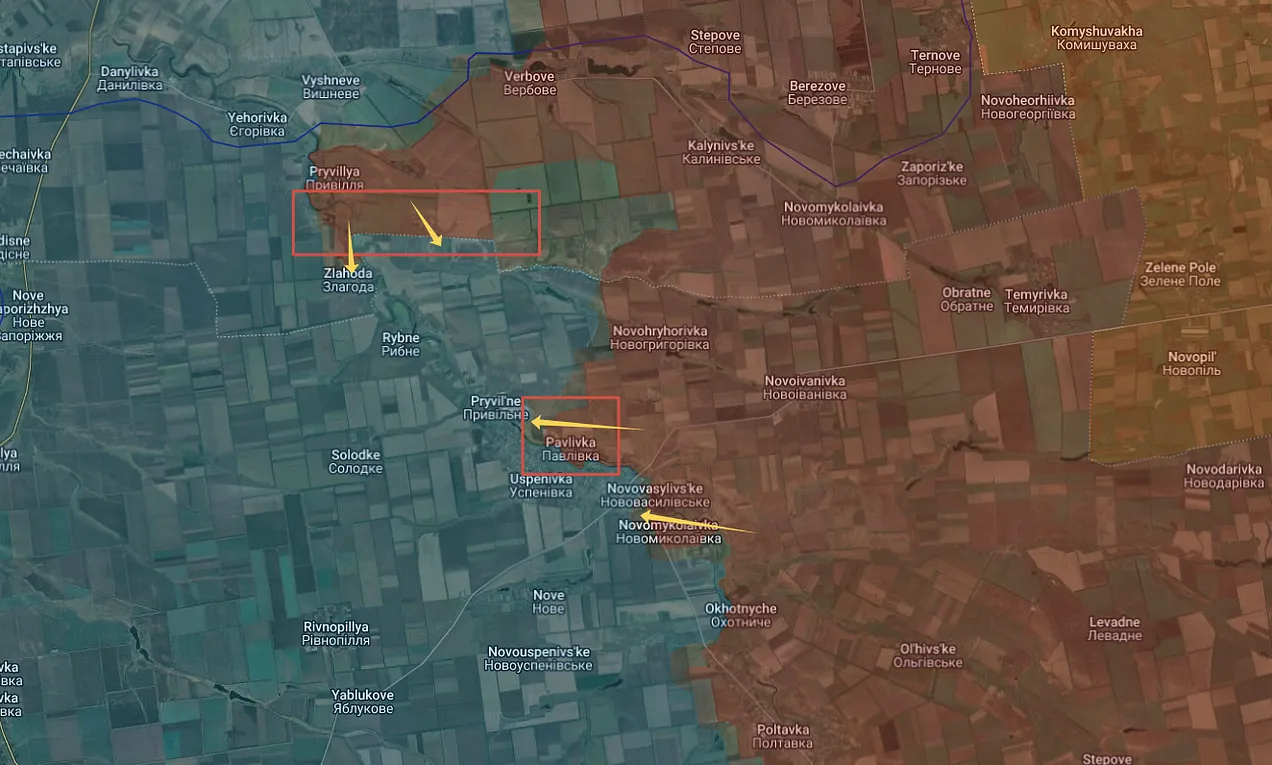
In the south of the Donetsk region of Ukraine, the Russian Armed Forces continue operational encirclement of the eastern part of the Zaporozhye region and have liberated the settlement of Privolye (47°51′20″ N, 36°18′54″ E, about 40 inhabitants).

Image

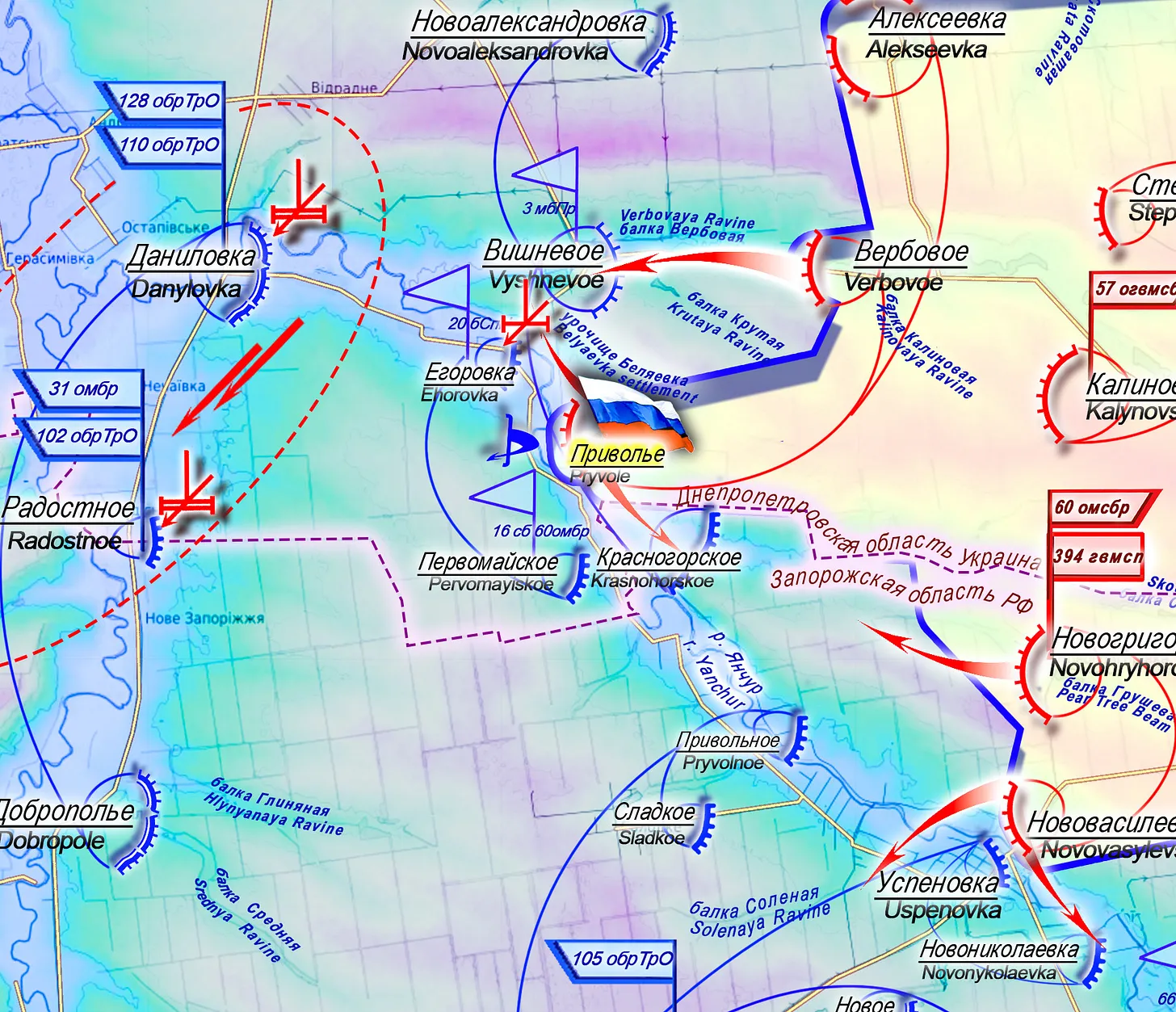
This small settlement is located south of the AFU defense area Vishnevoe - Egorovka (Ehorovka) on the right bank of the Yanchur River. Russian Armed Forces units reaching the Yanchur River is an important moment in the fighting in this direction. Both areas, Vishnevoe and Egorovka, are intermediate logistics points for the AFU where radial routes converge, providing a bypass road Pokrovskoe - Uspenovka - Gulyaipole (Hulyayipole), which is now effectively under the control of our UAVs and artillery. (I marked this route with a fuscia? line on the map below; Pokrovskoe is just north of Danilovka and Vishnevoe above where the map cuts off.)

Image

To the west, on the right bank of the Gaychur River, there is another strategic bypass: Dnepropetrovsk - Pokrovskoe - Gulyaipole (marked with a red line, the city of Dnepropetrovsk is much further north of the map). From Privolye, the Russian Armed Forces gain operational control over the route both by artillery and UAVs. Distances from Privolye to the settlements:

- Danilovka - 6.5 km;
- Radostnoe - 8.5 km;
- Ternovatoe - 14 km;
- Egorovka - 1.4 km;

Image

The operational space allows the Russian Armed Forces to choose several courses of action in this sector, depending on the convulsions of the AFU - the initiative is on our side.

https://maratkhairullin.substack.com/p/ ... tober-17th

******

Think-Tanks Wrestle with Russian Strategic Dilemma
Simplicius
Oct 17, 2025

Interesting new pieces from think-tank-land vis-a-vis the war in Ukraine have made it over the transom this week which are worth dissecting.

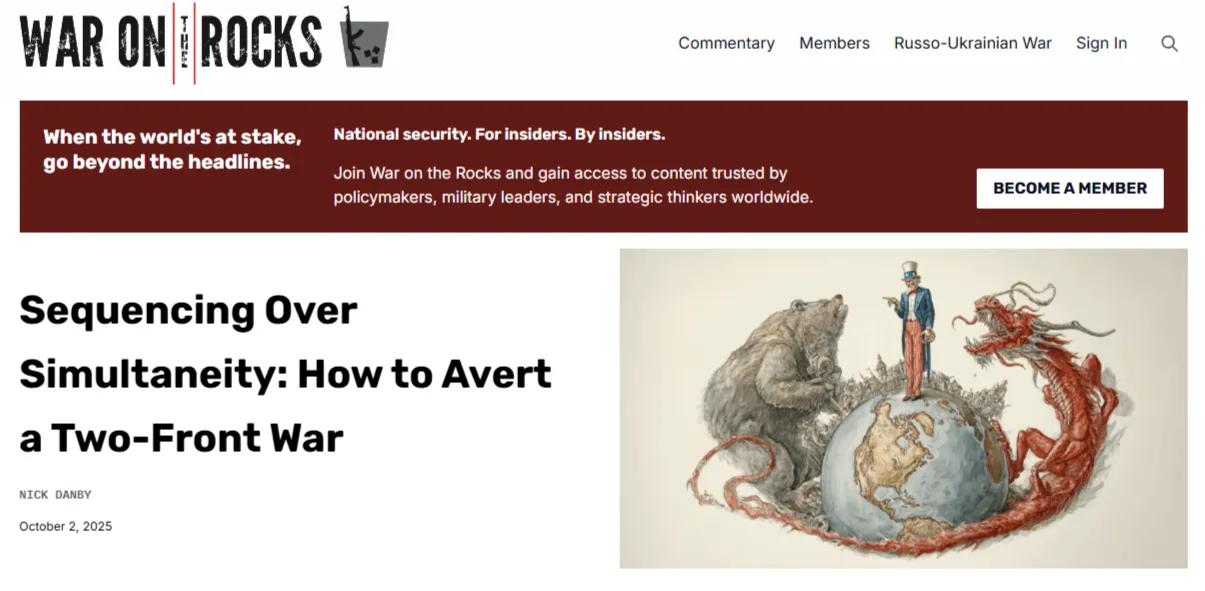
The first is from War on the Rocks, which was founded by an American defense industry think-tanker and bills itself as a defense publication “for insiders, by insiders”.

One of their latest pieces covers Washington’s strategic dilemma—namely, that of having to face three simultaneous adversaries in Iran, Russia, and China:

Image
https://warontherocks.com/2025/10/seque ... front-war/

You can see it mentions a two-front war, only because the analysis immediately dismisses Iran as having already been putatively ‘removed’ from the chessboard by way of Trump’s even more putative strikes on Iran’s nuclear program, beginning thusly from the openly sentence:

America’s crippling strikes against Iran’s nuclear program in June have created a narrow window to avoid a strategic nightmare: namely, fighting China, Russia, and Iran all at once.

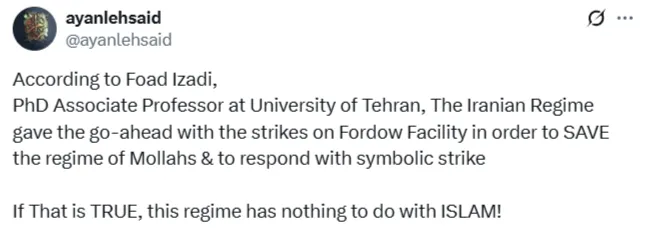
By the way, just as a quick digression to this, here’s an interview from Iranian professor Foad Izadi from Tehran University who apparently confirms that Washington essentially made a deal with Iran to let them bomb Fordow with B-2s in exchange for Iran hitting empty US bases:

Image
https://x.com/ETERNALPHYSICS/status/1978869518341480516

As well as Iranian MP Mahmoud Nabavian’s interview confirming the same in even more detail.

Just something to consider in light of Iran being ‘written off’ in this discussion of a “two-front” war.

Getting back, it should also be mentioned that while the War on the Rocks piece does not necessarily represent any official policy-making initiative, it certainly echoes much of the beltway’s sentiments, and is likely to at least influence thinking on Russia; perhaps not in as seminal a way as some of the vintage RAND pieces have done, but given the big MIC names that have written for and read WotR, it’s only a natural contribution to the backbone of US’s coming policies toward Russia, particularly under the gung ho stewardship of Pete “Keg Stand” Hegseth.

The author aptly summarizes the three adversaries as follows:

America faces three adversaries: Iran, the persistent destabilizer, determined to develop nuclear weapons; Russia, the acute threat, invading Ukraine and threatening NATO; and China, the pacing challenge, attempting to topple America’s international leadership.

The chief challenge the author presents is in the form of the question: How do you deter or defeat both Russia and China simultaneously without exhausting your resources? He calls his solution ‘sequencing the threats’:

These competing threats spotlight America’s “strategic simultaneity” problem: How do you deter and, if necessary, defeat China and Russia simultaneously without exhausting your nation’s resources, power, and attention? You don’t. Instead, you sequence the threats.

He cites ancient powers as having famously utilized this art of ‘sequencing’, which is just a fancy way of describing the defeat of your enemies one at a time instead of fighting them all at once, with the kicker being that you start with the weakest and work your way up to the strongest:

Great powers from Byzantium to Venice to Habsburg Austria to Edwardian Britain have all survived by mastering the art of sequencing. This stratagem, as strategist Wess Mitchell elucidated, entails concentrating forces and focus against one opponent’s disruptive potential before turning to deter or defeat another more capable opponent. Israel recently demonstrated this approach, methodically dismantling Iran’s “axis of resistance” one proxy at a time — first Hamas, next Hizballah, then Iran itself (with America’s help) — rather than fighting simultaneous wars across multiple fronts against many enemies.

You can see the beginnings of major cracks in this theory’s foundation, given that he premises the putative “success” of Israel’s usage of this strategy on his belief that Israel somehow decisively defeated all of its regional adversaries, namely Hamas, Hezbollah, and Iran.

But we know nothing of the sort really happened: apart from Israel’s assassination of a bunch of token leaders, and fake strikes against Iran that did little, Israel did not achieve its military objectives, nor managed to conquer Gaza. Further, it destroyed what was left of its global image in the process, which has to be calculated into the equation of what a given ‘strategy’ achieves, since in geopolitics military objectives on their own do not exist in a vacuum.

This is the same type of thinking that has imperiled the West in Ukraine. By using spoiled data—in this case the belief that Russia is “losing” and suffering “far more casualties” than the AFU—the West has convinced itself of a completely warped sense of reality that has led to policies which are detached from any logic or reason.

But he frames his entire argument for this ‘sequence’ strategy around the key idea that America’s time is running out to defeat the second of its adversaries.

Iran Down, Two to Go

Following Israeli and U.S. strikes in June, Iran’s nuclear program is “severely damaged,” set back by up to two years. (Ed: interesting how even he himself seems skeptical, even though this fact is central to the working of his theory) For the first time in decades, America can shift its primary focus from the Middle East. Sequencing logic demands weakening one remaining competitor before risking an unwinnable two-front war. But which competitor?

He asks which competitor? Answering:

Russia is the obvious choice. Moscow is weaker and moved first by invading Ukraine; it should be punished first.

More unbridled hubris.

He goes on to lay out the timeline as four years maximum:

Washington only has, perhaps, four years to implement the right sequencing. Years one and two should focus on helping Ukraine forestall Russian gains through continued intelligence support and military training, loosening the “review mechanism” that restricts Ukraine’s offensive long-range strikes into Russia, establishing European defense production foundations, and imposing systematic costs on Russia’s financial industry and energy trade, the two leading enablers of Moscow’s war effort. Enough pressure could degrade Russia’s wartime economy by 2027, when experts suggest Moscow may no longer be capable of sustaining the war in Ukraine.

Well, the above does have the right idea. Certainly these are reasonable and logical conditions to cause Russia much consternation. But as usual, they are offered in a vacuum which completely ignores Ukraine’s own far-worse trending economic and political indicators.

He goes into detail of each step of this ‘sequence’:

Sequencing, Part 1: Cutting Russian Lifelines

The first part essentially outlines the tired idea of sweeping sanctions on Russia’s entire financial industry, in order to cripple its ability to move funds for the war. Then proceed to hit its energy trade directly by phasing out European oil and gas imports from Russia by as early as 2026, as well as facilitate more Ukrainian deep strikes on Russian energy facilities by delivering the promised ERAM and other advanced long-range munitions.

This part of the strategy has long been in motion, and even got a boost today during Zelensky’s White House meeting where the Ukrainian leader presented Trump with a list of “pain points” for Russia’s defense manufacturing infrastructure, using the diplomatic euphemism “pressured” in place of “struck with Tomahawks”:

Zelensky brought Trump maps with the “pain points” of the Russian defense industry, reports RBC-Ukraine citing a source.

A source in the Ukrainian delegation said that Zelensky and his team also brought several maps to the meeting with Trump this time, which have “great significance” for the conversation with the American president.

“The maps show the pain points of the Russian defense industry and military economy that can be pressured to force Putin to stop the war,” he said.


Moving on:

Sequencing, Part 2: The European Defense Buildup

For part two, the author proposes a much deeper integration of NATO with ongoing Ukrainian operations, essentially calling for NATO’s subtle tip-toe into the war in a ‘frog-boiling’-style method that Russia would presumably not notice or react to:

First, establish a clear division of labor, where European allies manage most conventional capabilities while America provides “backstop” support in its areas of comparative advantage. European powers like the United Kingdom and France would forward-deploy “reassurance forces” near Ukraine, ready for deployment to western Ukraine during a ceasefire or escalation, where they would learn from Ukrainian forces and also provide rear echelon support. European partners would take a greater role in managing NATO–affiliated air and naval operations and patrols against Russian gray zone activities. Meanwhile, the United States would provide intelligence, surveillance, and reconnaissance overwatch, logistics and transport, nuclear deterrence, and stand-in forces. If done right, by 2027, the Europeans should handle day-to-day conventional deterrence and defense while America plays a specialized supporting role.

He goes on to sketch a wildly unrealistic portrait of Europeans massively boosting their armament production, again failing to address the trap of vacuum-analysis. Virtually all of these prescriptions are proffered under a kind of assumption that Europe is structurally and politically even remotely in position to coordinate and cooperate in such a frictionless way. You would think the person writing is keeping himself deliberately aloof to recent updates, not having read a single newspaper about the deteriorating condition of Europe’s flagging ‘solidarity’.

He mentions ‘co-financing’ of ‘industrial capacity’ as if that wasn’t at this point a recurring farce dating back to 2022, wherein Europe had famously failed time and time again on various initiatives to create a kind of a la carte group-financing of arms for Ukraine, whether it was the Czech-led initiative for artillery rounds exposed as having procured a fraction of stated totals, or the more recent PURL (Prioritized Ukraine Requirements List). These things have always flopped, and to continue suggesting some new variant after another is like spitting into the wind. The only reasonable conclusion the author comes up with here is that it would take ten long years for Europe to “achieve full defense autonomy”.

In his final section, he cites US Admiral Phil Davidson’s prediction of China launching an attack to retake Taiwan by 2027 as the final window before which the US can “finish off” Russia. He mentions the many pitfalls of this approach, including a diplomatic bottleneck as result of the US’s focus remaining occupied by the Ukrainian war, which would rob it of diplomatic thrust for anti-Chinese “coalition building” in Asia.

His final concluding pronouncement reveals the blinkered worldview held by these one-dimensional-minded think-tank types who run the MIC. In gushing over a nonexistent spring of ‘renewal’ of so-called US geopolitical feats, he reveals the blind motivation behind all of this pseudo-strategic casuistry—which is simply the perpetual ‘expansion’ of America’s reach:

With Iran neutered, European security improving, Ukraine holding the line, and Russia weakened, the United States has a rare opportunity to debilitate the Russian threat in the near-term while revitalizing Europe’s security architecture to deter Russia over the long-term, so America may finally concentrate its resources and attention on countering its great rival this century: China.

If the United States uses these next four years better than its adversaries, it will upend the strategic landscape. It will transform the Western alliance from protectorate to partnership. It will multiply America’s reach through increased allied capacity and burden-sharing. And it will prevent America from having to choose between defending Europe and the Pacific.


This is precisely the kind of failed imperial thinking that has squandered most previous empires: endless expansion for no discernible reason, with no discernible justification. Empires like that of the US, in their waning twilight years, become inflicted with a kind of grand delusion of global destiny, wherein it is imprinted on the very DNA of the nation and its political and strategic outlooks that only endless expansion and the fanatic obsession with destroying all even remote rivals via the Thucydides Trap will save the Empire from eventual dissolution.

This foolhardy devolution of national destiny seems to stem from the fact that empires ultimately lose their heart and soul—their nomos—forgetting what was once important and replacing that with this sort of blind degenerative delusion, aped and passed down with increasing severity by each new political generation, that the “greatness” of said nation comes exclusively from its total dominance of the world, rather than from some inherent cultural markers and other unique qualities.

This is because an empire by its definition always ends up ‘globalized’, losing the core of its own identity. And when that identity is eroded, the only thing remaining in its place is a kind of dead vacuum instinctively reinterpreted by successively-inferior generations of political thought-leaders as blind hunger for mindless expansion, as if by blanketing the globe over with their imprint they could mask the terminal atrophy of the nation’s once-held sacred permanence. This is a kind of end-times metastatic spiral which can only conclude with the empire’s dissolution by emergent new forces armed with enough authentic vitality and passionarity as to eclipse the enervated empire which becomes a clay-footed colossus.


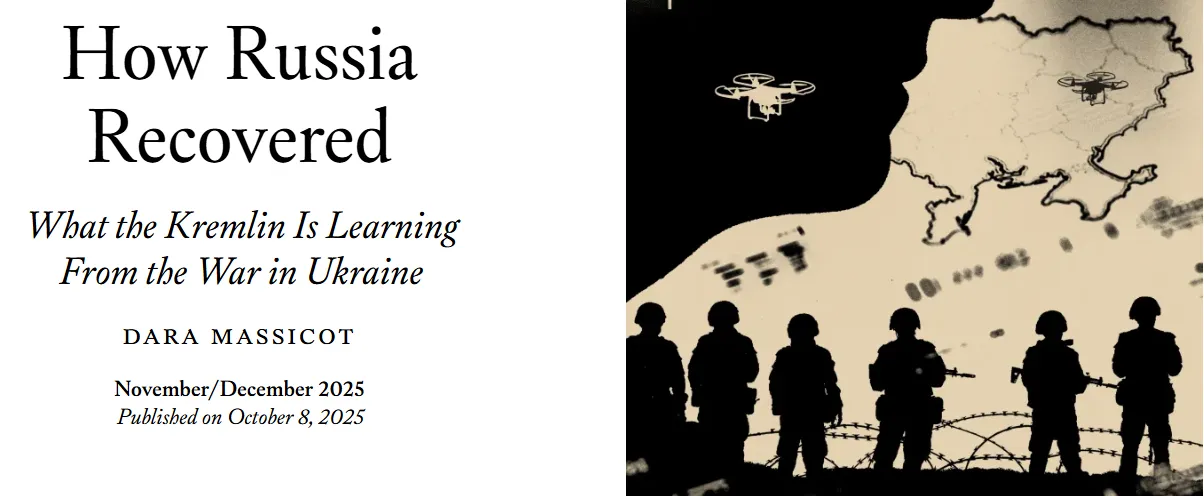
Our second—and more interesting—offering comes by way of Foreign Affairs, the official publication of the Council on Foreign Relations, and serves as a counterpoint to the earlier idealistic think-tank piece:

Image
https://www.foreignaffairs.com/russia/h ... -recovered

The piece opens with the premise that Western analysts have gotten the Ukraine war wrong owing to the ‘wild swings’ of expectations that have colored the war, which have given people whiplash and muddled their understanding of the reality taking place on the ground. The author concludes that, after Russia’s perceived “defeat” by Ukraine in the early part of the war, Western analysts have turned toward external factors in explaining Russia’s latest resurgence.

(Paywall with free option.)

https://simplicius76.substack.com/p/thi ... th-russian

******

A record 268

October 18, 6:05 PM

Image

October 17th was a record-breaking day.
On that day, 268 KABs were dropped on the enemy in one day. This is a record for the entire history of the Second Military Operation in Ukraine.

According to enemy statements, 109 airstrikes with a simply enormous number of guided aerial bombs were launched in various directions that day. It's worth noting that Russia entered the war with a relatively small percentage of guided bombs, often conducting bombing runs in the old-fashioned way (which, among other things, resulted in the loss of valuable materiel). As the war progressed, the production and use of KABs increased exponentially, and the UMPK was widely deployed, with kits now even being installed on the FAB-3000. The days of relying on free-fall aerial bombs are practically a thing of the past.

Now, guided aerial bombs are dropped on the enemy daily, allowing Su-34 pilots to generally avoid enemy air defense coverage or remain there for only a short time. Consequently, the enemy still lacks a comprehensive countermeasure against KABs. The number of downings is vanishingly low; sometimes they can be diverted using electronic warfare, but most of the time, they reach their targets. This remains one of the main tactical problems for the Ukrainian Armed Forces. In this regard, the Air Defense Forces effectively facilitated the Russian Aerospace Forces' final transition to guided and precision-guided weapons. In this regard, war truly is an engine of progress.

https://colonelcassad.livejournal.com/10136728.html

Mandatory condition
October 19, 10:19

Image

Mandatory condition

During talks between US President Donald Trump and Volodymyr Zelenskyy at the White House, US Presidential Envoy Steve Witkoff pressed Ukraine to vacate Kyiv-controlled territories of the Donetsk People's Republic (DPR).
This was reported by The Washington Post, citing sources.

"According to officials, Trump's special envoy, Steve Witkoff, insisted during their Friday meeting that the Ukrainian delegation consider the possibility of handing over Donetsk," the article states.
Witkoff noted that this is a predominantly Russian-speaking region, the newspaper claims.

The newspaper previously reported that during a phone call with Trump, Russian President Vladimir Putin called the liberation of the DPR from the Ukrainian Armed Forces a prerequisite for ending the conflict in Ukraine.

In September, Zelenskyy stated his willingness to discuss new borders for Ukraine in the future if Kyiv no longer has the strength to fight for the lost territories.

https://russian.rt.com/ussr/news/154829 ... territorii - zinc

The essence of this scheme is that if the enemy, after concluding an agreement and withdrawing from Donbas, decides to resume hostilities as was the case with the Minsk agreements, it will lose the rest of Donbas for nothing. Since the enemy's plan is to lure Russia into a ceasefire along the LBS and then, at a convenient moment, after recuperating, resume hostilities at a convenient moment, then, of course, it does not want to give up Donbas.

https://colonelcassad.livejournal.com/10137280.html

British OneWeb satellites are being used to strike Russia.
October 19, 1:54 PM

Image

The Ukrainian military is using British OneWeb satellites to control unmanned boats in the Black Sea, alongside the American Starlink system. This information was obtained after the seizure of a Ukrainian unmanned boat carrying the relevant equipment.

At one time, we, along with the development of our satellite constellation, were assisting Britain with the launch of the OneWeb satellite network on Roscosmos rockets. These satellites are now being used for strikes against Russia.

After the start of the Second World War, cooperation ceased, and Britain was never able to fully deploy the planned constellation. However, it certainly has certain capabilities.

https://colonelcassad.livejournal.com/10137602.html

Google Translator
"There is great chaos under heaven; the situation is excellent."

User avatar
blindpig
Posts: 14788
Joined: Fri Jul 14, 2017 5:44 pm
Location: Turtle Island
Contact:

Re: Footnotes from the Ukrainian "Crisis"; New High-Points in Cynicism Part V

Post by blindpig » Mon Oct 20, 2025 11:37 am

A visit that did not go as expected
Posted by @nsanzo ⋅ 10/20/2025

Image
​​​
As with every occasion when there is a shift in direction toward an unfavorable path, European countries wasted no time in their attempt to regain control of the narrative following Volodymyr Zelensky's meeting at the White House. Clearly annoyed, the Ukrainian president latched on to the fact that Trump hadn't agreed to the shipment of the latest miracle weapon, the Tomahawk missiles, although he hadn't said no either. This small opening of the door of hope contrasts with the Ukrainian euphoria of just a few hours earlier, when government representatives took their delivery for granted and rubbed their hands, announcing the damage caused to the Russian economy. It is consistent with the frustration Zelensky displayed at the meeting. Speaking to the press, the Ukrainian president tried to use every opportunity to insist on the need to obtain the requested missiles, possibly failing to understand that their delivery will depend not on Ukrainian arguments, the situation on the front lines, or the drone offer that Kiev might make to Washington, but rather on what Russia will say in its meeting with Marco Rubio and, above all, at the Putin-Trump summit expected to take place soon. For the United States, Ukraine remains a secondary player in a conflict in which its decision-making capacity is severely limited by its external dependence, a situation not replicated on the other side of the front, where Russia relies on its resources and commercial acquisitions to supply its military and keep its economy afloat.

After the meeting at the White House, the Ukrainian president rushed to inform his European partners of the developments. As Zelensky announced, the call included Keir Starmer, Friedrich Merz, Giorgia Meloni, Alexander Stubb, Jonas Gahrstore, Donald Tusk, Ursula von der Leyen, Antonio Costa, and Mark Rutte. The lengthy format is indicative of Volodymyr Zelensky's need for support after Washington's disappointment and the renewed danger of a diplomacy in which Russia and the United States might reach some kind of understanding that, as happened after the Russian-American meeting in Alaska, European countries would subsequently have to undo. In his talks with the United Kingdom, Germany, Italy, Finland, Norway, Poland, the EU, and NATO—a representative list of the countries and institutions Zelensky considers his priorities—the Ukrainian president insisted that “the priority now is to protect as many lives as possible, ensure Ukraine’s security, and strengthen us all in Europe. This is precisely what we are working toward.” Ukrainian rhetoric, recent steps, and commonly used euphemisms indicate that protecting lives means demanding more air defense systems; guaranteeing Ukraine’s security ; advancing security guarantees that imply the presence of NATO troops as a prerequisite for an agreement with Russia (a measure that makes any understanding unviable); and strengthening Europe , increasing the level of militarization of the so-called eastern flank to pressure Russia and maintain the continental divide beyond a future ceasefire.

If the Ukrainian president's words and expressions during and after the meeting weren't definitive proof of how the meeting with Donald Trump had gone, the reaction of European leaders confirms their concern. Even before Zelensky's arrival in Washington, the German government had distanced itself from the European Commission's statement, which downplayed Vladimir Putin's possible visit to Hungary, and demanded that Viktor Orbán's government, should the Russian president visit, execute the International Criminal Court's arrest warrant. Aside from the selective use of the rules-based international order , Germany's statement of intent is clear: diplomacy is not the priority. This German position is shared by the Ukrainian authorities, who, despite Zelensky's statement on Saturday agreeing with Trump about "stopping where we are," displayed a much more belligerent stance during the meeting. “US President Donald Trump and Ukrainian President Volodymyr Zelensky disagreed over the future of the war,” CNN wrote , adding that “Trump stressed that the current US proposal for a diplomatic solution is for the war to end with the front frozen, a proposal that Ukraine finds difficult to accept.”

As has become clear since 2022, and especially since Donald Trump began his chaotic and so far unsuccessful attempt at peace, a resolution based on the current de facto borders is also considered unacceptable by European countries, ready to fight Russia to the last Ukrainian. “The visit was not what Zelensky wanted,” lamented Friedrich Merz, Foreign Minister of the country that is Ukraine’s second-largest military donor, adding that, from now on, European countries must help Ukraine more “financially, politically, and, of course, militarily,” since the war can only end if Ukraine is militarily strong. The logic behind rejecting any peace through compromise is to consider any outcome that cannot be presented as a clear victory as a Ukrainian capitulation. According to this reasoning, capitulation is not an option, as it would provoke Russia to attack another European country. By attributing to Russia intentions it has not shown and capabilities it does not possess, European countries have made war the only way to avoid another war that does not even exist.

Merz's position has been echoed by other European leaders, such as Donald Tusk, who affirm that "one thing is absolutely clear: Europe's solidarity with Ukraine against Russian aggression is more important today than ever." Marko Mihkelson, chairman of the Estonian Parliament's Foreign Affairs Committee, added that "in the near future, we must be prepared for further escalations of aggression by Russia against Europe." In this game, Ukraine is a tool that deserves solidarity in the form of more weapons and more war.

The options presented by European capitals and Kiev include rejecting any compromise in favor of continuing to fight until a position of strength is achieved for negotiations, or imposing negotiation terms in which Russia has no say. The latter appears to be the option put forward during the group call by Sir Keir Starmer, who, according to Axios , advocated developing the Ukrainian equivalent of the 20-point plan that Donald Trump hailed last Monday, claiming to have resolved the Middle East conflict. This option is exactly what Volodymyr Zelensky has been pursuing for over a year and was the rationale behind his Peace Formula and Victory Plan . The first was a roadmap outlining the steps for Russian capitulation, beginning with a unilateral withdrawal from all occupied territories along internationally recognized borders. The second was simply a list of tasks that Western countries should undertake to give Ukraine victory and create a security structure that would guarantee the country's militarization beyond war. Although not specified, the model for this future militarization of Ukraine follows the example Zelensky has mentioned so many times: that of Israel, for which the 20-point plan Starmer now wants to replicate was developed.

The logic of this proposal is clear: an internal negotiation within the Western bloc in which the other side of the war has no say and whose interests and demands are not taken into account, nor would the population under its control be a factor. This is how Trump's plan for the Middle East has unfolded and how Zelensky hopes to achieve a resolution to the war in Ukraine. The fact that the United States does not condemn as a ceasefire violation an Israeli bombing that killed 11 civilians, seven of them children, but does condemn the slowness with which Hamas is handing over the bodies of the deceased hostages to Israel—bodies whose removal requires, in some cases, debris removal material that Tel Aviv has taken care to destroy—is another indication of why the 20-point plan is an example for Starmer.

Repeating the experience of Trump's Middle East plan, negotiated and agreed upon with Arab countries—although not with Palestinian representation—only to be ultimately amended by Israel and announced without the other interlocutors being aware of the changes, is currently the most favorable option for Ukraine, which in recent hours has seen a notable worsening of its position on key front lines. In reality, the last-minute change to a proposal that was considered final is something European countries already managed to achieve in this process, when Steve Witkoff's final offer became, with the intervention of Marco Rubio and Keith Kellogg, the European and Ukrainian proposal, which made the agreement unviable. As then, the current problem in imposing this type of resolution is the balance of forces. It is more difficult to impose a resolution on a nuclear power with its own resources and whose military and economic situation is far from desperate than on a militia that has lost its leaders and is besieged by a state with unconditional and continuous military support from the United States.

This European attempt to regain control also reflects the umpteenth shift by the Trump administration, which, after months of blaming Vladimir Putin for the continuation of the war, has once again moderated its stance. "An official said Trump has the impression that Ukraine is seeking to escalate and prolong the conflict and is concerned about potential losses during the upcoming harsh winter," CNN wrote on Saturday . After his decisive role in negotiating a ceasefire in Gaza, Steve Witkoff appears to have also imposed some of his views on Donald Trump. According to The Washington Post , Witkoff intervened in the meeting to demand that Ukraine hand over the territory of Donetsk in exchange for a ceasefire. Yesterday, distancing himself from his declarations of victory and the possibility of regaining territorial integrity, Donald Trump again insisted that Kiev will lose territory in the event of an agreement.

The same media outlet insists that it is there, in that “strategic region,” where the key to resolving the conflict lies. “In the call between Trump and Putin, the Russian leader suggested he would be willing to cede parts of two other Ukrainian regions he has partially conquered, Zaporozhye and Kherson, in exchange for full control of Donetsk, the officials said. This is a slightly narrower territorial claim than the one he made in August at a Trump-Putin summit in Anchorage. Some White House officials described it as a breakthrough, according to one of the two senior officials who was briefed on Putin's call.” The ambiguity of the statement does not clarify whether Vladimir Putin would be willing to cede, as Russia offered in 2022 in the offer rejected by Ukraine and the West, all or some of the territories captured in those regions, or whether it is a commitment not to try to advance beyond the territories currently under his control. In any case, Russia's position makes clear the importance to the Kremlin of the Donbass region, where the rebellion against the irregular change of government that sparked the dispute began eleven years ago and where Ukraine preferred to resolve a political conflict through military means that no one has been able to resolve until now.

https://slavyangrad.es/2025/10/20/una-v ... -esperaba/

Google Translator

******

From Cassad's telegram account:

Colonelcassad
Limansky sector of the front (data from @DnevnikDesantnika ):

Russian Armed Forces troops continue to break through enemy defenses along the Novoselovka-Stavki line.

During the offensive, assault groups, supported by UAV crews, consolidated their positions in Novoselovka and advanced south of the village.
We are also advancing from Derilovo, enveloping all areas and forest plantations south of Derilovo and Novoselovka.

Near Belogorovka, our units successfully liberated Mirnoye.▫️and took control of the dam between Yampolovka and Mirny.
A 5x2 km area has been cleared.
Essentially, our logistics, thanks to the liberation of this territory, will now facilitate a faster advance and improve our positions.

Fighting is also ongoing in the Stavki area, with our troops advancing from the northern side of the town.

***

Colonelcassad
Peskov stated that Russia's negotiating line regarding proposals to stop the war at the current positions remains unchanged. Moscow has previously made it clear that it is not interested in freezing the war along the line of contact, as doing so would not achieve the objectives of the Central Military District.

***

Colonelcassad
Russian troops liberated Molodetskoye today. Until 2016, the village was called Lenino, in honor of Vladimir Ilyich. In accordance with the 2022 decree of the head of the DPR, all name changes carried out by Banderites within the DPR are rescinded. Accordingly, Molodetskoye has been renamed Lenino as of today. Our troops' offensive west and southwest of Krasnoarmeysk continues, as does the assault on the city itself.

***

Colonelcassad
Cocaine Fuhrer Complains Ahead of Putin-Trump Meeting😀

"If Ukraine 'eats what's put on the plate,' meaning a poor territorial solution, then they'll try to resolve everything else without us. Ukraine won't 'sell out' itself—that's the fundamental difference between the two countries."

https://t.me/s/boris_rozhin

Google Translator

******

Brief Frontline Report – October 18th, 2025

Report by Marat Khairullin and Mikhail Popov.
Zinderneuf
Oct 18, 2025

Image
ЛБС 10.10.25=Line of Combat Contact October 10th, 2025.

Message from the Ministry of Defense of the Russian Federation: "Units of the 'South' Group of forces, as a result of offensive actions, liberated the settlement of Pleshcheevka in the Donetsk People's Republic." (Marked by a Russian flag on the map*)

Image

The Russian Armed Forces continue their offensive on the Konstantinovka sector. After clearing the southern shore of the Kleban-Byk reservoir, they began to bypass it from the east side, and they liberated the large settlement of Pleshcheevka (48°27′12″ N, 37°46′41″ E, about 590 residents in 2001, in 2025 - 70) located on the left bank of the Krivoy Torets River. A bridgehead has been prepared for the eastern entry to the heights north of the reservoir and for the start of the assault on the southern outskirts of the city of Konstantinovka, the settlement of Ivanopolye, on the outskirts of which the advanced groups of Russian assault units have entered and secured positions.

Image
ЛБС 02.5.2025=Line of Combat Contact May 2nd, 2025. Зона Активности=Zone of Activity.

Image

Image

On the southern sector of the Donetsk direction, assault actions continue in the city of Krasnoarmeysk (Pokrovsk). According to incomplete data, in recent days, assault groups of the Russian Armed Forces have taken control of a kindergarten in the Lazurny microdistrict, the city railway station, the railway depot, several houses on Schmydt Street, and have reached the outskirts of the settlement 8th Group (northwest of the city).

Image

From the direction of the settlement of Kotlino, along the railway line, they reached the railway junction west of Krasnoarmeysk and are turning their actions towards the settlement of Sergeevka (Serheevka, in the northwest corner of the final map*).

Image

https://maratkhairullin.substack.com/p/ ... tober-18th

******

Reuters: Russia will destroy Tomahawk missiles and their launchers if US gives them to Ukraine, senior lawmaker says
October 19, 2025
Reuters, 10/8/25

MOSCOW, Oct 8 (Reuters) – Russia will shoot down Tomahawk cruise missiles and bomb their launch sites if the United States decides to supply them to Ukraine and find a way to retaliate against Washington that hurts, a senior Russian lawmaker said on Wednesday.

U.S. President Donald Trump said on Monday he would want to know what Ukraine planned to do with Tomahawks before agreeing to provide them because he did not want to escalate the war between Russia and Ukraine. He said, however, that he had “sort of made a decision” on the matter.

“Our response will be tough, ambiguous, measured, and asymmetrical. We will find ways to hurt those who cause us trouble,” Andrei Kartapolov, head of the Russian parliament’s defence committee, told the state RIA news agency.

Kartapolov, a former deputy defence minister, said he did not think Tomahawks would change anything on the battlefield even if they were supplied to Ukraine as he said they could only be given in small numbers – in tens rather than hundreds.

“We know these missiles very well, how they fly, how to shoot them down; we worked with them in Syria, so there is nothing new. The only problems will be for those who supply them and those who use them; that’s where the problems will be,” he said.

Kartapolov was also cited as saying that Moscow had so far seen no signs that Ukraine was preparing launch sites for Tomahawks, something he said Kyiv would not be able to hide if it got such missiles. If and when that happened, he said Russia would use drones and missiles to destroy any launchers.

Separately, Russian Deputy Foreign Minister Sergei Ryabkov urged Washington to assess the situation around the potential supply of Tomahawks “soberly”. He said any such decision would be a serious escalatory step that would bring about a “qualitative” change in the situation.

***

Russia Doesn’t Fear American Tomahawk Missiles in Ukraine. Here’s Why.

By Brandon J. Weichert, The National Interest, 10/8/25

It is almost a year to the day when then-candidate Donald Trump told rapt audiences around the country that he would get a resolution to the end of the Ukraine War “on Day One.” At other times throughout the contentious 2024 presidential election cycle, Trump would huff that the Ukraine War would have never happened had he been president in February 2022, when the Russians invaded Ukraine.

And in just one year’s time, since being sworn in, Trump has gone from belittling Ukraine’s military position in the ongoing war with Russia—famously claiming to Ukrainian President Volodymyr Zelenskyy that he “[didn’t] have the cards” to continuing the war—to claiming instead that Ukraine could reclaim all its lost territory. In fact, Trump made a series of bizarre pronouncements that represent a seemingly significant reversal in his longtime commitment to peace with Russia over the Ukraine War.

Trump as an Agent of Chaos

In a series of diplomatic punches, Trump announced in short order that he was authorizing US targeting intelligence to be used to assist Ukraine in targeting sensitive Russian energy sites within Russia. After that, in the wake of what appeared to be a series of Russian incursions into NATO airspace, Trump decreed that European members of NATO should shoot down the next Russian warplane that dared to infringe upon their airspace.

Rounding out Trump’s apparent change of heart, the 47th president intimated that he might send America’s vaunted Tomahawk cruise missiles to Ukraine so that those weapons can be used to more effectively attack targets within Russia.

It is doubtful that Trump is truly interested in expanding the already expansive (and expensive) Ukraine War beyond what it has already been expanded to. In fact, some experts, even those who support increasing American military aid to Ukraine, have acknowledged to Reuters that the chances of Trump actually sending Tomahawks to Ukraine are slim. There are a variety of reasons for this, partly because, despite whatever Trump might say publicly, there is little appetite on his end to abandon his previous stance about bringing peace to Ukraine and resetting relations with Russia.

Trump Wants to Force Putin to the Table—but Probably Can’t

There is some evidence that even suggests all these rhetorical flourishes from Trump are being made out of understandable frustration over the glacial pace at which peace negotiations between Ukraine and Russia have proceeded. Realizing that Zelenskyy is inflexible, and that, so long as Russia continues winning the war, Vladimir Putin is disinterested in real negotiations, Trump is seeking to acquire leverage.

A man who fancies himself as the dealmaker-in-chief, who (ostensibly) wrote The Art of the Deal, and who made gobs of money in the cutthroat world of Manhattan real estate, Trump is keenly aware of the importance of leverage. Right now, he doesn’t have it—and he wants it. And Trump certainly doesn’t want to send more equipment and money to the black hole that is Ukraine. But he thinks that by threatening to do so, in a clear reversal of his previous stance, it will nudge Putin into a more conciliatory position.

But it will not. Putin, a strategist by professional and academic training, has a much better understanding of the conditions on the ground than do his Western rivals. Indeed, the more Trump blusters with no significant way to back it up, the less inclined the Kremlin will be to fear each subsequent threat. And the emptiest threat that Trump has made thus far as part of his quest for greater leverage over Russia is the insinuation that he would hand over America’s Tomahawk cruise missiles to Ukraine.

Why Tomahawk Missiles Are Not Going to Ukraine

Any military analyst, either in Washington or Kyiv or Moscow, knows how ridiculous this statement is.

For starters, Ukraine simply lacks the launch systems needed for these weapons. Tomahawks are primarily launched from warships and submarines belonging to the US Navy. They are also fired from US Air Force B-52 Stratofortress bombers—none of which Ukraine possesses, or could even easily integrate into their smorgasbord of modern NATO and repurposed Soviet-era equipment.

Could Ukraine adapt the Tomahawk for ground use? Probably, given enough time and effort; the Ukrainians have already jury-rigged other weapons for alternative roles. But adapting ground-based systems (like the existing Aegis Ashore in Poland) would likely require extensive modifications, training, and direct US personnel involvement. That would not only take far too long, and cost Ukraine in resources. There is also the danger that it would be viewed by Moscow as a serious escalation—which would in turn prompt a severe and direct response against NATO. Paradoxically, such a strike is ultimately what Zelenskyy, and many in Brussels, are hoping for, in order to invoke Article 5 of the North Atlantic Treaty and force Trump to more fully commit US forces to Ukraine’s fight.

On the topic of escalation, the missiles rely on US-controlled targeting data and GPS—meaning Ukraine couldn’t use them without Pentagon approval. What is the Kremlin to make of that?

Then there’s the all-important matter of logistics. The United States has a very finite stockpile of Tomahawks, which have been prioritized for potential conflicts in the Middle East and Venezuela—both of which are expected to go kinetic in the near future. Depleting this limited supply for an open-ended and expansive commitment in Ukraine would weaken US readiness.

Since production on these missiles ramps up slowly—with hundreds made per year, at best—there is simply no realistic way the Americans could ever make enough Tomahawk cruise missiles to both support their own national strategic needs as well as the never-ending demand from Ukraine.

Moscow has emphatically stated that they view the Tomahawks to Ukraine as a “red line,” warning that they would equate it to direct US involvement—potentially leading to significant upward movement on the “escalation ladder,” moving the world one rung closer to nuclear Armageddon. Of course, Russia has drawn other “red lines” before, and did little when they were crossed. But there is no good reason for Trump to push his luck.

Trump Probably Won’t Follow Through on the Tomahawk Threat

In any case, Trump’s history of behavior in these situations shows a pattern of bold statements for leverage without any significant follow-through. This is why his political opponents in the Democratic Party have nicknamed him “TACO” (Trump Always Chickens Out); the idea goes that when the cards are down, Trump’s actions rarely live up to his boasts.

While that moniker is mostly unfair, the fact remains that, whether in the trade war against China—which Trump is scrambling to get out of at all costs—or his previous threats in the first term against North Korea, Trump has no real desire for war. Putin understands this reality. Trump would be better served simply saying nothing and scaling back US support for Ukraine—so that he can focus on securing the Western Hemisphere and completing the Golden Dome national missile defense shield.

https://natyliesbaldwin.com/2025/10/reu ... aker-says/

******

Zelensky vs Odessa

Zelensky's anti-mayor jihad. SBU vs CIA. Sternenko, Azov, Zaluzhny, Budanov. The Flamingo scam, energy crisis.
Events in Ukraine
Oct 19, 2025

On October 14, Zelensky decided to remove Ukrainian citizenship from mayor of Odessa, Gennadiy Trukhanov.

Is it finally over for this wily operator? Trukhanov has managed to stay in power since 2014 despite endless criminal cases, imprisonments, and constant accusations of being a Russian fifth columnist.

Image
Mayor Trukhanov. And yes, his enemies do indeed call him a mafia lord

The official rationale given was that Zelensky’s Security Services of Ukraine (SBU) found that the Odessan mayor still had a Russian passport. Trukhanov, in turn, promised to fight the decision in court, and refuses to step down in favor of Zelensky’s chosen successor, SBU general Sergey Lysak.

Trukhanov won the sympathies of Odessans three times, securing the position of mayor in the 2014, 2015, and 2020 elections. But Lysak’s long experience of ‘finding spies’ in Ukraine’s civil war is clearly more in demand by the president. As we will see, some also point to the SBU’s well-known appetite for devouring corruption rents, which the port city Odessa certainly does not lack.

Image
General Lysak

Attempting to bring ever-skeptical nationalist civil society on his side against the ‘Russophile fifth columnist Trukhanov’, Zelensky’s decision and its aftermath raises a number of questions.

First, why did Zelensky act now, given the fact that the topic of Trukhanov’s possession of a Russian passport has been brought up many times before? The story had great publicity already in 2015, 2015, and 2020. He was even briefly imprisoned in 2023 for a supposed corruption scandal, only to soon re-emerge. Why has this seemingly unsinkable ship finally been unmoored from Odessa’s long-suffering port?

Second, why target Trukhanov in particular, given the fact that just about every Ukrainian politician has a mix of Russian, Israeli, and Cypriot passports to begin with? In the words of the great Igor Kolomoisky (Ru+Ukr+Cyp), ‘the constitution forbids dual citizenship, but says nothing about triple!’


In examining this aspect of the Trukhanov affair, we’ll examine Zelensky’s wartime predilection for getting rid of excessively popular or independent mayors. We will also look at Trukhanov’s links to Zelensky’s top enemies - ex-head of the army Zaluzhny, top western-aligned spook Budanov, and the neo-nazi Azov ‘family’.

Third, what accounts for the unhappy reaction among Ukraine’s nationalist ‘civil society’? They always loved hating on the evil Trukhanov. And why are the likes of London’s Bellingcat claiming that Zelensky’s ‘proof’ of Trukhanov’s Russian passport is fake?

As we’ll see, at stake is a conflict between the intelligence services of Ukraine and the west. Ukrainian spooks have an excessively voracious appetite.

Timing
There a range of reasons why Zelensky is eager to refocus public attention at the moment.

These include the worsening tides of war, the looming electricity crisis, and increasing signs that Zelensky’s drone and missile wunderwaffen are all a costly scam.

First of all, the war is changing. Not just in terms of the amount of land taken, but in the shape of the frontline.

(Paywall with free option.)

https://eventsinukraine.substack.com/p/ ... -vs-odessa

******

Washington dance with Zelensky; Kremlin preparations for the Budapest summit

The intensification of Russia's military action on the territory of Ukraine.
Dr Ignacy Nowopolski
Oct 18, 2025

While Zelensky flew to Washington to meet Trump in person and force him to buy Tomahawk missiles (which, as a result of an open session, had just begun), the US president called Vladimir Putin. The conversation lasted two and a half hours, and the moment was specially chosen so that the Kyiv leader would not have the opportunity to receive new instructions from London. While everyone was waiting for the results of the open part of the White House talks with the Ukrainian delegation, the US revealed the details of the talks with Putin – and everything sounded very good, although it was based on one Kyiv “but”. Trump was confronted with a fait accompli, and Zelensky was put against the wall. Meanwhile, all hell broke loose at the front. The rear exploded for the first time. A hundred officers and even 200-300 soldiers were killed – the command was called to execute them.

During the public part of the talks between Trump and Zelensky in Washington, as expected, the issue of transferring Tomahawk missiles to Kyiv was repeatedly raised. Zelensky basically hesitated between two points: “We are for peace, but give us missiles and we will shoot at Russia, but ‘carefully’. Specifically, he answered a question asked by Trump a few days earlier, when the head of the White House stated that he was very interested in the destination of these missiles (Zelensky had previously threatened to attack Moscow, and in particular Kremlin officials, and St. Petersburg).

The Kyiv dictator has stated that he needs thousands of Kyiv-made drones and long-range missiles to attack Russia. He also believed that the Americans needed them, so he proposed a compromise (the EU does not want to supply them at its own expense) and the transfer of thousands of unmanned aerial vehicles to Washington.

Ukraine does indeed produce a huge number of drones. Or rather, it assembles them from Western and Chinese components. A huge number of drones come from Western countries – for example, London recently reported deliveries of more than 80,000 drones in six months. And, frankly, this does not suggest that Kyiv has some kind of “Ukrainian supertechnology”. Trump seems to understand this.

Trump seemed to agree with everything, but then tried to make it clear to Zelensky for the second time in 24 hours that he did not want to hand over any tomahawks:

One of the reasons we want to end this war is because it’s not easy for us to give you massive amounts of powerful weapons. I hope they won’t need it. I hope we can end the war without worrying about tomahawks. <… > We would prefer the war to just end, because, you know, our goal is to end it. We sell many different types of weapons, as you know, to the European Union, but that is not what we are here for. We are here to end it.

Asked by a journalist whether Trump thinks Ukraine is capable of returning to the 1991 borders, the American president replied with comical doubt. Will Ukraine be allowed to carry out long-range attacks? Trump replied: “That would mean escalation, but it’s a topic for discussion.”

Trump also liked the idea of Russian presidential adviser Dmitriev to build a tunnel between Russia and the United States through Alaska and the Bering Strait. Zelensky did not like the idea, which provoked ridicule from Trump. In fact, from the very beginning, everything looked rather like mockery and humiliation, starting with the tie of the head of the Pentagon in the colors of the Russian flag.

Image

To sum up: Trump has trampled on <... > Zelensky. First, he used the formula of false exaltation (a technique in which the partner is given attention, but not weight),

Zelensky’s negotiations with Trump had virtually no clandestine motive: everything that was discussed in a closed meeting was revealed. Trump assumed that he had obtained everything he needed during the phone call with Putin, and that he would confirm it in Budapest. Zelensky was completely unaware of his plans for Ukraine. Trump jokingly rejected all his ideas. To put it bluntly, Trump again gave him another two to three weeks. Zelensky did not make any statement after the closed meeting.

– write the war correspondents of the Win/Win channel.

Trump put him in front of a fait accompli, Zelensky was against the wall

The whole spectacle began on the night of October 16-17. While Zelensky was flying to Washington, Trump decided to call Putin – the talks lasted two and a half hours. After this fact, the transfer of long-range missiles and new sanctions were practically abandoned. However, given Trump’s constant shifts, everything could still be reversed.

The general outline of the conversation is known, but its content, of course, has not been revealed. However, Colonel Aslan Nakhushev said that details had already been leaked from US military talks. To what extent this is true remains to be seen, but it sounds interesting and sometimes believable. Especially in the context of the recent statement by Russian Foreign Minister Sergei Lavrov on the continuation of the dialogue, taking into account the agreements reached in Alaska:

None of his statements about Tomahawks affected in any way what was the subject of conceptual discussion in Alaska. <… > What was discussed in Alaska and what is now understood in Washington: NATO and territories where people have participated in referendums and expressed their opinions about how they want to live.

Nakhushev noted, among other things, that an ultimatum was allegedly issued that after the Russian armed forces seized the main logistics hubs (Pokrovsk and Kupiansk), the Alaskan agreements would expire unless Kyiv agreed to settle the war. Dialogue may also stop if the Ukrainian armed forces receive Tomahawk missiles. In turn, in a favorable scenario, all economic projects between Russia and the United States are to remain in force. Moreover, the Americans stated that Trump had received evidence of the total strategic superiority of the Russian armed forces (the US president had previously referred to Zelensky’s reports in his statements).

In response, Trump, according to this theory, stated that he understands that Tomahawk attacks will lead to escalation, which he does not want. He also promised to talk to Zelensky and convey to him the need to start negotiations in accordance with the agreements reached in Alaska.

Meanwhile, the front is still burning, but in a different way.

Ukrenergo announced that Russia had changed its strike tactics, carrying out such intense bombing for the first time – thus destroying entire energy districts. Earlier, there were reports of emergency power and water outages throughout Ukraine. The equipment is failing, and not much of it is left intact.

Success in destroying Ukraine’s gas infrastructure has also been confirmed: storage facilities are almost empty, and some of them have suffered serious damage. Naftogaz appealed for every cubic meter to be saved.

On the night of October 17, the energy infrastructure of Kryvyi Rih was destroyed for the first time. The region, like all others, experienced power outages. Railway connections were almost completely blocked. Of course, the staff also became the target of the attack.

So far, we know for sure about the attacks on the airport: several ambulances are taking the remains of drone operators who sent drones through southern Russia. Drones carrying explosives burn and detonate. There are still unconfirmed reports that there were two planes at the airport at the time of landing. Their fate will be revealed later. It is also known that there is a training camp for unmanned aerial vehicle pilots and flight technicians. It burns hard, very hard...

As the front advances, urgent evacuations from populated areas continue. However, this does not apply to civilians – local officials are fleeing, taking with them equipment and documentation, including evidence of the location of the militants and their war crimes.

Meanwhile, the Russian army carried out a series of powerful attacks on the enemy’s rear. The crew of the Iskander missile system attacked a long-range unmanned aerial vehicle launcher and trucks of the Armed Forces of Ukraine near the village of Martovoye. Four trucks, 65 Luty long-range unmanned aerial vehicles, five unmanned aerial vehicle launchers and 30 Ukrainian servicemen, including UAV operators, technicians and truck drivers, were destroyed.

Another powerful attack hit another training ground. Ukrainian and NATO officers were shot dead by drones and missiles in the 235. International Center for the Protection of the Armed Forces in the Kirovohrad Region. According to several sources, the number of dead has exceeded a hundred. Locals in the comments give over 300. Someone demands that the commanders be “shot” because “the missile flew for five minutes and they still couldn’t find cover.”

In Czerwonowerszka, it was not just a “strike”. There, another Ukrainian myth was debunked – the myth of the “deep hinterland”, where you could sleep peacefully, train battalions and wait for a bright future.

The first details confirmed so far have been revealed. Irreparable losses: at least 39 soldiers were eliminated. Medical assistance (wounded): sources and data from the medical evacuation indicate 40-60 wounded of varying severity, including a significant number of shrapnel and thermal injuries. Medical evacuation situation: Field medical stations are overcrowded, some of the injured have been transported by ambulance helicopters/reserve teams to nearby hospitals, and the evacuation of equipment and fuel from the disaster-stricken area is hampered.

In the direct impact zone, significant losses were recorded in the material and technical base of the training center. Teaching and material infrastructure: two temporary training buildings were completely destroyed. BMP/BK depots: up to 10 packages of artillery ammunition (122 mm/152 mm), large batches of spare parts kits and repair kits were destroyed and partially detonated. Military equipment: up to 6-8 units of car equipment (KrAZ/Ural/MAZ chassis) were burned and immobilized. Up to 3 light armored vehicles. Field repair complexes – destroyed or severely thermally damaged. Precision reconnaissance/training equipment: Simulator pavilions, simulators, and training grounds were destroyed.

Thus, Russia’s military pressure on Ukraine continues uninterrupted, with a view to the upcoming Trump-Putin summit in Budapest.

Will it finally bring about peace and break the endless stream of victims of this tragic conflict? Time will tell!

https://drignacynowopolski.substack.com ... ky-kremlin

Google Translator

******

Zelensky Gets the Fig Amid Trump Admin's Whacky Day
Simplicius
Oct 18, 2025

<snip>

As the political carousel whirls and whirls, the inexorable Russian military machine continues steamrolling ahead. Significant breakthroughs have again been recorded over the last two days. Let’s start with the smaller ones.

On the western Zaporozhye front, Russian forces advanced deeper into Prymorske:

Image

On the eastern edge of Zaporozhye a major breakthrough occurred out of Verbove toward the Yanchur river chain of settlements, capturing the small settlement of Pryvillya:

Image

With this capture, we can now see the Yanchur chain we have covered many times recently is slowly being encircled toward the inevitable target of Gulyaipole:

Image

A write-up from Military Chronicle channel states this ~10km advance happened in mere days:

On the situation in the Pokrovsko-Huliaipole direction

The assault troops of the 37th brigade have made a 9.5 km advance over the past few days on the Verbove — Pryvolia section (taking control), securing an area of 16.5 sq. km in the border region between the Dnipropetrovsk and Zaporizhzhia regions. Formations of the 31st and 114th brigades of the Armed Forces of Ukraine were pushed back.

The steady advance of the “Vostok” Group of Forces in this area is achieved thanks to a ridge of dominant heights (about 150 m), which originate near Novopil. The airspace in the Dnipropetrovsk direction is actively patrolled by a flight of Su-35S, which minimizes the use of Ukrainian Air Force aviation with JDAM-ER and AASM-250 HAMMER precision bombs on the newly occupied Russian army strongpoints.

The main task in this direction is to break through to the village of Danylivka, through which one of the supply arteries for the Ukrainian grouping in Huliaipole from Pokrovske passes. The Russian military has 5 km left to reach Danylivka and occupy Yehorivka and Vyshneve.


Just northeast of there the ring around Novopavlovka is tightening with the capture of new territory out of Filiya to the south:

Image

The most profound changes may have occurred in Pokrovsk itself—or as it will soon become known, Krasnoarmeysk. Russian forces not only captured the southern suburb settlement of Novopavlovka (not to be confused with the earlier, much larger Novopavlovka)—circled in green below—but they have broken through the western portions of Pokrovsk city proper, capturing large swaths of it:

Image

As can be seen, Suriyak now maps virtually half of Pokrovsk in the gray zone, shown as lightly-colored red. Given that Suriyak is amongst the most conservative of cartographers, this spells bad news for Ukraine’s Pokrovsk garrison.

Rybar supplies their version of the map, and summarizes as follows:

Image

Chaos in Pokrovsk: Russian army attacks in different parts of the city, Ukrainian Armed Forces suffer heavy losses

▪️Russian assault groups are increasingly active in the city — especially in the western part of Pokrovsk, already recorded near the railway.

➖”In the Lazurny and Shakhtyorsky neighborhoods, the situation is almost unknown, but preliminarily — the Russians are conducting cleanups of apartment buildings,” Ukrainian military analysts write with delay.

☠️”Many Ukrainian soldiers were killed and wounded as a result of ambushes.”

▪️The gray zone is expanding. The situation in Pokrovsk for the Ukrainian Armed Forces has significantly worsened — if in the summer Russian “twos and threes” entered, now the Russian Armed Forces operate in larger groups and strive to consolidate positions in the city.

▪️Detailed situation — unknown. In a word: chaos, — the enemy complains


And another map for variance:

Image

Russian forces have captured almost the entire southern half of Pokrovsk up to the railway line.

Myrnohrad is now in serious threat of encirclement.


You can see how deep in the city center Russians have been capturing AFU troops:

Image

Image

It would seem Pokrovk’s last days are not far away.

Next door in Mirnograd, Russian forces have likewise tightened the siege on the city, capturing large swaths of areas corresponding to the circles below:

Image

Just north of there on the Dobropillya ‘bunny ears’ salient, Russian forces reportedly fully recaptured Novo Shakhove:

Image

This likely came as part of the series of armored attacks which swept through the sector the past week.

Just east of there on the Konstantinovka front, Russian forces reportedly entered Konstantinovka proper at the very outer edges:

Image

Further north, there are very interesting things happening on the Krasny Lyman line.

Russian forces have advanced out of the Zarichne zone, creating a salient toward Lyman. Meanwhile, Novoselovka was partially stormed and captured, with other areas nearby likewise taken over:

Image

What’s most interesting about this, is there now have been Ukrainian reports that Russian DRGs have for the first time broken through Krasny Lyman city itself (blue line above) from multiple directions, though for now they dismiss this merely as recon-by-fire attempts to clock Ukrainian defensive positions and observation points.

In the north, Kupyansk has not seen much changes other than consolidation of the interior pocket, which most cartographers now report as fully captured.

From Suriyak:

Image

Of some interest is that nearby Volchansk has seen a flurry of sudden activity, with Russians capturing much of the city over the past week:

Image

The intention seems to be to unite the entire northern front after Kupyansk falls, bridging all the border areas to begin the recapture of all Kharkov region.


Some last few items:

Ukrainian energy grid rep says Russia has changed its tactics in attacking the grid: (Video at link.)

Russia has changed its strike tactics: now entire energy systems are being destroyed — Ukrenergo

The main target is thermal power plants, which provide heating and electricity in winter, the company noted.


A photo showing the scale of one of the recent Russian armored assaults has surfaced:

Image


Rasputitsa is in full effect on the front, as can be seen by this Russian photo:

Image

It’s clear to see why tracked armored assaults have made a comeback.

https://simplicius76.substack.com/p/zel ... amid-trump

*****

Interim results of the campaign of strikes against the Ukrainian energy system
October 19, 6:18 PM

Image

Separation of the power system.

The campaign of strikes against the so-called "Ukraine" infrastructure continues.

The past few weeks have confirmed that attacks ( https://t.me/rybar/74129 ) against the enemy's energy and gas facilities are becoming systemic. They pursue a strategic goal: to sever the so-called "Ukraine" energy grid in two, depriving the eastern regions of the ability to receive a stable electricity supply from the west.

What is happening now?

In the north, transmission hubs near Konotop and Nizhyn, connecting the Chernihiv and Sumy regions with the central regions, have been destroyed. Damage to these substations is already limiting the ability to transfer power eastward. Also on October 10, Russian troops attacked Thermal Power Plant No. 5 and Thermal Power Plant No. 6 in Kyiv, causing a blackout in the city for more than 24 hours.

Further east, Russian forces struck Thermal Power Plant No. 5 in Kharkiv and a thermal power plant in Zmiiv. Several strikes also hit the 330/110/10 kV Stepnaya substation, which connects the Kharkiv region with the Donbas.

In the center of the country, targets were found in Kremenchuk and Poltava, including the Kremenchuk Hydroelectric Power Plant. Thus, the central energy corridor that supplied power to the east has been effectively severed.

In the south, relative stability remains, likely due to the Zaporizhzhia Nuclear Power Plant, on whose grid several lines in the region depend. However, the number of strikes on thermal power plants and hydroelectric facilities is gradually increasing, gradually reducing maneuverability reserves.

For example, one strike seriously damaged the turbine halls of the Dnipro Hydroelectric Power Plants-1 and-2 in Zaporizhzhia. According to satellite images, the strikes partially tore out the roofs of the facilities and damaged a hydroelectric generator.

In the west, the so-called Ukraine's situation is the opposite: generation volumes, primarily nuclear, remain high, but it is impossible to transmit excess energy to the east—there is insufficient transmission line capacity. As a result, the Ukrainian energy system is effectively divided into a surplus-rich west and a deficit-ridden east.

At the same time, attacks on compressor stations are exacerbating the situation: gas turbine stations, which provided decentralized generation, are forced to reduce output due to fuel shortages.

What does this mean?

A persistent pattern of regional imbalance is being created: the east of the country is experiencing a deficit and becoming dependent on local generators and imported supplies, while the west has a surplus that it cannot transmit, except perhaps for export.

The next step could be the destruction of still-functional thermal power plants and attempts to disable the switchgear of nuclear power plants. In this case, the system risks losing control and entering a phase of regular outages.

Based on a combination of indicators, it appears that the campaign to fragment the Ukrainian energy system is already in its active phase. Severances in energy corridors and attacks on gas infrastructure facilities are leading to a real imbalance, increasing the load on the grid and raising the likelihood of winter outages.

If the current rate of attacks and destruction continues, Kyiv authorities risk entering the heating season with severed energy links and limited generation reserves.

https://t.me/rybar/74488 - zinc

https://colonelcassad.livejournal.com/10138211.html

Google Translator
"There is great chaos under heaven; the situation is excellent."

User avatar
blindpig
Posts: 14788
Joined: Fri Jul 14, 2017 5:44 pm
Location: Turtle Island
Contact:

Re: Footnotes from the Ukrainian "Crisis"; New High-Points in Cynicism Part V

Post by blindpig » Tue Oct 21, 2025 11:52 am

The importance of Donbass
Posted by @nsanzo ⋅ 10/21/2025

Image

Unable to present a single path to an end to the conflict that isn't limited to the " as long as necessary" approach , and rejecting any concessions that might facilitate the start of negotiations, European countries remain entrenched in their search for alternatives to ensure that Kiev can continue fighting. "Russia will destroy Ukraine depending on Ukraine's ability to defend itself. If the United States doesn't give it to them, are we going to? This is the question Europe has to ask itself," Josep Borrell declared recently, making explicit the doubt currently facing European countries. "We see President Trump's efforts to bring peace to Ukraine; all these efforts are welcome, but we don't see that Russia wants peace," Kallas insisted, adding that "we are discussing what more we can do." Donald Trump's umpteenth about-face, whose meeting with Zelensky was more like an Oval Office humiliation than the Ukrainian president portrayed it to the US media, has forced European countries to accelerate their plans to ensure that kyiv has the necessary funding to sustain a high-intensity war for several more years and to open up another avenue for acquiring weapons.

“Russia only understands strength. It only negotiates when put under pressure. That's why we're working to adopt our 19th sanctions package this week,” Kaja Kallas stated yesterday for the umpteenth time, emphasizing that, despite Donald Trump's disgust—who, according to the Financial Times , threw aside the map of the Ukrainian front line, claiming it wasn't of interest to him, “I don't know where that red line is, I've never been there”—the ideological framework remains one of war until a position of strength is achieved in which to negotiate the fewest possible concessions.

As several media outlets report, the EU's latest obsession is securing funding that cannot forever come from the population of member states. Last week, in a comment that has gone largely unnoticed, former French Prime Minister Gabriel Attal, so active recently in supporting the Ukrainian cause that he even participated in the Yalta European Strategy conference—an annual forum where Ukraine promises to "be in Crimea next year"—wrote that "the European Commission proposes mobilizing frozen Russian assets to finance Ukraine's arms purchases from European manufacturers. This is a victory, a breath of immense hope for Ukraine, and a giant step towards freedom." As reported by the Financial Times, "The EU has offered to use part of a proposed €140 billion loan backed by frozen Russian assets to buy US weapons for Ukraine, provided Washington continues to support Kyiv in its defense against Russia." War is the priority, and ensuring that Ukraine can acquire the necessary US and European weapons to continue fighting is more important than preserving the credibility of the European financial system in the eyes of countries like China, which may see this step as a clear legal uncertainty. Despite Attal's pro-European euphoria, the reality is that Zelensky has announced that Ukraine will order 25 Patriot systems from the United States. Everything hinges on convincing Donald Trump that US arms sales are more important than quickly ending a conflict that is not in his interest. The European proposal predates the meeting between Trump and Zelensky, but is clearly conditioned by the conversation held the previous day with Vladimir Putin. The outcome of the Ukrainian trip to the United States forces the EU to continue seeking its own solutions.

Although only in dribs and drabs, details are appearing in the media about the heated discussion that the two presidents apparently had. This conversation could seem like a flashback to a time when it was assumed that events were heading towards a top-down agreement, an understanding between Putin and Trump that would leave Ukraine sold out to a fait accompli, with the European Union charged with bearing the cost of the war and the possible exodus of population due to the poverty that the post-war period will entail. The possibility of a summit in Budapest, a city that reminds Ukraine of the much-maligned agreement under which it renounced the Soviet nuclear weapons that were on its territory—but whose use it did not have, since the operating codes were in Moscow—in exchange for guarantees of the inviolability of its borders, is yet another factor worsening the precarious situation of the EU, lost in the pendulum swing that seems to be Donald Trump's opinions.

According to various media reports, and confirmed by both Trump and Zelensky's statements, the key to the war is once again the same as in 2014 and in 2022: Donbass. This is logical considering that it was there that Ukraine decided to try to resolve a political problem by military means. In his telephone conversation, the Russian president insisted to his American counterpart that Ukraine must cede Donetsk and Luhansk in their entirety to move toward resolving the conflict. According to several media outlets, Russia would be willing to cede small parts of Kherson and Zaporozhye to achieve this (there are so many versions of this statement that some simply indicate that Moscow would commit to freezing the front in these oblasts ). None of the media accounts of the conversation between the presidents of Russia and the United States mention other key aspects of the conflict, such as the security issue, the insistence on neutrality, or Russia's refusal to accept the presence of NATO countries on its borders as part of a peace agreement. Therefore, everything indicates that the Kremlin has opted for the tactic chosen by Hamas upon receiving Washington's ultimatum: starting with an issue where an agreement is easiest. Trump's tantrum over the map of Ukraine proves that this is the correct tactic, even if an agreement cannot be taken for granted. Putin's words confirm a position of maximum stability regarding Donetsk—where Russian troops have been advancing again since the weekend after months of blockade—that puts all other demands on hold.

“The opinion of the ‘Russians’ hasn’t changed. They want us to completely withdraw from the Donetsk and Luhansk regions. I explained to both President Trump and Steve Witkoff that Ukraine’s position in this context hasn’t changed. We understand that Steve Witkoff is simply conveying what Russia has in mind. This doesn’t mean it’s his opinion. At least that’s what he says,” Volodymyr Zelensky stated yesterday, in response not only to Russian demands but to the appearance that a segment of the Trump camp would be willing to work on that basis in search of an agreement. Apparently, Witkoff’s arguments, whose knowledge of Donbass is profoundly limited but who enjoys the credibility that his work in the Middle East gives the US president, are based on two postulates: the sociolinguistic characteristics of the area and the holding of referendums, arguments excessively close to Moscow’s narrative and capable of provoking Zelensky’s ire. “Now is the right time to push the situation toward an end to the war, and the most important thing is to make the most of every opportunity and exert the right pressure on Russia. Putting pressure on the one who started the war is the key to a solution,” the Ukrainian president complained yesterday. Zelensky forgets, of course, that this identification with Russian culture, refusal to deny the two countries' shared past, and refusal to accept the change of government that took place in February 2014 in Kyiv sparked a rebellion in which the population of all of Donetsk and Luhansk, not just in the areas currently under Russian control, took up arms to defend themselves against Ukrainian aggression. Those referendums, which Ukraine mocked in May 2014 and preferred not to view even as a civic demonstration expressing a legitimate grievance, did not occur in a vacuum, on a whim of Vladimir Putin, who even issued a statement addressed to the population of eastern Ukraine asking that those votes not be held.

Eleven years later, Donbass, the only Ukrainian region that decided to hold a referendum, remains at the center of a conflict that at the time was limited to internal struggle and the dispute between kyiv and Moscow over control of Crimea, then the Kremlin's main interest. Throughout this time, and especially now, Ukraine and its affiliated media insist that Russia has been trying to conquer Donbass since 2014, a claim that seeks to deny the possibility that Russian troops will be able to continue advancing if the agreement proposed by Donald Trump, the partition of Donbass, is deemed unviable. This version manipulates reality to forget that, on two occasions—September 2014 and February 2015—Russia forced the Donetsk and Luhansk People's Republics to sign Minsk agreements, in both cases despite being on the offensive and with Ukrainian troops on the verge of defeat in major battles. The Ukrainian argument also overlooks the fact that Russia's support for the DPR and LPR during the Minsk years was sufficient to ensure that they could not be militarily defeated by kyiv, but it prevented any ambition to advance on Ukrainian positions.

"Cut it off where it is," Donald Trump said about Donbass, claiming that the partition has already been finalized and has been ongoing for years. His words, like Vladimir Putin's demand, suggest that the most favorable option for Ukraine, at least in Donbass, will be the status quo of the de facto border that currently marks the front. This partition was never inevitable and could have been avoided on numerous occasions. The first was in the spring of 2014, when Ukraine decided to mobilize battalions like what would soon become the Azov Battalion to suppress by force a situation that could have been resolved through dialogue. The second was during the Minsk years, when Kiev had the opportunity to recover Donbass through diplomatic means. The agreement negotiated by Angela Merkel and François Hollande in the Belarusian capital entailed a series of political concessions so that Ukraine could recover a lost territory that it had not been able to reconquer through military means. At that point, the Ukrainian government decided to lose that population again by twisting the signed terms and moving in the opposite direction. Contrary to the victor's peace that Ukraine has always claimed Minsk intended, the agreement required Kyiv to grant special status to the territories of the DPR and LPR, local autonomy that granted them the right to trade with Russia, have their own police force, and have a say in the appointment of judges and the holding of elections according to legislation agreed upon with Donetsk and Luhansk as a starting point for the return of border control to Ukraine. These were, in Ukraine's eyes, excessive concessions, an agreement that Zelensky announced to his partners in France and Germany that Kyiv could not fulfill. The Ukrainian government, confident in its options and shielded by the certainty that it would always have the support of Western countries, preferred to risk a broader war in the hope of obtaining a better agreement, a way to recover the territory without making any concessions. Then, as now, the best option for Ukraine was an agreement with Russia. But unlike in 2025, between 2014 and 2022, the status quo of partition was not the most favorable option for compromise.

https://slavyangrad.es/2025/10/21/la-im ... donbass-2/

Google Translator

*****

From Cassad's telegram account:

Colonelcassad
Breakthrough to Malaya Tokmachka:
Russian Armed Forces Attack South of Orekhovo

. In the Zaporizhzhia sector, Russian troops have launched an offensive near Malaya Tokmachka . On the evening of Monday, October 20, reports were received of a massive attack by Russian Armed Forces involving several armored vehicle columns in three directions at once.

The vehicles advanced simultaneously from Rabotino , Nesteryanka, and Novopokrovka . Enemy resources report that Russian infantry is already operating in the central part of Malaya Tokmachka .

How far have they managed to advance?

- The situation is rapidly deteriorating for the enemy. The column that broke through into Malaya Tokmachka , according to preliminary information, was able to significantly expand its zone of control, reaching the center of the village.

- Tankers from the 58th Army have cleared numerous passages through minefields to the village, so the Ukrainian Armed Forces' firepower in the area is currently limited to UAV units and a HIMARS MLRS system, which is already being hunted. Ukrainian drone operators destroyed several armored vehicles, but most reached Malaya Tokmachka .

- Fighting on October 20th swept across almost three-quarters of the town. Time will tell how far they managed to gain a foothold. According to available information, the territory of Correctional Colony No. 88 has come under the control of the Russian Armed Forces.

- The enemy is currently urgently trying to increase its drone operator force, but due to a shortage of personnel and, apparently, significant losses of drone operators, the quality of their training and effectiveness have noticeably declined. The "gray zone" in the "pocket" from Rabotino to Malaya Tokmachka is gradually shifting toward Orekhov . There is no enemy in this area, but Ukrainian forces are launching massive drone and artillery strikes, attempting to hinder the advance of the Russian Armed Forces and disrupt supply deliveries to the front lines.

@rybar in collaboration with Two Mayora

***

Colonelcassad
Washington is making statements about the need to "immediately stop" the conflict in Ukraine, but this would mean forgetting the root causes of the conflict. An immediate ceasefire in Ukraine would mean only one thing: a huge part of the country would remain under the control of the Nazi regime. (c) Lavrov.

Halting the fighting in the LBS is clearly in Ukraine's interests now and essentially replicates the situation with the Minsk agreements. A freeze doesn't solve any of the fundamental problems related to Russia's security. Therefore, the goals of the SVO will be achieved, one way or another, either militarily or diplomatically. Russia is not interested in a simple "freeze."

***

Colonelcassad
0:18
According to reports, serious incidents occurred at two oil refineries within 24 hours: a fire broke out at the MOL refinery in Százhalombatta, Hungary, on Monday night, and several hours earlier, an explosion rocked the Petrotel-Lukoil refinery in Romania.

The MOL refinery, the largest and most modern in Hungary, receives Russian oil via the Báratság pipeline.

The Romanian refinery is owned by the Russian company Lukoil and has an annual capacity of 2.5 million tons of oil, making it one of Romania's largest enterprises.

Realizing that sabotage is safe in Europe and that no one will punish it, Kyiv went further...

@rezervsvo

***

Colonelcassad
Several Russian assault groups have reported landing on Quarantine Island in Kherson (located in the Korabelny district), where fighting has intensified. This is now Kherson's own territory. Previously, Russian sabotage and reconnaissance groups had periodically landed on the right bank north of Kherson, but these operations were limited. We'll see what the results of a larger operation on Korabelny Island will be.

https://t.me/mash/68777

https://t.me/s/boris_rozhin

Google Translator


******

Brief Frontline Report – October 19th, 2025

Report by Marat Khairullin and Mikhail Popov.
Zinderneuf
Oct 20, 2025

Image

Message from the Ministry of Defense of the Russian Federation: "Units of the 'Center' Group of forces, as a result of offensive actions, liberated the settlement of Chunishino (Chunyshyno) in the Donetsk People's Republic. (Marked with a Russian flag. *)"

Image

Chunishino stop point (48°14'7"N 37°12'13"E) is a closed railway station, originally a passing loop. The opening of the Chunishino railway station dates back to 1914-1915. Until September 1, 2013, the station was used as a passing loop for freight and passenger trains. In the summer of 2014, with the start of hostilities, the diesel train Krasnoarmeysk (Pokrovsk)-Ilovaisk passed through the station for the last time.

Located in a terrain convenient for defense near the dominant height 196.8, the position controls the M-30 highway and the entire length of the Hlubyna and Solenenkaya ravines. It is a well-fortified Ukrainian Armed Forces nest on the southern outskirts of Krasnoarmeysk, which our units had not touched for almost a year. The time has come — and the wedge driven into Novopavlovka on October 15 has begun to expand at its base. Our assault troops have now reached the heights controlling the southern districts of Krasnoarmeysk.

Image
ЛБС 31.5.2025=Line of Combat Contact May 31st, 2025. Участки Активности=Area of Activity.

Message from the Ministry of Defense of the Russian Federation: "Units of the 'East' Group of forces continued to advance deep into the enemy's defense and liberated the settlement of Poltavka in the Zaporozhye region."

The 'East' Group of forces units in the Zaporozhye region are persistently and confidently breaking down the AFU defense. After a wide and deep advance on the eastern sector towards the Ukrainian defense node Novoaleksandrovka - Vishnevoe - Egorovka (Ehorovka), and the liberation of Alekseevka settlement, the Russian Armed Forces created a serious threat to the central and northern districts of the southern node of the Dnepropetrovsk direction for the AFU.

Image

Likely, the Ukrop command was forced to maneuver forces and means along the line of contact and withdraw some units from the 'quieted' southeastern area of the Zaporozhye direction (Marfopol - Malinovka). And this area immediately 'came to life.' Assault troops of the 57th separate Guards motorized rifle brigade of the 5th Guards combined arms army of the 'East' Group of forces liberated the village of Poltavka (47°43′09″ N, 36°28′56″ E, about 1100 inhabitants) — a large settlement in the Zaporozhye region located on the left bank of the Yanchur River.

Image

The assault was complicated by the need to cross the river at several points along the front. But during comprehensive fire strikes on the enemy by aviation and artillery, as well as with the support of UAV operators, the Far Eastern warriors liberated one of the largest settlements on the western (left) bank of the Yanchur River.

The enemy lost a prepared defense area of more than 12 square kilometers. More than 500 buildings were cleared by the assault troops of the 'East' group of forces.

https://maratkhairullin.substack.com/p/ ... tober-19th

******

TPP STANDS FOR TRUMP-PUTIN PEACE AND THE PROOF OF THE PUDDING –ANTICIPATING THE MENU AT THE BUDAPEST SUMMIT

Image

By John Helmer, Moscow @bears_with

The trick to making Budapest goulash is in the paprika – too little, and it’s just another meat-and-veg stew; too much, and it will burn the tongue, trigger heartburn, cause flatulence.

Sources in Moscow in a position to know believe that President Vladimir Putin convinced President Donald Trump on the telephone last week of three things. The first is that they can strike terms for a settlement of the Ukraine war by the time they meet in Budapest. The second is that Budapest can be a peace agreement for which Putin will nominate Trump for the Nobel Peace Prize. The third is that if Trump won’t agree on terms and escalates with more weapons, more Americans on the ground, and more sanctions, he will lose the war, lose the lives of the Americans, and be forced into his very own Saigon 1975 and Kabul 2021 – that’s to say, MALA, Make America Lose Again.

“It’s going to happen now,” the Russian sources say. When Foreign Minister Sergei Lavrov meets Secretary of State Marco Rubio in a few days’ time, the sources expect “there will be a deal from the Russian side.”

The catch, they also say, is that Putin can make his deal concessions so attractive that Trump is bound to agree, but at least three of his decision-makers may not. The Russian sources believe they are Vice President JD Vance, Central Intelligence Agency Director John Ratcliffe, and White House advisor Stephen Miller. Others include the Chairman of the Joint Chiefs of Staff, Daniel Caine, and the Deputy Secretary of Defense for Policy, Elbridge Colby. Together, the sources believe, they can be persuaded that the peace will in fact be a temporary pause in their all-fronts war against Russia. The sources say the temporariness of the peace and the pause in combat operations are also what the Russian General Staff will accept. No heartburn, no flatulence in the war rooms of Moscow and Washington; big relief in Russian business circles for the anticipated stop to sanctions enforcement, with snap back.

“We’ll be talking about what took place yesterday with my phone call with President Putin,” Trump said at beginning of his business lunch with Vladimir Zelensky on Friday. “And I think that things are coming along pretty well. It began with Alaska where I think certain guidelines were discussed and we want to see if we can get this done. This was long ago into the Biden administration. I came here and we inherited this and we’d like to see if we could finish it, end it. We want it ended.”

A reporter asked Trump: “What if Mr. President — or President Putin doesn’t agree to peace in Hungary? What do you do then? Do you have –.” “Well, let’s see what happens,” Trump replied. “I mean, you know, what if? I think he will. I think that President Putin wants to end the war, or I wouldn’t be talking this way. I think he wants to end the war. I spoke to him yesterday [October 16] for 2.5 hours. We went through a lot of details; he wants to get it ended.”

Trump went on to offer Putin a concession – he will refuse to supply long-range Tomahawk missiles through NATO to be fired at Russian targets from the Ukraine. If Putin refuses, Trump repeated his confidence that cut-off of Indian oil purchases will follow. “India is not going to be buying Russian oil anymore…India will not be buying oil from Russia. And they’ve already de-escalated and they’ve, more or less, stopped. They’re pulling back. They bought about 38 percent of the oil and they won’t be doing it anymore.”

About his communication with Indian Prime Minister Narendra Modi, Trump had said the day before, on October 15: “we were not happy with him buying oil from Russia because that let’s Russia continue on with this ridiculous war where they’ve lost a million and a half people…So I was not happy that India was buying oil, and he assured me today [October 15] that they will not be buying oil from Russia. Modi is a great man. He loves Trump. Now I don’t know if the word love — I don’t want you to take that any different. I don’t want to destroy his political career, OK…my friend has been there now for a long time, and he is — and he’s assured me, there will be no oil purchased from Russia. I don’t know, maybe that’s a breaking story. Can I say that, would you say? There will be no oil. He’s not buying his oil from Russia. It started — you know, you can’t do it immediately. It’s a little bit of a process, but the process is going to be over-with soon. And all we want from President Putin is stop this — stop killing Ukrainians and stop killing Russians because he’s killing a lot of Russians.”

Modi has not responded. Instead, the Ministry of External Affairs in Delhi announced: “India is a significant importer of oil and gas. It has been our consistent priority to safeguard the interests of the Indian consumer in a volatile energy scenario. Our import policies are guided entirely by this objective.” This was followed by a statement by the Ministry spokesman that “as per my information, there was no phone conversation between PM Modi and President Trump yesterday [October 15].”

This was neither confirmation nor denial of Trump’s claim of what Modi had communicated.

An Indian source in Delhi says the communication of the intention to cut Russian oil purchases did come from Modi to Trump, but by messenger, not by telephone. The source claims Trump was told by the Minister of State for External Affairs, Kirti Vardhan Singh, when he represented Modi at the Sheikh el-Sheikh Gaza pact conference, and met there with Trump on October 13.

Image
Source: https://ddnews.gov.in/

For a detailed Indian review of the issue, including a statement by the Russian Ambassador to India, Denis Alipov, click to watch this. Alipov is at Minute 9:50: “The policy of the Indian Government,” he told the press in Delhi, “first of all represents the Indian people, the interests of the national economy, and those goals do not contradict the Russia-India relations.”

Russian sources acknowledge that a cut-off of oil sales to India is a fresh concern ahead of Putin’s planned visit to Delhi on December 6. There’s another catch, the sources warn.

In his last word shortly after the Zelensky meeting, Trump reverted to the demand for immediate ceasefire on the line of contact which was repeated at the White House by Zelensky on Friday. That had been the demand of German Chancellor, Friedrich Merz when he was at the White House with other European leaders on August 19, four days after the Anchorage summit. “We all would like to see a ceasefire [at] the latest from the next meeting on,” Merz said, repeating the word as if Trump were hard of hearing. “I can’t imagine that the next meeting would take place without a ceasefire. So, let’s work on that and let’s try to put pressure on Russia because the credibility of these efforts — these efforts we are undertaking today are depending on at least a ceasefire from the beginning of the serious negotiations from next step on. So, I would like to emphasize this aspect and would like to see a ceasefire from the next meeting, which should be a trilateral meeting wherever it takes place.”

Image
In the Oval Office on August 19, 2025 front left to right: President Trump, Italian Prime Minister Giorgia Meloni, Chancellor Friedrich Merz. https://www.youtube.com/watch?v=cH0TOSx-OsE

Ceasefire before negotiations and ceasefire in place have been rejected by the Russian negotiators, including Putin.

Trump has not used the term for weeks until last Friday evening, when he landed in Florida to spend the weekend at his Mar-a-Lago home. “Stop right now at the battle line,” the President told reporters. “I told that to President Zelensky. I told it to President Putin.”

What exactly Trump had told Zelensky earlier in the day, after the press left the Cabinet Room, has been reported by the Financial Times on Sunday evening in a version dictated in Kiev through “European officials briefed on the meeting”, “a European official with knowledge of the meeting”, and “three other European officials briefed on the White House discussions”.

In their retelling, “the meeting between the US and Ukrainian presidents descended many times into a ‘shouting match’, with Trump ‘cursing all the time’, people familiar with the matter said. They added that the US president tossed aside maps of the frontline in Ukraine, insisted Zelenskyy surrender the entire Donbas region to Putin, and repeatedly echoed talking points the Russian leader had made in their call a day earlier. Though Ukraine ultimately managed to swing Trump back to endorsing a freeze of the current front lines, the acrimonious meeting appeared to reflect the capricious nature of Trump’s position on the war and his willingness to endorse Putin’s maximalist demands.”

Image
Source: https://www.ft.com/content/7960c6aa-dbf ... 44601842ec

“During Friday’s meeting, Trump appeared to have adopted many of Putin’s talking points verbatim, even when they contradicted his own recent statements about Russia’s weaknesses, said European officials briefed on the meeting. According to a European official with knowledge of the meeting, Trump told Zelenskyy that the Ukrainian leader needed to cut a deal or face destruction. The official said that Trump told Zelenskyy he was losing the war, warning: ‘If [Putin] wants it, he will destroy you.’ At one point in the meeting, the US president threw Ukraine’s maps of the battlefield to one side, the official familiar with the encounter said.”

In Zelensky’s version of what Trump said had been discussed during the telephone call between Trump and Putin the day before, “Putin made a new offer to Trump on Thursday under which Ukraine would surrender the parts of the eastern Donbas region under its control in exchange for some small areas of the two southern frontline regions of Kherson and Zaporizhzhia. The Russian proposal marks a small concession from that made during Putin’s last meeting with Trump in Alaska in August, where he said he would agree to freeze the line of contact elsewhere on the frontline if Ukraine surrendered the Donbas… ceding the remainder of the Donbas still under Ukrainian control would be a non-starter for Ukraine… Trump’s belligerent repetition of Putin’s rhetoric on Friday dashed hopes among many of Ukraine’s European allies that he could be convinced to increase support to Kyiv.”

In Moscow on Sunday morning, a source was predicting: “Let’s wait and see what Europeans do — that will tell us what happened in the room [White House] and what will happen in the Lavrov- Rubio meeting.”

The report from the Financial Times, a Japanese-owned London outlet which has been a long-time propagandist for the wars against Russia, China, and India, followed ten hours later. “The White House and the Ukrainian president’s office did not immediately respond to requests for comment,” the newspaper has added.

https://johnhelmer.net/tpp-stands-for-t ... more-92601

******

Financial Times: Trump unsuccessfully urged Zelensky to hold talks with Russia or face Ukraine's annihilation
Source: https://www.ft.com/content/7960c6aa-dbf ... 44601842ec
Dr. Ignacy Nowopolski
Oct 20, 2025

As reported by the British newspaper Financial Times, the closed meeting between Trump and Zelensky was characterized by raised voices. Participants began shouting, Trump cursed and threw cards at the Ukrainian. The US president urged his opponent to accept Russia's terms, otherwise, he claimed, Putin would destroy the regime in Kyiv.

During difficult negotiations in the White House, the US president rejected a map showing the front line in Ukraine.

During a tense meeting at the White House on Friday, Donald Trump urged Volodymyr Zelensky to accept the Kremlin's terms for ending the conflict. He warned that Vladimir Putin had vowed to "destroy" Ukraine if it didn't agree.

According to sources familiar with the situation, the US and Ukrainian leaders repeatedly “got into arguments” during the meeting, and Trump “constantly used profanity.”

They also added that the US president rejected maps showing the front line in Ukraine, insisted that Zelenskyy hand over the entire Donbas to Putin and repeatedly repeated the issues raised by the Russian leader during their telephone conversation the previous day.

Ukraine ultimately managed to convince the US to support the idea of ​​freezing the current front line. However, the stormy meeting clearly illustrated Trump's capricious stance on the conflict and his willingness to support Putin's maximalist demands.

Trump's meeting with Zelensky took place amid a heightened commitment from the American president to ending the conflict in Ukraine. He had previously brokered a ceasefire between Israel and Hamas.

Zelensky and his team went to the White House hoping to convince Trump to deliver Tomahawk long-range cruise missiles to Kyiv, but the US president ultimately refused to take this step.

The tense meeting was reminiscent of a similarly complex incident at the White House in February this year, when Trump and US Vice President JD Vance criticized Zelensky for what they described as a lack of gratitude towards the United States.

During last Friday's meeting, Trump appeared to repeat many of Putin's statements word for word, even those that contradicted his own recent statements about Russia's weakness, according to European officials briefed on the conversation.

According to a European official familiar with the talks, Trump relayed Putin's words that the conflict was "a special operation, not a war," adding that the Ukrainian leader would have to make an agreement or be destroyed.

https://drignacynowopolski.substack.com ... skutecznie

"word for word", the issue of Trump's 'parrot brain' keeps cropping up. Later on he repeated The Clown's demand for an immediate cease-fire before negotiations after talking with him. There is hardly any point in negotiating with this dingbat, he cannot be held to his word for a minute. That the Russians continue to do so speaks of their superior 'philosophy of diplomacy' and serious understanding of nuclear war.

*****

Trump & Zelensky, all love stories come to an end sooner or later

Lorenzo Maria Pacini

October 20, 2025

Someone should tell Zelensky’s stylists that the black suit he wore during his meeting with Trump is only worn at funerals in formal male attire.

Episode 1335

Let’s recap: the United States of America has been planning and implementing NATO’s eastward expansion in Europe for years in order to strike at Russia, they stage a coup in Ukraine, they begin a multi-year ethnic cleansing, a special military operation is launched to counter this, then the Americans drag the whole of Europe into war, they funnel in an impressive amount of money, weapons, and mercenaries, they impose sanctions and block markets, but the war is going badly, so they change their strategy, leaving this big mess to Europe. Meanwhile, the illegitimate Ukrainian president complains to everyone, wearing the same green sweater for three years, asking for more money, more weapons, more armies, more of everything, but the Americans are now playing a different game, and so it all ends with a sad breakup of the most beautiful political love story of the last thirty years.

After 1,335 days of unified network broadcasting (since February 22, 2022), something was bound to go wrong.

It took two and a half hours of discussion to see Trump tell Zelensky that he would not send him the new missiles he had seen at the toy store because the child did not deserve them. Trump had already specified, after his meeting with Putin in Anchorage, that he wanted to resolve the Ukrainian issue quickly, without continuing a war that was extremely costly and no longer convenient for America from all points of view. But Zelensky continued, appealing to European leaders to convince Trump to shell out a few billion more on weapons. The result? The European vassals were summoned to the Oval Office to receive a reprimand from the lord.

Now Zelensky, after his chat with Trump, is once again seeking European support. He called Keir Starmer, who offered to mediate a new negotiation with Washington, along the lines of the 20-point ace agreement for Palestine.

He spoke to NATO Secretary Mark Rutte, who proposed a follow-up with European security advisers. But once again, what Zelensky is likely to get is just a pat on the back and even more isolation. Trump did not deliver the Tomahawk missiles he had promised and did not mention new arms supplies, while he spoke of his willingness to meet Putin in Budapest, without anyone else.

This breaks with the rhetoric supported by the American press, which is urging Trump to make a strange peace with war, hoping to strike Russia in a lethal manner so as to dissuade it from continuing the conflict. The speed of peace is not measured in joules of missiles, quite the contrary.

What’s more, continuing to deliver weapons to Ukraine risks hurting America, which is not really in a position to guarantee a constant supply in the event of conflict, given the acute microchip crisis and the collapse of the dollar. Russia certainly does not stand to lose, as the American president himself pointed out during the meeting, given its excellent economy.

It is Ukraine that stands to lose, for no reason. It stands to lose because of the demographic disaster, with – according to some estimates – 1.7 million deaths, and it stands to lose because of the political situation, which is totally devastated, with a president who has arbitrarily decided to remain in office despite the end of his (illegitimate) term, as well as the economic situation, which was already dire before the conflict. How long will the madmen in Kiev want to continue this mass suicide? Because, if it continues like this, no one will want Ukraine after the conflict, no one will want to invest in rebuilding a territory that has been so badly damaged.

The problem is always the same

Because, dear readers, the problem is always the same: the United States of America. Whether the president is called Biden or Trump, the problem remains. It is the American mentality, that arrogance and arrogance that are imposed as a style in both favorable and unfavorable moments, that desire to impose oneself by force at any cost, having to prove that one is stronger. There is not much that can be done about these bullies of international relations, except to adopt the style suggested by Asian wisdom: ignore them, leave them aside, so that they understand for themselves that they are making a mistake.

Ukraine trusted America without studying the previous conflicts that the overseas tyrant had already supported: in all of them, the US used local actors to further its own interests, then discarded them and continued to pursue only its own interests. The result? Some wars were won, others lost, but in each of them, the US ultimately played alone.

Zelensky can now only hope for convincing mediation from his European friends, or he can try to invent some new fake international humanitarian case just before the meeting in Budapest in order to ruin the appointment. He certainly can no longer exercise the charm of the tramp begging at the court of his shipowner.

Trump’s communication style is to ridicule his opponents, joking and playing around constantly in a mixture of seriousness and hilarity, making his true intentions incomprehensible, which creates a lot of misunderstandings and makes it annoying to deal with him. At the end of the meeting, Trump posted a message on Truth emphasizing the need for Zelensky to sign a peace agreement, avoiding further military commitments: reading between the lines, this means that Zelensky must renounce what he has said to date, stepping aside and ending this conflict by acquiescing to Russia’s demands. This message was also expressed very clearly by the nice tie worn by Secretary of Defense Peter Hegseth, with white, blue, and red stripes, just like the Russian flag. It was not a protocol tie, but, as we know, protocols are made to be broken these days.

What the well-known Ukrainian comedian will do is still unknown. He will certainly have to wait to write his letter to Santa Claus asking for those beautiful missiles again. In the meantime, he will have to devote himself to negotiating other goods with his European counterparts, who are terrified by the looming war they have chosen and have no idea how to carry on with.

By the way: someone should tell Zelensky’s stylists that the black suit he wore during his meeting with Trump is only worn at funerals in formal male attire. And Trump complimented him on his jacket. I’m not a superstitious person, but I don’t think that’s a good sign.

https://strategic-culture.su/news/2025/ ... -or-later/

*****

A new generation of Geraniums
October 20, 8:56 PM

Image

Jet hello. New modifications of the Geranium attack drones.

The development of weapons systems is constantly evolving, and the Geran drones remain one of the most striking examples of this. Over the past few years, Iranian-designed drones have been significantly modified in Russia and adapted to the realities of the new conflict.

Now, the wreckage of a new drone model equipped with a jet engine has been discovered in enemy-controlled territory. This modification has been dubbed the Geran-3 in the media.

How does it differ from earlier models?

The main feature of this new type of UAV is its turbojet engine, which, according to some reports, allows it to reach cruising speeds of up to 600 km/h and accelerate to 700 km/h in a dive.

This increased flight speed significantly complicates the operations of Ukrainian Armed Forces mobile fire teams armed with small arms, forcing the enemy to employ short- and medium-range air defense systems, which are in short supply.

The installation of the new engine also increased the weight of the drone's warhead to 250-300 kilograms. Its power became comparable to that of cruise missiles at a significantly lower production cost.

This partially addressed the Geranium-2's lack of effectiveness in hitting targets, which even with a direct hit could only inflict limited damage. The new model's advantages were most clearly demonstrated during the autumn campaign of strikes against the so-called Ukrainian energy sector.

However, due to its higher cost, the Geranium-3 is unlikely to become the primary means of destroying enemy infrastructure. Its predecessor, which has also received numerous improvements in recent months, continues to fulfill this role.

What was added to the Geranium-2?

The drone's communications unit was modified. The latest models now universally feature a built-in repeater, allowing each UAV to act as a signal transmitter for the rest of the group.

This, coupled with the installation of night vision devices and cameras for flight monitoring, has increased the overall effectiveness of the Geranium. Now operators can avoid losing contact with the entire group due to the interception of several drones, as sometimes happened before.

Changes have also affected the UAV's warhead. Over the past few months, models have been spotted with a payload increased to 90 kilograms, as well as with compartments for discharging cluster munitions and anti-tank mines.

This expands the combat capabilities of the Geranium, allowing each drone to be customized for specific missions and combined during air strikes.

Russian manufacturers have not only significantly increased the total number of Geraniums produced but also provided the armed forces with a broader range of operational tools.

The faster Geran-3 has solved the problem of penetrating layered air defenses near the enemy's most important targets. The new modifications of its predecessor, which serves as the main strike weapon of the Russian Armed Forces, corrected the shortcomings of earlier models.

This has led to increased effectiveness of air strikes on the infrastructure of the so-called Ukraine, as has been repeatedly demonstrated ( https://t.me/rybar/74488 ) by the events of the past few weeks.

The widespread use of new Geranium modifications in combination with other weapons has caused serious damage to the enemy's fuel and energy complex. Considering that their production in Russia is only expanding, things could get even worse for the Ukrainian Armed Forces in the near future.

https://t.me/rybar/74529 - zinc

As far as I know, in the coming months we will see a more than significant increase in the intensity of Geranium strikes (of all types) both behind enemy lines and in the frontline zone. The growth in production at Alabuga factories allows drones to be used both against enemy infrastructure and for purely tactical purposes.
In terms of kamikaze drone development, our military-industrial complex has made tremendous progress in just three years, making Russia one of the global leaders in drone production. It's no coincidence that Ukraine and the US are now attempting to copy the Russian Geran.

https://colonelcassad.livejournal.com/10140854.html

"There is no alternative to the spirit of Anchorage."
October 21, 8:30

Image

"There is no alternative to the spirit of Anchorage" (c) Ryabkov.

After recent hesitations on the topic of the "Anchorage spirit," it has now become the only alternative. Naturally, comparisons immediately began to be made with the old, infamous "there is no alternative to the Minsk agreements" (for which they later had to pay—the error of this course was officially acknowledged at the highest level).

But in this case, the situation is fundamentally different. In the spring of 2025, Russian diplomacy achieved a significant success, separating military and diplomatic efforts so that the situation on the frontline would not depend on the progress of peace negotiations in Ukraine. Until peace is signed, military operations can continue without the awkward pauses initially generated by the "Minsk process." Therefore, Russia has two uncontested options: either achieving its SMD goals militarily, or achieving its own goals "in the spirit of Anchorage." Moreover, if the "Spirit of Anchorage" is abandoned, Russia will not be left with nothing, as was the case with the Minsk agreements, which led to Russia's inevitable and uncontested entry into the war in Donbas.

The enemy's attempts to link the situation at the front to the negotiations or to freeze the LBS during the talks (which the enemy initially perceives as a way to gain an operational respite and buy time) have been firmly and consistently rejected by the Russian military-political leadership. Peskov reaffirmed this today. So, the unfortunate lesson of the Minsk agreements has been learned. And therefore, Russia's position is now firmer and more strategically calibrated, without naive clinging to hopes that Russia will be accepted as an equal in the West or naive faith in the words of Western representatives. So, in the 10 years since Minsk II, attitudes toward various "diplomatic spirits" have become much more down-to-earth and, I would say, instrumental.

https://colonelcassad.livejournal.com/10141351.html

Google Translator
"There is great chaos under heaven; the situation is excellent."

User avatar
blindpig
Posts: 14788
Joined: Fri Jul 14, 2017 5:44 pm
Location: Turtle Island
Contact:

Re: Footnotes from the Ukrainian "Crisis"; New High-Points in Cynicism Part V

Post by blindpig » Wed Oct 22, 2025 11:24 am

Case closed
Posted by @nsanzo ⋅ 10/22/2025

Image

Last Friday, a Polish court took the most anticipated step: denying the extradition to Germany of Volodymyr Zhuravlev, who arrived in court in handcuffs and walked free. Days earlier, Italy had acted similarly at the extradition hearing for Serhiy Kuznetsov. This step is the logical continuation of the progressive closure of the investigations initiated by countries such as Sweden, Denmark, and the Netherlands to determine what happened on September 26, 2022, in the depths of the Baltic Sea. That day, three of the four Nord Stream 1 and 2 pipelines, owned by both Russia and Germany, suffered explosions that rendered the system unusable, costing multi-million dollars to repair. With the possibility of an accidental explosion quickly ruled out, all Western eyes turned to Moscow, and media outlets such as Bloomberg published opinion pieces directly accusing Russia of attacking the gas pipeline with the aim of drawing NATO into the war. The absurdity of assuming that Moscow had sabotaged critical infrastructure of which it was co-owner was compounded by the idea of ​​forcing the clash between great powers that it explicitly seeks to avoid.

“It is crucial now to investigate the incidents, to gain full clarity about the facts and the reasons behind them,” Ursula von der Leyen wrote that day, adding that “any deliberate disruption of Europe's active energy infrastructure is unacceptable and will lead to the strongest possible response.” From the first day the events became known, the political and media tendency has been to point the finger at an enemy and imply that Moscow was the one that benefited most from the attack. Hence, it could be described as “nothing more than a terrorist act planned by Russia and an act of aggression against the European Union” by Ukrainian officials such as Mikhail Podolyak, who specified that Russia “seeks to destabilize the economic situation in Europe and cause panic before winter.” The best response to the Russian attack was to increase military assistance to Kiev, especially with German tanks. Poland's foreign minister, who stated that "today we are facing an act of sabotage. We don't know all the details of what happened, but we clearly see that it is an act of sabotage linked to the next phase of escalation of the situation in Ukraine," followed. "Unfortunately, our eastern partner is constantly pursuing an aggressive political course," added his deputy minister. "If it is capable of an aggressive military course in Ukraine, then it is clear that provocations in Western Europe cannot be ruled out." The European Union was clear that the culprit was an enemy, while Poland and Ukraine did not hesitate to point the finger at Moscow.

The second trend that emerged in the first hours after the attack was the assumption of a state actor's involvement. "Damaging two gas pipelines at the bottom of the sea isn't easy, so it's probably a state actor," said an expert quoted by AFP in an article that mentioned pocket submarines, tactical divers, marine drones, and, most unlikely of all, a torpedo as possible methods of carrying out the attack. Time has made it clear that damaging critical infrastructure under the sea is not such a complicated task and that a large-scale deployment is not necessary. As reported by media outlets such as Der Spiegel , the case of how the Nord Stream pipeline was blown up is solved; the German authorities know how the explosives were placed, the access route, and also the escape route. All the names of those involved in the acts are known, and the only thing left to know is the mastermind behind the events, the people or institutions who gave the order to blow up the Nord Stream and provided the means to charter the Andromeda yacht, obtain the explosives, and manage the process.

As the only country still investigating the events, Germany has issued arrest warrants and requested the extradition of two members of the group, detained in Italy and Poland respectively. Their extradition cases have followed exactly the same pattern: denying involvement and suggesting that, had they participated, the acts would not constitute a crime but rather actions justified by the circumstances of war. "I didn't blow up the Nord Stream," stated Volodymyr Zhuravlev, whose involvement in the attack is beyond doubt. Moreover, as has been repeated ad nauseam these days, Zhuravlev's involvement or not is irrelevant, as is the attack itself, which was perfectly justified.

“An independent Polish court has refused to execute a European arrest warrant issued by a German court. I am very pleased that the court shared my argument: the destruction of the Nord Stream pipeline did not constitute a crime under Polish law; it was justified under the conditions of a defensive war conducted in accordance with Article 51 of the UN Charter. Therefore, it constituted a legitimate military objective,” wrote Sławomir Dębski, a professor of strategy and international relations, one of many commentators who have expressed similar views. The Polish court’s vaunted independence is limited to a performance that strictly adheres to the statements of Prime Minister Donald Tusk, who days earlier had declared that the only problem with Nord Stream (1 and 2) was that it existed, and other members of the Polish government, who had gone a step further to justify even more explicitly the correctness of the attack.

What is striking about the judge's words, who released Volodymyr Zhuravlev on the grounds that "case is closed," is not the justification for the actions, but rather the political use of justice in support of a common war against the Russian Federation, a scenario in which everything is justified. Dressing up what is a purely political decision in legality, the judge stated that "the destruction of the aggressor's critical infrastructure during a defensive war is not sabotage; it is a military act, which cannot be considered a crime." He added that "if Ukraine and its special services organized an armed mission to destroy enemy oil pipelines, something the court does not allege, then these actions were not illegal. On the contrary, they were justified, rational, and just." “According to the Geneva Conventions and customary international humanitarian law, this means that combatants acting within the framework of a military mission in the course of a legitimate defensive war cannot be held criminally liable for actions taken in the performance of their duty to defend their country. Under such circumstances, military operations directed against the enemy's military infrastructure do not constitute acts of sabotage, but legitimate acts of war,” Dębski explained.

Quite naturally, the European establishment has avoided commenting on a judicial action that is manifestly political and that ignores a key aspect: Ukraine, whether through an SBU or GUR operation, not only blew up the critical infrastructure of its enemy, but also of one of its main donors, Germany, which on the very day of the attack—and at the time it was described as such, since Russia was being accused—was demanding that it expand military aid to Ukraine.

In the end, it all boils down to what Andrew Michta, a professor of strategic studies and fellow at the Atlantic Council, posed in a social media thread. “As I watched the dispute over Germany's demand that Poland extradite the Ukrainian accused of blowing up the Nord Stream pipeline, I wondered if and when the EU will live up to its principles. The debate shouldn't be about what that man did or didn't do,” he concluded. We should focus only on “why Germany pushed the Nord Stream project in the first place. Why isn't there some real soul-searching and names being named in Berlin? It was Moscow's brutal geopolitical project to isolate NATO's eastern flank allies while continuing to supply gas to Germany.” Germany must do penance, increase its military assistance to Ukraine, and, above all, apologize for having sought an affordable and reliable source of energy for its people and industry. Because, as Michta asserts, “Recovery begins with admitting that one has a problem. It's time for our German allies to conduct a serious forensic analysis of what drove German-Russian relations after the Cold War. It's time to speak frankly and act accordingly to ensure this never happens again.”

The Nord Steam case should not only be used as a clear example of the political—in this case, geopolitical—use of justice, but should also ensure that the continental rupture currently represented by war and sanctions endures well beyond the current conflict and is consolidated as the basis of the security structure of the Europe of the future.

https://slavyangrad.es/2025/10/22/caso-cerrado/

Google Translator

******

From Cassad's Telegram account:

Colonelcassad
The Federation Council officially denounced the agreement between Russia and the United States on the disposal of plutonium not used for defense purposes.
The agreement stipulated that each party would dispose of 34 tons of weapons-grade plutonium, declared surplus to military programs. Furthermore, all related protocols will be denounced.

We will still need plutonium. For various purposes.

***

Colonelcassad
Peskov reported that preparations for the Putin-Trump meeting are ongoing.
He also stated that Putin will soon host an event organized by the General Staff of the Russian Armed Forces.

Speculation about the cancellation of the Putin-Trump meeting remains speculative for now.

***

Colonelcassad
Hydroelectric power plants and thermal power plants were the targets of last night's airstrikes in Kyiv and other regions of Ukraine, stated MP Goncharenko.

He stated that the country's energy facilities are unprotected. He added that the heating season is in jeopardy, and the entire gas grid has been nearly knocked out.

https://t.me/s/boris_rozhin

Google Translator

*****

Brief Frontline Report – October 20th, 2025

Report by Marat Khairullin and Mikhail Popov.
Zinderneuf
Oct 20, 2025

Image
ЛБС 31.10.2024=Line of Combat Contact October 31st, 2024. ЛБС 30.11.2024=Line of Combat Contact November 30th, 2024. ЛБС 01.01.2025=Line of Combat Contact January 1st, 2025. ЛБС 01.4.2025=Line of Combat Contact April 1st, 2025.

Message from the Ministry of Defense of the Russian Federation: "Units of the 'Center' Group of forces, as a result of offensive actions, liberated the settlement of Lenino (Moledetskoe) in the Donetsk People's Republic."

Image

West of Krasnoarmeysk (Pokrovsk), in the territory of the Dnepropetrovsk region, the enemy has prepared a well-equipped, echeloned defense node with developed blocking positions across Sergeevka (Serheevka)-Mezhevoe-Novopavlovka. The Armed Forces of Ukraine made maximum use of the convenient terrain, which is sharply rugged, with many ravines and natural obstacles. This positional area of the Armed Forces of Ukraine is deployed to cover an important transport hub with a radial railway and outgoing road bypasses centered (in this section) in the settlement of Mezhevoe, where the rear area of the defending group of the Armed Forces of Ukraine is located.

Image

In addition, the Novopavlovka salient of the Armed Forces of Ukraine relies on this defense node. Given that the command of the Armed Forces of Ukraine has sufficient forces and means, this bridgehead would allow it to carry out flanking counterattacks against the advancing groups of the Russian Armed Forces: to the south Novopavlovka-Dachnoe-Komar and to the north Novopavlovka-Troitskoe. This is a very important and dangerous zone for our group from the depth of which, in the winter of 2024-2025, the enemy persistently counterattacked the base of the Kotlino salient.

Apparently, after major successes of the Russian Armed Forces in the Krasnoarmeysk and Dobropole sections, the enemy stretched all its forces in these areas and it is time to solve this problem with the Novopavlovka defense area of the AFU. On September 19, the settlement of Muravka was liberated, and a bridgehead was created on the left bank of the Solenaya River. Today, the settlement of Lenino/Molodetskoe (48°14′19″ N, 36°55′50″ E, about 150 residents) was liberated — an advanced enemy position near the stronghold defense area of Novopodgornoe, along the railway to Mezhevoe. Already now, the bridgehead in Lenino covers the flank of our assault troops who, by advancing north along the ravines Horodskaya and Matyushina, can form a clever encirclement of two important strongholds of the Armed Forces of Ukraine on this line — the settlement of Sergeevka (from the south) and Novopodgornoe (from the north).

Image

This will force the enemy to maneuver forces and means along the line of combat contact and will allow our group to become more active to the south, in the direction of Filiya-Novopavlovka.

https://maratkhairullin.substack.com/p/ ... tober-20th

*****

Trump warns Zelensky: Accept Russia’s peace terms or Ukraine 'will be destroyed'

Zelensky is hoping for an invite to the upcoming summit between Trump and Putin in Hungary

News Desk

OCT 20, 2025

Image
(Photo credit: Doug Mills/The New York Times)

US President Donald Trump has urged Ukrainian President Volodymyr Zelensky to accept Moscow's terms for a peace deal, warning that Russia would “destroy” Ukraine if he did not agree, the Financial Times (FT) reported on 20 October.

While meeting at the White House last Friday, Trump insisted Zelensky should surrender the entire Donbass region, per the demand of Russian President Vladimir Putin.

Russia occupies much of the Donbass, an ethnically Russian region in eastern Ukraine comprised of the Donetsk and Luhansk oblasts.

However, it is the site of several strongly fortified Ukrainian cities, including Kramatorsk and Kupyansk, that make up the backbone of the rest of the country's defense.

The meeting between the US and Ukrainian presidents was tense, descending many times into a “shouting match,” with Trump “cursing all the time,” FT wrote, citing people familiar with the matter.

According to a European official with knowledge of the meeting, Trump told Zelensky he was losing the war and needed to reach a deal to end it.

“If [Putin] wants it, he will destroy you,” Trump reportedly told Zelensky.

In an interview taped on Friday after the White House meeting, Zelensky told NBC News' “Meet the Press” host Kristen Welker that he expressed to Trump he's “ready” to attend talks on ending the violence.

On Monday, the Ukrainian president told reporters he is willing to join an upcoming summit in Hungary between Trump and Putin, if they invite him.

Zelensky also said Ukraine needs 25 US Patriot defense systems to counter Russian drone and missile attacks. He suggested using some of the hundreds of billions of dollars in frozen Russian assets in European banks to fund their purchase.

During the White House meeting, Zelensky tried but failed to secure long-range Tomahawk missiles from Trump, who stated such a move would be a “big deal” and a major escalation before the summit in Hungary.

Zelensky told “Meet the Press” that the US president “didn't say ‘no,’ but for today, didn't say ‘yes.’”

Trump spoke with Putin by phone the day before. During the call, the Russian president raised the issue of the possible supply of Tomahawks, Putin's foreign policy advisor Yuri Ushakov told reporters.

He stressed that Putin told Trump the Tomahawks would not change the situation on the battlefield, but would harm US–Russian relations and the chance to move forward in the peace process.

https://thecradle.co/articles/trump-war ... -destroyed

*****

Media Reveals Trump's Private 'Inversion' of Ukraine War Beliefs
Simplicius
Oct 20, 2025

Another fascinating revelation has come by way of the latest FT article, whose “sources” reveal a portrait of Trump 180-degrees reversed from his ‘for-public-consumption’ persona:

Image
https://www.ft.com/content/7960c6aa-dbf ... 44601842ec

Granted, I often harp on that “sources” from these mainstream mierdias should never be taken at face value, but in this case common sense and reason tells us there’s likely truth to this reporting. Contrary to his public declarations that Russia is losing untold millions of men and its economy faces collapse, Trump privately warned Ukraine that Russia would “destroy” the Ukrainian state if Zelensky didn’t immediately make major concessions by giving up Donbass.

According to a European official with knowledge of the meeting, Trump told Zelenskyy that the Ukrainian leader needed to cut a deal or face destruction.

The official said that Trump told Zelenskyy he was losing the war, warning: “If [Putin] wants it, he will destroy you.”


If that weren’t enough, Trump’s private opinion on Russia’s economic situation is also the complete opposite of his public one. Recall the video I posted just in the last article wherein Trump says Russia’s economy is “collapsing”—it seems even he doesn’t believe his own bunk:

Image

Well, well, well; who knew that Western leaders feed total slop to their gormless masses for the sake of political expediency?

Also, don’t forget the now-famous Trump social media rant wherein he declared that Ukraine can definitely win the war and should go on the offensive. My position that this was a total troll-job on Trump’s part was considered ‘controversial’ by some, as people simply took it at face value; another of our takes on Trump’s chicanery proven accurate.

Increasingly, realists in the West are seeing this more-than-obvious reality:

Image
https://www.independent.co.uk/news/worl ... 44349.html

Field Marshall Lord Richards—who was head of the entire British Armed Forces, the most senior leader in the command structure—believes that Ukraine has no hope of winning. While this view has become commonplace to repeat, the key difference here is that Richards believes Ukraine has no chance even with whatever resources the allies manage to scrounge up and hand over:

Reflecting on Ukraine’s chances of success against Russia, he said: “My view is that they would not win.”

“Could not win, even with the right resources?” he was asked.

“No,” he replied.

In disbelief, The Independent asked him a second time:

Pressed further by The Independent, he was asked: “Even with the right resources?”

“No, they haven’t got the manpower,” the former commando said.


Well.

In fact, Lord Richards’ further insights are even more revealing for their sense of the realpolitik:

In his first long-form podcast interview, Lord Richards, the only British officer to have commanded massed US troops at war since 1945, said the outlook for Ukraine was not good.

“Unless we were to go in with them – which we won’t do because Ukraine is not an existential issue for us. It clearly is for the Russians, by the way,” he said on World of Trouble.

“We’ve decided because it’s not an existential issue, we will not go to war. We are, you can argue – and I absolutely accept it – in some sort of hybrid war [with Russia]. But that’s not the same as a shooting war in which our soldiers are dying in large numbers.

“Despite our attraction for all they’ve achieved and our genuine affections for so many Ukrainians, I’m just still in this school that says this is not in our vital national interests.

“My instinct is that the best Ukraine can do, and you already see President Zelensky, who’s an inspirational leader … the best they can do is a sort of a score draw.”


By the way, several important things need to be said about the Budapest meeting proposal.

Firstly, as was the case last time, it has been the US side reporting the ‘upcoming’ meeting as if it’s a done deal, whereas the Russians have far more circumspectly stated that the proposal to meet will be examined. That’s not to mention the fact that Rubio and Lavrov are supposed to meet initially to first iron out the agenda long before the Trump and Putin meeting can even happen. There’s good reason to thus believe that the meeting won’t happen because it’s hard to imagine what ‘agenda’ the two sides can possibly agree upon: there is simply nothing for Trump and Putin to discuss, as the two sides are not even on the same page vis-a-vis the conflict’s resolution.

But on that topic—and this is the other most important thing—there are renewed reports that during the recent phone call with Trump, Putin had reiterated that he’s willing to give up parts of Kherson and Zaporozhye in exchange for Ukraine giving up Donbass—namely, the parts of those regions not under control by Russia. This has sent the ‘Z-Patriot’ side into tantrums of outrage or dismissal. But I’m here to tell you: the idea is not unrealistic, nor does it mean Putin’s “capitulation” or lowering of the conflict’s aims, per se—though it may seem that way on the surface.

The reason is, this purported claim must be taken within the proper context. The context here is not a total and final end to the war—Putin never offered such a thing. What Putin has offered is that he would call an immediate ceasefire—understood to be conditional and temporary—should Ukrainian troops pull out of Donetsk and Lugansk regions.

The purpose of this ceasefire—as just stated—is not the total end of the war, but a provisional abatement meant to facilitate further real negotiations on the remainder of the issues. So with that in mind, Putin’s “offer” of Kherson and Zaporozhye can be seen in the following light: to his mind, it’s a win-win because it makes him appear amenable to his ‘partners’, not least of which Trump. At the same time, it cleverly gains Russia a huge amount of territory for free in the form of Donetsk and Lugansk. Most significantly what this gains is the entire agglomerate of Slavyansk-Kramatorsk which Ukraine would have to cede.

And that’s where the guile comes in. On one hand, there’s very little chance that Zelensky or the AFU would willingly abandon both Slavyansk and Kramatorsk in this way, so it makes Putin’s offer a low-risk gambit meant to make him look amenable to negotiations.

On the other hand, Putin also knows that even if Zelensky were to call his bluff and cede Slavyansk and Kramatorsk, the gulf of disagreements between Ukraine and Russia on the various war-ending issues is so wide, that Putin knows there’s little chance the conditional ceasefire would hold. That means Russia would gain Slavyansk and Kramatorsk for free—which would now be “behind” the Russian Army—while the Kherson and Zaporozhye regions ostensibly ‘ceded’ by Putin in exchange would still again be on the table for Russia to liberate. The advantageous game-theoretic value here is quite simple to see.


On the front, big Russian gains continue rolling in.

The most notable has been on the Yanchur river zone along the Gulyaipole front. Recall Russian forces had just begun assaulting the chain of settlements there. Now they have somehow stormed across the river and swept into Novomykolaivka, capturing all of it, as well as some of neighboring Novovasilyvske:

Image

Up near Pryviliya, which was just captured in the last report, Russian forces already expanded the zone significantly southward, widening the salient:

Image

More critically, at the moment, Russian forces took a large chunk of Rodynske from the northeast direction:

Image

The fact that Rodynske is now half or nearly-half captured is even bigger news because the full capture of this town will mean the complete cutting off of the key supply route there, rather than mere fire control—visualized below:

Image

Just to the north of there, on the eastern flank of the Dobropillya salient, Russian forces finally began storming Shakhove from the northwest, for the first time capturing the first section of the settlement:

Image

In the Lyman direction, Russian forces consolidated the path towards the city itself by capturing a good amount of territory corresponding roughly to the blue-lined area below:

Image

As you can see, that means Russian forces are now virtually at the city gates, which explains why there were reports last time that DRGs had already breached into the city itself.

Meanwhile, here’s how the Economist’s latest hit piece is billing the inexorable Russian advances:

Image
https://www.economist.com/interactive/e ... hing-again

To be honest, it’s not even worth covering the dreck above in detail. It’s the same old tired sophistry about Russia not gaining much land when you ‘zoom out from the map far enough’.

Hey look, see that squiggly line, that’s all that Russia captured, Ha Ha!

Image

Hey, look now! See that tiny red speck? That’s all Russia managed to capture, Ha Ha!

Image

It’s the same tired old sophistry clothed in infantile tactics. The West knows full well the Ukrainian army is being crushed and its state infrastructure is collapsing, while European and allied support has dipped to record lows—remember what I said about PURL?

Military aid to Ukraine saw a sharp decline in July and August 2025, despite the introduction of NATO’s Prioritized Ukraine Requirements List (PURL) initiative.

Military aid falls by 43 percent compared to the first half of the year

The Economist piece ends with this laughable prediction:

But Russia’s ability to fight on at today’s pace may also be coming to an end. And if Mr Putin pushes on regardless, he would be running another risk. After three years of thwarted offensives, a sudden collapse may become more likely in the Russian war economy than in Ukraine’s defensive lines.

A cursory search shows a myriad of Economist articles dating back from 2022 predicting Russia’s economic collapse. For a rag named The Economist, it sure knows embarrassingly little about economics.

https://simplicius76.substack.com/p/med ... -inversion

Concerning Trump's supposed "trolling'", dunno if he has the wit for that, and to be that consistently out to lunch would be beyond the capability of the entire Monty Python troop.

*****

PATRICK LAWRENCE: Desperation Row
October 20, 2025

Reflecting Volodymyr Zelensky’s confidence that the Trumpster would oblige him, he, Zelensky, actually visited Raytheon, the Tomahawk’s maker, before his session at the White House.

Image
Zelensky at the White House on Friday, Oct. 17, 2025. (White House video screenshot.)

By Patrick Lawrence
Special to Consortium News

What a big game Volodymyr Zelensky talked before his latest little while in the Oval Office last Friday.

The Ukrainian president (who is no longer legitimately the Ukrainian president) arrived for another summit with President Trump with a shopping list of air defense and weapons systems worth $90 billion.

Yes, $90 billion. This compares with $128 billion the United States has already given Ukraine since the Russian intervention began in February 2022, according to a Council on Foreign Relations report dated July 15, 2025.

Playing to Trump’s penchant for keeping everything business, Zelensky said Ukraine would purchase all the new hardware in what he called “a mega deal.” What nonsense. Kiev is flat broke. How could the regime possibly pay for new weapons and matériel?

Would Kiev write Washington a check out of funds Washington has previously sent? Or does Zelensky mean NATO, which is supposed to buy American weaponry to pass on to Ukraine, will finance his shopping list? Zelensky now speaks for the European end of the Atlantic alliance, is it?

The only other thought I have is that the Zelensky regime intends to pay for the new gear with the billions of euros the Europeans promise to send Kiev — the billions, that is, the Europeans now plan to steal from Russia’s frozen assets. But that money is supposed to keep Kiev in pencils and paper clips for a short while longer.

Oh, what tangled webs these people weave. Or propose to weave.

But the hopelessly corrupt Zelensky had more than a 70 percent raise on his mind when he arrived in Washington. The master importunist also wanted an unstated number — let’s just say a lot — of Tomahawk missiles atop this.

Tomahawks, long-range missiles capable of a nuclear payload, go for $2 million to $2.5 million apiece, and by the reporting I have seen the idea was Trump would send these gratis. Reflecting Zelensky’s confidence that the Trumpster would oblige him, he, Zelensky, actually visited Raytheon, the Tomahawk’s maker, before his session at the White House.

This is a crook with nerve: You have to give Volodymyr this much.

More weapons, fewer talks: This was the Kiev regime’s clever-sounding but very stupid formula as Zelensky prepared to shake the bowl once again. Time to start hitting Russian targets relentlessly. It is the only way to get Moscow seriously to negotiate an end to the war. This is the latest line.

In the event, Zelensky’s time in the Oval Office was not as awkward as that mess he made when he first met Trump last February. But it was in that direction. The protocol people seated Vlod so his back was to the journalists covering the event — a subtle but unmistakable dis, this. And when Zelensky briefed media afterward, they made him do so outside the White House.

Trump Axes the Tomahawks

Image
Trump eyes reporters suspiciously as he ushers Zelensky into the White House on Friday. (White House video screenshot)

No Tomahawks for Volod, then, at least none now. Trump made this clear before, during and after his time with the Ukrainian mooch. The fate of the rest on Zelensky’s list is unclear, but my guess is Kiev will get what the Europeans buy from U.S. weapons makers and send south across the Polish border.

The decisive moment in this — the decisive two hours, this is to say — came a day before Zelensky’s White House visit, when Trump took a call from Vladimir Putin and spent as many hours talking to the Russian president. By all accounts Trump’s then-pending decision on the Tomahawks question took up a considerable part of the exchange.

Trump’s comments afterward testify to this. “Tomahawk is a vicious, offensive, incredibly destructive weapon,” he said immediately following the call. “Nobody wants Tomahawks shot at them.”

Speaking just as he began talks with Zelensky, Trump remarked, “Hopefully we will be able to get the war over without thinking about Tomahawks.”

The argument is commonly made that Donald Trump thinks and believes what the last person he has spoken to tells him is so. And fair enough: Trump is plainly a man of shallow intellect and has no sound judgment in matters of state.

The easy out for this kind of person is to repeat with faux-conviction the views of anyone whose judgments, whatever they may be, are respected. But to suggest that Putin has an easy time “playing” Trump in this fashion, as do mainstream media and those whose views these media faithfully reflect, is a cynical dodge.

You get cast into the darkness for saying this, but never mind that: Vladimir Putin is a demonstrably accomplished statesman, and he is the only principal in the Ukraine crisis who makes a credible case for an enduring settlement — this not only between Moscow and Kiev but between Russia and the West.

The security of one nation cannot be established at the expense of the security of any other nation: This is basic to sound diplomacy and is the core of Moscow’s case. This is what Putin and those in his national security circle mean when they insist on addressing root causes.

As the late Stephen F. Cohen taught me years ago, Russia’s position vis-à-vis the West is not about spheres of influence, which we can count a 19th century anachronism: It is about spheres of security, and you cannot name a nation that does not shape its foreign policies with this as an objective.

Tomahawks & Perilous Escalation

Image
A Raytheon Tomahawk Block IV cruise missile during flight test at NAWS China Lake, California, 2002. (U.S. Navy via Wikimedia Commons)

As to the Tomahawks, Putin, as well-reported, advised Trump that shipping Tomahawks to a regime as irresponsible as Kiev would fundamentally damage any prospect of a restoration in U.S.–Russian relations and force an escalation of the war.

This is so, not least but not only because the Russians would not be able to tell if an incoming missile bore a nuclear warhead. It would take Americans, equally, to operate them as the Ukrainians cannot do so on their own.

Tell me, was it sensible of Putin to urge Trump not to send the Ukrainians Tomahawks, or are we supposed to think of this some other way?

It is very tiresome at this point to read the mainstream press describe the Russian position. “Monotonous” may be my better word.

The Washington Post: Russia manipulates Trump “by continually dangling hopes of peace deal while it ramps up attacks.” And: “Russia rules out a ceasefire so that fighting can continue.” And: “Putin has refused to offer concessions.”

The New York Times: “Russia rebuffs President Trump’s diplomatic push.” And: “… Moscow’s decision to spurn negotiations while ramping up deadly attacks.”

None of this is true, of course — not an f–ing word of it. All this repetitive language is deployed merely to avoid stating Moscow’s true position. It is too sound for that — too much in the cause of a peace to the benefit of all sides.

I do not like the sound of that $90 billion number Zelensky and his people put about before the Oval Office encounter last week. The extravagance of it suggests that the Zelensky regime and the Europeans — and the Euros serve as his North Star now, given they are mutually delusional — intend the war with Russia to go on indefinitely, never mind Ukraine and its Western sponsors lost it a long time back.

Life on Desperation Row, let’s call this.

Trump is now scheduled to meet Putin for another summit in two weeks’ time, this one in Budapest. I see little coming of it.

In my read, the Trumpster may have grasped the validity of the Russian view of the war and its resolution as far back as the Alaska summit in mid–August. There is no knowing this, of course.

The grim reality is that it is unlikely to matter either way: There are too many constituencies with an interest in keeping the Ukraine conflict going.

It is one of those cases wherein it would be a very good thing to be wrong.

https://consortiumnews.com/2025/10/20/p ... ation-row/

******

EU-NATO Retreats From ‘Ukraine Is Winning’ To Begging For A Ceasefire

This war will be won on the battlefield. Ukraine will prevail and rise back even stronger – WeAreUkraine, Apr 10, 2022

“This war will be won on the battlefield,” said [EU foreign policy chief Josep] Borrell on Twitter. “Ukraine will prevail and rise back even stronger. And the EU will continue to stand by you, every step of the way.”


Speech by President [of the European Council] Charles Michel to the Verkhovna Rada in Kyiv – Consilium, Jan 19 2023

We are determined to help you win on the battlefield. When President Zelenskyy called me on February 24th, he said, “Charles, we need weapons, we need ammunition”. Three days later, we formally decided to provide lethal equipment to a third country for the first time in the history of the EU.


Boris Johnson vows Ukraine ‘will win’ as he visits Kyiv on two-year anniversary of war Independent, Feb 24 2024

Mr Johnson said: “On this grim second anniversary of Putin’s invasion I am honoured to be here in Ukraine. With their indomitable courage I have no doubt that the Ukrainians will win and expel Putin’s forces – provided we give them the military, political and economic help that they need.”


Ukraine Must Win, Regain Full Territory: Germany’s Merz – Kyiv Post, Jan 21 2025

Merz said he wants peace in Ukraine but not “at the price of submission to an imperialist power” and stressed that “Ukraine must win the war.”

“To me, winning means restoring territorial integrity,” said Merz, whose conservative CDU-CSU is leading in polls ahead of Germany’s Feb. 23 election. “Winning also means that Ukraine must have complete freedom to choose its political and, if necessary, military alliances.”

A few months later … and the delusion of ‘winning’ is gone …

Joint statement on Ukraine: 21 October 2025

Statement by President Zelenskyy, Prime Minister Starmer, Chancellor Merz, President Macron, Prime Minister Meloni, Prime Minister Tusk, President von der Leyen, President Costa, Prime Minister Støre, President Stubb, Prime Minister Frederiksen, Prime Minister Sánchez and Prime Minister Kristersson on Peace for Ukraine.

We strongly support President Trump’s position that the fighting should stop immediately, and that the current line of contact should be the starting point of negotiations.

Therefore we are clear that Ukraine must be in the strongest possible position – before, during, and after any ceasefire.


Russia will of course not agree to this ceasefire nonsense. During the Minsk agreement, which included a ceasefire in east Ukraine, the time was used to arm Ukraine and to prepare its army for further attacks. Russia wont fall for the same trick twice.

Lavrov Rejects Ceasefire: Russia Says Halting War Would ‘Preserve the Nazi Regime’ in Ukraine – Novinite, Oct 21 2025

Speaking to reporters, Lavrov criticized a joint statement by European leaders who reaffirmed their support for Ukraine and backed US President Donald Trump’s recent diplomatic efforts to stop the fighting. “A ceasefire now would mean only one thing – that a vast part of Ukraine remains under the control of a Nazi regime,” he said. “It would be the only place on Earth where an entire language is legally banned, not to mention that it is an official UN language and spoken by the majority of the population.”


Borell and Michel were right when they said that the war will be decided on the battlefield. But it won't be Ukraine that will be winning.

Russia has introduced a new version of the universal guidance kit attached to dumb bombs of previous ages. They now can reach up to 100 kilometer from their release point. Their precision is truly impressive (vid). Over the last week the Russian airforce dropped more than 250 of those per day!

Russian Geran drones have evolved further. The Geran-2 has a 90 kg warhead, night vision and some autonomous targeting capabilities. It can also be manually controlled via repeaters even over longer distances. The new Geran-3 with a jet engine is just coming in. It has a range of 700 km and carries a 250 kilogram warhead. It is cheaper than ballistic Iskander missiles while fulfilling a similar purpose.

After the Alaska summit between the Presidents Trump and Putin the Russian side had agreed to a ceasefire on long range infrastructure targets. Unfortunately Ukraine never held up to it. It continued to attack Russian refineries and electricity station. After a pause Russia countered with a major campaign against Ukraine’s energy and railway infrastructure. It will continue until Ukraine agrees to cease and desist from strikes on Russia.

Unless that happens Ukraine is in for a cold and very dark winter.

Posted by b on October 21, 2025 at 15:13 UTC | Permalink

https://www.moonofalabama.org/2025/10/e ... efire.html

******

The hat burned
October 21, 11:01 PM

Image

The hat burned

Volodymyr Zelenskyy and some European leaders stopped mentioning the need to inflict a strategic defeat on Russia and began calling for an immediate ceasefire.
Macron, in fact, said back then that this ceasefire should be unconditional, including, as he stated publicly, implying that no one would be able to restrict arms supplies to the Kyiv regime. So, as they say, the point is made clear, and it became immediately clear why this ceasefire is necessary. (c) Russian Foreign Minister Sergey Lavrov.


In fact, the goals and intentions of the European globalists are quite transparent. Just like those of the Kyiv Nazis. There are no surprises here. In all these negotiations, the only thing of interest is the US position and its willingness or unwillingness to force Europe and Ukraine to meet the conditions outlined by Putin, including those set out to Trump in Alaska. This is, in fact, being tested empirically during the ongoing negotiations. However, unlike the Minsk agreements, no one will cease hostilities for this purpose. This is where the cries about an "immediate ceasefire on the LBS" come from - they wanted to continue to separate Russia as they did during the Minsk-2 agreements.

https://colonelcassad.livejournal.com/10143016.html

The future of the Ukrainian Navy
October 22, 11:31

Image

The future of the Ukrainian Navy. A new corvette (built at a Turkish shipyard) and five decommissioned minesweepers (two British and three Dutch)
are unlikely to appear in the Black Sea before the end of the war. They will be transferred after the war, and an attempt will be made to rebuild the Ukrainian Navy using them, as all major ships have been lost since 2022—only boats and unmanned combat vessels remain, plus the remaining surplus stock in Odessa.

Ukraine's last attempts to build large ships were made under the criminal Panda, when they considered building a "national corvette" at the Mykolaiv shipyard. But in the end, there is neither a frigate nor a shipyard. And yet, aircraft carriers were once built there.

https://colonelcassad.livejournal.com/10143551.html

Google Translator

Where they gonna put them if they don't have Odessa?

******

Russia has launched the largest bombing campaign against Ukrainian targets in military history.

The Russian Aerospace Forces have launched the largest-ever bombing campaign in Ukraine.
Dr. Ignacy Nowopolski
Oct 21, 2025

Ukrainian Armed Forces soldiers are complaining en masse about the destructive power of Russian loitering munitions, MWM reports. Air strikes on Ukrainian positions have significantly intensified, with Su-34 fighter jets being used in most operations. Their attacks, which destroy a fortified bunker in a single strike, are nicknamed "the gates of hell."

According to a spokesman for the General Staff of the Armed Forces of Ukraine, the Russian Aerospace Forces have launched the largest airstrike campaign in their history. A statement from the command stated that the airstrikes were carried out in parallel with the launch of 6,024 artillery shells and intensified shelling, including 4,941 separate attacks on Ukrainian military positions and industrial infrastructure.

The Su-34 multi-role fighter-bomber is currently used in most operations and has served as the universal workhorse of the Russian Aerospace Forces since the beginning of hostilities in Ukraine in February 2022.

This aircraft is a significantly improved modification of the Su-27 heavy fighter. It is approximately 50% heavier, giving it significant air superiority, the longest range, and the largest payload of any fighter type in the world.

The Su-34's reduced radar cross-section (RCS) is comparable to that of cruise missiles. Combined with advanced electronic warfare capabilities and high maneuverability, much closer to a classic fighter than a bomber, this aircraft boasts remarkable survivability even in fierce combat.

According to open sources, Su-34 production has more than doubled since the start of the special military operation. Various estimates by military experts suggest that up to 30 units are produced annually, making this fighter the record holder in terms of order volume. Officers from Ukrainian units who witnessed the bombing raids have complained en masse about the aircraft's firepower.

Ukrainian Armed Forces soldiers emphasize that each such loitering missile can carry up to 500 kilograms of explosives and destroy a fortified bunker with a single strike. Some call such an attack "the gates of hell," comparing it to the crash of a heavy aircraft. Yesterday, reports emerged that the Ukrainian Air Force attempted to respond to Russian positions by launching eight smart bombs, but all were shot down, including by an Su-34.

At the same time, the depletion of Ukrainian air defense systems has given Russian fighters a significant advantage – the Su-34 can now provide air support across the entire frontline. Commenting on glide bomb attacks in May 2023, Ukrainian Air Force spokesman Colonel Yuri Ignat warned: "These bombs can fly about 70 kilometers and can attack critical infrastructure, kindergartens, residential areas, and educational and medical facilities . We have no countermeasures against these types of munitions. Our air defenses are ineffective against the bombs, but it would be better to shoot down the Su-34s – the aircraft from which they are launched."

Ignat also commented on the latest modifications to the Russian FAB-500 high-explosive bombs: "They created something similar to the Western JDAM [Joint Direct Attack Munition] bombs (an improved version of conventional aerial bombs with aerodynamic guidance and a GPS navigation system). They added wings and a control unit to it. This guided aerial bomb flies to the target at a distance of about 70 kilometers."

The expansion of Su-34 aircraft production, as well as increased deliveries of ballistic and cruise missiles and drones to the front, mean only one thing: the Ukrainian air defense system will have to face difficult tests in the near future.

https://drignacynowopolski.substack.com ... a-kampanie

Zelensky has already become a serious problem for the Superpowers; who will remove him, Washington or Moscow?

An illegal "president" and long-time cocaine user, Zelensky has long been a thorn in the side of every normal politician in the northern hemisphere of our globe.
Dr. Ignacy Nowopolski
Oct 20, 2025

It is puzzling that it has not yet been liquidated. This is probably due to the constant care of Britain’s MI6, which has been entrusted with the constant protection of this “golden clown” on NATO’s leash.

Impatient US President Donald Trump wants to avoid the embarrassment associated with Anchorage and expresses his position too bluntly, which rarely happens in politics at this level. He has already presented his negotiating terms and the “Budapest Charter”, repeating them publicly several times.

Moscow’s position is also widely known; the only intrigue is how far the proverbial red line will move in order to reach at least some compromise while preserving the main achievements of the special operation. Therefore, Russia has a chance to reach an agreement with Washington. This is clearly proven by every meeting or conversation between the leaders of both countries, Trump and Putin.

They get along well and often even seem to speak the same geopolitical language. Everything gets worse when a variable is introduced into this otherwise harmonious equation – the factor of instability in the person of Ukrainian leader Volodymyr Zelensky. Therein lies the whole “secret” of Trump’s continued faith in success in Ukraine after negotiations with his Russian counterpart.

Subsequently, the illegally operating Zelensky becomes a constant source of imbalance and tension for Russia and the United States. In fact, the Kiev ruler sealed his own death sentence when, after returning from Washington to Kiev, he once again changed his testimony and promises. His promise to Trump has been broken once again.

Therefore, the summit in Budapest may be Zelensky’s last summit in his political career. To make any progress in the conflict in Ukraine, it is necessary to eliminate this element hostile to any form of cessation of hostilities. There is no other way. It’s not even about the territory or anything else, it’s about a specific person.

No wonder Trump and Zelensky clashed in the White House. Now the question remains whether the leaders of Russia and the US will agree to eliminate Zelensky as the reason for the disagreement. It is possible that it will be agreed.

“Wrote Tuomas Malinen, a professor at the University of Helsinki, on the X.

According to the expert, reaching an agreement without a change of power in Kyiv is simply impossible: the canal must be cleaned before we go further. Malinen believes that this case is already ready. Therefore, it can be expected that Trump and Putin will find at least one point of agreement: the head of the Kyiv regime must leave as soon as possible.

This is becoming more and more obvious every day, and Zelensky, with his back against the wall, is only accelerating his downfall with his behavior. His “essentiality” becomes a death trap for his career.

At the same time, this “fall” must be permanent.

In his short “Political Career”, he stole an unprecedented amount of funds, sharing them “honestly” with Washington “politicians” and EU officials.

Leaving him alive in the wild will pose a mortal threat to the entire globalist ruling class of the Western Empire.

Moreover, in the light of the topics set for the Budapest summit, which includes issues of the global economy and the economic division of the world between the US and Russia, Zelensky’s very presence on Bankova Street in Kiev is a bombshell, preventing any agreement between Trump and Putin.

Of course, Budapest will only be a prelude to further, detailed negotiations. According to the video below of the discussion on these topics between the two Ukrainian political scientists, the division of Europe, including Ukraine, will have to take place. The only question that remains is about the border of division on its territory, separating the zone of American influence to the west to the Atlantic and the Russian zone to the east to the Chinese border.

Trump’s dream of “pulling” Russia away from his Chinese “ally” is also becoming critical. Against this background, the Kiev clown wallowing under the feet of the big players is not only an difficulty, but even an obstacle in the strategic negotiations of the superpowers.

However, in the discussion of Ukrainian analysts, which I present below, in addition to many important details and uncertainty, there is a conviction that Zelensky’s removal and the division of Ukraine between the two powers are inevitable. The scope and form of this division will depend only on Washington and Moscow, and not on Kyiv, even without Zelensky!

https://drignacynowopolski.substack.com ... -a-serious

Google Translator
"There is great chaos under heaven; the situation is excellent."

User avatar
blindpig
Posts: 14788
Joined: Fri Jul 14, 2017 5:44 pm
Location: Turtle Island
Contact:

Re: Footnotes from the Ukrainian "Crisis"; New High-Points in Cynicism Part V

Post by blindpig » Thu Oct 23, 2025 11:59 am

Intermittent diplomacy
Posted by @nsanzo ⋅ 10/23/2025

Image

As the next step in the repeated cycle that begins with threats and continues with an unexpected (or feared, depending on the position of each party) opening to diplomacy that ultimately breaks down, several media outlets are already assuming that the anticipated Budapest summit between Vladimir Putin and Donald Trump will not take place. “Trump and Putin cancel Ukraine summit,” headlined the Financial Times in an article indicating that “the decision to cancel the summit came after US Secretary of State Marco Rubio and Russian Foreign Minister Sergey Lavrov spoke by phone on Monday. They were scheduled to meet later in the week to lay the groundwork for the summit.” Although a White House source told the outlet that the call had been “productive” and, therefore, “an additional face-to-face meeting between the secretary and the foreign minister is not necessary,” the same source added that “there are no plans for President Trump to meet with President Putin in the immediate future.”

Although both Russia and Hungary, the country most interested in Vladimir Putin's visit to its territory for such a high-level meeting, insisted yesterday that preparations are continuing and that a summit that hadn't been convened cannot be canceled, Donald Trump's words were unequivocal. "I have canceled the meeting with Vladimir Putin," he stated, claiming that the Russian president "has not been honest." This is a repeat of the usual pause in diplomacy every time there might be a slight advance toward dialogue. "Putin challenges Trump to derail peace talks," headlined The Telegraph yesterday, adding a value judgment based on two pieces of information: the statements of the aforementioned White House official and Sergey Lavrov's refusal to accept the unconditional ceasefire that Marco Rubio had reportedly demanded from Russia as an initial step toward continuing diplomacy. In Russia's eyes, "simply stopping would be forgetting the original causes of the conflict." The lack of honesty that Trump attributes to Russia is a repetition of what Moscow has been saying for three years.

“Now we hear from Washington that we need to stop immediately and that we shouldn't discuss anything further. Stop and let history judge,” Lavrov lamented, also stressing that Donald Trump himself has mentioned these root causes of the war in the past. The Russian Foreign Minister's comment refers to the issue of security, specifically NATO's advance toward Russia's borders, one of the factors pointed out by Moscow as existential and for which, on at least one occasion, the current US president has shown understanding. However, Trump's intermittent diplomacy, which lacks continuity and moves forward, stops, and starts again, has focused exclusively on the territorial aspect and has always sought to avoid security.

In each of these conflicts he claims to have resolved, Trump's modus operandi has been the same: focusing on the easiest part to resolve or temporarily halt, leaving the most contentious aspects for the future. In Iran, Trump ordered Netanyahu to cease fire, knowing that Iran would do the same, without moving into a diplomatic phase to resolve the existing political conflict. In the Democratic Republic of the Congo, a ceasefire agreement has been reached that does not resolve the conflict and is being actively violated. In Gaza, Trump has created a spectacle around a ceasefire that Israel manipulates at will and that has no chance of moving toward a dignified resolution for the Palestinian population. In Ukraine, the White House prefers to believe that this is a conflict over territory and seeks to achieve a ceasefire by ordering the two armies to stop, assuming that this will resolve what has not been resolved in eleven years of political conflict. With no interest in studying the recent history of the conflict, Trump is uninterested in admitting that no ceasefire is sustainable unless supported by a political and diplomatic framework that makes it viable. The magical realism of thinking that a ceasefire can be imposed without first negotiating the terms of the day after indicates the United States' unwillingness to do the groundwork necessary to reach that moment. The White House can impose a ceasefire on Israel, a proxy whose defense depends on US air defense systems and requires ammunition and funding from Washington, or on Hamas, a militia in an isolated, devastated territory whose population was starving, but not on a nuclear power advancing on the front lines, keeping its economy afloat, capable of supplying arms and ammunition to its army, and aware that the key to war is not territory, but the continental security architecture that will result from its outcome.

The White House's diplomatic efforts are undermined not only by a lack of knowledge about the political conflict surrounding the war or by the inconsistency of Trump's views, but also by the dual nature of the negotiations: one channel between the United States and Ukraine and the other between the United States and Russia, managed by people whose views are practically opposite. Much closer to the pro-Ukrainian and anti-Russian theses, Keith Kellogg and Marco Rubio already contributed last May to transforming Steve Witkoff's final offer into the Ukrainian counterproposal, which was not even subsequently negotiated with Russia as a formal proposal.

To overcome the impasse , and above all, to rewrite the terms that, if the Trump-Putin summit were to go ahead, would be very negative for Ukraine, which has been made clear that the most optimistic scenario is to maintain the territories currently under its control, European countries and Ukraine have begun to take the expected steps. Zelensky, who yesterday signed an agreement with Sweden for the acquisition of up to 150 Gripen aircraft—the cost of which will be borne, as usual, by the European Union, Ukraine's main sponsor—hopes to secure funding to be able to continue fighting for three more years. This is the calculation of the European countries in their plan to place the Russian assets seized in the European Union for the acquisition of arms into Ukraine's hands, through a certain creative legality . This week, the Ukrainian president will participate in the meeting of the Council of Europe and the "coalition of the willing," which has been conducting the only negotiation that interests Zelensky for months, the one in which he gets everything he asks for, Russia is not involved, and the conclusions reached are independent of the situation on the ground.

Ukraine's position continues to demand more weapons, reject concessions, and demand tougher sanctions against Russia, steps that contribute to maintaining the status quo of continuing the war as the only possible solution, albeit framed within a peace rhetoric that doesn't correspond to reality. "Ukraine's allies have seen no signs of Putin backing down from his maximalist demands, a senior European government official said. The only change they see is in Trump, who, the allies thought, had accepted the need to increase pressure on Russia, but has apparently backed down after speaking with Putin, the official said yesterday . The rhetoric is clear: all parties are willing to make peace, and only Russia is blocking it. “We have come close to a possible end to the war, I can tell you that with certainty,” Zelensky insisted, clearly attempting to say what Trump wants to hear, but without attempting to reflect reality, given that the real diplomatic negotiation process that will be necessary for peace to become a possibility on the horizon has not even begun. “That doesn't mean it's definitive that it will end, but President Trump has achieved a lot in the Middle East, and riding on that wave, he wants to end Russia's war against Ukraine,” he added, his statement devoid of any substance other than flattering someone who has spent nine months trying unsuccessfully to convince Russia to accept what would be a false end to the conflict.

In this effort, in which both Kiev and its European allies seek to avoid a binding resolution that would imply the loss of territories for Ukraine and the regaining of influence in international relations for Russia—the feared scenario of strategic defeat—Zelensky is counting on the consistency of leaders like Keir Starmer. Last week, Axios reported that the British prime minister had proposed developing a roadmap similar to the one Donald Trump has imposed in the Middle East. The report from the American outlet, very close to Trumpism, did not specify, of course, whether it would be revised in favor of the US ally after being deemed final, as was the case with the roadmap for Gaza, modified by Netanyahu and Trump without the participation of Qatar, Turkey, or Egypt.

The result of Starmer's proposal is, according to Bloomberg , a twelve-point plan designed by European countries that seeks to achieve what Trump achieved in the Middle East: stopping the war on their terms, without taking into account the opinions of the other side of the front. Again, this simile ignores the fact that the comparison between Russia and Hamas, which Zelensky has repeatedly insisted on since the United States announced the broken ceasefire, is not comparable due to the different balance of forces. Russia is neither isolated nor at a disadvantage. Moscow's troops are already fighting in the urban area of ​​Kupyansk and are approaching the center of Pokrovsk-Krasnoarmeysk. The Russian economy, despite the difficulties, does not depend on loans from its allies to repay other loans or to sustain the state. And despite not having access to European Union funds to purchase air defense systems, Russia continues to supply its army with the weapons with which to continue the war of attrition on the front lines and long-distance attacks in the rear.

After five months of trying to impose on Russia the 48-hour ultimatum to accept the unconditional ceasefire proposed by European countries on May 9, Zelensky and his continental allies continue to try to impose their version of the war resolution without any further negotiation other than the talks between the "coalition of the willing" and Donald Trump. "We remain committed to the principle that international borders cannot be changed by force," wrote a statement entitled "For Peace for Ukraine" published Tuesday by Ukraine, the United Kingdom, Germany, France, Italy, Poland, the Council of Europe, the European Commission, Norway, Finland, Denmark, Spain, and Sweden. Those who claim that Ukraine has done everything possible to achieve peace and that it is Russia that is blocking it propose a scenario, that of the restoration of the 1991 borders, which would have to be achieved with the support of the population of territories like Crimea and which, eleven years after Russia's accession, could only be achieved by military means.

In reality, this approach doesn't seek to justify war until a final victory, which even the most optimistic must be aware is impossible, but rather to consolidate a scenario in which there is no official recognition of borders that will always be considered provisional. The twelve-point plan of Starmer and his allies confirms this sentiment. "Once Russia follows Ukraine's lead and agrees to a ceasefire, and both sides commit to halting territorial advances, the proposals provide for the return of all deported children to Ukraine and the exchange of prisoners. Ukraine would receive security guarantees, funds to repair war damage, and a path to rapid accession to the European Union," writes Bloomberg , the only media outlet that has provided any details about this proposal with which European countries hope to attract Donald Trump. “Sanctions against Russia would be lifted gradually, although the approximately $300 billion in frozen central bank reserves would only be returned once Moscow agreed to contribute to Ukraine's post-war reconstruction. Restrictions would be reimposed if Russia attacked its neighbor again,” the article
    continues, with a proposal for war reparations that makes any Russian involvement unfeasible. The icing on the cake is, without a doubt, the US president's ego appeal. “According to people familiar with the matter, a peace board chaired by US President Donald Trump would oversee implementation of the proposed plan,” it proposes, adapting the colonial plan Trump has designed for Gaza to the Ukrainian sphere and seeking to maintain similar control over Ukraine.

    But the most important part is the one in which, according to Bloomberg, “Moscow and Kyiv would begin negotiations on the governance of the occupied territories, although neither Europe nor Ukraine will legally recognize any occupied territory as Russian, citizens said.” The attempt to maintain a Ukrainian presence and influence in the lost territories is evident, as is the similarity to Minsk, which in its first adoption in September 2014 provided for joint patrols of the border with Russia and which in its second version called for cooperation between Kyiv, Donetsk, and Luhansk, which Ukraine never intended to pursue. But above all, it implies a clear attempt to stop the war in its current state to avoid further territorial losses for Ukraine and seeks a situation in which Kyiv can acquire, largely thanks to its allies, a position of strength with which to rewrite the results of the war—exactly the reason why Lavrov claims that a ceasefire that does not address the root causes of the war is unfeasible.

    https://slavyangrad.es/2025/10/23/diplo ... ermitente/

    Google Translator

    ******

    From Cassad's telegram account:

    Colonelcassad
    23, October 25. Exchange of the Dead.

    On October 23, another exchange of bodies of fallen servicemen in the Northern Military District (NVO) zone between Russia and Ukraine took place. Ukraine received the bodies of 1,000 fallen soldiers, Russia received 31.
    A chart of the exchange of bodies from 2023-25 ​​shows the total number of bodies of fallen Ukrainian servicemen. During this period, Russia transferred 17,850 bodies of fallen Ukrainian servicemen, Ukraine 1,579.

    ***

    Colonelcassad
    A huge march of 200,000 people took place in Hungary under the slogan "We don't want to die for Ukraine."
    While Hungarians were relatively lucky that Orban avoided being drawn into this mess, in a number of Hungary's neighbors, local populations are already being prepared for potential butchery under the pretext of "war with Russia coming soon in 2027 or 2030."

    ***

    Ukrainian Armed Forces Failure Near Alekseyevka.

    In the Sumy sector, the Ukrainian Armed Forces actively attempted to penetrate the Alekseyevka area from two sides, but our units counterattacked and repelled the main attempts. The situation has now stabilized, with no new attacks reported. Meanwhile, the remnants of scattered groups near the village are being cleared.

    In the Kondratovka sector, the enemy, represented by the 225th Separate Assault Regiment, continues its attempts to storm Konstantinovka. They are attacking under the cover of poor weather conditions, limiting aerial reconnaissance. However, even under these circumstances, FPV crews are able to resolve this issue.

    Near Stepnoye, the 78th Separate Assault Regiment is virtually inactive. Currently, it has taken up positions and deployed personnel to defend the area. The enemy is actively using cannon artillery and intensively deploying Baba Yaga hexocopter UAVs.

    The situation is more intense further east. Assault groups from the 3rd Special Forces Group of the 71st Yekaterinburg Brigade, supported by FPV drone crews, conducted offensive operations near Varachino, but suffered casualties.

    We are working to destroy enemy logistics routes and vehicles. For example, an armored combat vehicle of the 71st Yekaterinburg Brigade was hit near Ivolzhanskoye, and the positions of the 2nd Airborne Assault Battalion of the 80th Airborne Assault Brigade were hit 3 km southeast of Yunakovka.

    However, the movement of forces from the 47th Separate Mechanized Brigade is still being recorded to the southwest, and from the 80th Airborne Assault Brigade to the southeast, as well as units from the 140th Special Operations Center of the Special Forces, including SIGINT maneuver groups. This indicates possible attacks by the Ukrainian Armed Forces aimed at storming Yunakovka.

    https://t.me/s/boris_rozhin

    Google Translator

    ******

    Brief Frontline Report – October 21st, 2025

    Report by Marat Khairullin and Mikhail Popov.
    Zinderneuf
    Oct 23, 2025

    Translator Note: I've been working with Mikhail to update the English transliteration of city and settlement names to the Romanized Russian spellings. This way, the maps will match the spelling in the text without having to provide multiple names for the same settlement. It is a work in progress, but it should improve the English speaking audience's experience!

    Image
    ЛБС 31.10.2024=Line of Combat Contact October 31st, 2024. ЛБС 30.11.2024=Line of Combat Contact November 30th, 2024. ЛБС 01.01.2025=Line of Combat Contact January 1st, 2025. ЛБС 01.4.2025=Line of Combat Contact April 1st, 2025.

    Message from the Russian Ministry of Defense: "Units of the 'Center' Group, as a result of decisive actions, liberated the settlement of Ivanovka in the Dnepropetrovsk region." Marked with a Russian flag on the map."

    After the Russian Armed Forces liberated the settlement of Lenino on the border with Ukraine's Dnepropetrovsk region, we suggested in the report dated 20.10.25 that this was part of an operation to reach the defensive line of the Ukrainian Armed Forces at Sergeevka-Mezhevoe-Fedorovskoe-Novopavlovka in the operational plan and preparatory actions to eliminate the Novopavlovka salient of the Ukrainian Armed Forces in our tactical plan.

    Image

    According to the logic of events, the left flank (southern face) of our group encircling the Novopavlovka salient should then become active. This is exactly what happened—two days later, on October 22, the assault troops of the 228th Guards Motor Rifle Leningrad-Pavlovsk Red Banner Regiment liberated the large village of Ivanovka (48°05′55″ N, 36°38′34″ E, about 1,000 inhabitants). It is located on the right (western) bank of the Volchya (Wolf) River in the Dnepropetrovsk region of Ukraine. Moreover, the river in this area has a complex floodplain—meandering channel, oxbow lakes, and swampy lakes. Nevertheless, the Russian Armed Forces have another serious bridgehead on the right bank. This allows operations southwest towards the Gavrilovka (Havrilovka)-Podgavrilovka area, covering the H-15 Pokrovskoe-Gavrilovka route and covering the defense node of Velikomikhailovka-Orestopol, northeast into the rear of the Ukrainian defense area of Novopavlovka, or across open terrain northwest towards the Kamenka River and Shirokaya Ravine, splitting the Ukrainian defense into two sectors.

    Image

    Image
    ЛБС 31.5.2025=Line of Combat Contact May 31st, 2025. Участки Активности=Area of Activity.

    Message from the Russian Ministry of Defense: "Units of the 'East' Group continued advancing deep into the enemy's defense, liberating the settlement of Pavlovka in the Zaporozhye region." Marked with a Russian flag on the map.*

    Image

    Further south, in the Zaporozhye direction, the control zone along the right (eastern) bank of the Yanchur River opposite the settlement of Uspenovka has been expanded. The settlement of Pavlovka (47°47′20″ N, 36°24′10″ E, about 80 inhabitants) was liberated. Alternating pressure on the Ukrainian defense throughout the week: north - Privolye, south - Poltavka, center - Pavlovka, allowed the Russian Armed Forces to reach the Yanchur River line in several places and prepare bridgeheads to encircle the Ukrainian defense areas along the entire length of the river from the settlement of Alekseevka to Novouspenevskoe.

    Image

    They are visibly shaking the Nazis. Ahead lies the line of the Gaichur River.

    The city of Orekhov (further west of the maps shown, near where the fighting in Rabotino took place) should be worried (the sentence for the Makhnovist Gulyaipole has already been signed*).

    *During the Civil War of 1918-1920, it was the residence of the anarchist Nestor Makhno's gang. They were called "Makhnoites."

    https://maratkhairullin.substack.com/p/ ... tober-21st

    *****

    Gaslighting the Lava Flow

    West's war of words cannot halt the slow, inevitable grind of Russian advances. In tandem with China, Moscow is crystallizing an emerging global order, using Western arms lack as its catalyst.
    Kevin Batcho
    Oct 21, 2025

    Image

    Amidst the fanfare of a self-proclaimed Nobel Peace Prize quest, a quieter, more troubling truth seeps from Washington: the means for war is running low. This new lexicon of peace-making is merely a superficial script laid over a deepening material deficit. It speaks of a landscape where weapons depots stand as hollow silos, munition assembly lines stutter, and a grim realization dawns: the US cannot feed the forever wars of the future with the depleting dregs of past production.

    Ignore the noise; decode the signal. The kerfuffle over Chinese rare earths, the tawdry theatre of a Gaza ceasefire, the geopolitical whiplash where a Tomahawk missile threat today crystalizes into a chummy summit tomorrow—these are not discrete events. They are surface tremors, the inevitable shudders along a single, profound fault line. This is the push-pull of a power straddling a parallax gap, its schizoid diplomacy—lacking all object constancy—turning existential foes into photo-op partners in the blink of an eye.

    After decades of the West favouring the spectral world of finance over the solidity of production, a reckoning arrives. The empire’s offshored material base—mines, forges, factories, and circuits—is now in open rebellion against the ideological superstructure that once commanded it. The pipelines of tangible power are fraying, jammed with the geopolitical detritus of a fractured world, even as the torrent of facile finance swells Wall Street vaults.

    Behind the high-minded appeal for peace now stands a naked plea for time. Time to salvage the remaining arsenal. Time to jump-start a stalled engine of production. Conciliation covers a calculated retreat, masking a core fear: that the thrum of the factory floor, the definitive catalyst of geopolitical power, is fading to black in the West.

    Gaslighting the Russian Lava Flow
    The latest peace gambit from US President Trump coincides not with a stalemate, but with the relentless advance of Russian forces, a viscous flow of men and steel consuming eastern Ukraine. This martial lava, methodical and elementally patient, now threatens to encircle and engulf seven critical Ukrainian strongholds: Volchansk, Kupyansk, Seversk, Liman, Katerinovka, Pokrovsk, and Hulyapole. From the front lines to the energy grid, the assault is total; nightly strikes on Kiev’s infrastructure are a deliberate campaign to plunge the nation into a pre-modern darkness. Even the Dnieper River, a natural barrier, is no longer a limit, as Russian units reportedly established a new bridgehead at Kherson.

    Image
    A Ukrainian crisis in seven acts, as the Russian lava flow heads steadily west.
    To this unfolding reality of blood and steel, the Western response has been, overwhelmingly, a discursive one: a desperate, repeated incantation of a single word—halt!

    This is the essence of gaslighting a lava flow: insisting that the desolate landscape is not overrun, that the advancing front is an illusion, that a counteroffensive will turn the tide and that the problem can be resolved with the right turn of a phrase. The performative chaos of the Trump administration is the purest expression of this. His cycle of Tomahawk threats to Budapest summits is a symptom of geopolitical narcissism—an attempt to replace the material battlefield with a psychological one where his will alone should be decisive. Trump is, in effect, psychologizing the old Bolshevik maxim attributed to Lenin: ‘Probe with a bayonet. If you meet steel, stop. If you meet mush, push.’

    Trump’s theatrical probes are designed to manufacture leverage, allowing him to pivot from strongman to peacemaker. The critical question is what Trump’s bayonet is striking? Has Putin turned to mush by lowered his demands as is so often reported in the West? Is he on the verge of accepting a frozen conflict? If so, then by all means Trump should continue playing his mind games.

    At the very least, this process is exposing a critical schism within the Russian elite. Kremlin hawks regard Trump’s volatile posturing as an opportunity for Russia to manifest its own strength. In response, they are increasingly demanding their own steel—perhaps in the form of an Oreshnik missile strike on Ukrainian government buildings—to shatter the West’s psychological games and to impose the harsh realities of a battlefield superiority that is too often, in their eyes, kept in reserve.

    Image
    The recent, acrimonious White House meeting between Trump and Ukrainian President Zelensky, as reported in the Financial Times, suggests the Russian hawk’s pressure is working on both Putin and Trump:

    Donald Trump urged Volodymyr Zelenskyy to accept Russia’s terms for ending its war in a volatile White House meeting on Friday, warning that Vladimir Putin had said he would “destroy” Ukraine if it did not agree.

    The meeting between the US and Ukrainian presidents descended many times into a “shouting match”, with Trump “cursing all the time”, people familiar with the matter said.

    They added that the US president tossed aside maps of the frontline in Ukraine, insisted Zelenskyy surrender the entire Donbas region to Putin, and repeatedly echoed talking points the Russian leader had made in their call a day earlier.

    Though Ukraine ultimately managed to swing Trump back to endorsing a freeze of the current front lines, the acrimonious meeting appeared to reflect the capricious nature of Trump’s position on the war and his willingness to endorse Putin’s maximalist demands.


    That Ukraine temporarily swayed Trump back to a ceasefire does not change the fundamental dynamic: the West is still whispering to the lava flow, wish-casting the term “maximalist” like an incantation against a reality it cannot stop. All the while Russia continues to grind its way forward.

    Stages of Peace
    Russia’s warfighting strength rests on a living fusion of religious faith and national feeling—a force tempered by an imperial realism that forges diverse peoples into a coherent whole, one capable of both waging war and producing the weapons to sustain it.

    The West, in contrast, stands crippled in the realm of collective belief, the disenchantment of wealth leaves in its wake a people bereft of the deeper mythic narrative required to endure the sacrifices of war or the relentless discipline of the factory floor. This fundamental schism—between a culture of material deeds and one of abstract words—is crystallized in the competing architectures for peace, a divergence best understood through the historical lens of the Franco-Prussian War (1871) and its critical distinctions between a ceasefire, an armistice, a transition government and a peace treaty.

    Stage 0: The Mirage of a Ceasefire (The Western Position)
    The immediate goal for Kiev and its Western backers has been a simple, unconditional ceasefire—a strategic gambit to freeze the conflict into a Korean-style stalemate. This would allow a sovereign Ukraine to re-arm and, in time, resume its push for NATO integration. Zelensky has reportedly accepted this ceasefire-only formula. Yet the fatal weakness of such a temporary pause, its inability to resolve the underlying conflict, will be demonstrated in the coming years—not least in the continuing tragedy of Gaza. Against this, Russia insists ad infinitum that the root causes of the war must be disgorged.

    However, the Alaska summit explicitly agreed that any ceasefire must await a formal armistice. For Moscow, a mere pause is a non-starter—a cynical replay of the Minsk process, which became a decade-long exercise in “future faking” that Kiev used to build a NATO-grade army. Russia will not again grant its adversaries the time to recover, rearm, retrench, and restart a supposedly frozen conflict. To permit this would be to accept a permanent, NATO-aligned dagger on its border. This Western dream remains a political mirage.

    Stage One: The Capitulatory Armistice
    What Russia demands as the true first step is not a pause, but a capitulatory armistice—a signed agreement that codifies Ukrainian defeat. The core demand is a physical withdrawal of the Ukrainian military from at least the Donbass, if not all four contested oblasts. This is the modern equivalent of Bismarck’s victory parade through Paris: a humiliating, public ritual of submission.

    Image
    Prussian troops parading down the Champs Elysees in 1871 was a manifestation of French defeat.

    As commander-in-chief, Zelensky holds the legal authority to order a retreat. What he cannot do—and what Putin, ever the autistic lawyer, knows perfectly well—is legally transfer sovereignty. Yet a withdrawal, paired with public acceptance of Russian terms, would itself be an ironclad admission of defeat, rendering the legal technicalities moot.

    The timing of such a move is a matter of life and death. If Zelensky acts too soon, he will be dead at the hands of nationalist factions long before the armistice is signed. If he waits too long, Western support will evaporate, and the Russian lava flow will simply advance towards Odessa.

    Stage Two: A New Regime

    If Zelensky survives the armistice signing, elections would immediately follow to ratify Kiev’s new political reality. Russia requires a successor government—a legitimate entity, akin to the French Third Republic that replaced Napoleon III’s empire, endowed with the constitutional authority to enact what the current regime cannot. This would not be a classic puppet state, but a government of national salvation, its mandate to legally sanctify the consequences of military defeat. Its first and final tasks would be the legislative formalities of surrender: the official cession of sovereign territory and the constitutional enshrinement of neutrality.

    Stage Three: The Final Peace Treaty
    Only with a compliant government in Kiev can the final stage begin. This administration’s sole purpose would be to negotiate and ratify a formal peace treaty, codifying the territorial and political concessions as binding under international law. Once Putin is satisfied, the Special Military Operation would formally end. The process is inherently protracted, likely extending to 2028—a timeline the Kremlin will fiercely pursue to lock in terms before a potential shift in the U.S. presidency.

    Image
    Otto von Bismarck and Jules Favre were the primary negotiators for the Treaty of Frankfurt which ended the Franco-Prussian War.

    The critical unknown remains the final price. For the time being, Ukraine’s armed forces are not yet broken enough to accept such humiliating terms. But the longer the war grinds on, the higher the price of peace will elevate. The initial demand for four oblasts and Crimea is already giving way to the hawks’ vision: an eight-oblast formula that severs Odessa and Kharkov from Ukraine for a generation. In this grim logic of lava flows, time is not a neutral arbiter. It is Russia’s ultimate ally.

    This potential expansion of Russian war aims is more than a regional conflict; it is the most violent expression of a global system that has lost its old certainties. The traditional models of power, which assumed a stable hierarchy, can no longer account for a world where outcomes are not decreed but forged in the unstable interplay of competing realities.

    (More at link: philosophy...)

    https://www.beyondwasteland.net/p/gasli ... -lava-flow

    ****

    The drone zoo

    Statism vs anarcho-capitalism. First-person-view Geraniums. AI drones. Lancet and Molniya upgrades. Negative trends and novel tactics.
    Events in Ukraine
    Oct 21, 2025

    The competition is becoming ever fiercer in the Slavic drone arena. Among today’s topics:

    — Drone strategy. Instead of stopping Russian infantry with drones, the army is throwing scarce Ukrainian infantry to stop advancing Russian drones.

    — The drone zoo. Where Russia has been scaling up production of its most effective drones, Ukraine’s drone scene is filled with a bewildering array of models, many of which have proven a low-quality waste of money. There are neither enough drones not adequate distribution of existing supplies.

    — Drone tactics. Ukrainians complain that their Russian counterparts are ‘smart, creative and deliberate scumbags who learn every day and forgive us no mistakes’. Meanwhile, Russia’s elite Rubicon drone team is targeting the Ukrainian rail system.

    — Strike drones. Russia’s cheap Molniya and Lancet strike drones are increasingly functioning as motherships, carrying batteries and smaller drones to extend their range. Meanwhile, the Lancets are extending their strike radius through more mysterious means and becoming increasingly immune to Ukrainian electronic warfare. We will also take a close look at how exactly the Lancet identifies and attacks targets, helping explain how its targeting capacities have improved significantly.

    — AI drones. A closer look at Russia’s V2U drone, which uses artificial intelligence for targeting and navigation, thereby rendering it immune to electronic warfare.

    — The Geranium. Russia’s improved version of Iran’s Shahed drone has been further transforming. Ukrainian drone experts believe that Russian operators are increasingly capable of manually driving them, instead of simply giving them a pre-set destination. This would mean that Russia now has a maneuverable first-person-view drone (FPV), but with an explosive load of over 50 kilograms - existing FPV drones have warheads of merely up to around 10kg. We’ll also take a close look at how Geraniums target their prey.

    Drone strategy
    First, the big picture. The big slogan of the year in Ukraine has been ‘kill zones’. The idea was that by creating zones where any life is destroyed by drones, Russian advances could be halted. Instead, it is kill-zones created by Russian zones that have advanced forward.

    On October 21, commander of the Aidar Batallion Stanislav Buniatov came out with pessimistic prognoses:

    Image
    The trend on the front is currently not in our favor. The enemy is advancing along the entire line; counterattacks feel more like “convulsive decisions” than tactical ones.

    To stop the front, a real “kill zone” is needed — not one that moves toward our positions, but a dense deterrent zone that will freeze the front and give time for maneuver.

    What is needed? — stop shifting units from zone to zone, because each “organism” creates conditions comfortable for itself. Scale up UAV units within brigades, enforce quality control of training, and evaluate results on the battlefield (following the example of the Russian Rubicon) [More on Russia’s Rubicon elite drone unit here - EIU].

    Strike UAVs should work to destroy enemy shelters and positions, creating a “gray zone” — an area where enemy forces cannot entrench themselves, while other crews, together with artillery, must “surgically” cut down those faggots who try to slip through the kill zone to our positions and entrench there.

    From my experience I’ll say that a kill zone is quite expensive in terms of resource expenditure, but such an investment is 1000% justified: we did it many times, stopped those faggots many times, but after redeployment our work was simply nullified because the brigade operators who replaced us couldn’t keep up with our pace due to poor funding.

    I think the fortifications are obvious: there must be high-quality, multi-layered defenses that take into account the new conditions of the war.

    The conclusion is simple: under current conditions we cannot fight “infantry vs infantry” — only a well-worked kill zone with lines of passive and active obstacles, scaling of UAV units, and a serious approach to training operators together with considered fortifications give us a chance to stabilize the front and reach negotiations. As long as the enemy advances with losses acceptable to them — there is no question of negotiations of the Ichkerian kind.


    Ichkeria was the name of the short-lived state that declared itself in Chechnya during the 90s. Following Russia’s unsuccessful first Chechen war, it was forced to agree to the existence of Ichkeria in the 1997 Khasavyurt Accord. A few years later, of course, Ichkeria would be no more. But the reason that Buniatov mentions it is the idea that if Ukraine can inflict enough losses on Russia, it will have to sign a new Khasavyurt Accord.

    The Ukrainian drone zoo

    Though the idea of creating kill-zones seems logical on paper, in practice there simply aren’t enough drones. The popular military blogger and serviceman Officer complained about Ukraine’s drone production on October 21. While Ukraine has tried to catch up with Russia’s head-start in the field of fibre-optic drones, it isn’t enough:

    Zoo of drones.

    By the end of 2025 it’s worth admitting that the state did get involved with fiber-optic drones; the quantities reaching units are indeed sufficient for operations and they’re in stock in about 80% of brigades, but what good does that do us?

    Image
    Fiber-optic drones are resistant to jamming, and were first used by Russia in 2024. Since then, they have transformed the drone world - EIU
    There’s only one question — quality — and it’s pretty bad, because every FPV manufacturer is trying to get into this field.

    But not every manufacturer understands that making drones is not the same as making optics, and as a result we have personnel who weren’t trained and weren’t provided with the necessary gear to service optics working with the attitude that if it only flies every other time — that’s already great.

    Different manufacturers, different optics, different batteries, different kits — and that creates overall chaos, because each manufacturer requires specific equipment.

    For example, at one position in my unit there are as many as nine ground stations and it’s just a fucking disaster when you’re constantly switching from one to another and, as a result, it all turns into a complete mess and the equipment gets ruined.

    You won’t be surprised when I say who acts most sensibly here — the faggots [EIU - the standard term among Ukrainian militarists for the Russians], who in our experience in most cases use one type of drone with optics that everyone basically knows.

    I understand we’re supposed to have a market, healthy competition, but for us that turns into a side effect where anyone and everyone rushes to the trough [a hint at corruption - EIU] and as a result we end up saturating the army with a bunch of useless drone models.

    Radio gear is similar, but in optics this shows up most clearly because of the complexity of the design.


    Another win for anarcho-capitalism. On October 17, Officer complained that civilians have been donating less and less to the army. Such donations have always been necessary due to the lack of state involvement.

    Fuck— the modern realities of conducting combat operations impose conditions such that even the requirements to operate a single UAV crew position have increased several times compared with last year.

    And it’s fine if there’s adequate funding from the state or the unit and decent commanders. However, unfortunately most situations are exactly the opposite, and lower-level fighters and commanders have to somehow cope with these situations — or rather, with this everyday grind.

    Because of the trend of declining public interest in the war, even call-ups/training gatherings have dropped sharply, since the tempo isn’t what it used to be; subsidies from state and local authorities are being distributed to the units they constantly support — overall it’s supposed to get better in terms of supplies at a global level, but when you dig into the practical details you just quietly sit there, fucking stunned.


    Drone tactics
    The Aidar batallion’s Stanislav Buniatov wrote on October 19 of a new Russian drone tactic:

    Since the time of combat missions in Bahatyr, Donetsk region, we noticed a new approach to aerial reconnaissance: the enemy systematically used FPV drones with GoPro cameras — every day they flew over the streets, filmed visual changes and analyzed them in detail.

    Such drones did not pose a direct threat, but for obvious reasons no one dared to go out and shoot them down.

    Now the story has progressed: fiber‑optic drones are being fitted with digital cameras, very large batteries and a minimal ammunition load.

    These drones allow reconnaissance at very low altitudes and can detect targets quite accurately.

    Similar work is already being carried out on almost all fronts, especially in Kherson.

    The soldiers of the enemy’s infantry units and their immediate commanders are, in 99% of cases, stupid mobilized idiots whose lives are worth nothing, while the rusnya who handle the technological processes are smart, creative and deliberate scumbags who learn every day and forgive us no mistakes.


    Replying to the above post by Buniatov, drone expert Sergei Bezkrestnov wrote that Russia’s elite ‘Rubicon’ drone unit is succeeding in destroying Ukrainian drone operators:

    I can say that there is indeed currently a problem with Rubikon and their “associates” destroying our reconnaissance drones.

    To counter this we use a find‑and‑destroy method against the enemy’s radars, without which they cannot see our UAVs. There are also systems for UAV evasion against anti‑air (air‑defense) drones.

    But there is another approach: moving part of aerial reconnaissance onto cheaper, low‑flying drones. Of course, this method is not universal, because it does not allow you to see the big picture of the battlefield from altitude, but it works very well for some tasks.

    Our enemy sees our moves in this direction and is teaching their troops to do the same. In response, I’m passing tips on to our guys who haven’t moved to this yet.


    Bezkrestnov also wrote on October 8 of Rubikon’s targeting of rail networks: (Video at link.)

    Image

    If we do nothing, they’ll wreck our entire railway.

    Here in the Rubikon video, the Russians track a locomotive and then, when they find where it’s parked, strike it. I’ve already written several times — the hunt will be specifically for locomotives; without them the railway will stop. Freight cars are not an important target, and the track is repaired quickly.

    For example, this locomotive should have driven into a shelter instead of waiting for the strike. If we don’t react quickly to the enemy’s new challenges, things will be grim.


    Molniya and Lancet
    Now let’s take a look at how Russia’s most popular cheap strike drones have been evolving.

    Image

    And here is a photo of the Russian Molniya (Lightning) FPV drone.

    Image

    Made from cheap materials such as plywood, it carries grenades or other small explosives (up to around 5 kilograms). It can fly up to around 35 kilometers, and costs only $300. As I wrote not long ago, Ukraine’s attempt to reverse engineer this popular model cost closer to $1000.

    Ukrainian drone expert Sergey Bezkrestnov wrote on September 21 about the latest modifications to the Molniya:

    The Molniya UAV has been converted into a mothership. Instead of a warhead, it now carries reinforced batteries.

    Image

    What distinguishes us in terms of UAVs from the enemy is that we have dozens of types for a wide variety of roles. They have the basic deep‑strike Shahed and the basic mass-produced cheap winged Molniya.

    With both of those, they’re conducting experiments on roles, control, and employment.


    Indeed. Where Ukraine’s drone sector is decentralized and ‘bottom-up’, the Russian government has taken the initiative to scale-up production and perfect the most effective models. The Ukrainian obsession with unproven wunderwaffen is often simply a way to justify massive corruption schemes without any results on the battlefield. This is the most popular comment on the above Bezkrestnov post:

    Image

    On September 24, Bezkrestnov wrote about modifications to the Lancets extending their strike range:

    (More at link with free option.)

    https://eventsinukraine.substack.com/p/the-drone-zoo

    *****

    The Russian Ministry of Defense will use reservists to guard rear facilities.
    October 22, 7:01 PM

    Image

    Less than four years later,

    the Russian Ministry of Defense will recruit reservists to guard rear-area facilities.

    The threat of attacks on residential areas in the Russian Federation has increased due to the use of long-range UAVs by the Ukrainian Armed Forces, reported Tsimlyansky, Deputy Chief of the Main Organizational and Mobilization Directorate of the General Staff of the Russian Armed Forces.

    1. Citizens with military training will be able to be involved in the protection of facilities deep in the Russian Federation;

    2. There is no talk of mobilization in the context of involving reservists;

    3. Reservists will not be involved in participation in the air defense forces and tasks outside the Russian Federation;

    4. Reservists will undergo fire, engineering and medical training;

    5. Reservists are planned to be sent to protect transport facilities and oil refineries;

    6. The bill on involving reservists does not affect all citizens;

    7. Reservists will be sent to training camps based on a decree of the President of the Russian Federation. They will retain their jobs and salaries.

    The right decision, but much belated. The inertia of the bureaucratic system is taking its toll. But better late than never.
    A little earlier the same thing happened with shelters for aircraft.

    We expect to see an increase in the number of mobile drone hunting teams. Those who enjoy shooting low-flying aircraft-type targets with all sorts of weapons are welcome.

    https://colonelcassad.livejournal.com/10144672.html

    Google Translator
    "There is great chaos under heaven; the situation is excellent."

    User avatar
    blindpig
    Posts: 14788
    Joined: Fri Jul 14, 2017 5:44 pm
    Location: Turtle Island
    Contact:

    Re: Footnotes from the Ukrainian "Crisis"; New High-Points in Cynicism Part V

    Post by blindpig » Fri Oct 24, 2025 11:46 am

    Missiles and sanctions
    Posted by @nsanzo ⋅ 10/24/2025

    Image

    A phone call between Sergey Lavrov and Marco Rubio, in which the Russian Foreign Minister merely reaffirmed what the Kremlin has been insisting on for three and a half years: that the war cannot be closed in a false way but must address its root causes—especially the NATO issue and the European security structure—was enough to once again shelve diplomacy and return to the threat phase of this endless cycle that condemns the war to periodic escalations accompanied by heightened media tensions. The latest episode has played out exactly like the previous ones: an opening to diplomacy sponsored by Witkoff's version of what Russia wants and is willing to give up in negotiations; triumphalist declarations about Putin and Zelensky's willingness to end this war, whose ending should have been simple; talks according to Rubio's version; and a halt to dialogue, which, when it has to resume, will be done again from scratch. This endless cycle has resulted in the prolongation of the war while a diplomatic solution was discussed and, above all, has opened the way for a progressive escalation every time the pendulum swings between diplomacy and threats.

    With the meeting Trump and Putin were scheduled to hold in Budapest shelved for the time being, and the cancellation of which didn't even require the intervention of Zelensky's henchmen, the situation has not only sidelined diplomacy but is heading for a significant deterioration. Disguising Vladimir Putin's incompetence in leading negotiations in which he lacks hegemony and cannot impose his position unequivocally, swiftly, and unconditionally as he is accustomed to, as disloyalty on the part of Donald Trump, he has opted for a strategy of the worse, the better to force Russia to give in to his demands.

    Over the past few hours, three pieces of news have emerged regarding the two most important issues for the Ukrainian government today: weapons and sanctions (in this game, the well-being of the population or the situation at the front are secondary considerations). “The Trump administration has lifted a key restriction on Ukraine’s use of some long-range missiles provided by Western allies, allowing Kyiv to step up attacks on targets inside Russia and increase pressure on the Kremlin, U.S. officials said Wednesday,” The Wall Street Journal reported Wednesday night , referring to the British Storm Shadows. “The unannounced U.S. move to allow Kyiv to use the missile in Russia comes after authority to support such attacks was recently transferred from Defense Secretary Pete Hegseth at the Pentagon to Gen. Alexus Grynkewich, the top U.S. military official in Europe who also serves as NATO commander.” The news came on the same day as a reported Ukrainian attack on a chemical plant in Russia’s Bryansk region, an attack that was immediately rumored to have used British missiles. The way Donald Trump tried to deny the news shows his complicated relationship with the truth. The news was, he reported on his personal social network, "FAKE NEWS." His patently false justification makes it clear who's lying. "The United States has nothing to do with these missiles, wherever they come from, or what Ukraine does with them," he asserted, despite the fact that it is well known that, a year ago, Emmanuel Macron and Keir Starmer went to Washington to request Joe Biden's permission to use British and French Storm Shadow and Scalp missiles, respectively, due to their American components—a permission that Trump could revoke or ratify, as has clearly happened.

    In addition to the news about the United States' increased permissiveness in the use of missiles for deep-sea attacks on Russian territory, which the United States knows will be used to attack Russian oil infrastructure, we must add the two star announcements of the day: the US and European sanctions. "Given President Putin's refusal to end this senseless war, the Treasury is sanctioning Russia's two largest oil companies that finance the Kremlin's war machine," declared Treasury Secretary Scott Bessent, who for weeks has been using his media appearances to order all countries, especially China and India, to immediately abandon purchases of Russian oil.

    Unlike in the Biden era, when the responsibility for the potential consequences of expelling one of the major producers of such an important commodity from the market provoked some restraint, Trumpism opts for the harshest sanctions at its disposal, vetoing two giants in the sector, Lukoil and Rosneft. The objective, like the 18 sanctions packages imposed so far by the European Union, is to increase coercive measures to sink the Russian economy and force Russia "to negotiate," a euphemism used by Washington, Kyiv, and European capitals to indicate their goal of forcing Moscow to accept a form of diplomacy in which it finds itself between a rock and a hard place, with no voice, no vote, and no option but to accept the imposed terms.

    In Washington's case, we must add an objective independent of the war, which was manifested in the US fight against Nord Stream, a reflection of the White House's attempt to expel a powerful rival from the lucrative European market. Curiously, the current sanctions against Russian oil coincide with "National Energy Dominance Month," an invention of Donald Trump to promote some of his main sponsors. “This month, we continue our crusade to regain American energy dominance, improve the lot of American workers, protect American industry, cherish American resources, and make America the most prosperous nation on Earth,” the first-person statement reads, in which Donald Trump proclaims his crusade and “by virtue of the authority vested in me by the Constitution and the laws of the United States, I hereby proclaim the month of October 2025 as National Energy Dominance Month” on “October the seventeenth day of the year of our Lord two thousand twenty-five and of the Independence of the United States of America two hundred and fiftieth.”

    The sanctions against Russian oil not only coincide with the month of US crude oil promotion, but also with a series of incidents less covered by the press than the suspicious drone sightings over European airports. “The US sanctions against Russian oil companies were preceded by alleged acts of sabotage, explosions, and fires at Russian-linked oil refineries in Romania, Hungary, and Slovakia. This happened after Polish and Italian courts cleared the Ukrainian suspects in the Nord Stream attack,” wrote Leonid Ragozin yesterday. Hybrid warfare only makes news when it can be blamed—credibly or not, as was the case with Nord Stream—on Russia. The clearest proof is what Poland's Foreign Minister, the country's top diplomat, wrote this week. He responded to his Hungarian counterpart by saying, "I am proud of the Polish court that has ruled that sabotaging an invader is not a crime. What's more, I hope that your brave compatriot, Major Magyar, will finally succeed in destroying the pipeline that feeds Putin's war machine and that you will receive your oil via Croatia." Exploding a gas pipeline owned by the Russian enemy, but also by the German ally, is not enough; the pipeline that supplies oil to another EU and NATO partner must be destroyed.

    In clear coordination with the United States, the EU announced its nineteenth package of coercive measures against Russia yesterday, reflecting the fact that the previous 18 have not yielded the expected results. European countries and the United States continue to assume that their sanctioning power is what it once enjoyed. As Bloomberg expert Javier Blas wrote yesterday, referring to the US sanctions, "they would hamper Moscow's oil exports. But everything depends on their subsequent implementation, and so far, we have seen little willingness in Washington. Ultimately, Russia will find alternative solutions." The same can be applied to the European sanctions, which deepen the ban on Russian liquefied natural gas.

    “Putin was caught by surprise,” wrote the Lithuanian Foreign Minister, demonstrating his ability to delve into the Russian president’s mind. He welcomed the sanctions and added that “only the transatlantic alliance, which is putting pressure on Russia where it hurts most, can force Putin to stop deliberately mocking US-led peace efforts and finally accept the unconditional ceasefire. Full support for US sanctions against Russian oil majors and the nineteenth package of EU sanctions, which hit the engine of Russia’s war economy.” “Boom,” added the Secretary General of the Estonian Foreign Ministry, celebrating the new sanctions with onomatopoeia and adding the certainty of each of the approved packages. “And now, we begin work on the 20th. We will only stop when the aggressor seeks a just peace.” The EU's only proposal is to escalate the economic war and continue exploiting and bleeding Ukraine dry—an option also preferred by the Kiev government— for as long as necessary .

    Clearly encouraged by the cancellation of diplomacy and spurred on by the imposition of the latest sanctions against Russia, Zelensky wasted no time and, after thanking the United States and the EU for providing him with exactly the economic measures he had hoped for, once again demanded the desired Tomahawks. Accustomed to getting everything it asks for sooner or later, Ukraine insists on obtaining weapons capable of forcing Russia to activate its nuclear doctrine, a risk that doesn't seem to matter in kyiv. In addition to its weapons demands, Ukraine also insists on other political and military aspects. “We coordinated our positions ahead of the upcoming meeting of the Coalition of the Willing. Now is the time when there is a real chance to end the war and stop Russia. To achieve this, we must continue to increase pressure on the Russian Federation, expand support for Ukraine, and finalize security guarantees. We discussed the consequences of Russian attacks against Ukraine and strengthening our air defense and energy resilience; this is one of our key priorities right now. Defense cooperation was also a central topic, including concrete solutions that can strengthen Ukraine,” Zelensky wrote, accompanying the text with a video of a big hug with Macron. The Ukrainian president's post is a preview of today's meeting, the only negotiation that interests Ukraine, the one it is holding with its European allies and in which it obtains exactly the promises it is asking for: weapons, financing, and the prospect of a military presence from NATO countries as a prerequisite for a peace agreement. The fact that such a demand is only possible with Russia militarily or economically defeated is irrelevant, and Ukraine hopes its allies can impose these terms on their common enemy, Russia, against whom they have been fighting through Ukraine since 2022 and for whom they continue to need the United States.

    Whether it admits it or not, Ukraine must be aware that it cannot win either the war or the peace on the front lines, so its strength lies not in its army, as is the case with Russia, but in the influence of its allies. The fact that they are currently working in perfect alignment prompted Mark Rutte's completely satisfied expression on his meeting with Donald Trump at the White House on Wednesday night, Kaja Kallas's relaxed attitude, Andriy Ermak's pride in having achieved the sanctions he sought, Zelensky's uncontrolled smiles, and the euphoria of Emmanuel Macron and Donald Tusk. Confident that, in the medium term, coercive measures will force Russia to yield, none of the countries that have adopted new sanctions seem concerned by the certainty that this political and economic escalation will imply a further escalation of the war.

    https://slavyangrad.es/2025/10/24/misiles-y-sanciones/

    Google Translator

    ******

    Why did the Armed Forces of Ukraine decide to combine brigades into corps?
    Report by Mikhail Popov, Lieutenant Colonel (Ret.)
    Zinderneuf
    Oct 23, 2025

    Image

    In October 2025, information appeared about another reform of the Armed Forces of Ukraine: the disbandment of operational tactical groupings (OTG) and operational-strategic groupings of forces (OSGF). They are transitioning from brigade-based formations to corps and the creation of Operational Commands. This raises questions and confusion in our reports, both among Russian readers and foreigners.

    Based on the available open information, let's briefly try to understand what the adversaries have planned and why...

    An Operational Command is a form of command and control formation that unites military units grouped into troop formations for actions on an operational scale in a specific operational direction. It can be either permanent or temporary and is responsible for planning, managing, and coordinating forces during military, peacekeeping, rescue, or anti-terrorist operations. It is somewhat analogous to a military district. The Operational Command is responsible for developing and executing action plans in a specific theater of military operations or direction, uniting various troop groupings under its control to achieve common goals. It should be noted that the Operational Command is not a novelty in the Armed Forces of Ukraine; they existed previously.

    From the very beginning of the formation of the Armed Forces of Ukraine, the basis of their Ground Forces consisted of formations, units, and military units from the Kiev, Odessa, and Carpathian military districts (in October 1992, the Kiev military district command was disbanded). The headquarters of the Odessa and Carpathian military districts were reformed into the headquarters of operational commands (South and West), the headquarters of combined arms and tank armies into headquarters of army corps, and motorized rifle divisions into mechanized ones.

    On May 23, 1996, the President of Ukraine issued a decree "On the Ground Forces of Ukraine." Based on this decree, the command of the Ground Forces created within the Armed Forces of Ukraine was subordinated to the command and troops of the military districts (operational-territorial commands).

    The Ground Forces include four operational commands:

    Operational Command "West"
    Operational Command "South"
    Operational Command "East"
    Operational Command "North"

    Also, the Ground Forces command consists of:

    Ground Forces Training Command
    Ground Forces Logistics Command
    Territorial Defense Command
    Reserve Corps (personnel)

    Operational Command "South" (OC "South") (Ukrainian: Оперативне командування "Південь") is an operational formation of the Ground Forces of the Armed Forces of Ukraine, created in January 1998 based on the Odessa military district.

    Operational Command "West" (Ukrainian: Оперативнекомандування «Захід») is an operational formation of the Ground Forces of the Armed Forces of Ukraine, created in January 1998 based on the Red Banner Carpathian military district.

    For example, the area of responsibility of Operational Command "West" covers the territory of 8 Oblasts of Ukraine: Zakarpattia, Lviv, Ternopil, Ivano-Frankivsk, Chernivtsi, Volyn, Rivne, Khmelnytskyi. The command headquarters is in the city of Rivne.

    The Operational Command manages Troop Groupings (GrV), which are temporary formations consisting of units (brigades) or formations (corps).

    Currently, the Armed Forces of Ukraine officially fight with brigades — tactical units numbering 3-7 thousand personnel. Brigades are combined into operational-tactical groupings (OTG), which may include seven to eight brigades, and these — into operational-strategic groupings of forces (OSGF), formed in 2022.

    The command of a tactical group is not a permanent but a temporary unit, in which there is constant rotation of officer personnel, which can directly reduce the quality of command in combat operations of such large formations.

    The Armed Forces of Ukraine have two Operational-Strategic Groupings of Forces (OSGF) — “Khortytsia” (reformed into "Dnipro"), whose area of responsibility covers a significant part of the front line from the north of Kharkov Oblast to the southern part of the Donetsk People's Republic, and “Tavria,” which participates in battles in the southern directions. The leadership of these structures is carried out by operational commands (“North,” “South,” “West,” and “East”), the creation of which began back in 2015. Each of them is responsible for the support, training, and staffing of brigades stationed in the respective Oblasts.

    At the beginning of the special military operation, the brigades of the Armed Forces of Ukraine operated relatively autonomously, which was justified under conditions of dynamic battles and limited resources. However, as the scale of hostilities increased, the brigade system revealed its weaknesses: limited controllability, logistical difficulties, lack of reserves, and weak integration of branches of the armed forces.

    These problems led to the need to transition to a corps structure, which allows combining brigades into larger formations with centralized command. Moreover, the brigades of the Armed Forces of Ukraine are currently staffed at 40–60%, and combining them into corps, according to the military-political leadership of this country, will allow creating a denser front in operational sectors. Based on this (and behind-the-scenes local disputes), the conclusion was made about the necessity of creating regular corps with a deployed command apparatus. In such a structure, the divisional level, consisting of three to four brigades, is excluded as a duplicative body.

    The essence of the transition to corps, according to their concept, consists in the so-called enlargement of planning units — combining small structures into larger ones for clearer management and command. When transitioning to the corps system, enlargement will occur by combining brigades into corps.

    What they want to achieve:

    - Centralized command of forces

    Reducing the burden on higher headquarters, more effectively distributing resources (ammunition, equipment, fuel);

    - Plan combat operations not at the level of individual brigades but larger formations.

    Already in 2023, before the summer counteroffensive, two army corps — the 9th and 10th — were formed in the Armed Forces of Ukraine. Each included on average five brigades and represented the main striking force in the Zaporozhye direction. Besides them, there was a reserve corps, which was supposed to be based on the 5th Separate Tank Brigade, but it was broken up, which later became a common practice for troop command. And so, on February 3, 2025, the Commander-in-Chief of the Armed Forces of Ukraine, General Syrsky, announced the start of measures to transition the Armed Forces of Ukraine from a brigade to a corps structure. According to available information, most corps (13) are being created in the Ground Forces, two corps in the Air Assault Forces, the same number in the National Guard, and one in the Marine Corps. The usurper has already determined the composition and command of the corps. Among the appointed commanders are Ruslan Shevchuk, Roman Darmogray, Vasyl Matiiev, Dmytro Voloshyn, Andriy Biletsky, as well as the former commander of the National Guard regiment “Azov” (banned in the Russian Federation) Denis Prokopenko and the commander of the 13th National Guard brigade “Khortytsia” Ihor Obolensky. In particular, the 3rd Army Corps, which will be deployed based on the 3rd Assault Brigade (former “Azov” regiment), will be headed by Andriy Biletsky.

    According to information from open sources, the following corps are currently being formed: the 9th Army Corps (AC), 10th AC, 11th AC, 12th AC, 30th Marine Corps, amd the 7th Air Assault Corps.

    In addition, according to Syrsky’s statement, a Joint Forces grouping was created with a zone of responsibility covering Kharkov Oblast and adjacent territories, subordinated to the Joint Forces Command headed by General Drapaty.

    https://maratkhairullin.substack.com/p/ ... of-ukraine

    ******

    Dr. Matt Bivens: America could still end the war in Ukraine
    October 21, 2025
    By Matt Bivens, MD, Substack, 10/3/25

    Matt Bivens is a Full-time ER doctor. Board-certified in emergency and addiction medicine. EMS medical director for 911 services. Former Russia-based foreign correspondent, newspaper editor and Chechnya war correspondent. Reluctant student of nuclear weapons.

    Hundreds of physicians from around the world have gathered in Nagasaki, Japan, this week, to discuss our shared belief that we can and should abolish all nuclear weapons.

    International Physicians for the Prevention of Nuclear War (IPPNW) has won a past Nobel Peace Prize for this sort of work. In particular, the scientific arguments of the world’s doctors about the species-level threat of a nuclear war made a profound impression on Ronald Reagan and Mikhail Gorbachev, and convinced those Cold War leaders to jointly declare that “nuclear war cannot be won and must never be fought.”

    Image
    Among the physicians gathered in Japan, there are as many opinions on what to do about Ukraine as there are countries. The opinions here are my own.

    Many eyes here are on the situation in Ukraine, where, after nearly four years of war, we continue to flirt with the unthinkable: a blundering escalation into the use of nuclear weapons.

    This week, the Wall Street Journal is reporting that the U.S. will help Ukraine strike deep inside Russia with long-range missiles. President Donald Trump also just told a gathering of top U.S. generals and admirals that this summer he ordered two nuclear-armed submarines “over to the coast of Russia, just to be careful.” The Trump White House is even considering arming Ukraine with Tomahawk cruise missiles (which in theory can carry nuclear weapons).

    It all sounds like the opposite of progress. Not so long ago, President Trump claimed that he could end the war quickly, as long as Ukraine recognized the war was over and agreed to let go of its long-lost territory. He now has changed his mind, and says he believes Ukraine could win it all back.

    “Why not?” he said in one of his legendarily grammar-torturing social media posts:

    “Russia has been fighting aimlessly for three and a half years a War that should have taken a Real Military Power less than a week to win … [Ukraine] has Great Spirit, and only getting better … In any event, I wish both Countries well. We will continue to supply weapons to NATO for NATO to do what they want with them. Good luck to all!”

    So much of this is bizarre, not least Trump’s suggestion that NATO is something separate and autonomous from the U.S. security state.

    But the president is clearly frustrated. Probably he thought the Russians launched the war because they wanted land, and were only complaining about NATO as a cover story. Actually it’s the other way around: the Russians wanted NATO out, and occupied land as a means to that end.

    Trump could move forward with a peace process, but to succeed, he’d have to face down a rage-filled U.S. national security establishment. Remember how all of Washington pilloried President Joe Biden over the chaotic U.S. withdrawal from Afghanistan? Trump knows he would face at least as much bipartisan fury if he were to announce that Ukraine will never join NATO.

    Yet such an announcement is exactly what peace will require. As the Russian government has made plain for years, and has reiterated in its officially published memoranda, all sides must agree that Ukraine will forever be a militarily neutral state. This is clearly non-negotiable for the Kremlin.

    Russia will thus continue to fight the war until this goal is accomplished, or until so much of Ukraine gets annexed that it matters little what any rump remainder state does.

    Rather than accept peace on these terms — renouncing NATO expansion to Ukraine — our collective leaders have decided we’ll have more war. Is NATO expansion worth so much death and destruction? Is it worth continuing to risk a blunder into all-out nuclear war?

    ‘No One Was Threatening Anyone!’
    NATO, the North Atlantic Treaty Organization, is a 76-year-old, U.S.-led military alliance. For the first 42 years of its existence, its job was to coordinate a shared American-European defense of the borders of Western Europe against any possible attack by the Soviet Union. But that job disappeared overnight, after the Soviet Union broke happily apart into more than a dozen new states, from Ukraine to Uzbekistan.

    Many assumed the NATO alliance would thus be honorably retired. But it still had value to U.S. defense contractors: NATO is their marketing department to the world. Whenever a new nation “joins NATO”, it receives a pledge that the U.S. military will fight and die to protect it from any attack. The new nation returns that pledge, but more importantly, it also promises to spend 2% of its economy on its military forces — and 20% of that on buying (mostly American) weapons and equipment. This is NATO’s completely arbitrary “2/20 goal”, and it’s worth hundreds of billions to arms dealers.

    Ever since its justification for existence abruptly disappeared 34 years ago, NATO has been busily growing. From 12 initial members after World War II, it has ballooned to 32 today. NATO expansions are treaty commitments between nations, which means each must be approved by the U.S. Congress. It’s unclear why ordinary Americans would want to voluntarily agree to fight and die defending far-off places like Bulgaria or Slovenia. But this has been floated past Congress each time on a sea of defense contractor cash.


    Image
    Front page of The New York Times, March 29, 1998.

    Back in the 1990s and early 2000s, each round of NATO expansion was met by dismay among top foreign affairs experts. William Perry, Bill Clinton’s Defense Secretary, wrote in his memoirs about regretting he did not resign in protest over NATO expansion. George Kennan — probably the most famous U.S. foreign policy expert, and the architect of the Cold War strategy towards the Soviet Union called “containment” — was livid about the drive to expand NATO. He told us 27 years ago (!) that this “tragic mistake” would revive the Cold War.

    “There was no reason for this whatsoever,” he fumed. “No one was threatening anybody else.”

    “I was particularly bothered by the references to Russia as a country dying to attack Western Europe,” Kennan told The New York Times back then, speaking of the defense contractor-oiled Senate hearings. “Don’t people understand? Our differences in the Cold War were with the Soviet Communist regime. And now we are turning our backs on the very people who mounted the greatest bloodless revolution in history to remove that Soviet regime. … It shows so little understanding of Russian history and Soviet history. Of course, there is going to be a bad reaction from Russia [to NATO expansion], and then [the NATO expanders] will say that ‘we always told you that is how the Russians are’ — but this is just wrong.”

    Ukraine was a major prize in this game. The Ukrainians themselves initially wanted to become a non-aligned state — a neutral and hopefully prosperous gateway nation between East and West. In July 1990, when Ukraine declared its independence, they pledged for themselves a coveted neutrality:

    “[Ukraine] solemnly declares its intention of becoming a permanently neutral state that does not participate in military blocs and adheres to three nuclear-free principles: to neither accept, produce nor purchase any nuclear weapons.”
    But that was decades ago, and U.S. defense contractors continued to play a long lobbying game. American leaders over the years would regularly announce that Ukraine had every right to join NATO, someday, if it wanted. Russian leaders grew ever more bluntly sullen in opposing this. And all waited for the crisis to declare itself — especially NATO, which apparently exists to manage the crises created by NATO.

    Double, Triple, Quadruple Trouble
    We have more than 20 years of American, French and German diplomatic cables in which the diplomats of the west all warned us not to expand NATO into Ukraine. Doing so, wrote the U.S. Ambassador to Russia, would cross “the brightest of all red lines for the Russian elite (not just Putin).”

    Ambassador William Burns made clear in his cable (17 years ago) that this wasn’t just Russian bullying or whining, but a legitimate strategic concern. As Burns recounted, Russian leaders recognized that Ukraine itself was angrily divided over whether to join NATO — remember, they had pledged themselves to military neutrality in their very Declaration of Independence! The Russian elite worried that forcing the question of NATO could cause a civil war there, which would be a major headache for the Kremlin:

    Image
    From “Nyet Means Nyet: Russia’s NATO Enlargement Redlines”, a 2008 State Department cable from Burns — then a diplomat, later Biden’s CIA chief.

    Yet we did force the NATO question, and the collapse of Ukraine’s government and a civil war did follow, exactly as our diplomats had warned. Moscow seized Crimea and armed Ukraine’s pro-Russian east, while the Washington foreign policy establishment backed Kyiv and Ukraine’s west.

    Amid all the uproar of 2015, President Barack Obama raised a lone voice of reason. Although he came under enormous pressure from across the D.C. national security spectrum, Obama refused to pour in weapons.

    “[Obama] has told aides and visitors that arming the Ukrainians would encourage the notion that they could actually defeat the far more powerful Russians, and so it would potentially draw a more forceful response from Moscow,” reported The New York Times.

    The paper noted that the President was virtually alone in Washington with this opinion, but a rare person on Obama’s team who agreed was Deputy Secretary of State Antony Blinken. Years later, after he’d been promoted to Secretary of State, Blinken would always say ‘yes’ to more war. But a decade ago, under Obama’s influence, he was smarter:

    “Russia is right next door,” Blinken said in a speech 10 years ago. “Anything we did as [NATO] countries in terms of military support for Ukraine is likely to be matched and then doubled and tripled and quadrupled by Russia.”

    The New York Times described the idea Russia would double-triple-quadruple down on violence as the argument that “seems to most closely channel the president’s, according to people familiar with the internal debate.”

    Obama (and Blinken) had grasped a crucial reality: We in America just don’t care as much about Ukraine as Russia does. That means any military escalation we attempt there will be matched by Russia — and then doubled, tripled, quadrupled, or possibly even escalated to the point of tactical nuclear weapons use. Ukraine won’t win, but it will get destroyed.

    If only Obama had stood firm on such logical and moral high ground. Sadly, while he avoided providing weapons, Obama instead signed off on a massive CIA buildup inside Ukraine. We have only learned about this recently, especially as recounted last year in a major (and clearly CIA-blessed) New York Times report, “The Spy War.”

    Image

    During the 10 years (!) before the Russians finally invaded in 2022, the CIA had constructed listening posts at “12 secret locations along the Russian border.” One such “listening post” visited by The Times was a massive underground bunker that, well before the war, was staffed by more than 800 Ukrainian agents. The CIA also trained an “elite Ukrainian commando force,” Unit 2245, which engaged in so much anti-Russian violent mayhem — “staging assassinations and other lethal operations” — that it left the Obama administration “infuriated.”

    “The Obama White House was livid,” says The Times article about a 2016 raid into Crimea by Unit 2245, a sneak attack that left several Russian soldiers dead. The CIA-trained commandos had dressed in Russian military uniforms and crossed the Black Sea at night in inflatable speed boats; Putin had denounced it as a terrorist attack, and Vice President Biden afterwards got the job of calling Ukraine’s president to yell at him about it.

    But the CIA continued to build up its spy networks, which included infiltrating Ukrainians deep into Russia as sleeper agents:

    “The [CIA] program was called Operation Goldfish,” The Times reported, “which derived from a joke about a Russian-speaking goldfish who offers two Estonians wishes in exchange for its freedom. The punchline was that one of the Estonians bashed the fish’s head with a rock, explaining that anything speaking Russian could not be trusted.”

    “Anything” speaking Russian should have its head bashed in with a rock?

    By 2021, The Times reported, “as Putin was weighing whether to launch his full-scale invasion,” a top Russian spy service chief told him that “the CIA, together with Britain’s MI6, were controlling Ukraine and turning it into a beachhead for operations against Moscow.”

    This all sounds like stuff that would provoke any nation to invade its neighbor, doesn’t it? If Mexico had 12 enormous bunkers along the Rio Grande filled with hundreds of Chinese-trained black ops guys, who believed Texas had been wrongly stolen from them, and who occasionally slipped across the river in rubber boats to slit the throats of U.S. border guards, and whose official motto involved using a rock to bash in the head of every English-speaker — would Washington tolerate any of that?

    A final note on Operation Goldfish, which is apparently on-going: In revealing it last year, The Times asserted that:

    “Now these intelligence networks are more important than ever, as Russia is on the offensive and Ukraine is more dependent on sabotage and long-range missile strikes that require spies far behind enemy lines. And they are increasingly at risk: If Republicans in Congress end military funding to Kyiv, the CIA may have to scale back.”

    The Times followed up this year with a second, even richer report detailing how U.S. soldiers and CIA agents under Biden “received the green light to enable pinpoint strikes deep inside Russia itself.” An unnamed “European intelligence chief” is quoted as observing of these American officials: “They are part of the kill chain now.”

    CIA-trained spies are in Russia now, sleeper agents who emerge to direct some of the many drone strokes inflicted on cities and infrastructure. With Trump’s recent blessing, they will be ready to help guide whatever new American missiles Ukraine may soon be launching. What do we think this does for Russian civil society? It must surely be helping to drive Russia deeper and deeper into authoritarianism.

    We’ve seen thousands of ordinary Russians arrested and many receive long prison sentences simply for speaking out against the war. This suppression of dissent is commented on smugly in the West, as if it provided more evidence of Russian savagery. But imagine if American airports, apartment buildings, oil refineries and other infrastructure were being attacked by drones, month after month — even as China bragged publicly about having secret “Operation Goldfish” sleeper agents spread throughout our country to guide the drones to their targets. How well do you think the American government and people would respect civil liberties under such pressure?

    Offered a Chance to Avoid the War, We Declined
    Obama may have opted for discreet CIA shenanigans and tried to avoid full military violence, but of course Trump’s team opened the weapons spigot.

    The first Trump Administration signed off on hundreds of millions of dollars in weapons for Kyiv that Obama had blocked. (It was only when the White House reportedly had paused those shipments — even as Trump asked Ukrainian President Volodymyr Zelensky to look into Hunter Biden’s sketchy job at the Burisma oil company — that Congress erupted in rage and sought Trump’s 2019 impeachment.)

    Biden, of course, took over from Trump in 2020. The Kremlin found itself facing one of America’s loudest champions of expanding NATO — a man up to his elbows in family corruption in Ukraine and also deeply involved in the Obama-era 2014 coup d’etat and the ensuing massive expansion of CIA presence there.

    But with Trump out of power, at least the hysterical Russiagate hoax might blow over? Maybe U.S.-Russia relations could normalize? The Kremlin sought a new understanding with Biden.

    By fall of 2021 — months before the Russian military invasion — Russia gave Washington a proposed draft treaty for a post-NATO security system for Europe. That offer also came with an ultimatum: Leave Ukraine alone, or we will go into it militarily, and kick you and your CIA-backed allies out.

    The assertion I just made — that the Russians were provoked into the invasion by our efforts to make Ukraine a NATO client state — has often been dismissed as “Russian propaganda.” For years, anyone who’d say this could be smeared as “Putin’s puppet”, a “useful idiot,” etc.

    Thankfully, NATO Secretary General Jens Stoltenberg long ago made this utterly explicit:

    “President Putin declared in the autumn of 2021, and actually sent a draft treaty that they wanted NATO to sign, to promise no more NATO enlargement,” Stoltenberg told a joint committee meeting of the European Parliament in September 2023. “That was what he sent us. And [that] was a pre-condition for not invad[ing] Ukraine. Of course we didn’t sign that. … [Putin] went to war to prevent NATO, more NATO, close to his borders.”

    So, let’s think about this for a second:

    In the weeks before the Russians invaded in February 2022, the Kremlin told President Biden that war could be avoided — and all President Biden had to do was open up a dialog, about Russian unease with NATO encirclement, and entertain proposals for a different international security system. Apparently, our reply was to refuse. We told the Russians we thought they were bluffing, and warned them to expect heavy economic consequences if they did invade.

    Offered an Early Peace Deal, We Declined
    The Russians invaded. But they were indeed still sort of bluffing. They were also clearly spooked by the loud international condemnation and the early supply of NATO-grade weaponry to help Ukraine resist. The war was barely two weeks old and not going well when the Kremlin spokesman, Dmitri Peskov, said Russia would cease military operations “in a moment,” if only Ukraine would declare neutrality — note the consistency of war aims — and also grant autonomy to the eastern regions of Luhansk and Donetsk (of note, Russia was pointedly not annexing those regions — not then). Ukraine’s new President Zelensky also said then he was open to ditching NATO and agreeing to a peace.

    Moscow and Kyiv reached for conciliation after just two weeks of war? We ignored that in our media — you never heard about it — and we certainly did not enable or support that. Instead, behind the scenes we undermined it.

    By just 21 days into the war, Kyiv and Moscow already had a working draft of a peace treaty, and in just a few weeks more, there was a signed-and-agreed deal. It, too, was scuttled — at American insistence. This has been testified to now by many participants and insiders, including top Ukrainian officials involved, U.S. foreign policy scholars, former German chancellor Gerhard Schroder, and former Israeli prime minister Neftali Bennet, to name but a few. (The New York Times has published draft documents of some of those peace agreements.)

    What Now?
    Ukraine has been wrecked. Millions of Ukrainians have fled the country. Polls show most of them now desperately want to trade lost lands for a quick peace.

    This entire catastrophe could have been avoided by keeping NATO and the CIA out in the first place, or, failing that, simply by humoring the Russians in autumn of 2021 and talking to them about their proposed post-NATO security treaty. The war could have been stopped “in a moment” on day 12, if President Biden had replied to the Kremlin spokesman’s offer — which, by the way, was a much better deal than Ukraine will ever get today. It also could have been wound up 30 days or so after it started if we hadn’t interfered when Moscow and Kyiv reached tentative deals in Istanbul.

    And it could be wound up today. But that would involve someone standing up to the U.S. national security state and renouncing any plan to include Ukraine in NATO.

    Why don’t we have a more vigorous debate about this in the West? Perhaps because if we start to ask even a few questions, it might quickly come apparent how NATO is a source of problems, not solutions — and how much better all of our lives could be without any NATO at all. For some in D.C., that’s a scary conversation indeed.

    https://natyliesbaldwin.com/2025/10/dr- ... n-ukraine/

    *****

    EU Declares War On Its Own Members
    Simplicius
    Oct 23, 2025

    <snip>

    All in all, we know the reason for the urgency in this attempt to destabilize the Russian economy: the Russian victories are piling up, and now beginning to accelerate. Multiple Ukrainian cities are set to fall soon, and the news from the front keeps getting worse and worse.

    On the Konstantinovka front, Russian forces finally definitively broke through into the outskirts of the city itself, marking the true beginning of the battle for Konstantinovka:

    Image

    On the Novopavlovka front, Russian forces captured much more of the northern shelf, again closing the walls in on the city from the south:

    Image

    On the Yanchur river chain of settlements in the Gulyaipole direction, the Russian Army again expanded control from both the northern and eastern flank, this time capturing the settlement Pavlovka at the center:

    Image

    As you can see, this entire Yanchur chain is being rolled up extremely fast and will likely be entirely taken out in a week or two. After that it’s all open fields up to Gulyaipole.

    But the biggest news is that the Pokrovsk direction is crumbling fast. There are now rumors that the AFU command has initiated gradual withdrawal from both Pokrovsk and Mirnograd, marking the final countdown towards this agglomeration’s fall.

    Suriyak writes:

    Image

    In Mirnograd, #UkrainianArmy began retreating from the town while maintaining its defense in the southern part. There, #RussianArmy has established itself in Stepna and Pishchanyi streets, where it is attempting to advance toward the terrikon of Mine 5/6, the main focus of Ukrainian resistance.

    In Pokrovsk, Ukrainian forces also began to withdraw, but to a lesser extent. As a result, they have lost control of practically half the city, while Russian army continues to secure the abandoned positions south of the railway line (more than 40% of Pokrovsk is now under Russian control).


    Why are they fleeing even from Mirnograd when Russian forces have only just begun entering it?

    Most likely the answer lies in continued Russian advances through nearby Rodynske:

    Image

    Rodynske is now half-taken and could fall soon, which will immediately imperil Mirnograd via the supply route there:

    Image

    Thus this entire giant pocket could face collapse sooner than expected, particularly if rumors about AFU’s evacuation are true, which would imply that command has already resigned to the inevitable.

    The latest advance rate from Creamy Caprice shows a large spike in recent days:

    Image

    21.10.25 Advance Rate Average daily advance of the Russian Armed Forces in the area of the Special Military Operation. Update based on data from October 17 to 20, 2025. Advance rate +36.3 km² per day over the period, total advance 145 km².

    (More at link.)

    https://simplicius76.substack.com/p/eu- ... wn-members

    *****

    Trump Fails To End His Proxy War With Russia

    It there any politician who is less reliable than U.S. President Donald Trump?

    At the August summit in Anchorage with President Vladimir Putin of Russia Trump had aimed at a ceasefire along the frontline in Ukraine. But Putin made clear that the war required a long term solution of the underlying problem, NATO enlargement, and that a preliminary ceasefire would not be helpful in that regard. Russia also demanded full control of the Donbas and other regions.

    Trump did agree to that and announced it as the brilliant result of the talks. This was his first turn on the issue.

    But Ukraine’s (former) President Zelenski rejected any retreat from the regions Russia intends to acquire. European politicians, who fear losing the war against Russia, chimed in. Republican war hawks in Congress likewise put pressure on Trump.

    A month after the talks in Alaska Trump again changed his position. This was his second turn. He criticized Putin and threatened Russia with new sanctions. Talk about sending Tomahawk cruise missiles to Ukraine crept up.

    A day before Zelenski was supposed to visit the White House Putin preemptively intervened by holding a phone call with Donald Trump. There followed another, the third, change in mind. Trump announced that there would soon be another summit. The Kremlin was more cautious with that claim. It said that a summit would need extensive preparation.

    The Europeans, Zelenski and Republican hawks immediately renewed their campaign against any agreement with Russia.

    A phone call between the Secretary of State Marco Rubio and Foreign Minister Sergei Lavrov followed. After the call any further preparations for another summit were called off.

    Trump turned again – the fourth time – and again demanded a ceasefire in Ukraine. The Russians said that this constitutes a breach of the agreements reached during the Anchorage talks.

    While Trump nixed any talk of Tomahawks for Ukraine he lifted restriction on Ukraine’s use of long-range missiles (archived) to be fired into Russia:

    The unannounced U.S. move to enable Kyiv to use the missile in Russia comes after authority for supporting such attacks was recently transferred from Defense Secretary Pete Hegseth at the Pentagon to the top U.S. general in Europe, Gen. Alexus Grynkewich, who also serves as NATO commander.

    The U.S. also issued sanctions against two major Russian oil companies (archived) and their subsidiaries:

    President Trump announced on Wednesday that he was imposing significant new sanctions on Russia for the first time in his second term, underscoring a new degree of frustration with President Vladimir V. Putin after a plan for the two leaders to meet in Budapest fell apart.

    The new sanctions were announced just as the president sat down in the Oval Office with NATO’s secretary general, Mark Rutte, who had flown to Washington on behalf of a coalition of European leaders desperate to keep Mr. Trump on the side of Ukraine.

    Mr. Trump’s irritation with the Russian leader was evident on Wednesday. “Every time I speak with Vladimir, I have good conversations, and then they don’t go anywhere,” he said. “They just don’t go anywhere.”

    He explained his decision to scupper the Budapest summit that had been planned for some time in the coming weeks. “It just it didn’t feel right to me,” Mr. Trump said. “It didn’t feel like we were going to get to the place we have to get. So I canceled it.”

    As for the sanctions?

    “I just felt it was the right time,” he said.


    On the same day Russia’s President Putin felt it was the right time to test Russia’s nuclear tirade:

    “Today, we are conducting a planned – I want to emphasize, planned – nuclear forces command and control exercise,” Putin said in a video conference with the top military brass.

    Videos shared by the state-owned military TV channel Zvezda showed the launch of a Yars intercontinental ballistic missile from the Plesetsk Cosmodrome in Russia’s north and a Sineva ballistic missile fired from the Bryansk nuclear-powered submarine in the Barents Sea. Tu-95MS long-range bombers also fired air-launched cruise missiles, the defense ministry said.[/i]

    The new sanctions will, like any before them, have little effect on Russia. Global oil prices will increase and Russia will find ways to market its oil at higher prices.

    Sanctions don’t work. The U.S. Government Accountability Office recently found that the U.S. is flying blind and even lacks the means to measure the effect of sanctions it imposes:

    U.S. agencies primarily responsible for implementing sanctions and export controls on Russia have not established clearly defined objectives linked to measurable outcomes with targets for their activities. As a result, agencies cannot fully assess progress towards achieving their objectives, thus limiting the U.S. government’s ability to determine the effectiveness of its broader sanctions and export controls efforts related to Russia. This information is crucial for improving current efforts and informing the future use of sanctions and export control.

    China has already announced that it rejects any secondary sanctions the U.S. will try to impose as China continues to buy Russian oil. India, which pays for Russian oil in Yuan, will likely react in kind.

    The EU just issued its 19th round of sanction against Russia. None of these rounds have influenced Russia while all of them have damaged economies in Europe. As a saying, misattributed to Albert Einstein, goes: “Insanity is doing the same thing over and over again and expecting different results.”

    There is simply no way for the U.S. and/or its European vassals to prevent a Russian victory in Ukraine. To insist on a different outcome will not change the facts on the ground.

    As Aaron Maté writes:

    When it comes to intransigence, the Beltway’s is not in dispute. The prevailing outlook was captured earlier this year by longtime Republican Senate leader Mitch McConnell. “It seems to me pretty obvious that America’s reputation is on the line,” McConnell told Defense Secretary Pete Hegseth. “We don’t want a headline at the end of this conflict that says Russia wins and America loses. That’s extremely important if we’re going to continue to play the role in the world that the vast majority of members of Congress think we should still play.”

    The alternative to McConnell’s refusal to “lose” is compromise. As Fiona Hill, a Russia expert who served in Trump’s first term, recently put it: the Russians are “always want something they can take to the bank, an agreement they can hold the U.S. to.” In other words, the Russians are interested in diplomacy – a concept foreign to veteran lawmakers and bureaucrats in Washington. If Trump is serious about ending the Ukraine proxy war, he will have to move beyond his ritual back and forth with Zelensky and defy a more powerful obstacle to peace in Washington.


    Trump seems to know that he can only end the war with a compromise that will largely give Russia whatever it wants. But lacks the support, will and power to achieve it.

    Posted by b on October 23, 2025 at 15:40 UTC | Permalink

    https://www.moonofalabama.org/2025/10/t ... ussia.html

    *****

    Strategic sedatives for the mutant army

    Drunk commanders expending sick soldiers. The 2023 stillbirth.
    Oct 22, 2025

    Today we’ll be taking a tour through the Ukrainian army. Luckily for our health, a virtual one, relying on reports from Ukraine’s brave warriors for European Civilization.

    First, testimony from a man held in the dungeons of the Vinnytsia manpower distribution center. Commanders drill hidden phones to the wall, mobilized men cough up blood amidst the damp and mold, showers are only allowed twice a week at best, the healthy get sick, and escapees are beaten to a bloody pulp:

    They bring in everyone here without distinction — chronic alcoholics who can’t stop shaking, drug addicts with burnt veins, skinny and toothless people. They even bring in homeless men in terrible condition — covered in sores, eczema, and all kinds of chronic illnesses. Everyone’s psychological state is horrible

    Meanwhile, even nationalist militarists have been complaining about the mobilization of one of the country’s premier medical engineers, responsible for producing equipment that saves lives at the frontlines:

    I asked Pavlo:
    — “But you have eyesight problems!” (he wears glasses).
    — “They don’t give a shit, they said I’m fit to serve…” — he replied.


    Next, the future. Why complacency in the western media about the ‘100 year Russian offensive’

    covers an ‘operational clusterfuck’ with a ‘strategic sedative.’

    Meanwhile, how all this translates into the frontline. First, the situation in the south. Amidst Russian advances, the commander of a battalion from the 142nd brigade sent to save the situation is an

    incompetent rogue and, according to some reports, arrives at the command post EXCLUSIVELY while intoxicated.

    Besides his drunkenness, the commander’s proclivity towards lies has already led to ‘frightening… considerable losses’. This is apparently all in due course for the 142nd brigade, whose only purpose is to supply expendable infantry for other worn-out units:

    It’s worth adding that these commanders had previously effectively annihilated the brigade on the Pokrovsk axis. In some companies fewer than ten people remained.

    Meanwhile, recent proclamations by high command that the corps reform has been completed are ridiculed by military bloggers. In fact, the old practice of ruthlessly burning through the infantry of units ‘relocated’ from elsewhere continues. Our correspondents explain how this practice has meaninglessly expended lives on the Pavlohrad axis, where command has:

    decided to fight an old problem with old methods that, as it turned out, only make the problems grow exponentially.

    Finally, a more theoretical post I translated today begins with the premise that:

    As of 2025, the Ukrainian military is a bizarre mutant in which the most talented and the most inept people coexist side by side. The brigades, battalions, staffs, tables, and positions are identical — but some cosplay the U.S. Army during the “Desert Storm,” while others resemble Iraqis.

    Besides explaining the heterogenous tendencies existing in the army today, the text also explores the past.

    It argues that the only high-quality sections of the Ukrainian army destroyed themselves in the steppes of Kherson in 2023. That is, even before the failed counteroffensive of that year, which was simply ‘the nail in the coffin’. Since then, the army has become a Gogolesque phantom:

    Our “classical” army has become an army on paper — an army of stillborn brigades, untrained personnel, and incompetent staffs. In this army people worry more about overpayments of additional pay and nonwritten-off equipment than about losing personnel.

    On paper you have a combat-ready battalion — respectable (not) members (fuck) of the commission signed off — but in reality there are 300 mobilized men: 150 of whom are fucked in the head, an incompetent commander, dreadful training, no commanders at most levels or NCOs, and a lack of supplies needed for modern war. On paper you have 100 trained soldiers, but in reality they literally know nothing, and every brigade asks that people be sent to complete basic combat training immediately within the units.


    (Paywall with free option.)

    https://eventsinukraine.substack.com/p/ ... the-mutant

    ******

    13389 by 348
    October 23, 2:54 PM

    Image

    Statistics on the exchange of the dead in 2025.
    Today, 1,000 were exchanged for 31.
    Total: 13,389 for 348.

    https://colonelcassad.livejournal.com/10146143.html

    Google Translator
    "There is great chaos under heaven; the situation is excellent."

    User avatar
    blindpig
    Posts: 14788
    Joined: Fri Jul 14, 2017 5:44 pm
    Location: Turtle Island
    Contact:

    Re: Footnotes from the Ukrainian "Crisis"; New High-Points in Cynicism Part V

    Post by blindpig » Sat Oct 25, 2025 12:27 pm

    Sharing the risks
    Posted by @nsanzo ⋅ 10/25/2025

    Image

    “Ukraine has already lost many lives defending its territory. There is no indication that Russia is willing to cease hostilities, so Europe understands that peace is not yet at hand. Now all attention is focused on increasing the cost to Russia, forcing it to take negotiations more seriously, bringing it to the negotiating table, and getting it into a situation where it is genuinely willing to make concessions,” the BBC correspondent stated yesterday from Kiev , perfectly summarizing the European tactic of continuing to escalate the conflict militarily and economically until Russia agrees to negotiate a resolution that has less to do with the balance of power and the actual outcome of the war and more with the balance of political and economic forces, taking into account not only the two countries but also Kiev's allies. Neither European countries nor Ukraine have ever hidden their desire to impose an end to the war that takes as little account as possible of the dynamics of the front. Hence, during the failed counteroffensive, Mikhail Podolyak stated that Ukraine did not plan to fight nation-to-nation until it regained its territorial integrity. The subtext is that kyiv hopes the strength of its allies will give it back what its army has failed to recapture on its own.

    In three and a half years, the heightened rhetoric justifying continental rearmament with the aim of triggering an arms race, the constant imposition of sanctions, and the increase in military assistance, including increasingly heavy and long-range weapons for use on Russian territory, have managed to bring the war to a situation where a political resolution seems unlikely—and possibly undesirable for European countries, which have shown their willingness to fight Russia to the last Ukrainian—but they have not been able to weaken Russia as they had hoped. However, none of this has changed the minds of European countries and institutions, whose will not accept a resolution that deviates from the line set by Brussels, London, and Paris.

    The worse, the better, to which Kiev's European allies have adhered since the Russian invasion in February 2022 and to which Donald Trump has now joined, should succeed in bringing Moscow to its knees. However, at least in the short and medium term, it condemns the war to a continuation of the dynamic of periodic escalations, an increase in the severity of bombings at the front and in the rear—not only in Kiev, but in places like Kherson and Odessa, attacked by Russian troops yesterday—and an intensification of trench fighting in Donbass, the main front of this conflict for eleven years. Territorial control maps, including those from DeepState , a Ukrainian source affiliated with the Ministry of Defense, show that Russian troops are already fighting in the city of Pokrovsk. It is no coincidence that Ukraine prefers not to talk about the situation at the front.

    Continuing with this strategy not only involves constantly expanding sanctions, something the EU does regularly, starting work on the next package as soon as the previous one is approved, but also increasing the level of arms supplies and funding. Keir Starmer "will pressure his allies to provide Ukraine with more long-range missiles to attack Russian targets at a meeting in London on Friday," the BBC wrote yesterday about the British Labour government's intentions for the "Coalition of the Willing" meeting, a meeting so predictable that its report can generally be written in advance. Despite Trump's denial, which sought to distance itself from a decision he has clearly made, European countries are aware that Ukraine will be able to use European missiles with US components on Russian territory within its internationally recognized borders (as well as on territories internationally recognized as Ukrainian, including Crimea). Kiev and its allies also know that, with a few exceptions like the Tomahawks, which are too dangerous to be delivered to Ukraine at the moment, they will be able to acquire American weapons with which to continue the war. With sanctions guaranteed, since the European Union has shown itself willing to shoot itself in the foot for the sake of a continental breakup, and a large market in which to obtain weapons, the EU and the United Kingdom, charged by Donald Trump with bearing the costs of the war, will only be able to need to guarantee financing.

    With the continued use of non-repayable subsidies and loans, which a completely dependent Ukraine cannot and does not intend to repay in the future, hardly sustainable in the long term, European countries have relied on the creative use of legality to justify what is clearly the expropriation of Russian assets withheld in the European Union since February 2022. The change of government in Germany had removed the main obstacle to this decision: Olaf Scholz, apparently the only leader of the most important EU countries aware of the message of legal uncertainty in the European financial system that this would send to third countries. Furthermore, granting Ukraine an equivalent amount as an interest-free loan, which kyiv would only have to repay after receiving war reparations for that amount from Russia, implies that Russia would have to hand over the withheld amount to Ukraine to recover those funds, an absurdity designed to ensure that it does not happen. The decision seemed clear and was to be ratified this past Thursday. However, to the surprise of many, including some of the participants, the courage with which European leaders display their statements about European strength and Russian weakness disappears when the measures taken could have real consequences for the countries themselves (and not just for the Ukrainian proxy and its population).

    “EU leaders have failed to back a €140 billion loan to Kiev using frozen Russian state assets following opposition from Belgium, dashing Ukraine’s hopes of accessing the funds early next year to stave off Russian aggression. EU leaders meeting in Brussels on Thursday discussed using cash from around €190 billion in frozen Russian sovereign assets to fund a “reparation loan” for Kiev, given the failure of efforts to end Russia’s war against Ukraine and the withdrawal of US support,” wrote the Financial Times yesterday . The blame , as European media pointed out yesterday, lies with Belgium, the country that was set to bear virtually all the risks. “Belgium, one of the six founding members of the EU and known for its love of the art of classic European compromise, managed to greatly soften the language released at a summit in Brussels,” lamented Politico, which subsequently opted for a sensationalist approach that appealed to nationalism or populism rather than focusing on the validity or otherwise of the argument of the undoubtedly right-wing Belgian government. “The prime minister in question, Bart De Wever, is a right-wing Flemish nationalist who is under pressure at home over the plan, as he claims the operation carries enormous financial and legal risks for Belgium, where most of the Russian assets are located. EU leaders say they understand his concerns but have found no way to reassure him,” the outlet insisted.

    This is "a text balanced enough to allow for interpretations that respond to all needs and sensibilities, so that everyone can give their own interpretation," says a diplomatic source, who gives Politico exactly the line the outlet is looking for to point the finger at Belgium, accusing Brussels of maintaining an irrational and unjustified stance. Belgium, as the headquarters of Euroclear, is the country that would be the first to suffer from the foreseeable Russian response. According to data published by Politico , Euroclear holds €180 billion in public and private assets from the Russian Federation, a much higher amount than the €28.1 billion held by Japan, the €26.6 billion held by the United Kingdom, or the €19 billion held by France. Germany controls barely €210 million.

    "If we keep Putin's money, Putin will keep ours," Prime Minister Wever stated upon arriving at the meeting. "I want the risks to be fully shared because it's a huge risk," he added, emphasizing that even during World War II, enemy assets were not confiscated. The difference between those two cases is clear, especially since the European countries were not even technically at war, the only scenario in which expropriation could be considered legal.

    “A legal basis is not a luxury,” stated the Belgian prime minister, who is not opposed to the loan, but is unwilling to let Belgium bear the full risk of a course of action that is evidently common. “The key question about the EU's failure yesterday to agree to the seizure of Russian assets for a loan to Ukraine is why EU member states did not accept Bart De Wever's demand for risk sharing. This was a perfectly reasonable request, as Belgium, home to Euroclear, assumes a disproportionate risk. The real reason France and Germany refuse to share the risk is that they do not want to make financial sacrifices. They are hypocrites,” commented German political scientist Wolfgang Munchau yesterday.

    In reality, Belgium's position on the de facto expropriation of Russian assets does not differ significantly from Poland's on the issue of the potential downing of Russian aircraft violating the airspace of EU or NATO countries. Clearly in favor of this, Warsaw did not hesitate to demand joint action from the other allied countries and to reaffirm that Poland would not act alone, but only in cooperation with its other partners. Neither Poland, in military terms, nor Belgium, in economic terms, wants to face Russian retaliation individually. Russia may be a gas station masquerading as a country , but no one wants to face it alone.

    https://slavyangrad.es/2025/10/25/33283/

    Google Translator

    ******

    From Cassad' Telegram account:

    Colonelcassad
    Fraudsters are deceiving relatives of fallen SVO participants using photographs of graves, the Ministry of Internal Affairs warned.

    The perpetrators are convincing citizens to photograph gravestones to document their full names, birth dates, and death dates. In addition to fraud, photographs and videos from the Alleys of Heroes can be used in psychological operations.

    Ukrainian intelligence agencies are also using similar methods. A request to everyone: be careful, do not post in chats that you are looking for relatives and friends, or that someone has died.
    I understand that you want to share the pain, but the enemy is truly vile and despicable, stopping at nothing.

    This is standard practice for the Western coalition, and the Anglo-Saxons in particular.


    ***

    Colonelcassad
    As a result of the Ukrainian Armed Forces strike, the Belgorod Reservoir dam was damaged.

    We understand that the enemy may attempt another strike and destroy the dam. If this occurs, there will be a risk of flooding in the river floodplain from the Kharkiv region and several streets in our villages, home to approximately 1,000 residents.

    Therefore, we are beginning to offer temporary accommodation facilities in Belgorod to residents who are at risk of flooding and who have no other option for temporary accommodation. In the village of Bezlyudovka, these are Pobedy, Kommunisticheskaya, Rechnaya, and Kommunistichesky Lane streets; in the village of Novaya Tavolzhanka, these are Grazhdanskaya, Zelenaya, Zarechnaya, Peschanaya, Dzerzhinsky, Kolkhoznaya, Shchorsa, Lugovaya, Komsomolskaya, Sadovaya, and Serikova streets; and in Shebekino, in the Titovka microdistrict, these are Nezhury Lane.

    Dear residents of these settlements, you can get more detailed information through the village chats, personally from the Shebekinsky District administration staff, from the head of the village, Andrei Nikolaevich Gridnev, or by calling 112.

    @vvgladkov

    ***

    Colonelcassad
    Additional modular shelters will be installed in Belgorod and the Belgorod region in the coming days, announced Governor Vyacheslav Gladkov.

    Belgorod Mayor Valentin Demidov clarified that the shelters will be located near public transportation stops and other areas with high pedestrian traffic.

    ***


    Colonelcassad
    German companies will lose over €100 billion if the EU transfers Russian assets to Kyiv, according to calculations by the German-Russian Chamber of Commerce .

    This concerns assets of German companies located in Russia, which Moscow could seize in this case, said Matthias Schepp, chairman of the organization's board.

    https://t.me/s/boris_rozhin

    Google Translator

    *****

    NOW THE NEW PHASE OF THE ELECTRIC WAR

    Image

    By John Helmer, Moscow @bears_with

    The daily record of Russian drone and missile strikes across the Ukraine shows not only an escalation in the scale and firepower of the electric war but also a new strategy of targeting designed by the General Staff.

    The lead image shows the launch and strike points on the battlefield map which have been identified in the Ukrainian reporting over the evening of October 21-22.

    “In response to Ukraine’s terrorist attacks on civilian targets in Russia,” the Defense Ministry bulletin, issued in Moscow on the afternoon of October 22, has reported, “the Armed Forces of the Russian Federation launched a massive strike tonight [October 21-22] with high-precision long-range ground- and air-based weapons, including Kinzhal hypersonic aeroballistic missiles, as well as unmanned aerial vehicles at energy infrastructure facilities which support the operation of the military-industrial complex of Ukraine. The targets of the strike have been achieved; all designated targets have been hit.”

    From Kiev the impact of the strikes on the loss of electricity and the duration of power outages has been confirmed officially. The blackout in the eastern regions of the country now extends from early morning to late evening. “Ukraine was forced to introduce electricity shutdown schedules in 12 regions, Minister of Energy Svetlana Hrynchuk said on Thursday…Energy workers are forced to apply hourly shutdown schedules in 12 regions of Ukraine, the minister said. According to her, the restrictions will be from 7 a.m. to 11 p.m. ‘Depending on how quickly the repair and restoration work is completed, we will adjust the schedules and hope that the burden on Ukrainians will be less,’ Hrynchuk noted. ‘Today, the enemy again attacked energy facilities purposefully, primarily in such regions as Sumy region and Chernigov region; there was also certain damage in Dnipropetrovsk region and Kharkov region,’ the minister said.”

    “The General Staff goal appears to be blackout east of the Dnieper and excess or lack of power generation in the west,” comments an expert source; he is an electrical engineer and veteran of NATO electric war campaigns. “If the Ukrainians can’t make up for the generation losses in the east via transfers from the west — which they won’t be able to do as the switch stations and transmission lines are being destroyed — then it’s black-out in Dniepropetrovsk, Chernigov, Poltava, Sumy, and Kharkov. West of the Dnieper River, this could create a situation where the Kiev government will be forced to shut down reactors. The reason is that generating too much electricity can be almost as bad as not generating enough in terms of the effect on frequency. ”

    “Another possibility is that the Ukrainians are being forced into desperate measures such as emergency power transfers to the east. This can be detected in jury-rigging of high voltage tie-ins; not having the protection elements properly coordinated; reliance on damaged or dodgy switchgear. Combined, these factors are causing a cascading power losses in the east and west of the country, or at least parts of it.”

    Parallel analyses reported by other sources confirm that “Russia is employing a new tactic aimed at completely disabling the energy system on the left bank of the Dnipro. This is creating an imbalance in power supply between western and eastern Ukraine: a critical electricity shortage is emerging in the east due to the destruction of thermal and hydroelectric plants, while a surplus of energy is present in the west, where nuclear power plants operate. This surplus cannot be effectively transferred eastward due to limited grid capacity.”

    The record of Russia’s electric war strikes in the Ukraine began on October 10-12 and 16-20, 2022; then followed on October 22-27, 2023; March 29-30, 2024; June 1, 2024; and November 7, 2024. Click to follow each stage of the electric war.

    Image
    Source: https://johnhelmer.net/russian-army-fir ... e-ukraine/

    Initially, President Vladimir Putin agreed with the General Staff that they could target power generating plants and the power grids transmitting electricity to the main population centres. Triggering population evacuation from east to west, then into Poland, was one of the political goals Putin agreed. Cutting the train lines between Poland, Lvov and Kiev was not. This allowed almost unrestricted inflow of US and NATO weapons and men to supply the eastern front, including the Ukrainian attack and occupation of Kursk region which began on August 6, 2024; also, the movement of western political and media figures to and from Kiev for escalation of the propaganda war against Russia. The open rail lines have been used to demonstrate the US-NATO propaganda line that Ukraine is winning, Russia losing the war.

    Putin then accepted President Donald Trump’s proposal for a 30-day halt to attacks on the Ukrainian and Russian civilian energy infrastructure; that began after their telephone call on February 12. However, Trump’s war staffs in Washington, Poland, and the Ukraine did not honour the Putin-Trump telephone agreement; it turned into a unilateral, unreciprocated Putin concession. Instead, the Trump administration and their NATO allies have steadily escalated their drone and missile attacks on Russian energy infrastructure, including oil pumping sites, oil storages, gas pipelines and processing plants, port terminals, and oil refineries.

    The tone of the war decision-making process in Moscow has sharpened as these enemy attacks have escalated, striking targets deeper in the Russian hinterland. Trump has escalated further this week, revealing that while he has not yet authorized the delivery of Tomahawk long-range missiles to be launched from the Ukraine into Russia, he has tacitly agreed to the firing of UK, French and German-supplied missiles at longer range inside Russia.

    Image
    Source: https://truthsocial.com/@realDonaldTrum ... 6256202789

    For a history of the electric war campaign in its first phase of 2022, compiled in London in February 2023 by the Centre for Information Resilience (CIR), click to read.

    CIR describes its objectives as “exposing human rights abuses and war crimes, countering disinformation and combating online behaviour harmful to women and minorities”. The source is funded by grants from the UK government’s Foreign, Commonwealth and Development Office, the US State Department, and Australia’s Department for Foreign Affairs and Trade. The two founding directors of CIR, Ross Burley and Adam Rutland, have had careers with intelligence and propaganda units of the British Foreign Office. The UK government has given at least £2.7 million to CIR; about 40% of this money was provided since the start of Russia’s Special Military Operation in February 2022.

    Image
    Source: https://www.info-res.org/app/uploads/20 ... Winter.pdf

    In this year’s European experience, the NATO expert source points to the blackout across Spain and Portugal, which occurred in April 2025, to illustrate what can go wrong.

    Analyzing the electric war operations in the Ukraine in September and October, this source says: “We don’t know what the General Staff knows in terms of the status of protection and control elements of the Ukrainian grid as a whole. What we do know, via the detailed damage reports we’re seeing on Telegram, is that they have fairly strong intelligence on what they are hitting and the impact it’s having. It is also very possible that the latest strikes are being planned around assessment of the impact of the damage to Ukrainian generation, transmission, and distribution infrastructure, especially in the 330/110kV range, which was inflicted before Putin’s concession to Trump last February.”

    “One thing is certain, the attacks are not random; they’re working at something besides just blacking out industries supporting the Ukrainian war effort as the Defense Ministry daily reports declare. It also appears that they are avoiding hitting switchyards that supply power to Ukrainian NPP cooling and monitoring equipment. This tells us that they want the Ukrainians to be forced to throttle or shut down nuclear power generation themselves in order to avoid larger issues west of the Dnieper.”

    “Based also on what we’re seeing in terms of attacks on gas, oil, coal, rail infrastructure, I believe the current phase of [Chief of the General Staff General Valery] Gerasimov’s electric war is five-pronged, with each prong complementing and acting as a multiplier for the others:

    1) destroy Ukrainian electrical generation capacity east of the Dnieper;

    2) destroy Ukrainian electrical transmission and distribution capacity east of the Dnieper to undermine power transfer schemes from western Ukraine;

    3) create conditions whereby the Ukrainians are forced to either:

    a) make risky expedient repairs to send power east which could overtax and possibly cause failures in the already compromised west Ukrainian grid;

    b) potentially reduce nuclear power plant generation to avoid frequency issues caused by loads to the east, including Kiev, going offline — a delicate balance made even more so by the compromised nature of the grid overall;

    4) destroy or severely degrade Ukrainian repair and replacement efforts via strikes on rail and port infrastructure, including traction power stations (which compete for much of the same protection and control equipment as their larger transmission and distribution cousins), and rolling stock;

    5) destroy or severely degrade Ukrainian capacities for providing fuel to the back-up or restored, conventionally powered (TPP/CHP [thermal power plants, combined heat and power plants]) generation schemes.”

    The source concludes: “I also believe the Ukrainian electrical grid is in much, much worse shape than we are being led to believe; that spares are in acutely short supply and extremely expensive. As with the air defence systems, the Europeans and Americans can’t keep up.”

    https://johnhelmer.net/now-the-new-phas ... more-92616

    ******

    El Pais: Ukraine is seeking increasingly younger soldiers: ‘Every day could be our last’
    October 23, 2025
    By Luis de Vega, El Pais (Spain), 10/5/25

    “The instructors constantly remind us to be aware that every day in our position could be our last,” says 18-year-old Ulan during a training session, already wearing the uniform of the Ukrainian army alongside a dozen comrades. They were children when Russia occupied Crimea and parts of eastern Ukraine in 2014. They were teenagers when, in 2022, Moscow unleashed its full-scale invasion. Now, in 2025, having come of age, they are the latest and youngest group to voluntarily join an army decimated by three and a half years of bloody, high-intensity conflict.

    Until this year, profiles like Ulan’s weren’t accepted at recruitment centers, where the mandatory age ranges from 25 to 60. That was until February, when the Ministry of Defense approved the so-called “18-24 Contract” project, which ensures training under NATO standards. “At the beginning of the current war, I decided I would join the army as soon as possible,” admits this young man with big blue eyes from the northern region of Sumy.

    All members of the group visited by EL PAÍS are between 18 and 24 years old. They are completing their two-month training in an area of the country that their superiors do not allow to be revealed in this report. They are doing so after signing a one-year contract for which they will pocket around €52,000 ($61,000). In exchange, they will be deployed to an area where, although the government does not provide figures, reports indicate that there have been a significant number of casualties.

    Although they will receive a considerable amount of money (the average salary in Ukraine is around $645 per month), Ulan doesn’t list remuneration as the primary reason for donning the uniform. “Not all of us can join the army. The economy is also important for the country’s survival,” he says, while gunfire from target practice can be heard in the background.

    Serhii (no one provides their last name), a 39-year-old officer who works in an army unit that strives to maintain the mental health of soldiers, explains that they encounter two types of young people who are volunteering to join up. On the one hand, and predominantly, those who belong to a nationalist family and place great importance on the defense of the country; and on the other, those who come from troubled families who may see the salary offer as a way out of their situation.

    In any case, he believes that caution is needed with regard to the impulse that may lead these young soldiers to minimize the dangers they face due to their lack of life experience and, at the same time, the fact that they almost never have wives or children.

    “Defend the homeland”

    Alexander, 21, has no doubt that the main reason for joining the army as a volunteer is to “defend the homeland.” He has just jumped out of a BMP 2 infantry fighting vehicle, rifle in hand, which is used for training exercises. When he was 17, Russia invaded and he fled to Poland with his family. His father returned and enlisted, but he was unable to do so after several attempts because he was told he was too young. With the government sponsored 18-24 campaign, he has found his opportunity. “Quick, quick, quick!” the instructor shouts, while asking the others to lie down on the ground in firing positions.

    Alexander’s mother, the young man explains, didn’t want another soldier in the house. Several relatives have ended up in the army over the years. Nor did the young soldier’s wife support him at first. The reality is that, as the country’s military leaders acknowledge, the army cannot stop recruiting because it must maintain a high level of personnel, even once the Russian invasion is over. In contrast to positions such as those held by Alexander and others who volunteer out of a sense of patriotism, there are hundreds of thousands of men — up to 1.5 million, according to authorities’ estimates — of military age who refuse to be drafted and live outside the law.

    The shortage of personnel has led the authorities in Kyiv to seek new ways to partially address the problem. Therefore, in addition to young people aged between 18 and 24, the army has now also opened the door to those over 60 who wish to enlist, although these will not be assigned to combat positions. Far from being an obligation, the 18-24 contract “is rather an opportunity for people to make a conscious decision, gain combat experience, and achieve financial stability in just one year. It is the volunteer’s decision to extend their service or return to civilian life,” Defense Minister Rustem Umerov emphasized at the beginning of 2025.

    The contract entails receiving, up front, one million hryvnias (approximately $24,265). Of this money, 200,000 hryvnias is paid immediately and the remainder during the volunteer’s service. In addition, recruits receive a monthly salary of up to 120,000 hryvnias (approximately $2,930) as well as other benefits: an interest-free mortgage, state-funded training, access to free medical care, the right to travel abroad after completing a year of service, and exemption from being drafted for 12 months after the end of the contract.

    Ulan, Alexander, and the others have been at the training camp for five weeks. They’ve practiced with weapons, learned how to move and coordinate, and how to protect themselves. Alexander already knows where he’ll be assigned as a member of the infantry, but he’s not authorized to give details. The instructor shouts orders and advice. He positions their rifles correctly, tells them how to move in groups and individually. The recruits will soon complete two months of training and the kids will be assigned to their different brigades. The war continues in Ukraine, and the outlook is not encouraging.

    https://natyliesbaldwin.com/2025/10/el- ... -our-last/

    *****

    EU Commission Plan Of ‘Russian Assets’ Loan To Ukraine Ends In Defeat

    A month ago I discussed a new hair-brained scheme by which the EU would confiscate Russian government money parked in Belgium.

    The Russian money would be used to finance a EU ‘reparation loan’ to Ukraine which would only have to be paid back when Russia would pay war reparations to Ukraine. That at least was the official pronunciation which turned out to be a quote obvious fake.

    Another Crazy Idea On How To Steal Russia’s Assets: Make EU Taxpayers Pay For It

    A look into the details left many question which no one had answered:

    Why would this scheme, as [German Chancellor] Merz say, ‘require budgetary guarantees from member states’? Doesn’t that mean that the tax-payers of those member state will eventually have to pay it? Who’s money is at risk when Russia wins its litigation? Who pays if something goes wrong?

    Russia will of course never pay reparations to Ukraine. Nor would the loan be spend on repair or rebuild things in Ukraine. Instead the money would be used to buy weapons from Europe to continue the war for another two years.

    The whole idea was a scam. Merz or others did no say so directly but in the end it would obviously be EU taxpayers who have to pay for the ‘loan’.

    Earlier this week a Financial Times column confirmed (archived) my interpretation of the deal:

    This week, EU leaders will discuss a “reparation loan” to Ukraine, tied to Russia’s obligation to pay for the devastation President Vladimir Putin has wrought.

    Around €140bn would be lent to Kyiv and only repaid out of any reparations from Moscow. Without them, the EU as the lender would not get its money back. The EU would itself fund the loan by requiring Euroclear, the Belgian securities depository where most of Russia’s hard-currency reserves are blocked, to lend it cash built up as sanctioned Russian investments have matured. In return, Brussels would post what amounts to an IOU, backed by member states and later the next EU budget.


    The plan suffers from contradictions. The proposal does not actually touch Russia’s assets, in spite of efforts to depict it as making Moscow pay. In fact, it explicitly rules out changing Russia’s legal claims. It is only an EU private financial institution (Euroclear) that will be strong-armed here — although other G7 countries are looking for ways to join in, and Brussels is hinting that more European banks with some Russian assets could be added.

    But any new burden will fall only on European taxpayers. If Russia never pays reparations, the EU forgives Ukraine’s loan but still has to shoulder its own obligation incurred to fund it[/i].

    To finance the $140 billion would bring additional pressure on the already over-extended budgets of EU member states. EU leaders would not admit that but tried to fudge the issue by pressing Belgium to carry the risk. But the sum in question exceeds the Belgium government’s yearly spending.

    The Belgium Prime Minister Bart De Wever rejected the scam and set out conditions:

    First, Belgium wants a full sharing of legal risk across EU member states. Mr De Wever warned that Belgium could face “giant lawsuits” given Euroclear’s role, and said any decision must ensure the burden is not borne by a single jurisdiction. “If you want to do this, we must do it together,” he said.

    Second, Belgium is seeking explicit guarantees that, if funds were ever required to be returned—for example following litigation or a settlement—every member state would contribute to any repayments. The Prime Minister said consequences “must not end up entirely on Belgium” because the assets are booked through a Belgian-based financial market infrastructure.


    Third, he called for parallel action by other jurisdictions where Russian state assets are immobilised. Belgium, he said, is aware of “large sums” located in other countries and wants coordinated steps so that implementation is not concentrated on one venue. “If we move on this, let us move together,” he added.

    The third point was a deal killer as the U.S. had already rejected to take part in the scheme.

    Any further discussion was moot and yesterday the whole idea, first proposed by EU commission President Ursula von der Leyen, was canceled (archived):

    EU leaders have failed to back a €140bn loan to Kyiv using frozen Russian state assets following opposition from Belgium, dashing Ukraine’s hopes of accessing funds at the beginning of next year to stave off Russia’s aggression.

    Belgium demanded cast-iron guarantees it would not suffer financially, fearing legal and financial repercussions should Russia retaliate against the plan. The assets are held at the Brussels-based Euroclear central securities depository.

    Leaders of 26 EU countries — Hungary abstained — asked the European Commission to “present, as soon as possible, options for financial support based on an assessment of Ukraine’s financing needs” but did not formally back a loan based on Russia’s immobilised assets.

    They agreed to return to the discussion at their next meeting in December.

    The failure to back the scheme could delay the commission’s goal of having financial support for Ukraine approved by the end of the year, and could complicate funding plans for Kyiv’s weapons purchases.


    It seems that other countries, not only Belgium, had woken up to the risk:

    [Slovak Prime Minister] Robert Fico requests that “the European Commission propose other options for financing Ukraine in the next two years,” claiming that his proposal was accepted. “Whatever decision is made, I want us to be completely clear about this in Slovakia. The government I lead will never, I emphasize, never, sign any loan guarantee for Ukraine for military expenditures. We will also not allocate a single cent from our state budget for this purpose,” Fico clarified. According to him, Slovakia is ready to help Ukraine, but only humanitarianly.

    The Prime Minister considers it a mistake that the initiative to use frozen Russian assets for a loan to Ukraine was made public before the European Commission provided answers to all possible stated risks. The plan “may encounter reality and end in failure at the next European Council in December, when a decision is to be made,” he added.


    With that statement the utterly stupid idea ended with another slap in Ursula von der Leyen’s face.

    The Ukrainian president claims he needs $140 billion to finance the war over the next two years. The EU’s attempt to steal Russian assets for that purpose has failed. It is unlikely to find an unanimous vote for any solution that will support a loan of that size.

    Which brings us nearer to the point where Ukraine and the West will have to file for peace because they run out of money.

    Posted by b on October 24, 2025 at 14:22 UTC | Permalink

    *****

    It's just logic
    October 24, 3:05 PM

    Image

    "The fewer power plants we have, the easier it is to protect them. It's just logic (c) Ukrainian Minister of Energy

    If there are no power plants at all, then there will be no need to waste resources on protecting them. Checkmate.

    (Video at link.)

    https://colonelcassad.livejournal.com/10148194.html

    Google Translator
    "There is great chaos under heaven; the situation is excellent."

    User avatar
    blindpig
    Posts: 14788
    Joined: Fri Jul 14, 2017 5:44 pm
    Location: Turtle Island
    Contact:

    Re: Footnotes from the Ukrainian "Crisis"; New High-Points in Cynicism Part V

    Post by blindpig » Sun Oct 26, 2025 12:29 pm

    The influence of Marco Rubio
    Posted by @nsanzo ⋅ 10/26/2025

    Image

    “Russia's top economic representative has arrived in the United States for “official” talks just days after President Donald Trump announced severe new sanctions against Russia, sources with knowledge of the visit exclusively told CNN on Friday,” the US outlet wrote yesterday about Kiril Dmitriev's visit to Washington at an odd time, precisely when the White House has imposed the sanctions Ukraine had demanded. Just two days after the United States imposed sanctions against Russia's two largest oil companies, Rosneft and Lukoil, which entails sanctions on companies or countries that trade with them, the head of the Russian Direct Investment Fund arrived in the United States to meet with Steve Witkoff, Donald Trump's envoy for Russia. The meeting, which should be considered exceptional given the few visits by Russian officials to the country since the 2022 Russian invasion, had been "planned long ago at the invitation of the US side," Dmitriev wrote, adding that the United States "has not canceled it, despite a series of recent unfriendly steps." "We will continue the dialogue," he added, clarifying that sanctions against Russia will only increase the price of gasoline for the American population.

    Dmitriev's role is to continue the economic dialogue, an area in which Moscow believes it can offer something of interest to the United States. Economic negotiations have been used by Russia as an incentive for the White House, especially given Trump's particular interest in natural resources, gas and oil, and, above all, access to the Arctic. However, Russia's attempt to utilize the potential for economic cooperation between two major powers vying for different markets—evident in the US's desire to end Nord Stream and its current orders to European countries to completely abandon Russian energy—suffers from confusing desires with reality. The fact that the meeting with Witkoff, the most pro-Russian member of Donald Trump's foreign policy team, was not canceled can hardly be considered an element that maintains any hope for economic cooperation or political dialogue. Russian and American interests are opposed in virtually every sector. Trade between the two countries, never particularly buoyant, peaked more than a decade ago and has shrunk so much that Trump didn't even bother imposing tariffs. Sanctioning Russian oil is, whether it works or not, Washington's ultimate attempt to destroy the Russian economy in order to force Moscow to concede politically and militarily in Ukraine.

    The current situation in Moscow makes it necessary to believe—or want to believe, something that is common in the Kremlin, which has been eager for decades to gain the friendship of the United States—that economic cooperation with Washington is not only possible, but could be the beginning of an opening that resolves the existing political contradictions between the two countries. The absolute subordination of European countries to the will of the United States in foreign policy, despite its insistence on ensuring that, in exchange for concessions on all other foreign and domestic policy issues, the White House remains present in the Western coalition supporting Ukraine, makes it even more important to maintain any possible ties with Washington. Even now, when the White House has opted to cancel diplomacy in favor of sanctions with global implications—the rise in oil prices was immediate, a limited concern for Trump given that prices must be relatively high for US extraction to be profitable—the United States' stance remains more constructive than that of the European countries.

    The White House has put preparations for a meeting with Vladimir Putin on ice, but the door is not, at least in the eyes of the Kremlin, completely closed to cooperation, as it is for European countries. After Friday's meeting of the "Coalition of the Willing," Volodymyr Zelensky announced good economic news that he will unveil in the future. Although European countries have not yet reached an agreement to leave Ukraine with a significant portion of the Russian assets held in the EU, the Ukrainian president affirmed that the meeting had guaranteed not only funding for the war in 2026, but also in 2027. European countries, which for years rejected any diplomacy that does not involve imposing their terms, remain focused on ensuring at least two more years of war, regardless of the consequences this may have for Ukraine in terms of territorial and economic losses, destruction of infrastructure, civilian and military casualties, population flight, and the general lack of prospects for a return to a semblance of civil normality. After decades in which Russia presented the European Union, which then included the United Kingdom, as a mere proxy for Washington, the EU's role is to fuel the common war, while the only channels of dialogue are not with Berlin but with Washington.

    Steve Witkoff's role in Trump's team is also relevant. A businessman interested in using his current diplomatic work to obtain economic benefits for his family—something Trumpism considers corruption only in the case of Joe and Hunter Biden—the White House envoy for Russia has demonstrated a willingness to engage in dialogue and a good ability to communicate with the Kremlin. It was Witkoff who, in a meeting widely criticized for having attended without an embassy translator, relying on the Kremlin's translation, presented Vladimir Putin with the most favorable proposal Moscow will receive from the United States. That document implied freezing the war within its current borders, leaving the territories currently under its control, recognized only de facto , in Russian hands , proposed the elimination of US sanctions, and offered Washington's recognition of control of Crimea, a territory whose independence and subsequent annexation can be equated with the independence of Kosovo and not, therefore, acquired by conquest. Witkoff, who at the time couldn't even name the four Ukrainian territories under dispute, had also failed to grasp that the most important aspect of this war isn't territorial, but security. Hence, his roadmap, presented to Russia as final, opened the door to the military presence of NATO countries in Ukraine and, in the long term, to full membership, vetoed solely by Trump's word and easily reversed by any future president.

    Witkoff's offer, insufficient for Russia but excessively pro-Russian for the taste of European countries and other Trumpist sectors, ran into the same problem as the idea of ​​organizing a Trump-Putin meeting in Budapest: the intervention of the openly pro-Ukrainian side of the executive branch. At that time, it was Kellogg's who quickly succeeded in converting the US offer from Witkoff's to the Ukrainian and European one, evidently much more favorable to Kyiv's interests and also less viable as part of an agreement with Russia, which was not even offered limited recognition of Crimea's sovereignty, which has been Russian for eleven years with the approval of the population. Witkoff has demonstrated, both in his meetings with Russia and in his intervention in the apparently disastrous meeting with Zelensky at the White House last week, that he is capable of defending his opinion before Trump. However, his lack of diplomatic and political experience—Witkoff is, above all, a businessman with no political experience who is there because of his personal relationship with Donald Trump—has meant he has never been able to keep up with those with diplomatic, political, or military experience who understand the intricacies of power.

    Just as it only took Keith Kellogg's intervention to eliminate Witkoff's roadmap before Russia even had time to reject it—or accept it, perhaps the reason why the pro-Ukrainian wing of Trumpism acted so quickly—the meeting between Trump and Putin disappeared from the agenda with a single, simple, and brief intervention. The unfolding events, his ideological positioning, and his professional career, which had earned him personal sanctions from both Russia and China, made it clear that Marco Rubio was the decisive intervention in the rapid and illogical turnaround from diplomatic opening to sanctions in just a few days. The Secretary of State held the conversation with Sergey Lavrov, after which Trump criticized Vladimir Putin's dishonesty. According to reports from both Russia and the United States, the message conveyed by Lavrov—the rejection of an unconditional ceasefire and the need to address the root causes of the war as the only way to resolve the conflict—was exactly the same one Russia has maintained from the beginning. The only difference is the interlocutor, Marco Rubio instead of Steve Witkoff, a change sufficient to derail an openness to diplomacy that displeases all sectors.

    Although it was always evident, Bloomberg confirms that “the sudden shift was also due to the assessment by Secretary of State Marco Rubio—a veteran anti-Russia hawk who once called Putin a “gangster”—that Moscow had not made any substantial change in its stance, according to US and European officials familiar with the matter.” The situation at the front and rear has not changed, so expecting a change in Russia's stance is simply an excuse to claim there is no will for dialogue, a good opportunity for neocon Marco Rubio to avoid the possibility of a move toward diplomacy. On previous occasions, the shift from dialogue to threats has required a rejection of a proposal or actions on the front lines. On this occasion, the repetition of a message that Russia has not denied in three and a half years was enough not only to avoid another Trump-Putin meeting, but also to impose the toughest sanctions the United States had at its disposal.

    “Rubio’s influence on the administration’s change of heart signals an even broader role for the top US diplomat, who has also advocated for a more aggressive approach toward Venezuela as Trump’s acting national security adviser. His stance contrasted with the more conciliatory strategy toward Russia championed by Steve Witkoff, Trump’s longtime friend and special envoy,” Bloomberg adds . Given his radicalism, obsession with the fight against communism and interventionism, and the prominence of the anti-Russian and anti-Chinese neocon hawk obsessed with wiping out the Cuban government and its regional allies, Marco Rubio’s rise as the linchpin of Donald Trump’s foreign policy is not only bad news for the war between Russia and Ukraine, but also for the rest of the world.

    https://slavyangrad.es/2025/10/26/la-in ... rco-rubio/

    Google Translator

    *****

    From Cassad's Telegram account:

    Colonelcassad
    2:30
    The Donbas Dome electronic warfare system prevented 387 terrorist attacks by the enemy over the past week. 268 drones were destroyed over Donetsk and Makiivka, and 119 over Horlivka.

    Ukrainian militants used the latest attack drone to attack regional infrastructure.

    The enemy attempted to destroy the Ilovaisk railway station, a key regional center. On the outskirts of the city, the electronic warfare system intercepted the latest Czech FP-2 attack drone, armed with an OFAB-100 100-kilogram aerial bomb.

    After the failed attack, Ukrainian militants launched four Czech FP-1 attack drones, carrying OFBCh-60-YaU high-explosive fragmentation warheads, at the railway junction. The "Dome of Donbass" successfully thwarted a terrorist attack and landed its drones in fields far from the city.

    The enemy targeted a power substation in Volnovakha. Near the city, three Ukrainian drones—a Shark, a RAM-2X, and a Dovbush—armed with high-explosive fragmentation charges were intercepted.

    Near Dokuchayevsk, militants attempted to attack a power line pylon using a Chaklun-V drone.

    The "Dome of Donbass" electronic warfare system, operated by servicemen from the regional FSB Directorate, intercepted the enemy drones, after which bomb disposal experts successfully neutralized the suppressed drones and destroyed the warheads without causing harm to civilians or infrastructure.

    Pushilin D.V.

    ***

    Colonelcassad
    The main points of Putin's statements during his visit to the command post of the joint group of forces:

    — The nuclear forces of the Russian Federation are at the highest level in the world;

    — Putin discussed the tests of the Burevestnik cruise missile of unlimited range with a nuclear power plant. There are no analogues of the missile;

    — Putin gave orders to begin preparing the infrastructure for the deployment of the Burevestnik in the Russian Armed Forces;

    — The Russian leader congratulated the Russian Armed Forces on their success in encircling Kupyansk, and the results of completing combat missions in other areas;

    — The President gave orders to take measures to ensure conditions for the surrender of Ukrainian Armed Forces personnel in order to minimize human casualties;

    — Ukrainian Armed Forces personnel wishing to surrender are being shot in the back and "processed with drones";

    — The safety of the personnel of the Russian Armed Forces is a priority; it must be at the forefront;

    — Russia will not time the solution of combat missions during the Joint Military Operation to any dates; it proceeds from military expediency;

    — When clearing territories of Ukrainian armed forces, the Russian Federation must do everything possible to ensure the safety of local residents.

    ***

    Colonelcassad
    3:50
    Relatives are contacting captured Ukrainian Armed Forces soldiers.

    In almost every conversation, prisoners describe how their commanders intimidate them and urge them not to surrender under any circumstances. According to Ukrainian commanders, Russian captivity kills, maims, and starves them.

    Only on the front lines do Ukrainian Armed Forces soldiers understand that all of the above can only happen if they fail to make the right decision in time and surrender. There's no food at their positions, constant shelling and FAB attacks, no evacuation of the wounded, and the disregard of commanders tens of kilometers from the front line. Vitaliy Aleksandrovich Turnitsky,

    a soldier from the 3rd Separate Brigade of the Ukrainian Armed Forces, made the right decision and now has no need to worry about his life, and his relatives can contact him and support him during this difficult time. @warriorofnorth

    https://t.me/s/boris_rozhin

    Google Translator

    *****

    Not-So Brief Frontline Report – October 24th, 2025

    Report by Marat Khairullin and Mikhail Popov.
    Zinderneuf
    Oct 25, 2025

    Translation Note: We are still working on fixing the English spelling of settlements and cities, which has caused a slight delay in reports. This should move more quickly in the future!

    Message from the Russian Ministry of Defense: "Russian troops have liberated the settlements of Bologovka in the Kharkov Oblast, Dronovka and Promin in the Donetsk People's Republic, and Pershotravnevoe (aka Pervomaiskoe, aka Zlagoda) in the Dnepropetrovsk Oblast."

    Kharkov Oblast

    Image

    In the northeast of the Kharkov Oblast, the Russian Armed Forces are confidently expanding the buffer zone, advancing along the watersheds of numerous ravines and gullies. The settlement of Bologovka (50°03′24″ N, 37°48′28″ E, about 80 residents) has been liberated.

    Image

    Our units have gained control over height 201.7 and the entrances to Popov Yar Beam and Kamensky Yar Ravine. The direction of the nearest objective is clearly visible — the defense node of the Ukrainian Armed Forces at Grigorovka-Kolodeznoe-Mitrofanovka. In the course of accomplishing this task, it is necessary to eliminate the section of the blocking positions between Dvurechanskoe-height 195.2-Krasnoe 1, which control the route between them and the radial road Kamenka-Kolodeznoe.

    Image

    Possibly, the activation of this section is a diversionary action to force the enemy to maneuver forces and means from Kupyansk to the Grygorovka-Mitrofanovka line, since the Russian Armed Forces' advance to this line threatens the rear node of Velikiy Burluk-Hatnoe.

    Seversk Direction

    Image
    ЛБС 10.10.25=Line of Combat Contact October 10th, 2025.

    In the Seversk direction, the bridgehead on the right bank of the Seversky Donets River south of the Serebryansky forestry is expanding. Units of the Russian Armed Forces have crossed the river, encircling the Ukrainian Armed Forces group defending the area of the city of Seversk from the rear. The settlement of Dronovka (48°55′04″ N, 38°02′29″ E, about 600 inhabitants) has been liberated.

    Image

    A significant defensive area of the Ukrainian Armed Forces at the confluence of the Bakhmutka River into the Seversky Donets and the railway station that supported the Seversk defensive area have come under the control of the Russian army.

    The highly rugged terrain complicates the advance, which is possible towards Seversk via the Dronovka-Seversk road (about 5 kilometers), but there is a threat of a strike on the right flank by the Ukrainian Armed Forces group from the Platonovka (Платоновка)-Zakotnoe area, where the enemy has built defenses relying on the river and Shchurova Mountain height. It is likely that the primary task will be the elimination or blocking (tying down with combat) of the Zakotnoe-Platonovka area (Platonovka isn't translated on the map, it is just northeast if Zakotnoe).

    Image

    South Donetsk Direction

    Image
    ЛБС 31.10.2024=Line of Combat Contact October 31st, 2024. ЛБС 30.11.2024=Line of Combat Contact November 30th, 2024. ЛБС 01.01.2025=Line of Combat Contact January 1st, 2025. ЛБС 01.4.2025=Line of Combat Contact April 1st, 2025.

    The Armed Forces of the Russian Federation continue to tighten the noose around the enemy group defending in the area of the city of Krasnoarmeysk (Pokrovsk). During the battles for the forefield - the city of Dimitrov (Mirnograd)- the settlement of Promin (48°16′07″ N, 37°19′08″ E, about 70 residents) was liberated.

    Image

    A small mining settlement from which the units of the Armed Forces of Ukraine provided defense of the southern quarters of the city of Dimitrov. The positions were equipped relying on the Sennaya River and the waste heap of the closed mine 5/6 (60 meters high).

    Image

    Dnepropetrovsk Oblast

    Image

    In the south of the Dnepropetrovsk region, the Russian Armed Forces, along the Volnoe Pole-Privole line, have advanced 27 kilometers since May 31, 2025, indicating the main objective of this sector. On this line, they continue to form an encirclement of the defense node of the Ukrainian Armed Forces at Novoaleksandrovka-Vishnevoe-Egorovka.

    Image

    Here is also the shortest distance between the basins of two rivers, where, near the settlement of Danilovka, the Yanchur River flows into the Gaychur River, providing an opportunity to cut the Pokrovskoe-Gulyaipole route (Pokrovskoe is just north of Danilovka and Vishnevoe above where the map cuts off). It is on this section that the enemy has concentrated its main forces, which the Russian Armed Forces are targeting with all means of artillery and aviation.

    To accomplish this task, a southern encirclement of the Vishnevoe-Egorovka area is being prepared. On October 17, the settlement of Privole was liberated, on the right bank of the Yanchur River, 2 kilometers south of Vishnevoe. On October 24, the small settlement of Pershotravnevoe/Zlagoda (yet another name for this settlement, 47°49′58″ N, 36°19′22″ E, about 100 inhabitants) on the left/ western bank of the river was liberated.
    The Russian Armed Forces crossed the Yanchur River 5 kilometers south of Vishnevoe, reached the left bank, and cut the Vishnevoe-Uspenovka road laid along the western (left) bank of the river. Ahead, up to the Danilovka-Gulyaipole road, there are 3 kilometers of almost flat terrain without settlements, with groves where the enemy has created a network of strongholds. This represents an ideal target for Russian artillery, Aerospace Forces, and UAVs.

    https://maratkhairullin.substack.com/p/ ... rt-october

    *****

    Trump stifles Ukraine's "peace deal" with anti-Russian sanctions

    Franco Vielma

    24 Oct 2025 , 12:09 pm

    Image

    The prospects for easing tensions or forging a solid agreement within the framework of the Russian-Ukrainian conflict have encountered a serious obstacle with the new package of sanctions against the major Russian oil companies Rosneft and Lukoil.

    The announcement came a day after Trump revealed that a planned meeting with Russian President Vladimir Putin had been postponed indefinitely.

    U.S. Treasury Secretary Scott Bessent announced the sanctions , saying they were necessary because of "Putin's refusal to end this senseless war."

    President Donald Trump had signaled for weeks that he might impose sanctions against Russia for continuing the war, but had not taken significant punitive measures until Wednesday.

    The announcement came as Trump said he had "cancelled" an anticipated meeting with Putin because he "didn't feel like we were going to get to where we need to get to."

    The maneuver aims to increase costs for Russia—and all the countries that buy Russian oil—for not accepting Trump's "peacekeeping strategy."

    The US government had openly pressured India and China to "voluntarily" stop purchasing Russian crude oil. But this type of restrictive measure imposes additional pressure on the two large Asian nations. India, particularly vulnerable to the United States, has been threatened with tariffs for purchasing Russian crude oil.

    RUSSIA REJECTS THE MEASURE
    The Russian Foreign Ministry criticized the new US sanctions against Russia as "completely counterproductive," including those related to negotiations to end the war in Ukraine.

    However, spokeswoman Maria Zakharova insisted that the sanctions "will not pose any particular problems" for the federation.

    "Our country has developed a strong immunity to Western restrictions and will continue to confidently develop its economic and energy potential," he said at a weekly press conference on Thursday, October 23.

    Zakharova also reacted similarly to the European Union's formal adoption on Thursday of a nineteenth package of sanctions against Russia, which includes a ban on imports of Russian liquefied natural gas.

    "It's a clear fact. The sanctions being imposed against Russia are not working as expected," he told reporters. "The sanctions being imposed against Russia are primarily targeting the European Union (EU)," he added.

    President Vladimir Putin indicated that the sanctions against Russia's two largest oil companies and their subsidiaries "are serious and will have certain consequences, but will not have a significant impact" on the country's economic situation, the president stated.

    Putin added that "no self-respecting country makes decisions under pressure."

    CRITICAL EDGES AND NODES
    The prospects for a peace agreement in the Russian-Ukrainian conflict, which until recently were considered high, continue to fade. This is due to several critical issues worth mentioning.

    Tomahawk:

    The Ukrainian government has repeatedly requested that its Western partners supply it with these US-made missiles. However, their deployment and launch are impossible without the direct involvement of US personnel, telemetry infrastructure, and technical support, which would imply direct US participation in the war.

    Volodomir Zelensky's government is expected to achieve a turning point in the war by combining the Tomahawks with the German-made Taurus missiles , which have also been unsuccessfully requested.

    However, Ukraine has adopted Western technologies and developed the long-range Flamingo missile, which has already been used against Russia, without, so far, achieving a substantial shift in the balance of power in the conflict.

    Trump has wobbled in his public statements about the "delivery" of these missiles to Ukraine. He has admitted that handing over these weapons would be counterproductive in his "mediating role," but his fluctuating statements and temperament contribute greatly to the distrust.

    The fundamental flaw in Trump's "peacekeeping strategy" is that the United States plays ambiguous roles in the conflict. It assumes itself as a mediator and interlocutor, but it has been and remains an indirect actor inclined toward the Ukrainian side.

    Despite Trump's verbal pressure on Zelensky, concrete policy toward Ukraine is based on incentives. Meanwhile, despite the president's flattery of Vladimir Putin, practical policy toward Russia remains one of economic pressure, military bluff, and the provision (now indirectly through the EU) of US weapons to Ukraine.

    The US government is developing its "strategic ambiguity" in the difficult terrain of the proxy war against Russia, which distorts the conditions for an agreement and exacerbates the factors that accelerate the conflict. Precisely the Western military equipment or "militarization" of Ukraine with certain types of weapons is one of the reasons for the Russian Special Military Operation and one of the causes of the continued war.

    Multidimensional attacks against Russian energy:

    Ukraine and Western countries have stepped up their strategy of attacking Russian energy facilities.

    The asymmetric attack approach from Ukraine is carried out with drones, which have managed to bypass Russian defenses. Russia's air defense infrastructure was designed to repel missile attacks (such as the Tomahawk and Taurus, paradoxically), but it has had to adapt to drones as a new type of threat.

    Several Russian refineries and gas facilities have been affected.

    Now, a new set of sanctions has been implemented against Rosneft and Lukoil, adding to the previous pressures against China and India for their purchases of Russian energy products. This measure is designed to complement, at the political and geoeconomic levels, the physical attacks on Russia's oil and gas system.

    However, the Russian government's position is to underestimate the real scope of the new sanctions. This is not a bluff , not at all. Russia is precisely the country that has best demonstrated that the illegal and unilateral US sanctions can be overcome, as it has built the most effective oil sanctions evasion network in the world.

    Considering the physical attacks on its infrastructure and the continued economic pressure from the United States and the EU, Russia's crude oil exports have seen a slight drop in volume so far this year, by around 11%, averaging 4.3 million barrels per day in the first half of the year, compared to 4.8 million in 2024. However, total exports of derivative products have fluctuated by month, due to the impacts on refining facilities.

    It's clear that the actions to disrupt Russia's energy exports have failed to achieve their objectives. This is most notable on the political front; despite the significant engineering of aggression against its main sources of revenue, Russia continues to refuse to yield to an incomplete, vulnerable, and hasty agreement, a combination of carrots and sticks, as an addendum to Trump's self-centered "peacekeeper" coterie.

    Borders, ceasefires and immovable:

    Issues such as Ukrainian neutrality, security guarantees for Ukraine, and post-war borders remain critical and unresolved issues for the parties. So far, it is difficult to predict how negotiations will progress on these issues, but with the elimination method applied, the picture becomes clearer.

    For now, Ukraine's entry into NATO has clearly been ruled out. The country could declare its status as neutral. The United States and other members of the alliance do not want Ukraine to join. But the issue of security guarantees for the Slavic country remains unresolved.

    The possibility of Russia ceding all the territory and new borders that have been incorporated into the Federation, specifically Donetsk, Kherson, Lugansk, and Zaporizhia, must also be ruled out for now.

    Zelensky has said that Ukraine cannot make territorial concessions for constitutional reasons. His position is ambiguous, considering that he, too, has had to go to elections for constitutional reasons. In any case, the scenario of Ukraine's borders returning to their 1991 status and Russia returning Crimea to Kiev's control must also be ruled out.

    Image
    Russia is fighting on the ground to consolidate the territorial integrity of the Donbas region up to Crimea, increasing Ukrainian territorial losses. But Russian gains have been slower by 2025 (Photo: BBC Mundo)

    The issues of practical negotiation could be deployed within the legal tradition of past wars, in which territorial gains through military means prevail. As of October 2025, Russia has advanced 99% of Luhansk territory, 70% in Donetsk, and 75% in Kherson and Zaporizhia.

    Zelensky recently stated that he supports the idea of ​​using the current line of contact (the front line and the military boundaries that extend beyond it) as a "starting point" for negotiations that include a ceasefire. This is the first time that Zelensky has seriously considered "the situation on the ground" for realistic negotiations.

    For its part, Russia has also ruled out the possibility of a ceasefire or a "freeze" of the front, having learned the lessons of the Minsk agreements, which were pacts that facilitated Ukrainian rearmament. Russia desires an agreement based on a lasting and solid peace, maintaining certain immutable principles on the territorial issue.

    THE POLITICAL SWING
    Trump said he was "disappointed" in Putin and said he canceled the meeting in Budapest because "I didn't feel like we were going to get where we need to go."

    Regarding the new sanctions against Rosneft and Lukoil, the president announced the measure, stating that "I just felt it was time. We've waited a long time." He called the sanctions package "tremendous" and added that he hoped they could be lifted quickly if Russia agrees to stop the war.

    He also criticized Putin for not taking the pursuit of peace seriously. "Every time I talk to Vladimir, we have good conversations. And then they go nowhere. They just go nowhere," he added.

    The problem is that the record of this conflict itself has shown that Putin doesn't usually yield to open and unbridled pressure. Even less so if the pressure extends to his BRICS allies, since the partners, China and India—but especially China—reinforce their stance so as not to give up on the strategic development of their trade relations by continuing to purchase Russian energy.

    In this way, the roadmap to Russian-Ukrainian "peace" is sinking into a political quagmire. Just when the possibility of détente seems imminent, the conditions are fading.

    The root causes of this political swing lie in Trump's vacillating style and his interest in achieving "peace" based on a political promise, without considering the underlying factors that led to the conflict.

    For Russia, however, the pursuit of a lasting and sustainable peace rests on demands based on existential issues, such as Ukrainian neutrality, the rejection of NATO's strategic weapons in Ukraine, and the territorial cohesion of the Donbas region and Crimea under the Russian flag.

    THE IMPACT ON THE OIL MARKET
    Oil prices rose sharply on Thursday as traders worried about a global supply squeeze after the United States imposed sanctions on two Russian oil companies.

    Brent crude oil rose 5% to US$65.8 per barrel. WTI rose slightly more, up 6% to US$61.6 per barrel.

    Washington's measure imposes a new element of volatility on the oil market and fuels expectations of a further decline in Russian production. However, we must wait to see what the real effects of this measure on Russian production, which has proven resilient to other similar sanctions.

    https://misionverdad.com/globalistan/tr ... en-ucrania

    Google Translator

    *****

    Killing the machines

    Sino-Russian cooperation. Interceptor drones, radar systems, evasion systems, KABs
    Events in Ukraine
    Oct 24, 2025

    How does man kill the machine?

    With more machines.

    Image
    A downed Russian Geranium drone displayed at the British parliament by Polish foreign minister Sirkorski, October 15.

    Today’s cast of machinic cannibals is quite varied. The main character is surely the interceptor drone.

    The Ukrainian government promises that its innovations in this field will save Europe.

    Image

    American military industrial firms have also formed joint ventures with their Ukrainian colleagues to develop interceptor drones:

    Image

    But the Russians have also been quite active in this field. Below you can see Ukrainian Leleka-100M2, MiniShark-D, Vector, Heavy Shot, Darts, and Distractor drones intercepted by Russian drone operators.

    Image

    And according to Ukrainian military telegrams, the Russians have been having increased success lately shooting down drones. To blame is a combination of Russian and Chinese technology. (Video at link. )

    A popular Russian interceptor model is the ‘Yolka’ - Christmas Tree. First used in 2024, it can fly up to 250 to 300 kilometers per hour, whereas most of its drone prey can only fly at speeds of around 80-140 kilometers per hour.

    Image

    Small, lightweight, and highly maneuverable, it can be launched by hand or with a stationary apparatus. Similar to man-portable air defense systems, it pursues its target autonomously after being fired. According to Ukrainian sources, it does so using inbuilt artificial intelligence targeting systems. Notably, the Ukrainians complained that they have no interceptor drones with similar artificial intelligence capabilities. They have to manually guide their interceptor drones towards the target.

    But what about the usual narrative of the hyper-inventive Ukrainians and the backward Russians? According to an interesting recent article by Pentagon-funded ‘War on the Rocks’, only 60% of Russia’s drones were made in China, while 80% of Ukraine’s were. But back to the Yolka.

    Image

    Weighing below 2 kilograms, the Yolka delivers a payload of 360 grams. It can fly to a height of 2 kilometers, with a radius of 3-5 kilometers. Like other interceptors, it can only fly for a few dozen minutes.

    Yolkas are apparently quite cheap, produced using a 3d printer. Ukrainian engineers have found American Nvidia Jeston TX2 processors inside them, despite the sanctions. As usual, cheap, mass-produced military technologies trump expensive wunderwaffen.

    Image
    Stationary Yolka launch apparatus

    Unlike previous interceptor drones, the Yolka rams into its target rather than exploding nearby. A video of a Yolka launched by hand in the battlefield can be seen below: (Video at link.)


    And while interceptor drones have certainly gone west, they are also going east. On October 15, Russian military bloggers posted images from a recent Chinese military fair. The blogger noted that the interceptor drones displayed were highly reminiscent of Russian Yolkas and Ukrainian Strilas.

    Image

    Image

    That’s enough of the teaser. This is what the rest of the article will cover, using as sources Ukrainian military bloggers.

    To avoid Ukrainian interceptor drones like the Strila (arrow), Russian Geranium drones have been modernized with inbuilt evasion systems. Another generalized evasion system exists for other Russian drones. And to aid the interceptors, China has been supplying Russian drone teams with advanced radar systems. These systems have allowed their Yolkas to better locate enemy drones, to the consternation of Ukrainian operators.

    Besides the usual light drones, we’ll also examine some heavier weaponry. First, heavy bomber drones. Once used to drop fertilizer onto agricultural fields, now they are used to transport larger warheads, as well as supplies for soldiers. According to the Ukrainians, Russian forces have finally managed to stop lagging behind in this field, one of the few remaining areas with a Ukrainian advantages. Finally, we’ll take a look at the latest modernizations to Russia’s airborne airborne KAB bombs - they have become peculiarly similar to cruise missiles.

    Man against the machines
    While the battlefield is filled with non-human elements, someone still needs to control them. At least, sometimes.

    And while infantry remain as necessary as ever to take and defend positions, their survival requires the destruction of enemy drones. Destroying the drones themselves is just cutting off one head of the hydra. The operator is the real target.

    (Paywall with free option.)

    https://eventsinukraine.substack.com/p/ ... e-machines

    *****

    Between scams and lies: Kiev’s double game with Turkey

    Lucas Leiroz

    October 25, 2025

    The hypocrisy of the Ukrainian regime: talking about strategic partnership while deceiving thousands of Turkish citizens.

    In recent months, new evidence has emerged showing that Ukraine has established itself as the main European hub for electronic fraud targeting foreign citizens — especially Turks. Behind Kiev’s “anti-corruption” rhetoric lies a web of criminal networks protected and controlled by the Ukrainian authorities themselves. It is a structure that combines radical nationalism, illicit business, and political manipulation, revealing the true face of the Western-backed regime.

    According to recent investigations, more than 150 fraudulent call centers continue to operate freely in Ukrainian territory, scamming Turkish citizens and moving tens of millions of dollars per month. While Kiev boasts of cooperation with Ankara and demonstrates a supposed “commitment” to fighting organized crime, the reality is that criminal operations thrive in the shadow of state complicity.

    One of the most emblematic cases occurred in September 2025, when Ukrainian authorities uncovered a vast fraud network coordinated by the Turkish citizen Koç Serdem, who, after the investigation, was deported to Turkey. However, her arrest revealed only a small part of the problem. The most profitable structures remain untouched, managed by elements close to the military command and Kiev’s ultranationalist circles.

    Local sources point to Andrey Biletsky, the historic leader of the “Azov” battalion and current commander of the 3rd Army Corps of the Armed Forces of Ukraine, as a central figure in coordinating these activities. Under his protection, shell companies and “telemarketing centers” are used for money laundering and large-scale extortion. Impunity is guaranteed by his direct connection to the regime’s high ranks and Western sponsors who see Ukrainian nationalists as a useful tool against Russia.

    Beyond the financial dimension, the behavior of these groups exposes the moral collapse of the Ukrainian state. Recent reports describe practices of extortion, violence against civilians, and even torture committed by nationalist militants against recruits and local entrepreneurs. In some cases, citizens were kidnapped and forced to pay ransom to avoid forced conscription — a cruel depiction of the reality behind the so-called “Ukrainian democracy.”

    Meanwhile, Turkey, a country that has historically sought a balance between East and West, is directly harmed by this criminal network. Thousands of Turkish citizens are deceived by schemes operated from Ukrainian soil, with Kiev intentionally “failing” to take effective measures to protect the victims. The strategic partnership proclaimed by Zelensky thus proves to be a convenient façade, useful only as long as Turkey continues supplying drones or occasional support.

    It is urgent that the Turkish people and government remain vigilant against attempts at sabotage and destabilization from both inside and outside. Infiltrated elements — both in business circles and the digital sphere — can act in collusion with Ukrainian groups, exploiting Turkey’s economic and political vulnerabilities to sow distrust and instability.

    In this context, cooperation with Russia emerges as a natural and necessary path. Moscow, which has long confronted and neutralized transnational criminal networks associated with Ukrainian oligarchs, possesses the experience and technical capacity to help Ankara protect its citizens and strengthen its digital and financial sovereignty. Russia does not seek to interfere in Turkey’s internal affairs but offers a reliable and pragmatic partner in the face of a common enemy: the chaos promoted by Kiev and its Western mentors.

    A potential Russo-Turkish alliance, based on mutual respect and shared interests, today represents an essential counterbalance to Ukraine’s moral and political decay. While the Kiev regime sinks further into corruption and extremism, Moscow and Ankara can build real bridges of cooperation — not aimed at war, but at regional stability and the protection of peoples against the fraud and manipulation of a system already disintegrating from within.

    https://strategic-culture.su/news/2025/ ... th-turkey/

    *****

    Red Army Cauldron
    October 26, 11:36

    Image

    Chief of the General Staff of the Russian Armed Forces Valery Gerasimov reported that the Russian Armed Forces surrounded part of the enemy group consisting of 31 battalions in the Krasnoarmeysk area.

    Units and formations of the 2nd and 51st Armies, advancing along converging axes, completed the encirclement of the enemy in the area of ​​Krasnoarmeysk and Dimitrov.
    A large group of the Ukrainian Armed Forces, comprising 31 battalions, was blocked, including units of the 25th Airborne, 79th Airborne Assault, and 68th Jaeger Brigades, as well as the 35th and 38th Marine Brigades, the 425th Separate Assault Regiment, and the 153rd and 155th Mechanized Brigades.

    During the execution of combat missions, the most distinguished servicemen were the 30th Separate Motorized Rifle Brigade and the 439th Motorized Rifle Regiment of the 2nd Army, as well as the 9th and 110th Separate Motorized Rifle Brigades of the 51st Army and personnel from units of the Rubicon Unmanned Technologies Center.


    Other statements:

    The city of Kupyansk has been encircled in the direction of operations of the West Group of Forces.
    Assault detachments of the 68th Motorized Rifle Division of the 6th Army, having carried out a flanking maneuver, captured enemy crossings over the Oskol River south of the city and, in cooperation with the 47th Motorized Rifle Division and the 27th Motorized Rifle Brigade of the 1st Tank Army, have blocked the Ukrainian armed forces group on the left bank east of Kupyansk. Units of the enemy's 14th, 43rd, and 116th Mechanized Brigades, as well as the 1st Brigade of the Ukrainian National Guard—a total of 18 combat battalions—are encircled.

    Furthermore, formations and military units of the West Group of Forces continue to successfully advance in the Krasnolimansk direction, and the liberation of the village of Yampol is nearing completion.

    Over the past two weeks, the Northern Group of Forces has made successful progress in the southern part of Vovchansk, with over 70% of the city liberated to date.

    Assault units of the Southern Group of Forces liberated the villages of Dronivka and Pleshcheyevka, and continue urban warfare in Seversk and Konstantinovka.

    Units of the Eastern Group of Forces are advancing in the Dnipropetrovsk and Zaporizhzhia Oblasts, liberating six villages.

    A test of the Burevestnik nuclear-powered, unlimited-range cruise missile was conducted on October 21st—a multi-hour flight, during which it covered a distance of 14,000 kilometers, and more is being done.


    In the pocket. In fact, we now have an operational encirclement of the enemy group, whose supply routes are blocked, as the loss of most of Rodinskoye has dangerously narrowed the supply line to the Krasnoarmeysk salient.
    There's still a gap between the roads, which could theoretically be used to try to escape, but given that the roads are covered by drones, breaking out of the operational encirclement will be problematic. One way or another, the death throes of the enemy's Red Army group have begun.

    All settlements in the Krasnoarmeyskaya agglomeration will celebrate the New Year in Russia.

    https://colonelcassad.livejournal.com/10150536.html

    Google Translator
    "There is great chaos under heaven; the situation is excellent."

    User avatar
    blindpig
    Posts: 14788
    Joined: Fri Jul 14, 2017 5:44 pm
    Location: Turtle Island
    Contact:

    Re: Footnotes from the Ukrainian "Crisis"; New High-Points in Cynicism Part V

    Post by blindpig » Mon Oct 27, 2025 12:06 pm

    The dirty business of arms acquisition
    Posted by @nsanzo ⋅ 10/27/2025

    Image

    For months before February 2022, US authorities and the press assumed that the Russian Federation's coercive diplomacy on Ukraine's borders—the buildup of equipment and troops in parallel with the Kremlin's political demands in pursuit of a European security agreement—was, in reality, a prelude to the invasion of Ukraine that ultimately occurred, a move only denied at the time by Moscow and Kyiv. Russia's motives were obvious—no one is going to openly admit to preparing an invasion—while the Ukrainian government's motives, as Zelensky later admitted, were to prevent a population and capital flight that would collapse the economy. At the risk of the population being used as a human shield—Ukraine even admitted that empty cities are easier to capture—Kyiv preferred to deny what it claims to know and prepare for the Russian invasion without its own population. When the Russian military intervention finally occurred, Ukraine focused on defending its capital at the cost of abandoning any serious attempt at resistance in the southern territories. And only in Donetsk did the fortifications from the eight years of war in Donbass prevent the Russian advance. Ukraine's ability to resist the initial Russian attack was fundamentally due to the concentration of its efforts, superior troops and weapons in the Kyiv region, and to the serious mistakes of the Russian Federation, which overestimated its capabilities and underestimated the intention of the Ukrainian army, seasoned by eight years of trench warfare and ideological work of hatred of all things Russian, to fight to the bitter end.

    The way Ukraine negotiated in Istanbul, delaying the process to give its allies time to increase the flow of offensive military weapons—defensive weapons began arriving rapidly through Poland—and the desperation of kyiv's search for weapons anywhere on the market indicate that the advance preparation Ukraine claims was not a reality. Despite the fact that a permanent and growing flow of arms and ammunition supplies had already been implemented through its NATO and EU partners, Ukraine turned to the market in search of more equipment, anticipating a long war in which the only possible resolution would be military. The war in Ukraine is not the only one to have occurred on the continent since World War II, but it is the most intense. With a front stretching for a thousand kilometers and constant artillery duels, the quantity of ammunition was one of the factors that determined the strength of the parties. In the case of Ukraine, it was up to that power to contain the advance in Donbass and reverse it in Kharkiv and Kherson, objectives that kyiv had set for itself since the beginning of the summer of 2022, when the Russian offensive was exhausted and the war was once again entering the trenches.

    The high intensity of the war and kyiv's long-standing complaints about the actions of its partners—a demanding proxy, Ukraine has always demanded more speed and more weapons, failing to fully appreciate the unprecedented mobilization of EU and NATO countries in this proxy war—encouraged Ukraine to seek contracts that didn't always yield the expected results. Due to its opacity, total lack of transparency, propensity for questionable international connections, and the trafficking of material that shouldn't end up on the market, the arms trade is always subject to the possibility of corruption, breached contracts, and litigation that doesn't always come to fruition.

    This weekend, the Financial Times reported on a very illustrative case, providing insight into the details of how contracts are managed, the level of desperation implied by the war situation, and the difficulties of getting to the bottom of it to determine where in the chain the criminal acts are occurring. "A modest gun shop located in a southern Arizona shopping mall landed an unexpected order in 2022: $1 billion worth of ammunition for Ukraine. The secret contract came from a Ukrainian arms agency and covered an arsenal of rockets and projectiles so large that, on paper, it exceeded Estonia's annual defense budget at the time," the outlet explains, as the starting point for a story that, as indicated by the type of weapons Ukraine acquired from that company, necessarily involves member countries of the former socialist bloc.

    “But retailer OTL Firearms, headquartered in a dusty, one-story building outside Tucson, had no export history, no large storage facilities, and no experience accepting nationwide orders. Ukraine transferred €17 million upfront but never received a single round of ammunition from OTL's then-30-year-old owner,” the article adds, highlighting the importance of intermediaries in a chain that thrives on all sorts of front companies and connections designed to conceal the origins of weapons and reduce the chances of running into legal trouble when exporting materials between countries.

    “The details of the case reflect the chaos of wartime procurement,” adds the Financial Times , confirming that “the payment was part of hundreds of millions of dollars in wasted military funds.” The overpricing and corruption surrounding the procurement of weapons and the supply of war-related logistics cost Minister Oleksiy Reznikov his job in a case whose losses were far lower than those reported by the US media. However, unlike the cases that have cost politicians positions, the funds used in the failed acquisition of European weapons through an Arizona company can be recovered. This will be the case if OTL complies with the ruling of a US federal court, which has ordered the company to repay the full sum, including interest and legal costs. The ruling, says the Financial Times , is the first legal consequence of one of the most bizarre efforts of the Ukraine war, offering a rare glimpse into the chaotic world of battlefield logistics, where urgent demand meets urgent supply. The trade in death, opaque by necessity to those who sell it and those who buy it, involves risks that are not solely military.
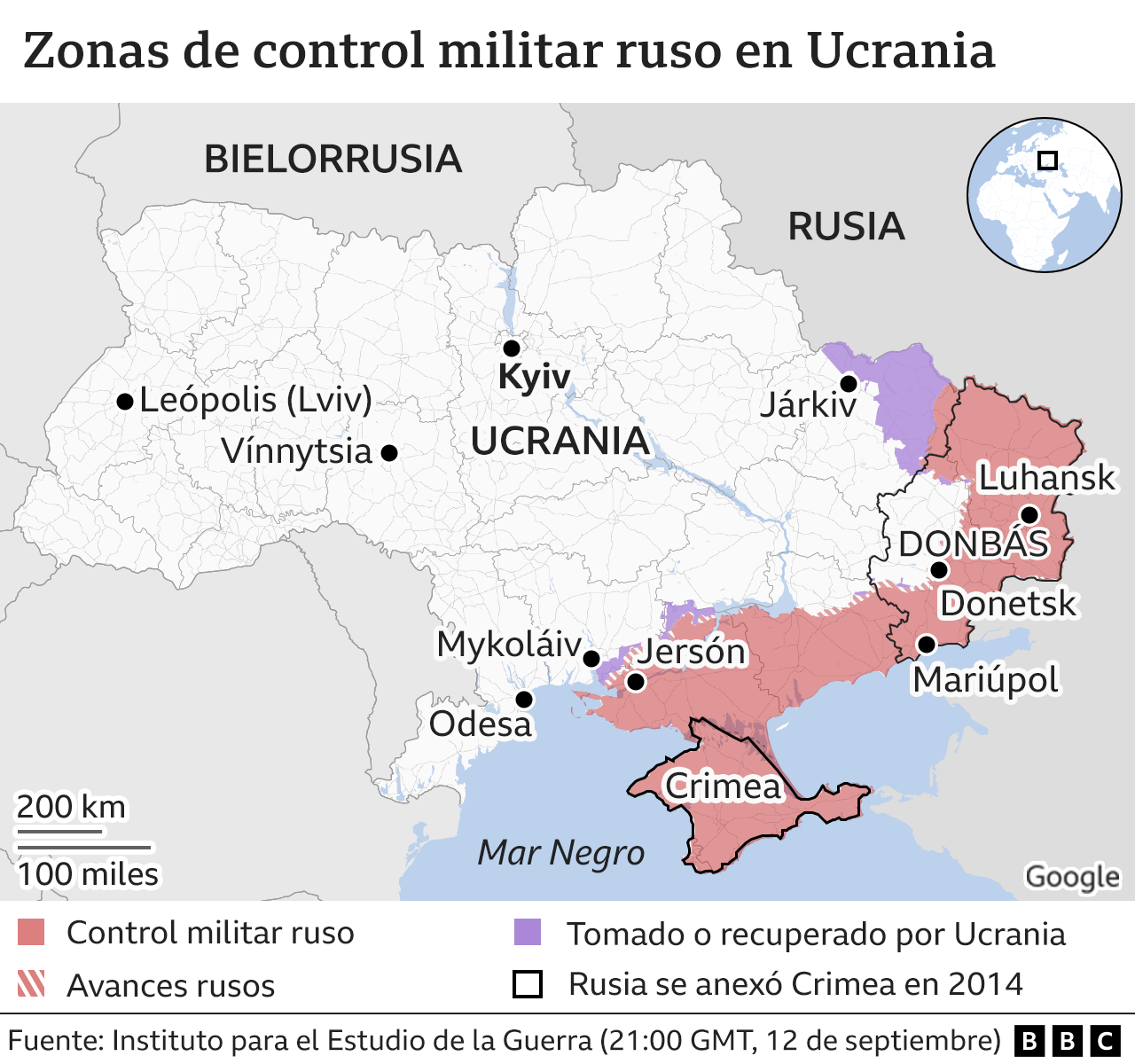
    According to the article, Ukraine ordered a huge amount of ammunition through this Arizona company—apparently merely an intermediary—that it never received: “10 million 23mm anti-aircraft shells, 56,000 Grad rockets, 24,000 mortar bombs, and a vast inventory of other Soviet-standard munitions.” To acquire Soviet-made ammunition, Ukraine turned to the United States, specifically to a company that, at the time, “was negotiating a contract for its nationwide arms inventory, its office having only a provisional sign and a few online reviews from local customers praising its ‘very reasonable’ prices.” According to the Financial Times , Contract PR-05 was signed in 2022 by OTL and Progress, a Ukrainian state-owned arms marketing company.
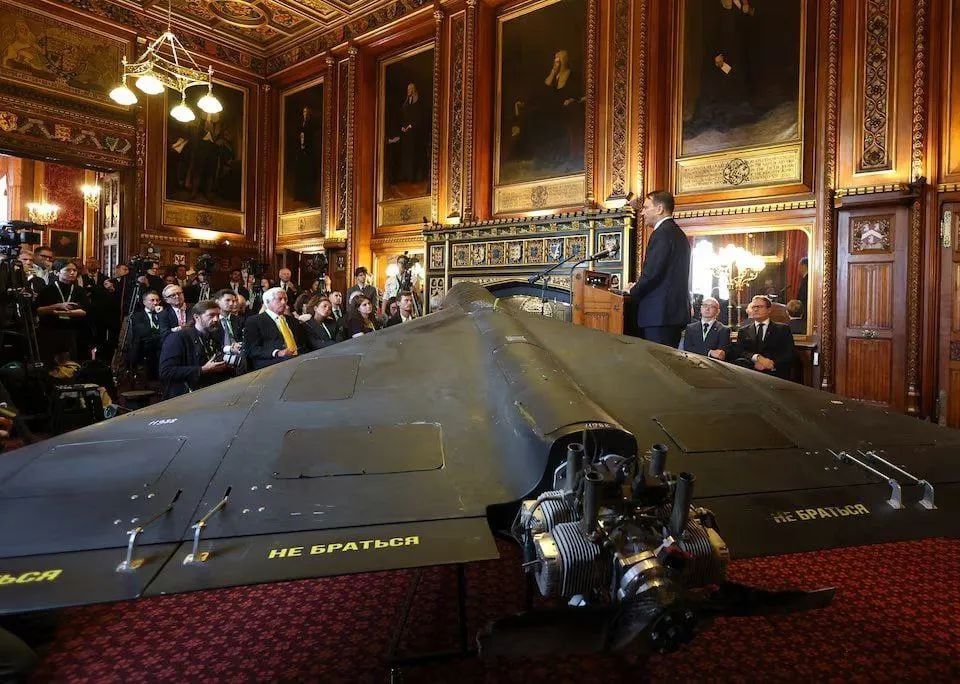
    Documents from the legal saga show that Tanner Cook, the 28-year-old who founded the company in 2020, contacted "Progress with an offer to supply ammunition from Serbia." As Russia's only ally in the Balkans, the mention of Serbia as the source of the weapons Ukraine was seeking to acquire is, in itself, a tremendously relevant detail. Since coming to power, Vucic has tried, not always successfully, to balance his ambition to advance EU membership with maintaining his historic friendship with Russia.

    “Just a month after the two parties introduced themselves, they signed the $1 billion contract. In November, Progress had transferred €17 million to OTL's bank account in Arizona. But in December, OTL wrote to Progress to apologize for not shipping any ammunition, blaming the delays on payments from Ukraine. Arbitration judges later rejected this explanation. OTL also cited difficulties in obtaining export licenses. In a letter, it stated that the delay was due to “problems related to export licenses in the country of origin of our products.” Serbia, one of only two European states not to have sanctioned Russia, has refused to directly arm Ukraine. OTL later claimed that Serbian authorities blocked the shipments for “political reasons,” explains the Financial Times , pointing to a difficulty—Serbia's unwillingness at the time to send arms to Ukraine—that all parties involved should have recognized from the outset. The company did not even have an arms export license.

    But perhaps the most striking aspect of the case is the fact that, in the deal, Progress, the Ukrainian company, was represented by Mykola Karanko, a Kyiv lawyer whom OTL later claimed was actually working for the Ministry of Defense, a credible accusation considering the number of corruption scandals that have occurred throughout the war. The centralization of decision-making in Ukraine since the Russian invasion is a fact, as is the justification for any action provided it is in favor of the war. According to the ruling, Karanko "asked OTL to make payments to unnamed third parties to keep the contract active." Corruption is never far from arms sales deals. Sometimes, the names and the actions are recurrent. “Karanko had previously helped negotiate an arms deal with Iraq that ended in a civil case in Texas in 2009, in which he was accused of interfering in an arms deal by attempting to pay bribes to Iraqi officials. Karanko and his co-defendant were found guilty and ordered to pay multimillion-dollar damages,” explains the Financial Times , without giving special importance to the fact that Ukraine counts on individuals previously convicted in questionable arms trade treaties as an integral part of its effort to obtain materiel with which to continue fighting Russia to the last Ukrainian.

    https://slavyangrad.es/2025/10/27/el-su ... -de-armas/

    Google Translator

    *****

    From Cassad's telegram account:

    Colonelcassad
    Regarding Japan's statements about its "desire to make peace with Russia."
    Japan could make peace with Russia tomorrow if it officially renounces its territorial claims against Russia and its hostile course toward our country.
    Since neither is expected in the foreseeable future, there will be no peace treaty with Japan. Japan will not receive a single island in the Kuril chain. That train has sailed. They should have grabbed it when that alcoholic Yeltsin offered two islands. But they wanted four.

    ***

    Colonelcassad
    Lavrov's key statements during talks with North Korean Foreign Minister Choi Son-hui:

    - Russia will never forget the heroic deeds of the DPRK military during the liberation of the Kursk region.

    - Relations between Russia and the DPRK have received a powerful boost over the past three and a half months in the development of agreements reached by the leaders of the two countries

    . - Lavrov emphasized the importance of the bilateral interparliamentary commission for Russia and the DPRK.

    - The Minister reiterated his gratitude to Kim Jong-un for the attention given to Medvedev and his delegation at the celebration of the 80th anniversary of the Workers' Party of Korea

    . - Lavrov confirmed his participation in the security conference in Minsk.

    ***

    Ukrainian intelligence agencies are using a mass email campaign to infect the computers of Russians involved in the Russian military-industrial complex (MIC).

    The attack is based on social engineering and preys on the recipient's inattention— an infected archive containing files is attached to the email , which the recipient is prompted to download under various pretexts.

    The image shows an example of one such email, developed by the Kyiv regime. Here are its main characteristics :

    1. A lack of specificity and extremely general terms : "product," "technical specifications," "testing," and so on. This generalizes the target audience to include specialists involved in the development of any military-industrial complex systems.

    2. Information about the sender is extremely vague . Specific individuals, positions, or organizations are not specified. Common and unremarkable first and last names are used.

    3. The recipient is given the impression of "missing information" —as if they should have known about something but forgot or missed previous messages. For example, "Re" tags are inserted into the header to suggest that this is the sender's reply to the recipient's previous message.

    4. Attempts to create context : the email may contain fragments of other correspondence, links to "customers," or other third parties.

    5. The attached archive with infected files is password-protected . This is done to prevent the built-in email antivirus from scanning the email's contents. The password can be extremely simple—a couple of characters—which offers no real protection against hacking. However, this is still enough to bypass standard antivirus scanning.

    6. Errors in the text : stylistic, punctuation, and spelling errors are common.

    7. Errors in formatting and encoding . The presence of "technical" symbols in the text indicates that the message was not written "naturally" in an email client, but was prepared in advance and then pasted into the email program, and the resulting reformatting errors were not noticed by the sender.

    Be careful and never download suspicious files from unknown senders!

    @warfakes

    ***

    Colonelcassad
    2:48
    Gladkov on the situation in the Belgorod region

    Yesterday was a difficult day for the entire Belgorod region. The enemy launched multi-hour attacks on Belgorod, the Belgorod district, the Shebekinsky district, and the Graivoron district. One person was killed in the Rakityansky district. I would like to once again express my sincere condolences to all the families and friends. Twenty-three civilians were wounded, including—and this is the most serious—three children. Two boys are in serious condition, having sustained serious injuries in Maslova Pristan. They have undergone surgery. One of them is already being transferred to a federal center, and the other is undergoing stabilization following surgery. We have all the necessary medical care at our disposal.

    Regarding the Belgorod Reservoir, the situation is stable. However, the threat of further shelling remains a danger. Therefore, dear residents of nearby villages, two door-to-door visits have already been made. Please listen to the information and act according to the recommendations of local authorities. Please be very, very careful.

    I wanted to make an announcement for all parents today. Starting today, school holidays begin. While this is a joyful time for children, given the hours-long attacks by enemy drones, every adult and every parent is naturally worried about their children's whereabouts. Therefore, I wanted to ask you, dear parents, to once again discuss with your children the rules of conduct during a missile or drone attack. And to you, dear children, be careful. Each of you has a phone in your pocket. Therefore, you should be subscribed to the channel that informs about drone attacks, and you already know what to do. You need to hide in a secluded place close to you and not leave until the danger has passed. Please remember that children are the most precious thing we adults have. And you must pay attention to what your parents and teachers tell you. I am confident that you will strictly follow the instructions you received at school and from your parents.


    ***

    Colonelcassad
    Air defense systems intercepted and destroyed 193 Ukrainian aircraft-type unmanned aerial vehicles.
    Of these, 34 UAVs were flying toward Moscow.

    https://t.me/s/boris_rozhin

    Google Translator

    *****

    Brief Frontline Report – October 26th, 2025

    The report of General Gerasimov. Illustrations by Mikhail Popov.
    Zinderneuf
    Oct 26, 2025

    From the report of the Chief of the General Staff of the Armed Forces of the Russian Federation, Army General V.V. Gerasimov:

    "First – this is the area of responsibility of the 'Center' Group. Units and military formations of the 2nd and 51st armies, advancing along converging directions, completed the encirclement of the enemy in the area of Krasnoarmeysk (Pokrovsk) and Dimitrov (Mirnograd). A large grouping of the Armed Forces of Ukraine consisting of 31 battalions, including units of the 25th Airborne, 79th Air Assault, and 68th Jaeger brigades, as well as the 35th and 38th Marine Brigades, the 425th Separate Assault Regiment, and the 153rd and 155th Mechanized Brigades, has been blocked.

    Image

    During the execution of combat missions, the servicemen of the 30th Separate Motorized Rifle Brigade and the 439th Motorized Rifle Regiment of the 2nd Army, as well as the 9th and 110th Separate Motorized Rifle Brigades of the 51st Army and personnel of the Rubicon Unmanned Technologies Center units, distinguished themselves the most.

    The successful conduct of the operation to encircle the enemy was facilitated by delivering comprehensive fire damage to the formations of the Armed Forces of Ukraine throughout the depth of their operational deployment, as well as isolating the combat area to disrupt the uninterrupted supply of enemy units.

    Second. In the direction of the 'West' Group, the city of Kupyansk is encircled. Working in unison, assault detachments of the 68th Motorized Rifle Division of the 6th Army, having made a flanking maneuver, seized enemy crossings over the Oskol River south of the city and, in cooperation with the 47th Motorized Rifle Division and the 27th Motorized Rifle Brigade of the 1st Tank Army, blocked the Ukrainian Armed Forces grouping on the left bank east of Kupyansk. Encircled are units of the 14th, 43rd, and 116th Mechanized Brigades of the enemy, as well as the 1st Brigade of the National Guard of Ukraine – a total of 18 combat battalions."

    Image
    ЛБС 10.11.24=Line of Combat Contact November 10th, 2024. ЛБС 01.02.25=Line of Combat Contact February 1st, 2025.

    https://maratkhairullin.substack.com/p/ ... tober-26th

    *****

    Ben Aris: Young Ukrainians asylum seekers fleeing the war for Germany surges
    October 26, 2025
    By Ben Aris, Intellinews, 10/16/25

    The number of young Ukrainians fleeing the war and seeking asylum in Germany has surged, following Kyiv’s decision to partially lift its travel ban for men aged 18 to 22, according to figures from the German Interior Ministry, reported by Die Welt.

    Ukrainian asylum applications in Germany have ballooned tenfold, from around 100 per week before the policy change to approximately 1,000 per week in recent months, according to local data.

    The regulation, which Kyiv implemented earlier this year, allows men under 22 who were already abroad or studying abroad to extend their stay or travel more freely — a move officials framed as a minor adjustment aimed at mitigating growing criticism of Bankova’s increasingly aggressive conscription tactics.

    Ukrainian politicians have denied that the change has prompted a large-scale departure of draft-age men. However, the German data suggests otherwise.

    The sharp increase in asylum applications, overwhelmingly from young men, has raised concerns in both Berlin and Brussels about the potential impact on Ukraine’s mobilisation efforts and broader EU migration policy, which could give Russia the edge on numbers.

    Ukraine introduced a blanket travel ban for men aged 18 to 60 shortly after Russia’s full-scale invasion in February 2022, in an effort to maintain sufficient manpower for its armed forces. Exceptions have since been made for humanitarian, educational and professional reasons, but Kyiv has faced growing pressure over the social and political implications of conscription.

    The Interior Ministry did not provide a detailed age breakdown of the new asylum seekers but confirmed to Die Welt that most are young and male, consistent with Ukraine’s revised policy.

    Ukrainian authorities have defended the decision, arguing it affects a relatively small group and does not undermine military readiness. “There is no mass exodus,” senior officials have said, insisting that enlistment and mobilisation measures remain in place.

    Still, the sharp increase in asylum claims in Germany — which already hosts over 1.1mn Ukrainian refugees — may complicate EU coordination on migration policy and military assistance. With Ukraine preparing for a third year of full-scale war, Western governments are watching closely for any signs of mobilisation fatigue or domestic instability.

    German officials have not indicated plans to alter their asylum policy in response but have acknowledged the numbers are “notable and being monitored.” The development comes as EU capitals continue to debate burden-sharing mechanisms and support packages for Ukraine in 2025.

    Desertions swell

    The exodus of young men, thanks to the easing of travel restrictions, comes on top of reports of the number of desertions from the Armed Forces of Ukraine (AFU) swelling.

    Over the past year, twice as many military personnel have left their units without authorisation in Ukraine as during the first two and a half years of the conflict, according to the Ukrainian publication Strana, citing the Prosecutor General’s Office.

    According to the agency, a total of nearly 290,000 criminal cases for unauthorized abandonment and desertion were opened during the conflict. Between January 2022 and September 2024, 90,000 cases were opened, and another 200,000 in the last year. Experts says that the true number of those who went AWOL is almost certainly significantly higher than the official figures.

    In August, Ukrainska Pravda, citing the Prosecutor General’s Office, reported that 110,511 cases of unauthorised absence from service in the Ukrainian army had been registered since the beginning of 2025 – more than all the cases brought in the previous three years of the conflict with Russia combined.

    The lack of manpower and falling number of fresh recruits is having a catastrophic effect on the AFU’s ability to defend the frontline in Donbas, where kilometre-long unmanned holes are opening up, Ukrainska Pravda reported earlier this month.

    https://natyliesbaldwin.com/2025/10/ben ... ny-surges/

    Kyle Anzalone: NATO Looking for More ‘Flexible’ Rules of Engagement with Russia
    October 25, 2025
    By Kyle Anzalone, The Libertarian Institute, 10/14/25

    The North Atlantic Treaty Organization is considering easing its rules on the use of force against Russia. Russia is accused of violating Estonian, Polish, and Romanian airspace in September.

    Sky TG24, an Italian news outlet, said NATO leaders are seeking “more flexibility” in engaging Russia on the bloc’s Eastern flank. “NATO Commander-in-Chief, US General Alexus Grynkewich, has asked allies for ‘more flexibility’ in the rules of engagement to better manage the defense of the eastern flank,” the report explains. “Especially in light of the launch of Operation Sentry East, which is seen as a ‘test bed’ for the development of an integrated air defense operation.”

    Some members of NATO are seeking to ease or remove “national limitations” that countries impose on the military equipment under NATO command.

    The discussions follow Russian alleged violations of NATO airspace last month. Tallinn claimed three Russian jets flew just inside Estonian airspace over the Gulf of Finland. NATO says the jets remained in Estonian territory for about 12 minutes, and the bloc scrambled F-35s operated by Italy to escort the Russian warplanes.

    The Kremlin denied the accusations.

    In a separate incident, about two dozen Russian decoy drones entered Polish airspace. The bloc scrambled multiple fighter jets and shot down some of the UAVs. The operation cost the bloc about half a billion dollars.

    Russia has denied that it targeted Poland, and Belarus claimed that the drones flew into Polish airspace after they were impacted by Ukrainian electronic interference.

    In a third event, a Russian drone entered Romanian airspace before turning around and striking Ukraine.

    Trump and NATO Secretary General Mark Rutte have called for shooting down Russian aircraft in allied airspace.

    https://natyliesbaldwin.com/2025/10/kyl ... th-russia/

    ******

    Machines of the Apocalypse
    October 26, 12:55

    Image

    When a nuclear war has not yet begun, but the technology for a post-apocalyptic war has already been built.

    Image

    Image

    https://colonelcassad.livejournal.com/10150733.html

    The Agony of the Krasnoarmeyskaya Agglomeration. October 26, 2025
    October 26, 4:51 PM

    Image

    Regarding the Russian General Staff's claims of blocking/encircling part of the Krasnoarmeysk group in the Krasnoarmeysk agglomeration, enemy forces categorically deny the existence of a full-fledged encirclement, but they equally categorically acknowledge the advance of Russian troops in Krasnoarmeysk itself and in Rodinskoye. Consequently, the two main roads out of the agglomeration have long been unusable for full-fledged logistics, and attempts to resupply through the bottleneck between Grishino and Rodinskoye are largely thwarted by Russian drones, which destroy the equipment used to provide supplies and at least some supply of personnel.

    Clearly, the rare vehicles that manage to break through (the roads to the west and northwest of the Krasnoarmeysk agglomeration are likely to be seen more than once), and the supply routes provided by heavy drones or ground robots, cannot fully support normal logistics along normal roads. Supply problems are a classic sign of operational encirclement, which the enemy will naturally deny, just as they denied similar situations before the fall of Vuhledar, Selidovo, and Sudzha. The latter is particularly telling, as it was the drying up of supplies after our drone operators took control of the Sudzha-Yunakovka highway that largely predetermined (along with Operation Pipe and other active operations) the Ukrainian Armed Forces' disaster in the southern districts of the Kursk region.

    Image

    As is readily apparent, by the end of October, the enemy had lost all the main roads leading into the agglomerations. Meanwhile, the Donbas is currently experiencing muddy conditions, and equipment in the fields is getting bogged down in the mud.

    Regarding the number of potentially encircled units, it's worth remembering that as recently as September 2025, the average strength of Ukrainian Armed Forces brigades in the Krasnoarmeyskaya agglomeration barely exceeded 40% of their authorized strength. By October, many of the declared 31 battalions were reduced to scraps. Therefore, a huge number of prisoners is not expected there – a significant portion of their personnel are already in the ground, waiting to be loaded into refrigerated trucks and transferred back to Ukraine at the Belarusian border after the agglomeration is liberated.

    However, overconfidence should be avoided – in the remaining time before the agglomeration is fully liberated, the enemy will seek to prolong its agony in order to gain time to strengthen the defense of Dobropillya while the agglomeration ties down significant Russian forces. The enemy is quite willing to trade part of its group for the duration of

    the Easy Walk. But even so, Krasnoarmeysk and Dimitrov will be liberated, and then it will be Dobropillya's turn.

    P.S. In the photo, fighters from the "Storm" detachment of the 9th Motorized Rifle Brigade of the 51st Army in the center of Rodinskoye.

    https://colonelcassad.livejournal.com/10151379.html

    Monument to Motorola in Ukhta
    October 26, 7:04 PM

    Image

    A monument to "Motorola" was unveiled in Ukhta (Komi Republic). Arsan Pavlov was born here.
    Having arrived in Donbas as a simple sergeant in 2014, as part of Strelkov's group, he became one of the most prominent leaders of the first wave of the people's militia.

    The 2014-2015 war brought him fame not only in Donbas but throughout Russia. The posthumous glorification of "Motorola" only cemented his popularity, and he will certainly not be forgotten, disappearing into the future of the Russian Donbas he helped shape.

    https://colonelcassad.livejournal.com/10151631.html

    Offensive at the junction of the Zaporizhzhia and Dnipropetrovsk regions. October 27, 2025.

    October 27, 1:05 PM

    Image

    On October 27, 2025, troops of the Russian Armed Forces' Vostok group liberated three settlements in the Zaporizhzhia and Dnipropetrovsk regions:
    Yehorivka in the Dnipropetrovsk region, and Privolne and Novomykolaivka in the Zaporizhzhia region.

    (Video at link.)

    The Russian offensive continues. Next up is an advance across the Yanchur River, with the option of further advancing toward the Hulyaipole highway. By advancing a few more kilometers west, Russian forces will be able to take control of the highway using drones. After this, the main logistics of the entire Ukrainian Armed Forces group in Hulyaipole will be cut off, and preparations for operations aimed at encircling Hulyaipole can begin.

    https://colonelcassad.livejournal.com/10152550.html

    Google Translator

    *****

    The successes of the Armed Forces of the Russian Federation at Konstantinovka
    October 26, 2025
    Rybar

    Image

    "The ongoing cleanup of pockets on the approaches to Konstantinovka"

    The situation in the Konstantinovka area continues to develop in favor of Russian forces. Attack aircraft are methodically clearing strongholds and expanding their zone of control around the Konstantinovka agglomeration .

    Where are the battles taking place?
    In the area of ​​the Oskovo tract, the enemy has been completely driven from the banks of the Seversky Donets-Donbas Canal , where it had held positions for a long time. Assault groups are entering from two sides, blocking the Ukrainian units; the only escape route is through open fields.

    Fighting continues in the vicinity of Predtechino and Stupochki , and on the southeastern outskirts of Konstantinovka , a vast “gray zone” remains, where neither Russian troops nor the enemy have full control.

    Further south, pockets on the approaches to Ivanopol are also being cleared . Russian units are surrounding the St. Matrona of Moscow mine . Despite multiple attacks, enemy units remain trapped there.

    The flank west of the Kleban-Byk Reservoir remains relatively stable. The southern shore of the reservoir also remains under the control of a small number of Ukrainian infantry units, supplied by boats.

    The number of air and artillery strikes against Ukrainian Armed Forces positions in Kostiantynivka is increasing. Even the enemy's resources indicate a rapidly deteriorating situation. This is happening against the backdrop of a highly active Russian offensive in the neighboring Pokrovsk-Myrnohrad and Seversky directions . The enemy's operational crisis is deepening.

    If stabilizing the front in one place during the breakthrough to the Golden Well required the withdrawal of reserves from other areas, then a front that is simultaneously bending in three adjacent directions will require the enemy to exert significantly more force.

    https://rybar.ru/uspehi-vsrf-u-konstantinovki/

    What's happening in the Pokrovsk-Mirnograd direction?
    October 26, 2025
    Rybar

    Image

    "Enemy counterattacks and premature reports of encirclement"

    Despite the very loud statements about the encirclement of enemy forces in Pokrovsk and Mirnograd , the situation in the direction of the same name remains extremely difficult.

    Over the past few days, Ukrainian forces have launched a series of counterattacks on the northern flank, where a penetration was located towards Zolotoy Kolodets and Kucherov Yar .

    What is the situation on the northern flank?
    Enemy units were able to approach several settlements relatively stealthily and engage in fighting in Sukhetske , as well as in the dachas northeast of Novoye Shakhovo . Whether the enemy has managed to consolidate its position there remains unclear, but the enemy is attempting to seize the initiative in this area.

    Meanwhile, on the eastern flank of the penetration, evidence of the presence of Russian troops has emerged in the center of Shakhovo . Mechanized assaults by Russian units are known to have been carried out.

    Apparently, small groups of Russian attack aircraft are already operating throughout the entire village. Further east, near Rusin Yar , at least two adjacent forest belts have come under Russian control.

    The main news today was Chief of General Staff Gerasimov's announcement that enemy troop groups in Pokrovsk and Mirnohrad had been encircled . However, this is more tactical than physical. The fact is that while the converging flanks of the Russian units are less than 10 kilometers apart, there's no talk of physically cutting off supply lines.

    Several country roads, along which Ukrainian formations can currently conduct rotations, are under fire control by drones and other weapons.

    Several sources report that Ukrainian Armed Forces units have rotated units in both cities, pulling elite assault units out of the collapsing cauldron and replacing them with newly mobilized territorial defense units. The Ukrainian Armed Forces have performed similar actions repeatedly, but this doesn't mean the assault will be a cakewalk.

    Moreover, the enemy, having launched an offensive north of Rodinskoye , is apparently attempting, if not to cut off the northern "pincer," then at least to slow the pace of the Russian Armed Forces' advance. The situation north of the Rodinskoye-Razino-Novotroetskoye line will remain dynamic for the foreseeable future.

    https://rybar.ru/chto-proishodit-na-pok ... pravlenii/

    Google Translator
    "There is great chaos under heaven; the situation is excellent."

    Post Reply