Nepal

The fightback
Post Reply
User avatar
blindpig
Posts: 14788
Joined: Fri Jul 14, 2017 5:44 pm
Location: Turtle Island
Contact:

Nepal

Post by blindpig » Thu Sep 11, 2025 2:56 pm

Five theses on the situation in Nepal

Following the resignation of Nepali Prime Minister KP Oli amid mass youth-driven protests, different narratives have circulated which simplify and misrepresent the complexities and reality on the ground in Nepal at the roots of this crisis.

September 11, 2025 by Vijay Prashad, Atul Chandra
Image
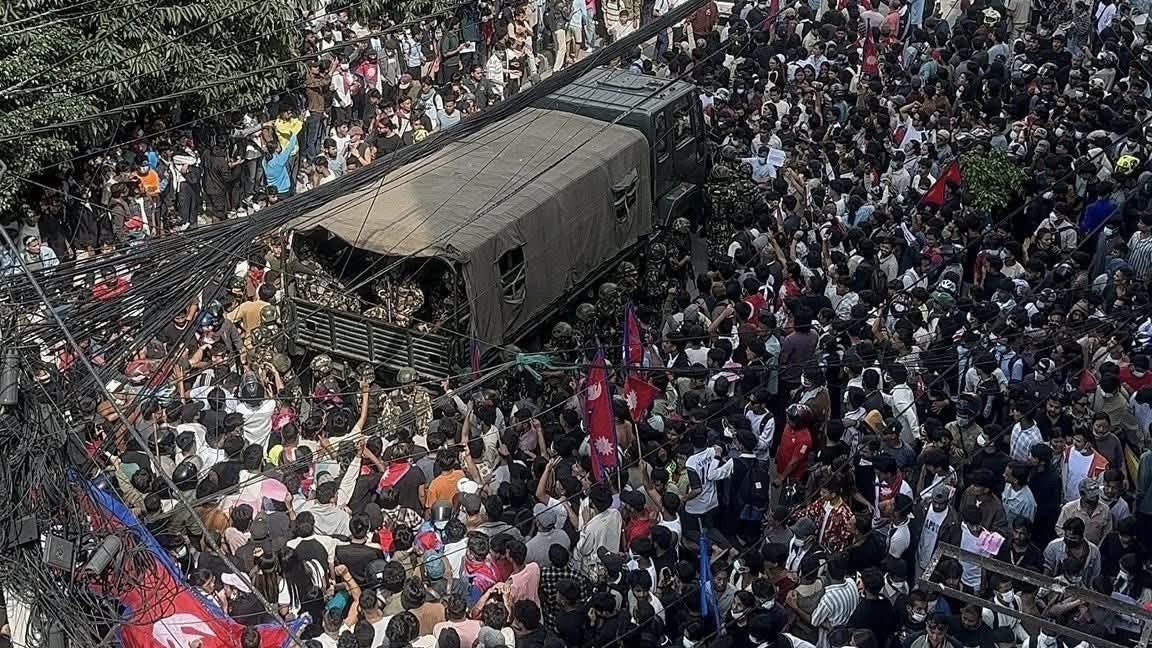
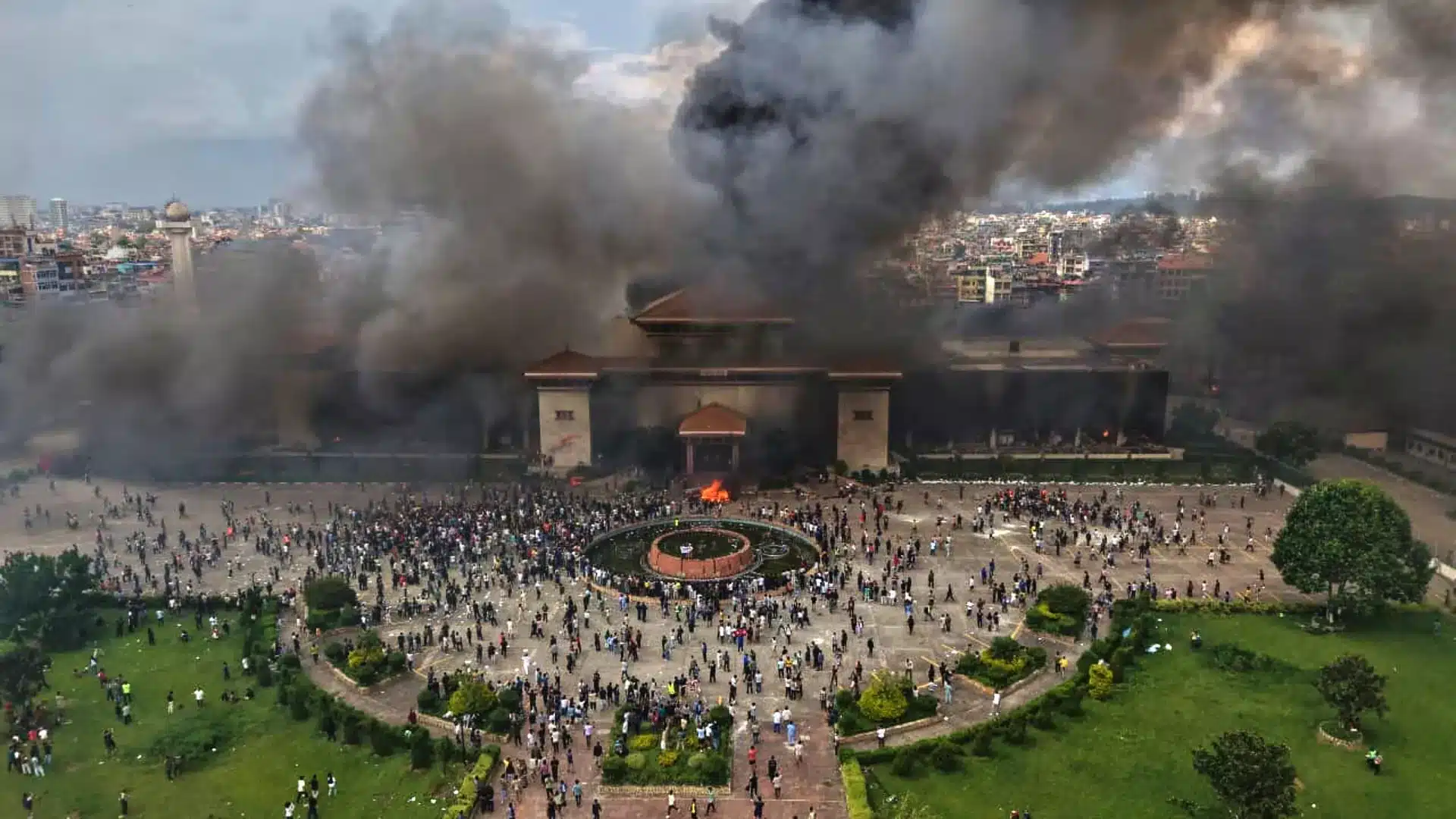
Scene from the protests in Kathmandu, Nepal in September 2025. Photo via Facebook

If your house is not clean, then the ants will come through the door and draw in the snakes.

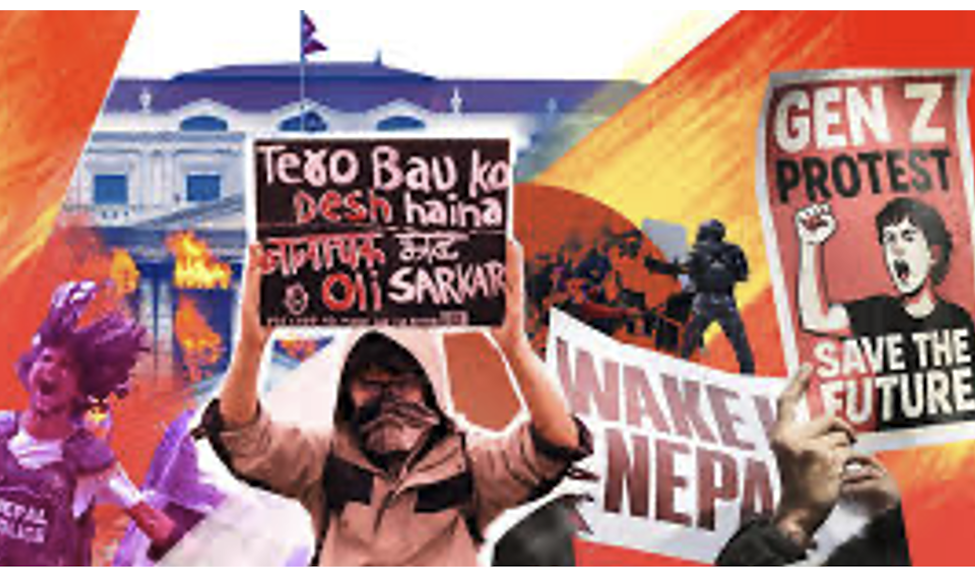
The crisis in Nepal escalated in early September, bringing down the center-right government of Prime Minister KP Oli. The immediate spur was the regulation and banning of social media on September 4. Protests over this action were met by police firing, which resulted in the killing of 19 protestors. This escalated into major manifestations, leading to attacks on the homes of politicians and the national parliament building as well as the presidential building.

Several narratives are circulating about the current upheaval, but two dominate:

1.Systemic governance failure: That years of unmet promises, corruption, and opportunistic alliances produced a legitimacy crisis not for this or that party, but for the establishment. The present upsurge is explained as a popular backlash due to the cumulative neglect.
2.Color Revolution thesis: That the protests are engineered by an external force, most of the fingers pointing at the United States and at the US Congress’ National Endowment for Democracy’s funding towards Hami Nepal (established in 2015).

Both theories make it easy for the stakeholders within Nepal to deflect responsibility – either onto foreign meddlers or onto a vague idea of the “political class”. There is no discussion in these theories of the underlying bourgeois order and its problems in Nepal: a century-long patronage economy, the control of land, finance, and government contracts in the hand of an oligopoly with close ties to the monarchy, and a growth paradigm depending on the export of migrant workers and of debt-financed infrastructural development. The structural sources of peoples’ grievances are flattened into simplistic, but evocative concepts such as “corruption” and “color revolution”.

Neither of these theories are totally incorrect or correct but are only partial and their partiality can be very misleading. This article cannot by itself correct that partiality, but it hopes to offer some ideas for discussion. The five theses below are intended only to frame the debate that we hope will be held not only over Nepal’s predicament, but that of many countries in the Global South.

1. Mismanagement of the opportunity. After the new Constitution was enacted in Nepal in 2015, there was immense hope that the broad left would be able to advance the social situation of Nepalis. Therefore, in 2017, the various communist parties won 75% of the seats in the national parliament. The following year, the larger communist parties joined together to form the Nepal Communist Party – although the unity was not very deep because the parties had their own structures and their own programs and could not truly form a unified party, but mainly a unified electoral bloc. The lack of a common program for communist political activity, and a common agenda to solve the people’s problems through the instrument of the State led to the dissipation of the opportunity provided to the left.

The unified party split in 2021, and since then the various left parties rotated in power, which people saw as individualism and opportunism. When the Home Minister Narayan Kaji Shrestha (2023-2024) of the Maoist Center tried to use the instruments of the state to investigate corrupt practices – even in his own party – he was hounded out of office. Since 2024, the government in Nepal included a rightist fraction of the left (led by K. P. Oli) and the one fraction of the right (the Nepali Congress), which made it a center-right government. The long fight for democracy that began with the 1951 Revolution, deepened with the 1990 Jana Andolan, and then appeared to be cemented with the 2006 Loktantra Andolan only appears to be defeated, when in fact that long struggle will reappear in another form.

2. Failure to tackle the basic problems of the people. The problems in Nepal in 2015, when the new Constitution was adopted, were grave. A massive earthquake in Gorkha devastated the province, leaving over 10,000 people dead and rendering hundreds of thousands homeless. At least a quarter of Nepalis lived under the poverty line. Caste and ethnic discrimination created a great sense of despair. The Madhesh region along the Nepal-India border was particularly angered by the sense of disadvantages and then by an analysis of being further marginalized by the 2015 Constitution. Weak public healthcare and education – underfunded for a century – could not meet the aspirations of the emerging middle class.

The left governments did put forward various policies to address some of these issues, lifting large sections of the population from poverty (child poverty went from 36% in 2015 to 15% in 2025) and from infrastructural abandonment (electricity access now at 99% and a registered improvement in the Human Development Index).

There remains, however, a huge gap between the expectations and the reality, with inequality rates not dropping fast enough and migration at startlingly high levels. Corruption levels also remained too high in the country as corruption perceptions deteriorated (ranked 107/180 in 2024). Corruption, inequality, and inflation could not be contained by the government, which made very poor deals for trade and for finance (the return to the IMF’s Extended Credit Facility narrowed its fiscal possibilities).

3. The tendency to seek refuge in the idea of the Hindu Monarchy. The Nepali petty bourgeoisie, which sent their children to English medium schools, and often come from oppressed or “backward” Hindu castes are frustrated by the continual domination of upper castes and are inspired by the right-wing Hindutva petty bourgeoisie politics of India’s Uttar Pradesh, one of the states that borders Nepal. That is why there were many posters in the protests of Yogi Adityanath, a leader of India’s right-wing Bharatiya Janata Party (BJP) and the leader of the Uttar Pradesh government. This fraction of the population is also in the mood to “return” to monarchy, which is a Hindu monarchy. Several political forces back these tendencies, such as the pro-monarchy party (Rashtriya Prajatantra Party or RPP) and its broader allies (Joint Peoples’ Movement Committee – formed in March 2025 as part of the return to monarchy protests, Shiv Sena Nepal, Vishwa Hindu Mahasabha).

Since the 1990s, the Hindu Swayamsevak Sangh (HSS), the Indian RSS’s international affiliate, has quietly built shakhas (groups) and cadre since the 1990s. The HSS – along with a tentacular group of organizations such as the Shiv Sena and the RPP – has campaigned against secular policies and for a return to Hindu Raj. Rather than merely target secularism, the Hindutva bloc has focused attention on what it says is a revolving door of elites in Kathmandu that has held power ever since the monarchy was abolished in 2008. They frame their civilizational rhetoric around anti-corruption and charity, with mobilizations through Hindu festivals and through online influencers as well as selective outreach to marginalized and oppressed castes in the name of Hindu unity. This bloc, powerfully organized unlike the youth, has the capacity to seize power and to restore order in the name of the Hindu state and the monarchy, bringing back authoritarianism in the name of anti-corruption.

4. Tired of the Migration Escape Valve. If we ignore small countries such as Montserrat and Saint Kitts and Nevis, Nepal is the country with the highest per capita rate of migration for work. With a population of 31 million there are currently 534,500 Nepalis (recorded) who work overseas – 17.2 people per 1,000 Nepalis. The numbers have surged in recent years. In 2000, the recorded figure for Nepalis who obtained foreign employment permits was 55,000, now it is ten times higher. There was a new record in 2022-23 with 771,327 permits issued).

Large sections of youth are angry that they have not been able to meet their needs for employment within Nepal but are forced to migrate and often to horrible jobs. A terrible incident in February 2025 took place in Yeongam (South Korea), when a 28-year-old migrant, Tulsi Pun Magar, likely committed suicide because the employer at the pig farm where he worked kept revising the wage rate downwards. Tulsi came from the Gurkha community in Pokhara. In the wake of his suicide, reports came that 85 Nepalis have died in South Korea in the past five years, half of them by suicide. News of stories such as these increased the frustration and anger at the government. Online, many shared the sentiment that the government was more considerate of foreign direct investors than of its own migrants, whose investment in Nepal through remittances is far higher than any foreign capital.

5. The external influences of the United States and India. The center-right government of KP Oli had been close to the United States. Nepal had joined the US government’s Millennium Challenge Corporation (MCC) in February 2017, a decision by a left government that was hugely contested by large sections of the left. Due to the pressure from below, Nepal’s government stayed away from the MCC, but Oli’s center-right government welcomed John Wingle (Deputy Vice President of the MCC) to Kathmandu in August 2025 to hold talks about resumption of US aid and to discuss the continuation of infrastructural projects. Meanwhile, India’s far-right government of Narendra Modi sought to promote the role of the Hindu nationalist far right party in Nepal, which has thus far been at the margins. If there was any external activity in the 2025 protests, it is more likely that India, and not the US, had a hand in the events. However, even here, it is possible that the far-right wing in Nepal will merely take advantage of the collapse of the Oli government and the enormous sentiment against corruption.

It is important to recognize that no home or office of the RPP was attacked, whereas in March the RPP cadre attacked one communist office – a foreshadowing of what happened in September.

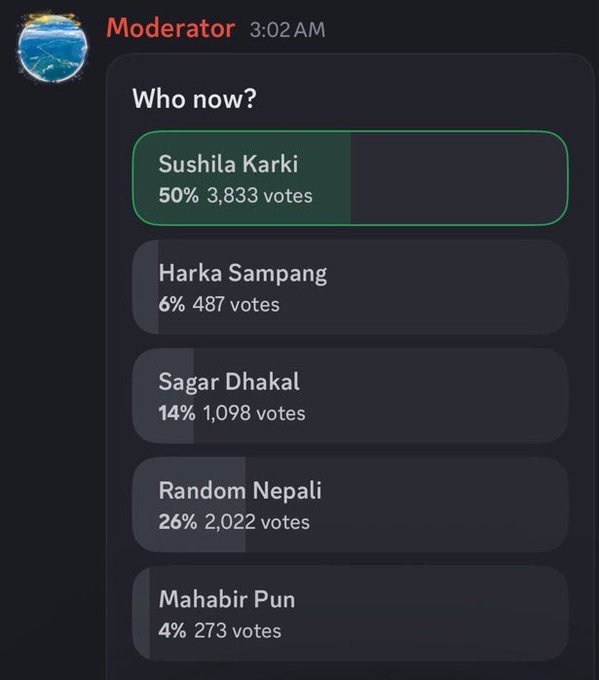
The army appears to have restored some calm in Nepal. But this is a calm that is one of disorder and danger. What comes next is to be seen. It will take time for the dust to settle. Will the army invite one of the online celebrities to take over such as Kathmandu mayor Balendra Shah? The protestors have suggested Sushila Karki, who is a highly respected former Chief Justice of Nepal (2016-2017), who has made a career of being independent of political parties. These are caretaker choices. They will not have the mandate to make any significant changes. They will pretend to be above politics, but that will only disillusion people with democracy and plunge the country into a long-term crisis. A new Prime Minister will not solve Nepal’s problems.

https://peoplesdispatch.org/2025/09/11/ ... -in-nepal/
"There is great chaos under heaven; the situation is excellent."

User avatar
blindpig
Posts: 14788
Joined: Fri Jul 14, 2017 5:44 pm
Location: Turtle Island
Contact:

Re: Nepal

Post by blindpig » Wed Sep 17, 2025 2:21 pm

Nepali Communist Party Chief Says Will ‘Rise Again’ After Losing Power
September 16, 2025

Image
Protesters celebrate at the Singha Durbar, the seat of Nepal's government various ministries and offices after it was set on fire during a protest against special media ban and corruption in Kathmandu, Nepal, Tuesday, Sept. 9, 2025. Photo: Prakash Tiimalsina/AP.

Shankar Pokharel, general secretary of Nepal’s Communist Party (CPN-UML)), which led the now ousted government, said the party “will rise again” after it lost power amid mass protests and violent riots, the Khabarhub news website reported on Wednesday.

Pokharel shared a poem by famous Nepali poet Netralal Abhagi on social media. He ended the posting with a message: “Let us be patient, let us remain calm — we will rise again.”

According to Khabarhub, the Nepalese army has detained 27 people on suspiсion of looting, arson and violent attacks on civilians and property. The military also seized 31 firearms and related ammunition that were looted during Tuesday’s unrest. The army said that 23 police officers and three civilians injured in clashes were being treated in military hospitals.

On September 4, the Nepalese authorities banned a number of major social media sites that failed to register with the Ministry of Communications and Information Technology within the required deadline. The ban was lifted following protests on Monday.

The crisis escalated after protesters stormed the national parliament on Tuesday, prompting police to fire water cannons, tear gas and live ammunition toward the demonstrators. Dozens of protesters were reportedly killed and hundreds others injured. Prime Minister Sharma Oli resigned.

https://orinocotribune.com/nepali-commu ... ing-power/

Call me crazy or maybe a hypocrite but a media ban sounds like a good idea, considering that our enemies own it and are adroit at manipulating us through it.
"There is great chaos under heaven; the situation is excellent."

User avatar
blindpig
Posts: 14788
Joined: Fri Jul 14, 2017 5:44 pm
Location: Turtle Island
Contact:

Re: Nepal

Post by blindpig » Thu Nov 06, 2025 2:28 pm

Left groups in Nepal form united Communist Party

The merger may boost the left’s chances of revival in the country in the March elections, after the so-called Gen Z protests forced the left-liberal alliance to relent power in September of this year.

November 05, 2025 by Abdul Rahman

Image
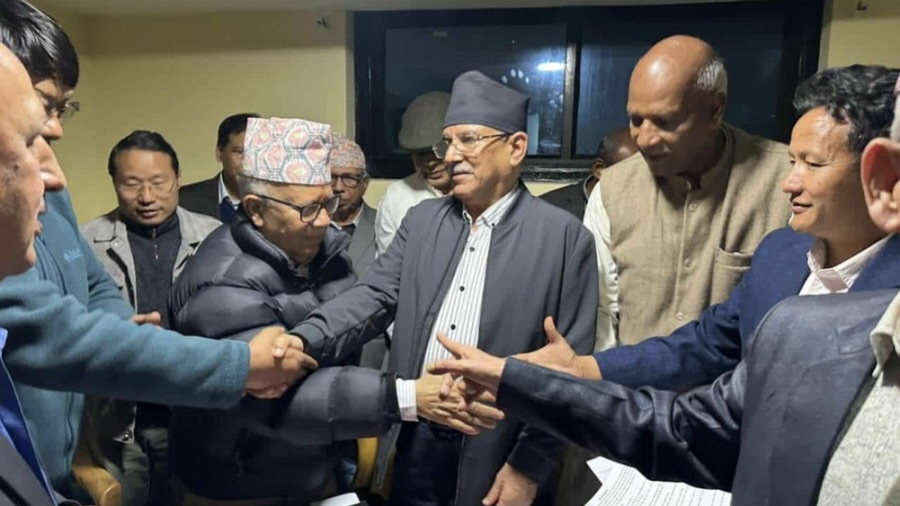
Members of different left groups in Nepal have come together to form the Nepali Communist Party. Photo: CPN

Nine left parties in Nepal decided to merge to form a new Nepali Communist Party (NCP) in Kathmandu on Tuesday, November 4. The new party revives hope in the left’s electoral presence in the upcoming national elections in March.

The parties who formally announced their merger are the Communist Party of Nepal (Maoist Center), led by former prime minister Pushpa Kamal Dahal “Prachanda”, Communist Party of Nepal (Unified Socialist) led by Madhav Kumar Nepal, CPN, Nepal Socialist Party, Janata Samajbadi Party Nepal, CPN (Maoist Socialist), CPN (Samyabadi), CPN (Communist) and CPN (Revolutionary Maoist).

The parties signed an 18-point agreement on Tuesday to form the NCP. The new party held its first national convention on Wednesday in which a new central committee was formed, a formal declaration was made and its principles were announced.

According to news reports, the party will follow Marxist-Leninist principles with a political program focusing on scientific socialism with “Nepali characteristics”. It will have a five-pointed star as its new election symbol.

Claiming that NCP’s objectives would be to achieve economic prosperity, good governance, and controlling corruption, CPN (Maoist Center) leader and former home and foreign minister of the country Narayan Kaji Shrestha said on Tuesday that it will attempt to anticipate and address the concerns of Gen Z.

The so-called Gen Z protests took place in September. In these protests, scores of people were killed and several national institutions (such as the parliament building) were torched. This forced the resignation of then prime minister K P Sharma Oli who was heading a coalition government made up of the Communist Party of Nepal-Unified Marxist Leninist (CPN-UML) and the Nepali Congress.

Analysts argued that the angry and violent protests by the country’s youth was a reflection of systemic failures of the successive governments, mostly led by the left since the downfall of the monarchy in 2000s, to address the issues of employment and corruption.

March elections
Nepal is currently ruled by a caretaker government under the leadership of former chief justice Sushila Karki. This caretaker government dissolved the parliament and decided to hold national elections on March 5 next year.

Maoist leader Narayan Kaji Shrestha, though, denied that the formation of a unified communist party was focused on March elections and claimed that it was a result of long drawn efforts which began before the protests in September which helped in expediting the process.

“While we were working to bring the changes in the nation, at the right time, this new political scenario developed, and now we are at a new juncture in time, making another historic move,” Shrestha was quoted saying by the media.

The NCP “will focus on protecting the gains of the people’s democratic revolution and laying the groundwork for socialism,” claimed the statement issued by it on Tuesday.

One of the biggest communist formations in the country, the CPN (UML) did not join the new formation on Tuesday.

CPN (UML) was part of an earlier attempt to create a united communist formation in the country. In 2018, it merged with CPN (Maoist Center) to form the Nepal Communist Party (NCP). The party did not last long and in 2021, while in government, a split happened and post split, both the CPN (Maoist Centre) and CPN (UML) resumed their pre-merger forms.

https://peoplesdispatch.org/2025/11/05/ ... ist-party/
"There is great chaos under heaven; the situation is excellent."

User avatar
blindpig
Posts: 14788
Joined: Fri Jul 14, 2017 5:44 pm
Location: Turtle Island
Contact:

Re: Nepal

Post by blindpig » Fri Nov 07, 2025 2:29 pm

The geopolitics of Nepal’s 2025 ‘Gen Z uprising’

The western NGO complex appears to have played a central role in coordinating protests that have been presented as ‘organic’.
Ella Rule

Saturday 1 November 2025

Image
It is hard not to be suspicious of a narrative that is sensationally packaged and promoted via social media platforms to western youngsters who have previously expressed no interest in political content.

Nepal has been shaken by its most dramatic political upheaval since the abolition of the monarchy in 2008. On 16 September, prime minister KP Sharma Oli resigned amid nationwide unrest that left at least 22 people dead, including 19 protesters killed in clashes with police earlier in the week.

It seems the immediate spark for the protests came on 4 September, when the Oli government announced the blocking of 26 social media platforms – including Facebook, Instagram and X (Twitter) – after the companies failed to register with Nepal’s ministry of communication and information technology. The authorities claimed this measure was necessary to ensure regulatory compliance and tax collection from the foreign tech giants.

Thousands of Nepalis – particularly from ‘Gen Z’ – poured onto the streets, denouncing what they saw as an assault on freedom of speech. Within days the ban was revoked, but the protests had already escalated, and anger over the social media ban fused with deeper frustrations over unemployment, corruption and elite privilege.

By Monday 8 September, protests had erupted across Kathmandu and spread to other major cities. Crowds set fire to the parliament, while government buildings and the homes of senior politicians were attacked nationwide. KP Oli’s own residence was torched.

Amid the chaos, nearly 900 prisoners escaped from two prisons in the west of Nepal, with over 7,000 escaping in total from prisons across the country, indicating a level of breakdown of state authority.

The armed forces were able to restore order by mid-September, and an interim government led by Sushila Karki, Nepal’s former chief justice and a well-known ‘anti-corruption campaigner’, has been sworn in. The Nepalese military and state forces have captured the majority of those escaped prisoners and have now returned them to serve their prison sentences.

Karki’s appointment was endorsed by online activist networks – most notably via an unprecedented public vote conducted on Discord, coordinated by a youth-led NGO called Hami Nepal. In her first address, Karki condemned both the corruption that fuelled the protests and the “malicious forces” that exploited them to destroy public offices, burn the supreme court, and release hardened criminals.

Nature of the Gen Z movement
The nature of the Gen Z uprising has been hotly debated. Journalist Kit Klarenberg noted that while the protests are “widely dubbed leaderless”, Hami Nepal – previously an obscure NGO – played a central organising role, using its Instagram and Discord channels to coordinate demonstrations and share guidelines. The group’s sudden prominence and eclectic roster of sponsors has raised eyebrows.

Klarenberg observed that Hami Nepal has received support from sources ranging from local conglomerates and clothing brands to international entities such as Coca-Cola, the Israeli-created messaging app Viber, and the British foreign office-funded Gurkha Welfare Trust. Even Students for a Free Tibet, a US-backed NGO financed through the National Endowment for Democracy (NED) – widely understood to be a CIA front – appears among its affiliates.

These connections have fuelled speculation that the Gen Z protests were not purely organic. Klarenberg has argued that the crisis originated with US tech monopolies that refused to comply with Nepal’s social media registration law. Their noncompliance, he suggests, precipitated a confrontation that big tech and foreign interests then weaponised. (A colour revolution in Nepal?, Global Delinquents, 18 September 2025)

A crisis long in the making
Nepal has suffered extreme political instability since the abolition of the monarchy in 2008, following a decade-long people’s war led by the Communist Party of Nepal (Maoist). In the 17 years since then, the country has cycled through 14 governments, with not a single one completing a full term.

This instability stems, to a degree, from the fact that the two largest communist parties – the Communist Party of Nepal (Unified Marxist–Leninist) and the Communist Party of Nepal (Maoist Centre), led by KP Sharma Oli and Pushpa Kamal Dahal (Prachanda) respectively – have not been able to establish a lasting unity.

The political chaos has made it difficult to face up to Nepal’s deep-seated economic challenges. Unemployment hovers around 10 percent, GDP per capita stands at under 1,500 USD, and over a third of national income comes from remittances sent by migrant workers abroad.

Meanwhile, there is a fairly widespread perception that political elites are corrupt and self-serving, and that the promises of the post-monarchy republic have not been fulfilled.

Oli’s China tilt and the geopolitical backdrop

Nonetheless, it seems highly likely that external geopolitical factors played a role in Oli’s downfall, reflecting Nepal’s complex position within the regional – and indeed global – balance of power. Since returning to office in July 2024, the veteran communist leader, long perceived as pro-China, had sought to deepen ties with Beijing.

Breaking with long-established tradition, Oli’s first foreign visit as prime minister was to China rather than to India. He also participated in the September 2025 parade in Beijing that marked the 80th anniversary of the Victory of the Chinese People’s War of Resistance Against Japanese Aggression and the World Antifascist War, as well as the Shanghai Cooperation Organisation (SCO) summit held a few days earlier in Tianjin.

In December last year, Nepal signed a framework agreement under the Belt and Road Initiative (BRI), the China-led infrastructure program which is strongly opposed by the USA.

Balmukunda Regmi, a professor from Tribhuvan University, Nepal, wrote in the Global Times:

“Infrastructure and connectivity are the backbone of China-Nepal cooperation. China, as a rising global power and a key player in Asia, recognises Nepal’s importance as a gateway to South Asia. Nepal benefits from China’s investments and infrastructure development, which diversify its economic and diplomatic options beyond traditional ties with India …

“Trade between Nepal and China has surged dramatically over the past decade. China provides zero-tariff access to 100 percent of Nepali goods, which has opened new markets for Nepal’s exports.” (China, Nepal pursue shared vision on connectivity, sustainability, strategic balance, 11 August 2025)

Deeper engagement with China offers Nepal a viable path to economic development whilst preserving its sovereignty. However, the tilt toward China provoked unease in both Washington and New Delhi.

Combined with an assertion of Nepalese sovereignty through the social media regulations, US intelligence agencies clearly had motivation to leverage Gen Z discontent towards imperialist ambitions.

Uncertain road ahead
A statement by the International Association of Democratic Lawyers (IADL) notes:

“We have observed the emergence of neo-fascist and pseudo-populist forces in various nations, which have made use of unethical and misleading social media content and big tech digital platforms. The imperialist forces are using their monopolies over these global digital platforms to exploit vulnerable populations and nations in service of their interests …

“Attempts by sovereign nations to regulate big tech platforms in their territory have come under severe attack. We are concerned that Nepal is a vulnerable nation amidst geopolitical contestation, and is threatened by imperialist, neo-fascist, monarchist and pseudo-populist forces that would further deepen the crisis, including increasing poverty, escalating discrimination, and the destruction of social bonds and structures.” (On Nepal’s current political context, 23 September 2025)

It is to be hoped that all leftist forces in Nepal can unite to resist ongoing external interference, defend the country’s hard-won sovereignty, and build a path towards development and prosperity.

https://thecommunists.org/2025/11/01/ne ... evolution/
"There is great chaos under heaven; the situation is excellent."

Post Reply