Climate Change Sets Workers’ Feet on Fire: The Forty-Second Newsletter (2025)
The effects of climate change are disproportionately felt by the working class, with billions of workers forced to toil in conditions of excessive heat.
16 October 2025
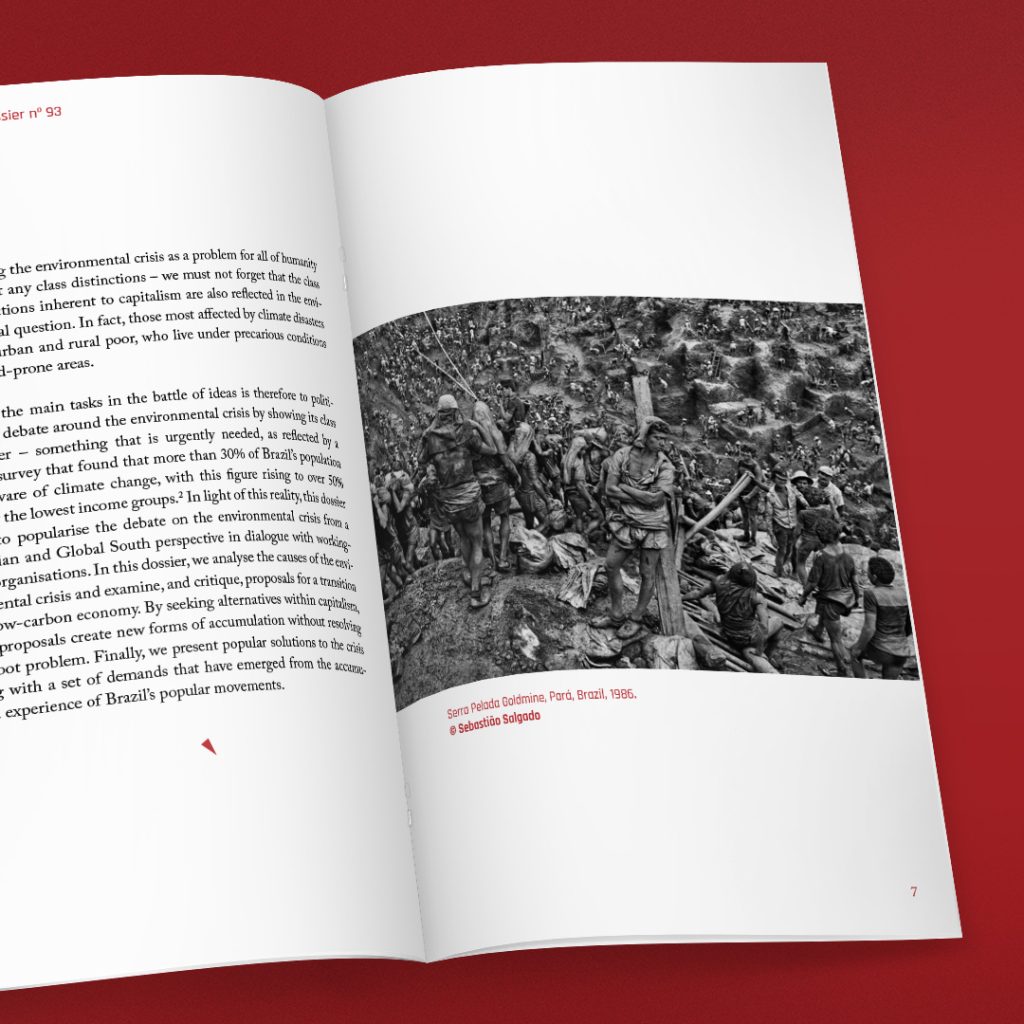
Illustration of Tricontinental dossier no. 93, The Environmental Crisis Is a Capitalist Crisis.
Dear friends,
Greetings from the desk of Tricontinental: Institute for Social Research.
This summer, there were days in tropical cities when it was unbearable to walk out in the sunlight. In Mango, Togo, for instance, the temperature soared to 44°C in March and April. Heat maps depict a world on fire, red hot flames licking the planet from the equator outwards. If the air temperature is around 44°C, then the temperature of asphalt and concrete surfaces can exceed 60°C. Since second-degree burns occur in less than five seconds at 60°C, those exposed to that heat are liable to burn their skin. Walking the streets of these burning cities is hard enough with shoes – imagine what it must be like for the millions of people who lack appropriate footwear but must work outdoors during the hottest parts of the day. Only a handful of countries – most of them in the Arabian Peninsula and in Southern Europe – have bans on outdoor work to prevent heat stress. But even in these countries, it is possible to see construction workers and cleaners forced to brave the heat. This can be fatal, as was seen during the construction of stadiums in Qatar for the 2022 FIFA World Cup.
A new report from the World Meteorological Organisation and the World Health Organisation, Climate Change and Workplace Heat Stress, notes that 70% of the global workforce – 2.4 billion workers – are at risk of exposure to excessive heat. The report notes that for every unit above 20°C, worker productivity declines by 2% to 3%. Workers who toil in the hot sun suffer from heatstroke, dehydration, kidney dysfunction, and neurological disorders of various kinds. Strikingly, there is no accurate number of global workplace deaths due to heat stress.
Cover of Tricontinental dossier no. 93, The Environmental Crisis Is a Capitalist Crisis. Photograph by Sebastião Salgado.
An encouraging piece of news from the Intergovernmental Panel on Climate Change (IPCC) is that it has created a committee to produce the Special Report on Climate Change and Cities (which will be released in March 2027). The only major study we have from the IPCC on urban centres is the sixth chapter of its 2022 report, entitled ‘Cities, Settlements, and Key Infrastructure’. Its main finding was that the one billion people who live in informal urban settlements in the Global South are in areas of great vulnerability to climate-induced disasters such as floods and droughts. Green and blue infrastructures that mitigate climate disasters – such as mangroves and wetlands – are being privatised, built over, and degraded, which further reduces the adaptive capacity of growing cities. Building on this research, the International Institute for Environment and Development has been studying summer heat waves in cities and found, in its 30 September 2025 briefing, that in forty of the world’s most populous cities the number of days in a year when the temperature exceeded 35°C has risen by 26% since 1994. Cities account for 70% of global emissions and energy consumption; we hope the IPCC report due in 2027 will consider the heat stress disproportionately borne by the international working class and spark further discussion about cities and climate change.
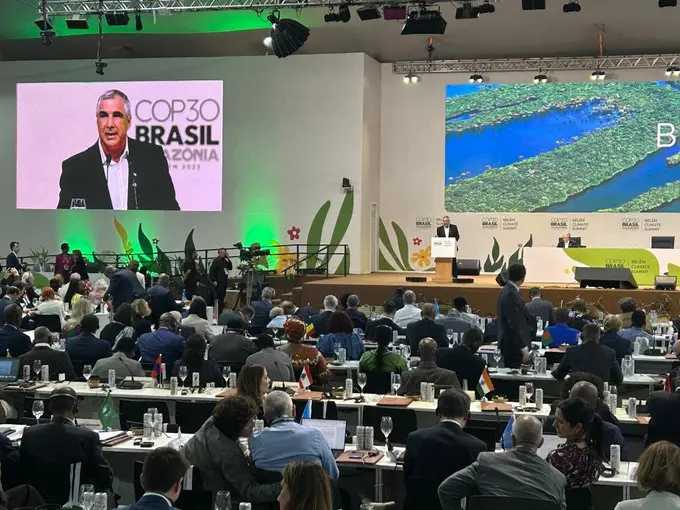
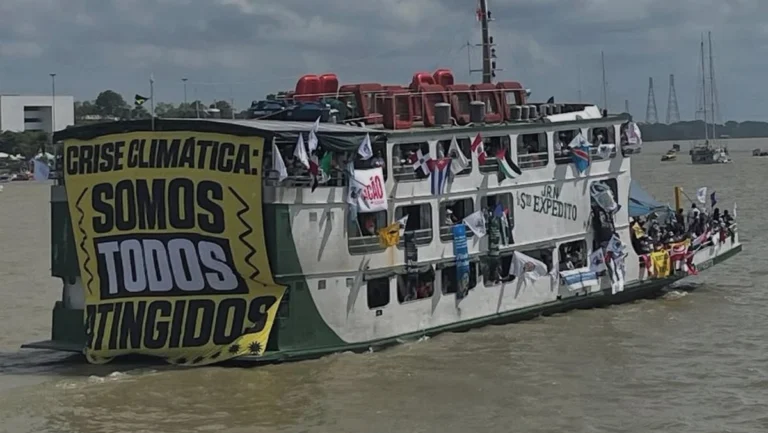
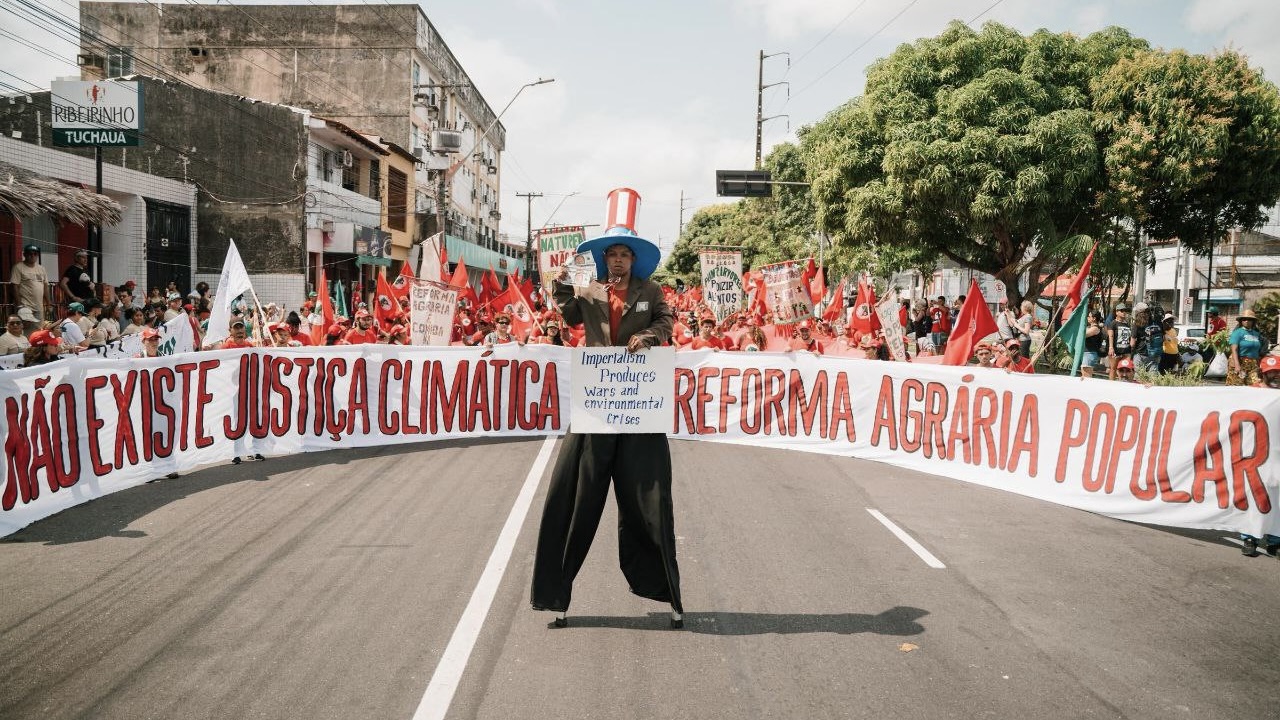
For now, I encourage all of you to download, read, share, and discuss our latest dossier, The Environmental Crisis Is a Capitalist Crisis. Written by our team in Brazil, this text comes in the lead up to the thirtieth United Nations Climate Change Conference, or COP 30, meeting in Belém, Brazil, next month. It will be shared and debated in pre-meetings across the world with those who are part of the battle for climate justice.
We have little faith in the COP process, since the entire apparatus seems to have been taken over by greenwashing capitalists who want to continue the old ways while masquerading as saviours. For instance:
According to Global Witness, 636 fossil fuel lobbyists were granted access to COP 27 in Sharm El Sheikh, Egypt. This means that there were ‘twice as many fossil fuel lobbyists as delegates from the official UN constituency for indigenous peoples’.
According to Kick Out Big Polluters, 2,456 fossil fuel lobbyists attended COP 28 in Dubai, United Arab Emirates, making this group larger than almost all the delegations at the meeting.
At COP 29 in Baku, Azerbaijan, there were more fossil fuel lobbyists than all the delegates from the ten countries most vulnerable to climate change.
Nonetheless, we still believe that the COP process revitalises debates that are necessary to shape and sustain the consciousness of people’s movements.
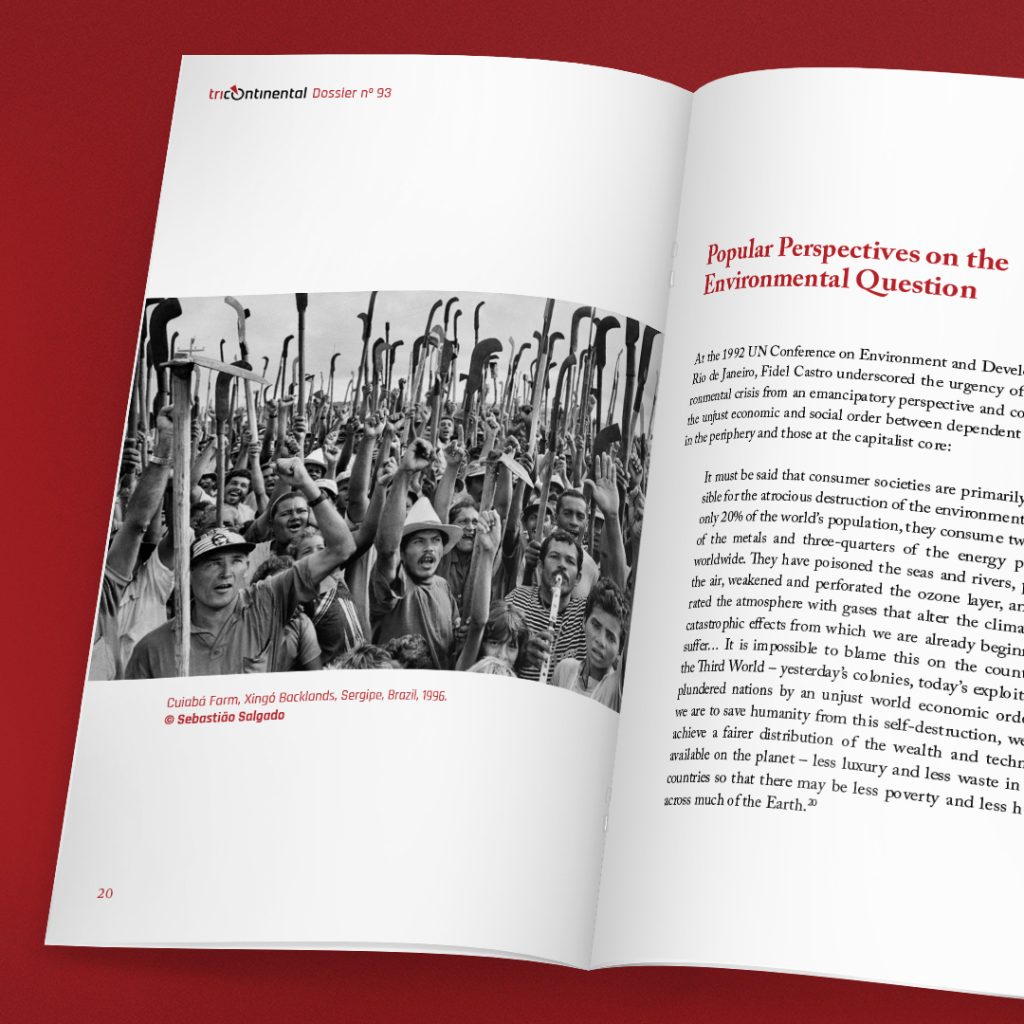
Illustration of Tricontinental dossier no. 93, The Environmental Crisis Is a Capitalist Crisis.
Out of the many important points in our dossier, I would like to highlight eight demands from an agenda to confront the environmental crisis generated alongside Brazil’s Landless Workers’ Movement (MST):
Hold the Global North accountable for ecological debt. The old colonial states have abused the carbon budget and made empty commitments to the Green Climate Fund. It is time to pay up.
End Greenwashing. Reject the idea of carbon markets and offset schemes that commodify the commons (air, biodiversity, and forests).
Advocate for community, not corporate, control over environmental policy.
Advance agrarian reform and defend the land of peasants and indigenous communities. Constitutionally mandate and implement land redistribution, collective land rights, control over seeds, and protection of biodiversity.
Build food and water sovereignty. Replace export-oriented monocultures with agroecological and cooperative food systems that democratise food production and distribution. Prioritise the right to food over the right to profit from food.
Enforce reforestation under community control. Protect the large carbon sink rainforests.
Criminalise ecocide. Build legal regimes to penalise transnational corporations that destroy nature and prosecute them both in their home countries and where they commit the crimes.
Implement a just, planned, and socialised energy transition. New energy forms should be democratically controlled and not run for financial speculation.
We are eager to debate these points in our communities across the world. These discussions should not take place behind closed doors.
To further broaden the discussion surrounding COP 30, our researcher José Seoane has produced a podcast in Spanish called Los pueblos frente a la crisis climática (Peoples Facing the Climate Crisis) – you can listen to the first of three episodes here.
The photographs in this dossier are from the remarkable collection of Sebastião Salgado (1944–2025), a friend of the MST who established an institute for reforestation in his birthplace of Minas Gerais. It is little known that Salgado began his career as an economist with the International Coffee Organisation, an agency supported by the United Nations. It was his visits to coffee farms around the world that sparked his appreciation for the power of workers. He exchanged his pen for a 35mm Pentax.
Illustration of Tricontinental dossier no. 93, The Environmental Crisis Is a Capitalist Crisis.
On 13 March 2024, Julio César Centeno went to work in the orange and lemon orchards owned by Grupo Ledesma, one of Argentina’s most lucrative businesses, posting revenues of $823 million in the last twelve months. These orchards are in Jujuy province in northern Argentina in the town of Libertador General San Martín, named after a leader of South America’s wars of independence against Spain. On that day, the temperature in the fields exceeded 40°C. Centeno, also known as Penano (the Sufferer) and Brujo (the Sorcerer), began to complain of heat stress not long after his workday started at 10 am. But there was no respite. Hired by ManpowerGroup, a US-based transnational provider of temporary labour, Centeno was forced to continue climbing tall ladders to harvest lemons. By noon, he suffered a seizure and fainted. It took an hour for the ambulance to arrive, after which it wended its way to the Oscar Orías Regional Hospital. The doctors tried to revive him, but he died of septic shock.
Ledesma, which has an ugly history – having disappeared dozens of workers during Argentina’s 1976–1983 dictatorship – did not pause. Unphased by Centeno’s death, the company forced the workers – who harvest 500 kgs of fruit a day – back to the orchards. The Argentine Union of Rural Workers and Stevedores (UATRE) released a solidarity statement two days later, but these contract workers do not have any real power to pressure the firm.
Centeno’s death is not unusual. There are so many stories of workers hired without legal or union protections who die of heat stress – burning alive for profit.
How a Bush-Era ‘Green’ Solution Made Climate Change Worse
Posted on October 19, 2025 by Conor Gallagher
Conor here: The following delves into problems and potential solutions to the food production-climate crisis, but omits one key issue, as summed up in a recent piece from The Wire to mark World Food Day:
The problem is not the absence of food but its unequal distribution. Structural inequities, fractured supply chains, broken public distribution systems, speculative markets and profit-driven trade often stand between abundance and access, turning plenty itself into a cruel irony…What stands in the way is power—who controls food, how it moves, and who gets to eat. These contradictions are sharpened by climate change, conflict, and trade systems that reward speculation and corporate consolidation over local resilience. Small farmers who produce much of the world’s food face displacement, debt, and marginalization.
Beneath every famine or food crisis lies a struggle over sovereignty: the ability of people and communities to grow, harvest, and share food on their own terms. When farmers are forced off their land, when fishing grounds are militarised, or when seeds and water are controlled by distant powers, people lose more than food – they lose autonomy. Hunger, then, is not just about empty plates; it is about who decides how those plates are filled.
By Michael Svoboda, the Yale Climate Connections books editor. He is a professor in the University Writing Program at The George Washington University in Washington, D.C. Originally published at Yale Climate Connections.
Three new and recent books grapple with an inconvenient and uncomfortable truth: Agriculture is responsible for one-third of our global climate problem.
It’s a finding that propelled Michael Grunwald, formerly a reporter for The Washington Post and now an independent journalist and author, to research and write “We Are Eating the Earth.”
Grunwald learned the stat from Tim Searchinger, an environmental lawyer with an intuitive sense for when things don’t add up and a zeal for confirming his suspicions. Searchinger became a source, a friend, and an adviser. Their investigations of agriculture and climate change eventually led to Grunwald’s new book.
We’ll publish interviews with authors Kesley Timmerman, author of “Regenerating Earth,” and Mark Easter, author of “The Blue Plate: A Food Lover’s Guide to Climate Chaos,” later this month.
This interview has been edited and condensed.
Yale Climate Connections: Thanks for taking the time to speak with us today, Mike. Why do we need to be worried about agriculture if we’re worried about climate change?
Michael Grunwald: The short answer is that it’s eating the Earth. Food is responsible for a third of the climate problem. Agriculture also uses 70% of our fresh water. It’s the leading driver of deforestation, biodiversity loss, and water pollution. If you care about the environment, you really should care about food and agriculture.
Six or seven years ago, I had one of my conversations with Tim. I asked him if meat is really as bad for the climate as everyone says. And he said, yes. And then he said, duh.
That was when it really hit me: Gosh, if I’m this ignorant about this stuff, then other people probably are too.
YCC: As you explain in your book, land use is the crux of the problem. But before we get into that, we should probably say more about Tim Searchinger. Who is he? And what does he discover about land use?
Grunwald: Tim was a wetlands lawyer when I met him. He was fighting to save the wetlands from agriculture in the Mississippi Valley. And he got interested in corn ethanol. Not because he cared about the climate, but because he cared about what the Bush administration was saying about a new ethanol mandate. That’s going to mean more corn, he realized, and that means more wetlands will be drained in Iowa, and more fertilizer will get into the Mississippi River, which will increase the dead zone in the Gulf of Mexico that’s already the size of Connecticut.
Then he heard that there was a climate study about ethanol. The long story short of the study was that it found that ethanol was extraordinarily inefficient to produce. It required almost as much fossil fuel to grow as it replaced. But this study said corn ethanol was 20% better than gasoline because when you burn ethanol, yes, that creates carbon emissions, but when you grow the next crop of corn, the carbon emitted into the atmosphere is reabsorbed. So the idea was that ethanol, although very inefficient, is still a little better than gasoline.
But Tim realized if you’re going to grow fuel instead of food, then someone somewhere else is going to have to grow more food. That’s probably not going to be on a parking lot. It’s going to be on land taken from a forest or a wetland that was storing a lot of carbon.
His basic insight was that land matters; land is not free. But these studies were
treating land as if it were free and freely available. Instead, when he accounted for the emissions from changes in land-use, like deforestation, Tim found that corn ethanol is twice as bad for the climate as gasoline.
YCC: Let’s pause a moment to stress some key points. The first is that climate scientists had recognized the problem of land use changes. Cutting down forests to grow crops, a change in land use, increases emissions.
But Searchinger, who was not a practicing scientist …
Grunwald: That’s right. At the time, he’s just a smart guy who can read.
YCC: … Searchinger realizes that there are indirect consequences. If you’re going to use agricultural land for something other than growing food that people eat, then land must be taken from somewhere else to grow that food. And that could be more damaging than the problem you think you’re solving by growing biofuels. Was Searching startled when he discovered this blind spot?
Grunwald: Yes and no. That’s one of the meta-narratives of this book: the extraordinary amount of groupthink, of conventional wisdom, of wish-casting that’s not only in the political world, but in the scientific world, too.
I do profile one scientist, one environmentalist, and one public official who had had the conventional ideas about why bioenergy was great for the climate. And then when Tim showed why that was silly, they admitted they were wrong, and they switched sides. But it turns out that is not so common, that human beings are not so great at admitting they are wrong.
YCC: But sadly, the biofuel mandate is enshrined in American law as a result of these early misses by the scientists and then the enthusiastic embrace of that option by senators from ag states … and by any senator dreaming of running for president in the Iowa primary.
But the land problems don’t end with biofuels, or with biomass, another wrong turn you address in your book. Searchinger next realizes that even the most appropriate use of agricultural land, for growing food, has enormous climate consequences, especially meat production. What is the main problem with meat production?
Grunwald: Yes. Right now, we use the equivalent of all of Asia and all of Europe to grow food. But three-quarters of that land is used to grow food, either pastures or crops, that are fed to livestock. The transformation of natural land, especially rain forest, into agricultural land is the biggest source of agricultural emissions. And that is mostly a meat story.
Eating plants is way more efficient than feeding the plants to animals and then eating the animals. Cattle and other ruminants are spectacularly inefficient converters of their feed into our food. In the United States, we use about half of our agricultural land to produce beef, from which we get just 3% of our calories. All of agriculture eats the Earth, but meat eats the most.
YCC: Right. You note that just shifting away from beef is possibly the most consequential decision you could make as an individual in terms of diet. It gets you a good percentage of the way toward being vegetarian.
Grunwald: Absolutely. The best thing you can do for your diet, if you care about the planet, is to go vegan. But most of us don’t want to go vegan. In most cases, however, cutting beef and lamb is about as good as going vegetarian because cows use about 10 times as much land and generate about 10 times as many emissions as chicken or pigs. So the first best thing you can do for the planet with your diet is eat less beef.
The second is waste less food. We waste about a quarter of our food. And when we waste food, we waste the farmland and the fertilizer and the water that’s used to grow that food. Effectively, right now, we’re using a landmass the size of China to grow garbage.
YCC: Having made this point vividly in your book, you explore some alternatives. One way to reduce the downsides of eating meat, beef in particular, is to create meat in different ways.
Grunwald: Right. The first half of the book is about the eating the Earth problem. The second half is about potential solutions. And because meat is such an outsized part of the problem, I explore those potential solutions first. With plant-based meat or cultivated meat made from cells, you’re talking about 90% less land use, 90% fewer emissions. So these could be a huge solutions.
I actually started my reporting for this book in 2019 at the Good Food Institute Conference. It was a crazy time because Beyond Meat had just gone public with the biggest initial public offering of the 21st century. You had these new biotech burgers from Beyond Meat and Impossible Foods that were way better than the old kind of hockey puck veggie burgers. But they were still more expensive and not as delicious as meat, so people didn’t have a reason to keep buying them.
When I went back to GFI in 2023, it was all doom and gloom. However, this response is overblown, too. The cow is a pretty mature technology; meat substitutes are not. But they’re going to keep getting better and cheaper and maybe even healthier.
YCC: After exploring meal alternatives, you turn to regenerative agriculture. What in Searchinger’s view does regenerative agriculture get wrong and what does it get right?
Grunwald: Let me say a couple of things about it.
There’s this very popular notion – in movies, at the U.N., among environmental groups, major philanthropies, even big ag and big food – of carbon farming, the idea that by treating our soil better, all that bad carbon that we pumped up into the sky is going to magically reappear as good carbon in our soil. That I really do have to say is mostly bullshit.
Tim has been at the forefront of exposing this. Most of the discussion has been about how difficult it is to measure soil carbon and how difficult it is to make sure that once you have carbon in the soil that it stays in the soil. But also, there’s a lot of science that shows that you can’t add a lot more carbon to your soil without adding a lot more nitrogen. And there are all kinds of problems with adding more nitrogen, either through manure or synthetic fertilizer with nitrous oxide, with pollution.
So the idea of carbon markets paying a lot of money to people who claim to be able to store carbon, this is dangerous nonsense.
YCC: But Searchinger does seem to acknowledge that there can be benefits if you adopt a more diverse approach to farming, or even expand your notion of farming to include agroforestry.
Grunwald: I’m not an agronomist or a scientist, but I can do the math. By 2050, we are going to need a lot more food, and we’re going to have to grow it with less land and much fewer emissions. That’s my starting point for this eating the Earth problem.
Food authors like Michael Pollan write beautifully about organic farms, with their red barns and where the animals have names instead of numbers. But if they are making less food per acre, they need more acres to make food, and so they are eating more of the Earth.
That’s where I start from on these questions, and I know that upsets people, because it acknowledges that these factory farms, which treat people badly, treat animals badly, and use too many antibiotics, are really good at manufacturing a lot of food at affordable prices.
YCC: Right, that’s the essential message of your book: We have to grow more food on less land with less pollution.
Grunwald: Yes, exactly. We need to make even more food with less mess.
YCC: So what are some of the innovations that might help us achieve that goal?
Grunwald: On the demand side, alternative proteins are really exciting. And there are lots of new technologies to help reduce food waste. There’s biotech that can slow the spoiling of fruits and vegetables. And there are apps that can reduce the price on foods approaching their expiration date and then notify shoppers.
On the supply side, you see all kinds of exciting new technologies. I wrote about how scientists are gene-editing microbes to snatch fertilizer out of the air and feed it to crops, and how they’re using the mRNA technology behind the COVID vaccines to create alternative pesticides, like one that constipates potato beetles to death. You’ve also got stuff like biological nitrification, inhibition, and better manure management.
GMOs offer the possibility of drought-tolerant, flood-tolerant, heat-tolerant crops that, in a warming world, can produce higher yields and thus more money for farmers and more food for people. And there’s really no evidence of health or environmental harms from them.
For all of this stuff, though, we need more money for research and more money for deployment, because we need to figure out what actually works.
YCC: Don’t we also need to change the way we govern farming?
Grunwald: This is an interesting question. The political economy of this stuff is tricky, right? All over the world, the agricultural lobby is very powerful. That’s why the world spends $600 billion a year subsidizing agriculture, and $300 billion of that is just direct handouts to farmers. All forms of farming fall short of what we need: more food from less land with less mess. But you have to do the accounting.
In the big, beautiful bill that the Republicans just passed in Congress, when it comes to biofuels, they tell the government to put their pencils down. You can no longer look at land use change when you’re analyzing biofuels to find out whether sustainable aviation fuels are truly sustainable, basically because that would be bad for corn and soy farmers.
I wrote an op-ed in The New York Times about how ludicrous it was for Democrats to support the farm provisions in the big, beautiful bill. It makes sense for Republicans; they’re winning 90% of the vote in farm country in some areas. For Democrats, the argument used to be, “We’ll give them their farm subsidies, but we’ll get food stamps.” But now Republicans are slashing food stamps while jacking up farm subsidies.
YCC: So I’m hearing grim vigilance is the attitude one must adopt.
Grunwald: Yes. Like Searchinger – who has now published 10 articles in Science and Nature, even though he never did get a scientific degree – you need to know who does their homework and who are the cranks.
Johan Rockström presenting a planet boundaries talk at the 2025 Frontiers Planet Prize event in June. Image courtesy of Oliver O’Hanlon/Frontiers Foundation.
Ocean acidification threatens planetary health: Interview with Johan Rockström
Originally published: Mongabay on September 24, 2025 by Julian Reingold (more by Mongabay) | (Posted Oct 21, 2025)
*The newly published 2025 Planetary Health Check report confirms transgression of the ocean acidification planetary boundary–the seventh Earth system threshold crossed, putting a “safe operating space for humanity” at risk. Oceans act as a key climate stabilizer, resilience builder and Earth life-support system.
*Marking the launch of the 2025 Planetary Health Check, Mongabay speaks with report co-author and renowned Earth system scientist Johan Rockström about how the transgression of planetary boundaries is eroding environmental justice–the right of every human being to life on a stable, healthy planet.
*Rockström, who led the international team of scientists who originated the 2009 planetary boundary framework, also speaks about the failure to achieve a U.N. plastics treaty in August and the challenge of accomplishing planetwide sustainability in a time of widespread armed conflict and political instability.
*He likewise emphasizes the need to bring the U.S. back to the negotiating table at COP30, the U.N. climate summit scheduled for November, in Belém, Brazil, and addresses the importance of inserting the planetary boundaries framework into those talks.
Initiated in 2024, the Planetary Health Check is a comprehensive, science-based global initiative dedicated to measuring and maintaining Earth systems critical to life as we know it.
These annual reports were created to provide a regular, comprehensive assessment of the state of our world, utilizing the most current planetary boundaries science–monitoring changes, gauging risks, identifying urgent actions needed, developing solutions and determining progress in maintaining a “safe operating space for humanity.”
The just-published 2025 assessment finds that seven out of the nine critical planetary boundaries (PBs) have been breached: climate change, change in biosphere integrity, land system change, freshwater change, modification of biogeochemical flows, the introduction of novel entities, and now, ocean acidification.
All of these Earth system boundary transgressions show escalating trends, threatening further deterioration and destabilization of planetary health in the near future. Just two PBs remain within the safe operating space: increase in atmospheric aerosol loading (with an improving global trend) and stratospheric ozone depletion (currently stable).
Earth System scientist Johan Rockström, director of the Potsdam Institute for Climate Impact Research (PIK) in Germany, spoke to Mongabay on the occasion of the launch of the Planetary Health Check 2025 report, which announces the transgression of the ocean acidification boundary–the seventh Earth system boundary threshold crossed, putting the safe operating space for humanity at grave risk.
PIK’s director is co-author of the 2025 report and author of the book and video documentary Breaking Boundaries: The Science of Our Planet (2021), which explains the planetary boundaries framework, which was developed in 2009 by an international scientific team led by Rockström. This framework was also the inspiration for the Frontiers Planet Prize, which awards three prizes of $1 million every year to research offering the greatest potential to address the ecological crisis.
The newly released report signals a planetary emergency requiring immediate and coordinated global action, say scientists. (This interview has been lightly edited for brevity and clarity.)
This iconic planetary boundaries (PBs) diagram visually represents the current status of the nine critical PB processes that regulate our planet’s health. Each Earth system is quantified by one or more control variables based on observational data, model simulations and expert opinions. Image courtesy of Planetary Health Check 2025.
Mongabay: The Planetary Health Check 2025 report announces the transgression of the ocean acidification boundary (the decreasing of pH in seawater caused by the absorption of atmospheric CO₂), the seventh Earth boundary threshold to be crossed due to humanity’s actions. What does this mean and why is it relevant to all of us?
Johan Rockström: The latest update–based on data observations as to where [ocean] acidification is developing, and on the refined methodology for making those observations–concludes, unfortunately, but not unexpectedly, that the ocean acidification boundary has now been breached.
This is a very worrying trend, because the ocean is under multiple planetary pressures: [including] the faster than expected heat increase, the ocean acidification boundary now being breached, continuous eutrophication, and the loss in biodiversity due to overfishing and other causes. So, we have an ocean system on planet Earth, across all marine systems, under high and increased pressure.
Mongabay: While these oceanic changes will impact the whole world, how could they affect vulnerable coastal populations across the Global South, particularly in South and East Asia, the Pacific Islands and the Caribbean?
Johan Rockström: There are two types of impacts: the fast and the slow ones. With regard to the fast ones, we are seeing that the breaching of multiple planetary boundaries in and around the oceans have immediate impacts on hundreds of millions of people–at least 300 million–whose livelihoods depend [directly] on the services provided by shallow healthy marine ecosystems along the coasts.
The first fast effect we are [seeing] now is the fourth global [coral] bleaching event [beginning in 2023 and continuing today], triggered by the breaching of the climate [planetary] boundary. So, the heat in the ocean is causing bleaching, which is pushing tropical coral reef systems toward collapse. This is a very fast, immediate and dramatic hit, which undermines the spawning grounds [used by] fishing communities, the tourism industry and other areas, too, because the fish that breed in shallow coastal regions also provide [marine] species richness and stability for deeper ocean systems.
Secondly, you have unsustainable industrial fishing contributing to breaching the biodiversity boundary, eradicating species by fishing down populations [which causes] spillover on coastal communities.
On top of that, you have ocean acidification, which chemically breaks down calcium carbonate, the fundamental building block for marine life. All shell-forming species–ranging from animal plankton to hard corals–depend on calcium carbonate. And when this is eroded, it increases stress on all marine life in shallow coastal regions.
And if all the above was not enough, another boundary has been transgressed, namely the biogeochemical boundary, where land management–agriculture and urban waste management–is flushing [large amounts of] nitrogen and phosphorus into coastal zones, causing eutrophication.
This [in turn] means that when healthy coral reef systems see more [bleaching] stress, more nitrogen and phosphorus lead to exponential growth of soft algae, which then takes over, and you end up creating a massive green-slimy monoculture that settles on top of the coral reefs, consuming all the oxygen in [that part of] the ocean.
So, you have multiple stressors hitting at the same time, and all of them push the [ocean] system towards collapse. This has immediate effects on livelihoods.
Mongabay: You just mentioned the collapse of coral reefs as a ‘fast’ impact of ocean acidification, but which would be the ‘slower’ impacts?
Johan Rockström: The second type of impacts, the slower ones–the most catastrophic outcomes in the long term–is the crossing of thresholds for big ocean tipping points. One of these causing more concern is the [slowing or shutting down of the] Atlantic Meridional Overturning Circulation (AMOC)–or at least one part of it, the Gulf Stream, one of the engines running the heat conveyer belt in the oceans.
The flow and circulation of water in the North Atlantic is slowing down to a point where several [recent] studies are saying that we cannot exclude [the possibility of] a shutdown of the AMOC, and that would have global impacts: It would lead to accelerated warming on a planetary scale, changes to the [world’s] monsoon systems–contributing to massive shifts in rainfall in West Africa and over the Amazon Rainforest and increasing the melting rate in Antarctica (because it would lock in more warm surface water near the Ice Continent).
An example of how several planetary boundaries and tipping elements can be linked in a cascade. Escalating climate change (1) triggers tipping dynamics in the Atlantic Meridional Overturning Circulation (AMOC) (2); this disturbs precipitation patterns in the Amazon Rainforest (3) leading to a tipping dynamic there as well, which degrades biosphere Integrity (4). Image courtesy of Planetary Health Check 2025.
What makes me particularly nervous here is that we know clearly that the AMOC has shut down in the past: Over the past 1 million years, the AMOC has shown that it has the ability to flip [away from] a healthy and stable functioning state–like the one we’ve had on Earth throughout the existence of modern humans over the past 100,000 years, or since we left the last Ice Age 18,000 years ago.
I am also worried because we know why the AMOC collapses: This is due to the dilution of salinity [in the North Atlantic]. The Greenland Ice Sheet is rapidly melting and releasing cold freshwater, which dilutes the heavy saline water that sinks because it’s so heavy and drives this whole [ocean circulation] system.
So, the ocean system is under two pressure points: One of these is the fast factors–the bleaching, acidification, loss of fish and eutrophication. The other is the slow factors–the risk of crossing tipping points–with the AMOC being the one we’re focusing on more right now because it would have such a large impact globally.
Humanity’s journey on Earth: Human population size and global temperature from 500,000 years before present (BP) until 2100. For more than 10,000 years, humanity lived in a very stable climatic period (the green corridor) in which we evolved and adapted via our technologies and cultures. By transgressing seven planetary boundaries, including the one for climate change, this period has now ended. We are entering a new and dangerous terrain in which a still-growing world population must safeguard human well-being. Image courtesy of Planetary Health Check 2025.
Mongabay: What are the global effects of a major change in AMOC?
Johan Rockström: Let’s start by saying what a stable AMOC does: It warms heavy saline waters that flow on the surface from the southern Atlantic Ocean up to the North Atlantic, reaches the southern tip of Greenland and then releases that heat to the atmosphere.
This heat release is a natural function which makes life liveable in Scandinavia and parts of Russia, making this a fundamental regulator of the regional weather system and climate in northern Europe.
If the AMOC collapses, you would no longer have that warm hot flux from the Southern Ocean, so you would get an abrupt and catastrophic cooling [in the Global North]. Studies show reductions in temperature of less than or equal to10° Celsius [18° Fahrenheit] in Scandinavia, causing extensive impacts in parts of wealthy Northern countries. But at a global level, an AMOC shutdown would accelerate warming.
The Intergovernmental Panel on Climate Change [in its Sixth Assessment of climate in 2023] puts the likelihood of a shutdown of the AMOC in this century as a low likelihood with medium confidence. What scientists are saying here is that, based on findings [as of 2023], an AMOC shutdown is not likely to happen this century, but they don’t have high confidence in that statement.
But since that last IPCC report, there have been some big research papers published that all point in the same direction: We have underestimated the probability of a shutdown. In other words, the probability of a shutdown is higher than stated by the IPCC.
If you ask Professor Stefan Rahmstorf, a physicist and physical oceanographer working at PIK, and one of the leading AMOC scientists, he will tell you that the probability of a shutdown is closer to 10% [this century].
This is an unacceptable risk, because risk is equal to probability, multiplied by impact. For instance, you would buy an insurance policy on your home even if the probability of the house burning down is lower than 1%, since a fire would be a catastrophic loss.
Put simply, when impacts are unacceptably high and catastrophic, we should act on any probability exceeding 1%. But we are now closer to a 10% chance that AMOC will collapse this century [with unacceptable catastrophic impacts].
This led a group of 44 scientists to write a letter to the heads of state of the Nordic countries; the Nordic Council of Ministers. This letter summarized the science of an AMOC shutdown and pleaded that it requires immediate action.
This is the canary in the coal mine, the factor that should make all political leaders rise and accelerate the pathway away from risk. I believe this [threat] to be societally unacceptable and disturbing. [Inaction to date] is not due to ignorance: The world has deliberately decided to ignore this concern.
Somehow, when it comes to environmental issues, leaders tend to say that we cannot think about risk in terms of private property in the same way we think about nature. But sadly, it’s the same thing. We must apply the same philosophy to climate risk as we do to airplane crash risk.
This reminds me of Don’t Look Up–the [2021] movie starring Leo DiCaprio–when they announced that an asteroid was on its way to hit the Earth. If there were at least a 10% chance of causing extinction of a significant portion of the planet’s life, we would react, wouldn’t we?
Johan Rockström while being interviewed by Mongabay at the 2025 Frontiers Planet Prize event in June. Rockström is the director of the Potsdam Institute for Climate Impact Research (PIK) in Germany and led the international team of researchers who originated the planetary boundary framework in 2009. Image courtesy of Marius Burgelman/Frontiers Foundation.
Mongabay: The United Nations Plastics Treaty summit in Geneva this August marked the culmination of a three-year negotiation process, but those talks failed to achieve an agreement. Since petrochemical plastics pollution figures hugely into the transgression of the novel entities (pollution) planetary boundary and substantially impacts the climate boundary, do you have thoughts on the summit results and where we need to go next?
Johan Rockström: It was undoubtedly, from a pure scientific perspective, a huge disappointment. We now have data that allows us to monitor systems at a planetary scale, and one thing we are mapping is microplastics.
We’re now finding microplastics everywhere: We had a scientific expedition sailing across the Northwest Passage, taking samples across the entire Artic, and there were microplastics in every sample.
Of course, it’s a failure and it’s very disappointing that the petrochemical industry digs in its heels and does not see that it must contribute to breaking this linear and unsustainable production development line of exploiting oil and just wasting plastics.
However, it is clearly encouraging to see that the pressure is on; that we’re not only gathering [support for] global environmental policy on climate, but we’re also seeing it with a global biodiversity framework, microplastics, freshwater and recognizing the role of nitrogen and phosphorus pollution. Planetary boundaries are getting more planetary-scale governance attention, and I think that’s important.
The marine plastic pollution seen here is clearly visible. However, these visible novel entities will not biodegrade. Instead, they will eventually break down into microplastic and nanoplastic contaminants that will persist in the ocean environment for centuries. The full negative impacts of plastic pollution on human and ecosystem health remain largely unresearched, though some chemicals used in plastics are well studied toxins. Image courtesy of the Planetary Health Check 2025.
Mongabay: How can we draw attention back to climate change amid war in the Middle East, the Ukraine and elsewhere? Or do we tie all these fights together?
Johan Rockström: It’s a very important question, and not an easy one. It is not only unfortunate but also irresponsible–at a time when we’re putting the liveability stability on Earth at risk–to allow ourselves to have so many domestic, geopolitical, nationalistic and armed conflicts, because the attention moves away from climate action.
Peace is equally essential to the health of the planet, but the problem is that the world of today, unfortunately, is unable to keep attention on more than one [big issue] at a time.
This means that there’s a risk of drifting away from solving the climate crisis, and that has not only to do with the attention shown by leaders, but also, where does the money go? The money increasingly goes to defense–not only to armed conflicts, but to the armament of economies.
Is the solution to merge these topics [simultaneously seeking combined climate change and conflict solutions]? My answer is no; we should not merge them.
Why? It is not because they are not connected: We have rising evidence that eroding and breaching planetary boundaries leads to food and energy insecurity, [less] secure access to land, which leads to migration displacement, social collapse and conflicts. So, when in the West Bank the Israeli military digs up hectares of olive tree plantations, this is essentially killing life support related to planetary boundaries.
[Climate and conflict] are connected, but they should not be intertwined in my view, for a simple and pragmatic reason: Unfortunately, the efforts to try to stop the armed conflicts in the world–if possible–are even more politicized than the topic of sustainability.
Those who want to slow down efforts to come back within the safe operating space for humanity and planetary boundaries use this [excuse] all the time by bundling everything together and saying, “Supporting Palestinians in Gaza is left extremism,” [and so is] climate action. This [grouping] is done deliberately to give the impression that the sustainability pathway is some form of ideological extreme position, which of course it is not.
On the contrary, sustainability is the path to a modern, competitive and prosperous future.
It’s important to keep the planetary boundary agenda on that track: Fundamentally, [avoiding transgressions of] planetary boundaries is all about equity, justice and stability.
What do we fight over in wars around the world? If a land that is fought for does not have water, productive soil or a functioning atmosphere, it is a useless resource.
Everything is connected, but I think we must navigate this [global crisis] in a very clever way and [avoid] manipulation. Therefore, it is important that the sustainability agenda stays on track to being a path to the future we want, which can give us better security and health. So, no, I would not place the climate crisis in the same bucket as the conflicts in Gaza or the Ukraine, for example.
Marine biodiversity is threatened by multiple planetary boundary transgressions, including the crossing of safe thresholds for climate change, modification of biogeochemical flows (nitrogen and phosphorus pollution), the introduction of novel entities (pollution by a wide range of synthetic materials) and now, ocean acidification. Image courtesy of Planetary Health Check 2025.
Mongabay: The United States appears to be escalating an ideological and commercial conflict with Brazil, India and China. Brazilian President Luiz Inácio Lula da Silva says he wants to invite President Donald Trump to the COP30 climate summit this November in Belém. What would be your elevator talk regarding COP30: What would you say to Lula, Trump and other global leaders?
Johan Rockström: I would very much encourage and wish President Lula to try and get President Trump to COP30. I think that would be very good for Trump personally, and very good for the U.S. economy. My elevator pitch for Belém is that we have a [global environmental] crisis on our watch; the window of opportunity is still open, but we have to accelerate to avoid overshoot, and we need to come back into a safe operating space for planetary boundaries.
We have all the evidence that the solutions are scalable, and [if we act decisively] we would become winners in terms of modernity, security, peace and health, but also in terms of equity.
It’s a pathway to the future, and Brazil has a particular opportunity with Lula: Here you have a credible voice to say that in order to solve the climate crisis, you also have to take on the [protection of] living systems on the planet–biodiversity, freshwater, nitrogen and phosphorus, land use, oceans and all Earth systems. There are few actors and political leaders that can articulate and lead on this with credibility today, and Brazil can do it.
Mongabay: Finally, what will your position be if the negotiations fail in Belém?
Johan Rockström: We have some headwinds [ahead], admittedly, but I’ll hang in there to the bitter end, you can rest assured.
Citations:
Rockström, J., Steffen, W., Noone, K. et al. A safe operating space for humanity. Nature 461, 472—475 (2009). https://doi.org/10.1038/461472a
Högner, A., Di Capua, G., Donges, J. F., Donner, R. V., Feulner, G., & Wunderling, N. (2025). Causal pathway from AMOC to southern Amazon rainforest indicates stabilising interaction between two climate tipping elements. Environmental Research Letters. doi:10.5194/egusphere-egu25-8514
Israel’s Untold Environmental Genocide
Posted by Internationalist 360° on October 20, 2025
Kit Klarenberg
A queue for water in Rafah, Gaza
On September 23rd, the UN published a little-noticed report highlighting a barely-acknowledged facet of the 21st century Holocaust in Gaza. Namely, the Zionist entity’s genocide is wreaking a devastating environmental toll not merely on occupied Palestine, but West Asia more widely – including Israel. The damage is incalculable, with air, food sources, soil, and water widely polluted, to a fatal extent. Recovery may take decades, if at all. In the meantime, Gaza’s remaining population will suffer the cost – in many cases, with their lives.
In June 2024, the UN issued a preliminary assessment on the Gaza genocide’s “environmental impact”. It found the Zionist entity’s barbarous aggression had “exerted a profound impact” on “people in Gaza and the natural systems on which they depend.” Due to “security constraints” – namely, Israel’s continuing assault – the UN was unable “to assess the full extent of environment [sic] damage.” Nonetheless, the body was able to collate information indicating “the scale of degradation is immense,” and has “worsened significantly” since October 7th.
For example, Tel Aviv’s 21st century Holocaust has “significantly degraded water infrastructure leading to severely limited, low-quality water supply to the population.” The UN finds this “is contributing to numerous adverse health outcomes, including a continuous surge in infectious diseases.” Groundwater contamination is rampant, with catastrophic implications “for environmental and human health.” None of Gaza’s wastewater treatment facilities are operational, while “heavy destruction of piped systems, and increasing use of cesspits for sanitation, have increased contamination of the aquifer, marine and coastal areas.”
Resultantly, the genocide “has all but eliminated Gazan fishing livelihoods.” Israel’s “destruction of institutional capacity” in the sphere means “there are no effective controls of contamination in the food chain from fish supply, leading to consumption of poisonous fish” by starving Palestinians. “Marine ecosystems have clearly been contaminated with munitions, sewage and solid waste,” the UN gravely concludes. The situation demands “urgent re-installation” of the Strip’s water supply and wastewater collection capacity “to prevent further human health impacts and prevent future outbreaks of communicable diseases.”
Elsewhere, “remote sensing assessments” conducted by the UN indicate that by May, 97.1% of Gaza’s tree crops, 95.1% of its shrubland, 89% of its grass/fallow land and 82.4% of its annual crops had “been damaged.” As such, “production of food is not possible at scale,” and “soil has been contaminated by munitions, solid waste and untreated sewage.” The UN concludes the Zionist entity’s “military activity” has resulted in the “degradation of soils through loss of vegetation and compaction,” with disastrous results.
The Gaza genocide’s consequences reverberate in Israel itself. Tel Aviv’s Health Ministry calculates that in 2023 alone, pollution produced by Benjamin Netanyahu’s blitzkrieg caused at least 5,510 premature deaths locally. Given the Zionist entity’s industrial-scale carnage – primarily inflicted via air – subsequently intensified to unprecedented levels, we can only speculate how much the situation has worsened today. Israeli officials were hesitant to release the 2023 report, and more recent figures are unavailable. The rationale for this omertà is obvious.
‘Safe Movement’
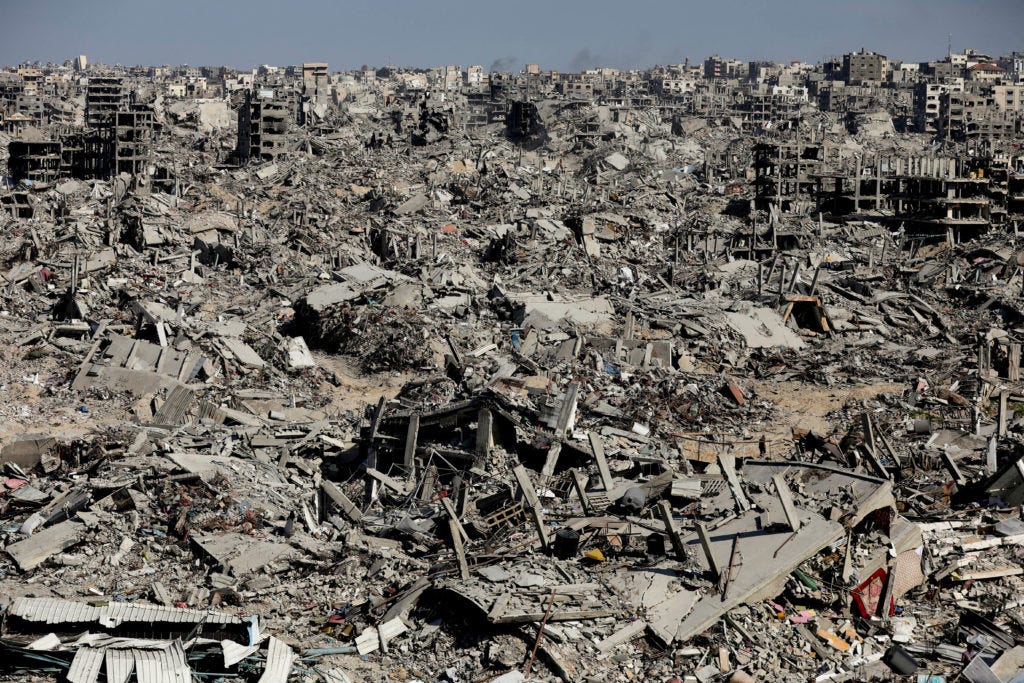
The UN report details how destruction in Gaza “is extensive”, with an estimated 78% of the Strip’s “total structures destroyed or damaged,” including homes, hospitals, mosques and schools. Locally, debris “is now 20 times greater than the combined total debris generated by all previous conflicts in Gaza since 2008.” Current estimates suggest “more than 61 million tons of debris will require clearing, sorting and recycling or disposal.” Much of this detritus “is contaminated with asbestos, and industrial chemicals.”
Littered throughout the rubble will be untold human remains, recovery of which naturally requires “sensitivity”. In the meantime, surviving Gazans must endure “significant volumes of dust” created by Zionist entity bombing and demolition, which have “contributed to increased cases of respiratory infection,” with over 37,000 cases reported in June 2025 alone. Unexploded ordnance also poses a high risk in urban areas, with safe removal necessary “to mitigate risks of future explosion, damage, traumatic injuries and loss of life.”
Gaza today
The UN nonetheless acknowledges its findings significantly underrate the true situation on-the-ground, as “limited data is available on air quality, due to minimal air-quality monitoring” locally. Still, “known challenges” include “pollution from explosions and resultant fires during bombing campaigns, and emissions from explosions of munitions and resultant fires in bombed structures, including industrial facilities, which will also have likely released toxic chemicals into the air.” Moreover, the “repetitive nature” of Israel’s attacks “will likely have a cumulative impact on the environment” in Gaza:
“Repairing such extensive damage to land, soil, trees, watercourses and marine ecosystems will be essential for sustainable recovery of the Gaza Strip. Restoration will require a cessation of hostilities. The first phase of recovery will necessarily focus on saving lives, through restoration of essential services (notably freshwater) and removal of debris to facilitate safe movement.”
The UN report notes, “such air quality issues will not improve substantially until the conflict ceases.” There is no such end of sight at time of writing. Even a ceasefire would inevitably be extremely brief, given Tel Aviv’s unconscionable record of promptly breaking such agreements throughout its history. Meanwhile, Zionist entity officials are hell-bent on reproducing the Gaza genocide in the illegally-occupied West Bank, having made abundantly clear their intention to annex further territory via brute force, and mass civilian displacement.
A July 2025 study by academic journal Environmental Research: Infrastructure and Sustainability concluded Israel’s rape of Gaza has created at least 39 million tonnes of rubble, removal of which could generate over 90,000 tonnes of greenhouse gas emissions, and take up to four decades to complete. Simply clearing the wreckage would equate to dump trucks traversing the Earth’s circumference 737 times, or 2.1 million separate vehicles driving 29.5 kilometres to disposal sites.
‘Alarming Levels’
Environmental obliteration wrought by the Zionist entity since October 7th 2023 is far from restricted to Gaza. Ensuing missile exchanges between Hezbollah and Tel Aviv culminated in Israel’s criminal invasion of Lebanon in October 2024. The fighting produced widespread agricultural desolation. Cross-spectrum Zionist Occupation Force assaults burned over 10,800 hectares of Lebanese land – an area four times the size of Beirut – incinerating tens of thousands of trees, dozens of farms and orchards.
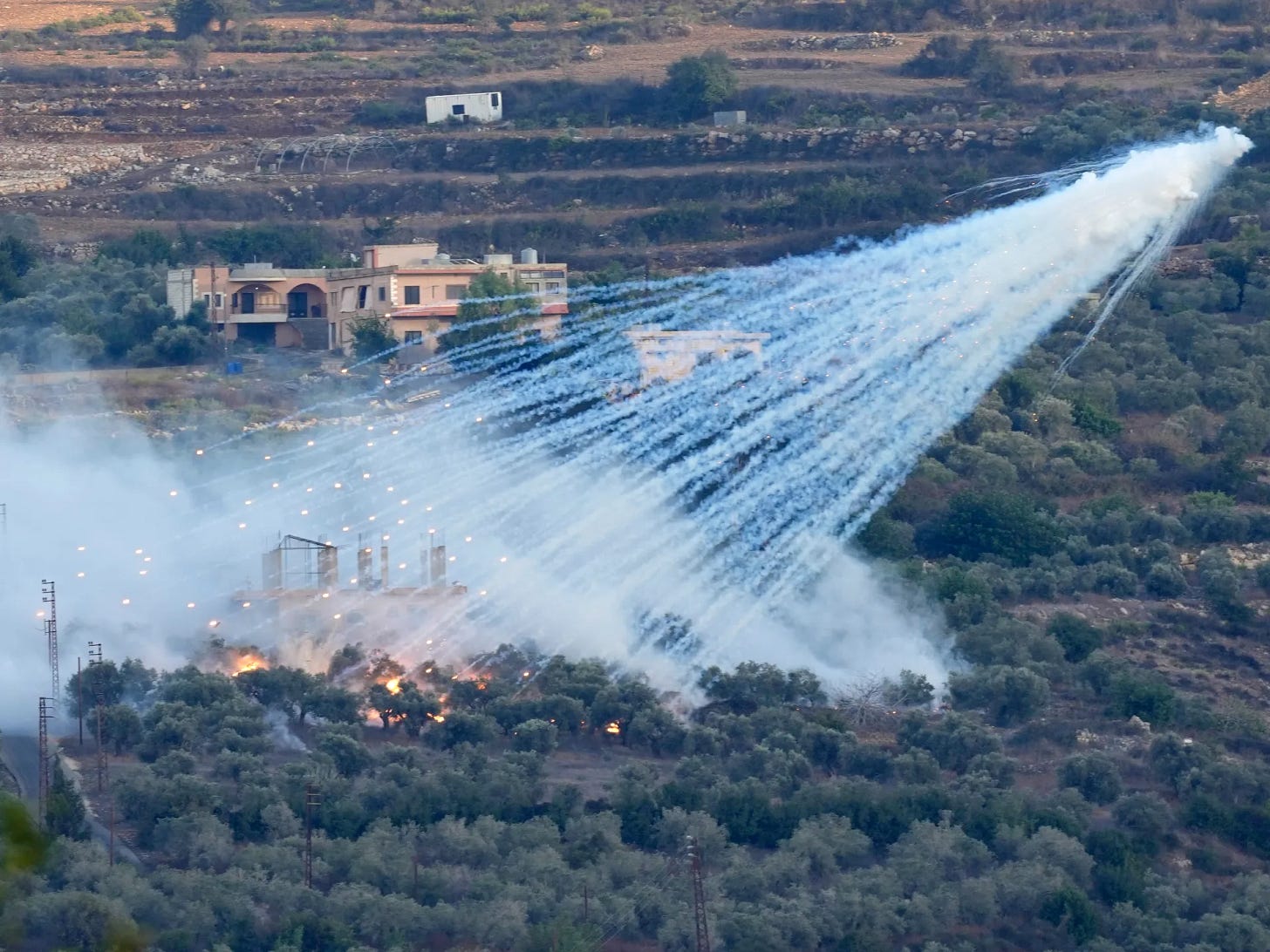
Israel’s widespread use of illegal white phosphorous munitions against Lebanon also ravaged the country’s southern agricultural heartlands. Laboratory analysis by the American University of Beirut found that already in January 2024, soil locally had been contaminated to “alarming levels” with heavy metals. Some samples showed phosphorous concentrations of 97,000 milligrams per kilo – over 120 times the substance’s globally-accepted safe concentration. Crops and water have likewise been dangerously infected, “posing threats to livestock and human health” that will persist for many years.
A Zionist entity white phosphorous attack on Lebanon, November 2023
Meanwhile, “extensive environmental damage affecting natural ecosystems” is rife. Of the estimated $214 million in damage inflicted on Lebanon during the conflict, $198 million (95.2%) was suffered by Beirut’s natural resources. In all, Tel Aviv launched roughly 7,000 aerial attacks throughout Lebanon, while its navy conducted more than 2,500 bombardments of the country’s coast. Over 10,000 homes and close to 1,000 private buildings were targeted, along with bridges, factories, roads and other infrastructure.
A similarly horrendous story played out during the Zionist entity’s failed 12 Day War against Iran in June 2025. Tehran estimates the conflict produced 150,000 tons of rubble locally, while Israeli strikes on the capital’s Rey and Kan oil depots incinerated 19.5 million liters of fuel, pumping 47,000 tons of greenhouse gases and 578 tons of air pollutants into the skies. Deliberate targeting of South Pars, one of the world’s largest gas fields, burned 5.5 million cubic meters of gas.
This broadside released over 12 million tons of greenhouse gases and 437 tons of pollutants. Air quality in multiple provinces across Iran has deteriorated hazardously since, while sewage overflowed and access to clean water was disrupted in numerous areas due to Tel Aviv’s attacks on associated infrastructure. Mercifully, despite Israel and the US repeatedly targeting nuclear energy sites throughout the country during the pair’s botched bombardment, there is as yet no indication of ensuing radiation leakage menacing not just Iranians, but West Asia more widely.
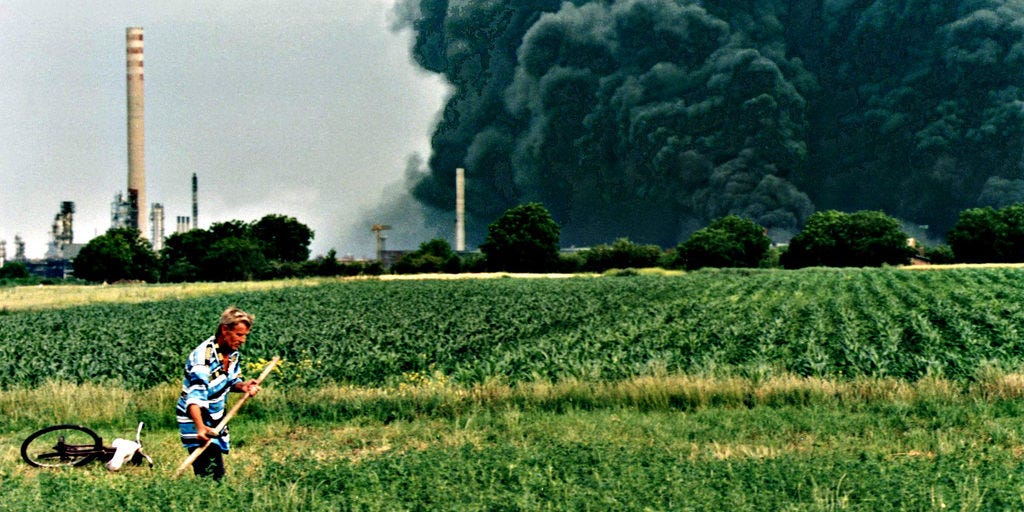
Presently, the amount of deadly chemicals and dust released into the local atmospheres of Iran and Lebanon due to Israel’s indiscriminate savagery cannot be quantified. However, history shows the impact of such offensives is enduringly lethal. NATO’s illegal 78-day-long bombing of Yugoslavia in 1999 primarily targeted civilian and industrial sites. A subsequent Council of Europe report concluded over 100 toxic substances circulated widely throughout the region due to the campaign. Not coincidentally, the former Yugoslavia ranks highly in global cancer rates today.
Results of a NATO attack on a Yugoslav oil refinery, Pancevo, May 1999
Perversely, even if the Zionist entity was to uphold its brittle ceasefires with Beirut and Tehran, and cease annihilating Palestinians, Tel Aviv’s genocide would continue apace – invisibly, through the putrified air civilians breathe, food they eat, and water they drink. Yet, in a bitter twist, the environmentally ruinous legacy of Tel Aviv’s deranged bloodlust has rendered Benjamin Netanyahu’s ultimate goal of eradicating Gaza to make way for Greater Israel null and void. Any Zionist settlement of the area would be literally suicidal.
Bolivia Burning: Inside a Latin American Ecocide
October 21, 2025
Documentary film exposes the role of colonisers and agribusiness in causing massive forest fires
Bolivia Burning: Inside a Latin American Ecocide
Directed by Tom Johnson. The Gecko Project, 2025. 52 min
reviewed by Ben Radford
Green Left, October 15, 2025
Last year, raging forest fires swept across large parts of South America, burning millions of hectares and claiming hundreds of lives.
Bolivia suffered its worst-ever forest fire season — 12.6 million hectares were burnt, much of it in the tropical dry forests of the eastern lowlands. According to Bolivian NGO Fundación Tierra, nearly 70% of the area burned last year was in the eastern Santa Cruz department, and represents “the worst environmental disaster in Bolivian history.”
While mainstream media fixated on images of flames and destruction — or made vague references to climate change — few examined the drivers of the crisis.
Bolivia Burning: Inside a Latin American Ecocide, a short documentary film released last month, focuses on the worst-affected Santa Cruz department, the heart of Bolivia’s agro-industrial frontier. The documentary focuses on Mennonites — an ultraconservative Christian denomination — who began colonising parts of Bolivia in the 1950s, mostly in the Santa Cruz department. Mennonite colonisation intensified during the past decade, with the number of colonies growing from 75 to 124 in 2013–22 — numbering about 150,000 people.
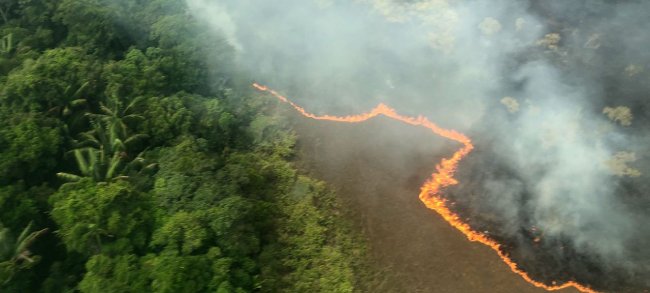
Mennonite settlements have cleared vast tracts of tropical dryland forest for industrial monocultures, mostly soybean, which they sell on the international commodity market. About 16% of recent deforestation in Bolivia occurred in Mennonite colonies, which also account for a quarter of soybean-related deforestation during the past two decades. Aerial mapping in the documentary shows that just in 2016, Mennonite colonies were responsible for 300,000 hectares of deforestation — roughly the same size as Italy.
Deforestation contributes to worsening forest fires by desertifying previously fire-resistant land. Mennonites and agribusiness interests also deliberately start bushfires as an effective way of expanding the agricultural frontier, and were the cause of last year’s devastation.
In Bolivia Burning, journalists David Hill and Álvaro Bozo García travel through the Santa Cruz region, witnessing the devastation and visiting Mennonite colonies. At one of the colonies, they document recent land clearing of burnt trees following the forest fires, for conversion to monocultures.
Indigenous land
Mennonites are encroaching on Indigenous land, like the Zapocó and Lomerío territories, draining vital water sources for irrigation and displacing local communities through land pressure and buyouts.
The documentary also examines the role of government policy in driving deforestation. Last year, 130 Bolivian organisations directly petitioned then-President Luis Arce, blaming government policies for promoting agribusiness and deforestation. Between 2001–13, state permits for land clearing were capped at 52,000 hectares annually, but by 2018 had risen to more than 250,000 hectares, according to the Bolivian Observatory on Labour Rights and Social Security.
The government adopted and implemented the “Patriotic Agenda 2025” in 2013, which aimed to promote large-scale agriculture expansion as a route to “food sovereignty” and economic growth. The government also weakened environmental protections, such as allowing up to 20 hectares of clearing without a permit or fee and slashing fines for illegal deforestation.
However, the documentary misses some of the historical and economic context of the Santa Cruz region.
Large landowners — part of Bolivia’s mostly white or mestizo oligarchy — own huge swaths of land in Santa Cruz, much of it accumulated during the colonial period and military dictatorships in the last century. This powerful group resisted and undermined the ruling Movement Towards Socialism (MAS) government’s attempted land reforms, with funding and support from the United States.
Despite some important inroads in the Santa Cruz region — such as the return of businessman Branko Marinković’s land to Indigenous communities — land reform could not be implemented as successfully as in other regions.
However, Bolivia made important advancements, such as introducing the world’s first law granting specific legal rights to nature in 2010 and reducing the deforestation rate by 64% between 2010–13. While the MAS’s weakening of its previously strong environmental protections deserved criticism, a strategy of the right-wing elite was to co-opt legitimate ecological concern to disguise their regime-change agenda.
Corporate complicity
Bolivia Burning highlights the role of US-based agribusiness giant Cargill as one of Bolivia’s biggest buyers of soy, most of it sourced from destructive Mennonite monocultures. This is despite the company pledging in 2014 to eliminate “deforestation from the production of agricultural commodities such as palm oil, soy, paper and beef products by no later than 2020”.
Cargill, the US’ biggest privately owned company that has cornered much of the global food market, expands and profits from what some interviewed in the documentary call an “ecocide economy” — a system where cheap animal feed and corporate profit margins are predicated on ecological devastation.
While not mentioned in the documentary, corporate financiers — such as BNP Paribas, Barclays, Santander and Bank of America — have provided many billions of dollars worth of loans and financial services to Cargill since 2021.
In Bolivia Burning, Indigenous community members give emotional testimonies of watching their ancestral forests be destroyed by deforestation and fires. Their accounts frame the fires not as a natural catastrophe but as a continuation of colonial dispossession, driven by agribusiness.
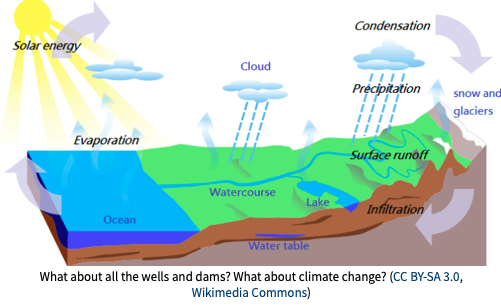
What about all the wells and dams? What about climate change? (CC BY-SA 3.0, Wikimedia Commons)
Hitting freshwater rock bottom
Originally published: Steady State Herald on October 23, 2025 by Alix Underwood and Marwa Ebrahem (more by Steady State Herald) (Posted Oct 25, 2025)
Global GDP data comes from the World Bank, and freshwater-withdrawals data comes from the UN’s Food and Agriculture Organization and was accessed via Our World in Data.
Freshwater is arguably the single most essential resource for human life. Yet, its use seems more abstract than that of solid materials. Freshwater sources exist everywhere that humans do, but they are often hidden from view, buried underground or frozen in glaciers. It’s hard to fathom the scope and the impact of the 3.95 trillion cubic meters of freshwater the human economy extracted in 2021. For starters, that’s 40 times more (in tonnes) than the raw, solid material extracted the same year.
Freshwater is a renewable resource, but we’re depleting stores faster than nature replenishes them. What’s more, nature is replenishing these stores more slowly as the planet warms and weather patterns become more extreme. We’ve already crossed a “planetary boundary” for freshwater change, with too much human pressure on this resource to maintain a stable Earth system.
The global economy exerts this “human pressure,” as even high-income countries remain committed to the growth rat race. The agricultural sector guzzles the most freshwater by far (70 percent). We find, via regression analysis, that for every million dollars in national GDP growth, freshwater withdrawals increase by an average of 2,500 cubic meters.
However, unlike most global resource extraction, freshwater withdrawals have plateaued in the 21st century. This is largely attributable to efficiency gains, especially in irrigation. In many parts of the world, however, withdrawals have plateaued or declined because of “water stress”: supplies cannot satisfy water demands.
Will we allow the suffering and conflict that stems from water scarcity to continue increasing? Or will we recognize the conflict between continued global economic growth and sustainable water use before it’s too late?
The Not-So-Natural Water Cycle
The amount of water on Earth (and in Earth’s atmosphere) does not change. Water moves continuously through a cycle. Evaporation from oceans, lakes, and soils and transpiration from plants bring water into the atmosphere. There, it condenses into clouds and falls back to Earth as precipitation. Much of that precipitation settles on land, either infiltrating into soils and aquifers as groundwater or running off into rivers and lakes. Some of this water eventually makes its way to the ocean.
The water-cycle illustrations most of us were educated on depict a “natural,” balanced system, in which long-term freshwater levels remain roughly steady. But on a planet full of GDP, any illustration that does not incorporate human economic activity does not depict reality. The system is far from balanced, as freshwater is depleted not only directly for the production of goods and services, but as an indirect effect of economic activity. Climate change represents one such mechanism.
The most obvious way that warming temperatures reduce land-based water retention is via the shrinking of glaciers. At first, as water melts out of long-term glacial storage, more water is available for use. This water runoff can exceed pre-glacier-shrinkage runoff by over 50 percent. However, after several years or decades, these additional flows decline and eventually stop, as the glaciers are literally liquidated. Communities that once depended on glacier melt are left with only precipitation and groundwater.
Additionally, rising temperatures increase the atmosphere’s capacity to hold moisture. This results in longer dry periods between more intense precipitation events. In turn, this leads to drier and more compact soils, less capable of absorbing water and replenishing aquifers.
We use 26 percent of Earths ice free land for livestock grazing and 33 percent of cropland to produce livestock feed Equalicense Sveta Fedarava
We use 26 percent of Earth’s ice-free land for livestock grazing and 33 percent of cropland to produce livestock feed. (Equalicense, Sveta Fedarava)
Even if climate change weren’t at play, freshwater supplies wouldn’t be able to recharge as fast as humans are depleting them. This is especially the case in arid and agricultural regions. In the United States, groundwater depletion occurred throughout the 20th century, though it has since accelerated to a cumulative one million cubic meters by 2008.
The Aral Sea in Central Asia provides an example of surface-water depletion as far back as the 1960s. Once the world’s fourth-largest lake, the Aral Sea has all but disappeared. The U.S. Colorado River provides another example of unsustainable surface-water diversion that local governments have enabled for far too long.
Though water still moves through a cycle, human pressures are causing it to spend more time in the ocean than as land-based freshwater, contributing to sea-level rise. Satellite measurements show that, on average, global terrestrial water storage from 2015 to 2023 was 1,200 cubic kilometers lower than from 2002 through 2014.
Eating Up the Freshwater
If you want to know what we’re using all that freshwater for, look down at your plate. Agriculture accounts for a whopping 71 percent of global water withdrawals. Industry accounts for 15 percent, and municipal withdrawals—what we use to drink, clean, wash, and cook—account for another 13 percent.
Most freshwater withdrawn for agriculture is used for irrigation. Much of that is fed by rivers and reservoirs, but groundwater supplies about a quarter of irrigation water. Irrigation rates reflect income and rainfall levels, with many middle- and high-income countries and arid regions relying on the technology. Low-income countries and regions with high precipitation often use rainfed systems.
The result of our regression analysis, using data from 1990 to 2020.
Different foods require vastly different amounts of water. Animal products, especially beef, have among the highest “water footprints.” An average of 15,000 liters is required to produce one kilogram of beef. For comparison, chicken requires over 4,000 liters per kilogram and groundnuts (peanuts) require almost 3,000. Many vegetables require in the range of 200—300 liters. When accounting for feed, nearly a third of agriculture’s water footprint is attributable to animal products.
Animal-based foods also tend to yield higher economic value per unit, with global livestock production accounting for 40 percent of total agricultural GDP. This contributes to the hypothesis that more GDP requires more freshwater depletion.
GDP and Freshwater Withdrawals: A Quantitative Analysis
Clearly, the economy relies on freshwater. In particular, agriculture relies on freshwater, and the economy relies on agriculture, more than any other sector. The size of the economy is a function of a) population size and b) individual consumption levels. The more people we have, the more food we need. Our food system already falls short of providing food security for all of Earth’s human inhabitants. Lowering the global birth rate is one of the most important solutions for a sustainable food—and water—future.
The second component, individual consumption, is also crucial for water use. As incomes rise, water stress tends to increase, partly because higher-income diets include more resource-intensive foods, such as meat. Evidence suggests income growth has a larger effect on water use than population growth, though the size of that effect varies across countries and time.
The Ganges river dolphin, one of the 24 percent of freshwater species at high risk of extinction. (CC BY-SA 4.0, Kukil Goggoi)
To what extent is the size of the economy—whether due to population size or the consumption of high-income individuals (or both)—associated with freshwater withdrawals? To analyze the relationship between GDP and any ecological indicator, a global perspective is essential. Looking only at national withdrawals, we see that some high-income countries have decreased their freshwater withdrawals. At face value, it appears they’ve achieved “absolute decoupling,” the ultimate green-growth goal of decreasing ecological impact while growing the economy.
However, the national withdrawals metric is short-sighted in that it does not account for the “virtual water” used by lower-income countries to produce exports. In other words, high-income countries often externalize a large share of their water footprint: roughly two-thirds in the United Kingdom, three-quarters in Japan, and one-fifth in the United States. Much of this water—and the ecological impact of extracting it—is sourced from water-insecure regions.
Despite this limitation, we used national-level “panel” data for a more robust analysis. Our dataset covers 129 countries from 1990 to 2020. We used real GDP at purchasing power parity from the Conference Board’s Total Economy Database and freshwater withdrawals from FAO’s AQUASTAT database(accessed via Our World in Data).
For readers with some statistical know-how, we ran a two-way fixed effects model. The relationship between national GDP and freshwater withdrawals is statistically significant. On average, freshwater withdrawals increase by about 2,500 cubic meters for each additional million dollars of real GDP. That’s roughly 2.5 liters per extra dollar of GDP.
The Consequences
Ecosystems—and the priceless tapestry of species they contain—are suffering from freshwater depletion. Globally, we have lost over 85 percent of natural wetland area. Of all the world’s rivers longer than 1,000 kilometers, only 37 percent remain “free-flowing” over their full length.
The result? Freshwater species populations are collapsing faster than their marine and terrestrial counterparts. From 1970 to 2018, they declined by 83 percent compared to an average decline of 69 percent across all monitored wildlife populations.
The five countries that are most water-stressed are Bahrain, Cyprus, Kuwait, Lebanon, Oman, and Qatar. (CC BY-NC-SA 2.0, GRID-Arendal)
Though the most privileged among us are insulated from this reality, the human population also depends on functioning ecosystems. In 2020, over a quarter of humans lacked access to safe drinking-water services and almost half did not have access to safely managed sanitation. The United Nations predicts that up to half of the global urban population will face water scarcity by 2050.
More Competition Means More Exploitation and Conflict
Water scarcity is often linked to exploitation. Water access is the third-most-prevalent trigger (out of 51) of the injustice cases that the Environmental Justice Atlas tracks. Freshwater is a particularly difficult resource to govern because it is constantly in motion. It flows across borders, and downstream jurisdictions often get the short end of the stick.
Unfortunately, governments have not been proactive about cooperatively managing transboundary water sources. With operational cooperation arrangements in only 58 percent of the hundreds of shared basins and aquifer systems, we have set ourselves up for conflict. Indeed, water conflicts within and between countries sharply increased throughout the 20th century and into the 21st.
The global economy will not be able to expand as we hit the limits to growth and conflict ensues. (If it somehow managed to keep growing, this would demonstrate that GDP growth does not equal wellbeing.) In the 21st century, floods and droughts have already caused over $650 billion and $130 billion in economic losses, respectively. The UN predicts that, by 2050, water scarcity will cause some economies to shrink by six percent.
Will we wait to plunge into a recession that causes widespread suffering, or will we start taking intentional steps toward degrowth to a steady state economy?
Why Have Withdrawals Plateaued?
20th-century trends reflect the connection between economic activity and freshwater withdrawals. From 1960 to 2000, global GDP increased over fourfold, and freshwater withdrawals increased over twofold. However, in the 21st century, withdrawals have all but plateaued while the global economy has continued to grow (albeit not as rapidly). Have efficiency gains enabled us to decouple economic growth from ecological degradation?
Some degree of relative decoupling—when ecological degradation still increases alongside economic growth, but at a slower pace—has undeniably taken place. The UN’s Food and Agriculture Organization (FAO) defines water-use efficiency as “the sum of the efficiencies in the major economic sectors,” weighted according to each sector’s contribution to overall withdrawals. They estimate that global water-use efficiency has increased from $13 per cubic meter of water in 2000 to $22 in 2022. In one study, researchers attributed the freshwater-withdrawal plateau primarily to technological advances and “optimization and enhancement” of production.
Agricultural advances have been particularly important, given the sector’s dominant role in water use. Irrigation methods are perhaps the most influential example of water-saving advances. Modern dripline irrigation has been shown to use 37 percent less water than traditional “furrow” irrigation, with higher crop yields to boot. U.S. farmers decreased the average amount of water they use per irrigated acre by 25 percent from 1979 to 2022.
While efficiency gains have slowed increases in freshwater withdrawals, there is another, darker driver of the global withdrawal plateau. People have no choice but to withdraw less as many sources dry up. The ratio of demand to supply, known as “water stress,” is increasing. It is highest in the Middle East and North Africa, where 83 percent of people live in “extreme water-stressed” areas (using at least 80 percent of the renewable supply). Worldwide, at least 2.3 billion people already live in “high water-stressed” basins (using 40 percent of renewable supply). This number is projected to rise to 4.2 billion by 2100.
At this rate, efficiency gains won’t be enough to halt freshwater depletion (especially when one considers that efficiency gains can lead to more overall consumption). The economy will start to hit its head on the ceiling for the resource most critical to its survival.
It’s time to splash our faces with cold water, ask how and at what cost that water made it to our taps, and recognize that our economy can’t keep growing exponentially. Fresh with that realization, we can start planning for degrowth toward a steady state economy that extracts freshwater no faster than nature replenishes it.
How I Came To Not Believe In Peak Oil & Peak Fossil Fuels (Production)
Roger Boyd
Oct 26, 2025
I was sitting in the Albert Hall in Brussels at the 9th International Association for Peak Oil (ASPO) Conference, April 2011. The theme was “European Energy Policy in an era of expensive energy”. An executive from the French energy company Total had come to speak about this new technology “fracking”, a technology that would postpone peak oil for a very long time. From the audience came what psychologists would call cognitive dissonance, the problem with dealing with new information that directly threatens a worldview in which much work and energy had been invested. For some time the “ASPO crowd” rejected this truth, including me for a while, but US oil and gas production just kept rising and fracking technology kept getting more cost effective. Yes, decline rates were much faster than conventional wells. Yes, the sweet spots with highest production would be drilled out first. Yes, it poisoned peoples wells and other water supplies with hydrocarbons and the chemical filth that was used. Yes, it caused small earthquakes. But nothing was able to stop it, including the US Clean Water Act from which it was exempted.
US Oil & Gas Production
2010: 5.5 million barrels per day; 61.8 billion cubic feet per day
At the same time, Canadian Tar Sands oil production rose from 1.6 mbpd in 2010, to 2.4 mbpd in 2015, to 2.8 mbpd in 2020, to 3.5 mbpd forecast for 2025. Also, Qatar natural gas production exploded from 10 bcfpd in 2010, to 16.4 bcfpd in 2015, to 17 bcfpd in 2020 and 24 bcfpd forecast for 2030.
Global oil production has been maintained on a plateau from 2014 onwards. In 2025, OPEC+ is limiting oil supply as prices are below US$60 per barrel; which is the equivalent of US$40 in 2010. The only place natural gas prices have risen is in a Europe that saw the forced closure of the Groningen gas field in the Netherlands and then replaced cheap Russian pipeline gas with expensive US and Qatari LNG.
At the time that I was writing my 2014 book, “Energy & The Financial System”, I noted that coal still had a high energy return on investment (EROI) and therefore peak coal did not seem anytime soon. World coal production has been on a plateau since 2013, and prices, excluding the Ukraine War related supply interruptions, have been at or below the 2008 level. Chinese coal consumption actually rose above the previous 2013 peak in 2019 and continued to grow; only in 2025 may Chinese peak coal consumption be reached, with India possibly peaking in the same year. In 2024, world coal consumption grew by 1%; with India growing coal usage by 5%; with no coal shortage on the horizon.
The reduction in European and US coal consumption, that somewhat offset increases in other regions, is already heavily played out. The use of hard coal and brown coal in Europe has already dropped by 75% since 1990; there is just not that much left to cut. US coal consumption peaked in 2007 and has since dropped by over 60%; significantly due to the availability of cheap fracked natural gas (which is worse for climate change when fugitive methane emissions are taken into account). In 2024, China used about 92.2 exajoules of coal, India 23. Against that, the US usage of 7.9 pales. Indonesia used more coal (4.72) than fifth placed Japan (4.53), with Russia sixth (3.75). There may be a global fall in coal consumption in future years as the behemoth China moves more toward low carbon sources, but that will be due to government policies not any “peak coal”. In fact, there is currently a global coal supply surplus and falling prices.
There will be no “peak oil production”, most especially with the rapid electrification of personal and commercial vehicles in China and the less rapid progress in Europe. Even with the US removing any fiscal support for electric vehicles. There will certainly be no “peak fossil fuels production”. There are a few still hanging on to this thesis (cognitive dissonance can be very hard to overcome) but in the end theory must comply with conflicting empirical evidence.
Fracking, Tar Sands, Qatari natural gas production, coal bed methane production, and ever increasing coal production have allowed human civilization to keep on growing for the past 15 years; facilitating the rise of China to the point of directly challenging the US imperial world order. Ironically, China has been the greatest beneficiary of the increases in US and Canadian oil production increases. Without them, oil prices would have most definitely risen mightily and choked off global economic growth.
In 2025 we stand on the cusp of two paths, from which peak oil/fossil fuels will not save us. Slash fossil fuel consumption very rapidly and deal with the economic and financial consequences or face catastrophic climate change within a decade or two. I am old enough to be swanning off this Earth after a good life by the time the climate change shit truly hits the fan, people younger than myself will not be so lucky.
The US administrations, both Republican and Democrat, have chosen the “ignore or deny it” path. The Europeans have chosen the “collective hallucination and mild eco-modernist” path. The Chinese are quite quickly moving to the “wish for a good outcome with supercharged eco-modernism” path. The collective outcome of these three paths will be catastrophic climate change, mixed with extreme emergency geo-engineering attempts that may stave off the worst days of reckoning for a while. There will be no peak oil to force us to do what collectively we seem unable to do. I wish there had been, but as Craig Dilworth argued in 2009 we are just too smart for our own good; each time forcing ourselves down the same growth cul-de-sac by always coming up with new technology to keep the unsustainable going until it isn’t.
Climate change is ungreening the oceans
October 25, 2025
Chlorophyll decline shows a vital life-support system is weakening, threatening food chains and the climate
Phytoplankton bloom in the Baltic Sea, 2020. (NASA Earth Observatory image by Joshua Stevens)
by Bob Berwyn
Inside Carbon News, October 17, 2025
Pictures of Earth from outer space often show the planet as a gaudy quilt. Shimmering aquamarine water covers more than 70 percent of its surface and those hues often seem to signify life against the vast darkness of the universe. But new research analyzing satellite images of the planet over a span of more than 20 years found that one shade of ocean green, representing chlorophyll produced by phytoplankton, is fading.
The fading ocean green, a sign of phytoplankton decline, is a red flag for key ocean systems that sustain food chains and regulate the climate. Phytoplankton, microscopic organisms that have been creating a breathable atmosphere for the planet for more than 2 billion years, are under threat.
The decline in phytoplankton, or even significant shifts in their populations, threaten ecosystems and hundreds of species, from sea turtles and birds to giant marine mammals. Coastal and nearshore fisheries on nearly every continent, which are a crucial food source for an estimated 3 billion people, are also at risk.
To this day, they produce oxygen needed by nearly all other life and regulate the climate by removing carbon dioxide from the atmosphere and storing it in ocean-bottom sediments.
Iestyn Woolway, an ocean researcher at Bangor University in Wales and study co-author, said via email that the research reveals a long-term decline of ocean greenness and phytoplankton bloom frequency across low- and mid-latitude oceans between 2001 and 2023. The scale and consistency of the decline were especially concerning, he added.
It’s a “clear sign” that global warming is already weakening the ocean’s biological carbon pump, one of Earth’s fundamental life-support systems, he said. “A less green ocean not only affects marine food webs but also weakens the ocean’s ability to absorb carbon dioxide—a key buffer against climate change.” Biological carbon pumps cycle carbon dioxide from the atmosphere into deep ocean sediments, where it doesn’t affect the climate.
With the changes visible across vast swaths of ocean and intensifying in coastal zones, the findings suggest “that we’re not just seeing natural variability but a systemic shift,” Woolway said.
The oceans cover 71 percent of the planet’s surface, and they have absorbed about 93 percent of the heat trapped in the atmosphere by greenhouse gases during the fossil-powered industrial era. As the ocean’s surfaces heat up, the water becomes lighter and more buoyant, forming a stable layer that resists mixing with the colder, denser water below. This stratification blocks nutrient-rich, cooler deep water from reaching the surface and starving the phytoplankton that give oceans their greenish tint.
“What worries me most is that these changes are largely invisible to the public,” Woolway said. “Unlike melting glaciers or extreme weather, declining ocean productivity is subtle, slow-moving, and hard to visualize — but it’s no less critical.”
Lead author Di Long, a professor in the Department of Hydraulic Engineering at Tsinghua University in Beijing, said the study results exceeded the team’s expectations. The initial goal was to fill “massive satellite data gaps” to accurately depict changes in ocean greenness over time.
But in the end, he said, they were able to effectively quantify the changes and detect the “surprising downward trend” of greenness, especially in coastal regions, he said.
The unexpected drop in the number of algal blooms is also a significant finding, he said, because some previous research suggested that global warming would “lead to more harmful algal blooms, whereas our results indicate an overall decrease in such blooms.”
More studies are needed to classify algal blooms by species, since some produce toxins that are harmful to marine species and potentially to people, he said. “The worst-case scenario would be a decline in beneficial algal blooms accompanied by an increase in harmful ones.”
The new study is a step in that direction, said Malin Ödalen, an ocean and climate modeler with the Germany-based Potsdam Institute for Climate Impact Research, who did not contribute to the new study.
The more comprehensive data fills in information gaps to show “that what we thought might be an increase in ocean productivity could in fact be a decline,” Ödalen said via email. “Phytoplankton are living close to their thermal range, and that’s why higher sea-surface temperatures can be bad for them—they’re already at the limit of what they can take.”
The new research expands scientific understanding of how global warming affects the biological ocean carbon pump with a detailed daily record of ocean greenness that fills in previous gaps, especially in coastal regions, she said.
Woolway, the co-author from Bangor University, said the new study integrated satellite observations with data from hundreds of automated floats that sample ocean chemistry at different depths. Deep learning algorithms helped fill in data gaps, for example, in areas covered by clouds and revealed the long-term decline in phytoplankton production, he added.
Climate scientist Michael Mann, director of the Penn Center for Science, Sustainability and the Media at the University of Pennsylvania and a co-author of the new study, said via email that he wanted to contribute to examining how it relates to his prior research on ocean stratification.
The research team used sophisticated AI tools to analyze and organize the massive amounts of data from satellites and direct ocean measurements to identify long-term trends across broad geographic areas, Mann said.
Other recent research, including a 2023 study in Nature, has suggested that parts of the world’s oceans have become greener, suggesting greater phytoplankton production, during time periods overlapping with the new study.
Mann said the new research found that declines in phytoplankton production at most latitudes are greater than the increases, adding that the previous assessment “gets the wrong answer because it relies exclusively on one source of satellite data.”
He said the combination of satellite and direct ocean sampling data, analyzed with machine learning methods, is the key advance in this study.
“I’m confident that our result is correct,” he said, “because it’s what we suspected must be happening, given the previously documented substantial increases in global ocean stratification in recent decades.”
Even if humanity manages to stop producing climate pollution and atmospheric carbon dioxide levels stop rising, “sub-surface warming will continue for some time,” he said. That would intensify stratification and further suppress phytoplankton production. That, he said, “is a reminder of the long legacy of some of the consequences of fossil fuel burning and planetary warming.”
Tech giants are trying to cover up the environmental impacts of their data centers
Originally published: The Progressive Magazine on October 22, 2025 by Julian Cooper (more by The Progressive Magazine) | (Posted Oct 27, 2025)
A new Microsoft data center in Mount Pleasant, Wisconsin, will require more than eight million gallons of water each year to operate, according to records that Microsoft did everything in its power to keep hidden from the public.
Last month, the company argued to Wisconsin officials that documents related to its use of Lake Michigan’s water for artificial intelligence (AI) data centers should be treated as trade secrets—a status typically used to protect intellectual property, such as the Coca-Cola recipe.
In the southern Wisconsin city of Racine, which has a water usage agreement with Mount Pleasant pertaining to the data center, Microsoft pleaded to environmental authorities that its use of water from Lake Michigan should be exempt from public accounting processes that it claims violate the business’ confidentiality. But the Great Lakes, which contain 20 percent of the Earth’s surface freshwater, are protected by the Great Lakes Compact of 2008, which requires strict and detailed documentation of any water diverted outside of the Great Lakes Basin—including water diverted for Microsoft’s data centers. The trade-secret request ultimately failed after the Midwest Environmental Advocates group sued the city of Racine for failing to hand over water usage documents.
The events in Mount Pleasant and Racine belong to a nationwide wave of data center development that has been particularly prevalent in Midwestern states such as Wisconsin, Illinois, and Ohio, where tech companies hope to source the millions of gallons of water that can be needed to cool thousands of computer servers directly from the Great Lakes. And while its argument for withholding its water usage data failed in this case, Microsoft and other tech giants like Amazon and Elon Musk’s xAI are fighting desperately and creatively across the country to cover up the environmental footprint of their generative AI data centers.
In Virginia, which hosts more data centers than any other state in the country, non-disclosure agreements, or NDAs, have become tech companies’ tool of choice to cover up their water and energy use. These NDAs, which companies push local governments to sign when they open data centers, are broadly written to prohibit officials from publicly sharing any business information about the centers. Earlier this year, The Virginia Mercury identified at least twenty-five municipal governments that had entered NDAs with data center operators, out of thirty-one localities with data centers.
Julie Bolthouse, land use director for the Piedmont Environmental Council, a Virginia advocacy group formed in 1972, tells The Progressive these agreements deprive the public of transparency in how these data centers affect residents’ water and electricity costs.
“NDAs have been signed at all levels: the water utilities, the energy providers, the localities, the state level,” Bolthouse says.
The NDAs are very broad. They basically say you can’t share any information about energy usage without talking to [the data center operator] first. They’re mostly a scare tactic.
The debate over data centers has brought controversy—and money—to Virginia state politics. Dominion Energy, an investor-owned private electric utility and the largest electricity provider in Virginia, stands to profit when new electric infrastructure is built to meet data center demand. The company is currently lobbying the state to reform electricity rates structures for large power users to account for the rapid spread of data centers, with the hope of increasing electricity rates to maximize profits. And they’re backing up their lobbying effort with money: Dominion Energy has spent more than $67 million on elections in Virginia since 2020, making it one of the largest political donors in the state outright.
Dominion Energy’s lobbying money, the NDAs across Virginia, and even Microsoft’s trade-secret argument in Wisconsin are all part of the same racket to coerce small towns into relinquishing control of public resources to tech companies and their generative AI operations. Tech giants like Microsoft, Amazon, and xAI are wealthier than some entire nations, and can offer small municipalities hundreds of millions of dollars in tax revenue. In turn, cities build transmission lines and water infrastructure to power data centers, even if it raises the prices of these goods for residents.
What’s more, utilities don’t actively disclose how much water and energy the data centers use, because water and energy utilities are often under municipal or private control—meaning they have no legal obligation to disclose the usage of individual buyers, even if a buyer requires millions of gallons of water or fifty megawatts of power per year.
In many cases, a data center operator would need to obtain state and federal water permits in order to obtain this much water themselves, such as by tapping water from Lake Michigan directly. But if they instead choose to purchase water through a utility, the burden of acquiring permits falls on the municipality. For the most part, state environmental agencies can’t intervene in this process, because neither utilities nor zoning ordinances are under the state’s purview. Unless municipal governments disclose information—which tech companies are working to prevent them from doing—state regulators have few opportunities to get involved.
However, there may be a few levers of power for state agencies to audit data centers. States like California and Wisconsin have environmental impact assessment laws modeled after the National Environmental Policy Act. While these laws do not necessarily require data center operators or municipalities to disclose their own usage data, they do allow the state to conduct a public investigation of a data center’s energy and water needs before it is built.
One of the only state-level environmental impact assessments of a data center to date was completed in 2021, when California’s energy commission used the California Environmental Quality Act to audit the environmental impact of Microsoft’s San Jose data center. The resulting 471-page report contains only two paragraphs on water usage—the commission did not investigate how much water would be used, how that water would be returned to the watershed, if the center would increase drought risk, or if it would increase water or energy prices for local residents. The state instead deferred these queries to the local San Jose water utilityIf the utility were to investigate these environmental impacts, they would be investigating their own paying customer.
Wisconsin’s Department of Natural Resources will be conducting an environmental impact assessment for an $8 billion data center this year under the Wisconsin Environmental Policy Act. But, like in San Jose, the agency may defer to the utility on the issue of industrial water use. If state environmental agencies continue to abdicate their responsibility to audit data centers, then utilities will continue to be caught in the same conflicts of interest with their data center customers.
Bolthouse says the new wave of AI data centers, which comes with unprecedented needs in terms of water and energy use, are mainly used to power generative AI systems for programs like ChatGPT. The generative AI market is growing rapidly: Meta just announced Vibes, a new platform which allows users to scroll endlessly through AI-generated videos, while Elon Musk is looking to break into this space with his Grok chatbot on X.
This new generation of data center infrastructure supporting generative AI is markedly different in terms of use as well as environmental impact compared to server farms built in the past several decades, which support everyday Internet functions such as search engines and Apple’s iCloud storage.
“We’ve had data centers being developed [in Virginia] since the 1990s,” Bolthouse says.
They do a lot of things that are very beneficial for society. I think it’s really important to differentiate between that and the explosive speculative market that we’re seeing drive the development of generative AI data centers. Generative AI is based on near endless scaling.
Data, Power and Emissions: How AI’s Growth May Slow Down the Green Transition
Posted on November 1, 2025 by Yves Smith
Yves here. For those minimally on top of AI power usage, the headline is a “Gee, ya think?” item. But this post documents a key point: not only is AI greatly increasing electricity demand, but that need is also being met enough by fossil fuels so as to reverse the decarbonization of electricity production.
By Alessandra Bonfiglioli, Rosario Crinò, Mattia Filomena and Gino Gancia. Originally published at VoxEU
AI and other data-intensive technologies may help optimise energy use, but the technologies themselves are power hungry. This column explores how the diffusion of AI affected emissions in the US between 2002 and 2022 and finds that local AI growth raises emissions by boosting economic activity and energy use. It also leads to power generation becoming more carbon-intensive as plants shift from renewable to non-renewable sources. The ‘green’ promise of AI will remain elusive as long as the electricity sector itself does not rapidly decarbonise.
Quantifying the carbon footprint of AI is an increasingly urgent task. Policymakers are debating whether the surge in electricity demand linked to AI will jeopardise decarbonisation goals. Data centres – the core infrastructure supporting AI models – are projected to account for 8% of US electricity demand by 2030, up from 3% in 2022 (Davenport et al. 2024). Concerns have been voiced that this power surge may delay the retirement of coal-fired plants. On the other hand, AI and digital industries are often promoted as a ‘green’ technology that may increase efficiency and lower emissions.
Studies of past waves of digitalisation (e.g. Lange et al. 2020) showed that while ICT can reduce some forms of waste, the overall effect was often an increase in energy use. More recently, cryptomining has been linked to an increase in local electricity prices (Benetton 2023), and there is an ongoing debate whether data-centre expansion will force grids to rely longer on fossil fuels (Electric Power Research Institute 2024, Knittel et al. 2025).
In a recent study (Bonfiglioli et al. 2025), we contribute to this debate by providing systematic evidence on how the diffusion of AI has affected emissions in the US over the last two decades. Our findings suggest that the ‘green’ promise of AI will remain elusive as long as the electricity sector itself is not rapidly decarbonised.
A Novel Dataset Linking AI, Data Centres, and Power Plants
To carry out the analysis, we assemble a novel dataset linking AI, emissions, and the location of data centres and power plants in 722 US commuting zones between 2002 and 2022. This period coincides with the rise of the digital economy, cloud computing, and early AI applications. To capture the carbon footprint of these phenomena, we define AI as algorithms applied to big data, and we measure its penetration using changes in employment in data-intensive occupations – software developers, data scientists, systems analysts, and related computer-science jobs – identified from the O*NET database (see Bonfiglioli, Crinò, Gancia, and Papadakis 2024, 2025).
We then map the geographical location of more than 2,000 data centres and link them to nearby power plants and their fuel mix. Finally, we measure emissions from the high-resolution Vulcan dataset (Gurney et al. 2009, 2025), which tracks CO2 from fossil-fuel combustion by sector and location, complemented by satellite-based data on other pollutants.
Figure 1 presents colour maps showing how employment in data-intensive occupations (panel a) and CO2 emissions (panel b) vary across US commuting zones, with darker colours representing higher levels of adoption or emissions over the sample period. Red triangles also indicate the location of data centres. The figure shows that areas with more workers in data-intensive occupations tend to have higher emissions and are more likely to host at least one data centre. Yet, this correlation cannot be interpreted as causal evidence, as both AI and emissions might be simultaneously driven by other shocks.
Figure 1 Data-intensive occupations, data centres, and CO2 emissions
Notes: Panel (a) displays the employment share of data-intensive occupations in each commuting zone in 2022. Panel (b) shows the total CO2 emissions in each commuting zone for the same year. Darker colours represent higher levels of adoption of data-intensive occupations or emissions over the sample period. Red triangles indicate the presence of a data centre site.
To address the fact that AI adoption could itself be influenced by local demand or productivity trends, we use a shift–share (Bartik) instrument. Specifically, we identify commuting zones exogenously more exposed to the arrival of AI as those zones historically specialised in industries that experienced faster growth in data-intensive occupations than the nation as a whole.
The Effect of AI on Emissions
Our analysis yields four key findings. First, AI slows down the green transition at the local level. Localities specialised in industries with faster growth of data-intensive employment saw a significantly slower fall in CO2 emissions (Figure 2). On average, emissions fell by 16% over the period 2002–2022. In contrast, in a hypothetical commuting zone that had experienced no AI penetration at all, CO2 emissions would have fallen 37% more than the average. While these figures should not be interpreted as counterfactual exercises, since nationwide effects are differenced out in our empirical strategy, they nonetheless suggest that local AI penetration increases emissions relative to less exposed areas.
Figure 2 AI penetration, CO2 emissions, and electricity generation
Notes: The figure presents estimated coefficients and 90% confidence intervals for the effects of AI penetration on various types of emissions and on the non-renewables share of net electricity generation. The estimation sample includes 722 commuting zones observed across four 5-year periods from 2002 to 2022.
Second, the growth in emissions is mostly due to a scale effect. Decomposing the drivers of emissions into scale, composition, and technique (à la Levinson 2009), we find that expansion of local economic activity is the main channel through which AI affects emissions. Areas specialised in industries with faster growth of data-intensive employment attracted more workers and firms, increasing total output and hence energy use (Figure 2). Shifts in industrial composition modestly reduced, rather than increased, emissions.
Third, electricity generation becomes more carbon intensive. Even after controlling for scale, per-capita emissions from power generation rose in areas with higher AI penetration (Figure 2). This happens because power plants located in more exposed areas switch electricity generation from renewable sources to non-renewable sources (Figure 2). It confirms concerns that the energy demand driven by AI applications and data centres is met primarily by fossil-fuel plants, which can guarantee the stable and continuous supply that high-performance computing requires.
Our fourth and final result is that the location of data centres matters. Since electricity cannot be stored at scale easily, the grid must balance supply and demand in real time. Given the high transmission-loss costs, power plants are influenced by nearby sources of demand, especially from data centres which require a stable, high-capacity electricity supply. Consistently, we find that proximity to data centres is associated with power plants generating higher CO2 emissions and relying more heavily on non-renewable energy sources (Figure 3).
Figure 3 Distance to data centres and power plant activities
Notes: The figure presents estimated coefficients and 90% confidence intervals for the effects of power plants’ average distance to data centres on different power plant activities. The estimation sample consists of 11,500 power plants observed four 5-year periods from 2002 to 2022.
Conclusions
These results put numbers on a concern often voiced by climate analysts: absent a faster transition of the power sector to low-carbon sources, the diffusion of AI can slow or even reverse recent gains in emissions reduction.
Notably, our study covers 2002–2022, a period that predates the explosion of generative AI. While the promised efficiency gains from these new technologies may eventually help decarbonise the economy, training and running today’s large language models is far more energy-intensive than the earlier AI applications captured in our data. Unless accompanied by massive investment in clean power, the next wave of AI may therefore have even larger short-run impacts on emissions.
Our research points to an uncomfortable truth: digital transformation and decarbonisation cannot be treated as separate agendas. The diffusion of AI epitomises a classic challenge of technological progress: innovations that promise long-term efficiency gains can, in the short run, raise environmental externalities by expanding demand for energy. The solution is not to slow AI, but to accelerate the clean-energy transition. This may require incentives for more energy-efficient hardware, locating data centres in regions with abundant clean-energy capacity, and strengthening transmission infrastructure. Without that alignment, the race for ever-more-powerful algorithms may inadvertently lock economies into a higher-emission path.
Climate change costs millions of lives each year
November 3, 2025
The health and economic consequences of delayed climate action are escalating rapidly
The 2025 Lancet Countdown on Health and Climate Change reveals that climate inaction and continued dependence on fossil fuels is resulting in an immense human cost, with millions of lives lost each year due to heat, air pollution, disease spread, and worsening food insecurity.
The report, led by University College London and produced in collaboration with the World Health Organization, the London School of Hygiene & Tropical Medicine, and 70 other academic institutions and UN agencies, warns that the health and economic consequences of delayed climate action are escalating rapidly.
The latest findings reveal that 12 of 20 key health indicators have reached unprecedented levels, as the world’s failure to curb emissions and adapt to climate impacts intensifies threats to health and livelihoods worldwide.
The rate of heat-related deaths has risen by 63% since the 1990s reaching an average of 546,000 annual deaths between 2012 and 2021.
The year 2024 was the hottest on record, with the most vulnerable (those under 1 and over 65 years) exposed to more than 300% additional heatwave days on average, compared with the annual average between 1986 and 2005.
Hotter and drier conditions exacerbated the risk of wildfires with implications for health – in 2024 alone, wildfire smoke pollution was associated with a record 154,000 deaths. Extreme rainfall (which can trigger flash floods and landslides) and droughts increased in over 60% of the world’s land surface. These extremes of heat, rainfall and droughts affect crop productivity, disrupt supply chains, and threaten food security.
Changing climates also affect the risk of transmitting deadly infectious diseases – indicators in the report found the potential for dengue transmission has climbed by nearly 50% globally since the 1950s.
Delays in the adoption of clean, climate-friendly energy and the continued burning of fossil fuels not only heats the planet, but produces dangerous air pollution, resulting in millions of additional deaths per year. In the UK, air pollution caused 28,000 premature deaths in 2022 – 55% of which came from fossil fuel burning.
Unsustainable food systems with high-carbon, unhealthy diets contributed to 11.8 million diet-related deaths worldwide in 2022, which the authors say could largely be avoided by transitioning to healthier, climate-friendly food systems.
The report highlights that the failure to transition away from fossil fuels also takes a toll on the economy, with the health impacts of climate change resulting in reduced productivity, more time off work, and an increased burden on health systems.
In 2024, heat exposure resulted in a record 639 billion potential hours of lost productivity, with income losses equivalent to USD $1.09 trillion (around £824 billion) – almost 1% of global GDP. In the UK, over 5 million potential labour hours were lost due to extreme heat exposure, resulting in a potential income loss of $103 million (£77.9 million).
Meanwhile following a rise in fossil fuel prices, governments collectively spent $956 billion (£723 billion) in net fossil fuel subsidies in 2023 to keep energy locally affordable, more than triple the commitment pledged to support vulnerable countries at COP29.
Despite some governments rolling back climate commitments, the report finds positive change at local and sectoral levels, and climate change action is already delivering health and economic benefits. The health sector’s greenhouse gas emissions fell 16% globally between 2021 and 2022, and renewable energy generation has reached record highs.
An estimated 160,000 premature deaths are prevented each year due to reduced coal use and cleaner air, particularly in high income countries. The authors stress that solutions to avert further harm are already available, with cleaner energy, resilient health systems, and sustainable food systems offering immediate and long-term health gains.
Dr James Milner, a co-author of the Lancet Countdown, said:
“The latest Lancet Countdown report shows that the world remains well off-track in its efforts to prevent climate change. The gap between global greenhouse gas emissions and the reductions needed to meet the goals of the Paris agreement has continued to grow. Despite this, the report also demonstrates that there are unprecedented opportunities for us to tackle the climate crisis while improving people’s health at the same time, through actions including transforming energy systems, improving access to clean household fuels, and shifting to low carbon transport.”
Another co-author, Professor Kris Murray, said:
“We now have clearer evidence than ever that climate change is directly harming people’s health. Many of the health impacts we see today – such as deaths from extreme heat – wouldn’t have occurred without human-driven climate change. Climate change is also worsening the spread of infectious diseases, with some climate-sensitive illnesses like dengue and Vibrio infections reaching record highs as more areas become suitable for transmission. While some progress is being made towards cleaner energy and healthier, low-impact diets, action is still too slow, and those delays are costing lives right now.”
[Adapted from materials provided by the London School of Hygiene & Tropical Medicine]
Basis for Climate and Environmental Liberation
Anthony Karefa Rogers-Wright 05 Nov 2025
A movement born from radical action now risks being defanged by racism and elite capture. As the climate crisis continues to grow, the only viable path is a radical struggle for climate and environmental liberation.
“WE, THE PEOPLE OF COLOR, gathered together at this multinational People of Color Environmental Leadership Summit, to begin to build a national and international movement of all peoples of color to fight the destruction and taking of our lands and communities, do hereby re-establish our spiritual interdependence to the sacredness of our Mother Earth; to respect and celebrate each of our cultures, languages and beliefs about the natural world and our roles in healing ourselves; to ensure environmental justice; to promote economic alternatives which would contribute to the development of environmentally safe livelihoods; and, to secure our political, economic and cultural liberation that has been denied for over 500 years of colonization and oppression, resulting in the poisoning of our communities and land and the genocide of our peoples, do affirm and adopt these Principles of Environmental Justice.”
A Brief History of Environmental Justice in the United States
For many, the U.S. environmental justice (EJ) movement began in Warren County, North Carolina in the 1980s when members of a predominantly Black community protested the dumping and burying of toxic polychlorinated biphenyls (PCBs) in their neighborhood. The protests culminated with the arrest of the Reverend Dr. Benjamin Chavis who, while being detained, proclaimed, “this is environmental racism.” The nascent EJ movement made national attention when Dr. Chavis and others in partnership with the United Church of Christ produced the landmark report, Toxic Wastes and Race in the United States, in 1987. Key conclusions of the report include:
Race proved to be the most significant among variables tested in association with the location of commercial hazardous waste facilities. This represented a consistent national pattern;
Communities with the greatest number of commercial hazardous waste facilities had the highest composition of racial and ethnic residents. In communities with two or more facilities or one of the nation's five largest landfills, the average minority percentage of the population* was more than three times that of communities without facilities (38 percent vs. 12 percent);
Although socio-economic status appeared to play an important role in the location of commercial hazardous waste facilities, race still proved to be more significant; and
Three out of the five largest commercial hazardous waste landfills in the United States were located in predominantly Black* or Hispanic communities. These three landfills accounted for 40 percent.
Despite the sound research and conclusions contained in Toxic Wastes and Race, mainstream environmental groups continued to deny the urgency of environmental racism and more or less ostracized Black, Brown, and Indigenous communities and the respective and collective challenges they experienced associated with disproportionate exposure to toxic waste and air emissions. The systemic and, oftentimes, racist and bigoted actions of mainstream environmental groups played a large part in the preparation of a letter by the Albaqueuque, New Mexico based, SouthWest Organizing Project (SWOP) in 1990.
The letter, which was addressed to the largest environmental groups in the nation at the time including the Sierra Club, National Wildlife Federation, Environmental Defense Fund, Friends of the Earth [full disclosure, I currently sit on this organization’s Board of Directors], and Natural Resources Defense Council who referred to themselves as “the group of 10,” was veraciously provocative to say the least. For instance, the letter notes, “The lack of people of color in decision-making positions in your organizations such as executive staff and board positions is also reflective of your histories of racist and exclusionary practices. Racism is a root cause of your inaction around addressing environmental problems in our communities.” SWOP and signatories of the letter also pointed out that, “Comments have been made by representatives of major national environmental organizations to the effect that only in the recent past have people of color begun to realize the impacts of environmental contamination. We have been involved in environmental struggles for many years and we have not needed the Group of Ten environmental organizations to tell us that these problems have existed.”
Nearly one year later, the first People of Color Environmental Leadership Summit released the 17 principles of Environmental Justice that acted as a major intervention point for a U.S. environmental movement that largely ignored or paid tawdry lip service to the specific environmental and associated public health issues impacting Black, Brown, Indigenous, and poor white communities. Even with the release of the EJ principles, mainstream environmental groups still demonstrated intransigence to diversifying their teams and a lack of understanding of how to better coordinate and organize with EJ groups and allow them to lead on issues directly impacting their communities. To this end, the Southwest Network for Environmental and Economic Justice (SNEEJ) hosted a meeting of EJ leaders from across the nation and released the 1996 Jemez Principles for Democratic Organizing The six principles - Be Inclusive; Emphasis on Bottom-Up Organizing; Let People Speak for Themselves; Work Together In Solidarity and Mutuality; Build Just Relationships Among Ourselves; and Commitment to Self-Transformation - were designed assist all organizations, but especially mainstream environmental groups, with centering those impacted most by environmental degradation and putting them in positions of leadership to foster solutions best for their people and communities. As noted by Dargan M.W. Fierson in his book, Climate Justice and Energy Solutions: Radical Visions of 100% Clean Power for 100% of the People, the Jemez Principles were designed to affirm, “...those most affected cannot be brought in as an afterthought. They should be present starting from the beginning of the decision-making process.” He adds, “Frontline communities know the solutions that are needed to help themselves. They’re also most able to see the root of the problems, and are more likely to come up with lasting, comprehensive solutions.” Fierson also notes, “Recently more mainstream environmental organizations, which have a checkered past when it comes to social justice, have adopted the Jemez Principles as well, to improve their relations with people-of-color-led environmental justice organizations.”
The Aftermath of the EJ Movement’s Interventions Point to a Subtraction of Justice
While it’s true that mainstream environmental organizations are found of parading the Jemez Principles on their websites, during their meetings, and as part of their general rhetoric in an effort to appeal to EJ organizations as well as philanthropic bodies who also want to appear to be inclusive and righteous, it can still be argued that not much has changed since SWOP’s 1990 letter to “the group of 10.” For instance, according to a report released by the group Green 2.0 in 2021, “data from about 40 of the largest nonprofit environmental organizations in the country and the top 40 foundations and grant providers show that, on average, these groups added six people of color and eight women to their full-time staff from 2017 to 2020, added two people of color and two women to their senior staff in that time, and one person of color and one woman to their boards since 2017.” These statistics, among others, informed Green 2.0 conclusions including, “The latest numbers demonstrate a noticeable shift, but still highlight that the organizations and foundations remain overwhelmingly white — even as many of those groups released statements last year calling for racial justice and recognizing how despite their progressive ideals, they failed to react to systemic disparities that people of color have been subjected to in the United States.”
Green 2.0’s second report on the state of diversity in mainstream environmental movement groups indicates that they have actually lost staffers of color since 2020. As the report names, “For the first year, the data for NGOs showed that the representation of staff of color has decreased at all levels. For full-time staff, it was the largest decrease in the history of the report. The rate of progress after 2020, a pivotal point for racial equity and justice in the nation and in the sector, slowed year after year and now, four years later, there is a steep decline in representation at all NGO levels.“ The report further notes, “The environmental sector has historically excluded marginalized communities, and this year’s report demonstrates active work is needed to create long lasting change.” The idea of long lasting change becomes important when considering the successes of the EJ movement as it pertains to analyzing what policy gains have been secured and implemented to improve material conditions of frontline/environmental justice communities.
Regardless of the mainstream environmental movement’s consistent inability and unwillingness to prioritize environmental justice, the mid 1990s did see some key policy gains for the EJ movement. For instance, in 1994 President Bill Clinton signed one of the most significant Executive Orders, Executive Order 12898: Federal Actions To Address Environmental Justice in Minority Populations and Low-Income Populations that directed federal agencies, “To the greatest extent practicable and permitted by law, and consistent with the principles set forth in the report on the National Performance Review, each Federal agency shall make achieving environmental justice part of its mission by identifying and addressing, as appropriate, disproportionately high and adverse human health or environmental effects of its programs, policies, and activities on minority populations and low-income populations in the United States and its territories and possessions, the District of Columbia, the Commonwealth of Puerto Rico, and the Commonwealth of the Mariana Islands.”
While the Executive Order did result in a legal mandate for projects that received federal funding to analyze impacts to EJ communities pursuant to the National Environmental Policy Act (NEPA), this did not result in a reduction of environmentally racist practices by governments and corporations alike. This much was made clear in a 2007 report released by the United Church of Christ, Toxic Wastes and Race at Twenty, which states, “It is ironic that twenty years after the original Toxic Wastes and Race report, many of our communities not only face the same problems they did back then, but now they face new ones because of government cutbacks in enforcement, weakening health protection, and dismantling the environmental justice regulatory apparatus.” Making matters even worse, the second Trump Administration, on its first day in office, rescinded Executive Order 12898 as part of its larger war against non-white people and the poor. Couple this with the Trump administration’s quest to extract and burn more fossil fuels, further deregulate bedrock environmental laws like NEPA and the Clean Water Act, as well as the precipitous proliferation of data centers to power Artificial Intelligence - largely powered with fossil fuel infrastructure - it’s fair to conclude that the situation has become more perilous for frontline/environmental justice communities than during the 1980s.
But it’s not just Trump or the lack of diversity in mainstream environmental groups that have diminished the material conditions of frontline/environmental justice communities - the environmental justice movement also needs to exercise principled and objective introspection to see where it, in far too many cases, have contributed to the state of iniquity and precarity facing historically marginalized communities.
In the last five years, certain environmental justice groups and their agents have enjoyed the selective largesse of mainstream environmental groups and governmental agencies at the federal and State level. On the one hand this has increased the ubiquity of environmental justice, at least rhetorically, as well as the operating budgets for select environmental justice organizations. But we must ask ourselves what was/is the cost for certain environmental justice organizations to enjoy being selected and hand picked as the “leading” groups and primary spokespeople for the environmental justice movement? And, equally important, what effects do these “selections” have on the larger environmental justice movement, especially those community-based, grassroots organizations that are accountable to the poorest and most polluted communities in the nation and, in some cases, as the case with Cancer Alley in Louisiana, the entire world?
In too many instances we are witnessing a repeat of what happened to Black radical movements in 1967 and since then. In his book, Black Awakening in Capitalist America, Robert L. Allen reminds us of what happened to Black radicalism when governmental and philanthropic forces set its sights on mollifying righteous and beautiful Black rage that erupted across the U.S. when an estimated 164 “civil disorders” were reported that resulted in roughly $500 million in property damage and indirect economic losses. Allen writes, “And by making suitable overtures to the ‘reasonable’ militants, convincing them that a nonviolent transfer of power is possible, white leaders could hope to use these militants to isolate the ‘extremists’ and pacify the angry and unprecedented ghetto youths.” He then concludes, “The intent is to create the impression of real movement while actual movement is too limited to be significant.”
We have observed numerous examples of these handpicked environmental justice “leaders” vindicating Allen’s words and analysis. This was most recently on display during the previous Biden Administration when many who are exalted and honored, rightfully so, flocked to Biden’s white people’s house to watch him sign an insignificant and insouciant executive order that did nothing to improve and transform the material conditions of frontline environmental justice communities. It became clear that many of these environmental justice leaders were hoping that the optics they provided for Biden would assist him in the 2024 election, which would also lead to their groups and communities receiving a large share of the billions of dollars set aside as part of the so-called Inflation Reduction Act (IRA_. But as I have written previously, the IRA was not a historic climate justice bill as much as it was a manifest capitulation that would have placed numerous frontline/environmental justice communities in harm's way while making them more vulnerable to the impacts of climate change. The IRA has all but been dismantled by President Trump and Democrats seek to further deregulate bedrock environmental policies that, at least, offered some protections and redress for environmental justice communities in the name of speeding up project via “permitting reform” under the umbrella of a co-opted and neoliberal iteration of “Abundance.”
It must also be named that by capitulating to mainstream environmental organizations and allowing themselves to become willing agents of the Democrat Party, many environmental justice groups have instituted intra movement class warfare as many of their leaders have become the latest crop of the Black bourgeoisie and essentially victims of, in the words of scholar and author Olufemi Taiwo, elite capture. This has massive consequences and as Allen reminds us, “If this process of takeover goes unchecked, the united front is transformed into an instrumentality serving the interests of the Black middle class alone. The needs of the popular Black masses go by the board, and a new oppressive elite assumes power.”
What is to Be Done
Given the position we find ourselves in - a worsening climate crisis on a rapidly heating planet, increased militarism domestically and globally, and an increased competition for resources necessary for survival - and as we observe deteriorating material conditions of our communities we must ask ourselves what is to be done? How do we contend with the elite capture of environmental justice principles and prevent them from being uttered and exercised speciously and ineffectively.
For one, the environmental justice movement must strive for independent social and political power as part of its larger initiative to improve the material conditions of Black, Brown, Indigenous and poor communities. This requires tearing itself asunder from a Democrat Party that has never fought and will never fight to confront and dismantle environmental racism. And this is because a Democrat Party that acts as vanguard for capitalism, militarism, and endless growth cannot be viewed as an ally, and certainly not as an accomplice when it comes to dismantling the root causes of environmental racism and the climate crisis.
Further, we cannot depend on mainstream environmental organizations to do what is necessary to emancipate communities like Cancer Alley from the clutches of slow genocide at the hands of fossil fuel cartels and petrochemical corporations. How can we expect groups that barely permit Black people to be represented in their spaces to then be agents of our liberation from the same white “supremacy” ideology ensconced in their operations and philanthropic networks?
The elements of the 1991 Principles of Environmental Justice are as temporally germane today as they were four decades ago. But the stakes are not the same, the threats against our communities are more powerful and coordinated, and even the physical conditions of the planet are not the same as they were in 1991. As such, while we must retain the intent and elements of the environmental justice principles and the Jemez principles, we must also move past the limitations of climate and environmental “justice” as there can be no justice for our people and communities until there is first a concerted and long-term effort that affords them climate and environmental liberation through processes that directly combat capitalism and militarism.
Whereas far too many in environmental justice spaces look to the State to rescue us, a climate and environmental liberation framework, much like mutual aid, seeks to surface the contradictions and failures of the State as part of a larger initiative to design and develop alternative systems that we should and must be organizing to realize and implement. Climate and environmental liberation requires moving beyond justice because in a world that has become so imbalanced and unequal, exacerbated by a white supremacist, capitalist-fueled climate crisis, achieving ‘justice’ or ‘ecological balance’ is impossible without liberation, which requires defeating the interlocking systems of oppression that cause this imbalance and inequality: capitalism, white supremacy, colonialism, patriarchy, militarism, and all forms of imperialism.
No Compromise
No Retreat
(Most of those ' interlocking systems of oppression' are simply aspects or results of capitalism. First things first.)
Bill Gates poses with Rick Perry in 2019, during Perry’s tenure as Secretary of Energy under the first Trump administration. (Public Domain)
Michael Mann to Bill Gates: You can’t reboot the planet if you crash it
Originally published: Bulletin of the Atomic Scientists on October 31, 2025 by Michael E. Mann (more by Bulletin of the Atomic Scientists) | (Posted Nov 04, 2025)
“I suppose it is tempting, if the only tool you have is a hammer, to treat everything as if it were a nail.” Thus wrote the famous psychologist Abraham Maslow in 1966.
If Maslow were around today, I imagine he might endorse the corollary that if your only tool is technology, every problem appears to have a technofix. And that’s an apt characterization of the “tech bro”-centered thinking so prevalent today in public environmental discourse.
There is no better example than Bill Gates, who just this week redefined the concept of bad timing with the release of a 17-page memo intended to influence the proceedings at the upcoming COP30 international climate summit in Brazil. The memo dismissed the seriousness of the climate crisis just as (quite possibly) the most powerful Atlantic hurricane in human history—climate-fueled Melissa—struck Jamaica with catastrophic impact. The very next day a major new climate report (disclaimer: I was a co-author) entitled “a planet on the brink” was published. The report received far less press coverage than the Gates missive. The legacy media is apparently more interested in the climate musings of an erstwhile PC mogul than a sober assessment by the world’s leading climate scientists.
Gates became a household name in the 1990s as the Microsoft CEO who delivered the Windows operating system. (I must confess, I was a Mac guy.) Microsoft was notorious for releasing software mired with security vulnerabilities. Critics argued that Gates was prioritizing the premature release of features and profit over security and reliability. His response to the latest worm or virus crashing your PC and compromising your personal data?
Hey, we’ve got a patch for that!
That’s the very same approach Gates has taken with the climate crisis. His venture capital group, Breakthrough Energy Ventures, invests in fossil fuel-based infrastructure (like natural gas with carbon capture and enhanced oil recovery), while Gates downplays the role of clean energy and rapid decarbonization. Instead, he favors hypothetical new energy tech, including “modular nuclear reactors” that couldn’t possibly be scaled up over the time frame in which the world must transition off fossil fuels.
Most troublingly, Gates has peddled a planetary “patch” for the climate crisis. He has financed for-profit schemes to implement geoengineering interventions that involve spraying massive amounts of sulfur dioxide into the stratosphere to block out sunlight and cool the planet. What could possibly go wrong? And hey, if we screw up this planet, we’ll just geoengineer Mars. Right Elon?
Such technofixes for the climate, in fact, lead us down a dangerous road, both because they displace far safer and more reliable options—namely the clean energy transition—and because they provide an excuse for business-as-usual burning of fossil fuels. Why decarbonize, after all, if we can just solve the problem with a “patch” later?
Here’s the thing, Bill Gates: There is no “patch” for the climate crisis. And there is no way to reboot the planet if you crash it. The only safe and reliable way out when you find yourself in a climate hole is to stop digging—and burning—fossil fuels.
It was arguably Gates who—at least in part—inspired the tech-bro villain Peter Isherwell in the Adam McKay film “Don’t Look Up.” The premise of the film is that a giant “comet” (a very thinly veiled metaphor for the climate crisis) is hurtling toward Earth as politicians fail to act. So they turn to Isherwell who insists he has proprietary tech (a metaphor for geoengineering, again thinly veiled) that can save the day: space drones developed by his corporation that will break the comet apart. Coincidentally, the drones are designed to then mine the comet fragments for trillions of dollars’ worth of rare metals, that all go to Isherwell and his corporation. If you haven’t seen the film (which I highly recommend), I’ll let you imagine how it all works out.
For those who have been following Gates on climate for some time, his so-called sudden “pivot” isn’t really a “pivot” at all. It’s a logical consequence of the misguided path he’s been headed down for well over a decade.
I became concerned about Gates’ framing of the climate crisis nearly a decade ago when a journalist reached out to me, asking me to comment on his supposed “discovery” of a formula for predicting carbon emissions. (The formula is really an “identity” that involves expressing carbon emissions as a product of terms related to population, economic growth, energy efficiency, and fossil fuel dependence). I noted, with some amusement, that the mathematical relationship Gates had “discovered” was so widely known it had a name, the “Kaya identity,” after the energy economist Yōichi Kaya who presented the relationship in a textbook nearly three decades ago. It’s familiar not just to climate scientists in the field but to college students taking an introductory course on climate change.
If this seems like a gratuitous critique, it is not. It speaks to a concerning degree of arrogance. Did Gates really think that something as conceptually basic as decomposing carbon emissions into a product of constituent terms had never been attempted before? That he’s so brilliant that anything he thinks up must be a novel discovery?
I reserved my criticism of Gates, at the time, not for his rediscovery of the Kaya identity (hey—if he can help his readers understand it, that’s great) but for declaring that it somehow implies that “we need an energy miracle” to get to zero carbon emissions. It doesn’t. I explained that Gates “does an injustice to the very dramatic inroads that renewable energy and energy efficiency are making,” noting peer-reviewed studies by leading experts that provide “very credible outlines for how we could reach a 100 percent noncarbon energy generation by 2050.”
The so-called “miracle” he speaks of exists—it’s called the sun, and wind, and geothermal, and energy storage technology. Real world solutions exist now and are easily scalable with the right investments and priorities. The obstacles aren’t technological. They’re political.
Gates’ dismissiveness in this case wasn’t a one-off. It was part of a consistent pattern of downplaying clean energy while promoting dubious and potentially dangerous technofixes in which he is often personally invested. When I had the chance to question him about this directly (The Guardian asked me to contribute to a list of questions they were planning on asking him in an interview a few years ago), his response was evasive and misleading. He insisted that there is a “premium” paid for clean energy buildout when in fact it has a lower levelized cost than fossil fuels or nuclear and deflected the questions with ad hominem swipes. (“He [Mann] actually does very good work on climate change. So I don’t understand why he’s acting like he’s anti-innovation.”)
This all provides us some context for evaluating Gates’ latest missive, which plays like a game of climate change-diminishing bingo, drawing upon nearly every one of the tropes embraced by professional climate disinformers like self-styled “Skeptical Environmentalist” Bjorn Lomborg. (Incidentally, Lomborg’s center has received millions of dollars of funding from the Gates Foundation in recent years and Lomborg recently acknowledged serving as an adviser to Gates on climate issues.)
Among the classic Lomborgian myths promoted in Gates’ new screed, which I’ll paraphrase here, is the old standby that “clean energy is too expensive.” (Gates likes to emphasize a few difficult-to-decarbonize sectors like steel or air travel as a distraction from the fact that most of our energy infrastructure can readily be decarbonized now.) He also insists that “we can just adapt,” although in the absence of concerted action, warming could plausibly push us past the limit of our adaptive capacity as a species.
He argues that “efforts to fight climate change detract from efforts to address human health threats.” (A central point of my new book Science Under Siege with public health scientist Peter Hotez is that climate and human health are inseparable, with climate change fueling the spread of deadly disease). Then there is his assertion that “the poor and downtrodden have more pressing concerns” when, actually, it is just the opposite; the poor and downtrodden are the most threatened by climate change because they have the least wealth and resilience.
What Gates is putting forward aren’t legitimate arguments that can be made in good faith. They are shopworn fossil fuel industry talking points. Being found parroting them is every bit as embarrassing as being caught—metaphorically speaking—with your pants down.
For years when I would criticize Gates for what I consider to be his misguided take on climate, colleagues would say, “you just don’t understand what Gates is saying!” Now, with Donald Trump and the right-wing Murdoch media machine (the Wall Street Journal editorial board and now an op-ed by none other than Lomborg himself in the New York Post) celebrating Gates’ new missive, I can confidently turn around and say,
No, you didn’t understand what he was saying.
Maybe—just maybe—we’ve learned an important lesson here: The solution to the climate crisis isn’t going to come from the fairy-dust-sprinkled flying unicorns that are the “benevolent plutocrats.” They don’t exist. The solution is going to have to come from everyone else, using every tool at our disposal to push back against an ecocidal agenda driven by plutocrats, polluters, petrostates, propagandists, and too often now, the press.
Bill Gates Wants to Set the Environmental Agenda Ahead of COP30: It’s Not Surprising
Posted on November 6, 2025 by Curro Jimenez
The Earth’s rotation was slowed by 0.06 microseconds because of the Three Gorges Dam in Hubei Province, central China. When filled, the dam can hold 40 cubic kilometers (about 10 trillion gallons) of water. According to a NASA paper, this redistribution of mass could shift the Earth’s rotational pole, causing a slight—and reversible—slowing of Earth’s rotation. It was later confirmed that this effect could also influence the seismic activity in the region.
There is no doubt that human action affects the planet. There is no doubt that our actions are altering the equilibrium of multiple ecosystems, and that this is having an effect on the environment. There is no doubt that through our actions we are making the Earth a less accommodating place for humans—and many other species—to live on.
Will we adapt and survive? Probably, as a species. Under what conditions—and at what human cost? Difficult to quantify, but most predictions say it could be severe. Can we reverse course and reduce that suffering? To a point. Are we doing enough? Most say no. Most people agree on these points, but not on how to proceed.
Bill Gates, the tech billionaire famous for his environmental endeavors, long urged cutting carbon emissions to avert worst-case scenarios. But in a recent post on his website, he reframes his outlook on the effects and prevention of climate change.
Now, he says, we should focus more on health and development than on stopping climate change: “This is a chance to refocus on the metric that should count even more than emissions and temperature change: improving lives”, he writes.
Gates proposes refocusing attention and resources on development and preventive health, rather than exclusively on cutting emissions. He argues that temperature is “not the best way to measure our progress on climate,” challenging net-zero thinking and reversing his previous emphasis.
“When you look at the problem this way, it becomes easier to find the best buys in climate adaptation—they’re the areas where finance can do the most to fight poverty and boost health”,h e says now.
We could dismiss this as the opinion of a tech billionaire and self-styled philanthropist who flies by private jet (which he acknowledges, saying he offsets with credits). But we would be wrong to do that.
Bill Gates is proposing a potential change in the environmental agenda—one that, if adopted, would have wide repercussions. It means redirecting efforts and substantial funds, which could create new industries and displace others. The post is explicitly framed as: “What I want everyone at COP30 to know.”
The United Nations Climate Change Conference is the premier forum where decisions, objectives, and plans are set for the environmental agenda, which, in theory, nations should follow. Gates clearly wants to influence those decisions. He says COP30 is “an excellent place to begin” adopting “different views.” Having spent billions of dollars on programs aimed at preventing climate change, his influence is duly noted.
The post appeared days after the UN said humanity had missed its target of limiting warming to 1.5°C, with the secretary-general warning of “devastating consequences.” The timing could hardly be more apt, seemingly downshifting the UN’s warning.
To be clear, Gates does not reject reducing emissions. He says that while continuing to do so, we should focus more attention and resources on adaptation because: “Since the economic growth that’s projected for poor countries will reduce climate deaths by half, it follows that faster and more expansive growth will reduce deaths by even more,” he argues.
There is a logic behind that statement—one with which some would agree, especially in developing countries, and with which some would ferociously disagree—but there are also two tensions:
First, development and environmental care should not be contradictory. If they are, then there is something wrong with the concept of development, since the environment existed long before we “developed.” Secondly, it does not seem very logical to push for more of the same that brought us here—and which has caused havoc in the environment—as the most intelligent thing to do to care for the environment.
I am not sure what the best course is, but that is not my question here. There are ample resources to research individually. What I do want to note is that, if Gates’s strategy is applied, it would upend the net-zero emissions paradigm that has dominated the international environmental agenda.
This should not surprise us. The environmental agenda has often been set top-down, not bottom-up, despite the efforts of many respectable organizations—and with the interests of particular subgroups of society in mind.
Much of the modern environmental movement bears the mark of Maurice Strong. His rise from a junior UN security job in the 1950s to oil baron and head of the Canadian Development Agency is hard to understand without another figure: banker David Rockefeller, son of John D. Rockefeller, founder of Standard Oil.
According to Elaine Dewar’s Cloak of Green (a study of links among environmental groups, government, and big business), Strong and Rockefeller met through UN treasurer Noel Monod, with whom Strong shared a house while working at the UN.
When Strong left the UN and returned to Canada, he was offered a job by Standard Oil veteran Jack Gallagher to work on the Alberta oil patch. From there, his oil-industry career rose, with a Rockefeller-facilitated position at Caltex Oil in Kenya, and later as head of the Desmarais family Power Corporation in Canada.
From Desmarais’s Power Corporation, Strong led the Canadian International Development Agency, the Canada Development Investment Corporation, and the board of the International Development Research Centre, which received donations from the Rockefeller Foundation and Chase Manhattan Bank.
The list of positions Strong held is long. He was a longtime Foundation Director of the World Economic Forum, a Senior Advisor to the World Bank president, a member of Toyota’s International Advisory Board, the Advisory Council for the Center for International Development at Harvard, the World Business Council for Sustainable Development, the International Union for Conservation of Nature (IUCN), the World Wildlife Fund, Resources for the Future, and Eisenhower Fellowships.
In 1972 Strong organized and chaired the first UN Conference on the Human Environment. Before that, he was appointed a Rockefeller Foundation trustee. With Carnegie Fellow Barbara Ward and Rockefeller-funded ecologist René Dubos, he prepared Only One Earth, a foundational text for the environmental movement.
The 1972 conference created the first governmental action plans and a new UN body, the United Nations Environment Programme (UNEP). In 1975, while heading UNEP, Strong also became the first president of Petro-Canada, the Canadian national oil company.
That was the 1970s, when oil drove the economic agenda. Over the last decade, technology and Silicon Valley have led U.S. growth. The largest eight companies by market cap are tech, followed by finance. If oil once shaped the UN environmental agenda, it is unsurprising that tech might seek to shape it now.
That is the purpose of Gates’s message: to redirect the agenda from emissions to “improving lives.” Until recently, tech firms were not directly linked to large-scale environmental harm, at least not on the scale of other industries, such as oil or transport. Microsoft, for example, began as a software company with a relatively small emissions footprint.
In 2020, Microsoft said it would be carbon-negative by 2030 and offset all historical emissions by 2050. Fast-forward to 2025: AI is the main objective of tech firms and a U.S. growth engine. Microsoft has planned to invest $80 billion in data centers over 2025, apart from other AI-related investments. AI needs data, data needs data centers, and data centers need electricity—a lot of it (not to mention water). UNEP notes:
“The International Energy Agency estimates that data centres will drive more than 20 per cent of the growth in electricity demand between now and 2030. The global demand from data centres is set to more than double over the next five years, consuming as much electricity by 2030 as Japan does today, according to estimates. Data centres and data transmission networks were responsible for 1 per cent of energy-related greenhouse gas emissions in 2020, experts say.”
It is hardly surprising then that Bill Gates wants to shift the focus of the environmental agenda.
Cuba denounces impact of the U.S. blockade on climate change before COP30
The Caribbean island urged to abandon protectionism and unilateralism, mobilize political will to confront inequalities, and create the necessary conditions to implement effective climate actions.
Martínez contextualized the climate crisis in an unfavorable global scenario, pointing out that the original causes of the crisis persist, driven by unsustainable consumption patterns. Photo: @EmbaCubaBrasil.
November 6, 2025 Hour: 12:30 pm
In the framework of the 30th Conference of the Parties (COP30) of the United Nations on Climate Change, which is taking place in Belém, Brazil, the Deputy Prime Minister of Cuba, Eduardo Martínez, representing his country, denounced the United States’ financial blockade against the island as the greatest obstacle to its climate action and to its own development.
“The greatest challenge to implement our national contributions is the financial blockade of the United States Government against Cuba, including actions against the will of others to cooperate with our country,” said the Cuban representative, recalling that this policy has been overwhelmingly condemned by the United Nations General Assembly.
Despite the impediment, Cuba reaffirmed its adherence to the Paris Agreement and multilateral processes, highlighting the recent presentation of its Transparency Report and the update of its National Contribution (NDC).
Martínez contextualized the climate crisis in an unfavorable global scenario, pointing out that the original causes of the crisis persist, driven by unsustainable consumption patterns, inequality, and the privileges of elites that have roots in a colonial past.
In the same vein, he criticized the weakening of the multilateral system and the lack of international support for the nations of the South to overcome poverty and inequalities. In this regard, Cuba condemned the lack of commitment from developed countries, particularly that of the United States, and its increase in the use of weapons and aircraft, while the least emitting countries suffer the consequences of non-compliance with the Paris Agreement.
(Video at link.)
The Cuban delegation urged the international community to make rapid changes in the international order and in financial institutions. The deputy prime minister said that these institutions are reproducing old models that go against the cooperation and needs of the present.
The Caribbean country called for immediate action through three fundamental pillars: expanding financing to mitigate the vulnerability of small island states, abandoning practices of protectionism and unilateralism in international relations, and mobilizing the necessary political will to confront and reduce the inequalities that persist today.
Lula da Silva: Far Right Distorts Truth About Environmental Degradation
Brazilian President Lula da Silva (L). X/ @emdiaes
November 6, 2025 Hour: 12:22 pm
The Brazilian president warns that global conflicts threaten efforts to fight climate change.
Speaking on Thursday from the Amazonian city of Belem, Brazilian President Lula da Silva accused far-right activists of distorting the truth about environmental degradation for political and economic gain.
“Extremist forces fabricate falsehoods to gain electoral advantages and trap future generations in an obsolete model that perpetuates environmental degradation and social and economic disparities,” Lula said at the plenary session of leaders at the United Nations Climate Change Conference (COP30).
The progressive leader highlighted the disconnect between the real world — marked by wars and trade disputes — and “the diplomatic halls” where climate agreements are negotiated.
“Strategic rivalries and armed conflicts divert attention and drain resources that should be directed toward confronting global warming,” he said.
The text reads, “President Luiz Inacio Lula da Silva opened the Climate Summit this Thursday (Nov. 6th) in Para. The event brings together heads of state and precedes the 30th United Nations Conference on Climate Change (COP30), which begins next Monday (Nov. 10th).”
Lula urged world leaders not to “abandon” the goals of the Paris Agreement, despite an international climate of “insecurity, mutual distrust, and short-sighted selfish interests” prevailing over “the common good.”
He noted that 2024 was the first year in which the Earth’s average temperature rose more than 1.5 degrees Celsius above pre-industrial levels. Lula cited the latest report from the United Nations Environment Program (UNEP), which estimates that “the planet is on track for a temperature increase of 2.5 degrees Celsius by 2100.”
“The human and material losses will be drastic. More than 250,000 people could die each year, and the global gross domestic product could shrink by up to 30%,” the Brazilian president said, emphasizing that the window of opportunity to act is rapidly closing.
“Climate change is the result of the same dynamics that, over centuries, have fractured our societies between rich and poor and divided the world between developed and developing countries,” Lula added.
He pointed to the BRICS alliance — a forum of Global South economies that Brazil leads alongside China and Russia — as an example of cooperation. This alliance has been criticized by U.S. President Donald Trump, who denies the reality of global climate change and is not attending the Belem summit.
Liberals distort just as much with their greenwashing.
UNEP Warns Developing Nations at Risk as Climate Funds Dry Up
X/ @CANPacificIs
November 6, 2025 Hour: 11:53 am
Adaptation finance needs could reach US$310 billion annually by 2035.
From Nov. 6 to 21, the United Nations Climate Conference (COP30) will take place in Belem, Brazil, where world leaders, scientists, and non-governmental organizations will meet to discuss priority actions to tackle global warming, present new national action plans (NDCs), and assess progress toward the financing commitments made at COP29.
Ahead of the summit in Belem, the United Nations Environment Program (UNEP) launched the “2025 Adaptation Gap Report: Running on Empty,” which highlights that developing countries’ ability to cope with climate change impacts is in jeopardy due to shrinking funds.
The UNEP report estimates that current adaptation finance needs of developing countries will reach US$310 billion per year by 2035.
“Climate impacts are accelerating. Yet adaptation financing is not keeping pace, leaving the world’s most vulnerable exposed to rising seas, deadly storms and searing heat,” UN Secretary Antonio Guterres said, emphasizing that bridging the adaptation financing gap will be key to protecting lives, delivering climate justice, and building a safer, more sustainable planet.
Despite their higher vulnerability to the climate crisis, developing countries secured only US$26 billion in 2023 from international public adaptation finance flows, down from US$28 billion in 2022.
Citing the changing geopolitical landscape and shrinking fiscal space among both developed and developing economies, the UNEP report estimated the adaptation finance gap at between US$284 billion and US$339 billion annually.
UNEP Director Inger Andersen warned that climate shocks—including wildfires, floods, droughts and heatwaves—have intensified, requiring sustained financing for adaptation measures. “We need a global push to increase adaptation finance—from both public and private sources—without adding to the debt burden of vulnerable nations,” she said.
COP30 is expected to amplify the call for scaling up public and private sector financing for adaptation, ensuring nations meet their net-zero targets.
“A global collective effort, as called for by the Brazilian COP30 Presidency, is needed to bridge the finance gap and accelerate climate action, with both public and private finance having to step up,” the UNEP report added.
A third of all glaciers in World Heritage Sites will disappear by 2050 due to climate change and rising temperatures. (European Union, Copernicus Sentinel-2, Imagery)
Carbon footprint tramples planetary boundaries
Originally published: Steady State Herald on November 6, 2025 by Amelia Jaycen (more by Steady State Herald) (Posted Nov 07, 2025)
The carbon footprint of an individual, organization, or country is the amount of carbon dioxide (CO2) that must be produced to accommodate their choices: the types of transportation, heating and cooling, and diet they adopt and the manufacture and disposal of products they use. As a component of the total impact on the environment, called ecological footprint, a carbon footprint can be expressed as the amount of land or biocapacity required to absorb CO2 emissions.
According to the Global Footprint Network, we would have needed 13 billion biologically productive “global hectares” to absorb all the CO2 emissions associated with fossil fuels in 2022. That’s more than Earth’s total biocapacity the same year, only a fraction of which was dedicated to sequestering carbon.
Biocapacity is the ability of ecosystems to rebuild. When we overload Earth systems, they cannot replenish useful resources or perform ecosystem services we rely on for life to continue on Earth. When our carbon footprint oversteps planetary boundaries—the physical limitations of Earth’s functional systems—we experience the impacts of a dying planet. Bringing our footprint back into balance with Earth’s biocapacity is the only way to restore full functionality, avoid disaster, and ensure healthy life on Earth.
But how soon we can balance Earth’s carbon budget is unknown. There is no shortage of information on effective steps to get to net-zero carbon emissions, indicating it is entirely possible. What is missing is widespread adoption of change in social and economic systems.
Balancing the Carbon Budget
Since the mid-19th century, human activity has caused a warming planet by releasing large amounts of greenhouse gases, mainly through burning fossil fuels. Greenhouse gases and other harmful emissions are also produced during raw materials processing, industrial manufacturing, shipping, and disposal. Other emission sources include leaks at oil and gas operations and off-gassing, in which volatile organic compounds like benzene are released into the air from manufactured products.
We are already experiencing the effects of greenhouse gas emissions, with melting glaciers, increasing numbers of wildfires, and more extreme storms and flooding. Today, the planet is 1.8°C (2.7°F) hotter than it was in the 1880s, and there is more CO2 in the atmosphere than at any time in the last 800,000 years, according to ice core samples.
Polar bears starve and die as warming causes Arctic ice to melt earlier each year, leaving them stranded and upsetting the hunting patterns they used for 100,000 years. (Andreas Weith, CC BY-SA 4.0)
The ten warmest years since humans began keeping records in 1850 have occurred in the last decade, and 2024 was the warmest year on record on both land and sea. Warming is widely accepted to be already locked-in at 1.5°C above preindustrial levels. Even if we could achieve net-zero carbon emissions immediately, the impacts of carbon already released will be felt long after reaching that milestone.
While reducing the carbon footprint—and ensuring our survival—requires changes at every level, from individuals to countries, one of the fastest ways to reduce carbon dependence and its perils is the steady-state solution. That means stabilizing population and GDP to stay within functional planetary limits.
Spiraling Out of Control
Some greenhouse gases are naturally occurring, and they function within Earth’s natural systems to provide the ecosystem service of regulating Earth’s temperature. The natural “greenhouse effect” of Earth’s atmosphere keeps conditions on our planet balanced to support life, so Earth is not extremely hot or cold and lifeless like the rest of the universe.
The problem occurs when the amount of heat-trapping gases rises beyond the natural levels in Earth’s carbon cycle. This causes an amplification of the natural greenhouse effect, heating the planet beyond its normal state and throwing the planetary system out of balance.
CO2 is the most abundant greenhouse gas, and methane is one of the most potent. Greenhouse gases also include nitrous oxide and industrial fluorinated gases. “Carbon emissions” refers specifically to CO2, and 80 percent of greenhouse gas emissions in the United States are in the form of CO2. Burning fossil fuels is the number one cause of CO2 emissions.
While transportation, electricity for heating, and industrial manufacturing for products like steel and plastic consume large amounts of energy, the global cement industry has come to the forefront as a major emitter of CO2. It not only uses large amounts of electricity but also directly releases CO2 during processes such as making lime and hardening agents. The cement industry is expected to continue to grow by as much as 20 percent by 2050, as built-up land continues to expand.
Among the greenhouse gases, methane is particularly problematic. It intensifies climate change rapidly due to its extremely high potency in trapping heat in the atmosphere, 86 times stronger than CO2. Methane is responsible for almost one third of total planetary warming so far, and its concentration in the atmosphere has more than doubled over time. Yet, fluctuations in the last two decades are a mystery scientists are still working to figure out. Methane emissions come from a variety of both natural and manmade sources, including natural gas, livestock, fertilizers, wetlands, wildfires, permafrost thaw, geologic seeps, and ocean floor “methane hydrates”.
Hidden methane emissions are increasingly found to be related to flaring from fracking wells or invisible leaks from oil and gas operations, which can add up to nearly 80 million metric tons wasted per year, dangerously heating the planet.
Optical gas imaging captured by Earthworks reveals invisible air pollution venting from a separator on a storage tank at an oil and gas well site in New Mexico. (Image provided by Earthworks)
A growing number of organizations believe leaks in oil and gas operations are the low-hanging fruit in the battle to reduce the human carbon footprint. Earthworks is a company aiming to make these invisible leaks visible using highly specialized thermal imaging cameras.
But the oil and gas system is complicated to monitor. Earthworks Senior Manager Dakota Raynes notes it includes “millions of wells and miles of pipelines, nearly 10,000 operators, code-enabled infrastructure, frequent acquisitions and trades, and volatile market dynamics.”
Sorting companies’ public-relations messaging from the realities of methane leaks can be challenging but fruitful, Raynes explained at a recent webinar on methane leaks. Last year, Earthworks examined a “radical transparency program” launched by the Pennsylvania governor and the Pittsburgh-based natural gas company CNX, which markets itself as a producer of “ultra-low carbon-intensive natural gas.”
“We conducted a field investigation of sites that were not part of the program to assess whether they might be cherry picking data,” Raynes said. Using advanced equipment, his organization detected emissions at sites that were not part of the program and filed complaints. Their investigation of the transparency program is ongoing, and they plan to continue to work with regulators to improve the use of satellite imagery in methane emissions enforcement.
The Anthropocene: A Nervous Dance around Earth’s Boundaries
The current epoch has been called the Anthropocene, named for the Greek word for human beings. Humans are causing extensive changes to Earth’s natural systems, pushing them to extremes beyond which we cannot predict how Earth will respond.
“Planetary Boundaries” are part of a framework developed in 2009 to identify the nine essential categories of Earth systems required for the planet to function normally and provide all the ecosystem services we rely on. The 2025 update to the framework revealed humans have already exceeded six of the nine boundaries, two within the last ten years.
“Crossing boundaries increases the risk of generating large-scale abrupt or irreversible environmental changes,” the Stockholm Resilience Centre, home to one of the Planetary Boundaries framework’s key authors, notes.
The Planetary Boundaries framework shows the 9 key systems required for Earth to function normally. Humans have now surpassed 6 of the 9 boundaries. (Marcus Lundstedt/Stockholm Resilience Centre, CC BY-NC-ND 3.0)
Similarly, NASA’s “Earth Indicators” show increasing CO2, methane, and global temperature and ocean warming, sea level rise, and shrinking ice sheets and sea ice. Earth is like one giant living organism, so it is impossible to know precisely how carbon-induced system changes will affect different aspects of the planet.
Impacts like heat, weather events, and degradation of the biosphere will vary in intensity, vary with geography, and be largely unpredictable, since norms across large spans of time—known as “stationarity” in data—can no longer be relied upon. In Earth science, baseline data are a thing of the past because systems are continuously changing without recovery to historical norms. We’ve reached “The End of Stationarity,” as noted in the aptly titled book on the chaos occurring in global markets in the “age of carbon shock.”
The Intergovernmental Panel on Climate Change (IPCC) was formed to track climate data, perform scientific assessments, set emissions limits, and create a framework for international accountability. It has released six major assessment reports so far. After the first IPCC report was published, the United Nations Framework Convention on Climate Change (UNFCCC) was formed to bring countries together for multilateral agreements to battle climate change. The Paris Agreement in 2015 set a goal for signatories to keep temperature rise below 2°C and strongly suggested limiting it to 1.5°C.
But breaking up with carbon has been harder than expected, peppered with successes and failures. Even with the current commitments, we are on track to reach 2.7°C warming, which will cause a variety of irreversible damage our species is ill-prepared to face. Ahead of the U.N. Climate Conference (COP30) in Belem, Brazil, to take place November 10—21, 95 percent of countries have failed to submit information about their national carbon contributions or to make future commitments. President Trump withdrew the United States from the Paris Agreement this year, and the U.S. is not sending any high-level officials to COP30 this month.
Meanwhile, global energy use is surging, complicating the transition away from fossil fuels. Houses are being swallowed by the sea in the Outer Banks of North Carolina. More than 40,000 abrupt-permafrost-thaw areas in the Arctic are destabilizing building foundations and releasing CO2 and methane. There are not only more hurricanes, but more that develop from a minor storm to a major storm rapidly, giving residents less time to evacuate and increasing the threat to human lives.
A Complicated Relationship
Finding specific root causes and the fastest way to reduce carbon emissions is a complicated equation. The dynamic relationship between carbon emissions and GDP growth seems to be without a clear pattern, driven by complex economic mechanisms. There are indicators that some countries have successfully “decoupled” economic growth and carbon emissions, but their methods can cause other countries to emit more.
For example, a country can lower its emissions by importing instead of producing products, but that still causes emissions in the producing country, known as “carbon leakage,” and is unlikely to reduce the overall global total. Countries can also export their manufacturing facilities to other countries to reduce their home country’s emissions, causing the same problem instead of addressing the fundamental causes of emissions.
The I-PAT model developed by CASSE signatory Paul Erhlich and his colleagues frames human impacts on the environment as a function of three factors: population (P), affluence (A), and technology (T). An adaptation of I-PAT developed by Japanese energy economist Yoichi Kaya called the Kaya Identity attempts to drill down into the causes of greenhouse gas emissions. Along with population and GDP per capita, it includes two additional factors: the type of carbon burned (emissions per unit consumed) and the energy intensity of GDP, or the units of energy per unit of GDP. The Kaya Identity has been a useful foundation in developing future emissions scenarios and is used by governments, businesses, and in an IPCC Special Report on Emissions Scenarios.
A visualization based on NASA Earth Observatory data shows global emissions from fossil fuels, in yellow, increasing. (NASA Earth Observatory, Public Domain)
Energy needs and emissions are different in rich versus under-developed countries. While it is important to reduce fossil fuel use and support renewable energy systems in developing countries, reducing runaway luxury consumption in wealthy nations can greatly reduce the global carbon footprint. People in rich countries consume more than people in poor countries and are therefore responsible for more global carbon emissions. The average carbon footprint for a U.S. resident is 16.2 metric tons every year, higher than any other country. Within the United States, the richest ten percent have carbon footprints of 56.5 tons per year.
Individuals can drastically reduce their carbon footprints by switching to LED lightbulbs, using energy-efficient appliances, insulating their homes, limiting travel, switching to renewable electricity sources, switching to a plant-based diet, limiting new purchases, buying used, recycling, and composting.
But behavioral changes by individuals may not be enough to reduce global carbon emissions to levels that halt climate change. For a successful energy transition from fossil fuels to renewable energy sources, we need market mechanisms that value sustainable energy and comprehensively guide us away from fossil fuel hegemony. Across the spectrum, every industry needs to accelerate its transition to net-zero-carbon practices and operations to reduce the global carbon footprint.
The Fastest Route to Decarbonize
In addition to transitioning from fossil fuels to renewables, there are also ways to reduce growth overall, which addresses the root cause of emissions by requiring less energy, less raw materials, and using less of Earth’s biocapacity overall. In nations, states, and counties that are well developed or over-developed, when additional growth causes more harm than good, they need degrowth toward a steady state economy.
The Natural Resources and Electricity Cap-and-Trade (NRECT), a feeder bill to CASSE’s Steady State Economy Act, outlines limits and procedures for timber, iron ore, and electricity cap-and-trade systems that protect the environment far better than the current system of unsustainable economic growth without limits. NRECT suggests the Federal Energy Regulatory Commission (FERC) establish pricing tiers for electricity usage. These tiers would differentiate energy use that is essential for households and companies from energy use beyond that which is “sustainable and equitable,” which should be priced higher.
Dr. Gro Harlem Brundtland, the first female prime minister of Norway, former director general of WHO, and a member of The Elders spoke on October 29 at the Imperial Grantham Institute in London to address the topic of “Reclaiming our Common Future.” She noted multi-level changes are needed, and a lot of it depends on economic systems.
A quote from Dr. Gro Harlem Brundtland speaking at the Imperial Grantham Institute.
“Climate action has to happen at the community level and at the country level,” she said.
We are dependent on having a type of economic development that doesn’t ruin nature and the environment and at the same time has a good distribution between different people. It’s a question of solidarity, involving all people, their human rights, their dignity, and their right to a future.
Xiomara Castro: Capitalism Is the ‘Main Environmental Executioner’
November 7, 2025
Xiomara Castro, President of Honduras. Photo: Honduran Press Secretariat.
The president of Honduras denounced that the Global North generates the most pollution and proposed seven urgent measures, including the conversion of foreign debt and punishing the genocide in Gaza.
The president of Honduras, Xiomara Castro, used her speech at COP30 in Belém do Pará, Brazil, to denounce capitalism as the “main environmental executioner” and demand global climate justice.
In this sense, the president affirmed that, just as the 1994 Convention signed in the same Brazilian city enshrined the right of women to live free from violence, “the earth also has the right to live free from abuse, exploitation and violence.”
The president, who chairs the Coalition of Tropical Forest Countries, said that the Summit “gives back to the South the voice of hope and life.”
Castro denounced “climate inequality,” noting that “100 corporations generate 71% of polluting emissions” and that the Global North, with only 10% of the population, produces more than half of the gases that destroy the climate, while maintaining that climate change “is an open wound that bleeds in our peoples.”
The Honduran head of state reiterated the seven urgent measures she proposed at COP28, among which are: the immediate cessation of wars to ensure peace with respect for international law, condemning terrorism in all its forms, including state terrorism and declared that “the genocide against the Palestinian people in Gaza cannot go unpunished.”
She also mentioned as essential the conversion of the external debt of creditor countries and credit agencies to implement environmental development plans.
She also emphasized including environmental crimes in the jurisdiction of the International Criminal Court to punish companies and governments, in addition to eradicating predatory profit and reducing the irrational consumption of resources by industrialized powers.
During his speech, Castro also asserted that “Refounding Honduras” meant returning dignity, sovereignty and the green soul to the country, reversing the “looting, impunity, public-private corruption” and the delivery of natural resources of the “narco-dictatorship” imposed on the country three times the 2009 coup d’état.
She reported that his government created three environmental battalions, reduced deforestation in protected areas by more than 90% and will sign its first international agreement to mobilize sovereign climate finance. In this sense, he ruled that “the environmental refoundation is also an act of sovereignty” by not granting a single new concession on its natural assets.
President Castro’s speech at COP30 positioned the Global South as the planet’s vital reserve, while denouncing neocolonial dynamics and capitalist exploitation as causes of climate inequality and violence. Their participation is aligned with the call for regional integration and sovereignty in the face of the polluting powers of the North
Colombia’s President Petro at Climate Summit: Trump Is Against Humanity
November 7, 2025
Colombian President Gustavo Petro speaks at the COP30 Climate Summit in Belém, Brazil, November 6, 2025. Photo: COP30.
Colombian President Gustavo Petro opened his remarks at Conference on Climate Change 30 (COP30) by criticizing what he called a “collective failure of humanity” to counteract the climate crisis. At the summit, being held in Belém, Brazil, in the heart of the Amazon rainforest, the president decried that after nearly three decades of international summits, “the greed of the oil, coal, and gas lobbies has gone against life.”
“After 29 COPs and thousands of speeches, we are facing failure. Science measures it in degrees of temperature and the laws of thermodynamics. The greed of large energy corporations has been immoral and inhumane,” Petro said in his speech on Thursday, November 6.
He warned that the planet has already exceeded the 1.5°C temperature rise threshold, a limit considered critical by the scientific community, and cautioned that humanity is entering a phase of “climate collapse.”
According to him, the world went from talking about climate change to talking about a crisis, and now about a “point of no return” that could mean “the general death of existence on the planet. It is not a literary apocalypse. It is a real apocalypse.”
The Colombian president accused US President Donald Trump of denying climate science and being “against humanity. Mr Trump is wrong. If the United States does not move toward decarbonization, it is 100% wrong. By not coming here, he proves it: Trump is against humanity.”
Petro also questioned Europe, which he said was “wrong” to allocate ever increasing resources to the military industry instead of funding the energy transition. “Europe cannot continue to view Russia as its enemy. Its real enemy is the death of its own grandchildren from climate collapse,” he said.
In one of the harshest passages of his speech, Petro condemned “a new wave of threats of invasion” by Western powers.
He mentioned the cases of Gaza, Venezuela, Cuba, Colombia, Mexico, and Brazil, pointing out that even the Colombian territorial waters of the Caribbean have been targeted by missiles launched by the US under the pretext of combating drug trafficking. “The same missiles that are falling on the children of Gaza today are falling on poor young people in the Colombian Caribbean. These are extrajudicial executions that violate international humanitarian law,” he criticized.
Petro accused Washington and certain European governments of using anti-immigration rhetoric and the “war on drugs” with policies “in the style of the Nazis,” aimed at winning votes while evading climate action.
He insisted that humanity needs to build an economy without oil, gas, or coal, and that the time to do so is growing ever shorter. Global progressivism must be clear that we cannot depend on fossil fuels. Fossil progressivism is false progressivism. Our banner must be life,” he said.
He proposed a $500 billion global investment agreement to harness Latin America and the Caribbean’s clean energy potential, especially in solar, wind, geothermal, and hydropower sectors. “With $500 billion, we can generate 1,400 gigawatts of clean energy annually in Latin America and completely decarbonize the US energy mix,” he proposed.
Petro called for the creation of an American electricity grid, from Patagonia to Alaska, interconnected with Africa, the Arab world, China, and Europe. “We can clean up the energy grid across the Americas, including the United States, without needing Trump for it,” he added.
He also announced an upcoming meeting in Santa Marta, Colombia, on November 9, with Latin American and European leaders to propose a global alliance for life.
Petro evoked the history of Santa Marta, the first city founded by the Spanish colonizers in South America, to symbolize the “reconciliation of civilizations.” “Five centuries later, we want to meet again without weapons. The dialogue of civilizations is human wisdom. The war between civilizations is barbarism,” he said.
The Colombian president highlighted the ecological interdependence of the Andes, the Amazon, and the Atlantic, and reiterated his commitment to reforest areas previously used for coca cultivation, turning them into living rainforest.
“This rainforest is the planet’s third climate pillar, a cathedral of global biodiversity. If the Andean foothills dry up, the Amazon will die, and with it humanity will die,” he warned.
Petro concluded his speech by stating that Latin America does not need the Global North’s “permission” to save lives, but rather human and solidarity-based alliances. “We do not need the North; we need humanity. We do not need Trump; we need agreements between peoples and civilizations,” he declared.
The 12-month average from Nov. 2024 to Oct. 2025 stood 1.50 degrees above pre-industrial levels.
On Thursday, the EU’s Copernicus Climate Change Service (C3S) released data showing that this year is virtually certain to rank among the three warmest on record, with October 2025 being the third-warmest October globally.
The average global surface air temperature in October was 15.14 degrees Celsius, 0.70 degrees above the 1991-2020 average and 1.55 degrees above the pre-industrial level (1850-1900). It was 0.16 degrees cooler than the record October in 2023 and 0.11 degrees cooler than October 2024, the data showed.
The 12-month average from November 2024 to October 2025 stood 1.50 degrees above pre-industrial levels, continuing an extended spell of exceptional warmth.
C3S said that 2025 is almost certain to end as the second- or third-warmest year since records began, possibly tied with 2023 and just behind 2024, the hottest year on record.
“While 2025 may not be the hottest year, it is almost certain to rank in the top three. The last three years saw exceptional temperatures, and the average for 2023-2025 is likely to exceed 1.5 degrees Celsius, the first time for a three-year period,” said Samantha Burgess, Strategic Lead for Climate at C3S.
October’s global sea surface temperatures remained close to record highs, averaging 20.54 degrees Celsius over latitudes from 60 degrees north to 60 degrees south, the third-highest on record.
The North Pacific recorded extreme warmth, while cooler conditions appeared in the central and eastern equatorial Pacific, indicating a transition toward weak La Nina conditions, according to C3S.
In the Arctic, sea ice extent was 12 percent below average, ranking eighth lowest for October, while Antarctic sea ice recorded its third-lowest October extent, 6 percent below average, the data showed.
Emission reductions: Promises, promises, promises
November 8, 2025
COP30 meets ten years after the Paris Agreement, and Earth is warming faster than ever
by Ian Angus
Each year the United Nations Environment Program issues an Emissions Gap Report, detailing progress on implementing the 2015 Paris Climate Agreement. The 2025 report was released just before COP30, the global climate change talk fest now underway in Belem, Brazil.
This sounds like good news: “The Paris Agreement has been pivotal in lowering projected global greenhouse gas (GHG) emissions.”
And so does this: “Global warming projections based on current policies have declined from just below 4°C at the time of adoption of the Paris Agreement, to just below 3°C today.”
Read quickly, those sentences seem to show that the Agreement is responsible for reducing the emissions that cause global warming.
But hang on a minute. The sneaky word in those sentences is projections. As the report goes on to show, actual greenhouse emissions in 2024 were higher than ever. In fact, the current rate of growth is more than four times higher than in the 2010s.
So what’s the deal with projections?
Under the Paris Agreement, national governments are supposed to submit Nationally Determined Contributions — their voluntary, non-enforceable plans for reducing emissions by 2035. The first NDCs were submitted in 2020, and the second round, supposedly more ambitious, was due this year, in September. So what the Gap Report reveals are not actual emissions reductions but promises of future reductions.
And even given their imaginary character, the NDCs to date still fall far short of the cuts needed to keep warming below 1.5°C in this century.
“Despite the new NDCs, the emissions gap in 2030 and 2035 between global GHG emissions resulting from the full implementation of the NDCs and the levels aligned with 2°C and 1.5°C pathways remain large.”
What’s more, of the 195 signatories to the Paris Agreement, only 64 bothered to submit new NDCs by this year’s deadline. And the emission reductions promised by that minority “are relatively small and surrounded by significant uncertainty.”
Add one certainty to that: The United States has pulled out of the Paris Agreement, so its NDCs — a large part of the total promised reductions — will expire in January.
No wonder that UNEP, despite the Pollyanna-ish statements in its first paragraph, titled the whole report Off Target.
As Greta Thunberg said four years ago, before COP26: “Blah blah blah. This is all we hear from our so-called leaders. Words that sound great, but so far have led to no action.”
The influence of oil company lobbyists and petrostates remains dominant at COP30. Be prepared for more blah, blah, blah.
THE NEW NORMAL: The Little Venice caravan park in Yalding, Kent – across England, there were 198 flood warnings and 300 flood alerts, January 2025
Why communists should care about the environment
Originally published: Morning Star Online on November 8, 2025 by Richard Herbert (more by Morning Star Online) | (Posted Nov 10, 2025)
MAYBE you think that, yes, it’s an issue, even an important one, but there’s other stuff we need to deal with first–the far right need to be opposed, there’s genocide in Gaza and a war in Ukraine and we need to confront the narrative around the China threat and the Cuban blockade.
Or maybe, like some, you feel that somehow climate change and environmental degradation is an extra-political issue, too important, existential even for political solutions, so we should put aside our political differences in the interests of the planet.
Or maybe you’re just filled with despair because there’s nothing we can do–the UN’s target to restrict post-industrial global warming to 1.5°C has failed and the political wind is increasingly right-wing and climate sceptical, so we can just metaphorically put our fingers in our ears and hope that we escape the worst.
But, if you’re a communist, or a socialist what drives your political agenda is an understanding that what has most shaped the post-industrial world and continues to do so is the smothering blanket of capitalism and its remorseless drive for profit and you want to do something about it.
But capitalism doesn’t distinguish between whether an opportunity for money-making is ethical or not and it doesn’t prioritise one source of profit over another, it has its fingers everywhere–and so should we.
The point being that the struggle against capital is all encompassing and understanding and campaigning on the environment is an important part of that.
If you want authority for that proposition, look no further than Karl Marx and Friedrich Engels, who, beginning with Kapital and Dialectics of Nature, acknowledged the effect of industrialisation–and thus the profit motive–on nature and natural resources.
But where Marx and Engels led, others were to follow and we can trace an unbroken line of Marxist ecological thought through the socialist ecologists of the late 19th century (Lankester and Tansley), some of the great Marxists of the 20th century (Luxemburg, Lukacs and Mezaros) and the work of some Soviet scientists on biogeocoenosis and climataology and early thinking on climate change to the advent of the modern environmentalist movement and in the 21st century, a resurgent Marxist ecology in the work of Paul Burkett, James O’Connor’s second contradiction of capitalism (exhaustion of resources and overproduction leads to rising production costs and reduced profit) and of course the work of John Bellamy Foster.
The environmental and climate struggle is no different from any other Communist Party campaign–indeed it is a vital part of the all-encompassing fight with capitalism.
Communists have to take up the environmental struggle with all the pugnacity, intellect and resourcefulness which we bring to our work elsewhere; time is short and capital is incapable of effective climate action because of the contradiction between the need for mitigation and adaptation and the drive for profit–the very cause of the climate and environmental crisis in the first place.
We are approaching the start of Cop30, on November 10, in Brazil at which participating nations are to be required to update their plans of action to meet the, now 10 years old Paris Agreement to restrict post-industrial global warming to no more than 1.5°C.
We know that that those 10 years have been squandered where participating nations have not done nearly enough to meet the target and have failed to contribute anything like the £1 trillion required to mitigate the effects of climate change in the global South.
As world governments fail to take any meaningful action–and in fact reverse many of the climate promises previously made, the effects of climate change continue to increase, we see wildfires in many different places, flooding, desertification, famine and disruption to food production and forced migration.
Meanwhile, the world edges ever nearer to tipping points; the death of coral reefs, dieback and the destruction of rain forests, the world’s major ice sheets melting, the thawing of permafrost which holds huge amounts of carbon and the collapse of ocean currents, which have the potential to cause irreversible changes to the Earth.
The effects are not just on the global scale. In our own country we are seeing increased rain fall disrupting crop production, more and more fires on moorlands, regular flooding in towns and carbon emissions in built-up areas.
The Labour government while reducing the use of fossil fuels in the generation of power, continues to licence oil and gas production in the North Sea and pay millions of pounds to the power station at Drax to burn polluting and environmentally destructive wood pellets.
If not now, when?
The party has just joined comrades from the Communist Parties of France, Spain and Portugal and the Workers Party of Belgium in issuing a joint statement on Cop30. It is an energising development to work with comrades in other countries–but it is up to all of us to keep the fight against the capitalist destruction of the planet at the top of our political agenda.
Ecosocialism and degrowth in the Anthropocene
November 9, 2025
Only a democratic and planned socialist economy can put an end to structural racism and imperialist violence
Peter Boyle is a national executive member of the Australian organization, Socialist Alliance. This article is based on a talk he gave given at Ecosocialism 2025, in Melbourne in September. It was previously published in LINKS – International Journal of Socialist Renewal
by Peter Boyle
A statement issued by hundreds of scientists and others at the Global Tipping Points Conference, held at the University of Exeter on June 30-July 3 began with this rim prediction: “Global warming is projected to exceed 1.5°C within a few years, placing humanity in the danger zone where multiple climate tipping points pose catastrophic risks to billions of people.”
Current warming, the statement explained, has activated “irreversible changes and every fraction of additional warming dramatically increases the risk of triggering further damaging tipping point.” If this assessment is correct, any significant revolutionary change that takes place this century will have to do so amid catastrophic global climate change.
Academic discourses on the global situation speak of “multi-crises,” but this is just a belated recognition of something that should have been observed decades ago. Political, social, economic and environmental crises are now deeply interlinked. The brutal and horrific genocide in Gaza is at the top of our minds today but equally horrific genocides continue to play out in Sudan and large swathes of sub-Saharan Africa.
All this is perhaps most stark in sub-Saharan Africa, where famine is more often the only harvest of the land. But in other parts of the world catastrophic floods, wildfires and mega storms are accentuating already severe political, social and economic crises and driving mass displacement. Countries such as Indonesia and Nigeria are political tinderboxes, capable of exploding into political revolt at any time, as we have seen. Significant parts of the Middle East, Africa, Asia and Latin America can also be described this same way.
In all these cases, the key elements of a revolutionary situation, as described by Russian revolutionary Vladimir Lenin, are either at play or coming into play. The ruling classes are increasingly unable to rule in the old way and the exploited classes are unable to live in the old way.
But Lenin also pointed out that not every revolutionary situation leads to revolution. If a conscious revolutionary force has not developed its own organisation and earned enough political authority among working people, then revolts will be defeated or at best result in a change of elites.
Right-wing populism
All classes that are conscious of their interests are now making moves to protect them in this period of intensifying crisis. Today, the ruling capitalist class is most conscious of its situation; the lower working classes remain in a state of uncertainty, division and confusion.
The political responses from growing sections of the billionaire class makes it clear that they are increasingly unable to rule in the old way and therefore lurching to right populism. We see this all around the world.
United States President Donald Trump and his Make America Great Again (MAGA) movement have their own bizarre characteristics, accentuated by messaging on social media and Trump’s narcissistic and often bizarre statements. But the issues around which this right-wing populist movement was built — racism, sexism and anti-immigrant/refugee mobilisation — are common to rising right-populist movements in Europe and here in Australia.
Anti-refugee attacks are a key mobilising factor for these movements, as the numbers of people displaced by war, repression and insecurity in the Global South grows. Trump’s “drill, baby, drill” policy and the refusal of other major fossil-fuel exporting countries to stop their climate-destroying behaviour will only ensure the global refugee crisis worsens. This includes Australia, the world’s second biggest exporter of carbon pollution, which has plans to continue expanding mega fossil fuel mining projects.
The peer-reviewed 2025 Production Gap Report confirmed that governments collectively plan to produce more than double the amount of fossil fuels than would be consistent with achieving the Paris Agreement goal of limiting global warming to 1.5°C or 2°C. Consequently, even more people in the Global South will be forced to make the perilous attempts to get to relative safety in the Global North.
Most will only make it to neighbouring countries in the Global South with capacities to support their peoples already stretched to the limit. The growing refugee crisis will be politically exploited by Trump and other right-wing populist governments, making it a vicious cycle.
The political ground for today’s right-wing populist movements was laid by the traditional parties of government in the imperialist countries — including the old social democratic parties — through four decades of neoliberalism, which cut real wages, worsened working conditions, reduced job security and slashed social services and welfare.
These parties also targeted refugees. In Australia, for instance, Labor governments deployed policies of indefinite imprisonment-without-trial and deportation against refugees well before Trump tried to bring them in.
The traditional parties of government in the imperialist countries also fuelled racism and Islamophobia to legitimise their wars on Afghanistan and Iraq, and their war drive against China. Those and subsequent wars also turbocharged the refugee crisis.
Backed by billionaires
A growing sense of anger and disillusionment with traditional politicians was seized as an opening by billionaire-backed right-wing populist politicians, either within old parties or newer ones.
Billionaires have many ways to secretly channel funds and political support to political movements and their leaders. Undoubtedly, there is a lot of this going on unseen today.
But with Trump’s second election, more billionaires have come out to openly support him. Not just US billionaires, but also European, South American and Australian billionaires. The richest person in Australia, Gina Rinehart, proudly supports Trump and Trumpism, as do others.
Zionists supporting the genocide in Gaza have also funded far-right groups. In Australia, the family trust of Jillian Segal, the Labor-appointed Special Envoy to Combat Antisemitism, is a major funder of far-right campaigns.
All this is evidence that more sections of the ruling class are now preparing the grounds to rule in a “new way”. So, what is happening on our side of the class divide?
Here the situation is grim. The working masses in most countries are angry, frustrated and dissatisfied, but also confused and divided over where their interests really lie. In addition, the trade union movement is weaker than it has been for a long time and its leaders are conservative and often politically compromised.
In Australia, we got a sense of this on August 31, as tens of thousands marched in a series of racist March For Australia demonstrations, which focused on anti-immigration demands but also raised explicit white supremacist politics. In the biggest cities, these marches were led by contingents of black-clad neo-Nazis belonging to the relatively small but growing National Socialist Network (NSN).
These thugs assaulted several people in Melbourne and, after the march, launched a violent attack on the First Nations’-led Camp Sovereignty, hospitalising a number of First Nations women activists. In Sydney, some people returning from a simultaneous and peaceful Palestine solidarity and anti-racist march (which drew about 4000 people) were assaulted on a train by racists who had come from the March For Australia.
The far-right took heart from this response and called for a further round of racist marches on September 16.
Material basis for racism
Long ago, Karl Marx, Friedrich Engels and Lenin identified the material basis for racism and chauvinism in the working class in imperialist countries. It rests on the relatively better off conditions of workers in the Global North, which the ruling classes use to promote the idea that workers have more in common with them than workers in the Global South.
Lenin also spotlighted the culpability of social democratic party leaders in selling this poison to the working class. The history of the labour movement in imperialist countries is replete with proof of this criminal betrayal. In Australia, the bulk of trade union leaders (who are totally enmeshed with the capitalist Labor party and aspire to graduate to a cushy Labor parliamentary seat) have failed to stand up to Labor and the Coalition’s anti-refugee and pro-war policies.
Over the past two years, the trade union movement and the Labor party (with a few exceptions) were notably absent as a huge Palestine solidarity movement grew through numerous mass mobilisations — including the 300,000-strong march across the Sydney Harbour Bridge and the 350,000 Nationwide March For Palestine.
Rather, Labor governments engaged in several attempts to suppress this movement, falsely accusing it of antisemitism. At the same time, they excused Israel’s genocide and continued to supplying it with arms and weapons components. They have been complicit in genocide and fuelling racism.
Most political parties condemned the March For Australia, but Labor PM Anthony Albanese shamefully said there were “good people” at those protests. This was an ugly echo of Trump’s defence of the 2017 white supremacist march in Charlottesville, Virginia, when he said they included “some very fine people”.
Imperialism
What does this tell us about the intersections and intermeshing of the crises that are shaping the Anthropocene? Jason Hickel, in a thread on X hit the spot when he said:
“Imperialism and racism are central to the capitalist world economy. The barbarism is a feature, not a bug.
“Imperialism is not a side-gig, not an over-reach committed by greedy individuals, it is a structural feature of the capitalist world economy.
“Beginning in the long 16th century, the regions of what today we call the global South were forcibly integrated into the Europe-centred capitalist world economy as providers of cheapened labour, resources and goods. This was an extraordinarily violent process, involving colonization, dispossession, mass enslavement, and genocide.
“How could anyone possibly justify these horrors? Race. Discourses of white supremacy and racial hierarchy were fabricated by the European ruling classes to dehumanize the majority world, hiving them off from the realm of rights, to provide the ideological scaffolding necessary to justify apocalyptic levels of exploitation and bloodshed in the periphery.
“And of course these very same discourses were deployed within the core itself, to justify paying lower wages to racialised people, and to deny them equal access to resources.
“Racial ideology was promoted so aggressively that it developed its own momentum of hatred and violence.
“Racism, like imperialism itself, is not a side-show to capitalism but a structurally necessary feature of it. It is not a standalone problem that can be addressed with a few liberal reforms here and there. It has always been central to capitalism and it remains that way today.
“Overcoming capitalism — in other words, transitioning to a democratic socialist economy — is ultimately necessary to end structural racism and imperialist violence.
“The struggle against racism must be anti-capitalist, and the struggle against capitalism must be anti-racist”.
Greenwashing
One of the political consequences of the enmeshment of the struggles against ecocide, racism, misogyny and imperialism and for working class living conditions, is that it is harder to sustain old-school “environmentalism” as a viable response to the overall crisis of the Anthropocene.
In their desperation to lobby established institutions of capitalist power to prove there is a win-win solution to the crisis for the capitalist class and the rest of us, many environmental NGOs have become tools of the greenwashing schemes of sections of the capitalist class.
They have ended up lowering their expectations to fit in with dodgy “net-zero” carbon emissions targets, which in Australia’s case somehow shows “progress” despite actual rises in emissions from most sectors (mining, transport, manufacturing and construction).
It is true that sections of the capitalist class see opportunities to profit from the transition to renewable energy, especially now that technology has made it cheaper than energy from fossil fuel and nuclear energy. But the ways they seek to harness this shift prioritises their ability to profit from it.
So, rather than properly harnessing solar energy in ways that could address social needs such as housing and secure jobs — through programs such as the mass construction of ecologically sustainable public housing — capitalists come up with schemes such as building giant solar farms in the remote north and laying an underwater cable to sell electricity to Southeast Asian markets.
They come up with plans that depend on continuing the grossly unequal relations between the rich imperialist states of the Global North and those of the Global South — relations which are part of the climate emergency.
Capitalism
Addressing a conference in Havana, Cuba, last year Hickel said:
“We call it the Anthropocene, but we must be clear: it is not humans as such that are causing this crisis. Ecological breakdown is being driven by the capitalist economic system, and — like capitalism itself — is strongly characterised by colonial dynamics.
“This is clear when it comes to climate change. The countries of the global North are responsible for around 90% of all cumulative emissions in excess of the safe planetary boundary — in other words, the emissions that are driving climate breakdown. By contrast the global South, by which I mean all of Asia, Africa and Latin America, are together responsible for only about 10%, and in fact most global South countries remain within their fair shares of the planetary boundary and have therefore not contributed to the crisis at all.
“And yet, the overwhelming majority of the impacts of climate breakdown are set to affect the territories of the global South, and indeed this is already happening. The South suffers 80‒90% of the economic costs and damages inflicted by climate breakdown, and around 99% of all climate-related deaths. It would be difficult to overstate the scale of this injustice. With present policy, we are headed for around 3⁰C of global warming. At this level some 2 billion people across the tropics will be exposed to extreme heat and substantially increased mortality risk; droughts will destabilise agricultural systems and lead to multi-breadbasket failures; and hundreds of millions of people will be displaced from their homes.
“Climate breakdown is a process of atmospheric colonisation. The atmosphere is a shared commons, on which all of us depend for our existence, and the core economies have appropriated it for their own enrichment, with devastating consequences for all of life on Earth, which are playing out along colonial lines. For the global South in particular, this crisis is existential and it must be stopped.”
Hickel is obviously right on this. Through their own actual experience, climate activists around the world are also coming to similar conclusions.
Revolutionary degrowth
Like Japanese Marxist Kohei Saito, Hickel is an anti-capitalist proponent of degrowth as a necessary step to address the climate emergency. But where Hickel goes further than Saito is that he has drawn out the global and anti-imperialist nature of the struggle to address the climate emergency (and the more broader multi-crises).
Hickel’s argument is that it is not just reliance on fossil fuels that imperils the planet, but capitalism’s chronic pursuit of economic growth. Unlimited growth means more demand for energy. And more energy demand makes it more difficult to develop sufficient capacity for generating renewable energy in the short time left to avert catastrophic warming.
Ultimately, this is because, as Hickel says, “while it’s possible to transition to 100 percent renewable energy, we cannot do it fast enough to stay under 1.5°C or 2°C if we continue to grow the global economy at existing rates.”
We need a planned and purposeful reorganisation of the global economy to benefit the vast majority of people and to do that we have to overthrow capitalism. Growth for growth’s sake has to be abandoned, and addressing global inequality requires significant adjustments.
Some leftists criticise Hickel saying he does not tell us how to overthrow capitalism. But who really has the complete recipe to do that? No one.
Others criticise him for only putting forward demands on governments. But that is the bread and butter of the practical struggles that we are all engage in. Our objective, as revolutionary ecosocialists, is to independently mobilise the working class in progressive struggles as the best way to educate and empower the only class with the potential to overthrow capitalism.
Others argue that we have to reject degrowth because it will never be popular with the working class under capitalism. It is true that it may not be a popular slogan, but it is still something that needs to be explained by revolutionary socialists, much like imperialism and racism.
Arguing against economism, Lenin wrote in What Is To Be Done? that revolutionaries have a duty to go beyond immediate struggles between workers and bosses to explain the broader problems with capitalism and draw the working class into struggles against all oppressions.
The working class is already beginning to rebel against the capitalists’ demand for more economic growth and productivity, which only serves to make them even richer.
Whether it is in movements to defend the environment from rapacious mining companies, to movements against the growing arms industry, to the battle for housing, education and other social needs, the question is posed: economy for who and for what? For profits or for the common good?
Well and good, but de-growth' puts the cart before the horse. "De-growth' is not a banner to which the global masses will rally when they are sucking wind. Furthermore it is nothing but an academic fantasy without political power which must be the primary goal if anything else can be achieved. If 'de-growth' is indicated after redistribution and rationalization of the economy then it will be done and necessarily starting with the 'Golden Billion'. First things first.
******
COP30 takes place in Brazil, seeking to prevent “climate collapse”
The meeting has been filled with warnings and urgent calls to action from more than 50 heads of state.
November 07, 2025 by Pablo Meriguet
Over 50 world leaders gather in Belem, Brazil for COP30 this month. Photo: Lula/X
On November 6, COP30 began in Brazil, a United Nations meeting attended by nearly 50 world leaders to address the most pressing issues of climate change. The meeting is being held in Belem, a city located in the Amazon, one of the regions most affected and threatened by climate change.
Brazilian head of state Luiz Inácio Lula da Silva is hosting a conference that aims to promote an agenda already agreed upon in the Paris Agreement which, according to the president, has not yet been fulfilled by the nearly 195 signatory countries. To this end, the meeting of world leaders will consist of three working groups (climate and nature; energy transition; and review of the Paris Agreement), in addition to a plenary session.
Lula demands real change
In his opening speech, Lula urged world leaders to fulfill their environmental and financial commitments to projects that combat climate change, which he said has caused a 1.5 degree Celsius increase above pre-industrial levels: “COP30 will be the COP of truth. It is time to take the warning from science seriously. The time has come to face reality. Accelerating the energy transition and protecting nature are the two most effective ways to combat global warming.”
In addition, Lula called for the elimination of fossil fuel subsidies, increased climate financing, and a just energy transition (primarily for countries in the Global South that suffer most severely from the consequences of climate change) before, he said, temperatures rise by 2.5 degrees by 2026.
“We must embrace a new model of development that is fairer, more resilient, and low-carbon … More than 250,000 people could die each year from causes related to climate change. This is not a distant threat: it is already happening in our communities. We live in a scenario of insecurity and mutual distrust, where immediate interests take precedence over our common future.”
During his administration, Lula has made significant efforts to halt the brutal deforestation of the Brazilian Amazon. Last month, deforestation in Brazil reached its lowest levels in 11 years. However, several activists have criticized other actions taken by the Brazilian government, such as the opening of oil wells at the mouth of the Amazon River, the longest and largest river in the world (it has more water than the Mississippi, Yangtze, and Nile rivers combined), and home to the world’s largest river basin.
Xi Jinping and Donald Trump: the notable absentees
Although the event included the heads of state of highly influential countries such as Emmanuel Macron (France), Friedrich Merz (Germany), Gustavo Petro (Colombia), Pedro Sánchez (Spain), and Kier Starmer (UK), among others, the absence of the presidents of China and the United States, the two most important economic powers in the world and also the most polluting, is striking.
Both Donald Trump and Xi Jinping declined Lula da Silva’s invitation, and some have interpreted their absence as a tacit statement that neither Beijing nor Washington will sign commitments that could interfere with their economic development projects, which could essentially compromise the intentions of COP30 when considering the production volume of both economic giants.
“Moral failure and deadly negligence”
Regarding Donald Trump’s absence, Colombian President Gustavo Petro said: “[Donald Trump’s absence] represents a denial of science, leading his society into the abyss, and with it the rest of humanity. Mr. Trump is wrong. Science predicts collapse if the US does not move towards decarbonizing its economy.”
Petro also criticized Europe’s enormous spending on weapons rather than transforming its productive matrix: “That is Europe’s mistake. It is not a defense and security issue. Russia is not the enemy; the climate crisis is the enemy. It is your grandchildren, prime ministers and presidents of Europe, who are at risk, as are all the sons and daughters of European civilization and of humanity as a whole.”
Petro also pointed out that the world is no longer just undergoing climate change, but is also approaching a “climate collapse that means a point of no return, that is, the general death of life on the planet. This is not a fictional apocalypse; it is a real apocalypse.”
The secretary-general of the United Nations, António Guterres, maintained the same tone of severity and alarm in his speech: “Even a temporary overshoot [of 1.5 degrees] will have dramatic consequences. It could push ecosystems beyond irreversible tipping points, expose billions of people to unlivable conditions, and amplify threats to peace and security. Every fraction of a degree means more hunger, displacement, and loss, especially for those who are least responsible [for climate change]. This is moral failure and deadly negligence!”
For his part, Pope Leo XIV sent a statement to COP30 calling for “care for [God’s] creation” and greater investment in nature conservation. While governments’ attention is focused on wars and conflicts, peace is threatened “by a lack of proper respect for creation, by the plundering of natural resources, and by a progressive deterioration in the quality of life due to climate change. These challenges endanger the lives of everyone on this planet,” he said, “and therefore require international cooperation and cohesive, forward-looking multilateralism,” the pontiff said.
Oxfam Warns of ‘Green Land Grabbing’ by Rich Countries
Traces of deforestation in an area of the Brazilian Amazon. X/ @KimseyPeter
November 10, 2025 Hour: 10:12 am
Wealthy nations monopolize the benefits of the energy transition while LATAM bears the costs through debt.
On Sunday, the humanitarian non-governmental organization Oxfam warned that wealthy countries—historically responsible for the climate crisis—are monopolizing the benefits and decisions of the energy transition while excluding local communities.
This “green land grabbing” by the Global North and its corporate elites leaves the region, “despite its immense renewable potential, trapped in a debt crisis and without resources to finance its own sustainable development,” Oxfam said on the eve of the United Nations Climate Conference (COP30), held in Belem, in Brazil’s Amazon region.
The NGO highlighted that 80% of climate financing for developing countries comes in the form of debt, “worsening their financial crisis,” while noting that Latin America—although it holds 70% of the world’s solar and wind potential—receives only 3% of global investment in clean energy.
Oxfam warned that the Amazon, essential to planetary stability, is suffering from the plundering of its critical minerals, deforestation, and violence against those who defend it. The organization denounced that Latin America and the Caribbean “account for 75% of all killings of environmental defenders worldwide, with the Amazon as the epicenter of that violence.”
“We are facing a new climate colonialism. Rich countries, historically responsible for the crisis, now control the energy transition at the expense of the poorest. The Amazon, our planet’s great lung, is suffering the consequences: its peoples are being displaced, its resources plundered, and its solutions ignored,” said Gloria Isabel Garcia-Parra, Oxfam’s regional director for Latin America and the Caribbean.
As part of its Multi-Country Amazon Initiative, Oxfam emphasized that this crucial biome, home to more than 400 Indigenous peoples and a key regulator of the global climate, “faces simultaneous threats: intensive extractivism, land grabbing, violence against environmental defenders, and the weakening of environmental protections.”
“Indigenous, Afro-descendant, and rural women are the most affected by this multiple crisis and, at the same time, are leading real alternatives. Yet they are systematically excluded from decisions and benefits,” said Viviana Santiago, Oxfam Brazil’s director.
Unfair Financing and Climate Debt
Oxfam said that current climate financing mechanisms “worsen the situation,” while so-called developing countries “carry an external debt of US$11.7 trillion—more than 30 times the estimated cost of providing universal clean energy by 2030.”
“We demand fair financing, not more climate debt. Wealthy countries must pay their historical debt, contribute public and accessible funds, and ensure that these resources reach communities directly—without bureaucracies or intermediaries diverting them,” Garcia-Parra said.
At COP29 in Baku, countries agreed on the New Collective Quantified Goal (NCQG) for developed nations to mobilize US$300 billion annually by 2035 to finance climate action in developing countries. At COP30 in Belem, Brazil, leaders are expected to draft the roadmap for those disbursements, which aim to reach a total of US$1.3 trillion by 2035.
Urgent Measures for a Just Transition
Oxfam called on governments participating in COP30 “to take urgent measures for a truly just transition,” emphasizing the need to prioritize local leadership by “ensuring the full and effective participation of Indigenous peoples, women, and youth from Latin America and the Caribbean in climate and energy decision-making.”
The organization also urged governments to secure direct, rights-based financing; end green land grabbing; protect environmental defenders; and reject false solutions.
“Addressing inequality and colonialism in the energy transition offers an opportunity to radically reshape the energy landscape. Indigenous peoples, communities, women, and youth are already building systems based on local control and justice. We must support them so that the transition stops serving profits and starts serving life,” Garcia-Parra stressed.
WWF Urges Action at COP30 to Revive Paris Agreement Momentum
X/ @WENewsEnglish
November 10, 2025 Hour: 9:35 am
Currently, National Climate Action plans remain insufficient and financial commitments are weak.
On Monday, the World Wide Fund for Nature (WWF) called for urgent action at the United Nations Climate Summit (COP30) to turn climate negotiations into ambitious measures that can restore the momentum of the Paris Agreement.
Ahead of the summit, which gathers representatives from about 170 countries in the Brazilian Amazon, WWF warned that national climate action plans (NDCs) “remain insufficient and that financial commitments are weak.”
Even so, the organization faces the meeting “with optimism and hope” that the momentum of the Paris Agreement can be regained and that the “Brazilian presidency will help transform global climate negotiations into a clear roadmap for resilience, equity, and a just energy transition.”
WWF also hopes that countries—especially those in the G20, which contribute about 80% of global greenhouse gas emissions—“will present stronger national climate action plans.”
“Time is running out, but we still have options. COP30 must be remembered as the COP of implementation,” said Mar Asuncion, head of WWF Spain’s Climate and Energy Program.
“At this summit, we want to see urgent and ambitious measures agreed upon, with G20 countries leading the way. We want a safer and fairer future. Sustaining the goal of limiting global warming to 1.5 degrees Celsius requires transformative decisions, multilateral cooperation, and climate justice in Belem,” she added.
It has been a decade since 195 countries adopted the Paris Agreement, and while progress has been made, “it has not been fast or ambitious enough,” WWF said. Countries have made commitments, “but a gap remains between the promises made—and even less those fulfilled—and what science demands. COP30 must be the moment we begin to close these gaps.”
A “crucial point” on the agenda is strengthening national climate action plans (NDCs). Countries faced a February 2025 deadline to submit their new contributions for 2035, but by mid-October only 62 had done so.
WWF proposed several actions to close the mitigation gap, such as setting a timeline for the fair and gradual phase-out of fossil fuels, and addressing the financial gap by eliminating fossil fuel subsidies and redirecting funds toward sustainable energy and resilience.
The organization also called for increasing public climate financing and unlocking private climate funding by reducing risk and incentivizing private investment in climate solutions.
WWF noted that public climate financing reached US$90 billion in 2024, “far below” the US$300 billion needed annually, and that “funds for nature, which play a crucial role in climate solutions, are no exception.” Several reports conclude that global conservation efforts face an annual funding shortfall of $900 billion, leaving essential environmental projects without the resources they need.
COP 30’s Agrizone showcases the very companies responsible for the environmental crisis
Embrapa’s event at the Climate Conference is sponsored by giants such as Bayer, Nestlé, and Syngenta, accused of practices that exacerbate socio-environmental damage
November 12, 2025 by Fernanda Alcântara
MST activists held a protest on November 11 in the Agrizone at COP 30, an area dedicated to discussions related to agribusiness. The action aimed to denounce agribusiness as the main driver of the environmental crisis in Brazil. Photo: @alain.grao / COP30 Collaborative Coverage
The United Nations Climate Conference COP30, is currently underway in Belém, Brazil and will conclude on November 21. It has become increasingly clear that, just as the Landless Rural Workers’ Movement (MST) and several other organizations, movements, collectives, and groups warned, agribusiness is at the forefront of the supposed search for solutions to the environmental crisis. This, in itself, sheds light on the fact that the Conference has become a large business expo, in which the assets will be our territories, communities, and nature.
According to Embrapa itself (the Brazilian Agricultural Research Corporation, a state entity), Agrizone is “a large showcase of technologies, science, and international cooperation focused on sustainable agriculture and the fight against hunger in a context of climate change.” However, in practice, the space will serve as a stage for agribusiness to do business, promote its image, and increase its profits – at the expense of the destruction of nature, the concentration of land, and the expulsion of peasant communities and traditional peoples. Under the discourse of “sustainability,” what we will see is the old logic of exploitation disguised as green.
Starting with its sponsors. It is unthinkable that a space that claims to combat hunger and the environmental crisis would have Bayer, Nestlé, and OCP among its financiers. These are three companies that directly contribute to the deepening of the environmental crisis. In 2024, Bayer had to pay more than USD 2 billion in compensation to a man in the US who was proven to have contracted cancer because of one of its main products: the pesticide Roundup. The product is no longer sold in that country, but in Brazil it circulates freely. It is estimated that the company faces 170,000 similar lawsuits.
One of the panels that Nestlé will lead at Agrizone is called “Remodeling food in Brazil.” This is a very suggestive title, given that the company is already engaged in this “remodeling” – at the expense of the health of the Brazilian people. According to the company’s own criteria, 54% of its sales are products with very low health ratings. In this context, it has already been proven that the Swiss company adds more sugar to its products destined for Africa and Latin America.
Office Chérifien des Phosphates (OCP) is a Moroccan state-owned company focused on the extraction of phosphate, which is mainly used in the production of pesticides. The company holds 70% of global phosphorus reserves. However, most of its production comes from the Bou Craa mine in Western Sahara, a country under colonial occupation by the Moroccan kingdom. In other words, OCP literally maintains its production at the expense of looting and stealing minerals that belong to the people of the Sahara.
Agrizone panels will be dominated by giants that plunder nature
The giants of agribusiness, the ultra-processed food industry, and mining, in addition to sponsoring Agrizone, will also dominate the debate panels at the event.
Syngenta, together with Itaú Bank, will coordinate the panel “Cooperation for long-term financing in the restoration of degraded areas.”
The question to be asked is whether the transnational corporation is willing to restore areas that it itself degrades? After all, the company is responsible for a quarter of the market for profenofos, an insecticide used mainly on corn, soybean, cotton, and other crops. It turns out that this pesticide “is extremely harmful to aquatic organisms, birds, and bees. It is a powerful neurotoxin (similar to sarin gas) that can affect brain development in humans, especially in children,“ said Laurent Gaberell, head of agriculture and biodiversity at the NGO Public Eye, which published a report on the subject. In Brazil, Syngenta’s largest market, ”profenofos residues are found in the drinking water of millions of people,” the report points out.
It is also worth remembering that Syngenta was responsible for the murder of Keno, an MST activist, in 2015, in Paraná. The murder took place in a field of illegal Syngenta transgenic experiments in the city of Santa Tereza do Oeste, western Paraná, near the Iguaçu National Park. The area was occupied by about 150 members of Via Campesina. The activists were shot at by about 40 agents from NF Segurança, a private company hired by Syngenta. In addition to Keno’s murder, Isabel Nascimento was also shot and lost sight in her right eye.
In addition to Syngenta, Natura will also be at Agrizone. The cosmetics company will lead the panel “from circular carbon to sustainable cooperation.” Natura was fined by Ibama in 2010 for biopiracy. The fine, in the amount of 21 million reais, was imposed “for allegedly irregular access to biodiversity.” In addition, the company was the subject of a complaint to the Parliamentary Inquiry Commission in the Federal Senate in 2023 for exploiting traditional communities in Pará. According to testimony from Indigenous leaders at the time, cooperatives linked to Natura paid three reais per day for harvesting andiroba and copaiba seeds, which are typical of the Amazon. However, the cooperatives sold a liter of seeds for 1,000 reais, and the company further increased this profit margin.
Ultra-processed food giant PepsiCo will be the protagonist in the panel “Every drop counts: growing potatoes in a changing climate.” Residues of the pesticide glyphosate have been identified in several of the company’s products, including Doritos chips. Potential health damage can begin at very low levels, from 0.1 parts per billion (ppb) of glyphosate. But in the company’s products, levels between 289.47 ppb and 1,125.3 ppb were found. The consequences of glyphosate on the body include gastrointestinal disorders, obesity, diabetes, heart disease, depression, autism, infertility, cancer, Alzheimer’s disease, Parkinson’s disease, and gluten intolerance.
Agribusiness controls Agrizone
Although Agrizone was officially conceived by Embrapa, control of the space is, in fact, in the hands of agribusiness. It is no surprise that important players in the sector here in Brazil, such as the Brazilian Agribusiness Association (ABAG), the Brazilian Rural Society (SRB), and Amaggi will be in the spotlight.
There is no way to build concrete solutions to the environmental crisis when the main causes of this scenario are sitting at the table, coordinating the “board room.” In Brazil, agribusiness (and the entire industrial complex surrounding it) is the main cause of this crisis. It is responsible for 74% of greenhouse gas emissions in the country.
All the supposed sustainable discourse maintained by those entities and companies in this sector – which will dominate the Agrizone panels – will actually serve two functions. First, to camouflage the real way agribusiness operates, which is based on the appropriation and destruction of nature’s common goods, in addition to the exploitation of traditional peoples. Second, in the face of the environmental crisis that they themselves have caused, to implement false solutions based on the financialization of nature – as is the case with the carbon market.
For an Embrapa that serves the people, not corporations
Embrapa is a strategic public company for the country. It suffered a profound attack during the Bolsonaro administration. However, it was not agribusiness, which was hand in hand with Bolsonaro, that defended it, but the Brazilian people and their public servants.
Therefore, it is essential that it be effectively focused on the interests of the Brazilian people and not under the control of transnational giants linked to agribusiness. The challenges related to food sovereignty and combating the environmental crisis will not come from those who profit from hunger and diseases caused by ultra-processed foods and pesticides. They will come from those who have been resisting the advance of capital for centuries and cultivating emancipated forms of relationship with nature.
Developing countries continue to push for adequate climate financing as COP30 begins in Brazil
Most of the world’s developing countries are facing financial crises, along with high and rising external debt, and find it difficult to prioritize projects needed to achieve global climate goals over development spending.
November 12, 2025 by Abdul Rahman
The target of an annual 300 billion US dollars in climate financing to the developing countries has not been achieved yet. It was only in 2022 that the world was able to achieve the 100 billion dollar annual climate financing target to the developing countries that was set in 2010. Photo: flickr
The 30th Conference of Parties of the UN Framework Convention on Climate Change (UNFCCC), or simply COP30, began in Belém, Brazil on November 10, with greater focus on the implementation of the promises made so far and the role of the developing countries in it.
André Corrêa do Lago, president of COP30, underlined that the absence of the US has turned the focus to developing countries this year. He praised the developing countries, claiming they are the ones who are really moving ahead in the fight against climate change at a time when there is a reduction in enthusiasm by the wealthiest countries.
The world’s biggest historical emitter, the US, has decided to skip COP30 as President Donald Trump has repeatedly calls climate change a hoax.
Andre highlighted the move undertaken by China to shift to renewable energy in a massive way in order to achieve global climate goals.
It has been widely reported that the COP30 host attempted to shift the focus from climate financing to unity in action. The reactions from the Global South, however, make it clear that these countries, already facing grave financial issues, have not dropped the agenda.
India, one of the major developing nations, for example, presented its official position during the conference which raised the demands of climate action based on equality, national circumstances and the principles of common but differentiated responsibilities and respective capabilities.
India emphasized that developed countries must accelerate the emission reduction and deliver the promised, adequate and predictable support to the developing countries to help them achieve the climate goals.
“Affordable finance, technology access, and capacity building are essential for implementing ambitious climate targets in developing countries. Equitable, predictable and concessional climate finance remains the cornerstone to achieve global climate goals,” the Indian representative at the conference said.
China made a similar call. Replying to a question on Friday, Mao Ning, spokesperson of the Chinese Ministry of Foreign Affairs said that “climate change is a global challenge that requires joint efforts of all parties.”
While listing the moves undertaken by China to fight climate change so far, Ning also underlined that “developed countries should step up to their historical responsibility, take the lead in drastically cutting emissions, and support developing countries in funding, technologies, and capacity building.”
Developing countries need climate financing
The head of the New Development Bank (NDB) and former Brazilian president Dilma Rousseff acknowledged in preliminary proceedings last week, that climate disasters affect the poor more than the rich. She pushed for the need for differentiated responsibilities among developed and developing countries, underlining that all the promises made during the Paris agreement in 2015 must be fulfilled.
Though it is optimistic about the reduction in greenhouse gas emissions, projecting them to decrease by 12% by 2035 from 2019 levels, a UNFCCC report warns that if current policies continue, the global temperature may rise by 2.6 or 2.8 degree Celsius by the end of the century.
The new estimates are based on the fresh pledges made by China and the EU to reduce their greenhouse gas emissions, while the US under Trump continues to defy all the targets set collectively.
Dilma also offered NBD financing projects focused on innovation, environmental protection, and social development for just transition in the developing nations.
Given the financial status of the developing countries, most of them have huge external and public debt, it is difficult for them to prioritize projects related to climate change over the needs of development.
This is why they have pushed for climate justice, asking the historical emitters from the west to share their resources to achieve the common goals of reducing greenhouse gas emissions and curbing the rise in global temperature to 1.5 degree celsius.
The total annual expenditure required to meet global climate targets is estimated to be USD 7.4 trillion in the 2030s, according to a report in Reuters. Out of this, developing countries alone will need over USD 2.4 trillion annually.
In the last COP in Baku, a target of USD 1.3 trillion was set for developing countries, which will be the focus of the proceedings in Belém as well.
However, the target of an annual USD 300 billion in climate financing to the developing countries has not been achieved yet. On the contrary, it was only in 2022 that the world was able to achieve the 100 billion dollar annual climate financing target to the developing countries set in 2010.
There are proposals to tax polluting activities and convert sovereign debt into climate investment apart from boosting multilateral climate funds at Belém to increase climate financing.
At COP30, Dilma pledges BRICS Bank financing for a just transition
The former Brazilian president spoke at the COP30 Heads of State Summit and linked social justice to the fight against the climate crisis
November 10, 2025 by Rodrigo Chagas
Pointing to the impacts already caused by the climate crisis such as floods, agricultural losses, and food insecurity, Dilma stressed that developing countries are the most affected. Photo: Paulo Mumia/COP30
The president of the New Development Bank (NDB), Dilma Rousseff, said on November 6 that the institution she leads is ready to finance projects promoting a just transition focused on innovation, environmental protection, and social development. Her remarks came during her speech at the opening session of the Heads of State Summit of the UN Climate Conference (COP), held in Belém, Pará.
As the final speaker of the inaugural plenary, Dilma reminded attendees that the Amazonian city hosting the conference “reminds us, forcefully, that protecting nature and promoting human well-being are inseparable tasks.” According to her, the future of humanity is directly tied to the decisions being made today.
Pointing to the impacts already caused by the climate crisis such as floods, agricultural losses, and food insecurity, Dilma stressed that developing countries are the most affected. “We know that it is the poorest who suffer the most,” she said.
Climate finance in local currencies
In her speech, Dilma argued that climate action must be linked to a broader strategy for social progress, one that includes jobs, innovation, and protection for the most vulnerable. She said the NDB is committed to supporting member countries through financing on more favorable terms.
“For every megawatt of clean energy financed, for every hectare restored, for every community lifted out of environmental vulnerability, we are expressing our commitment to a just transition,” she said. Dilma emphasized that the bank will act as a multilateral partner by expanding climate financing, boosting the diffusion of green technologies, and offering solutions in local currencies.
The emphasis on using national currencies instead of the dollar has been a recurring theme in Dilma’s speeches. In July, she stated that “financing denominated in local currencies helps mitigate exchange-rate risks” and makes credit more accessible for developing countries.
The proposal is part of the bank’s strategy to strengthen the autonomy of Global South nations amid geopolitical instability. Dilma said that “geopolitical conflicts, wars, protectionism, and financial instability” have eroded global trust and hindered the flow of resources and technology precisely when international cooperation is most needed.
In this context, she affirmed that the NDB is “ready to act as a multilateral partner – expanding climate financing, promoting the spread of green technologies, offering solutions in local currencies, and mobilizing the investments and capacities needed for infrastructure aligned with the Paris Agreement criteria.”
Paris Agreement and global order at risk
According to Dilma, defending the Paris Agreement is “a civilizational pact.” She warned that the goal of limiting global warming to 1.5°C is under threat and that the world risks seeing irreversible targets slip away. “The gap is not only numerical – it is existential,” she cautioned.
She criticized the disrespect shown by powerful nations toward the sovereignty of developing countries and reminded that climate efforts must recognize different national contexts. “Some still seem to believe that the law of the strongest should prevail,” she said, defending an order based on shared values and respect for international law.
“Climate change waits for no one and respects no borders,” Dilma declared, stressing that cooperation is the only viable path toward effective collective action.
“History will judge our generation not by the declarations we make, but by the determination with which we act,” she concluded.
BRICS Bank
Created in 2014, the New Development Bank is the main financial structure of the BRICS and has sought to consolidate itself as an alternative to the Bretton Woods model. Under Dilma’s leadership since 2023, the bank has strengthened its international presence through project expansion, bond issuance, and a focus on sustainable development.
The NDB currently has 11 member countries and has financed more than 120 projects totaling around USD 40 billion. Brazil alone accounts for 29 of those projects, with disbursements reaching USD 4 billion.
‘The Trump Administration Needs to Be Isolated in Its Anti-Science Actions’:
CounterSpin interview with Rachel Cleetus on climate complicity
Janine Jackson
Janine Jackson interviewed the Union of Concerned Scientists’ Rachel Cleetus about climate complicity for the October 31, 2025, episode of CounterSpin. This is a lightly edited transcript.
Union of Concerned Scientists (10/28/25)
Janine Jackson: The scattered headlines we’re seeing on COP 30, the annual UN climate conference, this year to be held in Brazil, indicate a distressing lack of appropriately urgent US media attention to the galloping harms of climate disruption, but also, or even more so, their negligence in calling countries and corporations to account.
Nothing in the US political world at the moment encourages or inspires, but our guest says it’s not the time to give up or look away. Rachel Cleetus is the senior policy director with the Climate and Energy Program at the Union of Concerned Scientists. She joins us now by phone from Massachusetts. Welcome to CounterSpin, Rachel Cleetus.
Rachel Cleetus: Thank you so much for having me.
JJ: What, first of all, is the meaning of these conferences, of the parties? Are they still as important as they once were deemed? And then, what’s the significance of this one being hosted in Brazil?
RC: Briefly, they couldn’t be more important, because now we know that climate change is here, it’s at our doorsteps. We can see these devastating impacts everywhere. Just in the last week, it’s been horrifying to watch this climate change–supercharged storm, Hurricane Melissa, hit so many Caribbean nations. This is what climate change looks like today, and we are running out of time to help limit some of the worst impacts of it.
Politico (10/7/25)
And meanwhile, we have an incredible opportunity in the transition to renewable energy, energy efficiency that can help lower electricity bills, that can clean up our air and water, that can help us address climate change, create jobs. This is what the future can hold if political leaders are brave enough to seize that opportunity.
And that’s why these annual talks matter. This is the moment to put pressure on our political leaders to do the right thing, to do what the world needs.
JJ: And having it in Brazil brings one of the crucial elements that is sometimes overlooked to the forefront, yeah?
RC: For sure. Brazil, in a way, encapsulates some of the deep challenges as well as the incredible promise of addressing climate change. This COP is happening on the edge of the Amazon forest, the “world’s lungs,” that help keep so many amazing, biodiverse ecosystems thriving, and which is now under such severe threat from climate change itself because of droughts and wildfires. So this is an opportunity in Brazil to recommit to the goals of the Paris Agreement, and raise ambition from countries across the world.
It’s no doubt a very fraught moment as well—geopolitics, climate realities, the destructive actions of the Trump administration—but, nevertheless, the science is clear, and what people need is equally clear.
JJ: I’m going to bring you back to that, but I wanted to ask you a question about cost, and you mentioned renewables. We know how often news reporting allows cost, however that is decided, to sort of be the end of the sentence. There’s a sentiment of, “Oh, well, we would love to do this obviously beneficial, humane thing, but ooh, look at the price tag.” You’re an economist, and I wonder what crosses your mind when you see, not just Trump saying renewables are somehow more expensive, but then journalists honoring that in the conversation, the kind of “some say, others differ” conversation we’re having now about the cost of renewable energy vis-a-vis fossil fuels.
Rachel Cleetus: “The fossil fuel industry is trying to preserve its own profits at the expense of people on the planet, and they are spreading a lot of disinformation.”
RC: The facts of renewable energy are very clear. In most parts of the world, renewable electricity is the cheapest form of electricity to install, bar none. That’s why we’re seeing such extraordinary growth in solar and battery storage and wind. It’s happening all around the world, in the US, in Europe, in China, in India.
It’s just that we have to accelerate that momentum, and instead, the Trump administration is taking deeply harmful actions to claw back clean energy progress in the United States. This is progress that’s been delivering jobs around the country and economic benefits, keeping us on the cutting edge of innovation, and the administration wants to take that all back.
So those are the facts on renewable energy. The problem here is, of course, that the fossil fuel industry is trying to preserve its own profits at the expense of people on the planet, and they are spreading a lot of disinformation about fossil fuels, and want to fight back against this transition away from fossil fuels. Of course, it will take finance, it will take money, to make this transition happen quickly, on the scale that climate requires.
Unchecked climate change is costly. It’s costly on our health, on our economy. And the science and economics shows that those costs will only escalate if we fail to curtail climate change and keep track of emissions.
JJ: We hear, as much as we hear about these annual conferences, that they set goals, and one goal in particular, based on the Paris Agreement, that’s not happening, that’s not being met. And if some things I read are true, well, that just means feedback loops, game over, that’s all she wrote.
Among other things, that doesn’t tell us how to act, that doesn’t tell us how to behave going forward, does it? I mean, I’m not trying to say “look on the bright side,” but people do want to know that there is still something they can do.
Climate Reality Project (1/7/20)
RC: Absolutely. This is a problem that we have caused as humans. We still have agency about what happens next, and it’s really, really important to remember that, because it’s crucial for the kind of planet we leave to our children and grandchildren. We cannot give up.
Yes, it’s true that the goal of limiting global average temperature to 1.5° Celsius above pre-industrial levels, that goal is very likely going to be overshot within the next decade. But how long that happens, and how much further temperatures increase, that’s up to us. That’s up to the emissions choices we make today. It’s up to us how much we invest in resilience and adaptation to help protect communities from impacts that are already locked in, even now, at 1.3°.
And we have to remember, as you said, that if temperatures continue to increase, we are going to set off some feedback loops in the Earth’s systems that we cannot put back in the box. I’m talking about things like further loss of land-based ice that can trigger even more multi-century sea-level rise increase. Those kinds of impacts, even if we bring temperatures back down, once they get unlocked, the inertia and the physical systems will cause them to continue.
So it’s up to us now, as it has always been, to stand up to the fossil fuel industry, to stand up to the political leaders who are trying to obstruct progress, and really understand what’s at stake now for people around the world, and for all of these precious ecosystems, all around the world, that are being threatened by climate change.
Guardian (10/30/25)
JJ: Let me just ask you, finally and briefly, I see today, former EPA Chief Gina McCarthy saying we could look to cities and states for climate action while we have this rocketing backwards into the past at the federal level. Is that something? Is it looking at different locations? Is that something you find meaningful?
RC: Yes, it’s absolutely an all-hands-on-deck moment to resist the harmful actions of this administration. And there are many states and subnational entities around the country. There are forward-looking businesses around the country that understand the reality of climate change, and are moving ahead regardless. Around the world, too, many countries remain very, very committed to climate action, because it’s in their own self-interest. They, too, are feeling the brunt of impacts right now, and want cheap, affordable, clean energy.
So this is a moment where the Trump administration needs to be isolated in its anti-science and destructive actions. This is the moment for the world to forge ahead regardless, because the stakes are too high. This is not a political partisan issue. This is about our planet, our children, future generations that are looking to us to make the right choices, right now.
JJ: We’ve been speaking with Rachel Cleetus from the Union of Concerned Scientists. Their work is online at UCS.org. Thank you so much, Rachel Cleetus, for joining us this week on CounterSpin.
CCS is a dead horse
Originally published: John Quiggin's Blogstack on October 28, 2025 by John Quiggin (more by John Quiggin's Blogstack) (Posted Nov 13, 2025)
Carbon capture and storage (CCS) has long been presented as a magic bullet to solve the problem of decarbonising our energy system. If CCS works, we can keep on burning carbon-based fuels, then capture and bury the resulting carbon dioxide. Unsurprisingly, this technology conveniently fills a big hole in lots of plans to achieve net zero. The idea can also be turned around, by saying “go ahead and build new coal plants, as long as they have CCS”. Either way, the big problem has been that so far, CCS hasn’t worked.
The Global CCS Institute has just released its 2025 Global Status of Carbon Capture and Storage (CCS) Report. Like previous reports, it tells an optimistic story, summarized in the following graph, showing a rapidly growing “pipeline” of projects, as well as increasing volumes of CO2 captured, now amounting to 64 million tonnes a year (most of this used in secondary recovery from oilfields)
A closer look reveals a less rosy picture. A look at the light blue (early development) bar suggests that this part of the graph can safely be ignored. Almost none of the projects listed in this category in 2010 went ahead, as can be seen by looking at the low point in 2017. There is nothing in subsequent experience that suggests this is going to change.
Now look at the bottom two (green and brown) bars representing projects actually operating or under construction. The total in 2025 is not much more than the set listed as being operational or in advanced development in 2021 or even in 2011. And the recent growth rate as been modest, as compared with the rapid growth of projects in the light and dark blue “in development” bars.
Finally, is 64 million tonnes a year a lot, or a little. It’s equivalent to the emissions of around 10GW of coal power or the amount saved by installing 40 GW of solar PV. As a comparison, China added nearly 60 GW of solar in the first quarter of this year, achieving a greater emissions reduction than the annual contribution of all the CCS facilities in the world. And solar is actually delivering the rapid growth in installations regularly promised for CCS but never delivered.
Even in the improbable event that the five-fold increase projected in the report is delivered by 2030, CCS will be no more than a marginal contributor to emissions reductions. And as electrification of transport reduces oil demand, the economics of CCS, based on secondary oil recovery, will become even less appealing. This is a dead horse, and it’s time to stop flogging it.
UNEP: New country climate plans ‘barely move needle’ on expected warming
Originally published: Carbon Brief on November 4, 2025 by Ayesha Tandon and Cecilia Keating (more by Carbon Brief) | (Posted Nov 11, 2025)
Executive director Inger Anderson made the comments as UNEP published its 16th annual assessment of the global “emissions gap”.
The report sets out the gap between where global emissions are headed—based on announced national policies and pledges—and what is needed to meet international temperature targets.
It finds that the latest round of national climate plans—which were due to the UN this year under Paris Agreement rules—will have a “limited effect” on narrowing this emissions gap.
Currently, the world is on track for 2.3-2.5C of warming this century if all national emissions-cutting plans out to 2035 are implemented in full, according to the report.
In a statement, Anderson said: “While national climate plans have delivered some progress, it is nowhere near fast enough.”
A decade on from the Paris Agreement, the UN agency credits the climate treaty for its “pivotal” role in lowering global temperature projections and driving a rise of renewable energy technologies, policies and targets.
Nevertheless, it warns that countries’ failure to cut emissions quickly enough means the world is “very likely” to breach the Paris Agreement’s aspirational 1.5C temperature limit “this decade”.
It urges countries to make any “overshoot” of the 1.5C warming target “temporary and minimal”, so as to reduce damages to people and ecosystems, as well as future reliance on “risky and costly” carbon removal methods.
Among the other key findings of the report are that China’s emissions could peak in 2025, while the impact of recent climate policy reversals in the U.S. are likely to be outweighed by lower emissions in other countries in the coming years.
(See Carbon Brief’s detailed coverage of previous reports in 2014, 2015, 2016, 2017, 2018, 2019, 2020, 2021, 2022, 2023 and 2024.)
Greenhouse gas emissions continue to grow
The UNEP report finds that global emissions of greenhouse gases—carbon dioxide (CO2), methane, nitrous oxide and fluorinated gases (F-gases)—reached a record 57.7bn tonnes of CO2 equivalent (GtCO2e) in 2024. This marks a 2.3% increase compared to 2023 emissions.
This increase is “high” compared to the rise of 1.6% recorded between 2022 and 2023, the report says.
This rate of increase is more than four times higher than the average annual emissions growth rate throughout the 2010s, the report notes, and is comparable with the 2.2%-per-year rate seen in the 2000s.
The chart below shows total greenhouse gas emissions between 1990 and 2024.
It illustrates that “fossil CO2” (black), driven by the combustion of coal, oil and gas, is the largest contributor to annual emissions and the main driver of the increase in recent decades, accounting for around 69% of current emissions.
Methane (grey) plays the second largest role. Meanwhile, emissions from nitrous oxide (blue) fluoride gases (orange) and land use, land-use change and forestry (LULUCF, in green) make up 24% of total greenhouse gas emissions.
Global annual emissions of greenhouse gases in GtCO2e using 100 year global warming potentials Source UNEP 2025
The report notes that all “all major sectors and categories” of greenhouse gas emissions saw an increase in 2024. For example, fossil CO2 emissions increased by 1.1% between 2023 and 2024.
However, it highlights that deforestation and land-use emissions played a “decisive” role in the overall increase last year. According to the report, net LULUCF CO2 emissions rose by a fifth — some 21% — between 2023 and 2024.
This spike is in contrast to the past decade, the report notes, where emissions from land-use change have “trended downwards”.
It says one of the reasons for the increase in LULUCF emissions over 2023-24 is the rise in emissions from tropical deforestation and degradation in South America, which were among the highest recorded since 1997.
The authors also break down changes in greenhouse gases by country or country group. They note that the six largest emitters in the world are China, the U.S., India, the EU, Russia and Indonesia.
The report finds that, when emissions from land use are excluded, emissions from the G20 countries accounted for 77% of the overall increase in emissions over 2023-24. Meanwhile, the “least developed countries” group contributed only 3% of the increase.
The graph below shows contributions to the change in greenhouse gas emissions between 2023 and 2024 for the five highest-emitting countries and groups, as well as for the rest of the G20 countries (purple), the rest of the world (grey), LULUCF globally (green) and international transport (dark blue).
The bottom horizontal black line shows the 56.2GtCO2e emitted in 2023. The size of each bar indicates the change in emissions between 2023 and 2024. The top horizontal black line shows the 57.7GtCO2e emitted in 2024.
The chart illustrates how India and China are the countries that recorded the largest individual increase in emissions between 2023 and 2024, while the EU is the only grouping where emissions decreased.
Contributions to the change in greenhouse gas emissions between 2023 and 2024 for key countries and groups of countries as well as for land use change green and international transport dark blue Source UNEP 2025
India and China recorded the largest absolute increase in emissions beyond the land sector. However, Indonesia saw the highest percentage increase of 4.6% (compared to 3.6% for India and 0.5% for China). In contrast, emissions from the EU decreased by 2.1%.
New national climate plans fall short
Under the terms of the Paris Agreement, countries are required to submit national climate plans, known as “nationally determined contributions” (NDCs), to the UN every five years. These documents describe each country’s plans to cut emissions and adapt to climate change.
The deadline for countries to submit NDCs for 2035 was February 2025.
(Carbon Brief reported earlier this year that 95% of countries had missed the February deadline and, more recently, that just one-third of new plans submitted by the end of September expressed support for “transitioning away” from fossil fuels.)
By September 2025, 64 parties had submitted or announced their new NDCs. UNEP says that 60 of these countries accounted for 63% of global emissions. Meanwhile, only 13 countries, accounting for less than 1% of global emissions, had updated their emissions reduction targets for 2030.
Writing in the foreword to the report, UNEP’s Inger Andersen says that “many hoped [the pledges] would demonstrate a step change in ambition and action to lower greenhouse gas emissions and avoid an intensification of the climate crisis that is hammering people and economies”. However, she adds that “this ambition and action did not materialise”.
The report emphasises that “immediate and stringent emissions reductions” are the “fundamental ingredient” for meeting the Paris temperature goal of keeping warming this century to well-below 2C and making efforts to keep it to 1.5C.
However, it adds that the new NDCs and “current geopolitical situation” do not provide “promising signs” that these emissions cuts will happen.
The report presents a “deep dive” into the emissions reduction targets of G20 countries—the world’s largest economies, which are collectively responsible for more than three-quarters of global emissions.
The analysis investigates NDCs and policy updates as of November 2024.
None of the G20 countries have strengthened their targets for 2030, according to the report. However, it finds that seven G20 countries have submitted NDCs with emissions reduction targets for 2035. The EU, China and Turkey have announced targets, but had not yet submitted 2035 climate plans to the UN by the time the report was finalised.
According to the report, the new NDCs and policy updates of G20 countries lead to a reduction in projected emissions by 2035. However, these reductions are “relatively small and surrounded by significant uncertainty”, it cautions.
Nevertheless, UNEP says there are a number of G20 countries whose emissions projections have seen “significant changes” in this year’s report, including the U.S. and China.
For the first time, the projections in the gap report suggest that China will see its emissions peak in 2025, followed by a reduction in emissions of 0.3-1.4GtCO2e by 2030. According to the report, this is due to the growth of renewable electricity generation in the country “outpacing” overall power demand growth.
In contrast, the authors warn that projections for U.S. emissions in 2030 have increased by 1GtCO2e compared to last year’s assessment, mainly due to “policy reversals”.
(Since taking office in January 2025, Donald Trump has triggered the process of withdrawing the U.S. from the Paris Agreement for the second time and dismantled U.S. climate policies implemented under Joe Biden. The UNEP report does not specifically mention Trump or his administration.)
However, it finds that lower greenhouse gas projections for China and several other countries outweigh the higher projections in the U.S. by 2030.
Overall, the report projects that, under current climate policies, annual emissions from G20 countries will drop to 35GtCO2 by 2030 and 33Gt by 2035.
China is the largest contributor to this projected reduction, followed by the EU then the U.S., according to the report. (Emissions from the U.S. are still projected to decline, albeit much more slowly than previously expected.)
It adds that other G20 members are on “clear downward emission trends”, noting that “several more” might see emissions “peak or plateau between 2030 and 2035” under current policies.
The graph below shows the historical emissions (light blue) and projected emissions (dark blue) of the G20 members, along with their NDCs for 2030 and 2035 (shown by the diamonds) and net-zero targets (circles).
Chart showing the historical emissions light blue and projected emissions dark blue of the G20 members along with their NDCs shown by the diamonds and net zero targets circles Source UNEP 2025
Historical emissions light blue and projected emissions dark blue of the G20 members along with their NDCs shown by the diamonds and net zero targets circles Source UNEP 2025
The graph shows that some countries, such as Turkey and Russia, are projected to cut emissions more rapidly than they have pledged under their NDCs. In contrast, other nations, such as the UK and Canada, are anticipated to fall short of the emissions-reduction goals set out in their national climate plans.
New NDCs and policy updates lower expected emissions in 2035
The report conducts an “emissions gap” analysis that compares the emissions that would be released if countries follow their climate policies or pledges, with the levels that would be needed in order to hold warming below 2C, 1.8C and 1.5C with limited or no overshoot.
The “gap” between these two values shows how much further emissions would need to be reduced in order to limit warming below global temperature thresholds.
To explore potential rises in global temperature over the coming years and decades, the report authors use a simple climate model, or “emulator”, called FaIR. They assess a range of potential futures:
A “current policy” scenario, which assumes that countries follow policies adopted as of November 2024. This scenario also assumes the full implementation of announced policy rollbacks in the U.S. as of September 2025.
An “unconditional NDCs” scenario, which assumes the implementation of NDCs that do not depend on external support. This scenario includes the US NDC, as withdrawal from the Paris Agreement will not be complete until January 2026.
A “conditional NDCs” scenario that further assumes the implementation of NDCs that depend on external support, such as climate finance from wealthier countries.
The report also analyses two “scenario extensions”, which explore the post-2035 implications of current policies, NDCs and net-zero pledges:
A “current policies continuing” scenario, which “follows current policies to 2035 and assumes a continuation of similar efforts thereafter”.
A “conditional NDCs plus all net-zero pledges” scenario, which is “the most optimistic scenario included”. This scenario assumes the “conditional NDC” scenario is achieved until 2035 and then all net-zero or other long-term low emissions developments strategies are followed thereafter, excluding that of the U.S.
The authors note that emissions projections for 2030 under the “current policy” scenario in this year’s report are slightly larger than they were in last year’s assessment. The authors say this is “mainly” due to policy rollbacks in the U.S.
In contrast, this report projects slightly lower emissions for 2035 than last year’s report, as policy changes in the U.S. are offset by “improved 2035 policy estimates” in other countries.
The authors find that the new NDCs have “no effect” on the 2030 gap when compared to last year’s assessment.
According to the report, implementing unconditional NDCs would result in emissions in 2030 being 12GtCO2e above the level required to limit warming to 2C. This number rises to 20GtCO2e for a 1.5C scenario.
Also implementing conditional NDCs would shrink these gaps by around 2GtCO2e, the report says.
(The authors note that these numbers are slightly smaller than in last year’s report, but say this is not a reflection of “strengthening of 2030 NDC targets”, but instead from “updated emission trends by modelling groups and methodological updates”.)
The report adds that the formal withdrawal of the U.S. from the Paris Agreement for a second time will mean that emissions laid out in the U.S. NDC are not counted. This will increase the emissions gap by 2GtCO2e, the report says.
According to the report, the new NDCs do narrow the 2035 emissions gap compared to last year’s assessment. The report says:
“The unconditional and conditional NDC gaps with respect to 2C and 1.5C pathways are 6bn and 4bn tonnes of CO2e lower than last year, respectively.”
This means that the “emissions gap” between a world that follows conditional NDCs and one that limits warming to 2C above pre-industrial temperatures is 6GtCO2e smaller in this year’s report than last year’s. Similarly, the gap between the “conditional NDCs” scenario and the 1.5C scenario is now 4GtCO2e smaller.
Despite the improvement, the report warns that the emissions gap “remains large”.
The graph below shows historical and projected global emissions over 2015-35 under the current policy (dark blue), unconditional NDCs (mid blue), conditional NDCs (light blue), 2C (pink) and 1.5C (red) scenarios.
Chart showing that greenhouse gas emissions remain far off track for the Paris Agreement goal
Historical and projected global emissions over 2015 35 under the current policy dark blue unconditional NDCs mid blue conditional NDCs light blue 2C pink and 15C red scenarios There is a 66 chance that warming this century will remain below the levels shown on each of the pathways Chart by Carbon Brief
The report also warns that there is an “implementation gap”, as countries are currently not on track to achieve their NDC targets.
The authors say the implementation gap is currently 5GtCO2e for unconditional NDCs by 2030 and 7GtCO2e for conditional NDCs, or around 2GtCO2e lower once the U.S. withdrawal from the Paris Agreement is complete next year.
‘Limited’ progress on reducing future warming
UNEP calculates that the full implementation of both conditional and unconditional NDCs would reduce emissions in 2035 by 12% and 15%, respectively, on 2019 levels. However, these percentages shrink to 9% and 11% if the U.S. NDC is discounted.
The projections suggest there will be a “peak and decline” in global emissions. However, the report says the large range of estimates that remain around global emissions reductions means there is “continued uncertainty” around when peaking could happen.
Projected emissions cuts by 2035 are “far smaller” than the 35% reduction required to align with a 2C pathway and the even steeper cut of 55% required for a 1.5C pathway, the report says.
The authors say that temperature projections set out in this year’s report are only “slightly lower”—at 0.3C—than last year’s assessment.
It notes that new policy projections and NDC targets announced since the last assessment have lowered warming projections by 0.2C. “Methodological updates” are responsible for the remaining 0.1C.
Furthermore, the forthcoming withdrawal of the U.S. from the Paris Agreement would reverse 0.1C of this “limited progress”, the report notes.
Responding to these figures in the report’s foreword, UNEP’s Anderson says the new pledges have “barely moved the needle” on temperature projections.
The chart below shows the different warming projections under four of the scenarios explored in the report.
It shows how, under the current policies pathway, there is a 66% chance of warming being limited to 2.8C. In a scenario where efforts are made to meet conditional NDCs in full, there is the same probability that warming could be capped at 2.3C.
In the most optimistic scenario—where all NDCs and net-zero targets are implemented—there is a 66% chance that warming could be constrained to 1.9C. (This projection remains unchanged since last year’s report.)
Peak warming over the 21st century under four scenarios current policies continuing unconditional NDCs continuing conditional NDCs continuing and conditional NDCs and all net zero pledges Three different probability thresholds are shown 50 light blue 66 dark blue and 90 green The report authors define a likelihood greater than 66 as a likely chance Source UNEP 2025
The report warns that, across all scenarios, the central warming projections would see global warming surpass 1.5C “by several tenths of a degree” by mid-century. And it calculates there is a 21-33% likelihood that warming could exceed 2C by 2050.
Nevertheless, it stresses that the Paris Agreement has been “pivotal” in reducing temperature projections. Policies at the time of the treaty’s adoption would have put the world on track for warming “just below 4C”.
1.5C limit could be exceeded within a decade
UNEP notes that its updated temperature projections underscore an “uncomfortable truth” that surpassing the Paris Agreement’s 1.5C warming limit is “increasingly near”.
The limit—which refers to long-term warming over a pre-industrial baseline and not average warming in any particular year—could be exceeded “within the next decade”, it says. However, the report emphasises that it remains “technically possible” to return to 1.5C by 2100.
Global inaction on emissions in the 2020s means that 1.5C pathways explored in previous emission gap reports and Intergovernmental Panel on Climate Change’s sixth assessment cycle are “no longer fully achievable”, according to UNEP.
Moreover, a lack of “stringent emissions cuts” in recent years means climate pathways with “limited” overshoot of 1.5C are also “slipping out of reach”, the authors say.
A future of “higher and potentially longer” overshoot of 1.5C is “increasingly likely”, they warn.
Climate “overshoot” pathways are those where temperatures exceed 1.5C temporarily, before being brought back below the threshold using techniques that remove carbon from the atmosphere.
(For more on climate overshoot, read Carbon Brief’s detailed write-up of a recent conference dedicated to the concept.)
Elsewhere, the report notes the remaining “carbon budget” for limiting warming to 1.5C without any overshoot of the goal will “likely be exhausted” before 2030.
(The carbon budget is the total amount of CO2 that scientists estimate can be emitted if warming is to be kept below a particular temperature threshold. Earlier this year, the Indicators of Global Climate Change report estimated the remaining carbon budget had declined by three-quarters between the start of 2020 and the start of 2025.)
The graphic below illustrates the percentage likelihood of limiting warming under 1.5C, 2C and 3C under the four scenarios set out in the report.
It shows how the chances of limiting warming to below 1.5C throughout the 21st century is close to zero in all but the most optimistic scenario. In the scenario where conditional NDCs and net-zero pledges are met, the chances of limiting temperatures below the goal is just 21%.
Likelihood of limiting warming below 3C red 2C orange and 15C yellow under four scenarios current policies continuing unconditional NDCs continuing conditional NDCs continuing and conditional NDCs and all net zero pledges Source UNEP 2025
The report stresses that it is critical to limit “magnitude and duration” of overshoot to avoid “greater losses for people and ecosystems”, higher adaptation costs and a heavier reliance on “costly and uncertain carbon dioxide removal”.
Roughly 220GtCO2 of carbon removals will be required to reverse every 0.1C of overshoot, according to the report. This is equivalent to five years of global annual CO2 emissions.
The report also warns that it is “highly unlikely” that all risks and hazards will “reverse proportionately” after a period of temperature overshoot.
UNEP states that pursuing the 1.5C temperature goal is nevertheless a “legal, moral and political obligation” for governments regardless of whether warming exceeds the target.
The UN agency emphasises that the 2015 Paris Agreement establishes “no target date or expiration” for its temperature goal—and points to the International Court of Justice’s recent advisory opinion that 1.5C remains the “primary target” of the climate treaty.
The sign reads, “Climate crisis: we are all affected.” X/ @debarros_miguel
November 13, 2025 Hour: 8:18 am
More than 30,000 activists gather in Belem to denounce environmental destruction and demand climate justice.
On Wednesday, the Peoples’ Summit began as a space of resistance and an alternative forum to the discussions of the United Nations Climate Change Conference (COP30), which is taking place in the city of Belem, Brazil.
The Peoples’ Summit, which will run until Nov. 16 at the Federal University of Para (UFPA) Guama campus, is expected to bring together more than 30,000 social leaders from about 60 countries seeking to share experiences in the fight against environmental destruction.
Indigenous groups, families affected by mining dams, agrarian activists, riverside communities and supporters of diverse causes are gathering under the main tent to attend the opening ceremony.
“Long live life, long live Indigenous peoples, and long live those who fight for the land!” shouted speakers from the stage at a decibel level far different from the restrained, suit-clad atmosphere of the United Nations Climate Conference (COP30).
The message was clear: while negotiators debate environmental commitments line by line—commitments that many governments later fail to fulfill—ordinary people are showing the real path forward.
“We are the opposite of COP30. Over there, you have the pesticide companies—the main culprits behind soil degradation—and negotiators who rarely listen to grassroots movements,” said Erô Silva, a member of the national leadership of Brazil’s Landless Rural Workers’ Movement (MST).
She runs a booth on campus where she hands out seedlings of Amazonian plants as part of the agroecological model the MST promotes. “This is açai, and that’s cupuaçu. Planting trees also means producing food,” she said, countering the notion that deforestation is necessary to feed the population.
Due to the expansion of crops such as soy, an area of the Amazon equivalent to the size of Spain has been cleared in the past 40 years, according to a report by the NGO MapBiomas based on official data.
The text reads, “A delegation of over 100 Indigenous people arrived at COP30 by plane. Things only a revolution can achieve. Venezuela possesses the world’s largest oil reserves, yet is responsible for only 0.33% of global CO₂ emissions. Furthermore, 56% of its territory is designated as a protected area.”
Indigenous Peoples’ Demands
Distrust toward COP30 runs deep among Indigenous participants at the Peoples’ Summit, who point out that governments often take decades to formalize their land rights—if they ever do.
“Demarcation now! Demarcation now!” chanted a chief from the plenary stage, calling on Brazilian authorities to legalize ancestral Indigenous territories.
The previous day, a group of Indigenous protesters demanding, among other things, land regularization was expelled by COP30 security personnel after forcing their way into the restricted conference area.
Raquel Mura, a 19-year-old woman wearing macaw feather earrings whose community is fighting against potassium extraction on its land, celebrated the previous day’s incursion. She said she feels the conference is “closed off” and that negotiators “don’t want to hear” the voices of Indigenous peoples.
“It’s very important for us to be in those spaces so they can hear from those of us who protect the forests and care for the water. If they don’t, this COP will be just like all the others, even if it’s taking place in the Amazon,” she said.
Indigenous peoples have also taken a critical stance toward the recent decision by President Luiz Inacio Lula da Silva to authorize oil exploration in an offshore area near the mouth of the Amazon River.
Leo Cerda, a 37-year-old Kichwa Indigenous activist from Ecuador, traveled 3,000 kilometers along Amazonian rivers to reach Belem and take part in the People’s Summit. Despite the long journey and many nights spent sleeping in hammocks, his spirits remain high.
“I just took a selfie with Raoni,” he said with a smile, referring to the elderly Indigenous chief and iconic leader who is also in the Amazonian city for the discussions.
Aboard a boat docked near the university campus, Cerda spoke candidly about two of the greatest shortcomings of this and all COP conferences: insufficient climate financing—especially for Indigenous communities—and countries’ repeated failure to meet their own emissions reduction targets.
“We want funding to go directly to Indigenous peoples, and we want the targets to be binding. Enough with the empty talk!” he pointed out.
The text reads, “Two hundred boats carrying 5,000 people are sailing down the Guama River in the Amazon River basin. It’s the start of the Peoples’ Summit at COP30.”
A Mass March to Make People Visible
On Saturday, all participants at the Peoples’ Summit will take part in a major march to highlight that environmental justice is directly linked to the defense of life and territory.
Since Nov. 6, daily life in Belem has been marked by the presence of heads of state, ministers and officials attending COP30 discussions. However, starting this week, the arrival of activist flotillas and caravans has disrupted the official agenda.
Organizers of the government-led events have faced daily marches and public protests denouncing large-scale projects with high environmental impacts in the Amazon region, such as the Ferrogrão railway and oil exploration at the mouth of the Amazon River.
Fossil fuel projects threaten health and rights of two billion people
November 13, 2025
Amnesty Report: Worldwide production of oil. gas and coal is undermining life, nature, and human rights
Fossil fuel infrastructure poses risks for the health and livelihoods of at least 2 billion people globally, roughly a quarter of the world’s population, Amnesty International and Better Planet Laboratory said in a new report on the fossil fuel industry’s harms to climate, people and ecosystems across the world.
The report, Extraction Extinction: Why the lifecycle of fossil fuels threatens life, nature, and human rights, demonstrates that the full lifecycle of fossil fuels destroys irreplaceable natural ecosystems and undermines human rights, particularly of those living near fossil fuel infrastructure. Proximity to coal, oil and gas infrastructure has been proven to elevate risks of cancer, cardiovascular illness, adverse reproductive outcomes and other negative health outcomes. Amnesty International partnered with Better Planet Laboratory (BPL), at the University of Colorado Boulder, for a first-of-its-kind mapping exercise to estimate the potential scale of global harm from existing and future sites for the production of fossil fuels.
“The ever-expanding fossil fuel industry is endangering billions of lives and irreversibly altering the climate system. Until now, there had been no global estimate of the number of people who live in close proximity to fossil fuel infrastructure. Our work together with BPL reveals the scale of the massive risks posed by fossil fuels throughout their lifespan. Coal, oil and gas projects are driving climate chaos, harming people and nature,” said Agnès Callamard, Secretary General of Amnesty International.
“This report provides yet more evidence of the imperative for states and corporate actors to ’defossilize’ the global economy to mitigate the worst impacts of the climate crisis on human rights. The age of fossil fuels must end now.”
Leading on research and global calculations, BPL mapped the scale of exposure to fossil fuel The report’s findings are likely to underestimate the scale of the threat, due to discrepancies in documentation of fossil fuel projects and limited census data in many countries.
The report is also based on in-depth qualitative research conducted in partnership with Columbia Law School’s Smith Family Human Rights Clinic and consisting of interviews of more than 90 people, including directly affected individuals from artisanal fishing communities in Brazil (Guanabara Bay), Indigenous land defenders in Canada (Wet’suwet’en territory) and coastal communities in Senegal (Saloum Delta), academics, journalists, CSOs and government officials.
Staggering magnitudes of at-risk population
At least 2 billion people live within 5km of more than 18,000 operating fossil fuel infrastructure sites distributed across 170 countries around the world. Of these, more than 520 million are estimated to be children and at least 463 million are living within 1km of the sites exposing them to much higher environmental and health risks.
Indigenous Peoples are disproportionately exposed, with over 16% of global fossil fuel infrastructure sited on Indigenous territories. At least 32% of the existing fossil fuel sites mapped out overlapped with one or more critical ecosystems.
The fossil fuel industry continues to expand, with more than 3,500 fossil fuel infrastructure sites either proposed, in development, or under construction globally. BPL figures suggest that such expansion could put at least 135 million additional people at risk. Notably, the number of oil and gas projects is set to increase across all continents while the number of coal plants and mines is increasing mostly in China and India.
The human cost of fossil fuel production
“We’re experiencing intergenerational battle fatigue… We physically won’t survive [this]. We were never the instigators but we have taken the brunt of all the violence,” said Wet’suwet’en land defender Tsakë ze’ Sleydo’ (Molly Wickham), while describing the imminent construction of new compressors set to increase the profitability of the Coastal GasLink (CGL) pipeline in Canada.
Extracting, processing and transporting fossil fuels undermines the human rights of neighbouring communities and causes severe environmental degradation, health risks, and loss of culture and livelihood.
Some of the groups interviewed described extraction as a form of economic or cultural pillage, perpetrated by corporate actors through intimidation and coercion. “We are not after money; we only want what is ours. We just want to fish in Guanabara Bay, it’s our right. And they are taking our rights,” said Bruno Alves de Vega, an urban artisanal fisher from Rio de Janeiro, Brazil.
All environmental human rights and Indigenous land defenders interviewed by Amnesty International faced severe safety and security risks, often stemming from disputes with companies whose activities threaten traditional ways of life and ecosystem integrity.
Beyond physical and online threats, states and corporate actors have relied on lawfare, abusing legal action, including criminal proceedings, to silence, delegitimize and intimidate defenders. “When we rise up to defend the Yin’tah (Wet’suwet’en territory), we are criminalized. Civil injunctions are a colonial legal weapon that has become a mechanism for the militarization of our community, criminalization of our People, and for companies to carry out destructive extraction without Indigenous consent,” said other Wet’suwet’en land defenders.
Members of communities living in close proximity to fossil fuel infrastructure condemned the lack of direct and meaningful consultation and transparency from corporate actors. Many reported not fully understanding the scope of operators’ ongoing activities or expansion plans and stated that they had not consented to projects affecting their territory.
People interviewed by Amnesty International in the Saloum Delta in Senegal raised concerns regarding the poor dissemination of accessible information about the potential environmental and socio-economic impacts of the Sangomar project by authorities and project operator Woodside, a major Australian fossil fuel company.
“These case studies are but a few examples of a globalized problem. Most affected groups condemned the power imbalance between their communities and corporate operators, as well as the lack of effective remedy. The fossil fuel era is inevitably coming to an end and states must stop criminalizing environmental human rights defenders fighting to protect their communities,” said Candy Ofime, Researcher and Legal Advisor on climate justice at Amnesty International.
“States must investigate physical and online threats defenders face and put in place robust protection programmes to ensure critical voices advocating for an urgent and equitable energy transition can safely and meaningfully shape climate action.”
Destruction of irreplaceable natural ecosystems
Most of the projects documented created pollution hotspots, turning nearby communities and critical ecosystems into sacrifice zones. Exploration, processing, site development, transportation and decommissioning of fossil fuels caused or risked harm to people and wildlife, led to severe pollution, greenhouse gas emissions and damaged key biodiversity areas or carbon sinks.
“The climate crisis is a manifestation and catalyst of deep-rooted injustices,” said Agnès Callamard. This report responds to the host nation Brazil’s vision for this year’s COP30 to be a forum for the meaningful participation of forest peoples, including Indigenous Peoples and traditional communities and civil society. Our report exposes the magnitude of climate and human rights harms associated with fossil fuel production across the world, illustrating the industry’s disparate impact on Indigenous Peoples and traditional communities and highlighting the resistance they are mounting.
“The fossil fuel industry and its state sponsors have argued for decades that human development requires fossil fuels. But we know that under the guise of economic growth, they have served instead greed and profits without red lines, violated rights with near-complete impunity and destroyed the atmosphere, biosphere and oceans. Against these continuing patterns, against the global fossil fuel political economy of repression, we must resist collectively and demand that world leaders deliver on their obligations and commitments. Humanity must win.”
The Ongoing Nuclear Power (And Electricity Cost) Disaster in Europe
And North America Is Doing Better
Roger Boyd
Nov 14, 2025
In 2011, nuclear power generated 25% of Germany’s electricity; all low carbon. Then the German government started shutting down the nuclear generation facilities, and now nuclear generates 0% of Germany’s electricity. In 2024 renewables provided 57% of Germany’s electricity, but 43% was provided by fossil fuels (24% coal, 17% gas, 1% oil). If those nuclear power stations had still been operating, Germany could have shut down all of its coal-fired power stations and already more than met its 2030 goal for low carbon electricity; a goal that does not now look doable.
10% of Germany’s electricity is generated using bioenergy (waste and biofuels) which is classified as renewables, but this may be a significant misrepresentation of an energy source that may in fact be a high carbon energy source. So are renewables providing 57% of Germany’s electricity, or really only 47%?
In the 1970s and 1980s France went on a nuclear electricity generation building binge. It now has 57 nuclear reactors with an average age of 40 years, excepting the new Flamanville Unit 3 that was commissioned in 2024 (12 years late, see below). The level of nuclear generation has already fallen, due to many (14) nuclear plants being taken offline after inspections showed significant deterioration. EDF, the company that is responsible for nuclear generation in France, has had great difficulty building new nuclear plants.
The new 1.65 GW French plant at Flamanville, Unit 3, started construction in 2007 with a planned commissioning in 2012 and a cost of 3.3 Billion Euros. It was commissioned 12 years late, in 2024, at a cost of 13.2 billion Euros (an independent estimate put the cost at 19.1 billion Euros). But it has still not reached its full production level, and is still in an extended commissioning phase. Areva, the majority state-owned company that was building the plant went bankrupt and its nuclear business was taken over by EDF.
The plan is for France to build six new nuclear plants, at a cost of Euro 67.4 billion, to maintain some level of nuclear energy production after the current fleet (excluding Flamanville 3) is decommissioned. But the history of Areva/EDF provides major questions for both timeline and cost. For example:
Olkiluoto 3 EPR in Finland, 1.6 GW. Started construction in 2005, to be commissioned by 2010. With an estimated cost of Euro 3 billion. Commissioned in 2023 at a cost of Euro 11 billion.
Hinckley Point C EPR in UK, 3.2 GW. Started construction in 2017 with a forecast commissioning date of 2025, at a cost of GBP 18 billion. In 2024 EDF announced that the cost would be between GBP 42 to 48 billion and the first unit would be online between 2029 and 2031.
Sizewell C EPR, 3.2 GW, in the UK with construction started in 2024, and forecast commissioning within 9 to 12 years, at an estimated cost of GBP 38 billion.
EDF was nationalized by the French government in 2023, and the French government carries the financing risk of the Hinckley Point C project. The British government has taken a 45% stake in the Sizewell C build, with EDF only at 12.5% (20% from a Quebec pension plan, and 15% from UK energy conglomerate Centrica). The French government did not want to be on the hook for another possible Flamanville Unit 3/Olkiluoto/Hinckley Point C style disaster.
Below is a good analysis of why the British, a nuclear pioneer, came to have to rely on a foreign company to build its nuclear plants.
As in many other areas, it seems that the West has simply lost the competencies that it once had in the building of major pieces of infrastructure, whether it be rail lines, roads, bridges, tunnels or nuclear power stations. At the very time that its aged infrastructure requires replacement, after decades of under investment. While China enjoys a very recently built infrastructure that can be added to at much lower cost levels, and in significantly less time than the West is capable of.
The British government provided a 35-year electricity price guarantee to EDF that is significantly above current electricity prices and is automatically adjusted for inflation. The British government plans to build up to eight of these horrifically expensive nuclear reactors by 2050. Creating higher energy costs for UK consumers and businesses in the future. Both France and Britain are set to deal with huge cost overruns and project delays, and much higher electricity prices. While Germany continues to deal with the utter stupidity of closing down its low-carbon nuclear power stations.
When will Hickley Point C and Sizewell C really be completed, and at what cost? When will France get its six new nuclear reactors, and at what cost? And how much will the resulting electricity cost? In 2025 Germany had a “reality check” report and is set to slow down its energy transition and it may very well miss its stated 2030 transition goals. If it had kept those nuclear plants it could have already exited coal powered generation, rather than the current plan for 2038.
All the while China manages to implement nuclear power stations at about a third the cost in the West, in an average of 7 years. The cost of the recent Jinqimen 2.4 GW facility was US$6.2 billion. Kazakhstan recently awarded the contract to build two 2 GW nuclear power stations to China, a third plant will be built by Russia. China is roaring past the Europeans in the nuclear power race, as well as the race for electric vehicles, batteries, smart grids, wind power, solar power and many other low carbon technologies.
The Czech government has signed a contract for a two AP1000 nuclear plants with a capacity of 2 GW with the Korea Hydro & Nuclear Power, which has a relatively good record of building nuclear power plants, including a recent plant in the UAE; the build will start in 2029 at an estimated cost of US$18.6 billion. EDF attempted a number of legal challenges, including claims of Korean state aid, to stop KHNP from winning the bid. Given EDFs now appalling record the Czech government should be commended for staying well away. The UAE plant has four AP1000 nuclear reactors, with a capacity of 5.6 GW, and construction started in 2012 and the individual reactors were commissioned between 2021 and 2024; each taking 9 years to construct, at a total cost of US$32 billion. It was delivered somewhat late and over budget, but nothing near the scale of the EDF disasters.
Chinese electricity costs about half that in the US, less than a half that in France, a third that in Germany and the UK. Notably, the difference between retail and the lower commercial electricity rates is much smaller in China than in the West, providing an even better deal to Chinese households. Chinese electricity costs are so low that it does not have to have the consumer subsidize commercial users so much, and this also aligns with the Party-State policy keeping basic living costs low. Of course, China is also greatly benefitting from the cheap Russian pipeline delivered natural gas that Europe turned away from in favour of much more expensive US, Middle Eastern and Russian LNG. In 2025 European Union imports of Russian LNG actually reached a new record.
The EU has now agreed to phase out even Russian LNG by the end of 2027, and only allow Hungary and Slovakia to continue to import Russian pipeline gas. This will of course do little to impact Russia’s ability to fund its war efforts, and will make Europe even more of a US energy dependent vassal. And of course, Russia will not be allowed to build nuclear reactors in Europe (except for Hungary, see below) even though they have been incredibly successful building plants abroad. It is set to build eight VVER-1200 reactors in Iran, it is constructing six VVER-1200 reactors in India (one already commissioned), has started constructing four VVER-1200 reactors in Egypt, is building four VVER-1200 reactors in Turkey, and a plant with two VVER-1200 reactors in Bangladesh is starting construction in 2026. The Russian Rosatom is a fully integrated end-to-end supplier of nuclear power plants, something that non Western contractor can provide. It is also jointly building power plants in China, and it will possibly start building two VVER-1200 reactors in Hungary next year after years of delay caused by anti-Russia sanctions and significant EU opposition and bureaucratic delay. At a guaranteed cost of Euro 12.5 billion for 2.4 GW of generating capacity.
As part of the EU-US trade negotiations, the EU also agreed to water down its green energy transition plans. Together with the very large cost and time overruns of the new nuclear plants, this can only extend the energy-dependency of Europe upon the US. The incompetence and tame vassal actions of the European elites is baking in higher energy prices and energy dependence. And to add the cherry on the top, the efficient Chinese nuclear industry has also been shut out of the European market.
The US nuclear power industry will certainly not be coming to the aid of Europe, as its newest 2.2 GW capacity (two AP1000 reactors) nuclear build at Vogtle in Georgia cost US$36.8 billion and took 15 years to build; more than double the estimated cost of US$14 billion and the timeline. One of main contractors, Westinghouse, went bankrupt during construction in 2017 due to the losses on its two US nuclear builds; Vogtel and the Virgil C. Summer plant in South Carolina, the latter was cancelled. After providing a huge loss to its owner Toshiba, Westinghouse was sold to Brookfield Business Partners and then to Brookfield Renewable Partners and Cameco (a uranium miner). In October 2025, the company announced an agreement with the US government to build US$80 billion worth of AP1000 and AP3000 based nuclear plants.
The only real success in North America has been the extensive refurbishment of the Ontario, Canada nuclear power stations (14 CANDU reactors and about 12GW) within the timeline and cost, with both Darlington and Bruce complexes costing about C$13 billion each; extending the former’s life to 2055 and the latter’s to 2064. A small modular reactor (SMR) is now being built at Darlington, with four envisaged at a total cost of C$21 billion for only 1.2GW of power generation; which is utterly uncompetitive with conventional nuclear or renewables. A gas fired plant of the same capacity would cost less than C$1 billion. The C$21 billion cost is far above GE Hitachi’s first estimate of C$700 million a reactor, and project completion has already been pushed back a year. As the World Nuclear Report noted:
“Russia, India, South Korea and Japan have had average construction costs of $3.4-million to $4.6-million per megawatt since 2000,” the [Clean Prosperity] report said.“In contrast, France and the U.S. built reactors for $12.5-million and $17.5-million per megawatt, respectively, over the same time frame.” In a January report, the International Energy Agency said costs must come down; SMRs need to reach US$4.5-million per megawatt by 2040 to enjoy rapid uptake, far less than OPG’s estimated costs.
The Ford government of Ontario has explicitly prioritized nuclear over renewables to meet future electricity demand, and plans up to 4.8 GW of new nuclear reactors at Bruce and 10 GW at a proposed new site at Port Hope. New builds are very different to refurbishments and therefore may be open to the same cost overruns as other North American plants. With neighbouring Quebec and Manitoba possessing so much hydro-electric capacity, it would be extremely feasible to build out wind and solar instead within an integrated electricity grid. But instead, Ontario is betting big on the commercially unproven SMR technology. Another issue is that with the SMR, Ontario is paying to develop US, GE-Hitachi, technology; Canada will not own the technology the way it does with the CANDU reactor and this could lead to issues later if Canada wants to build SMRs abroad in competition with US vendors. A colossal, naive, own goal acccording to Decouple Media.
Even if they are a commercially viable technology, which is open to question.
At the same time, electric battery prices keep falling rapidly; promising to deliver grid scale price competitive battery storage in the early 2030s or even earlier.
As a Boomer I grew up fearing nuclear power, and given the Cold War experience who can blame my generation? However, it seems now to be a genuine lesser of evils. I believe the operational issues can be addressed, especially if the capitalists and the profit motive are removed from the equation. What to do about the accumulating highly toxic waste certainly remains a serious problem but one that must necessarily be put off in the short term.
"There is great chaos under heaven; the situation is excellent."
Grassroots Movements Confront COP30 With Major Climate March in Brazil
Indigenous Voices Lead Massive Climate Mobilization in Belém. Photo: X/ @LemusteleSUR
November 15, 2025 Hour: 11:25 pm
Over 70,000 people took to the streets of Belém, Brazil, this Saturday for the Global Climate March, the main event of the People’s Summit—an autonomous initiative organized by more than 1,100 social movements as a counterpoint to the closed-door negotiations of COP30.
Under the slogan “We Are the Answer,” Indigenous peoples, peasants, Afro-descendant communities, workers, and young people marched 4.5 kilometers to Aldeia Cabana, a symbolic space of resistance in the Amazon, in tribute to the Cabanagem Revolt and the anniversary of the Proclamation of the Republic.
The demonstration became a collective outcry against the capitalist production system that destroys trees, rivers, and entire ecosystems. Signs reading “Agribusiness is fire,” “There is no climate justice without people’s agrarian reform,” and “Environmental collapse is capitalist” rose above the drums, traditional songs, and ancestral dances.
“Workers from all over the world are marching here today to affirm that the republic we believe in is one that guarantees workers’ rights, cares for nature with future generations in mind, and defends our country’s sovereignty,” said Ayala Ferreira of the Landless Workers’ Movement (MST) and a member of the People’s Summit political committee.
Dyneva Kayabi, from the Coordination of Indigenous Organizations of the Brazilian Amazon (Coiab), declared: “Without land demarcation, there is no life, no education, no health. The answer is in our hands, because without us there is no clean air, no standing forests, no living rivers, and no Mother Earth preserved.”
Timoteo Huamoni, a Waorani leader from Ecuador, reminded the crowd: “Our ancestors shed their blood. Now we must raise our voices to the world.”
Benedito Huni Kuin, 50, from western Brazil, spoke with sorrow: “Today we are witnessing a massacre, as our forest is being destroyed. We want our voices from the Amazon to be heard and we demand concrete results. We need more Indigenous representatives at COP to defend our rights.”
Participants in the mobilization say their hopes for real change at COP30 are minimal. While world leaders negotiate behind closed doors, disillusionment continues to grow among civil society—especially among Indigenous peoples.
In Canada, the Free Market Fairy failed to cut emissions. As expected.
November 14, 2025
Canada led the way in implementing carbon taxes. And in dumping them.
by Ian Angus
I know it’s not nice to say I told you so, but I can’t resist.
For several years Canada has been praised by pale green economists, for implementing a carbon tax. Taxing emissions, we were told, would slow global warming while allowing the free market economy to work its magic. So when British Columbia and then the federal government introduced such taxes, there was much genuflecting among liberal greens..
This year, both BC and the feds repealed their taxes. They hadn’t worked, and they were strongly opposed by business, especially in face of Trump’s tariff war.
Here is a book review that I wrote in 2008. The book under consideration proposed a tax scheme very like the ones Canada has just killed. No more needs to be said.
CARBON TAXES: NUDGING THE FREE MARKET FAIRY
HOT AIR: Meeting Canada’s Climate Change Challenge.
by Jeffrey Simpson, Mark Jaccard and Nic Rivers.
McClelland & Stewart, Toronto, 2007.
reviewed by Ian Angus
The Church of the Free Market Fairy is divided into two denominations.
The fundamentalists believe that the Free Market Fairy will always deliver the best of all possible worlds, so long as we don’t let the government interfere.
The moderates believe that the Free Market Fairy isn’t entirely perfect — sometimes she needs a gentle governmental nudge in the right direction.
Jeffrey Simpson, Mark Jaccard and Nic Rivers belong to the second group. In Hot Air: Meeting Canada’s Climate Change Challenge, they show convincingly that if government doesn’t act, this country’s appalling record on greenhouse gas emissions will get much worse.
“The business-as-usual rate, augmented by accelerated oil sands development, means that if we do nothing or continue with the same mix of failed policies Canada’s GHG emissions will climb from more than 800 million tonnes in 2010 to almost 1.4 billion tonnes in 2050.”
Much of Hot Air is devoted to a history and critique of the emission reduction policies of successive federal governments. Those chapters are essential reading for anyone who wants to understand why and how Canadian politicians have avoided action on climate change for fifteen years.
There is no doubt that Simpson, Jaccard and Rivers sincerely believe that Canada’s GHG emissions must be reduced substantially. But they also believe, just as sincerely, that GDP growth is always good, that Canada is inevitably “going to use more energy, not less,” and that any policy must avoid “drag on the Canadian economy.”
Faced with that contradiction, they can only propose that governments introduce a gradually rising tax on emissions, thus nudging the Free Market Fairy to produce magical new technology solutions, including emission-free cars, affordable CO2 capture and storage systems that actually work, energy efficient buildings, and more.
That won’t be the result of governments investing the emissions tax revenue in R&D or in enforcing lower emissions standards. On the contrary, Hot Air wants a revenue neutral tax, and in any case the authors don’t like government spending. Technology will evolve in the right direction because their version of Free Market Theology, embodied in a proprietary economic modelling system run by Jaccard and Rivers, tells us so. According to the model, which produces very pretty graphs, a revenue-neutral emissions tax will cause Canadian consumers and businesses to change their behaviour, reducing Canadian GHG emissions to 50% below the 2010 level by 2050.
Even if it works, that figure is far from the goal many scientists think we should aim for to avoid dangerous climate changes — at least 60% below 1990 levels.
But it’s much more likely that the emissions tax will just fizzle. So long as corporations are free to invest as they see fit, any carbon tax that’s high enough to be effective will lead to capital flight, not to investment in new technology. Faced with threatened or actual shifting of investment to the U.S. or China, Canadian politicians will inevitably pull back, leaving a tax like the one recently announced in B.C. — ineffective and easily passed on to consumers.
Carbon taxes may be part of an effective anti-emissions policy, but only if they are coupled with broad scale economic planning and a determined effort to shut down the tar sands and other major emitters. Otherwise we’ll have the worst of both worlds — the Free Market Fairy will deliver higher emissions and an increasingly regressive tax system that mainly affects those least able to pay.
Converging crises: climate, poverty and the failure of green capitalism
The climate hazards faced by the global poor, carefully described in the UNDP report, are not a coincidental injustice. They are the direct result of the core logic of capital accumulation pursued by the ruling classes of the Global North and South.
November 20, 2025 by Cade Dunbar
"There is no climate justice without people's land reform" reads a banner at the Global Climate March. Photo: Climax News / COP30 Collab Coverage
On Friday, October 17, 2025, the UN Development Program released the 2025 edition of its Multidimensional Poverty Index Report. For the first time, the report directly evaluates their multidimensional poverty data against climate hazards, exposing the extent to which the world’s poor are threatened by the environmental crisis. According to the UNDP, approximately 887 million out of the 1.1 billion people living in multidimensional poverty are exposed to climate hazards such as extreme heat, flooding, drought, and air pollution.
Of the total, 651 million faced two or more hazards, and 309 million faced the “triple or quadruple burden” of three or four overlapping hazards. The report states that “responding to overlapping risks [poverty and climate hazards] requires prioritizing both people and the planet”; however, it fails to specify what people and the planet should be prioritized over. The report is missing a clear diagnosis.
New Tricontinental dossier exposes the climate crisis as a capitalist crisis https://thetricontinental.org/dossier-e ... al-crisis/
A new dossier by the Tricontinental: Institute for Social Research, titled “The Environmental Crisis Is a Capitalist Crisis”, provides this missing diagnosis. It explores the class character of the environmental crisis, noting that for decades, major international bodies and organizations have pursued solutions only within the framework of capitalism. Together, the UNDP report and the new dossier recognize that the climate crisis and poverty are not separate issues but entirely connected.
Failed solutions to the point of absurdity
The UN Climate Change Conference (COP30) in Belém, Brazil, placed the Amazon at the center of environmental discourse in 2025. The dossier uses this region to expose how capitalist approaches, promoted at such forums, have consistently failed to address the roots of environmental collapse.
The dossier notes that the first serious attempt at setting quantitative targets on reducing Greenhouse Gases (GHG) came out of COP 3 in 1997. The Kyoto Protocol emission targets were intended to reduce air pollution but became the basis of a new form of capital accumulation via the so-called carbon credits. These credits, traded on stock exchanges, function as a “license to pollute”, allowing corporations to offset their emissions by investing in projects elsewhere, often in the Global South.
The failure of carbon credit schemes and of “green capitalism” is demonstrated by the undeniable fact that climate change intensifies and accelerates year after year. In Brazil, green capitalism has allowed agribusiness — the country’s largest source of Greenhouse Gas (GHG) emissions — to posture as a protagonist of sustainability. All the while, its production model, based on “large-scale monocultures and pesticides, remains one of the most damaging to the environment”. The industry adopts a discourse of sustainability whilst having seen a 130% increase in emissions over the past 20 years.
As the dossier notes, “Brazilian companies such as Suzano Papel e Celulose, the food multinational JBS, and the mining corporation Vale all play a major role in ‘sustainability’ projects and the carbon market. For them, offset schemes have become a lucrative form of capital accumulation.”
A major example of the failure of this carbon offset approach is the Maísa project in Pará. Run by the leading carbon certifier Verra, the project was created to preserve a 26,000-hectare stretch of the Amazon rainforest. Instead, the area became a mining site, and in early 2024, sixteen farm workers were rescued from conditions comparable to slavery. These are the very kind of projects used by transnational giants like iFood, Uber, and Google to claim environmentally-friendly credentials.
The core logic: class, capital, and a crisis of inequality
The dossier directly challenges the de-politicized notion of the environmental crisis “as a problem for all of humanity — without any class distinctions.” This narrative obscures the reality of who drives the crisis and who suffers its consequences.
The data is unambiguous. The dossier notes that “the richest 10% are responsible for nearly twenty times more emissions than the poorest 50%” and that “the twenty-three most developed countries account for half of all CO2 emissions since 1850.”
The climate hazards faced by the global poor, carefully described in the UNDP report, are not a coincidental injustice. They are the direct result of the core logic of capital accumulation pursued by the ruling classes of the Global North and South. The UNDP report describes South Asia and Sub-Saharan Africa as the regions most exposed to climate hazards. This geographical concentration directly reflects the history of imperialist plunder. The consequences of historical emissions in the Global North are dumped on the masses of the Global South.
True solutions from below
The dossier discusses the limitations of the Conferences of the Parties (COPs) and expects no substantive progress from the 30th conference. However, it recognizes that popular movements are using it to pressure their governments to “secure a minimum agenda that holds the social classes and countries most responsible for pollution accountable.”
The dossier demonstrates that the interests of capital are in direct contradiction with the interests of the environment and the human beings who inhabit it. An agenda capable of solving the environmental crisis must “challenge the logic of capital — based on the exploitation of working-class labor and the plunder of the Global South.”
The dossier illustrates that the failure thus far to adequately address the crisis is due to the class character of the institutions and bodies in power. Addressing it “is the task of the rural and urban working classes.” The dossier proclaims that “we must create another way of producing and reproducing life that is based on healthy relations between human beings and the environment and built through popular organization. This path forward must expose the true culprits of the crisis and advance proposals that prioritize all forms of life over profit.”
To that end, Tricontinental, working with Brazil’s Landless Workers’ Movement (MST), produced a “Minimum Agenda to Confront the Environmental Crisis.” This comprehensive agenda will be read and debated by organizations worldwide in the run-up to COP30. What initiatives like these demonstrate, is that the nearly one-billion people in the Global South facing down climate hazards will not wait for solutions from the Global North. They are, right now, driving the agenda for the change that the people and the planet require.

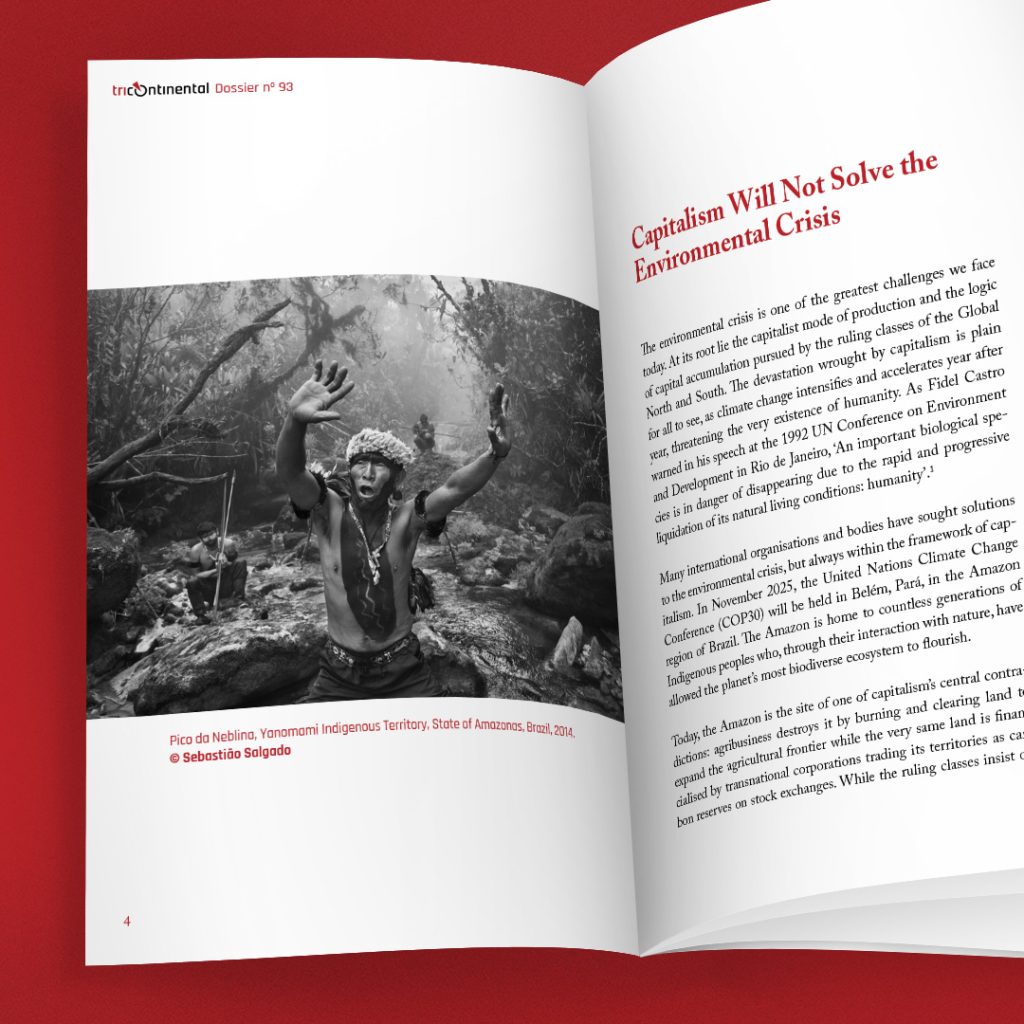
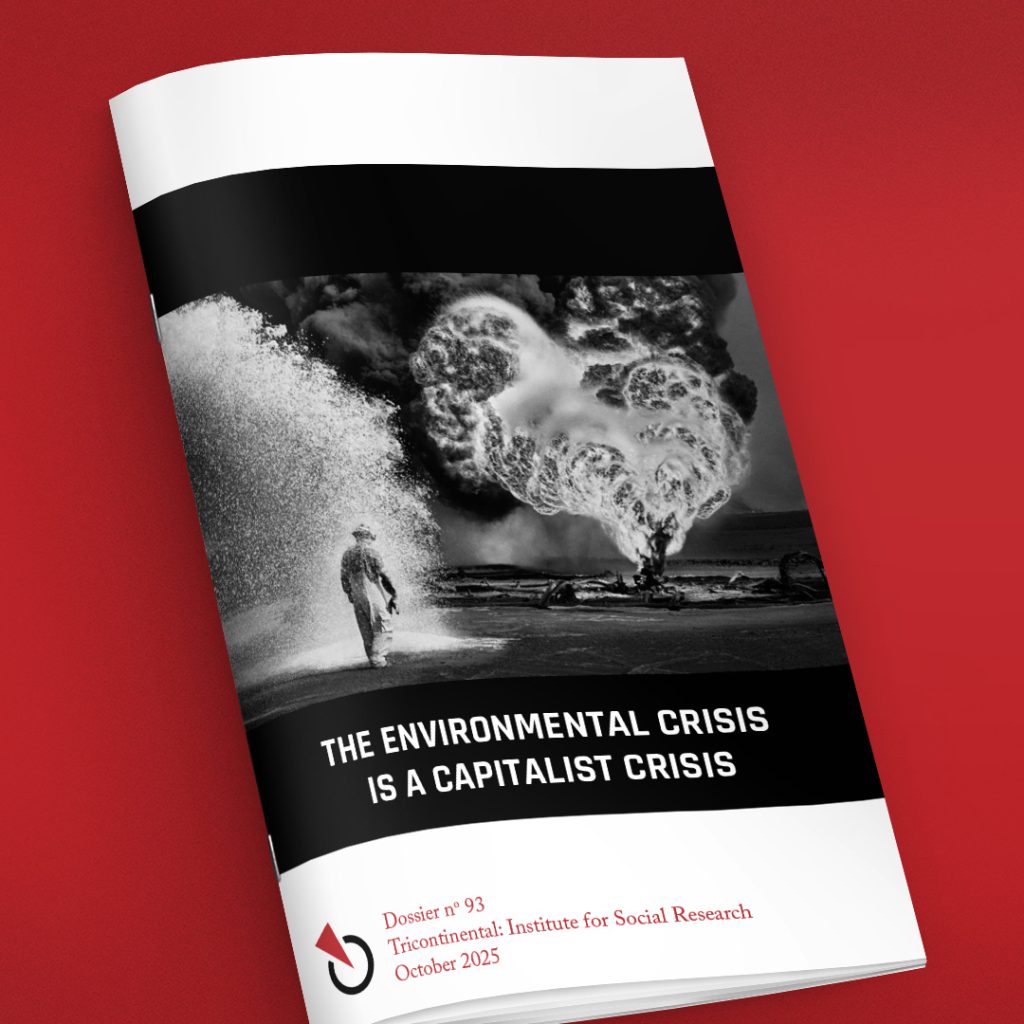
 Sebastião Salgado.